A Review
The Last Days Of John Lennon
by
Fred Seaman
Part II
Review by R.E. Prindle
How The Fifties Became The Sixties

Yoko, Andy, John: The Fifties And Sixties United
The sixties seem to have erupted by some process of autogenesis. They seem to be a decade unrelated to the fifties but nothing could be further from the truth. The sixties were very carefully structured in the fifties, that supposedly somnolent decade. The fifties themselves evolved from the fantasy notion of The United States Of America- the American Dream. In truth there had never been a united America and an American Dream only in the mind of certain immigrants who believed they had reached the Promised Land of their dreams. The country has always been one of conflict with conflicting peoples. There was no mythological age as in distant times so no mythopoeic era preceded the scientific one. America was born in science.
The warfare against the aboriginal peoples to clear the land for the European invaders created the first layer of conflict. The second layer of conflict was the importation of Africans as slave labor. This created a second irreconcilable conflict that erupted in 1954 when the Black revolution began in earnest and began to accelerate in the sixties. This was what Eric Foner described as America’s unfinished revolution in his writings.
Each succeeding group of immigrants created its own friction but assimilation did go on with most peoples. In the fifties the sort of ethnic identities in song and humor that makes the talkies of the thirties now seem quaint was coun

Levy's Jewish Rye- Subtle Form Of The Imposition Of Ethnic Superiority
teracted. While visibly subdued ethnicism simmered below the surface until the sixties when it burst out again in a new form and triumphed.
I am unable to tell the education received in schools of the twenties and thirties but by the time I was in high school from 1953-56 the whole concept of revolutiuon was romanticized and this continued through my college years in the sixties. It was iterated over and over again that revolution was an absolute virtue. To be revolutionary was to be a person in full. Kids in the walls ran around saying are you revolutionary, I’m revolutionary. Thus they embraced any idea that was the opposite of the status quo. This notion of revolution was combined with the notion of the absolute virtue of being an American. This would result in Kennedy’s idiotic Peace Corps begun in the sixties. Raw American youths were supposed to be able to tell the less favored peoples how to run their lives. The war in Europe was treated as a crusade against Germans, a war of absolute black and white, no shades of grey. I truly believed that no American in either the European or Pacific war ever committed an act of wanton brutality no matter what the provocation. I would have dismissed out of hand that as a matter of policy millions of Germans were exposed to Winter weather in the years following the war unprotected while being denied any kind of nourishment and, yet, it was so. In subsequent years this would have been described as ‘American’ brutality while in fact it was instigated by revolutionary American Jews seeking vengeance. Americanism was not involved.
At the same time the new medium of television exposed us to unprecedented doses of propaganda disguised as the truth, doses far in excess of anything the hated Nazis devised. Chief among those TV shows was a cartoon called Crusader Rabbit. Now, Crusader Rabbit in reality is a vigilante dispensing vigilante justice. He acted on his own ‘righting’ what he perceived as wrongs. Of course those of us who read comic books in the late forties had already been exposed to vigilantism in the form of comic book heroes like the Blackhawks. Or, for that matter Batman and Robin and Superman among many others, Plastic Man. I sort of thought of myself as Plastic Man.
So this whole age cadre was stoked up on revolution and vigilantism with no venues to express it. The sixties then was a god send as the existing revolutions- the Undermen, the Jews, the Blacks, the Homosexuals, the Feminists, the Communists had merely to whisper the word REVOLUTION to get a positive response for their ideologies. The generation was primed for revolution of any sort- a revolution in bubble gum for instance.
Thus at Berkeley in ’64’s so-called Free Speech Movement you had the spectacle of the most advantaged members of the generation participating in what was a part of the Jewish Revolution in the guise of voluntary Undermen.
Thus as the sixties dawned the way was cleared of any resistance to revolutionary schemes as hordes of self-righteous vigilantes confident that their perception and judgment was received from god himself began to act on their assumptions taken from their misguided elders.
2.

Little Miss Yoko
The center of this maelstrom in the sixties was New York City. The Bohemian life style stewing in Lower Manhattan since the Armory Show of 1913 was about to conquer the mind of the country. Perhaps the leader of the sixties Bohos was Andy Warhol. Certainly with a kind of genius he made himself the center of the storm.
This most influential Bohemian attitude toward life was both stratified and diverse. The first out of the box were the uptown Beats. These men seized the attention of the country in the mid-fifties when Allen Ginsberg, a leader of the Jewish, Homosexual and Underman revolutions, gained prominence with his so-called poem, Howl. He then dragged Jack Kerouac through with his On The Road and William S. Burroughs with his Naked Lunch. All three works have been incredibly influential in creating a new Underclass of Undermen, in thought if not in fact.
The Beats hung out in upper Manhattan around Kerouac’s alma mater, Columbia, although Ginsberg gravitated downtown in an effort to pair up with the Beat musical epigone, Bob Dylan. As Ginsberg represented four revolutions it could be said of him- Il est partout, a very important if disgusting figure. Burroughs also gravitated to lower Manhattan before departing for the corn fields of Kansas.
The well-to-do or rich Bohos, to which John and Yoko would belong, sometimes known as Cafe Society, were the upper crust of Bohemia. And then there was the middle Bohemia and it Lower Depths.
Running through all was the old avant garde which excluded the Beats who were not avant garde.
Warhol, John Cage, La Monte Young and a host of artists and writers including Yoko Ono were part of the old garde. Yoko dragged Lennon in but he was not constitutionally avant garde and probably not even a real Boho. Fred Seaman seems to have had no affinity for Bohemia or revolution.
As the sixties dawned Lennon coming from then obscure Liverpool was of the lower middle class but of the English art school background. He spent a couple years in the German underworld before skyrocketing to super world fame with the Beatles so that while he and the Beatles were instrumental in forming the sixties and subsuming the avant garde they were not actually of it. Thus when Lennon came to earth around 1970 he was virtually a Rip Van Winkle who had slept through the decade. The new reolutionary world he and Yoko entered in New York could have been barely understood by them. It wasn’t even really understood by those in the thick of it. Dylan’s ‘Something’s happening here but you don’t know what it is do you Mr. Jones’ could have applied to himself and everyone else.
Yoko Ono was a committed Feminist and key member of that revolution. In a world of eccentric and unusual characters she was a standout. Her career as an avant gardist began as a ‘performance artist’. Essentially a stunt man. Back in the twenties and thirties would be celebrities used their bodies to gain fame performing stunts. One going by the name of The Mighty Atom attached ropes to his hair holding back an airplane. This is essentially what Yoko was doing as a ‘performance artist.’ Her ‘Cut Piece’ urged viewers to come up on stage and cut away a piece of her clothing. She and Tony Cox crawling into a black bag? Whew!
http://www.guba.com/watch/3000011865/YOKO-ONO
But she was thereby connected to the avant garde. She knew John Cage, Andy Warhol, Sam Green and the lot as early as 1960. The friendships remained enduring as she maintained them throughout the seventies and eighties.
As a performing artist Yoko was a sort of chameleon forming her art to suit the circumstances. Having once captured John Lennon she first became a peacenik as peace was the prevailing notion- love and peace- returning to New York amid the wreckage of the peace, love and happiness bit she got up from her bed of peace and strapped a fully loaded bandolier of bullets around her hips and became a sullen revolutionary a la Bernardine Dorhn. It all art and art is holy, isn’t it?

The Criminal Miss Dohrn
The Ono-Lennon’s very serious looking revolutionary activities quite naturally brought the Heat down on them. It should be clear that these were not lightweight posturings but she and John were financing the disruption of the Republican National Convention forcing a move of the site from San Diego to Miami. There is small wonder the elected Nixon administration sought to deport them. Neither John nor Yoko were American citizens but essentially part of an international conspiracy, she being a Japanese and he an English national. Thus in addition to being a leader in the Feminist and Sexual revolutions she lent herself to the Judaeo-Communist revolution. Nearly all her revolutionary associates were of the Jewish revolution. Plus John essentially represented the Undermen. Thus Fred Seaman was employed by not only a celebrity household but a notorious one. Nor was Fred an American but a German national. No Americans involved.
3.
Warhol And Bob Dylan
Down below the subway’s screamin’
As I lay here halfway dreamin’
And face the long evenin’
Layin’ close beside my radio
Imaginin’ the kisses of the girl who sings the song
Lookin’ at the ceiling
Wonderin’ where the dream went wrong.
Last Morning- Shel Silverstein
As sung by Ray Sawyer and Dr. Hook.
The Wizard Reveals Himself
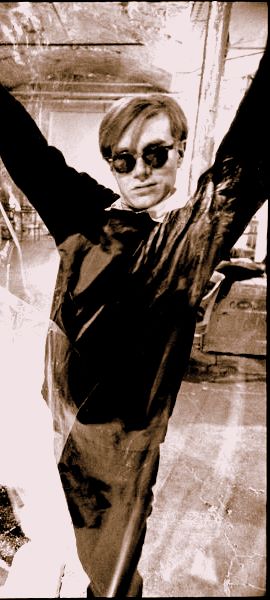
New York City was indeed a tough cold city. It was enough to make you crazy as you ‘fought the crowds, avoided the traffic and watched the world turn grey.’ Coming from Pittsburgh Andy Warhol had no trouble with the skies turning grey, he was used to much worse. For Dylan coming from Hibbing, Minnesota way, way out on the edge of civilization the change must have been traumatic. Both men, however, were uniquely equipped to succeed in such a tough environment although it turned both crazy, cruel and mean. Both became paragons of the revolutions.
Warhol, the older of the two, forged the revolution of the Undermen and the Homosexuals while acquiring great wealth. Dylan, too, made his appeal to the undermen (the confused, abused, strung out ones and worse) basing his career on the misfits and malcontents. At the same time he was a key player in fundamental Jewish revolution. Both men affected innocent harmless personas so as to deflect attention from what they were really up to. As both had complementary strategies it is quite possible that each saw through the other. Warhol certainly saw through Dylan but I’m not sure if the reverse was true. Both were heavily into drugs which altered their perceptions.
Warhol preceded Dylan on the scene by a decade arriving in NYC in 1950. His homosexual agenda was clear to him from the start even if its implementation wasn’t. He was immediately successful upon his arrival easily gaining entry into the commerical art field. Dylan too would have no trouble gaining both entry and prominence within a year, phenomenal success in two and preeminence in three.
Warhol commanded a large perhaps even great income within a matter of four or five years. He spent madly but invested wisely.
He was always interested in mass production techniques where the original was merely a prototype like a car model. His original drawings were mass replicated by the newspaper ads. Amazingly, new in New York, he sent a letter to CBS asking if he could design record covers and received assignments by return mail. While his record covers are not among his best known works he did design at least fifty while perhaps more remain to be discovered. While his designs were for very low selling jazz and classical records they are obviously the work of a homosexual or, as they are described- fey.
 Thus they advance the Homosexual revolution. True, they are tiny drops but by the time he designed the Sticky Fingers cover for the Rolling Stones his design, it can be confidently asserted, was seen by every single member of two generations while selling in the millions. The title and cover are an ode to masturbation, one of the favorite thems of both the Homosexual and Sexual revolutions. The illustration was of a male crotch clothed in blue jeans with a workable zipper. It was a retailing nightmare but effective in sexually conditioning the minds of his audience. The zipper was irresistible to record fans who broke the plastic on every single cover making them nearly unsaleable. Success actually unimaginable to Warhol in 1950.
In addition Warhol designed ‘fey’ book covers, frequently for homosexually oriented titles thus adding a few additional drops, pushing toward 9cc. Andy had his sticky fingers in everywhere- stationery, wrapping paper…all with his fey designs.
While he gained great success as a commercial artist he had his eye on the fine arts; about 1960 he made his move into ‘serious’ art- painting. He called his style Pop Art. Pop Art had its antecedents in the fifties of which Warhol would have been aware. Here are a couple examples by Ray Johnson from the mid-fifties. Johnson is described as proto-Pop.
Having made his splash in Pop Art, becoming a major celebrity, Warhol was ready to move into his next phase in the subversion of art and society. In 1964 he established his famous atelier known as the Factory. There he continued his paintings while beginning an influential if unremunerative secondary career as a film auteur.

Ray Johnson' James Deas With Lucky Strike Cigarette Logos

Ray Johnson's Mid-Fifties Elvis
There seem to be revolutionary motives in the founding of the Factory. Warhol gathered about him a collection of the Undermen. These were all Homosexuals, druggies, hustlers and prostitutes.
There is an interesting passage in the Weathermen founder’s autobiography Fugitive Days where the author, Bill Ayers, says:
…the most interesting alliance to me was struck in the first months underground, and it was with a kind of eccentric shadowy group that would become fast and reliable friends for decades to come.
The group was without a name, contained hundreds of members in half a dozen cities, and was organized by a charismatic leader and psychologist who called himself Kaz. They were all former heroin addicts, former beatniks, former hustlers, and prostitutes, five, ten, twenty years older than us, now living in luxury and working downtown but thinking of themselves primarily as deep, deep underground, a kind of fifth column waiting patiently for the revolution.
What Ayers appears to be describing is the Haut Boheme Cafe Society of New York. Now, Warhol with the Factory created a place where all Bohemia, high and low, could gather under the reasonable pretext of partying which is what happened. Many attendees would be innocents of course providing even better cover for the revos. To get some idea of what the scene was like review the lyrics to Shel Silverstein’s Freakin’ At The Freakers Ball appended. Silverstein seems to be describing the Factory exactly.
The police had the Factory under surveillance as well as one supposes, the FBI. The deep underground wasn’t deep enough to conceal these characters. The Factory would be forced out by ’68 giving it a four year run. Bereft of a gathering place Bohemia would have to wait until 1977 for another when Rubell and Schrager put together Studio 54. 54 was better than the Factory because attendance could be monitored allowing only the Haut Boheme and other chosen in; the undesirables could be left out. 54 was run in contempt of all existing laws and moral codes. Suspicious from the beginning it took the Feds only eighteen months to shut it down. Like The Factory however Studio 54 had its revolutionary effect especially along sexual lines- unisex toilets for instance.
The multi-talented Warhol, a perfect Prince of Bohemia added authorship to his achievements with his novel ‘a’ while moving into publishing in the seventies when he established the successful magazine Interview.
He added several notable record covers, while forming in ’66 the immensely influential Exploding Plastic Inevitable centered around ‘his’ rock band The Velvet Underground.
So, in promoting several different revolutions- the Undermen, the drug culture, the so-called sexual revolution and undoubtedly many others Warhol was one of the most successful and important revolutionary figures of the decade.
Along the way he formed a close relationship with the Feminist revolutionary, the Japanese citizen, Yoko Ono. As a bona fide member of the avant garde she tried to enter Warhol’s entourage before she left for England in ’66. However at the time she was outspokenly antipathetic to homosexuality which probably necessitated her retreating to London to think things over before returning in 1971.
She returned in grand style leading the founder of the Beatles, John Lennon, as though by a rope around the neck. She and Lennon immediately threw themselves into the revolutionary movement associating themselves with various members of the Jewish revolution. they apparently gave large sums of money while lending their personas and prestige to raise much larger sums. It was the fear of their popularity being used to rouse young Americans in this first election in which eighteen year olds could participate that put him under surveillance, quite justifiably so, by the FBI and the Nixon White House. Thus for the next several years they were harassed by deportation threats as undesirable aliens.
Having achieved her goal of reentry into New York avant garde society even becoming an intimate of Andy Warhol Yoko lost interest in Lennon. The two split up for eighteen months or so from 1973 to 1975 then reuniting. Yoko had employed her Tarot reader John Green in 1974 while Fred Seaman was added to the entourage as Lennon’s personal assistant in 1979.
While the memoirs of Green and Seaman have been disparaged by the faithful I see little reason to do so on an objective basis although Yoko Ono may find them offensive for personal reasons.
Part III follows
Appendix
Freakin’ At The Freaker’s Ball
Shel Silverstein
As Performed By Dr. Hook & The Medicine Show
Well, there’s gonna be a freaker’s ball
Tonight at the Freaker’s Hall
And you know you’re invited one and all.
Come on Babys grease your lips
And don’t forget to bring your whips
We’re goin’ to the Freaker’s Ball.
Blow your whistle and bang your gong
Roll up something to take along
It feels so good it must be wrong
We’re freakin’ at the freaker’s ball.
Well, all the fags and dykes they’re boogie’n together
The leather freaks dressed in all kinds of leather
The greatest of the sadists and the masochists too
Screamin’ please hit me and I’ll hit you
The FBI dancin’ with the junkies
All the straights swingin’ with the funkies
Across the floor and up the wall
We’re freakin’ at the freaker’s ball y’all
We’re freakin’ at the freaker’s ball.
Everybody’s kissing each other
Brother with sister, son with mother
Smear my body up with butter
And take me to the freaker’s ball.
Pass that roach please and pour the wine
I’ll kiss yours if you kiss mine
I’m gonna boogie ’til I’m cold blind
Freakin’ at the freaker’s ball.
White ones, black ones, yellow ones, red ones
Necrophiliacs lookin’ for dead ones
The greatest of the sadists and the masochists too
Screamin’ please hit me and I’ll hit you.
Everybody ballin’ in batches
Pyromaniacs strikin’ matches
Freakin’ at the freaker’s ball, y’all
We’re freakin’ at the freaker’s ball.

A Review
Themes And Variations
The Tarzan Novels Of Edgar Rice Burroughs
#14 Tarzan The Invincible
Part VI of X
by
R.E. Prindle
Inside The Gates Of Opar

Edgar Rice Burroughs
Life is just too short for some folks,
For other folks it just drags on.
Some folks like the taste of smokey whiskey
Others think that tea’s too strong.
Me, I’m the kind of guy who likes to ride the middle
I don’t like this bouncing back and forth.
Me, I want to live with my feet in Dixie
And my head in the cool blue North.
–Jesse Winchester: Nothing But A Breeze
And now we come to the heart of Edgar Rice Burroughs. One reason he is literarily disdained is that the story is not the story. Porges, p.524:
As the story progresses the perceived theme of a worldwide conspiracy is abruptly abandoned. Burroughs in his contempt for the communists refuses to allow them to be sincere even in their Marxist goals.
This is not true. Porges has misconceived the story. To quote the sixties Jewish revolutionary Mark Rudd: The issue is not the issue. By that Rudd meant that the Jews had created a diversion to mask the true issue which was the establishment of the Jewish culture as top culture or dictator in this multi-cultural world.
Burroughs intent is exactly the same as regards Tarzan. True, Burroughs has contempt for Communism but that is merely a frame story and a side issue. The true issue is that Tarzan’s authority as guardian of Africa is being challenged on the spot. The duel is between himself and Sveri mano a mano. He discredits the collectivity through the individuals. Thus at novel’s end Tarzan sits in state as Guardian or Emperor disposing the fates, godlike, of the remaining conspiritors. Magnanimously he allow Paul Ivitch (Paulevitch) to be escorted out of Africa rather than be thrown on his own resources that would have resulted in his certain death.
The issue within the issue, as always, is Burroughs attempt to resolve his psychological difficulties. Thus one has the Colt-Drinov combination, possibly reprsenting ERB and Emma, an episode within Opar of Nao who may represent Florence releasing him from the prison of his marriage to Emma, and Colt-La, the Anima and Animus problem. Tarzan and Colt change partners so that La nurses Colt and Tarzan nurses Zora. But to that in the next section.
While one expects a pure shoot out with the Communists, Tarzan is not going to defeat them by direct action but by a terrorist campaign of which Tarzan is the jungle master.
To compound the problem Burroughs confuses realism with dreamwork. This is not a realistic novel but a dream fantasy. It was said that Burroughs wrote out his dreams which has a basis in fact. The scenarios may have originated in his sleeping dreams but then he modifies them in day dream style while consciously molding the story for political and commercial purposes. A writer does need readers.
To give a basis for comparison for the dreamwork I’m going to play Freud here and offer up a dream of my own; it is similar to Burroughs’ in many way. Since integrating my personality I don’t have wonderful dreams like this anymore. As Jung correctly surmised when one integrates the conscious and sub-conscious minds memory destroys the symbolic basis of your dreams. I can analyze the common place dreams I have now even as I dream them. Something is lost, something is gained, but it might be of lesser value. I think I like the mysterious flavor of the smokey whiskey even though the water I have to drink now is better for me.
In my dream I began on the edge of a vast desert dotted with a few oases while far off in the distance twenty years away, rather than miles, away in the the distance a great white shining mountain arose. The distances were so vast they were measured not in miles but years. Indeed, the years of my life. I had to traverse the vast desert reaches between the oases. Each oasis merely refreshed me for the next perilous journey. Having traversed the years I came to the great white shining mountain. One might compare it to the tor containing the treasure vaults of Opar out on its desert. These are symbols common to multitudes.
I then came to the white shining mountain which might compare to the city of Opar. Censorship prevented me from climbing the mountain at that time. In other words in the control of my subconscious, consciousness was denied me. I approached the mountain from the back where I noticed a trickle of water leading into and down the mountain. I tried to drink the water but as it ran through a pure salt bed it was too salty. Unlike Burroughs who was in the pits of darkness I was always bathed in a clear light which came from nowhere.
I followed the little stream down the subterranean path into the mountain. Thus I had all land and no water, a barren psychological situation. Following the cave down I came to a series of gates made entirely of steel. I hesitated to go forward but there was no going back. I was impelled into one of the gates which turned into a chute that spilled me out onto a steel floor where unseen hands seized me pushing me into a steel room as the steel door slammed shut. Like Tarzan beneath Opar I was a prisoner with no seeming way out.
As I looked around I realized that this was a laundry room. All steel, of course. While I had no food I now had sinks full of water. My situation had been reversed from all land to all water, from the pure masculine to almost pure feminine. Where before I was barren now I was spilling over with wisdom. I knew I had to get out of there reasonably soon or I would starve to death. There was impenetrable steel all around. But I had plenty of water. Too much water. Looking around I spotted ventilation ducts along the ceiling. I conceived the notion that I could drink lots of water then urinate in the ducts which would create a foul odor that would be distributed throughout the rooms above. They would search for the source of the odor thus opening the door of my prison.
The ducts were difficult to reach but I was able to urinate in them. As I expected voices came down the duct asking ‘What is that smell?’. The door to my prison opened inward so I stood to the side that opened waiting. Sure enough a couple maintenance men flung the door open bursting into the room. I slipped out the door behind them unnoticed.
I now descended still further until I came to a bank of elevators. One door was open for which I made a rush. The elevator was packed with boys I knew from high school. With doubled fists they pushed me back refusing to allow me in the elevator with them. Mocking me as the doors closed I was left alone way down there.
There was a flight of stairs but censorship prevented my using them. I waited in vain for another elevator. As with dreams I next found myself at the back of the mountain but the path into the mountain had disappeared so I now had to climb The Great White Shining Mountain.
If, like Burroughs, I were writing a story I would provide a plausible story line for my escape but I’m not. I’m merely transcribing a dream.
The reason the mountain shone was because it was covered by snow several hundreds of feet, possibly thousands, thick. As previously the water in the stream was too salty to drink now it was frozen. The sun shone brightly, not only brightly, but brilliantly, as I began my climb. I had left the subconscious for the conscious as I strove for the light. The climb was long from the back of the brain to the forebrain but not tiring. Apart from the barrenness of the snow I was enjoying myself. Would it be too offensive a pun if I said I enjoyed being high? After a long climb I came to a precipice past which I could go no further. Nor could I go back.
As I studied my position I looked down this sheer precipice to the desert thousands of feet below. There was snow all the way to the desert floor. Down there, way down there, I could see the tiny ant-like people in the barren sands doing obeisance to the moutain which they apparently treated as a god.
Looking down the sheer face of snow I could dimly perceive the outlines of a great face carved in the snow. This god, then, retained all the water behind his visage that could make the desert bloom. Just as I had used water to escape the prison of my subconscious I conceived the notion that I could release the water and make the desert bloom freeing the people from their bondage.
Now, this was hard snow. I had no trouble walking the surface without breaking through while if the snow didn’t give way as I jumped on it to destroy the snow god I would plummet several feet into the desert. Neverthless I leaped up landing on my bottom. The snow gave way as I rode the avalanche several thousand feet down the mountain side to land on the desert floor while I destroyed the god who had been impounding the water.
Many streams now flowed out from the mountain. The desert bloomed turning green and bursting with flowers. Now that we have a comparison let us examine Burroughs’ great dream of Opar.
Opar first found expression way back at the end of 1912 and the beginning of 1913. Appearing at the end of The Return Of Tarzan the story was included in Burroughs’ fourth published story and fifth written story, the Outlaw Of Torn had been written but not published yet.
As with Invincible the story of The Return was not the story. The story was what Burroughs hung the details of what appeared to be the story on. Hence Return was rejected by Metcalf Burroughs’ first editor at Munsey’s who undoubtedly couldn’t understand it. This is the novel in which Tarzan makes his first raid on the fabulous treasure vaults of Opar. Burroughs will continue his wonder stories of Opar through three more books. Each return occurs at a crucial point in his life.
That Opar is a dream location is proven by the topography of the location. It is not too dissimilar to any dream. The jungle grows right up to the base of towering mountains behind which Opar is hidden. On the other side of these it is a dry dusty desert exemplifying Burroughs’ life as the twenty year desert in my dream did mine. Entry into the valley in this story is through a narrow defile apparently several thousands of feet high above which the peaks of the surrounding mountain range tower several thousand feet more. This entry also closely resembles that of Haggard in King Solomon’s Mines. Haggard is never far from Burroughs’ mind as he writes his stuff.
Working your way down into the dreamscape is considerably more easy than climbing it. And then off in the distance rose the shining red and gold domes and turrets of Opar. A dream city if there ever was one. One is reminded of the two great literary and psychological influences on Burroughs, H. Rider Haggard and L. Frank Baum. Of Haggard’s work beyond King Solomon’s Mines I have Heart Of The World and People Of The Mist most readily called to mind. It might be appropriate to mention that Freud also read some Haggard. He specifically mentions Heart Of The World and She but I suspect he probably read others as well. Opar might be a ruined version of Baum’s Emerald City of Oz. Opar is red and gold while from a distance its ruination is not obvious. Mine was a shining white mountain. Burroughs probably tinkered with his to make a good story better.
Now, the fabled Thebes of Greek mythology had seven gates. Cities Of The Sun had up to a hundred. Opar doesn’t have any. The entrance is a narrow cleft in the wall on which on entering this narrow 20″ gap for which Tarzan had to turn his massively broad shoulders sideways and then immediatley climb a flight of ancient stairs. This appears to be a reverse birth story in which Tarzan is reentering the womb, an impossible feat, but then, Tarzan goes where even devils fear to tread. Try some of the books of the psychologist Stanislav Grof. There’s definitely a sexual image that requires a little thought to understand. Hmm. No gates but a narrow cleft too narrow for the shoulders and a flight of steps leading back into the what, womb? Whose cleft? ERB mother’s, Emma’s, possibly Florence’s by this time, or that of his Anima figure? Well, the last is waiting for him inside the domed inner chamber of this sacred city who is aptly named La, which is French for She. ‘She’ was Ayesha the heroine of Haggard’s novel She. I’m sure Burroughs is not writing consciously here.
At this point Tarzan is accompanied by fifty of his brave and faithful but superstitious Waziri. In fact, in this story as Tarzan goes through his incarnation of a Black savage he is Chief Waziri, eponymous head of the Waziri. P. 42:
As the ape man and his companions stood gazing in varying degrees of wonderment at this ancient city in the midst of savage Africa, several of them became aware of movement within the structure at which they were looking. There was nothing tangible that the eye could grasp- only an uncanny suggestion of life where it seemed that there should be no life, for living things seemed out of place in this weird, dead city of the long dead past.
Dead city of the long dead past. That’s what dreams are all about, one’s own long dead past. Thus the ridge separating the lush live jungle from this dry, dusty plain eight years wide was Burroughs own dead past. I suggest the mountain range, perhaps sixteen thousand feet high, represented ERB’s confrontation with John the Bully when he was eight or nine. On the jungle side was his early life as a Little Prince while on the dry dusty side was his blighted, blasted life after John. Opar represents his ruined mind inhabited by the suggestion of life and the Queen of his dreams the beautiful High Priestess of the Flaming God, the woman of indescribable beauty, La of Opar.
La is obviously a combination of Haggard’s She and L. Frank Baum’s Ozma Of Oz.
Tarzan is seized by the Frightful Men, bound and gagged and left lying in a courtyard at high noon. The rays of the Flaming God bear down on him. Whether this is merely part of an ancient Oparian religious rite or whether Tarzan becomes the chosen Son of theSun a god among men, isn’t clear to the reader. The Oparians have their own ideas.
Burroughs describes this rite in a really masterful way. The maddened murderous Oparian who disturbs the ceremony just before Tarzan is to be sacrificed is nicely handled. Believe me, I feel like I am there. As La looks down on Tarzan’s form on the altar she recognizes the One, the Son of the Sun, the One for which she is destined. Once again, Haggard’s She.
Freed in the melee caused by the crazed Oparian Tarzan is taken down to the Chamber of the Dead by La where she hides him. As she said nobody would look for him in the Chamber of the Dead. This Chamber answers very well to the laundry room of my dream. Tarzan/Burroughs is in a stone dungeon with walls fifteen feet thick, fourteen in Invincible, in total darkness while I was in a steel room with no exit but bright light. These locations answer to the rigid confines of one’s owned damaged psyche. There is no way out but there is, there has to be. While palpating this stony prison at the back of the cell Tarzan discerns a flow of air coming through. This scene is a replication of one in Haggard’s King Solomon’s Mines while becoming a B movie staple. The big Bwana discovers some loose stones. He is able to dislodge these creating an exit through the fifteen foot depth of stones of the fortress wall. Somehow Burroughs has worked his psyche to give himself a chance. Once beyond the foundation walls, free of the Chamber of the Dead (I once dreamed I was looking for my soul in the House of the Distraught) but act among the living, Tarzan feels his way down this long dark corridor. One can’t be certain of ERB’s age when he achieved this escape. As it takes place just before Tarzan marries Jane the time might have been 1898-99. Perhaps when he was in the stationery business in Idaho. Perhaps something he read acted as a lever. Apart from Darwin’s Origin Of Species I would venture to say he read Eugene Sue’s Mysteries Of Paris a copy of which is in his library while traces of it are here in his earliest work.
Sue’s rare mentality permeates every page of this first visit while Sue’s extraordinary consciousness is everywhere apparent throughout ERB’s entire corpus. Burroughs himself is absolutely incredible in the manner he associates with numerous other writer’s intellects, seemingly simultaneously within a given passage or even sentence. Myself, Adams, Hillman, Broadhurst, Burger and others have written extensively on these influences. Hillman even goes so far as to virtually twin Burroughs with some of his major literary influences. Burroughs does make all these writers his virtual doubles.
I have stressed Sue’s influence in several earlier essays. I can only urge you to read Sue’s Mysteries Of Paris- a big three-volume work and too short at that- which Burroughs in his own reading found a life changing experience. Possibly he did read it in 1898-99. I found it a life changing experience; I’ve never been able to free myself of its influence, while it appears that Burroughs couldn’t either. A lot of the late nineteenth century writers make reference to Eugene Sue. H.G. Wells based the beginning of an early novel on Sue. The remnant remains only as a short story.
Sue wrote from outside the bounds of sanity. Privately I consider him insane but so brilliantly rational as to transcend the very meaning of insanity. He’s a dangerous writer. His last work was confiscated by the French authorities. It undoubtedly had such a private personal sense of morality that I am sure it would have undone society much as the pornography from Hollywood has undone ours. DeSade and Restif De La Bretonne, who in some ways Sue resembles, were mere unbalanced pornographers who disturb only the disturbed. Sue’s vision of morality is coldly clear, it forms the basis of Tarzan’s but is always on the side of reason and virtue. This fact makes it no less dangerous to a weak mind or that of the obsessive-compulsive Liberal. Still, only the strong survive. I heartily recommend you take your chance.
Tarzan freed from the prison of the psyche, was he insane? was I? or were we merely trapped by a device of other’s making? I can’t say but ERB’s sanity after he escaped was conditioned by that of Eugene Sue. I, of course, rise above all influences.
Progressing down the corridor Tarzan comes to the First Censor. He finds a gap in the floor into which he might have fallen had he not been careful. He would have fallen into the unknown but he would have been alright. He would have fallen into water which in his condition would have been life-giving water rather than dangerous or perhaps he might have drowned in the waters of the subcoscious or Oblivion.
In high school I had a teacher who used to chalk a half dozen slogans on the black board, one each morning. The only one I remember is ‘when you reach the end of your rope tie a knot and hang on.’ I did this for a couple decades then one day I let go. The joke was on me. There was nowhere to fall. I was only a fraction of an inch from a solid surface. However Tarzan culdn’t have known this since he didn’t fall in, this time. He would three years later.
By chance he looked up where he saw some light entering to discover he was at the edge of a well. Yes, you see, the water of life. He dimly descried the other side fifteen feet away which was child’s play for him to leap. Thus he passed the First Censor. Mine was at the elevators which I apparently merely disregarded.
Continuing on for some time in total darkness, so far that he believes himself outside the walls of Opar he enters the treasure vaults. These vaults are filled with what appears to be forty pound barbells of solid gold. Now, this gold is old. So old that no Oparian knows that it is there nor do any old legends even mention it. This is an intriguing part. The gold was mined millennia in the past after the sinking of Atlantis. This raises the question of what did Burroughs know of Atlantis and did he believe in it? I can’t answer the sources of the former but I’m betting on Ignatius Donnelly as one of them. As to the latter I believe he did. He mentions Atlantis in Invincible with a confidence and familiarity that convinces me that over the eighteen years since Return he has read and thought enough to convince himself of the reality of the lost continent. He appears to accept a mid-Atlantic location.
The gold represents the income he’s receiving for his stories. The stories spring from his dead past. That the vaults are outside Opar indicates he freed his mind from its prison or that the money comes from outside the prison, i.e. his publishers. That the gold is Atlantean indicates that his stories are based on his own ancient experience. In other words he is mining his past already completed as ingots or accomplished facts.
What experience then catalyzed his ability to write? I believe that from 1908-10 when he read L. Frank Baum’s Ozma of Oz, Dorothy And The Wizard Of Oz and The Emerald City Of Oz he found a means to express himself. These books bypassed his last censor allowing him to write Minidoka. That book was not suitable for publication but it freed his genius so that he immediately followed it with A Princess Of Mars.
Now, outside the gates of the Emerald City/Opar in the midst of the equivalent of Baum’s Great Sandy Desert he found the handle on his own destiny.
Tarzan locates the fifty faithful but superstitious Waziri loading them up with two forty pound ingots each and points them toward the coast.
At the same time Fifty Frightful Men from Opar who are tracking him discover Jane instead. Dreamy enough for you? Given a choice between Tarzan and Jane I’d take Jane and so did the Fifty Frightful Men.
So now Jane’s on the altar under the sacrifical knife of La. Skipping the irrelevant details La discovers Jane is Tarzan’s beloved. Interesting confrontation between Tarzan/Burroughs real life woman and his Anima. La is shattered as Tarzan rejects her for Jane.
This is a key point in the oeuvre. This is what makes the novels so repulsive to the literary mind. The story is not the story; the issue is not the issue. Opar is the story within the story that will be told in four short parts over eighteen years. So we have part one here without any indication the story will be continued. A segment of the story is just plopped down into The Return Of Tarzan, sort of irrelevantly.
Weird style actually. I’m not even sure it works, but it nevertheless must be effective else why would the stuff still be in print a century on. You’re on your own, Jack, I can’t even attempt to solve that one. Not today anyway.
The next novel examining this psychological is the 5th novel of the oeuvre, Tarzan And The Jewels Of Opar of 1915.
At this point Tarzan, a profligate if there ever was one, has run through the two tons of gold the fifty faithful Waziri brought out and is broke. Two tons of gold in three years. Think about it. He needs to make another run on Opar.
The character of the series changes with Jewels Of Opar from the character of the Russian Quartet, the first four novels. They not only have an Oz influence but they become Ozlike. Burroughs apparently drew on The Beasts Of Tarzan as the foundation for what is essentially a new series.
After writing five Oz stories, in the sixth, The Emerald City Of Oz, Baum attempted to abandon the series. He closed the series off with the news that there will be no more communication from the fairy kingdom. Because Oz has been invaded three times now, what with the advent of airplanes that will be able to spot Oz from the air Ozma is making the kingdom invisible. Is it coincidence that Opar disappears from the oeuvre after the third invasion?
Baum’s Emerald City Of Oz appeared in 1910. It was the last of the stories to be datelined Coronado in his prefaces. When he was forced to begin writing Oz stories again in 1913 they were datelined Ozcot in Hollywood. In 1910 Hollywood was just a pleasant Los Angeles suburb. The movies didn’t begin to make Hollywood the center of the world porn industry until 1914.
Whether Burroughs knew that Baum left Coronado in 1911 isn’t known but I find it signficant that when he went to California in 1913 his first choice of residence was Coronado where he perhaps thought he would be close to Baum who afer all had a close connection with Chicago. Baum wasn’t in Coronado so Burroughs moved across the bay to San Diego.
The question then is: did Burroughs make a pilgrimage to Ozcot to see Baum in 1913? I have to believe he did. Tarzan was one heck of an entree such that Baum could hardly refuse to see ERB. How long or how often the men met then is conjectural but I think it was long enough for Baum to give Burroughs some tips on fantasy writing. Already an ardent admirer of the Oz books Burroughs would have had no trouble accepting advice from this master.
Thus when Burroughs returned to LA and Ozcot in 1916 it is certain that they met while they were probably already familiar with each other. In 1919, when Burroughs moved to LA permanently, Baum was on his deathbed so there was no chance to renew the acquaintance. I also believe that Baum’s Ozcot influenced Burroughs in naming his own estate Tarzana.
In any event Tarzan returns to Opar in 1915. Except for the first visit when Tarzan following the directions of the old Waziri, chief of the Waziri, visited Opar to take the gold, in the rest of the visits he is battling interlopers who wish to steal the gold from him. It might pay to look at the nature of the intrusions and the intruders.
In 1911-12 Burroughs had for the first time in his life come into more money than he could spend, only for a brief moment of course. Thus Tarzan removes the gold more on a whim not really knowing what to do with it. One might think this a strange attitude for one who had tasted the night life of Paris; but a foolish conisistency is the bugbear of small minds as one of those venerated old timers once said. I don’t wish to be thought of as small minded so we’ll let the observation pass.
By 1915 having lost his two tons of gold in some bad investments Tarzan has better learned the value of money or, at least, the absence of it. And so, perhaps, has Edgar Rice Burroughs. One can see the ghost of old George T. shaking his head muttering: ‘When will that boy ever learn?” Well, George, it would take more time than allotted to him.
After 1912 Burroughs had created something of value. That value could be stolen or at least exploited. In 1914 McClurg’s offered him a publishing contract. Nicely crafted it gve all the advantages to McClurg’s and none to Burroughs. Burroughs undoubtedly did not understand the legal implications of what he signed. I can’t explain this but McClurg’s made no effort to merchandise a sure fire hit. They didn’t even publish the full fifteen thousand copies called for in the contract. They released the book to reprint publisher A.L. Burt after p;rinting only ten thousand copies themselves. Explain it how you will but there was a guaranteed huge absolutely visible market waiting for book publication. Syndication in newspapers had guaranteed the book’s success. So why did McClurg’s willfully refuse to take advantage of such a deal?
Burroughs probably had stars in his eyes at the prospect of 10-15% royalties on hundreds of thousands if not millions of books. Instead he got comparatively nothing. The royalties from Burt were miniscule and to be shared 50/50 with McClurg’s. You can imagine Burroughs’ disappointment as a golden future became brass before his eyes.
Back to Opar. Tarzan entered the vaults before his faithful Waziri who were warriors and would act as bearers for no other man. Alone Tarzan made six trips from the vaults to the top of the tor bringing up forty-eight forty-pound ingots. That’s 320 lbs. per carry for a total of 1920 lbs or nearly a ton. According to Freud, and I believe him, all numbers are significant, although I don’t have enough information to delve completely into the meaning of these numbers. The Waziri then brought up fifty-two ingots. some two of the fifty got stuck with carrying two ingots or two went back for one more. That made slightly over a standard of 2000 lbs.
Tarzan’s forty-eight ingots are roughly half of the total that undoubtedly represents the fifty-fifty split with McClurg’s. At the time Ogden McClurg, the son of the father who built the company, Alexander McClurg, was the nominal head of the company. The firm was actually owned by the employees since about 1902, which Burroughs probably didn’t know. The man he dealt with, Joseph Bray, was probably the real head of the company. Actually Ogden was away from the company for long stretches on adventures in Central America and WWI so that he would have been unfamiliar with the day-to-day workings of the company. Burroughs, however, formed a grudge against Ogden McClurg. I suspect that the Belgian villain Albert Werper is based partly on Ogden McClurg while also being an alter ego of Burroughs. So, a story behind the story is how Ogden McClurg stole ERB’s royalties.
At the same time Tarzan spurns La for a second time so the Anima-Animus story of Tarzan, Jane and La continues. La has Tarzan within her power but in the life and death situation love triumphs over her hurt so she spares the The Big Guy. Not without consequences. The Fifty Frightful Men, or what’s left of them after the maddened Tantor tramples a few, led by Cadj, who now makes his appearance, feel betrayed repudiating La. Thus is begun the conspiracy to replace La which will be the focal point of the next two visits. You know, love or hate, I don’t know which is to be feared the most.
In the next visit in Tarzan And The Golden Lion Tarzan has gone through his second two tons of gold. That is four tons of gold in roughly ten years plus the Jewels of Opar that our spendthrift hero has managed to go through. Four tons of gold! That’s 128,000 ounces of gold. At today’s price of over a thousand dollars an ouce it works out to 128 billion dollars and change. My friends, that is prodigality. Good thing there was more where that came from, hey?
Of course a lot of the loss came from loans to the British Empire to float the Great War. But like certain other borrowings, to which Burroughs may be making an allusion, the Empire had no intention of repaying.
Once again this sort of excess had brought Tarzan to the edge of bankruptcy not unlike ERB in 1922. Just as creditors were besieging ERB for money so some private individuals led by a former employee, Flora Hawkes, attempt to extract the gold from Opar. Tarzan first fails, then recovers not only the gold but the bag of diamonds. The significance of the jewels is explained in the Tarzan and Esteban Miranda story contained in Tarzan And The Ant Men. That story is a duplicate Jewels Of Opar with different details. The history of the Jewels Of Opar also duplicates the history of Tarzan’s locket in Ant Men. If you’ve found something good don’t hesitate to use it more than once.
Fifteen years after the visit in Jewels Of Opar and eight years after the Golden Lion/Ant Men the scene returns to Opar, where once again others are to make a run on Tarzan’s private bank at Opar. Apparently Tarzan has them baffled from the start as, although they know there are treasure vaults at Opar, they have no idea where they are. It appears the Communists have read the earlier books, but not with close attention, nor did they bring their copies along with them to bone up during all those idle moments in camp. Playing cards is alright after reading, but time better spent before. You can see why these dodos failed.
Burroughs had read his Oz stories. One can’t be sure whether he ever reread the stories or whether he was working from twenty year old memories. There are similarities here with the Emerald City Of Oz of 1910. In that book Baum attempts to end the series. He says that it will be the last communication from Oz. It too involves an invasion of Oz by the Nome King and his horrid allies. In Baum’s story Ozma refused to defend her Communist State, predating Russia by seven years, but arranges it so that the invaders who are tunneling beneath the Great Sandy Desert emerge in front of the fountain of the Waters of Oblivion. The fountain has apparently been spiked with LSD as the drinkers get lost in a world of their own returning through the tunnel without a fight. Perhaps the first military use of drugs in history. An excellent fairy tale, hey?
Burroughs’ Communists make two attempts to enter Opar. Circling the city unable to find any gates to Burroughs dreamworld they do find the narrow cleft in the wall. Spooky sounds and happenings disconcert the Blacks and Arabs of this multi-cultural coalition so that any concerted action is frustrated. Although the Russians and the Mexican, Romero, enter, only Romero has the courage to penetrate beyond the courtyard. The Russians are arrant cowards who flee at the sound of the first Oparian shriek.
Returning to base camp they find that Wayne Colt, having tramped the breadth of Africa, has joined the group.
A second attempt is made. The superstitious Arabs refuse to return being also disgusted by Zveri’s lack of leadership and cowardice. Taking the six Communists and the Blacks Zveri returns to Opar for a second attempt. While absent from the base camp the coalition begins to come apart as the Arabs desert the cause, looting and burning the camp while taking the two White women with them. La has joined Zora but more on that in the next section.
The second expedition fares no better than the first for the same reasons. On this attempt both Wayne Colt and Romero enter the sanctuary where they are engaged in a serious battle with the Frightful Men. Colt is felled by a thrown bludgeon that knocks him down but doesn’t crush his skull. Romero retreats, Colt is dropped unconscious before the high priestess, now Oah and Dooth. Cadj was destroyed by Jad-Bal-Ja in Golden Lion so Dooth has taken his place.
If La is the good mother aspect of the male psyche, Oah is the bad or wicked mother. Still beautiful but not quite as much so as La.
She orders Colt taken to a dungeon to await the full moon or some other propitious moment to sacrifice him.
Oah’s plans will be foiled because among those present is a nubile young maiden named Nao who falls head over heels for Wayne at first sight. Burroughs describes Nao as having entered the first bloom of womanhood. To me that represents a fourteen-year old girl. Indeed, Nao is fresh as a flower.
One remembers Uhha who accompanied Esteban Mirands in Ant Men was specifically mentioned as being fourteen. So the ages fourteen, nineteen and twenty have special female connotations in Burroughs’ stories. As Freud rightly says people should only be held responsible for their actions and not their thoughts. Certainly there is no mention of Miranda having relations with Uhha while Nao had to be content with watching Colt disappear into the night after she released him from prison, murdering a man, be it noted, to do it. All that Priestess sacrificial training with knives comes in handy.
It will be remembered that ERB is said to have begun proposing to Emma when she was in the first bloom of womanhood at fourteen. So it is probable that the memory is associated with Uhha and Nao.
Colt as Burroughs alter ego thus allows Burroughs to visit Opar and have his fling with Nao as Colt while Tarzan has his with La. there’s a sort of joining of the two aspects of Burroughs’ Animus much as there was with Esteban Miranda and Tarzan in Golden Lion/Ant Men as well as Werper and Tarzan in Jewels Of Opar.
Tarzan himself returns to Opar before the first expedition of the Communists.
It has been eight years and four novels since Tarzan visited the fabled red and gold city of Burroughs’ dreams. Tarzan has a number of misconceptions of his relationship with the Oparians. The high priest Cadj who had become a problem in Jewels Of Opar was killed by Jad-Bal-Ja in Golden Lion. La had been replaced on her throne with the Bolgani of the Valley of Diamonds as her body guard and the Gomangani, who had no thin veneer of civilization at all, as her slaves, I guess. Tarzan then sees himself as an Oparian benefactor, not unlike the US in today’s Iraq, who will be received as a friend. Our hero shows himself a poor psychologist.
With a light springing step he turns sideways to enter the cleft, bounds up the stairs to enter the inner sanctum where the howling Frightful Men bash him over the head yet again. Tarzan could have been tagged Skull Of Steel to survive all these bashings with very heavy clubs and grazing by full metal jacket bullets. I tell you, man, I’d reather read of adventures like this than live them.
Coming to, Tarzan is surprised to find Oah as High Priestess with Dooth as her High Priest.
‘Where is La?’ Tarzan asks.
‘Dead.’ Replies Oah. ‘Throw him in the dungeon.’
Back to the pits of Opar for the Big Bwana where one imagines his sensitive nostrils will be grossly offended.
Once again Tarzan escapes his prison. Seeking a way out he is spotted by some hairy bandy-legged men. Fleeing down an endless corridor flanked by doors he chooses one and enters. Whew! What an aroma assails his sensitive nostrils. He is face to face with a half starved lion. The Big Guy hears the hairy men rushing down the corridor just as the lion springs. The door opens inward, unlike most prisons but apparently commonly in dreamscapes, so Tarzan opens it and steps behind it. As the lion springs past him he slams the door which was not too swift a move as the bar falls locking him in. He has the comfort of hearing the lion tearing up the Frightful Men but the stench of the lion’s den for once is so powerful it disguises the aroma of a White woman at the back of the cell. Surprise! La isn’t dead she’s been palling around with this lion for a while. Fortunately as in Ant Men there is a door between her inner cell and that of the lion that she can open. They built prisons differently back then.
So, the Animus and Anima are reunited but in prison once again. As in all dream sequnces there is a way out.
There’s a lot of shuffling about; this one is fairly complicated. In order to bring food to La at the back of the cell it is necessary to first feed the lion. There is a corridor across the front of the cell. a barred gate separates it from the lion’s den while La’s cell with its unlocked door is at the back. The corridor leads to a little chamber that is open from above. The lion’s food is thrown down after the gate has been lifted and closed somehow. While the lion is feeding in this corridor the attendant picks his way among the lion piles and puddles to take the food back to La. The chow must be tasteless in this overpowering stench.
Tarzan investigates then raising the gate for La when she advises him that the Oparians are coming back with the lion. This is very fast work by the Oparians so you can see the stuff is dreamwork. Tarzan raises La into the opening following her.
They follow the winding staircase until they enter a chamber that is the highest point in Opar. Thus they have ascended from the subconscious to the conscious. Here La once again confesses her love for the Beast of Beasts. The Big Guy is still not interested.
As they are plotting a way to get down from the tower they hear someone ascending a ladder. As the fellow pops his head above floor level Tarzan seizes the guy by the neck. My first reaction was to think that this was the Old Stowaway from Tarzan And The Golden Lion who would now be sixty-eight. Apparently not although Burroughs makes him sound different from one of the Frightful Men.
The old boy assures Tarzan and La that he is faithful as he as wellas most of the Oparians pine for the return of La. Plans are made for La to return to her throne. The Old Boy was a master of deceit however. Oah, Dooth and the Frightful Men who are still very angry with La and Tarzan are waiting for the pair when they enter from behind the curtain. A little Wizard of Oz touch. Humor, I think.
Tarzan might well have voiced the words of Marty Robbins in El Paso:
Many thoughts ran through my mind
As I stood there.
I had but one chance
And that was to run.
And run the Big Bwana did in a scene that was almost as comical as when he ran from the Alalus women in Tarzan And The Ant Men.
Breaking through the ring of Frightful Men Tarzan tosses the slower La over a shoulder and rapidly puts one of his clean limbs before the other. The bandy little legs of the Frightful Men are no match for the Big Bwana. Shouting epithets like: Good riddance of bad rubbish and Don’t come back again if you know what’s good for you. they snarlingly turned back to the City of Red and Gold.
Far across the dusty plain Tarzan and La climbed the ridge separating Opar from the outside world. First outside the gates of Opar in 1915s Jewels Of Opar chasing after Tarzan, once again in Tarzan And The Golden Lion to rescue Tarzan, La now makes her longest and most hazardous stay in the great wide world.
Part Seven follows.
A Review
Themes And Variations
The Tarzan Novels Of Edgar Rice Burroughs
#14 Tarzan The Invincible
Part V of X
by
R.E. Prindle
First Published On The Ezine, ERBzine

The Man
Six White Men In Search Of An African Empire
If one believes that Burroughs is merely on a rant against Communism in Tarzan The Invincible and Tarzan Triumphant then there is nothing more to say. Still, it is remarkable that ERB specifically names Stalin as a persecutor of Tarzan in both books. As Burroughs says he doesn’t mind fictionizing political and religious realities the question is , is he fictionizing a real life situation where Stalin, or the Communists are giving him a hard time?
Seems really improbable doesn’t it? People are used to thinking of Burroughs as a barely literate fantasy writer better ignored by the literati. But more insignificant men than ERB have been the victims of hate campaigns.

Dr. Harvey Springer- The Cowboy Evangelist
Who now, for instance, remembers Harvey Springer? Harvey Springer? Never heard of him? I don’t wonder. Oddly enough when I was in San Diego in 1957-58 Harvey Springer, who was some kind of evangelicalist, was going to appear at some church out where no sailor ever went. He was kind of a cowboy evangelical from Denver. His most dramatic stunt was placing one of size fourteens, he was a tall rangy man, on one chair and the other on another to harangue the crowd.
I hadn’t heard of him, you know, nor had anyone I knew, but Harvey Springer was reputed to be an arch anti-Semite. Could have been for all I knew, but I’m not going to take anyone’s word for it. The point is the Jews sent all kinds of people into the streets to tell people not to go see Harvey. I don’t how many times they must have heard- Who’s Harvey Springer?- in reply. Rather than say he’s an anti-Semite, of which I had even less knowledge at the time never having heard the term, all that was necessary was to say the two words, church and evangelical to cool my ardor, if I had any, to find where he was speaking and go see him.
In addition the AJC and ADL published books in which they denounced Harvey Springer as a very dangerous anti-Semite. Now, if certain people would go to such extremes to persuade someone not to do something he had no intention of doing what would they do to defame someone with an international reputation? The only one who didn’t realize the extent of ERB’s fame seems to have been ERB himself. He was no self promoter, he thought it best to keep his head down.
In that sense, judging from the unpublished Under The Red Flag and the published Moon Maid, Invincible and Triumphant Burroughs was actually a leading anti-Communist voice. I mean, people read this stuff. They read it in America , they read it in England, they read it in numerous translations and they read it in the Soviet Union. Here’s the kicker, Stalin read it. Not only that, Stalin was a movie buff. And he requested Tarzan films (reported in a recent UK Telegraph story and the book of Simon Sebag Montefiori: Stalin: The Court Of The Red Tsar.)
History is not a mystery, it’s just schoolyard bullies bigger than life.
We also know that Stalin ordered his scientists in the 1920s to attempt to cross an ape and a human to create a super warrior. It’s clear to me that Stalin had read Beasts Of Tarzan. The Man of Steel may have had a difficult time distinguishing between fact and fiction as many another. Besides, remember eugenics was a hot topic of conversation in Red circles then as it is today. Not knowing what we know now about genetics crossing an ape and human may not have seemed that far fetched. It doesn’t to a lot of people now. Heck, the Old Testament enjoins one to destroy the results of an animal-human union so the ancient Hebrews thought it was not only possible but a regular occurrence.
There is very clear evidence that the Reds were conducting a campaign of vilification against Burroughs. I’ve mentioned it before but the clearst evidence is H.G. Wells’ novel Mr. Blettsworthy On Rampole Island.

Bertie Wells
May we take a moment to look more closely at Wells? Don’t think I’m antagonistic toward Wells. I dearly love Wells just as I do Burroughs. I have a complete collection of Burroughs while I’m looking for the odd volume of the more obscure Wells. I’m not boasting, I’m just saying this in the way of credentials. I’ve read all of Burroughs more than once and I’ve read all the Wells’ titles I have, many of them more than once. In point of fact I love all the literature from say, Haggard’s King Solomon’s Mines to 1930 and perhaps an odd year or so beyond. I love. I mean, I love it. I love Edgar Wallace who, if you can believe it, is claimed to have sold one out of four books sold in England during this period. If you don’t know him he was one of the co-writers of the movie King Kong and then he died. All this stuff of this period is wonderful. Robert Hitchens, P.C. Wren.
So, you know, it’s like this: H.G. Wells was a Soviet literary hatchet man.
The man had a wonderful career. You know his most famous novels, The War Of The Worlds, First Men In The Moon, The Island Of Dr. Moreau, In The Days Of The Comet. If you like Wells, and I do, those are the tip of the iceberg. A few of his short stories and he wrote many are as good as short stories get.
He was always a socialist and perhaps a terrorist conspiritor, but he was a child of the nineteenth century until his mind broke at the end of the Great War. At that time he lost faith, in god, transferring his faith to the Revolution, becoming a Soviet dupe. His literary career may be divided into two halves, pre-God- The Invisible King and post-God. That was one of his books.
He was not taken seriously as a fiction writer after the war. During the twenties and thirties he turned out an unending stream of novels that were ignored. It’s not difficult to see why, but I find them a little more tolerable. I like Wells. His reputation and career were saved by his 1922 effort An Outline Of History. It was a massive volume and it sold massively for twenty years or more while being hugely influential in literature. Put him on easy street for the rest of his long life. As much as any artist who is skilled at spending money can be on Easy Street.
As a novelist however, he was pretty much a has been. While none of his post-1920 novels take off he hits the spot with me.
From 1920 on his soul belonged to the Revolution, which is to say the Socialist homeland, which is to say the Union Of Soviet Socialist Republics. That means he was more loyal to Russia than he was to England. In short, a traitor in intent if not in deed. While no Liberal ever deals in realities hence are in constant denial, The Man of Steel, Josef Stalin, was his boss. Wells naturally would have denied this.
The Soviets had a pretty comprehensive system which once again is denied. There were a number of State prostitutes who were assigned to the various important Red writers to service them as mistresses, while reporting back to the Kremlin. This is, of course, denied by the Liberals. I don’t understand living a life that has to be denied, where everything you do has to be represented as something else, but such duplicity is apparently congenial to the Liberal mind. They must seek it.
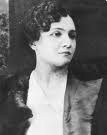
Moura Budberg
Wells was assigned a woman named Moura Budberg. She must have known how to turn on the charm as she was able to make a number of men she was assigned to sincerely love her, including the British diplomat Bruce Lockhart, the Russian writer Maxim Gorky and H.G. Wells. She wasn’t that good looking either. All of these people led double, triple or quadruple lives. They must have been really able to compartmentalize their minds. Freud didn’t touch that type.
After Wells’ visit to Lenin in 1921 he was signed on. He began his career as literary hatchet man. In his writing he portrayed recognizable people, sometimes under their real names, in negative or positive lights. As a skilled writer, whether you like his later stuff or not, he was more than competent to do this. It appears that he first targeted Burroughs in his 1923 novel Men Like Gods. Among his science fiction novels this one should rank more highly than it does. Burroughs’ 1926 Moon Maid reads like a reply to Wells. Especially the first part of the trilogy where Burroughs dances imaginative rings around the First Men In The Moon. From there Wells took up the challenge with Mr. Blettsworthy On Rampole Island of 1928 which unmistakably is a parody of Burroughs in which he portrays Burroughs as insane, but not a bad analysis.
Burroughs responded possibly with At The Earth’s Core but definitely with Tarzan The Invincible. At the same time one interprets Stalin’s interest in crossing apes with humans as being derived from Beasts Of Tarzan and other Tarzan novels there may have been more direct Soviet interest in ERB. One notes that Tarzan The Invincible was the first title published under the Burroughs imprint. I think it highly probable that his publishing was being interfered with by the Reds in addition to whatever other grievances against his publishers Burroughs may have had.
One may say that Burroughs was too insignificant for Stalin to bother with, yet according to Simon Sebag Montefiori Stalin put out a contract on John Wayne because he was such an ardent anti-Communist. Khruschev is said to have told Wayne that he concelled the contract after Stalin’s death. Edgar Rice Burroughs was at least as significant in 1930 as Wayne in the 1940s and 50s.
At any rate in 1930 Burroughs has Stalin and the Reds invading his dream world of Opar to steal his gold, i.e. put him out of the publishing business. Invincible and Triumphant, notice the titles, both deal with Stalin and the Soviets then the topic disappears from the oeuvre. Was Burroughs given incentive to counter-attack the Reds? I think there is enough evidence to warrant the opinion while time will tell even more. Research is just beginning.
It is signficant that Burroughs introduces the story in his own voice, not a framing device. He may be simply talking to the reader or he may be addressing Wells and, dare I say say it, The Man Of Steel himself. Perhaps a subtitle could be ‘The Big Bwana Meets The Man Of Steel.’ Now, it should also be remembered that this is the fourteenth novel of the series. the first title had been written eighteen years earlier. At that time the surprise of the character had knocked the socks off the reading public. In 1930 Tarzan was in danger of becoming old hat. Burroughs had to think up new and interesting devices to keep his readers coming back. As with most series of this type the readership was limited. Maximum sales could be predicted so that success meant not falling below a certain level of interest or letting interest diminish below unsupportable levels. As his own publisher Burroughs was now taking all the risks financial as well as literary. He had to turn out a successful book.
I think he did a superb job. Since the series continued to flourish his readers must have thought so too. I do wish ERB, Inc. would release some sales figures though.
For the premiss of his story Burroughs postulates that Stalin and the Soviets wish to instigate a new world war which will allow them to pick up the pieces establishing a complete European dictatorship. Not at all farfetched. Burroughs postulates that Mussolini and his Fascists are aiming at a European hegemony. This is 1930 so Hitler and the Nazis are not on anyone’s radar as a threat to world peace except for a few fringe elements. At the time Hitler and the NSDAP were in hand to hand combat with the Communists for control of Germany. They would not assume power until three years hence.
The Reds then wish to create an incident that would cause the Italians to attack France. The indirect approach is usually more effective than the direct approach so they wish to create an incident in Africa where French colonial troops appear to invade Italian Somaliland.
At that instant expendable confederates in Italy would reveal a bogus French plan to Mussolini. It is assumed that Italy would then declare war on France and the holocaust would begin. As we all know Italy did not declare war on France in 1930 so the plan must have misfired somewhere along the way. Tarzan was the reason. Burroughs gives these little known details that would have been lost to…well… if not history, remembrance. So, uh, really ERB is providing a valuable service here.
There may be two sides to every story, but usually one is on one side or the other. We don’t have to be reminded ERB is not on the side of the Reds. In fact, ERB is exposing their plans and weaknesses. He displays a fairly profound understanding of the goals and workings of the Communists. He is read up on the subject, He has studied. He is not shooting from the hip. He knows whereof he speaks. If not an authority on the subject he is pretty darn close.
ERB has his eyes on how ‘American’ manufacturers are relating to Moscow. He has Zora Drinov analyze the situation this way, p. 12
“But what do the puny resources of this single American (Wayne Colt) mean to us?” demanded Zora. “A mere nothing compared to what America is already pouring into Soviet Russia. What is his treason compared with the treason of those others who are already doing more to hasten the day of world communism than the Third Internationale itself- it is nothing, not a drop in the bucket.’
“What do you mean Zora?” asked Miguel.
“I mean the bankers, and manufacturers, and engineers of America, who are selling their own country and the world to us in the hope of adding more gold to their already bursting coffers. One of their most pious and lauded citizens is building great factories for us in Russia, where we may turn out tractors and tanks; their manufacturers are vying with each other to furnish us with engines for countless thousands of airplanes; their engineers are selling us their brains and their skill to build a grreat modern manufacturing city, in which ammunitions and engines of war may be produced. These are the traitors, these are the men who are hastening the day when Moscow shall dictate the policies of our world.”
“…their government is a capitalistic government that is so opposed to our beliefs that it has never recognized our government; yet in their greed, these swine are selling out their own kind and their own country for a few more rotten dollars.”
Sound anything like the US and China today? That was a mouthful. The first thing FDR did upon taking the reins of government was to recognize Soviet Russia. Tell you anything about FDR? That was a mouthful that should have eraned ERB the hatred of the Liberal Coalition.
You can see why they wanted to stop his mouth. Passages such as this are probably the reason Richard Slotkin and his crowd, John Taliaferro, group ERB with Madison Grant and Lothrop Stoddard. A charge of racism is usually a cover for a multitude of offences that have nothing to do with race. One is merely opposing the Liberal program. If they were to say- the fellow opposes the Liberal program they would get no rise- they might even have to explain the Liberal program- so the charge of racism is used as a red herring. One should always suspect such an accusation and disregard it.
Liberals however, never answer such charges. They merely deny them. In 1953-54 they were even denying themselves as Communists or taking the Fifth, which is the euivalent of saying, yes I am, but I’m not going to admit it.
The Revolution was only twelve years old in 1930. The CPUSA had been briefly outlawed in the early twenties but ‘disinterested parties’ believing in the time honored notion of ‘free speech’ had the ban lifted. Over in Russia their free speech loving comrades were filling cattle cars with dissenters destined for the Gulag or else they were murdered outright. Today, of course, these freedom loving people are throwing dissenters in prison on the basis of trumped up laws. The Program is moving right along isn’t it?
Even William Z. Foster denied he was a Communist as he was running for President on the Communist ticket. Today a tenured Law  Professor at Harvard actually denies that AIPAC, which is a registered lobby group, exists. They ought to throw such people into cells next to David Irving. Denial of themselves is what Liberalism is all about. You couldn’t find anyone to admit to being a Communist. They all denied it. The hypocrisy of Liberals throwing men as decent or moreso than themselves into jail for denying the holocaust is mind boggling. Well, it would be, if you didn’t already know what’s going on.
So ERB would have been roundly denounced as a paranoid delusive for the above passage.

Henry Ford- Philanthropist
Men like Armand Hammer, Bernard Baruch, essentially the whole Jewish government in exile here in the US were working furiously to make the Revolution a global reality. They really had no idea of Hitler’s intentions at the time, yet they attempted assassination while through the German Communist Party they were waging street warfare against the National Socialists. The word National is what they objected to not so much the man Hitler. Burroughs mentions the Third International. The Comintern- short for Communist International as it was known- was essentially a beta model for what is now multi-culturalism. It was the Jewish cultural vision of the world. Thus industrialists like Armand Hammer and Bernard Baruch using their Jewish identity as a shield from criticism, any criticism would be characterized as anti-Semitism, were directing huge sums of money into the development of Soviet Russia.
In addition a well-meaning industrialist, Henry Ford, who would later be denounced as a Nazi, was doing the

Armand Hammer
same thing. The mention of tractor factories refers to Henry Ford- the Jewish bete noir- who was trying to relieve the Communist induced famine by selling or even giving tractors to the Russians to increase food production. He was also building the factories for them. I mean, you know, gratis; altruism run rampant. The great industrial city probably refers to Stalingrad.
Even Burroughs biographers Porges and Taliaferro disparage Burroughs for his rational stance against Communism. Burroughs doesn’t stop his analysis with the multi-cultural contradiction within American society, p. 35:
“The general plan, of course, is no secret to any of us here,” said Zora, “and I shall betray no confidence in explaining it to you. It is part of a larger plan to embroil the capitalistic powers in wars and revolutions to such an extent that they will be helpless to unite against us.”
“Our emissaries have been laboring a long time toward the culmination of the revolution in India that will distract the attention and armed forces of Great Britain. We are not succeeding so well in Mexico as we had planned, but there is still hope, while our prospects in the Philippines are very bright. The conditions in China you well know. She is absolutely helpless, and we have hope that with our assistance she will eventually constitute a real menace to Japan. Italy is a very dangerous enemy, and it is largely for the purpose of embroiling her in war with France that we are here.”
Once again you will note that there is no reference to a threat from Germany. No one could have seen it but the Communists who were opposed not merely to Hitler but any Volkish attempt to govern. The Volkish movement was inherently anti-Communist. To be anti-Communist was equivalent to being anti-Semitic, so that Hitler was automatically an enemy to be destroyed. When he and the Nazis assumed power in 1933 an automatic boycott of Germany and things German was instituted by the Jews. One might say that WWII began in January of 1933 at the instance of the Jews. The obvious conclusion is that if Hitler’s actions against the Jews were not self-defense, they were acts of war in which the first offensives had been begun by the Jews. Needless to say any such opinion is and will be denied. Any such discussion of such matters will be ridiculed and suppressed. But there you have it. At any rate ERB was not one of those far-sighted individuals who foresaw the rise of Hitler. Italy turned out to be a not so dangerous enemy.
In his story Italy was merely to be a dupe of the Soviets.
In order to present his analysis ERB had to be especially well informed. What he read or where isn’t clear as there is nothing in the existing library that even deals with the Communists per se. ERB does have a copy of Hitler’s Mein Kampf but that could only have been obtained after 1940 when the war was in progress.
As the story opens then, the Reds are assembling their forces for the march on Italian Somaliland.
Things aren’t to be quite so simple as the leader of the expedition, Peter Sveri, develops delusions of grandeur hoping to establish his own Empire in Africa with himself as Emperor. On the one hand Communism breaks down on the rocks of the interests of the various cultures, while in seeking to establish himself in Africa Zveri is infringing on the domain of its current Emperor, Tarzan.
Tarzan handily frustrates Zveri’s designs, while at the same time beating Stalin and the Reds, hence the title Tarzan The Invincible. One imagines though that there may be something more behind it. Originally titled Tarzan, Guardian Of Africa the change of title indicates something deeper.
In order to finance his operations Zveri intends to loot the fabled treasure vaults of Opar of which, one assumes, he has read about in The Return Of Tarzan, Jewels Of Opar and Tarzan And The Golden Lion. This makes him somewhat a fan of the amanuensis of the Big Bwana.
This is the fourth and last of Burroughs’ Opar stories. In section six let’s review Opar and its significance to this story.
Exhuming Bob XXVI
Bob And Edie
(Sooner Or Later All Of Us Must Know)
by
R.E. Prindle

On the New York Bohemian scene 1965 and 1966 were the pivotal years. Near the beginning of 1965 Edie Sedgwick came down from Boston to become the catalyst in the struggle for dominance of the Bohemian scene between Andy Warhol and Bob Dylan.
Both men began their rise almost simultaneously in 1960-61. Both camps were drug fueled primarily by amphetamines.
While Edie, who as I perceive it was a psychotic nothing chick, entered Warhol’s world about March of ’65 it seems probable that Dylan was eyeing her from earlier in the year through the offices of his advance man, Bobby Neuwirth. While the early period is poorly documented as the battle for the soul of Edie Sedgwick reached fever heat in the summer of ’65 when Dylan recorded his diatribes Like A Rolling Stone and Positively Fourth Street concerning Edie and Andy the origins must reach further back into the first half of the year. It is interesting that in Dylan’s song Desolation Row he cast Edie in the role of Hamlet’s Ophelia.
Thus the key to understanding Dylan’s albums Highway 61 Revisited and Blonde On Blonde is primarily Edie Sedgwick. I haven’t analyzed the data thoroughly but the meaning of One Of Us Must Know (Sooner Or Later) became transparent while studying Warhol. One of my favorite Dylan’s songs its meaning has always troubled me.

In November of ’65 Dylan married Sara Lownds while still carrying on an affair with Edie, among others. Warhol told Edie that Dylan was married shortly thereafter. Edie was as a pawn in their game torn between leaving with Dylan and staying with Warhol. In their effort to steal Edie away Dylan and his manager Albert Grossman were promising her stardom and money in both recording and movies.
Finally in a December 6th meeting with Edie, Warhol and Dylan Edie was forced to choose between the one or the other. Dylan commemorated this scene in his song One Of Us Must Know (Sooner Or Later). The ‘poem’ of this ‘great poet’ is in three stanzas and reads like a letter to Edie when you have the key. The first four lines are a mocking apology for using Edie as a pawn:
I didn’t mean to treat you so bad
You shouldn’t take it so personal
I didn’t mean to make you so sad
You just happened to be there, that’s all.
So Dylan admits he was using Edie who just happened to be Warhol’s chick, nothing personal, Dylan was after Warhol. But he didn’t mean to hurt her ‘so bad’ or make her ‘so sad’. Hey, it just happened. The second and fourth lines are so insulting, callous and sadistic as to pass the bounds of good judgment to write. They shouldn’t have been written and if written they shouldn’t have been shouted to the world to hear. It must have been obvious to Dylan that both Edie and Warhol would know he was talking about them. The Ballad Of Plain D was just mean but this is almost too hateful to bear. Ah well, the love and peace crowd.
The fifth line:
When I saw you say “goodbye” to your friend and smile…
The scene is The Kettle Of Fish and the friend is Andy Warhol.
I thought it was understood
That you’d be comin’ back in a little while
I didn’t know that you were sayin’ “goodbye” for good.
This is an outright lie else why put goodbye in parentheses. Dylan’s attempt to disavow his and Grossman’s promises making it seem like a trivial boy-girl thing is too coarse. This whole verse is definitely meant to hurt while both Edie and Warhol will understand the full import.

Ever Weird
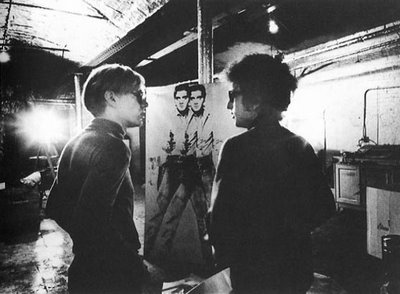
Andy, Elvis, Bob
And then the chorus which will be used three times for maximum pain:
But sooner or later, one of us must know
You just did what you were supposed to do
Sooner or later one of us must know
That I really did try to get close to you.
The key line here is that ‘I really did try to get close to you.’ At The Kettle Of Fish Edie murmured to Dylan that no matter how hard she tried she couldn’t get close to him. ‘Who?’ asked Dylan. ‘Andy.’ Edie replied. Dylan apparently took that as a rebuff although he was already married to Sara and would soon spawn a host of children on her.
I quote the second verse in its entirety:
I couldn’t see what you could show me
Your scarf had kept your mouth well hid
I couldn’t see how you could know me
But you said you knew me and I believed you did.
When you whispered in my ear
And asked me if I was leavin’ with you or her
I didn’t realize just what I did hear
I didn’t realize how young you were.
Apparently Edie didn’t realize that she was just a rainy day woman. While it’s a matter of interpretation I assume that Edie confronted Dylan with the fact of his marriage to Sara and naively asked if he were going to dump Sara for herself. Dylan was incredulous, astonished by her request, he thought she was more sophisticated than that, after all, a rainy day woman….
Rainy Day Woman is a very mocking put down of women as the lead off song and theme setter of the album titled Blonde On Blonde. Perhaps the title might be interpreted as Woman On or After Woman with Rainy Day Women establishing the theme. The song limits the range of women to two- numbers 12 and 35. Why 12, why 35? Who are they? One has to be Edie. If one does a little number manipulation a la Freud, in sequence the numbers add up to 11 which in turn adds up to 2. Two women. Seven come eleven? Three and eight, twelve and thirty-five added separately- three for male, eight for female. Twelve subtracted from thirty-five is twenty-three, Edie’s age. Just guessing.
As Sara is the only other identifiable woman in the lyrics the two women must be Edie and Sara. Let me venture the guess that all women are rainy day women for Dylan. Thus once Sara had borne his offspring fullfilling a religious obligation Dylan took seriously he drove her away oblivious to the pain and suffering he was causing or perhaps he was continuing to punish mother surrogates.
Dylan was drugged and crazed while he was writing this so this is a reflection of deep subconscious drives.

Andy And Edie As Beautiful People
The final lyric begins:
I couldn’t see when it started snowin’
Your voice was all I heard
Snowin’ either refers to a snow job by Edie so he was blinded by light hearing only her words or drugs of some sort, either amphetamines or cocaine.
I couldn’t see where you were goin’
But you said you knew an’ I took your word.
Once again Dylan shifts the full responsibility from himself and Grossman to Edie. He implies that she was leading him on rather than vice versa. This when it was clear to everyone that he and Grossman were promising her the moon in the attempt to pry her loose from Warhol.
And then you told me later, as I apologized
That you were just kiddin’ me, you weren’t really from the farm
An’ I told you as you clawed out my eyes
That I never really meant t’ do you any harm
Well, Dylan’s intents were pure, he says, but the results were deplorable; Edie was done harm by Dylan’s actions and the harm was deep and lasting, well beyond any hypocritical apologies. If the lines are to be believed Edie’s reaction was quite violent. As she was a total amphetamine addict her reaction would be quite plausible.
And then Dylan mockingly closes with his ‘whadaya goin’ to do about it line’- I really did try to get close to you.
As this period clears up for me I suspect that the whole of Blonde On Blonde is concerned with this Edie, Andy/Dylan duel. Blonde On Blonde itself then may refer to the silver hair of both Edie and Andy.
It should be clear that Dylan’s motorcycle fall was no accident. In Exhuming Bob 23b: Bob, Andy and Edie I hypothesize that Dylan’s bike was rigged by the Factory crowd. Dylan survived with minimal damage. For his own sins Warhol was shot a couple years later but he survived that one too. Edie died a physical wreck in 1971.

Dead Ophelia- Consider Ciao Manhattan with Edie shot in a swimming pool/
What goes around comes around as they used to say.

R.E. Prindle
A Review
Themes And Variations
The Tarzan Novels Of Edgar Rice Burroughs
#14 Tarzan The Invincible
Part IV of X
by
R.E. Prindle

I’ve Looked At Both Sides Now:
Multi-Culturalism In Tarzan The Invincible
Multi-culturalism as I see it merely heralds that it is no longer possible to keep the five great Homo Sapiens species with their various sub-cultures separate. If one assumes that c. 12,000 years ago when the Ice Age ended the various species had not yet developed sufficient population to force them to live cheek by jowl then cheek by jowl is unavoidable now.
The ending of the last ice age flushed a large number of comparatively highly cultured people out of the Med Basin scattering them to the four corners of the world. It would seem civilization as such started then. I believe all cultural innovations can be traced back to that point and that source.
As population increased the various species both human and animal came into closer contact with each other. So far the animals have been the big losers with dozens already driven into extinction while it is said that 25% of the remainder will vanish in the next few years.
As an evolutionist Burroughs has written a marvelous story here in which the fauna of Africa participate equally with the Homo Sapiens. Obviously they can no longer exist in a separate sphere either. Multi-culturalism to ERB means the interaction of both humans and the beasts of the jungle. Invincible might be considered a better version of Beasts Of Tarzan on that level.
Burroughs assembles his entire cast of Beast characters to participate in this story. Tantor the elephant, who has always been in the background takes a prominent role. The Great Apes among whom Tarzan was raised have their place. Jad-Bal-Ja the Golden Lion who first appeared in 1922 in Tarzan And The Golden Lion maintains his preeminent place while Little Nkima who first appeared in 1928’s Tarzan And The Lost Empire functions as the protagonist as a Mercury or messenger of the gods. Unnamed hyenas, jackals and leopards abound.
Tarzan as beast-man-god, intermediary between animals and humans as a man deity, completes the group.
Nkima the messenger first notices the presence of the Communist conspirators in Tarzan’s domain. He goes off to find Tarzan to tell him the news. Burroughs very cleverly shows the character of Nkima as one mischievous monkey. Mischievous nothing, he’s a quarrelsome, nasty little beast. He can’t keep himself from gratuitously insulting or irritating anyone who comes across his path.
Always ready for flight on his own, when on the shoulder of Tarzan or sitting on Jad-Bal-Ja where he feels immune to retaliation he is one offensive little beast.
David Adams points out that Burroughs is always ready with the fairy tale. When I first read David’s essays I humored him a bit but discounted the idea. Slowly I am being convinced. Burroughs confesses to an interest in mythology. He was heavily influenced by L. Frank Baum who is a fairy taler par excellence. He quotes Cinderella in Marcia Of The Doorstep. As a child there is no reason to believe that he wasn’t familiar with Perrault, the Grimms, Hans Christian Anderson, Aesop and possible East Of The Sun And West Of The Moon. As a young man he read Rudyard Kipling’s fairy stories of Africa and India. This title shows clear influences of Mowgli the wild jungle boy. Thus his Beasts exhibit fairy tale characteristics. As in Oz, that magical fairy land where beasts can speak, Burroughs beasts do speak the universal first language which all including Tarzan can understand.
After seeing the conspirators Nkima angers a larger monkey who chases him through the lower, middle and upper terraces. Eluding his pursuer Nkima spots a lion below him who he begins to insult. This is not any lion but Jad-Bal-Ja, the Golden Lion. Tarzan has already introduced Jad-Bal-Ja and Nkima so recognizing each other they utter a pre-arranged signal in the universal language.
Scampering down from the middle terraces Nkima leaps onto the black mane of Ja-Bal-Ja where he rides through the jungle in state insulting who he pleases.
This little fairy tale is very charming, worth the price of admission alone.
Of course Nkima is in his glory riding on the shoulder of Tarzan like a Ka.
In the multi-cultural way Nkima comes upon the Great Apes in their death dance of the Dum-Dum. Such a scene is purely fanciful on Burroughs’ part; no apes ever behaved that way. Remember, this is ERB’s jungle.
The Dum-dum must surely be based on the great circling of the elephants as witnessed by Kipling’s Mowgli.
Not content to merely witness this awe inspiring scene Nkima insists on scolding the half-crazed apes. A young light ape is sent into the trees to drive Nkima away. Pure moonshine, of course, but in a fairy tale sense a very effective story.
Then again, Tarzan, returning from Pellucidar, encounters the Great Apes in the jungle. They are irritated by the intruder consequently intending to give no quarter to Tarzan. The Big Bwana doesn’t want to have to kill a bunch of these 7’0″, 350 lb. brothers that it looks like he may have to when Jad-Bal-Ja and Nkima conveniently happen on the scene defusing the situation.
The presence of Jad-Bal-Ja shifts the balance in Tarzan’s favor. In the end Tarzan, the Apes, Jad-Bal-Ja and Nkima are reconciled in this jungle clearing. Moonshine again but entirely believable in this fine fairy tale. Even if impossible I want to believe such a thing could happen in some world somewhere.
Thus Nkima scampers through the story. On his final errand he goes to bring the faithful Waziri to help Tarzan defeat the Communist conspirators.
Nkima and the faithful Waziri are at rest. They engage in a little horseplay, p. 173:
When they pulled his tail they never pulled it very hard, and when he turned on them in apparent fury, his sharp teeth closing upon their fingers or arms, it was noticeable that he never drew blood. Their play was rough, for they were all rough and primitive creatures…
So we find here and will find throughout the novel and the oeuvre that Burroughs places both the animals and the African on the far side of that little gulf Haggard notes.
Also prominent in the story is Jad-Bal-Ja, the Golden Lion. He interacts with the animals, Nkima and the Great Apes, as well as any animal Tarzan tells him to. Jad-Bal-Ja remembers each and every one and they all remember him. A feat of memory for the beasts, I am sure.
Tarzan advises the Lion that certain people are friends who the Lion is to befriend.
Way back in 1922 in Tarzan And The Golden Lion Tarzan had advised Ja-Bal-Ja that La of Opar was to be protected. Eight years later without having seen her once in that time Jad-Bal-Ja remembers her taking her under his active protection. She isn’t sure that he isn’t stalking her but when attacked by a Leopard Jad-Bal-Ja flashes by her to kill the Leopard she realizes he is her protector but she doesn’t know why. La has forgotten the Lion over the eight years but finally recognized him.
Thus Jad-Bal-Ja is a prominent animal character in the story. He brings to mind both Kipling and Baum. There’s also an element of Aesop in these animal characters.
Finally there is Tarzan’s great friend, in more ways than one, Tantor the elephant.
Tarzan lazes on Tantor’s back as the big beast ambles lazily through the sunny forest. Safe from all harm Tarzan muses on the nature of Time, or perhaps that was Burroughs. Tarzan and Tantor merely commune.
When Tarzan rescues Zora he calls on the big beast to stand guard over her while Tarzan hunts, nursing her back to health. The great calm beast gently picks Zora up in his trunk setting her down within her enclosure. Ever helpful he swims the crocodile infested river with Tarzan and Zora on his back.
There are two sides to Tantor’s character however. When Dorsky has Tarzan bound and threatens him Tarzan lets out a piercing call for help that Tantor answers. Charging into camp he throws Dorsky down trampling him backwards and forwards side to side until the only evidence Dorsky existed is a dark spot on the ground. Nor could Tarzan make the angry beast desist until he had fully avenged his friend. then, like Tarzan in the Rue Maule, Tantor reverts to his placid self.
Next follows what David Adams would identify as a fairy tale. Tantor picks the still bound Tarzan up placing him gently on his back. Tantor deposits Tarzan under a tree then leaves. Tarzan still has to free his hands. He calls to some monkeys in the tree but they refuse to help him. Once again Tarzan shrieks the trouble signal far and wide. Nkima hears him but so do the jackals and hyenas.
Tension is created between Tarzan and the attacking hyenas as Nkima struggles to free Tarzan before the hyenas attack. Unable to untie the knot Tarzan advises him to chew through the bonds. As Nkima chews, the hyenas grow bolder finally charging in for the kill. With a might flexing of his rolling muscles Tarzan breaks the partially chewed bonds.
Having strangled a hyena he tosses him aside as Tantor arrives on the scene to serve the hyena as he had served the Communist, Dorsky.
In this multi-cultural paradise…”the three friends stood in the silent communion that only beasts know, as the shadows lengthened and the sun set in the forest.” Walt Disney could have learned a lot from Burroughs.
If that doesn’t get you soft and gummy nothing will. You will note that here Tarzan is a beast among beasts and yet a god to them.
This most charming jungle fantasy forms an integral part of the story as do Tarzan’s relations with the humans. On to the Conspirators.
b.
In the old days these would be described as an international band of characters. But in today’s jargon with the term ‘nation’ in disfavor we have to refer to it as a multi-cultrual assemblage. Liberals, perhaps, posing as wizards, believe that by merely wishing they have removed differences of culture, nationality and speciation. One gets the impression from their jargon that as they believe ‘race’ does not exist neither do cultural differences although they still call their fantasy multi-culturalism. In their fantasy no one struggles to be top dog but all commune as equals like the beasts Nkima, Tarzan and Tantor. The missing point in their equation, is that Tarzan is the god calling the shots. He is the top dog. He is the dominant culture. So, one asks, in their fantasy which culture represents Tarzan?
So, in this human multi-cultural assemblage Peter Sveri, a Russian Communist calls the shots until a greater than he, Tarzan Of The Apes, upsets his plans. There’s two people you don’t was to mess around with- Mother Nature and Tarzan.
Multi-Culuralism as I see it merely heralds that it is no longer possible to keep the five great species of Homo Sapiens with their various cultures in separate spheres. The Darwinian evolutionary struggle for survival requires the elimination of all but one of the competing species in a family following the same economy. Tolerance or cooperation is out of the question. Intolerance will trample the tolerant like Tantor on Dorsky. Only the strong and determined survive. Any other fantasy, such as Liberal multi-culturalism leads to extinction. Bless the peacemakers but get them out of the way, we’ve got work to do.
Certainly the invasion of Eurasia by Gengis Khan in the thirteenth century was a fairly recent indication that independent development was no longer possible. Then beginning in the fifteenth century when Europeans prematurely ventured out into the world to impose their culture the fate of species was inextricably engaged. Be it remembered that there were many thinkers who saw the inevitble result of joining combat of which Burroughs is only one. Once engaged Europeans had to follow through. The problem was that Europe’s own house was not united. Rather than acting as a unit, the various nation states were competing with each other. The competition resulted in the two world wars. The first war let the world know how vulnerable Europe was while the second destroyed the self-confidence of the West itself. Why I don’t know. Hence one has this ridiculous feeling of guilt caused by the conflict betwen the two socialist ideologies International Communism and National Socialism. Just to make my position clear Socialism is the Liberal ideology. Neither Hitler nor the Nazis were conservatives. The conflict was between two versions of Liberal ideology. All the actions of National Socialism can be traced back to the French Revolution which was Liberalism par excellence.
I am not a socialist nor was Burroughs. I abhor socialism and collectivity so in discussing Communism, Fascism or Nazism I am discussing abhorrent Liberal ideologies. Liberals will have to live with that taking responsiblity for their own actions as abhorrent as that is to them.
It should also be borne in mind that multi-culturalism is only a Euroamerican ideological fantasy. It is not shared by the othr Homo Sapiens species although Liberals think and act as though it were. The events in Darfur should confirm this. The Mexican invasion of the US to establish what they call Aztlan (Liberals deny such a concept) should be evidence that they do not share this Liberal fantasy. Nor do the Semites or Mongolids. All of those species are ethno-centric, who if successful will establish a world according to the ideals and customs of their species.
That is today, while we are here talking of the world of ERB’s time. At that time the tool for establishing multi-culturalism was International Communism. That ideology was the common language that allowed these cultures to communicate across cultural lines just as the universal language of the beasts of Tarzan allows all the animal species to communicate with each other.
In this story one has Africans of various cultures, the Semitic culture of the Arabs, a Filipino, a Mexican and of the Liberal Whites several Europeans, Russian culure, a Hindu and a number of Oparians. With the exception of the Oparians the cultures are all held together by the Communist ideology. While Kitembo and his Basembos are not strictly Communists they intend to benefit under the Communist aegis.
The expedition will fail not because of ideology but because of the failure of individuals to subordinate their personal desires to the ideology.
Raghunath Jafar, the Hindu, sacrifices his life for his passion for a White woman. He is killed in the attempt to impose his sexual desires on Zora Drinov. Burroughs uniformly denigrates his Hindu or Indian characters. In this story he makes Jafar grossly obese and greasy. ERB comments that Indians are generally believed to have occult powers which notion is unwarranted. Of course this is true which may account for his antipathy to the Hindu or Indian. He may have been influenced by Harold Gray, who created the Little Orphan Annie comic strip in the twenties. The great Daddy Warbucks employs the Indian, whether Hindu or Sikh, I’m not sure, who make people disappear by magic. Punjab would be a recognition of the general belief that Hindus had magical powers. You know, rope climbing, mind over matter, that sort of thing. People still believe Indians can do those things. Live for months buried in a coffin, incredible stuff. In India. Of course, they have difficulty replicating the same feats in the U.S.
The Filipino, Tony Mori, and the Mexican, Miguel Romero, are portrayed very advantageously as compared to the Russians, especially the leader, Zveri. Next to the American, Wayne Colt, Romero is the bravest, most alert and intelligent of the conspiritors. On the negative side Burroughs has him hating all Gringos which is entirely plausible.
Mori is portrayed as more dependent hoping to acquire his share of the Rockefeller and Ford millions. When the big distribution occurs he hopes to buy fine clothes.
Both men abjure Communism in the end when Zveri proves to be a cowardly and inept leader. They discover that the ideology is merely a cover for self-gratification.
The Arabs led by Abu Batn are impelled by the desire to rid Africa of the Nasrany or Christians. They hate all Nasrany. Their goal appears to be to drive out the European or Christian colonists. They offer Zveri little help being more of a hindrance. During the second assault on Opar they pack up heading out into the jungle leaving Zveri to shift for himself.
ERB portrays the Arabs as of the white Bedouin type he used in The Return Of Tarzan and The Lad And The Lion. Portrayed positively in those two stories the Arabs of Invincible are more negatively portrayed.
Actually the story takes place in the area which the Mahdi of the 1880s reigned. He who defeated General Gordon at Khartoum. The Arabs of the area were Arab in culture but assimilated to the Negro in color. Their customs also were somewhat different than the Arabs Burroughs portrays. Of course, his could have been recruited from the Mahgreb.
The African chief Kitembo of the Basembos is of interest. He is said to be Kenyan from the railhead on Lake Victoria. This story was written in 1930. By this time the African resistance was gaining force. The Africans had never been so much subdued as dominated. As Burroughs exhibits an up-to-date and profound knowledge of Communism it is quite possible that he was much better informed about African affairs than might be apparent from a casual reading.
I don’t say that he was but he might have been aware of the incipient Uhuru (Freedom) Movement in Kenya of which Jomo Kenyatta was already prominent. At this time Kenyatta was in England stumping for recognition of Uhuru among the bedsheets of England’s plumpest and finest. First things first, as Burroughs consistently notes White women are the most desirable women to the other species. Within a year Kenyatta would go to Moscow to study there. So there may have been an element of Kenyatta or other Kenyan leaders in Kitembo.
An additional element may have been from the story of the Unyoro king Kaba Rega picked up from Samuel Baker. Kaba Rega was deposed for refusing to accept Egyptian sovereignty although in real life he was sent to the Seychelles in exile. But here Burroughs may have worked his grievance into the story.
Kitembo and his Basembos are separated from the conspiracy by the program of terror undertaken by Tarzan. Tarzan recognizes the role of the terrorist in destroying morale. He then plays upon the religious superstitions of the African to get them to refuse to cooperate with the Europeans or White Men as he puts it.
This was helped along considerably by Zveri’s ineptness and cowardice. Kitembo himself is killed by Tarzan when he tries to abduct Zora. The Africans are portrayed as being on the far side of the gulf of Haggard or evolutionarily anteceding the Europeans.
The faithful Waziri also play a part by assaulting the Communist front on the march to Italian Somaliland.
Wayne Colt, as has been hinted throughout the story, is a double agent working for the US.
The Russians are Zora Drinov, Peter Zveri, Paul Ivitch nd Michael Dorsky.
Zora, who is a beautiful woman, while not a double agent is playing a false role. She has two stories. In one she tells Wayne Colt she is a daughter of a peasant who was killed by the Czar. She seems to be too cultured for this so this story is probably a cover.
At the book’s end she says that her father, mother, brother and sister were murdered twelve years earlier by Peter Zveri. That may make Zveri Jewish. Twelve years earlier wouold have been 1918 so it is quite possible that Burroughs means to imply that she is the lost princess, Anastasia. Thus Burroughs who favors Princesses slyly mates Wayne Colt with a princess. That’s just a guess.
Peter Sveri is about to shoot Colt as a traitor, which he was, when Zora drills him from behind. It is then she explained that Zveri murdered her family.
Dorsky is of course trampled to death by Tantor. Little more can be said about that.
Zveri fails because of various character flaws such as cowardice and ineptness while being shot in the end by Zora.
Paul Ivitch reflects back to a villain of the Russian Quartet, Paulvitch. He’s an ancilliary character here without much purpose. Tarzan magnanimously allows him to leave Africa which may refer to earlier animosities.
As usual the Russians are treated very harshly by Burroughs. Of all the nationalities, pardon me, cultures, ERB is consistently hardest on the Russians. The Germans even come off better.
Burroughs’ attitudes seem to have been fully formed by 1900 changing little thereafter. On page 68 of Porges’ biography of ERB he reproduces a cartoon ERB drew but is undated. Opposite on Pge 69 is a cartoon showing TR carrying the Republican Party on the way to the White House captioned: Slightly handicapped but still a safe bet. This implies to me that it was drawn for the 1912 Bull Moose campaign. The cartoon on page 68 is of the exact style which would imply that it also was drawn c. 1911. The cartoon shows the Jews and the Russians at their perpetual war. Russians bayonet Jews while Jews blow up Russians as Uncle Sam and John Bull look on. The caption is: How would you like to be a Russian?
Porges includes the cartoons in text related to the pre-1900 years so he apparently associates them with the Chicago Art Institute. No matter, ERB had the same attitude from early on. The attitude never varies from his first book to his last. So his portrayal of Russians is consistently negative.
His portrayal of multiculturalism is accurate. Apart from being a Liberal dream each culture pursues its goals without consideration for any of the others. The dream falters on the rock of self-interest. Even the superficially unifying ideology of Communism is not sufficient to weld the cultures into a single unit. The success of multi-culturalism can only be the imposition of one culture on all the others as a guiding force. Burroughs accurately identifies the Russians as making the attempt.
So in our day Liberals must fail as they can never impose their ideals on all cultures that must and will reject any ideal that refuses them the dominance they crave.
I suspect that the multi-culturalism of the Liberals will fail for the precise reason that nobody believes in it but themselves. The ideal is even shabby as a Utopian scheme that can be imposed only by force. As with the implementation of all Liberal schemes since the French Revolution to the present, its success can depend only on the mass extermination of any dissidents who stand in the way of its implementation. Thus Hitler was a descendent of Maxmillien Marie Isadore de Robespierre. The extermination of the Jews was no different than the extermination of the royalists of La Vendee and served the same purpose. Extermination is the way of the Liberal. You can look forward to the creation of a new worldwide Gulag system to exterminate Liberal opponents if they are not checked.
But let’s move on to the premise of Burroughs’ novel.
Proceed to Part V of X
A Review
Themes And Variations
The Tarzan Novels Of Edgar Rice Burroughs
#14 Tarzan The Invincible
Part III of X
by
R.E. Prindle
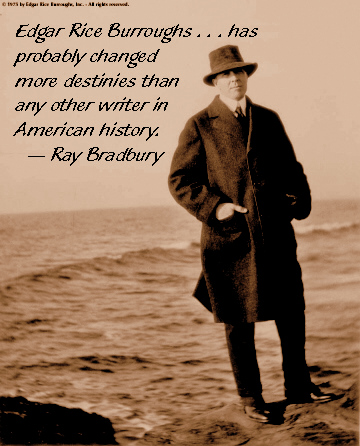
Through The Dark Continent With Edgar Rice Burroughs
The horror, the horror.
Mr. Kurtz in Joseph Conrad’s Heart Of Darkness
(a.)
Africa! The Dark Continent! The physical representation of the Unconscious in the White Man’s dream world. What fascination the dark outlines of a submerged mental continent held for artists and writers of the late nineteenth and early twentieth centuries. Cubism, Freud, the Stanley’s of the mind’s unconscious. What fascination that vanished Africa of the Unconscious held for Edgar Rice Burroughs and, yes, for me. It is no accident that Burroughs placed Tarzan’s adventures on the Dark Continent.
If I may, permit me to say a few words about my intents and purposes for studying the Big Bwana and the man who invented him. Incidentally my use of the euphemism ‘the Big Bwana’ is a dead psychological giveaway. As Anne Morrow Lindhberg said: Listen! The wind is rising.
This essay brings me to the point I set out to find when I began my study of Burroughs. I have tried to point out how ERB’s world kept slipping away from beneath his feet. Changes came so thick and fast that there was no time for him to get used to anything. The nineteenth century of his youth and young manhood was buried in the avalanche of technological advances of the first couple decades of the twentieth century; and then the Great War and the Bolshevik Revolution shattered all his political conceptions. As he began his adjustments to these changes in the raucus atmosphere of the twenties, the New Era vanished like a sent email from your screen. Coming from the same place the email vanished to the thirties landed on him like a mountain. As he had to struggle to make sense of his world so in the aftermath of WWII I have had my own struggle to make sense of the rapidly blinking screen of my world while ERB went to a well deserved rest.
There was the giveaway of China, no the Korean War, no Kefauver Crime Hearings during which the Organized Crime figures J. Edgar Hoover said didn’t exist thumbed their noses at the FBI and got away with it. What effect do you think those things had on a perceptive young kid who read G-Man comics?
The McCarthy/Communist duel, the Liberals said the Communists didn’t exist too, of course there are those who say you don’t exist. Who you gonna believe? I thought Communists, Organized Crime, and I existed. The duel between all three rearranged my nerve endings changing my world all around but nothing, absolutely nothing, destroyed my conceptions of order so much as the most stunning reversal possible for the Western world, which is to say, my world, as the defeat, not only the defeat, but the unconditional surrender of the supposedly undefeatable French Foreign Legion at Dien Bien Phu. Ho Chi Minh the Vietnamese leader had even been trained in Paris where he waited tables for several years. Try to put some of this stuff together. You might unlock some of those doors baffling Burroughs’ heroes in story after story.
The bastards didn’t even hold out to the last man, they allowed themselves to be emasculated by marching out between the ranks of the assembled Red Army of Viet Nam. So much for the valor of criminals and ne’er-do-wells. Dirty Dozen my ass.
The FFL is gone now, heck, France is almost gone now. Lost in the oblivion of the corridors of Time. How can I make others understand the legend of the brigades of criminals and ne’er-do-wells of the Legion; that is the off scourings of all seven continents regardless of nationality, who gravitated to the French Foreign Legion where they redeemed their worthless lives under the supposedly toughest military discipline in the world on the battlefields of the Sahara. Heck, the Foreign Legion didn’t even put up a good fight in Indo-China. They didn’t even make good excuses. They just said to the U.S., Here, you take it, it’s yours. Europe began to disappear as a serious factor in history, then and there. Effete, used up, worn out, intimidated by the lesser peoples of the world, a cosmic joke. Look at them now. Africans and Semites of various stripes mock them in their own homeland. Not the world I was born into, is it? Imagine the changes in ERB’s.
And then to add insult to injury Europeans gave up their homes in Africa without a fight. I mean they lived there. In some areas for hundreds of years. The conscious ruled the unconscious then. You have to remember that we were raised on the National Geographics. Back then the Geographics were nearly a secular bible. You had to be ‘invited’ to subscribe to their mag. You couldn’t just send them the subscription money, they’d return it.
Those were the days we scoffed at Africans who wore grass skirts just like ERB describes. They had weird tatooings and raised cicatrices. Bizarre tribes put plates in their lips; piled copper rings one on top of the other to elongate women ‘s necks. Weird body piercings and strange hairdos adorned the pages of the Geographic. Nowadays the situation is reversed as Whites vie for weirdness in body pierchings while Blacks like Robert Mugabe, the Shona chieftain, walk around in fitted three piece suits.
As bad as Dien Bien Phu was the lights went out in Europe one by one as beginning with Ghana in 1957 African colonies became independent. Europe just capitulated without a struggle. I was shaken, even stunned. I was nearly alone, but I was stunned. Nineteen-sixty was the big year for African independence.
I am writing an enormous novel of my life and times. Up to 1960 three thousand pages or so. I got hung up over Africa; Africa’s place in my unconscious. I found it impossible to progress beyond 1960 and the rock of Africa. That was about 10 years ago. I began a study of Africa to organize my thoughts. I was naturally led back to my childhood influence of the Big Bwana. Tarzan Of The Apes. The jungle man-god. After all Africa was Tarzan’s estate. All of it. From reviewing Tarzan I was pushed into a study of Edgar Rice Burroughs. The Mastermind.
Now, in this story, as the Communist agents (a tip of the hat to Joseph McCarthy) are poised to stage a fake invasion of Italian Somaliland, Burroughs has brought me to the crux to which my studies have been leading. Reds and Africa. The conscious and unconscious. Since I can now explain this the block that prevented me from advancing my own novel has been removed. We will see what the future brings.
(b.)
Now we’re going to take a little odyssey through the Heart of Darkness to see where the last hundred and fifty years of contact with Africa have led us. As we’re primarily concerned with Edgar Rice Burroughs I will try to keep my arguments concentrated on what he understood. The literature on Africa is vast, largely unread, and was perhaps even more vast in Burroughs’ time before so many dozens, perhaps hundred of volumes were consigned to the intellectual trash can because of political correctness. As I have pointed out what are classics to us now was current literature to Burroughs. They were fresh and unbowlderized. He would have read them differently than we do. Foremost of all the literature Burroughs read, his primary influence certainly for the Tarzan series were the novels of the very great Henry Rider Haggard.
Haggard wrote fifty or sixty novels over approximately forty years. The majority are of exceeding high quality too. The majority but not all were African novels. Unlike Burroughs Haggard had first hand knowledge of Africa. He spent several years in South Africa where he was very attentive to African affairs, their legends, their religion, their view of the world.. His knowledge of Zulu affairs is quite extensive; it can generally be historically relied on.
In addition Haggard had a wonderful sense of humanity. He can in no way be considered bigotted toward Blacks.
His first three African novels- King Solomon’s Mines, She and Allan Quatermain were issued between 1885-87. They were immediate successes, gaining universal acceptance in both England and the United States. Burroughs attained the age of twelve in 1887. We don’t know when he read the three novels but one imagines sometime between twelve and sixteen or at least before twenty. Whether he reread them isn’t known. I suspect so.
There are clear references in Burroughs’ corpus to indicate that he continued to read Haggard’s output through the years. In Bridge And The Oskaloosa Kid he expressly states his admiration for Haggard. Don’t know why there were no Haggard’s in his library.
He was clearly impressed by a couple passages in the preface to 1887’s Allan Quatermain which echo throughout the Tarzan series. the first I’m going to quote is quite beautiful poetry. Written as prose I’m dividing it here into blank verse:
…he dreams of the sight
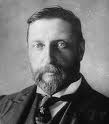
Henry Rider Haggard
of the Zulu impis
breaking on their foes
like surf upon the rocks,
and his heart rises in rebellion
against the strict limits
of the civilized life.
Remember this was published in 1887 when the scientific revolution was just getting underway. The rigorous mental discipline required to adapt to the scientific model, as difficult as it is for most people today, was even more difficult then when Western consciousness was still in the early stages of development. It is my thesis that the mindof the West broke on that rigorous required discipline in 1960 accounting for much of the West’s decline since then.
Nevertheless the quotation informs the intellectual background of the Tarzan series with its own particular reaction to ‘the strict limits of civilized life.’ As I say the above quote echoes throughout the oeuvre. Immediately following that sentence Haggard goes on to say:
Ah! This civilization, what does it all come to? Full forty years and more I spent among savages, and studied them and their ways; and now for several years I have lived here in England, and in my own stupid manner have done my best to learn the ways of the children of light; and what do I find? A great gulf fixed? No, only a very little one, that a plain man’s thought may spring across. I say that as the savage is, so is the white man only the latter is more inventive and possesses a faculty of combination; save and except also that the savage, as I have known him, is to a large extent free from the greed of money, which eats like a cancer into the heart of a white man.
Burroughs’ title of the last chapter of Invincible- A Gulf That Was Bridged- clearly references this quote. Thus Burroughs ingested the praface to Allan Quatermain making it a basis of his own interpretation of Tarzan.
Now, Haggard never appears to have been influenced by either Darwin or the concept of Evolution but Burroughs being nineteen or twenty years younger than Haggard clearly was, thus ERB’s notion of the little gulf that existed between the mind of the Black and the White had a scientific basis whereas Haggard’s had religious overtones. He was more an esoterocist more than he was an orthodox Christian.
If one looks at today’s scientific notions of the evolution of man then the consensus is that Homo Sapiens evolved from the last homonid predecessor 150 to 200 thousand years ago in Africa. Nothing is known of this step from sub-human to human. Even if the proper skull were found it would tell us almost nothing. Why that should have been the dividing point is never made clear.
Scientists have also clearly established that Homo Sapiens have continued to evolve over the last 150-200 K years and in fact continue to do so today. If you’re a creationist or Intelligent Designer I can only urge you to accept the undeniable fact of evolution. I can’t take your opinion into consideration so I won’t argue it.
Following the scientific consensus it is reasonable to assume that sub-Saharan Africans have been there for the last one hundred fifty thousand years while the rest of the world has been more recently populated by more highly evolved Homo Sapiens species.
As Haggard notes from long experience, however not Quatermain’s forty years, the Black lacks inventiveness and a power of combination, whatever that is. To say he lacks it is to say he is less highly evolved. The small gulf that a plain man’s thought can spring across or bridge is one way. A white can regress, as notice the tatooed and body pierced Whites of today, but the Black lacks the genes to spring the other way.
This fact was clearly recognized by the early explorers and the settlers of South Africa. In fact, after several hundreds of years of intimate contact with Whites the Blacks have not acquired invention or combination. That small gulf is not bridgeable from Black to White.
I give a case or two in point. Let me start in Uganda and its king Mutesa or Mtese. This fellow was king during the years of the search for the souces of the Nile. Stanley gives an excellent account of him and his government in Through The Dark Continent while he figures in Samuel Baker’s narratives. More extensive still is the missionary Alexander Mackay’s account.
Always remember that these African chiefs, while familiar with the Arabs, were unprepared for the deluge of invaders who followed the Arabs. Mtese was besieged by Anglican Protestants, French Catholics and Arab Moslems. It was impossible for him to expel the invaders. Anyone who thinks that the Whites were the greatest villains in Africa had better remove their blinders and look at the Africans themselves and more especially at the Arabs both then and now. Mtese knew he was about to be plundered from all sides, had no adequate defenses nor, actually, were there any he could have devised.
While his ego as a man among men was large he lacked knowledge, organization and structure. Perhaps that is what a lack of combination means. There may have been only a little gulf between the Whites and the Blacks when viewed from the White side but there was an immense unbridgeable gap from the Black side which is not say Mtese and his Ugandans did not possess intelligence but it was not of a scientific or analytical nature; no invention and powers of combination. Things haven’t changed. Over the course of more than a millenium they had devised no means to resist the much more primitive Arabs.
Mtese was torn between the ferocious Arabs who had depopulated Africa for a millenium and some rather simple minded Whites. Certainly the Moslem reputation was known throughout Africa whether they had reached an area or not. In the nineteenth century the Arabs were especially aggressive, probably their power was ramped up with European weaponry. As in the favored historical method they took the women and children as slaves while killing the men. They are doing the same thing today in the Sudan. In the Sudan just north of Uganda Arabs had reduced the population by seventy-five percent.
Mtese was in a tough spot. The Arabs were present and active while the Europeans were not. He did notice that the trade goods offered by both Europeans and Arabs were of European manufacture. He not surprisingly came to the conclusion that the Europeans were the more ‘clever’ of the two peoples.
When Mackay arrived in Uganda he served in much the same capacity to Mtese as the Old Stowaway in the Valley of Diamonds of Golden Lion did for the Bolgani. Like the Old Man, Mackay had a number of useful skills which preserved his life but kept him captive. Mtese viewed the White Boy as a slave but saw the need to conceal his status from him. Mackay was given more or less free rein within his area of Uganda but was forbidden to leave. Whether Burroughs was familiar with Mackay’s story which he may well have been or not there is a great deal of similarity with the Old Man of Golden Lion.
Now, the point is that neither Mtese or his Ugandans made any effort to acquire Mackay’s skills or any other. The banana had been introduced into Africa c. +-1000 by Malagasy invaders from Indonesia. The First Born had been in Africa for c. 150K years. In all that time they had made few if any inventions. In order to harvest the banana they cut down the tree letting another grow in its place. They had never even conceived of the notion of ‘ladder.’
Thus, while physically equal and possibly superior on the animal level to the Whites the mental gulf that separated them was unbridgeable.
Now let us travel South a few thousand miles down the Cape to Cairo railway which was never bult to South Africa where the Whites began their invasion of Africa in the seventeenth century. At the same time the Bantu peoples were working their way down from the Chad/Ubangi Chari area where it is said they originated +-1ooo. As they invaded new areas they exterminated or drove the indigenous peoples, who were of a different stock, before them. The Hottentots and Bushmen the Europeans encountered in South Africa were an entirely different species than the Bantus.
As the Whites moved North the Bantus continued to move South. Naturally these migrations encountered each other. The formidable leading edge of the Bantu peoples was the Zulus. C. 1825 or so the Zulu chief Chaka organized the Zulu, or Chosen People in their estimation, into the most formidable fighting machine in Africa. Known by the honorific, The Great Black Elephant, Chaka was running over or exterminating any peoples in his path.
The confrontation between the Zulus and Europeans should be viewed in the same light as the Zulu confrontation with other African peoples. As invaders the Zulus had no more claim to the territories they occupied than the Whites. The situation was the same as Ozawa telling Tarzan that the gold of Opar was as much his as Tarzan’s. Ozawa spoke truly. Tarzan had the superior power so he took it. Just as the Zulus outmatched other Africans the Eruopeans outmatched the Zulus and other Africans. Simple. Not much morality involved. This was in the natural course of events and should not be interpreted in any other way.
The Zulu method was to ‘stamp their opponents flat’, that is to say, exterminate them. Haggard, as I said seems to have been uninfluenced by the concept of Evolution so he notes only a small gulf between Africans and Europeans. Burroughs backed by superior science in reality saw it differently. In evolutionary terms Europeans having come into existence after the Africans as everyone agrees must therefore have been more highly evolved. As current evolution seems to show up most apparently in the evolution of the brain the Europeans must have had added mental powers ‘of combination.’ What Haggard calls being more inventive and having a faculty of combination must be equivalent to science. In short the Africans did not and do not possess the genes that make science possible.
In psychological terms this may mean that the conscious mind of the European is more highly developed in relation to the unconscious. In an unintegrated personality this leads to a dichotomy that explains the apparent erratic behavior of the European. He has a conscience that is lacking in the African.
In realistic terms the African approach of ‘stamping flat’ or extermination is evolutionarily correct. No matter how vast the space there is not room for two species or races of the same family to co-exist. Witness the Europeans and Indians in America. Sooner or later the one will expel or exterminate the other or others. It is going on right now if you have eyes to see. I’ll say it again, two species following the same economics cannot coexist in the same space. In Africa over and over again of two tribes competing for the same space one was exterminated even if the land was left vacant. But now this natural order was upset by the conscience of the European. We will examine the consequences.
Chaka was primitive to say the least. When he was a child his father died. He and his mother were treated as rudely as widows and orphans in any society. This is another natural rule. Read your Bible. The Bible specifically enjoins the Hebrews not to discriminate against widows and orphans. That discrimination is true in all times and places.
When the Great Black Elephant grew up and obtained power he returned to his village. Gathering the males together he pounded wooden stakes up their rectums and set them on fire. I’m sure all orphans long for some similar form of revenge. Such antics do cause dissension in the ranks. Gathering the dissidents together under the name of the Ndebele Zulus or alternatively the Matabeles this hardy band moved up into Shonaland in what is today known as Zimbabwe. We’re getting warm now. The Ndebele were in the process of exterminating the Shona when the Europeans under Rhodes arrived in force. The Europeans then disturbed the process giving the Shona breathing space. Once again you will see that the Matabele had no more right to the land than the Europeans, or for that matter, the Shona who stole it from the Bushmen. Conscience prevented the Europeans from exterminating both the Matabele and the Shona.
In the European manner the Europeans staked out a huge expanse of territory encompassing many tribes including the Shona and Matabele Zulus. They called the territory Southern Rhodesia. Makes sense so far, doesn’t it?
Unlike the Arabs and Zulus who depopulated any areas they wanted the Europeans encouraged the population to grow. Better and more efficient agricultural methods were introduced, spectacular medicines were discovered in Europe and America that allowed the population to expand exponentially. As the Europeans imposed ‘peace’ the Africans were no longer allowed to exterminate each other.
By now time had passed. The Africans if they had learned nothing else became fairly proficient with all the latest European weaponry that they still could not manufacture. They had to buy them from the Europeans who were willing to sell to them. What can you say? There would be no more Omdurmans.
At the same time the European conscience back home became troubled. It was thought, for some reason, that the European invaders didn’t belong in Africa. They didn’t have a ‘right’ to be there. The Shona for one believed this was true. As resistance movements gathered force throughout the continent and guilt increased in Europe the Europeans in Africa were abandoned to a horrible fate. Unheard of really in the annals of history. In certain areas such as the Rhodesias and South Africa the now native Africans of European descent had built up rather astonishing civilizations cheek by jowl with the grass huts of the Africans. Salisbury, Pretoria. In the natural course of things warfare would have broken out between White Africans and Black Africans that would have resulted in the defeat if not extermination of the Blacks. In the evolutionary sense there was not room for both which we will grimly see was true.
Even though Europeans possessed a scientific consciousness which should have made consequences clear to them they chose to ignore this knowledge for religious ideological reasons. For some other reason Europeans do not believe that other people cherish grievances for what they perceive as injustices at European hands. This is so incredibly stupid it is hard to believe. For instance, after having put the Iraqis through hell politicians in the United States universally believe that the US can just pull out of Iraq with no hard feeling left behind. Good god, boys, have some sense.
In other words, having been severely emasculated at European hands they want their own back which means humiliating and exterminating Europeans and Americans. Kill the men and probably the boys but keep those good looking White women and girls. Am I talking to myself or does anyone else understand how this process works?

Robert Mugabe
In Southern Rhodesia or Zimbabwe as this huge area encompassing dozens of tribes who were no nation was known, the Shona nursed a grudge toward both the Ndebele Zulu and the Europeans. Oppression from any quarter was oppression to them. And in realistic terms, why not? The Ndebele had been crushed by the Europeans while the Shona, previously crushed by the Ndebele, had not. Taking advantage of the effete European governments the Shona, under the cover of being ‘Africans’ gained control of Zimbabwe. One tribe with hate in its heart for all other tribes had gained the power to enforce its own wishes. The European ‘peace’ was over. What come next isn’t hard to figure.
The Europeans had incorporated the formerly independent territories of dozens of tribes into one mega-structure called a State administered by them for the benefit of all. Whatever tribe controlled the ‘State’ had the fate of all the other multi-cultural entities, including the Europeans, under its domination. Whites call this the ‘rule of law.’ First the Shona under the White Liberal idol, Robert Mugabe, moved against the Ndebele. While the Europeans cried shame over South African apartheid (watch this one closely too) when similar programs exterminate other peoples they voice no complaint, they even applaud. So much for the Ndebele. The women went to the Shona.
The Shona chief, now Zimbabwean president, but in control of the ‘State’, which is to say, the Law, Mugabe, then turned against the Europeans. This was pure ‘racism’ which the Liberals find offensive only in their own.
Over the course of hundreds of years the African had learned nothing of European science. They can’t. That’s that little gulf that a plain man’s mind, like Haggard’s can easily spring across backward but which is impossible forward without the right equipment. So, Burroughs in Tarzan of the Apes has Tarzan being able to self-teach himself to read because it is his birthright. What Burroughs is really saying is that he had the right equipment. As an ape or an African he couldn’t have done it.
The Shona had never learned farming over the century so all the agricultural production was in the hands of Europeans. Not understanding the motivations of the Shona which they should have the Europeans could not conceive that the Shona would destroy ‘Zimbabwe’s’ own agricultural capacity. A little background in Freud would have helped. What did the Shona care about agricultural productivity? What they cared about was that narrow gulf that they couldn’t spring across. European meant superiority that constantly reminded them of what they couldn’t do but Europeans could. Besides which Europeans distanced themselves from the Africans refusing to blend with them as the Arabs did. Europeans steadfastly maintained their insularity refusing to reliquinsh their mental superiority. Wisely so, but very wrong and humiliating from the Shona point of view.
Let’s have a show of hands now. Can anybody tell me what the age old solution to the problem is? Oh, there’s a hand. Yes, you’re right. Kill the men and appropriate the women. Some sensitive tender types call it murder and rape but only if you’re not the Liberals’ darlings. So, the problem is solved in Zimbabwe. No more Whites. They have been ethnically cleansed. Did we hear any Liberal voices crying ‘Shame, shame’ from Europe or America? Ha, ha, ha.
Now let’s get on the old non-existent Cape to Cairo Railroad and move a little closer to the Cape and see what the situation is back in Zululand. It’s pretty bad unless you’re a Liberal and then it’s pretty good. Rather peculiarly the Liberal attitude toward the Shona solution of their problem is nearly identical to the Zulu solution.
As I have pointed out elsewhere the Liberal position is religious which is say irrational. Liberals completely disregard facts and reason in their pursuit of an inner ideal or wish. In Freudian terms their ideal is a wishful daydream. Platonic rather than Aristotelian. Religious rather than Scientific.
There is no question that a very difficult situation was created by the Bantu and European invasions of South Africa. Disregarding the Bushman, who the Bantus are now exterminating and the Hottentots both Bantus and Europeans had an equally justifiable claim to the land. In no sense were the Bantus first on the scene. But, Africa is the dark continent par excellence so it is thought to be inherently Black rather than White.
In a normal situation the stronger party would have exterminated or driven out the weaker as both the Zulu and Matabele were doing in their respective spheres before they were prevented from continuing by the Europeans.
The Europeans however would neither exterminate nor drive out the Blacks because of their conscience acquired through advanced evolution.
There’s a problem looming, isn’t there? Forced to incorporate the Black population into the State Europeans in the interest of self-preservation developed a system of Apartheid. In other words they followed another age old custom of introducing racial laws.
It doesn’t take a genius to figure out that segregation is a very poor long term solution expecially as European economic policies drew in large numbers of Blacks from the rapidly increasing Black population caused by the cessation of Black extermination policies against each other and better nutrition and medical practices.
Now, racial laws have existed from time immemorial. One only has to look to India to discovers their effectiveness. After haing created a Frankenstein’s monster of segregation resulting in a disastrous caste system the invading bronze age Indo-Europeans still failed to preserve their racial identity.
The Hebrews of the Bible also had strict racial laws as outlined in the Old Testament which they still attempt to practice although they also have failed.
When the Nazis, essentially following the Hebrew model, enacted racial laws they gave racial laws a bad name while apparently traumatizing Euroamericans into acute mental paralysis.
Liberals have concentrated their devotion to Hitler and the Nazis to such an extent that they have become the oppressor along Hebrew-Nazi lines. While they decry Hitler and the Nazis out of one side of their mouths, functioning along Nazi lines they too have instituted racial laws, but with different beneficiaries than the Nazis. Their racial laws are disguised by such names as ‘Hate’ laws or ‘minority rights.’
While the Nazis were aggressors in their racial policies Liberals pose as ‘victims’ needing protection from some ‘majority.’ For some irrational reason they consider the most populous nation on Earth, the Chinese, as a minority. Don’t expect rationality from Liberals. Thus, while they considered Apartheid evil racial laws favoring Europeans over Africans they instituted different racial laws favoring Africans over Europeans. The new laws are meant to discourage the continuance of Europeans as a distinct identity or species. In a word, genocide.
Not understanding the nature of the racial attitudes of Liberals, for that is what they are, South African Europeans have requested a new Apartheid in which they will be given their own racially segregated homeland within South Africa much as they granted the Basutos, Swazis and Zulus. Liberals will never allow this because as the European State prospered the African areas would decline.
A people that couldn’t think of a simple thing like a ladder will not be able to maintain complex cities like Salisbury and Pretoria without White slaves to do the technical or ‘brain’ work for them. Even in the Orient all the tall buildings, real monsters, are designed by Western architects and built by Euroamerican technicians.
Thus, in the time honored manner European males will be exterminated while the females will be appropriated. Liberals will call it ‘justice’ but, in the time honored manner ‘the Old Ones’ will be revered as the nations revert to savagery.
Liberal Europeans and Americans who believed for whatever misguided reasons that there could be one world, one people, no matter how impracticable or even impossible the ideal, became the enemy of Europeans and the friends of Zulu South Africans even as the Shona were attacking the Matabele of Zimbabwe with their approval. Liberals are dangerous emotional fanatical bigots. Nor will they ever come right out and say what the ends are that they seek.
Suffice it to say that Liberals returned South Africa to barbarism for almost exactly the same reason they and Mugabe returned Zimbabwe to barbarism. Liberals wanted South African Europeans to abandon their racial exclusiveness and interbreed with Blacks to create an exclusively Black country. Perhaps emotionally satisfying for them but an evolutionary blunder.
If Liberals really believe war will end when we have one world, one people, they haven’t read their Burroughs on War very carefully. But, then, since they find facts an impediment to their beliefs, why bother?
Back to the unscientific but accurate little gulf a plain man’s mind can spring across. As Liberals believe that evolutionary differences between human species do not exist (race, as they put it, is a social construct without a scientific basis, and they don’t want to hear any contradictory opinions) they not only pursued their ideal in Africa, where Blacks are solving the problem in the time honored fashion, but extended their program to Europe and America. By America I mean Canada and the United States, Mexico excluded.
Just in case Africans hadn’t thought of attempting to emigrate to Europe America Liberals have gone out and gotten them. At the same time despairing of making the African mind spring across that little gulf, after three or four hundred years in America it hasn’t happened yet, they decided to dumb down the Caucasian population by denying them education along scientific and rational lines. If you can’t join ’em, screw ’em. As a religion Liberalism is opposed to science and rationality anyway. The criteria for graduation became not how well our mind was logically trained but whether you accepted or rejected Liberal dogma. In other words, schools and colleges became seminaries for religious conditioning and indoctrination.
As Mr. Kurtz who Conrad paints as having gone native exclaims: The horror, the horror.
(c.)
For all his seeming flipance Burroughs was well read on Africa. The real world of Africa is transformed into a dream world that he can command; a process not too different than that of Liberals but he knew his was fiction. However Burroughs also had a strong scientific foundation. Haggard’s little gulf is transformed into an evolutionary difference that cannot be bridged or leapt across by a ‘plain man’s mind.’ In Freudian terms Burroughs’ unconscious and conscious minds meld into one vision of omnipotence. Actually Tarzan has an integrated personality. His mind is totally conscious to the extent that he can range easily between conscious and unconscious motivations. He is at once beast, Negro and European. He has experienced each stage of evolution as child and man in the African jungles. A terrific appeal for the intelligent reader. In fact, in that sense Tarzan is a god, a jungle god. The Lord Of The Jungle which is to say the World as a jungle.
Consequently Africa is Tarzan’s own domain much as Freud made the unconscious his domain. In Tarzan’s case, all of Africa. One vast Estate in which all look to him as the Man-God. Animals and humans alike. The whole continent North to South, East to West is under the Big Bwana’s dominion. He doesn’t like to see its equanimity disturbed.
When the series began in 1911-12 it was placed on the West Coast of Africa. Some say Angola, others say the Congo, buy my opinion is on the coast of Gabon. Trader Horn thought so while it must be remembered that the French Lieutenant Paul D’ Arnot was patrolling French territory when he happened on the cove of Tarzan’s cabin which would definitely argue for the French colony of Gabon.
The entire Russian Quartet took place in West Africa, then beginning toward the end of Son Of Tarzan but definitely with Jewels Of Opar the Estate seems to wander East until it come to rest in Kenya North of Lake Victoria but South of Lake Rudolph. At the time of Jewels Of Opar and Golden Lion Opar seems to have been located West of the Mounatains of the Moon near or adjacent to, possibly in, the Ituri Rain Forest. In Invincible Opar has definitely been relocated to Abyssinia or its alternate name of Ethiopia, ‘in the interior’ somewhere West of Italian Somaliland but South of Northwest Abyssinia. This story takes place in the Horn of Africa at any rate. The distances covered so easily are baffling; we’re talking a lot of miles here.
At one point Burroughs says Opar was in a sub-tropcial zone. That would place it above the Tropic of Cancer possibly in Egypt or even out of Africa. Perhaps he meant that it was just South of the Tropic of Cancer– another astrological term for those offended by New Age– making it sub-tropical in that sense, Ethiopia is wholly within the Tropics ar any rate. Burroughs taught Geology and Geography too.
It might be appropriate to review some of the history which informs Tarzan The Invincible.
Burroughs had made a fairly thorough study of the African literature of his times while having lived through so much of the exciting story as it unfolded in newspapers and magazines as well as the literature of the day. It should also be remembered that by 1930 he had shaped others attitudes toward Africa. There was a plethora of jungle stories derived from the Tarzan series.
H. Rider Haggard’s incredible early African trilogy- King Solomon’s Mines, She and Allan Quatermain were still virtually current novels in Burroughs’ time not unlike the James Bond stories of our day. In that sense Tarzan the Invincible is a replica of Haggard’s trilogy incorporating the events of Burroughs’ own day. I find Invincible an astounding tour de force on several levels. I doubt if there has even been another novel quite like it written.
Africa seized the imagination of the European in the 1860s when they decided to pinpoint the source of the White Nile. While the White Nile exploration took place a few years before Burroughs’ birth the story was still recent enough during his childhood to excite boys’ minds while Stanley’s adventures in the Congo were an ongoing affair. On the maps of those years of ERB’s youth Equatorial Africa would still be colored white as terra incognita.
For an exciting general account of the White Nile exploration see Alan Moorehead’s The White Nile. First published in the pivotal year of 1960, displaying attitudes which subsequently have become politically incorrect a Bowlderized version was published in 1972. There isn’t much difference between the two editions but the flavor of the original is more authentic and exciting. Let the tender tend their soft spots privately.
Moorehead followed up The White Nile with The Blue Nile. That branch of the Nile coming down from Ethiopia, Lake Tana, had been known for some time. Its story is interesting but nothing compared to the White Nile. If you’re in the reading mood you might also enjoy Mungo Park’s Travels In West Africa. There’s an eye opener for you.
The key writers Burroughs relied on are David Livingstone, Richard F. Burton, Samuel Baker and Henry Morton Stanley. Quite a group of adventurers.
Burroughs relied on Livingstone and Stanley for his early stories but the ghost of Stanley haunts the entire oeuvre. I don’t find too much Burton influence but it is clear Burroughs read him. He apparently came late to Samuel White Baker whose adventures make the largest contribution to Invincible. Once again none of these volumes imprtant to ERB’s work are in his library. Very strange.
While more obscure and not as attractive a figure as Stanley, in many ways Baker’s adventures are more startling. Perhaps as a journalist Stanley knew better how to relate his story. While Stanley explored South of Lake Victoria, Baker’s adventures begin in the North at the sources of the Blue NIle progressing southward toward Bunyoro and Uganda near the shores of Lake Victoria. Thus Tarzan’s estate is near the location where the careers of Baker and Stanley intersected.
Baker’s three fabulous African books are: The Nile Tributaries Of Abyssinia And The Sword Hunters Of The Hamran Arabs, The Albert Nyanza: Great Basins Of The Nile And Exploration Of The Nile Sources and finally the incredible Ismailia. Forgive the superlatives but they understate the case.
I must warn you that while the current Liberal trend is to belittle these men’s adventures while denigrating the men themselves I am so full of admiration for their stunning daring that I can barely express myself. If you have difficulty with them just keep repeating Mr. Kurtz’s mantra: The horror, the horror.
While Stanley always had deep funding traveling with a large Safari, Baker, believe it or not, traveled alone on his own account. He was accompanied by what Moorehead bowlderizes as his wife but who was actually his slave girl. May have influenced Burroughs a little. Baker purchased her at a White Slave auction in Hungary in 1855. With the influx of Africans and Moslems into Europe and America the chances of plain men regressing to unconscious standards is very strong. There will probably be a resurgence of slavery and polygamy. The standards the West has developed as to what constitutes a just society may prove to be a temporary blip in history unless vigilance is maintained and action taken.
Invincible is based on Baker’s adventures in Ethiopia and the Sudan. The Africa described is, of course, the Africa of Burroughs’ imagination.
It might not hurt to consult a colonial map of Africa. The map I am using can be found at http://users.erols.com/mwhite28/afri1914.htm . Mathew White copyrighted it so that if Bill can’t use it I’m sure he’ll find one just as good.
Burroughs places Invincible in 1930. By that time the so-called Scramble For Africa by the European powers convened in the 1880s and 90s was nearly complete. As you can see the entire continent had been parceled out with the exception of Liberia and Ethiopia. Ethiopia would be annexed by Italy in 1935. Burroughs has the would-be Emperor of Africa Peter Sveri, declare that he will replace Ras Tafari as Emperor as Ethiopia was ripe for revolution. Ras Tafari of couse became the Emperor Haile Selassie. Ras simply mean Prince. The Jamaican rastafarians are based on Selassie while his name was modified by Burroughs to use for Ras Thavas, The Mastermind Of Mars.
In 1930 there was no Nazi threat on the horizon nor was Hitler taken seriously by any but Communists and another fringe element with whom he was engaged in a death struggle for the control of Germany. The only visible threat to peace, other than the Communists and Soviets was Mussolini and his Fascism in Italy. Burroughs detests both the Fascists and Communists as any right thinking American would. The fantasy that there ever was a Fascist threat in America was Judaeo-Communist paranoia. Communists were the threat.
According to Burroughs’ story the Soviets wished to create an incident between Italy and France that would lead to another world war. (See Beyond The Farthest Star) making it easy for the Soviets to pick up the pieces and assume control. The scenario wasn’t quite the same but it almost worked out that way save for the interference of the United States.
As you can see by the map Ethiopia, or Abyssinia, was surrounded by Italian Eritrea, French, British and Italian Somaliland on the North and East, British Kenya on the South, and the Anglo-Egyptian Sudan Condominium on the West. With the exception of Kenya these were all Moslem States which harassed Christian Ethiopia continually with border disputes and battles.
Italy which had annexed Libya in 1912 would annex Ethiopia in 1935 leaving Liberia as the only independent African State. As you can see nearly the whole of West Africa was French- the lavender or purple of the map. some great Foreign Legion novels were set in West Africa including P.C. Wren’s excellent Beau Geste trilogy which found its way into excellent movies and Jules Verne’s The Barsac Mission which became the prototype for numerous novels and movies.
This is the Africa in which Burroughs sets his novel but many elements of Baker find their way into the story. In Ismailia Baker was made the Egyptian emissary to inform the Bunyoro king Kaba Rega that he had been annexed by Egypt and was now a subject of that State. News to Kaba Rega while being violently rejected by him. He was subsequently captured by Egyptian forces being sent to the Seychelles Islands in exile.
The story is heartrending apparently affecting Burroughs as it did me. Bunyoro and Uganda were contiguous States. Burroughs personfiues Kaba Reda in his character of Kitembo, the chief of the Basembos. He has Kitembo a Kenyan deposed by the British. ERB has Kitembo and warriors coming from the Lake Victoria end of the railroad from Mombasa.
Burroughs includes an Arab contingent in the Soviet expedition. He seems to have them more White than Black while in reality at this point in history the people were Arab in culture but had been assimilated to the Negroes in color. This was apparently also true in Mecca in Arabia according to Richard Burton because of a long history of Black pilgramage to this Moslem religious center.
The Moslem invasion of Africa began in the Seventh Century AD when the waves of conquering Moslems burst upon the world. It is often overlooked that this initial offence between Christians and Moslems occurred before the Crusades which so offend Moslems today. By the late fifteenth century when Portuguese explorers made contact with East Africa, the Arabs had been depleting the continent’s population as in the time honored manner on the other side of the intellectual gulf they killed the men taking the women and children. It is to be noted in the current situation in the Sudan that the most recent hybrid Arabs are following the same procedure as they kill or drive the Negroes from ‘their’ territory. Call it genocide or call it ethnic cleansing it is the unavoidable consequence of two related species contesting the same economic livelihood. You can’t fool Mother Nature.
Samuel Baker has some astonishing stories to tell of Arab slave raids. European slave trading was of a very brief duration but more consequential for world history as Europeans populated large areas of the world with Africans who would never have gotten out of Africa on their own. Of the huge number of Africans removed by Moslems over more than a millennium there seems to be no or little record of their survival in the Middle East.
(d.)
According to Burroughs his Soviet conspiritors entered Africa from different ports to avoid suspicion. He doesn’t say which ports the others used but he has his alter ego, Wayne Colt, entering somewhere on the West Coast trekking the whole breadth of Africa to join his fellows. There should be no mystery as to why he was the last to join the group. I’m amazed he made it at all.
The scenario of landing on the West Coast is so ludicrous I have to laugh. As Wayne Colt is an alter ego for Burroughs then what he is doing is assimilating Stanley to himself, appropriating his feats. One hopes Colt didn’t roll off the ship in Senegambia and make the longest trip possible. Of course a trek through the Sahel would be fairly easy going compared to Stanley’s route through the tropical rain forest.
For no other reason than a whimsical one what I imagine I would have done, since Colt’s exact route is not known, I propose he entered Africa in the Cameroons, which might have been the destination of John Clayton and his wife before their ship was hi-jacked, progressing through Ubangi-Chari over the Sudan to the base camp which was five hundred miles from Italian Somaliland in Southern Ethiopia. Southern Ethiopia approximates the area tramped over by Samuel Baker and his girl slave.
Burroughs also gives us the time of the the year, June through September as the rivers are swollen. The rains begin in the Summer in Ethiopia, the flood reaching Egypt as Sirius, the Dog Star, rises in August. Abu Batn is held up by swollen rivers so the story must take place in the Summer of 1930.
I am expecially fascinated with Ubangi-Chari because of a couple pieces of ephemera from my life. I used to specialize in French Colonial stamps during my stamp collecting days while one of my favorite rock and roll songs from the fifties was Warren Smith’s romping Ubangi Stomp:
Well, I rocked over Italy and I rocked over Spain
I rocked over Memphis but it was all the same
Till I rocked over Africa and rolled off the ship
And seen them natives doing an odd looking skip.
I parted the weeds and looked over the swamp
I seen them cats doing the Ubangi Stomp.
Ubangi Stomp with a rock and roll
Beats anything that ‘s ever been told.
Ubangi Stomp, Ubangi style
When the beat just drives a cool cat wild.
Well, I looked up the chief and he invited me in
Said a heap big jam session about to begin.
He handed me a tom-tom and I picked up the beat
That crazy thing sent shivers to my feet.
Rocked and rolled and I skipped with a smile
Ubangi Stomp, Ubangi style.
Well, we rocked all night and part of the day
Had a good rockin’ time with the chief’s daughter Mae
I was makin’ time and gettin’ in the know
The Captain said son we gotta go.
I said that’s alright, you go on ahead
I’m gonna Ubangi Stomp till I roll over dead.
Ubangi Stomp, with a rock and roll
Beats anything that’s ever been told.
Ubangi Stomp, Ubangi Style
 When the beat just drives a cool cat wild.
–Warren Smith
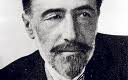
Joseph Conrad
That’s what’s called going native. The plain man’s mind of our rock and roller had no trouble regressing to the primitive state. Which brings us back to Joseph Conrad’s Heart Of Darkness as we end this little foray into Africa.
Heart Of Darkness is a story of the absorption of the conscious mind by the unconscious. Mr. Kurtz is represented as having a conscious mind of the highest order. As the Harlequin Man says- How he could talk. The man is represented as being intellectually deep. However as he went out in the bush to acquire ivory he came into contact with the primitive mindset of stone age peoples. As he became accustomed to dealing with them his mind gradually regressed to the point where he participated in unspeakable primitive rites. We aren’t told what they were but Paul Theroux who says he had read Heart Of Darkness twenty to thirty times believes Mr. Kurtz partook of cannibalistic rites. I’ve only read the story twice and I have to agree with him.
Thus the fine conscious mind of Kurtz could not resist the appeal of the primitive. Tarzan, one notes, was the master of all forms of consciousness from the sub-primitive mind to the hyper-sophisticated Parisian. He was and is indeed the jungle god supreme. Kurtz became a jungle demon who on his death bed repented his regression as he cried out- The Horror, The Horror.
A Review
Themes And Variations
The Tarzan Novels Of Edgar Rice Burroughs
#14 Tarzan The Invincible
Part II of X
by
R.E. Prindle

ERB
Time On His Hands
I pair this novel with Tarzan At The Earth’s Core. Burroughs could have titled that novel Tarzan In Pellucidar but he didn’t. Why not? Probably because he was trying to avoid as much confusion between his two imaginary worlds as possible, or possibly he needed the site to illustrate his point but didn’t want to make it a Pellucidar novel. Earth’s Core isn’t merely a story in which Tarzan makes a guest shot in another of Burrough’s worlds. Rather ERB is making a serious exploration of Einstein’s Theory of Time and Space. Alternatively the novel might have been titled, Tarzan, Lost In Time. The novel is written to disprove the objective existence of Time. Burroughs’ own conclusion is that time is merely a human construct for mankind’s own convenience but not substantial. I think he’s right.
The nature of Time was a topic of serious discussion during the late nineteenth century, into the twentieth , still going on today. Indeed the Pellucidar series as a whole is a discussion on the aspects of Time. Of course Burroughs was familiar also with H.G. Wells’ The Time Machine.
Perhaps one of the more interesting notions of Time and Space and time travel was one advanced by Mark Twain in 1916 in his interesting novel No. 44, The Mysterious Stranger. In his story Twain imagines that space and time are assembled like a multi-storied building with each diorama of time and space continuing in replay eternally. Thus his hero, #44 scoots around in time and space in what is apparently a system of chutes and ladders.
It is possible in this system to visit ancient Egypt to watch the Pyramids being built, climb through the years to discover the head of the Sphinx sticking out of the sand as Napoleon saw it in 1798, climb once again to watch the first Aswan dam being built, move up a story or two to watch the High Dam being built and off to Troy to stand in the front ranks with poor maligned Ajax.
To The Time Machine, Einstein’s Theory and The Mysterious Stranger, now add Tarzan At The Earth’s Core. There are more similarities than dissimilarities.
ERB apprently didn’t think he made his point in At The Earth’s Core or perhaps he received some criticism from someone so he carries the discussion over into Invincible. While incongruous for this story ERB works it in.
As there are no book s on Einstein in his library one may ask what evidence there is that ERB had ever thought of Relativity. Well, I’ve got the evidence right here, p. 104:
…but though Time and space go on forever, whether in curves or straight lines…
One can’t mention curved space and Time without being familiar with Einstein. And then, Einstein absurdly claimed that a nonexistent mental construct like Time forms a Fourth Dimension which somehow interacts with the other three. We are still waiting for a demonstration of that but we’ll let it pass. I’m sure Einstein picked that up from H.G. Wells Time Machine which was a very fine piece of imaginative literature but reflected no known physics then or now. Someone ought to pin a big red bozo nose on Einstein but, back to the future.
ERB had discussed the notion of Time thoroughly in Tarzan At The Earth’s Core. Actually that’s a contradiction of terms as a hollow earth obviates the notion of core. The key fact at the Earth’s Core is that it is always high noon. The central sun knows only endless day without a contrasting night to give the appearance of Time. Without the contrast between day and night and the revolution of the Earth around the Sun the concept of Time disappears; there is nothing to measure just pure duration.
In Invincible Burroughs explains it this way, if you didn’t catch it in At The Earth’s Core, p. 104 again, same paragraph:
The beasts of the jungle acknowledge no master, least of all the cruel tyrant that drives civilized man throughout his headlong race from the cradle to the grave- Time, the master of countless millions of slaves. Time, the measurable aspect of duration, was meaningless to Tarzan and Tantor.
Not only is Time meaningless to Tarzan and Tantor but Time is meaningless to the universe itself. Nothing that ocurs in the Universe is dependent on Time nor can Time change any occurrence. The so-called Fourth Dimension is totally ineffective. Everything will happen just as it does now and has always without any reference to Time. The progress of a physcial action will progress in scientifically determined steps from inception to completion without any interference from that clown Einstein’s ‘fabric of time and space.’

Albert Einstein
That is the import of timelessness at the Earth’s core. The inhabitants live and die without the ability to know they are getting older as there is no night, day or year. The organism merely comes into existence, behaving according to physical laws determined by genes and other micro-organisms progressing through all the changes until the final change which change no longer has any conscious meaning.
The same is true of suns and galaxies. It is virtually meaningless to say the Sun is several billions of years old. It is only a mental construct that lets you grasp a concept of duration. It is much more relevant to say, for instance, that the changes in the Sun’s development are, say, 30% completed. You see, it’s all quantative not qualitative. Barring accidents and diseases, at twenty the average life span in the US is 25% consumed. The changes relative to that portion of development in the organism have occurred and will not occur again. On that basis I have used up about 85% of the physical changes alloted my organism. The nature of future changes are predictable. They cannot be avoided. This has no reference to Time no matter what state of development an organism is in.
While in a state of depletion I become ‘old’ only if my psychology is affected by the concept of ‘age.’ While my physical capabilities are not what they were at twenty, that phase of development having been passed through, my mental capabilities have developed accordingly. As my body has decreased in powers my mind has increased. The beginning has compensated the end. If I die today or tomorrow that is as it must be. Everything has its end. There is no tragedy involved.
Life and death are completed, unaffected by Time. If time ‘stopped’ as people imagine it can, everything would continue as now. Organisms merely run their physical course. That is the point Burroughs is trying to make. He is repudiating Einstein.
As a young man I was conditioned to revere Einstein. I did this unquestioningly and, boy, was I sincere. I disgust myself in memory. But then, somewhere along the line the hypnotic spell wore off, contradicted by facts. Einstein began to unravel before my eyes. It wasn’t that I questioned his reputation it was just that a mist began to lift. I began to have doubts; sort of religious doubts. I blinked once and Einstein was no longer the archetype of genius. At the second blink I began to ask questions. I tripped over the notion of the physical reality of Time just as Burroughs did.
When I read the ancient Jewish historian Josephus I began to sense the specious nature of the problem. According to Josephus Abraham was the greatest astronomer cum astrologer of his time just as Einstein is thought to be the greatest of ours. At the time of the transition between the Age of Taurus and the Age of Aries Abraham had an astrological/astronomical dispute with the academy.
You see, at that stage of the evolution of human consciousness astronomy and astrology were united into one discipline. The magical element of astrology wouldn’t be separated from the scientific element of astronomy until the scientific consciousness of humanity had separated itself from the magical or religious which two systems are synonymous. The concept of god functions only in a magical sense as his presence is even less noticeable than that of Time.
However magic and astrology are still part of human consciousness although with a quasi-scientific basis so that systems organized perhaps tens of thousands of years ago continue to function through inertia. I have been accused of being New Age. Quite frankly as New Age in my view rejects the scientific consciousness as much as any other religious system, Fundamentalist Judaism, for instance, hint hint, I cannot be New Age. But, I sure like the way they talk.
What I discuss is scientific history. Facts which religious people reject because they disavow the ideas behind them but accept as real, i.e. Thou shalt not suffer a witch to live. Why bother worrying about it; witches do not exist except in the imagination.
So whether you ‘believe’ in astrology, the Zodiac or whatever is irrelevant. The fact is at one time in history people universally did and they acted on their beliefs.
At any rate the fact is at the time of the transition from the Age of Taurus to the Age of Aries Abraham had an astrological/astronomical dispute with the Chaldean astronomers of Ur. As I understand it they said the religious archetype was changing with the transition from Taurus to Aries. (I think of this as a form of set theory; it is so because everyone agrees it is so. No different than now.) Abraham argued that the archetype of the Ages was Eternal, unchanging, the Rock Of Ages to you religious types. Rock of Ages means unchanging through all the signs of the Zodiac, all twelve Ages. An Age is one sign of the Zodiac. Ages are the twelve zodiacal signs. (Hello, Central? Put me through to God.)
Now, to be Eternal is astrologically impossible. The Earth wobbles on its axis visible at the North Pole so that every twenty-five thousand years or so it creates a Great Year then begins again. The Ancients divided the Great year in the system of twelve periods, called Ages, to correspond with the months of the terrestrial year.
Apparently Abraham denied this and adamantly insisted on the Eternal. For this reason, according to Josephus Abraham and his fellow Terahite cultists were run out of town.
Lousy astronomers, then, Abraham’s descendants had learned little by the time Einstein stepped onto the world stage to give his oration. Just as Abraham had voiced his foolishness four thousand years previously Einstein did the same in our time. There are those who seriously argue that time travel is possible in Einstein’s universe. Well, maybe in his, but not in this one.
Nothing is relative but one’s point of view. The physical universe is one of absolutes; that is the nature of science. Science cannot be relative; in order for an experiment to be true it must replicate itself the same way under the same conditions. As unpleasant as that may be to some intellects there is in fact only one way in a given set of circumstances. A+B will always equal A+B. If one switches to A+C then the result will always be A+C. There is nothing relative about it. You may religiously expect other results but you will be eternally disappointed. So Einstein said that the further out in Space his mind penetrated the closer he got to god. Who can say, but he never got close enough to touch God. Einstein was not a scientist. He was a Rabbi. There is no g-d to get closer to. I’m sure that a good Rabbi would find arguments in the Talmud almost identical to those of Einstein.
Burroughs saw through Einstein hence his arguments disproving the physical existence of Time and the futility of any supposed Fourth Dimension. These are religious matters requiring a belief in a supernatural being.
Having said that Time was measureless to Tarzan and Tantor which was not entirely true since the rotation of the Earth divides ‘Time’ into night and day unlike at the Earth’s core. Burroughs then goes on to say, p. 104, same paragraph:
Of all the vast resources that Nature had placed at their disposal, she had been most profligate with Time, since she had awarded to each all that he could use during his lifetime, no matter how extravagant of it he might be. So great was the supply of it that it could not be wasted, since there is always more, even up to the moment of death, after which it ceases, with all things, to be essential to the individual. Tantor and Tarzan therefore were wasting no time as they communed together in silent meditation…
A beautiful piece of sophistry. Regardless of the Time involved, immutable physical changes continued to take place. What opportunities appropriate to that physical state were lost forever.
Apropos of which carrying his argument further, on p. 120 he says:
Time is of the essence of many things to civilized man. He fumes and frets, and reduces his mental and physical efficiency if he is not accomplishing something concrete during the passage of every minute of that medium which seems to him like a flowing river, the waters of which are utterly wasted if they are not utilized as they pass by.
Imbued by some such insane conception of time, Wayne Colt sweated and stumbled through the jungle, seeking his companions as though the fate of the universe hung upon the slender chance that he could reach them without the loss of a second.
I understand what ERB is saying, of course, I’m virtually a disciple. Tarzan lolling on the back of Tantor achieved his goal more easily than the frantic Colt. Still, one should remember: Work, for the hour grows late. Those irreversible physical changes are drawing one closer to the grave. Get it done now.
ERB displays a seeming peevishness over the issue which has little or no bearing on this story. It is an interesting aside but it does not illuminate the tale. Maybe somebody criticized the ideas expressed in At The Earth’s Core and Burroughs is carrying on the argument. Nobody paid any attention, still I am charmed by the vision of Tantor and Tarzan suspended in Space and Time wandering blissfully through the jungle unaware of any impending doom.
Proceed to Part III of X
A Review
Themes And Variations
The Tarzan Novels Of Edgar Rice Burroughs
#14 Tarzan The Invincible
Part I of X
by
R.E. Prindle
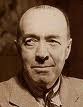
Edgar Rice Burroughs
Introduction
By 1930 ERB was fifty-six years old. An age when many or even most people have become hardened into unchangeable forms. Burroughs seems to have been an exception to this rule. His ability to evolve with the times is remarkable. Some can, some can’t. The problem isn’t one of merely attempting to mimic the style of the period but to adapt one’s mental outlook so that one thinks in the current idiom,
The post-Civil War period into which Burroughs had been born had disappeared now long ago. There might have been a couple survivors of the GAR but not many. The Indian Wars of his childhood were over. The plains had been swept clean of the buffalo. Even the buffalo robe that could easily be found during the first two decades of the century became difficult to find in the twenties and impossible to find in the thirties.
So that past which must still have been vivid in ERB’s memory was no more. Frank James and Cole Younger had died as late as 1915 and 1916 respectively. Buffalo Bill in 1917. TR in 1919. Charlie Siringo who had been present at the shootout with Billy The Kid was giving advice to authenticate Western movies even as he passed away in 1928. Heck, Burroughs could claim to be an authentic cowboy. He was out on the Idaho range in 1890 the heyday of the cowboy, Johnson County war and all that. His Western novels are about as authentic as you can get, maybe even more so than one of ERB’s heroes, Owen Wister.
The guy was carrying impressive baggage from the past to the present and into the future. The era of the first two decades had come and gone disappearing into the Roaring Twenties, the New Era. The twenties were a major transitional period for ERB. He picked up on the new trends by such writers as F. Scott Fitzgerald and kept on hoofing it down the highways and byways. The Shaggy Man of Tarzana.
There was a hiatus of four years between Tarzan And The Ant Men, which may be considered the last of the Tarzan novels of the first period and 1927’s Tarzan, Lord Of The Jungle. The latter may be considered a transitional work between the first and the later period.
Tarzan And The Lost Empire of 1928 shows him saying goodbye to the Lost Empire of his early dreams. By this time he had begun his affair with Florence Gilbert Dearholt that would result in the end of his marriage of thirty-four years to the lovely Emma.
Also a new political element entered his writing competing with the love element of Emma and Florence. Tarzan novels fairly gushed from his pen over the next seven years. Tarzan At The Earth’s Core of 1928-29, Tarzan The Invincible of 1930, Tarzan Triumphant of 1931, Tarzan And The Leopard Men also of 1931, Tarzan And The City Of Gold of 1931-32, Tarzan And The Lion Man of 1933 and Tarzan’s Quest of 1934-35. With the divorce his fecundity ended; he had severed his connection with his origins.
Politics had entered his life in earnest with the Bolshevik Revolution of 1917. He had always been involved with politics to some extent. In his youth his basic attitudes had been formed by immigration while he watched immigrant German socialists parade through the streets of Chicago under the red flag shouting, Down with America. The Russian situation had troubled him too. The villains of the Russian Quartet had been Russians. A very great many of his villains were Russians. The Communist leaders of Tarzan The Invincible are Russian.
In 1919 he rushed his political tract Under The Red Flag denouncing the Russian revolutionaries to his publishers. Haven’t read it but I suspect it was much too polemical for the pulp fiction magazines for which he wrote. It if was anything like The Little Door I can understand why it was rejected on literary grounds. I don’t doubt the novel was rejected for political reasons also as Reds and Fellow Travelers had already worked themselves into the cultural edifices of the US.
Certainly he was flagged as a counterrevolutionary to be watched and interfered with. It is now becoming apparent that ERB was more widely read in the new Soviet union than previously thought. Josef Stalin may even have followed the Tarzan series. We know for certain

Joseph Stalin
that Tarzan novels were read to workers on the job.
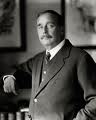
H.G. Wells
It appears that H.G. Wells was appointed to harass Burroughs in print. His 1923 novel Men Like Gods seems to reference Burroughs in a negative way. The means of communication between Wells, the Reds and ERB remains to be discovered but there appears to be novelistic warfare between the two. Wells seemingly was the Soviet hatchet man attacking other notable counterrevolutionaries such as Aldous Huxley.
ERB refined his approach getting his condemnatory novel of Bolshevism, The Moon Maid, published in 1926. The Moon Maid wasn’t that satisfactory although Wells replied to it in 1928 with Mr. Blettsworthy of Rampole Island.
Wells unmistakably alludes to Burroughs in this novel calling him insane. Tarzan At The Earth’s Core which is an attack on some core beliefs of the revolutionaries may possibly have been a rushed response to Blettsworthy.
In Tarzan The Invincible which may be incontrovertibly considered his third attack on the Revolution and an answer to Wells ERB succeeded in the grand manner. He shed the nineteenth century trappings of The Moon Maid that was written in the style of Wells’ First Men In The Moon to write a thoroughly modern novel. Invincible might be considered a prototype of the modern spy thriller, one of the first of the genre. Not only a prototype of the genre but as David Adams points out in ERBzine 0199 a superb blending of fact and fiction:
Fictional author: Burroughs pulls off a tour de force by narrating an introduction in his own voice, then slipping into the story so smoothly one is deceived into believing it is part of a newspaper story in a historical setting.
By which David means current events occurring almost as we speak. Tour de force is correct. David got the handle on that one. Tarzan is actually integrated into a current political situation as an actual historical figure. Tarzan interacts with fictional agents of Stalin who are represented as real acting under orders from Moscow. Incredibly Opar devolves from a mere fantasy of Burroughs into an actual geographic location somewhere in southern Abyssinia. The Soviet agent Dorsky tells Tarzan that they know that he knows where the gold of Opar is hidden and that he is going to tell them.
Thus Stalin has apparently kept up on Tarzan’s adventures which he thinks are real being aware of the source of Tarzan’s wealth and his earlier expeditions to Opar. In fact, one knows that Tarzan’s adventures are common knowledge which they should be as several millions of copies had been sold worldwide. Tarzan’s amanuensis Burroughs has seen to that.
The Soviets had located Kitembo of the Basembos who knew where Opar was and had actually seen it. The Basembos were native to the area of the railhead on Lake Victoria. One assumes that Kitembo must have known one of the faithful Warziri who showed him the ruins. As ERB explains only Tarzan and some of the Waziri had been to Opar. That overlooks Ozawa, who probably bore Tarzan a little grudge for the gold taken from him and the bearers of Esteban Miranda of Tazan And The Golden Lion but possibly the well-known Curse of Atlantis had carried them all off. Haven’t heard of the Curse of Atlantis? Well, you’ve heard of the Curse of the Pharaohs haven’t you? Same thing, only different.
The Reds trying to loot Opar isn’t all that far-fetched. As has been mentioned elsewhere Stalin actually ordered his scientists at about this time to cross an ape and a human to attempt to create a new super warrior that could run on regular. We know that Stalin was a fan of the Tarzan series, both books and movies, possibly even a secret admirer of our favorite author. The possibility of Stalin thinking a eugenic hybrid of ape and human possible from reading Burroughs seems to have a high degree of probability. The Oparian males were believed to have some ape blood in them. If word of the experiments had reached Burroughs, Tarzan The Invincible could be part a spoof on Moscow. So, in a way, the blending of fact and fiction David notes could on the other hand be a blending of fiction and science by Stalin. Amusing to think about. I’m sure more information will surface in the future. At any rate this story does read as an unreported behind the scenes actual event.
Let’s take a look at how Burroughs sets it up. From the opening paragraph.
I am no historian, no chronicler of facts…
OK, so we’re warned that we’re about to be put upon.
Had the story I am about to tell you broken in the newspapers of two certain European powers, it might have precipitated another and a more terrible world war. But with that I am not particularly concerned. What interests me is that it is a good story that is particularly well adapted to my requirements through the fact that Tarzan of the Apes was intimately connected with many of its most thrilling episodes.
Ah, so Tarzan really exists.
That passage is reminiscent of both the first framing story of Tarzan of the Apes and any number of story introductions of Dr. Watson for Sherlock Holmes. The echoes are very strong. An overlooked fact is that Burroughs actually plays Dr. Watson’s role for Tarzan. Burroughs
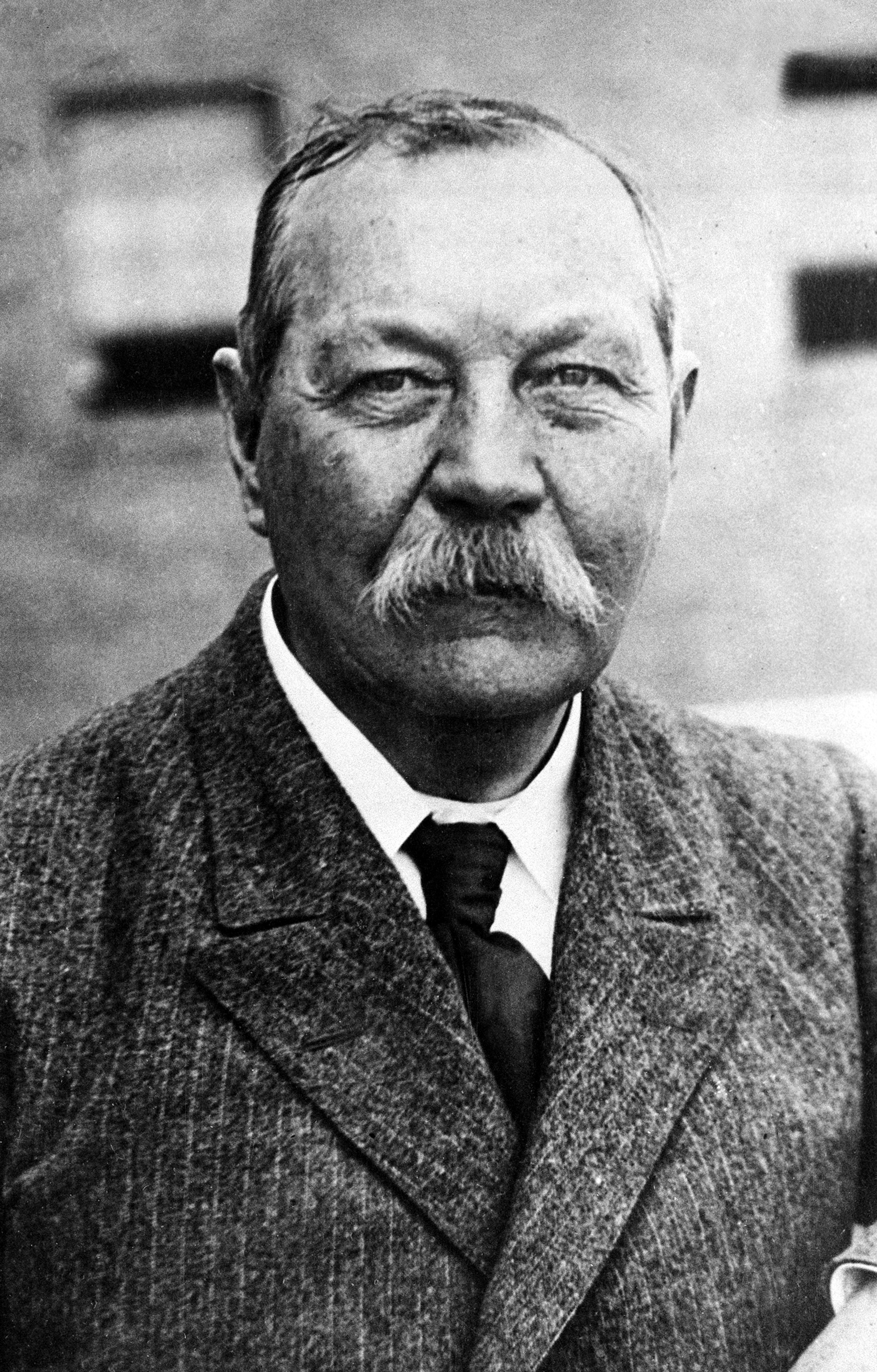
Arthur Conan Doyle
in fact is the chronicler of Tarzan’s adventures as was Watson those of Holmes.
Burroughs goes on to establish his story’s authenticity:
Take the story simply as another Tarzan story, in which, it is hoped, you will find entertainment and relaxation. If you find food for thought so much the better.
Doubtless, very few of you saw, and still fewer will remember having seen, an news dispatch that appeared inconspicuously (how inconspicuously?) in the papers some time since, reporting a rumor that French colonial troops stationed in Somaliland, on the northeast coast of Africa, had invaded an Italian African colony. Back of that news item is a story of conspiracy, intrigue, adventure, and love- a story of scoundrels and of fools, of brave men, of beautiful women, a story of the beasts of the forest and the jungle.
That seems like it covers all the bases of what a story should have. It is also pure Dr. Watson or, rather, Arthur Conan Doyle; let’s not fail to differentiate between fact and fiction. So far what Burroughs has posited could well be true. After all few read and fewer remembered the news item which appeared inconspicuously sometime in the not too distant past. Now Burroughs removes the story from the news item another step and quietly slips into full fiction mode:
If there were few who saw the newspaper acount of the invasion of Italian Somaliland upon the northeast coast of Africa, it is equally a fact that none of you saw a harrowing incident that occurred in the interior some time previous to the affair.
Um, yes, if there were few…then it’s a fact there were none. It seems ERB has established an incontestable ‘fact.’ So if you let that sophistry slip by you he’s going to tell you pure fiction. If you know the difference you won’t care, if you don’t it won’t matter. Anyway his intro was a perfect synthesis of nineteenth century humbug brought completely up to date.
Burroughs’ writing style is even close to reportorial. Tarzan, La and Opar become ‘real’ as ‘real life’ Reds make their assault on the ancient Atlantean colony. So, in a way, Atlantis becomes an established fact rather than an hypothesis.
Burroughs uses clear, concise sentences developing his story news style. For once his story is evenly paced with a well developed beginning, middle and unrushed end. He doesn’t cram a hundred page ending into ten as usual.
While one hesitates to call the book his best Tarzan novel it may be his best written. Thoroughly modern in its swift and pleasant reading with wonderful detailing I certainly can’t consider the novel hack work or inferior to any of the Tarzan novels in any way. The characters are entirely plausible, the premiss doesn’t seem far fetched. There are historical antecedents that we will examine. The novel could easily have take its place among the major spy thrillers written in the last fifty or sixty years. David is right. The novel is a major tour de force.
Part II of X follows.

R.E. Prindle
Exhuming Bob 25: Bob And Sam
June 5, 2010
Exhuming Bob 25:
Bob And Sam
by
R.E. Prindle

Shepard, Sam: The Rolling Thunder Logbook, 1977, Sanctuary Publishing.
Sometime in the mid-seventies, possibly in 1976 Paul Simon wrote in one of his lyrics: I don’t think this stuff is funny anymore. Coincidentally at the same time as I surveyed my record store of a Saturday morning the same thought occurred to me. Things had been overdone. In one bat of an eyelash the whole thing got old.

Bert Williams In Blackface
This was not case with Bob Dylan who in the waning months of 1975 put the greatest clown act New England had ever seen on the road. The Rolling Thunder Revue; or as it might alternatively have been named: The New Bob Dylan Minstrels. One purpose of the Revue seems to have been to spring the convicted triple murderer and ex-boxer Hurricane Carter from jail. That didn’t come until the very end.
Along the way Dylan wanted to film a sort of existential movie that would later be released as Renaldo and Clara. Working from some strange chaos theory Dylan had no actors, no script, no-nothing. Needing some sort of guiding hand he commanded the actor, cowboy, playwright Sam Shepard to attend to his writing needs. Sam then wrote what he called a log of the experience called the Rolling Thunder Logbook.
On the first reading I didn’t think Sam put much into it but the pictures were good. Still there was the nagging feeling that I might have missed something. On the second reading the logbook assumed more significance. It’s kind of impressionistic. It’s not a narrative; like the title says its sort of like a ship’s logbook. The impressions sort of pile up until you have a definite impression. I don’t know if that’s what Sam intended but that’s the way it worked with me.
Bob being the kind of powerful show biz personality he is didn’t bother to negotiate terms with Sam; he didn’t even bother to call himself; his agent or stooge or whatever interrupted the life of Shepard to tell him Dylan wanted him in New England. Sam doesn’t mention any terms, or indeed any payment. He just dropped everything, literally, and drove East. Did I mention he was in California? Well, he was; he was in the process of moving.
Bob tries pretty hard to cultivate that elusive, mysterious image and he succeeded with Sam who couldn’t locate him for a few days after he got there. Bob probably wanted to accustom him to the menagerie before he showed his face. Even then Sam didn’t have any guidelines he just expected Sam to free lance a few lines of dialogue if at any time he saw the cameras running. The film crew was more disorganized than Dylan if that were possible.
What was it all about anyway?

It Takes A Worried Man- Sam Shepard
As we should be aware 1976 was the two hundreth anniversary celebration of the American Revolution. But there were a number of conflicting revolutions running simultaneously. There was the revolt of the Matriarchy, what Eric Foner calls the Unfinished Revolution which was the replacement of Whites by Negroes and of course the perpetual revolution of the Jews against mankind, not to mention the revolution of the gay crowd. Bob as we all know is Jewish so one may reasonably ask why he chose New England for his chaotic Marx Brothers routine on the occasion of the Yankee Revolution around the new England sites such as Bunker Hill? Could he have been thumbing his nose at America? Well, it does look suspicious.
As Sam notes the crew made it a point to visit Plymouth Rock and the replica of the Mayflower which sacred symbols of pre-immigration America they reviled all but pissing on the Rock. The faux American cowboy, Elliott Adnopoz was swinging from the yardarm of the Mayflower. Y’all know Elliott as the yodelin’ cowboy Ramblin’ Jack Elliott o’ course. For the rest they pissed and farted their way across New England carousing and corrupting as they went. Of course it might just have been New England exercising the gang’s Rock n’ Roll genes, no more than that. Sam kept his discontent sotto voce by which I mean between the lines. Bob, with his need for conflict invited not only his old flame Joan Baez and his new flame Joni Mitchell but his wife Sarah playing each against each. Baez who grows more Mexican with each passing year seems willing to put up with whatever Bob does. Shortly after the tour Sara came downstairs one morning to find Bob dandling a strange beauty on his knee for breakfast. Well, you know, she threw in the tower after that, as, who wouldn’t? Bob seemed to be perfectly dismayed by this untoward turn of events. ‘Women in my family just don’t divorce.’ He whined uncomprehendingly. Well, at least, not without due provocation.

Joni Mitchell Looking Out Her Window
That leaves Joni Mitchell. She’s apparently been stewing about her treatment for thirty-five years. She just recently expressed herself by saying in effect that Dylan is just a god-damned phony. Well, Bob can always go join Joanie in that bomb shelter in Viet Nam. They can exchange rings made of the fuselages of American fighter planes, if they haven’t already. So, how sincere is their devotion to this great land of the once free and no longer brave? It would seem their loyalties lie elsewhere.
In my own obtuseness, quivering in my own psychological bomb shelter, I never saw Bob as a revolutionary in those far off days but then I was just listening to records, I didn’t know anything about him; boy, I sure have remedied that situation.
Back in those palmy days of the early sixties before racial and religious animosities had reached their present prominence I don’t know that anyhbody really thought of Dylan as a Jew. Certainly the name Dylan is not Jewish and I’m not sure how many people would have known Zimmerman was. Or, that they would have cared. In those days everyone cheered when Israel won one of those too frequent wars. Now, though, one has to put Bob’s religious affiliation up front. Make no mistake, he’s a fundamentalist, believes the Bible is the literal word of god. Orthodox. Chabad Lubavitcher even. Thinks the universe is fifty-seven hundred years old like his deceased mentor Rabbi Schneerson. Swear to g-d.
Must have picked it all up from Rebbe Rueben who came West from Brooklyn to Hibbing to indoctrinate him in Lubavitcher lore for his Bar Mitzvah. Like Bob said, he learned what he was supposed to learn. He very cleverly inserted the stuff into all those songs too.
Bob broke his mind in the excesses of the sixties, that high mercury sound he was seeking was the result of all those amphetamines he was shooting back then. Andy Warhol had his boy pegged.
In the late sixties and early seventies Bob had to rebuild his personality and he rebuilt it around his religion. His Mom was real proud of the way he had his Bible open on a stand in his living room so he could jump up and check it as the occasion arose.
Then as he got back on his feet he aligned himself with Meyer Kahane’s violent extremist revolutionary Jewish Defense League carrying a couple of JDL thugs around with him as bodyguards. Maybe his Jewish revolutionary mode was getting too obvious so in ’77 he began hanging out with Jews For Jesus and the Christian Vinyard Fellowship organization. Once that clouded the picture he reverted back to his Lubavitchers where he has been since.
So on the Rolling thunder tour one may be excused for thinking that he was in his revolutionary phase. Sam Shepard doesn’t mention it but his experience left a very bad taste in his mouth which he expresses with as much force as Joni Mitchell really has.
On the tour Bob did the strange thing of wearing white makeup which has remained a mystery. It shouldn’t be really. Remember the tour was to end in a successful attempt to free a Black man while the Black boxer Muhammed Ali was unstage at the Garden. A Garden party a la Ricky Nelson, get it? The Revue was actually a parody of the Minstrel show of what Greil Marcus would call the old weird America. In the old Minstrel shows the White actor wore black face in imitation of Black people. This may sound strange to you but Jews don’t consider themselves White notwithstanding their pale complexions they consider themselves Jews and goys as White. So, in disguising himself in White Face he was parodying the old Black Minstrel shows while mocking his ultra-White New England audience.
Bob Dylan was having the time of his life. The joke was on the Honkies. Funny, huh?
As noted, the keynote of the tour was the final concert at Madison Square Garden at Christmas where he took on America over the issue of the Black Hurricane Carter and won. Now, compare that Christmas show with the 2009 release of Bob’s Christmas album. Seemingly done straight it also mocks Whites. In Bob’s video for the song It Must Be Santa Claus you may have noticed that the audience showed minimal diversity. The airheads were all White. Bob comes prancing through wearing a lank blonde White girl’s wig, climbs into a balcony and stands looking down his nose in his wig at us all. It’s great. Nobody gets it. There is something happening here but you don’t know what it is, do you, Mr. Jo-o-o-nes.
Jewish power vs. American power, make no mistake.
Sam jumped ship before the end of the tour, he’d had enough, but he was there for the Garden party. He can’t even force himself to dissimulate a complimentary attitude as he did at the beginning of the Minstrel show. And then the final confrontation between the playwright and the singer.
At this point is is clear that the Rolling Thunder tour is something Sam wished he hadn’t gone on and an experience he preferred to forget.
Shepard closes with a chapter concerning the opening of his play The Geography Of A Horse Dreamer. I don’t know the play but it may have been based on Rolling Thunder. In the play Sam names the horse Sara D. Dylan is in New York at the time wanting to see the play. He wants to make his entrance in company with Sam. Sam writes:
..so I’m in the hotel lobby waiting for the Cadillac convertible to haul us over to the theatre. The big boxcar camper pulls up outside and Dylan hops out. My stomach does a full gainer as I see him approaching the hotel. The idea of him sitting in the audience is more like a nightmare than a blessing…He pauses at one of these signs (reading signs in the lobby) long enough for me to scuttle past him out into the street and hail a cab. It’s bad enough knowing that he’ll be there without having to ride there with him in the same car.
So not only was the tour distasteful to Sam’s sensibilities but the experience of first hand acquaintance with Bob has also left a bitter taste. Well he isn’t the only one. The evening of the opening of Sam’s show is not going to improve relations.
…the so-called curtain is being held up for Dylan’s late arrival. He shows up plastered, along with Neuwirth, Kemp, Sara and Gary Shafner. They take up a whole row.
So whatever the cause of the conflict Dylan is reciprocating his disrespect fully. He means to sabotage Sam’s show and then leave early too.
At intermission Sam doesn’t see Bob so he hopes he’s left the theatre. No such luck. Dylan comes out of the toilet.
He sees me standing there and pauses as though trying to bring certain thoughts into focus. “Hey, Sam, what happens to this guy in the play anyway?’ I’m dumbfounded for a reply but come out with something like, “That’s the reason for seeing the second act.” He stares at the floor, his knees shifting slightly as though he’s about to go into a nose dive.
“Hey, how come you named that horse in the play Sara D?”
“That’s the name of a racing dog in England.” It suddenly cuts through me that it’s also the name of his wife.
“I mean it’s the name of a greyhound. A real greyhound. You know the kind that race around the track.”
He smiles and shuffles through the door, almost making a left turn into the light booth.
Apparently Dylan didn’t find that answer any more satisfactory than I would have. Something is going on here, isn’t it?
As the play draws to its end Dylan makes his move. Shameless. Pure chutzpah immersed in chocolate sauce.
Dylan stands in the back row. “Wait a minute!” Who’s he yelling to? The actors? “Wait a second! why’s he get the shot? He shouldn’t get that shot! The other guy should get it!” Lou Kemp is trying to haul him back down in his seat….
Dylan is struggling to free himself from Kemp’s hammerlock grip. Neuwirth is telling him to shut up…Finally the Sam Peckinpah sequence begins, with shotguns and catsup all over the stage. Dylan leaps up again. “I DON’T HAVE TO WATCH THIS! I DIDN’T COME HERE TO WATCH THIS!
Apparently the Rolling Thunder tour didn’t end until Sam had written this play and run it by Bob. Dylan didn’t like the play any better than Shepard liked the tour. Hard feelings everywhere.
Apparently Bob used people much too roughly. He managed to either blow off a number of people immediately following such as Shepard, Jack Elliott, Neuwirth, the maligned Larry Sloman and probably the whole film crew while Joni Mitchell has weighed in thirty-five years on. We have yet to hear from a number of other people, most notably Roger McGuinn.
Bob managed to trash everybody including the USA with his Minstrel show for the 200th anniversary year. Which revolutions was he leading? I don’t think this stuff is funny anymore, do you?

Bob and Joan, Joan and Bob?
Four Crucial Years
In The Life Of Edgar Rice Burroughs
Part IV of IV
by
R.E. Prindle
Edgar Rice Burroughs
“HE’S BACK!”
By this time ERB would have been viewed as a real upsetter. Since 1890, except for a summer vacation or so, ERB had only been in Chicago from late Spring ’97 to Spring of ’98. Then he had gone away for a year and now he was back spoiling some other people’s plans.
Even after having deserted Emma Hulbert twice, the first time without notice for sure, and probably the second also, she was still waiting for him. Amazing! Ten full years when when the biological clock was ticking loudest she was still there. If that’s not true love I don’t know what is.
It must be that ERB took it for granted that she would always be waiting for him because he was still willing to leave her at the drop of a hat, if he could only get that coveted officer’s appointment.
As ERB walked down his street you could almost hear Alvin Hulbert say ‘Drat! that young man is not going to set foot in this house.’
Papa George T., quietly holding that three hundred dollar note, welcomed him back restoring his old job to him.
The following account is based on two letters, one from R.H. Patchin dated 3/21/1950 and the reply from Jack Burroughs dated 4/4/50. I learned of the letters which were quoted in part by Burroughs scholar Robert Barrett in the Fall 2003 issue of the BB. Danton Burroughs of ERB, Inc. subsequently was gracious enough to provide me with full copies as he had Mr. Barrett.
As of the time of the letter Mr. Patchin was from 68 to 70-75 years old. My guess is that Frank Martin couldn’t have been younger than Emma so was probably at least 25 to 30 years old in 1899. It is not impossible that he was older but as his exemplars in ‘W.C. Clayton and Terkoz in Tarzan Of The Apes and The Return Of Tarzan are approximately the same age as Tarzan Martin was most likely 25-27.
As Emma would be 23 at the beginning of 1899 which would be close to spinsterhood one may believe there was some anxiety on Papa Alvin’s part to get her safely married. Martin was about the most advantageous marriage possible. At, say 27, he was looking at one of the last unmarried women of his age cohort. If he failed with Emma he would have to find a much younger woman than himself or take a woman who had already been married. He has some reason to repent this man he could not have known well who not seeming to care that much for Emma yet stood between himself and her.
Patchin says a lot in his letter to Jack Burroughs. He mentions the three times his and ERB’s paths crossed. They were all unfortunate for Burroughs. In the first ERB got his head bashed in; in the second Patchin showed up just after ERB divorced Emma which divorce was national news; the third was the condolence letter at ERB’s death. Talk about an ill omened bird.

Jack Burroughs’ Reply
Sometime between ERB’s divorce and 1950 Frank Martin became a statistic. He didn’t survive his nemesis. I am guessing of course but Patchin’s meeting with ERB after his divorce must have been arranged by Martin. He may even have been watching from a distance. One wonders if he ever married.
I only mention the following as a point of interest. By the time John Dos Passos wrote the third volumeof his USA trilogy, The Big Money, Burroughs was already a major literary figure. As he didn’t seem to court publicity he can’t be said to have been a celebrity. In The Big Money Dos Passos cameos a number of interesting people among them Bernarr Macfadden.
It should be clear to everyone that nothing can be done in secret. Whatever passed between Martin, ERB and Emma must have been a source of gossip among Chicagoans. Somewhere along the way Dos Passos may have heard the gossip. In The Big Money he includes a story about a woman named Evaline Hutchins. A segment of the story bears some resemblance to the situation between the three under consideration. In the episode the Martin-like character takes the Emma character driving. He cracks up the car leaving the woman with some explaining to do to her husband.
I don’t say it’s so but suppose that in 1907-08 Martin, still seething at his rejection, in some way got Emma to go out driving with him with the above result throwing Burroughs into a panic. It was in 1908 that Joan was born to be followed immediately by Hulbert. Is it possible that after eight childless years Burroughs suddenly began a family as a defensive move against Martin? I can’t say but it is a hint I would dearly love to follow up.
At the time Patchin wrote the letter in 1950, judging from his stationery, he was down on his luck. His sloppy typing can’t be accounted for by age alone, or perhaps a lifetime of hard living had left him a wreck. My conjecture is that he had been drinking when he wrote the letter.
You will notice that the staionery bears only a street address- 555 Park Avenue- and no indication in the body of the letter as to what city. Burroughs’ reply provides the location. New York City. Patchin must have been clever enough to provide a return address on the envelope. The street address is printed rather than engraved so it is less expensive stationery. With no other address details provided it is obviously not Patchin’s personal stationery. The paper must have come from a mailing address. The stationery was probably available to anyone. 555 Park Avenue is a lower East Side address so Patchin was totally down on his luck. Probably drunk as he wrote.
He makes a glaring Freudian slip in the first paragraph when he says of ERB, ‘He lived his wife well. Wife for life! Hence the letter is as much about Emma as ERB. Emma meant nothing to Patchin so he must be speaking for Frank Martin. He then immediately relates the anecdote concerning ERB’s bashing in Toronto; thus Emma and the bashing are related. The one caused the other.
What follows now is extrapolated from Patchin’s virtual confession and Jack Burroughs’ reply. Burroughs hints that he knows more of the story than he is letting out. He and ERB had discussed this matter shortly before ERB passed over, he says. Obviously among the last things on ERB’s mind.
Martin viewed Burroughs’ return from Idaho with apprehension. Emma’s delight at Burroughs’ reappearance disconcerted Martin’s plans which he and Alvin probably thought were progressing well. Martin perhaps in talking with Patchin, if they were equals and friends, which I doubt, may have said, ‘How am I going to get rid of this guy?’ ‘Let’s think about it.’ Said Patchin. ‘What kind of accident could he have?’
Indeed, that’s how people get rid of someone they don’t like, the victim has an ‘accident.’ Murder is for amateurs. With murder the Law has to be paid, with accidents it doesn’t. No investigation. Perhaps he steps on a banana peel; gets run over by a car going the wrong way down a one way street, pushed in front of a trolley car. The next question would have been, where, how, when?
Better that it should be out of town rather than in town.
How to get Burroughs out of town? Now we’re talking old hat. You find a desirable reason for going somewhere, say New York City, then you make arrangements.
In Frank Martin’s case he had a perfect situation. Frank’s father, Col. L.N. Martin, was a multi-millionaire railroad man who had his own private rail car. In July of ’99 the Col. was going to NYC so Martin, extended an invitation to Burroughs to travel by private car to New York City. What a deal, huh?
Burroughs should have been surprised at the offer since the two weren’t that close friends while they were rivals for Emma’s favor. There should have been enough there to give one pause. Still, what a tempting offer.
The trip appears to have lasted at least three to four weeks, returning to Chcago at the beginning of August. Clearly ERB and Martin were not in the same economic league. Our Man was receiving fifteen dollars a week. Martin could spend that much for lunch every day of the week and take Emma to the theatre every night without a single concern for expense. There was no way ERB could have kept up so that the Martins had to have paid his way. Didn’t ERB wonder why they would do that for a comparative stranger?
There was no questioning expenses from the Martin point of view. They owned a luxurious private railroad car. It cost more than Burroughs made in a week to connect it to a train. Jack Coleman Burroughs recalls: ‘Dad also recalled on the same trip, a colored porter would knock on the stateroom doors the first thing every morning. The porter bore a silver tray upon which was a choice of ‘eye openers’. According to Dad, this went on over different parts of the private car during the rest of the days and into the evenings.’
Thus ERB was accepting lavish hospitality he couldn’t hope to reciprocate. This is a fairly humiliating situation. You cannot feel like an equal nor will you actually be treated as one. One the other hand he was kept tipsy, to say the least, for the whole trip.
When they got to New York ERB does not appear to have lived on the car. Once again with the Army fever on him he wrote to Col. Rogers who was then in Washington D.C. in the hopes of gaining an officer’s appointment. The return address Rogers was given was 11 17th in NYC. That is the lower East Side somewhere in the vicinity of the Bowery. Patchin was writing from somewhere in the same vicinity. Of course, the address could possibly have been a box of the railroad; the information is incomplete. At the same time the Martin party was staying on the posh Riverside Drive. There’s a degree of separation there.
ERB’s letter was sent on the 15th while Rogers very quick reply came back on the 22nd in the negative. He didn’t have to give his reply much thought. Now, ERB was ready to abandon Emma again. Marrying her must have been a low priority in his mind.
If Martin had been thinking, rather than preparing an ‘accident’ for ERB he would have gotten his father, ‘the Colonel’ who must have had some influence, to secure Burroughs an appointment and have him shipped to the Philippines. That would have made ERB eternally grateful while getting him out of Martin’s hair. Frank missed a chance.
Sometime after the 22nd the return trip to Chicago began. As is usual in attempts of this kind the hit was delayed until the last minute. In this case the assassination was to take place in Canada to which, if anything went wrong, Martin would have to be extradited as they would cross the river into the United States from Toronto the next morning.
More rounds of drinks were served as the train moved from NYC to Montreal and thence to Toronto. Probably a fairly lengthy trip as they might have had to switch trains a couple times while wating in the yards.
Neither Patchin nor Jack Burroughs gives a date for Toronto. As this took place in 1899 there were no motorized taxis. As Patchin says the railcar was parked in the Grand Trunk yards. These ‘three gentlemen songsters out on a spree’ would have had to walk into town or hire a carriage, probably the latter as Martin had the money.
At this point someone would have had to have previously hired the thugs to bash Burroughs. As I figure it the logistics were Patchin’s job. I don’t see him so much a friend of Martin’s as an accomplice or stooge. In his letter he does not claim to be a friend of Martin, he does not say ‘our’ old friend but claims to have been a friend of ERB while ERB was a friend of Martin. Stange circumlocution when he could have just said ‘our friend.’
Although Patchin describes the thugs as ‘Canadian hoodlums’ I wouldn’t be surprised if they had been brought from Chicago contracted by Patchin there. It would have been easier and surer.
If you study Patchin’s letter you will see that other than the slip of ‘He loved his wife well’ there are no other typos in the first paragraph. As he gets into his story in the second paragraph he begins to have difficulties. By the third paragraph when guilt seizes him he can’t even spell his last word or keep the words on the same line. He begins emergency with two Es, can’t spell the critical word ‘hospital’, crossing it out. Serious stuff.
Where did they go in Tornonto on that memorable evening. Probably to the red light and gambling district. Toronto’s answer to Chicago’s Levee. Where else could you arrange a fight with such hoodlums so easily. Patchin doesn’t say whether the fight took place indoors or outdoors, just that Burroughs took a smack to the head. Since the scalp was opened he was coshed with a sap or pipe.
Burroughs says that he didn’t lose consciousness but he must have been knocked flat on his back. He must have had time to get his arm up to partially block the blow or he would most likely have been killed by it. As I see it, then, this was an assassination attempt. Martin meant to permanently get Burroughs out of the way. Put him in a place from where he couldn’t come back.
As I see it Martin and Patchin faked the brawl. Patchin doesn’t say that he and Martin had a hard time of it. No. Just Burroughs got hit. Only Burroughs got hurt which is suspicious. After the first blow which could have been interpreted to be in the heat of anger which would still have been manslaughter, to have continued to belabor Burroughs would have been a clear case of murder which would have had to have been thoroughly investigated. The Law would have to be paid. Thus the opportunity was lost when the first blow failed. Martin and Patchin didn’t even report the incident to the police. The ‘Canadian hoodlums’ could still have legged it across the border though. It is not impossible that they weren’t Canadian but Chicago hoodlums contracted for the job before the private car left the Big Windy. Why not? Perfect job.
So at two in the morning when asked where he was staying by the hospital doctor ERB replied in our private car down in the Grand Trunk Station. Not Martin’s car but our car. He quickly got used to the luxury of a private car. Never forgot it either.
As he was able to walk he was released the party returned to the yards returning to Chicago the next morning.
2.
One may ask is there any evidence to show that Burroughs after he had thought about it for a while ever came to the conclusion that Martin and Patchin had meant him harm? I think there is. In The Return Of Tarzan Burroughs puts these words into the mouth of Jane perhaps thereby admonishing more sternly who might, not unreasonably, be expected to be reading these books. He obviously would get more out of them than we might.
Jane says ‘…this terrible jungle. It renders even the manifestations of friendship terrifying.’
A manifestation of friendship was the invitation to NYC from Martin. This indeed had been terrifying. So that for the parties concerned if they read between the lines they had every reason to believe that Burroughs understood everything.
One of the consequences of the attempt on Burroughs’ life was that he rushed back home to propose to Emma. Within five months they were wed thus taking her away from Martin. Emma had had a choice between a prince and a pauper and by some miracle had chosen the pauper. Really a very romantic story worth of a movie on its own. Grand Opera the way I see it. Andrew Lloyd Weber should look into this one.
There were other serious consequences. Of the blow, Jack Buroughs says: “He suffered for a number of years with bad headaches from the blow he received in that fight, and attributed one or two short periods of amnesia to that rap. (Amnesia is a recurrent theme in the Tarzan oeuvre.) I remember the scar was quite evident on his forehead when we were children (Jack Burroughs was born in 1913 so the scar must still have been visible in 1920 although it doesn’t show up in photographs.) but it seemed to disappear in his later life. Mother used to jokingly attribute his success to that blow.”
Emma would be in a position to know.
So Burroughs suffered lasting injury from that blow– one doesn’t have periods of amnesia unless there is internal pressure on the brain. There is evidence that he suffered from such pressure. Perhaps brain damage is too strong a phrase in this case but here is a clinical description that seems to fit the case. Per Brodal: The Central Nervous System: Structure and Function (3rd. Edition, page 433):
A peculiar form or amnesia occurs together with confabulation; that is the patient invents stories (without knowing that they are not real). Most of the patients have a lesion involving the substantia inominata, the medial hypothalamus, and the orbito frontal cortex (usually caused by a ruptured aneurism in the anterior cerebral artery). The often bizarre stories can usually be traced back to real events, although they consist of various, unrelated fragments from memory. It seems the patient is unable to suppress irrelevant associations, and cannot chack them against reality.
That is pretty close to ERB’s situation although he doesn’t appear to have lost his connection to reality although his stories as fantastic as they come always relate to his own memories. The Corpus seems to form one gigantic web of psychological unity as Richard A. Lupoff has pointed out.
One could think that after such a fearsome blow he would have been kept at the hospital for observation for at least a day or two but as he appeared to have no more than an open wound the doctor sewed him up and sent him on his way. As Patchin says the doctor came down to the yards the next morning to check up on the private car story which may have seemed incredible to him causing him to the think the patient deluded perhaps being more hurt than he looked as, indeed, he was.
There seems to be no reason to doubt that the blow ruptured the anterior cerebral artery. Thus internal bleeding over the next couple days would have created a clot which would have put pressure on the prefrontal lobe causing cobwebs, headaches and obviously a faulty memory with periods of amnesia.
There must be a medical reason for all these.
The symptoms should have begun showing up within a week or so, so that the several months of faintness ERB experienced began then. It was in this mental condition that he proposed to Emma.
Disappointed by the quick rejection of Col. Rogers while at least intuitively understanding that he had been set up in Toronto, ERB quickly went to work to capture Emma from Martin. I see little reason to believe that he had intended to marry her any time soon before he went o NYC, if at all. Back in Chicago in August he proposed and he and Emma were married by the end of January. In terms of years he was twenty-five and she twenty-four but in reality ERB was only four months older than Emma.
The sudden wedding must have been disconcerting to the Hulberts. I’m sure they envisioned a magnficent society wedding for their daughter. There was now no time to plan one so they must have been bitterly disappointed.
ERB now had to face a reality he hadn’t planned for. His rough and rowdy days were over.
3.
While solidly based on documentation the foregoing is at present somewhat conjectural but let us see if we can find some discussion by ERB of these events in his writing. There are four titles that go over these events in slightly different ways. Certainly ERB had to ask himself what had happened. He gave it a lot of thought. Beginning in 1909 his answers came pouring forth. Minidoka 937th Earl Of One Mile, Series M which was unpublished in his lifetime was the first of these efforts followed by Tarzan Of The Apes, The Return Of Tarzan and The Girl From Farris’s. As ‘The Girl’ is concerned with the early married years rather than this period I will forego discussion of that title although it should be read in sequence with Minidoka.
Minidoka, which actually began ERB’s writing career is directly concerned with this struggle between himself, Alvin Hulbert and Frank Martin. In the story the evil Brady represents Alvin Hulbert with the genuine thoroughbred godling, Rhi, representing Frank Martin.
The wars and battles represent Hulbert’s attempts to keep ERB away from Emma which ultimately fail. However the story may explain a curious situation in which ERB and Emma took up residence in the Hulbert home after marriage. Not a situation most newlyweds would want, but one that the Brady or Hulbert insisted on.
Alvin Hulbert had thought little of ERB for several years. The Army episode and the Denver marching band stunt did little to improve his opinion of Our Man. How the New York trip was represented to him by Martin would be interesting to know. Probably Martin who had every incentive to slander Burroughs said he was drunk all the way to New York and back, drank continually, started the day with liquor. He may have said that they were in the red light district of Toronto at ERB’s insistence. In other words, he probably made the most of the situation.
Undoubteldly terrified at his daughter’s willfulness in marrying this ne’er-do-well Hulbert made it a condition of his consent that the couple live in his house where he could keep a close eye on ERB. I’m sure he was ready to have the marriage annulled at a moment’s notice.
In Minidoka Rhi by a very devious trick puts Minidoka/Burroughs in a situation where he is meant to be killed, a situation not unlike Toronto- then rushes to the heroine Bodine/Emma to inform her that Minidoka is dead proposing marriage to himself instead. It could have really happened that way.
As in real life Emma/ Bodine remains steadfast and true to Burroughs/Minidoka, all wool and a yard wide as Burroughs puts it.
Thus Minidoka mirrors the real life events in a fantastic manner as Per Brodal would suggest.
Minidoka was never published so the same material was available for a retelling. This was done in the first two Tarzan novels. Tarzan Of The Apes tells the story of Burroughs life up to 1896 with some interpolations from the later period. The Return Of Tarzan covers the four years from 1896 to his marriage with Emma in 1900.
Always bear in mind that Burroughs has to tell his story with commercial ends in mind.
The blow to the skull made an indelible impression on ERB as well it might. In Tarzan Of The Apes, Tarzan takes three serious beatings, one with a gorilla from another tribe, perhaps representing John the Bully, and with Kerchak and Terkoz of his own tribe. In all of them Tarzan is beaten about the head and shoulders. Terkoz/Martin rips his scalp open from above the left eye over to his right ear. Clearly an exaggeration of the true wound but that must have been how it felt.
Kerchak delivers a blow to the head that would have killed him had he not deflected its force with his raised arm.
Then when Tarzan and Jane are in the jungle Terkoz abducts Jane causing Tarzan to rescue her killing Terkoz in the process. Thus in Program A Tarzan kills his adversary.
Running concurrently in Program B Tarzan is a penniless jungle ape-man up against W.C. Clayton who is a genuine thoroughbred godling as was Rhi in Minidoka. Tarzan feels he doesn’t have a chance against Clayton so he magnanimously resigns Jane to him at the end of Tarzan Of The Apes. There must have been a sequel in mind because, as in reality Burroughs won Emma, Tarzan must win Jane.
The end of Tarzan Of The Apes may correspond to Burroughs joining the Army in 1896 while finding Clayton embracing Jane in the jungle may correspond to his second Idaho trip in 1898.
So that between 1896 and 1898 it may have appeared to him that he had lost out to Frank Martin. In ‘Return’ Tarzan retreats to Opar which is his fantasy world with the beautiful but unobtainable anima figure, La. At this early date she and Emma/Jane are fighting it out in his mind for his allegiance. He would rather have La, that is remain unmarried, but his rivalry with Martin is pushing him toward Emma.
Tarzan is captured by the Oparians destined for sacrifice to the Flaming God of which La is High Priestess. Burroughs reverses the situation and instead of squelching his imaginary La she is about to sacrifice him. Burroughs can’t renounce his Anima fantasy so rather than kill him which would end both Burroughs’ wish persona of Tarzan and his relationship with La, she releases him. Tarzan/Burroughs then triumphs over W.C. Clayton winning Jane/Emma. Jane/Emma leaves Opar never to return. La remains in Opar until Tarzan The Invincible when Burroughs is about to leave Emma and take up with his Anima figure, Florence Gilbert. La then comes out of Opar in the same way Burroughs leaves Emma for Florence. Opar disappears from the oeuvre, never being mentioned again.
Then as ‘Return’ ends Burroughs and Emma are married mirroring his fantasy where Tarzan and Jane are married. While not literal as Burroughs is writing for publication and must construct an interesting and, at least, nominally plausible story he confabulates events from his life into a fantastic and improbable tale.
The history of his slugging which closes this period was mysteriously obscured by his youngest son John Coleman Burroughs. These two letters were only discovered by Danton Burroughs, John Coleman’s son, recently. They were unknown to biographers Fenton, Porges and Taliaferro. For decades it was believed that Burroughs had been coshed in Idaho by a policeman as an innocent bystander in a saloon brawl.
In an interview with Porges Jack Burroughs told this latter story in 1970. Porges then dutifully reported the Idaho story in his biography. the question is why would Jack invent the latter story to replace the true one with which he was aware. As he himself replied to Patchin having previously discussed the event with his father I don’t see how he could have forgotten it. Nor was there any need for him to even tell Porges the Idaho invention.
Perhaps Jack knew details buried away in the archives wishing to lay down a false trail to disarm the curiosity of Porges.
In 1899 ERB had had the direction of his life changed by a rap on the head. He now had to face a life filled with heavy responsiblities which he had been able to avoid to this point.
We see a new Edgar Rice Burroughs emerge from his early married years.
 I, Dynamo