Albert Camus: The Fall A Review
July 19, 2007
A Review Of
THE FALL
by
Albert Camus
Review by R.E. Prindle
Table of Contents.
I. Review of The Fall
II. Article and Commentary on Camus’ and Jews
III. Review Of The Outsider
IV. Comparison of The Fall and A Rebours. (Projected as of 12/27/11)
V. Comments
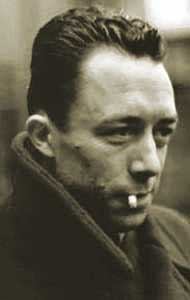
Albert Camus- Prototypical Hipster Pose
This novel goes to show that you can fool all the people all the time.
The cover blurb of my edition has the New York Times yodeling: ‘An irresistably brilliant examination of the modern conscience.’ which is complete and total nonsense. This isn’t even the examination of anyone’s conscience.
Camus was a French Jew from Algeria then living in France. He was not an Algerian Jew as the Jews of Algeria were made French citizens in the revolution of 1830. This distinction is important.
The Fall Camus is talking about is the post-Enlightenment destruction of the religious basis for considering the Jews as a Chosen People, or rather, The Chosen People. In Jewish mythology the world is organized God>Jews>the rest of humanity>the animal kingdom. As Camus was not unintelligent he realized that without God the Jews had no special status. HIs purpose here is to reestablish a reason for Jewish superiority over the rest of mankind. Thus he creates Jean-Baptiste Clamence as his spokesman to represent Jewry originating the role of judge-penitent for him and them.
Clamence is not an admirable person. Never was, never can be. His extreme arrogance before the Fall is characteristic of the Jewish people. The Fall was undoubtedly the extermination of Jews during WWII. While Hitler is given sole credit for the dirty work, in the Jewish mind they were rejected by the whole world. One should not underestimate the effect on the Jewish mind of the turning back of the St. Louis from Cuba. These facts were devastating.
Camus’ Clamence thus felt degraded by the Fall from confidence. He becomes libertine, criminal, degenerate, taking up his abode in the criminal quarter of Amsterdam which he seems to equate with the most criminal place in the world. He is a penitent. There in sackcloth and ashes. It is precisely because he knows extreme degradation, having once been of God’s Chosen People, that he has appointed himself a judge over all the peoples of the world.
He- the Jews- have regained their imagined position of the Chosen People through extreme debasement and degradation.
That is why they have made the Holocaust the central feature of their new identity. Their God rejected them, once again, allowing the Nazis to destroy them. Thus the Holocaust replaces God. If the Holocaust is not sacred to them and honored by the rest of the world, as their God once was, then they not only lose their place as the Chosen People but have no chance of regaining it.
That is the import of Camus’ The Fall. The book has nothing to do with an examination of the ‘modern conscience’, which is to say my conscience. I reject Camus. I reject his book. I reject his situation. He and it have nothing in common with me. His problem is not a universal problem as the NY Times states. Camus’ book is merely a tedious rendition of someone else’s angst that has nothing to do with me or mine.
End Of Review
https://idynamo.wordpress.com/2007/05/08/part-i-the-deconstruction-of-edgar-rice-burroughsamerica/
The below response to Robert Zaretsky’s article develops the argument of the origin of The Fall. http://www.tabletmag.com/arts-and-culture/books/82555/camus-the-jew/
CAMUS THE JEW
by
R.E. Prindle
Mr. Robert Zaretsky who wrote the above titled article for Tablet Ezine is indeed an example of the absurdity he deplores. He is atavism personified. How can anyone in this post-Darwinian age be so simple and naive as to be a believing Jew. The human intellect has moved well beyond such simplicity. To be a Jew, a Moslem or even Fundamentalist Christian which is to say a distaff Jew should be a logical impossibility.
One might claim to be an Israeli, claiming allegiance to Israel, without making oneself look ridiculous but to claim nationality the same as everyone else is to renounce the extraordinaryly specious claim to some sort of special superiority based on an equally specious divine preference is quite akin to insanity in this post-Darwinian scientific world. The very idea of Yeshivas and Seminaries is repellent to contemporary knowledge.
Given this willful obtuseness one is not astonished to realize that ‘Jews’ renounce all involvement as the cause of the disorder, death and destruction from 1913, when the Jewish millennium was said to begin, to the present. In the height of arrogance the ‘Jews’ ascribe any resistance to the genocidal war begun by them in 1913 as ‘anti-Semitism.’ In other words one is to accept their dominance without a struggle; to resist is considered perverse.
Thus, what makes Camus at least an honorary Jew was his deferential embracement of the Jewish cause as his own. To Bob Zaretsky the actions of God in testing the Jews by an inexplicable defeat can only be compared to the trials of Job. Having been stripped of his children and property but remaining loyal to his perverse god:
We think we know how the story of Job ends: Rewarded by God for his loyalty, Job is paid back with even more children, sheep and property. But is this the ending? A number of biblical scholars suggest the Job we hear in the final chapter, the one who accepts and resigns himself to God’s power play, is not the same Job we hear in the preceding 40 chapters. Instead, he is a throwback to an earlier story that was grafted onto the otherwise perplexing account. Instead the real Job is Camus’ Job. He is a Job who answers God’s deafening and dismal effort at self-justification with scornful silence.
Thus, Bob, and one suspects all Jews refuse to take responsibility for their actions perceiving Camus here as some sort of intermediary. Bob, has a distorted notion of the relationship between his Jews and Europeans. He says:
In republican France Jewishness was largely a private matter: it was only when Nazi Germany buried the Republic in 1940 that Jewishness became a public matter and indifference to the fate of the Jews was no longer possible- or should not have been possible.
Bob completely overlooks the Dreyfus Affair of the 1890s that underlined the basic conflict between the French and Jews. Nor did the opposition cease with the unjust reversal of Dreyfus’ conviction but simmered along through the Popular Front and Blum years until the Nazi reaction. French dissatisfaction with the Jewish situation was always prominent, especially after the Eastern Jews stampeded the border during the late thirties and early forties creating havoc and destroying the French quality of life:
Yet when the authoritarian regime of Vichy passed a salvo of anti-Semitic laws in 1940, most Frenchmen and -women did not blink. One of the few who did blink- in fact doubled over in shock and revulsion- was Camus. Working for the newspaper Paris-Soir, Camus was stunned when his Jewish colleagues were fired. In a letter to his wife Francine Faure- a native or Oran, Algeria, who was very close to the Jewish community- Camus said that he could not continue to work at the paper; any job at all in Algeria, even one on a farm, would be preferable. As for the new regime, he was merciless: “Cowardice and senility is all they have to offer. Pro-German policies, a constitution in the style of totalitarian regimes, a great fear of a revolution that will not come: all of this to truckle up to an enemy who has already pulverized us and to salvage privileges which are not threatened.”
Camus was less than prescient about the revolution and totalitarian regimes as both are succeeding now worldwide. The question is who did Camus mean was pulverized- the Jews or the French? Camus according to Bob is plainly casting his lot with the Jews although conveniently excaping to Algeria beyond the Nazi reach. This then is the background of The Fall that gives Clamence his depression. God’s trial of Job was too severe in this instance for continued belief so that rather than complain Clamence/Camus turns his back on God in a disdainful ‘silence’ while pouting and drinking his life away.
Camus is a Jew, fully so in sentiment and the Fall is in reaction to the holocaust.
End of supplement.
III.
A Review
The Outsider (L’Etranger)
by
Albert Camus
Review by R.E. Prindle
Edition: Folio Society 2011
Comes now the time to review Camus’ The Stranger, Outsider or Misfit. A commenter or two have suggested I read The Outsider and I have. The only thing I can compare it and Camus to is the Grateful Dead. It is said that the Dead are an acquired taste. Over the years I have listened to the Dead for many hours in the attempt not so much to acquire the taste as to understand it. I know that Deadheads think that Jerry Garcia, of blessed memory, was a great guitarist but I can’t penetrate his style. In fact I find the Dead so distasteful I’ve given up on them.
I put Camus in the same category as the Dead; he must be an acquired taste except for those of a similar mind. Actually, I recently read the Myth of Sisyphus on line while I read The Plague several years ago. Zero sympathy.
The Outsider strikes me as a high school novelist trying to be heavy. Camus was twenty five in 1938 when he conceived the idea of his little trilogy, that included this book. The novel must have been written in ‘40-’41 as it was published in ‘42 during the war. I suppose most of us experienced the confusion of life in much the same way at twenty-seven or twenty-eight just before the age of reason bit at thirty.
My edition contains an afterword by Camus dated 8 January 1955 in which he says:
A long time ago I summed up The Outsider in a sentence which I realize is extremely paradoxical: ‘In our society (meaning French Algeria I suppose) any man who doesn’t cry at his mother’s funeral is liable to be condemned to death.’ I simply meant that the hero of the book is condemned because he doesn’t play the game. In this sense, he is an outsider to the society in which he lives, wandering on the fringe, on the outskirts of life, solitary and sensual. And for this reason, some readers have been tempted to regard him as a reject. But to get a more accurate picture of his character, or rather one that conforms more closely to his author’s intentions, you must ask yourself in what way Meursault doesn’t play the game. The answer is simple; he refuses to lie.
Camus’ evaluation of his story only proves once again that no author truly understands what he has written. Not only that but his is such a perverse interpretation as to be incredible. Meursault neither lies or tells the truth; he is just a passive receptacle of other people’s needs. Further, the book even if considered a fantasy doesn’t make sense; it doesn’t appear to be founded on human experience.
Obviously the story does not hinge on Meursault’s refusal to lie but simply his treatment of his mother and his refusal to show emotion at her funeral. That’s it. The fact that he killed a man in self-defense which is not brought out is merely an excuse for executing him for his perceived coldness toward his mother.
I don’t know the nature of French Algerian jurisprudence of the time but I find it very difficult to believe that judges adjudicating an ostensible murder would conduct the trial on the basis of whether a man cried at his mother’s funeral or not. Who knows what his actual relationship his mother had with him and so what?
The issue is the killing. As I read the story Meursault only drew his gun when the Arab flashed his knife. The glare of the sun on the blade intensified the threat so in self defense Meursault shot him. There is absolutely no reason that Meursault couldn’t have told the judge ‘the truth’- he drew a knife on me so having a gun I shot him. Where is the refusal to lie? The mother combined with the killing doesn’t make sense; there is no connection. But, maybe that’s what existentialism means, you got me.
The center of the novel which merely demonstrates the extreme passivity of Meursault doesn’t satisfactorily explain the sudden act of volition in shooting the Arab especially as he apparently didn’t construe it as an act of self-defense.
All through the main body he lacks volition just going where the wind blew. Raymond demands that Meursault be his ‘mate’ to which he complies even though Raymond is the last guy anyone would want to know while to be the mate of someone who mercilessly beats a woman is beyond comprehension. What is going through Albert Camus’ mind?
Marie, a woman he hardly knows proposes marriage to him so Meursault assents although he tells her he doesn’t love her and she doesn’t care. For me this nonsense is merely exasperating. I had no interest in any of the characters; the sequence of events make no sense other than to demonstrate the extreme passivity and lack of volition of Meursault.
The final outburst is in contrast to his passivity:
…I looked up at the mass of signs and stars in the night sky and laid myself open for the first time to the benign indifference of the world. And finding it so much like myself, in fact so fraternal, I realized that I’d been happy, and that I was still happy. For the final consummation and for me to feel less lonely, my last wish was that there should be a crowd of spectators at my execution and that they should greet me with cries of hatred.
Why hatred? The guy just said he was happy and contented. Like I say, Camus is an acquired taste. I have no interest in him but if you do- Enjoy.
By the way, has anyone read Sartre’s trilogy, The Roads To Freedom?
Greil Marcus The Shape Of Things To Come
July 14, 2007
Notes To A Review Of
Greil Marcus’
The Shape Of Things To Come
by
R.E. Prindle
Marcus, Greil, The Shape Of Things To Come, 2006, New York.
‘The Shape Of Things To Come’ a title borrowed from the mentor of today’s left, H.G. Wells, is Greil Marcus latest attempt at a prophecy of blood, guts and the doom of the United States. The price of Black slavery he prophesies will be blood flowing in the streets. ‘Trouble coming every day.’ as Frank Zappa put it. As to that point I am compelled to agree with him although to understand the reason why doesn’t require the religious ecstasy or possession he seems to believe he has.
I have already examined this problem in my essay The Deconstruction Of Edgar Rice Burroughs’ America that appeared on http://www.erbzine.com and in this blog in which without the rather specious gift of prophecy from De Lawd I projected by scientific reasoning that a Negro reaction to slavery is unavoidable.
I fear that the bloodshed Mr. Marcus prophesies may be upon us by the next Presidential election if there is one. I fear that there is a chance that President Bush may cancel the election continuing in power. Barring that possibility I fear days of bloodshed will arrive with the election of Barack Obama.
Thanks to a very large extent to the efforts of Mr. Marcus’ Jewish culture the American electorate has been debased to the point where it seems to be unable to deliberate on such matters of vital importance with any degree of intelligence.
In the first place the Black people have been in open rebellion since at least the 1965 Watts revolt, or riots as it is presently known.
The opening volley was undoubtedly the Supreme Court Brown decision of 1954 that slowly built into the violent eruption of 1965-69. Since then the direction has changed into a series of escalating acts of violence against individual Whites of which the recent sadistic violence against a White man and woman in Tennessee is the most detestable example. The Cutts murder in Ohio is another. Both murders have been passed over in silence by the Liberal confederates of the Blacks in the media.
The time is now ripe for the election of a Black President while Barack Obama who is totally unqualified appers as a bland and innocuous Black candidate. Personally as attractive as a Black Jack Kennedy and twice as dangerous and that saying a whole bunch. I fear that he will be nominated and elected out of White guilt for the slavery Greil Marcus loves to dwell on.
To this point I have heard no one inquire as to who might be Mr. Obama’s appointees to his Cabinet. Key posts such as Secretary Of State or Attorney General. After the slate of incompetent non-entities of the Bush administration I think the public has a right to know exactly who the friends of Mr. Obama or any other candidate for that matter are. In my opinion they are running as a slate of candidates.
Will we, for instance, have the Reverend Jesse Jackson fulminating from the pulpit of the Department of State? The Reverend Al Sharpton as Attorney General? Just who is going to serve with Mr. Obama? He is certainly going to have to satisfy his Black constituency at the expense of the White majority.
Can such a state of affairs be tolerated? Mr. Marcus obviously thinks not. As he prophesies the Black rebellion will break open and the streets will run red with blood.
Already in the State of Mississippi where in certain districts Blacks have seized the government they have denied Whites their Constitutional rights which has required Federal intervention to redress the situation. Whether the situation will be redressed without violence remains to be seen. With the possible or probable election of Mr. Obama I see the situation spreading from Mississippi throughout the South and unltimately the nation. The only possible result as Mr. Marcus foresees is civil war.
Any open warfare between Blacks and Whites will quickly inflame Mexican and Moslem passions so that within say four years the whole United States will be in flames.
Thus Mr. Marcus and his Jewish culture will once again have destroyed another civilization, culture and people. As if the Amalekites weren’t enough the Jewish culture disrupted Spain culminating in their expulsion in 1492. Attacking the whole of Europe that civilization was reduced to rubble between 1914 and 1945.
The Jews then moved on the Middle East where that area has been in turmoil since their arrival in 1948 and is now being reduced to rubble by them and on their behalf. That leaves only the United States which I fear will soon be their next victim to be reduced to rubble.
Even a casual reading of Greil Marcus’ Shape Of Things To Come will indicate that such destruction is something he and one presumes his culture gleefully anticipate.
With the election of Mr. Barack Obama I have no doupt Mr. Marcus’ hopes, dreams and wishes are in the bag.
End Of Review
Springtime For Edgar Rice Burroughs
May 29, 2007
Springtime For Edgar Rice Burroughs, Part One
Including A Review Of
The Cave Girl
by
R.E. Prindle
Book I: The Cave Girl
1.
In 1912 Edgar Rice Burroughs was looking back on nearly forty years of humiliation and failure. As 1913 dawned, after that lifetime of suppression and depression it must have seemed as though the Millennium had arrived. Success on his own terms seemed to be within his grasp. The Gambler had finally won the gamble.
As the year turned he finished his fifth novel since he took up his pen in 1911, The Return Of Tarzan. As of the beginning of 1913 only two had been published and those only in pulp magazine form. Perhaps such publication was rewarding in the personal sense but the pulps had a very low literary reputation. Pulp writers were always second class literary citizens. Both his first publications created a sensation among the pulp readership while the second ‘Tarzan Of The Apes’ was a stunner.
His reputation was augmented when Tarzan Of The Apes began to be serially published in various newspapers. So while he had not established a reputation from the pulp publications the newspapers had spread his fame. Book publication was still a full year away.
Thus by 1913 A Princess Of Mars and Tarzan Of The Apes were before the world. Gods Of Mars would be published later in the year. His second novel, Outlaw Of Torn, had been met with outright rejection.
Based on this promising but hardly conclusive beginning, less than 2500.00 had changed hands in two years, Burroughs decided to throw over his day job to became a full time writer. As he says everyone thought he was crazy; without the benefit of foresight he most surely was. Burroughs himself even says he thought so. The Gambling Man was risking his all on a turn of the cards. His whole life he had seemed driven to take the riskiest and longest of long shots. His characters would behave in the same way. Shall we say on the positive side that it was an act of supreme confidence?
page 1.
Not only did he give up his day job but he set himself the daunting task of writing a story every two months of which he expected every one to sell. He ultimately wrote seven in 1913 of which all did sell. In this year of the most daring audacity he did earn over 10,000 dollars and that beat the cost of living and then some.
Burroughs won that bet, too.
The first book of the year, At The Earth’s Core began his Inner World series. It was also the begining of his exploration of prehistoric and evolutionary themes. The prehistoric novel was already a genre. Fictional treatments by Jack London and H.G. Wells were certainly known to him while he may have been familiar with the anthropological studies of J.G. Frazer in one form or another. Frazer made the phrase ‘the thin veneer of civilization’ a household phrase that Burroughs was so frequently to use and mock throughout his work. He may possibly have picked the phrase up through newspapers and magazines or possibly as David Adams has suggested through Jack London who used it before him and who we can be reasonably certain Burroughs read.
Frazer was at the height of his influence at this time having written three different versions of his most famous work, The Golden Bough. In 1910 he published a four volume study called Totemism and Exogamy that Sigmund Freud cribbed to write his own semi fictional work, Totem And Taboo.
Personally I would place Totem And Taboo with the prehistoric work of London, Wells and Burroughs. Read as a novel Totem And Taboo isn’t all that bad. Unfortunately Freud took himself seriously thinking he had more than he did. But as fiction Totem And Taboo is OK.
page 2.
Interestingly for Freud he formed his very speculative theories in the historical blind spot in the place between his intense Jewish Patriarchalism and the discovery of the Matriarchy that preceded Patriarchy. So his theories are somewhat skewed. Matriarchal theories were very stoutly resisted gaining any degree of acceptance only after the 1960s.
It is to Freud’s credit that he didn’t resist the concept. Even as early as Totem And Taboo he had heard of the discovery of the Matriarchy through the work of the Swiss mythologist, J.J. Bachofen, although he didn’t know how to incorporate the material. By 1938 he seemed to be conversant with Matriarchalism but still didn’t know how to fit it into his system. He was still touting the ridiculous theories of Totem And Taboo.
For some reasons I haven’t yet identified I find similarities between Freud’s and Burroughs’ writing. After all Freud did get his Nobel prize for literature not science.
Freud was in many ways a speculative and wild writer and so in fact was Burroughs. While the others wrote interesting but conventional prehistoric stories Burroughs discovered ways to link the various evolutionary stages with the present. While it is overlooked, at the time it was very innovative. The approach may have been suggested to him by his Prince and Pauper mentality in which he believed a clean break between his past and present had been made when he was sent to the Michigan Military Academy.
There is no clearer link for this possibility than the story of Tarzan. In Tarzan Of The Apes Tarzan was born a ‘Prince’ to an aristocratic British family but became a ‘Pauper’ when his parents died and he was adopted by the great she ape, Kala. Thus he was raised in a prehistoric environment before the advent of man. Tarzan then evolves into the fully human right before our eyes eventually becoming the very epitome of civilization. A thin veneer perhaps but a veneer.
So ERB devises all sorts of clever ways to somehow get his contemporary characters into prehistoric environments. In his fifth book, The Return Of Tarzan, he invents the lost land of Opar. Opar is a fossil city dating back to prehistoric Atlantis. The Oparians have never advanced beyond the culture of Atlantis and lost most of that. Behind Opar is an even earlier stage of culture called The Valley Of The Diamonds. This place is ruled by a highly developed form of gorillas.
page 3.
In Tarzan The Terrible Tarzan crosses a great swamp to arrive in prehistoric Pal-ul-Don. In the Inner World series he employs two methods of entering. In the first David Innes invents an earth borer that drills through the crust to discover a hollow core containing the Inner World. In Tarzan At The Earth’s Core Burroughs employs the notion of a North Pole entry using the dirigible O-220 to enter in that manner.
In the most wild of all the stories, The Eternal Lover, his hero Nu is gassed in what Burroughs calls the Neocene to wake up in the twentieth century. He acquires a lover with whom he successfully travels back to the Neocene. On the return journey to the present he failed to keep his grip on the strap and didn’t make it. Wonderful story concept. Certainly as fine as anything Burroughs ever did.
Then in the trilogy The Land That Time Forgot the crew of the submarine discover a submarine entrance to the lagoon of a large island that is prehistoric but covers the whole range of evolution from amoeba to full fledged humans. Quite daring actually and Burroughs is able to make these impossible stories work. If one compares The Land That Time Forgot with Freud’s Totem And Taboo I think it possible to find many similarities. Of the two Burroughs was by far the most successful writer in their time although he received no Nobel prize. Both writers have weathered the vicissitudes of fortune quite well. One hundred years from those days both men are top sellers although Burroughs has the edge.
page 4.
The novel under consideration, The Cave Girl has a terrifically interesting scenario. In this story Burroughs anticipates The Land That Time Forgot by creating a large prehistoric island off the shipping lanes that is ‘seldom visited’ although it seems that no one has trouble finding it.
In this story Burroughs reverses Tarzan Of The Apes. Instead of an infant boy being abandoned he has the infant girl, Nadara, survive her parents. Instead of a female ape rescuing Tarzan he has a cave man rescue and nurture the girl. The Cave Man retains a little leather bag containing the emblems of Nadara’s origins, while Tarzan has his father’s cabin and books.
In this instance Nadara having been left on the island, just as Jane and her party are landed on the spot of Tarzan’s father’s cabin so the civilized castaway, Waldo Emerson Smith-Jones is washed from the deck of the steamer by a big wave during a storm landing on the siland where as Tarzan watched Jane’s party arriving Nadara observes the arrival of Waldo Emerson Smith-Jones.
It isn’t stated how old she was when she and the civilized Waldo got together but I should think twenty on the analogy of Tarzan.
Burroughs’ two favored terrestrial locations for his stories are Africa and the South Seas. Both locations occupy legendary possibilities in the imagination of the West. They were thought to be locations where the White man was freed from the restraints and limitations of civilization.
page 5.
Go to Springtime For Edgar Rice Burroughs Part II
A Mother’s Eyes
Part III
Cow Eyed Hera And Edgar Allan Poe
by
R.E. Prindle
Stories under consideration:
Metzengerstein 1832
Berenice March 1835
Morella April 1835
Ligeia 1838
Fall Of The House Of Usher 1839
William Wilson 1840
Eleonora 1842
…Men have called me mad; but the question is not yet settled, whether madness is not the loftiest intelligence- whether much that is glorious- whether all that is profound- does not spring from disease of thought- from MOODS of mind exalted at the expense of the general intellect…In their visions they obtain glimpses of eternity, and thrill…to find that they have been on the verge of the great secret.
-Eleonora 1842
page 1.
Sonnet- To My Mother
Because I feel that, in the heavens above,
The angels, whispering to one another,
Can find, among their burning terms of love,
None so devotional as that of ‘Mother’,
Therefore by that dear name I long have called you,
You who are more than mother unto me,
And fill my heart of hearts, where Death installed you,
In setting my Virginia’s spirit free.
For mother- my own mother, who died early,
Was but the mother of myself, but you
Are mother to the one I loved so dearly,
And thus are dearer than the mother I knew
By that infinity with which my wife
Was dearer to my soul than its soul-life.
-1849
page 2.
As we study Poe keep in mind Dali’s picture: The Temptation Of St. Anthony. Keep those symbols in the forefront of your mind.
Edgar Allan Poe is a classic study on the effect of abandonment by the mother on the psyche, specifically affecting the brain stem as part of Structural Psychology. Poe exhibits the classic symptoms of the eyes, the horse and the female substitute for the Mother as well as adding several other twists due to his extremely analytical mind.
As the opening quote from his story Eleonora indicates Poe understood that he was quite mad. Although he was able to describe quite clearly in symbolical language the source of his madness his intelligence was unable to sift below the psychological barriers which would have cleared his mind of his madness.
In five really remarkable stories with extreme clarity he delineates his problem. They are the first story he wrote, Metzengerstein of 1832, Berenice of March 1835, Morella of April 1835, Ligeia of 1838 and Eleonora of 1842.
The Fall Of The House Of Usher and William Wilson demonstrate his inability to deal with the problem adequately. Under stress his personality begins to disintegrate.
Poe lived a short life of forty years from 1809 to 1849. His first story, Metzengerstein, was written when he was only twenty-three. It would have been interesting if he had lived long enough to consolidate his stories into at least one full length novel, other than Arthur Gordon Pym.
His own mother died in 1811 when he was only two. Thus the connection between his and his mother’s eyes was disrupted very early. He was then adopted by a Mrs. John Allan for whom he had the greatest respect and love. Mrs. Allan died February 28, 1829 when Poe was twenty years old. The horror of the death of this second mother festered in his mind for three years until his feelings began to find expression for him in 1832 with Metzengerstein.
page 3.
The woman he refers to in his rather confused poem- Sonnet- To My Mother- was the mother of his wife Virginia, a Mrs. Clemm. This poem was written shortly before his own death two years after the death of his wife Virginia in 1847. As the poem says, Mrs. Clemm, his mother-in-law filled ‘his heart of hearts’ where Death had placed her when her daughter Virginia died.
Clearly Poe was having mother figure after mother figure taken from him by death. His response apart from his literary outpourings was to drug and drink himself to death in 1849 two years after Virginia’s demise.
The Mother Archetype is truly a very powerful figure. In giving the figure prime importance Sigmund Freud was absolutely correct. What does that Mother figure mean to a man?
In ancient Greece the Great Mother goddess was ofter referred to by Homer as ‘Cow-eyed’ Hera. This image has been difficult for subsequent generations to understand. Many current translators of the Iliad drop ‘cow eyed’ in favor of euphemisms they can understand. If we would understand Homer this is a very serious mistake. Hera as the Great Mother is associated with the cow for good reason.
Whether she was ‘cow-eyed’ before she caught Zeus philandering with Io is unclear. Caught in the act Zeus attempted evasion by turning Io into a cow. Hera retaliated by having Io tormented by a vicious gad-fly. The gad-fly drove Io in the form of a cow from Greece to India to Egypt. In Egypt Io was transformed back into human shape as the goddess Isis. Formerly the Egyptians had depicted Earth and Sky, or the sources of plenty, in the form of a woman arching over with her feet on one horizon and her fingers on the other. After Io was introduced to Egypt the image of the woman was replaced by that of the cow.
page 4.
In nearly every country Io visited the cow has been considered a sacred animal. Whether in India, Egypt or the cattle raising tribes of Africa the cow was never killed. This miraculous animal was so beneficial live that its life became sacred. The cow was not only wealth but a symbol of wealth. One imagines that the first coin might have been called the ‘cow.’
Cattle lifting or rustling has been a way of life since perhaps the time of Io if she represents when the cow was domesticated. To lift a man’s cattle was to strip him of all social significance while making the lifter significant in his place.
Thus in Greek Mythology and history men and gods are stripped of significance by the lifting of their cattle. When the god Hermes was born his first act was to lift the cattle of Apollo thus assimilating himself with that god. Apollo tracked Hermes down but was so pleased with the little trickster that they established an accord, became blood brothers so to speak. Both sides of the coin.
In the Odyssey the Cattle Of The Sun were inviolable. Odysseus incurred the wrath of the Sun when his men after having been warned not to, killed a single cow. As the Sun sees all from his heavenly abode retaliation was quick and sure. Obviously that was a reason the Sun’s cattle were inviolable.
page 5.
The story of the lifting of Geryon’s cattle by Heracles is also significant. In former times before the advent of the Patriarchy Heracles as Hera’s consort had been the Sun God. When the Patriarchy replaced the Matriarchy Hera was assigned to Zeus while Heracles was demoted to a human and made an enemy of Hera.
Now, prior to the end of the Ice Age before the Mediterranean Basin was flooded, Hera and Heracles, by whatever names they were then known, must have been the chief gods of the pre-flood peoples of the Mediterranean. Thus two cults of Heracles grew up as the Western Mediterranean became separated from the Eastern Mediterrean in the post-flood Basin. One cult in the East in Greece and the Levant and another in the West of Spain.
The two cults must have come in conflict as the Greeks colonised Sicily, Sardinia, Corsica, Marseilles and the northern Spanish Coast around Barcelona. It became necessary for the Spanish cult to be suppressed or co-opted in favor of the Greeks. Thus, in myth the Greek Heracles is sent West to lift the cattle of the Spanish Heracles or Geryon. Relieved of his cattle the Spanish Heracles became a non-entity while all the glory accrued to the Greek Heracles.
Such was the poltical and social significance of cows.
page 6.
The economic importance of cattle was equally great which, of course, led to their social importance. Cows produced offspring. Fifty percent bulls and fifty percent cows. So one’s social importance increased every Spring if you could hold onto your cattle. The bulls being superfluous in large numbers, there being no reason to waste valuable feed on them, were used as sacrifices in the ancient Mediterranean. The gods were given the bones and fat while the flesh was consumed by the human votaries of the holocaust. Thus cows, without killing them, provided an abundance of meat. They also provided milk and its various by-products including butter and cheese. The African tribes bled their cattle to acquire nourishment from the blood so it is not unlikely that the Greeks and others did the same. The Africans never did figure out butter and cheese.
The cow being female was naturally related to the Mother Archetype. Hence we have ‘cow-eyed’ Hera. The mother is to her son, like a cow to mankind, a source of superabundance or should be. She sacrifices her own happiness, or should, to supply all his needs, she feeds him from her own body. She psychologically nourishes him with the love pouring from her eyes. It seems to be a fact that the longer a son nurses from his mother the better his chances for success in life are. Sons who nurse for two years or more are assured of the best chances.
Thus to be abandoned by your mother, death being a form of abandonment, is the greatest tragedy that can befall a son.
In Poe’s case he was abandoned by his mothers, once at two and once at twenty and by his wife-mother surrogate at forty-seven. The unconscious strain was simply too much for him so he drank and drugged himself to death succeeding in 1849 at the age of forty.
Fortunately he recorded all the classic symptoms plus some in his series of magnificent short stories. They are or should be a treasure trove for the analyst.
page 7.
As noted above, when his adoptive mother died in 1829 his reaction was intense. Poe began his inquiry into his anguish in a raging examination of the effect on his Ego or Animus in Metzengerstein. The story culminates in the destruction of Metzengerstein’s house or castle by fire. Fire is a purifying agent. The house is a psychological symbol for the self just as a room in the house is a symbol for the mind. As his house was being consumed the smoke gathered above to form the shape of– a horse. Thus as with Aldous Huxley and my other examples the mother is related in the male to the horse and more especially the eyes. It is not improbable that if Hera had come into existence after the introduction of the horse into Greece that she would have been known as horse-eyed Hera. As it was Athene who may have been a Patriarchal attempt at superseding Hera was depicted on occasion theriomorphically with a horse’s head and hence horse’s eyes.
I can’t say for certain, as I am not a clinical psychologist, but I am reasonably sure this symbolism is not true for the female although the female retains a need for the masculinity expressed by the strength, force and grace of the male horse. This need was transferred from the bull. As women their symbolism is probably relative to the cow as in ‘cow-eyed’ Hera.
Indeed, many men derogatively refer to women as cows. To do so may refer to a hatred of women and mothers in these men. The significance of all this symbolism has been ignored far too long.
Poe knew he was distaught or mad. Madness may indeed be a road to intelligence or self-discovery. Duller intelligences are usually quite satisfied, seeing no reason to question or investigate. Another madman, the poet and singer Roger Miller, put it as that he had too much water for his land. In other words his intelligence was bubbling out all over the place drowning his land or stability. When land and water are in balance in Miller’s scheme one has normality. When land is more prevalent than water one has a desert and a pretty nasty fellow. According to Miller too much water made one hep while a balance of land and water made one square. His moral was that squares made the world go round.
page 8.
He was certainly correct. Stolidity leads to solidity. Society needs a solid basis to exist as a beneficial organism. The mad, bad or sad in the proper proportions either leaven society or destroy it as at present when the Bohemian and Libertine influence is so dominant. The influence of all three has to be controlled or monitored or their intrinsic evil destroys any equitable basis for society.
But to return to an analysis of Poe’s stories.
Oppressed by his psyche the dam began to burst shortly after the death of Poe’s adoptive mother. First his own mother died when he was two and then his adoptive mother when he was twenty. The effect on his psyche must have been unbearable to cause such a violent irruption as Metzengerstein when he was twenty-three.
The story of Metzengerstein centers around what appears to be a flesh eating horse. There is only a brief significant mention of the horse’s teeth as the horse pictured on a tapestry in the attic or mind turned to look at M. with a baleful eye.
The same horse is then given to him by his grooms who capture it fleeing from the burning stables of M.’s rival Berlifitzing. They claim the horse is M.’s even though it was seen coming out of the burning stables and is branded with this rival’s initials W.V.B. in a rather unusual place for a horse, the forehead. No missing that brand, sort of reminds you of a wedding ring.
page 9.
Now, the horse with eyes and teeth is part of the Structural Psychology located in the brain stem. This one represents his dead adoptive mother. Poe had become estranged from his adoptive father, John Allan after receiving marked benefits from him as a child. The cause of the disruption is attributed to drinking and gambling but the literary evidence of Metzengerstein would indicate an intense sexual rivalry.
B. is the older man as was Allan. M. had just come of age following a course of action not too different from Poe’s. The horse, representing Poe’s adoptive mother, has B.’s brand on her. Or in other words the horse represents Mrs. Allan, B.’s wife. Disregarding all the evidence to the contrary M. is given the horse as belonging to him. Seems fairly clear on the surface of it.
She is a difficult flesh eating horse of firery temperament which only M. can ride. As Mrs. Allan was no relationship to Poe there can be no question of incest so that he could ‘ride’ or have sex with Mrs. Allan without incestuous guilt. In fact M. frequently rides off on her into the forest at night. Night is the usual time for love making while the forest is a symbol for the lost soul who cannot find his way.
The tapestry on which the horse is pictured is located in a very large room at the top of M.’s castle or house. Psychologically the house represents the self. The room represents one’s mind. The tapestry functions as memory.
page 10.
Having left on a night ride of some duration into the forest, as M.’s servants are anxiously awaiting his return M.’s house or castle myteriously bursts into flame. This must represent the death of Mrs. Allan or Poe’s being caught by Mr. Allan in flagrante dilecto. The horse returns at a mad gallop out of control bearing a screaming M. to rush straight into the burning house, up the stairs to the upper chamber and one assumes onto the tapestry. Then in a supernatural manner the violence of the flames subsides while the rising smoke forms the image of– a horse.
Forgive me for saying so if you are a Poe fan but the story qua story is stupid. Only as an allegory of Poe’s relationship to the Allans does it make sense, specifically the relationship of the Mother Archetype with the Son.
Metzengerstein was merely the first bursting of the dam; the next four stories on our list named for women develop the horror of Poe’s fixation on the Mother Figure. Let me say here that I do not believe that Poe’s adoption of the name of Allan refers in any way to John Allan; it is rather in memory and tribute to Mrs. Allan. The death of Mrs. Allan seared Poe’s mind. The trauma was so intense that his mind did become rather disordered.
Those teeth, those teeth which got such a brief mention in Metzengerstein form the focal point of his next story dealing with his horrible fixation. As with Huxley those teeth could bite you.
page 11.
Berenice is the story of the teeth of the flesh eating mare. In the story, in an abortive attempt to exorcise the demon of Mrs. Allan, Poe abandons the omniscient observer of M. for the first person. Berenice and Morella are now written in the first person. They are attempts to violently dispose of the horrifying losses of his Mother Figure. Always an astute psychologist Poe now creates an image of monomania. He knows he is quite distraught, men have called mad. The mania is centered around the teeth so briefly mentioned in Metzengerstein. All Poe can think about now is those teeth.
As noted in Huxley, the Mother Figure is always exempt from retribution so that one’s obsession is transferred to another woman usually a beloved but not necessarily.
Most of the violent so-called crimes against women by men can be traced directly to the man’s relationship with his mother. In other words, crimes are not against women per se but against mother surrogates. One has to look behind the symbolic victim to the source of the discomfort. The hand that rocks the cradle is at fault.
Ted Bundy, all the various stranglers and mutilators, Richard Speck, they are all retaliating the crimes of their mothers against them on other women. Bundy is an exceptionally interesting case when viewed from this perspective. His symbolism is quite astonishing.
page 12.
Extreme violence is only an extreme response to what the perpetrator considers an extreme crime against himself. One may assume that the way a man treats his wife or lovers is a reflection on the way he interprets his mother treated him.
The drive and push since the turn of the nineteenth century for the destruction of the family by Reds, Communists and Fellow Travelers can have only the most dire consequences. One can hardly consider the Reds well intentioned in their obtuseness. One might begin by examining their relationships to their mothers. In disrupting the eye to eye relationship of the infant with his mother they are in essence condemning the world to a reign of terror, and against women, unparelleled since the beginning of time.
On the score of rejection and abandonment one can only shudder at what the results of these idiotic infant day care centers the Reds favor will be.
A woman’s preoccupation with sex condemns her offspring.
One has to assume from Poe’s writing that he found his relationship with his adoptive mother of the most troubling nature. Whether he actually had sexual relations with her or only fantasized them the result is the same.
As I say, in attempting to exorcise or control her memory he concentrated on the man eating quality of her teeth. In the story Berenice the narrator becomes quite conscious of what he is doing.
In a fugue state he attacks the living Berenice restraining her in some way while he pulls every tooth from her screaming terror stricken head and then buries her alive keeping the teeth as souvenirs. When he is discovered coated in mud after having buried her he is horrified at this evidence that proves his guilt of which he is unaware.
page 13.
This, shall we say, is psychotic behavior.
Poe may have fantasized the whole incident but one wonders if somewhere he had not actually committed such a crime burying the woman’s body where it wouldn’t be retrieved. One has visions of Ted Bundy.
Imagine if Ted Bundy had written a series of ‘imaginative’ stories centered around his murders or if Richard Speck had written a novel about the murder of those nurses. Could the descriptions of the killings have been more realistic or chilling than Berenice?
Then turning quickly from the writing of Berenice Poe promptly followed with his story of yet another woman, Morella. Probably emotionally drained from the excessive violence of Berenice Poe is more subdued in Morella as he struggles to bring his agony under control. In Morella he is attached to a woman who he does not kill by burying alive. Instead Morella sickens and dies from neglect as the first person narrator subtly spurns her. Thus if he couldn’t defang and bury his mother alive from which she would only return to haunt him perhaps he could just sort of forget her. Really?
Morella is determined that he will not rid himself of her so easily. On her deathbed she gives birth to a daughter who is in reality herself. The narrator cannot help loving and devoting himself to this child although he never gives her a name. Still, necessity compels him when she is fourteen to have her baptized. Asked for the name compulsion makes him whisper the name ‘Morella.’ The child answers, ‘I am here’ and expires. Upon taking the child to the tomb to be buried beside its mother he finds the tomb empty. He just can’t pull those teeth.
page 14.
It was some three years after Berenice and Morella in 1838 that he returns to the theme in Ligeia. Here he tries to marry once again. The dominant theme of Ligeia is her eyes. A subordinate theme is her teeth. Once again after expatiating on Ligeia’s eyes for some two or three pages Ligeia sickens and dies but she warns that she will not go quietly into the beyond but that she intends to will herself back into life. Ye gods. Poe’s mother fixation does torment him. Why don’t you read Poes’ Sonnet- To My Mother again.
The first person narrator remarries but his memories of Ligeia remain so prominent that he disgusts his new wife. She in turn sickens and dies, in fact, she is murdered by Ligeia from beyond the grave in a supernatural manner. By some process of metempsychosis Ligeia as a mature woman gains possession of the corpse. The narrator is able to recognize the revivified body as Ligeia from her eyes and teeth. Definitely brain stem stuff.
Now, up to this point Poe is dealing with this intense stress in his own persona. This is an intolerable situation that cannot go on. Thus his ego or Animus splits in two as he creates a doppelganger who can deal more directly with the problem while he watches. In other words he remains himself as the narrator while creating a Ted Bundy like double.
page 15.
In 1839 he wrote ‘The Fall Of The House Of Usher’
While being more comfortable for himself, Poe’s personality enters a critical stage. The narrator visits the doppelganger, Roderick Usher, and his sister in their castle which is quite reminiscent of the castle of Metzengerstein.
During his stay Usher’s sister sickens and is thought to be dead. She is sealed in a coffin. The narrator helps Usher carry the coffin to a cell at the bottom of the castle. At this point Poe has passed the responsibility from himself to his doppelganger a la Bundy or Speck. Unlike Berenice in which the narrator personally tore out Bernice’s teeth while burying her alive the crime is now performed, albeit unintentionally, by a split off personality. Poe in essence watches deeds performed by someone else relieving him of guilt although in this instance he participates in carrying the coffin to the cell.
Significantly the cell is directly beneath his own chamber in the castle, from which cell he hears mysterious sounds as though the sister were stirring in her coffin. The two rooms answer to the brain and brainstem so that he is still unable to escape the specter of the Mother Figure.
Eventually the sister frees herself going to the same room in which Usher and the narrator are chatting. They are naturally together as dopplegangers must be. Usher throws open the door to discover his sister covered in blood. To his and the narrator’s horror they discover that they have buried her alive. She collapses on Usher and they both fall down dead.
page 16.
There is a correspondence here with Poe’s poem The Raven in which he hears a tapping on the door. Opening the door he finds no one there. The tapping transfers to his window. When the narrator opens the window the Raven enters to sit on a bust of Athene above his chamber door. Athene in one guise is the goddess of wisdom, her bird is the owl, so the Raven, an omen of death, replaces wisdom as the symbol of Athene. When the narrator leaves through that door he passes to the Land Of No Return.
As the narrator leaves the house or Usher, once again representing himself, great rents appear in the stone walls. The house collapses just as the castle of Metzengerstein burned to the ground. Perhaps Poe thinks he has solved his problem by dissociation but he is still not dealing directly with it. By killing off his doppelganger, Usher, and his sister he still has only an ineffective solution.
However he has now moved from intense first hand suffering to a suffering once removed in the creation of a doppelganger. He may believe that in killing the doppelganger as well as the Mother Figure he has disposed of his problem but once again he is deceived.
In William Wilson that directly followed Usher in 1840 the doppelganger has truly become an alternate persona. To punish himself for his inability to resolve the Mother Figure dilemma the double goes around defeating Wilson in all his criminal schemes. In the story the narrator leads a life of crime while the doppelganger functions as his conscience.
In a rather silly ending Wilson confronts himself in a duel realizing that it is he himself who is hurting himself. Thus he kills not only his doppelganger but himself. On the streets of Baltimore.
page 17.
This theme was examined well in the movie: Who Is Harry Kellerman And Why Is He Saying Those Terrible Things About Me. Certainly Poe in his own life, this man of talent, is botching his own career. This of course begs the question would he have had the talent if he hadn’t been mad? If he had been one of Roger Miller’s squares who make the world go round no more notice would have been taken of him than any other square, whose name is Legion.
From Wilson, Poe moves to the last of his woman stories, Eleonora of 1842, only seven years from his death.
In this story his demon seems to be laid to rest as Eleonora finally gives her consent for the narrator to marry. One imagines that Poe’s union with Virginia receives the blessing of the Mother Figure. The question is why would she? What ulterior motive does Poe have? This brings us back to Poe’s Sonnet- To My Mother. Looked at closely this poem is evidence of a seriously deranged mind. This is not a poem to Poe’s mother or even Mrs. Allan.
‘My mother- my own mother’, he says, ‘who died early, was but the mother of myself; but you (Mrs. Clemm) are mother to the one I loved so dearly, and thus are dearer than the mother I knew…’ He mentions his own mother who died early while one presumes that Mrs. Allan was the mother he knew. Both previous mothers are now dismissed in favor of his mother-in-law because of what must have been a mother surrogate in his beloved Virginia.
page 18.
Now, what Virginia has in common with Morella and Ligeia is that she is sickly and dies while his beloved mother-in-law, who is more than a mother to him, whatever that might mean, is healthy and lives. Even then she is Poe’s ‘heart of hearts’ where DEATH installed her in setting Virginia’s SPIRIT free. No real murder in Poe’s mind. He rationalizes Virginia’s murder as that her soul was set free.
Can one find any similarities with Morella and Ligeia?
The appearance is that he married Virginia to obtain a mother. This may have been the only way he could assuage the pain in his brainstem caused by the loss of the mother he didn’t know and the mother he knew.
Now, Poe’s personality split back in 1839 or, at least, Usher was the first record of it. One imagines that Virginia was superfluous and possibly an impediment to enjoying his relationship with this latter day mother who Poe says is dearer than the mother he knew by that infinity with which ‘my wife was dearer to my soul than its own soul-life.’ Was his real mother his soul-life? If so that is quite some distance between the mother he knew, Mrs. Allan, Virginia, Mrs. Clemm and his own mother or soul-life. Certainly his deeply proclaimed affection for Mrs. Clemm was of very recent origin. Why this intense depth of affection so quickly? Thus when Eleonora released him to be married the conclusion is that Virginia replaced his real mother in his brainstem. She became a surrogate mother who had to die so he could resume a relationship with a true mother figure. Very possibly a sexual one or an attempted sexual one.
Once again, it is absolutely forbidden for a man to avenge himself on his mother’s person. Impossible in this case since Poe’s own mother died when he was two and the mother he knew when he was twenty. Nevertheless Hera’s great cow-eyes have seared his soul. His mother’s eyes appear again in the face of Ligeia and hence Virginia.
page 19.
A person may not be able to recall infantile impressions or memories clearly but they survive in Structural Psychology or what Jung called the ‘collective unconscious.’ As the infant mind has no way to put the experience into words or clear images the adult transforms them into metaphors which control his life but against which he has no defence as he cannot ‘remember’ in the sense of recalling them.
Poe could not punish his mother but he could select a mother surrogate and punish her while transferring his affections to the mother of she who was dearer to his soul than its own soul-life. All of Poe’s fictional heroines sickened and died except Berenice who the narrator actually mutilated and buried alive.
Poe himself had created a persona which would never murder a wife but he had also created a double who would and did inadvertantly in the character of Roderick Usher. Certainly Poe’s doppelganger was capable of doing what he could voyeuristically observe but still feel free of participation and, hence, guilt.
Which brings to mind the ‘Mystery Of Marie Roget’. Just as Ted Bundy rigidly created an amiable trustworthy everyday persona to live his life and a doppelganger who avenged himself on his mother by killing girl substitutes it is possible, I don’t say that it is so, that Poe himself killed Mary Rogers and possibly some others.
page 20.
It may have been a display of his genius in demonstrating that Mary Rogers was killed by a single person rather than a gang but on the other hand he created a doppelganger of Mary Rogers in the character of Marie Roget to demonstrate his reasoning. Perhaps he was so clever because he had actually committed the murder. It is not impossible that Poe split off a doppelganger of Mary Rogers in Marie Roget who was killed by Poe’s own doppelganger while Poe killed Mary Rogers.
That was a pretty neat trick for a deranged mind. He not only demonstrated a murder, he did it but no one caught on. Compare the idea behind the Purloined Letter.
There can be little question that Poe suffered severely in his Structural Psychology which was reflected in his personal psychology.
Here we may raise the question of what effect the balance of Menos and Ate has on a man’s actions. There must obviously be degrees of imbalance. For people like Huxley, Poe, Freud, Jung, Polarion and myself there is the creative outlet of Menos. Those like Ted Bundy and Richard Speck have insufficient Menos but are all Ate. Without a creative outlet they may be condemned to commit murders to express their anguish at their treatment by their mothers.
In Huxley’s case he was, on the Menos side, able to express himself in novels thus relieving the pressure while on the Ate side he appears to have become his mother while marrying a woman who would willingly compensate him for his mother’s neglect.
I hesitate to review my own behavior in that respect.
Poe who was much more deeply troubled seems to have had correspondingly greater gifts on the Menos side than Huxley while on the Ate side the pressure appears to have been so intense that he may have resorted to murder of unrelated women while he may surely have caused the death of Virginia by a combination of neglect on the one hand as evidenced by the examples of Morella and Ligeia or even willful poisoning as in the case of Ligeia and the narrator’s wife. The negative actions would have been caused by his doppelganger while Poe himself looked on.
page 21.
Jung and Freud, who while not abandoned by their mothers had troubled relationships with them, applied the Menos to make significant contributions to the understanding of psychology while their expression of Ate was either minor or extremely well hidden in Jung’s case and not exposed in Freud’s case.
I hope that Polarion and I are making our contribution to psychological understanding while on the Ate side we merely express indifference to externals.
All of us probably are or were introverts.
The solution of the problem is completely out of the hands of men. The solution, if there can be one, rests with The Hand That Rocks The Cradle.
End of Cow-Eyed Hera And Edgar Allan Poe. Go to Part IV, The Hand That Rocks The Cradle
A Mother’s Eyes
April 27, 2007
A Mother’s Eyes
by
R.E. Prindle
Part I: The Remarkable Case Of Aldous Huxley’s Eyes 30 pages
Part II: The Baby Marie: 10 pages
Part III: Cow Eyed Hera And Edgar Allan Poe: 21 pages
Part IV: The Hand That Rocks The Cradle: 9 pages
Part I
The Remarkable Case Of Aldous Huxley’s Eyes
This essay will deal with certain unconscious relationships between the Indo-European male and the Mother Archetype. This essay is retricted to the Indo-European sub-species because the author is not convinced that all Homo Sapiens sub-species are identical in intellectual makeup nor are they subjected to the same cultural influences which would produce a uniform effect across all sub-species of mankind. What Jung calls the Collective Unconscious of Man does not use the same symbolism in every period of time, every place and with all sub-species. While the Horse will be a central focus of the Indo-European after minus 2000, for instance, prior to its introduction to the Middle East the beast could not have figured in the Collective Unconscious of either the Indo-Europeans or Semitic Mesopotamians. Thus the Black, Semitic and Mongolid sub-species may be subject to the same relationship with the Mother Archetype but may express the same issue in different symbolism.
page 1.
The female of the Indo-European or other sub-species is structurally different from the male hence subject to different responses to the same issue in different symbolism. I will touch on that briefly in Part IV.
Further, one ought not to confuse the role of female with the role of mother. The female is a different person until she becomes a mother. Once a mother her response to the role will depend on female societal desires which will control her attitude to motherhood. The intelligence and intellectuality of the female person is in conflict with the Structural Psychology of the Mother. Not all females are intellectually adapted to become mothers although most do become mothers.
The topic will be approached from the point of view of Depth Psychology based more on the approach of Carl G. Jung than that of Sigmund Freud. Freud’s approach was based on the personal psychology of the upper brain while Jung approached the subject more from a Special angle hence his notion of the Collective Unconscious with a universal heritable symbolism regardless of education or sub-species.
Because he was dealing with a more homogeneous population unlike the heterogeneous population of the United States he was able to believe that all people are subjected to identical influences even though he had the obvious sub-special differences of the Jewish Semitics before him.
page 2.
There can of course be no such thing as a collective mind hence no Collective Unconscious. Neither can this Collective Unconscious be inherited. There can only be a shared sub-special understanding of phenomena. This shared understanding will express itself in certain common symbols induced by a universal field of education depending on one’s level of consciousness.
Specifically I wish to examine the relationship between the mother and the eyes of the Indo-European male as well as the mother’s identification with the Horse by the male. All three are intimately related.
The difference between Jung’s Collective Unconscious and the individual unconscious or, rather, sub-conscious, is that Jung without having actually differentiated the two was referring to Structural Psychology by his notion of the Collective Unconscious.
Before the human organism can be subject to personal psychology there must first be an organism. The construction of that organism will then determine its psychological potential.
Thus while all the higher vertebrates share the same Structural Psychology the addition of the upper brain separates man from the beasts while causing a conflict between the Structural Psychology and Personal or Intellectual Pyschology.
While a human entity appears to be an organic whole it is actually a construction of component parts. The nature of those parts determine the psychological potential of the completed construction.
page 3.
Not enough attention has been paid to how a human is constructed or the signficance of that construction. The basic organism seems to be taken for granted.
The human is a combination of two different components which are then integrated. On the one hand there is the passive ovum which is provided by the female of the species; on the other hand is the active sperm provided by the male. Passivity and activity are important and should not be passed over lightly. The ovum provides one half of the structural elements as well as all the mitochondrial DNA. These are significant facts and not merely incidental.
The ovum is always female or an X chromosome. Thus the male always has this female X chromosome component which Jung and Freud using the imperfect data of their time referred to as a man’s ‘feminine side.’ Jung called it the Anima in the male, the corresponding role in the female the Animus.
The presence of an X chromosome in the male in no way affects his sexual identity as a male. It is not a cause of homosexuality or effeminacy. Using the imperfect data of his time Jung acted on the notion that sexuality was caused by a ‘preponderance’ of male or female genes. This would of course distort his vision of sexuality creating non-existent possibilities.
An unfertilized ovum is, of course, of no value. The male provides the fertilizing element in the form of the sperm. The sperm contains the other half of the structure which when joined with the ovum completes the structure.
page 4.
The sperm can be either X or y. There must be a difference in nature between the ovate and spermatic X chromosomes. If X the completed structure is a female. But the spermatic X contributes the gene pool of the mother of the male which is part of the Anima so that the female has two female components. Without the X chromosome the male could not provide X sperm.
It must also be true that the spermatic side of the female provides a set of genes received from the father while the ovate side provides a set of genes from the mother, so that not all of the female’s ovum are the same.
In the case of either an X or y sperm the ovate or female mitochondrial DNA is always and solely the source of mitochondrial DNA in the resulting construction whether male or female. The Spermatic mitochondrial DNA is always expelled from the united ovum.
Thus the Mother Archetype establishes itself in a much more intimate connection with the male than the Father Archetype. This is a physiological fact with real consequences and not a matter for sexual pride.
When the ovate and spermatic parts combine the ovate X chromosome assumes the left side of the structure while the spermatic X or y forms the right.
Many organs which can function independently are therefore duplicated such as kidneys, lungs, gonads or ovaries. Those which can only function as a unit are formed of two separate lobes which are seamed such as the heart, liver, penis or clitoris.
Now, this may be controversial but the gonads or ovaries, the spinal cords and brain from an integrated unit like the power train of the automobile. All three are parts of consciousness.
page 5.
The ends of the spinal cords, it follows that one each must be provided by the ovum and sperm, anchored in the gonads or ovaries intertwine up the spine until they cross over at the brain stem so that the passive ovate left side of the body becomes the passive right side of the brain while the active spermatic right side of the body crosses over to become the active left side of the brain.
The two cords, spermatic and ovate anchored in the gonads or ovaries pass up the spine to emerge from the brain stem as ‘loose wires.’ To give them a name we will use Jung’s terminology but assert that male and female have both an Animus and Anima rather than as Jung has it, the male an Anima and the female an Animus.
Now, as man evolved he began with what is referred to as the serpent’s brain or the brain stem followed by mid- brain, parietal lobes, upper brain and pre-frontal lobe.
Thus structurally to the point of the brain stem all vertebrates function more or less identically. By which I mean to say that to that point the psychology of say, sub-species five of the lion is identical to man. If this isn’t true than evolution is bunk.
Of necessity the optical nerves are associated with this very primitive organ of the brain stem. This fact must have some relation to the association of the Mother with the eyes.
Such a psychological association must operate independently of personal psychology as Structural Psychology or, as Jung would have it, the Collective Unconscious.
page 6.
There are then tree levels of consciousness: the autonomic system, the brain stem and the upper brain.
In fact the as the brain stem is not intellectual as in personal psychology, it may function independently of the upper brain and require a different technique for therapy.
At any rate the symbolism Jung discusses is related to Structural Psychology and not the neuroses and psychoses of personal psychology.
When the male Indo-European experiences rejection or abandonment by the mother this rejection may be evidenced by eye problems associated with a horse symbolism.
Having laid the frame for my discussion I wish to begin with the case of Aldous Huxley, his relationship to his mother and his celebrated eye problems. Aldous Huxley is, of course, the important literary figure who wrote ‘Brave New World’, ‘Eyeless In Gaza’, ‘Point Counter Point’ and other intriguing and important novels.
All his adult life from the age of sixteen on Huxley endured terrible problems with his eyes. He was frequently able to improve his vision remarkably only to suffer setbacks. He first suffered maternal rejection when his mother opened a girl’s school relegating Huxley to an inferior status in both his and her eyes to her female students. This alone had a permanent effect on his character and his adult relationship with women. Then, when Huxley was fourteen his mother died abandoning him completely as it were.
page 7.
No matter how natural or unavoidable death may be, those affected are under no obligation to react rationally. While on a conscious or even sub-conscious level Huxley seemed to handle his mother’s death well he was devastated on the structural level. First rejected and then abandoned by his mother, Huxley, at the age of sixteen was attacked in his eyes. Actually the reaction could have been predicted although how and when would have had to await manifestation.
Huxley developed an inflammation of the cornea called Keratitis Punctata. Thus his reaction to his mother’s rejection and abandonment was of the most serious sort. In the days before modern medicine he would have successfully blinded himself in both eyes. Given the medicine of the day he might have been cured with minimal or no loss of vision. As it was he was misdiagnosed allowing the disease to take almost full course. By the time he was treated he had lost his vision in his right or ovate eye while being as good as blind in his left or spermatic eye.
The nature of Keratitis Punctata is such that it damages or scars the surface of the cornea while the internal functions of the eye remain intact. The effect of the scar tissue allowed his vision to fluctuate.
I think that if a survey were taken it would be found that the right or ovate eye is always affected the worst. This would strengthen my contention that certain eye problems are due to relationships with the mother or ovate side.
It may be argued that Keratitis Punctata is a physical problem and not subject to psycho-somatic influence. It is my contention that Huxley’s psyche in search of a satisfactory ailment subconsciously sought the affliction out.
page 8.
Over the years Huxley was able by an act of will to improve his vision dramatically but he always suffered relapses as his structural need for the infirmity overcame his conscious will. While had he been diagnosed and treated promptly he would not have lost his vision still his Structural need was such that he would have had a continuing series of eye problems over his lifetime.
Medical science poses problems to psychotic needs by being able to overcome psych-somatic reactions; the sub-conscious must search for new ways to gratify its need for affliction.
I too suffered abandonment by my mother beginning when I was five and ending when I was ten when she remarried. I was first put into two foster homes and then placed in an orphanage. The orphanage was critical. While I had very acute vision until I was forty a variety of eye problems have plagued me since.
While all the problems were quite natural therefore seeming to be of a strictly physical nature yet I had been plagued by fears of going blind since I was ten when my mother remarried. I therefore left myself open to attack in the appropriate time and place. Finally at sixty-four I had a cataract operation on my right or ovate eye followed by one on the left. I realized the psycho-somaic source of the problem while I was reading Sybille Bedford’s biography of Aldous Huxley.
page 9.
Prompted by the reading I had a dream of a horse. This is the only horse dream I can remember ever having.
The horse clearly represented my mother staring at me with large guilty eyes not unlike the description of the Greek goddess Hera who was styled ‘cow-eyed.’
Sometime in the near past, two or more years ago, I had seen a TV show about a horse trainer who I can remember only by the name of the Horse Whisperer. He had developed a new technique of gentling a horse rather than breaking it. In my dream I was using his technique to gentle a mare. She seemed to want to be affectionate to me but I kept pushing her away or she shied away in my attempt to gentle her.
By that time I had already developed my ideas of Structural Psychology. I had also integrated my personality clearing all fixations from my subconscious. As I expressed it then, all the way down to my brain stem. Now I realized I was dealing with the brain stem itself having spoken more truly than I knew.
While I had made progress in rectifying my Animus I cannot say for certain that the process was complete. In all probability I have reconciled my Anima and Animus. I have never had trouble with my Anima although my Animus was seriously blunted as a child affecting my ability to express my manhood.
However, contrary to Depth Pschology, having recognized and spoken this apparent fixation caused by my mother’s abandonment the fixation did not respond by immediately being exorcised as had my fixations of the upper brain. Thus the problem of Structural traumas obviously requires a different technique for treatment.
page 10.
The appearance of a horse figure in my dream was startling to me. I have never liked horses. All my life I have had an irrational hatred of them even to the point of verbally abusing them at sight.
Aldous Huxley, characteristically of the trauma, expressed his own reaction through horse imagery. Huxley wrote his first novel ‘Crome Yellow’ in 1921 followed by ‘Antic Hay’ in 1923 and ‘Those Barren Leaves’ in 1925. Those three novels lead up to 1928’s ‘Point Counter Point’ in which his problem with his mother finds expression in varied symbolism. In this last novel Huxley portrays himself in the character of Philip Quarles. He has a wife, Elinor, as a mother substitute and a son called signficantly, Little Phil, in other words a doppelganger.
In the novel Quarles has a limp rather than bad eyes. Huxley, through Quarles, expresses his mother’s abandonment and his attack of Kertitis Punctata this way:
Quote:
‘…Philip…was remembering that immense black horse kicking, plunging, TEETH bared and ears laid back; and how it suddenly leaped forward, dragging the carter along with it: and the rumble of the wheels; and ‘Aie!’ his own screams; and how he shrank back against the steep bank, how he tried to climb, slipped, fell; and the appalling rush and trampling of the giant; and ‘Aie, aie!’ the huge shape between him and the sun, the great hoofs and suddenly an annihilating pain.’
page 11.
Note expecially the teeth which will appear more prominently in Part III.
This very vivid picture is done so well that one might actually believe such an event really occurred. It didn’t. Here Huxley transforms his mother into a huge black horse. The steep bank I interpret as the brain stem which appeared in my own imagery as a deep dry well. There was a huge shape between Huxley/Quarles and the sun which must represent both the loss of his mother, when the sun went out of his life, and the onset of Kerititis Punctata.
In the novel Quarles had his leg crushed by the cart but in this version it is not clear where he received the injury while it was definitely caused by the huge black horse. There was only the annihilating pain. One assumes that the pain was the loss of Huxley’s mother.
Huxley gives his hurt a full scale treatment here. Quarles and his wife live in a mews in London. A mews is a converted stable. Horses had formerly been kept there. Now the ‘huge machines’ or cars of a hundred horse power or more are kept there. The arch at the end of the mews through which the horses were led stands as a constant reminder to Huxley/Quarles of his tragedy.
Not content to retell his own pain, Huxley then goes on to punish his mother in his imagination as he feels she punished him by dying. Remember a man in Huxley’s situation uses a woman as a surrogate to avenge himself on his mother who is beyond retaliation. In ‘Point Counter Point’ Quarles’ mother is still alive. It is she who has care of Little Phil when he is stricken with meningitis so the guilt remains with her.
page 13.
On the eve of the meningitis attack Elinor Quarles, Little Phil’s mother, was about to commence a dalliance with another man. Quarles’ mother’s telegram reached Elinor in time to prevent her beginning the affair. Elinor believes that Little Phil’s meningitis was caused by her intended infidelity and suffers accordingly.
Elinor’s intended infidelity corresponds with Huxley’s mother’s betrayal of her love for him by relegating him to a secondary role while she lavished attention on her girl students.
Huxley’s descriptions of Little Phil’s suffering are quite gruesome.
Quote:
‘…she found the child already awake. One eyeball was wide open and the eye, all pupil, was looking straight up at the ceiling; the other was half shut in a permanent wink that imparted to the thin and shrunken little face an expression of ghastly facetiousness.
‘He can’t open it,’ the nurse explained. ‘It’s paralyzed.”
Unquote.
Thus the crux of Point Counter Point is the punishment of Elinor Quarles qua Huxley’s mother for the crime of rejecting him in favor of her female students and later dying. Huxley quite rightly associates eye disease with his mother through his wifely surrogate and the symbol of the giant black horse with giant hooves and teeth bared rearing in the brain stem. He obviously had no clear idea of what this imagery meant to him personally. No doors of perception were opened for him there.
page 13.
While this horse imagery is clear in ‘Point Counter Point’ Bedford also quotes Huxley as noting emphatically the remarkable deeds of horses in Homer’s Iliad. I think the horse symbol is replaced in a man’s active life by his relationship with women.
I now intend to devote a few pages to the relationship of mothers and women to horses and eyes in Greek mythology leading back to the present time.
My two lines of argument will concentrate on the nature of the God of Waters, Poseidon and the relationship of that greatest of all mama’s boys, Achilles, with his mother, the sea nymph, Thetis.
I follow the Jungian concept of attempting to penetrate the symbolism by this narrative of action.
In the divine dispensation of spoils in Greek mythology the preeminent god, Zeus, was awarded the sky, Poseidon preeminence in the oceans and rivers, Hades possession of the underworld. Obviously Hades got skunked which made him a sour sort of guy.
The surface of Mother Earth was common to all three.
The significant fact here is that the three gods are male while the Earth named Ge, Gaia or Demeter was female. Thus you have three men with equal claims to the same woman, Mother Earth.
In ancient Greek sourcs as well as in Biblical story Man realized that there was a time before consciousness. Thus the story of the creation of the universe is less a story of creation than one of the crystallization of consciousness.
page 14.
In the creation myth all objective reality is confused; all is seen as one. In other words, there was only an animal consciousness. Then a divine wind blows across the plane of consciousness separating the upper and lower spheres; the conscious and subconscious. Thus the upper sphere of consciousness became heaven and was allotted to the mind of infinite power, Zeus. The subconscious was given to the Father of Waters, Poseidon while the underworld of the brain stem went to Hades. The plane of consciousness was shared by mankind and the gods. This is as it should be.
Poseidon’s dominion is the seas, oceans and rivers. The waters of oblivion are associated with the subconscious and irrational which is to say the female or matriarchal consciousness. The subconscious and irrational are therefore equated with the matriarchal order. Thus Poseidon, who must actually predate Zeus as a carryover from the Matriarchal consciousness has relations with a number of domineering women who are very hard on men.
The question of why Poseidon is also closely related to horses is very difficult to answer, especially as Poseidon was early on the scene while horses arrived later. I offer only a working hypothesis.
It has been suggested that the rollers of the sea are reminiscent of horses’ heads. It has also been suggested that rivers as they dash down mountain slopes and race to the sea are quite similar to the flight of the horse. There may be truth in both suggestions as when the horse arrived it had to be associated with some god; in association with Poseidon that may possibly explain how horses came to be associated with the Mother Archetype. Their association with the Mother can only have begun after the Indo-Europeans brought horses to the Aegean world which was after the year minus 2000.
page 15.
Of the mean flesh eating mares or mothers with whom Poseidon is associated it is only necessary to give two examples. The most important of the two by far is the Medusa and her Gorgon sisters, the other is the enchantress, Circe.
The Medusa is a very important study. She apparently dates back to an early period of the Matriarchate. While in the Patriarchic myth of Perseus and the Gorgon she is a hideous evil witch whose mere glance can turn a man to stone there is evidence to point to a time before the rise of the Patriarchate when she was a belle ideal; a tower of strength. Shields with the Medusa head continued to be used in classical times as a magical charm to repel the enemy. The snakes which form her hair were once a symbol of her authority rather than hideous emblems of hatred. She was then one of Poseidon’s wives or , more probably, he was her consort.
When the Patriarchate displaced the Matriarchate Perseus was chosen to destroy the Medusa or, in other words, the symbol of the Matriarchate. This he did by decapitation. Decapitation or the separation of the head from the body is a powerful symbol in itself which should have destroyed the Medusa’s power to lithicize men with her EYES. Even in death, which is to say after the power of the Matriarchate was broken, the mere sight of her now dead eyes continued to turn men to stone.
page 16.
The myth of Perseus is a keystone story that tells of the birth of the new order of the Patriarchate. When the old order of the Matriachate was beheaded a remarkable thing happened; two beings that correspond to the male Anima and Animus emerged from her neck or, shall we say, brain stem.
The Animus of the liberated Patriarchate was represented by the Golden Knight named Chrysaor. As the Animus he had no concrete identity. He represented the mind of infinite power and rationality possessed by Zeus and shared by men but not by women. He consequently fades from view.
The Anima that sprang from Medusa’s severed brain stem was the great winged horse or mare, Pegasus. The great mare allowed man’s imagination to soar as though godlike, above the earth’s plane that was the dominion of the Matriarchate.
Further having now passed through the dawn of consciousness as represented by the creation myth the male had now reached the level of consciousness where he could begin to attack and destroy his subconscious demons. Thus Perseus finds the maiden Andromeda chained to a rock awaiting destruction by the monster of the sea depths of the subconscious.
Soaring above the Leviathan on his Anima, Pegasus, in the conscious sphere, Perseus is able to destroy the monster of the subconscious and liberate Andromeda, or the female, from destruction by the subconscious. In his arms, under his protection Andromeda, or the female, was freed from animalism. She too was released to find her full potential under men’s guidance and protection.
page 17.
As decapitation wasn’t totally effective there was more than one way to handle the attempted suppression of the Matriarchate. It has been truly said that you can kill men but you can’t kill ideas. Perhaps because of the Iliad with its gathering of the tribes at Troy one thinks of Greek mythology as an indissoluble whole. This is not the case. There are many strands and traditions to Greek mythology.
It is highly probable that when the Greeks invaded the Peninsula that their route bypassed Athens which was shielded from above by the Boeotian Semites. Thus the Greeks were shunted West where they fell on the Pelopponesus bypassing Attica.
While the Athenians avoided military invasion they were yet unable to resist the Patriarchal tide.
The myth of Perseus and the Gorgon which belongs to the Argive or Pelopponesian cycle gives only one view of the suppression of the Matriarchate. That was how it happened West of Attica. In Athens itself the transition from the Matriarchate to the Patriarchate was more evolutionary. This would be the result of being bypassed by the Greek invasion.
Perseus on his way back to Argos from Palestine gave the Medusa’s head to Athene who then wore it as an emblem on her bosom. This would be another way of saying that Perseus influenced the Athenians to convert to Patriarchalism.
page 18.
I would suggest that, even though the Iliad lists a contingent of Athenian ships present at Troy, there were no Athenians there. As the Greek heroes for the most part are from the Pelopponese or other Greek locations and the quarrel is between them and Troy while none of the Greek heroes was Athenian. I would suggest that the Athenian contingent is an interpolation. Agamemnon and the Argives as invaders would have had no influence over non-Greek Athens such as they had over Odysseus in Ithaca.
The Athenians always claimed to be an autocthonous people, that is that they sprang from the soil or, in other words, were there before the Greek invasion. Of necessity that would mean that they were not Greek per se.
Their early heroes are half snake, half human, which I understand to mean that on the one hand as snakes emerge from the soil the Athenians were autocthonous; on the other hand that they were half Matriarchal and half Patriarchal. In other words, there was an evolutionary transition. This idea is borne out by subsequent Athenian mythology.
If this is true then it must follow that the gods of Athens had formerly been Medusa and Poseidon- the Queen and her consort.
Imagine Perseus handing the head of Medusa to Athene. Athene must have neutralized the power of Medusa because as of the handing of the head to Athene it was still capable of turning men to stone at a glance. As Athene’s emblem displayed on her breast where all men must see it, it could no longer do so.
As the Athenians told the story of the suppression of the Matriarchate, Zeus swallowed a matriarchal goddess known as Metis. This is a normal method of disposing of one’s enemies. As the Africans down to the present day say when they intend to destroy an enemy- We will eat you up.
page 19.
When you eat someone up you obtain their qualities. Metis was the goddess of Wisdom. Whether she was one of the Gorgons I don’t believe is recorded but I suspect so. Perseus and the more primitive Argives believed that destruction was simply a matter of cutting off a head, the Gordian knot approach. The Athenians thought differently.
Having eaten up the Matriarchy Zeus found that it gave him a serious case of indigestion. His eyes were bigger than his stomach. The Matriarchy would not stay suppressed.
As it was necessary that some other expedient be employed the Matriarchy was allowed to exist but only as subordinate to the Patriarchy. While not abolished, the Patriarchy attempted to reform it in an acceptable way. The attempt was made to replace the uncontrollable Matriarchal figures as represented by Ares and Aphrodite with a more rational goddess embracing both.
Thus the indigestion of Zeus gave him a headache. In other words, he had to give the problem some serious thought. He had an idea, as why wouldn’t the mind of infinite power have an idea. He transformed the old wild undisciplined Matriarchal god and goddess into the superbly rational and controlled Athene. Her idea formed in the Patriarchal brain then sprang fully formed and armed from Zeus’ forehead. Actually she didn’t spring but was chiseled out by Hermes and Hephaestus who are both gods of resource.
Thus when Perseus handed the head of Medusa to Athene he was passing the torch for the application of Patriarchy in Athens. The destruction of Poseidon’s consort in Athens left that god without a female counterpart and that’s the way he stays throughout the Patriarchate. Athene was a chaste virgin who would have nothing to do with men. As a goddess with a technological sideline she came into conflict with the Matriarchal technological god Hephaestus. He attempted to rape her or in other words reimpose an aspect of the matriarchy on her which she successfully resisted. Instead he spurted on her leg in a pre-mature ejaculation which she, as the goddess of weaving, wiped off with a piece of wool.
page 20.
Unable to seduce Athene and reestablish his supremacy in Athens on his part, Poseidon then had a contest with Athene to see who should be the tutelary deity of Athens. In other words, should Athens be Patriarchally or Matriarchally inclined. Should it be named Athens or Poseidonia?
Poseidon peformed the seemingly impossible task of making water spring from the rocky high crown of the Acropolis. Athene countered by making an olive tree grow on Rocky Top.
The Athenians opted for the olive tree but it was not a clean cut victory for the modified Patriarchy. The Athenians ever after nurtured several snakes on the Acropolis along with both the olive tree and Poseidon’s spring. Thus the Matriarchal past was not forgotten.
Further Athene retained some attributes of the Matriarchy. She was sometimes theriomorphically represented with a horse’s head while her attribute of the owl is represented in statuary and she is referred to as owl eyed, undoubtedly a reference to the wise Metis. A snake was also shown coiled on the ground in the shelter of Athene’s shield as she leaned on it.
page 21.
In point of fact all Greek heroes were symbolically horse headed by virtue of the horse hair crests on their helmets. They were always under the protection of the Mother Archetype while sharing in the qualities of her symbol the horse.
The wearing of lion and leopard skins is also an aspect of theriomorphism. Obviously one hopes to share in the prowess of the lion or leopard by wearing its skin. Thus Heracles armored himself in the skin of the Nemean Lion which, in itself, was a symbol of the Matriarchy.
I hope this exposition established the nature of the relationship between the Mother, horse, eyes and the brain stem to the Son in ancient Greek thought. These are not irrelevant details of myths but important symbols when understood in the Jungian sense. The Ancients were not just amusing themselves with strange tales. The message for the initiate is different for that of the hoi polloi.
The myth of Circe explains what happened under the Matriarchate when men allowed themselves to be dominated by their carnal desires. It is only when one controls one’s sexual needs that one escapes domination by the female to dominate the female. In that way one rises from the level of the beast to that of a man. Nor is this ‘repression’ in the Freudian sense.
Before attacking the issue of Achilles and Thetis let me point out the significance of Oedipus. Oedipus was abandoned as an infant by his mother Queen Jocasta of Thebes. On his way to Thebes as a young man he was jostled out of the road by a chariot and a team of horses. Enraged he killed the driver who he later learned was his father. By killing this man, who was king of Thebes, he made the widowed queen his wife. He then learned that she was his mother. Horrified at the thought of having married his mother he gouged his EYES out using the clasp of a woman’s dress. Thus one has son, mother’s abandonment, horses and eyes.
Achilles, on the contrary, had an excellent relationship with his mother, too good. He remained tied to her apron strings all his short life.
His mother, Thetis, is one of the more interesting mythological characters. Zeus had it mind to make Thetis his own but backed away when he learned that she would bear a son who would be greater than his father. No god would then touch her so she was married to the mortal, Peleus, to whom she bore Achilles.
Thetis and Peleus lived apart. As she was a Nereid or sea nymph, closely related to Poseidon or the subconscious, she lived at the bottom of the sea whence she always made sure that Achilles had a superior team of horses, fabulous armor and an incredible shield. Thus while Achilles was a formidable warrior his success depended as much on his doting mother as it did his own prowess.
It was fated that Achilles could have a short life if sought glory on the field of battle or a long life as sort of an effeminate mama’s boy. You see, the relationship to the mother. This was his and his mother’s dilemma in the Iliad.
To protect her boy as long as she could Thetis had him reared among the girls in the girl’s quarters in girl’s clothes. He was so good at female impersonation that when the Greeks sought him out to serve in the war it was impossible to identify this giant amongst men among the girls.
Think about this.
page 23.
Still it was reputed that he was a mighty warrior who was destined to defeat the Trojans. He should have had such a physique that he stood out head and shoulders above the girls.
When the Trojan War began his mother desperately wanted to keep him out of harm’s way among the girls. Odysseus, surnamed the Wily, smoked him out by raising an alarm. While the girls ran screaming Achilles true to his heroic nature seized his arms to meet the threat thus betraying his identity. Abandoning his transvestism Achilles is conscripted into Agamemnon’s Folly.
Quite frankly the Greeks have been coerced into a war for the sole benefit of the Brothers Atrides. What did Achilles care if Paris abducted Menelaus’ wife. She went with him willingly anyway. Menelaus behaved like a fool in leaving the guest Paris in his house with Helen while he left on a business trip. Would you do that? I wouldn’t.
Nevertheless Agamemnon was the sole representative of Zeus on Earth; he ruled by divine right. Zeus had given him the nod to assure victory. In point of fact he couldn’t lose. One wonders what would have happened if he had refused to help himself. How would Zeus have affected victory as the gods help only those who help themselves?
Homer in his brilliance depicts a very detailed picture of this society. Agamemnon is especially suited to command although he is not the greatest of the heroes nor a totally admirable man. In fact, his pettiness injures Achilles to the point where the latter must make a retort.
page 24.
Achilles’ first thought is to take arms against the slings and arrows of outrageous Agamemnon but Athene counsels him to suffer that particular sea of troubles in his mind. Achilles heeds her advice and goes into a pout befitting this greatest of mama’s boys. He self-centeredly withdraws himself and his troops from the war.
This act is very serious as he is the greatest of all Greek warriors while it is a known fact that the Greek’s can’t win without him. Now, Achilles has some serious mental problems. After his alter ego, Patroclus, is killed Achilles opines:
…O Zeus and Athena and Apollo
If only death would take every Trojan
And all the Achaeans except for us two,
So we alone might win that Sacred City…
That’s a prayer he hopes will be anwered. In his anger and spite he even wants his own side to be defeated and destroyed so long as he and his friend alone find salvation in that Sacred City. The City Of God?
After being robbed of his prize by Agamemnon he goes to the seashore to summon his mom from the deeps. Arising from the sea of the subconscious she comes to him. The result of this interview between a doting mother and a spoiled rotten son defies all concepts of morality both in Achilles’ request and his mother’s response.
page 25.
Achilles asks his mother to intervene for him with Zeus to cause the slaughter of the Greeks until they are fighting the Trojans among their ships in the camp. There is nothing that Thetis won’t do for her boy no matter how criminal. She is willing that the Greeks be destroyed if that is what her son wants. Thetis and Ma Barker would have gotten along just fine.
Not only did Zeus have a soft spot for Thetis but in a past time when the gods rebelled and had overpowered Zeus in an attempt to depose him Thetis had come to his rescue. Zeus owed her one.
Zeus and the gods are away in Ethiopia for twelve days but she promises her son to visit him him as soon as he returns. On his return she implored Zeus by grasping his knees with her left arm, Homer is explicit, thereby immobilizing him with her feminine side, with her right hand she grasps his chin arresting his attention. She implores him to smite the Greeks unto death to appease her son’s sense of affront.
Understand the enormity of Achilles’ request to his mother. She does not reprove him in the least instead she rushes off to Zeus for his complicity which Zeus in his profundity of mind grants.
Nor is this an easy thing to fit into his schedule. He has already given the nod to Agamemnon which must be fulfulled while he can refuse nothing to his Grecophile daughter Athene and also while he is being badgered by his wife Hera to favor the Greeks.
In the face of all these conflicting demands even though he has given the nod of victory to Agamemnon and once his nod has been given his decision cannot be altered he agrees to at least hurt the Greeks for the benefit of Thetis’ son with no possible reward for himself from Thetis as her sexual favors would cost him Olympus. Now you know what a mind of infinite power is capable of.
page 26.
Zeus then unleashes Hector and his Trojans until they breach the Greek walls firing a number of ships.
Still unrelenting, Achilles refuses to help but does allow his faggot, Patroclus, to don his armor frightening the Trojans into thinking Achilles has entered the fray. Patroclus exceeds his authority being killed by Hector who appropriates the splendid armor of Achilles as well as those great horses.
Now horseless, armorless, shieldless and friendless, in other words completely defenseless and emasculated, Achilles runs once again to mom. Mama is always there for her boy. Now, for those of us whose moms have not always been there for us this is a cause of deep envy and anguish. She promises to have the technological god, Hephaestus, make him a new shield and armor to be ready the NEXT DAY. Even Hephaestus is not too busy for this paragon of mothers; he sets aside all else and gets down to it. You see what a good relationship between mother and son is worth.
Aldous Huxley thought about such matters deeply. He never consciously associated his mother with his eyes although his attachment was such that he said that if you wanted to know how polite educated people of his mother’s time spoke his speech was a living example. In other words he thought that he emulated his mother down to her speech patterns. In essence he had become his mother.
page 27.
He had been unable to penetrate his ‘unconscious’ but he had studied the subject carefully. Sybille Bedford quotes his thoughts on the unconscious in which Huxley says that, obviously, Freud did not invent psychology or even the ‘unconscious.’ Huxley discusses a book by one F.W.H. Myers who laid out a theory of the unconscious in a book titled ‘Human Personality’ in 1886.
Myers dealth with the Homeric concepts of the unconscious qualities of Ate and Menos. Ate was the destructive or dark side or the unconscious while Menos was the creative or positive side.
Freud appropriated the concept of the unconscious but only the dark or destructive aspect appealed to him so he went no further than that.
Obviously Huxley realized subconsciously that with his mother’s eyes he was in a constant struggle between Ate and Menos, darkness and light.
It has always troubled me as to why Hephaestus, or Menos, was married to Aphrodite, or Ate and why the goddess of love and god of technology should live at the bottom of the sea.
If you remember Aphrodite arose from the sea as a sea foam riding on the half shell. Obviously love has all the substance of foam while seeing only one half of the truth. This is a form of Ate.
She and her husband live at the bottom of the sea because they represent Ate and Menos which reside in the subconscious.
page 28.
Aphrodite as Ate is so thoughtless and self-indulgent that she causes pain to everyone in her willfulness. Hephaestus was not too pleased to be awarded Aphrodite as his wife by the council of the gods. No sooner were the two married than, while Hephaestus was off on business, Aphrodite invited her natural complementary aspect of the subconscious Ate, Ares, to bed.
Aphrodite and Ares are the two parts of destructive Ate. When they are caught by Hephaestus in union they form the ‘beast with two backs’ or, in other words, they hatched from the same egg. As unreasoning hatred and love they are Ate in its complete form or aspect of the subconscious that Freud chose to exploit with much less subtlety.
Hephaestos is Menos, the god of invention and technology, also seems to send his good ideas up from the subconscious. Ideas just seem to occur to us. Hephaestus as Menos therefore resides at the bottom of the sea where he is in close contact with the Mother Archetype in the brain stem in union with Aphrodite and Ares as Ate.
It should be remembered that the mother of Hephaestus is Hera who give birth to him parthenogenously. Hephaestus has no connection with the Father Archetype. In fact, he was thrown out of heaven by Zeus. Thus Achilles’ mother is able to obtain from him whatever she wishes at a moment’s notice.
Being in close contact with the Father of Waters, Poseidon, Thetis is able to procure the finest horses for her boy. Achilles has a team that is the envy of both Greece and Troy. It goes without saying that he has no trouble with his eyes.
page 29.
The imagery of mother, horse and eyes has persisted in the Indo-European male down to the present. Let us give two examples here with more to follow in Parts III and IV. Bear in mind that the imagery is subconscious so that it is not necessary for an author to knowingly select his imagery.
In Rudyard Kipling’s novel ‘The Light That Failed; the hero, Dick, was an orphan who was placed in a foster home with an orphan girl, Maisie. There were very close as children, one might say that she became Dick’s mother surrogate, but they became separated going about their careers apart.
They met again as adults in London where Dick has his attachment to Maisie renewed although in an irrational manner while she only reluctantly acknowledges him ultimately rejecting his attentions at which point Dick loses his sight.
Kipling doesn’t make the connection between mother’s abandonment, Maisie’s rejection and Dick’s eyes but it must be there in his subconscious.
Dick, a war correspondent, returns to a war in the Sudan as a blind newspaper correspondent. Traveling through hostile territory, just as he reaches the safety of the British camp he is shot dead off, not a horse, but a camel.
The second example is the play and movie Equus by Peter Shaffer. I saw only the movie. The plot centers around the psycho-analysis of the male figure. The story concerns a stable boy who blinds the mares under his care by slicing their eyes. Whether based on a true analysis or not Shaffer has a very confused presentation of his ideas which he probaby does not understand.
page 30.
As the protagonist is a stable boy it follows that he was drawn subconsciously to the job to be around horses indicating a weak mother relationship. That he sought a job in a stable to be around horses is a subconscious indication of his pain. We have seen what a doting mother, Thetis did for her boy Achilles and conversely what happened to Oedipus.
The mother substitute appears in a girl who seduces him in full sight of the horses. Unable to perform sexually in full sight of the horses, or Mother Archetype, he revenges himself on his mother by blinding the horses.
It is only speculation but I infer that the stable boy had been rejected, abandoned psychologically or both by his mother causing a deep abiding anger. It is forbidden to retaliate one’s rage on the mother so he vented his anger on both a young woman and the mother symbol, the horse. He disappointed the girl while putting out the horse’s eyes.
The flesh eating mares of Greek mythology is a difficult image to understand but perhaps they represent filiophagus mothers who victimize their sons knowingly or unknowingly. The opposite of Thetis.
The subsequent relationship of the rejected or abandoned son to women is important. In the stable boy’s case he was impotent with women. Dick needed to affirm his relationship to a childhood mother surrogate to avoid the consequences of abandonment. In Huxley’s case he was very fortunate in recognizing a woman who would serve him as he felt his mother should have served him and in finding a woman who realized the exact need for unconditional love of a man in her own makeup.
page 31.
One hesitates to say that Huxley created conditions by which his wife would predecease him but she did. After a marriage of nearly forty years Huxley quickly married a self-sufficient woman while apprearing to be relieved at the loss of his mother surrogate.
I hope I have made the connection between mothers, horses and eyes clearly. As the problem is not in the upper brain but the brain stem the fixation cannot be voided by the normal means of identification and expression.
In my own case in attempting to resolve the matter I have taken the approach of trying to reconcile my mother’s actions with my feelings about it but I haven’t been too successful.
Obviously the primitive brain stem presents different obstacles than the mid-, upper and pre-frontal brain.
End of Part I. Go to Part II, The Baby Marie.
 I, Dynamo