A Review: Tarzan And The City Of Gold Pt. 1
August 16, 2008
A Review
Themes And Variations
The Tarzan Novels Of Edgar Rice Burroughs #16
Tarzan And The City Of Gold
by
R.E. Prindle
Tall, magnificently proportioned, muscled more like Apollo than Hercules,
Garbed only in a narrow G-string of lion skin
With a lion’s tail depending before and behind,
He presented a splendid figure of primitive manhood
That suggested more, perhaps, the demigod
Of the forest than it did man.
E.R. Burroughs
This novel follows Tarzan And The Leopard Men in the sequence in which the novels were written. Ballantine lists it as number sixteen while placing Leopard Men in eighteen in the sequence in which they were published. In order to understand Burroughs’ psychological development however Leopard Men should be read before City Of Gold.
The amazing use of symbolism in Leopard Men is continued in City Of Gold. I am convinced that at this

The Swami
time Burroughs was investigating the Indian religion of Vedantism. Swami Prabhavananda had established a temple in Hollywood at the beginning of the decade which quickly took hold. The symbolism would be employed by the Vedantists while Burroughs’ interest in symbolism itself was piqued. Shortly after this novel ERB purchased a 1932 volume entitled The Scientific Dream Book And Dictionary Of Dream Symbols by one Johnathan B. Westerfield. Thus ERB was investigating the psychological origin of his dreams. The man was trying hard.
It is clear that this sequence of novels is heavily influenced by Homer, especially by his Odyssey. Homeric motifs run all through these five novels while as Doctor Hermes and David Adams have pointed out Burroughs uses the Athenian monetary unit, the drachma, as the currency of Cathne.
A third probable source would be from the Legends Of Charlemagne volume of Bulfinch’s Mythology. In the last Bulfinch tells of a City Of Gold in which an enchantress keeps the paladins of Charlemagne captive. That story seems to be based on Homer’s story of Circe and Odysseus, or Ulysses in the Roman telling, so Burroughs combines both stories in his own enchantress, Nemone, of his City Of Gold. One may take the City Of Gold to be the Sacred City of the Iliad.
The rival kingdoms of Cathne and Athne- my spell check just pointed out to me that Athne respelled is Athen which is very close to Athene or Athens- have Greek sounding names reinforcing the Homeric connection.
While the sexual symbolism of Leopard Men is dark and brooding placed in a swamp not unlike the Lernean Swamp of Greek mythology in which Heracles fought the furious female Hydra, The City Of Gold is much brighter and airier, more intellectual than the darker urges of the subconscious.
Having now read many of the Tarzan novels four-five and even six times I am astonished at how well they maintain their freshness from reading to reading. Rather than weary me, each reading is a fresh experience that opens a whole new vista of possibilities. The more I seem to understand of what I’m reading the more signficance the words have as the story seems to rise from the page to form concrete living images, as it were.
In this novel expecially I am impressed by the pacing, the effort put into preparing the scenes and the masterly execution in which each word assumes its independent value almost as though ERB had put as much care into word selection as, say, the poet Tennyson. Of course we all know ERB read Tennyson as well as other verse and poetry while also being familiar with song lyrics. Thus while writing prose he is able to maintain a poetic intensity.
The opening scene is an excellent example of his skill. Tarzan is out hunting when he is spotted by some shiftas. He’s in Ethiopia at the end of the rainy season. We aren’t told why he is there but he has commanded Nkima and Jad-Bal-Ja to stay home. As a corollary, just before he leaves Emma two years later he will take a solo vacation to the mountains of Arizona. The spatial arrangement conveyed in this scene is that of Tarzan between the shiftas and the prey he is hunting. While he is silently stalking the prey the shiftas are more noisily stalking him. The movement of the shiftas which can be seen by the prey but not by Tarzan who has his back to them is caught by the prey who looks past Tarzan to the shiftas. Tarzan noticing the prey looking beyond him also looks back to spot the shiftas stalking him.
The spatial concepts involved are astonishing while three views of time are also evident. I only picked up on this aspect with my fifth reading. My interest was thus piqued and heightened so that the novel took on an entirely new aspect. The scene as written is so well paced and spaced that it made a vignette I’m sure I shall never forget, while I now long to duplicate such a scene in my own writing.
The patient lulling slow pace of Tarzan’s hunt was now broken. As Tarzan’s quarry fled, the action between Tarzan and the shiftas became fast, furious and frenzied, while the sexual symbolism bursts into one’s consciousness.
As the shiftas bear down upon him Tarzan realizes that he cannot escape by running. If he could have he would have because as Burrughs never tires of noting there is no disgrace in running from a force majeure. Instead Tarzan shot arrows among the the shiftas. Than as a shifta bore down on him lance leveled:
There could be no retreat for Tarzan; there could be no sidestepping to avoid the thrust, for a step to either side would have carried him in front of one of the other horsemen. He had but a slender hope for survival, and that hope forlorn though it appeared, he seized upon with the celerity, strength and agility that make Tarzan Tarzan. Slipping his bow string about his neck after his final shot, he struck up the point of the menacing weapon of his antagonist, and grasping the man’s arm swung himself to the horse’s back behind the rider.
Abilities like that make Tarzan Tarzan and I’m sure such a feat could be done in reality as in the imagination although possibly not if Tarzan had had the bunchy muscles of the professional strongman. Smooth ones flowing beneath the skin like molten metal are undoubtedly a prerequisite.
Dispatching the shifta Tarzan is now symbolically seated on a horse. The horse directly plunges into a river to swim to the other side. In mid-stream the horse and rider are attacked by a crocodile that Tarzan kills or disables. Emerging from the river Tarzan gallops into a forest where he abandons the horse for the security of the trees.
There in a short passage we have a wealth of symbolism that tells in a few paragraphs what ERB could have developed in many chapter if told in straight prose.
The horse is a symbol of the female. Thus Tarzan as Animus is symbolically united with his Anima. the horse plunges into the river which is also a female symbol representing the waters of the unconscious. Still mounted Tarzan is in the conscious sphere above water while the horse is submerged in the subconscious. The crocodile also a female symbol representing the greedy, devouring, emasculating aspect of the female attacks. The horse turns upstream in an attempt to flee the croc. Tarzan strings his bow firing an arrow, as a masculine symbol, into the crocodile’s mouth disabling it thus escaping the disabling aspect of the feminine while with strange violence sending the arrow down the throat. One has to think about these things.
The horse scrambles up on the opposite bank signifying a change in life, then gallaps into the forst of the subconscious where one goes in search of oneself. The forest here is the same as all those underground mazes in Burrough’s corpus.
Once in the forest Tarzan abandons the horse, or Anima for the security of the trees where he is above it all. Apparently there is a deep cleavage between his Animus and Anima. Now begins a very strange encounter. Burroughs apparently felt he left something of himself on the other side of the river so he goes back for it.
Coming upon the camp of the shiftas he notices that they have a bound captive. As this appears to be what he returned for one can only speculate that the bound captive is an aspect of himself. Perhaps the captive represents his marriage to Emma in which he is in the bonds of matrimony wishing to escape them. Tarzan takes action. At this point Burroughs offers this rather remarkable passage describing the Ape-Man. p. 15:
It was difficult for Tarzan to think of himself as a man, and his psychology was more often that of the wild beast than the human, nor was he particularly proud of his species. While he appreciated the intellectual superiority of man over other creatures, he harbored contempt for him because he had wasted the greater part of his inheritance. To Tarzan, as to many other created things, contentment is the highest ultimate goal of achievement, health and culture the principal avenues along which man may approach this goal. With scorn the ape-man viewed the overwhelming majority of mankind which was wanting in one essential or the other, when not wanting in both. He saw the greed, the selfishness, the cowardice, and the cruelty of man; and, in view of man’s vaunted mentality, he knew that these characteristics placed man upon a lower spiritual scale than the beasts, while barring him eternally from the goal of contentment.
In the above quote ERB outlines the central problem of mankind. In the evolution of mankind from beast to homo sapiens the much vaunted mentality of HS has failed to make the transition from the pure mentality of the beast to that of, essentially, the god. In orther words his origins are dragging him back as he tries to make the leap to the next stage of evolution and development.
While having a godlike intelligence rather than using it to elevate himself above primal desires as the direction of the nineteenth century was going, in the early twentieth century Freud undercut the drive to perfection dragging mankind back down to primal desires. This is Freud’s great crime for which he should be burned in his effigy of Satan once a year in a great world wide holiday. Thus as Man uses his intelligence to get at the root of things, and I think we’re very close to understanding all, Man’s primal desires lapsing back into the ‘unconscious’ of Freud, and make no mistake the current conception of the unconscious is of Freuds’ personal devising, devise even more fiendish ways of evil as that knowledge increases. Thus rather than aspiring toward a spiritual contentment Man chooses to give in to desires that lower him beneath the hyena.
Thus Tarzan, who has attained spiritual contentment, and become godlike, looks with scorn and contempt on the humanity of his fellows preferring to think of himself as a ‘spiritually pure’ beast.
While this attitude is a theme throughout the oeuvre and the corpus as a whole perhaps this rant was sharpened by the developing difficulties at MGM. Shortly after this was written Tarzan, The Ape Man hit the screens scrambling ERB’s vision of Tarzan forever. The screen Tarzan has no intellect. In the movie Tarzan’s Desert Adventure Boy even has to read Jane’s letter to him.
On his way to the shifta camp the ever present Numa is between him and the desperadoes. Taking to the trees of the forest to pass over Numa he spots a strangely garbed man in the shifta camp. Still smarting because he lost his quarry and operating on the primitive logic that since the shiftas had deprived him of dinner it would only be right to deprive them of something they wanted, he decides to free the captive.
He was about to fail in his attempt when the ever present Numa saves his skin by attacking the shifta camp. In the confusion Tarzan and the prisoner escape. The man turns out to be an Athnean named Valthor. Having escaped they must put up for the night. Sheeta the panther is abroad. As David Adams is wont to point out, for Burrough Sheeta is a sexual symbol, so the next scene has strong homoerotic overtones.
The question is who does Valthor represent. He is curiously vague in personality. As Burroughs was obsessed with the Jekyll and Hyde notion at this time I suspect that Valthor is an aspect of Burroughs’ own personality with some sort of relation to Tarzan as Jekyll to Hyde. Valthor’s life is saved as Sheeta leaps for him so that one feels he may be related in some way to Stanley Obroski, another alter ego of Tarzan, who will actually die in the succeeding novel, Tarzan And The Lion Man.
In this novel, in putting up for the night, Tarzan with his superior junglecraft, finds a tree where two horizontal branches fork. He cuts some smaller limbs to form a pallet for himself for the night. He had eaten but he is unconcerned whether the able bodied Valthor has eaten or not. Tarzan does not hunt for other men. If he hadn’t already eaten he would have made a kill and shared the abundance.
Valthor lies down on the ground. Sheeta is watching silently. So silently even Tarzan does not hear him breathe, until readying himself to springs, he quietly brushed a leaf or two. Tarzan hears for his ears are not as yours or mine. As Sheeta launches himself on Valthor Tarzan shouts a warning while rolling from the pallet to descend on Sheeta’s back.
Now, this scene replicates a similar scene in Beasts Of Tarzan when Tarzan leaps on Sheeta’s back in midair as she was about to leap on the ape, Akut. I hadn’t thought of homoerotic overtones between Akut and Tarzan but they may be there. It may be signficant that Akut later became the mentor of young Jack Clayton otherwise known as Korak The Killer.
In the instance of Akut, the ape became sort of a vassal of Tarzan, while in this story Tarzan and Valthor become fast friends although the relationship is one of superior to inferior- Batman to Robin. After killing Sheeta, Tarzan takes a more motherly attitude toward Valthor, making a bed for him in the tree because he knew Numa was prowling the forest. That undoubtedly he knew that before was he leaving Valthor for Numa?
They awoke in the morning. p. 26:
Nearby, the other man sat up and looked about him. His eyes met Tarzan’s and he smiled and nodded. For the first time the ape-man had an opportunity to examine his new acquaintance by daylight. The man had removed his single garment for the night, covering himself with leaves and branches. Now as he arose, his only garment was a G-string and Tarzan saw six feet of well muscled, well proportioned body topped by a head that seemed to bespeak breeding and intelligence. The wild beast in Tarzan looked into the brown eyes of the stranger and was staisfied that here was one who might be trusted.
Not exactly a description of love at first sight but a definite tinge of homoeroticism. Brown eyes. In fact Tarzan and Valthor become fast friends. Quickly learning each other’s language by the point and name system, or at least, Tarzan learning Valthor’s language, they are soon chatting away amiably.
Valthor comes from the mountains but after they wander around for a week he admits he is lost. Tarzan gets the general direction then setting out in a bee line. Their goal is the huge extinct volcano, Xarator, which they soon locate. Just as Leopard Men was cast in the erotic swamps of the feminine as Old Timer lusted and panted after Kali Bwana so The City Of Gold is located in a valley high in the mountains where heaven and earth meet and the cold incisive intellect works best. Tarzan is not going to lust; like brave Ulysses he is going to resist the sexual blandishments of his Circe, Nemone.
Both City Of Gold and Tarzan Triumphant take place near or in volcanos so the volcano must link the two stories. The extent of emotion involved in this one is indicated by the atmospheric conditions as the two men enter the valley. Compare this scene with that of Tarzan The Invincible when Tarzan and La leave Opar. the symbolism is ferocious.
The scene is set in the mountains of Ethiopa. The rainy season is about to end but the last and most furious storm of the season bursts on the two. It seems certain here that Valthor is another aspect of Burroughs’ Animus in the Jekyll-Hyde sense. In this case the two are not so widely divergent as Jekyll and Hyde but are closer in aspects . Tarzan is still definitely superior and Valthor inferior.
Athne and Cathne are twin cities in the valley but they have to pass through Cathne- The City Of Gold which is to say perfection- to get to Athne. Athneans are Elephant men while Cathneans are Lion Men. As the two begin to cross the valley the great storm breaks. The storm no doubt symbolizes that storm feared by Burroughs of actually separating himself from Emma, certainly one of the most difficult thing he would ever have to do.
The separation must have been terrific internal trauma so that ERB kept putting it off rather than face it. One imagines that as in a situation like this Florence was continually asking him when he was going to tell Emma. It would be another two years before he could force himself to make the break. It is significant that just before he left he took a leave of absence from Emma returning to Arizona where, as here, he stayed in the mountains, the White Mountains of the Apaches. Thus his time in the Army must have had more significance for him than we credit. He must have thought, as miserable as he appeared to be, that those were the happiest days of his life.
In Cathne the rains came down. This was the mother of all storms. Between the thunder, lightning and literal sheets of rain the two were severed from all reality. They were walking ankle deep along the road. Once again they have to cross a stream. ERB has seen such a stream in Arizona, so this whole situation seems to be recalled by his Army days. Actually the nine months he spent in Arizona was a fairly rainy period of fourteen inches. In February 1897, I believe, four and half inches fell probably in one stormy period. ERB records a stream that became a raging torrent in his last Western novel. To some extent then he was writing from experience but already thinking of the good old days before he married.
As hard as it was raining in Cathne the river should have been unfordable but art has its demands.
Valthor knowing the ford begins to lead Tarzan across. He gets too far ahead. Tarzan in his uncertainty misses a step being swept away by the flood. He is now in the possession of the waters of the feminine, that is, his female problems, just barely able to get his breath. He is swept from side to side by the violent action of the waters, tumbled head over heels, but he keeps his mental presence. There is a great waterfall ahead of him which threatens certain death. The symbolism should be clear. In a last ditch effort Tarzan catches a rock hauling himself from the water, if I am correct, on the same side of the river, in other words, Emma. He doesn’t cross which is symbolically important. Refer that back to the earlier crossing in which he actually crosses but then returns.
Gathering his senses about him he sees some lights, going to investgate. He unwittingly stumbles into Nemone’s garden. Out of the frying pan, into the fire so to speak.
Brave Ulysses has found his Circe.
B1
 The scent of the big cats fills this book. Already Sheeta and Numa have had nearly equal billing with Tarzan and Valthor; now lions are given prominence. Now Tarzan emerges from the flood, which symbolizes a major life change, into the land of lions and lion worship. the ownership of lions is a mark of distinction in Cathne, Cahtnean chariots are even drawn by lions which brings to mind the chariots of goddesses like Cybele, Harmonia and Cadmus. Nemone will promise to reward Tarzan with three hundred lions, apparently an incredible number making him the top Lion Man. Remember the next novel Tarzan And The Lion Man will continue the theme.
Continuing an old theme from Tarzan And The Golden Lion a lion is even the god of Cathne. The symbol of Nemone’s Animus is a great black maned male lion named Belthar. The novel will devolve into a battle between Nemone’s lion, Belthar, and Tarzan’s lion, Jad-Bal-Ja. Also continuing an old device employed in Tarzan And The Jewels Of Opar by the jewels and in Tarzan And The Ant Men by Tarzan’s locket this story is unified by the image of a great lion drawing ever nearer to Tarzan. So amid all these lions is the true Lion Man, Tarzan’s personal lion. His own guardian animal.
It does seem clear that ERB associates the big cats with sexuality.
ERB is building this story very carefully with great attention to spacing and pacing. Captured by the
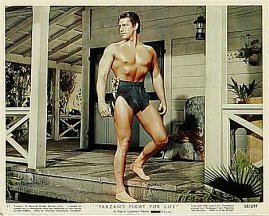
Gordon Scott As Tarzan
Cathneans ERB takes care to ingratiate the Big Bwana with the troops. He has Tarzan and the Cathnean soldiers enter into a spirit of camaraderie as he introduces them to and instructs them in the use of the bow. Nemone is instroduced but seems to take little notice of the Big Guy condemning him to fight in the arena.
Taken to a prison cell he and we are introduced at some length and in some detail to a character named Phobeg. Phobeg is billed as the strongest man in Cathne.
ERB devotes an amazing amount of space to his confrontation between Phobeg and Tarzan. His development of such a minor character is unusual. I think what we have here is a confrontation between Tarzan and the actual man who inspired Burroughs to create Tarzan, the man who was the physical basis of the Lion Man. Phobeg can be no other than the first important body builder in the world- The Great Sandow. Just as in Tarzan The Magnificent Burroughs takes care to indicate that Tarzan has now replaced H.M. Stanley as the symbol of Africa, so here he puts down ‘the strongest man in the world’ in favor of his hero.
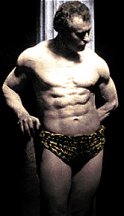
 Sandow (1867-1925) had died a few years earlier. While other muscle men had replaced Sandow, most notably Charles Atlas, Burroughs was still obsessed by the man he had seen at the Columbian Expo of 1893. It would seem certain that ERB occasionally picked up a copy of Physical Culture Magazine to keep up on the latest builds. He couldn’t have missed the memorial copy devoted to Sandow, the greatest and still the greatest of the body builders. The award given to Mr. Olympia is called the Sandow.
While bowled over by the strongman, and strongmen, ERB was always offended by the bunchy muscles created by body building. he repeatedly makes allusions to strongmen throughout the corpus while Tarzan himself is both the antithesis and the perfection of the strongman. That is why Tarzan has smooth muscles flowing like molten metal beneath his skin while in this case Phobeg as a Sandow surrogate has the knotted muscles of the body builder.
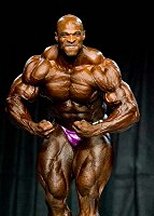
If Burroughs found Sandow’s build offensive he would have gone apoplectic at the most recent champions who seems to have developed musculature as far as it can go. Unlike builders like Charles Atlas, Gordon Scott or Arnold Schwarzenegger who aspired to the Apolline figure, Ronnie Coleman and his successor Jay Cutler have opted for muscle upon muscle until there is nothing but muscle with no attention to a human shape. As an example check out Jay Cutler the current Mr. Olympia and holder of the Sandow at www.emusclemag.com. This guy is only 5’9″ but bulks up at 320 lbs., paring down to 275 for performance. And that is literally all muscle. One look at Cutler and ERB would have been foaming at the mouth
Just as Sandow was billed as the strongest man in the world, so Phobeg is billed as the strongest man in
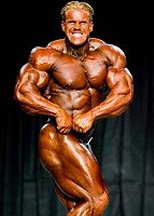
Jay Cutler In Full Pump
Cathne. ERB makes him a braggart in relation to Tarzan but if he was the strongest man in Cathne he had little reason to respect Tarzan’s physique which was more like ‘Apollo than Hercules.’ Tarzan’s strength though greater than Phobeg’s was disguised.
At they are to fight each other to the death in the arena this allows Burroughs to introduce another of his interests which may be related, that of professional wrestling. Burroughs had Tarzan jokingly suggest that they stage the fight much as professional wrestlers. Burroughs who still attended the matches was disgusted becasue the matches were pure entertainment, something he should have applauded. Then as now the professional wrestling matches were staged. Professional wrestling then as now has more to do with entertainment than sport. Either you can get caught up in the fun and drama or you can’t. ERB obviously did although as he still thought of the shows as wrestling he felt put upon.
After several pages of Phobeg’s bragging and Tarzan’s false humility the ‘really big shoo’ begins. Tarzan and Phobeg are the last act on the program and they would have been a difficult act to follow.
ERB must have loved this part as the lenghty description of the gambling taking place is many times more detailed that he usually is. Whether the gambling aspect went on at the wrestling matches he attended or not, I don’t know. The odds naturally are for Phobeg, whose Cathnean reputation is immense and accurate as concerns the past. Everyone expects the inveterate gambler Nemone to bet on the sure thing as was her custom. They hedged their bets when they could at fantastic odds. Nemone then surprised them by betting on Tarzan. Nearly bankrupted the whole coterie of Lion Men.
Tarzan wins of course but refusing to kill Phobeg he instead does his trademark thing lifting Phobeg above his head and tossing him into the stands at Nemone’s feet. Now that is one hard act to follow.
Having now won his liberty, a lion man named Gemnon is assigned custodian of Tarzan taking him under his wing. Up to this point there seems to be no reference to contemporary affairs except for Sandow and wrestling. At this point ERB displays a numerous and surprising set of literary references.
Go To Tarzan And The City Of Gold part two.
Men Like Gods: Tarzan Pays Homage To Heracles
July 9, 2008
Men Like Gods
Tarzan Pays Homage To Heracles
by
R.E. Prindle
First published in the online Magazine: ERBzine
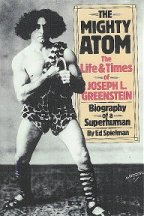
Cover of The Mighty Atom
The Golden Age of Strongmen had captured the imagination of the world between 1890 and 1910….Into the 1920s the strongman continued as a living wonder and inspiring vision that could be had for the modest price of admission
-Ed Spielman: The Mighty Atom:
The Life And Times Of Joseph L. Greenstein
When I was a child and youth in the 1940s and ’50s the legendary strongmen of the turn of the twentieth century were, if no longer living, living legends. At least one, Bernarr Madfadden, the father of American bodybuilding, was still going strong.
The most legendary of the strongmen was Frederick Mueller who was known professionally as the Great Sandow.
In his heyday Sandow was so strong that he was capable of ‘exploding’ or breaking the ‘Test Your Strength’ machines in the arcades of Vienna, Austria. There were so many broken machines that it was thought a vandal was destroying them but when apprehended it was discovered that Sandow was not only testing his own strength but the strength of the machines. He flippantly suggested that they be made of better materials.
On stage as Spielman relates, Sandow, who was trained as a turner, could do a back somersault over a chair with a thirty-five pound dumbbell in each hand. He could do a one arm chin-up with the grip of any of his fingers of either hand, including his thumbs.
He could…wait a minute! I’ve heard something like that before. Oh yea, I remember now. In Edgar Rice Burroughs’ Tarzan And The Lion Man he has Tarzan leap up to seize stakes pointing down from a ten foot high wall, then draw himself straight up until his torso was above the stakes, then roll over the top defeating the purpose of the stakes. Was he thinking of the Great Sandow when he wrote that?
I think he was.
Burroughs was a fan of boxing and a great admirer of the strongmen of the Golden Age, although he didn’t like the bulky physiques. He repeatedly denounces the physical build of the Strongmen in preference for Tarzan’s ‘smooth rippling muscles.’ In my day the bodybuilders were ridiculed as being ‘muscle bound.’ But the ladies panted when they said it. Tarzan is as strong or stronger than the strongmen but sleek.
Next one asks is there any place that it can be shown that Burroughs ever saw Sandow? yes, and where else? The Chicago Columbian Exposition of 1893. The Expo was a life changing experience for 17 year-old Ed Burroughs. Bill Hillman of ERBzine has written a wonderful series on the influence of the Fair on young Burroughs.
The influence of the Fair was as moving for the rest of America and the World as it was on Our Man. There apparently has never been so influential a World’s Fair as that of Chicago of 1893.
One of the best attended features of the Fair was put on by the Great Sandow. Bodybuilding had already gotten started in England. Sandow was a student of the innovative Professor Attila in London. He came to the attention of Florenz Ziegfeld while performing in New York. Ziegfeld brought him to Chicago for the Expo. Sandow was a sensation.

The Great Sandow
He created quite a stir at the fair. Not only did Burroughs see him there but so did a man named Bernarr Macfadden. At the time he was known as Bernard McFadden but he chose Bernarr because it sounded more like a lion’s roar and Macfadden because he thought it looked more distinguished in print. As a result of seeing Sandow Macfadden became the father of bodybuilding and the health movement in the United States. John Dos Passos spoofs him in Vol. III, The Big Money, of the his USA Trilogy.
Macfadden was the discoverer of isometric exercises, which his student, Charles Atlas, renamed Dynamic Tension and made a fortune.
Unless I’m mistaken Macfadden would cross ERB’s path sometime between 1908 to 1912.
Sandow made bodybuilding a rage after the Fair while Macfadden organized the sport around his magazine ‘Physical Culture’ which he began publishing in the wake of the Fair. Sandow also opened the way for a number of strongmen to build careers on their physiques.
They all passed through Chicago. How many of them ERB paid the modest price of admissio to see we can’t know, but as he always speaks of the strongmen in the plural one assumes that he saw several.
Anyone who has watched the Strongest Men In The World competition on cable TV will understand how impressive both the feats and the physiques of these men were.
In ERB’s day a man called Warren Travis Lincoln could lift a platform that held twenty-five men with his back. That was a weight of about 4200 pounds.
G.W. Rolandow could stack three decks of playing cards and tear them in two. One assumes that was before they were plastic coated.
Emil Knaucke who weighed in at five hundred pounds, a spectacle in itself, could hold a car above his head with one hand. Spielman doesn’t specify make or model.
Louis Cyr, one of the most famous strongmen, could restrain a team of horses on either side at the same time. Really spectacular stuff.

Bent Press Arthur Saxon
A man like Arthur Saxon of the Saxons was considered to be the strongest man in the world. He could do a bent press of nearly five hundred pounds. As in the photo, in the bent press a lifter raised a barbell above his head with one hand in a bent posture then raised another weight with his other hand.
Eighteen ninety to nineteen-ten were formative years for ERB. He would have from fifteen to thirty-five so that when he saw Sandow in ’93 at seventeen he was at a most impressionable age.
ERB turned 40 in 1915 and 50 in 1925.
By the twenties vitamins and food supplements had been discovered and were being developed for commercial use. Vitamins were still novel when I was kid in the late forties. Not everyone knew of their value as late as then.
The Great Sandow, Louis Cyr, and a trio of German strongmen called the Saxons were all naturally strong but by the 20s it was possible to build muscular Adonae from the scratch of a 98 lb. weakling. With vitamins, food supplements and a rigorous regimen for bodybuilding a normal body could be turned into as mammoth a specimen as Tarzan, as witness Arnold Schwarzenegger and his contemporaries who emerged from New York City gyms in the 1960s.
In point of fact you didn’t even need all that gym equipment. If you followed the body building plan of the most famous Adonis of the 40s and 50s, Charles Atlas, all you needed were your own opposed muscles.
Atlas took Macfadden’s isometric exercises and called them the more commercial sounding Dynamic Tension. By pitting one muscle against its opposite fantastic results could be achieved.
Charles Atlas, who changed his name from Angelo Siciliano, was voted the world’s most perfectly developed man in 1922 by his mentor, Macfadden and Physical Culture magazine.
Angelo, born in 1894 in Acri, Sicily came to the US in 1904, thus he would have been 18 in 1922, 18 in 1912.
Siciliano actually had been a 98 lb. weaking who had sand kicked in his face by a bully. His girl friend actually did walk away from him. Siciliano then built himself up into what I’ve always considered to be the image of Tarzan and changed his name to Charles Atlas.
I was not as successful with the Dynamic Tension plan Chuck sold me in the 50s but then I didn’t try that hard and I couldn’t afford the food supplements which are indispensable. Nevertheless it had become possible to turn out ‘Men Like Gods’ on an assembly line basis.
It is more than likely that Burroughs was very familiar with the bodybuilding or fitness program of Macfadden. That photo of him flexing his muscles on the dock at Coldwater is that of a man who has been working out. I can’t beleive that a man who was interested in magazines as Burroughs was couldn’t be familiar with Physical Culture Magazine. Not only would he have the living memory of the Great Sandow in his mind from the Expo but Bernarr Macfadden had moved his headquarters from Battle Creek to Chicago in 1908. He had a very prosperous looking facility.
During these years from 1899 when ERB was bashed in the head in Toronto to 1910 at least, he complainedof excruciating headaches that began when he got up in the morning and lasted through half the day. These would have been very enervating affecting his ability to work. In The Girl From Farris’s he has his hero Ogden Secor suffering from the same headaches going from doctor to doctor ‘tinkering with his skull’ in hopes of finding relief. The doctors could do nothing for Secor so he undertook a fitness regime which eased his situation. So must have ERB.
Once again, the picture of ERB standing with his legs apart flexing his muscles on the dock at Coldwater in 1916 shows that he was either proud of a moderate physique or he was trying to develop those ‘rippling’ muscles like Tarzan and Charles Atlas.
At fifty in 1925 ERB probably thought himself beyond the age when he could develop his physique into a semblance of his creation, Tarzan. Ten or twenty years younger and you might have seen Burroughs as another Charles Atlas or Tarzan.
There is every reason to believe that sometime between 1908 and 1912 he developed an interest in Macfadden’s program.
When he sat down to begin his Tarzan series at the end of 1911, Burroughs’ mind must have been filled with the feats of Sandow and the other strongmen. Anent this, Tarzan’s leopard skin loin cloth was borrowed from the strongmen. Leopard skin shorts were de riguer for the bodybuilding crowd.
Of course the role models for these strongmen were Samson and Heracles. The latter is better known in his Roman usage as Hercules. For the purposes of this essay I will refer to him as Heracles in hs Greek manifestation.
Especially in his original manifestation Heracles was a Sun god as the companion of the Earth Mother, Hera. When the Patriarchal system was imposed on the Matriarchy Hera was wed to Zeus while her former consort, Heracles- The Glory Of Hera- was demoted to the role of Holy Fool and the strngest man in the world.
ERB often refers to Tarzan as a Jungle God and a latter day Hercules. Burroughs had a good Greek and Latin education so one might asume that he had some familiarity with the cycle of myths devoted to the feats and tribulations of that ancient type of all strongmen, Heracles.
In fact, without stretching the point unduly, one can posit a relationship between the Pelasgian Sun God, Heracles and the Flaming God of Opar and through them to Tarzan; they can be construed as one.
Whether ERB was conscious of what he had done in conflating the three cannot be determined for sure but as he was manipulating valid historical data why shouldn’t he have been conscious of what he was doing? The Aztec ritual of tearing the heart out to offer to the sun god is implicit in scenes where Tarzan lies across the sacrificial block, pardon me, altar. The annual sacrifice of the queen’s consort is implicit once again as La raises the sacrificial knife. A blatant resemblance to Cybele and Attis.
While the subconsious is always important it is the conscious mind that organizes, plots and writes. As a writer I may have subconscious motives which may emerge but assembling and organizing my material is a conscious intellectual act. It is axiomatic that one cannot write what one does not know.
One of the great mysteries of mythological studies has been the relationship of Heracles to his namesake the former Matriarchal Earth Goddess, Hera. I noted just previously, during the matriarchy as the Sun, Heracles would have been appropriately called ‘The Glory Of Hera’ or of the Earth. The same notion can be applied to Mesopotamian and Egyptian mythology. For instance, as David Adams points out somewhere, the lion is a symbol of both the sun and the matriarchy. It is a fact that the body of the Sphinx at Memphis is older than the head. The head of the original has been replaced by that of a man. It therefore follows that the Sphinx was carved during the Matriarchy having either a lion’s or a woman’s head. After the succession of the Patriarchy the head was changed to reflect the New Order.
In the Greek Oedipus myth the Theban Sphinx was still represented as the original matriarchal symbol of a lion with a woman’s head. Woman-lion/sun/Heracles. The answer to her riddle after which she committed suicide was ‘man’ which denied the Matriarchy, hence she had to kill herself as the Patriarchy thus symbolically replaced the Matriarchy. Apply that to the Egyptian Sphinx and the change of heads.

Theban Sphinx
Now, the original Egyptian Sphinx was exactly the same as the Theban Sphinx: a woman’s head on a lion’s body. the Sphinx is positioned to be looking due East at sunrise in the Age Of Leo. Thus, perhap, the secret of the Sphinx is simply that as Mother Earth she sat waiting for her consort Heracles (or his Egypian counterpart) to appear on the horizon each morning.
The notion has simplicity to recommend it.
As we all know, Oparians were a group of Atlanteans isolated from the main body when mythical Atlantis broke apart and sank beneath the waves of the Atlantic Ocean. The worship of the Flaming God was inherited from the parent civilization by Opar.
Thus whether Burroughs knew what he was doing or not he always gets the sequence of events right.
Without getting into any discussion of if, where or when Atlantis may have existed, let me say, neverttheless, that all the evidence points to a predecessor civilization anterior to Crete, Pelasgian Greece, Egypt and Mesopotamia in much the same way Atlantis preceded Opar.
The predecessor civilization must have existed in the Mediterranean Basin during the last ice age when ocean levels, scientists tell us, were several hundred feet lower than they are today. There are evidences of quarrying several hundred feet below sea level on the flanks of the island of Malta for instance. Given this as a fact, then when the ice melted and the waters rose during the Great Flood to their present levels any society or civilization that existed in the Mediterranean Basin was forced to move to higher ground which is to say above the present sea level.
One thing is certain, if the Basin was habitable it was inhabited.
The disruption caused a long dark age from which mankind only slowly recovered. At the same time these relatively highly developed people moving into less developed savage societies had a fertilizing influence introducing more sophisticated ideas and methods such as agriculture.
Lower Egypt, one of Two Lands, was obviously settled by the displaced Libyan dynasty. After centuries of warfare the Upper Egyptians succeeded in conquering Lower Egypt uniting the Two Lands. The Third Dynasty was a Libyan Dynasty so that the warfare was translated from an external one to an internal one in which the Libyans defeated the Upper Egyptians. During the Libyan Dynasty the great pyramids were built reflecting in some way the the flooded predecessor civilization.
So Crete and Pelasgian Greece received survivors also. The Sumerians of Mesopotamia attribute their civilization to the advice of Oannes, John in English, who came from the sea.
Often ignored by classical scholars but obviously part of this great Mediterranean culture is ancient Spain. Now, Spain has one of the great traditions of the worship of Heracles as a Sun god. This tradition preceded and was uninfluenced by any Patriarchal tradition from Greece. In point of fact the Patriarchal Heracles went West to annex the Spanish traditions to the Patriarchal cause. In the process he rounded up the cattle of the Sun i.e. the Matriarachal Heracles to bring back to Greece. Throughout history, including modern Africa, lifting another man’s cattle transferred his authority to oneself. See the great cattle raid of Cooley in Irish mythology. It therefore follows that the Greek Patriarchal myths of Heracles are built on an earlier Matriarchal mythological cycle while being perverted or converted to Patriarchal needs.
Heracles was originally a sun god. He was the original of the Flaming God. I can’t say Burroughs knew this either consciously or subconsciously, however as we will see there is substantial evidence to indicate that he was consciously manipulating the material.
The city of Seville in Spain is built over a Sun Temple in which Heracles was the sun deity. This site beneath Seville can still be vistited today. Assuming that the history of the Spanish Heracles developed independently of the Greek Heracles which after all is a Greek interpretation of a Pelasgian god then it follows that the two traditions must have come from a common source. That source cannot have been other than the ante-deluvian civilization of the Mediterranean Basin.
It follows then that whatever names they were known by in this anterior civilization Hera was the Great Mother Goddess while her ‘Glory’ Heracles must be no other than the Flaming God, the Sun. What else could the ‘Glory’ of the Earth Mother be?
Thus when the Great Flood, which must be the same as that spoken of by the Sumerians who would have gotten the story from Oannes, destroyed the civilization of the Mediterranean Basin the inhabitants fled to the former highlands surrounding them taking their traditions with them. The Spanish Heracles was yet identical to the Pelasgian and Cretan models which later became variant.
When the Greeks entered Pelasgia at the beginning of the Arien Age, the Zodiac dates back to the anterior civilization, they found this remnant of the ante-deluvian civilization with immemorial religious traditions occupying the land. As the Arien Age began a great shift in the mental and social organization of man progressed in its evoltuion. The shift was from a Matriarchal consciousness to a Patriarchal consciousness. In other words, the God replaced the Goddess as the most important sex. Fecundation became more important than actual reproduction.
This meant that all the divine myths had to have all the sexual relationships reversed so that the God took precedence over the goddess. Hera could no longer be allowed to have a male god as her subordinate ‘Glory’, the roles had to be reversed. Hera would have to become the dependent of Zeus.
Homer’s Iliad is one key in the story of this reversal.
As Hera was unwillingly made subordinate to her Lord and Master, Zeus, Heracles had to be appropriated by the God. The Patriarchy then turned Heracles into a scourge of Hera and she his enemy in ridicule of the previous dispensation. Kind of a Burroughsian style sly joke.
The meaning of the name Heracles as the glory of Hera was thus lost. Heracles lost his identification with the Sun becoming a buffoon as the greatest of men; a physical giant of somewhat dim intelligence. Hera’s glory was turned into a laughing stock but still a good sort of fellow who could aspire to godhood at death.
In the Patriarchal myths Heracles destroyed various Matriarchal cult centers such as the Hydra at Lerna, the Stymphalian Swamps, the Stag of Artemis, the Nemean Lion and others. His cycle of adventures was involved in replacing the Matriarchal with the Patriarchal sarcastic ‘Glory’ of Hera.
To make a feeble Patriarchal attempt at accounting for the meaning of Heracles’ name Homer tells the following story in book XIX of the Iliad. Zeus, influenced by the goddess Folly, announced to the assembled Gods on Olympus that before the day was out a descendant of his lineage would be born to a mortal woman who would be the greatest man in the world.
Hera, who hated the infidelities of Zeus, heard his proclamation with scorn. She knew her husband but too well. She knew he referred to Alcmene who was bearing Heracles but she also knew that a son was to be born to the wife of Sthenelus who was only seven months pregnant. Sthenelus was of the lineage of Zeus.
Hera rushed off to visit Eileithyia, the goddess of childbirth, to ask her to hasten the birth of Eurytheus while delaying that of Heracles. The former having been born first became the greatest monarch of the age after the Patriarchal fashion but by Matriarchal means.
Hastening back to Alcmene Eileithyia uncrossed her legs allowing Heracles to be the younger son of Zeus born on that day. While Heracles was the bravest and strongest of men he was nevertheless compelled by Hera’s resourcefulness and prompt action to be subservient to Eurystheus. Thus the will of Zeus which could not be averted was perverted by Hera to thwart the Big Guy’s will.
Heracles was still the strongest man alive but he was subordinate to the will of Hera through Eurystheus, portrayed as one of th weakest and most cowardly men of his time hiding behind his mother’s skirts but by the grace of Hera and the matriarchy, the greatest ruler.
Zeus, appalled by his lapse of judgment threw Folly off Olympus from which she is still banned.
In that sardonic manner Homer explained the meaning of Heracles as the glory of Hera. She had used him to Ace Zeus. Heracles had been stripped of his role as the glorious Sun companion of Hera. He comes down to us as the strongest man who ever lived. In the Roman nomenclature of Hercules he became the role model of every strong man who ever lifted a dumbbell. Yet they all wore leopard skin shorts, the leopard being a symbol of the Matriarchy. You can’t fool Mother Nature.
To Burroughs who was a student of Greek mythology the great strongmen of the Golden Age must have appeared as men like gods. Their feats of strength, their marvelous physiques, were so far beyond the abilities of ordinary men that they must have seemed to be in a class by themselves far above mortal men.
In that sense Tarzan is the greatest of the strongmen, above Sandow, Arthur Saxon and even Heracles.
Heracles himself had been demoted to a mere mortal although his legend was so great that he was allowed immortality by the Patriarchy after his mortal death. Unwilling to grant him too much credit he was allowed to be the doorman of Olympus. He held this position throughout the Arien Age being replaced by St. Peter in the New Dispensation of the Piscean Age.
Burroughs, familiar with the mythic cycle of Heracles, however he understood it, plays with both identities of Heracles in the person of Tarzan at Opar. He also brings in a number of elements from H. Rider Haggard’s novel She. There can be no doubt of the influence of Haggard. Burroughs even names his heroine La which is what ‘She’ is designated as in French translations of Haggard’s novel. The palance of Opar is also based to some extent on the labyrinthine caves of She.
There are many literary influences for the creation of Tarzan not least of which are the real life H.M. Stanley and Haggard’s fictional heroes Sir Henry Curtis and Allan Quatermain. I would now like to direct attention to a third, that of the heor of She, Leo Vincey.
If one closely examines Vincey it will be discovered that he too was a Sun King whose death had been caused in an earlier incarnation by She. The cartouche which contains the name of Leo’s distant Egyptian ancestor was translated as ‘The Royal Son Of Ra’ or son of the Sun as in Egyptian mythology Ra is the sun.
Leo also translates from the Latin as Lion so we have the Son of the Sun who also is a Lion Man which is how Burroughs refers to Tarzan in ‘The Invincible’ and undoubtedly as how he always thought of his creation.
Haggard translates Vincey as the Avenger. Tarzan is the ‘Avenger’ or guard of Africa. Haggard describes Vincey as almost inhumanly beautiful while Tarzan is the most handsome man in the world not unlike Charles Atlas.
Haggard’s She is indescribably old kept forever youthful by having bathed in the fire of eternal youth. Hera was also eternally youthful and a virgin queen. She restored her youth and virginity by bathing annually in a holy spring. Hera’s bath obviously refers to the Spring rains which inundated Mother Earth just prior to vegetation springing forth in virgin birth. After the summer heat the vegetation dies down and Earthy Hera becomes barren once more to await her bath and return to virginity.
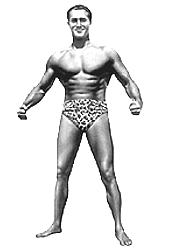
Mr. Dynamic Tension- Charles Atlas
So a connection can be made between Sun>Heracles>Vincey>Tarzan and Mother Nature>Hera>She>La.
Burroughs La was neither ancient nor immortal in the personal sense although she was the latest in an immortal line of Priestesses. She is a priestess of the Sun or Ra, The Flaming God.
Haggard’s Leo Vincey was the direct descendant of Kallikrates She’s great love of two millennia past. She, or Alyesha, to use her name, had killed Kallicrates in a rage. Kallikrate’s descendants were sworn to avenge the murder. Thus Vincey travels from England to far off Africa to locate this fabulous woman.
Kallikrates was the love of Alyesha’s very long life. When she recognizes Leo Vincey as her lost lost love she saves his life while offering him eternal youth if he will only bathe in the flames of eternal life. He hesitates to do so. To encourage him Alyesha steps once again into the flames which was a serious miscalculation. She crumbled to dust. Thus while Leo Vincey doesn’t actually avenge the death of Kallikrates she is nevertheless his victim.
Tarzan while actually born in Africa was conceived in England so he made the trip to Opar from England although he is ignorant of La. When Tarzan is captured in Opar he is laid on the altar of the Flaming God, La with the sacrifical knife raised, looks down on this Jungle God, this man like a god, and falls in love. Thus we have a replay of the She-Kallikrates situation.
Unable to take Tarzan’s life, La releases him begging him for his love. Alyesha’s full title was She-Who-Must-Be-Obeyed in the Matriarchal sense. The old conflict arises, Tarzan is more on the Patriarchal side, he has his moly in the waistband of his loin cloth, monagamous we are led to believe, happily married, so the Lion Man Sun King declines the honor of being mated to La>Hera. He asserts his Patriarchal prerogative to disobey although he always has a soft spot in his heart for La.
In a fairly masterful way ERB conflates the legend of Heracles, the fiction of H. Rider Haggard and the incredible strongmen of the Golden Age and his own little bit to write a charming and beautiful story which is fairly simple on the surface but one which becomes immensely rich with a deeper understanding of the sources.
Ernest Hemmingway once said that before one sat down to write one should have ten time the information in your possession as you put on paper else the story will seem shallow and contrived. It would seem that the sources upon which Burroughs was drawing, from the bodybuilding strongmen of his day to the legendary cycle of Heracles to the adventures of H.M. Stanley and the fiction of H. Rider Haggard might well fulfill Hemingway’s dictum.
When one searches for the sources of Burroughs one finds layer after layer of golden riches while discovering that in fact ERB did indeed create a man like a god- Tarzan The Magnificent.
Addendum
This is a quote taken from Bonzo Dog’s song Mr. Apollo. I don’t know whether the reader is familiar with the Bonzos but they were one of my favorites. Several glorious LPs. Neil Innes came from them as well as the great but tragic Viv Stanshall. Leave those drugs alone, boys.
Follow Mr. Apollo,
Everybody knows a healthy body
Makes a healthy mind.
Follow Mr. Apollo,
He’s the strongest man the world has ever seen.
If you take his courses
He’ll make you big and rough.
And you can kick the sand right back in their faces.
A few years ago I was a four stone apology-
Today, I am two separate…Gorillas.
Bonzo Dog Doo Dah Band
Long may they wave.
Book II Something Of Value 1
December 31, 2007
Something Of Value
Book II, Part 1
Edgar Rice Burroughs, Evolution And Religion
by
R.E. Prindle
God is not a cosmic accident;
Neither is he a universe experimenter;
The Universe Sovereigns may engage in adventure:
The Constellation Fathers may experiment:
The system heads may practice;
But the Universal Father
Sees the end from the beginning…
-The Book Of Urantia
Preface
While understood as a lightweight fantasy author Edgar Rice Burroughs tackled most, if not all, of the burning questions of the late nineteenth and early twentieth centuries. One of those questions was the nature of Time. H.G. Wells excited the world’s mind with his short novel, The Time Machine, in 1895. This was still an astonishing story when I was a kid; for all I know it still is. In his own way Wells hinted at possible universes. Then in 1905 Albert Einstein astonished the world with his Special Theory Of Relativity that posited certain ideas about Time and Space. Einstein undoubtedly owed a great deal to H.G. Wells. Einstein’s theory is posited on the objective existence of Time. In his Pellucidar novels beginning in 1913 Edgar Rice Burroughs denied the objective existence of Time. He said that Time didn’t exist as an objective reality.
I am in agreement with Burroughs. He examines the problem at great length not only in the Pellucidar series but in Tarzan At The Earth’s Core and Tarzan The Invincible.
He examines the problem of violence and war in detail with numerous examples including his final statement in Beyond The Farthest Star.
It shouldn’t be surprising that Burroughs dovetailed these questions into the really big questions of Evolution and Religion. He doesn’t argue Evolution he just takes it for granted. If you read only Burroughs you would have no idea that Evolution was a very controversial subject. He just assumes that his views are the norm and proceeds accordingly. Very daring for his time period.
On Religion his surface opinions which are conventionally anti-Priestcraft are more polemical in nature but, as Burroughs scholar Dale R. Broadhurst points out in his Gods Of Edgar Rice Burroughs series on the ERBzine magazine site, http://www.erbzine.com when you examine certain religious systems such as that of Opar closely Burroughs reveals some very subtle distinctions. He had read widely while the religious milieu of the late nineteenth and early twentieth centuries was particularly strong. For the first time society tolerated men like Robert W. Ingersoll who openly denounced religion and the very idea of God. Helena P. Blavatsky who presented a religion opposed to Christianity was also allowed to live. The price was that they were demonized in every way; but they were allowed to live.
The great archaeological discoveries in Egypt, Greece, Crete and Mesopotamia were seriously undermining the validity of the Jewish Old Testament. To the doubting or perceptive the scriptures were found to be based on much earlier texts as well on a much longer time line going back millions of years rather than a mere five thousand.
So, in this essay I would like to examine the evolution of the species and religion with an idea of how Burroughs understood them. It is important to remember that the state of knowledge in Burroughs’ time was much developed developed relative to the beginning of eighteenth century but primitive to what has been learned since 1950.
In his time and well into mid-century it was possible to seriously argue the question of canals on Mars for instance. We have now seen that there are no canals on Mars or anything approximating them. Since 1950 everything that was valid speculation in Burroughs’ time has now been shown in its true light, or at least, 90% or so.
The science of Biology has laid bare the progress of Evolution although it hasn’t explained it. Even so, no doubt fully 50% of Americans still denies the possibility, bound instead by the puerilities of ‘sacred scripture.’
Make no mistake, Edgar Rice Burroughs was a daring, ground breaking, forward thinking writer who put his fast ball over the plate waist high so hard that few people saw it.
1.
Scientists nearly universally believe that the genus Homo Sapiens originated in Africa. Most put a moral spin on this but if true it is merely a fact. Certain genetic markers point to this fact. Indeed, in Gods Of Mars, in itself a subtle examination of evolution, ERB describes his Black race as the First Born. He himself picked up the idea from the nineteenth century missionary David Livingstone from his book Missionary Travels In South Africa.
In Livingstone’s book in a conversation with a Bushman the Bushman tells Livingstone that God created the Black man first, then the White man.
Thinking in a Darwinian way Burroughs reasoned that first came the anthropoids then the Blacks and then the Whites. Thus, of the Homo Sapiens species the Blacks were the First Born. If the current scientific information is accurate then this is true. Burroughs was on solid evolutionary ground.
Current science teaches us that Homo Sapiens evolved from less mentally developed stock about a hundred fifty thousand years ago. As the most highly evolved hominid Homo Sapiens has displaced all other lines of development. The Neanderthal who existed as a separate hominid species until perhaps ten thousand years ago is now gone. As a distinct species it is generally now acknowledged that there was no inbreeding with Homo Sapiens.
In Africa all the predecessors of Homo Sapiens have also disappeared without a trace. As nature does not make great leaps but acts in small increments it is reasonable to believe that at one time several sub-species of hominids existed when Homo Sapiens first evolved one hundred fifty thousand years ago. Indeed, it is neither impossible nor improbable that the Bushman is the immediate predecessor of the First Born. If examined carefully and without prejudice it is possible that two or three sub-species of hominid predecessors are still alive.
Had the White man not interfered it is quite possible that the invading Bantus would have exterminated these peoples who had already been expelled from the rest of Africa into its Southern tip. An analogy would be the Gorillas who once surely roamed a greater range but are now pushed into the least habitable areas of the rain forest.
Even today the surviving species of anthropoids are finally being exterminated, much as the Neanderthal probably was, as the burgeoning population of Homo Sapiens cuts and burns over their jungle habitat. Except for zoos the great anthropoids are a thing of the past.
If the African was the first born then it follows that Whites, Semites and Mongolids evolved from the African. This raises a testy problem. Evolution means the development from a less developed organism to a more highly developed organism. As physically Homo Sapiens is developed to perfection being the most versatile of all species the only place development can take place is in the area of intelligence.
The development of the brain is what gives the Homo Sapiens the advantage over the anthropoids and all other beasts. A gorilla with human intelligence would be one formidable beast. Some argue that the brain began developing in response to challenges presented to it. This argument doesn’t explain why the Chimpanzees presented with the same or slightly different variations of the same problems, didn’t increase in brain capacity.
The above account assumes that evolution occurs for environmental reasons. This is patently impossible. When life was originated it was from internal reasons. As we all know life is dependent on water. Contrary to the Semitic account in the Bible man was not made from mud. It’s water. How life came into existence can be easily explained but probably not universally agreed with. The body has been described as a sack of water with a few elements dissolved into it. This is true so it is only necessary to determine how it happened. That too is not difficult to conjecture. Homo Sapiens and all life is built of the same universal elements of the universe. Most of a body is of six elements, Hydrogen and Oxygen being the most prominent followed by Nitrogen, Carbon, Phosphorus and Sulphur and a smattering of other elements.
It is impossible that water should have been introduced to earth from outer space. Forget outer space. Water was extruded from the core.
When a sufficient amount of water was formed on the surface rich with the above mentioned dissolved nutrients exposed to the sun for photosynthetic development it would seem obvious the atoms jostled against each other exchanging protons and bonding into molecules that in turn formed larger units and thus became animated. These single celled organisms than began to evolve in a number of directions. For millions of years life was confined to the seas of the world. Then in what seems as it though must be a programmed manner life left the water and began its existence on land. In what manner a program of evolution is encoded is beyond my understanding.
Rather than in response to the environment, evolutionary steps occur when a number of genetic mutations take place finally accumulating to the point where the next development takes place. Thus the number of pre-Homo Sapiens hominids ran through a long series of sub-species before Homo Sapiens emerged, as our scientists tell us, as the African First Born.
Now, most people assume that evolution ceased with the emergence of the First Born. The differences between the First Born, the Semites, Mongolids and the Whites are said to be merely cosmetic. The First Born bleach out in cold climates is their argument.
However it is quite obvious that evolution is still going on and that in Homo Sapiens. Very recently scientists have penetrated the chromosomal structure being able to identify the individual genes that compose each chromosome. While new studies of the functions of the various genes are very likely to be subject to revision nevertheless on 12/29/04 the Chicago Tribune published a report on studies conducted by Bruce Lahn at the University of Chicago.
Quote:
Reporting in the cover article in Wednesday’s issue of the journal Cell, Lahn and his colleagues, Eric Vollender and Steve Dorus, found that 17 brain building genes mutated at a tremedously rapid rate in humans, compared with the brains of champanzees, macaque monkeys, rats and mice….Once started, the selection of brain building genes snowballed, resulting in thousands of changes to thousands of genes in a relatively short period, Lahn explained….Lahn, also a Howard Hughes Medical Institute investigator at the U. of C., argues that the evolutionary forces that led to the big brain continue to act on humans today and are likely to produce bigger and better brains in the future.
Unquote.
Sign me up for a transplant when they’re available. Rapidly means over a few million years. Needless to say Lahn was forced to recant within weeks of his announcment declaring his findings null and void as the anti-Science creationists sprang into action. Just recently of course James Watson was forced to recant over similar comments regarding Africans. Watson was fired from his job; so far as I know Lahn was allowed to keep his. Thus bigots censor the truth.
The question is whether the same brain development is shared by all five species of Homo Sapiens or does the next evolutionary step surpass the abilities of the last. I’m afraid the latter must be true or there would be no reasonn to distinguish Homo Sapiens from its hominid predecessors. The latter would still be among us fully able to compete otherwise. Logic must prevail against Liberal bigots.
While many argue that the First Born left Africa to populate the world I do not find the opinion credible. If certain genetic markers indicate that the other four species evolved from the First Born that should explain the genetic markers.
What very likely happened is that the proto-Europeans who, let us call Homo Sapiens II- HSII- having evolved were either driven from or chose to leave Africa. Whether the Semites and Mongolids evolved from the First Born or whether they later evolved from HSII isn’t clear but I suspect the former in the case of the Semites and the latter in the case of the Mongolids.
It would seem that a sub-species once evolved has its set of attributes that can be developed within limitations but are incapable of change. Thus there were genetic changes to the brain of those evolved from the First Born while the First Born must remain mentally constituted as he was when he evolved one hundred fifty thousand years ago.
Nevertheless he was the first state of Homo Sapiens, the Main Evolutionary Stem. Obviously in the evolution of a genus there can be and have been many dead ends such as the Neanderthal of which we know but there were probably many dead end offshoots from the Main Stem over the twenty-five million year course of brain building.
While the Semite and Mongolid are more developed than the First Born they must be dead end evolutionary shoots. The main Stem of Evolutionary development was passed to the people who settled the Mediterranean Basin as it lay exposed during the last Ice Age. When they evolved isn’t clear but I imagine it may have been perhaps fifty thousand years after the First Born, say, one hundred thousand years ago.
With them the capacity for Civilization began. The First Born never created a civilization. Aided by additional genetic brain development the Meds approached life with an early scientific vision. Sometime later, perhaps another fifty thousand years, a further improvement in brain capacity created HSIII. Thus as the Neanderthal still roamed Europe with Homo Erectus still living in the East, and there is a problem there, the First Born occupied sub-Saharan Africa, the Semites the Arabian Peninsula, the Mongolids East Asia, HSII the Med Basin, and as groups will not tolerate other groups HSIII was driven away from HSII to occupy the area between the Caspian and Aral seas or perhaps the Central Asia steppes cheek by jowl with the Mongolids. That might seem to indicate that HSIII and the Mongolids are fairly closely related.
Van Daniken and others like to posit the notion that civilization began when extra-terrestrial visitors having landed and been greeted cordially, which is very unlikely, in a most friendly fashion instructed the rude savages who had no understanding into a very high civilization nearly overnight. Nice fantasy, although before you condemn this school remember accredited scientists believe both water and life arrived on Earth as extra-terrestrial hitchhikers on meteors.
I believe neither account. HSII began a long laborious effort to rise from ingnorance to knowledge the old fashioned way, hard work. Nor do I think it took that long for them to begin. Most scholars think that discovering the shortest day of the year took ninety-five thousand years for HSII to do. HSII could never have been that stupid. Building the tools to pass on the knowledge was a slow laborious process but certain men recognized the possibilities immediately and began to act on them.
Knowledge is a dangerous thing especially when that knowledge contradicts perceived reality as Bruce Lahn’s and James Watson’s treatment shows us to this very day. Thus, whatever the avant garde learned that the masses couldn’t accept had to be kept secret. In order for the work to go forward colleges of cognoscenti had to be formed. In order to protect them they had to be made inviolable or sacred. Hence Religion and the Priesthood arose.
The Priesthood was originally meant to develop and protect these acquisitions of knowledge. This function would endure until the differentiation of knowledge became noticeable in eighth century Greece. From that point on knowledge and thought take on a role independent of religion. From that point on the Priesthood had outlasted its function. Instead of encouraging the growth of knowledge it chose to suppress it.
Thus the tradition of denigrating the Priesthood arose. Edgar Rice Burroughs took this stance throughout his work. ‘Religion’ per se is imagined to be OK but the Priesthood had corrupted it. Burroughs and others imagined a time when a ‘pure religion’ a ‘natural religion’ existed. The differentiation of Religion into its three components or, in other words, the increase of knowledge was the culprit.
The Theosophist Helena Blavatsky sought to reconcile the three parts into one whole as it had once been. In point of fact Science was subsuming the other two.
Given a few thousand years of observation, if indeed, it took that long, a method for determining the shortest day of the year is relatively easy. Certainly the big brained HSII could tackle that problem.
The means of proof are indirect of course, but I believe shortly after leaving Africa for the Mediterranean Basin HSII did discover how to determine the Winter Solstice. With that discovery the worship of the Sun began. This would then evolve over the next ninety-eight thousand years into the religion of the Unconquerable Sun as practiced by the Roman Emperor Heliogabalus and not just coincidentally in the religion of the Christ. The Christ is a Sun King. I say the Christ and not Jesus Christ because the latter name is a title affixed to the discredited Jewish prophet Jesus of Nazareth. More on that later.
Having once determined the length of the year it soon became obvious that by counting forward, the length of a sun cycle was approximately three hundred and sixty-five days. This is not a difficult task although it may have taken a few decades or even hundreds of years to get it right especially as that extra quarter day every year would have been a real clinker.
Once having determined the length of the year the college of Priests could then determine the time of the recurrence of natural events during the seasons. When we speak of ‘Time’ this was when time was born. Then gradually, in however crude a form the concept of the months came into existence. These divisions which numbered twelve became known as the Zodiac.
This was the beginning of the Astrological Religion of which Pisces or Christianity is only one Age. As we know the Zodiac only as the band of astral constellations surrouding the planet the divisions of the Zodiac make no sense.
First let me explain the terrestrial meaning of the signs then I will explain how and why they were translated to the heavens.
2.
The Zodiac
It is best to begin with the Winter Solstice which is when the Unconquerable Sun triumphant once again begins to wax toward the Summer Solstice when the forces of evil triumph driving Sol ever backward until once again with the Winter Solstice the Sun conquers yet once more beginning to wax. This is the central myth of the Mediterranean.
I can only apply the modern Zodiacal symbols which in themselves are of Cretan-Greek origin dating back to at least -2000. One may assume that over the millennia the symbols were modified but the meanings remained the same.
At the beginning of the year we have Sagittarius the Archer who is half horse half man. The horse corresponds to the first half of the year while the Archer facing the new year shoots his arrow into the air. The destination of the arrow is the Summer Solstice when I imagine it strikes Sol Invictus in the heel, much as Cancer the Crab seized Heracles by the heel dragging him toward the waters in symbol of the Sun’s decline.
After Sagittarius is Capricorn, half goat half fish. The fish probably denotes the beginning of the Spring rains while I am unsure of what the goat signifies, perhaps pointing to the rutting season.
Up next is a very important sign. Soon to be the prevailing age is that of Aquarius. In the Greek Zodiac this sign is governed by Hera. Indeed, the male god Aquarius is pouring out water onto Hera as the symbol of the Earth. The male fertilizes Hera in her capacity as Virgo the Virgin. Soon the Earth will sprout up into Virgin Birth.
Next is Pisces which denotes the rainy season followed by Aries the Ram. The Spring equinox occurs on March 21st in Aries. Equinox as I’m sure everyone knows means an equal day and night. Thus on March 21st the new year begins in earnest. Christ is risen. The Ram may be thought of as butting the new growth from the ground much as in the Greek illustration where Persephone is rising from the ground aided by Hermes and Apollo who chip the earth away to make her rise easier.
Taurus the Bull is just that, a figure representing the exuberant vitality of the new growth.
Gemini or the Twins passes the now nearly waxed year on to Cancer when Sol Invictus once again temporarily meets his match. Cancer is represented as a crab because the crab having captured a victim moves sideways or backwards indicating the shortening days. Thus while the period after the Winter Solstice seems to fly by as represented by the arrow the summer months seem to slowly recede. I don’t know about you but the second half of the year seems to be about twice as long as the first half to me.
Cancer is followed by Leo the Lion when the sun is at its seeming strongest. While the warmth of the sun has made everything grow and prosper the blazing heat of the sun of July causes growth to wither and die. Thus Virgo the Virgin succeeds Leo. This may be a little hard to follow but the Earth becomes barren once again or virgin. After the bath of rain virgin growth will begin again. Thus Hera who is both virgin and matron governs Aquarius who provides the showers in the Greek Zodiac.
Then follows Libra with her scales. the Autumn Equinox begins this period. Once again the night and day are equal hence Libra’s scales tip toward winter at this point.
Rounding out the year then is Scorpio the Scorpion. Its significance possibly is that it kills the old year by biting it on the heel. Sagittarius rises once again to shoot an arrow as the Unconquerable Sun marches on to victory.
It’s a pretty story.
Now, all the time the colleges of Priests were organizing this calendar they were watching the heavens. Much later the Hermetics would be given credit for the formula ‘As above, so below’ and vice versa. It is absolutely ridiculous to attribute the origin of the slogan to such late times. The roots of almost everything can be projected back to very early times. Actually everything can.
Having watched the skies while having developed the Zodiac as an annual terrestrial cycle, these ancients then transposed the Zodiac into the heavens. While watching the sky they noticed without knowing the reason the declination of the planet, that the North Pole because of the resultant wobble described a circle taking about 25,000 years to do so. They designated this phenomenon the Great Year.
Using the formula as above, so below it became clear that the Great Year must have twelve divisions just as the lesser terrestrial year does. So they merely transposed the Zodiac with the same twelve divisions and the same signs onto a belt of stars on the horizon which they organized into constellations that seemed to correspond to the signs.
As each sign corresponded to something over two thousand years in duration these periods were designated Ages with the corresponding qualities of the signs. Hence, when you haven’t seen someone in an age you literally mean two thousand some odd years ago.
How long it took the Ancients to discover the Great Year is beyond me but as I believe the discovery was made by observations rather than mathematics I assume a full cycle to a cycle and a half, perhaps a full fifty thousand years.
There wasn’t any hurry as a lot of other details had to be worked out first. Technology always has to catch up with imagination.
It’s all very well to say this but if true there must be historical evidence to verify its possibility, right? I’ll do my best. In the first place nothing was ever discovered, invented or developed over night. The times for things to come into existence are immense.
Even the transmission of this knowledge from generation to generation is an immense problem. The Priesthood must have spent great effort to first indoctrinate novices then drill them in the essentials so that they could in turn pass on the information.
One is reminded of Ray Bradbury’s Fahrenheit 451 when the art of printing had been lost so that cadres of priests walked around memorizing the great books to pass on to the novices so that the works wouldn’t be lost.
Things were developing nicely when disaster struck destroying this first effort at civilization lock, stock and barrel. Having moved into the Basin during the last ice age, that ice age now ended. The waters began rising and continued to rise for several hundred feet. This must be the Great Flood which has come down to us from Mesopotamian records. There can be no other of this magnitude.
When the waters stopped rising the Mediterranean had assumed its present form. Some scientists say the waters rose very rapidly but still they couldn’t have risen so rapidly that the people couldn’t flee. Naturally they fled to the high places. This was the littoral of Africa, especially the best watered location, the effluence of the Nile and Crete, Pelasgian Greece and Phoenicia in the East and Spain and Sicily in the West. Apprently a group made their way into Sumer. Some say all civilization from West to East was the result of this disaster. I believe that it is so.
One asks do the civilizations have anything in common that would indicate a common origin? Yes, they do. For my purposes here a thing in common they all have is the Zodiac. They all share a form of the Astrological Religion.
The material aspects of the civilization perished beneath the waters. The more important intellectual heritage was preserved as the colleges of Priests fled to different locations. Egypt appears to have gotten the Mother Lode with Crete and Sumer next. Spain and Italy received little which probably indicates that the Metropolis was the on the South Side of the Basin. I suspect it was opposite the islands of Malta.
Crete may have indoctrinated Pelasgia or possibly a college reached the mainland. This much is certain, when the Greeks arrived in Pelasgia c. -1700 they brought no knowledge of the Zodiac or the Astrological Religion with them. The whole of Greek civilization was based on this earlier knowledge which must therefore have been highly develoed before -2000. Thus no Greek in +- 100 sat down and by a brilliant stroke of cogitation developed the astrology in a moment.
To begin with Mesopotamia. In their myth the fifth king after the Flood was the Lugal Banda. He comes into power as the Age of Aries begins. Therefore the Sumerians believed the Flood took place four kings or Ages previously. That would place the Flood either at the transition from the Age of Virgo to the Age 0f Leo or perhaps into the Age of Leo. That would amount to eight thousand years or so before 2000 BC. Are we on track for the ending of the ice age? Yes, we are.
Going to Egypt, the Sphinx which was originally a lion with a woman’s head, was probably shaped at approximately the same time. It is placed beside the Place Of The First Time over which the Great Pyramid is built. The Place Of The First Time is a mound or hillock which was believed to be the first place to emerge from the Flood. This also fits the time frame.
Now let us go to Crete and Hellenic Greece. Crete was a very ancient civilization when the Hellenes or Greeks first arrived.
The Greeks were a people who had formerly lived in today’s Armenia at the Eastern edge of the Black Sea. It is believed that a pharaoh made an expedition to the area about -1900. I believe it probable. Soon after this date the Hittites dropped down into Anatolia, modern Turkey, where they became a power relative to both Mesopotamia and Egypt.
The Greeks began a migration around the Euxine, now the Black Sea, dropping down into Pelasgia from the North. They apparently brought little or no religion with them, taking over the religious structure of the various Aegean peoples. Zeus was a Cretan god and not Greek. Hera was indigenous to the Argive area being Pelasgian in origin.
At some point after the Greeks had captured the Oracle at Delphi they brought Cretan priests from the island to staff it. Hence Hellenic religion is a reflection of the original Astrological Religion.
Zeus who succeeded his father Cronus became the religious icon along with Hera of the Arien Age in Greece. His father Cronus was the male archetype of the preceeding Taurean Age. Cronus’ father Saturn was the archetype of the Geminian Age. So Greek Astrological Religion can be traced back to at least -6000. Further investigation will probably uncover at least the Cancerian and Leonine Ages.
Now, if the Astrological Religion was operative in the Age of Leo then its origin must also have been Ages before. Thus while it may be uncertain exactly when or in detail how the religion originated it must have been inherited from a previous civilization that existed in the Mediterranean Basis. Call it Atlantis or what you will.
As Zeus was the archetype of the Arien Age who had succeeded his father who was not killed but emasculated and banished to far Tartarus, which is to say 180 degrees due West of sunrise in the Zodiac it was augured that Zeus would have a son who would replace him. Of course. At the transition from Aries to Pisces. The son was Dionysus. However when the Age of Pisces rose the intellectual and racial situation was so confused that a Semitic prophet, Jesus of Nazareth, was given the mantle while the Greek cult of Kyrios Christos, based on Dionysus, was attached to him so that he became Jesus the Christ or Jesus Christ. Dionysus in a Semitic form
Now let us look a the evolution of the relationships of the sub-species of Homo Sapiens as they then stood.
Continued in Part Something Of Value II-2
Part 3 Something Of Value I
October 24, 2007
SOMETHING OF VALUE I, PART III
by
R.E. Prindle
Part 3 of Vol. I.
Freud was severely emasculated in both personal ego and in his group ego. He was in fact a practicing homosexual. His relationship with Fliess was homosexual in nature which Freud confessed vowing never to do it again. His group, the Jews, were and are a severely emasculated people. They have been since they walked away from Ur. But on with Freud.
Freud was fond of telling the story of his father and his hat, it seems that Mr. Freud related a story to Sigmund, or Sigismund as he was known then, (His Hebrew name significantly was Solomon) of how when he was a young man walking down the street proudly wearing his new hat, a gentile knocked the hat from his head into the gutter, snarling: ‘Go get your hat, Jew.’
When Sigmund asked breathlessly what his father did, expecting an heroic response, the old gentleman replied: ‘I stepped into the gutter and picked up my hat.’ severely disappointing the young boy.
Since Freud told and retold this story we may be forgiven for believing it had a profound effect on his young conscious and subconscious minds and possibly his ‘unconscious’ too. On the one hand he may have been so ashamed of his father’s very reasonable reaction that he shared his emasculation encapsulating it in his subconscious as a fixation. It is possible that this story either made or contributed to his homosexuality. On the other hand we know for a fact that it inflamed his group ego with an ardent desire for revenge against the gentiles.
As a result of the story he made the Carthaginian Semite, Hannibal, his alter ego. When Hannibal’s father was defeated by the Romans he had his son swear that the would never cease waging war on the Romans until he died. Obviously Freud made his vow against the Europeans although his father didn’t demand it.
It is no coincidence that both Freud and Hannibal were Semites and that the Romans and Europeans were gentiles. Nor is it a coincidence that both Hannibal and Freud were defeated after seemingly winning the war and that rather than fighting the enemy to the end both fled. Now, it therefore follows that Freud never ceased waging war against the Europeans.
You say: How? Come along. I can’t take you into the Inner Sanctum, which way you will have to find on your own, but I can show you some of the records I have been allowed to abstract from the files.
This will involve the secret history of the human race but don’t be alarmed. If you don’t want to believe it you don’t have to. It still is a rousing good story. Besides, if you should ever come around the archives you’ll find it is true.
Freud himself made an attempt to explain a little of the origins of the Jewish psyche in Inhibitions, Symptoms and Anxiety and Moses And Monotheism. The earlier millennia don’t concern us here. The Jews throughout history in their egotism have felt much put upon. This sense of grievance grew until with the expulsion from Spain after the Reconquest their sense of injustice burst into open flames. The group swore revenge on Europe. It must be remembered that at the end of the thirteenth century they were expelled from England, at the beginning of the fourteenth from France and for the duration, well, they were really welcome nowhere.
They swore to stultify Europe. Judaism is the history of messianism.
Sabbatai Zevi.
Zevi- The Last Of The Messiahs
This man was the last great messianic imposter. In 1666, the number of the beast plus a thousand, the Jews of Europe awaited the word from Sabbatai, then at the Ottoman Court to begin the slaughter. But Zevi apostatized to Moslemism instead. The uprising never came off. Hung fire. Fizzled.
Hope beats eternal. The learned Rabbis vowed never to place their hopes on a single individual again. They now concocted a plan for the group to rise as one man in rebellion. The date selected for the revolution was the period 1913-28. You want to give yourself a little leeway there. Born in 1856, in 1913 Sigmund Freud was fifty-seven years old. Although none of his biographers say much about his his Jewish background it is quite clear that he was read in Jewish lore. You may say that he wasn’t a religious Jew but he nevertheless was devoutly Jewish.
Freud quite consciously hated the gentiles for personal reasons that meshed quite well into those of his group identity.
During 1913-17 Freud’s reputation was immense both within and without the Jewish community. It was true his heir apparent, C.J. Jung had broken with him perhaps for this very reason but he and Psychoanalytic Movement had suffered no damage.
In psychoanalyis Freud had the means to instruct his group and control the gentiles. It is said that he gave up hypnotism when he turned to psychoanalysis but as a perusal of ‘Group Psychology’ will show he was preparing for a breathtaking attempt at hypnotizing the entire Western world not unlike that of Burroughs’ Lotharians against their invaders.
Freud lived in Vienna where for years, even decades before 1913, emigrating Jews had flowed through from the entry port into Austria from the East of Brody on their way to America via the North German ports. The prosperity of the whole German shipping lines was built on steerage passengers. Nor were the decisions to emigrate necessarily individual; it may have begun that way but to emigrate was soon organized and directed by the international Jewish community. Check the career of Baron Maurice Hirsch.
The Jewish establishments of both Europe and America provided funding. At about this time provisions were made to transport the entire Jewish population of the Pale, from Lithuania to Romania, to the United States Of America. At the time the international Jewish goverment led by Jacob Schiff and Louis Marshall was located in the United States, New York City. The decks were being cleared so as to remove resistance in America. So as not to call too much attention to the fact by having hordes disembark entirely in New York and Boston, for there would be resistance however feeble, the ports of New Orleans and Galveston were organized to deal with millions of immigrants.
This plan was aborted by the Great War. The Jews had already been at war with Russia, or the Czar as they personalized it, for a hundred years. The international Jewish community had engineered the Russo-Japanese war almost pulling off a revolution in its wake in 1905.
Activities were now intensified. At the time and for about the next sixty years the Jews threw a veil of obfuscation over their activities always denying involvement in Communist or Revolutionary matters. In recent years Jewish scholars, for whatever reason, have now found it expedient to admit that which they were accused of but always denied. They now admit that every national subversive Communist part was over fifty percent Jewish. Those of Russia and Germany were considerably higher. Freud had been involved in Jewish subversive organizations like the B’nai B’rith for many years. As the master psychologist, an expert in the unconscious, he prepared the Jewish mind for the great task of the millennial years in Central and Eastern Europe, which would require much bloodshed, while formulating his psychological plan of conquest not dissimilar from the military plans of his hero, Hannibal.
Freud himself was centered in Vienna. A lieutenant, Abraham, was his man in Berlin while Frerenczi was posted to Budapest in Hungary. The three crucial central European points were covered. Jung in Zurich had split off shortly before this. It is interesting that the Jewish psychoanalytic extablishment spitefully denounced him as a Nazi.
The Jewish millennial years began in 1913. The Great War began in 1914. The Bolshevik Revolution occurred in 1917. Freud’s Introductory Lectures On Psychoanalysis appeared in 1917 also, even though there must have been an extreme paper shortage; it is not a short book. Freud encoded last minute instructions to the Revolutionists in the book.
At this point in 1917 Freud released the inhibitions of millions of Mr. Hydes in Russia, Hungary and Germany. The Bolsheviks took Russia out of the war signing a seemingly humiliating peace treat at Brest-Litovsk. As Lenin said the peace treaty was meaningless because it was his intent to stab Germany in the back.
Germany had a huge Communist Party which it is now admitted was around sixty percent Jewish. Now with the United States in the war, Germany debilitated internally and crippled psychologically, thousands of Jewish revolutionaries intent on the realization of the millennium flowed back into Germany from Russia in hopes of achieving the Revolution there, giddy with the hopes of thereby annexing Central and Eastern Europe. That they didn’t was because of the efforts of the German Volkish groups such as Hitler and his Nazi Party.
The unconscious psychoses of the Jewish people who it will be remembered as a group were suffering from severe emasculation were erupting. Emasculation of the Ego is always expressed in a sexual manner frequently sadistic. Freud had been preaching the practice of unrestrained sexual activity for years. Murder is a sexual act. He was against ‘repression’ you remember.
When Russia began its program of expansion under the Romanovs it annexed an enormous number of nationalities. The Russians then tried to impose their language and manners on the conquered peoples in an attempt to form an homogeneous State. In so doing they emasculated the subject peoples. Those same subject peoples were now the masters of the Russians with permission to indulge their ‘unconscious.’
Jews, Letts, Poles and others let loose. Stalin himself was a Georgian.
Jacob Schiff- PM of the International Jewish Government at this time.
As Jean Genet correctly saw of the Nazi State, in Russia a criminal intellect was now joined to the political and legal apparatus of the State. The criminal code was changed from an objective one to a subjective one; one of vengeance. For a period of years law was suspended in Russia. Amidst the chaos International Jewish organizations including those of the United States operated openly to coordinate their hopes for the millennium.
Bela Kun- Communist Psychopath
What I’m about to say has been denied and suppressed but the example was before both Hitler and Stalin. In Hungary Freud had his man Ferenczi to coordinate the Hungarian Jews. The Jewish Bela Kun (Cohn) seized the government beginning a reign of terror against the gentiles during which thousands of non-Jews were murdered in a horrible sadistic manner commensurate with a severely emasculated Ego.
For some time the Jews had been clamoring for a State of their own. Taking advantage of the chaos in Russia the Jewish American Joint Distribution Committee under the leadership of Schiff and Marshall decided to appropriate the Crimea. Bela Kun who had escaped Hungary during the inevitable reaction, going to Moscow, was sent down to the Crimea to exterminate the population to make lebensraum for the Jews. He was in the process when Lenin died. Stalin then recalled him to Moscow where he was subsequently shot.
All these activities were obscured and suppressed. It is forbidden in American universities to study the subject to this day.
Still, Europe was so horrified that they declined to discuss it or even acknowledge it. But Hitler and Stalin remembered.
The Communists in Moscow being composed solely of emasculated peoples functioning from Freud’s vision of the unconscious like so many Hydes conducted a criminal homosexual style State that would have delighted Genet had he been there. The author the The Thief’s Journal would have gasped at the warehouses full of stolen furs, diamonds and other jewels, art objects and whatever of value that the poor emasculated wretches had stolen from their murdered victims. It was the triumph of the Common Man.
As soon as Stalin gained power he began to discredit and remove Jews from influential positions. Trotsky was sent to a malarial swamp in Siberia to die but from which he escaped to be killed by Stalin’s assasins later. As Stalin consolidated his power he acted more directly until he held the famous show trials of 1936. He then began the systematic elimination of Jews which resulted by the end of 1945 in the death of millions.
Adolf Hitler

Joseph Stalin
Thus Hitler, an emasculated man leading an emasculated people had the Judaeo-Communist example before him. As an avid anti-Communist and open anti-Semite he was virtually isolated by the world that by 1936 was under the control of Judaeo-Communists. He was the antagonist not the protagonist.
While Stalin who had religious training was clever enough to seemingly work through the system openly followed legal controlled methods although the law had been subordinated to his ends. Hitler acted as a homosexual with an ax in his hand. Stalin’s officers dispatched prisoners hidden in the depths of the Lubyanka with a bullet in the back of the head, which method, by the way, was favored by Jewish and Italian members of Organized Crdime in America of the time, while the Nazis brutally beat prisoners, finally shooting them in the back while escaping.
Stalin, Hitler, Freud, which was worse? Freud enabled, Stalin and Hitler executed. They were all the same.
In Russia during the first year or so of Lenin some Russian workers were being read to as they worked. Were they being read the works of Marx or Lenin? No. They were being read the Tarzan novels of Edgar Rice Burrougs. This infuriated the Politburo. The State was trying to impose a collectivist unconscious psychology on the Russians while Burroughs and his great psychological projection were individualist and responsible. In fact, Burroughs offered a concept of the unconscious which was directly opposed to that of Freud. One might say that Burroughs was Dr. Jekyll to Freud’s Mr. Hyde.
Burroughs himself had been severely emasculated at the age of nine. The situation seems to be this: Burroughs came from a prosperous Chicago family. His parents were very proud of their English ancestry. If you’re unwilling to understand national and racial prejudices that were very pronounced at the time then you probably won’t be able to understand. There were strong feelings between the Anglo-Saxon and Celt or English and Irish. The Anglos considered the Celts if not inferior at least eccentric. The Burroughses employed two Irish girls as servants. In all probability Young Burroughs assumed an attitude of superiority which the girls resented. They then concocted a plan to cut young Burroughs down to size.
They had a friend or relative by the name of John who was aged twelve to Burroughs’ nine. Being much larger and tougher than Burroughs he stopped the younger boy on the way to school one day where he thoroughly intimidated and terrified him. It is quite possible that Burroughs messed his pants. In any event, he suffered severe emasculation that was to haunt him all his life. He does not seem to have ever practiced homosexuality although he was haunted by a feeling of sexual ambiguity.
The incident with John the Bully not only played havoc with Burroughs personal psychlogy in the narrow sense of creating a psychosis but there was also an effect in what Freud’s erstwhile associate, C. J. Jung called the collective unconscious. The individual is limited by his very humanity to a small number of general responses.
Thus Burroughs was given a cast of mind which the Hindus denoted as Shivaistic. This is a general outlook or philosophy of life, if you wish, which one adopts unconsciously as the consequence of one’s experience. I share it although it took me nearly a lifetime to recognize and accept it.

Edgar Allan Poe- The Father Of Modern Literature
Burroughs himself was aware of the fact by at least 1931 when he wrote Tarzan And The Leopard Men. In one key or on one level the story is one of Shiva and Kali his consort. Burroughs names his heroine Kali while she is selected to be the White Goddess of the Leopard Men as part of their death cult.
As can be seen by their complete disregard for life Freud, Hitler and Stalin were also Shivaites.
Shiva and Kali are the Hindu representation of Life and Death. Shiva plays unconcernedly on the pipes while the carnage of life and death goes on around him. The song goes on. Kali, his consort, the goddess of death and regeneration dances on the bodies of the dead to Shiva’s music while wearing a necklace of skulls. Death means nothing because she as the eternal mother has the means to multiply unendingly. Do multitudes die? Why then, multitudes die. Not to worry. Life goes on.
Burroughs also developed an interest in psychology in his attempt to free his mind of the fixation given him by John the Bully. As his psychological notions were well formed by 1911 when he began to write in his attempt to expiate his guilt it follows that he acquired his knowledge during his early married years from 1900 to 1911. He married at 24. He had little opportunity to do his reading before then as the major works were only appearing in the late ’90s.
His main concern was the subconscious mind. While his evolutionary ideas are easier to trace he has left no mention of his psychological reading. It seems certain that he was familiar with FWH Myers who, as noticed, first defined the notion of the unconscious in 1886. He must have read James while Freud’s notions would have been discussed, if not yet translated; thus DH Lawrence had highly developed ideas on the Freudian unconscious in his 1911 Psychoanalysis And The Unconscious while I doubt Burroughs had read Freud in the German.
Also it seems probable that Burroughs had read Le Bon.
Burroughs’ idea of the unconscious differed greatly from Freud’s while being more soundly based in the actual functioning of the mind. While Burroughs’ hero Tarzan seems to function with an integrated personality from his creation in 1911-12 Burroughs himself came very close to integrating his own from 1913 to ’17 or may have although he always had trouble with his Animus and Anima.
Even though Freud advertised the fact that he had taken a year off (golly, a whole year) for self-analysis, whatever the results may have been he never succeeded in integrating his personality or, apparently, realized he should have. He was severely conflicted all his life. Just take a look at his photo where you can see that huge welt running from his lover right cheek across his nose into his forehead. That was caused either by excessive cocaine use or mental conflict in the brain stem, probably both.
As did all mythographers, Burroughs had read his Poe, like them he was concerned with the conscious and subconscious minds. While Stevenson’s Jekyll lost his conscious mind in his subconscious mind, Burroughs cencentrated on the concept of the beast within the man, the relationship between the conscious and the subconscious. In Chapter 3 of The Return Of Tarzan, in what appears to be a plagiarization of the murder scene of Poe’s Murders In The Rue Morgue, Burroughs has Tarzan act out the parts of both the Sailor and the Orang.
Lured up to the apartment on the pretext of helping a young woman, Tarzan is set upon by her accomplices. Discarding the trappings of his recently acquired civilization Tarzan reverts to his anthropoid education of the Jungle becoming Poe’s Orang, yet always retaining the restraints of his humanity or the Sailor.
When the police come he leaps out the window to a telephone pole which one imagines were more common in Chicago than Paris. (Burroughs had never been to Paris so he replicated the urban scene he knew.) While still in his ape guise he has the sense to look down where he sees a policeman below so he climbs up leaping to a rooftop.
Racing across the rooftops of Paris he climbs down another pole. Then in a Hyde-like transformation back to Jekyll he shakes himself from his ape self back into his human self, without the aid of drugs, enters a restaurant to clean up in the rest room then saunter jauntily down the street as though nothing had happened.
Thus the plagiarization of not only Poe but Stevenson was merely an attempt to give a better solution by using the mythological symbols.
Return was written at the end of 1912 and the beginning of 1913.
Burroughs’ own self-analysis would continue through his astonishing output of 1911-17 when he finally integrated his personality with the final volume of his Mucker Trilogy published as the Oakdale Affair but alternately titled Bridge And The Oskaloosa Kid which is the better title. At that time he had exorcised his major fixations which should have integrated his personality.
In understanding that the disintegration of the personality was caused by an affront or affronts to the Ego or Animus that resulted in the creation of fixations that festered in the subconscious that in turn manufactured affects that evidenced themselves in various physical and psychological ways he realized that the same could be exorcised returning the Ego to a whole state.
Unfortunately he strung his theory on through a couple dozen works of fiction disguised as incident. A very few would read all the novels while the only possible interpreters could be those who had read them all not only with a psychological background but an open, inquisitive mind. We’re a very small minority.
If I hadn’t been through the same process on my own I probably never would have recognized it. However as his theories were embodied in his hero Tarzan as mythology they passed into the unconscious of his readers of which, as a teenager, I was one, so shall we say, my mind was prepared.
Part 2 Something Of Value I
October 14, 2007
Something Of Value I
Part 2
by
R.E. Prindle
Back To Solid Ground, More Or Less
At the same time Stevenson and Haggard appeared, another of the great mythographers made his appearance. Arthur Conan Doyle brought his great psychological projection Sherlock Holmes onto the world stage. Doyle listed Poe as his second most influential author with whom he had been familiar since his youth. All the great mythographers were well acquainted with Poe. He was the great originator.
Holmes is the first great psychological projection of the Scientific Consciousness. He fulfills the role of Mastermind. His intellectual greatness fulfilled Poe’s dictum of the analytical mind.
As the two Dupins fulfilled the roles of ego and alter ego so Doyle gave Holmes Dr. John H. Watson as alter ego and foil. Holmes represented the future while Watson was a relic from the religious past. As the evil Hydelike representative of the subconscious Doyle provided us with the infamous criminal mastermind Dr. Moriarty.
With the introduction of Holmes the Scientific mythology began to take shape.
The new mythology was based on the new discoveries of science. The scientific mind was pouring out new technological wonders almost on a daily basis but it was the discoveries in the sciences of biology and psychology that would most undermine the Religious Consciousness.
Darwin had organized biology along the new scientific lines when his Origin Of Species appeared in 1859. There was no greater challenge to the orthodox belief system than this. When a few years later Darwin issued The Descent Of Man things really erupted. According to the religious viewpoint, since the origins of consciousness the notion had been that man was descended from the gods, later monotheistically amended to God. In a really inept choice of words Darwin states, or his followers did, that man was descended from monkeys. The idea of evolution might have met with less reistance had Darwin titled his book: The Ascent Of Man since, properly speaking, Homo Sapiens is an advance on monkeys and all that has gone before. Thus man could have been said to ascend the evolutionary scale from apes but descend from God meeting somewhere in the middle. Darwin wasn’t so farsighted.
At the same time great advances were being made in psychology. The Frenchman, Jean Martin Charcot, was proving the effect of the subconscious on our minds in his studies of hysteria and hypnosis. The sub or unconscious mind had been a topic of consideration since the days of the Enlightenment but discussion was carried on in vague terms. In 1886 the English psychologist FWH Myers identified the subconscious by the name of the Unconscious preparing the way for Freud who would set the world on its psychological ear the way Darwin had its biological ear.
The way was now prepared for one of the two greatest mythographers, H.G. Wells (1866-1946). Wells had a split personality. On the one hand he was a mythographer and on the other he was a Red/Liberal/Utopian. In 1920 the Utopian side won out and he became a whole-hearted Revolutionist.
Wells began writing about 1893. His early work was in the genre of scientific fantasias, as they were called at the time, of which genre he is said to be the founder. Wells noted quite correctly that about mid-century a new type of scientific man became increasingly apparent.
Let there be no mistake but that a few centuries earlier these scientific disturbers of the peace would have been murdered. The reaction by the beginning of the twentieth century was that science was evil and ought to be stopped. George Griffith, himself writing a scientific fantasia for Pearson’s Magazine, Stories Of Other Worlds, put these words into his heroine Zaidie’s mouth as she was on the way to Mars:
“They’re very ugly aren’t they?” said Zaidie; “and really you can’t tell which are men and which are women. I suppose they’ve civilized themselves out of everything that’s nice, and are just scientific and utilitarian and everything that’s horrid.”
And Zaidie was a sweet thing too. Against an even more hostile background Wells understood that tempers against science were running high but he came down on the side of the New Men. In his interesting fantasia The Food Of The Gods he postulates that the new men had perhaps been fed some new synthetic food which made them intellectual and physical giants.
Actually they had been around for centuries but had been suppressed by the Religious Consciousness in the form of the Judeo-Catholic religion. As their forces gathered in the sixteenth and seventeenth centuries they became strong enough to defy the Judeo-Catholics. Thus when the evidence of their emergence became evident in mid-nineteenth century they were already too numerous and too strong to be set aside. The two consciousnesses came into conflict with the Religious Consciousness splitting into the reactionary Devout group and the other the more forward leaning Red/Liberals.
Thus Wells on his Utopian side became the advocate of a form of the Religious Consciousness as he struggled with his Scientific Consciousness. After the Russian Revolution he wholeheartedly went over to the revolution.
While very influential on subsequent mythographers Wells was unable to create a psychological projection of his own while after 1920 he became a member of religious communism turning out politico-religious tracts.
Emerging at about the same time as Wells the Irishman Bram Stoker contributed the master psychological projection of the twentieth century in his masterwork, Dracula while E.W. Hornung (1866-1921) created the minor projection, the Amateur cracksman- A. J. Raffles. A cracksman was a burglar; Raffles was the archetype of the gentleman thief. While Raffles himself has virtually disappeared from the collective memory the notion of the gentleman criminal has taken hold on the mythological consciousness. Raffles is not to be confused as a version of the earlier Robin Hood who ‘stole from the rich to give to the poor.’ No, Raffles unashamedly kept and spent all the proceeds.
In the background all this time the greatest of the creative mythographers, Edgar Rice Burroughs (1875-1950) was waiting for his consciousness to mature. It matured in 1911 when he first created John Carter of Mars then followed up with the prodigious psychological projection of Tarzan Of The Apes. Shew, bigger than an A-bomb.
Burroughs was the plateau to which all other roads led and from which all other roads proceeded. He managed to consolidate all the mythological trends of the previous decades into his work where he refined and perfected them sending them on to new heights.
Edgar Rice Burroughs. To coin a cliche, Burroughs was an enigmatic figure. While himself a great original writer he managed to incorporate the various strands of the myth into his writing in such a way, either clumsy or tributary, as you wish, that he stands accused of being a plagiarist. This is nonsense of course. Like any mythographer he had to work with established materials. Myths are not original– they are cooperative efforts. The great Greek cycle, of which Homer is the center, was the work of many hands. The fact does not diminish Homer’s contribution.
Burroughs was able to incorporate the two most significant disciplines of psychology and evolution into his work in such an entertaining manner that the seriousness of his thought was lost in the glamour.
While the sources of Burroughs’ evolutionary ideas which will be discussed in Part II, are relatively easy to trace his psychological sources are more difficult. That he had already thought deeply on psychological matters before he began writing is obvious. That he continually added to his learning in psychology as well as evolution is clear from the development of his thought throughout the corpus.
Burroughs was especially concerned with the nature of the unconscious. He was an intelligent man who knew that his own behavior was controlled from his subconscious. I am certain that he was familiar with the 1886 work of FWH Myers, as well as Myers’ 1903 work Human Consciousness. As Freud was not translated into English before 1912 it seems certain that he had not had direct contact with the man’s work before then, however, by 1916 in his short story ‘Tarzan’s First Nightmare’ it seems evident that he had read at least The Interpretations Of Dreams.
Still, Burroughs had considerable contact with practicing psychologists as he indicated in The Gods Of Mars.
As the notion of the unconscious was discussed in various journals he very probably had read a number of articles, while as the notion of the Freudian slip was current in the second decade of the twentieth century he may have been familiar with Freud’s Psychopathology Of Everyday Life.
At any rate his writing of that decade drove relentlessly toward the goal of integrating his personality which is to say unifying the subconscious and conscious minds which he succeeded in doing by 1917 when he published The Oakdale Affair or, as alternatively titled, Bridge And The Oskaloosa Kid.
In his portrayal of the big Bwana, Tarzan has an integrated personality from his beginning in 1912. In his other works Burroughs constantly offers many portrayals of the subconscious.
The contrast between the conscious, or intelligent mind, and the unconscious, subconscious or ‘instinctive’ mind is one of the central tenets of the myth.
For Burroughs the study of the subconscious was to liberate, for Freud it was to subjugate the human will. Make no mistake, I consider Freud an evil presence while being the most destructive force of the twentieth century equal to any number of atomic bombs. Freud’s notion of the subconscious as a Hydelike repository of horrid repressed criminal needs was very mistaken.
One has the feeling that Freud learned much more about the human psyche than he told and that he told what he did with ulterior motives in mind. Those ulterior motives did not go unnoticed at the time. As D.H. Lawrence expressed it is his Psychoanalysis And The Unconscius of 1911:
And does it need a prophet to discern that Freud is on the brink of a Weltanschauung- or at least a Menschenschauung, which is a more risky affair? What detains him? Two things. First and foremost the moral issue. And next, but more vital, he can’t get down to the rock on which he must build his church.
Actually the unconscious was the rock but another rock was how to turn the basis of psychoanalysis, which is emasculation, into something palatable. Freud stumbled over his concept of castration which he was apparently sincerely unable to extend into the workable concept of Emasculation. The Castration Complex is only a symbol for Emasculation. And then there was the difficult moral issue. Lawrence again, same work:
First and foremost the issue is a moral issue. It is not here a matter of reform, new moral values. It is the life and death of all morality. The leaders (Freud, Ferenczi, Abraham) among the psychoanalysts know what they have in hand. Probably most of their followers are ignorant, and therefore pseudo-innocent. But it all amounts to the same thing. Psychoanalysis is out, under a therapeutic disguise, to do away entirely with the moral faculty in man. (My italics.)
Lawrence put his finger on the criminal intent. Freud was in fact running an Order in which one learned the true intent as one moved from initiate to adept. Freud in fact did wish to destroy the concept of Christian, that is to say European morality, and he had his reasons. But why the ‘unconscious’, why something which in his vision lies outside, even beyond, our minds, some alien evil force which controls our actions against our will. Lawrence persists:
It is obvious we cannot recover our moral footing until we can in some way determine the true nature of the unconscious (Percipient O!) The word unconscious itself is a mere definition by negation and has no positive meaning. Freud no doubt prefers it for this reason. He rejects subconscious and preconscious, because both of these would imply a sort of nascent consciousness, the shadowy half-consciousness which precedes mental realization. And by his unconscious he intends no such thing. He wishes rather to convey, we imagine, that which recoils from consciousness, that which reacts in the psyche away from mental consciousness. His unconscious is, we take it, that part of the human consciousness which though mental, ideal in its nature, yet unwilling to expose itself to full recognition and so recoils back into the affective regions and acts there as a secret agent, unconfessed, unadmitted, potent, and usually destructive. The whole body of repressions makes up our unconscious.
Here Lawrence states the obvious, there is no such thing as the unconscious. There is a subconscious that he rightly understands Freud to have rejected for ulterior motives. A subconscious is part of us which can be dealt with while an unconscious which is metaphysical cannot, it therefore follows that there cannot be an unconscious which would be a religious symbol, or in other words, supernatural.
However Lawrence while he scoffs seems to understand the function or a function that Freud gave to his unconscious which is in fact partially true of the subconscious. ‘The whole body of repressions makes up our unconscious.’ Not a fact because when the personality is integrated and fixations or what Freud call repressions disappear there is still a function to the subconscious which is unrelated to the fixations or repressions. I believe repression to be an inaccurate term. Rather what Freud calls repressions are fixations. A Challenge that the mind finds overwhelming is received and perpetuated as a fixation in the subconscious that in its control of the personality appeared to Freud as repression. Freud repeatedly reports the symbol as the fact whether through misconception or in intent to deceive is not always clear.
What is clear is that as Lawrence perceived so clearly in 1911 was Freud’s intent to destroy morality in a Jekylllike intent to release the Hydelike repressions on the world. In this he succeeded quite well. Much to his own injury. Just as Hyde brought destruction on himself so Freud brought destruction on the Jews in this Jewish millennial period.
At this point it might be instructive to examine an aspect of the intellectual milieu in which Freud developed. A large part of personal psychology is integral in one’s group psychology and general psychology as in, for instance, education. By education I do not mean schooling per se, but all the influences which constitue character formation.
Freud’s father came from the area of the Pale known as Galicia. This area is very close to the homeland of the ecstatic variant of Judaism known as Hasidism, and in fact his father was a Hasid. This sect arose out of the period of the last great messianic individual, Sabbatai Zevi. This man was active during the period 1640-66. As might be expected in group psychology when the Day approaches the faithful raise their expectations, growing elated, becoming forgetfull of niceties. This is what happened to the Jews of the southern Pale in 1648. As auxiliaries of the Poles who had conquered the Ukraine the Jews suffered the same fate as the Poles when the Ukrainians revolted. this massacre occurred at the same time as the expected millennium which was a complete contradiction in terms, or in other words, how mysterious can the ways of God be? Then in 1666 the whole millennial illusion collapsed when Zevi failed as a messiah.
One result of the failure was the attempt to regenerate Judaism by means of ecstatic Hasidism. By all rights Yahvey, not for the first time, having failed his people should have been renounced. The Jews couldn’t do this. There was also a second effect. Out of the wreckage of Zevi a man named Jacob Frank evolved another strain of Judaism in which he said that the age of the millennium would never appear until the Jews had exhausted their proclivity for evil. It was therefore necessary for Jews to indulge in whatever evil impulses they had to purge their systems to make way for the good or millennium.
Here also is where the Jewish notion of good arising from evil finds its clearest expression. Jewish ideas are never distinct from the ideas of the general community, in this case European. A European reaction to Judaeo-Catholicism had been going on for centuries passing through many manifestations such as the Beggars, the Free Spirtis, Anabaptists and others. All of these like the Frankists believed, like Freud, in the free expression of subconscious impulses.
Now joined by the Frankist notions after the beginning of the eighteenth century the basis of the Revolution was formed.
By mid-eighteenth century many of these groups, now styled Libertines, were functioning openly in England and on the Continent. Perhaps the most famous organization representing these beliefs which were integral to the Revolution which had been developing for centuries were clubs like the Hell Fire Club of England.
These groups of people were quite extreme. Their credo was startlingly expressed in Tobias Smollett’s 1748 novel Roderick Random. Note the date, which is just before the destruction of the notorious prisons, Newgate in England and the Bastille in France. Smollett’s novel is forty-one years before the outbreak of the French Revolution which was supported in England by members of these clubs.
Smollett’s hero, Roderick Random, was introduced into the home of one of these incendiaries to whom he attribute the following poem:
Thus have I sent the simple king to hell
Without or coffin, shroud or passing bell.
To me what are divine or human laws?
I court no sanction but my own applause!
Rapes, robb’ries, treasons, yield my soul delight;
And human carnage gratifies my sight;
I drag the hoary parent by the hair,
And toss the sprawling infant on my spear,
While the fond mother’s cries regale my ear.
I fight, I vanquish, murder friends and foes;
Nor dare the immortal gods my rage oppose.
Sound like any two revolutions you may have heard of? The above pretty much defines Freud’s intent in his use of the subconscious while forming the framework of his personal Weltanschauung. Whether Freud was consciously aware of these notions or whether they were part of his subconscious is open to question. Much of the education of this sort is absorbed on the subliminal level perhaps never being or becoming conscious. Most of this primal education is buried so deep that one is never aware of its source. I scoff at Freud’s claim that he was able to analyze himself in just one year at the turn of the century.
Now, the majority of Freud’s thought was completed by the time he published his Introductory Lectures In Psycho-Analysis in 1917 just before the Bolshevik Revolution. In order to explain the results of the Freudian ideas of the ‘unconscious’ let me provide a framework by moving ahead a little.
What we are talking about here is the context of Freud’s notion of the castration complex. Castration is a specific symbol while the generalized concept is Emasculation. the Castration Complex is not even an affect but only a symbol. If Freud was aware of the generalized Emasculation concept he nowhere lets us know. Emasculation is caused by an unresolved affront to the Ego from which all men and women suffer to some degree.
The scapegoat for our sins or arch-villain of all time as some would have it was and remains Adolf Hitler. Hitler was seriously emasculated. Having read all the major Hitler biographies while delving is some detail into the hisory of post-Great War Germany I was at a loss to explain the man and his time down to the Rock of his Church. Having folowed through on Freud’s notion of the Castration Complex exlucidating it into the Emasculation theory I came across the novels of that most horribly emasculated and repulsive figure in modern literature, Jean Genet.
For those not familiar with Genet, he wrote plays which I have not read and five novels I have which I list: Our Lady Of The Flowers, The Miracle Of The Rose, Funeral Rites, The Thief’s Journal and Querelle Of Brest.
Genet was a vicious homosexual and criminal which is to say he was completely emasculated. He wore women’s dresses but not as a transvestite. Any self-respect he had was totally negative. However, it is possible to recognize something of oneself in his hurt. He knew how to universalize his anguish. His degradation gave him some insight into his times and its personalities. He traveled in Nazi Germany between 1930 and 1940.
While not using these terms he understood and applauded the criminal annexation of Law and government to the uses of Freud’s concept of the unconscious or, in another word, criminality. The criminal nature of the regime was so in accord with his own perversions that he had no desire to thieve as such crimes seemed to him to be no insult to society in Germany.
It seemed to him that Hitler was one with himself in his desires.
I don’t believe Hitler was a practicing homosexual but he was emasculated to the point of deformity. Which is what I suppose revolted his contemporaries so. However, as all emasculation is expressed in a variant homosexual manner, self hatred being a form of homosexuality, one may believe that he was a ‘latent’ homosexual. One wonders about his relationship with Hindenburg; what exaggerated respect and smoldering resentment must have been there.
In may ways Genet forms a link between the ante and post WWII worlds. In his own goals and aims he was peculiarly related to Freud.
Shortly after the Great War Freud wrote ‘Group Psychology And The Analysis Of The Ego.’ The essay is applied Freudianism; it doesn’t do you any good to have the scientific knowledge if you don’t apply it. Man has his individual ego while sharing it in one or more group egos. The question then becomes how does one engineer the individual ego into a group ego so that the individual within an artificial group can achieve your desired political ends will he nil he, hypnotized as it were.
Freud tackles this problem in Group Ego. The book raises several interesting questions. Freud based this work on an 1895 study by the Frenchman Gustave Le Bon titled: The Crowd: A Study Of The Popular Mind. Le Bon’s was a seminal work still in print after 110 years. He might be said to have originated the concept of group psychology which Freud appropriated.
‘Group Psychology And The Analysis Of The Ego’ is virtually the Crowd rewritten with better organization and definition. At the risk of quoting too extensively I have abstracted several quotes from Le Bon used by Freud in Group Ego which form the basis of Freud’s essay. Le Bon’s book may be illustrative of the manner in which Freud built several of his
The most striking peculiarity presented by a psychological group is the following. Whoever be the individuals who compose it, however like or unlike be their mode of life, their occupations, their character, or their intelligence, the fact that they have been transformed into a group puts them in possession of a sort of collective mind which makes them feel, think and act in manner quite different from that in which each individual of them would feel, think and act were he in a state of isolation. There are certain ideas and feelings which do not come into being, or do not transform themselves into acts except in the case of individuals forming a group. The psychological group is a provisional being formed of heterogeneous elements, which for a moment are combined, exactly as the cells which constitute a living body form by their reunion a new being which displays characteristics very different from those possessed by each of the cells singly. (p. 29)
It is easy to prove how much the individual forming part of a group differs from the isolated individual but it is less easy to discover the causes of this difference.
To obtain at any rate a glimpse of them it is necessary in the first place to call to mind the truth established by modern psychology, (1895) that unconscious phenomena play an altogether preponderating part not only in organic life, but also in the operations of intelligence. The conscious life of the mind is of small importance in comparison with its unconscious life. The most subtle analyst, the most acute observer, is scarcely successful in discovering more than a very small number of the conscious motives that determine his conduct. Our conscious acts are the outcome of an unconscious stratum created in the mind mainly by hereditary influences. The substratum consists of the innumerable common characteristics handed down from generation to generation, which constitute the genius of a race. Behind the avowed causes of our acts there undoubtedly lie secret causes that we do not avow, (The issue is not issue, Mark Rudd) but behind these secret causes there are many others more secret still, of which we ourselves are ignorant. The greater part of our daily actions are the result of hidden motives which escape our observation. (Ibid. 30
A necessary transition note from Freud. (Page 8, Group Psychology). ‘Le Bon thinks that the particular acquirements of individuals become obliterated in a group, and that in this way their distinctiveness vanishes. The racial unconscious emerges, what is heterogeneous is submerged in what is homgeneous. As we should say, the mental superstructure, the development of which in individuals shows such dissimilarities is removed, and the unconscious foundations, which are similar in everyone, stand exposed to view.
In this way individuals in a group would come to show an average character. But Le Bon believes that they also show new characteristics which they have previously not possessed, and he seeks the reason for this in three different factors.’
Freud quoting Le Bon again:
The first is that the individual forming part of a group acquires, solely from numerical considerations, a sentiment of invincible power which allows him to yield to interests which, had he been alone, he would perforce have kept under restraint. He will be the less disposed to check himself, from the consideration that, a group being anonymous and in consequence irresponsible, the sentiment of responsibility which always controls individuals disappears entirely. (Ibid. 33)
The second cause, which is contagion, also intervenes to determine the manifestations in groups of their special characteristics, and at the same time the trend they are to take. Contagion is a phenomenon of which it is easy to establish the presence but which it is not easy to explain. It must be classed among those phenomena of a hypnotic order, which we shall shortly study. In a group every sentiment and act is contagious, and cantagious to such a degree that an individual readily sacrifices his personal interest to the collective interest. this is an aptitude very contrary to his nature, and of which a man is scarcely capable, except when he makes part of a group. (Ibid. 33)
A third case and by far the most important, determines in the individuals of a group special characteristics which are quite contrary at times to those presented by their isolated individual. I allude to that suggestibility of which, moreover, the contagion mentioned above is also an effect.
To understand this phenomenon it is necessary to bear in mind certain recent physiological discoveries. We know today that by various processes an individual may be brought into such a condition that, having entirely lost his conscious personality, he obeys all the suggestions of the operator who has deprived him of it, and commits acts in utter contradiction with his character and habits. The most careful investigations seem to prove than an individual immersed for some length of time in a group in action soon finds himself– whether in consequence of the magnetic influence given out by the group, or from some other cause of which we are ignorant– in a special stae, which much resembles the state of ‘fascination’ in which the hypnotized individual finds himself in the hands of the hypnotizer.
…The conscious personality has entirely vanished; will and discernment are lost. All feelings and thoughts are bent in the direction determined by the hypnotizer.
Such also is approximately the state of the individual forming part of a psychological group. He is no longer conscious of his acts. In his case, as in the case of the hypnotized subject, at the same time that certain faculties are destroyed, other may be brought to a high degree of exaltation. Under the influence of a suggestion, he will undertake the accomplishment of certain acts with irresistible impetuosity. This impetuosity is the more irresistible in the case of groups than in that of the hypnotized subject, from the fact that, the suggestion being the same for all individuals in the group, it gains in strength by reciprocity. (Ibid. 34)
We see, then, that the disappearnce of the conscious personality, the predominance of the unconscious personality, the turning by means of suggestion and contagion of feelings and ideas in the identical direction, the tendency to immediately transform the suggested idea into acts; these, we see, are the principal characteristics of the individual forming part of a group. He is no longer himself, but has become an automaton who has ceased to be guided by his will. (Ibid. 35)
The remainder of Freud’s Group Psychology is the application of Le Bon’s observations as a manual for psychologically manipulated groups through hypnosis and suggestion to achieve an agenda. I will repeatedly refer to Group Psychology in Freud’s plan hereafter. While it is clear that Freud read Le Bon’s 1895 book absorbing much, the book was immediately translated into English in 1896 where it became accesible to a world public, it is therefore probable that a number of other people read the book taking what they needed for their purposes.
One of these may very well have been Edgar Rice Burroughs. I know of no way of determining the fact that he read the book but one asks is there any evidence in his novels that would indicate that he had. I’ll be darned, there is. As I said, because of the frivolous nature of the novels one dismisses Burroughs as an uneducated fantasist. He himself said that he would take a political or social idea and highly fictionalize it into something else. If one reads his 1914 novel Thuvia, Maid Of Mars one finds a story suspiciously like Le Bon’s ideas in The Crowd but highly fictionalized.
Burroughs’ psychological ideas are difficult to trace but well developed. Throughout his corpus Burroughs is well informed about hypnosis. It appears to be a subject he gave special attention to. Le Bon’s ideas are based on group hypnosis. In Thuvia the hero finds his way to the Martian kingdom of Lothar. He engages his invaders in a battle with the Lotharians. The city walls of Lothar are manned by innumerable bowmen firing arrows on the Green Men of Mars. The field is strewn with dead Green men killed by the arrows of he phantom bowmen.
The fight ending the hero looks away for an instant breaking eye contact with Lothar. When he looks back the field is strewn with dead Green Men but the arrows are gone. Wondering about this he looks back at Lothar to find the bowmen are gone too.
As it turn out the Lotharians no longer exist in physical form but are merely psychological projections who have learned to mass hypnotize their enemies into believing that they do exist and are shooting real arrows. Their enemies believe they are real arrows and so die by them.
Thus it is quite possible that in Thuvia we have a fictionalization of Le Bon’s ideas which Burroughs must have picked up from the 1895 book converting them into fiction in 1914 well ahead of Freud and Hitler.
Oh yes. Him again. Hitler. Whether historians would agree that Germany was ‘stabbed in the back’ or not, it was universally believed by Germans, especially by Hitler, and they and he acted on that belief. Thus the psychic injury suffered by the privations of war, the loss of the war, and the belief that victory had been taken from them by traitorous means made a curious form of group emasculation of the collective ego shared by each individual creating the conditions for a group psychology which under the influence of a hypnotizer they would not be responsible for their acts. The group ego is where the emasculation occurs being then relegated to the group subconscious where it surfaces under various names and impulses. As the American Jew Mark Rudd was to say in respect to his group’s post-WWII emasculation: The issue is not the issue. In other words, their complaint was the disguise for their emasculation which is what they were really trying to address.
Jean Genet was not a philosopher or a politician so that he did not understand that Hitler was not the protagonist but the antagonist. He was not acting but reacting. What was he reacting to? Let’s go back to Freud.
End of Part 2. Go To Part 3
A Review: 1921’s The Sheik by E.M. Hull
October 12, 2007
A Contribution To The Edgar Rice Burroughs
Library Project.
A Review
The Sheik
by
E.M. Hull
by R.E. Prindle
The Novel
The Sheik by E.M. Hull is found in ERB’s library. The novel published at the beginning of 1921 was a runaway bestseller going through thirty-0ne printings by October. My copy is of the thirty-first printing. How many more it may have gone through I am not aware.
The book was quickly made into the movie of the same name starring Rudolph Valentino and released on November 20th of the same year. Thus the impact would have been redoubled on ERB reading the book and seeing the movie.
Having troubles in his relations with Emma, he was somewhat bedeviled by what she wanted as Freud was by what women wanted. The Sheik presented one woman’s solution to the problem of what women want. The Englishwoman E.M. Hull examined the problem in some detail. Her solution would find expression in ERB’s Tarzan And The Ant Men of 1923 in the story of the Alalus women.
2.
While Mrs. Hull’s novel is invariably reviewed as a soft core porn novel it is actually quite a serious attempt to explore what women want. Not a potboiler, the story is well thought out and carefully constructed.
The story falls into the category of the desert nomad thriller.
The scene is somewhere between Biskra and Oran in Algeria. Biskra is the southernmost point on the railroad from the coast to the Sahara in the East of Algeria. It is an oasis area and was a winter resort for Europeans. This area was also the scene of Robert Hitchen’s The Garden Of Allah and the Sahara scenes from Edgar Rice Burroughs’ The Return Of Tarzan.

The Author
As with Hitchens’ the desert serves as a symbol for self-realization and redemption. The story was written as the career of the rebel Abd El Krim was reaching its apex in the Rif. Krim’s story was terrifically romantic for women of the era. I had a high school history teacher in the fifties who was still capable of gushing about Krim thinking him the most manly and desirable of men.
As with Hitchens the story revolves around a man and a woman. The woman an Englishwoman and the man a Krim like sheik of the desert.
3.
The woman is appropriately named Diana. Diana was the virgin huntress of Greek mythology who spurned all relations with men thus putting her in enmity with Aphrodite. She is somehow related to the Lady Of The Lake of ancient Lacedaemon which name means Lady Of The Lake and in a line of progression to the Northern European archetype of the second half of the Piscean Age. This is a rather strange female archetype to represent the Northern European psyche. She is a cold unloving symbol that may have something to do with the European character.
Whether Mrs. Hull knew these things or not she represents them perfectly in her story. This is quite extraordinary.
Thus her Diana was raised by her brother as a boy. She is represented throughout the story as an ambiguous girl-boy, nearly a hermaphrodite. She is herself a skilled huntress who has no use for men. As the story opens she has yet to be kissed. Mrs. Hull skillfully represents the respect that Northern European men have for their women which in itself may be conditioned by the Diana image. They are easily put off. When one man asks Diana for a kiss he accepts his rejection with equanimity asking only if they can at least be pals.
The Sheik as the wild man of the desert knowing no law but his will offers quite a contrast. By the time of Mrs. Hull’s novel ERB had already explored the same literary territory in the Return Of Tarzan and The Lad And The Lion as well as The Cave Girl. I would hesitate to say Mrs. Hull had read Burroughs but the Sheik is portrayed as a Tarzan like superman in a decidedly pulp manner.
The Sheik does not observe any civilized niceties. At one point Mrs. Hull refers to his civilization being less than skin deep. As the Sheik, Ahmed, says, if he wants something he takes it. Having seen Diana in the marketplace of Biskra he sets out to kidnap and rape her. There are no other words for it and Mrs. Hull does not mince them.
His plan worked out so that he buys off Diana’s desert guide to deliver her to him on the first night out of Biskra. Prior to that he surreptitiously serenaded her on the night before even entering her room in the dark while she is there to replace the bullets in her pistol with blanks to prevent her from shooting him in the desert which she did attempt to do.
4.
Now, Mrs. Hull is presenting an allegory so the novel is filled with symbols. The key symbol is the horse. The horse is, of course, a symbol of the female associated with the Greek god Poseidon. In ancient times the symbol of the bull was associated with the missing y chromosome of the female being replaced in Patriarchal times with the horse. Thus the Patriarchal goddess Athene is sometimes represented as horse headed.
When the guide brings Diana a horse to ride it is a magnificent creature much better than she might have expected from a commercial enterprise. The horse has actually been provided by Ahmed the Sheik so as Diana leaves Biskra she is already mounted on the Sheik’s horse- a powerful sexual symbol. The horse is trained to respond to signals from The Sheik.
The story is filled with horses and horse races between she and the Sheik. In one race the Sheik gives her a minute to stop or he will shoot her horse dead which he does. He then places Diana in front of him on his horse (these horses are all magnificent and beyond magnificent) at which point she realizes that she is not only in love with the Sheik but has been for some time.
Previous to this time she had noted in the camp
…but it was the horses that struck Diana principally. They were everywhere, some tethered, some wandering loose, some excercising in the hands of grooms.
So everywhere is the symbol of the female. At this stage Diana has been sexually subordinated to the Sheik but she is intellectually resisting. The Sheik puts on a demonstration of how useless her resistance is as he fully intends to break her.
A man eater is brought out who has killed a man earlier that morning. The horse obviously represents Diana. Some two or three men attempt to break the horse but they all fail. Then the Sheik mounts. The result is a thoroughly exhausted and beaten horse. She stops fighting with her legs splayed while the Sheik jumps off. Then the horse rolls over left with no will of its own.
This is exactly Diana’s situation. Earlier she had boasted to her brother: I will do what I choose, and I will never obey any will but my own.
That is now proven an empty boast as the Diana riding in front of the Sheik chooses to obey the Sheik’s will.
Perhaps Mrs. Hull has prophesied the submission of England’s will of today to the desert Sheiks. As of now the Moslems have all but assumed religious control of England. Thus England as Diana has submitted its sexuality to the sons of the Sheiks.
However Diana’s Sheik still has to prove himself as the dominant male of his society to retain her allegiance. One hesitates to say that she perversely tests him nevertheless having been cautioned to take care on her desert rides she insists on going too far afield. Naturally she and her seven man escort are ambushed by the fat swarthy greasy rival sheik’s men. Six of the seven escorts die joyously defending their sheik’s property. The seventh, the sheik’s European manservant gets the classic bullet crease alongside the head. Diana disappears into the fat greasy sheik’s tent. This guy is everything an Arab sheik should have been in contemporary European eyes. Fat, greasy, swarthy, unbelievably smelly, uncouth to the nth degree. There’s no doubt there’s the fate worse than death for the boyish, sylphlike, slender, lithe Diana. Yes, it seems pretty certain, unless…
Here comes the Sheik with a small but loyal and dedicated band of followers eager to die for their leader. Just as the greasy, swarthy sheik has got it out and ready in crashes Ahmed in the nick of time. Rather than shooting the bastard and getting it over with he wants to dispatch El Greaso by hand. As we all know strangling a a struggling strong man takes a little time. Enough time for El Greaso’s vile Ebon followers to burst into the tent. Right behind them come Ahmed’s men. Shades of Tarzan! Ahmed takes a severe blow to the head and a couple long blades in the back.
Will he live? After muttering a couple pages similar to the last words of Dutch Schultz the matter is in the hands of Allah and the European surgeon. As much as I like having god on my side, in certain situations a good surgeon is even better.
Nevertheless if Ahmed lives he has proven himself to be the right man for Diana. Interestingly the virgin huntress has submitted to the law of Aphrodite. The European archetype has accepted the dominance of the Moslem Arab.
Well, almost. In the first place the tribe of Ahmed is very interesting according to his French friend who arrived in time for the big battle. It seems that Ahmed’s tribe is different from the rest of the desert greasers. It is inferred that his tribe is one of the legendary White tribes supposed to be living in the Sahara. Undoubtedly a surviving remnant of Atlantis that moved South when the Mediterranean flooded.
Why, in addition, it turns out that Ahmed isn’t even an Arab. It seems that he’s actually English. Well, an English Spanish blend. His English father when in his cups did some unspeakable thing to Ahmed’s mother when she was pregnant with him and she was found by Ahmed Sr. Ahmed Jr.’s adopted father wandering dazed and confused beneath the broiling desert sun.
Taken in she dropped Ahmed Jr. and died. The baby was raised as the successor to Ahmed Sr. But he developed an uncontrollable hatred for England, its people and all things English. That’s why he captured and raped Diana over and over. But it’s OK, they both realize they love each other now.
The lesson seems to be that that’s what woman wants: a man who can earn her repect by dominating and controlling her while at the same time being the dominant male in his society, being able to provide all her wants and desires while being able to defend her from the El Greasos of the world. So all the necessary elements come together here and we have a marriage if not made in heaven perfect for terrestrial travails.
If nothing else ERB learned where he had failed Emma in the beginning but who now wondered in his own role of sheik where the rewards from Emma were.
I’m going to speculate that ERB read the story in 1921. He might have enjoyed Valentino in the movie but I think it improbable that the silent film came near capturing the nuances of the novel. I’m sure the signficance of Diana as female European archetype didn’t come through on celluloid.
Was it even in Mrs. Hull’s mind one may perhaps ask. Is it possible I’m projecting my beliefs on Mrs. Hull’s story? It is possible but consider this passage in The Sheik:
He was so young, so strong, so made to live. He had so much to live for. He was essential to his people. They needed him. If she could only die for him. In the days when the world was young the gods were kind, they listened to the prayers of hapless lovers and accepted the life they were offered in the place of the beloved whose life was claimed. If God would but listen to her now.
So we know that Mrs. Hull was read in Greek mythology. It would seem inevitable that she was familiar with the stories of King Arthur to some degree. Certainly she knew the story of Merlin and Vivian. She was a writer. Knowing little about Mrs. Hull it is impossible for me to know for certain exactly what she read or understood. And yet, there it is in the pages of her novel if one has eyes to see. The Sheik is as much a work of mythology as is that of Burroughs’ Tarzan. It is possible that neither was conscious of what they were saying but the information taken into their minds was transformed subconsciously, at least, into the form in which it issued forth from their pens. It works that way for writers. I am often astonished at the subliminal message of what I write. Did I intend it? Must have. There it is. Still, I do put myself into a mild trance when I’m writing so that I concentrate on words rather than ideas. So the words are more conscious while the content is more subliminal. We know ERB wrote from a trancelike state and Mrs. Hull’s story has that quality. I think we have enough evidence to know that she had read the mythological material so that whether she had consciously formulated her ideas they come out in her writing. In short, I don’t think I’m projecting much if anything. Tra la.
There is no doubt that The Sheik made a big impression on ERB. The question is how did he understand it. His first reaction appeared in 1923’s Tarzan And The Ant Men in the weird parody of the Alalus people in which he reverses the male-female roles with the women being stronger and dominant. As Ahmed figures the women brutally dominate the men. Using them for sexual pleasure then discarding them. ERB’s story seems to be tongue in cheek but without a reference point the ridiculous story is hard to follow. With E.M. Hull’s The Sheik I believe we have the reference point.
It seems clear that Mrs. Hull was influenced by Robert Hitchens’ The Garden Of Allah. What is not clear is whether she was influenced by Edgar Rice Burroughs and if so by what novels. The Sheik follows a pulp format. So, if Mrs. Hull read the pulps on a regular basis there is no reason to believe that she was not familiar with some of his work as Burroughs certainly by 1920 when she probably began the novel was already the premier pulp writer.
If that was the case it seems likely that she might have read The Return Of Tarzan and The Lad And The Lion, perhaps The Cave Girl. If she read Lad then she reversed the roles of the chief male and female characters making the Woman English and the man Arab.
I haven’t read the magazine version of The Lad And The Lion so I am not sure of the specific changes ERB made between the 1913 version and the 1938 rewrite for book publication. The rewrite shows clear evidence of influence from The Sheik unless of course Mrs. Hull was reflecting the influence of the Lad on herself. In any event the two books reflect an influence from one to the other.
So, as with Trader Horn and Burroughs it is possible that Hull was influenced by Burroughs and with both of these authors Burroughs reading of them was reflected in his subsequent writing.
Our list of reciprocal influences is growing when one adds that of H.G. Wells. What once seemed simple grows more complex.
Postscript: I have since learned that Mrs. Hull was a student of mythology.
Something Of Value I
October 1, 2007
Something Of Value I
by
R.E. Prindle
If a man does away
With his traditional way of living
And throws away his good customs,
He had better first make certain
That he has something of value to replace them.
–Basuto proverb as quoted by Robert Ruark
Dedicated to
Greil Marcus
Part One
One Hundred Years In The Sewers Of Paris
With Jean Valjean.
Edgar Rice Burroughs, Sigmund Freud
And The Myth Of The Twentieth Century
1.
The Concepts Of The Unconscious And Emasculation
It has been truly said that man does not live by bread alone. He also requires a mythic foundation on which to base his actions. In the neolithic era his mythology was governed by a Matriarchal vision of reality. In the subsequent Egypto-Greco-Mesopotamian mythology the Matriarchal series went through a revision being replaced by an advanced Patriarchal mythological consciousness. This system was followed by the Judaeo-Christian mythological system which endured as the basis of mythological belief until the seventeenth and eighteenth centuries when the belief system was subverted by the emergence of the Scientific Consciousness.
Unlike the mythopoeic consciousness which preceded it the Scientific Consciousness left no place for supernatural explanations; all had to be explained within a rational scientific framework. This placed a great strain on a significant portion of the population which did not have the intellectual equipment to evolve. Thus the basis of psychological comfort provided by religion was destroyed. The code of behavior seemingly sent down from the sky had lost its validity.
In place of an apparent unified consciousness it now became noticeable that EuroAmerican man had an unconscious or subconscious mind as well as a conscious mind. Thus another evolutionary degree of differentiation unfolded that separated the advanced Scientific Consciousness from the anterior Religious Conciousness. A struggle has ensued in which advanced people are compelled to reintegrate their conscious and subconscious minds while the Religious Consciousness divided into the two camps of the Devout and the Reds resist.
The discovery of what was known as the Unconscious began with the emergence from the Religious Consciousness during and after the Enlightenment. Anton Mesmer with his discovery of Animal Magnetism or hypnotism may have been the first stage. Goethe and others carried the discussion forward until the Englishman FWH Myers isolated or identified the subconscious by the name of the unconscius in 1886.
The notion of the unconscious as known during the twentieth century was formulated by Sigmund Freud during the twentieth century’s first decade. Both Myers and Freud misconceived the nature of the sub or unconscious. Myers’ conception was more generous than Freud’s and more in accordance with proto-scientific Patriarchal Greek mythological conceptions which were also mistaken but visionary.
In Myers’ vision of the unconscious it had two aspects: the destructive aspect which he gave the Greek name of Ate and the constructive aspect he termed Menos. Thus he recognized that the unconcious could be good or bad.
Myers’ vision may have been based in Greek mythology. It will be remembered that the creative god, Hephaestus, was married to the emotional goddess, Aphrodite. Hephaestus and Aphrodite had their digs at the bottom of the sea which is to say the symbol of the unconscious which corresponds to the seeming location of the unconscious at the bottom of the mind or, in other words, the brain stem.
Thus it is said that Aphrodite, the goddess of love, which is to say irrationality, emerged from the sea on the half shell.
So, I suppose, love, being never rational is a subconscious decision which is one sided or a half shell. Love may be either constructive or destructive.
Thus also good ideas, a la Hephaestus, seem to rise unbidden from the subconscious or the depths.
Hephaestus and Aphrodite were ancient gods dating back to the Matriarchy. The incoming Patriarchal god, Zeus, had no part in their creation; they were solely a part of Hera the great goddess of the Matriarchy. She was much older than Zeus but the youthful Zeus united with her in the form of a cuckoo bird who as she clutched it to her breast slipped down her dress and ravaged her. So the Patriachy subsumed the Matriarchy.
When Hephaestus later sided with his mother against Zeus, the great Olympian threw him from heaven laming him. Then Aphrodite was given to him to wife. Unbridled lust combined with creative activity, Ate and Menos.
Aphrodite was not happy with the lamed god. While Hephaestus was on trips to Olympus she dallied with another Matriarchal god, Ares, the symbol of uncontrollable desire or rage. Hephaestus having been informed of Aphrodite’s infidelity set a trap for her and Ares. He constructed a finely meshed net of gold which he suspended over his bed.
Aphrodite, unbridled lust, and Ares, uncontrollable rage, were literally caught in the act being unable to disengage. Thus we have two aspects of Ate, lust and rage, caught by the efforts of creativity in the depths of the sea or the unconscious
Hephaestus called the other gods to witness. Athene, a new Patriarchal goddess who was the counterpart and antithesis of Ares and Aphrodite turned away in disgust. Apollo, another new Patriarchal god and the antithesis of Hermes just laughed. Hermes, the patron god of thieves, a Matriarchal god, said he would change places with Ares in a second. Thus, lust, rage and dishonesty are combined in one figure of Ate in the subconscious.
The image of Ate and Menos is what Myers meant by his idea of the unconscious. Freud, on the other hand, understood the unconscious as pure Ate.
Both the Greeks and Myers attempted scientific explanations while Freud gave the unconscious a religious and supernatural twist. He seemed to believe that the unconscious has an independent existence outside the mind of man which is beyond man’s control while being wholly evil.
Opposed to morality, Freud then wished to unleash this conception of the unconscious on the world. He was uniquely prepared to do so. All he had to do was manipulate the symbols of psychoanalysis of which he had full control. The question then is did Freud have deeper understandings that he concealed in order to bring about his desired ends?
Such is the case with his conceptions of sexuality. There is no need for him to have had deeper understanding, after all he was a pioneer opening a new field of inquiry. On the other hand…
Defining the unconscious was done by many men preceding Freud so that his is only one of many understandings, not necessarily the best, although today in common belief he invented the concept of the unconscious.
Next he chose to define the concepts of sex. He was equally successful in this field as far as the public was concerned, although I differ in understanding the matter as I do with the unconscious.
In analyses with patients Freud discovered that there was a fear of castration out of all proportion to actual incidents of sexual mutilation. It follows then that castration symbolizes something other than the removal of the genitals. I contend that it was impossible for Freud to have missed the signficance of castration as a symbol.
Castration as a symbol represents the broader concept of Emasculation, in this case psychological emasculation. This does occur in everyone’s life in many different manifestations while being something to really fear or avoid. Unless I am mistaken all neuroses and psychoses depend from it.
Understanding Emasculation is as much a ‘royal road to the unconscious’ as dreams.
I do not accept Freud’s map of the mind but we both agree that the Ego or Animus is the key to identity. Freud fully understood the significance of the Ego. Thus when the Ego is challenged with an affront or insult to which it is either unable or doesn’t know how to respond to successfully emascualtion to some degree takes place. There is no unconscious, just as there are no instincts so that a fixation is suppressed in the subconscious as a result of the affront. These fixations produce effects, which can be grouped in categories such as hysteria, paranoia, obsessive-compulsiveness and the whole panoply of general affects. The affects then find expression physically and psychologically, or in another word, psychosomatically. The mind and the body is one unit. These affects answer to what Freud called neuroses and psychoses.
When the Ego or Animus is denied its right to assertion the denial is frequently espressed in a hysterically sexual manner corresponding to the the insult. If the victim feels he has been taken from behind he will undoubtedly resort to anal intercourse as one type of underhanded response in an attempt to get back his own as in the case with homosexuality. Homosexuality is Emasculation par excellence.
The human mind is very limited in its inventiveness so all these affects can be catalogued and matched with the insult so that, absent resistance under analysis, they can easily be addressed and exorcised. The problem is not as complicated as it has been made out.
Freud understood so much more than he was willing to tell the goys but then he was not a scientist but a Jewish prophet. In his Group Psychology And The Analysis Of The Ego to which we will return he gave the game away.
The individual can and does submerge his own ego into a, or at various times, many group egos. Prominent among these group egos are ethnic, national and religious group egos.
Just as the individual can be emascualted so can ethnic, national or religious groups be emasculated which the individual will share. I mention the Jews only as the most obvious case although Negroes, American Indians or any defeated people suffer emasculation to one degree or another.
Thus I will discuss the unconscious from a general point of view with Freud’s concept prominent while the concept of Emascultion will be discussed by my understanding based on the studies of Freud on the castration complex and group psychology.
Bear in mind that I think Freud criminally distorted scientific knowledge for ethnic, national and religious ends.
2.
Quo Vadis?
Born with an integrated mind, circumstances soon disintegrate the personality so that the mind must be reintegrated to return to a state of psychic wholeness. A sort of personal mythology is created by one’s early disintegrative experiences which form one’s dreamscape in an attempt to deal with an overwhelming reality. However, when a person gains some control over external reality when the personality is integrated and the initial dreamscape based on early memories is eliminated a sort of distressing vacuum ensues that exists until a new dreamscape is formed which, while sufficient to ease the discomfort lacks the depth and substance of the fully mythologized dreamscape of childhood. One had reached a scientific consciousness. It may not be as satisfying but it fills the space while not controlling one’s behavior.
Western man, Euroamerican man, as the only segment of mankind so differentiated had then to begin to work out a new mythology based on rational scientific ideas. In other words he had to create a comfortable basis from which to understand and interpret the world.
Thus after a couple proto-mythographies in the early nineteenth century a cluster of writers or neo-mythographers began to create a mythology for the Scientific Consciousness.
The destruction of the Religious Consciousness began to become obvious after the eighteenth century Industrial Revolution in England. With the advent of steam the problem began to become acute.
The proto-mythologers may be Walter Scott, Byron, Peacock and the Shelleys. There is a departure in feel and style with these writers. Mary Shelley’s Frankenstein posits the scientific problem laying a foundation for the new mythology but does not itself deal with the psychological effects.
The first mythographer to make an attempt to explain the split consciousness from my own researches was the American, Edgar Allan Poe, 1801-49.
Poe began his writing career as a psychologically troubled man ending it insane. Along the way he wrestled with the problem of the void in the subconscious created by the elimination of the supernatural. His message was received by the later group of mythographers who read him without exception all being influenced by his work.
Poe caught the great intellectual change as it emerged. The period from 1830-1880 was the period of the great initial scientific advances that would change the world. From Poe’s death in 1849 to the emergence of the new breed of mythographers beginning in the 1880s was a period of literary quiescence.
Poe began his influential masterpiece The Murders In The Rue Morgue with the paragraph:
Quote:
As the strong man exhibits his physical ability, delighting in such excercises as call his muscles into action, so glories the analyst in the moral activity which disentangles. He derives pleasure from even the most trivial occupations bringing his intellect into play. He is fond of enigmas, conundrums, hieroglyphics; exhibiting in his solutions of each a degree of acumen which appears to the ordinary apprehension as praeternatural. His results brought about by the very soul and essence of method, have in truth the whole air of intuition.
Unquote.
By analysis Poe didn’t mean the sort of educated guesswork that had passed for analysis in the pre-scientific consciousness. No, this was scientific analysis that disassembled a problem into the component parts revealing the secret than reassembling the problem to its original state.
In doing so Poe revealed himself as a master mythographer as well as a scientist. In C. August Dupin, the initials spell cad, Poe created the archetype of the eccentric madman who would be the here of countless novels. As a projection of Poe’s own mentality Dupin and his unnamed alter ego live in a dilapidated house. The house is the psychological symbol for self which Poe used almost to exhaustion. As the Fall of the House of Usher prefigured Poe’s own descent into insanity as to a number of alter egos representing his sane side figure in the House of Usher, William Wilson, Rue Morgue and most notably in the System of Dr. Tarr And Professor Fether in which his sane alter ego drops his other half off at the door of an insane asylum.
The two Dupins live in a darkened house during the day, creaking not unlike the House Of Usher, going out only into the depressed asylum of the night.
Poe thus presents the separation of the conscious and subconscious modern man in the riddle of the murders in the Rue Morgue. In the Rue Morgue the subconscious is represented by the Orang u tang or animal side of human nature while the conscious is represented by the sailor owner. From Poe to at least Freud the subconscious was popularly considered a dangerous wild side of man.
In Dupin and his alter ego versus the sailor and the Orang, Poe may have perceived the emergence of a new species much as H.G. Wells was to do at the end of the century. Thus both men perceived that the antecedent consciousness and the Scientific Consciousness were not just matters of learning but a genetic difference although they didn’t put it that way that couldn’t be bridged.
Both aspects were brought out brilliantly by Robert Louis Stevenson (1850-94) in his 1880 novel: The Strange Case Of Dr. Jekyll And Mr. Hyde. This book may properly be said to be the first true represention of the scientific myth.
In this case the good Dr. Jekyll is the disciplined, self-controlled scientist committed to doing good in the world. Beneath his intelligent exterior he feels the primitive wild man lurking. The primitive of what is in fact a predecessor Homo Sapiens is very very appealing to him. Unable to bring this aspect of his psychology to the surface by conventional means he resorts to drugs.
Having once freed his wild side, who he names Mr. Hyde, he is unable to put Hyde back into the bottle or syringe, whichever the case may be. Hyde assumes control of the personality which leads both aspects of the personality to destruction. This is not unlike Freud’s notion of the unconscious.
Thus Stevenson brilliantly prefigured the twentieth century future in which the scientist is dragged back to the level of the predecessor species through a psychological inability to take the great leap forward and turn his back on his past.
The same sense of the alienation from a predecessor existence was evidenced in the work of a great transitional figure, H. Rider Haggard (1856-1925). Let me say that Haggard is a much neglected literary figure. As his topics concerned Esoterica and Africa, the former which is scorned and the latter ignored, his literary reputation has been allowed to virtually disappear. Having read a large part of his work in the pursuit of these studies I would rank Haggard very highly, certainly among the top ten authors, possibly as high as number five. one and two are Walter Scott and Balzac, while Dumas holds down third and possibly Trollope in the fourth spot. Haggard is a writer of genius.
He spent his late teens and early twenties in the South African provinces of Natal and Zululand where he acquired a vision of the difference between the first Homo Sapiens, the Negro, and the current scientific man. As the saying goes, there’s something to be lost and something gained when you move up the ladder.
Haggard never made it to scientific man himself being stuck in the Religious Consciousness. He belonged to the Esoteric side rather than the Christian. In the third novel of his great African trilogy, Allan Quatermain, Haggard examined the difference between the African and European in this manner.
Quote:
Ah! this civilization what does it all come to? Full forty years and more I spent among savages, and studied them and their ways; and now for several years I have lived here in England, and in my own stupid manner have done my best to learn the ways of the children of light; and what do I find? A great gulf fixed? No, only a very little one, that a plain man’s thought may spring across. I say that as the savage is, so is the white man, only the latter is more inventive, and possesses a faculty of combination…but in all essential the savage and child of civilization are identical.
Unquote.
In the same book Haggard also put the problem more poetically:
…he dreams of the sight
of Zulu impis
breaking on the foe
like surf upon the rocks
and his heart rises in rebellion
against the strict limits
of the civilized life.
Here Haggard states the central thesis of Stevenson’s Jekyll and Hyde. In the evolution of the species there is always a small gulf between two adjacent species: nature does not take great leaps, it moves in small increments. Thus it may be a small leap between the two, expecially when the next transition creates not only a new variety but a new species, but the leap is backwards as in Jekyll’s case while it is impossible for Hyde to make the leap forward, nor is he capable of adjusting to the new strict limits. Wasn’t Stevenson precocious?
Haggard who was not of the Scientific Consciousness was left behind while his work formed the basis of the greatest of the scientific mythographers.
Before moving on let us here consider the patron saint of the future Red/Liberal aspect of the Religious Consciousness, the Frenchman, Victor Hugo (1802-85).
Paris Is A Leaky Basket
Paris has another Paris under herself; a Paris of sewers; which has its streets, its crossings, its squares, its blind alleys, its arteries and its circulation, which is slime minus its human form.
~Victor Hugo- Les Miserables
As Haggard was a transitional figure for the mythographers one might say that Victor Hugo created the literary foundation for the Red/Liberal faction of the Religious Consciousness. His Les Miserables with its tragi-comic format forms the bedrock of Revolutionary beliefs. Hugo was himself a Revolutionary. His novel Les Miserables is the account, so he says, of the apotheosis of Jean Valjean from bestiality to salvation. Along the way to his apotheosis Valjean makes a detour through the sewers of Paris.
Hugo was a poet; his account of the sewers of paris is, shall we say, poetic. In fact a scatalogical masterpiece worthy of our own Lenny Bruce. If Lenny had studied Vic a little he would have been able to say everything he wanted to say while staying out of jail at the same time.
One wonders whether Freud read Hugo. There are certain similarities in style. Certainly they both seem to have had the same notion of the unconscious. Valjean’s trip through the sewers of Paris, he with the bleeding Marius on his back must have been intended as a representation of the unconscious. And a very funny one at that.
Freud would certainly have agreed with Hugo when the latter wrote: The history of men is the history of cloacae. From Hugo’s description of the sewers of Paris it is clear that Paris was not anal retentive.
Freud was no less scatological in his approach to psychology than this astonishing section of Hugo’s book. Who wouldn’t be miserable down in a sewer; miserable enough if only your mind was in the sewer. In Hugo one gets the same macabre, morbid sense of humor Freud exhibits in his own work. Oh yes, read properly Freud tells a lot of jokes. Didn’t he write a book titled: Jokes And Their Relation To The Unconscious? Sure he did. Knew what he was talking about too.
The first chapter of the section of Hugo’s book, The Intestines Of Leviathan is a series of morbid one liners which are as funny as anything Lenny Bruce came up with. Double entendre? To say Paris is a leaky basket! In the underworld homosexual argot of Jean Genet the term basket refers to a man’s crotch and penis. Undoubtedly the same argot was current in Hugo’s time. He was a student of criminal argot. So Paris being a leaky basket is equivalent to saying Paris was incontinent, pissing all over itself. Don’t you think that’s funny?
And then: “The sewer is the conscience of the city.” Hm? ‘This can be said for the garbage dump, that it is no liar.” I ask you, does Victor Hugo know how to get down and boogie? Let us follow Jean Valjean into the “Conscience of Paris” “which is no liar” from which Hugo says Villon talks to Rabelais. Fabulous funny images, morbid but fabulous and funny.
To be sure, psychology in 1862 when Les Miserables was published, had not been developed, yet notice how closely Hugo’s tongue-in-cheek, laughing in his sleeve, description of Jean Valjean’s journey through the pitch black maze of this subterranean worker’s paradise into which from time to time faint glimmerings of light enter answers to the images of Freudian Depth Psychology. Depth psychology? Was that a pun or play on words?
Just imagine Jean Valjean as he enters the sewer. Take time to construct concrete images in your mind. After this, shall we say, harrowing of hell not unlike that of Theseus and Peirithous, from which Perithous never returned, Valjean receives his apotheosis not unlike Hercules. One might also compare this scene with the temptation of Christ.
Valjean is carrying the bleeding Marius on his back who might or might not be dead. Hugo doesn’t let us know. This might be compared to one’s old self before or during the integration of the personality. In fact Valjean sheds Marius after emerging from the sewer from which the gatekeeper of Hell, Thenardier, allows him to emerge after being paid his obol.
The sewer is certainly a symbol of the unconscious for the scatological Freud who seems to revel in such fecal images. Amidst a chatty history of the sewers of Paris which Hugo keeps up as Valjean plods through the darkness always intuitively heading in the right direction, down. He evades the thought police who are searching for him or someone just like him in the sewers. A shot sent blindly down his gallery grazes his cheek. Jesus! Isn’t a man safe from harassment in the depths of his own mind? If you think Paris is dangerous, try the sewers.
Valjean is exhausted from his long walk carrying Marius on his back, poor suffering humanity, the sign of the cross, nevertheless with the heart of a lion he plods on. He moves forward through deepening fluids as his bare feet sink into fecal matter “which does not lie” while Hugo carries on a charming separate conversation with we readers about little known facts of the Paris sewers. No, the fecal matter, as well as Hugo, tells the truth however hard that may be to decipher from the material at hand as well as underfoot.
As the fluid (also however that may be composed as Hugo is writing scatologically) rises, his feet sink up to his knees into “the conscience of the city.” Get this! Valjean is one of the great strongmen, he lifts the dead weight of Marius above his head on his extended arms still sucking his feet from the muck. Hugo does not reveal whether Valjean lost his shoes during this ordeal or not but surely a while back. Perhaps of all the details Hugo records this particular item which consumes my interest had none for him.
Nevertheless, heedless of the the danger to her shoes, Valjean plods on. Plod, plod.
Now, here’s a detail of interest Hugo does record. Feet and legs deep in the conscience of paris, Marius held above his head visualize this, the fecal fluid had risen above Valjean’s mouth and nose so that he has to tip his head back, I’m not sure this would have been effective, until only a mask can be seen rising eerily above the surface, as well as two arms and Marius. He ain’t heavy, he’s my other self. Seen in Stygian darkness that is.
If we’re all in the same sewer here imagine particles of the conscience of Paris, scatologically know as turds, bumping up against the mask probably trailing behind Our Man Of The Sewer in a wake of fetid glory.
Even in the pitch black Thenardier is watching this spectacle. Fortunately the psychic crisis is past. Valjean leaves the conscience of Paris which does not lie, you can say that about it, behind striking solid, er, ground.
A striking vision of Freud’s and the Revolution’s reality. Had Valjean been given the name Spartacus the Revolutionary vision would have been complete. The Red/Liberals had spent a hundred years or more in the sewers of Paris before they turned this primary text of theirs into the Broadway musical of Les Miserables. Next time you see it put it into this context of the sewers of Paris. The songs will take on new meaning.
Part II of Something Of Value I follows.
Part IV: A Mother’s Eyes
May 7, 2007
A Mother’s Eyes
by
R.E. Prindle
Part IV
The Hand That Rocks the Cradle
In Part I, Huxley’s Eyes, I showed the Structural Psychology of the Male. I hope I made the consequences of the X and y chromosomes clear.
In our day the drive by women is to establish the notion that the differences between the sexes are superficial or cosmetic rather than substantial and genetic. The notion began to have an effect on society in the late nineteenth century. The consequences for society have been disastrous. H.G. Wells may not have known to what he was referring in his autobiography of 1934 when he says that of the nineties: In those gentle days before the return toward primitive violence begam…
Edgar Allan Poe may be considered to be a presage of that return. The return toward primitive violence is now nearly complete. At the bottom the cause of this primitive violence which women claim to abhor is Woman’s refusal to either accept or understand her Structural Psychology. She refuses to acknowledge
page 1.
The Female role in relation to the Male in an attempt to create some fantasy in which she is actually dual sexual enjoying the best of both sexes while avoiding the worst of the Male.
Before the evolution of sexuality at some time in the past there existed a unisexual organism that contained all four chromosomes, XXXy. This notion was well understood in ancient times. Although sexual identity began long before the evolution of man the ancients understood that the first organism must have been unisexual and male in character. They didn’t know that the y chromosome was the reason but they did know that the first organism logically had to have a male identity.
Thus before either the egg or chicken there existed a unisexual organism of a male character. The y chromosome is the essence of the matter.
When sexual identity evolved, as there were three X chromosomes and only one y chromosome, of necessity one sex received two Xs and one an X and a y. The y like it or not is the critical chromosome. It is what the female lacks and misses. It is what makes the male intellectually and physically dominant.
This was recognized in Greek mythology as after the subordination of Hera to Zeus she acknowledged his physical superiority and what Homer refers to as his mind of infinite power. Hera was left with physical inferiority and a low intellectual cunning to achieve her ends.
As above, so below.
Just as the X side of the body is weaker and more passive so the Female with a double X is smaller and less assertive. This is not to say less significant or important. The species cannot exist without all four chromosomes. The y chromosome is not deteriorating and on the verge of extinction as some emasculates claim. Indeed, as the animal mother of the race Woman has a significance out of proportion to her share of the division of sexual spoils.
Because the sexual division of spoils has denied the Female the very powerful y chromosome she has a longing for it to complete herself. This was expressed in ancient times by the female adoration of the bull and then the horse. Sigmund Freud picked this up in his usual smutty sexual way by characterizing the longing as Penis Envy which while
page 2.
it gratified his vanity rather missed the point. Nevertheless he was correct. On a brainstem level the Female recognizes her incompleteness.
While the Male clothes his Anima with Female role models, the Female clothes both her X chromosomes with Female role models of two different types; a passive feminine set for the Anima and an aggressive male oriented for the Animus. The longing for the Male rests between the two.
Now, while the Female has been denied the y chromosome she has been gifted with the ability to give birth to a man child or son. Hence the ancient symbol of the Great Mother seated on the Throne beholding the Son in her lap while the Father stands ineffectually behind her gazing down. This scene is replicated in the birth of Jesus, the Savior of Man, in the manger or eating trough.
It is a shame that the present day refuses to understand the significance of the story of Christ for the psychic well being of mankind. The avant garde among us have now passed to the Scientific Consciousness and the way of the future but the main body is still mired in the Religious Consciousness.
Just as Evolution is replicated in the development of the physical organism so one must replicate the evolutionary development of consciousness in the individual. To cut out any part or parts is to do oneself irreparable damage. One should learn to separate the symbols from the scourge of human religious and political activities.
There never was a single person killed in the name of Christ, blasphemers merely used the name to cover their own vile passions. Bear in mind that neither Polarion nor myself are nominal Christians. We hold no brief for Churches. We just know where to look for the sun shining through the clouds.
While Evolution has denied the Female physical strength and aggression it has awarded her the Throne on which society rests. She has the power to make or break her men.
Several adages which are not taken as seriously as
page 3.
they should be attest to this fact. It is said that a man’s wife is his luck. Nothing could be truer. As another adage says: Behind every successful man stands a woman. Thus the character of a man’s wife will either build him up and push him forward or drag him down and push him under. It can equally be said that behind every failure stands a woman. that woman will be the man’s mother or her reflection that he married.
Women since Wells’ ‘gentle days’ fail to recognize their dual role. They tend to see themselves only in the positive light with no negatives.
So it is in the matter of her son. The true role of the Mother is as ‘cow-eyed’ Hera. Now, in the myth of Heracles and Eurystheus the ancient Greeks make this abundantly clear. The Matriarchal Heracles as consort of Hera must have represented the perfect symbiotical relationship between man and woman. The Sun blesses the Earth and the Earth bursts forth in productivity. The Patriarchate turned Hera into Heracles’ enemy. In the Patriarchal myth Hera blessed Eurystheus and cursed Heracles. Indeed when Heracles was a little, tiny baby Hera sent two snakes to kill him in the cradle. Cut ahead to to Jesus in the manger when Herod decreed the death of the firstborn. To show the power of the Patriarchy over the Matriarchy the sweet baby Heracles strangled a snake in each hand.
The power of the Matriarchy was in no way nullified. In ‘Hera and Poe’ I indicated that the longer a mother nurses a child the better his chances of success in life. Indeed, the act of early weaning may have a profound negative effect on the child with or without abandonment. The very act of weaing may be interpreted by the mind of the boy child as rejection.
So with the Mother’s blessing Hera’s favorite, Eurystheus was a weak chicken livered man who dominated both society and Heracles while Heracles the strongest and best man who ever lived was relegated to a role of dependency and the frustration of his superior abilities because of the animosity of the Mother. The most powerfull Male figure in the universe couldn’t rescue him from this ignominy.
Hera achieved this end even though she was physically weaker and intellectually inferior to her lord, Zeus, through mere cunning.
page 4.
Heracles was indentured to the weak Eurystheus for whom he was compelled to perform twelve of the most impossible labors imaginable. Each one would have been enough to baffle an ordinary man.
After completing the first labor he reported back to Eurystheus who was so terrified in Heracles’ presence that he retreated into a bronze vessel half buried in the Earth which represents the womb of the Great Mother. Thus the Mother’s influence is such as to make a despicable man rule and make an admirable man serve.
So, if it is true that behind every successful man is his mother it is also true that behind every axe murderer is his mother. It may be said that the Hand That Rocks The Cradle makes or wrecks the world. Check out the story of Ma Barker.
The last problem is the crux of the period from ‘those gentle days’ before the return of primitive violence to these latter days when primitive violence rules.
Woman complains about the claimed increasing violence of men toward women. Women’s solution is to punish men for their lack of ‘respect’ for women. Actually the increasing violence is caused by women’s lack of respect for both themselves and their sons.
If only the rules of Structural Psychology were applied women would undoubtedly be better mothers; but women have been given very active brains that function on the everyday level as well as those of men. In fact, since women are more single minded because of their child bearing faculty their brains may function better on the everyday level. However on the speculative or creative or scientific level Structural Psychology favors the Male.
Moreover her intelligence makes the Female unsatisfied with her role as perpetuator of the species. She want all that belongs to the female and because of what Freud called Penis Envy all that appertains to the Male. You begin to see what either the possession or lack of the potent y chromosome means.
page 5.
Because of both her child bearing capabilities and her inferior size in relation to the Male Woman has acquired a superior will characterized by low cunning. Unfortunately for her undisciplined intelligence and will to thwart her role as Mother of the Species she chafes at the responsibility of motherhood.
In the case of Huxley his mother willfully rejected him to start her girl’s school. In both Huxley’s and Poe’s cases the death of their mothers was unpreventable but disastrous to them and the women associated with them by the nature of things. In Ted Bundy’s case his mother willfully abandoned him giving him to his grandparents to rear. Speck’s mother denied him everything.
The result in all these cases was disastrous. Huxley sought out a woman who would allow herself to be persecuted for his mother’s sins; Poe was driven mad while it is almost certain judging from his writings that he became a killer of women; in Bundy’s case there is no doubt he avenged his mother’s abandonment of him on dozens of young women; Speck uncorked one day to slaughter a number of girls; not only girls but nurses who are known as ‘angels of mercy.’ Would Speck have murdered them if his mother hadn’t betrayed her role as an ‘angel of mercy?’ Look for the symbolism.
Women condemn these acts as representative of the Male character but they are not representative of the Male character; they are the result of unavoidable disruptions in the mother/son relationships: of Huxley and Poe and the completely avoidable disruptions in the cases of Bundy and Speck.
If Bundy’s mother had been stronger in resisting her seducer or had accepted the consequences of her weakness by keeping her son with her it is a certain fact that Ted Bundy would never have killed those girls.
The number of mutilators, stranglers and serial killers seems to increase on a daily basis. Women demand more jails and tougher punishment to stem this rising tide of brutality against women because of ‘horrid men.’
page 6.
I suggest that because of the high divorce rate, day care schools and the number of unwed mothers that the crimes against women will continue to escalate. What has been done in the past few decades cannot be undone. Domestic violence will in all probability continue to increase as sons visit their maternal resentment on their wives, daughters and other women.
Unless educated to the reason for their rage they will never know why they are reacting as they do nor will they be able to control or change their actions. Nor, are they any more responsible for their actions which arise from Structural Psychology of the brainstem than their mothers.
Whether the female of the species likes it or not the fault lies with them more than with their sons. A well nurtured son of a loving mother will seldom if ever visit violence on women.
The Hand That Rocks The Cradle can either build or wreck the world. What’s it going to be, Mom?
The end of A Mother’s Eyes.
A Mother’s Eyes
Part III
Cow Eyed Hera And Edgar Allan Poe
by
R.E. Prindle
Stories under consideration:
Metzengerstein 1832
Berenice March 1835
Morella April 1835
Ligeia 1838
Fall Of The House Of Usher 1839
William Wilson 1840
Eleonora 1842
…Men have called me mad; but the question is not yet settled, whether madness is not the loftiest intelligence- whether much that is glorious- whether all that is profound- does not spring from disease of thought- from MOODS of mind exalted at the expense of the general intellect…In their visions they obtain glimpses of eternity, and thrill…to find that they have been on the verge of the great secret.
-Eleonora 1842
page 1.
Sonnet- To My Mother
Because I feel that, in the heavens above,
The angels, whispering to one another,
Can find, among their burning terms of love,
None so devotional as that of ‘Mother’,
Therefore by that dear name I long have called you,
You who are more than mother unto me,
And fill my heart of hearts, where Death installed you,
In setting my Virginia’s spirit free.
For mother- my own mother, who died early,
Was but the mother of myself, but you
Are mother to the one I loved so dearly,
And thus are dearer than the mother I knew
By that infinity with which my wife
Was dearer to my soul than its soul-life.
-1849
page 2.
As we study Poe keep in mind Dali’s picture: The Temptation Of St. Anthony. Keep those symbols in the forefront of your mind.
Edgar Allan Poe is a classic study on the effect of abandonment by the mother on the psyche, specifically affecting the brain stem as part of Structural Psychology. Poe exhibits the classic symptoms of the eyes, the horse and the female substitute for the Mother as well as adding several other twists due to his extremely analytical mind.
As the opening quote from his story Eleonora indicates Poe understood that he was quite mad. Although he was able to describe quite clearly in symbolical language the source of his madness his intelligence was unable to sift below the psychological barriers which would have cleared his mind of his madness.
In five really remarkable stories with extreme clarity he delineates his problem. They are the first story he wrote, Metzengerstein of 1832, Berenice of March 1835, Morella of April 1835, Ligeia of 1838 and Eleonora of 1842.
The Fall Of The House Of Usher and William Wilson demonstrate his inability to deal with the problem adequately. Under stress his personality begins to disintegrate.
Poe lived a short life of forty years from 1809 to 1849. His first story, Metzengerstein, was written when he was only twenty-three. It would have been interesting if he had lived long enough to consolidate his stories into at least one full length novel, other than Arthur Gordon Pym.
His own mother died in 1811 when he was only two. Thus the connection between his and his mother’s eyes was disrupted very early. He was then adopted by a Mrs. John Allan for whom he had the greatest respect and love. Mrs. Allan died February 28, 1829 when Poe was twenty years old. The horror of the death of this second mother festered in his mind for three years until his feelings began to find expression for him in 1832 with Metzengerstein.
page 3.
The woman he refers to in his rather confused poem- Sonnet- To My Mother- was the mother of his wife Virginia, a Mrs. Clemm. This poem was written shortly before his own death two years after the death of his wife Virginia in 1847. As the poem says, Mrs. Clemm, his mother-in-law filled ‘his heart of hearts’ where Death had placed her when her daughter Virginia died.
Clearly Poe was having mother figure after mother figure taken from him by death. His response apart from his literary outpourings was to drug and drink himself to death in 1849 two years after Virginia’s demise.
The Mother Archetype is truly a very powerful figure. In giving the figure prime importance Sigmund Freud was absolutely correct. What does that Mother figure mean to a man?
In ancient Greece the Great Mother goddess was ofter referred to by Homer as ‘Cow-eyed’ Hera. This image has been difficult for subsequent generations to understand. Many current translators of the Iliad drop ‘cow eyed’ in favor of euphemisms they can understand. If we would understand Homer this is a very serious mistake. Hera as the Great Mother is associated with the cow for good reason.
Whether she was ‘cow-eyed’ before she caught Zeus philandering with Io is unclear. Caught in the act Zeus attempted evasion by turning Io into a cow. Hera retaliated by having Io tormented by a vicious gad-fly. The gad-fly drove Io in the form of a cow from Greece to India to Egypt. In Egypt Io was transformed back into human shape as the goddess Isis. Formerly the Egyptians had depicted Earth and Sky, or the sources of plenty, in the form of a woman arching over with her feet on one horizon and her fingers on the other. After Io was introduced to Egypt the image of the woman was replaced by that of the cow.
page 4.
In nearly every country Io visited the cow has been considered a sacred animal. Whether in India, Egypt or the cattle raising tribes of Africa the cow was never killed. This miraculous animal was so beneficial live that its life became sacred. The cow was not only wealth but a symbol of wealth. One imagines that the first coin might have been called the ‘cow.’
Cattle lifting or rustling has been a way of life since perhaps the time of Io if she represents when the cow was domesticated. To lift a man’s cattle was to strip him of all social significance while making the lifter significant in his place.
Thus in Greek Mythology and history men and gods are stripped of significance by the lifting of their cattle. When the god Hermes was born his first act was to lift the cattle of Apollo thus assimilating himself with that god. Apollo tracked Hermes down but was so pleased with the little trickster that they established an accord, became blood brothers so to speak. Both sides of the coin.
In the Odyssey the Cattle Of The Sun were inviolable. Odysseus incurred the wrath of the Sun when his men after having been warned not to, killed a single cow. As the Sun sees all from his heavenly abode retaliation was quick and sure. Obviously that was a reason the Sun’s cattle were inviolable.
page 5.
The story of the lifting of Geryon’s cattle by Heracles is also significant. In former times before the advent of the Patriarchy Heracles as Hera’s consort had been the Sun God. When the Patriarchy replaced the Matriarchy Hera was assigned to Zeus while Heracles was demoted to a human and made an enemy of Hera.
Now, prior to the end of the Ice Age before the Mediterranean Basin was flooded, Hera and Heracles, by whatever names they were then known, must have been the chief gods of the pre-flood peoples of the Mediterranean. Thus two cults of Heracles grew up as the Western Mediterranean became separated from the Eastern Mediterrean in the post-flood Basin. One cult in the East in Greece and the Levant and another in the West of Spain.
The two cults must have come in conflict as the Greeks colonised Sicily, Sardinia, Corsica, Marseilles and the northern Spanish Coast around Barcelona. It became necessary for the Spanish cult to be suppressed or co-opted in favor of the Greeks. Thus, in myth the Greek Heracles is sent West to lift the cattle of the Spanish Heracles or Geryon. Relieved of his cattle the Spanish Heracles became a non-entity while all the glory accrued to the Greek Heracles.
Such was the poltical and social significance of cows.
page 6.
The economic importance of cattle was equally great which, of course, led to their social importance. Cows produced offspring. Fifty percent bulls and fifty percent cows. So one’s social importance increased every Spring if you could hold onto your cattle. The bulls being superfluous in large numbers, there being no reason to waste valuable feed on them, were used as sacrifices in the ancient Mediterranean. The gods were given the bones and fat while the flesh was consumed by the human votaries of the holocaust. Thus cows, without killing them, provided an abundance of meat. They also provided milk and its various by-products including butter and cheese. The African tribes bled their cattle to acquire nourishment from the blood so it is not unlikely that the Greeks and others did the same. The Africans never did figure out butter and cheese.
The cow being female was naturally related to the Mother Archetype. Hence we have ‘cow-eyed’ Hera. The mother is to her son, like a cow to mankind, a source of superabundance or should be. She sacrifices her own happiness, or should, to supply all his needs, she feeds him from her own body. She psychologically nourishes him with the love pouring from her eyes. It seems to be a fact that the longer a son nurses from his mother the better his chances for success in life are. Sons who nurse for two years or more are assured of the best chances.
Thus to be abandoned by your mother, death being a form of abandonment, is the greatest tragedy that can befall a son.
In Poe’s case he was abandoned by his mothers, once at two and once at twenty and by his wife-mother surrogate at forty-seven. The unconscious strain was simply too much for him so he drank and drugged himself to death succeeding in 1849 at the age of forty.
Fortunately he recorded all the classic symptoms plus some in his series of magnificent short stories. They are or should be a treasure trove for the analyst.
page 7.
As noted above, when his adoptive mother died in 1829 his reaction was intense. Poe began his inquiry into his anguish in a raging examination of the effect on his Ego or Animus in Metzengerstein. The story culminates in the destruction of Metzengerstein’s house or castle by fire. Fire is a purifying agent. The house is a psychological symbol for the self just as a room in the house is a symbol for the mind. As his house was being consumed the smoke gathered above to form the shape of– a horse. Thus as with Aldous Huxley and my other examples the mother is related in the male to the horse and more especially the eyes. It is not improbable that if Hera had come into existence after the introduction of the horse into Greece that she would have been known as horse-eyed Hera. As it was Athene who may have been a Patriarchal attempt at superseding Hera was depicted on occasion theriomorphically with a horse’s head and hence horse’s eyes.
I can’t say for certain, as I am not a clinical psychologist, but I am reasonably sure this symbolism is not true for the female although the female retains a need for the masculinity expressed by the strength, force and grace of the male horse. This need was transferred from the bull. As women their symbolism is probably relative to the cow as in ‘cow-eyed’ Hera.
Indeed, many men derogatively refer to women as cows. To do so may refer to a hatred of women and mothers in these men. The significance of all this symbolism has been ignored far too long.
Poe knew he was distaught or mad. Madness may indeed be a road to intelligence or self-discovery. Duller intelligences are usually quite satisfied, seeing no reason to question or investigate. Another madman, the poet and singer Roger Miller, put it as that he had too much water for his land. In other words his intelligence was bubbling out all over the place drowning his land or stability. When land and water are in balance in Miller’s scheme one has normality. When land is more prevalent than water one has a desert and a pretty nasty fellow. According to Miller too much water made one hep while a balance of land and water made one square. His moral was that squares made the world go round.
page 8.
He was certainly correct. Stolidity leads to solidity. Society needs a solid basis to exist as a beneficial organism. The mad, bad or sad in the proper proportions either leaven society or destroy it as at present when the Bohemian and Libertine influence is so dominant. The influence of all three has to be controlled or monitored or their intrinsic evil destroys any equitable basis for society.
But to return to an analysis of Poe’s stories.
Oppressed by his psyche the dam began to burst shortly after the death of Poe’s adoptive mother. First his own mother died when he was two and then his adoptive mother when he was twenty. The effect on his psyche must have been unbearable to cause such a violent irruption as Metzengerstein when he was twenty-three.
The story of Metzengerstein centers around what appears to be a flesh eating horse. There is only a brief significant mention of the horse’s teeth as the horse pictured on a tapestry in the attic or mind turned to look at M. with a baleful eye.
The same horse is then given to him by his grooms who capture it fleeing from the burning stables of M.’s rival Berlifitzing. They claim the horse is M.’s even though it was seen coming out of the burning stables and is branded with this rival’s initials W.V.B. in a rather unusual place for a horse, the forehead. No missing that brand, sort of reminds you of a wedding ring.
page 9.
Now, the horse with eyes and teeth is part of the Structural Psychology located in the brain stem. This one represents his dead adoptive mother. Poe had become estranged from his adoptive father, John Allan after receiving marked benefits from him as a child. The cause of the disruption is attributed to drinking and gambling but the literary evidence of Metzengerstein would indicate an intense sexual rivalry.
B. is the older man as was Allan. M. had just come of age following a course of action not too different from Poe’s. The horse, representing Poe’s adoptive mother, has B.’s brand on her. Or in other words the horse represents Mrs. Allan, B.’s wife. Disregarding all the evidence to the contrary M. is given the horse as belonging to him. Seems fairly clear on the surface of it.
She is a difficult flesh eating horse of firery temperament which only M. can ride. As Mrs. Allan was no relationship to Poe there can be no question of incest so that he could ‘ride’ or have sex with Mrs. Allan without incestuous guilt. In fact M. frequently rides off on her into the forest at night. Night is the usual time for love making while the forest is a symbol for the lost soul who cannot find his way.
The tapestry on which the horse is pictured is located in a very large room at the top of M.’s castle or house. Psychologically the house represents the self. The room represents one’s mind. The tapestry functions as memory.
page 10.
Having left on a night ride of some duration into the forest, as M.’s servants are anxiously awaiting his return M.’s house or castle myteriously bursts into flame. This must represent the death of Mrs. Allan or Poe’s being caught by Mr. Allan in flagrante dilecto. The horse returns at a mad gallop out of control bearing a screaming M. to rush straight into the burning house, up the stairs to the upper chamber and one assumes onto the tapestry. Then in a supernatural manner the violence of the flames subsides while the rising smoke forms the image of– a horse.
Forgive me for saying so if you are a Poe fan but the story qua story is stupid. Only as an allegory of Poe’s relationship to the Allans does it make sense, specifically the relationship of the Mother Archetype with the Son.
Metzengerstein was merely the first bursting of the dam; the next four stories on our list named for women develop the horror of Poe’s fixation on the Mother Figure. Let me say here that I do not believe that Poe’s adoption of the name of Allan refers in any way to John Allan; it is rather in memory and tribute to Mrs. Allan. The death of Mrs. Allan seared Poe’s mind. The trauma was so intense that his mind did become rather disordered.
Those teeth, those teeth which got such a brief mention in Metzengerstein form the focal point of his next story dealing with his horrible fixation. As with Huxley those teeth could bite you.
page 11.
Berenice is the story of the teeth of the flesh eating mare. In the story, in an abortive attempt to exorcise the demon of Mrs. Allan, Poe abandons the omniscient observer of M. for the first person. Berenice and Morella are now written in the first person. They are attempts to violently dispose of the horrifying losses of his Mother Figure. Always an astute psychologist Poe now creates an image of monomania. He knows he is quite distraught, men have called mad. The mania is centered around the teeth so briefly mentioned in Metzengerstein. All Poe can think about now is those teeth.
As noted in Huxley, the Mother Figure is always exempt from retribution so that one’s obsession is transferred to another woman usually a beloved but not necessarily.
Most of the violent so-called crimes against women by men can be traced directly to the man’s relationship with his mother. In other words, crimes are not against women per se but against mother surrogates. One has to look behind the symbolic victim to the source of the discomfort. The hand that rocks the cradle is at fault.
Ted Bundy, all the various stranglers and mutilators, Richard Speck, they are all retaliating the crimes of their mothers against them on other women. Bundy is an exceptionally interesting case when viewed from this perspective. His symbolism is quite astonishing.
page 12.
Extreme violence is only an extreme response to what the perpetrator considers an extreme crime against himself. One may assume that the way a man treats his wife or lovers is a reflection on the way he interprets his mother treated him.
The drive and push since the turn of the nineteenth century for the destruction of the family by Reds, Communists and Fellow Travelers can have only the most dire consequences. One can hardly consider the Reds well intentioned in their obtuseness. One might begin by examining their relationships to their mothers. In disrupting the eye to eye relationship of the infant with his mother they are in essence condemning the world to a reign of terror, and against women, unparelleled since the beginning of time.
On the score of rejection and abandonment one can only shudder at what the results of these idiotic infant day care centers the Reds favor will be.
A woman’s preoccupation with sex condemns her offspring.
One has to assume from Poe’s writing that he found his relationship with his adoptive mother of the most troubling nature. Whether he actually had sexual relations with her or only fantasized them the result is the same.
As I say, in attempting to exorcise or control her memory he concentrated on the man eating quality of her teeth. In the story Berenice the narrator becomes quite conscious of what he is doing.
In a fugue state he attacks the living Berenice restraining her in some way while he pulls every tooth from her screaming terror stricken head and then buries her alive keeping the teeth as souvenirs. When he is discovered coated in mud after having buried her he is horrified at this evidence that proves his guilt of which he is unaware.
page 13.
This, shall we say, is psychotic behavior.
Poe may have fantasized the whole incident but one wonders if somewhere he had not actually committed such a crime burying the woman’s body where it wouldn’t be retrieved. One has visions of Ted Bundy.
Imagine if Ted Bundy had written a series of ‘imaginative’ stories centered around his murders or if Richard Speck had written a novel about the murder of those nurses. Could the descriptions of the killings have been more realistic or chilling than Berenice?
Then turning quickly from the writing of Berenice Poe promptly followed with his story of yet another woman, Morella. Probably emotionally drained from the excessive violence of Berenice Poe is more subdued in Morella as he struggles to bring his agony under control. In Morella he is attached to a woman who he does not kill by burying alive. Instead Morella sickens and dies from neglect as the first person narrator subtly spurns her. Thus if he couldn’t defang and bury his mother alive from which she would only return to haunt him perhaps he could just sort of forget her. Really?
Morella is determined that he will not rid himself of her so easily. On her deathbed she gives birth to a daughter who is in reality herself. The narrator cannot help loving and devoting himself to this child although he never gives her a name. Still, necessity compels him when she is fourteen to have her baptized. Asked for the name compulsion makes him whisper the name ‘Morella.’ The child answers, ‘I am here’ and expires. Upon taking the child to the tomb to be buried beside its mother he finds the tomb empty. He just can’t pull those teeth.
page 14.
It was some three years after Berenice and Morella in 1838 that he returns to the theme in Ligeia. Here he tries to marry once again. The dominant theme of Ligeia is her eyes. A subordinate theme is her teeth. Once again after expatiating on Ligeia’s eyes for some two or three pages Ligeia sickens and dies but she warns that she will not go quietly into the beyond but that she intends to will herself back into life. Ye gods. Poe’s mother fixation does torment him. Why don’t you read Poes’ Sonnet- To My Mother again.
The first person narrator remarries but his memories of Ligeia remain so prominent that he disgusts his new wife. She in turn sickens and dies, in fact, she is murdered by Ligeia from beyond the grave in a supernatural manner. By some process of metempsychosis Ligeia as a mature woman gains possession of the corpse. The narrator is able to recognize the revivified body as Ligeia from her eyes and teeth. Definitely brain stem stuff.
Now, up to this point Poe is dealing with this intense stress in his own persona. This is an intolerable situation that cannot go on. Thus his ego or Animus splits in two as he creates a doppelganger who can deal more directly with the problem while he watches. In other words he remains himself as the narrator while creating a Ted Bundy like double.
page 15.
In 1839 he wrote ‘The Fall Of The House Of Usher’
While being more comfortable for himself, Poe’s personality enters a critical stage. The narrator visits the doppelganger, Roderick Usher, and his sister in their castle which is quite reminiscent of the castle of Metzengerstein.
During his stay Usher’s sister sickens and is thought to be dead. She is sealed in a coffin. The narrator helps Usher carry the coffin to a cell at the bottom of the castle. At this point Poe has passed the responsibility from himself to his doppelganger a la Bundy or Speck. Unlike Berenice in which the narrator personally tore out Bernice’s teeth while burying her alive the crime is now performed, albeit unintentionally, by a split off personality. Poe in essence watches deeds performed by someone else relieving him of guilt although in this instance he participates in carrying the coffin to the cell.
Significantly the cell is directly beneath his own chamber in the castle, from which cell he hears mysterious sounds as though the sister were stirring in her coffin. The two rooms answer to the brain and brainstem so that he is still unable to escape the specter of the Mother Figure.
Eventually the sister frees herself going to the same room in which Usher and the narrator are chatting. They are naturally together as dopplegangers must be. Usher throws open the door to discover his sister covered in blood. To his and the narrator’s horror they discover that they have buried her alive. She collapses on Usher and they both fall down dead.
page 16.
There is a correspondence here with Poe’s poem The Raven in which he hears a tapping on the door. Opening the door he finds no one there. The tapping transfers to his window. When the narrator opens the window the Raven enters to sit on a bust of Athene above his chamber door. Athene in one guise is the goddess of wisdom, her bird is the owl, so the Raven, an omen of death, replaces wisdom as the symbol of Athene. When the narrator leaves through that door he passes to the Land Of No Return.
As the narrator leaves the house or Usher, once again representing himself, great rents appear in the stone walls. The house collapses just as the castle of Metzengerstein burned to the ground. Perhaps Poe thinks he has solved his problem by dissociation but he is still not dealing directly with it. By killing off his doppelganger, Usher, and his sister he still has only an ineffective solution.
However he has now moved from intense first hand suffering to a suffering once removed in the creation of a doppelganger. He may believe that in killing the doppelganger as well as the Mother Figure he has disposed of his problem but once again he is deceived.
In William Wilson that directly followed Usher in 1840 the doppelganger has truly become an alternate persona. To punish himself for his inability to resolve the Mother Figure dilemma the double goes around defeating Wilson in all his criminal schemes. In the story the narrator leads a life of crime while the doppelganger functions as his conscience.
In a rather silly ending Wilson confronts himself in a duel realizing that it is he himself who is hurting himself. Thus he kills not only his doppelganger but himself. On the streets of Baltimore.
page 17.
This theme was examined well in the movie: Who Is Harry Kellerman And Why Is He Saying Those Terrible Things About Me. Certainly Poe in his own life, this man of talent, is botching his own career. This of course begs the question would he have had the talent if he hadn’t been mad? If he had been one of Roger Miller’s squares who make the world go round no more notice would have been taken of him than any other square, whose name is Legion.
From Wilson, Poe moves to the last of his woman stories, Eleonora of 1842, only seven years from his death.
In this story his demon seems to be laid to rest as Eleonora finally gives her consent for the narrator to marry. One imagines that Poe’s union with Virginia receives the blessing of the Mother Figure. The question is why would she? What ulterior motive does Poe have? This brings us back to Poe’s Sonnet- To My Mother. Looked at closely this poem is evidence of a seriously deranged mind. This is not a poem to Poe’s mother or even Mrs. Allan.
‘My mother- my own mother’, he says, ‘who died early, was but the mother of myself; but you (Mrs. Clemm) are mother to the one I loved so dearly, and thus are dearer than the mother I knew…’ He mentions his own mother who died early while one presumes that Mrs. Allan was the mother he knew. Both previous mothers are now dismissed in favor of his mother-in-law because of what must have been a mother surrogate in his beloved Virginia.
page 18.
Now, what Virginia has in common with Morella and Ligeia is that she is sickly and dies while his beloved mother-in-law, who is more than a mother to him, whatever that might mean, is healthy and lives. Even then she is Poe’s ‘heart of hearts’ where DEATH installed her in setting Virginia’s SPIRIT free. No real murder in Poe’s mind. He rationalizes Virginia’s murder as that her soul was set free.
Can one find any similarities with Morella and Ligeia?
The appearance is that he married Virginia to obtain a mother. This may have been the only way he could assuage the pain in his brainstem caused by the loss of the mother he didn’t know and the mother he knew.
Now, Poe’s personality split back in 1839 or, at least, Usher was the first record of it. One imagines that Virginia was superfluous and possibly an impediment to enjoying his relationship with this latter day mother who Poe says is dearer than the mother he knew by that infinity with which ‘my wife was dearer to my soul than its own soul-life.’ Was his real mother his soul-life? If so that is quite some distance between the mother he knew, Mrs. Allan, Virginia, Mrs. Clemm and his own mother or soul-life. Certainly his deeply proclaimed affection for Mrs. Clemm was of very recent origin. Why this intense depth of affection so quickly? Thus when Eleonora released him to be married the conclusion is that Virginia replaced his real mother in his brainstem. She became a surrogate mother who had to die so he could resume a relationship with a true mother figure. Very possibly a sexual one or an attempted sexual one.
Once again, it is absolutely forbidden for a man to avenge himself on his mother’s person. Impossible in this case since Poe’s own mother died when he was two and the mother he knew when he was twenty. Nevertheless Hera’s great cow-eyes have seared his soul. His mother’s eyes appear again in the face of Ligeia and hence Virginia.
page 19.
A person may not be able to recall infantile impressions or memories clearly but they survive in Structural Psychology or what Jung called the ‘collective unconscious.’ As the infant mind has no way to put the experience into words or clear images the adult transforms them into metaphors which control his life but against which he has no defence as he cannot ‘remember’ in the sense of recalling them.
Poe could not punish his mother but he could select a mother surrogate and punish her while transferring his affections to the mother of she who was dearer to his soul than its own soul-life. All of Poe’s fictional heroines sickened and died except Berenice who the narrator actually mutilated and buried alive.
Poe himself had created a persona which would never murder a wife but he had also created a double who would and did inadvertantly in the character of Roderick Usher. Certainly Poe’s doppelganger was capable of doing what he could voyeuristically observe but still feel free of participation and, hence, guilt.
Which brings to mind the ‘Mystery Of Marie Roget’. Just as Ted Bundy rigidly created an amiable trustworthy everyday persona to live his life and a doppelganger who avenged himself on his mother by killing girl substitutes it is possible, I don’t say that it is so, that Poe himself killed Mary Rogers and possibly some others.
page 20.
It may have been a display of his genius in demonstrating that Mary Rogers was killed by a single person rather than a gang but on the other hand he created a doppelganger of Mary Rogers in the character of Marie Roget to demonstrate his reasoning. Perhaps he was so clever because he had actually committed the murder. It is not impossible that Poe split off a doppelganger of Mary Rogers in Marie Roget who was killed by Poe’s own doppelganger while Poe killed Mary Rogers.
That was a pretty neat trick for a deranged mind. He not only demonstrated a murder, he did it but no one caught on. Compare the idea behind the Purloined Letter.
There can be little question that Poe suffered severely in his Structural Psychology which was reflected in his personal psychology.
Here we may raise the question of what effect the balance of Menos and Ate has on a man’s actions. There must obviously be degrees of imbalance. For people like Huxley, Poe, Freud, Jung, Polarion and myself there is the creative outlet of Menos. Those like Ted Bundy and Richard Speck have insufficient Menos but are all Ate. Without a creative outlet they may be condemned to commit murders to express their anguish at their treatment by their mothers.
In Huxley’s case he was, on the Menos side, able to express himself in novels thus relieving the pressure while on the Ate side he appears to have become his mother while marrying a woman who would willingly compensate him for his mother’s neglect.
I hesitate to review my own behavior in that respect.
Poe who was much more deeply troubled seems to have had correspondingly greater gifts on the Menos side than Huxley while on the Ate side the pressure appears to have been so intense that he may have resorted to murder of unrelated women while he may surely have caused the death of Virginia by a combination of neglect on the one hand as evidenced by the examples of Morella and Ligeia or even willful poisoning as in the case of Ligeia and the narrator’s wife. The negative actions would have been caused by his doppelganger while Poe himself looked on.
page 21.
Jung and Freud, who while not abandoned by their mothers had troubled relationships with them, applied the Menos to make significant contributions to the understanding of psychology while their expression of Ate was either minor or extremely well hidden in Jung’s case and not exposed in Freud’s case.
I hope that Polarion and I are making our contribution to psychological understanding while on the Ate side we merely express indifference to externals.
All of us probably are or were introverts.
The solution of the problem is completely out of the hands of men. The solution, if there can be one, rests with The Hand That Rocks The Cradle.
End of Cow-Eyed Hera And Edgar Allan Poe. Go to Part IV, The Hand That Rocks The Cradle
A Mother’s Eyes
April 27, 2007
A Mother’s Eyes
by
R.E. Prindle
Part I: The Remarkable Case Of Aldous Huxley’s Eyes 30 pages
Part II: The Baby Marie: 10 pages
Part III: Cow Eyed Hera And Edgar Allan Poe: 21 pages
Part IV: The Hand That Rocks The Cradle: 9 pages
Part I
The Remarkable Case Of Aldous Huxley’s Eyes
This essay will deal with certain unconscious relationships between the Indo-European male and the Mother Archetype. This essay is retricted to the Indo-European sub-species because the author is not convinced that all Homo Sapiens sub-species are identical in intellectual makeup nor are they subjected to the same cultural influences which would produce a uniform effect across all sub-species of mankind. What Jung calls the Collective Unconscious of Man does not use the same symbolism in every period of time, every place and with all sub-species. While the Horse will be a central focus of the Indo-European after minus 2000, for instance, prior to its introduction to the Middle East the beast could not have figured in the Collective Unconscious of either the Indo-Europeans or Semitic Mesopotamians. Thus the Black, Semitic and Mongolid sub-species may be subject to the same relationship with the Mother Archetype but may express the same issue in different symbolism.
page 1.
The female of the Indo-European or other sub-species is structurally different from the male hence subject to different responses to the same issue in different symbolism. I will touch on that briefly in Part IV.
Further, one ought not to confuse the role of female with the role of mother. The female is a different person until she becomes a mother. Once a mother her response to the role will depend on female societal desires which will control her attitude to motherhood. The intelligence and intellectuality of the female person is in conflict with the Structural Psychology of the Mother. Not all females are intellectually adapted to become mothers although most do become mothers.
The topic will be approached from the point of view of Depth Psychology based more on the approach of Carl G. Jung than that of Sigmund Freud. Freud’s approach was based on the personal psychology of the upper brain while Jung approached the subject more from a Special angle hence his notion of the Collective Unconscious with a universal heritable symbolism regardless of education or sub-species.
Because he was dealing with a more homogeneous population unlike the heterogeneous population of the United States he was able to believe that all people are subjected to identical influences even though he had the obvious sub-special differences of the Jewish Semitics before him.
page 2.
There can of course be no such thing as a collective mind hence no Collective Unconscious. Neither can this Collective Unconscious be inherited. There can only be a shared sub-special understanding of phenomena. This shared understanding will express itself in certain common symbols induced by a universal field of education depending on one’s level of consciousness.
Specifically I wish to examine the relationship between the mother and the eyes of the Indo-European male as well as the mother’s identification with the Horse by the male. All three are intimately related.
The difference between Jung’s Collective Unconscious and the individual unconscious or, rather, sub-conscious, is that Jung without having actually differentiated the two was referring to Structural Psychology by his notion of the Collective Unconscious.
Before the human organism can be subject to personal psychology there must first be an organism. The construction of that organism will then determine its psychological potential.
Thus while all the higher vertebrates share the same Structural Psychology the addition of the upper brain separates man from the beasts while causing a conflict between the Structural Psychology and Personal or Intellectual Pyschology.
While a human entity appears to be an organic whole it is actually a construction of component parts. The nature of those parts determine the psychological potential of the completed construction.
page 3.
Not enough attention has been paid to how a human is constructed or the signficance of that construction. The basic organism seems to be taken for granted.
The human is a combination of two different components which are then integrated. On the one hand there is the passive ovum which is provided by the female of the species; on the other hand is the active sperm provided by the male. Passivity and activity are important and should not be passed over lightly. The ovum provides one half of the structural elements as well as all the mitochondrial DNA. These are significant facts and not merely incidental.
The ovum is always female or an X chromosome. Thus the male always has this female X chromosome component which Jung and Freud using the imperfect data of their time referred to as a man’s ‘feminine side.’ Jung called it the Anima in the male, the corresponding role in the female the Animus.
The presence of an X chromosome in the male in no way affects his sexual identity as a male. It is not a cause of homosexuality or effeminacy. Using the imperfect data of his time Jung acted on the notion that sexuality was caused by a ‘preponderance’ of male or female genes. This would of course distort his vision of sexuality creating non-existent possibilities.
An unfertilized ovum is, of course, of no value. The male provides the fertilizing element in the form of the sperm. The sperm contains the other half of the structure which when joined with the ovum completes the structure.
page 4.
The sperm can be either X or y. There must be a difference in nature between the ovate and spermatic X chromosomes. If X the completed structure is a female. But the spermatic X contributes the gene pool of the mother of the male which is part of the Anima so that the female has two female components. Without the X chromosome the male could not provide X sperm.
It must also be true that the spermatic side of the female provides a set of genes received from the father while the ovate side provides a set of genes from the mother, so that not all of the female’s ovum are the same.
In the case of either an X or y sperm the ovate or female mitochondrial DNA is always and solely the source of mitochondrial DNA in the resulting construction whether male or female. The Spermatic mitochondrial DNA is always expelled from the united ovum.
Thus the Mother Archetype establishes itself in a much more intimate connection with the male than the Father Archetype. This is a physiological fact with real consequences and not a matter for sexual pride.
When the ovate and spermatic parts combine the ovate X chromosome assumes the left side of the structure while the spermatic X or y forms the right.
Many organs which can function independently are therefore duplicated such as kidneys, lungs, gonads or ovaries. Those which can only function as a unit are formed of two separate lobes which are seamed such as the heart, liver, penis or clitoris.
Now, this may be controversial but the gonads or ovaries, the spinal cords and brain from an integrated unit like the power train of the automobile. All three are parts of consciousness.
page 5.
The ends of the spinal cords, it follows that one each must be provided by the ovum and sperm, anchored in the gonads or ovaries intertwine up the spine until they cross over at the brain stem so that the passive ovate left side of the body becomes the passive right side of the brain while the active spermatic right side of the body crosses over to become the active left side of the brain.
The two cords, spermatic and ovate anchored in the gonads or ovaries pass up the spine to emerge from the brain stem as ‘loose wires.’ To give them a name we will use Jung’s terminology but assert that male and female have both an Animus and Anima rather than as Jung has it, the male an Anima and the female an Animus.
Now, as man evolved he began with what is referred to as the serpent’s brain or the brain stem followed by mid- brain, parietal lobes, upper brain and pre-frontal lobe.
Thus structurally to the point of the brain stem all vertebrates function more or less identically. By which I mean to say that to that point the psychology of say, sub-species five of the lion is identical to man. If this isn’t true than evolution is bunk.
Of necessity the optical nerves are associated with this very primitive organ of the brain stem. This fact must have some relation to the association of the Mother with the eyes.
Such a psychological association must operate independently of personal psychology as Structural Psychology or, as Jung would have it, the Collective Unconscious.
page 6.
There are then tree levels of consciousness: the autonomic system, the brain stem and the upper brain.
In fact the as the brain stem is not intellectual as in personal psychology, it may function independently of the upper brain and require a different technique for therapy.
At any rate the symbolism Jung discusses is related to Structural Psychology and not the neuroses and psychoses of personal psychology.
When the male Indo-European experiences rejection or abandonment by the mother this rejection may be evidenced by eye problems associated with a horse symbolism.
Having laid the frame for my discussion I wish to begin with the case of Aldous Huxley, his relationship to his mother and his celebrated eye problems. Aldous Huxley is, of course, the important literary figure who wrote ‘Brave New World’, ‘Eyeless In Gaza’, ‘Point Counter Point’ and other intriguing and important novels.
All his adult life from the age of sixteen on Huxley endured terrible problems with his eyes. He was frequently able to improve his vision remarkably only to suffer setbacks. He first suffered maternal rejection when his mother opened a girl’s school relegating Huxley to an inferior status in both his and her eyes to her female students. This alone had a permanent effect on his character and his adult relationship with women. Then, when Huxley was fourteen his mother died abandoning him completely as it were.
page 7.
No matter how natural or unavoidable death may be, those affected are under no obligation to react rationally. While on a conscious or even sub-conscious level Huxley seemed to handle his mother’s death well he was devastated on the structural level. First rejected and then abandoned by his mother, Huxley, at the age of sixteen was attacked in his eyes. Actually the reaction could have been predicted although how and when would have had to await manifestation.
Huxley developed an inflammation of the cornea called Keratitis Punctata. Thus his reaction to his mother’s rejection and abandonment was of the most serious sort. In the days before modern medicine he would have successfully blinded himself in both eyes. Given the medicine of the day he might have been cured with minimal or no loss of vision. As it was he was misdiagnosed allowing the disease to take almost full course. By the time he was treated he had lost his vision in his right or ovate eye while being as good as blind in his left or spermatic eye.
The nature of Keratitis Punctata is such that it damages or scars the surface of the cornea while the internal functions of the eye remain intact. The effect of the scar tissue allowed his vision to fluctuate.
I think that if a survey were taken it would be found that the right or ovate eye is always affected the worst. This would strengthen my contention that certain eye problems are due to relationships with the mother or ovate side.
It may be argued that Keratitis Punctata is a physical problem and not subject to psycho-somatic influence. It is my contention that Huxley’s psyche in search of a satisfactory ailment subconsciously sought the affliction out.
page 8.
Over the years Huxley was able by an act of will to improve his vision dramatically but he always suffered relapses as his structural need for the infirmity overcame his conscious will. While had he been diagnosed and treated promptly he would not have lost his vision still his Structural need was such that he would have had a continuing series of eye problems over his lifetime.
Medical science poses problems to psychotic needs by being able to overcome psych-somatic reactions; the sub-conscious must search for new ways to gratify its need for affliction.
I too suffered abandonment by my mother beginning when I was five and ending when I was ten when she remarried. I was first put into two foster homes and then placed in an orphanage. The orphanage was critical. While I had very acute vision until I was forty a variety of eye problems have plagued me since.
While all the problems were quite natural therefore seeming to be of a strictly physical nature yet I had been plagued by fears of going blind since I was ten when my mother remarried. I therefore left myself open to attack in the appropriate time and place. Finally at sixty-four I had a cataract operation on my right or ovate eye followed by one on the left. I realized the psycho-somaic source of the problem while I was reading Sybille Bedford’s biography of Aldous Huxley.
page 9.
Prompted by the reading I had a dream of a horse. This is the only horse dream I can remember ever having.
The horse clearly represented my mother staring at me with large guilty eyes not unlike the description of the Greek goddess Hera who was styled ‘cow-eyed.’
Sometime in the near past, two or more years ago, I had seen a TV show about a horse trainer who I can remember only by the name of the Horse Whisperer. He had developed a new technique of gentling a horse rather than breaking it. In my dream I was using his technique to gentle a mare. She seemed to want to be affectionate to me but I kept pushing her away or she shied away in my attempt to gentle her.
By that time I had already developed my ideas of Structural Psychology. I had also integrated my personality clearing all fixations from my subconscious. As I expressed it then, all the way down to my brain stem. Now I realized I was dealing with the brain stem itself having spoken more truly than I knew.
While I had made progress in rectifying my Animus I cannot say for certain that the process was complete. In all probability I have reconciled my Anima and Animus. I have never had trouble with my Anima although my Animus was seriously blunted as a child affecting my ability to express my manhood.
However, contrary to Depth Pschology, having recognized and spoken this apparent fixation caused by my mother’s abandonment the fixation did not respond by immediately being exorcised as had my fixations of the upper brain. Thus the problem of Structural traumas obviously requires a different technique for treatment.
page 10.
The appearance of a horse figure in my dream was startling to me. I have never liked horses. All my life I have had an irrational hatred of them even to the point of verbally abusing them at sight.
Aldous Huxley, characteristically of the trauma, expressed his own reaction through horse imagery. Huxley wrote his first novel ‘Crome Yellow’ in 1921 followed by ‘Antic Hay’ in 1923 and ‘Those Barren Leaves’ in 1925. Those three novels lead up to 1928’s ‘Point Counter Point’ in which his problem with his mother finds expression in varied symbolism. In this last novel Huxley portrays himself in the character of Philip Quarles. He has a wife, Elinor, as a mother substitute and a son called signficantly, Little Phil, in other words a doppelganger.
In the novel Quarles has a limp rather than bad eyes. Huxley, through Quarles, expresses his mother’s abandonment and his attack of Kertitis Punctata this way:
Quote:
‘…Philip…was remembering that immense black horse kicking, plunging, TEETH bared and ears laid back; and how it suddenly leaped forward, dragging the carter along with it: and the rumble of the wheels; and ‘Aie!’ his own screams; and how he shrank back against the steep bank, how he tried to climb, slipped, fell; and the appalling rush and trampling of the giant; and ‘Aie, aie!’ the huge shape between him and the sun, the great hoofs and suddenly an annihilating pain.’
page 11.
Note expecially the teeth which will appear more prominently in Part III.
This very vivid picture is done so well that one might actually believe such an event really occurred. It didn’t. Here Huxley transforms his mother into a huge black horse. The steep bank I interpret as the brain stem which appeared in my own imagery as a deep dry well. There was a huge shape between Huxley/Quarles and the sun which must represent both the loss of his mother, when the sun went out of his life, and the onset of Kerititis Punctata.
In the novel Quarles had his leg crushed by the cart but in this version it is not clear where he received the injury while it was definitely caused by the huge black horse. There was only the annihilating pain. One assumes that the pain was the loss of Huxley’s mother.
Huxley gives his hurt a full scale treatment here. Quarles and his wife live in a mews in London. A mews is a converted stable. Horses had formerly been kept there. Now the ‘huge machines’ or cars of a hundred horse power or more are kept there. The arch at the end of the mews through which the horses were led stands as a constant reminder to Huxley/Quarles of his tragedy.
Not content to retell his own pain, Huxley then goes on to punish his mother in his imagination as he feels she punished him by dying. Remember a man in Huxley’s situation uses a woman as a surrogate to avenge himself on his mother who is beyond retaliation. In ‘Point Counter Point’ Quarles’ mother is still alive. It is she who has care of Little Phil when he is stricken with meningitis so the guilt remains with her.
page 13.
On the eve of the meningitis attack Elinor Quarles, Little Phil’s mother, was about to commence a dalliance with another man. Quarles’ mother’s telegram reached Elinor in time to prevent her beginning the affair. Elinor believes that Little Phil’s meningitis was caused by her intended infidelity and suffers accordingly.
Elinor’s intended infidelity corresponds with Huxley’s mother’s betrayal of her love for him by relegating him to a secondary role while she lavished attention on her girl students.
Huxley’s descriptions of Little Phil’s suffering are quite gruesome.
Quote:
‘…she found the child already awake. One eyeball was wide open and the eye, all pupil, was looking straight up at the ceiling; the other was half shut in a permanent wink that imparted to the thin and shrunken little face an expression of ghastly facetiousness.
‘He can’t open it,’ the nurse explained. ‘It’s paralyzed.”
Unquote.
Thus the crux of Point Counter Point is the punishment of Elinor Quarles qua Huxley’s mother for the crime of rejecting him in favor of her female students and later dying. Huxley quite rightly associates eye disease with his mother through his wifely surrogate and the symbol of the giant black horse with giant hooves and teeth bared rearing in the brain stem. He obviously had no clear idea of what this imagery meant to him personally. No doors of perception were opened for him there.
page 13.
While this horse imagery is clear in ‘Point Counter Point’ Bedford also quotes Huxley as noting emphatically the remarkable deeds of horses in Homer’s Iliad. I think the horse symbol is replaced in a man’s active life by his relationship with women.
I now intend to devote a few pages to the relationship of mothers and women to horses and eyes in Greek mythology leading back to the present time.
My two lines of argument will concentrate on the nature of the God of Waters, Poseidon and the relationship of that greatest of all mama’s boys, Achilles, with his mother, the sea nymph, Thetis.
I follow the Jungian concept of attempting to penetrate the symbolism by this narrative of action.
In the divine dispensation of spoils in Greek mythology the preeminent god, Zeus, was awarded the sky, Poseidon preeminence in the oceans and rivers, Hades possession of the underworld. Obviously Hades got skunked which made him a sour sort of guy.
The surface of Mother Earth was common to all three.
The significant fact here is that the three gods are male while the Earth named Ge, Gaia or Demeter was female. Thus you have three men with equal claims to the same woman, Mother Earth.
In ancient Greek sourcs as well as in Biblical story Man realized that there was a time before consciousness. Thus the story of the creation of the universe is less a story of creation than one of the crystallization of consciousness.
page 14.
In the creation myth all objective reality is confused; all is seen as one. In other words, there was only an animal consciousness. Then a divine wind blows across the plane of consciousness separating the upper and lower spheres; the conscious and subconscious. Thus the upper sphere of consciousness became heaven and was allotted to the mind of infinite power, Zeus. The subconscious was given to the Father of Waters, Poseidon while the underworld of the brain stem went to Hades. The plane of consciousness was shared by mankind and the gods. This is as it should be.
Poseidon’s dominion is the seas, oceans and rivers. The waters of oblivion are associated with the subconscious and irrational which is to say the female or matriarchal consciousness. The subconscious and irrational are therefore equated with the matriarchal order. Thus Poseidon, who must actually predate Zeus as a carryover from the Matriarchal consciousness has relations with a number of domineering women who are very hard on men.
The question of why Poseidon is also closely related to horses is very difficult to answer, especially as Poseidon was early on the scene while horses arrived later. I offer only a working hypothesis.
It has been suggested that the rollers of the sea are reminiscent of horses’ heads. It has also been suggested that rivers as they dash down mountain slopes and race to the sea are quite similar to the flight of the horse. There may be truth in both suggestions as when the horse arrived it had to be associated with some god; in association with Poseidon that may possibly explain how horses came to be associated with the Mother Archetype. Their association with the Mother can only have begun after the Indo-Europeans brought horses to the Aegean world which was after the year minus 2000.
page 15.
Of the mean flesh eating mares or mothers with whom Poseidon is associated it is only necessary to give two examples. The most important of the two by far is the Medusa and her Gorgon sisters, the other is the enchantress, Circe.
The Medusa is a very important study. She apparently dates back to an early period of the Matriarchate. While in the Patriarchic myth of Perseus and the Gorgon she is a hideous evil witch whose mere glance can turn a man to stone there is evidence to point to a time before the rise of the Patriarchate when she was a belle ideal; a tower of strength. Shields with the Medusa head continued to be used in classical times as a magical charm to repel the enemy. The snakes which form her hair were once a symbol of her authority rather than hideous emblems of hatred. She was then one of Poseidon’s wives or , more probably, he was her consort.
When the Patriarchate displaced the Matriarchate Perseus was chosen to destroy the Medusa or, in other words, the symbol of the Matriarchate. This he did by decapitation. Decapitation or the separation of the head from the body is a powerful symbol in itself which should have destroyed the Medusa’s power to lithicize men with her EYES. Even in death, which is to say after the power of the Matriarchate was broken, the mere sight of her now dead eyes continued to turn men to stone.
page 16.
The myth of Perseus is a keystone story that tells of the birth of the new order of the Patriarchate. When the old order of the Matriachate was beheaded a remarkable thing happened; two beings that correspond to the male Anima and Animus emerged from her neck or, shall we say, brain stem.
The Animus of the liberated Patriarchate was represented by the Golden Knight named Chrysaor. As the Animus he had no concrete identity. He represented the mind of infinite power and rationality possessed by Zeus and shared by men but not by women. He consequently fades from view.
The Anima that sprang from Medusa’s severed brain stem was the great winged horse or mare, Pegasus. The great mare allowed man’s imagination to soar as though godlike, above the earth’s plane that was the dominion of the Matriarchate.
Further having now passed through the dawn of consciousness as represented by the creation myth the male had now reached the level of consciousness where he could begin to attack and destroy his subconscious demons. Thus Perseus finds the maiden Andromeda chained to a rock awaiting destruction by the monster of the sea depths of the subconscious.
Soaring above the Leviathan on his Anima, Pegasus, in the conscious sphere, Perseus is able to destroy the monster of the subconscious and liberate Andromeda, or the female, from destruction by the subconscious. In his arms, under his protection Andromeda, or the female, was freed from animalism. She too was released to find her full potential under men’s guidance and protection.
page 17.
As decapitation wasn’t totally effective there was more than one way to handle the attempted suppression of the Matriarchate. It has been truly said that you can kill men but you can’t kill ideas. Perhaps because of the Iliad with its gathering of the tribes at Troy one thinks of Greek mythology as an indissoluble whole. This is not the case. There are many strands and traditions to Greek mythology.
It is highly probable that when the Greeks invaded the Peninsula that their route bypassed Athens which was shielded from above by the Boeotian Semites. Thus the Greeks were shunted West where they fell on the Pelopponesus bypassing Attica.
While the Athenians avoided military invasion they were yet unable to resist the Patriarchal tide.
The myth of Perseus and the Gorgon which belongs to the Argive or Pelopponesian cycle gives only one view of the suppression of the Matriarchate. That was how it happened West of Attica. In Athens itself the transition from the Matriarchate to the Patriarchate was more evolutionary. This would be the result of being bypassed by the Greek invasion.
Perseus on his way back to Argos from Palestine gave the Medusa’s head to Athene who then wore it as an emblem on her bosom. This would be another way of saying that Perseus influenced the Athenians to convert to Patriarchalism.
page 18.
I would suggest that, even though the Iliad lists a contingent of Athenian ships present at Troy, there were no Athenians there. As the Greek heroes for the most part are from the Pelopponese or other Greek locations and the quarrel is between them and Troy while none of the Greek heroes was Athenian. I would suggest that the Athenian contingent is an interpolation. Agamemnon and the Argives as invaders would have had no influence over non-Greek Athens such as they had over Odysseus in Ithaca.
The Athenians always claimed to be an autocthonous people, that is that they sprang from the soil or, in other words, were there before the Greek invasion. Of necessity that would mean that they were not Greek per se.
Their early heroes are half snake, half human, which I understand to mean that on the one hand as snakes emerge from the soil the Athenians were autocthonous; on the other hand that they were half Matriarchal and half Patriarchal. In other words, there was an evolutionary transition. This idea is borne out by subsequent Athenian mythology.
If this is true then it must follow that the gods of Athens had formerly been Medusa and Poseidon- the Queen and her consort.
Imagine Perseus handing the head of Medusa to Athene. Athene must have neutralized the power of Medusa because as of the handing of the head to Athene it was still capable of turning men to stone at a glance. As Athene’s emblem displayed on her breast where all men must see it, it could no longer do so.
As the Athenians told the story of the suppression of the Matriarchate, Zeus swallowed a matriarchal goddess known as Metis. This is a normal method of disposing of one’s enemies. As the Africans down to the present day say when they intend to destroy an enemy- We will eat you up.
page 19.
When you eat someone up you obtain their qualities. Metis was the goddess of Wisdom. Whether she was one of the Gorgons I don’t believe is recorded but I suspect so. Perseus and the more primitive Argives believed that destruction was simply a matter of cutting off a head, the Gordian knot approach. The Athenians thought differently.
Having eaten up the Matriarchy Zeus found that it gave him a serious case of indigestion. His eyes were bigger than his stomach. The Matriarchy would not stay suppressed.
As it was necessary that some other expedient be employed the Matriarchy was allowed to exist but only as subordinate to the Patriarchy. While not abolished, the Patriarchy attempted to reform it in an acceptable way. The attempt was made to replace the uncontrollable Matriarchal figures as represented by Ares and Aphrodite with a more rational goddess embracing both.
Thus the indigestion of Zeus gave him a headache. In other words, he had to give the problem some serious thought. He had an idea, as why wouldn’t the mind of infinite power have an idea. He transformed the old wild undisciplined Matriarchal god and goddess into the superbly rational and controlled Athene. Her idea formed in the Patriarchal brain then sprang fully formed and armed from Zeus’ forehead. Actually she didn’t spring but was chiseled out by Hermes and Hephaestus who are both gods of resource.
Thus when Perseus handed the head of Medusa to Athene he was passing the torch for the application of Patriarchy in Athens. The destruction of Poseidon’s consort in Athens left that god without a female counterpart and that’s the way he stays throughout the Patriarchate. Athene was a chaste virgin who would have nothing to do with men. As a goddess with a technological sideline she came into conflict with the Matriarchal technological god Hephaestus. He attempted to rape her or in other words reimpose an aspect of the matriarchy on her which she successfully resisted. Instead he spurted on her leg in a pre-mature ejaculation which she, as the goddess of weaving, wiped off with a piece of wool.
page 20.
Unable to seduce Athene and reestablish his supremacy in Athens on his part, Poseidon then had a contest with Athene to see who should be the tutelary deity of Athens. In other words, should Athens be Patriarchally or Matriarchally inclined. Should it be named Athens or Poseidonia?
Poseidon peformed the seemingly impossible task of making water spring from the rocky high crown of the Acropolis. Athene countered by making an olive tree grow on Rocky Top.
The Athenians opted for the olive tree but it was not a clean cut victory for the modified Patriarchy. The Athenians ever after nurtured several snakes on the Acropolis along with both the olive tree and Poseidon’s spring. Thus the Matriarchal past was not forgotten.
Further Athene retained some attributes of the Matriarchy. She was sometimes theriomorphically represented with a horse’s head while her attribute of the owl is represented in statuary and she is referred to as owl eyed, undoubtedly a reference to the wise Metis. A snake was also shown coiled on the ground in the shelter of Athene’s shield as she leaned on it.
page 21.
In point of fact all Greek heroes were symbolically horse headed by virtue of the horse hair crests on their helmets. They were always under the protection of the Mother Archetype while sharing in the qualities of her symbol the horse.
The wearing of lion and leopard skins is also an aspect of theriomorphism. Obviously one hopes to share in the prowess of the lion or leopard by wearing its skin. Thus Heracles armored himself in the skin of the Nemean Lion which, in itself, was a symbol of the Matriarchy.
I hope this exposition established the nature of the relationship between the Mother, horse, eyes and the brain stem to the Son in ancient Greek thought. These are not irrelevant details of myths but important symbols when understood in the Jungian sense. The Ancients were not just amusing themselves with strange tales. The message for the initiate is different for that of the hoi polloi.
The myth of Circe explains what happened under the Matriarchate when men allowed themselves to be dominated by their carnal desires. It is only when one controls one’s sexual needs that one escapes domination by the female to dominate the female. In that way one rises from the level of the beast to that of a man. Nor is this ‘repression’ in the Freudian sense.
Before attacking the issue of Achilles and Thetis let me point out the significance of Oedipus. Oedipus was abandoned as an infant by his mother Queen Jocasta of Thebes. On his way to Thebes as a young man he was jostled out of the road by a chariot and a team of horses. Enraged he killed the driver who he later learned was his father. By killing this man, who was king of Thebes, he made the widowed queen his wife. He then learned that she was his mother. Horrified at the thought of having married his mother he gouged his EYES out using the clasp of a woman’s dress. Thus one has son, mother’s abandonment, horses and eyes.
Achilles, on the contrary, had an excellent relationship with his mother, too good. He remained tied to her apron strings all his short life.
His mother, Thetis, is one of the more interesting mythological characters. Zeus had it mind to make Thetis his own but backed away when he learned that she would bear a son who would be greater than his father. No god would then touch her so she was married to the mortal, Peleus, to whom she bore Achilles.
Thetis and Peleus lived apart. As she was a Nereid or sea nymph, closely related to Poseidon or the subconscious, she lived at the bottom of the sea whence she always made sure that Achilles had a superior team of horses, fabulous armor and an incredible shield. Thus while Achilles was a formidable warrior his success depended as much on his doting mother as it did his own prowess.
It was fated that Achilles could have a short life if sought glory on the field of battle or a long life as sort of an effeminate mama’s boy. You see, the relationship to the mother. This was his and his mother’s dilemma in the Iliad.
To protect her boy as long as she could Thetis had him reared among the girls in the girl’s quarters in girl’s clothes. He was so good at female impersonation that when the Greeks sought him out to serve in the war it was impossible to identify this giant amongst men among the girls.
Think about this.
page 23.
Still it was reputed that he was a mighty warrior who was destined to defeat the Trojans. He should have had such a physique that he stood out head and shoulders above the girls.
When the Trojan War began his mother desperately wanted to keep him out of harm’s way among the girls. Odysseus, surnamed the Wily, smoked him out by raising an alarm. While the girls ran screaming Achilles true to his heroic nature seized his arms to meet the threat thus betraying his identity. Abandoning his transvestism Achilles is conscripted into Agamemnon’s Folly.
Quite frankly the Greeks have been coerced into a war for the sole benefit of the Brothers Atrides. What did Achilles care if Paris abducted Menelaus’ wife. She went with him willingly anyway. Menelaus behaved like a fool in leaving the guest Paris in his house with Helen while he left on a business trip. Would you do that? I wouldn’t.
Nevertheless Agamemnon was the sole representative of Zeus on Earth; he ruled by divine right. Zeus had given him the nod to assure victory. In point of fact he couldn’t lose. One wonders what would have happened if he had refused to help himself. How would Zeus have affected victory as the gods help only those who help themselves?
Homer in his brilliance depicts a very detailed picture of this society. Agamemnon is especially suited to command although he is not the greatest of the heroes nor a totally admirable man. In fact, his pettiness injures Achilles to the point where the latter must make a retort.
page 24.
Achilles’ first thought is to take arms against the slings and arrows of outrageous Agamemnon but Athene counsels him to suffer that particular sea of troubles in his mind. Achilles heeds her advice and goes into a pout befitting this greatest of mama’s boys. He self-centeredly withdraws himself and his troops from the war.
This act is very serious as he is the greatest of all Greek warriors while it is a known fact that the Greek’s can’t win without him. Now, Achilles has some serious mental problems. After his alter ego, Patroclus, is killed Achilles opines:
…O Zeus and Athena and Apollo
If only death would take every Trojan
And all the Achaeans except for us two,
So we alone might win that Sacred City…
That’s a prayer he hopes will be anwered. In his anger and spite he even wants his own side to be defeated and destroyed so long as he and his friend alone find salvation in that Sacred City. The City Of God?
After being robbed of his prize by Agamemnon he goes to the seashore to summon his mom from the deeps. Arising from the sea of the subconscious she comes to him. The result of this interview between a doting mother and a spoiled rotten son defies all concepts of morality both in Achilles’ request and his mother’s response.
page 25.
Achilles asks his mother to intervene for him with Zeus to cause the slaughter of the Greeks until they are fighting the Trojans among their ships in the camp. There is nothing that Thetis won’t do for her boy no matter how criminal. She is willing that the Greeks be destroyed if that is what her son wants. Thetis and Ma Barker would have gotten along just fine.
Not only did Zeus have a soft spot for Thetis but in a past time when the gods rebelled and had overpowered Zeus in an attempt to depose him Thetis had come to his rescue. Zeus owed her one.
Zeus and the gods are away in Ethiopia for twelve days but she promises her son to visit him him as soon as he returns. On his return she implored Zeus by grasping his knees with her left arm, Homer is explicit, thereby immobilizing him with her feminine side, with her right hand she grasps his chin arresting his attention. She implores him to smite the Greeks unto death to appease her son’s sense of affront.
Understand the enormity of Achilles’ request to his mother. She does not reprove him in the least instead she rushes off to Zeus for his complicity which Zeus in his profundity of mind grants.
Nor is this an easy thing to fit into his schedule. He has already given the nod to Agamemnon which must be fulfulled while he can refuse nothing to his Grecophile daughter Athene and also while he is being badgered by his wife Hera to favor the Greeks.
In the face of all these conflicting demands even though he has given the nod of victory to Agamemnon and once his nod has been given his decision cannot be altered he agrees to at least hurt the Greeks for the benefit of Thetis’ son with no possible reward for himself from Thetis as her sexual favors would cost him Olympus. Now you know what a mind of infinite power is capable of.
page 26.
Zeus then unleashes Hector and his Trojans until they breach the Greek walls firing a number of ships.
Still unrelenting, Achilles refuses to help but does allow his faggot, Patroclus, to don his armor frightening the Trojans into thinking Achilles has entered the fray. Patroclus exceeds his authority being killed by Hector who appropriates the splendid armor of Achilles as well as those great horses.
Now horseless, armorless, shieldless and friendless, in other words completely defenseless and emasculated, Achilles runs once again to mom. Mama is always there for her boy. Now, for those of us whose moms have not always been there for us this is a cause of deep envy and anguish. She promises to have the technological god, Hephaestus, make him a new shield and armor to be ready the NEXT DAY. Even Hephaestus is not too busy for this paragon of mothers; he sets aside all else and gets down to it. You see what a good relationship between mother and son is worth.
Aldous Huxley thought about such matters deeply. He never consciously associated his mother with his eyes although his attachment was such that he said that if you wanted to know how polite educated people of his mother’s time spoke his speech was a living example. In other words he thought that he emulated his mother down to her speech patterns. In essence he had become his mother.
page 27.
He had been unable to penetrate his ‘unconscious’ but he had studied the subject carefully. Sybille Bedford quotes his thoughts on the unconscious in which Huxley says that, obviously, Freud did not invent psychology or even the ‘unconscious.’ Huxley discusses a book by one F.W.H. Myers who laid out a theory of the unconscious in a book titled ‘Human Personality’ in 1886.
Myers dealth with the Homeric concepts of the unconscious qualities of Ate and Menos. Ate was the destructive or dark side or the unconscious while Menos was the creative or positive side.
Freud appropriated the concept of the unconscious but only the dark or destructive aspect appealed to him so he went no further than that.
Obviously Huxley realized subconsciously that with his mother’s eyes he was in a constant struggle between Ate and Menos, darkness and light.
It has always troubled me as to why Hephaestus, or Menos, was married to Aphrodite, or Ate and why the goddess of love and god of technology should live at the bottom of the sea.
If you remember Aphrodite arose from the sea as a sea foam riding on the half shell. Obviously love has all the substance of foam while seeing only one half of the truth. This is a form of Ate.
She and her husband live at the bottom of the sea because they represent Ate and Menos which reside in the subconscious.
page 28.
Aphrodite as Ate is so thoughtless and self-indulgent that she causes pain to everyone in her willfulness. Hephaestus was not too pleased to be awarded Aphrodite as his wife by the council of the gods. No sooner were the two married than, while Hephaestus was off on business, Aphrodite invited her natural complementary aspect of the subconscious Ate, Ares, to bed.
Aphrodite and Ares are the two parts of destructive Ate. When they are caught by Hephaestus in union they form the ‘beast with two backs’ or, in other words, they hatched from the same egg. As unreasoning hatred and love they are Ate in its complete form or aspect of the subconscious that Freud chose to exploit with much less subtlety.
Hephaestos is Menos, the god of invention and technology, also seems to send his good ideas up from the subconscious. Ideas just seem to occur to us. Hephaestus as Menos therefore resides at the bottom of the sea where he is in close contact with the Mother Archetype in the brain stem in union with Aphrodite and Ares as Ate.
It should be remembered that the mother of Hephaestus is Hera who give birth to him parthenogenously. Hephaestus has no connection with the Father Archetype. In fact, he was thrown out of heaven by Zeus. Thus Achilles’ mother is able to obtain from him whatever she wishes at a moment’s notice.
Being in close contact with the Father of Waters, Poseidon, Thetis is able to procure the finest horses for her boy. Achilles has a team that is the envy of both Greece and Troy. It goes without saying that he has no trouble with his eyes.
page 29.
The imagery of mother, horse and eyes has persisted in the Indo-European male down to the present. Let us give two examples here with more to follow in Parts III and IV. Bear in mind that the imagery is subconscious so that it is not necessary for an author to knowingly select his imagery.
In Rudyard Kipling’s novel ‘The Light That Failed; the hero, Dick, was an orphan who was placed in a foster home with an orphan girl, Maisie. There were very close as children, one might say that she became Dick’s mother surrogate, but they became separated going about their careers apart.
They met again as adults in London where Dick has his attachment to Maisie renewed although in an irrational manner while she only reluctantly acknowledges him ultimately rejecting his attentions at which point Dick loses his sight.
Kipling doesn’t make the connection between mother’s abandonment, Maisie’s rejection and Dick’s eyes but it must be there in his subconscious.
Dick, a war correspondent, returns to a war in the Sudan as a blind newspaper correspondent. Traveling through hostile territory, just as he reaches the safety of the British camp he is shot dead off, not a horse, but a camel.
The second example is the play and movie Equus by Peter Shaffer. I saw only the movie. The plot centers around the psycho-analysis of the male figure. The story concerns a stable boy who blinds the mares under his care by slicing their eyes. Whether based on a true analysis or not Shaffer has a very confused presentation of his ideas which he probaby does not understand.
page 30.
As the protagonist is a stable boy it follows that he was drawn subconsciously to the job to be around horses indicating a weak mother relationship. That he sought a job in a stable to be around horses is a subconscious indication of his pain. We have seen what a doting mother, Thetis did for her boy Achilles and conversely what happened to Oedipus.
The mother substitute appears in a girl who seduces him in full sight of the horses. Unable to perform sexually in full sight of the horses, or Mother Archetype, he revenges himself on his mother by blinding the horses.
It is only speculation but I infer that the stable boy had been rejected, abandoned psychologically or both by his mother causing a deep abiding anger. It is forbidden to retaliate one’s rage on the mother so he vented his anger on both a young woman and the mother symbol, the horse. He disappointed the girl while putting out the horse’s eyes.
The flesh eating mares of Greek mythology is a difficult image to understand but perhaps they represent filiophagus mothers who victimize their sons knowingly or unknowingly. The opposite of Thetis.
The subsequent relationship of the rejected or abandoned son to women is important. In the stable boy’s case he was impotent with women. Dick needed to affirm his relationship to a childhood mother surrogate to avoid the consequences of abandonment. In Huxley’s case he was very fortunate in recognizing a woman who would serve him as he felt his mother should have served him and in finding a woman who realized the exact need for unconditional love of a man in her own makeup.
page 31.
One hesitates to say that Huxley created conditions by which his wife would predecease him but she did. After a marriage of nearly forty years Huxley quickly married a self-sufficient woman while apprearing to be relieved at the loss of his mother surrogate.
I hope I have made the connection between mothers, horses and eyes clearly. As the problem is not in the upper brain but the brain stem the fixation cannot be voided by the normal means of identification and expression.
In my own case in attempting to resolve the matter I have taken the approach of trying to reconcile my mother’s actions with my feelings about it but I haven’t been too successful.
Obviously the primitive brain stem presents different obstacles than the mid-, upper and pre-frontal brain.
End of Part I. Go to Part II, The Baby Marie.
 I, Dynamo