A Review: Beau Ideal By P.C. Wren
October 5, 2009
A Contribution To The
ERBzine ERB Library Project
The Beau Ideal Trilogy Of
P.C. Wren
Beau Geste~Beau Sabreur~Beau Ideal
Review by R.E. Prindle
Part I. Introduction
Part II. Review of Beau Geste
Part III. Review of Beau Sabreur
Part IV. Review of Beau Ideal
The first novel of the trilogy signifies a good, beautiful or noble deed. The deed being the Geste brothers taking the odium of the theft of the sapphire on themselves. The second, Beau Sabreur, meaning the Noble Warrior or Fighter. The story then centers on its Lancelot like character, De Beaujolais with attention to the noble actions of subsidiary characters. Hank and Buddy fit in as noble warriors also. Beau Ideal then centers on the noble ideals that activate the characters and are part of Western Culture as against that the the others.
I will put the dramatic first chapter second begin with the second section called The History of Otis Van Brugh, perhaps meant to be a Gawaine type. Beau Ideal is Otis’ book as the first was that of Michael Geste and his brothers and the second that of De Beaujolais.
Otis, Hank and Mary are brothers and sister with a last sister who remained at home in Texas. Their father was a brute of a fellow who drove all his children from home except the last sister. Wren himself must have had a wretched father because all the fathers in the trilogy are failed men, fellows who don’t have a grip on the meaning of really being a man.
Neal, or Hank Vanbrugh, refused to put up with it taking to a wandering life. On the road he met Buddy where they became pals ending up in the Legion.
Otis and mary being younger subsequently left Texas to lead a peripatetic ex-patriot life of the well to do. The history of Mary, Hank and Buddy has been given in Beau Sabreur.
When Otis left De Beaujolais he tried to reach the French contingent in the fort. Along the way he ran into Redon who filled him in. Otis was to try to reach the fort to request them to assist a detached unit fighting their way to the fort. He succeeds.
In the process Redon diverting the attack away from the fort is shot by friendly fire. Both he and Otis were dressed as Moslems. Otis attempts to reach Redon but is shot falling unconscious outside the fort. Thus when the French are massacred he is the sole survivor.
He returns to England where psychologically shattered he is stopped by a policeman. While being interviewed he is conveniently rescued by the leading ‘alienist’ of England. Given refuge in his asylum Otis discovers Isobel whose mental health is destabilized because her husband John Geste is in the penal battalion of the FFL. She implores Otis to find John and bring him back alive. Here’s a beau ideal. Ever loving Isobel Otis agrees to sacrifice his happiness to go back to Africa to find John.
What a guy! Otis joins the Foreign Legion with the intent of being sent to the penal battalion called the Zephyrs. He joins and succeeds in being sent to the Zephyrs. Now we return to the opening chapter.
Anyone who ever fancied joining the Legion, and the notion was discussed a lot down to the sixties of the last century when I was launching my bark upon the waters, should have read Erwin Rosen’s In The Legion first. The Legion was unconcionably cruel to its soldiers in everyday life let alone the penal battalion. As an example, the Legionnaires complained of excessive marching. They were required to do thirty miles a day carrying 50 lbs. or more with pack and rifle. One really has to read Rosen’s description to realize the horror. Those who dropped out were left where they fell. Arab women found them subjecting them to horrid tortures.
This became so common that the Legionnaires were given leave to slaughter the Arab women as a lesson. This they did with a vengeance. Rosen was shown a purse by a fellow soldier made from the severed breast of a woman. Rosen said they were common at one time; an example of what can happen when civilization meets savagery. Civilization is lowered but savagery isn’t raised. The Beau Ideal is lost.
One of the punishments Rosen mention was called the Silo. As he describes it these were holes dug into the ground with a funnel put where the victim had to stand exposed to the blazing sun during the day and freezing cold at night.
Wren converts the idea of these silos into an actual underground grain storage unit capable of holding several men. In his version the funnel was closed off admitting no light. As the story opens several men are sweltering in the pit. A Taureg raid was made on the penal colony building a road near the pit that killed the whole contingent so that no new supplies were lowered. The men are dying one by one.
Otis is in the silo the next to last survivor. He discovers that the other survivor is none other than John Geste. On the point of expiring a scout from Hank and Otis’ tribe, or headquarters, discovers the silo and hauls the two out. Coincidences and miracles just naturally go with the desert.
The scout take them to a member tribe of the federation. Both are now wanted men by the FFL with no hope of salvation. They have no alternative but to get out of Africa hopefully avoiding France.
I can’t ask you to guess who was in the camp because you wouldn’t. Remember the Arab dancing girl Otis met in Beau Sabreur? She’s the one and she’s still in love with Otis. Wren names her the Death Angel. Wren was heavily influenced by E.M. Hull’s The Sheik. Maud in Beau Sabreur was mad about sheiks, overjoyed when she won one in the person of Hank. Of couse Hank was an American sheik and not an Arab one, much as Hull’s sheik was in reality half English and half Spanish.
So, perhaps Otis and the Death Angel are revenants of the Sheik and Diana from Hull’s novel. In this case the woman has power over the man but the sexual roles remain the same as the king trumps the queen every time as Larry Hosford sings. If you don’t lose track of who you are it’s true too. Otis doesn’t lose track of who he is. Revisit the story of Circe and Ulysses.
The tribe that rescues Otis and Geste is a rival of Hank Sheik’s but a subordinate member of the confederation. Hank has organized a sort of United Emirates of the Sahara of which he serves as President for life but without any democratic trimmings. In a parody of the Sheik then the Death Angel demands ‘kiss me’ of Otis. He’s not so easy to deal with as Diana. Even with the Death Angel’s knife at his breast he refuses.
In the meantime the Zephyrs reclaim Geste and he goes back to his old job of building roads. Rosen’s account of the FFL compares with Burroughs’ account of his army days. ERB too was put to work building roads, complaining of moving or perhaps breaking huge boulders. Both his experience and that of the penal colony of the FFL are quite similar to the chain gangs of the old South of the United States.
Even when not of the Zephyrs the Legionnaires were given detestable tasks unbefitting the dignity of soldiers. According to Rosen the men were required to clean out sewers in the Arab quarter of Sidi Bel Abbes. That’s enough to make anybody desert. And then get sent to the penal battalion. Crazy, crazy world. Rosen’s In The Legion is well worth reading if you like this sort of thing. Download it from the inernet. Only a hundred pages or so.
Geste then has to be re-rescued. This forms the central part of the story along with Otis’ struggles with the Death Angel. Hank and Buddy get windof the two FFL captives coming to investigate. Otis then discovers his long lost brother. It is settled then that Hank and Buddy will give up their Sheikdom to return to pappy’s farm, or ranch.
Even though Hank and Buddy are powerful sheiks they are still deserters from the Legion so getting out of Algeria is a problem. Rosen tells a story of a deserter who made it back to Austria where he became a rich and successful manufacturer. He made the mistake of exhibiting his manufactures in Paris in person. There he was recognized by his old officer who arrested him sending him back to Africa. There he died. So Hank and Buddy run the risk of being recognized and arested on the way out of Africa as well as Otis and Geste.
Geste’s rescue is effected. The quartet successfully exit Africa arriving safely back in Texas. However the Death Angel’s help was necessary. To obtain that help Otis promises to marry her. He doesn’t want to but a Beau Ideal is a Beau Ideal and so he is going to honor his commitment. On the eve of departure the Angel gives Otis a locket she wears as a good luck charm. Very bad move. The locket contains pictures of her mother and father. Otis examines the mother with some interest then turns his attention to the father….
Should I ruin a perfectly good ERB ending for you? Sure, why not? I’ve got a little sadistic streak too. Everyone was using this one. No fooling now, the Death Angel was Otis’ sister because dear old Dad was her mother’s wife; he was known as Omar out there on the burning sands. Well, there’s a revelation, not that keen sighted readers like you and I didn’t see it coming from miles away. You can see a long way out there in the desert.
Hank, Buddy and Otis’ excellent African adventure is over. The whole episode was like watching a movie except real. But, back in Texas it may as well have been a dream. The old codger is still living as the troop of Mary and De Beaujolais, Hank and Buddy and Otis assemble at the ranch, John and Isobel are there too. Sister Janey is still waiting on her father.
Well, Hank has Maud, De Beaujolais has Mary, Geste has Isobel but Buddy’s staring at the moon alone. Still there’s Janey and that’s a match made in heaven but Dad won’t let her go and Janey waon’t leave without his consent. Otis intervenes pushing Janey toward Buddy then turning to face down his Dad for the first time in his life.
Pop doubles his fist moving to deck Otis. Otis holds up the locket like a cross before Dracula stopping the old man in his tracks. Confronted with the truth the old fellow buckles giving his son the triumph. So the Beau Ideal triumphs.
That’s all there is, no more verses left.
A Review: Beau Sabreur by P.C. Wren
August 1, 2009
Note: I mistakenly placed the review of Beau Geste on another of my blogs: reprindle.wordpress.com. The review may be found there.
A Contribution To The
Erbzine Library Project
The Beau Ideal Trilogy Of
P.C. Wren
Beau Geste~Beau Sabreur~Beau Ideal
Part III
Review Of Beau Sabreur
by
R.E. Prindle
Part I: Introduction
Part II: A Review Of Beau Geste
Part III: A Review Of Beau Sabreur
Part IV: A Review Of Beau Ideal
Bibliographial Entry: Welland, James: ‘The Merchandise Was Human’, Horizon Magazine, Vol. VII, No. 1, Winter 1965. PP. 111-117
Beau Sabreur shifts from the classic literary style of the mid-nineteenth century to the vernacular of pulp or, perhaps, Wold Newton era. The pulp writers seem to have all read each other and Wren has certainly done his share of reading.
This novel begins at a pre-Zinderneuf time when Charles De Beaujolais was a mere cadet entering the service. If Beau Geste began in c. 1888 Beau Sabreur is set back at the beginning to perhaps 1875. De Beaujolais’ circumstances quite parallel those of the hero of Joseph Conrad’s Heart Of Darkness. Conrad has maintained a very respectable readership down to the present even though stoutly anti-Communist and a colonial writer. Both Communists and Africans are working hard to bury his reputation. It’s amazing how guys like Conrad manage to hang on, but that may not be for long as Western influence in society declines.
So it is that De Beaujolais is a sort of lounger applying himself to nothing in particular when his uncle recruits him for the French secret service as an agent to be attached to the African Spahis, an army corps. His uncle says that he will severely try him and should he fail in any particular he will be immediately dismissed. This essentially means that if De Beaujolais lets a woman come between him and his duty it is all over for him. So we are forewarned that there will a choice between love and duty.
The book was written after 1917 so Wren introduces a subversive Communist or anarchist character. In this book he assumes the name of Becque at the beginning. In Beau Geste he went by Rastignac and late in the novel he will be recognized as Rastignac although he appears to be going by another name. Wren has a good idea of the type describing him thusly under the name Becque:
He was clearly a monomaniac whose whole mental content was hate- hate of France; hate of all who had what he had not; hate of control, discipline and government; hate of whatsoever and whomever did not meet his approval. I put him down as one of those sane lunatics, afflicted with a destructive complex; a diseased egoist, and a treacherous, dangerous mad dog. Also a very clever man indeed, an eloquent, plausible and forceful personality…The perfect agent-provacteur, in fact.
Thus Becque in his various incarnations is always subversive, whether of army morale or working the Moslems up against the French. This will be a major theme of the novel. the same theme will appear in Tarzan The Invincible developed for his own needs.
Having been recruited by his uncle, De Beaujolais is sent to a sort of boot camp to learn the hard way. His ordeal is very convincingly described by Wren. It seems authentic enough to make one believe that Wren himself actually experienced such an indoctrination but there is no record that he did. He is just a consummate artist.
While learning to be a soldier Becque attempts to recruit him as a Communist agent. This leads to a sword fight in which De Beajuolais injures Becque but does not kill him.
Having completed his boot camp De Beaujolais takes his station with the secret service and the Spahis in Africa. Spahis are not FFL but a different corps.
When the French conquered Algeria in 1830 they disrupted a thousand year old social system. The North African Moslems had an insatiable need for slaves. Not only did they raid European shores to abduct Whites but an immense system for deliviering Negro slaves had been in existence since the Moslem conquest. This system had been run by the Tuaregs. This people was descended from Whites dating back to at least the Phoenician conquest of North Africa. Their alphabet probably precedes that of the Phoenicians. Undoubtedly they were the descendants of the former inhabitants of Mediterranean Valley known as Libyans in Egypt flushed out by the melting of the ice age.
What they did before the arrival of the Moslems isn’t known but with the African conquest of the Moslems they became the middle men between Africans of the Sahel and the Moslems of the North. Every year for a thousand years the Tuaregs had collected convoys of Negroes from the South driving them North across the Sahara. This was necessarily done with great loss of life as the Tuaregs were not that tender toward the Negroes.
With the advent of the Atlantic Slave Trade in the sixteenth century the Tuaregs also captured Negroes and drove them to St. Louis in Senegal for sale and transshipment to the Americas. According to James Welland the depredations on the Blacks was so great that the area around Lake Tchad had been cleared of inhabitants. This age old life style was disrupted in 1830 by the French. By that time Europeans had discontinued the slave trade so that the French disrupted the trans-Sahara trade causing a disruption in the Tuareg economy from which there was no recovery. Welland explains:
In short, the official abolition of the slave trade, the desert tribes, the desert itself for that matter began to play a diminished part in human affairs, and the Tuareg, who had been the only link for two and a half thousand years between Central Africa and the Mediterranean- in other words, between the Negro and the White world- began to pass from the stage of history. They were left unemployed and purposeless, with the result that they turned to intertribal war and oasis raiding to keep some semblance of their nationhood. Then again, as the supply of black labor dried up, the palmeries were increasingly neglected and often, as the consequence of a razzia, comepletely destroyed. The size and number of oases decreased, sand filled the wells and cisterns- many of which had been maintained since Roman times- and the age old trails became more hazardous and finally were hardly used at all.
In the secret service in Africa De Beaujolais becomes involved in the maelstrom of change, racial conflict and bad memories which were now exacerbated by the arrival of the non-Moslem, or Christian, French. The novel beomes then a sort of proto-thriller. De Beaujolais is on a mission to a town called Zaguig when he is caught up in a Moslem revolt. In Zaguig he meets the touring Mary and Otis Vanbrugh. Otis, you will remember returns from Beau Geste.
Mary is the love interest in the story and she will conflict De Beaujolais between his love for her and his duty as imposed by his uncle. Frankie Laine or Tex Ritter and songwriters Dimitri Tiomkin and Ned Washington (I tried to work Trad. in there somewhere but couldn’t do it) expressed the balance well in the song High Noon:
Oh to be torn ‘betwixt’ love and duty
Supposin’ I lose my fair haired beauty…
De Beaujolais relates the story of another agent who chose his beauty over duty and was drummed out of the service ultimately being killed. De Beaujolais has a premonition. Wren cleverly resolves the choice so that De Beaujolais gets his beauty while fulfilling his duty.
At the same time Otis Vanbrugh meets the apparent Arab dancing girl, who yet retains European features, who will figure largely in the sequel.
As the revolt erupts these conflicts emerge. As is usual in thrillers things are not what they seem. Raoul D’Auray De Redon, a close friend of De Beaujolais’ remains behind disguised as an Arab to confuse their attack on a small French garrison destined to be wiped out. De Beaujolais has important dispatches which must be delivered. Thus duty makes him appear to be an ingrate and coward humiliating him before Mary. His job is to locate the latest Arab Mahdi and suborn him the the French side.
De Beaujolais thinks little of Otis Vanbrugh and we are meant to accept his opinion. His true story will appear in the sequel.
Mary was one of those women who flirt by taunting or ridiculing her guy. In her case when De Beaujolais was within hearing she mockingly whistled a tune De Beaujolais couldn’t quite place but was called Abdullah Bulbul Amir. This was a very popular song and poem of the time that can be found at http://wiki.answers.com/Q/lyrics_of_bhulbhuliya. A couple of verses of its 19 will suffice to give its tenor but the poem is one you should be familiar with.
The sons of the Prophet are hardy and bold,
And quite unaccustomed to fear,
But the most reckless of life or of limb
Was Abdullah Bulbul Amir.
When they wanted a man to encourage the van
Or harass a foe from the rear,
Storm fort or redoubt, they had only to shout
For Abdullah Bulbul Amir.
Apparently the poem was so well known that Wren felt no need to name it and he doesn’t.
The time to leave Zaguig comes, so taking his entourage of faithful soldiers, Mary and her maid Maud, he sets out into the desert toward Oran.
Soon Tuareg or Arab raiders pick his party up and they are forced to fight a pitched battle although from an advantageous position. Here De Beaujolais has to make a very difficult choice between between loyalty to his men and his duty to get his dispatches through. Getting his men into position he is compelled to abandon them to their fate and push on.
This puts a strain on his relationship with Mary who cannot understand the concept of duty or necessity- the necessity to get the dispatches through. After a long flight the party falls into the hands of a desert tribe. But this is a strange desert tribe. Rather than the usual unorganized tactics these fellows seem to have the scientific training of the French. Another mystery.
As luck would have it De Beaujolais and the women were captured by the Mahdi’s troops. By way of explanation the Moslem Mahdi is equivalent to the Jewish Messiah but not the Christian Messiah. There’s only one Christ but Jewish Messiahs and Moslem Mahdis pop up everywhere.
So now, going back to the ending of Beau Geste, the two Americans Hank and Buddy were out there somewhere trodding the burning sands. Hank was discovered and rescued on the point of death by a kind hearted Sheik while Buddy was captured by hard hearted Tuaregs being saved from death when Hank Sheik’s tribe defeated his captors. Buddy was out there somewhere for a long time because Hank had been rescued years before.
Having been rescued at the point of death Hank was aware of the necessity to pass as a Moslem so he pretends to be dumb until he has learned the language so well he can pass. He then cleverly becomes the tribe’s sheik. The tribe is then threatened by a razzia of Tuaregs. As this takes place in the North Tuaregs no longer having Negroes to convoy have taken to raiding the oases. Normally the tribe would have run and hid leaving their goods and a few token members as slaves for the Tuaregs. Hank has a better idea and using his superior scientific French training the tribe rather than waiting to be attacked unexpectedly attack the Tuareg camp handily defeating them. Buddy is thus rescued. Coincidences are dime dozen out on the burning sands.
Teaching Buddy the language while he too plays dumb, Buddy becomes Hank’s vizier. With Buddy as military commander the tribe is trained in scientific methods in earnest. They then begin to organize the tribes into a confederation thus earning Hank the title of Mahdi in French eyes. De Beaujolais was thus on a mission to co-opt the new Mahdi.
As luck, or coincidence, would have, at the same time De Beaujolais and the girls arrive so does Becque/Rastignac. Becque is now employed one supposes by the Soviet Union to arouse the Moslems to a jihad. He comes bearing gifts not realizing that Hank and Buddy are his old Legion comrades. He doesn’t recognize them but Hank recognizes him. Becque and De Beaujolais have that old unsettled score to settle. De Beaujolais now settles his hash removing that source of irritation.
I’ve pointed out before that Burroughs very likely drew inspiration for his series of political Tarzan novels from 1930 to 1933 after reading this trilogy from 1924 to 1928. The Sahara had fascinated him long before he read Wren. David Innes of Pelucidar even surfaces in the Sahara returning from the Inner World. The great desert and the Sahel is not quite as we Westerners have imagined it. The thousand year long history of amazing suffering boggles the imagination. A thousand years of thousand mile treks from South to North, untold millions of Africans were trekked across the burning sands with equally untold millions falling along the way. This is not all. This is a horror story. Welland again, p. 116:
Even after the slave trade had been suppressed, the old life of the desert survived for a while for one simple reason…the absence of salt in the Sudan. Nearly all the salt in Central Africa had always come from the north across the Sahara on the backs of camels, donkeys, horses and men. The salt mines in the middle of the most terrible wastelands of the desert- at Taghaza, at Taodeni, and at Bilma- had always been worked all the year round by Negro slaves, who died within a few years of their arrival at the mines and were immediately replaced by new workers. The salt they mined was worth its weight in gold in Timbuktu, and its transport across the desert was a considerable enterprise of unbelievable size, involving the assembling of as many as 40,000 camels to make the quick dash from Bilma to Kano.
Think of it. For a thousand years Negroes were dropped down a funnel in a steady stream to live the most miserable of lives for a very few years. Over a millennium! Think of it. I should think those Negroes who travelled the Middle Passage in the Atlantic Slave Trade ending up in the paradise of the Caribbean and the Americas should bless their deliverers from that African hell.
Africans should bless the French for delivering them from total servitude and degradation. When one digs for facts beneath the surfice, the things one finds.
Thus without giving any historical background Wren is telling the story of how Europe saved the Africans from themselves. Indeed, Hank and Buddy singlehandely rearrange North Africa on livable lines. The two, in the story, break the power of the Tuaregs while establishing an African paradise in a hundred square mile oasis. Their people are delivered into prospeirty by a million franc subsidy from France that Hank and Buddy use for the betterment of their people rather than sequestering it in a numbered Swiss bank account. A new day for Africa indeed courtesy of Western enlightenment.
Thus De Beaujolais accomplishes his mission to align the new Mahdi, Hank, with France while winning his fair heared beauty and pleasing his uncle.
Hank marries Maud the maid leaving Buddy hanging out but not for long. We still have the last of the trilogy, Beau Ideal to go. Let’s go.
A Contribution To The
Erbzine Library Project.
Edgar Rice Burroughs, Science And Spiritualism
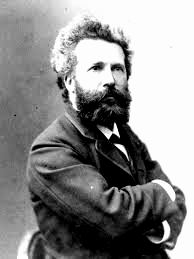
Camille Flammarion, Scientist and Spiritualist
by
R.E. Prindle

The last story in Ray Bradbury’s Martian Chronicles is about the expulsion from Earth of the various supernatural or imaginary beings such as fairies, elves, the elementals, all those beings external to ourselves but projections of our minds on Nature, to Mars as a last resort and how they were all dieing as Mars became scientifically accessible leaving no place for them to exist.
On Earth the rejection of such supernatural beings began with the Enlightenment. When the smoke and fury of the French Revolution and the Napoleonic years settled and cleared it was a new world with a completely different understanding of the nature of the world. Science, that is, knowing, had displaced belief as a Weltanschauung.
The old does not give way so easily to the new. Even while knowing that fairies did not exist the short lived reaction of the Romantic Period with its wonderful stories and fictions followed the Napoleonic period.
Supernatural phenomena displaced from the very air we breathed reformed in the minds of Men as the ability of certain people called Mediums to communicate with spirits although the spirits were no longer called supernatural but paranormal. Thus the fairies morphed into dead ancestors, dead famous men, communicants from beyond the grave. Men and women merely combined science with fantasy. Science fiction, you see.
Spiritualism was made feasible by the rediscovery of hypnotism by Anton Mesmer in the years preceding the French Revolution. The first modern glimmerings of the sub- or unconscius began to take form. The unconscious was the arena of paranormal activity.
Hypnotism soon lost scientific credibility during the mid-century being abandoned to stage performers who then became the first real investigators of the unconscious as they practiced their art.
While the antecedents of spiritualism go back much further the pehnomena associated with it began to make their appearance in the 1840s. Because the unconscious was so little understood spiritualism was actually thought of as scientific. The investigators of the unconscious gave it incredible powers and attributes, what I would call supernatural but which became known as paranormal. Communicating with spirits, teleportation, telecommunications, all the stuff that later became the staples of science fiction.
Thus in 1882, Jean-Martin Charcot, a doctor working in the Salpetriere in Paris made hypnotism once again a legitimate academic study.
The question here is how much innovation could the nineteenth century take without losing its center or balance. Yeats’ poem The Second Coming presents the situation well. Freud, who was present at this particular creation, was to say that three discoveries shattered the confidence of Man; the first was the Galilean discovery that the Earth was not the center of the universe, the second revelation was Darwin’s announcement that Man was not unique in creation and the last was the discovery of the unconscious. Of these three the last two happened simultaneiously amidst a welter of scientific discoveries and technological applications that completely changed Man’s relationship to the world. One imagines that these were the reasons for the astonishing literary creativity as Victorians grappled to deal with these new realities. There was a sea change in literary expression.
Key to understanding these intellectual developments is the need of Man for immortality. With God in his heaven but disconnected from the world supernatural explanations were no longer plausible. The longing for immortality remained so FWH Myers a founder of the Society For Psychical Research changed the word supernatural into paranormal. As the notion of the unconscious was now wedded to science and given, in effect, supernatural powers under the guise of the paranormal it was thought, or hoped, that by tapping these supernormal powers one could make contact with the departed hence spiritism or Spiritualism.
While from our present vantage point after a hundred or more years of acclimatizing ourselves to an understanding of science, the unconscious and a rejection of the supernatural, the combination of science and spiritualism seems ridiculous. Such was not the case at the time. Serious scientists embraced the notion that spirtualism was scientific.
Now, a debate in Burroughs’ studies is whether and/or how much Burroughs was influenced by the esoteric. In my opinion and I believe that of Bibliophile David Adams, a great deal. David has done wonderful work in esbatlishing the connection between the esotericism of L. Frank Baum and his Oz series of books and Burroughs while Dale Broadhurst has added much.
Beginning in the sixties of the nineteenth century a French writer who was to have a great influence on ERB, Camille Flammarion, began writing his scientific romances and astronomy books. Not only did Flammarion form ERB’s ideas of the nature of Mars but this French writer was imbued with the notions of spiritualism that informed his science and astronomy. He and another astronomer, Percival Lowell, who is often associated with ERB, in fact, spent time with Flammarion exchanging Martian ideas. Flammarion and Lowell are associated.
So, in reading Flammarion ERB would have imbibed a good deal of spiritualistic, occult, or esoteric ideas. Flammarion actually ended his days as much more a spiritualist than astronomer. As a spiritualist he was associated with Conan Doyle.
Thus in the search for a new basis of immortality, while the notion of God became intenable, Flammarion and others began to search for immortality in outer space. There were even notions that spirits went to Mars to live after death somewhat in the manner of Bradbury’s nixies and pixies. In his book Lumen Flammarion has his hero taking up residence on the star Capella in outer space after death. Such a book as Lumen must have left Burroughs breathless with wonderment. Lumen is some pretty far out stuff in more ways than one. After a hundred fifty years of science fiction these ideas have been endlessly explored becoming trite and even old hat but at the time they were
Camille Flammarion
excitingly new. Flammarion even put into Burroughs’ mind that time itself had no independent existence. Mind boggling stuff.
I believe that by now Bibliophiles have assembled a library of books that Burroughs either did read or is likely to have read before 1911 that number at least two or three hundred. Of course, without radio, TV, or movies for all of Burroughs’ childhood, youth and a major portion of his young manhood, although movies would have become a reality by the time he began writing, there was little entertainment except reading. Maybe a spot of croquet.
As far as reading goes I suspect that ERB spent a significant portion of his scantily employed late twenties and early thirties sitting in the Chicago Library sifting through the odd volume. It can’t be a coincidence that Tarzan lounged for many an hour in the Paris library before he became a secret agent and left for North Africa.
I have come across a book by the English author Charles Howard Hinton entitled Scientific Romances of which one explores the notion of a fourth dimension . Hinton is said to have been an influence on H.G. Wells’ The Time Machine. It seems certain that Burroughs read The Time Machine while he would have found many discussions of the fourth dimension as well as other scientific fantasies in the magazines and even newspapers as Hillman has so amply demonstrated on ERBzine. We also know that ERB had a subscription to Popular Mechanics while probably reading Popular Science on a regular basis. Popular Science was established in 1872.
It is clear that ERB was keenly interested in psychology and from references distributed throughout the corpus, reasonably well informed.
I wouldn’t go so far as to maintain that ERB read the French psychologist Theodore Flournoy’s From India To The Planet Mars but George T. McWhorter does list it as a volume in Vern Corriel’s library of likely books read by Burroughs. The book was published in 1899 just as Burroughs was entering his very troubled period from 1900 to 1904-05 that included his bashing in Toronto with subsequent mental problems, a bout with typhoid fever and his and Emma’s flight to Idaho and Salt Lake City. So that narrows the window down a bit.
However the book seems to describe the manner in which his mind worked so that it provides a possible or probable insight into the way his mind did work.
ERB’s writing career was born in desperation. While he may say that he considered writing unmanly it is also true that he tried to write a lighthearted account of becoming a new father a couple years before he took up his pen in seriousness. Obviously he saw writing as a way out. His life had bittely disappointed his exalted expectations hence he would have fallen into a horrible depression probably with disastrous results if the success of his stories hadn’t redeemed his opinion of himself.
Helene Smith the Medium of Fluornoy’s investigation into mediumship was in the same situation. Her future while secure enough in the material sense, as was Burroughs, fell far short of her hopes and expectations. Thus she turned to mediumship to realize herself much as Burroughs turned to literature. She enjoyed some success and notoriety attracting the attention of, among others, the psychologist Theodore Flournoy. Fournoy who enjoyed some prominence at the time, was one of those confusing spiritualism with science because of his misunderstanding of the unconscious. Thus as Miss Smith unfolded her conversations with the inhabitants of Mars it was taken with some plausibility.
If any readers I may have have also read my review of Du Maurier’s Peter Ibbetson he or she will remember that Peter and Mary were restricted in their dream activities to only what they had done, seen and remembered or learned. As I have frequently said, you can only get out of a mind what has gone into it. In this sense Miss Smith was severely handicapped by an inadequate education and limited experience. While she was reasonably creative in the construction of her three worlds- those of ancient India, Mars and the court of Marie Antoinette- she was unable to be utterly convincing. In the end her resourcefulness gave out and the scientific types drifted away. She more or less descended into a deep depression as her expectations failed. Had she been more imagination she might have turned to writing as Burroughs did.
If Burroughs did read Flournoy, of which I am not convinced, he may have noted that Miss Smith’s method was quite similar to his habit of trancelike daydreaming that fulfilled his own expectations of life in fantasy.
In Burroughs’ case he had the inestimable advantage of having stuffed his mind with a large array of imaginative literature, a fairly good amateur’s notions of science and technology, along with a very decent range of valuable experience. His younger days were actually quite exciting. He was also gifted with an amazing imagination and the ability to use it constructively.
Consider this possibility. I append a poem that he would have undoubtedly read- When You Were A Tadpole And I Was A Fish. Read this and then compare it to The Land That Time Forgot.
Evolution
by
Langdon Smith
When you were a tadpole and I was a fish
In the Paleozoic time,
And side by side on the ebbing tide
We sprawled through the ooze and slime,
Or skittered with many a caudal flip
Through the depths of the Cambrian fen,
My heart was rife with the joy of life,
For I loved you even then.
Mindless we lived and mindless we loved
And mindless at last we died;
And deep in the rift of the Caradoc drift
We slumbered side by side.
The world turned on in the lathe of time,
The hot lands heaved amain,
Til we caught our breath from the womb of death
And crept into light again.
We were Amphibians, scaled and tailed,
And drab as a dead man’s hand;
We coiled at ease ‘neath the dripping trees
Or trailed through the mud and sand.
Croaking and blind, with out three-clawed feet
Writing a language dumb,
With never a spark in the empty dark
To hint at a life to come.
Yet happy we lived and happy we loved,
And happy we died once more;
Our forms were rolled in the clinging mold
of a Neocomian shore.
The eons came and the eons fled
And the sleep that wrapped us fast
Was riven away in a newer day
And the night of death was past.
Then light and swift through the jungle trees
We swung in our airy flights,
Or breathed in the balms of the fronded palms
In the hush of the moonless nights;
And, oh! what beautiful years were there
When our hearts clung each to each;
When life was filled and our senses thrilled
In the first faint dawn of speech.
Thus life by life and love by love
We passed through the cycles strange,
And breath by breath and death by death
We followed the chain of change,
Till there came a time in the law of life
When over the nursing side
The shadows broke and the soul awoke
In a strange, dim dream of God.
I was thewed like Auroch bull
And tusked like the great cave bear;
And you, my sweet, from head to feet
Were gowned in your glorious hair,
Deep in the gloom of a fireless cave,
When the night fell o’er the plain
And the moon hung red o’er the river bed
We mumbled the bones of the slain.
I flaked a flint to a cutting edge
And shaped it with brutish craft;
I broke a shank from the woodland lank
And fitted it, head and haft;
Then I hid me close to the reedy tarn,
Where the mammoth came to drink;
Through the brawn and bone I drove the stone
And slew him upon the brink.
Loud I howled through the moonlit wastes,
Loud answered our kith and kin,
From west and east to the crimson feast
The clan came tramping in.
O’er joint and gristle and padded hoof
We fought and clawed and tore,
And cheek by jowl with many a growl
We talked the marvel o’er.
I carved that fight on a reindeer bone
With rude and hairy hand;
I pictured his fall on the cavern wall
That men might understand,
For we lived by blood and the right of might
Ere human laws were drawn,
And the age of sin did not begin
Till our brutal tush were gone.
And that was a million years ago
In a time that no man knows;
Yet here tonight in the mellow light
We sit at Delmonico’s.
Your eyes are deep as the Devon springs,
Your hair is dark as jet,
Your years are few, your life is new,
Your soul untried, and yet-
Our trail is on the Kimmeridge clay
And the scarp of the Purbeck flags;
We have left our bones in the Bagshot stones
And deep in the Coralline crags;
Our love is old, our lives are old,
And death shall come amain;
Should it come today, what man may say
We shall not live again?
God has wrought our souls from the Tremadoc beds
And furnished them wings to fly;
He sowed our spawn in the world’s dim dawn,
And I know that it shall not die,
Though cities have sprung above the graves
Where the crook-bone men make war
And the oxwain creaks o’er the buried caves
Where the mummied mammoths are.
Then as we linger at luncheon here
O’er many a dainty dish,
Let us drink anew to the time when you
Were a tadpole and I was a fish.
With something like that stuffed into his subconscious what wonders might ensue. Obviously The Land That Time Forgot and The Eternal Lover.
As Miss Smith had turned to spiritualism and mediumship, Burroughs turned his talents to writing. According to himself he used essentially mediumistic techniques in hiswriting. He said that he entered a tracelike state, what one might almost call automatic writing to compose his stories. He certainly turned out three hundred well written pages in a remarkably short time with very few delays and interruptions. He was then able to immediately begin another story. This facility lasted from 1911 to 1914 when his reservoir of stored material ws exhausted. His pace then slowed down as he had to originate stories and presumably work them out more rather than just spew them out.
Curiously like Miss Smith he created three main worlds with some deadends and solo works. Thus while Miss Smith created Indian, Martian and her ‘Royal’ identity Burroughs created an inner World, Tarzan and African world, and a Martian world.
Perhaps in both cases three worlds were necessary to give expression to the full range of their hopes and expectations. In Burroughs’ case his worlds correspond to the equivalences of the subconscious in Pellucidar, the conscious in Tarzan and Africa and shall we say, the aspirational or spiritual of Mars. In point of fact Burroughs writing style varies in each of the three worlds, just as they did in Miss Smith’s.
Having exhausted his early intellectual resources Burroughs read extensively and exhaustively to recharge his intellectual batteries. This would have been completely normal because it is quite easy to write oneself out. Indeed, he was warned about this by his editor, Metcalf. Having, as it were, gotten what was in your mind on paper what you had was used up and has to be augmented. One needs fresh experience and more knowledge. ERB was capable of achieving this from 1911 to about 1936 when his resources were essentially exhausted. Regardless of what one considers the quality of the later work it is a recap, a summation of his work rather than extension or innovatory into new territory. Once again, not at all unusual.
As a child of his times his work is a unique blend of science and spiritualism with the accent on science. One can only conjecture how he assimiliated Camille Flammarion’s own unique blend of spiritualism and science but it would seem clear that Flammarion inflamed his imagination setting him on his career as perhaps the world’s first true science-fiction writer as opposed to merely imaginative or fantasy fiction although he was no mean hand at all.
Part II: Zane Grey, Edgar Rice Burroughs And The Anima And Animus
February 3, 2009
The ERB Library Project
Zane Grey, Edgar Rice Burroughs And The Anima And Animus
by
R.E. Prindle, Dr. Anton Polarion And Dugald Warbaby
Texts:
Burroughs: Edgar Rice: Corpus 1911-1940
Grey, Zane: The Riders Of The Purple Sage, 1912
Grey, Zane: The Rainbow Trail 1915
Grey Zane: The Mysterious Rider, 1921
Prindle, R. E.: Freudian Psychology Updated To Modern Physics, ERBzine, 2004
Prindle, R.E.: Something Of Value Books I, II And III, ERBzine, 2006
by
R.E. Prindle, Dr. Anton Polarion And Dugald Warbaby
Part II
The Mysterious Rider
Two of the more popular musical groups of the 1980s were Culture Clash and Boy George’s Culture Club. They were from England which was being invaded by peaceful infiltration by a number of different cultures. The popular response of these groups divined that the issue was not ‘race’ or skin color but one of cultures.
In any clash of cultures the most intolerant must win- that is the culture that clings to its customs while rejecting all others. To be tolerant is to be absorbed by the intolerant culture. This was the meaning of German term Kulturkampf of the pre-Great War period.
Historical examples are too numerous to mention, suffice it to say, that the ancient Cretan culture was defeated by the Mycenean while both were supplanted by later Greek invasions. Eventually Greek culture supplanted the Cretan which was lost to history.
The English being the most tolerant people will lose their culture to a Moslem-Negro combination which will undoubtedly be absorbed by the Chinese. This is an incontestable evolutionary fact, it has nothing to do with anyone’s opinion.
While the movement of peoples may be an unavoidable fact of life it is folly for a superior more productive culture to sacrifice itself to a lesser, misguided by notions of tolerance.
Evolutionarily the problem is not the cosmetic one of skin color as most HSIIs and IIIs imagine.
Apart from the evolutionary problem of genetics the social problem of cultures is of prime importance. Not all cultures are of the same quality nor is this a matter of relativity. For instance it is generally agreed that female circumcision is an evil to be avoided but among the Africans where it is prevalent their culture stoutly defends the procedure along with polygamy. In France where large numbers of Africans are invading French culture denies the validty of both female circumcision and polygamy hence the culture clash between the two nations the society will be determined by numbers and will. Given the increasing numbers of Moslems and Africans in France among which polygamy is an established custom and given their superior will and intolerance of the HSIIs of France, it is merely a matter of time before polygamy and female circumcision become permissible thus changing French society as the French themselves adopt Semitic and African customs.
Only a small percentage of the French, English or Americans recognize the danger to their cultures. They must naturally be as intolerant of the culture of the invaders as the invaders are intolerant of theirs. As a minority among their respective peoples they are derided by the majority as bigots while the, perhaps, benign and tolerant opinion of the majority can lead only to their own elimination as history and evolution clearly shows.
America in the nineteenth century with its open and unrestricted immigration was the first country, other than Russia which was also involved with these difficulties, to come to grips with the problem of clashing cultures. The official American position was one of tolerance. Absorption of the large African population was a poser, but among the HSIIs and IIIs the cultural differences were not so great as to be an insuperable obstacle although assimilation as between the Anglos and the Irish, for instance, was painful and slow while still incomplete to this day as large numbers of Irish consider themselves Irish first and Americans second but generally Northern Europeans blended reasonably well.
Then in the 1870s just at the time that both Zane Grey and Edgar Rice Burroughs were born the focus of immigration shifted to Eastern and Southern Europe. This influx continued unabated up to 1914 when it was interrupted by the Great War. While earlier immigration might be characterized as troublesome the Eastern and Southern European immigration presented a real culture clash.
The cultural differences between Northern Europeans and Eastern and Southern Europeans are actually quite striking. Rightly or wrongly, as you may choose to see it, contemporaries of Burroughs and Grey believed that, at least, the Jews and Italians were unassimilable, which is to say, they were not prepared to abandon their customs to blend into the whole but wished to impose their customs on the whole. Indeed this has proven to be the case as witness the Jewish attempt to abolish Christmas. If you don’t object there is no problem. If you do, you have a culture clash that the most intolerant will win.
As representatives of the founding culture of the United States men like Burroughs and Grey could not but see the new immigration as a threat to their ideals which has proven to be true. Thus the American generation of Teddy Roosevelt who was born in 1858 were the heroes of the younger generation. When TR died in 1919 a vision of hope flickered out for Burroughs’ and Grey’s generation.
The poem ‘The American’ reprinted in Part IV of my Four Crucial Years published in the ERBzine will give some idea of the frustration experienced by the Burroughs/Grey generation just as they were coming of age.
Burroughs grew up in one of the most polyglot centers of the world. The Anglos in Chicago were in a distinct minority being no more than 10% of the population in 1890. Grey practiced his dentistry in New York City in which Anglos were as small a percentage of the population.
Neither man was a hateful bigot which is not to say that they couldn’t help but be affected by the diversity of languages and customs which they encountered everyday in what they considered to be their own country. It would be silly to say that they or any rational Anglo didn’t regret the situation. That the absorption of all this diversity into a semblance of homogeneity was made without undue violence must always to be the credit of the American social organization. That organizations of frustrated individuals like the American Protective Association or the KKK arose is not to be wondered at especially in the face of very aggressive and terrorist immigrant organizations such as the Mafia and the Anti-Defamation League of the B’nai B’rith which was being advised by Sigmund Freud.
Both Burroughs and Grey began writing at the very height of unrestricted immigration. There is every reason to expect the influence of immigration to be reflected in their writing for the period of the teens no matter how they sublimated it. After 1920 conditions changed which is reflected in Burroughs’ writing although I am unread in Grey after the teens.
Burroughs of course transposed his social and religious conflicts to Mars, Pellucidar and his vision of Tarzan’s Africa where they were fought on an allegorical level much in the style of Jonathon Swift.
Grey on the other hand transposed the problem to an earlier period in the American West where he avoided the problem of foreign activities concentrating on culture clashes of Mormonism, cattle and sheep ranching and matters of the like. He’s an acute observer of the Mexican-American clash also. Thus the Mormon-Gentile clash of mid-nineteenth century could be compared to the Jewish-Gentile confrontation of the teens which Grey would have been facing but would have been unable to discuss without being labeled an anti-Semite or bigot.
Both writers could also translate social problems into psychological terms as they did. Both men suffered from a fair degree of emasculation which is most notably represented in Grey’s work especially the three of his novels under consideration.
In The Mysterious Rider he examines the same Animus problems that he did in Riders Of The Purple Sage but under different conditions.
His protagonist, Hell Bent Wade of Mysterious Rider, answers to that of Lassiter In Riders. Wade possessed a violent and ungovernable tempter as a young man which led him to murder his wife and a man he mistakenly believed to be her lover. Discovering his error he brought his temper under control becoming mild mannered like Lassiter but helpful and with more character; still his youthful reputation follows him, blighting his life.
Wilson Moore may be seen as another version of Venters while the Mormon Animus is represented by the rancher, Bill Bellounds and his son Jack. His Anima figure in this story is an orphan girl named Columbine, Collie, as after the flower.
Old Bill Bellounds (Hounds Of Hell?) is a big rancher in Colorado who took Columbine ( in good conscience I can’t call her Collie, which is the name of a dog) in as a child and raised her as his own. This is a recurring motif in Grey. Now he wants her to marry his son Jack. Jack is no good. Bad man. As an Animus figure he is the wild ungoveranble aspect. He is crazed having no behavioral controls.
Columbine is placed between what she considers her duty to the man she had always known as dad and her own desire which is a love for Wilson or Wils Moore.
Moore is just the opposite of Jack Bellounds. He is gentle, sensitve, conscientious, hard working, kind, loving, just an all around great guy of the emasculated Animus sort. Grey, who has all the attributes of the emasculated man, including the middle hair part, may have thought of him as a sort of self-portrait. Grey always holds up as his model of the virtuous man the long suffering type who endures injustices to the point of being crippled or even killed before he retaliates, if he does.
In this case Wilson Moore is crippled for life by Jack Bellounds with barely even a thought of self-defense. Hell Bent Wade, the protagonist who had the ungovernable temper as a youth, a reformed Lassiter, is now feminized to the point where he is willing to serve as a male nurse.
Thus he nurses Moore back to physical health, but mutilated, while he keeps Moore’s mind straight.
He is unable to do anything with Jack Bellounds who although he wants to win the love of Columbine is incapable of reforming. His drinking and gambling lead him into a situation where he is rustling cattle from his father.
A showdown occurs between him and Hell Bent in which by giving Jack every chance he is shot by Jack while at the same time killing the latter. We are expected to admire this self-sacrifice. Thus Wils and Columbine are united. Mutilated virtue prevails.
Grey always manages an interesting tale with good detailing so the reading of the novel as OK qua story but written after the Great War it is evident that Grey is hauling up nuggets from an exhausted mine.
The appeal of the story for Burroughs seems clear as it is a virtual symbolic retelling of his courtship of Emma. Alvin Hulbert, Emma’s father favoring another suitor who was quite privileged, while denying ERB the house, the crippling struggle with the suitor in Toronto and the eventual successful denouement as Emma chose him over the other ‘owner’s son’ and the marriage.
Published in magazine form in 1919 and in book form in 1921 its appearance coincided with a low period in ERB’s life as represented in Tarzan And The Golden Lion and Tarzan And The Ant Men. This was also the period when when Warner Fabian’s ‘Flaming Youth’ appeared followed by the apparently sensational movie. The book, which is in ERB’s library and, the movie made a terrific impression on him.
As this is one of only two Grey books still in his library when it was catalogued we must assume that he felt the content was applicable to himself. Other than that I found the novel of negligible value.
Now let us turn to The Rainbow Trail which was the other Grey novel in ERB’s library. This will be a fairly signifcant book.
Edgar Rice Burroughs Wrestles With Time
September 23, 2008
Edgar Rice Burroughs Wrestles With Time
by
R.E. Prindle
When the student is ready the teacher will appear.
Gnostic Wisdom
There are two major themes in Burroughs that present significant difficulties. One is his preoccupation with slavery. Slavery pervades the corpus. I haven’t begun to guess at Burroughs’ notions on slavery. The second is the wrestle Burroughs has with the concept of Time. Time is a major preoccupation of scientific thinkers.
My ideas on Burroughs ideas on Time were jelled by the following quote from ‘Understanding Media’ by Marshall McLuhan that I came across while rereading the book recently:
As a piece of technology, the clock is a machine that produces uniform seconds, minutes, and hours on an assembly-line pattern. Processed in this uniform way, time is separated from the rhythms of human experience. The mechanical clock, in short, helps to create the image of a numerically quantified and mechanical universe. It was in the world of the medieval monasteries, with their need for a rule and for synchronized order to guide communal life, that the clock started on its modern developments. Time measured not by the uniqueness of private experience but by abstract uniform units gradually pervades all sense life, much as does the technology of writing and printing. Not only work, but also eating and sleeping, came to accommodate themselves to the clock rather than to organic needs. As the pattern of arbitrary and uniform measurement of time extended itself across society, even clothing began to undergo annual alteration in a way convenient for industry. At that point, of course, mechanical measurement of time as a principle of applied knowledge joined forces with printing and asembly line as means of uniform fragmentation of processes.
While Burroughs never states his position succinctly McLuhan might have abstracted the above quote from Burroughs’ novels.
The Pellucidar series is centered on the problem of Time while Burroughs persistently dwells on the problem throughout the corpus. Mars itself is a contrast between the orbits of Earth and Mars with its two different durations of time. The lost cities of Africa are a contrast in time periods as they all exist within the present while products of a distant past, most notably the lost city of Opar that dates back to Atlantis nearly unchanged.
Tied to the concept of Time are Burroughs’ notions on evolution. The most notable novel in that line being The Land That Time Forgot. Time forgot. Time didn’t so much forget it as encapsulate a series of time periods that exist side by side.
Usually Burroughs’ ruminations are thoroughly disguised as ‘entertainment.’ If you are merely entertaining yourself by reading Burroughs you probably won’t consciously recognize the underlying examinations but you probably will be affected subconsciously. A hypnotic suggestion so to speak. After all, the stories themselves are fairly slight and yet the attention of readers from teenagers to college professors over a century now are riveted by the author.
I don’t intend to be exhaustive in this essay but I would like to concentrate on two novelistic examinations by Burroughs. The largest examination and most obvious is that of ‘Tarzan At The Earth’s Core’ and its successor ‘Tarzan The Invincible.’ The other hidden example is ‘Bridge And The Oskaloosa Kid’ also known by its published title: ‘The Oakdale Affair.’ I will begin with the latter.
I’ve written on ‘Bridge And The Oskaloosa Kid’ a couple times, one major essay being on the ezine, ERBzine, Only The Strong Survive. http://erbzine.com/mag14/1483.html . There is a great deal going on in this wonderful story that isn’t so obvious. I didn’t have that good a handle on the story although Lord knows I tried hard enough.
I was mystified by the course taken by Bridge, the Kid, the Bear, the Gypsy Girl and Hetty Penning from the Squibb Farm to the destination warehouse. There is probably a great deal of symbolism I’m still not getting but as it appears to me now Burroughs is contrasting two different kinds of time.
The journey takes a day and a night to complete by which I do not mean to say twenty-four hours of mechanical time but a physical day and night of experiential time. In other words according to McLuhan Time measured by the uniqueness of personal experience on one hand and time measured by abstract uniform units on the other.
Both the origin of the journey and its end are based on experiential time where the sun not the clock governs the actions. As darkness falls the journey through time is bisected by the passage through a town. Here experiential time is contrasted to mechanical time. That mechanical time is precisely measured according to the precepts of the efficiency expert Frederick Taylor. Indeed, within a year or so Burroughs would pen a book on the same theme entitled ‘The Efficiency Expert.’
In this book, Willie Case, a little farm boy who Gail Prim posing as a hobo had bummed from him came to town. The story involves several criminal acts and a major detective so Willie is hot to solve the case. Willie comes to town which is run by the clock. Willie has a dollar to spend. ERB accounts for each and every penny as it is spent. In a very humorous scene Willie goes into a restaurent at dinner time by the clock. In a Frederick Taylor efficient manner Willie arranges his dinner plates so that he makes the minimum moves in a most timely manner shoveling the food into his mouth in minimum time. Very efficient if ridiculous dining.
He then goes to the movies. Movies are run on a time schedule by the clock, so various aspects of rigid mechanical time are represented. As Willie leaves the theatre he spots the hobo troupe weaving through town on experiential time. No straight lines. Here the two modes of time intersect. Very cleverly done on ERB’s part. The troupe then weaves on to their destination while Willie calls the cops on a pay phone.
While one is not conscious of the two modes of time that ERB represents yet subconsciously a deepening interest is added to the story. While mystified by the action I would never have guessed the significance of the time comparisons if I hadn’t read the McLuhan passage that put things into perspective.
Also at this time ERB wrote two other investigations of Time: ‘The Efficiency Expert’ and ‘The Land That Time Forgot.’
I think his two most explicit investigations were ‘Tarzan At The Earth’s Core’ and its successor ‘Tarzan The Invincible.’
Burroughs through Tarzan seems to reject civilization. He seems to prefer experiential time to mechanical time. In Invincible he says:
Time is the essence of many things to civilized man. He fumes and frets, and reduces his mental and physical efficiency if he is not accomplishing something concrete during the passage of every minute of that medium which seems to him like a flowing river, the waters of which are utterly wasted if they are not utilized as they pass by.
His Pellucidar series creates a model to investigate the nature of Time. Pellucidar is a model of a reversed Time and Space system. The earth is essentially turned outside in replicating the exterior in a closed universe. He posits a sun suspended in the interior that is perpetually shining. While the outer earth rotates on its axis only half the surface is in light facing the sun while the other half is in darkness facing away. Thus the appearance of change which is time is obvious. In Pellucidar as the earth turns no portion of the inner world is in darkness although the perpetual shadow from the interior moon must have described a circular path.
As there is no experiential time, there is no night and day, the beings of Pellucidar have no notion of the passing of Time indeed there is no passing of Time; Time as a reality does not exist. Time is not necessary for existence; a person or thing is merely invested with a certain amount of energy. When that energy is expended the person or thing ceases to exist.
Thus, for example, when one winds a top it is invested with a certain amount of energy. At peak energy it rotates rapidly gradually slowing down into a wobble and when its energy is expended it falls over and attains perpetual rest. No time is involved although using man made mechanical means the duration of the spin can be measured.
So, in the universe at large. It is quite clear that Burroughs has Einstein in mind. In Invincible he says:
…but though Time and space go on forever, whether in curves or straight lines…
One can’t mention curved space without being familiar with Einstein. He is thus offering an alternative to Einstein’s notion of the fabric of Time and Space. There can be no fabric of time and space as time has no objective existence. It is a contruct to serve the needs of man. The sun, for instance, came into existence with a certain amount of potential energy. Barring accidents, that energy will be expended at a certain rate just like the top and when that energy is fully expended the sun will follow whatever course the death of suns follow. There is no time involved, hence no time-space continuum and no fabric of time and space.
McLuhan says essentially the same thing.
So, ‘Tarzan At The Earth’s Core’ is a demonstration of the fallacy of Einstein’s notion.
Moving on to ‘Tarzan The Invicible’ Burroughs then has Tarzan dealing with the notion of terrestrial time. As McLuhan notes, the notion of a time to eat arose with clocks; Tarzan dispenses with the notion of a time to eat eating only when he is hungry. There are no clocks in Tarzan’s Africa. As Burroughs says an individual has all the time in the world.
Of all the vast resources that Nature had placed at their disposal, she had been most profligate with Time, since she had awarded to each all that he coud use during his lifetime, no matter how extravagant of it he might be. So great was the supply of it that it could not be wasted, since there is always more, even up to the moment of death, after which it ceased, with all things, to be essential to the individual. Tantor and Tarzan were therefore wasting no time as they communed together in silent meditation.
One has all the time one needs until the day one dies then one no longer has need of time. In other words, the organism’s energy has been expended and the husk falls to earth.
So Tarzan is active when necessary, such as hunting for food or fighting and lazes around when activity is unnecessary. Perfectly balanced and happy according to Burroughs. OK for the jungle, I suppose, but I’ve got things to do such as writing stuff like this but then that is only how I dispose of the energy left in my organism during the time remaining. With other media such as electric lights I am not bound by the diurnial cycle being freed from that experiential limitation. One only has to sleep when one is tired. Time means nothing to me either. With stores open around the clock I can even buy groceries when the mood hits me. Other items can be purchased on the internet at any time of day. So, technology has freed us from many of the restraints of what civilization is pleased to call time.
So, when reading Burroughs one should always bear in mind what time means to him and how various notions of time relate to the story. Obviously in Invincible while Tarzan is attempting to live on experiential time the Revolutionaries are living by the clock and calendar. Thus the story is also the tale of the clock or two time systems.
I knew there are reasons I like Burroughs other than interesting stories; complexities like the nature of time are one of the extras if one can only discover and realize them. Now, I really have to work on the nature of slavery in the Corpus.
A Review: Conquest Of A Continent by Madison Grant
August 4, 2008
A Review
Conquest Of A Continent
by
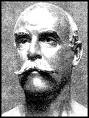
Madison Grant
Madison Grant
Review by R.E. Prindle
Texts:
Grant, Madison, Conquest Of A Continent, Liberty Bell Publications, 2004. Reprint of 1933 Edition
Fischer, David Hackett, Albion’s Seed: Four British Folkways In America, Oxford, 1991
Higham, John, Strangers In The Land: Patterns Of American Nativism 1860-1925 Rutgers U. Press 1955
Myers, Gustavus, History Of Bigotry In The United States, Random House, 1943
Wittke, Carl, We Who Built America: The Saga Of The Immigrant, Case Western Reserve, 1939
In the immediacy of the moment one frequently overlooks or forgets the history leading up to the moment. One might think for instance that the current flap over Diversity and Multi-Culturalism is a recent occurrence. While the two terms are of recent provenance the argument under different names goes back much farther while the protagonists are essentially the same.
The story of immigration into America is almost always told from the point of view of the immigrant. Few books tell the tale from the Nativist point of view and they are universally and viciously derided as a tale told by bigoted idiots. While charity is demanded from the Nativists none is to be expected from the immigrationists.
Thus we get volumes like Strangers In The Land by John Higham and Carl Wittke’s We Who Built America that distort the issue in favor of immigrants while deprecating the Natives.
Qustavus Myers’ History Of Bigotry In The United States on the other hand appears to be a willful misunderstanding of the nature of the relative status between immigrant and native resulting in a slanderous approach like that of the contemporary Greil Marcus.
Conquest Of A Continent has been placed on the Jewish Index Of Anti-Semitic Books. Based on that I expected a detailed derogatory examination of the Jews from their entry into America perhaps being the conquerors referred to. The President of the American Jewish Committee sent a letter to every Jewish publisher in the United States demanding that they refrain from either reviewing the book or noticing it at all. Dynamic silence was to prevail.
After reading Conquest I can only conclude that the AJC was hyper sensitive to a degree. Since his 1916 Passing Of The Great Race Mr. Grant had learned that ‘You Don’t Mess With Rohan’ to quote Adam Sandler. Grant all but ignores the Jews in his volume. No, his offense, according to the AJC was even more egregious, he uses the world Nordic and dares to imply that they are ‘the Great Race’ rather than the AJC’s own Semites.
The other volumes mentioned and, indeed, all writing in this genre which is pretty extensive, defers to the Jews as ‘the Great Race’ probably genetically superior to all others.
So Madison Grant is interested in telling the story of how the Nordic race conquered the continent. This approach can only be considered as a sin by non-Nordics. Grant then tells the story of how the US and Canada were occupied by peoples other than the native Indians.
He begins early referring to twelfth century attempts to settle by Scandinavians. In the 1100s the firece native Indians were able to exterminate the invaders and may well have been able to exterminate the Puritan settlers but for the fact that a small pox epidemic shortly before the Puritan arrival had reduced the native population by as much as half while weakening them concomitantly. Such is the luck of the draw.
Grant thus traces immingration back to its origins colony by colony and then State by State as the Nordics moved Westward.
David Fischer in his excellent Albion’s Seed retraces the same ground fifty years after Grant with much addional detail concerning the places of origin and their activities once in the US.
Grant’s approach is in some ways superior to that of Fischer since as an unabashed Nordic advocate he is interested in detailing the exact racial content of the occupation of the various states and provinces. If you aren’t aware of the progress of settlement and by whom there are numerous surprises. My own notions were certainly vaguer before I read Grant.
I was surprised at the seeming numerical superiority of Southern migrants in the Westward movement. It seems that Whites did not like to live in the South where they were compelled to compete with slave labor while being despised by both the plantation owners and their slaves. Thus there was a constant stream of the best and brightest of the South moving into the North and West. As Grant notes, Virginia was the mother of States.
Then too some of Grant’s population statistics are of interest also. At the 1790 census before the invention of the cotton gin in 1793 there were less than a million Africans in the United States. Seventy years later as the Civil War began the number had increased to four and a half million. Thus natural increase was out of the question. It follows then that between 1800 and 1860 more Africans were brought to the US than there were before 1800. As a result the slave trade fluorished more than ever.
Prior to 1800 Alabama and Mississippi had no settlers so that in 1860 these two States were still rough frontier States still in a state of organization.
There is much good background here as to how the US came under settlement. The continent was accupied in its entirely when the truly major immigration from Eastern and Southern Europe began to accelerate in the 1870s and 1880s changing the basic Nordic institutions of the country. The change in Grant’s eyes was much for the worse.
Carl Wittke’s We Who Built America published in 1939 was undoubtedly in response to Grant’s Conquest Of A Continet. Wittke, was published by Case Western Reserve University. Grant explains the meaning of The Western Reserve which has always puzzled me. The Western Reserve was three million acres set aside as a concession to the State of Connecticut for giving up other territorial rights.
Wittke made a great impression with his his volume, his opinions being taken as overriding fact. I remember my sixth grade teacher in Michigan lauding the book to the skies. I finally read it a couple years ago. Not so much.
As is usual with books and writers of this type Wittke overstates his case and underproves his facts. A contribution to the dialogue at best.
Grant’s book should prove useful to any unbiased reader. If his attitude of Nordic superiority offends you, ignore it. His history as history is sound. For those of you reared on Myer’s History of Bigory attitude you will probably be surprised to find that there is another point of view. Bigotry is not a matter solely of American destestation of immigrants as the program of Diversity and Multi-Culturalism indicates, bigotry is a red herring and not the issue. The issue is who will be Top Race. The contestants for the Top Spot have turned out to be the Africans, Semites (both Jews and Arab Moslems) Hispanics, Chinese and Euro-Americans. (Grant’s Nordics) As you can see race has replaced nationalism.
The contest is real and ongoing. Peace is merely another form of war. The prize will go to who wants it the most. If you don’t see the contest in these terms I suggest you remove your rose colored glasses.
Men Like Gods: Tarzan Pays Homage To Heracles
July 9, 2008
Men Like Gods
Tarzan Pays Homage To Heracles
by
R.E. Prindle
First published in the online Magazine: ERBzine
Cover of The Mighty Atom
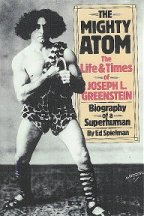
The Golden Age of Strongmen had captured the imagination of the world between 1890 and 1910….Into the 1920s the strongman continued as a living wonder and inspiring vision that could be had for the modest price of admission
-Ed Spielman: The Mighty Atom:
The Life And Times Of Joseph L. Greenstein
When I was a child and youth in the 1940s and ’50s the legendary strongmen of the turn of the twentieth century were, if no longer living, living legends. At least one, Bernarr Madfadden, the father of American bodybuilding, was still going strong.
The most legendary of the strongmen was Frederick Mueller who was known professionally as the Great Sandow.
In his heyday Sandow was so strong that he was capable of ‘exploding’ or breaking the ‘Test Your Strength’ machines in the arcades of Vienna, Austria. There were so many broken machines that it was thought a vandal was destroying them but when apprehended it was discovered that Sandow was not only testing his own strength but the strength of the machines. He flippantly suggested that they be made of better materials.
On stage as Spielman relates, Sandow, who was trained as a turner, could do a back somersault over a chair with a thirty-five pound dumbbell in each hand. He could do a one arm chin-up with the grip of any of his fingers of either hand, including his thumbs.
He could…wait a minute! I’ve heard something like that before. Oh yea, I remember now. In Edgar Rice Burroughs’ Tarzan And The Lion Man he has Tarzan leap up to seize stakes pointing down from a ten foot high wall, then draw himself straight up until his torso was above the stakes, then roll over the top defeating the purpose of the stakes. Was he thinking of the Great Sandow when he wrote that?
I think he was.
Burroughs was a fan of boxing and a great admirer of the strongmen of the Golden Age, although he didn’t like the bulky physiques. He repeatedly denounces the physical build of the Strongmen in preference for Tarzan’s ‘smooth rippling muscles.’ In my day the bodybuilders were ridiculed as being ‘muscle bound.’ But the ladies panted when they said it. Tarzan is as strong or stronger than the strongmen but sleek.
Next one asks is there any place that it can be shown that Burroughs ever saw Sandow? yes, and where else? The Chicago Columbian Exposition of 1893. The Expo was a life changing experience for 17 year-old Ed Burroughs. Bill Hillman of ERBzine has written a wonderful series on the influence of the Fair on young Burroughs.
The influence of the Fair was as moving for the rest of America and the World as it was on Our Man. There apparently has never been so influential a World’s Fair as that of Chicago of 1893.
One of the best attended features of the Fair was put on by the Great Sandow. Bodybuilding had already gotten started in England. Sandow was a student of the innovative Professor Attila in London. He came to the attention of Florenz Ziegfeld while performing in New York. Ziegfeld brought him to Chicago for the Expo. Sandow was a sensation.

The Great Sandow
He created quite a stir at the fair. Not only did Burroughs see him there but so did a man named Bernarr Macfadden. At the time he was known as Bernard McFadden but he chose Bernarr because it sounded more like a lion’s roar and Macfadden because he thought it looked more distinguished in print. As a result of seeing Sandow Macfadden became the father of bodybuilding and the health movement in the United States. John Dos Passos spoofs him in Vol. III, The Big Money, of the his USA Trilogy.
Macfadden was the discoverer of isometric exercises, which his student, Charles Atlas, renamed Dynamic Tension and made a fortune.
Unless I’m mistaken Macfadden would cross ERB’s path sometime between 1908 to 1912.
Sandow made bodybuilding a rage after the Fair while Macfadden organized the sport around his magazine ‘Physical Culture’ which he began publishing in the wake of the Fair. Sandow also opened the way for a number of strongmen to build careers on their physiques.
They all passed through Chicago. How many of them ERB paid the modest price of admissio to see we can’t know, but as he always speaks of the strongmen in the plural one assumes that he saw several.
Anyone who has watched the Strongest Men In The World competition on cable TV will understand how impressive both the feats and the physiques of these men were.
In ERB’s day a man called Warren Travis Lincoln could lift a platform that held twenty-five men with his back. That was a weight of about 4200 pounds.
G.W. Rolandow could stack three decks of playing cards and tear them in two. One assumes that was before they were plastic coated.
Emil Knaucke who weighed in at five hundred pounds, a spectacle in itself, could hold a car above his head with one hand. Spielman doesn’t specify make or model.
Louis Cyr, one of the most famous strongmen, could restrain a team of horses on either side at the same time. Really spectacular stuff.

Bent Press Arthur Saxon
A man like Arthur Saxon of the Saxons was considered to be the strongest man in the world. He could do a bent press of nearly five hundred pounds. As in the photo, in the bent press a lifter raised a barbell above his head with one hand in a bent posture then raised another weight with his other hand.
Eighteen ninety to nineteen-ten were formative years for ERB. He would have from fifteen to thirty-five so that when he saw Sandow in ’93 at seventeen he was at a most impressionable age.
ERB turned 40 in 1915 and 50 in 1925.
By the twenties vitamins and food supplements had been discovered and were being developed for commercial use. Vitamins were still novel when I was kid in the late forties. Not everyone knew of their value as late as then.
The Great Sandow, Louis Cyr, and a trio of German strongmen called the Saxons were all naturally strong but by the 20s it was possible to build muscular Adonae from the scratch of a 98 lb. weakling. With vitamins, food supplements and a rigorous regimen for bodybuilding a normal body could be turned into as mammoth a specimen as Tarzan, as witness Arnold Schwarzenegger and his contemporaries who emerged from New York City gyms in the 1960s.
In point of fact you didn’t even need all that gym equipment. If you followed the body building plan of the most famous Adonis of the 40s and 50s, Charles Atlas, all you needed were your own opposed muscles.
Atlas took Macfadden’s isometric exercises and called them the more commercial sounding Dynamic Tension. By pitting one muscle against its opposite fantastic results could be achieved.
Charles Atlas, who changed his name from Angelo Siciliano, was voted the world’s most perfectly developed man in 1922 by his mentor, Macfadden and Physical Culture magazine.
Angelo, born in 1894 in Acri, Sicily came to the US in 1904, thus he would have been 18 in 1922, 18 in 1912.
Siciliano actually had been a 98 lb. weaking who had sand kicked in his face by a bully. His girl friend actually did walk away from him. Siciliano then built himself up into what I’ve always considered to be the image of Tarzan and changed his name to Charles Atlas.
I was not as successful with the Dynamic Tension plan Chuck sold me in the 50s but then I didn’t try that hard and I couldn’t afford the food supplements which are indispensable. Nevertheless it had become possible to turn out ‘Men Like Gods’ on an assembly line basis.
It is more than likely that Burroughs was very familiar with the bodybuilding or fitness program of Macfadden. That photo of him flexing his muscles on the dock at Coldwater is that of a man who has been working out. I can’t beleive that a man who was interested in magazines as Burroughs was couldn’t be familiar with Physical Culture Magazine. Not only would he have the living memory of the Great Sandow in his mind from the Expo but Bernarr Macfadden had moved his headquarters from Battle Creek to Chicago in 1908. He had a very prosperous looking facility.
During these years from 1899 when ERB was bashed in the head in Toronto to 1910 at least, he complainedof excruciating headaches that began when he got up in the morning and lasted through half the day. These would have been very enervating affecting his ability to work. In The Girl From Farris’s he has his hero Ogden Secor suffering from the same headaches going from doctor to doctor ‘tinkering with his skull’ in hopes of finding relief. The doctors could do nothing for Secor so he undertook a fitness regime which eased his situation. So must have ERB.
Once again, the picture of ERB standing with his legs apart flexing his muscles on the dock at Coldwater in 1916 shows that he was either proud of a moderate physique or he was trying to develop those ‘rippling’ muscles like Tarzan and Charles Atlas.
At fifty in 1925 ERB probably thought himself beyond the age when he could develop his physique into a semblance of his creation, Tarzan. Ten or twenty years younger and you might have seen Burroughs as another Charles Atlas or Tarzan.
There is every reason to believe that sometime between 1908 and 1912 he developed an interest in Macfadden’s program.
When he sat down to begin his Tarzan series at the end of 1911, Burroughs’ mind must have been filled with the feats of Sandow and the other strongmen. Anent this, Tarzan’s leopard skin loin cloth was borrowed from the strongmen. Leopard skin shorts were de riguer for the bodybuilding crowd.
Of course the role models for these strongmen were Samson and Heracles. The latter is better known in his Roman usage as Hercules. For the purposes of this essay I will refer to him as Heracles in hs Greek manifestation.
Especially in his original manifestation Heracles was a Sun god as the companion of the Earth Mother, Hera. When the Patriarchal system was imposed on the Matriarchy Hera was wed to Zeus while her former consort, Heracles- The Glory Of Hera- was demoted to the role of Holy Fool and the strngest man in the world.
ERB often refers to Tarzan as a Jungle God and a latter day Hercules. Burroughs had a good Greek and Latin education so one might asume that he had some familiarity with the cycle of myths devoted to the feats and tribulations of that ancient type of all strongmen, Heracles.
In fact, without stretching the point unduly, one can posit a relationship between the Pelasgian Sun God, Heracles and the Flaming God of Opar and through them to Tarzan; they can be construed as one.
Whether ERB was conscious of what he had done in conflating the three cannot be determined for sure but as he was manipulating valid historical data why shouldn’t he have been conscious of what he was doing? The Aztec ritual of tearing the heart out to offer to the sun god is implicit in scenes where Tarzan lies across the sacrificial block, pardon me, altar. The annual sacrifice of the queen’s consort is implicit once again as La raises the sacrificial knife. A blatant resemblance to Cybele and Attis.
While the subconsious is always important it is the conscious mind that organizes, plots and writes. As a writer I may have subconscious motives which may emerge but assembling and organizing my material is a conscious intellectual act. It is axiomatic that one cannot write what one does not know.
One of the great mysteries of mythological studies has been the relationship of Heracles to his namesake the former Matriarchal Earth Goddess, Hera. I noted just previously, during the matriarchy as the Sun, Heracles would have been appropriately called ‘The Glory Of Hera’ or of the Earth. The same notion can be applied to Mesopotamian and Egyptian mythology. For instance, as David Adams points out somewhere, the lion is a symbol of both the sun and the matriarchy. It is a fact that the body of the Sphinx at Memphis is older than the head. The head of the original has been replaced by that of a man. It therefore follows that the Sphinx was carved during the Matriarchy having either a lion’s or a woman’s head. After the succession of the Patriarchy the head was changed to reflect the New Order.
In the Greek Oedipus myth the Theban Sphinx was still represented as the original matriarchal symbol of a lion with a woman’s head. Woman-lion/sun/Heracles. The answer to her riddle after which she committed suicide was ‘man’ which denied the Matriarchy, hence she had to kill herself as the Patriarchy thus symbolically replaced the Matriarchy. Apply that to the Egyptian Sphinx and the change of heads.

Theban Sphinx
Now, the original Egyptian Sphinx was exactly the same as the Theban Sphinx: a woman’s head on a lion’s body. the Sphinx is positioned to be looking due East at sunrise in the Age Of Leo. Thus, perhap, the secret of the Sphinx is simply that as Mother Earth she sat waiting for her consort Heracles (or his Egypian counterpart) to appear on the horizon each morning.
The notion has simplicity to recommend it.
As we all know, Oparians were a group of Atlanteans isolated from the main body when mythical Atlantis broke apart and sank beneath the waves of the Atlantic Ocean. The worship of the Flaming God was inherited from the parent civilization by Opar.
Thus whether Burroughs knew what he was doing or not he always gets the sequence of events right.
Without getting into any discussion of if, where or when Atlantis may have existed, let me say, neverttheless, that all the evidence points to a predecessor civilization anterior to Crete, Pelasgian Greece, Egypt and Mesopotamia in much the same way Atlantis preceded Opar.
The predecessor civilization must have existed in the Mediterranean Basin during the last ice age when ocean levels, scientists tell us, were several hundred feet lower than they are today. There are evidences of quarrying several hundred feet below sea level on the flanks of the island of Malta for instance. Given this as a fact, then when the ice melted and the waters rose during the Great Flood to their present levels any society or civilization that existed in the Mediterranean Basin was forced to move to higher ground which is to say above the present sea level.
One thing is certain, if the Basin was habitable it was inhabited.
The disruption caused a long dark age from which mankind only slowly recovered. At the same time these relatively highly developed people moving into less developed savage societies had a fertilizing influence introducing more sophisticated ideas and methods such as agriculture.
Lower Egypt, one of Two Lands, was obviously settled by the displaced Libyan dynasty. After centuries of warfare the Upper Egyptians succeeded in conquering Lower Egypt uniting the Two Lands. The Third Dynasty was a Libyan Dynasty so that the warfare was translated from an external one to an internal one in which the Libyans defeated the Upper Egyptians. During the Libyan Dynasty the great pyramids were built reflecting in some way the the flooded predecessor civilization.
So Crete and Pelasgian Greece received survivors also. The Sumerians of Mesopotamia attribute their civilization to the advice of Oannes, John in English, who came from the sea.
Often ignored by classical scholars but obviously part of this great Mediterranean culture is ancient Spain. Now, Spain has one of the great traditions of the worship of Heracles as a Sun god. This tradition preceded and was uninfluenced by any Patriarchal tradition from Greece. In point of fact the Patriarchal Heracles went West to annex the Spanish traditions to the Patriarchal cause. In the process he rounded up the cattle of the Sun i.e. the Matriarachal Heracles to bring back to Greece. Throughout history, including modern Africa, lifting another man’s cattle transferred his authority to oneself. See the great cattle raid of Cooley in Irish mythology. It therefore follows that the Greek Patriarchal myths of Heracles are built on an earlier Matriarchal mythological cycle while being perverted or converted to Patriarchal needs.
Heracles was originally a sun god. He was the original of the Flaming God. I can’t say Burroughs knew this either consciously or subconsciously, however as we will see there is substantial evidence to indicate that he was consciously manipulating the material.
The city of Seville in Spain is built over a Sun Temple in which Heracles was the sun deity. This site beneath Seville can still be vistited today. Assuming that the history of the Spanish Heracles developed independently of the Greek Heracles which after all is a Greek interpretation of a Pelasgian god then it follows that the two traditions must have come from a common source. That source cannot have been other than the ante-deluvian civilization of the Mediterranean Basin.
It follows then that whatever names they were known by in this anterior civilization Hera was the Great Mother Goddess while her ‘Glory’ Heracles must be no other than the Flaming God, the Sun. What else could the ‘Glory’ of the Earth Mother be?
Thus when the Great Flood, which must be the same as that spoken of by the Sumerians who would have gotten the story from Oannes, destroyed the civilization of the Mediterranean Basin the inhabitants fled to the former highlands surrounding them taking their traditions with them. The Spanish Heracles was yet identical to the Pelasgian and Cretan models which later became variant.
When the Greeks entered Pelasgia at the beginning of the Arien Age, the Zodiac dates back to the anterior civilization, they found this remnant of the ante-deluvian civilization with immemorial religious traditions occupying the land. As the Arien Age began a great shift in the mental and social organization of man progressed in its evoltuion. The shift was from a Matriarchal consciousness to a Patriarchal consciousness. In other words, the God replaced the Goddess as the most important sex. Fecundation became more important than actual reproduction.
This meant that all the divine myths had to have all the sexual relationships reversed so that the God took precedence over the goddess. Hera could no longer be allowed to have a male god as her subordinate ‘Glory’, the roles had to be reversed. Hera would have to become the dependent of Zeus.
Homer’s Iliad is one key in the story of this reversal.
As Hera was unwillingly made subordinate to her Lord and Master, Zeus, Heracles had to be appropriated by the God. The Patriarchy then turned Heracles into a scourge of Hera and she his enemy in ridicule of the previous dispensation. Kind of a Burroughsian style sly joke.
The meaning of the name Heracles as the glory of Hera was thus lost. Heracles lost his identification with the Sun becoming a buffoon as the greatest of men; a physical giant of somewhat dim intelligence. Hera’s glory was turned into a laughing stock but still a good sort of fellow who could aspire to godhood at death.
In the Patriarchal myths Heracles destroyed various Matriarchal cult centers such as the Hydra at Lerna, the Stymphalian Swamps, the Stag of Artemis, the Nemean Lion and others. His cycle of adventures was involved in replacing the Matriarchal with the Patriarchal sarcastic ‘Glory’ of Hera.
To make a feeble Patriarchal attempt at accounting for the meaning of Heracles’ name Homer tells the following story in book XIX of the Iliad. Zeus, influenced by the goddess Folly, announced to the assembled Gods on Olympus that before the day was out a descendant of his lineage would be born to a mortal woman who would be the greatest man in the world.
Hera, who hated the infidelities of Zeus, heard his proclamation with scorn. She knew her husband but too well. She knew he referred to Alcmene who was bearing Heracles but she also knew that a son was to be born to the wife of Sthenelus who was only seven months pregnant. Sthenelus was of the lineage of Zeus.
Hera rushed off to visit Eileithyia, the goddess of childbirth, to ask her to hasten the birth of Eurytheus while delaying that of Heracles. The former having been born first became the greatest monarch of the age after the Patriarchal fashion but by Matriarchal means.
Hastening back to Alcmene Eileithyia uncrossed her legs allowing Heracles to be the younger son of Zeus born on that day. While Heracles was the bravest and strongest of men he was nevertheless compelled by Hera’s resourcefulness and prompt action to be subservient to Eurystheus. Thus the will of Zeus which could not be averted was perverted by Hera to thwart the Big Guy’s will.
Heracles was still the strongest man alive but he was subordinate to the will of Hera through Eurystheus, portrayed as one of th weakest and most cowardly men of his time hiding behind his mother’s skirts but by the grace of Hera and the matriarchy, the greatest ruler.
Zeus, appalled by his lapse of judgment threw Folly off Olympus from which she is still banned.
In that sardonic manner Homer explained the meaning of Heracles as the glory of Hera. She had used him to Ace Zeus. Heracles had been stripped of his role as the glorious Sun companion of Hera. He comes down to us as the strongest man who ever lived. In the Roman nomenclature of Hercules he became the role model of every strong man who ever lifted a dumbbell. Yet they all wore leopard skin shorts, the leopard being a symbol of the Matriarchy. You can’t fool Mother Nature.
To Burroughs who was a student of Greek mythology the great strongmen of the Golden Age must have appeared as men like gods. Their feats of strength, their marvelous physiques, were so far beyond the abilities of ordinary men that they must have seemed to be in a class by themselves far above mortal men.
In that sense Tarzan is the greatest of the strongmen, above Sandow, Arthur Saxon and even Heracles.
Heracles himself had been demoted to a mere mortal although his legend was so great that he was allowed immortality by the Patriarchy after his mortal death. Unwilling to grant him too much credit he was allowed to be the doorman of Olympus. He held this position throughout the Arien Age being replaced by St. Peter in the New Dispensation of the Piscean Age.
Burroughs, familiar with the mythic cycle of Heracles, however he understood it, plays with both identities of Heracles in the person of Tarzan at Opar. He also brings in a number of elements from H. Rider Haggard’s novel She. There can be no doubt of the influence of Haggard. Burroughs even names his heroine La which is what ‘She’ is designated as in French translations of Haggard’s novel. The palance of Opar is also based to some extent on the labyrinthine caves of She.
There are many literary influences for the creation of Tarzan not least of which are the real life H.M. Stanley and Haggard’s fictional heroes Sir Henry Curtis and Allan Quatermain. I would now like to direct attention to a third, that of the heor of She, Leo Vincey.
If one closely examines Vincey it will be discovered that he too was a Sun King whose death had been caused in an earlier incarnation by She. The cartouche which contains the name of Leo’s distant Egyptian ancestor was translated as ‘The Royal Son Of Ra’ or son of the Sun as in Egyptian mythology Ra is the sun.
Leo also translates from the Latin as Lion so we have the Son of the Sun who also is a Lion Man which is how Burroughs refers to Tarzan in ‘The Invincible’ and undoubtedly as how he always thought of his creation.
Haggard translates Vincey as the Avenger. Tarzan is the ‘Avenger’ or guard of Africa. Haggard describes Vincey as almost inhumanly beautiful while Tarzan is the most handsome man in the world not unlike Charles Atlas.
Haggard’s She is indescribably old kept forever youthful by having bathed in the fire of eternal youth. Hera was also eternally youthful and a virgin queen. She restored her youth and virginity by bathing annually in a holy spring. Hera’s bath obviously refers to the Spring rains which inundated Mother Earth just prior to vegetation springing forth in virgin birth. After the summer heat the vegetation dies down and Earthy Hera becomes barren once more to await her bath and return to virginity.
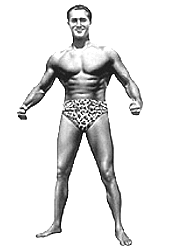
Mr. Dynamic Tension- Charles Atlas
So a connection can be made between Sun>Heracles>Vincey>Tarzan and Mother Nature>Hera>She>La.
Burroughs La was neither ancient nor immortal in the personal sense although she was the latest in an immortal line of Priestesses. She is a priestess of the Sun or Ra, The Flaming God.
Haggard’s Leo Vincey was the direct descendant of Kallikrates She’s great love of two millennia past. She, or Alyesha, to use her name, had killed Kallicrates in a rage. Kallikrate’s descendants were sworn to avenge the murder. Thus Vincey travels from England to far off Africa to locate this fabulous woman.
Kallikrates was the love of Alyesha’s very long life. When she recognizes Leo Vincey as her lost lost love she saves his life while offering him eternal youth if he will only bathe in the flames of eternal life. He hesitates to do so. To encourage him Alyesha steps once again into the flames which was a serious miscalculation. She crumbled to dust. Thus while Leo Vincey doesn’t actually avenge the death of Kallikrates she is nevertheless his victim.
Tarzan while actually born in Africa was conceived in England so he made the trip to Opar from England although he is ignorant of La. When Tarzan is captured in Opar he is laid on the altar of the Flaming God, La with the sacrifical knife raised, looks down on this Jungle God, this man like a god, and falls in love. Thus we have a replay of the She-Kallikrates situation.
Unable to take Tarzan’s life, La releases him begging him for his love. Alyesha’s full title was She-Who-Must-Be-Obeyed in the Matriarchal sense. The old conflict arises, Tarzan is more on the Patriarchal side, he has his moly in the waistband of his loin cloth, monagamous we are led to believe, happily married, so the Lion Man Sun King declines the honor of being mated to La>Hera. He asserts his Patriarchal prerogative to disobey although he always has a soft spot in his heart for La.
In a fairly masterful way ERB conflates the legend of Heracles, the fiction of H. Rider Haggard and the incredible strongmen of the Golden Age and his own little bit to write a charming and beautiful story which is fairly simple on the surface but one which becomes immensely rich with a deeper understanding of the sources.
Ernest Hemmingway once said that before one sat down to write one should have ten time the information in your possession as you put on paper else the story will seem shallow and contrived. It would seem that the sources upon which Burroughs was drawing, from the bodybuilding strongmen of his day to the legendary cycle of Heracles to the adventures of H.M. Stanley and the fiction of H. Rider Haggard might well fulfill Hemingway’s dictum.
When one searches for the sources of Burroughs one finds layer after layer of golden riches while discovering that in fact ERB did indeed create a man like a god- Tarzan The Magnificent.
Addendum
This is a quote taken from Bonzo Dog’s song Mr. Apollo. I don’t know whether the reader is familiar with the Bonzos but they were one of my favorites. Several glorious LPs. Neil Innes came from them as well as the great but tragic Viv Stanshall. Leave those drugs alone, boys.
Follow Mr. Apollo,
Everybody knows a healthy body
Makes a healthy mind.
Follow Mr. Apollo,
He’s the strongest man the world has ever seen.
If you take his courses
He’ll make you big and rough.
And you can kick the sand right back in their faces.
A few years ago I was a four stone apology-
Today, I am two separate…Gorillas.
Bonzo Dog Doo Dah Band
Long may they wave.
Part 8 Tarzan And The Lion Man: A Review
May 22, 2008
A Review
Themes And Variations
The Tarzan Novels Of Edgar Rice Burroughs
#18 Tarzan And The Lion Man
Part 8 of 10 parts
by
R.E. Prindle
First published on the ezine, ERBzine
More Stars Than There Are In Heaven
The last two chapters are titled ‘Goodby Africa; and ‘Hello, Hollywood.’ Burroughs thus complements Ring L1 with Ring R1 completing the circle. If one reads the book with this structure in mind rather than the linear one leading to a climax at the end the story will make more sense and be much more pleasurable.
ERB had had a rocky road in Hollywood since his arrival in 1919. The purchase of the spectacular Otis estate immediately called attention to him, an attention that he would have to fulfill. ERB obviously failed to live up to the expectations he had created while souring the relationship further by writing the muckraking Girl From Hollywood in 1922. In Lion Man he once agains ridicules Hollywood and actually the movie colony, as well it should have been. The first and last chapters are direct attacks. Comments of this sort are always resented and seldom forgiven. MGM was not in a forgiving mood.
Burroughs opens the chapter with a description of Tarzan. p. 180:
A year had passed.
A tall, bronzed man alighted from the Chief (Santa Fe RR passenger train called The Chief) in the railroad station of Los Angeles. The easy majestic grace of his carriage; his tread, at once silent and bold; his flowing muscles; the dignity of his mien; all suggested the leonine, as though he were, indeed a personification of Numa, the lion.
Yes indeed, the Lion Man had hit Tinseltown, flowing muscles, whatever flowing muscles may be, and all. Hollywood had come to Africa and now Africa had come to Hollywood with a silent but bold tread, whatever that is. MGM would make merry over the Lion Man.
Just by coincidence Tarzan arrives at the same time as Balza, The Golden Girl, who had already found fame and stardom in the movie capitol is returning. She now has green hair and has learned to say Mahvelous, in true Hollywood fashion. After all she had a human brain. All Hollywood stars said Mahvelous at the time which was a source of some amusement and derision. ‘That’s mahvelous, darling.’
The Freeman Lang Burroughs mentions was a real person, the Hollywood greeter. ERB had obviously listened to or seen several such spectacles- a nice snapshot of a bygone era.
With the trace of a smile Tarzan continues to downtown Hollywood and the Roosevelt Hotel. Named after TR obviously. The Roosevelt was real and so far as I know is still in use, although I haven’t been to Hollywood for twenty years or so now, so I can’t say for sure. The Hotel was frequented by the movie crowd while having a somewhat seedy reputation according to my sources.
While checking in, one of the local sharpers watches him sign his name- John Clayton of London. ERB has been around, he knows what’s happening. When Tarzan comes down from his room the sharper accosts him in the lobby with a ‘Say, aren’t you John Clayton from London?’
The sharper claims to have met Tarzan in London, although he doesn’t specify the major island of Africa or the lesser island England. Obviously he could never have met John Clayton on the lesser Island. He attaches himself to Tarzan as a guide.
He guides Tarzan to the then famous Brown Derby, an actual restaurant. Hollywood and LA are much different today than they were in the thirties,forties and fifties. All the garish wonder and splendor is gone. The Brown Derby was actually shaped like a brown Derby hat. I saw it before they tore it down but I never ate there; I did eat at the one over in Beverly Hills but it wasn’t the same. Burroughs makes some very unflattering remarks about the movie folk eating lunch there, which probably didn’t help him socially during the rest of the decade.
ERB then offers another slice of Hollywood life portraying the premier of Balza’s new film at Grauman’s Chinese Theatre, which I am sure everyone is familiar with. Freeman Lang again officiates at the mike. I’m sure everyone has seen such a depiction in either newsreels or movies. The Day Of The Locust would be a good example.
After the movies Reece, the sharper, suggests that he, a friend, and Tarzan attend a party. He fails to mention that they’ll be crashing it as they have no invitations, indeed, don’t even know the hosts.
Here ERB is giving an excellent portrayal of a Hollywood type who persists today, although much rougher now that cocaine and other drugs have been introduced. Formerly merely audacious and crooked, now they are vicious and criminal, using drugs as an entree.
Tarzan is not aware of what’s going on as Reece brushes past the doorman. While Tarzan makes himself amenable in small talk Reece and friend set about to rob the hostess of her jewels.
Tarzan is appraised by some studio types as a suitable condidate to play a jungle god. One of the men may be meant to represent Louis B. Mayer although if so, ERB is too cautious to mention his real name.
We also learn that Rhonda has been married to Orman and is now in the South Seas making another movie. If La and Rhonda did represent ERB’s Anima figure, then he has abandoned her which means that as Tarzan is now one undivided person he has no Anima and no woman. Strange situation.
About this time the screams of the hostess announce that Reece and his friend are doing violence to the lady. Tarzan rescues her then jumps through a window into a conveniently placed tree as the cops arrive.
Surprisingly he runs into Reece the next day. Asked why he isn’t in jail Reece casually says that his friend has a contact who fixed it. He feels no remorse or shame secure in the knowledge that nearly any crime can be fixed.
The party and the fixing are realistic portrayals of Hollywood. ERB must have attended such parties, while as a man about town he was familiar with the various Hollywood types.
BO Studios call asking him to come in for an audition. ERB does some flim flam about an adagio dancer playing the Lion Man, gives Tarzan a minor role because he isn’t the type to play the Lion Man, then Tarzan muffs his chance by killing a trained lion. Rather weak from my point of view. Tarzan then turns his back on Hollywood asking for directions back to Africa.
So the novel Tarzan And The Lion Man ends ‘not with a bang but a whimper.’ The duel with MGM has already begun.
Go To Part 9: Conclusions and Prospectus
Part 6, Tarzan And The Lion Man: A Review
May 19, 2008
A Review
Themes And Variations
The Tarzan Novels Of Edgar Rice Burroughs
#18 Tarzan And The Lion Man
Part 6
by
R.E. Prindle
First published on the ezine, ERBzine
The Center Of The Circle
Burroughs does a remarkable thing in this ring that clearly shows the Greek classical influence per Erling Holtsmark in his Tarzan And Tradition. ERB disolves his story and cast of characters after the last Bansuto attack. The cast is dispersed in several directions but ERB will deliver them all to Omwamwi Falls as he begins the three right hand rings: 3-2-1
In fact this does follow the Homeric tradition. The story of the Trojan Wars was actually a massive story of which only three parts survive, the Iliad, which concerns the central part of the epic and th two Returns, The Odyssey and The Oresteia. All the rest has been lost or survives only in fragments such as ‘The Judgement Of Paris.” Originally the epic was thousands of pages long. There were undoubtedly few scholars who had ever read the story in its entirety and fewer still who understood it.
It seems incredible that a very young ERB could have grasped the structure so completely while seeming to understand it so thoroughly. Holtsmark quotes ERB as saying that he was rereading Plutarch’s Lives in 1923 when he discovered that Numa was the name of a Roman emperor, actually one of the Republican kings, To that point he had believed that he had made up the name.
Thus we learn that ERB did some rereading and his subconscious supplied material. He could have, it is plausible, read the Iliad and Odyssey a number of times over his life. Along with other classical reading the basic method was established in his subconscious which he was able to consciously manipulate.
The Trojan War was the first of the three great sprawling European epics, unmatched in any other literatrue. The second was the Arthurian Saga also huge, sprawling through many thousands of pages and many different variations. The story has its roots in Greek mythology as well as in the Christian ethos. The Lancelot-Grail alone is several thousand pages. Burroughs doesn’t seem to have been much concerned with it. Indeed, most of it would have been untranslated in his time thus being unavailable to him.
The third great cycle was the strange nineteenth century English pursuit of the Grail in the search for the source of the Nile. In my estimation a rather peculiar obsession. This story too occupies several thousands of pages as all the participants recorded their efforts in copious detail. Livingston, Stanley, Burton, Baker and Speke have written magnficent narratives. Speke walking the Nile North after just having discovered the source actually ran into Baker following the Nile South. A remarkable accidental encounter that goes unnoticed. The best overview and history of the quest is Alan Moorehead’s The White Nile of 1960. He provides an adequate background for these modern knights in seach of an unlikely Grail. The Tarzan oeuvre might be indluded as a fourth cycle based on cycles one and three.
The first and third epics then involved ERB intimately. The Tarzan series is based on the Africa of the Nile Quest while framed in the literary construction of the first.
Burroughs then dissolves his story after the Bansuto attack then telling the story of the several participants on the way to Omwamwi Falls in the manner of the Homeric Returns. He then reassembles them less Obroski at the Omwamwi or Murchison Falls on the Nile. Thus the river cascading from the plateau is actually the Nile. What he calls the Thames on the plateau of the City of God must be indeed a substantial stream.
We have already dealt with the fate of Stanley Obroski and Tarzan. After the last Bansuto attack the Arabs agreed to take the midnight to six watch. During the night they folded their tents and silently stole away taking Rhonda, Naomi and the map with them.
Orman decides to go off in pursuit of them alone. Bill West convinces him to take himself along so the two abandon the safari to pursue the girls and Arabs.
Tarzan neutralizes the Bansuto by having them promise to be kind to Whites so the remaining safari members are able to somehow get their trucks and equpment to the Falls unmolested, that leaves the girls, the Arabs and Orman and West.
After leaving Obroski shivering with fright in a tree Tarzan comes upon Orman and West as they are being attacked by a lion. Plummeting from the convenient tree Tarzan dispatches the lion, immediately disappearing back into his tree. This is the first incident of the cast mistaking Tarzan for Obroski. I happen to think Burroughs handles this confusion extremely well. After all, Burroughs has firmly established Obroski’s cowardice with the safari members.
Orman and West’s astonishment at the seeming Obroski feat is very genuine. Later when Tarzan supplies them with a buck while translating Arabic from Atewy their astonishment can’t be more complete. Very effectively handled. Having supplied them with food Tarzan points them in the right direction and gets them started with a swift kick so that leaves the Arabs and the girls to account for. This also begins the comparison of the qualities of Rhonda and Naomi.
The Arabs have the map to the valley of diamonds that they believe is genuine and indeed it is. Unable to read English, the language of the map, they make promises of freedom to gain the cooperation of the girls. Rhonda scoffs at the genuineness of the map believing it a movie prop. However they can locate their position according to the landmarks provided by the map. Astonishingly they are able to locate all the landmarks which lead them to the Omwamwi Falls.
Naomi accepts her captivity while Rhonda plans escape. She effects this by saddling a couple ponies at night while driving the rest of the herd off. This episode is also well handled and quite believable given that this is a fantasy novel. The net result is that Naomi is recaptured while Rhonda makes it to the falls where the story is forwarded by her capture by the Apes of God. Another little joke, I presume.
Following both the map and Rhonda the Arabs and Naomi arrive at the Falls. The action then finishes the parallel story to Tarzan and Obroski of the girls and begins the right second ring story of The City Of God. This is a magnificent story full of many twists and surprises. In our day this stuff has been used over and over so that the imaginative feat is diluted or lost. If one places one’s imagination back in 1933 one can marvel at Burroughs; ingenuity while seeing how disappointed ERB was that the novel fell flat. Such is life.
Part 5 Tarzan And The Lion Man: A Review
May 19, 2008
A Review
Themes And Variations
The Tarzan Novels Of Edgar Rice Burroughs
#18 Tarzan And The Lion Man
Part 5
by
R.E. Prindle
First published on the ezine, ERBzine
Tarzan, Obroski And Burroughs
Burroughs has been ridiculing Obroski right along as an arrant coward. Wherever the action is, Stanley isn’t. When it’s over he shows up ready to fight. When a call for the safe job of kitchen help is made after the porters desert Stanley raises his hand.
The cowardice is in contrast to his magnficent physique. Standing 6’8″ or 9″ in his bare feet while his strength is as prodigious as that of Tarzan. No one in the safari has yet seen Tarzan but he and Stanley are as identical twins. When Stanley becomes fever stricken and disappears from the story the movie cast will confuse Tarzan for Obroski providing some amusing moments.
Over the oeuvre Burroughs uses the divice of a Tarzan double a number of time times. Esteban Miranda in Tarzan And The Golden Lion/Ant Men, here as Stanley Obroski and again in Tarzan And The Forbidden City as Brian Gregory stand out. The doubles are quite obviously aspects of Burroughs’ own character. As the doubles are all cowardly, inept or both one has to assume they represent Burroughs as he perceived himself before becoming a success while Tarzan represents Burroughs as a success. There was obviously a constant psychic tug of war between the two Burroughs. This was something ERB was desperately trying to resolve in favor of the Tarzan persona.
The quesiton is, was he ever successful in resolving the problem by psychologically integrating his personality? At several times in the corpus he seems to have succeeded even to the extent of killing off his old persona. But then there are doubts and Brian Gregory appears a few years later.
If I live long enough I will try a comparison of Miranda, Obroski, Gregory and Burroughs. Notiice the progression of the double from Spanish to Slav to Anglo. The Spaniard was the epitome of worthlessness at the turn of the century while the Slav though higher was despised. Gregory as an Anglo would indicate that Burroughs may have reconciled his self-esteem at least.
As a more or less irrelevant aside it is known that Tennessee Williams (1911-83) was a Tarzan fan. He was twenty-three years old when Lion Man was issued while A Streetcar Named Desire was staged in 1947. It may seem tenuous to make the connection between the names of Stanley Obroski and Stanley Kowalski but there it is. There are resemblances between Stanley-Naomi and Stanley-Blanche allowing for the fictionalizing powers of Williams. There is no proof that Williams specifically read Lion Man that I know of but it is neither impossible or improbable given his admiration for the character. Perhaps the germ of Stanley-Blanche was placed in Williams’ mind in 1934-35 germinating away in his subconscious to blossom eleven or twelve years later. I don’t say it’s so but it is worth investigating.
In the construction of this novel the story of Obroski and Tarzan forms Ring Three. The story moves from Ring Two, The Safari and will segue into the inner ring.
In Chaper 8, The Coward, Burroughs devotes six pages to explaining or rather justifying the character of Obroski. In justifying Obroski Burroughs is justifying himself which is why he took such pains with this book.
During the last Bansuto attack in Chapter 8 Obroski panicked. As the Bansuto attacked from one side Obroski ran off in the opposite direction. Unfortunately the Bansuto were on both sides and Obroski ran into their open arms. Now cornered Obroski fought from reflex: pp. 46-47:
Death stared him in the face! Heretofore Obroski’s dangers had been more or less imaginary; now he was faced with a stark reality.
Terror galvanized his mind and his giant muscles into instant action. He seized the black and lifted him above his head; then he hurled him heavily to the ground.
The black, fearful for his life, started to rise. Obroski fearful for his own, lifted him high overhead and again cast him down. As he did so a half dozen blacks, closed upon him from the tall surrounding grasses and bore him to earth.
His mind half numb with terror, Obroski fought like a cornered rat. The blacks were no match for his great muscles. He seized them and tossed them aside, then he turned to run. But the black he had first hurled to the ground reached out and seized him by an ankle, gripping him; then the others were upon him again and more came to their assistance…In all his life Stanley Obroski had never fought before. A good disposition and his strange complex had prevented him from seeking trouble and his great size and strength had deterred others from picking quarrels with him.
So, while Obroski was a coward when he had time to consider, in the grip of terror he was quite capable of using his great strength and size to fight back.
His cowardice was not his fault or part of his nature. Burroughs reflects further. p. 45:
We are either the victims or beneficiaries of heredity or environment.
Obroski was obviously the result of nurture. Thus we have no responsibility for what we are and can take no credit as we are either victims or beneficiaries. This is a fairly serious position statement.
Stanley Obroski (Burroughs) was one of the victims. Heredity had given him a mighty physique, a noble bearing and a handsome face. Environment had sheltered and protected him throughout his life. Also everyone with whom he had come in contact had admired his great strength and attributed to him courage commensurate with it.
Never until the past few days had Obroski been confronted by an emergency that might test his courage, and so all his life had been wondering if his courage would measure up to what was expected of it when the emergency developed.
He had given the matter far more thought than does the man of ordinary physique because he knew so much more was expected of him than of the ordinary man. It had become an obsession together with the fear that he might not live up to the expectations of his admirers. And finally he became afraid- afraid of being afraid.
It is a failing of nearly all large men to be keenly affected by ridicule. It was the fear of ridicule, should he show fear, rather than the fear of physical suffering, that Obroski shrank from, though perhaps he did not realize this. It was a psyche far too complex for easy analysis.
It is impossible to know for certain at this time what psychology texts Burroughs had been studying but ‘a psyche far too complex for easy analysis’ points in the direction of Freud, Jung or both. ERB seems to have been involved in Depth Psychology of some sort. David Adams finds traces of Jung. I am not prepared to concede so much at present but David may be much more sensitive on that score than myself. I don’t rule it out although I would lean more to Freud as the better known. Still, as I find ERB to be a very inquisitive guy there is no reason he couldn’t have known of both. Either would likely have been mentioned in his varied reading and we know he was an omnivorous reader.
At any rate it seems clear that Obroski’s heredity was overridden by the conditioning of environment. Unable to overcome the conditioning or hypnotic suggestion he became as we find him.
There seems little doubt that here ERB is explaining himself. Obroski and Tarzan are identical in stature and abilities but in order to realize his Tarzanic potential he must overcome his environmental conditionings and assume his proper being.
Whether the emergency Tarzan/Burroughs is facing in his difficulty with MGM or something else it seems likely MGM as the struggle is placed in the context of the MGM/BO Studios filming Trader Horn/Tarzan, The Ape Man.
So Obroski is captured by the Bansuto and made prisoner in their village. Here he encounters Kwamudi, captain of the safari Blacks and a couple porters who had been captured after deserting. Obroski learns that the Bansuto are cannibals and that he will be the man who came to dinner.
Burroughs gets in some sly humor here. Bound and starved Obroski complains about his treatment. p. 51:
“This is no way to treat people you’re going to eat.” grumbled Obroski. “You ought to get ’em fat, not starve ’em thin.”
ERB has already given notice that he is in psychological mode. He says that Obroski’s psyche is too complex for easy analysis, whatever that might be. That’s what we all say and it’s bosh. When I was younger I thought my psyche so unique and complex I wanted to offer myself to science as a specimen. As my own self-psychoanalysis evolved I realized the only thing that made it so complex was the resistance involved in facing the fixations. So with Burroughs. In a few pages he lays out out completely the problem he is facing in symbolical or dream imagery. Only resistance anf fear prevent him from breaking on through.
A psychoanalyst could lay your whole problem before you but if you weren’t ready to deal with it, in other words, overcome the resistance, you wouldn’t be able to see it. You’d think he was talking about someone else. So here ERB lays out his whole problem before you but if you weren’t ready to deal with it, in other words, over come the resistance, you wouldn’t be able to see it. You’d think he was talking about someone else. So here ERB lays out his whole problem. Whether he resolved it is a matter of debate. David Adams thinks not while I have not yet made up my mind.
The problem he is dealing with is his central childhood fixation of John The Bully. I have already gone into this in Doubles and Insanity but it won’t hurt to give a variant interpretation as this very key incident meets with a lot of resistance from Bibliophiles on its own.
As has been noted Burroughs was plagued by dreams of appearing naked in public. Nakedness is a significant theme in the oeuvre. Tarzan himself runs around naked except for a skimpy g-string; so Tarzan’s natural condition and Burroughs dream fears mesh. He has made a virtue of necessity.
In psychological terms John The Bully so emasculated Burroughs that he lost his offensive and defensive armor which is to say to the civilized man his clothes. Burroughs always says of Tarzan that his veneer of civilization went no deeper than his clothes. Nothing could be clearer than the relationship to ERB’s situation on the corner. ERB explains the nature of nakedness to the civilized man. p. 58:
“He says for you to take off your clothers, Bwana.” said Kwamudi, “he wants them.”
“All of them?” inquired Obroski.
“All of them, Bwana.”
(Note the excruciating deliberateness as ERB painfully drags this scene out.)
Exhausted by sleeplessness, discomfort, and terror, (Here ERB makes excuses for himself.) Obroski had felt that nothing but torture and death could add to his misery, but now the thought of nakedness awoke him to new horrors. To the civlilized man clothing imports a confidence that is stripped away with his garments.
So, in real life, Burroughs had been psychologically stripped naked by John having lost his self-confidence. This is an accurate understanding. When he constructed his alter ego, Tarzan, he made him naked in his uncivilized state, hence full of self-confidence though naked, but then clothed him handsomely in his civilized state in which he was uncomfortable. Thus ERB attempted to resolve the problem.
Now when John bullied ERB he forced a split in his personality. while his physical self was humiliated his psychological self split off symbolically taking to the trees for refuge. Hence Tarzan’s fabulous arboreal exploits while he views so many scenes from above in a tree.
Now comes the very interesting scene in Rungula’s village where Tarzan suffers the shock of recognition as he looks down on his own replica from the tree to the ground.
Tarzan is in no rush to visit Rungula’s village, perhaps indicating resistance. Here’s how ERB describes it. p.61:
Tarzan of the Apes was ranging a district new to him, and with the keen alertness of the wild creature he was alive to all that was strange or unusual. Upon the range of his knowledge depended his ability to cope with the emergencies of an unaccustomed environment. Nothing was so trivial that it did not require investigation: and already, in certain matters concerning the haunts and habits of game, both large and small, he knew quite as much if not more than many creatures that had been born here.
For three nights he had heard the almost continuous booming of tom-toms, faintly, from afar; and during the day following the third night he had drifted slowly in his hunting in the direction from which the sounds had come.
Surely an old jungle baby like Tarzan could understand the language of the drums? That is called procrastination.
And so on the third day ‘He was arisen.’ Hmmm. In Tarzan Of The Apes the birth of Tarzan replicated that of Moses and now Obroski is to die while a new Tarzan arises a la Jesus.
I had my attention called to this Moses part while visiting a Jewish site. The writer was marveling that Superman was Jewish and that his birth replicated that of Moses which it does. I had always thought that the two teenage Jewish boys who created Superman were replicating Tarzan’s birth and that may be equally true.
In the Moses story he is born to a Jewish woman who places him in an ark then puts it in the Nile on which he floats downstream to be rescued by an Egyptian princess who rears him among a different people. This story presupposes that heredity overcomes environment which is nonsense. One is not born a Jew one is educated into the identity.
Superman is born a Kryptonite, placed in a rocket ship that crashes into this goyish earth couple’s backyard. They then rear the Kryptonite child as their own who then has a double identity as an ineffective Earthman while retaining his Kryptonite powers. Thus the Jew represents himself as superior to the goy.
Tarzan too is born to a human mother who dies. He is lying in his cradle when the ape, Kala, snatches him up rearing him as her own. The different people Tarzan grows up with are apes. Thus he too has a double identity.
All three stories are identical while Moses is first, Tarzan second and Superman third. Thus in his first incarnation Tarzan appears to be a Moses figure.
In Lion Man Tarzan apperas to be born again when he absorbs his other split off half- Obroski. Thus on the third day Tarzan assumes a Christ like identity.
Many have noted that the intitials of John Carter and John Clayton are JC and they call attention to the fact that they are the same initials as Jesus Christ.
So, here we have Tarzan, a walking dead man so to speak, who after three nights -Good Friday to Easter Sunday- looks down on the other half of his split personality and recognizes himself. The two halves then begin a process of amalgamation becoming one again. So Tarzan/Burroughs is born again or arises from the dead.
Tarzan then unites the Old and New Testaments being at one and the same time both Moses and Jesus Christ. The old Adam and the new Adam. Fairly astonishing stuff. What does it mean?
Tarzan then hauls Rungula up into his tree i.e. John the Bully is brought up to Burroughs split off personality where Tarzan demands that he release Obroski i.e. John restore Burroughs other half to himself while at the same time making him promise to be always kind to Whites.
Obroski then leaves Rungula/John’s village where he joins Tarzan. Thus Burroughs symbolically reunites his split personality or in other words appears to integrate his personality. At least he makes the attempt.
At the very least he has analyzed himself to the threshold of integration. Whether he actually stepped over the threshold is open to doubt. As a comparison let us examine Feodor Dostoievsky’s great nineteenth century novel Crime And Punishment. There is no direct evidence that Burroughs might have read the book but the possibility exists that his curiosity led him to this very famous 1866 novel. If so, Dostoievsky’s analysis of Raskolnikov might have influenced ERB on the unconscious level. I had to read the novel three times to get a conscious grasp of it.
The novel concerns the character’s dependence on women. Raskolnikov is dependent on his mother and sister who make tremendous sacrifices of their own well being to put him through law school. Raskolnikov resents his dependence yet can’t tear himself from it even when offered a simple and easy opportunity to do so. His solution to his psychological problem bypasses analysis for an impossible external one. He decides to symbolically kill his mother and sister hoping thus to free himself. Psychologically this is not a viable method.
As his victim he selects an old female pawnbroker. This woman has large assets stored in her apartment. Thus Raskolnikov takes valuables from her in lieu of the money he is receiving from his mother. In the process he kills the old woman and when her daughter appears he kills her too. Thus he has killed surrogates of his own women. The pawn broker’s body lies before him. To free himself, according to Dostoievsky it is necessary for him to step over the body thus completing the crime. Raskolnikov cannot do this, walking around the body instead thus negating the benefits of his murder.
In Burroughs’ case his imaginary alter ego, Tarzan, convinces Rungula/John to release Obroski/Burroughs from custody. In other words, exorcise the fixation. However, psychologically Rungula/John cannot do this. It is necessary for Burroughs to confront his fixation and recognize it thus negating the hypnotic suggestion that made it his fixation that he is a coward thus freeing himself. That is the only way it can be done. Thus as Raskolnikov did not step over the pawnbroker’s body so Burroughs does not cross over the threshold of integration at this time.
Instead his imaginary self, Tarzan, attempts to teach his temporal self, Obroski, to be brave and fearless. Hence, in what might be seen as high comedy, Tarzan introduces the Faux Lion Man to the real lion. However Tarzan advises Obroski to be careful around Jad-Bal-Ja’s new love of whom Tarzan has no experience.
As soon as Tarzan disappears Obroski/Burroughs who had been freed by John scurries for the security of the lower terrace where he cowers until the Big Bwana’s return. Subsequently he catches fever not unlike Raskolnikov, if Burroughs read Crime And Punishment. Tarzan entrusts the unconscious Obroski to a native chief to nurse. From that point on Tarzan assumes both identities as the movie company who have never seen him and are unaware that he and Obroski are twinlike mistake him for Obroski which Tarzan lets them do. Obroski then dies.
If Burroughs thought he had solved his problem by wishing himself into the role of Tarzan he had to be mistaken. As Jung pointed out in Mysterium Coniunctionis one cannot will one’s fixations away. No matter what temporary success you may enjoy the fixation will out.
In the role of Tarzan Burroughs set himself an impossible task to perform. Tarzan is an ideal to hold before oneself for emulation’s sake but an impossible role to fill. Burroughs admitted this in his posthumously published novel Tarzan And The Madman in which in the end he simply gets into a plane and flies off into the sunset.
The story of the two Lion Men forms the third ring in the story. We will now examine the inner ring, the center of the storm, and then the other side of ring three, the parellel story of the two female lookalikes, Naomi and Rhonda.
Advance to Part 6: The Center Of The Circle
 I, Dynamo