Better Living Through Chemistry:
The Sixties And Its Drugs
by
R.E. Prindle
If the Sixties had had a motto it would have been the variant of the Dupont slogan: Better Living Through Chemistry. It was sincerely believed that a pill could make your life shine. Amphetamines, LSD, barbiturates, just about anything that could be swallowed, sniffed, or popped. The Sixties mind was blown and never fully recovered. If as Fugs’ percussionist Tuli Kupferberg observed: America is insane, it was drugs that pushed it over the edge.
When drugs hit in the Sixties they were relatively new, no immunity to their use had been built up. Drugs were to American youth what alcohol had been to the American Indian in the nineteenth century and American youth dressed as funny as the Indians had; Youth adopted all sorts of bizarre behavior and clothing. It seemed funny at the time but I’m not laughing anymore. By the end of the Sixties from a sort of contact high the older generations tried to look and act just like the youth who by the end of the Sixties were no longer so young. Both age groups were laughable. It was something to see.
Of course chemistry had been discovering all kinds of new things from the nineteenth century on; people just couldn’t find an immediate use for the sort of drugs discovered. Barbiturates were first synthesized in 1864 by the German chemist Adolf von Baeyer. The formula sat around on the shelf till 1903 when some bored soul found that you could use the formula to put dogs to sleep. I suppose it wasn’t a great stretch to apply what was learned of dogs to humans.
At any rate new formulations began to appear through the thirties and in 1946 the tranquilizer Miltown was formulated. By 1955 Miltown was a great hit to be followed by the blockbuster Valium in 1963. You began to see a lot dopey people walking around, mostly over forty, who said they couldn’t live without the stuff.
Barbiturates were called downers. At least on the West Coast they seemed to be the preferred chemical.
The East Coast, for reasons I will explain, was powered by amphetamines from the late fifties through the Sixties decade. Out on the West Coast we thought the stuff was pernicious, Speed Kills was the slogan. Probably didn’t stop too many people from using it. I saw enough amphetamine casualties walking about.
Amphetamines were first synthesized by the German chemist Edeleano in 1887; methamphetamine by a Japanese chemist in 1919 and worked with by the Brit-American Gordon Alles who came up with Benzedrine in the thirties. By the thirties, then, uses were found for the drug. Refinements followed.
The chemists were also analyzing foodstuffs so that the various vitamins were being discovered during the twenties and thirties. So in addition to drugs the pharmacopeia included previously undiscovered nutrients. The nutrients were more important than the drugs. For all of previous history there may have been no human not suffering from some vitamin or mineral deficiency. For the first time beginning in the thirties a human could be fully supplied with all the necessary vitamins, minerals and amino acids. True health.
It only remained for someone to come up with the bright idea of combining amphetamines and vitamins to appear to create a wonder drug, a veritable fountain of youth, or so it would seem.
As Henry Kaiser proclaimed on his cement trucks: Find a need and fill it. He was talking concrete but a Jewish-German doctor by the name of Max Jacobson did the obvious and combined amphetamines and vitamins along with certain other unmentionables, oh well, monkey balls, into what he thought was a healthful rejuvenating cocktail. As Max got his medical license in 1929 while the Nazis came to power in 1933 his medical career in Germany was short. Max terminated his German residency in 1932 leaving first for Prague, then Paris and in 1936 for the new Promised Land of the USA.
Max’s chronology seems a little crowded and perhaps askew but between 1929 and 1932 he claims to have invented his cocktail going rapidly from obscurity to apparent fame. According to Max, Lertzman and Birne quoting from his diary, his concoction was so well known that the Nazis demanded his formula before they would allow him to leave. Apparently they were incapable of chemically analyzing it.
As Max left in ‘32 and the Nazi’s came to power in ‘33 his chronology is somewhat suspect. However, if the Nazis had stolen his formula Max proved to be responsible for Hitler’s deteriorization if Hitler’s doctor Theodor Morrell had purloined the formula and injected Hitler, as he did.
Amphetamines gained such acceptance in the thirties that all the combatants of WWII were dispensing amphetamines to their troops to keep them cheerful as the bombs exploded around them rattling their nerves. Interestingly the Germans realized the danger of the drug ceasing to dispense the pills, probably why they lost the war.
Smith Kline separated dextroamphetamine from Benzedrine in the forties so that the amphetamine pharmacopeia that Max Jacobson could use in his concoctions had grown by 1946 when Max’s post-war career in the US kicked into high gear.
During the fifties while Max was developing his formulas and expanding his clientele geometrically, the pharmaceutical company Smith, Kline, French, later Glaxo-Smith-Kline, was developing its own business of Benzedrine inhalers, Benzedrine (Bennies) and Dexedrine (Dexies) into a phenomenally successful enterprise. Thus the licit and illicit markets were booming.
By 1960 Max Jacobson’s reputation as a miracle doctor had expanded wildly and his fame would soon reach the White House. He naturally spawned imitators and by the early sixties Robert Freyman, Elois Peter Warren, Jack Cohen and John Bishop were injecting non-stop flooding NYC with speed and vitamins.
One should pay attention to the vitamins. Beginning in the forties their importance was noted to the extent that Wonder Bread began enriching their product with vitamins. Thus by the early fifties in my avid reading of cereal boxes I noted that they too were vitamin enriched. The enrichment eliminated vitamin deficiency diseases like beri beri and pellagra so my generation was perhaps the healthiest the world had yet seen.
Vitamins and minerals are nutrients that build and maintain bodily processes, most prominently in the brain, while drugs consume essential substances without replacing them. Thus the amphetamine doctors in combining massive doses of vitamins and amphetamines provided some healthful chemicals along with the deleterious chemical drugs. God only knows what the human placenta and monkey balls Max used did but Max thought they were beneficial. As a doctor he never conducted any experiments so he was only guessing.
Still, his concoction was fairly dangerous stuff. Like many experimenters Max tried out his formulas on himself. As one formula he tried left him with a permanently crippled leg I think it safe to assume there was some permanent brain damage. Edie Sedgwick of the Warhol gang certainly destroyed her brain from the massive injections she took from Max, Dr. Robert and Dr. Bishop, aka Dr. Roberts, all three. She really liked the stuff. Max himself was a steady user of his stuff to the extent we are told that he didn’t even sleep for a month or more at a time.
As he had undoubtedly been using from 1932 on, by 1960 he must have been a living psychotic reaction. While he had never been one for controls by ‘60 he had lost control, padding around his office in a blood stained smock, unwashed, with dirty, stained finger nails.
It was in this state in September of 1960 that he was enlisted to shoot up John F. Kennedy just before the first Nixon debate. Kennedy soon became an amphetamine freak.
Before we go on with amphetamines let’s take a look at the second great drug development of the Sixties, LSD.
II
The active ingredient in LSD occurs naturally in a rye ergot from which it was isolated by Dr. Albert Hofmann in Switzerland in 1938. Finding no use for it he shelved the substance until 1943 when he re-examined it. He accidentally imbibed some thusly experiencing its disorganizing mental effect. This was not necessarily a use for it but at the time the wartime predecessor of the CIA, the OSS, was searching for a reliable truth serum. LSD wasn’t reliable or even a truth serum but the CIA decided to give it a few test trials anyway. Thus research programs were begun at such universities as Harvard, UC-Berkeley and Stanford University. At the same time psychologists thought that LSD might be a perfect drug for psycho-analytic uses. They believed, at least, that with a great deal of experimentation they had achieved some success and could have achieved more if the substance hadn’t been outlawed in 1966.
So with both amphetamines and LSD we are talking about legal chemicals until 1966.
LSD received some notoriety in the fifties as I even wrote a high school essay concerning it in 1956. Aldous Huxley and many of the Hollywood crowd were quite familiar with LSD in the late fifties. Cary Grant was a proponent of the substance while samples began leaking from the labs at UC Berkeley and Stanford, or gushing might be a more appropriate word.
LSD along with mescaline, peyote buttons, mushrooms and whatever were revered as mind or consciousness expanders. People in the Sixties really believed that they had penetrated the secrets of the cosmos when all they were looking at was their own mind, in most cases fairly empty. The early users, an interesting group, actually thought of themselves as supra-human. They could barely deign to talk to the inexperienced while avoiding any physical contact. They were fairly awesome in their belief that they were in contact with something out there.
So, while Dr. Timothy Leary of Harvard may have given LSD its first real national exposure with the substantial aid of the Luce’s and their Time and Life magazines, LSD was around the Bay Area long before Timmy brought it to the fore. I first actually saw tabs in late 1963 when I took a job with a mortgage banking firm called Lowell, Smith and Evers. My indoctrinator lived near campus of UC Berkeley. The first time out I met him at his house where he had a bowl of what looked like aspirin on his living room table. ‘Lotta headaches?’ I asked. ‘Well, no,’ he said smiling mysteriously, ‘go ahead and have one.’ I declined but as it turned out he took a tab before work. He enjoyed a most leisurely work pace as we got very little done on that first day.
So, by then the West Coast acid guru, Ken Kesey, who as it would turn out I would know slightly, was distributing sunshine down in La Honda preparing the way for the acid paradise of Haight-Ashbury.
Leary back at Harvard violated protocol and was expelled from his post. He then ended up at Billy Hitchcock’s vast estate at Millbrook New York where Tim began his vastly misguided career. Timmy was on a religious trip so he thought he was finding not only the secrets of the cosmos but shaking hands with God himself or, maybe, himself.
Thus Tim became a drug guru describing LSD as the Greater Sacrament and marijuana as the Lesser Sacrament. Well, you know, why not? Thus Tim legitimized their use for a whole generation turning the Sixties into a mess. In his acid delusions Tim decided that the recently introduced Aramis aftershave was God’s own scent. Rather extraordinary claim I thought but I bought a bottle. Out of production for a few decades it has been recently reintroduced. I bought another pint so as to maintain traditions. It is a damn fine scent although whether God uses it or not I can’t say.
Tim was associated with some colorful characters in his attempt to turn on the world including the reprehensible Allen Ginsberg the so-called poet and the remarkable Michael Hollingshead who billed himself and titled his autobiography The Man Who Turned On The World. The autobiography is free on the internet.
From about 1963 to 1965 then Kesey and his Merry Pranksters and Leary and his Millbrook crowd turned the country on its head. If America was insane as Tuli Kupferberg said, it was the result of the LSD and amphetamine infestations.
III
To return to Max Jacobson, New York City and its amphetamine plague from 1960 to 1965. As I say, by 1960 Max Jacobson, the original amphetamine pusher, was booming. He naturally engendered imitators. Thus a Dr. Robert Freyman, who after the busts wrote a book called What’s So Bad About Feeling Good, established himself uptown near Max. He was immortalized by the Beatles in their song Dr. Robert. In midtown Dr. John Bishop aka Dr. Roberts with an s established himself. He is well described by Cherry Vanilla in her memoir, Lick Me, and his association with Edie Sedgwick and the film Ciao, Manhattan.
In addition there were Dr. Jack Cohen and Dr. Alois Peter Warren. Haven’t located much as these two yet although a record of Warren’s appeal to his 1970 conviction for trafficking in amphetamines is available on the internet.
Of some significance to the early sixties NY scene is a connection to Andy Warhol with Jacobson. Warhol whose atelier The Factory of ‘64-’65 and ‘66 was fueled by amphetamines was at least a one time patron of Max. This may have been sometime in ‘62 or ‘63. If as Andy would have been deeply impressed by the celebrity clientele crowding the waiting room where they apparently waited for hours he may have transferred the idea of mind control through amphetamines to his own celebrity location at the Factory which he successfully had by 1965. Andy yearned for celebrity status as much as Max did. Max’s bizarre persona may also have made a significant impression on Andy who was no stranger to bizarre personas.
Andy, himself, during the First Factory years was said to have limited himself to a quarter tab of Obetrol, I believe a Dextroamphetamine formula. He would also have understood the controlling power of the drug. If you’ve got celebrities standing around for hours, believe me, you have control of them.
Now, in 1962 Anthony Burgess published his novel A Clockwork Orange. The English fashion photographer David Bailey immediately seized on the book’s potential to further the Yobbo revolution. Bailey became attracted to Mick Jagger of the emerging rock group The Rolling Stones so that gathering up Mick in 1963 they hopped a big 707 to cross over to NYC to visit Andy. Bailey may have met Andy in 1961 in an earlier visit. The idea was to star Jagger probably in a Warhol movie in a glorification of the novel’s Droog lifestyle.
Bailey, Warhol and Jagger bought the film rights to the novel from Burgess. Andy actually made an adaptation of the novel in 1965 titled Vinyl, available on the internet, although not starring Jagger. Jagger went on in his post 1967 stage persona to imitate the Droog style. Thus one may believe that the culture of the First Factory was based on the Droog’s while the culture was fueled by speed.
But, back to Max. As I said Max was approached to medicate JFK before the first Nixon debate. Kennedy was a very sick man who was nearly exhausted by the demands of the 1960 campaign while he was fearful of losing his voice for the debate. Max shot him directly into the larynx. A spry speed rapping Kennedy shot down Nixon to essentially win the election that night.
Kennedy who was always in a lot of pain found significant relief from Max’s shots. Max immediately became a regular visitor to the White House after Kennedy’s inauguration. Thus by April and the Bay of Pigs Jack was dependent on Max Jacobson and his amphetamine shots. Jacks dependence on amphetamines probably affected his judgment during that fiasco.
In June of 1961, a couple months later, Max accompanied JFK to the Vienna Summit with Nikita Khruschev. Kennedy’s behavior around the Bay Of Pigs fiasco was erratic while at the Summit where he received at least three shot before the interview Khrushchev walked all over him.
It is known that Max gave Kennedy at least three shots before the Khruschev meeting. Kennedy was clearly out of it. It seems possible then, if not probable, that Max was able to exercise considerable control over Kennedy. Max knew a little something about hypnotic suggestion while the rush or flash of the amphetamine coming on would leave the patient open to a well placed suggestion.
Thus as Kennedy was undoubtedly shot up once or twice before or during the Bay of Pigs Max might easily have planted a suggestion in Kennedy’s mind to botch the operation while in shooting up JFK at least three times before the Khruschev meeting it seems certain that he at least rendered Kennedy ineffective.
There is no reason to not believe that Max was following his own agenda or that of some organization. He was Jewish.
Max continued to minister to Jack. Brother Bobby Kennedy, Jack’s Attorney General, looked askance at Max. He had a number of vials analyzed and at least realized that his brother the President was being drugged with amphetamines.
Jack didn’t care but Bobby did. Max had an entrée to the White House. As he was entering Bobby intercepted him and told him to get the hell out, not to bother his brother again. Jack was totally dependent if not addicted so that he dropped affairs of State to fly to New York to beg Max to forgive the situation and give him another shot. Imagine that! The President of the United States flying to a quack doctor to beg him for treatment. There is a real transfer of power there. Was it Mind Control the CIA was looking for?
Max had been deeply offended by Bobby. Remember that Max himself had been self medicating for maybe twenty years. He must have had but a tenuous grip on whatever passed for reality in his own mind. In other words his subconscious ruled his conscious mind; subjectivity overruled objectivity. Max was not the forgiving kind. Jack had to pay. As Max was experimenting continually he is sure to have had different formulations that produced different effects. He is described by one client as taking a little from one vial, a little more from another and so on and then shooting it in. One client described himself as going blind for three days after a shot.
In this case Max gave Jack a formulation of such potency that Jack ripped off his clothes and began streaking naked through the corridors of the Carlton Hotel where he was staying. Fortunately he was restrained before he could make the lobby and possibly go streaking down the street. Another doctor had a heck of a time bringing Jack under control with yet other drugs.
Yes, indeed! Now, Jack was President of the United States and he had freaked out. He was in control of the nuclear armament of the United States. As Commander in Chief he was entrusted with the little red button. What would happen if he had a psychotic reaction to one of Max’s shots and freaked out with all those nuclear weapons at his command; Dr. Strangelove for real.
He was dependent. He was addicted. He was out of control. The only possible solution was evident. On 11/22/63 they pulled the trigger.
I don’t know how Max survived when Kennedy didn’t but he did.
As the fact of Kennedy’s addiction has been only slowly surfacing in the last few years one can only assume that Max’s boasting of being Kennedy’s doctor at the time brought society patients to him even after 11/22/63. Indeed he was affectionately known as Dr. Jake and apparently, as document maker Martin Kasindorf titled his film, Everyone Went To Max is close to the truth.
Yet, even as ‘Doctor Jake’s’ reputation spread the casualties of his practice surfaced. While it would seem that Max should have taken notice he seems to have been in denial. He did believe that some chemical reaction took place between the vitamins, speed and monkey balls that converted the speed more or less into an actual nutrient that negated its deleterious effects.
Still, as in the case of Bob Cummings the beloved 50s movie and TV star when his reaction began to show and develop Max just laid on more drugs until Cummings was a wreck. One would think that at that point Max would have sent his concoction to a chemical lab to determine whether the baleful effects of the amphetamines were moderated or not. But, then, Max himself was zonked and making a lot of money.
At any rate, by 1966 and ‘67 the casualties were piling up. One of the most tragic was Edie Sedgwick who was associated with Andy Warhol. She was frequenting not only Max but John Bishop aka Dr. Roberts and Robert Freymann aka Dr. Robert. The greatest crime committed against her was when Bishop dosed her continuously during the filming of Ciao! Manhattan.
Other members of Andy’s group began having negative reactions also, as the amphetamine craze in NYC was coming apart.
As the 70s began a crackdown on the doctors began. As noted Warren was set up, busted and sent away for five years. Dr. Jake, Max Jacobson, began to be investigated by the medical board in ‘72 and his license was taken away in ‘75. I have found nothing on the fate of Jack Cohen while Kasindorf notes that Bishop quietly slithered off to nether Long Island.
The medical use of amphetamines was also reviewed and prescriptions fell off notably after 1970. However there was Ritalin….
Also it should be noted that the use of amphetamines in Viet Nam was endemic and huge. If the Nazis gave up dosing their troops because of negative reactions US troops in Viet Nam were not responsible for their actions.
It should be noted also that US Air Force regulations today require pilots to be dosed so that they stay alert during missions. If they refuse they can be grounded.
IV
The important thing to remember is that behind amphetamine and LSD pot and barbiturates were constants as well as alcohol although for a while alcohol was disparaged and some totally rejected it. Many people were running on as many stimulants as they could cram in. Some people had an astonishing capacity while still being able to function, after a fashion of course.
The generation from 1938 to 1943 went buggy for some reason. I still haven’t been able to put my finger on it. Probably a combination of absurd indoctrination in school and bizarre television programming. Some stuff people consciously remember some they don’t. Dave Garroway’s ridiculous TV show for instance had a profound effect on my class although the guy always repelled me. A lot of inane nonsense entered our minds through those sources. It’s all suggestion.
As important as anything was the emergence of rock and roll. This was combined with the Negro influence entering the main stream. Fats Domino and Little Richard, Eartha Kitt, Harry Belafonte. Everybody loved records and wanted to record. During the fifties as today the emphasis was on single songs or 45s not LPs. The change to LPs probably came about through Folk Music. It was easier to put together thematic LPs around what were considered folk songs. Harry Belafonte did well and, of course, the greatest of the Folk groups, The Kingston Trio, outshone and outsold everyone.
Thus when Folk and Rock merged and groups developed ‘sounds’ LPs of all ‘original’ material became de riguer and expressed the psyche of the generation much as novels had in earlier generations. Instead of one hit song and ten standards comprising ten or twelve minutes a side an LP had to be twenty minutes a side or forty minutes a disc. That was a very significant difference.
As the LP and group concept developed they did so within a context of social unrest, the civil rights movement and Viet Nam war. To this was added drugs. Sound quality improved while bands recorded their music under the influence of speed, acid or whatever so that while the music might sound a little discordant or strange to a straight listener, the music might take on a much better quality if you, like the musician, were also on speed or acid. So this furthered the appeal of drugs.
Thus when LSD exploded after 1966- ‘67 so-called acid rock was all the rage. Perhaps the most total acid record was Jimi Hendrix’s Are You Experienced. People who had taken LSD were experienced, as the term went, and people who hadn’t weren’t. The songs on Hendrix’s record directly referred to the LSD experience. Thus the younger generation’s minds were conditioned to look on drug use as a positive good thing.
The real problem with drugs was that they were inward looking. They tended to solidify one’s opinions into concrete unshakable truths. As drugs were believed to be the opposite, that is, mind or consciousness expanding, people actually believed their meager thoughts were cosmic. As you can see, divorced from reality.
Listening to song lyrics in this hypnoid state the lyrics entered their minds as suggestion which then became programs of action. As Jimi Hendrix, who had been psychedelicized noted, the band could lay down a hypnotic rhythm and when the desired stage had been achieved zing in the suggestion with a very good chance of it sticking. Once accepted it couldn’t be removed. There was some pretty effective mind control going on.
All the arguments of the Left had little effect compared to the hypnotic suggestions. The anti-war and anti-racist efforts were effected from the grooves of records and not from inane and insane political activists. If the Days of Rage at the 1968 Democratic convention failed it was probably because the command to violence was defeated by the cry for peace and non-violence implanted by musical propagandists.
As the demand for psychedelic drugs grew an amazing ability to supply the demand ran apace or ahead.
V.
By the end of ‘66 then both LSD and amphetamines were declared illegal. Speed could still be prescribed by doctors for medical use but their success brought them under closer scrutiny that would put them out of business in the seventies. LSD was supported by fanatical mind expansionists who were convinced that the Greater Sacrament was wiping clean their doors of perception. The notion was supported by the heroes and demi-gods of the generation, the rock stars.
These rather ordinary boys and girls who really had little going for them but a modicum of musical talent were hailed as infallible gurus. Their lyrics most of which were inscrutable and/or laughable were ingested as sacred texts. The musicians were able to keep up the charade during the Sixties but as the seventies got underway they all copped the plea: Hey, I’m just a singer in a rock and roll band. The Great Droog Jagger came up with: It’s only rock and roll, but I like it.
Until Altamont at the end of ‘69 the fans expected miracles and if they didn’t get them from the music they thought they were from LSD.
Where there’s a huge demand you can bet there will be a huge supply. Whereas speed had been predominantly an NYC phenomenon Acid found its spiritual home on the West Coast. The Hippie explosion occurred after the ban of LSD in the West Coast city of San Francisco. Sixty-seven, eight and nine were the big years of that phenomenon until it imploded possibly helped along by the Altamont fiasco which was a big deflator.
The most representational band of the Hippies was The Grateful Dead. The Dead had been the house band for the Kesey affair. Kesey had been on the lam on drug charges but actually for being totally offensive to the more sedate fathers of society. Besides he had or would graduate from acid as he said. Connected to both Kesey and the Dead was the fantastic acid head Owsley Stanley, often referred to as Stanley Owsley or most frequently just Owsley. Owsley was the Hippie chemist par excellence. If living could be made better through chemistry Owsley was your man.
Strange one too. In 1969 when I was just getting my record store off the ground The Grateful Dead came to play at Mac Court UofO. By 1969 communes were big and many, many people had ‘returned to the land’, that is they were living in hovels out on the mountain slopes, perhaps growing some weed instead of vegetables and while professing a peaceable disposition ready to shoot dead anyone who came near their patch. If you were totally insane or close to it your time had arrived. If you were merely insane all it required was an aptitude for navigation. You will note those are the only three available options. Everyone was flying high with a defective auto-pilot.
So there I am standing in my little tiny 400 sq. ft. record store dreaming big dreams, some might have said impossible dreams, when in walks this guy clutching a gallon jar of what looks like blue and white aspirin although more crumbly, not so firm. This apparition announces himself as Owsley. Well, alright. What’s that you’ve got in the jar?
He had, god only knows, perhaps ten thousand tabs of LSD. Well, OK, but don’t you think you should have them wrapped in a brown paper bag, a pillow case or something? I mean, my store is under surveillance. And what do you want to do with your, uh, stash?
It wasn’t his stash, it was his merchandise and he wanted to me to buy the jar. To say that my mind was boggled would be to miss the point. Of course my mind was boggled but as my record store was considered a head shop by everyone Right and Left, while depending on the heads for my clientele I didn’t want to jeopardize my position by an outright no. Every objection I made was countered until I came up with what I considered the clincher: I didn’t have the money to buy a jar of 10K tabs. Owsley stunned me by saying That’s alright, just take it, you can pay me when you sell them.
Well, this was a problem. Assuming 10K tabs at a dollar each that would be 10K in 1968 dollars, probably 100K-200K in today’s inflated currency. Knowing my employees and clientele I could just imagine at least half disappearing, probably the whole jar overnight, while I’d probably be busted before sundown next day if the jar hadn‘t disappeared. I really, really didn’t want to get involved. As politely and forcefully as possible I told Owsley I just couldn’t do it. He looked hurt, disappointed at best, but clutching his jar of LSD to his breast he turned and walked out. That’s how the LSD business was conducted back in the old Hippie days with Haight-Ashbury still in full flood and the communes filling up.
It couldn’t last. It was a high markup quick turnover business. All you needed was a good chemist such as Owsley, the right ingredients, a lab and you could turn out enough LSD to literally turn on the world.
At Leary’s Millbrook compound he had been the guest of a Mellon heir by the name of Billy Hitchcock. Billy now came West and either set up or organized one of the more spectacular criminal enterprises in the world.
Leary himself was entering the maddest phase of his career. Because of his immense LSD intake he was probable operating in two different parallel universes at the same time. Unfortunately the prisons where he was headed were in this universe which actually controlled his body. He could go anywhere in his mind but, you know, his body stayed in prison. Only God and Leary knew what was going on in the other universe but Tim seemed to be able to combine the two in one persona.
Sprung from one prison by the infamous Weathermen Tim found himself in Algeria along with Eldridge Cleaver then by a circuitous route leading through Switzerland and Afghanistan to Folsom Prison outside Sacramento, California, USA. Tim tells it all in his many books if you want to know the full story. He’s a good writer too. As experienced as he was he remained incredibly naïve.
After his eviction from Millbrook at the end of 1967 Tim wended West where he fell in with the Brotherhood of Eternal Love. This was a dope smuggling unit that discovered LSD and through a member named Nick Sand manufactured an enormous amount of the gold standard of the late sixties, Orange Sunshine. Sand came on the scene as a result of meeting an LSD chemist named Tim Scully. (Not to be confused with the Grateful Dead manager Rock Scully.) Tim Scully himself had met Owsley Stanley from whom he learned the process. After Owsley was arrested at the end of ‘67 Scully joined forces with Sand to manufacture LSD.
The authorities were hot on the tail of the chemists by 1967, only a year after LSD was made illegal, so that the chemists’ activities were disrupted and brought to an end by 1970-71. Owsley had been out on bail through ‘68 and ‘69 but now went to McNeil penitentiary in Washington State at this time. I knew several alumni who did time about these years. Must have been an interesting crowd at McNeil.
By 1970 then the big drug rush of the 60s was brought to if not an end a hiatus. Amphetamines had been discountenanced officially so prescriptions were way off while its baleful effect led to at least a temporary lack of interest. With the departure of Owsley, Sand, Scully and the BEL the supply of LSD withered.
Leary served some time at Folsom, was released and spent the rest of his life in one nutty experiment or another.
Thus the great experiment in better living through chemistry and its so-called consciousness expansion concomitant came to an end. Cocaine, of course, replaced the psychedelics and its baleful influence felt from 1970 to the present.
Hybridization of pot led to ever stronger varieties so you can really knock yourself out if you want.
Regrettably drugs seem to be a permanent part of our culture but one is wise to live the straight life.
A Review: DVD, Everybody Went To Max:
Remembering “Dr. Feelgood”, The Merlin Of Kennedy’s Camelot
A Documentary Biography By Martin Kasindorf
by
R.E. Prindle
Kasindorf, Martin (auteur): Everybody Went To Max: Remembering “Dr. Feelgood,” The Merlin Of Kennedy’s Camelot, 2013, Los Angeles
Lertzman, Richard A. and Birnes, William J.” Dr. Feelgood, 2013, Sky Horse Publishing
One of the most interesting back stories of the sixties is that of Dr. Max Jacobson, the first of the amphetamine feel good doctors. Until Spring of this year when both works above appeared getting information on Jacobson and the feel good doctors was a laborious process of going through many autobiographies written by his patients. Now we have a fair rush of information.
I have already reviewed the Dr. Feelgood book and here offer some commentary on Everybody Went To Max and everybody includes the auteur, Martin Kasindorf, and his twin brother at the ages of 11-14 from 1951 to 1954. They were recommended to Max by their two aunts who were being treated by Max. Treated is the operative word here. Martin’s brother describes how when the aunts returned from a visit to Max one aunt feeling particularly energetic would roast nine consecutive pot roasts. If the twins partook of the pot roasts in commensurate measure then indirectly Max cured their anemia.
Martin has fond memories of his old doctor thus being dismayed if not offended by hostile evaluations of Max’s career. Martin’s DVD is his first commercial effort, low to non-existent budget to be sure, but effective as far as it goes.
While Lertzman and Birnes go into some detail, although at 173 pages not nearly enough, Martin’s DVD is a fast skim over Max’s life and career with no interpretation. A little too fast, actually. Martin’s collection of pictures, stills and some film clips, are quite good however the transience of the text which he wrote that handles the details leaves much unexplained. Without a background on the subject one may be left wondering what it’s all about but with some knowledge the DVD hangs together. Still, one wishes Martin had taken the time to set a context, that of Max and his amphetamine cocktails, and then broken his subject into manageable chapters or episodes.
Martin briefly mentions types of amphetamines, which are after all central to the story, while a couple of skeleton chains of molecules are flashed on the screen with no identification and none of which apply to the amphetamines he is mentioning. For a good discussion of what Martin appeared to be trying to illustrate one can refer to Nicolas Rasmussen’s On Speed: The Many Lives Of Amphetamine, 2008, NYU Press. If Martin were to bring the subject up it would have been better to present a five minute précis of Rasmussen’s discussion or something like it.
Max’s New York career would better have been put into a historical perspective to make some sense of it. For instance Max is supposed to have had no interest in money, being nearly a perfect altruist by nature, yet when Anthony Quinn, the actor, began to have medical problems from Max’s treatments and refused to pay him, if one can believe the 18,000 dollar or so debt rung up at 75.00 a shot no less, Max invaded his apartment grabbing a Rodin sculpture in payment. Unfortunately he was no longer fleet of foot as one of the experimental shots he gave himself had left him crippled in one leg. Quinn easily ran him down and snatched his Rodin back.
So Max was so spectacular it would be difficult not to make an entertaining video of his career. Martin could have done better but until he or someone else does Everybody Went To Max will have to do. Perhaps Martin should try to interest the History Channel in either running his DVD or redoing it to whatever standards the History Channel may have. Martin may already be ahead of them.
The DVD is available direct from Martin at 9.95 each, address:
Martin Kasindorf
419 Carroll Canal
Venice, Ca. 90291
A Review: Dr. Feelgood by Lertzman And Birnes- Dr. Max Jacobson, John F. Kennedy And Amphetamines
June 6, 2013
A Review: Dr. Feelgood By Lertzman and Birnes
Dr. Max Jacobson, John F. Kennedy And Amphetamines
by
R.E. Prindle

Jacobson On Right
Lertzman, Richard A. and Birnes, William J.: Dr. Feelgood, The Shocking Story Of The Doctor Who Changed History, 2013, Skyhorse Publishing
The outstanding characteristic of 1960s New York is that the city was awash in amphetamines. The whole city was cranked up. During the sixties methamphetamines were legal. Over the counter preparations under various names from major pharmaceuticals had been available from the thirties all through the fifties and sixties as pep pills, diet pills, alertness pills, what have you.
By 1960 the dosages being administered by Feelgood doctors had been changed from minimal to not only maximal but suicidal. Behind the change were the Feelgood doctors. Chief of these was the Jewish German expatriate doctor Max Jacobson. He was abetted by many others, most notably John Bishop aka Dr. Roberts and Robert Freymann aka Dr. Robert of Beatles fame. Between just these three they distributed perhaps millions of mega doses, primarily to notable figures in politics and entertainment.
As near as can be determined the treatment was conceived by Max Jacobson in his native Germany in the early thirties. Max was born in 1900. At seventeen as an untrained assistant he was working in hospitals filled with horribly wounded war casualties. One can only wonder what effect such horrors might have had on a seventeen year old brain.
During the Weimar period Jacobson became a full fledged doctor. At the end of the decade he found a use for methamphetamine combined with the emerging discoveries in vitamins.
Amphetamines had first been synthesized by the German chemist A. Edeleano then refined to methamphetamines by A. Ogata of Japan in 1919. In 1929 Smith, Kline and French began to commercially market amphetamines under the trade name of Benzedrine.
Vitamins began to be discovered and organized in the 1920s continuing through the thirties, so that by the early thirties Dr. Max Jacobson was able to combine amphetamines along with vitamins and such old standbys as monkey glands, types of blood serum and whatever else was handy to formulate his miracle drug and panacea for the world’s ills.
Before he left Germany the Nazis, so we are told, demanded he turn over his miracle formula to them which the authors inform us he did. So then the logical conclusion is that Dr. Theodor Morrell used Jacobson’s amphetamine/vitamin formula to treat Hitler causing his psychotic reaction and inability to deal with Germany’s war problems. Thus in the History Channel’s very interesting segment in which they sneer at Hitler’s use of amphetamines they are actually sneering at the Jewish Doctor Jacobson’s magic formula for eternal youth.
But by 1935 Smith, Kline’s Benzedrine began its phenomenal success so that during the Second World War all the combatants were distributing amphetamines to the troops. The troops of course had no idea what the pills were and if they had it wouldn’t have mattered. In that context though my step-father served at Guadalcanal, one of the horror spots of a horrendous war. In one of the few times he discussed his war experience he did mention that the Army used to distribute these pills (he didn’t know what they were) that were meant to keep you alert and awake but he didn’t like the effect and refused to take them.
The bombers over Europe more or less were compelled to use them while in today’s air force pilots have to sign a disclaimer so that if they refuse amphetamines their flight commander can disqualify them for a mission
Mad Max left Germany going first to Czechoslovakia where he realized his precariousness, then for Paris and finally he fled to the security of the United States with his medical bag and a plan to turn on the world, an early day Timothy Leary.
To place Max in context, while Max acted as an individual he was part of the Jewish collective or in today’s terms, the diverse Jewish Culture. As a Jew he believed himself one of the elect superior to the other. Thus he had the desperate need to excel while at the same time wishing to be considered as one of the ‘movers and shakers’, the great politicians, the movie stars, the authors, the entertainers, the luminaries of the world.
The only thing he had to put him there was his concoction which in his more sober moments, if he had any, must have seemed of dubious value even to himself. Max was nothing but a snake oil salesman, for that reason he had to stay high on his own nostrum lest reality should intrude. To maintain the mirage he concocted an incredible persona to match his dubious nostrum. Yes, Max was hooked on amphetamines. Obviously the vitamin doses as huge as the amphetamine masked the effect while moderating the damage of the amphetamines. Max was an improbable youthful appearing ‘72 after forty years or so of amphetamines, vitamins, monkey gonads, and lack of sleep. God bless America, hey? The first one is free and after that….
Max set up business in New York, the celebrity capitol of the world. Max was Jewish and it appears that his early converts were too. If you led a strenuous life as celebrities tend to do you deplete your energy pretty quickly. It can be exhausting. So, you drop into Max’s office, he plunges the needle in and presto!, the Zippity Doo Dah Moment. The sun is shining and you go dancing out of the office feeling like a million and high as the Fourth of July. You go back, you go back again and then you can’t keep from going back. You tell everyone about the source of your well being. They go see Max and pretty soon all the Beautiful People in New York, the US and the world are beating a path to Max’s door. The 707 that made the Jet Set possible was the magic carpet into the future of post-1960. The whole era just made you high. Things got big, bigger and biggest. Money began to multiply by magic. It was the Sixties, that Magical Time. John Sebastian asked: Do you believe in magic? Sure, why not? It was the Sixties and magic was happening. And then to be flying on amphetamines as you boarded the Magic Carpet to place you in the fabled Jet Set…Wow o Wow! Far out, man.
By the end of the fifties Max had been striding through the stars like a giant Nimrod for so long he was only in a very tenuous touch with reality. Perhaps he is so out of it he doesn’t know what he looks like. Perhaps he didn’t create the persona; perhaps it was the inevitable consequence of never having to come down. John Bishop was the same way.
There is no order to anything he does. There are no precise measurements of his ingredients. He even gives instructions to his untrained assistant to mix up the medicine. I mean, wow, here let me inject you with this stuff, you might like it. The bottles of ingredients are just strewn around the office higgledy piggledy. Max looks like he never washes his hands, nails encrusted with dirt, chemicals or whatever, monkey balls, who knows, human placenta, this guy was scary, a living psychotic reaction. Boy, howdy! Yeah but Eddie Fisher called him Magic Max because of that muddle.
What a reputation that overcame filth, a bloodstained filthy smock, crap all over the floor, but few turned away. Oh well, there was that guy who got an injection and went blind for three agonizing days. When that guy came around he hung up his works and changed his way of living, changed the things he did. Life saving.
But then, the Eureka Moment Max had been waiting for came in 1960, that magical year, when Chuck Spaulding came to see him to see if he could help his Presidential candidate friend John F. Kennedy who was feeling low and having voice problems. He wasn’t sure he would be able to speak in his upcoming debate with Richard Milhous Nixon.
Boy, Max Jacobson meets John F. Kennedy. I saw that movie, but they called it Dracula Meets Wolf Man. John F. Kennedy and the Curse Of The Pharaohs. Thanks to Max he was elected; we got him whether we liked it or not. Watch Max rack ‘em up, first Hitler and now JFK. Good thing they took away his license.
Let’s pause for a moment to say something of our authors. Robert Lertzman published Screen Scene magazine while currently he is a director of an internet television network. William Birnes resume includes being an editor, publisher, literary agent and television producer. They have conducted numerous interviews while compiling an extensive bibliography. The have done their homework.
Their primary concern in Dr. Feelgood is to provide an accurate reason for removing Kennedy from the presidency. They’re not too much concerned with the aftermath of the erasure. While the Kennedy material is germane to my interests, I am more interested in Jacobson’s motivations and consequences of his experiment in mixing amphetamines, newly discovered vitamins and human and other animal glands. The glands identify Jacobson as pure quack.
Max first injected Kennedy before the first Nixon debates in which the consensus was that Kennedy annihilated Nixon. Nixon really lost the election at that time. Nineteen-sixty was worlds away from the period between the war when vitamins were new. Max had had plenty of time to tinker with his formula obviously coming up with many variations. During the forties and fifties Max had been self-medicating and trying any new variations on himself. He had been flying then for fifteen years or a little more and would continue to so do until his death at the relatively advanced age of 79. Thus, while addicted to meth Max had enough self control to manage his usage below destructive levels.
Given that self control one hesitates to call him insane still he obviously was not of this world although he had learned to function very well in it. Eddie Fisher considered him his god while it is likely that Max confused the difference between himself and god. While patients describe him as kindly that must have been so only when they treated him with the proper deference or, even, reverence. His special séances after hours when celebrities gathered around in adulation waiting for that special mixture was confused by Max as love rather than addiction. As will be seen, when the proper ‘respect’ was not shown him he could lash out viciously to the point of murder.
It seems that one would have to be very careful in one’s speech around Max lest one inadvertently dropped a remark he found offensive. At that point Max reached into his bag of recipes and gave one a stunning rebuke.
Times had changed drastically since the thirties. The Nazis were gone in fact but not gone from the minds of Max and his fellow Jews. Since the thirties the holocaust had been executed, Israel created as a nation and a country, the war of independence fought and won as well as the ‘56 war. In terror of another holocaust the Jews had initiated a campaign against the anti-Semitism they knew existed in the hearts of Americans. Movies such as Gentlemen’s Agreement as soon as 1947 began the pursuit of any anti-Semites that might exist although there had never persecution of the Jews in America.
After the ‘67 war, exhilarated by their six day victory they decorated themselves with yellow stars flaunting them openly although unlike in Germany the yellow was gold. Aggressive groups antagonistic to anyone, led by Kahane and going by names like the Jewish Defense League and the Jewish Defense Organization were terror groups not unlike the Brown Shirts of the Nazis.
Max acting as a Jewish national cultivated both the ‘Nazis’ of ‘Amerikkka’ and the Communists. Thus he was manipulating both the US and USSR for Jewish purposes. As he was being closely watched by the FBI and the CIA and most likely the KGB those organizations must have known or suspected Max’s triplicity. His office was sacked more than once. It is probable both US and USSR agencies were involved.
So, in 1960 Max turned JFK on.
If Max’s formula was appropriated by the Nazis then it is probable that Hitler’s Dr. Morrell either used Max’s formula or based his own variation on it. Perhaps monkey balls were difficult to come by in wartime Germany. As vitamins were that new back then it is quite possible that Max was the first to come up with his amphetamine cocktail.
If Morrell did appropriate Max’s formula then it is probable that both he and Max genuinely believed it was the fountain of youth and well being unaware of the destructive results of long term use. I have read that the Germans did discover the harmful affects and discontinued use of amphetamines among the troops while Japan and the Allies continued to use them.
Max then, in effect, destroyed Hitler and the German war machine. Now he turned his drug on the destruction of Kennedy in which he succeeded as only he knew how. The insignificant Jacobson’s effect on history was then out of all proportion to his personal insignificance.
The first injection was such a lift for Kennedy who was actually a walking dead man that he was hooked from the first shot. Kennedy was a very sick man. He had severe osteoporosis so that his lower back pain alone would have influenced his ability to think clearly and work. In addition he had Addison’s disease in which his body failed to synthesize corticosteroids. He had to inject serum every day of his life to artificially replace those steroids or he would have died. He should never have run for the presidency. Max’s shots allowed Kennedy to function in an apparently normal way; twist the night away there in Camelot.
Max took full advantage of the situation frequently flying to DC from New York to inject JFK. He even gave him a supply of vials to self medicate. Jack then became very dependent on his Dr. Feelgood to the point that he couldn’t function without him.
Remember that Max was playing both sides against the middle while probably favoring the Communists with whom the Jews were closely associated, the majority of any national CP being Jewish. As a caretaker of Kennedy Max was in a position to direct the course of US-Soviet politics. This occurred during the 1961 Khruschev-Kennedy summit meeting of June 4th , 1961.
Between Kennedy’s first injection for the September ‘60 Nixon debates and summit meeting of June 1961, a bare nine months, Kennedy had become addicted to amphetamines or psychologically dependent on Jacobson to relieve him not only of pain but anxiety. Kennedy had reason for anxiety in his face to face confrontation with the Soviet Prime Minister. Joe Kennedy, Jack’s father, had been a dominating father, so that Khruschev, old enough to be Jack’s father may have represented a threat to Jack’s ability to resist his influence.
Jack then insisted that Max be with him in Vienna. Now, as one believes as I do that Max was more sympathetic to the Communists than what he would have considered ‘Fascist Amerikkka’ it is not inconceivable that some sort of arrangement had been made with Khruschev to make Kennedy more manageable and suggestive by drugging.
Perhaps coincidence but Max gave JFK at least three shots just before he met Khruschev. As Max had many different formulae, as will be seen in the sequel, it is possible that he gave Kennedy, in addition to an overdose, a shot that left him open to hypnotic suggestion, to make him a Manchurian Candidate.
In any event Khruschev virtually turned Kennedy upside down and bounced him on his head. Even JFK was totally embarrassed by his performance.
Kennedy’s persistent reliance on Jacobson angered his Attorney General brother Bobby. He had several vials analyzed discovering the composition of the formula Jack was using. Subsequently then when Max and his associate Mike Semak appeared at the White House Bobby intercepted them and told them in no uncertain terms to clear out and not bother his brother again.
Max remembered Bobby’s wrath as his saying: You kikes get out of here; go back to New York where you belong. I doubt it. That may have been what they thought they heard projecting their own prejudices on Bobby but I doubt that that is what Bobby said. Remember Max had been on amphetamines for decades and Semak was probably also high. They were dealing with subjective reality to say the least.
Now comes the reason that the authors think Jack was offed. In the first place Jack is believed to have confided classified info to Marilyn Monroe as small talk that she used to threaten Jack and Bobby to get her way. The authors believe that may have been the reason she was killed.
Jack became so desperate for Max’s shots that he went crawling back to him in New York to beg forgiveness and another shot. Correct, the President of the United States humiliated himself and us by begging a quack doctor for his worthless nostrums. Max then took his vengeance on Jack for Bobby’s humiliation of himself.
He gave Jack a formulation that caused the President of the United States to strip off his clothes and run naked through the halls of the Carlyle Hotel. It took another doctor to medicate Kennedy to return to the planet. In the meantime, Max, one imagines, cackling madly had fled the scene.
Max and other Feelgood doctors such as John Bishop, aka Dr. Roberts, tried out different formulae on their clients. The performer Cherry Vanilla who thought Bishop experimented on his clients once gave her a shot that caused her to strip and actually run down the street. As that only happened once to her as well as once to Kennedy the shot must have been of that special formula.
The authors believe that the Carlyle incident threw the fear of god into high government officials who trembled at the thought of what Kennedy might do during a psychotic reaction especially with the nuclear arsenal at his command.
As Kennedy also sent his secret service men out to round up street prostitutes for his pleasure there was the fear that he could be programmed to divulge information to planted Soviet prostitutes. Their next step was obvious. The welfare of the country demanded it. Unfortunately LBJ was vice-president and we got what we got.
But JFK was merely the tip of the iceberg. Max had hundreds if not thousands of clients. The authors mention many of them and publish a list of some of them at the back of the book. Let’s assemble a group of his clients closely connected to Kennedy. This is interesting:
Jack Kennedy
Jacqueline Kennedy
Judith Exner
Frank Sinatra
Sam Giancana
Marilyn Monroe
Mark Shaw
Peter Lawford
Robert Goulet
Jack and Jackie were both users. Jackie’s family believed that the lymphoma she contracted came as the result of Max’s injections and was responsible for her death. Jack invited disaster and received it.
Sinatra, Kennedy and Giancana were involved in discussions or negotiations of some kind. Sam Giancana was the front man of the Chicago Outfit. The three men shared the two women Judith Exner and Marilyn Monroe. Exner was a courier between Sinatra and Giancana and Kennedy. She didn’t realize what she was in the middle of until it was too late, or knew it but couldn’t figure an out until later. She chose the way of being overweight and therefore undesirable to find an exit.
Monroe was caught in a savage crossfire as she chased John Kennedy but was used by Giancana and Sinatra to punish Kennedy. The authors believe that because she threatened to reveal classified information imparted by Kennedy that CIA/FBI did away with her.
That they all used Max is fairly remarkable. That leaves it open as to whether Max received and transmitted information or whether he extracted information for his own purposes.
Mark Shaw who was CIA passed as a photographer, not surprisingly receiving commissions from insider publications to build his reputation and cover, was also a pilot who flew Max back and forth, DC and New York. It seems likely he was murdered by Max who gave him a hot shot. Lawford and Bishop and Davis had subsidiary roles while Goulet probably functioned as a handyman.
All and all Max’s role on the Kennedy administration was astonishing. He had certainly injected himself into the center of things. Not too bad for a kosher butcher’s son.
Perhaps even more astonishing was the effect he had on New York City. As he probably originated the amphetamine/vitamin cocktail while introducing it to New York in the forties it follows that the Feelgood doctors, including Hitler’s Doctor Morrell in that group perhaps spuriously, were following his example.
One isn’t surprised then to find Andy Warhol and Edie Sedgwick among his clients. Andy, so he said, visited Jacobson once, didn’t like it and never went back. Of course Andy was creating his own amphetamine scene preferring Obetrol himself, as well as was Bob Dylan another heavy amphetamine user. Already in competition with Dylan for top spot in Bohemia Andy probably didn’t want to enhance Max as a competitor for No. 1 while possibly becoming dependent on him.
Edie not only used Max but also John Bishop and also Freymann. Bishop also used his own medicine. The amphetamines must have loosened one’s attention to detail because Bishop ran the same sloppy type of operation as Max did.
In Bishop’s case Cherry Vanilla, she who ran naked down the street, believed that Bishop used his clients as guinea pigs trying out different formulae. Her opinion was that you never knew what was in the works.
One is surprised that Max wasn’t stopped by the CIA, by stopped I mean cold. If they would kill Kennedy I don’t see why they wouldn’t off Max. Perhaps he had powerful protectors.
He was allowed to operate unimpeded until 1972 when the medical board brought charges against him. It took three years to lift his license but by 1975 Max lost the right to practice legally although he still operated out of another doctor’s back room.
However without his license Max was no longer an MD thus being unable to maintain his amphetamine fueled fantasy notion of himself. Max faded quickly dying in 1979, although one year short of eighty he couldn’t have gone on much longer.
What is truly remarkable is that after fifty years of amphetamine use his body was intact and his mind functioning. If he had any psychotic episodes they went unreported. Either Max did know a magic formula that allowed him to operate outside reality or he led one damned charmed life.
The amazing thing is that the biographers and historians give Max such scant notice except Lertzman and Birnes in this important and even entertaining book. Great reading and well worth the price of admission. Get yours today.
A Review: Einstein’s Jewish Science by Steven Gimbel
May 24, 2013
A Review: Einstein’s Jewish Science
by
Steven Gimbel
A Study In Religious Relativity
by
R.E. Prindle
Gimbel, Steven: Einstein’s Jewish Science, 2012, Johns Hopkins Press
There is absolutely only one place to start in reviewing Steven Gimbel’s Einstein’s Jewish Science and that is at the Revolution’s declaration of Jewish emancipation. The year 1789 marks the beginning of the Revolutionary era that ended on 9/11/01.
Actually we have to begin the discussion with some background on Jewish and Aryan

Steven Gimbel
or European differences. The Jewish point of view standing from behind is that Judaism is the stock, the parent tree onto which Christianity, hence Europe, was grafted. Thus Jews confuse Europeanism with Christianity calling all Europeans Christians against all the rules of logic. As Christianity was grafted onto a Jewish source then, it follows that the sap that nourishes Christianity rises through Jewish roots.
While the view from this perspective from behind pleases Jewish vanity, if one steps into the front of the object and views it through the European vantage point another entirely different prospect is presented to the eyes. This is called relativism. In the view of European science, Judaism was only one of several Mediterranean sources that was melded into Catholic Christianity. Among the most important are those coming from the Greeks Plato and Socrates. One can even argue that Judaism is Judaism because it drank from the well of Plato. Hence the water that nourishes the roots of the Judaic tree are from a European source. Further the religion of Egypt from which Judaism originated was equally important to Christianity as the Egyptian goddess Isis essentially became the Virgin Mary and hence Christ a version of the god Osiris. About the year 1000 Isis triumphed in purely Catholic regions becoming the immaculate virgin Mary thus actually displacing Christ as the principal religious archetype of Catholicism.
Manichaeism, the religion of the Persian Mani also takes a central role in Catholicism as well as the Persian god Mithras. In many ways then from the frontal view Judaism serves a subordinate but nevertheless important role in the development of what is essentially a Mediterranean not specifically Jewish religion. Judaism itself is a hodge podge of Mediterranean influences beginning with their religious birth on the transition from the Taurean to the Arien Age. Proto-Judaism was a reactionary movement of the Aryan Astral religion. So, if one takes the relative stance above the object to view it yet another picture emerges, in which Judaism is beholden to ‘Christianity.’ It’s all relative to how you look at it, isn’t it? Or is there a certain answer as science says?
The Catholic Church tolerated Judaism because of the Mediterranean connection but controlled it as tightly as possible. In 1789 the Revolutionists emancipated the Jews or in other words freed them from the discipline of the Catholic Church.
Aryan Europeans had been freeing themselves from the Catholic discipline for hundreds of years. With the triumph of the Enlightenment embodied in the French Revolution rationalism as evidenced by the scientific mind rejected the religious solutions of society, Catholic or Jewish, completely.
The light of reason completely dispelled the fogs of religion leaving the religions with no means of counter attacking, science was non-fiction, religion was fiction, or, seemingly so. Even during the savage horrors of the Revolution the scientific mind continued to evolve. The scientific ethos was in place as the Napoleonic era ended replaced by the productive Bourgeois ethos.
Along with Catholicism and Judaism the Scientific Revolution destroyed the possibility of continuing Aryan European beliefs such as the sprites and fairies. That religion died too, but their memory lived on in the Romantic Movement. Those religious beliefs had existed alongside Catholicism and Judaism. Their demise is beautifully expressed in Charles Nodier’s tale of Trilby and Jeannie. In the neo-Romantic revival that arose along with the Jewish concept of Relativism a hundred years later the English novelist, George Du Maurier revived Nodier’s legend in his book appropriately titled Trilby but in a nineteenth century European-Judaic context.
Barbara Spectre
So, as the Napoleonic Era ended Christianity, Judaism, Science and Romanticism contended for pre-eminence.
Catholicism and Romanticism which were Aryan experiences could only be eventually subsumed into Aryan, or what Jews call European, science but Judaism was a different story. The Jewish people at that time lived in Western and Eastern Europe as well as the Middle East and North Africa. The Americas were only beginning to emerge as new lands for settlement at that time.
The East, the Pale Of Settlement, was an impermeable block to science. It is doubtful that Eastern Jews even heard of science until the late nineteenth century when Western Jews attempted to modernize their Jewish brethren of the Pale.
In the West Jews were completely demoralized. Their relationship to the Church was no longer pertinent while science completely invalidated religious Judaism. It took the Jews a hundred years to come up with a counter to science and that counter would be the doctrine of relativism developed around the end of the nineteenth century amidst the Romantic revival.
Aryan romanticism had been replaced by the Positive scientific concept of August Comte who was the great systemitizer of the scientific method. While Comte, a Frenchman, has lost relevance in our times his was the basis on which scientific research developed. His work was specifically attacked by the Jewish relativists.
Following Comte in the intellectual evolution of science was an Englishman by the name of Herbert Spencer also now superseded and forgotten. Of course, Darwin, who is given credit for the concept of Evolution and has been the great bug-a-boo of the Creationists.
In fact during the nineteenth century the Aryan or European mind as evidenced by science had if not evolved far ahead, moved far ahead of all other cultures, most especially religious cultures such as Catholicism and Judaism. The essence of science is Evolution; the essence of Judaism is Creation. Thus when presented with the incontestable evidence of Evolution all three Semitic religions based on the concept of Creation found their common enemy in science and collaterally Europeans or Aryans. Science is the true enemy of Catholicism, Judaism and Moslemism. The Moslems were outside European culture hence as immune to scientific inroads as the Jews of the Pale. Christianity being European and disavowed could only stultify with its rationale gone. The Jews after a hundred year struggle came up with the notion of relativism as a riposte.
The matter of Steven Gimbel’s Einstein’s Jewish Science is the conflict between Evolution and Creationism, Positivism and Relativity. Einstein’s so called science then is merely Jewish relativism applied to physics. His so-called science must be Jewish.
2.
How Johns Hopkins, in my youth the foremost American scientific college, could even consider publishing Steve’s rant is too incredible for belief. The acceptance merely indicates how successful Jewish relativism has been against science and the scientific method.
The cover of the book itself, a very nice design, gives away the conclusion of the book. What appears to be our solar system depicts an absolute immovable sun in the form of a Star Of David thus showing Judaism as the immovable center around which all else revolves.
The nine planets, Pluto is included as a planet, orbit the Jewish sun in crazy off center orbits that overlap and collide. Thus the game is given away without the necessity of reading the book.
The question Steve asks is whether there is such a thing as Jewish science as the Nazis asserted. If there is a Jewish science then there must be a data base of Jewish knowledge. While Steve may not be aware of it, although it would be an unaccountable omission, Barbara Spectre began an organization based in and funded by Sweden called Paideia. Paidea is an Aryan Greek name for education. So the European foundations of Judaism are betrayed. So this very Jewish woman gave her organization an Aryan name. Strange, but not unusual.
The purpose of her organization is to negate what she calls nineteenth century European knowledge and in the future replace it with its counterpart, Jewish knowledge. Thus in the future Europeans won’t have the exclusive claims to knowledge that had so humiliated the Jews in the nineteenth century, that claim will have to be shared, at least, with Jewish knowledge. It is all relative of course but her organization currently in its second decade propagates the notion that there is a specific Jewish knowledge although she is cagy enough to conceal whatever passes for Jewish knowledge so that it can’t be tested and evaluated in a scientific manner..
It would seem then that the Nazis were not too far off base when they call relativism Jewish science. So that issue is probably more obfuscated than even Steve thinks.
In fact Steve begins his book with the usual Talmudic, one suspects this is what Babs Spectre calls Jewish knowledge, obfuscations. Steve asks a question that should have a simple answer, that is, do we really know who is a Jew and who isn’t? He will hammer away at this non-issue all through his book. Einstein himself self-identified as a Jew. But this is not enough for Steve. Just because Einstein knew he was a Jew doesn’t mean he was.
Steve goes on to quote Einstein, p. 4:
Quote:
Jews are a group of people unto themselves. You can see their Jewishness in their appearance and notice their Jewish heritage in their intellectual work and perceive a profound connection between their nature and the numerous interpretations they give to what they think and feel in the same way.
Unquote.
Hey, the greatest mind, the greatest intellect in all of Jewish and human history has spoken. You can see Jewish identity in their intellectual work. How wrong could the Nazis have been? One would think that the question was settled and the book finished by page 4.
Steve clearly does not understand the nature of relativity.
I quote Steve, same page 4, as he picks up his narrative:
Quote:
Perhaps stranger still is that the author of this argument that Jewish qualities might be inherent and recognizable in the intellectual work of Jews is none other than Albert Einstein himself. Einstein’s own words suggest that we must take seriously the possibility that the Nazis were in some sense correct about his theory. Maybe relativity is “Jewish Science” after all.
Unquote.
No, relativity isn’t science. It can’t be. Steve’s sub-title is: Physics at the intersection of Politics and Religion. So we’re not really talking science we’re talking politics and religion, more especially religion. Well, Steve’s got 241 pages to go so he’s got some hash slinging to do and he is capable of slinging that hash.
The essence of Judaism is creation not evolution. Something that is created is whole and entire at creation, no evolution is necessary. There is no evolving to do, thus Steve’s Jewish mind can only deal in Creative relativism but no evolution.
Einstein’s field of expertise was physics thus he is pitted against what was formerly thought of as the greatest intellect in the world, that of Isaac Newton. Therefore in order to top Newton Einstein had to be billed as the most incredible cherry sitting on top of the sundae possible. The most astonishing mind the world not only has seen but will ever see.
Now, Einstein lived some two hundred years or so after Newton. The latter worked in the earliest stage of scientific knowledge with little to go on and the determined hostility of the semi-Semitic Catholic Church. Much of science and physics originated with Newton but scientific learning evolved rapidly after him, and because of Newton. Einstein’s late nineteenth century youth coincided with the fabulous scientific evolution of the nineteenth century. Einstein was not the rival of Newton that Steve presents but a successor beginning somewhen after Newton left off.
Thus Steve, in the Jewish way of the juggler’s legerdemain compares apples to oranges, but then, it is relative, isn’t it? If Steve wants us to believe with the Nazis that Einstein’s was Jewish science then Newton’s must have been Catholic Christian science, Steve says his science was no different than Einstein’s except Catholic rather than Jewish but still religiously based. No, but actually Einstein stood to Jewish religion in his time as Newton had stood to Catholicism in his. The difference is that Newton was instrumental in freeing science from religion, he was shedding religion. Einstein was adapting religion to science so that Jewish Knowledge, that is a return to religious thinking, could reign supreme. Thus Newton’s science was evolutionary while Eintein’s relativity was regressive to atavistic Jewish religion. Einstein was attempting to negate evolution and science.
This idea is very clear in Steve’s book.
Like Barbara Spectre Steve believes that nineteenth century science marginalized the Jewish people, in other words made their BS irrelevant. And…this is true. Hence Jewish development across all fields of inquiry was that of relativity; relativity was a sort of Jewish version of Aryan neo-Romanticism. The notion was not an invention of Einstein but was part of the assault made on nineteenth century scholarship across the board. Einstein covered physics, Freud-Fliess took control of psychology, Henri Bergson presented a Creationist version of evolution while denouncing Spencer and Comte, Schoenberg brought relativism to music, Anatole France attacked literature, Franz Boas tackled Anthropology. In every possible discipline Jews countered the prevailing European scholarship with relativism while slandering the European leaders in the field.
Dada appeared in 1917 disparaging Western art with a general condemnation of European civilization. Following shortly after Critical Theory was originated as the Frankfurt School that developed methods to undermine every phase of Western Civilization. Relativism was the mode of attack. The notion was not an invention of Einstein, he merely applied it to physics. Hence Steve’s dogged comparison of him as a superior to Newton. But that’s all relative. If you can’t dazzle them with brilliance, baffle them with bull-shit. If you can’t even tell who the hell is a Jew how can you possible tell if he is a scientist? How can you tell anything? You can’t, it’s all relative. And that is the point of the Jewish Knowledge of the Talmud. The only thing you can know for sure is that Jews are the center of the solar system, Jews are always right as the cover of the book indicates and everyone else is eccentric.
So, the nineteenth century marginalized the Jews. They couldn’t compete. In fact they weren’t the center of the solar system. Galileo, Copernicus and Kepler got there before them. The consequence of the humiliation was that the Jews identified with every other group they considered marginalized by the bad old bogy White man or European. They aligned themselves with the others to defeat Europeans and European knowledge. Thus will she nil she Barbara Spectre and her Paideia organization is the keystone of the argument.
Steven chops his hash over the couple hundred pages remaining without getting anywhere. We are left uncertain as to whether not only was Einstein’s science Jewish but whether Einstein was actually Jewish. One would think that if Einstein couldn’t positively be proven to be Jewish the science would be a moot point. Of course it is always possible that one could be European and practice Jewish science as clearly stated by Barbara.
If Steve’s main text was lackluster his conclusion was a rip roaring finale. Perhaps inspired by Bob Dylan’s line from Chimes of Freedom that goes: the confused, abused, misused, strung out ones and worse (or marginalized) the very passionate Steve unlooses this tirade: p.210,
Quote:
But for those who saw the change (from Aryan to Jewish science) as a part of human progress, of cultural growth, he was part of the engine driving us (he means Jews by us) forward. His science was revolutionary, but it wasn’t just his science. Einstein the man, as much as the theory of relativity, became the symbol of the new way. He eschewed belts and socks. His hair, that iconic hair, stoked a sense of nonconformist to that which is merely social construction. Here was a great mind that rejected the trivial. Think of the quotations that one sees attributed to Einstein on bumper stickers: “Imagination is more important than knowledge.” “Great thinkers have always encountered violent opposition from mediocre minds.” What one celebrates abut Einstein is his embrace of a certain form of Enlightenment values: that humanity progresses when it thinks creatively, (read: religiously) when it stops accepting culturally enforced strictures and frees itself in the search for truth. We (whoever We may be) take Einstein to be the epitome of the open mind.
Unquote.
Well, gosharoonies, was that ever a masterpiece of overblown purple prose, a wonder of kitsch, a parody of heartfelt emotion. Indeed!!! Indeed!!!
‘His science was revolutionary, but it wasn’t just his science.’ Was his science revolutionary? Whatever he may have found of value was just science, a part of mankind’s treasure, a contribution along with all other contributions. Nothing he thought belonged to him; Einstein was just another laborer in the vineyard. European scientific discoveries were not proprietary. Research was conducted openly, open source as they say on the internet, published in a myriad of scientific journals so all qualified could participate. Nor was Einstein a new growth; he was merely standing on the shoulders of the giants who came before. He was not a competitor of Newton he was a successor employing all the discovered, not created, knowledge of the past. Einstein would never have existed except for Newton. Unfortunately Newton didn’t have to courtesy to have been Jewish, but even if he had according to Steve how could it have been known that he was really Jewish.
As proof of Einstein’s genius Steve gives us this: He eschewed belts and socks. Bravo! Clap, clap, my god what a man.
‘His hair…that hair…. What more do you need to be a genius? Look at Bob Dylan’s hair. Weird hair? Of course he’s a genius. Look at my hair, by the way. Newton didn’t have weird hair, how couldn’t Einstein be a greater genius?
‘Imagination is more important than knowledge.’ Why, of course, why hadn’t that occurred to me before. Why study physics when you can just imagine physics and it’s true. ‘Knowledge? We don’t need no steenking knowledge.’
‘We take Einstein to be the epitome of the open mind.’ Who is this ‘we’? Who is this ‘us’? Is Steve speaking for Europeans as well as Jews? Or are the we and us exclusively Jews. As Bob Dylan says: Watch those pronouns. And then the piece de resistance… p. 212
Quote:
But this love of Einstein is broader than that of the Jewish community, because the liberated cosmopolitan future he represents is not at all tied to a connection between Judaism and relativity. (Is that statement positive or relative?) Einstein was a secular Jew, but he very well could have been a religious Jew like Nobel laureate I.B Singer: He could just as well have been a Hindu like Nobel laureate Chandrasekhara Venkata Raman; he could have been an Arab (Moslem) like Nobel laureate Ahmad Zewail, he could have been a woman like Nobel laureate Marie Curie; he might have been a gay like mathematical genius Alan Turing. Einstein is Einstein because he says to every oppressed group that he could have been like you. His theory, his irreverence, his politics, and the opposition he found represent an opening up and destruction of the confining structures that limited whose voice could be heard, in what language it could be spoken, and with what accent. His place in history was pivotal moment at which the future no longer resembled the past. That future will no longer be dominated by the powers that entrenched themselves (Aryan males) over the past several centuries and Albert Einstein is a symbol that all of us can participate in the future.
Unquote.
Myopia is a new religion? Heil Babs Specter! What a presentation of inner wishful thinking and misconstrued reality. What was wrong with the editors at Johns Hopkins? What a misconstruction of the nature of science. Contrary to Babs Spectre and Steve Gimbel there was no one preventing scientific contributions from wherever or whomever. It was impossible for anyone not of the European culture from 1650 to 1900 to make contributions because they had neither the knowledge or scientific imaginations to make scientific contributions. The world has now evolved. Steve and Babs are right this is not the nineteenth century. The rest of the world in varying degrees have caught up with the idea of science given by the Aryan. They have evolved. They are no longer who they were in the nineteenth century. Look at the pictures. If they contribute now it is not because Aryans allow them to it is because they now can because they can absorb the knowledge, but the majority still can’t.
Relativity itself is not scientific but a religious distortion of science as Steve acknowledges in his sub-title.
It is interesting that no European male is included in Steve’s list of the oppressed that Einstein supposedly made equal although at least half of European males were marginalized and forbidden to participate because of class reasons. Russian serfs even if theoretically freed were more oppressed than the Jews. Jews flooded Russian and European universities while Russian serfs and European commoners had to fight to gain entrance. In all ways Jews had it easier and were treated better than the lower classes of Europeans after emancipation. Steve is not looking at things in an objective enough manner. He is blinded by his subjectivism.
Steve had better stick to philosophy because he is certainly no historian or scientific researcher. As to his book, as a ‘visiting professor’ I can give Steve only a courtesy C for effort. Subjectivity, inner wishful thinking, creativity are fine for religion but have no place in the cold hard positive reality of science.
Edgar Rice Burroughs And The Accreted Personality
by
R.E. Prindle
Chapter 8
After The Revolution
Eddie’s story in the twenties has proven difficult to write. There was so much happening in his life that I have finally decided to make the twenties into three sections and two chapters- political and personal.
While I have covered most of the ground in other essays I will try to make this as comprehensive as possible. The political atmosphere post-Bolshevik Revolution has seldom if ever been interpreted by Ed’s biographers. In point of fact politics were forced on him will he nil he. I’m sure he didn’t know what had happened.
His political troubles derived from two sources of about equal importance. The first was the Bolshevik threat from Communism and the second was the Jewish confrontation forced on him. It is regrettable to have to bring in the Jews which often has unpleasant consequences but biography and history become impossible if one is required to blot out half of the material as unmentionable; thus I hope I will be forgiven if I record the whole story with all its blemishes. I will treat of the Reds first and the Jews second.
The quest of Joseph Stalin and the Soviets to control the literature of the West that the discussion of political and social affairs in any other than a pro-Communist context might be prevented seems to have been ignored by all historians. In fact Stalin did his best to control what was published while discrediting established writers unsympathetic to the Revolution. On the one hand the Reds either created the P.E.N organization or acted through John Galsworthy the author of the Forsyth Saga or took it over shortly thereafter.
P.E.N. is an acronym for Poets, Essayists, Novelists. The organization still exists and its current slogan is ‘Promoting Literature, Defending Freedom Of Expression.
In its history on the internet it states: PEN was one of the world’s first non-governmental organizations and amongst the first international bodies advocating for human rights.
That’s pretty much double speak for Communist writers first and foremost and their version of human rights. Human rights meant from a pro-Communist point of view. Today there is a PEN in nearly every country of the world controlling discussion.
But back then by 1930 the President of the organization was the Communist stooge H.G. Wells. He was a very active hatchet man who did his best to discipline non Communist writers.
H.G. Wells is one of the great names in world literature. His career began with a bang as his early fantasy sci-fi novels and short stories of the 1890s are among the great classics still avidly read and filmed today especially The War Of The Worlds and The Island Of Dr. Moreau.
He became a little too doctrinaire as the twentieth century’s first decade ended and then became preachy. While he remained prolific to his death in 1946 his output is pretty much an acquired taste today. For myself while his novels are often annoying they are redeemed by his talent and quite profound sagacity.
Stalin found him a little too independent, indeed, troublesome. Their philosophies parted and by Wells’ late thirties’ novel The Holy Terror he was advocating Stalin’s assassination. Naturally there was a woman involved.
His reasons were personal concerning Stalin’s treatment of him in relation to the State prostitute, Moura Budberg, assigned to him as a minder.
There were a number of State prostitutes assigned to Western writers to guard their orthodoxy. Stalin was serious. Strangely he was if not a fan of Edgar Rice Burroughs, he was a great admirer of his creation Tarzan. I don’t know that he read the books but he had the movies flown in to him, most likely the MGMs of the thirties and later Sol Lessor’s Tarzans of the forties.
It seems clear that Ed knew he was being targeted by both Wells and Stalin. I have detailed the literary feud between Wells and Burroughs in other essays but by the end of the decade and the publication of Tarzan The Invincible the battle lines were clearly drawn.
In many ways even though the denouement was certainly painful for Ed, the struggle provided him with the story lines for his truly great series of Tarzans from 1930 to 1935 that recorded the progress of the struggle.
Ed had always been anti-Socialist. He deplored the Hay Market rioters of May 4, 1886 while his father was actually invited to the hanging of the ‘Commie Martyrs.’ Young Ed clenched his fists in rage as the Reds marched Chicago’s streets beneath their red flags.
One can imagine how he sat up in alarm when the news of the Bolshevik Revolution reached his ears. Nor was the Bolshevik Revolution confined to Russia. As the Great War ended in Germany’s defeat opening its eastern borders Soviet cadres flowed West into Central and Western Europe where with more or less success they attempted to foment revolution. At the very least the Communists established themselves in Western capitols to influence politics in the various nations including the US.
While historians refuse to acknowledge it there was a Communist revolution attempted in the US from 1918 to 1921. The Communist assault in the US that includes the bombing of Wall Street and dozens of assassination attempts was foiled initially by the Attorney General A. Mitchell Palmer and subsequently forced well underground by the much maligned but surely great Warren G. Harding shortly after assuming office in 1921.
Thus the Republican Interregnum of 1921-33 frustrated the revolution forcing it into other channels such as stock market manipulations and the movies.
The revolutionary period coincided with the great turmoil in Ed’s life as he shifted his base of operations from Chicago to Los Angeles. Still he found time to write an anti-Communist tract called Under The Red Flag that not surprisingly was universally rejected. However if he had been under the Communist radar screen before the tract made him a marked man. The Communists put him on their list of reactionaries to be destroyed. Thus, as the twenties began Ed was under assault.
Ed seems to have been always well informed. His anti-Stalin Tarzan The Invincible displays a very profound understanding of the Communist situation with a positive awareness that he was on Stalin’s hit list. As incredible as that may seem it is true. Stalin’s literary agent, H.G. Wells fought a running literary battle with Ed all through the twenties and thirties in conjunction with other elements that ended with Ed’s exile from the movie capitol as the forties began.
As mentioned, Wells’ career had fallen on hard times before the War began as he pursued his social and sexual agenda. He was loved for his earlier work but his later efforts, what were essentially tracts, failed to find a mass audience. He wrote all through the War. These volumes while not popular still have a great deal of merit although running counter to my own understanding of things. His The Soul Of A Bishop is a quite penetrating examination of the subject.
Nevertheless the War destroyed all Wells’ prognostications for the progress of mankind so that he was a broken man intellectually by War’s end. The horrors of that war, the destruction of a whole male generation is indescribable. No use to attempt it. With a broken mind Wells sought refuge in a return to God that was futile. But, as a man must believe in something H.G. gave himself body and soul to the Revolution. He became a part of the Soviet sphere. While he tried to operate independently as a free man and an equal of Lenin and Stalin, that was impossible. Thus, as he always maintained his façade of independence he was subordinated to Stalin, watched over by his consort, Moura Budberg.
Always a sort of literary maverick his style changed somewhat in the twenties where as the literary hit man he began to satirize and defame the so-called reactionary politicians and writers of the day.
As a slight digression, while Wells was despairing his loss of faith he undertook to write the most successful book of his career, the fantastically best selling Outline Of History. This socialist view of history not only sold well off the bat but continued to do so at least into the fifties. The book established his financial independence putting him beyond the control of Stalin while establishing him as one of the great savants of the world along with Bertrand Russell and George Bernard Shaw both now eclipsed reputations. Wells wrote two further compendiums The Science Of Life and The Work, Wealth and Happiness Of Mankind. These enhanced his reputation but are now disregarded although an historically valuable depiction of the knowledge of the thirties. So, Ed was up against Stalin’s heavy hitter and faced him down.
As corroboration of Stalin’s interference and control of Western writers an excellent little book by Nina Berberova titled: Moura: The Dangerous Life Of The Baroness Budberg was published in 1988 translated into English in 2005. Berberova says: p. 241
Quote:
In the 30s there existed in Parisian literary circles a strange distrust of certain women of Russian origin who had married French celebrities…from the world of letters, music or theatre. It mattered little whether they were the legitimate wives of Romain Rolland, Louis Aragon, Paul Eluard, Fernand Leger, or their mistresses. One always had the feeling on making their acquaintance that they had probably been sent by Moscow to attach themselves to these celebrities, with the principal mission of keeping these men of genius under Stalin’s influence and from preventing them from expressing critical opinions about him or changing their political positions. Like Moura with Wells there was Elsa Triolet, the wives of Eluard and Leger and many others, including Princess Maria Pavlovna Kudasheva. These were energetic, intelligent women who had chose this dangerous profession fully aware of the possible consequences. Some of them used to go to Moscow and would also entertain Soviet diplomats who happened to be in Paris and were charmed….This is not the place to paint their portraits, but a few words must be said about Maria Kudeshova, who managed to get Rolland to marry her when he was sixty-eight years old (she was a little over thirty) after having gotten rid of his sister who had been living in his house in Switzerland. She surrounded Rolland with her Soviet friends and finally convinced him to take a trip to Moscow. According to Georges Duhamel there was no doubt that she was working for Moscow. Kudasheva admitted to Duhamel’s sons that she had been manipulated by the NKVD….She quickly installed herself in Rolland’s house and threatened suicide several times in order to make him marry her.
Unquote.
And then on pp. 255-56
Quote:
When Galsworthy died in 1933 Wells had become president of the international PEN club, and…Moura…was receiving guests as the lady of the house….From the early 1930s to the early 1950s Moura played a really important role within the international PEN club, successfully barring Russian émigré writers from membership. She was supported by left-wing intellectuals in England and Europe, and also by English publishers…
Unquote.
One can imagine then to what lengths the Soviets went to control what was published and what wasn’t. After the Revolution when the various Socialists, Reds and Parlor Pinks operated more openly it was quite clear that they were in control of publishing and culture in general.
Ed had always had problems with the critics; he was not a respected writer. However he was a very successful and influential writer. Before the War he had been more or less an imitation of the successful writers of the earlier generation such as Wells, Haggard and Kipling. But with the development of the genres and genre writing of which he was he most successful exemplar all the young would be genre writers turned to him as their role model. In addition under the leadership of publisher Bernarr Macfadden the pulps evolved from general fiction magazines into genre fiction magazines. Macfadden’s True Romance titles were spectacularly successful although as one might expect reviled. Nevertheless there they were in their millions of copies sold and sitting on top of the literary heap of pulp writers was Edgar Rice Burroughs. He was to be a major influence on all pulp writing of the twenties and thirties.
By that time the damage had been done and it was very difficult to destroy his career although this was successfully done through the agency of his secretary, Ralph Rothmund, by the end of WWII until the sixties revival, which was accidental, when publishers discovered that the titles whose copyrights Rothmund had let lapse were in the public domain. Grosset and Dunlap post-WWII who knew the copyrights were lapsed had been under no obligation to pay Burroughs royalties but did so out of courtesy.
The literary world had always found Ed unpalatable. He secured his publisher, McClurg’s nearly by default, who mistreated him and in one way or another cheated him of substantial amounts of royalties thus preventing the prosperity and power due his success.
His editors despised him as a writer denigrating him whenever they could. His last editor at Munsey, Bob Davis, constantly belittled Ed’s efforts. I have not yet obtained Davis’ autobiography but as the twenties dawned Davis quit his job at Munsey to try his hand at authorship. His true idol was O. Henry who he tried to imitate in two volumes of short stories, sketches and reminiscences that I have obtained and read. He was a relatively dull and trite writer, certainly no Edgar Rice Burroughs.
But Ed’s publishing troubles were just beginning. Stalin’s agents riddled the publishing business. McClurg’s and Grossett and Dunlap had been working against his interests from the beginning. The movies had circumvented the publishers swelling his income as he made his move to Los Angeles to a peak of a hundred thousand dollars. Unfortunately Hollywood was in the hands of his political enemies. That and Ed’s misunderstanding that the rules of the game had changed and the rules of the America he had grown up in no longer applied. There were topics that could only be discussed in a positive Communist manner while any other discussion was sure of instant rejection; in order to succeed you knew which road to take.
Ed’s anti-Communist tract was a definite false step in the new intellectual environment. Two major faux pas that cost him his credibility in Hollywood were his titles, The Girl From Hollywood and Marcia Of The Doorstep. The first attacked the immorality of Hollywood while the second had characters offensive to Jewish sensibilities.
Ed complained that there was an effort to suppress Girl even though sales were good while publication of Marcia was completely denied him.
Between the Communists and the Jews then movies starring Tarzan were suppressed from 1922 to 1927 thus denying Ed that important source of revenues.
On the international level his English publisher Methuen’s refused to efficiently distribute his books thus drying up English revenues. In Germany a brouhaha was created regarding attitudes toward wartime Germany found in Ed titles of that period. As the wartime propaganda on both sides was brutal I find it difficult to believe there was a grass roots objection to any wartime hysteria.
As Stalin was virtually micro managing literary concerns in Europe and America it seems more likely that the great noise was fomented by Communist interests that resulted in the withdrawal of his books along with his royalties from the German market. This also was a serious blow to Ed’s finances. His expenses were then exceeding his income forcing the serious retrenchment he depicts in 1924’s Marcia Of The Doorstep.
Curiously while his sales dropped in his major European markets they sky rocketed in the Soviet Union itself. Of course Ed derived no royalties from Soviet sales. Perhaps Stalin was having his little joke; the retort to which came in Tarzan The Invincible.
Ed’s American publishing woes continued to increase until he found it necessary to dump McClurg’s. Even though the Tarzan books were major sellers, with the Mars series less so but good, and while the onus against pulp writing had all but disappeared with major publishers releasing titles written in the pulp or popular style Ed was refused by every major publisher just as he had been in 1914.
Forced into dealing with questionable publishers he threw that in and in 1930 with his Tarzan The Invincible Ed self-published under his own imprint.
So, by the end of the decade the Communists while not yet destroying his career had interrupted his concentration while putting him into a defensive position outside normal publishing methods. In that sense Ed had his back against the wall fighting for survival. Next let’s examine his position vis-à-vis the Jews.
2.
Hollywood Boondoggle
This section concerning Ed’s relations with the Jews will be more difficult as the activities of the Jews run counter to the average citizens prejudices concerning them. Contrary to what all histories tell us the Jews were active participants in all revolutionary movements of the nineteenth and twentieth centuries while acting in their own interests at all times.
Even if this was misperceived, which it wasn’t, they were still widely perceived and, indeed, at the close of the war accused of having been responsible for the war by many very well informed people. If Ed didn’t see the situation that way he had his suspicions.
Now, when Ed left Chicago he left ahead of a letter that was forwarded to him in LA from theAmerican Jewish Committee. This letter was to have a profound effect on the Hollywood phase of his career from 1920 to 1940. They were to be twenty years of constant harassment.
In order to establish the context of this letter, questionnaire actually, let me summarize the Jewish situation vis-à-vis Europe and America as part of the 1789-2001 Revolutionary period.
As the French Revolution began the Jews everywhere in Europe were under civil disabilities. The Revolution emancipated them making them equal in citizenship with all Europeans. Of course the process was effected more rapidly in some areas than others.
At the same time the Scientific Revolution freeing the mind from religious superstitions was well under way. Science as we all know invalidates and supersedes all religious thought. This left Christianity and Judaism holding the bag with silly grins on their faces. In was necessary for them to adjust to Scientific realities in one way or another or go over to Science abandoning religion. Setting Protestantism and Catholicism aside the Western Jews, England, France and Germany, were devastated while the Eastern Jews of the Pale of Settlement were unaffected until the twentieth century when they arrived in the US. The Jewish belief system had been invalidated, so much sentimental trash.
They were unable to find a place for themselves in this new environment until a hundred years or so after the Revolution the Jews originated the argument of relativism in the attempt to defeat science and regain their status. While Science was positive that is an attempt to realize the true nature of reality and its results absolute, the Jews attempted to destroy that positiveness by introducing relativity, that is inner wishful thinking. Thus in 1900 a whole group of Jewish savants in various disciplines introduced relativity. Freud/Fliess in Psychology, Karl Marx in politics, Einstein in physics, Schoenberg in music, Franz Boas in anthropology, Anatole France in literature, Henri Bergson in evolution, across the whole field of learning. Einstein’s Theory of Relativity challenged the positiveness of Science making positive results questionable both scientifically and socially.
Politically great organizations were created to advance Jewish interests, The American Jewish Committee, The Fraternal Order of B’nai B’rith’s Anti-Defamation League. While influencing American politics heavily up to the election of Woodrow Wilson in 1913, under Wilson’s socialist presidency Jews actually entered government administration in large numbers. They were especially active during the War years. Their influence would diminish in 1921 when Warren G. Harding took office.
But as the War ended before Wilson’s socialist policies could be effected their influence was diminishing but still in 1918 the Jews devised something they called the Jewish Bill Of Rights that they wished to attach to the Constitution. That was the communication forwarded to Ed in LA in 1919.
The survey was sent to every prominent man and woman in the United States to determine their degree of ’anti-Semitism.’ If you returned the questionnaire promptly and in full accord you were considered safe, if not you were placed on the rolls as an anti-Semite. Ed did have some questions that, while he probably didn’t realize it having been reared as a free American boy with rights of free speech guaranteed by the US Bill Of Rights, marked him as an anti-Semite for being in violation of the Jewish Bill Of Rights. Already targeted by the Bolsheviks he now found himself on, or perhaps didn’t realize he was on, the list of dangerous anti-Semites marked for destruction. And he was destroyed. Generally speaking, I am unaware of any exceptions, all these people so indicated were destroyed by 1940.
Some were very powerful men such as that greatest of Americans Henry Ford. Add Warren G. Harding, William Randolph Hearst and many others with whom Ed found himself in the same boat.
Henry Ford, of course, engaged the Jews in a full fledged war. He established the first national newspaper, The Dearborn Independent, to carry the battle to them. For several years his paper published articles exposing Jewish machinations including three or four concerning his copy of The Jewish Bill Of Rights.
As the Revolution spread to US shores in 1919, 1920 and 1921 it seemed possible to the Revolutionaries that they would overthrow the US government. If Wilson had not had his stroke and been able to run for the third term he wanted, instead of Warren G. Harding’s election, they may very well have succeeded. Say, Wilson had done what his protégé FDR did do, that is serve four terms it is certain that the country would have turned Communist. Instead Harding assumed the presidency and very energetically put a stop to Communist and Jewish shenanigans. He would pay with his life two years later but he did save the Republic for twelve years.
Ed makes reference to a ship he calls the Harding in The Moon Men that must undoubtedly refer to the President. Tarzan And The Ant Men is full of political references to the Harding administration so Ed was fully aware of what was happening. Although the publication of Ed’s 1924 novel Marcia Of The Doorstep was blocked, Ed goes to the assistance of Henry Ford basing his character Marcus Sackett, that is himself, on four articles concerning Jews in show business that appeared in Ford’s Independent. Ford’s articles were later collected in a four volume set given the unfortunate title of The International Jew. By that he didn’t mean to include all Jews only those Jews affiliated to the international Jewish government.
In his Marcia novel Ed’s unsavory villain was a wily little Jew and his portrayal of Hollywood was accurately if inadvisably a portrait of the Jews who ran the movie capitol. Ed balanced the picture with wise upright Jews, one probably based on Louis Brandeis, and generous Jews but that misses the point. While the novel was never published it was apparently read by the studio heads or whoever landing Ed in hot water. Thus in his Moon Maid he depicts a lovable, highly respected and honored Jew both by Jew and Gentile but once again, that misses the point and makes up for nothing in Jewish eyes.
But, you know, once you’ve crossed the line you can’t get back over. Rather than improving his situation versus the Jews the Moon Maid probably worsened it as he had, in effect, apologized and confessed his guilt just as Henry Ford would do in 1927.
The twenties were a time of transition from the pre-war period of small holdings to consolidation in much larger units. This was no more apparent than in agriculture where the great corporate farms were taking shape along with food processors of comparable size that would form as such giant corporations as Archer-Daniels-Midlands. So Ford was right but he lost the suit. Actually there was no difference between these huge corporate farms and the collectivized farms of the USSR. It was just done differently.
Ford who initiated perhaps the greatest industrial change or forward movement the world has ever known in the assembly line and then went on to create the first worldwide company was nevertheless conservative otherwise, almost atavistic. He had hated farm work as a youth so even as he lined up a long row of Ford tractors that plowed the whole field in a matter of minutes, almost seconds, that made large farms possible he objected to the consolidation of small farms. He pointed to a Jewish firm involved in the consolidation which, of course, the Jews denied. In the ensuing law suit Ford lost and even allowed the Jews to write his apology that he signed.
The law suit came at a time when Ford through neglect in adapting to the evolution of the auto industry and economic pressure from the Jews closed down his entire operation for over a year as he met innovation with the innovation of the V8. Ed’s son was one of the first to buy one, even though Ed had always detested that poor man’s car, in support of Henry. But Ford had lost his sales lead slipping into second place behind Chevy where he stayed at least through the fifties. The entire auto industry was consolidated into the Big Three- G.M., Ford and late arriver Chrysler with a few small survivors.
The same process affected the movie industry which affected Ed’s fortunes greatly when sound was introduced in 1927-28. The expense new constantly changing equipment and technological expertise or evolution of the industry was too much for the smaller firms to bear. The consolidation had been going on before as William Fox, previously the most successful of the movie producers, was driven into bankruptcy by the New York money Jews. Fox’s firm, he himself was Jewish but resisted the consolidation, was joined to Twentieth Century to form Twentieth Century-Fox.
The most successful consolidation that would determine Ed’s fortunes was the Loewe Corporation’s Metro-Goldwyn-Mayer. These three studios as MGM were under the hegemony of Loewe’s in New York City. Loewe is German or Yiddish for lion so the MGM logo with the words Metro Goldwyn Mayer under the roaring lion represents them as the operating companies of Loewes. From 1930 to the fifties MGM was the gold standard of the industry. As children we all cheered at the Saturday movies when the lion roared because then we were guaranteed a good movie. For the rest of the logos you could never be sure.
So the Jewish machinations against Ed essentially climaxed when Ed surrendered control of his magnificent creation in 1931 as he signed his contract with Loewes, MGM and Louis B. Mayer.
There is one other major issue of the twenties to be considered as it did affect Ed although indirectly. The issue is the stock market crash of 1929. The important point here is that the Wilson administration was socialist. If the Democrats, that if the Wilsonians Cox and FDR, had won in 1920 the Wilsonian socialist program would have moved forward. Instead the Republican Warren G. Harding was elected and in his return to ‘normalcy’ he squashed the whole Wilsonian program none of which had had a chance to take effect. Harding simply suppressed the Revolution.
The Democrats then looking ahead could see no chance of regaining power save through some national disaster through which Republicans could be portrayed as inept. With the prosperity of the New Era there would be little chance for election for who knew, maybe fifty years or more. A national disaster, then, had to be created but one which the Democrats thought they could turn around in a snap.
The economist John Maynard Keynes was touting monetary stimulus as the panacea of all economic downturns. It was true that such a program had never been tried but it sounded logical and a sure fired remedy. It was only necessary to create an economic downturn such as 1873, 1893 or 1907 by, say, 1930.
The so-called stock market crash was no big thing in itself. We’ve had bigger since then without any adverse results. The stock market has always recovered and risen to new heights without a monetary stimulus.
The difference in 1929 was that margin requirements were very low at only 10%. That means that if you had a hundred dollars you could buy a thousand dollars worth of stock on margin or essentially on credit. If the stock rose you could sell and pocket the cash. If he stock dropped there would a margin call to bring your indebtedness back under 10%. If your stock doubled as stocks did at that time you could use 100.00 of the increase as collateral and buy more stock and so on but with each increase in value your margin call would be greater and as it did exceed your means. Then, of course, it all came crashing down as it did.
First a buying frenzy had to be created which was done. The momentum continued forward crazily until the plug was pulled which it was. Then stocks not only lost value but those who were betting the farm were foreclosed and tens of thousands of people became penniless. Thus one had the terrible situation of 1929.
Herbert Hoover the Republican president was then called on to solve the problem instantly. Hoover didn’t have the secret the Democrats thought they had so by the time the country was singing Happy Day Are Here Again FDR was in office. He reached into his Keynes top hat to pull out the Magic Formula and what to his surprise but that the marvelous Keynesian solution didn’t work. Well, no matter, he’d already been elected and that was miracle enough. Blame the Depression on the Republicans and get on with it. Thus Wilsonian socialism returned to Washington along with the Jews.
Back in 1928 Ed ever on the lookout for a fast buck business opportunity had invested in an airplane engine called The Apache and what he considered a sure thing, a San Fernando Valley airport. The Depression stopped both with Ed losing his entire investment. Oh well, he could still write so he formed his own publishing company and did. He turned out the best work of his career, but then, that’s for the chapter on the thirties.
In conclusion the twenties had been a political and economic disaster for Ed. He had been soundly trounced by the Judaeo-Communist forces. Worse was still to come.
Searching For Tara Browne
April 23, 2013
Searching For Tara Browne:
The Testimony Of Laurie O’ Leary
by
R.E. Prindle
Tara Browne
O’ Leary, Laurie: Ronnie Kray: A Man Among Men, 2001, Headline Book Publishing
A key event in British rock and roll history was the death of Tara Browne on 12/18/66 in a car crash. The death was memorialized by the Beatles in their song A Day In The Life on the Sgt. Pepper’s album. This coincided with the Paul Is Dead rumor. It has been suggested, not very plausibly, that Paul McCartney died in the Browne crash and that after a little face lifting surgery Browne took his place in the band and subsequent career.
It has been said that on the night of the crash Paul challenged Tara to a race through the London streets that resulted in the crash. Rather thin story. Paul is supposed to have fled the scene of the accident. There is no doubt that there was an accident, and a spectacular one, and that presumably Browne died. I don’t think there can be much doubt that Tara Browne was the one who died but the accident does raise questions.
Browne along with the Beatles’ George Harrison was involved with the night club Sibylla’s that opened its doors on 6/26/66, six months previous to Tara’s demise. The club that attracted the cream of the rock world was extremely successful. The club was managed by Laurie O’ Leary. O’ Leary was already connected to the notorious Kray Twins having formerly managed aspects of the Krays’ West End gambling joint Esmeralda’s Barn. After Sibylla’s was closed O’Leary would move on to the very important Speakeasy Club.
In his 2001 biography of Ronnie Kray, Laurie gives the most extended account of
Sibylla’s that I have come across. While it may not solve any problems concerning Browne’s death, in its account the book does put Sibylla’s into perspective.
Laurie O’ Leary grew up in the East End not too far from the Krays. He was friends with them from early childhood maintaining a close relationship with them all through the years until Ronnie Kray’s death in the Broadmoor Mental Hospital (insane asylum, loony bin) in 1995.
While a ‘business’ associate he claims never to have been a member of the Krays’ criminal outfit, The Firm. O’ Leary was careful never to have become involved in overt criminal activities, although there was criminal involvement, instead becoming involved in the music business from the promotion and management side. It is not impossible that he participated in the negotiations of the Krays with Brian Epstein to take over the Beatles. As one writing of sensitive matters it isn’t so much what O’ Leary says as what he doesn’t tell us; so while we learn a great deal O’ Leary carefully conceals leads to the whole story.
The Krays, for whose who are unfamiliar with them, were twin brothers, Ronnie and Reggie, who were acknowledged as the kingpins of the British underworld during the 1960s. Their older brother, Charlie Kray, while not part of their Firm, participated in schemes and benefited from the relationship. Charlie Kray too, not surprisingly, got into show business management.
Originally from the East End the Krays made an entrance into the West End of London when by dubious means they acquired a Kensington gambling joint called Esmeralda’s Barn. This was a building of three floors of which the top floor was occupied by the gambling joint while the first floor was made into a private club and the basement was what in the US would be called a bar. O’ Leary managed the lower two floors. The Kray’s were reluctant to pay their taxes thus an un-understanding Inland Revenue closed their doors. Enter Sibylla’s.
O’ Leary says of this stage of his career: p.168
By this time I was managing the society club Sibylla’s for an elite group of directors that included Beatle George Harrison, Sir William Piggot-Brown, the top amateur jockey, and the evergreen disc jockey Alan (Fluff) Freeman.
The club attracted a high profile clientele, which was cleverly orchestrated by one of its directors Terry Howard who worked in advertising.
O’ Leary does not mention two other participants in the directorship Tara Browne and Kevin McDonald. These two are the only ones who figure in the commentary from the rock and roll side. Through O’ Leary, connected to both the Firm and the Charlie Kray Agency he contracted the talent for the club. We are beginning to see a closer connection between the rock scene and the Kray led underworld.
Now, you couldn’t run a club without ‘protection’ and the protection would have to have been provided by the Krays’ Firm as well as the talent by the Charlie Kray Agency and Kray associate O’ Leary.
Ronnie and Reggie Kray
Further, the location was on a Firm controlled street, flanked by gang controlled clubs. A question then would be, who selected the site and why? O’ Leary describes the location: pp 108-109
Sibylla’s was a small restaurant discotheque situated in Mayfair’s Vine Street, a narrow, winding cobbled road suitable only for the width of one vehicle….
Entering from Regent Street, Vine Street already had three established night clubs. Al Burnet’s Stork Rooms was the most famous. Directly next door was the less famous but well-run Hirondelle. Both were used by the Twins. At the same time, a few doors along, was Bill Bentley’s Oyster Bar, which was frequented by many a celebrity….
On the other side from Bentley’s was a rather infamous clip joint called Pipistrello’s…
Just why the directors of Sibylla’s had chosen this site for their exclusive club was actually beyond belief. The other clubs were frequently used by London’s gangsters. This kind of passing trade would have been difficult to eliminate.
So, the high flying music trade was placed cheek by jowl with the London underworld. The whole directorship must have been high on drugs while feeling immune to any threat from the Kray gang. As I stated the club would have had to have been paying protection. Tara Browne already worked for and or was associated with a car dealership and the dealerships were all ‘protected’ by the Kray gang.
A month or so previous to Browne’s accident his friend and business associate Kevin McDonald fell to his death from a high building. Kevin was either carelessly walking the ledge, high enough to think he could fly, purposely jumped or was thrown to his death by unknown parties.
Concerning McDonald’s death O’ Leary says: p. 171
Sadly after about three weeks, news drifted through that Kevin McDonald had died. I was told to keep quiet about the tragedy, and that the news would finish off Sibylla’s. Nobody ever explained to me just what had happened to Kevin, of whom I had grown very fond. It appeared that he had leapt off a roof in, I think, Chelsea or Fulham while under the influence of something or other.
O’ Leary doesn’t indicate who told him to keep quiet or who failed to tell him what happened but I think the influence is clear that it was the Krays. Laurie doesn’t even mention Tara Browne’s death.
Perhaps, or probably, McDonald objected to some demands from the Krays while feeling beyond any threats because of the popularity of the Beatles through Harrison so that he ignored his danger. I suspect the situation was the same with Tara Browne who probably had a cognitive disconnect because of his social status.
Another jump would have been highly suspicious so an auto accident was determined. Possibly it was meant to only scare Tara but resulted in his death. If McCartney was used to lure Browne into a race through the streets then it is possible to create a scenario resulting in the Paul Is Dead rumor but, at this point it would be pure speculation.
At any rate O’ Leary’s account makes clear the Krays’, both twins and Charlie, underworld connection to Sibylla’s, McDonald and Browne. It opens an avenue to further speculation.
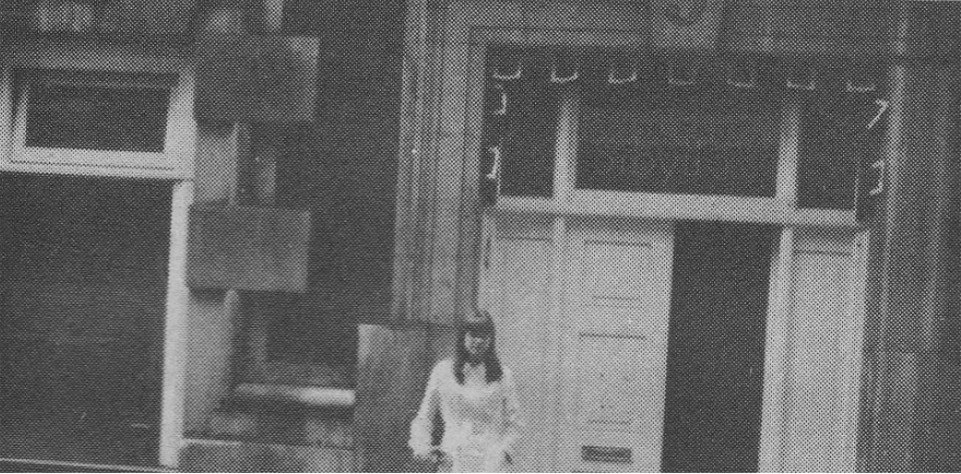
Sibylla’s Entrance from Sara’s blog, Sara in picture.
Reconstruction- Phase Two
April 3, 2013
Reconstruction- Phase Two
by
R.E. Prindle
Reconstruction is America’s unfinished revolution….
-Eric Foner
Reconstruction was not just something that happened after the Civil War; it was and is a program, a policy, a desideratum of the Left. Now that we are well into Barry Obama’s second term impersonation of a president of the United States we have to ask ourselves, is the increased social unrest of Negro on Aryan crime and inexplicable increasing frequency of crazy Whites shooting up schoolrooms and movie theaters coincidental? Or is it evidence of a second phase of Reconstruction. The changing of America from White to Black?
It should be obvious that the American Civil War only used Negro slavery as a pretext to continue the English Civil War of the seventeenth century. The participants were the same- the Roundheads of New Anglia and the Cavaliers of Wessex.
The Roundheads had never shown an aversion to slavery at any other time in their history. Indeed, during the East Anglian interregnum the Anglian leader, Oliver Cromwell, rounded up tens of thousands of Irish and sent them to the West Indies to live and perish as slaves cheek by jowl with the Negroes from West Africa. Irish slaves were especially profitable as they cost nothing while the purchase of Negroes from their African chiefs was a costly enterprise limiting profitability.
From the other side of the Atlantic it was those enterprising New Anglian Yankee traders who bought from the African chiefs and foisted their surplus cargo on the American colonies. Let us never forget that Negro slaves were bought and sold in the Anglian colonies of New Anglia while White slaves, politely called Indentured Servants as they hadn’t been purchased were prominent in all the colonies.
So slavery was not all that repugnant to the Roundheads of New Anglia; what was anathema to them was their old Cavalier enemy from England in the South.
By 1865 the Anglians ranging across the entire Northern tier of States had been become sanctimonious.
It was not to end slavery they fought but to exterminate their Southern Aryan adversaries. Thus the draconian measures taken in Reconstruction to make the Negro supreme over the Aryans. Thus Thomas Dixons post-Reconstruction plea to the Anglians to remember that the Southern and Northern Whites were Aryans and to pledge never to slaughter each other again for the benefit of Negroes. The Anglians took every possible means to subordinate Whites to Negroes. True savagery rather than an attempt to actually reconstruct society on an equitable basis- whatever equitable could mean in the circumstances.
The majority of American Negroes were imported after 1800. A great many from say 1820 to 1860. That means they were fresh from the jungle, mere savages, with no familiarity with civilized procedures and conditions, such as for instance, freedom. They had always been slaves, always. Freedom was a strange White condition so foreign to them that they didn’t actually know what it meant. They had no idea what freedom meant except that Whites appeared to have it. Enfranchising such people on a basis of equality with civilized people then was an egregious crime.
Indeed, while enfranchisement was being forced on Sourthern Whites, States of the Anglian North such as Michigan and Ohio and most others legally excluded Negro enfranchisement by new laws. Ever the hypocrites, Liberals.
From 1866 to 1877 then, Southern Whites fought a continuation of the Civil War to preserve their freedom from Negro-Anglian domination. With help from Northern sympathizers they were successful in this as official Reconstruction was terminated in 1877 while Jim Crow was established to preserve Aryan supremacy.
Oh, I know, Negroes, Anglians and some others find the notion of White Supremacy as repulsive. But, there are others who find Negro Supremacy, Jewish Supremacy and what have you just as repulsive, perhaps Judaeo-Negro Supremacy even moreso.
The point is: there will always be the Top Dog. There is no reason that the Top Dog shouldn’t be White rather than Black or Jewish piebald.
Now, the Civil War did not end in 1865 nor did Reconstruction actually end in 1877. As Eric Foner expresses it they were unfinished revolutions, still in progress today. Both efforts just went underground.
The Negroes still long to be Top Dog which the Anglians, now Liberals, long that they should be. The Southern White has been replaced by the Aryan as the adversary that is to be destroyed. If one accepts that Jim Crow was fully operative by 1900 then the Negro-Jewish-Liberal counteroffensive began in earnest at that time.
During the next fifty years from 1900 to 1950 the effort was to erode and destroy Jim Crow. This effort effectively succeeded in 1954 with the Supreme Court Brown vs. The Board Of Education decision. The decision of the Court was the opening shot of the Second Civil War of Jews, Liberals, and Negroes against the Aryans; hence the Anti-Aryan Hate Laws to disenfranchise the Aryan male.
These laws are unconstitutional as they violate the right to equal protection of the law. As it now stands all other races and classes are protected against the apparently all powerful White male but the Aryan male is legally unprotected on a basis of inferiority in direct violation of equity and the Constitution.
Thus the Aryan male is deprived of the right of self-defense much as was the Negro Slave. So far the Aryan male has chosen to suffer the indignities rather than right the wrong. This was not always the case. In a situation perhaps more dire than today the Aryan males of Louisiana chose to protect themselves and theirs. As William A. Dunning in his Reconstruction, Political and Economic of 1907 relates the story, pp. 248-49:
Quote:
The conservatives (Renamed Domestic Terrorists by 2011) of (Louisiana), large numbers of whom were organized in semi-secret and military societies known as White Leagues, had been quiescent since Grant’s formal recognition of Kellogg in the spring of 1873. The radical government maintained a formal existence, but with no moral and little material support from the White population. In September of 1874, Kellogg undertook to seize a lot of arms which the White Leagues of New Orleans had purchased. The result was a pitched battle between the league and the police, mostly Negroes, who were organized and equipped as soldiers. The police were totally defeated and dispersed, and the radical governor took refuge in the custom house and protection of the Federal troops.
Unquote.
That appears to be the situation we’re headed into now as the Negro government of the United States has bought and distributed billions of rounds of ammunition and millions of automatic weapons with the apparent intent of subduing the legally unprotected Aryan males while beginning the attempt to disarm them.
If the Negro government expects less from current Aryan men than the response of the men of New Orleans he may wish to re-examine his intentions. Let history be the guide. History has shown the futility of force to achieve social goals. One deplores the possibility of armed defense by the Aryans but one is guilty of weakness of mind to suppose they will docilely submit to being enslaved which is the next step down from disenfranchisement.
I advocate nothing, no massa I just be speakin’ trut’ to power, humbly, massa, ever so humbly, o’ cose, but due caution in provoking what history shows to be the inevitable result should be considered. Not even the Soviet Union with all its brutal power could maintain itself against the justified will of its subject peoples. Remember Mussolini and his lamp post, Hitler and his bunker. Vengeance is mine says de lawd.
Anything Less Than Real:
Warren G. Harding Rings In The New Era
by
R.E. Prindle
Dedicated to Ann Coulter who is the only other person I have heard of who realizes the importance of Warren G. Harding.
It is time to reevaluate the Harding presidency as well as perhaps the Republican Interregnum between the Socialist Wilson and FDR administrations.
Perhaps the first thing to do is to dispel the notion that the Harding Administration was extraordinarily corrupt as administrations go. If one is going to call the administration corrupt then it must be against a normal standard and not isolated as a phenomenon. While Harding inherited Wilsonian corruption after the Great War, Roosevelt created the corruption of post-WWII. The money involved in the latter dwarfed anything that preceded it by incalculable amounts.
A major source of corruption after the Great War was the disposal of stores purchased for the war. These were fairly trivial amounts by later standards. In contrast the Roosevelt administration sequestered some piddling amounts of Japanese property and mega enormous amounts of German property including huge companies and scads of patents, copyrights and trademarks. Yet one never hears of these thefts, only a couple refrigerators left on back porches by Japanese. Ask yourself why? These German properties were under the personal authority of Pres. Franklin Delano Roosevelt and the officer of the Alien Properties Custodian of David Bazelon. Bazelon was both a Jew and associated with the Super Mob and Chicago’s Outfit.
After the war Bazelon used his office to enrich both Jews and criminals by selling off the pittance of Japanese properties and, in today’s values billions and billions of German properties for a penny or so on the dollar thus stealing from the Germans and defrauding the US Government of billions.
I don’t think it is necessary to list other financial malfeasances; Bazelon alone surpassed any corruption of the Harding years including Tea Pot Dome and Elk Hills. So yes, there was the inevitable postwar corruption in the Harding Administration, but not by it, of negligible proportions compared to Roosevelt.
Having put that out of the way let us now consider the state of the nation Harding inherited from the Democratic Wilson Administration. Two new developments, unprecedented developments, had occurred that were novel for a new administration to deal with. One was the terrible advent of Prohibition and the other was the women’s vote.
In this first election in which women cast their ballots we had the first landslide victory in US history. Harding captured sixty percent of the vote and all but a hundred or so of those of the Electoral College. Apropos of that Harding has been ridiculed because his campaign manager, Harry Daugherty said that Harding looked like a president should. Well, he did.
His opponent, Cox, on the other hand, looked like a mousy dip, which isn’t to say he was one, he looked like one. He was unhandsome. The choice for women thus was between a nice, big handsome Harding who looked the part and a mousy Cox who didn’t. The election was the first landslide in US history. I leave it to you to draw your own conclusions.
The ground rules had changed whether you believed in it or not, elections could no longer recite the issues as men understood them but campaigns had to be crafted to include the very different concerns of women. In my estimation Harding clearly benefited from the female vote.
Prohibition was an entirely different challenge. Prohibition was an achievement of female politics. The campaign for it was carried out by criminal means. The most famous prohibitionist was the violent, psychotic Carrie Nation who entered people’s places of business and began laying about with an axe. She was allowed to get away with it. The promoters of prohibition were too limp brained to think the matter through to its conclusion apparently unaware that alcohol could easily be smuggled in from abroad or even, heaven forbid, manufactured illegally.
Some form of alcohol, wines and beers, had been part of civilization from its inception and gave some surcease from the cares of life. While the vast majority of drinkers were able to manage the pleasures there was naturally a percentage who abused alcohol. When distilled liquors became available the problem of abuse was compounded.
Nevertheless, wine, beer and strong spirits comprised a huge industry employing undoubtedly tens of thousands of people. In the reformers’ mind, as always, it seemed better to punish the majority to suppress the few.
It should have been obvious to these unhappy reformers trying to make everyone’s life as miserable as theirs that an entire illegal industry would rise from the ashes of the legal and that that illegal industry would necessarily have to be criminal and clandestine. What can one say about reformers?
Thus when the Volstead Act was passed an unprecedented wave of criminality swept over the country like a tsunami. We can blame Prohibition on the Wilson Administration on whose watch the bill was passed and enforced. Thus the Harding Administration was called on to deal with this enormous level of corruption generated by do gooders. Once again Prohibition far exceeded any of the usual political corruption of the twenties.
Now, the control of prohibition passed into the exclusive control of two immigrant groups, those of the Italians, actually Sicilians, and the Jews. Using the incredible profits of Prohibition Jews and Sicilians then were able to assume a dominant if not controlling position in US politics while being able to buy into legitimate businesses. As incredible as it may seem by the mid- to late thirties many people considered crime as just another way of doing business, an industry. Needless to say bootleg profits were used to corrupt politics at every level. How could the Harding Administration escape? Once again, just look at the FDR Administration with open eyes.
The US has always taken a romantic or sentimental view of immigration, still does. As if it justified immigration the Romanticists said that the immigrants were only seeking a better life, content themselves in the superiority of having created not only a better life than anywhere else but the best life. Liberals believe in their own superiority.
One imagines that the only reason to emigrate from one’s homeland at any time in history was to seek a better life. Perhaps invaders drove you from your country making it necessary to find a life, better or worse, somewhere else and at someone else’s expense. Perhaps one’s situation was so bitter that any place else was more attractive. Actually the prime motivating force was US employers seeking cheap labor. Not very romantic really.
Nevertheless unlimited immigration began after the Civil War during the seventies increasing yearly until 1914 when the Great War began cutting off all emigration. It was then that problems not seen as too significant became prominent. US immigration had been from Europe and when the continent went to war these old national loyalties caused fractures. It became apparent that the Melting Pot notion had failed and as Teddy Roosevelt said, the US was nothing more than an international boarding house. Sentiment was strong for the Central Powers, who we have all been taught to despise, but not as strong as that for the Allies, who we have all been taught to revere.
The Irish acting on the principle that the enemy of my enemy is my friend openly sided with the Central Powers against the English hence targeting US shipments to England for sabotage. The Jews whose chief enemy was the Russians refused cooperation with the Allies until Germany took Russia out of the war and then at that time and only at that time, the Jews gave the Allies full cooperation against the Germans who they then believed that they could include in the Bolshevik Revolution post war.
The Italians took a stance but issued a recall of men back from the US to fight in the war. After the war Mussolini attempted to send the Italian wounded back to the US to be medically cared for at US expense.
Of all the immigrants US nativists considered Jews and Italians as unassimilable. If nothing else, Prohibition proved that assertion as US laws meant nothing to either group. Thus it was left to the Harding Administration to deal with the long deferred problem of immigration. It would do so for the first time from a realistic perspective rather than a sentimental or romantic one.
A concomitant of immigration was that a great many of those ’seeking a better life’ had left their homelands a step or two ahead of the police as either criminals or political fugitives. They were revolutionaries seeking to overturn their own governments, Communists in a word. Their position had been strengthened by the success of the Bolshevik Revolution in Russia while the Wilson Administration was actually Socialist in sentiment and had the war lasted a year or two longer, in fact. Wilson was on the verge of establishing a third term dictatorship to do just this, not unlike what Roosevelt achieved, when he was struck down by his stroke thus aborting that plan.
The Revolution did not confine itself to Russia but was actually being attempted through 1919 and 1920 into 1921 and the Harding Administration. The country was nearly in total disorder when Harding was sworn in, March of 1921. A necessity of the first importance was to restore order, that is, put down the Revolution. Harding was equal to that task. The Chinese proverb and curse is that may you be born into interesting times. While the elements defeated by Harding have successfully maligned his memory Warren G. Harding was actually one of the greatest US presidents.
2.
No historian I have ever read regards the problems Harding had to solve or his lack of experience in doing so. Harding was the editor of the small town newspaper of Marion, Ohio, West of the Alleghenies in Middle America. Harding worked hard, applying himself intelligently, making a success of his paper.
He became friends with Harry Daugherty, an Ohio politician who propelled him first to the Senate and then in 1921 to the Presidency. Years before his election Harding began an affair with a young women by the name of Nan Britton by whom he had a child. Naturally Harding had no desire to have this publicized yet he behaved honorably always supporting Nan and his child. He was a decent and good man.
Much has been made of this affair as though this were immorality of an extreme nature. Historically affairs and illegitimate children have been common. No big deal. How can one be expected to condemn Harding when the later John F. Kennedy had mistresses in the White House when Jackie was not about. What is one to think of Kennedy when he had his secret service agents rounding up prostitutes from the street, three at a time, for his dalliance?
FDR publicly lived with his mistress in Georgia while his beauteous wife, Eleanor pined away up North. Bill Clinton kept his member limber by having his female aides give him fellatio during business hours in the Oval Office. Hillary didn’t object.
Was Harding a moral reprobate? Hardly.
Then, the historians attempt to make him an ignorant oaf. A competing presidential candidate William McAdoo described Harding’s oratorical abilities, not surprisingly, as ‘an army of pompous phrases marching across the landscape in search of an idea.’
Oh well, politicians, how much sense do you get out of one of them? As an example of supposedly meaningless blather they offer this pre-election statement of Harding:
Quote:
America’s present need is not heroics but healing;
not nostrums, but normalcy;
not revolution but restoration;
not agitation, but adjustment;
not surgery, but serenity;
not the dramatic, but the dispassionate;
not experiment, but equipoise;
not submergence in internationality, but triumphant nationalism…
Unquote.
Rather than the nonsense it is portrayed as by his detractors, the speech details the problems the country was facing and the results Harding hoped to bring about and in which he largely succeeded. I’m sure his audience would have understood, whether consciously or unconsciously, exactly the issues to which he was referring. Only absurd historians have made a jumble of it. What the list amounts to is an eight point program not too different in approach than Wilson’s fourteen points. So we have a sort of political continuity between the administrations.
Let’s consider the list:
1. Not heroics, but healing. Refers to any number of problems, the waves of industrial unrest, hysterical politics and what not, a general calming down, a reduction from hysterics to the dispassionate.
2. Not nostrums but normalcy. A nostrum is a pet scheme for bringing about some social or political reform. There were enough of those going around- Prohibition, Communism et al. The issue here was the use of the word normalcy which in 1920 was incorrect although in common usage now. Normality would have been the correct word but normalcy actually carries the correct meaning that normality misses. His use of normalcy was a cause of immense hilarity and satisfaction to his detractors.
3. Not revolution but restoration. An obvious reference to the Bolsheviks and the social unrest they were causing.
4. Not agitation but adjustment. Once again political and social agitation were rife calling for the discard of current ways for impossible utopian ideals.
5. Not surgery, but serenity. Agitators called for drastic social surgery when once again calm and reflection were called for.
6. Not dramatics, but dispassion. Calm down, lower the level of hysterical passion.
7. Not experiment, but equipoise. Prohibition was a disastrous social experiment from it conception, what was needed was balance.
8. Not submergence in internationality, but triumphant nationalism. Clear enough, the League Of Nations was unworkable, out; tariffs were in, America First. The Naval Treaty.
As Harding was elected by a landslide one has to believe that the electorate knew exactly what Harding meant and whole heartedly approved of his choices. Nor did Harding disappoint; he was very popular during his presidency only successfully denigrated after his death when he was unable to defend himself.
3.
In office only two and half years before he died in suspicious circumstances how did Harding conduct his administration? One can’t imagine today the tremendous political energy released by the Bolshevik Revolution. The world was terrified while an angry civil war ensued across the Western world financially and militarily over an exhausted Europe. The civil war lasting for several years was fought on several fronts. The war had turned from a national war to an ideological war. Reds versus Whites. In Russia the ideological war was fought on three fronts, the North of Archangel, South in the Ukraine and in Siberia East of the Urals. American troops and munitions were involved. In the end the Whites, or Czarist troops lost.
Revolutionary activities sprang up in all countries including the US. While the US was aiding the Whites, the Jews raised enormous amounts that they traitorously funneled to the Bolsheviks under the eyes of the Wilson Administration. Jacob Schiff, the Jewish Prime Minister, was called to Washington by Wilson to defend himself against charges of Bolshevism. Wilson let him off the hook. Thus as in the Viet Nam war of the 1960s and 70s Government efforts were nullified by Fifth Columnists aiding the enemy.
The Bolshevik victory in Russia gave Socialism a political base from which to operate so the Socialists and Communist cells in the US were activated lending their support to Soviet efforts. Suddenly a socialist presence was clear in labor, the churches, the arts, publishing, across the board. While official Communist membership was relatively low so that it could be denigrated as no threat it must be remembered that the successful Bolshevik Party in Russia was just a splinter of US numbers, so size is irrelevant; organization is the key.
America’s first reaction was sharp as A. Mitchell Palmer, the Attorney General of the Wilson Administration rounded up several thousands of Communists for deportation to Russia. Here the Fifth Columnists sabotaged this wise response citing peacetime US practices for this wartime attack instead of the wartime provisions Wilson had used during WWI. Palmer was compelled to release all but a couple hundred who were put aboard ‘the Soviet Ark’ and sent to Russia including Leon Trotsky who had been living in New York City and without whom the Russian Revolution might have been reversed. Trotsky was actually temporarily detained but then released for some reason.
There were substantial crackdowns on all Socialist activities including the IWW or Industrial Workers Of The World who were reduced to impotence. Their leader, Big Bill Haywood was spirited out of the country to Russia. As Harding came to office there was a virtual civil war in progress. The fact has been obscured or erased by subsequent historians who are compelled to take the Red point of view.
At the same time as this undeclared war was being fought the troops were being brought back from the land of hinky, dinky parlay voo. How ya gonna keep them down on the farm after they’ve seen Paree. Even though their lives had been totally disrupted very often destroyed for no reason now that their job was done they were thrown on the trash heap. Except by Warren G. Harding, the new president.
A not overly favorable biographer, Samuel Hopkins Adams, writing in his biography of Harding, The Tragic Years, comments favorable thusly, p. 284-5.
Quote:
The glory of heroes is soon departed. The public which welcomed with oratory, banquets, and ticker-tape our fighters, returning victorious from Europe, quickly forgot those of them most sorely in need of care. Two years after the Armistice the plight of war’s human debris was pitiable. Of these the most desperate cases were 71,000 mental patients and 38,000 tuberculosis victims. F.W. Galbraith, Jr., National Commander of the American Legion, estimated on the basis of an investigation, that there were 10,000 of the disabled in cellars, poorhouses, and insane asylums. T.W. Salmon, a disinterested and competent investigator, thus reported:
“Veterans with nervous or mental troubles were without provision for care and were quartered in institutions for the criminal insane, addicts, and vicious degenerates, without Federal supervision.”
No agency in Washington was equipped to handle a problem of this magnitude. Nor was there any special public interest in it. The war was over. “Let’s forget its’ expressed the attitude of a people sated and bored with emotion.
The President (Harding) did not feel that way about it. His humanitarianism revolted from such neglect. He acted wisely and constructively in welding the disparate, overlapping guardianships into one official entity, the United States Veterans Bureau…
Unquote.
Compare that to the neglect and humiliation of the returning veterans of Viet Nam. The so-called Red tribunes of the people, these creeps who sabotaged their brave men’s efforts on the battlefields, heaved garbage on them as they debarked from ships and planes.
Even WWI vets who had been promised a bonus or tip for the needless disruption of their lives were denied their due by the People’s Commissar Franklin Delano Roosevelt. They were compelled to storm Washington in a semi-violent attempt to compel the fulfillment of the government’s promise. The same army they had served in was turned against them. So much for FDR and the New Deal.
With the end of the war a whole host of what were actually revolutionary acts were released. Palmer of the Wilson Administration certainly treated them that way. As a result his house was bombed putting his teeth on edge. A huge bomb not unlike that used in OK City of recent memory was detonated on Wall Street. Law and order was rapidly breaking down. Mail robberies were a daily occurrence while millions of dollars of stolen Liberty bonds were being traded. Those millions today would represent a billion dollars or more. This was big money happening. Incredible amounts of money that no group of individuals could possibly spend. Where was the money going?
A very able member of the Harding cabinet, Post Master General Will Hays tackled those problems and solved them in short order. Such a man was a danger to the Lords of Misrule. What happened to Hays? In addition to all the other problems, the Guardians of Decency were alarmed, justifiably so, at the moral content of movies. Rather than accept outside censorship of the movies the moguls decided to police themselves and as their Top Cop they lured Will Hays away from his post by an offer he could have refused but found it impossible to do. The offer was for 100,000 dollars a year. That right 100K in 1922. Was that bribery or what? After only nine months in office Hays was offered the equivalent of five million dollars a year to supervise Hollywood morals. Who wouldn’t take that while being flexible enough not to lose the job?
Since the offer came from Hollywood that tells you who was behind the mail robberies and stolen bonds and lets you know what they were worth.
Harding outlawed the Communist Party briefly in 1921 getting right on that offense too but the Fifth Columnists got that overturned.
Thus within months of being in office Harding had cleaned up a large part of untoward activity while if couldn’t actually suppress Communist activity he was at least able to force them to turn their damper down while forcing them into even deeper clandestine activity.
But, as you can see he was building up a lot of enemies who wished him dead while wanting his memory exorcised.
And then Harding had to deal with the problem of immigration, also within the first months in office. The cry for the restriction of immigration, whether it came from North, East or South had been voiced at least as early as the 1840s when the potato famine drove a couple million Irish to the New Island. Really teeming masses. And then the Forty-eighters came over as a result of the failed Communist Revolution of 1848, more wretched refuse, that led ultimately to the post-war revolutionary activity.
These members were relatively small but in the 1870s Jewish immigration from the Pale of Russia began in earnest resulting in several million people who the restrictionists believed, as it turns out, rightly, were unassimilable. And then in the nineties the Sicilians added New York to the terminal end of their migratory route from Buenos Aires through Brazil and Central America. These people too were thought rightly to be unassimilable.
And then those sweet little old ladies hacked Prohibition through the Amendment process apparently believing that the law was the law and everyone would abide by it. They held that futile belief even though they had engaged in rampant lawlessness to get the Amendment approved.
Well, a void had been created and you know what nature thinks of voids. They get filled; nature abhors them or, so we are told. What people rushed in where angels, or at least, less venturesome mortals fear to tread? These two unassimilable peoples, the Jews and Sicilians.
Nobody gets credit for being right in such situations the restrictionists were right.
In most analyses of any period the activities of Jews are always suppressed; you never are allowed to see them until they want to be seen. Nobel awards time being one. While being Omni-present we are asked to believe that their only effect on society is to win Nobel prizes. In point of fact Jews, having great presence of mind, always work behind and under the scene. Thus to understand their effort on the America of the Harding Administration one has to set a background. I’m not going to go back too far settling on the transfer of the Jewish World Government from France when the Alliance Israelite Universelle was sent to the US and became the American Jewish Committee by 1906. This was the international Jewish government that Henry Ford referred to in his Dearborn Independent articles later collected and published under the misleading but accurate title: The International Jew. The articles were published during the Battle For Ford Motors largely during Harding’s tenure.
The leader or Prime Minister of the world Jewish government was a man named Jacob Schiff, himself descended from the German Forty-eighters rather than being a Russian Jew.
In the Jewish war against the Russian Czarist government Schiff played a leading part. He was personally responsible for engineering the Russian defeat during the Russo-Japanese war of 1905.
During that war the Jews of Europe and the US denied the Russians loans to conduct war properly while Jacob Schiff personally provided the Japanese with the funds without which they couldn’t have waged war.
While Schiff himself lacked enough of the ready for the war he was on the board of the Equitable Life Assurance Society. The Equitable was sitting on a hoard of 200 million, in today’s dollars, billions. Schiff illegally used this money to loan to the Japanese. The loan caused a tremendous scandal in which Schiff skillfully avoided detection shifting the blame to the other directors.
The peace treaty was chaired by Theodore Roosevelt in the US at which proceedings Schiff led a delegation of Jews who participated as a Jewish National delegation. Stacking the deck against the Russians.
Not content to punish the Russians for alleged injustices toward Jews in Russia, Schiff and ‘the international’ Jews worked to cause the US to sever diplomatic relations with Russia which result was achieved in 1913. Thus the US became dupes of the Jews.
In 1913 the Federal Reserve System was created as a private corporation owned by ten other corporations of which nine were Jewish firms from the US and Europe. The tenth was the Rockefellers. This private firm printed US currency that it loaned back to the US government at interest, thus creating a tremendous income to be used for worldwide Jewish machinations for which there was no accounting. I would call it a brilliant move but when you’re dealing with Liberal suckers it isn’t much of an achievement.
While the Jews had had no presence in Washington DC prior to the Wilson Administration, beginning in 1913 Wilson flooded his government with them much to the consternation of the English led government of the previous hundred years plus since independence. You know, it’s not like people couldn’t see what was going on.
Coincidentally as Jews were taken into government the Anti-Defamation League of B’Nai B’rith was established to counter any objections on ethnic grounds. Wilson himself was a socialist so that when the US entered the Great War a socialist takeover of the industrial system began. The railroads were immediately nationalized while the War Industries Board required all industries to submit financial details and to submit them for governmental regulations by the WIB controlled by Jews under Bernard Baruch essentially setting them up for seizure.
Of course, this provoked a violent reaction especially from Detroit and the auto industry. Ford and the Dodge Brothers objected strenuously. The Dodge Brothers used intemperate language reflecting on Baruch’s ethnic heritage that Baruch never forgave. Ford was more restrained but tarred with the Dodge’s brush. The Dodge Brothers died mysterious deaths in 1920 while their company went into limbo for years until Wall Street persuaded Walter Chrysler to take the company. An attempt was made on Ford’s life. This confrontation was also the beginning of the Battle For Ford Motors, begun in 1918 but aborted by the war ending. It was begun again on a financial front by Jewish banks trying to force a takeover.
So, the Socialist/Communist takeover of the US was very narrowly avoided. Yet the Socialist revolution had to be financed with hard cash that the Socialists didn’t have. Where was the cash to come from? From the US. The Jews had created the Federal Reserve System in 1913 very fortuitously it would seem just before the major expansion of the money supply caused by the World War. That war from the Allied side was financed entirely by the US. At war’s end the European debt to the US was enormous while it would never be repaid. It was just forgotten. Consider that when you get exercised by the current US debt. It can be forgotten too.
Yet the ten merchant banking firms who owned the Federal Reserve collected interest on every dollar of that debt. Thus the US dollars went to nine Jewish firms in both the US and Europe plus the Rockefellers.
As I have noted, as soon as the Bolsheviks seized power, Jacob Schiff rushed huge loans provided by those banks to finance the Bolshevik takeover. At the same time the devastation of the peoples of Central and Eastern Europe was total. There were still roughly five million Jews in those areas. Jewish American ‘charitable’ organizations operating under the name of the American-Jewish Joint Distribution Committee began to funnel enormous amounts of cash and supplies destined only for their co-religionists into this volatile political environment where the first people on their feet would have a commanding role. Socialism or no socialism money was the key, as always. As the aforementioned Liberty bonds in Jewish hands had been stolen that was a pile of free money that was laundered. Crime was about to be organized in a way that would provide other funds in large amounts. There was a succession of Jewish crime lords that generated the money. The first in the teens was a fellow called Monk Eastman, as his criminal methods became outdated he was sent to jail to be replaced by the notorious Arnold Rothstein who set up the modern organized crime structure but as his methods became outdated he was replaced, murdered, and Lepke Buchalter took over the role to be replaced in the forties by the major fund raiser Meyer Lansky who engineered that huge cash cow, Las Vegas and gambling. As different methods were needed he, in turn, was replaced by Sidney Korshak of the Super Mob. Thus the Jewish over world was integrated with the Jewish underworld functioning as a unit.
In celebration of these criminals the Jews recently created the National Museum Of Organized Crime in its capitol of Las Vegas, Nevada. The nationality referred to in the National Museum is that of the Jews otherwise they would have called it either the American-Jewish Museum or simply the American Museum Of Organized Crime. So you can go to Vegas and admire the criminals deeds of these stellar Jews.
Seemingly almost a gift from heaven to the criminals, Prohibition came along in 1920. This gave the financial basis for organizing crime as a ‘business’ thus opening vistas only dreamed of before the Volstead Act. Prohibition also created an insuperable problem that plagued the Republican Interregnum. Amazingly Prohibition began in a Democratic Administration and ended almost by fiat in the Democratic Administration of Franklin Delano Roosevelt twelve years later, one of the those coincidental linkages between Wilson and FDR. Upon taking office Roosevelt held up a glass of obviously bootleg beer and announced that Prohibition was over. Just like that. Was the fix in from the beginning to end or wasn’t it?
But, back to the Battle Of Ford Motors for a moment. The bankers wanted Ford Motors not only because they hated Henry Ford but because Ford Motors was a bonanza waiting to be realized almost bigger than Prohibition.
Ford valued his company at something over a billion dollars. He had completely vertically integrated his company. That means he not only made the cars but he owned the metal mines and smelted the ores, he owned huge forests he cut and processed, coal mines to fuel his furnaces and even the railroad that carried the coals from the Line to River Rouge. He had subsidiaries worldwide. By 1920 Fords could be bought actually in any country in the world. Like Sherwin-Williams boasted of their paints, Ford covered the world.
The value of the company was compacted. In the bankers’ hands the company could be broken up into its component parts increasing the stock market value to three or four billion, all free money, especially as they were trying to buy Ford at the bankruptcy rate of 10 cents on the dollar. So you see how fiercely the Battle For Ford Motors was fought. You can see why Ford fought back by running his exposes of Jewish machinations, which were true, in his Dearborn Independent. The Independent was also the first nationally distributed newspaper by the way.
Henry Ford won the battle but ultimately lost the war.
So as you can see, Harding was elected into one of, if not the, most tumultuous times in American history and acquitted himself extremely well. His efforts were also appreciated by the American public that awarded him the highest approval ratings during his term in office.
His actions also made him many enemies not least of whom were the Communists and Jews. While Jews were prominent in Washington during the Wilson years and again in the Roosevelt years they were conspicuously absent during the Republican Interregnum. The Communists too, while if not destroyed, were harassed and suppressed forcing them to adopt different tactics while frustrating their desire for an immediate conquest.
On the immigration front too, Harding’s policy of realistic restricted immigration frustrated the desires of the sentimental immigrationists. Harding passed a restrictive bill quickly in 1921 that was augmented under Coolidge’s Administration in 1924 and survived almost intact until 1965 thus giving the country much needed breathing room to attempt to assimilate those already here to attempt to turn them into one national unit. It didn’t happen.
It is not particularly well known but in 1914 the Jews had formulated a plan and organized it to transfer the entire Jewish population of the Pale of Settlement to the US utilizing the ports of New Orleans and Corpus Christi, those ports being less conspicuous than New York City and Boston.
The war, of course, aborted that plan, and just as the Jews were about to activate the plan after the war Harding slammed through a restricted immigration act based on quotas seemingly aimed directly at excluding Jews period. This was an unforgivable crime in Jewish eyes while also forcing them to change their plan of the conquest of the New Promised Land.
Harding also dealt with internationalism rejecting the League Of Nations in favor of nationalistic policies. In the first years of the new century the Japanese had sent paramilitary troops for the pre-invasion of California, thus all the Japanese immigrants were men without women. The Californians who had already forced passage of the Chinese Exclusion Act of 1882 objected vehemently to the Japanese invasion. Rather than offend the Japanese by protecting his own country the Teddy Roosevelt Administration came to a ‘gentlemen’s agreement’ whereby the Japanese would no longer send ‘working men’ but only doctors and lawyers. I think Teddy called his administration the Square Deal. He must have known what he was talking about; that solution was certainly square.
After the war then with no military invasion imminent these men demanded women. Thus began the strange phenomenon of the Japanese Picture Brides. The men and women exchanged pictures making their selection on that basis and then the women were sent to California for marriage. Many interesting situations arose from that.
Still there was a great deal of hostility between the US and Japan. The hostility was actually caused one sidedly by the US. Very embarrassing situation. It began in 1853 when Admiral Matthew Perry ‘opened’ Japan at the mouths of his cannon. What’ll it be he sneered from the poop deck: Yes or no.
The relationship was exacerbated in the 1870s when anti-slavery Yankee planters landed in Yokohama and forcibly abducted a hundred or so Japanese to labor on their old plantations in Hawaii. I can see how the Yankees got so exercised by Southern slavery in the US. So, while I have to side with the US the Japanese have always had a legitimate grievance that could only be satisfied by war. I mean, come on, they had to regain their manhood after having been emasculated in 1853.
Nevertheless in 1908 TR said we would have to fight those fellows within thirty years and he only missed by a few years.
Thus in 1922 the Washington Naval Treaty was negotiated as, we suppose, an example of triumphant nationalism as opposed to the internationalism of the League of Nations. The Naval Treaty limited the size of naval fleets inadvertently favoring the Japanese. But the belligerence remained at a high level that left the then territory of Hawaii vulnerable. Naval fuel was shifting from coal to oil so while coaling stations had been established there were no oil storage facilities on Oahu the site of the Pearl Harbor Naval Station.
This was a dangerous situation. It was difficult to get Congress to act so some enterprising American oil men, Doheny and Sinclair, set about to remedy the situation on their own. Now, too oil fields, Tea Pot Dome in Wyoming and Elk Hills near Bakersfield, had been set aside as Naval Preserves. The storage facilities in Hawaii would be naval, so there is a connection.
Doheny and Sinclair set about to build the oil storage on their own and to fill the tanks they negotiated to use the naval preserves Teapot Dome and Elk Hills for oil supplies. This deal was used as an excuse to create a huge scandal, although after Harding’s death. Nevertheless the storage facilities were built and filled with oil so that when the Japanese attack on Pearl Harbor duly came the US was duly prepared.
Two and a half years into his presidency Harding began a tour of the West Coast during which he suddenly died. Some said poison some said heart attack but they got him into the ground so quickly there was no autopsy. Anytime the rules are broken its cause for suspicion. Some said his wife killed him but I have a hard time believing that.
Of course we have no way of knowing whether he was assassinated or not but there were many who may have wished his dead. Harding had sidetracked the Revolution, derailing it, while forcing the Bolsheviks further underground. His immigration act had thwarted Jewish plans to bring over five million fellow Jews. So actually Harding was ‘responsible’ for the death of all those Jews in the holocaust although I don’t think he’s ever been officially accused.
Neither the Jews nor the Communists have earned a reputation for being forgiving so both groups certainly had a motive. But, the problem is incapable of solution so let it drop.
Harding was only in office for two and a half years but what a two and a half years, hey? What a bunch of insoluble problems dealt with and well. He defused the Revolution, ended unrestricted immigration, tried to limit naval armaments and battled old Demon Rum. I suppose if he had had the chutzpah of FDR he would have said simply that Prohibition was nonsense and refused to implement the law. Would he had.
The profits of Prohibition went to establish Organized Crime. And from booze the criminals went on to gambling breaking down US legal resistance by using States Rights to legalize gambling in Nevada. From Nevada it has spread to every State in the Union. Carrie Nation is ultimately responsible for creating Organized Crime and hence the corruption of the Nation. That’s what happens when you put the girls in charge. And the little girl didn’t even have the vote. No, but she had the Power Of Positive Thinking. Just get it done.
My point is that Warren G. Harding rather than being the worst president of the United States was perhaps one of the greatest. It was just that he offended some vindictive people and they had the power of the press…and radio…and the movies…and…
The Protocols of Zion were so Nineteenth Century. Post-war America was the New Era of the Twentieth Century.
A Review: A Prince Among Stones by Rupert Loewenstein
March 14, 2013
A Review: A Prince Among Stones by Rupert Loewenstein
by
Review by R.E. Prindle
Loewenstein, Prince Rupert: A Prince Among Stones: That Business With The Rolling Stones And Other Adventures, 2013, Bloomsbury
Some will rob you with a six gun,
Others use a fountain pen.
-Pretty Boy Floyd, The Outlaw
Now comes the very welcome autobiography of the Rolling Stones eminence gris, financial expert, Rupert Loewenstein, a moments surcease from the excesses of Spanish Tony Sanchez, Marianne Faithfull and Keith. A respite from biographers Christopher Anderson, Philip Norman, A.E. Hotchner and the other sexually obsessed writers. A pause in the hothouse atmosphere of Mick’s groovy sexual liaisons, temporary and otherwise. Rupert keeps his dick in his pants.
When in 1968 the Stones realized that the inexperience of their youthful years was cracking down to destroy their dreams, their hopes had been concealed and buried in truckloads of contracts and documents they couldn’t read and would never understand. Enter Rupert the investment banker from The Square Mile, well mannered and ‘with it’ in ways Rockers could ever understand much less emulate. But Mick tried.
Entangled by the youthful inexperience of their first manager seconded by his partner Eric Easton and outright robbed by fountain pen wielding Allen B. Klein, Mick Jagger turned to Rupert Loewenstein as a thirsting man in the Sahara desert. As despised rock and rollers Jagger was turned down by the lawyers and accountants he pleaded with to salvage the Stones situation.
Christopher Gibbs, friend of Bob Fraser, approached Rupert as an old Etonian and asked his help. Rupert considered and accepted.
After reading internet reviews of Rupert’s book the general consensus seems to be a general rejection. The fact that Rupert took the first sixty pages to explain his origins and give some background offended the majority of reviewers who expected him to begin with glowing accounts of Mick and Keith. As Rupert’s technique was to place himself in his environment, so markedly different from the rest of us, most reviewers interpreted his method as mere name dropping.
I enjoyed the pages and thought Rupert’s technique quite skillful. As his explication narrowed down to his first encounter with Mick as he stepped over his prone drugged out form at a party I became aware of who Rupert was and how he arrived at the crossroads of his life.
At that point he was an owner of the small merchant banking firm of Leopold Joseph & Sons, both Leopold and his sons having departed the firm. Here he had a comfortable, respectable life with, as future developments would show, an opportunity for substantial wealth. An enviable situation actually.
But Rupert, apparently, craved excitement, so for reasons that escape me he took on the task of rescuing the Stones. Did I say crazy? Closer to what I meant but had too much discretion to say. At the time Rupert accepted the mission the Stones were penniless all their money controlled by Klein; they had no means to pay Rupert anything including his expenses. As incredible as it may seem Rupert worked for not only nothing but at his own expense including many trips to New York and back for three long years until he could squeeze some money out of Allen Klein. I mean, what luck for the Stones, my jaw just dropped.
The Stones had thousands and thousands of documents and papers Rupert had to familiarize himself with and this is all boring, very intricate stuff. It took Rupert a couple years alone of study before he felt competent to confront the thug Klein; and then, eighteen years of legal squabbles ensued as Klein fought to hold his ill gotten gains.
In the meantime, as Rupert learned the complexities of the music business and touring he had to find ways to make the ongoing projects profitable. He succeeded in making the perennial money loser, touring, into a cash cow.
Rupert is always understated but his efforts for the Stones in a very corrupt business were astonishing. From being penniless Jagger now has several hundreds of millions of dollars.
While discussing these financial affairs Rupert is more than discreet. One has an idea of what he did for the Stones but nothing in the way of useful details. This was Rupert’s life that so far as I’m concerned he is certainly within his rights to discuss, even revealing, some more pertinent details in his dealings with Klein.
Mick, who can explain Mick, had the effrontery to chide Rupert for, in his eyes, revealing the Stones’ finances. Revealing the Stones’ finances! Who is Mick kidding? The Stones are an untraded public company. They have imposed themselves on their public, us, and what they do is our business. Our dollars have made them very wealthy men. We’re entitled to financial reports. Does Mick have any idea of what havoc he has caused to society and we members of the public, this member, by his reprehensible shenanigans?
Personally I think it astonishing that Rupert would have associated himself with a guy who would get up on forty foot inflatable dick in front of sixty thousand people a time and shout ‘Yahoo!’ What kind of guy would do that?
In many ways that was only the beginning of Stones’ offensiveness in the seventies. One has to understand the homosexual situation of the sixties and seventies in which Mick played a leading role. Hidden at the bottom of developments was the 1962 novel by Anthony Burgess, A Clockwork Orange. The story involves a near societal mutation of thug violence. The film rights were immediately snapped up by a combine of David Bailey, Andrew Oldham and Andy Warhol.
The original plan was to star Mick as the protagonist Alex. The movie did not come together until 1971 but then under different owners although Warhol did make an earlier version. The book’s type of violence was part and parcel of Warhol’s Factory whose members apparently took the book’s protagonists, the Droods, as their model. That combined with their homosexuality.
Mick was close to both David Bailey, the fashion photographer who describes Mick and his mate, and Warhol. As the book was a sort of revolutionary text the movie was even more so. For those prone to violence the movie serves as a primer. Yobbos in action.
Andy Warhol was also working toward the homosexual revolution that succeeded in 1969 in the Christopher Street rebellion at the Stonewall Inn in New York City. Between the book and the Stonewall the lid was off unconscious violence and homosexuality. Alex of Clockwork Orange was portrayed as an androgynous character not unlike Mick.
Thus the 1970s songs and tours took on a violent homosexual character leaning heavily toward psychotic sado-masochism. Always pushing the envelope Mick over did it with his 1976 release Black And Blue. Black And Blue was a very sick record. Of course it was only part of a very sick period fueled by the homosexual revolution. Appearing in 1976, it was after a series of albums by the sado-masochistic Negro band The Ohio Players. The OP had released a series of objectionable record covers that caused no adverse reaction as they were Negroes. Their LPs Pleasure, Pain and Angel had covers more excessive than Black And Blue. Women were dominatrices, hung from chains, the Pleasure cover shows a woman stabbing a man in the spine during intercourse. This all passed without comment but Mick apparently didn’t realize that Negroes have a ticket to ride but White Boys don’t.
Unlike The Ohio Players the Stones didn’t have the rocks to put their picture of female torture and overt sado-masochism on the outside of the cover concealing it instead within the gate fold. Perhaps Mick was realizing his Clockwork Orange fantasy identity.
To add insult to injury the Stones compelled their label to erect a gigantic Billboard of the centerfold across from the Hyatt House on Sunset Boulevard in LA. The outrage was instantaneous. The outrage was so intense that Mick and the Stones were compelled to back down. The billboard was taken down while the photo was removed from the inner cover replaced by a photo of the band.
One can only imagine the effect the incident had on Rupert and his fellow merchant bankers back in London. The repercussions at all levels were horrendous.
In fact Mick owes me for that one. At that time I was in the record business in Portland, Oregon, running a large six thousand square foot store. I had a huge presence on TV and radio through advertisements thus making me an ideal target for protests. Oddly devotees of porn like Lesbians decided to target my store. A committee in combat boots stormed into my store handing me an ultimatum to not only remove Black And Blue from my racks but a long list of record covers they thought demeaned women. Interestingly The Ohio Players several covers or any records by Negro groups for that matter were not on the list. No White person was going to criticize any Negro for anything. They had immunity. The Stones however where White, objectionable and fair game. As was I.
The Lesbos put their heads together to come up with a media event that they could exploit for maximum publicity. Andy always said that any publicity was good publicity but I beg to disagree with him. They conceived the notion that if they came into my store and slashed the covers of their two hundred objections that would make the paper, TV and radio. They were complicit with my employees. As the store was open till ten they chose a late hour to do their slashing. Well done, but beyond my notice until one of the Lesbos in my employ pointed the albums out to me several days later.
Of course, as I had no idea who did it, similar incidents were always happening, I pulled the damaged covers to be sent back to the manufacturers hoping that it wouldn’t happen again. There was no reason for me to complain to the police because as a record dealer I was outside the protection of the law, the police would have laughed at me. As the evil deed had received no response the Lesbos published their manifesto in their paper. Naturally enough I didn’t read lesbian publications so no response from me.
The gay crowd had their agents in the police department and the Daily Oregonian, the local rag. Unfortunately for the Lesbos as I didn’t advertise in the Oregonian it was forbidden to either mention myself or my store hence that venue was closed. Oddly enough the Lesbos used to police to try to stir me.
Now, I was in the record business. It was universally believed that every record store was dealing drugs. There were TV shows depicting it. Therefore it was believed that I was one of the biggest drug masterminds in the world. I was actually followed by police agents in London on vacation. As it happened I was there when they made a major marijuana bust so I was given attention as it was apparently thought I was there to supervise the operation. It was an interesting time. I hope I don’t have to tell you what a fantastically absurd suspicion this was. I mean, you know, it was believed that all you had to do was ask for a certain record and the clerk would slap a lid of grass on the counter for you. I mean, with a counter full of weed nothing would have been easier than a bust. But logic….
The cops had been irritants for some time so when I got a phone call saying that they wanted to help me, I say, What kind of setup is this? The sergeant or whatever begins insultingly saying that ordinarily the police didn’t care what my kind of people did to each other but this slashing of record covers was one toke over the line. Wow. It was exceptionable wasn’t it? What other things hadn’t they investigated that’s what I wanted to know but got no answer.
Quite honestly I’d dismissed the incident, didn’t remember it and thanks, but no thanks. The Lesbos were back to square one, no media event. Time passed as they revolved the situation in their drug addled minds.
Now, not only was the newspaper riddled with gays, as was my store by the way, but so was the no. 1 TV station in town on which I was a very heavy advertiser, both its radio and TV outlets. Homos and Lesbos ran the place. Time has now flown as Time will and we’re into 1977. More objectionable covers have appeared especially Ronnie Montrose’s first with the abstract painting that resembled perhaps a woman’s crotch but given the homosexual dominance of the industry by 1978 it could have been a man’s rear; the record was called Jump On It if I remember correctly. All the sexual double entendres used for decades, remember the tune Baby, Let Me Bang Your Box? Piano was meant, box being musical slang for piano as well as…(blush) you know. The Naughty Lady Of Shady Lane, for instance who was only three years old. You just have a dirty mind, that’s all.
I was known for touting the artistic merits of the covers so getting together with their sisters at K… it was determined to do a short news feature in which I was to be induced to speak out and then they would go for the Montrose cover and get me for porno. I had no objection to their filming in my store but not having been born yesterday I wasn’t going to be drawn into the trap. I refused to speak on camera so that blew the second attempt for a media event. On to take three.
What else? The Lesbos would stage a demonstration outside the store, placards and all. However they once again made some gross miscalculations. They did get the top DJ in town also at K… and also a homosexual to announce that the demonstration would take place at noon at my store. I heard it on the radio on my way to work and was grossly offended. But, you know, too bad wasn’t it?
It was true that because of my massive radio and TV presence through advertising, and I mean massive, I was the ideal target. However many if not most people considered the demonstration as a publicity stunt which I failed to grasp at the time so didn’t turn it to my advantage and ignored it. As it would have been free advertising none of the radio and TV stations would cover the demonstration and the Oregonian certainly ignored it.
Frustrated that no media attended their media event the Lesbos decided to invade my store. A screaming horde of combat booted demons rushed in climbing on record racks, waving their signs, and with them came all the thieves and shop lifters within range of the excitement. Oddly enough many shoppers considering the ruckus a stunt went calmly about their shopping.
It took the helpful police an hour to get there and two hours to restore order. Obviously no arrests were made by the ‘helpful’ police. As Dylan sang: The cops don’t need you and, man, they expect the same. I have no idea how much money the Lesbos cost me, but they owe along with Mick. Once they realized there would be no media event their interest subsided. By that time half of 1977 was shot.
The next time Mick says that songs don’t incite a revolution smile knowingly.
Whatever was happening to me passed unnoticed as I was out on the edge of nowhere. Except for this account of the story the incident has been unrecorded. I hope the Lesbos feel rewarded. But for Rupert his world was changed dramatically on February 27th of that same year, 1977. Keith was busted for intent to distribute heroin in Toronto. The bust was as close to absolute disaster as the Stones ever came. It must also have sent a shiver down Rupert’s spine as he realized how fragile a business the Stones were.
Rupert passes over this stuff casually with a little light hearted banter but the seriousness of this ‘media event’ causes him to issue a nearly audible sigh of resignation. Rupert had spent months lining up bids from every major label for when the recording contract with Atlantic expired.
Mick gave Rupert a call to tell him the disastrous news. You can almost feel the heartbreak as Rupert resigns himself to call each and every label to ask if the bust affected their offers. It did. All signed off but…Atlantic. Ertegun stayed in but Rupert’s bargaining power went into the vein, so to speak. The Stones were only worth what Ertegun would offer. Millions down the tube. Rupert doesn’t tell us what percentage he was working on but we can assume that Keith’s bust cost him plenty.
You don’t read the story that way in Keith’s auto; he may not even still have figured it out.
That was a very serious consequence for Rupert to which I am sure Keith has given no thought ever to the possible collateral damages caused by his actions. In his drugged out haze Keith was not even aware that Rupert could no longer justify his involvement with a bunch of yobbos like the Stones. In the first place anyone associated with Rock was socially unacceptable. I as a record store owner was persona non grata in my social arena. If Rupert had held on to his social status to this point I’m sure he found that certain invitations were no longer forthcoming. Indeed, his fellows at Leopold Joseph made him choose between them and the Stones. Rupert was forced to sell out.
One feels a sort of sinking feeling in his writing as he acknowledges that Keith had sabotaged the chances of both him and the Stones. One can only hope he came out with a couple hundred million otherwise he was woefully under compensated. Rock was a world he could never have understood.
Rupert saw the Stones as a business venture without any regard of the Stones’ relationship to the expectations of their fans. Thus when he negotiated more than substantial sums for the use of Stones’ songs in advertising that was a very good business decision but a potentially disastrous situation with the fan base who saw such financial arrangements as a complete betrayal of their anti-commercialism. Rupert was frustrated that the Stones had a hard time seeing it his way.
Besides he didn’t know who the Stones were or, seemingly so. The Stones were always a minority appeal band. When Andrew Oldham cast them as the ultimate yobbo band he was limiting their appeal to a certain segment of society. In the contemporary world where modern communications allow mind sets to come into contact and maintain communications not only locally but globally mind sets were able to blast their presence into a million or millions through communications. Thus though a small percentage of the overall global population even a perversion such as sado-masochism could appear in millions, seemingly a large connected body. Effects such as this is what Warhol was doing and through associates such as Jagger and David Bailey acting globally.
While the Stones may have sold a couple two or three million globally of their records, while substantial economically, it was not that significant culturally. Beyond the yobbo mentality the Stones had little appeal. The Black And Blue album did not expand their audience but constricted it.
Of course Mick moved the band beyond mere rock and roll by making the Stones the Ringling Bros., Barnum and Bailey circus of rock. The show was the thing. Rupert himself usually refers to Mick as a great showman. Faint praise indeed. But, once again even though the shows generated hundreds of millions it was to an already sympathetic or curious audience. Preaching to the converted so to speak.
I think that Rupert was originally blinded by the light of the Stones publicity not realizing that he wasn’t representing a universal phenomenon but a mere yobbo fragment of the population. The money was there however. I hope he valued his services accordingly.
The last half of the book meanders with very little useful information save that Rupert negotiated with unnamed buyers to sell the Stones lock, stock and barrel much as Halston sold his name, soul and product to a major corporation.
What Rupert’s motivation was except for a huge bundle of cash isn’t clear. Perhaps in some devious way he was seeking to avenge Keith’s betrayal and cause the Stone’s the pain they caused him. In any event the idea was too novel for Keith and Mick or they were two wary so the deal didn’t go down.
Perhaps there was big money in it for Rupert so that when he lost the opportunity he lost interest in the Stones. It was shortly after the deal folded that he retired severing his relationship with the group whose fortunes he had guided quite successfully for forty years.
Rupert never satisfactorily explained why he decided to abandon his respectable merchant banking career to take up a gypsy existence with the Stones. You may be sure that if I had the choice between owning a record store or being a merchant banker I would definitely have gone into banking. Anything really. You can always buy records.
Who Is Spanish Tony Sanchez?
February 27, 2013
- Tony Sanchez
Who Is Spanish Tony Sanchez?
A Review Of Up And Down With The Rolling Stones
by
R.E. Prindle

Tony Sanchez
Published In 1979 Spanish Tony Sanchez’ memoir is now thirty-four years old. Tony tanked it in the year 2000. Had he lived he might be surprised but gratified at the success his book is enjoying. According to reviews the book as been very well received by book buyers although there are dissident views by others finding the book unbelievable.
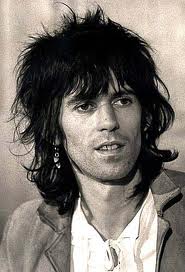
Keith Richards- Face Of The Stones
Part of the problem is that the book was co-written by a former journalist named John Blake who appears to detest Jagger, Richards and the whole scene they created. As a journalist he was privy to all the gossip about Jagger and Richards and so chips in with opinions of his own while also citing newspaper reports. Although written as a continuous narrative, with careful reading you can separate Blake from Sanchez.
After his journalistic career blew up Blake went on to publishing at which he has been successful. His collaboration with Sanchez was fruitful. The book is a great read anyway you look at it. The question is not what Sanchez tells us but what he doesn’t tell us.
Tony says that he was under he protection of a gang boss by the name of Albert Dimes who ran the West End apparently sharing Soho with the notorious Kray twins, Reggie and Ronnie and their brother Charlie. Sanchez then can be classed as a hoodlum. As Charlie Kray says his gang ran a bodyguard company it seems probable that Tony was employed by Keith in that function.

Brian Jones
One of his chief functions for the Stones was as a drug supplier. Opening the book he says apropos of Brian Jones:
I’m not a pusher, but as a boy I’d worked in Soho, first as a night club bouncer, then as a croupier, so I know exactly where to go for anything from a lid of grass to a Thompson submachine gun. Consequently people in the rock world had come to me as a reluctant go-between in their flirtations with the London underworld.
That short paragraph says an awful lot. We know, according to Tony, that he was sufficiently well known in gangland to come under the protection of Albert Dimes, a gangster dating back to the early fifties. Tony says that he worked as a bouncer in gambling joints and that would require the attitude and the temper to use violence whether necessary or not.
And then he says he was a croupier. He later tells us that the games were rigged so that he was knowingly bilking his customers, a form of theft. He then tells us that he could get anything from a bag of grass to submachines guns. This would mean that he was very knowledgeable in criminal matters.
He repeatedly professes that he didn’t sell drugs for profit but apparently had access to commercial amounts. At the same time he is married with two children, dresses like a dandy and hangs out in pricey bars. At no time does he appear to be gainfully employed until for some reason Keith Richards puts him on the payroll at 16,000 pounds a year. Well in excess of the pay for a working stiff. Plus, as Tony never seems to visit the wife and kids, room and board. Kind of a dream deal, you might say. What’s up? We’ll have to guess because Tony and John kept it quiet.
So, how did Tony get so close to Keith? Well, this is fairly interesting stuff. The stuff Swinging London was made of. The story’s real beginning is on page 39 when Tony meets Groovy Bob Fraser who was his entrance to the rock world. Tony tells it like this:
Into this world of intrigue, sudden violence, and bitter feuds dropped Robert Fraser. We met as I sipped a solitary espresso at the Bar Italian in Soho’s Frith Street. It was afternoon and I was killing time before going to work at the club.
Robert sat next to me, and we fell into conversation. Robert mentioned that he had gone to college in Spain…I speak Spanish as fluently as I speak English. This excited Robert and he jumped at the chance to talk to me in his very erudite Spanish…
From there a friendship developed around Tony’s ability to score drugs. Fraser was a gambler who had lost 20K pounds to the Kray Twins and couldn’t pay. He asked and Tony offered to deal with the Krays. Tony approached Dimes who wasn’t willing to jeopardize his wicket for an impecunious gambler. Tony decided to approach the Krays on his own. Bold move. Now, two versions exist; the improbable one of the book and another version in what purports to be a chapter of the book deleted by the publishers that might be more accurate.
The story involves criminal attempts to take over the music business. Sanchez was in a criminal occupation within the underworld while he confesses to wanting to be a criminal. p. 37:
As a teenager my great passions were rock music and big-time villainy- roughly in that order. I had a cousin who had gone way, way off the rails and who had become deeply immersed in organized crime. While my parents complained about the shame he was bringing to our family, I could only look at his big car and beautiful women and pray to God he would show me how it was done.
So, his cousin got Tony a job as a croupier and Tony began to meet big time crooks like Albert Dimes.
Rock and Roll bands at that time played in clubs and clubs are almost universally under the control of the underworld. Thus band members of the Beatles and Rolling Stones are in much closer contact with the underworld than one might assume while that is very carefully obscured by their biographers.
The Beatles played for months in the red light district of Hamburg one of the toughest criminal areas in the world. They witnessed much crime and mayhem. They were no angels. Albert Grossman in his biography gives examples while Andrew Oldham in his latest effort, Stone Free, tells of the time John and Paul dressed as priests and while so posing anointed communicants with their own piss, for which Oldham says they were arrested. At any rate they were under the protection of the crime lord of all Europe. The Krays of England would have been old hat to them.
Tony’s relationship with Keith then is suspicious.
The Kray Twins, who were England’s most prominent villains, as the English say, had taken over a prominent West End gambling spot called Esmeralda’s Barn. Beatles’ manager Brian Epstein gambled here, losing heavily so that the enormous amounts of money the Beatles were generating came to the attention of the Krays. They also knew that Epstein was gay. As they had made the previous owner of the Barn the irrefusable offer they believed they could do the same with Epstein. This aspect of the story is detailed in Colin Fry’s book, The Krays: A Violent Business so the account is not dependent on the missing chapter.
The Krays arranged a meeting with Epstein in a homosexual bar. That it was a homosexual bar indicates nothing to me as gay bars aren’t in the habit of hanging signs out saying: Gay Bar. I have been in several gay venues without knowing where I was until I was being served. The question is, would one go back?
Epstein patiently explained that managing bands was not as easy and effortless as it looked. The Krays then consulted the alleged godfather of British crime Arthur Thompson of Glasgow who as Epstein pointed out indicated to the Krays that managing the Beatles would require sustained effort and concentration to which criminals are not accustomed. Fry says the Krays thought it over, deciding to blackmail Epstein instead which they did collecting a sum every month for years.
Now to the Antiphoney’s missing chapter. Tony says, if the chapter is authentic, that Robert Fraser owed the Krays 20K in unpaid gambling debts. Tony says in Up And Down he tried to arrange a deal in which Fraser paid 30% or less thus freeing him and making him grateful to Tony.
According to the missing chapter the Krays showed him a sheaf of bounced checks and suggested that perhaps Fraser could clear the debt by delivering the Beatles into their hands, apparently not having given up their desire for the Beatles. When Tony told Fraser the idea he says Fraser embraced it setting about to woo the group. Fraser was fairly tight with McCartney to whom he sold a lot of artwork but not so much with Lennon.
In order then to co-opt Lennon, this sounds like a stretcher, he enlisted the aid of Yoko Ono who had arrived from NYC. As an avant-garde personality cum artist she would have looked Fraser up on her arrival so it is at least probable that she knew him. Yoko according to this account had been hanging around Paul who was the Beatle she wanted. Whatever the intent she did besiege John relentlessly until she got her entry and then she seduced him baffling his mind with all that avant garde BS and heroin.
If Fraser had his agenda Yoko had her own. Having conquered John she used his fame to pull off the Performance Art project of the century when he and she staged the Bed-In For Peace.
While all this was going on the Guiness heir Tara Browne entered this scene when he and his friend, , opened a night club called Sybilla’s. George Harrison of the Beatles was a significant investor. You can’t operate a club without dealing with some Mob. Perhaps the Krays saw Sybilla’s as a chance to co-opt the Beatles. Although the story is not yet clear I imagine that the Krays put pressure on Kevin MacDonald and Browne to sell their interest thus giving them direct access to Harrison as a partner. The two apparently refused so MacDonald was thrown off a roof to his death which left Tara Browne to deal with.
Bearing in mind that Paul had been under the protection of the European crime lord and one doesn’t receive favors without returning them, for that or some other reason Paul was probably compelled to lure Browne to his death. It is said, perhaps conjectured, that on that night Paul challenged Tara to a high speed auto race through London. The object being to draw Tara to a certain intersection where he could be caused to crash his car, a little flimsy Lotus. The crash ruse succeeded and Browne was killed although his supposed passenger, Suzy Poitier survived in a demolished car without a scratch sans seat belt or air bag. Doesn’t seem likely.
Browne’s death left Harrison as the sole surviving investor. I have no information as to his reaction but the club was closed and Harrison went his way. Harrison and Browne had been enough of an attraction to make Sybilla’s a hot spot with the In Crowd. That kind of lightning can strike many times.
Subsequently then, Tony, so he says, conceived the notion of opening his own club that he called Vesuvio. As he seemed to be very tight with the Stones and the Beatles he was able to feature them as attractions for his grand opening that was attended by them and the Rock establishment including Eric Clapton who was also a habitué at the Krays’ gambling club, The Barn. According to Tony the club was a stellar success but then he discovered he wasn’t the type to enjoy sustained business activity so his partner, the one who fronted the money took over management putting him on a stipend. Sanchez doesn’t say who his partner was but it surely must have been either Albert Dimes, or…the Krays.
Whatever, but Fraser was still not delivering and the Krays were getting pushy. Here comes a real leap of belief. Fraser could deliver neither the Beatles nor the money owed so, says Tony, he conceived the notion of going to prison to escape the Krays. An odd choice as the Krays had as many men on the inside as on the outside. But if you’ve snorted, puffed dropped and shot enough stuff I’m sure anything can seem like a reasonable plan.
Thus Tony says in the deleted chapter it was he, Fraser, who tipped the News Of The World to the Redlands bust which sent him to prison for six months. During that time the Krays murdered Jack McVitie, for which crime they were finally nailed. They went in as Fraser came out thus freeing him of the threat although Tony says prison was a life changing experience for Bob who became a less groovy Bob.
Alright. That makes a good story, doesn’t it?
2.
Nor was the above the only contact of the Krays with show biz and Rock
It may be time to give a little perspective to the arch-criminals, The Krays, for those who may be unfamiliar with them, at least in the US, the English underworld reformed after WWII, a whole new cast of characters emerged formed by the wartime experience. The Kray twins were born in 1933 while their brother Charlie was a few years older. Ronnie and Reggie, the twins, began to emerge after 1954 becoming powers as the sixties began.
Perhaps their main racket was Protection of which providing bodyguards was a sub-division.
As the sixties progressed and their fame grew the Sicilian Mafia of the US began to take notice of them. The Mafia had always had a stable of singers, actors and performers they controlled for their nightclubs, such as Frank Sinatra, Dean Martin, Judy Garland et al. They suggested the Krays do the same.
In that manner the Krays provided bodyguards for visiting Mafia acts in England. When gambling became legal in England during the early sixties the US Mafia opened casinos installing such as the ex-actor George Raft as front men. The Krays were flattered by the attention showered on them by Raft.
Thus the Krays moved in on the Beatles, the Stones, the Kinks and others. While the Beatles Brian Epstein was paying large monthly there was probably a connection to group members also. If McCartney was used to lure Tara Browne to his death, and maybe it was only intended as a scare and a few bruises, then there was mob influence at the personal level.
As I have implied if not stated, Spanish Tony was foisted on Keith as a bodyguard and minder.
The Krays also made a move to co-opt the Kinks but that deal is said to have fallen through. Ronnie Kray as part of the deal wanted to date Kink drummer, Mick Avery. Very flattering to Mick, I’m sure.
Later, when the Sicilian US Mafia wanted to launder money they offered the Krays 2,000,000 dollars to set up a label. The Krays went about it signing a few acts including Billy J. Kramer and the Dakotas. Kramer was spared further indignities when the money was withdrawn and the deal fell through.
And then in Prison after 1968 Reggie Kray decided he wanted to be a songwriter so his songs were foisted on groups who were required to record them.
Much has been made of the homosexual Communist MP Tom Driberg trying to lure Mick into politics. In point of fact Driberg was well connected with Ronnie Kray and part of ring that borrowed boys from an orphanage for their sexual deviance.
This then is quite involved and while Mick was probably not lured into this pervert scene with the Krays it would seem that there was some attempt to draw him in thus co-opting him into the underworld. The scene and Redlands situation needs a little in depth investigation to clear up details of what might have been going on behind the scene of the Bust.
3.
And then there was Tony’s ongoing relationship with Marianne Faithfull. No one associated with the Stones has anything positive to say about Tony. But, listen to Marianne, autobiography, p. 162:
Quote
…(Tony) was a dreadful person. You only had to see him eat to know how loathsome he was. He was a lowlife, a small-time spiv, but a weakling at the same time. He was as enchained as anyone else, completely hung up on his particular sickness.
Unquote
And yet,
Quote
…I was getting deeper and deeper into drugs…I was also getting involved in a long affair with Tony Sanchez, dealer by appointment to the Stones. I can’t believe I did that! I didn’t get enough pocket money fom Mick and I didn’t have any money of my own, so how else would I have been able to get my own drugs?
Unquote.
There’s a problem. And then:
Quote.
It’s odd to realize that the person you’re sleeping with is there only because you’re Mick Jagger’s girl friend. Or were.
Unquote.
This was as Marianne moved into her lost years during the seventies. During this period she makes it sound as though she were sitting on her wall over the bomb site beyond the ken of the world. It makes a good story and it drew me in. But, she says she never resorted to prostitution. Well, maybe.
While in France with Keith Tony met a woman named Madeleine D’Arcy for whom he fell hard, ditching the wife and kids. Love of his life, he said. She returned to England with Tony where Marianne apparently fell for her as hard as Tony. Sanchez came home one day to find Madeleine and Marianne getting it on. He blamed Marianne.
As all three were heroin addicts with pretty good habits; one wonders where Tony got the money if he wasn’t dealing. He was not closely associated with Keith after Keith fled the Riviera a step or to ahead of the cops so Tony may then have been off the payroll.
He would have had to be hustling something.
Madeleine was hooking. Marianne pp.225-26:
Quote:
I hadn’t heard from Madeleine for several days. Her phone was off the hook and I suspected the worst. I had a feeling she’d OD’d, and I might have to smash down her door, so when I went over to the flat in Maida Vale I took with me as muscle a burly Maltese drug dealer and a lowlife friend…Eventually the boys broke down the door and in the bedroom we found Madeleine lying fully clothed in a long gown on the bed. She was obviously dead and looked bruised and bloody…By the time of her death, she had gone back to turning tricks at Brighton for fifteen pounds a night.
Unquote.
The Maltese gangs in London were known both for drug dealing and running prostitution. That Marianne contacted a Maltese and ‘a lowlife friend’ might point to prostitution. I saw a clip on the internet in which the photographer was hidden in a sort of alcove shooting through an opening. Marianne walked in front of the camera obviously dressed as a hooker but very classy in her mini skirt and jacket. She spotted the camera, looked alarmed, and quickly ducked around a corner looking back to ascertain what was going on.
There are numerous pictures of her during her lost years so that when the record producers went looking for her she wouldn’t have been as hard to find as she says.
And then, this: p.221:
Quote.
I was constantly reminded during these years of my parasitic status in the pop world. I remember once going out dancing to a club and Rod Stewart came home with me. He thought I was just one of those girls that sort of floated around pop stars and tried to put the whole thing across like that… (Pop stars) are looking for their particular type, a girly sort of woman with pretty underwear and frocks and the whole female fantasy….I laughed and threw him out.
Unquote.
Sort of a hard Marianne. The other side of the Faerie Queen.
In 1976 Tony was cut loose by Jagger and Richards for good. I presume he passed out of Marianne’s life at that time. In any event she met her second husband, Ben Brierly, in 1976 and began a different, if not a new, life.
4.
Tony’s primary job after securing drugs was to look after Keith. Keith needed some serious looking after. As Keith says Tony’s facts are straight then the only disagreement would be that Tony mentioned things Keith preferred not be mentioned. Indeed, when a London newspaper was going to publish an excerpt concerning Marianne she got an injunction to prevent it.
If the incidents are true as Keith attests then the evidence is that Keith was, at the very least, off the rails, carefree and reckless. He seemed to be conducting a vendetta against society attempting to see how many rules and laws he could break with impunity not unlike the Droogs of A Clockwork Orange.
Unable to pass the driver’s license test Keith had someone else take the test for him. Although, test or no test, practice should have made perfect. Keith was a slow learner cracking up car after car. As he was usually carrying, he grabbed the dope then ran off leaving Tony to deal with the police. Rather annoying from Tony’s point of view who must have been on the police radar himself.
I’m sure that Tony considered himself more than a minder or drug procurer, thinking of himself as more of a member of the group, especially as he was a friend of Robert Fraser’s before linking up with Keith.
The Redlands drug bust is far from cleared up. There is no certainty as to who alerted the News Of The World paper that drugs would be at the party and where the party was. The drug dealer Schneiderman may have been the one. His presence is certainly suspicious. I am going to suggest another possibility, admittedly a conjecture, that Tony himself might be the culprit. Sanchez ran a lot of risks for Jagger and Keith while being included in most things. Then, he wasn’t invited to the Redlands party at which he knew the regulars well. To be excluded is often considered an insult for hangers on for which vengeance is due. It is possible, then, that to wipe the perceived insult Tony himself alerted the News Of The World. It would certainly have avenged a number of indignities he had suffered at the hands of Keith.
It might have been Fraser who alerted the News as the missing chapter asserts, it might have been Schneiderman or, perhaps, it was Tony himself.
At any rate it appears that Tony was tolerated by Keith but not really welcome. As he was linked to London’s underworld it is possible if not probable that there was some link between it and Keith and Mick. When the Krays were sent up for thirty years in 1968, probably freeing Mick and Keith from their influence Tony’s days were probably numbered.
He was still useful in France but when Keith overplayed his hand finding it necessary to leave France and unable to return to England, he became a man without a country of sorts, the connection with Tony was broken, it being only necessary to sever the relationship.
Tony tells it in the brief epilogue to his book:
Quote:
I had been running from death too long, knew that I could not live this life much longer. But I wasn’t ready to draw completely away. Keith still called me occasionally asking me to get drugs for him, and usually I would cooperate. It had become my way of life. It was on August 21, 1976, that the Stones were playing an outdoor concert at Knebworth House in Hertfordshire, and Keith and Mick asked me to bring some cocaine to the dressing room for them. I was given the wrong type pass, however, and in the midst of a wrangle with a security man I suddenly realized it was all over. I turned on my heel, walked away and the next day reserved a room at Bowden House for a cure.
Unquote.
And so Tony was eased out. I have found nothing that mentions his last twenty-five years. However he died in the year 2000 short after Charlie, Ronnie and Reggie Kray had all passed away. It may have been coincidence or as some suggest…
 I, Dynamo