Chaps. 9, 10, 11, 12: Edie Sedgwick, Maid Of Constant Sorrow
November 30, 2010

The 707

DC 6B
A week or so after Philadelphia I got a real lesson in show business and Pop style. Just when you think you’re getting famous, somebody comes along and makes you look like a warm up act for amateur night. Pope Paul VI, talk about advance PR- I mean, for centuries.Definitely the most Pop public appearance tour of the sixties was that visit of the Pope to New York City. He did it all in one day- October, 15, 1965. It was the most well-planned media covered personal appearance in religious (and probably show business) history. “Never Before in This Country! One Day Only! The Pope in New York City!”The funny thing for us, of course, was that Ondine was known in our crowd as “the Pope,” and one of his most famous routines was “giving the papal bull.”The (real) Pope and his entourage of aides, press and photographers left Rome early that morning on an Alitalia DC-8. Eight hours and twenty minutes later, they got off the plane at Kennedy with the Pope’s shiny robes blowing in the wind. They drove in a motorcade through Queens- the streets were lined with people- through Harlem crowds, and then down to the jammed- for blocks St. Patrick’s Cathedral area in the Fifties- where the Pope seemed to want to go out in “the audience” but you could see his aides talking him out of it. After all the stuff in the cathedral he ran down the street to the Waldorf-Astoria where President Johnson was waiting. They exchanged gifts and talked for a little under an hour about world troubles. Then it was over to address the UN General Assembly (essentially he said, “Peace, disarmament and no birth control”) out to Yankee Stadium to say Mass in front of ninety thousand people, over to the closing World’s Fair to see Michelangelo’s Pieta in its Pop context before it went back to the Vatican, and back out to Kennedy and onto a TWA plane, saying, when the reporters asked him what he liked best about New York, “Tutti Buoni” (Everything is good”) which was the Pop philosophy exactly. He was back in Rome that same night. To do that much in that short a time with that kind of style- I can’t imagine anything more Pop than that.

The Heyday Of Andy And Edie

Edie And Andy- Sitting On Top Of The World
Velvet Underground And Nico


Edgar Deep In Thought
I’d dreamt about Billy Name, that he was living under the stairs of my house and doing sommersaults and everything was very colorful. It was so weird, because his friends sort of invaded my house and were acting crazy in colorful costumes and jumping up and down having so much fun and they took over, they took over my life. It was so weird. It was like clowns.Everybody was a clown in a funny way, and they were just living there without letting me know, they’d come out in the morning when I wasn’t there and they’d have a lot of fun and then they’d go back and live in the closet.

Malanga and Dylan
I was invited to speak at the annual banquet of the New York Society For Clinical Psychiatry by the doctor who was chairman of the event. I told him I’d be glad to ‘speak’ if I could do it though movies, that I’d show Harlot and Henry Geldzahler and he said fine. Then when I met the Velvets I decided that I wanted to speak with them instead, and he said fine to that too.So one evening in the middle of January everybody in the Factory went over to the Delmonico Hotel where the banquet was taking place. We got there just as it just was starting. There were about three hundred pychiatrists and their mates and dates- and all they’d been told was that they were going to see movies after dinner. The second the main course was served, the Velvets started to blast and Nico started to wail. Gerard and Edie jumped up on the stage and started dancing, and the doors flew open and Jonas Mekas and Barbara Rudin with her crew of people with cameras and bright lights came storming into the room and rushing over to the psychiatrists asking them questions like:‘What does her vagina feel like?’‘Is his penis big enough?’‘Do you eat her out? Why are you getting embarrassed? You’re a psychiatrist; you’re not supposed to get embarrassed!Edie had come with Bobby Neuwirth. While the crews filmed and Nico sang her Dylan song, (I’ll Keep It With Mine) Gerard noticed (and he told me this later) that Edie was trying to sing, too, but even in that incredible din, it was obvious she didn’t have a voice. He always looked back to that night as the last she ever went out with us in public, except for a party here and there. He thought she’d felt upstaged that night, that she’d realized that Nico was the new girl in town.Edie and Nico were so different, there was no good reason to compare them, really. Nico was so cool, and Edie was so bubbly. But the sad thing was, Edie was taking a lot of heavy drugs, and she was getting vaguer and vaguer. Her society lady attitude toward pills had changed to an addict attitude. Some of her good friends tried to help her, but she couldn’t listen to them. She said she wanted a “career” and that she’d get one since Grossman was managing her. But how can you have a career when you don’t have the discipline to work at anything?Gerard had noticed how lost Edie looked at that psychiatrists’ banquet, but I can’t say I noticed; I was too busy watching the psychiatrists. They were really upset and some of them started to leave, the ladies in their long dresses and the men in their black ties. As if the music- the feedback actually- that the Velvets were playing wasn’t enough to drive them out, the movie lights were blinding them and the questions were making them turn red and stutter because the kids wouldn’t let up, they just kept asking for more. And Gerard did his notorious whip dance. I loved it all.http://www.youtube.com/watch?v=iNwp4nNTeJg Clip of performance.

Dylan

Neuwirth

The Man Of A Thousand Faces
Sigmund Alone Is His Study

Her Fogs Her Amphetamines And Her Pearls

Lou Running A Temperature

John Cale as Old Hipster Contemplating The Dynamo Hum

Gerard

Andy And Gerard

Bomber Billy Ayers

Andy And Fred Hughes


All The Fame Anybody Needs

Tell ’em Andy
A Review, Pt. 10: Tarzan The Invincible by Edgar Rice Burroughs
November 21, 2010
A Review
Themes And Variations
The Tarzan Novels Of Edgar Rice Burroughs
#14 Tarzan The Invincible
by
R.E. Prindle
Part 10

The Prohpet- Edgar Rice Burroughs
Religion: Standing On The Promises
Even though at the beginning of the novel Burroughs says he does not consider Politics and Religion suitable topics for fiction- unless highly fictionalized- the two topics seem to constitute a major portion of his work.
The Great One does not feel called upon to exhibit a foolish consistency. In Invincible the first sentence is: I am no historian. In Tarzan Triumphant he says: ‘Being merely a simple historian and no prophet…’ So in the few months between Invincible and Triumphant he has gone from no historian to a mere simple one while hinting that while he is no prophet he may become one. We can’t be certain what the future holds in store for him. I’ve already sensed that he is a prophet. Tarzan is the god and Edgar Rice Burroughs is his prophet. So much for Mohammed being the end of the prophetic line.
Under cover of fiction Triumphant will deal extensively with the Jewish and Christian religions so this might be an appropriate place to review some aspects of the history and nature of religion.
Evolution occurs on many levels other than the biological. The biological naturally controls all other forms of evolution. The species has developed from a time of pre-hominid ancestors that must at some time have diverged from that of the other anthropoids as unpleasant as that may be for a certain type of mind although, for the life of me, I can’t imagine why. One of the more significant areas of evolution has been that of the brain. Nothing should be clearer than that the brain of HSIII is superior to the brain of the first Homo Sapiens and species which evolved from the Last Hominid Predecessor. I mean gorillas must have a relatively primitive brain.
There is no reason for this not to be so. The brain of the infant Homo Sapiens continues to develop outside the womb until at least the early twenties. At each stage the ability of the brain to function increases. As above, so below; as in the macro so in the micro.
Thus as in each stage of evolution from the first Homo Sapiens to the present most highly evolved specimen Homo Sapiens III, abilities to think and function have increased. Thus HS’s understanding of the world and universe are immeasurably different from the first Homo Sapiens model. I can’t imagine anyone who would dissent from that conclusion.
Now, except for the intermingling of human species certain human species would still be unacquainted with the approximately true nature of the world and universe that we have attained. I don’t see how this can be disputed. Without European influence the rest of the world would still think the earth was flat. These are facts whether one likes them or not. Indeed, even among the most advanced human species there are very large numbers who resist the scientific explanation of nature. These people still prefer the atavistic, antiquated religious Semitic explanation of natural phenomena. These people can barely accept the notion of a heliocentric solar system, many don’t. Why should anyone pay attention to them?
If one accepts that Homo Sapiens is 150K to 200K years old then it seems to me impossible that all human intellectual development has occurred in the last ten thousand years. Weapons of some sort have been in existence for many tens of thousands of years if not from the beginning of Homo Sapiens having been evolved from the Last Hominid Predecessor. It seems evident to me that a highly developed civilization existed in the Med Basin beginning c. 100K years ago. That doesn’t mean they had advanced Science it merely means that they had an organized society with relatively sophisticated thought processes and tools. Religion is basically an attempt to understand and make order of the world. All interpretations of the natural order must be based on that order.
Hence the North Polar stars which never set are the basis of religion. The Polar stars rotate about the Pole over a period of some 25K odd years forming what is called a Great Year. The Great year was made to conform to the terrestrial year of twelve months therefore being divided into twelve periods called Ages.
The Great Year with it twelve Ages formed the basis of religion. We will call that religion the Astrological Religion. Thus the religion goes back for tens of thousands of years as Sumerian records indicate. These Ancients did not make up their lives or talk through the backs of their necks.
Each Age of the Astrological Religion had its male and female religious archetypes. These are, perhaps most easily traced as far back as four ages, possibly five, in the Greco-Cretan mythology. The historical ages are the Taurian, Arien, Piscean and the next, the Aquarian. I am not a New Ager although I see no reason to disparage them and I am in sympathy with the outlook. One may say that I am of the Astrological religious tradition as we will see, I think, was Edgar Rice Burroughs.
In ancient days the Hom Sapiens species were separated each having distinct territories so that in the Darwinian sense they were not yet in conflict. When the last Ice Age came to an end flooding the Med Basin- this is not speculation, but fact- the civilization of the Basin was forced to higher ground bringing them into contact with the highland savages from West to East. Thus civilization as we now know it began.
The first settlers of Mesopotamia brought the Astrological Religion with them or, according to Mesopotamian mythology a man-god named Oannes- the name Oannes evolved into Johannes or John- appeared from the sea to teach them the rudiments of civilization and the Astrological Religion. Immense amounts of lore must have been lost, that is forgotten, so perhaps that is where the legend of the Lost Word comes in.
Now, off to the East on the Arabian Peninsula a different species lived. These were called the Semites or would be after the later Hebrews so named them after their mythical ancestor, Shem. Mere desert dwellers the Semites were attracted to the glitter of the Astrological Religion. There is no evidence that the Semites had a civilization or anything that could be called an actual culture of their own. They merely mimicked the existing culture infiltrating it much as Europe and America are being infiltrated today by their descendants. Eventually they will succeed the European civilization just as their ancestors did the Sumerian.
The evidence is that they had no religious forms of their own so that they attempted to take over both the physical and cultural edifices of their predecessor civilization, the Sumerian.
The Semites did not have the same mental organization or capabilities as their predecessors so they could maintain neither the civilization nor the religion. The major conflict came at the transition from the Age of Taurus to the Age of Aries. Here is where the real conflict between the Semites and Indo-Europeans or the Semites and HSII & III begins to take its historical form.
When the Astrological Age changes the religious archetypes change. For instance Cronus had been succeeded by Zeus at the transition from Taurus to Aries. Zeus himself was succeeded by Jesus the Christ at the transition from Aries to Pisces. Zeus would have been succeeded by Dionysus but the Semites either had to be accommodated or they forced Jesus of Nazareth on the Age which was later combined with the Kyrios Christos to form the composite deity the Semitic Jesus and Hellenic Christ. The role of Paul was very important in forcing Jesus of Nazareth on the goyim as Burroughs attests in Triumphant.
As we are now about to transit from Pisces to Aquarius a new set of archetypes will emerge representing the current intellectual and psychological development of Homo Sapiens.
This raises the question of whether Burroughs was merely a simple historian or was he also a prophet. Is Tarzan his offering for the role of the male archetype for the Aquarian Age? I think he is. For those who scoff at such an idea it would be wise to examine Burroughs relation to Mormonism during his stay in Salt Lake City. If it was possible for Joseph Smith to befuddle the minds of intelligent Westerners with his nonsense in the middle of the nineteenth century, or Mohammed to impose his twaddle even in the seventh, then I see no reson to be amazed that Burroughs would attempt the same thing in the twentieth century. I mean, look at this stuff for what it is.
Also, believe it or not, I read recently where someone thinks Oprah Winfrey could be the female archetype for the Aquarian Age. Get out of here. I don’t whether to laugh or barf. So, the notion of religious archetypes for the new age is a fairly active one. Any such discussions are in conflict with Semitism. So, we’re back to that problem.
Semitism took identifiable form at the transit from Taurus to Aries.
The record of such happenings is, of course, much more recent than the transition from Taurus to Aries. It could have been made up during the Babylonian captivity. The Old Testament record was only recorded, perhaps even formulated, after the Captivity which began in 586 BC lasting for only fifty years although rather than return to the pleasure of the temple most Jews remained behind by the waters of Babylon just as their ancestors yearned for the fleshpots of Egypt.
To clarify the nature of human species according to Jewish sources: The Jews argue that all mankind is derived from Jewish or Hebrew stock. The only survivors of the great flood were Jews- Noah and his family. The ancient Hebrews while knowing many cultures knew of only three species or stocks. They acccordingly named them Hamites, Shemites and Japhetites after sons of Noah. In their conversations with De Great Lawd which were frequently carried on in public He apparently dispensed information on a need to know basis so he withheld the info on the Mongolids and West African Negroes as no account of them is taken in the descendants of Noah. A little gap in the perfect knowledge of the Old Testament.
Thus the Old Testament acknowledges the differences between the Semites, the Europeans or Japhetites and the Hamites are more than merely racial, which is to say Cosmetic. Such an idea is of course in line with genetic learning.
The Med People or HSII devised a fluid religious system that allowed for the development or evolution of the human mind. In other words they not only accepted but embraced change. This is a quality of mind not shared by HSI, the Semites or the Mongolids.
Depending on what time period the Semites began the infiltration of Mesopotamia which may have overlapped the Geminian and Taurian Ages or perhaps fell completely within the Taurian Age there would have been no conflict with the Semitic need for stasis and the Astrological allowance for development, evolution or growth. However, by the time of the transit from Taurus to Aries the Semites had gained political control of Mesopotamia while the religious control was still in the hands of the Aryan priesthood.
Following Astrological precedents the ancient Aryan priesthood wanted to change to the Arien archetypes. In European Greece where the Semitic influence was lower the transit from Cronus to Zeus was made with only the usual warfare hence the legends of the Cronian Titans and the Olympians.
In Mesopotamia where the Semites were in the ascendant, according to Jewish myhthology, the Terahites, under the tutelage of Abram, disputed the succession with the ancient priesthood. According to Jewish mythology Abram and the Terahites argued that the religious archetypes were eternal and there was no Astrological tradition. Thus in the ancient world the Jews were believed to worship Saturn. If Saturn were the Taurian archetype then this was very likely true as Saturn would then be the basis for the Eternal which the Jews do acknowledge worshipping.
In the Semitic manner, then, the Semitic mind being incapable of accepting change, having been fully developed before they emerged from the desert, went into opposition to the Astrological Religion. Thus the conflict changed from a termporal one to a ‘spiritual’ one. At that point then diaspora was possible without the laws of national identity. As a spiritual entity, Judaism was born. The notion of Semitism developed along with its opposite anti-Semitism. Christ = Anti-Christ. Thus the explanation of the origin of this so-called anti-Semitism is simply explained. In reality Semitism was in conflict with the Astrological Religion and hence was anti-Astrological. Any other religion must perforce be anti-Semitism. The struggle then became a struggle for the souls of men as well as their bodies.
Once again in direct conflict Europe and Asia began a long theological dispute. As the Piscean transition progressed the Semites began their attempt to convert the Astrological religion to Semitism. They were effective in shutting down intellectual inquiry which is the motive force for change. We will see this again in the nineteenth century efforts of Marx, Freud and Einstein.
As the ancient world ended, its religious legatees were the Catholic Church and Judaism. All other ancient religions disappeared from the face of the earth except in ineffective remnants or underground movements.
It is interesting that fourteen hundred years after being forbidden the Arien Age worship of Zeus has been made lawful again in Greece. There’s really no place in the Aquarian Age for the Olympian pantheon but it is an interesting atavistic attempt reviving as it were the struggle between the Arien Age religions of Olympia and Israel.
Gradually the Egyptian and Anatolian elements of the Christian manifestation of the Piscean archetypes have been displaced in favor of the Semitic models. The Catholic Church was able to contain the Semitic influence in Europe from the end of the Western Roman Empire to the Age of the Enlightenment of the seventeenth and eighteenth centuries. The Enlightenment let Simitism loose on the world again.
While the Roman Empire militarily defeated the political entity of Jerusalem from 66 AD to 135 AD the battle weakened the Empire allowing in Asiatic influences like the Emperor Heliogabalus. Then in the seventh century AD the present form of the struggle between Europe and Asia took form when the prophet Mohammed formed the Moslem Religion based largely on its predecessor religion, Judaism.
The Moslems stormed across North Africa into Spain and France where they were stopped at Tours by Charles The Hammer. It took nearly one thousand years to drive the Moslems from France and Spain which result was finally obtained in 1492.
As the Moors were driven from Europe by Ferdinand and Isabella they also expelled the Semitic Jews. In the evolutionary sense this was the other correct response to an invasion of a competing species. The other, of course, would have been extermination. Thus at this stage of European history they were responding in an evolutionarily correct manner. England had expelled the Jews in 1190 and France in 1307. The various small German States fluctuated in their attitude sometimes expelling sometimes readmitting. There were always German States that allowed Semites. Otherwise the great mass of European Semites lived in the no-mans land between Russia and Germany that would after Russian annexation be called the Pale of the Settlement meaning this area was roped off for Jewish residence.
While these actions may have been evolutionarily correct and probably even politically correct the defensive party seldom thinks in such grand terms as evolutionary inevitability. So, really, in evolutionary terms the only correct response is extermination. The Shona of Zimbabwe fully understand this principle. I say this to show I am not springing anything new or unusual on you. These natural responses are going on today in Zimbabawe, South Africa, South and West Sudan, Indonesia, in former Yugoslavia where Moslems are exterminating non-Moslems. If you don’t believe these things, open your eyes, open your eyes.
Now, wars do not end after seeming victory. The expelled Moslems of Spain continued the war establishing the Barbary Pirates who then preyed on Europe for the next three hundred years plundering and enslaving Europeans. The actual invasion of North Africa first by Spain and then by France was an attempt to end this savage warfare.
Burroughs would have been brought up on the legend of millions for defense but not one cent for tribute as was my generation. Until recently I believed that Americans had ended Barbary piracy. This was just something we were told in the fourth grade. Actually the Barbary pirates were put down only in 1830 when France conquered and annexed Algeria.
France at that time ought to have either exterminated or driven out the Moslems. Having once expelled them, if they had had the power, they should have swept across North Africa, as the Moslems had done, driving the Moslems before them until they had reached Suez.
Thus Africa would have been reclaimed for Europe. First it was held by the HSII survivors of the Med Basin flooding, then the Semitic-Carthaginians, then HSII Romans and back again to the Semitic Arabs. So such a preemption was certainly historically justified. The Moslems make a great noise about the Crusades but the modern problem was their offense of the Eruption From The Desert. Get straight.
At the same time the Jewish and Arab Semitic struggles were going on the yeast of the suppressed religions of the Middle East and philosophies of Greece were converting the Europeans from Semitic stasis to Aryan intellectual activity. The Eastern Roman Empire fell at the time of the expulsion of the Jews and Moslems from Spain. Scholars flooded out of the East. These Egyptian, Greek and Syrian influences burst forth in the seventeenth and eighteenth century as the Enlightenment. Previously the discussion had been between the Semitic reigions of Judaism, Moslemism and Christianity. The level of human consciousness between the three was nearly equal although still retaining some measure of the Astrological Religion. This is a very serious subject for study. Christianity, such as it was, was intellectually superior. Remember, however, that Catholicism was so imbued with the limited Semitic intellect that the Pope made Galileo deny the notion of a heliocentric system.
The release of the Scientific Consciousness after the long suppression of several hundreds of years put the inferior religious consciousnesses on the defensive. The Semitic counterattack going on today is the culmination of the Jewish response to the Enlightenment. It is imperative that a Scientific offensive be made against this anterior and surpassed form of the evolution of human consciousness. As in the past a victory cannot be achieved without a perhaps bloody and costly struggle. Such as is going on now.
We, you readers, Burroughs and I, are concerned with the middle of the Englightenment period here, say from 1890 to 1935. I think we will see that Edgar Rice Burroughs is deeply and constructively involved in this struggle between the Religious and Scientific Consciousnesses.
As I’ve noted before, the Christian response to the scientific challenge was to declare either the Pope or the Bible infallible. Protestants didn’t have a Pope so they declared the Bible infallible. Same thing. American Liberals who evolved from the Puritan/Abolitionist nexus essentially became secular religionists. It is to be remembered that the Puritans the Liberals evolved from considered themselves neo-Hebrews hence the new Chosen People. According to John Adams as Neo-Hebrews they even rejected the celebration of Christmas. Thus Liberals tend to give science a religious spin rejecting Christianity.
The Jews on the other hand confronted by a hard edged Science that could not be bent to Semitic ideas decided to co-opt Science perverting it so that it resembles their religion. All these responses have been taking place since the French Revolution of 1789 which emancipated the Jews removing them from Roman Catholic control.
As I pointed out in an earlier essay there was a brilliant episode on the TV show Twilight Zone in which monks had captured and imprisoned Satan. They made the mistake of allowing a lost traveler to stay the night in the monestery. The monks warned the visitor to pay no attention to the entreaties of the prisoner to release him. The traveler did not heed the warning and prisoner who was Satan was released again in the world. A little allegory.
Thus the Revolution and Napoleon emancipated the Jews who immediately began the conquest of Europe. France was the first to fall. Karl Marx then hi-jacked Socialism in the name of Communism. Communism negates change in favor of stasis. Its story is all regulation and control, no different than Judaism. An elite administers to the ‘masses’ as the Chosen People administers to the goys.
Just as the Moslems are called to prayer five times a day and the Jews are expected to apply their 613 commands to every action before they take it, so Communism coopts the individual into the collectivity and regulates his every action.
Using Socialism as its cutting edge the way was paved for Communism in Europe.
Burroughs first encountered Socialism on the streets of Chicago as Socialists marched along under their waving red banners. The scene made an indelible impression on the young boy resulting after the Russian Revolution in his book, Under The Red Flag. Thus the Semites coopted the political ideology of the next one hundred years.
Science unfolded very quickly in the years following Darwin’s Origin Of Species. Particularly great progress was made in the scientific understanding of the mind. Psychology then was coopted by the Jew, Sigmund Freud. It is rather difficult to understand why all research seems to have been channeled through Freudianism. A rather fecund area of research seems to have been enveloped into one train of thought.
Freud quickly established his version of the static ‘unconscious’ as the sole vision of the mind. He demoted the conscious mnd to a position of irrelvance. His intention is quite clear. The conscious mind is the engine of change. By emphasizing the static unconscious combined with is vision of sex, which is to say only sexual intercourse, he was attempting to disarm the conscious mind and hence stop change or in other words establish stasis. Success in such a course is not instantaneous so naturally science continues to progress as the pall of the unconscious spreads. It doesn’t take a genius to understand why scientists are male and white. Once you have established the fact that scientists will be male and white it becomes necessary to stultify and emasculate white males, thereby establishing stasis. One would have to be blind not to see that that is exactly what is happening.
In point of fact the unconscious does not have an objective existence. Its apparent existence is merely a mind in an arrested state of development. The stasis is caused by fixations from challenges too stressful for the conscious mind to handle. Once the fixations are dealt with and disappear, which is included in Freud’s understanding of the mind, the mind or personality is allowed to integrate, the Freudian unconscious disappearing.
Freud never integrated his personality remaining under the influence of his ‘unconscious’ so it is possible he didn’t understand the integration of the personality although his disciple, Jung, did.
However in Freud’s hands the unconscious became a weapon in the Semitic attempt to subjugate mankind. This subjugation is not religious or moral but a matter of one species seeking dominance over the others. Thus as Marx perverted the science of politics so Freud perverted the science of the mind. The third perversion of Science was the conquest of physics by Einstein. As Marx and Freud had interjected Semitic religious concepts into Politics and Psychology so Einstein did the same in Physics. It matters little that there is some scientific content in the the theories of these men. Their intent is to subordinate science to religion just as they had done vis-a-vis the Astrological Religion to the Semitic Religion when the Religious Consciousness was supreme.
That Einsten has been able to befog the minds of very intelligent men with his nonsense about the ‘fabric’ of space and time is nothing short of incredible. Yet, by the second decade of the twentieth century the perverted notions of these three men were directing the course of research in these three essential disciplines.
Thus cored from within the Aryans were made susceptible to the rising time of Wahabi Moslemism that Lothrop Stoddard noted and warned against but which warning was defused due to the machinations of Jewish Semites within Western Civilization.
Running concurrently in the background contra to the Semitic stream was the evolving Astrological Religion. Just as the evolution of the Dionysiac Archetype of the Age of Pisces developed for hundreds of years within the Arien dispensation of Zeus so the formation of the Aquarian has been taking place in the Age of Pisces.
The Enlightenment with its advance in the development of scientific consciousness was undoubtedly the opening salvo. Unlike Semitic development the Astrological evolution was not institutionalized. It is an idea that once set in motion is maintained by volunteers who get the idea and keep it perpetuating.
The principle is known. For instance the notion that America is a land of immigrants has been allowed to develop to the point of self-destruction. Of course that notion is constantly forwarded by the Liberal Coalition. Even though it is obvious to the feeblest intelligence that the land is capable of supporting only a finite number of humans the madness has now reached the point where it is beleived that the whole world can be imported ‘to share what we have.’ One of the most, if not the most, bizarre notions in all history. Such insanity is difficult to understand.
If one assumes, as one must, that human consciousness has been developing over the 150K years since humans evolved from the Last Hominid Predecessor then this transition to the Aquarian Age is the most dramatic development of history. All previous stages of evolution have involved the progression from one stage of supernatural religion to another. In this transition, for the first time, it has been proclaimed that ‘God is dead.’ That is to say a supernatural being who guide’s our destiny.
With the age of Science mankind realizes the true nature of appearances or Nature itself. The concept of Evolution destroyed the basis of the Semitic religion. There is no God, no Yahweh, no Allah, no stasis. Oh, Lord, crikey Massa, don’t put me jail for saying that! People who still believe in such non-existent deities have not been relegated to the dustbin of history.
Burroughs, and I consider this fairly remarkable, seems to have accepted the New Order of Science upon his first contact with Darwin and Evolution. To say that ‘God is dead’ creates a vacuum in human consciousness such as the integration of the personality changes one’s mental structure leaving an aching vacancy between the vacation of the old personality and its replacement by the new. Thus for the last hundred years or so mankind has been seaching for a metaphysical sucessor to the supernatural concept of God.
Just as the Enlightenment may have opened the way to the transition to the new consciousness so men have appeared to direct consciousness into constructive channels. One of these writing as Burroughs writhed through the years between his marriage and the epiphany that produced his writing career and Tarzan was a man called Levi Dowling writing under the name of Levi. His effort, I’m certain what he considered his gift to the world, was a work called The Aquarian Gospel Of Jesus The Christ.
I doubt Burroughs read this book although one never knows. Chicago in the period before Los Angeles was the American hotbed of religious speculation. One should never overlook that. Burroughs lived in a welter of religious speculation. Added to that Burroughs was heavily influenced by Lew Sweetser who was particularly interested and well informed on such topics. Plus Burroughs lived in Mormonland for a decent period of time making a special visit ot the Mormon capital in 1898, while living in Salt Lake City for several months in 1903-04. It would be hard to believe that he wasn’t learning of the Mormon doctrines especially how a noodle brain like Joseph Smith was able in the nineteenth century to impose his religious will on thousands of people.
Joseph Smith, the founder of Mormonism, came from an area highly influenced by the fantastic religious notions of the Rhineland Pietistic Germans who became known as the Pennsylvania Dutch in America. Magazines would have been full of this stuff while the Chicago papers must have covered these religious speculations in detail. There is no reason to believe that Burroughs’ mind wasn’t filled with these speculations. Such ideas spill out all over the pages of his books.
Many writers have noted that the initials of John Carter and John Clayton are JC the same as Jesus the Christ. No Freudian believes in coincidence so there must be an intellectual connection. Burroughs repeatedly says that the next deity must be a man-god and that is explicitly what Tarzan is.
There is nothing supernatural about Tarzan. He is completely a man of science. The most highly involved specimen of humanity ever. If like Jesus the Christ he doesn’t have a magical birth he certainly has a miraculous upbringing from the age of one. Unlike Sargon and Moses who were fished from rivers in baskets thus breaking continuity with human predecessors Tarzan was taken from the cradle by an ape thus breaking continuity with human predecessors while establishing a new human paradigm. He in fact unites nature with civilization or, at least, a thin veneer of it. Now, this is completely in keeping with the Dionysiac paradigm.
Dionysus has two sides. The soft feminine side which has characterized the Piscean Age and the wild natural side which is meant to characterize the Aquarian Age. The undisciplined natural side of human consciousness that the Patriarachy tried to suppress in favor of the strictly rational as characterized by Apollo wouldn’t be suppressed. As mythology relates it, women could not be rational thus they embraced the Dionysiac religion imposing its ecstasies on society. The Dionysiac ethos was so strong that it forced itself on the Delphic Oracle in partnership with Apollo. Thus Delphi came to represent both the rational and irrational sides of consciousness. The conscious and unconscious if you will.
Thus as the Piscean Age dawned and the religious archetypes changed from Zeus and Hera to Dionysus and Isis the struggle was to keep consciousness or the rational uppermost. Of course, Dionysus and Isis were supplanted by the Semitic ideals Jesus and his mother, Mary who later became the Mother of God. Later the Dionysiac Kyrios Christos was grafted onto Jesus of Nazareth and he became Jesus the Christ as Levi Dowling correctly notes.
One can’t be certain how learned Burroughs was in this lore. He most probably was somewhat read in it while brilliantly intuiting the direction the evolution of consciousness must take. One can never be sure although there is little in the surviving library to indicate he read deeply in such lore. But then, so much of his knowledge he does evidence can’t be found in the library either. Suffice it to say that such knowledge seems to be apparent in his stories.
Needless to say the idea of Tarzan expanded and developed over his career. The Tarzan of the teens is quite different from the Tarzan of the thirties. There are a couple of passages in Tarzan Triumphant that make you do a double take. To wit: p. 12
…Tarzan with knitted brows, looked down upon the black kneeling at his feet.
“Rise!” he commanded, and then; “Who are you and why have you sought Tarzan Of The Apes?”
“I am Kabarega, O Great Bwana,” replied the black. “I am chief of the Bangalo people of Bungalo. I come to the Great Bwana because my people suffer much sorrow and great fear and our neighbors, who are related to the Gallas, have told us that you are the friend of those who suffer wrongs at the hands of bad men.”
So here Tarzan as become a Sultan, a King, an Emperor, a great judge and dispenser of justice; shall we say a god? Certainly the Lord Of The Jungle. He also seems to have lost perspective but then, perhaps a god must keep up appearances. We do have a new imperious Tarzan here who was not in any books before Invincible.
And then in Chapter 13, p. 98 in the Bowlderized Ballantine edition:
The “Gunner” was waiting for him upon the summit of the cliff directly behind the village, and for the second time these strangely dissimilar men met- dissimilar and yet, in some respects alike. Each was ordinarily quiet to taciturnity, each was self-reliant, each was a law unto himself in his own environment; but there their similarity ceased for the extremes of environment had produced psychological extremes (opposites) as remotely separated as the poles.
The ape-man had been reared amidst scenes of eternal beauty and grandeur, his associates the beast of the jungle, savage perhaps, but devoid of avarice, petty jealousy, treachery, meanness, and intentional cruelty; while the “Gunner” had known naught but the squalid aspects of scenery defiled by man, of horizons grotesque with screaming atrocities of architecture, of an earth hidden by concrete and asphaltum and littered with tin cans and garbage, his associates, in all walks of life activated by grand and petty meannesses unknown to any but mankind.
“A machine gun has its possibilities,” said the ape-man, with the flicker of a smile.
The last near hundred years has been characterized by the attempt to overturn the Scientific Consciousness in the name of two Arien Age Semitic religions, Judaism and Moslemism. Indeed the ‘hand of God’ moves in mysterious ways. Let’s look at one called ‘The Iron Law Of Wages.’ When you read in the Old Testament that ‘the poor shall be always with us’ you probably didn’t notice the arrogance of the remark nor that it is an actual ‘eternal’ tenet of Semitic religious belief. The remark put into academic terms might be that the price of labor is the lowest price that a man can be gotten to do a job and that they may be worked to death like slaves thereby insuring that the poor shall always be with us.
The religious theory was formulated in scientific terms by David Ricardo in 1817. Described as a British economist Ricardo was actually a Sephardic Jew. That is to say his people fled Spain c.1492 in this case first to Holland and then to England which was undoubtedly done illegally after a period of Dutch acculturation. It will be easily seen that Ricardo is adapting the ancient Semitic belief that the poor will always be with us to British conditions. Indeed, as his formulation became the bedrock of employment practices it may be said he created poverty as the industrial age took shape until Henry Ford disproved this ancient historical bunk in 1914. At that time he ‘unilaterally’ doubled the wages of unskilled labor to begin to create the prosperity that characterized American society until the reemergence of Semitic beliefs in the twenty-first century.
I personally deplore unionism but I also see its necessity. Ford’s action raised the price of labor across the board. Unionism was successfully fought by managers until unionism gained the backing of the government under FDR. Backed by the government support unions made excessive and ridiculous demands until their momentum was stopped when Ronald Reagan sent the Air Controllers back to work which put unionism on the defensive.
Ricardo’s Iron Law Of Wages was not re-instituted at that time. Fordism still prevailed. Then jobs were exported wholesale to ‘multi-cultural’ areas of low wages. This was a crucial mistake for the world. Even this did not break the back of labor.
The next strategic move was simply to open the borders allowing millions of immigrants who would work for lower wages under distressing conditions. While immigration makes no sense on any other level it does put the Biblical managers in control of labor once again. President Bush himself was a primitive religionist unacquainted even with the twentieth century who had surrounded himself with even more primitive Jewish religionists. The war of religion against Science goes on.
Thus the Semitic counterattack against Science goes on. Both major races of Semites, the Jews and Arabs, are waging war on the most primitive basis. The issue is not the issue. Immigration, the ostensible issue, is simply a Red Herring to disguise the true issue which is to defeat Fordism and re-institute Ricardo’s Iron Law Of Wages to ensure that the poor will always be with us. The streets are now filled with the homeless.
This is the real reason Ford is called an anti-Semite and on that basis he certainly was. God bless his memory.
So, the unsuspecting young Burroughs thrust himself into this melee. Just as Ford was in actuality a religious prophet with a new industrial dispensation so Burroughs, judging from results set himself the task of creating an archetype for the Aquarian Age. Something of value for one to aspire to. One can trace the development of Tarzan from the miraculous babe to the finished archetype as the man-god.
As H.G. Wells noted in his First And Last Things there is a necessity for metaphysics. Man does not live by bread alone. While Science reduced everything to its material basis it destroyed the means of ‘spiritual’ or psychological comfort. With God dead mankind lost its identity and sense of direction. As the old psychological projection of its identity had failed a new one was required that would be based on scientific material realities.
Levi Dowling’s vision of an Aquarian Jesus is unsatisfactory. Burroughs vision of the competent Tarzan satisfies on several different levels. Burroughs seems to have caught the essence of the Astrological Religion although there is difficulty in understanding how he came by his knowledge. The rudiments can be clearly seen so the answer must be in his personal digestion of the ideas. Lew Sweetser is obvious while perhaps Burroughs loyalty to a medical charlatan like Dr. Stace may possibly be explained by the man’s esoteric knowledge. Such knowledge frequently goes hand in hand with special diets and medical nostrums. There is no reason to believe that Stace didn’t sincerly believe in his nostums just because science couldn’t find a reason for them to be effective. Men have misled themselves to a much greater degree than that. Nevertheless I am convinced that Burroughs acquired his New Age beliefs as evidenced by Tarzan more from his associates’ conversation than reading.
The idea of Tarzan as the man-god culminates in Tarzan The Invincible and Tarzan Triumphant. With these two novels he is a fully functioning psychological projection of the Aquarian Age. The ‘spritual’ basis for Western man to regain its psychological balance destroyed by the ‘death’ of God.
He is what stands between the immolation of Euroamerican men on the altars of Semitism and the triumph of the scientific Aquarian Age.
Mankind, or at least Euroamerican mankind, must make the great leap for mankind into the Scientific Consciousness, into evolution to the next level. The old Religious Consciousness must be rejected. One cannot tolerate primitive belief systems any more than there can be no tolerance of the intolerant whatever that may mean.
Burroughs has given us an avatar of the future. It is up to us only to accept him and make use of the gifts he brought us.
Tarzan The Invincible Pt. 9: by Edgar Rice Burroughs
November 1, 2010
A Review
Themes And Variations
The Tarzan Novels Of Edgar Rice Burroughs
#14, Tarzan The Invincible
by
R.E. Prindle
Part 9: Politics
The Entertainer

The Big Bwana
The past is a foreign country; they do things differently there.
–L.P. Hartley- The Go Between
I would like to take a moment to organize the content and direction of the Tarzan oeuvre within the context of Tarzan The Invincible and Tarzan Triumphant.
It is close onto a century now since Edgar Rice Burroughs burst onto the international literary scene. He was not literarily well regarded by the intelligentsia. In the language of the time he wrote adventure novels. They were thought of as sub-literary. In our times after literature has evolved from Burroughs’ time into its various genres that didn’t exist as such back then he would more properly be designated as a fantasy or sci-fi writer.
Even though very great minds wrote ‘adventure’ stories their efforts are usually classified as sub-literary, relegated to the teen section. There has certainly never been a more profound writer than H. Rider Haggard nor is his literary style inferior in any way to the pretensions of literary fiction. Conan Doyle, H.G. Wells, Edgar Rice Burroughs all had a great deal to offer. If it is necessary to say so their work has remained popular while most literary heavyweights of the past are unknown and unread in non-specialist circles today.
Edgar Rice Burroughs is not usually accorded the dignity of being ranked with even the above adventure writers. It pains me to say it but I think the literary consensus is that Burroughs is a semi-literate lightweight trash writer with no other value than ‘entertainment’ or a diversion for men and women who haven’t quite grown up yet. I receive sniggers and raised eyebrows whenever I am forced to admit I write what I hope are scholarly essays on Edgar Rice Burroughs. I have to scramble to find any scrap that will give me a little dignity. But that’s not the way I see it myself. The way I see it is that there are two groups of people who do take Burroughs seriously. The small group of which I am a member that sees something of value lying like a huge diamond in the tall grass and a much larger group of Left-Liberals who quite correctly see Burroughs as a threat to everything they wish to believe.
Burroughs’ publishing career has not been well researched or examined. The research I have done leads me to believe that ERB was exploited while his career was sabotaged by McClurg’s from the start. Although MClurg’s seem to have had no intent to promote his work from the beginning they nevertheless tied him up with a contract that went on forever. Compare it with MGM’s contract twenty years later.
Ten years after ERB’s death with the firm of McClurg’s on the edge of bankruptcy ERB, Inc. had to buy out the contract. This is all so contradictory it boggles the mind. Rather than attempting to maximize sales and therefore profits McClurg’s took the opposite approach of minimizing sales while reducing profits both for themselves and ERB to the lowest possible level. If it hadn’t been for the movies Burroughs’ benefits from his efforts would have been minimal, a fraction of what they should have been.
From 1914 to 1919 politics do not seem to have been involved; there is some other reason for McClurg’s behavior. Then from 1919 to 1924 ERB’s relationship to the Liberal Coalition took form. His Under The Red Flag of 1919 let the Reds know where he stood politically. Also in 1919 he was felt out by the American Jewish Committee for his stance on Semitism. He failed this test by taking an insubordinate stance. So from 1919 to 1924 he seems to have been under attack from the Left. He remained defiant through his Marcia Of The Doorstep with its very reasonable criticism of Semitism but then he seems to have been ovewhelmed by economic pressures that were exacerbated by his own poor decisions.
While McClurg’s should have been supportive of their, or what should have been their walking gold mine, they strangely continued to get in his way.
Burroughs wanted his reissues to be sold at a dollar but G&D and McClurg’s adamantly insisted on 50 cents which gave ERB a very small return. Why McClurg’s should have resisted higher prices that would have doubled their own income must remain a mystery. A dollar doesn’t seem unreasonable to me but there seems to have been the intent to restrict Burroughs’ income as far as possible.
By the late twenties the Liberal Coalition was also actively interfering in Burroughs’ career. There seems to have been a blacklist against making Tarzan movies from 1922 to 1928. As Hollywood was controlled by the Coalition it was possible to restrict Burroughs’ income from movies to zero.
The blacklist was broken in 1927 when Joseph Kennedy’s FBO Studios made a Tarzan film. ERB also began searching for another publishing arrangement. Not finding anything satisfactory he took the last ditch recourse of self-publishing. He established the Burroughs imprint. As this act was taken just as the stock market crash took place the move was fraught with dangers.
Now freed from publishing restraints does it seem like a coincidence that the first title under the Burroughs imprint was Tarzan The Invincible? Or, with its success it was followed by Tarzan Triumphant? Perhaps taking vengeance for 1919’s snub of Under The Red Flag, Tarzan The Invincible is a full scale attack on the Communism in general and Uncle Joe Stalin in particular.
Perhaps also responding to 1924’s rejection of Marcia Of The Doorstep the succeeding novel, Tarzan Triumphant parodies the Jewish religion while making some not so subtle comments about big noses and receding chins. Either book would be difficult for the Liberal Coalition to misunderstand.
While Burroughs would publicly proclaim that he undertook self-publication because he was too greedy for high royalties, certainly tongue in cheek, privately he complained that McClurg’s refused to promote his books, turning them over immediately to reissue houses depriving him of his just royalties. I’m sure the industry understood the irony of his first reason while the second is true.
Tarzan The Invincible is both a defense and a counterattack. Burroughs himself said that defensive wars could never be won. One must take the offensive. With Invincible he was doing just that in what was in fact a literary and cultural war.
The power arrayed against him was terrifying. The Reds could prevent the publication of his books through regular channels. I believe they did. ERB publicly said he took up self-publication in the relentless pursuit of the dollar. What else could he say? One doesn’t go around saying people are out to get you. That’s giving your enemies ammunition.
Ask, is it a coincidence that the first novel under the Burroughs imprint is a direct attack on Liberal Communism? A work that almost certainly would not have been published by any mainstream publisher, including McClurg’s. There isn’t a Freudian in the world who believes in coincidence. I sure don’t. Burroughs launched his publishing effort in 1930 the year after the depression began in 1929. The guy was either crazy or knew something other publishers didn’t wish to acknowledge.
When he met his former publisher, Joe Bray, of McClurg’s afer the crash he sneeringly told Bray who was complaining about business that he was doing very well with the Burroughs imprint and he was. In the height of the depression Burroughs’ books turned a profit. That was a profit no publisher seemed to want. McClurg’s certainly never exploited this literary gold mine.
Was it political? Well, Burroughs’ first publishing venture certainly was. And remember that Tarzan The Invicincible must have caused a reaction. The Reds had to say among themselves omething like ‘Don’t worry we’ll get that bastard yet.’ It had to be, nor did his even more sneering Tarzan Triumphant smooth anything over. Think about this for a moment; let it sink in, this is open warfare. There must have been a retaliation. What was it? The Reds did not cease their campaign of vilification during his lifetime nor have they ceased to this very day nor will they cease until either the Reds or Tarzan is triumphant.
I have discussed Richard Slotkin’s Gunfighter Nation several times previously. Slotkin in his book tries to pin responsibility for the My Lai massacre in Viet Nam on Burroughs. He uses nearly seven hundred pages of fine print to try to prove that My Lai was the inevitable result of Burroughs’ writing. The guy’s got a job at a prestigious university too.
While one can discount the hysteria of Liberal academics heavily no one necessarily attacks someone they do not consider a threat. So what Bibliophiles have to ask themselves is whether there is a basis for the Liberal reaction or not?
I think my analyses of Tarzan books so far shows that Burroughs had a much more serious political intent than is commonly thought. Underneath the buck and wing, the old soft shoe of the entertainer is some very serious thought and reflection. Also his means of expression itself is the very antithesis of Liberalism.

Joseph P. Kennedy
Burroughs’ writing does reflect the sea change in world history noted by such academic analysts as Madison Grant and Lothrop Stoddard. Whether ERB ever read these thinkers or not there is no conflict between their conclusions and his own. ERB is of the same mindset so on that basis Slotkin is correct. None of the three writers is eiher wrong or evil it’s just that Liberals think any opinion but their own is inherently evil in intent and ought to be censored. I say censor the censors.
Liberalism is a religious reaction to the Scientific Consciousness. Their core constituent, Judaism’s sole purpose is to defeat Science and reimpose the religious yoke of absolute conformity to its religious ideal. As I’ve noted, American Liberalism which evolved from the quasi-Hebrew sect of Puritanism is in complete accord. Combined of fundamentalist Christians, who pursue an Old Testament program not much different from the Liberal agenda and the insurgent Moslem fundamentalists, the challenge to Science and all that Burroughs represented is formidable.
The determined effort to plow the concept of Evolution under is a supreme threat to the whole Scientific Consciousness. Of course, the Liberals talk peace, while as the Old Testament proclaims, peace, peace, everyone talks peace but there is no peace. There is no peace anywhere on earth and there never will be.
Burroughs realized that war was inevitable. He decried the disarmement movement and applauded preparedness. In Triumphant he makes the wry comment that the Chicago underworld gunner, Danny Patrick, and his fellow criminals believed in pareparedness, always having a gun with them.
Burroughs was brought into a world of conflict, nor so far has the world disappointed his expectations. As he says the only good defense is a terrific offense. Defensive wars cannot be won. I believe he has been proven right there too. Whether you’re looking at John Carter, Tarzan or any of his protagonists you will see that they never barricade themselves. They are always on the offensive, nor do they hesitate to kill as part of that offense. My god, Tarzan ripped a man’s head off in Ant Men. His Beyond The Farthest Star posits a world of never-ending war. Prefigures the Cold War in its way. Any concept of ‘peace’ is merely a temporary cessation of hostilities; war by other means. The Liberal, Slotkin, may lament such a reality but being a man of ‘peace’ making endless appeasements and concessions to belligerents can end only in disaster to oneself. There aren’t any Americas left to bail civilization out; that possiblility ended with WWII.
I think it fair to say that in today’s war situation versus the Moslem and Mexican invasions ERB would take the aggressive position of throwing them out. As the Shona state explicitly, and believe me the Mexicans and Moslems are no different from them, if you need to hear it from an African there are those who dominate and those who are dominated, which is another way of saying perpetual conflict. Either Americans will dominate Mexicans and Moslems or they will be subservient to them. Need anyone go further than to look at the condition of both Matabele and European in Shonaland? It is a given that Burroughs would rather dominate as Tarzan does at the end of Invincible. If you’ve got to fight you might as well win.
Let us never forget that Burroughs participated in the opening of the frontier and he saw its closing. He lived through the two most devastating wars in history. One must fight or die was the lesson he learned. Tarzan still lives.
And then we must deal with the persistent charge of racism brought against ERB. One finds it difficult to understand what Liberals mean by the term ‘racism.’ There is nothing more inherent in human nature than pride in one’s own kind. In that sense all peoples are racist. What then? Racism is the natural state of affairs. Certainly Liberal heroes like Robert Mugabe and the Shona are as racist as could possibly be, yet, he and they are Liberal heroes. There must be something else going on.
Liberals themselves are responsible for passing racial laws that would have staggered the imagination of Adolf Hitler. Someone who they say they despise. Whereas Hitler called his laws what they were, Liberals are more adept at disguising their intent, still they appropriately call their laws ‘hate’ laws which is exactly what they are. The unspoken assumption behind them is that ‘White’ males ‘hate’ everyone who is neither White nor male, excluding homosexuals, and that they therefore have to be socially isolated and denied.
The apparent belief is that only White males are capable of ‘hating’ while the rest of the world is a loving brother and sisterhood. Of course such a notion leaves the Moslem attack on the Twin Towers unexplainable as well as the Shona extermination of Black brothers like the Matabele.
Hey fellas, it’s the exception, even multiple exception that proves the rule, isn’t it?
I have no doubt that ERB would have been opposed to such ridiculous racial laws no matter what language was used to disguise them. He does seem to have been aware of the dangers of the evolutionary collision of the human species. ERB was an evolutionist. His novels explore evolutionary possiblities in enormous variety and detail. While much of his speculations and jokes seem ridiculous in the light of current knowledge, at the time of composition most if not all of the speculations would have appeared to be not that far fetched, even possible.
At the least Burroughs was on the side of Science at that time when the controversy really raged, while even today over fifty percent of Americans reject evolution in favor of religious explanations, that’s one hundred fifty years after Darwin, while the Moslem invasion of the world is rapidly spreading the slime of superstition over scientific knowledge. As I understand it, it has progressed so far that I could be put in jail in France, Germany or Austria for blaspheming the prophet and Allah by referring to their atavistic religion as ‘the slime of superstition.’
Within just a very few years since 9/11 an intolerant superstition like Moslemsism has overturned the scientific attitude of the Enlightenment. May Georges Chirac burn in hell forever and a day. If President Obama doesn’t back off, him too. Don’t any of these guys listen to what people are saying about them?
As I have noted, by the second decade of the twentieth century more sensitive minds perceived the sea change in the relationship of the various human species. Among these, in fiction, were Sax Rohmer with his Fu Manchu stories and Edgar Rice Burroughs. Prominent in non-fiction were Madison Grant with his Passing Of The Great Race and Lothrop Stoddard ‘s Rising Tide Of Color.
At the risk of repeating myself, I flatter myself that at least some Bibliophiles have been reading my stuff for the last few years, let me place a quote from Darwin here that clearly explains what happens when similar species compete for the same territory on the same economic basis. Darwin: On The Origin Of Species, Chap. III, Para. Struggle For Existence- Struggle for life most severe between individuals and varieties of the same species:
As species of the same genus have usually, but by no means invariably, some similarity in habits and constitution and always in structure, the struggle will generally be more severe between species of the same genus, when they come into competition with each other, than between species of distinct genera. We see this in the recent extension over parts of the United States of one species of swallow having caused the decrease of another species. The recent increase of the missal thrush in parts of Scotland has caused the decrease of the song-thrush. How frequently we hear of one species of rat taking the place of another species under the most different climates! In Russia the small Asiatic cockroach has everywhere driven before it itx great congenor. One species of Charlock will supplant another, and so in other cases. We can dimly see why the competition should be most severe between allied forms, which fill nearly the same place in the economy of nature; but probably in no one case could we precisely say why one species has been victorious over another in the great battle of life.
As we are certain that Burroughs read the Origin Of Species we can be sure that he read the above passage. If it struck him as forcibly as it strikes me then we share the same basic outlook on life and the passage shaped his way of looking at the intra-genus conflict between Homo Sapiens species.
As most agree that Homo Sapiens has an African history of 150K to 200K years, most assume, and this is only an assumption, that the First Born of Homo Sapiens were black because the indigenes of Africa today are black. This may or may not be true, we have no way of knowing, but let us assume it is. There are no people in Africa today who can absolutely trace their descent unbroken from the Last Hominid Predecessor or the first specimen of Homo Sapiens. No one knows what the individual looked like or what his mental constitution was compared to the various African races of today.
It therefore follows that over that course of a very long history peoples have been exterminated to make way for others innumerable times. One wave of rats, one wave of cockroaches after another have succeeded for a moment only to be replaced by another in due time. This is how evolution and nature work. Homo Sapiens is not outside either history or nature and it is foolish to act as though it were. One must understand the natural process and adjust one’s actions to it.
To use the Shona example. The Shona are not indigenous to the soil. At one time they must have exterminated and displaced a predecessor people in what they now consider ‘their’ territory. Beginning about 1830 the Ndebele Zulu as an incoming wave of new people began to exterminate and displace them. There is no difference between this Ndebele invasion of Shonaland and the Moslem and Mexican invasion of the United States. Nature is red in tooth and claw. What can one say?
Had the Matabele, to use the Ndebele’s other name, not been interrupted by another wave of incoming people, the Europeans, (color and race have no real bearing on this issue of Nature and evolution) the Zulus, (the Matabele were Zulus) would have completed the process and today the Shona would be at best a memory. But the succeeding wave of Europeans did come crowding after the Matabele. So far Darwin’s thesis is correct. One species of rat drives out another. Had the Europeans behaved normally they would have exterminated their predecessors and driven them before them.

But then evolution throws in a clinker. The Europeans were evolutionarily more advanced than the Blacks. While the fact that the evolution of the human species is continuing is clear from the visual physical evidence, scientific research has proven it beyond any quibble. So, even though those at the turn of the century lacked the evidence to prove their case they were right. The most obvious evolution is taking place in the brain and it is not taking place in all human species. Only one species is evolving while the others are now sterile. Hard thing to accept but it’s true. Thus Europeans had developed consciences that prevented them from doing what Nature commanded them to do. Instead they set themselves up as a parasite class believing they could control the Blacks without special intermixture forever.
As Burroughs would have noted this put them on the defensive and no defense outlasts a good offense as the Shona have proven. Thus the Shona having been given a breathing space reorganized, regained the initiative and won the dominant position. They are now doing the natural thing exterminating or driving out both the Ndebele Zulu and the Europeans. If you won’t fight or can’t, you lose everything.
So, you have the Darwinian struggle for existence presented to you in plain terms in a human context that cannot be misunderstood. No rats or cockroaches as necessary examples. One must be intolerant of other species. One must be a ‘bigot’ as the Shona are or go under.
Now, not having the will and perhaps no longer having the power to do as Nature commands Europeans attempted to retreat, to withdraw within their own territories. As anyone knows they all come out at the first sign of weakness. One would have to be stupid or utopian not to realize that. As a sonsequence Europe and America are being invaded by the other human species in the Darwinian sense. I mean, folks, they call evolution science. Science means knowing. Anyone who does not act on certain knowledge is foolish or, perhaps, too religious.
However in the first two decades of the twentieth century the Liberal ideology was formed by the weakest and lamest members of Western civilization. Not understanding actual differences between the human species, even denying them on religious grounds, they used conscience as a weapon to first emasculate themselves, and I mean this in the literal sense, and then they shamed those who knew better into silence.
Among those silenced were Grant, Stoddard and Burroughs. Although all these men were initially very influential telling Americans the nature of evolution and its consequences their reputations were dismantled. By the beginning of WWII Grant and Stoddard were regarded as mere ‘racist’ cranks.
It is time to debunk the debunkers. The wheel has turned. Bunk is bunk and shouldn’t be tolerated by anyone.
Burroughs who hadn’t left himself quite so open was provoked into acts of defiance so that sanctions could be applied against him as much as had been done to Henry Ford. Ford is another whose reputation should be rehabilitated much as Khruschev rehabilitated the reputations of various Communists after the death of Stalin. The tool preferred by the Liberal Coalition to discredit someone was the charge of ‘anti-Semitism’, a religious charge be it noted.
The most potent weapon in the Liberal religious armament is the term ‘anti-Semite.’ It is used liberally usually combined with Fascist to defame and control an opponent. Oddly enough they couldn ‘t make it stick on Burroughs. Even Slotkin in Gunfighter Nation only hints that ERB might have anti-Semitic tendencies.
I know it is unpleasant to discuss the Semitic issue but I think the time has come to discuss the issue head on especially as Burroughs was and is involved to a much more serious degree than might be apparent at first blush. The problem of Asia, from whence the Semites come, and Europe has roots in prehistory. Indeed it is a tale of two species. This is one of those eternal conflicts that will not be settled until one side annihilates the other much as the Shona are doing in Zimbabwe to their competitors.
In ancient days both the European Greeks and the Mediterranean Egyptians were in a constant conflict with what the Egyptians referred to as ‘vile Asiatics’, the Greeks as ‘barbarians.’ The Asiatics were vile not on the basis of race but because of the differing view of life of the two species. As regards the Egyptians and the Semites one or the other had to be exterminated. If you know anything of Egyptian history you will know that few true Egyptians still survive. The Semites have exterminated the true Egyptians.
Thus the related species of HSII, the Egyptians and HSIII, the Europeans found the Semitic species unassimilable. We are back to Darwin’s competing species of rats and cockroaches. In the religious terms in which the problem is usually stated one says the animosity is racial or in other words, moral; in scientific terms one says that it is genetic or special. In other words, the problem is much deeper than mere surface appearances. It extends to the genetic development of the brain. The Semite cannot understand as any other human species understands and vice versa.
Thus the current problem in the Sudan between Negroes and Semites which is genetic or biological can only be resolved by the extermination or expulsion of the other. The whole course of this new African conflict can be projected historically and scientifically. It may be delayed but it cannot be stopped. Compare it with the Shona in Zimbabwe. There is no question as to what course the conflict will take.
Why Liberals choose to make an issue of Darfur while they ignore the South Sudan and Zimbabwe and South Africa where genocide is also going on is known only to themselves. It is absolutely necessary to analyze the matter in scientific rather than emotional or religious terms. These are not matters of race but species. The mental capabilities of the Negro, the Semite and the European are different and irreconcilable. An unpleasant fact, perhaps, but true.
The conflict between Europe and Asia or the Semites and Indo-Europeans began according to legend with the Semitic abduction of the European woman Io from Argos. The history of the Mediterranean in ancient times was the perpetual warfare between Europeans and Asiatics or Semites. At one time the Semites seemed to be besting Europeans and then turn about. For the long Hellenic and Roman period the Europeans seemed to have won. But, and this is a big but, they failed to exterminate or drive the Semites out. A very bad mistake.
Two things happened. The Jewish Semites began a peaceful infiltration into Europe which came to a head in the long Jewish Wars that lasted from 66 AD to 135 AD. The Jewish Semites were militarily defeated in their homeland but came to spiritually dominate Europeans through the Judaeo-Catholic religion.
None of this struggle went unobserved by the Semitic peoples of the Arabian penenisula. In the seventh century the Arab or Ishamelite, to use the Jewish term, branch of the Semitic peoples led by Moslem ideology which had its base in Jewish ideology overran North Africa, large parts of the Eastern Mediterranean into the steppes of Asia and over the Hindu Kush into India. More or less following the path of Alexander. The Indo-European Persians, now known as Iranians, were Islamized or Semitized which they remain today. They were stultified hence their ridiculous position today.
The southerly Egyptians, the native Copts, are on the verge of extinction or what the modern world fondly describes as genocide. There are few surviving true Egyptians today.
Thus the Hellenic-Roman hegemony was reversed.
The Semitic Arab incursion into Europe which was a continuation of the multi-thousand year conflict between Europeans and Semites was defeated by Charles the Hammer at Tours in the heart of Europe. Over the next nearly thousand years the Moslems were expelled from Western Europe but they advanced in Eastern Europe.
From the expulsion of the Moors from Spain in 1492 the southern Med if not the Med itself was controlled by the Barbary pirates. During that period Europeans supinely submitted to a slave trade that greatly resembled that of sub-Saharan Africa. Even as Negroes were being transported to the Americas countless Europeans were captured on European soil, transported to Africa and enslaved. So, the Africans have no cause to complain of Europeans. Some people whine some people don’t.
No one European State was strong enough or determined enough to clear the seas of the Moslems while they were unable to concert a united attack. The piracy and enslavement continued until France annexed Algeria in 1830. Rightfully so.
In Darwinian terms it is quite clear that the struggle was one of the replacement of one population by another. Thus when France conquered Algeria it behove them to either exterminate or drive out the existing population replacing it with Europeans. They ought to have relentlessly warred on every North African people until North Africa was once again European.
The attempt to coexist was a defensive war that could only end in defeat. The defeat was adjudicated by General De Gaulle in the nineteen sixties. The French stupidly and erroneously thought the war was over, but in reality the momentum shifted once again to the Semites.
As noted by Lothrop Stoddard the Wahabi Moslems went onto the offensive. No longer able to comptete militarily with Europeans they resorted to guerilla warfare, something the West now chooses to call terrorism, combined with an infiltration of Europe using their reproductive capabilities as a weapon. The situation now is a replica of the 3000 BC infiltration of Sumer. Hence the balance of power of the age old war between the Semites of Asia and Europeans has once again shifted toward the Asiatics.
As the Libyan, Moamar Qadaffi gloated in May 2006 there are fifty million Moslems in Europe. Europeans have the option of fighting or submitting. He knows whereof he speaks. As the war will now be conducted on European soil with the certain loss of the entire cultural superstructure of the last two thousand years there seems little chance of any European resistance. Notre Dame will be renamed and become a mosque.
If there is resistance then Burroughs’ prophecy of a flattened Europe turned Black over the centuries is a distinct, nay, certain probability. In addition to their submission to the Wahabi Arabs, Europeans seem incapable of resisting the Black Moselm invasion from sub-Saharan Africa. Thus once Blacks and Moslems have the strength they will undoubtedly follow the ancient plan of killing the men and keeping the women. Need I point to Haiti after the slave rebellion as an example? Within three or four generations both Arabs and Europeans will be absorbed into Black Africa.
Any discussion of the problem is now impossible in Europe as the blackest censorship has been imposed on dissent. Astonishing that the enlightenment could disappear just like that, isn’t it? Anyone who dissents from the Semitic program is liable to imporisonment, heavy fines or both. The term Semite includes both the Jewish and Arab branches.
Once the Moslem are powerful enough to direct the European military it will mean the end of Israel as that State will be completely encircled by Moslem powers with irresistable might and control of all land, sea, air and satellite communications.
With European technological war materiel at their disposal the Moslems will be able to isolate the United States by depriving it of oil or with the huge and growing population in the US sabotage any war effort if threatened. Let’s have a round of applause for the brilliant leadership of Chirac, Blair, Bush and Obama not to mention the morons of the US Senate.
Burroughs foresaw the results of the West’s waffling before the Communists, the Moslems and perhaps the Africans but he was prevented from examining the problems too openly for fear of bringing the Liberal Coalition with its charges of anti-Semitism down on his head. Both he and Henry Ford were having a tough fight for survival. W.R. Hearst.
Burroughs had already called attention to himself by questioning a survey sent him by the American Jewish Committee in 1919. It seems apparent the survey drew his attention to Jewish matters which he had ignored up till that time. This resulted in the character of Bluber in Tarzan And The Golden Lion as well as several characters in 1924’s Marcia Of The Doorstep. As the AJC would have considered these characterizations ‘anti-Semitic’ the publication of the book was prohibited. Censored as it were.
Probably as a result of questioning the AJC survey he was put under surveillance. While a number of movies had been made from his books, in 1921 movie making from his novels ceased reducing his income potential drastically at a very critical time in his finances. For whatever reason there was a hiatus in the production of Tarzan films that lasted until 1928. It is only fair to assume that Tarzan had not lost his box office appeal which is the usual Hollywood cover for blacklisting. One also imagines that Burroughs would have leapt at any movie money. Indeed, in 1922 the Stern Bros. and Louis Jacobs, a trio of Jewish movie makers, tied up the rights to Jungle Tales Of Tarzan and Jewels of Opar for $40,000. This was a very decent sum to spend yet the movie makers made no effort make the movies, they were content to tie up the titles. Whether Burroughs was being disciplined for being ‘anti-Semitic’ or not can’t be determined for certain at this time.

Richard Slotkin
Hollywood was notorious for being a Jewish industry. W.R. Hearst was one of the few goys making movies. D.W. Griffith was being increasingly marginalized. In the interim then, the noted ‘anti-Semite’ Joseph P. Kennedy, the father of the future president John F. Kennedy, formed or bought FBO Studios. The story of this multi-cultural struggle for dominance has never been adequately researched for obvious reasons, but what with the Ford conflict with the Semitic Jewish culture flaring in the foreground it is not unlikely that there was a great deal of maneuvering in the background. It will be noted that when RKO was formed which incorporated FBO Studios the R for Radio came from RCA and KO for Keith Orpheum were retained while FBO was deleted. The R and KO were Jewish concerns while FBO had been a great goyish disrupter.
Nevertheless, as Burroughs was blacklisted by Hollywood which the Hollywood historian Neal Gabler describes as a Jewish empire, it is noteworthy that an ‘anti-Semite’ broke the blacklist making Tarzan movies again. It would have been the equivalent of Dalton Trumbo being allowed to script movies under his own name again in the 1960s.
The blacklist broken, the Stern Bros. and Jacobs then decided in 1928 to exercise their rights to the two Tarzan novels to release Tarzan The Tiger and Tarzan The Mighty. Calling Tarzan a tiger may have been a slam at Burroughs who erroneously introduced tigers into Africa in the magazine version of Tarzan Of The Apes.
The silent era of movies over, MGM produced the first talkie of Tarzan in 1932. Watch the dates.
Now, in both Tarzan The Invincible and Tarzan Triumphant Burroughs takes undisguised hits at Communism, pointing fingers and naming names; in Triumphant he continues his open attack on Communism and covertly ridicules the Jews in his portrayal of Midians with their enormous noses and receding chins. Both attributes are well known caricatures of Jews. Was this a gratuitous insult or was he responding to insults to himself?
If he had been given courage by the presence of Joseph Kennedy and FBO Studios then he might have relaxed his vigilance a little. However his open and blatant attack would not have been unresented by Judaeo-Communists. While Hollywood had always been run by Jews, by 1930 Communists had also made much more serious inroads than is usually admitted. In other words, ERB’s well being in this multi-cultural war zone depended on his sworn enemies. As both a goy and counter-revolutionary ERB was an odd man out. It could not possibly be any other way.
There can be no question that he would have to be gotten for what could only be seen as egregious insults to both Communists and Jews. In fact, the two were nearly one. The question then was how best to get Burroughs short of outright assassination. The blacklist had already been broken by Kennedy but possible a movie could be made to make ERB’s great creation ridiculous. Destroy him in that way, you see.
Thanks to technological marvels like DVDs it is now possible to study old movies at will. I have a sets of most of the films. I have viewed Tarzan Of The Apes a number of times.
Bearing in mind that Burroughs was in a struggle with both Communists and Semites as exemplified in 1930’s Tarzan The Invincible and 1931’s Tarzan Triumphant while being surreptitiously listed as an anti-Semite by the American Jewish Committee, I think it worthwhile to speculate on the intent of Louis B. Mayer and Irving Thalberg’s productions.
Having watched the movie a number of times while bearing books Invincible and Triumphant in mind I have come to the conclusion that the movie’s ulterior motive was an attempt to ridicule the Big Bwana into oblivion. We all know that ridicule is a most effective weapon, especially when it can’t be answered. It was undoubtedly thought Tarzan could be destroyed in this manner.
MGM did not negotiate to obtain rights to any particular story but, and this is important, they bought the right to use the characters as they thought fit. Thus as the movie poster picture in Bibliophile David Fury’s book Kings Of The Jungle on p.63 published by McFarland, it is stated that the movie is ‘based on the characters created by Edgar Rice Burroughs.’ In other words, this is not the Tarzan of Invincible and Triumphant. Oh no, no. This is Tarzan The Defeated, Tarzan The Buffoon.
The vision is no longer Tarzan Of The Apes but Tarzan, The Ape Man. A subtle but important shift in emphasis. Tarzan is no longer a man raised among apes he is a man who is an ape. The fabulous brain of Tarzan which allowed him to master reading and writing with the aid of only a picture book, that allowed him to learn new languages instantly has now been replaced by an inarticulate moron who does five minutes of ‘me Tarzan, you Jane.’
This was free love in the jungle between a hunk and a babe. Apparently it slipped by unnoticed at the time until it was picked up thirty years later by an astute librarian. Tarzan and Jane are no longer married in the movies, Jane just began cohabiting with Tarzan because he was such a handsome hunk. Fortunately she, he, or both were infertile. Thus Tarzan was subtly defamed, his universality removed. His audience constricted by that much.
Having slipped this bit past the censors, as incredible as it may seem, in the next movie, Tarzan And His Mate, not wife but mate, you know, a live in, MGM included the famous nude swimming scene that did not get past the censors.
Both these items would have had the effect of defaming Tarzan and constricting his audience. A certain type of viewer would be offended by these items and refuse to see the movies while another type would gratified by such items and drawn to the movies but lower the quality of the audience moving Tarzan toward porn. Thus by degrees Tarzan movies would gain the reputation as porn flicks. Porn is porn even if it is Tarzan so you aren’t going to let your kids eat popcorn in front of dirty movies nor are legitimate first run theatres going to show them. At least, not then.
Thus MGM was well on their way to making Tarzan porn before the censors forced a change in plan. There was nothing Burroughs could have done about this as he, or rather his office manager signed away all his rights to his character.
The MGM poster then portrays Tarzan as a criminal freak:
Mothered by an ape- He knew only the law of the jungle- to seize what he wanted.
The ‘to seize’ is in attention grabbing italics.
Mothered by an ape is ambiguous and meant to be repulsive. It could mean that Tarzan was fathered by a human on an ape or it could be so obscure as to be meaningless. If you were familiar with the books you could probably guess what was intended but if you weren’t who knows what it could mean to you. Remember the first volume, Tarzan Of The Apes, was no longer in print even in 1930 so the original story couldn’t even be bought. The later volumes don’t recapitulate his birth and raising so there may have been actually few who knew the whole story. We are led to believe that the MGM Tarzan is completely lacking in morality. If he wants something he just steals it. Not the Tarzan I would want to emulate.
The director was W.S. Van Dyke who had just had a major success with his Trader Horn, another African picture. That one had been phenomenally successful and Tarzan is billed as “Another Miracle Picture directed by W.S. Van Dyke, Creator Of “Trader Horn.” Van Dyke was certainly not the creator of Trader Horn as the movie was adapted from the book by Trader horn, there was such a man, thus in a way Tarzan, The Ape Man is subordinated to W.S. Van Dyke and Trader Horn.
What is called ‘the adaptation’ is done by someone called Cyril Hume. As the dialogue was written by Ivor Novello I presume that both the storyline and the alterations to Tarzan’s character can possibly be attributed to Hume.
There is little on Hume on the internet but a New York Times review that was cribbed from All Movie Guide. It says ‘…During the 1920s, Hume proved a worthy rival of Fitzgerald with such lost generation novels as Wife Of The Centaur and Cruel Fellowship.’ An interesting couple of titles in relation to this Tarzan movie. The review then goes on to say ‘…During the 1930s , he was the principal writer of MGM’s “Tarzan ” films, bringing prestige to these escapist exercises by treating them with dignity and respect…’ That’s one man’s opinion anyway.
As we all know the attributed movie writer frequently has very little to do with the finished script so we will assume that Hume’s script went through many revisions by many minds with perhaps different agendas than his. One wonders why Ivor Novello, who was a well known playwright of the time was broght in to do dialogue. Apart from the Tarzan yell, with which Novello is given no connection, that seems to be the major portion of the dialogue along with the famous ‘Tarzan-Jane’ sequence, there seems to be little dialog that an amateur couldn’t have written.
The net result is a movie that seriously demeans Tarzan as conceived and portrayed over fifteen novels. In order for their ridicule to be successful MGM did have to produce a movie that someone would go see. They were apparently successful beyond their wildest hopes or fears as the movie was described as a ‘surprise’ hit and an enormous grosser. Now MGM was stuck with the character.
If it was a surprise hit then one can discount the publicity that the movie cost a million dollars to produce. There are no well-known stars in the movie, while much of it is footage left over from Trader Horn which had already been amortized with the rest being shot on lot. If the movie cost MGM a quarter million I would still be astonished.
In their attempt to ridicule Tarzan they were too clever by half. The character of Tarzan may not have that of the books but audiences still found it satisfying, especially the yell.
Those of us who have read the books have always been uneasy with those MGM movies although Johnny Weismuller was perfectly cast in the role of the Ape Man.
So, while the NYT reviewer may believe Cyril Hume brought ‘prestige to these escapist exercises by treating them with dignity and respect’ there are dissenting opinions other than mine.
Another interpretation was that of the first movie Tarzan, Elmo Lincoln, who commented to ERB “the house seemed to think it was a comedy. Why do they portray Tarzan without dignity?…with the right treatment and portrayal, Tarzan could a romantic, thrilling character, and still have the sympathy of his audience…I don’t like to see him treated as a clown…”
Elmo Lincoln and I both see the MGM version in the same light, while I have to question the interpretation of the NYTimes writer. I think Lincoln was right, the movie was a comedic effort meant to defame the persona of ERB’s great creation and thus destroy Edgar Rice Burroughs. After all ERB, Inc.’s publishing arm was dependent on sales of Tarzan’s.
By 1932 the troublesome ERB had learned which side his bread was buttered on so he publicly endorsed the MGM movies, after all this was big money, bigger than any other souces of income combined. It may be said then that just as Henry Ford recanted and apologized for offending the Jewish Cultural entity in the ongoing culture wars so Burroughs bent the knee to Liberal suzerainty.
As ERBzine reports, privately Burroughs had other thoughts:
Daughter Joan Burroughs revealed: “Dad found it hard to reconcile himself to the movie versions of the Tarzan stories and never did understand the movie Tarzan. He wanted Tarzan to speak like an educated Englishman instead of grunting. One time we saw a movie together and after it was over, although the audience seemed enthusiastic, my father remained in his seat and kept shaking his head sadly.”
So Burroughs and Lincoln both resented the screen adaptation based on the Tarzan ERB had created.
There was nothing Burroughs could do about it. His rights had been signed away by his agent Ralph Rothmund. Rothmund must have been aware of the tension between Burroughs, Communists and Jews, yet he essentially gave the courthouse away. He placed Burroughs in the hands of his enemies. He gave Tarzan to MGM stripping Burroughs of his only weapon and asset. Why? Did he contact MGM or did MGM contact him? Why did he negotiate behind Burroughs’ back presenting him with a fait accompli? Why not tell his employer, ‘I’ve got this deal worked out with MGM. Do you want to take it?’
Presented instead with a check, Our Man seduced by vain desires went out and bought five Packard automobiles. Ah, ERB…
Did he repent of this deal? I believe so. Trapped by the contract his only way of retaliation was a futile one through his novels.

Louis B. Mayer
Can it be a coincidence that Tarzan And The Lion Man written over February to May of 1933, published by ERB, Inc. in book form on September 1, 1934 (Septimus Favonius BB#55 p. 34) ridiculed MGM, Irving Thalberg and Trader Horn. The second MGM movie Tarzan And His Mate was released on April 16, 1934. Bear these two dates in mind, the movie was released five months before the book leaving time for a revision of the book text.
Certainly severely wounded by the MGM adaptation of Tarzan Burroughs had been beaten. He had lost the culture war between himself, the Communists and the Jews. Having lost control of his character in the vital field of movies his only recourse was to lampoon MGM in a book which he did in Tarzan And The Lion Man. Strangely his illustrator St. John chose this book to experiment with an unrepresentative cover that was believed to have killed sales. Thus this magnficent achievement was undersold.
Lion Man recounts W.S. Van Dyke’s movie making in Africa, telling it in a ridiculing manner. MGM’s version of Tarzan is portrayed by a character named Stanley Obroski, perhaps a takeoff on Johnny Weismuller, who is a pale imitation of the real Tarzan. Burroughs makes a careful comparison showing what a joke the MGM Tarzan was. In a fit of pique he kills the fake Lion Man off.
One of the more interesting characters is Balza- The Golden Girl. After escaping from the Valley of Diamonds she joins the movie company where she cavorts about in the nude. This scene has baffled me but if one remembers that in Tarzan And His Mate Maureen O’ Sullivan is stripped by Tarzan followed by the nude swimming scene, the novel makes sense. ERB had seen the movie in April of 1934 possibly an earlier studio screening and incorporated the changes in his text for the 9/1/34 release date.
So his retort against MGM while ineffective made for what must rank as one of his very best efforts.
Just as an aside note that while this struggle was going on in Hollywood Adolf Hitler became Chancellor of Germany in January of 1933; Franklin Delano Roosevelt became President of the United States in March of ’33.
One of FDR’s first deeds was to recogtnize the USSR regime of Joseph Stalin. In late 1933 a chubby little ex-draper’s assistant acted as a go-between for Stalin and Roosevelt. Having first visited Stalin, H.G. Wells carried his messages to Roosevelt. Thus under the very eyes of the world some very important communications were passed back and forth. Nineteen thirty-three was also the year the former draper’s assistant wrote his Shape Of Things To Come.
These things can’t be stated with absolute certainty but the character of God– the formerly handsome Englishman in Lion Man, is certainly based on the pompous little H.G. Wells.
Thus while I at first objected to Slotkin’s accusations against ERB, barring the My Lai stuff, I think I am beginning to see ERB’s relation to the cultural wars between Communists, Jews, Liberals and Conservatives. there is more going on here than meets the eye.
But let us look at some of the religous aspects of this interesting situation. The religious war between Semitism and the Astrological Religion as represented by Tarzan Of The Apes.

Weissmuller As Tarzan
Chaps. 1 & 2: Edie Sedgwick: Maid Of Constant Sorrow
October 21, 2010
Edie Sedgwick: Maid Of Constant Sorrow
Edie Sedgwick, Bob Dylan And Andy Warhol
by
R.E. Prindle
Chapter 1
Some Enchanted Evening

Edie and Andy
Texts:
A movie: Factory Girl
Sedgwick, John: In My Blood: Six Generations Of Madness And Desire In An American Family, Harper Perennial, 2007
Stein, Jean: Edie: An American Biography, Pimlico, First Published 1992, 2006 Paperback edition
www.warholstars.com A comprehensive Andy Warhol site.
The sixties was a period of broken lives. It was the heyday of the users and the used. It was as Donovan aptly put it: The Season Of The Witch. It was a period when all the hounds of hell were loosed. It may be a cliche but it was both the best and worst of times. It was during this period that Edie Sedgwick came of age. Edie’s tragedy was that she was used rather than a user. She was the cat’s paw of two of the greatest users of the period, Andy Warhol and Bob Dylan. It cost her her everything including her life.
Edie was one of the Sedgwicks of Massachusetts and they were old line Americans. If the Sedgwicks missed the Mayflower they were trolling in its wake. Therein lay part of Edie’s charm for the two immigrant lads, Bob and Andy. While from Massachusetts the Sedgwicks had a notable presence in New York City and Long Island. One might say they were venerable. J.P. Marquand who married into the family wrote his novel ‘The Late George Apley’ about them.
In Massachusetts the Sedgwick family was famous for their burial plot known as the Sedgwick Pie. As their legend is intimately connected with the Pie it might be proper to dwell on the Pie for its flavor. The founder of the family back then just after the first Thanksgiving was a gentleman named Theodore Sedgwick. He was a dynast by nature. Hence, he bought a section of the Stockbridge cemetery and had himself buried in the very middle. Subsequent Sedgwick burials were laid feet first toward the Patriarch in round rows emanating outward like the wedges of a pie, thus the name Sedgwick Pie. It was said that on judgment day when reveille was blown the Sedgwicks would all arise facing the founder, Theodore. Pretty story.
Over the centuries following Theodore’s death the Sedgwicks continued to prosper there always being enough money to maintain their position. There also arose the fantastic legend of the Sedgwick Curse, as indicated by John Sedgwick’s subtitle. The idea was that the Sedgwicks were a weak stock and that there was an abnormal amount of madness and suicide in the family. Considering the extent of the family I think this was a romanticized vision of themselves. Not that there wasn’t a sort of madness and a few suicides but hardly more than in any several hundred member family over a few centuries. Nevertheless in Edie’s generation this fatalistic notion took firm hold. It’s almost as if the generation rose to embrace the notion. Her biographers speak of it in awe as though the Curse of the Pharaohs had morphed into the Curse of the Sedgwicks. Jean Stein, the author of Edie, seems entranced with it and even John Sedgwick, Edie’s younger cousin, in his memoir seems possessed by it. Feels he’s got it. Slim chance for being true in my estimation.
For an inconsequential girl Edie’s life has been well examined. There are actually several books written about or featuring her while the legacy of movies she appeared in and movies about her is fairly extensive. Most of the early information on her life here is abstracted from Jean Stein’s biography. Stein, herself, is accused of writing the biography in a fit of sour grapes because Warhol wouldn’t make her one of his superstars. No matter, it is an exceptional book of its kind.
‘Edie’ is presented as an oral biography in the voice of many participants. However as all the voices are pretty uniform it would seem as though the editor, George Plimption, is pervasively evident. George Plimpton, otherwise a nobody, began his career as a celebrity in the sixties and the seventies by becoming a professional old line American, nearly the last of a vanishing breed.
He clowned around by trying out for various professional sports teams then writing books about the experience. Thus he became the American Man Of Letters touted on his website and a well known celebrity who could actually measure his press releases in inches. He and Stein put together an excellent more than readable book in their biography of Edie Sedgwick.
Edie was the daughter of Francis Sedgwick of Long Island, NY, he otherwise being known as Fuzzy. The family left New York for Santa Barbara, California just before Edie was born so she knew nothing of New York or the East Coast. In California she led what would seem to thave been an idyllic life. The family lived on a 3000 acre ranch which was exhanged after oil was found on it for a much larger ranch and finally an 18,000 acre ranch where she spent her teens. This was a functioning cattle ranch with ranch hands and the whole works.
The Sedgwicks did not attend either public or private schools being rather schooled by private teachers along with a few neighbor children. Thus unfamiliar with the world she may have had a very diffiuclt time adjusting to real life people. She probably did not have time to do so before she was thrown into the boiling cauldron of New York City. Francis, or Fuzzy, was a difficult father; his children blamed him for their shortcomings while Edie said he had sexual relations with her. She then was, or believed herself, mentally unbalanced by the time she arrived at Radcliffe to begin college.
She may very well have been unbalanced but where I grew up I didn’t know anyone who didn’t have mental problems, parents or children, and by the time of high school graduation I was literally a basket case, nearly immobile. Yet, so far as I know, everyone got on with their lives including myself. Seems to me everyone has to work themselves out of that hole as best they can.
Of course, drugs were becoming a definite problem by the time Edie showed up in Cambridge in the early sixties. It one reads Raymond Chandler novels, for instance, drugs were a problem in the thirties and forties and further reading will show that they had been a problem for decades. Most narcotics became regulated in 1910 in the US, still, new pharmaceuticals were being developed constantly and some of them including the psychedelics were not covered by narcotics laws at the time.
The first wonder drug I heard of was Miltown about 1950. I was too young to understand but Miltown was the Valium of its time, a panacea for all forms of stress, the stressed and housewives began to line up for prescriptions. By 1960 the list of users must have been stupendous.
Along with the barbituate downers came the uppers. First Bennies and then amphetamines. My first knowledge of the pervasiveness of drugs was 1956 when I wrote a high school essay on LSD. Of course glue sniffing was endemic in high school. Then in 1958 in the Navy was the first time I saw people ingesting bennies and heard of peyote, mescaline and the actual use of LSD. By the early sixties I knew a lot of people who were smoking pot and popping pills but I was never a user myself. I watched drugs put a lot of people over the edge. In most cases they weren’t aware that they were freefalling.
So, an unsettled socially naive Edie moved into a fast, loose society in Cambridge. While I can’t see much in her from the pictures apparently she was a sensation live, possibly influenced by her seemingly casual attitude toward sex. I don’t know about on the East Coast but on the West Coast girls were either more circumspect or I was out of it.
Edie was picked up by a homosexual crowd and attended many fetes in that milieu. At the same time the other folk scene, that of Boston was burgeoning with Jim Kweskin and the Jug Band, Eric Von Schmidt and Mel Lyman being the standouts. Dylan came up to Boston at this time to meet them where, I believe, he first became acquainted with Bobby Neuwirth who was hanging out around the art and folk scene. Certainly Edie would have come to Neuwirth’s attention at this time. I wouldn’t be surprised if he and Dylan discussed the ‘hot chick’ from a distance at that time.
At some time Edie became erratic enough in her parents’ eyes that they decided to commit her to an insane asylum called Silverhill near Boston. This to me seems very extreme. Apart from Edie’s not doing things as they saw fit I can’t find anything in her behavior to have her committed. I mean, I’ve seen some pretty zany behavior and after drugs really got rolling in about ’67 half the population could have been put away with the other half waiting in line.
At some point you have to let your kid go while parents always have to take responsibility for their behavior at least for the first few years after they’ve left the nest until they work through those parental childhood traumas. The Sedgwicks had the money so as long as the offspring weren’t financially out of control they at least deserved their allowance. Edie was what would have been described as an airhead.
But then I’m sure that with the asylum experience the cure is worse than the disease. Edie was repeatedly given electro-shock ‘therapy.’ Electro-shock ranks right up there with the pre-frontal lobotomy as the most bizarre psychiatric treatments. Talk about Hitler and the Nazi doctors! If the Nazis had practiced frontal lobotomies and electro-shock you can imagine the Liberal howling from the West. It would have made the flap over Eugenics a mere whimper.
I can’t imagine what electro-shock does to the mind and nervous system. When I was four I was playing with an open socket. When I connected the jolt was such I lost consciousness. Fortunately I was repelled being thrown completely across the kitchen floor where I became alert again after a few seconds but still buzzing. Plus, I remember it as though yesterday. Imagine being strapped down and having those volts sent coursing through your existence. My god! For what purpose? That’s going to change your psychology? It doesn’t, so why they kept at it is beyond me.
Since Edie wasn’t insane when she checked in the good doctors of Silverhill checked her out as sane. Somewhere along the way she met some guy named Chuck Wein who believed himself to be an impresario of some sort who was going to take Edie to New York and make a star of some sort of her. Toward the end of 1964 then Edie and Chuck showed up in Manhattan.
Edie moved in with her grandmother on the Upper East Side. Good address. Enviable. She had come into an inheritance of 80,000 dollars which she proceeded to squander in six months. In 2010 dollars that might be the equivalent of from 300,000 to 500,000 dollars. One had to have a careless disregard for money.
In 1964 the sixties had started moving, approaching maximum velocity. The Beatles had splashed down in January of ’64 followed by the Rolling Stones, Animals, Dave Clark Five and a host of others including Freddie And The Dreamers which was the beginning of the hip explosion as rock and roll morphed into folk rock. It doesn’t matter who was the first with folk rock it was inevitable. The electric bass and guitars along with better and more powerful amplifiers ever evolving there was no other way to go. I mean, Duane Eddy and Eddie Cochran were proto-heavy metal. And they were exciting bands. The music had been loosening up for several years. Tequila by The Champs was fairly revolutionary in its day. But then the recording companies and artists put a lot of effort into trying to astonish us with new styles and forms and frequently did, every week. Mule Skinner Blues by the Fendermen, a folk song was done in a folk rock style long before Bob Dylan went electric and set us all on our ear. That song has probably never been surpassed. Besides by 1964 the whole folk thing was passe and worn out, boring, apparently the word probably hadn’t reached Peter Seeger and that bunch in New york yet.
Each day was a new adventure where you had no idea what you would see or hear. Andy Warhol’s soup can is a case in point. The arrival of the Lovin’ Spoonful in Edie’s big year of ’65 was a revelation. As far as I’m concerned, the most influential band of the era. If Yanovsky hadn’t given up his dealer there’s no telling how far they could have gone. From there everything accelerated to super sonic speed. There was even a group called the Super Sonics. Songs like Telestar. Men even walked on the moon. So, while the external world was racing with the moon the internal, personal world ran along at the same slow pace unable to keep up with developments. No one knew what was going on except in their small mental space. Thus, even while Dylan and Warhol were succeeding spectacularly in their own spheres life was racing past them making them passe while there was no way they could keep up.
In that atmosphere Edie arrived in New York City and spent her money. And then the money was gone. As ’65 progresseed her parents became disenchanted with her life style so they cut her allowance way back, and then, off. But that’s getting ahead of our story. What Chuck Wein’s plan was for turning Edie into some sort of star or celebrity isn’t clear. She did get some modeling jobs for magazines, probably because of her name, but they were put off by her drug intake and her corresponding erratic behavior.
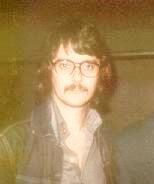
Bobby Neuwirth
Then Bobby Neuwirth, the legend goes, noticed she was in town. by this time Neuwirth was playing Robin to Dylan’s Batman, his sidekick in other words, and he notified Dylan that ‘there was a hot new girl in town.’ In the movie Factory Girl, sometime in ’65 Neuwirth showed up at the Factory and said: Come with me. Someone wants to meet you.’ Edie leaves with this total stranger, who cons her into paying the fare, escorts her back stage at a Dylan performance to be introduced to the Star with whom she is dazzled.
That’s one version. According to Jean Stein in Edie in December of ’64 Neuwirth invited her down from the Upper East Side to the Mafia club, Kettle of Fish, to meet the folk singer himself. Edie had arrived in NYC driving a big grey Mercedes. Her flipped out driver crashed the car so she was using a limousine service to get about. Accordingly her limousine pulled up in front of the Kettle of Fish, Edie got out of the car, entered the bar and contact was made. The history of her life over the next eighteen months, the Dance of Death, began.
Dylan, then, laid claim to the dazzling girl before Andy Warhol. Edie met Andy at the film producer Lester Persky’s a few weeks later at a party in January of ’65. Dylan and his entourage were heterosexual while Warhol, Persky and that crowd were homosexuals. Thus Edie began to fulfill her destiny as a pawn in Dylan’s and Warhol’s games.
Chapter 2
Never Felt More Like Singin’ The Blues
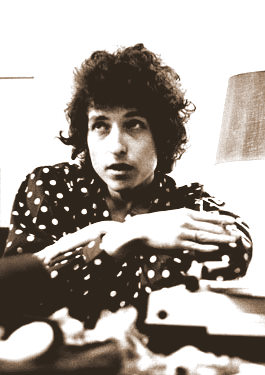
Dylan In Polka Dots
Who were these guys Bob Dylan and Andy Warhol and what interest could they take in this uninteresting and rather dull girl. Interestingly both men considered themselves revolutionists. Dylan forwarded the Jewish and Underman revolutions while Warhol spearheaded the homosexual and doubled up on the Underman. Both men came from immigrant backgrounds. Dylan from Jewish immigrants and Warhol from Ruthenians. Dylan was originally Robert Zimmerman and Andy Andrew Warhola. Dylan grew up in small town Hibbing, Minnesota, Warhol in the ‘melting pot’ of Pittsburgh, Pennsylvania. Both developed monster grudges against American society.
At the end of ’64 both men were on the way to being of the most influential people of the second half of the twentieth century.
Dylan at twenty had come to New york with the ambition of becoming a folk singer. Even though a not easily appreciated singer he was as close to an instantaneous success as it is possible to be. Arriving at the beginning of 1961, at the close of ’64 when he met Edie he was an international sensation, a prolific and successful song writer.
Strangely his success was built on resentment and hatred. The dominant characteristic of his songwriting was a rancorous bitter putting down of his society and associates. He fairly spews hatred in such songs as Hattie Carroll, Like A Rolling Stone and Positively Fourth Street to name only a few of his diatribes. His most prolific period would revolve around his desire for Edie Sedgwick and his detestation for his rival for her affections, Andy Warhol.
Dylan had a fixation on destroying the happiness of women. At the time he began his pursuit of Edie he had sequestered his future wife, Sara Lownds, who he would marry in November of ’65 and who he had purloined from another man. At the same time he was carrying on long time affairs with his first New York girl friend, Suze Rotolo and his fellow folk singer, Joan Baez. Why this need to injure the happiness of women?
Of course I’ve read most of the important works on Dylan if not all and many of secondary importance. Using that background, I’m going to concentrate on the movie Dylan wrote and starred in, Masked And Anonymous. This is a very autobiographical movie showing a Dylan who had progressed little from his heyday of the mid-sixties. Dylan believes that the journey is more important than the result so that in the various episodes he gives little symbolical vignettes of his life journey leading up to a contrived ending. Many of the most important eipisodes and people are represented. The promoter in the film, for instance, can be recognized as his manager Albert Grossman; the sidekick is Bobby Neuwirth etc. I’m not going to review the movie here but Dylan gives us some insight into when and how his world went wrong.
In the movie when Jack Fate’s, Dylan’s movie alter-ego, father, who is the dictator of ‘this god-forsaken country’, lies dieing, Fate revisits him on his death bed. In fact that is where the ‘path’ of the movie actually leads. Fate reminisces about his relation with father and mother. To put it succinctly let me quote the lyrics of an old song, Freight Train Blues. Dylan would rewrite the lyrics to this song and claim it as his own:
I was born in Dixie
In a boomer’s shack,
Just a half a mile
From the railroad tracks.
My daddy was a fireman
And my mama dear,
She was the only daughter
Of an engineer.
She could spend the money
And that ain’t no joke,
It’s a shame the way
She kept a good man broke.
Well, Jack Fate’s daddy wasn’t much better and the movie couple had an unhappy marriage which probably reflects Dylan’s view of his own parents. As to his mother she just found Jack in the way and wished she never had him because it interfered with her happiness. I suspect that more or less sums up Dylan’s relationship with his mother. One can’t say for sure but I suspect that when his mother conveyed this attitude to the young Dylan it just shattered his mind and from that day forth he was one lost soul on the lost highway with the freight train blues. Now, it is impossible to avenge oneself on one’s mother directly as mother’s are sacred as the vessel of your life. Dylan never tried, even escorting his mother as a date to major events. You can take it out on yourself by becoming a derelict yourself which Dylan did thereby punishing your mother or you can take it out on surrogate women. Dylan did both. He himself was and has been a heavy drug user and a heavy drinker. He ruined the lives of several women including Rotolo, Baez and Edie; then, after making Sara a wife and mother, most importantly a mother, he completely shattered her life as his mother had his. That may have satisfied him, then again, maybe not. Since then he has been wandering aimlessly as a ‘modern troubadour.’ Ramblin’ Jack Fate.
The period of the sixties was Dylan’s time of most intense reaction. After that he waxed and waned but Andy Warhol was focused on an unwavering need for vengeance. He knew how to use people to obtain his goals without actually exposing himself. He arrived in New York in 1950 as a graphic artist where he too was an instantaneous success. He made his mark in shoe ads where his drawing, usually described as ‘fey’, but displaying real genius at the same time, brought the customers to Miller Shoes for whom he drew.
During the fifties he was a very highly paid commercial artist designing everything from his shoe ads to stationery to book and record covers. Usually very nice but not infrequently letting his sexual proclivities shine through. He was alwa;ys pushing the homosexual agenda preferring to associate his work with writers or musicians from either the Undermen or those writing on those themes.
About 1960 he decided to tackle the fine arts with the purpose of detroying them. He entered the world of painters at the transition from Abstract Expressionism to Pop Art. He had always been a sort of pop artist with his shoe ads so he was an incrdible success as a pop artist when he painted Campbell’s soup cans. With the soup cans he effected one of the most instantaneous and successful revolutions or transitions from one style to another, ever. I don’t think it would be out of line to say the sixties were born in that moment. If there is one single symbol that characterizes the sixties, for me at least, it is Andy’s soup cans. Tomato soup can. It enraged and energized so many people. It has been an inspiration for me.
I can’t remember when I first saw it but I was simply stunned. Perhaps in the pages of Time Magazine. I don’t know whether the copying of a soup can is art but as I mused about it I came to the conclusion that the can was a sort of urban landscape. It was something one gazed at frequently while grocery shopping, so I said, what difference did it make whether one copied a mountain or curling wave or a soup can. I suppose the difference is that a soup can can only be done once before the joke is stale.
My favorite image of the soup can was a poster in which a soup can had a gaping hole from being blasted with a .45 automatic. That sort of settled the arguement for me but that was as late as 1968. Andy went on attempting to outrage us by painting duplicates of Brillo boxes and such like, Heinz Bean cans, but that fell flat. The joke had been made, there was only one Campbell soup image.
Painting all those soup cans, he did all the varieties, must have been a tedious way to while away the time. Then he discovered silk screening. What a good idea. Warhol, the child of industrial processes. I can only imagine that he thought Henry Ford and his assembly line turning out identical copies of cars was the ideal expression of art. After all you can make a million cars, same model and make, but in painting a picture, prior to Warhol, they all had been one offs and then you needed another idea. In that period of rapid change an idea became obsolete immediately. Coming up with new ideas was a tough business. Warhol could turn out an idea like the Presleys like Henry Ford turned out cars. Wow! Man! The future of art had arrived.
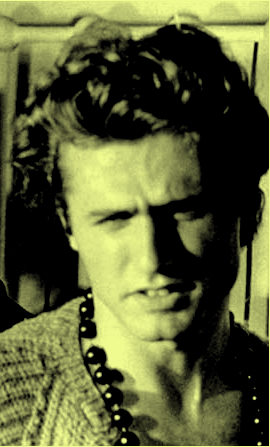
Gerard Malanga
Perhaps he thought up silk screening or perhaps the idea was suggested to him by his assistant, Gerard Malanga. Malanga thinks that’s the way it was. At the time he was hired Malanga was already an accomplished silk screener. Malanga was the beginning of Warhol’s actual use, consumption and discarding of people. One might say Malanga was exploited.
Malanga took a job with Andy at the minimum wage above which Andy never raised him. Malanga insists that he was essentially a collaborator of Warhol’s. I am inclined to agree with him. In the first place Andy never drew his own pictures. He essentially had no ideas. He had his screens made up from photos of others he found attractive. His famous flower screen was from a purloined photo. HIs Elvis paintings, posters actually, were traced from a promotional still. To me that strengthens Malanga’s claim. The screens were mechanically produced and screening is a mechanical act. Both Malanga and Warhol manipulated the screens together. There are films showing them doing it.
Between the two of them they produced fifty Presley images in an afternoon. For a show at LA’s Ferus Gallery Andy shipped them a two

Malanga and Dylan
hundred foot roll of Presleys and told them to cut up the roll as they saw fit. Collaboration was just Andy’s way. Hence one has single, double, triple, quadruple and octuple Presleys. I saw one display where there were twenty or more strung out for a couple hundred feet in one immense string. Enough Elvis Presleys to go around the world three or four times were produced. (That’s a joke, son.)
It is a good image although Andy never asked Presley or his studio for permission to use it and as far as I know never gave them a dime. He just appropriated the image. I can’t imagine how Andy kept the Colonel cool. He didn’t keep the flower lady cool, once she recognized her image she sued him. Of course, she took her image from God but God didn’t sue her.

Warhol and Malanga
Now, all this silk screening takes up a bit of space, these Presleys kept getting bigger and bigger, life size and then some. Some were twenty-five feet by twenty-five. So Andy outgrew his home facility leaving it to seek much bigger spaces. If one thinks about it all this is very daring. There was no artist in New York even approaching the concept. Finally he rented an entire floor of a building on 47th Street that became known as the Factory. Dylan would characterize it as Desolation Row. When Edie made her appearance there in March of ’65 it was at that Factory. There were subsequent and even larger ones.
This is where Dylan and Warhol stood at the beginning of 1965 when Edie became a pawn in their game. Why did they want her? As noted, the two were immigrants or the sons of immigrants so they knew the discomforts of being strangers in a strange land. They knew the sense of inferiority among the ‘natives.’ They knew what being outsiders was especially as Dylan was a Jew and Warhol a homosexual.
Edie Sedgwick was a symbol of that envy and desire. In a way she was the acme of the old line American and she was accessible. She probably could have been half ugly and it wouldn’t have made much difference.

Malanga and Edie
From, say, 1870 to 1940 there was native America and there was immigrant America and they were separate but equal size. While intelligent immigrants never had it rough there was still resentment and outright hatred for Anglo-America. All this anti-America stuff comes from the immigrants or at least was fostered by them. With those of the Undermen, those of low IQ, the hatret was worse. WWII gave the immigrants a feeling of equality. They fought too. By 1950 they were superior in numbers assaulting every Anglo tradition and trashing it while doing their best to lower Anglos. Of course, the Anglos were too stupid to see it or unwilling to acknowledge it. After all, this was the magic ‘melting pot’ in which all resentments disappeared. Americans had discovered the solution to world problems. Both Dylan and Warhol shared in this resentment.
Thus when this female symhol of the old Anglo aristocracy appeared who they held responsible for their humilaition, whether they acknowledged it or not, they wanted to possess her, humiliate and destroy her. Dylan today would deny it while Warhol’s excuse at the time was ‘How do you stop someone from doing what they want to do?’ Well, Andy, at least you don’t hand them the revolver cocked and loaded. That Edie was humiliated and destroyed by her association with the two is proof enough of their intent.
The problem is to piece together the events of that year and a half over ’65 and ’66 from less than adequate documentation. I think I can produce a reasonable facsimle.
Chaps. 3, 4 and 5 are posted
Chaps. 6, 7 and 8 are posted
Chaps. 9, 10, 11 and 12 are posted
A Review: Bob Dylan In America by Sean Wilentz
September 17, 2010
A Review
Bob Dylan In America
By
Sean Wilentz
by
R.E. Prindle

Dylan Back Then
There was a lot of hoopla and drum rolling before this book was released. A full chapter was published in Atlantic Magazine in August, the excerpt here, the excerpt there, the full treatment. Wilentz opened a website with teasers added daily trying to draw you in. A lot of talk about Wilentz being the official historian with, one supposed, full access to Dylan himself so that one was being admitted to the inside. ’Oh,’ I said to myself, ’it looks like Dylan is breaking silence, emerging from his cherished privacy through a surrogate.’
Well, I was right. Wilentz has written a major kvetch and justification. Kvetch- Jewish for bitch.
Part of the problem is against ‘wannabe Dylan writers’ polluting the internet. Not wishing to voice complaints in his own voice Dylan has Al Kooper do it for him. Something like telling an intermediary to tell the guy next to him what you think of him. Right there on the front cover face level with Dylan’s picture. Big Al is quoted:
Quote:
Unlike so many Dylan-writer-wannabes and phony encyclopedia compilers, Sean Wilentz makes me feel he was in the room when he chronicles events that I participated in. Finally a breath of fresh words founded in hard-core intelligent research.
Unquote.
We Dylan wannabe writers are duly chastened. I read your own book, Al, and certainly felt I was in the studio with you and Mike and Bob. When you snuck over to the organ, I tell ya, it took my breath away. Nice move. Grossman was there too, wasn’t he, or was he just listening to the replay? Well, I could do the same hard-core research and writing if I had access to the archives like Sean. But, I guess that’s out of the question.
Still, I couldn’t believe that we wannabes were the whole excuse for Dylan’s emergence from privacy and I was right there, too. I could feel the tension building as Sean went through his rather laughable exercise of connecting Dylan to the Popular Front and Aaron Copland. Sean kind of has us believing Dylan was aware of Copland from the cradle untill well past his arrival in NYC while apparently sitting through the Children Of Paradise as a toddler. He gives it away when he says that Norman Raeben introduced Bob to the movie in 1974 just in time for Bob to be influenced for the Rolling Thunder Review. I think Bob must have heard Copland about the same time too.
The tension was building, my breathing becoming more labored, when near the end of the book it burst. God, what suspense. The real reason for Dylan commissioning Wilentz to write the book was this famous outburst from another noted folkish singer:
Quote:
Bob is not authentic at all. He’s a plagiarist and a fake. Bob is a deception.

Bob The Deception
Unquote.
Wow, that one really hurt. I don’t know whether Joni had bottled that up since her treatment in Rolling Thunder but I suspect so. Sam Shepard wasn’t over impressed with his treatment on the tour either. The reporter of the Joni Mitchell quote couldn’t reach Dylan for comment: According to his representative, Dylan was unavailable for comment.’ Hiding on his bus no doubt.
That was then, this is now. Dylan’s mouthpiece and official historian, Sean Wilentz, fires back. He devotes a couple dozen subsequent pages, maybe more, after referring to Mitchell by name and date. (Ooh, it’s like falling on your tailbone, you know how that smarts.)
Just to mend a few fences Bob through Sean apologizes to Geoff Muldaur for that Carolyn Hester remark during Bob’s amphetamine fueled days. Wise move.
Sean denies out of hand that Dylan is a fake; he just approaches authenticity from a different direction. He’s not plagiarizing he’s reconstructing the music that is danger of disappearing so that it will last. Apparently the folk thing that had a run from about 1910 to 1980 or so has lost its influence in the ongoing rush of the globe’s multitudes to America. The times they are, indeed, a changin’. What did they expect, that a Korean peasant was going to embrace a song they couldn’t understand like ‘I wish I was a mole in the ground?’
As Wilentz explains: Borrowing three different lines from three different writers in succession for one verse isn’t plagiarism, it’s…well…something else. Preservation. Not that I care. I don’t listen anyway. I do expect some original lyrics though. If I want to listen to some old folk songs I’ll tune in toJohnny Cash’s Delia’s Gone or maybe even put an old Geoff Muldaur side on.
Bob’s not really interested in the whole folk genre anyway; he seems to be more interested in Darky murder songs. That’s part of folk, of course, but so is the saga of Mollie and Tenbrooks and the Tennessee Stud. There’s more to folk than depressing murder ballads. Who cares if Delia got shot. I don’t. Stagger Lee’s OK.
I think something’s being lost in the shuffle here. These are songs, only songs, there’s nothing monumentally important in them. Three Jolly Coachmen and There’s A Tavern In The Town are just as important. If Bob wants to be a musicologist he’ll suffer the fate of musicologists. What do I care about musicology when all I want to do is listen to a good unadulterated tune. And when I want to listen to a good tune there are a lot of better singers around than Dylan. Geoff Muldaur, for instance. Old Lonnie Donegan sides. The Kingston Trio, Chad Mitchell Trio. Peter, Paul And Mary for Chrissakes.
Let’s get real. Bob was 1964-66 when the amphetamines rushed through his bloodstream. Since then, well…he’s got a good following and should be thankful for that. Be a musicologist, rewrite Frankie And Johnny, see if I care. If I want to quote a song as a leader for one of my essays I rewrite them myself so they mean what I want . Most of those lines have lousy meter anyway. Still, I give the original writers credit.
Dylan could rewrite a song for Joni: You’ve gotten under my skin.
The book doesn’t call for much more of a review. Slight. Can I have my money back?
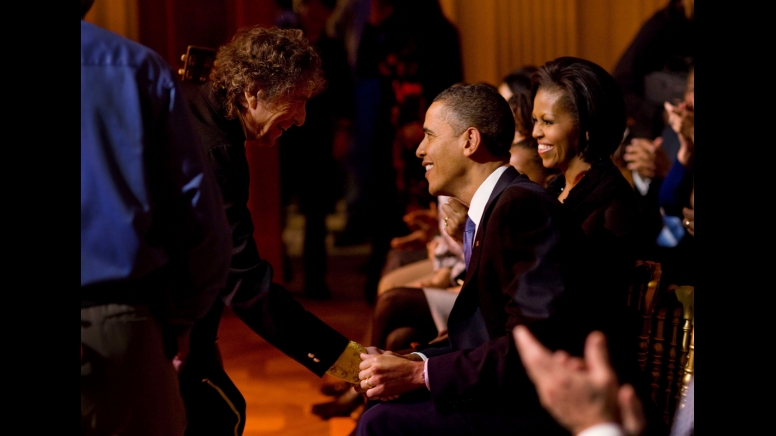
We did it!
A Review
Themes And Variations
The Tarzan Novels Of Edgar Rice Burroughs
#14 Tarzan The Invincible
Part V of X
by
R.E. Prindle
First Published On The Ezine, ERBzine

The Man
Six White Men In Search Of An African Empire
If one believes that Burroughs is merely on a rant against Communism in Tarzan The Invincible and Tarzan Triumphant then there is nothing more to say. Still, it is remarkable that ERB specifically names Stalin as a persecutor of Tarzan in both books. As Burroughs says he doesn’t mind fictionizing political and religious realities the question is , is he fictionizing a real life situation where Stalin, or the Communists are giving him a hard time?
Seems really improbable doesn’t it? People are used to thinking of Burroughs as a barely literate fantasy writer better ignored by the literati. But more insignificant men than ERB have been the victims of hate campaigns.

Dr. Harvey Springer- The Cowboy Evangelist
Who now, for instance, remembers Harvey Springer? Harvey Springer? Never heard of him? I don’t wonder. Oddly enough when I was in San Diego in 1957-58 Harvey Springer, who was some kind of evangelicalist, was going to appear at some church out where no sailor ever went. He was kind of a cowboy evangelical from Denver. His most dramatic stunt was placing one of size fourteens, he was a tall rangy man, on one chair and the other on another to harangue the crowd.
I hadn’t heard of him, you know, nor had anyone I knew, but Harvey Springer was reputed to be an arch anti-Semite. Could have been for all I knew, but I’m not going to take anyone’s word for it. The point is the Jews sent all kinds of people into the streets to tell people not to go see Harvey. I don’t how many times they must have heard- Who’s Harvey Springer?- in reply. Rather than say he’s an anti-Semite, of which I had even less knowledge at the time never having heard the term, all that was necessary was to say the two words, church and evangelical to cool my ardor, if I had any, to find where he was speaking and go see him.
In addition the AJC and ADL published books in which they denounced Harvey Springer as a very dangerous anti-Semite. Now, if certain people would go to such extremes to persuade someone not to do something he had no intention of doing what would they do to defame someone with an international reputation? The only one who didn’t realize the extent of ERB’s fame seems to have been ERB himself. He was no self promoter, he thought it best to keep his head down.
In that sense, judging from the unpublished Under The Red Flag and the published Moon Maid, Invincible and Triumphant Burroughs was actually a leading anti-Communist voice. I mean, people read this stuff. They read it in America , they read it in England, they read it in numerous translations and they read it in the Soviet Union. Here’s the kicker, Stalin read it. Not only that, Stalin was a movie buff. And he requested Tarzan films (reported in a recent UK Telegraph story and the book of Simon Sebag Montefiori: Stalin: The Court Of The Red Tsar.)
History is not a mystery, it’s just schoolyard bullies bigger than life.
We also know that Stalin ordered his scientists in the 1920s to attempt to cross an ape and a human to create a super warrior. It’s clear to me that Stalin had read Beasts Of Tarzan. The Man of Steel may have had a difficult time distinguishing between fact and fiction as many another. Besides, remember eugenics was a hot topic of conversation in Red circles then as it is today. Not knowing what we know now about genetics crossing an ape and human may not have seemed that far fetched. It doesn’t to a lot of people now. Heck, the Old Testament enjoins one to destroy the results of an animal-human union so the ancient Hebrews thought it was not only possible but a regular occurrence.
There is very clear evidence that the Reds were conducting a campaign of vilification against Burroughs. I’ve mentioned it before but the clearst evidence is H.G. Wells’ novel Mr. Blettsworthy On Rampole Island.

Bertie Wells
May we take a moment to look more closely at Wells? Don’t think I’m antagonistic toward Wells. I dearly love Wells just as I do Burroughs. I have a complete collection of Burroughs while I’m looking for the odd volume of the more obscure Wells. I’m not boasting, I’m just saying this in the way of credentials. I’ve read all of Burroughs more than once and I’ve read all the Wells’ titles I have, many of them more than once. In point of fact I love all the literature from say, Haggard’s King Solomon’s Mines to 1930 and perhaps an odd year or so beyond. I love. I mean, I love it. I love Edgar Wallace who, if you can believe it, is claimed to have sold one out of four books sold in England during this period. If you don’t know him he was one of the co-writers of the movie King Kong and then he died. All this stuff of this period is wonderful. Robert Hitchens, P.C. Wren.
So, you know, it’s like this: H.G. Wells was a Soviet literary hatchet man.
The man had a wonderful career. You know his most famous novels, The War Of The Worlds, First Men In The Moon, The Island Of Dr. Moreau, In The Days Of The Comet. If you like Wells, and I do, those are the tip of the iceberg. A few of his short stories and he wrote many are as good as short stories get.
He was always a socialist and perhaps a terrorist conspiritor, but he was a child of the nineteenth century until his mind broke at the end of the Great War. At that time he lost faith, in god, transferring his faith to the Revolution, becoming a Soviet dupe. His literary career may be divided into two halves, pre-God- The Invisible King and post-God. That was one of his books.
He was not taken seriously as a fiction writer after the war. During the twenties and thirties he turned out an unending stream of novels that were ignored. It’s not difficult to see why, but I find them a little more tolerable. I like Wells. His reputation and career were saved by his 1922 effort An Outline Of History. It was a massive volume and it sold massively for twenty years or more while being hugely influential in literature. Put him on easy street for the rest of his long life. As much as any artist who is skilled at spending money can be on Easy Street.
As a novelist however, he was pretty much a has been. While none of his post-1920 novels take off he hits the spot with me.
From 1920 on his soul belonged to the Revolution, which is to say the Socialist homeland, which is to say the Union Of Soviet Socialist Republics. That means he was more loyal to Russia than he was to England. In short, a traitor in intent if not in deed. While no Liberal ever deals in realities hence are in constant denial, The Man of Steel, Josef Stalin, was his boss. Wells naturally would have denied this.
The Soviets had a pretty comprehensive system which once again is denied. There were a number of State prostitutes who were assigned to the various important Red writers to service them as mistresses, while reporting back to the Kremlin. This is, of course, denied by the Liberals. I don’t understand living a life that has to be denied, where everything you do has to be represented as something else, but such duplicity is apparently congenial to the Liberal mind. They must seek it.
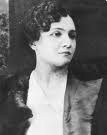
Moura Budberg
Wells was assigned a woman named Moura Budberg. She must have known how to turn on the charm as she was able to make a number of men she was assigned to sincerely love her, including the British diplomat Bruce Lockhart, the Russian writer Maxim Gorky and H.G. Wells. She wasn’t that good looking either. All of these people led double, triple or quadruple lives. They must have been really able to compartmentalize their minds. Freud didn’t touch that type.
After Wells’ visit to Lenin in 1921 he was signed on. He began his career as literary hatchet man. In his writing he portrayed recognizable people, sometimes under their real names, in negative or positive lights. As a skilled writer, whether you like his later stuff or not, he was more than competent to do this. It appears that he first targeted Burroughs in his 1923 novel Men Like Gods. Among his science fiction novels this one should rank more highly than it does. Burroughs’ 1926 Moon Maid reads like a reply to Wells. Especially the first part of the trilogy where Burroughs dances imaginative rings around the First Men In The Moon. From there Wells took up the challenge with Mr. Blettsworthy On Rampole Island of 1928 which unmistakably is a parody of Burroughs in which he portrays Burroughs as insane, but not a bad analysis.
Burroughs responded possibly with At The Earth’s Core but definitely with Tarzan The Invincible. At the same time one interprets Stalin’s interest in crossing apes with humans as being derived from Beasts Of Tarzan and other Tarzan novels there may have been more direct Soviet interest in ERB. One notes that Tarzan The Invincible was the first title published under the Burroughs imprint. I think it highly probable that his publishing was being interfered with by the Reds in addition to whatever other grievances against his publishers Burroughs may have had.
One may say that Burroughs was too insignificant for Stalin to bother with, yet according to Simon Sebag Montefiori Stalin put out a contract on John Wayne because he was such an ardent anti-Communist. Khruschev is said to have told Wayne that he concelled the contract after Stalin’s death. Edgar Rice Burroughs was at least as significant in 1930 as Wayne in the 1940s and 50s.
At any rate in 1930 Burroughs has Stalin and the Reds invading his dream world of Opar to steal his gold, i.e. put him out of the publishing business. Invincible and Triumphant, notice the titles, both deal with Stalin and the Soviets then the topic disappears from the oeuvre. Was Burroughs given incentive to counter-attack the Reds? I think there is enough evidence to warrant the opinion while time will tell even more. Research is just beginning.
It is signficant that Burroughs introduces the story in his own voice, not a framing device. He may be simply talking to the reader or he may be addressing Wells and, dare I say say it, The Man Of Steel himself. Perhaps a subtitle could be ‘The Big Bwana Meets The Man Of Steel.’ Now, it should also be remembered that this is the fourteenth novel of the series. the first title had been written eighteen years earlier. At that time the surprise of the character had knocked the socks off the reading public. In 1930 Tarzan was in danger of becoming old hat. Burroughs had to think up new and interesting devices to keep his readers coming back. As with most series of this type the readership was limited. Maximum sales could be predicted so that success meant not falling below a certain level of interest or letting interest diminish below unsupportable levels. As his own publisher Burroughs was now taking all the risks financial as well as literary. He had to turn out a successful book.
I think he did a superb job. Since the series continued to flourish his readers must have thought so too. I do wish ERB, Inc. would release some sales figures though.
For the premiss of his story Burroughs postulates that Stalin and the Soviets wish to instigate a new world war which will allow them to pick up the pieces establishing a complete European dictatorship. Not at all farfetched. Burroughs postulates that Mussolini and his Fascists are aiming at a European hegemony. This is 1930 so Hitler and the Nazis are not on anyone’s radar as a threat to world peace except for a few fringe elements. At the time Hitler and the NSDAP were in hand to hand combat with the Communists for control of Germany. They would not assume power until three years hence.
The Reds then wish to create an incident that would cause the Italians to attack France. The indirect approach is usually more effective than the direct approach so they wish to create an incident in Africa where French colonial troops appear to invade Italian Somaliland.
At that instant expendable confederates in Italy would reveal a bogus French plan to Mussolini. It is assumed that Italy would then declare war on France and the holocaust would begin. As we all know Italy did not declare war on France in 1930 so the plan must have misfired somewhere along the way. Tarzan was the reason. Burroughs gives these little known details that would have been lost to…well… if not history, remembrance. So, uh, really ERB is providing a valuable service here.
There may be two sides to every story, but usually one is on one side or the other. We don’t have to be reminded ERB is not on the side of the Reds. In fact, ERB is exposing their plans and weaknesses. He displays a fairly profound understanding of the goals and workings of the Communists. He is read up on the subject, He has studied. He is not shooting from the hip. He knows whereof he speaks. If not an authority on the subject he is pretty darn close.
ERB has his eyes on how ‘American’ manufacturers are relating to Moscow. He has Zora Drinov analyze the situation this way, p. 12
“But what do the puny resources of this single American (Wayne Colt) mean to us?” demanded Zora. “A mere nothing compared to what America is already pouring into Soviet Russia. What is his treason compared with the treason of those others who are already doing more to hasten the day of world communism than the Third Internationale itself- it is nothing, not a drop in the bucket.’
“What do you mean Zora?” asked Miguel.
“I mean the bankers, and manufacturers, and engineers of America, who are selling their own country and the world to us in the hope of adding more gold to their already bursting coffers. One of their most pious and lauded citizens is building great factories for us in Russia, where we may turn out tractors and tanks; their manufacturers are vying with each other to furnish us with engines for countless thousands of airplanes; their engineers are selling us their brains and their skill to build a grreat modern manufacturing city, in which ammunitions and engines of war may be produced. These are the traitors, these are the men who are hastening the day when Moscow shall dictate the policies of our world.”
“…their government is a capitalistic government that is so opposed to our beliefs that it has never recognized our government; yet in their greed, these swine are selling out their own kind and their own country for a few more rotten dollars.”
Sound anything like the US and China today? That was a mouthful. The first thing FDR did upon taking the reins of government was to recognize Soviet Russia. Tell you anything about FDR? That was a mouthful that should have eraned ERB the hatred of the Liberal Coalition.
You can see why they wanted to stop his mouth. Passages such as this are probably the reason Richard Slotkin and his crowd, John Taliaferro, group ERB with Madison Grant and Lothrop Stoddard. A charge of racism is usually a cover for a multitude of offences that have nothing to do with race. One is merely opposing the Liberal program. If they were to say- the fellow opposes the Liberal program they would get no rise- they might even have to explain the Liberal program- so the charge of racism is used as a red herring. One should always suspect such an accusation and disregard it.
Liberals however, never answer such charges. They merely deny them. In 1953-54 they were even denying themselves as Communists or taking the Fifth, which is the euivalent of saying, yes I am, but I’m not going to admit it.
The Revolution was only twelve years old in 1930. The CPUSA had been briefly outlawed in the early twenties but ‘disinterested parties’ believing in the time honored notion of ‘free speech’ had the ban lifted. Over in Russia their free speech loving comrades were filling cattle cars with dissenters destined for the Gulag or else they were murdered outright. Today, of course, these freedom loving people are throwing dissenters in prison on the basis of trumped up laws. The Program is moving right along isn’t it?
Even William Z. Foster denied he was a Communist as he was running for President on the Communist ticket. Today a tenured Law  Professor at Harvard actually denies that AIPAC, which is a registered lobby group, exists. They ought to throw such people into cells next to David Irving. Denial of themselves is what Liberalism is all about. You couldn’t find anyone to admit to being a Communist. They all denied it. The hypocrisy of Liberals throwing men as decent or moreso than themselves into jail for denying the holocaust is mind boggling. Well, it would be, if you didn’t already know what’s going on.
So ERB would have been roundly denounced as a paranoid delusive for the above passage.

Henry Ford- Philanthropist
Men like Armand Hammer, Bernard Baruch, essentially the whole Jewish government in exile here in the US were working furiously to make the Revolution a global reality. They really had no idea of Hitler’s intentions at the time, yet they attempted assassination while through the German Communist Party they were waging street warfare against the National Socialists. The word National is what they objected to not so much the man Hitler. Burroughs mentions the Third International. The Comintern- short for Communist International as it was known- was essentially a beta model for what is now multi-culturalism. It was the Jewish cultural vision of the world. Thus industrialists like Armand Hammer and Bernard Baruch using their Jewish identity as a shield from criticism, any criticism would be characterized as anti-Semitism, were directing huge sums of money into the development of Soviet Russia.
In addition a well-meaning industrialist, Henry Ford, who would later be denounced as a Nazi, was doing the

Armand Hammer
same thing. The mention of tractor factories refers to Henry Ford- the Jewish bete noir- who was trying to relieve the Communist induced famine by selling or even giving tractors to the Russians to increase food production. He was also building the factories for them. I mean, you know, gratis; altruism run rampant. The great industrial city probably refers to Stalingrad.
Even Burroughs biographers Porges and Taliaferro disparage Burroughs for his rational stance against Communism. Burroughs doesn’t stop his analysis with the multi-cultural contradiction within American society, p. 35:
“The general plan, of course, is no secret to any of us here,” said Zora, “and I shall betray no confidence in explaining it to you. It is part of a larger plan to embroil the capitalistic powers in wars and revolutions to such an extent that they will be helpless to unite against us.”
“Our emissaries have been laboring a long time toward the culmination of the revolution in India that will distract the attention and armed forces of Great Britain. We are not succeeding so well in Mexico as we had planned, but there is still hope, while our prospects in the Philippines are very bright. The conditions in China you well know. She is absolutely helpless, and we have hope that with our assistance she will eventually constitute a real menace to Japan. Italy is a very dangerous enemy, and it is largely for the purpose of embroiling her in war with France that we are here.”
Once again you will note that there is no reference to a threat from Germany. No one could have seen it but the Communists who were opposed not merely to Hitler but any Volkish attempt to govern. The Volkish movement was inherently anti-Communist. To be anti-Communist was equivalent to being anti-Semitic, so that Hitler was automatically an enemy to be destroyed. When he and the Nazis assumed power in 1933 an automatic boycott of Germany and things German was instituted by the Jews. One might say that WWII began in January of 1933 at the instance of the Jews. The obvious conclusion is that if Hitler’s actions against the Jews were not self-defense, they were acts of war in which the first offensives had been begun by the Jews. Needless to say any such opinion is and will be denied. Any such discussion of such matters will be ridiculed and suppressed. But there you have it. At any rate ERB was not one of those far-sighted individuals who foresaw the rise of Hitler. Italy turned out to be a not so dangerous enemy.
In his story Italy was merely to be a dupe of the Soviets.
In order to present his analysis ERB had to be especially well informed. What he read or where isn’t clear as there is nothing in the existing library that even deals with the Communists per se. ERB does have a copy of Hitler’s Mein Kampf but that could only have been obtained after 1940 when the war was in progress.
As the story opens then, the Reds are assembling their forces for the march on Italian Somaliland.
Things aren’t to be quite so simple as the leader of the expedition, Peter Sveri, develops delusions of grandeur hoping to establish his own Empire in Africa with himself as Emperor. On the one hand Communism breaks down on the rocks of the interests of the various cultures, while in seeking to establish himself in Africa Zveri is infringing on the domain of its current Emperor, Tarzan.
Tarzan handily frustrates Zveri’s designs, while at the same time beating Stalin and the Reds, hence the title Tarzan The Invincible. One imagines though that there may be something more behind it. Originally titled Tarzan, Guardian Of Africa the change of title indicates something deeper.
In order to finance his operations Zveri intends to loot the fabled treasure vaults of Opar of which, one assumes, he has read about in The Return Of Tarzan, Jewels Of Opar and Tarzan And The Golden Lion. This makes him somewhat a fan of the amanuensis of the Big Bwana.
This is the fourth and last of Burroughs’ Opar stories. In section six let’s review Opar and its significance to this story.
Exhuming Bob 25: Bob And Sam
June 5, 2010
Exhuming Bob 25:
Bob And Sam
by
R.E. Prindle

Shepard, Sam: The Rolling Thunder Logbook, 1977, Sanctuary Publishing.
Sometime in the mid-seventies, possibly in 1976 Paul Simon wrote in one of his lyrics: I don’t think this stuff is funny anymore. Coincidentally at the same time as I surveyed my record store of a Saturday morning the same thought occurred to me. Things had been overdone. In one bat of an eyelash the whole thing got old.

Bert Williams In Blackface
This was not case with Bob Dylan who in the waning months of 1975 put the greatest clown act New England had ever seen on the road. The Rolling Thunder Revue; or as it might alternatively have been named: The New Bob Dylan Minstrels. One purpose of the Revue seems to have been to spring the convicted triple murderer and ex-boxer Hurricane Carter from jail. That didn’t come until the very end.
Along the way Dylan wanted to film a sort of existential movie that would later be released as Renaldo and Clara. Working from some strange chaos theory Dylan had no actors, no script, no-nothing. Needing some sort of guiding hand he commanded the actor, cowboy, playwright Sam Shepard to attend to his writing needs. Sam then wrote what he called a log of the experience called the Rolling Thunder Logbook.
On the first reading I didn’t think Sam put much into it but the pictures were good. Still there was the nagging feeling that I might have missed something. On the second reading the logbook assumed more significance. It’s kind of impressionistic. It’s not a narrative; like the title says its sort of like a ship’s logbook. The impressions sort of pile up until you have a definite impression. I don’t know if that’s what Sam intended but that’s the way it worked with me.
Bob being the kind of powerful show biz personality he is didn’t bother to negotiate terms with Sam; he didn’t even bother to call himself; his agent or stooge or whatever interrupted the life of Shepard to tell him Dylan wanted him in New England. Sam doesn’t mention any terms, or indeed any payment. He just dropped everything, literally, and drove East. Did I mention he was in California? Well, he was; he was in the process of moving.
Bob tries pretty hard to cultivate that elusive, mysterious image and he succeeded with Sam who couldn’t locate him for a few days after he got there. Bob probably wanted to accustom him to the menagerie before he showed his face. Even then Sam didn’t have any guidelines he just expected Sam to free lance a few lines of dialogue if at any time he saw the cameras running. The film crew was more disorganized than Dylan if that were possible.
What was it all about anyway?

It Takes A Worried Man- Sam Shepard
As we should be aware 1976 was the two hundreth anniversary celebration of the American Revolution. But there were a number of conflicting revolutions running simultaneously. There was the revolt of the Matriarchy, what Eric Foner calls the Unfinished Revolution which was the replacement of Whites by Negroes and of course the perpetual revolution of the Jews against mankind, not to mention the revolution of the gay crowd. Bob as we all know is Jewish so one may reasonably ask why he chose New England for his chaotic Marx Brothers routine on the occasion of the Yankee Revolution around the new England sites such as Bunker Hill? Could he have been thumbing his nose at America? Well, it does look suspicious.
As Sam notes the crew made it a point to visit Plymouth Rock and the replica of the Mayflower which sacred symbols of pre-immigration America they reviled all but pissing on the Rock. The faux American cowboy, Elliott Adnopoz was swinging from the yardarm of the Mayflower. Y’all know Elliott as the yodelin’ cowboy Ramblin’ Jack Elliott o’ course. For the rest they pissed and farted their way across New England carousing and corrupting as they went. Of course it might just have been New England exercising the gang’s Rock n’ Roll genes, no more than that. Sam kept his discontent sotto voce by which I mean between the lines. Bob, with his need for conflict invited not only his old flame Joan Baez and his new flame Joni Mitchell but his wife Sarah playing each against each. Baez who grows more Mexican with each passing year seems willing to put up with whatever Bob does. Shortly after the tour Sara came downstairs one morning to find Bob dandling a strange beauty on his knee for breakfast. Well, you know, she threw in the tower after that, as, who wouldn’t? Bob seemed to be perfectly dismayed by this untoward turn of events. ‘Women in my family just don’t divorce.’ He whined uncomprehendingly. Well, at least, not without due provocation.

Joni Mitchell Looking Out Her Window
That leaves Joni Mitchell. She’s apparently been stewing about her treatment for thirty-five years. She just recently expressed herself by saying in effect that Dylan is just a god-damned phony. Well, Bob can always go join Joanie in that bomb shelter in Viet Nam. They can exchange rings made of the fuselages of American fighter planes, if they haven’t already. So, how sincere is their devotion to this great land of the once free and no longer brave? It would seem their loyalties lie elsewhere.
In my own obtuseness, quivering in my own psychological bomb shelter, I never saw Bob as a revolutionary in those far off days but then I was just listening to records, I didn’t know anything about him; boy, I sure have remedied that situation.
Back in those palmy days of the early sixties before racial and religious animosities had reached their present prominence I don’t know that anyhbody really thought of Dylan as a Jew. Certainly the name Dylan is not Jewish and I’m not sure how many people would have known Zimmerman was. Or, that they would have cared. In those days everyone cheered when Israel won one of those too frequent wars. Now, though, one has to put Bob’s religious affiliation up front. Make no mistake, he’s a fundamentalist, believes the Bible is the literal word of god. Orthodox. Chabad Lubavitcher even. Thinks the universe is fifty-seven hundred years old like his deceased mentor Rabbi Schneerson. Swear to g-d.
Must have picked it all up from Rebbe Rueben who came West from Brooklyn to Hibbing to indoctrinate him in Lubavitcher lore for his Bar Mitzvah. Like Bob said, he learned what he was supposed to learn. He very cleverly inserted the stuff into all those songs too.
Bob broke his mind in the excesses of the sixties, that high mercury sound he was seeking was the result of all those amphetamines he was shooting back then. Andy Warhol had his boy pegged.
In the late sixties and early seventies Bob had to rebuild his personality and he rebuilt it around his religion. His Mom was real proud of the way he had his Bible open on a stand in his living room so he could jump up and check it as the occasion arose.
Then as he got back on his feet he aligned himself with Meyer Kahane’s violent extremist revolutionary Jewish Defense League carrying a couple of JDL thugs around with him as bodyguards. Maybe his Jewish revolutionary mode was getting too obvious so in ’77 he began hanging out with Jews For Jesus and the Christian Vinyard Fellowship organization. Once that clouded the picture he reverted back to his Lubavitchers where he has been since.
So on the Rolling thunder tour one may be excused for thinking that he was in his revolutionary phase. Sam Shepard doesn’t mention it but his experience left a very bad taste in his mouth which he expresses with as much force as Joni Mitchell really has.
On the tour Bob did the strange thing of wearing white makeup which has remained a mystery. It shouldn’t be really. Remember the tour was to end in a successful attempt to free a Black man while the Black boxer Muhammed Ali was unstage at the Garden. A Garden party a la Ricky Nelson, get it? The Revue was actually a parody of the Minstrel show of what Greil Marcus would call the old weird America. In the old Minstrel shows the White actor wore black face in imitation of Black people. This may sound strange to you but Jews don’t consider themselves White notwithstanding their pale complexions they consider themselves Jews and goys as White. So, in disguising himself in White Face he was parodying the old Black Minstrel shows while mocking his ultra-White New England audience.
Bob Dylan was having the time of his life. The joke was on the Honkies. Funny, huh?
As noted, the keynote of the tour was the final concert at Madison Square Garden at Christmas where he took on America over the issue of the Black Hurricane Carter and won. Now, compare that Christmas show with the 2009 release of Bob’s Christmas album. Seemingly done straight it also mocks Whites. In Bob’s video for the song It Must Be Santa Claus you may have noticed that the audience showed minimal diversity. The airheads were all White. Bob comes prancing through wearing a lank blonde White girl’s wig, climbs into a balcony and stands looking down his nose in his wig at us all. It’s great. Nobody gets it. There is something happening here but you don’t know what it is, do you, Mr. Jo-o-o-nes.
Jewish power vs. American power, make no mistake.
Sam jumped ship before the end of the tour, he’d had enough, but he was there for the Garden party. He can’t even force himself to dissimulate a complimentary attitude as he did at the beginning of the Minstrel show. And then the final confrontation between the playwright and the singer.
At this point is is clear that the Rolling Thunder tour is something Sam wished he hadn’t gone on and an experience he preferred to forget.
Shepard closes with a chapter concerning the opening of his play The Geography Of A Horse Dreamer. I don’t know the play but it may have been based on Rolling Thunder. In the play Sam names the horse Sara D. Dylan is in New York at the time wanting to see the play. He wants to make his entrance in company with Sam. Sam writes:
..so I’m in the hotel lobby waiting for the Cadillac convertible to haul us over to the theatre. The big boxcar camper pulls up outside and Dylan hops out. My stomach does a full gainer as I see him approaching the hotel. The idea of him sitting in the audience is more like a nightmare than a blessing…He pauses at one of these signs (reading signs in the lobby) long enough for me to scuttle past him out into the street and hail a cab. It’s bad enough knowing that he’ll be there without having to ride there with him in the same car.
So not only was the tour distasteful to Sam’s sensibilities but the experience of first hand acquaintance with Bob has also left a bitter taste. Well he isn’t the only one. The evening of the opening of Sam’s show is not going to improve relations.
…the so-called curtain is being held up for Dylan’s late arrival. He shows up plastered, along with Neuwirth, Kemp, Sara and Gary Shafner. They take up a whole row.
So whatever the cause of the conflict Dylan is reciprocating his disrespect fully. He means to sabotage Sam’s show and then leave early too.
At intermission Sam doesn’t see Bob so he hopes he’s left the theatre. No such luck. Dylan comes out of the toilet.
He sees me standing there and pauses as though trying to bring certain thoughts into focus. “Hey, Sam, what happens to this guy in the play anyway?’ I’m dumbfounded for a reply but come out with something like, “That’s the reason for seeing the second act.” He stares at the floor, his knees shifting slightly as though he’s about to go into a nose dive.
“Hey, how come you named that horse in the play Sara D?”
“That’s the name of a racing dog in England.” It suddenly cuts through me that it’s also the name of his wife.
“I mean it’s the name of a greyhound. A real greyhound. You know the kind that race around the track.”
He smiles and shuffles through the door, almost making a left turn into the light booth.
Apparently Dylan didn’t find that answer any more satisfactory than I would have. Something is going on here, isn’t it?
As the play draws to its end Dylan makes his move. Shameless. Pure chutzpah immersed in chocolate sauce.
Dylan stands in the back row. “Wait a minute!” Who’s he yelling to? The actors? “Wait a second! why’s he get the shot? He shouldn’t get that shot! The other guy should get it!” Lou Kemp is trying to haul him back down in his seat….
Dylan is struggling to free himself from Kemp’s hammerlock grip. Neuwirth is telling him to shut up…Finally the Sam Peckinpah sequence begins, with shotguns and catsup all over the stage. Dylan leaps up again. “I DON’T HAVE TO WATCH THIS! I DIDN’T COME HERE TO WATCH THIS!
Apparently the Rolling Thunder tour didn’t end until Sam had written this play and run it by Bob. Dylan didn’t like the play any better than Shepard liked the tour. Hard feelings everywhere.
Apparently Bob used people much too roughly. He managed to either blow off a number of people immediately following such as Shepard, Jack Elliott, Neuwirth, the maligned Larry Sloman and probably the whole film crew while Joni Mitchell has weighed in thirty-five years on. We have yet to hear from a number of other people, most notably Roger McGuinn.
Bob managed to trash everybody including the USA with his Minstrel show for the 200th anniversary year. Which revolutions was he leading? I don’t think this stuff is funny anymore, do you?

Bob and Joan, Joan and Bob?
Four Crucial Years
In The Life Of Edgar Rice Burroughs, Pt. I
by
R.E. Prindle
Every artist writes his own autobiography.
Even Shakespeare’s works contain a life of himself for those who know how to read it.
–Havelock Ellis as quoted by Robert W. Fenton

The Great One
Eighteen ninety-six found Edgar Rice Burroughs confronting the first great crisis of his adult life. The weight of his childhood experiences pressed on his mind as he turned twenty. His subconscious mind was directing his actions while his conscious intelligence futilely struggled against it. He had no plans; nor could he form any. He was in a state of emotional turmoil. He obviously did not think out his moves nor weigh the effects of his actions on others. He was to burn many bridges as he flayed about like the proverbial bull in the china shop trying to find his way out.
Having graduated from the Michigan Military Academy he had been serving in the capacity of instructor for the previous year. All his heroes were military men. He fancied a military career as an Army officer even though he had failed the West Point exam the year before. Still, he was in a fine position to realize his objective. Men who could help him were nearby friends. Captain, soon to be General, Charles King, who had befriended him as a cadet, and the Commandant of the MMA, Colonel Rogers. All he had to do was to be patient and those men of some influence would surely have obtained an appointment for him.
They had given a mere boy a position of great trust and responsibility in making him an instructor. They were military men who judged others in the military manner. Then in the Spring of 1896 Burroughs did one of the most inexplicable things in a career of the inexplicable; he abandoned his post. Without notice to those career officers who were depending on him he resigned his post and on May 13th of 1896 he joined the Army as an enlisted man, a common soldier, a grunt. Within days he was on his way to his asignment.
As he was to say of so many of his later fictional heroes: ‘for me to think is to act.’ He oughtn’t have been so precipitate. He should have thought twice. He shouldn’t have had to think about it at all.
If he seriously wanted a military career as an officer he should have known that it is virtually impossible for an enlisted man to rise through the ranks. Even in the rare cases when this occurs, the enlisted man is always an odd duck between the officer caste and the enlisted men.
In this case he had not only forteited caste but as far as Rogers and King were concerned he had deserted, the worst crime that a military man can commit. Both men wrote him off at that time. Strangely he never understood that his precipitate act would be held against him by those he disappointed.
Apparently joining in a fit of despair- for me to think is to act- as the date of the 13th would indicate he requested the worst duty the Army had ensuring his desire to fail. On one level it is almost as though he did have his next move worked out. Not normally too receptive to the desires or needs of its grunts in this case the Army was only too glad to accommodate him. Burroughs was sent into Apacheria to a place called Fort Grant in what was then the territory of Arizona. Neither Arizona nor New Mexico became States until after the turn of the century so Burroughs had actually ‘lit out for the territories’ as Huck Finn would have put it. There was still some Apache resistance going on, thus ERB was a part of the Wild West.
According to Philip R. Burger, writing in the Winter 1999 issue of the Burroughs Bulletin, the standard term of enlistment at the time was three years but, as there would be no reason to join the Army except to make it a career, the reasonable assumption for those left behind in Chicago without a word of goodbye would have been that Burroughs was out of their lives. He was a dead man.
For those of you who have never joined the services, once you leave you’re out of the lives of those left behind. Your traditions have been broken. Even when you come back for leave you are only tolerated as a visitor who will leave, the sooner the better, so you don’t disrupt their lives any longer than necessary.
Burroughs didn’t even have traditions in Chicago except with a few people. From the sixth grade on he had a record of broken attendance at a number of schools, from the girl’s school to Harvard School and then back East, to Idaho and on to the MMA. He would have known but few people well, intimate with none except the lovely Emma Hulbert.
He could have seen her but rarely over the last years which included high school. He really had no ties in Chicago. His relationshlip to Emma dated back to Brown grade school. At sometime before he began his peripatetic education he began to propose to her. As he was gone from Chicago all this time it is very difficult to believe that Emma sat home pining. She must have been dating other boys, however, at the same time she must have been waiting for Burroughs since, at 24, when she married him she was only a couple years from spinsterhood. She must have been giving her parents some cause for alarm.
Thus when Burroughs appeared to walk out of her life in 1896 without a word about his intentions one wonders what her response was. Certainly it was about this time that Frank Martin began to pay his court. We will learn more of Frank Martin a little later.
For Burroughs, like so many of us once we were inducted, ERB speedily learned his mistake. For the men who don’t fit in ‘each fresh move is a fresh mistake.’ He regretted his decision immediately. For him to think was to act, so from his arrival at Fort Grant he began a petition for discharge.
As he had been under twenty-one when he joined, he had had to ask his father for his consent. He now asked him to use his influence to get him out.
Perhaps we do not have enough information on why he now so desperately wanted out. In later life this short ten month period of his life would be fraught with great significance in his mind. Just before he divorced his lovely wife Emma in 1933 ERB took a solo vacation to return to this scene of his young manhood. That would indicate that Emma and Fort Grant were linked in his mind.
Two of his Martian novels are associated with the Fort Grant experience. In his first novel, A Princess Of Mars, John Carter serves in the Army in Arizona, is discharged, then returns as a prospector. Under attack by Apaches he seeks refuge in a mountain cave in which he leaves his body while his astral projection goes to Mars. Viewed from one point that’s as neat a description of going insane as I’ve ever come across.
During his 1933 visit to Arizona, Carter returns to visit a trembling fearful Burroughs in his mountain cabin. One gets the impression that Burroughs felt like a whipped dog.
The Apaches made a terrific impression on the young man. So much so that he could see himself joining them as a Brave as is evidenced by his two Apache novels, The War Chief and Apache Devil. Then too his two cowboy novels are placed in Arizona rather than in Idaho where one would expect them.
In his Return Of Tarzan the trip to the Sahara is an obvious reference to Apacheria. The French government sends Tarzan into the desert rather than the US government sending ERB to Arizona. In the deseart Tarzan develops a strong liking for the Arabs, much as ERB did for the Apaches. Tarzan considered becoming a Son Of The Desert just as ERB thought he might become Apache.
A large part of ERB’s fascination for the military life was based on his respect for Capt. Charles King under whom he had served briefly at the MMA. King was, I would imagine, a boy’s dream of a dashing Calvalry Officer. In this wildly romantic period of the Indian Wars, not to mention the proximity of the Civil War, a man who had served at the same time and the same place General Custer must have been held in some awe. King had also served with and knew Buffalo Bill, a nonpareil hero of the time and one ERB may have met at the 1893 Columbian Expo.
Burroughs names two of his characters after Custer.
On top of all this King was a successful writer of military novels. He wote an excellent analysis of Custer’s defeat, which is available on ERBzine, as well as a first hand account of the resultant campaign to quell the uprising, Campaigning With Crook. the latter is a superb recreation of a time and place we’ll never see again. In just a few words King is able to recreate a Deadwood, South Dakota for which the movies have filmed endless miles of photographs with less result. His single reference to barbaric cowboys wearing their guns on their hips says more than dozens of Hollywood films. ERB was also able to capture some of this feeling in his two excellent Western novels as well as his two Apache novels.
King was prolific writing nearly seventy books in his long career. I have read only a few, which I find of only of journeyman quality. King has an emascualted precious style which is reflected in his photographs. Burroughs enthusiastically said he wrote the best Army novels ever, which may be true, I haven’t come across any other novels of Army life. among his many novels of Army life are three that deal with the Pullman strike when the Seventh was stationed at Fort Sheridan. One, An Apache Princess written in 1903 might possibly have been an influence on A Princess Of Mars.
At any rate King glorifies the officer’s life. He fooled a young green ERB. In any event ERB failed to notice the haughty distinctions King drew between the relative status of the officers and the enlisted men. King had all the prejudices of the officer class seeing the enlisted man as a subhuman species. Knowing this, as Burroughs should have, I am baffled by his enlisting.
Perhaps as at the MMA he thought that one entered as a buck private working up to officer rapidly as he had at the MMA. If so he must have had a very rude awakening. It couldn’t have taken him long to realize that advancing through the ranks was rare while at the same time a long process for such an impatient lad as he.
While he was cleaning those stalls he must have had plenty of time to think out his dilemma. As he thought back over his past actions it must have occurred to him that perhaps he erred in walking out on Colonel Rogers the previous May. Accordingly on December 2 of 1896 he sent a letter back to Rogers of which the reply is extant. We don’t know what ERB said but I imagine he was feeling Rogers out to see if he couldn’t get him an officer’s appointment. Rogers reply was, of course, polite but cool and distant firmly placing Burroughs as oneof the rest of Rogers’ students. Yuh. ERB should have thought twice about abandoning his post.
The many, many references to this period of his life point to a great regret later in life that he had left it. He associated this regret with Emma. Perhaps the visit of the officer, John Carter, to him in his lonely cabin in the White Mountains of Arizona represents his lost career as an Army officer but was one of the reasons for his wanting to get back to Chicago that he hadn’t dealt with his relationship with Emma? Did he now learn that in his absence someone else was playing his old love song to Emma? Someone who Papa Alvin Hulbert much preferred to ERB?
It would be interesting to know what Emma thought when her beau just up and removed himself to Arizona. Perhaps perplexed but still hopeful she sent him her picture on his birthday in September. Remember me, perhaps?
Unhappy with his life at ‘the worst post in the Army’, how one’s attitude changes when one’s dreams are realized, he petitioned his father to use his influence to return him to civilian life.
Surprisingly his father was easily able to do this. By March of 1897 ERB had his discharge papers in his hand. He was a free man again. How many tens of thousands of us would have appreciated such an easy resolution to the problem.
2.
Our Man still didn’t have a plan. What we he going to do with his life? Apparently Colonel Rogers’ reply to his letter didn’t apprise him of the facts of life. Nor did he seem to realize that once you reject the military the Army has no use for you. At the time, the US Army was very small, perhaps seventy-five thousand men. The officer corps was about ten per cent or seventy-five hundred men. This is virtually a club. The officers would have known each other personally, by name or by reputation. The same was more or less true of the enlisted men.
Thus Porges records a letter ERB received in 1936 from one W.L. Burroughs of Charlotte, N.C. who probes:
This morning an old army sergeant whom I soldiered with back in the nineties dropped in my office and our conversation started at Fort Sheridan, ILl. when the 7th US Cavalry and the 15th U.W. Infantry left that post for Arizona and New Mexico. He asked me if I remembered Edgar Rice Burroughs of Troop ‘B’ Seventh Cavalry, said he was discharged during the summer of 1896 at Fort Grant, Arizona account of a ‘Tobacca heart’…will be delighted to know for certain that we soldiered with so distinguished a person back in the nineties.
Whether true or not these men remembered ERB as a malingerer who obtained a fraudulent discharge. I interpet ‘Tobacco heart’ to be a feigned ailment which would make ‘so distinguished a person’ a sarcastic and insulting remark. If W.L. Burroughs is correct then ERB got himself out by reasonable discreditable means rather than through the efforts of his father. Thus forty years on an Army reputation followed ERB.
Burroughs replied cooly a few days later ‘…seldom have been in touch with any of the men I soldiered with since I left Fort Grant.’ ERB didn’t say ‘AND GOODBYE.’ but I think that is implied.
So having committed blunder after blunder it would have been wise for Our Man to reevaluate his position. Strangely he didn’t do this, hoping against hope, as I imagine to pull that particualr rabbit out of the hat over the next few years. Good luck, Edgar Rice Burroughs.
3.
For now he could only think of returning to Chicago. As we know the Burroughs Boys were ranching up in Idaho. ERB always wanted to prove that he was a businessman. Why, I don’t know. The fact of the matter seems to be that the Burroughs family was particularly inept at business. Papa George T. had been burned out of his distillery while his battery business was steadily running down, due for extermination about a decade later.
The Boys would turn to dredging for gold after failing at ranching. Perhaps one of the reasons they failed at ranching was just this operation coming up. They had bought a Mexican herd, apparently sight unseen. They were then in Nogales to receive and transship the herd to KC. I suspect they lost their shirt. In less than two years they would be gold dredging.
The world is full of sharpers. Out West so many salted gold mines were sold to greenhorns that it doesn’t bear telling. Frank Harris, the British magazine editor in his autobiography has a great story about how he and his outfit lifted a Mexican herd driving it back across the Rio Grande. I have no doubt that some Mexican sharpers took advantage of the Burroughs Boys. They would later buy a salted gold claim.
The herd ERB put on board the train he describes as no bigger than jackrabbits while probably being less well fed. The death rate of the cows on the trip back to KC was horrendous, while the survivors became starved and dehydrated. I don’t think the Burroughs Boys did well on that transaction. You gotta watch your back or, hopefully, see ’em coming.
4.
Edgar Rice Burroughs came home. Perhaps he had now reached childhood’s end. At twenty-one perhaps he now realized that he had a life to lead. Perhaps. If so, it was slow dawning. But then ERB’s was not an ordinary mind, a normal bean as he would have put it. No, his was a slow ripening melon. But then, why should everyone develop at the same pace? If up to this point I seem to have been overly critical of Our Young Man it’s because there has been much to be critical of; just as there will be more, but he hasn’t done anything really reprehensible. Your record may not be much better; mine certainly wasn’t. He’s a good sort of guy; just a little on the goofy side. Slow to learn. He doesn’t seem to catch on.
However he’s watching. He’s observing. He’s ingesting and there out of sight he’s digesting all the information coming in. Plus, he will give it a brilliant interpretation when he egests it.
These four years would be of great use to him in his writing career. Always a subtle psychologist ERB was also a skillful employer of the Freudian concepts of condensation, displacement and sublimation and this before he could have read Freud. An attentive reading of any of his novels always reveals layers of hidden meaning. Simply put Edgar Rice Burroughs is the most poetic of novelists.
His poetic tastes weren’t always elevated. He did have a copy or two of Eddie Guest in his library. Edgar A. Guest. Perhaps forgotten today Guest was a people’s poet. In the 1950s when I spread out the Detroit Free Press on the floor one of the first things I read was the daily poem of Edgar Guest. Of course, I thought he had written each one the night before. I marveled at his facility. Nice homey thoughts though.
Burroughs tastes ran to the likes of Rudyard Kipling, H.H. Knibbs, Robert W. Service and others of the jingly-jangly people’s school. Although he did know enough about a high brow like Robert Browning to consider him a bore. Rightly from my point of view. He liked Tennyson, who was considered a high brow, also I suspect Walter Scott, Shelley and Byron. He frequently hints at Longfellow’s ‘Wreck Of The Hesperus’ while he probably had to read Hiawatha in school
He knows all the popular stuff of the day like ‘Over The Hill To The Poor House’ too while he had probably read that anthem of doomed labor, Edward Markham’s Man With The Hoe, too. If that one didn’t gag him he’s not the man I think he was.
Song lyrics were big with him too. On his cross country auto tour he mentions three records by name that his family wore out- of course a battery operated portable played in a field with the plows they called styluses (well, cultured people called them styluses or styli, us near illiterates called them needles) in those days they might have worn out a record in two or three plays. One song was ‘Are You From Dixie?’, another was ‘Do What Your Mother Did; and the last ‘Hello- Hawaii, How Are Ya?’ I guess he liked songs that asked questions. I’ll examine the lurics a little farther on down the road but when we’re considering the literary influences don’t forget the poetry. After all ERB wrote a whole book around the lyrics of H.H. Knibbs ‘Out There Somewhere.’
Just before he returned to Chicago one of the great newspaper literary lights and poets of Chicago Eugene Field had died- 1895. Burroughs had a collection of Field’s writings in his library while Field, when alive, hung out at the McClurg’s book store. Perhaps there were sentimental reasons for Burroughs pursuing McClurg’s so ardently as well as practical ones.
Another Chicago writer among ERB’s collection of books who was reaching an apex at this time was George Ade. While these Chicago stalwarts are mostly forgotten now they were considered immortal at the time. Ade especially is a very clever writer with a real skill at turning a phrase. His ‘Fables In Slang’ would have knocked ERB flat. ERB’s own interest in the colloquial, which is very pronounced, may have been influenced by Ade’s style.
Another columnist of the period, Peter Finley Dunne, with his Irish dialect stuff written around his character Mr. Dooley doesn’t seem to have made much of an impression on ERB.
Thus while involved in his attempts to correct his mistake of enlisting he was very attentive and observant of the life going on around him in whatever milieu.
As I mentioned earlier, when you leave for the military your friends edit you out of their lives. Returning is not so easy. Even when I returned on leave, actually almost ten months after I left, people demanded almost belligerently, ‘What are you doing here? I thought you joined the Navy.’ After explaining I was on leave, nearly asking permission to hang around for a couple weeks, I was grudgingly given permission but let it be known that if I wasn’t gone I would have some explaining to do.
ERB has left a record of his reception by his friends in Chicago. He had sixteen years to let it run around his mind before he wrote it down. It came out in Return Of Tarzan which, I imagine might be read as the Return Of Edgar Rice Burroughs. Actually as Havelock Ellis hints in the opening quote, both Tarzan Of The Apes and The Return Of Tarzan can be read as autobiographical sketches from birth to the marriage with Emma in 1900.
Burroughs describes his reception in Chapter 23 of the The Return. The jungle is a Burroughsian symbol for society as in ‘It’s a jungle out there.’ Tarzan in the jungle can be read as ERB in Chicago. Tarzan is resting in the crotch of a great limb of a jungle giant when he hears a troop of apes approaching the clearing beneath the tree. The tree is a symbol of security or getting out of or above the tumult. Trees probably correspond to his imagination.
Tarzan recognized the troop as his old band of which he is still nominally king. Having been gone for two years he rightly thinks the dull brutes will have trouble remembering him:
‘From the talk which he overheard he learned that they had come to choose a new king- their late chief (the successor of Terkoz?) had fallen a hundred feet beneath a broken limb to an untimely end.
Tarzan walked to the end of an overhanging limb in plain view of them. The quick eyes of a female (Emma?) caught sight ofhim first. With a barking guttural she called the attention of the others. Several fhuge bulls stood erect to get a better view of the intruder. With bared fangs and bristling necks they advanced slowly toward him, with deep ominous growls.
‘Karnath, I am Tarzan Of The Apes,’ said the ape-man in the nernacular of the tribe. ‘You remember me. Together we teased Numa when we were still little apes, throwing sticks and nuts at him form the saftey of high branches.’
‘And Magor,’ continued Tarzan, addressing another, ‘do you not recall your former king- he who slew the mighty Kerchak? Look at me! Am I not the same Tarzan- mighty hunter- invincible fighter- that you knew for many seasons?’
The apes all crowded orward now, but more in curiosity than threatening. They muttered among themselves for a few moments.
‘What do you want among us now?’ Asked Karnath.
‘Only peace.’ answered the ape-man.
Again the apes conferred. At leangth Karnath spoke again.
‘Come in peace, then, Tarzan Of The Apes.’ He said.
So Tarzan and ERB returned to the fold. However there were two young bulls who were not ready to receive Tarzan back. We will find that two young men resented Burroughs’ return. The resentment of the principal young man would nearly cost Burroughs his life while forcing him to commit to a marriage against his will.
Thus Burroughs was received back into Chicago.
5.
He would spend about ten months before he uprooted himself once again to make his second visit to his brothers in Idaho. I should think that this period in Chicago was perhaps the most idyllic of his life. He found gainful employment with his father at the Battery Company. However at fifteen dollars a week it was much less than his allowance had been at the MMA. However he was living and eating at home so one imagines it was all pocket cash which afforded a certain limited affluence. He could afford to take Emma out.
Emma appears to have preferred him but he was no favorite of Papa Alvin and the Mrs. If Frank Martin had begun to pay his court he was much the preferred suitor. The son of Col. A.N. Martin who was a millionaire railroad man he was to be much preferred to a penniless Ed Burroughs whose father had apostacized to William Jennings Bryan in the election of 1896. No, Martin should be given the inside track. Burroughs was forbidden the house in an attempt to disrupt his relationship with Emma.
The Hulberts looked askance at Burroughs patchy history. He was less than promising. While his father had gotten him released from his enlistment, people are wont to say there’s more to that story than meets the eye. Plenty of room for rumor, if you know what I mean. ERB probably had to explain a lot.
So while he could date Emma he couldn’t go hang around all evening every evening as lovers are wont to do.
So what did ERB do with his spare time. He obviously read. H.Rider Haggard was popping them out two or three a year at the time which is clear from the evidence ERB read. Jules Verne was alive and producing although much of his production remained untranslated.
There weren’t any movies or television, however there was the Levee, Chicago’s Sin City. In later novels ERB would show what appears to be first hand rather detailed knowledge of this area of brothels, saloons and gambling joints. Burroughs was certainly no stranger to drinking and gambling, whether he frequented brothels may not be known but, if you’re in the area….
In a city of a million six there were only about forty thousand library cards issued but it is probable that one of them was in the wallet of our investigator of curious and unusual phenomena. He sure knew a lot of odd details. One of the big intellectual questions is whether or not he knew of Theosophy. A volume of William Q. Judge, a leading Theosophist who died in 1896, is to be found among Burroughs’ books. His first story Minidoka 937th Earl of One Mile which is concerned with this period while unpublished until just recently makes mention in the descent to Nevaeh of the Seven Worlds which is a reference to either Theosophy, Dante or both.
Again, hanging around a library one might come across volumes of Dante and Theosophy. Shoot, Tarzan spent his afternoons in the Paris library becoming discouraged by the surfeit of knowledge to be covered.
And all around him floods of changes were rolling over him. The world was moving with breathtaking rapidity. If a guy wasn’t half crazy already trying to keep up would get him the rest of the way. Actually these four years were the intellectual bottom, in the musical sense, of the rest of Burroughs; life. perhaps sensory overload occured culminating with his bashing in Toronto and subsequent marriage to Emma so that he was no longer open to new experiences afater his marriage. Everything after 1900 was interpreted in the light of this experience. the interpretations were inventive enough.
His situation might be compared to that of Zeus and Metis of Greek mythology. Ordinarily when the Patriarchy took over a Matriarchal cult the event was comemorated in a myth of sexual union.
In the case of Metis, a Goddess of wisdom, she went down into the belly of the monster like a plate of oysters perhaps meaning the Patriarchy had attempted to stamp the Metis cult flat or eat it up as the Zulus would say. If so Zeus and the boys had bitten off more than they could chew or digest, as it were.
Metis lived on in his belly giving him unwanted advice until I would imagine the Patriarchy came up with a compromise solution. Thus Metis gave birth to Athene who was born fully formed from the forehead of Zeus, which is to say that the cult of Metis was transformed into the cult of Athene. Athene retained all the attributres of the goddess of Matriarchy but ‘she was all for the Patriarchy.’
So now with Burroughs; he ingested all this experience which he gave a ‘definite impression of fictionalizing’ to appear full blown from his forehead +- twenty years later.
Porges reproduces a political cartoon of Young Burroughs on page 68 of the First Edition in which Uncle Sam and John Bull are watching a scene. One or the other says: ‘How would you like to be a Russian?’
In the cartoon Russian soldiers are shooting and bayonetting obvious Jews while the Jews are bombing the Russians. The villains of the first four Tarzan novels, ‘The Russian Quartet; are two Russians Nikolas Rokoff and Paulevitch. Thus, if the cartoon was drawn in this period, twenty years later the Russians show up as villains.
Now, among all the ‘minor’ events like the depression after 1893, the Pullman Strike, Coxey’s Army, Altgeld’s pardoning of the Haymarket bombers, the Sino-Japanese war and such like trivia was the infamous Dreyfus Affair in France.
This minor event involving a Judaeo-French spy was magnified into an international cause celebre by accusations of anti-Semitism. Alfred Dreyfus was a Jewish French army officer who was accused of spying for the Germans or of selling information to them. Originally convicted and sent to Devil’s Island, a few year later after key evidence was tainted or disappeared and key witnesses had died or been discredited the case was reopened and after a terrific media blitz resulting in Zola’s article with the famous title: J’ Accuse, Dreyfus was acquitted.
The man convicted in his place, strangely enough, was probably also Jewish, one Walsin Esterhazy. Supposedly of Hungarian descent, at the instance of the chief Rabbi of Paris he was given financial assistance by the Rothschild family. It would be very unusual in that case if he weren’t Jewish.
Burroughs must have followed the Affair Dreyfus closely as it unfolded during the lat nineties. In 1913’s Return Of Tarzan he chose to fictionalize Esterhazy’s end of the Affair in the character of Gernois. Burroughs must have studied the Affair because Esterhazy actually served in North Africa where he came in contact with German agents. Of course, Gernois is compromised by our old friend Nilolas Rokoff, the Russian agent. Thus ERB combines his dislike of the Russians as eveidenced by his cartoon with sympathy for Dreyfus.
In real life Esterhazy led a dissipated life which, it is said, led him to be a spy. In ‘Return’ Gernois is led into syping because Rokoff, the hyper-arch villain had something on him.
In a sort of editorial comment on Dreyfus ERB has Rokoff tell Gernois: ‘If you are not agreeable I shall send a note to your commandant tonight that will end in the degradation Dreyfus suffered– the only difference being that he did not deserve it.’
Thus ERB comes down firmly on the side of Dreyfus.
For those who will misread racial and ethnic attitudes I believe ERB’s attitude in the Jewish-Russian conflict and the Dreyfus Affair should exonerate him, if the need exists, of any charges of anti-Semitism. Especially in the light of his portrayal of the worthy Jewish gentleman in ‘The Moon Maid’ trilogy. It would seem that all of ERB’s later attitudes remain consistent with these brought to fruition between 1896 and 1900.
Continue on to Part II
Mourning Becomes Yoko: Part II
March 13, 2010
Mourning Becomes Yoko
Part II:
The Passing Of John Lennon
by
R.E. Prindle
About John
This magic moment
So different and so new
Was like any other
Until there was you.
–Pomus-Shuman

The King
To understand the sixties one has to go back in time to the foundation of Astrology. In Time beyond Ancient, Astrology and Astronomy were one. The very old gods and the sky were one. It was only when science, a more clear understanding of ‘creation’, if you will, removed the sky from the gods’ purview that Astronomy and Astrology separated. Astrology in those days had meaning that is not apparent today when the sky is just part of our natural surroundings.
The Zodiac was divided into twelve periods of roughly 2000 years each which formed the Great Year. The periods were called Ages with each Age having its own avatars. The avatars of the current Piscean Age have been Jesus the Christ for the first thousand years, and for the succeeding thousand years Artemis or Diana in northern Europe and Mother Mary to the south. Sometime within a few hundred years near the end of an Age a new avatar begins to form.
The first intimation of the dawning of the Age of Aquarius that I am aware of occurred at the beginning of the twentieth century. While not the first, the chief proponent seems to have been Edgar Rice Burroughs and his creation, Tarzan The Ape Man. Not one to

The Prophet- Edgar Rice Burroughs
be dogmatic Burroughs left his intent open only to, dare I use the word again, the initiated.
Tarzan is timeless, he represents the past, being associated with the Atlanteans and the range of evolution, the present and, as the exemplar of the perfect man, the future. While rejecting organized religion Burroughs also rejected the Piscean avatar, Jesus The Christ in favor of the coming man-god. Thus the coming man-god must be a projection of the Aquarian avatar. Tarzan, a magnificent specimen is both physically and mentally the perfect man and hence representative of the future Aquarian man-god. Do not confuse the movie Tarzan with the literary creation of Edgar Rice Burroughs.
The longing then for a new messiah had been developing for half a century, at least, when circumstances came together for the appearance of a new avatar pointing toward the Age of Aquarius. This manifestation appeared on the stage of Ed Sullivan, in of all places, New York City. It was the Tupelo Mississippi Flash himself, Elvis Presley. In that brief magic moment on Sullivan’s stage he revealed himself and was recognized by his people.
Interestingly the appearance on 10/9 coincided with the birthday of John Lennon.
In that moment Presley’s future was cast. Whether the old order recognized who he was they knew how he was perceived and made every effort to slander, denigrate and destroy him short of actual murder. All to no avail. They might have been able to kill him, murder him, but he was inviolable to any defamation. It made no difference that they ridiculed him in a couple dozen fatuous films, he was the man-god. People endured his humiliations with bowed heads and resentful miens.
From him succeeding generations have taken their guidance. The first awe struck generation took the stage in direct emulation of him. While many had better songs (Gene Vincen’ts Be-Bop-A-Lula) none of the generation were anointed thereby developing a devoted following in the magnitude of Presley.
Elvis was not the last word but the first in what will be a procession. While the American Pharisees persecuted and scattered the faithful a new, younger generation was growing up in Elvis’ shadow. Their epiphany, that Magic Moment, would take place on the same Ed Sullivan stage in that same strange city of destiny, NYC, nine years later.
The gestation of this second manifestation of the godhead would take place in Liverpool, England. Inspired by Elvis Presley four young men of the second manifestation would be filtered through the persona of a young Scottish musician named Lonnie Donegan
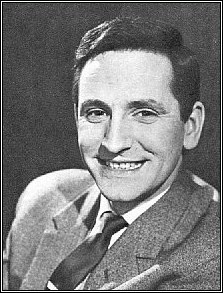
The Geat Lonnie Donegan
.
When the settlers from the British Isles settled America they brought their musical traditions with them, most prominently to the Southern tier of States. Thus both the White and Black musical traditions of America stem from essentially the Celtic peoples. In the mid-fifties Donegan brought this music in the form of American Folk back to England in a form he named Skiffle Music. It swept England and its youth up being combined with Presley. Donegan added a ferocious beat to the music that evolved into the form termed the Big Beat. Thus the British musicians were schooled in American music as it had evolved from their own.
Now, the Magic Moment requires the man who has been prepared for the moment. If all goes right he is equal to his destiny, if not the moment fails.
While Presley was the man, the second avatar would be four men seemingly acting as one. The four men seemed to represent four archetypal personalities as in the four faces of the godhead. Those of us who didn’t ‘get’ them, of which I was one, were mystified by their apotheosis.
Just as Elvis had his unique preparation so did this fabulous foursome. Raised as four ordinary kids from varying levels of poverty and varying psychological backgrounds they were united by the music of Presley and Donegan.
They began a grueling and astonishing apprenticeship in the red light district of Hamburg, Germany. Unable to speak German they were thus compelled to rely on each other for companionship which created a unique bond. They were required to be on stage for up to twelve hours at a stretch for weeks at a time thus honing their musical skills apparently to perfection.

The Beatles
Thus the four aspects of humanity, one might say, were placed in a unique situation creating a unique combination of personalities seemingly as one. In those circumstances they were forced to be able to communicate instantly with their audience night after night. Valuable training.
Returning to Liverpool with their abilities seemingly uniquely developed they were adrift with no direction home and no other future than earning their livelihoods as best they might. But then, as by a miracle, a man appeared with no managerial experience who said he could take them to the top. Amazingly he got them launched. Even more astonishing they were assigned to perhaps the only record producer in the world who could bring out their unique talents. Thus this Fab Foursome took their home British Isles by storm succeeding as no other had succeeded before them but their Magic Moment, that lunge for the Golden Ring had not yet arrived.
The Magic Moment was awaiting them in NYC. A big jetliner brought the foursome to America’s shores in January of 1964 to appear on the Ed Sullivan show where they were to stand in Elvis’ footsteps so to speak. The difference in presentation between the two is interesting. With Elvis, he and his backing duo were standing in front of the drawn curtains on the edge of the stage, no set, his two band members were huddled behind him while the guitar player is turned sideways not even facing the audience. Presley is directly in front of them cavorting on a minuscule part of the stage. Mort Sahl would do his standup routine a few years later in the same manner with a newspaper as a prop.
In contrast the Beatles were given an open stage with decor behind them while the group was spaced dramatically and attractively. A very positive image which from long experience they knew how to take advantage of . But the appearance on the Sullivan stage merely confirmed their Magic Moment placing it indelibly in the American psyche.
The actual Magic Moment occurred when the Beatles announced themselves on the tarmac. Gods descending from the skies. For

John Lennon
whatever reason there were thousands of screaming girls awaiting them and a battery of newsmen and photographers. Some say the girls were bussed in, it isn’t unlikely that the astute promotion men of Capitol had a hand in the arrangements, but on the receiving end of the tube it looked genuine. Mystifying but genuine.
Posed a bunch of questions by the news cameras all four Beatles fielded them with aplomb, the cheekiest and most confident acting was John Lennon himself. All four personalities established themselves at that time as one- the Beatles. In that little flash of time the role of the Beatles was established for all time.
While each individual Beatle was adored for the face of mankind he presented each had only an identity as an aspect of the Beatles. When they split they became merely humans rising or falling based solely on the musical merits. Of the four, Lennon adopted the messianic mantle, was accorded it, and took it when he left. In one sense the Magic Moment had been his.
There would be argument about when the Beatles began to break up over the years but the when was coincidental with their annunciation. John Lennon was the weak link in the chain. Having now won what he had been struggling for for so long John Lennon discovered he wasn’t worthy. Incredibly he wrote, and the Beatles recorded his song, ‘I’m A Loser.’ He was a loser, not the winner he appeared. Now conflicted he tried to both accept and reject the role of ‘messiah.’ He was well on his way to losing the role two short years later in 1966.
The course of his career was affected by two people, Bob Dylan in 1964 and Yoko Ono in 1966. Historical ifs are difficult. It seems impossible that Bob Dylan’s career would have been possible without the overwhelming success of the Beatles. Dylan lacked commercial appeal then as he does now. He appealed to a minority audience- as opposed to the majority audience of the Beatles. Dylan lacked universal appeal then as he does now.
While the Beatles were one as a group they were two as the songwriting team of Lennon-McCartney. Since 1962 they had been turning out a steady stream of million sellers both for their own use and that of others. They were catchy tunes in the Tin Pan Alley manner that could be sung and whistled but very introspective at the same time. Dylan on the other hand wrote tortured introspective lyrics that resisted anything close to whistling or a Mitch Miller singalong.
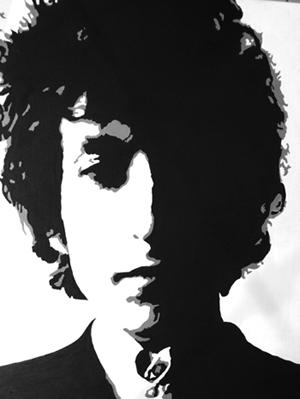
Bob Dylan
Dylan considered his stuff amazingly thoughtful and profound. He apparently put himself in the same class as Elliot and Pound. He fooled most of his audience for a long time too. The Beatles for whatever reason became the top news story of the day; for months they either were, or seemed to be, on the news every night. Seriously, one had to ask: What’s Going On?
Just as mysteriously Dylan began getting the same treatment. Now, the Beatles were selling unprecedented millions of records on both sides of the Atlantic, at one time occupying the top five spots of the Top 10. Dylan was doing diddly squat with his tortured lyrics. He wasn’t selling records in any quantities while having essentially a cult following. Now, mysteriously he began to be given the same treatment as the Beatles. Time Magazine sent a reporter to interview him on camera. Dylan imitated the Beatles by giving smart ass answers. The Time reporter took his jibes seriously. Sitting out in front of the tube my eyebrows shot up. What is this? The rest of the world went wild in their applause of the Beatle’s and Dylan’s cheekiness. God, they were giving the finger to the Greatest Generation. The latter may have crushed Elvis but these boys were getting their own back.
Maybe Dylan got the attention because he was the only American act available, to balance the relative status of Britain and the US. Perhaps in the emerging racial politics of the time he was offered as Jewish competition to the great goy champions of Elvis and the Beatles. He entered the Beatles’ life in August of ’64 when the Jewish journalist Al Aronowitz took it upon himself to introduce him to the four-in-one. The meeting was more momentous for the Beatles than Dylan.
The story goes that Dylan introduced the boys to marijuana at that meeting. More importantly he lectured Lennon-McCartney on songwriting. Dylan told them in effect that they should stop writing hit songs and write the pretentious crap he did. Now, consider, the Beatles were incredibly successful at what they wrote, Dylan couldn’t do what they did and what he did do couldn’t compete in the marketplace with the Beatles. I mean, they should have been lecturing him, but they didn’t while accepting his viewpoint at the same time. They listened to the little twerp and fell under his infuence to begin trying to imitate him.
The imitation was not very good but as the current avatar of the messiah the Beatles were industructible, as the leader, for whatever reason, John Lennon was accorded the role of messianic leader, a role that he took quite seriously.
While the Beatles had always used various pill forms of speed or amphetamines after Dylan’s introduction to pot they quickly expanded their repertoire to include Acid or LSD. The other three seem not to have been so conflicted in their personalities not becoming as drug dependent as Lennon. He claims perhaps with exaggeration, perhaps not, to have taken LSD thousands of times in the next few years. Under the influence of LSD his personality already distressed by the transition from failure to success disintegrated completely. As he says, he lost his ego totally.
If so, adrift, he was open to a strongly directed personality to manage his. This personality appeared in 1966 in the person of Yoko Ono. She quickly commandeered his personality displacing his British wife, Cynthia. It would be two years before Lennon divorced Cynthia but he left her a year earlier.
Since signing with Brian Epstein as their manager the Beatles had had an ideal artists arrangement. Trusting him they left the business details to him which allowed them full time to devote to their creative efforts. If they needed money they asked for it while all business details such as negotiations, titles and even check writing were handled by Epstein so that the Beatles had no worldly business experience. In 1967 Epstein died.
With Brian gone the Beatles were left rudderless with no one they could trust to manage their corporate and personal finances. Forming Apple as their business alter ego they attempted to manage their affairs themselves resulting in a business regime of such dissolute ineptitude that it has been referred to as The Longest Weekend.
Having attached herself to Lennon, Yoko Ono now tried to insinuate herself into the group as the ego of John Lennon. Thus the group would have been comprised of McCartney, Harrison, Starr and Lennon-Ono. A clear impossibility, the Beatles would be dissolved. As the avatar of the sixties the era had no choice but to disappear along with them.
This was now the late sixties. The world as it had been , the world that gave birth to the Beatles c. 1960 had all but disappeared. Blown away in the wind, so to speak. Just as the sixties called for the Beatles as the messiah of the period so it called forth its anti-messiah of satanism. In 1966 Time Magazine’s cover story was Is God Dead? A title that offended Bob Dylan who petulantly asked: How would you like to be talked about like that? Right.
Stones With Brian
In 1966 Roman Polansky began filming a movie titled Rosemary’s Baby that actually portrayed the birth of Satan’s child. The story took place in the future home of the Onos- The Dakota Apartments. And then the Rolling Stones released their rather bizarre record, Their Satanic Majesty’s Request with its famous song Sympathy For The Devil. Right about then the Broadway musical Hair was staged that celebrated the Dawning Of The Age Of Aquarius. Synchronicity? Not a bit.
As the messiahs had abdicated it remained for the anti-messiahs the Rolling Stones to place the epitaph on the period which they did in 1969 at Altamont.
However John Lennon as the messianic figurehead was rescued by Yoko Ono. As an unsuccessful performance artist now with Lennon’s audience and financial clout to realize her wildest fantasies she, using Lennon, organized some of the most outrageous extravaganzas that catapulted she and Lennon onto the world stage playing messianic figures. The Bed-In was the most jaw dropping stunt since flag p0le sitting.

John And Yoko
Part III will consist of the career of the Ono-Lennon’s to John Lennon’s death in 1980 and perhaps a little beyond. There’s some really interesting stuff involving John Green and a possible associate, Sam Green. The latter is an interesting story.
 I, Dynamo