A Review

Themes And Variations

The Tarzan Novels Of Edgar Rice Burroughs

#18  Tarzan And The Lion Man

Part 6

by

R.E. Prindle

First published on the ezine, ERBzine

The Center Of The Circle


     Burroughs does a remarkable thing in this ring that clearly shows the Greek classical influence per Erling Holtsmark in his Tarzan And Tradition.   ERB disolves his story and cast of characters after the last Bansuto attack.  The cast is dispersed in several directions but ERB will deliver them all to Omwamwi Falls as he begins the three right hand rings:  3-2-1

     In fact this does follow the Homeric tradition.  The story of the Trojan Wars was actually a massive story of which only three parts survive, the Iliad, which concerns the central part of the epic and th two Returns, The Odyssey and The Oresteia.  All the rest has been lost or survives only in fragments such as ‘The Judgement Of Paris.”  Originally the epic was thousands of pages long.  There were undoubtedly few scholars who had ever read the story in its entirety and fewer still who understood it.

     It seems incredible that a very young ERB could have grasped the structure so completely while seeming to understand it so thoroughly.  Holtsmark quotes ERB as saying that he was rereading Plutarch’s Lives in 1923 when he discovered that Numa was the name of a Roman emperor, actually one of the Republican kings,  To that point he had believed that he had made up the name.

     Thus we learn that ERB did some rereading and his subconscious supplied material.  He could have, it is plausible, read the Iliad and Odyssey a number of times over his life.  Along with other classical reading the basic method was established in his subconscious which he was able to consciously manipulate.

     The Trojan War was the first of the three great sprawling European epics, unmatched in any other literatrue.   The second was the Arthurian Saga also huge, sprawling through many thousands of pages and many different variations.  The story has its roots in Greek mythology as well as in the Christian ethos.  The Lancelot-Grail alone is several thousand pages.  Burroughs doesn’t seem to have been much concerned with it.  Indeed, most of it would have been untranslated in his time thus being unavailable to him.

     The third great cycle was the strange nineteenth century English pursuit of the Grail in the search for the source of the Nile.  In my estimation a rather peculiar obsession.  This story too occupies several thousands of pages as all the participants recorded their efforts in copious detail.  Livingston, Stanley, Burton, Baker and Speke have written magnficent narratives.  Speke walking the Nile North after just having discovered the source actually ran into Baker following the Nile South.  A remarkable accidental encounter that goes unnoticed.  The best overview and history of the quest is Alan Moorehead’s The White Nile of 1960.  He provides an adequate background for these modern knights in seach of an unlikely Grail.  The Tarzan oeuvre might be indluded as a fourth cycle based on cycles one and three.

     The first and third epics then involved ERB intimately.  The Tarzan series is based on the Africa of the Nile Quest while framed in the literary construction of the first.

     Burroughs then dissolves his story after the Bansuto attack then telling the story of the several participants on the way to Omwamwi Falls in the manner of the Homeric Returns.  He then reassembles them less Obroski at the Omwamwi or Murchison Falls on the Nile.  Thus the river cascading from the plateau is actually the Nile.  What he calls the Thames on the plateau of the City of God must be indeed a substantial stream.

     We have already dealt with the fate of Stanley Obroski and Tarzan.  After the last Bansuto attack the Arabs agreed to take the midnight to six watch.  During the night they folded their tents and silently stole away taking Rhonda, Naomi and the map with them.

     Orman decides to go off in pursuit of them alone.  Bill West convinces him to take himself along so the two abandon the safari to pursue the girls and Arabs.

     Tarzan neutralizes the Bansuto by having them promise to be kind to Whites so the remaining safari members are able to somehow get their trucks and equpment to the Falls unmolested,  that leaves the girls, the Arabs and Orman and West.

     After leaving Obroski shivering with fright in a tree Tarzan comes upon Orman and West as they are being attacked by a lion.  Plummeting from the convenient tree Tarzan dispatches the lion, immediately disappearing back into his tree.   This is the first incident of the cast mistaking Tarzan for Obroski.  I happen to think Burroughs handles this confusion extremely well.  After all, Burroughs has firmly established Obroski’s cowardice with the safari members.

     Orman and West’s astonishment at the seeming Obroski feat is very genuine.  Later when Tarzan supplies them with a buck while translating Arabic from Atewy their astonishment can’t be more complete.  Very effectively handled.  Having supplied them with food Tarzan points them in the right direction and gets them started with a swift kick so that leaves the Arabs and the girls to account for.  This also begins the comparison of the qualities of Rhonda and Naomi.

     The Arabs have the map to the valley of diamonds that they believe is genuine and indeed it is.  Unable to read English, the language of the map, they make promises of freedom to gain the cooperation of the girls.  Rhonda scoffs at the genuineness of the map believing it a movie prop.  However they can locate their position according to the landmarks provided by the map.  Astonishingly they are able to locate all the landmarks which lead them to the Omwamwi Falls.

     Naomi accepts her captivity while Rhonda plans escape.  She effects this by saddling a couple ponies at night  while driving the rest of the herd off.  This episode is also well handled and quite believable given that this is a fantasy novel.  The net result is that Naomi is recaptured while Rhonda makes it to the falls where the story is forwarded by her capture by the Apes of God.  Another little joke, I presume.

     Following both the map and Rhonda the Arabs and Naomi arrive at the Falls.  The action then finishes the parallel story to Tarzan and Obroski  of the girls and begins the right second ring story of The City Of God.  This is a magnificent story full of many twists and surprises.  In our day this stuff has been used over and over so that the imaginative feat is diluted or lost.  If one places one’s imagination back in 1933 one can marvel at Burroughs; ingenuity while seeing how disappointed ERB was that the novel fell flat.  Such is life.


A Review

Themes And Variation

The Tarzan Novels Of Edgar Rice Burroughs

#18  Tarzan And The Lion Man

Part 3 of 10 parts

by

R.E. Prindle

First published on the ezine- ERBzine


Part 3: The Source


     Unlike the rest of Burroughs’ novels you don’t have to look very far for the main source of this one.  While Tarzan And  The Leopard Men was heavily influenced by the MGM movie Trader Horn Lion Man is the story of the famed MGM expedition to Africa to film it.

     In Chapter 1 ERB provides  a fictional account of the decision to make the expedition.  In the next few chapters he gives a fictional account of the safari.  Excising the story within the story Burroughs’ account is reasonably accurate, allowing for a little authorial license that is.

     The safare was active for seven months in 1929.  The safari was a cause celebre in Hollywood as the expedition ran up what were enormous costs for the time.  While they were in Africa Black Friday, the collapse of the stock market, occured plunging the nation into depression so that money became of more consequence to MGM.  There was speculation that the dirctor, W.S. Van Dyke would bankrupt the company.  Like Howard Hughes’ famous difficulties with Hell’s Angels of 1930 the bills kept rolling in but when the receipts were counted like Hughes’ movie there was a tidy profit left over.  If nothing else the hullabaloo was mere advance publicity and cheap at the price.

     MGM even liked the movie so much they did it again in 1953’s Mogambo.  While I see Mogambo as a remake of Trader Horn the movie site lists its antecedents as Red Dust, 1932 and Congo Maisie of 1940.  Haven’t seen either. 

     The 1929 expedition was incredibly audacious.  On the liner notes of my VCR copy of Trader Horn MGM describes the expedition like this:

     When this landmark film ws made, parts of Africa were still uncharted.  The savannahs teemed with big game, the rivers with crocodiles and snakes.  Few Europeans or Americans dared enter what was then called the Congo.

     That was true and still is, MGM rushed in where few Europeans and Americans dared to tread.  Africa was to transit from the stone age to the age of science in the blink of an eye.  As Van Dyke noted, barely pacified, already the Kikiyu or Kukuas as Van Dyke called them were organizing resistance.  A mere savage like Jomo Kenyatta was attending Oxford University in England.  Truly astonishing that a stone age African with no familiarity with either techonology or science could be listened to attentively by the most highly educated Europeans.  What could Kenyatta actually understand?  Would they have given equal attention to the mutterings of an Appalachian farm boy?  The mind boggles.

     It had been a mere forty years since Henry Morton Stanley had covered the same ground to relieve Emin Pasha.  Only Forty years earlier Stanley had been the first Euro-American to penetrate the Ituri Rain Forest  Only forty years earlier Stanley could claim the discovery of the fabled Mountains Of The Moon.  In the interim few Euro-Americans had been there.  Gosh, even the great beast the Okapi had just been discovered in the Ituri..

     Kampala and Entebbe in Uganda were now occupied by British governors.  The ancient kings of Uganda and Unyoro were no more.  As Van Dyke states, the Africans were held down by the few Europeans with an Iron Hand.  Ah, you say, the European Iron hand.  Abominable.  But when weren’t the African tribesmen held down by an Iron Hand.  But then it was Black or Moslem and not White.  The venerable ancient kings of Uganda wanted to hold a funeral for some distant relative during the time of Stanley so they selected a couple thousand Ugandans, slit their throats and dumped them in the grave as company for their dead relative.  The Ugandan king slaughtered a few of his own people in an attempt to amuse Stanley.  TV had not reached Uganda back then.

     King Mteses’ gangs roamed the countryside after dark murdering any citizens they met.  Well, that was normal.  Now White Bwanas arrested troublesome tribesmen and threw them in jail for a period rather than killing them.  That wasn’t normal.  Dead men file no complaints.

     So a benign rule in White hands was less desirable than a malign rule in Black hands.  Such is the way the human mind works.  In the African case the native king owns everything including oneself and that is acceptable.  In another invaders occupy a few thousand acres producing food that makes you better fed than ever you were on your own and that is bad.  Better savagery among equals than civilization as an inferior.

     Africa was not yet familiar with the wheel when a guy with the nickname ‘Woody’ shows up with nine-ton genearator trucks.  Sound trucks!  The talkies had been around only two years and they already had sound trucks.

     Van Dyke in his justification of himself to MGM in his Horning  Into Africa has this to say.  p. 212:

    On the screen we had over thirty-five varieties of African big game, with our actors working in the scenes with them.  We had the dances, the songs, the native life of over fifteen African tribes, and on our film was a thin dark strip running down the edge which constituted the sound they made in all their different activities.

     …on our film we had a thin dark strip running down the edge which constituted the sound they made in all their different activities….  Think of it.  Stone age Africans captured as stone age people by equipment of which the Africans could have no concept, no possible way of accounting for, let alone understanding it, that might have as well have been the work of aliens beamed down from outer space or one of Bertie Well’ visitors slipped through the plane of a parallel universe.  Was there any difference between Wells’ English visitors to his utopia of 1923 when he viewed the men of a parallel universe as gods and the Hollywood Mutia and Riano saw when transported from or ‘beamed’ down from Africa?  Not much I would say.

     If the Africans thought Henry Morton Stanley was supernatural what in the world did they think of Woody Van Dyke, his cameras and fleet of trucks.

     What did Van Dyke think about, talk about, such an excellent adventure?  p. 26:

     I did not realize what he meant by the adjective “amazing”.  It made me think of certain American film producers.  The only thing about it that had been amazing, to my mind, was its inception.  After all, for a Hollywood producer (Irving Thalberg) to conceive the idea of sending twenty-five or thirty Hollywood motion picture actors with ninety-two tons of equipment into the center of Africa, to go prancing around over the thorn bush terrain, considering the great cost in dollars and cents involved was a rather amazing idea.  Nobody but an adventurer would have thought of it, no one but a goof would have tried to do it, and no but a clown could have gotten away with it.

     Van Dyke considering the term ‘amazing’ further:

     Previous to our debut the largest safari to enter Africa had been that of Prince Edward, a stupendous undertaking with about a dozen whites, fifty blacks, ten or twelve cars, and possibly seven or eight tons of equipment.  His safari had not been underway many days when his Royal Highness was called home by the illness of his fathr, King George, but the fact that the white hunters had maneuvered such a large safari over several miles of Africa without a casualty and with no one dying from fever was considered remarkable.

     We had been in Africa more than seven months with thirty-five whites, one hundred ninety-two blacks, thirty-four cars, one generator truck and two sound wagons.  The speedometers on the cars showed that we had traveled over nine thousand miles of African soil, to say nothing of rail, lake and river travel and distances covered on foot, and we had brought everyone back- black and white.

     And furthermore they not only had it on a film strip, which was old technology by white standards but unimaginable by African standards and running down that strip of film was a thin black line indicating sound.  What would a stone age African think seeing and hearing himself on film going around and around on reels like wheels which in themselves had been but recently seen in Africa.  Jomo Kenyatta was at university in England.  They would have laughed at that Appalachian farm boy if he showed up for registration.

     So, MGM and Van Dyke provided ERB with a readymade story of epic proportions.

     We know he read the book.  The question is did Van Dyke regale him with other stories and details during ERB’s five week stint on the MGM lot, a little additional color not found in the book.

     Now we can turn to Burroughs’ story and align it with that of Van Dyke.  ERB is writing a novel so he doesn’t have to stay too close to the facts, he can play fast and loose with them.  Let’s see how he does.

     In the first place he converts the story from that of Trader Horn to Tarzan, The Ape Man.  Rather than filming Trader Horn they are filming the story of a feral boy who was raised among the lions.  p. 9

     “Joe’s written a great story- it’s going to be a knock-out.  You see this fellow’s born in the jungle and brought up by a lioness.  He pals around with the lions all his life- doesn’t know any other friends.  The lion is king of beasts; when the boy grows up he’s king of the lions; so he bosses the whole menagerie.  See?  Big shot of the jungle.”

     “Sounds familiar.”  Commented Orman.

     Yes, it does sound familiar, ERB says with tongue in cheek and a wink at we readers.  It sounds familiar to us too.  As the Lion Man the studio has picked Stanley Obroski, a giant cowardly fellow.

     As Harry Carey, a bete noire of ERB, played Trader Horn Burroughs may be projecting a little Carey into Obroski’s cowardice as vengeance although one assumes that Johnny Weissmuller is the model but Obroski isn’t that similar to him either.

     As a leading lady ERB creates Naomi Madison.  I’m sure there are a lot of insults and jokes about MGM in the book.  A lot or most of them may be lost on us today.  However Naomi may have been modeled on Irving Thalberg’s wife Norma Shearer.  Naomi=Norma.

     Some say Shearer made it on her own while there are those backbiters who say she got all those plum roles because she was married to the producer, Irving Thalberg.  I’m not too hep on early thirties films but it is possible a little favoritism may have been involved.  In the novel Burroughs casts Naomi in a rather unfavorable light as the lover of Director Orman.  Perhaps Thalberg saws such things in a negative light.

     It may be possible that Shearer was or was reported to be seeing someone on the side.  If so, ERB was taking some chances.

     He does have her down as having been a hash slinger before becoming The Madison.  There was a period in New York when the Shearer family was down at the heels when Norma was seeking theatrical work that she waited tables.  Bringing up that fact would not have endeared ERB to the Thalbergs or MGM.  Norma would probably have been more dangerous than Irving.

     The Thalbergs wouldn’t have mattered too much because Irving had a heart attack in 1933.  When he returned to work several months later Mayer had stripped him of his position.  He became just another producer for a couple years before he died in 1936.  Shearer got no more roles, plums or otherwise.  So as it turned out ERB wouldn’t have had to worry about either.

     ERB doubles Naomi with a stunt woman named Rhonda Terry.  As no comparable figure was on the safarie she must have been only necessary for the story.

     Van Dyke organized and led the expedition being the supreme authority, the actual Big Bwana.  As might be expected of a safari of this size and complexity there were numerous problems naturally occurrring while Van Dyke himself as a Hollywood director trying to realize his vision of the movie was rather cavalier with the landscape.  The native hierarchy was in disarray from the time of Stanley now having a Birtish hierarchy overlain on the native.  But the British had only been there for a couple decades while the native revolt led by Kenyatta and his Kikiyu was already underway.  As Burroughs indicates Leopard Men were roaming Africa while the Kikiyu would erupt as the Mau Mau only twenty years hence.

     The African chiefs considered every human, every animal, every stick or tree on their territory as their personal private property.  There hadn’t been enough time as yet for that understanding to die out.  And now we have a real muilti-cultural conflict brewing.  Van Dyke shows up with a fleet of cars and trucks such as was new to the sight of the Africans.  Van Dyke proceeds to drive these trucks all over Kenya, Uganda, the Congo and Tanganyika as they were then known.  Along the way he chops down trees that don’t belong to him, if you see what I mean, as though he was the sovereign of the land and not the chiefs.

     From the African point of view the man was contemptuous of Africans and disrespectful.  Van Dyke, in what we must assume was his innocence, was completely unaware of his desecrations.  His culture was not only White American, which would have been insult enough to the Africans, but he was of the fiilm capitol of the world, Hollywood, which respects no man or mountain in making a movie.  Van Dyke’s mind functioned on one premise alone- make this movie.

     At one point he wanted to shoot a scene near Lake Albert, probably didn’t even make the final cut.  At that point of the lake a volcanic dyke serveral feet high formed a barrier preventing access.  There was no way to get the trucks and equipment over the barrier.   The solution seemed rational to Van Dyke.  When no one was looking he got some dynamite and blew a big hole in this barrier.  Problem solved from Woody’s point of view.  I don’t know what the Africans thought about this desecration of the landscape but Van Dyke does report what seems to be a fair amount of unrest among the African bearers.

     In Burroughs’ story the movie company goes directly to the Ituri Rain Forest but Van Dyke began his filming at Murchison Falls where the  Nile flows from Lake Victoria.  After having brought his crew and equipment to the railhead at Jinja he crossed the lake to Kampala and Entebbe in Uganda.

     He wanted to film at Murchison Falls where, as he says, the entire flood of the Nile passing from Lake Victoria passes through a gorge only fifteen feet wide.  As he said a good broad jumper could leap the Nile at that point.  If he wanted to take the chance.

     Now, the British had determined the area at the foot of the falls to be so infested with the sleeping sickness bearing Tsetse flies that they had made it off limits to man and beast.  Well, Woody had a movie to make and wanted to make it in that exact spot.  In fact several scenes in Trader Horn are filmed there.

     Disregarding what we must assume were the real dangers of the place Van Dyke cajoled an exception for this safari taking his cast and bearers into this Tsetse infested area.  It will be remembered that Edwina Booth, the female star, was incapacitated for life because of diseases contracted in Africa.

     What seems normal to a movie maker may seem bizarre to a less interested observer.  Van Dyke wanted a crocodile scene involving an island.  There was no island where he wanted so he loaded the spot with fill until there was one.  Another neat job of problem solving.  Then he wanted a large nuber of crocodiles around the island so he slaughered game as lure for the crocs.  They came, they saw, the ate, but they wouldn’t spend the night as Woody wanted.

     So now Woody shoots some more wild life to lure the crocs to the island while he built a large barrier.  Once the crocs were within he closed the gate.  Well and good from Woody’s point of view but from the multi-cultural point of view of the crocs they either just broke through or climbed the six foot barrier.  Wasn’t high enough.

     W.S. Van Dyke was one determined guy.  He had a movie to make.  His next step was once the crocs got inside and they wanted out at, oh say, 2:00 AM, Woody got his whole crew of actors armed with torches and poles to place themselves between the crocs and freedom to force them to stay inside.  In a quite thrilling description he tells of stuffing burning torches down the throats of crocodiles.  When he said stay, he meant it.  Harry Carey, apparently some sort of testosterone driven madman, was a stalwart but Van Dyke even had Edwina Booth on the barrier torch in hand.  Van Dyke lauds his crew as well he should have but one is struck by a certain degree of lunacy.  Or, perhaps, Scotch.

     Burroughs draws inference away from Van Dyke by making Tom Orman a different physical type but as ERB was working from Van Dyke’s Horning Into Africa and possibly personal communication from Van Dyke, or members of his crew it is impossible for Orman not to reflect W.W. ‘One Shot’ Woody Van Dyke.

     Burroughs makes Orman a drunk or at least a real tyrant when he has been drinking.  Van Dyke records some heavy drinking of his own.  He slipped right into the colonial practice of’Sundowners’, that is when the sun went down the bottle came out.  There may be some factual basis then for Orman’s behavior.

     Orman heads for the Ituri through an area he has been warned not to go that would correspond to Van Dyke’s insistence on filming at the Murchison Falls where he ws forbidden to go but overcame the injunction.

     The attack of the Bansutos is ERB’s invention however there were a couple serious native disaffections in the safari.  Late in the expedition the Kikiyu show up, which I would think meant that they were unhappy with the expedition while Van Dyke describes them as a surly lot.

     In Burroughs’ story the safari falls apart after the Bansuto attack but then at the end of the story he reforms the safari at the Omwami Falls in the story or Murchison Falls in fact.  The party atmosphere at the Falls may reflect his impression of Van Dyke’s account.

     It was probably with a sigh of relief that the British bid farewell to this troublemaking Hollywood film crew.  Or perhaps, just perhaps, they wired MGM to get these people out of here.  I don’t know but I wouldn’t be surprised.

     So far as I know the only two accounts of Van Dyke’s excellent African adventure are his own and that of Burroughs.

     It is a pity MGM didn’t have the foresight to compile an extended account of the safari with hundreds of pictures.  In the liner notes to my VCR copy they say:

…director W.S. Van Dyke and his heroic cast and crew camped there for a year, hauling eighty tons of equipment through the equatorial jungle.  They battled disease and predators, to risk their lives to film this story of two men- legendary trader Alfred Aloysius Horn (Harry Carey) and his naive protoge Peru (Cisco Kid Duncan Renaldo)- and their struggle to reclaim a beautiful woman (Edwina Booth) who was lost in the jungle as a baby and raised by indigenous tribes.

     True enough as far as it goes.  Van Dyke’s obviously sanitized narrative takes it a little further, Burroughs’ fiction may reveal a little more, but Edwina Booth who was never able to work again adds another detail.  She petitioned MGM for compensation but MGM refused to consider it for this heroic, crocodile battling member of the cast who battled predators and disease and lost.

     What a fabulouss story.  ERB had a lot to work with and turned out a fabulous effort.

Next Part four of ten parts: The Safari To The Capture Of Stanley Obroski


Part 2 Tarzan And The Lion Man


Themes And Variations

The Tarzan Novels Of Edgar Rice Burroughs

#18 Tarzan And The Lion Man

Part 2 of 10 parts

by R.E. Prindle

Doubles And Insanity

First published on the ezine- ERBzine


Sometimes I feel like I’m dreaming.

-Tarzan

Penguin Dictionary Of Symbols p. 306

Doubles:  In every culture artists have depicted double-headed creatures, SERPENTS, DRAGONS, BIRDS, LIONS, BEARS and so on.  This is due neither to mere love of ornamentation nor to some Manichean influence, the creatures so depicted all have a bipolarity, both benign and malign, and this is described in their individual entries in this dictionary.  It is very likely that it is this double aspect of the live creature which is suggested by its depiction with two heads. For example, the lions strength symboizes both sovereign power and a consuming lust, whether it be for justice, or for the exercise of absolute authroity in a bloodthirsty tyrant.  Similarly, ribbons or wreaths depicted round a person’s head may symbolize, if they form a CLOSED circle, confinement in difficulty and misfortune, but if broken, release.

Sometimes duplication serves merely to re enforce and redouble the meaning attached to one of the POLES of the symbol.

Traditonal religions generally thought of the soul as being the double of the living owner, able to leave the body at death, in dreams or through magical practices, and to return to the same or some other body.  Mankind thus provided its own self-portrait in duplicate.  In any case, instances of hysterical or schizophrenic duplication of personality are well known to psychotherapy.

German Romanticism endowed this notion of a person’s double (Doppelganger)  with tragic and fatal overtones….It may sometimes be our complement, but it is more often the foe with whom we are lured to fight….In some ancient traditons, meeting one’s double is an unlucky occurrence, and is sometimes even a presage of death.

—————


Edgar Rice Burroughs

Lion Man is overwhelmingly a novel of doubles or duplicity.  The number of things doubled is bewildering.  I deal only with the most obvious here.  The reason Burroughs concentrates on doubling, I believe is because he discovered the double meaning of the terms of the contract he signed with MGM.  He was stunned by the duplicity.

On p. 154 Burroughs comments on duplicity such as he found at MGM.  Remember he names them BO or Stinky studios in the novel.

Tarzan was suspicious.  He saw a trap, he saw duplicity in every thing conceived by the mind of man.

Thus having been betrayed Burroughs is now alert seeing doubling or duplicitness everywhere.

St. John, the illustrator of the book also picked up on the aspect of doubling.  This novel was so extremely important to Burroughs, he even issued it on his birthday, September 1st, 1934, that he asked St. John for something different for a jacket illustration.  St. John concentrated on the Obraoski/Tarzan doubling, producing a Janus like cameo of Tarzan/Obroski facing in opposte directions.  As in the Penguin definition representing both characters of the Lion Men Tarzan and Obroski.

In this case the two faces represent the earlier cowardly Bureroughs who has to die and the strong masterly Tarzan figure Burroughs wishes to be.

Thus, before considering the story it would be fruitful to examine ERB’s use of doubling and confusion of reality, or in other words craziness, madness or insanity.

It is obvious that when ERB is passing rhough a period of extreme stress Tarzan loses his memory and/or doubles- that is to say splits his personality in a hysterical or schizophrenic way.  At this point in his life Burroughs is enduring the stress of sexual conflict – the change in affections from Emma to Florence- as well as the extreme stress of having lost control of his creation and actual alter ego to MGM as representatives of his Judaeo-Communist enemies.  In point of fact, as Burroughs may have realized, the battle, even the war, was lost.  As MGM’s 1936 movie Tarzan Escapes, indicates Tarzan/Burroughs had been captured.  Hence the tenuous grasp on sanity in this book.

In Burroughs’ mind and in fact he had been trapped by duplicity, itself a form of doubling.  When Tarzan, having climbed the Stairway To Heaven finds the front door standing open he scents a trap but as his intention was to enter anyway he enters.  He is now only in the antechamber of fate, he could still back out.  He notices six doors of which Door #3 is standing open.  He does try the other five doors but they are locked.  Entering Door #3 he begins the descent down a dark stairwell.  He encounters another door.  Rather than checking the door first he merely enters to have the door click shut behind him.  The wall is smooth, there is now no way out.

This scene may well be a fictionalized account of his negotiations with MGM.  The Studio, perhaps representing Door #3 was offering him a contract which no other studio, doors 1,2,4,,5,6 was willing to do.  Granted not everyone can spot a sterling opportunity that is staring them in the face but it does seem odd that no other studio was interested in a proven character.  After all Twentieth Century-Fox was working Charlie Chan movies hard and doing well.  But all doors were closed to Burroughs/Tarzan except Door #3, MGM.  Not a bad thing on the surface of it as MGM was far and away the best studio in Hollywood.

So Burroughs entered into negotiations with MGM in the same manner as Tarzan descended the dark staircase in which he couldn’t see very well, i.e. Burroughs didn’t understand the clauses.  Like Tarzan ERB didn’t exercise caution and while the door snapped shut trapping Tarzan so Burroughs signed the contract which he represented as the prison Tarzan found himself in.

The reader may find the above farfetched but remember the first third of the story is an account of MGM’s Trader Horn expedition that he ridicules.  This book is about MGM.

Before dealing with the main doubles of the story let’s consider the story within the story- a form of doubling itself.  We have God on Earth doubling God in Heaven.  This becomes the source of many jokes.  Stress or no stress Burroughs doesn’t lose his sense of humor.  God’s castle is known as Heaven thus doubling Heaven.  The Stairway to Heaven doubles Jacob’s Ladder thus calling to mind the biblical story.  Tarzan then doubles Jacob.  That’s just part of sly old Burroughs’s humor.

God himself has created a parallel universe doubling England, London and the Thames.  Thus the gorilla plateau is called England while they live in London on the Thames River.  Thus a doubling of Africa and an island off the coast of Europe.

Just as God in Heaven in the biblical story created Man so God in this story has hybridized gorillas into a new species of gorilla men.  The hybrid gorillas are doubles of both gorillas and men while God is a double of man and Gorilla.

In this dizzying array of doubles the gorillas are not just a doubling of men but a doubling of the fifteenth century court of Henry VIII of England.  They have been altered by the use of deathless genes  or, atually, DNA, which was unknown to Burroughs at the time but the nature of which he dimly perceives.  The DNA has been inserted or spliced into the genes of the gorillas, thus the gorilla Henry VIII is actually, Henry VIII.  The Fifteenth century is doubled in the twentieth century while the political scene of the twentieth duplicates that of the fifteenth.  ERB may here be influenced by Mark Twain’s The Mysterious Stanger with his notion of ascending and descending staircases of time.

During this phase of the story within the story Tarzan is actually himself while posing as, or doubling, Stanley Obroski thus actually being self contained twins; in other words the personality formerly split between he and Stanley Obroski is reunited with Tarzan dominant.  Thus Tarzan redeems Burroughs’ former shamed self.  At this moment Stanley is dying of fever and when he does the double disappears leaving Tarzan or Burroughs then undivided.  The dead body of Obroski is shipped back to the States while Tarzan remains in the jungle.

The story within the story is a stunning achievement whose genius has gone unrecognized.

b.

The most obvious examples of doubling is in the main characters.  As incredible as it may seem not only are Tarzan and Stanley Obroski so close they can’t be told apart but so are the female leads Naomi Madison and Rhonda Terry.

I’m sure there are doubles I’m missing here but even Tom Orman, the Dirctor, is a double of himself when he’s under the influence of alcohol.  Drunk he becomes a different Tom Orman than when sober.  Obroski himself is two people.  An errant coward when he has time to think he become ferociously brave when his back is against the wall and there is no time for reflection.

Naomi Madison who has become a prima donna or an artiste was at one time a waitress in a cheap restaurant which role she is forced to assume again which is another form of doubling.  In this joke Naomi is an insult to Irving Thalberg’s wife, Norma Shearer, whose early career is duplicated.

Also this movie Tarzan is a doubling of the literary Tarzan so both Obroski and Tarzan are doubles of Johnny Weissmuller who played the MGM Tarzan.  As Burroughs suggests in this novel he was half out of his mind from the terrific stresses.  The stress did produce however a terrific novel.

It would seem that Burroughs was Tarzan and Obroski as twin aspects of his own Animus while Naomi and Rhonda represented the twin aspects of his Anima.  Naomi obviously represents Emma while Rhonda is an extension of La of Opar combined with Florence.  Naomi disappears from the story apparently replaced by Balza, The Golden Girl, while Burroughs marries Rhonda to Orman.

As regards the doubling of Tarzan who is actually a double of Burroughs himself, Bibliophile David Adams has emphasized that Tarzan usually views from above so that it might be the time to look into this aspect of the character.  In Lion Man Obroski is captured and held prisoner by Rungula, chief of the Bansuto.  this whole scene of Obroski with the Bansuto is one of the numerous variations of the theme of Burroughs humiliation by John the Bully.

Burroughs was plagued with the dream, as he notes the dream frequent among dreamers, of going naked in public.  It is a frequent dream because multitudes of people have suffered similar humiliation as his.

ERB has Obroski stand before Rungula who demands his clothes, in other words his defensive and offensive armor, that without which Obroski is exposed defenseless to the world, he loses his ‘front.’  John had symbolically stripped young ERB.  Burrughs describes his humiliation in excruciating detail as Obroski does a virtual striptease.  First his shirt on down until Burroughs makes a joke of his gaily printed boxer shorts.  While the Bansuto would not have understood the signficance of the shorts ERB takes a certain pleasure in humiliating himself further.  To cover rhis nakedness Obroski pleads for the proverbial fig leaf and is given a skimpy dirty g-string.  Thus when he is led out for torture he fights the Bansuto naked but in a Tarzan guise.  Heck, Tarzan, who is not civilized in the jungle, walks around naked anyway.  Although the natives themselves are naked Obroski is civilized while they are savages.  Having been subdued Obroski is lain before Rungula.  By this time Tarzan is in a tree, apparently planted there for his convenience.  He looks down on Obroski in amazement to see a replica of himself.  p. 104:

In the light of a new day Tarzan of the Apes stood looking down upon the man who resembled him so closely that the ape-man experienced the uncanny sensation of standing apart, like a disembodied spirit, viewing his corporeal self.

What Burroughs is describing here is the splitting of the personality.  He may have the correct psychologically sequence, first the stripping of the armor- i.e. emasculation, and then the disembodiment, the dissociation of the mind and body.  The mind unable to deal with the reality seems to leave the body rising above and looking down on the humiliation of his poor self.  This theme runs all through Burroughs work although this is his most exact and detailed description.

Obroski has been led out to be tortured to death and eaten by Rungula the cannibal chief.  Usually Tarzan is placed in an arena to fight one or more wild beasts.  In a normal confrontation Obroski is a coward which is to say he is unable to defend himself.  In other words his subconscious mind has been conditioned to accept the dominance and authority of hte oppressor.  In still other words in a state of terror his subconscious had been accessed to accept certain hypnotic suggestions.  But, with his back to the wall his instinct of self-preservation overrules the hypnotic suggestion and he fights like the proverbial cornered rat.

In this instance he used his full potential to fell a whole battalion of Rungula’s men, performing authentic Tarzanic feats like lifting men above his head casting them among his foes.  At the time Tarzan is looking down at him he has finally been subdued lying at Rungula’s feet.

You know whre I’m going , don’t you?  Right.  that street corner in Chicago where John the Bully confronted young ERB.  Burroughs didn’t fight like a berserker though, he ran.  (Chief Run-gu-la?) But that was when he split his personality being able to look down on his corporeal self like a disembodied spirit.

As the Penguin Dictionary says:  Instances of hysterical or schizophrenic duplication of personality are well know to psychotherpy.  There are many examples of this phenomenon.  Here are a couple to show how it works.

When a person is enduring an unbearable situation in which he is powerless to resist, rather than believe the situation is happening to him he does split off a psychological projection of himself as a disembodied spirit who sympathetically views his now alter ego’s humiliation.

For instance when Jean Genet, the author and playwright was at the Mettray Reformatory he was caught out by a gang of homosexuals and gang raped.  As the rape progressed, escape being impossible while becoming so unbearable for him, to retain his sanity he split off a projection, a disembodied spirit, if you will, that floated above the scene.  Thus Genet was able to actually observe his rape without participating in it.  As he watched he muttered ‘Poor Jean, poor poor Jean.’  Thus the mind provides a somewhat feeble defense but one that allows one to keep one’s sanity after a fashion.  Of course the hypnotic suggestion  from this terrifically shameful event caused him to relinquish his will to the oppressor, part of the deal to keep one’s sanity.  Genet’s character was changed for life; he became a homosexual who had no will to resist that of men while becoming an active agent in his future degradation.  He was always able to rationalize his actions so that they seemed right.

I will use my own experience as a second example.  In kindergarten the elite group forced a confrontation with me in which they lost and looked bad.  Circumstances removed me to a different school before they had a chance to relaliate on me.   But then in second grade I was returned to that school.  At that point they were waiting for me.  This situation is more analogous to Burroughs than Genet but all three involve a rape of the mind which is what emasculation is.

The general conclusion is that my and Burroughs situations are normal, they happen to everyone.  Perhaps.  And everyone reacts in their individual way but everyone reacts.  A few years later and I would have been able to handle this situation without a problem as would have been true with Burroughs.  Remember with Burroughs however that while John the Bully only threatened him in 1884-85 fifteen years later in a similar to identical situation he had his head broken thus reinforcing the original situation.

In my case the situation formed my central childhood fixation as did Burroughs’.  My subconscious was opened to admit certain hypnotic suggestions which were fixed in my subconscious.  It then closed but refused to allow me to remember which of course is why the situation became a fixation, or suggestion I could not refuse to observe.

At recess in the second grade a group of, shall we say, twelve formed a semi-circle around me.  Like Burroughs I am compelled to make excuses for myself.  For the previous year I had been shuttled between foster homes and thus I had no support or defense.  I was alone.  In kindergarten the boy, the leaderof the pack, had ordered two new kids, the first Negroes in the school, to sit on the sandbox and not move during recess.  I took the Blacks’ side offering to fight the leader.  He, standing at point, declined combat stepping back into the support of his crowd gathered behind him.  That was his mistake.  He and his crowd had realized this.  Now in the second grade the boy still refused to challenge me individually.  Now they formed a semi-circle around me while their leader stood at keystone, still enveloped by his gang so that, I presume, they could fall on me if I resisted.

They all beamed hatred and contempt at me.  I was unable to resist the projected hatred of the boys and girls while at this date having only the vaguest or no notion of what I was guilty of, I was ordered to take a step forward which to my eternal shame I did.  In midstep I was ordered to stop and stay in that suspended step throughout recess.  To my shame, I did.  He said:  You’re going to have to be our nigger now.  The shame killed my personality, my identity, my ego.  I assumed the role of ‘nigger.’  Terror opened the way to the subconscious and the suggestion, you are a nigger, among others was entered.  Like Jean Genet a projection of myself arose above to say something like:  Poor kid, poor poor kid.’

The suggestion was so horrific to me that I immediately forgot it or, perhaps since that ego died the incident was not part of the life of the survivor.  The memory was accepted and encysted in my subconscious what Freud and Jung would call the unconscious.  I not only forgot the situation but I forgot the faces and names of the kids involved.  I could not remember them from that day forward although I could talk to them as though I did know them.

The consequence was that I had to do what I was told to do by nearly anyone.  Much the same as Burroughs who wrote a medieval story, of which he knew nothing, at the suggestion or command of Metcalf and wrote Son Of Tarzan which he later regretted, and Tarzan And The Ant Men at the suggestion or command of Bob Davis.  Buroughs became a variation of the dependent personality as did I.

On the one hand my conscious mind understood the proper means of defense but as I began to do so my subconscious mind overruled or shoved my conscious mind aside and obsequiously obeyed.

This plight was only changed when I succeeded in integrating my personality in the year of around forty-two.  That is to say the subconscious contents of my mind centered around the cyst of my central childhood fixation was made manifest to my conscious mind allowing the subconscious to be integrated into consciousness.  Where the ‘Id’ was ‘Ego’ shall be, as Freud put it.

Burroughs in  Lion Man at fifty-eight is describing the same situation as that experienced by Genet and myself but in a different way.  Like myself and Genet he would have been easy to direct.  So at that age he had not yet exorcised that particular demon.  As ERB kills Obroski off in this novel assuming both identities while discarding that of Obroski, returning the corpse to Hollywood, becoming solely Tarzan of the Apes one wonders if he succeeded in integraing his personality at that point.  That is what he is describing.

His experiences with John The Bully, the splitting of his personality explains why Tarzan observes from above rather than as a participant on the ground. In Lion Man perhaps agitated by the movie duplicate of the literary Tarzan he brought the situation of John the Bully to consciousness. Rungula the Bansuto taking John’s place while the aspect of Tarzan or his split off alter ego watches from above while Obroski fought like a berserker on the ground but was overcome by numbers or in the John situation, size.

Thus Tarzan spies on the safari from the trees by day while walking rhough the camp at night.  Having dealt with his humiliation in some way in Rungula’s village, when Orman and West are threatened by a lion Tarzan plummets from his tree to kill the lion on the ground then without a word vaults back into the tree.  Orman and West mistake him for his lookalike Obroski.  Thus we have the beginning of the reuniting of the split personality which will continue in the Heaven of the gorilla god.

Burroughs was under such extreme stress from both his sexual desires and the MGM betrayal that he must have felt half mad.  While he and Rhonda are captive in Heaven he says:  Sometimes I think I must be dreaming.  A statement that seems to be out of character for the Big Bwana.  The scene might be interpreted as ERB’s Anima and Animus being imprisoned while on one level God might represent MGM.

Tarzan comes into contact with Stanley Obroski which Tarzan finds amusing and lets them do.  Both women pinch tmeselves to see if they are dreaming or mad as well they might.  Tarzan rejects Naomi which must have confused her as she and Obroski were in love with each other.  Having ditched Naomi Tarzan/Obroski goes back for the wise cracking Rhonda.

Then too Burroughs actually describes Tarzan as a madman at one point.  This would be tantamount to describing himself as mad.  Indeed the whole novel centers on mad or insane happenings.

The madness or insanity would be an aspect of Tarzan’s viewing from above as a disembodied spirit.  The splitting off of the aspect from his and ERB’s personality would be the result of the extreme stress of the moment that produced the feeling of dizzying  madness.

Burroughs handling of the stress in what I consider a very extraordinary novel is abolutely masterly.  I can’t think of a finer science fiction story that the story within the story of God’s in his Heaven and all’s wrong with the world.

ADDENDUM

David Adams who had an advance copy of this piece brought up the point that perhaps Tom Orman in his drunken state was a comment on Emma’s drinking problem.  A scenario instantly suggested itself.

Imagine Orman in his drunken state as a personification of John Barleycorn.  Imagine sweet sober Naomi as Emma in her sober state and Obroski as Burroughs in his non-Tarzan, actually Obroski state.

John Barleycorn claimed Emma as his own as Orman claimed Naomi.  Barleycorn is a jealous man and won’t tolerate Burroughs as a lover of Emma.  So the couple have to sneak a moment or two when John Barleycorn isn’t around.  In other words, when Emma is sober.

As Burroughs fictionally represents the situation Obroski/Burroughs is visiting Naomi/Emma in her tent.  they appear to be in love and accord.  Orman is drunk in his tent and isn’t expected to be abroad.  Then Obroski hears the drunken Orman approaching the tent.  Unable to stand up to Orman Obroski obsequiously flees.

So in real life Burroughs and Emma are getting along fine until Emma hits the bottle conjuring up John Barleycorn.  ERB can’t compete with the bottle while Emma becomes verbally abusive under the influence just as Orman used the lash on bearers while drunk.  ERB can’t take it so like the bearers he vanishes into the night.

I think it may be a viable scenario although obviously ERB’s version of the truth.

End of Part II.  Part III, The Source follows.


Book II

Something Of  Value

Part 3

Edgar Rice Burroughs, Evolution And Religion

by

R.E. Prindle

Part 3

Bad Motorcycle With The Devil In The Seat

Don’t go out tonight,

They’re sure to take your life,

There’s a bad moon on the rise.

-John Fogerty


     (a.) The Evolution Of Religion 0-1875

     Prior to, say, -800 the approximate date of Homer’s Iliad, religion was comprosed of all three facets of learning:  Religion, Philosophy and Science.  The reason for the Priesthood was intact.  Then beginning with Homer in the Greek world, who was reverenced with good reason, learning became gradually secularized as the Pre-Socratics developed Philosophy and Science independently of the Priesthood.  In the West this was the real deathblow to religion; in the Semitic East no such development took place.   The Semites are incapable of either Philosophy or Science.

      About this time also, Astronomy as a science developed, which doomed Astrology to insignificance although its traditions linger on as the world prepares for the Age of Aquarius.  It will really happen too.  Don’t ask me how, but it will, it is happening.  If you want to read an excellent analysis of aspects of the Age of Pisces check out C.G. Jung.  The amazing thing is that there is little to indicate a system for perpetuating this design of ancient times, no evidence of a secret society forwarding Astrological designs.  The ancients having set the plan in motion apparently knew it would be self-perpetuating as individuals like myself, and I have no interest in Astrology per se would penetrate the workings of the design moving it forward whether advertently  or inadvertently.  But you have to look at it to see it.  My interest was aroused when I detected a constant presence.  I myself have no prejudices, I don’t dismiss phenomena out of hand.  The Tarot has its significance also.   You don’t have to believe it, you study its historical development.

     Astrology was still a very active force as the Age of Pisces dawned.  The Semitic Jewish reaction was based on the dawning of a new Age, the Piscean.  When this mistaken adventure ended in 135 AD, when it became clear that the New Age meant little in concrete terms, although defeated militarily and dispersed from Palestine the Jews still had that old ace in the hole.  Religion.

     There was still the spiritual world.  While the Rabbis censured Jesus of Nazareth as an imposter a cult of Jewish followers developed after the death of Jesus.  The Jews in those days or just previous to the Jewish Wars had been active proselytizers.  Large Jewish communities existed in all the cities of the Roman Empire including Rome itself.  For various reasons these facts have been downplayed.  Any serious historical study of the role of the Jews in the Roman Empire is severely discountenanced, at least in American Universities.

     As orthodoxy required circumcision and following the ridiculous Jewish dietary laws, I mean, what makes wine kosher or not is whether it has been touched by non-Jewish hands somewhere in the winemaking process, the limits of conversion may have been reached.  A lot of folks might think such a condition mere bigotry but I decline to comment.  Paul realized this, thus he wisely discarded circumcision and the dietary laws in his version of Christianity.  This at least made it possible to convert the Gentile although without bigotry Christianity could never have succeeded in being more than a prevalent religion.  Persuasion can only go so far.  A religion can’t get anywhere without bigotry.

     After Constantine made Christianity the official religion, empowered, the Catholic Church went to work to suppress all other forms of thought, religious, philosophical or scientific.  The academy of Plato was shut down while the library at Alexandria was burned to the ground.

     Thus the Semito-Roman Catholic Church solidified its position as the official representative of Christ on Earth.

     Now, after Jesus was crucified the remaining disciples and adherents were run to earth where possible and killed.  It became expedient to flee into hiding.  From this dispersal has arisen the tradition of the Holy Grail.  This fabulous literary repository has come down to us attached to the exploits of King Arthur.  Known to most through the collation of Mallory, the original documents run to tens of thousands of pages.  The Vulgate-Lancelot alone is close to ten thousand 350-400 word pages.

     The legends which begin with the crucifixion represent a secret history of Europe.  There is much interesting investigation being forwarded on the topic currently by Laurence Gardner and his series of books, he can be accessed at his Mediaquest site on the web, and Michael Baigent, Richard Leigh and Henry Lincoln in two interesting books: Holy Blood, Holy Grail and The Messianic Legacy.  There are others but these two series are most direct.  There’s a lot more actually but much of it is very speculative.  Worth looking into though by the right minds.

     According to these writers Mary Magdalen fled Palestine for Marseilles in southern France where she bore a son of Jesus.  This son became the progenitor of the Merovingian line of kings of France.  These in turn presented a challenge to the authority of the Semito-Roman Catholic Church.  Thus the Church encouraged the usurpation of the throne by the line that would be known as Carolingian which when the Church succeeded in crowning Charlemagne the Holy Roman Emperor it gained the right to invest the royal houses of Europe.  The Merovingians were thus dispossessed.

     With the right to make or break kings in a quasi-theological empire the success of the Church was more of less assured although in a still very difficult political situation.  Still, all Europe West of what became Russia was brought within its sway, hence the recent Polish pope.

     Not content with leaving well enough alone the Church in the eleventh and twelfth centuries encouraged the recovery of Palestine from the Moslems.  Contact in the East introduced two heresies which were to have a decisive and devisive impact on subsequent history down to the present day.

     The Europeans chose to invade Palestine during the heyday of the chief of the assassin cult, Hassan i Sabbah.  Thus while having only a limited military success, still a Christian presence was maintained for over two hundred years which is about as long as the United States had been in existence, the crusaders were infected with a heresy.  At the same time the Cathar heresy was introduced into Europe from the East.  The Cathars also known as the Albigensians, and the Knights Templar presented the Semito-Catholic Church with a soul destroying problem.  This is where the Church met its Waterloo although it would be difficult to understand what else they could have done.

     Westerners don’t seem to understand that if you’re going to interfere in other people’s lives you have to go all the way or suffer the consequences.  The assassins of Hassan i Sabbah introduced a very potent brand of heresy into Europe in vengeance for the invasion of Palestine.  Both examples have proven very pernicious and ought to have been suppressed.

     The watchword of the Cathars is given expression in the Rabelasian phrase:  Do What Thou Wilt.  I haven’t read Nietsche but he gave a different formulation in ‘Nothing is true, everything is permitted.’

     Thus the Moslems through the Assassins were able to corrupt the morality of the West.  Thus Cathars prospered across Southern France where the aurthority of the Semito-Catholic Church was challenged.  If the Cathar heresy, really an error, grew the Church would find itself displaced.

     The rule of the Church is that the Church cannot shed blood, which is why heretics were burnt, but they could get others to do it for them.  Establishing the Inquisition to smell out heretics the Church called on the French crown to crusade against the Albigensians.  What do you do with people who will believe differently than you do?  As Victor Hugo said, you have to kill them so that a new world may arise.  As Lenin and Stalin believed,  you have to exterminate the recalcitrants.  As Hitler said, there is the final solution.  Well, that’s what they did to the Albigensians.  The soldiers asked how they were to determine whether one was or wasn’t a Cathar, they were told to kill them all, God would know his own.

     The devastation if not total was a very serious attempt.

     Here you have one of those insuperable problems, what are you going to do?  If you do nothing you lose, if you let God sort out his own, you lose.  The Cathars would have been enough trouble but then the Church was faced with the Templar heresy.  Same solution, same results.

     The only consolation the Semito-Catholics had was that at about this same time the troops of Genghis Khan swept over the Middle East rooting the Assassins out of their ‘impregnable’ mountain fastness.

     The result of the Church’s action and that of their royal accomplices was a seething hatred of both by the survivors who after all, believed nothing was true and everything was permitted.  Dangerous people with dangerous ideas.  Several subversive organizations arose, the Free Spirits, Beghards and Beguines who eventually came together as the Libertines in pre-Revolutionary France.

     The Church demonized the survivors, according to Laurence Gardner as witches, hence the witch hunts.  I’m not sure it is true but it does make sense, provides a rational motive for the persecutions.  With the inquisition in place Europe was made a hell on Earth.  Nevertheless learning wiggled out from under the suppression of the Church to flower forth as the Enlightenment.  Thus after the Cathars and Templars Science presented a challenge to the Church which has been the knock out blow.  Both the Semito-Catholic Church and the Semitic Jews were presented with a very difficult problem which no amount of persecution could resolve.

     The Church has stubbornly clung to its authority giving up only a minimum to reason.  The Inquisition itself was only discontinued in mid-nineteenth century.  The Jews, on the other hand, were thrown into complete disarray by the Enlightenment at least in the West.  The great bloc of Judaism in the Pale of Eastern Europe responded much more slowly but then very large numbers of that group emigrated to the United States during the nineteenth and twentieth centuries where the religion faced even more serious challenges.

     The Western Jews ran through a whole series of experimental forms before, under the influence of the Eastern Jews, the compromise of Zionism was evolved.

     Along the way Marx, Einstein and Freud evolved political, physical and psychological pseudo-scientific ideas which had the effect of confusing the West.

      Aiding the emergence of Science and the freeing  of speculative religion from the suppression of the Church was the French Revolution of 1789.  The Revolution was as epochal an event in the Piscean Age as the crucifixion of Christ.  The Revolutionists restarted their calendar at year one which was probably symbolically correct.

     It is probably signficant that Jean Baptiste de Monet, the Chevalier de Lamarck, was appointed professor of invertebrate zoology at the Paris Museum of Natural History in the critical year of 1793.  As an evolutionist Lamarck preceded Charles Darwin.  In his Tarzan And The Lion Man  Burroughs mentions Lamarck along with Gregor Mendel and Darwin as well as the proposer of the germ theory of evolution, August Weismann, who Burroughs did not mention by name.  While Burroughs played with evolution in many fantastic ways his playfulness was informed by a thorough grounding in the learning of his day.

     One has to be very alert and attentive to see just how playful he is.

     In  Tarzan The Terrible the primitive species, mistakenly called races in most discussions, had tails.  When Tarzan wishes to disguise himself he affixes a severed tail to his posterior.  Now, there was a legend of a tailed people in the Congo Basin.  The legend was based on the fact that this tribe affixed animal tails on their posteriors much as Tarzan does.  Thus Burroughs combines evoltuionary speculation with historical legend and fact in a humorous episode.  It’s possible he may have been waiting a hudred years anyone to get that joke.  He picked up his information from H.M. Stanley’s In Darkest Africa.

     The Revolution itself was not as spontaneous as it is often depicted nor is the wanton destruction the result of a frustrated peasantry.  The Revolution was planned and coordinated by the descendants of those very Albigensians and Templars Church and Crown had crushed in the thirteenth and fourteenth centuries.  The Albigenian and Templar heresies and error were thus released on the world in a more concentrated form than previously.  The disorder in society today is caused by the followers of those errors.

     Burroughs was born a short 70 some odd years after the failure of the Revolution.  Sixteen years after Darwin released his Origin Of Species on the world.  In between incredible advances were made.  Champollion broke the hieroglyphic alphabet of Egypt opening the ancient world to us.  The ancient civilizations of the Middle East were unearthed.  Surely all those ruins Burroughs speaks of were influenced by those discoveries.  Babylonians, Sumerians, Hittites, Cretans and other discoveries such as Schliemann’s unearthing of Troy and Mycenae.  The Church was delivered one blow after another as the authority of its Holy Scriptures crumbled into falsehood.

     At the same time a plethora of suppressed religious speculation burst the bonds of repression.  Esotericists stumbled all over themselves to formulate doctrines.  The Spiritualist movement sprang up fully formed like Athene from the forehead of Zeus.  The greatest of the great, Madame Helena P. Blavatsky, ransacked the religious speculative literature of the ages to reassemble it into a spectacular tour de force she called Theosophy.  Just as religion, Philosophy and Science had diverged c. -800 she now tried to reunite them under one head.  She couldn’t do it but her work is a magnificent effort none the less.

     If you’ve got the time and patience The Book Of Urantia is an equally stunning tour de force.  Great science fiction if nothing else.

     Thus Edgar Rice Burroughs was born into this incredible religious, intellectual and scientific ferment.  Learning had become so vast that no one mind could grasp all the details, but like Madame B, it were better to fail gloriously than never to make the attempt.  Underneath all the foolery and fantasy of his fiction ERB went at with a will.

(b.)  Relations Of The Sub-species 0-1875.

     At the risk of being repetitious it might be appropriate here to quote Darwin again to keep the thought fresh in our minds:

     Quote:

     As the species of the same genus usually have, but by no means invariably, much similarity in habits and constitution, and always in structure, the struggle will generally be more severe between them, if they come into competition with each other, than between species of distant genera.

     Unquote.

     So, when the Semites erupted from the desert the modern phase of competition between the Homo-Sapiens sub-species began.  The populations had now expanded so that there was not room for all.  One sub-species must drive out all the others.  Thus the outer reality, or world of appearances, will and must triumph over the inner world of wishful thinking.  So the world turns.

     Darwin again:

     Quote:

     We see this in the recent extension over parts of the United States of one species of swallow having caused the decrease of another species.  The recent increase of the missal-thrush in Scotland has caused the decrease of the song-thrush.  How frequently we hear of species of rat taking the place of another species under the most different climates.  In Russia the small Asiatic cockroach has everywhere driven before it its great congenor.  In Australia the imported hive bee is rapidly exterminating the small, stingless native bee.  One species of charlock has been known to supplant another species, and so in other cases.  We can dimly see why the competition should be most severe between allied forms, which fill nearly the same place in the economy of nature, but probably in no one case could we precisely say why one species had been victorious over another in the great battle of life.’

     Unquote.

     Let us never forget that there is a great battle for life while with Homo Sapiens we can precisely say why one species will be victorious.  I cannot show the victory but I can show, for my purposes here, how the struggle progressed to 1875.  The next section following will take us to 1950, the next after that to 9/11 and than a fictional effort will end with a possible scenario of the end of civilization as we know it.

     The method followed by Homo Sapiens is easily learned, you just have to condition yourself to accept the facts, the outer reality rather than the inner world of wishful thinking.  In encounters before this period the method was simple.  A band of invaders conquered the indigenous folk, slew all the males, kept the females for themselves.  In an evolutionary sense this is the natural method.

     Amongst, lions for instance, a male is only allowed to enjoy his Pride for a limited time.  Then a couple males gang up on him, driving him away.  One of the new males then acquires the lionesses killing the former lion’s offspring at the same time.  The complacent females then go into heat producing a new group of offspring for the new male.  Simple.  Why the simp lion helps his fellow for no reward is beyond me but it works the same way among Homo Sapiens.

     So when the Saxons drove the Britons out of England into Brittany where the Britons conquered the natives, the Britons not only massacred the males but they cut the tongues out of the women so that the language wouldn’t be corrupted.  Very offensive to our professed standards but completely within the range of normality.  I mean, you know, get real.  This sort of thing can and will happen again.  Nazi Germany wasn’t any aberration.  The Jews of today are calling for the extermination of one billion White people.  This is a fact.  Google Noel Ignatiev and see for yourself.  Your problem will be that you just won’t take him seriously although the evidence is clearly before your eyes.

     In this great struggle of life all sub-species of Homo Sapiens are more or less physically equal.  Mental genetics have given HSII and III the edge in scientific intelligence.  Along with the intelligence comes the ability to see farther and clearer so that lacking tunnel vision the will is blunted.  Rather than following the ancient methods and disposing of indigenous peoples, which they could easily have done at the time, the HSIIs and IIIs created a legacy of ill will through their misguided benignity which at the end of this period began to come back to haunt them.

     From the period of Mohammed the sub-species began to be moved around in earnest.

     A legacy of the Semitic Moslem triumph was that the West was cut off from all intercourse with the East.  The Moslems blocked all the formerly active trade routes.  The legacy remains today when otherwise well educated historians know nothing of Africa and many points of the Near East.

     Having conquered the Mediterranean littoral of North Africa the Semites began the penetration of sub-Saharan Africa.  Superior in both intellignece and will to the First Born the Semites treated them as though they were mere animals, intelligent Apes.  If the African slave trade hadn’t existed before, it began then.  It was brutal.

     Many Africans converted to Moslemism because it gained them immunity from being enslaved.  They in turn captured non-Moslem Africans to sell to the Arabic Semites.  This Moslem African slave trade began c. +700 and continues to the present day although the Semites will deny it.

     North of Arabia the Moslems captured part of the Byzantine Asian lands while occupying Persia, central Asia and parts of India plus a fair penetration into China.  Today if one includes Pakistan, Bangladesh and India as a unit the Indian subcontinent is predominantly Moslem.

     In the West the Moslems were slowly driven from Spain which was accomplished just as the Ottoman Turks who had invaded the Middle East from Central Asia destroyed the last vestiges of the Roman or Byzantine Empire.

     The Ottomans then began the conquest of the Balkans moving into the Ukraine, Romania and Hungary to the very Gates of Vienna before the combined forces of Austria, Poland and Russia drove them back to the present borders just as Edgar Rice Burroughs was being born.  An incredibly long struggle that was just a pause in hostilities.  After that defeat the Ottomans were known as ‘the sick man of Europe.’

     During this entire period from the fall of the Western Roman Empire to the fifteenth century Europe was in turmoil as society reformed from a congeries of Germanic tribes into a semblance of the modern nation states.

     In 1492 a Genoese sailor named Christopher Columbus changed the direction of European society.  Cut off from the East by the Moslems who took advantage of straddling the trade routes to charge exorbitant prices for Easter luxuries, Portugal led European exploration of the world circumnavigating Africa finding an ocean route to the Orient thereby bypassing the Arabs eclipsing their prosperity sending them into complete stagnation.  Maybe this is what Bernard Lewis means by ‘something went wrong.’

     Columbus found the islands of the Caribbean Sea occupied by the Caribs.  Here we can see clearly Darwin’s dilemma resolved.  Between the introduction of virulent diseases to which the Caribs were unacclimated and brutal treatment the Europeans like the Asian cockroack drove their predecessors before them.  What had been a Carib lake became a European lake and would soon become an African lake.

     The islands were perfect for the labor intensive sugar industry but the Europeans didn’t want to do the intensive labor themselves.  They in turn went to the great slave capitol of the world which the Semites had not yet exhausted to bring large numbers of the First Born out of Africa.  Like all ruling classes the HSIIs and IIIs having displaced the native Caribs, were now displaced by the First Born who at present have possession of the Caribbean Islands.

     So now if Darwin were alive he could see how it works.  Caribs>HSIIs & IIIs>First Born.  Simple.

     The Spaniards also overran Mexico, Central America and South America.  Here their numbers were few in comparison with the indigenes who were apparently of a hardier stock than the Caribs.  The Spaniards were able to maintain their dominance over the indigenes of the area.  Even today the President of Mexico is of obvious European descent while the peons are Indios.

     Following Columbus’ lead the English and French invaded further North in lands that became the United States and Canada.

     Once again here we can plainly see how one species of Homo Sapiens displaces another just as one species of swallow did to its great congenor.

     The new invaders from Europe displaced the native Homo Sapiens along the seaboard then as their population steadily increased they rolled the aboriginals back before their advance.  There was no attempt at extermination although there was callous disregard for life in the human sense.  In the evolutionary sense there was no consideration of aboriginal rights.

     At the same time the First Born were removed from Africa to serve as laborers in the English colonies of North America.  The First Born would never have left Africa had they not been removed by the Semites and HSII and III.  The First Born secured no presence in the Middle East with whatever implications that holds, but from Brazil through the Caribbean to the United States First Born territories were extended greatly.

     The orginal HSIII population which originally controlled Central Asia was either driven from the area by invading Mongolid tribes or exhausted their numbers migrating West.  As numerous HSIII populations have existed in the Caucasus and in other pockets of central Asia the latter is unlikely.  The HSIIs were undoubtedly driven before the Mongolids in the Darwinian sense.  the Mongolids first made their appearance in the West with the fifth century Huns.  They swept all before them until defeated in what amounts to a last ditch stand by the French.  From the Huns forward Central Asia belonged to the Mongolids.

     Then in the thirteenth century on the heels of the Western Crusades Genghis Khan organized the Central Asians to conquer both the Chinese Mongolids in the East as well as sweeping West to overrun Russia and Eastern Europe to the North before retiring back into the Steppes from which they exercised hegemony over Russia for hundreds of years.

     To the South the Mongolids rolled over the Moslems before being defeated in Mesopotamia then, again, retiring back into the Steppes.

     The russians eventually threw the Mongolid yoke off, then by running gunboats on the Volga they were able to prevent the Mongolid hordes from crossing.  Thus Central Asia was brought under control.

     The French and English quickly followed the Portuguese into the East.  By then the Spanish had already seized the Philippines.  European religious interference caused the Japanese to close their borders to both ingress and egress.  From the early seventeenth century to nearly the birth of ERB Japan was isolated taking no part in world history.

     With either superior luck or organization the English branch of HSII and III was able to be the most influenctial branch in the East.  All of India was brought under their control, both Hindus and Moslems.  Southeast Asia acknowledged at least the hegemony of England.  The Dutch seized Indonesia while the French annexed Indo-China.

     England, France and Germany were in the process of annexing China itself when they were interfered with by the United States.  As usual the United States with so-called good intentions produced the opposite result.  John Hay of the United States announced his Open Door Policy in regard to China forcing the European branches to back down from their concept of spheres of interest.  America has been a very destructive force in world politics.

     In the late eighteenth and early nineteenth centuries, lacking sufficient colonists of their own, England began moving Indians and Chinese from their homelands into their colonies.  Thus these peoples who up to that point had been quite content to remain where they were realized the advantages of colonization themselves.  Before too long they would in their turn be colonizing Europe and the Americas.

     Although Chinese and Japanese migrations will fall mainly in the period after ERB’s birth, well before mid-nineteenth century the Chinese had begun a substantial migration to the West Coasts of the Americas.  In 1849, the time of the California gold rush, they represented a very substantial percentage of the West Coast population.  It was because of the Chinese that Dennis Kearney announced that California was White Man’s Country.

     Fearful of being overrun by the Chinese, which was a very well founded fear, Kearney led the effort for a congressional law excluding Chinese from immigration.  This law was secured in 1882.  It was repealed or superseded by the 1965 revision of the immigration act which was promoted by the Semitic Jews.

     Americans concentrate only on what happens in this country but in fact once stirred up by the British the Chinese began to emigrate to all parts of the world as circumstance allowed.  Americans refuse to allow volition to any other people assuming the role of world directors is some sort of perversion of Manifest Destiny

End Of Part III.  Go to Part IV.

Springtime For Edgar Rice Burroughs

3.

In The Beginning:

The Renascent Burroughs

a.

         The psychological release Burroughs experienced when he began to realize the potential he had always felt must have been especially gratifying.  In all likelihood he believed he was beginning a new life, born again, as it were.  It wouldn’t have been unusual in this circumstance that he wished to dissociate himself from his entire past of failure.

     For this reason it is possible that California loomed as the destination in which his new life would unfold.  Making the change was difficult and would take him six years to consummate.  One asks, why California?  Why not Florida, for instance.  I think the answer may be in his three most favorite novels:  Mark Twain’s Prince And The Pauper, Little Lord Fauntleroy and Owen Wister’s The Virginian.  Wister posits the West as a place of redemption and fulfillment while Burroughs youthful visit to Idaho may have had that effect on him.  Hence Waldo the consumptive lands on an island as primitive as Idaho was to Chicago and becomes a man.  So Burroughs may have viewed his visits in the West.

     In the Prince And The Pauper a Prince becomes a Pauper and a Pauper becomes a Prince.  In Fauntleroy the unknown princeling discovered his true identity thus exchanging the role of Pauper for a Prince while his alter ego the pauper Dick The Shoeshine Boy is transformed as well  and through luck and pluck assumes a role of success in California as a rancher at the end of the story.

     The Burroughs born a princeling then disinherited to a Pauper reassumed his role as a Prince but he had been inefaceably declassed hence though now a Prince as Fauntleroy he retains the psychology of the declasse as in the character of Dick The Shoeshine Boy.  Dick at the end of Fautleroy moves to California where he finds work on a rach eventually becoming a success as a rancher himself.

     It seem obvious that burroughs considered Little Lord Fauntleroy a book of destiny.  Thus California would appear as his destiny.  I believe that the reason for the six year delay in the actual move was necessitated by a need to combine the Fauntleroy and Dick the Shoe Shine Boy or The Prince and the Pauper into one identity.  He had to have enough money to support the appearance of the Prince.  I haven’t figured out why he wanted to raise hogs as yet but when he moved he anticipated only buying 20-40 acres which was well within his means, but when he arrived there Colonel Otis’ magnificent estate presented an opportunity to realize both identities in a property he couldn’t resist although he may have known he was acting in an unwise manner.

     Even then it may have been possible to sustain the property if his economic situation hadn’t come under attack by the Judaeo/Red/Liberal Coalition in the early twenties.

     A second very major p;roblem for him was Emma who now definitely became unwanted baggage.  But, he also had the three children who were also as definitely wanted baggage.  It is possible that for their sake he didn’t abandon Emma until they were grown.

     His Anima ideal was foreshadowed in Dejah Thoris while in Tarzan Of The Apes he creates the stodgy but beautiful Jane Porter as a flesh and blood woman but not an Anima ideal.

     The actual split begins to occur in The Return Of Tarzan when Burroughs bursting with confidence realizes that he is about to realize his visions of self-worth.  At that point the past and all related to it becomes hateful to him.  As might be expected he wanted to put all that behind him.  Thus in creating a land of his fossilized past in Opar he also creates a vision of the ideal woman he would like to have in La of Opar.  In Return the conflict between Jane and La becomes apparent when La is about to sacrifice Jane on the altar of the Flaming God.  That she doesn’t means that Burroughs has elected to stay with Emma undoubtedly for the children’s sake.

     But he begins to toy with ideal images in resolution of his sexual dilemma.  Another woman becomes a possiblity that didn’t exist before.  It would seem apparent that as Burroughs fame grew and he became a desirable sex object to women that opportunities for philandering would present themselves.  At one time I believed for certain that he didn’t.  Now I am less certain but there is nothing to indicate he did.

     Nevertheless he does begin to explore other ideal possibilities.  Nadara of Cave Girl can be seen as one of those explorations.  Having created other possibilities in La of Opar Burroughs begins to develop the idea with the cave girl, Nadara.  She is perhaps the most human of all of Burroughs’ Anima ideals.  She is the daughter of civilized French aristocrats raised by a caveman to be a primitive woman.  Thus she has none of the civilized inhibitions especially toward sex.  Burroughs will now begin a series of novels concerning the sexual relationship well in advance of what he may have heard about Freud.

     Once Nadara has accepted Waldo as her mate she is ready to cohabit.  Burroughs seems to be advocating this as a sociological ideal; a revolt against the strict limits of  civilization.  However in a clash of cultures Waldo who is subject to the strict limits of civilization finds it impossible to establish sexual relations unless they have married according to civilized rites and customs.  As  there is no one in this stone age society to perform these rites Waldo keeps putting consummation off until such an opportunity arises, if it ever shall.

     Bearing the psycho-sexual situation in mind an interpretation of The Cave Girl is possible on a number of levels.  The story is set in motion with a variation of what will become the familiar ship wreck motif.  In this case the Prince, Waldo, is washed off the deck of the ship by a huge wave that deposits him  on the strand of a large stone age island in the South Seas.  Thus Waldo has to begin life without any survival skills, born again as it were as a new born babe.  He has become the Pauper.

     At this point it might be best to introduce the major sources for the story that I have found.  As usual there are several.

     And then I received an email a day or so before this writing from Mr. Caz Cazedessus of Pulpdom Magazine.  Having read the first couple sections he pointed out that Mr. J.G. Huckenpohler had written an article in the first Pulpdom issue relating Cave Girl to Zane Grey’s Heritage Of The Desert.  I haven’t read Huck’s essay but I have read The Heritage Of The Desert which I have just reviewed.  I can see a possible line of argument that shows a number of similarities in the plotting of the two novels.

     Heritage was published at some point in 1910 while Cave Girl was written in February-March of 1913.  That does leave a sufficient window for Burroughs to have read Grey’s book but it seems a little light especially as Grey was a newish author at the time without a definite reputation.  However whether or not he may have read the book earlier it is possible that he read the book shortly before writing Cave Girl having elements of his plot suggested to him.

     Thus both Waldo and John Hale, the hero of Heritage, are consumptives or ‘lungers’ as they say Out West.  Waldo is from Boston, Hare from Connecticut.  Hare goes West to Mormon Country to begin his regeneration while Waldo lands on his island.  In both cases a woman is involved and two enemies are overcome by their respective heroes.  So, as I say, I don’t know Huck’s argument but I’m sure it’s a good one.  There are good reasons to believe that the plot line was an influence, an additional influence, on Cave Girl.  Thus Heritage would be another influence on Cave Girl.  OK, Caz?

     As Burroughs was beginning life over there is also a definite influence from the first eleven chapters of Genesis from the Bible which I will make apparent in my essay.

     Another very major influence seems to be the King Arthur mythology.  I will make this apparent as I go along.  While there is no doubt that Burroughs would have been familiar with Genesis it might do to try the root out his possible Arthurian influences.

     While we have at least a portion of Burroughs’ library listed here on ERBzine we should never gorget that while growing up ERB would have had access to the libraries of his brothers as well as that of his father.  George T.’s library would have gone back to the 1840s and probably earlier not including the then English classics such as Milton’s Paradise Lost, Bunyan’s Pilgrim’s Progress et al.

     One imagines that there were Arthurian titles in the collections, at least Mallory’s Arthur.  If the young Burroughs didn’t read the volumes through he would at least have handled them, browsed them and looked at the pictures, if any.  We know his brothers recommended the related Greek mythology to him.

     Certainly the medieval world was more often discussed in papers and magazines then than in our day.  And then Burroughs did like Tennyson having his collected poems in his library.  Thus ERB was likely familiar with the poet’s Idyls Of The King dealing with Arthurian stories.  And those not following Mallory.  Perhaps the most important Arthurian influence was Howard Pyle’s four volume retelling that while similar to Mallory’s differs significantly while Pyle adjusts the story to his own perceptions and moral concepts.

     The reputation of Pyle would have loomed large to ERB.  There is one Pyle title in his library, Stolen Treasure, but Pyle’s reputation as an illustrator would have drawn ERB’s attention to him.  Pyle was the most influential illustrator of his time and perhaps in US history.  His disciples were legion including Burroughs’ own illustrator, St. John.  Pyle founded what is known as the Brandywine school of illustration.

     It should be borne in mind that Burroughs had an aborted career as an illustrator before he began his successful career as writer.  Burroughs was very proud of the time he spent at the Chicago Art Institute.  So it would seem that ERB would have kept up on Pyle, Maxfield Parrish and others.

     Pyle began rewriting the Arthurian story in 1903 completing the last volume in 1910 so Burroughs had plenty of time to ingest and digest the work before he began to egest it.  Nor would Pyle and Tennyson be his only Arthurian influences.

     I didn’t catch this in time to include the idea in my review of The Lad And The Lion but that story seems to be highly influenced by Pyle’s telling of the story of Percival from Pyle’s second volume, The Champions Of The Round Table.  Naturally Burroughs borrows elements rather than the complete story.

     Percival, I follow Pyle, was an orphan living in the forest with his mother far from the haunts of men.  P. 263, prologue to Percival.

     Quote:

     Nor did he ever see anyone from the outside world, saving only an old man who was a deaf mute.

     Unquote.

     So Burroughs took the hint of the deaf mute and elaborated the idea.

     The Lad’s entry into the world follows that of Percival.  So also the Lad’s first sight of the desert horsemen replicates Percival’s first view of the ‘angelic’ knights.

     As I did mention in my review there is a similarity between lad’s being named Aziz, translated as Beloved, by Nakhla and Percival’s thinking his name was ‘Darling Boy’ as his mother referred to him.  If this last connection is valid then Burroughs also read some other Arthurian story as Pyle doesn’t tell his version in that way.

     So, as usual, Burroughs mines the literature of the world to tell his story.  Just as I was not aware of the influence of Grey’s Heritage Of The Desert I’m sure there are more I haven’t noticed.  I may even find more as my essay unfolds.

     Across the strand at no great distance is a forest representing the search for self-discovery and realization.  On the mragin of the forest at dusk a figure appears.  As we will learn this is the beautiful Nadara but Waldo in his hyper-fear and cowardice imagines the form to be some kind of monster of which he is terrified.  The monster stands between him and the food and water he needs.  In a metaphoric way then he is between the devil and the deep blue sea.  He cannot go back and he is afraid to go forward. 

     In Burroughs own situation as he is making the fateful decision to quit his day job to devote his life to full time writing the meaning of the metaphor is quite clear.

     There is also a way of looking at the tale as retelling of the Biblical Genesis.  This opening scene may be represented as the Biblical chaos in which nothing is differentiated  with the upper and lower firmaments resting on each other.  Then a divine wind arose which separated the upper and lower firmaments.

     Waldo is a comic figure while the novel itself is intended to be a comic or satiric novel.  Thus Waldo who can stand the tension between the devil and the deep blue sea no more runs howling and screaming into the forest to do or die against the monster.

     The shrieking may be seen as a humorous representation of the divine wind.  Man having been created first as it seems pursues the phantom who turns out to be a woman.  Thus Waldo and Nadara represent Adam and Eve.

      Waldo’s charge into the wood can also be seen as a representation of Burroughs’ decision to become a full time writer.  This must have been as stressful a decision for him as was Waldo’s charge against the demon.  Once through the wood Waldo is presented with a sheer cliff that appears to be inpenetrable.  So, another barrier presents itself. 

     Having traversed the forest that was after all fairly narrow Waldo had seen a woman scrambling up the barrier.  Rather than pursue her directly Waldo reenters the wood to pick fruit and refresh himself.

     This can be seen as Burroughs’ desperate attempt to become a writer.  Another view of the strand and the demon of the forest- between the devil and the deep blue sea- is that Burroughs had to make the desperate attempt to redeem his life by writing.  Thus that original difficult decision  that might possibly be compared to Waldo’s being washed off deck by the wave while now Burroughs is faced with the even more difficult decision of working at it full time.  Thus the charge through the woods might represent his giving up his day job.

     It would be interesting to know at what point in the story’s composition his father died.  What is even more interesting is that his father’s death did not interrupt his writing schedule.   In fact in a year packed with traumatic occurrences nothing did; Burroughs continued to turn out his stories at two month intervals no matter what.  It is true that he had several incomplete stories in this year which means he hadn’t thought the stories through so that it is possible that while he averted severe writer’s block when he reached the end of his chain of thought he just stopped, resuming the story when he had thought it out.

     A prime example would be The Girl From Farris’s that he began about this time finishing it nearly a year later.  The Cave Girl was completed at this point while The Cave Man its other half and sequel was completed the following July and August of 1914.  It is possible Burroughs was trying to double his monetary return but I think it more probable that he was writing so fast with such a tight schedule that he didn’t have time to worry over completion so he just terminated his story at a convenient point and moved on to the next one that was also only half thought out.

     As all this stuff is based on autobiography I am truly astonished that Burroughs was so undisturbed by the happenings in his life that he had so little reaction.  I have read of authors who found writing personal stuff so difficult that they were driven to bed for a week or two at a stretch.  I have never faced a long stretch like that but I have sought refuge in bed for a day or two a couple times.  So Burroughs writing achievement here over 1913, ’14 and ’15 is fairly remarkable.

     At any rate having made the decision to become a full time writer as symbolized by the charge through the wood.  Burroughs if faced with an unforeseen barrier so he goes back to pick fruit.  This could possibly be seen as having written his intial ideas out, that is John Carter and Tarzan, he had to organize his second crop of stories none of which had the impact of Carter or the Jungle God.  Grey’s Heritage may fit in here as Burroughs searching for ideas and plot lines may have the read Grey’s stories at this time or just previously. 

     Led on by the woman Waldo had mistaken for a demon he now faces the new barrier seeking a way through.  He has difficulty finding the path but once on  it he discovers the opening through the wall.  This is a motif Burroughs will use a number of times most notably in The Land That Time Forgot and Tarzan Triumphant, not to mention the entrance to Opar.

     Now, all these openings resemble the birth canal or being born again.  In the instance of The Cave Girl the result of the rebirth is self-evident as well as perhaps Tarzan Triumphant when he is about to leave Emma for Florence.  The Oparian episodes would have to be examined more closely from that point of view especially as the four episodes occur at critical points in Burroughs’ life while involving sexual conflict between himself and Jane/Emma and another woman represented by his Anima ideal La. Thus, in Golden Lion when Tarzan leaves Opar with La to enter the Valley of Diamonds is it possible that he had a dalliance with another woman?    One wonders.

     At any rate Waldo squeezed through the opening to come out on a wonderland on the other side.  There is never a thought of going back.  In fact a cave man places himself between Waldo and the opening driving him forward.  This could correspond to the flaming sword protecting the entrance to the Garden of Eden which would continue the biblical motif.

     At the same time we have a clear reference to Alice In Wonderland or down the rabbit hole.  We know Burroughs was familiar with the two Lewis Carroll stories.

     Yet another barrier presents itself.  Another cliff is before Waldo this one of cave dwellers another favorite motif of Burroughs especially during this period.   Burroughs would have been familiar with actual cliff houses from his sojourn in Arizona with the Army while he would have been fascinated with the replica built for the Columbian Expo of ’93.  At this point God created Woman as Waldo pairs up with nadara.  Thus Waldo’s fears on the strand when he projected the character of a demon on this beautiful and compliant female were totally unjustified.  But if Nadara represents the success that had eluded him for so long then his fears born of hysteria were warranted by his past.  This is a comic novel at least at the beginning when Waldo begins his transition from the skinny, consumptive academic bookworm  to that of a man of Tarzanic proportions.  Thus at this stage of the book Waldo is a bumbling buffoon.

     Burroughs is obviously ridiculing the Boston Transcendalist school of Ralph Waldo Emerson as Waldo’s name merely leaves off the Ralph and adds the ridiculous hyphenated Smith-Jones.  The latter of course has pretensions to nobility but is compounded of the two most plebeian and common English names.  Waldo’s name is as comic as Burroughs could make it.  Worth a laugh or two on its own. 

     He may also be making a snub at his fellow students of Phillips Academy when he went East.  It is well known that Easterners of the time, if not still, deprecated Westerners.  Burroughs would have had to put up with much jesting and ridicule while there so perhaps he is now ridiculing those who ridiculed him.

Also he may be ridiculing his own former self.

     Burroughs is fairly hostile to New England throughout his writing.  He is positive on the South having more than one hero from Virginia while he is considerate of the middle states.  Thus Waldo beginning as an effete New Englander will turn into something resembling John Carter/Tarzan or the Virginian of Owen Wister’s strange novel.  Thus if one views Waldo in light of Burroughs three most favorite novels, The Prince And The Pauper, Little Lord Fauntleroy and The Virginian the basic tenor of all the stories is made apparent.

     Waldo being pursued toward the cliff dwellings by the cave men with his legs pumping up to his chin and the stick twirling in his hand resembles a scene from a newspaper comic strip.  It would seem that Burroughs was an ardent reader of the newspaper Funnies.  David Innes Earth Borer was undoubtedly taken from a newspaper comic strip also.  This incessant modeling or borrowing may explain a bit of the contempt for his work by contemporaries.  ERB comes real close from time to time.

     Having paired up with Nadara she and Waldo hold off the cave men slipping away in the night to Chapter 3, The Little Eden, which is a key chapter.

4b.

It’s A Lover’s Question

      This chapter is so compacted I find it difficult to find a starting point.  If Burroughs’ marriage with Emma had not run smoothly from 1900 to 1913 their relationship would become even more stressed from 1913 to 1920.  The marriage apparently barely survived a major crisis c. 1918-20 finally being terminated in 1934.

     The relationship of ERB and Emma is very difficult to comprehend.  It seems clear that ERB had no intention of actually marrying her but wished to keep her on a string.  This arrangement was doing well until Frank Martin entered the scene in 1897 or ’98.  Martin forced Burroughs’ hand who was then compelled to marry Emma in 1900.

     Over the years from 1900 on Burroughs developed an intense antipathy to Emma which expressed itself in its most naked form at the time of her death when ERB did everything but desecrate her grave.  There must have been some deep psychological cause for this that isn’t apparent from what we know for sure of the relationship.

     Perhaps the most critical event in their lives occurred on that streetcorner on the way to Brown School in the fifth grade when ERB was emasculated by John the Bully.  Burroughs was then removed to the girl’s school a few months later.  I have no evidence that ERB and Emma were walking to school together on that the fateful day but subsequent literary evidence points in that direction.

     As a result of his emasculation it would appear that ERB was fixated in such a manner that he was unable to form relationships with women after that date and that Emma was the only female with whom he retained one.  But as she reminded him of that fateful day he both rejected her and couldn’t do without her.  Thus he refused to marry her yet didn’t want her to marry anyone else.  When circumstances forced him to marry her this may have begun his irrational resentment toward her.  As there was no other woman possible for him until the beginning of his psychological liberation in 1913 he may have tolerated her, but just.

     Success seemed to liberate repressed areas of his personality and we find him dreaming of an ideal mate quite different from Jane/Emma.  If one assumes that John Carter is an idealized Edgar Rice Burroughs although Burroughs projects the role of uncle on him while maintaining a dissociation from him until the end then Carter’s affiliation with Dejah Thoris on Mars would be ERB’s first Anima projection.  However Dejah Thoris is more closely related to Jane.  In La of Opar and Nadara Burroughs’ Anima ideal shifts more toward a wild or nature woman.  This aspect of the ideal is realized in Balza, The Golden Girl of 1933 who is also represented by Florence.

     So, in Cave Girl an emaciated, consumptive, over intellectualized Waldo Emerson Smith-Jones mates with the primitive Nadara who still retains the imprint of her civilized parents down by the river in the Little Eden.  Thus we have Adam and Eve in the Garden before they leave never to return.

     The problem of male-female relations is a dominant theme in Burroughs’ writing.  Indeed the theme is one that preoccupies all writers of fiction in one degree or another.  In this aspect Freud is merely a prominent writer on the sexual condition of men and women.  He is perhaps more systematic but not necessarily more profound.

     For instance Freud asked in a title to one of his essays What Does Woman Want and gives neither a profound nor very thoughtful answer.  If he had read E.M. Hull’s 1921 novel, The Sheik, he would have have had somthing of an answer written by a woman.  Burroughs did read the Sheik.  He understood what Hull was saying.  His answer was the major burlesque of the Alalus people of the Tarzan And The Ant Men of 1922.  In this charming story of the The Cave Girl he give his 1913 answer to the question of what woman wants in a credible manner.

     The answer in this case is age old.  The answer was clear from ancient times to E.M. Hull’s clear story.  Mostly it would appear what woman wants is a powerful protector willing to perform her will when a problem  exceeds her own powers thus recompensing her for the missing X and more especially the missing y chromosome.  The latter what Freud called Penis Envy.  One can only conclude that woman wants to be whole, to be chomosomally undivided.  Thus as a famed LA procuress once said:  A woman is only as powerful as the man beside her.

     Now, Nadara projects a character on Waldo as her fierce and powerful protector.  As love begins in Waldo’s heart the spectre of sex arises in their little Eden in the form of the Black Panther Nagoola.  Is it a coincidence that the first syllable of both names is the smae while both end in a long A?  Nadara the sexual temptress.

     Prompting Waldo she demands whether he could kill Nagoola.  That may have a couple meanings.  It may mean could he despatch the animal and it may mean can he conquer or control the sexual urge.  In Waldo’s case the anwer will be yes to both questions.

     He does kill Nagoola in a comedy of errors in this comic novel.  In its sequel The Cave Man he will adorn Nadara with the pelt of Nagoola thus making her the physical incarnation of sexual desire.  Who says Burroughs wasn’t subtle.

     Too desirous of impressing Nadara as a man of prowess he allows her to think he has already killed several Nagoolas.

     Very pleased to hear this she says:  ‘Good.  When we get to my village I want you to kill Korth and Flatfoot.’  Well now, there was a committment that Waldo had no intention of honoring, at least in his present condition.

     Thus, we have a demonstration of the thesis that women are responsible for conflict.  Woman proposes, man imposes.

     As they can’t stay in their little Eden forever they make the trek to Nadara’s people.  Waldo is committed to killing the fearsome Korth and Flatfoot.  He is terrified to confront them as well he might be.  As they approach the village Waldo sends Nadara ahead then legs it out of there.

     Thus we have the flight or fight dilemma that is another major theme of Burroughs.  At this point in his career he isn’t ready to articulate his feelings as he will later.  The dilemma relates to his confrontation with John the Bully in the fifth grade.  At that time as Waldo in this story Burroughs elected to run.  Now, you will notice that Waldo is with Nadara which is a pretty sure indication that ERB was with Emma that fateful morning on the way to school.

     In point of fact either Korth or Flatfoot would easily have killed Waldo at this stage in his career as John would have cremated the much younger Burroughs.  When he would later rationalize it there is no dishonor if fleeing overwhelming force which is surely true but has its consequences.

     Thus Waldo like Burroughs was sent into the Wasteland.  His problem now will be to figure out how to return to kill Korth and Flatfoot to reclaim Nadara.

4c.

How Waldo Became A Man


Prindle Of The Apes

June 7, 2007

Prindle Of The Apes

by

R.E. Prindle

Intro.

This is a snapshot of the world as it appeared to one man c. 1960.  This was all before the technological advances of the late 70s wiped the old world off the map.

If the reader was born after 1955  it may seem that I am describing a foreign country which in many ways I am.

But, as the wise man said, an unexamined life is not worth living.  I hope you like my little memoir such as it is.

Prindle Of The Apes


…he dreams of the sight

of Zulu impis

breaking on their foes

like surf upon the rocks

and his heart rises in rebellion

against the strict limits

of the civilized life.

H. Rider Haggard

from  Allan Quatermain

It was the Big Bwana.

Tarzan And The Ant Men

      The layers of Prindle’s education as he began his adult life were many.  As with no other earlier generation his nervous system had to be organized to differentiate many different forms of experience.  Primal of course was the living of his own life:  what may be called objective reality.  Mixing with his real live memories into a subjective reality in a manner in which they had to be compartmentalized were many forms of pseudo-experience.  There was radio which in Prindle’s  early life in the forties and fifties was composed of real life news and current events, fictional radio dramas by night, soap operas by day and the fantasy world of pop music.  After the advent of  Top 40 music radio his listening world converted to the psycho-sexual wailings  of the psychologically wounded who made pop music.

     The fiction of movies, animated films and the real life portrayals of the news reels entered his mind where they had to be stored and differentiated from his real life experiences as well as categorized as truth or fiction or a combination of the two.

     Television added another several dimensions of experience to his young mind.  For the first time he could watch actual events as they happened in far off locations like New York or Washington and after the introduction of the coaxial cable about 1950 he could watch or listen to real time events on the West Coast a full three times zones away.  What was happening in daylight on the West Coast was relayed to the nighttime Eastern Standard Time.

     Thus he could watch an LA Rams game live or view the Kefauver organized crime investigations and the demise of the demigod, Joe McCarthy in the Army hearings.

     He watched the Bill Paley/Edward R. Murrow character assassination of McCarthy from which Big Joe had no defense or recourse.

     And then there was the printed word.  Newspapers and magazines poured out an endless stream of matter of which so much seemed of such timeless quality that he swore he would never forget it.  He read the daily poem of Edgar A. Guest which entranced him by the seeming facility of composition while he was disgusted by the maudlin content.  Yet day after day, month after month, year after year a new poem of creditable quality appeared.

 page 2.

     There were the comic strips of the papers and the comic books of super heroes that stood in large stacks until his mother threw them away.  What did any mother ever know?  He didn’t understand why but then how much ephemera can one boy, let alone a family, accumulate.

     And then there was that great body of literature called Juvenilia.  Some was truly drivel like the beloved Hardy Boys written as mere enterainment for immature minds.  Yet much of it was great literature which had been degraded over the decades to be considered suitable for juveniles.  Not least of these were Dumas’ Three Musketeers and Scott’s Ivanhoe both among the greatest creations of literature.  Not that Prindle understood these complex works except on the action level but he was to return to them more than once in the succeeding years.

     He read the pulps regularly, magazines printed on the cheapest pulp paper.  He read them all:  Westerns, Science Fiction (lots and lots of Science Fiction), Detective and True Romance as well as Argosy and True Magazines.  His mind was well stocked with the incredible and fantastic yet he never confused fiction with reality.  His intellectual life was a feast.  The wonder of it all.

     The greatest of all his early reading was the stuff that was the staple of B movies.  L. Frank Baum, Conan Doyle’s great detective hero Sherlock Holmes who actually exists in most people’s minds on the cusp between fiction and reality.  And of course, the one, the only, the most incredible hero of all times:  Tarzan Of The Apes.

page 3.

     Around the figure of Tarzan formed the immense and important psychological complex of the Dark Continent.  The very heart of darkness, the Africa of both fact and fiction.

     He imbibed the mystery of Africa that was no longer believable after the watershed year of 1960 when what was over ended and what would be began.  A whole aspect of the education of Prindle became obsolete and slid to the ground like one of the towers of the World Trade Center.  There was no better obituary for the European past in Africa than Alan Moorehead’s fine recapitulation issued in that year under the title of ‘The White Nile.’

     One associates the history of White rule in Africa as being several hundreds of years in duration so Prindle was astonished to learn that central Africa only came under European dominion between 1860 and 1900.  The Scramble For Africa.  In fact two life spans of sixty years each bridged the entire era.  The whole period could be encompassed by the memories passed down to no more than three generations.  In 1960 one man could have remembered the whole history of European discovery and annexation from the Scramble till then.

     One of the natives standing in one of those National Geographic photos of 1920 could tell the whole story.  At least from his point of view.  He would be unable to tell of the impact of Africa on the White Man.

page 4.

     The Heart Of Darkness.

     The savage primitiveness of Africa and its art made a deep impression on the European psyche ripping asunder several layers of civilized overburden to reveal the primitive origins of its naked self.  At the time this was called ‘the thin veneer of civilization.’  The primal call of the wild beckoned to White men with irresistibility.

     The bizarre untutored art of African tribes invaded the European subconscious to call forth wondrous responses.  The crude wooden images, the strong primal masks, the scrawled designs all roused the subliminal imagination of Europeans.

     About 1960 a recording of a mass by Blacks titled: The Missa Luba, performed by the Luba people of the Lower Congo took White Bohemia by storm.  The combination of the primitive Luba recitation and the sophistication of the Catholic Mass was a stunning performance that seemed to unite the subconscious mind of Africa with the conscious mind of the White man.  The power of the Missa Luba is undeniable. It is as moving today as it was in 1960.

     Beginning in 1959 the Nigerian Ibo writer, Chinua Achebe, writing from the African point of view describes the designs drawn on the bodies of women as beautiful.  To a Western eye they merely appear as rude but interesting squiggles.  Go through some Geographics of the twenties.

     The great explorers wrote the books describing the discovery or rediscovery of the source of the White Nile from which Moorehead drew his account.  the great books by Burton, Speke and H.M. Stanley had appealed strongly to an earlier generation of writers.  At the fount of imaginative novels of the mysteries of the Dark Continent stood the fantastic H. Rider Haggard.  Himself a onetime resident of Natal, South Africa  for several years, Haggard’s triumverate of African novels, King Solomon’s Mines, She and Allan Quatermain set the trend of an Africa full of undiscovered valleys, deserts and moutain ranges that could only be reached, even if only in your imagination, by the most intrepid or desperate of travelers.  Strange places that time forgot still lived according to the ways of some distant epoch often prehistoric.

page 5.

     Africa was still mysterious and unknown when Haggard began to write in 1885.  Central Africa had not yet been explored.  General Gordon was making his last stand at Khartoum.  Explorers outfitted themselves for treks into Africa at the then legendary Abercrombie and Fitch store in New York City as they sat around explorer’s clubs just before setting out.  After his terms as President ending in 1908 Teddy Roosevelt trekked across Africa shooting at anything that moved, big game or small.

     I don’t know whether his trek fired the imagination of the greatest of the novelists of Africa but in 1912 Edgar Rice Burroughs began the series chronicling the adventures of the Big Bwana himself, Tarzan Of The Apes.

     Tarzan Of The Apes found a place in the imagination of every American male from the series’ inception to the watershed year of 1960 when he was replaced by the Lord Of The Flies.  That was a significant transition from what was to what was to be.

page 6.

     Burroughs himself has never had his place in American literature and psychology recognized.  From 1912 to his death in 1950 thirty-eight years later Burroughs turned out a total of 22 Tarzan books as well as dozens of other titles.

     His creation Tarzan created a life for Burroughs as incredible as the Big Bwana’s.  Tarzan’s success  in books and movies was such a bonanza for Burroughs that he was able to found a city named after his hero in the San Fernando Valley of California named Tarzana.

     In the light of racial events after 1960 the name is ironic, for Tarzan in Burroughs’ invented lingo means White from Tar and skin from from Zan.  Must be a joke in Tar meaning White.  Tarzan is named White Skin while Tarzana would therefore mean White Skin City.  An amusing fact.

     Burroughs was very fortunate to begin writing just as the movies came into prominence.  Tarzan was a natural for the screen.  Many silent movies featuring various Tarzans were made.

     The movies incidentally rescued Rider Haggard who had fallen on hard times of destitution.

     Burroughs had a marvelous facility for incorporating current developments into his novels.  While Rider Haggard relied on time worn themes of Esoterica for his stories Burroughs was very up to date on the latest scientific discoveries.  This was sometimes woven into the story completely unawares to the reader such as his answer to the Freudian interpretation of dreams in 1919’s Jungle Tales Of Tarzan.  Only after finishing the passage does one realize what one has just read.

     This was often done in fantastic juxtapositions.  In Tarzan Lord Of The Jungle of 1928 Jim Blake a contemporary New york executive on a photo shoot safari gets lost somewhere North of Victoria Falls where he enters a hidden valley populated by descendants of the Third Crusade of Richard I who became lost ending up in this hidden valley.  Finding them dressed in Templar chain mail Blake asks them to lead him to their Director.  He has confused an authentic seven hundred year old Knight Templar society with extras from a movie set.

page 7.

     Of course by 1928 Burroughs was very familiar with movie sets of Tarzan.  With the advent of sound in 1927 the Tarzan that Prindle’s generation knew was about to hit the screen.  The great Olympic swimmer Johnny Weissmuller assumed the role as sound came into existence.  This truly Tarzanic figure epitomized the great Tarmangani.  Mangani- ape in Burroughs’ talk, Tar= White, Tarmangani, white ape.  The role was adapted to feature Weissmuller’s swimming acrobatics.  Crocodile fights became much more common.

     Weissmuller perfected the triumphant victory cry of the Great Bull Ape which every boy tried to emulate and perfect. Even today the icon of victory is that the victor puts his right foot on the body of his dead victim, beats his breasts with both fists and yodels out the cry of the great bull ape.  The jungle was relatively quiet until Tarzan arrived.

     Many hours were spent in basements and attics as boys practiced the famous yell.  Many were the discussions and arguments over who had mastered it and who hadn’t.

     Even movie heroes grow old so it became necessary for Weissmuller to retire.  The fierce competition for the job went to a guy named Lex Barker who nobody had ever heard of.  Most of us turned our backs on Barker.  His own successors in the fifties never had a chance.  I didn’t even know there were successors at the time.  The role is still assumed but it is just not the same.

page 8.

     The age of exploration was over; social conditions prevented the notion of the Great White Ape ruling over a Black Africa and living on.  Dracula, Frankenstein, the Phantom Of The Opera and Sherlock Holmes had long successful careers before them but the Great White Ape vanished like the legendary Africa of old. (Revived on Broadway since I wrote this essay.)

     Still, Edgar Rice Burroughs succeeded in creating a mythic character who could take his place alongside the timeless emanations of the subconscious.  Few creations have.  Homer hit the groove sharp as a knife in the Iliad.  The knights of Arthur’s Round Table fill the need.  Conan Doyle’s Sherlock Holmes gratifies the itch in spades.  Frankenstein, Dracula, the Wolf Man and The Mummy rank with H.G. Wells’ The Invisible Man.  They fill specific but limited areas of the subconscious but Tarzan Of The Apes encapsulates the psychic needs of the nineteenth century and the first half of the twentieth.  A new or improved expositor of the faith is needed now.

     No matter that so much of Tarzan is implausible not counting finding Crusaders in contemporary Africa.  If one looks closely at Tarzan swinging through ‘the middle terraces’ of the trees of the jungle faster than you and I can sprint a hundred one wonders why no branches impede his swings on his trusty grass rope.  While monkeys chatter in the ‘upper terraces’ Tarzan swings through the ‘middle terraces’ to escape an arboreal panther.

page 9.

     But to examine the problem of ‘the middle terraces’ is to miss the point.  It is like searching for the historical Arthur and the locations of his twelve battles or trying to find Sherlock Holmes address at 221B Baker Street.

     Perhaps Arthur and his twelve battles did exist but they have no bearing on the story.  Prindle has  stood across the street from the approximate address of Holmes on Baker Street but the reality bears no relationship to the fiction.  Prindle looked at the windows across the street for Dr. Moriarty and his air gun but could find no evidence the arch villain had ever been there.

     So Prindle disregarded the difficulties of the middle terrace and all other difficulties.  He just allowed Burroughs to amaze him.  Prindle only read seven of the earliest novels.  Over the years the stories and plot lines faded from his mind.  He remembered only a few details of the stories and often those inaccurately.

     What did stick with him was a vision of Africa.  What affected him although the notions had slipped through his conscious mind into the subconscious were the beliefs and ideals of Burroughs as placed in the Tarzan stories.

     Tarzan was a very scrupulous man of high ideals.  While others might stoop to skullduggery to achieve their ends Tarzan never did.  He faced every problem squarely, solved it and acted on the highest principles.

     Prindle ‘remembered’ many maxims which he was able to repeat verbatim although he had no idea not only where he got them but that they weren’t his own original thoughts.  There were half a dozen from Sherlock Holmes that were actual guidelines for his life.  Chief among them was Holmes dictum that whenever you eliminate the impossible whatever remains must be the truth no matter how improbable.  Prindle repeated the dictum constantly as his own not knowing where it came from.  In rereading Holmes in later life he was startled to come across these dicta word for word.

page 10.

     One of the most astonishing remembrances not from Tarzan but from the movie ‘The Incredible Shrinking Man’ which he saw in 1957 almost shattered him.  Prindle had had a dream in which a spectacular image had occurred to him which seemed so original that he was amazed at himself.  In the dream the detail was that he was standing before two men holding up a huge Gordian Knot on a large dowel.  Standing in front of them Prindle’s only way to cut the knot was to manipulate a huge pair of scissors.  The scissors were so large that he could barely raise the handles from the ground let alone open them to cut the knot.

     He asked for help from the two men but all they did was hold the knot higher and shake it.  Dream Prindle put the scissors under his right arm and leaned on them like a crutch.

     This unusual image struck him as something entirely original of which he was very proud.  However on reviewing the Incredible Shrinking Man he came across a scene in which The Shrinking Man is battling a spider.  The Man is of the size where a needle is an appropriately sized means of defense.  On the table beside him is a spool of thread and a pair of small child’s scissors.  He drops the needle off the edge dangling from the string.  He then tries to use these now huge scissors to cut the string which he cannot do.

page 11.

     Thus this image worked away in Trueman’s subconscious to emerge transformed as an impossible solution to his own psychological problem twenty-five years later.  Prindle was forced to ask himself;  Is anything truly of one’s own making?

page 12.

     Tarzan in any size, and in Tarzan And The Ant Men he was shrunk to minature, or situation would have been superior to anyone and ever triumphant.  He was always magnanimous.  Having experienced the entire range of existence from beast to civilized man he never ill treated the African natives or even the prehistoric men and women he met along the way.  The Blacks or Gomangani (Go = Black, Mangani = apes) may have been primitive savages but they were worthy of respect as men in every way.  The same attitude was true of Rider Haggard.  Neither he himself nor his heroes ever referred to Blacks as Niggers.

     Haggard’s hero, Henry Curtis, in King Soloman’s Mines even goes native in battle donning the Black’s headdress and gear to take his place in the Black army’s ranks where of course he proved that with or without the veneer of civilization the Englishman was best of all warriors.

     The Blacks may have been almost another species but they were always thought of and treated as men among men.  This was quite in contrast to Joseph Conrad’s Heart Of Darkness in which the Blacks were seen as sub-human.

     In Burroughs’ fantastic Africa the Black natives were only one of many species of hominids.  Burroughs himself was very widely read, educated on the up to the minute scientific theories.  He was well versed in evolution.  He seemed to intuit that there were many vanished varieties of hominids and he peopled his Africa with them back in those hidden valleys.

     In Tarzan The Terrible Burroughs has a cave man riding a Tricertops like Alley Oop of the Funnies plus two varieties of tailed monkey-like hominids that undoubtedly came before the cave man  but were more highly developed.  Of course there is the crown of creation Tarzan himself.  As is habitual with Burroughs he introduces the present into the prehistoric past bringing World War I into it  with a struggle between a German officer and Tarzan for Jane.  Son Jack and his rifle are also on the way.  All this going on in a land that time not only forgot but never imagined.

page 13.

     Prindle recalled none of these details but they prepared his mind to deal with scientific realities when it became necessary for him to resolve the issues in his own mind.

     The balance tipped in the watershed year of 1960.

     Whites and Blacks presented an insoluble problem to any thinking person coming of age in 1960.  That there was and had been racial inequality was an undeniable fact.  Prior to 1960 however the general consensus was and had been that racial equality was based on fact and not prejudice.  Tarzan had, of course, treated all people of good will well regardless of race as deserving of respect.  Underlying his feelings as well as those of American society was the notion that White people were the crown of creation while the yellow and Black peoples, poor fellows, were in fact evolutionarily inferior.  The Whites were Bwanas to the lower races and Tarzan in Burroughs’ words was the Big Bwana.

     Not their fault so no reason to condemn them but rather to pity them.  They were, in fact, ‘the White Man’s burden.’

     Prindle never took anyone’s word for anything so he neither sided with those who said all men were in fact created equal or those who said White men were created superior.  The question was one to be decided at some future time.  The two avenues open to him were personal observation and experience and study.

page 14.

     Of the Negroes with which he came into contact he saw that they were quick at learning manual skills like football and basketball but when it came to perceiving general principles and applying them there seemed to be something lacking in their minds that prevented them from making connections.  Not that Blacks couldn’t take an item and perceive different uses for it than that for which it was intended but they failed to understand the underlying principle.

     This was true in all fields of endeavor, they seemed unable to move from the specific to the general on their own initiative.

     When, looking at Blacks in their home environment of Africa it was obvious that from the moment Homo Sapiens evolved from the Last Hominid Predecessor to the beginning of the nineteenth century when Africa fell under the White Man’s dominion that Blacks had made no advances from the Stone Age.  They had merely matured as Stone Age peoples.

     They had never discovered the wheel, they had no writing, they had no metallurgy, no plow had broken the African plain, they had nothing but the most primitive social organization.  They were in fact untutored savages.

     This fact was somewhat puzzling to Prindle as everwhere else in the world with the exception of the aborigines of Australia and the various tribes in backward areas every people had advanced up the ladder of civilization.  In fact the most advanced was the White civilization of Euroamerica; regretable to many but undeniable to all.

     Whether White guilt prevented acknowledging the fact or not, it was so.  The Peace Corps of 1961 created by Kennedy tacitly observed that truth.  White superiority was so in every field of endeavor from art and literature to science and mathematics.  There was no other people that competed with the White race most especially they of Africa.

     Prindle could offer no explanation in 1960 at the age of twenty-two so we will have to use the year 1960 as a fulcrum balancing the past with the future.

     A Nigerian Ibo writer began his literary career in 1959 when he published a book entitled ‘Things Fall Apart.’  Chinua Achebe began to explain the Black point of view of what happened when Black and White culture collided in his part of Africa.  He directed his polemics at the West as he was from Southern Christian Nigeria and not the Moslem North.

     He is not very explicit as to time, dates and location but it gradually emerges from his corpus that his home was on the coast in Eastern Nigeria.  The times he describes seem to be between 1910 and 1930.  As was Prindle’s experiences with the American Blacks Achebe doesn’t seem to be able to relate the specific to the general; in other words, he has no science.  He has a wealth of carefully selected detail but no penetration.

     Insofar as the details he does use they appear to be the same as those noted by White observers but seen from the other side.  The photos of Africa taken in the 1920s and 1930s which portray a completely primitive people with bizarre body piercing, strange ornaments and squiggly designs on their bodies, strange scars and tattoos  are seen as beautiful and exquisite by Achebe.  Truly, beauty is in the eye of the beholder.

page 16.

     While reading Achebe late in life Prindle’s ideas

formed in his early life were merely reinforced.  He could see no reason to change opinions of Africans so eloquently expressed in Mooerhead’s White Nile.  Those opinions were edited out in later editions to conform to subsequent notions.  Nevertheless subsequent events in Zimbabwe, South Africa and elsewhere merely reconfirmed Prindle’s earlier opinions.

     Nor were contacts with Europeans of the nineteenth century the first outside contacts Africans had made.  As Moorehead pointed out a map prepared by the Greek geographer Ptolemy in 150 AD clearly and with very reasonable accuracy depicted sub-Saharan Africa from West Africa to Central and East Africa.  The course of the Niger in West Africa was accurately shown minus the effluent which remained a mystery until the nineteenth century when the Niger was related to the Oil Rivers at the Bight of Benin.  The true course of the White Nile was also depicted although the strong arrogance of academic European scholars forbade their acknowledging the accuracy of any of the ancient writers.

     Ptolemy’s information came from  Greek traders who penetrated Central Africa from the area of future Zanzibar so we may assume that ancient intercourse with Central Africa had been going on for centuries. Yet African developed little or technology.

     The same is true with West Africa for Herodotus records a Libyan expedition which occurred well before his time of c. 450 BC.

     The Romans built roads across the Sahara that were well trafficked.

     After the ancients the Arab slave traders made descents on Africa continually for perhaps two thousand years or more.  Black slaves are common in the Arabian Nights depicting a time of 700-800 AD.  By the time Europeans came into conflict with the Arab slavers in the eighteenth and nineteenth centuries the slavers were all Moslems.

page 18.

     This fact gave Trueman matter to wrestle with as American Blacks decried the slave trade as something peculiarly American.  In fact slavery had been endemic to Africa from time immemorial.  In Chinua Achebe’s story ‘Things Fall Apart’ he makes no mention of Moslem slavers or indigenous slavery dealing only with European slavers.

     Yet from c1500 to 1830 African slave raiders abducted untold numbers of Europeans from Mediterranean shores who disappeared into the Dark Continent never to be seen again.

     The European slave trade was in existence only a couple hundred years after which shame made them abandon the trade.  By the time Europeans came into contact with Moslems in Africa they had abolished the slave trade amongst themselves now taking what must have appeared as a hypocritical stance to Moslems in attempting to force them to desist from slaving.

     As inhumane as the European slave trade may have been it was peanuts compared to the inhuman attitude of the Moslems.  Anyone who has read The Arabian Nights must be struck by the contemptuous attitude of the Moslems toward Blacks.  This was certainly reflected in their methods of capture and transportation.

     Moorehead quotes Stanley’s account of the great slave roundup he witnessed after he met Livingstone.  The Moslem slavers opened fire on the Blacks like Teddy Roosevelt opening fire on the fauna of Africa slaughtering many while dozens of others who took to the river to escape drowned.  Once captured the Blacks were marched yoked together hands tied behind their backs for a thousand miles to the coast.

page 18.

     Once there they were packed into decks only eighteen inches apart for the long torrid voyage to Arabia, Persia and India.  The torture of being unable to roll over or change your position must have been exquisite not to mention the stench and filth.  If it doesn’t kill you as they say it makes you stronger.

     There was nothing in the Koran to forbid such practices although there was in the Christian bible.  However the very humanity of the New Testament may have placed Christianity at a disadvantage compared to Moslemism.

     Moslemism did not call for any changes in social conduct or the organization of society.  The introduction of Moslemism left the African social structure intact calling only for a belief in Allah and his prophet Muhammed.  Slavery was already endemic to African society so that, strangely, while the Arab slavers annually corralled tens of thousands of Black Africans into slavery or death there was an acceptance rather than a rejection of Arab religion.

     Christianity clashed with nearly every tenet of African religion including slavery, polygamy, native medicine men and nearly the whole fabric of African society.  Therefore while Moslemism shared most native beliefs the issue of slavery was a man to man thing and not a moral problem.

     The European invaders placed themselves in opposition to both.  The enslaved Blacks and the enslaving Moslems.  While Europeans were successful in eliminating the Moslem slave trade centered from Zanzibar  they were never successful in eliminating the slave trade above Victoria Falls.  Even today the slavers are active in the Sudan and the Horn of Africa.

page 19.

     At the present time several thousand Somalian female slaves and their masters are transported to Portland, Oregon every year as immigrants to the United States.  It is indeed a strange world.

     Christianity also tended to destroy the social order of African tribes.  The tribes were all small organizations  located in specific geographical locales.  There was no such thing as nations or countries such as Kenya or what was then Tanganyika now Tanzania.  These agglomerations were artificial administrative units set up for the convenience of Europeans.

     Thus the natives no longer were able to look to their old center for the resolution of their problems but to White men located in an administrative center far from their own tribal boundaries.

     As Christianity made no allowance for native customs the established order had no incentive to adopt the religion unlike Moslemism which required no change of conduct.  The appeal of Christianity and the White Man’s Power then was to the disenfranchised and outcast classes.  As Achebe’s Thing Fall Apart clearly shows the ‘untouchables’ were the first to respond.  Christianity in which all men are equal then made the ‘untouchables’ discard the trapping of their class making them visual equals of the ‘big men’ of their tribes.

     As the representatives of the White Christians these native outcasts became the political superiors of the former upper classes.  That was the meaning of Achebe’s title:  Things Fall Apart.

page 20.

     While the Moslem areas of Black Africa were relatively complacent a huge antagonistic split existed in the Christian areas.  The antagonism did not take long to surface.  Within less than sixty years from their actual annexation the Central and West Africans had thrown off their White colonial rulers.

     The French and English had no real liking for West Africa with its oppressive heat and humidity but the English were more desirous of holding on to the more equable Central and Southern Africa.  While it can’t be said that civilian English settlers moved into West Africa they did in Central and Southern Africa.  In these areas the Whites resisted Black independence movements more staunchly.

     The Europeans bequeathed a national state to men like Kenya’s Jomo Kenyatta who was himself merely a member of a small tribe.  He now posed as a national ruler over both diverse Black tribesmen and a unified civilized English population.

     The fearsome Mau Mau, a group of natives straight out of Tarzan erupted on the world consciousness in the early fifties as they terrorized and murdered the English settlers in the most primitive manner.

     Alan Moorehead didn’t concentrate on the Mau Mau which he obviously found distasteful but the Mau Mau showed the obvious difference between Europeans and Black Africans.

     Fifty or sixty years is a very short time to convert stone age peoples to a level of civilization that took many thousands of years to achieve even if the two peoples had been of equal mental abilities.

page 21.

     Edgar Rice Burroughs who was a fairly astute student of evolution seems to have captured the general feel of the evolutionary process.  He has his hero Tarzan experience each level of development from animal to Homo Sapiens.  Thus Tarzan on one level is a pure beast raised among the great apes of Africa in the tribe of Kerchak by Kala his ape mother.  Following Freudian theory Tarzan kills his father Kerchak although he mourns his mother’s death rather than following in his father’s wake.

     At the age of twenty he leaves Africa for Europe and America where within the short space of two years he takes on the ‘thin veneer of civilization.’  Well, it was thin, you know.

     Returning to the jungle he becomes the chief of a Black African tribe named the Waziri.  While for Burroughs the Black Africans are by no means despicable they nevertheless appear to be an evolutionary way station between the pure beasts and the civilized Whites.

     Tarzan, of course, inherits the English title Viscount Lord Greystoke so as John Clayton he stands at the apex of civilization as well as evolution as an English gentleman entitled to sit in the House of Lords.

     Although the current genetic information wasn’t available to him Burroughs intuited, or accepted, the obvious evolution of the hominid from beast to Homo Sapiens.

     While it may be controversial to place the White species at the top of the evolutionary scale there is evidence that such may be actually so.  All men may not, in fact, be created equal.  Perhaps an unpleasant fact but then nature is not concerned with pleasantness.

page 22.

     It is generally assumed by scientists that because 97% of Homo Sapiens genes are shared by the Great Mountain Ape while the Chimpanzee shares 98% that those two species of anthropoids are evolutionary predecessors of Homo Sapiens.  In other words that the earliest hominid predecessor of Homo Sapiens mutated from the Chimpanzee.   I don’t know what the actual percentage is but I am sure that fifty percent or more of the genes of the fruit fly are shared by Homo Sapiens.  All species most likely utilize fifty percent or more of the same genes as why not if evolution is indeed a fact.Are all the product of evolution?  You bet.  So what are you going to make of that?

     One may assume that if evolution is progressing from the less intelligent to the more intelligent that the process need not necessarily stop at the apex of Homo Sapiens.  In fact, there are three obvious main species of Homo Sapiens as well as two or more at the upper end of the scale not so obvious and a couple at the lower end of the scale also going unnoticed.

     In coventional parlance if race is admitted as a fact those three divisions are known as races although they may be differentiating species.  Scientists tell us that there is only four tenths of one percent genetic difference between the races as though a mere four tenths disproves something.  Recent genetic discoveries indicate that genetic mutation is still occurring so that differences are accruing rather than remaining static or decreasing.

     If we are going to accept and apply scientific evidence this then raises the issue of which race or sub-species in actuality is the most evolved and bears the evolutionarily active gene line.

     It is assumed that the first hominid came into existence in Africa somewhere about two million years ago because the earliest traces of hominids yet found have been found there.  Many unwarranted assumptions based on this notion have been made for racist reasons.  For instance, because only Blacks were found in modern sub-Saharan Africa it is assumed that this early hominid was also Black or Negro as though there were some distinction in being  possibly the same color as the Last Hominid predecessor.  In fact no one knows what color the Last Hominid Predecessor was nor is there any way of ascertaining the fact.

page 23.

     The distance between this early hominid who must have been much more closely related to the Chimpanzee following the logic is unknown.  Perhaps it was merely half of one percent genetic difference.  Perhaps the visual relationship between this hominid and the Chimp and Ape was approximately that as now exists between the Homo-Sapiens sub-species.  No one knows.

     Homo Sapiens is said to have appeared in sub-Saharan Africa only one hundred fifty thousand years ago.

     So far as I know there are no remains existing of the hominid from which Homo Sapiens evolved.  Nor is there much of a record for extinct hominids between the remains found in Olduvai Gorge and the evolution of Homo Sapiens.  All earlier forms have disappeared.  The various forms of another anthropoid, Homo Erectus, all existed alongside Homo Sapiens.  Whether they preceded him is not clear but that they became extinct possibly with the passing of the last ice age.

     Everyone agrees that the sub-Saharan Homo Sapiens was in fact Black and that the Whites and Mongolids evolved from this Black predecessor.  This may be proven true if it is allowed to examine genetics objectively rather than impose subjective hopes on the facts.

     However objectivity may be denied because reason suggests that the first species evolved from the Last Hominid Predecessor is probably the least evolved Homo Sapiens intellectually.  It is possible that the first evolved Homo Sapiens is physically superior in the animal sense to subsequent mutations.

page 24.

     There may be some physical law that a sub-species once manifested is no longer capable of further evololution.  Thus the Great Mountain Ape probably is little different than its two million year old predecessor.  The same would apply to the Chimp.  Once having attained perfection for its specific limitations a species is as it were fossilized in form.  Thus the Black as the earliest Homo Sapiens sub-species is probably as developed intellectually as it was, is and ever will be.  Further Homo Sapiens evolution will be carried to conclusion by the Whites.  Each step in the evolutionary scale however leaves the others behind as the Chimp left the ape behind and Homo Sapiens left the Chimp behind. Whatever color predecessors may be they must become predecessors and hence less evolved.  This is a fact that if you can’t accept then you merely refuse to accept it for ideological reasons and your reasoning is invalid.

     One must assume that at some point another evolutionary step will occur creating an entire new species leaving Homo Sapiens behind in the same relation to it as the Chimp is to Homo Sapiens.  You must be able to grasp this point.

     Politically and socially this conclusion must be unpopular but one either adheres to scientific truth no matter how unpopular or falsehood is allowed to reign.

     If one goes from mere appearances it would seem that a hierarchy of intellectual ability leads upwards from the Blacks to the Mongolids to the Whites.

     While all scientific achievement may not be attributable to Whites yet all scientific achievment is based on methods introduced by Whites.  In an age where all scientific information is shared almost instantaneously  Black and Mongolid contributions are miniscule compare to that of Whites.  Further no people in the world have made scientific contributions which were not based on White science.  Nothing has come from the Orient, nothing has come from the Semitic lands and nothing has come from Africa.

page 25.

     While today Joseph Conrad’s Heart Of Darkness is dismissed for racial and political reasons yet the novel has its basis in fact.  The contrast between the European invaders and native Blacks throughout Africa was too pronounced to dismiss.  Nor was the difference merely quantative but qualitative too. 

     There is an ancientness to the Africans.  There is the sense that they were and are incapable of rising above the stone age mental processes that characterize them.  The Africans seem to have developed stone age thinking to a logical and stultifying conclusion by the time the Whites arrived.

     The Uganda described by the earliest explorers was organized in such a sophisticated stone age way that terrifying customs abandoned by Europeans over two thousand years before had fossilized into a permanent and unchangeable way of looking at things.

     When Moorehead describes the king of Uganda killing thirty people for the entertainment of a visiting dignitary one has to recoil in horror.  Yet in one form or another such was the case throughout Africa.

     The delicacy of Europeans prevents their acknowledging certain facts primarily because if they did they would have to accept the truth.  Cannibalism was a norm nor did the Africans give up such customs.  In addition to the Mau Mau Leopard Men in Kenya in the fifties Moorehead reluctantly concedes that medicine men still donned the skins of the great cats to ritually murder infants at the time of his writing in 1960.  Chinua Achebe admits that humans were still sacrificed in times of great need in Nigeria in his time.

page 26.

     Sekou Toure who was the Prime Minister of Guinea after 1960 famed as a poet in France still kept human flesh in his refrigerator like the American madman Jeffrey Dahmer.  He explained that there were certain things White Men couldn’t understand.  Well, apparently Dahmer could.  With that explanation the ‘poet’ was excused while Jeffrey Dahmer who wrote no poetry was sentenced to life imprisonment.

     In general the Black nations of Africa have rejected an uplifting Christianity which would force them to change their ways for a more tolerant Moslemism which makes no such demands on them.

     Thus the Africa of Tarzan, the National Geographic and the Explorers Clubs passed away by 1960.  Moorehead’s interesting book was the epitaph of the period.

     Not all Blacks remained in Africa.  The forced diaspora of the seventeenth, eighteenth and nineteenth centuries had spread the species throughout the New World from Brazil through the Caribbean to the United States.

     The predominant slave populations of the Caribbean quickly politically dominated their areas reducing the White population to an ancillary status without any real rights.  Whites lived apologetically on the islands barely tolerated by the Blacks.

page 27.

     There even after extended contact with Whites and White science the Blacks made no advances over their Black brethren in Africa.  They remained on the same intellectual level.  Anyone who would deny that would deny the Holocaust.

     In the United States the story was no different.  It is true that from the seventeenth century to emanicipation in 1863 the Blacks were slaves.  Still, there were ‘house niggers’ and ‘field niggers’.  If the field Black was given no opportunities for education this could not have been true of the household help.  Yet by 1960 as Prindle was entering young manhood there was no indication to him that Blacks had made any intellectual advance.

     The Black situation was not a small problem to him while as the Black rebellion then in progress developed the problem became of the first magnitude.

     The practical effect was a barbarian assault on the institutions of the United States hitorically unparalleled since the incursion of the Roman Empire by the German barbarians which culminated in the fifth century AD.

     The result of the invasions in both cases will be the same although the Germans bearing the higher genetic development were able to develop civilization over time.  The same will not be true of the Blacks who can only bring civilization down to their stone age level.  Sad but true.

     Were the Germans capable of intellectual development while Blacks are not?  This was a burning question of Prindle’s youth.  Were Blacks genetically inferior to Whites or was it merely a question of educational opportunities?

page 28.

     At the time the only means of determining racial intellectual abilities was testing.  This was in the form of the IQ test.  Whites invariably scored higher on the average than Blacks and not just by a point or two either but the gap ws significant enough to raise wonder.

     The Blacks countered that the tests were racially weighted in favor of the Whites.  It was suggested that if tests were written in Black patois Whites wouldn’t do quite so well.

      Perhaps.

      But classes were not taught in either Black or White patois but in a good clean English which was the language of the people, land and literature.  People from educated families probably had a few points advantage over those from families where intellectual prowess was not quite so demanded but such a fact could not be avoided.

     Barring these natural variations in opportunity the playing field was level for all.  The Blacks also advanced the notion that more money was spent per White student than for a Black student.  While well received and even believed against clearly visible evidence to the contrary by Whites this argument too proved fallacious.

     By 1970 every school district in America was fully integrated.  Those in the North and West had been for decades.  In fact the same amount of money was spent on every student White or Black.  While this fact should have been clear yet Whites and Blacks advanced the opposite notion as fact.

page 29.

     It was also true that all White schools had a better record than integrated schools where the levels were brought down by the Blacks.

     Prindle was an independent thinker.  He looked beyond the rhetoric at the true facts of education.  Beyond education he drew from his personal experience.  He noted that no matter how clever or how adaptive a Black might be his intelligence seemed to stop at the training level.  They seemed to lack the ability to associate ideas and take the next step forward.  This fact was noted by even such a sympathetic observor as Rider Haggard.

     There were many, although out of favor and ostracized, who believed that Blacks inherently lacked intellectual ability.  Prindle silently concurred with them yet he thought there was insufficient proof to commit himself one way or the other.

     Edgar Rice Burroughs had come to definite conclusions as early as 1919.  Burroughs was very well read while being absolutely up to date.  Most of what he believed was still being put forth by Time/Life books in their series on prehistory although recent advances have invalidated some of Burroughs’ thought while  he would have been eager in updating himself.

     As Burroughs named it in 1919 the quality to be sought was ‘imagination.’  As he noted the beasts had none at all.  He attributed to Blacks a modicum.  He thought that only Whites were capable of imaginative flights and this as he judged it was only one in a hundred thousand.  That would have been more or less evolutionarily correct.

     Since Burroughs time and especially since 1950 the bounds of human knowledge have been moved forward incredibly in all areas.  Most importantly for my argument in the field of genetics.  With the discovery of DNA in the forties science has progressed to the point where the ‘human’ genome can be read entirely.  All twenty-three chromosomes have been completely mapped or soon will be.

     The mechanism of mutation or evolution can be understood.  And evolution is going on constantly; a mutation that seems to leading to a species of astounding ‘imagination’ or intelligence.

     Genetic findings allowed Prindle to put his mind at rest concerning the relative abilities of the three sub-species.  It was clear to him that as the first species of Homo Sapiens to evolve from the Last Hominid Predecessor, the Black species stagnated while the Mongolids and Whites contintued to mutate adding intellectual capabilities to their Homo Sapiens shells.

     Whatever the genetic difference between Whites and Blacks that difference was expressed in scientific intelligence in Whites while Blacks remained metally lethargic.

      It does no good to say that many Whites are mentally lethargic while some Blacks seem to express scientific aptitude.  Even if true on an individual basis that has no effect on the general proposition.  As of this writing nearly all scientific advancement is coming from Whites.  Contributions by Chinese and Japanese are slight involving mainly improvements to existing models and not leaps forward.

     The Black species is notably absent in the ranks of scientists.

End of Essay
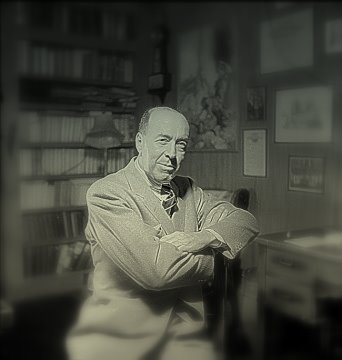


Springtime For Edgar Rice Burroughs

Part II

by

R.E. Prindle

Edgar Rice Burroughs

Civilization And Its Discontents.

     The period of Burroughs’ life was one of those great pivotal times of civilization.  Civilization was in the midst of one of its great metamorphoses, scientific, political and intellectual.  Changes which had been building up the last few centuries could no longer be absorbed by the existing religious structure.  That structure was no longer viable.  Its bursting mode was not only for the new Scientific Consciousness  but the increasing scientific examination of the past opened the way for the revival of forgotten forms such as the Matriarchy.  Thus along with the inevitable Patriarchal religious  reaction the Matriarchy  as well as suppressed occult religions forced their way through.

The reaction from contacts between civilizations sent various alien religions and ideologies into the Western leaven.

Confused with these intellectual challenges the agricultural basis of civilization evolved into a technological one.  In the mid-teens for the first time in the United States there were more urban residents than there were rural residents.

New demands were placed on consciousness as more precision was required of the human mind.  Man had had little difficulty adapting his methods to cycles of the seasons but the adaptation tothe rigors of the assembly line caused him problems.

That there was a backlash from this tremendous succession of changes should take no one by surprise.  Adjustments were difficult and critical.  In 1930 the founder of psychoanalysis, Sigmund Freud, published what may be his most famous title:  Civilization And Its Discontents in response to this challenge.  His notion of who the discontents were and of what they were discontented about is vague, indeed undecipherable.

In my estimation he doesn’t deal with the malaise at all.

On the other hand Edgar Rice Burroughs not only dealt with the malaise but offered a reasonable, if difficult to apply, solution to the problem.

page 1.

The malaise found many expressions.  On the political front the socialists, Communists and anarchists were the most prominent reactionaries.  Their activities reached a fever pitch in the first two decades of the Twentieth Century resulting in the two phases of the Russian Revolution of 1905 and ’17.  The institutionalized discontents had their homeland after the latter date.

While Freud’s discussion of Discontents sounds generalized by the way he writes he is actually talkiking about himself and the members of his own Jewish culture and their problems with Western Civilization.

Thus Freud’s notion of Discontents falls somewhere between a general malaise and the discontent of the Communists.

The Religious Conciousness of course faced a problem that could only be resolved by surrender or reaction.  There was no middle way.  The evolution into Scientific Consciousness completely invalidated the religious approach.  All religions are based on a false premise and Science exposed that falsity.

The transition to the Scientific Consciousness must be difficult and demanding as so few attain it.  In my opinion this is because of the ongoing evolution of the brain.  The Scientific Consciousness can apparently only be grasped by the further evolved.  This doesn’t mean that those of a Religious Consciousness can’t work with scientific knowledge which requires only basic intelligence and a scientific environment provided by others but they are unable to envision advances.

Thus they find themselves left behind intellectually.  It is the same as the difference between high and low IQ.  Nothing can be done about that.  However the Religious reaction is to attack those of the Scientific Consciousness to lower them to their own level.

page 2.

The problem was especially acute with Freud and his culture as Science per se invalidated all Semitic religious pretensions.  This means all Semites and not just Jews.  Neverthless as Jews were embedded in Western Civilization at that time and other Semites weren’t the Jewish culture was ‘discontented’ and was forced to negate science and the Scientific Consciousness.

Led by the Semitic surge of both Judiaism and Moslemism the very serious attempt to bury the Scientific Consciousness through genocide might just succeed.

As I point out in Part VII of The Deconstruction Of Edgar Rice Burroughs’ America the Jewish campaign to ‘abolish the White ‘race’ should be taken very seriously.  Just because it sounds preposterous doesn’t mean it’s a joke.  A segment of Whites is the bearer of the evolved gene or genes or combination of genes so that if this advance species were destroyed the wild religious reaction would succeed.  Sounds just like some science fiction movie doesn’t it?  Well, it isn’t.

The Scientific Consciousness created its own malaise in the newly evolving species.  As literary and artistic types are always the monitors who pick up these trends first, if they don’t necessarily understand them, we shouldn’t be surprised to find a number of literateurs immersing themselves in the problem.  One of the big texts is H.G. Wells important but neglected novel:  The Food Of The Gods.  In this novel Wells postulates that the emerging scientific Consciousness is a new species of human being.  As with the real religious reaction Wells’ predecessor people wish to kill the new species.  In earlier times when the world was less populated new or different species of human beings could move away from the old species.  Now, the question is what makes Homo Sapiens Homo Sapiens and makes it different from the Last Hominid Predecessor?  It is assumed by our scientific community that the Negro is the first Homo Sapiens species having evolved in Africa.  This means that the Negro evolved from some sub-human Homo Sapiens predecessor.  It’s easy, it has to be.  So far no one has been able to produce an example of the Last Hominid Predecessor.

Now, the Negro was not the only, how shall we say, hominid species in Africa.  The Negro apparently orginated in West Africa.  The rest of Africa was inhabited by other species such as the Bushmen and Hottentots.  These peoples are not Negroes and originated in Africa so the question is are they predecessors of the Negroes who we are told are the first Homo Sapiens or are they Homo Sapiens who precede or follow the Negro in evolution.  Or, are they a separate non-Homo Sapiens species or are they  perhaps the Last Hominid Predecessor.  They are not Negroes so a place has to be found for them.

In any event the Negro and Arab combined to produce a new race or sub-species known as the Bantu peoples.  The Bantus then invaded the territories of the Bushmen and Hottentots who ranged all of Africa South of the bulge, so we are told, driving the Bushmen before them.  As I understand it the Hottentots are now extinct while Bantu pressure on the Bushmen is driving them toward extinction.

At the same time a newer hybrid of Black and Semite is driving the Bantu before it from its base in the Northeast corner of Africa known as the Horn.

So, Wells novelistic problem was that there was no longer a place on Earth for his new species to isolate itself.  He was presented with the choice of his new species either displacing or killing off the anterior species or being eliminated itself much as the Hottentots and Bushman have been eliminated by the Bantu and as the Bantu and Negroes are being displaced and elminated by the new Black and Semitic Hybrid.

page 4.

So this was the problem c. 1900.  This solution was repulsive to the existing Religious Consciousness that was psychologically unequipped to deal with this impasse.

As can be seen the Semitic special consciousness does not fear the problem  In Africa in Darfur and the South of the Sudan they are actively pursuing genocide.  In Euroamerica the Jewish Semitic culture is pursuing or advocating the same resolution of their problem with the White Euroamerican population.  Following Semitic actions in Africa it should be clear to American Blacks what is in store for them.

So, Wells dealt with the problem in its political aspect.  The internal aspect, the split in consciousness between the old and new was ably handled by a number of writers.

For a good introduction to the contrast between the Scientific Consciousness compare Holmes and Watson in Conan Doyle’s stories.  In this essay I will concentrate on three others as well as Freud- H. Rider Haggard, Joseph Conrad and Edgar Rice Burroughs.  Not coincidentally, I think, all three writers place their most important work in Africa.  Haggard as the earlier writer rising to fame in Burroughs’ youth  quite naturally had a great influence on the younger man, although I think Burroughs would have written of Tarzan and Africa with or without Haggard’s influence.  The appeal of Africa is the contrast between the civilized White and the primitive Black.  The two aspects of White consciousness.  I hope to tackle this problem in more detail in my next essay, Edgar Rice Burroughs, Sigmund Freud And The Holy Grail.

There was nothing clearer to the English explorers, as well one might note as to the Southern planters of the US, than that there was a gulf between the intellect of the African and that of the White man.

Haggard expressed this difference in his novel Allan Quatermain. I’ve used the quote before but I will include it again here to keep the problem clear before us:

Quote:

All this civilization what does it come to?  Full forty years and more I spent among the savages, and studied them and their ways, and now for several years I have lived here in England, and in my own stupid manner have done my best to learn the ways of the children of light, and what do I find?  A great gulf fixed?  No, only a very little one, that a plain man’s thought may spring across.  I say that as the savage is, so is the white man, only the latter is more inventive and possesses a faculty of combination; save and except also the savage as I have known him, is to a large extent free from the greed of moey, which eats like a cancer in the heart of the white man.  It is a depressing conclusion, but in all essentials the savage and the child of civilization are identical.

          The great Liberal H.G. Wells was also clear on this difference.  The nature of the gulf was the Scientific intellect of the White and the non-Scientific intellect of the Black.  The question is how large did these nineteenth century men perceived the gap to be.  Haggard in his Allan Quaterman, quoted above perceived the gap to be small while if one is to judge by the distance between Tarzan and the Africans Burroughs perceived it be not only large but insurmountable.  Haggard thought the gap easily bridged while judging from Tarzan Burroughs thought it unbridgeable.

page 5.

It should be noted that Haggard was of the Old Religious Consciousness while Burroughs was of the advanced Scientific Consciousness.  Of the two men Haggard writes from the experience of having viewed Africa or at least South Africa first hand.  Everyone talks of Africa as though it were a county in Kansas whereas it is a huge continent of many diverse cultures.  But, perhaps as the cultures seem to share the same level of consciousness perhaps that is the justification for speaking of Africa and Africans as a single unit.

Haggard lived in South Africa for several years as a young man while he was an astute historian and anthropologist.  As a mythologist he was of the most gifted.  His understanding is astonishing.  He was quite familiar with all the Black peoples from the Zulus, Swazis and Basutos tothe Hottentots, Bushemen and Griquas.  His judgements of the various intellects seems quite reliable.  His writing is of most interest for the current rage of Zulu interest.  His actual story telling ability is beyond compare.

Now, this is difficult to speak of because of the ideological stance of the Liberals and their Religious Consciousness that take the procrustean stance of trying to fit facts and reality into ideology whether they can be conveniently forced or not.  They are currently anti-White and pro-African even going so far as to call for the genocide of the White species as I pointed out in the Deconstruction Of Edgar Rice Burroughs’ America.  This is more than evidenced in their support of the genocide being executed in South Africa by the Shona chief robert Mugabe and the Bantu peoples of the Union of South Africa.

page 6.

There’s not much evidence that Haggard was interested or even aware of the theories of evolution which, if I may be so daring, it seems clear that Burroughs either was at the beginning of his career or became so as he aged aware of all the various strands of evolutionary theory.  Thus Haggard comes across as more humane while Burroughs is more accurate.

A third opinion on the nature of the situation was provided by Joseph Conrad in his novelette: The Heart Of Darkness.  One can’t be sure how much contact Conrad had with the situation he describes, but the influence of the primitive African mentality had the effect of dragging down the White intellect.  As the advance in intellect was not so pronounced as Haggard noted the attraction of the primitive was so strong that many Whites retrogressed.  Conrad’s hero Kurtz was an ivory buyer in the heart of the Congo.  Through fraternization with the African he indeed loses his ‘thin veneer of civilization’ going native.  On his death bed in viewing his period in the interior he exclaims ‘The horror, the horror’ and then ‘Exterminate the brutes.’

In point of fact if, as we are told, Homo Sapiens originated in Africa and the Negro is the departure point from the Last Hominid Predecessor which may be the Bushman or Hottentot then if this departure occurred  c. 150,000 years ago, at the time the African came into contact with Whites he had made no move toward becoming civilized.  Nor was he inclined to when given the example.

When H.M. Stanley interviewed the Uganda chief Mtese, that chief was incapable of visualizing anything other than trading.  As he said he noticed that goods traded by the Arabs, who were first in the area, all came from Europe so he assumed that Europeans were more clever than the Arabs however he had no inclination to acquire the knowledge or skills.  Nor have Africans attempted it to this day.

page 7.

As unpleasant as it may be to deal with facts or accept the science of the matter it is nevertheless necessary to consider that in the course of evolution the African brain has evolved to a certain level and stopped much as all the Hominid Predecessors did.  Although Bruce Lahn of the Howard Hughes Medical Institute has been silenced his researches made it clear that the human brain was still evolving but not in all human species, only one.

It should be clear to even the most prejudiced observor that Robert Mugabe the Shona leader of Zimbabwe is in way over his head while as savage in his methods as any character Joseph Conrad could create.  Nor is the reason  unclear to certain Africans.

Writing in the Kampala Monitor of February 7, 2007 in an article entitled  Uganda:  Why Black People Have Remained Backward by Elias Biryabarema the author examines the problem:

     Uganda has been fairly stable long enough.  The conditions for an economic takeoff have been there for 20 years.  Mr. Musevini has enjoyed generous goodwill from nearly all the world’s rich governments.  Their largesse has poured in ceaselessly and in hefty amounts.

Uganda should have taken off.  We haven’t.  We’re stuck.  And so is Tanzania, Sudan, Ethiopia, Mali, Burkina Faso, Kenya, Eretria, Malawi, Congo Republic and pretty much all of Black Africa, excluding the regions sole economic power, South Africa.  This led me to pose a question to myself:  Can Black people build prosperous societies?

Just about every reason- from slavery, colonialism, neo-colonialism to inequitable world trade rules- cited for the backwardness of Black African nations has been so debunked that it has now become necessary to look beyond the realm of such contemporary explanations.’

http://allafrica.com/stories/200702061131.html

Mr. Biryabarema concludes that Africans ‘only rise and touch a low ceiling.’  A disheartening realization but a cruel fact of nature because of the progression of evolution.

page 8.

So Africa came to represent an attractive past to Whites while the psychical split caused by the evolving brain caused them discomfort too.  The brain had not evolved far enough to make a clean break with the animal past.  What was Man, all species to do?  Haggard relapsed into nostalgia.  A longing to go back while nevertheless retaining his cranial development.  His hero, Allan Quatermain while retaining his intellectual superiority to the Africans attempts to establish his kinship with his ‘Black brothers.’  Thus he takes a ‘Liberal’ attitude toward African/White relations that while seemingly humane has resulted in the atrocities against Whites being perpetrated by the likes of Mugabe and the South African leaders.

One shudders at Conrad’s Kurtz’s exclamation to ‘exterminate the brutes’ and yet the choice has turned out to be exterminate or be exterminated,  while Africans have inexplicably opted for the latter.  What can one say?

Burroughs on the other hand working from a philosophical point of view came up with a different solution.  Nor is it entirely impracticable on the intellectual level.  Both he and Freud begin from the same base.  Both are reacting to the inhibitions and repressions placed on Man by civilization.

Burroughs seems willing to accept the ‘thin veneer of civilization’ in certain places and under certain conditions but he demands the right to be able to move freely from the primitive to the civilized state.  Thus when Tarzan takes off his clothes he also removes the ‘thin veneer of civilization.’

page 9.

The basic problem for Haggard, Conrad, Freud and Burroughs is that they wish to retain the advantages of the intellectual aspects of civilization; none of them wish to opt for the ‘low ceiling’ of the primitive.   They all wish to retain their advantages while indulging their primitive ‘natures.’  In some way each has to remain superior to the primitive state.

One can contrast this attitude with Mugabe of Zimbabwe and the ANC of South Africa who seem to be edging in the direction of removing all vestiges of the civilized state.  They seem to be opting for a nostalgic return to the their savage past.  They must have some understanding of the results of their destructive acts against civilization but choose to ignor them.

Conrad says simply- exterminate the brutes.  Haggard adopts an avuncular attitude toward perpetual children.  Burroughs assumes the role of…well…a god.  Freud wishes to assume the role of plantation owner.  The problem is insoluble except by the Shona method of  ‘exterminating the arrogant bastards.’

For Burroughs as well as for Freud sex seems to be the key.  Burroughs position is difficult to fathom.  In all his cultures, societies and civilizations, and he creates a great many, nudity or near nudity is the ideal although as he is writing for popular consumption his characters  remain sexually unexited and incredibly chaste under the most provocative conditions.  Freud of course had everybody going at it like bunnies.

In Cave Girl Burroughs’ hero, Waldo Emerson Smith-Jones is the example of the over intellectualized man of extreme and enervating culture.  Quite the opposite of Burrughs who obviously feels he has reached an ideal balance between the intellectual and the physical.

Waldo is meager then and consumptive when he lands on the island.  He is obligatorily cowardly.  He will find his Anima ideal in Nadara who is the antithesis of the civilized Jane being both nude and perhaps the most obviously sexually unihibited of any of ERB’s female characters.  Burroughs contrasts her natural uninhibited sexuality with the inhibited sexuality of Waldo.  There is a nice comparison with Freud possible here.  Also with the Burroughs corpus there is room for an analysis of Nadara, La, and Balza.

During the course of his stay on the island , the natural primitive life will flesh Waldo out, build him up, give him conficence and make him courageous as well as curing his TB.  Of course he never loses his intellectual attainments while using them to better his opponents and improve his situation.  Thus neither Haggard, Conrad, Freud or Burroughs  is able to resolve the conflicts of the discontents caused by civilization.  As attractive as the primitive is it must remain an intellectual ideal.

Go to Part 3.

In The Beginning.


During the course