Tarzan Over Africa
February 23, 2009
Tarzan Over Africa
The Psychological Roots Of Tarzan In The Western Psyche
by
R.E. Prindle
As the strong man exhibits in his physical ability, delighting in such exercises as call the muscles into action, so glories the analyst in that moral activity which disentagles. He derives pleasure from even the most trivial occupations bringing his intellect into play. He is fond of enigmas, conundrums, hieroglypics; exhibiting in his solutions of each a degree of acumen which appears to the ordinary apprehension as praeternatural. His results brought about by the very soul and essence of method, have in truth, the whole air of intuition.
Edgar Allen Poe- The Murders In The Rue Morgue
…he dreams of the sight
of Zulu impis
breaking on the foe
like surf upon the rocks
and his heart rises in rebellion
against the strict limits
of civilized life.
H. Rider Haggard- Allan Quatermain
Yes! I noticed this dichotomy in the Western soul myself at least two thirds of a lifetime ago. I was always puzzled by it. Why in the midst of plenty and seeming perfection should the Western psyche be so discontented with its lot.
Well, time has passed. Two thirds of a lifetime in fact. After much mental lucubration and travail I now find myself in a position not only to understand it myself but to be able, perhaps, to make it clear to others; perhaps hopefully to you who are looking at this screen.
The problem began we are told, by people who ought to know, about one hundred fifty thousand years ago when our species, Homo Sapiens, evolved from its predecessor hominid, which has never been traced being the famous Missing Link, to begin its odyssey through time and space.
We are told that Homo Sapiens originated in Africa and that Black Africans, or what Tarzan would call savages, were the first Homo Sapiens. We are told, once again, that White people mutated from this original Black stock. This may or may not be so. I am in no position to affirm or deny the fact myself but, if so, there was a qualitative difference as well as a quantitative difference that then occurred. In fact, if one were to judge solely from appearances two sub-species of Homo Sapiens came into existence when the White evolved from the Black. This qualitative difference between the sub-species or what we have been taught to consider races, was noticed by all the early explorers with differing interpretations.
As the English novelist, H. Rider Haggard, who as a man of considerable experience and acumen, put it:
I say that as the savage is, so is the white man, only this latter is more inventive, and possesses a faculty of combination…
Rider Haggard was quite right, both sub-species evolved from the same stock, both had the same emotional makeup, but what Haggard dismisses as only ‘more inventive’ and ‘a faculty of combination’ is precisely that which separates the White sub-species from the Black sub-species and makes it evolutionarily more advanced. In conventional terms invention and a faculty of combination is called the scientific method.
The scientific method is not to be dismissed lightly. It is a faculty of mind that is an evolutionary step in advance of the White sub-species’ evolutionary predecessor, the Black sub-species.
This may be a startling interpretation to you, however if one is to follow the scientific logic adduced by scientists of Evolution the facts follow as day follows night. They cannot be avoided nor can they be explained away. They must be dealt with head on, just as our Attorney General Eric Holder has stated.
The evolutionary step within the Homo Sapiens species is almost tentative to our White minds, not so clear cut as to separate, say, the Chimpanzee species from the Gorilla species. The transition is however in that direction.
In the nineteenth century the cleavage between the scientific mind and that of the savage or first Homo Sapiens mind was beginning to become felt in the Western psyche. A malaise of spirit was created which troubled the soul of Western man. The ‘strict limits’ of scientific civilization versus the seeming naturalness and open simplicity of the African became a dichotomy in the Western psyche.
Haggard was not the first to confront the problem but before I begin at the beginning with who I consider to be the first let me elucidate the problem further by another quote from Rider Haggard.
Ah! this civilization what does it all come to? Full forty years and more I spent among savages, and studied them and their ways, and now for several years I have lived here in England and in my own stupid manner have done my best to learn the ways of the children of light; and what do I find? A great gulf fixed? No, only a very little one, that a plain man’s thought may spring across.
Haggard was quite correct as far as he went. What he failed to understand, ‘in his own stupid way’, was that there was a small gulf over which civilized man thinks he could spring backward without difficulty but from the other side that small gulf appears a great chasm which the completed mind of the first Homo Sapiens can never find a way across.
Edgar Rice Burroughs who read Haggard and was also struck by this really important introductory chapter to ‘Allan Quatermain’ pondered the issue long and hard and resolved the issue in his own mind when he said that the savage mind could never grasp science while only one in a hundred of the White species could, with perhaps one in a thousand being able to advance science. ERB intuited what modern genetics would prove.
This dichotomy between the primitive and scientific mind does not become truly prominent until the mid-nineteenth century. It wasn’t observable to the naked eye before then and only begins to establish itself in literature with the apperance in 1841 of Edgar Allan Poe’s ‘Murders In The Rue Morgue.’
Poe created a whole new genre of literature, not only of the detective story, but of the conflict between what Freud would later identify in his system as the Unconscious and the Conscious mind. Prior to Poe reason, or the forebrain, was the sole approach to knowledge; after Poe awareness of the Unconscious element began its long rise until today it is dominant.
When dissatisfaction with Haggard’s strict limits of civilization began to forcibly intrude into White consciousness, causing the split identity, is not clear to me although it may well have been the introduction of the Age of Steam. Certainly by 1841 the intrusion of the steam railroad was going a long way to condition man’s mind to a rigid one way view of reality as laborers spun out the long steel ribbons along which the great unyielding iron locomotives ran.
The science of steam was unforgiving, with a low level of tolerance for human error, and making no allowance for individual idiosyncracies.
In the days of the great steamboat races on the Mississippi boiler pressure was controlled by a little governor. Greater speed could be attained if the governor was removed allowing boiler pressure to increase. Of course, the inevitable result was the explosion of the boiler and destruction of the steamboat and crew. Even knowing the scientific consequences of removing the governor operators time after time did it in hopes of defeating physics and winning the race.
Thus science seemed ‘unfair’ and the White man’s limited undeveloped understanding began to rebel.
When evolution gave man access to science he reached the limits of what human exertion alone could do. Thus the forebrain was frustrated, driving it back toward the brain stem and the Unconscious. A new scientific frontier was opened thereby- the study of the human mind.
Edgar Allan Poe grasped this significance expressing it in poetic language. ‘Murders In The Rue Morgue’ posits the problem in the form of C. Auguste Dupin who, while using rigorous scientific method is mistaken for being intuitive. The Conscious mind versus the Unconscious.
The Unconscious is always disreputable. It is there that little understood sexual urges and primitive egoistic rituals reside. It is there that the primitive man resides; the savage of Rider Haggard, the Negro of the present day. It is there that the Western psyche rebels, seeking to emerge triumphant over science and understanding. That is the little leap backwards that Rider Haggard saw. In academic writers of the nineteenth century it was called ‘the thin veneer of civilization.’
Thus the initials of C. Auguste Dupin spell CAD, or a slightly disreputable man. A man who thinks only of himself. If Poe doesn’t introduce the notion of the doppel ganger, he certainly defines the role and purpose. Dupin and the narrator are two halves of the same person. They are in fact one personality.
This notion would be further developed in Conan Doyle with his creation of Sherlock Holmes and his doppelganger, Dr. Watson. The notion would be brought to horrifying fruition in the classic tale of the split between the conscious and unconscious minds, Robert Louis Stevenson’s ‘Dr. Jekyll And Mr. Hyde.’
Poe’s narrator being of greater means than Dupin who is seedy and down at the heels rents an old dilapidated house in the Faubourg St. Germain which creaks as lustily as the House of Usher. The house is a symbol of psychological decay. The Faubourg St. Germain is itself a symbol of decay. Formerly the home of the pre-revolutionary elite, since the French Revolution it is the home of shattered fortunes.
The two men, who are inseparable, lock themselves up in this mansion by day with all the curtains drawn, sure sign of intense depression, going out only after dark into what the narrator calls the ‘real night’ as opposed to the night of the soul; the dark Freudian unconscious.
And then two women are murdered in mysterious circumstances. Using all his scientific method Dupin divines the murderer to be an Orang-outang, which was no small feat whether scientific or intuitive. Thus the highest mental powers were symbolically pitted against man’s animal nature.
Poe thus states the central problem of the Western psyche which is still unresolved at this time while still being discussed as much. While Rider Haggard was wrestling with the problem Conan Doyle was writing his Sherlock Holmes stories. Holmes like Dupin is a bit of a cad; not entirely an admirable person. He has placed himself above the law, being quite capable of executing summary judgment on one who might in his sole opinion escape the toils of the law. Holmes companion, Dr. Watson, is a sturdy unimaginative burgher who serves as the example of the unconscious to Holmes’ conscious but scientifically unfeeling mind.
Robert Louis Stevenson takes matters to an even more intense level at roughly the same time. Jekyll and Hyde are in fact one man. Jekyll is the example of what Freud would call the repressed man but one which society calls a disciplined and respectable man. He is in total control of himself but he suspects there is another side to his character which he would like to discover.
Unable to find access to this other side by psychological or rational means, he uses his scientific acumen to invent a potion which releases this demon, Mr. Hyde, concealed inside his unconscious. Hyde is a very destructive character and having been once released he proves impossible to put back in the bottle. He returns unsummoned. Eventually he suppresses Jekyll becoming the sole personality. The jump only works one way.
Thus Stevenson predicted the evolution of the twentieth century. This little cluster of writers bridging the nineteenth and twentieth centuries is very interesting.
In the intervening near fifty years between ‘Murders In The Rue Morge’ and ‘Dr. Jekyll And Mr. Hyde’ science had been revealing nature at a galloping pace placing even greater stress on the Western psyche. Central to the further deteriorization of the psyche was Charles Darwin’s ‘Origin Of Species’ which appeared in 1859 just on the eve of the exploration of Central Africa when the stressed scientific Western psyche confronted its dark unconscious in the form of the African Black man. Thus Africa became the Heart Of Darkness for the White man just as Hyde was the heart of darkness to Jekyll. That little gulf across which he thought he might leap appeared as a gigantic chasm.
The notion of evolution versus Biblical creation not only caused a tremendous social dislocation but the notion of evolution from a lower to a higher, from Ape to White man, placed the Black man or Negro in an intermediary state of development just as Burroughs would later depict the role of Tarzan Of The Apes.
Beginning c. 1860 with the expedition of Capt. Richard Francis Burton into the lake regions of Central Africa the problem began to take a concrete form.
What the White Man found in the interior of Africa startled him. For here the dichotomy between his unconscious and conscious was juxtaposed in reality between himself and the Black African. The Black African seemed to represent unchanged what man had been one hundred fifty thousand years before when he evolved from the hominid predecessor.
For Burton and Henry Morton Stanley who followed him as an explorer the superiority of the White was apparent. In the Negro they saw only the child of nature; men without alphabets, physics, chemistry, astronomy or intellectual attainments of any kind. The Negro was to be pitied, treated paternalistically as a little brother or as the Negro would later be known: The White Man’s Burden, Idi Amin notwithstanding.
The main period of exploration and discovery was ending when Rider Haggard began publishing his great African adventure trilogy from 1885 to 1888.
While Burton and Stanley felt an easy superiority over the Blacks, Rider Haggard took a more disquieted attitude. He was troubled when he noted that for all the White man’s scientific attainments there was no difference in the emotional development of the two sub-species.
And what did he find? A way forward? A great gulf fixed? No. ‘Only a little one, that a plain man’s thought might spring across. I say,’ he said, ‘that as the savage is, so is the white man, only the latter is more inventive, and possesses a faculty of combination…’
Well, indeed. But wasn’t Haggard undervaluing the quality of being more inventive and possessing a faculty of combination? Those two qualities, after all, comprise the scientific faculty which cannot be attained by effort but is evolutionarily ingrained. It is forever beyond the reach of the first Homo Sapiens. Haggard and all other writers recognized that this faculty is what the Africans lacked.
Consider then in one hundred fifty thousand years the Africas were so incurious that they had never observed the heavens. They had no astronomy! When the White split off probably one hundred thousand years ago this is the first science they established. Think about it.
Is this scientific faculty such a small thing? If, in fact, a White man of plain understanding can make the leap backward to a natural state can the Black or natural man leap the chasm to a scientific state of consciousness?
Darwin’s theory of evolution is based on natural selection, actually a form of eugenics, by which he believed new species were evolved. It would appear, however that evolution is caused by genetic mutations and when a species has mutated into the complete expression of itself evolution stops for that species which then becomes, as it were, a living fossil.
Rather than natural selection there is perhaps natural rejection. When a new sub-speices forms with its differences it is more likely that the predecessor recognizes the differences and ejects the new comer rather than the new species recognizing itself and banding together. Consider Tarzan among the apes.
When the White sub-species came into existence perhaps one hundred thousand years ago it is more than probable that the sub-species was rejected by its Black predecessors and forcibly ejected from sub-Saharan Africa.
Thus in the two closest known predecessors of Homo Sapiens, the Great Mountain Ape and the Chimpanzee both species are completed and now await extinction as they are unable to compete with their successor hominids.
Scientists tell us, I have no way of disputing their conclusion only interpreting them, that Homo Sapiens evolved from a predecessor about a hundred fifty thousand years ago. They further tell us that the first Homo Sapiens was the Negro sub-species.
The predecessor, who has disappeared without a trace, unless he is the Bushman, was a completed species; he was incapable of further evolution himself but from him the Negro sub-species of Homo Sapiens evolved.
Now comes the hard part to accept. Science is science; one must either follow its facts or abandon the pretence of being scientific man.
As the first Homo Sapiens was the Negro sub-species, is the Negro sub-species complete as an example of evolutionary development? If the Negro was the first Homo Sapiens then the White sub-species must be evolved from the Negro and as nature is ever groping toward higher intelligence the White must be an intellectual improvement on its Black predecessor. The apparent facts indicate this.
Evolution appears to be always toward a form of higher intelligence. Thus the qualities of combination and inventiveness may be completely beyond the reach of the Black sub-species. The Black may stand in relation to the White as the Great Mountain Ape stands to the Chimp.
Further, if one assumes, as one must, that evolution has not stopped either with the development of Homo Sapiens or its sub-species the White man, then the White man must carry the genetic makeup for the mutation to the next step of evolution. As only fifty thousand years intervened between the evolution of the first Homo Sapiens and its White successor than the next evolutionary sub-species or species may already be among us. This is what H.G. Wells novel The Food Of The Gods is about. Apparently the evolutionary bud, like a swelling on a tree, may only blossom once and then the sub-species or species is incapable of budding again becoming fixed in form
The question then arises will the next step be to a new species that will make Homo Sapiens a completely inferior species such as now exists between Homo Sapiens and the Chimpanzee or a new sub-species that will merely increase the distance between it and the first sub-species.
If the new mutation increases its intellectual capabilities will it also be able to evolve a new emotional organization that will separate it from Homo Sapiens and its animal nature completely? Or is it possible that the dichotomy between the two under which Western man suffers will increase involving some sort of evolutionary insanity or suicide?
Well, as the nineteenth century drew to a close vitamins hadn’t even been discovered let alone genetics so people muddled along in a dissatisified condition.
The unconscious aspects of man began to predominate over the conscious as Western man confronted with his natural state in Africa began to slip back across the little gulf in admiration of the seeming ‘natural ‘ state of the ‘noble savage.’ This slip backward was aided and abetted by Sigmund Freud’s vision of the unconscious.
Late in the century Thomas Alva Edison invented the movie camiera. This invention was to have a major effect on the rise of the Unconscious or retrogression to the primitive as the dominating factor in the Western psyche. At approximately the same time as the film industry was becoming important Sigmund Freud published his seminal work: The Interpretation Of Dreams. Thus a scientific vocabulary began to come into existence by which the workings of the mind could be analyzed and discussed. the Unconscious became an established entity.
Now, writing is work of the forebrain or in other words, a scientific pursuit, while movie making is a function of the Unconscious. A good story is more important in writing while subliminal drives are the stuff of movies. It is only required that movies make emotional but not rational sense. They follow a different logic.
Edgar Rice Burroughs was to be confused by this difference when he tried to translate his books to the screen. While the early Tarzan films were not unsuccessful they were not all that satisfying; it was not until MGM invented the Tarzan of primal desires impersonated by Johnny Weismuller that the movie Tarzan became potent. However in that guise Tarzan was entirely another creation. His being had become independent of ERB’s mind.
One movie is capable of finding more viewers than a thousand books can find readers. Thus the subconscious began to dominate over the conscious Tarzan.
I am of the opinion that Freud was already aware of the effect of the emergence of the Unconscious as a formative factor in society before he codified the phenomenon in scientific language. After all Freud was subject to the same influences as Poe, Haggard, Doyle, Stevenson and Burroughs.
Freud himself came from an earlier school which delighted in the unrestrained indulgence of the unconscious or passions. In English terms the attitude took form as the Hell Fire Club to which the American Benjamin Franklin belonged. Its motto was: Do What Thou Wilt. Its bible on the continent was ‘Gargantua and Pantagruel’ by Rabelais, while in Jewish circles the credo had been established by Jacob Frank and his descendants. Frank’s position was that man will never be good until he commits evil to his heart’s content. Freud being Jewish was of this school.
These groups of people were quite extreme. Their credo was startlingly expressed in the eighteenth century by Tobias Smollet when his hero, Roderick Random, is introduced into a woman’s home who wrote the following:
Thus have I sent the simple king to hell
Without or coffin, shroud or passing bell.
To me what are divine or human laws?
I court no sanction but my own applause!
Rapes, robb’ries, treasons, yield my soul delight;
And human carnage gratifies my sight;
I drag the parent by the hoary hair,
And toss the sprawling infant on my spear,
While the fond mother’s cries regale my ear.
I fight, I vanquish, murder friends and foes;
Nor dare the Immortal gods my rage oppose.
The above pretty much defines Freud’s intent in his psychology. So long as such sentiments were consciously expressed in print they horrified a rational thinker while remaining strictly an underground movement. But now Freud combined the attitude with the malaise of soul which had been called into existence by the dichotomy of the scientific and unconscious minds.
Freud reduced the mind, including the Unconscious, into scientific terms by which such Rabelaisan attitudes could be discussed and disseminated into polite society as scientific thought rather than eccentric opinion.
Freud despised what he called the morality of the day or in other words, Christian morality. He determined that the main cause of mental illness was the repression of disorderly or anti-social desires. He glorified these base desires as the Ego and proclaimed that where the Unconscious was Ego shall be. This is another way of saying: Do What Thou Wilt.
Thus in the decades following Freud the whole notion of self control and a disciplined mind fell into disrepute as Western man began to revel in his most criminal desires; for the Unconscious which always disregards the rights of others is alway criminal.
So it was that the terrible figure of Dracula who began his rise in the 1890s became the dominant psychological projection of the twentieth century. Dracula is the Unconscious incarnate. Completely despising the rights of others, even their right to life; he sucks anyone’s life blood so that he alone may live.
Like Dupin and the narrator of ‘Murders In The Rue Morgue’ Dracula only comes out in the ‘real night’. In fact, one ray of the sun, in other words, consciousness, will turn him to dust. Light is anathema to him; he must shun the day.
Alongside Dracula the cult of the Phantom Of The Opera has grown into huge proportions being disseminated to polite society by Andrew Lloyd Weber’s opera of the same name.
Talk about conscious and unconscious, the Phantom lives in a sewer, the very home of the Unconscious, where he has installed a huge organ on which he plays the most glorious conscious creations of Johann Sebastian Bach.
Deformed in soul, the deformation has been extended to his exterior in the form of a burned face which he covers with a mask just as one masks one’s interior motives from others. Attracted to the higher things from the depths of his sewer he haunts an opera house directly above where, spying from secret passages, he falls in love with the beautiful opera singer who, initially repulsed by the soul shown on his face gradually succumbs to the lure of the unconscious.
Edgar Rice Burroughs was born into this strange social milieu, as we know, in 1875. Seemingly failing in every thing he did, he had scant prospects in life until at the age of 37 in 1912 his education jelled into the creation of his life, Tarzan the Magnificent.
Tarzan is extraordinary in that he runs counter to the other expressions of the Western malaise. Tarzan is whole and entire. In Freudian terms, where Unconscious was, now Ego reigned and it was good Ego, not the criminal model of Freud.
As Tarzan was, so must have been Burroughs, although I have no idea how he achieved this. It appears, nevertheless, to be true. In fact, whatever Burroughs read or was thinking about he seems to have resolved in Tarzan the mental dilemma which was first formulated by Poe. Further, he acknlowledges Poe’s influence.
We know that Burroughs read and revered the African adventure novels of Rider Haggard. It can be stated certainly that he read the African explorers Capt. Richard Burton and Henry Morton Stanley. Whether he read the other seekers of the source of the Nile, Speke and Baker, I don’t know, as I cannot so state with certainty. It is not impossible that Baker’s wife was a model for Jane.
It is certain nevertheless that the great age of African exploration thrilled him while occupying a prominent place in his daily thoughts.
Being scientifically inclined, he applied his reading in evolution, exploration, geology, psychology and other subjects to the formation of his great creation, Tarzan. As he says, he wrote to amuse and entertain (read: make money) so that he expressed the results of his deepest study in seemingly frivolous tales. Then, while he captured the imagination of the reading public, he offended the critics of ‘serious’ literature who refused to take him seriously. He even found it difficult to find a book publisher even though he was a proven popular success.
Yet he pondered deeply the dilemma propounded by Poe while apparently puzzling out the deeper meaning of Haggard’s introductory chapter to ‘Allan Quatermain.’ Stevenson’s Jekyll and Hyde filled his thoughts.
There is little doubt that Haggard’s hero, Sir Henry Curtis, is a progenitor of Tarzan. One can see Tarzan in the great White English warrior standing tall in a sea of Black soldiers. Sir Henry Curtis leads the Black Kukuana into battle against their foes. The first Big Bwana had come into existence.
Burroughs wants his hero Tarzan to be born in Africa so in 1888 the year ‘Allan Quatermain’ was published and Sir Henry Curtis sealed himself in his valley high in the Mountains Of The Moon, Lord Greystoke and his wife, the Lady Alice Greystoke are abandoned on the West Coast of Africa where, as we know, they both lost their lives but not before Lady Alice gave birth to a son who was then adopted by the great she ape, Kala.
In The Return Of Tarzan the putative successor to Lord John Greystoke is voyaging through the Suez Canal around Africa in his yacht, the Lady Alice, when he is shipwrecked near the exact spot where his father and mother built their tree house in Africa.
To understand fully this sequence in Burroughs’ imagination one has to examine the other source for his creation, Tarzan- Henry Morton Stanley.
There can be no question that before Burroughs wrote Tarzan he had read if not studied the books of H.M. Stanley. And, why not? Stanley’s most important titles are: How I Found Livingstone In Central Africa, Through The Dark Continent and In Darkest Africa.
‘Through The Dark Continent’ is one of the great adventure stories of all time. The conscious living out of Stanley’s unconscious needs and desires is remarkable reading.
One might think that Burroughs’ yacht ‘Lady Alice’ was named after Clayton’s mother, Lady Alice Greystoke. Not so. Burroughs is full of subtle jokes and elaborate circumlocutions. If not Clayton’s mother then how did Burroughs come up with the name ‘Lady Alice’ for the yacht? Well, if you read Stanley’s ‘Through The Dark Continent’ you will find that he carried for thousands of miles through Africa a boat in sections that could be broken down and rebuilt. With this boat Stanley circumnavigated Lake Victoria as well as Lake Tanganyika, then sailed the boat down the entire length of the mighty Congo River. That boat was named the Lady Alice. Thus Tarzan like Stanley was carried by the Lady Alice. That’s a very subtle joke, Son. Stanley himself had named the boat after his Cincinnati fiancee, Alice. During his sail down the Congo she ditched him for another man. In weird synchronicity Stanley ditched the Lady Alice on a bluff overlooking the Atlantic nearly at the end of his journey. What a true coincidence.
As an aside, the psychology of it is very interesting. Psychologically a vessel represents a woman. the Holy Grail which is a chalice represents woman while the blood it contains represents man. Thus you have the man, Stanley in the boat, woman. Stanley’s mother abandoned him as a child. He saw her only once thereafter. Thus, his mother, the most important woman in any man’s life abandoned him. In the Lady Alice, Stanley was obviously carried once again by his mother although I don’t know if her name was Alice also. He then abandoned his boat the Lady Alice.
Stanley didn’t follow the Congo to the sea as is popularly believed but abandoned the river after traversing an incredible series of rapids when he came to an identified rapids at Stanley Pool where, completely exhausted and having reached an explored point, he considered his job done. He had the Lady Alice carried to a hill top where he left it to the elements. Now, in Burroughs mind he may have landed the Lady Alice at the approximate place he thought Stanley had abandoned his Lady Alice. So, Tarzan’s house may have been intended to be on the coast directly below the Lady Alice. That would also make the location in Gabon. In that sense Tarzan was the successor of H.M. Stanley.
One may therefore assume that the Greystokes were put ashore near the mouth of the Congo where the fictional yacht Lady Alice ws shipwrecked within sight, as it were, of the real Lady Alice. That’s how the mind of Edgar Rice Burroughs worked.
On his way from England on the Emin Relief Expedition which forms the content of ‘In Darkest Africa’ just like Lord Greystoke Stanley sailed from England through the Suez to Zanzibar where he collected his porters, sailed with them to Capetown and from thence to the mouth of the Congo. Then Stanley began his incredible journey up the Congo across Africa from West to East into the Northern lake regions where on this trip he located and identified the fabled and thought mythical, snow capped on the equator, Mountains Of The Moon.
Anyone who doesn’t admire Henry Morton Stanley has the heart of a dullard. What a man! What terrific incredible adventures. I’d rather read about them than live them myself but what a story. So thought Edgar Rice Burroughs who never tried to live such adventures either.
Very important to Tarzan is Stanley’s dealings with the various African tribes. Stanley is virtually a single White man leading a faithful band of Negroes just like Tarzan and his faithful Waziri.
Africa was virtually Stanley’s province as it was for Tarzan. Tarzan’s reputation was far famed throughout Africa or at least the areas of Africa through which Stanley traveled. Tarzan doesn’t have much to do with South Africa which has no association with Stanley although Tarzan does travel in North Africa of which Samuel Baker wrote.
Stanley, whose three major expeditions covered a period of about fifteen years must also have become legendary amongst the Blacks. The exploration of Lakes Victoria and Tanganyika coupled with the journey down the Congo must have been the subject of astonished conversation in every village in Central Africa. The more so because Stanley was on scientific expeditions to map geographical features like lakes and rivers which reason no African could ever comprehend.
They could comprehend slaving and ivory buying but they couldn’t comprehend scientific endeavors.
Stanley’s situation in Uganda near the Ripon Falls, the outlet of the Nile from Lake Victoria, with its emperor Mtessa is the stuff of legend for either Blacks or Whites. Stanley, virtually singlehandedly at the head of a band of African natives successfully negotiated months at the court of Mtessa and lived to the tell the tale which I believe few could have accomplished. Then traveling South through areas that had never seen a White man he successully negotiated the circumnavigation of Lake Tanganyika. Both Victoria and Tanganyika are among the largest bodies of fresh water on earth, huge lakes. Then transporting the Lady Alice to the Congo he made the extraordinarily hazardous descent of that enormous and hostile river. This is really mind boggling stuff.
There are too many allusions in Burroughs to the adventures of Stanley to believe that he wasn’t a source for Tarzan.
As more or less an aside there is even a possible allusion to a scene in Burton’s ‘Travels In The Lake Regions Of Central Africa.’ Burton describes in particularly vivid detail an apparition he had while suffering from fever. In a fairly remarkable psychological projection he experienced himself as two different people, not unlike Jekyll and Hyde, who were at war with each other; the one attempting to defeat the best efforts of the other.
In 1857 this psychic manifestation could not be understood. Today it can be interpreted. It would seem that Burton was consciously aware that he seemed to thwart his own projects. He undoubtedly worried about this a great deal but as an unresolved subconscious controls the conscious mind he couldn’t penetrate the mystery.
Under the influence of malarial fever the psychic barriers of the subconscious broke down and his desire was shown to him symbolically by his unconscious mind. Had Burton been psychologically capable of pursuing this insight to its logical conclusion unearthing the fixation on which it was based then he would have resolved his problem and integrated his personality becoming a single unit or whole person. His legs wouldn’t have given out on him as he came close to his goal. Depth psychology was unknown in 1857 so the psychological manifestation remained a mystery to him.
It seems clear that Burroughs was equally impressed by this incident which he later used to create an alter ego for Tarzan called Esteban Miranda. If you recall, Miranda’s inept activities were bringing Tarzan into disrepute. Africa began to wonder.
As the evolution of Tarzan, as I mentioned in my earlier essay, the idea of Tarzan entered the back of Burroughs’ mind bearing a candle which in a pitch black cave is a pretty strong light. This idea was probably an identification with Sir Henry Curtis of Rider Haggard but Burroughs was unable to develop the train of thought when he came to the water barrier in the vaults of Opar.
Tarzan successfully leaped the barrier but Burroughs lost his train of thought when the candle symbolically blew out leaving the idea of Tarzan to gestate in his subconscious. There Curtis slowly combined with Henry Morton Stanley to erupt from Burroughs’ forehead fully formed in 1912 as Tarzan.
Burroughs probably read Stanley in the nineties. His creative juices would have been jogged when Stanley died in 1905. Stanley’s devoted wife gathered several chapters of Stanley’s autobiography of his childhood, composed by himself, then cobbled together the rest of his life from diaries, news clippings and the like.
Stanley’s autobiography was released in 1909. The first Tarzan book was written in 1912. I don’t know when Stanley’s autobiography came to Burroughs’ attention but sometime before 1912 he read it completing the idea of Tarzan in his mind. As Burroughs’ prospectus to All Story Magazine indicates, Burroughs was struggling to combine a number of ideas into the entity that was to become Tarzan.
The publication of Stanley’s autobiography plus the pressure at age 37 of having to so something to merit his high opinion of himself probably forced the jelling of the idea of Tarzan which erupted from his forehead bearing gold ingots like Tarzan emerging from the rock of Opar above the gold vaults.
Burroughs now had the ideal vehicle to give expression to all his social theories. Critics may see Burroughs as a mere shallow entertainer but I don’t. I bought my first Tarzan book the year Burroughs died in 1950 with I was twelve. I continued to buy them until 1954 when I was sixteen. I was totally absorbed in them; not as mere entertainment. I thought Burroughs was writing some pretty heavy stuff even if I missed the much I picked up later when my interests were subconsciously directed to the same social problems that concerned Burroughs. I found to my surprise that Tarzan having entered the back of my mind had formed much if not most of my social thought. I give you the results of my education by Burroughs here.
I find myself amazed by the depth and profundity of Burroughs’ thinking. The ease with which he handled these complex problems without directly identifying them or preaching is fairly amazing. I pointed out in my earlier essay how Burroughs addressed the problem of eugenics in the males and females of Opar.
So he took on the problem of psychic dislocation in the White sub-species in the very nature of his creation, Tarzan.
We know he was heavily influenced by Poe’s ‘Murders In The Rue Morgue’ because he retells the story in the ‘Return Of Tarzan’ in Chaper 3, ‘What happened In The Rue Maule.’ Now this retelling is close enough to be considered borrowing if not plagiarism if his purpose hadn’t been to develop Poe’s theory. Poe was positing the problem; Burroughs was offering the solution.
Just by way of reference; my copies of Tarzan are those of Grosset and Dunlap from the late forties and early fifties. They also have what I consider the finest artwork on Tarzan, a matter of taste, I know.
Where in Poe, Dupin is a human while the Orang-outang a beast, Burroughs combines the two in one. The sub-conscious and the conscious are integrated. Tarzan is at once the most charming and civilized of men but once aroused he quickly reverts to animal ferocity. But he is able to pass back and forth at will, unlike Jekyll and Hyde, and at a moments notice; he is in control of both his animal and human nature.
He even escapes by leaping from the window to a telephone pole, which had appeared since Poe’s time, shinnying up the pole, having had the good sense, or science, to look down first to see a policeman standing guard, he then makes a fairly daring leap, the result of his jungle training, to the roof of the building scampering across numerous rooftops. Tarzan then descends to earth down another telephone pole. There were telephone poles in Chicago but I don’t know whether Burroughs checked to see if there were telephone poles in Paris.
Running wildly for a few blocks he then enters a cafe, successfully cleaning himself up to a gentlemanly appearance in the rest room. Now fully human again he ‘saunters’ down the avenue where he meets the countess as his charming urbane self.
These two stories of Poe and Burroughs are fairly remarkable; one posits the problem which the other resolves. Was either conscious of what the problem was that they were dealing with? The results would indicate yes but in the chapter on the Rue Maule Burroughs has this to say:
‘Tarzan spent the two following weeks reviewing his former brief acquaintace with Paris. In the daytime he haunted the libraries and picture galleries. He had become an omnivorous reader and the world of possibilities that were opened to him in this seat of culture and learning fairly appalled him when he contemplated the very infinitesimal crust of the sum total of human knowledge that a single individual might hope to acquire even after a lifetime of study and research, but he learned what he could.
Surely Burroughs is here reflecting on his own study and research with becoming modesty. His thirty-seven years have not been wasted in idleness. As an omnivorous reader he has acquired some small store of knowledge which he has considered deeply. He does think about the problems of his times. The conflict between the split conscious and unconscious mind of the White man which was commonly discussed as we have seen interested him. Tarzan is simply the result of his cogitations.
Tarzan, born in Africa, the seat of the primitive, reared by Kala a she ape as a pure animal, then progressing straight from his animal nature to the civilized pursuits of study and absinthe he returns to the jungle to experience the intermediate Black nature as chief of his faithful Waziri. This pretty well describes the historical reality of Western man. Then Tarzan rules over Africa as an avatar of science.
Sometime after 1915 when Freud’s body of work began to develop in translation Burroughs must have done a quick study finding, apparently, no difficulty in understanding what Freud was talking about. Further, I think he quickly went beyond Freud’s own understanding, or at least, he applied Depth psychology in a positive way while Freud chose the negative way. Thus Tarzan integrates his personality while Freud exacerbates the separation of conscious and unconscious.
Both Freud’s and Tarzan’s influence grew during the period between the wars. However when MGM preempted the influence of the books in the thirties withe the invention of the movie Tarzan, the great jungle hero began to be lost in the Freudian miasma. The movies turned him into part of the unconscious.
At the same time Africa became a known quantity and while not losing its charm for the Western dichotomy it lost its mystery becoming more commonplace as the Black African absorbed the forms of Western culture. A Black African in a shirt, pants and shoes is just an ordinary Black man. He is no longer the ‘noble savage.’
Then, too, Black resentment at White dominance came to the fore and resistance to the White began along with an offensive for not only equality but superiority.
Thus Marcus Garvey appeared with his Universal Negro Improvement Association. While he was ridiculed in America and had his credibility destroyed he nevertheless laid the ground work for what has followed. His UNIA was truly universal organziaing Blacks in Africa, the West Indies, Brazil and the United States.
At the same time White scholars like Lothrop Stoddard were proposing the innate superiority of the White man. As the science of the time posited one species of Homo Sapiens composed of three separate ‘races’ there were slight grounds to suppose that there were any other than superficial differences between the ‘races.’ There was no basis to differentiate substantial qualities as between two sub-species of different developmental stages. Stoddard and the ‘racists’ were discredited and ridiculed as much as Marcus Garvey had been.
The Second World War intervened suspending discussion for a few years. After the war Freudian thought had taken hold of the psychological community. The founder’s ideas were revered rather than questioned or tested. Freud’s ridiculous map of the mind took on concrete form as students struggled to understand such nonsense as the Id, Libido and Super-ego. Really laughable stuff.
His notions of the unconscious were embraced by the people at large. The ideas of self-discipline and mental training were rejected in favor of avoiding ‘repression.’ The criminal aspects of the unconscious gained the ascendance furthered along by the avatars of the unconscious- movies and movie makers.
As 1960 dawned the Whites began a precipitous slide back across that narrow little gulf, which Haggard saw, toward savagery.
However as there was a difference in the quality of the mind of the White it became apparent that it was not so possible as it seemed to abandon their scientific nature. While the Black without the scientific ‘gene’ could be relatively comfortable in a scientific milieu supported by Whites, the scientific White could not be comfortable in a savage world, He was troubled either way.
Freud had thus injured the sub-species greatly by insisting on the ego occupying the unconscious rather than melding the two halves of the mind by eliminating the destructive elements of the subconscious.
I had taken my Tarzan in subconsciously so that in 1960 when the challenges to White intellectuality became confusing I was able to hold on to my standards if not undisturbed then at least securely. When I later integrated my personality I became proof against the destructive elements of Freudiansim.
Through Burroughs then I identified with his hero Tarzan to save my soul. When I say that Tarzan lives I mean that he was my sheet anchor on the stormiest of seas. It was because of ERB’s creation of Tarzan that I have survived whole and entire. May Tarzan ever prosper and never die. May he have discovered the fountain of youth. Look to the future and keep you eye on the bouncing ball.
Post II: The Chessmen Of Mars by Edgar Rice Burroughs
January 13, 2009
A Review
Edgar Rice Burroughs On Mars
The Chessmen Of Mars
Post II
Part I
The Dance Of Barsoom
See Post I for Intro.
The twenties were a difficult financial period for ERB, indeed, as was the rest of his life to be. The substantial sums he had made in Chicago were spent before he left. ERB had saved nothing. He arrived in LA with no other resources than his current income. That income was very substantial by any measure but unequal to ERB’s massive spending capabilities so that at the time he wrote Chessmen he was already strapped for cash and headed for deep debt.
Always envious of the fabulous sums paid Zane Grey by the slick magazines ERB wanted to sell this story for ten thousand dollars to one of the big slicks. There were no takers so that the story went to the pulps for thirty-five hundred. Adding insult to injury he was told that the stories were too preposterous to be considered.
Part of ERB’s literary problem was that genre categories were not yet well developed. H.G. Wells’ early sci-fi efforts were labeled Fantasias, a term that could be understood by the literary arbiters, while still considered what we would call today, literary fiction. Even George Du Maurier’s trilogy of essentially science fiction novels- Peter Ibbetson, Trilby and The Martian have never been considered anything but literary fiction. They are three terrific stories of psychological dissociation while it would seem certain that Burroughs read them and was probably influenced by them. I can heartily recommend them. Very choice.
So the genres were taking shape at the period but had not yet evolved as they would during the thirties, forties and fifties until today fantasy, horror and sci-fi dominate the fiction best seller lists. If Chessmen was thought preposterous in 1920 one wonders what his critics would have thought of such movies as The Exterminator or The Predator. God, those people were so awkward and unevolved. Well, it’s the price you pay for being an innovator. Remember what the Pope told Galileo.
So, ERB was stuck in the pulps. Perhaps smarting from this rejection ERB would try to break out of his pulp rate with several realistic novels. the first was The Girl From Hollywood, a very decent attempt at a literary novel, that ERB’s long time publisher refused to publish. Following in the burro tracks of Zane Grey ERB wrote a couple of Westerns only one of which he could get published at the time. I read a lot of Westerns in the fifties while a kid. I thought ERB’s efforts were as good as what I read then. They’re all potboilers, even the so-called classics.
He even attempted a couple of Indian epics that I found so-so but I know other people who liked them a lot. Not so critical as myself, I guess. Oh, right, he couldn’t get Marcia Of The Doorstep published either. So he was type cast as a sci-fi/fantasy writer. At least he knew he could do that very well.
Zane Grey wrote some pretty strange Westerns. He himself was quite a womanizer and his novels pander quite successfully to the distaff side. He knew women well. Probably that was why he was paid those great prices by the Saturday Evening Post et al. Oh heck, ERB was just too outre for the Post.
In Chessmen ERB gives feminine appeal his best shot. I would imagine he was trying to reach the ladies when he describes Tara’s fabulous bath. Either that or he was trying to titillate us boys. Worked with me. But let’s assume he was trying to broaden his appeal as the title was offered to the slicks.
Chessmen was based on his three favorite novels as are all his books- The Viginian, Prince And The Pauper and Little Lord Fauntleroy.
Thus Tara teases Papa John as her ‘Virginian.’ We are then introduced to Gahan of far Gathol. ERB presents him first in his princely guise as, indeed, he is a prince of Gathol. ERB chooses to present him as a fop dressed all in diamonds and platinum. Tara forms an ill impression of him as she thinks no real fighting man would dress in such a fashion. Shortly Gahan will exchange his dress duds for the plain leather gear of the Martian mercenary thus changing from prince to pauper. Of course he will resume his role of Prince by novel’s end.
Fauntleroy was born to the manor in England but spent his youth learning what it meant to be a real American boy before reassuming his English title. Ah, American dreaming.
Recalling his battle for Emma’s favors with Frank Martin Tara has been betrothed since at least young girlhood to Djor Kantos whose father is friends with the family. So like ERB Gahan has to overcome this parental resistance. Speaking of Frank Martin Chessmen is the only novel I can recall in which the hero doesn’t get bashed on the head two or three times.
At the ball being given Djor Kantos fails to claim Tara in time for the first dance so that Gahan leads Tara in the Dance Of Barsoom. Some sort of Grand March. ERB explains that before Barsoomian youths can attend balls they have to first have learned three formal dances- The Dance Of Barsoom, that of their country and that of their city. After that they can take up stuff like the Martian equivalents of the Grizzly Bear, Bunny Hug, Charleston and Black Bottom. Kids being kids on Barsoom the same as on Jasoom.
While the concept is quite charming one wonders of the source. Burroughs himself was no slouch concerning the hit parade.
I think we can trace the rigamarole back to the patron saint of old timey music, Henry Ford.
Amongst all his many other enterprises Henry was revolted by the music and dances of the Jazz Age as the twenties are sometimes known. Even though his very own flivver is billed as being responsible for some new objectionable habits and traditions Henry clung stubbornly to the old. Thus in full revolt against the Jazz Age Henry was promoting the dances and music of his youthof around, oh say, 1880 or so.
Ford had begun his publication of the Dearborn Independent in 1920 making him a newspaper man also. It seems clear from internal references in Marcia Of The Doorstep that ERB was following developments in the Independent. He would then certainly have learned of the evils of the new music and the virtues of the old.
Just as Henry Ford was trying to rivive the old dances on Jasoom, on conservative, behind the times Barsoom Jazz has never even been given a chance. The Dance Of Barsoom is just as fresh and lovely as the first time it was danced millennia before. Martian kids didn’t mess with tradition so much so Gahan led Tara in that lovely old relic of Mars- The Dance Of Barsoom.
Pledging his love during the dance Gahan was sternly rebuffed by Tara.
The preliminaries finished the story begins in earnest.
The following day Tara is fascinated by a cloudy stormy sky which is such a rare occurrence on Mars that she had never seen one before. As I mentioned in the intro ERB borrows the next sequence from Baum whose Dorothy was wafted to Oz on a tornado. Tara ascends into this tornado like storm where her flier is caught by the winds and she is driven before them. When she lands she had been driven like Dorothy to Oz to a far land that has been all but forgotten if it had ever been thought of.
The hero and heroine of Chessmen are Tara of Helium and Gahan of far Gathol, or rather, they are the Anima and Animus of ERB. ERB always writes Anima and Animus novels. As dreamers will he may have recognized the X chromosome or Anima in the green pastures of his sleep or, it is quite possible that as a Latin scholar at Chicago’s Harvard School he was required to read the myth of Psyche and Eros from Apuleius’ The Golden Ass. I only mention a couple of possibilities. He may or may not have been familiar with Psyche and Eros but he was certainly familiar with the fairy tales derived from it such as Cinderella and Sleeping Beauty.
While Apuleius is given credit for the story his version is certainly only a redaction of the tale or philosophical speculation dating much further back in history. The Ancients were well familiar with the concept of both the male and female versions of the Anima and Animus. In popular mythology the male chromosome is represented by the Goddess as X chromosome and the Bull as the y. The female is represented by the two snakes as in the pictorial representations of Crete. It will also be remembered that the Greeks imported Cretan priests to manage the Apollonian shrine at Delphi.
The myth is that the two aspects were once united then driven apart wandering the world in search of each other. Duly at long last they do find each other are reconciled and allowed by the Goddess of Love to reunite. Thus the stories of Cinderella and Sleeping Beauty evolved from Psyche and Eros and who knows how many other stories besides those of Burroughs.
The question is was Burroughs only following a plot line, a pattern he had absorbed or was he consciously aware of what he was doing? Had he thought the problem out? Just as Tarzan and Jane were apparently mismatched in Burroughs’ dreamscapes so were ERB and Emma in real life. In Tarzan And The Golden Lion Tarzan and Jane had no sooner returned home from Pal-ul-don than Tarzan fled to his Anima in far off dreamland Opar leaving Jane/Emma to more or less shift for herself in a very dangerous world. Misfortune usually hit her too.
In ERB’s dream couple of John Carter and Dejah Thoris the Anima and Animus seem to be united although we see little of Dejah Thoris in the series and not at all in this novel. Even their son who may represent ERB is not present at all. Even with Carter and Dejah Thoris the classic separation and reuniting form a major part of the Martian Trilogy.
In this dream tale with Tara and Gahan ERB follows the classic formula- separation, the long pursuit and final reconciliation. He appears to know what he is talking about but since he never discussed his ideas on the subject we can only infer that he did or doubt or deny that he did. The psychological motifs he expresses throughout Chessmen leads me to believe he did.
What are dreams and what is a dream story? Freud originated the rational approach to dream interpretation. ERB gave some thought to the problem. Once can’t be sure he had read Freud’s Interpretations Of Dreams although in his short story Tarzan’s First Nightmare ERB used elements contained in Freud’s theory to explain the causes of Tarzan’s nightmare. At the very least we can say that dreams and nightmares from which ERB suffered all his life were of great interest to him. In the thirties he would buy at least one book on scientific dream interpretation.
What is the basis of dreams? It can only be experiences combined with memory. That’s it. Think about it. You don’t have to look any further. Nothing mysterious about them. The basic problem can be expressed in the question of what is the unconscious or subconscious. Is it some ultra mysterious process of the mind that can’t be penetrated, understood or accurately located? Is it as Freud believed an organ independent of the body and mind yet which somehow controls the actions of the individual from outside him? Or, once again, is it merely a combination of experience and memory, a faculty for interpeting the experiences of the day?
Freud touched on a key concept when he realized that the mind, which never rests, processes the incidents of the previous day in the sleeping and dreaming state. Burroughs also takes this approach in Tarzan’s nightmare whether he picked it up from Freud, Sweetser or realized it himself.
In point of fact experience happens to us so rapidly and from so many angles at the same time that it is impossible for the conscious mind to process it all as it is happening. Can’t be done. So, it follows that the subconscious or back up mind retains, as it were, photographs of the day’s activities that it reviews in sleep for either discarding, repression or action. How many times have you awakened with possible solutions to problems facing you?
The problem with the subconscious mind is that analysis of situations is affected by fixations, more expecially by the central childhood fixation. Childhood is that perilous time of life when the inexperienced mind is subject to being presented with challenges for which it has no programmed or immediately adequate response. Defeated in analysis the challenge is encrypted and encysted in the subconscious where it interprets all similar challenges through the lens of the defeated challenge and response. Thus all those strange compulsive behaviors we have.
As it chances we know Burroughs’ central childhood fixation. That was when he was eight or nine and he was challenged on a street corner on the way to school by a twelve year old Irish bully. Terrified ERB broke and ran apparently thereafter branded as a coward. Thus the central theme of his work is fight or flight and the state of cowardice. He examines the matter endlessly throughout the entire body of his work. These elements are all especially prominent in Chessmen.
We know that ERB was stressed to the breaking point as he wrote in 1921. Whenever he was stressed his personality fragmented, splitting at least once. In Chessmen the Kaldanes are two separate entities, the physical Rykors and the mental Kaldanes. Tara and Gahan, the ritual Burroughs’ surrogates are driven apart by the terrific storm.
This is a dream story abounding in dream images. One can provide an analysis of the storm scene based on the incidents occurring in ERB’s life at the time.
The image presented to us is of this very rare Martian storm of very high winds as in a tornado. Tara although warned against it takes her flier up. Perhaps ERB was warned against buying Tarzana, I would certainly think that Emma was at the least apprehensive. Tara navigates well beneath the clouds but wants to be in a cloud where she has never been before, i.e. Burroughs buys Tarzana. Here she is buffeted about so to escape she rises above the cloud or storm where the winds abate. But she has to get back down so she must reenter the storm. She is then taken by the winds tumbled head over heels by their extreme violence arriving half dead in the land of the Kaldanes.
Now, how does this represnet ERB’s actual situation in dream images.
ERB left Chicago under one presumes, sunny skies. His original intent was to buy twenty acres to raise hogs. Instead he bought over five hundred acres. He then began a massive building and improvement program with what appears to have been a substantial payroll and a not very well thought out plan. He overspent his income so that by 1921 his bills must have been greater than his income forcing him to borrow. He found he had neither the skills nor the talent bo be a ‘Gentleman Farmer’ so that he was forced to auction off most of his tools, implements and livestock in an effort to raise money and cut expenses. Also at this time his sources of income came under attack as the movies refused to film his intellectual properties while his royalties also came under attack.
In what I consider a purely defensive move he was forced to incorporate himself assigning all his income, copyrights and what not to the corporation in an effort to secure the means of his livelihood by putting his income beyond the reach of his creditors. In what I consider a questionable move he subsequently transferred a portion of Tarzana to the corporation. So, shortly after this storm broke on his head he became merely an employee of his corporation.
At the time he wrote Chessmen then he was caught in the turbulence of this storm he had created. Unable to get back down as with Tara he tried to rise above it in some way but was forced back into the problem where he was being blown along head over heels no longer in control of his affairs.
In the relative calm of 1924 he wrote Marcia Of The Doorstep that chronicles and looks back at this period.
Tara’s flight then is ERB’s day to day situation presented in dream images.
The rest of the book deals with past and present in a series of dream images to which we proceed.
A Review
The Low Brow And The High Brow
An In Depth Study Of Edgar Rice Burroughs’
The Mucker And Marcia Of The Doortstep
by
R.E. Prindle
Part II
Background Of The Second Decade- Personal
Erwin Porges’ ground breaking biography Edgar Rice Burroughs: The Man Who Invented Tarzan is the basic source for the course of ERB’s life. John Taliaferro’s Tarzan Forever is heavily indebted to Porges adding little new. Robert Fenton’s excellent The Big Swinger is a brilliant extrapolation of Burroughs’ life taken from the evidence of the Tarzan series.
Porges, the first to pore though the unorganized Tarzana archives, is limited by the inadequacies of his method and his deference for his subject. His is an ideal Burroughs rather than a flesh and blood one. Matt Cohen’s Brother Men: The Correspondene Of Edgar Rice Burroughs and Herbert T. Weston has provided much fresh material concerning ERB’s character.
Bearing in mind always that Weston’s evaluation of Burroughs in his August 1934 letter in reply to Charles Rosenberg, whoever he was, about ERB’s divorce is one man’s opinion nevertheless his statements can be corroborated by ERB’s behavior over this decade as well as throughout his life. My intent is not to diminish ERB in any way. Nothing can take away the fact that Burroughs created Tarezan, but like anyone else he was subjected to glacial pressures that distorted and metamorphosed his character.
During the Second Decade as he experienced a realization of who he was, or who he had always thought he should be, or in other words as he evolved back from a pauper to a prince, he was subjected to excruciatingly difficult changes.
A key to his character in this period is his relationship to his marriage. It seems clear that he probably would never have married, stringing Emma along until she entered spinsterhood while never marrying her. He seemingly married her to keep her away from Frank Martin. As he later said of Tarzan, the ape man should never have married.
Rosenberg in his letter to Weston (p.234, Brother Men) said that ‘…Ed says he has always wanted to get rid of Emma….’ The evidence seems to indicate this. After ERB lost Emma’s confidence in Idaho, gambling away the couple’s only financial resources, his marriage must have become extremely abhorrent to him. I’m sure that after the humiliations of Salt Lake City this marriage had ended for him in his mind. That it was his own fault changes nothing. He may simply have transferred his self-loathing to Emma.
That Emma loved and stood by Burroughs is evident. that he was unable to regain her confidence is clear from his writing. The final Tarzan novels of the decade in one of which, Tarzan The Untamed, Burroughs burns Jane into a charred mess identifiable only by her jewelry show a developing breach. Probably the jewelry was that which ERB hocked as the first decade of the century turned. Now, this is a fairly violent reaction.
ERB states that he walked out on Emma several times over the years. In Fenton’s extrapolation of Burroughs’ life from his Tarzan novels this period was undoubtedly one of those times. There seems to have been a reconciliation attempt between Tarzan and Jane between Tarzan The Untamed and Tarzan The Terrible. Then between Tarzan And The Golden Lion and Tarzan And The Ant Men ERB’s attempt to regain Emma’s confidence seems to have failed as Jane chooses the clown Tarzan- Esteban Miranda-, one of my favorite characters- over the heroic Tarzan -ERB – in Tarzan And The Ant Men.
This undoubtedly began ERB’s search for a Flapper wife which took form in the person of Florence Gilbert beginning in 1927.
b.
Weston says of ERB in his disappointment and rage over ERB’s divorce of Emma that ‘…the fact that Ed always has been unusual, erratic and perhaps queer, has been his great charm and attraction for me…’ (p.223, Brother Men) There’s a remote possibility that ‘queer’ may mean homosexual but I suppose he means ‘odd’ or imcomprehensible in his actions. The evidence for this aspect of ERB’s character is overwhelming while being well evidenced by his strange, spectacular and wonderful antics during the second decade. When Weston says of him that ‘…there is no woman on earth that would have lived with him, and put up with him, except Emma…’ there is plenty of reason to accept Weston’s opinion.
Part of ERB’s glacial overburden came from his father, George T. who died on February 13, 1913. Burroughs always professed great love for his father, celebrating his birthday every year of his life, although one wonders why.
Apparently George T. broadcast to the world that he thought ERB was ‘no good.’ His opinion could have been no secret to Burroughs. Weston who says that he always maintained cordial relations with George T., still thought him a difficult man, always dropping in to visit him on trips through Chicago said that George T. complained to him, ERB’s best friend, that his son was no good. While without disagreeing with George T. up to that point, Weston said that he thought there was plenty of good in ERB but that he just hadn’t shown it yet. Kind of a back handed compliment, reminds me of Clarence Darrow’s defense of Big Bill Haywood: Yeah, he did it, but who wouldn’t?’
Such an opinion held by one’s father is sure to have a scarring effect on one’s character. How exactly the effect of this scarring worked itself out during this decade isn’t clear to me. Perhaps Burroughs’ mid year flight to California shortly after his father’s death was ERB’s attempt to escape his father’s influence. Perhaps his 1916 flight was the same while his move to California in 1919 was the culmination of his distancing himself from his father. That is mere conjecture at this point.
Now, what appears erratic from outside follows an inner logic in the subject’s mind unifying his actions. What’s important to the subject is not what obsevers think should be important.
c.
The scholars of the Burroughs Bulletin, ERBzine and ERBList have also added much with additional niggardly releases of material by Danton Burroughs at the Tarzana archives. One of the more valuable additions to our knowledge has been Bill Hillman’s monumental compilation of the books in ERB’s library.
Let’s take a look at the library. It was important to ERB; a key to his identity. Books do furnish a mind, as has been said, so in that light in examining his library we examine the furnishing of his mind. The shelves formed an important backdrop to his office with his desk squarely in front of the shelves. ERB is seated proudly at the desk with his books behind him.
How much of the library survived and how much was lost isn’t known at this time. Hillman lists over a thousand titles. Not that many, really. The library seems to be a working library. There are no the long rows of matching sets by standard authors. The evidence is that Burroughs actually read each and every one of these books. They found their way into the pages of his books in one fictionalized form or another. Oddly authors who we know influenced him greatly like London, Wells, Haggard and Doyle are not represented.
Most of the works of these authors were released before 1911 when Burroughs was short of the ready. Unless those books were lost he never filled in his favorites of those years. That strikes me as a little odd.
It is generally assumed that he picked up his Martian information from Lowell, yet in Skelton Men Of Jupiter he says: ‘…I believed with Flammarion that Mars was habitable and inhabited; then a newer and more reputable school of scientists convinced me it was neither….’ The statement shows that Camille Flammarion’s nineteenth century book was the basis for Burroughs’ vision of Mars while Lowell was not. Further having committed himself to Flammarion’s vision he was compelled to stick to it after he had been convinced otherwise. When that understanding was obtained by him we don’t know but at sometime he realized that the early Martian stories were based on a false premiss.
Thus, his Mars became a true fiction when his restless, searching mind was compelled by judicious reasoning of new material to alter his opinion. That he could change his mind so late in life is an important fact. It means that behind his fantasy was a knowledge of solid current fact. The results of his pen came from a superior mind. It was not the maundering of an illiterate but amusing boob.
Organizing the books of his library into a coherent pattern is difficult. I haven’t and I Imagine few if any have read all his list. Based on my preliminary examination certain patterns can be found. He appeared to follow the Chicago novel by whomever, Edna Ferber’s So Big is a case in point. Seemingly unrelated titles can be grouped aorund certain Burroughs’ titles as infuences.
In 1924 when Marcia Of The Doorstep was written ERB had already formed his intention of leaving, or getting rid, of Emma. He began a fascination with Flappers that would result in his liaison with Florence.
After the move to Hollywood in 1919 a number of sex and Flapper potboilers find their way into his library. The tenor of literature changed greatly after the War showing a sexual explicitness that was not there prior to the Big Event. To be sure the graphic descriptions of the sex act current in contemporary literature was not permissible but the yearning to do so was certainly there. Language was retrained but ‘damn’ began to replace ‘d–n’ and a daring goddamn became less a rarity.
Perhaps the vanguard of the change came in 1919 when an event of great literary and cultural import took place. Bernarr Macfadden whose health and fitness regimes had very likely influenced Burroughs during the first couple decades decided to publish a magazine called “True Story.” The magazine was the forerunner of the Romance pulp genre while certainly being in the van of what would become the Romance genre of current literature.
The advance was definitely low brow, not to say vulgar, indicating the direction of subsequent societal development including the lifting of pornographic censorship. Pornography followed from “True Store” as night follows day.
The magazine coincided with the emergence of the Flapper as the feminine ideal of the twenties. In literature this was abetted by the emergence in literary fiction of F. Scott Fitzgerald. His Beautiful And Damned is a key volume in Burroughs’ library forming an essential part of Marcia. To my taste Fitzgerald is little more than a high quality pulp writer like Burroughs. I can’t see the fuss about him. He riminds me of Charles Jackson’s The Lost Weekend and vice versa. In fact, I think Jackson mined the Beautiful And Damned. Plagiarize would be too strong a word.
“True Story” caught on like a flash. By 1923 the magazine was selling 300,000 copies an issue; by 1926, 2,000,000. Low brow was on the way in. Vulgarity wouldn’t be too strong a word. Macfadden had added titles such as “True Romances” and “Dream World” to his stable. His magazine sales pushed him far ahead of the previous leader, Hearst Publications, and other publishers. Pulpdom had arrived in a big way.
Where Macfadden rushed in others were sure to follow. The sex thriller, the stories of willful and wayward women, which weren’t possible before, became a staple of the twenties in both books and movies.
ERB’s own The Girl From Hollywood published in magazine form in 1922, book form in 1923, might be considered his attempt at entering the genre. Perhaps if he had thrown in a few Flapper references and changed the appearance and character of his female leads he mgiht have created a seamless transition from the nineteenth century to the twenties. A few Flapper terms might have boomed his ales much as when Carl Perkins subsititued ‘Go, cat, go’ for go, man, go’ in his Blue Suede Shoes and made sonversts of all us fifties types.
Certainly ERB’s library shows a decided interest in the genre from 1920 to 1930. Whether the interest was purely professional, an attempt to keep up with times, or personal in the sense of his unhappiness in his marriage may be open to question. I would have to reread his production of these years with the New Woman in mind to seek a balance.
Still, during the period that led up to his affair with Forence ERB seems to have been an avid reader of Flapper and New Woman novels.
He had a number of novels by Elinor Glyn who was the model of the early sex romance. He had a copy of E.M. Hull’s The Sheik, that shortly became the movie starring Rudolph Valentine with its passionate sex scenes. A ‘Sheik’ became the male synonym for Elinor Glyn’s ‘It’ girl.
Of course, the influence of Warner Fabian’s Flaming youth of 1923, both book and movie, on ERB is quite obvious.
Just prior to this relationship with Florence he read a number of novels by Beatrice Burton with such sexy titles as The Flapper wife-The Story Of A Jazz Bride, Footloose, Her Man, Love Bound and Easy published from 1925 to 1930.
I would like to concentrate on Burton’s novels for a couple reasons; not least because of the number of her novels in ERB’s library but that when Burroughs sought publication for his low brow Tarzan in 1913-14 he was coldly rebuffed even after the success of his newspaper serializations. The disdain of the entire publishing industry was undoubtedly because Burroughs was the pioneer of a new form of literature. In its way the publication of Tarzan was the prototype on which Macfadden could base “True Story.” Not that he might not have done it anyway but the trail was already trampled down for him. In 1914 Burroughs violated all the canons of ‘polite’ or high brow literature.
A.L. Burt accepted Tarzan Of The Apes for mass market publication reluctantly and only after guarantees for indemnification against loss. Now at the time of Beatrice Burton’s low brow Romance genre novels, which were previously serialized in newspapers, Grosset and Dunlap sought out Burton’s stories publishing them in cheap editions without having been first published as full priced books much like Gold Seal in the fifties would publish paperback ‘originals’ which had never been in hard cover. Writers like Burton benefited from the pioneering efforts of Burroughs. G& D wasn’t going to be left behind again. Apparently by the mid-twenties profits were more important than cultural correctness.
As ERB had several Burton volumes in his library it might not hurt to give a thumbnail of who she was. needless to say I had never read or even heard of her before getting interested in Burroughs and his Flapper fixation. One must also believe that Elinor Glyn volumes in ERB’s library dating as early as 1902 were purchased in the twenites as I can’t believe ERB was reading this soft sort of thing as a young man. Turns out that our Man’s acumen was as usual sharp. Not that Burton’s novels are literary masterpieces but she has a following amongst those interested in the Romance genre. The novels have a crude literary vigor which are extremely focused and to the point. This is no frills story telling. The woman could pop them out at the rate or two or three a year too.
Her books are apparently sought after; fine firsts with dust jackets go for a hundred dollars or more. While that isn’t particularly high it is more than the casual reader wants to pay. Might be a good investment though. The copies I bought ran from fifteen to twenty dollars, which is high for what is usually filed in the nostalgia section. Love Bound was forty dollars. I bought the last but it was more than I wanted to pay just for research purposes.
There is little biographical information about Burton available. I have been able to piece together that she was born in 1894. No death date has been recorded as of postings to the internet so she must have been alive at the last posting which woud have made her a hundred at least.
She is also known as Beatrice Burton Morgan. She was an actress who signed a contract with David Belasco in 1909 which would have made her fifteen or sixteen. Her stage name may have been Beatrice Morgan. The New York Public Library has several contracts c. 1919 in her papers.
One conjectures that her stage and film career was going nowhere. In The Flapper Wife she disparages Ziegfeld as Ginfeld the producer of the famous follies.
Casting about for alternatives in the arts she very likely noticed the opening in sex novels created by Macfadden and the Roaring Twenties. The Flapper Wife seems to have been her first novel in 1925. The book may possibly have been in response to Warner Fabian/Samuel Hopkins Adams’ Flaming Youth.
As the motto for his book he had “those who know, don’t tell, those who tell, don’t know.’ The motto refers to the true state of mind of women. Burton seems to have taken up the challenge- knows all and tells all. Flapper Wife was an immediate popular success when taken from the newspapers by G&D. Critics don’t sign checks so while their opinion is noted it is irrelevant.
Burton apparently hit it big as the movies came afer her, Flapper Wife was made into a movie in 1925 entitled His Jazz Bride. Burton now had a place in Hollywood. Burroughs undoubtedly also saw the movie. What success Burton’s later life held awaits further research. As there is no record of her death on the internet it is safe to assume that when her copyrights were renewed in the fifties it was by herself.
There are a number of titles in the library having to do with the Flapper. The library, then gives a sense of direction to ERB’s mental changes. There are, of course, the Indian and Western volumes that prepared his way for novels in those genres. As always his off the top of his head style is backed by sound scholarship.
The uses of the various travel volumes, African and Southeast Asian titles are self-evident. I have already reviewed certain titles as they applied to Burroughs’ work; this essay involves more titles and I hope to relate other titles in the future. So the library can be a guide to Burroughs’ inner changes as he develops and matures over the years.
The amont of material available to interpret ERB’s life has expanded greatly since Porges’ groundbreaking biography. Much more work remains to be done.
The second decade is especially important for ERB’s mental changes as his first couple dozen stories were written beginnng in 1911. Moreso than most writers, and perhaps more obviously Burroughs work was autobiographical in method. As he put it in 1931’s Tarzan, The Invincible, he ‘highly fictionalized’ his details. For instance, the Great War exercised him greatly. From 1914 to the end of the War five published novels incorporate war details into the narrative: Mad King II, Beyond Thirty, Land That Time Forgot, Tarzan The Untamed, and Tarzan The Terrible as well as unpublished works like The Little Door. Yet I don’t think the extent that the War troubled him is recognized. The man was a serious political writer.
Thus between the known facts and his stories a fairly coherent life of Burroughs can be written. My essays here on the ERBzine can be arranged in chronological order to give a rough idea of what my finished biography will be like.
Burroughs was a complex man with a couple fixed ideas. One was his desire to be a successful businessman. This fixed obsession almost ruined him. He was essentially a self-obsessed artist and as such had no business skills although he squandered untold amounts of time and energy which might better have been applied to his art than in attempts to be a business success.
In many ways he was trying to justify his failure to be a business success by the time he was thirty rather than making the change to his new status as an artist.
As a successful artist he was presented with challenges that had nothing to do with his former life. These were all new challenges for which he had no experience to guide him while he was too impetuous to nsit down and thnk them out properly. Not all that many in his situation do. Between magazine sales, book publishing and the movies he really should have had a business manager as an intermdiary. Perhaps Emma might have been able to function in that capacity much as H.G. Well’s wife jane did for him. At any rate book and movie negotiations diverted time and energy from his true purpose of writing.
His attempt to single handedly run a five hundred plus acre farm and ranch while writing after leaving Chicago ended in a dismal failure. Even his later investments in an airplane engine and airport ended in a complete disaster. Thank god he didn’t get caught up in stock speculations of the twenties. As a businessman he was doomed to failure; he never became successful. It if hadn’t been for the movie adaptations of Tarzan he would have died flat broke.
Still his need was such that he apparently thought of his writing as a business even going so far as to rent office space and, at least in 1918, according to a letter to Weston, keeping hours from 9:00 to 5:30. Strikes me as strange. Damned if I would.
At the end of the decade he informed Weston that he intended to move to Los Angeles, abandon writing and, if he was serious, go into the commercial raising of swine. The incredulousness of Weston’s reply as he answered ERB’s questions on hog feed comes through the correspondence.
Think about it. Can one take such flakiness on ERB’s part seriously? Did he really think his income as a novice pig raiser would equal his success as a writer with an intellectual property like Tarzan? Weston certainly took him seriously and I think we must also. There was the element of the airhead about him.
A second major problem was his attitude toward his marriage and his relationship with Emma.
He appears to have been dissatisfied with both at the beginning and decade and ready to leave both at the end. According to the key letter of Weston ERB was an extremely difficult husbnad with whom Emma had to be patient. As Weston put it, no other woman would have put up with his antics. Unfortunately he doesn’t give details of those antics but the indications are that Emma was a long suffering wife.
ERB’s resentment of her apparently became an abiding hatred. Danton Burroughs released information about ERB’s third great romance with a woman named Dorothy Dahlberg during the war years of WWII through Robert Barrett the BB staff writer in issue #64.
After having been estranged from her husband for about a decade Emma died on 11-05-44, probably of a broken heart. ERB returned to Los Angeles from Hawaii to dispose of her effects. Arriving on 11/19/44 after visiting his daughter he met with Ralph Rothmund in Tarzana where he proceeded to get soused, apparently in celebration of Emma’s death.
To quote Barrett, p. 25, Burroughs Bulletin #64.
After Ed met with Ralph Rothmund, he opened a case of Scotch and took out a bottle after which he drove to Emma’s home in Bel-Air- where he and Jack “sampled” the Scotch a couple times.” From Bel-Air Jack drove Ed to the Oldknows, some friends also in Bel-Air, where they continued to sample the Scotch. After this visit Ed and Jack returned to Emma’s home at 10452 Bellagio Road, where Jack brought out a nearly full bottle of bourbon. Jack asked the maids to postpone dinner for 30 minutes, while they waited for Joan and Joan II. This evidently irritated the two maids as they both quit and walked out on them! Ed reported in his diary that after the two maids walked out, ‘we had a lovely dinner and a grand time.”
That sort of strikes me as dancing on the grave of Emma which indicates a deep hatred for her on the part of ERB. We are all familiar with the storyof ERB’s pouring the liquor in the swimming pool humiliating Emma in front of guests which she stood so Weston must have known what he was talking about.
There is a certain hypocrisy in Burroughs now getting blotto in celebration of Emma’s death. Between the two of them in the space of a couple hours ERB and his son, John Coleman, finished a fifth of Scotch and went ripping through a bottle of bourbon. I don’t know how rough and tough you are but that would put me under the pool table.
In this inebriated and hostile state they apparently had words with what I assume to have been Emma’s long time maids. Maids don’t walk out because you ask them to hold dinner for a few minutes. Being a maid is a job; they don’t respond that way to reasonable requests. So in his drunken state ERB must have been offensive about Emma or the maids causing their reaction.
Thus sitting totally soused in the ‘alcoholic’ Emma’s home they ‘had a lovely dinner and a grand time.’ The woman was both good to him and good for him but it isn’t incumbent on any man to see his best interests. There was a crtain dignity lacking in ERB’s behavior at this good woman’s death, not to mention the hypocrisy of getting thoroughly jazzed.
d.
The decade also witnesses the unfolding of ERB’s psyche from the repressed state of 1910 to an expanded and partially liberated state at the end of the decade when he fled Chicago. Pyschologically ERB was always a dependent personality. He let his editors both magazine and book bully him and take advantage of his good will. He also needed a strong role model which is one reason his literary role models are so obvious.
From 1911 to 1916 he seemed to lean on Jack London as his role model. The problem with London is that we can’t be sure which of his books ERB read as he had none of his books in his library. It seems certain that he read London’s early Gold Rush books. ERB’s hobo information is probably based on London’s The Road and then he may possibly have read The Abyssmal Brute which is concerned with the results of the Jack Johnson-Jim Jeffries fight and a preliminary to The Valley Of The Moon.
It is difficult to understand how Burroughs could have read much during this decade what with his writing schedule and hectic life style. Yet we know for a fact that between 1913-15 he found time to read Edward Gibbon’s massive The Decline And Fall Of The Roman Empire.
At the same time additions to his library from this decade are rather sparse, the bulk of the library seems to have been purchased from 1920 on. Still, if one assumes that he read all the books of London including 1913’s Valley Of The Moon, then it is possible that his cross=country drive of 1916 may have been partially inspired by Billy and Saxon Roberts’ walking tour of Northern California and Southern Oregon in that book as well as on ERB’s hobo fixation. Certainly London must have been his main influence along with H.H. Knibbs and Robert W. Service. He may have wished to emulate London by owning a large ranch.
I suspect he meant to call on London in Sonoma during his 1916 stay in California but London died in the fall of that year which prevented the possible meeting. With the loss of London Burroughs had to find another role model which he did in Booth Tarkington. He does have a large number of Tarkington’s novels in his library, most of which were purchased in this decade. Tarkington was also closely associated with Harry Leon Wilson who also influenced ERB with a couple two or three novels in his library, not least of which is Wison’s Hollywood novel, Merton Of The Movies. Just as a point of interest Harry Leon Wilson was also a friend of Jack London.
ERB’s writing in the last years of the decade seems to be heavily influenced by Tarkington as in Bridge And The Oskaloosa Kid, The Efficiency Expert and The Girl From Hollywood.
Burroughs was an avid reader and exceptionally well informed with a penetrating mind so that his ‘highly fictionalized’ writing which seems so casual and off hand is actually accurate beneath his fantastic use of his material. While he used speculations of Camille Flammarion and possibly Lowell on the nature of Mars he was so mentally agile that when better information appeared which made his previous speculations untenable he had no difficulty in adjusting to the new reality. Not everyone can do that.
I have already mentioned his attention to the ongoing friction between the US and Japan that appeared in the Samurai of Byrne’s Pacific island. In this connection Abner Perry of the Pellucidar series is probably named after Commodore Matthew Perry who opened Japan in 1853. After all Abner Perry does build the fleet that opened the Lural Az. Admiral Peary who reached the North Pole about this time is another possible influence. The identical pronunciation of both names would have serendipitous for Burroughs.
As no man writes in a vacuum, the political and social developments of his time had a profound influence on both himself and his writing.
The effects of unlimited and unrestricted immigration which had been decried by a small but vocal minority for some time came to fruition in the Second Decade as the Great War showed how fragile the assumed Americanization and loyalty of the immigrants was. The restriction of immigration from 1920 to 1924 must have been gratifying to Burroughs.
I have already indicated the profound reaction that Burroughs, London and White America in general had to the success of the Black Jack Johnson in the pursuit of the heavyweight crown. The clouded restoration of the crown through Jess Willard did little to alleviate the gloom. Combined with the sinking of the Ttitanic and the course of the suicidal Great War White confidence was irrevocably shaken.
Burroughs shared with London the apprehension that the old stock was losiing its place of preeminence to the immigrants. This fear woud find its place in Burroughs writing where he could from time to time make a nasty comment. His characterization of the Irish is consistently negative while his dislike of the Germans first conceived when he saw them as a young man marching through the streets of Chicago under the Red flag was intense. Their participation in the Haymarket Riot combined with the horrendous reports of German atrocities during the War reinforced his dislike almost to the point of fanaticism. While the post-war German reaction in his writing was too belated he had been given cause for misinterpretation.
Always politically conservative he was a devoted admirer of Teddy Roosevelt while equally detesting Woodrow Wilson who was President eight of the ten years of the Second Decade. When the Bolsheviks took over Russia in 1917 polarizing public opinion into the Right and Left ERB was definitely on the Right.
By the end of the decade the world he had known from 1875 to 1920 had completely disappeared buried by a world of scientific and technological advances as well and social and political changes that would have been unimaginable in his earlier life. The changes in sexual attitudes caused by among others Krafft-Ebbing, Havelock Ellis and Margaret Sanger would have been astounding.
The horse had been displaced by the auto. Planes were overhead. The movies already ruled over the stage, vaudeville and burlesque. Cities had displaced the country. The Jazz Age which was the antithesis of the manners and customs of 1875-1920 realized the new sexual mores so that the Flapper and Red Hot Mama displaced the demure Gibson Girl as the model of the New Woman.
When ERB moved from Chicago to LA in 1919 he, like Alice, virtually stepped through the looking glass into a world he never made and never imagined. A Stranger In A Strange Land not different in many ways from the Mars of his imagination.
Go to Part III- Background Of The Second Decade Social And Political
A Review: The Mucker And Marcia Of The Doorstep By Edgar Rice Burroughs
September 6, 2008
A Review
The Low Brow And The High Brow
And In Depth Study Of The Edgar Rice Burroughs Novels
The Mucker And Marcia Of The Doorstep
by
R.E. Prindle
Part One
1.
By the time Burroughs took up his pen to write at the age of 36 he had a lifetime of frustration and humiliation behind him. Born into an affluent family, their means had petered out by the time young Burroughs reached manhood. Thus he who had been born a prince had become a pauper. ERB felt this keenly. His problem became how to regain his position, his exalted destiny.
The most direct and possible approach was to become an officer in the Army. Burroughs closed that avenue early in life by botching his relationship with Colonel Rogers and Charles King of the Michigan Military Academ.
He began a promising career at Sears, Roebuck but he found success there would be of a very anonymous sort as the member of the team. Fearing to disappear into mercantile obscurity he aborted that career abruptly quitting his job with no prospects.
In what may have been one of the most important decisions of his career he joined up with a patent medicine manufacturer named Dr. Stace. This phase of his career has not been properly investigated. Reasoning from inferences in the Corpus it seems reasonable that he and Stace ran afoul of the law.
A Pure Food And Drug Act had been passed in 1906 which temporarily at any rate made the sale of patent medicines illegal. A few years later the Supreme Court would once again legitimize their sale provided the contents were properly labeled. For the time being there was a problem with the law. Erwin Porges’ Edgar Rice Burroughs: The Man Who Invented Tarzan briefly discusses the relationship in this manner. p. 105:
Stace, whom Ed found very likable, had grown ashamed of the patent medicine business and was casting about for a more reputable type of livelihood. His qualms may have been reinforced by the dubious attitude of the United States Government: “Alcola cured alcoholism all right, but the Federal Pure Food And Drug people tooke the position that there were worse things than alcoholism and forbade the sale of Alcola.”
The portion in quotes is presumabley from Burroughs although Porges fails to properly identify it if so.
Since the Pure Food And Drug people acted against Dr. Stace it is only fair to assume the police were involved and depending on how far Dr. Stace fought it, probably a Grand Jury. It is probable then that Burroughs’ seeming intimate knowledge of police methods and Grand Juries was learned at this time.
As Stace’s office manager it is possible that ERB bought into the company and was therefore more intimately involved. Certainly he did not sever his relationship with Dr. Stace as a result of these legal actions, but instead formed a corporation or partnership with him immediately after to sell courses in salesmanship. Hardly more respectable than patent medicines.
As one usually found advertisements for such courses in the back of pulp magazines one can conjecture the status of the enterprise and also its chances of success. The company bearing the name Burroughs-Stace did fail quickly. Notice that Burroughs name came before that of Stace.
Now, Alcola being an illegal product it could not have done ERB’s reputation much good to be associated with it. Continuing his relationship with Dr. Stace in another questionable business would only confirm ERB’s rputation for operating on the legal borderline. In later years Burroughs, while not denying that he had been associated with Stace, claimed to have never seen those people since the time thus attempting to dissociate himself from them.
Thus ERB’s prospects loomed shakily. As these events occurred in 1909-10 he was facing a lifetime of marginal jobs leading ever downward or taking the million to one chance of becoming a successful author. Not too long after terminating his relationship with Dr. Stace he took up his pen. Fate began to blow a strong wind into his sails, so to speak.
However, if I am correct, he was now looked at askance by ‘polite’ society.
His first writing efforts were a success. So successful that he could get anything he wrote into print. this began to bear fruit in 1913, two years after he began writing, when he could throw over his day job and become a self-supporting writer.
Thus he was able to realize his ambition to regain his status of a prince after an interim of nearly thirty years.
He still had to explain himself to himself and Emma as well as to Chicago in general. Much of his output of 1913 would attempt to do just that; especially the first of the two works under consideration here: The Mucker.
2.
The psychological baggage Burroughs brings to his writing to exorcise is considerable. When H.G. Wells portrayed ERB as insane in Mr Blettsworthy Of Rampole Island there was an element of truth while the case was overstated. ERB was apparently able to disappear into himself whiie he was writing thus living an alternate reality which is what Wells was talking about.
The ability to do so is probably why Burroughs’ writing has such immediacy, why his improbabiities are so believable. One wonders what would have become of his mind if he hadn’t become a successful writer. Perhaps the pseudonym he adopted for his first book, Normal Bean, was more to convince himself than others. Bean as slang for head or mind. Certainly his reaction to his success appears to border on the irrational.
His psychological compression was so great that he nearly went off the rails in 1913 in his first blush of success. It is impossible that he wasn’t being observed by others. It is impossible that others didn’t consider him a phenom. The Mars Trilogy and Tarzan were such strange creations for the times that he had to be viewed with wonder. While one can never be sure when he is being referred to in the fiction of other writers it seems to me that there are resonances of Burroughs in such writers as John Dos Passos and F. Scott Fitzgerald.
If he had designed his actions to get talked about he couldn’t have come up with anything more spectacular than his trip to California mid-1913 after a successful half year. For the full year he would earn over ten thousand dollars. This sum in 1913 was reaching the lower limits of super affluence. You couldn’t add much to your comfort with more than ten a year, the rest was conspicuous consumption. It all depends on which multiplier you use but the one I use brings the income out in today’s dollars as between three and five hundred thousand dollars.
Sudden affluence after years of scrabbling for a living can do strange things to your mind. ERB’s was rocked to its foundations. He went crazy in his rush to spend his money. A clothes horse like his wife Emma came into her own. In his rush to spend ERB spent his income before it was earned. He was literally broke between checks from his publishers.
Then in mid-1913 an event occurred which might have triggered his flight from Chicago to California. The Black boxer, Jack Johnson was conceded his title in 1910 when he defeated the White favorite, Jim Jeffries. He had actually won the title in 1908 when he defeated then champion Tommy Burns. Whites were reluctant to acknowledge his claim to the title until he had fought Jeffries who the Whites thought was the ‘real’ champion because he had retired undefeated.
Having disappointed White hopes by defeating Jeffries, Johnson was then set up on a morals charge and convicted in what amounted to a kangaroo court. About to lose his appeal Johnson skipped the country in July of ’13 rather than go to jail as an innocent man.
The Affair Jack Johnson had had a tremendous effect on Burroughs who was an ardent boxing fan. Thus his novel The Mucker deals extensively with the Johnson Affair. I believe that since his assocition with Dr. Stace Burroughs was considered quasi-legit at best and hence in the same boat with a Johnson.
When Johnson split it seemed to cause an equal reaction in Burroughs. Johnson went East to Europe while ERB went West to California. In july of ’13 ERB began work on his realistic Chicago novel The Girl From Farris’s. This work was undoubtedly intended to explain his actions between 1899 and 1911. Once he got started he immediately ran into writer’s block being unable to continue the novel. Before he could continue he had to work out several issues. Thus he did what was for him a very unusual thing. He began the book in July of ’13 only finishing it in March of ’14. In between he wrote five other novels in his usual rapid fashion. the were, in order The Mucker, The Mad King Pt. 1, The Eternal Lover Ptl 1, Beasts Of Tarzan and The Lad And The Lion. The entire set of six stories then are all closely related and should properly be understood only as aspects of the same novel- The Girl From Faris’s.
We are going to consider only the first of the inner five, The Mucker, here. Thus the trip to California begins to work out the redemption or Salvation of Edgar Rice Burroughs. The whole set might be titled: Edgar Rice Burrougs In Search Of Himself.
One must not underestimate the influence of the two or possibly three central events in Burroughs’ life; his confrontatin with John The Bully in 1884-85, the 1899 trip to New york with the Martins and his dramatic relationship with Dr. Stace. One cannot devalue his relationship with his father or Charles King, nor the very influential visit to Idaho where he came under the influence of Lew Sweetser, but his first three seem to dominate his life and work.
A major consequence of his confrontation with John The Bully is that it declassed him. ERB’s Animus became part prince, part pauper; part outlaw, part orthodox as demonstrated in The Outlaw Of Torn. The trip in the private rail car showed him how far down the economic scale he was and how far he had to climb. Although he won the hand of Emma from Martin I think it very likely that when he and Emma returned from Idaho Martin renewed his attentions to Emma. He undoubtedly drove one of the big new automobiles with which the impoverished ERB could not compete. About all he could do if he thought Emma’s affection were wobbling was to get her pregnant. In 1908 and 1909 the couple had two children in rapid succession although they could afford them no more than in their first eight years of marriage.
Thus ten years after had taken Emma to Idaho, for reasons that are unclear to us, he took her to California. Always the wastrel he made the trip in the most expensive way possible. The family went first class.
As Porges quotes him ERB says: “I had decided I was too rich to spend my winters in Chicago so I packed my family, all my furniture, my second hand automobile and bought transportation to Los Angeles.
This was not the most rational move for a man who had written an “Ode To Poverty” not too long before. He had no assurance of being able to write or sell stories, without the sale of which he would be stranded, broke twenty-five hundred miles from his home. Of course he still had all his furniture. There was no one who could help him financially. It is interesting to speculate on what sort of job he would have applied for.
Why would a man do this? ERB had apparently bought his used car, a Velie, at the beginning of 1913 when for all practical acounts he was still broke. Why the urgent need to hop a train? I think the reason can be traced back to Frank Martin. The humiliation of the trip East in a private railcar in 1899 and the subsequent stay in the Bowery while the Martins lived on Riverside Drive had to be compensated. While ERB couldn’t afford a new car he rushed out to buy a used one which was apparently as much as he thought he could afford at the time. On the other hand as his characters always say of themselves: For me. to think is to act. if the Martins among other ‘plutocrats’ wintered in Florida then as ERB could still not compete with them financially he went West.
Arriving in LA he and family drove the second hand Velie down to San Diego with the furniture apparently entrained for the same destination.
During this period ERB’s behavior is absolutely zany. Unable to stay put in LA he moved to Coronado which is a sand spit on the west side of San Diego Bay. North Island Naval Air would be built on the North end of it. The Carriers used to be docked on the ocean side as their draft was too great for the Bay. Disliking Coronado he moved back across the bay to the first low ridge of hills that separates the city proper from the Bay. He apparently was near the crest as he said he could look over it to the East. When I was in the Navy in San Diego I thought this small ridge only a couple miles in length had the most deligthful climate on Earth. I still think it does. So, in 1913-14 before 101 became a major noisy highway at the base of the hill ERB was living in as close to paradise as anyone in this world can ever get.
It was here he explored his psychological problems.
3.
Burroughs because of his encounter with John The Bully, had been rendered susceptible to ‘low brow’ influences. His subsequent life with its constant moving from school to school, from Illinois to Idaho, to Connecticut, to Michigan, to Arizona and back to Illinois had not put into contact with too many ‘high brow’ influences.
In constrast, his wife Emma Hulbert, had been trained to high brow avocations from childhood. I’m sure that one of the objections of her parents to ERB was that he was so detestably low brow. Emma, afer all, had been trained to the opera which is the epitome of high brow. Emma often referred to ERB as a low brow during their marriage which can be somewhat trying. If one contrasts The Mucker with Marcia Of The Doorstep it will become immediately apparent that the former is low brow and the latter is intended to be high brow. So the dominating theme of The Mucker is between the low brow Billy Byrne and the high brow Barbara Harding. The problem as it surfaces when the two come into contact is how Barbara is to turn the low brow mucker into a high brow or at least into a low brow with good speech and mannerisms. This may have been a daily conflict between ERB and Emma in real life.
The first question is how far ERB identifies with Billy Byrne. It is my contention that Billy is an alter ego conditioned by ERB’s confrontation with John The Bully.
I have explained elsewhere that terror may be used to introduce a hypnotic suggestion. Terror opens the mind to suggestion. In ERB’s case when he was in terror of John he accepted the suggestion that because John was terrorizing him he was an admirable person to be emulated. Of course this went against the teaching of his family so that ERB now divided his Animus nearly equally between his father/family and John. Even though his family training commanded his first allegiance, John declassed him so that he mentally assumed the traits of this hoodlum Irish boy. In a sense ERB split his personality.
As would be expected the assumption of John’s characteristics caused a personality conflict which it was necessary to resolve. One must assume that by 1913’s Mucker ERB was aware of his peronality conflict and began the attempt to write it out.
For those new to the term a mucker was one who wallowed in the muck of society, a low class person with very little or no redeeming social value. Thus Burroughs is dealing very harshly with both himself and Byrne/John.
It may be assumed beyond doubt that John was first generation immigrant. As he was twelve when he confronted ERB in 1884-85 he must have been born in 1872. He may actually have been born in Ireland or was at least the son of immigrants hence his Irish prejudices against the English would be very strong while the Irish at the time were considered on a social and racial par with the Negro or perhaps even below. Combining these social disadvantages he was raised in Chicago’s great West Side which ERB with undisguised horror describes.
He also very carefully indicates that Byrne was not an inherently bad person but was strictly a product of his environment. He could have been anything raised in a different social setting. Nurture over nature. An interesting liberal opinion in an age when heredity was accredited to a criminal type. By explaining Byrne as a product of his environment Burroughs was also justifying himself. Indeed, how could he have learned the social graces to which he was entitled by birth having been brought up viewing the underbelly of society. Probably ERB did not become acquainted with the social graces or high brow point of view until he married Emma.
If his social education began with his marriage to Emma then Byrne’s begins when he and Barbara Harding are brought into close contact on ‘Manhattan Island’ in the river of their Pacific island locale where they ‘play house.’ Thus there is more than sufficient evidence to indicate that Byrne and Burroughs are similar. Both names even begin with a B.
As he is part of Burroughs’ psyche ERB has to exonerate Byrne as well as rehabilitate him into someone at least that Burroughs can respect. This is the burden of the book.
After a youthful life in which Byrne makes the best of a bad situation, during which he became competent to survive and dominate in a difficult environment, Byrne takes a step up by becoming involved in boxing. Thus he goes from a no brow to a low brow. Already a fearsome street brawler Byrne becomes a formidable scientific boxer as well. He is good enough to be a sparring partner with the Big Smoke himself. This must have been before July 1913 but no earlier than say 1911.
Sometime in 1912 or early 1913 Byrne is falsely accused of murder by one Sheehan who Byrne had defeated in a fight when they were twelve. Billy had earlier saved a policeman’s life who was being savagely beaten by a rival gang on Byrne’s turf. The policeman now returns the favor by advising Byrne to get out of town which advice Billy take seriously not unlike Jack Johnson. Thus Johnson goes East, Byrne goes West at exactly the same time. Coincidence?
Billy bobs up in San Francisco about the same time that ERB shows up in the sunny Southland. They both reach California at the same time. Another coincidence?
Unfortunately for Billy he gets shanghaied by the guy he intends to roll. He is taken aboard the Half Moon. The ship on which Henry Hudson explored New York’s Hudson River was named the Half Moon so there is a little joke here as Barbara and Byrne reside on a Manhattan Island in their Pacific location.
Being shanghaied wasn’t the worst thing that could have happened to Byrne for while he is aboard he is forced to learn discipline- putting a little organization into his chaotic mind. The Half Moon might also stand for the MMA in ERB’s memory. He was more or less shanghaied into attendance when his father made him return after he had run away from the school. Then, under the tutelage of Charles King who he respected he learned the rudiments of self-discipline.
Even though Byrne is a sort of wildman Burroughs shows the greatest respect for him.
Byrne’s next civilizing lesson comes when the Half Moon pretending distress captures the Harding yacht aboard which Byrne is transferred.
The yacht named the Lotus, perhaps after Tennyson’s poem ‘The Lotus Eaters.’ The Lotus Eaters sat around all day in idle forgetfulness which was a pretty good description of the Harding party and another joke. Burroughs had a copy of Tennyson’s poems in his library so the association is probable, besides which as Burroughs had a strong grounding in Greek mythology he would have been familiar with the Lotus Eaters from his Homer.
Burroughs, who had never been to sea, knew nothing of the ocean. His source for sea matters most probably was Jack London. ERB was a great admirer of London but as he had nothing in his library one can only guess at what he had read. There’s pretty good evidence for The Call Of The Wild and The Sea Wolf. He may have picked up his South Seas lore from London’s Son Of The Son (The Adventures of Captain David Grief in my edition). The last book was published in 1911 but Burroughs probably had read it. As he would project the making of Melville’s Typee into a movie in the ’30s it is possible that he was already familiar with that book and Melville’s other South Sea romance, Omoo at least as early as 1913.
Both myself and other researchers are pretty liberal about ERB’s reading list but as I have cautioned before the bulk of his reading for these early stories had to be done between 1900 and 1911 when he was a very busy man with troubles in mind not to mention excruciating headaches. Along with newspapers and magazines he surely couldn’t have read more than two or three hundred books if that many. He may have read a number of sea stories in various magazines at any rate, but his sea lore is second hand, unreliable and unknowledeable.
He has the Lotus tending Southwest toward the Philippines having begun in Hawaii. The Philippines is a large archipelago blending into the massive archipelago just South of it, the Lotus should have been in Equatorial waters where the trade winds blow. Most of your monster storms are further North or South. I was in the Navy making one tour from California in the East to China in the West, South to Australia and North to Japan. I had the terrifying experience of passing through a typhoon off Japan which if it wasn’t the storm of the millenium I can’t imagine a greater. Quite seriously, we all thought we were going to die. My only thought was that the water was going to be awfully cold when I hit it.
I do not jest when I say the waves were seventy-five feet high, you’re right, why not make them a hundred, maybe they were a hundred, two would be stretching it. I was standing on the bridge twenty-five feet above the water line looking straight up at the crest of the waves when we were in the trough. OK. A hundred twenty-five then. We were so far down in the trough there was no wind, nor did the waves break over us, they just slid under the ship raising us to the crests and then we slid down the other side. I kid you not.
Then, as we came down from the crest, way up there, at the bottom of the trough the ship slammed into a current bringing it to a complete halt left and right and fore and aft. These troughs were not rows of waves and troughs, no no, but huge bowls perhaps a mile or more long. Our ship was three hundred six feet long so there we were a speck, an atom, a proton sitting quietly in the midst of this huge bowl waiting for the swatter of fate to fall.
I had been thrown across the deck from port to starboard when we slammed into the current. I scrambled to my feet, noticed that the starboard watch, Engelhardt, was on the way over the side for a tete a tete with Davy Jones. I knew that Jones didn’t have the time for an ordinary Seaman like Engelhardt or me so I grabbed his belt and pulled him back aboard, then ran over to port to wait to die.
Now that was a storm. I don’t know how we rode it out, I thought the end had come, was past. So, why did I tell that? Because ERB’s storms are ludicrous and in the wrong place. A cloud appears, the next thing you know a few indeterminate big waves show up and the ship sinks but the lifeboats survive. All this in equatorial waters. Well, if you’ve never been in it, it might sound alright.
It doesn’t matter because those sudden squalls in ERB’s stories represent his confrontation with John The Bully. Within the twinkling of an eye ERB’s whole direction of life changed.
His had been for the worse but Byrne’s was for the better. This then reflected the change in Burroughs’ own fortunes.
Byrne and the crew are thrown up on an unidentified island somewhere in the South seas but a fairly large one. In those years one could believe that there were islands yet to be discovered. This one has a river big enough to allow for a largish island in the middle. It is here that Byrne will get his introduction to the finer side of life. However not before some very exciting and exotic adventures showing Burroughs at his best.
Apart from Jules Verne, who might also be an influence on this book through his The Mysterious Island that had a tremendous influence on Burroughs though the book was not in his library. ERB seems to be familiar with a number of French authors. He had The Mysteries Of Paris by the incredible Eugene Sue in his Library, while it is fairly obvious he had been suitably impressed by Victor Hugo’s Les Miserables. The sewer scene in his next book, The Mad King, is indicative of that while Theriere in this book may be a variation on Thenardier. He was also familiar with Dumas’ The Three Musketeers as there are several references to that one including the sequel to The Mucker, Out There Somewhere, when he indicates an intent to create his own three Musketeers in Byrne, Bridge and Burke.
As indicated in my Only A Hobo, ERB was probably immersed in US-Japanese relations that were fairly hot at this time as well as remembering the Japanese exhibit at the Columbian Expo of 1893. He gets his facts right too.
In this case the island is populated by an indigenous population that has been blended with a group of Samurai warriors from Japan. Burroughs correctly indicates that the Samurai had come to the island just before Japan was closed to the world in the early seventeenth century. From about 1620 to about 1860- Perry opened Japan in 1853- no one had been allowed to enter or leave Japan so ERB has been doing his homework. Over the three hundred years a degenerate society of militant Samurai had combined with the indigenes to create a culture of savages. An interesting anthropological notion not too unlike The Lord Of The Flies that has been a literary staple for the last sixty years.
Byrne and Theriere engage in a terrific conflict to rescue Barbara Harding from the Samurai during which Theriere is killed and Byrne seriously wounded. Barbara Harding nurses him back to health in an idyllic glen by a babbling brook.
At this point Byrne is reunited with his Anima ideal. Barbara is going to rehabilitate this guy. He has made some few steps toward his own redemption but the following is the quality Barabara had to work with as described by ERB p. 17:
…Billy was mucker, a hoodlum, a gangster, a thug, a tough. When he fought he would have brought a flush of shame to the face of His Satanic Majesty. He had hit oftener from behind than before. He had always taken every advantage of his size and weight and numbers that he could call to his assistance. He was an insulter of girls and women. He was a bar-room brawler, and a saloon corner loafer. He was all that was dirty, and mean, and contemptible and cowardly in the eyes of a brave man, and yet, notwithstanding all this Billy Byrne was no coward. He was what he was because of training (conditioning) and environment. He knew no other methods, no other code.
As Burroughs says, up to this time Byrne had been an insulter of women, abusive to the whole female sex, probably including his mother. It is only now that his eyes begin to open to what Jack London would call the wonder of woman. How far Byrne reflects ERB’s general attitude toward women isn’t clear although by the end of his life his misogyny was becoming pronounced. He was certainly no ladies man prior to is marriage to Emma. I am not certain he would have married if it hadn’t been for the competition with Martin. The suddenness of his marriage after the Toronto incident indicates a Martin influence or else he was bonkers after the blow. When he later said Tarzan should never have married he was undoubtedly talking about himself. He certainly never placed Emma first, being always ready to accept an army commission, fight in Central America, seek a commission in the Chinese army or become a war correspondent all of which would have left Emma and the kids at home.
At the same time Barbara who had detested Byrne becomes softened to him preparing her to love him once they moved downstream to Manhattan Island. This may be some romanticized version of ERB’s relationship with Emma after Toronto although she seems to have been fixed on Burroughs from childhood. At any rate the relationship comes to fruition downstream where the high brow Barbara attempts so raise the brow level of Byrne.
If one takes high brow, low brow seriously being thought of as a low brow, that is inferior, can be annoying. Since Burroughs has chosen in his first novel within the cocoon of Girl From Faris‘s to write around the theme of a low brow hero I think it fair to believe it irritated him to be thought of as a low brow; especially so as in most instances he was much better educated than those who so named him. Chief among these was his wife Emma. Whereas she had been trained ot operatic arias ERB played the hillbilly tune Are You From Dixie? over and over again on his phonograph. Hillbilly music really irritates the operatic type. There must have been constant conflict in the household.
Emma especially looked down on boxing as low brow. ERB was an ardent boxing fan, while here he chooses a low brow boxer as hero. ERB could have some startling opinions on what was high brow. He thought auto races were high brow. I don’t know what the crowds were like back then but I’ve been to the stock car races where I found high brows conspicuous only by their absence.
But, to the Mucker. Moving downsteam after his recovery on this rather large river coming closer to the estuary they hit an island. Being bounded as it were by a Hudson on one side and East River on the other they named the island Manhattan. There’s a nice Expo twist and joke here as in Chicago on the Wooded Island one came upon a Japanese settlement in the middle of the city; here on a Samurai Island in the Pacific one comes upon a Manhattan Island of Americans. Kind of cute reversal, don’t you think?
As Billy has to know some details about Manhattan to keep the story moving, Burroughs rather lamely invents a couple trips Billy had made to New York with the Goose Island Kid. As the boxing scene Burroughs describes, with the exception of the Big Smoke is entirely Irish one might note the origin of the name of The Goose Island Kid. Goose Island was an area in the Chicago River inhabited by the poorest of the Irish, so the Kid comes from the bottom of the social scale even below Byrne’s origins. One should contrast this with Burroughs prized English ancestry.
Burroughs is writing from experience either psychological or real. Thus one asks when was ERB in New York to acquire his knowledge of the city. Well, let’s see: He had an extended stay in 1899. That was the trip when he got bashed in Toronto. Then he had a short stay at the the invitation of Munsey. Most of what he knew must have come from the 1899 trip.
On their desert Manhattan Island Barbara, who up to this time had been repelled by Byrne makes an attempt at deconditioning Byrne from a Mucker and reconditioning him as an upper class New Yorker. the conditioning consists of ridding him of the horrific characteristics attributed to him by ERB while teaching him to speak in an educated manner. As there was no tableware she couldn’t teach him which fork to use.
Possibly this scene may reflect on the first couple years of Burroughs’ married life. Remember that ERB hadn’t been much around polite society from the years of twelve to twenty-five during which he was conditioned to his low brow attitudes. Emma had been brought up in a high brow environment so that she may have felt the need to isntruct her new husband in some of the finer points of good manners.
When Frank Martin (see my Four Crucial Years) asked ERB to go to New York with him in 1899 he did so with a heart full of malice. He was competeing with Burroughs for Emma Hulbert’s favors and, as is commonly believed, he felt all’s fair in love and war.
The evidence points to the fact that he intended to have ERB murdered in Toronto to clear his path to the woman. Along the way he must have done his best to humiliate his rival- the mucker Ed Burroughs.
ERB was moving in much faster company than he was used to. While coming from a once affluent family his people had fallen on hard times. ERB’s income was little more than sixty dollars a month while Frank Martin the son of a millionaire could blow that much on dinner every night of the week.
Riding in Martin’s father’s private railcar one imagines that ERB’s suit compared to the fabulous duds of Martin was laughable. The contrasts between their two stations must have been even more laughable and very satisfying to Martin. Martin would have considered himself a high brow to Burroughs’ low brow.
Once in New York Martin’s hospitality didn’t extend to living quarters. ERB gives no indication of how much money he took along or where he got it. I should be surprised if he had so much as two hundred dollars, certainly no more. However much he had there was no way he could have kept up with the Martins.
His address while in New York was down on the Bowery while the Martin’s was in a better part of town, perhaps Riverside Drive. Danton Burroughs has a picture of the three of them- Burroughs, Martin and Martin’s other companion, R.H. Patchin, on Coney Island. One hopes Danton will release the photo to ERBzine along with any other information he may have. Coney Island would be good low brow entertainment to offer Burroughs, something he could afford.
A possible account of how Burroughs felt during his dependency on Martin can be found in one of the volumes in ERB’s library: The House Of Mirth by Edith Wharton. The reading of it must have brought pangs of recognition to ERB.
In The Mucker Billy Byrne speaks of Riverside Drive and the Bowery in this way:
“Number one, Riverside Drive,” said the Mucker with a grin, when the work was completed: “an’ now I’ll go down on the river front and build the Bowery.”
“Oh, are you from New York?” asked the girl.
“Not on your life,” replied Billy Byrne. “I’m from good old Chi but I been to Noo York twict with the Goose Island Kid, so I knows all about it. De roughnecks belong on de Bowery, so dat’s what we’ll call my dump down by de river. You’re a high brow, so youse gotta live on Riverside Drive, see?’ and the mucker laughed at his little pleasantry.
In 1913 the only real experience Burroughs had with New York was the 1899 trip so that one can guess that when the Martin party detrained Burroughs as a ‘roughneck’ went to the Bowery while Martin and his group went to Riverside Drive or its equivalent. Surely Burroughs realized he had been duped at this point and felt it keenly. Or, perhaps, he didn’t catch on until much later having thought about it for a while. Referring to the Irish Martin as The Goose Island Kid who took him to New York may be a belated disguised slap in the face. If Martin read the book I’m sure he would have understood.
At this point is the novel Barbara begins Byrne’s deconditioning teaching him the Riverside patois thus giving him true English as a second language to his native Muckerese. Thus Byrne is to some extent rehabilitated as a human being; this follows fairly close that of Jean Val Jean of Les Miserables, however as Billy ruefully learned there is more to reconditioning than language.
At this point Byrne has a dual personality. He is the low brow mucker and a high brow mucker in that he has learned certain mannerisms and he can speak both forms of English.
If the scene on Manhattan Island to some extent reflected the relationship between ERB and Emma then the seeds of his discontent which will result in divorce have already been sown. The parting from Barbara at the end of the story may be the first prefiguration of his divorce.
On the other hand Byrne has been temporarily reunited with his Anima figure somewhat in the manner of Eros and Psyche in Greek mytholotgy which makes him a complete being, his X and Y chromosomes being reconciled. They are soon split apart again as he and Barbara find their separate ways to NYC.
4.
Upon Byrne’s return to NYC Burroughs begins to wrestle with the problem of the displacement of a White heavyweight boxing champ with a Black one. In our age when boxing has become a totally Black sport it is difficult to see the real significance of Jack Johnson’s assumption of the championship for both Whites and Blacks. The success of Johnson also came at a time when in competition with immigrants the Anglo ‘old stock’ was being displaced from a feeling of rightful preeminence in a country it had made.
This displacement by immigrant’s also occured at the time when the ranks of the European conquerors of the world had reached their limitations and the conquered began to roll them back. Thus one has such volumes of the period as Madison Grant’s The Passing Of The Great Race and Lothrop Stoddard’s The Rising Tide Of Color. The world was mysteriously changing slipping from beneath the White Man’s feet.
Complementary to the works of Grant and Stoddard, but not influenced by them, was the world of such writers as Zane Grey, Jack London and Burroughs. A common thread in the world of all three is the displacement of the ‘old stock’ by immigrants. London has a telling phrase in his excellent and highly recommended Valley Of The Moon when his character Billy Roberts is told that the ‘old stock’ had been sleeping and that now like Rip Van Winkle they were awakening to a new world that had changed while they slept. This theme would reappear in such works as Booth Tarkington’s The Magnificent Amerberson’s and Burroughs’ own The Girl From Hollywood of the next decade.
The social conflicts are treated almost identically by all three authors.
Richard Slotkin in his Gunslinger Nation attempts an exhaustive treatment of the problem from the Gustavus Myers’ immigrant/unskilled labor point of view which may be contrasted with that of our three masters. I will discuss this a little later.
Great changes were in progress. To try to characterize them from a single point of view as the Myers’ school does is both foolhardy and pernicious. While the immigrants and unskilled labor have their story it is only their story, a small part of the whole. While one can sympathize with anyone, anywhere, one cannot necessarily accept their point of view as definitve on which point they do insist. My heart goes out to everyone but does not rule my head.
The argument then breaks down broadly between the Liberal Coalition and what name is appropriate for the other side? -the rational? the realistic?, the conservative?. Why not settle for the Conservative with all its limitations. Yes, I am unapologetically conservative. No more limitating actually than calling the irresponsibility of the Coalition liberal. I fail to see the liberality.
The argument devolves into the two factions of the ‘old stock’ with the convervative wing being hopelessly outnumbered when the liberal wing aligned themselves along national and racial lines with the immigrants and Blacks and along poltical and religious lines with the Judaeo-Communists or more conveniently- the Reds. Reds is shorter.
That writers of the bent of Burroughs, London and Grey have survived at all, let alone remained popular, in such an environment is remarkable indeed.
From 1910 to 1919 major events that affected our writers occurred and typified the decline of Euroamerica from its pinnacle of self-satisfaction. The Great War which ran from 1914 to 1918 shattered the image of Euroamerica before the rest of the world Successful resistance not only appeared possible to the defeated peoples but probable. Note the advantage Japan took of the debacle.
A second event almost prefiguring the Great War was the sinking of the great ship RMS Titanic in 1912. Billed as unsinkable it represented the peak of Euroamerican scientific and technological skill. When that Grat Ship went down on its maiden voyage it took a great deal of the West’s confidence down with it. While the West watched in dismay and horror the rest of the world cheered the West’s discomfiture. Unsinkable indeed!
But perhaps the single most disastrous blow to the pride of Euroamericans was when the Black Jack Johnson laid the pride of the Whites, Jim Jeffries, down in the fourteenth on July 4, 1910. The might Casey, Jim Jeffries, had struck out. The much despised Negro, Jack Johnson, walked away wearing the world heavyweight championship belt.
The Whites howled, they rioted but they had shot their best shot and there was no backup. No contender. No hope.
Jack London actually reported the fight. He was there. Ringside. Nor was he charitable toward Jack Johnson. He said things that might better have remained unsaid. We have no indication as to what Burroughs thought at the time. By the time he spoke publicly in The Mucker he had had time to mature his thoughts.
The effect on London was traumatic. In 1911 he published his book The Abyssmal Brute, his first thoughts on the fight. The fight not yet out of his system London expressed himself still further in his 1913 novel The Valley Of The Moon. I’ve said it before. I’m no Jack London fan. I’ve only read him more or less at the insistence of ERBzine’s Bill Hillman. If I had gone to the grave without reading The Call Of The Wild or The Sea Wolf I wouldn’t have considered it a loss. Not the same with Valley Of The Moon. This book along with ERB’s Bridge And The Oskaloosa Kid is one of the neglected masterpieces of twentieth century American literature. It alone justifies London’s excellent reputation.
The story is that of two Oakland, California young people, Billy Roberts and his sweetheart Saxon Brown. While lamenting the displacement of the ‘old stock’ by the immigrants London also makes this a boxing story along the same lines as The Mucker.
In fact the stories are quite similar in conception. If one didn’t know that the authors were writing at the same time 2500 miles from each other one would think they may have written on the same theme as a bet. London, too, must have been influenced by the midnight flight of Johnson from Chicago. London makes Roberts an outstanding boxer in the Bay Area. Roberts gives up boxing because of the fate of boxers and because of the low brow fans. Later in the book London says that Roberts sparred with both Jim Jeffries and Jack Johnson.
After a long period of unemployment in an attempt to win a hundred dollar prize to relieve his and Saxon’s poverty he agrees to go back in the ring, the squared circle, as Burroughs always refers to it. The fight with the Chicago Terror is very reminiscent of the Jeffries-Johnson battle. Like Jeffries Roberts hadn’t fought for a long time. Like Jeffries he was out of condition. After retiring in 1905 Jeffries had taken up farming, blossoming out to three hundred pounds. When the call came to redeem the honor of the White species sometime after 1908 Jeffries had to quickly get into condition losing all the extra tonnage.
He had certainly not regained his top form, timing and mental focus when he climbed into the ring to face Johnson. I make no excuses for him but as Jeffries said he saw his openings but his unconditioned reflexes didn’t allow him to take advantage of them. His failure broke the hearts of his followers.
The battle between Roberts and the Chicago Terror, johnson must have been intended, is probably a replay of the 1910 fight as seen by London. Out of condition and rusty Roberts gets mauled from start to finish. In an attempt to salvage special pride London has Roberts at least stay on his feet till the twentieth unlike the fourteenth round fall of Jeffries.
Toward the end of Valley Of The Moon London has Roberts climb nto the ring again, this time against a Big Swede, sort of polar to the Big Smoke. In the second of two bouts Roberts has difficulty putting the Big Swede away until the fourteenth. Also a replay of the Jeffries-Johnson fight with Roberts/Jeffries winning this one, if only in Jack’s dreams.
Thus the anguish of the loss surfaces three years after. Now, that the two events, the Titanic and fight get confused in this shuddering defeat of Euroamerica is interestingly made evident in the song Jack Johnson and the Titanic. In the song Jack Johnson goes down to the steamship line in England to buy passage for his White wife and himself. He is told that no Black Folks are allowed on the Titanic. As some sort of divine punishment for refusing him the Great Ship sinks.
Obviously Jack Johnson couldn’t have been refused as in 1912 he was still in Chicago fighting to stay out of jail. But the two White disasters became mingled in imagination.
While London was wrestling with the Johnson Affair in Valley Of The Moon, Burroughs was doing the same in his Mucker. One wonders what a further seach of popular literature would reveal.
In The Mucker Burroughs has gotten Byrne back in New York City. Broke and with no means of a livelihood the big man-beast turns to the only thing he can do which is boxing. While London, who had witnessed the fight essentially retold it in Valley Of The Moon, Burroughs who didn’t prepares Byrne to redeem the Whites by fighting and defeating the Big Smoke. Burroughs doesn’t mention Johnson by name. He uses Big Smoke, big dinge.
Burroughs immediately places Byrne in the role of the next hope. At the time these Whtie boxers were known only as hopes, the term Great White Hope in the completely derogatory sense evolved later. Like London Burroughs minces no words about Jim Jeffries being his favoirte. Not only does Byrne imitate Jeffries by fighting from a crouch but ‘Professor’ Cassidy his trainer says:
For a few minutes Billy Byrne played with his man, hitting him when and where he would. He fought, crouching, just as Jeffries used to fight, and in his size and strength, was much that reminded Cassidy of the fallen idol that in his heart of hearts he still worshipped.
Winning the fight Byrne went on to meet the #1 contender who he handily defeated. Having evoked the ghost of Jim Jeffries Burroughs brings in his other hero, Gentleman Jim Corbett.
The following morning the sporting sheets hailed “Sailor Byrne” ( tribute to Jack London whose hobo moniker was Sailor Jack) as the greatest white hope of them all. Flashlights of him filled a quarter of a page. There were interviews with him. Interviews of the man he had defeated. Interviews with Cassidy. Interviews with the referee. interviews with everybody, and all were agreed that he was the most likely heavy since Jeffries. Corbett admitted that, while in his prime, he could doubtless have bested the new wonder, he would have found him a tough customer.
Jeffries, Corbett, Byrne, a combination with so much magic in the names couldn’t help but win back the title to salve the wounded pride of the White species.
Cassidy wired a challenge to the Negro’s manager, and received an answer that was most favorable. The terms were, as usual, rather one sided but Cassidy accepted them, and it seemed before noon that the fight was assured.
Assured in dreams, of course, as this is only a novel.
It would be quite easy to pass over this part of the tale without realizing its significance but it shows the pain and suffering, the loss of pride that occurred when the championship went Black. While Burroughs has no difficulty invoking the names of the fallen idol, Jeffries and Corbett, he cannot bring himself to name Johnson referring to him only as The Big Smoke, the big dinge, or the Negro. The White world was in a deal of pain.
One can only guess how Burroughs intended to resolve his dilemma of having the fictional Byrne fight the living Johnson or perhaps the story was only a magic incantation to arouse the true hope. At any event when Byrne next appears in story in 1916’s Out There Somewhere, Jess Willard had already taken the championship back although under dubious circumstances. By 1916 Byrne’s boxing career is forgotten; there is no mention of it in the sequel.
Having solved the problem of the championship Burroughs returns to his Anima problem in the romance with Barbara Harding. Billy remembers she lives in New York City and decides to call on her. But…
…a single lifetime is far too short for a man to cover the distance from Grand Avenue to Riverside Drive…
While the above words were spoken about Billy, Byrne too came to the same conclusion:
But some strange influence had seemed suddenly to come to work upon him. Even in the brief moment of his entrance into the magnificence of Anthony Harding’s home he had felt a strange little stricture in the throat- a choking, a half-suffocating sensation.
The attitude of the servant, the spendor of the furniture, the stateliness of the great hall and the apartments opening upon it- all had whispered to him that he did not “belong.”
So Byrne feeling his inability to fit in walks away in bitter pride forswearing his love for Barbara Harding. Still, he could remember her saying back on that other Manhattan Island:
I love you Billy for what you are.
Thus the epic of the low brow Billy ends as he walks down the street a study of dejection with Barbara’s words ringing through his mind.
The question here is how much the relationship between Byrne and Barbara is a ‘highly fictionalized’ account of ERB’s own relationship with Emma. We can’t know for sure how hurt Burroughs may have been by Emma’s calling him a low brow. Perhaps he longed to hear her say: I love you, Ed, just the way you are.
Certainly the stories enveloped by The Girl From Faris’s all deal with his relationship with Emma as his Anima ideal. The Mad King which follows this story details the problems of the hero getting on the same wave length with the Princess Emma. He even uses his wife’s real name. The following title – The Eternal Lover – speaks for itself, Beasts Of Tarzan features a wild chase with Tarzan trying to find Jane who is lost in the jungle, while the last of the series, The Lad And The Lion, details the troubles of the Lad finding his desert princess. After the Lad he got past his mental block being able to close The Girl From Faris’s.
So if these stories are read consecutively they record the struggle going on in ERB’s mind to reconcile Emma to his Anima ideal and his Anima to his Animus. This is a task for not any but the most dedicated Burroughs scholar but I would interested in learning the opinion of any who might attempt it.
Read only Book One of Mad King and the first part, Nu Of The Neocene, of Eternal Lover in this context.
Ten years later ERB tackled the problem from the high brow point of view in Marcia Of The Doorstep.
Go To Part Two
Background Of The Second Decade- Personal
A Review: Tarzan And The City Of Gold Part 2
August 18, 2008
A Review
Themes And Variations
The Tarzan Novels Of Edgar Rice Burroughs
#16 Tarzan And The City Of Gold
Part 2
by
R. E. Prindle
The City Of Gold itself, which is a white and gold city, evokes the image of the red and gold ruin of Opar and the Forbidden City of the same title, as well as The White City of the Columbian Exposition. As Burroughs was writing construction was going on for Chicago’s second great exposition on the fortieth anniversary of the first. Chicago, incorporated in 1833, was about to present its Century Of Progress expo of 1933-34. So Burroughs would have had his mind redirected to the scenes of his childhood.
What I am going to suggest may seem far fetched to many but having gained some idea of the way Burroughs’ mind worked I think the suggestion plausible. Emmett Dedmon tells the following story about the Great Sandow at the ’93 Expo. If anyone doesn’t know Sandow by now he was the first great bodybuilder who also performed at the Expo. As Florenz Zeigfeld was representing Sandow there is a no reason to think of the story as other than a publicity stunt, but I leave the judgment to you. (Emmett Dedmon, Fabulous Chicago, 1953, NY, p. 235)
Amy Leslie, the drama critic for the News, described Sandow as a fascinating mixture of brute force and poetic sentimentality. On a walk through the Wooded Island…Sandow snipped a tiny cup from a stock of snapdragon. “now, when we were little in Germany,” Sandow told the astonished Miss Leslie, “we took these blossoms and pressed them so, and if the flower mouth opened, why that was a sign they were calling us home.” As Amy reported it, “he touched the tinted bud and its rosy lips parted in a perfumed smile.” Just as Sandow finished his sentence, a Columbian guard shouted that he had violated the rule against picking flowers. To emphasize the reprimand the guard seized Sandow by the elbow and attempted to push him away. At this effrontery Sandow lifted the surprised guard off the ground and held him at arm’s length, examining him as though he were a curious discovery. Miss Leslie, more conscious of the dignity of the law, persuaded Sandow to put the guard down, which the strong man did with an ouburst of German expletives and an explanation (in English) to Miss Leslie that he did not think much of humans as guards. “I prefer nice well-bred dogs,” he said.
This made a great story that made the rounds of the fair. The question is did 17 year old Burroughs hear it and did it make an impression on him? Strangely enough we can definitely answer that question in the affirmative. Nearly twenty years later Burroughs borrowed the incident for his first Tarzan novel. Not only that but he has Tarzan play the part of Sandow. So, Sandow, Tarzan; Tarzan, Phobeg.
At the end of Tarzan Of The Apes Burroughs replicates the Sandow scene on the Wooded Island when he terrorizes Robert Canler holding him at arms length with one hand. Thus in this novel Tarzan not only holds Sandow/Phobeg at arm’s length but raises him above his head throwing him into the stands. Burroughs usually has his characters going their models one better as Tarzan does here.
As Sandow was strolling through the Wooded Island with Miss Leslie so Tarzan strolls through town with Gemnon. Instead of picking a flower Tarzan notices a lion eating a human while no one takes any notice. Cosmopolitan Tarzan inquires for an explanation. Gemnon calmly explains the quaint custom just as Sandow so pleasantly explained his snapdragon story. Dragons, lions, all the same thing. Burroughs does a neat parody and makes his joke but the original was such a great story he can’t let it go.
Indeed, Tarzan’s habit of picking men up and tossing them around can probably be traced back to this one arm trick of Sandow’s. Like I said, you’ll probably think it’s a stretcher but I think it both plausible and probable. Can’t be absolutely proven of course, but we can and have proven that the incident left an indelible imprint of ERB’s memory.
That said and moving along to 1920-24 there is also a flavor of H.G. Wells’ utopian novel Men Like Gods to be found here. Once again Burroughs turns Wells’ utopia around a bit but the tour of Cathne with Gemnon seems to be a paraody of a similar tour in Men Like Gods. ERB was still in the thick of his literary duel with Wells at the time.
The plot involving Nemone is slightly more complex and better worked out than is usual for ERB. Tomos, Erot, M’Duze and Nemone reflect other influences. The plot has the feel of French overtones. Of course we know that ERB read Eugene Sue’s The Mysteries Of Paris, Dumas’ Three Musketeers and The Count Of Monte Criisto, while the prisoner behind the golden door points in the direction of The Man In The Iron Mask. We also know that ERB had read Victoy Hugo’s Les Miserables.
All these may have provided some inspiration. However more directly influential I believe are two other books found in ERB’s library as listed on ERBzine. ( www.erbzine.com ) They are Rafael Sabatini’s Scaramouche and Stanley J. Weyman’s Under The Red Robe. Never heard of Stan Weyman? Me neither but, believe it or not, there is a Stanley J. Weyman Society on the internet that you may join if so inclined.
Both books were hugely influential in Hollywood, each being filmed several times with at least one version getting very good reviews. Let’s start with Sabatini. While Weyman, one would believe is all but forgotten, Sabatini enjoyed an excellent reputation down to at least my graduation from high school. Probably not so much lately although my copy of Scaramouche is the Common Reader edition published in 1999 so there must be fans out there.
Sabatini was Burroughs exact contemporary- 1875-1950. Like Burroughs he had to defend himself against charges of plagiarism. His stuff all reads like you’ve read it somewhere before, so in Scaramouche he presents an extended defense of himself.
Nevertheless he writes in a simple direct style that is ‘easy to uderstand’ but cleverly presented. Sabatini was obviously one of the first to understand that stories written like movie scenarios had a better chance of selling to the movies.
Like Burroughs he has his point of view which is admirably presented. Also like Burroughs he was intellectually unsympathetic to Communism. His reaction was less emotional that ERB. Although Scaramouche is about the opening years of the French Revolution Sabatini gives it only a slanting attention as he concentrates on people who are caught up in the flood much against their wishes. In that sense there is very little politics in the novel. The participants are merely caught up in the political events.
Scaramouche is a country lawyer unsympathetic to revolutionary ideology but he becomes a revolutionary fugitive when his Red friend is murdered by a reactionary nobleman. The story is well developed and an exciting one with a lot of swordplay. In fact Scarmouche become the fastest swordsman of France. You can see what drew ERB’s attention to the novel.
Of more importance for ERB and an undeveloped subplot of City Of Gold is one that involves Scaramouche’s ancestry. Bearing in mind that ERB became a voluntary orphan when he was sent to the MMA I think Burroughs found the mystery of Scaramouche’s ancestry compelling. Scaramouch is named after the clown of the Italian Comedia Del Arte which also nests neatly with the clown aspect of ERB’s psychology.
It is thought that Scaramouche was the illigetimate son of a village nobleman. The fact that the boy was well looked after by this man seemed proof. In fact, as we learn later in the book Scaramouche is the bastard son of his foster father’s sister, the noblewoman, Madame de Plougastel. She bore Scaramouche illegimately then trusted him to her brother. Thus on one side Scaramouche was of noble birth. An orphan or pretended orphan’s dream. His father remains a mystery for the moment.
Scaramouche’s friend had been murdered by the nobeman Le Tour d’Azyr. Scaramouche had sworn an eternal enmity to him. At a crucial moment in the story Scaramouche learns that this same La Tour d’Azyr is his father. I should have seen it coming from a long way off but I didn’t. It is possible that ERB was surprised too. Sabatini handles it well. Thus Scaramouche the illegitimate child is a nobleman by birth on both sides but the Revolution invalidates this advantage.
It would have been normal for Burroughs to have concocted a fantasy in which his parents now dead to him were not his real parents but some mysterious others. In fact he did concoct two fantasies: the one of John Carter who has been alive forever but can remember no parents and Tarzan whose parents were killed with the result that he was raised by ape foster parents. Not exactly noble people in the ordinary sense but his deceased parents were. One imagines the impact this really good story had on him although he first read it in the early twenties.
In any event he attempts to weave in a subplot providing mysterious parentage for Nemone and her brother Alextar. The subplot isn’t very well developed. On the one hand we are asked to suspect that Nemone was the child of the old king and a Black M’duze who in her youth was tall and beautiful while on the other hand it is insinuated that Nemone is the child of Tomos and M’duze. The latter through her machinations has placed Nemone on the throne and imprisoned Alextar. So Burroughs throws in some misceganation which has always been the most excing literary topic of America, then as now.
Not convincingly done by ERB he had nevertheless carried the story of Scaramouche around in his head for a decade waiting for the opportunity to employ it.
Another book in ERB’s library which is influential here is Stanley J. Weyman’s Under The Red Robe. Like Scaramouche this story was very well thought of in Hollywood being filmed more than once. It seems a fact that ERB saw the 1923 silent film. He was so impressed that he went out and bought the 1923 Grosset and Dunlap Photoplay Edition. I obtained an identical copy so as to to have read the same text and viewed the same plates.
I think I’ll have to include a few of Burroughs’ experiences at the MMA to bring this all together. It would seem that Sabatini considered himself a psychological orphan also. The man was born in Italy to an Italian father and an English mother. As they were traveling actors, not unlike what Scaramouche becomes at one point in his story, they sent young Rafael back to England to live with relatives. As Sabatini’s stories often concern orphans it follows that his reaction to being put away from his parents was that he considered himself an orphan.
Burroughs was also put away by his father. Three times. He was sent to Idaho, Massachusetts and Michigan. Thus he too was put away by his parents. As his reaction was to play the clown developing an off beat sense of humor we know that he reacted negatively to all this shuffling about. His exile to the Michigan Military Academy was the straw that broke the camel’s back. He rebelled, running away. The incident is treated rather uncomprehendingly by Porges in his biography which of course is my authority.
From ERB’s point of view the MMA was an elite reformatory school where bad rich boys were offloaded by their parents. Thus the boy was declassed and slgihtly criminalized in his own mind. As he treated his own sons and the Gilbert boy the same way it is easy to see how seriously he was affected by the experience. ERB was cast adrift with no direction home which happened so many times to characters in his stories, most notably in the original short version of The Lad And The Lion. ERBzine should publish the magazine version of this novel
Having run away from the MMA he was promptly escorted back by his father becoming in his own mind an orphan as in Tarzan’s case and a motherless child as in John Carter’s. Like the race horse Stewball of musical fame, Carter just blew down in a storm. Another standard orphan’s solution to being forced outside society.
Stanley J. Weyman’s (1855-1929) novel also meshes with this persona. As a result of his mistreatment Burroughs developed a very negative self-conception. He became, in fact, a ne’er-do-well. Much to his father’s satisfaction I might add. This self-conception would explain his eccentric behavior from the time he left the MMA in 1896 through 1903 if not for the rest of his life. The man was conflicted. On the one hand he knew he was very capable and on the other he felt worthless so he sought failure.
A fact easily glided over is his quarterbacking and captaincy of the MMA football team. One’s team members don’t elect one captain unless they have confidence in you. One also cannot be quarterback without their confidence while quarterbacking requires organizational and executive abilities. In fact the Burroughs led team defeated all comers in their class and while yet high schoolers they played the varsity teams of Michigan and Notre Dame. The Burroughs led MMA fought the U of M to a tie.
As a result he was offered a football scholarship to the University. He might well have become a football hero having an entirely different kind of life. ERB inexplicably declined the U of M offer. He offered some lame excuse that both his brothers had attended Yale and it was Yale or nothing for him. Possible but hardly probable. Most likely he felt comforatable leading the juvenile delinquents of MMA while he didn’t feel respectable enought to lead the Wolverines.
Leaving for the Army as an enlisted man instead he and a few other ne’er-do-wells formed a group calling themselves The Might Have Seen Better Days Club. You don’t have to be a Freudian to figure that one out. So I think his history in these years can be explained by his negative orphan self-image.
There is one very crucial event, the shame of which never left him, that figures into the Nemone story. That was when in Idaho he gambled away his and Emma’s last forty dollars. Certainly this was a turning point in his life.
In Weyman’s Under The Red Robe the hero is a ne’er-do-well who has exhausted all his chances but one. Named de Berrault the story opens when he is accused of using marked cards in a French game of the early seventeenth century. “Marked Cards!’ are the opening words of Weyman’s novel.
Indeed it would seem certain that Burroughs felt he had been cheated of his forty dollars. In my experience of card games I’m certain he was. De Berrault insists he didn’t use marked cards but that he used the mirror behind the player. Perhaps Burroughs said to himself when reading this: Yeah. that must have been it. At any rate thirty years later the incident was green in his mind and Why Not?
While The City Of Gold is crtical of Nemone/Emma ERB could never forget that he had done Emma wrong in gambling away those forty dollars. Perhaps as much as anything his shame required a separation. Perhaps he thought Emma was too good for a ne’er-do-well like himself.
And then there is this very interesting passage in Under The Red Robe p. 208:
I stood a moment speechless and disordered; stunned by her words, by my thoughts- so I have seen a man stand when he has lost all, his last at the table. Then I turned to her, and for an instant I thought that my tale was told already. I thought she had pierced my disguise, for her face was aghast, stricken with sudden fear. Then I saw that she was not looking at me but beyond me, and I turned quickly and saw a servant hurrying from the house to us.
Just as I admired ERB’s version of this device of looking past the intermediate person so he admired Weyman’s.
The line ‘I stood there speechless and disordered, stunned by her words, by my thoughts- when I have seen a man stand when he has lost his all, his last, at the table…’ must have resonated with ERB from the time he had experienced the same emotion in 1903 as Emma waited for him upstairs.
It becomes seen how ERB wove his various influences into his writing. At this point I would like to bring up another very long novel that formed a backdrop to ERB’s writing in general. the novel is the ten volume, five thousand page work of George W.M. Reynolds entitledThe Mysteries Of London or alternatively, The Mysteries Of The Court Of London. Modeled after The Mysteries Of Paris Reynolds lacks the lunacy of Eugene Sue but maintains a fantastic level of excitement all the way through. ‘The Master Of Adventure’ may very well have learned his own mastery from the pages of Reynolds.
The further one gets into ERB library the more clear things become but to really understand the man I highly recommend the reading of the Mysteries of Paris and London.
Another almost irrelevant theme ERB takes up in this novel is the theme of the Grand Hunt or the Man Hunt. The idea is no way original to ERB; he seems to be in reaction to it, repelled by it. I can’t pretend to trace the story back to its origins but the theme has been used repeatedly in movies and on television. The story is attributed to Richard Edward Connell who is credited with writing the original short story in 1924 for which he received the O. Henry Prize for that year, entitled The Most Dangerous Game. Perhaps the story was original to him but it doesn’t seem likely.
The story was made into a movie starring Joel McCrea in 1932. Whether this movie was released early enough in the year to influence City Of Gold I don’t know, or, perhaps Burroughs saw an advance screening. At any rate ERB gives the idea an extended treatment and prominent place in his novel, actually using it twice.
If Connell did indeed orginate the story in 1924 which seems unlikely than Buroughs treatment comes as close to plagiarism or, perhaps, appropriation as any story could. That he is in raction to the story condemning its implications is obvious.
In his version Tarzan defeats the aims of the hunters by carrying their intended victim to safety while adding the filup that he too was an intended victim. At the very least the Man Hunt is one of the least disguised influences in the corpus. Extraordinary in that no ruckus was raised by his appropriation of the story. Either ERB was not taken seriously or he led a charmed life.
b.
Should I stay, Or Should I Go?
The crux of the story is Tarzan’s relationship with Nemone or, in other words, ERb’s relationship with Emma. If the oeuvre is a guide ERB had already decided to throw his lot with Florence. That seems clear from Tarzan And The Leopard Men. City Of Gold then is mere procrastination. One imagines that Florence was pestering him to break the news to Emma. He would only muster the courage to do this at the end of 1933. For now he seems torn and indecisive.
The appearance is that Tarzan and Nemone would have gotten together but for two things. The first was M’duze who seemed to exert some sort of hypnotic control over Nemone and the other was her pet lion, Belthar.
M’duze was determined to maintain control over Nemone while Tarzan just left a bad taste in Belthar’s mouth. It were well that Tarzan kept his distance.
In point of fact Tarzan was a prisoner on parole. He could easily have escaped or walked away but for two things: one was his fascination with Nemone and the other was that he was bound by oath to Gemnon to not escape. In those days people had a sense of honor.
ERB had constructed an interesting psychological situation in the female image of Nemone. ERB has been really successful in portraying the Xy male construction of the Anima and Animus throughout the corpus but this is his first attempt as far as I know of constructing the XX of the female.
This is always the qustion of whether he knew what he was doing. This is a difficult question to answer but the enidence in the writing seems to imply he did. The situation seems too perfect to be accidental. As I’ve noted elsewhere when the chromosomal division took place and sexual identities came into existence of the four possibilities, XXX and y, the male received an X and the y with the y making him male. You can’t be male without the y, you can’t be female with it. Boys are boys and girls are girls. Now, this is not an ‘oh wow, isn’t that interesting’ type of fact; the fact has consequences.
For instance the whole burden of child bearing became the female’s portion. I am not interested in all the different possibilites of how young are fertilized, incubated and born, yes, there are myriad possibilities but none of them apply to human beings but this one. The method for human beings is impregnation in the womb, a nine month incubation period and then birth followed by a very long period of helpless development outside the womb.
These simple facts determined the post partum relationship of the role of the male and the female. When paternity was unknown the result was close knit communities held together by the offspring. It was a question of interdependence whether Freud thought so or not.
Physiologically the male required the female for sexual release while the female was attracted by the y chromosome of the male, the penis envy for which Freud was castigated for uttering. He wasn’t always right but he was right on this.
While the female is XX chromosomally still one X is received from the mother which is of the passive ovum; the other X is received from the father’s mother through him in the form of an active X sperm. The two Xes while both X are not identical. If both were passive the female would be virtually immobile.
Thus ERB posits the ovate X as M’duze who dominates Nemone’s Anima, which would be correct, while the male lion Belthar provides the activity of the X of the Animus. Whether Burroughs thought this out or not, it works out. Could be accidental, I suppose.
Lacking the y chromosome which she formerly enjoyed during the sexless period the female has an uncontrollable longing for the male or penis. Thus Nemone and her desire for Tarzan. Now, this is classic, no matter how indifferent or rude Tarzan is to her Nemone continues to have an intense longing, or love, for the Big Guy.
This may or may not reflect Emma’s attitude toward Burroughs but Tarzan’s attitude toward Nemone certainly reflects Burroughs attitude toward Emma. In point of fact, Emma’s fidelity is nothing short of marvelous.
Also in Weyman’s Under The Red Robe which is an influence on City a subplot concerns the relations between a Mademoiselle de Cocheforet and the protagonist, de Berrault. The lady distrusts the gentleman, as well she might as Cardinal Richelieu has suborned de Berrault to surreptitiously arrest her brother as a Huguenot. De Berrault conceals his intentions but is found out when he arrests Mademoiselle’s brother. Construing the arrest as a betrayal of her trust, which it wasn’t de Berrault forfeits the lady’s trust.
Thus the novel combines the fateful card game with the forfeiture of Emma’s trust. Having lost her trust ERB was never able to gain it back even though Emma continued with him loving, one supposes, the man despite his faults. Quite possibly the situation between Tarzan and Nemone portrays the actual relationship between ERB and Emma in which as they were about to unite the past comes between them.
Thus in Tarzan and Nemone’s first encounter Tarzan has fallen under Nemone’s spell being about to succumb when M’duze, or Nemone’s Anima, appears as though from the past, taps the floor with her staff breaking the spell while ordering Nemone from the room. Belthar, Nemone’s Animus, rears up on his chains roaring and clawing the air at Tarzan.
Thus both the Anima as represented by M’duze and the Animus as represented by Belthar interfere in Nemone’s attempt to realize her desire for Tarzan.
The scene is repeated in reverse later in the novel as Nemone is about to succumb to Tarzan’s spell M’duze appears once again to disrupt the relationship. Thus as in real life neither Burroughs nor Emma could get past that fatal card game.
In the end then Tarzan presumes on Nemone’s desire too much. She turns on him in the fury we all saw coming making him the object of the Grand Hunt. One sees the influence of The Most Dangerous Game in ERB’s mind. He is given a head start and then Belthar is released to pursue him. Thus he is about to be destroyed by Nemone’s Animus. ERB probably felt this way about Emma in real life.
We have never seen the resourceful ape-man so defenceless and helpless before but now without his father’s knife to murder virtually defenseless lions Tarzan calmly awaits death after a game attempt to outrun Belthar. He should have played dead; we all know that story by now.
Not to worry. All during the novel a mysterious lion has been tracking the Big Bwana appearing at intervals in the story. Perhaps some people were mystified as to who this lion was but not this writer, no sirree, Bob. I knew it was Jad-Bal-Ja all along. I was just surprised the Golden Lion hadn’t brought Nkima with him.
Now just as Belthar rears to cut the Big Guy down to size Jad-Bal-Ja flashes past Tarzan to destroy Nemone’s lion. As ERB says, Jad-Bal-Ja won because he was bigger. Does that mean that ERB’s ego was bigger than Emma’s?
The oeuvre needs a complete analysis of Tarzan and his relationship to animals for on one hand he is a beast. The lion situation is complicated by the fact that originally there were to have been both lions and tigers in the series. That would have changed the complexion of the stories.
However after the magazine publication of Tarzan Of The Apes the readers created an uproar about the fact that there were no tigers in geographical Africa so Burroughs was forced to change tigers to lions for book publication. I am unaware whether changes were made to the newspaper serialization of the story.
The appearance is that Burroughs intended tigers to be villainous while lions were intended to be noble, as witness Jad-Bal-Ja. In that situation most, if not all, the lions Tarzan killed would have been tigers. Thus while as David Adams points out Tarzan kills a lion to put a seal on a sexual situation the very likely killing would have been a tiger.
So the psychological aspect of the story gets skewed. Just as Burroughs has insisted that Tarzan killed deer while there are no deer in Africa so his readers forced him to change Bara the deer to Bara the antelope by Tarzan The invincible.
The climax of the story returns us again to the problem of lions in Burroughs. As David Adams points our Tarzan kills a lion to put a seal on a sexual situation. In this instance Tarzan is helpless but Jad-Bal-Ja his Anima substitute comes to his rescue which is the same as Tarzan killing Belthar. Thus the killing of Belthar seals off Tarzan’s relationship to Nemone and ERB’s to Emma.
I’m sure David Adams would take exception with me but I see Jad-Bal-Ja as an Anima figure of Tarzan/Burroughs while I see Belthar as the Anumus figure of Emma/Nemone. I know both lions are males but the lion male or female is associatied with the goddess or Anima in Greek mythology. A case can be made that the six gods and six goddesses are generalized archetypes of the character types.
Now, Jad-Bal-Ja came into the oeuvre at a critical time in the lives of ERB and Emma and at a critical juncture. It is known that ERB walked out on Emma several times in the course of their marriage. These instances are not well documented at this time. It would appear that a very serious conflict in the marriage began at the time of Tarzan The Untamed through the period leading up to the writing of Tarzan And The Golden Lion.
As Golden Lion opens Tarzan, Jane and Jack are returning from Pal-Ul-Don from whence Tarzan has retrieved Jane.
As I read the story there seems to be a certain coolness and distance between Tarzan and Jane on Tarzan’s part. At this point the lion cub who will become Jad-Bal-Ja makes his appearance standing in the middle of the trail. David’s sexual seal of the killed lion would be the cub’s mother who was accidentally killed by a Native who stumbled on the lioness and cub. As a defense mechanism against Emme/Jane Tarzan/Burroughs adopts the cub as an Anima surrogate.
In an email to me of 1/23/07 David makes these comments:
Through the first nine Tarzan novels the hero gradually establishes the lion symbol as his own until in Tarzan And The Golden Lion he is completely aligned with his source of power in the merging of lion symbol and self/Jad-Bal-Ja. Even though Jad is described as a glorified dog, this is only his personal devotion to the ape-man being explained in easy terms. Tarzan himself always respects Jad, saying “A lion is always a lion.” he is far from the domesticated ones in Cathne in purpose and spirit.
My thinking is that David is right in that the lion symbol and self are united but not within the ego but separately as the Anima and Animus. So what we have is Anima/Jad-Bal-Ja and Animus/Tarzan. Tarzan is sort of doubly armed with two masculine sides with Jad-Bal-Ja being associated with the goddess and partaking in some way of her femininity.
There wouldn’t be too much of a conflict between the female Anima and the Male Anima figure as ERB’s Anima was subsumed by the male fencing master Jules de Vac of The Outlaw Of Torn. De Vac killed ERB/Norman’s Anima figure Maud and then assuming female attire lived with Norman in the attic of a house over the Thames for a fairly long period of time thus becoming a substitute Anima.
Thus the anomaly of a male lion Anima is easily explained. As a symbol of the goddess Jad-Bal-Ja is, as it were, clothed in female attire as was De Vac. Further Jad-Bal-Ja is always indifferent to Jane/Emma. Jane has no real relationship with the Golden Lion.
David once again:
The mad queen of Cathne, Nemone, is an example of negative Anima, a feminine power corrupt and dangerous. Her lion Belthar is the dark shadow opposite of Tarzan and Jad who are symbols of power and light and sun. Her lion is treated as a dark god and is linked to Nemone’s own dark soul. When Jad kills Belthar, Nemone kills herself because the source of her power is gone. It is an archetypal case of light overcoming darkness. The masculine power of light overcoming a dark feminine anima.
In the general sense I have no problem with David’s analysis although I would argue that Belthar is Nemone’s Animus. Nemone is playing the part of Circe in the myth of Odysseus while that story is the triumph of the male ego in freeing itself from matriarchal sexual thralldom. This whole series of novels is related to the Odyssey. So that, in that sense Tarzan is imprisoned by the charms of Nemone/Circe. He is being emasculated, deprived of his will, by the feminine will by one might say, the maneater, Nemone.
In fact Nemone as ruler of Cathne has emasculated the leonine male power. As David Adams sagely observes:
In Cathne lions are employed as domesticated animals for the purpose of pulling chariots, hunting and racing. This is a reduction of the power of the lion symbol to the mundane, even to the point of being ridiculous. It is a degradation and humiliaton of ERB’s ultimate symbol of power and virility.
Yes, and that would be in keeping with the story of Circe who turned Odysseus’ crew into swine and would have Odysseus except that he had a pocketful of Moly, a charm to set Circe at naught. Likewise the queen of the City of Gold of the Legends Of Charlemagne who enchanted the paladins of that king, except for one who then freed the others.
So, Nemone had Tarzan at her mercy except for the strange situation of the lion of ERB’s Anima defeating the lion of Nemone’s Animus.
Once this was done the charm of Nemone/Circe/Queen of the City of Gold was destroyed with the City of Gold being restored to male supremacy and Alextar restored to his rightful throne. Things were then returned to their rightful order as in the domains of Circe and the Queen. We are led to believe that a Utopian age begins. This may be a slap at Wells and his Men Like Gods.
Conclusion
This review completes this very important series of five novels. Obviously I consider the key novels to be Tarzan The Invincible, Tarzan And The Leopard Men and Tarzan And The Lion Man. These novels are more directly concerned with ERB’s political and religious opinions. A trilogy concerning ERB’s sexual problems could be made up of Tarzan Triumphant, Leopard Men and City Of Gold bracketed by Invincible and Lion Man but Triumphant and City Of Gold appear to me to be more minor key than the other three.
Nevertheless these five novels usually treated as the least significant of the series are the most crucial to the understanding of Burroughs while being very good stories in themselves.
Excluding Tarzan And The Foreign Legion that is outside Burroughs’ psychological development, although a good story, ERB published only another three Tarzan novels in his lifetime and they were all decidedly inferior to that which preceded them, still good stories, but ERB’s concentration had been broken. Tarzan’s Quest is the best of the last three but just as Lion Man ends with Burroughs’ dreams going up in flames so does Quest. Perhaps eccentric best describes Tarzan And The Forbidden City. The title says it all. He was never to find salvation; the doors of the Sacred City remained closed to him. Tarzan The Magnificent while having exciting episodes just doesn’t come together.
Magnificent less Foreign Legion concluded the oeuvre until Castaways and Madman were discovered twenty years later. However Burroughs himself chose not to publish those books so they must be an addendum to the series. The two posthumous novels complete ERB’s psychological development being important in that respect for the student.
Further his psychological development was brought to a head during the writing of these five novels. In this tremendous struggle between ERB, the Communists and the Jews ERB was routed by the time he wrote Tarzan And The Lion Man. He didn’t think his tactics and strategy through to the end.
Thus ERB’s whole life was a prelude to the Gotterdamerung that ended as Tarzan fled the City of God.
ERB’s whole life is a magnificent adventure that in itself would make a tremendous movie with the right and unfettered treatment. It could the grandest of grand opera worhty of Mozart. I’d like to see it; even better i’d like to write it.
Part 7, Tarzan And The Lion Man: A Review
May 20, 2008
A Review
Themes And Variations
The Tarzan Novels Of Edgar Rice Burroughs
#18, Tarzan And The Lion Man
Part 7 of 10 Parts
by
R.E. Prindle
First published on the ezine, ERBzine

The Storyteller
The City Of God
7 a.
The first to the Falls, Rhonda was then spotted from the plateau by some of the Apes of God.

The Reviewer
Now begins the story within the story. A long short story or novelette that is as fine as anything in Fantasy or Science Fiction. This story is the eighteen caret ruby in the diadem of the Tarzan series. That this story should have gone unrecognized for over seventy years is incredible.
Not only is it objectively stunning but the subjective richness is beyond measure. Just as some background on the number of influences on the story let us begin with two, both of which are interconnected in ERB’s mind.
The novel by Mary Shelley, Frankenstein, had a profound effect on ERB’s mind. He apparently read it early which is to say before 1900. The possibility of creating life had interested him from the beginning of his corpus while references to it are interspersed throughout. One of the greatest of his creations, the great physician and scientist Dr. Ras Thavas, will succeed in creating life five years hence in The Synthetic Men Of Mars but will botch the job terribly.
In this story Burroughs’ character, God, doesn’t create life but he manipulates genes to create a whole new species. Mary Shelley wrote Frankenstein in 1818 and in 1931 Universal made the definitive movie. That was two years before Burroughs wrote Lion Man so it is reasonable to assume the movie had an effect on him.
IMDb provides a quote from the movie that may have inspired ERB; I don’t think there is any doubt that he saw this seminal horror film.
Henry Frankenstein: Look! It’s moving. It’s alive. It’s alive….It’s alive, it’s moving, etc.
Victory Moritz: Henry- in the name of god!
Henry Frankenstein: Oh, in the name of God! Now I know what it feels like to be God!
Frankenstein's Monster

The 1931 Frankenstein is stil an overwhelming experience to watch over seventy years later. For the audiences of 1931 it must have been overpowering. The fabulous castle of Dr. Frankenstein was surely an inspiration for the castle of Burroughs’ God. What Burroughs did with the inspiration is as astonishing as both the Shelley original and the movie.
In the news also at the time for over a period of a decade or more was the spectacular career of John R. ‘Goat Glands’ Brinkley. This is an astonishing story. I rely mainly on two accounts: Vishwas Gatitonde’s excellent article “Magic Men’ in BB New Series #59 and the account in Wlofman Jack’s autobiography. Wolfman Jack’s autobiography slipped by unnoticed but is one of the great autobiographies of the second half of the twentieth century, probably the twentieth century and possibly of all time.
Also see on the internet:
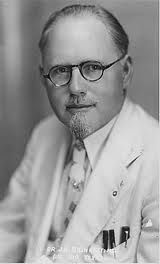
Dr. John R. Brinkley- A Story You Should Know
Grift, Goats and Gonads by Scott McLemee
Kansas State Historical Papers- John R. Brinkley
Border Radio Quackery by Gene Fowler and Bill Crawford
The Goat Gland Doctor by Joe Schwarcz, PH.D
The medical practices of God involve gland transplants along with genetic implanting or splicing. Over the years based on a foundation of Frankenstein ERB had built up a magnificent fantastical scientific edifice of life creation based on Evolution.
There can be no doubt that he read and thought about the subject a great deal. He was very well informed on evolutionary matters. He was a well educated, thoughtful, intelligent man contrary to nearly every opinion about him. His ideas as presented in Lion Man are probably as far as he could take them based on the knowledge of his time. The discovery of DNA was only a little over a decade away, actually made a few years before he died. One wonders what he would have made of it. Even then ERB’s notion of ‘germ cells’ with their indestructability contains the essence of DNA so ERB was on the right track in his thinking. I’m going to handle this out of order as the ideas explain what follows better.
ERB was familiar with the use of cannibalism to ingest certain qualities of slain warriors. Thus it was thought that to eat the brains of especially intelligent people transmitted that intelligence to oneself. To eat the flesh of a brave man made oneself also brave, etc.
From there to cellular therapy is a short step. Even though there was probably no one who believed in the physical benefits of human cannibalism this side of Africa when it came to animals parts intelligent men threw common sense out the window.
Cellular Therapy arose at the end of the nineteenth century. Joe Schwarcz explains:
Charles-Edouard Brown-Sequard, a noted French physiologist, had shocked the medical community by injecting himself with the crushed testicles of young dogs and gunea pigs. Afterwards he claimed that he had regained the physical stamina and intellectual vigor of his youth. Many men availed themselves of ‘La Methode Sequardienne’, but once the placebo effect was filtered out little remained. In Vienna physiologist Eugen Steinach proposed that youthful vitality could be restored by increasing levels of testosterone. the easiet way to do this, Steinach said, was through vasectomy. Sperm production wasted testosterone, and if the channel leading from the testes to the ejaculatory duct were tied off, then blood levels of testosterone would rise. Brinkley may also have heard of the work of Serge Vorenoff, a French doctor who was stirring u a storm of controversy with his experimental gland transplants. Vorenof had been a physician in the court of the King of Egypt, and there he had spent a great deal of time treating the court eunuchs, who suffered from a variety of illnesses. He hyposthesized that maintaining active genital glands was the secret of health. As proof, he cited his experiments with an aging ram into which he transplanted the testicles of young lamb. the ram’s wool got thicker, and his sexual vigor returned. Voreneff then went on to transplant bits of monkey testes into aging men; he claimed success, although he could offer no scientific validation of his claim. In America the stage was set for the meteoric rise of J.R. Brinkley.
Brinkley began to transplant goat glands into the testicles of his patients. As he began his career in the early 1920s radio made its appearance as a commercial entity. On the qui vive Brinkley realized its potential to increase his business and spread his gospel. He bought the first radio station in Kansas in 1923, his practice was in Melford, His call leters were KFKB- Kansas First-Kansas Best- as bold a claim as his medical ones. He was actually a fine broadcaster transmitting Country Music, weather, farm reports and other items of interest as well as infomercials for his medical practice. This notoriety brought the AMA and government down on him. By 1930 he had had both his medical and broadcasting licenses revoked.
Now, here’s where the man showed his innovative brilliance. This really got him attention. Nothing daunted he moved down to fabled Del Rio, Texas, Brinkley created the fable, across the Rio Grande from Villa Acuna. His radio station in Kansas was small, a mere 1000 watts, although probably non-directional.
In Mexico without US regulations he was able to build a boombox of 75,000 to 100,000 non-directional watts. This was later incresed, if this is believable, to 500,000 watts and tahen to1,000,000 watts according to Fowler and Crawford who really should know.

Clap For The Wolfman
Alright. When I grew up in Michigan in the 1950s I could clearly pick up the successor Del Rio station after dark when its power was only 250,000 watts. Wolfman Jack who worked the station tells an amusing story of his arrival. Driving through the desert to the transmitter he noted that all the cars parked there had left their headlights on. This mystified him but then he learned that the wattage was so powerful that headlights glowed in consequence. The air crackled around him. At a half million and a million watts people must have levitated.
So, Dr. Brinkley was much in the news all these years so that ERB as Gaitonde suggests couldn’t have missed him. While in our time there is no reason to mention La Methode Sequardienne yet with Brinkley being reviled it is quite possible ERB came across a discussion of cellular therapy in his reading which did mention these earlier experiments.
ERB has God, a formerly handsome Englishman, create a hybrid hominid between a gorilla and a human. God himself has regressed being a hybrid human/gorilla. p. 133:
“What is this strange purpose we are to serve?” asked Rhonda.
“It is purely scientific; but it is a long story and I shall have to start at the beginning,” explained God.
In the beginning. God appears to have been a medical student back in England with a strong interest in biology. p. 134:
“I had always been intrigued by Lamarck’s investigations and later by Darwin’s. They were on the right track, but they did not go far enough; then shortly after my graduation, I was traveling in Austria when I met a priest at Brunn who was working along lines similar to mine. His name was Mendel. We exchanged ideas. He was the only man in the world who could appreciate me, but he couldn’t go all the way with me. I got some help from him; but doubtless, he got more from me; though I never heard anything more about him before I left England.”
ERB gives us a fair amount of information here. He is familiar with the Frenchman Lamarck of the eighteenth century who centered on heridity. A red flag goes up on Darwin because if God left England in 1859 he would have known nothing of Darwin who published that year. In any event while Darwin’s Origin Of Species sheds light on the mechanics of the variations among a species I can’t find any evidence of how species themselves evolve. ERB is also familiar with the genetics of the monk, not priest, Gregor Mendel, who published in 1866 sending a copy to Darwin which the latter dismissed as irrelevant. However, Burroughs through God seems to have taken Darwin less seriously than Mendel.
He imples that Mendel was on the right track with his peas but that following the same line of reasoning God went well beyond him which indeed he did. Mendel was disregarded in 1866, his revival beginning in the year 1900. So Burroughs in 1930 is keeping up his reading.
Burroughs then goes on to explain God’s theory of heredity. His theory is not all that bad. It shows Burroughs obviously doing some reading and thinking on the subject. p. 134:
“In 1857 I felt that I had practically solved the myster of heredity, and in that year I published a monograph on the subject. I will explain the essence of my discoveries in as simple language as possible, so that you may understand the purpose you are to serve.
“Briefly, there are two types of cells we inherit from our parents- body cells and germ cells. these cells are composed of chromosomes containing genes- a separate gene for each mental and physical characteristic. The body cells, dividing and multiplying, changing, growing, determine the sort of individual we are to be; the germ cells remaining practically unchanged from our conception, determine what characteristics our progeny will inherit, through us, from our progentors and from us.
“I determined that heredity could be controlled through the transference of these genes from one individual to another. I learned that these genes never die; they are abosolutely indestructible- the basis of life on earth, the promise of immortality through all eternity.
It appears that ERB’s main concern is heredity and indeed genealogy was important to him. While his information is a clumsy account compared to what has been learned since then, given the times ERB was quite advanced. He doesn’t have the handle on DNA which is a decade or so in the future, Watson and Crick published in 1947, but in the germ cells he’s on the track of the right idea. The notion of the body cells is, of course, superfluous.
But now God runs up against a brick wall when he publishes his theory in 1857. Remember Mendel’s discoveries were still eight years in the future while so far ahead of their time that they will be disregarded for thirty-four years.
I don’t know what horror films have been released by this time, Dracula and Frankenstein for sure, but here the plot seems very familiar, possible Burke and Hareish. Unable to proceed in a legal manner because of society’s obtuseness God turns to criminal means, but quite novel crime.
As he has detemined that germ cells are immortal he raids the tombs of Westminster Abbey extracting germ cells from Henry VIII and his court and entourage. Thus he has a little time capsule when he is discovered and flees England to avoid blackmail. He decides to conduct his experiments on gorillas in Africa. He finds the greatest concetration of gorillas in Africa, and hence on earth, in the valleyof diamonds. In something like seventy years he converts pure gorillas into a hybrid of gorillas and humans capable of speech and human cognition. They build his magnificent City of God for him which must have been quite new when Tarzan arrived.
As they are bred from the genes of medieval Englishmen the effects of Lamarckian heredity are evident as they speak a medieval form of English and replicate the City called London after its medieval progenitor. Following Burroughs’ earlier thought in Opar the gorillas accept only beings born in gorilla form with human attributes. Sports and mutations are expelled. the other are, of course, the result of Mendelian genetics that are beings with odd combination of genes.
God was born in 1833, the same year as Burroughs’ father, thus in 1933 he is one hundred one years old. Some forty years back or so as he realized he was aging so he decided to splice in the body cells of young gorillas in a form of cellular therapy to rejuvenate himself. This worked well in preserving his youth but unfortunately the more gorilla body cells he spliced in the more gorilla-like he became, so that when Tarzan and Rhonda meet him he is a grotesque hybrid, more intellignet than the gorilla hybrids, but reverting rapidly to pure gorilla. Serious problem.
God is very pleased to capture two such fine looking human specimens as Tarzan and Rhonda because by splicing in their body cells he will be able to resume his human shape in some style.
So Burroughs has been developing his ideas in a creditable scientific way. While it’s true his actual science is speculative he is employing some fairly sound reasoning on the matter that may not have been too dissimilar from the tack taken by Stalin’s scientists, while creating a human-ape hybrid has apparently been a timeless fascination. It is said that our own scientists have succeeded in actually creating a chimp-human hybrid but that the specimens have been destroyed. I haven’t any confirmed proof that such has been done but rumors are around.
Having given a reasonable scientific explanation of the gorilla hybrids and God’s purpose for Tarzan and Rhonda, Burroughs with his usual ghoulish delight introduces his favorite topic of cannibalism. He informs the two that after satisfying his need for body cells he intends to eat them thus imbibing their characteristics. He also says that he will extract several glands from Rhonda for some special purpose.
I’m not exactly clear on what cannibalism meant to ERB. It seems he associates it with his father who was particulary hard on Burroughs in his youth which ERB may have interpreted as being eaten alive by his father. As we have God, cannibalism and his father associated here his father may be the reason for the recurring reference to cannibalism is his work.
The female glands recur again in Tarzan’s Quest where the Kavuru chief Kavandavanda requires female glands for his immortality pills and Vishwas Gaitonde finds the subject mentioned again in Tarzan The Magnificent.
So when Rhonda arrives at the Falls and is spotted from above by the seeming gorillas, she is actually spotted by a clone of the real fifteenth century Lord Buckingham in his gorilla guise.
Now begins a series of astonishments, jokes and twists such as are found in few novels. As I mentioned, today much of this is old hat, but in 1933 this was startling fresh and new. At this point we are unaware of the hybrid nature of the gorillas. The following passage then was not only startling to Rhonda but to us. p. 94:
(Rhonda) felt very small and alone and tired. With a sigh she sat down on a rounded boulder and leaned against another piled behind it. All her remaining strength seemed to have gone from her. She closed her eyes wearily, and two tears rolled down her cheeks. Perhaps she dozed, but she was startled into wakefulness by a voice speaking near her. At first she thought she was dreaming and did not open her eyes.
“She is alone,” the voice said. “We will take her to God- he will be pleased.”
it was an English voice, or at least the accent was English, but the tones were gruff and deep and guttural. The strange words convinced her she was dreaming. She opened her eyes, and shrank back with a little scream of terror. Standing close to her were two gorillas, or such she thought them to be until one of them opened his mouth and spoke.
“Come with us,” it said; “we are going to take you to God;” then it reached out a mighty, hairy hand and seized her.
There’s a shocking opener to the twilight zone between R2 and R3 as ERB prepares the curiosity of the reader for what is perhaps the most amazing story he ever told.
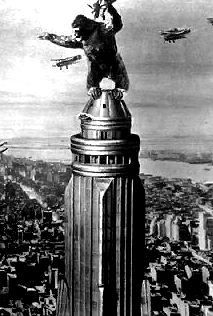
King Kong
Rhonda, physically and emotionally exhausted by the terrific events of the past few days, slips into a trance in the middle of Africa only to be brought out of it by voices speaking Enalish saying they are taking her to God. What can that possibly mean? When she opens her eyes she sees two gorillas are doing the speaking.
That’s something else, isn’t it? Had they been on the screen could they have competed with King Kong that was released in that year of 1933? Out of King Kong came 1949’s Mighty Joe Young while the public’s fascination with gorillas continued until Planet Of The Apes which, if it doesn’t owe anything to Burroughs’ story, develops the theme ad absurdam. Kong, Young and Planet Of The Apes, Stalin’s experiments all owe their origins to the Tarzan oeuvre.
Burroughs raises the theme to heights that have never been surpassed. Combining the human gorillas with the City of God was incomparable genius.
With the background clear let’s take a leap into the future.
The City Of God
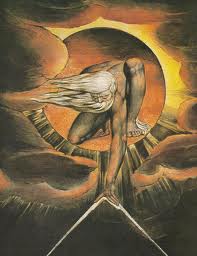
God At Work
7 b.
The whole thing seemed like a hideous and grotesque nightmare,
yet it was so real that she couldn’t know whether or not
she was dreaming.
Lion Man p. 95
In taking the ‘germ cells’ of individuals from the time of Henry VIII, as the cells were cloned with those of the gorillas the hybrids cloned the environment they knew. While clones have no mermory of a previous existence, in the popular imagination they do. Thus in the paranoid classic movie The Boys From Brazil of 1978 the number of clones of Adolf Hitler all exhibited the supposed conditioned responses of the original which they could not have experienced themselves.
At the same time ERB cleverly replicates the political situation between God, Church and Henry VIII. When Rhonda was captured, two gorillas named the Dukes of Buckingham and Suffolk quarrel over whether she is to be taken to Henry VIII or God. As we still have no idea of what is going on we are as mystified as Rhonda.
And then as Rhonda tries to order her bobbled brain she realized she could communicate with these improbably English speaking apes. p. 96:
Now she had an instant in which to think clearly, and with it came the realization that she had the means of communicating with her captors.
‘Who are you?” she damanded. “And why have you made me a prisoner?”
‘The two turned suddenly upon her. She thought their faces denoted surprise.
“She speaks English!” exclained one of them.
There’s a neat turnabout similar to when Tarzan addresses Buckingham in Mangani and the gorilla answers him in English. The gorilla exclaims, “She speaks English.”
Then follows an explanation of God, Henry VIII and Cranmer that only succeeds in confusing Rhonda further as she seems to be in some costume play in which for some inexplicable reason actors clad as gorillas are acting out a play about Henry VIII. She pinches herself to no avail. She is awake. This isn’t theatre, although Hamlet soon would be played in Nazi uniforms which is just about as ridiculous.
The gorillas take her to Henry VIII where we will leave her until she is joined by Tarzan.
While Rhonda escaped theArabs Naomi had been recaptured. In company with the Arabs she is brought to the canyon that leads to an easy ascent of the plateau according to the map. As the ascent becomes steep they leave the horses with Eyad going ahead on foot. Awaiting them at the crest is Stalin’s dream corps. Throughout the oeuvre one is always amazed at the disregard for their own well being the apes exhibit. They charge in story after story with complete disregard for their own well being. Always a signficant portion are left on the field of battle but the survivors never complain while Tarzan complacently accepts their sacrifice as his due.
So here, barehanded against the Arab firearms the gorillas launch a wave attack reminiscent of the Chinese in Korea that doesn’t stop until all the Arabs are dead. No regard at all for casualities. No wonder Stalin thought Burroughs was on to something. While the apes perform as they have always performed in Tarzan stories the difference here is that these are not mere apes but hybrids with human intelligence. If Burroughs was aware of Stalin’s experiments was he laughing at the Great Commissar? Is this battle a reference to Stalin? One can’t be positive of course but I am sure that the character of God-the formerly handsome Englishman- is partially based on H.G. Wells who was associated with Stalin.
Naomi was with the Arabs. She is captured by Buckingham who asks her how she got away from God; she is identical to Rhonda so Buckingham naturally confused her for the latter. The Apes sense of smell was not as developed as Tarzan’s. I’m sure the Big Bwana would have smelled the difference immediately.
ERB is now dealing with his sexual problems. Of the three women involved with the City of God- Naomi, Rhonda and Balza, it is necessary to sort out which woman represents what to ERB. As Naomi is weak and vacillating she obviously represents Emma. Rhonda who is strong and self-willed seems to represent ERB’s Anima ideal or in other words, La of Opar. La disappears from the oeuvre after Tarzan The Invincible of 1930 but as Tarzan and Rhonda in God’s prison replicate Tarzan and La in the Lion’s den of Invincible it seems probable that ERB has transported La from the fantasy world of Opar to the mere imaginary world of the movies. This leaves Balza- The Golden Girl- who probably represents Florence, but we will deal with her in the appropriate place.
ERB has now gotten the two women, the Arabs and Tarzan to the Falls. Orman, West and the safari are assembling at the base of the Falls so, having dissolved his story after the Bansuto attack ERB has now reintegrated it.
After a series of adventures during which Buckingham kills Suffolk, Tarzan appears to rescue Naomi killing Buckingham. At this point in Burroughs’ psychology he assumes the identity of his ordinary self and that of Tarzan into one being. As the movie people have never seen Tarzan they assume that he is Stanley Obroski his identical twin. Tarzan does not correct anyone but allows them to believe he is Stanley.
As I perceive it then ERB has now deluded himself into believing that he is Tarzan. Those who know him still perceive him as Ed Burroughs. He has no choice but to let them believe that because if he attempted to impose his delusion on them he might have been committed. Thus for a period of about five to six years from 1934 to 1939-40 Burroughs perceives himself as Tarzan but capitulates in Tarzan And The Madman giving up his illusion of being the Big Bwana. In Lion Man he describes Tarzan as a madman so the two novels are linked by the concept of madness.
After writing Madman Burroughs left California for Hawaii where he forced Florence away from him. WWII came along which saved him from himself. After the war he went back to LA to die. It is interesting that he didn’t choose to live in Tarzana but bought a house in Encino that backed against the Promised Land. thus like Moses, with whom there was a connection made in Tarzan Of The Apes, ERB was destined to view the Promised Land but not enter it.
In Lion Man he is flush with the hope of being able to live out his fantasy. He is now a few months from abandoning Emma so symbolically he returns Naomi to the safari at the Falls from whence she disappears from the story.
Only Rhonda and Balza will figure in the rest of the story. Emma is no more although Jane will appear again in Quest probably as Emma’s replacement Florence. In Magnificent Florence is mentioned only anonymously as Tarzan’s ‘wife.’ ERB is definitely struggling.
Having delivered Naomi to the safari Tarzan then reascends the plateau in search of Rhonda and the City of God.
The City Of God
7 c.
Every one of us, I believe, is possessed of two characters.
Often time they are so much alike that the duality is not noticeable,
but again there is a divergence so great
That we have the phenomenon of a Dr. Jekyll and Mr. Hyde
in a single individual.
E.R. Burroughs- The Swords Of Mars
Tarzan And the Lion Man was followed at the end of 1933 by the Mars story The Swords Of Mars which features the return of John Carter. ERB had taken a vacation from Emma returning to the scene of his own early adventures- Arizona. Not coincidentally in the White Mountain of Apache country. ERB’s motivations are sometimes obscure. He was in the Army in Arizona in 1896-97 which was before he married Emma. So he took his leave of absence from Emma to a place before he married her. Setting the clock back, so to speak, somewhat reminiscent of The Eternal Lover.
Just as Tarzan and Stanley met in Lion Man so while about to go to sleep, O.B.- The Other Burroughs- hears the door open, the clank of a man in war gear walking across the floor; terrified like an adolescent in a bad dream, O.B. is relieved and pleased when John Carter, back from Mars, greets him. A real Jekyll and Hyde situation. Thus as with Tarzan and Stanley the two Martian aspects of Buroughs are reunited but not melded. John Carter then tells O.B. a bedtime story as though Burroughs were a child again. I’m not that familiar with the Mars stories but there must be a connection to Lion Man and the MGM situation. This must be true because this is the novel in which the opening letters of each chapter spell- TO FLORENCE WITH ALL MY LOVE, ED. One assumes then that although the decision to leave Emma was difficult to make, ERB made the final decision in the Arizona mountains.
So now a few months earlier Tarzan/Stanley makes the journey to the City of God where he will be reunited with his Anima ideal, Rhonda -La of Opar- in prison. Thus his whole person both Anima and Animus are locked up by MGM.
Rhonda had been taken to Henry VIII by Buckingham and Suffolk. The city was called London, the country England and the river The Thames. As ERB jokingly smirks- The English always take a little bit of England with them wherever they go. Pretty funny, actually.
Here the events of Henry’s reign are being reenacted. As the apes are clones of Henry and his court who replicate their times one wonders whether each succeeding generation will be stuck in this one period of history reenacting it over and over until the end of time. Once again I am reminded of The Eternal Lover. ERB seems to be obsessed by the idea of time.
Rhonda was first placed with the wives of Henry, a week later being moved to a cell in God’s castle where Tarzan found her when he too was captured.
For now he was moving through the night until he came up against the ten foot high wall surrounding the City of London and within it the City of God. Here we have the historical confrontation between the spiritual and temporal powers. At the least the story is a very humorous parody of the religious situation of Henry VIII. Once again ERB ridicules religion and this is done so cleverly and with such genius.
But there are many levels of meaning. Earlier I mentioned that the capture of Tarzan may have been meant to replicate ERB;’s capture by MGM. In that sense then the City of God might represent MGM which boasted that it had more stars then Heaven. So there is probably a joke there too.
On the other hand, God is described as a formerly handsome Englishman. The only candidate for that role I can come up with is ERB’s bete noir, H.G. Wells. I think that I have adequately documented the literary feud between Wells and Burroughs. Wells began well with his scientific romances. While not as fresh and stunning as they were at the time of issue they still hold up well today. Even though ERB denied having ever read Wells I think that claim can be dismissed out of hand. ERB, then, would have been as impressed with Wells’ early romances as anyone else. Then when Wells began his campaign of defamation and ridicule which is most clearly represented in his Mr. Blettsworthy On Rampole Island he fell from favor in Burroughs’ eyes, hence the grotesquely deformed ‘formerly handsome Englishman.’
As much as I like Wells he does pontificate. Like all Liberals he has a difficult time distinguishing his opinion from truth, right and wrong, or reality. While he does sometimes make a hit in his prophesying he is mostly wrong. Backing the Worker’s Paradise of Stalin’s USSR was certainly wrong and more than enough to discredit him in the staunch anti-Communist Burroughs’ eyes.
Wells probably shook Burroughs’ faith in the glory of England which had been a keystone of his secular faith fromt he beginning. Thus, combining MGM, Stalin and the USSR and Wells, Burroughs packages all the troublemakers of this perilous time for him into one big box with a bigger bow on top.
As his story could have no effect on his situation let us hope it was at least cathartic for him. When Tarzan ends up in the cage with Rhonda that about epitomizes Burroughs’ situation vis-a-vis MGM, Stalin and Wells. There are so many coincidences here that the brain revolves like a turret. Was it wholly coincidental that Wells showed up in Hollywood at the end of ’35 to visit fellow Red Charlie Chaplin just as Burroughs was completely boxed in because of his Guatemalan adventure?
Isn’t it amazing that Burroughs met his fate in Guatemala, the scene of the adventures of his early hero General Christmas and also the scene of some of the adventures of Ogden McClurg who was killed shortly after this return from the area in 1926? It may be truly coincidental but the further one digs very often the more dirt one turns up.
Burroughs may have felt confident he could write his way out of this box just as he was able to escape by self-publishing in 1930; perhaps he thought he could escape this time by making his own movies. If so, a little analysis would have shown him that the rules had drastically changed. Especially as he had signed the rights to represent his character Tarzan away.
Coincidental with the release of the MGM Tarzan movies which preempted the nature of Tarzan from literature came the decline in Burroughs’ own literary powers. Whereas in 1930 he was able to respond to the challenge with a series of top novels, after Lion Man there is a preciptious decline in the the quality of is work. While the later novels have their charms for Burroughs’ admirers they do lack commercial appeal.
By 1935 also Burroughs had antagonized radio which had become the major source of his income so that that medium was closed to him during his lifetime. With publication revenues declining and the comics by Burroughs’ own admission producing a pittance, ERB had only one major source of income left and that was the moves. MGM had him over a barrel.
MGM might have produced a whole series of Tarzan films along the lines of the Charlie Chan movies as Burroughs reuefully remarked but they chose instead to issue only four movies between 1932 and 1939. Obviously the makret would have borne more. The limited release schedule kept EBB on a short financial tether.
It is said that events cast their shadow before them so that it is possible, if not probable, that Burroughs foresaw the shape of things to come even as he wrote Lion Man.
In 1930 when the Reds invaded his dream land of Opar ERB abandoned that fantasy. The fabled city ceased to exist in his imagination while disappearing from the oeuvre. Now in Lion Man it appears that the enemy had captured the castle while building a ten foot wall around it with Tarzan/Burroughs on the outside. Thus Burroughs’ dream of separating himself from the world by a tne foot wall has been inverted in his imagination. He wasn’t keeping the world out; the world was keeping him out.
In the novel succeeding Lion Man, The Swords Of Mars, when the mad inventor Fal Sivas quails at taking hsi invented spaceship to the Martian moon Thuria the following exchange takes place between he and John Carter:
“But you built this ship to go to Thuria,: Carter cried. “You told me so yourself.”
“It was a dream,” he mumbled; “I am always dreaming, for in dreams nothing bad an happen to me.”
Fal Sivas can be taken as an alter ego of Burroughs. The Sivas probably refers to the Hindu god Shiva or Siva with whom Burroughs had become a devotee or developed a fascination for. Thus while his heroes Tarzan and John Carter are men of action Sivas/Burroughs or any other combination is not.
So in Lion Man Burroughs is desperately trying to become the man of action rather than the dreamer. The problem now is that ERB himself is past the point of no return. He has been walled out from the City of God.
In dreams however Tarzan enters the Heavenly City by a fantastic feat of strength that recalls Burroughs’ 1890-1920 infatuation with the Strong Men such as the Great Sandow.
The wall which Tarzan fancies was built to keep out lions i.e. the Lion Man has sharpened stakes pointing downward. p. 124:
…he leaped for the stakes. His hands closed upon two of them; then he drew himself up slowly until his hips were on a level with his hands, his arms straight at his sides. Leaning forward, he let his body drop slowly forward until it rested on the stakes and the top of the wall.
That seems to be an impossible feat of strength except in dreams, but then by this point Tarzan thinks he is dreaming. This might as well be an MGM movie lot such Burroughs spent five weeks on. Here the dream faces a sort of reality. As though pasing through a movie set as ERB must have done during those five weeks Tarzan comes to the steps leading to the Heaven of God. this Stariway to Heaven, Jacob’s Ladder.
As if to accent the relationship to MGM he passes the Apes of God who are dancing and partying. The scene will be replicated at the foot of the Falls when the movie company duplicates this scene thus strengthening the connection with MGM.
Tarzan begins the long climb up the Stairway to Heaven. The fire flares illuminating him on the steps but the apes below don’t notice- high above on a parapet of Heaven, God does. Note the resemblance to the move castle of Frankenstein. A man of action God quickly prepares a trap.
In real life the trap was probably the promise of the contract and money. ERB blames the movies for being duplicitous, which is definitely true, still, he had had a dozen or more years to work out the conditions prevailing on his own. After all, by 1932 he had proven product to sell. The public had even given a profit to some pretty crummy movies so that had he taken the time, acted on his own conditions, rather than just signing for a few quick bucks he might have retained a position of some control, made himself an equal partner. So, while MGM did betray him he might have been able to manage the situation.
Tarzan enters the castle to be confronted by six doors of which only #3 is open. Depending on how you count them there were six to eight major studios, thus the six doors may represent the Studios of which only MGM was willing to deal with him. Remember he had been blacklisted since 1922, the blacklist having been broken in 1928 by Joseph Kennedy.
Tarzan descends the stairs as heedlessly as Burroughs signed the contract and like Burroughs he finds himself trapped. The nose of noses sniffs the air and detects the delicate scent of a White woman. He has found she whom he sought, Rhonda.
7 d.
The Confrontation With God
Now Tarzan is reunited with his Anima ideal in the person of Rhonda formerly La of Opar. That Rhonda can be associated with La is because this scene is a replication or double of Tarzan and La in the lion’s den of Invincible. There La and Tarzan were imprisoned in a cell beneath Opar. They escaped the cell in a duplication of their escape from this prison. In Invicible there was a runway within which the lion fed. A shaft led upward to a room in a tower. There the old man who betrayed them discovered them.
In this case a breeze passing over the floor indicates an air shaft to Tarzan. This is probably borrowed from Rider Haggard’s King Solomon’s Mines although it will soon if not already be a staple of the movie genre. Tarzan locates the shaft in the ceiling in a corner of the cell. He and Rhonda ascend it to the opening in front of which God is talking to some gorillas. Thus the scene virtually duplicates Invincible. La and Rhonda must be associated in ERB’s mind.
As an aside Burrughs uses a variation of this scenario in The Swords Of Mars when John Carter is imprisoned. There are beams some twenty feet ot so above the floor to which Carter leaps. He takes a position above the door dropping on his keeper when he enters.
At this point in the story Tarzan and Stanley Obroski may be considered to be reunited as one persona. Rhonda, who has never seen Tarzan, addressed the person in Stanley’s guise as Stanley. ERB has a little fun as he has Tarzan play along.
As he says in Swords, he is convinced that every man has a dual Animus, that is two different aspects, sometimes nearly identical but sometimes as different as Dr. Jekyll and Mr. Hyde. Thus at this point his mind is impressed with Shelley’s Frankenstein and Stevenson’s Dr. Jekyll And Mr. Hyde. He had read both novels before 1900 while both stories were released as movies in 1931. So the stories are very fresh in his mind.
Tarzan/Obroski may be considered of the Jekyll/Hyde variety. There is little doubt that Burroughs saw the pair and himself that way. Thus Carter and Fall Sivas in Swords may also be seen as two sides (Jekyll/Hyde) of the same persona. Tarzan does not try to convince Rhonda that he is not Stanley, but in the Jekyll side of the persona he astounds here with Hydelike feats compelling her to reevaluate him.
There are undoubtedly snippets of other horror movies here that ERB has seen also but I can’t remember the titles or dates. There was one about two Scottish body snatchers Burke and Hare which I think I can detect here and another about a mad doctor who operated on the brains of abducted victims that shows up here and in Swords that was called the Black Sleept or somesuch. The latter would have had a castle along these lines as well as Frankenstein. Of course, which of that ilk of movie didn’t? Burroughs is combining an astounding number of influences here both literary and cinematic but both combined.
Thus, having availed himself of ‘such a God given opportunity’ to find Rhonda he is imprisoned with her. The joke was ERB’s. You know, God left the doors open- God given opportunity. I chuckled softly to myself as I read.
After an exchange of repartee between Stanley/Tarzan and Rhonda God makes his appearance. Not exactly what one would expect God to look like. In fact it is almost amazing that the fundamentalist Christians didn’t create an uproar. After all according to the Old Testament man was created in God’s image. There’s a laugh. Here’s the image. p. 128:
It had the face of a man, but its skin was black like that of a gorilla. Its grinning lips revealed the heavy fangs of an anthropoid. Scant black hair covered those portions of its body that an open shirt and a loin cloth revealed. The skin of the body, arms, and legs was black with large patches of white. The bare feet were the feet of a man; the hands were black and hairy and wrinkled, with long, curved claws; the eyes were the sunken eyes of an old man- a very old man.
The Scopes Monkey Trial had only been about seven years before. So here Burroughs is making sport of God with a sort of reverse evolution. God is a cross between a man and a gorilla. Yet ERB led such a charmed life that his mockery or parody of God created no comment. If he wanted to start a ruckus to promote his book sales he failed miserably.
God might have been half ape but he had a whole hearted sense of;humor. Overhearing Tarzan say that he had come for Rhonda his opening comments are mock injury. p. 128:
“So you are acquainted?” He said. “How interesting! And you came to get her, did you? I thought that you had come to call on me. Of course it is not quite the proper thing for a stranger to come by night without an invitation- and by stealth.
“It was just by the merest chance that I learned of your coming. I have Henry to thank for that. Had he not been staging a dance I should not have known, and thus I should have been denied the pleasure of receiving you, as I have.
“You see, I was looking down from my castle into the courtyard of Henry’s palace when his bonfire flared up and lighted the Holy Stairs- and there you were!
Burroughs is justly criticized for the occasional bit of wooden dialogue but I find the confrontation with God very well written. The constantly mocking tone of God is carried off very well. Tarzan’s indignation is very well executed. The influence of Shelley, Stevenson and the various movies is seamlessly blended into a very tightly executed scene.
All this is done in a very few pages while it is a remarkable bit of writing.
God hints at his motives for their use for him. p. 129:
“…I shall keep you for a while for the pleasure of conversing with rational human beings.
“I have not seen any for a long time, a long, long time. Of course I hate them nonentheless, but I must admit that I shall find pleasure in this companionship for a short time. You are both very good looking too. That will make it all the more pleasant, just as it increases your value for the purpose which I intend you- the final purpose, you understand. I am particularly pleased that the girl is so beautiful. I always did have a fondness for blonds. Were I not already engaged along some other lines of research, and were it possible, I should like nothing better than to conduct a scientific investigation to determine the biologial or psychological explanation of the profound attraction the blond female has for the male of all races.”
Burroughs doesn’t tell us how blonde Rhonda and Naomi are, whether they are platinum blondes like Kali Bwana or merely blondes. Of course today ERB would be censored for his handling of the sexual and racial preferences for blondes but it is a recurrent theme in his writing and one worth studying.
Having piqued our curiosity as to his purpose for the couple God leaves to check up on Henry. p. 130:
“Come back here!” (Tarzan) commanded. “Either let us out of this hole or tell us why you are holding us- what you intend doing with us.”
The creature wheeled suddenly, its expression transformed by a hideous snarl. “You dare issue orders to me!” It screamed.
“And why not?” demanded the ape-man. “Who are you?”
The creature took a step nearer the bars and tapped its hairy chest with a thorny talon. “I am God.” it cried.
There you go. The cat’s out of the bag.
The scene is dramatically successful while the reader is now left to guess the model for God. We are told that he was a formerly handsome Englishman now deformed as a hybrid ape-human. The city is London, the territory is England and the river is the Thames. A reasonable place to look would be among the English. Who among the English is bedeviling ERB? H.G. Wells is the only one I can think of. Regardless of whether Wells considered himself a Communist or not he is sailing his craft so close to the wind that it is impossible to distniguish between the two. At the very least Wells is throughly subversive. If anything he resents not being in Stalin’s place. So Burroughs must consider him Communist.
To my mind then, Burroughs is mocking Wells much as Wells mocked Burroughs in ‘Blettsworthy.’ God has delusions of grandeur and so does the highly pontificating Wells. My vote for the model is Wells.
One also notes that in the last of the MGM Tarzan movies, 1942’s Tarzan’s New York Adventure, Tarzan is captured by the circus roustabouts and thrown into a mobile cage. The camera then pans around to front which identifies the cage as a lion cage. One thus has the joke of the Lion Man in a lion’s cage. A final thumbing of the nose at Burroughs exiled in Hawaii. MGM then dropped what had been a very lucrative series. Strange behavior indeed.
God then returns to give his history as detailed earlier in the essay. While for some reason everyone, fans and detractors alike, wants to think of Burroughs as a semi-literate boob who is coincidentally a ‘master of adventure’ yet both in content and exposition, God presents his story in a masterly way. In 1930 there may have been few of his readers who had ever heard of Mendel and possibly Lamarck, although one hopes all had heard of Darwin. So it is possible that a reader might have been puzzled by the inclusion of Darwin while dismissing Larmarck and Mendel as fictitious. Of course if you’re reading strictly for fast-paced adventure you may not notice the details even though they are far from concealed.
God also clears up the mystery of the map. Surprisingly the map is not a stage prop but authentic. In fact, God made it about seventy years previously. It seems that he had been in love with a women back in England but she preferred wealth to being the wife of an impoverished scientist.
This may be a coincidence but that is the premise of the plot of H.G. Wells’ In The Days Of The Comet. Perhaps it was a message to Wells in case he hasn’t gotten it yet. But then God discovered the immense number of diamonds in the valley so he wrote the girl promising her riches beyond imagination. He had employed a native runner to take the letter to the coast to mail it but since he had never had a reply he wondered if it had ever been received. Now it came back to him. A simple but inventive twist.
When God leaves this time Tarzan sets to work to escape. Following the draft across the floor he finds the air shaft. Just as in Invincible he sends La up first now he sends Rhonda up first. As in the earlier story they are trapped at the top.
Looking through the entrance to the shaft they spy God and some gorillas in front of it. Their escape is spoiled. Now begins the Gotterdamerung.
The City of God
7 e.
The Gotterdamerung
Burroughs now has both aspects of his Animus with his Anima trapped in the tower unable to go foward or backward. God and his gorillas stand in anticipation before the opening. Burroughs has been stalemated. At this point one aspect of God must be MGM and its contract.
ERB has spun out his fantasy in a plausible way to this point, but now he has to find a way to resolve his dilemma. As he is daydreaming and this is a mad dream, as Fal Sivas says in Swords, in dreams nothing bad can happen to you. In this bind something bad can happen to ERB. He can lose his grip on reality. In that way he becomes mad or insane which is what the story is about.
In speaking of Henry God might also be speaking of ERB. p. 143:
“You all forget,” (God) cried, “that it was I who created you; it is I who can destroy you. First I shall make Henry mad, and then I shall crush him. That is the kind of gods humans like- it is the only kind they can understand. Because they are jealous and cruel and vindictive they have to have a jealous, cruel and vindictive god.”
There’s a lot information in that quote. It refers to the ancient Greek saying: Those who the gods would destroy they first make mad. So we have an excellent joke here. The incredible mind of Burroughs can conceive humor in the midst of the blackest despair.
He is talking of the Yahweh of the Old Testament while he quite soundly understands that god is a psychological projection of the mind of his creator. In a masterly grasp of Freudian group psychology, whether he knew it or not, he realized tha the people have created a god in their own image and not vice versa. Trapped in the tower this is a real agonized cry of despair before losing his grip on reality.
I don’t mean to say that ERB went stark raving mad but he edged into a fantasy world at least once removed from the fantasy he had been living since 1912. For the period of his marriage to Florence he can only be described as spaced out. Bear in mind that it’s going to get worse as he gets trapped into his movie production experience.
The Masenas in The Swords Of Mars make the threatening moves on John Carter who keeps backing away. Only too late he realized he had maneuvered himself where they wanted him. The Masenas were cat-men, i.e. lions who had two mouths. In a sly way Burroughs is caricaturing the Jews of MGM and their mascot Leo the Lion. The upper mouth which is sort of pursy and purring to seduce one, is above a lower mouth that is all teeth and no lips to rend one. So he is saying that he is dealing with two-faced people. While the upper mouth is assuring, the lower rending mouth is ever ready to destroy you.
Tarzan realizes that he has no choices left but to stay put or rush God and the gorillas. Alone he would have had a chance of success but with Rhonda in tow he is lost. This is an interesting reflection on the relationship of the Animus to the Anima. I’m at a bit of a loss to explain this.
God had sent for Rhonda to be told that she was not in the cell. Knowing that Tarzan was in the air shaft it followed that Rhonda was too as neither could have escaped the cell otherwise. He orders smudge pots to be lighted to smoke them out. Thus Burroughs acknowledges that his own situation is untenable while he has no solution. The only one left is the Samson like effort of pulling the temple down on his own head destroying both himself and his enemies.
God’s plan backfires as he sets his own castle afire. Unable to stand the smoke any longer Tarzan rushes out to be felled by a blow from one of the apes. At this precise point ERB goes mad or loses his mental balance. I don’t believe there is a Tarzan novel in which the Big Bwana isn’t knocked on the head at least once. In this case when he gets up he won’t have lost his memory but he will be a different man, another round of emasculation.
Once again he is separated from his Anima. Rhonda is spirited off to Henry. God and Tarzan are trapped on the patio as the castle becomes engulfed in flames.
This chapter is appropriately titled ‘The Holocaust.’ In its way everything that ERB had hoped and dreamed goes up in flames with God’s castle. Heaven is reduced to ashes.
Tarzan has his trusty rope so he can escape over the parapet to the roof of a lower level. God begs him to save him which Tarzan reluctantly does.
Tarzan, one has difficulty in styling him the Big Bwana in this emasculated state, reverses the actual situation between Burroughs and MGM by placing the rope around God’s neck putting him on a short tether. Henry is now in full revolt. Tarzan agrees to help God in exchange for his help in recovering Rhonda and letting them leave. Perhaps Burroughs was asking MGM for a release from his contract. Let by Tarzan the forces of God defeat Henry.
I’m not clear who Henry represents or if he is meant to represent a real individual. Aware of his defeat Henry abandons his wives for the blonde White woman, Rhonda. He has a secret subterranean escape route. Thus Burroughs, who through Tarzan stormed the gates of Heaven, the heights of consciousness, has first returned to earth and now slips back into the subconscious. In all probability then, his attempt to integrate his personality had failed while coming so close.
Henry had followed his tunnel to emerge into the valley of diamonds and mutants. Here he encounters a lion. Throwing Rhonda down he runs from the lion which we all know is the exact wrong thing to do. Rhonda then escapes.
Tarzan emerges from the tunnel just as the lion is rending Henry. So Henry perishes. Tarzan sets off into the valley of diamonds in pursuit of Rhonda or, in another word, his Anima.
The City Of God
7 f.
The Golden Girl
While one is astonished that there was no uproar because of ERB’s treatment of God, Heaven and the gorillas, one is even more astonished that at no time since 1912 was ERB ever under attack for his views on evolution. The oeuvre is a veritable compendium on the various possible results of evolution yet no one ever said a word nor has to this day.
In LIon Man which treats of evolution in perhaps his most daring way yet, his effort is met with stony silence. God, in his creation of the hybrid gorillas according to the logic of Gregor Mendel, had a large number of sports and variations. The ‘normal’ hybrid apes refused to accept these either killing them or driving them from their society.
God laments that the tendency to exclusivity, or like to like, was such a strong characteristic of the new species that he could do nothing to break the hybrid’s attitude. This must be a wry comment on those who wished to break down racial and special barriers.
Apart from the role of White women in racial politics, which ERB through God has already commented on, there is not, nor will there ever be, inclusivity of different races on the pshysiological level nor even on the intellectual level of religion.
Thus the theme of separation in this spurious London, England was a variation on Opar where normal males were killed producing the ape-like male Oparians, while only the beautiful females were preserved. In this case the rejected hybrids, who bear some resemblance to the Hormads created by Ras Thavas, have taken up residence across the Thames. Among them, as one might suppose, Mendelian genetics predicts, were two human looking specimens. The male who was perfectly human in form had a gorilla mind; the female although rumored to have a gorilla mind in fact was a perfect human in mind while also possessing a normal human form.
She is the mate of the human looking male as kind mates with kind. Tarzan, having recovered Rhonda, finds Balza, which means Golden Girl, being abused by her mate. He rescues her but the trio is set upon by the whole tribe of mutants.
Balza explains to Tarzan that having defeated her former mate Tarzan has claimed her for his own. She is his, will-he or nil he. She then becomes hostile to the Anima figure of Rhonda.
So now we have a difficult psychological situation. Burroughs, who believes that every man is of a dual personality, has first united the two Lion Men and has now killed off one half of the duality leaving Tarzan as a single psychological unit. Not integrated but half a man so to speak. This is in violation of his stated belief which he has clarified no further. At the same time Balza seems to be driving his old Anima figure of La/Rhonda away, replacing her. Thus this Wild Thing becomes both Burroughs’ Anima ideal and human woman. We have single with single, or half with half. Now we have a single Animus, the Lion Man, Tarzan and Wild Thing as his Anima and woman. This is quite a combination. That would certainly explain the nature of the next several years of ERB’s life when he seems to run completely off the rails.
He expresses this in his work of the thirties in different ways. The Venus series is born out of this conflict in the second half of 1932 subsequent to the release of the movie Tarzan, The Ape Man. John Carter does reappear at the end of 1933 in The Swords Of Mars but Burroughs in the Venus series creates a much lesser man than either Carter or Tarzan; Napier is a pale shadow reflecting Burroughs neo-emasculated state.
In the first venus volume Napier heads for Mars in his rocket ship. Mars or the Greek Ares is the manly planet. But now suffering from his further emasculation Burroughs no longer feels capable of competing with men on Mars. Thus Napier has miscalculated the influence of the Moon, or female influence, which bends his trajectory sending him to the female planet Venus instead. In terms of classical mythology with which Burroughs was very familiar the Moon represents the feminine principle, while Venus, the Roman form of the Greek Aphrodite, represents the force of Love. Thus in symbolical terms ERB/Napier is diverted from the Manly principle of Mars by the female principle of the Moon and sent to the planet representing domination by the feminine principle of Love. Napier is not a warrior.
In Lion Man, written a few months after The Pirates Of Venus Tarzan follows his female Anima principle, Rhonda, into the valley of diamonds, where he is attached to The Golden Girl, Balza. In Burroughs’ terminology diamonds represent the realization of his sexual hopes. So Rhonda in this instance can be taken to represent Napier’s moon who leads him to Balza, the planet Venus or Florence. Burroughs is now severely handicapped in his conflict with MGM. In this chapter of Lion Man when he catches up with Rhonda comes across Balza being beaten by her man, the sport with the human appearance and gorilla brain. Balza had been misrepresented earlier, actually having a human brain. She now attaches herself to the emasculated Tarzan.
In their flight from the mutants- Tarzan running away again- they discover a pit full of diamonds. Presaging Tarzan And The Forbidden City in which the father of diamonds is a piece of coal, the huge pile of diamonds has lost any value to him. Thus Burroughs senses in 1933 that love is going to be a serious disappointment.
As a matter of fact in his psychological malaise Balza/Florence seems to have lost any value to him. He leads the women to the foot of the Falls where they rejoin the movie company who are living riotously. Their dance is a double of the Dum Dum like dance of the gorillas. Not a favorable comparison, perhaps indicating that man has not advanced much from the apes. Leaving Balza to become a movie star Tarzan returns to the jungle to find Stanley dead, thus the dead Stanley is rather unaccountably accepted by the movie company who return to LA. The whole story becomes a sort of mirage which, while we know it did happen, never happened.
ERB as a writer has now completed Ring 2. He completes his Ring construction by returning to the site of Ring Left 1, Hollywood as Ring Right 1. As Holtsmark notes he has followed the classical mode of Homer. He has not only done that but written his most perfect example. I find Lion Man masterly on all levels, in fact, ERB’s Magnum Opus.
A year after the movie company returned to the US Tarzan himself undertakes a visit to the film colony of Hollywood.
Go To Part 8, More Stars Than There Are In Heaven
Part 4, Tarzan And The Lion Man: A Review
May 17, 2008
A Review
Themes And Variations
The Tarzan Novels Of Edgar Rice Burroughs
#18 Tarzan And The Lion Man
Part 4 of 10 parts
by
R.E. Prindle
First published on the ezine, ERBzine
The Safari To The Capture Of Stanley Obroski
I consider this novel to be the magnum opus of the Tarzan series. If it doesn’t have everything it’s not lacking anything essential. Like most of Burroughs’ stuff the story expands in the transition from the page to the mind. This one blossoms into a giant bouquet. The enormous spectacular story is condensed into a hundred eighty-five pages. As always the pace is astonishingly rapid while entirely coherent; nothing is left our nor is the story jumpy.
Do the critics condemn ERB? Well, he was somewhat of the same mind as H.G. Wells of whom it was said:
“…he…had a horror of being ambushed in the grove of academe. ‘Better the wild rush of the Boomster and the Quack,’ he told Henry James in 1912, ‘than the cold politeness of the established thing.’
As quoted by W. Warren Wagar, H.G. Wells:
Jouranlism and Prophecy 1893-1946, Houghton Mifflin Co. 1964, p. 12
ERB put it a little differently when he explained that every once and a while an important novel came along but that those were few and far between. Even time erases that significance except for the specialist. Burroughs is still read both by the specialist and the hoi polloi.
That this book was important for the author is evident by the extended period of time of writing, for him, of 110 days that he took to write the novel. He wanted it to be his major best seller in which hope he was disappointed.
After a very amusing, even funny, first chapter ERB got his story rolling in the chapter titled ‘Mud’ in which in a masterful five and a half pages he introduces his story in media res, places the scene and introduces several key characters. The atmosphere is terrific. In just five and a half pages!
The amount of content in the first paragraph is actually astonishing. p. 11:
Sheykh Ab El-Ghrennem and his swarthy followers sat in silence on their ponies and watched the mad Nasara sweating and cursing as they urged on two hundred blacks in an effort to drag a nine-ton generator truck through the muddy bottom of a small stream.
The quote features a unique spelling of Sheykh which ERB didn’t use again reverting to the usual Sheik An oddity. Plus he couldn’t have gotten more letters into the Sheykh’s title. That the Sheik and his followers are not good guys is indicated by the word ‘swarthy.’ If you’re swarthy you’re bad. ERB confirms this as he contrasts the idle Arabs on their ponies with the ‘mad Nasara sweating and cursing.’
Arabs don’t do the work of the world, they get others to do it for them. Thus for a thousand years they had depopulated Africa in the search for slaves to fetch and hew. Their contempt for the mad Nasara, or White people, who are working alongside the Blacks is apparent and accurate. ERB is a superb multi-culturalist who has studied cultural attitudes, in fact, he could have invented the term. He is not of either the utopian or sentimental multi-cultural schools however but of the factual kind.
In the next two pages ERB instroduces the female leads Naomi Madison and Rhonda Terry while quickly establishing their characters. Then he quickly brings attention back to the Arabs. p. 12:
Naomi: …It is no more your fault that you can’t act than it is the fault of that sheik over there that he was not born a white man.”
“What a disillusionment that sheik was!” exclaimed Rhonda.
“How so?” asked Blaine.
“When I was a little girl I saw Rudolph Valentino on the screen, ah, brothers, sheiks was sheiks in them days!”
“This bird doesn’t look much like Valentino,” agreed Blaine.
“Imagine being carried off into the desert by that bunch of whiskers and dirt! And here I’ve been waiting all these years to be carried off.”
Once again we are advised of the unsavoriness of the Arabs while ERB evokes the sentimental memory of Valentino, the female hearthrob whose funeral in 1926 was swamped by adoring admirers.
He contrasts the film variety to the real thing by portraying the real thing as ‘whiskers and dirt.’ In the novelistic manner he also gives the premonition that Rhonda will be carried off by this repulsive speciment. We are alerted to watch for when.
Then the spotlight is turned on the Sheik who explains the Arab presence:
“Which of the benat, Atewy, is she who holds the secret of the valley of diamonds?”
Thus we are advised again what to expect but not when. The secret is, of course, a map of doubtful authenicity. The map serves the function of the Jewels Of Opar, the locket of Ant Men and Kali Bwana of Leopard Men. It is full of astonishing surprises not least of which is that it is an authentic map. Working all that out must be part of the reason the book took 110 days to write.
ERB then once again denotes cultural differences between the Arabs and Whites. Not in any sense derogatory to the Arabs but merely noting cultural differences in interpretation. Once again this novel will be an exploration in multi-culturalism
ERB then introduces the director, Tom Orman. p. 14:
Sweating, mud covered, Mr. Thomas Orman stood near the line of natives straining on the ropes attached to a heavy truck. In one hand he carred a long whip. At his elbow stood a bearer, but in lieu of a rifle he carried a bottle of Scotch.
Well, that’s quite a description. Orman is down in the mud ‘working’ which might be commendable by Western standards but not Arab and the long whip indicates he is a cruel taskmaster, once again by Western standards, and the bottle of Scotch gives the reason why. After some quick but comprehensive scene setting and character sketching the safari gets underway. By now we know everything we have to know to get a complete image of the story in our minds.
There may be people who say ERB can’t write but I defy anyone to do a better job in as few pages. Henry James would have taken a hundred fifty and accomplished no more.
In the next seven pages ‘Poisoned Arrows’ ERB rings the story to a crux, even a mini-climax.
ERB once said that he learned Greek and Latin almost before English and that it affected his writing. I found that difficult to understand until I recently read Erling Holtsmark’s Tarzan And Tradition. Holtsmark points out that Burroughs used the ring construction of the Iliad and the Odyssey of Homer rather than the current construction of a sequence of events leading up to a grand climax and out. As one is used to the modern usage of the climax the ring construction makes Burroughs read awkwardly. If one bears in mind the ring construction the stories become more comprehensible.
In Lion Man ERB constructs a perfect ring novel.
The opening and closing Hollywood scenes form the outer ring. Thus once Burroughs wrote The Conference he was obligated to write a closing Hollywood scene. The safari sequence is balanced by the story of God. The story of the twin Lion Men is balanced by the story of the twins Naomi and Rhonda just before the story of God. The inner ring of the concentric circles is the transition from Bansuto territory to the Omwamwi Falls. If one reads the novel with this construction in mind it reads very smoothly.
In addition it appears that ERB was writing a movie scenario as each chapter represents a scene in a movie. After all ERB appears to be telling MGM how to write a truly imaginative movie quite superior to the rather commonplace story of Cyril Hume. Hume essentially wrote an H. Rider Haggard story based on The Ivory Child leaving out the imagination. ERB even supplies snappy dialogue that would come across well on the screen.
So, in this scene the Bansuto of Rungula begin a series of guerilla attacks to set up the next scene ‘Dissension’ while allowing ERB to develop characters and internal tensions. In Dissension the porters warn that they will desert if Orman doesn’t retreat and take the longer way around. Also ERB develops the relationship between Obroski and Naomi while once again contrasting the characters of Naomi and Rhonda.
ERB makes an interesting comment in this chapter. On p. 26 he says:
“No,” (Naomi) acquiesced thoughtfully, “that wouldn’t be good. He’s (Orman) got a nasty temper, and there’s lots of things a director can do if he gets sore.”
“In a piture like this he could get a guy killed and make it look like an accident.” said Obroski.
She nodded. “Yes. I saw it done once. The director and the leading man were both stuck on the same girl. The director had the wrong command given to a trained elephant.”
Here ERB must be alluding to Kamuela Searle who appeared in the 1921 film Son Of Tarzan. Accounts vary but according to Porges, Edgar Rice Burroughs: The Man Who Created Tarzan, p.20:
Kamuela Searle, handled roughly by the elephant that was carrying him, sustained injuries which resulted in his death.
If that is true ERB is explaining why Searle, bound to a pole, was dropped. ERB may be giving us some very pertinent inside information.
The chapter also shows Obroski and Naomi in the girl’s tent when the drunken Orman bursts in. Naomi is shown as cowering while Rhonda with presence of mind orders Orman out of the tent.
Chapter 5, Death, introduces Tarzan into the story in a rather unusual way for the Big Bwana. p. 20:
While the camp slept, a bronzed white giant, naked but for a loin cloth, surveyed – sometimes from the branch of overhanging trees, again from the ground inside the circle of sentries. Then, he moved among the tents of the whites and the shelters of the natives as soundlessly as a shadow. He saw everything, he heard much. With the coming of dawn, he melted away into the mist that enveloped the forest.
This seems more like a movie stunt than the real Tarzan.
A number of porters desert and the column is attacked once again.
In Chapter 6, Remorse, in three and a half pages the Arabs learn the whereabouts of the treasure map, setting up the abduction of both Rhonda and Naomi because the two are identical in appearance. Orman gives up drinking.
In chapter 7, ‘Disaster’, the next to worst thing that could happen happens, the porters all desert during the night. The company slogs on with tensions increasing. They leave the forest into a grassy area in which they feel safe. This corresponds to the scene in Trader Horn when the Blacks chase Horn’s party after they leave the village with Nina T. Instead the safari is attacked by the Bansuto in force. Fearing the grass might be fired they push on into the forest. Here they discover that Stanley Obroski is missing.
This is the transition point from the second ring into the third ring. Chapter 8, The Coward, is devoted to examining Obroski’s state of mind which we will consider in a moment. While in Chapter 9 the Arabs abscond abducting Naomi and Rhonda while stealing the treasure map.
Thus Chapter 8 sets up the third ring dealing with the adventures of Stanley Obroski and Tarzan while Chapter 9 leads into the inner ring or center of the story.
Up to this point following the classical ring model ERB has ordered Ring 1: The conference in Hollywood, 2. Brought the safari to the center of Africa, set the stage for Ring 3 and the center of the ring, all in thirty-eight pages.
Further he has created a viable movie scenario with both story and dialogue. It was apparently common usage for one writer to create the story and another to write the dialogue. So in Tarzan, The Ape Man Cyril Hume had written a commonplace story while Ivor Novello wrote some limp dialogue. Here Burroughs has written an exciting story with much snappier dialogue than Novello. He seems to be taking MGM by the hand to show them how.
Now to part 5, the story of Stanley Obroski and Tarzan.
Exhuming Bob Part IX: Chronicles Vol I: Pensees 2
April 26, 2008
Exhuming Bob
Part IX
Chronicles Vol. I:
Pensees 2
by
R.E. Prindle
I rather admire Bob’s method of integrating his life into history. He makes himself part of the unfolding plan of historical development. As some very ancient fellow once said: The unexamined life is not worth living. Having posted the rather narrow parameters of his story- that of his signing by Lou Levy and his subsequent redemption of the contract- he fits in most of his intellectual development to the time of the redemption of the contract.
He does this in an interesting way. In Chaper 2, The Lost Land, an interesting title in itself, gives the feel of prehistory, he begins by describing how like some insect he burrowed into the nest of Ray Gooch and Chloe Kiel where he lived in parasitic comfort.
The path to Ray and Chloe’s door is interesting. First he met Dave Van Ronk, through Van Ronk he met Paul Clayton and through Clayton Gooch and Kiel. Bob is going to suck off Van Ronk and Clayton to a very large extent also. Bob describes his hosts as quite eccentric, one might almost say, weird. As a foreign body in the cocoon he even studies them dispassionately, clinically, one might say. As one species of another.
As with the other people he attached himself to they had a terrific record collection and what appears to be a large very eclectic library. While Bob appreciates the library one feels that he believes the selection of books as odd and weird his hosts. The library apparently formed the basis of his adult education as he thumbed the books. This is really the first step in how Bobby Zimmerman became Bob Dylan the songwriter. Remember he has only a year or so before his career is fairly launched and he no longer has any use for people like Ray and Chloe. Both appear to have been queintessential Bohemians- or Bohos in brief.
In this environment Bob provides us with this biographical sketch. P. 28
I was born in the spring (5/24) of 1941. The Second World War was alreadey raging in Europe, and America would soon be in it. The world was being blown apart and chaos was already driving its fist into the face of all new visitors. If you were born around this time or were living and alive, you could feel the old world go and the new one beginning. It was like putting the clock back to when B.C. became A.D. Everybody born around my time was a part of both. Hitler, Churchill, Mussolini, Stalin, Roosevelt- towering figures that the world would never see the likes of again, men who relied on their own resolve, for better or worse, every one of them prepared to act alone, indifferent to approval, indifferent to wealth or love, all presiding over the destiny of mankind and reducing the world to rubble. Coming from a long line of Alexanders and Julius Caesars, Ghengis Khans, Charlemagnes and Naopleons, they carved up the world like a really dainty dinner. Whether they parted their hair in the middle or wore a Viking helmet, they would not be denied and were impossible to reckon with- rude barbarians stampeding cross the earth and hammering out their own ideas of geography.
I don’t necessarily agree with the interpretation but one might ask what its intellectual background is. As bob was writing at the age of 53 of a period he didn’t remember and probably hadn’t formulated his opinions by 1959 he is projecting subsequently obtained knowledge back on his birth as falsified Persistence of Memory. I admire that. One has to have order in one’s life.
Actually if one has read more than somewhat in certain areas the intellectual foundations are more than apparent. Bob was born Jewish and for four years after his Bar Mitzvah- turning 13- he attended a Zionist summer camp for a month or month and a half in those summers.
There was a synagogue in Hibbing but it isn’t clear that Bob regularly attended services or was very observant. As an illustration of what being Jewish means let me cite an ad for the new cable channel called Shalom. This is the first all Jewish channel. In the ad or blurb a man is discussing his Jewish education. He says that they tell you that you will attend a goi school where you will learn to be an educated man. And then you will also attend this other school where you will learn what it means to be a Jew. The man says that he already knows what it means to be a Jew- You suffer. You suffer.
Thus at Camp Herzl- the Zionist Camp- Bob spent four summers learning to suffer as a Jew. Bob didn’t mention Camp Herzl in his book.
Now, Jewish teaching is that only Jews can rule a just world. Only Jews are cultured and learned, all others are like ignorant bulls in a china shop- mere barbarians. The last phrase In the quote from Bob is that the goi leaders were- rude barbarians stampeding across the earth and hammering out thier own ideas of geography. This is the exact opposite of how Jews imagine that they would be managing things.
the notion is that only Jews are capable of creating a just sane society. This notion hasn’t proven out well in post-WWI Russia, Hungary, and Central Europe or today’s Palestine but facts don’t disturb the notions of ideologues. We know that Bob is an Israeli citizen and it appears he follows the Party line. Can’t help himself, really, that was the way he was educated on the Jewish side.
Then, on pages 27 and 28 bob finds it important to mention Adolf Eichmann. Now, Bob only has 300 pages to work with here so we may assume he has selected only very key items to discuss. One could easily write 300 pages without mentioning Eichmann. I’ve written close to 3000 pages of autobiographical fiction and I don’t believe Eichmann has come up once. Nevertheless Bob writing of the time at the age of 53 has this to say:
(Ray worked) also an Omaha slaughterhouse on the kill floor. Once I asked him what it was like. “You ever heard of Auschwitz?” Sure I had, who hadn’t? It was one of the Nazi death camps in Europe and Adolf Eichmann, the chief Nazi Gestapo organizer who’d managed this, had been put on trial recently, in Jerusalem….His trial was a big deal. On the witness stand Eichmann declared he was merely following orders, but his prosecutors had no problem proving that he had carried out his mission with monstrous zeal and relish. Eichmann had been convicted and his fate was now being decided on….The State of Israel claimed the right to act as heir and executor of all who perished in the final solution. the trial reminds the whole world of what led to the formation of the Israeli State.
Spoken like a true Israeli patriot. There is no need to defend Eichamnn, the disposal of the conquered belongs to the conqueror without the legal hocus pocus of a trial. Did anyone believe that the Nuremburg Trial wouldn’t find the defendants guilty? Why the charade? There was no exonerting evidence that was going to be considered. The Israeli State was not even in existence during the Second Wrold War so by what right does the State of Israel act. None. Their own will. Be honest, they wanted to kill this guy, that’s all. They weren’t even one of the conquerors. They had nothing to do with the defeat of the Axis.
So what does the trial of Eichmann mean? The Israelis violated all international law by abducting an Argentine citizen without authority or extradition. If Eichmann was a thug the Israelis were no less so. Did they feel they had an overriding grievance? Bully for them. If they’re interested I’ll send a list of mine which I feel no less passionately.
And then the State of Israel has appointed itself to act as heir and executor of all who perished. That’s a convenient right to assign oneself. I, The Jury as Mickey Spillane said. What a convenient right. It doesn’t square with justice but then who among them are objecting. The Jews were self-righteously against capital punishment in all the other barbaric countries of the world. But…they would make an exception in Eichmann’s case. As time would show they would make a lot of exceptions. Assassination became there mode of operations.
As I say there is no need to defend Eichmann, if you want to kill him, kill him. No one will object, but to set aside all the rules, all the laws that separate civilization from barbarism seems a bit extreme. It does make one question one’s sincerity.
The trial does fit within the time frame of the novel though, so Bravo! Bob.
After that little moriaistic lesson for us all Bob brings us up to date on some of his musical influences, which were all excellent and then acquaints us with the foundation of his literary and intellectual education as provided by Ray and Chloe.
He says he did little reading as a kid. He also says he was not much of a student. One gathers then that the talk of the biographers about Bob being on the honor roll was a figment of Mother Beatttie’s imagination. She was apparently telling them of the Bob she wished Bob had been instead of the Bob that was. Primarily his own reading considted of Edgar Rice Burroughs, Luke Short and H.G. Wells.
Good influences all. Luke Short was also my favorite Western writer, him and Ernest Haycox. Of course I remember not a shred. The choice of H.G. Wells is probably represented by Seven Science Fiction Novels of H.G. Wells. His reading or Wells probably consisted of The War Of The Worlds, The Island Of Dr. Moreau and The Invisible Man. The other four didn’t get read very often but I have come to really appreciate The Food Of The Gods and In The Days Of The Comet. I’m a big Wells fancier myself having read about 90% of a very large corpus, some of it two or three times. At Bob’s age however I was only familiar with the volume Seven Science Fiction Novels Of H.G. Wells.
Edgar Rice Burroughs is my forte as my essays on I, Dynamo and ERBzine will attest. So both Bob’s and my own influences closely mesh. It is of interest to note that having read Tarzan Bob married a Black woman and installed her in Tarzana. Burroughs of course founded Tarzana naming it after Tarzan. Cute.
Bob goes on to discuss items he read in Ray’s library. Ray was a pretty interesting reader. Bob really fell through the rabbit hole when he moved in with Ray and Chloe.
I don’t feel the need to run through what he read, the reader can check it out himself if he wishes, but Ray provided Bob with a nagnificent foundation in a very short time. I am impressed that Bob found Honore de Balzac a great writer. Damn, that Bob does have an unerring nose for the best in both records and literature. Balzac is one of my favorites too although I’ve only read about twenty volumes of the immense corpus Balzac called the Human Comedy. If you want to read a really stunning story, a novelette, get The Girl With The Golden Eyes and have your life changed. Too bad Bob got confused by being forced to try to combine a liberal education with a Jewish one. I’ve got a Jewish one too, acquired late however, but I scrapped it as useless.
Part 2 Something Of Value I
October 14, 2007
Something Of Value I
Part 2
by
R.E. Prindle
Back To Solid Ground, More Or Less
At the same time Stevenson and Haggard appeared, another of the great mythographers made his appearance. Arthur Conan Doyle brought his great psychological projection Sherlock Holmes onto the world stage. Doyle listed Poe as his second most influential author with whom he had been familiar since his youth. All the great mythographers were well acquainted with Poe. He was the great originator.
Holmes is the first great psychological projection of the Scientific Consciousness. He fulfills the role of Mastermind. His intellectual greatness fulfilled Poe’s dictum of the analytical mind.
As the two Dupins fulfilled the roles of ego and alter ego so Doyle gave Holmes Dr. John H. Watson as alter ego and foil. Holmes represented the future while Watson was a relic from the religious past. As the evil Hydelike representative of the subconscious Doyle provided us with the infamous criminal mastermind Dr. Moriarty.
With the introduction of Holmes the Scientific mythology began to take shape.
The new mythology was based on the new discoveries of science. The scientific mind was pouring out new technological wonders almost on a daily basis but it was the discoveries in the sciences of biology and psychology that would most undermine the Religious Consciousness.
Darwin had organized biology along the new scientific lines when his Origin Of Species appeared in 1859. There was no greater challenge to the orthodox belief system than this. When a few years later Darwin issued The Descent Of Man things really erupted. According to the religious viewpoint, since the origins of consciousness the notion had been that man was descended from the gods, later monotheistically amended to God. In a really inept choice of words Darwin states, or his followers did, that man was descended from monkeys. The idea of evolution might have met with less reistance had Darwin titled his book: The Ascent Of Man since, properly speaking, Homo Sapiens is an advance on monkeys and all that has gone before. Thus man could have been said to ascend the evolutionary scale from apes but descend from God meeting somewhere in the middle. Darwin wasn’t so farsighted.
At the same time great advances were being made in psychology. The Frenchman, Jean Martin Charcot, was proving the effect of the subconscious on our minds in his studies of hysteria and hypnosis. The sub or unconscious mind had been a topic of consideration since the days of the Enlightenment but discussion was carried on in vague terms. In 1886 the English psychologist FWH Myers identified the subconscious by the name of the Unconscious preparing the way for Freud who would set the world on its psychological ear the way Darwin had its biological ear.
The way was now prepared for one of the two greatest mythographers, H.G. Wells (1866-1946). Wells had a split personality. On the one hand he was a mythographer and on the other he was a Red/Liberal/Utopian. In 1920 the Utopian side won out and he became a whole-hearted Revolutionist.
Wells began writing about 1893. His early work was in the genre of scientific fantasias, as they were called at the time, of which genre he is said to be the founder. Wells noted quite correctly that about mid-century a new type of scientific man became increasingly apparent.
Let there be no mistake but that a few centuries earlier these scientific disturbers of the peace would have been murdered. The reaction by the beginning of the twentieth century was that science was evil and ought to be stopped. George Griffith, himself writing a scientific fantasia for Pearson’s Magazine, Stories Of Other Worlds, put these words into his heroine Zaidie’s mouth as she was on the way to Mars:
“They’re very ugly aren’t they?” said Zaidie; “and really you can’t tell which are men and which are women. I suppose they’ve civilized themselves out of everything that’s nice, and are just scientific and utilitarian and everything that’s horrid.”
And Zaidie was a sweet thing too. Against an even more hostile background Wells understood that tempers against science were running high but he came down on the side of the New Men. In his interesting fantasia The Food Of The Gods he postulates that the new men had perhaps been fed some new synthetic food which made them intellectual and physical giants.
Actually they had been around for centuries but had been suppressed by the Religious Consciousness in the form of the Judeo-Catholic religion. As their forces gathered in the sixteenth and seventeenth centuries they became strong enough to defy the Judeo-Catholics. Thus when the evidence of their emergence became evident in mid-nineteenth century they were already too numerous and too strong to be set aside. The two consciousnesses came into conflict with the Religious Consciousness splitting into the reactionary Devout group and the other the more forward leaning Red/Liberals.
Thus Wells on his Utopian side became the advocate of a form of the Religious Consciousness as he struggled with his Scientific Consciousness. After the Russian Revolution he wholeheartedly went over to the revolution.
While very influential on subsequent mythographers Wells was unable to create a psychological projection of his own while after 1920 he became a member of religious communism turning out politico-religious tracts.
Emerging at about the same time as Wells the Irishman Bram Stoker contributed the master psychological projection of the twentieth century in his masterwork, Dracula while E.W. Hornung (1866-1921) created the minor projection, the Amateur cracksman- A. J. Raffles. A cracksman was a burglar; Raffles was the archetype of the gentleman thief. While Raffles himself has virtually disappeared from the collective memory the notion of the gentleman criminal has taken hold on the mythological consciousness. Raffles is not to be confused as a version of the earlier Robin Hood who ‘stole from the rich to give to the poor.’ No, Raffles unashamedly kept and spent all the proceeds.
In the background all this time the greatest of the creative mythographers, Edgar Rice Burroughs (1875-1950) was waiting for his consciousness to mature. It matured in 1911 when he first created John Carter of Mars then followed up with the prodigious psychological projection of Tarzan Of The Apes. Shew, bigger than an A-bomb.
Burroughs was the plateau to which all other roads led and from which all other roads proceeded. He managed to consolidate all the mythological trends of the previous decades into his work where he refined and perfected them sending them on to new heights.
Edgar Rice Burroughs. To coin a cliche, Burroughs was an enigmatic figure. While himself a great original writer he managed to incorporate the various strands of the myth into his writing in such a way, either clumsy or tributary, as you wish, that he stands accused of being a plagiarist. This is nonsense of course. Like any mythographer he had to work with established materials. Myths are not original– they are cooperative efforts. The great Greek cycle, of which Homer is the center, was the work of many hands. The fact does not diminish Homer’s contribution.
Burroughs was able to incorporate the two most significant disciplines of psychology and evolution into his work in such an entertaining manner that the seriousness of his thought was lost in the glamour.
While the sources of Burroughs’ evolutionary ideas which will be discussed in Part II, are relatively easy to trace his psychological sources are more difficult. That he had already thought deeply on psychological matters before he began writing is obvious. That he continually added to his learning in psychology as well as evolution is clear from the development of his thought throughout the corpus.
Burroughs was especially concerned with the nature of the unconscious. He was an intelligent man who knew that his own behavior was controlled from his subconscious. I am certain that he was familiar with the 1886 work of FWH Myers, as well as Myers’ 1903 work Human Consciousness. As Freud was not translated into English before 1912 it seems certain that he had not had direct contact with the man’s work before then, however, by 1916 in his short story ‘Tarzan’s First Nightmare’ it seems evident that he had read at least The Interpretations Of Dreams.
Still, Burroughs had considerable contact with practicing psychologists as he indicated in The Gods Of Mars.
As the notion of the unconscious was discussed in various journals he very probably had read a number of articles, while as the notion of the Freudian slip was current in the second decade of the twentieth century he may have been familiar with Freud’s Psychopathology Of Everyday Life.
At any rate his writing of that decade drove relentlessly toward the goal of integrating his personality which is to say unifying the subconscious and conscious minds which he succeeded in doing by 1917 when he published The Oakdale Affair or, as alternatively titled, Bridge And The Oskaloosa Kid.
In his portrayal of the big Bwana, Tarzan has an integrated personality from his beginning in 1912. In his other works Burroughs constantly offers many portrayals of the subconscious.
The contrast between the conscious, or intelligent mind, and the unconscious, subconscious or ‘instinctive’ mind is one of the central tenets of the myth.
For Burroughs the study of the subconscious was to liberate, for Freud it was to subjugate the human will. Make no mistake, I consider Freud an evil presence while being the most destructive force of the twentieth century equal to any number of atomic bombs. Freud’s notion of the subconscious as a Hydelike repository of horrid repressed criminal needs was very mistaken.
One has the feeling that Freud learned much more about the human psyche than he told and that he told what he did with ulterior motives in mind. Those ulterior motives did not go unnoticed at the time. As D.H. Lawrence expressed it is his Psychoanalysis And The Unconscius of 1911:
And does it need a prophet to discern that Freud is on the brink of a Weltanschauung- or at least a Menschenschauung, which is a more risky affair? What detains him? Two things. First and foremost the moral issue. And next, but more vital, he can’t get down to the rock on which he must build his church.
Actually the unconscious was the rock but another rock was how to turn the basis of psychoanalysis, which is emasculation, into something palatable. Freud stumbled over his concept of castration which he was apparently sincerely unable to extend into the workable concept of Emasculation. The Castration Complex is only a symbol for Emasculation. And then there was the difficult moral issue. Lawrence again, same work:
First and foremost the issue is a moral issue. It is not here a matter of reform, new moral values. It is the life and death of all morality. The leaders (Freud, Ferenczi, Abraham) among the psychoanalysts know what they have in hand. Probably most of their followers are ignorant, and therefore pseudo-innocent. But it all amounts to the same thing. Psychoanalysis is out, under a therapeutic disguise, to do away entirely with the moral faculty in man. (My italics.)
Lawrence put his finger on the criminal intent. Freud was in fact running an Order in which one learned the true intent as one moved from initiate to adept. Freud in fact did wish to destroy the concept of Christian, that is to say European morality, and he had his reasons. But why the ‘unconscious’, why something which in his vision lies outside, even beyond, our minds, some alien evil force which controls our actions against our will. Lawrence persists:
It is obvious we cannot recover our moral footing until we can in some way determine the true nature of the unconscious (Percipient O!) The word unconscious itself is a mere definition by negation and has no positive meaning. Freud no doubt prefers it for this reason. He rejects subconscious and preconscious, because both of these would imply a sort of nascent consciousness, the shadowy half-consciousness which precedes mental realization. And by his unconscious he intends no such thing. He wishes rather to convey, we imagine, that which recoils from consciousness, that which reacts in the psyche away from mental consciousness. His unconscious is, we take it, that part of the human consciousness which though mental, ideal in its nature, yet unwilling to expose itself to full recognition and so recoils back into the affective regions and acts there as a secret agent, unconfessed, unadmitted, potent, and usually destructive. The whole body of repressions makes up our unconscious.
Here Lawrence states the obvious, there is no such thing as the unconscious. There is a subconscious that he rightly understands Freud to have rejected for ulterior motives. A subconscious is part of us which can be dealt with while an unconscious which is metaphysical cannot, it therefore follows that there cannot be an unconscious which would be a religious symbol, or in other words, supernatural.
However Lawrence while he scoffs seems to understand the function or a function that Freud gave to his unconscious which is in fact partially true of the subconscious. ‘The whole body of repressions makes up our unconscious.’ Not a fact because when the personality is integrated and fixations or what Freud call repressions disappear there is still a function to the subconscious which is unrelated to the fixations or repressions. I believe repression to be an inaccurate term. Rather what Freud calls repressions are fixations. A Challenge that the mind finds overwhelming is received and perpetuated as a fixation in the subconscious that in its control of the personality appeared to Freud as repression. Freud repeatedly reports the symbol as the fact whether through misconception or in intent to deceive is not always clear.
What is clear is that as Lawrence perceived so clearly in 1911 was Freud’s intent to destroy morality in a Jekylllike intent to release the Hydelike repressions on the world. In this he succeeded quite well. Much to his own injury. Just as Hyde brought destruction on himself so Freud brought destruction on the Jews in this Jewish millennial period.
At this point it might be instructive to examine an aspect of the intellectual milieu in which Freud developed. A large part of personal psychology is integral in one’s group psychology and general psychology as in, for instance, education. By education I do not mean schooling per se, but all the influences which constitue character formation.
Freud’s father came from the area of the Pale known as Galicia. This area is very close to the homeland of the ecstatic variant of Judaism known as Hasidism, and in fact his father was a Hasid. This sect arose out of the period of the last great messianic individual, Sabbatai Zevi. This man was active during the period 1640-66. As might be expected in group psychology when the Day approaches the faithful raise their expectations, growing elated, becoming forgetfull of niceties. This is what happened to the Jews of the southern Pale in 1648. As auxiliaries of the Poles who had conquered the Ukraine the Jews suffered the same fate as the Poles when the Ukrainians revolted. this massacre occurred at the same time as the expected millennium which was a complete contradiction in terms, or in other words, how mysterious can the ways of God be? Then in 1666 the whole millennial illusion collapsed when Zevi failed as a messiah.
One result of the failure was the attempt to regenerate Judaism by means of ecstatic Hasidism. By all rights Yahvey, not for the first time, having failed his people should have been renounced. The Jews couldn’t do this. There was also a second effect. Out of the wreckage of Zevi a man named Jacob Frank evolved another strain of Judaism in which he said that the age of the millennium would never appear until the Jews had exhausted their proclivity for evil. It was therefore necessary for Jews to indulge in whatever evil impulses they had to purge their systems to make way for the good or millennium.
Here also is where the Jewish notion of good arising from evil finds its clearest expression. Jewish ideas are never distinct from the ideas of the general community, in this case European. A European reaction to Judaeo-Catholicism had been going on for centuries passing through many manifestations such as the Beggars, the Free Spirtis, Anabaptists and others. All of these like the Frankists believed, like Freud, in the free expression of subconscious impulses.
Now joined by the Frankist notions after the beginning of the eighteenth century the basis of the Revolution was formed.
By mid-eighteenth century many of these groups, now styled Libertines, were functioning openly in England and on the Continent. Perhaps the most famous organization representing these beliefs which were integral to the Revolution which had been developing for centuries were clubs like the Hell Fire Club of England.
These groups of people were quite extreme. Their credo was startlingly expressed in Tobias Smollett’s 1748 novel Roderick Random. Note the date, which is just before the destruction of the notorious prisons, Newgate in England and the Bastille in France. Smollett’s novel is forty-one years before the outbreak of the French Revolution which was supported in England by members of these clubs.
Smollett’s hero, Roderick Random, was introduced into the home of one of these incendiaries to whom he attribute the following poem:
Thus have I sent the simple king to hell
Without or coffin, shroud or passing bell.
To me what are divine or human laws?
I court no sanction but my own applause!
Rapes, robb’ries, treasons, yield my soul delight;
And human carnage gratifies my sight;
I drag the hoary parent by the hair,
And toss the sprawling infant on my spear,
While the fond mother’s cries regale my ear.
I fight, I vanquish, murder friends and foes;
Nor dare the immortal gods my rage oppose.
Sound like any two revolutions you may have heard of? The above pretty much defines Freud’s intent in his use of the subconscious while forming the framework of his personal Weltanschauung. Whether Freud was consciously aware of these notions or whether they were part of his subconscious is open to question. Much of the education of this sort is absorbed on the subliminal level perhaps never being or becoming conscious. Most of this primal education is buried so deep that one is never aware of its source. I scoff at Freud’s claim that he was able to analyze himself in just one year at the turn of the century.
Now, the majority of Freud’s thought was completed by the time he published his Introductory Lectures In Psycho-Analysis in 1917 just before the Bolshevik Revolution. In order to explain the results of the Freudian ideas of the ‘unconscious’ let me provide a framework by moving ahead a little.
What we are talking about here is the context of Freud’s notion of the castration complex. Castration is a specific symbol while the generalized concept is Emasculation. the Castration Complex is not even an affect but only a symbol. If Freud was aware of the generalized Emasculation concept he nowhere lets us know. Emasculation is caused by an unresolved affront to the Ego from which all men and women suffer to some degree.
The scapegoat for our sins or arch-villain of all time as some would have it was and remains Adolf Hitler. Hitler was seriously emasculated. Having read all the major Hitler biographies while delving is some detail into the hisory of post-Great War Germany I was at a loss to explain the man and his time down to the Rock of his Church. Having folowed through on Freud’s notion of the Castration Complex exlucidating it into the Emasculation theory I came across the novels of that most horribly emasculated and repulsive figure in modern literature, Jean Genet.
For those not familiar with Genet, he wrote plays which I have not read and five novels I have which I list: Our Lady Of The Flowers, The Miracle Of The Rose, Funeral Rites, The Thief’s Journal and Querelle Of Brest.
Genet was a vicious homosexual and criminal which is to say he was completely emasculated. He wore women’s dresses but not as a transvestite. Any self-respect he had was totally negative. However, it is possible to recognize something of oneself in his hurt. He knew how to universalize his anguish. His degradation gave him some insight into his times and its personalities. He traveled in Nazi Germany between 1930 and 1940.
While not using these terms he understood and applauded the criminal annexation of Law and government to the uses of Freud’s concept of the unconscious or, in another word, criminality. The criminal nature of the regime was so in accord with his own perversions that he had no desire to thieve as such crimes seemed to him to be no insult to society in Germany.
It seemed to him that Hitler was one with himself in his desires.
I don’t believe Hitler was a practicing homosexual but he was emasculated to the point of deformity. Which is what I suppose revolted his contemporaries so. However, as all emasculation is expressed in a variant homosexual manner, self hatred being a form of homosexuality, one may believe that he was a ‘latent’ homosexual. One wonders about his relationship with Hindenburg; what exaggerated respect and smoldering resentment must have been there.
In may ways Genet forms a link between the ante and post WWII worlds. In his own goals and aims he was peculiarly related to Freud.
Shortly after the Great War Freud wrote ‘Group Psychology And The Analysis Of The Ego.’ The essay is applied Freudianism; it doesn’t do you any good to have the scientific knowledge if you don’t apply it. Man has his individual ego while sharing it in one or more group egos. The question then becomes how does one engineer the individual ego into a group ego so that the individual within an artificial group can achieve your desired political ends will he nil he, hypnotized as it were.
Freud tackles this problem in Group Ego. The book raises several interesting questions. Freud based this work on an 1895 study by the Frenchman Gustave Le Bon titled: The Crowd: A Study Of The Popular Mind. Le Bon’s was a seminal work still in print after 110 years. He might be said to have originated the concept of group psychology which Freud appropriated.
‘Group Psychology And The Analysis Of The Ego’ is virtually the Crowd rewritten with better organization and definition. At the risk of quoting too extensively I have abstracted several quotes from Le Bon used by Freud in Group Ego which form the basis of Freud’s essay. Le Bon’s book may be illustrative of the manner in which Freud built several of his
The most striking peculiarity presented by a psychological group is the following. Whoever be the individuals who compose it, however like or unlike be their mode of life, their occupations, their character, or their intelligence, the fact that they have been transformed into a group puts them in possession of a sort of collective mind which makes them feel, think and act in manner quite different from that in which each individual of them would feel, think and act were he in a state of isolation. There are certain ideas and feelings which do not come into being, or do not transform themselves into acts except in the case of individuals forming a group. The psychological group is a provisional being formed of heterogeneous elements, which for a moment are combined, exactly as the cells which constitute a living body form by their reunion a new being which displays characteristics very different from those possessed by each of the cells singly. (p. 29)
It is easy to prove how much the individual forming part of a group differs from the isolated individual but it is less easy to discover the causes of this difference.
To obtain at any rate a glimpse of them it is necessary in the first place to call to mind the truth established by modern psychology, (1895) that unconscious phenomena play an altogether preponderating part not only in organic life, but also in the operations of intelligence. The conscious life of the mind is of small importance in comparison with its unconscious life. The most subtle analyst, the most acute observer, is scarcely successful in discovering more than a very small number of the conscious motives that determine his conduct. Our conscious acts are the outcome of an unconscious stratum created in the mind mainly by hereditary influences. The substratum consists of the innumerable common characteristics handed down from generation to generation, which constitute the genius of a race. Behind the avowed causes of our acts there undoubtedly lie secret causes that we do not avow, (The issue is not issue, Mark Rudd) but behind these secret causes there are many others more secret still, of which we ourselves are ignorant. The greater part of our daily actions are the result of hidden motives which escape our observation. (Ibid. 30
A necessary transition note from Freud. (Page 8, Group Psychology). ‘Le Bon thinks that the particular acquirements of individuals become obliterated in a group, and that in this way their distinctiveness vanishes. The racial unconscious emerges, what is heterogeneous is submerged in what is homgeneous. As we should say, the mental superstructure, the development of which in individuals shows such dissimilarities is removed, and the unconscious foundations, which are similar in everyone, stand exposed to view.
In this way individuals in a group would come to show an average character. But Le Bon believes that they also show new characteristics which they have previously not possessed, and he seeks the reason for this in three different factors.’
Freud quoting Le Bon again:
The first is that the individual forming part of a group acquires, solely from numerical considerations, a sentiment of invincible power which allows him to yield to interests which, had he been alone, he would perforce have kept under restraint. He will be the less disposed to check himself, from the consideration that, a group being anonymous and in consequence irresponsible, the sentiment of responsibility which always controls individuals disappears entirely. (Ibid. 33)
The second cause, which is contagion, also intervenes to determine the manifestations in groups of their special characteristics, and at the same time the trend they are to take. Contagion is a phenomenon of which it is easy to establish the presence but which it is not easy to explain. It must be classed among those phenomena of a hypnotic order, which we shall shortly study. In a group every sentiment and act is contagious, and cantagious to such a degree that an individual readily sacrifices his personal interest to the collective interest. this is an aptitude very contrary to his nature, and of which a man is scarcely capable, except when he makes part of a group. (Ibid. 33)
A third case and by far the most important, determines in the individuals of a group special characteristics which are quite contrary at times to those presented by their isolated individual. I allude to that suggestibility of which, moreover, the contagion mentioned above is also an effect.
To understand this phenomenon it is necessary to bear in mind certain recent physiological discoveries. We know today that by various processes an individual may be brought into such a condition that, having entirely lost his conscious personality, he obeys all the suggestions of the operator who has deprived him of it, and commits acts in utter contradiction with his character and habits. The most careful investigations seem to prove than an individual immersed for some length of time in a group in action soon finds himself– whether in consequence of the magnetic influence given out by the group, or from some other cause of which we are ignorant– in a special stae, which much resembles the state of ‘fascination’ in which the hypnotized individual finds himself in the hands of the hypnotizer.
…The conscious personality has entirely vanished; will and discernment are lost. All feelings and thoughts are bent in the direction determined by the hypnotizer.
Such also is approximately the state of the individual forming part of a psychological group. He is no longer conscious of his acts. In his case, as in the case of the hypnotized subject, at the same time that certain faculties are destroyed, other may be brought to a high degree of exaltation. Under the influence of a suggestion, he will undertake the accomplishment of certain acts with irresistible impetuosity. This impetuosity is the more irresistible in the case of groups than in that of the hypnotized subject, from the fact that, the suggestion being the same for all individuals in the group, it gains in strength by reciprocity. (Ibid. 34)
We see, then, that the disappearnce of the conscious personality, the predominance of the unconscious personality, the turning by means of suggestion and contagion of feelings and ideas in the identical direction, the tendency to immediately transform the suggested idea into acts; these, we see, are the principal characteristics of the individual forming part of a group. He is no longer himself, but has become an automaton who has ceased to be guided by his will. (Ibid. 35)
The remainder of Freud’s Group Psychology is the application of Le Bon’s observations as a manual for psychologically manipulated groups through hypnosis and suggestion to achieve an agenda. I will repeatedly refer to Group Psychology in Freud’s plan hereafter. While it is clear that Freud read Le Bon’s 1895 book absorbing much, the book was immediately translated into English in 1896 where it became accesible to a world public, it is therefore probable that a number of other people read the book taking what they needed for their purposes.
One of these may very well have been Edgar Rice Burroughs. I know of no way of determining the fact that he read the book but one asks is there any evidence in his novels that would indicate that he had. I’ll be darned, there is. As I said, because of the frivolous nature of the novels one dismisses Burroughs as an uneducated fantasist. He himself said that he would take a political or social idea and highly fictionalize it into something else. If one reads his 1914 novel Thuvia, Maid Of Mars one finds a story suspiciously like Le Bon’s ideas in The Crowd but highly fictionalized.
Burroughs’ psychological ideas are difficult to trace but well developed. Throughout his corpus Burroughs is well informed about hypnosis. It appears to be a subject he gave special attention to. Le Bon’s ideas are based on group hypnosis. In Thuvia the hero finds his way to the Martian kingdom of Lothar. He engages his invaders in a battle with the Lotharians. The city walls of Lothar are manned by innumerable bowmen firing arrows on the Green Men of Mars. The field is strewn with dead Green men killed by the arrows of he phantom bowmen.
The fight ending the hero looks away for an instant breaking eye contact with Lothar. When he looks back the field is strewn with dead Green Men but the arrows are gone. Wondering about this he looks back at Lothar to find the bowmen are gone too.
As it turn out the Lotharians no longer exist in physical form but are merely psychological projections who have learned to mass hypnotize their enemies into believing that they do exist and are shooting real arrows. Their enemies believe they are real arrows and so die by them.
Thus it is quite possible that in Thuvia we have a fictionalization of Le Bon’s ideas which Burroughs must have picked up from the 1895 book converting them into fiction in 1914 well ahead of Freud and Hitler.
Oh yes. Him again. Hitler. Whether historians would agree that Germany was ‘stabbed in the back’ or not, it was universally believed by Germans, especially by Hitler, and they and he acted on that belief. Thus the psychic injury suffered by the privations of war, the loss of the war, and the belief that victory had been taken from them by traitorous means made a curious form of group emasculation of the collective ego shared by each individual creating the conditions for a group psychology which under the influence of a hypnotizer they would not be responsible for their acts. The group ego is where the emasculation occurs being then relegated to the group subconscious where it surfaces under various names and impulses. As the American Jew Mark Rudd was to say in respect to his group’s post-WWII emasculation: The issue is not the issue. In other words, their complaint was the disguise for their emasculation which is what they were really trying to address.
Jean Genet was not a philosopher or a politician so that he did not understand that Hitler was not the protagonist but the antagonist. He was not acting but reacting. What was he reacting to? Let’s go back to Freud.
End of Part 2. Go To Part 3
A Review: 1921’s The Sheik by E.M. Hull
October 12, 2007
A Contribution To The Edgar Rice Burroughs
Library Project.
A Review
The Sheik
by
E.M. Hull
by R.E. Prindle
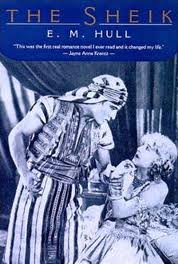
The Novel
The Sheik by E.M. Hull is found in ERB’s library. The novel published at the beginning of 1921 was a runaway bestseller going through thirty-0ne printings by October. My copy is of the thirty-first printing. How many more it may have gone through I am not aware.
The book was quickly made into the movie of the same name starring Rudolph Valentino and released on November 20th of the same year. Thus the impact would have been redoubled on ERB reading the book and seeing the movie.
Having troubles in his relations with Emma, he was somewhat bedeviled by what she wanted as Freud was by what women wanted. The Sheik presented one woman’s solution to the problem of what women want. The Englishwoman E.M. Hull examined the problem in some detail. Her solution would find expression in ERB’s Tarzan And The Ant Men of 1923 in the story of the Alalus women.
2.
While Mrs. Hull’s novel is invariably reviewed as a soft core porn novel it is actually quite a serious attempt to explore what women want. Not a potboiler, the story is well thought out and carefully constructed.
The story falls into the category of the desert nomad thriller.
The scene is somewhere between Biskra and Oran in Algeria. Biskra is the southernmost point on the railroad from the coast to the Sahara in the East of Algeria. It is an oasis area and was a winter resort for Europeans. This area was also the scene of Robert Hitchen’s The Garden Of Allah and the Sahara scenes from Edgar Rice Burroughs’ The Return Of Tarzan.

The Author
As with Hitchens’ the desert serves as a symbol for self-realization and redemption. The story was written as the career of the rebel Abd El Krim was reaching its apex in the Rif. Krim’s story was terrifically romantic for women of the era. I had a high school history teacher in the fifties who was still capable of gushing about Krim thinking him the most manly and desirable of men.
As with Hitchens the story revolves around a man and a woman. The woman an Englishwoman and the man a Krim like sheik of the desert.
3.
The woman is appropriately named Diana. Diana was the virgin huntress of Greek mythology who spurned all relations with men thus putting her in enmity with Aphrodite. She is somehow related to the Lady Of The Lake of ancient Lacedaemon which name means Lady Of The Lake and in a line of progression to the Northern European archetype of the second half of the Piscean Age. This is a rather strange female archetype to represent the Northern European psyche. She is a cold unloving symbol that may have something to do with the European character.
Whether Mrs. Hull knew these things or not she represents them perfectly in her story. This is quite extraordinary.
Thus her Diana was raised by her brother as a boy. She is represented throughout the story as an ambiguous girl-boy, nearly a hermaphrodite. She is herself a skilled huntress who has no use for men. As the story opens she has yet to be kissed. Mrs. Hull skillfully represents the respect that Northern European men have for their women which in itself may be conditioned by the Diana image. They are easily put off. When one man asks Diana for a kiss he accepts his rejection with equanimity asking only if they can at least be pals.
The Sheik as the wild man of the desert knowing no law but his will offers quite a contrast. By the time of Mrs. Hull’s novel ERB had already explored the same literary territory in the Return Of Tarzan and The Lad And The Lion as well as The Cave Girl. I would hesitate to say Mrs. Hull had read Burroughs but the Sheik is portrayed as a Tarzan like superman in a decidedly pulp manner.
The Sheik does not observe any civilized niceties. At one point Mrs. Hull refers to his civilization being less than skin deep. As the Sheik, Ahmed, says, if he wants something he takes it. Having seen Diana in the marketplace of Biskra he sets out to kidnap and rape her. There are no other words for it and Mrs. Hull does not mince them.
His plan worked out so that he buys off Diana’s desert guide to deliver her to him on the first night out of Biskra. Prior to that he surreptitiously serenaded her on the night before even entering her room in the dark while she is there to replace the bullets in her pistol with blanks to prevent her from shooting him in the desert which she did attempt to do.
4.
Now, Mrs. Hull is presenting an allegory so the novel is filled with symbols. The key symbol is the horse. The horse is, of course, a symbol of the female associated with the Greek god Poseidon. In ancient times the symbol of the bull was associated with the missing y chromosome of the female being replaced in Patriarchal times with the horse. Thus the Patriarchal goddess Athene is sometimes represented as horse headed.
When the guide brings Diana a horse to ride it is a magnificent creature much better than she might have expected from a commercial enterprise. The horse has actually been provided by Ahmed the Sheik so as Diana leaves Biskra she is already mounted on the Sheik’s horse- a powerful sexual symbol. The horse is trained to respond to signals from The Sheik.
The story is filled with horses and horse races between she and the Sheik. In one race the Sheik gives her a minute to stop or he will shoot her horse dead which he does. He then places Diana in front of him on his horse (these horses are all magnificent and beyond magnificent) at which point she realizes that she is not only in love with the Sheik but has been for some time.
Previous to this time she had noted in the camp
…but it was the horses that struck Diana principally. They were everywhere, some tethered, some wandering loose, some excercising in the hands of grooms.
So everywhere is the symbol of the female. At this stage Diana has been sexually subordinated to the Sheik but she is intellectually resisting. The Sheik puts on a demonstration of how useless her resistance is as he fully intends to break her.
A man eater is brought out who has killed a man earlier that morning. The horse obviously represents Diana. Some two or three men attempt to break the horse but they all fail. Then the Sheik mounts. The result is a thoroughly exhausted and beaten horse. She stops fighting with her legs splayed while the Sheik jumps off. Then the horse rolls over left with no will of its own.
This is exactly Diana’s situation. Earlier she had boasted to her brother: I will do what I choose, and I will never obey any will but my own.
That is now proven an empty boast as the Diana riding in front of the Sheik chooses to obey the Sheik’s will.
Perhaps Mrs. Hull has prophesied the submission of England’s will of today to the desert Sheiks. As of now the Moslems have all but assumed religious control of England. Thus England as Diana has submitted its sexuality to the sons of the Sheiks.
However Diana’s Sheik still has to prove himself as the dominant male of his society to retain her allegiance. One hesitates to say that she perversely tests him nevertheless having been cautioned to take care on her desert rides she insists on going too far afield. Naturally she and her seven man escort are ambushed by the fat swarthy greasy rival sheik’s men. Six of the seven escorts die joyously defending their sheik’s property. The seventh, the sheik’s European manservant gets the classic bullet crease alongside the head. Diana disappears into the fat greasy sheik’s tent. This guy is everything an Arab sheik should have been in contemporary European eyes. Fat, greasy, swarthy, unbelievably smelly, uncouth to the nth degree. There’s no doubt there’s the fate worse than death for the boyish, sylphlike, slender, lithe Diana. Yes, it seems pretty certain, unless…
Here comes the Sheik with a small but loyal and dedicated band of followers eager to die for their leader. Just as the greasy, swarthy sheik has got it out and ready in crashes Ahmed in the nick of time. Rather than shooting the bastard and getting it over with he wants to dispatch El Greaso by hand. As we all know strangling a a struggling strong man takes a little time. Enough time for El Greaso’s vile Ebon followers to burst into the tent. Right behind them come Ahmed’s men. Shades of Tarzan! Ahmed takes a severe blow to the head and a couple long blades in the back.
Will he live? After muttering a couple pages similar to the last words of Dutch Schultz the matter is in the hands of Allah and the European surgeon. As much as I like having god on my side, in certain situations a good surgeon is even better.
Nevertheless if Ahmed lives he has proven himself to be the right man for Diana. Interestingly the virgin huntress has submitted to the law of Aphrodite. The European archetype has accepted the dominance of the Moslem Arab.
Well, almost. In the first place the tribe of Ahmed is very interesting according to his French friend who arrived in time for the big battle. It seems that Ahmed’s tribe is different from the rest of the desert greasers. It is inferred that his tribe is one of the legendary White tribes supposed to be living in the Sahara. Undoubtedly a surviving remnant of Atlantis that moved South when the Mediterranean flooded.
Why, in addition, it turns out that Ahmed isn’t even an Arab. It seems that he’s actually English. Well, an English Spanish blend. His English father when in his cups did some unspeakable thing to Ahmed’s mother when she was pregnant with him and she was found by Ahmed Sr. Ahmed Jr.’s adopted father wandering dazed and confused beneath the broiling desert sun.
Taken in she dropped Ahmed Jr. and died. The baby was raised as the successor to Ahmed Sr. But he developed an uncontrollable hatred for England, its people and all things English. That’s why he captured and raped Diana over and over. But it’s OK, they both realize they love each other now.
The lesson seems to be that that’s what woman wants: a man who can earn her repect by dominating and controlling her while at the same time being the dominant male in his society, being able to provide all her wants and desires while being able to defend her from the El Greasos of the world. So all the necessary elements come together here and we have a marriage if not made in heaven perfect for terrestrial travails.
If nothing else ERB learned where he had failed Emma in the beginning but who now wondered in his own role of sheik where the rewards from Emma were.
I’m going to speculate that ERB read the story in 1921. He might have enjoyed Valentino in the movie but I think it improbable that the silent film came near capturing the nuances of the novel. I’m sure the signficance of Diana as female European archetype didn’t come through on celluloid.
Was it even in Mrs. Hull’s mind one may perhaps ask. Is it possible I’m projecting my beliefs on Mrs. Hull’s story? It is possible but consider this passage in The Sheik:
He was so young, so strong, so made to live. He had so much to live for. He was essential to his people. They needed him. If she could only die for him. In the days when the world was young the gods were kind, they listened to the prayers of hapless lovers and accepted the life they were offered in the place of the beloved whose life was claimed. If God would but listen to her now.
So we know that Mrs. Hull was read in Greek mythology. It would seem inevitable that she was familiar with the stories of King Arthur to some degree. Certainly she knew the story of Merlin and Vivian. She was a writer. Knowing little about Mrs. Hull it is impossible for me to know for certain exactly what she read or understood. And yet, there it is in the pages of her novel if one has eyes to see. The Sheik is as much a work of mythology as is that of Burroughs’ Tarzan. It is possible that neither was conscious of what they were saying but the information taken into their minds was transformed subconsciously, at least, into the form in which it issued forth from their pens. It works that way for writers. I am often astonished at the subliminal message of what I write. Did I intend it? Must have. There it is. Still, I do put myself into a mild trance when I’m writing so that I concentrate on words rather than ideas. So the words are more conscious while the content is more subliminal. We know ERB wrote from a trancelike state and Mrs. Hull’s story has that quality. I think we have enough evidence to know that she had read the mythological material so that whether she had consciously formulated her ideas they come out in her writing. In short, I don’t think I’m projecting much if anything. Tra la.
There is no doubt that The Sheik made a big impression on ERB. The question is how did he understand it. His first reaction appeared in 1923’s Tarzan And The Ant Men in the weird parody of the Alalus people in which he reverses the male-female roles with the women being stronger and dominant. As Ahmed figures the women brutally dominate the men. Using them for sexual pleasure then discarding them. ERB’s story seems to be tongue in cheek but without a reference point the ridiculous story is hard to follow. With E.M. Hull’s The Sheik I believe we have the reference point.
It seems clear that Mrs. Hull was influenced by Robert Hitchens’ The Garden Of Allah. What is not clear is whether she was influenced by Edgar Rice Burroughs and if so by what novels. The Sheik follows a pulp format. So, if Mrs. Hull read the pulps on a regular basis there is no reason to believe that she was not familiar with some of his work as Burroughs certainly by 1920 when she probably began the novel was already the premier pulp writer.
If that was the case it seems likely that she might have read The Return Of Tarzan and The Lad And The Lion, perhaps The Cave Girl. If she read Lad then she reversed the roles of the chief male and female characters making the Woman English and the man Arab.
I haven’t read the magazine version of The Lad And The Lion so I am not sure of the specific changes ERB made between the 1913 version and the 1938 rewrite for book publication. The rewrite shows clear evidence of influence from The Sheik unless of course Mrs. Hull was reflecting the influence of the Lad on herself. In any event the two books reflect an influence from one to the other.
So, as with Trader Horn and Burroughs it is possible that Hull was influenced by Burroughs and with both of these authors Burroughs reading of them was reflected in his subsequent writing.
Our list of reciprocal influences is growing when one adds that of H.G. Wells. What once seemed simple grows more complex.
Postscript: I have since learned that Mrs. Hull was a student of mythology.
 I, Dynamo