A Review: Isidor Sadger Recollects Freud: Emasculating Freudian Theory
December 16, 2011
A Review
ISIDOR SADGER RECOLLECTS FREUD
Emasculating Freudian Theory
By
R.E. Prindle
…Jung had been infected with Aryan blood from his family.
Deep in his heart,
he was anything from a philosemite.
Now, however, he encountered Judaism
in its most highly gifted embodiment
Of Jewish knowledge shining in front of him.
Was it any wonder that he began by being blinded
With the feeling that never before had he stood before
The countenance of a greater genius?
But his lineage was not to be denied.
One day he sat down and carried out scholarly studies for months
Which resulted in his finding his way back
Through the Mithraic cult to primitive Christianity.
In practical terms
This may be seen that as a Christian prophet,
He fully stripped the libido of its sexual character
And reduced it to merely spiritual energy.
This was, so to speak, the decontamination
Of the poisonous Freudian teachings
Through Christianization and total cleansing.
But since the master could not easily go along
With the desexualization of his teaching,
Which went to the foundation of his theories,
He saw with a heavy heart
That he needed to cut the cord between him and the clinic. (Bergholzi)
Isidor Sadger, Recollecting Freud pp. 71-72

Sigmund Freud: Smoke Rings
Sadger, Isidor: Recollecting Freud, 1930, first published 2005, UWisconsin
It is very difficult to know where to start in analyzing the above quote from Isidor Sadger. First it might be pertinent to identify Isidor Sadger. He had a history with Freud from 1895 into the 1930s. He attended with two others Freud’s first psychoanalytic lecture. He was a founding member of Freud’s Vienna Psychoanalytic Society. In 1930 he published this little volume of biographical notes on his relationship with Freud.
Freud’s circle did not take kindly to the publication of these memoirs doing everything they could to suppress them. In this they were successful. The book was never distributed and only rumored to be in print until this publication in 2005 by Alan Dundes and UWisconsin. Even acquiring a copy of the book by Dundes was nearly impossible. He relates pp. xlii-xliii:
Recollecting Freud
When I looked up Sadger on my computer data base, I found not only the article (Sadger had written) in question but the title of a book: Sigmund Freud: Personliche Erwinnerunger. As I was not familiar with that work, I decided to send for it via interlibrary loan….In due course, the latter arrived but the effort to procure a copy of the former proved unsuccessful. I was informed that there was no known copy in the United States available for borrowing. Since I knew the book had been published in Vienna, I asked if we could try to locate a copy in Europe and the obliging staff in interlibrary loan agreed to do so. A few weeks later, I learned that there was no known copy in any European library available for borrowing.
I was told, however, that there was one, just one, copy listed that might be utilized and that copy was located in the library of Keio University in Japan. Again, inter library loan made a request on my behalf and this time with some partial success….I next asked interlibrary loan to request a photocopy of the entire book…The Keio University Mata Media Center informed (me) that it was unable to comply with my request….
…One of my anthropology doctoral students…was returning to Japan. I asked him to do me a favor and get me a photocopy…
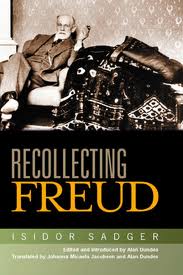
Which he did and almost by a miracle the text was recovered to be published for human consumption some seventy-five years on. As Freud claimed to be a scientist one is amazed that supposed scientists would go so far as to deny publication of Sadger’s memoirs. But, so it was.
In tackling the quote from Sadger let me approach it from the point of view of ‘Jewish knowledge shining in front of him.’
One must ask the question of what is Jewish knowledge and how is it special to their culture? This is important not only from past implications but also in light of today’s Barbara Spectre and her Paideia organization whose intent is to place ‘Jewish knowledge’ on a par with Aryan knowledge or what Sadger calls Christian knowledge.
While Freud may have been a Jew working in the scientific field of psychology and psychiatry and while he may have made some important discoveries in the field that had been developed by Aryans his own contributions arose from that body of accumulated Aryan learning. Since Dr. Anton Mesmer in the mid-eighteenth century until Freud’s Interpretation of Dreams Aryans had been slowly accumulating the knowledge on which Freud built his theories. That knowledge had no racial identity per se nor did that which Freud added to it. As Freud claimed that he was a scientist then his contributions were scientific, not Jewish, and the common property of mankind. He may have been Jewish but the scientific field he was contributing to had no ethnic identity but Science, which is to say, none at all.
Sadger himself is taking a bigoted view in attempting to sequester Freud’s theories to the Jews. In fact, as Sadger indicates Freud did not want his theories to be studied and furthered by anyone else. When C.G. Jung, who Freud tried to make his disciple attempted to examine Freud’s concept of the libido and came to perhaps a more correct understanding of the concept, which after all was scientifically unproven, Freud broke off his relationship with him and the Bergholzli Clinic of Switzerland. He, in fact, severed any Aryan connections. He became interested only in Jewish contributions which then became Jewish knowledge in Sadger’s mind.
Sadger who had been Freud’s earliest disciple deeply coveted the role of being Freud’s pet or ‘favorite son.’ Freud for whom ambivalence was central to his character, even though he hated Aryans as a homosexual he was attracted to the ‘great blond beast’; hence, while carefully concealing his motive he selected Jung who had the requisite scientific qualification to be not his ‘son’ but a necessarily platonic lover. Sadger could never qualify.
Now, what was Jung’s sin that brought about his rejection by Freud:
One day (Jung) sat down and carried out scholarly studies for months which resulted in his finding his way back through the Mithraic cult to primeval Christianity…this may be seen as a Christian prophet, he fully stripped the libido of its sexual character and reduced it to merely spiritual energy.
Unquote.
So, having committed to Freud although ‘infected with Aryan blood from his family’ that he would abandon certain anti-Semitic understandings that he had. In what seems an obvious betrayal of his pledge to Sadger Jung ‘carried out scholarly studies for months; which resulted in his coming up with a different perception of the libido that downplayed the rutty sexual projection of Freud’s Jewish psyche for what Sadger terms Christian spirituality. To Sadger’s mind Jung had betrayed his pseudo-Judaism pledge to return to Christianity.
This raises several problems. Is anti-Semitism a mere prejudice or is it based on observations of how Semitism functions and its rejection on that basis? In other words, based on observed actions Semitism is rejected and not on prejudicial grounds but for accurate scientific reasons.
Further, in dogmatically insisting on his own interpretation of his creation, the libido, Freud was definitely unscientific. At the same time his topography of the mind was completely off base. In point of fact the libido is neither sexual nor spiritual, it doesn’t exist. While Freud had a good working hypothesis his ideas were merely that based on the scientific, not Jewish, knowledge of his time. Freud became dogmatic at a time when he knew, or should have known, what he didn’t know. There was a lot of physiology to be yet discovered that would uncover the biology of life.
This biology would be clarified in 1947 when Crick and Watson discovered the genetic code of DNA.
Freud in his rutty, close to pornographic, interest in sex, by which he meant sexual intercourse made the absurd statement that the more frequently a man ejaculated the better person he would be. Is it any wonder that Jung was turned away from Freud in disgust? While Freud may have thought he was severing ties with the Bergholzli; the reverse would seem to be true.
With the discovery of DNA the biology became clear making it possible to elucidate the psychological basis of sex based on that biology.
Freud frequently had the right idea but he seldom thought the application through being infected with his own need for greatness by creating a science of his very own and his Judaism to whose Weltanschauung he was totally committed as Sadger indicates.
To take the psychology first: Freud correctly differentiates between the individuals inner wishful thinking and his confrontation with outer reality. Or, in other words, religious superstition versus a scientific understanding of objective reality.
Thus, when the child is expelled from the womb he comes into contact with the outer world. Whatever conception of reality he had in the womb bears no relationship to the reality of the world beyond the womb. In the Freudian sense then the child’s mind is all Id with at best a nascent Ego. As Freud’s desideratum is Ego shall displace Id the child has some serious adjusting to do.
This adjustment is called experience and education. In the absence of education the child would grow up to be ignorant savage with an improper understanding of reality causing him to give all the wrong reasons for the phenomena he encounters. This being mankind’s original condition over the millennia this ignorance was replaced by religious speculation based solely on inner wishful thinking. Nor was not adequately understood. As people might, for instance, decide that they are the chosen people of their god, make that god a universal deity and then weave their notions of external reality around that projection. That was the condition of Freud and his Jewish people.
The conflict for Freud and his Jews became acute when the Aryans with a different Weltanschauung sought to understand external reality on its own terms and adjusted their inner world of wishful thinking to reflect as much as possible objective reality. When Freud mentions the science of Kepler and Darwin as being shocks to the human mind, he meant Jewish mind which was now faced with the irreconcilable fact that their Arien Age Weltanschauung being based on false data was obsolete. While Freud considered the organization of the mind the third great shock it was one that could be manipulated for his own ends, unlike Astronomy and Biology, and perverted to serve those ends. Hence his dogmatic and ridiculous view of the unconscious and sex.
Now let us look at the nature of the human sexual function. DNA with its double helix, one strand from each contributor, each remaining separate but combining information through bridges, visibly demonstrates how the entity is constructed. The spermatic strand contributed by the male forms the stronger, more active, and slightly larger right side of the body and left side of the brain; the ovate strand contributed by the female forms the weaker, more passive, slightly smaller left side of the body and right side of the brain.
This means that the Xy chromosome of the male carries a male version and a female version, thus there is a female component to the male. This was picked up the psychoanalysts as bi-sexuality in the carnal sense. This is not true. A man is not by nature available for sex by either sex. Hormones reaffirm the sexual identity.
As should be easy to see all activity is controlled by the brain. Information is communicated up and down the spinal cords which emanate from the brain. One cord for each chromosome. Thus, there is a nerve connection from each side of the brain to the commensurate testicle or ovary. Sperm is manufactured according to the dictates of the autonomic system. After one reaches puberty the seminal fluid builds up. Without any other release the fluid will discharge automatically whether one wills it or not; these are usually termed nocturnal emissions. These alone are all that is necessary to relieve the over supply.
As the only biological function of sex is reproduction the male is always ready to penetrate the female. In a normal psychological function a comfort level can be maintained by one or two ejaculations a day or even less. That Freud could make the absurd statement that the more ejaculations a day the better the person means that as a homosexual he had a psychic need or that the was merely trying to pervert Aryan society.
Now, the spinal cords run down the length of the body from the brain to the testicles where they terminate, making the brain and testicles a unit. Nerves run from the spine to the various organs. There we have the basis for psychosomatic reactions. While the cords are grounded at the testicles I believe they have more free play at the brain level. The bi-sexuality the psychoanalysts noted is caused by the Xy and XX chromosome combinations. Both Freud and Jung given the biology of their day had differently accounts for the apparent bi-sexuality thus they called the spermatic brain ending the Ego while Jung claimed that the male had an Anima and the female an Animus. In actuality both males and females have an Anima and an Animus or, in Freudian terms, a Libido and Ego.
Freud also discovered the concept of Emasculation. When the Ego or Animus, male or female, is given an affront or insult to which it cannot properly respond this creates a reaction or hypnotic suggestion that forms a fixation. This fixation will have a psychic or physical or both affect. Fixations are of different intensities and qualities; the most severe is the central childhood fixation, also with psychosomatic affects an example of which each fixation creates.
In the case of the homosexual the affront is give by the male who thus creates a severe psychosomatic reaction which is what homosexuality is. In the attempt to negate the reaction the homosexual then seeks to visit his fixations on other males while being compelled to seek multiple ejaculations many times a day which he equates with masculinity.
Thus a normal male can be satisfied with a normal schedule of ejaculation or relieving the pressure of the sperm build up, while a fixated person is compelled to more frequent ejaculation. Thus Freud completely misunderstood sex erring on the side of homosexual emasculation. Thus he was transferring his sexual neurosis or psychosis to Aryan society. Probably in vengeance as he undoubtedly believed his own emasculation was caused by Aryans.
So, Freud’s whole conception of sex is skewed and should be rejected, replaced by a more accurate and balanced interpretation. Jung had good reason to reject the libido or sexual theory of Freud that Sadger and the Psychoanalytic Society was required to embrace because Freud, their master, had spoken. Freud must, or should have known, the limits of the biological knowledge of his time while understanding that great advances would come that might invalidate or require adjustments to his theory. Therefore his attempt to dogmatize his first thoughts was unscientific to the extreme.
Contrary to Sadger’s orthodoxy Jung was quite right to pursue the libido theory further. In desexualizing it, in Sadger’s term, Jung was on the right track as Freud’s interpretation was absurd on the face of it. While Jung was certainly ‘infected’ with a Christian based view, as a scientist he was trying to give a scientific basis to sex rather than ‘Christianizing’ it as Sadger thought. But then, Sadger was definitely intellectually limited by his Judaism.
In using such terms Sadger gives away the intense Jewish separation of Jewish and Aryan Kulturs. There can be no specific Aryan or Jewish knowledge; there can only be one knowledge and that is Scientific truth. If you can’t stand the heat get out of the kitchen.
While Freud built his theories on Aryan scientific psychological investigations he then infused the knowledge with Jewish superstition and goals which bent the science of psychology back toward a religious application which Freud undoubtedly hoped would negate the Astronomical and Biological shocks to the foundations of Judaism or Semitism.
Not only had Freud and his followers buried the reputation of the great French psychologist, Pierre Janet, from whom they borrowed or stole so much but in their successful attempt to freeze psychoanalytic investigation into the Freudian framework they brutally slandered Jung while discrediting his own scientific work. It was not until the sixties of the twentieth century that Jung began to be understood and credited for his contributions which were certainly equal to and mainly independent of Freud.
Thus we have the persistence of Alan Dundes pursuit of Sadger’s little volume to thank for casting a few rays of light on this thorny problem of psychoanalysis.
Edgar Rice Burroughs As A Feral Child
July 18, 2011
Edgar Rice Burroughs As A Feral Child
by
R.E. Prindle
Cronus:
Cronus married his sister Rhea, to whom the oak is sacred, But it was prophesized by Mother Earth and by his dying father Uranus, that one of his own sons would dethrone him. Every year, therefore, he swallowed the children whom Rhea bore him, first Hestia, then Demeter and Hera, then Hades, then Poseidon~ Robert Graves, The Greek Myths
I. The Father As A Cannibal Figure
Following Poseidon came Zeus. In place of Zeus Cronus was given a stone which he swallowed instead. When Zeus grew up he then castrated Cronus, replacing him.
While on the one hand an astrological myth denoting the precession of the equinoxes from one Astrological Age to another, on a psychological level the myth relates the fear of the Father that as the strength of his sons waxes his own wanes resulting in an eclipse.
Different human fathers react in different ways. Some nurture, some castrate or cannibalize their young. This is a serious problem for the son. For instance, what Tom Brokaw, a thoroughly castrated son, is pleased to call The Greatest Generation who were so enamored of their success in WW II, that they chose to emasculate a whole generation rather than surrender or even share power.
I correspond with David Adams from time to time while doing my writing from whom I sometimes receive valuable input. I had come to the conclusion that ERB’s father, George T, was a problem for ERB, especially as represented by ‘God’ in Tarzan And The Lion Man. The new year opened with Hillman publishing Dodds’ feral child collection which clicked in my mind. The week before ERBzine published my Part III, Two Peas And A Pod of the Tarzan Triumphant review. David Adams commented favorably on my comments about the Jungian Old Man archetype. He said in an email to me:
I agree with your interpretation that “characters like Tarzan and John Carter serve in the capacity of Old Man/Jekyll figures while the actual Old Man figures who are betrayers serve perhaps as Hydelike figures as represented by the father.” (David quoting me.) Those old man figures, early and late, are also cannibals who are hell-bent on eating him up while then spreading the bones across some desert for the hyenas to chew. Who was that old cannibal with the cancerous face followed by a pair of African wolves? (Jungle Tales of Kipling)
As can be seen I picked up on the Father figure but adding the cannibal detail adds the needed dimension for full comprehension.
George T. had been bothering me for some time. The love-hate relationship ERB had with him is quite obvious, but then it occurred to me that the other sons had the same relationship to their father while George T. appeared to program them all for failure- that is they not surpass him in their lifetime somewhat like Cronus of Greek mythology. He made them all dependent on him. The supplicating tone of the letters from college of sons George and Harry is all too obvious. George T. sending the boys to Yale without the means to support a position would have had the effect of emasculating them relative to their fellow students thus subordinating them.
Then on graduation he took them into his battery business. As a businessman in Chicago it wouldn’t be unreasonable to believe that George T. had some relatively influential contacts in town who might have been able to place Yale graduates advantageously but he chose to keep the boys with him and subordinate to him.
The battery factory proved dangerous for his son Harry who developed respiratory problems from the battery chemicals plus perhaps in psychological reaction to suppression by his father. He went West to join fellow Yalie, Lew Sweetser, in Idaho. Son George, who had had enough of working for his father, also fled to Idaho to join Harry and Sweetser.
None of the three knew enough about the cattle business to survive so that by 1913 when George T. had his basket pulled up all the sons were back in Chicago in various degrees of failure or, at least, lack of success. As of that date it would appear that like Cronus George T. had swallowed or cannibalized his sons.
There was a Zeus figure in the bunch who didn’t want to be swallowed and that Zeus figure was ERB. Like Zeus ERB was the youngest son. ERB developed independently of his brothers who were approximately ten years older than he. Thus when they were at Yale ERB was attending grade school.
As I pointed out in my Books, Burroughs and Religion George T. was especially rigorous in the attempt to emasculate his youngest son. His effort culminated when he sent ERB to military school. This was a form of dislocation and rejection that ERB could not bear. He tried to escape but his father sternly returned him to the Michigan Military Academy.
The effects of this were that ERB was declassed as he considered the MMA a rich kid’s reform school. Thus to some extent he was criminalized in his own mind. His reaction was also seminal in the formation of his two principal characters John Carter and Tarzan.
His hurt was so strong, his separation from his parents and home so complete that he became psychologically orphaned. His parents died to him the day he was returned to the MMA. He adopted the drunken Commandant, Charles King, as his mentor or surrogate father. While betrayed by his father ERB apparently thought he found a friend in King. In that capacity King became the model for Lt. Paul D’Arnot of the French Navy. D’Arnot was the man who tamed the feral boy that was Tarzan introducing him to civilization much as King taught Burroughs how to survive and prosper at MMA. Or Burroughs remembered it in that manner. There may also be a literary connection to D’Artagnan of Dumas’ Three Musketeers.
This makes the period between the arrival of Jane and her party and the arrival of D’Arnot in Tarzan Of The Apes of special interest. I’m not sure what the period represents in Burroughs’ own life.
As his creation Tarzan is a feral child it follows that ERB considered himself alone and on his own as a feral child himself. A romantic notion but one no less real to him. Thus just as Tarzan’s parent’s died with the baby becoming a member of an ape tribe so Burroughs began a wild and difficult period as his parents died for him.
These events occurred just as Rider Haggard was becoming famous for his great African trilogy of King Solomon’s Mines, She and Allan Quatermain which ERB undoubtedly read at this time. Conan Doyle began his Sherlock Holmes mysteries and H.M. Stanley disappeared into an unknown Congo in pursuit of Emin Pasha. The West to East transit of the Congo impressed ERB greatly as his own heroes later crossed Africa in the same direction.
Being a complex individual ERB no longer wished to even acknowledge that he had ever had parents; thus his first creation- John Carter. As Carter only came into existence when ERB was 36 the writer had plenty of time to knock around learning the odd legend here and there. John Carter then is a version of the Great Historical Bum- the hundred thousand year old man of folklore.
John Carter could not remember his parents. In his memory he had always been the same age he was. In the words of one of my famorite songs, Stewball, he didn’t say he was born at all, just blew down in a storm. Certainly Burroughs had heard of the Comte de St. Germain who flourished at the time of the French Revolution. As esoterical cult figure today, St. Germain’s legend would have been more prominent from 1875 to 1911 than today. Like Carter St. Germain claimed to have been alive forever. In Revolutionary Europe he got away with it. Calgiostro was another Revolutionary charlatan claiming mysterious antecedents who would have intrigued ERB’s imagination. It seems certain the two would have been topics of conversation in the time before radio, TV and movies so it wouldn’t have been necessary for ERB to have read anything.
I doubt if he had read any of the books on Dodds’ list although one never knows but the list goes to show that the feral child would have been a popular topic of conversation. In my opinion then ERB’s literary future was cast when his cannibal father returned him to MMA.
He graduated from the MMA in ’95 but either couldn’t or wouldn’t return home staying on as an instructor. In ’96, just before the summer break which might have necessitated a return home he joined the Army being sent directly to Arizona without passing through Chicago. Was he avoiding returning home? One can’t say as in ’97 having found Army life not to his liking he received an early discharge. He could have kept going, of course, as many of us in his boots did, to LA, San Francisco or wherever but he chose at that time to return to Chicago. Of course, Emma was calling.
From ’97 to ’03 or so he worked for his father which he found as difficult as his brothers had. Fleeing Chicago to Idaho in 1903, when he came back a year and a few months later to do anything (that word anything has some meaning in this context) rather than work with his father. He became one of the poet Robert Service’s ‘men who don’t fit in.’ He had a very difficult few years from 1905 to 1913 bumping along the bottom.
But then in 1911 he began his rise via his intellect. He began to write becoming an immediate literary success of sorts. By 1913 when he was about to become a financial success through his intellectual efforts thus escaping his father’s curse, his father died. The young Zeus thus never got to castrate his father Cronus.
One can’t know what would have happened to his psychology had ERB been able to present his father with evidence of his success. I’m reasonably certain George T. would have belittled or rejected his success as like Cronus his youngest would have replaced him. He wouldn’t have liked that.
II. A Hand From The Grave
Had that happened and ERB been able to prove himself a greater than his father it is interesting to speculate as to what effect that might have had on ERB’s psychological development. As it was, a few months after his father’s death he packed up family and belongings and got out of town as far as he could go to San Diego, California and stayed away nine months. Time enough to be reborn.
There are numerous examples of betrayers who are cannibals in his corpus, in fact there is so much betraying and cannibalism in Burroughs’ work I find it slightly offensive. Rather than work up a list, which for the time being I leave to David, I’d rather concentrate on the most spectacular cannibalistic betrayer of the oeuvre, God of Lion Man.
I know I just wrote about Lion Man but with David’s interpretation of cannibalism I can present a much more cogent image. David’s much more into Jungian synchronicity than I am but the scene with God presents a remarkable occurrence of synchronicity. The scene is very complex.
George T. was born in 1833 so the book was written on his 100th birthday. Chicago was incorporated in 1833 while it was celebrating its Century Of Progress forty years after the Columbian Expo at the same time. Both events occurred just at the time that Burroughs realized he had lost control of his ‘meal ticket’ to MGM.
MGM was undoubtedly a component of God, the Father, being combined with the Chicago that fathered him and George T., his actual father, in his mind. From these components ERB then creates the magnificent apparition of God as man and beast. God has the mind of divine power such as had Zeus but is still a Cronus, is, in fact, the ultimate cannibal.
Tarzan and Rhonda represent Burroughs’ Anima and Animus so that God has the whole man in his power in its component parts- the X and y chromosomes. God tells the pair that he is going to use them to rejuvenate himself by cannibalizing them. The Father’s desire and the Son’s fear.
If God represents George T. on one side, MGM on another and organized religion on a third then even though ERB thought he escaped his father in 1913 by his intellectual efforts the father reaches up from the grave on his 100th anniversay to claim his son again.
At this time Burroughs also wrote Pirates Of Venus and Pirate Blood. Both would refer to the idea that MGM pirated his creation from him while the very despondent Pirate Blood is almost terrifying in its manic depression as the balloon rises and sinks being almost submerged in the ocean or the waters of oblivion, the subconscious mind, insanity, that I believe we can see it as the insanity of despair. At the end of that story the hero pairs up with a desperate woman who I believe we can read as Florence. All very transparent really.
So there Tarzan/Rhonda/Burroughs is trapped in a prison. He attempts his earlier escape of rising through his intellectual powers, that is, he ascends through a shaft in the roof. Unlike the first time when he surprised and astonished the world with John Carter and Tarzan, God, the Father, is waiting for him preventing his use of his intellect. In point of fact Tarzan And The Lion Man was a dismal sales failure thought by Burroughs to be caused by MGM.
If his previous four previous Tarzans under the Burroughs imprint had been successes it seems strange that the truly excellent Tarzan And The Lion Man should have failed. Failing proof of sabotage on the part of, say, MGM, one can only say the public taste is fickle or perhaps the innovative dust jacket didn’t look like the usual Tarzan dust jacket and fans just passed it by. It is also true that the book was a put down of MGM.
Tarzan/Burroughs sallies forth from his hiding place against superior forces. He is knocked unconscious. A sure sign that Burroughs is under supreme stress. Meanwhile God’s castle, in other words the literary structure of the last twenty years is going up in flames. The MGM pirates have lifted ERB’s life work.
He has to finish the story so he turns the tables on God taking him captive and making him do his bidding. Tarzan helps God recapture his City then abandons him disappearing down the hole of the subconscious to a lower level from when he emerges to be claimed by the Wild Thing- Balza, the Golden Girl, or Florence.
In a thinly disguised scene Tarzan, unwittingly it seems, wins Balza from her former husband much as Burroughs took Florence from Ashton Dearholt. The important thing here is that a transition has been effected from one world to another. The intellectual City of God has been abandoned in favor of a world of the senses.
It is at this point ERB abandons his own feral boy persona of horses, puttees and other symbols to become a sort of effeminate Dandy. He now affects tightly fitted fashionable suits almost effeminate in appearance. He turn into a party animal and if he had been a moderate drinker during his teens, twenties and early thirthies he now becomes almost a lush.
So, in the end, ERB was probably devoured by the Father in Cronus fashion. In the Myth Zeus forced Cronus to vomit up his brothers and sisters and he castrated him. In real life ERB was castrated and swallowed down.
He put up one heck of a fight that arouses the warmest admiration of him. One wonders, that if when all is said and done anyone can escape the imprint of those formative years. Is one’s whole horoscope cast in the womb and those few short months after birth? Sure hope not.
A Review: Part III Tarzan And The Madman by Edgar Rice Burroughs
October 13, 2010
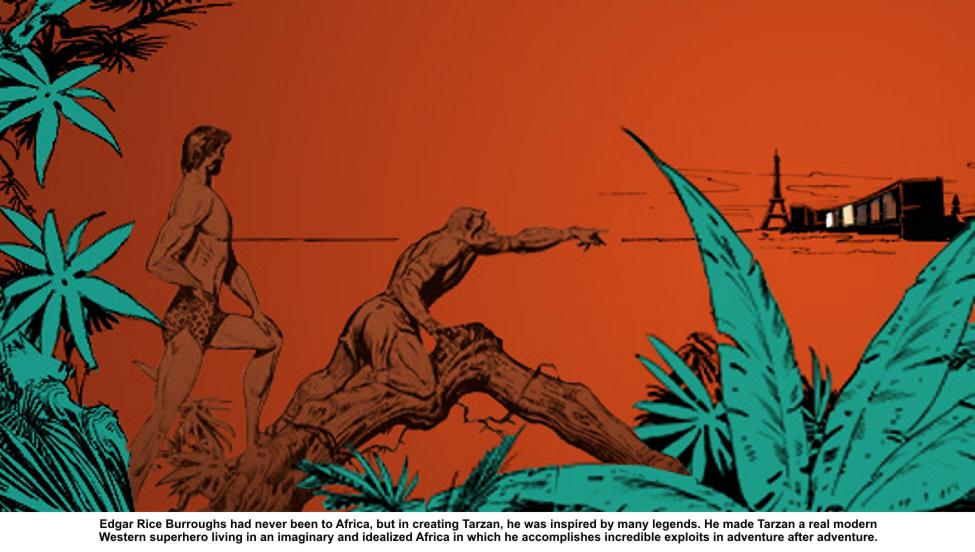
The Aquarian Archetype
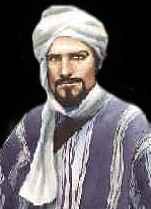
The Renowned Arab Traveler- Mohammed Ibn Batuta
Writing in the fourteenth century Ibn Batuta had visited the East African coast trodding the soil of Kilwa Island on the southern border of Tanganyika, now Tanzania. Zanzibar replaced Kilwa as the Moslem trading entropot on the East Coast. Haggard apparently had done the same as he mentions ruins that dated back to before the tenth century. So, we have established commercial activity in Southern Africa before the arrival of the Shona people in Zimbabwe.
Ruiz stood behind a low, stone altar which appeared to have been painted a rusty brown red.For a long time Ruiz the high priest held the center of the stage. The rites where evidently of a religious nature that went on interminably. Three times Ruiz burned powder upon the altar. From the awful stench Sandra judged the powder must have consisted mostly of hair. The assemblage intoned a chant to the weird accompaniment of heathenish tom toms. The high priest occasionally made the sign of the cross, but it seemed obvious to Sandra that she had become the goddess of a bastard religion which bore no relationship to Christianity beyond the symbolism of the cross, which was evidently quite meaningless to the high priest and his followers.She heard mentioned several times Kibuka, the war god; and Walumbe the god of death, was often supplicated, while Mizimo departed spirits, held a prominent place in the chant and the progress. It was evidently a very primitive form of heathenish worship from which voodooism is derived.
Looking up, she saw a dozen naked dancing girls enter the apartment, and behind them two soldiers dragging a screaming Negro girl of about thirteen. Now the audience was alert, necks craned and every eye centered upon the child. The tom-toms beat out a wild cadence. The dancers, leaping, bending, whirling, approached the altar; and while they danced the soldiers lifted the still screaming girl and held her face up, upon its stained brown surface.The high priest made passes with his hands above the victim, the while he intoned some senseless gibberish. The child’s screams had been reduced to moaning sobs, as Ruiz drew a knife from beneath his robe. Sandra leaned forward in her throne-chair, clutching the arms, her wide eyes straining at the horrid sight below her.A deathly stillness fell upon the room broken only by the choking sobs of the girl. Ruiz’s knife flashed for an instant above his victim; and then the point was punged into her heart. Quickly he cut the throat and dabbing his hands in the spurting blood sprinkled it upon the audience, which surged forward to receive it…
“Well, what of it?’ demanded da Gama. “I am king. Do I not sit on a level with God and his goddess? I am as holy as they. I am a god as well as a king; and the gods can do no wrong.”“Rubbish!” exclaime the high priest. “You know a well as I do that the man is not a god, and the woman no goddess. Fate sent the man down from the skies- I don’t know how; but I’m sure he’s as mortal as you or I; then you get the idea that by controlling him you could control the country. You were jealous of me that’s all; then you get the idea that by controlling him you could control the church, for you know that who controls the church controls the country. You were jealous of me that’s all; then you conceived the idea of having a goddess, too, which you thought might double your power. Well, you have them; but they’re going to be just as useful to me as they are to you. Already, the people believe in them, and if I should go to them and say that you had harmed the god, they would tear you to pieces…”
“…you don’t stand any too well with the people, Chris, anyway; and there are plenty of them who think da Serra would make a better king.”“Sh-h-h,” cautioned da Gama. “Don’t talk so loud. Somebody may overhear you. But let’s not quarrel, Pedro. Our interests are identical. If Osorio da Serra becomes king of Alemtejo, Pedro Ruiz will die mysteriously; and Quesada the priest will become high priest. He might become high priest while I am king.”
“You should know,” he said. “You are a woman.”“I am not a mortal woman. I am a goddess.” She grasped at a straw.Rateng laughed at her. “There is no god but Allah.”“If you harm me you will die.” she threatened.“You are an infidel,” said Rateng, “and for every infidel I kill, I shall have greater honor in heaven.”
Four Crucial Years
In The Life Of Edgar Rice Burroughs, Pt. I
by
R.E. Prindle
Every artist writes his own autobiography.
Even Shakespeare’s works contain a life of himself for those who know how to read it.
–Havelock Ellis as quoted by Robert W. Fenton

The Great One
Eighteen ninety-six found Edgar Rice Burroughs confronting the first great crisis of his adult life. The weight of his childhood experiences pressed on his mind as he turned twenty. His subconscious mind was directing his actions while his conscious intelligence futilely struggled against it. He had no plans; nor could he form any. He was in a state of emotional turmoil. He obviously did not think out his moves nor weigh the effects of his actions on others. He was to burn many bridges as he flayed about like the proverbial bull in the china shop trying to find his way out.
Having graduated from the Michigan Military Academy he had been serving in the capacity of instructor for the previous year. All his heroes were military men. He fancied a military career as an Army officer even though he had failed the West Point exam the year before. Still, he was in a fine position to realize his objective. Men who could help him were nearby friends. Captain, soon to be General, Charles King, who had befriended him as a cadet, and the Commandant of the MMA, Colonel Rogers. All he had to do was to be patient and those men of some influence would surely have obtained an appointment for him.
They had given a mere boy a position of great trust and responsibility in making him an instructor. They were military men who judged others in the military manner. Then in the Spring of 1896 Burroughs did one of the most inexplicable things in a career of the inexplicable; he abandoned his post. Without notice to those career officers who were depending on him he resigned his post and on May 13th of 1896 he joined the Army as an enlisted man, a common soldier, a grunt. Within days he was on his way to his asignment.
As he was to say of so many of his later fictional heroes: ‘for me to think is to act.’ He oughtn’t have been so precipitate. He should have thought twice. He shouldn’t have had to think about it at all.
If he seriously wanted a military career as an officer he should have known that it is virtually impossible for an enlisted man to rise through the ranks. Even in the rare cases when this occurs, the enlisted man is always an odd duck between the officer caste and the enlisted men.
In this case he had not only forteited caste but as far as Rogers and King were concerned he had deserted, the worst crime that a military man can commit. Both men wrote him off at that time. Strangely he never understood that his precipitate act would be held against him by those he disappointed.
Apparently joining in a fit of despair- for me to think is to act- as the date of the 13th would indicate he requested the worst duty the Army had ensuring his desire to fail. On one level it is almost as though he did have his next move worked out. Not normally too receptive to the desires or needs of its grunts in this case the Army was only too glad to accommodate him. Burroughs was sent into Apacheria to a place called Fort Grant in what was then the territory of Arizona. Neither Arizona nor New Mexico became States until after the turn of the century so Burroughs had actually ‘lit out for the territories’ as Huck Finn would have put it. There was still some Apache resistance going on, thus ERB was a part of the Wild West.
According to Philip R. Burger, writing in the Winter 1999 issue of the Burroughs Bulletin, the standard term of enlistment at the time was three years but, as there would be no reason to join the Army except to make it a career, the reasonable assumption for those left behind in Chicago without a word of goodbye would have been that Burroughs was out of their lives. He was a dead man.
For those of you who have never joined the services, once you leave you’re out of the lives of those left behind. Your traditions have been broken. Even when you come back for leave you are only tolerated as a visitor who will leave, the sooner the better, so you don’t disrupt their lives any longer than necessary.
Burroughs didn’t even have traditions in Chicago except with a few people. From the sixth grade on he had a record of broken attendance at a number of schools, from the girl’s school to Harvard School and then back East, to Idaho and on to the MMA. He would have known but few people well, intimate with none except the lovely Emma Hulbert.
He could have seen her but rarely over the last years which included high school. He really had no ties in Chicago. His relationshlip to Emma dated back to Brown grade school. At sometime before he began his peripatetic education he began to propose to her. As he was gone from Chicago all this time it is very difficult to believe that Emma sat home pining. She must have been dating other boys, however, at the same time she must have been waiting for Burroughs since, at 24, when she married him she was only a couple years from spinsterhood. She must have been giving her parents some cause for alarm.
Thus when Burroughs appeared to walk out of her life in 1896 without a word about his intentions one wonders what her response was. Certainly it was about this time that Frank Martin began to pay his court. We will learn more of Frank Martin a little later.
For Burroughs, like so many of us once we were inducted, ERB speedily learned his mistake. For the men who don’t fit in ‘each fresh move is a fresh mistake.’ He regretted his decision immediately. For him to think was to act, so from his arrival at Fort Grant he began a petition for discharge.
As he had been under twenty-one when he joined, he had had to ask his father for his consent. He now asked him to use his influence to get him out.
Perhaps we do not have enough information on why he now so desperately wanted out. In later life this short ten month period of his life would be fraught with great significance in his mind. Just before he divorced his lovely wife Emma in 1933 ERB took a solo vacation to return to this scene of his young manhood. That would indicate that Emma and Fort Grant were linked in his mind.
Two of his Martian novels are associated with the Fort Grant experience. In his first novel, A Princess Of Mars, John Carter serves in the Army in Arizona, is discharged, then returns as a prospector. Under attack by Apaches he seeks refuge in a mountain cave in which he leaves his body while his astral projection goes to Mars. Viewed from one point that’s as neat a description of going insane as I’ve ever come across.
During his 1933 visit to Arizona, Carter returns to visit a trembling fearful Burroughs in his mountain cabin. One gets the impression that Burroughs felt like a whipped dog.
The Apaches made a terrific impression on the young man. So much so that he could see himself joining them as a Brave as is evidenced by his two Apache novels, The War Chief and Apache Devil. Then too his two cowboy novels are placed in Arizona rather than in Idaho where one would expect them.
In his Return Of Tarzan the trip to the Sahara is an obvious reference to Apacheria. The French government sends Tarzan into the desert rather than the US government sending ERB to Arizona. In the deseart Tarzan develops a strong liking for the Arabs, much as ERB did for the Apaches. Tarzan considered becoming a Son Of The Desert just as ERB thought he might become Apache.
A large part of ERB’s fascination for the military life was based on his respect for Capt. Charles King under whom he had served briefly at the MMA. King was, I would imagine, a boy’s dream of a dashing Calvalry Officer. In this wildly romantic period of the Indian Wars, not to mention the proximity of the Civil War, a man who had served at the same time and the same place General Custer must have been held in some awe. King had also served with and knew Buffalo Bill, a nonpareil hero of the time and one ERB may have met at the 1893 Columbian Expo.
Burroughs names two of his characters after Custer.
On top of all this King was a successful writer of military novels. He wote an excellent analysis of Custer’s defeat, which is available on ERBzine, as well as a first hand account of the resultant campaign to quell the uprising, Campaigning With Crook. the latter is a superb recreation of a time and place we’ll never see again. In just a few words King is able to recreate a Deadwood, South Dakota for which the movies have filmed endless miles of photographs with less result. His single reference to barbaric cowboys wearing their guns on their hips says more than dozens of Hollywood films. ERB was also able to capture some of this feeling in his two excellent Western novels as well as his two Apache novels.
King was prolific writing nearly seventy books in his long career. I have read only a few, which I find of only of journeyman quality. King has an emascualted precious style which is reflected in his photographs. Burroughs enthusiastically said he wrote the best Army novels ever, which may be true, I haven’t come across any other novels of Army life. among his many novels of Army life are three that deal with the Pullman strike when the Seventh was stationed at Fort Sheridan. One, An Apache Princess written in 1903 might possibly have been an influence on A Princess Of Mars.
At any rate King glorifies the officer’s life. He fooled a young green ERB. In any event ERB failed to notice the haughty distinctions King drew between the relative status of the officers and the enlisted men. King had all the prejudices of the officer class seeing the enlisted man as a subhuman species. Knowing this, as Burroughs should have, I am baffled by his enlisting.
Perhaps as at the MMA he thought that one entered as a buck private working up to officer rapidly as he had at the MMA. If so he must have had a very rude awakening. It couldn’t have taken him long to realize that advancing through the ranks was rare while at the same time a long process for such an impatient lad as he.
While he was cleaning those stalls he must have had plenty of time to think out his dilemma. As he thought back over his past actions it must have occurred to him that perhaps he erred in walking out on Colonel Rogers the previous May. Accordingly on December 2 of 1896 he sent a letter back to Rogers of which the reply is extant. We don’t know what ERB said but I imagine he was feeling Rogers out to see if he couldn’t get him an officer’s appointment. Rogers reply was, of course, polite but cool and distant firmly placing Burroughs as oneof the rest of Rogers’ students. Yuh. ERB should have thought twice about abandoning his post.
The many, many references to this period of his life point to a great regret later in life that he had left it. He associated this regret with Emma. Perhaps the visit of the officer, John Carter, to him in his lonely cabin in the White Mountains of Arizona represents his lost career as an Army officer but was one of the reasons for his wanting to get back to Chicago that he hadn’t dealt with his relationship with Emma? Did he now learn that in his absence someone else was playing his old love song to Emma? Someone who Papa Alvin Hulbert much preferred to ERB?
It would be interesting to know what Emma thought when her beau just up and removed himself to Arizona. Perhaps perplexed but still hopeful she sent him her picture on his birthday in September. Remember me, perhaps?
Unhappy with his life at ‘the worst post in the Army’, how one’s attitude changes when one’s dreams are realized, he petitioned his father to use his influence to return him to civilian life.
Surprisingly his father was easily able to do this. By March of 1897 ERB had his discharge papers in his hand. He was a free man again. How many tens of thousands of us would have appreciated such an easy resolution to the problem.
2.
Our Man still didn’t have a plan. What we he going to do with his life? Apparently Colonel Rogers’ reply to his letter didn’t apprise him of the facts of life. Nor did he seem to realize that once you reject the military the Army has no use for you. At the time, the US Army was very small, perhaps seventy-five thousand men. The officer corps was about ten per cent or seventy-five hundred men. This is virtually a club. The officers would have known each other personally, by name or by reputation. The same was more or less true of the enlisted men.
Thus Porges records a letter ERB received in 1936 from one W.L. Burroughs of Charlotte, N.C. who probes:
This morning an old army sergeant whom I soldiered with back in the nineties dropped in my office and our conversation started at Fort Sheridan, ILl. when the 7th US Cavalry and the 15th U.W. Infantry left that post for Arizona and New Mexico. He asked me if I remembered Edgar Rice Burroughs of Troop ‘B’ Seventh Cavalry, said he was discharged during the summer of 1896 at Fort Grant, Arizona account of a ‘Tobacca heart’…will be delighted to know for certain that we soldiered with so distinguished a person back in the nineties.
Whether true or not these men remembered ERB as a malingerer who obtained a fraudulent discharge. I interpet ‘Tobacco heart’ to be a feigned ailment which would make ‘so distinguished a person’ a sarcastic and insulting remark. If W.L. Burroughs is correct then ERB got himself out by reasonable discreditable means rather than through the efforts of his father. Thus forty years on an Army reputation followed ERB.
Burroughs replied cooly a few days later ‘…seldom have been in touch with any of the men I soldiered with since I left Fort Grant.’ ERB didn’t say ‘AND GOODBYE.’ but I think that is implied.
So having committed blunder after blunder it would have been wise for Our Man to reevaluate his position. Strangely he didn’t do this, hoping against hope, as I imagine to pull that particualr rabbit out of the hat over the next few years. Good luck, Edgar Rice Burroughs.
3.
For now he could only think of returning to Chicago. As we know the Burroughs Boys were ranching up in Idaho. ERB always wanted to prove that he was a businessman. Why, I don’t know. The fact of the matter seems to be that the Burroughs family was particularly inept at business. Papa George T. had been burned out of his distillery while his battery business was steadily running down, due for extermination about a decade later.
The Boys would turn to dredging for gold after failing at ranching. Perhaps one of the reasons they failed at ranching was just this operation coming up. They had bought a Mexican herd, apparently sight unseen. They were then in Nogales to receive and transship the herd to KC. I suspect they lost their shirt. In less than two years they would be gold dredging.
The world is full of sharpers. Out West so many salted gold mines were sold to greenhorns that it doesn’t bear telling. Frank Harris, the British magazine editor in his autobiography has a great story about how he and his outfit lifted a Mexican herd driving it back across the Rio Grande. I have no doubt that some Mexican sharpers took advantage of the Burroughs Boys. They would later buy a salted gold claim.
The herd ERB put on board the train he describes as no bigger than jackrabbits while probably being less well fed. The death rate of the cows on the trip back to KC was horrendous, while the survivors became starved and dehydrated. I don’t think the Burroughs Boys did well on that transaction. You gotta watch your back or, hopefully, see ’em coming.
4.
Edgar Rice Burroughs came home. Perhaps he had now reached childhood’s end. At twenty-one perhaps he now realized that he had a life to lead. Perhaps. If so, it was slow dawning. But then ERB’s was not an ordinary mind, a normal bean as he would have put it. No, his was a slow ripening melon. But then, why should everyone develop at the same pace? If up to this point I seem to have been overly critical of Our Young Man it’s because there has been much to be critical of; just as there will be more, but he hasn’t done anything really reprehensible. Your record may not be much better; mine certainly wasn’t. He’s a good sort of guy; just a little on the goofy side. Slow to learn. He doesn’t seem to catch on.
However he’s watching. He’s observing. He’s ingesting and there out of sight he’s digesting all the information coming in. Plus, he will give it a brilliant interpretation when he egests it.
These four years would be of great use to him in his writing career. Always a subtle psychologist ERB was also a skillful employer of the Freudian concepts of condensation, displacement and sublimation and this before he could have read Freud. An attentive reading of any of his novels always reveals layers of hidden meaning. Simply put Edgar Rice Burroughs is the most poetic of novelists.
His poetic tastes weren’t always elevated. He did have a copy or two of Eddie Guest in his library. Edgar A. Guest. Perhaps forgotten today Guest was a people’s poet. In the 1950s when I spread out the Detroit Free Press on the floor one of the first things I read was the daily poem of Edgar Guest. Of course, I thought he had written each one the night before. I marveled at his facility. Nice homey thoughts though.
Burroughs tastes ran to the likes of Rudyard Kipling, H.H. Knibbs, Robert W. Service and others of the jingly-jangly people’s school. Although he did know enough about a high brow like Robert Browning to consider him a bore. Rightly from my point of view. He liked Tennyson, who was considered a high brow, also I suspect Walter Scott, Shelley and Byron. He frequently hints at Longfellow’s ‘Wreck Of The Hesperus’ while he probably had to read Hiawatha in school
He knows all the popular stuff of the day like ‘Over The Hill To The Poor House’ too while he had probably read that anthem of doomed labor, Edward Markham’s Man With The Hoe, too. If that one didn’t gag him he’s not the man I think he was.
Song lyrics were big with him too. On his cross country auto tour he mentions three records by name that his family wore out- of course a battery operated portable played in a field with the plows they called styluses (well, cultured people called them styluses or styli, us near illiterates called them needles) in those days they might have worn out a record in two or three plays. One song was ‘Are You From Dixie?’, another was ‘Do What Your Mother Did; and the last ‘Hello- Hawaii, How Are Ya?’ I guess he liked songs that asked questions. I’ll examine the lurics a little farther on down the road but when we’re considering the literary influences don’t forget the poetry. After all ERB wrote a whole book around the lyrics of H.H. Knibbs ‘Out There Somewhere.’
Just before he returned to Chicago one of the great newspaper literary lights and poets of Chicago Eugene Field had died- 1895. Burroughs had a collection of Field’s writings in his library while Field, when alive, hung out at the McClurg’s book store. Perhaps there were sentimental reasons for Burroughs pursuing McClurg’s so ardently as well as practical ones.
Another Chicago writer among ERB’s collection of books who was reaching an apex at this time was George Ade. While these Chicago stalwarts are mostly forgotten now they were considered immortal at the time. Ade especially is a very clever writer with a real skill at turning a phrase. His ‘Fables In Slang’ would have knocked ERB flat. ERB’s own interest in the colloquial, which is very pronounced, may have been influenced by Ade’s style.
Another columnist of the period, Peter Finley Dunne, with his Irish dialect stuff written around his character Mr. Dooley doesn’t seem to have made much of an impression on ERB.
Thus while involved in his attempts to correct his mistake of enlisting he was very attentive and observant of the life going on around him in whatever milieu.
As I mentioned earlier, when you leave for the military your friends edit you out of their lives. Returning is not so easy. Even when I returned on leave, actually almost ten months after I left, people demanded almost belligerently, ‘What are you doing here? I thought you joined the Navy.’ After explaining I was on leave, nearly asking permission to hang around for a couple weeks, I was grudgingly given permission but let it be known that if I wasn’t gone I would have some explaining to do.
ERB has left a record of his reception by his friends in Chicago. He had sixteen years to let it run around his mind before he wrote it down. It came out in Return Of Tarzan which, I imagine might be read as the Return Of Edgar Rice Burroughs. Actually as Havelock Ellis hints in the opening quote, both Tarzan Of The Apes and The Return Of Tarzan can be read as autobiographical sketches from birth to the marriage with Emma in 1900.
Burroughs describes his reception in Chapter 23 of the The Return. The jungle is a Burroughsian symbol for society as in ‘It’s a jungle out there.’ Tarzan in the jungle can be read as ERB in Chicago. Tarzan is resting in the crotch of a great limb of a jungle giant when he hears a troop of apes approaching the clearing beneath the tree. The tree is a symbol of security or getting out of or above the tumult. Trees probably correspond to his imagination.
Tarzan recognized the troop as his old band of which he is still nominally king. Having been gone for two years he rightly thinks the dull brutes will have trouble remembering him:
‘From the talk which he overheard he learned that they had come to choose a new king- their late chief (the successor of Terkoz?) had fallen a hundred feet beneath a broken limb to an untimely end.
Tarzan walked to the end of an overhanging limb in plain view of them. The quick eyes of a female (Emma?) caught sight ofhim first. With a barking guttural she called the attention of the others. Several fhuge bulls stood erect to get a better view of the intruder. With bared fangs and bristling necks they advanced slowly toward him, with deep ominous growls.
‘Karnath, I am Tarzan Of The Apes,’ said the ape-man in the nernacular of the tribe. ‘You remember me. Together we teased Numa when we were still little apes, throwing sticks and nuts at him form the saftey of high branches.’
‘And Magor,’ continued Tarzan, addressing another, ‘do you not recall your former king- he who slew the mighty Kerchak? Look at me! Am I not the same Tarzan- mighty hunter- invincible fighter- that you knew for many seasons?’
The apes all crowded orward now, but more in curiosity than threatening. They muttered among themselves for a few moments.
‘What do you want among us now?’ Asked Karnath.
‘Only peace.’ answered the ape-man.
Again the apes conferred. At leangth Karnath spoke again.
‘Come in peace, then, Tarzan Of The Apes.’ He said.
So Tarzan and ERB returned to the fold. However there were two young bulls who were not ready to receive Tarzan back. We will find that two young men resented Burroughs’ return. The resentment of the principal young man would nearly cost Burroughs his life while forcing him to commit to a marriage against his will.
Thus Burroughs was received back into Chicago.
5.
He would spend about ten months before he uprooted himself once again to make his second visit to his brothers in Idaho. I should think that this period in Chicago was perhaps the most idyllic of his life. He found gainful employment with his father at the Battery Company. However at fifteen dollars a week it was much less than his allowance had been at the MMA. However he was living and eating at home so one imagines it was all pocket cash which afforded a certain limited affluence. He could afford to take Emma out.
Emma appears to have preferred him but he was no favorite of Papa Alvin and the Mrs. If Frank Martin had begun to pay his court he was much the preferred suitor. The son of Col. A.N. Martin who was a millionaire railroad man he was to be much preferred to a penniless Ed Burroughs whose father had apostacized to William Jennings Bryan in the election of 1896. No, Martin should be given the inside track. Burroughs was forbidden the house in an attempt to disrupt his relationship with Emma.
The Hulberts looked askance at Burroughs patchy history. He was less than promising. While his father had gotten him released from his enlistment, people are wont to say there’s more to that story than meets the eye. Plenty of room for rumor, if you know what I mean. ERB probably had to explain a lot.
So while he could date Emma he couldn’t go hang around all evening every evening as lovers are wont to do.
So what did ERB do with his spare time. He obviously read. H.Rider Haggard was popping them out two or three a year at the time which is clear from the evidence ERB read. Jules Verne was alive and producing although much of his production remained untranslated.
There weren’t any movies or television, however there was the Levee, Chicago’s Sin City. In later novels ERB would show what appears to be first hand rather detailed knowledge of this area of brothels, saloons and gambling joints. Burroughs was certainly no stranger to drinking and gambling, whether he frequented brothels may not be known but, if you’re in the area….
In a city of a million six there were only about forty thousand library cards issued but it is probable that one of them was in the wallet of our investigator of curious and unusual phenomena. He sure knew a lot of odd details. One of the big intellectual questions is whether or not he knew of Theosophy. A volume of William Q. Judge, a leading Theosophist who died in 1896, is to be found among Burroughs’ books. His first story Minidoka 937th Earl of One Mile which is concerned with this period while unpublished until just recently makes mention in the descent to Nevaeh of the Seven Worlds which is a reference to either Theosophy, Dante or both.
Again, hanging around a library one might come across volumes of Dante and Theosophy. Shoot, Tarzan spent his afternoons in the Paris library becoming discouraged by the surfeit of knowledge to be covered.
And all around him floods of changes were rolling over him. The world was moving with breathtaking rapidity. If a guy wasn’t half crazy already trying to keep up would get him the rest of the way. Actually these four years were the intellectual bottom, in the musical sense, of the rest of Burroughs; life. perhaps sensory overload occured culminating with his bashing in Toronto and subsequent marriage to Emma so that he was no longer open to new experiences afater his marriage. Everything after 1900 was interpreted in the light of this experience. the interpretations were inventive enough.
His situation might be compared to that of Zeus and Metis of Greek mythology. Ordinarily when the Patriarchy took over a Matriarchal cult the event was comemorated in a myth of sexual union.
In the case of Metis, a Goddess of wisdom, she went down into the belly of the monster like a plate of oysters perhaps meaning the Patriarchy had attempted to stamp the Metis cult flat or eat it up as the Zulus would say. If so Zeus and the boys had bitten off more than they could chew or digest, as it were.
Metis lived on in his belly giving him unwanted advice until I would imagine the Patriarchy came up with a compromise solution. Thus Metis gave birth to Athene who was born fully formed from the forehead of Zeus, which is to say that the cult of Metis was transformed into the cult of Athene. Athene retained all the attributres of the goddess of Matriarchy but ‘she was all for the Patriarchy.’
So now with Burroughs; he ingested all this experience which he gave a ‘definite impression of fictionalizing’ to appear full blown from his forehead +- twenty years later.
Porges reproduces a political cartoon of Young Burroughs on page 68 of the First Edition in which Uncle Sam and John Bull are watching a scene. One or the other says: ‘How would you like to be a Russian?’
In the cartoon Russian soldiers are shooting and bayonetting obvious Jews while the Jews are bombing the Russians. The villains of the first four Tarzan novels, ‘The Russian Quartet; are two Russians Nikolas Rokoff and Paulevitch. Thus, if the cartoon was drawn in this period, twenty years later the Russians show up as villains.
Now, among all the ‘minor’ events like the depression after 1893, the Pullman Strike, Coxey’s Army, Altgeld’s pardoning of the Haymarket bombers, the Sino-Japanese war and such like trivia was the infamous Dreyfus Affair in France.
This minor event involving a Judaeo-French spy was magnified into an international cause celebre by accusations of anti-Semitism. Alfred Dreyfus was a Jewish French army officer who was accused of spying for the Germans or of selling information to them. Originally convicted and sent to Devil’s Island, a few year later after key evidence was tainted or disappeared and key witnesses had died or been discredited the case was reopened and after a terrific media blitz resulting in Zola’s article with the famous title: J’ Accuse, Dreyfus was acquitted.
The man convicted in his place, strangely enough, was probably also Jewish, one Walsin Esterhazy. Supposedly of Hungarian descent, at the instance of the chief Rabbi of Paris he was given financial assistance by the Rothschild family. It would be very unusual in that case if he weren’t Jewish.
Burroughs must have followed the Affair Dreyfus closely as it unfolded during the lat nineties. In 1913’s Return Of Tarzan he chose to fictionalize Esterhazy’s end of the Affair in the character of Gernois. Burroughs must have studied the Affair because Esterhazy actually served in North Africa where he came in contact with German agents. Of course, Gernois is compromised by our old friend Nilolas Rokoff, the Russian agent. Thus ERB combines his dislike of the Russians as eveidenced by his cartoon with sympathy for Dreyfus.
In real life Esterhazy led a dissipated life which, it is said, led him to be a spy. In ‘Return’ Gernois is led into syping because Rokoff, the hyper-arch villain had something on him.
In a sort of editorial comment on Dreyfus ERB has Rokoff tell Gernois: ‘If you are not agreeable I shall send a note to your commandant tonight that will end in the degradation Dreyfus suffered– the only difference being that he did not deserve it.’
Thus ERB comes down firmly on the side of Dreyfus.
For those who will misread racial and ethnic attitudes I believe ERB’s attitude in the Jewish-Russian conflict and the Dreyfus Affair should exonerate him, if the need exists, of any charges of anti-Semitism. Especially in the light of his portrayal of the worthy Jewish gentleman in ‘The Moon Maid’ trilogy. It would seem that all of ERB’s later attitudes remain consistent with these brought to fruition between 1896 and 1900.
Continue on to Part II
A Review: Fred Seaman: The Last Days Of John Lennon
May 18, 2010
A Review
Fred Seaman:
The Last Days Of John Lennon
Review by R.E. Prindle
Seaman Fred: The Last Days Of John Lennon, A Personal Memoir. Citadel Press, 1991.
The Ghost Of Elvis Presley

Double Elvis- Andy Warhol
In order to understand the zeitgeist of the sixties one has to go back to the fifties. The central event of the fifties was the annunciation of Elvis Presley. The post-war world was a grey world of fear. The country and the world had emerged from the greatest of all catastrophes, the Second World War. WWII itself was fought in the shadow of the Great War of 1914-18, afterwards known as WWI.
Most of the older generation had lived through both wars which was a terrifically horrifying experience. In 1950 those who were seventy or older had memories of the Indian Wars of the late nineteenth century also. In addition perhaps the most terrifying memory of the pre-WWII generations was that of the Great Depression of the thirties. From 1945 to 1960 they lived in terror that the Depression would return. There was thus a great generational divide between them and those of us who had no memory of the Depression and only vague memories of the second world cataclysm.
The older generations were struggling to restore the normalcy of the period between the wars as they wished it might have been. Technology had made this impossible. Not only had the Atomic Bomb come into existence but almost immediately after the war the sky was filled with the most extraordinary of phenomena- the faster than the speed of sound jet plane. The pilots of this wondrous piece of technology delighted in flying low over cities breaking the sound barrier as they did and sending a sonic boom shimmering down. If you’ve never experienced a sonic boom you have yet to be there.
The miracle of the age however was television. (Some people call it the boring fifties but they obviously weren’t there.) Television made the greatest threat to civilization yet known to man possible. That threat was Elvis Presley. Elvis simple announced by his presence that the pre-war world would not be returning- ever. The younger generation would fashion the world in his image.
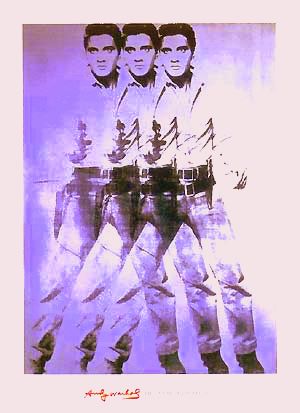
Triple Elvis- Andy Warhol
More than that Presley wasn’t an image of the upper class college youth like Pat Boone but the avatar of the downtrodden and suppressed not unlike Jesus the Christ himself. They took one look at Elvis and realized that he was the Atomic Bomb that would blow up their world. And he did.
Every move Elvis made was an insult to them. Things that had no relevance to them they took as a personal insult. One such was the innocuous anthem by the songwriters Leiber and Stoller originally written as a Negro ghetto sex anthem, Hound Dog. When Elvis sang You ain’t nothin’ but a hound dog, for some reason they projected it as a reference to themselves and they deeply resented it.
Of course every attempt to suppress Elvis deepened the generational divide. Not only did Elvis himself exist but it seemed as though every upcoming rock n’ roll singer wanted to be Elvis. Before the Presley clones of Vegas there were the Elvis imitators in every family’s living room like Gene Vincent, Ricky Nelson, Eddie Cochran and nearly the whole roster of Sun Records, plus, plus, plus….
For most of the old folks rock n’ roll itself was a mystery. They thought it was a Communist plot, might have been I don’t rule it out, but if so we were not conspirators but dupes. We just reveled in it. They almost succeeded in destroying it. Elvis got drafted, in his absence the great rock n’ rollers were driven out, discredited and in some cases killed. When Presley returned in 1960 he was different from when he went in. He had been contained.
John Lennon famously said in 1977 after Elvis died that he died the day he went into the army. While a relevant statement it was not quite true. The first stage in Elvis long immolation was when he fell under the control of his manager Col. Tom Parker, the second stage in his demise was when Parker delivered him to RCA Records, the third stage in his death was when RCA assigned Steve Sholes as his producer.
For those of us who were there the real Elvis Presley ceased to exist when he left the Sun record label. RCA was in no position to understand rock n’ roll values. It wasn’t that they willfully sabotaged Elvis it was just that they didn’t know how to rock. Their idea of rock was Neil Sedaka. Sholes himself was antipathetic to rock ‘n roll no less than his crosstown rival Mitch Miller over at Columbia Records. Both men hated the concept. This was made evident in Sholes arrangement of Gene Austin’s Are You Lonesome Tonight with its plodding guitar riff and Elvis’ imitation of the thirties crooner. Sholes failed to ruin Elvis’ career but it took Mitch Miller one LP to trash the career of the great Dion of the Belmonts.
Very few if any of the great rock records were produced by the majors. Nearly everything of value was produced by independent labels, many of them one shot efforts. Gene Vincent and his Be-Bop-A-Lula was a notable exception although his label, Capitol, soon had him singing Somewhere Over The Rainbow.
After the first run of actual imitators Elvis and rock worked their way into the subconscious of the next wave that included Lennon and the Beatles to produce an extension of rock.
Upon Presley’s return from the army his manager, Parker, removed him from recording and put Elvis into the movies almost exclusively. The movie Elvis was an extension of the personality of Tom Parker. Elvis was Elvis and his appearance was always galvanic. His charisma could be diminished but it couldn’t be destroyed. I was as disappointed by his movies as much as anyone dropping in only occasionally over the sixties to see if anything had changed. It hadn’t.
Thus as we all moved into the sixties while Presley still lived it was only as the ghost of the Sun Records innovator.
The Ghost of Elvis Presley was captured by the artist Andy Warhol in a number of renderings.
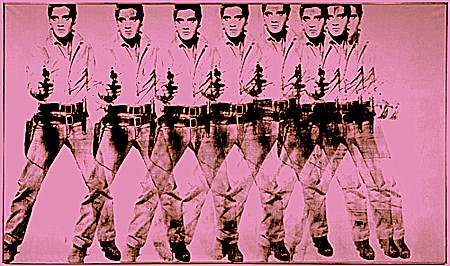
Octopresley- Andy Warhol
He presented Elvis in various single screens or multiples of two, three and up to the eight as in the image above. He ignored the musical Elvis in favor of an image taken from a Western movie. As Warhol was a homosexual he rendered Elvis as a gay cowboy. In truth Elvis had an ambiguous persona. Many people thought he was queer. Any male fan felt himself under the accusation. Elements of his persona indicate a severely emasculated personality that lend credence to at least a latent feeling of homosexuality. Elvis’ fellow students called him ‘squirrel.’ Indeed, the use of eye shadow, pants with a stripe down the leg and pink shirts in 1951-52 and ’53 would have led to open accusations of homosexuality. And yet, even though I identified with his obvious emasculation when I was only sixteen and seventeen it never occurred to me that he might have been one. I don’t think he ever was. Had he been his more than macho entourage would have had nothing to do with him. Nevertheless his portraitist Warhol perfectly captured his ambivalence and androgyny.
The number of portraits by the artist clearly betrays Warhol’s own hero worship. Perhaps his own gay cowboy movie owed some reverence to his idol. Oddly enough Warhol never designed a record cover for Presley even though he designed over fifty during a career from 1949 to 1987.
Andy had always been a pop music fan. This was very unusual for a man born in 1928. This would have made him 26 if one assumes ’54 as the birth of rock and 28 in ’56 when Presley exploded onto the scene. Anyone older than 18 in ’56 rejected rock. It is true that Warhol was dualistic, capabhle of listening to opera and rock at the same time, I mean simultaneously, so he may have had his personality split by the times. At any rate Warhol who apparently wished to excel in all the arts attempted to enter the music field by managing a band, while establishing a rock venue. In 1965 he took The Velvet Underground in as his house band while setting up a venue called The Dom. Not stopping there he also created an ambient experience, or light show, he called The Exploding Plastic Inevitable. The combination of music and light was innovative and widely imitated. Unfortunately Warhol didn’t have a secure lease and the venue got away from him. Perhaps realzing he was spreading himself too thin he never followed up letting the Velvets go their own way.
Warhol nevertheless established close bonds with other musicians. His attempted connection to Bob Dylan failed. Whether sour grapes or not he comitted this thought to his diary in July of 1985:
Watched the Live-Aid thing on TV. Bobby Zaren’s office had been calling, wanting me to go down there, but with that many big celebrities you never get any publicity. Later on that night Jack Nicholson introduced Bob Dylan and called him “transcendental.” But to me, Dylan was never really real- he was just mimicking real people and the amphetamine made it come out magic. With amphetamine he could copy words and make it all sound right. But that boy never felt a thing- (laughs) I just never bought it.
Warhol did succeed with Mick and Bianca Jagger and the Rolling Stones. While his cover for the first Velvet Underground album was considered innovative (read: weird) his cover for the Stones’ Sticky Fingers album with its functional zipper was as the term of the time went, mindblowing.
While Warhol never established contact with the Beatles, when his fellow artist Yoko Ono led her trophy husband, John Lennon, from London to New York in 1970 another firm connection to musicians and the inheritor of Elvis Presley’s mantle as the Savior was formed. Over all floated the Ghost of Elvis Presley.
Part II: John & Yoko In New York follows.
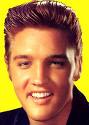
After the Topps Baseball Card Style
A Review
Woman
by
Alan Clayson
Yoko Ono And The Men Who Influenced Her
Review by R.E. Prindle
Clayson, Alan: Woman: The Incredible Life Of Yoko Ono, Chrome Dreams, 2004.

Girlish Yoko- Warhol School by Richard Bernstein
Yoko Ono involved herself with several of the most influential men in the arts during the sixties, seventies and eighties of the twentieth century. She drew her inspiration from them patterning her own efforts after them. At the same time she was one of the leading feminists of the day having her share in shaping and furthering the movement. The mantra was female liberation, equality between men and women. In fact women were equal to men in the West but only by acknowledging the biological differences between men and women. The fact is the differences are real and not social constructs as women would have us believe. The fact is women are women and men are men. So, in seeking ‘female liberation’ feminists were seeking much more than ‘equality’ however the term may be defined.
The fact is that in the Ages old war between the sexes feminists are seeking to restore the Matriarchy and destroy the Patriarchy. That is why many men favor feminism, they prefer the Matriarchy. Thus the feminists are atavistic. Yoko and her cohorts wished, in her words, to restore ‘heart’ as she viewed the Matriarchy and eliminate ‘reason’ as she viewed quite rightly the basis of Patriarchalism. Nevermind that bilogical science has invalidated the concepts of Matriarachy and Patriarchy. This is a post Matriarchy and Patriarchy world.
Circa -2000 in the West men revolted against the mind stifling Matriarchy and the vaginal swamp of the ‘heart’ seeking to establish

Smilin' Jack Cage
the authority of the infinite power of the mind of Zeus on ethereal Olympus. This is the story of Homer’s Iliad and Odyssey and the Greek myths in general recording the struggle.
The Western male was able to impose the ascendency of reason over the heart for 3000 years until the disestablishment of the old order by science about mid-nineteenth century. The center could not hold during this period of extreme change as W.B. Yeats put it as the rearrangement of the intellectual order moved into the twentieth century.
Yoko Ono sought with her feminist fellows to return to the biological innocence of 2000 BC. She herself had no talent. Filled with audacity she pitted her ‘heart’ against the reason of John Cage, Andy Warhol and John Lennon. I’m sure she had a mentor for her so-called performance art but I am as yet unaware of who he may be. Perhaps Maciunas and the Fluxus group.
Thus her first manifestation as an artist was based on the musical ideas of John Cage while her artistic efforts were at least based in the avant garde ideas of the Fluxus group. Her first assault on the NYC art world failed so in 1961 she returned in defeat to Japan. When she returned to NYC in 1964 she found an entirely different art scene. On the musical side the focus was on Bobby Dylan and the Beatles while on the artistic side Andy Warhol and his Factory had destroyed the Abstract Expressionists and the old avant garde. Dylan, the Beatles and Warhol had in fact usurped the avant garde which now had little meaning. From my point of view held at the time the avant garde had ceased to exist. Of course I didn’t understand exactly why or how.
From 1964 when Yoko returned to NYC until 1966 when she left for London I’m sure Yoko was at a loss. She developed her silly

The Bag Yoko And Tony Are In
notion of Bagism at this time even having a black bag on a stand in Max’s Kansas City that some one or ones were supposed to slide into. This seems to have been thought a lame idea at the time as it seems now.
At this time while retaining allegiance to John Cage’s musical ideas she was falling under the influence of Andy Warhol’s artistic notions. Warhol’s intent had been to destroy the idea of ‘fine art’. In this he pretty well succeeded. As Yoko expressed it you didn’t need any talent to be an artist. She seems to demonstrate this notion in her own artistic efforts. Warhol had also redefined the notion of film with his static studies. He then sought to combine his film ideas with live music, probably in competition with Bob Dylan who was also attempting to move in that direction. Warhol adopted Lou Reed and his band the Velvet Underground as the Factory house band while creating a multi-media show called the Exploding Plastic Inevitable, innovative for its time. Thus a concert at his hall, the Dom, was an ‘experience.’
While Yoko makes no mention about how this, actually, incredible development affected her there can be no doubt that she was well aware of Dylan, the Beatles and the Warhol Experience and was affected by it. Indeed, the first manifestation was the making of her Warhol style films such as Bottoms.
The second manifestation was her removal to London to seduce either Lennon or McCartney of the Beatles, thus in the manner of Warhol’s adoption of the Velvet Underground she sought to co-opt the Beatles, the premier rock group in the world. Real chutzpah and more than one upping Warhol. I think it would be nonsense to think she had any other goal in mind.
She undoubteldy learned that Paul McCartney was actively involved with John Dunbar and his Indica Gallery that opened in 1965.
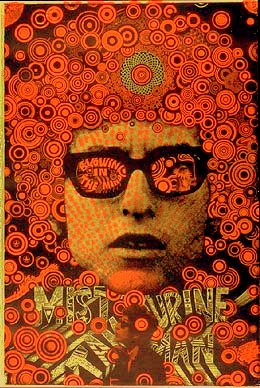
Psychedelic Dylan
Some say she first set her sights on McCartney but the more vulnerable Lennon showed up and the Spider Woman spread her web.
She was still married to her second husband, Tony Cox, but, regardless of what she says she very aggressively pursued, or attacked, Lennon. Lennon was emotionally under water unable to handle his success while drugging himself out of his mind. He was unwillingly married to his wife Cynthia. It appears that he married Cynthia out of duty when she became pregnant. He doesn’t seem to have been happy in his virtue. Yoko had no difficulty in capturing his affections.
Now, just as Warhol had adopted the Velvets and imposed his female singer, Nico, on the band Yoko sought to imp[ose herself on the Beatles through Lennon. At this time she was still musically completely in thrall to John Cage understanding nothing about Rock music. She and Lennon had made a ridiculous LP called Two Virgins in 1968. She combined her cagian screechings while using an avant garde ‘performance’ notion of the couple posing nude on the cover; full frontal on the obverse, full posterior on the reverse. As no store would carry the cover the couple reverted to Yoko’s idea of Bagism placing the cover inside a plain manila envelope or bag. While it didn’t sell the record this form of Bagism was actually a successful artistic statement. The nude cover given an outer garment so to speak.
Well, the public was prepared to forgive the Beatles anything but the other three Beatles weren’t prepared to forgive Yoko for forcing herself on them thus she broke up the most successful act of the sixties. Still, she had succeeded according to her wildest dream. Lennon and his wonderful reputation and fortune were hers. She had gone from a neglected, nondescript ‘performance’ artist to center stage, not on her own womanly talents but by attaching herself to a talented man. Yoko’s ‘heart’ was useless without the male intellect. Yoko was now the most influencial feminist in the world. She knew what to do with that.
After several ‘performance’ acts such as the ‘Bed In For Peace’ the couple left England to return to the place Yoko wished to subjugate artistically, New York City. She had raised herself to a par with Andy Warhol. She now had to meld her musical and artistic goals through Lennon and Warhol.
On the musical side she began to develop her rock n’ roll skills under the tutelage of Lennon. While not abandoning the avant garde notions of John Cage she now emasculated her husband. Always semi-delusional or perhaps completely so, she fantasized that she was not only equal to Lennon in skill and popularity but superior to him. She imagined herself more popular than Lennon. Thus one has such travesties as the LP Double Fantasy. It was only after Lennon’s death that she was forced to recognize than Lennon’s fans did not appreciate her efforts. So she failed as a musician.
She quickly tired of being Mrs. Lennon. Thus she and Lennon separated for eighteen months or so during the years 1973-75. She then realized that her financial well being and musical acceptance depended on Lennon. In 1975 she called him back resuming their relationship until his death in 1980. But, things had changed.
She began to adopt Warhol’s life style on her return to NYC. While she propagated the notion that she was some sort of business whiz Iam having difficulties discovering any such skills. It appears that with the enormous income of Lennon she emulated Warhol in
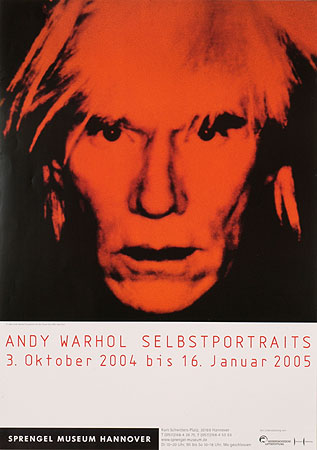
Andy the Demon
spending her way to prosperity.
She was in a position to not only match Warhol’s spending but exceeding it by many times. Through the seventies and eighties Warhol came into his own as an artist while reaping a fortune doing portraits. There appears to have been no effort on his part to invest in income producing vehicles. Rather he bought stuff. He purchased buildings in NYC and elsewhere while acquring undeveloped acreage in places like Aspen. He shopped nearly every day buying antiques from furniture to objets d’ art by the bushel almost as though he were trying to excel the incredible W.R. Hearst.
He usually didn’t even look at the stuff once he bought it merely filling rooms with his shopping bags. At his death all this junk was auctioned off for 25 million dollars, a nice appreciation in value.
Yoko followed the exact pattern buying apartments and houses as well as an extensive dairy farm with a herd of prize cows. She not only had but has five apartments in her principal dwelling, the Dakota apartment building and many other houses scattered around.
Like Warhol the Dakota apartments are stuffed with junk. Valuable, but, you know, stuff. She bought at good prices. Her extensive collection of Egyptian antiquities was mostly purchased before a steep rise in value.
Like the Rothschilds of old Yoko didn’t do all her own shopping but employed agents to search things out. Chief among these was an associate of Warhol’s, Sam Green, and an Hungarian immigrant by the name of Sam Havadtoy.

Buddies- Yoko, John, Andy
There should be no surprise then that she now has an extensive collection of Warhol’s artwork as well as his portraits of Lennon. The Warhols would have been purchased for form 25 to 50K while now being listed on her assets at tens of millions. She also has been said to have a good collection of Magrittes as well as one assumes other artists. So, much of her net worth is tied up in artwork purchased through Sam Green.
Sam Havadtoy was an antiques dealer as well as an interior designer. He appears to have been a somewhat shady character. It is very difficult to find much about him, however there is a sharp portrait available from the notorious A.J. Weberman ( http://www.acid-trip.org/lennon/ )
…(the Lennons) hired a sleazy Eastern European bisexual to renovate the pad. (Dakota) I had heard of this dude, whose name escapes me, from an asswipe named BRUCE KIRSH, who worked for him. KIRSH told me that the dude, who worked for the King of Morocco, would form a dummy renovation company, hire employees like Kirsch who were willing to work under false names, then, when it came time to pay taxes, everyone would disappear. I learned of him long before he was hired by John and Yoko, and I was taken aback when Yoko took up with him after John’s death.
I know that Weberman is not particularly well thought of by fandom but this is because of his harassment of Dylan who did, after all, misrepresent himself to the revolutionaries like Weberman. A.J. himself is an intelligent observer who was wading through it when it was deep. I do believe he knows what he’s talking about although his interpretations of Dylan’s lyrics seem absurd.
I would have to question Yoko’s judgment in taking him in. Both he and Sam Green were candidates as successors to Lennon with

Lennon by Warhol
whom she consorted in front of Lennon before he died while Yoko chose Havadtoy as his successor the day he died.
Perhaps she selected Havadtoy over Green because he was more rough trade. With Lennon while managing to reconcile revolution with peace and love with Havadtoy she discarded peace and love in favor of strong arm methods against her former employee Fred Seaman when it was totally unnecessary.
Havadtoy was living in a homosexual arrangement with his business partner when Yoko beckoned him to switch to her. Apparently an able switch hitter he was lured by the money to this much older woman. The arrangement did last for twenty years before Havadtoy removed to his native Hungary taking a nice cash settlement and several of the Warhols.
Thus, just as Warhol had his live-in homosexual arrangement so after Lennon’s death Yoko adopted the exact arrrangement. Today she apparently lives alone, a seventy-eight year old woman.
After Lennon’s death there was an accession of from 30 million to a possible 100 million dollars as their last album, Double Fantasy, sold into the millions while the rest of Lennon’s catalog and one assumes the Beatles’ catalog was reinvigorated while all things Lennon sold. This is, of course, no reflection on Yoko but the inevitable result with intellectual properties when the maker dies.
Post-Lennon, then, Yoko realized that her recording and art careers were nil. Heart without intellect is worthless. She then became the caretaker of the Lennon legacy. His recordings, of course, continued to sell, but even his artwork eclipsed that of Yoko. So she suffered the humiliation of being a mere appendage to a man. The feminine dismal swamp was eclipsed by the Olympian heights of the male intellect. As in ancient times the God had trumped the Goddess. And yet as with Hera and Zeus the Goddess gets her way. Yoko came up with the money and goods while Lennon’s spirit was wafted into the stratosphere.
As any reader of mythology knows Hera ruled the Lernean swamps of Argolis while Zeus ruled the gods on ethereal Olympus. Thus one has the symbolism of the biological difference between the male and female.
In ancient times the female had her share in magic. She knew herbs and plants, was familiar with poisons and cures as with the arch witch of the ancient world, Medea. The reputation of the female witch even as a consort of Satan persisted down through medieval and post-medieval times, indeed, even up to the dawn of the scientific enlightenment. One would have thought that magic and witchery were a thing of the past in the 1960s and yet Yoko embodied the whole female swamp mentality.
She established something called the Spirit Foundation attributing the direction to Lennon who in fact knew nothing of these matters but followed her lead. The Spirit Foundation celebrated the ancient art of the Shaman or witch doctor. Shamanism itself even preceded the Matriarchal swamps of Argolis. It was a rich repository of magical tradition. Further the Foundation was feminist in that it was dedicated to preserving the magical traditions of the women of the Pacific islands still living in such archaic societies. The wealth generated by the male intellect was appropriated by the female vagina or ‘heart.’
In her own life and that of Lennon’s Yoko was addicted to a variety of magical practices- astrology, numerology, Tarot readings, and indeed she traveled to the Caribbean to sell her soul to Satan through the offices of a female curandera. Her Tarot reader, John Green, was a priest in the shamanistic, magical, Yoruban African cult of Santeria.
Her feminism was more a magical effort to restory Matriarchal supremacy over the Patriarchy thus reversing the Patriarchal victory of three thousand years previously. Indeed, what has been called the movement for female equality is nothing more than a covert campaign to restore the Matriarchy.
Thus while Yoko o9riginatd nothing she usurped the abilities of the reason of men- Cage, Warhol, Lennon and male magicians such as John Green. Indeed the Trojan War itself was a war of men in service of women.
In her associations with men she preferrred to deal with emasculated types such as homosexuals like Cage, Warhol, Sam Green and Sam Havadtoy. Lennon claimed to have always been dependent of women for comfort and guidance while Yoko caught him at his most confused and vulnerable.
While she received direction from Cage and Warhol she was able to manipulate Lennon out of his talent somewhat as Vivian did that of Merlin of the Arthurian saga. When Vivian had usurped Merlin’s magical knowledge she buried him deep much as Lennon was put out of the way. Yoko then appropriated his wealth and residual income after his death. It was this constant inflow of cash that allowed her to propagate the notion that she was a financial genius.
Then as the female of the ‘heart’ or vaginal swamp she managed and appropriated the reason of Olympus through Cage, Warhol and Lennon. What she got from Havadtoy other than brute strength is not clear to me.
As such Yoko is Woman. In her case a seeming reversion to the archetypal Shaman of the most ancient times.
Part III: Mourning Becomes Yoko
April 3, 2010
Mourning Becomes Yoko Ono
The Passing Of John Lennon Part III
by
R.E. Prindle

Doppleganger #1
When John Lennon met Yoko Ono he knew very little of art and nothing of the New York art scene. His high school years had been spent in open and futile rebellion; the next few years had been spent only in the German underworld with no time for cultivation. From there he went into the whirl of the Beatles years so one might say he had been in cultural suspended animation for all his adult life.
Yoko Ono since 1960 had been engaged in the New York avant garde art scene. She was au courant when she left for London in 1966. Hooking up with Lennon she began to educate him according to her understanding of art. By the time the Ono-Lennons arrived in New York in the late sixties that scene was dominated by the POP art of Andy Warhol while the world both she and Lennon knew in 1960 was unrecognizable. Yoko wasted no time in ingratiating herself with Andy but not the factory. After he was shot in 1969 the old Factory disappeared and after his recovery Warhol began a new life. It is possible that she tried to establish

Doppelganger #2
contact with him between ’64 and ’66. She did know warhol’s associate, Sam Green, from her first days in the Village in 1960.
By the time of her return to NYC Yoko had achieved world wide fame by using Lennon and his fame in their charades for ‘Peace.’ Now she had the perfect entree to enter Warhol’s circle. Warhol was a sucker for celebrities, he did Lennon’s portrait, so he was flattered when Yoko asked him to introduce she and John into society. If Warhol could pester, Yoko was unstoppable. While Andy wasn’t exactly persona gratis at that time he was thick with Sam Adams Green who did have entree to society. Between the the two of them they set up a party to introduce the Ono-Lennons.
John was, of course, no Mick Jagger. While Mick adapted himself quickly to the demands of his fame and moved easily in society, John was awkward being out of the element of his self-styled working class hero. Yoko, too, was no mixer so at the party Yoko and John sat silently in a corner as though in one of Yoko’s bags watching the party goers.

Warhol Jagger 2

- Warhol Jagger
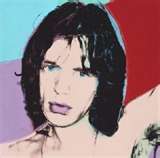
It might be apropos to point out that Jagger and Warhol were fairly close. Jagger was one of the few people attending Warhol’s funeral in Pittsburgh while Bianca was in Warhol’s entourage in the eighties. Warhol also painted a portfolio of Jagger pictures that today command healthy prices.
The Devil In Disguise

- Witchy Woman and Warhol

Yoko still persisted with Warhol but Andy having been disappointed once was not up for it twice. He distanced himself from the pair describing them to Sam Green as boring. An ultimate putdown.
Initially the Lennons lived in the Bohemian scene downtown. Mickey Ruskin, the owner of Max’s Kansas City, described the Bohemian scene thusly: the well-to-do Bohos, the middle and the lower class. Those associated with the Kettle of Fish and its environs of which Dylan was a member were of the lower class while the Kettle of Fish itself was owned by the Mafia. He believed Max’s was in the middle. John and Yoko first lived in New York in the West Village at 105 Bank Street next door to Yoko’s her, John Cage. They took over Joe Butler’s apartment, he formerly the drummer of Lovin’ Spoonful so Ruskin would have classed John and Yoko as haut ton beatniks.
At any rate they soon left those environs to migrate to the Upper West Side where they secured apartments in the famous, or soon to be famous, Dakota. It was then that their NYC life took its definitive form.
I have been to NYC a few times so that I know the general layout and have some feel for the place but I have by no means an intimate knowledge so essentially I’m working from maps. I know where MOMA and some few prominent art landmarks are from experience but not that many.
At any rate the Dakota is a famous landmark.. Acceptance as a tenant is by committee approval. John and Yoko were strenuously vetted but finally admitted. They took over actor Robert Ryan’s apartment #72. If you have seen the movie Rosemary’s Baby the camera pans past apartments 71 and 72. No filming was allowed inside the Dakota so while the exterior shots are authentic the interiors were shot on sets. Thus the apartment of the Satanists is a fictional 7E. The apartment next to it in which the young couple resided may have been number 72. The man of the couple who was an actor sold his wife’s body to Satan as the carrier of his child for success in the theatre which he was granted. Thus the Ono-Lennons moved into an apartment closely associated with devil worship, the occult and witchcraft.. This will become more important as Yoko associated herself with all three. In fact, Yoko through John Green would have been familiar with the Yoruban Santeria religion that she in all likelihood would have reverenced. The Spirit Foundation that she established is concerned with the preservation of just such tribal institutions.

Dakota Entrance
These are magnificent apartments that I presume Rosemary’s Baby duplicates. Huge fifty foot long living rooms as part of a ten room apartment. The Ono-Lennons would soon own both 71 and 72 lacking only the fictional 7E while having a Studio apartment as well.
Being now permanently settled Yoko having access to John’s superb income began to spend it. Of course, she virtually cleaned out department stores on her buying binges, any girl’s dream. But, she also began to buy heavily into art and antiques as investments. This brought Warhol’s friend Sam Adams Green into a close association with her. Rich society women were Sam’s forte. He has an interesting story. He was actually descended from the second president of the United States, Samuel Adams. He arrived in New york in 1960 about the same time Andy Warhol was trying to establish himself as a fine artist and Yoko the same. Warhol of course began as a commercial artist doing shoe ads but in 1960 he changed the emphasis of his career.
In the fine arts field one of the first gallery people Andy met was Sam Green of the Green Gallery. Different Green, Sam only

The Dakota
worked there and shared the name. He and Andy hit it off. By 1965 Green was associated with the art department of UPennsylvania where he staged a Warhol exhibition in the same year. From there he gravitated bck to NYC where he began a career as art consultant to rich women on both continents. They liked him. Through the socialite Cecile Rothschild he was introduced to Greta Garbo with whom he was sort of a trusted companion for 15 years.
He was very knowledgeable about art as an investment traveling between Euorpe and the US advising socialites on the most investment worthy art. He apparently derived a more than comfortable income from his efforts. He was a trusted advisor of Yoko. Some say that he and Yoko’s Tarot reader, John Green, who would enter John and Yoko’s life at about this time, combined to bilk Yoko for overpriced objects. This presumes that both men were dishonest and that Yoko was a fool. As Yoko’s investments have prospered I think we can dismiss the latter, although Yoko did take pride in being able to spend vast sums. She would have taken pleasure in overpaying.
Sam Green- Current
Rather I would say that Sam Green was a very knowledgeable expert whose task was to find art that would appreciate in value. Thus the question is did he perform that function and the answer is, yes. Yoko’s acquistions increased in value far above her purchase prices. I think it is unfair then to say that the Greens bilked her. Surely the laborer is worth his hire.

Warhol Portrait
Now, Sam Green as her agent had to buy the items he acquired for her. Being knowledgeable as to who in society wanted to sell what at distressed prices he may have made some excellent buys that he then tacked on his margin which of course meant that he sold to Yoko for ‘more than they were worth.’ But, heck, even Christie’s and Sotheby’s take twenty per cent each from the buyer and seller. That’s a forty per cent surcharge. However Sam served his function of providing investment pieces so I see no evidence of bilking.
Sam Green also formed a close, probably romantic, liaison with Yoko that persisted until after John’s death. Another art dealser she became close to was a Sam Havadtoy with whom she subsequently lived for twenty years beginning immediately the day after John’s death.
Now the men Yoko associated herself with were all effetes, that were either emasculated when she found them or who she emasculated. Strangely Lennon was the strongest of the lot. Both her first Japanese husband and Tony Cox appear to have been heterosexuals but both Sam Green and Sam Havadtoy were dependent homosexuals. With Havadtoy Yoko may have had her ideal relationship. He was thoroughly emasculated while with the fortune Yoko inherited from Lennon he was totally dependent on her. The classic toy boy a couple decades younger than herself. He, by the way, after his twenty year stint as live-in retired to Hungary with an abundant palimony but he isn’t talking.
In my reading of the situation then, a not particularly compliant John became somewhat of a liability to her, especially as he began to reassert himself with the return to the recording studio in 1980. The problem has the surface appearance of separating the man form his money and discarding the man.
Yoko began building her entourage, Sam Green, John Green, Sam Havadtoy and her various occult people with what appears to be an admiration for and some sort of connection with Andy Warhol. Sam Green and Havadtoy would be a troublesome presence in Lennon’s life during the recording of Double Fantasy while he does not appear to have been enchanted with the Warhol connection
As has been mentioned Yoko became involved in occult practices. She did practice hypnotism on Lennon and was an adept at suggestion which is the essence of hypnotism. Thus on the one hand she suggested forcefully to May Pang that she take up with Lennon while it is probable she hypnotized Lennon into taking up with May Pang. Post hypnotic suggestion would give her a command over all Lennon’s actions. Once implanted she would only have to say the word and Lennon would follow her suggestions.
How complicit John Green would have been in this isn’t exactly clear but any of Yoko’s suggestions to John could have been complemented by a reading. John Green was after all dependent on Yoko for a very generous income beyond whatever he may have scammed.
John Green is another interesting case. He was apparently successful as a Tarot reader before he met Yoko while he is reported to hae been a student of the African Yoruba religion called Santeria. The Yoruba are a tribe in Nigeria, middle river, Western side. He would have obtained much of the magic information he displayed in Cartagena, Columbia, SA from that source. The sixties themselves were the great period of the dissolution of the American mind and personality. One of the key items in the disintegration was the 1962 movie, Mondo Cane. (It’s A Dog’s World). It is difficult to assess the impact of this movie on the malleable college age mind of the times.
I saw the movie then and while it passed out of my conscious mind it struck me most forcibly and lodged in my subconscious mind. I, of course, reviewed the movie for this essay and while I at first remembered little gradually my conscious mind recovered the images so that I remember almost all. The viewing at the time was very repulsive and unsettling to my mind as it was for everyone I talked to about it and every college kid saw it. Still, consciously I missed the true import of the movie completely.
The filmmakers equated some New Guinea stone age people with modern Whites and equated them- said both states of
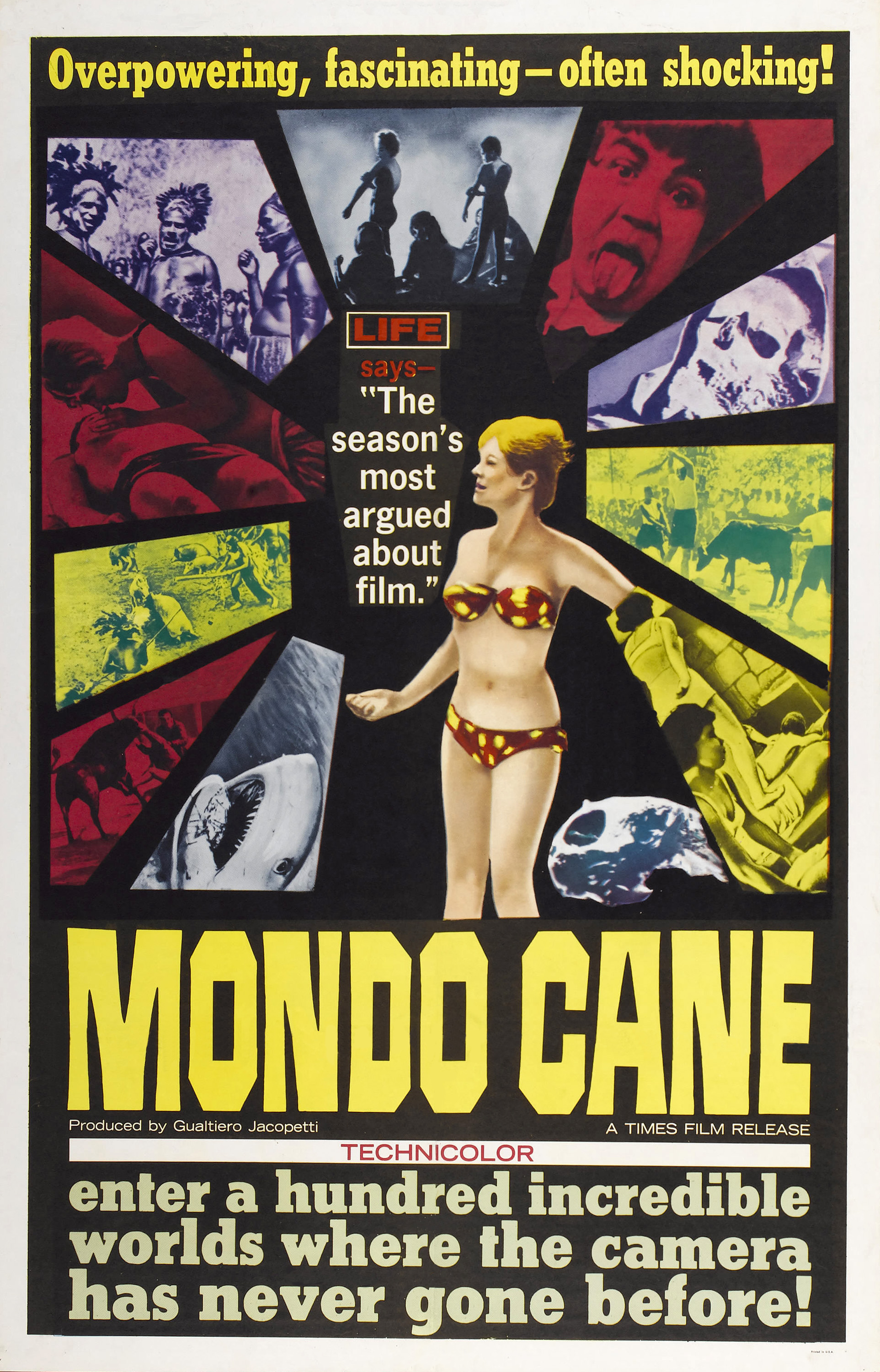
Mondo Cane Poster
consciousness were the same- and that there had been no advance between the primitive and modern. Then they showed Whites at their goofiest and most ridiculous. Drunks at a German Oktoberfest, aged tourists clumsily trying to do a hula. The movie was a real exercise in moral relativity. It was shortly after viewing the movie that I first remember hearing the phrase ‘Nothing is good or bad but thinking makes it so.’ I don’t want to philosophize on this but my thought was that if I think something is bad therefore it must be because I think it and I can’t be wrong.
The movie had a devastating effect on the attitude of the generation. It was a form of hypnosis with a great deal of post-hypnotic suggestion. Whether John Green saw the movie or not I can’t say but if he had it would have prepared him for accepting Yoruban Santeria. In fact these primitive forms of religion and what not flourished in the wake of Mondo Cane. At the same, as I indicated, Yoko would have been very open to Santeria. I think there is little doubt that Green and she at least discussed the religion and its African tribal origin. Especially as she established something she calls the Spirit Foundation. In the online prospectus she describes the foundation thusly:
The Spirit Foundation is…concerned with the protection and promotion of creative and cultural diversity amongst shamanic tribal communities worldwide. Part of the foundations work is the International Shamanic Network which aims at promoting the ancient creative archetypes of man and their binding ecological realtionship to the world.
Our emphasis is on education for action.
As mentioned Yoko and Lennon moved into the suites used in Rosemary’s Baby with its Satanic overtones. In the movie a young woman living with the Satanic couple either jumps or is pushed to her death not far from where Lennon was shot. In this very location Yoko took up Satanism. She decided she wanted to make a pact with the Devil to obtain her wishes. The ubiquitous Sam Green knew of a witch who could serve as an intermediary between Yoko and Satan. (Remember I am only retailing the story, I don’t believe Satan exists.)
Sam Green who had prospered as an art consultant had used some of his earnings to purchase what he called a castle in Cartagena, Colombia. He recommended his witch to Yoko who asked John Green to take her to the witch as he doubled as Tarot reader and Wizard. John Green did so and the witch duly negotiated a deal between Yoko and the Lord of Fire. When it came time to sign the pact Yoko asked Green to do it for her which he did. She was aghast when he told her he didn’t sign his name but hers. Yoko trying to cheat the devil.
We don’t know what she asked Satan for but we are compelled to believe she got it.

Santeria Illustration
As I believe she hypnotized Lennon into taking the Long Weekend I don’t know exactly why she wanted him out of the house. She certainly closely monitored his activities while he was away both in NYC and LA. During his absence Yoko didn’t have a Power of Attorney so she was somewhat constrained as John had her on a 300K budget. When he returned she quickly obtained his POA so that she had unlimited use of his money and, in fact, his identity.
Lennon is criticized for being a recluse in the years between 1975-80. He certainly wasn’t a recluse in that he withdrew from the world. He merely limited his contacts with it. It is said there was a fifteen month period when he was completely withdrawn. While he was obviously suffering from a mental malise in my opinion the withdrawal was completely justified. He had mental issues that had to be resolved. He had the money and time to work at it as he did.
He had a mother/father fixation he had to resolve. he had the feeling that he had been either a genius or a lunatic from boyhood. In a remarkable rant within the 1970 Rolling Stone interview he rants for pages because no one recognized him as a genius in his youth while he had now convinced himself that he was and had been a genius. The fact that he never did his schoolwork doesn’t seem to him that that may have a reason why people missed his genius and though him somewhat mad. What would theyhave done if they had? So he had to reconcile the issue in his mind.
He seems to have made no advance past his school years except in music. The years between leaving school and taking up with Yoko were completely wasted intellectually while the pressures of phenomenal success and wealth disoriented him completely not to mention the massive doses of drugs. At some time then he had to come down and organize his mind and life. From 1968 to let us say 1980 he was completely dependent on Yoko for his mental balance. In NYC he went where she did and did what she did. Hence the connection to Andy Warhol and Sam Green.
There are numerous pictures of Yoko, Lennon and Warhol. Yoko even patterned some of her work after Warhol’s style as in the ‘work’ below patterned after Warhol’s double Elvis. Thus she associates herself and Lennon with Presley.

Yoko Goes Warhol, Imitation of Double Elvis
As I mentioned before the social entree arranged by Warhol and Sam Green failed because of the social ineptness of the Ono-Lennons.
While we have a full record of what Lennon was doing during his ‘Lost Weekend’ we have a less full account of what Yoko was doing. She seems to have had romantic liaisons with at least three men- Sam Green, Sam Havadtoy and the guitarist David Spinozza.

Sam Havadtoy
Perhaps she wanted to see how well she could do on her own as a musician, to see if her reputation as a performance artist and, in her mind, musician, was sufficient to maintain a career on her own without John. If so, she was brutally disappointed as in her only solo performance she failed miserably. Thus she realized that as of 1974 her reputation as well as her wealth depended on Lennon.
It was during Lennon’s absence that John Green came into her life. While John Green tells a fairly smooth story in his Dakota Years one has the feeling that he is being highly selective in what he tells while he slyly ridicules the Ono-Lennons as their superior. The attitude easily leads to contempt and from contempt to abuse. Of course he would have to dissimulate both the contempt and abuse as Ono would be reading the book. As I imagine, a priest in the Santeria religion, he would have been in the company of some shady characters. I don’t know how many actual Yorubas were in NYC but I have met a couple elsewhere.
One imagines most of the hierarchy Green came into contact with was African or American Blacks. Santeria involves a deal of ritual sacrifice while money would be needed. I suspect that John Green was involved in the extortion attempt on the Ono-Lennons. This may have been Santeria related. Thus a sort of Black Hand organization was created. Rather than go for the big money that would have created a stir, the group settled for hitting up people with millions for a mere 200K each. An unpleasant tax for being rich but one more conveniently paid than to die resisting.
We have only Green’s version of the extortion and his relationship to it. He paints himself in a relatively good light. The Ono-Lennons did call in the FBI, they did give the extortionists newspaper rather than cash as the FBI advised. But then things went wrong. The FBI apparently had only one tail on the extortionist who came for the money rather than a series of back ups. The agent inexplicably lost his man. The Ono-Lennons never received another call but they had been warned that if they failed to pay Lennon would be killed whether it took one, two or more years. In December of 1980 the bill fell due. On December 8th he was shot. December 7th is Pearl Harbor Day so there may be a Japanese connection. Yoko Ono being Japanese, her numerologist and the assassin’s wife while Chapman missed the appointed day by one.
The question then hangs on Mark David Chapman the shooter. He is still alive and in prison. He was an assassin as the classic lone nut like Lee Harvey Oswald and any number of assassins who pay the law for the crime while the organizers go free. The technique has been well known to criminals for centuries. Any time a lone nut assassinates someone you may be sure that they were a patsy as Oswald announced over TV he was.
It seems likely that Chapman had been hypnotized. Witnesses said Chapman acted as though in a trance and he himself said he heard a voice in his head saying: Do it. Do it. Do it. The problem would be how he was recruited. I, of course, can say nothing for certain while what I am saying now is merely an hypothesis or inquiry. The main thing is that Chapman was supposed to be a lone nut. Ridiculous.
The most obvious recruitment method was the Santeria of which John Green was a member and to which Yoko Ono was
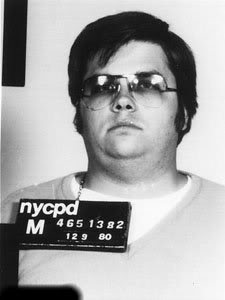
Mark Chapman
sympathetic. There are some oddities in the Chapman story that have to be explained not least of which are the large sums of money expended by Chapman in relation to his income. He was a married man therefore had a wife to support. Yet in 1978 he was in Japan at the same time as the Ono-Lennons beginning an around the world flight.
Perhaps Tokyo was the first stop of the trip around the world that then led to Seoul, Hong Kong, Bangkok, Delhi, Israel, Geneva, Paris, London, Dublin, Atlanta and back to Hawaii. His travel agent was a Japanese woman, Gloria Abe, who he then courted and married. She is reported to have been involved in occult circles. She may have seen so involved that, through Takahashi Yoshikawa, Yoko’s numerologist she was brought in to arrange the trip. Such an around the world trip in a Westerly direction- sundown to sunup- according to Yoshikawa’s numerology would be characteristic of Yoko Ono. She and Lennon made a round the world trip for occult reasons as did both Lennon individually and John Green at her instance. Green made his trip in 59 1/2 hours only leaving a plane once to change to another. As the financing of Chapman’s trip is unknown I would suggest Yoko Ono.
Two years after this very costly trip around the world Chapman flew from Hawaii to first Chicago, then Atlanta, then to New York where he landed a few days before the assassination. Once again, well beyond his means. It is said that he took paintings to Chicago that he sold. Where he would have gotten the paintings isn’t known but once again Yoko is the obvious source. She had an art gallery of valuable art work.
While in Atlanta he contacted a former roommate, then a Deputy Sheriff, Gene Scott, who gave him the hollow point exploding

Santeria Priestess
bullets for a handgun. One assumes such bullets couldn’t be bought over the counter. One wonders why Scott didn’t ask what Chapman intended to do with them. And if he did and Chapman told him Gene Scott is clearly an accomplice and should be questioned.
Chapman himself came from Atlanta where in his teen years he was known to ingest any and all drugs. Atlanta was also a Santeria center with several weird Black cults. Lennon’s death took place at the same time as the Atlanta child murders for which Wayne Williams was later convicted. The Santeria religion has been suspected in these obvious sacrificial murders while John Green establishes a Santeria connection to the Ono-Lennons and Yoko in particular.
Yoko was an excellent hypnotist who understood the use and power of suggestion. The Santerists as Africans would be well versed in the use of suggestion and hypnotism.
Chapman said he was possessed by the Devil while appearing to be in a hypnotic trance. All this rather amusingly is taking place at the Dakota, the scene of the Devil’s birth in Rosemary’s Baby. Indeed, the identical apartment.
After Lennon’s death there was no period of mourning or sense of loss by Yoko. All Lennon’s assets were in her control and name before his death. The so-called will of Lennon is suspicious, although the will was unnecessary becaue I doubt if Lennon thought of a will while the will appointed the art dealer Sam Green as the gaurdian of son Sean in the event the Ono-Lennons perished together. Lennon wasn’t that enamored of Sam Green.
Within a few days Sam Havadtoy was installed as Yoko’s live-in where he remained for twenty years.
While Yoko’s success as an artist and rock n’ roller wasn’t affected by Lennon’s death she now had the money to pay to have her art exhibited. Even then she found her reputation was indissolubly linked to her dead husband. She has become a caretaker for the Lennon legend parceling out old recordings while humiliatingly Lennon’s artwork is more in demand than hers.
She seems to have patterned her later career on that of Andy Warhol who as he acquired fame and fortune managed to insinutate himself into certain society circles. So has Yoko. Now, at 78, she has attained a certain status although still extremely self-centered while having an appearance of terminal aloneness.
Animus and Anima

A Review: John By Cynthia Lennon
January 14, 2010
A Review
John
by
Cynthia Lennon
One Giant Step For Somebody
Review by R.E. Prindle
Lennon, Cythia: John, Three Rivers Press, 2005
Remember what the door knob said…
–Grace Slick
We built this city on Rock and Roll.
–Jefferson Starship
If you want to be a girl of mine
You’d better bring it with you when you come,
–Trad.
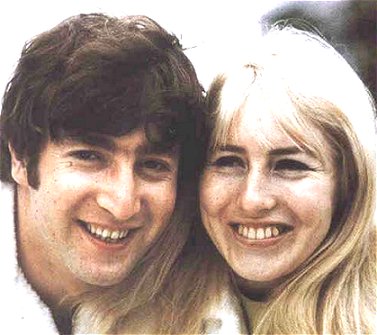
John and Cynthia- Sometime In Liverpool
Cynthia Lennon’s autobiography of her life with John Lennon opens the door to a number of possibilities of which I’ll explore one, at least, here.
Let’s begin with Lonnie Donegan’s 1955 hit The Rock Island Line. Lonnie was the originator of his own genre- Skiffle Music. Skiffle was all the rage in the British world from England to Australia to New Zealand while passing very lightly over the States except for the fortunate few of which I was one. Rock Island Line was a major hit in the US though.
Lonnie, may he rest in peace, was also the originator of the Big Beat. Of course Lennon and most of the young English rockers studied at Lonnie’s feet. The first band Lennon formed, the Quarrymen, was a Skiffle band. That was back in the fifties before the second stage of the big change kicked off. The first stage began about 1950 with Johnny Ray and his song Cry.
Eisenhower had the world pretty well organized in 1960 before John Kennedy stole the baton from the intended successor, Richard Nixon. With the accession of Kennedy the American personality or identity, such as it was, began to disintegrate- I mean in the psychological sense.
The Celts tried to establish Kennedy as the second coming of King Arthur and his Camelot. Not the smartest thing they could have done; a couple bullets fired in Dallas on November 22, 1963 put a period to that dream. By the then the sixties were fairly launched about to begin in earnest in January of 1964 when Lennon’s next group, the Beatles, hit.
The Beatles began as a Big Beat band rooted in the fifties. Seized by the avant garde they were made the avatar of the sixties. In their own way they launched the sixties although the makins’ were already out of the can. Kennedy was shot almost in December and in January the Fab Four washed his memory out on the Ed Sullivan Show. The Kennedy assassination was so then, then. The Beatles were NOW. IS in capital letters.
While the Beatles were revamping fifties music they edged into the future with modified Prince Valiant haircuts and collarless suit jackets. They were then NEW emerging into a brave new world.
Almost at the beginning of 1960 the art world was shaken by the emergence of Pop Art. Jasper Johns, Claes Oldenburg, Robert Indiana, Roy Lichtenstein, Robert Rauschenberg and especially Andy Warhol with his Campbell’s Soup Can set the sixties on its ear. On

Premier example of Pop Art
the film scene the James Bond series with its new sensibility began. Bond also was a revelation portending changes with unintended consequences.
Pop Art would figure signficantly in Cynthia Lennon’s life in a few years when one of its more laughable practitioners, Yoko Ono, would step into her life and filch her husband from her. In fact Pop Art would be inextricably linked with the record industry. All the pop motifs would find their way onto record covers with increasing frequency. Tiny Alice would have a cover that opened like a match book. Talking Head’s colored disc would even become a happening designed by Rauschenberg himself. The burgeoning poster business would find its way into record sleeves. Astonishing packages never seen before in the record business although perhaps anticipated by the experimental ESP label of NYC. Some interesting stuff. Perhaps Milton Glaser’s poster of Bob Dylan could run for the distinction of the most popular poster design of the whole era. It was innovation itself at the time although not quite so fresh today.
Now, all this was happening so fast and from so many directions that it was impossible to get it all or even keep up on what you did get; after all people had lives to live.
In the San Francisco Bay Area where I was during the sixties the Scene was especially heavy. I wasn’t in the thick of things but a little off to the side. Thus while the UC Berkeley Free Speech Brouhaha took center stage in the East Bay, Ken Kesey, the Merry Pranksters and the Acid Tests were simmering on the Peninsula, but actually invading the middle class especially at Stanford and UC Berkeley. The San Fransciso Mime Troupe was very important in the early stages while Bill Graham was commercializing the Trips Festival with his Fillmore shows and Chet Helms was organizing the Avalon Ballroom out at the beach. The posters for the ballrooms which epitomized the psychedelic was the first inkling I had that something ‘new’ was happening. I don’t know how quick on the uptake I was but the first inkling of New York Pop I had was 1966-67 when I opened a poster store soon to be a record store.
LA, always commercial, would nevertheless provide the great Ron Cobb political cartoons for the LA Free Press one of the best of the Hippie papers soon to degenerate into porn as did the Berkeley Barb and all the rest. R. Crumb in San Francisco became the king of Hippie porn which characterized the movement from then on. The scene was then set for George and Pattie Harrison’s famous descent on the Haight-Ashbury that disappointed them so.
This brief sketch only contains a few of the highlights of the period. It was into this world that John and Cynthia Lennon stepped unprepared. Both Cynthia and John came from a background of very low expectations. Cynthia’s dreams were very modest while per her John’s dreaming was no bigger than reaching the tops of the pops in England.
Indeed the much touted German clubs showed no promise of a future whatever. Essentially playing in brothels in Hamburg one wonders what the ‘lads’ were thinking of the whole process. The wonder is that they paid enough attention to hone their skills. One of those making lemonade from lemons situations.
Only the greatest good luck showed them to success and fortune. They would have labored in the vineyard for a while and then drifted off into jobs but for the fact that an entrepreneurial romantic by the name of Brian Epstein saw them as the vehicle to realize his own dreams. He had the direction and energy to galvanize their careers. Still they were rejected by all the labels until a producer, George Martin, apparently heard what the rest of the world would hear and agreed to record them. It was then that the unbelievable happened elevating the Beatles into the most successful pop group ever. It was success far beyond their imaginations. With that success came challenges that neither John nor Cynthia could meet. The fact that they failed is no reflection on either one; they came from very low expectations and having fallen down the rabbit hole they were slightly unprepared. ‘One side makes you larger, the other side makes you smaller.’
To this time in their lives neither had even eaten at anything other than the English equivalent of McDonald’s, fish and chips or whatever. Now in one great step they were introduced into the haut ton by their manager Brian Epstein. Cynthia leads us to believe that Epstein gave special attention to John over the other ‘lads.’ As Epstein was a homosexual and as other sources, Peter Brown, Goldman actually state that Epstein seduced Lennon he obviously had a crush on John seeking to mold him in his own image. Indeed, John may have been his incentive for taking the Beatles on. Lust at first sight.
John had an attractive flip attitude that left the impression that he was much better educated than he was. Actually he left Art School, already a step down from the top, flunked out or whatever preferring to devote himself to his guitar chords. Most of the rockers were in the same situation. It’s amazing that their fans looked to them for salvation. This was tragic, because the generation invested all their hopes and dreams in these muscians attributing universal knowledge and genius to them, each and everyone. While they all did changes on certain political and social themes there was an appearance of ‘deep’ knowledge. Being anti-pollution was a badge of authority. Grace Slick of the Jefferson Airplane made the mistake if, one hopes, jesting that one should never trust anyone over thirty; this while she, John and others were about twenty-nine.
The phrase stuck. Those under thirty trusted these youthful, perhaps well-meaning rock stars. Being somewhat older at the time I could only see some very ordinary boys and girls who were just youthful wiseacres as we all were in that phase of our journey through life. Give me a break.
The most revered of all were the three Beatles John, Paul and George with Ringo thought of more as the court jester. John seemed to take his role most seriously as the guru of the generation, especially after he abandoned Cynthia for, spare me, the psychotic Yoko Ono.
Her abandonment by John for Yoko Ono is of course the most traumatic incident in her story. One can only commiserate with Cynthia. Then one has to search for reasons why; there was certainly no physical attraction there. Lennon did release a solo album called Mind Games so perhaps the best place to look is the mental. Lennon’s success must have placed great stresses of various kinds on him. The transition from a fair degree of poverty to one of a very large income to great wealth under the management of Yoko Ono would be psychologically unsettling in itself. Cynthia was unable to transit from poverty to wealth always remaining a lower middle class haus frau while John appears to have lacked the social climbing instincts of, say, Mick Jagger.
Musicians in general are held in very low esteem by the social elite so without unbounded desire and chutzpah, an ability to endure slights of the most painful kind it is highly unlikely that a musician would ever find acceptance in society. The aristocrats, Marrianne Faithfull describes as associating with Jagger appear to me to be more of the Black Sheep variety. So, Lennon may have been experiencing some frustration at that level.
At the same time there are numerous flatterers who are adept at putting ideas of omnipotence into your head not only intimating but saying that you are godlike. Even though one rejects the notion on the conscious level still a feeling of super powers creeps into your subliminal mind. One feels invulnerable, that one can do what’s never been done, that one can do drugs with impunity. There was never a time when the availability of drugs was ever greater or more socially acceptable.
At the time rumors abounded which have since turned into facts. During the Kennedy administration there was one Dr. Feelgood operating in New York to whom the social elite went for their drugs. His name was Dr. Max Jacobson and he was your friendly amphetamine pusher. His speed cocktails were extraordinary and they lasted for days. It’s comforting to know that President John F. Kennedy was amphetamine fueled while he was making those difficult international decisions- like Cuba. Nothing like having an A-man on the job. He wasn’t alone, VP Lyndon Johnson, followed in his footsteps into the office of Dr. Feelgood. He would have found his place at the end of the line of the NYC elite.
One person who took the good doctor’s prescription said that he went blind for three days staying high for several. Max was the economic type, dirty needles too.
At the same time Dr. Timothy Leary was sending everyone from prison inmates to Beat poet Allen Ginsberg tripping into inner space with his free handed distribution of LSD. Kennedy was involved in that too.
Prior to their arrival for the Sullivan show we are led to believe that the Mop Tops had only used pep pills in Hamburg to fuel their twelve hour sets. We are told that Bob Dylan was the one who turned them on to La Cucuracha, the most mild of the intoxicants. From there the boys graduated to LSD through spiked drinks or food.
Just as Harrison’s wife, Patti, records a spiked introduction to LSD so does Cynthia Lennon. Cynthia quite properly was revolted by drugs having no use for them. John was quite the opposite. He embraced LSD apparently ingesting regularly for long periods of time. As he would describe it, thousands of trips. At that point in my estimation the marriage was over. There is nothing for which Cynthia has to reproach herself except for her small divorce settlement. Nothing disintegrates the personality like drugs.

The Ghost In The Machine- Albert Hofmann
The drug influence was followed by a change in their music patterned after Dylan. When I first heard the Rubber Soul album I found it extremely noisy and unpleasant. This album was probably influenced by the Band’s playing behind Dylan on the ’65-’66 tour or perhaps the Bringing It All Back Home and Highway ’61 albums. It seems p;robable to me that the song Norwegian Wood commemorated Dylan’s turning them on to marijuana. The girl obviously represents Dylan.
Succeeding albums would aim for a ‘heavier’ feel with more social significance. As Lennon said in his ’80 Playboy interview, I Am The Walrus was written in imitation of Dylan.
The cover of Rubber Soul was traditional uninfluenced by pop art trends. The succeeding cover in the US, the famous ‘Butcher’ cover would be widely interpreted in the US as a comment on the Viet Nam War. It may have been meant as a pun- prime cuts of both meat and record tracks, but I don’t know. Whether there was a Pop Art influence isn’t clear.
The cover for the following Revolver by Klaus Voorman seems to indicate an awareness of Pop. For a band that was thought to be on the cutting edge of everything there are only two covers very avant garde with neither being very satisfying to me.

Acid Art- Victor Vasarely
Sgt. Peppers Lonely Hearts Club Band that follows Revolver is a complete Pop Art package. A bizarre and macabre conception it does succeed. The grave in the foreground with the floral Beatles is chilling, perhaps a presage of the break up of the band. As Dylan said: If you’re not busy being born you’re busy dying.’ The Beatles are pictured in dead black and white looking down mournfully on their grave while the newly born Sgt. Peppers Lonely Hearts Club Band stand front and center in vibrant living color. Obviously the one has risen from the other.
Behind the band are row on row of ‘ancestors’ or, as was commonly assumed, influences. In fact members of the band contributed only a few of the names while the rest were contributed by others. Dylan is certainly among the pictures. The album comes complete with a childhood toy, a sheet of cut outs, making a complete Pop Art package. They could have had a designed inner sleeve but they overlooked that. Peter Blake, the main designer, is known as a Pop Artist.
The musical content follows the downer social significance motif with aural pyrotechnics such as had not been heard on record before. The release, as everyone is aware, was a complete smash, but it went beyond smash into realms not achieved until Michael Jackson’s Thriller. Thriller failed to excite as did Sgt. Peppers. That summer of ’67 was literally a surround of Sgt. Peppers. It was almost the only record anyone played. The Beatles easily trumped Dylan’s Blonde On Blonde of the summer of ’66.
The rest of the Beatles’ covers are pedestrian. The White LP probably influenced by One was trite at the time.
Cynthia seems to lack all understanding of what tremendous pressures the very unstable Lennon was subjected to , how his mind was being affected by adulation from the fans and respect from the world at large. Kid me, being named one of the three most influential men in the world wouldn’t have inflated the head of a Liverpool loser? My god, the Beatles even sung ‘I’m a loser.’ I couldn’t believe anyhone would sing such a song much less the Beatles who were clearly winners. How does one endure thinking of oneself as a loser on one hand and one of the most influential men in the world on the other?
At the same time that Lennon was enlarged Cynthia shrunk into the Liverpool realities of her youth. The couple had a mansion but unfamiliar with so much space Cynthia preferred to live in one small room! Clearly she was not equal to the demands of her situation.
The situation became critical when Lennon began mass consumption of drugs, including heroin, which Cynthia correctly declined to do while at the same time the poisonous Yoko Ono injected herself into Lennon’s life. There was no hope for Cynthia. Yoko Ono was a walking disaster looking for a place to happen- and then there was John.

Yoko Ono- Single Fantasy
Quite frankly Yoko Ono’s ‘career’ was going nowhere. Born in 1933 she was 33 in 1966 when she began her assault on John who was 25.
The sexual dynamic is that Lennon seemed to prefer older women than himself having a masochistic submission impulse. Cynthia herself was a year older. She too apparently sought security in younger men. Her second husband was two years younger and her third six. She seemed to lack the dominating impulse to make such marriages work. Ono had it in spades.
While John was by this time psychotic, Ono had been so from childhood, in addition she seems to suffer from extreme cognitive dissonance. Ono got the rock critic Robert Palmer to shill for her in her 1992 release, Onobox. In the essay Palmer states:
It is quite likely that having John Lennon fall in love with her was the worst thing that could have happened to Yoko Ono’s career as an artist.
Notice the lack of mention of falling in love with Lennon. This was written, I almost said, dictated to Palmer, in 1992 twelve years after Lennon’s death. No serious critic could have written that line so one must assume that it was dictated by Ono herself. The line shows how far she has distanced herself from reality.
Ono was in fact, a poor little rich girl. As a woman she felt inferior to the male writing such pieces as ‘Woman Is The Nigger Of The World.’ Once again cognitive dissonance. Yoko Ono was never in the position of being ‘a nigger in the world.’ It is true that her father advised her against attempting composing believing that women didn’t make good composers. How wrong was he, hey? Ono milked every man she was ever with before actually going into the dairy business herself. Secondly, having chosen to enter the Western world as an Asian she places her artistic neglect on the twin facts that he is a woman and an Asian. It never occurs to her that her art is unpleasing.
As an artist, whether woman or not, Asian or not, she had nothing to offer the art loving peoples of the world. In this increasingly globalized world of the sixties being Asian meant nothing while being a woman held no one with talent back. Indeed, male artists were increasingly being suppressed in favor of women in all the arts. If all girl rock bands isn’t an oxymoron I don’t know what is.
By her own admission she thought she was an influential person in the New York City art world of the early sixties after an apprenticeship of one year even gaining ‘an international reputation.’ As she told May Pang: I was famous before I met John. So, one asks how does one reconcile her imagined great success with the feeling of being held back as an Asian and woman?
She rented a loft for fifty dollars a month which she coyly implies that as a starving artist the money was not easy to find. Well, Daddy was only a phone call away, she should have reached out and touched him. You can be sure he wasn’t going to let his little girl starve. By comparison I was paying 125.00 a month for an apartment in the Bay Area. I think we can dismiss the impoverished struggling artist scenario as so much more cognitive dissonance.
Ono spread herself pretty thin apparently attempting to cover all aspects of the avant garde. She’s keen on belonging to the avant garde. In music she patterned herself after John Cage and that weird contemporary ‘classical music’ approach with perhaps more than a nod to the early electronic composers such as Robert Maxwell who she mentions. She began her career in 1969 between the end of the Absract Expression mode and the beginningof the Pop movement so she was too late for the one and too early for the other. She and Lennon would try to rectify this in 1971 by doing obeisance to the Pop guru, Andy Warhol.
In 1961 she threw a party and was devastated that a snow storm discouraged the uptown crowd she had invited from coming. At least she said there was a snow storm. This may be another instance of cognitive dissonance. As she was an actual nobody she had no reason to expect society people to attend, snow storm or no snow storm. Nevertheless she was devastated, leaving town for Japan shortly thereafter. One may question where she obtained the fare for that flight when she had difficulty of meeting a fifty dollar rent bill.
In Japan she acquired her first husband simultaneously being committed to an insane asylum. As difficult as it may be to believe, her soon to be second husband, Tony Cox, heard these marvelous things about Ono in NYC deciding to fly to Japan to look her up. He found her thoroughly doped staggering around the halls of the asylum. He succeeded in getting her released then he, Ono and her first husband formed a menage a trois. The first husband wisely was the first to leave so Cox claimed the prize and the couple returned to NYC in 1964 so she is having an eventful four years. Shortly after their arrival they pulled up stakes and headed further East to London. Of the move Ono says:
I thought (the) avant garde world in New York was still very exciting but that it was starting to become an institution in itself, and there were rules and regulations in an invisible way, and I just wanted to get out of it. I never considered myself a member of any group. I was just doing my own thing.
That is just another way of saying that the art scene was a cliquish group in its terminal stages that was difficult or impossible to break into so unable to do so Ono was ‘just doing her own thing.’ It might be noted however that the NYC art scene was or was in becoming a nearly totally homosexual affair. At any rate we have evidence of sour grapes- I never considered myself a member of any group. And the result of rejection- I was just doing my own thing.
After her rejection she ‘composed’ a musical piece called Wall Piece For Orchestra in which she knelt on a stage and repeatedly banged her heard on the floor. Today that would be called ‘acting out.’
Off to new worlds to conquer in London and at the Indica Gallery of John Dunbar, the resident ‘head’ art gallery. Now, at this point she ‘ruined her career’ by pursuing John Lennon until he caught her. I imagine that she had been shrewdly observing his career and undoubtedly came to the psychological conclusion that he was a dependent personality who could be easily manipulated by the older maternal type with the right touch. That John Lennon could be made dependent on this woman eight years his senior is proof positive. Indeed, John even referred to her as Mother.
Cynthia for whom the role was impossible correctly assessed the situation noting the influence of Lennon’s Aunt Mimi who brought him up. Ono courted Lennon, interfering directly in his marriage. Ono was quite willing to drug herself along with Lennon so that both were heroin addicts. Ono thus established a sado-masochistic control over Lennon that Cynthia had no chance of breaking.
Rather than ruining Ono’s career the ‘third most influential man’ in the world gave her a stage on which to perform that she could never have found on her own. She now considered herself a collaborator with the Beatles. The injection of the Cage and Maxwell garbage combined with Lennon’s erratic behavior produced the nonsense of Revolution #9 on the White Album.
Lennon on drugs and under the influenceof Ono, who had her motives, according to Dire Corrector’s blog quoting the biographer of Paul McCartney, Many Years From Now, says:
The meditation had essentially precipitated a nervous breakdnown which was not helped by John’s tremendous drug intake. On May 18, 1966 he summoned a meeting of the Beatles at Apple and announced to them that he was Jesus Christ…the night after he told the other Beatles that he was the Savior, he finally called Yoko Ono and told her to come over.
Quite obviously Lennon was either teetering on the brink or had fallen over the edge. If he hadn’t broken with Cynthia by this time it is quite clear that apart from a certain inappropriateness of being wed to the Savior she was quite innocent of causing the break in any manner and should have a clear conscience.
Lennon’s state of mind would explain the insensitive manner in which he broke with Cynthia and its aftermath. The man must not have been in his right mind. While easing Cynthia out was relatively easy, from Ono’s end Tony Cox to whom she was still married was not such a simple matter. One wonders why he would fight so hard to keep a women who was so psychotic. Perhaps it was their daughter who he later took into hiding to keep her away from Ono. Justly so, it seems.
At any rate by ’69 Ono and Lennon were free to marry. Definitely by this point Lennon had all but surrendered his identity to Ono. She was now in possession of the reputation of one of the three most influential men in the world. Blending her identity with his she was about to become hermaphroditic. Perhaps Lennon was overawed by her avant garde credentials, such as they were, as well as whatever passed for her musical sensibilities.
She became Yoko Ono Lennon while he legally changed his name to John Ono Lennon so they both became Ono Lennons. After a number of happenings which one must believe were entirely Ono’s conceptions, such as the ‘bed in’ in Holland and the organization of the Plastic Ono Band, the pair settled in New York in an apartment building known as the Dakota. The Dakota was a connection to Ono’s past fulfilling an old desire to surpass those uptown types who she felt had slighted her.
In that connection also the cover of the Plastic Ono Band is a fulfillment of an old desire of Ono’s. While a child she witnessed the fire bombing of Tokyo in the US attempt to bring an end to the war. The blue sky was obliterated by the billowing clouds of smoke. While she didn’t witness Hiroshima yet she imagined the same sky as that over Tokyo. She then developed a blue sky obsession. If you notice the cover of the Plastic Ono Band is just a blue sky. One assumes then that Ono’s plans were coming together.
The NYC art world of 1960-’61 had shifted totally, the Abstract Expressionists she had tried to piggyback on were gone having been replaced by Pop Art of which Andy Warhol was the reigning doyen. If the Abstract Expressionists had been exclusive Warhol was nothing if not inclusive. He worshipped celebrities and Lennon was the number one celebrity. Himself a groupie and maximum social climber he welcomed an association with the Onos. For Yoko Ono the association with the leaderof the NYC art scene was her dream come true. Nothing but blue skies from now on.
In the accompanying picture you will notice that Warhol is seated in between a standing Yoko Ono with one hand on her right tit while his hand is on a drugged out looking John Ono with his hand on Warhol’s crotch. The symbolism is quite clear. The standing Yoko
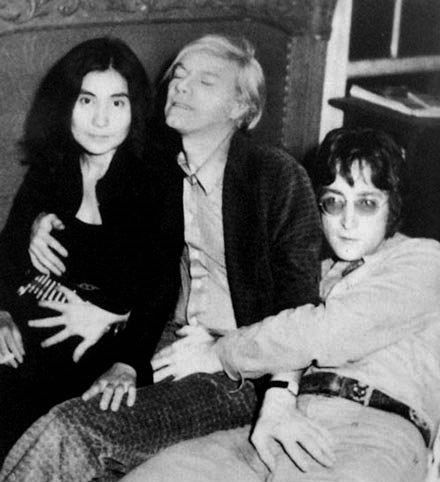
The transfer of power.
is the master of two emasculated males who happen to be two of the most influential men in the world. She ain’t no nigger no more, Maggie’s Farm is a thing of the past, yes, men are now niggers in relation to herself. Warhol as an artist takes precedence over the disposable oafish John Ono. Yoko is tallest and standing, Warhol is second tallest and sitting while the now disposable John is lowest, lying on his back. The future is clear. Study John’s face; study all three faces.
The sexually besotted John Ono has surrendered his entire identity even as a musician allowing Yoko Ono to usurp his place by putting out those horrid hideous LP musical montrosities. Robert Palmer aside, with song titles reminiscent of her head bashing days: What A Bastard The World Is, I Felt Like Smashing My Face In A Glass Window, Woman Of Salem (Witches), Coffin Car, Hell In Paradise and Walking On Thin Ice. Clearly this woman had an unsettled, disturbed mind.
Having usuped Lennon’s role and identity he became expendable. Her problem now was to transfer his past and his wealth to herself thereby becoming Yoko-John Ono, Double Fantasy. Two fantasies melding into her one personality.
John Ono’s finances were, of course, in complete disorder. As Yoko was soon to show billions of dollars were disappearing down a sink hole. She rapidly organized his finances turning his money green. Within short order the Onos were worth a hundred million or so which she would swell to a billion or more after John’s death.
I imagine it was fairly easy to have John Ono give her a power of attorney, indeed he forked over his identity allowing her to function in his stead as himself. An awesome abdication. A POA would negate the need for a will, and indeed having made herself not only co-owner of John’s assets as well as his identity Yoko Ono would merely acquire full ownership leaving no assets to be willed. Indeed, she could have turned him out penniless at any time. When Cynthia was clamoring for a reading of the will she was wasting her breath; if a will existed, unlikely in itself, there would have been no assets to bequeath.
Yoko Ono having now incorporated John Ono’s reputation and identity into her own had also incorporated the assets and with the assets the legacy of all copyrights held by John Lennon as the double fantasy melded into one fantasy. The only obstacle to Yoko’s apotheosis into man-woman was John himself as he was alive. However John was only thirty-five. To wait thirty-five years or more with a man she didn’t love or even like would be unbearable. Some hard thinking was in order.
She manipulated the poor dolt into thinking he was a boorish oaf who needed to go off to get himself together. Rather than just sending him off she chose an employee, May Pang, an Asian like herself, to be John’s consort while away.
In reading May Pang’s book, Loving John, it becomes clear that Yoko Ono was a master hypnotist. She knew how to make suggestions and have people act on them. Acccording to Pang she fixed an hypnotic glare on one, assuming an authoritative posture while intoning her suggestion. She had the reputation of always getting her way.
Of course her version of what happened is different than Pang’s. Yoko having suggested she go off with John, the act was soon consummated. Pang insists she and John were in love, yet a year and a half later when Yoko called John back he came running.
Thus, from 1975 to Double Fantasy in 1980 Yoko and John Ono were out of public life living as a double fantasy of Howard Hughes. Then in 1980 Mark Chapman became the man who shot John Lennon. There have been speculations that Chapman was hypnotized when he committed his deed. Conspiracy theories therefore have sprung up.
One must ask who the death of John Lennon benefited. Two possible people. Yoko One on one hand and possibly Chapman on the other. On the one hand Yoko Ono achieved the psychotic desire to escape being the ‘nigger of the world’ by becoming John Ono Lennon while physically remaining the sweet little girl she had been before the fire bombing of Tokyo. She was unable to manage the memory of that transformative experience. In her mind, then, she became the prominent artist-musician of the world.
I don’t believe the government had anything to do with the assassination.
As we know Yoko Ono was a master hypnotist; the question is how did she find Mark Chapman and how did she hypnotize him?
Earlier in the day Chapman had approached Lennon for an autograph. He can be seen worshipfully smiling beside his hero in the picture. There appears to be no indication he meant to harm Lennon. He might easily have shot him point blank at the time, yet when he came back in the afternoon with a voice in his head insistently saying: Do it. Do it. Do it. he gunned his hero down.
At the time Yoko Ono had dropped a few steps behind John. In similar murder attempts, people step away from the intended victim so as not to be caught in the line of fire. This may have been the case with Yoko.
Certainly Yoko is opposed to Chapman’s release from prison even though he has fulfilled the twenty year requirement of twenty to life. I doubt if he is a threat to society however he may be a threat to Yoko Ono if he were to remember or reveal the details leading up to his shooting of John Ono Lennon.
Of course, I don’t know why Chapman shot but I do know that Yoko Ono Lennon was the sole beneficiary. She left Cynthia holding the bag while she realized her double fantasy.

Double Fantasy- Yoko Looking Over John's Granny Glasses
A Review: II of II Wonderful Tonight by Pattie Boyd
December 17, 2009
A Review
Wonderful Tonight:
George Harrison, Eric Clapton. And Me
by
Pattie Boyd
Review by R.E. Prindle
Boyd, Pattie: Wonderful Tonight: George Harrison, Eric Clapton, And Me. Three Rivers Press, 2007

Good Morning Little Schoolgirl. The sixties fixation on young girls,
The darkest hour is just before dawn.
There’s one thing I want you to do
Especially for me.
And it’s something everybody needs…
Whisper a little prayer for me.
–Bass, Ralph. Pauling, Lawson
One needs a little encouragement in the black night of the soul. One needs a little encouragement amidst the trials and tribulations of life. The way is dark, the night is long and who knows what is waiting at the end of the road. All the mythological heroes went through a period of madness. Most likely at the mid-life crisis. The greater the stresses the more difficult to avoid errors. Why judge others so harshly when neither you nor I could have done better in the same circumstances. If a person is of good will and not ill why not be a little forgiving? Especially if no crimes are committed.
As Pattie points out, when manager Brian Epstein died the Beatles were suddenly on their own. To that time Brian had managed all the details, business as well as personal leaving the Beatles to do what they did best, write, record and perform songs. The relationship had been perfect of its kind. Given that the Beatles were now major successes rather than fledglings it would have been nearly impossible for them to put together a management team.
Of course, the Beatles were no businessmen. In the attempt their musical skills were compromised while the business end could not prosper. Cares such as they had not known descended on them. Nor, did they understand that the smallest action or word of theirs would reverberate around the world. They were no longer able to say or do what they pleased. Millions of vulnerable young people and unstable adults hung on every word giving them whatever interpretation suited them best. McCartney’s song Maxwell’s Silver Hammer did uncalculable damage.
When the Beatles closed their boutique waves of reaction crossed the world. It was said they opened the doors and invited anyone to take what they wanted. Away off in Keseyland on the West Coast of the US where I owned a record store a wave of kids descended on my store asking if everything was free. These were zany times where everything was possible so, mystified, I asked why they would think that. I was told the Beatles had just given away everything in their store and why wouldn’t I? I became a bastard for not following the Beatles lead.
So, when Pattie noticed a change in George when they came back from India it was probably caused by business cares, a new reality that neither he nor the others knew exactly how to deal with, nor was there time to learn. Those stresses, in the way of the human mind, are converted to sexual expressions. In George’s case he began to mumble about having a lot of concubines. A pretty normal reaction that he may never have acted upon. I’m sure that when he showed up with Chris O’ Dell in tow it may have seemed like the first step. (See Chris O’ Dell’s auto for a fuller description.) Chris became Pattie’s friend denying any relations with George, at least during her extended stay with the Harrisons, although after Pattie’s divorce the two came to terms. But, for now she and Pattie became bosom buddies shopping and cavorting together.
What a wonderful time to have unlimited money and a huge mansion to furnish.
While the sixties are primarily thought of for the groups and records that was only one component of that truly wonderful and amazing time, at least looking at the bright side of the penny.
P.F. Sloan, who penned Eve Of Destruction, titled one of his own LPs Raised On Records. The title explained the generation. Starting with perhaps Johnnie Ray leading on to Elvis the history of our generation was written by recording artists rather than novelists or even movies. You might question starting with Johnnie Ray but he was the first mind blowing departure from the norm. Mind blowing explains the whole period. Rock’s John the Baptist preceding the Jesus of Elvis. A trail of great records led up to the British Invasion when the world tipped on its axis. It was one mind blowing act after another.
First the Beatles upset the elders, long hair but clean cut. Then came the not so clean cut Rolling Stones with the weirdest thing you ever saw on stage, Brian Jones. You couldn’t take your eyes off him. Fantastic hair and the strangest clothes. Mick probably had to get rid of the competition. If the Stones weren’t bad enough they were followed by the appropriately named Animals. The name said it all sending the old folks wild with gnashing teeth. But backed up by Dylan and Peter, Paul And Mary the group mind was conditioned to move in the same direction in unison.

As Pattie says, she found the most wonderful art nouveau artefacts. Indeed, Aubrey Beardsley, Alphone Mucha, Toulouse Lautrec, 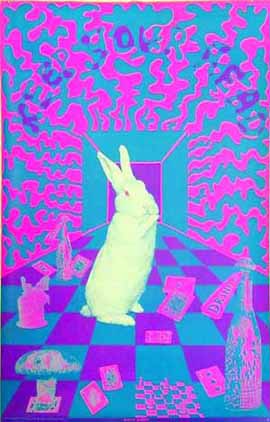 god, even the names, whoever heard of anyone named Aubrey? The art focus shifted from that NY art junk. Travel posters had been a staple for several years but now other posters began to augment them, Peter Max, East Totem West, the Fillmore and Avalon posters and the most spectacular of all- the giant personality posters. Originally the posters were blown up real grainy so that if you stood close the picture wasn’t visible but stepping back and then back further the portrait emerged. Drove the old folks wild, mytified the less hip; minds weren’t prepared. Although by that time Telstar was old hat, and men had walked on the moon. The impossible was no longer impossible, anything was possible and it kept happening. Andy Warhol and his Campbell Soup can. Good god. Remember the Robert Indiana LOVE poster with the lopsided O?

Robert Indiana- Love
In the US the tax laws were such that you could make money on records and books without turning a profit. Publishing exploded. Nifty expensive art books of the strangest and most outre artists were available. Virtual toys like the works of Victor Vaserelly. It was incredible, it was magnificent, it was mind candy as never seen before.
I hope Pattie with all that coin took advantage of it. There was a canchre in wonderland though. Pattie didn’t keep her hand on the throttle but let her attention be diverted by sex. Some reviewer said that Pattie wasn’t the brightest bulb. Hmm. I do wonder what she was thinking.
Now comes the part difficult of analysis. Pattie, like all women portrays herself as an innocent, the helpless beauty in the clutches of two beasts who refuse to turn into princes when kissed. I defend n o one but like a clear picture. It was clear that Pattie is haunted by her parents relationships as she always mentions them at critical points. She perceives her mother as a victim so it is possible that she was seeking revenge for her.
The time sequence Pattie presents is inadequate to follow the actual course of the relationship’s deterioration. It is possible that Pattie decided to turn the tables and become polyandrous first. She did conduct herself in that manner or, at least, try to. The information is insufficient to determine the actual sequence of events. She appears to always have been flirtatious with other men. In reference to Clapton she says she allowed him to seduce her. This implies volition and that she encouraged his attentions. One might say she almost solicited the famous letter from Clapton she showed George. It wouldn’t have taken a genius to figure out the small e it was signed with referred to Clapton. George was no dummy. Pattie blithely passed it off as from an unknown fan. Then she innocently expresses surprise when Clapton called that evening and asked if she had gotten his letter. Oh please, Pattie.
George unable to take it anymore invites Clapton over, gives him one guitar, takes another engaging in a guitar duel with the prize being the fair lady. Well, George found her, raised her up to where she was and then let Clapton take her.
Now, this is fairly reprehensible I think, Pattie left, but rather than seeking a divorce she lived with Clapton for two years while married to Harrison. Affairs of the heart are beyond me so all I can say is that Harrison was too kind hearted, Pattie callous and cruel and Clapton a simple cad. George always did the honorable by Pattie and she should have done the same by him.

Forty Years Of Hard Travelin'. Lost innocence.
One questions Clapton’s motivations. Clapton had a housefull of women when he professed his great love for Pattie; a nice girl I’m sure, but not to die for. Pattie cagily put Clapton off so his threat was to become a heroin addict unless she came with him. He was only snorting the heroin not shooting it. Pattie let him, she says, for three years.
The only reason I can see for Clapton’s wanting her is emasculation games. George was a Beatle with a guitar reputation therefore above him. When the two had their guitar duel, by consensus, George lost thereby losing status. Clapton then took the woman thereby emasculationg the man he had made his rival. But now he was stuck with this woman he didn’t really want.
In an interesting twist in the contest for supremacy both Clapton and Pattie were put down by the redoubtable Mick Jagger. Pattie and Clapton had been married and threw a huge bash with mega fireworks, everything.
Mick Jagger came with Jerry Hall, who had been engaged to Brian Ferry but had left him for Mick.
So Jagger is leaving no stone unturned in his quest for supremacy even putting down a weak rival like Brian Ferry.

Jerry Hall and Mick
The party started in the afternoon and ended in the dawn.
By the time Eric and I went upstairs to bed it was daylight. We were ready to drop- but Mick and Jerry were tucked up and fast asleep in our bed, with little Jade, his daughter with Bianca Jagger sleeping sweetly beside them. Trust Mick to have found the best bed in the house.
So Jagger put down both Clapton and Pattie. Childless herself she saw Mick’s child. They could have turned Jagger out of the bed appearing boorish but if they had, dog tired, they would have had to change the sheets then crawling into a bed warmed by Jagger. Mick aced them both demonstrating his supremacy. Ah, those emasculation games.
Now, Pattie left George, supposedly because, or after, Clapton wrote Layla, but she didn’t divorce him for two years. Thus as another man’s wife she was living as Clapton’s concubine. Call me old fashioned but I can’t endorse such behavior. Amazingly George didn’t press for a divorce letting Pattie divorce him on the grounds of lack of cohabitation for two years.
Perhaps she was avenging her mother’s treatment when her father carried on with the wife of an intimate friend for some time, perhaps two years, before divorcing the mother. Obviously some psychological end is being served.
Clapton was no where near as generous monetarily as Harrison. Pattie describes it as keeping her on a tight leash. Nor did this man who professed to love his Layla so deeply then marry her. No, they shambled along in his loose situation.
When they did marry it was under the most humiliating situation for Pattie. We have only her side here but she says that Clapton and his manager had a bet that the manager couldn’t get a story about Clapton in the papers. The manager without Clapton’s knowledge invented a story which was printed that Clapton would marry Pattie the next Tuesday.
Pattie had just walked out on Clapton and was in LA. On the Friday before Clapton called her and said he needed an immediate answer. Marry him by Tuesday or forget it. Pattie folded. After the I do-s Clapton left on an extended tour leaving Pattie to find her way home.
Amazingly she stayed with him for some time. Even so she had not severed emotional ties with Harrison who remained unmarried.
Clapton was still playing money games with her. One Christmas she went shopping running up a 5,000 pound tab at Harrod’s expecting to charge it to her Harrison account. Surprise! The account had been closed. Not having enough money in her checking account which Clapton apprently wouldn’t let her have she had the effrontery to ask Harrison who gave her a five thousand pound check. Apparently Pattie misunderstood the meaning of the word divorce.
For whatever reason she showed the check to Clapton who, realizing he had been aced in the emasculation game, refused to let her cash it.
Now tiring of the games with Clapton Pattie sought a divorce. More money games.
With Harrison, as a divorce settlement after abandoning him and cohabiting with another man, Pattie received 120,000 pounds. In the circumstances I would see that as very generous. She doesn’t say exactly what she received from Clapton but it was enough to provide her with a very sufficient investment income.
Not content with that while apparently assuming divorce or no that Clapton owed her more she demanded he buy her a million pound house as he had spent that much on one for himself. She was denied but it was agreed to buy her a 300,000 pound house although title would remain with Clapton. She found one for approx. 350,000 pounds and was allowed to live in that.
Subseqently Clapton remarried. The canny Pattie realizing that if Clapton died his wife would turn her out attempted some successful maneuvers. She asked for 40,000 pounds for some remodeling. Clapton refused but replying that he wasn’t aware that he was her landlord he deeded the house to her so she came out very well indeed.
During this time she was living with her third man named Rod. He was nine years her junior. Tiring of him she cruelly told him that his life as a ‘toy boy’ was up and to move on.
The inevitable conclusion is that Pattie viewed her mother’s relationships with men as she was growing up and came to some conclusions. Although neither Harrison or Clapton were perfect men I am convinced that whatever their shortcomings Pattie was not an innocent victim. She actively encouraged Clapton while married to Harrison, abandoning George for Clapton. She knew Clapton’s attitude toward women and stimulants, both drugs and alcohol before she ‘allowed herself to be seduced’ so his addictions came as no surprise. She has no complaint on that score.
Pattie made the remark in closing that if the right man came along she would snap him up in a minute. Having lived every groupie’s dream of snaring a Beatle and Clapton the only eligible rock star to complete her trifecta would be the Man himself- Mick Jagger.
I would be interested to see that combination. The odysseys of this simple Kenyan girl from Harrison to Clapton to Jagger would certainly equal the odyssey of her fellow Kenyan, Barack Obama.

Pattie today. Further down the road.
End.
Themes And Variations
The Tarzan Novels Of Edgar Rice Burroughs
#5 Tarzan And The Jewels Of Opar
by
R.E. Prindle

Edgar Rice Burroughs
Part IV
From Achmet Zek’s Camp To The Recovery Of The Jewels
The nature of the story changes from the departure of Werper and Jane from Achmet Zek’s camp . To that point the story had been developed in a linear fashion. From Zek’s camp on ERB either loses control of his story or changes into an aggregation of scenes between the camp and the Estate leading to the return. Perhaps there is a modification in his psychology.
The struggle for the possession of the jewels and the woman contunues unabated. As always Burroughs tries to construct a story of many surprising twists and turns. This may be an influence of the detective story, Holmes, on him. He may be trying to emulate Doyle.
The problem of who the characters represent in ERB’s life becomes more difficult to determine. Werper continues as ERB’s failed self. I think as relates to Zek and the jewels Zek represents Burroughs’ old sexual competitor, Frank Martin, while Zek, the gold and the Abyssinians represent the deal between McClurg’s and its deal in 1914-15 with A. L. Burt. Burt first had the reprint rights to Tarzan Of The Apes, published in the summer of 1914. Those rights shortly passed to Grossett and Dunlap.
In my estimation Martin never ceased interfering with Burroughs’ marriage at least from 1900 to 1919 when Burroughs fled Chicago. We know that Martin tried to murder Burroughs in 1899 and that his pal, R.S. Patchin, looked up Burroughs in LA after the divorce in 1934 and sent a mocking condolence letter in 1950 when Burroughs died and after Martin had died sometime earlier. Patchin would obviously have been directed by Martin to taunt Burroughs in ’34. It’s clear then that Martin carried a lifelong grudge against Burroughs because of Emma.
Martin is thus portrayed as being in competition with Burroughs in 1914-15 and possibly but probably to a lesser extent in LA.
Jane is shown being captured by Zek twice in the story. Thus Emma was courted or captured by Martin when Burroughs was in Arizona and Idaho. In this story Jane is captured while Tarzan is absent in Opar. The second capture or courting by Martin is diffiicult to pinpoint by the inadequate information at our disposal but following the slender lead offered by the novelist, John Dos Passos, in his novel The Big Money I would think it might be in 1908 when ERB left town for a few weeks or months probably with Dr. Stace. It was of that time that the FDA (Federal Food And Drug Administration) was after Stace for peddling his patent medicines. Burroughs was probably more deeply involved with that than is commonly thought. At any rate his being out of town would have provided an opportunity for Martin. Whether something more current was going on I don’t find improbable but I can’t say.
I would also be interested to learn whether there was any connection between McClurg’s and Martin. Martin was Irish, his father being a railroad executive which explains the private rail car at his disposal, as were, of course, the McClurgs and so was the chief executive Joe Bray. If Martin knew Bray he might have pressured Bray to reject publication of Tarzan doing a quick turnaround when interest was shown by the Cincinatti firm. Martin then might have meddled with Burroughs’ contract with McClurg’s. The contract and McClurg’s attitude is difficult to understand otherwise.
The gold is buried which Zek is supposed to have gotten through Werper, then they have a falling out and Werper is captured by Mourak and his Abyssinians. Mourak would then represent A.L. Burt and a division of the the royalties. If McClurg’s had promoted Tarzan Of The Apes, which they didn’t, Burroughs would have received 10% of 1.30 per copy. Thus at even 100,000 or 200,000 copies he would have received 13,000 or 26.000 dollars. that would have been a good downpayment on his yacht. Martin who must have thought of Burroughs as a hard core loser from his early life would have been incensed by such good fortune that might have placed Burroughs’ income well above his own.
Instead, it doesn’t appear that McClurg’s even printed the whole first edition of 15,000 copies. The book immediately went to A.L. Burt where the price of the book was reduced to 75 or 50 cents with the royalty much reduced to 4 1/2 cents divided fifty-fifty between McClurg’s and Burroughs. It’s hard to believe that ERB wasn’t robbed as he certainly thought he had been. Thus when Mourak unearths the gold he is settling for a portion of the hoard when Zek’s men show up and the battle necessary for the story begins.
In this manner the key issues of gold, jewels and woman are resolved.
So, Werper with the jewels goes in search of Jane to find that she has already fled Zek’s camp. The scenes of the story now take place between the camp, perhaps representing McClurg’s offices and the Estate, representing Burroughs.
The latter half of the book, pages 81-158 in the Ballantine paperback is very condensed in a dream like fashion. The action within the very prescribed area with a multitude of people and incidents is impossible except as a dream story. The appearance of the Belgian officer and askaris must have been photoshopped it is so impossible. In other words, then, the whole last half of the book, if not the whole book, is a dream sequence in which dream logic prevails. I will make an attempt to go into late nineteenth century dream speculation in Part V.
A key point of the story is the regaining of the memory of Tarzan. This occurs near story’s end on page 139 and following. It’s fairly elaborate. In connection with his memory return I would like to point out the manner of his killing the lion when he rescues Jane from Mourak’s boma. The roof fell on Tarzan in imitation of his braining in Toronto while now he picks up a rifle swinging on the rearing lion’s head splintering the stock along with the lion’s skull so that splinters of bone and wood penetrate the brain while the barrel is bent into a V. Rather graphic implying a need for vengeance. Not content with having the roof fall on Tarzan’s head, while trying to escape the Belgian officer an askari lays him out with a crack to the back of the head but ‘he was unhurt.’ One can understand how Raymond Chandler marveled. My head hurts from writing about it. Also Chulk has his head creased by a bullet adding another skull crusher to the story.
The description of the return of Tarzan’s reason seems to fit exactly with Burroughs’ injury. I would have to question whether Burroughs himself didn’t have periods of amnesia. P. 139:
Vaguely the memory of his apish childhood passed slowly in review- then came a strangely tangled mass of faces, figures and events that seemed to have no relation to Tarzan of the Apes, and yet which were, even in this fragmentary form, familiar.
Slowly and painfully recollection was attempting to reassert itself, the hurt brain was mending, as the course of its recent failure to function was being slowly absorbed or removed by the healing process of perfect circulation.
According to medical knowledge of his time the description seems to apply to his own injury. His own blood clot had either just dissolved or was dissolving. Then he says almost in the same manner as in The Girl From Farriss’s:
The people who now passed before his mind’s eye for the first time in weeks were familiar faces; but yet he could neither place them in niches they had once filled in his past life nor call them by name.
In this hazy condition he goes off in search of the She he can’t remember clearly. His memory fully returns as he has Werper by the throat who calls him Lord Greystoke. That and the name John Clayton bring Tarzan fully back to himself. For only a few pages at the end of the book does he have his memory fully recovered.
In order to summarize the rest I have had to outline the actions of the main characters for as with Tarzan and his memory the story is one of ‘a strangely tangled mass of faces, figures and events.’ Whether this is artistry on Burroughs’ part or a dream presentation I am unable to ascertain for certain. Let’s call it artistry.
We will begin with Werper’s activities. While Tarzan promised to retrieve La’s sacred knife Werper appears to no longer have it as it disappears from the story. When Werper escaped from Zek unable to locate Jane he heads East into British territory. He is apprehended by one of Zek’s trackers. On the way back a lion attacks the Arab unhorsing him. Werper mounts the horse riding away directly into the Abyssinian camp of Mourak. Mugambi is captured at the same time. While the troop bathes in a river Mugambi discovers the gems managing to exchange them for river pebbles. Werper tempts Mourak with the story of Tarzan’s gold. While digging the gold they are attacked by Zek and his men. Werper rides off as Mourak is getting the worst of the fight. Zek rides after him. Werper’s horse trips and is too exhausted to rise. Using a device that ERB uses in one of his western novels Werper shoots the horse of the following Zek, crouching behind his own for cover. Zek has lost the woman but now wants the jewels. Werper hasn’t the woman while unknown to himself he neither has the jewels. In exchange for his life he offers Zek the pouch of river stones believing it contained the jewels. Zek accepts. Both men are treacherous. Werper waits to shoot Zek but Zek out foxes him picking up the bag by the drawstring with his rifle barrel from the security of the brush.
Discovering the pebbles he thinks Werper has purposely deceived him stalking down the trail to finish him off. Werper is waiting and pots him with his last shell. As Zek falls the woman, Jane, appears as if by a miracle reuniting the two. Could happen I suppose but definitely in dreams.
So, what are the two men fighting over? The sex interest, as the jewels are involved. Who do Werper and Zek represent? Obviously Burroughs and Martin. The stones are false but as Werper disposes of Zek in the competition for the woman Jane appears as if by magic to run to Werper/ Burroughs with open arms.
Werper with Jane returns to Zek’s camp now under the direction of Zek’s lieutenant, Mohammed Beyd. Rigamarole, then Werper deposits Jane in a tree from whence he expects to retrieve her on the following morning. The next day she is gone.
Werper once again turns East. He is spotted riding along by Tarzan. The Big Guy falls from a tree throwing Werper to the ground demanding to know where his pretty pebbles are. It is at this point Werper recalls Tarzan to his memory by calling him Lord Greystoke. Also at the moment the Belgian officer appears from nowhere, having miraculously ascertained Werper’s whereabouts, to arrest him.
Tarzan wants Werper more than the Belgian so tucking his man under his arm he breaks through the circle of askaris. On the point of success he is brought down from behind. Another thwack on the head. Apparently in a desperate situation Tarzan hears voices from the bush. The Great Apes have their own story line but here it is necessary to introduce them as Tarzan’s saviors. The voice is from Chulk who Tarzan sends after the troop. They attack routing the Africans. In the process Chulk, who is carrying the bound Werper is shot. If you remember Chulk stole the stones from Mugambi, or maybe I haven’t mentioned that yet. Werper falls across him in such a way that his hands bound behind his back come into contact with the pouch. Werper quickly recognizes what the bag contains although he has no idea how the ape came by them.
He then advises Tarzan where he left Jane. The two set out when the furore in Mourak’s camp reaches his ears. ‘Jane might be involved.’ Says Werper. ‘She might.’ says Tarzan telling Werper to wait for him while he checks.
Werper waits not, disappearing into the jungle where his fate awaits him.
Those are the adventures of only one character in this swirling vortex of seventy some pages.
Let’s take Mugambi next as he is the key to the story of the jewels yet plays a minor role. After crawling after Jane and regaining his strength he arrives at Zek’s camp at the same time as Tarzan and Basuli but none are aware of the others. Werper and Jane have already escaped when Tarzen enters the camp to find them missing. Mugambi follows him later also finding both missing. He goes in search of Jane. He walks through the jungle ludicrously calling out ‘Lady’ after each quarter mile or so. Leathern lungs never tiring he shouts Lady into the face of Mourak and is captured. Being a regular lightfoot he escapes having lifted the jewels from Werper. Chulk then lifts them from him, Mugambi disappears until story’s end.
Let’s see: Jane next. Jane along with the jewels is the key to the story. The jewels represent the woman as man’s female treasure. Jane is the eternal woman in that sense. The various men’s attitude toward the jewels reflects their own character. Thus, Tarzan in his amnesiac simplicity wants the jewels for their intrinsic beauty. He rejected the uncut stones for the faceted ones in Opar. Even in the semi darkness of the vaults, or in other words, his ignorance, he perceived the difference.
Werper at various times thinks he can get the gold, the jewels and the woman at once. He is happy to settle for the jewels taking them to his grave. Mourak knowing nothing of the jewels is willing to settle for a few bars of gold. When he takes the woman into his possession it is for the sole purpose of a bribe to his Emperor to mitigate his overall failure. Not at all unreasonable.
Zek is too vile to consider as a human being dying in the fury of losing all. Mugambi and Basuli are happy in their devotion to the woman to whom neither jewels or gold mean anything.
Tarzan then, pure in soul and spirit wins it all, woman, jewels and gold. One is tempted to say he lived happily forever after but, alas, we know the trials ahead of him.
So Jane is carried off to Zek’s camp where all the action is centred while she is there. Both Tarzan and Mugambi show up to rescue her but she has escaped just ahead of Werper who would thus have had the woman and the jewels. Alone in the jungle she once again falls into Zek’s hands- that is to say those of Frank Martin.
Now, Tarzan, who has fallen in with a troop of apes chooses two, Taglat and Chulk, to help him rescue Jane from Zek. Chulk is loyal but Taglat is an old and devious ape, apparently bearing an old grudge against Tarzan, who intends to steal Jane for his own fell purposes much worse than death.
In Tarzan’s attempt to rescue Jane, Taglat succeeds in abducting her. He is in the process of freeing her bonds when a lion leaps on him. In the succeeding battle Jane is able to escape the lion who had just killed Taglat.
Wandering through the jungle she hears shots, the voices of men. Approaching the noise she discover Werper and Zek fighting it out. She climbs a tree behind Werper. When he shoots Zek he hears a heavenly voice from above congratulating him. Jane runs to him hands outstretched. So now Werper has the woman again while believing he can retrieve the jewels. He can’t find them because unbeknownst to him Mugambi had substituted river rocks.
Improbably, except in a dream, he returns to Zek’s camp where he has to solve the problem of Zek’s second in command, Mohammed Beyd. Werper spirits Jane out of the camp but finds her gone the next morning. She had mistaken Mourak and his Abyssinians for Werper. Mourak now in possession of the woman, no gold no jewels, thinks to redeem himself with his Emperor, Menelik II, with this gorgeous female.
During that night’s camp the boma is attacked by hordes of lions. Lions play an amazingly central role in this story. Interestingly this scene is replicated almost exactly in the later Tarzan And The City Of Gold. In Jewels Tarzan rescues a woman while in Gold Tarzan rescues a man. That story’s woman becomes his enemy.
But now Tarzan and Werper hear the tremendous battle with Tarzan entering the boma to rescue Jane. By the time of the rescue Tarzan has regained the woman and the gold but lacks the jewels.
Unless I’m mistaken we now have only Tarzan and the apes to account for.
ERB’s life was at a turning point. At this stage in his career he must have realized that he would have a good annual income for the rest of his life. If only 5000 copies of the first edition of Tarzan of the Apes sold he would have received 6,500.00 Add his magazine sales to that and other income and 1914 must have equaled his income of 1913 or exceeded it. His income probably grew until he was earning c. 100,000 per year for three years from 1919-1922. So he had every reason to believe the world was his oyster through the teens. That must have been an exhilarating feeling. A sense of realization and power must have made him glow. But the period was one of transition, a casting off of the old skin while growing into the new. Thus one sees ERB abandoning his old self -Werper- while attempting to assume the new in Tarzan. Thus in death Werper transfers the jewels, call them the Family Jewels, from himself to Tarzan.
Tarzan begins the novel as an asexual being unaware of what jewels were or their value and receives them a the end of the novel as a release from emasculation or awareness of his sexual prowess. Once again Werper fades in the novel while Tarzan unaware of who he is comes to a full realization. Presumably Burroughs thinks he is able to assume his new role as 1915 ends.
In the novel when Tarzan realizes Werper has stolen the jewels he goes off in search of this symbol of his manhood. Werper is not in Zek’s camp. On the trail Tarzan comes across the dead body of the Arab sent after Werper with he face bitten off. He assumes this is Werper but can’t find the jewels. Wandering about he discovers a troop of apes deciding to run with them for a while. Selecting Chulk and Taglat he goes back to Zek’s camp to rescue Jane. At that point Taglat makes off with Jane. Discovering Zek and Werper on the way to the Estate Tarzan becomes involved in the battle between Zek and Mourak. He sees Zek take the jewels and then throw them to the ground as worthless river rocks.
He encounters Werper in the jungle again and prompted by the man fully regains his memory only to have Werper arrested by the Belgian police officer. The battle between Mourak and the lions ensues. Tarzan goes to rescue Jane, Werper goes to his death.
The unarmed Tarzan faces a rampant lion. Picking up an abandoned rifle he brains the lion, apparently in vengeance for all the indignities and injuries ERB has suffered in life.
Leaping with Jane into a tree they begin the journey back to the Estate to begin life anew. Some time later they come across the bones of Werper to recover the jewels and make the world right.
The novel closes with Tarzan’s exclamation.
“Poor devil!”…Even in death he has made restituion- let his sins lie with his bones.”
Was Burroughs speaking of Werper as his own failed self? I believe sothe latter. Remember that a favorite novel of ERB was Dr. Jekyll and Mr. Hyde and that he believed that every man was two men or had two more or less distinct selves. Human duality is one of the most prominent themes in the corpus; thus ERB himself must have believed that he had a dual personality. Tarzan will have at least two physical doubles, one is Esteban Miranda in Golden Lion and Ant Men, and the other Stanley Obroski in Lion Man. Both were failed men as Werper is here. Both obviously represented the other or early Burroughs as Werper does here.
In killing Werper ERB hoped to eliminate the memory of his failed self as he did with Obroski in Lion Man. In other words escape his emasculation and regain his manhood.
The jumbled and incredibly hard to follow, or at least, remember, last half of the book with its improbable twists and turns in such a compressed manner gives the indication that this is a dream story. Only dream logic makes the story comprehensible if still unbelievable. The story then assumes fairy tale characteristics that don’t have to be probable to be understood as possible.
Can be genius, can be luck. I will examine Burroughs novels in relation to dreams in Part V. This part will not be as comprehensive as I would like but time grows short and it is better to make the attempt as not.
Part V follows.
 I, Dynamo