A Review
Themes And Variations
The Tarzan Novels Of Edgar Rice Burroughs
#14 Tarzan The Invincible
Part V of X
by
R.E. Prindle
First Published On The Ezine, ERBzine

The Man
Six White Men In Search Of An African Empire
If one believes that Burroughs is merely on a rant against Communism in Tarzan The Invincible and Tarzan Triumphant then there is nothing more to say. Still, it is remarkable that ERB specifically names Stalin as a persecutor of Tarzan in both books. As Burroughs says he doesn’t mind fictionizing political and religious realities the question is , is he fictionizing a real life situation where Stalin, or the Communists are giving him a hard time?
Seems really improbable doesn’t it? People are used to thinking of Burroughs as a barely literate fantasy writer better ignored by the literati. But more insignificant men than ERB have been the victims of hate campaigns.

Dr. Harvey Springer- The Cowboy Evangelist
Who now, for instance, remembers Harvey Springer? Harvey Springer? Never heard of him? I don’t wonder. Oddly enough when I was in San Diego in 1957-58 Harvey Springer, who was some kind of evangelicalist, was going to appear at some church out where no sailor ever went. He was kind of a cowboy evangelical from Denver. His most dramatic stunt was placing one of size fourteens, he was a tall rangy man, on one chair and the other on another to harangue the crowd.
I hadn’t heard of him, you know, nor had anyone I knew, but Harvey Springer was reputed to be an arch anti-Semite. Could have been for all I knew, but I’m not going to take anyone’s word for it. The point is the Jews sent all kinds of people into the streets to tell people not to go see Harvey. I don’t how many times they must have heard- Who’s Harvey Springer?- in reply. Rather than say he’s an anti-Semite, of which I had even less knowledge at the time never having heard the term, all that was necessary was to say the two words, church and evangelical to cool my ardor, if I had any, to find where he was speaking and go see him.
In addition the AJC and ADL published books in which they denounced Harvey Springer as a very dangerous anti-Semite. Now, if certain people would go to such extremes to persuade someone not to do something he had no intention of doing what would they do to defame someone with an international reputation? The only one who didn’t realize the extent of ERB’s fame seems to have been ERB himself. He was no self promoter, he thought it best to keep his head down.
In that sense, judging from the unpublished Under The Red Flag and the published Moon Maid, Invincible and Triumphant Burroughs was actually a leading anti-Communist voice. I mean, people read this stuff. They read it in America , they read it in England, they read it in numerous translations and they read it in the Soviet Union. Here’s the kicker, Stalin read it. Not only that, Stalin was a movie buff. And he requested Tarzan films (reported in a recent UK Telegraph story and the book of Simon Sebag Montefiori: Stalin: The Court Of The Red Tsar.)
History is not a mystery, it’s just schoolyard bullies bigger than life.
We also know that Stalin ordered his scientists in the 1920s to attempt to cross an ape and a human to create a super warrior. It’s clear to me that Stalin had read Beasts Of Tarzan. The Man of Steel may have had a difficult time distinguishing between fact and fiction as many another. Besides, remember eugenics was a hot topic of conversation in Red circles then as it is today. Not knowing what we know now about genetics crossing an ape and human may not have seemed that far fetched. It doesn’t to a lot of people now. Heck, the Old Testament enjoins one to destroy the results of an animal-human union so the ancient Hebrews thought it was not only possible but a regular occurrence.
There is very clear evidence that the Reds were conducting a campaign of vilification against Burroughs. I’ve mentioned it before but the clearst evidence is H.G. Wells’ novel Mr. Blettsworthy On Rampole Island.

Bertie Wells
May we take a moment to look more closely at Wells? Don’t think I’m antagonistic toward Wells. I dearly love Wells just as I do Burroughs. I have a complete collection of Burroughs while I’m looking for the odd volume of the more obscure Wells. I’m not boasting, I’m just saying this in the way of credentials. I’ve read all of Burroughs more than once and I’ve read all the Wells’ titles I have, many of them more than once. In point of fact I love all the literature from say, Haggard’s King Solomon’s Mines to 1930 and perhaps an odd year or so beyond. I love. I mean, I love it. I love Edgar Wallace who, if you can believe it, is claimed to have sold one out of four books sold in England during this period. If you don’t know him he was one of the co-writers of the movie King Kong and then he died. All this stuff of this period is wonderful. Robert Hitchens, P.C. Wren.
So, you know, it’s like this: H.G. Wells was a Soviet literary hatchet man.
The man had a wonderful career. You know his most famous novels, The War Of The Worlds, First Men In The Moon, The Island Of Dr. Moreau, In The Days Of The Comet. If you like Wells, and I do, those are the tip of the iceberg. A few of his short stories and he wrote many are as good as short stories get.
He was always a socialist and perhaps a terrorist conspiritor, but he was a child of the nineteenth century until his mind broke at the end of the Great War. At that time he lost faith, in god, transferring his faith to the Revolution, becoming a Soviet dupe. His literary career may be divided into two halves, pre-God- The Invisible King and post-God. That was one of his books.
He was not taken seriously as a fiction writer after the war. During the twenties and thirties he turned out an unending stream of novels that were ignored. It’s not difficult to see why, but I find them a little more tolerable. I like Wells. His reputation and career were saved by his 1922 effort An Outline Of History. It was a massive volume and it sold massively for twenty years or more while being hugely influential in literature. Put him on easy street for the rest of his long life. As much as any artist who is skilled at spending money can be on Easy Street.
As a novelist however, he was pretty much a has been. While none of his post-1920 novels take off he hits the spot with me.
From 1920 on his soul belonged to the Revolution, which is to say the Socialist homeland, which is to say the Union Of Soviet Socialist Republics. That means he was more loyal to Russia than he was to England. In short, a traitor in intent if not in deed. While no Liberal ever deals in realities hence are in constant denial, The Man of Steel, Josef Stalin, was his boss. Wells naturally would have denied this.
The Soviets had a pretty comprehensive system which once again is denied. There were a number of State prostitutes who were assigned to the various important Red writers to service them as mistresses, while reporting back to the Kremlin. This is, of course, denied by the Liberals. I don’t understand living a life that has to be denied, where everything you do has to be represented as something else, but such duplicity is apparently congenial to the Liberal mind. They must seek it.
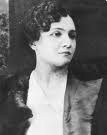
Moura Budberg
Wells was assigned a woman named Moura Budberg. She must have known how to turn on the charm as she was able to make a number of men she was assigned to sincerely love her, including the British diplomat Bruce Lockhart, the Russian writer Maxim Gorky and H.G. Wells. She wasn’t that good looking either. All of these people led double, triple or quadruple lives. They must have been really able to compartmentalize their minds. Freud didn’t touch that type.
After Wells’ visit to Lenin in 1921 he was signed on. He began his career as literary hatchet man. In his writing he portrayed recognizable people, sometimes under their real names, in negative or positive lights. As a skilled writer, whether you like his later stuff or not, he was more than competent to do this. It appears that he first targeted Burroughs in his 1923 novel Men Like Gods. Among his science fiction novels this one should rank more highly than it does. Burroughs’ 1926 Moon Maid reads like a reply to Wells. Especially the first part of the trilogy where Burroughs dances imaginative rings around the First Men In The Moon. From there Wells took up the challenge with Mr. Blettsworthy On Rampole Island of 1928 which unmistakably is a parody of Burroughs in which he portrays Burroughs as insane, but not a bad analysis.
Burroughs responded possibly with At The Earth’s Core but definitely with Tarzan The Invincible. At the same time one interprets Stalin’s interest in crossing apes with humans as being derived from Beasts Of Tarzan and other Tarzan novels there may have been more direct Soviet interest in ERB. One notes that Tarzan The Invincible was the first title published under the Burroughs imprint. I think it highly probable that his publishing was being interfered with by the Reds in addition to whatever other grievances against his publishers Burroughs may have had.
One may say that Burroughs was too insignificant for Stalin to bother with, yet according to Simon Sebag Montefiori Stalin put out a contract on John Wayne because he was such an ardent anti-Communist. Khruschev is said to have told Wayne that he concelled the contract after Stalin’s death. Edgar Rice Burroughs was at least as significant in 1930 as Wayne in the 1940s and 50s.
At any rate in 1930 Burroughs has Stalin and the Reds invading his dream world of Opar to steal his gold, i.e. put him out of the publishing business. Invincible and Triumphant, notice the titles, both deal with Stalin and the Soviets then the topic disappears from the oeuvre. Was Burroughs given incentive to counter-attack the Reds? I think there is enough evidence to warrant the opinion while time will tell even more. Research is just beginning.
It is signficant that Burroughs introduces the story in his own voice, not a framing device. He may be simply talking to the reader or he may be addressing Wells and, dare I say say it, The Man Of Steel himself. Perhaps a subtitle could be ‘The Big Bwana Meets The Man Of Steel.’ Now, it should also be remembered that this is the fourteenth novel of the series. the first title had been written eighteen years earlier. At that time the surprise of the character had knocked the socks off the reading public. In 1930 Tarzan was in danger of becoming old hat. Burroughs had to think up new and interesting devices to keep his readers coming back. As with most series of this type the readership was limited. Maximum sales could be predicted so that success meant not falling below a certain level of interest or letting interest diminish below unsupportable levels. As his own publisher Burroughs was now taking all the risks financial as well as literary. He had to turn out a successful book.
I think he did a superb job. Since the series continued to flourish his readers must have thought so too. I do wish ERB, Inc. would release some sales figures though.
For the premiss of his story Burroughs postulates that Stalin and the Soviets wish to instigate a new world war which will allow them to pick up the pieces establishing a complete European dictatorship. Not at all farfetched. Burroughs postulates that Mussolini and his Fascists are aiming at a European hegemony. This is 1930 so Hitler and the Nazis are not on anyone’s radar as a threat to world peace except for a few fringe elements. At the time Hitler and the NSDAP were in hand to hand combat with the Communists for control of Germany. They would not assume power until three years hence.
The Reds then wish to create an incident that would cause the Italians to attack France. The indirect approach is usually more effective than the direct approach so they wish to create an incident in Africa where French colonial troops appear to invade Italian Somaliland.
At that instant expendable confederates in Italy would reveal a bogus French plan to Mussolini. It is assumed that Italy would then declare war on France and the holocaust would begin. As we all know Italy did not declare war on France in 1930 so the plan must have misfired somewhere along the way. Tarzan was the reason. Burroughs gives these little known details that would have been lost to…well… if not history, remembrance. So, uh, really ERB is providing a valuable service here.
There may be two sides to every story, but usually one is on one side or the other. We don’t have to be reminded ERB is not on the side of the Reds. In fact, ERB is exposing their plans and weaknesses. He displays a fairly profound understanding of the goals and workings of the Communists. He is read up on the subject, He has studied. He is not shooting from the hip. He knows whereof he speaks. If not an authority on the subject he is pretty darn close.
ERB has his eyes on how ‘American’ manufacturers are relating to Moscow. He has Zora Drinov analyze the situation this way, p. 12
“But what do the puny resources of this single American (Wayne Colt) mean to us?” demanded Zora. “A mere nothing compared to what America is already pouring into Soviet Russia. What is his treason compared with the treason of those others who are already doing more to hasten the day of world communism than the Third Internationale itself- it is nothing, not a drop in the bucket.’
“What do you mean Zora?” asked Miguel.
“I mean the bankers, and manufacturers, and engineers of America, who are selling their own country and the world to us in the hope of adding more gold to their already bursting coffers. One of their most pious and lauded citizens is building great factories for us in Russia, where we may turn out tractors and tanks; their manufacturers are vying with each other to furnish us with engines for countless thousands of airplanes; their engineers are selling us their brains and their skill to build a grreat modern manufacturing city, in which ammunitions and engines of war may be produced. These are the traitors, these are the men who are hastening the day when Moscow shall dictate the policies of our world.”
“…their government is a capitalistic government that is so opposed to our beliefs that it has never recognized our government; yet in their greed, these swine are selling out their own kind and their own country for a few more rotten dollars.”
Sound anything like the US and China today? That was a mouthful. The first thing FDR did upon taking the reins of government was to recognize Soviet Russia. Tell you anything about FDR? That was a mouthful that should have eraned ERB the hatred of the Liberal Coalition.
You can see why they wanted to stop his mouth. Passages such as this are probably the reason Richard Slotkin and his crowd, John Taliaferro, group ERB with Madison Grant and Lothrop Stoddard. A charge of racism is usually a cover for a multitude of offences that have nothing to do with race. One is merely opposing the Liberal program. If they were to say- the fellow opposes the Liberal program they would get no rise- they might even have to explain the Liberal program- so the charge of racism is used as a red herring. One should always suspect such an accusation and disregard it.
Liberals however, never answer such charges. They merely deny them. In 1953-54 they were even denying themselves as Communists or taking the Fifth, which is the euivalent of saying, yes I am, but I’m not going to admit it.
The Revolution was only twelve years old in 1930. The CPUSA had been briefly outlawed in the early twenties but ‘disinterested parties’ believing in the time honored notion of ‘free speech’ had the ban lifted. Over in Russia their free speech loving comrades were filling cattle cars with dissenters destined for the Gulag or else they were murdered outright. Today, of course, these freedom loving people are throwing dissenters in prison on the basis of trumped up laws. The Program is moving right along isn’t it?
Even William Z. Foster denied he was a Communist as he was running for President on the Communist ticket. Today a tenured Law  Professor at Harvard actually denies that AIPAC, which is a registered lobby group, exists. They ought to throw such people into cells next to David Irving. Denial of themselves is what Liberalism is all about. You couldn’t find anyone to admit to being a Communist. They all denied it. The hypocrisy of Liberals throwing men as decent or moreso than themselves into jail for denying the holocaust is mind boggling. Well, it would be, if you didn’t already know what’s going on.
So ERB would have been roundly denounced as a paranoid delusive for the above passage.

Henry Ford- Philanthropist
Men like Armand Hammer, Bernard Baruch, essentially the whole Jewish government in exile here in the US were working furiously to make the Revolution a global reality. They really had no idea of Hitler’s intentions at the time, yet they attempted assassination while through the German Communist Party they were waging street warfare against the National Socialists. The word National is what they objected to not so much the man Hitler. Burroughs mentions the Third International. The Comintern- short for Communist International as it was known- was essentially a beta model for what is now multi-culturalism. It was the Jewish cultural vision of the world. Thus industrialists like Armand Hammer and Bernard Baruch using their Jewish identity as a shield from criticism, any criticism would be characterized as anti-Semitism, were directing huge sums of money into the development of Soviet Russia.
In addition a well-meaning industrialist, Henry Ford, who would later be denounced as a Nazi, was doing the

Armand Hammer
same thing. The mention of tractor factories refers to Henry Ford- the Jewish bete noir- who was trying to relieve the Communist induced famine by selling or even giving tractors to the Russians to increase food production. He was also building the factories for them. I mean, you know, gratis; altruism run rampant. The great industrial city probably refers to Stalingrad.
Even Burroughs biographers Porges and Taliaferro disparage Burroughs for his rational stance against Communism. Burroughs doesn’t stop his analysis with the multi-cultural contradiction within American society, p. 35:
“The general plan, of course, is no secret to any of us here,” said Zora, “and I shall betray no confidence in explaining it to you. It is part of a larger plan to embroil the capitalistic powers in wars and revolutions to such an extent that they will be helpless to unite against us.”
“Our emissaries have been laboring a long time toward the culmination of the revolution in India that will distract the attention and armed forces of Great Britain. We are not succeeding so well in Mexico as we had planned, but there is still hope, while our prospects in the Philippines are very bright. The conditions in China you well know. She is absolutely helpless, and we have hope that with our assistance she will eventually constitute a real menace to Japan. Italy is a very dangerous enemy, and it is largely for the purpose of embroiling her in war with France that we are here.”
Once again you will note that there is no reference to a threat from Germany. No one could have seen it but the Communists who were opposed not merely to Hitler but any Volkish attempt to govern. The Volkish movement was inherently anti-Communist. To be anti-Communist was equivalent to being anti-Semitic, so that Hitler was automatically an enemy to be destroyed. When he and the Nazis assumed power in 1933 an automatic boycott of Germany and things German was instituted by the Jews. One might say that WWII began in January of 1933 at the instance of the Jews. The obvious conclusion is that if Hitler’s actions against the Jews were not self-defense, they were acts of war in which the first offensives had been begun by the Jews. Needless to say any such opinion is and will be denied. Any such discussion of such matters will be ridiculed and suppressed. But there you have it. At any rate ERB was not one of those far-sighted individuals who foresaw the rise of Hitler. Italy turned out to be a not so dangerous enemy.
In his story Italy was merely to be a dupe of the Soviets.
In order to present his analysis ERB had to be especially well informed. What he read or where isn’t clear as there is nothing in the existing library that even deals with the Communists per se. ERB does have a copy of Hitler’s Mein Kampf but that could only have been obtained after 1940 when the war was in progress.
As the story opens then, the Reds are assembling their forces for the march on Italian Somaliland.
Things aren’t to be quite so simple as the leader of the expedition, Peter Sveri, develops delusions of grandeur hoping to establish his own Empire in Africa with himself as Emperor. On the one hand Communism breaks down on the rocks of the interests of the various cultures, while in seeking to establish himself in Africa Zveri is infringing on the domain of its current Emperor, Tarzan.
Tarzan handily frustrates Zveri’s designs, while at the same time beating Stalin and the Reds, hence the title Tarzan The Invincible. One imagines though that there may be something more behind it. Originally titled Tarzan, Guardian Of Africa the change of title indicates something deeper.
In order to finance his operations Zveri intends to loot the fabled treasure vaults of Opar of which, one assumes, he has read about in The Return Of Tarzan, Jewels Of Opar and Tarzan And The Golden Lion. This makes him somewhat a fan of the amanuensis of the Big Bwana.
This is the fourth and last of Burroughs’ Opar stories. In section six let’s review Opar and its significance to this story.
Exhuming Bob XXVI
Bob And Edie
(Sooner Or Later All Of Us Must Know)
by
R.E. Prindle

On the New York Bohemian scene 1965 and 1966 were the pivotal years. Near the beginning of 1965 Edie Sedgwick came down from Boston to become the catalyst in the struggle for dominance of the Bohemian scene between Andy Warhol and Bob Dylan.
Both men began their rise almost simultaneously in 1960-61. Both camps were drug fueled primarily by amphetamines.
While Edie, who as I perceive it was a psychotic nothing chick, entered Warhol’s world about March of ’65 it seems probable that Dylan was eyeing her from earlier in the year through the offices of his advance man, Bobby Neuwirth. While the early period is poorly documented as the battle for the soul of Edie Sedgwick reached fever heat in the summer of ’65 when Dylan recorded his diatribes Like A Rolling Stone and Positively Fourth Street concerning Edie and Andy the origins must reach further back into the first half of the year. It is interesting that in Dylan’s song Desolation Row he cast Edie in the role of Hamlet’s Ophelia.
Thus the key to understanding Dylan’s albums Highway 61 Revisited and Blonde On Blonde is primarily Edie Sedgwick. I haven’t analyzed the data thoroughly but the meaning of One Of Us Must Know (Sooner Or Later) became transparent while studying Warhol. One of my favorite Dylan’s songs its meaning has always troubled me.

In November of ’65 Dylan married Sara Lownds while still carrying on an affair with Edie, among others. Warhol told Edie that Dylan was married shortly thereafter. Edie was as a pawn in their game torn between leaving with Dylan and staying with Warhol. In their effort to steal Edie away Dylan and his manager Albert Grossman were promising her stardom and money in both recording and movies.
Finally in a December 6th meeting with Edie, Warhol and Dylan Edie was forced to choose between the one or the other. Dylan commemorated this scene in his song One Of Us Must Know (Sooner Or Later). The ‘poem’ of this ‘great poet’ is in three stanzas and reads like a letter to Edie when you have the key. The first four lines are a mocking apology for using Edie as a pawn:
I didn’t mean to treat you so bad
You shouldn’t take it so personal
I didn’t mean to make you so sad
You just happened to be there, that’s all.
So Dylan admits he was using Edie who just happened to be Warhol’s chick, nothing personal, Dylan was after Warhol. But he didn’t mean to hurt her ‘so bad’ or make her ‘so sad’. Hey, it just happened. The second and fourth lines are so insulting, callous and sadistic as to pass the bounds of good judgment to write. They shouldn’t have been written and if written they shouldn’t have been shouted to the world to hear. It must have been obvious to Dylan that both Edie and Warhol would know he was talking about them. The Ballad Of Plain D was just mean but this is almost too hateful to bear. Ah well, the love and peace crowd.
The fifth line:
When I saw you say “goodbye” to your friend and smile…
The scene is The Kettle Of Fish and the friend is Andy Warhol.
I thought it was understood
That you’d be comin’ back in a little while
I didn’t know that you were sayin’ “goodbye” for good.
This is an outright lie else why put goodbye in parentheses. Dylan’s attempt to disavow his and Grossman’s promises making it seem like a trivial boy-girl thing is too coarse. This whole verse is definitely meant to hurt while both Edie and Warhol will understand the full import.

Ever Weird
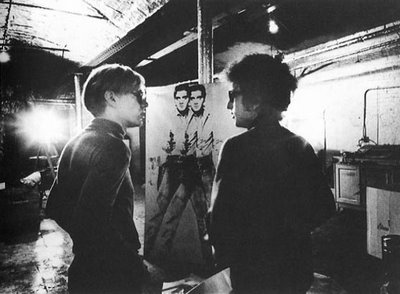
Andy, Elvis, Bob
And then the chorus which will be used three times for maximum pain:
But sooner or later, one of us must know
You just did what you were supposed to do
Sooner or later one of us must know
That I really did try to get close to you.
The key line here is that ‘I really did try to get close to you.’ At The Kettle Of Fish Edie murmured to Dylan that no matter how hard she tried she couldn’t get close to him. ‘Who?’ asked Dylan. ‘Andy.’ Edie replied. Dylan apparently took that as a rebuff although he was already married to Sara and would soon spawn a host of children on her.
I quote the second verse in its entirety:
I couldn’t see what you could show me
Your scarf had kept your mouth well hid
I couldn’t see how you could know me
But you said you knew me and I believed you did.
When you whispered in my ear
And asked me if I was leavin’ with you or her
I didn’t realize just what I did hear
I didn’t realize how young you were.
Apparently Edie didn’t realize that she was just a rainy day woman. While it’s a matter of interpretation I assume that Edie confronted Dylan with the fact of his marriage to Sara and naively asked if he were going to dump Sara for herself. Dylan was incredulous, astonished by her request, he thought she was more sophisticated than that, after all, a rainy day woman….
Rainy Day Woman is a very mocking put down of women as the lead off song and theme setter of the album titled Blonde On Blonde. Perhaps the title might be interpreted as Woman On or After Woman with Rainy Day Women establishing the theme. The song limits the range of women to two- numbers 12 and 35. Why 12, why 35? Who are they? One has to be Edie. If one does a little number manipulation a la Freud, in sequence the numbers add up to 11 which in turn adds up to 2. Two women. Seven come eleven? Three and eight, twelve and thirty-five added separately- three for male, eight for female. Twelve subtracted from thirty-five is twenty-three, Edie’s age. Just guessing.
As Sara is the only other identifiable woman in the lyrics the two women must be Edie and Sara. Let me venture the guess that all women are rainy day women for Dylan. Thus once Sara had borne his offspring fullfilling a religious obligation Dylan took seriously he drove her away oblivious to the pain and suffering he was causing or perhaps he was continuing to punish mother surrogates.
Dylan was drugged and crazed while he was writing this so this is a reflection of deep subconscious drives.

Andy And Edie As Beautiful People
The final lyric begins:
I couldn’t see when it started snowin’
Your voice was all I heard
Snowin’ either refers to a snow job by Edie so he was blinded by light hearing only her words or drugs of some sort, either amphetamines or cocaine.
I couldn’t see where you were goin’
But you said you knew an’ I took your word.
Once again Dylan shifts the full responsibility from himself and Grossman to Edie. He implies that she was leading him on rather than vice versa. This when it was clear to everyone that he and Grossman were promising her the moon in the attempt to pry her loose from Warhol.
And then you told me later, as I apologized
That you were just kiddin’ me, you weren’t really from the farm
An’ I told you as you clawed out my eyes
That I never really meant t’ do you any harm
Well, Dylan’s intents were pure, he says, but the results were deplorable; Edie was done harm by Dylan’s actions and the harm was deep and lasting, well beyond any hypocritical apologies. If the lines are to be believed Edie’s reaction was quite violent. As she was a total amphetamine addict her reaction would be quite plausible.
And then Dylan mockingly closes with his ‘whadaya goin’ to do about it line’- I really did try to get close to you.
As this period clears up for me I suspect that the whole of Blonde On Blonde is concerned with this Edie, Andy/Dylan duel. Blonde On Blonde itself then may refer to the silver hair of both Edie and Andy.
It should be clear that Dylan’s motorcycle fall was no accident. In Exhuming Bob 23b: Bob, Andy and Edie I hypothesize that Dylan’s bike was rigged by the Factory crowd. Dylan survived with minimal damage. For his own sins Warhol was shot a couple years later but he survived that one too. Edie died a physical wreck in 1971.

Dead Ophelia- Consider Ciao Manhattan with Edie shot in a swimming pool/
What goes around comes around as they used to say.

R.E. Prindle
A Review
Themes And Variations
The Tarzan Novels Of Edgar Rice Burroughs
#14 Tarzan The Invincible
Part IV of X
by
R.E. Prindle

I’ve Looked At Both Sides Now:
Multi-Culturalism In Tarzan The Invincible
Multi-culturalism as I see it merely heralds that it is no longer possible to keep the five great Homo Sapiens species with their various sub-cultures separate. If one assumes that c. 12,000 years ago when the Ice Age ended the various species had not yet developed sufficient population to force them to live cheek by jowl then cheek by jowl is unavoidable now.
The ending of the last ice age flushed a large number of comparatively highly cultured people out of the Med Basin scattering them to the four corners of the world. It would seem civilization as such started then. I believe all cultural innovations can be traced back to that point and that source.
As population increased the various species both human and animal came into closer contact with each other. So far the animals have been the big losers with dozens already driven into extinction while it is said that 25% of the remainder will vanish in the next few years.
As an evolutionist Burroughs has written a marvelous story here in which the fauna of Africa participate equally with the Homo Sapiens. Obviously they can no longer exist in a separate sphere either. Multi-culturalism to ERB means the interaction of both humans and the beasts of the jungle. Invincible might be considered a better version of Beasts Of Tarzan on that level.
Burroughs assembles his entire cast of Beast characters to participate in this story. Tantor the elephant, who has always been in the background takes a prominent role. The Great Apes among whom Tarzan was raised have their place. Jad-Bal-Ja the Golden Lion who first appeared in 1922 in Tarzan And The Golden Lion maintains his preeminent place while Little Nkima who first appeared in 1928’s Tarzan And The Lost Empire functions as the protagonist as a Mercury or messenger of the gods. Unnamed hyenas, jackals and leopards abound.
Tarzan as beast-man-god, intermediary between animals and humans as a man deity, completes the group.
Nkima the messenger first notices the presence of the Communist conspirators in Tarzan’s domain. He goes off to find Tarzan to tell him the news. Burroughs very cleverly shows the character of Nkima as one mischievous monkey. Mischievous nothing, he’s a quarrelsome, nasty little beast. He can’t keep himself from gratuitously insulting or irritating anyone who comes across his path.
Always ready for flight on his own, when on the shoulder of Tarzan or sitting on Jad-Bal-Ja where he feels immune to retaliation he is one offensive little beast.
David Adams points out that Burroughs is always ready with the fairy tale. When I first read David’s essays I humored him a bit but discounted the idea. Slowly I am being convinced. Burroughs confesses to an interest in mythology. He was heavily influenced by L. Frank Baum who is a fairy taler par excellence. He quotes Cinderella in Marcia Of The Doorstep. As a child there is no reason to believe that he wasn’t familiar with Perrault, the Grimms, Hans Christian Anderson, Aesop and possible East Of The Sun And West Of The Moon. As a young man he read Rudyard Kipling’s fairy stories of Africa and India. This title shows clear influences of Mowgli the wild jungle boy. Thus his Beasts exhibit fairy tale characteristics. As in Oz, that magical fairy land where beasts can speak, Burroughs beasts do speak the universal first language which all including Tarzan can understand.
After seeing the conspirators Nkima angers a larger monkey who chases him through the lower, middle and upper terraces. Eluding his pursuer Nkima spots a lion below him who he begins to insult. This is not any lion but Jad-Bal-Ja, the Golden Lion. Tarzan has already introduced Jad-Bal-Ja and Nkima so recognizing each other they utter a pre-arranged signal in the universal language.
Scampering down from the middle terraces Nkima leaps onto the black mane of Ja-Bal-Ja where he rides through the jungle in state insulting who he pleases.
This little fairy tale is very charming, worth the price of admission alone.
Of course Nkima is in his glory riding on the shoulder of Tarzan like a Ka.
In the multi-cultural way Nkima comes upon the Great Apes in their death dance of the Dum-Dum. Such a scene is purely fanciful on Burroughs’ part; no apes ever behaved that way. Remember, this is ERB’s jungle.
The Dum-dum must surely be based on the great circling of the elephants as witnessed by Kipling’s Mowgli.
Not content to merely witness this awe inspiring scene Nkima insists on scolding the half-crazed apes. A young light ape is sent into the trees to drive Nkima away. Pure moonshine, of course, but in a fairy tale sense a very effective story.
Then again, Tarzan, returning from Pellucidar, encounters the Great Apes in the jungle. They are irritated by the intruder consequently intending to give no quarter to Tarzan. The Big Bwana doesn’t want to have to kill a bunch of these 7’0″, 350 lb. brothers that it looks like he may have to when Jad-Bal-Ja and Nkima conveniently happen on the scene defusing the situation.
The presence of Jad-Bal-Ja shifts the balance in Tarzan’s favor. In the end Tarzan, the Apes, Jad-Bal-Ja and Nkima are reconciled in this jungle clearing. Moonshine again but entirely believable in this fine fairy tale. Even if impossible I want to believe such a thing could happen in some world somewhere.
Thus Nkima scampers through the story. On his final errand he goes to bring the faithful Waziri to help Tarzan defeat the Communist conspirators.
Nkima and the faithful Waziri are at rest. They engage in a little horseplay, p. 173:
When they pulled his tail they never pulled it very hard, and when he turned on them in apparent fury, his sharp teeth closing upon their fingers or arms, it was noticeable that he never drew blood. Their play was rough, for they were all rough and primitive creatures…
So we find here and will find throughout the novel and the oeuvre that Burroughs places both the animals and the African on the far side of that little gulf Haggard notes.
Also prominent in the story is Jad-Bal-Ja, the Golden Lion. He interacts with the animals, Nkima and the Great Apes, as well as any animal Tarzan tells him to. Jad-Bal-Ja remembers each and every one and they all remember him. A feat of memory for the beasts, I am sure.
Tarzan advises the Lion that certain people are friends who the Lion is to befriend.
Way back in 1922 in Tarzan And The Golden Lion Tarzan had advised Ja-Bal-Ja that La of Opar was to be protected. Eight years later without having seen her once in that time Jad-Bal-Ja remembers her taking her under his active protection. She isn’t sure that he isn’t stalking her but when attacked by a Leopard Jad-Bal-Ja flashes by her to kill the Leopard she realizes he is her protector but she doesn’t know why. La has forgotten the Lion over the eight years but finally recognized him.
Thus Jad-Bal-Ja is a prominent animal character in the story. He brings to mind both Kipling and Baum. There’s also an element of Aesop in these animal characters.
Finally there is Tarzan’s great friend, in more ways than one, Tantor the elephant.
Tarzan lazes on Tantor’s back as the big beast ambles lazily through the sunny forest. Safe from all harm Tarzan muses on the nature of Time, or perhaps that was Burroughs. Tarzan and Tantor merely commune.
When Tarzan rescues Zora he calls on the big beast to stand guard over her while Tarzan hunts, nursing her back to health. The great calm beast gently picks Zora up in his trunk setting her down within her enclosure. Ever helpful he swims the crocodile infested river with Tarzan and Zora on his back.
There are two sides to Tantor’s character however. When Dorsky has Tarzan bound and threatens him Tarzan lets out a piercing call for help that Tantor answers. Charging into camp he throws Dorsky down trampling him backwards and forwards side to side until the only evidence Dorsky existed is a dark spot on the ground. Nor could Tarzan make the angry beast desist until he had fully avenged his friend. then, like Tarzan in the Rue Maule, Tantor reverts to his placid self.
Next follows what David Adams would identify as a fairy tale. Tantor picks the still bound Tarzan up placing him gently on his back. Tantor deposits Tarzan under a tree then leaves. Tarzan still has to free his hands. He calls to some monkeys in the tree but they refuse to help him. Once again Tarzan shrieks the trouble signal far and wide. Nkima hears him but so do the jackals and hyenas.
Tension is created between Tarzan and the attacking hyenas as Nkima struggles to free Tarzan before the hyenas attack. Unable to untie the knot Tarzan advises him to chew through the bonds. As Nkima chews, the hyenas grow bolder finally charging in for the kill. With a might flexing of his rolling muscles Tarzan breaks the partially chewed bonds.
Having strangled a hyena he tosses him aside as Tantor arrives on the scene to serve the hyena as he had served the Communist, Dorsky.
In this multi-cultural paradise…”the three friends stood in the silent communion that only beasts know, as the shadows lengthened and the sun set in the forest.” Walt Disney could have learned a lot from Burroughs.
If that doesn’t get you soft and gummy nothing will. You will note that here Tarzan is a beast among beasts and yet a god to them.
This most charming jungle fantasy forms an integral part of the story as do Tarzan’s relations with the humans. On to the Conspirators.
b.
In the old days these would be described as an international band of characters. But in today’s jargon with the term ‘nation’ in disfavor we have to refer to it as a multi-cultrual assemblage. Liberals, perhaps, posing as wizards, believe that by merely wishing they have removed differences of culture, nationality and speciation. One gets the impression from their jargon that as they believe ‘race’ does not exist neither do cultural differences although they still call their fantasy multi-culturalism. In their fantasy no one struggles to be top dog but all commune as equals like the beasts Nkima, Tarzan and Tantor. The missing point in their equation, is that Tarzan is the god calling the shots. He is the top dog. He is the dominant culture. So, one asks, in their fantasy which culture represents Tarzan?
So, in this human multi-cultural assemblage Peter Sveri, a Russian Communist calls the shots until a greater than he, Tarzan Of The Apes, upsets his plans. There’s two people you don’t was to mess around with- Mother Nature and Tarzan.
Multi-Culuralism as I see it merely heralds that it is no longer possible to keep the five great species of Homo Sapiens with their various cultures in separate spheres. The Darwinian evolutionary struggle for survival requires the elimination of all but one of the competing species in a family following the same economy. Tolerance or cooperation is out of the question. Intolerance will trample the tolerant like Tantor on Dorsky. Only the strong and determined survive. Any other fantasy, such as Liberal multi-culturalism leads to extinction. Bless the peacemakers but get them out of the way, we’ve got work to do.
Certainly the invasion of Eurasia by Gengis Khan in the thirteenth century was a fairly recent indication that independent development was no longer possible. Then beginning in the fifteenth century when Europeans prematurely ventured out into the world to impose their culture the fate of species was inextricably engaged. Be it remembered that there were many thinkers who saw the inevitble result of joining combat of which Burroughs is only one. Once engaged Europeans had to follow through. The problem was that Europe’s own house was not united. Rather than acting as a unit, the various nation states were competing with each other. The competition resulted in the two world wars. The first war let the world know how vulnerable Europe was while the second destroyed the self-confidence of the West itself. Why I don’t know. Hence one has this ridiculous feeling of guilt caused by the conflict betwen the two socialist ideologies International Communism and National Socialism. Just to make my position clear Socialism is the Liberal ideology. Neither Hitler nor the Nazis were conservatives. The conflict was between two versions of Liberal ideology. All the actions of National Socialism can be traced back to the French Revolution which was Liberalism par excellence.
I am not a socialist nor was Burroughs. I abhor socialism and collectivity so in discussing Communism, Fascism or Nazism I am discussing abhorrent Liberal ideologies. Liberals will have to live with that taking responsiblity for their own actions as abhorrent as that is to them.
It should also be borne in mind that multi-culturalism is only a Euroamerican ideological fantasy. It is not shared by the othr Homo Sapiens species although Liberals think and act as though it were. The events in Darfur should confirm this. The Mexican invasion of the US to establish what they call Aztlan (Liberals deny such a concept) should be evidence that they do not share this Liberal fantasy. Nor do the Semites or Mongolids. All of those species are ethno-centric, who if successful will establish a world according to the ideals and customs of their species.
That is today, while we are here talking of the world of ERB’s time. At that time the tool for establishing multi-culturalism was International Communism. That ideology was the common language that allowed these cultures to communicate across cultural lines just as the universal language of the beasts of Tarzan allows all the animal species to communicate with each other.
In this story one has Africans of various cultures, the Semitic culture of the Arabs, a Filipino, a Mexican and of the Liberal Whites several Europeans, Russian culure, a Hindu and a number of Oparians. With the exception of the Oparians the cultures are all held together by the Communist ideology. While Kitembo and his Basembos are not strictly Communists they intend to benefit under the Communist aegis.
The expedition will fail not because of ideology but because of the failure of individuals to subordinate their personal desires to the ideology.
Raghunath Jafar, the Hindu, sacrifices his life for his passion for a White woman. He is killed in the attempt to impose his sexual desires on Zora Drinov. Burroughs uniformly denigrates his Hindu or Indian characters. In this story he makes Jafar grossly obese and greasy. ERB comments that Indians are generally believed to have occult powers which notion is unwarranted. Of course this is true which may account for his antipathy to the Hindu or Indian. He may have been influenced by Harold Gray, who created the Little Orphan Annie comic strip in the twenties. The great Daddy Warbucks employs the Indian, whether Hindu or Sikh, I’m not sure, who make people disappear by magic. Punjab would be a recognition of the general belief that Hindus had magical powers. You know, rope climbing, mind over matter, that sort of thing. People still believe Indians can do those things. Live for months buried in a coffin, incredible stuff. In India. Of course, they have difficulty replicating the same feats in the U.S.
The Filipino, Tony Mori, and the Mexican, Miguel Romero, are portrayed very advantageously as compared to the Russians, especially the leader, Zveri. Next to the American, Wayne Colt, Romero is the bravest, most alert and intelligent of the conspiritors. On the negative side Burroughs has him hating all Gringos which is entirely plausible.
Mori is portrayed as more dependent hoping to acquire his share of the Rockefeller and Ford millions. When the big distribution occurs he hopes to buy fine clothes.
Both men abjure Communism in the end when Zveri proves to be a cowardly and inept leader. They discover that the ideology is merely a cover for self-gratification.
The Arabs led by Abu Batn are impelled by the desire to rid Africa of the Nasrany or Christians. They hate all Nasrany. Their goal appears to be to drive out the European or Christian colonists. They offer Zveri little help being more of a hindrance. During the second assault on Opar they pack up heading out into the jungle leaving Zveri to shift for himself.
ERB portrays the Arabs as of the white Bedouin type he used in The Return Of Tarzan and The Lad And The Lion. Portrayed positively in those two stories the Arabs of Invincible are more negatively portrayed.
Actually the story takes place in the area which the Mahdi of the 1880s reigned. He who defeated General Gordon at Khartoum. The Arabs of the area were Arab in culture but assimilated to the Negro in color. Their customs also were somewhat different than the Arabs Burroughs portrays. Of course, his could have been recruited from the Mahgreb.
The African chief Kitembo of the Basembos is of interest. He is said to be Kenyan from the railhead on Lake Victoria. This story was written in 1930. By this time the African resistance was gaining force. The Africans had never been so much subdued as dominated. As Burroughs exhibits an up-to-date and profound knowledge of Communism it is quite possible that he was much better informed about African affairs than might be apparent from a casual reading.
I don’t say that he was but he might have been aware of the incipient Uhuru (Freedom) Movement in Kenya of which Jomo Kenyatta was already prominent. At this time Kenyatta was in England stumping for recognition of Uhuru among the bedsheets of England’s plumpest and finest. First things first, as Burroughs consistently notes White women are the most desirable women to the other species. Within a year Kenyatta would go to Moscow to study there. So there may have been an element of Kenyatta or other Kenyan leaders in Kitembo.
An additional element may have been from the story of the Unyoro king Kaba Rega picked up from Samuel Baker. Kaba Rega was deposed for refusing to accept Egyptian sovereignty although in real life he was sent to the Seychelles in exile. But here Burroughs may have worked his grievance into the story.
Kitembo and his Basembos are separated from the conspiracy by the program of terror undertaken by Tarzan. Tarzan recognizes the role of the terrorist in destroying morale. He then plays upon the religious superstitions of the African to get them to refuse to cooperate with the Europeans or White Men as he puts it.
This was helped along considerably by Zveri’s ineptness and cowardice. Kitembo himself is killed by Tarzan when he tries to abduct Zora. The Africans are portrayed as being on the far side of the gulf of Haggard or evolutionarily anteceding the Europeans.
The faithful Waziri also play a part by assaulting the Communist front on the march to Italian Somaliland.
Wayne Colt, as has been hinted throughout the story, is a double agent working for the US.
The Russians are Zora Drinov, Peter Zveri, Paul Ivitch nd Michael Dorsky.
Zora, who is a beautiful woman, while not a double agent is playing a false role. She has two stories. In one she tells Wayne Colt she is a daughter of a peasant who was killed by the Czar. She seems to be too cultured for this so this story is probably a cover.
At the book’s end she says that her father, mother, brother and sister were murdered twelve years earlier by Peter Zveri. That may make Zveri Jewish. Twelve years earlier wouold have been 1918 so it is quite possible that Burroughs means to imply that she is the lost princess, Anastasia. Thus Burroughs who favors Princesses slyly mates Wayne Colt with a princess. That’s just a guess.
Peter Sveri is about to shoot Colt as a traitor, which he was, when Zora drills him from behind. It is then she explained that Zveri murdered her family.
Dorsky is of course trampled to death by Tantor. Little more can be said about that.
Zveri fails because of various character flaws such as cowardice and ineptness while being shot in the end by Zora.
Paul Ivitch reflects back to a villain of the Russian Quartet, Paulvitch. He’s an ancilliary character here without much purpose. Tarzan magnanimously allows him to leave Africa which may refer to earlier animosities.
As usual the Russians are treated very harshly by Burroughs. Of all the nationalities, pardon me, cultures, ERB is consistently hardest on the Russians. The Germans even come off better.
Burroughs’ attitudes seem to have been fully formed by 1900 changing little thereafter. On page 68 of Porges’ biography of ERB he reproduces a cartoon ERB drew but is undated. Opposite on Pge 69 is a cartoon showing TR carrying the Republican Party on the way to the White House captioned: Slightly handicapped but still a safe bet. This implies to me that it was drawn for the 1912 Bull Moose campaign. The cartoon on page 68 is of the exact style which would imply that it also was drawn c. 1911. The cartoon shows the Jews and the Russians at their perpetual war. Russians bayonet Jews while Jews blow up Russians as Uncle Sam and John Bull look on. The caption is: How would you like to be a Russian?
Porges includes the cartoons in text related to the pre-1900 years so he apparently associates them with the Chicago Art Institute. No matter, ERB had the same attitude from early on. The attitude never varies from his first book to his last. So his portrayal of Russians is consistently negative.
His portrayal of multiculturalism is accurate. Apart from being a Liberal dream each culture pursues its goals without consideration for any of the others. The dream falters on the rock of self-interest. Even the superficially unifying ideology of Communism is not sufficient to weld the cultures into a single unit. The success of multi-culturalism can only be the imposition of one culture on all the others as a guiding force. Burroughs accurately identifies the Russians as making the attempt.
So in our day Liberals must fail as they can never impose their ideals on all cultures that must and will reject any ideal that refuses them the dominance they crave.
I suspect that the multi-culturalism of the Liberals will fail for the precise reason that nobody believes in it but themselves. The ideal is even shabby as a Utopian scheme that can be imposed only by force. As with the implementation of all Liberal schemes since the French Revolution to the present, its success can depend only on the mass extermination of any dissidents who stand in the way of its implementation. Thus Hitler was a descendent of Maxmillien Marie Isadore de Robespierre. The extermination of the Jews was no different than the extermination of the royalists of La Vendee and served the same purpose. Extermination is the way of the Liberal. You can look forward to the creation of a new worldwide Gulag system to exterminate Liberal opponents if they are not checked.
But let’s move on to the premise of Burroughs’ novel.
Proceed to Part V of X
A Review
Themes And Variations
The Tarzan Novels Of Edgar Rice Burroughs
#14 Tarzan The Invincible
Part II of X
by
R.E. Prindle

ERB
Time On His Hands
I pair this novel with Tarzan At The Earth’s Core. Burroughs could have titled that novel Tarzan In Pellucidar but he didn’t. Why not? Probably because he was trying to avoid as much confusion between his two imaginary worlds as possible, or possibly he needed the site to illustrate his point but didn’t want to make it a Pellucidar novel. Earth’s Core isn’t merely a story in which Tarzan makes a guest shot in another of Burrough’s worlds. Rather ERB is making a serious exploration of Einstein’s Theory of Time and Space. Alternatively the novel might have been titled, Tarzan, Lost In Time. The novel is written to disprove the objective existence of Time. Burroughs’ own conclusion is that time is merely a human construct for mankind’s own convenience but not substantial. I think he’s right.
The nature of Time was a topic of serious discussion during the late nineteenth century, into the twentieth , still going on today. Indeed the Pellucidar series as a whole is a discussion on the aspects of Time. Of course Burroughs was familiar also with H.G. Wells’ The Time Machine.
Perhaps one of the more interesting notions of Time and Space and time travel was one advanced by Mark Twain in 1916 in his interesting novel No. 44, The Mysterious Stranger. In his story Twain imagines that space and time are assembled like a multi-storied building with each diorama of time and space continuing in replay eternally. Thus his hero, #44 scoots around in time and space in what is apparently a system of chutes and ladders.
It is possible in this system to visit ancient Egypt to watch the Pyramids being built, climb through the years to discover the head of the Sphinx sticking out of the sand as Napoleon saw it in 1798, climb once again to watch the first Aswan dam being built, move up a story or two to watch the High Dam being built and off to Troy to stand in the front ranks with poor maligned Ajax.
To The Time Machine, Einstein’s Theory and The Mysterious Stranger, now add Tarzan At The Earth’s Core. There are more similarities than dissimilarities.
ERB apprently didn’t think he made his point in At The Earth’s Core or perhaps he received some criticism from someone so he carries the discussion over into Invincible. While incongruous for this story ERB works it in.
As there are no book s on Einstein in his library one may ask what evidence there is that ERB had ever thought of Relativity. Well, I’ve got the evidence right here, p. 104:
…but though Time and space go on forever, whether in curves or straight lines…
One can’t mention curved space and Time without being familiar with Einstein. And then, Einstein absurdly claimed that a nonexistent mental construct like Time forms a Fourth Dimension which somehow interacts with the other three. We are still waiting for a demonstration of that but we’ll let it pass. I’m sure Einstein picked that up from H.G. Wells Time Machine which was a very fine piece of imaginative literature but reflected no known physics then or now. Someone ought to pin a big red bozo nose on Einstein but, back to the future.
ERB had discussed the notion of Time thoroughly in Tarzan At The Earth’s Core. Actually that’s a contradiction of terms as a hollow earth obviates the notion of core. The key fact at the Earth’s Core is that it is always high noon. The central sun knows only endless day without a contrasting night to give the appearance of Time. Without the contrast between day and night and the revolution of the Earth around the Sun the concept of Time disappears; there is nothing to measure just pure duration.
In Invincible Burroughs explains it this way, if you didn’t catch it in At The Earth’s Core, p. 104 again, same paragraph:
The beasts of the jungle acknowledge no master, least of all the cruel tyrant that drives civilized man throughout his headlong race from the cradle to the grave- Time, the master of countless millions of slaves. Time, the measurable aspect of duration, was meaningless to Tarzan and Tantor.
Not only is Time meaningless to Tarzan and Tantor but Time is meaningless to the universe itself. Nothing that ocurs in the Universe is dependent on Time nor can Time change any occurrence. The so-called Fourth Dimension is totally ineffective. Everything will happen just as it does now and has always without any reference to Time. The progress of a physcial action will progress in scientifically determined steps from inception to completion without any interference from that clown Einstein’s ‘fabric of time and space.’

Albert Einstein
That is the import of timelessness at the Earth’s core. The inhabitants live and die without the ability to know they are getting older as there is no night, day or year. The organism merely comes into existence, behaving according to physical laws determined by genes and other micro-organisms progressing through all the changes until the final change which change no longer has any conscious meaning.
The same is true of suns and galaxies. It is virtually meaningless to say the Sun is several billions of years old. It is only a mental construct that lets you grasp a concept of duration. It is much more relevant to say, for instance, that the changes in the Sun’s development are, say, 30% completed. You see, it’s all quantative not qualitative. Barring accidents and diseases, at twenty the average life span in the US is 25% consumed. The changes relative to that portion of development in the organism have occurred and will not occur again. On that basis I have used up about 85% of the physical changes alloted my organism. The nature of future changes are predictable. They cannot be avoided. This has no reference to Time no matter what state of development an organism is in.
While in a state of depletion I become ‘old’ only if my psychology is affected by the concept of ‘age.’ While my physical capabilities are not what they were at twenty, that phase of development having been passed through, my mental capabilities have developed accordingly. As my body has decreased in powers my mind has increased. The beginning has compensated the end. If I die today or tomorrow that is as it must be. Everything has its end. There is no tragedy involved.
Life and death are completed, unaffected by Time. If time ‘stopped’ as people imagine it can, everything would continue as now. Organisms merely run their physical course. That is the point Burroughs is trying to make. He is repudiating Einstein.
As a young man I was conditioned to revere Einstein. I did this unquestioningly and, boy, was I sincere. I disgust myself in memory. But then, somewhere along the line the hypnotic spell wore off, contradicted by facts. Einstein began to unravel before my eyes. It wasn’t that I questioned his reputation it was just that a mist began to lift. I began to have doubts; sort of religious doubts. I blinked once and Einstein was no longer the archetype of genius. At the second blink I began to ask questions. I tripped over the notion of the physical reality of Time just as Burroughs did.
When I read the ancient Jewish historian Josephus I began to sense the specious nature of the problem. According to Josephus Abraham was the greatest astronomer cum astrologer of his time just as Einstein is thought to be the greatest of ours. At the time of the transition between the Age of Taurus and the Age of Aries Abraham had an astrological/astronomical dispute with the academy.
You see, at that stage of the evolution of human consciousness astronomy and astrology were united into one discipline. The magical element of astrology wouldn’t be separated from the scientific element of astronomy until the scientific consciousness of humanity had separated itself from the magical or religious which two systems are synonymous. The concept of god functions only in a magical sense as his presence is even less noticeable than that of Time.
However magic and astrology are still part of human consciousness although with a quasi-scientific basis so that systems organized perhaps tens of thousands of years ago continue to function through inertia. I have been accused of being New Age. Quite frankly as New Age in my view rejects the scientific consciousness as much as any other religious system, Fundamentalist Judaism, for instance, hint hint, I cannot be New Age. But, I sure like the way they talk.
What I discuss is scientific history. Facts which religious people reject because they disavow the ideas behind them but accept as real, i.e. Thou shalt not suffer a witch to live. Why bother worrying about it; witches do not exist except in the imagination.
So whether you ‘believe’ in astrology, the Zodiac or whatever is irrelevant. The fact is at one time in history people universally did and they acted on their beliefs.
At any rate the fact is at the time of the transition from the Age of Taurus to the Age of Aries Abraham had an astrological/astronomical dispute with the Chaldean astronomers of Ur. As I understand it they said the religious archetype was changing with the transition from Taurus to Aries. (I think of this as a form of set theory; it is so because everyone agrees it is so. No different than now.) Abraham argued that the archetype of the Ages was Eternal, unchanging, the Rock Of Ages to you religious types. Rock of Ages means unchanging through all the signs of the Zodiac, all twelve Ages. An Age is one sign of the Zodiac. Ages are the twelve zodiacal signs. (Hello, Central? Put me through to God.)
Now, to be Eternal is astrologically impossible. The Earth wobbles on its axis visible at the North Pole so that every twenty-five thousand years or so it creates a Great Year then begins again. The Ancients divided the Great year in the system of twelve periods, called Ages, to correspond with the months of the terrestrial year.
Apparently Abraham denied this and adamantly insisted on the Eternal. For this reason, according to Josephus Abraham and his fellow Terahite cultists were run out of town.
Lousy astronomers, then, Abraham’s descendants had learned little by the time Einstein stepped onto the world stage to give his oration. Just as Abraham had voiced his foolishness four thousand years previously Einstein did the same in our time. There are those who seriously argue that time travel is possible in Einstein’s universe. Well, maybe in his, but not in this one.
Nothing is relative but one’s point of view. The physical universe is one of absolutes; that is the nature of science. Science cannot be relative; in order for an experiment to be true it must replicate itself the same way under the same conditions. As unpleasant as that may be to some intellects there is in fact only one way in a given set of circumstances. A+B will always equal A+B. If one switches to A+C then the result will always be A+C. There is nothing relative about it. You may religiously expect other results but you will be eternally disappointed. So Einstein said that the further out in Space his mind penetrated the closer he got to god. Who can say, but he never got close enough to touch God. Einstein was not a scientist. He was a Rabbi. There is no g-d to get closer to. I’m sure that a good Rabbi would find arguments in the Talmud almost identical to those of Einstein.
Burroughs saw through Einstein hence his arguments disproving the physical existence of Time and the futility of any supposed Fourth Dimension. These are religious matters requiring a belief in a supernatural being.
Having said that Time was measureless to Tarzan and Tantor which was not entirely true since the rotation of the Earth divides ‘Time’ into night and day unlike at the Earth’s core. Burroughs then goes on to say, p. 104, same paragraph:
Of all the vast resources that Nature had placed at their disposal, she had been most profligate with Time, since she had awarded to each all that he could use during his lifetime, no matter how extravagant of it he might be. So great was the supply of it that it could not be wasted, since there is always more, even up to the moment of death, after which it ceases, with all things, to be essential to the individual. Tantor and Tarzan therefore were wasting no time as they communed together in silent meditation…
A beautiful piece of sophistry. Regardless of the Time involved, immutable physical changes continued to take place. What opportunities appropriate to that physical state were lost forever.
Apropos of which carrying his argument further, on p. 120 he says:
Time is of the essence of many things to civilized man. He fumes and frets, and reduces his mental and physical efficiency if he is not accomplishing something concrete during the passage of every minute of that medium which seems to him like a flowing river, the waters of which are utterly wasted if they are not utilized as they pass by.
Imbued by some such insane conception of time, Wayne Colt sweated and stumbled through the jungle, seeking his companions as though the fate of the universe hung upon the slender chance that he could reach them without the loss of a second.
I understand what ERB is saying, of course, I’m virtually a disciple. Tarzan lolling on the back of Tantor achieved his goal more easily than the frantic Colt. Still, one should remember: Work, for the hour grows late. Those irreversible physical changes are drawing one closer to the grave. Get it done now.
ERB displays a seeming peevishness over the issue which has little or no bearing on this story. It is an interesting aside but it does not illuminate the tale. Maybe somebody criticized the ideas expressed in At The Earth’s Core and Burroughs is carrying on the argument. Nobody paid any attention, still I am charmed by the vision of Tantor and Tarzan suspended in Space and Time wandering blissfully through the jungle unaware of any impending doom.
Proceed to Part III of X
A Review
Themes And Variations
The Tarzan Novels Of Edgar Rice Burroughs
#14 Tarzan The Invincible
Part I of X
by
R.E. Prindle
Edgar Rice Burroughs
Introduction
By 1930 ERB was fifty-six years old. An age when many or even most people have become hardened into unchangeable forms. Burroughs seems to have been an exception to this rule. His ability to evolve with the times is remarkable. Some can, some can’t. The problem isn’t one of merely attempting to mimic the style of the period but to adapt one’s mental outlook so that one thinks in the current idiom,
The post-Civil War period into which Burroughs had been born had disappeared now long ago. There might have been a couple survivors of the GAR but not many. The Indian Wars of his childhood were over. The plains had been swept clean of the buffalo. Even the buffalo robe that could easily be found during the first two decades of the century became difficult to find in the twenties and impossible to find in the thirties.
So that past which must still have been vivid in ERB’s memory was no more. Frank James and Cole Younger had died as late as 1915 and 1916 respectively. Buffalo Bill in 1917. TR in 1919. Charlie Siringo who had been present at the shootout with Billy The Kid was giving advice to authenticate Western movies even as he passed away in 1928. Heck, Burroughs could claim to be an authentic cowboy. He was out on the Idaho range in 1890 the heyday of the cowboy, Johnson County war and all that. His Western novels are about as authentic as you can get, maybe even more so than one of ERB’s heroes, Owen Wister.
The guy was carrying impressive baggage from the past to the present and into the future. The era of the first two decades had come and gone disappearing into the Roaring Twenties, the New Era. The twenties were a major transitional period for ERB. He picked up on the new trends by such writers as F. Scott Fitzgerald and kept on hoofing it down the highways and byways. The Shaggy Man of Tarzana.
There was a hiatus of four years between Tarzan And The Ant Men, which may be considered the last of the Tarzan novels of the first period and 1927’s Tarzan, Lord Of The Jungle. The latter may be considered a transitional work between the first and the later period.
Tarzan And The Lost Empire of 1928 shows him saying goodbye to the Lost Empire of his early dreams. By this time he had begun his affair with Florence Gilbert Dearholt that would result in the end of his marriage of thirty-four years to the lovely Emma.
Also a new political element entered his writing competing with the love element of Emma and Florence. Tarzan novels fairly gushed from his pen over the next seven years. Tarzan At The Earth’s Core of 1928-29, Tarzan The Invincible of 1930, Tarzan Triumphant of 1931, Tarzan And The Leopard Men also of 1931, Tarzan And The City Of Gold of 1931-32, Tarzan And The Lion Man of 1933 and Tarzan’s Quest of 1934-35. With the divorce his fecundity ended; he had severed his connection with his origins.
Politics had entered his life in earnest with the Bolshevik Revolution of 1917. He had always been involved with politics to some extent. In his youth his basic attitudes had been formed by immigration while he watched immigrant German socialists parade through the streets of Chicago under the red flag shouting, Down with America. The Russian situation had troubled him too. The villains of the Russian Quartet had been Russians. A very great many of his villains were Russians. The Communist leaders of Tarzan The Invincible are Russian.
In 1919 he rushed his political tract Under The Red Flag denouncing the Russian revolutionaries to his publishers. Haven’t read it but I suspect it was much too polemical for the pulp fiction magazines for which he wrote. It if was anything like The Little Door I can understand why it was rejected on literary grounds. I don’t doubt the novel was rejected for political reasons also as Reds and Fellow Travelers had already worked themselves into the cultural edifices of the US.
Certainly he was flagged as a counterrevolutionary to be watched and interfered with. It is now becoming apparent that ERB was more widely read in the new Soviet union than previously thought. Josef Stalin may even have followed the Tarzan series. We know for certain

Joseph Stalin
that Tarzan novels were read to workers on the job.
H.G. Wells
It appears that H.G. Wells was appointed to harass Burroughs in print. His 1923 novel Men Like Gods seems to reference Burroughs in a negative way. The means of communication between Wells, the Reds and ERB remains to be discovered but there appears to be novelistic warfare between the two. Wells seemingly was the Soviet hatchet man attacking other notable counterrevolutionaries such as Aldous Huxley.
ERB refined his approach getting his condemnatory novel of Bolshevism, The Moon Maid, published in 1926. The Moon Maid wasn’t that satisfactory although Wells replied to it in 1928 with Mr. Blettsworthy of Rampole Island.
Wells unmistakably alludes to Burroughs in this novel calling him insane. Tarzan At The Earth’s Core which is an attack on some core beliefs of the revolutionaries may possibly have been a rushed response to Blettsworthy.
In Tarzan The Invincible which may be incontrovertibly considered his third attack on the Revolution and an answer to Wells ERB succeeded in the grand manner. He shed the nineteenth century trappings of The Moon Maid that was written in the style of Wells’ First Men In The Moon to write a thoroughly modern novel. Invincible might be considered a prototype of the modern spy thriller, one of the first of the genre. Not only a prototype of the genre but as David Adams points out in ERBzine 0199 a superb blending of fact and fiction:
Fictional author: Burroughs pulls off a tour de force by narrating an introduction in his own voice, then slipping into the story so smoothly one is deceived into believing it is part of a newspaper story in a historical setting.
By which David means current events occurring almost as we speak. Tour de force is correct. David got the handle on that one. Tarzan is actually integrated into a current political situation as an actual historical figure. Tarzan interacts with fictional agents of Stalin who are represented as real acting under orders from Moscow. Incredibly Opar devolves from a mere fantasy of Burroughs into an actual geographic location somewhere in southern Abyssinia. The Soviet agent Dorsky tells Tarzan that they know that he knows where the gold of Opar is hidden and that he is going to tell them.
Thus Stalin has apparently kept up on Tarzan’s adventures which he thinks are real being aware of the source of Tarzan’s wealth and his earlier expeditions to Opar. In fact, one knows that Tarzan’s adventures are common knowledge which they should be as several millions of copies had been sold worldwide. Tarzan’s amanuensis Burroughs has seen to that.
The Soviets had located Kitembo of the Basembos who knew where Opar was and had actually seen it. The Basembos were native to the area of the railhead on Lake Victoria. One assumes that Kitembo must have known one of the faithful Warziri who showed him the ruins. As ERB explains only Tarzan and some of the Waziri had been to Opar. That overlooks Ozawa, who probably bore Tarzan a little grudge for the gold taken from him and the bearers of Esteban Miranda of Tazan And The Golden Lion but possibly the well-known Curse of Atlantis had carried them all off. Haven’t heard of the Curse of Atlantis? Well, you’ve heard of the Curse of the Pharaohs haven’t you? Same thing, only different.
The Reds trying to loot Opar isn’t all that far-fetched. As has been mentioned elsewhere Stalin actually ordered his scientists at about this time to cross an ape and a human to attempt to create a new super warrior that could run on regular. We know that Stalin was a fan of the Tarzan series, both books and movies, possibly even a secret admirer of our favorite author. The possibility of Stalin thinking a eugenic hybrid of ape and human possible from reading Burroughs seems to have a high degree of probability. The Oparian males were believed to have some ape blood in them. If word of the experiments had reached Burroughs, Tarzan The Invincible could be part a spoof on Moscow. So, in a way, the blending of fact and fiction David notes could on the other hand be a blending of fiction and science by Stalin. Amusing to think about. I’m sure more information will surface in the future. At any rate this story does read as an unreported behind the scenes actual event.
Let’s take a look at how Burroughs sets it up. From the opening paragraph.
I am no historian, no chronicler of facts…
OK, so we’re warned that we’re about to be put upon.
Had the story I am about to tell you broken in the newspapers of two certain European powers, it might have precipitated another and a more terrible world war. But with that I am not particularly concerned. What interests me is that it is a good story that is particularly well adapted to my requirements through the fact that Tarzan of the Apes was intimately connected with many of its most thrilling episodes.
Ah, so Tarzan really exists.
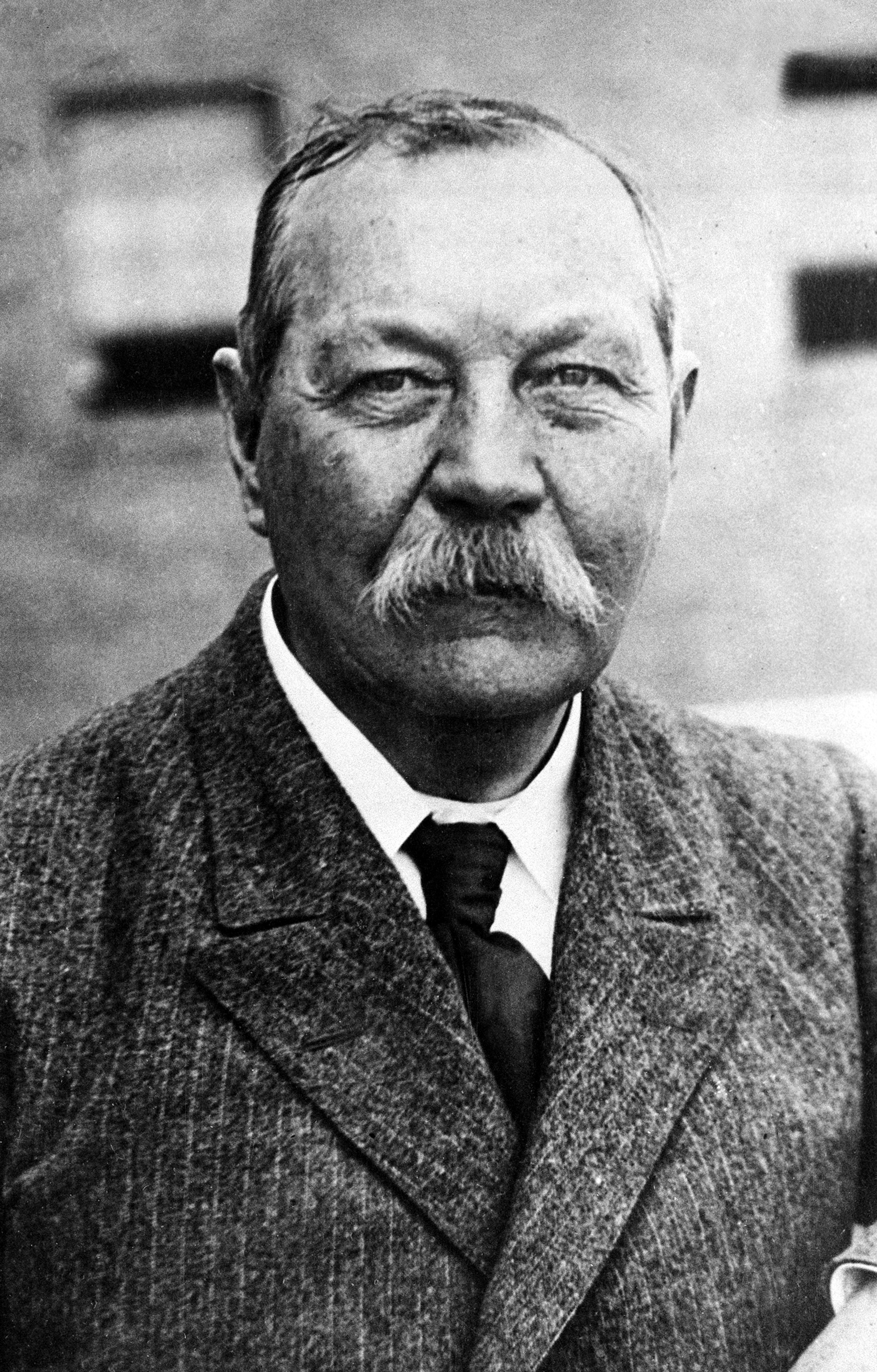
That passage is reminiscent of both the first framing story of Tarzan of the Apes and any number of story introductions of Dr. Watson for Sherlock Holmes. The echoes are very strong. An overlooked fact is that Burroughs actually plays Dr. Watson’s role for Tarzan. Burroughs
Arthur Conan Doyle
in fact is the chronicler of Tarzan’s adventures as was Watson those of Holmes.
Burroughs goes on to establish his story’s authenticity:
Take the story simply as another Tarzan story, in which, it is hoped, you will find entertainment and relaxation. If you find food for thought so much the better.
Doubtless, very few of you saw, and still fewer will remember having seen, an news dispatch that appeared inconspicuously (how inconspicuously?) in the papers some time since, reporting a rumor that French colonial troops stationed in Somaliland, on the northeast coast of Africa, had invaded an Italian African colony. Back of that news item is a story of conspiracy, intrigue, adventure, and love- a story of scoundrels and of fools, of brave men, of beautiful women, a story of the beasts of the forest and the jungle.
That seems like it covers all the bases of what a story should have. It is also pure Dr. Watson or, rather, Arthur Conan Doyle; let’s not fail to differentiate between fact and fiction. So far what Burroughs has posited could well be true. After all few read and fewer remembered the news item which appeared inconspicuously sometime in the not too distant past. Now Burroughs removes the story from the news item another step and quietly slips into full fiction mode:
If there were few who saw the newspaper acount of the invasion of Italian Somaliland upon the northeast coast of Africa, it is equally a fact that none of you saw a harrowing incident that occurred in the interior some time previous to the affair.
Um, yes, if there were few…then it’s a fact there were none. It seems ERB has established an incontestable ‘fact.’ So if you let that sophistry slip by you he’s going to tell you pure fiction. If you know the difference you won’t care, if you don’t it won’t matter. Anyway his intro was a perfect synthesis of nineteenth century humbug brought completely up to date.
Burroughs’ writing style is even close to reportorial. Tarzan, La and Opar become ‘real’ as ‘real life’ Reds make their assault on the ancient Atlantean colony. So, in a way, Atlantis becomes an established fact rather than an hypothesis.
Burroughs uses clear, concise sentences developing his story news style. For once his story is evenly paced with a well developed beginning, middle and unrushed end. He doesn’t cram a hundred page ending into ten as usual.
While one hesitates to call the book his best Tarzan novel it may be his best written. Thoroughly modern in its swift and pleasant reading with wonderful detailing I certainly can’t consider the novel hack work or inferior to any of the Tarzan novels in any way. The characters are entirely plausible, the premiss doesn’t seem far fetched. There are historical antecedents that we will examine. The novel could easily have take its place among the major spy thrillers written in the last fifty or sixty years. David is right. The novel is a major tour de force.
Part II of X follows.

R.E. Prindle
Exhuming Bob 25: Bob And Sam
June 5, 2010
Exhuming Bob 25:
Bob And Sam
by
R.E. Prindle

Shepard, Sam: The Rolling Thunder Logbook, 1977, Sanctuary Publishing.
Sometime in the mid-seventies, possibly in 1976 Paul Simon wrote in one of his lyrics: I don’t think this stuff is funny anymore. Coincidentally at the same time as I surveyed my record store of a Saturday morning the same thought occurred to me. Things had been overdone. In one bat of an eyelash the whole thing got old.

Bert Williams In Blackface
This was not case with Bob Dylan who in the waning months of 1975 put the greatest clown act New England had ever seen on the road. The Rolling Thunder Revue; or as it might alternatively have been named: The New Bob Dylan Minstrels. One purpose of the Revue seems to have been to spring the convicted triple murderer and ex-boxer Hurricane Carter from jail. That didn’t come until the very end.
Along the way Dylan wanted to film a sort of existential movie that would later be released as Renaldo and Clara. Working from some strange chaos theory Dylan had no actors, no script, no-nothing. Needing some sort of guiding hand he commanded the actor, cowboy, playwright Sam Shepard to attend to his writing needs. Sam then wrote what he called a log of the experience called the Rolling Thunder Logbook.
On the first reading I didn’t think Sam put much into it but the pictures were good. Still there was the nagging feeling that I might have missed something. On the second reading the logbook assumed more significance. It’s kind of impressionistic. It’s not a narrative; like the title says its sort of like a ship’s logbook. The impressions sort of pile up until you have a definite impression. I don’t know if that’s what Sam intended but that’s the way it worked with me.
Bob being the kind of powerful show biz personality he is didn’t bother to negotiate terms with Sam; he didn’t even bother to call himself; his agent or stooge or whatever interrupted the life of Shepard to tell him Dylan wanted him in New England. Sam doesn’t mention any terms, or indeed any payment. He just dropped everything, literally, and drove East. Did I mention he was in California? Well, he was; he was in the process of moving.
Bob tries pretty hard to cultivate that elusive, mysterious image and he succeeded with Sam who couldn’t locate him for a few days after he got there. Bob probably wanted to accustom him to the menagerie before he showed his face. Even then Sam didn’t have any guidelines he just expected Sam to free lance a few lines of dialogue if at any time he saw the cameras running. The film crew was more disorganized than Dylan if that were possible.
What was it all about anyway?

It Takes A Worried Man- Sam Shepard
As we should be aware 1976 was the two hundreth anniversary celebration of the American Revolution. But there were a number of conflicting revolutions running simultaneously. There was the revolt of the Matriarchy, what Eric Foner calls the Unfinished Revolution which was the replacement of Whites by Negroes and of course the perpetual revolution of the Jews against mankind, not to mention the revolution of the gay crowd. Bob as we all know is Jewish so one may reasonably ask why he chose New England for his chaotic Marx Brothers routine on the occasion of the Yankee Revolution around the new England sites such as Bunker Hill? Could he have been thumbing his nose at America? Well, it does look suspicious.
As Sam notes the crew made it a point to visit Plymouth Rock and the replica of the Mayflower which sacred symbols of pre-immigration America they reviled all but pissing on the Rock. The faux American cowboy, Elliott Adnopoz was swinging from the yardarm of the Mayflower. Y’all know Elliott as the yodelin’ cowboy Ramblin’ Jack Elliott o’ course. For the rest they pissed and farted their way across New England carousing and corrupting as they went. Of course it might just have been New England exercising the gang’s Rock n’ Roll genes, no more than that. Sam kept his discontent sotto voce by which I mean between the lines. Bob, with his need for conflict invited not only his old flame Joan Baez and his new flame Joni Mitchell but his wife Sarah playing each against each. Baez who grows more Mexican with each passing year seems willing to put up with whatever Bob does. Shortly after the tour Sara came downstairs one morning to find Bob dandling a strange beauty on his knee for breakfast. Well, you know, she threw in the tower after that, as, who wouldn’t? Bob seemed to be perfectly dismayed by this untoward turn of events. ‘Women in my family just don’t divorce.’ He whined uncomprehendingly. Well, at least, not without due provocation.

Joni Mitchell Looking Out Her Window
That leaves Joni Mitchell. She’s apparently been stewing about her treatment for thirty-five years. She just recently expressed herself by saying in effect that Dylan is just a god-damned phony. Well, Bob can always go join Joanie in that bomb shelter in Viet Nam. They can exchange rings made of the fuselages of American fighter planes, if they haven’t already. So, how sincere is their devotion to this great land of the once free and no longer brave? It would seem their loyalties lie elsewhere.
In my own obtuseness, quivering in my own psychological bomb shelter, I never saw Bob as a revolutionary in those far off days but then I was just listening to records, I didn’t know anything about him; boy, I sure have remedied that situation.
Back in those palmy days of the early sixties before racial and religious animosities had reached their present prominence I don’t know that anyhbody really thought of Dylan as a Jew. Certainly the name Dylan is not Jewish and I’m not sure how many people would have known Zimmerman was. Or, that they would have cared. In those days everyone cheered when Israel won one of those too frequent wars. Now, though, one has to put Bob’s religious affiliation up front. Make no mistake, he’s a fundamentalist, believes the Bible is the literal word of god. Orthodox. Chabad Lubavitcher even. Thinks the universe is fifty-seven hundred years old like his deceased mentor Rabbi Schneerson. Swear to g-d.
Must have picked it all up from Rebbe Rueben who came West from Brooklyn to Hibbing to indoctrinate him in Lubavitcher lore for his Bar Mitzvah. Like Bob said, he learned what he was supposed to learn. He very cleverly inserted the stuff into all those songs too.
Bob broke his mind in the excesses of the sixties, that high mercury sound he was seeking was the result of all those amphetamines he was shooting back then. Andy Warhol had his boy pegged.
In the late sixties and early seventies Bob had to rebuild his personality and he rebuilt it around his religion. His Mom was real proud of the way he had his Bible open on a stand in his living room so he could jump up and check it as the occasion arose.
Then as he got back on his feet he aligned himself with Meyer Kahane’s violent extremist revolutionary Jewish Defense League carrying a couple of JDL thugs around with him as bodyguards. Maybe his Jewish revolutionary mode was getting too obvious so in ’77 he began hanging out with Jews For Jesus and the Christian Vinyard Fellowship organization. Once that clouded the picture he reverted back to his Lubavitchers where he has been since.
So on the Rolling thunder tour one may be excused for thinking that he was in his revolutionary phase. Sam Shepard doesn’t mention it but his experience left a very bad taste in his mouth which he expresses with as much force as Joni Mitchell really has.
On the tour Bob did the strange thing of wearing white makeup which has remained a mystery. It shouldn’t be really. Remember the tour was to end in a successful attempt to free a Black man while the Black boxer Muhammed Ali was unstage at the Garden. A Garden party a la Ricky Nelson, get it? The Revue was actually a parody of the Minstrel show of what Greil Marcus would call the old weird America. In the old Minstrel shows the White actor wore black face in imitation of Black people. This may sound strange to you but Jews don’t consider themselves White notwithstanding their pale complexions they consider themselves Jews and goys as White. So, in disguising himself in White Face he was parodying the old Black Minstrel shows while mocking his ultra-White New England audience.
Bob Dylan was having the time of his life. The joke was on the Honkies. Funny, huh?
As noted, the keynote of the tour was the final concert at Madison Square Garden at Christmas where he took on America over the issue of the Black Hurricane Carter and won. Now, compare that Christmas show with the 2009 release of Bob’s Christmas album. Seemingly done straight it also mocks Whites. In Bob’s video for the song It Must Be Santa Claus you may have noticed that the audience showed minimal diversity. The airheads were all White. Bob comes prancing through wearing a lank blonde White girl’s wig, climbs into a balcony and stands looking down his nose in his wig at us all. It’s great. Nobody gets it. There is something happening here but you don’t know what it is, do you, Mr. Jo-o-o-nes.
Jewish power vs. American power, make no mistake.
Sam jumped ship before the end of the tour, he’d had enough, but he was there for the Garden party. He can’t even force himself to dissimulate a complimentary attitude as he did at the beginning of the Minstrel show. And then the final confrontation between the playwright and the singer.
At this point is is clear that the Rolling Thunder tour is something Sam wished he hadn’t gone on and an experience he preferred to forget.
Shepard closes with a chapter concerning the opening of his play The Geography Of A Horse Dreamer. I don’t know the play but it may have been based on Rolling Thunder. In the play Sam names the horse Sara D. Dylan is in New York at the time wanting to see the play. He wants to make his entrance in company with Sam. Sam writes:
..so I’m in the hotel lobby waiting for the Cadillac convertible to haul us over to the theatre. The big boxcar camper pulls up outside and Dylan hops out. My stomach does a full gainer as I see him approaching the hotel. The idea of him sitting in the audience is more like a nightmare than a blessing…He pauses at one of these signs (reading signs in the lobby) long enough for me to scuttle past him out into the street and hail a cab. It’s bad enough knowing that he’ll be there without having to ride there with him in the same car.
So not only was the tour distasteful to Sam’s sensibilities but the experience of first hand acquaintance with Bob has also left a bitter taste. Well he isn’t the only one. The evening of the opening of Sam’s show is not going to improve relations.
…the so-called curtain is being held up for Dylan’s late arrival. He shows up plastered, along with Neuwirth, Kemp, Sara and Gary Shafner. They take up a whole row.
So whatever the cause of the conflict Dylan is reciprocating his disrespect fully. He means to sabotage Sam’s show and then leave early too.
At intermission Sam doesn’t see Bob so he hopes he’s left the theatre. No such luck. Dylan comes out of the toilet.
He sees me standing there and pauses as though trying to bring certain thoughts into focus. “Hey, Sam, what happens to this guy in the play anyway?’ I’m dumbfounded for a reply but come out with something like, “That’s the reason for seeing the second act.” He stares at the floor, his knees shifting slightly as though he’s about to go into a nose dive.
“Hey, how come you named that horse in the play Sara D?”
“That’s the name of a racing dog in England.” It suddenly cuts through me that it’s also the name of his wife.
“I mean it’s the name of a greyhound. A real greyhound. You know the kind that race around the track.”
He smiles and shuffles through the door, almost making a left turn into the light booth.
Apparently Dylan didn’t find that answer any more satisfactory than I would have. Something is going on here, isn’t it?
As the play draws to its end Dylan makes his move. Shameless. Pure chutzpah immersed in chocolate sauce.
Dylan stands in the back row. “Wait a minute!” Who’s he yelling to? The actors? “Wait a second! why’s he get the shot? He shouldn’t get that shot! The other guy should get it!” Lou Kemp is trying to haul him back down in his seat….
Dylan is struggling to free himself from Kemp’s hammerlock grip. Neuwirth is telling him to shut up…Finally the Sam Peckinpah sequence begins, with shotguns and catsup all over the stage. Dylan leaps up again. “I DON’T HAVE TO WATCH THIS! I DIDN’T COME HERE TO WATCH THIS!
Apparently the Rolling Thunder tour didn’t end until Sam had written this play and run it by Bob. Dylan didn’t like the play any better than Shepard liked the tour. Hard feelings everywhere.
Apparently Bob used people much too roughly. He managed to either blow off a number of people immediately following such as Shepard, Jack Elliott, Neuwirth, the maligned Larry Sloman and probably the whole film crew while Joni Mitchell has weighed in thirty-five years on. We have yet to hear from a number of other people, most notably Roger McGuinn.
Bob managed to trash everybody including the USA with his Minstrel show for the 200th anniversary year. Which revolutions was he leading? I don’t think this stuff is funny anymore, do you?

Bob and Joan, Joan and Bob?
Four Crucial Years
In The Life Of Edgar Rice Burroughs
Part IV of IV
by
R.E. Prindle
Edgar Rice Burroughs
“HE’S BACK!”
By this time ERB would have been viewed as a real upsetter. Since 1890, except for a summer vacation or so, ERB had only been in Chicago from late Spring ’97 to Spring of ’98. Then he had gone away for a year and now he was back spoiling some other people’s plans.
Even after having deserted Emma Hulbert twice, the first time without notice for sure, and probably the second also, she was still waiting for him. Amazing! Ten full years when when the biological clock was ticking loudest she was still there. If that’s not true love I don’t know what is.
It must be that ERB took it for granted that she would always be waiting for him because he was still willing to leave her at the drop of a hat, if he could only get that coveted officer’s appointment.
As ERB walked down his street you could almost hear Alvin Hulbert say ‘Drat! that young man is not going to set foot in this house.’
Papa George T., quietly holding that three hundred dollar note, welcomed him back restoring his old job to him.
The following account is based on two letters, one from R.H. Patchin dated 3/21/1950 and the reply from Jack Burroughs dated 4/4/50. I learned of the letters which were quoted in part by Burroughs scholar Robert Barrett in the Fall 2003 issue of the BB. Danton Burroughs of ERB, Inc. subsequently was gracious enough to provide me with full copies as he had Mr. Barrett.
As of the time of the letter Mr. Patchin was from 68 to 70-75 years old. My guess is that Frank Martin couldn’t have been younger than Emma so was probably at least 25 to 30 years old in 1899. It is not impossible that he was older but as his exemplars in ‘W.C. Clayton and Terkoz in Tarzan Of The Apes and The Return Of Tarzan are approximately the same age as Tarzan Martin was most likely 25-27.
As Emma would be 23 at the beginning of 1899 which would be close to spinsterhood one may believe there was some anxiety on Papa Alvin’s part to get her safely married. Martin was about the most advantageous marriage possible. At, say 27, he was looking at one of the last unmarried women of his age cohort. If he failed with Emma he would have to find a much younger woman than himself or take a woman who had already been married. He has some reason to repent this man he could not have known well who not seeming to care that much for Emma yet stood between himself and her.
Patchin says a lot in his letter to Jack Burroughs. He mentions the three times his and ERB’s paths crossed. They were all unfortunate for Burroughs. In the first ERB got his head bashed in; in the second Patchin showed up just after ERB divorced Emma which divorce was national news; the third was the condolence letter at ERB’s death. Talk about an ill omened bird.

Jack Burroughs’ Reply
Sometime between ERB’s divorce and 1950 Frank Martin became a statistic. He didn’t survive his nemesis. I am guessing of course but Patchin’s meeting with ERB after his divorce must have been arranged by Martin. He may even have been watching from a distance. One wonders if he ever married.
I only mention the following as a point of interest. By the time John Dos Passos wrote the third volumeof his USA trilogy, The Big Money, Burroughs was already a major literary figure. As he didn’t seem to court publicity he can’t be said to have been a celebrity. In The Big Money Dos Passos cameos a number of interesting people among them Bernarr Macfadden.
It should be clear to everyone that nothing can be done in secret. Whatever passed between Martin, ERB and Emma must have been a source of gossip among Chicagoans. Somewhere along the way Dos Passos may have heard the gossip. In The Big Money he includes a story about a woman named Evaline Hutchins. A segment of the story bears some resemblance to the situation between the three under consideration. In the episode the Martin-like character takes the Emma character driving. He cracks up the car leaving the woman with some explaining to do to her husband.
I don’t say it’s so but suppose that in 1907-08 Martin, still seething at his rejection, in some way got Emma to go out driving with him with the above result throwing Burroughs into a panic. It was in 1908 that Joan was born to be followed immediately by Hulbert. Is it possible that after eight childless years Burroughs suddenly began a family as a defensive move against Martin? I can’t say but it is a hint I would dearly love to follow up.
At the time Patchin wrote the letter in 1950, judging from his stationery, he was down on his luck. His sloppy typing can’t be accounted for by age alone, or perhaps a lifetime of hard living had left him a wreck. My conjecture is that he had been drinking when he wrote the letter.
You will notice that the staionery bears only a street address- 555 Park Avenue- and no indication in the body of the letter as to what city. Burroughs’ reply provides the location. New York City. Patchin must have been clever enough to provide a return address on the envelope. The street address is printed rather than engraved so it is less expensive stationery. With no other address details provided it is obviously not Patchin’s personal stationery. The paper must have come from a mailing address. The stationery was probably available to anyone. 555 Park Avenue is a lower East Side address so Patchin was totally down on his luck. Probably drunk as he wrote.
He makes a glaring Freudian slip in the first paragraph when he says of ERB, ‘He lived his wife well. Wife for life! Hence the letter is as much about Emma as ERB. Emma meant nothing to Patchin so he must be speaking for Frank Martin. He then immediately relates the anecdote concerning ERB’s bashing in Toronto; thus Emma and the bashing are related. The one caused the other.
What follows now is extrapolated from Patchin’s virtual confession and Jack Burroughs’ reply. Burroughs hints that he knows more of the story than he is letting out. He and ERB had discussed this matter shortly before ERB passed over, he says. Obviously among the last things on ERB’s mind.
Martin viewed Burroughs’ return from Idaho with apprehension. Emma’s delight at Burroughs’ reappearance disconcerted Martin’s plans which he and Alvin probably thought were progressing well. Martin perhaps in talking with Patchin, if they were equals and friends, which I doubt, may have said, ‘How am I going to get rid of this guy?’ ‘Let’s think about it.’ Said Patchin. ‘What kind of accident could he have?’
Indeed, that’s how people get rid of someone they don’t like, the victim has an ‘accident.’ Murder is for amateurs. With murder the Law has to be paid, with accidents it doesn’t. No investigation. Perhaps he steps on a banana peel; gets run over by a car going the wrong way down a one way street, pushed in front of a trolley car. The next question would have been, where, how, when?
Better that it should be out of town rather than in town.
How to get Burroughs out of town? Now we’re talking old hat. You find a desirable reason for going somewhere, say New York City, then you make arrangements.
In Frank Martin’s case he had a perfect situation. Frank’s father, Col. L.N. Martin, was a multi-millionaire railroad man who had his own private rail car. In July of ’99 the Col. was going to NYC so Martin, extended an invitation to Burroughs to travel by private car to New York City. What a deal, huh?
Burroughs should have been surprised at the offer since the two weren’t that close friends while they were rivals for Emma’s favor. There should have been enough there to give one pause. Still, what a tempting offer.
The trip appears to have lasted at least three to four weeks, returning to Chcago at the beginning of August. Clearly ERB and Martin were not in the same economic league. Our Man was receiving fifteen dollars a week. Martin could spend that much for lunch every day of the week and take Emma to the theatre every night without a single concern for expense. There was no way ERB could have kept up so that the Martins had to have paid his way. Didn’t ERB wonder why they would do that for a comparative stranger?
There was no questioning expenses from the Martin point of view. They owned a luxurious private railroad car. It cost more than Burroughs made in a week to connect it to a train. Jack Coleman Burroughs recalls: ‘Dad also recalled on the same trip, a colored porter would knock on the stateroom doors the first thing every morning. The porter bore a silver tray upon which was a choice of ‘eye openers’. According to Dad, this went on over different parts of the private car during the rest of the days and into the evenings.’
Thus ERB was accepting lavish hospitality he couldn’t hope to reciprocate. This is a fairly humiliating situation. You cannot feel like an equal nor will you actually be treated as one. One the other hand he was kept tipsy, to say the least, for the whole trip.
When they got to New York ERB does not appear to have lived on the car. Once again with the Army fever on him he wrote to Col. Rogers who was then in Washington D.C. in the hopes of gaining an officer’s appointment. The return address Rogers was given was 11 17th in NYC. That is the lower East Side somewhere in the vicinity of the Bowery. Patchin was writing from somewhere in the same vicinity. Of course, the address could possibly have been a box of the railroad; the information is incomplete. At the same time the Martin party was staying on the posh Riverside Drive. There’s a degree of separation there.
ERB’s letter was sent on the 15th while Rogers very quick reply came back on the 22nd in the negative. He didn’t have to give his reply much thought. Now, ERB was ready to abandon Emma again. Marrying her must have been a low priority in his mind.
If Martin had been thinking, rather than preparing an ‘accident’ for ERB he would have gotten his father, ‘the Colonel’ who must have had some influence, to secure Burroughs an appointment and have him shipped to the Philippines. That would have made ERB eternally grateful while getting him out of Martin’s hair. Frank missed a chance.
Sometime after the 22nd the return trip to Chicago began. As is usual in attempts of this kind the hit was delayed until the last minute. In this case the assassination was to take place in Canada to which, if anything went wrong, Martin would have to be extradited as they would cross the river into the United States from Toronto the next morning.
More rounds of drinks were served as the train moved from NYC to Montreal and thence to Toronto. Probably a fairly lengthy trip as they might have had to switch trains a couple times while wating in the yards.
Neither Patchin nor Jack Burroughs gives a date for Toronto. As this took place in 1899 there were no motorized taxis. As Patchin says the railcar was parked in the Grand Trunk yards. These ‘three gentlemen songsters out on a spree’ would have had to walk into town or hire a carriage, probably the latter as Martin had the money.
At this point someone would have had to have previously hired the thugs to bash Burroughs. As I figure it the logistics were Patchin’s job. I don’t see him so much a friend of Martin’s as an accomplice or stooge. In his letter he does not claim to be a friend of Martin, he does not say ‘our’ old friend but claims to have been a friend of ERB while ERB was a friend of Martin. Stange circumlocution when he could have just said ‘our friend.’
Although Patchin describes the thugs as ‘Canadian hoodlums’ I wouldn’t be surprised if they had been brought from Chicago contracted by Patchin there. It would have been easier and surer.
If you study Patchin’s letter you will see that other than the slip of ‘He loved his wife well’ there are no other typos in the first paragraph. As he gets into his story in the second paragraph he begins to have difficulties. By the third paragraph when guilt seizes him he can’t even spell his last word or keep the words on the same line. He begins emergency with two Es, can’t spell the critical word ‘hospital’, crossing it out. Serious stuff.
Where did they go in Tornonto on that memorable evening. Probably to the red light and gambling district. Toronto’s answer to Chicago’s Levee. Where else could you arrange a fight with such hoodlums so easily. Patchin doesn’t say whether the fight took place indoors or outdoors, just that Burroughs took a smack to the head. Since the scalp was opened he was coshed with a sap or pipe.
Burroughs says that he didn’t lose consciousness but he must have been knocked flat on his back. He must have had time to get his arm up to partially block the blow or he would most likely have been killed by it. As I see it, then, this was an assassination attempt. Martin meant to permanently get Burroughs out of the way. Put him in a place from where he couldn’t come back.
As I see it Martin and Patchin faked the brawl. Patchin doesn’t say that he and Martin had a hard time of it. No. Just Burroughs got hit. Only Burroughs got hurt which is suspicious. After the first blow which could have been interpreted to be in the heat of anger which would still have been manslaughter, to have continued to belabor Burroughs would have been a clear case of murder which would have had to have been thoroughly investigated. The Law would have to be paid. Thus the opportunity was lost when the first blow failed. Martin and Patchin didn’t even report the incident to the police. The ‘Canadian hoodlums’ could still have legged it across the border though. It is not impossible that they weren’t Canadian but Chicago hoodlums contracted for the job before the private car left the Big Windy. Why not? Perfect job.
So at two in the morning when asked where he was staying by the hospital doctor ERB replied in our private car down in the Grand Trunk Station. Not Martin’s car but our car. He quickly got used to the luxury of a private car. Never forgot it either.
As he was able to walk he was released the party returned to the yards returning to Chicago the next morning.
2.
One may ask is there any evidence to show that Burroughs after he had thought about it for a while ever came to the conclusion that Martin and Patchin had meant him harm? I think there is. In The Return Of Tarzan Burroughs puts these words into the mouth of Jane perhaps thereby admonishing more sternly who might, not unreasonably, be expected to be reading these books. He obviously would get more out of them than we might.
Jane says ‘…this terrible jungle. It renders even the manifestations of friendship terrifying.’
A manifestation of friendship was the invitation to NYC from Martin. This indeed had been terrifying. So that for the parties concerned if they read between the lines they had every reason to believe that Burroughs understood everything.
One of the consequences of the attempt on Burroughs’ life was that he rushed back home to propose to Emma. Within five months they were wed thus taking her away from Martin. Emma had had a choice between a prince and a pauper and by some miracle had chosen the pauper. Really a very romantic story worth of a movie on its own. Grand Opera the way I see it. Andrew Lloyd Weber should look into this one.
There were other serious consequences. Of the blow, Jack Buroughs says: “He suffered for a number of years with bad headaches from the blow he received in that fight, and attributed one or two short periods of amnesia to that rap. (Amnesia is a recurrent theme in the Tarzan oeuvre.) I remember the scar was quite evident on his forehead when we were children (Jack Burroughs was born in 1913 so the scar must still have been visible in 1920 although it doesn’t show up in photographs.) but it seemed to disappear in his later life. Mother used to jokingly attribute his success to that blow.”
Emma would be in a position to know.
So Burroughs suffered lasting injury from that blow– one doesn’t have periods of amnesia unless there is internal pressure on the brain. There is evidence that he suffered from such pressure. Perhaps brain damage is too strong a phrase in this case but here is a clinical description that seems to fit the case. Per Brodal: The Central Nervous System: Structure and Function (3rd. Edition, page 433):
A peculiar form or amnesia occurs together with confabulation; that is the patient invents stories (without knowing that they are not real). Most of the patients have a lesion involving the substantia inominata, the medial hypothalamus, and the orbito frontal cortex (usually caused by a ruptured aneurism in the anterior cerebral artery). The often bizarre stories can usually be traced back to real events, although they consist of various, unrelated fragments from memory. It seems the patient is unable to suppress irrelevant associations, and cannot chack them against reality.
That is pretty close to ERB’s situation although he doesn’t appear to have lost his connection to reality although his stories as fantastic as they come always relate to his own memories. The Corpus seems to form one gigantic web of psychological unity as Richard A. Lupoff has pointed out.
One could think that after such a fearsome blow he would have been kept at the hospital for observation for at least a day or two but as he appeared to have no more than an open wound the doctor sewed him up and sent him on his way. As Patchin says the doctor came down to the yards the next morning to check up on the private car story which may have seemed incredible to him causing him to the think the patient deluded perhaps being more hurt than he looked as, indeed, he was.
There seems to be no reason to doubt that the blow ruptured the anterior cerebral artery. Thus internal bleeding over the next couple days would have created a clot which would have put pressure on the prefrontal lobe causing cobwebs, headaches and obviously a faulty memory with periods of amnesia.
There must be a medical reason for all these.
The symptoms should have begun showing up within a week or so, so that the several months of faintness ERB experienced began then. It was in this mental condition that he proposed to Emma.
Disappointed by the quick rejection of Col. Rogers while at least intuitively understanding that he had been set up in Toronto, ERB quickly went to work to capture Emma from Martin. I see little reason to believe that he had intended to marry her any time soon before he went o NYC, if at all. Back in Chicago in August he proposed and he and Emma were married by the end of January. In terms of years he was twenty-five and she twenty-four but in reality ERB was only four months older than Emma.
The sudden wedding must have been disconcerting to the Hulberts. I’m sure they envisioned a magnficent society wedding for their daughter. There was now no time to plan one so they must have been bitterly disappointed.
ERB now had to face a reality he hadn’t planned for. His rough and rowdy days were over.
3.
While solidly based on documentation the foregoing is at present somewhat conjectural but let us see if we can find some discussion by ERB of these events in his writing. There are four titles that go over these events in slightly different ways. Certainly ERB had to ask himself what had happened. He gave it a lot of thought. Beginning in 1909 his answers came pouring forth. Minidoka 937th Earl Of One Mile, Series M which was unpublished in his lifetime was the first of these efforts followed by Tarzan Of The Apes, The Return Of Tarzan and The Girl From Farris’s. As ‘The Girl’ is concerned with the early married years rather than this period I will forego discussion of that title although it should be read in sequence with Minidoka.
Minidoka, which actually began ERB’s writing career is directly concerned with this struggle between himself, Alvin Hulbert and Frank Martin. In the story the evil Brady represents Alvin Hulbert with the genuine thoroughbred godling, Rhi, representing Frank Martin.
The wars and battles represent Hulbert’s attempts to keep ERB away from Emma which ultimately fail. However the story may explain a curious situation in which ERB and Emma took up residence in the Hulbert home after marriage. Not a situation most newlyweds would want, but one that the Brady or Hulbert insisted on.
Alvin Hulbert had thought little of ERB for several years. The Army episode and the Denver marching band stunt did little to improve his opinion of Our Man. How the New York trip was represented to him by Martin would be interesting to know. Probably Martin who had every incentive to slander Burroughs said he was drunk all the way to New York and back, drank continually, started the day with liquor. He may have said that they were in the red light district of Toronto at ERB’s insistence. In other words, he probably made the most of the situation.
Undoubteldly terrified at his daughter’s willfulness in marrying this ne’er-do-well Hulbert made it a condition of his consent that the couple live in his house where he could keep a close eye on ERB. I’m sure he was ready to have the marriage annulled at a moment’s notice.
In Minidoka Rhi by a very devious trick puts Minidoka/Burroughs in a situation where he is meant to be killed, a situation not unlike Toronto- then rushes to the heroine Bodine/Emma to inform her that Minidoka is dead proposing marriage to himself instead. It could have really happened that way.
As in real life Emma/ Bodine remains steadfast and true to Burroughs/Minidoka, all wool and a yard wide as Burroughs puts it.
Thus Minidoka mirrors the real life events in a fantastic manner as Per Brodal would suggest.
Minidoka was never published so the same material was available for a retelling. This was done in the first two Tarzan novels. Tarzan Of The Apes tells the story of Burroughs life up to 1896 with some interpolations from the later period. The Return Of Tarzan covers the four years from 1896 to his marriage with Emma in 1900.
Always bear in mind that Burroughs has to tell his story with commercial ends in mind.
The blow to the skull made an indelible impression on ERB as well it might. In Tarzan Of The Apes, Tarzan takes three serious beatings, one with a gorilla from another tribe, perhaps representing John the Bully, and with Kerchak and Terkoz of his own tribe. In all of them Tarzan is beaten about the head and shoulders. Terkoz/Martin rips his scalp open from above the left eye over to his right ear. Clearly an exaggeration of the true wound but that must have been how it felt.
Kerchak delivers a blow to the head that would have killed him had he not deflected its force with his raised arm.
Then when Tarzan and Jane are in the jungle Terkoz abducts Jane causing Tarzan to rescue her killing Terkoz in the process. Thus in Program A Tarzan kills his adversary.
Running concurrently in Program B Tarzan is a penniless jungle ape-man up against W.C. Clayton who is a genuine thoroughbred godling as was Rhi in Minidoka. Tarzan feels he doesn’t have a chance against Clayton so he magnanimously resigns Jane to him at the end of Tarzan Of The Apes. There must have been a sequel in mind because, as in reality Burroughs won Emma, Tarzan must win Jane.
The end of Tarzan Of The Apes may correspond to Burroughs joining the Army in 1896 while finding Clayton embracing Jane in the jungle may correspond to his second Idaho trip in 1898.
So that between 1896 and 1898 it may have appeared to him that he had lost out to Frank Martin. In ‘Return’ Tarzan retreats to Opar which is his fantasy world with the beautiful but unobtainable anima figure, La. At this early date she and Emma/Jane are fighting it out in his mind for his allegiance. He would rather have La, that is remain unmarried, but his rivalry with Martin is pushing him toward Emma.
Tarzan is captured by the Oparians destined for sacrifice to the Flaming God of which La is High Priestess. Burroughs reverses the situation and instead of squelching his imaginary La she is about to sacrifice him. Burroughs can’t renounce his Anima fantasy so rather than kill him which would end both Burroughs’ wish persona of Tarzan and his relationship with La, she releases him. Tarzan/Burroughs then triumphs over W.C. Clayton winning Jane/Emma. Jane/Emma leaves Opar never to return. La remains in Opar until Tarzan The Invincible when Burroughs is about to leave Emma and take up with his Anima figure, Florence Gilbert. La then comes out of Opar in the same way Burroughs leaves Emma for Florence. Opar disappears from the oeuvre, never being mentioned again.
Then as ‘Return’ ends Burroughs and Emma are married mirroring his fantasy where Tarzan and Jane are married. While not literal as Burroughs is writing for publication and must construct an interesting and, at least, nominally plausible story he confabulates events from his life into a fantastic and improbable tale.
The history of his slugging which closes this period was mysteriously obscured by his youngest son John Coleman Burroughs. These two letters were only discovered by Danton Burroughs, John Coleman’s son, recently. They were unknown to biographers Fenton, Porges and Taliaferro. For decades it was believed that Burroughs had been coshed in Idaho by a policeman as an innocent bystander in a saloon brawl.
In an interview with Porges Jack Burroughs told this latter story in 1970. Porges then dutifully reported the Idaho story in his biography. the question is why would Jack invent the latter story to replace the true one with which he was aware. As he himself replied to Patchin having previously discussed the event with his father I don’t see how he could have forgotten it. Nor was there any need for him to even tell Porges the Idaho invention.
Perhaps Jack knew details buried away in the archives wishing to lay down a false trail to disarm the curiosity of Porges.
In 1899 ERB had had the direction of his life changed by a rap on the head. He now had to face a life filled with heavy responsiblities which he had been able to avoid to this point.
We see a new Edgar Rice Burroughs emerge from his early married years.
Four Crucial Years
In The Life Of Edgar Rice Burroughs
Part 3 of 4
by
R.E. Prindle
There was a tremendous rush of events at this time which would shape the future of not only ERB but of the Burroughs Boys.
The signficance of the first of these would have passed unrecognized by any of the Burroughs. This was the election of Frank Steunenberg as the govener of Idaho in 1896. Steunenberg brought the Burroughs Boys into an association with his name when he appointed them representatives at a mining conference. The boys were thus connected with the anti-Western Federation Of Miners forces.
In 1899 in Coeur D’ Alene up near the Canadian border a terrific showdown occurred between the mineowners and the WFM. This is an exciting story. For details see the autobiography of Big Bill Haywood, ‘Big Bill’s Book’, Clarence Darrow’s autobiography and Charlie Siringo’s autobiography, ‘A Cowboy Detective’. Very rewarding books, especially Charlie Siringo’s.
Steunenberg called in the Army to crush the union thereby incurring their hatred. On December 30, 1905 as returned home from Office he opened his mailbox and disappeared into thin air from the bomb blast.
There is yet no conclusive proof that the Burroughs Boys found it expedient to vacate Idaho for fear of the WFM but at any rate they chose to leave.
ERB formed a distaste for Big Bill and for the IWW which Bill headed after leaving the WFM as a result of the bombing. ERB never gives up lambasting the IWW. The character of the Sky Pilot in the ‘The Oakdale Affair’ is undoubtedly based on Haywood.
The second of these events was the really stupendous story of the discovery of gold in the Klondike in July 1897. By the beginning of 1898 a hundred thousand or so prospectors including Jack London set off the fabled Big Rock Candy Mountain in the Yukon. This last of the great gold rushes probably fired the imaginations of the Boys who were having a very difficult time of making their cattle ranch go. They would shortly abandon ranching, building a mammoth dredging raft to sift the bottom of the Snake River for any spare flakes and nuggets.
What effect this had on the mind of ERB is difficult to assess although the Tarzan novels are filled with episodes of found gold and diamonds. Most notably Tarzan uses the gold of Opar as his personal bank. He perhaps found his brother’s seach for gold curious. He didn’t seem to catch the fever at the time.
On top of these two items the Maine was sunk in Havana harbor on February 15, 1898. The legendary newspaper publisher William Randolph Hearst had been beating the drums for war and now got it. The sinking of the Maine may have been the spur that caused ERB to petition Capt. Smith for an appointment. The Spanish American War agitated his military ambitions as he tried to get that elusive officer’s appointment.
As he left home again in 1898 ERB was 22 soon to be 23. Time was passing. He was no longer a boy but having been coddled as a youngest son and brother he was having difficulty making the transition to a responsible young man. Not unusual, but true. He was in that difficult learning period of 21-25 when great demands are made on one’s developing maturity. Somehow when one turns twenty-five one had better have learned enough to make it from there. How well I remember crossing that bar from youth to maturity. What a kick in the pants it was. Don’t know how I made it or, perhaps, if I have.
Unfortunately for ERB any maturity he was to experience was well in the future. Perhaps he never really made the transition. He had no money of his own. He would have had to ask his dad for fare and traveling money. He was used to being supported, just asking for the money he needed. We will now come on several examples.
Young ERB was one light headed son-of-a-gun. His route took him through Denver. There he met an Army buddy from Fort Grant who had been a member of his Might Have Seen Better Days Club.
This was apparently a joyous reunion as the two got roaring drunk, hired a brass band then marching behind it paraded through the streets of Denver. Always seemingly conversant with the seamy side of town he and his friend blew whatever money they had remaining in a gambling dive. Now broke, he blithely wired his brothers in Idaho asking for more money to continue his journey. As he already had his ticket this fifty dollars represented the equivalent of an easy five hundred today, perhaps a thousand. It was pocket money to him.
What effect this stunt had on his family’s evaluation of him is open to conjecture. ERB was no longer a kid; he ought to have been showing some sober responsibility. I’m sure the story reached Chicago where possibly the Hulberts heard of it thanking their lucky stars the ne’er do well had checked out of their daughter’s life leaving the way clear for Frank Martin. Wishful thinking.
I don’t think ERB gave it another thought, probably laughingly telling his brothers about it while I am sure they looked at him with puzzled astonishment.
As Porges notes they had little use for him on the ranch or could not afford to pay him wages, which is to say give him money which they had not factored into their expenses.
Events were now crowding fast on ERB. On April 19th, 1898 Congress authorized the war on Spain. Burroughs once again appealed to Colonel Rogers as his best bet to get him a commission. Rogers fobbed him off, nothing coming of his appeal. Hearing of Teddy Roosevelt’s formation of the Rough Riders Burroughs sent an appeal to him which was once again a rejection. The military was and would remain a mirage.
Had he been accepted either his father or his brothers would have had to provide transportation and incidental money. I’m sure one of them may have done it but there would have been no guarantee that ERB wouldn’t gamble it away en route, cabling for more.
The Boys were not flush, as Porges relates. They had borrowed a thousand dollars from their father, use your multiplier for today’s equivalent, on which they were unable to make the principal payment, instead sending their dad the interest only which was a fairly steep 8%. Technically since they couldn’t meet the obligation they were bankrupt. Nevertheless brother Harry, who seemed to be a much softer touch than brother George, bought ERB a stationery story in Pocatello. Porges doesn’t give any financial details but perhaps it was at this point that ERB gave Harry his note for three hundred dollars. It is quite probable that this money also came from George T. who wished to remain anonymous. Harry may just have forwarded the note to Chicago. The loan was never repaid; George T. presented the canceled note as a Christmas present a decade later.
ERB was to keep the store for six months. Those six months were probably very important to him intellectually. He later said he wasn’t cut out to be a retailer but he did keep the store for six months selling it back to the former owner at that time. If the owner bought it back for the three hundred then ERB kept the money never retiring the note.
The evidence indicates that Burroughs gave the business his best shot. He seems to have advertised well while developing contacts to the point that he could offer to obtain any book or magazine from the U.S., Canada or England. Although he advertised statewide, how much demand there may have been for any magazines other than the most common ones is questionable.
Once again, details of this period are tantalizingly lacking. Porges says that ERB made at least one trip to Salt Lake City in this period. One would like to know why. What need was there for him to incur the expense of such a trip. As impractical as he was he probably spent one or two hundred dollars out of the till which would better have gone to developing the business.
One would like to know what he read at this time. It would be of interest to know how many different titles of magazines he actually stocked. What books other than Capt. King’s he sold. He appears to have studied Darwin’s Descent Of Man at this time although the volume he used was twenty years old. It still may have been bought new for the store, I suppose. On the fly leaf he drew a picture of an ape labeled Grandpa which shows he was giving it some thought.
Darwin was being much discussed as ERB obviously incorporated later thought into his drawing.
One would like to know was the store making money? At any rate when the former owner returned to Pocatello at the beginning of 1899 ERB was only too happy to sell it back to him. What did he do with the money? I’m sure he could have found a poker game somewhere in Pocatello.
2.
When he returned the store to the former owner he became superfluous to his brothers who couldn’t afford to pay him as a ranch hand. He now had no real place in Idaho. He began to think of returning to Chicago. Though he may have exasperated family and friends with his erratic behavior, behind his nonsense his mind was busily at work absorbing the tremendous range of influences occurring on a daily basis.
Important among these was the West’s relationship to the world. While the Spanish American war was intended to free Cuba, an unintended consequence was the acquisition of the Philippine Islands as a colony or ‘possession.’ Other countries had colonies, the US had possessions.
Rudyard Kipling who had toured the US in 1889 beginning in San Francisco moving East had formed some very definite impressions of the country and its inhabitants. In February of ’99 in connection with the Philippines he published his very famous poem The White Man’s Burden. The US had been traditionally anti-imperialist, except moving West, condemning England most severely but now faced with Philippine intransigence the country was involved in a brutal war of suppression. Perhaps reacting to taunts of colonialism against the English Kipling wrote what can be viewed as a mocking poem.
Anachronistic when published on the eve of the twentieth century, it was reflective perhaps of an earlier intellectual climate. Burroughs reaction was immediate reflecting a deep, if not long, he was only 23, reflection on the problem. The Pocatello paper printed his response shortly after the original appeared. This was apparently written in white hot heat.
As the response is a synopsis of his later views I will reproduce both poems for comparison with comments. If mocking, Kipling still presents a bright or positive side of the European invasion of Africa and the East.
The White Man’s Burden:
The United States And
The Philippine Islands, 1898
by
Rudyard Kiping
Take up the white man’s burden-
Send forth the best ye breed-
Go bind your sons to exile
To serve your captives’ need;
To wait in heavy harness,
On fluttered folk and wild-
Your new-caught, sullen peoples,
Half devil and half-child.
2.
Take up the white man’s burden-
In patience to abide,
To veil the threat of terror
And check the show of pride;
By open speech and simple,
An hundred times made plain,
To seek another’s profit,
And work another’s gain.
3.
Take up the white man’s burden-
The savage wars of peace-
Fill full the mouth of famine
And bid the sickness cease;
And when your goal is nearest
The end for others sought,
Watch sloth and heathen Folly
Bring all your hopes to nought.
4.
Take up the white man’s burden-
No tawdry rule of kings,
But toil of serf and sweeper-
The tale of common things.
The ports ye shall not enter,
The roads ye shall not treat,
Go make them with your living,
And mark them with your dead.
5.
Take up the white man’s burden-
And reap his old reward:
The blame of those ye better,
The hate of those ye guard-
The cry of hosts ye humour
(Ah, slowly!) toward the light-
“Why brought ye us from bondage,
Our beloved Egyptian night?”
6.
Take up the white man’s burden-
Ye dare not stoop to less-
Nor call too loud on Freedom
To cloak your weariness;
By all ye cry or whisper,
By all ye leave or do,
The silent, sullen peoples
Shall weigh your Gods and you.
7.
Take up the white man’s bureden-
Have done with childish days-
The highly proffered laurel,
The easy, ungrudged praise,
Comes now, to search your manhood
Through all the thankless years,
Cold-edged with dear-bought wisdom,
The judgment of your peers!
Originally published in
The New York Sun, February 5, 1899
The Black Man’s Burden
A Parody
The dark side presented by
Edgar Rice Burroughs
1
Take up the white man’s burden,
The yoke ye sought to spurn;
And spurn your fathers’ customs;
Your fathers’ temples burn.
O learn to love and honor
The white God’s favored sons.
Forget the white-haired fathers
Fast lashed to mouths of guns.
2.
Take up the white man’s burden,
Your own was not enough;
He’ll burden you with taxes;
But though the road be rough,
“To him who waits, “remember”
The white man’s culture bring you
The white man’s God, and rum.
3.
Take up the white man’s burden’
“Tis called “protecorate,”
And lift your voice in thanks to
The God ye well might hate.
Forget your exiled brothers;
Forget your boundless lands;
In acres that they gave for
The bood upon your hands.
4.
Take up the white man’s burden;
Poor simple folk and free;
Abandon nature’s freedom,
Embrace his “Liberty;”
The goddess of the white man
Who makes you free in name;
But in her heart your color
Will brand you “slave” the same.
5.
Take up the white man’s burden,
And learn by what you’ve lost
That white men called as counsel
Means black man pays the cost.
Your right to fertile acres
Their priests will teach you well
Have gained your fathers only
A desert place in hell.
6.
Take up the white man’s burden;
Take it because you must;
Burden of making money;
Burden of greed and lust;
Burdens of points strategic,
Burdens of harbors deep,
Burden of greatest burdens;
Burden, these burdens to keep.
7.
Take up the white man’s burden;
His papers take, and read;
‘Tis all for your salvation;
The white man knows not greed.
For you he’s spending millions-
To him, more than his God-
To make you learned and happy,
Enlightened, cultured, broad.
8.
Take up the white man’s burden
While he make laws for you,
That show your fathers taught you
The things you should not do.
Cast off your foolish feathers,
Your necklace, beads and paint;
Buy raiment for your mother,
Lest fairer sisters faint.
9.
Take up the white man’s burden;
Go learn to wear his clothes;
You may look like the devil;
But nobody cares who knows.
Peruse a work of Darwin-
Thank gods that you’re alive-
And learn this lesson clearly-
The fittest alone survive.
See the Pocatello Tribune clipping
from ERB’s scrapbook at ERBzine 0291
Burroughs response to Kipling may also explain why he refused to join a Pocatello volunteer regiment destined for the Philippines and the assumption of the White Man’s burden. Burroughs is accused of an excess of pride in refusing to join the regiment because he would have to serve under a man he didn’t like, a good enough reason for me, by the way. One doesn’t know the details but possibly his fellow volunteers refused to make him an officer. His local reputation may have been such that his fellows had no confidence in him.
Also pertinent I believe is the fact that while the war in Cuba was to free the Cubans from Spanish tyranny, the war in the Philippines was to crush the freedom of the Filipinos. As Burroughs’ answer to Kipling clearly demonstrates he was opposed to the imposition of Western values on native peoples. The Tarzan novels should be read in the light of this answer.
While Kipling’s poem has been much derided by the moribund Liberal establishment with no attempt at placing it within a historical context it nevertheless does express certain truths. Whether misguided or not, unlike all previous conquests, the White Man with his superior scientific consciousness did try to uplift the peoples they conquered rather than merely exploiting them on their own established historical model.
The poem is an interesting example of evolution in progress before the reaction against the West began. Darwinian evolution, you know, does not only apply to the past and other species, it also applies to the present and humankind. Kipling himself does not appear to have absorbed the new scientific learning. He was eleven years older than Burroughs, but his parodist was thoroughly imbued with evolutionary ideas having, apparently, just read The Descent Of Man. The final quatrain:
Peruse a work of Darwin’s
Thank gods that you’re alive-
And learn the reason clearly-
The fittest alone survive.
indicates this.
While biographer Taliferro believs that Burroughs got no further in the Descent Of Man than drawing a picture on the title page the quatrain would indicate a much deeper familiarity. ‘A work of Darwin’s’, Darwin wrote several books, points to a wider reading of the evolutionary scientist than just the Descent.
So at some time before reaching the age of 25 ERB had obviously been immersing himself in evolutionary reading and speculation. He may have been flighty but he was industrious and intelligent.
The advice to the subject races is peculiar while being ambiguous. On the one hand he advises them to take up Western learning, which as they haven’t makes them unfit, while on the other hand he implies that they have not been exterminated because they are the fittest.
The bright side of the Western subjugation of the peoples is clearly and accurately presented by Kipling who had much more experience in the wide world than Burroughs. On the other hand one tends to underestimate Burroughs whose brief experience in Apacheria is still analogous to Kipling’s in India.
On an evolutionary basis the West’s conquest of the world represented a radical departure from the historical model. Prior to and outside the West the world’s conquerors had been mere freebooters who plundered and destroyed while contributing nothing to their subject peoples who were most frequently intellectually superior to the invaders.
Thus Attila was merely an incubus on Western civilization whose potential was wholly destructive. His reputation cannot be rehabilitated. Genghis Khan and his successors inhibited the development of superior civilizations dragging the subject peoples back toward more primitive conditions. The crimes the Golden Horde committed against the Russians are atrocious. But that is why the Liberals love them better than the West.
As Kipling states, athe West conferred solid benefits on the subject peoples. It imposed superior organization, scientific methods and standards although today, after several hundreds of years resistance, through the superior methods of the West certain areas are profiting. Not many though.
In the terms most people relate to, famine has all but disappeared- this through no efforts of their own- through Western medicine billions lead more comfortable lives, certain diseases have disappeared while most others can be treated- through no efforts of their own- these benefits have been a gift, a boon from the West.
The prevalence of fevers gave sub-Saharan Africa the name of the White Man’s Grave but in fact no people could prosper in the African climate. Even the native Blacks, who one would assume, should have acclimated themselves over their hundred fifty thousand year existence seldom lived past forty. They were incapable of creating medicine before the White Man arrived and they are incapable of even manufacturing the White Man’s medicine today.
So that, while Kipling’s poem is denigrated today as an example of ‘racism’ by the Red-Liberal ideology, apart from the insufferable condescension it is an accurate description of the altruistic role played by the West in civilizing the world.
Reacting to the poems apparent insufferableness as much as anything Burroughs counters it by listing the negatives which are as real as the positives but with no material value. Once again the negatives are inconsequential compared to the brutality of the Mongol conquests in the West. One has only to glance over the wars of Tamerlane to arrive at some sort of balance, one hopes.
Burroughs is ostensibly taking the side of the subject peoples but in reality he identifies with the defeated accepting their defeat at the hands of the West as analogous to his defeat at the hands of John the Bully.
This view would relieve the lines:
Thank gods that you’re alive
And learn the reason clearly-
The fittest alone survive.
of some of their ambiguity because what he is saying is that he has survived comparable conditions- he still lives as he has his characters say repeatedly. Therefore he is one of the fittest if not superior to his conqueror.
Thus beneath the foolery and compulsive failure caused by his 1884-85 confrontation the true Edgar Rice Burroughs is struggling toward Bethlehem and rebirth. It may in fact be no coincidence that the initials of both John Carter and John Clayton are JC.
In the Spring of ’99 he can only put together this parody of another man’s work where it touches his fixations most directly.
For the present, after the roundup our wandering boy pulled up stakes yet again to return to Chicago. Who bore the expense isn’t clear.
Continue on the Part IV and conclusion
Pt. 2 Tarzan And The Madman By Edgar Rice Burroughs
May 26, 2010
A Review
Themes And Variations
The Tarzan Novels Of Edgar Rice Burroughs #23
Tarzan And The Madman
Part II
by
R.E. Prindle
ERB And Florence Bid Goodby To LA
Tarzan novels seem more complex after repeated readings and just sitting and thinking about them. When I first read Tarzan And The Madman I Thought it was a throwaway. In the interim between that first reading and the present I’ve spent a fair amount of time in the Tarzan oeuvre and the Burroughs corpus while having written several hundred pages. One would think it would get easier but it doesn’t.
This novel was written by Burroughs in exile in Hawaii. He’d been run out of LA a couple years previously. Once the possessor of a magnificent collection of cars and planes and a vast estate becoming of the creator of Tarzan he was now living on 250.00 a month in the island paradise. He had returned to his poverty days at Sears, Roebuck in Chicago. Life’s like that.
On one level then Madman can be interpreted as a record of his feud with MGM and subsequent exile. Just look at the disdain on his and Florence’s faces as they board the plane for the last outpost of America. Tells a story in itself.
The MGM feud began with the release of Trader Horn. The book Trader Horn itself can be traced back to the Cave Girl. The movie of Trader Horn led to MGM’s first sound Tarzan. Thus Rand, the false Tarzan of the novel, can be seen as the Weissmuller portrayal of Tarzan in the MGM films. ERB was greatly offended by MGM’s notion of Tarzan hence this novel’s hero Rand is The-Man-Who-Thought-He-Was-Tarzan, a false god made to seem insignficant by the real literary Tarzan.
One should note that the real Tarzan is an intruder in the make believe Tarzanic world of MGM. The Mutia Escarpment on which the action takes place first came into existence in Trader Horn then was perpetuated through five MGM Tarzan films. The sixth MGM movie took place in New York City, of course. That one hadn’t been released as yet.
The opening sequence is even a parody of MGM’s Tarzan, The Ape Man in which an old coot shows up in Africa with his beauteous daughter who is then abducted by Tarzan who doesn’t know any better. There’s a certain amount of humor then when the real Tarzan of Mad Man wants to know who’s been abducting women in his name besmirching his reputation.
The false Tarzan who we may as well designate as Rand to make things easier, after a false start abducts the White woman, Sandra Pickerall, of the Scots Ale fortune taking her to the Mutia Escarpment. The ascent to the Escarpment is nearly identical to the ascent in both Trader Horn and Tarzan, The Ape Man. Burroughs adds his usual lion hoopla having a menagerie of them at the base of the Escarpment who are fed human flesh.
Once on the Escarpment Burroughs fleshes out his story with the usual Lost Civilization theme. In this instance the civilization is derived from Medieval Portuguese invaders of Moslem lands who were defeated in battle retreating to the Escarpment where they built their castle and established their life while becoming a milk chocolate hue. At one point Burroughs says they were part of a seventh century contingent, again Crusaders and yet again having been there four hundred years. So take your pick.
Rand has been there believing himself Tarzan for two years. He, of course, is suffering from amnesia caused when he was parachuting into the castle having been slammed against a wall causing his trauma. He and friend Bolton-Chilton were flying into Africa when in a replication of the MGM movies they entered a clowd bank to find themselves face to face with a mountain wall. In the ascent the plane malfunctioned so having cleared the Escarpment the men were compelled to bail out. Bolton-Chilton was captured by the Moslem/Galla rivals of the men of the Portuguese city of Alemtejo and enslaved. So, is this novel all roads lead to Alemtejo.
Since Rand descended from the sky Christoforo Da Gama, the king of Alemtejo, takes him for a god. I will deal with the religious aspect in the next section. If Rand is a god then Da Gama insists that Rand must have a goddess sending him forth to find one. Hence Rand abducts a number of Black women who prove unsatisfactory to Da Gama who insists on a White Goddess leading Rand to abduct the only possible candidate, Sandra thus besmirching Tarzan’s hitherto unsullied reputation.
After a series of adventures Tarzan arrives before the gates of Alemtejo. Both he and Rand are of the same general build and resemble each other enough to cause confusion but on closer examination their faces were not alike. As it chances when Tarzan arrives Rand and Sandra have absented themselves in the pursuit of freedom.
Interestingly Tarzan’s entrance into Alemtejo parodies the arrival of the Greek hero, Theseus into Athens. As Burroughs thought he invented the name Numa for lion, not realizing he had retrieved from memory the name of the Roman king, in all likelihood he didn’t realize that he was basing the entry of Tarzan on the entry of Theseus.
In the Greek myth Theseus dressed as a woman, don’t ask me, the scene is reminsicent of the Gilgamesh epic of Sumer in which a temple prostitute entices the wild man Enkidu into joining civilization who tears her garment in half giving half to the man, anyway as a transvestite, Theseus draws the jeers of observing workmen. To put them in their place Theseus picks up a bull and throws it over his shoulder. Like I say, I’m working on it but without the semblance of a clue.
Tarzan by replicating the feat wins the admiration of the Alemtejo general who proclaims Tarzan the true god, they overthrow the old order, march on the Moslem Gallas using new tactics devised by the new god and overthrow the Moslems.
The victory scatters all the protagonists who then have to come together.
As with the MGM movies there is a huge gold mine involved. In the movies there is a great seam of gold with huge nuggets lying on the surface so that all you have to do is pick them up. So in Mad Man the two villains Crump and Minsky in company with Rand discover the mine.
Here Burroughs depicts the worthlessness of gold in the manner in which he disparaged the Father of Diamonds in Tarzan And The Forbidden City. Overcome by their greed the starving and dehydrated Crump and Minsky gather more gold than they can carry killing themselves in the process.
Tarzan, Rand, Sandra and Bolton-Chilton as surviving Europeans come together. Sandra convinces Tarzan, who had vowed to kill Rand on sight, that he is merely deluded having lost his memory. Bolton-Chilton turns out to be the buddy who having parachuted from the same plane as Rand had been enslaved by the Gallas.
It turns out that Rand was so entranced by the story of Tarzan that he bet Bolton-Chilton he could live as Tarzan in the wilds of Africa for a month. He was on the way to do so when the two had to bail.
In their seach for the easy way down from the Escarpment the foursome come across Rand’s plane that had landed and coasted to a stop rather than crashing. Rand pumps up the the tires, fixes the carburetor and all four of them fly away. Thus Burroughs rewrites the MGM movie in a more plausible and entertaining way retrieving Tarzan from MGM in a sense.
As in real life Burroughs was exiled from LA so Rand, Sandra and Tarzan are exiled from Africa. Tarzan’s African adventures cease. Just as the Communists had driven Tarzan from Opar so now MGM drives Tarzan from Africa. The next adventure would take place on a mysterious island in the Indian Ocean while the last Tarzan adventure takes place in Indonesia during WWII. A sad ending for the Big Bwana.
Of course the Africa of Livingstone and Stanley on which the Tarzan series was based was also a thing of the past. The Tarzan stories couldn’t have continued to have been wirtten without becoming retrospective. Even the Lesser Tarzan films that succeeded MGM became exotic fantasies rather than African adventure. It was the end of an era.
Beginning in 1932 with the first MGM talkie the Big Ape man began to slip away from ERB’s control. Mad Man records the sad fact that the pale MGM imitation of the ape man had supplanted the real thing. It must have been a bitter moment for ERB writing in Hawaii.
We don’t know why he didn’t publish Mad Man. He placed the story in his safe where it remained until the early sixties when it was discovered and published. It seems likely that as of this date but few have even read it. Of those who have, most probably discuss it as a tired rehash of the themes of doppelganger, amnesia and perhaps the last of terrestrial lost civilizations.
I found it the culmination of those themes. ERB’s long examination of the nature of psychological doubles was drawn to a satisfying conclusion as the false Tarzan awoke from a long sleep to realization. Perhaps the same was true of Burroughs as he viewed his lost hero in the lost land of LA from his place of exile in Hawaii just beforfe the bombs from those airplanes began to fall.
Next an examination of the religious aspects of this amazing novel.
Four Crucial Years
In The Life Of Edgar Rice Burroughs
Part II
by
R.E. Prindle
…presumptuous attempts to conquer the outer world of appearances by the inner world of wishful thinking.
–S. Freud, Letter To Arnold Zweig 5/8/32.
Quoted by Schur: Freud: Living and Dying
Now back in Chicago he had to consider what direction his life was to take. At least secure working for his Dad, ERB made a tentative move in the direction of an artistic career. During the summer he enrolled in the Chicago Art Institute.
Chicago is billed as America’s Second City but in many ways it is or was, America’s First, certainly West of the Appalachians. The city was much more important to the Southern States than New York City, while its importance to the West is shown by the fact that the Outfit- the Chicago Mafia- considers the whole West as its province. The Outfit ruled everything west of the Appalachians by the end of the fifties
At the time in question when Chicago’s population was a mill six the population of the country was about 75 million so Chicago represented over 2% of the total. West of the towers rising from the mud there was virtually no one and those that existed were rubes and hicks or living on the reservation. During Burroughs entire youth this most modern of American capitals stood a beacon of civilization, such as it was, on what was then known as the great American desert.
Burroughs was to approach this metropolis from the West several times so is it any wonder that when John Carter emerged from the deserts of the Green Men- read Indians- the towers of Helium rose from nowhere much like Chicago. The twin of Chicago was probably New York City in ERB’s mind.
As the capital of the Empire, Helium, like Chicago, reflected the racial and ethnic makeup of Mars.
Chicago was polyglot and the mix was troubling. Bruce Grant who wrote the history of the Union Club of Chicago entitled characteristically ‘Fight For A City’ in 1955 characterized the situation during Burroughs’ time in this manner, page 96:
The thousands of laborers and adventurers who were attracted to Chicago during the rebuilding era following the fire of 1871 were for the most part uneducated newcomers. Ignorant of the underlying spirit of American institutions. Chicago was the Western distributing point for a vast European immigration. With the good came the bad, and borne along with the stream were the scum and dregs of countries where despotism had made paupers and tyranny had bred conspirators. From Russia came the Nihilists, described by one newspaper as ‘the gift of centuries of Slavic slavery and cruelty.’ From the German states came the Socialists, the offspring of military exactions and autocratic government. And from Europe generally, including Great Britain and Ireland, Chicago drained the feverish spirit of human resentment against laws and life; of property and of conduct which it had no hand in making or enforcing.
This was the environment Burroughs was growing up in. I suppose he was getting his Russian and Jewish information from the newspapers. Therefore it was heavily slanted in favor of the Jews. But as he walked around Chicago he must have thought himself a Stranger In A Strange Land. I do today. No more than 10% of Chicago’s population could be considered native. The city had a larger Irish population than Dublin, was the most populous German city in the world, The Polish population could compete with Warsaw and on down the line.
The Socialists paraded shouting and screaming Revolution under the Red banner which may have made sense in Germany but made no sense to the native born. Anarchists unfurled the Black Flag with their preposterous social conceptions.
The remarkable thing about America is the extent that the Anglos went to accommodate the immigrants. Of course there were movements such as the APA- American Protective Association- and later the Ku Klux Klan, but these were scorned and ineffective in any event, regardless of how seriously some paranoid immigrant writers like Gustavus Myers might take them.
Then as now Liberals controlled the country. More typical of the reaction was this querulous little poem gleaned from the pages of ‘Chicago’s Public Wits: a Chapter In The American Comic Spirit,’ Edited by Kenny J. Williams and Bernard Duffy. LSU Press, 1983:
I Wish I Was A Foreigner
by
An American
I wish I was a foreigner, I really, really do.
A right down foreign foreigner; pure foreigner through and through;
Because I find Americans, with all of native worth,
Don’t stand one half the chances here with men of foreign birth.
It seems to be unpopular for us to hold a place,
For we are made to give it up to men of foreign race.
The question of necessity and fitness to possess
Must never be considered- who cares for our distress.
Perhaps it is not wicked to be of foreign birth,
Or to mutter a mild protest when an alien wants the earth;
But the latest importation is sure to strike a job,
And be the sooner qualified to strike and lead a mob.
A Dutchman (German) or an Irishman, a Frenchman or a Turk
Comes here to be a voter, and is always given work;
A native born American is here, and here he must stay;
So it matters little how he lives, he cannot get away.
The Spaniard and Bohemian, the Russian and the Pole,
Are looking toward America with longings in the soul,
Because the politicians will receive them with open arms,
And the goddess of our freedom bid them welcome to her charms.
But the law abiding Chinaman from the Celestial shore,
Because he has no franchise, is driven from our shore;
Americans and Chinamen are not in much demand,
The one remains neglected while the other is barred the land.
So I wish I was a Dutchman, or some other foreign cuss
I’d lord it over the natives- who don’t dare to make a fuss,
But my blushes tell the story, I am native to the soil’
So the aliens hold the places- visitors must never toil.
With the real American response as above, the retiring Bill Moyer doesn’t have to worry much about ‘the thunder on the Right’ caused by a few radio announcers. The real threat to them is that the Liberal ideology will be shown to be false and ridiculous not that the ‘danger from the Right’ is pernicious.
One believes that if Burroughs were alive today Rush Limbaugh and Bill O’Reilly would find him an ardent supporter. One wouldn’t want to be called ‘an unapologetic Conservative.’ The Liberal oppression is that strong.
The resignation is fairly bitter in the above poem. The Chinese, the only nationality ever excluded, had been denied entry in 1882, which was shortly before the above poem was written; thus the writer laments that ‘Americans and Chinamen are not in much demand’ comparing natives with the excluded Chinese.
By the nineties the Irish had seized control of many municipal administrations, including Chicago’s, so that they were in control of political patronage. The boodle as it was known. All the sinecures, city and county, were theirs to distribute to friends and cronies. The Irish effectively controlled Chicago. As the poem indicates this privilege was obtained by the vote and votes were obtained by corruption thus the Irish and the Democrats, then as today, were the party of corruption. All Irish city administrations were corrupt.
The failure of the potato, of course, sent the Irish fleeing Ireland for more emerald pastures, but the Scottish emigration to the US and Canada caused by the Highland Clearances is virtually unknown. There were two clearances, one in the eighteenth century which sent the Highlanders to the colonies or US and second , 1800-1860 which populated Canada.
After the Union when the Scottish Lairds no longer had need of armed retainers they simply cleared the natives off the land in about as brutal a manner as the Americans cleared the Indians to make room for sheep. All these people who had lived in the highlands for centuries discovered they were mere squatters on land which legally belonged to the Laird. Past services were forgotten; they were literally thrown off the land. How do you like that? Matches any hardluck story you’ve ever heard, doesn’t it?
The Lairds then invoked the law to kick their former retainers not only off the land but out of the country. Dig that, and take heed for the future. Sheriffs burned down their houses around their ears. There was then no place for them in their homeland. They were ordered to emigrate. What was that Walter Scott said:
Breathes there a man
With Soul so dead,
Who to himself hath not said,
This is my home,
My native land…
Well, with a mere change of place you can that about Canada, too. That’s how the Scots came to the US and Canada.
The Irish supremacy in the US lasted until the thirties when the massive immigration of the nineties through 1914 wrested power from them. Fiorello LaGuardia, the Jewish-Italian politician, replaced Jimmy Walker in New york ending the long Celtic rule of that city. James T. O’Farrell in his Studs Lonigan trilogy has the Irish lamenting that the Slavs are swamping the Irish causing them to lose control of the boodle. The Irish of Chicago must have rallied because Mayor Daley put the Irish back on top but because of the huge Negro influx into Chicago the Irish have to share power with the Blacks.
If one makes an analogy of the present with the past it won’t be long before Mexicans and Moslems are directing the affairs of municipalities and States. A vote is a vote.
Be that as it may, in 1897 I believe ERB would have been in sympathy with the author of I Wish I Was A Foreigner. The Irish certainly figure largely in both his personal and political images of the time. David Adams writing in the ERBzine has come up with several possible origins for the name of the Mahars of Pellucidar. I think the most obvious is that the Mahars are intended to be a parody of the Irish administration of Chicago. Mahar is an Irish name.
Earlier in the century the city of Chicago which was built on slightly different gradients so that sidewalks had a lot of up and down stairs had been literally jacked up to one level making the sidewalks even. Entire huge buildings and city blocks were raised several feet above ground to make a level city. The resulting cavity produced an underground city which the indigent occupied.
This might suggest the image of the occupants as slimy reptiles into an imaginative mind. Putting the images together one comes up with an Irish administration of slimy reptiles. I haven’t figured out why they’re deaf and female yet unless ERB was unhappy with Emma who may have been deaf to his entreaties. For the present I’ll leave that one up to you.
2.
I shall permit myself to send you a small book which is sure to be unknown to you. Group Psychoogy And The Analysis Of The Ego, published in 1921. Not that I consider this work to be particularly successful, but it shows a way from the analysis of the individual to an understanding of society.
— S. Freud to Romain Rolland.
Quoted by Max Schur: Freud Living And Dying
Working at the Battery Company, starting from the ground up, his father must still have allowed ERB flexible hours because Our Man found time to attend classes at the Chicago Art Institute. He was not a very cooperative student, refusing to accept any discipline. According to Porges he only wanted to draw horses and that without acquiring the fundamentals of drawing. As he couldn’t find anyone willing to drop some hints on the fine points of equine deliniation he lost interest dropping out of school
I for one would be very much interested in learning exaclty how he passed his time during this halcyon period. If he and Emma went to the theatre as Porges suggests I would like to know what shows or lecture they attended. Lecturers were a much more important adjunct to entertainment than they are today. Robert Ingersoll had a huge reputation and of course Mark Twain. There was also the Chautauqua Circuit.
In the much discussed issue of Theosophy in Burroughs’ life it is quite possible that he attended a lecture or series of lectures either in their own building or some other place. There undoubtedly would have been reviews of lecture in the papers. Chicago had at least a dozen, in which the tenets or beliefs would be discussed. In the crowd in which Burroughs associated I’m sure the fairly amazing doctrines would be discussed.
When the US government places its 30 million pages of newspapers on the internet by 2006 dating back to the earlyh nineteenth century we will be able to examine this pertinent period in detail.
At the theatre he and Emma would most likely have seen an actor by the name of John McCulloch who was a fixture of the Chicago stage. This would have struck ERB as quite a coincidence as his mother had a John McCulloch as an ancestor. If I am right in my surmise John the Bully was surnamed McCulloch.
Nor would this be such a far fetched coincidence. There must have been a couple dozen John McCullochs in Chicago at the time, probably hundreds in the United States. As I write, my phone book lists a half dozen John McCullochs in this area.
If Emma introduced ERB to the theatre at this time, there seem to be no reference3s to the theatre earlier, it held an attraction for him he never lost. The old actor in Marcia Of The Doorstep is probably based on John McCulloch while ERB wrote his play You Lucky Girl at about the same time for his daughter Joan.
Then at the beginning of the thirties ERB wrote his novelette Pirate Blood using the pseudonym John T. McCulloch which united the McCulloch references in his life. It is said that ERB capitalized too much in his writing on improbable coincidences which on the one hand may be true but on the other, life is just like that, isn’t it?
A near contermporary of ERB, Vachel Lindsay, who was born in 1879 in Springfield, Illinois, catalogs the influences to which he and his generation were subject. It might not hurt to look through the poem here to try to capture some of the essence of what it meant to be young during this period. The piece is entitled: John L. Sullivan, The Strong Boy Of Boston.
The poem may be especially relevant to Burroughs as it centers on boxing which was a special interest of his. During the period from 1892 to 1897 Burroughs’ idol, Gentleman Jim Corbett, was the heavyweight champion. Corbett had defeated the incredible hulk, John L. Sullivan, in 1892 by landing one on the solar plexus making that piece of anatomy a topic of conversation down to when I was a kid. In 1897 Bob Fitzsimmons took the title from Corbett.
In the poem, Lindsay lists the many influences on his young life centered around 1889. Pervading and overriding all is the ominous figure of Sullivan and the Irish. Both Lindsay and Burroughs were Anglos. The refrain ‘East side, West side’ refers to the Irish domination of New York City while the capitalized LONDON BRIDGE IS FALLING DOWN of the last stanza implies that the Irish were conquering the Anglos.
When I was nine years old in 1889,
I sent my love a lacy valentine.
Suffering boys were dressed like Fauntleroys,
While Puck and Judge in quiet humor vied.
The Gibson Girl came shining like a bride
To spoil Tennyson’s Elaine.
Louisa Alcott was my gentle guide….
Then…
I heard a battle trumpet sound.
Nigh New Orleans
Upon an emerald plain
John L. Sullivan
The strong boy
of Boston
Fought seventy-five red round with Jake Kilrain.
In simple sheltered 1889
Nick Carter I would piously deride.
Over the Elsie books I moped and sighed.
St. Nicholas magazine was all my pride;
While coarser boys on cellar doors would slide.
The grownups bought refinement by the pound.
Rogers groups had not been told to hide.
E.P. Roe had just begun to wane.
Howells was rising, surely to attain!
The nation for a jamboree was gowned.
The hundreth year of roaring freedom crowned.
The British Lion ran and hid from Blaine
The razzle-dazzle hip-hoorah from Maine.
The mocking bird was singing in the lane….
Yet…
“East side, west side, all around the town the tots sang: ‘Ring a rosie-
‘London Bridge is falling down.’
And…
John L. Sullivan
The strong boy
Of Boston
Broke every single rib of Jake Kilrain.
In dear provincial 1889
Barnum’s bears and tigers could astound
Ingersoll was called a most vile hound,
And named with Satan, Judas, Thomas Paine!
Phillips Brooks for heresy was fried.
Boston Brahmins patronized Mark Twain.
The baseball rules were changed. That was a gain!
Pop Anson was our darling pet and pride.
Native sons in Irish votes were drowned.
Tammany once more escaped it chain.
Once more each raw slaoon was raising Cain.
The mocking bird was singing in the lane….
Yet…
“East side, west side, all around the town
The tots sang: ‘Ring a rosie’
‘London Bridge is falling down.'”
And…
John L. Sullivan
The strong boy
Of Boston
Finished the ring career of Jake Kilrain.
In mystic, ancient 1889
Wilson with pure learning was allied.
Roosevelt gave forth a chriping sound.
Stanley found old Emin and and his train.
Stout explorers sought the pole in vain.
To dream of flying proved a man insane.
The newly rich were bathing in champagne.
Van Bibber Davis, at a single bound
Displayed himself and a simpering glory found.
John J. Ingalls, like a lonely crane
Swore and swore and stalked the Kansas plain.
The Cronin murder was the ages’ stain.
Johnstown was flooded, and the whole world cried.
We heard of Louvain and Lorraine,
Of a million heroes for their freedom slain.
Of Armageddon and the world’s birth-pain,
The League of nations, the new world allied,
With Wilson crucified, then justified.
We thought the world would loaf and sprawl and mosey,
The gods of Yap and Swat were sweetly dozy,
We thought the far off gods of Chow had died.
The mocking bird was singing in the lane….
Yet…
“East side, west side, all around the town
the tots sang: ‘Ring a rosie’
‘LONDON BRIDGE IS FALLING DOWN.'”
And…
John L. Sullivan knocked out Jake Kilrain.
So many of the references which had an influence on Vachel Lindsay have lost their relevance but there are two which are important for our story. One is that: The Gibson Girl came shining like a bride to spoil the cult of Tennyson’s Elaine. Elaine came from Tennyson’s Arthurian poem ‘Idylls Of The King.’ She was sort of pale and wan. The Gibson Girl was created by the illustrator, Charles Gibson. The latter girl was a robust saucy temptation of the All American Girl. Emma made the choice between the two the Gibson Girl her role model which is why I find her so entrancing. In that sense Emma was forward looking heading into the twentieth century. The Gibson Girl may be said to epitomize the woman of the myth of the twentieth century. From the Gibson Girl the ideal progressed to the Vargas pinup girl of the heyday of Esquire Magazine and from there she degenerated to the sex fantasies of Hugh Hefner and on down to Larry Flynt’s Hustler. The story could have had a happy ending but didn’t. It’s gotten worse. I don’t want to go into that.
The second key point is the general regretful tone concerning the Irish. Just as in the poem I Wish I Was A Foreigner where the American complains …’the foreigner comes here to be a voter,’ so Lindsay notes ‘Native sons in Irish votes were drowned.’ This is serious. This was a major problem with the ‘democracy’ when its intended fairness was turned against itself. In a homogeneous society votes are used to determine an issue regarding the welfare of the whole people. In a heterogeneous society votes are used to advance the interests of one segment against the others. Thus the whole democratic process is subverted.
Thus while the Anglos were concerned with regulating the country and immigration for the benefit of all, the Irish put themselves forward as the benefactors of the immigrants against the Anglos taking moral shortcuts which undermined the integrity of the State. Immigrants then were brought in on the Irish side condemning the Anglos who were their true benefactors.
Hence the baffling undercurrent of condemnation and complaint that runs thorugh American historical writing.
Vachel Lindsay would also run afoul of the Diversity with his poem of the Congo which the Left portrayed as anti-Negro while it merely was an expression of Lindsay’s understanding of the culture of the Negro Group within the Diversity. The Negro deserves to have his own psychology and he does. We should value and honor that.
Such censoring of opinion will have its consequences. Burroughs himself was and is charged with racism merely for having prescient views. The man was a deep thinker. Viewing the world around him at this time he came to a remarkably accurate conclusion. I can’t tell what his thought processes were but analyzing history he came to this conclusion.
In his prophetic futuristic novel ‘Beyond Thirty’ of 1915, just after the Great War began, he has a post-war Europe ruled, as I thought improbably by Black Africans. In light of recent events this now seems not so improbable.
Life is not what we would have it: The world is not run on any principles we can cheerfully accept. The twentieth century was one of unprecedented disasters in their scope. Shiva and Kali rule whether we will or not. The twenty-first century will be even more destructive. Now, beginning in the fifteenth century Europe, in essence, began the invasion of the world. Scientifically far in advance of the rest of the world its success was dazzling. However, somewhere in these years, we are considering, perhaps specifically 1893, the Euroamericans, the West, lost its will to dominate. This lack of will was presciently picked up by a number of writers including Burroughs.
The way of the world is that one either conquers or one is conquered. Having begun to impose its will on the world there was no turning back for the West. However it has attempted to do so. The result is that instead of invading and conquering the West is now being invaded and conquered.
Any Freudian analysis of the ego of the various peoples or, Groups, will provide a record of their mental processes, objectives and desires, not mention, capabilities. The myth of the twentieth century was destroyed on 9/11/01 when the Moslems destroyed the religious symbol of the World Trade Center.
The West at the height of their confidence moved peoples about the world to satisfy their needs. East Indians were taken to all corners of the world while Chinese were moved into areas in the Pacific where their skills were in advance of the native populations. During the two wars Africans were recruited to fight from Europe to the Far East. A great deal of the consequences have been suppressed. Having set the peoples of the world in motion, the West withdrew from its conquests, the conquered peoples began to assert their Group egos realizing that it was either conquer or be destroyed. Then they began their invasions.
The Japanese attempt to expel the West from Asia was successful although costly for themselves. Nevertheless by the 50s the West had been expelled from Asia while the enclave in Hong Kong was allowed to live out the terms of their lease.
By the early sixtes the Africans had expelled the West except in South Africa. that fearful drama is not yet finished.
Africans had been dispersed throughout the Americas during gthe 16th through 19th centuries. Beginning recently they have begun to invade Europe from the North African ports especially from Libya.
At the same time the world’s population has grown so large that there are areas that can no longer support their populations. Whether by design or natural increase the Semitic States were so productive that they began exporting people throughout th world beginning in the seventies while their populations at home continue to grow.
As the Moslems invaded the world in this second Eruption From The Desert this narrow, bigoted, antiquated religious faith came into conflict with Western Scientific knowledge.
To accept scientific knowledge would destroy the Moslem faith in much the same way that the Christian and Jewish faiths in the West have been affected. There can be no compromise between the two; this is an either-or situation.
While Moslem proselytizing has never ceased since the seventh century there was now a renewed burst of activity combined with an all out assault on the West, well conducted within Moslem military limitations.
On 9/11/01 they were successful in destroying the symbol of scientific achievement, the World Trade Center in New York City. They aimed directly at the strength of the West- its economic system.
It is a mistake to think that anything can be achieved by fair minded discussion or concessions, otherwise known as appeasement. Appeasement didn’t work out so well in the thirties when another determined ideology asserted its will. This is a war to the knife; only one side will be left standing.
More remarkable still, having disturbed the Africans in their nest, the Africans are on the move having begun an invsion of Euorpe which is already over populated there being no room for vast numbers of either Africans or Moslems, unless…. Religious and racial intolerance began to take a vicious turn in the twentieth centgury when racial clashes began almost simultaneoulsy in Europe and Asia.
Since then genocidal wars of either a racial or religious nature have proliferated. The Moslems have opened a guerilla war on the world. In areas where resources are insufficient to support an Arab or Semitic population against other races the Semites or Arabs are conducting genocidal wars as in the Sudan where they are wiping out the Negroes or driving them beyond the borders.
As Moslems and Negroes flood into Europe this must result in a terrific struggle for survival of the Europeans, probably breaking out within the next ten or twenty years.
The resultant war must be genocidal in nature. If the European struggle is successful it must result in the death of alien populations or their being driven out of Europe the same as the long struggle to drive the Moslems out of Spain. Or the Europeans will be annihilated.
This is an unpleasant but inevitable prospect.
If the Europeans fail as I am sure they will then Burroughs remarkable prophecy of a Black Europe in ‘Beyond Thirty’ is almost certain to become a reality. Life does not give you any easy choices. Here in America you’re not even supposed to talk about this problem in a realistic manner so there is no hope of avoiding destruction.
ERB’s head must have been aswirl with all these thoughts that society forbade him to express directly.
Probably wrestling with all these macro thoughts he had the really important micro thoughts to deal with. Really, what to do with Emma who he wanted but didn’t want to marry, while still not losing her to Frank Martin.
In February of ’98 he once again for some reason decided to seek an officer’s appointment. He wrote to a former commandant at the MMA, Capt. Fred A. Smith, seeking his assistance. Smith, of course, replied that there was nothing he could do. ERB still didn’t understand the consequences of abandoning his post in 1896.
Shortly thereafter ERB pulled up stakes to return to Idaho abruptly abandoning Emma again. Why he should have done so is not clear although perhaps there is a clue in the Return Of Tarzan. Remember that dream displacement and disfiguration are in operation so that one cannot expect a literal representation of the incident. One has to demythologize it.l In the Return W.C. Clayton, Tarzan’s rival for Jane, and Jane have been stranded in the jungle.
Tarzan has chanced upon their camp. As he watched an aged, toothless lion was about to spring on a cringing W.E. Clayton as Jane watches. Tarzan transfixes the lion with his spear. He then sees Clayton get up to embrace and kiss Jane. Mistaking the import of the embrace and kiss, Tarzan turns sorowfully back to disappear into the jungle.
Burroughs himself may have seen Frank Martin kissing Emma. Perhaps he thought that a pauper like himself had lost out to a prince like Martin. Thinking himself cut out might have been the reason for his departure to Idaho much as Tarzan melted back into the jungle.. With no more thought for his Dad at the Battery Company than he had for Col. Rogers at the MMA ERB just up and left. Poor old Emma must have been wondering what she had done. Couldn’t have been anything she said.
Continue to Part III.
 I, Dynamo