Part 2 Springtime For Edgar Rice Burroughs
June 5, 2007
Springtime For Edgar Rice Burroughs
Part II
by
R.E. Prindle
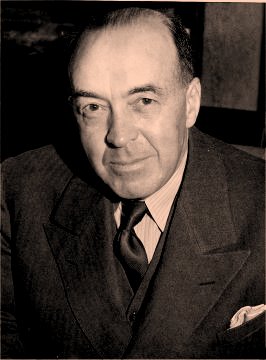
Edgar Rice Burroughs
Civilization And Its Discontents.
The period of Burroughs’ life was one of those great pivotal times of civilization. Civilization was in the midst of one of its great metamorphoses, scientific, political and intellectual. Changes which had been building up the last few centuries could no longer be absorbed by the existing religious structure. That structure was no longer viable. Its bursting mode was not only for the new Scientific Consciousness but the increasing scientific examination of the past opened the way for the revival of forgotten forms such as the Matriarchy. Thus along with the inevitable Patriarchal religious reaction the Matriarchy as well as suppressed occult religions forced their way through.
The reaction from contacts between civilizations sent various alien religions and ideologies into the Western leaven.
Confused with these intellectual challenges the agricultural basis of civilization evolved into a technological one. In the mid-teens for the first time in the United States there were more urban residents than there were rural residents.
New demands were placed on consciousness as more precision was required of the human mind. Man had had little difficulty adapting his methods to cycles of the seasons but the adaptation tothe rigors of the assembly line caused him problems.
That there was a backlash from this tremendous succession of changes should take no one by surprise. Adjustments were difficult and critical. In 1930 the founder of psychoanalysis, Sigmund Freud, published what may be his most famous title: Civilization And Its Discontents in response to this challenge. His notion of who the discontents were and of what they were discontented about is vague, indeed undecipherable.
In my estimation he doesn’t deal with the malaise at all.
On the other hand Edgar Rice Burroughs not only dealt with the malaise but offered a reasonable, if difficult to apply, solution to the problem.
page 1.
The malaise found many expressions. On the political front the socialists, Communists and anarchists were the most prominent reactionaries. Their activities reached a fever pitch in the first two decades of the Twentieth Century resulting in the two phases of the Russian Revolution of 1905 and ’17. The institutionalized discontents had their homeland after the latter date.
While Freud’s discussion of Discontents sounds generalized by the way he writes he is actually talkiking about himself and the members of his own Jewish culture and their problems with Western Civilization.
Thus Freud’s notion of Discontents falls somewhere between a general malaise and the discontent of the Communists.
The Religious Conciousness of course faced a problem that could only be resolved by surrender or reaction. There was no middle way. The evolution into Scientific Consciousness completely invalidated the religious approach. All religions are based on a false premise and Science exposed that falsity.
The transition to the Scientific Consciousness must be difficult and demanding as so few attain it. In my opinion this is because of the ongoing evolution of the brain. The Scientific Consciousness can apparently only be grasped by the further evolved. This doesn’t mean that those of a Religious Consciousness can’t work with scientific knowledge which requires only basic intelligence and a scientific environment provided by others but they are unable to envision advances.
Thus they find themselves left behind intellectually. It is the same as the difference between high and low IQ. Nothing can be done about that. However the Religious reaction is to attack those of the Scientific Consciousness to lower them to their own level.
page 2.
The problem was especially acute with Freud and his culture as Science per se invalidated all Semitic religious pretensions. This means all Semites and not just Jews. Neverthless as Jews were embedded in Western Civilization at that time and other Semites weren’t the Jewish culture was ‘discontented’ and was forced to negate science and the Scientific Consciousness.
Led by the Semitic surge of both Judiaism and Moslemism the very serious attempt to bury the Scientific Consciousness through genocide might just succeed.
As I point out in Part VII of The Deconstruction Of Edgar Rice Burroughs’ America the Jewish campaign to ‘abolish the White ‘race’ should be taken very seriously. Just because it sounds preposterous doesn’t mean it’s a joke. A segment of Whites is the bearer of the evolved gene or genes or combination of genes so that if this advance species were destroyed the wild religious reaction would succeed. Sounds just like some science fiction movie doesn’t it? Well, it isn’t.
The Scientific Consciousness created its own malaise in the newly evolving species. As literary and artistic types are always the monitors who pick up these trends first, if they don’t necessarily understand them, we shouldn’t be surprised to find a number of literateurs immersing themselves in the problem. One of the big texts is H.G. Wells important but neglected novel: The Food Of The Gods. In this novel Wells postulates that the emerging scientific Consciousness is a new species of human being. As with the real religious reaction Wells’ predecessor people wish to kill the new species. In earlier times when the world was less populated new or different species of human beings could move away from the old species. Now, the question is what makes Homo Sapiens Homo Sapiens and makes it different from the Last Hominid Predecessor? It is assumed by our scientific community that the Negro is the first Homo Sapiens species having evolved in Africa. This means that the Negro evolved from some sub-human Homo Sapiens predecessor. It’s easy, it has to be. So far no one has been able to produce an example of the Last Hominid Predecessor.
Now, the Negro was not the only, how shall we say, hominid species in Africa. The Negro apparently orginated in West Africa. The rest of Africa was inhabited by other species such as the Bushmen and Hottentots. These peoples are not Negroes and originated in Africa so the question is are they predecessors of the Negroes who we are told are the first Homo Sapiens or are they Homo Sapiens who precede or follow the Negro in evolution. Or, are they a separate non-Homo Sapiens species or are they perhaps the Last Hominid Predecessor. They are not Negroes so a place has to be found for them.
In any event the Negro and Arab combined to produce a new race or sub-species known as the Bantu peoples. The Bantus then invaded the territories of the Bushmen and Hottentots who ranged all of Africa South of the bulge, so we are told, driving the Bushmen before them. As I understand it the Hottentots are now extinct while Bantu pressure on the Bushmen is driving them toward extinction.
At the same time a newer hybrid of Black and Semite is driving the Bantu before it from its base in the Northeast corner of Africa known as the Horn.
So, Wells novelistic problem was that there was no longer a place on Earth for his new species to isolate itself. He was presented with the choice of his new species either displacing or killing off the anterior species or being eliminated itself much as the Hottentots and Bushman have been eliminated by the Bantu and as the Bantu and Negroes are being displaced and elminated by the new Black and Semitic Hybrid.
page 4.
So this was the problem c. 1900. This solution was repulsive to the existing Religious Consciousness that was psychologically unequipped to deal with this impasse.
As can be seen the Semitic special consciousness does not fear the problem In Africa in Darfur and the South of the Sudan they are actively pursuing genocide. In Euroamerica the Jewish Semitic culture is pursuing or advocating the same resolution of their problem with the White Euroamerican population. Following Semitic actions in Africa it should be clear to American Blacks what is in store for them.
So, Wells dealt with the problem in its political aspect. The internal aspect, the split in consciousness between the old and new was ably handled by a number of writers.
For a good introduction to the contrast between the Scientific Consciousness compare Holmes and Watson in Conan Doyle’s stories. In this essay I will concentrate on three others as well as Freud- H. Rider Haggard, Joseph Conrad and Edgar Rice Burroughs. Not coincidentally, I think, all three writers place their most important work in Africa. Haggard as the earlier writer rising to fame in Burroughs’ youth quite naturally had a great influence on the younger man, although I think Burroughs would have written of Tarzan and Africa with or without Haggard’s influence. The appeal of Africa is the contrast between the civilized White and the primitive Black. The two aspects of White consciousness. I hope to tackle this problem in more detail in my next essay, Edgar Rice Burroughs, Sigmund Freud And The Holy Grail.
There was nothing clearer to the English explorers, as well one might note as to the Southern planters of the US, than that there was a gulf between the intellect of the African and that of the White man.
Haggard expressed this difference in his novel Allan Quatermain. I’ve used the quote before but I will include it again here to keep the problem clear before us:
Quote:
All this civilization what does it come to? Full forty years and more I spent among the savages, and studied them and their ways, and now for several years I have lived here in England, and in my own stupid manner have done my best to learn the ways of the children of light, and what do I find? A great gulf fixed? No, only a very little one, that a plain man’s thought may spring across. I say that as the savage is, so is the white man, only the latter is more inventive and possesses a faculty of combination; save and except also the savage as I have known him, is to a large extent free from the greed of moey, which eats like a cancer in the heart of the white man. It is a depressing conclusion, but in all essentials the savage and the child of civilization are identical.
The great Liberal H.G. Wells was also clear on this difference. The nature of the gulf was the Scientific intellect of the White and the non-Scientific intellect of the Black. The question is how large did these nineteenth century men perceived the gap to be. Haggard in his Allan Quaterman, quoted above perceived the gap to be small while if one is to judge by the distance between Tarzan and the Africans Burroughs perceived it be not only large but insurmountable. Haggard thought the gap easily bridged while judging from Tarzan Burroughs thought it unbridgeable.
page 5.
It should be noted that Haggard was of the Old Religious Consciousness while Burroughs was of the advanced Scientific Consciousness. Of the two men Haggard writes from the experience of having viewed Africa or at least South Africa first hand. Everyone talks of Africa as though it were a county in Kansas whereas it is a huge continent of many diverse cultures. But, perhaps as the cultures seem to share the same level of consciousness perhaps that is the justification for speaking of Africa and Africans as a single unit.
Haggard lived in South Africa for several years as a young man while he was an astute historian and anthropologist. As a mythologist he was of the most gifted. His understanding is astonishing. He was quite familiar with all the Black peoples from the Zulus, Swazis and Basutos tothe Hottentots, Bushemen and Griquas. His judgements of the various intellects seems quite reliable. His writing is of most interest for the current rage of Zulu interest. His actual story telling ability is beyond compare.
Now, this is difficult to speak of because of the ideological stance of the Liberals and their Religious Consciousness that take the procrustean stance of trying to fit facts and reality into ideology whether they can be conveniently forced or not. They are currently anti-White and pro-African even going so far as to call for the genocide of the White species as I pointed out in the Deconstruction Of Edgar Rice Burroughs’ America. This is more than evidenced in their support of the genocide being executed in South Africa by the Shona chief robert Mugabe and the Bantu peoples of the Union of South Africa.
page 6.
There’s not much evidence that Haggard was interested or even aware of the theories of evolution which, if I may be so daring, it seems clear that Burroughs either was at the beginning of his career or became so as he aged aware of all the various strands of evolutionary theory. Thus Haggard comes across as more humane while Burroughs is more accurate.
A third opinion on the nature of the situation was provided by Joseph Conrad in his novelette: The Heart Of Darkness. One can’t be sure how much contact Conrad had with the situation he describes, but the influence of the primitive African mentality had the effect of dragging down the White intellect. As the advance in intellect was not so pronounced as Haggard noted the attraction of the primitive was so strong that many Whites retrogressed. Conrad’s hero Kurtz was an ivory buyer in the heart of the Congo. Through fraternization with the African he indeed loses his ‘thin veneer of civilization’ going native. On his death bed in viewing his period in the interior he exclaims ‘The horror, the horror’ and then ‘Exterminate the brutes.’
In point of fact if, as we are told, Homo Sapiens originated in Africa and the Negro is the departure point from the Last Hominid Predecessor which may be the Bushman or Hottentot then if this departure occurred c. 150,000 years ago, at the time the African came into contact with Whites he had made no move toward becoming civilized. Nor was he inclined to when given the example.
When H.M. Stanley interviewed the Uganda chief Mtese, that chief was incapable of visualizing anything other than trading. As he said he noticed that goods traded by the Arabs, who were first in the area, all came from Europe so he assumed that Europeans were more clever than the Arabs however he had no inclination to acquire the knowledge or skills. Nor have Africans attempted it to this day.
page 7.
As unpleasant as it may be to deal with facts or accept the science of the matter it is nevertheless necessary to consider that in the course of evolution the African brain has evolved to a certain level and stopped much as all the Hominid Predecessors did. Although Bruce Lahn of the Howard Hughes Medical Institute has been silenced his researches made it clear that the human brain was still evolving but not in all human species, only one.
It should be clear to even the most prejudiced observor that Robert Mugabe the Shona leader of Zimbabwe is in way over his head while as savage in his methods as any character Joseph Conrad could create. Nor is the reason unclear to certain Africans.
Writing in the Kampala Monitor of February 7, 2007 in an article entitled Uganda: Why Black People Have Remained Backward by Elias Biryabarema the author examines the problem:
Uganda has been fairly stable long enough. The conditions for an economic takeoff have been there for 20 years. Mr. Musevini has enjoyed generous goodwill from nearly all the world’s rich governments. Their largesse has poured in ceaselessly and in hefty amounts.
Uganda should have taken off. We haven’t. We’re stuck. And so is Tanzania, Sudan, Ethiopia, Mali, Burkina Faso, Kenya, Eretria, Malawi, Congo Republic and pretty much all of Black Africa, excluding the regions sole economic power, South Africa. This led me to pose a question to myself: Can Black people build prosperous societies?
Just about every reason- from slavery, colonialism, neo-colonialism to inequitable world trade rules- cited for the backwardness of Black African nations has been so debunked that it has now become necessary to look beyond the realm of such contemporary explanations.’
http://allafrica.com/stories/200702061131.html
Mr. Biryabarema concludes that Africans ‘only rise and touch a low ceiling.’ A disheartening realization but a cruel fact of nature because of the progression of evolution.
page 8.
So Africa came to represent an attractive past to Whites while the psychical split caused by the evolving brain caused them discomfort too. The brain had not evolved far enough to make a clean break with the animal past. What was Man, all species to do? Haggard relapsed into nostalgia. A longing to go back while nevertheless retaining his cranial development. His hero, Allan Quatermain while retaining his intellectual superiority to the Africans attempts to establish his kinship with his ‘Black brothers.’ Thus he takes a ‘Liberal’ attitude toward African/White relations that while seemingly humane has resulted in the atrocities against Whites being perpetrated by the likes of Mugabe and the South African leaders.
One shudders at Conrad’s Kurtz’s exclamation to ‘exterminate the brutes’ and yet the choice has turned out to be exterminate or be exterminated, while Africans have inexplicably opted for the latter. What can one say?
Burroughs on the other hand working from a philosophical point of view came up with a different solution. Nor is it entirely impracticable on the intellectual level. Both he and Freud begin from the same base. Both are reacting to the inhibitions and repressions placed on Man by civilization.
Burroughs seems willing to accept the ‘thin veneer of civilization’ in certain places and under certain conditions but he demands the right to be able to move freely from the primitive to the civilized state. Thus when Tarzan takes off his clothes he also removes the ‘thin veneer of civilization.’
page 9.
The basic problem for Haggard, Conrad, Freud and Burroughs is that they wish to retain the advantages of the intellectual aspects of civilization; none of them wish to opt for the ‘low ceiling’ of the primitive. They all wish to retain their advantages while indulging their primitive ‘natures.’ In some way each has to remain superior to the primitive state.
One can contrast this attitude with Mugabe of Zimbabwe and the ANC of South Africa who seem to be edging in the direction of removing all vestiges of the civilized state. They seem to be opting for a nostalgic return to the their savage past. They must have some understanding of the results of their destructive acts against civilization but choose to ignor them.
Conrad says simply- exterminate the brutes. Haggard adopts an avuncular attitude toward perpetual children. Burroughs assumes the role of…well…a god. Freud wishes to assume the role of plantation owner. The problem is insoluble except by the Shona method of ‘exterminating the arrogant bastards.’
For Burroughs as well as for Freud sex seems to be the key. Burroughs position is difficult to fathom. In all his cultures, societies and civilizations, and he creates a great many, nudity or near nudity is the ideal although as he is writing for popular consumption his characters remain sexually unexited and incredibly chaste under the most provocative conditions. Freud of course had everybody going at it like bunnies.
In Cave Girl Burroughs’ hero, Waldo Emerson Smith-Jones is the example of the over intellectualized man of extreme and enervating culture. Quite the opposite of Burrughs who obviously feels he has reached an ideal balance between the intellectual and the physical.
Waldo is meager then and consumptive when he lands on the island. He is obligatorily cowardly. He will find his Anima ideal in Nadara who is the antithesis of the civilized Jane being both nude and perhaps the most obviously sexually unihibited of any of ERB’s female characters. Burroughs contrasts her natural uninhibited sexuality with the inhibited sexuality of Waldo. There is a nice comparison with Freud possible here. Also with the Burroughs corpus there is room for an analysis of Nadara, La, and Balza.
During the course of his stay on the island , the natural primitive life will flesh Waldo out, build him up, give him conficence and make him courageous as well as curing his TB. Of course he never loses his intellectual attainments while using them to better his opponents and improve his situation. Thus neither Haggard, Conrad, Freud or Burroughs is able to resolve the conflicts of the discontents caused by civilization. As attractive as the primitive is it must remain an intellectual ideal.
Go to Part 3.
In The Beginning.
During the course
Springtime For Edgar Rice Burroughs
May 29, 2007
Springtime For Edgar Rice Burroughs, Part One
Including A Review Of
The Cave Girl
by
R.E. Prindle
Book I: The Cave Girl
1.
In 1912 Edgar Rice Burroughs was looking back on nearly forty years of humiliation and failure. As 1913 dawned, after that lifetime of suppression and depression it must have seemed as though the Millennium had arrived. Success on his own terms seemed to be within his grasp. The Gambler had finally won the gamble.
As the year turned he finished his fifth novel since he took up his pen in 1911, The Return Of Tarzan. As of the beginning of 1913 only two had been published and those only in pulp magazine form. Perhaps such publication was rewarding in the personal sense but the pulps had a very low literary reputation. Pulp writers were always second class literary citizens. Both his first publications created a sensation among the pulp readership while the second ‘Tarzan Of The Apes’ was a stunner.
His reputation was augmented when Tarzan Of The Apes began to be serially published in various newspapers. So while he had not established a reputation from the pulp publications the newspapers had spread his fame. Book publication was still a full year away.
Thus by 1913 A Princess Of Mars and Tarzan Of The Apes were before the world. Gods Of Mars would be published later in the year. His second novel, Outlaw Of Torn, had been met with outright rejection.
Based on this promising but hardly conclusive beginning, less than 2500.00 had changed hands in two years, Burroughs decided to throw over his day job to became a full time writer. As he says everyone thought he was crazy; without the benefit of foresight he most surely was. Burroughs himself even says he thought so. The Gambling Man was risking his all on a turn of the cards. His whole life he had seemed driven to take the riskiest and longest of long shots. His characters would behave in the same way. Shall we say on the positive side that it was an act of supreme confidence?
page 1.
Not only did he give up his day job but he set himself the daunting task of writing a story every two months of which he expected every one to sell. He ultimately wrote seven in 1913 of which all did sell. In this year of the most daring audacity he did earn over 10,000 dollars and that beat the cost of living and then some.
Burroughs won that bet, too.
The first book of the year, At The Earth’s Core began his Inner World series. It was also the begining of his exploration of prehistoric and evolutionary themes. The prehistoric novel was already a genre. Fictional treatments by Jack London and H.G. Wells were certainly known to him while he may have been familiar with the anthropological studies of J.G. Frazer in one form or another. Frazer made the phrase ‘the thin veneer of civilization’ a household phrase that Burroughs was so frequently to use and mock throughout his work. He may possibly have picked the phrase up through newspapers and magazines or possibly as David Adams has suggested through Jack London who used it before him and who we can be reasonably certain Burroughs read.
Frazer was at the height of his influence at this time having written three different versions of his most famous work, The Golden Bough. In 1910 he published a four volume study called Totemism and Exogamy that Sigmund Freud cribbed to write his own semi fictional work, Totem And Taboo.
Personally I would place Totem And Taboo with the prehistoric work of London, Wells and Burroughs. Read as a novel Totem And Taboo isn’t all that bad. Unfortunately Freud took himself seriously thinking he had more than he did. But as fiction Totem And Taboo is OK.
page 2.
Interestingly for Freud he formed his very speculative theories in the historical blind spot in the place between his intense Jewish Patriarchalism and the discovery of the Matriarchy that preceded Patriarchy. So his theories are somewhat skewed. Matriarchal theories were very stoutly resisted gaining any degree of acceptance only after the 1960s.
It is to Freud’s credit that he didn’t resist the concept. Even as early as Totem And Taboo he had heard of the discovery of the Matriarchy through the work of the Swiss mythologist, J.J. Bachofen, although he didn’t know how to incorporate the material. By 1938 he seemed to be conversant with Matriarchalism but still didn’t know how to fit it into his system. He was still touting the ridiculous theories of Totem And Taboo.
For some reasons I haven’t yet identified I find similarities between Freud’s and Burroughs’ writing. After all Freud did get his Nobel prize for literature not science.
Freud was in many ways a speculative and wild writer and so in fact was Burroughs. While the others wrote interesting but conventional prehistoric stories Burroughs discovered ways to link the various evolutionary stages with the present. While it is overlooked, at the time it was very innovative. The approach may have been suggested to him by his Prince and Pauper mentality in which he believed a clean break between his past and present had been made when he was sent to the Michigan Military Academy.
There is no clearer link for this possibility than the story of Tarzan. In Tarzan Of The Apes Tarzan was born a ‘Prince’ to an aristocratic British family but became a ‘Pauper’ when his parents died and he was adopted by the great she ape, Kala. Thus he was raised in a prehistoric environment before the advent of man. Tarzan then evolves into the fully human right before our eyes eventually becoming the very epitome of civilization. A thin veneer perhaps but a veneer.
So ERB devises all sorts of clever ways to somehow get his contemporary characters into prehistoric environments. In his fifth book, The Return Of Tarzan, he invents the lost land of Opar. Opar is a fossil city dating back to prehistoric Atlantis. The Oparians have never advanced beyond the culture of Atlantis and lost most of that. Behind Opar is an even earlier stage of culture called The Valley Of The Diamonds. This place is ruled by a highly developed form of gorillas.
page 3.
In Tarzan The Terrible Tarzan crosses a great swamp to arrive in prehistoric Pal-ul-Don. In the Inner World series he employs two methods of entering. In the first David Innes invents an earth borer that drills through the crust to discover a hollow core containing the Inner World. In Tarzan At The Earth’s Core Burroughs employs the notion of a North Pole entry using the dirigible O-220 to enter in that manner.
In the most wild of all the stories, The Eternal Lover, his hero Nu is gassed in what Burroughs calls the Neocene to wake up in the twentieth century. He acquires a lover with whom he successfully travels back to the Neocene. On the return journey to the present he failed to keep his grip on the strap and didn’t make it. Wonderful story concept. Certainly as fine as anything Burroughs ever did.
Then in the trilogy The Land That Time Forgot the crew of the submarine discover a submarine entrance to the lagoon of a large island that is prehistoric but covers the whole range of evolution from amoeba to full fledged humans. Quite daring actually and Burroughs is able to make these impossible stories work. If one compares The Land That Time Forgot with Freud’s Totem And Taboo I think it possible to find many similarities. Of the two Burroughs was by far the most successful writer in their time although he received no Nobel prize. Both writers have weathered the vicissitudes of fortune quite well. One hundred years from those days both men are top sellers although Burroughs has the edge.
page 4.
The novel under consideration, The Cave Girl has a terrifically interesting scenario. In this story Burroughs anticipates The Land That Time Forgot by creating a large prehistoric island off the shipping lanes that is ‘seldom visited’ although it seems that no one has trouble finding it.
In this story Burroughs reverses Tarzan Of The Apes. Instead of an infant boy being abandoned he has the infant girl, Nadara, survive her parents. Instead of a female ape rescuing Tarzan he has a cave man rescue and nurture the girl. The Cave Man retains a little leather bag containing the emblems of Nadara’s origins, while Tarzan has his father’s cabin and books.
In this instance Nadara having been left on the island, just as Jane and her party are landed on the spot of Tarzan’s father’s cabin so the civilized castaway, Waldo Emerson Smith-Jones is washed from the deck of the steamer by a big wave during a storm landing on the siland where as Tarzan watched Jane’s party arriving Nadara observes the arrival of Waldo Emerson Smith-Jones.
It isn’t stated how old she was when she and the civilized Waldo got together but I should think twenty on the analogy of Tarzan.
Burroughs’ two favored terrestrial locations for his stories are Africa and the South Seas. Both locations occupy legendary possibilities in the imagination of the West. They were thought to be locations where the White man was freed from the restraints and limitations of civilization.
page 5.
Go to Springtime For Edgar Rice Burroughs Part II
Freud
March 16, 2007
Freud And His Unconscious
Redefining A Fallible Idea
by
R.E. Prindle
Sometime after I wrote the first part of Something Of Value (see erbzine.com) I read David Bakan’s Freud And The Jewish Mystical Tradition. Bakan’s book confirmed my findings while developing Freud’s relationship to his culture’s mystical tradition based on Bakan’s understanding of the Zohar and the Jewish Kabbalah that I haven’t read or studied, nor do I intend to unless I exhaust other pursuits which doesn’t seem likely. You never know though.
However a point to consider is how Jewish is the Jewish mystical tradition, that is, what are its roots? Are they rooted in Judaism or elsewhere? Bakan seems to believe that the Jewish Kabbalah is derived entirely from Jewish sources independent of the general milieu. I don’t believe this to be true. The Jewish mystical tradition like all others is based on the very ancient Egyptian. Bakan believes that the Kabbalah arose in the first century AD. This is probably true.
The Hermetic tradition which is equivalent to a European Kabbalah took form as such in Alexandria during the Ptolemaic period when Greek and Egyptian ideas interreacted. Hermiticism evolved from much earlier doctrines centered around the Egyptian god Thoth. The Zohar and Kabbalah then is Hermetic material adapted for Jewish needs. The whole can be traced back to Alexandria.
The Zohar, or primary mystical book, which is attributed to the first and second century Rabbi, Simeon Ben Yohai, was rewritten, edited and whatever in twelfth century Spain by Moses de Leon reaching the Middle East after the expulsion of the Jews from Spain in the sixteenth century. Its influence then was transmitted to the seventeenth century messiah, Sabbatai Zevi.
According to Mr. Bakan Freud was familiar with the Zohar and Kabbalah. I couldn’t go so far as to claim so myself but Mr. Bakan can quote chapter and verse. While Freud claimed to be scientific Mr. Bakan relates almost all of Freud’s psychology to the Kabbalah showing Freud’s dependence on Sabbatianism and Frankism as I indicated in Something Of Value Part I.
page 1
Thus while seeming to be working from a scientific point of view Freud is actually blending a bit of scientific approach acquired from European sources, as there is no science in Jewish culture, with his Jewish religious material to subvert the European moral order. While Freud himself was at war with European civilization the international Jewish organizations extended his field of operations to the United States and Canada. Thus while Freud speaks specifically of Europe he can be taken to mean Euroamerica.
2.
A further background for his psychology, Freud’s central childhood fixation, appears to be the incident in which a European knocked his father’s hat into the gutter which his father meekly, or wisely, depending on your point of view, accepted without a demur. Because of this story Freud wished to avenge himself on Europeans.
Probably at this point Freud assumed the Moses complex that stayed with him to the end of his life. He, Freud, would lead his people to triumph over the Europeans as Moses had led the People out of Egypt while Pharaoh and his army were drowned in the Red Sea.
However, oddly enough, as he claimed to be wholly Jewish, Freud was conflicted in his attitude toward Europeans. As a child he had a Roman Catholic nurse who introduced him to Christianity by taking him to church. Most probably she also tried to wean him from Judaism. This experience had a great effect on young Freud. In the following anecdote, as with most fixations, he seemed to have lost the exact memory of the situation. From Bakan:
Quote:
…that my ‘primary originator’ [of neuroses] was an ugly, elderly, but clever woman who told me a great deal about God and hell, and gave me a high opinion of my own capacities.
On October 15, 1897, he quotes his mother about the old nurse who took care of him when he was very young.
“Of course,” she said “an elderly woman, very shrewd indeed. She was always taking you to church. When you came home you used to preach, and tell us about how God conducted his affairs.
Unquote.
His memory had become confused while it does not appear that he ever exorcised his fixation, for fixation this is. He apparently loved this nurse at the time rather than hated her. When she was later accused and convicted of stealing from the Freuds being dishonored and actually sent to jail, Freud was heartbroken while changing his opinion of her. But, he had had contact with Christian Europeans which left a lasting impression on him that he could not consciously recognize or acknowledge. If I am correct, this impression resurfaced when he came into contact with C.G. Jung who he adopted as a surrogate for this nurse transferring his love and hatred for her to Jung.
page 2.
Just as he loved this nurse there were apparently strong homosexual overtones in his relationship toward Jung. As Freud would have known, the compulsion toward repitition would have been a component in his relationship with Jung as with his nurse although he apparently did not recognize this. So much for his self-analysis. He found reasons to break off with Jung or drive him away while bitterly claiming to be betrayed by Jung just as his nurse had been accused and convicted of theft thus betraying the child Freud. Thus once again his contact with a Christian European was brief ending in sorrow for himself.
A third situation occurred late in life when he wrote Moses And Monotheism. Rather startlingly he claimed that Moses was not Jewish but was an ethnic Egyptian. This means Freud, who had a Mosaic fixation, split his personality between his Christian longings and his professed Jewish identity. Another result would be that monotheism was not a Jewish invention but actually a goyish invention so that all the evil arising from monotheism was not the fault of the Jews but the goys. They had no one to blame but themselves. Thus Freud’s notion of Moses may have been a sort of dream reversal of the facts.
Whatever the results of Freud’s self-analysis back before the turn of the century it is quite clear that he was unable to resolve his fixations nor, one believes, was he aware of their influence on him. He never integrated his personality remaining under the influence of his subconscious fixations. No wonder he ignored the conscious mind.
3.
Like most people Freud had to find his way from adolescence to adulthood and his true ambitions by a circuitous route.
This editor’s note to 1927’s The Future Of An Illusion says this:
Quote:
In the ‘Postscript’ which Freud added in 1935 to his Autobiographical Study he remarked that a ‘significant change’ had come about in his writings during the previous decade. “My interest,” he explained, “after making a long detour through the natural sciences, medicine, and psychotherapy, returned to the cultural problems which fascinated me long before, when I was a youth scarcely old enough for thinking.
Unquote.
page 3.
He undoubtedly refers to his experiences in church with his Christian nurse contrasted with the ‘Christian’ who knocked his father’s hat into the gutter. As Freud is very duplicitous in his use of language one should try to be very sensitive to the meanings behind the obvious meanings of his words. Thus I believe his use of the term ‘cultural problems’ can usually be understood as his inner conflict between his Christianity and Judaism.
As Bakan points out, that while Freud rejected Rabbinical religious Judaism he was deeply immersed in the Jewish mystical tradition of the Zohar and Kabbalah. Thus one can discount his claim to be an ‘atheistic’ Jew. Or atheism has a more specific meaning for him.
I would place the change of emphasis in his writing or, at least the beginning of the change, in 1915. My guess would be that Freud was unaware of the Jewish Revolution until he joined B’nai B’rith in 1895. That knowledge would have shaped the direction of his researches. Whatever science was involved would have been subordinated toward achieving the Revolution. At the same time that he was working out the nature of psychoanalysis as Bakan indicates he must also have been studying the Zohar and Kabbalah. I haven’t read or studied either so I have to rely on Bakan’s analysis of their influence. Bakan traces strong mystical influences running side by side with what passed for science in Freud’s mind. As Freud persistently says he’s going to ignore facts in favor of projections one must assume that there is more mysticism than science in Freud’s construction of psychoanalysis- as he says ‘his creation.’
Bakan points out that Freud transited from the role of physician to that of ‘healer.’ That is analogous to the hands on approach of Christian Fundamentalism. Freud then for all practical purposes abandoned medicine for healing. Then, sometime between 1913 and 1915 he abandoned psychoanalytical research for his ‘cultural’ studies. In other words, he began to apply his psychological studies to the manipulation of cultures through his developing ideas on Group Pschology.
page 4.
Just as Freud learned that there were screen memories that transformed more painful memories into something more acceptable to salve those injured feelings so Freud learned that he could develop ‘screen’ language to serve up unpalatable meanings in palatable ways. Thus what he says has a reasonable meaning to the uninitiated but has a totally different meaning to the initiated- those with the key. In many ways it is the same as a criminal argot. Those who understand the argot can discuss topics openly while only those with the key can twig it. Ya dig?
The key incident that fixed his mind on ‘cultural interests’ was his father’s story of the guy who knocked his hat into the gutter. Freud then, in attempting to disguise his hatred for ‘Christianity’, while secretly admiring it because of his nurse, and his desire to avenge his father and hence, all Jews, through his Moses fixation developed his program. Thus he acting in his own mind altruistically and need feel no guilt.
Freud was very seriously conflicted, also suffering from depression according to Bakan. Hence his purpose was to knock the whole of European Christianity into the gutter, which is to say the actual persons of Europe.
Thus the use of terms like ‘Culture’ and ‘Civilization’ should always be placed in the context of Jews and Europeans. In this manner he avoids the appearance of bigotry and hatred while sounding ‘scientific.’
Now, this obsession and extreme form of vengeance for something that, after all, didn’t happen to him nor did he witness it, might certainly be considered a neurosis, probably a psychosis and possibly a degree of insanity. In reading Bakan there is a hint that he believes Freud had a disordered mind. Indeed, Lang’s Testament Of Dr. Mabuse should be held steadily in mind when reading of Freud’s later career. Lang must have had Freud in mind when he filmed Mabuse.
page 5.
Lang,s departure from the denouement of the Cabinet Of Dr. Caligari ended on the conventional note of the victim, or whistle blower, being declared insane. Lang reversed this by making the perpetrator, Caligari/Mabuse insane as in real life with Freud. Further the disciple of Mabuse, the head of the asylum, Dr. Baum was also declared insane. Although the problem appears to be solved the threat of the conspiracy continuing from the cell now occupied by Dr. Baum looms like a spectre over the ending.
While Freud was never incarcerated as he should have been, he was imprisoned in his mind no less than Drs. Mabuse and Baum or the character in Gradiva. It is interesting that Freud had a plaster cast of the relief on which the story of Gradiva was based that he displayed prominently in his office. The story obviously had greater significance for him than his ‘objective’ analysis of the story would lead one to suspect.
Thus from 1915 to 1935 like Dr. Mabuse he sat imprisoned in his projection of reality churning out page after page, volume after volume of criminal plans for the subversion of civilization which is to say of Euroamerican civilization but not Jewish culture. He makes a definite point of that illusion of whose future he is discussing applies only to Europe and Christianity rather than religion in general which would include his own Judaism. At this point he is not aware of the burgeoning Wahabi Moslemism so that his message is that Jewish beliefs are real while Christian beliefs and Scientific reality are illusory. One has to penetrate the screen language and convert it into the proper psychological intent.
As David Bakan points out Freud lived his whole life in a sort of Jewish ghetto having very little contact with Europeans.
His choice of Jung as the potential heir to his ‘creation’ may have had as much to do with a desperate attempt to reestablish a connection similar to that of his childhood Christian nurse. Thus his overtures to Jung while under extreme stress were driven from his unconscious while he himself was unaware of his true motivations. This would have been an expression of a repetition compulsion. Thus as his nurse disappeared from his life under discreditable circumstances he replicated the situation in Jung. His attempt to convert Moses (hence himself) into an Egyptian may have been a last attempt to replicate and resolve this early contact with Christianity. His view of European civilization then was filtered wholly through a Jewish projection of possibilities. He really had no intimate knowledge of European mores.
page 6.
From 1915 on, then, his writings were obsessed with hatred for Euroamericans and a desire to wreak vengeance on them by destroying the basis of their civilization. His ideas for the subversion of European civilization were carried to America by the international B’nai B’rith organization to be adopted and employed there. In addition Revolutionary plans executed in Europe in 1917 were financed and organized by the world Jewish government in the US. While functioning according to local conditions the Revolution was conducted an an international scale. Act locally, think globally. Hence Jewish revolutionaries left the US for Russia after 1918 to aid in the consolidation going on there. This is really an incredible if repressed story in the Freudian cultural manner. Very Freudian that such phenomenal criminal activity that were best left invisible was repressed into humanity’s unconscious.
At this point I think it might be well to examine Freud’s vision of the unconscious in more detail. While there can be little doubt that there is a subconscious function to the human mind usually referred to as the unconscious after Freud that had been an accepted fact amongst scientific researchers for a hundred years. The exact nature had not been determined nor does Freud determine it. His view is merely a projection of his own conscious and subconscious needs.
In David Bakan’s view Freud had made ‘a compact with Satan.’
page 7.
Certainly not in the literal sense but in the figurative sense that Freud would do anything, abandon any moral precepts, to achieve fame. Bakan points out the superscription to Freud’s ‘Interpretation Of Dreams’ quote from Virgil: Flectere si nesqueo superos, Acheronta movebo. Translated as: If the gods above are no use to me, then I’ll move all hell. Freud further blurred the line between good and evil or amalgamated the two from the influence of Sabbatai Zevi and Jacob Frank who cast off all morality. Since Freud has been successful in altering both Euroamerican and Jewish morality toward these immoral or amoral beliefs by false ‘Satinic’ criminal doctrines it is imperative to debunk his personal projection of the subconscious.
As he ‘made a pact’ with powers below- the unconscious- against the powers above- the conscious- he invested his projection of the unconscious with the attributes of ‘Satan’ or evil. This view of the subconscious is a self-serving fiction not based on any science.
He sets up the unconscious as an autonomous entity with the main function of blighting the conscious. He give the powers of hell supremacy over the powers of heaven. This notion is mere fantasy; it cannot be. There is no possibility that the function of the subonscious doesn’t have a positive function in and of itself and in relation to the conscious. If you actually think about it for a moment you will realize this must be true; every part of the body works to the benefit of the whole; there can be no exception for the subconscious.
Now, Nature is not flawless. The order that the religious seem to find is not there. Nature functions in a much more haphazard way. It takes only one peek through the Hubble to see that.
However the relationship between the conscious and subconscious is delicate and easily disrupted especially in the early years of the organism when it has no experience with which to evaluate the events occurring to it. The Ego and Anima are not part of the subconscious and possibly not of the conscious but function through the conscious and unconscious minds.
page 8.
The conscious mind perceives phenomena and acts on them but the terrific inflow of impressions is more than it can deal with so the day’s input is received into the subconscious for further reference. Thus a major function of dreams in the sleeping state is to review and process, organize the information into a coherent whole for future reference. The subconscious then is able to compare incoming information with experience for response. When the conscious and subconscious minds are attuned, that is to say the personality is integrated, the system works properly, otherwise the response is distorted by one’s fixations. This is very easy to see in Freud.
However, especially in youth when experience is scant, the mind may be challenged with some devastating new experience for which there are no reference points. If an appropriate response is made there is no problem. If an inappropriate response is made against which future experience is in variance, the earlier resp0nse which has become fixated will over rule an attempt at an appropriate response and substitute the fixated inappropriate response. Thus the current response will constellate around these earlier fixations which gives one bizarre symbolic dreams and inappropriate responses.
The inappropriate response will usally result from an insult to the Ego or, in other words, the Sexual Identity. In turn the response to this insult will be expressed in a sexual affect.
The purpose of psychoanalysis, which is real science, although Freud didn’t see that, is to locate and exorcize them allowing the conscious and subconscious aspects of the mind to function properly as a unit. Dreams are actually important because they are an analysis of life’s experence providing responses. None of this, of course takes in intelligence, discipline and other functions of mind and character that Freud dismisses as irrelevant.
page 9.
Now, in the cultural war between Judaism and Euroamerica, or as Jews express it, Christianity, Freud infused the Jewish subconscious with a disregard for morality a la Jacob Frank in relation to Sabbatai Zevi. Any evil was excused so long as it seemed to advance the cultural war. While this infusion may not have reached down throught the ranks of Jewry- which is to say they behaved in a certain way but didn’t know why- the ideas were thoroughly planted in the minds of what Henry Ford would call the international Jew.
The cold war between Jews and Europeans became a shooting war in the wake of the Great War. Men, money and munitions flowed in a wide steady stream from the United States to Russia. Coordinators established themselves in strategic locations. If one reads restricted, censored literature the impression is made that horrible anti-Semites harassed and hated innocent unresisting Jews. Jews may have been killed but they were not innocent and unresisting. To the contrary freed from guilt, or supposedly so, by Freudian/Sabbatian/Frankist precepts, abattoirs were established throughout Russia where unsuspecting Russians were led in one door and flowed out the other in liquid form. This is not the place to dwell on gruesome details. The literature exists but the collective Jewish mind has repressed the deeds into the collective unconscious. In other words, history has been denied and censored so that the crimes can’t be known. Actually Whittaker Chambers, the Red spy, translated a number of these books concerning the Hungarian atrocities of Bela Kun and Tibor Szmuelly, but those are impossible to come by. All this slaughter was made possible and justified by the doctrines of Freud.
In relation to the 1919 atrocities of the Jews in Hungary and the response which expelled them from power it should be noted that Israeli troops were recently introduced into Hungary to reestablish the tyranny of Kun and Szmuelly. Don’t ever think the historical memories are short.
Freud sat comfortably in Vienna looking on as the carnage occurred. If, as believed, the tenor of his writing changed in 1925 that was probably due to the death of Lenin in 1924. By 1925 it was apparent that the Jewish Revolution was on shaky grounds as Stalin began his rise to power so that Freud may have renewed his cultural attack or, on the other hand, as 1928 was the terminal projected year of the Jewish Revolution Freud may have been celebrating the death of European Civilization when he published The Future Of An Illusion. By the illusion he meant European Christianity and he meant European civilization was finished. The Rome of the Popes would have fallen.
page 10.
In Illusion and Civilization And Its Discontents Freud makes us believe that the malcontents of civilization are synonymous with civilization rather than being a minority that always exists during great revolutionary changes. Freud whose Judaism was challenged by the Scientific Revolution as much as Christianity or Moslemism must have been aware of the reactionary ‘instinct’ as he himself was in reaction to both European Christianity and the Scientific Revolution.
David Bakan closes his volume with these words:
Quote:
…under the ruse of “playing the devil” (Freud) served Sabbatian interests. In this respect, however, just as Freud may be regarded as having infused Kabbalah into science, so may he be regarded as having incorporated science into Kabbalah. Sabbatian-wise, by closing the gap between Jewish culture and Western Enlightenment he acts as the Messiah nor only for Jewish culture but for Western culture as well.
Unquote.
Note that Western Enlightenment is reduced to Western culture putting it on a par with Jewish culture which is a tacit admission that there is no science in Jewish culture and none is wanted in Western culture. Language as a screen.
Bakan’s is a hefty statement. Under the guise of the Devil Freud becomes the Messiah not only for Jews but for Euroamericans. Truly in this scenario good comes from evil, assuming that the Messiah is good. In case you missed it, Freud according to Bakan was the Second Coming. Narrowing the gap between the two cultures means the imposition of Jewish culture as the Chosen or Abelite people over Western or Cainite culture. Thus the age old goal of reversing the Cain and Abel story so that Cain is obligated to give preference to Abel is accomplished.
page 11.
By infusing Kabbalah into science, science has been subjugated to the unscientific Jewish culture so that the Catholic/Jewish situation of Medieval Europe has been restored. The Enlightenment that invalidated Judaism, Christianity and Moslemism has been obliterated, hence the revival of religion happening today. Thus in Bakan’s eyes and according to Freud’s intent Judaism has deconstructed Euroamerican society so the reconstruction according to Jewish cultural mores can commence.
The result has been accomplished by the destruction of the Scientific Consciousness as there is little of science in Freud’s cultural writings. He just says what he believes and wants you to believe and asserts it as fact. As always there were some Westerners who resented the encroachment of the strict limits of science. Rider Haggard in his Allan Quatermain made that as clear as possible. The topic is the dominant theme of Edgar Rice Burroughs’ Tarzan novels. Henry Ford and his mass production methods was a symbol of that rebellion against the strict limits set by the clock. Some denounced it as Taylorism; but with each passing decade the West became more acclimated to the change as the reactionary mood became acclimated to the new reality.
Freud invents ‘instincts’ and their ‘renunciation’ to give sense to his arguments; the ‘renunciation of instincts’ almost sounds scientific but it isn’t. There are no instincts nor does Freud even attempt to demonstrate their existence. Like the rest of Freud’s psychology the notion is just something Freud made up. As always he notes only the negative societal destructive effects. He says nothing of the ‘instinct’ to be around people which would conflict with his instinct against civilization- the last is a vague enough term the way he uses it. But, as Lang points out the hypnotic spell cast by Mabuse negates criticism so that the head psychologist, the objective scientist himself, Baum, suspends critical judgment falling under the spell to the point of becoming a disciple just as Lang himself did. Indeed, as the West has. Hitler was a blessing in disguise for the Jewish Revolution. The guilt caused by Hitler completely disarmed the West allowing the Reconstruction of Western mores to proceed at a faster pace than would have been possible without Hitler. Indeed, the Nazi Era drove the entire pyschotic Jewish Revolution to the shores of the United States beginning in the early thirties. Thus the deconstruction of Edgar Rice Burroughs’ America was assured.
To return to 1919.
 I, Dynamo