Exhuming Bob 4: Boulevards Of Broken Dreams
January 26, 2008
Exhuming Bob 4:
The Boulevard Of Broken Dreams
by
R.E. Prindle
…the confused, accused, misused, strung out ones and worse…
I got mixed up confusion
Man, it’s killing me.
Bob Dylan
I walk the street of sorrow
The boulevard of broken dreams…
You laugh tonight and cry tomorrow
When you behold your shattered dreams…
Here is where you’ll always find me
Always walking up and down
But I left my soul behind me…
Harry Warren
The Boulevard Of Broken Dreams
With each day of waiting
I love to pretend
One more tomorrow
And my waiting will end.
I’m waiting and watching
for ships that never come in,
I wonder where they can be.
after Jack Yellen
I’m Waiting For Ships That Never Come In
Everything’s Broken Down
Larry Hosford
I received a couple comments on With One Hand Waving Free from R.M. that brought some thoughts I have into focus. RM has a good understanding so I will incorporate some of her thoughts into this essay.
First, let’s deal with ‘multi-culturalism.’ Multi-culturalism is merely twenty-first century racism. If a separate cultural identity is being jealously maintained then this is done in oppostion to all other cultures; it is a form of exclusivity. Yet such cultural exclusivity is considered a sin if not a crime in the West. How to reconcile such an obvious contradiction?
The first law of ‘culture’ is that two or more cultures cannot occupy the same territory at the same time. Race and culture can be made synonymous for this purpose. The less or least tolerant culture will eventually drive the more or most tolerant culture out. This is a law. Thus to be tolerant is a one way ticket to oblivion.
In that sense tolerance will be made to seem to be intolerance. Thus for the last few centuries until very recently England had been praised for its extreme tolerance. Jews, Huguenots and whatever found a refuge there that delivered them from persecution. That was when the immigrants were relatively few and the English culture dominant. In the last few decades England has been all but swamped by Negroes, Moslems, Jews and whatever. The Moslems although coming from different countries and races are culturally united through the intolerant Moslem religion. Now that the immigrants are numerically strong enough to bully the ‘tolerant’ English the English are now described as intolerant monsters. Quite a change in the perception of them even though the English themselves have not changed. They do insist on the Common Law, their cultural norm, rather than adopting Moslem Sharia law as the Moslems insist. The grossly intolerant Moslems then will subject the tolerance of the English and Moslemism will prevail in England. Thus two cultures cannot coexist in the same space, one must eliminate the other.
The Moslem method of subjection is the same today as it was in the year seven hundred when they subjugated a large part of the world. The congeries of nations they thus created forced a temporary ‘tolerance’ on the Moslems. They had to ‘tolerate’ other cultures to maintain order. But they relentlessly forced intolerance in their dominions gradually imposing a culturally sterile Moslem uniformity on society that succeeded in quelling ‘diversity’ by the thirteenth century or so when a certain idiot maintains that ‘something went wrong.’ Nothing went wrong. The Moslem religion finally achieved its goal.
Now multi-culturalism is being forced on the West. There is no multi-culturalism in the East. China and Japan are as homogeneous as you can get and likely to remain so. There is little change in South-East Asia and apart from the continuing Hindu-Moslem conflict in India, none there. Africa is being occupied by the Chinese so that Africans in Africa will be all but eliminated.
So, this is the nature of multi-culturalism; a form of racism by which the tolerant will be exterminated by the intolerant. One may be view the process as a declared but non-shooting war.
The intolerant are being aided by Western ‘Liberals’ who are deliberately and legally disarming the less tolerant Westerners in favor of the intolerant. Liberals have actually passed laws making it a criminal offence for Westerners to defend or propagate their own culture or criticize anyone else’s.
This process has gone much further in Europe and the British dominions including Canada. The US is still protected by its Constitution but that is under attack. Thus in the Multi-Cultural Wonderland dissent is still possible. I do dissent. And I will speak my mind. I will not be tolerant of my own destruction or those of the West.
As an All-American Boy I have grown up sharing in all these cultures as my own while not being a part of any of them. I am as Jewish as a Jew, as Black as an African-American. As Rebel as any Southener and as Puritan as any New Englander. They are all my cultures. I can mix and match any symbols and being a free American boy, America means freedom, I can say and do as I please. I do and will.
In point of fact I was excluded from all cultures by being in an orphanage. I am probably closest to the Puritan heritage but neither it nor any other has any special meaning for me. I am outside them all as an observer. So, I’d appreciate it if you weren’t defensive about your own cultural hangups. That’s the way it is friends: If you don’t like the reflection, don’t look in the mirror. I am a camera.
In her first comment RM gives a general discussion of the record business. As it happens I was in the record business for fifteen years between 1967 and 1982. I know something about records and musicians. Musicians are at the bottom of the entertainment hierachy. They have no, or little, status. During the sixties and seventies they broke the bounds of the records labels and were able to dictate terms to the labels. This was an anomaly and it didn’t last too long before the labels regained control.
Musicians are generally considered offensive by movie and TV people. They aren’t invited to many genteel parties. To a very large extent this opinion is merited. Witness all those stories about rock and rollers busting up hotels and being just generally rude and offensive. Sad but true. Just study those movies of Dylan and his entourage in London’s prestigious Savoy Hotel. Bob should be embarrassed.
Musicians are the ‘abused, confused, misused’ type of person Bob so unerringly identifies in his songs. Bob was one too. Consider his first rock song: Mixed Up Confusion. Relate it to The Chimes Of Freedom a couple years later. I do not exclude myself from this group so don’t get hostile.
The record industry above all others draws the type to it. There is something about the direct mental connection between the sound on the disc, in the grooves, and the mind that allows the listener to incorporate the lyrics into his identity. All the lyrics heading this essay are part and parcel of my mental makeup also. Some of the type have talent and skills but most don’t. Bob obviously was highly talented by no less psychotic for all that.
For myself I owned and operated a medium sized record store chain from 1967 to 1982. Until about 1979 I listened to everything issued. I suppose I heard thousands of LPs at least once. Some dozens of times. I occasionally met various artists. I was familiar with the record scene in LA and San Francisco. I dealt with tens of thousand of customers. I think I know the dreamy record type.
Without exception they have a broken down psychology. Consider songs like Broken down, second hand Rose, Here Comes The Rain, It’s Raining In My Heart, the talented but overlooked Larry Hosford’s Everything’s Broken Down. In my experience with record store employees their attitude was: If it ain’t broke, break it. And they did. I spent fifteen years dealing with broken people and I didn’t like it.
Bob was broken, probably still is. The part of his songs I identified with from 1964-66 was the broken down images of his ‘greatest’ work. All those put down songs were answered in my soul as I walked up and down the street of broken dreams. He spoke my own frustration and rage. I thought at the time the vicious put downs of Positively Fourth Street was Dylan at his best and I still do but I can’t bear to sing along anymore. The instrumentals he devised were pure genius. In fact I would give him higher marks as a composer than I would as a lyricist.
It scarcely needs pointing out but after Blonde On Blonde his pure rage was spent. He had apparently put down everyone he wanted to put down. His direction changed.
So what I am interested in here is the cause of his breaking down and subsequent rage. His biographers give scant clues when they assess his childhood. For the present we are compelled to guess from various clues scattered throughout his lyrics directed at unknown people and his comments.
In my estimation his put down songs are directed at people from Hibbing who he obviously feels put him down. Bob projects that rejection onto his New York scene.
One must rely on reports but it seems that everyone in New York was unusually supportive of this stranger from Minnesota. People seem to have gone out of their way to be supportive. They fed him didn’t they? They offered their couches, they let him play their records, read their books. In fact, they educated him to Bohemian standards. Bob didn’t get there by himself. Bob couldn’t have written those songs without that education that they gave him for free, from the goodness of their hearts.
A complete greenhorn when he arrived, within the very short space of two years he was a star. Nothing at 19, by 21 he was on his way. Life wasn’t that good to me and yet Bob sees no reason to be thankful for his good fortune. To my taste the music that gave him his start is detestable yet Robert Shelton, a very influential music critic for the NYTimes, the most influential newspaper in NYC and America, gave Bob a glittering review that his fellow folk singers wondered about at the time while being no less a source of wonder today.
John Hammond at CBS, one of the three largest labels in the US, a very experienced judge of talent, apparently saw something in the caterwauling Dylan that I’m sure I wouldn’t have seen, signing Bob to a recording contract. Any contract young Bob got would have been a wonderful contract even if he had worked gratis. Once again as with Shelton, Hammond’s associates were set wondering. Hammond’s Folly they called it.
So what exactly did Bob have to complain of about his reception in NYC. Nothing that I can see. From what I gather from his biographers his hero Woody Guthrie even accepted him. Why then all those bitter diatribes against his fellow folksingers in NYC? Quite simply, Bob was projecting. He’s not talking about the present, he’s talking about the past although he puts his lyrics in the present. We have to go back to Hibbing. He’d only been absent from Hibbing a little over a year when he hit the Big Apple so all his antecedents were very fresh in his memory. If RM is correct it was exactly at this time that he wrote his song The Walls Of Red Wing. The shock of his incarceration was searing his mind.
In Hibbing we have two influential formative processes. One, the interaction between Bob and his classmates and the other between Bob and his father. The latter is especially important. I am weak on being able to judge father-son relationships because I never had a father. From I’ve seen of father-son relationships I have absoltutely no cause for regret. I consider it a psychological trap I miraculously escaped.
One thing is clear from the biographers, Bob did not run with the In Crowd of his high school class. He obviously suffered rejection thus he visits rejection on everyone in his songs from ’64-’66. All those songs are meant to show that he’s the one and they ain’t. ‘Sooner Or Later One Of Us Must Know’, ‘There’s something happening here and you don’t know what it is, do you?’ Sour grapes. Even when they know they don’t care. You’re still you and they’re still them and they’re still in control of the social structure. You’re still on the outside and nothing’s changed except, of course, you’re famous.
Those of us who learn, learn the hard way. Unfortunately that is the only way. If you don’t know let me tell you. What’s done is done.
As the Persian poet, Omar Khayam put it:
The Moving Finger writes; and having writ,
Moves on: nor all thy Piety nor Wit
Shall lure it back to cancel half a Line,
Nor all they Tears wash out a Word of it.
Here’s the hard part- that’s just the way it is and the way it must stay. If you can’t deal with that, too bad. Bang your head against the wall until you die. Who cares? Hard and mean, but true. What did they used to say? You’ve got to be cruel to be kind? It’s all over now, Baby Blue. Don’t forget it; learn from it. But don’t you grieve no more. However it may go on raining in your heart.
One can’t know what happened to Bob but I suspect it happened early, probably before Junior High. When his biographers discuss his childhood he is always in the company of outsiders. So Bob became broken down at an early age.
Probably in an effort to win his classmates approval he chose to become a rock and roll musician. It worked so well when he was four performing Accentuate The Positive for his family why wouldn’t it work at sixteen with his classmates? Well, it didn’t. What he wanted to play they didn’t want to hear and what they might have wanted to hear he wouldn’t play. It was his way or no way. They booed him roundly but he didn’t care. Strangely Bob recreated the exact same scenario on his world tour. He was not only booed in the metropolis of Hibbing but he was booed around the world. Didn’t care, but how many people can say that? Very unusual personality.
Undismayed back in Hibbing he was undismayed around the world. I can understand his continued playing against the boos but that doesn’t mean it didn’t break his heart. The miracle is Bob Zimmerman went on to become Bob Dylan. You can listen to him turn into Bob Dylan on Another Side. Before that he’s Bob Zimmerman trying on the name Bob Dylan.
So, I think we can assign all those put down songs to his rejection back in Hibbing even though he’s singing Positively Fourth Street to his NYC coterie.
Probably Bob thought that whatever form the initial reaction took to his rejection back in Hibbing was that he had been a victim of a form of theft. Something valuable had been stolen from his personality, his self-respect. This is completely understandable. But as something was stolen from him, in vengeance he became the thief. Thus, if Bob wants an answer to his question: Why must I always be the thief: the compulsion can be found in whatever this childhood incident was.
I suspect Bob began small pilfering from that age, whatever year it may have been. As he was definitely sentenced to a Reformatory for a crime commited in the twelfth grade I have to believe he was caught stealing items of sufficient value for him to have been brought before a court where he was convicted and received a sentence.
It seems unlikely that as a first offender he would have been given time in a reformatory therefore it seems likely that he must have been arrested a couple times before and let off with a warning. That’s the way it was back then before they put you in jail for first offence jay-walking.
That Bob was not averse to breaking into other’s property is made clear by Howard Sounes story of Echo Helstrom’s jimmying the lock of the Moose Lodge. That Bob was not particularly careful is evident by the fact that having broken in Bob banged away at the piano and sang. After making an unauthorized entry that would seem foolhardy. Bob wasn’t just a kid either. That occurred sometime in the eleventh grade.
I suspect these earlier crimes were all thefts. As he was not a good thief, seemingly always being caught, he must have wanted his thefts to be discovered much as he himself was aware that something of value had been stolen from him. The last theft for which the judge thought he had no choice but to give Bob time must have been a good one, perhaps a burlary or store break-in. The crime may have been committed weeks or a couple months before graduation so Bob was allowed to finish school before serving his sentence in the Summer of ’59. Worst summer of Bob’s young life. Worse than church camp. This much is certain, he was in a reformatory for a couple months in the Summer of ’59. The question is where, and how does Father Abraham fit in?
Bob seems to have had a difficult relationship with his father. When that began and whether it had anything to do with his Judaism is the question. There most certainly is a conflict in Bob’s mind between his Gentile cultural identity growing up in Hibbing amongst Gentiles and his Jewish cultural identity imposed on him by his family and probably most especially by his father. Thus in later life Bob would first become a born again Christian, then revert to Judaism, and a fundamental Judaism at that, then form a compr0mise between the two that he is evidently following today. His autobiography, Chronicles Vol. I, wasn’t involved with religion that I remember. I’ll have to read it again.
As I read the biographies Bob was relatively ignorant of the tenets of Judaism as of his Bar Mitzvah at 13. In a situation that I would consider extraordinary a Rabbi was flown in especially for him just prior to his Bar Mitzvah to indoctrinate him and then returned to wherever he came from shortly after. I don’t know, seems like Abraham was really concerned that Bob understand his relationship to Judaism. They would have had to pay the Rabbi. It would be interesting to know Bob’s reaction to this event.
For myself I was forced to attend church through Junior and Senior High which I deeply resented, even hated. I can control myself if I am forced to enter a religious edifice today, that mainly because I am a real trooper who does his duty, but there wouldn’t be any need for anyone to push it too hard. I could break out cursing. Oddly I’ve been in everthing from Catholic Churches to Jewish synagogues over the years. What did I ever do to anybody?
Also in subsequent years Bob attended a religious summer camp called Camp Herzl. Whether he was compelled to or not I don’t know but in my case I was compelled to attend those accursed church camps. If there is anything in my religious background I care to take back it is those few weeks spent there. Absolutely hated it. It would be interesting to know how Bob enjoyed the experience.
Now, Bob tells us that his father Abraham at one time told him that it was possible for a son to become so defiled himself that his father and mother would disown him. Bob doesn’t tell us when or under what circumstances his father told him this. Was it a sort of admonition Abe thought every father should tell his son at, say, ten, or possibly at his Bar Mitzvah, or was it something Abe told Bob just before the authorities took Bob away for his sojourn at the reformatory- possibly even, probably Red Wing? Certainly his departure would have been as horrific an occasion for his father as it was for Bob.
So here’s the crux of the father problem. RM in her comment described Abraham a ‘passive-aggressive’ but clearly abusive father. RM says that an old girlfriend said that Bob seemed quite afraid of his father but she didn’t know if he hit him or not. RM seems to think Abe did but I’m not so sure but as we’ll see there is evidence that points to the fact that he may have.
A statement like ‘I’m not so sure the truth will set you free’ may sound innocuous enough but who knows how many lectures lay behind it or how they pertained to it. Enigmatic at best, what religious truth was Abraham trying to convey to young Bob? Not so clear to me. I’ve known some pretty nutty religious types in my time, just because Abraham was Jewish doesn’t mean he wasn’t a nutty religious type, and some of them were quite terrifying. I mean, de Lawd gave them verbal instructions and they heard it. A statement like a boy may become so defiled his parents would reject him is enough to set any boy shaking especially as Bob had already been rejected by his classmates. If a kid isn’t secure in his parents estimation who is he secure with? To me that statement was a terrific threat.
Defiled? Defiled? Bob might ask himself, I must be defiled but am I that defiled yet? I mean, why tell me Dad? I mean, do you want me to leave now? Crap like that going on for seventeen years or so would make you afraid of any parent. I could learn to hate a guy like that.
Judging from appearances Bob’s subsequent life seems to have been to determine how defiled he could be before everyone would turn away from him. What kind of test would it be? Getting drunk at midday and collapsing in your own vomit in the middle of the Minnesota campus? Was that enough? No. Bonnie Beecher didn’t deny him; she showed her love. The question there is how it is Bob collapsed where Bonnie would likely be? Coincidence? Nah. It wouldn’t taken too much to know her class assignments and be in the the appropriate place. Maybe planned, maybe not. We won’t know unless Bob tells us.
Bob’s whole career from that point on seems to consist of tests to see how much others will endure before they disown him. I mean, think about it. What kind of character does it take to offend his fans with noise you know beyond doubt they don’t want to hear, to go on doing it when you know they are going to go on booing you unmercifully? Bob did this around the world and was booed round the world. Amazingly his fans didn’t desert him but continued to show up if for no other reason than to boo him. Bob wasn’t too defiled for his fans, was he? They continued to accept anything he did.
Of course he lost a few of these contests. Suze Rotolo for instance. Bob was just too much for her mother and sister if not Suze herself. Otherwise the boy forced the world to take him on his own terms. Defilement was the issue between him and his dad. Bob seems to have won that particular defilement issue too.
Did he do time at Red Wing or not? RM and I both think he did. I agree with RM that the lyrics to Walls Of Redwing sound like authentic although very generalized experience. The Minnesota DOC (Department Of Corrections) says on one of their websites that Bob Dylan was never incarcerated at Red Wing. Maybe not. But if Bob Dylan wasn’t how about Robert Zimmerman? There is not doubt however that he was incarcerated somewhere. Wherever that was records must exist.
I believe that if one has the key all Bob’s lyrics ’64-66 will be found to be autobiographical. Why should Bob be different than any other writer? All writers are autobiographical. What else can they be? Thus in relation to Red Wing if RM doesn’t have the right slant the song has to relate to Bob’s life in some way, and some way that goes back to before he left Hibbing. The title Highway 61 Revisited has to have that exact meaning. Bob is revisiting Highway 61 whatever meaning the phrase has for him. RM’s understanding of the following lyrics seems brilliant to me whether it turns out Bob did his time at Red Wing or not. Remember it is certain that he did time somewhere, that is not the question. If the song does not physically describe Red Wing then the ‘country club’ in Philadelphia must.
Oh God said to Abraham, “Kill me a son”
Abe says, “Man you must be puttin’ me on.”
God say. “No.” Abe say, “What?”
God say, “You can do what you want Abe, but The next time you see me comin’ you better run.”
Well Abe says, “Where do you want this killin’ done?”
God says, “Out on Highway 61.”
RM goes on: Red Wing is DIRECTLY on Highway 61 separated only by a barbed wire fence. Thus, Bob may have experienced his incarceration as a form of psychological death for which he held his father, Abe, responsible. Highway 61 as I see it has no signficance otherwise. The Civil Rights stuff going on in the South couldn’t possibly have figured largely in Bob’s imagination besides it had nothing to do with killing a son.
Consider also these lines from Chimes of Freedom:
Condemned to drift or else be kept from drifting
Tolling for the searching ones, on their speechless, seeking track
For the lonesome hearted lovers with too personal a tale
An’ for each unharmful, gentle soul misplaced inside a jail
As we gazed upon the chimes of freedom flashing.
Starry eyed and laughing, as I recall, when we were caught…
I think those lines can be related back to Highway 61 and the crime for which the ‘unharmful gentle soul’ Bob paid. The last line would imply that he and Echo? were caught together. That sounds like a burglary or break-in.
Another word on possible influences for Highway 61.
While both Folk and Pop music were important to the era, equally as important, possibly more so, were the Comedy records. The late fifties and early sixties were the golden age of comedy LPs. The three most important were Bob Newhart, The Smothers Brothers and Shelley Berman. These three were huge. Trailing behind them were Mort Sahl, Lenny Bruce, Lord Buckley, Allan Sherman, Jose Jimenez and a couple others.
Newhart and the Smothers would have have had the most direct influence on Bob at this time. Both artists did monologues or dialogues of an historical nature. The Smothers Brothers were, of course, a comedy Folk act. Overwhelming in their appeal. We were all blown out of the saddle by these comedy records that seemed so nouveau and groundbreaking that they could easily be seen as the Chimes of Freedom flashing. Thus the first verse of Highway 61 can be seen as a comedic takeoff on God, Abraham, and Isaac a la Newhart or the Smothers.
After the first and obviously key verse that deals with the Son and father, Abe, Bob cobbles some historical verses together. Mack the Finger (Knife) and Louie (XIV) the king. Verse two deals with Jesse James:
He asked poor Howard where can I go
Howard said there’s only one place I know
Sam said tell me quick man I got to run
Ol’ Howard just pointed with his gun
And said that way down Highway 61.
As we all know Bob Ford was the dirty little coward who shot Mr. Howard, the name Jesse James was living under at the time. I think we can chalk Highway 61 up as an attempt to emulate the Smothers and Newhart along with Bob’s other needs. Think about Desolation Row as a comedy routine.
If one does want to really understand the early sixties it is essential to be familiar with Newhart, the Smothers and Shelley Berman. Still good stuff too.
Bob would have been released from the reformatory just in time to leave for U. Minnesota. One can only imagine his state of mind as he left for Minnesota as the defiled son. He began by testing everyone. As a nobody there were few who would put up with his antics. We can’t be sure how far he would go with his antics or exactly what he would have done. If the scene with Bonnie Beecher is any indication he had pretty wide parameters to work within. He claimed that in New York he hustled, that is sold his behind as a male prostitute. Did he? I don’t know but having consciously established himself as a liar or teller of tall tales he could tell any preposterous truth and not be taken seriously. Thus he would be able to get such things off his chest while being disbelieved. Hustling would probably be a form of defilement that would offend his father. He told the journalist Al Aronowitz that he had done time in Red Wing. Why would anyone tell stories that were reputation destroyers?
Testing people is one thing, of course, but would a guy who puked all over himself and lay down in the middle of campus balk at hustling in NYC? You tell me.
Through ’66 Bob exhibited all the characteristics of the man walking up and down the boulevard of broken dreams. Everything in his life was broken down. He was apparently filthy and unkempt. Many people refer to his complete lack of hygiene. They use such emphatic terms as Bob must have been avoiding soap and water. Hygiene, he didn’t have any.
Except for the brief honeymoon period with Sara after his acident he always affected a bum or hobo like character. He even called his recording studio, Rundown Studios. The pain lived on in his heart as a steady downpour. He made his environment reflect the shambles in his mind. He had mixed up confusion and man it was killing him. He built a multi-million dollar house and then made it look like a junkyard.
He made one attempt to escape the Boulevard. There is some question as to the seriousness of the motorcycle accident. There seems to be evidence that he wasn’t seriously hurt if hurt at all. I think that after Blonde On Blonde his initial torment was spent. At best Grossman was working him so hard, setting up the next grueling tour that as Bob said if he had gone on it would have been the death of him so he opted out, took some much needed time off to recover.
During the brief period of recuperation he seems to have calmed down somewhat. If the photos of Elliot Landy are accurate evidence,
http://www.landyvision.com he seems to have cleaned up his act trying to be the good country squire for Sara. The photos look as though he were bathing and wearing clean clothes. It couldn’t last. His inner devastated compulsion urged him on. At some point he must have decided how much defilement Sara would take before he could drive her away.
Lord, how he tried that woman’s soul. Bob was shameless beyond belief. She finally threw in the towel when she came to breakfast to find Bob eating with another woman.
In the divorce proceedings she claimed she was in fear of her physical well being, that Bob had offered her physical violence. It is quite possible that after years of drug and alcohol abuse Bob’s decency was so lowered that he did offer her violence. Perhaps he was then visiting the violence on her that RM thinks his father dealt him. Perhaps he was only trying to see exactly how much defilement she would take before checking out. Perhaps Bob merely wanted Sara to be as defiled as himself so that they would be equals.
Bob cruelly shattered the poor woman’s life. After standing by him through terrific emotional abuse Bob had the audacity to remonstrate ‘But people in my family just don’t get divorced. Chutzpah on a stick. Didn’t he even care what the effect on his children would be? Hard to feel sorry for ya, Bob.
Bob punished himself to the tune of many millions of dollars. It must have hurt so good. Balm for a wounded soul. Not satisfied Bob had another brief marriage bestowing additional millions on that wife. These sexual adventures compelled him to work non-stop to support his various establishments. It isn’t cheap being Bob Dylan. A life style was forced on him that required vast sums, perhaps millions a year to maintain.
Thus Bob laughed tonight and cried tomorrow when he beheld his shattered dreams, but no matter how defiled Bob was he was holding his own in the war. Everything was still broken down, rundown, second hand Rose but then for the psychological type, Only A Hobo, there’s a certain pleasure in that.
End.
e
Book II-2 Something Of Value
January 11, 2008
Something Of Value
Book II-2
by
R.E. Prindle
Edgar Rice Burroughs, Evolution And Religion
Your world is out of step in the planetary procession.
– Book Of Urantia
The melting of the ice caps threw the evolutionary world out of equilibrium. As the peoples fled, who can now be called Libyans, they bumped into populations settled in what were formerly the highlands. In Egypt this caused a confrontation with the Upper Egyptians that may have lasted a couple millennia or more until the Libyans of Lower Egypt were conquered by the Upper Egyptians uniting the Two Lands.
No one knows what took place on Crete which may already have been part of the Basin civilization while it is possible that the Cretans spread the Basin civilization to Pelasgia on the mainland.
Probably North Africa including Egypt and Crete received the bulk of the emigrants. Smaller numbers unable to hold their own obviously settled in the Levant and adjacent areas. The wonderful temples of Catul Huyuk dated to 6500 B.C. must have been built by the fleeing Libyans. These settlements may have later been overwhelmed by their savage neighbors. A group may have reached present day Hungary since this area seems to have been a hotbed of intelligence. Laurence Gardner in his interesting series of books believes writing originated there from whence migrants carried the knowledge to Sumer about- -4000. Might be true, timeframe is possible.
We tend to see such occurrences as History outside Darwinian evolution. Viewed from a perspective of Darwinian evolution what we have here is a clash of sub-species. Darwin poses this problem in his ‘Origin of Species.’
As the species of the same genus usually have, but by no means invariably, much similarity in habits and constitution, and always in structure, the struggle will generally be more severe between them, if they come into competition with each other, than between species of distant genera. We see this in the recent extension over parts of the United States of one species of swallow having caused the decrease of another species. The recent increase of the missal-thrush in parts of Scotland has caused the decrease of the song-thrush. How frequently we hear of one species of rat taking the place of another species under the most different climates. In Russia the small Asiatic cockroach has everywhere driven before it its great congener. In Australia the imported hive bee is rapidly exterminating the small, stingless native bee. One species of charlock has been known to supplant another species; and so in other cases. We can dimly see why the competition should be most severe between allied forms, which fill nearly the same place in the economy of nature; but probably in no one case could we precisely say why one species has been victorious over another in the great battle of life.
With Homo Sapiens we will be able to see precisely why. The discussion I make will not be based on morality but on the exigencies of the battle of life. The sub-species of Homo Sapiens are part of the natural order engaged in the struggle for survival and not outside it. Altruistic ideas about the brotherhood of man are all very well but such ideas can be interpreted in different ways. For instance one might argue that we will all be brothers when all are Moslems; or, we will all be brothers when under Chinese hegemony. But it is doubtful that very many but the totally naive believe we are all brothers as things stand.
Many peoples who have existed no longer have an existence and it is certain that in the not too distant future many others are going to become as extinct as the legendary Dodo bird. That’s why people talk about being dumb as a Dodo, you Dodo, etc. So no sentimentality here.
The initial clash came between the Semites and the Sumerians. While the origin of the Sumerians is in doubt, as they had a proto-scientific civilization they were not Semites. However as they built up their civilization creating something from, as it were, nothing, envy will draw attention. The Semites of the desert attracted by this glittering something which far exceeded their own thinking began to infiltrate Sumeria.
As Darwin put it: How frequently we hear of one species of rat taking the place of another… The Sumerians chose to be tolerant with a people who are by nature intolerant. By the year -2000 or the beginning of the Age Of Aries the Semites had overrun and displaced the Sumerians. Sumerian institutions which had great allure for the Semites were not abandoned or destroyed but the Semites gutted the forms of their scientific content replacing it with their own brand of stasis.
At the Dawning of Aries according to Genesis a conflict arose between the Terachites and the Mesopotamians over the nature of God. It will be remembered that the transition of the Ages between Taurus and Aries in Greece saw the replacement of Cronus by Zeus. In Greek mythology this was represented as the battle between Zeus and the Titans. In Sumerian mythology it was represented by the killing of the Bull of Heaven by Gilgamesh and Enkidu. Having succeeded in their heroic task the haunch of Taurus was made a constellation over the North Pole. In other words a remnant of the previous Age.
The Lugal Banda assumed the reins from the fourth king after the Flood. Now, we are led to believe that the Terachites under their Astrological genius Abram objected to the notion of Ages. Abram insisted that there was one god who was eternal. As the Old Order would not give on this point we are told that the overriding genius Abram and the Terachites were caused to flee for their lives. They wisely did, however they kept this idea alive for two thousand years becoming an ever greater cause of disturbance during the transit from Aries to Pisces.
Thus, one may say the battle was joined between the Astrological Religion and Semitic religious ideas. This battle is central to understanding world history. We will see a refinement of the Jewish position when Mohammed formulated his own even sillier religion.
Let us take a moment to examine the Semitic position. The question is not one of Jews and Arabs as the two are parts of the same stock, but that of Semites. The religions of Judaism and the Moslemism that Mohammed formulated are quite close. They both give their people preeminence amongst the peoples of the world and they both take an adamant position against change. The Jews wish to make their god sole and eternal while the Moslems hope to stop time and change by declaring Mohammed the last prophet and his word the last word. Vain hopes!
Now, in the seventh century the Moslems burst from the desert overrunning large areas of North Africa and Asia forcing their religion on the subject peoples. Some people, Bernard Lewis for one, fancy that this rule was liberal but that something went wrong a couple centuries later. Nothing went wrong from the Semitic point of view, everything went right. It merely took them that long to suppress the scientific and intellectual vitality of the subject peoples. The story was the same as in Sumer. Once in control they suppressed science and knowledge in favor of their projection of Allah or his early formulation as the god of stasis.
Edgar Rice Burroughs recognized this in a passage of Tarzan Of The Apes that has not gotten the attention it deserves. Archimedes Q. Porter and Mr. Philander are walking down the beach apparently discussing the Alhambra and the Moors in Spain. Philander’s was a stock argument still current in my childhood and apparently still current with scholars of the stripe of Bernard Lewis.
Samuel T. Philander is speaking:
‘But, my dear professor,’ he was saying, ‘I still maintain that but for the victories of Ferdinand and Isabella over the fifteenth century Moors in Spain the world would be to-day a thousand years in advance of where we now find ourselves.’
‘The Moors were essentially a tolerant, broad minded, liberal race of agriculturists, artisans and merchants- the very type of people that has made possible such civilization as we find in America and Europe- while the Spaniards-‘
‘Tut, tut, Mr. Philander,’ interrupted Professor Porter, ‘their religion positively precluded the possibilities you suggest. Moslemism was, is, and always will be a blight on that scientific progress which has marked…
Before 9/11 a reader might have skimmed over that passage without a remark but the Twin Towers have given it a new significance. Burroughs presciently put his finger on the Moslem problem that is its antipathy to science; to that knowledge that contradicts the word of Allah as imparted to Mohammed sitting on a rock baking in the hot desert sun.
Mr. Philander voices the received wisdom of society as it existed down to my childhood while if Mr. Bernard Lewis and his ‘something went wrong’ is representative of the present is still current today.
Burroughs through the mouth of Professor Porter boldly contradicts the almost universal opinion. Furthermore he is right as events have amply proven. ‘Moslemism was, is and always will be a blight on…scientific progress.’
Moslemism per se is a tool of the Semites in their bid for universal dominion as per Darwin. The Semite ever was and always will be opposed to any science that denies him that role. The Science of Bruce Lahn and genetics have driven that last nail in the Semitic coffin.
The Semite then as now seeks to arrest the development of knowledge and intelligence keeping things perpetually in stasis.
When Sigmund Freud gave us Group Psychology And The Analysis Of The Ego the coupling of the two states means that there is a group ego and that it can be analyzed. A group, any group, has its objectives and goals for which it creates an agenda it follows. The Semites as a whole, both Jews, Arabs and others form a psychological group with objectives and goals. Therefore their group psychology can be analyzed.
Their methods and ways and means can be analyzed. As Freud indicates, such an analysis does not constitute bigotry or ‘hate.’ It is just scholarship. I didn’t mean to interrupt my narrative but I felt it was time to clear the air on that issue especially in light of what is happening to Mr. Le Pen in France.
Now, the Semite has a fear of being overwhelmed by numbers and being relegated to the dust bin of history. They wish preeminence. They realize wishful thinking won’t obtain it for them. It takes action. The year -2000 is when that action began in earnest.
First the Semites overran Sumer subordinating the people and its culture to Semitic ideals of Stasis.
I personally do not believe the Jewish account in Genesis. I believe that the Hebrews, as their Northwest Semitic dialect indicates, were located far to the West and North before they descended on Palestine. The whole of the first eleven books of Genesis must have been concocted from Mesopotamian records studied during the captivity after -586.
So I will not consider a Jewish influence before the final invasion of Palestine c. -1200.
After the investing of Sumer and the acquisition of Mesopotamia conflicts between the sub-species became more frequent. In the Darwinian sense the sub-special contest for dominance had begun. As Darwin stated: ‘We can see…why competition should be most severe between allied forms, which fill nearly the same place in the economy of nature…’
First Pharaoh toured the East disturbing the peoples, then the Hittites and Greeks entered civilization. The Asians countered by invading the Delta which was a long occupation before they were driven out.
The contest between the Semites and Egyptians was between HSII and the Semites. That of the Hittites was between the Semites and HS III. That of the Greeks between HSII and HS III and then as the Greeks and Semites clashed moving in the opposite direction between HS III and Semites.
As Greek legend tells it, the Semitic king, Agenor, had three sons (read surplus population) which he sent to populate new areas. One went to Cilicia in Asia Minor, another went to Crete while the third, Cadmus settled at Thebes in mainland Greece. This provoked a major war to eject them. Just before the assault on Troy the Argives waged a two generation war to eject the Semites, or sub-species competitors, that was commemorated in the legend of the Seven Against Thebes. Sarpedon, the son of Agenor, was also expelled from Crete returning to the mainland.
Subsequent to Troy the Greeks invaded and occupied the Anatolian littoral also occupying Crete and Cypress. The Aegean became an HSIII lake.
The Semites meanwhile threw out colonies from Phoenicia from whence came Agenor. The most famous was the Semitic power of Carthage which was to come into conflict with both Greeks and HSII Romans. The Semitic Assyrians who had become the paramount power in Asia found the strength to smash Egypt which terminated that ancient HSII nation as a power. The Assyrians and Babylonians were in their turn brought low by the HSIII Persians who seemed to have been or were assimilated by the Semitic culture.
Then the Macedonians organized a terrific military campaign under Alexander and his HSIII Greeks and Macedonians overran the entire Eastern Mediterranean. Alexander died at the end of the conquest which broke theEast into three Hellenic kingdoms. A Macedonian, a Greek kingdom, the kingdom of the Seleucids in Asia and the kingdom of Ptolemy in Egypt. For the moment than the HSIII were dominant.
The Hellenic culture was so attractive that the majority had no problem adapting to it. The Semites seemed pleased to act HSIII. Then, as Bernard Lewis might say, ‘Something went wrong.’ As might be expected there were Semitic dissenters.
Chief among these were the Jews. The Jews since their alleged expulsion from Ur had been active. Colonies of Jews had been established in all the major cities which transferred the struggle from the military to the religious sphere. Unlike today, at that time the Jews were active proselytizers.
They set themselves up as a quasi-empire in Jerusalem not unlike the later Roman Catholic Church based in Rome, in fact as the Roman Catholic Church is quasi-Semitic, Jerusalem probably served as the model. Tithes flowed from every part of the Mediterranean into the coffers at Jerusalem just as they later would to Medieval Rome.
The Jews fought the Seleucids to a standstill but then the really Big Boys entered the picture. The Romans had already disposed of the Semitic Carthaginians but now the Semitic Jews established colonies everywhere in the Empire including Rome itself. The chief authority for this period is the Jewish traitor Josephus. Burroughs had a copy of the works in his library.
So as the Age of Aries drew to a close the Mediterranean was under the military domination of the HSII Romans while the cultural and religious sphere was dominated by HSIII Greeks and Semitic Jews.
Just as the transition from the Taurean Age to the Arien Age was fraught with wars so now the transition from Aries to Pisces was blighted by a major conflict between HSII, HSIII and the Semites. As you may note the transition between Pisces and Aquarius is being fraught with a major war between the Semites and the rest of the world.
Much of the nonsense of the Jewish War can be explained by the notion that the Astrological Age change was the literal end of the world. When Jesus spoke of the end times he wasn’t being vague, he meant right then. The Jews on Masada could never have killed themselves if they hadn’t believed that they were going to rise up within the next few days and come into their inheritance. Poor deluded people, their successors probably won’t make that mistake again.
The terrific war with unbelievable bloodshed continued from 66 BC to 135 AD when with the defeat of Bar Kochba the Jews threw in the towel. Peace is just war conducted by other means as the famous General said.
2.
The Semitic Jews were defeated decisively in 135 AD. However the Kingdom of Heaven remained unconquered. The Jews had been proselytizing the Mediterranean world for centuries and not without success but it was slow work while having its limits. For too many people circumcision and the absurd dietary laws were an insuperable obstacle. Enter Saul/Paul to the rescue. There is no reason to take any of the legend of Paul too seriously. Stories like his are mere hagiography.
Suffice it to say that he discovered a way to turn the discredited Jewish messiah to account. Rather than making him the savior of the Jews he made him the savior of the world discarding the objectionable circumcision and the laughable dietary laws. Paul may have been a bigot but he wasn’t stupid.
What the Jews couldn’t accomplish on their own the hybrid Gentile-Jewish religion of Christianity did. The Semitic mentality was grafted unto the Gentile. Christianity was therefore repressive and bigoted. It is no accident that Freud made repression a centerpiece of his dogma.
Within only a couple centuries ‘something went wrong’ as Bernard Lewis would put it. Absolute Catholic orthodoxy was imposed which allowed for no further discussion or speculation. Anyone who questioned the central authority was run to earth and murdered, ‘exposed’ as a heretic and discountenanced in every way. It is interesting that Hitler is condemned for bookburning when these Semito-Catholics destroyed the greatest repository of ancient learning in a magnificent bonfire at the library in Alexandria. I doubt if any greater crime has ever been committed and that includes the so-called holocaust.
Thus just as in Sumer, when learning was crushed, everything was going right for the Semites. If Bernard Lewis weren’t a Semite he might see things somewhat differently.
The Semito-Catholics were still wrestling with stubborn dissidents when the ‘last of the prophets’ sat down on his rock amidst the burning sands to dictate his little notes and thoughts. Mohammed could neither read nor write. He still thought he could talk to God. God most have thought it was an amusing conversation. He’s probably still laughing.
The ‘brotherhood of man’ sure as heck isn’t.
I’m sure that Mohammed surveyed the scene, listened to the talk in the cafes, Semites complaining of how the nasty Gentiles prevented them from realizing the sovereignty of the world and how they had almost captured the whole ball of wax when by some dirty tricks they were defeated by the Romans. With a level playing field, you know, they would have won.
Undoubtedly they laughed because the stupid goyim were actually practicing Semitic religion and didn’t know it.
Judging from the results Mohammed thought that what the Jews lacked to realize the Semitic dream was a sufficient military arm to convert the goyim by force. The man did create an ideological force that when joined to the Arab military force was able to overrun North Africa, Persia and the Asian interior as well as parts of Asian Byzantium. By the end of the +eighth century the Moorish auxiliaries of the Arabs occupied Spain. So as this period ended the Semite sub-species in the Darwinian sense had imposed themselves on much of HSII, part of HSIII and large goegraphic areas controlled by the Mongolids. They were doing as well as those swallows would in the United States.
3.
Brief Interlude
…presumptuous attempts to conquer the outer world of appearances by the inner world of wishful thinking.
-S. Freud. Letter to Arnold Zweig 5/8/32 as quoted by Max Schur: Freud: Living and Dying.
Time now for a little recapitulation, reflection and analysis. Regardless of that endlessly repeated dogma that no system of thought is better than another, everything is relative; noting is good or bad but thinking makes it so, etc. there are some signal differences between the Astrological Religion and the Semitic Religion; the latter stultifies while the former liberates into a glorious freedom. Which would you rather be, a stupid slave or an intelligent free man? Judging from all the chat about freedom we hear I’m going to assume your answer rather than wait for it. Free and intelligent, right?
Freud hit the nail on the head in the above quote. The Astrological Religion accepts the world of appearances and attempts to adjust to them, hence it has a scientific outlook. Astrology is based on a mistaken apprehension of reality which is why on the intellectual level it is no longer taken seriously. However the Astrolgical theory is based on a great many correct astronomical facts. Astro in both words refers to the stars. I’m sure the ancients would have expressed their hard won knowledge differently if they had had more accurate facts. It is all very well to sneer at Astrology as stupid but Astrology is not stupid. It is merely mistaken. Determining the Great Year is a tremendous discovery made by people who couldn’t read while having mastered the barest rudiments of language. Do not sneer at your ancestors; they can still tell you a thing or two.
Furthermore by dividing the Great Year into Ages they left room for the evolution of intelligence. If you study the transits carefully you will see that at each transit a revolution was necessary for the new age to come into existence. Thus our genius ancestors made certain that mankind would never stultify itself by being unable to grow.
Now compare this freedom loving program with that of the Semites with whom we are now contending for supremacy or, in Darwinian terms, survival as a species.
Beginning with the failed Semito-Jewish revolt at the beginning of the Age of Aries the Semitic doctrine has been opposed to any change. Their god is ‘eternal’ and unchanging. The Jews created a psychological projection based on their ‘inner world of wishful thinking’ as defined by their compatriot Sigmund Freud. Thus the Semitic religion is closed to innovation. There is no consideration of the world of appearances. The Jewish god, Yahvey must be offensive to any thinking person. Nor can the Jews dismiss criticism as ‘oh, that’s anti-Semitism.’ That’s one interpretation, another is why should anyone be stultified by a religion that promises nothing to anyone who is not by blood a Semite?
Think that over now, fellas.
The same is true of the Arab god, Allah. Allah is not even a projection of the Arab people being only the psychological projection of the inner world of wishful thinking of a demented Mohammed.
My god, man.
As with the Jews and their Eternal Yahvey Mohammed creates his own eternal god to supplant that of the Jews and then declares himself the final prophet beyond whom no further speculation is permitted. Mohammed wants to stop history in its tracks. Mohammed had probably never heard of science. As Edgar Rice Burroughs pointed out science never shows up in Mohammed’s doctrine.
Mohammed was able to stultify his own people and a very large percentage of mankind. Bernard Lewis is mystified about ‘what went wrong?’ I’m mystified by Bernard Lewis.
Religious speculation did go on in the West while Moslem children bobbed and weaved ‘studying’ the worthless psychological projecton of Mohammed’s called the Koran. Here’s a guy who learned to fool all the people all the time.
The West produced a wonderful succession of speculators working against the ever vigilant Semito-Catholic Church. Paracelsus, Meister Eckehardt, Jacob Boehm, Emmanuel Swedenborg, the nineteenth century Spiritualists including the incredible Madame Helena Blavatsky. Arising from all these is an astounding organization dating from 1955 in Chicago called Urantia.
Check this out: The Book Of Urantia claims his paper was presented by:
…a divine counselor, a member of the group of celestial personalities assigned by the Ancient of Days on Uversa, the headquarters of the seventh superuniverse, to supervise those portions of these forthcoming revelations which have to do with affairs beyond the borders of the local universe of Nebadon. I am commissioned to announce these papers portraying the nature and attributes of God because I represent the highest source of information available for such a purpose on any inhabited world. I have served as a Divine Counselor in all seven of the superuniverses and have long resided at the Paradise center of all things. Many times have I enjoyed the supreme pleasure of a sojourn in the immediate personal presence of the Universal Father. I portray the reality and truth of the Father’s nature and attributes with unchallengable authority; I know whereof I speak.
The writer wisely pefers anonymity to revealing his ‘earthly’ identity. Makes you smile doesn’t it? Yet that writer in his Book of Urantia is intelligent and well read. Much more so than Moses or Mohammed but you refuse to believe his claims and rightly so. But then why do you give credence to the equally laughable Moses and Mohammed. Just because they lived a couple thousand years ago?
How can you accept the psychological projections of Yahveh and Allah as ‘real’ when you would laugh at anyone who believed Bran Stoker’s psychological projection of Dracula was real. Or, if you think Yahveh and Allah are real why should you not think that Edgar Rice Burroughs’ psychological projection of Tarzan the Jungle God is not real?
Tarzan has as much reason to claim to be an extension of Dionysus as Jesus of nazareth. Now that the Age of Aquarius is dawning why shouldn’t this exemplar of Dionysus be the religious archetype of the Age of Aquarius and Edgar Rice Burroughs his prophet?
Tarzan’s world is based on scientific conceptions and their developments thus there is room to grow. Rather than being reserved for the so-called elect of God which excludes those of us who are not Semites any of us can aspire to be as Tarzan- a healthy mind in a healthy body. If you want to be a hulk, with application you can turn yourself into one. We can be men like gods if we elect or we can be stultified cretins if we follow the Semitic path.
The Age of Aquarius will be ruled by the more free masculine side of Dionysus as the Age of Pisces was ruled by the gentle, loving feminine side of Dionysus. Tarzan as a psychological projection for us all is a perfect specimen; he is master of both his conscious and sub-conscious minds as well as master of his environment. Thus he moves freely in the world of appearances while being in control of his inner world of wishful thinking.
Tarzan is God and Edgar Rice Burroughs is his prophet. Move over Mohammed.
Is that any less believable than Allah is God and Mohammed is his prophet?
Think about it.
The next section should take us to the marriage of Burroughs and Emma.
Addendum To Springtime For Edgar Rice Burroughs
November 16, 2007
Addendum To Springtime For Edgar Rice Burroughs
An Analysis Of Chap. I, Tarzan The Untamed
By
R.E. Prindle
I hope I will be excused for submitting an analysis of only the first Chapter of Tarzan The Untamed. It seems to be very significant while justice couldn’t be done to its remarkable content within a full book review.
Tarzan The Untamed is unusual in that it took ERB a little over a year to write. A very long time for him. The book is also one of the longest Tarzan volumes.
The book was begun three months before Armistice Day on November 11, 1918. This was a tremendously busy period for Burroughs as in January of 1919 he severed his lifelong ties with Chicago forever, moving to Los Angeles. The evidence of the first chapter undoubtedly written by him in August of ‘18 is that this was an especially traumatic period of life for him.
He said he walked out on Emma several times during their marriage. The external evidence of Tarzan The Untamed, Tarzan The Terrible and Tarzan And The Golden Lion is that this period was one of them. At the very least this was a very stormy period for him in his marriage.
The Chapter in question can be divided into three episodes: The killing of Jane and Tarzans discovery of the deed, his reversion to a ‘great white ape’, and the confrontation with the panther. As David Adams has pointed out, whenever a leopard or panther is involved Burroughs is dealing with his sexual problems.
Writing in 1918-19 Burroughs antedates the story to the Fall of 1914 just after the Great War began. He seems to have been particularly aroused by the War. Much to the amazement of his publisher he wanted to become a war correspondent. He was unable to find a place. His writing during this period is replete with references to the War.
It seems possible to relate the death of Jane in the Fall of 1914 to Emma and the Mad King which was written between 9/26 and 11/2 in the Fall of 1914 when the Great War was in progress as reflected in ERB’s story. In the earlier story, ‘Barney Custer of Beatrice’, Barney had performed great services for the Princess Emma, done everything he could do to win her love and trust but she remained distant and distrustful. As the Princess Emma’s attitude refects that of Emma Burroughs this refusal to trust him must have infuriated ERB who at the time must have felt that he done everything a woman could expect of a man. He, in the character of Waldo in 1913’s Cave Girl Part I, actually tells Nadara, who had the same attitude as Princess Emma, that.
ERB’s and Emma’s relationship must have been strained over the intervening four years perhaps reaching a crisis at this time as ERB appears to have walked out at some time in this period although with the turmoil of moving and resettling it is difficult to tell when.
At any rate the brutal murder of Jane burned beyond all recognition except significantly her jewelry indicates the depth of ERB’s emotions. The jewelry may be especially significant in that ERB lamented that in his impoverished days he had to pawn Emma’s jewelry. That time or those times may have been especially bitter for him.
While it is true that he was persuaded to change the story bringing Jane back to life there seems little possibility for the reader to believe anything but that Jane was actually killed. The implication then is that Emma was dead to ERB. He had always regretted marrying Emma, or marrying at all, even going to the extent of saying that Tarzan should never have married which is to say himself. One wonders why, if he felt so strongly he didn’t seek a divorce at this time.
That is how ERB resolves that sexual problem of his wife. ERB then inserts a long paragraph explaining that now that Jane is dead Tarzan reverts to his original identity of the ‘great White ape’ or pure beast. It is explained that he never felt comfortable in his thin veneer of civilization. He assumed it merely because it pleased Jane and now that she is dead he no longer has any use for the guise. Hence as he stalks through the jungle in pursuit of the Germans he does so as a stalking beast no different than a lion or tiger. But more intelligent. He may revert to the beast but he doesn’t abandon the intellectual trappings of the veneer of civilization. Still got Daddy’s knife at his side.
Then in the last third of the chapter having resolved his heterosexual problem he turns to another serious aspect of his sexuality, that of his feeling of emasculation. That aroused homosexual feelings in him that he stoutly rejected.
ERB gave voice to this part of his psychology in Bridge And The Oskaloosa Kid, or otherwise, The Oakdale Affair of 1917, the previous year. Whether there are indications of homosexual feeling between Bridge and Billy Byrne in ‘Out There Somewhere’ is not clear to me at this time. I would have to read it again with that object in mind but they are probably there. As there are abundant indications of the sexual malaise in his subsequent writings it would seem clear that having solved one sexual problem by having others kill it he then turned to the emasculation problem that he had to deal with by himself alone, killing it.
In all other instances where the leopard or panther symbol appears women are involved except in one instance involving the male ape, Akut, in Beasts of Tarzan. There are definite homosexual overtones in that episode. As Tarzan confronts the male panther in this instance alone the beast must refer to Burroughs own sexual ambivalence. Especially as in this instance ERB combines the Panther motif with the terrific storm and extreme darkness.
The theme of storm and leopard is most dramatically portrayed in Tarzan And The Leopard Men of 1931 that opens with leopard men slashing victims, is followed by a terrific storm and succeeds to the confrontation between Old Timer/ERB and Kali Bwana/Florence.
Tarzan the Invincible of 1930 has the terrific storm as Tarzan and La come close to sexual consummation.
So, in this story almost separate from the rest of the novel, the story opens with the brutal murder of Jane followed by Tarzan’s confrontation with Sheeta in the terrific storm.
In this story we learn that Tarzan has some favorite trees. I can’t think of another instance in the oeuvre where Tarzan returns to a tree. In every other instance he merely selects a new tree for the night. In this instance having discovered the murdered Jane he goes to a tree he has often used. I don’t know what that means sexually. Perhaps if he had walked out on her before this he had some place he favored until reconciled.
Goro plays a prominent role. Unlike Greek mythology with which ERB was familiar where the moon is feminine in Burroughs mind the moon is masculine.
Thus it is night with the moon shining although a storm is building. Tarzan climbs the giant bole of the tree to find Sheeta sleeping on his mat in the crotch of the great limb. Thus the emasculation lurking in Burroughs’ subconscious haunts his nighttime bed. At this point the storm begins to break with gale force winds. Clouds obscure the moon and it gets dark, very dark, as dark, one might say as the tomb. It is a peculiarity of Burroughs’ heroes that they can see or find their way in the dark where you or I couldn’t. This is a very potent subconscious symbol. I’m not yet clear on Burroughs’ use of the symbol of darkness.
The Panther in this instance is a male as Burroughs refers to it as ‘he’. Thus in the night in his bed Tarzan comes upon a male sexual symbol. A quote:
Quote:
It was very dark now, darker even than it had ever been before, (see, we’re getting very serious) for almost the entire sky was overcast by thick black clouds.
Presently the man-beast paused, his sensitive nostrils dilating as he sniffed the air about him. Then with the swiftness and agility of a cat, he leaped far outward upon a swaying branch, sprang upward through the darkness, caught another, swung himself upon it and then to one still higher. What could so suddenly have transformed this matter-of-fact ascent (matter-of-fact ascent? What does that mean?) of the giant bole to the swift and wary action of his detour among the branches? You or I could have seen nothing- not even the little platform that an instant before had been just above him and which now was immediately below- but as he swung above it we should have heard an ominous growl; and then as the moon was momentarily uncovered , we should have seen both the platform dimly, and a dark mass that lay stretched upon it- A dark mass that presently, as our eyes became accustomed to the lesser darkness, would take the form of Sheeta, the panther.
Unquote.
As this is obviously a dream or subconscious sequence we don’t have to take into account improbabilities such as the moon breaking through the thick black clouds so conveniently.
Security for Tarzan is always being above things so that once his sensitive nostrils pick out Sheeta on his platform by a series of amazing acrobatics among the waving boughs in the rising gale Tarzan finds a secure place on a branch above the platform. He is now in a position to manage Sheeta. Tarzan always deals with Sheeta by descending upon him or leaping on his back.
In ‘Beasts’ he saves Akut by falling on Sheeta’s back as Sheeta descends from a tree on Akut. At the end of Leopard Men he does a standing leap onto Sheeta’s back. In this instance in a driving rain storm amidst lightening and thunder, on a whipping branch in a gale he does a somersault over Sheeta’s snout onto his back. These are acrobatics I would like to witness.
Now, in 1913’s Cave girl Part I Waldo killed the panther when it fell onto his upright spear. Spear equals penis as symbol. That pelt was given to Nadara after Waldo had worn it himself for some time. If the pelt is associated with both a homo and hetero sexuality homo in the sense of emasculation then there is a real sexual ambivalence indicated. In the case of Cave Girl Waldo assumed the masculinity of the Panther thus augmenting his own to its former state then having regained his masculinity he was able to invest Nadara with his love.
Jane is dead here so that it appears that Tarzan/Burroughs, still troubled by ambivalence as is also evidenced in 1917’s Bridge And The Kid where the Kid is a woman dressed as a man very ambivalently. In that story Bridge/Burroughs is very relieved to discover this boy he has fallen in love with is really a girl. Using his spear, a symbol of the penis, to goad Sheeta to an attack Tarzan retreats in gale force winds to the extremity of a large limb followed by the cat. Had the limb broken one assumes that ERB may have succumbed to his emasculation or latent homosexuality as he plunged back to earth. On earth he has to deal with realities. This is reminiscent of Heracles. Tarzan is a jungle Heracles. Having gotten Sheeta far out on the limb where his footing is insecure, it is at this point in the violence of the storm and wind that he somersaults onto Sheeta’s back.
Sheeta then loses his balance falling from the safety of the trees to earth with Tarzan on his back. Landing splay footed he is smashed to the ground by Tarzan’s weight. Unable to rise in time he is stabbed to death by Tarzan using his father’s knife.
Thus it would appear that so long as Tarzan is in the trees or his imagination he doesn’t really have to deal with earthly problems. But, once on the earth he has to deal with problems directly. As he has killed Sheeta on the earth one is to assume that he believes he has solved the problem of his sexual ambivalence. However the storm rages for a full twenty-four hours with whatever meaning that may have.
Thus in this traumatic day and night Tarzan/ERB’s heterosexual relationship is ended while we are led to believe he slays his emasculated homosexual ambivalence.
Having killed Sheeta Tarzan gathers an armful of fronds that in no way hinder his climbing the giant bole of the tree.
Quote:
Laying a few of the fronds upon the poles he lay down and covered himself against the rain with the others and despite the wailing of the wind and the crashing of thunder, immediately fell asleep.
Unquote.
Good thing the gale didn’t blow the fronds that covered him away. But this is a dream sequence, why would they?
Remember that these scenes of the killing of Jane and ERB’s dealing with his senseof emasculation are occurring in the Fall of 1914 at the time he was in fact writing the sequel to The Mad King, Barney Custer.
In that case Maenck was killing Barney’s alter ego Leopold while Emma/Emma stood round indecisively pondering whether to accept Barney/ERB in his new role as King. In other words ERB’s old loser self was dead while he was permanently assuming his new role as the successful ERB. In Untamed Jane/Emma is killed while Tarzan/ERB slays another troublesome alter ego or sexual problem.
In point of fact Emma Burroughs was quite right to insist that Jane not be killed. Had ERB let the death stand there would have been a gross inconsistency in the oeuvre as he already had Jane playing a prominent role in Jewels of Opar in 1915. Such a glaring inconsistency might have seriously compromised the on going story, actually a roman-a-fleuve, perhaps endangering its continuing success.
The Untamed in the title undoubtedly refers to ERB who is proclaiming his independence from Emma and the bonds of marriage. This theme too was explored in 1913’s Cave Girl which was concerned with the issue of marriage and free love.
Waldo in that story insisted upon waiting to consummate the love between he and Nadara until a minister was handy while she was puzzled as to why there was a need to wait when they were obviously meant for each other.
Untamed begun in Chicago would be finished in Los Angeles under very different circumstances than Burroughs’ life in the Windy City. As the story finished he would be the proud possessor of his own empire- Tarzana.
Burroughs just keeps getting more and more complex.
Pt. 4 Something Of Value I
October 30, 2007
Something Of Value I
by
R.E. Prindle
Part 4
A minor mythographer who emerged at the same time as Burroughs and his Tarzan was the famous character Dr. Fu Manchu of the Irishman Arthur H.S. Ward writing under the name of Sax Rohmer. While his subject is in disrepute at the present time, Rohmer was aware that the times were one of a world sea change. He sensed, along with a few others, now equally in disrepute, that the EuroAmerican tide had crested; its flow was now out.
Rohmer running counter to Western trends made careful ethnic identities even to the point of identifying Irish and Anglo sub-groups although some of the characteristics he attributed to them seem mistaken to my eye.
Nevertheless he sensed the world was entering a period of Mfecane, to use the African term, or a time of troubles to use the Western term.
The African Mfecane which occured among the Bantu tribes of South Africa during the first half of the nineteenth century, and recorded so ably by Burroughs’ major influence, Rider Haggard, was a time when rapdily expanding population pressed on available resources. This was the time when the Zulu chief Chaka organized the Zulu impis or military battalions so excitingly described by Haggard. They were used, in the Zulu phrase to ‘stamp the ememy flat’ which is to say, exterminate them.
Numerous Bantu tribes were either exterminated or driven out to find new lands which is to say stamp non-Zulu tribes flat or drive them off good lands into the desert. Such is the historical process which operates without respect to race. Now, historically all peoples consider themselves the true men while all others are an emasculated inferior sort. This was and is true of the Semites. We all know the legend of diabolical Jewish cleverness. As is well known the Jews consider themselves the Chosen People of not only their tribal god but they have made of their god a universal god that has been accepted by an astonishingly large number of people. The Chinese peoples, which Dr. Fu Manchu represented, consider themselves of the Celestial Empire or Middle Kingdom to which all must bend the knee. The Arab Semites pray: Praise be to Allah, Lord of Creation…Guide us in the right path, the path of those whom you have favored.
Thus both leading Semitic peoples believe they are Chosen peoples which explains that conflict. In the United States, of course, we believe we have god on our side. We are naturally right being unable to be wrong. Praise the Lord and pass the ammunition.
Strangely enough the contemporary world believes it is living outside the historical process, that evolution has ended leaving all species in stasis whereas nothing could be further from the truth. A mythographer like Sax Rohmer is in possession of the truth. This was made apparent with the success of the Bolshevik Revolution when Mfecane took definite shape.
In this long wave action by the Jewish people that began with the apostasy of Sabbatai Zevi in 1666 it seemed momentarily that the messianic years of 1913-28 would be crowned with success, that the Jews would achieve world domination by 1928. The Bolshevik Revolution created a storm of anti-Jewish reaction.
This period from the Revolution of 1917-24 when Lenin died was one of intense apprehensive literature about worldwide Jewish intentions. Not counting the new Nazi reaction in Germany there was a burst of literature criticizing the Jews. In the United States, usually so placid, a reaction was led by Henry Ford then at the crest of his reputation as an auto maker. He had his reasons.
Ford thought he was dealing with an intellectual problem. He wasn’t aware that he had involved himself in an emascualtion contest, or pissing match as they are vulgarly called. The Jews, of course, never let the problem be examined on its merits but immediately raised the spectre of anti-Semitism. Ford was accordingly branded an anti-Semite. Why he or anyone else shoud favor the manhood of Jews over his own is, or should be, open to conjecture but no one can withstand the charge of anti-Semitism and remain respectable in his community. Ford lost the fight on the grounds of anti-Semitism, not the facts, while the Jews now confess to his accusations.
Disregarding all the benefits Ford conferred on civilization, which are very, very many, his fellows deserted him and he has no reputation today.
Thus, as of 1924, it seemed to the Jews as though the millennium had come but then Lenin died. Stalin seized the reins of Soviet government while Hitler’s star was in the ascendance in Germany.
The pall of Freud’s vision of the unconscious spread over the world. All other interpretations of the unconscious had been suppressed. Men like Jean Genet were coming into their own. Then, a year before the messianic years ended when things didn’t look quite so rosy Freud wrote another book, calling this one the Future Of An Illusion. This is a difficult book to understand. To merely condemn religion in the abstract seems redundant, even puerile. Freud appears to be responding to the defeat of the Jewish revolution in the Soviet Union. This must be the illusion whose future concerns him. While Hitler had not yet crushed the Judaeo-Communist revolution in Germany matters were in hand.
Stalin was neutralizing, if not yet eliminating, the cadre that executed the Revolution. It would be another two years before Freud realized that his instructions in 1917 had been in vain. In fact his releasing of his negative vision of the subconscious was about to backfire on him in the hands of Stalin and Hitler in a spectacular way.
I think that it is also signficant that, in these later years of his life, the Castration Complex became more signficant in his thinking, almost displacing the Oedipus Complex in importance. His concentration on it has the sound of an hysterical shriek as the failure of the millennium would be a type of group castration.
For the mythographers, the Burroughs of 1911-17 had been a plateau. Burroughs had brought all the mythological strands together. Like the arrow shot in the air to land one knew not where now one knew where Burroughs’ writing had been leading. It was his turn to inseminate many minds. Those minds no longer had only books to disseminate their views but they had even more potent forms of communication. The nickelodeon of the eighteen nineties had evolved into movies shown in palaces. Looking back, the early movie theatres were a temporary but spectacular moment. In my hometown the chif theatre was appropriately called: The Temple.
The movie makers seized on the psychological projections of the mythographers which could be interpreted and manipulated quite independently of the intentions of the authors. This brought a number of projections which might have been overlooked into the forefront of world consciousness. The exploration of Bram Stoker’s Dracula began in earnest, soon bearing little relation to Stoker’s book. Another stunning projection that would have gone unnoticed except for the movies was Gaston Le Roux’s Phantom Of The Opera. While not a particularly good book, although arresting, the character was coopted by a Hollywood producer while the book was being serialized in a New York paper. Strangely, the Phantom has become a counterpart of Victor Hugo’s Jean Valjean among the Red/Liberals.
Radio had come along in 1920 to be a force from the thirties on.
Movies and radio appealed directly to the subconscious in the brain stem through the eyes and ears which are connected to the brain stem more or less bypassing the conscious mind. With the movies there is too much content to consciously assimilate while the speed with which it passes leaves no room for consideration. Books on the other hand are read into the brain stem but are immediately evaluated by the conscious mind.
At least until the emergence of video tapes beginning in the 1970s movies were an ephemeral form of entertainment. Memories of movies are extremely unreliable as the subconscious manipulates the material for its own uses. Today one can review this ephemera which had such an influence on you, understanding and correcting any misconceptions.
Even more ephemeral and now lost forever was the radio show. One that left the most indelible impression was influenced by Burrough’s work. That most mortal but penetrating pyschological projection was The Shadow.
Today he can live only in the minds of those who were there although abut 350 pulp novels were written about the Shadow of which 280 were written by one man, if you can believe it. He was Walter Gibson. One believed that the Shadow stepped through the creaking door of the Inner Sanctum.
I have never seen the pulp novels but, as Gibson was in charge of both the show and the novels, the results must be the same. The stories were unimportant, as indeed all stories are, the important thing was and is the attitude, the myth. What mythographers call the truth. Thus if you hear only the literal story you have missed the real story. All good writing is done in keys.
The shows could only have been written post-Freud as well as post-Burroughs. the images do not appeal to the conscious mind.
The Shadow had learned ‘the hypnotic power to cloud men’s minds so that they cannot see him.’ (p. 608 On The Air: The Encyclopedia Of Old Time Radio, John Dunning, Oxford 1998) This may sound like so much hocus pocus, yet if one reads Freud’s Group Psychology carefully one will see that what Freud is proposing is hypnotizing groups to achieve one’s ends unnoticed.
If you watch the movies of Hitler working up a crowd you are watching a master hypnotist at work. Perhaps he also had read Le Bon. He comes quietly to the fore after his introduction, stands quietly watching and listening, his hand drops down to manipulate some items on the table. The audience, in their thousands, sit waiting in anticipation. Hitler begins to speak, quietly, indifferently; then his pace picks up, his intensity increases, passion flows from his voice while he gestures wildly, dramatically bringing his huge audience into a trance which he is able to satisfy completely before terminating the seance in a wild orgy of screaming indignation and wildly flailing gesticulation. It may not look impressive viewing it with cool dispassion on film but he’s good, even an artist.
Watch him. You don’t even have to understand German. He was terrific.
Freud also, merely through the force of his personality and reputation was able, through his writing, to influence large numbers of influential people, through them the masses, just by telling them in abstruse terms what they wanted to hear. To wit: Let your unconscious rule, the more sex you have the better a person you will be, do not allow any fancy you may have to be repressed. It’s bad for you. The unconscious, sex and free expression of the libido are good. You like that don’t you? If you act on it you may as well consider yourself hypnotized.
The Shadow in the Freudian sense and the Burroughsian sense was a man of many identities. One becomes a personality of many facets in the unconscious, one might almost say multiple personalities. Indeed, the Shadow lived in the everyday world under a borrowed identity not even his own. “To two persons only is the Shadow’s true identity known- that of Kent Allard, internationally known aviator- and those persons are Xinca Indians, servants picked up by Allard during a stay among their tribe in Central America. A guise often used by the Shadow is that of Lamont Cranston, world renowned big game hunter and traveler, when Cranston is away on his travels. This is by leave of the real Cranston, a man of deep understanding.” (The Pulps: Fifty Years Of American Pop Culture, compiled by Tony Goodstone, Bonanza 1970, p. 228)
Cranston must indeed have been a man of deep understanding while Kent Allard was freed from responsibility for his acts. Nice situation if you can get it. Like all the psychological projections the Shadow was a man of many identities. Most of the projections were experts of disguise, being able to imitate a vast variety of human conditions perfectly from street sweeper to nuclear scientist. Real Urban Spacemen. In Burroughs’ case he created a number of alter egos including John Carter, John Clayton also known as Tarzan, Lord Passmore and other identities, David Innes and Normal Bean. Unlike Freudian/Liberals they were and are more aligned with a firm grip on morality. Jekyll to the core. As the Shadow said: Crime must go! He gave his mocking laugh and said: ‘Who knows what evil lurks in the hearts of men? The Shadow knows.’ Purge your hearts f0r there is no escaping the Shadow.
There was a lot of evil lurking in the hearts of men during the thirties. A very large part of it was centered in Germany and the Soviet union where the epic struggle between good and evil was taking shape that was to end in that catastrophic war. I know you will think that the evil was represented by Adolf Hitler and the good by Judaeo-Communism.
Hitler has been represented as the nadir of evil. He was certainly one of the bad boys of history but then his Freudian style subconscious had been released. Besides, as I have pointed out he was the antagonist and not the protagonist; in other words he could not have existed without Judaeo-Communism, possibly not without Freud: he was acting in self-defense.
Hitler was not outside history as some would have it. It is time to integrate him into the historical process so the period can be understood. The period from 1913 to 1945 was one in which the great goddess Kali danced merrily around the world while Shiva played the pipes. Death is the eternal dance of life in the deepest mythological sense. Nor do Shiva and Kali care how many or who die. Many go, many more come. Since 1913 mankind, not Hitler, but mankind has murdered its hundreds of millions but Nature has replaced the dead with billions. After the human destruction of seven decades the world population has grown to life stifling levels. If the world population is twelve billion by 2050 as has been predicted, mankind will see Kali dance more wildly than ever before while Shiva plays faster, faster and more madly still. Hitler an arch demon? What? Grow up.
From the point of view of Religious Consciousness and this holds true for Judaism, Christianity and Moslemism anything and everything that happens, is merely the will of god. God works in mysterious way his wonders to perform while his mind is beyond the ken of man. I mean…if you believe this religious stuff then you have to accept all of it or else. This is religious fact! Thus Hitler was merely peforming the will of god as he had no other choice. God had created set and setting. From the Religious point of view Hitler must therefore be blameless while god is accountable for all that transpired.
From the scientific Darwinian evolutionary point of view the great wars were inevitable. The wars were the inevitable consequence of natural selection. I know that the general consensus is that not only do we live outside the historical process but that all the evolutionary rules have been set aside in our case. To those people I say believe as you will. In point of fact the struggle for human special existence goes on today as it did in the thirties and forties. One species will triumph over the others if society as we know it is not ended by natural causes by c. 2050.
The period under consideration was a confllict between Slavs, Germans and Jews. It occurred adjacent to and was partially caused by Jewish millennial ideas. Germans and Slavs had been contending for centuries both along the Slavic German border as well as in Courland which ran around the southern and eastern Baltic and within Russian itself.
During the nineteenth century the Czars encouraged Germans to colonize the Ukraine as farmers. A large German colony was established at the mouth of the Volga River. An alien Semitic people, the Jews, resided in Germany and Russia. While the Jews claim to have been loyal German and Russian subjects this notion is nonsense which will not bear up to historical analysis. They were part of the international Jewish community residing in their respective States. Just as the Germans and Slavs wished them to accept their national identities, as Semites the Jews wished to impose their world view on them. Hence one has a classic example of Natural Selection, varieties and species in conflict. In addition Hitler and the Germans were suffering from Emasculation as a result of the Great War while in the new USSR the State was being administered by Emasculated formerly subject peoples.
While one may say this contributed to the savagery of the period from 1913 to 1945 what we have here is a classic Mfecane or Time of Troubles that is still developing. The only solution was to ‘stamp flat’ or exterminate rival combatants. This was merely a part of the historical and evolutionary process. A harsh reality but true. Kali don’t mind, Krishna plays on.
Had the Jews been powerful enough they would have stamped flat both the Germans and Russians just as they began to do with with the Crimeans and as they would do with the Palestinians if let loose today. As it was, both Hitler and Stalin set about exterminating the Semitic Jews. Stalin would have completed the job in 1954 but Kali beckoned to him first.
The Jews always preferred German culture so that in the nineteenth century when the Russians compelled them to take surnames a great many Jews resident in Russia chose German names. As Judaeo-Communists they moved back and forth between Germany and Russia creating the illusion from 1917 to 1945 of German collaboration with Russia. To have called them Jews would have opened one to the charge of anti-Semitism. Who needs that?
If the Czars had attempted to Russify the subject peoples it was as nothing compared to the effort of the USSR under Stalin. Nationality was outlawed under the Communists. Stalin made the resident Germans a special target. Unable to dent the Volga colony’s nationalism he merely exterminated them after WWII.
You could watch Kali dance and Shiva pipe.
Reverting to the Religious Consciousness what purpose of God’s will did Hitler serve? I’m sure His mind is too deep for me, but if you’re religious this point has to be considered. Well, at the time the Popular Front governments in 1936 that were all Red, Judaeo-Communism seemed on the verge of world conquest from China to the USA. Except for Germany, Italy, Spain and Japan Reds were in the ascendant. Even Germany and Italy had adopted variants of Red socialism.
While it may not appear to be so at first glance Hitler smashed the Red economy. The USSR never truly recovered from the war, limping along until its economic collapse during Reagan’s administration in the US.
The war also gave the democratic forces of the US time to organize their resistance to the Red Menace. Unfocussed and in disarray before the war the Scientific element seized control of the State Department and the armed forces so that with the death of the Popular Front president, Roosevelt, the United States actually assumed the role of Hitler and his Nazis as the bulwark against Communism forcing the Jews in the United States to reconsider their position vis-a-vis Communism. It was really at this point that many Jews became anti-Communist in the United States. Hence the Jews assumed their traditional good cop/bad cop role. The US position against Communism gave rise to Jewish charges of Fascism in their bad cop role.
If from a religious point of view everything that occurs is the will of god then god must have been a Red baiter. Today’s Reds take note.
Nevertheless as the mythographers to a man were opposed to Red totalitarianism they all came under attack from the Red/Liberal forces. Every attempt was made to abort established careers while stifling new ones.
If you remember a while back I described a scene in which Commissars were reading Tarzan to employees of the Worker’s Paradise. That fact made Edgar Rice Burroughs a marked man. A concerted effort was begun to interfere with his career. Unfortunately for the Reds this effort resulted in a dozen of the best novels of Burroughs’ career supplying him with a fresh batch of material.
At the same time publishing became more difficult for him while his editors at the pulps became hypercritical of material they had once begged for. Also at this critical time Burroughs changed secretaries. His new secretary, who became his business manager and de facto head of Edgar Rice Burroughs, Inc. was a man named Ralph Rothmund. Rothmund claimed to be Scotch although I’m sure the sept of Rothmund must have been lacking its own Tartan.
The name translates from the German to Red World. It may be coincidence or it may be a joke. Certainly when an organization is being infiltrated the most sought after post is that of secretary. All information passes through the secretary’s hands. Rasputin, for instance, not surprisingly had a Jewish secretary which led to the charges of his complicity with the Germans. You may be sure that Rasputin was not complicit while you may be equally sure that his secretary was. At least with the German Jews.
There hasn’t been much work done on Rothmund by Burroughsians nor do I have any new information to report but let us examine Rothmund’s record as secretary and business manager. What was the result of his twenty-five years of work? Was Burroughs further ahead or further behind when Rothmund went to his greater reward?
The man nearly brought the business to a halt.
He disrupted all relations with the publishers of Burroughs’ early novels, bringing the flow of royalties to a halt in 1946, they had been miniscule even laughable since 1940. Nor did he actively pursue the publication of titles owned by Edgar Rice Burroughs, Inc. The lucrative radio show was discontinued in 1936. In what some fancy as a coup Rothmund sold the movie rights to Tarzan to MGM for a flat fifty thousand a picture, no residuals. By 1940 Burroughs was so broke, or told he was by his business manager, that Rothmund advised him to leave the country for Hawaii where the great creator of Tarzan lived on the meager $250.00 a month that Rothmund allotted him. What was Rothmund’s salary at this time? How much was the corporation earning?
In addition this supposed business manager allowed Burroughs’ copyrights to lapse, never renewing them. By 1945 the most popular titles of Burroughs were available to whoever wanted to publish them. Amazingly no one did while Burroughs’ long time reprint publishers, who knew the copyrights were lapsed, Grossett and Dunlap, honored argreements they were under no obligation to do.
Burroughs’ bacon was pulled from the fire by an earlier more lucrtive movie deal he had nogotiated with a producer named Sol Lesser. When MGM tired of the Tarzan series they let Lesser assume the rights. The revenues from Lesser’s productions defeated Rothmund’s apparent purpose.
Still, after Burroughs died in 1950 Rothmund made no attempt to keep any Burroughs’ titles in print. From 1950 until 1963 at which later date publishers discovered that the copyrights had never been renewed, nothing was available but a few titles from Grossett and Dunlap.
Even then, Burroughs’ most famous book, Tarzan Of The Apes, had been out of print for twenty years or more. Some business manager.
Thus, as is probably true, as a Red infiltrator Rothmund had destroyed the career of the arch Americanist, Edgar Rice Burroughs. the greatest of the mythographers was almost silenced.
While Rothmund worked to silence the Master, the Freud/Hitler/Stalin confrontation in Europe broke out into the most destructive war the world had ever seen. Unlike the previous wars there were no rational minds seeking to ameliorate the damage. Freud had unleashed the Hyde-like destructive subconscious of the West. Hitler, who had always said if the Jews involved Europe in another disaster like the Great War, they would pay the price, meant it. He was no empty boaster. He had the will, he had the ways and means. In the coldest, most scientific way imaginable he systematically rounded the Jews up deeding them to the flames Wow! Not since the great Roman manhunt of 135. Here was new meaning to the Jewish concept of passing the enemy through the fires. Wow!
Hitler raged East and West but he raged beyond his power. As must have inevitably happened before the first shot was fired, after the initial surprise German forces were driven back on all fronts. Driven into isolation by his enemies there was no possibility for a negotiated terminus to the war. In the struggle between the revolution and counter-revolution the only end could be unconditional surrender. That sick madman in Washington, crippled in body and mind, Franklin Delano Roosevelt, working from his subconscious no less than Hitler, insanely persisted in the demand for unconditional surrender. What a different world it would have been if the West had accepted Germany’s surrender before the Russians entered Poland. Heck, Roosevelt wouldn’t have had to honor any deal he made with the Germans any more than his mentor Wilson did in the Great War. What kind of man was Roosevelt anyway?
So here we have a man emasculated by disease, a seriously emasculated man by circumstance and a politically emasculated man directing the affairs of the three most powerful States in the world. Wow!
In defeat Hitler acted in the self-destructive way of the emasculated. He knew he had to die so he wanted nothing left standing in Europe when he was gone. Stalin, Roosevelt and Churchill were nothing loath to help him.
Hitler ordered Paris wired for total destruction. The city was to be blown off the earth in the face of the advancing allies. Wow! However, with the intellectual superstructure of the City of Light destroyed it would have collapsed into the Sewers of Paris, that would have remained intact. Freud had destroyed Morality as D.H. Lawrence had feared:
Quote:
With dilated hearts we watched Freud disappearing into the cavern of darkness….He was making to the origins. We watched his ideal candle falter and go small. Then we waited as men do wait, always expecting the wonder of wonders. He came back with dreams to sell.
But sweet heaven, what merchandise!….What was there in the case?….Nothing but a huge slimy serpent of sex, and heaps of excrement, and myriad repulsive little horrors spawned between sex and excrement.
Unquote.
Wow!
Double Wow!
Yes, Freud hd destroyed the conscious mind and morality and reaped the Sewers of Paris. As the payback for the expulsion of the Jews from Spain the Jews had stultified Europe. What came out of the sewers as intellectual Paris burned?
Jean Genet!
Of course any right thinking person is appalled by the course of history from 1913 to 1945 (or from year one to the present not excluding what went before) but for every right thinking person there are at least two who aren’t. The Third Reich was a paradise for a significant minority. Jean Genet was one of those. Check out a French movie titled ‘Dr. Petiot’ if you want to see another. (The Varieties of Sexual Experience) Genet enjoyed the period. He was a man come into his own. As he has been quoted previously, he delighted in the union of the criminal mind with authority. Why wouldn’t he?
But just as the French Revolution allowed the Marquis de Sade scope for his personality, Napoleon, when he assumed the reins of government clapped de Sade into the insane asylum at Charenton. So the Post-war Fourth Republic sentenced the petty thief Jean Genet to life imprisonment.
Genet might very well have died in prison but for the fact that he, while lying in his bunk smelling his farts, composed the novel entitled: Our Lady Of The Flowers. (What scents are these?) While respectable non-Communist writers were being hounded out of literature this criminal, homosexual, severely emasculated creep found a publisher. Saint, indeed!
Not only that, he found a friend. Jean Paul Sartre had surfaced in 1936 with his novel: Nausea. From this novel he developed what was known in the post-war world as existentialism. This notion was supposedly philosophy. I have been called an existentialist by people who should know what it is but I have to say that I have never understood what Sartre means by it. I’ve even read his trilogy, Roads to Freedom. Still don’t know what he’s talking about; I deny all charges.
Nevertheless by war’s end he had a tremendous reputation within France and without. For some reason he and other literati felt that any criminal who can write a book shouldn’t be in prison, as though Genet had been sentenced for the crime of never having written a book. So they sprung Genet. He could now steal with impunity. Ain’t life just too funny for words. Sartre later wrote a book of some six hundred odd pages about this petty thief entitled: St. Genet: Thief and Martyr. The two must go together. Sort of Geminis perhaps.
Genet had Sartre’s numbers. He dedicated his autobiography, The Thief’s Journal to Sartre: a Sartre au Castor. To Sartre as Castor. If Sartre was Castor then his twin brother Genet, was Polydeukes. As we all know Castor was the mortal twin while Polydeukes was the immortal. Genet was prescient as well as mocking. Today his myth lives on while Sartre and his existentialism is all but forgotten.
The point is that Genet was instrumental in creating the cult of the homosexual. It was through him that the homosexual was allied to the post-war Red coalition. In this union of Emasculates that seized control of US culture, if not always the government, the criminal mores of the homosexual as taught by Genet formed the basis of Red morality, or immorality, as you would have it. Freud was wrong in thinking men can live without the notion of a moral code.
The great mythographers who had attempted to give mankind a positive approach to morality by a union of the conscious and subconscious minds with consciousness preeminent were driven underground as the Red/Liberals seized control of the media preventing any view but their own being expressed.
Freudian visions seem to have triumphed, still, though Edgar Rice Burroughs died in 1950 his great psychological projection Tarzan lived on. He still lives.
To recapitulate: In the course of evolution a new type of man came into being in mid-nineteenth century who required a new vision of psychology. Society, for our purposes here, was thereby split into two divisions. One of Scientific man and two factions of Religious man. One of the latter was the reaction of Christianity which refused to make any accommodation with the new reality while its fellow the Red/Liberal faction while in as violent a reaction as the Christians adopted pseudo-scientific modes while seeking to subvert the Scientific Consciousness.
On the literary level the cudgel of Science was taken up by a group of neo-mythographers who treated psychology and evolution according to the tenets of science.
The Red/Liberal faction developed a revolutionary program guided by the religious conception of science led on the literary level by Sigmund Freud.
Taking the various concepts of the unconscious developed at the end of the nineteenth and the beginning of the twentieth centuries Freud twisted them to his purposes to envision the unconscious as a bale of evil impulses; he then convinced the West to release their impulses under the rubric of liberating the unconscious. The immediate result was an orgy of hate, sadism and murder that lasted, for our purposes from 1917 until 1945 at which time the old order collapsed.
The mythographers who had been less assertive were eclipsed by the Red/Liberals who now led the post-war era. They continued their campaign to sabotage the Scientific Consciousness by instigating a subtle reign of terror from the released unconscious.
Having now completed a survey of the first hundred years centered on the concepts of psychology I will now consider the same period from the point of view of evolution as reflected in the writing of Edgar Rice Burroughs. In the final part I will entwine both the psychological and evolutionary strands in a survey of society from 1945 to the present.
I dreamed I saw Ed Burroughs
As live as live could be.
‘Ah, but Ed, you’re dead.’ Says I.
‘I never died.’ Says he.
‘I never died.’ Says he.
As he stood smiling at me he had Something Of Value in his hand which he gave to me. It was a copy of Tarzan. I became as a pillar of smoke leading the people through the desert to freedom.
End of Something of Value I
Something Of Value II follows.
Part 3 Something Of Value I
October 24, 2007
SOMETHING OF VALUE I, PART III
by
R.E. Prindle
Part 3 of Vol. I.
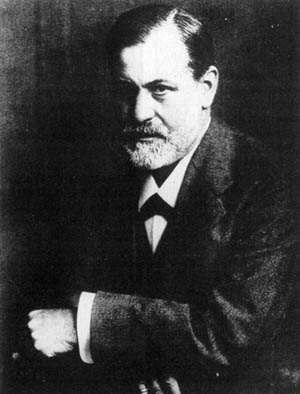
Freud was severely emasculated in both personal ego and in his group ego. He was in fact a practicing homosexual. His relationship with Fliess was homosexual in nature which Freud confessed vowing never to do it again. His group, the Jews, were and are a severely emasculated people. They have been since they walked away from Ur. But on with Freud.
Freud was fond of telling the story of his father and his hat, it seems that Mr. Freud related a story to Sigmund, or Sigismund as he was known then, (His Hebrew name significantly was Solomon) of how when he was a young man walking down the street proudly wearing his new hat, a gentile knocked the hat from his head into the gutter, snarling: ‘Go get your hat, Jew.’
When Sigmund asked breathlessly what his father did, expecting an heroic response, the old gentleman replied: ‘I stepped into the gutter and picked up my hat.’ severely disappointing the young boy.
Since Freud told and retold this story we may be forgiven for believing it had a profound effect on his young conscious and subconscious minds and possibly his ‘unconscious’ too. On the one hand he may have been so ashamed of his father’s very reasonable reaction that he shared his emasculation encapsulating it in his subconscious as a fixation. It is possible that this story either made or contributed to his homosexuality. On the other hand we know for a fact that it inflamed his group ego with an ardent desire for revenge against the gentiles.
As a result of the story he made the Carthaginian Semite, Hannibal, his alter ego. When Hannibal’s father was defeated by the Romans he had his son swear that the would never cease waging war on the Romans until he died. Obviously Freud made his vow against the Europeans although his father didn’t demand it.
It is no coincidence that both Freud and Hannibal were Semites and that the Romans and Europeans were gentiles. Nor is it a coincidence that both Hannibal and Freud were defeated after seemingly winning the war and that rather than fighting the enemy to the end both fled. Now, it therefore follows that Freud never ceased waging war against the Europeans.
You say: How? Come along. I can’t take you into the Inner Sanctum, which way you will have to find on your own, but I can show you some of the records I have been allowed to abstract from the files.
This will involve the secret history of the human race but don’t be alarmed. If you don’t want to believe it you don’t have to. It still is a rousing good story. Besides, if you should ever come around the archives you’ll find it is true.
Freud himself made an attempt to explain a little of the origins of the Jewish psyche in Inhibitions, Symptoms and Anxiety and Moses And Monotheism. The earlier millennia don’t concern us here. The Jews throughout history in their egotism have felt much put upon. This sense of grievance grew until with the expulsion from Spain after the Reconquest their sense of injustice burst into open flames. The group swore revenge on Europe. It must be remembered that at the end of the thirteenth century they were expelled from England, at the beginning of the fourteenth from France and for the duration, well, they were really welcome nowhere.
They swore to stultify Europe. Judaism is the history of messianism.
Sabbatai Zevi.
Zevi- The Last Of The Messiahs
This man was the last great messianic imposter. In 1666, the number of the beast plus a thousand, the Jews of Europe awaited the word from Sabbatai, then at the Ottoman Court to begin the slaughter. But Zevi apostatized to Moslemism instead. The uprising never came off. Hung fire. Fizzled.
Hope beats eternal. The learned Rabbis vowed never to place their hopes on a single individual again. They now concocted a plan for the group to rise as one man in rebellion. The date selected for the revolution was the period 1913-28. You want to give yourself a little leeway there. Born in 1856, in 1913 Sigmund Freud was fifty-seven years old. Although none of his biographers say much about his his Jewish background it is quite clear that he was read in Jewish lore. You may say that he wasn’t a religious Jew but he nevertheless was devoutly Jewish.
Freud quite consciously hated the gentiles for personal reasons that meshed quite well into those of his group identity.
During 1913-17 Freud’s reputation was immense both within and without the Jewish community. It was true his heir apparent, C.J. Jung had broken with him perhaps for this very reason but he and Psychoanalytic Movement had suffered no damage.
In psychoanalyis Freud had the means to instruct his group and control the gentiles. It is said that he gave up hypnotism when he turned to psychoanalysis but as a perusal of ‘Group Psychology’ will show he was preparing for a breathtaking attempt at hypnotizing the entire Western world not unlike that of Burroughs’ Lotharians against their invaders.
Freud lived in Vienna where for years, even decades before 1913, emigrating Jews had flowed through from the entry port into Austria from the East of Brody on their way to America via the North German ports. The prosperity of the whole German shipping lines was built on steerage passengers. Nor were the decisions to emigrate necessarily individual; it may have begun that way but to emigrate was soon organized and directed by the international Jewish community. Check the career of Baron Maurice Hirsch.
The Jewish establishments of both Europe and America provided funding. At about this time provisions were made to transport the entire Jewish population of the Pale, from Lithuania to Romania, to the United States Of America. At the time the international Jewish goverment led by Jacob Schiff and Louis Marshall was located in the United States, New York City. The decks were being cleared so as to remove resistance in America. So as not to call too much attention to the fact by having hordes disembark entirely in New York and Boston, for there would be resistance however feeble, the ports of New Orleans and Galveston were organized to deal with millions of immigrants.
This plan was aborted by the Great War. The Jews had already been at war with Russia, or the Czar as they personalized it, for a hundred years. The international Jewish community had engineered the Russo-Japanese war almost pulling off a revolution in its wake in 1905.
Activities were now intensified. At the time and for about the next sixty years the Jews threw a veil of obfuscation over their activities always denying involvement in Communist or Revolutionary matters. In recent years Jewish scholars, for whatever reason, have now found it expedient to admit that which they were accused of but always denied. They now admit that every national subversive Communist part was over fifty percent Jewish. Those of Russia and Germany were considerably higher. Freud had been involved in Jewish subversive organizations like the B’nai B’rith for many years. As the master psychologist, an expert in the unconscious, he prepared the Jewish mind for the great task of the millennial years in Central and Eastern Europe, which would require much bloodshed, while formulating his psychological plan of conquest not dissimilar from the military plans of his hero, Hannibal.
Freud himself was centered in Vienna. A lieutenant, Abraham, was his man in Berlin while Frerenczi was posted to Budapest in Hungary. The three crucial central European points were covered. Jung in Zurich had split off shortly before this. It is interesting that the Jewish psychoanalytic extablishment spitefully denounced him as a Nazi.
The Jewish millennial years began in 1913. The Great War began in 1914. The Bolshevik Revolution occurred in 1917. Freud’s Introductory Lectures On Psychoanalysis appeared in 1917 also, even though there must have been an extreme paper shortage; it is not a short book. Freud encoded last minute instructions to the Revolutionists in the book.
At this point in 1917 Freud released the inhibitions of millions of Mr. Hydes in Russia, Hungary and Germany. The Bolsheviks took Russia out of the war signing a seemingly humiliating peace treat at Brest-Litovsk. As Lenin said the peace treaty was meaningless because it was his intent to stab Germany in the back.
Germany had a huge Communist Party which it is now admitted was around sixty percent Jewish. Now with the United States in the war, Germany debilitated internally and crippled psychologically, thousands of Jewish revolutionaries intent on the realization of the millennium flowed back into Germany from Russia in hopes of achieving the Revolution there, giddy with the hopes of thereby annexing Central and Eastern Europe. That they didn’t was because of the efforts of the German Volkish groups such as Hitler and his Nazi Party.
The unconscious psychoses of the Jewish people who it will be remembered as a group were suffering from severe emasculation were erupting. Emasculation of the Ego is always expressed in a sexual manner frequently sadistic. Freud had been preaching the practice of unrestrained sexual activity for years. Murder is a sexual act. He was against ‘repression’ you remember.
When Russia began its program of expansion under the Romanovs it annexed an enormous number of nationalities. The Russians then tried to impose their language and manners on the conquered peoples in an attempt to form an homogeneous State. In so doing they emasculated the subject peoples. Those same subject peoples were now the masters of the Russians with permission to indulge their ‘unconscious.’
Jews, Letts, Poles and others let loose. Stalin himself was a Georgian.
Jacob Schiff- PM of the International Jewish Government at this time.
As Jean Genet correctly saw of the Nazi State, in Russia a criminal intellect was now joined to the political and legal apparatus of the State. The criminal code was changed from an objective one to a subjective one; one of vengeance. For a period of years law was suspended in Russia. Amidst the chaos International Jewish organizations including those of the United States operated openly to coordinate their hopes for the millennium.
Bela Kun- Communist Psychopath
What I’m about to say has been denied and suppressed but the example was before both Hitler and Stalin. In Hungary Freud had his man Ferenczi to coordinate the Hungarian Jews. The Jewish Bela Kun (Cohn) seized the government beginning a reign of terror against the gentiles during which thousands of non-Jews were murdered in a horrible sadistic manner commensurate with a severely emasculated Ego.
For some time the Jews had been clamoring for a State of their own. Taking advantage of the chaos in Russia the Jewish American Joint Distribution Committee under the leadership of Schiff and Marshall decided to appropriate the Crimea. Bela Kun who had escaped Hungary during the inevitable reaction, going to Moscow, was sent down to the Crimea to exterminate the population to make lebensraum for the Jews. He was in the process when Lenin died. Stalin then recalled him to Moscow where he was subsequently shot.
All these activities were obscured and suppressed. It is forbidden in American universities to study the subject to this day.
Still, Europe was so horrified that they declined to discuss it or even acknowledge it. But Hitler and Stalin remembered.
The Communists in Moscow being composed solely of emasculated peoples functioning from Freud’s vision of the unconscious like so many Hydes conducted a criminal homosexual style State that would have delighted Genet had he been there. The author the The Thief’s Journal would have gasped at the warehouses full of stolen furs, diamonds and other jewels, art objects and whatever of value that the poor emasculated wretches had stolen from their murdered victims. It was the triumph of the Common Man.
As soon as Stalin gained power he began to discredit and remove Jews from influential positions. Trotsky was sent to a malarial swamp in Siberia to die but from which he escaped to be killed by Stalin’s assasins later. As Stalin consolidated his power he acted more directly until he held the famous show trials of 1936. He then began the systematic elimination of Jews which resulted by the end of 1945 in the death of millions.
Adolf Hitler

Joseph Stalin
Thus Hitler, an emasculated man leading an emasculated people had the Judaeo-Communist example before him. As an avid anti-Communist and open anti-Semite he was virtually isolated by the world that by 1936 was under the control of Judaeo-Communists. He was the antagonist not the protagonist.
While Stalin who had religious training was clever enough to seemingly work through the system openly followed legal controlled methods although the law had been subordinated to his ends. Hitler acted as a homosexual with an ax in his hand. Stalin’s officers dispatched prisoners hidden in the depths of the Lubyanka with a bullet in the back of the head, which method, by the way, was favored by Jewish and Italian members of Organized Crdime in America of the time, while the Nazis brutally beat prisoners, finally shooting them in the back while escaping.
Stalin, Hitler, Freud, which was worse? Freud enabled, Stalin and Hitler executed. They were all the same.
In Russia during the first year or so of Lenin some Russian workers were being read to as they worked. Were they being read the works of Marx or Lenin? No. They were being read the Tarzan novels of Edgar Rice Burrougs. This infuriated the Politburo. The State was trying to impose a collectivist unconscious psychology on the Russians while Burroughs and his great psychological projection were individualist and responsible. In fact, Burroughs offered a concept of the unconscious which was directly opposed to that of Freud. One might say that Burroughs was Dr. Jekyll to Freud’s Mr. Hyde.
Burroughs himself had been severely emasculated at the age of nine. The situation seems to be this: Burroughs came from a prosperous Chicago family. His parents were very proud of their English ancestry. If you’re unwilling to understand national and racial prejudices that were very pronounced at the time then you probably won’t be able to understand. There were strong feelings between the Anglo-Saxon and Celt or English and Irish. The Anglos considered the Celts if not inferior at least eccentric. The Burroughses employed two Irish girls as servants. In all probability Young Burroughs assumed an attitude of superiority which the girls resented. They then concocted a plan to cut young Burroughs down to size.
They had a friend or relative by the name of John who was aged twelve to Burroughs’ nine. Being much larger and tougher than Burroughs he stopped the younger boy on the way to school one day where he thoroughly intimidated and terrified him. It is quite possible that Burroughs messed his pants. In any event, he suffered severe emasculation that was to haunt him all his life. He does not seem to have ever practiced homosexuality although he was haunted by a feeling of sexual ambiguity.
The incident with John the Bully not only played havoc with Burroughs personal psychlogy in the narrow sense of creating a psychosis but there was also an effect in what Freud’s erstwhile associate, C. J. Jung called the collective unconscious. The individual is limited by his very humanity to a small number of general responses.
Thus Burroughs was given a cast of mind which the Hindus denoted as Shivaistic. This is a general outlook or philosophy of life, if you wish, which one adopts unconsciously as the consequence of one’s experience. I share it although it took me nearly a lifetime to recognize and accept it.

Edgar Allan Poe- The Father Of Modern Literature
Burroughs himself was aware of the fact by at least 1931 when he wrote Tarzan And The Leopard Men. In one key or on one level the story is one of Shiva and Kali his consort. Burroughs names his heroine Kali while she is selected to be the White Goddess of the Leopard Men as part of their death cult.
As can be seen by their complete disregard for life Freud, Hitler and Stalin were also Shivaites.
Shiva and Kali are the Hindu representation of Life and Death. Shiva plays unconcernedly on the pipes while the carnage of life and death goes on around him. The song goes on. Kali, his consort, the goddess of death and regeneration dances on the bodies of the dead to Shiva’s music while wearing a necklace of skulls. Death means nothing because she as the eternal mother has the means to multiply unendingly. Do multitudes die? Why then, multitudes die. Not to worry. Life goes on.
Burroughs also developed an interest in psychology in his attempt to free his mind of the fixation given him by John the Bully. As his psychological notions were well formed by 1911 when he began to write in his attempt to expiate his guilt it follows that he acquired his knowledge during his early married years from 1900 to 1911. He married at 24. He had little opportunity to do his reading before then as the major works were only appearing in the late ’90s.
His main concern was the subconscious mind. While his evolutionary ideas are easier to trace he has left no mention of his psychological reading. It seems certain that he was familiar with FWH Myers who, as noticed, first defined the notion of the unconscious in 1886. He must have read James while Freud’s notions would have been discussed, if not yet translated; thus DH Lawrence had highly developed ideas on the Freudian unconscious in his 1911 Psychoanalysis And The Unconscious while I doubt Burroughs had read Freud in the German.
Also it seems probable that Burroughs had read Le Bon.
Burroughs’ idea of the unconscious differed greatly from Freud’s while being more soundly based in the actual functioning of the mind. While Burroughs’ hero Tarzan seems to function with an integrated personality from his creation in 1911-12 Burroughs himself came very close to integrating his own from 1913 to ’17 or may have although he always had trouble with his Animus and Anima.
Even though Freud advertised the fact that he had taken a year off (golly, a whole year) for self-analysis, whatever the results may have been he never succeeded in integrating his personality or, apparently, realized he should have. He was severely conflicted all his life. Just take a look at his photo where you can see that huge welt running from his lover right cheek across his nose into his forehead. That was caused either by excessive cocaine use or mental conflict in the brain stem, probably both.
As did all mythographers, Burroughs had read his Poe, like them he was concerned with the conscious and subconscious minds. While Stevenson’s Jekyll lost his conscious mind in his subconscious mind, Burroughs cencentrated on the concept of the beast within the man, the relationship between the conscious and the subconscious. In Chapter 3 of The Return Of Tarzan, in what appears to be a plagiarization of the murder scene of Poe’s Murders In The Rue Morgue, Burroughs has Tarzan act out the parts of both the Sailor and the Orang.
Lured up to the apartment on the pretext of helping a young woman, Tarzan is set upon by her accomplices. Discarding the trappings of his recently acquired civilization Tarzan reverts to his anthropoid education of the Jungle becoming Poe’s Orang, yet always retaining the restraints of his humanity or the Sailor.
When the police come he leaps out the window to a telephone pole which one imagines were more common in Chicago than Paris. (Burroughs had never been to Paris so he replicated the urban scene he knew.) While still in his ape guise he has the sense to look down where he sees a policeman below so he climbs up leaping to a rooftop.
Racing across the rooftops of Paris he climbs down another pole. Then in a Hyde-like transformation back to Jekyll he shakes himself from his ape self back into his human self, without the aid of drugs, enters a restaurant to clean up in the rest room then saunter jauntily down the street as though nothing had happened.
Thus the plagiarization of not only Poe but Stevenson was merely an attempt to give a better solution by using the mythological symbols.
Return was written at the end of 1912 and the beginning of 1913.
Burroughs’ own self-analysis would continue through his astonishing output of 1911-17 when he finally integrated his personality with the final volume of his Mucker Trilogy published as the Oakdale Affair but alternately titled Bridge And The Oskaloosa Kid which is the better title. At that time he had exorcised his major fixations which should have integrated his personality.
In understanding that the disintegration of the personality was caused by an affront or affronts to the Ego or Animus that resulted in the creation of fixations that festered in the subconscious that in turn manufactured affects that evidenced themselves in various physical and psychological ways he realized that the same could be exorcised returning the Ego to a whole state.
Unfortunately he strung his theory on through a couple dozen works of fiction disguised as incident. A very few would read all the novels while the only possible interpreters could be those who had read them all not only with a psychological background but an open, inquisitive mind. We’re a very small minority.
If I hadn’t been through the same process on my own I probably never would have recognized it. However as his theories were embodied in his hero Tarzan as mythology they passed into the unconscious of his readers of which, as a teenager, I was one, so shall we say, my mind was prepared.
Part 2 Something Of Value I
October 14, 2007
Something Of Value I
Part 2
by
R.E. Prindle
Back To Solid Ground, More Or Less
At the same time Stevenson and Haggard appeared, another of the great mythographers made his appearance. Arthur Conan Doyle brought his great psychological projection Sherlock Holmes onto the world stage. Doyle listed Poe as his second most influential author with whom he had been familiar since his youth. All the great mythographers were well acquainted with Poe. He was the great originator.
Holmes is the first great psychological projection of the Scientific Consciousness. He fulfills the role of Mastermind. His intellectual greatness fulfilled Poe’s dictum of the analytical mind.
As the two Dupins fulfilled the roles of ego and alter ego so Doyle gave Holmes Dr. John H. Watson as alter ego and foil. Holmes represented the future while Watson was a relic from the religious past. As the evil Hydelike representative of the subconscious Doyle provided us with the infamous criminal mastermind Dr. Moriarty.
With the introduction of Holmes the Scientific mythology began to take shape.
The new mythology was based on the new discoveries of science. The scientific mind was pouring out new technological wonders almost on a daily basis but it was the discoveries in the sciences of biology and psychology that would most undermine the Religious Consciousness.
Darwin had organized biology along the new scientific lines when his Origin Of Species appeared in 1859. There was no greater challenge to the orthodox belief system than this. When a few years later Darwin issued The Descent Of Man things really erupted. According to the religious viewpoint, since the origins of consciousness the notion had been that man was descended from the gods, later monotheistically amended to God. In a really inept choice of words Darwin states, or his followers did, that man was descended from monkeys. The idea of evolution might have met with less reistance had Darwin titled his book: The Ascent Of Man since, properly speaking, Homo Sapiens is an advance on monkeys and all that has gone before. Thus man could have been said to ascend the evolutionary scale from apes but descend from God meeting somewhere in the middle. Darwin wasn’t so farsighted.
At the same time great advances were being made in psychology. The Frenchman, Jean Martin Charcot, was proving the effect of the subconscious on our minds in his studies of hysteria and hypnosis. The sub or unconscious mind had been a topic of consideration since the days of the Enlightenment but discussion was carried on in vague terms. In 1886 the English psychologist FWH Myers identified the subconscious by the name of the Unconscious preparing the way for Freud who would set the world on its psychological ear the way Darwin had its biological ear.
The way was now prepared for one of the two greatest mythographers, H.G. Wells (1866-1946). Wells had a split personality. On the one hand he was a mythographer and on the other he was a Red/Liberal/Utopian. In 1920 the Utopian side won out and he became a whole-hearted Revolutionist.
Wells began writing about 1893. His early work was in the genre of scientific fantasias, as they were called at the time, of which genre he is said to be the founder. Wells noted quite correctly that about mid-century a new type of scientific man became increasingly apparent.
Let there be no mistake but that a few centuries earlier these scientific disturbers of the peace would have been murdered. The reaction by the beginning of the twentieth century was that science was evil and ought to be stopped. George Griffith, himself writing a scientific fantasia for Pearson’s Magazine, Stories Of Other Worlds, put these words into his heroine Zaidie’s mouth as she was on the way to Mars:
“They’re very ugly aren’t they?” said Zaidie; “and really you can’t tell which are men and which are women. I suppose they’ve civilized themselves out of everything that’s nice, and are just scientific and utilitarian and everything that’s horrid.”
And Zaidie was a sweet thing too. Against an even more hostile background Wells understood that tempers against science were running high but he came down on the side of the New Men. In his interesting fantasia The Food Of The Gods he postulates that the new men had perhaps been fed some new synthetic food which made them intellectual and physical giants.
Actually they had been around for centuries but had been suppressed by the Religious Consciousness in the form of the Judeo-Catholic religion. As their forces gathered in the sixteenth and seventeenth centuries they became strong enough to defy the Judeo-Catholics. Thus when the evidence of their emergence became evident in mid-nineteenth century they were already too numerous and too strong to be set aside. The two consciousnesses came into conflict with the Religious Consciousness splitting into the reactionary Devout group and the other the more forward leaning Red/Liberals.
Thus Wells on his Utopian side became the advocate of a form of the Religious Consciousness as he struggled with his Scientific Consciousness. After the Russian Revolution he wholeheartedly went over to the revolution.
While very influential on subsequent mythographers Wells was unable to create a psychological projection of his own while after 1920 he became a member of religious communism turning out politico-religious tracts.
Emerging at about the same time as Wells the Irishman Bram Stoker contributed the master psychological projection of the twentieth century in his masterwork, Dracula while E.W. Hornung (1866-1921) created the minor projection, the Amateur cracksman- A. J. Raffles. A cracksman was a burglar; Raffles was the archetype of the gentleman thief. While Raffles himself has virtually disappeared from the collective memory the notion of the gentleman criminal has taken hold on the mythological consciousness. Raffles is not to be confused as a version of the earlier Robin Hood who ‘stole from the rich to give to the poor.’ No, Raffles unashamedly kept and spent all the proceeds.
In the background all this time the greatest of the creative mythographers, Edgar Rice Burroughs (1875-1950) was waiting for his consciousness to mature. It matured in 1911 when he first created John Carter of Mars then followed up with the prodigious psychological projection of Tarzan Of The Apes. Shew, bigger than an A-bomb.
Burroughs was the plateau to which all other roads led and from which all other roads proceeded. He managed to consolidate all the mythological trends of the previous decades into his work where he refined and perfected them sending them on to new heights.
Edgar Rice Burroughs. To coin a cliche, Burroughs was an enigmatic figure. While himself a great original writer he managed to incorporate the various strands of the myth into his writing in such a way, either clumsy or tributary, as you wish, that he stands accused of being a plagiarist. This is nonsense of course. Like any mythographer he had to work with established materials. Myths are not original– they are cooperative efforts. The great Greek cycle, of which Homer is the center, was the work of many hands. The fact does not diminish Homer’s contribution.
Burroughs was able to incorporate the two most significant disciplines of psychology and evolution into his work in such an entertaining manner that the seriousness of his thought was lost in the glamour.
While the sources of Burroughs’ evolutionary ideas which will be discussed in Part II, are relatively easy to trace his psychological sources are more difficult. That he had already thought deeply on psychological matters before he began writing is obvious. That he continually added to his learning in psychology as well as evolution is clear from the development of his thought throughout the corpus.
Burroughs was especially concerned with the nature of the unconscious. He was an intelligent man who knew that his own behavior was controlled from his subconscious. I am certain that he was familiar with the 1886 work of FWH Myers, as well as Myers’ 1903 work Human Consciousness. As Freud was not translated into English before 1912 it seems certain that he had not had direct contact with the man’s work before then, however, by 1916 in his short story ‘Tarzan’s First Nightmare’ it seems evident that he had read at least The Interpretations Of Dreams.
Still, Burroughs had considerable contact with practicing psychologists as he indicated in The Gods Of Mars.
As the notion of the unconscious was discussed in various journals he very probably had read a number of articles, while as the notion of the Freudian slip was current in the second decade of the twentieth century he may have been familiar with Freud’s Psychopathology Of Everyday Life.
At any rate his writing of that decade drove relentlessly toward the goal of integrating his personality which is to say unifying the subconscious and conscious minds which he succeeded in doing by 1917 when he published The Oakdale Affair or, as alternatively titled, Bridge And The Oskaloosa Kid.
In his portrayal of the big Bwana, Tarzan has an integrated personality from his beginning in 1912. In his other works Burroughs constantly offers many portrayals of the subconscious.
The contrast between the conscious, or intelligent mind, and the unconscious, subconscious or ‘instinctive’ mind is one of the central tenets of the myth.
For Burroughs the study of the subconscious was to liberate, for Freud it was to subjugate the human will. Make no mistake, I consider Freud an evil presence while being the most destructive force of the twentieth century equal to any number of atomic bombs. Freud’s notion of the subconscious as a Hydelike repository of horrid repressed criminal needs was very mistaken.
One has the feeling that Freud learned much more about the human psyche than he told and that he told what he did with ulterior motives in mind. Those ulterior motives did not go unnoticed at the time. As D.H. Lawrence expressed it is his Psychoanalysis And The Unconscius of 1911:
And does it need a prophet to discern that Freud is on the brink of a Weltanschauung- or at least a Menschenschauung, which is a more risky affair? What detains him? Two things. First and foremost the moral issue. And next, but more vital, he can’t get down to the rock on which he must build his church.
Actually the unconscious was the rock but another rock was how to turn the basis of psychoanalysis, which is emasculation, into something palatable. Freud stumbled over his concept of castration which he was apparently sincerely unable to extend into the workable concept of Emasculation. The Castration Complex is only a symbol for Emasculation. And then there was the difficult moral issue. Lawrence again, same work:
First and foremost the issue is a moral issue. It is not here a matter of reform, new moral values. It is the life and death of all morality. The leaders (Freud, Ferenczi, Abraham) among the psychoanalysts know what they have in hand. Probably most of their followers are ignorant, and therefore pseudo-innocent. But it all amounts to the same thing. Psychoanalysis is out, under a therapeutic disguise, to do away entirely with the moral faculty in man. (My italics.)
Lawrence put his finger on the criminal intent. Freud was in fact running an Order in which one learned the true intent as one moved from initiate to adept. Freud in fact did wish to destroy the concept of Christian, that is to say European morality, and he had his reasons. But why the ‘unconscious’, why something which in his vision lies outside, even beyond, our minds, some alien evil force which controls our actions against our will. Lawrence persists:
It is obvious we cannot recover our moral footing until we can in some way determine the true nature of the unconscious (Percipient O!) The word unconscious itself is a mere definition by negation and has no positive meaning. Freud no doubt prefers it for this reason. He rejects subconscious and preconscious, because both of these would imply a sort of nascent consciousness, the shadowy half-consciousness which precedes mental realization. And by his unconscious he intends no such thing. He wishes rather to convey, we imagine, that which recoils from consciousness, that which reacts in the psyche away from mental consciousness. His unconscious is, we take it, that part of the human consciousness which though mental, ideal in its nature, yet unwilling to expose itself to full recognition and so recoils back into the affective regions and acts there as a secret agent, unconfessed, unadmitted, potent, and usually destructive. The whole body of repressions makes up our unconscious.
Here Lawrence states the obvious, there is no such thing as the unconscious. There is a subconscious that he rightly understands Freud to have rejected for ulterior motives. A subconscious is part of us which can be dealt with while an unconscious which is metaphysical cannot, it therefore follows that there cannot be an unconscious which would be a religious symbol, or in other words, supernatural.
However Lawrence while he scoffs seems to understand the function or a function that Freud gave to his unconscious which is in fact partially true of the subconscious. ‘The whole body of repressions makes up our unconscious.’ Not a fact because when the personality is integrated and fixations or what Freud call repressions disappear there is still a function to the subconscious which is unrelated to the fixations or repressions. I believe repression to be an inaccurate term. Rather what Freud calls repressions are fixations. A Challenge that the mind finds overwhelming is received and perpetuated as a fixation in the subconscious that in its control of the personality appeared to Freud as repression. Freud repeatedly reports the symbol as the fact whether through misconception or in intent to deceive is not always clear.
What is clear is that as Lawrence perceived so clearly in 1911 was Freud’s intent to destroy morality in a Jekylllike intent to release the Hydelike repressions on the world. In this he succeeded quite well. Much to his own injury. Just as Hyde brought destruction on himself so Freud brought destruction on the Jews in this Jewish millennial period.
At this point it might be instructive to examine an aspect of the intellectual milieu in which Freud developed. A large part of personal psychology is integral in one’s group psychology and general psychology as in, for instance, education. By education I do not mean schooling per se, but all the influences which constitue character formation.
Freud’s father came from the area of the Pale known as Galicia. This area is very close to the homeland of the ecstatic variant of Judaism known as Hasidism, and in fact his father was a Hasid. This sect arose out of the period of the last great messianic individual, Sabbatai Zevi. This man was active during the period 1640-66. As might be expected in group psychology when the Day approaches the faithful raise their expectations, growing elated, becoming forgetfull of niceties. This is what happened to the Jews of the southern Pale in 1648. As auxiliaries of the Poles who had conquered the Ukraine the Jews suffered the same fate as the Poles when the Ukrainians revolted. this massacre occurred at the same time as the expected millennium which was a complete contradiction in terms, or in other words, how mysterious can the ways of God be? Then in 1666 the whole millennial illusion collapsed when Zevi failed as a messiah.
One result of the failure was the attempt to regenerate Judaism by means of ecstatic Hasidism. By all rights Yahvey, not for the first time, having failed his people should have been renounced. The Jews couldn’t do this. There was also a second effect. Out of the wreckage of Zevi a man named Jacob Frank evolved another strain of Judaism in which he said that the age of the millennium would never appear until the Jews had exhausted their proclivity for evil. It was therefore necessary for Jews to indulge in whatever evil impulses they had to purge their systems to make way for the good or millennium.
Here also is where the Jewish notion of good arising from evil finds its clearest expression. Jewish ideas are never distinct from the ideas of the general community, in this case European. A European reaction to Judaeo-Catholicism had been going on for centuries passing through many manifestations such as the Beggars, the Free Spirtis, Anabaptists and others. All of these like the Frankists believed, like Freud, in the free expression of subconscious impulses.
Now joined by the Frankist notions after the beginning of the eighteenth century the basis of the Revolution was formed.
By mid-eighteenth century many of these groups, now styled Libertines, were functioning openly in England and on the Continent. Perhaps the most famous organization representing these beliefs which were integral to the Revolution which had been developing for centuries were clubs like the Hell Fire Club of England.
These groups of people were quite extreme. Their credo was startlingly expressed in Tobias Smollett’s 1748 novel Roderick Random. Note the date, which is just before the destruction of the notorious prisons, Newgate in England and the Bastille in France. Smollett’s novel is forty-one years before the outbreak of the French Revolution which was supported in England by members of these clubs.
Smollett’s hero, Roderick Random, was introduced into the home of one of these incendiaries to whom he attribute the following poem:
Thus have I sent the simple king to hell
Without or coffin, shroud or passing bell.
To me what are divine or human laws?
I court no sanction but my own applause!
Rapes, robb’ries, treasons, yield my soul delight;
And human carnage gratifies my sight;
I drag the hoary parent by the hair,
And toss the sprawling infant on my spear,
While the fond mother’s cries regale my ear.
I fight, I vanquish, murder friends and foes;
Nor dare the immortal gods my rage oppose.
Sound like any two revolutions you may have heard of? The above pretty much defines Freud’s intent in his use of the subconscious while forming the framework of his personal Weltanschauung. Whether Freud was consciously aware of these notions or whether they were part of his subconscious is open to question. Much of the education of this sort is absorbed on the subliminal level perhaps never being or becoming conscious. Most of this primal education is buried so deep that one is never aware of its source. I scoff at Freud’s claim that he was able to analyze himself in just one year at the turn of the century.
Now, the majority of Freud’s thought was completed by the time he published his Introductory Lectures In Psycho-Analysis in 1917 just before the Bolshevik Revolution. In order to explain the results of the Freudian ideas of the ‘unconscious’ let me provide a framework by moving ahead a little.
What we are talking about here is the context of Freud’s notion of the castration complex. Castration is a specific symbol while the generalized concept is Emasculation. the Castration Complex is not even an affect but only a symbol. If Freud was aware of the generalized Emasculation concept he nowhere lets us know. Emasculation is caused by an unresolved affront to the Ego from which all men and women suffer to some degree.
The scapegoat for our sins or arch-villain of all time as some would have it was and remains Adolf Hitler. Hitler was seriously emasculated. Having read all the major Hitler biographies while delving is some detail into the hisory of post-Great War Germany I was at a loss to explain the man and his time down to the Rock of his Church. Having folowed through on Freud’s notion of the Castration Complex exlucidating it into the Emasculation theory I came across the novels of that most horribly emasculated and repulsive figure in modern literature, Jean Genet.
For those not familiar with Genet, he wrote plays which I have not read and five novels I have which I list: Our Lady Of The Flowers, The Miracle Of The Rose, Funeral Rites, The Thief’s Journal and Querelle Of Brest.
Genet was a vicious homosexual and criminal which is to say he was completely emasculated. He wore women’s dresses but not as a transvestite. Any self-respect he had was totally negative. However, it is possible to recognize something of oneself in his hurt. He knew how to universalize his anguish. His degradation gave him some insight into his times and its personalities. He traveled in Nazi Germany between 1930 and 1940.
While not using these terms he understood and applauded the criminal annexation of Law and government to the uses of Freud’s concept of the unconscious or, in another word, criminality. The criminal nature of the regime was so in accord with his own perversions that he had no desire to thieve as such crimes seemed to him to be no insult to society in Germany.
It seemed to him that Hitler was one with himself in his desires.
I don’t believe Hitler was a practicing homosexual but he was emasculated to the point of deformity. Which is what I suppose revolted his contemporaries so. However, as all emasculation is expressed in a variant homosexual manner, self hatred being a form of homosexuality, one may believe that he was a ‘latent’ homosexual. One wonders about his relationship with Hindenburg; what exaggerated respect and smoldering resentment must have been there.
In may ways Genet forms a link between the ante and post WWII worlds. In his own goals and aims he was peculiarly related to Freud.
Shortly after the Great War Freud wrote ‘Group Psychology And The Analysis Of The Ego.’ The essay is applied Freudianism; it doesn’t do you any good to have the scientific knowledge if you don’t apply it. Man has his individual ego while sharing it in one or more group egos. The question then becomes how does one engineer the individual ego into a group ego so that the individual within an artificial group can achieve your desired political ends will he nil he, hypnotized as it were.
Freud tackles this problem in Group Ego. The book raises several interesting questions. Freud based this work on an 1895 study by the Frenchman Gustave Le Bon titled: The Crowd: A Study Of The Popular Mind. Le Bon’s was a seminal work still in print after 110 years. He might be said to have originated the concept of group psychology which Freud appropriated.
‘Group Psychology And The Analysis Of The Ego’ is virtually the Crowd rewritten with better organization and definition. At the risk of quoting too extensively I have abstracted several quotes from Le Bon used by Freud in Group Ego which form the basis of Freud’s essay. Le Bon’s book may be illustrative of the manner in which Freud built several of his
The most striking peculiarity presented by a psychological group is the following. Whoever be the individuals who compose it, however like or unlike be their mode of life, their occupations, their character, or their intelligence, the fact that they have been transformed into a group puts them in possession of a sort of collective mind which makes them feel, think and act in manner quite different from that in which each individual of them would feel, think and act were he in a state of isolation. There are certain ideas and feelings which do not come into being, or do not transform themselves into acts except in the case of individuals forming a group. The psychological group is a provisional being formed of heterogeneous elements, which for a moment are combined, exactly as the cells which constitute a living body form by their reunion a new being which displays characteristics very different from those possessed by each of the cells singly. (p. 29)
It is easy to prove how much the individual forming part of a group differs from the isolated individual but it is less easy to discover the causes of this difference.
To obtain at any rate a glimpse of them it is necessary in the first place to call to mind the truth established by modern psychology, (1895) that unconscious phenomena play an altogether preponderating part not only in organic life, but also in the operations of intelligence. The conscious life of the mind is of small importance in comparison with its unconscious life. The most subtle analyst, the most acute observer, is scarcely successful in discovering more than a very small number of the conscious motives that determine his conduct. Our conscious acts are the outcome of an unconscious stratum created in the mind mainly by hereditary influences. The substratum consists of the innumerable common characteristics handed down from generation to generation, which constitute the genius of a race. Behind the avowed causes of our acts there undoubtedly lie secret causes that we do not avow, (The issue is not issue, Mark Rudd) but behind these secret causes there are many others more secret still, of which we ourselves are ignorant. The greater part of our daily actions are the result of hidden motives which escape our observation. (Ibid. 30
A necessary transition note from Freud. (Page 8, Group Psychology). ‘Le Bon thinks that the particular acquirements of individuals become obliterated in a group, and that in this way their distinctiveness vanishes. The racial unconscious emerges, what is heterogeneous is submerged in what is homgeneous. As we should say, the mental superstructure, the development of which in individuals shows such dissimilarities is removed, and the unconscious foundations, which are similar in everyone, stand exposed to view.
In this way individuals in a group would come to show an average character. But Le Bon believes that they also show new characteristics which they have previously not possessed, and he seeks the reason for this in three different factors.’
Freud quoting Le Bon again:
The first is that the individual forming part of a group acquires, solely from numerical considerations, a sentiment of invincible power which allows him to yield to interests which, had he been alone, he would perforce have kept under restraint. He will be the less disposed to check himself, from the consideration that, a group being anonymous and in consequence irresponsible, the sentiment of responsibility which always controls individuals disappears entirely. (Ibid. 33)
The second cause, which is contagion, also intervenes to determine the manifestations in groups of their special characteristics, and at the same time the trend they are to take. Contagion is a phenomenon of which it is easy to establish the presence but which it is not easy to explain. It must be classed among those phenomena of a hypnotic order, which we shall shortly study. In a group every sentiment and act is contagious, and cantagious to such a degree that an individual readily sacrifices his personal interest to the collective interest. this is an aptitude very contrary to his nature, and of which a man is scarcely capable, except when he makes part of a group. (Ibid. 33)
A third case and by far the most important, determines in the individuals of a group special characteristics which are quite contrary at times to those presented by their isolated individual. I allude to that suggestibility of which, moreover, the contagion mentioned above is also an effect.
To understand this phenomenon it is necessary to bear in mind certain recent physiological discoveries. We know today that by various processes an individual may be brought into such a condition that, having entirely lost his conscious personality, he obeys all the suggestions of the operator who has deprived him of it, and commits acts in utter contradiction with his character and habits. The most careful investigations seem to prove than an individual immersed for some length of time in a group in action soon finds himself– whether in consequence of the magnetic influence given out by the group, or from some other cause of which we are ignorant– in a special stae, which much resembles the state of ‘fascination’ in which the hypnotized individual finds himself in the hands of the hypnotizer.
…The conscious personality has entirely vanished; will and discernment are lost. All feelings and thoughts are bent in the direction determined by the hypnotizer.
Such also is approximately the state of the individual forming part of a psychological group. He is no longer conscious of his acts. In his case, as in the case of the hypnotized subject, at the same time that certain faculties are destroyed, other may be brought to a high degree of exaltation. Under the influence of a suggestion, he will undertake the accomplishment of certain acts with irresistible impetuosity. This impetuosity is the more irresistible in the case of groups than in that of the hypnotized subject, from the fact that, the suggestion being the same for all individuals in the group, it gains in strength by reciprocity. (Ibid. 34)
We see, then, that the disappearnce of the conscious personality, the predominance of the unconscious personality, the turning by means of suggestion and contagion of feelings and ideas in the identical direction, the tendency to immediately transform the suggested idea into acts; these, we see, are the principal characteristics of the individual forming part of a group. He is no longer himself, but has become an automaton who has ceased to be guided by his will. (Ibid. 35)
The remainder of Freud’s Group Psychology is the application of Le Bon’s observations as a manual for psychologically manipulated groups through hypnosis and suggestion to achieve an agenda. I will repeatedly refer to Group Psychology in Freud’s plan hereafter. While it is clear that Freud read Le Bon’s 1895 book absorbing much, the book was immediately translated into English in 1896 where it became accesible to a world public, it is therefore probable that a number of other people read the book taking what they needed for their purposes.
One of these may very well have been Edgar Rice Burroughs. I know of no way of determining the fact that he read the book but one asks is there any evidence in his novels that would indicate that he had. I’ll be darned, there is. As I said, because of the frivolous nature of the novels one dismisses Burroughs as an uneducated fantasist. He himself said that he would take a political or social idea and highly fictionalize it into something else. If one reads his 1914 novel Thuvia, Maid Of Mars one finds a story suspiciously like Le Bon’s ideas in The Crowd but highly fictionalized.
Burroughs’ psychological ideas are difficult to trace but well developed. Throughout his corpus Burroughs is well informed about hypnosis. It appears to be a subject he gave special attention to. Le Bon’s ideas are based on group hypnosis. In Thuvia the hero finds his way to the Martian kingdom of Lothar. He engages his invaders in a battle with the Lotharians. The city walls of Lothar are manned by innumerable bowmen firing arrows on the Green Men of Mars. The field is strewn with dead Green men killed by the arrows of he phantom bowmen.
The fight ending the hero looks away for an instant breaking eye contact with Lothar. When he looks back the field is strewn with dead Green Men but the arrows are gone. Wondering about this he looks back at Lothar to find the bowmen are gone too.
As it turn out the Lotharians no longer exist in physical form but are merely psychological projections who have learned to mass hypnotize their enemies into believing that they do exist and are shooting real arrows. Their enemies believe they are real arrows and so die by them.
Thus it is quite possible that in Thuvia we have a fictionalization of Le Bon’s ideas which Burroughs must have picked up from the 1895 book converting them into fiction in 1914 well ahead of Freud and Hitler.
Oh yes. Him again. Hitler. Whether historians would agree that Germany was ‘stabbed in the back’ or not, it was universally believed by Germans, especially by Hitler, and they and he acted on that belief. Thus the psychic injury suffered by the privations of war, the loss of the war, and the belief that victory had been taken from them by traitorous means made a curious form of group emasculation of the collective ego shared by each individual creating the conditions for a group psychology which under the influence of a hypnotizer they would not be responsible for their acts. The group ego is where the emasculation occurs being then relegated to the group subconscious where it surfaces under various names and impulses. As the American Jew Mark Rudd was to say in respect to his group’s post-WWII emasculation: The issue is not the issue. In other words, their complaint was the disguise for their emasculation which is what they were really trying to address.
Jean Genet was not a philosopher or a politician so that he did not understand that Hitler was not the protagonist but the antagonist. He was not acting but reacting. What was he reacting to? Let’s go back to Freud.
End of Part 2. Go To Part 3
A Review: 1921’s The Sheik by E.M. Hull
October 12, 2007
A Contribution To The Edgar Rice Burroughs
Library Project.
A Review
The Sheik
by
E.M. Hull
by R.E. Prindle
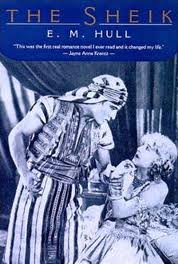
The Novel
The Sheik by E.M. Hull is found in ERB’s library. The novel published at the beginning of 1921 was a runaway bestseller going through thirty-0ne printings by October. My copy is of the thirty-first printing. How many more it may have gone through I am not aware.
The book was quickly made into the movie of the same name starring Rudolph Valentino and released on November 20th of the same year. Thus the impact would have been redoubled on ERB reading the book and seeing the movie.
Having troubles in his relations with Emma, he was somewhat bedeviled by what she wanted as Freud was by what women wanted. The Sheik presented one woman’s solution to the problem of what women want. The Englishwoman E.M. Hull examined the problem in some detail. Her solution would find expression in ERB’s Tarzan And The Ant Men of 1923 in the story of the Alalus women.
2.
While Mrs. Hull’s novel is invariably reviewed as a soft core porn novel it is actually quite a serious attempt to explore what women want. Not a potboiler, the story is well thought out and carefully constructed.
The story falls into the category of the desert nomad thriller.
The scene is somewhere between Biskra and Oran in Algeria. Biskra is the southernmost point on the railroad from the coast to the Sahara in the East of Algeria. It is an oasis area and was a winter resort for Europeans. This area was also the scene of Robert Hitchen’s The Garden Of Allah and the Sahara scenes from Edgar Rice Burroughs’ The Return Of Tarzan.

The Author
As with Hitchens’ the desert serves as a symbol for self-realization and redemption. The story was written as the career of the rebel Abd El Krim was reaching its apex in the Rif. Krim’s story was terrifically romantic for women of the era. I had a high school history teacher in the fifties who was still capable of gushing about Krim thinking him the most manly and desirable of men.
As with Hitchens the story revolves around a man and a woman. The woman an Englishwoman and the man a Krim like sheik of the desert.
3.
The woman is appropriately named Diana. Diana was the virgin huntress of Greek mythology who spurned all relations with men thus putting her in enmity with Aphrodite. She is somehow related to the Lady Of The Lake of ancient Lacedaemon which name means Lady Of The Lake and in a line of progression to the Northern European archetype of the second half of the Piscean Age. This is a rather strange female archetype to represent the Northern European psyche. She is a cold unloving symbol that may have something to do with the European character.
Whether Mrs. Hull knew these things or not she represents them perfectly in her story. This is quite extraordinary.
Thus her Diana was raised by her brother as a boy. She is represented throughout the story as an ambiguous girl-boy, nearly a hermaphrodite. She is herself a skilled huntress who has no use for men. As the story opens she has yet to be kissed. Mrs. Hull skillfully represents the respect that Northern European men have for their women which in itself may be conditioned by the Diana image. They are easily put off. When one man asks Diana for a kiss he accepts his rejection with equanimity asking only if they can at least be pals.
The Sheik as the wild man of the desert knowing no law but his will offers quite a contrast. By the time of Mrs. Hull’s novel ERB had already explored the same literary territory in the Return Of Tarzan and The Lad And The Lion as well as The Cave Girl. I would hesitate to say Mrs. Hull had read Burroughs but the Sheik is portrayed as a Tarzan like superman in a decidedly pulp manner.
The Sheik does not observe any civilized niceties. At one point Mrs. Hull refers to his civilization being less than skin deep. As the Sheik, Ahmed, says, if he wants something he takes it. Having seen Diana in the marketplace of Biskra he sets out to kidnap and rape her. There are no other words for it and Mrs. Hull does not mince them.
His plan worked out so that he buys off Diana’s desert guide to deliver her to him on the first night out of Biskra. Prior to that he surreptitiously serenaded her on the night before even entering her room in the dark while she is there to replace the bullets in her pistol with blanks to prevent her from shooting him in the desert which she did attempt to do.
4.
Now, Mrs. Hull is presenting an allegory so the novel is filled with symbols. The key symbol is the horse. The horse is, of course, a symbol of the female associated with the Greek god Poseidon. In ancient times the symbol of the bull was associated with the missing y chromosome of the female being replaced in Patriarchal times with the horse. Thus the Patriarchal goddess Athene is sometimes represented as horse headed.
When the guide brings Diana a horse to ride it is a magnificent creature much better than she might have expected from a commercial enterprise. The horse has actually been provided by Ahmed the Sheik so as Diana leaves Biskra she is already mounted on the Sheik’s horse- a powerful sexual symbol. The horse is trained to respond to signals from The Sheik.
The story is filled with horses and horse races between she and the Sheik. In one race the Sheik gives her a minute to stop or he will shoot her horse dead which he does. He then places Diana in front of him on his horse (these horses are all magnificent and beyond magnificent) at which point she realizes that she is not only in love with the Sheik but has been for some time.
Previous to this time she had noted in the camp
…but it was the horses that struck Diana principally. They were everywhere, some tethered, some wandering loose, some excercising in the hands of grooms.
So everywhere is the symbol of the female. At this stage Diana has been sexually subordinated to the Sheik but she is intellectually resisting. The Sheik puts on a demonstration of how useless her resistance is as he fully intends to break her.
A man eater is brought out who has killed a man earlier that morning. The horse obviously represents Diana. Some two or three men attempt to break the horse but they all fail. Then the Sheik mounts. The result is a thoroughly exhausted and beaten horse. She stops fighting with her legs splayed while the Sheik jumps off. Then the horse rolls over left with no will of its own.
This is exactly Diana’s situation. Earlier she had boasted to her brother: I will do what I choose, and I will never obey any will but my own.
That is now proven an empty boast as the Diana riding in front of the Sheik chooses to obey the Sheik’s will.
Perhaps Mrs. Hull has prophesied the submission of England’s will of today to the desert Sheiks. As of now the Moslems have all but assumed religious control of England. Thus England as Diana has submitted its sexuality to the sons of the Sheiks.
However Diana’s Sheik still has to prove himself as the dominant male of his society to retain her allegiance. One hesitates to say that she perversely tests him nevertheless having been cautioned to take care on her desert rides she insists on going too far afield. Naturally she and her seven man escort are ambushed by the fat swarthy greasy rival sheik’s men. Six of the seven escorts die joyously defending their sheik’s property. The seventh, the sheik’s European manservant gets the classic bullet crease alongside the head. Diana disappears into the fat greasy sheik’s tent. This guy is everything an Arab sheik should have been in contemporary European eyes. Fat, greasy, swarthy, unbelievably smelly, uncouth to the nth degree. There’s no doubt there’s the fate worse than death for the boyish, sylphlike, slender, lithe Diana. Yes, it seems pretty certain, unless…
Here comes the Sheik with a small but loyal and dedicated band of followers eager to die for their leader. Just as the greasy, swarthy sheik has got it out and ready in crashes Ahmed in the nick of time. Rather than shooting the bastard and getting it over with he wants to dispatch El Greaso by hand. As we all know strangling a a struggling strong man takes a little time. Enough time for El Greaso’s vile Ebon followers to burst into the tent. Right behind them come Ahmed’s men. Shades of Tarzan! Ahmed takes a severe blow to the head and a couple long blades in the back.
Will he live? After muttering a couple pages similar to the last words of Dutch Schultz the matter is in the hands of Allah and the European surgeon. As much as I like having god on my side, in certain situations a good surgeon is even better.
Nevertheless if Ahmed lives he has proven himself to be the right man for Diana. Interestingly the virgin huntress has submitted to the law of Aphrodite. The European archetype has accepted the dominance of the Moslem Arab.
Well, almost. In the first place the tribe of Ahmed is very interesting according to his French friend who arrived in time for the big battle. It seems that Ahmed’s tribe is different from the rest of the desert greasers. It is inferred that his tribe is one of the legendary White tribes supposed to be living in the Sahara. Undoubtedly a surviving remnant of Atlantis that moved South when the Mediterranean flooded.
Why, in addition, it turns out that Ahmed isn’t even an Arab. It seems that he’s actually English. Well, an English Spanish blend. His English father when in his cups did some unspeakable thing to Ahmed’s mother when she was pregnant with him and she was found by Ahmed Sr. Ahmed Jr.’s adopted father wandering dazed and confused beneath the broiling desert sun.
Taken in she dropped Ahmed Jr. and died. The baby was raised as the successor to Ahmed Sr. But he developed an uncontrollable hatred for England, its people and all things English. That’s why he captured and raped Diana over and over. But it’s OK, they both realize they love each other now.
The lesson seems to be that that’s what woman wants: a man who can earn her repect by dominating and controlling her while at the same time being the dominant male in his society, being able to provide all her wants and desires while being able to defend her from the El Greasos of the world. So all the necessary elements come together here and we have a marriage if not made in heaven perfect for terrestrial travails.
If nothing else ERB learned where he had failed Emma in the beginning but who now wondered in his own role of sheik where the rewards from Emma were.
I’m going to speculate that ERB read the story in 1921. He might have enjoyed Valentino in the movie but I think it improbable that the silent film came near capturing the nuances of the novel. I’m sure the signficance of Diana as female European archetype didn’t come through on celluloid.
Was it even in Mrs. Hull’s mind one may perhaps ask. Is it possible I’m projecting my beliefs on Mrs. Hull’s story? It is possible but consider this passage in The Sheik:
He was so young, so strong, so made to live. He had so much to live for. He was essential to his people. They needed him. If she could only die for him. In the days when the world was young the gods were kind, they listened to the prayers of hapless lovers and accepted the life they were offered in the place of the beloved whose life was claimed. If God would but listen to her now.
So we know that Mrs. Hull was read in Greek mythology. It would seem inevitable that she was familiar with the stories of King Arthur to some degree. Certainly she knew the story of Merlin and Vivian. She was a writer. Knowing little about Mrs. Hull it is impossible for me to know for certain exactly what she read or understood. And yet, there it is in the pages of her novel if one has eyes to see. The Sheik is as much a work of mythology as is that of Burroughs’ Tarzan. It is possible that neither was conscious of what they were saying but the information taken into their minds was transformed subconsciously, at least, into the form in which it issued forth from their pens. It works that way for writers. I am often astonished at the subliminal message of what I write. Did I intend it? Must have. There it is. Still, I do put myself into a mild trance when I’m writing so that I concentrate on words rather than ideas. So the words are more conscious while the content is more subliminal. We know ERB wrote from a trancelike state and Mrs. Hull’s story has that quality. I think we have enough evidence to know that she had read the mythological material so that whether she had consciously formulated her ideas they come out in her writing. In short, I don’t think I’m projecting much if anything. Tra la.
There is no doubt that The Sheik made a big impression on ERB. The question is how did he understand it. His first reaction appeared in 1923’s Tarzan And The Ant Men in the weird parody of the Alalus people in which he reverses the male-female roles with the women being stronger and dominant. As Ahmed figures the women brutally dominate the men. Using them for sexual pleasure then discarding them. ERB’s story seems to be tongue in cheek but without a reference point the ridiculous story is hard to follow. With E.M. Hull’s The Sheik I believe we have the reference point.
It seems clear that Mrs. Hull was influenced by Robert Hitchens’ The Garden Of Allah. What is not clear is whether she was influenced by Edgar Rice Burroughs and if so by what novels. The Sheik follows a pulp format. So, if Mrs. Hull read the pulps on a regular basis there is no reason to believe that she was not familiar with some of his work as Burroughs certainly by 1920 when she probably began the novel was already the premier pulp writer.
If that was the case it seems likely that she might have read The Return Of Tarzan and The Lad And The Lion, perhaps The Cave Girl. If she read Lad then she reversed the roles of the chief male and female characters making the Woman English and the man Arab.
I haven’t read the magazine version of The Lad And The Lion so I am not sure of the specific changes ERB made between the 1913 version and the 1938 rewrite for book publication. The rewrite shows clear evidence of influence from The Sheik unless of course Mrs. Hull was reflecting the influence of the Lad on herself. In any event the two books reflect an influence from one to the other.
So, as with Trader Horn and Burroughs it is possible that Hull was influenced by Burroughs and with both of these authors Burroughs reading of them was reflected in his subsequent writing.
Our list of reciprocal influences is growing when one adds that of H.G. Wells. What once seemed simple grows more complex.
Postscript: I have since learned that Mrs. Hull was a student of mythology.
Something Of Value I
October 1, 2007
Something Of Value I
by
R.E. Prindle
If a man does away
With his traditional way of living
And throws away his good customs,
He had better first make certain
That he has something of value to replace them.
–Basuto proverb as quoted by Robert Ruark
Dedicated to
Greil Marcus
Part One
One Hundred Years In The Sewers Of Paris
With Jean Valjean.
Edgar Rice Burroughs, Sigmund Freud
And The Myth Of The Twentieth Century
1.
The Concepts Of The Unconscious And Emasculation
It has been truly said that man does not live by bread alone. He also requires a mythic foundation on which to base his actions. In the neolithic era his mythology was governed by a Matriarchal vision of reality. In the subsequent Egypto-Greco-Mesopotamian mythology the Matriarchal series went through a revision being replaced by an advanced Patriarchal mythological consciousness. This system was followed by the Judaeo-Christian mythological system which endured as the basis of mythological belief until the seventeenth and eighteenth centuries when the belief system was subverted by the emergence of the Scientific Consciousness.
Unlike the mythopoeic consciousness which preceded it the Scientific Consciousness left no place for supernatural explanations; all had to be explained within a rational scientific framework. This placed a great strain on a significant portion of the population which did not have the intellectual equipment to evolve. Thus the basis of psychological comfort provided by religion was destroyed. The code of behavior seemingly sent down from the sky had lost its validity.
In place of an apparent unified consciousness it now became noticeable that EuroAmerican man had an unconscious or subconscious mind as well as a conscious mind. Thus another evolutionary degree of differentiation unfolded that separated the advanced Scientific Consciousness from the anterior Religious Conciousness. A struggle has ensued in which advanced people are compelled to reintegrate their conscious and subconscious minds while the Religious Consciousness divided into the two camps of the Devout and the Reds resist.
The discovery of what was known as the Unconscious began with the emergence from the Religious Consciousness during and after the Enlightenment. Anton Mesmer with his discovery of Animal Magnetism or hypnotism may have been the first stage. Goethe and others carried the discussion forward until the Englishman FWH Myers isolated or identified the subconscious by the name of the unconscius in 1886.
The notion of the unconscious as known during the twentieth century was formulated by Sigmund Freud during the twentieth century’s first decade. Both Myers and Freud misconceived the nature of the sub or unconscious. Myers’ conception was more generous than Freud’s and more in accordance with proto-scientific Patriarchal Greek mythological conceptions which were also mistaken but visionary.
In Myers’ vision of the unconscious it had two aspects: the destructive aspect which he gave the Greek name of Ate and the constructive aspect he termed Menos. Thus he recognized that the unconcious could be good or bad.
Myers’ vision may have been based in Greek mythology. It will be remembered that the creative god, Hephaestus, was married to the emotional goddess, Aphrodite. Hephaestus and Aphrodite had their digs at the bottom of the sea which is to say the symbol of the unconscious which corresponds to the seeming location of the unconscious at the bottom of the mind or, in other words, the brain stem.
Thus it is said that Aphrodite, the goddess of love, which is to say irrationality, emerged from the sea on the half shell.
So, I suppose, love, being never rational is a subconscious decision which is one sided or a half shell. Love may be either constructive or destructive.
Thus also good ideas, a la Hephaestus, seem to rise unbidden from the subconscious or the depths.
Hephaestus and Aphrodite were ancient gods dating back to the Matriarchy. The incoming Patriarchal god, Zeus, had no part in their creation; they were solely a part of Hera the great goddess of the Matriarchy. She was much older than Zeus but the youthful Zeus united with her in the form of a cuckoo bird who as she clutched it to her breast slipped down her dress and ravaged her. So the Patriachy subsumed the Matriarchy.
When Hephaestus later sided with his mother against Zeus, the great Olympian threw him from heaven laming him. Then Aphrodite was given to him to wife. Unbridled lust combined with creative activity, Ate and Menos.
Aphrodite was not happy with the lamed god. While Hephaestus was on trips to Olympus she dallied with another Matriarchal god, Ares, the symbol of uncontrollable desire or rage. Hephaestus having been informed of Aphrodite’s infidelity set a trap for her and Ares. He constructed a finely meshed net of gold which he suspended over his bed.
Aphrodite, unbridled lust, and Ares, uncontrollable rage, were literally caught in the act being unable to disengage. Thus we have two aspects of Ate, lust and rage, caught by the efforts of creativity in the depths of the sea or the unconscious
Hephaestus called the other gods to witness. Athene, a new Patriarchal goddess who was the counterpart and antithesis of Ares and Aphrodite turned away in disgust. Apollo, another new Patriarchal god and the antithesis of Hermes just laughed. Hermes, the patron god of thieves, a Matriarchal god, said he would change places with Ares in a second. Thus, lust, rage and dishonesty are combined in one figure of Ate in the subconscious.
The image of Ate and Menos is what Myers meant by his idea of the unconscious. Freud, on the other hand, understood the unconscious as pure Ate.
Both the Greeks and Myers attempted scientific explanations while Freud gave the unconscious a religious and supernatural twist. He seemed to believe that the unconscious has an independent existence outside the mind of man which is beyond man’s control while being wholly evil.
Opposed to morality, Freud then wished to unleash this conception of the unconscious on the world. He was uniquely prepared to do so. All he had to do was manipulate the symbols of psychoanalysis of which he had full control. The question then is did Freud have deeper understandings that he concealed in order to bring about his desired ends?
Such is the case with his conceptions of sexuality. There is no need for him to have had deeper understanding, after all he was a pioneer opening a new field of inquiry. On the other hand…
Defining the unconscious was done by many men preceding Freud so that his is only one of many understandings, not necessarily the best, although today in common belief he invented the concept of the unconscious.
Next he chose to define the concepts of sex. He was equally successful in this field as far as the public was concerned, although I differ in understanding the matter as I do with the unconscious.
In analyses with patients Freud discovered that there was a fear of castration out of all proportion to actual incidents of sexual mutilation. It follows then that castration symbolizes something other than the removal of the genitals. I contend that it was impossible for Freud to have missed the signficance of castration as a symbol.
Castration as a symbol represents the broader concept of Emasculation, in this case psychological emasculation. This does occur in everyone’s life in many different manifestations while being something to really fear or avoid. Unless I am mistaken all neuroses and psychoses depend from it.
Understanding Emasculation is as much a ‘royal road to the unconscious’ as dreams.
I do not accept Freud’s map of the mind but we both agree that the Ego or Animus is the key to identity. Freud fully understood the significance of the Ego. Thus when the Ego is challenged with an affront or insult to which it is either unable or doesn’t know how to respond to successfully emascualtion to some degree takes place. There is no unconscious, just as there are no instincts so that a fixation is suppressed in the subconscious as a result of the affront. These fixations produce effects, which can be grouped in categories such as hysteria, paranoia, obsessive-compulsiveness and the whole panoply of general affects. The affects then find expression physically and psychologically, or in another word, psychosomatically. The mind and the body is one unit. These affects answer to what Freud called neuroses and psychoses.
When the Ego or Animus is denied its right to assertion the denial is frequently espressed in a hysterically sexual manner corresponding to the the insult. If the victim feels he has been taken from behind he will undoubtedly resort to anal intercourse as one type of underhanded response in an attempt to get back his own as in the case with homosexuality. Homosexuality is Emasculation par excellence.
The human mind is very limited in its inventiveness so all these affects can be catalogued and matched with the insult so that, absent resistance under analysis, they can easily be addressed and exorcised. The problem is not as complicated as it has been made out.
Freud understood so much more than he was willing to tell the goys but then he was not a scientist but a Jewish prophet. In his Group Psychology And The Analysis Of The Ego to which we will return he gave the game away.
The individual can and does submerge his own ego into a, or at various times, many group egos. Prominent among these group egos are ethnic, national and religious group egos.
Just as the individual can be emascualted so can ethnic, national or religious groups be emasculated which the individual will share. I mention the Jews only as the most obvious case although Negroes, American Indians or any defeated people suffer emasculation to one degree or another.
Thus I will discuss the unconscious from a general point of view with Freud’s concept prominent while the concept of Emascultion will be discussed by my understanding based on the studies of Freud on the castration complex and group psychology.
Bear in mind that I think Freud criminally distorted scientific knowledge for ethnic, national and religious ends.
2.
Quo Vadis?
Born with an integrated mind, circumstances soon disintegrate the personality so that the mind must be reintegrated to return to a state of psychic wholeness. A sort of personal mythology is created by one’s early disintegrative experiences which form one’s dreamscape in an attempt to deal with an overwhelming reality. However, when a person gains some control over external reality when the personality is integrated and the initial dreamscape based on early memories is eliminated a sort of distressing vacuum ensues that exists until a new dreamscape is formed which, while sufficient to ease the discomfort lacks the depth and substance of the fully mythologized dreamscape of childhood. One had reached a scientific consciousness. It may not be as satisfying but it fills the space while not controlling one’s behavior.
Western man, Euroamerican man, as the only segment of mankind so differentiated had then to begin to work out a new mythology based on rational scientific ideas. In other words he had to create a comfortable basis from which to understand and interpret the world.
Thus after a couple proto-mythographies in the early nineteenth century a cluster of writers or neo-mythographers began to create a mythology for the Scientific Consciousness.
The destruction of the Religious Consciousness began to become obvious after the eighteenth century Industrial Revolution in England. With the advent of steam the problem began to become acute.
The proto-mythologers may be Walter Scott, Byron, Peacock and the Shelleys. There is a departure in feel and style with these writers. Mary Shelley’s Frankenstein posits the scientific problem laying a foundation for the new mythology but does not itself deal with the psychological effects.
The first mythographer to make an attempt to explain the split consciousness from my own researches was the American, Edgar Allan Poe, 1801-49.
Poe began his writing career as a psychologically troubled man ending it insane. Along the way he wrestled with the problem of the void in the subconscious created by the elimination of the supernatural. His message was received by the later group of mythographers who read him without exception all being influenced by his work.
Poe caught the great intellectual change as it emerged. The period from 1830-1880 was the period of the great initial scientific advances that would change the world. From Poe’s death in 1849 to the emergence of the new breed of mythographers beginning in the 1880s was a period of literary quiescence.
Poe began his influential masterpiece The Murders In The Rue Morgue with the paragraph:
Quote:
As the strong man exhibits his physical ability, delighting in such excercises as call his muscles into action, so glories the analyst in the moral activity which disentangles. He derives pleasure from even the most trivial occupations bringing his intellect into play. He is fond of enigmas, conundrums, hieroglyphics; exhibiting in his solutions of each a degree of acumen which appears to the ordinary apprehension as praeternatural. His results brought about by the very soul and essence of method, have in truth the whole air of intuition.
Unquote.
By analysis Poe didn’t mean the sort of educated guesswork that had passed for analysis in the pre-scientific consciousness. No, this was scientific analysis that disassembled a problem into the component parts revealing the secret than reassembling the problem to its original state.
In doing so Poe revealed himself as a master mythographer as well as a scientist. In C. August Dupin, the initials spell cad, Poe created the archetype of the eccentric madman who would be the here of countless novels. As a projection of Poe’s own mentality Dupin and his unnamed alter ego live in a dilapidated house. The house is the psychological symbol for self which Poe used almost to exhaustion. As the Fall of the House of Usher prefigured Poe’s own descent into insanity as to a number of alter egos representing his sane side figure in the House of Usher, William Wilson, Rue Morgue and most notably in the System of Dr. Tarr And Professor Fether in which his sane alter ego drops his other half off at the door of an insane asylum.
The two Dupins live in a darkened house during the day, creaking not unlike the House Of Usher, going out only into the depressed asylum of the night.
Poe thus presents the separation of the conscious and subconscious modern man in the riddle of the murders in the Rue Morgue. In the Rue Morgue the subconscious is represented by the Orang u tang or animal side of human nature while the conscious is represented by the sailor owner. From Poe to at least Freud the subconscious was popularly considered a dangerous wild side of man.
In Dupin and his alter ego versus the sailor and the Orang, Poe may have perceived the emergence of a new species much as H.G. Wells was to do at the end of the century. Thus both men perceived that the antecedent consciousness and the Scientific Consciousness were not just matters of learning but a genetic difference although they didn’t put it that way that couldn’t be bridged.
Both aspects were brought out brilliantly by Robert Louis Stevenson (1850-94) in his 1880 novel: The Strange Case Of Dr. Jekyll And Mr. Hyde. This book may properly be said to be the first true represention of the scientific myth.
In this case the good Dr. Jekyll is the disciplined, self-controlled scientist committed to doing good in the world. Beneath his intelligent exterior he feels the primitive wild man lurking. The primitive of what is in fact a predecessor Homo Sapiens is very very appealing to him. Unable to bring this aspect of his psychology to the surface by conventional means he resorts to drugs.
Having once freed his wild side, who he names Mr. Hyde, he is unable to put Hyde back into the bottle or syringe, whichever the case may be. Hyde assumes control of the personality which leads both aspects of the personality to destruction. This is not unlike Freud’s notion of the unconscious.
Thus Stevenson brilliantly prefigured the twentieth century future in which the scientist is dragged back to the level of the predecessor species through a psychological inability to take the great leap forward and turn his back on his past.
The same sense of the alienation from a predecessor existence was evidenced in the work of a great transitional figure, H. Rider Haggard (1856-1925). Let me say that Haggard is a much neglected literary figure. As his topics concerned Esoterica and Africa, the former which is scorned and the latter ignored, his literary reputation has been allowed to virtually disappear. Having read a large part of his work in the pursuit of these studies I would rank Haggard very highly, certainly among the top ten authors, possibly as high as number five. one and two are Walter Scott and Balzac, while Dumas holds down third and possibly Trollope in the fourth spot. Haggard is a writer of genius.
He spent his late teens and early twenties in the South African provinces of Natal and Zululand where he acquired a vision of the difference between the first Homo Sapiens, the Negro, and the current scientific man. As the saying goes, there’s something to be lost and something gained when you move up the ladder.
Haggard never made it to scientific man himself being stuck in the Religious Consciousness. He belonged to the Esoteric side rather than the Christian. In the third novel of his great African trilogy, Allan Quatermain, Haggard examined the difference between the African and European in this manner.
Quote:
Ah! this civilization what does it all come to? Full forty years and more I spent among savages, and studied them and their ways; and now for several years I have lived here in England, and in my own stupid manner have done my best to learn the ways of the children of light; and what do I find? A great gulf fixed? No, only a very little one, that a plain man’s thought may spring across. I say that as the savage is, so is the white man, only the latter is more inventive, and possesses a faculty of combination…but in all essential the savage and child of civilization are identical.
Unquote.
In the same book Haggard also put the problem more poetically:
…he dreams of the sight
of Zulu impis
breaking on the foe
like surf upon the rocks
and his heart rises in rebellion
against the strict limits
of the civilized life.
Here Haggard states the central thesis of Stevenson’s Jekyll and Hyde. In the evolution of the species there is always a small gulf between two adjacent species: nature does not take great leaps, it moves in small increments. Thus it may be a small leap between the two, expecially when the next transition creates not only a new variety but a new species, but the leap is backwards as in Jekyll’s case while it is impossible for Hyde to make the leap forward, nor is he capable of adjusting to the new strict limits. Wasn’t Stevenson precocious?
Haggard who was not of the Scientific Consciousness was left behind while his work formed the basis of the greatest of the scientific mythographers.
Before moving on let us here consider the patron saint of the future Red/Liberal aspect of the Religious Consciousness, the Frenchman, Victor Hugo (1802-85).
Paris Is A Leaky Basket
Paris has another Paris under herself; a Paris of sewers; which has its streets, its crossings, its squares, its blind alleys, its arteries and its circulation, which is slime minus its human form.
~Victor Hugo- Les Miserables
As Haggard was a transitional figure for the mythographers one might say that Victor Hugo created the literary foundation for the Red/Liberal faction of the Religious Consciousness. His Les Miserables with its tragi-comic format forms the bedrock of Revolutionary beliefs. Hugo was himself a Revolutionary. His novel Les Miserables is the account, so he says, of the apotheosis of Jean Valjean from bestiality to salvation. Along the way to his apotheosis Valjean makes a detour through the sewers of Paris.
Hugo was a poet; his account of the sewers of paris is, shall we say, poetic. In fact a scatalogical masterpiece worthy of our own Lenny Bruce. If Lenny had studied Vic a little he would have been able to say everything he wanted to say while staying out of jail at the same time.
One wonders whether Freud read Hugo. There are certain similarities in style. Certainly they both seem to have had the same notion of the unconscious. Valjean’s trip through the sewers of Paris, he with the bleeding Marius on his back must have been intended as a representation of the unconscious. And a very funny one at that.
Freud would certainly have agreed with Hugo when the latter wrote: The history of men is the history of cloacae. From Hugo’s description of the sewers of Paris it is clear that Paris was not anal retentive.
Freud was no less scatological in his approach to psychology than this astonishing section of Hugo’s book. Who wouldn’t be miserable down in a sewer; miserable enough if only your mind was in the sewer. In Hugo one gets the same macabre, morbid sense of humor Freud exhibits in his own work. Oh yes, read properly Freud tells a lot of jokes. Didn’t he write a book titled: Jokes And Their Relation To The Unconscious? Sure he did. Knew what he was talking about too.
The first chapter of the section of Hugo’s book, The Intestines Of Leviathan is a series of morbid one liners which are as funny as anything Lenny Bruce came up with. Double entendre? To say Paris is a leaky basket! In the underworld homosexual argot of Jean Genet the term basket refers to a man’s crotch and penis. Undoubtedly the same argot was current in Hugo’s time. He was a student of criminal argot. So Paris being a leaky basket is equivalent to saying Paris was incontinent, pissing all over itself. Don’t you think that’s funny?
And then: “The sewer is the conscience of the city.” Hm? ‘This can be said for the garbage dump, that it is no liar.” I ask you, does Victor Hugo know how to get down and boogie? Let us follow Jean Valjean into the “Conscience of Paris” “which is no liar” from which Hugo says Villon talks to Rabelais. Fabulous funny images, morbid but fabulous and funny.
To be sure, psychology in 1862 when Les Miserables was published, had not been developed, yet notice how closely Hugo’s tongue-in-cheek, laughing in his sleeve, description of Jean Valjean’s journey through the pitch black maze of this subterranean worker’s paradise into which from time to time faint glimmerings of light enter answers to the images of Freudian Depth Psychology. Depth psychology? Was that a pun or play on words?
Just imagine Jean Valjean as he enters the sewer. Take time to construct concrete images in your mind. After this, shall we say, harrowing of hell not unlike that of Theseus and Peirithous, from which Perithous never returned, Valjean receives his apotheosis not unlike Hercules. One might also compare this scene with the temptation of Christ.
Valjean is carrying the bleeding Marius on his back who might or might not be dead. Hugo doesn’t let us know. This might be compared to one’s old self before or during the integration of the personality. In fact Valjean sheds Marius after emerging from the sewer from which the gatekeeper of Hell, Thenardier, allows him to emerge after being paid his obol.
The sewer is certainly a symbol of the unconscious for the scatological Freud who seems to revel in such fecal images. Amidst a chatty history of the sewers of Paris which Hugo keeps up as Valjean plods through the darkness always intuitively heading in the right direction, down. He evades the thought police who are searching for him or someone just like him in the sewers. A shot sent blindly down his gallery grazes his cheek. Jesus! Isn’t a man safe from harassment in the depths of his own mind? If you think Paris is dangerous, try the sewers.
Valjean is exhausted from his long walk carrying Marius on his back, poor suffering humanity, the sign of the cross, nevertheless with the heart of a lion he plods on. He moves forward through deepening fluids as his bare feet sink into fecal matter “which does not lie” while Hugo carries on a charming separate conversation with we readers about little known facts of the Paris sewers. No, the fecal matter, as well as Hugo, tells the truth however hard that may be to decipher from the material at hand as well as underfoot.
As the fluid (also however that may be composed as Hugo is writing scatologically) rises, his feet sink up to his knees into “the conscience of the city.” Get this! Valjean is one of the great strongmen, he lifts the dead weight of Marius above his head on his extended arms still sucking his feet from the muck. Hugo does not reveal whether Valjean lost his shoes during this ordeal or not but surely a while back. Perhaps of all the details Hugo records this particular item which consumes my interest had none for him.
Nevertheless, heedless of the the danger to her shoes, Valjean plods on. Plod, plod.
Now, here’s a detail of interest Hugo does record. Feet and legs deep in the conscience of paris, Marius held above his head visualize this, the fecal fluid had risen above Valjean’s mouth and nose so that he has to tip his head back, I’m not sure this would have been effective, until only a mask can be seen rising eerily above the surface, as well as two arms and Marius. He ain’t heavy, he’s my other self. Seen in Stygian darkness that is.
If we’re all in the same sewer here imagine particles of the conscience of Paris, scatologically know as turds, bumping up against the mask probably trailing behind Our Man Of The Sewer in a wake of fetid glory.
Even in the pitch black Thenardier is watching this spectacle. Fortunately the psychic crisis is past. Valjean leaves the conscience of Paris which does not lie, you can say that about it, behind striking solid, er, ground.
A striking vision of Freud’s and the Revolution’s reality. Had Valjean been given the name Spartacus the Revolutionary vision would have been complete. The Red/Liberals had spent a hundred years or more in the sewers of Paris before they turned this primary text of theirs into the Broadway musical of Les Miserables. Next time you see it put it into this context of the sewers of Paris. The songs will take on new meaning.
Part II of Something Of Value I follows.
A Review: Jack Finney: Invasion Of The Body Snatchers
July 20, 2007
A Review
Invasion Of The Body Snatchers
Pub. 1955, Revised 1978
by
Jack Finney
Review
by R.E. Prindle

Jack Finney
Body Snatchers was one of a number of books of the mid to late fifties dealing with the loss of identity. One by Richard Matheson was titled I Am Legend. Another was The Blob from a story by Irving Milgate. They were all made into motion pictures and because they dealt with a real problem experienced by the whole population of the US have survived in memory becoming ‘cult classics.’
Finney tackles the problem in the most direct and comprehensible manner. The problem was becoming apparent about 1954-55 when I Am Legend and Body Snatchers were written. It took a poet’s mind to see it. I am not aware of the date of Millgate’s story but as the movie The Blob was conceived about ’56-’57 the story is in the same time frame.
The problem was that the doctrine of the Freudian unconscious was beginning to subvert the American consciousness. Operative from the beginning of the twentieth century Freud’s views were accelerated by the mass exodus of Freudian analysts from Europe to the US during the 1930s. The analysts were concentrated in the US cultural capitols of New York and Los Angeles. After WWII ended Freudian doctrines were promulgated from the publishing capitol of New York and the entertainment capitol of Los Angeles/Hollywood.
The average American was A-bombed, literally, out of his mind by these doctrines which were alien to him. As Finney suggests metaphorically they descended on him from outer space. Formerly normal people were now pathologized as ‘sick.’ This was the era of sickness- sick humor, sick novels, sick movies, everything was sick. You were sick, I was sick, everyone was sick. No one was normal.
Finney caught the malady perfectly, and early, in his Body Snatchers. Indeed, the wife, the husband, brother, sister, mother, father everyone you thought you knew seemed to be someone else. They seemed the same on the outside as Finney indicates but they were somehow different. They were being taught that all their ideals, morals and beliefs were wrong. Thrown into doubt they had no real defences as these ideas had ‘drifted down from outer space.’ Authorities told them that Freud was right and they were wrong. Oh, they hated Freud as one hates any other oppressor because they had to be responsible for their actions but they gobbled up his fraudulent sexual theories because they liked that, they readily accepted that, as they were controlled from the subconscious, they should not repress themselves, that they should abandon self-control but they were no longer able to discriminate between good and bad, right and wrong.
Their minds were opened to all the wrong influences while all the wrong people were in control of the hypnopaedic media. Movies, television, records, books, magazines, and newspapers all directed them on to self-destructive paths. Thus in Finney’s sense a body snatcher grew an identical person with a different set of values replacing each.
In the book the Body Snatchers got no further than Mill Valley but in real life they captured or neutralized the majority while retaining control of the hynopaedic media leaving only a minority to resist. Matheson’s legend- The Omega Man. The battle goes on.
It has taken sixty years for the intelligent to begin to organize but as evil can never triumph no matter how close it may come, the tide has now turned. Decency will triumph just as it did in Finney’s prophetic novel- The Invasion Of The Body Snatchers.
End Of Review
Albert Camus: The Fall A Review
July 19, 2007
A Review Of
THE FALL
by
Albert Camus
Review by R.E. Prindle
Table of Contents.
I. Review of The Fall
II. Article and Commentary on Camus’ and Jews
III. Review Of The Outsider
IV. Comparison of The Fall and A Rebours. (Projected as of 12/27/11)
V. Comments
Albert Camus- Prototypical Hipster Pose
This novel goes to show that you can fool all the people all the time.
The cover blurb of my edition has the New York Times yodeling: ‘An irresistably brilliant examination of the modern conscience.’ which is complete and total nonsense. This isn’t even the examination of anyone’s conscience.
Camus was a French Jew from Algeria then living in France. He was not an Algerian Jew as the Jews of Algeria were made French citizens in the revolution of 1830. This distinction is important.
The Fall Camus is talking about is the post-Enlightenment destruction of the religious basis for considering the Jews as a Chosen People, or rather, The Chosen People. In Jewish mythology the world is organized God>Jews>the rest of humanity>the animal kingdom. As Camus was not unintelligent he realized that without God the Jews had no special status. HIs purpose here is to reestablish a reason for Jewish superiority over the rest of mankind. Thus he creates Jean-Baptiste Clamence as his spokesman to represent Jewry originating the role of judge-penitent for him and them.
Clamence is not an admirable person. Never was, never can be. His extreme arrogance before the Fall is characteristic of the Jewish people. The Fall was undoubtedly the extermination of Jews during WWII. While Hitler is given sole credit for the dirty work, in the Jewish mind they were rejected by the whole world. One should not underestimate the effect on the Jewish mind of the turning back of the St. Louis from Cuba. These facts were devastating.
Camus’ Clamence thus felt degraded by the Fall from confidence. He becomes libertine, criminal, degenerate, taking up his abode in the criminal quarter of Amsterdam which he seems to equate with the most criminal place in the world. He is a penitent. There in sackcloth and ashes. It is precisely because he knows extreme degradation, having once been of God’s Chosen People, that he has appointed himself a judge over all the peoples of the world.
He- the Jews- have regained their imagined position of the Chosen People through extreme debasement and degradation.
That is why they have made the Holocaust the central feature of their new identity. Their God rejected them, once again, allowing the Nazis to destroy them. Thus the Holocaust replaces God. If the Holocaust is not sacred to them and honored by the rest of the world, as their God once was, then they not only lose their place as the Chosen People but have no chance of regaining it.
That is the import of Camus’ The Fall. The book has nothing to do with an examination of the ‘modern conscience’, which is to say my conscience. I reject Camus. I reject his book. I reject his situation. He and it have nothing in common with me. His problem is not a universal problem as the NY Times states. Camus’ book is merely a tedious rendition of someone else’s angst that has nothing to do with me or mine.
End Of Review
https://idynamo.wordpress.com/2007/05/08/part-i-the-deconstruction-of-edgar-rice-burroughsamerica/
The below response to Robert Zaretsky’s article develops the argument of the origin of The Fall. http://www.tabletmag.com/arts-and-culture/books/82555/camus-the-jew/
CAMUS THE JEW
by
R.E. Prindle
Mr. Robert Zaretsky who wrote the above titled article for Tablet Ezine is indeed an example of the absurdity he deplores. He is atavism personified. How can anyone in this post-Darwinian age be so simple and naive as to be a believing Jew. The human intellect has moved well beyond such simplicity. To be a Jew, a Moslem or even Fundamentalist Christian which is to say a distaff Jew should be a logical impossibility.
One might claim to be an Israeli, claiming allegiance to Israel, without making oneself look ridiculous but to claim nationality the same as everyone else is to renounce the extraordinaryly specious claim to some sort of special superiority based on an equally specious divine preference is quite akin to insanity in this post-Darwinian scientific world. The very idea of Yeshivas and Seminaries is repellent to contemporary knowledge.
Given this willful obtuseness one is not astonished to realize that ‘Jews’ renounce all involvement as the cause of the disorder, death and destruction from 1913, when the Jewish millennium was said to begin, to the present. In the height of arrogance the ‘Jews’ ascribe any resistance to the genocidal war begun by them in 1913 as ‘anti-Semitism.’ In other words one is to accept their dominance without a struggle; to resist is considered perverse.
Thus, what makes Camus at least an honorary Jew was his deferential embracement of the Jewish cause as his own. To Bob Zaretsky the actions of God in testing the Jews by an inexplicable defeat can only be compared to the trials of Job. Having been stripped of his children and property but remaining loyal to his perverse god:
We think we know how the story of Job ends: Rewarded by God for his loyalty, Job is paid back with even more children, sheep and property. But is this the ending? A number of biblical scholars suggest the Job we hear in the final chapter, the one who accepts and resigns himself to God’s power play, is not the same Job we hear in the preceding 40 chapters. Instead, he is a throwback to an earlier story that was grafted onto the otherwise perplexing account. Instead the real Job is Camus’ Job. He is a Job who answers God’s deafening and dismal effort at self-justification with scornful silence.
Thus, Bob, and one suspects all Jews refuse to take responsibility for their actions perceiving Camus here as some sort of intermediary. Bob, has a distorted notion of the relationship between his Jews and Europeans. He says:
In republican France Jewishness was largely a private matter: it was only when Nazi Germany buried the Republic in 1940 that Jewishness became a public matter and indifference to the fate of the Jews was no longer possible- or should not have been possible.
Bob completely overlooks the Dreyfus Affair of the 1890s that underlined the basic conflict between the French and Jews. Nor did the opposition cease with the unjust reversal of Dreyfus’ conviction but simmered along through the Popular Front and Blum years until the Nazi reaction. French dissatisfaction with the Jewish situation was always prominent, especially after the Eastern Jews stampeded the border during the late thirties and early forties creating havoc and destroying the French quality of life:
Yet when the authoritarian regime of Vichy passed a salvo of anti-Semitic laws in 1940, most Frenchmen and -women did not blink. One of the few who did blink- in fact doubled over in shock and revulsion- was Camus. Working for the newspaper Paris-Soir, Camus was stunned when his Jewish colleagues were fired. In a letter to his wife Francine Faure- a native or Oran, Algeria, who was very close to the Jewish community- Camus said that he could not continue to work at the paper; any job at all in Algeria, even one on a farm, would be preferable. As for the new regime, he was merciless: “Cowardice and senility is all they have to offer. Pro-German policies, a constitution in the style of totalitarian regimes, a great fear of a revolution that will not come: all of this to truckle up to an enemy who has already pulverized us and to salvage privileges which are not threatened.”
Camus was less than prescient about the revolution and totalitarian regimes as both are succeeding now worldwide. The question is who did Camus mean was pulverized- the Jews or the French? Camus according to Bob is plainly casting his lot with the Jews although conveniently excaping to Algeria beyond the Nazi reach. This then is the background of The Fall that gives Clamence his depression. God’s trial of Job was too severe in this instance for continued belief so that rather than complain Clamence/Camus turns his back on God in a disdainful ‘silence’ while pouting and drinking his life away.
Camus is a Jew, fully so in sentiment and the Fall is in reaction to the holocaust.
End of supplement.
III.
A Review
The Outsider (L’Etranger)
by
Albert Camus
Review by R.E. Prindle
Edition: Folio Society 2011
Comes now the time to review Camus’ The Stranger, Outsider or Misfit. A commenter or two have suggested I read The Outsider and I have. The only thing I can compare it and Camus to is the Grateful Dead. It is said that the Dead are an acquired taste. Over the years I have listened to the Dead for many hours in the attempt not so much to acquire the taste as to understand it. I know that Deadheads think that Jerry Garcia, of blessed memory, was a great guitarist but I can’t penetrate his style. In fact I find the Dead so distasteful I’ve given up on them.
I put Camus in the same category as the Dead; he must be an acquired taste except for those of a similar mind. Actually, I recently read the Myth of Sisyphus on line while I read The Plague several years ago. Zero sympathy.
The Outsider strikes me as a high school novelist trying to be heavy. Camus was twenty five in 1938 when he conceived the idea of his little trilogy, that included this book. The novel must have been written in ‘40-’41 as it was published in ‘42 during the war. I suppose most of us experienced the confusion of life in much the same way at twenty-seven or twenty-eight just before the age of reason bit at thirty.
My edition contains an afterword by Camus dated 8 January 1955 in which he says:
A long time ago I summed up The Outsider in a sentence which I realize is extremely paradoxical: ‘In our society (meaning French Algeria I suppose) any man who doesn’t cry at his mother’s funeral is liable to be condemned to death.’ I simply meant that the hero of the book is condemned because he doesn’t play the game. In this sense, he is an outsider to the society in which he lives, wandering on the fringe, on the outskirts of life, solitary and sensual. And for this reason, some readers have been tempted to regard him as a reject. But to get a more accurate picture of his character, or rather one that conforms more closely to his author’s intentions, you must ask yourself in what way Meursault doesn’t play the game. The answer is simple; he refuses to lie.
Camus’ evaluation of his story only proves once again that no author truly understands what he has written. Not only that but his is such a perverse interpretation as to be incredible. Meursault neither lies or tells the truth; he is just a passive receptacle of other people’s needs. Further, the book even if considered a fantasy doesn’t make sense; it doesn’t appear to be founded on human experience.
Obviously the story does not hinge on Meursault’s refusal to lie but simply his treatment of his mother and his refusal to show emotion at her funeral. That’s it. The fact that he killed a man in self-defense which is not brought out is merely an excuse for executing him for his perceived coldness toward his mother.
I don’t know the nature of French Algerian jurisprudence of the time but I find it very difficult to believe that judges adjudicating an ostensible murder would conduct the trial on the basis of whether a man cried at his mother’s funeral or not. Who knows what his actual relationship his mother had with him and so what?
The issue is the killing. As I read the story Meursault only drew his gun when the Arab flashed his knife. The glare of the sun on the blade intensified the threat so in self defense Meursault shot him. There is absolutely no reason that Meursault couldn’t have told the judge ‘the truth’- he drew a knife on me so having a gun I shot him. Where is the refusal to lie? The mother combined with the killing doesn’t make sense; there is no connection. But, maybe that’s what existentialism means, you got me.
The center of the novel which merely demonstrates the extreme passivity of Meursault doesn’t satisfactorily explain the sudden act of volition in shooting the Arab especially as he apparently didn’t construe it as an act of self-defense.
All through the main body he lacks volition just going where the wind blew. Raymond demands that Meursault be his ‘mate’ to which he complies even though Raymond is the last guy anyone would want to know while to be the mate of someone who mercilessly beats a woman is beyond comprehension. What is going through Albert Camus’ mind?
Marie, a woman he hardly knows proposes marriage to him so Meursault assents although he tells her he doesn’t love her and she doesn’t care. For me this nonsense is merely exasperating. I had no interest in any of the characters; the sequence of events make no sense other than to demonstrate the extreme passivity and lack of volition of Meursault.
The final outburst is in contrast to his passivity:
…I looked up at the mass of signs and stars in the night sky and laid myself open for the first time to the benign indifference of the world. And finding it so much like myself, in fact so fraternal, I realized that I’d been happy, and that I was still happy. For the final consummation and for me to feel less lonely, my last wish was that there should be a crowd of spectators at my execution and that they should greet me with cries of hatred.
Why hatred? The guy just said he was happy and contented. Like I say, Camus is an acquired taste. I have no interest in him but if you do- Enjoy.
By the way, has anyone read Sartre’s trilogy, The Roads To Freedom?
 I, Dynamo