The Sixties: A Comic Book Heaven
February 17, 2013
The Sixties: A Comic Book Heaven
by
R.E. Prindle

Look Out Sixties, Here I Come
Of course, everyone is, and always has been, slightly mad. Still, repressing the unreasonable side of his nature man in the Western world has, since the eighteenth century, built a civilization based on scientific reason and classic Aristotelian logic- the heritage of the Enlightenment. And the result, especially in this country [US] during the past fifty years [article dated 1970], has been a rational society that has made one technological break through after another, from the invention of the pop-up toaster to the ability to land men on the moon. Here, until recently, two plus two had inevitably equaled four, not five, as Eastern mystics suggest, and no one other than J.D. Salinger had been able to imagine the sound of one hand clapping.
–Thomas Meehan- Horizon Magazine, Spring 1970.
Comic books were first sold in 1933-34. Thus the first two comic book generations coincide with those too young to serve in WWII while many of the first generation was obliged to serve in the Korean war while the second generation missed both.
How deeply the mind of the first generation of comic book readers was formed is problematical. Comic books didn’t take their classic form until 1938 when the character of Superman was formed. The number of comic characters proliferated during WWII but as these, i.e. Capt. America, were war specific they fell out of favor after WWII.
The first generation of potential comic book readers, those born from 1933-34 formed the substratum for the sixties when they created rock and roll and the base for 60s pop culture during the 50s. That was Presley, Sanford Clark, Cash, Vincent, Nelson et al.
Following the war those born in 1937-38 and subsequently through about 1943-44 had their minds formed by comic books although not all to the same degree. A significant percentage of them were forbidden to read comics by their parents, perhaps wisely. There were some who indulged themselves indiscriminately. I was one of those. I read them all, avidly. The question is how were we affected?
There was a terrific reaction against comic books. Angry parents fought to have them banned. In perhaps the only, certainly of a very few, successful efforts of censorship, comics were banned in 1954. The survivor, of course, was Mad Magazine published by the worst offender, William C. Gaines. All of the comic book readers plus many of those formerly excluded shifted to Mad thus further polluting our brains. While I never gave up reading the comic books till their banning I did abandon Mad for political reasons after a year or so.
Now, with the exception of Capt. Marvel, and that may only be partial, the comics were exclusively of Jewish origins. Thus we in the US, Britain was excluded, were shown the Jewish point of view without our knowing.
One of the key themes was the all male group of do-gooders. These were some of my favorites. The tops, perhaps, was the very influential Blackhawks comics. The Blackhawks were a group of five ex-WWII pilots who each owned his P-38 fighter and flew around the world, Third World mainly, if I remember correctly, righting wrongs they recognized more quickly and efficiently, that is vigilante style, than organized government could or would. I remember the Blackhawks as terrific, I loved them. The fellowship of the pilots, each with a different character, each loyal to the others was something that I and I suppose every reader wished to emulate, especially the notion of a bonded group of five like minded guys.
Another was called the Daredevil. He had a red and blue set of body tights upper right and lower left red and vice versa for the blue. Weird but that’s the way he was. Daredevil was a surrogate father figure to five orphan boys, same character makeup as the Blackhawks, who righted wrongs in their neighborhood and lived in the same clubhouse. The later musical group The Monkees was probably based on them. The Monkees were short one, being four, which lessened their impact. If they’d had that fifth member I would have been an avid fan although older by then.

The Blackhawks- Vigilante Justice At Its Best
Thus in 1954 the origins of Top 40 began on radio. Twenty four hours round the clock seven days a week full time music. An innovation created by the arrival of television. The first generation of rockers were solo artists. Some came attached with a band such as Bill Haley And The Comets or Gene Vincent And The Blue Caps who were proto-Blackhawk type groups but mainly they were solo artists with a band not a group. Presley, Sanford Clark and that curious mixture of both, Ricky Nelson.
The societal maturation process was continuing and then in the mid-sixties the Charlatans came down from the hills of Virginia City dressed in movie style cowboy outfits to home base San Francisco and the first group of costumed crusaders a la the Blackhawks burst forth in full flower.
2.
In Britain the situation was somewhat different although coeval with the US. While the US escaped devastation in WWII the South of England was bombarded mercilessly destroying millions of buildings. A good representation of the situation may be found in John Boorman’s I suppose accurate, I wasn’t there, movie, The Hope And The Glory. As Boorman, who was there, portrays it, acres and acres of rubble stretched in every direction. The kids who scavenged and roamed the area are portrayed as little savages. An interesting education for the age cohort that came of age in the fifties.
Those born in the early forties, the core of the second generation of rockers, themselves played in this same although shrinking devastation. But rations were short in hard hit Britain, restrictions were not lifted until 1954. How their psychology was impaired isn’t so clear, although in the mid-sixties a wild party time called Swinging London appeared. Gay abandon one might say.
The group situation there may have been the result of the generation’s discovery of American slave music- Rhythm And Blues. R&B as a new entry to the British music scene met with resistance so that the devotees were possibly forced to form small groups who recognized each other, many wanting to play the music so they naturally formed groups, two guitars, drums, bass and a singer.
At any rate the British invasion of the US consisted of these four and five man groups coinciding with the comic book groups of the US.
3.
Other formative influences other than comics and radio were films and TV. Those all involved a specific point of view repeated ad nauseum or lessons from a know-it-all crusader cum super hero.
Of course we all grew up with Hopalong Cassidy and Gene Autry among others during the forties but with the fifties came the fantastic science fiction movies. One of the most important was The Day The Earth Stood Still with its famous characters Klaatu and Gort. The premise was preposterous but no one got it. Klaatu is an alien landing a saucer in the US. He is here to vet Earthlings to see if the they are ready to enter the intergalactic community in which peace reigns. Alas, Earthlings, you and me, are hopelessly primitively addicted to violence. Klaatu boards his saucer with a sign of benediction delivering a long sermon about shaping up and saying he’ll be back if we ever sort things out. Alright.
Movie after movie repeated the same message until today people actually believe that extra-terrestrials are all peaceful and Earth is the only rogue planet in the universe. Ask anyone. Flying Saucers were portrayed as hovering out there where the communications satellites would soon be. There they carefully studied mankind for any sign of the diminution of violence. Boy, I bet they think they’ve been wasting their time. Imagine circling Earth for seventy years waiting for indications of peacefulness. Obviously they’ve been sadly disappointed while being joined by the Negro Mother Wheel that appeared some time in the seventies to keep them company Hello, Earth calling Mother Wheel.
These movies established the idea that the whole universe except for Earth is highly developed and pacific along with the idea that Earthlings are worthless, hence most people accepted as fact we were being watched by superior beings and found wanting. We were inferior.
The movies established the notion that there were millions of inhabited worlds out there inhabited by superior beings who could travel billions of light years and get to home base in time for dinner. ‘Honey, I’m home.’
Now, at the same time, pulp magazines existed. Monthly editions of Amazing Stories, Astounding Tales and others poured out endless reams of the most astonishing stuff imaginable. Thus, all three, comics, pulps and movies, sci-fi and movies were rushing through our minds, forming expectations. Of course, the number of us who read sci-fi, almost as despised by parents as the comics, was small, but then as TV developed, Rod Serling’s Twilight Zone and Star Trek came along both of which mined the sci-fi stories of the fifties while spreading the notions throughout the entire population. This reduced the intellectual discrimination of the people whose minds were prepared to accept anything.
4.

The Bunny Himself
These years of the fifties were very crowded with the most exciting new developments. TV was perhaps at the top of the list. Bear in mind that cable didn’t exist. There weren’t even three channels in most places including a major market like the San Francisco Bay Area. People didn’t think TV would be profitable. The channels didn’t even broadcast until noon and shut down at ten o’clock prime time. There was no 24/7 TV.
There wasn’t even enough original programming to fill a ten hour day so they ran old movies and almost anything anyone could think up. Arthur Godfrey’s show ran for hours every day.
One of those odd things they chose to fill time was a character called Crusader Rabbit. I don’t know how well remembered the Rabbit is today but he had a profound effect in forming the minds of the 60s generation. Crusader Rabbit was a distant relative of the Blackhawks. While they flew around the world able to determine who were the good guys and who the bad, Crusader Rabbit was a self-righteous little bastard of a vigilante squad who instilled certain little minds with his self-righteousness and made them think they should impose their vision of reality on the world by mounting ‘crusades.’ Hawkeye of the later TV series Mash combined Crusader Rabbit with the Blackhawks.
Now, all this was happening in a short six years from 1950 to 1956. In many ways this was a major intellectual/psychological revolution preceding those revolutions of the sixties.
Equally, if not more important, was what was happening in the classrooms of our schools.
5.
If an astonishing variety of educations was going on outside the classrooms what was going on inside was no less astonishing. I don’t know if everyone saw it the way I did but I had a tough time assimilating what I heard. Of course American superiority and the inferiority of Europeans was standard staple. At the same time we were warned to be humble as bearers of these great gifts and to share them with our inferiors who after all couldn’t help it that they weren’t born Americans. True enough I suppose.
And, because of the success of our own American revolution, barring any negative thoughts caused by the French and Bolshevik revolutions, we were taught, indeed, indoctrinated and conditioned to believe that revolution per se was good, indeed, a blessing. Ignoring whatever may have been going on in the world we were taught to revere the South American George Washington, Simon Bolivar, who flitted from country to country on the whole continent until he came to end of it in Venezuela tossing the Spanish aside like so much chaff. Viva Bolivar, hey? Well, Viva Zapata next.
Well, I came from the orphanage and I had a different idea of right and wrong. Heroes were much scarcer for me than for the kids from normal homes.
By the time we got to high school, 1953-56, teachers were preaching revolution, revolution, revolution full bore. Revolution was everywhere. Minute changes in processed breakfast cereals were described as revolutions. Crusader Rabbit was a revo. Who wasn’t?
The reverence for revolution continued in college too. Another four years of revo, rah, rah, rah followed in college which ended for my class in 1960. Portentous year, what? That was the year our limp President, John F. Kennedy created the Peace Corps. We were eager to share our wonderful achievement so recent college graduates with absolutely no knowledge of the world and inadequate educations sallied forth to tell the world how to do it right. OK? How’s that for arrogance?
Now, there were plenty of revolutions in progress in 1960 and all those graduates from say, 1954 to 1959, were primed for revo. Lived for it, breathed it. They didn’t even have to be recruited; they went searching for it. Give us revolution, they screamed.
These were years of the magnificent march of progress too. Years of change and hope, revolutions one might say, in all areas of endeavor. The people born from 1938 to 1945 leaped in with both feet and arms flailing. The sixties belonged to us, it was a world that we would make ourselves.
The next age cohort born from ‘46-’53 would be instrumental in forming the seventies, the eighties going to the next age cohort. Of course these cohorts created nothing merely extending the ethic of the 60s’ cohort. The interesting thing is that there was a fairly complete break between us and The Greatest Generation as our fathers have been styled.
Those revolutionary minded teachers of ours were mostly born c. 1890 so they were at the tail end of the post-Civil War corps, lived through two world wars and the Great Depression. Our fathers born somewhere around 1918 caught the Depression and WWII while witnessing the Korean War. We younger ones, in the US, avoided that while TV, Top 40 and other assorted wonders made us rather distinct, nothing alike in outlook. Our fathers didn’t really like, couldn’t trust us, and certainly were not going to accord us the dignity of adulthood and the authority that goes with it. So we grew distant from them not really thinking an awful lot of them or giving them our trust. Fuck, they couldn’t even deal with the Mafia.
Politically they kept control during the sixties while culturally and socially we managed affairs. As it was a new beginning of sorts the succeeding age cohorts respected us and what may be called our achievements, sex, drugs and rock and roll, but still maintaining that sense of breakfast cereal revo.
To make the break even sharper, in 1960 the real old guard headed by Eisenhower checked out and an Irish upstart son of a bootlegger, Jack Kennedy, leader of the Celtish Camelot and a guy who could twist the night away even with a bad back, attempted to lead the way.
His best wasn’t very good and he caught a piece of flying lead allowing that pale Texan reincarnation of FDR to see how badly he could muff it. He did a good job of muffing it too.
So, there we were on the brink of 1960 raring to show the world what we could do. Really revo the whole machine? We’ll see.
6.

Charlie Whitman
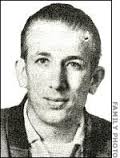
Richard Speck
The psychological background of the sixties as exhibited by the second rock generation from 1938 to 1945 is a major manifestation of an effort begun back in the WWII days. It is the realization of the theologico-metaphysical notion of what Sigmund Freud dubbed the Unconscious. As the quote opening this essay indicates the sixties was the undoing of the several hundred year effort to realize the conscious. We thought we’d seen enough of the unconscious to last much more than a millennium. As the effort was begun before the awareness of the nature of the Un or subconscious the effort was achieved as Mr. Meehan states by the repression of sub-conscious motives not their elimination.
Freud quickly discerned this and he understood the function of dreams that he called the ‘royal road to the unconscious.’ Thus the motto he appended to his volume The Interpretation Of Dreams published appropriately in 1900 is ‘Flectare si nequeo, Superos, Acheronta movebo.” which translated means ‘If I cannot deflect the will of heaven I shall move hell.’
Freud interpreting the conscious mind as heaven chose to deemphasize consciousness in favor of his vision of the unconscious that he interpreted as Hell. Thus, you will find almost nothing in Freudian psychology referring to the conscious mind while he enthrones his Unconscious as the moderator of the human mind. He actually believed that the Unconscious was an agency separate from the body. In theological terms it had a supernatural existence. Thus, he has negated consciousness, or Science, in favor of Religion. As he has rejected God or Heaven then it follows that he embraced Satan and Hell.
As the sixties progressed the generation abandoned consciousness embracing unconsciousness. Time Magazine proclaimed in 1966 ‘God Is Dead’ while Satanism came alive, indeed according to Ira Levin in his novel, Rosemary’s Baby, Satan’s son, Andy, was born in 1966 just as God died. Levin continued his story in 1999’s Son Of Rosemary. Interesting.
It is no coincidence that Freud was both a druggie and a homosexual. Now, the royal road to free the mind of consciousness or Heaven is an obsession with sex and the free indulgence of drugs especially Freud’s favorite, cocaine backed with a pounding jungle beat. Eh voila- the sixties.
Sex, drugs and the hypnotic jungle beat of Rock and Roll. The sex was facilitated by the introduction of the birth control pill and anti-biotics; the amusing Shel Silverstein sang of Penicillin Penny who always had VD. If the girls took the pill both they and their boys were freed from the fear of pregnancies while the ga-ga types had no fear of Venereal disease because the cure was quick and easy by a regimen of anti-biotic pills. Almost paradise here and now and on Earth. For less than a buck you could get a nice big piece of pie too.
Freud had achieved his goal; he had overturned Aryan society.
Freud essentially by fraud allowed us to indulge forbidden appetites and responsibility from forbidden acts, for after all as the conscious mind had no authority and the will of the unconscious was unresistible we had no responsibility for our acts- If it felt good, we did it, as the mantra was. Hence by 1966 we had Richard Speck killing all those nurses in Chicago and Charlie Whitman up his clock tower at UT blowing away his fellow students. Guns aren’t the problem; Freud is the problem.
Hell, Dick and Charlie just wanted to be free. Indeed, freedom in the freest of all societies became a problem to the generation.
Sally Banks in her Greenwich Village 1963, Chapter 5, appropriately titled, Dreaming Freedom, explains her views on what being free actually meant to her and a very large part of the age cohort. She is writing from New York City.
In 1963 freedom was a vital political issue charged with artistic consequences for both the mainstream and avant-garde. Part of the avant-garde’s utopian vision was that liberty could be found within community. But, in fact, the very concept of freedom sets autonomy and the notion of individualism in conflict with the bondedness of community. For social life is a potent source of restraint [suppression of freedom], yet, paradoxically, total freedom would mean the humanly unrealizable (and unbearable) state of complete isolation. Thus there is a deep ambivalence in Western culture toward freedom and social life. The dream of community, itself, may be incompatible with the dream of freedom, a contradiction the avant-garde sought to discover.
The Sixties artists constructed an art that re-imagined daily life in terms of achieving both liberation and community. If such a situation proved illusory, in 1963 it seemed necessary- and it still seemed possible given the booming economic infrastructure- to find a model that would make these imaginings concrete.
Yes, people wanted total freedom- that is a disconnect from the reality of having to deal with unpleasant facts- free from all restraints including gravity and mostly free from themselves. The drugs seemed to serve as those releases. Under the influence people could imagine themselves as someone else who ‘really had their shit together‘, miracle men and women able to leap tall buildings in a single bound, move mountains with the wave of a hand, fly through the air like a host of angels but they inevitably came back down where if they were anywhere near a mirror they could watch their bodies disintegrate.
Freedom from reality has its price.
So, the sixties that began with such ‘High Hopes’ to realize ‘The Impossible Dream’ of Camelot began to crash in 1966 just as like a flash of lightning in the sky the realization of those dreams seemed to dawn. As Lewis Carroll said, be careful that your Snark is not a boojum, for you see….
7.
The Truth Is No Defense
The sixties, then, was when the impasse between the Scientific Method came into its latter day conflict with the Theologico-Metaphysical mindset. The T-M system is merely a mental state that not only does not require objective validation but positively rejects it in favor of subjectiveness; what Freud called inner wishful thinking.
While the sciences of sociology and anthropology and biology produced irrefutable, by logical methods, results that ran counter to the inner wishful T-M thinking, as there were no means to refute the scientific results the T-M people merely denied them and forced scientists to suppress their accurate but uncongenial truths.
To ensure that the truths were suppressed and remained suppressed the T-M partisans passed laws making it criminal to express these truths. These laws called ‘hate’ laws were then applied to any who spoke these truths. As the truths were undeniable T-M partisans corrupted the law, common sense, and, one might say, the will of God to declare in a court of law by the judges that ‘the truth is not a defense.’
The truth is not a defense! Think about it. Such a rule of law is the triumph of absolute criminality and ignorance. And this happened during the watch of an age cohort that claimed to love freedom and revolution. Well, it was a revolution, one that enslaves the mind.
Now, in a position to punish those who disagreed with them the beneficiaries of the T-M mentality were able to enshrine their will as the law of the land. As the law was no longer concerned with the judgment of facts as evidence but the religious beliefs of the T-Ms the US at that point turned into a theocracy. The religious left became an established religion running counter to the old dispensation of the Constitution in favor of something not yet codified and something not approved by the former electorate that now became passive and an ineffective annoyance to the new slave masters.
8.
The ruling social ethos in the US when the sixties dawned was the theory of the Melting Pot formulated by the Jewish writer Israel Zangwill c. 1900. According to that theory that had nearly the effect of a law all the disparate social elements forming the population of the US would fuse into one people of uniform American belief.
In 1960 or thereabouts the new theory of multi-culturalism was introduced which stated that each culture should have an autonomous existence. This was the dream, wishful thinking, of the wannabe Jewish Autonomous people. Nothing new, it was their age old dream. Thus the body politic of the US as a matter of principle was fractured into many warring cultures.
While the Melting Pot had always been a fantasy having no real existence in fact multi-culturalism was alive and real and exacerbated in 1965 when the immigration act was reformed allowing unlimited immigration to all the peoples of the world. And if they didn’t come willingly members of the T-M mentality went into the actual jungles of Africa, dragged the natives out, put them on a plane, free fare, and flew them to the US.
What can one say to such zaniness.
The whole notion of freedom advocated by the age cohort was thus negated. Dozens of laws were passed giving these ‘immigrants’ precedence over the rights of the native population, depriving the natives of equal rights. This is a true story. Incredible but true.
9.
And lastly, for this essay we come to the complete overturn of reason in favor of a comic book utopia and the installation of an age of inner wishful thinking caused by the introduction of drugs as a mass phenomenon.
Drugs in the sixties were nothing new. Drugs begin to show up in literature during the nineteenth century Romantic period. Thomas de Quincey’s Confessions Of An English Opium Eater is the first famous confession or novel on the topic. Opium was much used in Victorian England as an ingredient in Laudanum which was given to infants to make them stop crying.
Opium was further reduced to morphine and then heroin. Freud is famous as the promoter of the joys of cocaine, synthesized from the coca plant. As chemistry developed, synthetic chemical drugs such as amphetamine began making their appearance at the end of the century.
Drug labs were busy and soon creating drugs that attacked any area of the brain. LSD was discovered in 1938 and popularized after 1943. Drugs like Miltown and other tranquilizers began filling women’s purses after 1950. Pot and hash had been simmering below the Hot 100 for some time but moved up the charts after 1960. So the whole pharmacopeia was available as the decade began. New formulas would be discovered in the following decades as drugs became part of the entertainment industry.
Drugs of course suppress the conscious mind exposing the raw wiring of the user. They also lower resistance to hypnotic influence. Hypnosis is merely a heightened sensitivity to suggestion. A drugged out population can be swayed by propaganda as no other, which is merely suggestion by another name, in any direction. They can be swayed but you mist control the means to do so. The mass media was the means, namely TV, Movies and records, and it was in the control of Jews with their special agenda.
Thus Movies, TV and Records propagandized a pro Jewish revolution agenda along with its subordinate Negro revolution agenda.
It is strange how all trends worked to favor the Negro/Jewish agenda. Of course, Jews had been instrumental in breaking down Aryan resistance to Negro music. Jewish DJs such as Alan Freed and Cousin Brucie along with Jewish song writers such as the hugely influential Leiber and Stoller and Goffin-King led the assault.
The songs they wrote were performed by Negro artists. While the Jewish song writers were not so familiar with Aryan culture as is supposed it was enough to bridge the Aryan-Negro gap making the Negro performances potable while paving the way for Barry Gordy’s Motown label.
As of 1960 there was virtually no one who listened to or was familiar with Negro Blues. The Blues was

Robert Johnson
brought forward by the British Invasion who apparently listened to that crap. I am always astonished by White Blues artists citing Robert Johnson as a source. There was nothing available by Robert Johnson until 1960 when CBS released its first collection that virtually no one bought. The second collection was released in ‘62 with the same result.
I first heard of Robert Johnson in 1968 when I owned a record store. Many people talked about the Blues but when I started a first rate Blues section the records remained untouched and unsold. I doubt that I ever had a Robert Johnson sale.
I was in a university town and when such Blues artists as Lightning Hopkins were brought to town the ‘séances’ were held in someone’s living room with maybe fifteen people attending, ten of which were girls worshipping blackness. Nevertheless White Blues was popularized by the British, spreading to American performers.
I should point out that White performers of the forties and early fifties such as the Singing Cowboy Gene Autry sang many Blues based songs. Autry’s song The Yellow Rose Of Texas is of course about a Negro woman, high yellow.
By decades end the cohort’s fascination with exaggerated notions of freedom and revolution had turned into drug addiction and violence. By the late sixties looney tunes like Bomber Billy Ayers and his female side kick Bernardine Dohrn with their Weatherman organization and the Jewish Defense League and its offshoot the Jewish Defense Organization were killing and bombing at will and furthermore they would get away with it. ‘Free as a bird and guilty as Hell.’ as Bomber Billy Ayers would put it.
So by the end of decade ending with the Caped Crusader, Mick Jagger, at Altamont a comic book vision of reality had triumphed over the real thing. Who can forget Mick Jagger mounted on a giant inflatable cock on stage before sixty thousand people. Now, there was a comic book fantasy. Two and two added up to any number you wanted.
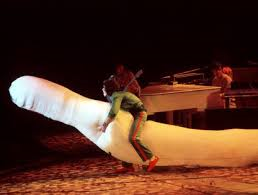
Ride ’em High Mick
Chap. 7: Marianne Faithfull: Faerie Queene Of The Sixties
January 27, 2013
Marianne Faithfull: The Faerie Queene Of The Sixties
by
R.E. Prindle
Chapter 7
We skipped a light fandango
Turned Cartwheels across the floor
I was feeling kind of seasick
But the crowd called out for more
The room was humming harder
As the ceiling flew away
And so it was that later
As the Miller told his tale
She said there is no reason
And the truth is plain to see
That her face at first just ghostly
Turned a white shade of pale.
–Procol Harum

Marianne A Few Years Back
Now in 1968 both Mick and Marianne’s life were rolling by while both were teetering on the edge. Shortly after Godard’s filming of Sympathy For The Devil in June Mick was signed by Donald Cammell for the lead role in his film Performance. The invitation to star didn’t come from nowhere. There are many links from Mick and his friends to Cammell. Cammell was already known to the Stones having met them in 1965 at the time of the Paris Olympia shows. He was naturally first attracted to Brian Jones but then found some kind of love for Mick. Over the subsequent years he formed many projects that he offered to Mick. As Mick’s asking price was a million or more the projects did not pan out.
Not only did Cammell know the Stones but his live in the Parisian model Deborah Dixon had had a menage a trois with Anita Pallenberg. She had moved on to Brian Jones, passing on to Keith with whom she was living when the movie was shot. She had also viewed and/or worked on the script with Cammell a year previously so she knew that she was playing opposite Mick in advance. She then, was well aware of what the movie entailed.
In addition Cammell knew Robert Fraser and Chris Gibbs while being involved with the American

Donald Cammell
Satanist Kenneth Anger. Anger was himself a disciple of the arch Satanist of the Golden Dawn, Aleister Crowley. Cammel’s father had known Crowley reasonably well while Cammell himself had at least seen Crowley live. His father even wrote a biography of Crowley, so let’s just say that the sex magic of Crowley and his Golden Dawn played a prominent role during the filming.
Mick would have brought his knowledge of The Master And Margarita to the proceedings. He may have persuaded Cammell to read the book or perhaps as a Satanist Cammell had already read it.
Marianne who had become pregnant perhaps in January or February was sent to Ireland during the filming so as to be out of the way for the sex stuff where she became distraught. She was giving herself and was being given a psychological beating that was disappointing all her expectations leading her into a deep depression. This was furthered along when she had a miscarriage at eight months losing the child. I would imagine the miscarriage was the result of the stresses Mick had placed on her by sending her away along with his sexual misconduct. It may have been her own subconscious rejection of Mick that caused her to subconsciously refuse to have his baby.
Thus as 1968 drew to a close as the Stones recorded their Satanic Majesties Request album Marianne was trying to recover from her miscarriage and put her life in order. She probably ought to have left Mick at the time but as she tacitly admits in an interview video on You Tube the reason that she went with Mick was because her own royalties were dropping and she had gotten used to the money. Mick was a source untapped. I think that this is an underlying cause of her anguish. Nineteen sixty-nine would be a traumatic year for all concerned.
2.
What To Do About Brian?
Marianne was a sentimental girl who formed sincere attachments to the people of her world. Thus Brian was not just someone on the scene but one might say a part of Marianne’s life. She cared for him. As we all know Brian Jones was the actual founder of the Rolling Stones. He named them and gave them their original musical direction. He held them together during the early stages. Naturally he considered himself their leader. He was actually a much more charismatic figure than Mick. While Mick was wiggling around all eyes were on Brian. There was just something about him.
This aroused Mick’s jealousy who once stated that the lead singer was supposed to be the center of attention. Mick also had the most powerful personality so that while he may not have been the leader he made himself the director. And then he and Keith shifted the direction of the music. While never a fan of the Stones I found myself reviewing the albums when I began writing of the group. My original opinion was only confirmed.
It became immediately apparent that Oldham’s first recordings done necessarily on the cheap were not good recordings, four track on primitive and worn equipment. While Brian and the Stones thought they were doing a good job imitating American Negro rhythm and blues it’s actually not even close. Mick makes a terrible imitation of a Negro blues shouter while its painfully obvious that the music doesn’t come close to the original. It’s so far off that it might as well be an original genre while being very close to a garage band.
Perhaps Mick who thought it impossible for an English band to pass themselves off as authentic was right to change the direction of the band to Negro influenced Rock and Roll. Brian was probably too close to his aspirations to know how far from the mark they were.
The original tunes are somewhat better but the inspiration for those soon ran dray so that by the 1966 and ‘67 albums Aftermath and Between The Buttons the band was quickly approaching the rocks. The West Coast fans were disappointed by both albums and, quite frankly, they’re not listenable today. As the albums veered toward English music hall Brian was quite right in thinking that they had abandoned his original intent. The 1968 Their Satanic Majesties Request, intended to be psychedelic in imitation of the Beatles Sgt. Pepper’s wandered off to a musical somewhere although one can sense the transition from the Old Stones to the New Stones of Beggar’s Banquet.
The cover of Satanic Majesties must have really sickened Brian as it had the boys dressed up in some sort of magician’s getup. A long way from Negro rhythm and blues.

Mick by Andy
Mick’s conception of the band judging from the current situation was always himself, Keith and Charlie. Bill Wyman, the bass player, being several years older was always an awkward fit. Mick marginalized him as much as he could until Wyman finally gave up terminating his role in 1993. So, was Brian forced out? Of course.
Andrew Oldham who promoted the Stones to a prominence far beyond their then abilities was the first that Mick pushed away in 1967. As a parting present Oldham turned them over to the American Jewish pirate, Allen Klein. As Oldham owned the masters to the Stones catalog he sold it lock stock and barrel to Klein who then legitimately owned them much to Mick’s chagrin.
As Brian was being marginalized by Mick, losing control of the band and its direction his behavior became erratic while he also sunk in the haze of drug addiction. It became obvious to the casual viewer of him on stage that his days must be numbered. On the Ed Sullivan show in the US he could barely stand on his feet but everyone was watching him placed back in the shadows by Mick.
Mick and Keith continued their petty harassments until Brian became a shambles of himself. After the Redlands bust the police turned their attention to Brian who hadn’t the emotional resources to bear the burden. It then in June of 1969 that Mick and Keith advised him that he was no longer in the band.
Brian either drowned in his swimming pool on the night of 7 July or was drowned. There is controversy over his death that may never be conclusively resolved.
Marianne, who by 1969 was not in a healthy sate of mind, was herself sinking into drug addiction, actually becoming a heroin addict, watched these proceedings. She was shocked by Brian’s death. And this came on top of her other woes. But life goes on. It is always painful when death removes a loved one from the building but painful or not the sun does not stand still in the sky nor do the bills stop coming in. Life goes on without missing a beat and you better had too.
So, Mick had movie offers coming in. Both he and Marianne as reigning pop couple were signed to do a movie in Australia. Ned Kelley an Australian bandit. In the 1840s when plays and books began celebrating former outlaws, highwaymen and crooks they were called Newgates after the equally famed Newgate Calendar of criminal trials. This would be a sort of Newgate movie.
Less than a week after Brian’s death Marianne and Mick arrived in Australia to begin their commitment; after all they had signed well before Brian’s death. Psychologically however all of Marianne’s misgivings were adding up to a heavy burden. While the reasonable approach may be that life goes on not everyone is so reasonable and I suspect Marianne was one of these. Perhaps, too, she realized that she and Mick were becoming estranged. Mick’s history was beginning to become apparent; his abominable treatment of women, Chrissie Shrimpton, of Oldham, of Brian; perhaps she began to wonder if she were next. While Mick may have had justifiable reasons for Oldham and Jones they may not have been that apparent to Marianne.
Certainly Brian was on her mind when the place touched down in Sydney. Exhausted by the long flight she and Mick checked into their hotel. Mick promptly flopped down on the bed to doze off. Marianne troubled in mind picked up a bottle of Tuinals and perhaps in a hypnoid state of grief and confusion dropped a hundred forty of them. Wow! That must have taken five or ten minutes. Shows determination. Who would do that if they weren’t serious about suicide.
For whatever reason Mick woke up and probably groggy himself scoped the situation. He rushed Marianne to the hospital for medical attention. But Marianne had overloaded her brain, she lay in a coma for six days.
The last thing on her mind before she suspended animation or slowed her synapses to a crawl was Brian. Since she was still alive although unconscious synapses must have continued; she must have continued to work on her problems, the anguish that had caused her attempt at self-destruction. Thus, when she came to Brian was still on her mind. I quote from her auto-biography Marianne Faithfull, pp.175-79:
By the time we got to the hotel in Sydney I’d forgotten not only where I was but who I was. I looked in the mirror. What I saw was a very thin, frightened face. I’d cut my hair, I was anorexic, and my skin looked cadaverous. I saw someone literally falling apart. Someone with blond hair and looking very scared. In my drug induced stupor I dimly recognized the ravaged face of Brian Jones staring back at me. I was Brian, and I was dead.
…At that moment Brian was my twin. I identified with him because he had been a public sacrifice; it was a role I understood.
Quite logically, I thought I was Brian.
It was all very rational in the way these things are when you’re unhinged. I reasoned that since I was Brian and since Brian was dead…(ellipsis in original) I had to take the rest of the pills so I could be dead too.
…The Tuinals were taking forever to kick in, I looked down and saw things on the street that shouldn’t have been there…And then I saw Brian Jones. At that moment I went into a coma that lasted six days.

Brian Jones
When I first spotted Brian he was far below at street level, but greatly enlarged…Various parts of him- his face, his hands- expanded and extended toward me as he spoke, and then he rose straight up as from a shaft of air until he was directly opposite the window of our room.
…He beckoned to me the way spirits traditionally beckon to mortals in the movies. I passed through the plate glass and found myself outside. But instead of standing suspended above the street, I was now in an unstable landscape that pulsed and shifted as we spoke. I had I assumed gone over to the other side.
The grandeur and enormity of the place had the phantasmagoric mood of illustrations by Edmund Dulac or Durer engravings of Hell. As we were walking along, I realized that Brian had no more idea of where we were going than I did. Obviously he had woke up dead, not known where he was and decided to call for me!
It was the nicest chat I ever had with him, actually. He told me how he had woken up and put out his hand for his bottle of Valium, and about the panic that seized when there was nothing there. He said he had been lonely and confused and had brought me to him because he needed to talk to someone he knew.
We strolled blithely along as the quivering earth crumbled away on either side of us, and he told me about the miniature coronation set with Beefeaters and the coach and horses. He said he like books about railway bridges, guides to switching boxes, George McDonald’s fairy stories and Fox’s Book of Martyrs.
…Afterward he became weepy like the Mock Turtle in Alice In Wonderland and said he was sorry to have put me to all this trouble. He didn’t seem to know he was dead. I’m sure this happens frequently…They don’t know where they are. Hence ghosts.
…’Brian, Dear, isn’t this lovely, I said, trying…to distract him from grisly realities. But my sudden descent to small talk must have tipped him off that something was wrong. I was speaking to him in the patronizing way people talk to mad people, children and small dogs. Nevertheless, he plunged ahead in typical Brian fashion.
“Death is the next great adventure.” he said portentously. This something I used to go around saying myself, so I nodded wisely.
“Oh, yes, I quite agree,” I said fervently, as if we were speaking of a new religion. Or a new drug.
…”Welcome to death!” he said brightly.
…”Oh, is that where we are?” I asked.
…We came to the edge of the Dulac landscape. It dropped off abruptly and completely. There was a very obvious point where you chose to go over the edge or not. Brian said, “Coming?” and slipped off the cliff. I drew back. I heard a chorus of voices calling to me, but I wasn’t ready just yet.
Getting back took a long time. I was stranded in a desert town. The color had been drained from everything. The houses were empty. I was in Albania! Wandering down long deserted streets with names like the Avenue of the 17th October. Looking pretty incongruous, people I knew floated by (their feet didn’t quite touch the ground.) I called out, but they hurried past as if they hadn’t seen me.
I was lost in an airport. People came up to me and asked me the sort of questions you ask a child stranded at a railway station. “Are you lost, dear?” “Do you know your name?” And I would answer, “I’m waiting for Mick to come and get me.”
This was obviously the crisis of Marianne’s life. She associates her life with the desolation despair of Brian’s. She must have had the fate of Chrissie Shrimpton in mind, who Mick had crushed so completely. Mick had treated Chrissie and Brian in much the same way. Certainly Marianne could see the same fate for herself on the horizon. So now in an attempt to escape she slips into a Tuinal coma. She doesn’t explain what medical procedures were used to sustain her but she maintained mental activity throughout the coma.
Essentially the first half of her coma is a near death experience and a pretty interesting one. Wonderful, wonderful story; I could have stood another dozen pages. I’m sure she could call it up if she wanted to. I’ve had a couple near death experiences myself. They really leave indelible memories as this has done for Marian. It is possible to relive at any time you choose. I can run both concurrently through my mind.
Marianne’s problem at this time has been building since 1964 when the the life she living came into conflict with her youthful ideals obtained in the convent school. In those years she was much influenced by the chivalric literature of King Arthur, especially the quest for the Holy Grail.
Now, only the pure of mind and body, I. e. virginal, can ever hope to experience the Holy Grail. It takes only one sexual encounter. Even the great Lancelot who was tricked into a sexual act by Elaine forfeited the Grail even though he was innocent of intent. In chivalric terms Marianne was way beyond any hope of redemption. She must have known that. Thus the earth heaved beneath her feet and crumbled away beside her.
Having left Brian at the brink her way back was through a desolate wasteland of colorless desert. Thus, all hope had been lost. Her awakening must have been bleak, as her life would soon become.
She doesn’t mention the Arthurian fairy tales by name but she does recreate a dream landscape from the fairy tale illustrations of Edmund Dulac. (coincidentally Edmund Of The Lake). It is possible that she also confates Dulac with Arthur Rackham, another famous illustrators of fairy tales and also King Arthur.
Marianne also references other of her formative reading bringing in Alice In Wonderland, quintessential for the druggies of the sixties, plus George McDonald’s fairy stories and significantly, Fox’s Booke Of Martyrs. Very good browsing by the way as is Butler’s Lives of the Saints which is terrific.
I wondered if Brian liked books about railway bridges and the surprising guides to switching boxes? There can’t be too many of the latter so ‘switching’ may have a different reference point. It may mean switching horses in mid stream as Marianne said to Mick when she opened her eyes: Wild horses couldn’t drag me away.
The landscape ‘pulsed and shifted’ which may refer to her emotional instability. The Allman Brothers had a great line in one of their songs; See that clock up upon the wall? Rushing tides could make it fall. So possibly she could feel the ground moving out from beneath her feet.
‘He said he had been lonely and confused and brought me to him because he needed someone to talk to someone he knew! Sounds like Marianne is reversing the situation as it was only possible that she brought Brian to her reinforcing the similarity of their situations vis-à-vis Mick.
Then some more chit chat and Brian passes into the Great Beyond while Marianne stands on the brink at road’s end. Great story. I know where that’s at. In one of my experiences my heart stopped and I was standing in a huge empty concrete bunker type thing wondering what to do next. I dead no problem with being dead but I had no instructions what to do next. ‘Oh, well..’ I thought and turned to my right to start hoofing it when my heart started up and I was back in bed.
Obviously for Marianne her medical crisis passed and she was to return to consciousness. But then getting back took a long time. The first part of her fantasy then my have lasted a day or possibly two while reconstructing her nervous system took a little longer leaving room for mistakes that she feels might have occurred. She has obviously began to come to in her post-singing career with its overwhelming challenges that she wasn’t able to successfully deal with. The Avenue of the 17th October sounds as though it may be the Bolshevik October Revolution, if so she got the date wrong, it was the 25th not the 17th. She is obviously returning in a depression. I can dig that, too.
Marianne’s own brief interpretation of her experience is on p.178:
In anguished relationships like the one I had with Mick; it’s much easier and more satisfactory for all concerned if the one playing my role dies, after which I could turn into a sainted mythical figure- like Brian- and no longer be a threat to anyone and- more importantly- no longer be a bother to anyone.
They martyred Marianne…thus Fox’s Book Of Martyrs.
Marianne knew she had come to a turning point in her life or, rather, a dead end. She could no longer rely on Mick, he was a weak reed, a failure as the man he posed to be. At this time she chose to renew her acquaintance with her father at his sex shop who she says was a man Mick could never hope to be. Thus, goodbye Mick. She had been financially dependent on him and having known money liked it. Why not? But she was in no position to make money or at least sufficient money. Royalties of a diminished sort would keep coming in. There was seldom a year that went by that something wasn’t released in her name although she wasn’t recording. As she says Oldham had a re-release of her greatest hits edged in black on the streets before she recovered.
But she would have to record again, perform again for any real money. It was not possible to return again as the Virgin Queen of yesterday. As she was part of the myth making period she would always be the Faerie Queene of the sixties, she was secure in that position, but with four tarnished wings. She sank into a deeper depression finally ending up sitting on her wall above the bomb pit, thinking what to do next.
Her resurrection, such as it was, will be the topic of Chapter 8.
Pt. II Edgar Rice Burroughs And The Accreted Personality
March 14, 2012
Part II
Edgar Rice Burroughs And The Accreted Personality
by
R.E. Prindle

Time may fly but life seems long. Long enough for circumstances to alter your personality more than once. Consider for instance the National Guardsman secure in job, wife and family who is jerked out of his ideal existence to take a tour of duty in Iran or Afghanistan, foreign wars which betray the promises of his enlistment which were to defend his home state. Do you think a personality change didn’t occur when he received his notice? If he was kept in for several tours of duty over a period of years so that his former existence doesn’t appear to him as a dream that took place in a parallel universe? And if he comes home without an arm or a leg or, perhaps, both, that he doesn’t suffer from reminiscences or have a dual or multiple personality. You can bet he does. Nor does your life have to be as hard as the National Guardsman for your own personality to acquire personality accretions over your lifetime, all of which are stored in your mind and may be reassumed at any time.
As I said in the first part, these various existential states don’t disappear, they become part of your reminiscences whether suppressed or remembered and as possible fixations or idees fixe they influence your daily actions.
So now, let’s turn to the life of Edgar Rice Burroughs to illustrate the idea of the accreted personality. Psychology is simple if you don’t make it complex by mystifying it. I hope I can make Burroughs’ story clear without unnecessarily complicating it. I will try to use Occam’s Razor judiciously.
Edgar Rice Burroughs, who would become very famous as a fiction writer, entered this world of pain of pleasure on September 7, 1875 in Chicago, Illinois. He was parented by George T. and Mary Burroughs, he of Anglo-Irish ancestry and she of Pennsylvania Dutch, that is say, German. Eddie always considered himself pure English at a time when being English meant something, a much depreciated coin these days.
George T. was an upright man who had been an officer on the Union side in the Civil War a scant ten years previously. George Custer had not yet gone down at the Little Big Horn nor was Sitting Bull yet starring in Buffalo Bill’s Wild West. George T. had two other sons, George and Harry, who were born just after the Civil War.
George T. was a whisky distiller while at this time the Whisky Trust was coming into existence. George T. was an independent sort who needed the Trust less than they wanted him. I don’t say the Trust was responsible but George T. was burned out. Chicago loved a good fire.
The relationship between Ed and his parents was not a warm one. His father made his life difficult, seemingly on purpose, while his mother seems to have been rather cold. Burroughs seldom mentions her nor were any of his characters named Mary, or George for that matter.
Nevertheless, born into a world of creature comforts with high expectations in a fine house on Chicago’s West Side with two Irish maids Ed began life in a happy state of mind walking down the street singing Zippity Do Dah or the equivalent. He stayed that way for about eight years until his first personality changing event occurred.
Eddie attended Brown School in his neighborhood. I haven’t been able to find out much about Brown but the schools stands out as special in Ed’s mind. The school had several prominent graduates one of which was the showman, Flo Ziegfeld. As Ziegfeld was Jewish it is quite possible the school was close to Maxwell St. Maxwell St. would figure prominently in Ed’s later novel, The Mucker.
One day when Ed was eight he found a big twelve year old Irish kid by the name of John belligerently blocking his way. It isn’t known whether he was walking with future wife Emma Hulbert or not but I suspect he was. At any rate John threatened to beat him up. Thoroughly terrorized Ed took to his heels and as he did so several suggestions entered his terrorized mind. To be in terror is to enter a hypnoid state in which all ones psychic defenses are lowered or discarded. Suggestions are easily fixated in your mind. Thus at the age of eight Ed’s original personality was submerged, he assumed his central childhood fixation. Not only was he emasculated on his Animus but, perhaps because he shamed himself in front of Emma, he transferred his Anima to John; he then set up John as his ideal of manhood wishing to be just like him.
The result was that John became his favorite name. In his future novels he named a disproportionate number of characters both good and bad John. His two key characters were both named John- John Clayton, aka Tarzan Of The Apes and John Carter of Mars. Both have the initials JC referring to Jesus Christ, one supposes. Thus on the masculine side their names commemorate John the Bully while on the feminine side Jesus Christ. Ed also wore a book under the assume name of John McCullough.
As Ed was shamed by running, defenses against cowardice are liberally sprinkled throughout his works with justifications for the advance to the rear maneuver, or running.
Particularly troubling to him was the occupation of his Anima by a male. Probably not very usual but given the limited range of responses available to humans, probably not that uncommon. But this result of the fixation was particularly troubling to him appearing in a succession of his initial output of the ‘teens.
The clearest exposition of the results of this fixation was reproduced in the pages of Ed’s second novel, The Outlaw Of Torn. The hero of the novel is a boy of Ed’s age on the street corner, who is the king of England’s son c. 1400 AD. The King has a quarrel with his fencing instructor, De Vac, who then avenges himself by kidnapping the son, Norman.
The scene is that Norman is playing in the garden under the watchful eye of his nurse/Anima when De Vac appears outside the garden gate- I. e. Ed’s mind- luring Norman to him. Norman has passed the gate when his nurse who had been chatting with another woman notices. She rushed through the gate where De Vac struck her dead. Thus his Anima was outside Ed’s mind when she was destroyed.
Now, this is the replication of a dream story. The meaning is that Norman/Ed was safe inside when De Vac/John caught him, as it were, with his pants down, killing and assuming the role of his Anima. The nurse represents his Anima or right brain which was then disabled.
So, as an eight year old boy Eddie has an emasculated Animus, left brain, and destroyed or shattered Anima, right brain. This has to be dealt with in some way so he can carry on and survive.
What Burroughs does then is create a myth to repair the damage as well as he can. De Vac now on the run with his prize who he must conceal takes Norman to a three story house in the slums of London built on stilts out over the water of the River Thames. The two live in this attic/mind for three or four years. During this entire period De Vac is dressed as an old woman. So, here we have the emasculated Animus combined with the dead Anima with the waters of the feminine flowing beneath the house, I.e. Burroughs’ self.
The two live this way for three or four years, Norman never leaving the attic. At the end of this period De Vac dons men’s clothes and takes Norman to a ruined castle in the Shires. The remarkable thing about this castle is that on one side, the right side, the roof has completely fallen in, can’t be used.
The interpretation is that Ed so identified himself with John that he had to put his own life on hold until he turned twelve, the same age John had been. At that point he recovered or began to recover some control of his Animus while his Anima remained destroyed.
De Vac then began to train Norman in the manly arts to be a killing machine to attain physical vengeance for De Vac on the King.
One can’t be sure of what effect the encounter had on his personality but the next year after the confrontation his father took him from Brown transferring him to an all girl’s school. George T.’s reason for this was that there was a fever going around and he wanted to protect Ed from it. How one would be safe from a communicable disease in a girl’s school isn’t clear so perhaps Ed’s father had another reason.
In Ed’s psychological state it is not unlikely that he went into a fairly serious depression while emasculated and crippled he may have become very effeminate. The placement in the girl’s school may have been one of disgust and to teach the boy a lesson to act like a man.
The humiliation on top of the emasculation was difficult for Ed to bear. He pleaded and pleaded to be transferred from the girl’s school. His pleas were heard although his father didn’t send him back to Brown but a couple miles across town to Chicago’s Harvard Latin School where Ed stayed through what would have been his Junior High years. During this period, the date isn’t clear, Ed fell off his bicycle banging his head against the curb; it isn’t known whether it was the right or left side. This left him dizzy and walking round in circles for three or four days, then the obvious effects disappeared. George T. then jerked him out the Latin School and sent him West to his brothers’ cattle ranch in Idaho. He doesn’t seem to have attended any school for the year he was in Idaho. However he learned to be a cowboy and had a great time.
Even without school the period was not without intellectual stimulation. George and Harry Burroughs were graduates of the Sheffield Scientific School attached to Yale University but not yet integrated with it, along with their partner Lew Sweetser. Sweetser was a fairly remarkable guy deeply interested in psychology when the subject was just beginning to assume its modern form.
William James had just published his two volumes on Psychology but I haven’t been able to discover who Sweetser’s teachers may have been at Yale. Departments of Psychology were rare at American Universities in the 1880s. However, as Sweetser apparently studied whatever psychology was available it seems certain that he would have been at least aware of Charcot’s experiments at the Salpetriere that were world famous. It is also clear that he was familiar with the idea of the sub- or unconscious. However much Ed may have retained, as he himself was relatively well informed on psychological matters when he began writing the foundations of his knowledge were probably formed at Sweetser’s knee.
Having left Ed in the wilderness for a year, George T. then moved him to the East Coast to Massachusetts’ Phillips Academy. Ed was now being moved around almost with the frequency of a military brat with its devastating personality consequences. Having consorted with a rough bunch of fellows for a year, Ed was now in an elite school without a great deal of preparation.
He was in Idaho at the end of Wyoming’s Johnson County War when the big ranchers squeezed out the small ranchers. Many of the small ranch soldiers whose shootings were classified as murders had fled to Idaho where Ed knew one or two; from the company of murderers, or killers at any rate, he was now in with a bunch of elitist schoolboys.
When his brothers had attended Yale their father had refused them an allowance that would have allowed them to associate with their richer school fellows as equals. If he continued the practice with Ed at Phillips then an extra burden was placed on the kid that would help explain his behavior. At any rate he assumed the posture of clown to gain acceptance while neglecting his studies. Naturally he was requested to leave.
Certainly he could have expected to return home and attend school in Chicago but this was not his father’s plan. His father enrolled him at the Michigan Military Academy outside Detroit billed as The Paris Of The West which is most laughable. This was the second great psychological trauma in his life adding another major accretion to his personality. Ed rebelled at being sent away again.
This was not merely rejection but also a condemnation of him by his father. As Ed saw the situation, with a great deal of accuracy, the Military Academy was just a holding pen for juvenile delinquents whose parents didn’t know how to handle them so they put them away in what was essentially an asylum or reform school where they could get some ‘discipline.’
Ed was horrified at these suggestions about himself coming from his own father. He rebelled at the rejection and its implications. He left the academy to return home or as his biographer Porges puts it, he ran away. George T. wasn’t going to put up with that. He collared Ed and dragged him back to Detroit, told him to stay put or…who can say or what? At any rate crushed and rejected Ed had no choice but to obey, but his mother and father died for him that day, slain by their own hand. Thus when Ed’s literary alter ego Tarzan came into existence in 1912 his parents had been slain by murderous apes and Tarzan was an orphan as Ed imagined himself.

General Charles King, Soldier and Author
Ed stayed at the Academy into 1896 when he was between twenty and twenty-one. He took the Commandant of the Academy, Charles King, as his surrogate father and mother. Because King was a captain in the Army, later a general, Ed decided he wanted to be an Army officer too. It is also noteworthy that King was a successful author of novels which Ed may have wanted to emulate when he too chose to become an author. One of King’s first novels was An Apache Princess while Ed’s first commercial effort was titled A Princess Of Mars.
Ed attempted in vain to win an appointment to West Point but failed. Then in 1896 while serving as an instructor at the Michigan Military Academy Ed foolishly abandoned his post choosing to join the Army as an enlisted man before the school term ended.
By now twenty years old his past with its many personality accretions had formed him. His original personality had been destroyed to be replaced by that caused by John. The accretions accumulated as he was shifted from school to school and West to East to MidWest leaving him dazed and confused while the final accretion of that youthful period was the devastating rejection by his parents all of which left him depressed and fatalistic. The high expectations of his childhood had been completely eliminated. The bright young boy had been transformed into a gloomy young man. But no former personality had disappeared; they all lived on in his unconscious where circumstances could revive any or all at the appropriate moment.
But, one is still alive and one must toddle on. Ed was not lazy or adverse to work. His intellectual interests were vast. He was a great wide ranging reader.
In the next part then, let’s turn to his personality forming accretions from reading and his general intellectual , social and political milieu.
Pt. I: Edgar Rice Burroughs And The Accreted Personality
March 6, 2012
Edgar Rice Burroughs
And
The Accreted Personality
Part I
by
R.E. Prindle

Dr. Pinel Unchaining The Inmates
The post-French Revolution period begins the rapid development of the Aryan mind. The Enlightenment laid the foundation of that development. Shortly after mid-nineteenth century the French astronomer, Camille Flammarion, was able to announce that Astronomy and Psychology would be the key disciplines of the future. The break with the religious consciousness of the past ten thousand years or so would be fraught with immense dangers, dangers which we are still combating.
The social ideology of the present asserts that all people are of the same stage of mental development. This is, of course, absolute nonsense. There are still hundreds of millions if not a billion or two who still maintain a stone age view of the world. Nor are all of them in other parts of the world, a vast number are here in the Americas and Europe. In addition there are billions still enmeshed in a religious consciousness while only perhaps a hundred million or two have actually evolved into the scientific consciousness. Hence we have the terrifically repressive attempted subversion of science by the Semitic religions.
So, it should be clear at first glance that not all people are equally developed or endowed nor are all cultures of the same value.
The French scientist and neo-romantic novelist Camille Flammarion noted mid-nineteenth century that the two most important intellectual disciplines for the future would be Astronomy and Psychology. I think that has proven true.
A major discovery of the century was the notion of the split or multiple personality. A term currently in use is Dissociation. Neither is accurate. I advance the term Accretive Personality. That is one’s personality is made up of many personality variations as a result of growth and experience. In periods of stress it is quite easy to escape oppressive reality by slipping into what is essentially an alternate reality or a parallel personality, if you will.
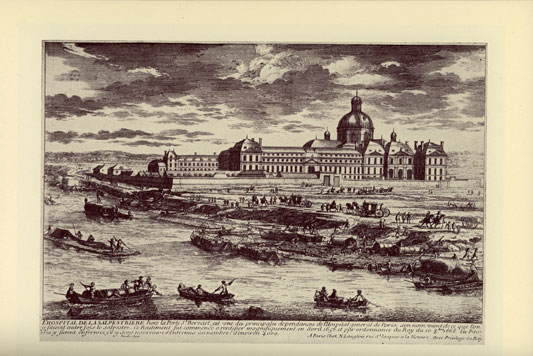
The Salpetriere
This was not a new phenomenon, merely the shock of recognition. In Greek mythology, for instance, when the stress of the mid life crisis hit, the hero went through a period of madness, that is to say he adopted a parallel personality until he was able to reorganize his mental attitude to new realities.
In Europe, under the stress of an insane quasi-Semitic religion in which Satan took a prominent role, it was common for the stressed to become ‘possessed’ by demons or, in other words, to split the personality. That is the person showed a parallel personality. The transition point to the beginning of secular understanding came when Dr. Anton Mesmer matched his secular method of exorcism against the ecclesiastical method of exorcism and won. So one might say that modern psychology derived from the problem of the dual personality- the Jekyll and Hyde effect. However dual or multiple personality was not recognized as such until announced in Jean-Martin Charcot’s clinic at the Salpetriere hospital in Paris in the mid-eighties.
Charcot studied hysterics. Hysterics are dealing with a lot of stress, hence escape through an alternate personality would be an easy choice. Charcot and the Salpetriere aren’t exactly household words so let’s take a moment to explain the situation in which modern psychology was born.
It is also necessary to bear in mind changes in scale. What is good for one stage of growth is not good for another. As the scale of things progresses from tiny to small to medium to large to huge to gigantic new forms have to be adopted to suit the new circumstances. These transition points are difficult to adjust to but once adjusted to are considered so normal that those who resisted the old change are equally resistant to adapt to the next level. Of course the young of each scale is born into it and has no adaptation to make although they will at the next change of scale.
Thus the French Revolution and the Napoleonic Era masked to a very large degree a major change of scale so that after Waterloo a seemingly complete break with the past had taken place. It was a new world in the morning. So in the years leading up to the Great War another change of scale had taken place that masked the new world that popped into place in the twenties. I picked up the concept from that astute observer, H.G. Wells, who noted the emerging change in scale at the turn of the century. That great ship, the Titanic, that went down in ‘12 may be considered as representative of that change.
Thus with the change of consciousness that actually took place in 1795 the new consciousness became clear after Waterloo. Gone was the religious notion of ‘possession by evil spirits’ to be replaced soon by the concept of multiple personality. Thus whereas in the past the insane had been treated as raving beasts, chained to walls and whatever a Dr. Pinel at Paris’ Salpetriere began a more humane treatment with an attempt to understand the causes of insanity. The approach was parodied amusingly by Edgar Allen Poe in his story The System of Dr. Tarr and Professor Fether in which the inmates revolted and took over the asylum.
The Salpetriere was a large compound of several acres with thousands of residents, mainly women from whom the subjects who became the hysterics that the great Dr. Jean-Martin Charcot began to study as a neurologist, as the early psychiatrists were known. The field of Psychology is divided in two. On the one side psychiatrists who must be MDs and who believe mental ailments are biologically derived and hence to be treated medically with drugs or, one shudders to think of it, operations like pre-frontal lobotomy or electric or insulin shock ‘therapy.’ Psychologists, who are PhDs with little or no medical training treat neuroses and psychoses as malfunctions of reason caused by experiential traumas.
Charcot as an MD originally sought biological causes for the hysteria he studied although he was coming around to a psychological viewpoint just before he died in 1893. Thus from being chained before Dr. Pinel released them these women, hysterics, while being confined to the Salpetriere were given freedom of movement within the hospital with its flowers and walkways making for a much more pleasant environment for them and one unobtainable to them on the outside.
Now, the great Dr. Anton Mesmer introduced hypnotism to Europe as a discipline in the years just before the Revolution. Naturally something so new and seemingly revelatory did not find immediate acceptance, indeed, it was treated as nonsense. Nevertheless people of learning, doctors, persisted in experimenting with it. Thus, when Charcot came to be the director of the Salpetriere, to the dismay of his profession he introduced the practice in his treatment of his hysterics and thus legitimized its use. Hypnosis, too, was new and little understood.
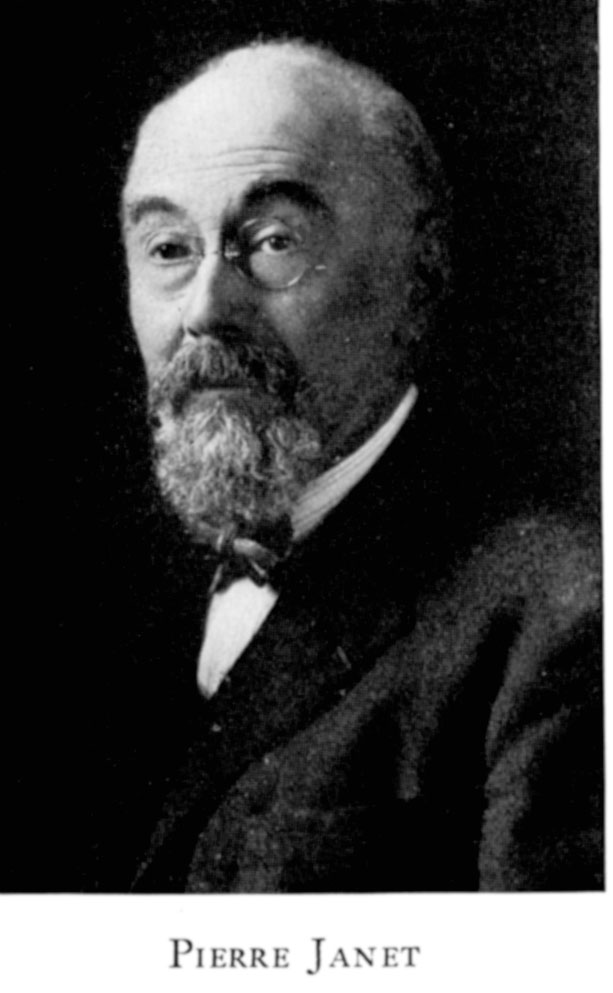
Pierre Janet
The essence of hypnosis is suggestion and Charcot did not understand suggestion. The rival hypnosis school led by Auguste Liebeault and Hippolyte Bernstein at Nancy to the East of Paris was aware of the effect of suggestion but not necessarily the nature of what it was. Actually suggestion is whatever enters the mind and is accepted. If one wakes to a beautiful sunny morning it is suggested to oneself that the day will be a good day. Acting on that suggestion, post-hypnotic one might say, one will try to make the day a great one to hang onto that feeling. The mind is naturally open to suggestion as it must be; in an active mind one can discriminate to some extent as to what suggestions will be accepted and which rejected. Under hypnosis in which the mind has been put into a passive state the ability to discriminate and reject has been greatly reduced so that a hypnotist can plant a suggestion that then becomes what Charcot’s associate, Pierre Janet, called an idee fixe, or in other words, a fixation that will remain in your mind until executed. This notion may be imparted by a human agent, books, movies, radio or any medium that is capable of influencing the mind. One must be aware of this. It isn’t necessary to have a hypnotist standing in front of you saying ‘look into my eyes.’
As I say, Charcot was convinced that hysteria was biological, that is to say caused by a lesion to the brain, so that while he hypnotized his female subjects at the Salpetriere he wasn’t aware of the nature of suggestion.

Marie Corelli
Now, the eighteen seventies and eighties were terrifically exciting at all levels. They did things differently then. As has been said: The past is another country; they do things differently there. The past is never to be judged by current standards although the latter are useful for comparison. Thus when Lister suggested that antiseptics ought to be used in the operating room his suggestion was stoutly resisted although true and nearly universally accepted today. On the other hand Evolution although true is more stoutly resisted today in a religious reaction than it was in the last quarter of the nineteenth century so don’t feel all that superior.
While Charcot was arguing with himself as to whether hysteria was biological or mental, in the mid-eighties two of his associates easily grasped that hysteria was a mental problem. These two were Sigmund Freud and Pierre Janet.
Freud at that time, 1886, was making the transition to psychology from medicine. He was an MD. Charcot was not alone in dealing with mental matters. The understanding of dreams for instance was developing rapidly. When Freud published his Interpretation Of Dreams in 1900 he cited dozens of competent researchers dating as far back as the 1860s. In 1886 alone two novels dealing with the subconscious and split personality were published, Robert Louis Stevenson’s Dr. Jekyll And Mr. Hyde and Marie Corelli’s Wormwood. Corelli cites Charcot as an influence so she very likely had attended his semi-public presentations of hysterics under hypnosis at his hospital.

Sigmund Freud
Going back further, Freud, a German Jew, was undoubtedly familiar with the psychological work of the German romantics. At any rate he spent about four months at the Salpetriere studying Charcot’s work and methods. It is likely that the foundation of his psychoanalysis was laid there. While Charcot was struggling to determine whether hysteria was biological or mental, Freud, himself a neurologist, was able to perceive that, as he later put it, hysterics were suffering from reminiscences. In other words they fixated on past experiences which dominated their minds and behavior.
Pierre Janet, Charcot’s student and associate, came to the same conclusion probably at the same time. He expressed the problem more accurately when he determined that hysterics suffered from one or more idee fixes, that is a fixed idea or, in other words, a fixation centered around a specific past event or events.
Indeed, all the women at the Salpetriere had been battered and brutalized by life with no means of self-assertion or resistance. Unable to express their own will they retreated into ineffective hysterics finally ending up as semi-insane in Charcot’s hospital.
Now, split or multiple personality. No one, especially these women, have the personality they are born with. Over the course of our lives circumstances require us to respond in different ways, sometimes a personality is overwhelmed with a consequent personality adaptation or change and in extreme cases, insanity.
All very well, but what happens to the original and/or various personalities that were submerged. It is impossible for them to vanish from the mind so they must live on submerged by a more powerful personality impulse. Depending on the individual then, everybody must have at least one alternate personality. Stevenson and Corelli were demonstrating this in their novels.
The good Dr. Jekyll had had a wild streak in his youth that he forcefully repressed to become the totally respectable man of medicine. But, he longed for his rough and rowdy days so in Stevenson’s story he invents a potion, I’m sure whisky would have been just as effective, that allows him to free his original personality. In the course of his experiment the earlier personality suppresses the later one assuming control of Jekyll’s mind. Much the same thing happens in Corelli’s novel. Thus we have personality accretion.
Charcot’s hysterics, because of the side show atmosphere the Good Doctor created, became world famous, a sort of show people. Charcot even took them on the road for demonstrations and, heaven forbid, loaned them to other doctors for experimentation.
It was during one such loan in 1888 that Jules Janet, Pierre’s brother, made a startling discovery. He was experimenting on Blanche Wittman, the Queen of Hysterics, when having hypnotized her into what Charcot called the first state, instead of progressing to the second state, he decided to put her into a deeper trance. At that point Blanche was able to dissociate her personality from her normal state to what I assume was her original personality. She turned into a happy effervescent bubbly girl. In other words she had stripped every accreted personality adjustment to return to the period before society violated her womanhood.
One might ask where this personality came from? It is not necessary to assume either the supernatural or the paranormal. The personality did not come from outside her but was merely an early personality that had been submerged and denied existence by repeated abuse. If Jules Janet had pressed on he might have found three, four or more variations of Blanche Wittman. Indeed, when Charcot died in 1893 Blanche ceased having hysterical attacks and became quite normal assuming yet another personality although it was not recognized as such. She then took responsible employment at the hospital until she died under tragic circumstances.
Thus during one’s life one assumes many variations as one’s personal circumstances dictate. And one expresses them in many different ways. As an example of personality accretion I am going to use the history of the American fantasy and science fiction writer, Edgar Rice Burroughs. He has especial value as his biography is well developed and he has talked voluminously about his mental states through his large body of fiction which is all autobiographical in nature.
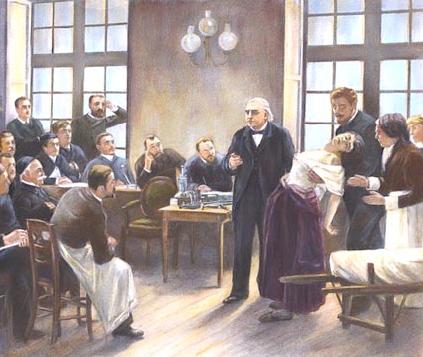
Dr. Jean Martin Charcot Demonstrating Hypnosis And Hysteria
Part II follows.
A Review: Part I, The Prague Cemetery By Umberto Eco
November 20, 2011
A Review
THE PRAGUE CEMETERY
By
Umbert Eco
Review by R.E. Prindle
Eco, Umberto: The Prague Cemetery, A Novel, 2010, Houghton Mifflin, NYC
Part I: Prologue
Little Bags Of Memory

Umberto Eco As Atlas
In this novel Eco attacks the dark subconscious mind of nineteenth century Europe. It was the moment when Europeans discovered the difference between their conscious and subconscious minds. As a historical novel Eco mines his fifty thousand volume private library to construct his story. His sources range from Dumas and Eugene Sue at one end to George Du Maurier and J.K. Huysmans at the other. At this point in history, other than Dumas I presume the other authors are virtually unread if not unknown. Fortunately I have read most of Eco’s sources with my more modest five thousand volume library.
Eco seems to have a very fond spot in his heart for George Du Maurier and I found his treatment of the author most interesting.. Du Maurier was a long time contributor to the English humor magazine, Punch in both text and artworks through the heart of the nineteenth century. The illustrations Eco uses in his novel are very reminiscent in style to those of Du Maurier. Indeed, Du Maurier is very seductive both artistically and literarily. When he was turned down for the editorship of Punch he was crushed, turning away to write and illustrate his subtly fantastic three novels Peter Ibbetson, Trilby and The Martian, the last finished just before his death in 1896.
Like Eco Du Maurier lugged a lifetime of memories, literary and personal through his novels. I’m still working my way through his sources, or favorites at least. Du Maurier was a Bohemian artist in Paris at about the same time as Henri Murger who wrote his fabulous description of Bohemian life, The Bohemians Of The Latin Quarter that was turned into Puccini’s opera, La Boheme. DuMaurier found Murger’s description of Bohemian life repellent to his own sensibilities so he romanticized the nearly same story into the lovely fairy tale of his own version, Trilby. Trilby was a sensation of its time and remains a classic.
Eco has read and thoughtfully considered Du Maurier and while Du Maurier tended to romanticize painful or repellant memories into order to create a fairy tale existence for himself all that sunshine seems to cover a bitter undergrowth. Eco who astutely perceives this was led to parody him in Eco’s own fabulous first chapter of Prague that is a hilarious stand up comedy routine worthy of the mordant, sick humor of Lenny Bruce. Eco then makes his character Dr. Du Maurier the chief of an insane asylum parodying Du Maurier’s Peter Ibbetson while reversing the roles of Ibbetson and the Duchess of Towers in the character of Diana Vaughan. Very nice bit of inside humor on the part of Eco.
While I make it a rule to not recommend books, a rule I often violate, if you’re reading this I presume you’re simpatico. I heartily recommend any of these sources of Eco if you haven’t already read them.
Obviously Du Maurier’s novels holds a special place in Eco’s heart and a well merited place both in his and mine. However, Eco gives precedence to two of the greatest French novelists of the nineteenth century, Alexander Dumas and Eugene Sue. As it happens I revere both authors as much as Eco. Dumas’ most famous titles are still widely read while Sue’s much less so or, perhaps, not at all.
Eco mentions Dumas’ The Three Musketeers and The Count Of Monte Cristo and the French Revolution novels centered around the magician Cagliostro or by his other name, Joseph Balsamo. I first read The Three Musketeers as a youth while I have reread it again along with first time readings of Monte Cristo and the Cagliostro series within the last ten years.
What Eco is doing in the Prague Cemetery is writing his version of a Dumas novel. While a good novel Prague falls far short of Dumas. What Eco lacked that Dumas had was a collaborator of the quality of Auguste Maquet who researched and worked up the material in outline so that Dumas could concentrate on composing the dramatic touches of the story. This allowed Dumas a much wider scope and deeper detail that brought out the fabulous myth of Three Musketeers or the huge scope and depth of Monte Cristo and the Revolution novels.
I’ve read reviews of Prague where Cagliostro is apparently thought of as a Dumas creation. Oh no, Dumas could write historical novels to place alongside his role model, the great Walter Scott, or as a model here for Eco. While novels, Dumas’ Revolution stories are accurate as history. Cagliostro was a real person. Such a collaborator as Maquet might have given Eco room to expand his horizon and widen the scope of his novel to include for instance the rise of psychology and the discovery of the European unconscious while introducing some of the stage hypnotists and magicians such Robert Houdin, the model for the subsequent Houdini who used his name.
Eco’s novel is OK but he could have made it much better. The Simonini dual personality touch is a surface probe of the unconscious that had real potential perhaps bringing in the Society for Psychic Research but I think the execution of Simonini was weak and not properly developed. Still the character was a nice stab at Dumas’ and more especially the unbelievably fantastic Eugene Sue. What a madman. One could think him insane but I choose to believe he was touched by the divine afflatus. Sue, if mad, had the madness of the gods. If Dumas was more than human, Sue far exceeded Dumas. I have never read anything that comes near Sue’s The Wandering Jew or The Mysteries Of Paris, especially the latter which probes the outer limits of sanity.
The unfortunately named Wandering Jew will drive off most American readers who have been conditioned to avoid anything concerning Jews lest they be considered anti-Semitic. Although as Eco points out the hidden hand of the Jesuit priest Rodin that haunts the novel from beginning to end is one of the most terrifying apparitions in all literature and Sue was the master of terrifying images.
Both he and Dumas were obsessed shall we say by the historical memory. Eco himself is obsessed by memory as am I. I have that in common with these writers. I have explored my personal memories in several novels I have post the internet and most of my essays here on I, Dynamo are concerned with ordering the historical memory. Eco sought to recapture the memories of his youth in his previous novel The Mysterious Flame Of Queen Loana. Both Eco’s and my own efforts are much after the fashion of George Du Maurier. I would recommend Du Maurier highly except that it takes some dedication to understand the luxuriant beauty of his work; his three novels have to be read several times to acquire his intense longing to never lose his memories, taking them with into the Great Beyond. But, if you are of a like mind and feel up to it, have at it.
So, Dumas proposed to novelize the whole of French history, the racial memory and had a magnificent go at it. The guy is really spectacular. Eco mentions also the last novel of Eugene Sue, The Mysteres Du Peuple which is has yet to be translated; as Eco says he labored through the French. Apparently Sue took the task he set for himself quite seriously as Eco says the story is quite complex and I imagine very long. Mysteries Of Paris itself is three volumes or about fifteen hundred pages.
The title translates as I see it, The Mysteries Of The Folk. As Eco says Sue begins his story with the Frankish invasions of the fourth to sixth centuries, then tells his story along two family lines one Frankish, one Gallic. This would be a prodigious feat of historical and racial memory, an explosion of Sue’s past educational imprinting in both society and school. This would be especially important to him as both he and Dumas were of the first post-Revolution generation of which they very likely heard many first hand reminiscences growing up while reading reams of memoirs. As the Revolution was primarily racial in character, Gauls versus Franks, this would give added poignancy to Sue’s search to retrieve the history of the two races.
So, what Eco seems to be doing in the Prague Cemetery is carrying the personal, racial and historical European memory forward from the work of Dumas and Sue. How well I think he did it will be in the concluding part of the review. First we have to take a huge memory detour in order to bring the historical and racial memories from the beginning back up to Dumas, Sue, and Eco and late nineteenth century history. When I say huge detour, let us begin our magical memory tour at the beginning, Pangaea.
Part II will follow.
A Review: Psychoanalyzing Captain America
August 10, 2011
A Review
Psychoanalyzing Captain America
by
R.E. Prindle
From Out Of The Depths
Must we be responsible for our own dreams?
–Sigmund Freud
In answer to the above question by Herr Doktor Professor Freud in his dream book, The Interpretation Of Dreams. published in the year 1900 Prof. Freud said that dreams were the royal road to the unconscious. He then proceeded to suppress the conscious will releasing the unconscious will to dominate the personality.
Of course in 1900 movies, TV and comic books were in the future and unforeseen by the Professor. It is through those media that the unconscious visualizes itself. The Dream is manifested, the unconscious becomes realized.
In the case of the movie, Captain America: The First Avenger, first came the dream then came the comic book, then with movie technology undreamed of in 1940 when Joe Simon and Jack Kirby conceived the character, brought to the screen today. Comic books and movies are true projections of the unconscious. As might be seen by anyone with a ticket Capt. America is less a story than a dream, a dream that Sigmund Freud defined as wish fulfillment. So, one must examine the movie as a wish from the subconscious fulfilled as a visualization on the screen. What does the dream-wish fulfill?
First off we have a powerless wimp being knocked about by the big bad bully. We have a brief anti-bully list and then move on. However in this Cain and Abel story the rolls of bully and bullied are clear. The wimp then wishes to join the army to fight Hitler and is rejected on several counts of inferiority. But, never fear, the last shall be first.
Now, in 1940 the US was not at war with anybody while the America First Committee was determined to keep the country that way. But a powerful coalition led by the Jews had determined the European conflict was a ‘just’ war while it was morally compulsory for the US to butt in somewhat like Iraq, Afghanistan, Egypt, Libya and a few other places today. Unlike Viet Nam the usual suspects who opposed that war endorse all the current wars. The voice of dissent is unheard throughout the land.
So, bearing Freud’s Interpretation Of Dreams in mind that demonstrates the connection between dreams and the unconscious, Captain America is a daydream or psychological projection of Jack Kirby’s ne Jacob Kurtzberg and Joe Simon’s of Brooklyn N.Y. The relationship of these comic book writers to Judaism is explained by Rabbi Simcha Weinstein in his book Up, Up, And Oy Vey!: How Jewish History, Culture, And Values Shaped The Comic Book Superhero. This quote explains the real life origin of Capt. America:
Growing up in poverty, Kirby (born Jacob Kurtzberg) dreamed of being an artist but was forced to drop out of Brooklyn’s Pratt Institute after only one day because of financial hardship. Instead Kirby worked on newspaper comic strips under gentile-sounding pseudonyms such as Jack Curtis, Curt Davis, and Lance Kirby until he finally settled on the name Jack Kirby.
Kirby and his partner, Joe Simon, worked at Martin Goodman’s Timely Comics, where the mostly Jewish staff openly despised Hitler. When Goodman saw the preliminary sketches for Captain America, he immediately give Kirby and Simon their own comic book. The character was an instant hit, selling almost one million copies an issue. “The U.S. hadn’t yet entered the war when Jack and I did Captain America, so maybe he was our way of lashing out against the Nazi menace. Evidently, Captain America symbolized the American people’s sentiments. When we were producing Captain America we were outselling Batman, Superman and all the others.” Simon later commented.
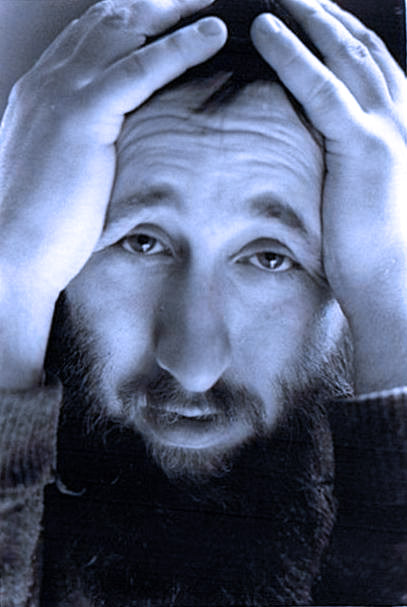
Well, not quite all the others, as Whiz Comics Captain Marvel was the best selling comic of both the war years and the later forties. Certainly my favorite.
As in the years before the War The America First Committee enjoyed overwhelming popularity amongst Americans I would question Simon’s notion that Captain America overwhelmingly represented American opinion. As there were six million Jews in the country I might suggest the response from that quarter of ‘Americans’ was more overwhelming than elsewhere. Jews might easily have accounted for sixty to eighty percent of sales.
It is also probable that no real American would ever have invented a corny jingoistic persona like Captain American. The image was certainly repulsive to me as a child. My prime comic reading years were from 1947 to 1950 and I and my entire generation rejected Captain America while embracing Captain Marvel. Even then Superman was a distant competitor to Captain Marvel which is why DC comics sued Whiz for copyright violation.
We disliked the hokey repulsive jingoism of Captain America as well as his dumb outfit and the stupid shield. (I’m speaking as a nine year old here.) Of course we knew from nothing about Judaism and almost less about any other religious sects but there was something othery about Capt. America and Superman although we embraced the equally Jewish Batman.
The origins of Captain America then emanated from the Jewish dream subconscious of Jack Kirby which was quite different from ours. He, therefor, as all writers must, made Capt. America in his real existence and from his dream fantasies. Thus, giving his creation the goy name of Steve Rogers he nevertheless gave him a Brooklyn Jewish origin. As Rabbi Weinstein also a Brooklyn Jew explains Jews had a sort of dual identity as powerless Jews posing as goys in a powerful goy world. Thus the sickly ineffective Rogers undergoes a scientific experiment that turns him essentially from a 98 lb. Jewish weakling into an all powerful goy Charles Atlas. I’m sure Kirby saw those ads while growing up.
Rogers having now been turned into a Superman had to have a name. Superman being taken Super Jew was out for obvious reasons or even Super Hebrew, there was no Israel at the time, so Kirby settled on Captain America. Rabbi Weinstein again:
Of course a more literal reading of the costume is that it is the American flag brought to life. Captain America’s star is, after all, five-pointed, not six pointed like the Star of David. The flag-as-costume notion reinforces the ideal of assimilation [Jews ‘becoming’ Americans]. By literally cloaking their character in patriotism, Kirby and Simon became true Americans.
In 1940 there was a desperate struggle going on between the Jews and America First who the Jews styled as American Fascists, i.e. actual Hitlerites. By that line of reasoning the Jews became the true Americans, creators and protector of genuine American Democracy while Anglo-Americans or Native Americans or America Firsters were out to destroy the great American Dream the Jews had discovered. This is the theme of Philip Roth’s novel The Plot Against America backdated to this period. The movie Captain America could easily be subtitled The Plot Against America Foiled.
Rabbi Weinstein once again:
Despite the patriotic appearance, Captain America’s costume also denotes deeply rooted [Jewish] tradition. Along with other Jewish-penned superheroes, Captain America was in part an allusion to the golem, the legendary creature said to have been constructed by the sixteenth century mystic Rabbi Judah Loew to defend the Jews of medieval Prague. “The golem was pretty much the precursor of the superhero in that in every society there is a need for mythological chracters, wish fulfillment. And the wish fulfillment in the Jewish case of the hero would be someone who could protect us. This kind of storytelling seems to dominate in Jewish culture,” commented Will Eisner.
According to tradition a golem is sustained by inscribing the Hebrew word emet (truth) upon its forehead. When the first letter is removed, leaving the word met (death) the golem will be destroyed. Emet is spelled with the letters aleph, rem and tav. The first letter, aleph, is also the first letter of the Hebrew alphabet, the equivalent of the letter A. Captain America wears a mask with a white A on his forehead- the very letter needed to empower the golem.

So, you and I thought the A stood for America but it is actually a symbol of Judaism. Captain America then is an unconscious dream projection of the Jewish subconscious following Freud’s thought in his Interpretation of Dreams. Now we know who and what the Captain America or The First Avenger is.
2.
Like Philip Roth’s The Plot Against America the movie is backdated to 1940 although as the US is already in the war perhaps 1942-43 although in Kirby and Simon’s dream vision they could have already employed the usurped power of America in 1940. However the movie writers, are writing today so assume different interpretations and aspects.
In point of fact Hitler no longer exists except in the Jewish mind so the relevance of the movie is hampered. Goys are not reliving the Hitler experience on a daily basis. To correct this and bring the Nazi threat forward Hitler is relegated to an inept showman while the real brain behind Nazism is the Hydra.
The Hydra in Greek mythology was a matriarchal year deity with seven heads and one neck, Six of the heads prepresented the last six months of the year while the seventh head and neck represented the recurring and indestructible year. Everytime a head was cut off it grew back as time does march on.
When the Patriarchy was displacing the Matriarchy the story changed somewhat. Hercules was sent to fight the Hydra and everytime he cut off a head three grew back. Thus the Hydra is represented in the movie as a Red Octopus with eight arms thus embracing the world. Ils sont partout. Obviously Hydra is a dream projection of anti-Semitism the arch fiend of the Jewish unconscious.
The Jewish Doctor Erskine, Reinstein in the comic, playing God botches his first attempt at creating the superman, Hydra/Cain, but finds perfection in Capt. America/Abel. Thus Cain is blighted while Abel is God’s favorite. While Captain America begins as a song and dance man belittling Hitler on stage, when the fighting starts Hitler is relegated offstage while the super-Hitler, Hydra, steps front and center.
While the Americans that Rogers as Capt. America have nothing like the incredible weapons and organization of Hydra they are nevertheless with their bare hands able to defeat him. He is however immortal like all dream fears so that as Arnold said: He’ll be back.
The action is standard comic book action fare and needs no further comment. You could have written it yourself. Pretty clicheed but if you like this stuff you’ll find it very satisfying.
However Captain America remains a Jewish hero in American drag with a purloined identity.

Cartoon Jack Kirby
Edgar Rice Burroughs As A Feral Child
July 18, 2011
Edgar Rice Burroughs As A Feral Child
by
R.E. Prindle
Cronus:
Cronus married his sister Rhea, to whom the oak is sacred, But it was prophesized by Mother Earth and by his dying father Uranus, that one of his own sons would dethrone him. Every year, therefore, he swallowed the children whom Rhea bore him, first Hestia, then Demeter and Hera, then Hades, then Poseidon~ Robert Graves, The Greek Myths
I. The Father As A Cannibal Figure
Following Poseidon came Zeus. In place of Zeus Cronus was given a stone which he swallowed instead. When Zeus grew up he then castrated Cronus, replacing him.
While on the one hand an astrological myth denoting the precession of the equinoxes from one Astrological Age to another, on a psychological level the myth relates the fear of the Father that as the strength of his sons waxes his own wanes resulting in an eclipse.
Different human fathers react in different ways. Some nurture, some castrate or cannibalize their young. This is a serious problem for the son. For instance, what Tom Brokaw, a thoroughly castrated son, is pleased to call The Greatest Generation who were so enamored of their success in WW II, that they chose to emasculate a whole generation rather than surrender or even share power.
I correspond with David Adams from time to time while doing my writing from whom I sometimes receive valuable input. I had come to the conclusion that ERB’s father, George T, was a problem for ERB, especially as represented by ‘God’ in Tarzan And The Lion Man. The new year opened with Hillman publishing Dodds’ feral child collection which clicked in my mind. The week before ERBzine published my Part III, Two Peas And A Pod of the Tarzan Triumphant review. David Adams commented favorably on my comments about the Jungian Old Man archetype. He said in an email to me:
I agree with your interpretation that “characters like Tarzan and John Carter serve in the capacity of Old Man/Jekyll figures while the actual Old Man figures who are betrayers serve perhaps as Hydelike figures as represented by the father.” (David quoting me.) Those old man figures, early and late, are also cannibals who are hell-bent on eating him up while then spreading the bones across some desert for the hyenas to chew. Who was that old cannibal with the cancerous face followed by a pair of African wolves? (Jungle Tales of Kipling)
As can be seen I picked up on the Father figure but adding the cannibal detail adds the needed dimension for full comprehension.
George T. had been bothering me for some time. The love-hate relationship ERB had with him is quite obvious, but then it occurred to me that the other sons had the same relationship to their father while George T. appeared to program them all for failure- that is they not surpass him in their lifetime somewhat like Cronus of Greek mythology. He made them all dependent on him. The supplicating tone of the letters from college of sons George and Harry is all too obvious. George T. sending the boys to Yale without the means to support a position would have had the effect of emasculating them relative to their fellow students thus subordinating them.
Then on graduation he took them into his battery business. As a businessman in Chicago it wouldn’t be unreasonable to believe that George T. had some relatively influential contacts in town who might have been able to place Yale graduates advantageously but he chose to keep the boys with him and subordinate to him.
The battery factory proved dangerous for his son Harry who developed respiratory problems from the battery chemicals plus perhaps in psychological reaction to suppression by his father. He went West to join fellow Yalie, Lew Sweetser, in Idaho. Son George, who had had enough of working for his father, also fled to Idaho to join Harry and Sweetser.
None of the three knew enough about the cattle business to survive so that by 1913 when George T. had his basket pulled up all the sons were back in Chicago in various degrees of failure or, at least, lack of success. As of that date it would appear that like Cronus George T. had swallowed or cannibalized his sons.
There was a Zeus figure in the bunch who didn’t want to be swallowed and that Zeus figure was ERB. Like Zeus ERB was the youngest son. ERB developed independently of his brothers who were approximately ten years older than he. Thus when they were at Yale ERB was attending grade school.
As I pointed out in my Books, Burroughs and Religion George T. was especially rigorous in the attempt to emasculate his youngest son. His effort culminated when he sent ERB to military school. This was a form of dislocation and rejection that ERB could not bear. He tried to escape but his father sternly returned him to the Michigan Military Academy.
The effects of this were that ERB was declassed as he considered the MMA a rich kid’s reform school. Thus to some extent he was criminalized in his own mind. His reaction was also seminal in the formation of his two principal characters John Carter and Tarzan.
His hurt was so strong, his separation from his parents and home so complete that he became psychologically orphaned. His parents died to him the day he was returned to the MMA. He adopted the drunken Commandant, Charles King, as his mentor or surrogate father. While betrayed by his father ERB apparently thought he found a friend in King. In that capacity King became the model for Lt. Paul D’Arnot of the French Navy. D’Arnot was the man who tamed the feral boy that was Tarzan introducing him to civilization much as King taught Burroughs how to survive and prosper at MMA. Or Burroughs remembered it in that manner. There may also be a literary connection to D’Artagnan of Dumas’ Three Musketeers.
This makes the period between the arrival of Jane and her party and the arrival of D’Arnot in Tarzan Of The Apes of special interest. I’m not sure what the period represents in Burroughs’ own life.
As his creation Tarzan is a feral child it follows that ERB considered himself alone and on his own as a feral child himself. A romantic notion but one no less real to him. Thus just as Tarzan’s parent’s died with the baby becoming a member of an ape tribe so Burroughs began a wild and difficult period as his parents died for him.
These events occurred just as Rider Haggard was becoming famous for his great African trilogy of King Solomon’s Mines, She and Allan Quatermain which ERB undoubtedly read at this time. Conan Doyle began his Sherlock Holmes mysteries and H.M. Stanley disappeared into an unknown Congo in pursuit of Emin Pasha. The West to East transit of the Congo impressed ERB greatly as his own heroes later crossed Africa in the same direction.
Being a complex individual ERB no longer wished to even acknowledge that he had ever had parents; thus his first creation- John Carter. As Carter only came into existence when ERB was 36 the writer had plenty of time to knock around learning the odd legend here and there. John Carter then is a version of the Great Historical Bum- the hundred thousand year old man of folklore.
John Carter could not remember his parents. In his memory he had always been the same age he was. In the words of one of my famorite songs, Stewball, he didn’t say he was born at all, just blew down in a storm. Certainly Burroughs had heard of the Comte de St. Germain who flourished at the time of the French Revolution. As esoterical cult figure today, St. Germain’s legend would have been more prominent from 1875 to 1911 than today. Like Carter St. Germain claimed to have been alive forever. In Revolutionary Europe he got away with it. Calgiostro was another Revolutionary charlatan claiming mysterious antecedents who would have intrigued ERB’s imagination. It seems certain the two would have been topics of conversation in the time before radio, TV and movies so it wouldn’t have been necessary for ERB to have read anything.
I doubt if he had read any of the books on Dodds’ list although one never knows but the list goes to show that the feral child would have been a popular topic of conversation. In my opinion then ERB’s literary future was cast when his cannibal father returned him to MMA.
He graduated from the MMA in ’95 but either couldn’t or wouldn’t return home staying on as an instructor. In ’96, just before the summer break which might have necessitated a return home he joined the Army being sent directly to Arizona without passing through Chicago. Was he avoiding returning home? One can’t say as in ’97 having found Army life not to his liking he received an early discharge. He could have kept going, of course, as many of us in his boots did, to LA, San Francisco or wherever but he chose at that time to return to Chicago. Of course, Emma was calling.
From ’97 to ’03 or so he worked for his father which he found as difficult as his brothers had. Fleeing Chicago to Idaho in 1903, when he came back a year and a few months later to do anything (that word anything has some meaning in this context) rather than work with his father. He became one of the poet Robert Service’s ‘men who don’t fit in.’ He had a very difficult few years from 1905 to 1913 bumping along the bottom.
But then in 1911 he began his rise via his intellect. He began to write becoming an immediate literary success of sorts. By 1913 when he was about to become a financial success through his intellectual efforts thus escaping his father’s curse, his father died. The young Zeus thus never got to castrate his father Cronus.
One can’t know what would have happened to his psychology had ERB been able to present his father with evidence of his success. I’m reasonably certain George T. would have belittled or rejected his success as like Cronus his youngest would have replaced him. He wouldn’t have liked that.
II. A Hand From The Grave
Had that happened and ERB been able to prove himself a greater than his father it is interesting to speculate as to what effect that might have had on ERB’s psychological development. As it was, a few months after his father’s death he packed up family and belongings and got out of town as far as he could go to San Diego, California and stayed away nine months. Time enough to be reborn.
There are numerous examples of betrayers who are cannibals in his corpus, in fact there is so much betraying and cannibalism in Burroughs’ work I find it slightly offensive. Rather than work up a list, which for the time being I leave to David, I’d rather concentrate on the most spectacular cannibalistic betrayer of the oeuvre, God of Lion Man.
I know I just wrote about Lion Man but with David’s interpretation of cannibalism I can present a much more cogent image. David’s much more into Jungian synchronicity than I am but the scene with God presents a remarkable occurrence of synchronicity. The scene is very complex.
George T. was born in 1833 so the book was written on his 100th birthday. Chicago was incorporated in 1833 while it was celebrating its Century Of Progress forty years after the Columbian Expo at the same time. Both events occurred just at the time that Burroughs realized he had lost control of his ‘meal ticket’ to MGM.
MGM was undoubtedly a component of God, the Father, being combined with the Chicago that fathered him and George T., his actual father, in his mind. From these components ERB then creates the magnificent apparition of God as man and beast. God has the mind of divine power such as had Zeus but is still a Cronus, is, in fact, the ultimate cannibal.
Tarzan and Rhonda represent Burroughs’ Anima and Animus so that God has the whole man in his power in its component parts- the X and y chromosomes. God tells the pair that he is going to use them to rejuvenate himself by cannibalizing them. The Father’s desire and the Son’s fear.
If God represents George T. on one side, MGM on another and organized religion on a third then even though ERB thought he escaped his father in 1913 by his intellectual efforts the father reaches up from the grave on his 100th anniversay to claim his son again.
At this time Burroughs also wrote Pirates Of Venus and Pirate Blood. Both would refer to the idea that MGM pirated his creation from him while the very despondent Pirate Blood is almost terrifying in its manic depression as the balloon rises and sinks being almost submerged in the ocean or the waters of oblivion, the subconscious mind, insanity, that I believe we can see it as the insanity of despair. At the end of that story the hero pairs up with a desperate woman who I believe we can read as Florence. All very transparent really.
So there Tarzan/Rhonda/Burroughs is trapped in a prison. He attempts his earlier escape of rising through his intellectual powers, that is, he ascends through a shaft in the roof. Unlike the first time when he surprised and astonished the world with John Carter and Tarzan, God, the Father, is waiting for him preventing his use of his intellect. In point of fact Tarzan And The Lion Man was a dismal sales failure thought by Burroughs to be caused by MGM.
If his previous four previous Tarzans under the Burroughs imprint had been successes it seems strange that the truly excellent Tarzan And The Lion Man should have failed. Failing proof of sabotage on the part of, say, MGM, one can only say the public taste is fickle or perhaps the innovative dust jacket didn’t look like the usual Tarzan dust jacket and fans just passed it by. It is also true that the book was a put down of MGM.
Tarzan/Burroughs sallies forth from his hiding place against superior forces. He is knocked unconscious. A sure sign that Burroughs is under supreme stress. Meanwhile God’s castle, in other words the literary structure of the last twenty years is going up in flames. The MGM pirates have lifted ERB’s life work.
He has to finish the story so he turns the tables on God taking him captive and making him do his bidding. Tarzan helps God recapture his City then abandons him disappearing down the hole of the subconscious to a lower level from when he emerges to be claimed by the Wild Thing- Balza, the Golden Girl, or Florence.
In a thinly disguised scene Tarzan, unwittingly it seems, wins Balza from her former husband much as Burroughs took Florence from Ashton Dearholt. The important thing here is that a transition has been effected from one world to another. The intellectual City of God has been abandoned in favor of a world of the senses.
It is at this point ERB abandons his own feral boy persona of horses, puttees and other symbols to become a sort of effeminate Dandy. He now affects tightly fitted fashionable suits almost effeminate in appearance. He turn into a party animal and if he had been a moderate drinker during his teens, twenties and early thirthies he now becomes almost a lush.
So, in the end, ERB was probably devoured by the Father in Cronus fashion. In the Myth Zeus forced Cronus to vomit up his brothers and sisters and he castrated him. In real life ERB was castrated and swallowed down.
He put up one heck of a fight that arouses the warmest admiration of him. One wonders, that if when all is said and done anyone can escape the imprint of those formative years. Is one’s whole horoscope cast in the womb and those few short months after birth? Sure hope not.
Pt. I: Tarzan And The River
April 14, 2011
Tarzan And The River
by
R.E. Prindle & Dr. Anton Polarion
I know those ideas;
In my boyhood days I read Shelley
and dreamed of Liberty.
There is no Liberty save wisdom and self-control.
Liberty is within-
not without.
It is each man’s own affair.
–H.G. Wells, When The Sleeper Wakes
The River don’t stop here anymore.
–Carly Simon, Let The River Run
Dr. Polarion and I have undertaken to write this essay together: He to handle the psychological aspects while I deal with the literary parts. As he has been called away on business I write his ideas from personal coversations and notes he has given me.
The reference to the river in the title is not to the Congo as one might suspect but to the river of life in the psychological sense and to the roman a fleuve or River Novel in the literary sense.
In the psychological sense the River refers to the Flood on which we are all borne heedlessly to the sea of oblivion unless we somehow free ourselves of the current. That is the meaning of the quote from Carly Simon. She thought she had gained control of her life and emotions; reclaimed herself from the vast irresistable flow of the River, so to speak.
As Dr. Polarion has explained in the other essays, ERB was working out his psychological difficulties through his writing. He first integrated his personality and then rectified his Animus concluding with reconciling his Anima and Animus. As in all lives ERB’s early life was an accumulation of fixations that had to be exorcised in later life. One either succumbs to one’s psychology in the sense of Hamlet’s complaint: To be or not to be…whether ’tis nobler, in the mind to suffer the slings and arrows of outrageous fortune or to take arms against a sea of troubles, and by opposing, end them,’ or, in other words, one confronts the psychological issues and resolves them.
Understanding, that is the problem. For ERB’s first thirty-seven years he suffered the slings and arrows in his mind, but then at age thirty-seven a glimmer of understanding appeared in his mind and he chose to take arms to end his sea of troubles.
One can only guess at the pricks and prods that drove him on his way. Fortunately ERB left a very wide and detailed paper trail of the workings of his mind. For the first thirty-seven years of his life the subliminal pressures built and built until with a mighty roar they rose to the surface in a terrific eruption not unlike the fabled gusher Spindletop.
Title after title spewed forth from ERB’s pen in an impetuous irresistible flow. From 1912 to 1915 no less than seventeen novels were unleashed on the world. Included in those novels was the creation of one of the great mythological figures of world literature- Tarzan Of The Apes.
It was through these novels that Burroughs took up arms against that sea of troubles to end them.
Dr. Polarion who is a Depth psychologist, believes and demonstrates to my satisfaction that as a result of ‘talking’ his way through his fixations ERB integreted his personality in 1915.
The integration of the personality is a major desideratum although, while a blessing, the integration is much less of a blessing than many Depth psychologists believe. When one eliminates one thing one must replace it with another. An empty self cannot be allowed to exist, nor will the self tolerate it. I have had to fill the void left left when with Dr. Polarion’s assistance I integrated my personality.
For ERB who had little understanding and no guidance, the integration of his personality was as much a curse as a blessing. But more on that in Part II.
Following Dr. Polarion: the disintegration of the personality occurs when the individual is presented with challenges to which he cannot satisfactorily respond. The most serious reactions occur in one’s youthful years when one’s understanding is least developed. Quite minor incidents cause the most serious fixations as the child or youth has not the intellectual means to understand and respond to them successfully.
Each failure of response causes a fixation in the subconsious mind. At this point Dr. Polarion discards the Freudian notion of the Unconscious in favor of the subconscious. He believes that there is no such thing as the Unconscious. Each psychological fixation has a corresponding psychological or physical affect. These are what Freud identified as neuroses and psychoses or what were later recognized as psychosomatic reactions. Thus a neurosis may interfere with one’s basic responses while a psychosis has a debilitating effect. An example of a neurosis might be a nervous twitch while the most debilitating of psychoses might be manic-depression or schizophrenia. The less severe the cause, the easier to reach.
It is here that Freud’s ‘talking cure’ comes into effect. Freud discovered, or learned from his colleague, Breuer, that when a person recognized his fixation and discussed it the physical or psychological manifestations disappeared. In many cases such affects appear only in certain circumstances.
Let me give you three quick examples: The modern pop singer Meatloaf,, the nineteenth century explorer Richard Francis Burton and ERB himself.
The pop singer, Meatloaf acquired a deep inferiority complex during his childhood. He had been made to believe that he was worthless. When he became a pop star he felt unworthy of his success. Hence, having a subconscious fixation or need to reject his success for which he felt unworthy, he one day lost his singing voice. In orther words, his subconscious fixation blocked his ability to vocalize and continue to be a success. The physical manifestation of his fixation was the loss of his singing voice.
Meatloaf sought the advice of a psychologist who was both astutue and honest. After talking to Meatloaf for a few minutes in his first session, the psychologist had his client figured. he simply asked Meatloaf to admit out loud that he was a Star. Meatloaf resisted as one might expect, but on the psychologist’s insistence he reluctantly said: ‘Oh, all right, I’m a star.’
That’s all it took. That is the ‘talking cure’. From that moment on, Meatloaf exorcised his fixation and regained his singing voice. Of course, that only eliminated the symptom but not the underlying cause. Meatloaf just shifted his psychosomatic affect to another manifestation of it.
Not all fixations are that easy to reach. The more painful the fixation the harder it is to reach. Thus while Meatloaf’s symptom was relieved the fixation of unworthiness remained intact. The explorer Richard Burton (Richard Francis Burton, not to be confused with the late actor husband of the late Elizabeth Taylor.) sought the source of the Nile in the eighteen-sixties. If he had succeeded, he would have been made for life as well as having a secure place in history.
Burton was however severely conflicted on the Animus while have a debilitating central childhood fixation in his subconscious, a killer combination. Actually, he was a latent homosexual.
There was only one way to travel in Africa and that was on foot. Hence his subconscious placed a psychosomatic affect on his legs making it impossible to walk! Burton naturally failed in his quest but regained the full use of his legs when failure was irremediable. He never had trouble with his legs again.
While suffering from fever in Africa, Burton had the remarkably vivid vision of himself as two different personalities, the one always defeating the ambitions of the other. The two personalities were visions of his conscious and subconscious minds Thus the fixation symbolically represented itself to him, but Burton was unable to penetrate the symbol. Had he been able to do so he would immediately have been able to get on his feet as nimble as ever.
The true natue of Burton’s conflict was that he couldn’t acknowledge his homosexual reaction to his fixation. His youthful sexual violation or molestation was his central childhood fixation, but we’ll let that pass. The central childhood fixation is the most fearful of all.
Edgar Rice Burroughs had a fixation from his father. He believed his dad to be a great man, probably one that could never be equaled or surpassed. ERB’s early failures may have been a fear of challenging his father’s image. His father had been a military success in the War Between The States. ERB probably joined the Army to emulate his father. He was sent to Apache territory. However, the fear of failing to measure up to his father or exceed him caused a psychological reaction or psycho-somatic affect.
For the length of his service, which was cut short by his appeal to his father, he contracted a case of diarrhea which didn’t leave him until he gave up the military, thus ending any fear of equaling of surpassing his father. ERB’s diarrhea was purely a defensive psychological reaction to his fixation.
ERB began his writing career in desperation. It probably never occurred to him that his writing would make him not only as successful as his father but more successful, else he mgiht not have been able to write. Judging from the context of the Tarzan novels, I would say that this conflict with his father was resolved between the writing of The Son Of Tarzan and The Jewels Of Opar. There is a decided change of direction from the one to the other.
The Russian Quartet of the first four novels therefor forms a sort of prolegomena or introduction to the rest of the oeuvre There is a fair amount of indecision in the four novels as ERB seeks for the handle of his great works
In his tradition of Tarzan doppelgangers the two novels of Tarzan Of The Apes and Son Of Tarzan may be considered near duplicates of each other; in fact, Father and Son as the titles indicate.
Two other novels separate from but related to the Tarzan oeuvre may be counted as part of it due to their role in the development of ERB’s psychology. These two are The Mad King and The Eternal Lover. The MadKing is a preliminary attempt by ERB to rectify the conflicting aspects of his Anima through the doppelgangers of the Mad King and Barney Custer, while the Eternal Lover is a precocious attempt to reconcile his Animus and Anima. Not surprisingly, Barney Custer is prominent in both novels. Custer then melds into the neo-Tarzan of Jewels Of Opar where the two conflicted aspects Burroughs’ Animus appear in one Tarzan, off set.
The name Barney Custer as an alter ego for ERB is interesting, General George Custer who we all know was massacred at the Little Big Horn a year after ERB was born was amongst the greatest of American heroes for about seventy-five years. After 1950 the luster was diminished and then turned completely around to the point that he is now the most prominent villain of American history and a symbol of shame to the Paleface.
But in 1914, by taking the name of Custer, ERB was identiying himself with America’s greatest contemporary hero. The first name, Barney, undoubtedly refers to the daredevil auto racer Barney Oldfield. This must be especially apparent in the Mad King in which Barney Custer is a daring, even wild auto driver. It should be noted too that ERB had only recently become an auto owner and driver so he is probably projecting an ideal of what he wanted to be. So the character of Barney Custer itself is a doppelganger rolled into one.
The novel The Eternal Lover takes place either in the time between Return Of Tarzan and Beasts or between Beasts and Son. In either case, Barney Custer is melded into either Tarzan or boy Jack, probably the latter as Tarzan repesents Burroughs’ father in Son.
Son Of Tarzan is a charming coming of age novel in which boy Jack emulates his father, grows into his loin cloth, or g-string and is finally reunited with his dad in London. Here the Russian Quartet is completed and the story logically comes to an end, as there are no loose ends for sequels.
In real life during this three year period from 1912 to 1915 ERB has risen from a more or less abject failure to a towering success. From a position of hapless inadequacy compared to his father as the novel Son Of Tarzan records, he has succeeded in his mind at least in equaling his father, athough as on the return to London Tarzan remains a patriarch and boy Jack recedes into the background it is fairly obvious that ERB did not really believe he surpassed his dad. Lingering traces of diarrhea, no doubt.
What ERB has done however is to eliminate the fixation in his subconscious. By doing so he integrated his personality.
Conflicted as he was, this rapid turnaround in financial status must have been a tremendous ego boost to a very frustrated man on the cusp of his mid-life crisis.
One can argue the relative value of the dollar but I estimate the buying power of Burroughs’ earnings for the period in today’s dollars of least three to five million dollars.
When one considers that he bought a house, which he turned into a country club with out buildings and enough land to build a city for one hundred thousand dollars which wouldn’t equal a single lot today the value of the dollar has no real comparison. ERB chose to call his new estate Tarzana which gives some indication of the importance of Tarzan in his mind.
Following the principles of Freud’s ‘talking cure’ somewhere in that great gush of writing ERB brought his central childhood fixation into the open where he resolved it so that the fixation’s mental and physical affects disappeared, uniting his conscious and subconscious minds into one interated personality.
Following psychological roles ERB must then have resolved fixation after fixation until he was free of compusive behavior.
Having united his conscious and subconscious minds, ERB was then given the psychological task of rectifying his Animus into one single directed sexual identity or Ego and then reconciling his Animus with his Anima. ERB did this, placing him ahead of Freud and Jung as a psychologist, although he may not have known how to express his achievement in scientific terms.
Dr. Polarion believes that ERB was aware of his achievement but as he had no scientific standing he must have thought it better to demonstrate his achievement in the Tarzan oeuvre while keeping his mouth shut.
There can be no question that ERB was a very educated, even learned man, although without the Ivy League credentials for which he so obviously yearned. The amount of learning evident in the Tarzan oeuvre is really quite astonishing. His background n African studies alone is extensive.
Having integrated his personality through the Russian Quartet, those four novels form a completed unit. In order to keep writing Tarzan novels Burroughs had to shift his emphasis. Then with the novel Tarzan And The Jewels Of Opar he began a more extended roman a fleuve or River Novel.
The subsequent novels are all involved with the problem of working out the rectification of the Animus and reconciliation with his Anima.
I personally (Dr. Polarion concurs) do not consider Tarzan And The Foreign Legion part of the true Tarzan oeuvre. The book was an afterthought written duing World War II for propagandistic purposes, consequently being outside ERB’s psychological development.
The last book apart from Foreign Legion published during his lifetime was Tarzan The Magnificent. Richard A. Lupoff discovered three stories after Burroughs’ death which were combined into Tarzan And The Castaways and a completed manuscript, Tarzan And The Madman, which is the culminating value in ERB’s psychologcal development and may be genuinely considered part of the oeuvre.
Thus the liberty of which H.G. Wells spoke in the introductory quote was achieved by ERB. He had acquired wisdom and self-control. One might say he was as ‘free’ as any man can be which, after all, as the mystics say, is merely uniting oneself with the ‘will of god’ or nature, in other words, integrating one’s personality.
Having disposed of the Russian Quartet which forms a sort of prolegomena to the oeuvre, I will now turn to Part II to the explication of the Tarzan oeuvre as a roman a fleur.
A Review, Pt. 10: Tarzan The Invincible by Edgar Rice Burroughs
November 21, 2010
A Review
Themes And Variations
The Tarzan Novels Of Edgar Rice Burroughs
#14 Tarzan The Invincible
by
R.E. Prindle
Part 10

The Prohpet- Edgar Rice Burroughs
Religion: Standing On The Promises
Even though at the beginning of the novel Burroughs says he does not consider Politics and Religion suitable topics for fiction- unless highly fictionalized- the two topics seem to constitute a major portion of his work.
The Great One does not feel called upon to exhibit a foolish consistency. In Invincible the first sentence is: I am no historian. In Tarzan Triumphant he says: ‘Being merely a simple historian and no prophet…’ So in the few months between Invincible and Triumphant he has gone from no historian to a mere simple one while hinting that while he is no prophet he may become one. We can’t be certain what the future holds in store for him. I’ve already sensed that he is a prophet. Tarzan is the god and Edgar Rice Burroughs is his prophet. So much for Mohammed being the end of the prophetic line.
Under cover of fiction Triumphant will deal extensively with the Jewish and Christian religions so this might be an appropriate place to review some aspects of the history and nature of religion.
Evolution occurs on many levels other than the biological. The biological naturally controls all other forms of evolution. The species has developed from a time of pre-hominid ancestors that must at some time have diverged from that of the other anthropoids as unpleasant as that may be for a certain type of mind although, for the life of me, I can’t imagine why. One of the more significant areas of evolution has been that of the brain. Nothing should be clearer than that the brain of HSIII is superior to the brain of the first Homo Sapiens and species which evolved from the Last Hominid Predecessor. I mean gorillas must have a relatively primitive brain.
There is no reason for this not to be so. The brain of the infant Homo Sapiens continues to develop outside the womb until at least the early twenties. At each stage the ability of the brain to function increases. As above, so below; as in the macro so in the micro.
Thus as in each stage of evolution from the first Homo Sapiens to the present most highly evolved specimen Homo Sapiens III, abilities to think and function have increased. Thus HS’s understanding of the world and universe are immeasurably different from the first Homo Sapiens model. I can’t imagine anyone who would dissent from that conclusion.
Now, except for the intermingling of human species certain human species would still be unacquainted with the approximately true nature of the world and universe that we have attained. I don’t see how this can be disputed. Without European influence the rest of the world would still think the earth was flat. These are facts whether one likes them or not. Indeed, even among the most advanced human species there are very large numbers who resist the scientific explanation of nature. These people still prefer the atavistic, antiquated religious Semitic explanation of natural phenomena. These people can barely accept the notion of a heliocentric solar system, many don’t. Why should anyone pay attention to them?
If one accepts that Homo Sapiens is 150K to 200K years old then it seems to me impossible that all human intellectual development has occurred in the last ten thousand years. Weapons of some sort have been in existence for many tens of thousands of years if not from the beginning of Homo Sapiens having been evolved from the Last Hominid Predecessor. It seems evident to me that a highly developed civilization existed in the Med Basin beginning c. 100K years ago. That doesn’t mean they had advanced Science it merely means that they had an organized society with relatively sophisticated thought processes and tools. Religion is basically an attempt to understand and make order of the world. All interpretations of the natural order must be based on that order.
Hence the North Polar stars which never set are the basis of religion. The Polar stars rotate about the Pole over a period of some 25K odd years forming what is called a Great Year. The Great year was made to conform to the terrestrial year of twelve months therefore being divided into twelve periods called Ages.
The Great Year with it twelve Ages formed the basis of religion. We will call that religion the Astrological Religion. Thus the religion goes back for tens of thousands of years as Sumerian records indicate. These Ancients did not make up their lives or talk through the backs of their necks.
Each Age of the Astrological Religion had its male and female religious archetypes. These are, perhaps most easily traced as far back as four ages, possibly five, in the Greco-Cretan mythology. The historical ages are the Taurian, Arien, Piscean and the next, the Aquarian. I am not a New Ager although I see no reason to disparage them and I am in sympathy with the outlook. One may say that I am of the Astrological religious tradition as we will see, I think, was Edgar Rice Burroughs.
In ancient days the Hom Sapiens species were separated each having distinct territories so that in the Darwinian sense they were not yet in conflict. When the last Ice Age came to an end flooding the Med Basin- this is not speculation, but fact- the civilization of the Basin was forced to higher ground bringing them into contact with the highland savages from West to East. Thus civilization as we now know it began.
The first settlers of Mesopotamia brought the Astrological Religion with them or, according to Mesopotamian mythology a man-god named Oannes- the name Oannes evolved into Johannes or John- appeared from the sea to teach them the rudiments of civilization and the Astrological Religion. Immense amounts of lore must have been lost, that is forgotten, so perhaps that is where the legend of the Lost Word comes in.
Now, off to the East on the Arabian Peninsula a different species lived. These were called the Semites or would be after the later Hebrews so named them after their mythical ancestor, Shem. Mere desert dwellers the Semites were attracted to the glitter of the Astrological Religion. There is no evidence that the Semites had a civilization or anything that could be called an actual culture of their own. They merely mimicked the existing culture infiltrating it much as Europe and America are being infiltrated today by their descendants. Eventually they will succeed the European civilization just as their ancestors did the Sumerian.
The evidence is that they had no religious forms of their own so that they attempted to take over both the physical and cultural edifices of their predecessor civilization, the Sumerian.
The Semites did not have the same mental organization or capabilities as their predecessors so they could maintain neither the civilization nor the religion. The major conflict came at the transition from the Age of Taurus to the Age of Aries. Here is where the real conflict between the Semites and Indo-Europeans or the Semites and HSII & III begins to take its historical form.
When the Astrological Age changes the religious archetypes change. For instance Cronus had been succeeded by Zeus at the transition from Taurus to Aries. Zeus himself was succeeded by Jesus the Christ at the transition from Aries to Pisces. Zeus would have been succeeded by Dionysus but the Semites either had to be accommodated or they forced Jesus of Nazareth on the Age which was later combined with the Kyrios Christos to form the composite deity the Semitic Jesus and Hellenic Christ. The role of Paul was very important in forcing Jesus of Nazareth on the goyim as Burroughs attests in Triumphant.
As we are now about to transit from Pisces to Aquarius a new set of archetypes will emerge representing the current intellectual and psychological development of Homo Sapiens.
This raises the question of whether Burroughs was merely a simple historian or was he also a prophet. Is Tarzan his offering for the role of the male archetype for the Aquarian Age? I think he is. For those who scoff at such an idea it would be wise to examine Burroughs relation to Mormonism during his stay in Salt Lake City. If it was possible for Joseph Smith to befuddle the minds of intelligent Westerners with his nonsense in the middle of the nineteenth century, or Mohammed to impose his twaddle even in the seventh, then I see no reson to be amazed that Burroughs would attempt the same thing in the twentieth century. I mean, look at this stuff for what it is.
Also, believe it or not, I read recently where someone thinks Oprah Winfrey could be the female archetype for the Aquarian Age. Get out of here. I don’t whether to laugh or barf. So, the notion of religious archetypes for the new age is a fairly active one. Any such discussions are in conflict with Semitism. So, we’re back to that problem.
Semitism took identifiable form at the transit from Taurus to Aries.
The record of such happenings is, of course, much more recent than the transition from Taurus to Aries. It could have been made up during the Babylonian captivity. The Old Testament record was only recorded, perhaps even formulated, after the Captivity which began in 586 BC lasting for only fifty years although rather than return to the pleasure of the temple most Jews remained behind by the waters of Babylon just as their ancestors yearned for the fleshpots of Egypt.
To clarify the nature of human species according to Jewish sources: The Jews argue that all mankind is derived from Jewish or Hebrew stock. The only survivors of the great flood were Jews- Noah and his family. The ancient Hebrews while knowing many cultures knew of only three species or stocks. They acccordingly named them Hamites, Shemites and Japhetites after sons of Noah. In their conversations with De Great Lawd which were frequently carried on in public He apparently dispensed information on a need to know basis so he withheld the info on the Mongolids and West African Negroes as no account of them is taken in the descendants of Noah. A little gap in the perfect knowledge of the Old Testament.
Thus the Old Testament acknowledges the differences between the Semites, the Europeans or Japhetites and the Hamites are more than merely racial, which is to say Cosmetic. Such an idea is of course in line with genetic learning.
The Med People or HSII devised a fluid religious system that allowed for the development or evolution of the human mind. In other words they not only accepted but embraced change. This is a quality of mind not shared by HSI, the Semites or the Mongolids.
Depending on what time period the Semites began the infiltration of Mesopotamia which may have overlapped the Geminian and Taurian Ages or perhaps fell completely within the Taurian Age there would have been no conflict with the Semitic need for stasis and the Astrological allowance for development, evolution or growth. However, by the time of the transit from Taurus to Aries the Semites had gained political control of Mesopotamia while the religious control was still in the hands of the Aryan priesthood.
Following Astrological precedents the ancient Aryan priesthood wanted to change to the Arien archetypes. In European Greece where the Semitic influence was lower the transit from Cronus to Zeus was made with only the usual warfare hence the legends of the Cronian Titans and the Olympians.
In Mesopotamia where the Semites were in the ascendant, according to Jewish myhthology, the Terahites, under the tutelage of Abram, disputed the succession with the ancient priesthood. According to Jewish mythology Abram and the Terahites argued that the religious archetypes were eternal and there was no Astrological tradition. Thus in the ancient world the Jews were believed to worship Saturn. If Saturn were the Taurian archetype then this was very likely true as Saturn would then be the basis for the Eternal which the Jews do acknowledge worshipping.
In the Semitic manner, then, the Semitic mind being incapable of accepting change, having been fully developed before they emerged from the desert, went into opposition to the Astrological Religion. Thus the conflict changed from a termporal one to a ‘spiritual’ one. At that point then diaspora was possible without the laws of national identity. As a spiritual entity, Judaism was born. The notion of Semitism developed along with its opposite anti-Semitism. Christ = Anti-Christ. Thus the explanation of the origin of this so-called anti-Semitism is simply explained. In reality Semitism was in conflict with the Astrological Religion and hence was anti-Astrological. Any other religion must perforce be anti-Semitism. The struggle then became a struggle for the souls of men as well as their bodies.
Once again in direct conflict Europe and Asia began a long theological dispute. As the Piscean transition progressed the Semites began their attempt to convert the Astrological religion to Semitism. They were effective in shutting down intellectual inquiry which is the motive force for change. We will see this again in the nineteenth century efforts of Marx, Freud and Einstein.
As the ancient world ended, its religious legatees were the Catholic Church and Judaism. All other ancient religions disappeared from the face of the earth except in ineffective remnants or underground movements.
It is interesting that fourteen hundred years after being forbidden the Arien Age worship of Zeus has been made lawful again in Greece. There’s really no place in the Aquarian Age for the Olympian pantheon but it is an interesting atavistic attempt reviving as it were the struggle between the Arien Age religions of Olympia and Israel.
Gradually the Egyptian and Anatolian elements of the Christian manifestation of the Piscean archetypes have been displaced in favor of the Semitic models. The Catholic Church was able to contain the Semitic influence in Europe from the end of the Western Roman Empire to the Age of the Enlightenment of the seventeenth and eighteenth centuries. The Enlightenment let Simitism loose on the world again.
While the Roman Empire militarily defeated the political entity of Jerusalem from 66 AD to 135 AD the battle weakened the Empire allowing in Asiatic influences like the Emperor Heliogabalus. Then in the seventh century AD the present form of the struggle between Europe and Asia took form when the prophet Mohammed formed the Moslem Religion based largely on its predecessor religion, Judaism.
The Moslems stormed across North Africa into Spain and France where they were stopped at Tours by Charles The Hammer. It took nearly one thousand years to drive the Moslems from France and Spain which result was finally obtained in 1492.
As the Moors were driven from Europe by Ferdinand and Isabella they also expelled the Semitic Jews. In the evolutionary sense this was the other correct response to an invasion of a competing species. The other, of course, would have been extermination. Thus at this stage of European history they were responding in an evolutionarily correct manner. England had expelled the Jews in 1190 and France in 1307. The various small German States fluctuated in their attitude sometimes expelling sometimes readmitting. There were always German States that allowed Semites. Otherwise the great mass of European Semites lived in the no-mans land between Russia and Germany that would after Russian annexation be called the Pale of the Settlement meaning this area was roped off for Jewish residence.
While these actions may have been evolutionarily correct and probably even politically correct the defensive party seldom thinks in such grand terms as evolutionary inevitability. So, really, in evolutionary terms the only correct response is extermination. The Shona of Zimbabwe fully understand this principle. I say this to show I am not springing anything new or unusual on you. These natural responses are going on today in Zimbabawe, South Africa, South and West Sudan, Indonesia, in former Yugoslavia where Moslems are exterminating non-Moslems. If you don’t believe these things, open your eyes, open your eyes.
Now, wars do not end after seeming victory. The expelled Moslems of Spain continued the war establishing the Barbary Pirates who then preyed on Europe for the next three hundred years plundering and enslaving Europeans. The actual invasion of North Africa first by Spain and then by France was an attempt to end this savage warfare.
Burroughs would have been brought up on the legend of millions for defense but not one cent for tribute as was my generation. Until recently I believed that Americans had ended Barbary piracy. This was just something we were told in the fourth grade. Actually the Barbary pirates were put down only in 1830 when France conquered and annexed Algeria.
France at that time ought to have either exterminated or driven out the Moslems. Having once expelled them, if they had had the power, they should have swept across North Africa, as the Moslems had done, driving the Moslems before them until they had reached Suez.
Thus Africa would have been reclaimed for Europe. First it was held by the HSII survivors of the Med Basin flooding, then the Semitic-Carthaginians, then HSII Romans and back again to the Semitic Arabs. So such a preemption was certainly historically justified. The Moslems make a great noise about the Crusades but the modern problem was their offense of the Eruption From The Desert. Get straight.
At the same time the Jewish and Arab Semitic struggles were going on the yeast of the suppressed religions of the Middle East and philosophies of Greece were converting the Europeans from Semitic stasis to Aryan intellectual activity. The Eastern Roman Empire fell at the time of the expulsion of the Jews and Moslems from Spain. Scholars flooded out of the East. These Egyptian, Greek and Syrian influences burst forth in the seventeenth and eighteenth century as the Enlightenment. Previously the discussion had been between the Semitic reigions of Judaism, Moslemism and Christianity. The level of human consciousness between the three was nearly equal although still retaining some measure of the Astrological Religion. This is a very serious subject for study. Christianity, such as it was, was intellectually superior. Remember, however, that Catholicism was so imbued with the limited Semitic intellect that the Pope made Galileo deny the notion of a heliocentric system.
The release of the Scientific Consciousness after the long suppression of several hundreds of years put the inferior religious consciousnesses on the defensive. The Semitic counterattack going on today is the culmination of the Jewish response to the Enlightenment. It is imperative that a Scientific offensive be made against this anterior and surpassed form of the evolution of human consciousness. As in the past a victory cannot be achieved without a perhaps bloody and costly struggle. Such as is going on now.
We, you readers, Burroughs and I, are concerned with the middle of the Englightenment period here, say from 1890 to 1935. I think we will see that Edgar Rice Burroughs is deeply and constructively involved in this struggle between the Religious and Scientific Consciousnesses.
As I’ve noted before, the Christian response to the scientific challenge was to declare either the Pope or the Bible infallible. Protestants didn’t have a Pope so they declared the Bible infallible. Same thing. American Liberals who evolved from the Puritan/Abolitionist nexus essentially became secular religionists. It is to be remembered that the Puritans the Liberals evolved from considered themselves neo-Hebrews hence the new Chosen People. According to John Adams as Neo-Hebrews they even rejected the celebration of Christmas. Thus Liberals tend to give science a religious spin rejecting Christianity.
The Jews on the other hand confronted by a hard edged Science that could not be bent to Semitic ideas decided to co-opt Science perverting it so that it resembles their religion. All these responses have been taking place since the French Revolution of 1789 which emancipated the Jews removing them from Roman Catholic control.
As I pointed out in an earlier essay there was a brilliant episode on the TV show Twilight Zone in which monks had captured and imprisoned Satan. They made the mistake of allowing a lost traveler to stay the night in the monestery. The monks warned the visitor to pay no attention to the entreaties of the prisoner to release him. The traveler did not heed the warning and prisoner who was Satan was released again in the world. A little allegory.
Thus the Revolution and Napoleon emancipated the Jews who immediately began the conquest of Europe. France was the first to fall. Karl Marx then hi-jacked Socialism in the name of Communism. Communism negates change in favor of stasis. Its story is all regulation and control, no different than Judaism. An elite administers to the ‘masses’ as the Chosen People administers to the goys.
Just as the Moslems are called to prayer five times a day and the Jews are expected to apply their 613 commands to every action before they take it, so Communism coopts the individual into the collectivity and regulates his every action.
Using Socialism as its cutting edge the way was paved for Communism in Europe.
Burroughs first encountered Socialism on the streets of Chicago as Socialists marched along under their waving red banners. The scene made an indelible impression on the young boy resulting after the Russian Revolution in his book, Under The Red Flag. Thus the Semites coopted the political ideology of the next one hundred years.
Science unfolded very quickly in the years following Darwin’s Origin Of Species. Particularly great progress was made in the scientific understanding of the mind. Psychology then was coopted by the Jew, Sigmund Freud. It is rather difficult to understand why all research seems to have been channeled through Freudianism. A rather fecund area of research seems to have been enveloped into one train of thought.
Freud quickly established his version of the static ‘unconscious’ as the sole vision of the mind. He demoted the conscious mnd to a position of irrelvance. His intention is quite clear. The conscious mind is the engine of change. By emphasizing the static unconscious combined with is vision of sex, which is to say only sexual intercourse, he was attempting to disarm the conscious mind and hence stop change or in other words establish stasis. Success in such a course is not instantaneous so naturally science continues to progress as the pall of the unconscious spreads. It doesn’t take a genius to understand why scientists are male and white. Once you have established the fact that scientists will be male and white it becomes necessary to stultify and emasculate white males, thereby establishing stasis. One would have to be blind not to see that that is exactly what is happening.
In point of fact the unconscious does not have an objective existence. Its apparent existence is merely a mind in an arrested state of development. The stasis is caused by fixations from challenges too stressful for the conscious mind to handle. Once the fixations are dealt with and disappear, which is included in Freud’s understanding of the mind, the mind or personality is allowed to integrate, the Freudian unconscious disappearing.
Freud never integrated his personality remaining under the influence of his ‘unconscious’ so it is possible he didn’t understand the integration of the personality although his disciple, Jung, did.
However in Freud’s hands the unconscious became a weapon in the Semitic attempt to subjugate mankind. This subjugation is not religious or moral but a matter of one species seeking dominance over the others. Thus as Marx perverted the science of politics so Freud perverted the science of the mind. The third perversion of Science was the conquest of physics by Einstein. As Marx and Freud had interjected Semitic religious concepts into Politics and Psychology so Einstein did the same in Physics. It matters little that there is some scientific content in the the theories of these men. Their intent is to subordinate science to religion just as they had done vis-a-vis the Astrological Religion to the Semitic Religion when the Religious Consciousness was supreme.
That Einsten has been able to befog the minds of very intelligent men with his nonsense about the ‘fabric’ of space and time is nothing short of incredible. Yet, by the second decade of the twentieth century the perverted notions of these three men were directing the course of research in these three essential disciplines.
Thus cored from within the Aryans were made susceptible to the rising time of Wahabi Moslemism that Lothrop Stoddard noted and warned against but which warning was defused due to the machinations of Jewish Semites within Western Civilization.
Running concurrently in the background contra to the Semitic stream was the evolving Astrological Religion. Just as the evolution of the Dionysiac Archetype of the Age of Pisces developed for hundreds of years within the Arien dispensation of Zeus so the formation of the Aquarian has been taking place in the Age of Pisces.
The Enlightenment with its advance in the development of scientific consciousness was undoubtedly the opening salvo. Unlike Semitic development the Astrological evolution was not institutionalized. It is an idea that once set in motion is maintained by volunteers who get the idea and keep it perpetuating.
The principle is known. For instance the notion that America is a land of immigrants has been allowed to develop to the point of self-destruction. Of course that notion is constantly forwarded by the Liberal Coalition. Even though it is obvious to the feeblest intelligence that the land is capable of supporting only a finite number of humans the madness has now reached the point where it is beleived that the whole world can be imported ‘to share what we have.’ One of the most, if not the most, bizarre notions in all history. Such insanity is difficult to understand.
If one assumes, as one must, that human consciousness has been developing over the 150K years since humans evolved from the Last Hominid Predecessor then this transition to the Aquarian Age is the most dramatic development of history. All previous stages of evolution have involved the progression from one stage of supernatural religion to another. In this transition, for the first time, it has been proclaimed that ‘God is dead.’ That is to say a supernatural being who guide’s our destiny.
With the age of Science mankind realizes the true nature of appearances or Nature itself. The concept of Evolution destroyed the basis of the Semitic religion. There is no God, no Yahweh, no Allah, no stasis. Oh, Lord, crikey Massa, don’t put me jail for saying that! People who still believe in such non-existent deities have not been relegated to the dustbin of history.
Burroughs, and I consider this fairly remarkable, seems to have accepted the New Order of Science upon his first contact with Darwin and Evolution. To say that ‘God is dead’ creates a vacuum in human consciousness such as the integration of the personality changes one’s mental structure leaving an aching vacancy between the vacation of the old personality and its replacement by the new. Thus for the last hundred years or so mankind has been seaching for a metaphysical sucessor to the supernatural concept of God.
Just as the Enlightenment may have opened the way to the transition to the new consciousness so men have appeared to direct consciousness into constructive channels. One of these writing as Burroughs writhed through the years between his marriage and the epiphany that produced his writing career and Tarzan was a man called Levi Dowling writing under the name of Levi. His effort, I’m certain what he considered his gift to the world, was a work called The Aquarian Gospel Of Jesus The Christ.
I doubt Burroughs read this book although one never knows. Chicago in the period before Los Angeles was the American hotbed of religious speculation. One should never overlook that. Burroughs lived in a welter of religious speculation. Added to that Burroughs was heavily influenced by Lew Sweetser who was particularly interested and well informed on such topics. Plus Burroughs lived in Mormonland for a decent period of time making a special visit ot the Mormon capital in 1898, while living in Salt Lake City for several months in 1903-04. It would be hard to believe that he wasn’t learning of the Mormon doctrines especially how a noodle brain like Joseph Smith was able in the nineteenth century to impose his religious will on thousands of people.
Joseph Smith, the founder of Mormonism, came from an area highly influenced by the fantastic religious notions of the Rhineland Pietistic Germans who became known as the Pennsylvania Dutch in America. Magazines would have been full of this stuff while the Chicago papers must have covered these religious speculations in detail. There is no reason to believe that Burroughs’ mind wasn’t filled with these speculations. Such ideas spill out all over the pages of his books.
Many writers have noted that the initials of John Carter and John Clayton are JC the same as Jesus the Christ. No Freudian believes in coincidence so there must be an intellectual connection. Burroughs repeatedly says that the next deity must be a man-god and that is explicitly what Tarzan is.
There is nothing supernatural about Tarzan. He is completely a man of science. The most highly involved specimen of humanity ever. If like Jesus the Christ he doesn’t have a magical birth he certainly has a miraculous upbringing from the age of one. Unlike Sargon and Moses who were fished from rivers in baskets thus breaking continuity with human predecessors Tarzan was taken from the cradle by an ape thus breaking continuity with human predecessors while establishing a new human paradigm. He in fact unites nature with civilization or, at least, a thin veneer of it. Now, this is completely in keeping with the Dionysiac paradigm.
Dionysus has two sides. The soft feminine side which has characterized the Piscean Age and the wild natural side which is meant to characterize the Aquarian Age. The undisciplined natural side of human consciousness that the Patriarachy tried to suppress in favor of the strictly rational as characterized by Apollo wouldn’t be suppressed. As mythology relates it, women could not be rational thus they embraced the Dionysiac religion imposing its ecstasies on society. The Dionysiac ethos was so strong that it forced itself on the Delphic Oracle in partnership with Apollo. Thus Delphi came to represent both the rational and irrational sides of consciousness. The conscious and unconscious if you will.
Thus as the Piscean Age dawned and the religious archetypes changed from Zeus and Hera to Dionysus and Isis the struggle was to keep consciousness or the rational uppermost. Of course, Dionysus and Isis were supplanted by the Semitic ideals Jesus and his mother, Mary who later became the Mother of God. Later the Dionysiac Kyrios Christos was grafted onto Jesus of Nazareth and he became Jesus the Christ as Levi Dowling correctly notes.
One can’t be certain how learned Burroughs was in this lore. He most probably was somewhat read in it while brilliantly intuiting the direction the evolution of consciousness must take. One can never be sure although there is little in the surviving library to indicate he read deeply in such lore. But then, so much of his knowledge he does evidence can’t be found in the library either. Suffice it to say that such knowledge seems to be apparent in his stories.
Needless to say the idea of Tarzan expanded and developed over his career. The Tarzan of the teens is quite different from the Tarzan of the thirties. There are a couple of passages in Tarzan Triumphant that make you do a double take. To wit: p. 12
…Tarzan with knitted brows, looked down upon the black kneeling at his feet.
“Rise!” he commanded, and then; “Who are you and why have you sought Tarzan Of The Apes?”
“I am Kabarega, O Great Bwana,” replied the black. “I am chief of the Bangalo people of Bungalo. I come to the Great Bwana because my people suffer much sorrow and great fear and our neighbors, who are related to the Gallas, have told us that you are the friend of those who suffer wrongs at the hands of bad men.”
So here Tarzan as become a Sultan, a King, an Emperor, a great judge and dispenser of justice; shall we say a god? Certainly the Lord Of The Jungle. He also seems to have lost perspective but then, perhaps a god must keep up appearances. We do have a new imperious Tarzan here who was not in any books before Invincible.
And then in Chapter 13, p. 98 in the Bowlderized Ballantine edition:
The “Gunner” was waiting for him upon the summit of the cliff directly behind the village, and for the second time these strangely dissimilar men met- dissimilar and yet, in some respects alike. Each was ordinarily quiet to taciturnity, each was self-reliant, each was a law unto himself in his own environment; but there their similarity ceased for the extremes of environment had produced psychological extremes (opposites) as remotely separated as the poles.
The ape-man had been reared amidst scenes of eternal beauty and grandeur, his associates the beast of the jungle, savage perhaps, but devoid of avarice, petty jealousy, treachery, meanness, and intentional cruelty; while the “Gunner” had known naught but the squalid aspects of scenery defiled by man, of horizons grotesque with screaming atrocities of architecture, of an earth hidden by concrete and asphaltum and littered with tin cans and garbage, his associates, in all walks of life activated by grand and petty meannesses unknown to any but mankind.
“A machine gun has its possibilities,” said the ape-man, with the flicker of a smile.
The last near hundred years has been characterized by the attempt to overturn the Scientific Consciousness in the name of two Arien Age Semitic religions, Judaism and Moslemism. Indeed the ‘hand of God’ moves in mysterious ways. Let’s look at one called ‘The Iron Law Of Wages.’ When you read in the Old Testament that ‘the poor shall be always with us’ you probably didn’t notice the arrogance of the remark nor that it is an actual ‘eternal’ tenet of Semitic religious belief. The remark put into academic terms might be that the price of labor is the lowest price that a man can be gotten to do a job and that they may be worked to death like slaves thereby insuring that the poor shall always be with us.
The religious theory was formulated in scientific terms by David Ricardo in 1817. Described as a British economist Ricardo was actually a Sephardic Jew. That is to say his people fled Spain c.1492 in this case first to Holland and then to England which was undoubtedly done illegally after a period of Dutch acculturation. It will be easily seen that Ricardo is adapting the ancient Semitic belief that the poor will always be with us to British conditions. Indeed, as his formulation became the bedrock of employment practices it may be said he created poverty as the industrial age took shape until Henry Ford disproved this ancient historical bunk in 1914. At that time he ‘unilaterally’ doubled the wages of unskilled labor to begin to create the prosperity that characterized American society until the reemergence of Semitic beliefs in the twenty-first century.
I personally deplore unionism but I also see its necessity. Ford’s action raised the price of labor across the board. Unionism was successfully fought by managers until unionism gained the backing of the government under FDR. Backed by the government support unions made excessive and ridiculous demands until their momentum was stopped when Ronald Reagan sent the Air Controllers back to work which put unionism on the defensive.
Ricardo’s Iron Law Of Wages was not re-instituted at that time. Fordism still prevailed. Then jobs were exported wholesale to ‘multi-cultural’ areas of low wages. This was a crucial mistake for the world. Even this did not break the back of labor.
The next strategic move was simply to open the borders allowing millions of immigrants who would work for lower wages under distressing conditions. While immigration makes no sense on any other level it does put the Biblical managers in control of labor once again. President Bush himself was a primitive religionist unacquainted even with the twentieth century who had surrounded himself with even more primitive Jewish religionists. The war of religion against Science goes on.
Thus the Semitic counterattack against Science goes on. Both major races of Semites, the Jews and Arabs, are waging war on the most primitive basis. The issue is not the issue. Immigration, the ostensible issue, is simply a Red Herring to disguise the true issue which is to defeat Fordism and re-institute Ricardo’s Iron Law Of Wages to ensure that the poor will always be with us. The streets are now filled with the homeless.
This is the real reason Ford is called an anti-Semite and on that basis he certainly was. God bless his memory.
So, the unsuspecting young Burroughs thrust himself into this melee. Just as Ford was in actuality a religious prophet with a new industrial dispensation so Burroughs, judging from results set himself the task of creating an archetype for the Aquarian Age. Something of value for one to aspire to. One can trace the development of Tarzan from the miraculous babe to the finished archetype as the man-god.
As H.G. Wells noted in his First And Last Things there is a necessity for metaphysics. Man does not live by bread alone. While Science reduced everything to its material basis it destroyed the means of ‘spiritual’ or psychological comfort. With God dead mankind lost its identity and sense of direction. As the old psychological projection of its identity had failed a new one was required that would be based on scientific material realities.
Levi Dowling’s vision of an Aquarian Jesus is unsatisfactory. Burroughs vision of the competent Tarzan satisfies on several different levels. Burroughs seems to have caught the essence of the Astrological Religion although there is difficulty in understanding how he came by his knowledge. The rudiments can be clearly seen so the answer must be in his personal digestion of the ideas. Lew Sweetser is obvious while perhaps Burroughs loyalty to a medical charlatan like Dr. Stace may possibly be explained by the man’s esoteric knowledge. Such knowledge frequently goes hand in hand with special diets and medical nostrums. There is no reason to believe that Stace didn’t sincerly believe in his nostums just because science couldn’t find a reason for them to be effective. Men have misled themselves to a much greater degree than that. Nevertheless I am convinced that Burroughs acquired his New Age beliefs as evidenced by Tarzan more from his associates’ conversation than reading.
The idea of Tarzan as the man-god culminates in Tarzan The Invincible and Tarzan Triumphant. With these two novels he is a fully functioning psychological projection of the Aquarian Age. The ‘spritual’ basis for Western man to regain its psychological balance destroyed by the ‘death’ of God.
He is what stands between the immolation of Euroamerican men on the altars of Semitism and the triumph of the scientific Aquarian Age.
Mankind, or at least Euroamerican mankind, must make the great leap for mankind into the Scientific Consciousness, into evolution to the next level. The old Religious Consciousness must be rejected. One cannot tolerate primitive belief systems any more than there can be no tolerance of the intolerant whatever that may mean.
Burroughs has given us an avatar of the future. It is up to us only to accept him and make use of the gifts he brought us.
A Review: Part III Tarzan And The Madman by Edgar Rice Burroughs
October 13, 2010
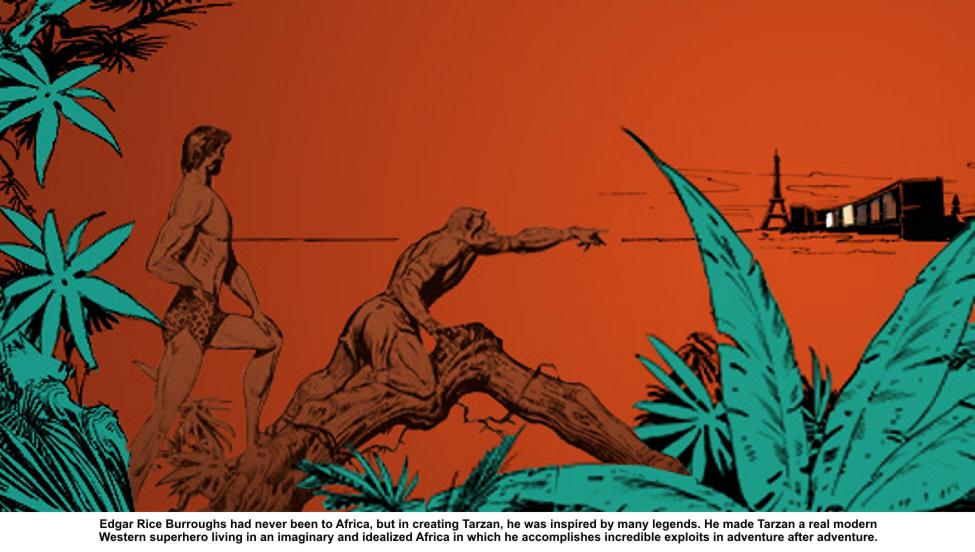
The Aquarian Archetype
The Renowned Arab Traveler- Mohammed Ibn Batuta
Writing in the fourteenth century Ibn Batuta had visited the East African coast trodding the soil of Kilwa Island on the southern border of Tanganyika, now Tanzania. Zanzibar replaced Kilwa as the Moslem trading entropot on the East Coast. Haggard apparently had done the same as he mentions ruins that dated back to before the tenth century. So, we have established commercial activity in Southern Africa before the arrival of the Shona people in Zimbabwe.
Ruiz stood behind a low, stone altar which appeared to have been painted a rusty brown red.For a long time Ruiz the high priest held the center of the stage. The rites where evidently of a religious nature that went on interminably. Three times Ruiz burned powder upon the altar. From the awful stench Sandra judged the powder must have consisted mostly of hair. The assemblage intoned a chant to the weird accompaniment of heathenish tom toms. The high priest occasionally made the sign of the cross, but it seemed obvious to Sandra that she had become the goddess of a bastard religion which bore no relationship to Christianity beyond the symbolism of the cross, which was evidently quite meaningless to the high priest and his followers.She heard mentioned several times Kibuka, the war god; and Walumbe the god of death, was often supplicated, while Mizimo departed spirits, held a prominent place in the chant and the progress. It was evidently a very primitive form of heathenish worship from which voodooism is derived.
Looking up, she saw a dozen naked dancing girls enter the apartment, and behind them two soldiers dragging a screaming Negro girl of about thirteen. Now the audience was alert, necks craned and every eye centered upon the child. The tom-toms beat out a wild cadence. The dancers, leaping, bending, whirling, approached the altar; and while they danced the soldiers lifted the still screaming girl and held her face up, upon its stained brown surface.The high priest made passes with his hands above the victim, the while he intoned some senseless gibberish. The child’s screams had been reduced to moaning sobs, as Ruiz drew a knife from beneath his robe. Sandra leaned forward in her throne-chair, clutching the arms, her wide eyes straining at the horrid sight below her.A deathly stillness fell upon the room broken only by the choking sobs of the girl. Ruiz’s knife flashed for an instant above his victim; and then the point was punged into her heart. Quickly he cut the throat and dabbing his hands in the spurting blood sprinkled it upon the audience, which surged forward to receive it…
“Well, what of it?’ demanded da Gama. “I am king. Do I not sit on a level with God and his goddess? I am as holy as they. I am a god as well as a king; and the gods can do no wrong.”“Rubbish!” exclaime the high priest. “You know a well as I do that the man is not a god, and the woman no goddess. Fate sent the man down from the skies- I don’t know how; but I’m sure he’s as mortal as you or I; then you get the idea that by controlling him you could control the country. You were jealous of me that’s all; then you get the idea that by controlling him you could control the church, for you know that who controls the church controls the country. You were jealous of me that’s all; then you conceived the idea of having a goddess, too, which you thought might double your power. Well, you have them; but they’re going to be just as useful to me as they are to you. Already, the people believe in them, and if I should go to them and say that you had harmed the god, they would tear you to pieces…”
“…you don’t stand any too well with the people, Chris, anyway; and there are plenty of them who think da Serra would make a better king.”“Sh-h-h,” cautioned da Gama. “Don’t talk so loud. Somebody may overhear you. But let’s not quarrel, Pedro. Our interests are identical. If Osorio da Serra becomes king of Alemtejo, Pedro Ruiz will die mysteriously; and Quesada the priest will become high priest. He might become high priest while I am king.”
“You should know,” he said. “You are a woman.”“I am not a mortal woman. I am a goddess.” She grasped at a straw.Rateng laughed at her. “There is no god but Allah.”“If you harm me you will die.” she threatened.“You are an infidel,” said Rateng, “and for every infidel I kill, I shall have greater honor in heaven.”
 I, Dynamo