Tarzan The Invincible Pt. 9: by Edgar Rice Burroughs
November 1, 2010
A Review
Themes And Variations
The Tarzan Novels Of Edgar Rice Burroughs
#14, Tarzan The Invincible
by
R.E. Prindle
Part 9: Politics
The Entertainer

The Big Bwana
The past is a foreign country; they do things differently there.
–L.P. Hartley- The Go Between
I would like to take a moment to organize the content and direction of the Tarzan oeuvre within the context of Tarzan The Invincible and Tarzan Triumphant.
It is close onto a century now since Edgar Rice Burroughs burst onto the international literary scene. He was not literarily well regarded by the intelligentsia. In the language of the time he wrote adventure novels. They were thought of as sub-literary. In our times after literature has evolved from Burroughs’ time into its various genres that didn’t exist as such back then he would more properly be designated as a fantasy or sci-fi writer.
Even though very great minds wrote ‘adventure’ stories their efforts are usually classified as sub-literary, relegated to the teen section. There has certainly never been a more profound writer than H. Rider Haggard nor is his literary style inferior in any way to the pretensions of literary fiction. Conan Doyle, H.G. Wells, Edgar Rice Burroughs all had a great deal to offer. If it is necessary to say so their work has remained popular while most literary heavyweights of the past are unknown and unread in non-specialist circles today.
Edgar Rice Burroughs is not usually accorded the dignity of being ranked with even the above adventure writers. It pains me to say it but I think the literary consensus is that Burroughs is a semi-literate lightweight trash writer with no other value than ‘entertainment’ or a diversion for men and women who haven’t quite grown up yet. I receive sniggers and raised eyebrows whenever I am forced to admit I write what I hope are scholarly essays on Edgar Rice Burroughs. I have to scramble to find any scrap that will give me a little dignity. But that’s not the way I see it myself. The way I see it is that there are two groups of people who do take Burroughs seriously. The small group of which I am a member that sees something of value lying like a huge diamond in the tall grass and a much larger group of Left-Liberals who quite correctly see Burroughs as a threat to everything they wish to believe.
Burroughs’ publishing career has not been well researched or examined. The research I have done leads me to believe that ERB was exploited while his career was sabotaged by McClurg’s from the start. Although MClurg’s seem to have had no intent to promote his work from the beginning they nevertheless tied him up with a contract that went on forever. Compare it with MGM’s contract twenty years later.
Ten years after ERB’s death with the firm of McClurg’s on the edge of bankruptcy ERB, Inc. had to buy out the contract. This is all so contradictory it boggles the mind. Rather than attempting to maximize sales and therefore profits McClurg’s took the opposite approach of minimizing sales while reducing profits both for themselves and ERB to the lowest possible level. If it hadn’t been for the movies Burroughs’ benefits from his efforts would have been minimal, a fraction of what they should have been.
From 1914 to 1919 politics do not seem to have been involved; there is some other reason for McClurg’s behavior. Then from 1919 to 1924 ERB’s relationship to the Liberal Coalition took form. His Under The Red Flag of 1919 let the Reds know where he stood politically. Also in 1919 he was felt out by the American Jewish Committee for his stance on Semitism. He failed this test by taking an insubordinate stance. So from 1919 to 1924 he seems to have been under attack from the Left. He remained defiant through his Marcia Of The Doorstep with its very reasonable criticism of Semitism but then he seems to have been ovewhelmed by economic pressures that were exacerbated by his own poor decisions.
While McClurg’s should have been supportive of their, or what should have been their walking gold mine, they strangely continued to get in his way.
Burroughs wanted his reissues to be sold at a dollar but G&D and McClurg’s adamantly insisted on 50 cents which gave ERB a very small return. Why McClurg’s should have resisted higher prices that would have doubled their own income must remain a mystery. A dollar doesn’t seem unreasonable to me but there seems to have been the intent to restrict Burroughs’ income as far as possible.
By the late twenties the Liberal Coalition was also actively interfering in Burroughs’ career. There seems to have been a blacklist against making Tarzan movies from 1922 to 1928. As Hollywood was controlled by the Coalition it was possible to restrict Burroughs’ income from movies to zero.
The blacklist was broken in 1927 when Joseph Kennedy’s FBO Studios made a Tarzan film. ERB also began searching for another publishing arrangement. Not finding anything satisfactory he took the last ditch recourse of self-publishing. He established the Burroughs imprint. As this act was taken just as the stock market crash took place the move was fraught with dangers.
Now freed from publishing restraints does it seem like a coincidence that the first title under the Burroughs imprint was Tarzan The Invincible? Or, with its success it was followed by Tarzan Triumphant? Perhaps taking vengeance for 1919’s snub of Under The Red Flag, Tarzan The Invincible is a full scale attack on the Communism in general and Uncle Joe Stalin in particular.
Perhaps also responding to 1924’s rejection of Marcia Of The Doorstep the succeeding novel, Tarzan Triumphant parodies the Jewish religion while making some not so subtle comments about big noses and receding chins. Either book would be difficult for the Liberal Coalition to misunderstand.
While Burroughs would publicly proclaim that he undertook self-publication because he was too greedy for high royalties, certainly tongue in cheek, privately he complained that McClurg’s refused to promote his books, turning them over immediately to reissue houses depriving him of his just royalties. I’m sure the industry understood the irony of his first reason while the second is true.
Tarzan The Invincible is both a defense and a counterattack. Burroughs himself said that defensive wars could never be won. One must take the offensive. With Invincible he was doing just that in what was in fact a literary and cultural war.
The power arrayed against him was terrifying. The Reds could prevent the publication of his books through regular channels. I believe they did. ERB publicly said he took up self-publication in the relentless pursuit of the dollar. What else could he say? One doesn’t go around saying people are out to get you. That’s giving your enemies ammunition.
Ask, is it a coincidence that the first novel under the Burroughs imprint is a direct attack on Liberal Communism? A work that almost certainly would not have been published by any mainstream publisher, including McClurg’s. There isn’t a Freudian in the world who believes in coincidence. I sure don’t. Burroughs launched his publishing effort in 1930 the year after the depression began in 1929. The guy was either crazy or knew something other publishers didn’t wish to acknowledge.
When he met his former publisher, Joe Bray, of McClurg’s afer the crash he sneeringly told Bray who was complaining about business that he was doing very well with the Burroughs imprint and he was. In the height of the depression Burroughs’ books turned a profit. That was a profit no publisher seemed to want. McClurg’s certainly never exploited this literary gold mine.
Was it political? Well, Burroughs’ first publishing venture certainly was. And remember that Tarzan The Invicincible must have caused a reaction. The Reds had to say among themselves omething like ‘Don’t worry we’ll get that bastard yet.’ It had to be, nor did his even more sneering Tarzan Triumphant smooth anything over. Think about this for a moment; let it sink in, this is open warfare. There must have been a retaliation. What was it? The Reds did not cease their campaign of vilification during his lifetime nor have they ceased to this very day nor will they cease until either the Reds or Tarzan is triumphant.
I have discussed Richard Slotkin’s Gunfighter Nation several times previously. Slotkin in his book tries to pin responsibility for the My Lai massacre in Viet Nam on Burroughs. He uses nearly seven hundred pages of fine print to try to prove that My Lai was the inevitable result of Burroughs’ writing. The guy’s got a job at a prestigious university too.
While one can discount the hysteria of Liberal academics heavily no one necessarily attacks someone they do not consider a threat. So what Bibliophiles have to ask themselves is whether there is a basis for the Liberal reaction or not?
I think my analyses of Tarzan books so far shows that Burroughs had a much more serious political intent than is commonly thought. Underneath the buck and wing, the old soft shoe of the entertainer is some very serious thought and reflection. Also his means of expression itself is the very antithesis of Liberalism.

Joseph P. Kennedy
Burroughs’ writing does reflect the sea change in world history noted by such academic analysts as Madison Grant and Lothrop Stoddard. Whether ERB ever read these thinkers or not there is no conflict between their conclusions and his own. ERB is of the same mindset so on that basis Slotkin is correct. None of the three writers is eiher wrong or evil it’s just that Liberals think any opinion but their own is inherently evil in intent and ought to be censored. I say censor the censors.
Liberalism is a religious reaction to the Scientific Consciousness. Their core constituent, Judaism’s sole purpose is to defeat Science and reimpose the religious yoke of absolute conformity to its religious ideal. As I’ve noted, American Liberalism which evolved from the quasi-Hebrew sect of Puritanism is in complete accord. Combined of fundamentalist Christians, who pursue an Old Testament program not much different from the Liberal agenda and the insurgent Moslem fundamentalists, the challenge to Science and all that Burroughs represented is formidable.
The determined effort to plow the concept of Evolution under is a supreme threat to the whole Scientific Consciousness. Of course, the Liberals talk peace, while as the Old Testament proclaims, peace, peace, everyone talks peace but there is no peace. There is no peace anywhere on earth and there never will be.
Burroughs realized that war was inevitable. He decried the disarmement movement and applauded preparedness. In Triumphant he makes the wry comment that the Chicago underworld gunner, Danny Patrick, and his fellow criminals believed in pareparedness, always having a gun with them.
Burroughs was brought into a world of conflict, nor so far has the world disappointed his expectations. As he says the only good defense is a terrific offense. Defensive wars cannot be won. I believe he has been proven right there too. Whether you’re looking at John Carter, Tarzan or any of his protagonists you will see that they never barricade themselves. They are always on the offensive, nor do they hesitate to kill as part of that offense. My god, Tarzan ripped a man’s head off in Ant Men. His Beyond The Farthest Star posits a world of never-ending war. Prefigures the Cold War in its way. Any concept of ‘peace’ is merely a temporary cessation of hostilities; war by other means. The Liberal, Slotkin, may lament such a reality but being a man of ‘peace’ making endless appeasements and concessions to belligerents can end only in disaster to oneself. There aren’t any Americas left to bail civilization out; that possiblility ended with WWII.
I think it fair to say that in today’s war situation versus the Moslem and Mexican invasions ERB would take the aggressive position of throwing them out. As the Shona state explicitly, and believe me the Mexicans and Moslems are no different from them, if you need to hear it from an African there are those who dominate and those who are dominated, which is another way of saying perpetual conflict. Either Americans will dominate Mexicans and Moslems or they will be subservient to them. Need anyone go further than to look at the condition of both Matabele and European in Shonaland? It is a given that Burroughs would rather dominate as Tarzan does at the end of Invincible. If you’ve got to fight you might as well win.
Let us never forget that Burroughs participated in the opening of the frontier and he saw its closing. He lived through the two most devastating wars in history. One must fight or die was the lesson he learned. Tarzan still lives.
And then we must deal with the persistent charge of racism brought against ERB. One finds it difficult to understand what Liberals mean by the term ‘racism.’ There is nothing more inherent in human nature than pride in one’s own kind. In that sense all peoples are racist. What then? Racism is the natural state of affairs. Certainly Liberal heroes like Robert Mugabe and the Shona are as racist as could possibly be, yet, he and they are Liberal heroes. There must be something else going on.
Liberals themselves are responsible for passing racial laws that would have staggered the imagination of Adolf Hitler. Someone who they say they despise. Whereas Hitler called his laws what they were, Liberals are more adept at disguising their intent, still they appropriately call their laws ‘hate’ laws which is exactly what they are. The unspoken assumption behind them is that ‘White’ males ‘hate’ everyone who is neither White nor male, excluding homosexuals, and that they therefore have to be socially isolated and denied.
The apparent belief is that only White males are capable of ‘hating’ while the rest of the world is a loving brother and sisterhood. Of course such a notion leaves the Moslem attack on the Twin Towers unexplainable as well as the Shona extermination of Black brothers like the Matabele.
Hey fellas, it’s the exception, even multiple exception that proves the rule, isn’t it?
I have no doubt that ERB would have been opposed to such ridiculous racial laws no matter what language was used to disguise them. He does seem to have been aware of the dangers of the evolutionary collision of the human species. ERB was an evolutionist. His novels explore evolutionary possiblities in enormous variety and detail. While much of his speculations and jokes seem ridiculous in the light of current knowledge, at the time of composition most if not all of the speculations would have appeared to be not that far fetched, even possible.
At the least Burroughs was on the side of Science at that time when the controversy really raged, while even today over fifty percent of Americans reject evolution in favor of religious explanations, that’s one hundred fifty years after Darwin, while the Moslem invasion of the world is rapidly spreading the slime of superstition over scientific knowledge. As I understand it, it has progressed so far that I could be put in jail in France, Germany or Austria for blaspheming the prophet and Allah by referring to their atavistic religion as ‘the slime of superstition.’
Within just a very few years since 9/11 an intolerant superstition like Moslemsism has overturned the scientific attitude of the Enlightenment. May Georges Chirac burn in hell forever and a day. If President Obama doesn’t back off, him too. Don’t any of these guys listen to what people are saying about them?
As I have noted, by the second decade of the twentieth century more sensitive minds perceived the sea change in the relationship of the various human species. Among these, in fiction, were Sax Rohmer with his Fu Manchu stories and Edgar Rice Burroughs. Prominent in non-fiction were Madison Grant with his Passing Of The Great Race and Lothrop Stoddard ‘s Rising Tide Of Color.
At the risk of repeating myself, I flatter myself that at least some Bibliophiles have been reading my stuff for the last few years, let me place a quote from Darwin here that clearly explains what happens when similar species compete for the same territory on the same economic basis. Darwin: On The Origin Of Species, Chap. III, Para. Struggle For Existence- Struggle for life most severe between individuals and varieties of the same species:
As species of the same genus have usually, but by no means invariably, some similarity in habits and constitution and always in structure, the struggle will generally be more severe between species of the same genus, when they come into competition with each other, than between species of distinct genera. We see this in the recent extension over parts of the United States of one species of swallow having caused the decrease of another species. The recent increase of the missal thrush in parts of Scotland has caused the decrease of the song-thrush. How frequently we hear of one species of rat taking the place of another species under the most different climates! In Russia the small Asiatic cockroach has everywhere driven before it itx great congenor. One species of Charlock will supplant another, and so in other cases. We can dimly see why the competition should be most severe between allied forms, which fill nearly the same place in the economy of nature; but probably in no one case could we precisely say why one species has been victorious over another in the great battle of life.
As we are certain that Burroughs read the Origin Of Species we can be sure that he read the above passage. If it struck him as forcibly as it strikes me then we share the same basic outlook on life and the passage shaped his way of looking at the intra-genus conflict between Homo Sapiens species.
As most agree that Homo Sapiens has an African history of 150K to 200K years, most assume, and this is only an assumption, that the First Born of Homo Sapiens were black because the indigenes of Africa today are black. This may or may not be true, we have no way of knowing, but let us assume it is. There are no people in Africa today who can absolutely trace their descent unbroken from the Last Hominid Predecessor or the first specimen of Homo Sapiens. No one knows what the individual looked like or what his mental constitution was compared to the various African races of today.
It therefore follows that over that course of a very long history peoples have been exterminated to make way for others innumerable times. One wave of rats, one wave of cockroaches after another have succeeded for a moment only to be replaced by another in due time. This is how evolution and nature work. Homo Sapiens is not outside either history or nature and it is foolish to act as though it were. One must understand the natural process and adjust one’s actions to it.
To use the Shona example. The Shona are not indigenous to the soil. At one time they must have exterminated and displaced a predecessor people in what they now consider ‘their’ territory. Beginning about 1830 the Ndebele Zulu as an incoming wave of new people began to exterminate and displace them. There is no difference between this Ndebele invasion of Shonaland and the Moslem and Mexican invasion of the United States. Nature is red in tooth and claw. What can one say?
Had the Matabele, to use the Ndebele’s other name, not been interrupted by another wave of incoming people, the Europeans, (color and race have no real bearing on this issue of Nature and evolution) the Zulus, (the Matabele were Zulus) would have completed the process and today the Shona would be at best a memory. But the succeeding wave of Europeans did come crowding after the Matabele. So far Darwin’s thesis is correct. One species of rat drives out another. Had the Europeans behaved normally they would have exterminated their predecessors and driven them before them.

But then evolution throws in a clinker. The Europeans were evolutionarily more advanced than the Blacks. While the fact that the evolution of the human species is continuing is clear from the visual physical evidence, scientific research has proven it beyond any quibble. So, even though those at the turn of the century lacked the evidence to prove their case they were right. The most obvious evolution is taking place in the brain and it is not taking place in all human species. Only one species is evolving while the others are now sterile. Hard thing to accept but it’s true. Thus Europeans had developed consciences that prevented them from doing what Nature commanded them to do. Instead they set themselves up as a parasite class believing they could control the Blacks without special intermixture forever.
As Burroughs would have noted this put them on the defensive and no defense outlasts a good offense as the Shona have proven. Thus the Shona having been given a breathing space reorganized, regained the initiative and won the dominant position. They are now doing the natural thing exterminating or driving out both the Ndebele Zulu and the Europeans. If you won’t fight or can’t, you lose everything.
So, you have the Darwinian struggle for existence presented to you in plain terms in a human context that cannot be misunderstood. No rats or cockroaches as necessary examples. One must be intolerant of other species. One must be a ‘bigot’ as the Shona are or go under.
Now, not having the will and perhaps no longer having the power to do as Nature commands Europeans attempted to retreat, to withdraw within their own territories. As anyone knows they all come out at the first sign of weakness. One would have to be stupid or utopian not to realize that. As a sonsequence Europe and America are being invaded by the other human species in the Darwinian sense. I mean, folks, they call evolution science. Science means knowing. Anyone who does not act on certain knowledge is foolish or, perhaps, too religious.
However in the first two decades of the twentieth century the Liberal ideology was formed by the weakest and lamest members of Western civilization. Not understanding actual differences between the human species, even denying them on religious grounds, they used conscience as a weapon to first emasculate themselves, and I mean this in the literal sense, and then they shamed those who knew better into silence.
Among those silenced were Grant, Stoddard and Burroughs. Although all these men were initially very influential telling Americans the nature of evolution and its consequences their reputations were dismantled. By the beginning of WWII Grant and Stoddard were regarded as mere ‘racist’ cranks.
It is time to debunk the debunkers. The wheel has turned. Bunk is bunk and shouldn’t be tolerated by anyone.
Burroughs who hadn’t left himself quite so open was provoked into acts of defiance so that sanctions could be applied against him as much as had been done to Henry Ford. Ford is another whose reputation should be rehabilitated much as Khruschev rehabilitated the reputations of various Communists after the death of Stalin. The tool preferred by the Liberal Coalition to discredit someone was the charge of ‘anti-Semitism’, a religious charge be it noted.
The most potent weapon in the Liberal religious armament is the term ‘anti-Semite.’ It is used liberally usually combined with Fascist to defame and control an opponent. Oddly enough they couldn ‘t make it stick on Burroughs. Even Slotkin in Gunfighter Nation only hints that ERB might have anti-Semitic tendencies.
I know it is unpleasant to discuss the Semitic issue but I think the time has come to discuss the issue head on especially as Burroughs was and is involved to a much more serious degree than might be apparent at first blush. The problem of Asia, from whence the Semites come, and Europe has roots in prehistory. Indeed it is a tale of two species. This is one of those eternal conflicts that will not be settled until one side annihilates the other much as the Shona are doing in Zimbabwe to their competitors.
In ancient days both the European Greeks and the Mediterranean Egyptians were in a constant conflict with what the Egyptians referred to as ‘vile Asiatics’, the Greeks as ‘barbarians.’ The Asiatics were vile not on the basis of race but because of the differing view of life of the two species. As regards the Egyptians and the Semites one or the other had to be exterminated. If you know anything of Egyptian history you will know that few true Egyptians still survive. The Semites have exterminated the true Egyptians.
Thus the related species of HSII, the Egyptians and HSIII, the Europeans found the Semitic species unassimilable. We are back to Darwin’s competing species of rats and cockroaches. In the religious terms in which the problem is usually stated one says the animosity is racial or in other words, moral; in scientific terms one says that it is genetic or special. In other words, the problem is much deeper than mere surface appearances. It extends to the genetic development of the brain. The Semite cannot understand as any other human species understands and vice versa.
Thus the current problem in the Sudan between Negroes and Semites which is genetic or biological can only be resolved by the extermination or expulsion of the other. The whole course of this new African conflict can be projected historically and scientifically. It may be delayed but it cannot be stopped. Compare it with the Shona in Zimbabwe. There is no question as to what course the conflict will take.
Why Liberals choose to make an issue of Darfur while they ignore the South Sudan and Zimbabwe and South Africa where genocide is also going on is known only to themselves. It is absolutely necessary to analyze the matter in scientific rather than emotional or religious terms. These are not matters of race but species. The mental capabilities of the Negro, the Semite and the European are different and irreconcilable. An unpleasant fact, perhaps, but true.
The conflict between Europe and Asia or the Semites and Indo-Europeans began according to legend with the Semitic abduction of the European woman Io from Argos. The history of the Mediterranean in ancient times was the perpetual warfare between Europeans and Asiatics or Semites. At one time the Semites seemed to be besting Europeans and then turn about. For the long Hellenic and Roman period the Europeans seemed to have won. But, and this is a big but, they failed to exterminate or drive the Semites out. A very bad mistake.
Two things happened. The Jewish Semites began a peaceful infiltration into Europe which came to a head in the long Jewish Wars that lasted from 66 AD to 135 AD. The Jewish Semites were militarily defeated in their homeland but came to spiritually dominate Europeans through the Judaeo-Catholic religion.
None of this struggle went unobserved by the Semitic peoples of the Arabian penenisula. In the seventh century the Arab or Ishamelite, to use the Jewish term, branch of the Semitic peoples led by Moslem ideology which had its base in Jewish ideology overran North Africa, large parts of the Eastern Mediterranean into the steppes of Asia and over the Hindu Kush into India. More or less following the path of Alexander. The Indo-European Persians, now known as Iranians, were Islamized or Semitized which they remain today. They were stultified hence their ridiculous position today.
The southerly Egyptians, the native Copts, are on the verge of extinction or what the modern world fondly describes as genocide. There are few surviving true Egyptians today.
Thus the Hellenic-Roman hegemony was reversed.
The Semitic Arab incursion into Europe which was a continuation of the multi-thousand year conflict between Europeans and Semites was defeated by Charles the Hammer at Tours in the heart of Europe. Over the next nearly thousand years the Moslems were expelled from Western Europe but they advanced in Eastern Europe.
From the expulsion of the Moors from Spain in 1492 the southern Med if not the Med itself was controlled by the Barbary pirates. During that period Europeans supinely submitted to a slave trade that greatly resembled that of sub-Saharan Africa. Even as Negroes were being transported to the Americas countless Europeans were captured on European soil, transported to Africa and enslaved. So, the Africans have no cause to complain of Europeans. Some people whine some people don’t.
No one European State was strong enough or determined enough to clear the seas of the Moslems while they were unable to concert a united attack. The piracy and enslavement continued until France annexed Algeria in 1830. Rightfully so.
In Darwinian terms it is quite clear that the struggle was one of the replacement of one population by another. Thus when France conquered Algeria it behove them to either exterminate or drive out the existing population replacing it with Europeans. They ought to have relentlessly warred on every North African people until North Africa was once again European.
The attempt to coexist was a defensive war that could only end in defeat. The defeat was adjudicated by General De Gaulle in the nineteen sixties. The French stupidly and erroneously thought the war was over, but in reality the momentum shifted once again to the Semites.
As noted by Lothrop Stoddard the Wahabi Moslems went onto the offensive. No longer able to comptete militarily with Europeans they resorted to guerilla warfare, something the West now chooses to call terrorism, combined with an infiltration of Europe using their reproductive capabilities as a weapon. The situation now is a replica of the 3000 BC infiltration of Sumer. Hence the balance of power of the age old war between the Semites of Asia and Europeans has once again shifted toward the Asiatics.
As the Libyan, Moamar Qadaffi gloated in May 2006 there are fifty million Moslems in Europe. Europeans have the option of fighting or submitting. He knows whereof he speaks. As the war will now be conducted on European soil with the certain loss of the entire cultural superstructure of the last two thousand years there seems little chance of any European resistance. Notre Dame will be renamed and become a mosque.
If there is resistance then Burroughs’ prophecy of a flattened Europe turned Black over the centuries is a distinct, nay, certain probability. In addition to their submission to the Wahabi Arabs, Europeans seem incapable of resisting the Black Moselm invasion from sub-Saharan Africa. Thus once Blacks and Moslems have the strength they will undoubtedly follow the ancient plan of killing the men and keeping the women. Need I point to Haiti after the slave rebellion as an example? Within three or four generations both Arabs and Europeans will be absorbed into Black Africa.
Any discussion of the problem is now impossible in Europe as the blackest censorship has been imposed on dissent. Astonishing that the enlightenment could disappear just like that, isn’t it? Anyone who dissents from the Semitic program is liable to imporisonment, heavy fines or both. The term Semite includes both the Jewish and Arab branches.
Once the Moslem are powerful enough to direct the European military it will mean the end of Israel as that State will be completely encircled by Moslem powers with irresistable might and control of all land, sea, air and satellite communications.
With European technological war materiel at their disposal the Moslems will be able to isolate the United States by depriving it of oil or with the huge and growing population in the US sabotage any war effort if threatened. Let’s have a round of applause for the brilliant leadership of Chirac, Blair, Bush and Obama not to mention the morons of the US Senate.
Burroughs foresaw the results of the West’s waffling before the Communists, the Moslems and perhaps the Africans but he was prevented from examining the problems too openly for fear of bringing the Liberal Coalition with its charges of anti-Semitism down on his head. Both he and Henry Ford were having a tough fight for survival. W.R. Hearst.
Burroughs had already called attention to himself by questioning a survey sent him by the American Jewish Committee in 1919. It seems apparent the survey drew his attention to Jewish matters which he had ignored up till that time. This resulted in the character of Bluber in Tarzan And The Golden Lion as well as several characters in 1924’s Marcia Of The Doorstep. As the AJC would have considered these characterizations ‘anti-Semitic’ the publication of the book was prohibited. Censored as it were.
Probably as a result of questioning the AJC survey he was put under surveillance. While a number of movies had been made from his books, in 1921 movie making from his novels ceased reducing his income potential drastically at a very critical time in his finances. For whatever reason there was a hiatus in the production of Tarzan films that lasted until 1928. It is only fair to assume that Tarzan had not lost his box office appeal which is the usual Hollywood cover for blacklisting. One also imagines that Burroughs would have leapt at any movie money. Indeed, in 1922 the Stern Bros. and Louis Jacobs, a trio of Jewish movie makers, tied up the rights to Jungle Tales Of Tarzan and Jewels of Opar for $40,000. This was a very decent sum to spend yet the movie makers made no effort make the movies, they were content to tie up the titles. Whether Burroughs was being disciplined for being ‘anti-Semitic’ or not can’t be determined for certain at this time.

Richard Slotkin
Hollywood was notorious for being a Jewish industry. W.R. Hearst was one of the few goys making movies. D.W. Griffith was being increasingly marginalized. In the interim then, the noted ‘anti-Semite’ Joseph P. Kennedy, the father of the future president John F. Kennedy, formed or bought FBO Studios. The story of this multi-cultural struggle for dominance has never been adequately researched for obvious reasons, but what with the Ford conflict with the Semitic Jewish culture flaring in the foreground it is not unlikely that there was a great deal of maneuvering in the background. It will be noted that when RKO was formed which incorporated FBO Studios the R for Radio came from RCA and KO for Keith Orpheum were retained while FBO was deleted. The R and KO were Jewish concerns while FBO had been a great goyish disrupter.
Nevertheless, as Burroughs was blacklisted by Hollywood which the Hollywood historian Neal Gabler describes as a Jewish empire, it is noteworthy that an ‘anti-Semite’ broke the blacklist making Tarzan movies again. It would have been the equivalent of Dalton Trumbo being allowed to script movies under his own name again in the 1960s.
The blacklist broken, the Stern Bros. and Jacobs then decided in 1928 to exercise their rights to the two Tarzan novels to release Tarzan The Tiger and Tarzan The Mighty. Calling Tarzan a tiger may have been a slam at Burroughs who erroneously introduced tigers into Africa in the magazine version of Tarzan Of The Apes.
The silent era of movies over, MGM produced the first talkie of Tarzan in 1932. Watch the dates.
Now, in both Tarzan The Invincible and Tarzan Triumphant Burroughs takes undisguised hits at Communism, pointing fingers and naming names; in Triumphant he continues his open attack on Communism and covertly ridicules the Jews in his portrayal of Midians with their enormous noses and receding chins. Both attributes are well known caricatures of Jews. Was this a gratuitous insult or was he responding to insults to himself?
If he had been given courage by the presence of Joseph Kennedy and FBO Studios then he might have relaxed his vigilance a little. However his open and blatant attack would not have been unresented by Judaeo-Communists. While Hollywood had always been run by Jews, by 1930 Communists had also made much more serious inroads than is usually admitted. In other words, ERB’s well being in this multi-cultural war zone depended on his sworn enemies. As both a goy and counter-revolutionary ERB was an odd man out. It could not possibly be any other way.
There can be no question that he would have to be gotten for what could only be seen as egregious insults to both Communists and Jews. In fact, the two were nearly one. The question then was how best to get Burroughs short of outright assassination. The blacklist had already been broken by Kennedy but possible a movie could be made to make ERB’s great creation ridiculous. Destroy him in that way, you see.
Thanks to technological marvels like DVDs it is now possible to study old movies at will. I have a sets of most of the films. I have viewed Tarzan Of The Apes a number of times.
Bearing in mind that Burroughs was in a struggle with both Communists and Semites as exemplified in 1930’s Tarzan The Invincible and 1931’s Tarzan Triumphant while being surreptitiously listed as an anti-Semite by the American Jewish Committee, I think it worthwhile to speculate on the intent of Louis B. Mayer and Irving Thalberg’s productions.
Having watched the movie a number of times while bearing books Invincible and Triumphant in mind I have come to the conclusion that the movie’s ulterior motive was an attempt to ridicule the Big Bwana into oblivion. We all know that ridicule is a most effective weapon, especially when it can’t be answered. It was undoubtedly thought Tarzan could be destroyed in this manner.
MGM did not negotiate to obtain rights to any particular story but, and this is important, they bought the right to use the characters as they thought fit. Thus as the movie poster picture in Bibliophile David Fury’s book Kings Of The Jungle on p.63 published by McFarland, it is stated that the movie is ‘based on the characters created by Edgar Rice Burroughs.’ In other words, this is not the Tarzan of Invincible and Triumphant. Oh no, no. This is Tarzan The Defeated, Tarzan The Buffoon.
The vision is no longer Tarzan Of The Apes but Tarzan, The Ape Man. A subtle but important shift in emphasis. Tarzan is no longer a man raised among apes he is a man who is an ape. The fabulous brain of Tarzan which allowed him to master reading and writing with the aid of only a picture book, that allowed him to learn new languages instantly has now been replaced by an inarticulate moron who does five minutes of ‘me Tarzan, you Jane.’
This was free love in the jungle between a hunk and a babe. Apparently it slipped by unnoticed at the time until it was picked up thirty years later by an astute librarian. Tarzan and Jane are no longer married in the movies, Jane just began cohabiting with Tarzan because he was such a handsome hunk. Fortunately she, he, or both were infertile. Thus Tarzan was subtly defamed, his universality removed. His audience constricted by that much.
Having slipped this bit past the censors, as incredible as it may seem, in the next movie, Tarzan And His Mate, not wife but mate, you know, a live in, MGM included the famous nude swimming scene that did not get past the censors.
Both these items would have had the effect of defaming Tarzan and constricting his audience. A certain type of viewer would be offended by these items and refuse to see the movies while another type would gratified by such items and drawn to the movies but lower the quality of the audience moving Tarzan toward porn. Thus by degrees Tarzan movies would gain the reputation as porn flicks. Porn is porn even if it is Tarzan so you aren’t going to let your kids eat popcorn in front of dirty movies nor are legitimate first run theatres going to show them. At least, not then.
Thus MGM was well on their way to making Tarzan porn before the censors forced a change in plan. There was nothing Burroughs could have done about this as he, or rather his office manager signed away all his rights to his character.
The MGM poster then portrays Tarzan as a criminal freak:
Mothered by an ape- He knew only the law of the jungle- to seize what he wanted.
The ‘to seize’ is in attention grabbing italics.
Mothered by an ape is ambiguous and meant to be repulsive. It could mean that Tarzan was fathered by a human on an ape or it could be so obscure as to be meaningless. If you were familiar with the books you could probably guess what was intended but if you weren’t who knows what it could mean to you. Remember the first volume, Tarzan Of The Apes, was no longer in print even in 1930 so the original story couldn’t even be bought. The later volumes don’t recapitulate his birth and raising so there may have been actually few who knew the whole story. We are led to believe that the MGM Tarzan is completely lacking in morality. If he wants something he just steals it. Not the Tarzan I would want to emulate.
The director was W.S. Van Dyke who had just had a major success with his Trader Horn, another African picture. That one had been phenomenally successful and Tarzan is billed as “Another Miracle Picture directed by W.S. Van Dyke, Creator Of “Trader Horn.” Van Dyke was certainly not the creator of Trader Horn as the movie was adapted from the book by Trader horn, there was such a man, thus in a way Tarzan, The Ape Man is subordinated to W.S. Van Dyke and Trader Horn.
What is called ‘the adaptation’ is done by someone called Cyril Hume. As the dialogue was written by Ivor Novello I presume that both the storyline and the alterations to Tarzan’s character can possibly be attributed to Hume.
There is little on Hume on the internet but a New York Times review that was cribbed from All Movie Guide. It says ‘…During the 1920s, Hume proved a worthy rival of Fitzgerald with such lost generation novels as Wife Of The Centaur and Cruel Fellowship.’ An interesting couple of titles in relation to this Tarzan movie. The review then goes on to say ‘…During the 1930s , he was the principal writer of MGM’s “Tarzan ” films, bringing prestige to these escapist exercises by treating them with dignity and respect…’ That’s one man’s opinion anyway.
As we all know the attributed movie writer frequently has very little to do with the finished script so we will assume that Hume’s script went through many revisions by many minds with perhaps different agendas than his. One wonders why Ivor Novello, who was a well known playwright of the time was broght in to do dialogue. Apart from the Tarzan yell, with which Novello is given no connection, that seems to be the major portion of the dialogue along with the famous ‘Tarzan-Jane’ sequence, there seems to be little dialog that an amateur couldn’t have written.
The net result is a movie that seriously demeans Tarzan as conceived and portrayed over fifteen novels. In order for their ridicule to be successful MGM did have to produce a movie that someone would go see. They were apparently successful beyond their wildest hopes or fears as the movie was described as a ‘surprise’ hit and an enormous grosser. Now MGM was stuck with the character.
If it was a surprise hit then one can discount the publicity that the movie cost a million dollars to produce. There are no well-known stars in the movie, while much of it is footage left over from Trader Horn which had already been amortized with the rest being shot on lot. If the movie cost MGM a quarter million I would still be astonished.
In their attempt to ridicule Tarzan they were too clever by half. The character of Tarzan may not have that of the books but audiences still found it satisfying, especially the yell.
Those of us who have read the books have always been uneasy with those MGM movies although Johnny Weismuller was perfectly cast in the role of the Ape Man.
So, while the NYT reviewer may believe Cyril Hume brought ‘prestige to these escapist exercises by treating them with dignity and respect’ there are dissenting opinions other than mine.
Another interpretation was that of the first movie Tarzan, Elmo Lincoln, who commented to ERB “the house seemed to think it was a comedy. Why do they portray Tarzan without dignity?…with the right treatment and portrayal, Tarzan could a romantic, thrilling character, and still have the sympathy of his audience…I don’t like to see him treated as a clown…”
Elmo Lincoln and I both see the MGM version in the same light, while I have to question the interpretation of the NYTimes writer. I think Lincoln was right, the movie was a comedic effort meant to defame the persona of ERB’s great creation and thus destroy Edgar Rice Burroughs. After all ERB, Inc.’s publishing arm was dependent on sales of Tarzan’s.
By 1932 the troublesome ERB had learned which side his bread was buttered on so he publicly endorsed the MGM movies, after all this was big money, bigger than any other souces of income combined. It may be said then that just as Henry Ford recanted and apologized for offending the Jewish Cultural entity in the ongoing culture wars so Burroughs bent the knee to Liberal suzerainty.
As ERBzine reports, privately Burroughs had other thoughts:
Daughter Joan Burroughs revealed: “Dad found it hard to reconcile himself to the movie versions of the Tarzan stories and never did understand the movie Tarzan. He wanted Tarzan to speak like an educated Englishman instead of grunting. One time we saw a movie together and after it was over, although the audience seemed enthusiastic, my father remained in his seat and kept shaking his head sadly.”
So Burroughs and Lincoln both resented the screen adaptation based on the Tarzan ERB had created.
There was nothing Burroughs could do about it. His rights had been signed away by his agent Ralph Rothmund. Rothmund must have been aware of the tension between Burroughs, Communists and Jews, yet he essentially gave the courthouse away. He placed Burroughs in the hands of his enemies. He gave Tarzan to MGM stripping Burroughs of his only weapon and asset. Why? Did he contact MGM or did MGM contact him? Why did he negotiate behind Burroughs’ back presenting him with a fait accompli? Why not tell his employer, ‘I’ve got this deal worked out with MGM. Do you want to take it?’
Presented instead with a check, Our Man seduced by vain desires went out and bought five Packard automobiles. Ah, ERB…
Did he repent of this deal? I believe so. Trapped by the contract his only way of retaliation was a futile one through his novels.

Louis B. Mayer
Can it be a coincidence that Tarzan And The Lion Man written over February to May of 1933, published by ERB, Inc. in book form on September 1, 1934 (Septimus Favonius BB#55 p. 34) ridiculed MGM, Irving Thalberg and Trader Horn. The second MGM movie Tarzan And His Mate was released on April 16, 1934. Bear these two dates in mind, the movie was released five months before the book leaving time for a revision of the book text.
Certainly severely wounded by the MGM adaptation of Tarzan Burroughs had been beaten. He had lost the culture war between himself, the Communists and the Jews. Having lost control of his character in the vital field of movies his only recourse was to lampoon MGM in a book which he did in Tarzan And The Lion Man. Strangely his illustrator St. John chose this book to experiment with an unrepresentative cover that was believed to have killed sales. Thus this magnficent achievement was undersold.
Lion Man recounts W.S. Van Dyke’s movie making in Africa, telling it in a ridiculing manner. MGM’s version of Tarzan is portrayed by a character named Stanley Obroski, perhaps a takeoff on Johnny Weismuller, who is a pale imitation of the real Tarzan. Burroughs makes a careful comparison showing what a joke the MGM Tarzan was. In a fit of pique he kills the fake Lion Man off.
One of the more interesting characters is Balza- The Golden Girl. After escaping from the Valley of Diamonds she joins the movie company where she cavorts about in the nude. This scene has baffled me but if one remembers that in Tarzan And His Mate Maureen O’ Sullivan is stripped by Tarzan followed by the nude swimming scene, the novel makes sense. ERB had seen the movie in April of 1934 possibly an earlier studio screening and incorporated the changes in his text for the 9/1/34 release date.
So his retort against MGM while ineffective made for what must rank as one of his very best efforts.
Just as an aside note that while this struggle was going on in Hollywood Adolf Hitler became Chancellor of Germany in January of 1933; Franklin Delano Roosevelt became President of the United States in March of ’33.
One of FDR’s first deeds was to recogtnize the USSR regime of Joseph Stalin. In late 1933 a chubby little ex-draper’s assistant acted as a go-between for Stalin and Roosevelt. Having first visited Stalin, H.G. Wells carried his messages to Roosevelt. Thus under the very eyes of the world some very important communications were passed back and forth. Nineteen thirty-three was also the year the former draper’s assistant wrote his Shape Of Things To Come.
These things can’t be stated with absolute certainty but the character of God– the formerly handsome Englishman in Lion Man, is certainly based on the pompous little H.G. Wells.
Thus while I at first objected to Slotkin’s accusations against ERB, barring the My Lai stuff, I think I am beginning to see ERB’s relation to the cultural wars between Communists, Jews, Liberals and Conservatives. there is more going on here than meets the eye.
But let us look at some of the religous aspects of this interesting situation. The religious war between Semitism and the Astrological Religion as represented by Tarzan Of The Apes.

Weissmuller As Tarzan
A Review: Pt. 8, Tarzan The Invincible by Edgar Rice Burroughs
October 31, 2010
A Review
Themes And Variations
The Tarzan Novels Of Edgar Rice Burroughs
by
R.E. Prindle
Part 8
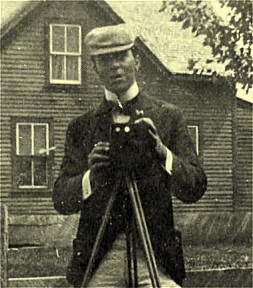
Edgar Rice Burroughs In Idaho
Red, White And Black
Now we get to the ostensible story which is the Red assault on Italian Somaliland. If few people today understand the partition of Africa by the European powers it might be well to recap the situation a little. The two big players were France and England with Spain and Portugal picking up some early real estate to be later joined by the bit players, Germany and Italy. The German possessions were stripped from them after the Great War and given to England.
This novel takes place in the Horn Of Africa or the Northeast corner facing the Arabian Peninsula and the Indian Ocean. The area contained Ethiopia otherwise known as Abyssinia, the only independent State in Africa save Liberia whose independence was guaranteed by the United States.
Ethiopia was bordered by Italian Eritrea and French and British Somaliland on the North, Italian Somaliland on the East, Kenya and Uganda on the South and Anglo-Egyptian Sudan on the West.
The Galla tribe with whom ERB became fascinated had been driven about by the Somals occupying lands mostly in the interior of Ethiopia after the manner of the Middle Eastern Kurds, where they were constantly in conflict with the Ethiopians and the Somals on the border. ERB deals with the Ethiopian-Galla situation in Tarzan And The Mad Man.
The Red camp is located in Ethiopia several days march from the border of Italian Somaliland. Opar which is nearby must now be located in Ethiopia.
The Reds have assembled an international cast of characters or in other words a multi-cultural outfit. Their multi-cultural nature will prove to be a liability rather than an asset as indeed it must in real life.
The organizers are Russian or Soviet Communists of whom there are four, Peter Zveri, the leader, Zora Drinov, Paul Ivitch and Michael Dorsky. They are joined by an American agent acting as a double agent, Wayne Colt.
Burroughs casually mentions that the expedition was put together in the United States by Zveri operating on both coasts. As Burroughs is writing a novel he wisely declines to preach or analyze, he is, as he says, an entertainer. As I who do function as an analyst pointed out in Marcia Of The Doorstep that the US had been used as a safe haven by every conspiratiorial revolutionary group on the planet. Burroughs is noting the same thing but only in passing as part of the story. If one is not attuned to such details they slip right by without significance as do the dots and dashes of the Morse code to the uninitiated.
The group is also composed of a Filipino Red, Antonio Mori and a Mexican revolutionary Miguel Romero. These people form the core group. Affiliated with them are the Moslem Arabs of Abu Batn who appear to have been recruited from the Mahgreb, perhaps Algeria, where some of Tarzan’s early adventures occurred. They do not appear to be Black Arabs of the Horn. While appearing to be Communists they remain Moslem Arabs whose real motive is to drive the Christians or Nasrany as they call them out of Africa. This means Whites of no or any religious affiliation.
Zveri has also patched on the Bantu tribe of Kitembo, the Basembos. This is because Kitembo has actually been to Opar, the only member of their party who has. Kitembo doesn’t appear to be a true Communist but is a former powerful chief from Kenya who had been displaced by the British. He comes from a place on Lake Victoria which should make him a Luo but for reasons perhaps not pertinent I tend to think of him as Kikiyu probably partly based on someone like Jomo Kenyatta who already had notoriety by 1930 although Kitembo’s history is close that that of the Unyoro Chief Kaba Rega whose story Burroughs was definitely familiar with from the memoirs of Samuel Baker.
Kitembo is interested only in recovering his past dignity augmented ten fold. All that becomes irrelevant when he deigns to lay his hands on Zora.
We should remember that Burroughs is writing in 1930 not 2010, so many things that are more or less clear to us now were undetermined at that time while understandings and motivations were quite different then from today and as those of today will be fifty years hence.
For one thing Africa was still a land of mystery where one wouldn’t have been too surprised if someone had discovered a lost civilization, a strange anthropoid- perhaps the so-called Missing Link, very real to the imagination at the time- and any number of things. One of the great losses of my childhood was the recognition that Africa was known; that nothing truly wonderful would be discovered in the world again. All was now cataloguing.
Abercrombie and Fitch who had built a very lucrative business outfitting ‘explorers’ or safaries, having not yet turned to teen porn, lost its raison d’etre as did all the ‘Explorer’ clubs where grown men sat around in khaki Safari gear drinking and dreaming. All that was left for me and my generation was Trader Vic’s and he’s gone now. The miracle is that the National Geographic found a way to survive when they could no longer portray exotic, naked, painted savages with necks supported by copper rings, plates in the upper lip and that. Now of course they don’t have to go as far for such exotica as Whites imitating the Africans sport massive tattooing suported by all kinds of nose rings and body piercings.
So, in 1930 Burroughs’ story still had a degree of probability. Especially in the way he joined contemporary politics to nineteenth century Africa. In one reads closely this is quite a story, a true tour de force.
Not only do the Arabs and the Bantus have their personal motivations apart from Communism, so we learn does Peter Zveri. The streak of individualism is not extinct in his collective mind, he sees the opportunity to make himself Emperor of Africa in Tarzan’s stead. Apparently Soviet intelligence has been keeping close tabs on the doings of the Big Ape Man because Zveri knows of Tarzan’s ‘fool dirigible trip’ believing him absent from Africa and possibly dead as no one has heard from him for the past year. This was before Google Alerts too.
Indeed Tarzan drops as from the clouds into a clearing filled with great apes as the story begins. Just coincidentally Jad-Bal-Ja and Nkima happen to be in this exact part of Tarzan’s estate of Africa at the same time. Zveri then is very disappointed to learn that his nemesis is back. As well he might because he has engaged himself mano a mano with the Big Bwana and Africa, believe it or not, is not big enough for both of them.
In his examination of Communism, multi-culturalism and human nature Burroughs is at his incisive best. Remember few of these stories go over a hundred ninety-two paperback pages. These are tremendously condensed stories. They’re somewhat like a zipped file with megabytes compressed into kilobytes. To really get the stories you have to unzip them and let them expand in y9ur mind. Don’t be deceived by their seeming simplicity.
The various cultures involved in this plot are only loosely held together by Communist ideology. The plot eventually falls apart because the cultures see through the phoniness of the Communist ideal. Zveri himself isn’t even that sincere a Communist as he intends to use the gold of Opar to make himself a third world power as Emperor of Africa. In the end Communism is a fatuous dream,whether utopian or dystopian is up to you.
Burroughs does not emphasize his opinions, he merely tells his story. My conclusions as to his intent are derived from the result of the story. In the end Communism fails because of internal contradictions while the big Bwana is invincible retaining his position as Guardian or Emperor of Africa. Not one world of preachment.
Wayne Colt in his rather absurd trek across Africa arrives too late for the first assault on Opar. He does happen into camp in time to spot the shaking tent and rescue Zora from Jafar, the Indian Communist, with Tarzan’s help. After killing Jafar Tarzan turns his steps to Opar traveling in a bee-line through the Middle Terraces he handily arrives before the first expedition which had left some time before him.
Let me take a moment to discuss Burroughs’ Africa. In the first place these stories are combination dreamscape, fairy tale and mythmaking. His Africa bears no more relation to this planet than Arthur’s Camelot bore to Medieval England. I find it tiresome for scholars to try to find the ‘real’ history of Arthur’s career. Arthur may have a loose connection to real historical events but the story, a great one, is a projection of psychological needs. There isn’t any such thing as a Holy Grail. No knights ever went in search of it.
In the same way Burroughs’ Africa is a psychological projection hopefully leading to his Holy Grail. There are no lower, middle or upper terraces in a nearly uniform jungle in the real Africa. Anyone who tries to find them will be severely disappointed. Such things are merely inventions of Burroughs’ dream world. I am glad he shared it with me, you and the millions.
The frequency with which the characters run into each other way out there is also impossible but in Burroughs’ dreamscape, his fairy tale, his myth, it happens all the time. There is no sense in arguing the impossibility. If you find it too offensive to your sensibilities then the oeuvre is not for you. One just accepts that these are fairy tales and in fairy tales things like this happen all the time. It’s a fantasy, fantastic things go on.
I try to fathom the psychological intent so while I may smile and jest at some impossible details it is only at the naive dream details and not the serious intent of the story. In our time these stories would have been taken at warp speed to another galaxy where in that context all things would be possible. But, that would be pure fiction hence unbelievable. I never did take Star Trek seriously, in fact, I refused to voluntarily watch it. Burroughs’ Africa can still be located on a map of the world connecting psychological reality with temporal reality in a very satisfying blend.
So, as this series is a roman a fleuve or River Story, Tarzan ruminates on his previous visits to Opar as he strides across the hot dusty desert, where the rain never falls, toward the fabled gold and red domes and turrets in the distance.
La’s love for him which began in Return Of Tarzan has caused dissension between her and her people. She has retained her position only through the active intervention of Tarzan. Defeating the revolution that had ousted her in Tarzan And The Golden Lion the big Bwana had replaced her on the throne guarded by the Bolgani of the Valley of Diamonds and the semi-human Gomangani. It is interesting to not that the Oparian revolution occurred after the Russian. Might be a connection.
As he approaches the city he believes that the Oparians appreciated his defeat of Cadj and that they love and respect him so that his reunion with them will be joyous. Not so. In the interim the Oparians who hate and resent Tarzan have deposed La putting her in a foul prison in the vast underground maze of dungeons of Opar. Passing back through the narrow cleft, bounding up the stairs, Tarzan is surprised to find himself attacked by the howling Frightful Men. The Man of the Steel Pate receives another frightful blow which lays him out.
He wakes to find himself the captive of Oah and Dooth. He is placed in a cell the details of which I have already related above.
I haven’t plumbed the signficance of Tarzan and La being imprisoned together while the city is attacked by the Communists unless the dreamworld of Opar represents a sanctuary that is now invaded in the attempt to destroy Burroughs’s literary career. In that event it might be necessary for the Anima and Animus to be together. This story also harks back to the invasion of the Emerald City in Baum’s story The Emerald City Of Oz.
In any event the various strange screams and noises from within Opar unsettle the superstitious Blacks and Arabs who lose their nerve refusing to enter Opar. The Blacks believe in spirits and the Arabs in jinns both of which they fear more than living men. Thus Burroughs is contemptuous of both cultures.
Zveri and his Russians are too cowardly to enter themselves. The only one with the nerve is the Mexican Miguel Romero who gets very good reviews from ERB. Miguel retreats in the the face of the horde of Frightful Men but he is very cool about it.
Returning to camp the Arabs are now disaffected having words with Zveri. The arrival of Colt and Mori puts a little heart into Zveri so that a second attempt on Opar is determined leaving the Arabs to guard the camp.
Tarzan and La escape from Opar between the two assaults becoming subsequently separated. Zveri takes the Blacks and Communists with him. Being left behind dissolves the Arab affinity with the Cause. Never good Communists, being interested only in ejecting the Nasrani from Africa, they decide to disappear into the desert.
About this time La wanders into camp. Sacking the camp, Abu Batn and his Arabs leave with the two women whose value in the North he knows full well. The Arabs are out of the story. The Communist coalition is breaking up. As Burroughs points out the goals of the two are not the same.
Back in Opar Zveri finds it impossible to force his Africans into service while he and his Russians remain cowards. Colt behaving bravely, as only an American can, along with Miguel Romero penetrates to the sanctuary where they are faced by the Frightful Men. Perhaps in a comment on American tactics Colt fires over the heads of the Oparians while the Mexican, Romero, fires directly into the mob.
Why when Americans go to war they are reluctant to do the dirty work of killing is beyond me. The reluctance to engage the enemy in Viet Nam cost us that war. The reluctance to do what we have to do in Iraq is costing us that war. Perhaps we think we can hide behind a wall of steel as our technology wars for us while we imagine we can remain safe. Our punishment of our own soldiers for merely humiliating the enemy must be unique in the annals of warfare. And they wonder why no one wants to join the Army.
Romero who shoots to kill is able to escape while the pussy footing Colt is downed by a thrown club and captured. A thrown club! Once again a Burroughs’ surrogate takes a blow to the head, but how does one survive a thrown club?
Just as Colt and Zora exchange partners in the jungle so now Colt takes Tarzan’s place in jail. Here, he is befriended by a nubile beauty, Nao, rather than as La did Tarzan and, pephaps as Florence was doing for ERB. Afer killing to free him Nao is left behind as Colt disappears into the dusty desert. Not a very thoughtful thing to do as Nao would certainly be discovered.
Zveri returns to his devastated camp to be handed a letter notifying him that Colt is a double agent. Abandoning any thoughts of Opar the Communists concentrate on their mission which is the simulated invasion of Italian Somaliland.
As they are about to leave Tarzan returns Zora to camp. Coldly dropping her off without a word he climbs onto a branch to spy on the conspirators. His leopard skin shorts are mistaken for the real thing. Here we go again. the shot at the imagined leopard grazes the Big Guy’s skull putting him out of commission for a full day. So that is at least two knockouts for Burroughs’ surrogates plus this concussion. Tarzan’s frequent lapses of attention become more intelligible.
Zveri wants to take advantage of his opportunity and kill Tarzan but Zora intervenes so Tarzan is bound which leads to next day’s episode when Dorsky threatens him only to be annihilated by Tantor.
The charming fairy tale between Nkima, Tantor, Tarzan and the Hyena then takes place which is a repeat of the same scene in Jewels Of Opar.
Nkima then goes in search of the Faithful Waziri to aid Tarzan while the Big Fella begins his campaign of terror against the Communist conspirators.
His strategy is to separate Kitembo and his Basembos from Zveri and his Communists. To do this he plays on their superstitious natures. A mysterious voice comes down from the trees, in other words, the sky, telling them to go back. In the meantime Little Nkima has recruited the Faithful Waziri who arrive to help out not with spears and bows and arrows but modern repeating rifles. Arranging themselves in front of the advancing Communists hidden in the tall grass -this stuff grows six feet high- they give the appearance of being many more than they are. Burroughs doesn’t make it clear how they can see the Communists through the grass while the Communists can’t see them but as Tarzan usually navigates pretty well even in total darkness I’m probably making a bigger problem out of it than it is.
Zveri does a rapid advance to the rear which act of cowardice completely destroys his credibility. Dorsky is dead while Romera and Mori renounce their Communism. Zora reveals she’s only in it for the revenge because Zveri had murdered her family twelve years earlier in the Revolution while, as we are aware, Colt is an American agent. This leaves only Zweri and Ivitch who I believe represent Frank Martin and R. H. Patchin, ERB’s old nemeses in Chicago.
Returning to camp Zveri spots Wayne Colt. Calling him a traitor he fires point blank missing while the bullet grazes Colt’s side without breaking the skin. That was a close one. Before Zveri can fire again he is brought down from behind by Zora. Burroughs replays scenes like this over and over with different variations. Just as the constant bashings on the head his surrogates take reflect his own experience in 1899 so must all these conflicts between his surrogates and another man and his surrogate woman reflect his situation with Frank Martin and Emma. In each instance in one way or another the woman rejects the other man. Thus Burroughs ‘fictionizes’ his own situation.
So now Zora kills Zveri so that she and Colt can bridge that gap.
As a sidekick Ivitch/Patchin is allowed to leave Africa. In point of fact Martin died some time before Burroughs although not until after 1934 while Patchin survived both.
Tarzan in the meantime escorts La back to Opar where he reinstalls her on the throne this time doing the sensible thing of eliminating Oah, Dooth and all their sympathizers. One must believe there will be no more trouble in Opar. In any event Opar disappears from the oeuvre.
Tarzan then returns to the camp to dispense justice as becomes the Lord Of The Jungle.
As the story ends the ‘invincible’ Tarzan seems to have solved all the problems confronting he and Burroughs in 1930. The Big Fella has not only thwarted Zveri but defeated Stalin and the whole Soviet empire.
As the exchange between Zveri and Romero explains it: pp. 183-84:
“Which proves,” declared Zveri, “what I have suspected for a long time; that there is more than one traitor among us,” and he looked meaningly at Romero.
“What it means,” said Romero’ “is that crazy, harebrained theories always fail when they are put to the test. You thought that all the blacks in Africa would rush to our standard and drive all the foreigners into th ocean. In theory, perhaps, you were right, but in practice one man, with a knowledge of native psychology, which you did not have, burst your entire dream like a bubble, and for every other harebrained theory in the world there is always the stumbling block of fact.”
Thus Tarzan not only defeats Zveri, Stalin and the Soviets but he disproves the whole Communist ideology as a harebrained theory.
On top of that the Invincible One restored order in Opar while putting his personal life to rights by separating out Colt and Zora or Burroughs and Emma and Tarzan and La or Burroughs and Florence.
The succeeding novel Tarzan The Triumphant- Invincible, Triumphant- will rescue the Russian situation while its successor Tarzan And The City Of Gold disposes of Emma/Jane/Zora/Nemone by her self-immolation while its successor Tarzan And the Leopard Men bring Kali/Florence and Old Timer/Burroughs together. The series climaxes with Tarzan And the Lion Man when Burroughs 2 kills off his early self, Stanley Obroski, or Burroughs 1 to come into his own, or so Burroughs supposes. The rest of the series is playing out the aftermath of the divorce from Emma and the marriage to Florence.
As could have been predicted the marriage to Florence was less than satisfying.
So, perhaps, Burroughs’ solution to his personal dilemma is based on a harebrained theory itself which fell to earth on ‘the stumbling block of fact.’
For the moment however Tarzan has saved Africa from the Communist menace and perhaps the World.
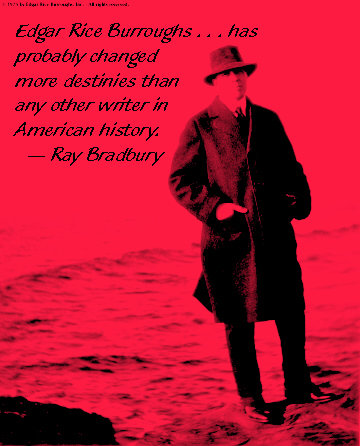
Edgar Rice Burroughs- High On A Mountain By The Sea
A Review
Themes And Variations
The Tarzan Novels Of Edgar Rice Burroughs
#14 Tarzan The Invincible
Part VI of X
by
R.E. Prindle
Inside The Gates Of Opar

Edgar Rice Burroughs
Life is just too short for some folks,
For other folks it just drags on.
Some folks like the taste of smokey whiskey
Others think that tea’s too strong.
Me, I’m the kind of guy who likes to ride the middle
I don’t like this bouncing back and forth.
Me, I want to live with my feet in Dixie
And my head in the cool blue North.
–Jesse Winchester: Nothing But A Breeze
And now we come to the heart of Edgar Rice Burroughs. One reason he is literarily disdained is that the story is not the story. Porges, p.524:
As the story progresses the perceived theme of a worldwide conspiracy is abruptly abandoned. Burroughs in his contempt for the communists refuses to allow them to be sincere even in their Marxist goals.
This is not true. Porges has misconceived the story. To quote the sixties Jewish revolutionary Mark Rudd: The issue is not the issue. By that Rudd meant that the Jews had created a diversion to mask the true issue which was the establishment of the Jewish culture as top culture or dictator in this multi-cultural world.
Burroughs intent is exactly the same as regards Tarzan. True, Burroughs has contempt for Communism but that is merely a frame story and a side issue. The true issue is that Tarzan’s authority as guardian of Africa is being challenged on the spot. The duel is between himself and Sveri mano a mano. He discredits the collectivity through the individuals. Thus at novel’s end Tarzan sits in state as Guardian or Emperor disposing the fates, godlike, of the remaining conspiritors. Magnanimously he allow Paul Ivitch (Paulevitch) to be escorted out of Africa rather than be thrown on his own resources that would have resulted in his certain death.
The issue within the issue, as always, is Burroughs attempt to resolve his psychological difficulties. Thus one has the Colt-Drinov combination, possibly reprsenting ERB and Emma, an episode within Opar of Nao who may represent Florence releasing him from the prison of his marriage to Emma, and Colt-La, the Anima and Animus problem. Tarzan and Colt change partners so that La nurses Colt and Tarzan nurses Zora. But to that in the next section.
While one expects a pure shoot out with the Communists, Tarzan is not going to defeat them by direct action but by a terrorist campaign of which Tarzan is the jungle master.
To compound the problem Burroughs confuses realism with dreamwork. This is not a realistic novel but a dream fantasy. It was said that Burroughs wrote out his dreams which has a basis in fact. The scenarios may have originated in his sleeping dreams but then he modifies them in day dream style while consciously molding the story for political and commercial purposes. A writer does need readers.
To give a basis for comparison for the dreamwork I’m going to play Freud here and offer up a dream of my own; it is similar to Burroughs’ in many way. Since integrating my personality I don’t have wonderful dreams like this anymore. As Jung correctly surmised when one integrates the conscious and sub-conscious minds memory destroys the symbolic basis of your dreams. I can analyze the common place dreams I have now even as I dream them. Something is lost, something is gained, but it might be of lesser value. I think I like the mysterious flavor of the smokey whiskey even though the water I have to drink now is better for me.
In my dream I began on the edge of a vast desert dotted with a few oases while far off in the distance twenty years away, rather than miles, away in the the distance a great white shining mountain arose. The distances were so vast they were measured not in miles but years. Indeed, the years of my life. I had to traverse the vast desert reaches between the oases. Each oasis merely refreshed me for the next perilous journey. Having traversed the years I came to the great white shining mountain. One might compare it to the tor containing the treasure vaults of Opar out on its desert. These are symbols common to multitudes.
I then came to the white shining mountain which might compare to the city of Opar. Censorship prevented me from climbing the mountain at that time. In other words in the control of my subconscious, consciousness was denied me. I approached the mountain from the back where I noticed a trickle of water leading into and down the mountain. I tried to drink the water but as it ran through a pure salt bed it was too salty. Unlike Burroughs who was in the pits of darkness I was always bathed in a clear light which came from nowhere.
I followed the little stream down the subterranean path into the mountain. Thus I had all land and no water, a barren psychological situation. Following the cave down I came to a series of gates made entirely of steel. I hesitated to go forward but there was no going back. I was impelled into one of the gates which turned into a chute that spilled me out onto a steel floor where unseen hands seized me pushing me into a steel room as the steel door slammed shut. Like Tarzan beneath Opar I was a prisoner with no seeming way out.
As I looked around I realized that this was a laundry room. All steel, of course. While I had no food I now had sinks full of water. My situation had been reversed from all land to all water, from the pure masculine to almost pure feminine. Where before I was barren now I was spilling over with wisdom. I knew I had to get out of there reasonably soon or I would starve to death. There was impenetrable steel all around. But I had plenty of water. Too much water. Looking around I spotted ventilation ducts along the ceiling. I conceived the notion that I could drink lots of water then urinate in the ducts which would create a foul odor that would be distributed throughout the rooms above. They would search for the source of the odor thus opening the door of my prison.
The ducts were difficult to reach but I was able to urinate in them. As I expected voices came down the duct asking ‘What is that smell?’. The door to my prison opened inward so I stood to the side that opened waiting. Sure enough a couple maintenance men flung the door open bursting into the room. I slipped out the door behind them unnoticed.
I now descended still further until I came to a bank of elevators. One door was open for which I made a rush. The elevator was packed with boys I knew from high school. With doubled fists they pushed me back refusing to allow me in the elevator with them. Mocking me as the doors closed I was left alone way down there.
There was a flight of stairs but censorship prevented my using them. I waited in vain for another elevator. As with dreams I next found myself at the back of the mountain but the path into the mountain had disappeared so I now had to climb The Great White Shining Mountain.
If, like Burroughs, I were writing a story I would provide a plausible story line for my escape but I’m not. I’m merely transcribing a dream.
The reason the mountain shone was because it was covered by snow several hundreds of feet, possibly thousands, thick. As previously the water in the stream was too salty to drink now it was frozen. The sun shone brightly, not only brightly, but brilliantly, as I began my climb. I had left the subconscious for the conscious as I strove for the light. The climb was long from the back of the brain to the forebrain but not tiring. Apart from the barrenness of the snow I was enjoying myself. Would it be too offensive a pun if I said I enjoyed being high? After a long climb I came to a precipice past which I could go no further. Nor could I go back.
As I studied my position I looked down this sheer precipice to the desert thousands of feet below. There was snow all the way to the desert floor. Down there, way down there, I could see the tiny ant-like people in the barren sands doing obeisance to the moutain which they apparently treated as a god.
Looking down the sheer face of snow I could dimly perceive the outlines of a great face carved in the snow. This god, then, retained all the water behind his visage that could make the desert bloom. Just as I had used water to escape the prison of my subconscious I conceived the notion that I could release the water and make the desert bloom freeing the people from their bondage.
Now, this was hard snow. I had no trouble walking the surface without breaking through while if the snow didn’t give way as I jumped on it to destroy the snow god I would plummet several feet into the desert. Neverthless I leaped up landing on my bottom. The snow gave way as I rode the avalanche several thousand feet down the mountain side to land on the desert floor while I destroyed the god who had been impounding the water.
Many streams now flowed out from the mountain. The desert bloomed turning green and bursting with flowers. Now that we have a comparison let us examine Burroughs’ great dream of Opar.
Opar first found expression way back at the end of 1912 and the beginning of 1913. Appearing at the end of The Return Of Tarzan the story was included in Burroughs’ fourth published story and fifth written story, the Outlaw Of Torn had been written but not published yet.
As with Invincible the story of The Return was not the story. The story was what Burroughs hung the details of what appeared to be the story on. Hence Return was rejected by Metcalf Burroughs’ first editor at Munsey’s who undoubtedly couldn’t understand it. This is the novel in which Tarzan makes his first raid on the fabulous treasure vaults of Opar. Burroughs will continue his wonder stories of Opar through three more books. Each return occurs at a crucial point in his life.
That Opar is a dream location is proven by the topography of the location. It is not too dissimilar to any dream. The jungle grows right up to the base of towering mountains behind which Opar is hidden. On the other side of these it is a dry dusty desert exemplifying Burroughs’ life as the twenty year desert in my dream did mine. Entry into the valley in this story is through a narrow defile apparently several thousands of feet high above which the peaks of the surrounding mountain range tower several thousand feet more. This entry also closely resembles that of Haggard in King Solomon’s Mines. Haggard is never far from Burroughs’ mind as he writes his stuff.
Working your way down into the dreamscape is considerably more easy than climbing it. And then off in the distance rose the shining red and gold domes and turrets of Opar. A dream city if there ever was one. One is reminded of the two great literary and psychological influences on Burroughs, H. Rider Haggard and L. Frank Baum. Of Haggard’s work beyond King Solomon’s Mines I have Heart Of The World and People Of The Mist most readily called to mind. It might be appropriate to mention that Freud also read some Haggard. He specifically mentions Heart Of The World and She but I suspect he probably read others as well. Opar might be a ruined version of Baum’s Emerald City of Oz. Opar is red and gold while from a distance its ruination is not obvious. Mine was a shining white mountain. Burroughs probably tinkered with his to make a good story better.
Now, the fabled Thebes of Greek mythology had seven gates. Cities Of The Sun had up to a hundred. Opar doesn’t have any. The entrance is a narrow cleft in the wall on which on entering this narrow 20″ gap for which Tarzan had to turn his massively broad shoulders sideways and then immediatley climb a flight of ancient stairs. This appears to be a reverse birth story in which Tarzan is reentering the womb, an impossible feat, but then, Tarzan goes where even devils fear to tread. Try some of the books of the psychologist Stanislav Grof. There’s definitely a sexual image that requires a little thought to understand. Hmm. No gates but a narrow cleft too narrow for the shoulders and a flight of steps leading back into the what, womb? Whose cleft? ERB mother’s, Emma’s, possibly Florence’s by this time, or that of his Anima figure? Well, the last is waiting for him inside the domed inner chamber of this sacred city who is aptly named La, which is French for She. ‘She’ was Ayesha the heroine of Haggard’s novel She. I’m sure Burroughs is not writing consciously here.
At this point Tarzan is accompanied by fifty of his brave and faithful but superstitious Waziri. In fact, in this story as Tarzan goes through his incarnation of a Black savage he is Chief Waziri, eponymous head of the Waziri. P. 42:
As the ape man and his companions stood gazing in varying degrees of wonderment at this ancient city in the midst of savage Africa, several of them became aware of movement within the structure at which they were looking. There was nothing tangible that the eye could grasp- only an uncanny suggestion of life where it seemed that there should be no life, for living things seemed out of place in this weird, dead city of the long dead past.
Dead city of the long dead past. That’s what dreams are all about, one’s own long dead past. Thus the ridge separating the lush live jungle from this dry, dusty plain eight years wide was Burroughs own dead past. I suggest the mountain range, perhaps sixteen thousand feet high, represented ERB’s confrontation with John the Bully when he was eight or nine. On the jungle side was his early life as a Little Prince while on the dry dusty side was his blighted, blasted life after John. Opar represents his ruined mind inhabited by the suggestion of life and the Queen of his dreams the beautiful High Priestess of the Flaming God, the woman of indescribable beauty, La of Opar.
La is obviously a combination of Haggard’s She and L. Frank Baum’s Ozma Of Oz.
Tarzan is seized by the Frightful Men, bound and gagged and left lying in a courtyard at high noon. The rays of the Flaming God bear down on him. Whether this is merely part of an ancient Oparian religious rite or whether Tarzan becomes the chosen Son of theSun a god among men, isn’t clear to the reader. The Oparians have their own ideas.
Burroughs describes this rite in a really masterful way. The maddened murderous Oparian who disturbs the ceremony just before Tarzan is to be sacrificed is nicely handled. Believe me, I feel like I am there. As La looks down on Tarzan’s form on the altar she recognizes the One, the Son of the Sun, the One for which she is destined. Once again, Haggard’s She.
Freed in the melee caused by the crazed Oparian Tarzan is taken down to the Chamber of the Dead by La where she hides him. As she said nobody would look for him in the Chamber of the Dead. This Chamber answers very well to the laundry room of my dream. Tarzan/Burroughs is in a stone dungeon with walls fifteen feet thick, fourteen in Invincible, in total darkness while I was in a steel room with no exit but bright light. These locations answer to the rigid confines of one’s owned damaged psyche. There is no way out but there is, there has to be. While palpating this stony prison at the back of the cell Tarzan discerns a flow of air coming through. This scene is a replication of one in Haggard’s King Solomon’s Mines while becoming a B movie staple. The big Bwana discovers some loose stones. He is able to dislodge these creating an exit through the fifteen foot depth of stones of the fortress wall. Somehow Burroughs has worked his psyche to give himself a chance. Once beyond the foundation walls, free of the Chamber of the Dead (I once dreamed I was looking for my soul in the House of the Distraught) but act among the living, Tarzan feels his way down this long dark corridor. One can’t be certain of ERB’s age when he achieved this escape. As it takes place just before Tarzan marries Jane the time might have been 1898-99. Perhaps when he was in the stationery business in Idaho. Perhaps something he read acted as a lever. Apart from Darwin’s Origin Of Species I would venture to say he read Eugene Sue’s Mysteries Of Paris a copy of which is in his library while traces of it are here in his earliest work.
Sue’s rare mentality permeates every page of this first visit while Sue’s extraordinary consciousness is everywhere apparent throughout ERB’s entire corpus. Burroughs himself is absolutely incredible in the manner he associates with numerous other writer’s intellects, seemingly simultaneously within a given passage or even sentence. Myself, Adams, Hillman, Broadhurst, Burger and others have written extensively on these influences. Hillman even goes so far as to virtually twin Burroughs with some of his major literary influences. Burroughs does make all these writers his virtual doubles.
I have stressed Sue’s influence in several earlier essays. I can only urge you to read Sue’s Mysteries Of Paris- a big three-volume work and too short at that- which Burroughs in his own reading found a life changing experience. Possibly he did read it in 1898-99. I found it a life changing experience; I’ve never been able to free myself of its influence, while it appears that Burroughs couldn’t either. A lot of the late nineteenth century writers make reference to Eugene Sue. H.G. Wells based the beginning of an early novel on Sue. The remnant remains only as a short story.
Sue wrote from outside the bounds of sanity. Privately I consider him insane but so brilliantly rational as to transcend the very meaning of insanity. He’s a dangerous writer. His last work was confiscated by the French authorities. It undoubtedly had such a private personal sense of morality that I am sure it would have undone society much as the pornography from Hollywood has undone ours. DeSade and Restif De La Bretonne, who in some ways Sue resembles, were mere unbalanced pornographers who disturb only the disturbed. Sue’s vision of morality is coldly clear, it forms the basis of Tarzan’s but is always on the side of reason and virtue. This fact makes it no less dangerous to a weak mind or that of the obsessive-compulsive Liberal. Still, only the strong survive. I heartily recommend you take your chance.
Tarzan freed from the prison of the psyche, was he insane? was I? or were we merely trapped by a device of other’s making? I can’t say but ERB’s sanity after he escaped was conditioned by that of Eugene Sue. I, of course, rise above all influences.
Progressing down the corridor Tarzan comes to the First Censor. He finds a gap in the floor into which he might have fallen had he not been careful. He would have fallen into the unknown but he would have been alright. He would have fallen into water which in his condition would have been life-giving water rather than dangerous or perhaps he might have drowned in the waters of the subcoscious or Oblivion.
In high school I had a teacher who used to chalk a half dozen slogans on the black board, one each morning. The only one I remember is ‘when you reach the end of your rope tie a knot and hang on.’ I did this for a couple decades then one day I let go. The joke was on me. There was nowhere to fall. I was only a fraction of an inch from a solid surface. However Tarzan culdn’t have known this since he didn’t fall in, this time. He would three years later.
By chance he looked up where he saw some light entering to discover he was at the edge of a well. Yes, you see, the water of life. He dimly descried the other side fifteen feet away which was child’s play for him to leap. Thus he passed the First Censor. Mine was at the elevators which I apparently merely disregarded.
Continuing on for some time in total darkness, so far that he believes himself outside the walls of Opar he enters the treasure vaults. These vaults are filled with what appears to be forty pound barbells of solid gold. Now, this gold is old. So old that no Oparian knows that it is there nor do any old legends even mention it. This is an intriguing part. The gold was mined millennia in the past after the sinking of Atlantis. This raises the question of what did Burroughs know of Atlantis and did he believe in it? I can’t answer the sources of the former but I’m betting on Ignatius Donnelly as one of them. As to the latter I believe he did. He mentions Atlantis in Invincible with a confidence and familiarity that convinces me that over the eighteen years since Return he has read and thought enough to convince himself of the reality of the lost continent. He appears to accept a mid-Atlantic location.
The gold represents the income he’s receiving for his stories. The stories spring from his dead past. That the vaults are outside Opar indicates he freed his mind from its prison or that the money comes from outside the prison, i.e. his publishers. That the gold is Atlantean indicates that his stories are based on his own ancient experience. In other words he is mining his past already completed as ingots or accomplished facts.
What experience then catalyzed his ability to write? I believe that from 1908-10 when he read L. Frank Baum’s Ozma of Oz, Dorothy And The Wizard Of Oz and The Emerald City Of Oz he found a means to express himself. These books bypassed his last censor allowing him to write Minidoka. That book was not suitable for publication but it freed his genius so that he immediately followed it with A Princess Of Mars.
Now, outside the gates of the Emerald City/Opar in the midst of the equivalent of Baum’s Great Sandy Desert he found the handle on his own destiny.
Tarzan locates the fifty faithful but superstitious Waziri loading them up with two forty pound ingots each and points them toward the coast.
At the same time Fifty Frightful Men from Opar who are tracking him discover Jane instead. Dreamy enough for you? Given a choice between Tarzan and Jane I’d take Jane and so did the Fifty Frightful Men.
So now Jane’s on the altar under the sacrifical knife of La. Skipping the irrelevant details La discovers Jane is Tarzan’s beloved. Interesting confrontation between Tarzan/Burroughs real life woman and his Anima. La is shattered as Tarzan rejects her for Jane.
This is a key point in the oeuvre. This is what makes the novels so repulsive to the literary mind. The story is not the story; the issue is not the issue. Opar is the story within the story that will be told in four short parts over eighteen years. So we have part one here without any indication the story will be continued. A segment of the story is just plopped down into The Return Of Tarzan, sort of irrelevantly.
Weird style actually. I’m not even sure it works, but it nevertheless must be effective else why would the stuff still be in print a century on. You’re on your own, Jack, I can’t even attempt to solve that one. Not today anyway.
The next novel examining this psychological is the 5th novel of the oeuvre, Tarzan And The Jewels Of Opar of 1915.
At this point Tarzan, a profligate if there ever was one, has run through the two tons of gold the fifty faithful Waziri brought out and is broke. Two tons of gold in three years. Think about it. He needs to make another run on Opar.
The character of the series changes with Jewels Of Opar from the character of the Russian Quartet, the first four novels. They not only have an Oz influence but they become Ozlike. Burroughs apparently drew on The Beasts Of Tarzan as the foundation for what is essentially a new series.
After writing five Oz stories, in the sixth, The Emerald City Of Oz, Baum attempted to abandon the series. He closed the series off with the news that there will be no more communication from the fairy kingdom. Because Oz has been invaded three times now, what with the advent of airplanes that will be able to spot Oz from the air Ozma is making the kingdom invisible. Is it coincidence that Opar disappears from the oeuvre after the third invasion?
Baum’s Emerald City Of Oz appeared in 1910. It was the last of the stories to be datelined Coronado in his prefaces. When he was forced to begin writing Oz stories again in 1913 they were datelined Ozcot in Hollywood. In 1910 Hollywood was just a pleasant Los Angeles suburb. The movies didn’t begin to make Hollywood the center of the world porn industry until 1914.
Whether Burroughs knew that Baum left Coronado in 1911 isn’t known but I find it signficant that when he went to California in 1913 his first choice of residence was Coronado where he perhaps thought he would be close to Baum who afer all had a close connection with Chicago. Baum wasn’t in Coronado so Burroughs moved across the bay to San Diego.
The question then is: did Burroughs make a pilgrimage to Ozcot to see Baum in 1913? I have to believe he did. Tarzan was one heck of an entree such that Baum could hardly refuse to see ERB. How long or how often the men met then is conjectural but I think it was long enough for Baum to give Burroughs some tips on fantasy writing. Already an ardent admirer of the Oz books Burroughs would have had no trouble accepting advice from this master.
Thus when Burroughs returned to LA and Ozcot in 1916 it is certain that they met while they were probably already familiar with each other. In 1919, when Burroughs moved to LA permanently, Baum was on his deathbed so there was no chance to renew the acquaintance. I also believe that Baum’s Ozcot influenced Burroughs in naming his own estate Tarzana.
In any event Tarzan returns to Opar in 1915. Except for the first visit when Tarzan following the directions of the old Waziri, chief of the Waziri, visited Opar to take the gold, in the rest of the visits he is battling interlopers who wish to steal the gold from him. It might pay to look at the nature of the intrusions and the intruders.
In 1911-12 Burroughs had for the first time in his life come into more money than he could spend, only for a brief moment of course. Thus Tarzan removes the gold more on a whim not really knowing what to do with it. One might think this a strange attitude for one who had tasted the night life of Paris; but a foolish conisistency is the bugbear of small minds as one of those venerated old timers once said. I don’t wish to be thought of as small minded so we’ll let the observation pass.
By 1915 having lost his two tons of gold in some bad investments Tarzan has better learned the value of money or, at least, the absence of it. And so, perhaps, has Edgar Rice Burroughs. One can see the ghost of old George T. shaking his head muttering: ‘When will that boy ever learn?” Well, George, it would take more time than allotted to him.
After 1912 Burroughs had created something of value. That value could be stolen or at least exploited. In 1914 McClurg’s offered him a publishing contract. Nicely crafted it gve all the advantages to McClurg’s and none to Burroughs. Burroughs undoubtedly did not understand the legal implications of what he signed. I can’t explain this but McClurg’s made no effort to merchandise a sure fire hit. They didn’t even publish the full fifteen thousand copies called for in the contract. They released the book to reprint publisher A.L. Burt after p;rinting only ten thousand copies themselves. Explain it how you will but there was a guaranteed huge absolutely visible market waiting for book publication. Syndication in newspapers had guaranteed the book’s success. So why did McClurg’s willfully refuse to take advantage of such a deal?
Burroughs probably had stars in his eyes at the prospect of 10-15% royalties on hundreds of thousands if not millions of books. Instead he got comparatively nothing. The royalties from Burt were miniscule and to be shared 50/50 with McClurg’s. You can imagine Burroughs’ disappointment as a golden future became brass before his eyes.
Back to Opar. Tarzan entered the vaults before his faithful Waziri who were warriors and would act as bearers for no other man. Alone Tarzan made six trips from the vaults to the top of the tor bringing up forty-eight forty-pound ingots. That’s 320 lbs. per carry for a total of 1920 lbs or nearly a ton. According to Freud, and I believe him, all numbers are significant, although I don’t have enough information to delve completely into the meaning of these numbers. The Waziri then brought up fifty-two ingots. some two of the fifty got stuck with carrying two ingots or two went back for one more. That made slightly over a standard of 2000 lbs.
Tarzan’s forty-eight ingots are roughly half of the total that undoubtedly represents the fifty-fifty split with McClurg’s. At the time Ogden McClurg, the son of the father who built the company, Alexander McClurg, was the nominal head of the company. The firm was actually owned by the employees since about 1902, which Burroughs probably didn’t know. The man he dealt with, Joseph Bray, was probably the real head of the company. Actually Ogden was away from the company for long stretches on adventures in Central America and WWI so that he would have been unfamiliar with the day-to-day workings of the company. Burroughs, however, formed a grudge against Ogden McClurg. I suspect that the Belgian villain Albert Werper is based partly on Ogden McClurg while also being an alter ego of Burroughs. So, a story behind the story is how Ogden McClurg stole ERB’s royalties.
At the same time Tarzan spurns La for a second time so the Anima-Animus story of Tarzan, Jane and La continues. La has Tarzan within her power but in the life and death situation love triumphs over her hurt so she spares the The Big Guy. Not without consequences. The Fifty Frightful Men, or what’s left of them after the maddened Tantor tramples a few, led by Cadj, who now makes his appearance, feel betrayed repudiating La. Thus is begun the conspiracy to replace La which will be the focal point of the next two visits. You know, love or hate, I don’t know which is to be feared the most.
In the next visit in Tarzan And The Golden Lion Tarzan has gone through his second two tons of gold. That is four tons of gold in roughly ten years plus the Jewels of Opar that our spendthrift hero has managed to go through. Four tons of gold! That’s 128,000 ounces of gold. At today’s price of over a thousand dollars an ouce it works out to 128 billion dollars and change. My friends, that is prodigality. Good thing there was more where that came from, hey?
Of course a lot of the loss came from loans to the British Empire to float the Great War. But like certain other borrowings, to which Burroughs may be making an allusion, the Empire had no intention of repaying.
Once again this sort of excess had brought Tarzan to the edge of bankruptcy not unlike ERB in 1922. Just as creditors were besieging ERB for money so some private individuals led by a former employee, Flora Hawkes, attempt to extract the gold from Opar. Tarzan first fails, then recovers not only the gold but the bag of diamonds. The significance of the jewels is explained in the Tarzan and Esteban Miranda story contained in Tarzan And The Ant Men. That story is a duplicate Jewels Of Opar with different details. The history of the Jewels Of Opar also duplicates the history of Tarzan’s locket in Ant Men. If you’ve found something good don’t hesitate to use it more than once.
Fifteen years after the visit in Jewels Of Opar and eight years after the Golden Lion/Ant Men the scene returns to Opar, where once again others are to make a run on Tarzan’s private bank at Opar. Apparently Tarzan has them baffled from the start as, although they know there are treasure vaults at Opar, they have no idea where they are. It appears the Communists have read the earlier books, but not with close attention, nor did they bring their copies along with them to bone up during all those idle moments in camp. Playing cards is alright after reading, but time better spent before. You can see why these dodos failed.
Burroughs had read his Oz stories. One can’t be sure whether he ever reread the stories or whether he was working from twenty year old memories. There are similarities here with the Emerald City Of Oz of 1910. In that book Baum attempts to end the series. He says that it will be the last communication from Oz. It too involves an invasion of Oz by the Nome King and his horrid allies. In Baum’s story Ozma refused to defend her Communist State, predating Russia by seven years, but arranges it so that the invaders who are tunneling beneath the Great Sandy Desert emerge in front of the fountain of the Waters of Oblivion. The fountain has apparently been spiked with LSD as the drinkers get lost in a world of their own returning through the tunnel without a fight. Perhaps the first military use of drugs in history. An excellent fairy tale, hey?
Burroughs’ Communists make two attempts to enter Opar. Circling the city unable to find any gates to Burroughs dreamworld they do find the narrow cleft in the wall. Spooky sounds and happenings disconcert the Blacks and Arabs of this multi-cultural coalition so that any concerted action is frustrated. Although the Russians and the Mexican, Romero, enter, only Romero has the courage to penetrate beyond the courtyard. The Russians are arrant cowards who flee at the sound of the first Oparian shriek.
Returning to base camp they find that Wayne Colt, having tramped the breadth of Africa, has joined the group.
A second attempt is made. The superstitious Arabs refuse to return being also disgusted by Zveri’s lack of leadership and cowardice. Taking the six Communists and the Blacks Zveri returns to Opar for a second attempt. While absent from the base camp the coalition begins to come apart as the Arabs desert the cause, looting and burning the camp while taking the two White women with them. La has joined Zora but more on that in the next section.
The second expedition fares no better than the first for the same reasons. On this attempt both Wayne Colt and Romero enter the sanctuary where they are engaged in a serious battle with the Frightful Men. Colt is felled by a thrown bludgeon that knocks him down but doesn’t crush his skull. Romero retreats, Colt is dropped unconscious before the high priestess, now Oah and Dooth. Cadj was destroyed by Jad-Bal-Ja in Golden Lion so Dooth has taken his place.
If La is the good mother aspect of the male psyche, Oah is the bad or wicked mother. Still beautiful but not quite as much so as La.
She orders Colt taken to a dungeon to await the full moon or some other propitious moment to sacrifice him.
Oah’s plans will be foiled because among those present is a nubile young maiden named Nao who falls head over heels for Wayne at first sight. Burroughs describes Nao as having entered the first bloom of womanhood. To me that represents a fourteen-year old girl. Indeed, Nao is fresh as a flower.
One remembers Uhha who accompanied Esteban Mirands in Ant Men was specifically mentioned as being fourteen. So the ages fourteen, nineteen and twenty have special female connotations in Burroughs’ stories. As Freud rightly says people should only be held responsible for their actions and not their thoughts. Certainly there is no mention of Miranda having relations with Uhha while Nao had to be content with watching Colt disappear into the night after she released him from prison, murdering a man, be it noted, to do it. All that Priestess sacrificial training with knives comes in handy.
It will be remembered that ERB is said to have begun proposing to Emma when she was in the first bloom of womanhood at fourteen. So it is probable that the memory is associated with Uhha and Nao.
Colt as Burroughs alter ego thus allows Burroughs to visit Opar and have his fling with Nao as Colt while Tarzan has his with La. there’s a sort of joining of the two aspects of Burroughs’ Animus much as there was with Esteban Miranda and Tarzan in Golden Lion/Ant Men as well as Werper and Tarzan in Jewels Of Opar.
Tarzan himself returns to Opar before the first expedition of the Communists.
It has been eight years and four novels since Tarzan visited the fabled red and gold city of Burroughs’ dreams. Tarzan has a number of misconceptions of his relationship with the Oparians. The high priest Cadj who had become a problem in Jewels Of Opar was killed by Jad-Bal-Ja in Golden Lion. La had been replaced on her throne with the Bolgani of the Valley of Diamonds as her body guard and the Gomangani, who had no thin veneer of civilization at all, as her slaves, I guess. Tarzan then sees himself as an Oparian benefactor, not unlike the US in today’s Iraq, who will be received as a friend. Our hero shows himself a poor psychologist.
With a light springing step he turns sideways to enter the cleft, bounds up the stairs to enter the inner sanctum where the howling Frightful Men bash him over the head yet again. Tarzan could have been tagged Skull Of Steel to survive all these bashings with very heavy clubs and grazing by full metal jacket bullets. I tell you, man, I’d reather read of adventures like this than live them.
Coming to, Tarzan is surprised to find Oah as High Priestess with Dooth as her High Priest.
‘Where is La?’ Tarzan asks.
‘Dead.’ Replies Oah. ‘Throw him in the dungeon.’
Back to the pits of Opar for the Big Bwana where one imagines his sensitive nostrils will be grossly offended.
Once again Tarzan escapes his prison. Seeking a way out he is spotted by some hairy bandy-legged men. Fleeing down an endless corridor flanked by doors he chooses one and enters. Whew! What an aroma assails his sensitive nostrils. He is face to face with a half starved lion. The Big Guy hears the hairy men rushing down the corridor just as the lion springs. The door opens inward, unlike most prisons but apparently commonly in dreamscapes, so Tarzan opens it and steps behind it. As the lion springs past him he slams the door which was not too swift a move as the bar falls locking him in. He has the comfort of hearing the lion tearing up the Frightful Men but the stench of the lion’s den for once is so powerful it disguises the aroma of a White woman at the back of the cell. Surprise! La isn’t dead she’s been palling around with this lion for a while. Fortunately as in Ant Men there is a door between her inner cell and that of the lion that she can open. They built prisons differently back then.
So, the Animus and Anima are reunited but in prison once again. As in all dream sequnces there is a way out.
There’s a lot of shuffling about; this one is fairly complicated. In order to bring food to La at the back of the cell it is necessary to first feed the lion. There is a corridor across the front of the cell. a barred gate separates it from the lion’s den while La’s cell with its unlocked door is at the back. The corridor leads to a little chamber that is open from above. The lion’s food is thrown down after the gate has been lifted and closed somehow. While the lion is feeding in this corridor the attendant picks his way among the lion piles and puddles to take the food back to La. The chow must be tasteless in this overpowering stench.
Tarzan investigates then raising the gate for La when she advises him that the Oparians are coming back with the lion. This is very fast work by the Oparians so you can see the stuff is dreamwork. Tarzan raises La into the opening following her.
They follow the winding staircase until they enter a chamber that is the highest point in Opar. Thus they have ascended from the subconscious to the conscious. Here La once again confesses her love for the Beast of Beasts. The Big Guy is still not interested.
As they are plotting a way to get down from the tower they hear someone ascending a ladder. As the fellow pops his head above floor level Tarzan seizes the guy by the neck. My first reaction was to think that this was the Old Stowaway from Tarzan And The Golden Lion who would now be sixty-eight. Apparently not although Burroughs makes him sound different from one of the Frightful Men.
The old boy assures Tarzan and La that he is faithful as he as wellas most of the Oparians pine for the return of La. Plans are made for La to return to her throne. The Old Boy was a master of deceit however. Oah, Dooth and the Frightful Men who are still very angry with La and Tarzan are waiting for the pair when they enter from behind the curtain. A little Wizard of Oz touch. Humor, I think.
Tarzan might well have voiced the words of Marty Robbins in El Paso:
Many thoughts ran through my mind
As I stood there.
I had but one chance
And that was to run.
And run the Big Bwana did in a scene that was almost as comical as when he ran from the Alalus women in Tarzan And The Ant Men.
Breaking through the ring of Frightful Men Tarzan tosses the slower La over a shoulder and rapidly puts one of his clean limbs before the other. The bandy little legs of the Frightful Men are no match for the Big Bwana. Shouting epithets like: Good riddance of bad rubbish and Don’t come back again if you know what’s good for you. they snarlingly turned back to the City of Red and Gold.
Far across the dusty plain Tarzan and La climbed the ridge separating Opar from the outside world. First outside the gates of Opar in 1915s Jewels Of Opar chasing after Tarzan, once again in Tarzan And The Golden Lion to rescue Tarzan, La now makes her longest and most hazardous stay in the great wide world.
Part Seven follows.
A Review
Themes And Variations
The Tarzan Novels Of Edgar Rice Burroughs
#14 Tarzan The Invincible
Part V of X
by
R.E. Prindle
First Published On The Ezine, ERBzine

The Man
Six White Men In Search Of An African Empire
If one believes that Burroughs is merely on a rant against Communism in Tarzan The Invincible and Tarzan Triumphant then there is nothing more to say. Still, it is remarkable that ERB specifically names Stalin as a persecutor of Tarzan in both books. As Burroughs says he doesn’t mind fictionizing political and religious realities the question is , is he fictionizing a real life situation where Stalin, or the Communists are giving him a hard time?
Seems really improbable doesn’t it? People are used to thinking of Burroughs as a barely literate fantasy writer better ignored by the literati. But more insignificant men than ERB have been the victims of hate campaigns.

Dr. Harvey Springer- The Cowboy Evangelist
Who now, for instance, remembers Harvey Springer? Harvey Springer? Never heard of him? I don’t wonder. Oddly enough when I was in San Diego in 1957-58 Harvey Springer, who was some kind of evangelicalist, was going to appear at some church out where no sailor ever went. He was kind of a cowboy evangelical from Denver. His most dramatic stunt was placing one of size fourteens, he was a tall rangy man, on one chair and the other on another to harangue the crowd.
I hadn’t heard of him, you know, nor had anyone I knew, but Harvey Springer was reputed to be an arch anti-Semite. Could have been for all I knew, but I’m not going to take anyone’s word for it. The point is the Jews sent all kinds of people into the streets to tell people not to go see Harvey. I don’t how many times they must have heard- Who’s Harvey Springer?- in reply. Rather than say he’s an anti-Semite, of which I had even less knowledge at the time never having heard the term, all that was necessary was to say the two words, church and evangelical to cool my ardor, if I had any, to find where he was speaking and go see him.
In addition the AJC and ADL published books in which they denounced Harvey Springer as a very dangerous anti-Semite. Now, if certain people would go to such extremes to persuade someone not to do something he had no intention of doing what would they do to defame someone with an international reputation? The only one who didn’t realize the extent of ERB’s fame seems to have been ERB himself. He was no self promoter, he thought it best to keep his head down.
In that sense, judging from the unpublished Under The Red Flag and the published Moon Maid, Invincible and Triumphant Burroughs was actually a leading anti-Communist voice. I mean, people read this stuff. They read it in America , they read it in England, they read it in numerous translations and they read it in the Soviet Union. Here’s the kicker, Stalin read it. Not only that, Stalin was a movie buff. And he requested Tarzan films (reported in a recent UK Telegraph story and the book of Simon Sebag Montefiori: Stalin: The Court Of The Red Tsar.)
History is not a mystery, it’s just schoolyard bullies bigger than life.
We also know that Stalin ordered his scientists in the 1920s to attempt to cross an ape and a human to create a super warrior. It’s clear to me that Stalin had read Beasts Of Tarzan. The Man of Steel may have had a difficult time distinguishing between fact and fiction as many another. Besides, remember eugenics was a hot topic of conversation in Red circles then as it is today. Not knowing what we know now about genetics crossing an ape and human may not have seemed that far fetched. It doesn’t to a lot of people now. Heck, the Old Testament enjoins one to destroy the results of an animal-human union so the ancient Hebrews thought it was not only possible but a regular occurrence.
There is very clear evidence that the Reds were conducting a campaign of vilification against Burroughs. I’ve mentioned it before but the clearst evidence is H.G. Wells’ novel Mr. Blettsworthy On Rampole Island.

Bertie Wells
May we take a moment to look more closely at Wells? Don’t think I’m antagonistic toward Wells. I dearly love Wells just as I do Burroughs. I have a complete collection of Burroughs while I’m looking for the odd volume of the more obscure Wells. I’m not boasting, I’m just saying this in the way of credentials. I’ve read all of Burroughs more than once and I’ve read all the Wells’ titles I have, many of them more than once. In point of fact I love all the literature from say, Haggard’s King Solomon’s Mines to 1930 and perhaps an odd year or so beyond. I love. I mean, I love it. I love Edgar Wallace who, if you can believe it, is claimed to have sold one out of four books sold in England during this period. If you don’t know him he was one of the co-writers of the movie King Kong and then he died. All this stuff of this period is wonderful. Robert Hitchens, P.C. Wren.
So, you know, it’s like this: H.G. Wells was a Soviet literary hatchet man.
The man had a wonderful career. You know his most famous novels, The War Of The Worlds, First Men In The Moon, The Island Of Dr. Moreau, In The Days Of The Comet. If you like Wells, and I do, those are the tip of the iceberg. A few of his short stories and he wrote many are as good as short stories get.
He was always a socialist and perhaps a terrorist conspiritor, but he was a child of the nineteenth century until his mind broke at the end of the Great War. At that time he lost faith, in god, transferring his faith to the Revolution, becoming a Soviet dupe. His literary career may be divided into two halves, pre-God- The Invisible King and post-God. That was one of his books.
He was not taken seriously as a fiction writer after the war. During the twenties and thirties he turned out an unending stream of novels that were ignored. It’s not difficult to see why, but I find them a little more tolerable. I like Wells. His reputation and career were saved by his 1922 effort An Outline Of History. It was a massive volume and it sold massively for twenty years or more while being hugely influential in literature. Put him on easy street for the rest of his long life. As much as any artist who is skilled at spending money can be on Easy Street.
As a novelist however, he was pretty much a has been. While none of his post-1920 novels take off he hits the spot with me.
From 1920 on his soul belonged to the Revolution, which is to say the Socialist homeland, which is to say the Union Of Soviet Socialist Republics. That means he was more loyal to Russia than he was to England. In short, a traitor in intent if not in deed. While no Liberal ever deals in realities hence are in constant denial, The Man of Steel, Josef Stalin, was his boss. Wells naturally would have denied this.
The Soviets had a pretty comprehensive system which once again is denied. There were a number of State prostitutes who were assigned to the various important Red writers to service them as mistresses, while reporting back to the Kremlin. This is, of course, denied by the Liberals. I don’t understand living a life that has to be denied, where everything you do has to be represented as something else, but such duplicity is apparently congenial to the Liberal mind. They must seek it.
Moura Budberg
Wells was assigned a woman named Moura Budberg. She must have known how to turn on the charm as she was able to make a number of men she was assigned to sincerely love her, including the British diplomat Bruce Lockhart, the Russian writer Maxim Gorky and H.G. Wells. She wasn’t that good looking either. All of these people led double, triple or quadruple lives. They must have been really able to compartmentalize their minds. Freud didn’t touch that type.
After Wells’ visit to Lenin in 1921 he was signed on. He began his career as literary hatchet man. In his writing he portrayed recognizable people, sometimes under their real names, in negative or positive lights. As a skilled writer, whether you like his later stuff or not, he was more than competent to do this. It appears that he first targeted Burroughs in his 1923 novel Men Like Gods. Among his science fiction novels this one should rank more highly than it does. Burroughs’ 1926 Moon Maid reads like a reply to Wells. Especially the first part of the trilogy where Burroughs dances imaginative rings around the First Men In The Moon. From there Wells took up the challenge with Mr. Blettsworthy On Rampole Island of 1928 which unmistakably is a parody of Burroughs in which he portrays Burroughs as insane, but not a bad analysis.
Burroughs responded possibly with At The Earth’s Core but definitely with Tarzan The Invincible. At the same time one interprets Stalin’s interest in crossing apes with humans as being derived from Beasts Of Tarzan and other Tarzan novels there may have been more direct Soviet interest in ERB. One notes that Tarzan The Invincible was the first title published under the Burroughs imprint. I think it highly probable that his publishing was being interfered with by the Reds in addition to whatever other grievances against his publishers Burroughs may have had.
One may say that Burroughs was too insignificant for Stalin to bother with, yet according to Simon Sebag Montefiori Stalin put out a contract on John Wayne because he was such an ardent anti-Communist. Khruschev is said to have told Wayne that he concelled the contract after Stalin’s death. Edgar Rice Burroughs was at least as significant in 1930 as Wayne in the 1940s and 50s.
At any rate in 1930 Burroughs has Stalin and the Reds invading his dream world of Opar to steal his gold, i.e. put him out of the publishing business. Invincible and Triumphant, notice the titles, both deal with Stalin and the Soviets then the topic disappears from the oeuvre. Was Burroughs given incentive to counter-attack the Reds? I think there is enough evidence to warrant the opinion while time will tell even more. Research is just beginning.
It is signficant that Burroughs introduces the story in his own voice, not a framing device. He may be simply talking to the reader or he may be addressing Wells and, dare I say say it, The Man Of Steel himself. Perhaps a subtitle could be ‘The Big Bwana Meets The Man Of Steel.’ Now, it should also be remembered that this is the fourteenth novel of the series. the first title had been written eighteen years earlier. At that time the surprise of the character had knocked the socks off the reading public. In 1930 Tarzan was in danger of becoming old hat. Burroughs had to think up new and interesting devices to keep his readers coming back. As with most series of this type the readership was limited. Maximum sales could be predicted so that success meant not falling below a certain level of interest or letting interest diminish below unsupportable levels. As his own publisher Burroughs was now taking all the risks financial as well as literary. He had to turn out a successful book.
I think he did a superb job. Since the series continued to flourish his readers must have thought so too. I do wish ERB, Inc. would release some sales figures though.
For the premiss of his story Burroughs postulates that Stalin and the Soviets wish to instigate a new world war which will allow them to pick up the pieces establishing a complete European dictatorship. Not at all farfetched. Burroughs postulates that Mussolini and his Fascists are aiming at a European hegemony. This is 1930 so Hitler and the Nazis are not on anyone’s radar as a threat to world peace except for a few fringe elements. At the time Hitler and the NSDAP were in hand to hand combat with the Communists for control of Germany. They would not assume power until three years hence.
The Reds then wish to create an incident that would cause the Italians to attack France. The indirect approach is usually more effective than the direct approach so they wish to create an incident in Africa where French colonial troops appear to invade Italian Somaliland.
At that instant expendable confederates in Italy would reveal a bogus French plan to Mussolini. It is assumed that Italy would then declare war on France and the holocaust would begin. As we all know Italy did not declare war on France in 1930 so the plan must have misfired somewhere along the way. Tarzan was the reason. Burroughs gives these little known details that would have been lost to…well… if not history, remembrance. So, uh, really ERB is providing a valuable service here.
There may be two sides to every story, but usually one is on one side or the other. We don’t have to be reminded ERB is not on the side of the Reds. In fact, ERB is exposing their plans and weaknesses. He displays a fairly profound understanding of the goals and workings of the Communists. He is read up on the subject, He has studied. He is not shooting from the hip. He knows whereof he speaks. If not an authority on the subject he is pretty darn close.
ERB has his eyes on how ‘American’ manufacturers are relating to Moscow. He has Zora Drinov analyze the situation this way, p. 12
“But what do the puny resources of this single American (Wayne Colt) mean to us?” demanded Zora. “A mere nothing compared to what America is already pouring into Soviet Russia. What is his treason compared with the treason of those others who are already doing more to hasten the day of world communism than the Third Internationale itself- it is nothing, not a drop in the bucket.’
“What do you mean Zora?” asked Miguel.
“I mean the bankers, and manufacturers, and engineers of America, who are selling their own country and the world to us in the hope of adding more gold to their already bursting coffers. One of their most pious and lauded citizens is building great factories for us in Russia, where we may turn out tractors and tanks; their manufacturers are vying with each other to furnish us with engines for countless thousands of airplanes; their engineers are selling us their brains and their skill to build a grreat modern manufacturing city, in which ammunitions and engines of war may be produced. These are the traitors, these are the men who are hastening the day when Moscow shall dictate the policies of our world.”
“…their government is a capitalistic government that is so opposed to our beliefs that it has never recognized our government; yet in their greed, these swine are selling out their own kind and their own country for a few more rotten dollars.”
Sound anything like the US and China today? That was a mouthful. The first thing FDR did upon taking the reins of government was to recognize Soviet Russia. Tell you anything about FDR? That was a mouthful that should have eraned ERB the hatred of the Liberal Coalition.
You can see why they wanted to stop his mouth. Passages such as this are probably the reason Richard Slotkin and his crowd, John Taliaferro, group ERB with Madison Grant and Lothrop Stoddard. A charge of racism is usually a cover for a multitude of offences that have nothing to do with race. One is merely opposing the Liberal program. If they were to say- the fellow opposes the Liberal program they would get no rise- they might even have to explain the Liberal program- so the charge of racism is used as a red herring. One should always suspect such an accusation and disregard it.
Liberals however, never answer such charges. They merely deny them. In 1953-54 they were even denying themselves as Communists or taking the Fifth, which is the euivalent of saying, yes I am, but I’m not going to admit it.
The Revolution was only twelve years old in 1930. The CPUSA had been briefly outlawed in the early twenties but ‘disinterested parties’ believing in the time honored notion of ‘free speech’ had the ban lifted. Over in Russia their free speech loving comrades were filling cattle cars with dissenters destined for the Gulag or else they were murdered outright. Today, of course, these freedom loving people are throwing dissenters in prison on the basis of trumped up laws. The Program is moving right along isn’t it?
Even William Z. Foster denied he was a Communist as he was running for President on the Communist ticket. Today a tenured Law  Professor at Harvard actually denies that AIPAC, which is a registered lobby group, exists. They ought to throw such people into cells next to David Irving. Denial of themselves is what Liberalism is all about. You couldn’t find anyone to admit to being a Communist. They all denied it. The hypocrisy of Liberals throwing men as decent or moreso than themselves into jail for denying the holocaust is mind boggling. Well, it would be, if you didn’t already know what’s going on.
So ERB would have been roundly denounced as a paranoid delusive for the above passage.

Henry Ford- Philanthropist
Men like Armand Hammer, Bernard Baruch, essentially the whole Jewish government in exile here in the US were working furiously to make the Revolution a global reality. They really had no idea of Hitler’s intentions at the time, yet they attempted assassination while through the German Communist Party they were waging street warfare against the National Socialists. The word National is what they objected to not so much the man Hitler. Burroughs mentions the Third International. The Comintern- short for Communist International as it was known- was essentially a beta model for what is now multi-culturalism. It was the Jewish cultural vision of the world. Thus industrialists like Armand Hammer and Bernard Baruch using their Jewish identity as a shield from criticism, any criticism would be characterized as anti-Semitism, were directing huge sums of money into the development of Soviet Russia.
In addition a well-meaning industrialist, Henry Ford, who would later be denounced as a Nazi, was doing the

Armand Hammer
same thing. The mention of tractor factories refers to Henry Ford- the Jewish bete noir- who was trying to relieve the Communist induced famine by selling or even giving tractors to the Russians to increase food production. He was also building the factories for them. I mean, you know, gratis; altruism run rampant. The great industrial city probably refers to Stalingrad.
Even Burroughs biographers Porges and Taliaferro disparage Burroughs for his rational stance against Communism. Burroughs doesn’t stop his analysis with the multi-cultural contradiction within American society, p. 35:
“The general plan, of course, is no secret to any of us here,” said Zora, “and I shall betray no confidence in explaining it to you. It is part of a larger plan to embroil the capitalistic powers in wars and revolutions to such an extent that they will be helpless to unite against us.”
“Our emissaries have been laboring a long time toward the culmination of the revolution in India that will distract the attention and armed forces of Great Britain. We are not succeeding so well in Mexico as we had planned, but there is still hope, while our prospects in the Philippines are very bright. The conditions in China you well know. She is absolutely helpless, and we have hope that with our assistance she will eventually constitute a real menace to Japan. Italy is a very dangerous enemy, and it is largely for the purpose of embroiling her in war with France that we are here.”
Once again you will note that there is no reference to a threat from Germany. No one could have seen it but the Communists who were opposed not merely to Hitler but any Volkish attempt to govern. The Volkish movement was inherently anti-Communist. To be anti-Communist was equivalent to being anti-Semitic, so that Hitler was automatically an enemy to be destroyed. When he and the Nazis assumed power in 1933 an automatic boycott of Germany and things German was instituted by the Jews. One might say that WWII began in January of 1933 at the instance of the Jews. The obvious conclusion is that if Hitler’s actions against the Jews were not self-defense, they were acts of war in which the first offensives had been begun by the Jews. Needless to say any such opinion is and will be denied. Any such discussion of such matters will be ridiculed and suppressed. But there you have it. At any rate ERB was not one of those far-sighted individuals who foresaw the rise of Hitler. Italy turned out to be a not so dangerous enemy.
In his story Italy was merely to be a dupe of the Soviets.
In order to present his analysis ERB had to be especially well informed. What he read or where isn’t clear as there is nothing in the existing library that even deals with the Communists per se. ERB does have a copy of Hitler’s Mein Kampf but that could only have been obtained after 1940 when the war was in progress.
As the story opens then, the Reds are assembling their forces for the march on Italian Somaliland.
Things aren’t to be quite so simple as the leader of the expedition, Peter Sveri, develops delusions of grandeur hoping to establish his own Empire in Africa with himself as Emperor. On the one hand Communism breaks down on the rocks of the interests of the various cultures, while in seeking to establish himself in Africa Zveri is infringing on the domain of its current Emperor, Tarzan.
Tarzan handily frustrates Zveri’s designs, while at the same time beating Stalin and the Reds, hence the title Tarzan The Invincible. One imagines though that there may be something more behind it. Originally titled Tarzan, Guardian Of Africa the change of title indicates something deeper.
In order to finance his operations Zveri intends to loot the fabled treasure vaults of Opar of which, one assumes, he has read about in The Return Of Tarzan, Jewels Of Opar and Tarzan And The Golden Lion. This makes him somewhat a fan of the amanuensis of the Big Bwana.
This is the fourth and last of Burroughs’ Opar stories. In section six let’s review Opar and its significance to this story.
A Review: King Solomon’s Mines By H. Rider Haggard
November 13, 2009
A Contribution To The
ERBzine ERB Library Project
King Solomon’s Mines
by
H. Rider Haggard
Review by R.E. Prindle
Three volumes made Rider Haggard’s reputation then and maintain it today. Classics of the B genre. The first of these is the subject of this review, King Solomon’s Mines. The other two are She and Allan Quatermain. The novels were written between 1885 and 1888. These were very interesting years in the exploration of Africa. Speke had identified the source of the White Nile twenty some years earlier. Robert Livingstone had been found and sensationally recounted by the great Henry Morton Stanley.
Subsequently Stanley had navigated the course of the Nile from the plateau down to the sea, a stunning accomplishment. His rescue of the Emin Pasha in 1886 was on everyone’s lips. The white spaces on the maps were rapidly disappearing. In the midst of this excitement Rider Haggard’s great African trilogy made a propitious appearance. No better timeing could have been devised. And the novels were sensational, plausible too, at that time. Who knew what additional wonders Africa concealed. There was room in that gigantic continent for a lot of lost cities and civilizations. Haggard and his disciple, Edgar Rice Burroughs rapidly populated Africa with a host of them.
Haggard would continue to write exciting African tales until the day he died in 1925 after a lifetime of putting out two or three novels a year. They usually followed the same format, a long trip out taking up at least half the novel, the intense situation on arrival and a return home. The same format Edgar Rice Burroughs would use. The novels were packed with esoteric lore and authentic African details.
It is said that Haggard wrote the Mines on a bet after being told he couldn’t write the equal of Stevenson’s Treasure Island. He did do that but Mines is written tongue in cheek with a lot of jokes. Haggard makes this clear when Quatermain says that his two literary mainstays are the Bible and the Ingoldsby Legends. The Legends written in the 1830s and 1840s are a collection of humorous parodies of Folklore themes and poems by Richard Harris Barham writing anonymously as Thomas Ingoldsby of Tappingham Manor. The book was very popular with, it seems, all the the authors till the turn of the century at least. One finds it mentioned frequently. Taking the hint I read a copy. Thus, Haggard is protecting his rear in case of failure by saying his story is just a put on or joke.
King Solomon’s Mines is told in the first person by the old knockabout hunter, Allan Quatermain. He has a bumbling self-effacing manner not unlike Inspector Columbo of the TV series. You don’t think he can do it but he’s spot on every time.
As was common with this sort of adventure story the point is to make the reader think the story is true. Burroughs probably picked up his habit of framing from Haggard. Many of the details of Mines are true to Haggard’s own life while his study of the Zulus and other tribes accurately portray their customs. Haggard is very sympathetic to African customs and mentality actually seeming to envy them. He genuinely can see little difference between Black and White while adopting a fairly critical attitude towards Whites and a sympathetic one toward Blacks. Very modern. Indeed, in this novel the White heroes join a Zulu Impi or regiment and fight with the Zulus as White Zulus. Naturally they comport themselves heroically, Curtis excelling the Blacks at their own game.
As the novel begins Haggard sets up the story. The Englishmen, Curtis and Good, are out in search of a lost brother. The meeting with Quatermain on shipboard is fortuitous leading to his subsequent employment as their guide. Haggard describes a boat journey from Capetown to Durban that is obviously authentic; Haggard himself has taken the same trip. Thus unlike Burroughs’ imaginary Africa this is authentic, the Real Thing. On the journey Quatermain meets Sir henry Curtis and his friend John Good, who need a guide to take them in search of Curtis’ lost brother.
The search will take them to a hidden Zulu enclave behind a burning desert and a towering mountain range. The trip out is filled with interesting authentic details but no need to dwell on them here.
Crossing the burning sands not known to have been successfully navigated before, they are confronted by the towering twin peaks of Sheba’s Breasts topped with four thousand foot nipples. Who can’t see the humor there. Pretty racy for what are thought of as stodgy old Victorian times. Bear in mind the Ingoldsby Legends while reading the story as probably most of Haggard’s readers would have been familiar with them. They are of this sort of tongue in cheek humor. The ancient map they are following indicated the route to follow.
Behind the Breasts lies Kukuanaland. Undoubtledly Kuku should be read coo-coo. The Kukuanas are the Zulu tribe in possession of King Solomon’s Mines. Kukuanaland is somewhere near the ruins of Zimbabwe, although Haggard doesn’t allude directly to the site. I’m sure everyone has heard of the ruins of Zimbabwe. The old Zimbabwe I mean.
There has always been a dispute as to who built Zimbabwe. Africans claim it was built by Africans while the thought in Haggard’s time was that Zimbabwe was built by Phoenicians hence a few mentions of them. The notion was that these were the ruins through the Queen of Sheba of King Solomon, hence the title King Solomon’s Mines. Zimbabwe is either in or next to lands of the Shona people. The Shona arrived in the area from the North possibly from 300 to 800 AD. There is no record of stone work among the Shona before or after. The structures of Zimbabwe are of shale like stone merely piled on top of each other being very thick and very high. Instead of piled up stones it is customary to say the construction is without mortar as though that is a great skill. Without mortar = piled up stones, doesn’t it?
It seems unlikely the Shona would have built them while it is also a remote possibility that the Phoenicians did. It is true however that Greeks traded on these shores but they didn’t build them. A more probable builder is the Malagasy people. I don’t think the Malagasy arrival is commonly known yet, it wasn’t to me until a few years ago. The Malgasies made the long sea journey from Indonesia to arrive in Madagascar and East Africa sometime between 500 and 1000 AD. As they would have been invaders into a recently and sparsely settled territory any groups landing on the continent would have been automatically at war with the Shona thus needing a fort for protection. Being much more technologically advanced than the Africans they would likely be familiar with stonework.
As it is said that Zimbabwe was a mining and trading community, as the Malagasy were seafarers it is likely they would be the more obvious candidate otherwise one has to explain where the traders of what is described as an extensive trade come from as the the Africans couldn’t possibly have gone to the buyers or known what to trade. Interestingly the Malagasies introduced the banana and an improved yam to Africa thus they had to land on African shores.
Zimbabwe had only been discovered by Europeans a few years before Haggard arrived in Durban. Very likely he was eager to see the ruins and did as he does have at least three stories in which Zimbabwe figures. Here he combines Zimbabwe, King Solomon and the Phoenicians.
As the party approaches Kukuanaland they are faced by a huge mountain range towering perhaps 15,000 to 18,000 feet into the sky. Facing them are two huge mountains named Queen Sheba’s Breasts, the Grand Tetons of Africa.
Here I have to mention a blogger (feministbookworm.wordpress.com) who pointed out the female arrangement of Kukuanaland. This escaped me in my previous readings but is of some interest. Haggard in a cryptic way has written a fairly pornographic story, especially for Victorian times. I’m sure most people didn’t get it even though Haggard provides a fairly obvious map although turned upside down. This is along the coy lines of various pop songs such as ‘Baby, let me bang your box.’ After shouting out this line several times allowing the average guy to think a woman is being propositioned the singer reveals he’s actually referring to a piano- box in musician’s slang equals piano. Box = a woman’s pudenda in sexual slang.
If one looks at Haggard’s map Sheba’s Breast’s are to the South while there is a triangle of mountains to the North. The triangle of three mountains forms a female Delta or box. In the middle between the Breasts and Delta is the Kukuana capitol called Loo. Loo is British slang for toilet or ‘shitter’ so we some scatology going on here.
This gets better. I jump ahead to the ending. The Englishmen are promised diamonds from King Solomon’s Mines. The mines are located within the Delta or pudenda. British slang of times for the female pudenda was Treasure Box. Thus the Englishmen are going to descend through the vagina into the womb of the mines where the diamonds are stored in actual treasure boxes. Humor, remember. Bear in mind that in Burroughs diamonds are of the female, actually Anima, treasure. Same here. This is going to get better.
Apart from Mother Earth, represented by Sheba’s pudenda, there are only two women in the story which Haggard smirkingly points out: One is a Bantu beauty who becomes attached to Good, the other is an old hag named Gagool. The latter forms the model for Burroughs’ old Black crone in Gods of Mars and Nemone’s guardian in Tarzan And The City Of Gold.
Both accompany the three White men to King Solomon’s mines. At whatever age Burroughs first read this the impressions stuck. This stuff was current literature to him while Classics to us. One must imagine the excitement with which these novels were read. Readers of Opar Tarzan novels (Return, Jewels, Golden Lion and Invincible) will immediately recognize the setup although there are differences.
Always one to employ horror effects Haggard is at his best in this early novel. The group descended as it were through the vagina into the depths of the womb. Along the way are giant stalactites. (Penises?) Then they enter a chamber in which the dead kings of Kukuana are preserved. Rather than Egyptian mummification they are set beneath a drip being turned into stalactites or, in other words, big pricks. Seems to me like an obvious joke. A huge figure of death presides over the immortal enclave.
Proceeding further they come upon a door set in the wall blocking the way. The door is a huge slab several feet thick operated by a hidden mechanism that lifts the slab vertically into the ceiling. Gagool with a hidden movement releases the door which slowly and efficiently retracts into the ceiling. The party can now enter the treasure room or womb. The door stands for men’s sexual desire for the female. As with the hymen without equal desire on the part of the woman entrance is barred but with woman’s compliance the way opens easily.
Inside the room or womb are the treasure chests containing unlimited value in diamonds.
After taunting the men Gagool makes a break for the door having released the lever that closes it. She is held back by Foulata who worshipped Good. Stabbed by Gagool she falls to the ground but has successfully delayed Gagool. In attempting to roll under the descending slab the tardy witch is crushed flatter than a piece of paper. The men are now trapped in the womb but they have a candle for light. Quatermain stuffs his pockets with stones while filling a basket Foulata brought.
Here’s the classic B movie part: While waiting for death they notice that the air remains fresh. Good discovers a trap door in a corner. Opening this they descend as it were into the bowels of this elogated represention of a woman who might represent Mother Earth or the Great Mother thus forming a collective Anima for the three White men. Anticipating She a little. A bizarre Anima for Haggard also. OK, I’ve got a weird sense of humor. I’ve always known it but that doesn’t make it less funny. No longer having a light they are forced to feel their way through the tunnels. The tunnels eerily represent the intestines. Haggard is getting really scatological here as you know what emerges from intestines.
As they pick their way along Good falls into a stream that greatly resembles the urethra. Fortunately Quatermain has some matches. One is used to locate Good clinging to a rock in midstream, possibly meant as a kidney stone as a joke. Hauled ashore they backtrack and resume their way. Curtis spots a dim light toward which they move. The opening narrows down to the point that the men have to squeeze through tumbling out into the diamond shaft like so many turds. Haggard must have been gleeful at what he was getting away with.
Climbing out of the pit they discover they have returned to the entrance. Thus vagina and rectum are only a short distance apart. Anatomically correct as it were. Haggard had a fine sense of humor.
While adapting the topography for his own needs one can easily see how Burroughs replicates Haggards’ design in Opar. Burroughs designed a long straight corridor but broken by a fifteen foot or so gap. In Jewels of Opar Tarzan falls through the gap dropping into a pool of water or river much as in Mines. Proceeding further he enters he jewel room of Opar filling his pouch as he had neither pockets or basket.
Opar itself replicates the Treasure House of Kukuanaland. The gold vaults represent the head of the female figure or perhaps only one of Sheba’s breasts. Proceeding down the corridor, or Great Road of Kukuanaland one comes to the sacrificial chamber situated much as the city of Loo. Proceeding from the chamber one comes to the exit. This is described by Burroughs as a narrow crack or cleft in the wall to pass through which Tarzan had to turn his shoulders sideways. So, Opar and Kukuanaland are built according to the same scheme.
Obviously the memory popped into Burroughs’ mind in The Return Of Tarzan, developed in Jewels of Opar and Golden Lion and came to perfection in Tarzan The Invincible. It would seem clear that ERB understood the sexual structure of King Solomon’s Mines.
If we go back to the other end of Kukuanaland we have the two towering mountains known as Queen Sheba’s Breasts. In order to prevent anyone taking a low level route between the Breasts there is a perpendicular barrier running between the breasts rising several thousand feet. Odd geological formation. Rising 4000 feeet above the breasts themselves are the nipples. That should be enough to make anyone laugh.
A recurrent theme in the stories is a juxtaposition of ice with summer weather, often associated with a woman as here. Perhaps Haggard had a cold, cold mother.
While the party is both starving and thirsting they find neither game nor water until Umbopo discovers some melon patches providing food and water until they reach the snow line. Soon they come to the nipple rising sheer from the breast. At the base of the nipple is a cave. This cave may possibly have been appropriated as the entrance to Opar’s gold vaults in Burroughs. In the cave is the frozen body of Da Silvestre who made the map they have been following. The bushman servant freezes to death during the night so they set him over by Da Silvestre. There’s a joke here but I don’t get.
Continuing down Sheba’s left breast they reach below the snow line. The boys spot an antelope way off there, long shot, but Quatermain makes it, cleanly knocking out a vertebrae in the neck. While cleaning up in an adjacent stream and eating they are surprised by a band of Kukuana and taken.
Umbopo who signed on back in Durban always had this mysterious royal air about him and now we’re going to find out why. For those contemporaries who insist that no book should violate their enlightened prejudices whether the book be as old as Homer or not they may feel uncomfortable reading this book. By and large Haggard shares the attitudes toward race, gender and whatever of his times rather than Liberal notions of today. Can be painful for certain types.
Nevertheless Haggard has a deep admiration for the Zulu tribes and a kind of understanding one toward the lesser Bushman and Hottentots. The Zulus are uniformly tall and well built while Quatermain and Good are smaller and more comical in appearance. Only Sir Henry Curtis is of the same stature, slightly larger, as the Zulus. He seems to stand in for what is otherwise a race of inferior stature.
There is a great fifty foot wide road that runs from the barrier of Sheba’s Breasts to Sheba’s Delta. The road is over a hundred miles long with Loo in the center.
The city of Loo is modeled after the encampment of the Zulu chief, Chaka. The details Haggard describes are undoubtedly accurate. Chaka flourished 1830-40 while the last of his line, Cetywayo, ruled during Haggard’s tenure in Africa. His fictional king is called Twala. We now discover that Twala is Umbopo’s brother. The latter was rightful heir but Gagool who is represented as being hundreds of years old favored Twala expelling Umbopo and his mother which is why he was in Durban. His identity is assured because of an Uroboros that encircles his waist. This snake appears to be a birth mark rather than a tatoo.
After accepting a rifle from Curtis as a gift Twala sends three chain mail shirts of medieval manufacture which proves that Zimbabwe was formerly occupied by another race, I suppose.
We have a civil war brewing here as Umbopa asserts his rights. Before the war develops Twala holds a ceremony I find really interesting, the smelling out of witches. The regiments were assembled. In this case Gagool runs up and down the ranks smelling out the witches. Anyone she indicates is removed from the ranks and immediately killed. This was an actual Zulu custom. Haggard portrays them more than once in what is his pretty decent historyof the Zulus in the novels.
Interestingly under the African president of the United States we have the same situation occurring. Obama denounces those in opposition to him essentially as witches. While currently we are put under surveillance the time may shortly arrive when we are merely arrested and despatched. Thus the innate African soul reasserts itself hundreds of years out of Africa. Of course, Obama was born in Kenya but he didn’t live there.
After the smelling out the regiments align themselves according to their allegiance. The three White men suit up on the side of the pretender, Umbopo. In his admiration of the Impi battle plan Haggard has the Whites disdain to use firearms preferring to show Whites returned to primitive savagery. Of course he normalizes the British and Zulu societies so that any difference is perceived but not real.
If you want to how this attitude was digested by the British public rent a copy of the movie If c. 1965. A British public school story that viewed better the first time around for me but still of interest. I might rent it again, though.
It is at this point of the story that the ‘White giant’ Sir Henry Curtis took his place in the Zulu ranks to show White supremacy that is when the actual basis of Tarzan took place in Burroughs’ mind.
The three Whites are the only ones wearing chain mail so that they come through bruised but alive. Without the chain mail, of course, all three would have been killed many times over. Perhaps the chain mail is symbolic of the science of the Maxim.
My feeling is that Haggard was so enamored of primitive Zulu warfare as organized by Chaka that he thrilled himself by placing the three in their ranks. Haggard had his peculiarities. As I say, he seemed to reject science.
Umbopo’s troops triumph over greater odds while King Twala is captured. Sentenced to die he demands the right to hand to hand combat selecting Curtis as his adversary.
Thus a duel ensues providing two or three pages of excitement in which a very hard battle is fought. Curtis decapitates Twala proving I suppose that on their own turf, evenly matched, the White Man is the greater.
Morally, however, Haggard gives the nod to Umbopo and the Zulus. Umbopo apparently feels a bond has been vilolated between the trio and himself. He offers them wifes, land and honors if they choose to stay in Kukuanaland. They instead choose to gather diamonds from Sheba’s treasure box. Umbopo is disgusted that White men care about nothing but money. Haggard sheepishly agrees with Umbopo but the trio nevertheless collect their diamonds and scoot, setting themselves up splendidly in England where money matters. Regardless of Haggard’s moral it is clear that the Kukuanas have no use for money in their primitive society while being broke in London is a sort of hell.
One wonders whether when Umbopo sent Gagool with them he knew that he was sending them to their deaths. Their return was after all rather miraculous. Leaving Kukuanaland the three arrive safely and rich in England.
Postscript.
Burroughs read not only King Solomon’s Mines, She and Allan Quatermain but probably the whole corpus. What he read before 1911 was obviously the most influential on him through the twenties. So an an investigator, Haggard’s novels before 1911 are the one to familiarize oneself with first. The very late Treasure Of The Lake however did influence Tarzan Triumphant.
Sir Henry Curtis was a key element in the formation of the idea of Tarzan and a role model. I suspect that Treasure Island by Stevenson provided he means to get the Claytons to Africa. Evolution provided the background of Kala and Tarzan’s life with the apes.
Whether Good or Quatermain had any influence on the character of Paul D’Arnot or not I’m not sure. He may have evolved from Dupin of Poe’s Murders In The Rue Morgue forming a double for Tarzan not unlike the narrator and Dupin of Murders.
I have explained the probable relationship of Opar to Sheba’s treasure box. That seems pretty secure to me.
Haggard developed the story line of the preamble and journey to the scene of action, a flurry of action in the crisis and the return home. Burroughs seems to follow this format although he can introduce picaresque elements.
The landscape and terrain of Burroughs is quite similar to Haggard’s. Over the years as Haggard read Burroughs’ novels there are Burroughsian elements that creep into Haggard’s work. Treasure Of The Lake bears a number of similarities to Burroughs especially the elephant dum dum. That also owes a great deal to Kipling and Mowgli. A stunning scene in Haggard. I would really start with Treasure Of The lake and then begin with King Solomon’s Mines, She and Allan Quatermain.
La, of course, is derived from the next novel, She.
A Review: On Tarzan By Alex Vernon
November 13, 2009
A Review:
On Tarzan
by
Alex Vernon
Review by R.E. Prindle
Vernon, Alex: On Tarzan, 2008, UGeorgia Press
This book reads almost like the cover of The Doors LP Strange Days. You’ve entered into some kind of literary twilight zone. This is perhaps the most eccentric book I’ve ever read. I can’t believe it was actually published- and by a University press!
Alex Vernon has a PhD and is an Associate Professor at Hendrix College. Must have been founded by Jimi before he OD’d. I’m flabbergasted that the guy has a job. Average looking Joe from the back cover. Happy, smiling. Doesn’t look like he’d be sex obsessed but it could be a problem for him.
The phallus on the cover dismayed me but prepared me for the sex driven content. Zany, zany, zany. A large phallus rises out of what might be the swamp, symbol of the female, or perhaps jungle growth meant to represent pubic hair.
When Vernon says On Tarzan he doesn’t mean Tarzan by Edgar Rice Burroughs he means Tarzan as a ‘living’ entity to which history Burroughs is only one contributor albeit an important one, Philip Jose Farmer almost eclipses Burroughs as a contributor to the Tarzan ethos in Vernon’s mind. Mainly for Farmer’s outrageous sex episodes.
Tarzan ethos is about it. Everything is thrown indiscriminately into the stew pot. Books, movies, TV shows, articles, even artefacts, Tarzan underwear. Vernons says he interviewed Bill Hillman at ERBzine although it is difficult to find what he gleaned from the conversation, wait a minute, maybe the reference to the 1893 Columbian Expo. Bill was probably hot on that topic.
As literary critic Vernon doesn’t so much analyze as create. He uses Tarzan body parts from various books and films to create his own monster, and his Tarzan is monstrous.
As I say he uses his sources as though making a stew; mixing them up to creat a sex driven Tarzan that no twelve year would recognize as his hero.
Vernon doesn’t seem able to distinguish the motives, the agendas of the various sources who are projecting their own inner world on Tarzan such as Bo and John Derek in their vision of The Big Bwana. I didn’t say Banana; I said Bwana. Melding these sources doesn’t create a ‘biographical composite’ of Tarzan that all can agree on; it is merely the projection of Vernon’s own inner psyche.
Apparently Vernon’s approach is a valid historical literary criticism technique in today’s academic environment. It’s not what you say but who you say it about. As I say it goes beyond interpretation or revisionism into creating an alternate universe.
The approach intrigued me. In that spirit I offer my own creation of Tarzan and a revisionist/creation of history. In the view of facts as they might be construed by a fanatic with an agenda I offer Tarzan as an agent of Globalism serving as the first viceroy of Africa.
Mr. Vernon keeps talking about a colonial period as if such a thing has ever existed. His professors must have been from the stone age. As advanced thinkers know what these prehistoric monsters refer to as colonialism was in reality the early stages of what is now recoginized as Globalism. This how Globalism began. In the very early stages all cultures were relatively distinct, living in separate well defined areas. The Chinese were in China, Africans were in Africa, Europeans were in Europe. Further relatively internal distinct sub-divisions can be made on all continents. It was clear to the most primitive minds, well, actually European primitive minds, that what was needed to…well for whatever reason they had…to make the world a more secure place was Globalism. Wars were anathema but one couldn’t create Globalism without some really destructive wars so they forged fearlessly ahead secure in the purity of their intentions. This posited the problem of bringing together in most cases people who didn’t know other cultures even existed, those ‘lesser races outside the law.’
As I say Europeans were then and are now the promoters of the cause of Globalism. It’s good for people and it’s good for the Global Money Trust. Initially Europe sent out ships and explorers to the four corners of the Earth. In that far off, almost once upon a, time unlike today local populations were hostile to what they mistakenly called invaders. Sometimes their resistance involved military force, in other words war; so in self-defense it was necessary to mow the heathens down. We had screw guns and maxims and they didn’t. Rather foolish on their part while causing Globalists a great deal of emotional distress. Almost had a nervous breakdown. It could have been avoided. Globalists only wanted peace if they had understood.
Gradually the peoples of the world learned that they going to have to peacefully interact if even at gunpoint. But then there was disagreement in Europe. the Global barriers were being lowered as this beneficent ideology of Globalism was slowly accepted. As expected there were reactionary elements. In both cases the criminal Germans were the hard nuts. They insisted on the right to be themselves rather than submerging their identity into what the Globalists wanted. Their resistance was futile; Globalists got what they wanted anyway, the Globe be damned. After the second German petulance Globalists crushed them. Some wanted to exterminate the whole lot, raze Germany to the ground and turn it into pasture land. I don’t have to tell you that gentler and more loving heads prevailed. Globalists gave the African troops leave to loot Strasbourg and rape the German women and let it go at that. You see, there are some sacrifices we all have to make.
It is best not to oppose Globalist wishes. Globalism will be had on their terms or they’ll get rid of ya. As another example, the Kulaks of Russia opposed Globalist wishes and it was necessary to exterminate them to the man, woman and child. I won’t tell you the intense emotional pain that incident cost the Globalists, those were not crocodile tears as often alleged. People won’t be happy unless the blessings of globalism are universal. That’s what Globalism means, universal.
Now, one of the great advocates of Globalism was the progressive American ‘fantasy’ writer, Edgar Rice Burroughs. Fantasy, humph. As Edgar’s avatar of Globalism he created the character of Tarzan the Ape Man. The brilliance of the ape man is almost incomprehensible. As Mr. Vernon points out Tarzan united the fauna being man and beast at one and the same time. His being encompassed all evolution, unlike the rest of us who are products of only a few of the commoner genes, as he passed through the stages of Beast, Negro and European. How fitting that Edgar Rice Burroughs should make him the very first Commissar, even Czar, of Africa. Yes, he was White. But only we Liberal White people have understood our manifest destiny to bring all peoples together in Globalism. Well, yes, there were mistakes and, quite frankly, genocides, but they were necessary and not arbitrary. They were decided on only after long and careful deliberation. It was like pruning a tree to make it more beautiful. When Chairman Mao finished pruning the recalcitrant Chinese there were 50 million branches on the ground, but, what of it? As Mao himself benignly and poetically, he was a poet you know, intoned: ‘So? Will the flowers not blossom in spring and cool breezes not blow across waving fields of grain.’ Of course they would and as proof they have and will continue to do so. How ridiculous! There’s always new babies to replace those gone. Come on!
Edgar very cleverly has that man we now know as a villain, Stalin, seek to replace Tarzan as Commissar because he was in fact too just and too gentle with his charges. Rather than compelling Africans to hew to the Party line Edgar portrays Tarzan letting the Africans do as they please so long as they didn’t kill each other. That was in his brilliant history he called Tarzan the Invincible, and he wasn’t kidding. It wasn’t unreasonable to send a replacement from Moscow but Edgar perversely has Tarzan defeat his replacement. You can read about it in Edgar’s history yourself.
So, Mr. Vernon has expended a great deal of effort to prove the unprovable. He completely mistakes the reason for the US presence in Viet Nam. This was not nation building as he has been induced by his professors to believe. This was a necessary stage in the creation of Globalism. Today the two halves of Viet Nam have been reunited because of their efforts and Globalism is progressing nicely there, thank you very much.
A larger problem was to bring China into the Globalist empire.. But that was cleverly done by inducing them to manufacture big screen TVs for not only the province of the United States but the world. Today they are the Globe’s largest manufacturer of flat screen TVs and tennis shoes and are assisting in the Globalism of Africa sending their tens of millions of excess personnel to help the Africans enter the Global economy.
I certainly appreciate the effort Mr. Vernon has put into his project; it is regretable he has been so ill informed about the difference between Globalism and colonialism. Colonialism is when you occupy a country for selfish reasons; Globalism is when you subject or exterminate a people for the right reasons.
The Global Cabal is sorry people had to die. As the old saw says: You can’t make an omelet without breaking a few eggs. Its better to be the hammer than the nail.
I’m sorry Mr. Vernon but I can’t recommend your book.
Conversations With Robin Page 3
August 20, 2009
< Wep>
Conversations With Robin, Page 3
Conversations between R.E. Prindle And Robin Mark
Well, well, well. Robert Goulet. I should have known that filthy bastard would be mixed up in there somewhere. What amazes me is that Guralnik could write two fat volumes on Elvis and never mention the Mob once. I think we can begin to integrate Elvis’ Mob conflicts pretty clearly now, although research will have to establish the connections for sure.
For starters, entertainment is a Mob industry both records and movies; that includes both Jews and Sicilians. If you haven’t read Gus Russo’s Supermob yet, do so. The Sidney Korshak role at MCA is crucial.
Anent shooting out TVs remember that Sinatra had a plane he called Superwop or something to that effect so it is clear he bore a grudge against the Anglo world. The plane was a small ‘Lear’ if I remember correctly. Elvis went out and bought a 707. Big plane, big penis; little plane little penis. Not exactly true in Frank’s case, but you get the point. So at least Goulet and Sinatra. I can understand why Dean Martin tried to distance himself from those creeps.
Parker must have had the business dealings with the Outfit. As he ran into gambling problems the only commodity he had to barter was Presley. Thus he would have had to ‘sell’ Presley to keep both his legs under him. Elvis’ rapid deterioration could have been because of his realization that he was ‘caught in a trap. I can’t get out.’ Devastating awareness. One could only retreat into booze and/or drugs.
Now, Leiber said that he and Stoller at one time worked for the Mafia. This wouldn’t be unusual nor should it be held against them because if you’re in entertainment you’re involved, like it or not. The question is when were they involved, for how long, and for what purpose.
We all know Fabian was a Mob creation. Why not others? If you haven’t seen and studied The Girl Can’t Help It, do so. The movie is an alegory of the record business. Everything you see in the movie is the Outfit in action. In the fifties every Juke Box in America was stocked by the Outfit. You didn’t get your record stocked unless you were Mobbed up somewhere along the line. Someone recently told me that the girls on the Dick Clark Show were prostitutes and Bandstand was used to showcase them for Johns. Don’t know that it’s true but I wouldn’t be surprised.
Leiber and Stoller could have been co-opted to write songs for, say, The Coasters. A Black act with interchangeable personnel. Kind of an early Back Street Boys. I don’t know but I’d like to hear Leiber talk about it. Might prove enlightening.
So, let us assume that the Colonel was drawn into the Mob scene from the beginning of Presley’s movie career. That might explain some of his stupid decisions and those dumb movies. Perhaps Parker didn’t have a free hand but was ‘wise’ enough to figure out that something is better than nothing.
Then after Vegas Presley was increasingly drawn into orbit until he learned the horrifying truth. Guralnik seems to have his head up his ass as far as I’m concerned.
As Presley learned the truth looking forward to forty more years of slavery he found drugs more comfortable than reality. Possible, it would make things make sense.
A Review: Beau Sabreur by P.C. Wren
August 1, 2009
Note: I mistakenly placed the review of Beau Geste on another of my blogs: reprindle.wordpress.com. The review may be found there.
A Contribution To The
Erbzine Library Project
The Beau Ideal Trilogy Of
P.C. Wren
Beau Geste~Beau Sabreur~Beau Ideal
Part III
Review Of Beau Sabreur
by
R.E. Prindle
Part I: Introduction
Part II: A Review Of Beau Geste
Part III: A Review Of Beau Sabreur
Part IV: A Review Of Beau Ideal
Bibliographial Entry: Welland, James: ‘The Merchandise Was Human’, Horizon Magazine, Vol. VII, No. 1, Winter 1965. PP. 111-117
Beau Sabreur shifts from the classic literary style of the mid-nineteenth century to the vernacular of pulp or, perhaps, Wold Newton era. The pulp writers seem to have all read each other and Wren has certainly done his share of reading.
This novel begins at a pre-Zinderneuf time when Charles De Beaujolais was a mere cadet entering the service. If Beau Geste began in c. 1888 Beau Sabreur is set back at the beginning to perhaps 1875. De Beaujolais’ circumstances quite parallel those of the hero of Joseph Conrad’s Heart Of Darkness. Conrad has maintained a very respectable readership down to the present even though stoutly anti-Communist and a colonial writer. Both Communists and Africans are working hard to bury his reputation. It’s amazing how guys like Conrad manage to hang on, but that may not be for long as Western influence in society declines.
So it is that De Beaujolais is a sort of lounger applying himself to nothing in particular when his uncle recruits him for the French secret service as an agent to be attached to the African Spahis, an army corps. His uncle says that he will severely try him and should he fail in any particular he will be immediately dismissed. This essentially means that if De Beaujolais lets a woman come between him and his duty it is all over for him. So we are forewarned that there will a choice between love and duty.
The book was written after 1917 so Wren introduces a subversive Communist or anarchist character. In this book he assumes the name of Becque at the beginning. In Beau Geste he went by Rastignac and late in the novel he will be recognized as Rastignac although he appears to be going by another name. Wren has a good idea of the type describing him thusly under the name Becque:
He was clearly a monomaniac whose whole mental content was hate- hate of France; hate of all who had what he had not; hate of control, discipline and government; hate of whatsoever and whomever did not meet his approval. I put him down as one of those sane lunatics, afflicted with a destructive complex; a diseased egoist, and a treacherous, dangerous mad dog. Also a very clever man indeed, an eloquent, plausible and forceful personality…The perfect agent-provacteur, in fact.
Thus Becque in his various incarnations is always subversive, whether of army morale or working the Moslems up against the French. This will be a major theme of the novel. the same theme will appear in Tarzan The Invincible developed for his own needs.
Having been recruited by his uncle, De Beaujolais is sent to a sort of boot camp to learn the hard way. His ordeal is very convincingly described by Wren. It seems authentic enough to make one believe that Wren himself actually experienced such an indoctrination but there is no record that he did. He is just a consummate artist.
While learning to be a soldier Becque attempts to recruit him as a Communist agent. This leads to a sword fight in which De Beajuolais injures Becque but does not kill him.
Having completed his boot camp De Beaujolais takes his station with the secret service and the Spahis in Africa. Spahis are not FFL but a different corps.
When the French conquered Algeria in 1830 they disrupted a thousand year old social system. The North African Moslems had an insatiable need for slaves. Not only did they raid European shores to abduct Whites but an immense system for deliviering Negro slaves had been in existence since the Moslem conquest. This system had been run by the Tuaregs. This people was descended from Whites dating back to at least the Phoenician conquest of North Africa. Their alphabet probably precedes that of the Phoenicians. Undoubtedly they were the descendants of the former inhabitants of Mediterranean Valley known as Libyans in Egypt flushed out by the melting of the ice age.
What they did before the arrival of the Moslems isn’t known but with the African conquest of the Moslems they became the middle men between Africans of the Sahel and the Moslems of the North. Every year for a thousand years the Tuaregs had collected convoys of Negroes from the South driving them North across the Sahara. This was necessarily done with great loss of life as the Tuaregs were not that tender toward the Negroes.
With the advent of the Atlantic Slave Trade in the sixteenth century the Tuaregs also captured Negroes and drove them to St. Louis in Senegal for sale and transshipment to the Americas. According to James Welland the depredations on the Blacks was so great that the area around Lake Tchad had been cleared of inhabitants. This age old life style was disrupted in 1830 by the French. By that time Europeans had discontinued the slave trade so that the French disrupted the trans-Sahara trade causing a disruption in the Tuareg economy from which there was no recovery. Welland explains:
In short, the official abolition of the slave trade, the desert tribes, the desert itself for that matter began to play a diminished part in human affairs, and the Tuareg, who had been the only link for two and a half thousand years between Central Africa and the Mediterranean- in other words, between the Negro and the White world- began to pass from the stage of history. They were left unemployed and purposeless, with the result that they turned to intertribal war and oasis raiding to keep some semblance of their nationhood. Then again, as the supply of black labor dried up, the palmeries were increasingly neglected and often, as the consequence of a razzia, comepletely destroyed. The size and number of oases decreased, sand filled the wells and cisterns- many of which had been maintained since Roman times- and the age old trails became more hazardous and finally were hardly used at all.
In the secret service in Africa De Beaujolais becomes involved in the maelstrom of change, racial conflict and bad memories which were now exacerbated by the arrival of the non-Moslem, or Christian, French. The novel beomes then a sort of proto-thriller. De Beaujolais is on a mission to a town called Zaguig when he is caught up in a Moslem revolt. In Zaguig he meets the touring Mary and Otis Vanbrugh. Otis, you will remember returns from Beau Geste.
Mary is the love interest in the story and she will conflict De Beaujolais between his love for her and his duty as imposed by his uncle. Frankie Laine or Tex Ritter and songwriters Dimitri Tiomkin and Ned Washington (I tried to work Trad. in there somewhere but couldn’t do it) expressed the balance well in the song High Noon:
Oh to be torn ‘betwixt’ love and duty
Supposin’ I lose my fair haired beauty…
De Beaujolais relates the story of another agent who chose his beauty over duty and was drummed out of the service ultimately being killed. De Beaujolais has a premonition. Wren cleverly resolves the choice so that De Beaujolais gets his beauty while fulfilling his duty.
At the same time Otis Vanbrugh meets the apparent Arab dancing girl, who yet retains European features, who will figure largely in the sequel.
As the revolt erupts these conflicts emerge. As is usual in thrillers things are not what they seem. Raoul D’Auray De Redon, a close friend of De Beaujolais’ remains behind disguised as an Arab to confuse their attack on a small French garrison destined to be wiped out. De Beaujolais has important dispatches which must be delivered. Thus duty makes him appear to be an ingrate and coward humiliating him before Mary. His job is to locate the latest Arab Mahdi and suborn him the the French side.
De Beaujolais thinks little of Otis Vanbrugh and we are meant to accept his opinion. His true story will appear in the sequel.
Mary was one of those women who flirt by taunting or ridiculing her guy. In her case when De Beaujolais was within hearing she mockingly whistled a tune De Beaujolais couldn’t quite place but was called Abdullah Bulbul Amir. This was a very popular song and poem of the time that can be found at http://wiki.answers.com/Q/lyrics_of_bhulbhuliya. A couple of verses of its 19 will suffice to give its tenor but the poem is one you should be familiar with.
The sons of the Prophet are hardy and bold,
And quite unaccustomed to fear,
But the most reckless of life or of limb
Was Abdullah Bulbul Amir.
When they wanted a man to encourage the van
Or harass a foe from the rear,
Storm fort or redoubt, they had only to shout
For Abdullah Bulbul Amir.
Apparently the poem was so well known that Wren felt no need to name it and he doesn’t.
The time to leave Zaguig comes, so taking his entourage of faithful soldiers, Mary and her maid Maud, he sets out into the desert toward Oran.
Soon Tuareg or Arab raiders pick his party up and they are forced to fight a pitched battle although from an advantageous position. Here De Beaujolais has to make a very difficult choice between between loyalty to his men and his duty to get his dispatches through. Getting his men into position he is compelled to abandon them to their fate and push on.
This puts a strain on his relationship with Mary who cannot understand the concept of duty or necessity- the necessity to get the dispatches through. After a long flight the party falls into the hands of a desert tribe. But this is a strange desert tribe. Rather than the usual unorganized tactics these fellows seem to have the scientific training of the French. Another mystery.
As luck would have it De Beaujolais and the women were captured by the Mahdi’s troops. By way of explanation the Moslem Mahdi is equivalent to the Jewish Messiah but not the Christian Messiah. There’s only one Christ but Jewish Messiahs and Moslem Mahdis pop up everywhere.
So now, going back to the ending of Beau Geste, the two Americans Hank and Buddy were out there somewhere trodding the burning sands. Hank was discovered and rescued on the point of death by a kind hearted Sheik while Buddy was captured by hard hearted Tuaregs being saved from death when Hank Sheik’s tribe defeated his captors. Buddy was out there somewhere for a long time because Hank had been rescued years before.
Having been rescued at the point of death Hank was aware of the necessity to pass as a Moslem so he pretends to be dumb until he has learned the language so well he can pass. He then cleverly becomes the tribe’s sheik. The tribe is then threatened by a razzia of Tuaregs. As this takes place in the North Tuaregs no longer having Negroes to convoy have taken to raiding the oases. Normally the tribe would have run and hid leaving their goods and a few token members as slaves for the Tuaregs. Hank has a better idea and using his superior scientific French training the tribe rather than waiting to be attacked unexpectedly attack the Tuareg camp handily defeating them. Buddy is thus rescued. Coincidences are dime dozen out on the burning sands.
Teaching Buddy the language while he too plays dumb, Buddy becomes Hank’s vizier. With Buddy as military commander the tribe is trained in scientific methods in earnest. They then begin to organize the tribes into a confederation thus earning Hank the title of Mahdi in French eyes. De Beaujolais was thus on a mission to co-opt the new Mahdi.
As luck, or coincidence, would have, at the same time De Beaujolais and the girls arrive so does Becque/Rastignac. Becque is now employed one supposes by the Soviet Union to arouse the Moslems to a jihad. He comes bearing gifts not realizing that Hank and Buddy are his old Legion comrades. He doesn’t recognize them but Hank recognizes him. Becque and De Beaujolais have that old unsettled score to settle. De Beaujolais now settles his hash removing that source of irritation.
I’ve pointed out before that Burroughs very likely drew inspiration for his series of political Tarzan novels from 1930 to 1933 after reading this trilogy from 1924 to 1928. The Sahara had fascinated him long before he read Wren. David Innes of Pelucidar even surfaces in the Sahara returning from the Inner World. The great desert and the Sahel is not quite as we Westerners have imagined it. The thousand year long history of amazing suffering boggles the imagination. A thousand years of thousand mile treks from South to North, untold millions of Africans were trekked across the burning sands with equally untold millions falling along the way. This is not all. This is a horror story. Welland again, p. 116:
Even after the slave trade had been suppressed, the old life of the desert survived for a while for one simple reason…the absence of salt in the Sudan. Nearly all the salt in Central Africa had always come from the north across the Sahara on the backs of camels, donkeys, horses and men. The salt mines in the middle of the most terrible wastelands of the desert- at Taghaza, at Taodeni, and at Bilma- had always been worked all the year round by Negro slaves, who died within a few years of their arrival at the mines and were immediately replaced by new workers. The salt they mined was worth its weight in gold in Timbuktu, and its transport across the desert was a considerable enterprise of unbelievable size, involving the assembling of as many as 40,000 camels to make the quick dash from Bilma to Kano.
Think of it. For a thousand years Negroes were dropped down a funnel in a steady stream to live the most miserable of lives for a very few years. Over a millennium! Think of it. I should think those Negroes who travelled the Middle Passage in the Atlantic Slave Trade ending up in the paradise of the Caribbean and the Americas should bless their deliverers from that African hell.
Africans should bless the French for delivering them from total servitude and degradation. When one digs for facts beneath the surfice, the things one finds.
Thus without giving any historical background Wren is telling the story of how Europe saved the Africans from themselves. Indeed, Hank and Buddy singlehandely rearrange North Africa on livable lines. The two, in the story, break the power of the Tuaregs while establishing an African paradise in a hundred square mile oasis. Their people are delivered into prospeirty by a million franc subsidy from France that Hank and Buddy use for the betterment of their people rather than sequestering it in a numbered Swiss bank account. A new day for Africa indeed courtesy of Western enlightenment.
Thus De Beaujolais accomplishes his mission to align the new Mahdi, Hank, with France while winning his fair heared beauty and pleasing his uncle.
Hank marries Maud the maid leaving Buddy hanging out but not for long. We still have the last of the trilogy, Beau Ideal to go. Let’s go.
Exhuming Bob 21: Will The Real Bob Dylan…?
July 27, 2009
Exhuming Bob 21:
Will The Real Bob Dylan…?
http://contemporarynotes.wordpress.com/2009/04/05/greil-marcus-bob-dylan-bill-ayers-barry-obama/

Dylan
Our friend Bob Dylan has given the impression that he knew nothing of Barry Obama, The Great Black Hope, until the summer of 2008 with just a few months left in the campaign when he gave the candidate his endorsement. Surely this isn’t so. Surely he not only knew of the Hope but knew him personally probably before 9/11/01.
In my essay Bill Ayers, Greil Marcus, Bob Dylan and Barry Obama on my Contemporary Notes blog, linked above, I posit that all four knew each other and of 9/11 before it happened. Impossible, huh? Stranger things have happened.
I hadn’t thought about it much after writing my piece but then a few days ago- 7/22/09- I came across a post by one Lark, The Times Are A Changing (Again): Bob Dylan On Obama. Lark quotes Dylan on Obama in the London Times. Let’s review it:
Dylan begins: “Well you know right now America is in a state of upheaval.”
True enough. Many sorts of upheaval. What sort of upheaval does Dylan refer to:

Bomber Billy Ayers
Poverty is demoralizing.
Can’t argue with that. Is he talking about coal miners, fruit pickers, the unemployed, or what?
You can’t expect people to have the virtue of purity when they’re poor.
More problematic here. Purity isn’t a virtue it’s a state or condition. Has nothing to do with poverty. Well, Dylan’s a poet, one of the enigmatic kind, so I presume he may mean honest by pure. But which people, is he talking about Blacks?
Well, I come from a long line of poor people and so far as I know we were the kind described as ‘poor but honest.’ In other words we didn’t steal or cheat. I’m not sure how scrupulous we were about lieing. Seems to be a much more common fault. I’ve been around the block a few times now and I’ve come to the conclusion that crime has nothing to do with poverty. Rich or poor a thief steals and is well able to justify his thefts. Need I point out the 50 billion dollar thief Bernie Madoff? Or about the raft of Rabbis just arrested in New Jersey for some very serious financial crimes. And then I read about this reasonably well off one guy who stole some records because he thought he could use them better than the rightful owner. So it may be common to think you have to be poor to be ‘impure’ or dishonest but mistaken nevertheless.
Bob makes himself a little more clear:
But we’ve got this guy out there now who is redefining the nature of politics from the ground up…Barack Obama.
Naive but sincere. Spoken like a true cheerleader. ‘This guy out there’ sounds like affection if not familiarity to me. So now, when and how did Dylan become aware of the Hope? As I conjecture it Greil Marcus is the key to the riddle. I’m guessing, but my guess is that Marcus’ curiosity led him to introduce himself or be introduced to Bill Ayers, the ole Mad Weatherman Bomber, probably in Chicago. Ayers and Marcus being of the school of Whiteness is a plague on the Earth probably quickly came into accord. And then the Hope was probably on the way under the sponsorship of Ayers so Marcus and the Hope were introduced when certain anti-American and anti-White plans were discussed probably among them a projected attack on America. Certainly one remembers that Ayers had already made several bomb attacks on America so why not the Big One…the Really Big One…the World Trade Center.

Greil Marcus
Dylan and Marcus are pretty close. Dylan is either a Lubavitcher or close to them. Lubavitchers hate Whites, especially of the Christian sort. That partially excludes me by the way, White but not of the Christian persuasion.
As it appears that Dylan was much more familiar with the Hope than he let on and his album Love And Theft seems to reflect a pre-knowledge of 9/11 coupled with Marcus’ Rolling Stone article as detailed in the link to my essay above, there is every reason to believe, or think, or fear that Dylan, Marcus, Ayers and Obama were privy to 9/11 well before it happened. Possibly if not probably in on the planning stages.
Dylan goes on: He’s redefining what a politician is, so we’ll have to see how things play out.
If the Hope is redefining what a politician is then the definition is toward that of an African chief. An African chief owned every bit of his territory personally. He owned every inhabitant as his slave to dispose of as he wished. He was free to do with all as he chose with or without their consent.
That seems to be how the Hope is playing things out. True, the Hope is somewhat hobbled by the remains of the old political system but with his Liberal allies he has so far met with no insuperable resistance. To oppose his plans is to be vile. So far the fear of being considered vile has prevailed.
Then Dylan: Am I hopeful? Yes. I’m hopeful that things might change. Some things are going to have to.
Well things have changed. Many of us believe the way things are changing is in a direction more destructive than beneficial. In short the Hope is already a complete failure. We’d all be pleased to have a detailed opinion from Dylan on whether his hopes have been realized.
Dylan then closes with a platitude: You should always take the best from the past, leave the worst back there and go forward into the future.
Yep. Sure enough. I suppose the argument would break down over the issue of what’s best or worst and which has been left behind. There’s no doubt we’re headed into the future. Some kind of future at least.
 I, Dynamo