A Review: Pt. 3, Tarzan Triumphant by Edgar Rice Burroughs
August 1, 2011
Themes And Variations
The Tarzan Novels Of Edgar Rice Burroughs
#15 Tarzan Triumphant
by
R.E. Prindle
Part 3:
Two Peas And The Pod.
The ease with which ERB shifts from one complicated subject to another is truly remarkable; no less so in the facility he has for organizing these matters into a few lines or paragraphs. No one can do this without a firm grasp of his subject matter. ERB is simply one of the best informed writers of his era.
In a little less than a page ERB summarizes the Torrio-Capone years in Chicago from the beginning of Prohibition in 1920 while incorporating a fictional history of his character, Danny ‘Gunner’ Patrick. Patrick as his name indicates is Irish. He was part of the Dion O’ Bannion gang led bhy Bugs Moran after O’Bannion’s demise in 1924. According to Burroughs Patrick took part in the St. Valentine’s Day Massacre in 1929.
…but Danny Patrick was ambitions. For years he had been the right hand of a Big Shot. He had seen his patron grow rich– “lousy rich” according to Danny’s notion– and he had become envious.
So Danny double crossed the Big Shot, went over to the other side, which, incidentally, boasted a bigger and better Big Shot, (Al Capone) and was a party to the hijacking of several truck loads of booze belonging to his former employer.
—————-
Many of the Big Shot’s enemies and several of his friends, had Danny taken for a ride. He knew the power of the Big Shot, and feared him. Danny did not want to go for a ride himself, but he knew that if he remained in dear old Chi he would go the way of all good gunmen much to soon to suit his plans.
Patrick is not not a nice guy, he is definitely not a nice guy. For my tastes ERB is much too tolerant of a man he describes as a psychopathic killer. “many of the Big Shot’s enemies, and several of his friends’ implies that Patrick has many, perhaps dozens, of murders to his credit yet Burroughs is going to have Tarzan befriend this guy.
While O’ Bannion was done in in 1924 by the Capone gang, being succeeded by Moran, ERB seems to telescope the years reversing things so that O’Banion is still alive after the 1929 St. Valentine’s Day Massacre– ‘The Day Chicago Died.’ ERB is clearly following and thinking about the situation in Chicago as he says, p. 27:
(Patrick) knew that sooner or later, the Big Shot woud have a grand funeral with truck loads of flowers and, at least, a ten thousand dollar casket.
Underworld funrals were prodigious affairs. There is a certain irony in the fact that Dion O’ Banion ran a flower shop. As a big crime figure it would be expected that the flowers for those expensive funerals would come from his shop. Is it any wonder Patrick was taking so many people for a ride. O’ Banion had a good racket going there.
Not wanting to be taken for a ride himself Patrick had opted for an extended vacation taking his typewriter with him. A Chicago typewriter, of course, was a Thompson machine gun. Tommy gun. The Chicago underworld qauickly adopted the Tommy gun which was new at the time. The Tommy made those Dick Tracy comic strips so thrilling. Although one has come to accept the Chicago hoodlum story as a commonplace if one actually thinks about it the open war between the underworld and legitamate society is so startling that one should be appalled. ERB like the rest of his contemporaries seems to have taken the fact in stride even, in his case, making Patrick a hero.
It is almost as though he made Patrick the dark side of the mild mannered Geology professor, Lafayette Smith. Or, in other words, himself. In this series of books from Invincible to Lion Man ERB explores the split or dual personality as examined in Robert Louis Stevenson’s Dr. Jekyll And Mr. Hyde. Convinced as ERB is that the Animus is represented by two archetypes, whith which I find no difficulty other than it can be three, four or more, in this story as usual he divides the two aspects of the personality between two characters. Although Lord Passmore who is Tarzan in disguise has a decidedly homosexual feel, which would make four personalities.
Lafe Smith is clearly an alter ego of Burroughs. Borrowing from ERB’s own experience he says of Smith, p. 11:
…Lafayette Smith, A.M., Ph.D., Sc.D, professor of geology at the Phil Sheridan Military Academy.
——————-
For a school year now, he had been an instructor in an inconspicuous western military academy.
Here we have ERB as he would like to have been with a string of degrees after his name. First in this dream life he is a professor of Geoplogy athe Phil Sheridan Military Academy which sounds pretty impressive but then he is mysteriously down graded from a professor to a mere instructor (which ERB was in fact) for a schoolyear, nine months, at an inconspicuous military academy. Thus fantasy collides with reality.
Another fantasy, now Smithe was on his way to achieve another cherished ambition, that of going to Africa to study the Great Rift Valley perhaps as ERB himself might have liked to have done but which he never did.
So ERB has his ego ideals, his Jekyll and Hyde sides going as pals to Africa. As Tarzan is also an ego ideal we have an actual trinity. Jekyll and Hyde and what? God? David Adams who is a pretty thorough Jungian is mystified by the lack of the benevolent old man in Burroughs’ work who according to Jungian theory should have been there. This is more htan likely a very involved question but I am going to sugest that possibly characters like Tarzan and John Carter seve in that capacity of Old Man/Jekyll figures while the actual Old Man figures who are betrayers serve perhaps as the Hydelike figures representing his father.
In real life Burroughs ‘old man’, his father, was a betrayer who had little good to say about his son even to the extent of defaming him to all and sundry. So, it is possible that ERB split the Jungian benevolent Old Man figure into Jekyll like Tarzan and John Carter and his father into the Hydelike Old Man character. As he was conflicted with a love/hate relationship with his father it would be easier for him not to mention his father by name. I offer this interpretation only as a suggestion and do not insist n it, still it is a possible solution to the problem perhaps leading to a full solution.
You can take the boy out of Chicago but you can’t take Chicago out of the boy. ERB was always fascinated by slang. Gunner Patrick gives him the opportunity for extensive and amusing word play. The criminal culture from which patrick comes has what amounts to a patois. At one point ERB calls it by the French term of argot. Even though he is pronouncing English words that the English speaking characters can recognize the meanings of the meaning he attaches to the words are beyond the comprehension of his auditors. Thus one has the intersting effect of the cultural clash between two examples of what should be the same culture but is not.
Of course ERB is in full command of not only both these cultures but seemingly all cultures. In his zany multi-cultural world he is the Master of Cultures. I pretend to the succession of ERB.
Thus disembarking from a ship the bright and dark sides of ERB tramp across Africa in the direction of the Great Rift Valley. Perhaps like Kitchener they came down the Nile to Khartoum and cut up the Blue Nile to Ethiopia like Samual Baker. Now Burroughs has to integrate his master alter ego, Tarzan, into the Jekyll and Hyde pair.
A psychological interpretation is that Tarzan must accept the Hyde of Burroughs’ personality as well as the Jekyll. Indeed, Tarzan seems to respect the Hyde side much more than he does the clown like but educated Jekyll side.
As the story is told Tarzan hears the sound of a machine gun and goes to investigate. Patrick had fired into the bush hoping to hit a lion nosing about the safari camp. He succeeds in temporarily scaring it away, giving Tarzan time to locate the camp.
The lion returns. Imagine this scene. Patrick with this Tommy gun is standing under the convenient tree, while Smith stands behind him with his nickel paltged .32 that he doesn’t even know how to aim. Here ERB’s dark side is in command while his incompetent but intelligent bright side is subordinate to the dark. What does this mean in real life?
As Patrick fires on the lion the Tommy gun jams leaving both sides of Burroughs’ alter-ego defenseless. At this time the Master alter ego falls on the lion from the tree killing him and saving the lives of the subordinate alter egos, Patrick and Smith. Patrick is Irish and the more aggressive while one presumes Smith is English and more passive. Thus a major theme of Irish and English which runs throughout the corus is here erepresented. While ERB claimed to be ‘pur’ English he was actually only English on his father’s side while Bennsylvania Dutch, in other words, Rhineland German, and Irish on his Mother’s side. the Irish surfaces not only here but in the following year when he assumed his Irish ancestral name of John McCulloch to write Pirate Blood. Also as David Adams points out the killing of the lion puts the seal on the relationship between Tarzan, Smth and Patrick.
In the same period of time he wrote Pirates Of Venus and Pirate Blood. Although pirates had figured in his early writing as the Black Pirates of Barsoom and the pirates of Pellucidar unless I’m mistaken this sudden efflorescence of interest in pirates has to do with the ‘pirating’ of Tarzan by MGM.
While not introducing himself Tarzan peremptorily gives the pair some instruction on how to comport themselves in the jungle then disappers up his tree.
The next time Tarzan and Patrick meet is a bonding session in which Tarzan accepts Burroughs’ dark side, Patrick.
Tarzan is squatting on the edge of the cliff observing Capietro and Stabutch in their camp below. the ground gives way precipitating Tarzan over the edge. He attempts to save himself by grabbing the chance tree growing out of the cliff face- the chance tree- even here Burroughs equates trees with safety- but the tree gives way. Tarzan falls through the grass roof of a hut landing safely. He is imediately engulfed by the goons of Capietro.
Now, having lunch under another tree not too far away, yards actually, is Gunner Patrick. HIs attention called to the Ape-man who he had previously not noticed he gets up to investigae. Aiding Tarzan he lets loose with a blast from the Thompson. He succeeds in dispersing the crowd as well as Capietro and Stabutch. this is almost commical: Tarzan shouts to Patraick to not go away, he’ll be right up. Good as his word he appears above.
Now come this very interesting bonding session in which Tarzan accepts Patrick. P. 98:
The “Gunner” was waiting for him upon the summit of the cliff directly behind the village, and for the second time these strangely dissimilar men met- dissimilar and yet, in some respects, alike. Each was ordinarily quiet to taciturnity, each was self-reliant, each was a law unto himself in his own environment; but there the similairty ceased for the extremes of environment had produced psychological extremes as remotely separated as the poles.
The ape-man had been reared amidst scenes of eternal beauty and grandeur, his associates the beasts of the jungle, savage perhaps, but devoid of coarse, petty jealousy, treachery, meanness and intentional cruelty; while the “Gunner” had known naught but the squalid aspects of scenery defiled by man, of horizons grotesque with the screaming atrocities of architecture, of an earth hidden by concrete ans asphaltum and littered with tin cans and garbage, his associeates in all walks of life activated by grand and petty meannesses unknown to any but mankind.
Now, Burroughs signed his contract with MGM on April tenth of 1931 while he didn’t finish Triumphant until May twentieth so had forty days in which to realize his mistake. If he did realize his error so quickly it might acount for some of the misanthropic bitterness in the above passage and elsewhere. Filching his character would certainly be considered a grand meanness. On the other hand his misanthropic interpretation was a continuation of his longstanding dislike of mankind and civilization.
It is of interest that both Patrick and Tarzaqn have killed many men. Some of Tarzan’s kills, quite frankly, verge on the psychopathic. I can’t get over how he literally ripped a man’s head off his shoulders in Ant Men. Of course, he may have merely underestimated his strength being a fourth his size but having his full sized strength.
Nevertheless both are laws unto themselves in their own domains so theoretically they do as they please. Still, and I don’t know how to interpret this, ‘the extremes of environment had produced psychological extremes as remotely separated as the poles.’ I’m clear on Patrick’s extreme but I’m not sure which extreme Tarzan represents.
These extremes were caused by the differences in the environments of the two men. Tarzan was raised amongst beauty , while Patrick was raised amongst squaor. As Burroughs roamed over Chicago, and it seems certain he searched out nooks and crannies, he was appalled byh the ‘screaming atrocities of architecture’. Chicagoans have been quite proud of their architects and architectures so Burroughs critique is quite different. The paving over of the environment bothered him as much as it does me. We no longer see the tin cans and bottles but the dumping of garbage wherever by certain people still goes on.
Tarzan was raised among the ‘noble’ beasts while Patrick was raised essentially among thieves and cheats.
Still, invironment aside both men had many kills or murders to their credit. Seems like a double standard to absolve Tarzan while condemning Patrik especially since each is obviously a product of their environment while neither therefore is inherently good regardless of their environment.
Perhaps Tarzan kills only for just reasons, of his own reckoning as he is a law unto himself, while patgrick kills for gain is where the difference lies. Perhaps that is the difference between constituted society and the criminal world. There are times when the most mild mannered and best of men and women must kill, whether in the individual or collective sensel. Burroughs brings this out when Lafe Smith attempts to liberate Lady Barbara and Jezebel from the Midianites. As he faces the Midianites with his .32 a cultured English voice comes down from the cross telling him that he is goint to have to kill someone if he and women wish to survive.
Perhaps this scene isn’t just entertainment but Burroughs relating a hard fact of life. No matter how good you may be a situation in life will appear when you will have to do that which goes against evrything you believe if you wish to survive.l Such is the West’s situation in the world today; commit suicide yourself or shoot to kill. Sometimes it comes down to that; left multi-culturalism or no.
This scene may be a very important psychological moment for ERB. There is wry truth in Tarzan’s next utterance to Patrick: “‘ A machine gun has its possibilites,’ the ape-man said with the flicker of a smile.'”
Perhaps ERB is in some midlife evaluation. The scene with his alter-ego Smith’s entry into Midian is laden with symbolism also. Let’s see how Burroughs handles that as he and Fate continue to weave the warp and woof of this remarkable tapestry to bring out the pattern.
Continued in Part 4: Lafe Smith, Born Again.
A Review
Themes And Variations
The Tarzan Novels Of Edgar Rice Burroughs
by
R.E. Prindle
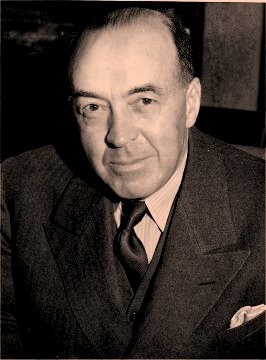
ERB The Scholar
Part 2
Lady Barbara Drops In
As always ERB is the consummate multi-culturalist both ethnic and social. Barbara is the daughter of the English Lord Whimsey, Smith is a college professor, Capietro is an Italian Communist renegade, Stabutch is a Russian Communist, the Midianites represent an ancient religious culture derived from the Jewish, Tarzan is Tarzan of Africa and Lord Passmore of England and then we have a cast of animal characters including a tribe of baboons who interact with Tarzan on the cultural level. All are represented as being culturally distinct. ERB is more of a right multi-culturalist than a left.
If a culture is in fact a culture it must be distinct or it couldn’t qualify as a culture. To be of the French culture there must be characteristics that can be identified as specifically French. Else, why call yourself French? The Left multi-culturalists need to define their terms a little better. They come across as rather shabby intellectually.
Then, of the hundreds, probably thousands of cultures, are they all to be considered equal? For instance is it considered desirable to be of the Prison culture? Pedophile culture? No, of course not; not all cultures are equally beneficial. Each culture must be analyzed on its own merits and faults, completely analyzed by objective analysts. No particular culture need be nor can be taken at its own evaluation. Obviously many cultures are to be avoided completely. Others should be isolated or quarantined. Which is which can only be determined by an analysis of its positive contributions. The results of analysis can be unkind; the truth frequently hurts. As the French say: C’est la vie.
In his analysis of group cultures ERB does draw conclusions. There’s no doubt he thinks that the Communist culture is a negative to be avoided. Thus Zveri in Invincible was ignominiously defeated by Tarzan as Stabutch will be in Triumphant.
In almost every case ERB is very hard on religious cultures as he will be in this novel. Is he unjust or is the truth about religion just too hard for devotees to bear? Everyone will have their own opinion while I have made my position abundantly clear: the religious consciousness is outdated, having been surpassed by the vastly superior Scientific Consciousness. I won’t be changing my mind soon.
Lady Barbara Collis is about to parachute into a culture two thousand years in the past. ERB commits a major gaffe here in the opening pages of his novel. Lady Barbara is attempting a non-stop flight of 7500 miles in a 1930 plane, clearly impossible. Rather than taking a direct route up the Nile she is lost several hundreds of miles to the East over Ethiopia and, get this, already running on empty.

Dorothy Sayers
I don’t know who calculated her fuel needs but I should imagine he would be looking for a new occupation. But, that doesn’t interfere with my enjoyment of the story any more than the donut atmosphere of Poloda in Beyond The Farthest Star. Who knows what goes on beyond the farthest star. They probably even suspend the laws of gravity.
There Lady Barbara is, way up there without the means of propulsion. she does the manly thing: she jumps out. This is real Twilight Zone stuff; little does she know she will leave the twentieth century and land in 80 AD or so. The Land Of Midian has been frozen in time for the last two millennia.
The Midians assembled within the walls of their crater hear the drone of the airplane, which sound they are unable to identify and then to their amazed eyes a little white cloud appears through the mist with a human form dangling below it. To their religiously distorted senses it must be the Angel of the Lord.
Thus we have a nice confrontation between two different cultures. The modern scientific of Lady Barbara and the ancient religious culture of the Midians. The Midians could stand as a metaphor of the religions of Burroughs’ day which, not unlike the Midians, were roooted in a culture two thousand years old and of a different and inferior consciousness. Not only had the Scopes trial recently ended but the sensatinal affair of Aimee Semple Mcpherson was still fairly warm, plus ERB had recently read Sinclair Lewis’ Elmer Gantry. That novel did not sit well with ERB nor does it sit well with me. Burt Lancaster’s movie Elmer Gantry, by the way, is totally dissimilar to the Gantry of the book.
According to ERBzine Burroughs took offence at Elmer Gantry, deploring Lewis’ habit of ridiculing

Aimee Semple Mcpherson
and demeaning people rather than presenting the story as entertainment. Lewis does ridicule and belittle every character in his book in a detestable holier than thou manner which is very annoying. Burroughs turns the story around and disparages practices which I suppose makes it entertainment. For instance both the fictional Gantry and the real life Mcpherson are what are known in military slang as ‘Sky Pilots.’ Thus there is a certain amount of humor in Lady Barbara as an angel of the lord sky piloting into the religious Land of Midian.
When the Midianites drown a young woman while dragooning her, Lady Barbara, after the manner of Mcpherson, brings her back to life by ‘a laying on of hands’, that is artificial respiration. Clever of ERB. It will be remembered tha Mcpherson had a roomful of crutches and wheelchairs from people she had supposedly cured by a laying on of hands. I have no idea how many readers might have gotten the joke when the novel was released but there the joke is if you care to look for it.
So we have the Scopes Trial, Aimee Semple Mcpherson and Sinclair Lewis’ Elmer Gantry all rolled up in a series of jokes ‘highly fictionized.’ There is probably more to be found if one could steep

Sinclair Lewis
oneself in the ephemeral culture of the time.
As mentioned, Lady Barbara parachutes through two thousand years of time to find herself among a Pauline Christian sect that hadn’t changed one iota since c. 80 A.D. The emphais on Pauline Christianity is important. At about this time ERB was becoming involved with the Vedantist mission in Hollywood so discussions of early Christianity may possibly have made an impression on him. Paul was, of course, a Jew who adapted the Jewish Christian sect for dissemination among the Gentiles. The Catholic Church was founded on Sts. Peter and Paul while the medieval Knights Templar based their Christianity on the Gospel of John thus being Johannites. There was a cultural divide between the Church and the Templars which did necessitate action no less than between the Paulites and the Arians. ERB’s emphasis is intended to indicate the Jewish origins of the Midianites.
It will be remembered that Angustus was a Jewish Christian who arrived in company with a Nordic slave girl. So for two thousand years the Midianites have been inbreeding. ERB is considering the results of inbreeding, as a year later he will write Pirate Blood that deals with the famously inbred Jukes family. Pirate Blood is perhaps his most despairing story as his mind tips toward Lamarckian evolution in an apparent attempt to explain to himself why he can’t resolve his psychological problems.
Thus the genetic and Lamarckian traits of Angustus and the slave girl have been passed down through approximately seventy generations. Angustus’ genes have predominated while those of the slave girl appear occasionally in sports.
Angustus was characterized by a huge nose that was an actual deformity, a chinless face and epilepsy. Thus if one imagines this, Lady Barbara is confronted by a group of people with huge noses covering most of their faces with no chins, the throat sweeping back from just under the lips and writhing on the ground in epileptic fits.
There can be no mistaking that ERB is caricaturing the Jews. Angustus was a Jew and he was a Pauline Christian. As a Christian, ERB disguises his Jewish nationality. The leader of hte Midianites, Abraham the son of Abraham certainly puts the Midianites into a Jewish context, as does the fact that they consider themselves the ‘chosen people.’ Ludicrous enough from their physical description.
ERB’s caricature is one that was prevalent when he was a young man, while one that couldn’t be missed by the gentlemen of the ADL/AJC and MGM. They would neither forgive nor forget. In fact Tarzan would be potrayed in The New Adventures Of Tarzan as chinless and with a huge nose. While Herman Brix/Bruce Bennet had neither a bulbous nose nor was chinless the effect was achieved through photographic lighting and shadowing. Either that or the film has deteriorated through time to achieve that effect. (DVD, The New Adventures Of Tarzan, Alpha Home Entertainment, www.oldies.com )
If you think there isn’t a war going on here, look more closely.
Even though of Jewish descent, the Midianites are Christians, but of the most primitive stripe; they make sects like the Nazarenes look liberal. Their minds are uncompromisingly dark. The girl who was dragooned was sentenced to death for smiling. Joy was considered of the devil in Midian. Here ERB characterized a number of Christian sects correctly.
Among the people who greeted Lady Barbara was a genetic sport who harked back physically and mentally to the original slave girl. She is Jezebel. She and Lady Barbara are immediately attracted to each other by their beauty. The attractive and intelligent Midianites were invariably fair haired and blue eyed while the unattractive ones were dark haired, brown eyed and stupid. Little doubt that the AJC/ADL would consider the book ‘racist.’
Jezebel is an interesting character in that she is a little more than light headed. She is governed entirely by surface appearances. As in Lion Man where the hybrids were expelled from Henry’s village, so the more attractive males were exiled to the other side of the crater. Obviously we have an example of eugenics here. They were more warlike than the Midianites occasionally raiding them. Jezebel remarks that they are so good looking she hopes they will capture her. When the Midianites honor ‘the angel’ with her own cave and offering of food, Jezebel is depicted laying back eating grapes like a spoiled young thing with a box of bon-bons. ERB later describes her as a Golden Girl which relates her to Balza of Lion Man and hence to Florence.
Whatever ERB tells himself about Florence in his conscious mind his depiction of her in his unconscious life seems to be quite different.
At first Lady Barbara is treated quite well but familiarity breeds contempt. Abraham Ben Abraham begins to suspect her divinity. Even the miracle of the laying on of hands that restored the girl to life being no less a miracle than the raising of Lazarus cannot dissuade Abe Ben Abe from testing Lady Barbara. Thus she too is dragooned but instead of being dunked three times she is thrown into the lake wrapped in a net with the net weighted. Here is proof positive that ERB read Dumas’ The Count Of Monte Cristo. The scene replicated Dantes being thrown into the sea from the Chateau d’If.
Lady Barbara has her handy jackknife so that she is able to cut her way free. Thus we leave her here crawling gaspingly ashore while we check in on Lafayette Smith and Danny ‘Gunner’ Patrick.

The Big Bwana
Edgar Rice Burroughs As A Feral Child
July 18, 2011
Edgar Rice Burroughs As A Feral Child
by
R.E. Prindle
Cronus:
Cronus married his sister Rhea, to whom the oak is sacred, But it was prophesized by Mother Earth and by his dying father Uranus, that one of his own sons would dethrone him. Every year, therefore, he swallowed the children whom Rhea bore him, first Hestia, then Demeter and Hera, then Hades, then Poseidon~ Robert Graves, The Greek Myths
I. The Father As A Cannibal Figure
Following Poseidon came Zeus. In place of Zeus Cronus was given a stone which he swallowed instead. When Zeus grew up he then castrated Cronus, replacing him.
While on the one hand an astrological myth denoting the precession of the equinoxes from one Astrological Age to another, on a psychological level the myth relates the fear of the Father that as the strength of his sons waxes his own wanes resulting in an eclipse.
Different human fathers react in different ways. Some nurture, some castrate or cannibalize their young. This is a serious problem for the son. For instance, what Tom Brokaw, a thoroughly castrated son, is pleased to call The Greatest Generation who were so enamored of their success in WW II, that they chose to emasculate a whole generation rather than surrender or even share power.
I correspond with David Adams from time to time while doing my writing from whom I sometimes receive valuable input. I had come to the conclusion that ERB’s father, George T, was a problem for ERB, especially as represented by ‘God’ in Tarzan And The Lion Man. The new year opened with Hillman publishing Dodds’ feral child collection which clicked in my mind. The week before ERBzine published my Part III, Two Peas And A Pod of the Tarzan Triumphant review. David Adams commented favorably on my comments about the Jungian Old Man archetype. He said in an email to me:
I agree with your interpretation that “characters like Tarzan and John Carter serve in the capacity of Old Man/Jekyll figures while the actual Old Man figures who are betrayers serve perhaps as Hydelike figures as represented by the father.” (David quoting me.) Those old man figures, early and late, are also cannibals who are hell-bent on eating him up while then spreading the bones across some desert for the hyenas to chew. Who was that old cannibal with the cancerous face followed by a pair of African wolves? (Jungle Tales of Kipling)
As can be seen I picked up on the Father figure but adding the cannibal detail adds the needed dimension for full comprehension.
George T. had been bothering me for some time. The love-hate relationship ERB had with him is quite obvious, but then it occurred to me that the other sons had the same relationship to their father while George T. appeared to program them all for failure- that is they not surpass him in their lifetime somewhat like Cronus of Greek mythology. He made them all dependent on him. The supplicating tone of the letters from college of sons George and Harry is all too obvious. George T. sending the boys to Yale without the means to support a position would have had the effect of emasculating them relative to their fellow students thus subordinating them.
Then on graduation he took them into his battery business. As a businessman in Chicago it wouldn’t be unreasonable to believe that George T. had some relatively influential contacts in town who might have been able to place Yale graduates advantageously but he chose to keep the boys with him and subordinate to him.
The battery factory proved dangerous for his son Harry who developed respiratory problems from the battery chemicals plus perhaps in psychological reaction to suppression by his father. He went West to join fellow Yalie, Lew Sweetser, in Idaho. Son George, who had had enough of working for his father, also fled to Idaho to join Harry and Sweetser.
None of the three knew enough about the cattle business to survive so that by 1913 when George T. had his basket pulled up all the sons were back in Chicago in various degrees of failure or, at least, lack of success. As of that date it would appear that like Cronus George T. had swallowed or cannibalized his sons.
There was a Zeus figure in the bunch who didn’t want to be swallowed and that Zeus figure was ERB. Like Zeus ERB was the youngest son. ERB developed independently of his brothers who were approximately ten years older than he. Thus when they were at Yale ERB was attending grade school.
As I pointed out in my Books, Burroughs and Religion George T. was especially rigorous in the attempt to emasculate his youngest son. His effort culminated when he sent ERB to military school. This was a form of dislocation and rejection that ERB could not bear. He tried to escape but his father sternly returned him to the Michigan Military Academy.
The effects of this were that ERB was declassed as he considered the MMA a rich kid’s reform school. Thus to some extent he was criminalized in his own mind. His reaction was also seminal in the formation of his two principal characters John Carter and Tarzan.
His hurt was so strong, his separation from his parents and home so complete that he became psychologically orphaned. His parents died to him the day he was returned to the MMA. He adopted the drunken Commandant, Charles King, as his mentor or surrogate father. While betrayed by his father ERB apparently thought he found a friend in King. In that capacity King became the model for Lt. Paul D’Arnot of the French Navy. D’Arnot was the man who tamed the feral boy that was Tarzan introducing him to civilization much as King taught Burroughs how to survive and prosper at MMA. Or Burroughs remembered it in that manner. There may also be a literary connection to D’Artagnan of Dumas’ Three Musketeers.
This makes the period between the arrival of Jane and her party and the arrival of D’Arnot in Tarzan Of The Apes of special interest. I’m not sure what the period represents in Burroughs’ own life.
As his creation Tarzan is a feral child it follows that ERB considered himself alone and on his own as a feral child himself. A romantic notion but one no less real to him. Thus just as Tarzan’s parent’s died with the baby becoming a member of an ape tribe so Burroughs began a wild and difficult period as his parents died for him.
These events occurred just as Rider Haggard was becoming famous for his great African trilogy of King Solomon’s Mines, She and Allan Quatermain which ERB undoubtedly read at this time. Conan Doyle began his Sherlock Holmes mysteries and H.M. Stanley disappeared into an unknown Congo in pursuit of Emin Pasha. The West to East transit of the Congo impressed ERB greatly as his own heroes later crossed Africa in the same direction.
Being a complex individual ERB no longer wished to even acknowledge that he had ever had parents; thus his first creation- John Carter. As Carter only came into existence when ERB was 36 the writer had plenty of time to knock around learning the odd legend here and there. John Carter then is a version of the Great Historical Bum- the hundred thousand year old man of folklore.
John Carter could not remember his parents. In his memory he had always been the same age he was. In the words of one of my famorite songs, Stewball, he didn’t say he was born at all, just blew down in a storm. Certainly Burroughs had heard of the Comte de St. Germain who flourished at the time of the French Revolution. As esoterical cult figure today, St. Germain’s legend would have been more prominent from 1875 to 1911 than today. Like Carter St. Germain claimed to have been alive forever. In Revolutionary Europe he got away with it. Calgiostro was another Revolutionary charlatan claiming mysterious antecedents who would have intrigued ERB’s imagination. It seems certain the two would have been topics of conversation in the time before radio, TV and movies so it wouldn’t have been necessary for ERB to have read anything.
I doubt if he had read any of the books on Dodds’ list although one never knows but the list goes to show that the feral child would have been a popular topic of conversation. In my opinion then ERB’s literary future was cast when his cannibal father returned him to MMA.
He graduated from the MMA in ’95 but either couldn’t or wouldn’t return home staying on as an instructor. In ’96, just before the summer break which might have necessitated a return home he joined the Army being sent directly to Arizona without passing through Chicago. Was he avoiding returning home? One can’t say as in ’97 having found Army life not to his liking he received an early discharge. He could have kept going, of course, as many of us in his boots did, to LA, San Francisco or wherever but he chose at that time to return to Chicago. Of course, Emma was calling.
From ’97 to ’03 or so he worked for his father which he found as difficult as his brothers had. Fleeing Chicago to Idaho in 1903, when he came back a year and a few months later to do anything (that word anything has some meaning in this context) rather than work with his father. He became one of the poet Robert Service’s ‘men who don’t fit in.’ He had a very difficult few years from 1905 to 1913 bumping along the bottom.
But then in 1911 he began his rise via his intellect. He began to write becoming an immediate literary success of sorts. By 1913 when he was about to become a financial success through his intellectual efforts thus escaping his father’s curse, his father died. The young Zeus thus never got to castrate his father Cronus.
One can’t know what would have happened to his psychology had ERB been able to present his father with evidence of his success. I’m reasonably certain George T. would have belittled or rejected his success as like Cronus his youngest would have replaced him. He wouldn’t have liked that.
II. A Hand From The Grave
Had that happened and ERB been able to prove himself a greater than his father it is interesting to speculate as to what effect that might have had on ERB’s psychological development. As it was, a few months after his father’s death he packed up family and belongings and got out of town as far as he could go to San Diego, California and stayed away nine months. Time enough to be reborn.
There are numerous examples of betrayers who are cannibals in his corpus, in fact there is so much betraying and cannibalism in Burroughs’ work I find it slightly offensive. Rather than work up a list, which for the time being I leave to David, I’d rather concentrate on the most spectacular cannibalistic betrayer of the oeuvre, God of Lion Man.
I know I just wrote about Lion Man but with David’s interpretation of cannibalism I can present a much more cogent image. David’s much more into Jungian synchronicity than I am but the scene with God presents a remarkable occurrence of synchronicity. The scene is very complex.
George T. was born in 1833 so the book was written on his 100th birthday. Chicago was incorporated in 1833 while it was celebrating its Century Of Progress forty years after the Columbian Expo at the same time. Both events occurred just at the time that Burroughs realized he had lost control of his ‘meal ticket’ to MGM.
MGM was undoubtedly a component of God, the Father, being combined with the Chicago that fathered him and George T., his actual father, in his mind. From these components ERB then creates the magnificent apparition of God as man and beast. God has the mind of divine power such as had Zeus but is still a Cronus, is, in fact, the ultimate cannibal.
Tarzan and Rhonda represent Burroughs’ Anima and Animus so that God has the whole man in his power in its component parts- the X and y chromosomes. God tells the pair that he is going to use them to rejuvenate himself by cannibalizing them. The Father’s desire and the Son’s fear.
If God represents George T. on one side, MGM on another and organized religion on a third then even though ERB thought he escaped his father in 1913 by his intellectual efforts the father reaches up from the grave on his 100th anniversay to claim his son again.
At this time Burroughs also wrote Pirates Of Venus and Pirate Blood. Both would refer to the idea that MGM pirated his creation from him while the very despondent Pirate Blood is almost terrifying in its manic depression as the balloon rises and sinks being almost submerged in the ocean or the waters of oblivion, the subconscious mind, insanity, that I believe we can see it as the insanity of despair. At the end of that story the hero pairs up with a desperate woman who I believe we can read as Florence. All very transparent really.
So there Tarzan/Rhonda/Burroughs is trapped in a prison. He attempts his earlier escape of rising through his intellectual powers, that is, he ascends through a shaft in the roof. Unlike the first time when he surprised and astonished the world with John Carter and Tarzan, God, the Father, is waiting for him preventing his use of his intellect. In point of fact Tarzan And The Lion Man was a dismal sales failure thought by Burroughs to be caused by MGM.
If his previous four previous Tarzans under the Burroughs imprint had been successes it seems strange that the truly excellent Tarzan And The Lion Man should have failed. Failing proof of sabotage on the part of, say, MGM, one can only say the public taste is fickle or perhaps the innovative dust jacket didn’t look like the usual Tarzan dust jacket and fans just passed it by. It is also true that the book was a put down of MGM.
Tarzan/Burroughs sallies forth from his hiding place against superior forces. He is knocked unconscious. A sure sign that Burroughs is under supreme stress. Meanwhile God’s castle, in other words the literary structure of the last twenty years is going up in flames. The MGM pirates have lifted ERB’s life work.
He has to finish the story so he turns the tables on God taking him captive and making him do his bidding. Tarzan helps God recapture his City then abandons him disappearing down the hole of the subconscious to a lower level from when he emerges to be claimed by the Wild Thing- Balza, the Golden Girl, or Florence.
In a thinly disguised scene Tarzan, unwittingly it seems, wins Balza from her former husband much as Burroughs took Florence from Ashton Dearholt. The important thing here is that a transition has been effected from one world to another. The intellectual City of God has been abandoned in favor of a world of the senses.
It is at this point ERB abandons his own feral boy persona of horses, puttees and other symbols to become a sort of effeminate Dandy. He now affects tightly fitted fashionable suits almost effeminate in appearance. He turn into a party animal and if he had been a moderate drinker during his teens, twenties and early thirthies he now becomes almost a lush.
So, in the end, ERB was probably devoured by the Father in Cronus fashion. In the Myth Zeus forced Cronus to vomit up his brothers and sisters and he castrated him. In real life ERB was castrated and swallowed down.
He put up one heck of a fight that arouses the warmest admiration of him. One wonders, that if when all is said and done anyone can escape the imprint of those formative years. Is one’s whole horoscope cast in the womb and those few short months after birth? Sure hope not.
Pt. 2: Tarzan And The River
May 8, 2011
Tarzan And The River
Part II
Edgar Rice Burroughs In Aspic
by
R.E. Prindle
When ‘Omer smote his bloomin’ lyre,
He’d heard men sing by land and sea:
An’ what ‘e thought ‘e might require,
‘E went and took- the same as me!
The market-girls an’ fishermen,
The shepherds and the sailors, too,
They ‘eard old songs turn up again,
But kept it quiet- same as you!
They knew ‘e stole, ‘e knew they knowed,
They didn’t tell, nor make a fuss,
But winked at ‘Omer down the road.
An’ ‘e winked back= the same as us.
-Rudyard Kipling
I want a dream lover,
So I don’t have to dream alone.
–Bobby Darin
First published in the Burroughs Bulletin
Spring 2003 issue.

Last Night He Had The Strangest Dream
As an author Edgar Rice Burroughs belongs to the generation of writers who wrote between the wars. He is or should be placed beside Scott Fitzgerald, Hemingway, Faulkner, Aldous Huxley, P.G. Wodehouse, H.G. Wells, John Dos Passos and John Steinbeck, among others. Further, of all those authors ERB was the best selling writer in the entire world. His reign came to an end in 1939 and then only after his talent was dissipated. This is a remarkable achievement against some very qualified and important writers. One doesn ‘t often hear of Steinbeck societies. Hemingway or any of the others but Burroughs societies exist in many countries around the world.
I consider myself an intellectual and literary snob, yet I acknowledge ERB as important an intellectual and literary figure as any of the savants mentioned above. ERB did not parade his knowledge and savvy as most writers are wont to do. He incorporated a fairly deep understanding of many contemporary issues without a hint of the lamp. Tarzan Triumphant is a case in point. Obviously the two religious groups in the novel refer to Jews and Christians, but there is no reference to either sect. One is left to infer that the Old Testament crowd led by Abraham, son of Abraham, is of the Old Testament while their rivals are New Testament. In so far as ERB allows the story to involve religious discussion, the moral is ‘a pox on both your houses.’
Even more remarkable is that over the writing of the published twenty-one Tarzans before 1940 all the novels are interrelated. ERB was able to keep his Tarzan facts in order over a twenty-seven year period of writing while being involved in the writing of dozens of other books. In point of fact the Tarzan oeuvre is a roman a fleuve- a river novel.
A River novle is a series of novels which traces the course of a nation, people, a family or an an individual over a period of at least decades. The first novel ever written was a River novel, that was the story of the Greek invasion of Troy.
The two surviving complete books of this remakarble story are Homer’s Iliad and Odyssey. Moreover, many fragments exist predating the events of the Iliad and after.
Perhaps the most prodigious of all River novels is the Vulgate Lancelot chronicling the adventures of King Arthur and his knights. The story runs on for thousands of pages.
In modern times Alexander Dumas’ five volume epic concerning the adventures of the Three Musketeers constitute a River novel. Trollope wrote two, that of the Pallisers and the Barchester series. The model for the twentieth century was Remembrance Of Things Past by Marcel Proust.
Edgar Rice Burroughs has always been treated frivolously, yet the Tarzan oeuvre is a work of some magnitude which does not compare unfavorably with Proust.
Proust’s work looks backward as he relives his life trying to make order of his psychology. Burroughs’ Tarzan oeuvre records his psychological development on a current basis as it evolves year by year.
ERB’s work is characterized as imaginative fiction while Proust’s is considered realistic fiction. In other words, realistic fiction builds on real life experience in real life situations, while the imaginative writer is compelled to ‘invent’ incidents.
Thus while the realistic writer draws primarily from personal experience and observations, the imaginative writer has to draw from published sources of either fiction or nonfiction or convert real life experiences into symbolic form. The latter is more true of science and fantasy fiction. If the science fiction writers of the forties and fifties hadn’t had a couple thousand years of esoteric literature to draw on there would have been little science fiction. Of course the writers so disguise their sources that without an extensive education in esoteric writings oneself the stories seem incredibly original.
Borrowing from every source is extensive. For instance, Arthur C. Clarke’s Childhood’s End is the same story as H.G. Wells’ Food Of The Gods with different detailing. Wells himself extrapolated his story farom Darwin’s Origin Of Species and The Descent Of Man. Darwin of course turned to nature, the ultimate source of suggestion, for his story.
That Burroughs borrowed extensively and sometimes blatantly is of little consequence, especially as his original contributions were so extensive and satisfying. As the opening poem by Kipling indicates, at least he was honest enough to admit of outside influences.
The Russian Quartet, or first four novels, is a tentative beginning to the Tarzan oeuvre. It is possible that the first novel, Tarzan Of The Apes, was just an attempt to express certain ideas about heredity and such related topics that ERB wanted to say with no thought of sequels. The story itself is absurd enough that it seems a miaracle that it was accepted and published. It is perhaps less surprising that it was so readily accepted by the reading public as the great figure of Tarzan rises shining from the pages. One ignores any story telling flaws to get a glimpse of the bronzed forest giant, the great Tarmangani, the jungle god, the Lord of the Jungle, Tarzan. A writer should be so lucky to come up with such an archetypal figure.
Return and Beasts find Burroughs groping for a direction. Beasts is is heavily influenced by H.M. Stanley’s writing on Africa as well as that of Mungo Park, not to mention Edgar Wallace’s Sanders Of The River. The story of Paulevitch’s experience in the jungle was obviously taken from Mungo Park’s Travels In The Interior Of Africa. Beasts itself which also has a lot of Defoe in it, is absurd to the extreme yet somehow redeems itself as one becomes entranced by the outrageous notion of apes and men row-row-rowing their boat down the stream. Somewhere either before the beginning of Beasts or after the end, ERB interweaves the story of Barney Custer and the Mad King and the Eternal Lover to bring his own psychology into the Tarzan character. Thus ERB pictures himself as the Son Of Tarzan in the novel of that name.
Having resolved, after a fashion, his conflicts with this father and somewhere in that tremendous gush of writing having integrated his personality, ERB then turns to himself as the conflicted Animus of Tarzan the Hero and Tarzan the Clown to resolve that psychological dilemma over the next seventeen volumes published during his lifetime.
The Russian Quartet was written over a period of three years. The eight novels between Son and Lost Empire were written over fourteen years. Whether the ‘Lost Empire’ refers to Emma and Opar is open to conjecture. In any event Lost Empire signifies a terminal junction in ERB’s psychology.
Then as the problems of his Animus and Anima resolve themselves ERB rapidly turns out six volumes over four years.
He had difficulty writing Tarzans while struggling with his psychology but wrote quickly once he had made up his mind.
From 1934 in psychologically related volumes to 1938 he published the three additional novels of Quest, Forbidden city and Magnificent. The psychologically relevant Madman was discovered and published in 1964, fourteen years after his death. Perhaps the thought the novel was too personal and painful to publish himself.
As noted “Foreign Legion’ is a propagandistic after thought to the oeuvre.
As ERB didn’t begin writing until he was thirty-six it is fair to say that his writing represents the effort of a mature mind. This is even more evident when one reflects that the majority of the Tarzan oeuvre was written between the ages of forty-one and fifty-eight. Lion Man, which is the culminating volume of ERB’s psychological odyssey was written at the last age.
The novels written between 1930 and 1934 which I consider excellent work and the best of the Tarzan oeuvre are the ones most often dismissed as repetitious. One of the very best, Tarzan And The Leopard Men, is, oddly enough, often dismissed as ‘hack work’. Very strange.
But to return to Opar and move forward from there. From 1912 or 1911 if you consider from the first moment ERB put pen to paper to 1915, things developed very rapidly in ERB’s mind. The rich experience of his lifetime, all his opinions, thoughts and fancies were so compressed within his skull that as I say he erupted with more than the force of Spindletop. It took him three years to cap that gusher and then the flow was strong and steady until 1934 when he realized himself.
Return was written in 1913 when his Anima, La of Opar, first pops up. She then disappears until 1916 when wife Emma apparently sneered at the wealth ERB had laid at her feet. She would not so soon forget the first twelve years of her humiliation.
Her rejection of ERB the Hero must have hurt Burroughs to the quick. Following Return he wrote The Mad King in which after numerous trials and tribulations and after he had disposed of Custer’s inept doppelganger, the Mad King, Barney Custer and the Princess Emma were reconciled. In all likelihood the story was a day-dream of wish fulfillment in the Freudian manner because in The Eternal Lover which followed quickly Barney Custer goes to Tarzan’s Equatorial estate but with his sister Victoria and not the ‘Princess Emma’. His marital relationship is obviously still very troubled. As noted, The Eternal Lover is a myth of the nature of Pysche and Eros, the Anima and Animus.
Interestingly, Boy Jack’s wife, which is to say ERB’s at the end of Son of Tarzan is no longer a princess but the daughter of a general. Emma had apparently been demoted in ERB’s emotions.
In a psychological quandary ERB has Tarzan leave Jane in 1916 to return to Opar and La for more gold to lay at Jane/Emma’s feet. This story is crucial for the rest of the oeuvre. ERB’s dream lover, La, spares his life and offers to marry him or in other words take him away from Jane/Emma. At this point in his life ERB is faithful in body if not in spirit. He declines her offer having his faithful Waziri stagger back to Jane under a load of one hundred twenty pounds of gold each.
Apparently the wealth of Opar of which tons of gold remained to be tapped as well as bushels of the very largest of diamonds (move ahead to the Father of Diamonds in the Forbidden City) is not enough to assuage Jane/Emma’s anger at Ed’s failure for the first twelve years of married life. She rejects ERB’s present income. This must have been a staggering blow for Burroughs who at this point in his life wanted to abandon his clown role for that of the hero.
He had already begun Jungle Tales Of Tarzan, which he managed to finish, otherwise from Jewels of Opar to Tarzan the Untamed there is a hiatus in Tarzan novels for thirty-nine months. For over three years he and Emma were apparently at a stalemate making it impossible for him to write further Tarzan adventures.
When Tarzan returns it is as The Untamed and he and Jane have been separated, possibly for good as Tarzan has no idea where she is; common report is that she is dead.
One may infer that the marriage is all but over. It takes another twenty-three months before Tarzan The Terrible appears. Tarzan goes from Untamed to Terrible. Apparently ERB and Emma are now temporarily reconciled as Tarzan finds Jane in the forgotten land of Pal-ul-don (paladin?) and he, she and Jack go swinging down the jungle trails to return to Equatoria. the family is reunited. But is it?
After the passage of twenty-two months Burroughs follows Terrible with Golden Lion. Now the title Golden Lion is somewhat misleading as the Lion doesn’t play that large a role in the story. The Lion seems to have sprung from Burroughs’ subconscious as a defense against the Lion of Emma. In this story Tarzan leaves Jane for a fairly extended visit to his dream lover, La in Opar. They are together for some time as they adventure into the adjacent lost valley called The Valley Of Diamonds. (Once again, see Tarzan And The Forbidden City.) Possibly the Father of Diamonds represents the Jewel of Great Price which turns out ironically to be a piece of coal. This was after ERB left Emma for Florence.
Golden Lion introduces the great doppelganger of Tarzan, Esteban Miranda. I am absolutely fascinated by this character. Miranda looks, talks and walks so much like Tarzan that not only can’t Jane/Emma tell them apart but Miranda even fools the faithful Waziri.
Golden Lion is paired with Tarzan And The Ant Men. You have to read both to get the whole story.
Esteban Miranda is a London actor, a clown and a cowardly fool. ERB goes to great lengths to deliniate the character of this unpleasant but goofily amiable alter ego.
In the confusion Miranda is captured by a savage tribe of Blacks where he is spared because of his resemblance to Tarzan. He escapes finally although he is a blithering idiot who has lost his memory. Get that! Even Tarzan’s doppelganger loses his memory. I haven’t been able to fugure out ERB’s problems with his memory yet.
He is discovered by the Waziri where he is once again mistaken for the real thing. He is taken to the ranch house where Jane nurses him back to health. Still mistakes him for the real Tarzan, he is about to be embraced lovingly by Jane when the terrible, untamed Tarzan appears through the French windows. Tarzan himself had been off having incredible adventures with the Ant Men returning just in the nick of time.
Here apparently Jane rejects Burroughs the Hero in favor of Burroughs the Clown of the first twelve years of her marriage. This is something which ERB can’t forgive. His resentment turns into a divorce about ten years later.
There is then another long hiatus of approximately forty months before Tarzan returns as Lord of the Jungle with Jane in a very subsidiary role. So in twelve years Burroughs wrote only about five Tarzan novels. Then between 1929 and 1934 he whipped out an additional seven.
The change of pace was caused by the quickening resolution of ERB’s psychological dilemma. He was obviously living his life vicariously as Tarzan.
It is this development of his psychology recorded through Tarzan that makes the oeuvre the most fascinating of River novels.
Let us understand that a writer, any writer, is always discussing his own psychology. this applies both to so-called non-fiction as well as fiction. Properly speaking there is no such thing as non-fiction. The difference between the two is that in non-fiction a writer describes actual events through a prism of so-called objectivity. In other words in writing about Edgar Rice Burroughs I am bound to adhere to the facts of ERB’s life and I cannot invent details to improve the story. However, in actuality I see what my own psychology has prepared me to see. My psychology, that is, in conjunction with my intelligence and emotional perspicuity.
Anyone who has read the autobiography of Frank Harris knows that his favorite adage is that no man can see over the top of his head. Therefore it behooves every man to broaden and develop his experience so that he can stand as tall as possible. In that way he can at least hopefully see over the heads of all his fellows. I was once fortunate enough to try this on a crowded street in Hong Kong where I stood head and shoulders above my fellow Chinese pedestrians. You could see the heads and shoulders of all the American sailors inching slowly along like icebergs in a sea of Chinese.
But seriously, one must develop one’s intelligence and that is exactly what Edgar Rice Burroughs did throughout his life. ERB was an avid reader both of fiction and non-fiction. He makes frequent allusion to Poe, Wells, Doyle and who I think he respects most, Rudyard Kipling. If you have read the great African explorers you will have no difficulty identifying sources. ERB was quick in picking up new titles also. Forbidden City was, I believe, based partially on Digging For Lost African Gods by Byron Khun de Protok published in 1926.
ERB was also forced to respond to hectoring outside criticism. I’m sure he little knew the effect that the Bolshevik Revolution of 1917 would have on him personally, but by 1933’s Leopard Men he was thrown on the defensive by what H.G. Wells called the ‘Open Conspiracy’ or the Red Revolution. I will deal with it in the last essay in our series called ‘Star Begotten.’
All of Burroughs stories are many layered if you care to look beyond the surface details. After Golden Lion ERB develops a whole jungle family of attendant animals which follow him through all the stories. Each novel is merely one episode in the life of Tarzan/Burroughs and each leads to the next novel in true River fashion.
This is wonderful stuff. There is no difficulty understanding why Burroughs was the best selling author of his time.
After recording the difficulties of reconciling himself with Emma from 1916 to 1928 ERB reluctantly threw in the towel when he wrote Tarzan And The Lost Empire. The double entendre of the lost empire is explicit in between the lines. It is not only the Lost Empire deep in the Heart Of Darkness but also his dream of building a great empire with Emma. The dissolution of his marriage and his search for a real live La of Opar begins with the book.
At this point he has also come under attack by the Reds who cannot tolerate the success of a Conservative writer. Consolidating rapidly from 1917 to 1923, by this time the Revolution was in control of publishing. They could deny access to new conservative writers, creating the myth that all the best new writers were Communist in faith, but they still had to destroy the reputations of older, non-conforming writers.
I don’t know that any studies have been made of literary or journalistic attacks on ERB, but he responds as though there were many. In 1929 he took time out from his personal psychology to write a major counter-attack against the Revolution with Tarzan At The Earth’s Core.
While this may appear to be simply a critique of Einstein’s Theory of Relativity, in fact Einstein was as much a political figure as a scientific one. Both he and Freud were prominent agents of the ‘Open Conspiracy’ along with that literary political agent, H.G. Wells, so that Earth’s Core is a counter-attack on his detractors.
Then in quick succession ERB turned out Tarzan the Invicinble, (watch the titles) Tarzan Triumphant, Tarzan And The City Of Gold, Tarzan And The Leopard Men and Tarzan And The Lion Man.
After a long struggle Burroughs quickly resolved his psychological dilemma. He rectified his Animus, disposing of the clown side of his nature while at the same time reconciling his Anima. He divorced Emma while marrying what he fancied was a La of Opar in Florence. The final conflict with Emma is recorded in City Of Gold. The basic idea for City was probably borrowed from Bulfinch’s The Legends Of Charlemagne. In Legends, an enchantress has captured many of the leading palladins of Charlemagne which she has imprisoned in a city of gold. The medieval writers borrowed the story of Odysseus and Circe from Homer.
In Burroughs’ story the enchantress Nemone has ‘captured’ a bemused Tarzan who may escape any time he chooses but he elects to stay around to see what will happen.
Lion Man is notable for the way Burroughs blends psychology, fiction, the movies and how the movies affect the perception of reality of movie-goers. Film, which was developed during Burroughs’ young manhood, had a profound effect on the movie-goer’s ability to distinguish real life from movie fantasy. Burroughs was qite precocious in understanding this. There are earlier references to the matter in his work but here he gives it a full scale examination, both as when the fictional Tarzan replaces the even more fictional Obroski in Africa and when as a Burroughs doppelganger Tarzan mixes on set with the movie people in Hollywood where they fail to recognize him as the real thing, Lion Man is perhaps the most interesting of all the Tarzan novels.
After Lion Man, which both rectifies his Animus and reconciles his Anima, his motive for writing fast and furious disappeared. In fact, his subject matter disappears. He had in effect run out of material. Tarzan’s Quest and Tarzan And The Forbidden City record his lingering problems with his two ladies at the age of sixty-three. You can see why he wrote it as a farce.
Tarzan And The Madman caps the story of his pschological development although he did not publish the novel during his lifetime.
At the end, as is not unusual, he returned to the beginning as in The Mad King. The totally farcical Forbidden City is an example of what his writing might have turned into if he had been allowed to publish under his pseudonym, Normal Bean. As a comic novel, Forbidden City is actually very funny, if absurd, as Tarzan is driven from pillar to post by his two women. This undoubtedly reflects his real life situation. In the end, he says, the fabulous diamond he and everyone else is seeking, the Jewel Of Great Price, is merely a mirage turning out to be as worthless as a piece of coal.
Both Lion Man and Forbidden City seem to have influenced Aldous Huxley, one of the major intellectual writers of the period. His novel, After Many A Summer Dies The Swan (1939), has allusions to Burroughs’ two novels. The theme of ‘Lion Man’ of the mad scientist, God, who reverts to a half-ape, half-man creature is replicated in Swan in which an English nobleman who has lived for two hundred years reverts to an apelike existence.
That the theme may be more than coincidental is the fact that Huxley incorporates an imaginary University of Tarzana into the story. Thus one of the great intellectuals of the period found much of deep interest in ERB’s novels while also reacting to Wells.
Edgar Rice Burroughs was in fact a great literary artist, if a trifle coarse. He is, in fact, a great talent which if the critics fail to realize it, the people don’t.
Surviving a hundred years is no small matter, it takes some talent to do that. Yet, after those hundred years ERB is still an active force in the literary coal mines. Well, it’s not like coal doesn’t burn with a pure blue flame and under pressure turn into diamonds.
Tarzan Meets The Wizard
April 21, 2011

The Big Bwana
Tarzan Meets The Wizard
by
R.E. Prindle
I opened the door…(this was way back in nineteen-fifty when I was twelve years old and bought my first Tarzan book)…and stepped inside the Argonaut Bookstore. This America was in a parallel universe compared to what you see today. What I’m telling you here seemingly happened millions of years ago on another planet in a different universe. Believe me, you couldn’t function in the world I’m talking about.
The Argonaut was downtown. That won’t mean anything to you now, but in those days there were no shopping malls. Things weren’t big and strung out. Downtown was not only the center of activity, there was no other activity. You had to shop downtown. Thus if your store wasn’t located on the four main blocks of Genessee, and two didn’t really count, your store was, as they say, marginalized. The Argonaut was half a block off Genesee but in the center street off the two good blocks on the right side, the left side was a lot weaker than the right. There was a chance someone might turn the corner and see your store. Not too likely though.
The scale would amaze you. This was small. Imagine yourself as you playing with your Lionel electric train. Yeah, it was that small in comparison. Barnes & Noble mega bookstores weren’t even a gleam in a booksellers’ eyes. The thought would have been incredible. It would have taken up one of the two good blocks on the right side. The Argonaut was maybe twelve feet wide and fifty feet deep. Mahogany shelving down one side beginning waist high with storage underneath, nothing there, a couple display tables down the middle, check out to the right. The prop. would have been lucky to take home two hundred fifty dollars a day. So out of a hundred dollars markup he not only met all expenses but lived as a respected business man. As I say, a different world.
The owner dealt only with White people. The only minority was the Black folk and they were confined to the First Ward. The Italians were emerging from their ghettoes in the post-war world so pizza shops were showing as a novelty. The owner only had to stock his shelves for one buying public. Half of his inventory would have been ‘the classics.’ There were virtually no novels published after WWI on sale except for current literature and that was generally considered inferior to the classics.
Great immigration changes were in the air while the last vestiges of the previously dominant English club style were slowly disappearing. Thus the Argonaut was designed to look like it might have been Lord Greystoke’s personal library, mahogany, dark woods and all.
I was only two years out of the Orphanage and feeling my way to some sort of identity. I would never find it in my old home town, it wasn’t there.
I hadn’t ever bought a book at the Argonaut before, as an Orphan I would have been shooed out in the most unkindly manner. As it was the classiest and only real book store in town I was anxious with anticipation. The library at the Orphanage had been my refuge, a very nice library too, as big or bigger than the Argonaut and all kid’s books. The other orphans viewed it as The Black Hole Of Calcutta so I had always had the place to myself. Donations to the Orphanage were terrific so I was familiar with the whole range of children’s books from Raggedy Ann And Andy to my favorites, the Oz series. In those days I was mystified by the change of authorship after the first dozen books but I was quick to note the inferior style of his successors.
I don’t remember any Tarzans or other Burroughs.
I was a free rover back in the Orphanage days so I knew about the Argonaut as it was across the street from the magazine store where I bought my Blackhawks, Daredevil and Plastic Man comics. They were only a dime so all I had to do was pick up five bottles with a redemption value of 2 cents each and I was in business; but now I was going to spend a dollar. Don’t know where I got it.
I had scouted the place and knew where everything was so when I entered and looked down the long row of shelves stocked with what would now be a miniscule library I knew to turn left just inside the door to the space alotted to Juvenile Literature. Tom Swift and the Rover Boys among others were still available but nobody bought them. Stiff stuff. Swift was too stiff for words. I never could enjoy the stuff although the oldtimers swore by him. And there next to the Oz books was Tarzan. There were only about eight of them available at the time along with five of the Martian series.
The Burroughs stuff was all put out by Grossett and Dunlap, my favorite publishers. Something about the paper and the binding. There were several other publishers who put out classy kid books, Cupples And Leon. They had the look and feel that made you feel like a man on the way. Now the Barnes and Noble Juvenile section, bigger than the whole Argonaut, is a pile of indoctrination in generally offensive looking and feeling volumes. Lot of ’em made in China. Chinese don’t know a thing about paper and books. I’m glad I spent my youth in that other universe.
Back then you could buy Whitman Co., Racine, Wisconsin, abridgments for fifty-nine cents if you didn’t have a dollar. I could never get over why Whitman’s were published in Racine when everything else was published in New York City. I’m sure there was some weird reason. I had my dollar in my hand. I focused my concentration in a steady beam and was intensely glancing from title to title comparing the dust jacket illustrations when, as though from afar, faintly a voice partially intruded into my conscious to say: ‘I’m Jason, can I help you?’
It was so faint I didn’t really hear it, the voice merely brushed past my concentration; then I felt what I thought was a very hard tap on my shoulder. Wincing, I looked up.
‘I’m Jason, can I help you?’ he said more imperiously, left hand on hip with his left leg resting on the tip of his shoe.
‘Help me do what?’ I asked uncomprehendingly.
‘Find the book you’re looking for?’ He replied with a condescending, well, not a sneer, but you know what I mean.
At the same time I realized that although I wanted a Tarzan book I didn’t have any idea which one was the best to start with.
This guy Jason as I surveyed him in my pre-teen way was a pretty impressive guy He was an easy six feet. I was about four feet ten, imperially slim (a phrase I’ve always wanted to work in) dressed to the nines in a collegiate cut suit, blue button down oxford cloth shirt (still the only kind of shirt material), and rep stripe tie. (Never liked rep stripes, prefer paisleys and foulards). He was good looking, he could have stepped out of an Arrow shirt ad or modeled for one of those German postage stamps of the late thirties. God, those Leyendecker ads were just awesome.
Jason would have been a killer with the girls too, if he had just come unstuck from himself. But, heck, if I looked like that I might have been satisfied with myself too.
He stood there leaning on the counter with his right arm, his left arm cocked on his hip and his right leg across his left leg. God, I’ve never seen a pair of pants with a crease like that and I never will again. I’ve never been able to get it and I’ve bought more suits than Huey Long who couldn’t get that crease either.
I can say that I was overawed by Jason.
‘I wanted to buy a Tarzan book.’ I began timidly. ‘Do you know anything about them?’
‘Do I know anything about them?’ He said with a knowing chuckle as he brought his bent fingers up for a minute examination of his nails. ‘I should think so. I’ve read them all.’
‘OK. Which one. I’ve got my dollar.’
‘Which one?’ He asked irritatingly. He had this annoying habit of repeating your question as well as his now constant steady admiration of his finger nails. He did have a good manicure. A manicure of any kind was a rarity in our town. Hair cuts were pretty common. First he would do one hand and then the other. Sometimes both at once. He was something to watch. Enjoyed preening for me too.
‘Hmm. For you?’ He said musingly as though I were a special case. ‘Well, you know, there’s only eight available out of twenty so you can only choose from those eight. I’ve got them all, every one. Had to go to second hand stores which I’m loath to do but this case called for an exception. Those eight are new though. I’ve thought about the Tarzan novels a great deal. I divide them into three categories for convenience. The first four I call the Russian Quartet, the next eight I call the Jungle Rhapsodies and the eight after them, Political Undertones.
These eight are all from Grosset and Dunlap and they’re all that’s available new. The titles Burroughs self-published are all out of print…
‘What do you mean Russian Quartet?’ This was the beginning of the McCarthy Reaction and I was a pretty keen anti-Communist, or about to become one.
‘Well, it seems to me that Burroughs concieved the first four volumes as a unit without plans to go further. Of course, the first volume introduces Tarzan but then he used the literary devices of the two Russian nihilists who are after Tarzan to continue the story through volumes two and to four. He kills off the last Russian in Son Of Tarzan and then leaves no room for a continuation of the series.
The Quartet is probably written in too literary a style for you. Burroughs was trying hard to follow the rules of fine literature in the Quartet.’
‘What happened then?’
‘What happened then?’ There he went again bringing up both sets of nails for scrutiny and adopting that wide apart stance of that famous picture of Burroughs flexing his muscles.
‘I think he was at a loss what to do next. I think he had written out his original conception of Tarzan. I mean, Tarzan was virtually a moribund old man at the end of Son of Tarzan.’
‘Yeah, but you said there’s a whole bunch of other books.’
‘His original conception, I said. About this time he went way out West in Hollywood, where I’m going soon, I’m going to be a big movie star with my looks, where he met L. Frank Baum. Baum wrote a number of the Oz stories, have heard of him?’
‘Of course I have.’ I snuffed, deeply offended that anyone would think I didn’t know who L. Frank Baum was. Ozma of Oz was the first book I ever read on my own.
‘Uh huh.” He said, condescendingly looking down his nose, but impressed. ‘I think that he and Baum had some long walks and summer talks and Baum gave him some pointers. Baum was older than Burroughs. He was born in eighteen fifty-fix and died in nineteen-nineteen just after he passed the torch to Burroughs, so to speak.’
‘How do you know when L. Frank Baum lived and died, I wonder?’
‘It’s my job to know these things.’ He smiled condescendingly. ‘Just like Burroughs was born in eighteen seventy-five and died the day before yesterday.’
‘You’re kidding me, now?’ I said, unwilling to be taken in.
‘I kid you not, kid. Day before yesterday he breathed his last breath. Expired, just like that. As I was saying, Baum probably told him to make Tarzan and Africa over on the model of Dorothy, the Wizard and Oz. That way he could move Tarzan North, South, East and West just as Baum did with his characters in the Oz series. Oz has its metropolis of the Emerald City and then the outlying areas where all these odd creatures live.
Burroughs listened. So in the fifth Tarzan book, Tarzan And The Jewels Of Opar, the story changes from a more or less realistic vision of Africa to one of hidden cities, lost empires and strange mythical locations like the giant boma of the Ant Men or Pal-ul-don. Tarzan, as the Wizard, works out of his estate in East Africa as a substitute for the Emerald City.
By adopting Baum’s formula Burroughs was able to keep his series going until he died, the day before yesterday. His writing style changes too, from formal to Baum’s loose…’
‘Gridley,’ Came the voice of the proprietor, ‘You’ve got a customer over here if you can spare the time.’
‘What am I, a grilled cheese sandwich?’ I thought resentfully looking over to the cash register where I saw a man holding a copy of James Jones’ From Here To Eternity. ‘Oh, that’s different,’ I rationalized. That was worth two-fifty in this man’s Democracy so I could see why he was going for the big money first.
Jason grabbed a copy of The Jewels Of Opar, thrust it in my hands and said: ‘Here, kid, start with this one.’
I was leery of the Russian Quartet for obvious political reasons while Jason had said that Jewels Of Opar was like Oz so taking his expert advice it was my first Tarzan.
This guy having purchased his James Jones walked over me like I wasn’t there, didn’t even look down, he was only about five-six too. I put my Tarzan and dollar on the counter, received my bagged book in return.
‘Come again, kid.’ Jason said flippantly as I opened he door.
‘I guess you’ll be off to Hollywood starring in movies before then.’ I waved. ‘I’ll be back.’ Then it was down Genesee and back to home, the proud possessor of my first Tarzan book that I still have.
Last I time I checked they were selling the same book for forty-five dollars without a dust jacket. Mine still has an excellent jacket.
Pt. I: Tarzan And The River
April 14, 2011
Tarzan And The River
by
R.E. Prindle & Dr. Anton Polarion
I know those ideas;
In my boyhood days I read Shelley
and dreamed of Liberty.
There is no Liberty save wisdom and self-control.
Liberty is within-
not without.
It is each man’s own affair.
–H.G. Wells, When The Sleeper Wakes
The River don’t stop here anymore.
–Carly Simon, Let The River Run
Dr. Polarion and I have undertaken to write this essay together: He to handle the psychological aspects while I deal with the literary parts. As he has been called away on business I write his ideas from personal coversations and notes he has given me.
The reference to the river in the title is not to the Congo as one might suspect but to the river of life in the psychological sense and to the roman a fleuve or River Novel in the literary sense.
In the psychological sense the River refers to the Flood on which we are all borne heedlessly to the sea of oblivion unless we somehow free ourselves of the current. That is the meaning of the quote from Carly Simon. She thought she had gained control of her life and emotions; reclaimed herself from the vast irresistable flow of the River, so to speak.
As Dr. Polarion has explained in the other essays, ERB was working out his psychological difficulties through his writing. He first integrated his personality and then rectified his Animus concluding with reconciling his Anima and Animus. As in all lives ERB’s early life was an accumulation of fixations that had to be exorcised in later life. One either succumbs to one’s psychology in the sense of Hamlet’s complaint: To be or not to be…whether ’tis nobler, in the mind to suffer the slings and arrows of outrageous fortune or to take arms against a sea of troubles, and by opposing, end them,’ or, in other words, one confronts the psychological issues and resolves them.
Understanding, that is the problem. For ERB’s first thirty-seven years he suffered the slings and arrows in his mind, but then at age thirty-seven a glimmer of understanding appeared in his mind and he chose to take arms to end his sea of troubles.
One can only guess at the pricks and prods that drove him on his way. Fortunately ERB left a very wide and detailed paper trail of the workings of his mind. For the first thirty-seven years of his life the subliminal pressures built and built until with a mighty roar they rose to the surface in a terrific eruption not unlike the fabled gusher Spindletop.
Title after title spewed forth from ERB’s pen in an impetuous irresistible flow. From 1912 to 1915 no less than seventeen novels were unleashed on the world. Included in those novels was the creation of one of the great mythological figures of world literature- Tarzan Of The Apes.
It was through these novels that Burroughs took up arms against that sea of troubles to end them.
Dr. Polarion who is a Depth psychologist, believes and demonstrates to my satisfaction that as a result of ‘talking’ his way through his fixations ERB integreted his personality in 1915.
The integration of the personality is a major desideratum although, while a blessing, the integration is much less of a blessing than many Depth psychologists believe. When one eliminates one thing one must replace it with another. An empty self cannot be allowed to exist, nor will the self tolerate it. I have had to fill the void left left when with Dr. Polarion’s assistance I integrated my personality.
For ERB who had little understanding and no guidance, the integration of his personality was as much a curse as a blessing. But more on that in Part II.
Following Dr. Polarion: the disintegration of the personality occurs when the individual is presented with challenges to which he cannot satisfactorily respond. The most serious reactions occur in one’s youthful years when one’s understanding is least developed. Quite minor incidents cause the most serious fixations as the child or youth has not the intellectual means to understand and respond to them successfully.
Each failure of response causes a fixation in the subconsious mind. At this point Dr. Polarion discards the Freudian notion of the Unconscious in favor of the subconscious. He believes that there is no such thing as the Unconscious. Each psychological fixation has a corresponding psychological or physical affect. These are what Freud identified as neuroses and psychoses or what were later recognized as psychosomatic reactions. Thus a neurosis may interfere with one’s basic responses while a psychosis has a debilitating effect. An example of a neurosis might be a nervous twitch while the most debilitating of psychoses might be manic-depression or schizophrenia. The less severe the cause, the easier to reach.
It is here that Freud’s ‘talking cure’ comes into effect. Freud discovered, or learned from his colleague, Breuer, that when a person recognized his fixation and discussed it the physical or psychological manifestations disappeared. In many cases such affects appear only in certain circumstances.
Let me give you three quick examples: The modern pop singer Meatloaf,, the nineteenth century explorer Richard Francis Burton and ERB himself.
The pop singer, Meatloaf acquired a deep inferiority complex during his childhood. He had been made to believe that he was worthless. When he became a pop star he felt unworthy of his success. Hence, having a subconscious fixation or need to reject his success for which he felt unworthy, he one day lost his singing voice. In orther words, his subconscious fixation blocked his ability to vocalize and continue to be a success. The physical manifestation of his fixation was the loss of his singing voice.
Meatloaf sought the advice of a psychologist who was both astutue and honest. After talking to Meatloaf for a few minutes in his first session, the psychologist had his client figured. he simply asked Meatloaf to admit out loud that he was a Star. Meatloaf resisted as one might expect, but on the psychologist’s insistence he reluctantly said: ‘Oh, all right, I’m a star.’
That’s all it took. That is the ‘talking cure’. From that moment on, Meatloaf exorcised his fixation and regained his singing voice. Of course, that only eliminated the symptom but not the underlying cause. Meatloaf just shifted his psychosomatic affect to another manifestation of it.
Not all fixations are that easy to reach. The more painful the fixation the harder it is to reach. Thus while Meatloaf’s symptom was relieved the fixation of unworthiness remained intact. The explorer Richard Burton (Richard Francis Burton, not to be confused with the late actor husband of the late Elizabeth Taylor.) sought the source of the Nile in the eighteen-sixties. If he had succeeded, he would have been made for life as well as having a secure place in history.
Burton was however severely conflicted on the Animus while have a debilitating central childhood fixation in his subconscious, a killer combination. Actually, he was a latent homosexual.
There was only one way to travel in Africa and that was on foot. Hence his subconscious placed a psychosomatic affect on his legs making it impossible to walk! Burton naturally failed in his quest but regained the full use of his legs when failure was irremediable. He never had trouble with his legs again.
While suffering from fever in Africa, Burton had the remarkably vivid vision of himself as two different personalities, the one always defeating the ambitions of the other. The two personalities were visions of his conscious and subconscious minds Thus the fixation symbolically represented itself to him, but Burton was unable to penetrate the symbol. Had he been able to do so he would immediately have been able to get on his feet as nimble as ever.
The true natue of Burton’s conflict was that he couldn’t acknowledge his homosexual reaction to his fixation. His youthful sexual violation or molestation was his central childhood fixation, but we’ll let that pass. The central childhood fixation is the most fearful of all.
Edgar Rice Burroughs had a fixation from his father. He believed his dad to be a great man, probably one that could never be equaled or surpassed. ERB’s early failures may have been a fear of challenging his father’s image. His father had been a military success in the War Between The States. ERB probably joined the Army to emulate his father. He was sent to Apache territory. However, the fear of failing to measure up to his father or exceed him caused a psychological reaction or psycho-somatic affect.
For the length of his service, which was cut short by his appeal to his father, he contracted a case of diarrhea which didn’t leave him until he gave up the military, thus ending any fear of equaling of surpassing his father. ERB’s diarrhea was purely a defensive psychological reaction to his fixation.
ERB began his writing career in desperation. It probably never occurred to him that his writing would make him not only as successful as his father but more successful, else he mgiht not have been able to write. Judging from the context of the Tarzan novels, I would say that this conflict with his father was resolved between the writing of The Son Of Tarzan and The Jewels Of Opar. There is a decided change of direction from the one to the other.
The Russian Quartet of the first four novels therefor forms a sort of prolegomena or introduction to the rest of the oeuvre There is a fair amount of indecision in the four novels as ERB seeks for the handle of his great works
In his tradition of Tarzan doppelgangers the two novels of Tarzan Of The Apes and Son Of Tarzan may be considered near duplicates of each other; in fact, Father and Son as the titles indicate.
Two other novels separate from but related to the Tarzan oeuvre may be counted as part of it due to their role in the development of ERB’s psychology. These two are The Mad King and The Eternal Lover. The MadKing is a preliminary attempt by ERB to rectify the conflicting aspects of his Anima through the doppelgangers of the Mad King and Barney Custer, while the Eternal Lover is a precocious attempt to reconcile his Animus and Anima. Not surprisingly, Barney Custer is prominent in both novels. Custer then melds into the neo-Tarzan of Jewels Of Opar where the two conflicted aspects Burroughs’ Animus appear in one Tarzan, off set.
The name Barney Custer as an alter ego for ERB is interesting, General George Custer who we all know was massacred at the Little Big Horn a year after ERB was born was amongst the greatest of American heroes for about seventy-five years. After 1950 the luster was diminished and then turned completely around to the point that he is now the most prominent villain of American history and a symbol of shame to the Paleface.
But in 1914, by taking the name of Custer, ERB was identiying himself with America’s greatest contemporary hero. The first name, Barney, undoubtedly refers to the daredevil auto racer Barney Oldfield. This must be especially apparent in the Mad King in which Barney Custer is a daring, even wild auto driver. It should be noted too that ERB had only recently become an auto owner and driver so he is probably projecting an ideal of what he wanted to be. So the character of Barney Custer itself is a doppelganger rolled into one.
The novel The Eternal Lover takes place either in the time between Return Of Tarzan and Beasts or between Beasts and Son. In either case, Barney Custer is melded into either Tarzan or boy Jack, probably the latter as Tarzan repesents Burroughs’ father in Son.
Son Of Tarzan is a charming coming of age novel in which boy Jack emulates his father, grows into his loin cloth, or g-string and is finally reunited with his dad in London. Here the Russian Quartet is completed and the story logically comes to an end, as there are no loose ends for sequels.
In real life during this three year period from 1912 to 1915 ERB has risen from a more or less abject failure to a towering success. From a position of hapless inadequacy compared to his father as the novel Son Of Tarzan records, he has succeeded in his mind at least in equaling his father, athough as on the return to London Tarzan remains a patriarch and boy Jack recedes into the background it is fairly obvious that ERB did not really believe he surpassed his dad. Lingering traces of diarrhea, no doubt.
What ERB has done however is to eliminate the fixation in his subconscious. By doing so he integrated his personality.
Conflicted as he was, this rapid turnaround in financial status must have been a tremendous ego boost to a very frustrated man on the cusp of his mid-life crisis.
One can argue the relative value of the dollar but I estimate the buying power of Burroughs’ earnings for the period in today’s dollars of least three to five million dollars.
When one considers that he bought a house, which he turned into a country club with out buildings and enough land to build a city for one hundred thousand dollars which wouldn’t equal a single lot today the value of the dollar has no real comparison. ERB chose to call his new estate Tarzana which gives some indication of the importance of Tarzan in his mind.
Following the principles of Freud’s ‘talking cure’ somewhere in that great gush of writing ERB brought his central childhood fixation into the open where he resolved it so that the fixation’s mental and physical affects disappeared, uniting his conscious and subconscious minds into one interated personality.
Following psychological roles ERB must then have resolved fixation after fixation until he was free of compusive behavior.
Having united his conscious and subconscious minds, ERB was then given the psychological task of rectifying his Animus into one single directed sexual identity or Ego and then reconciling his Animus with his Anima. ERB did this, placing him ahead of Freud and Jung as a psychologist, although he may not have known how to express his achievement in scientific terms.
Dr. Polarion believes that ERB was aware of his achievement but as he had no scientific standing he must have thought it better to demonstrate his achievement in the Tarzan oeuvre while keeping his mouth shut.
There can be no question that ERB was a very educated, even learned man, although without the Ivy League credentials for which he so obviously yearned. The amount of learning evident in the Tarzan oeuvre is really quite astonishing. His background n African studies alone is extensive.
Having integrated his personality through the Russian Quartet, those four novels form a completed unit. In order to keep writing Tarzan novels Burroughs had to shift his emphasis. Then with the novel Tarzan And The Jewels Of Opar he began a more extended roman a fleuve or River Novel.
The subsequent novels are all involved with the problem of working out the rectification of the Animus and reconciliation with his Anima.
I personally (Dr. Polarion concurs) do not consider Tarzan And The Foreign Legion part of the true Tarzan oeuvre. The book was an afterthought written duing World War II for propagandistic purposes, consequently being outside ERB’s psychological development.
The last book apart from Foreign Legion published during his lifetime was Tarzan The Magnificent. Richard A. Lupoff discovered three stories after Burroughs’ death which were combined into Tarzan And The Castaways and a completed manuscript, Tarzan And The Madman, which is the culminating value in ERB’s psychologcal development and may be genuinely considered part of the oeuvre.
Thus the liberty of which H.G. Wells spoke in the introductory quote was achieved by ERB. He had acquired wisdom and self-control. One might say he was as ‘free’ as any man can be which, after all, as the mystics say, is merely uniting oneself with the ‘will of god’ or nature, in other words, integrating one’s personality.
Having disposed of the Russian Quartet which forms a sort of prolegomena to the oeuvre, I will now turn to Part II to the explication of the Tarzan oeuvre as a roman a fleur.
Tarzan Meets Einstein Somewhere In Time
April 11, 2011
Tarzan Meets Einstein Somewhere In Time
by
R.E. Prindle
Texts:
Burroughs, E.R.: Tarzan At the Earth’s Core, 1929
Burroughs, E.R.: Tarzan The Invincible, 1930
Gott, J. Richard: Time Travel In Einstein’s Universe, 2001
Wells, H.G., The Time Machine, 1895
Time travel seems strange because we are unaccustomed
to seeing time travelers. But if we saw them
everyday we might not be surprised to meet a man
who was his own mother and father.
— J. Richard Gott, Time Travel In Einstein’s Universe
When you eliminate the impossible whatever remains,
no matter how improbable,
must be the truth.
— Watson/Holmes/Doyle
All possible universes exist.
Unfortunately you are
in the wrong one.
— J. Richard Gott
Akashic Records:
Upon time and space is written, thoughts,
the deeds, the activities of an entity
in relationship to its environs,
its hereditary influence and its judgments
drawn according to the entity’s ideal.
Hence, it has often been called
The reward of God’s book of remembrance.
— Edgar Cayce, 1 February 1946

Away We Go

The Man With The Keys To The Universe
Somewhere in time, let’s say 1905, a man named Levi Dowling says, in all seriousness, that he traveled out to the belt of stars girdling Earth known as the Zodiac. There at the cusp of the departing Age of Pisces and the arriving Age of Aquarius he was met by celestial beings who allowed him to examine the Akashic Records to learn the shape of things to come in the Age of Aquarius.
Wouldn’t it have been nice if he had taken Madame Blavatsky and Albert Einstein with him? They might have taken folding chairs and a card table along and read the Tarot cards or cast the I Ching. Madame B who had already examined the Akashic Records in the mystical land of Tibet could have guided Mr. Dowling through the Records while Albert Einstein offered a useful comment from time to time on how better to order all the possible universes. By the way Mr. Gott should know that it is not necessary for all the possible universes to exist simultaneously. Some might be in the garage for repairs, so to speak. Tweaked a little.
Perhaps J. Richard could have traveled back through Time and Space to 1905 to be present out

Dick Gott And His Mom And Dad
on the cusp and serve as the trio’s Ganymede to roll their Tea behind a cloud where we can’t see as they played celestial Rummy or read each other’s Tarot using the Akashic deck.
Levi Dowling returned with gleanings he had picked up from the fabled Akashic Records which he placed in his book The Aquarian Gospel Of Jesus The Christ. Madame B had already given us the results of her study, so she would have little to add, perhaps a few corrections. Albert Einstein undoubtedly learned what he needed to know from the Records to write his own Special Theory Of Relativity which upon mature reflection he expanded to the General Theory Of Relativity. There is a certain similarity in style in the writing of all three time travelers as they rolled around heaven if only for one day.
While I have found no evidence that Edgar Rice Burroughs ever read Dowling, or indeed the Akashic Records, who, I might add has made more of an historical impression than you might thnk, even than Blavatsky, there is proof that he wrestled with the ideas of the Special and General Theories of Relativity of Einstein.
ERB Capturing The Moment
In Chapter 9 of Tarzan The Invincible Burroughs says: …but though time and space go on forever, whether in curves or straight lines, all other things must end…
You can’t refer to curved space without being aware of Einstein’s Theory Of Relativity. What Burroughs read of Einstein’s is not clear but that he was familiar with the notion of relativity is clear.
What a time it must have been in those fifty years from 1870 to 1920 when literary greats literally strode the Earth like giants: Haggard, Doyle, Wells, Freud, Kipling, Einstein, Burroughs. The most earth shaking fiction writers the world has ever seen. None were so marvelous as Freud, Einstein and Burroughs, super charged, they flashed across the skies like bolts from the mighty arm of Zeus.
Einstein is one part of a triumvirate of the ‘three greatest geniuses’ of the twentieth century by some people’s reckoning: that is Marx, Freud and Einstein. Marx was dead by the time Einstein and Freud flourished. Both of the latter men claim to have been scientists but one should note that they were both deeply inolved in religious matters of one group of the Semitic peoples. Both were promoting their religious beliefs through their ‘sciences.’ They were even so close they collaborated on a book, Why War?
Marx, Freud and Einstein are colossal frauds. These three men based their life’s work on false
Levi Dowling Back From The Cusp
premisses no less egregious than that Tarzan existed and was guardian of Africa. ERB in a mind boggling way sports with the notions of all three men in his oeuvre. One has to admire his audacity as no one has ever accused him of being a genius on the order of the three ‘greats.’
Central to Einstein’s relativity thesis is that Time is a Fourth Dimension. Just as the discussion of the Unconscious was appropriated by Freud from the literary atmosphere dating back to Edgar Allan Poe and the German Romantics, so as Richard Gott points out in his 2001 book Time Travel In Einstein’s Universe, subtitled ‘The Physical Possiblilites Of Travel Through Time,’ old Herbert George introduced the notion of Time as a Fourth Dimension in his 1895 novel, The Time Machine.
Are these things coincidences? Well, I don’t know.
Wells takes credit for having introduced the notion of Time as a Fourth Dimension but I rather imagine that the idea had been bruited about for several years before Wells gave it literary expression. Just as Freud developed a scientific notion of the Unconscious from discussions floating about, so Einstein elaborated on the existing notions of Time as a Fourth Dimension.
Model A Time Machine
It is my contention that Burroughs was absorbed in the ideas of these three men exploring their possibilities over the course of the oeuvre. At the Earth’s Core is apparently when the nettle of Time jarred ERB into a full scale examination of the problem. In Earth’s Core ERB was on the right track that Time has no independent existence but he backed off in apparent frustration for he says, once again in Chapter 9 of Invincible:
The beasts of the jungle acknowledge no master, least of all the cruel tyrant that drives civilized man throughout his headlong race from the cradle to the grave- Time, the master of countless millions of slaves. Time, the measurable unit of duration, was measureless to Tarzan and Tantor. Of all the vast resources that Nature had placed at their disposal, she had been most profligate with Time, since she had awarded to each all that he could use during his lifetime, no matter how extravagant of it he might be. So great was the supply of it that it could not be wasted, since there was always more, even up to the moment of death, after which it ceased, with all things, to be essential to the individual. Tantor and Tarzan, therefore, were wasting no time as they communed together in silent meditation; but though Time and Space go on forever, whether in curves or straight lines, all other things must end.
I’ve read a little bit here and there and I find the above a remarkably profound passage. At the last Burroughs contradicts himself for on the one hand he says ‘Time and Space go on forever,’ while on the other hand he says that ‘Time is a measure of duration.’
That latter is correct. A measure of duration implies that Time has no independent existence; it is merely a convenient way devised by the mind of man to measure duration from point A to point B. It has been said that the progress of man is the improvement in the ability to measure. A nanosecond is a vast advance in measurement over the crude second just as the ability to measure a billionth of an inch is a refinement of the measurement of the inch. However neither the second or the inch have an independent existence in reality on that account. As an alternate measure of distance there is also the centimeter which in itself can altered ad infinitum.
‘Time, the measurable aspect of duration’ is what At The Earth’s Core is all about. What ERB should have said is that Time is only the measureable aspect of duration. The implication of Earth’s Core is that time cannot exist without periodicity and the question is whether Time is merely a function of periodicity when conceived by sentient beings or does Time exist independently in and of itself. Einstein’s Theory Of Relativity hangs on that question. My own answer and the unresolved answer of ERB is that it does not.
When Burroughs says that Time and Space go on forever, he gives in to Relativity Theory on the one hand and denies it on the other. Einstein thought that both the Universe and Space were bound by limits. In saying that Space goes on forever Burroughs attacks a main thesis of the theory.
Also, if Wells expressed the notion of Time as the Fourth Dimension, as the scientist Gott acknowledges, does that give him priority over Einstein? It should. One sort of fiction has no greater claim to legitimacy than another.
What then is Burroughs’ relation to Wells and Einstein? That Burroughs read and was heavily influenced by Wells’ Time Machine seems self-evident. Not only is there a seeming reference to the Eloi and Morlocks in Jewels of Opar, but Wells also says: ‘Are you so sure we can move freely in Space? Right and left we can go, backward and forward freely enough. But how about up and down?’
It seems that Tarzan anweres that question by his use of the lower, middle and upper terraces. Burroughs merely incorporates answers posed to others’ questions but he never refers to the questions. My own opinion is that Wells’ Time Machine posed troubling questions to Burroughs which he tried to resolve over several novels.
At the beginning of Invincible he says quite starkly: ‘…it seems to me not unethical to pirate an idea occasionally…’ Admittedly the quotation is taken out of context but it is consistent with Burroughs’ practice. As it was, one might note Shakespeare, Homer, Chaucer, Milton and a host of others down through time did the same. Complete originality has only been demanded in modern times and never met.
As Time has no independent existence. I believe that ERB undestood the idea of time travel to be impossible, hence, even though he covers many different time periods from the prehistoric to the ‘modern’ post-Atlantean society of Opar, he never uses the method of time travel. Those various ages still exist fossilized in Time and Space. I have to believe that Opar is an early reflection on the notion of time travel as posed by Wells, as the Oparians reflect Eloi and Morlocks so closely. But still puzzled by what he thought about it, ERB merely placed Opar in a place similar to where the Time Machine stopped in 802701 and played with the notion of Eloi and Morlocks.
ERB does have an instance of actual time travel in The Eternal Lover in which the Lovers move back and forth in time.
As The Jewels Of Opar was written before Einstein achieved world wide notoriety, Burroughs could only critique and reflect on the notion of Time as a Fourth Dimension from Wells, and also actually Camille Flammarion who was a major influence on him. It would be a little later that the notion put into scientific language by Einstein exercized his thought processes.
Just as when Jason Gridley and the O-220 pass between two time periods when it leaves the crust for the core, the O-220 has really traveled through Time but it has never left the present. The prehistoric Core exists as a parallel world.
Whereas the crust is ruled by Time or periodicity as measured as Time, the Earth’s core exists in a perpetual high noon in which there is no periodicity to measure the passage of Time. Thus, the inhabitants have all the Time in their world for the period of their lives. Periodicity is determined by their existence rather than years, months, days, hours and minutes as Burroughs pointed out in the communion of Tarzan and Tantor quoted from Invincible above.
The life span of a Pellucidarian cannot be measured except as biological unit.
Sons Of The Pioneers: Winning The West While H.G. Made The Conquest Of Time
A charming epression of the notion is presented in the lyrics of the song Tumbling Tumbleweeds:
I know when day is done,
That a new world’s born at dawn;
But I’ll keep drifting along….
As I understand the lyrics in relation to Einstein and the Fourth Dimension of Time is that the Earth makes one complete rotation between sunups. When the sun ‘rises’ each morning the planet has not only rotated a full turn on its axis but revolved around the sun a notch of the three hundred sixty-five rotations that comprise one revolution around the sun. Thus, a new world’s born at dawn. There is no time involved at all but there is periodicity.
Each rotation is a fact in and of itself. There is no way to recover it or travel back to it. It is done. It had no existence before its occurrence and it has no existence after it. To retrieve the irretrievable is impossible. To occupy space before arriving there is equally impossible. Time is not a continuum, therefore Time travel is impossible.
As the cowboy in Tumbling Tumbleweeds says, the duration of is life is not governed by the periodicity of the earth cycle. One day is done and a new world begins the next dawn but his biological existence drifts along quite independent of another measurement.
This is what Burroughs says in At The Earth’s Core. In the eternal noon of Pellucidar men and women have no way of ageing themselves; they drift along from birth to death unconscious of birthdays. There are only two phases to life: birth and death.
As Bob Dylan put it, ‘If you’re not busy being born you’re busy dying.’ Thus the Pellucidarians go through life conscious only, if that, of the process of life. There is no need for time. Nature has given them all they need and more to live their lives.
Time, then, is an illusion created by the periodicity of the daily rotation of earth on its axis and its yearly revolution around the sun. However the Earthly year would have no meaning on the planet Uranus which takes more than a hundred earth years in its revolution around the sun. The majority of earthlings would never be more than a year old. Neither would the Earth hour have any meaning on Jupiter which consumes less than twenty-four hours in its rotation. Time is certainly no absolute but in a parody of Einstein it is relative. What indeed does Time mean from the perspective of the Sun which controls the different periodic revolutions of nine planets in its course through Space? It’s all relative until you triangulate the center and then it’s absolute.
In a joke as elegant as any that I have read, Burroughs depicts the frustration of Robert Jones, the cook aboard the O-220. ERB expects the reader to get the joke, which he stretches out over the length of the novel,even though he calls no direct attention to the fact that he is making a joke. Jones is the cook of the expedition. On the crust, our active and passive periods are determined for us by the natural periodicity of night and day. We, or most people, are active during the day and sleep at night. Our eating periods are determined by the position of the sun in the sky. At daybreak (in theory) we break our fast and have breakfast, at noon we have lunch and at day’s end we have supper or dinner (which one depends on your social class.)
At the Earth’s core the sun is at perpetual noon. One eats when hungry, one sleeps when tired. As the cook, when Jones looks outside to see what time it is, it is always lunch time. He has a clock, not even a twenty-four hour military clock, but apparently a twelve hour alarm clock, which he checks against the sun. As it is always noon outside, he can’t even tell if its AM or PM which his clock reads simply as 7:00. He can’t tell whether it is night or day, breakfast time or dinner. He doesn’t know which end is up, quite literally, as everything at the core is reversed. At every stop, he writes in his journal: ‘Arrived here at noon.’
His frustration increases because he doesn’t know which meal to serve- except…lunch. Finally in complete exasperation he throws the clock overboard, or he throws time out the window or to the winds. This really funny shaggy dog story took Burroughs the whole book to develop.
So, really, Burroughs is saying that time is dependent on periodicity or its relevance and is only a measure of that periodicity. Time has no independent existence, which is correct. Burroughs thereby disproved Einstein’s Theory Of Relativity which is dependent on a continuum of both Time and Space.
Without a continuum of Time and Space there can be no time travel. There is no time travel which is a staple of science fiction, in Burroughs’ work. There might easily have been but rather than following Herbert George’s example, which seemed impossible to him, he effectively refutes Wells and the notion of Time as a Fourth Dimension.
To retrieve the irretrievable which is that which has ceased to exist or to obtain the unobtainable which is that which has no existence is a mere conundrum created by Einstein and Wells not unlike the ancient Greek story of the Fox that nothing could catch and Laelaps, the dog that nothing could outrun
In that story, in brief, the citizens of the area in which a man called Cephalus had antagonized a god who in anger sent a Fox that could never be caught to ravage the countryside. Earlier Cephalus had acquired Laelaps, the dog which could outrun everything, from a goddess.
Keep your eye on the bouncing ball- god/goddess.
The citizens implored Cephalus to turn Laelops loose on the Fox to rid the country of the menace. Thus we have the scene of the Fox that nothing could catch being chased interminably by the dog that nothing could outrun.
The Greeks, too, were fond of conundrums such as what happens when an irresistable force meets an unmoveable object. Thus the problem posed by time travel, whether in Einstein’s universe or any other, is how to retrieve the unretrievable, which is: That which has cesed to exist, or how to otain the unobtainable which is that which has no existence.
As these problems have no resolution, the Greeks solved the problem of Laelaps and the Fox by having them both turned to stone in mid-run. And there they remain today as all conundrums must.
So until you run into a Time Traveler who is both his own mother and father, be content to live in this universe while you await transportation to any of the other ‘possible universes.’ Check the Akashic Records before you book. Unlike Tarzan who could board the O-220 to Pellucidar at the Core of the Earth where the sun was at perpetual high noon, we’ll all have to watch the sun come up in the East and set in West for all the days of our time.
In the meantime, credit ERB as a man of great common sense.

Model T Space Buggy
The Treasure Vaults Of Edgar Rice Burroughs’ Unconscious
April 10, 2011
The Treasure Vaults Of Edgar Rice Burroughs’ Unconscious
by
R.E. Prindle
Originally published in the Spring 2002
issue of the Burroughs Bulletin

Edgar Rice Burroughs
What makes an immortal writer? One thing and one thing only! Being able to captivate the mind of the reader. One may say that a magnificent use of grammar, vocabulary, syntax and such literary devices are important but only minimally. The greatest users of the language will be forgotten before their books have littered the remainder tables. Great ‘storytellers’ come and go with regularity. Every generation has its dozens. They are mere entertainment; amusing for a day and then forgotten.
An immortal writer may have faults, but with all his faults he is simply a writer who grips the reader’s imagination and won’t let go. Bulldogs. Such writers are in essence mythmakers. Conan Doyle’s Sherlock Holmes; D’Artagnan and the Three Musketeers of Dumas. Bram Stoker’s Dracula. If Walter Scott, the greatest of all novelists is slipping into oblivion it is because no matter how great a storyteller he may have been he has failed to create great mythological characters.
Tarzan himself would be no more than another Conan the Barbarian except that his adventures are placed in the mythical Africa which was dispelled by the advance of the twentieth century. Tarzan in Paris, Wisconsin or Baltimore in a suit of clothes is a mere laugh. In North Africa among the Berbers as a French ‘secret agent’ he begins to assume his true form, still there is something lacking there. Burroughs’ North Africa looks and feels too much like the real North Africa. When Tarzan arrives back in the jungle he assumes proportions that exceed one’s dreams.
The Greek myths are not historical reality; the fairy tales derived from the Greek myths take flight as mere fantasy. The difference between Perseus and Puss In Boots is immense. Yet Greek myths are a true representation of the human psyche while fairy tales are mere flights of fancy.
Edgar Rice Burroughs reverses the process and derives the creation of his life, Tarzan, from the fairy tales of H. Rider Haggard whose stories he turns into adventures of the greatest of the great mythical figures of the modern age.
The Tarzan series succeeds not from any literary skill of Burroughs, not because he replicates an authentic image of Africa, but because the mighty image of Tarzan exists in his mind as a living being in his imaginary Africa that bears more resemblance to Fenimore Cooper’s New England than any real Africa.
Nor was Burroughs an original author who drew his inspiration from vague sources. Burroughs very nearly copied out his stories from other men’s books. Who else would have named a character Lorna Downs after Lorna Doone. The fabulous world of Tarzan could never have come into existence if H. Rider Haggard had never written his three great African novels: King Solomon’s Mines, She and Allan Quatermain.
Every incident in Haggard’s novels are replicated in Burroughs’ novels. He even paraphrases the most memorable of Haggard’s phrases in the Tarzan series:

H. Rider Haggard
…he dreams of the sight
of Zulu impis
breaking on the foe
like surf upon the rocks
and his heart rises in rebellion
against the strict limits
of the civilized life.
Not only does Burroughs paraphrase the passage but the content of the quote informs the whole of the Tarzan series. The passage might be the motto of the Tarzan saga.
Haggard’s great trio of African adventures first appeared from 1885 to 1888 when Burroughs was from eleven to fourteen years old. Sensational successes in their day, one assumes that they would have come to the young adventurous boy’s attention quickly. I don’t know when Burroughs read them or how many times but I would think they had become part of his mental furniture sometime between the time he was fourteen or twenty.
There the fabulous exploits of Sir Henry Curtis, John Good and Allan Quatermain would have seethed and simmered away in his unconscious until they erupted from his imagination in 1912 as the incredible Great White Ape, Tarzan. Tar=White, zan=skin. Whiteskin. Tarzana=Whiteskin City.
Burroughs’ Tarzan is clearly derived in part from H. Rider Haggard.
There was a huge difference between the two writers. Haggard grew up in an England where he came into contact with the Esoteric tradition. His sojourn in Natal, South Africa intensified this streak of the occult. As Haggard was putting pen to paper Madame Blavatsky’s great ‘Isis Unveiled’ had already been in print for ten years. Bulyer Lytton’s esoteric novels were at the peak of their popularity.
Haggard was absorbed in esoterica so his stories partake a great deal of the supernatural. Burroughs on the other hand was born in the heart of pragmatic Chicago, USA in 1875 coming to young manhood in the Edisonian experimental scientific America that allowed little room for the supernatural. By 1900 the great Madame B had published both her masterworks but there is no indication that Burroughs read them.
Burroughs was from the Chicago someone styled ‘The Hog Butcher Of The World.’ It was said of the meat packing plants that they used every part of the pig but the squeal. The meat packers eventually created a product that looked like meat, sort of tasted like meat and possibly utilized the pig’s squeal for an attempt at zest. They called it Spam.
At the same time, Henry Ford was experimenting with this marvelous plant called the soy bean. By scientifically manipulating the oil chemically you can make door knobs or crab meat. Ford used the stuff to make the little revolving knobs for inside door handles. Others used the same stuff to create reasonable facsimiles of steak or crab meat. It’s not real steak or crab but it can be made to look sort of like the real thing and it has a flavor that would only fool anyone who has never had the real thing, but it is an approximation.
Thus by applying such scientific methods to H. Rider Haggard’s novels Burroughs converted Sir Henry Curtis into Tarzan. Then he took every impossible fantasy of Haggard to convert it into a scientifically plausible incident. You have only minimal necessity to suspend your sense of disbelief- once you accept his impossible premiss- in Burroughs while Haggard’s imaginative flight never bear up to examination.
In ‘Allan Quatermain’ the protagonists disappear into a cavern exposed only at low water to begin their journey through a huge tunnel that forms the course of an ‘underground river.’
Well, the entrance wouldbe visible at either low or high water. At high water the location of the entrance would identified by a fierce maelstrom down which the water would be drawn as though down a kitchen sink.
Once within the channel itself the roof was an improbable ten feet ove the trio’s head.
Burroughs would have found this explanation ludicrous and clearly scientifically impossible.
However when Haggard’s river delivers the intrepid adventurers safe and sound into the hidden valley the reader is entranced by the medieval civilization found there. This locale can also be found in Tarzan, Lord Of The Jungle.
When the adventure ended Good and Quatermain elected to return home while Sir Henry Curtis married the princess, sealed off the ground exit and elected to remain there until civilization should discover him. Compare that to the ending of Zane Grey’s Riders Of The Purple Sage.

Edward Borein- Six Riders On The Purple Sage
Gosh, what a story! Burroughs must have said to himself. I’d like to write something like that some day. One day he did. That was about 1926. In his story everything had to be scientifically plausible. Thus he has a remnant of Richard Coeur De Lion’s crusaders who had become separated from the main body living in a secluded African valley somewhere in Gallaland.
Haggard couldn’t explain how his White medieval society found his hidden valley among the Mountains of the Moon. Burroughs could explain his. Furthermore his crusaders had developed in a scientifically probable way. The entrance and exit, both similar to Haggard’s, are probable too. Burroughs has the entrance which is a tunnel, not dissimilar to Haggard’s tunnel, guarded by Black soldiers in medieval garb speaking medieval English which, the example of Chaucer not withstanding, was not too different from our own. Once in custody, the hero, Jim Blake, paraphrasing Il Duce says: Take me to your Director’ as he has mistakenly believed he was on a movie set.
Once within the valley the incidents follow Haggard’s story very closely. A battle takes place between two contending factions. The way out of this valley is identical to the way out of Haggards’ valley with the exception that rather than being obscure it is well know by the surrounding Gallas but as they are no match for the Valley’s inhabitants they avoid it.
In the end Blake, like Curtis, elects to remain with the Princess in a simpler but not necessarily kinder society.
Thus while Burroughs lifts the whole story from Haggard he manages to take the incredible and make it scientifically plausible. The place could have existed. You or I could go there if we only had a map and couple dozen Black porters.
So also the treasure vaults of Opar are a transliteration of the treasure chamber of Ophir in Haggard’s King Solomon’s Mines. As John Talliaferro points out in his Tarzan Forever, La is based on Haggard’s She. Although this had passed over my head I was somewhat mystified by the name La. But as La is the French feminine article as in le, la, meaning he, she or it, the name La might even be translated as She. If La is She then the vaults of Opar are a combination of Ophir and the labyrinth of She.
There are also a couple other readily identifiable sources for Opar. One is H.G. Wells and the other is Sigmund Freud. As I always have the haunting presence of L. Frank Baum while reading Tarzan we may assume his presence too.
Many of the Tarzan books seem to be literary composographs. Burrughs wrote very fast turning out three or even four books in some years. This speed of writing doesn’t leave much time for real composition. It becomes almost necessary to borrow from other writers. Thus Burroughs offers a sort of literary Spam; If you examine it closely you can identify the parts but you have essentially a new product.
In the same way Burroughs combines his parts in such a way that you have a new original product.
The terrific Baumian feeling of Tarzan, Jane and Korak the Killer swinging down the jungle lanes on their way back from Pal-Ul-Don just really reminds me of Dorothy, the Tin Man and the Scare Crow swinging down the Yellow Brick Road.
Once back home, Tarzan learns that his profligate loans to the British Empire, which the Empire has apparently no intention of paying back, have impoverished him. He realizes that he will have to make another run on the Bank of Opar.
He returns to Opar. Opar greatly resembles the land of H.G. Wells’ Time Machine. There are even Morlocks and Eloy. The men are all Morlocks and the women are all Eloy. This effect is achieved by unnatural selection or dysgenics on one hand and eugenics on the other. Over the ages since the sinking of Atlantis any normal men have been disposed of, only the degraded and misshapen kept. On the other hand the ugly women have been discarded while only beautiful women have been kept. One wonders at the genetic problems involved but it is so in Opar. Burroughs chucks in a little science while you’re not watching, showing what the effect will be if inferior specimens of humanity are allowed to live and propagate and the contrary results if eugenics are followed. A very popular idea is made palatable.
Thus we have this scene replicated from Wells’ Time Machine taking place in a land that time never knew.
So far we have Baum, Wells and Haggard represented. Now Burroughs throws in a little Freud. There is no doubt Burroughs read Freud up to at least 1922 as his notion on the theory of dreams in ‘Tales of Tarzan’ shows. By 1922 Freud was all the rage in America. One of Freud’s theories that challenged the psyche of the times was that of the Unconscious.
The nature of or even the existence of the Unconscious was highly controversial at the time with most people rejecting the notion. Interestingly ERB meets the challenge head on as he did with Freud’s theory of dreams. He seems to understand and accept the notion.
In King Solomon’s Mines the treasure vault of Ophir is concealed behind a fore chamber adorned with Haggard’s ghoulish trappings. The treasure room is hidden behind a counter-weighted door of which only the vile Kukuana priest knows the secret. He traps Good, Curtis and Quatermain in the chamber by lowering the door.
Apparently doomed the trio are delivered when Good notices that the air in the room hasn’t gone stale as it should. The men set about to discover the source of the fresh air which turns out to be a trap door in the floor. Descending, the men grope their way in total darkness through a maze of tunnels. They are forced to turn back when Good nearly falls into one of Haggard’s ever present underground rivers..
Forced to turn back they discover a ray of light they missed the first time. The light is coming from the end of the tunnel made by a small furry burrowing animal. The men force their way through the hole tumbling into the pit King Solomon’s men excavated for diamonds centuries before.
In Burroughs the deformed priests of Opar capture Tarzan and put him in a darkened room with no apparent egress other than the barred door. Tinkering around somewhat like Edison Tarzan discovers that ages ago long forgotten Oparians had sealed up a tunnel.
Cannily Tarzan removes the bricks one by one making an opening just large enough for him to pass through. He then replaces the bricks from inside the tunnel so the Oparians will by mystified by his disappearance.
The underground structure as we learn from various books is on two levels. On its upper level a long tunnel leads from the temple to a room containing the forgotten gold vaults of Opar. Halfway along there a, I don’t know, twenty foot wide gap over a pool of water. Tarzan is going to have to leap this gap to go on. It would be impossible to do this in a low tunnel. Consequently Burroughs has a large dome built over the gap with a small opening at the top which admits some few shards of light.
On the other side the tunnel continues on until one enters the gold vaults. Now, it would be impossible to return across the gap carrying a sixty pound ingot of gold which is what the ingots weigh.
Another literary source is here introduced. Burroughs was familiar with the Greek myths. Surely he had read Bulfinch as well as having studied Greek and Latin at Harvard Latin School in Chicago. The nether entrance/exit is so peculiar that if one weren’t already absorbed in the impossible African world of Tarzan it would certainly shake one’s sense of belief.
The nether exit leads steeply up a path to emerge from the top of a gigantic rock formation standing alone in a plain. Strangely neither the degraded Oparian males or the intelligent Oparian females have ever, over a period of at least six ages, investigated it. They’ve been there since the Flood.
The structure reminds me of the story of Metis and Zeus. In that story Zeus had swallowed the goddess Metis. She proved a bit much for the big fella’s digestion so in some kind of psychological manifestation of his indigestion Athene emerged fully formed from the Big Guy’s forehead. So Tarzan who has entered the body of Zeus from a different analogous part of Zeus’ anatomy emerges fully formed from the aperture in the rock.
Really funny if you think about it. Entrance through the nether end, leaping over the belly in the middle then emeging from the forehead. But then that is why one cherishes Burroughs. There is so much to discover in his Africa.

H.M. Stanley, African Explorer
Take the matter of the weight of the ingots. Why sixty pounds? Once can only guess of course but if you read H.M. Stanley’s In Darkest Africa you will learn that the normal weight Stanley’s porters were to carry on their heads was sixty pounds. The men of Tippu Tib, an adversary of Stanley’s rebelled at the weight, demanding the loads be reduced to forty-five pounds or even twenty pounds.
Tarzan’s faithful Waziri, who would act as porters for no other than the Big Bwana, not only joyfully picked up a single sixty pound ingot but grabbed two, staggering across the lianas and creepers under the incredible burden of one hundred twenty pounds. ERB really knew how to top the next guy.
While we have In Darkest Africa in view, which Burroughs obviously read as Stanley mentions an upper Congo tribe called the Waziri, we might compare his version of the jungle with Burroughs’. One didn’t swing blithely barefoot down Stanley’s jungle trails. They were dangerous places full of both poisoned snakes and stakes. One might step on a horrid red ant nest, disturb wasps or have black ants drop on you.
In Tarzan’s Africa there are such things as lower, middle and upper terraces, one drops from a lower limb to the ground. Obviously Burroughs is not replicating the Africa of Stanley or Livingstone where the great trees are sheer for the first fifty or sixty feet in the air.
Burroughs obviously discarded the unpleasant realities of Africa for a replication of Fenimore Cooper’s New England forests of oaks and maples where there are low branches and no snakes, stakes or fire ants.
The diagram of the tunnels is not yet complete. We learn after an earthquake has the brought the treasure vault down on Tarzan’s head while closing the exit through Zeus’ forehead, Tarzan completely bereft of memory, suffering from amnesia as they used to do on the old radio Soaps, staggers back along the tunnel falling into the gap in the middle. Here he drops into the water which is level with the floor of the lower tunnel. This is real close to King Solomon’s Mines. Swimming to the further edge, once you’ve learned to swim you never forget, Tarzan climbs up to continue on where he comes to the spectacular jewel vaults of Opar. A near paraphrase of Haggard. Cases of giant stones fill this huge room. It may be true that De Beers has destroyed all roads to Opar in order to protect its monopoly. (That’s a yolk, son.)
From thence Tazan emits into a counsel room. Perhaps the darkness and obscurity of his exit from the tunnel prevented the incurious Oparians from discovering it.
What Burroughs has created here is a sort of map of Freud’s Unconscious as Burroughs understood it. I can’t tell exactly what Burroughs understood of Freud’s notion of the Unconscious but I interpret his understanding thusly: An idea for a great character enters the mind through a back door. Illuminated by a little candle the idea progresses through the canyons or corridors of the mind seeking resolution. Perhaps halfway through its genesis it meets an obtacle. If the idea can’t pass the obstacle it is aborted. If the obstacle can be passed the idea develops. But as the light was blown out by the leap perhaps the idea gestates deep in the unconscious no longer directed by the light of consciousness.
In Burroughs’ representation Tarzan, or the idea’s progress, was lit by a little candle until the light was extinguished by Tarzan’s leap across the gap. From then on Tarzan had to grope his way into the gold vaults which lie beneath the rock or mind of Zeus.
The idea of Tarzan having come to fruition bursts forth fully formed as with Athene and Zeus. The monetary value of the idea of Tarzan is represented by the gold lurking in the mind which is coverted to cash when the idea is expressed.
Perhaps Burroughs is here telling us how he conceived the idea of Tarzan. Back in 1890 or so when he read Rider Haggard the notion of Tarzan entered his mind through a chink in his psyche. Unable to develop the idea at the time the notion of Tarzan continued to gestate until in 1912 it burst from his mind like Athene from the forehead of Zeus.
There’s a joke in there somewhere and it’s a pretty nifty way of telling the cognoscenti how he developed the idea of Tarzan while incorporating the telling in the exposition of a Freudian theory.
Thus Burroughs has cobbled together a story from assorted literary parts. A little Fenimore Cooper, a little of L. Frank Baum, some H.G. Wells, a Greek myth, a lot of Haggard and a fairly serious discussion of Freud for those who have eyes to see and ears to hear.
By all rights such a compendium of other men’s stories and ideas ought to have been not only obvious but a failure. But like Spam, Burroughs was able to make easily seen parts unrecognizable while adding his own genius and brilliant creation into a fabulous myth which there is no need to check against reality. It is true because it fills a deep inner need.
If Tarzan wasn’t true he should have been. We love his idea as we love ourselves.
We are true. Tarzan is true. That truth exists in my mind and the mind of every reader. I will never find Tarzan’s Africa no matter where or how far I travel. No anthropologist will ever unearth the remains of Tarzan’s parents, Kerchak or Kala, but they still rest in God’s green earth. Tarzan cannot age. He can never die.
As I pass through the canyons of my mind I have found a little box canyon. In that box canyon I have discovered that I exist as Tarzan. I am Tarzan. I’m sure the reader has discovered that he too is Tarzan. Tarzan lives!
Normal Bean: A Case Of Identity
April 8, 2011
Normal Bean: A Case Of Identity
by
R.E. Prindle
Originally published in the Summer 20o2
Issue of the Burroughs Bulletin
A certain selection and direction must be used in producing a realistic effect and this is wanting…when more stress is laid perhaps upon the platitudes…than upon the details, which to an observer contain the vital essence of the whole matter.
– Arthur Conan Doyle
What’s in a name?
A rose might smell as sweet by any other name but would it be as desirable if it were called a Smudge Pot? There is in a name what there is not in a scent. Sherlock Holmes by Artie Doyle? Allan Quatermain by Hank Haggard? The island of Dr. Moreau by Herb Wells? Or, even the The Island of Sid Jones by Herbie Wells?
No, Sir Arthur Conan Doyle lends a dignity to the fantasy of Sherlock Holmes. Even Arthur Doyle is not enough. It’s the ‘Conan’ that makes it, and later the ‘Sir’ that adds final legitimization.
Even Henry Haggard is pale stuff compared to H. Rider Haggard. How about Herb Wells? George Wells? Herbert George Wells? Nah. ‘H.G.’, although more anonymous, carries weight, even though he never won the recognition of society by gaining a Sir.
The Island Of Dr. Moreau? Sinister. The Island Of Sid Jones? Not only banal but laughable. The Abominable Dr. Phibes, The Cabinet Of Dr. Caligari. There is something in the betrayal of the calling of doctor that raises the short hairs. What’s a good book without a good title? Gone with the wind.
A good pseudonym is important. I don’t know how disappointed ERB was when his editor changed the l to an n and attributed the story to Norman Bean but that one small detail may have changed literary history.
There is a playful humorous promise in the pseudonym Normal Bean but, at the same time, it promises a certain clownishness which, in the end. would have turned Burroughs’ precarious premises into burlesque.
Perhaps the editor said to himself: ‘Oh, he made a typo; it should be Norman not Normal.’ Or perhaps he said; ‘Nah, that’s just stupid; I’m changing it to Norman.’ Whatever the case, it prevented Burroughs from using the pseudonym again. Who wants to be known as Norman Bean. (My apologies to the lost list of Norman Beans on the internet. I didn’t have a computer when I wrote this.)
His joke over, he wisely chose a more somber approach along the modes of H. Rider, Arthur Conan or H.G. Altough he professed to dislike the name of Edgar, it was, after all, the first name of his idol, Eddie Poe. Ed Poe also wisely went for dignity by calling himself Edgar Allan Poe. Ed Burroughs, whose mother or father had given him very nearly a perfect literary middle name,chose to use it in Edgar Rice Burroughs.
Now there’s a nice wedding of names. There’s magic in the Rice. Edgar James or Edgar William Burroughs? I don’t think so. But Edgar Rice? That’s the ticket.
The dignity of the name Edgar Rice Burroughs also balanced off the daring imaginative nature of the literary creation of his life, Tarzan. It had the necessary weight to counterbalance the impossibility of Tarzan, or the spectacular flights of fancy of the Moons of Mars, or the timelessness of Pellucidar. The name added credulity to his themes and variations: evolution, dinosaurs, the Theory of Relativity, Marxism, Freudianism and speculative science, among others.
Burroughs might have been distressed when he picked up his copy of The All Story to see his novel attributed to plain old Norman, but his editor may very well have made his reputation down to today and into the foreseeable future. Somehow I can’t envision Buroughs’ oeuvre surviving as well under the name of Norman Bean.
On the other hand, if an editor had changed M. Francois Marie Arouet back from the pseudonym Voltaire, the writer would probably be unknown today.
Finis
The above was written in response to my editor, George McWhorter, deciding on his own that I didn’t need a pseudonym. George is a very good guy and I’m within a decade or two of forgiving him. In recognition of his guilt George appended the following postscript to my essay.
An Editorial Postscript
“Rice” was a family name traced through the Burroughs family tree to Dean Edmund Rice who was born in England in 1594 and settled in the American colonies in 1639 at Sudbury,Massachusetts. Six generations later, his descendent, Mary Rice, Married Abner Tyler Burroughs and became ERB’s grandmother.
Surnames seem to carry more dignity and historic recognition than Christian names, probably because they are less used today and are patently more interesting. Familiar middle names such as Makepeace, Wadsworth, Fenimore and Orne, make fine literary middle names, and Rice fits right into the pattern. Could this be why the British are fond of omitting the Christian names when citing famous authors such as ‘Bernard Shaw’ and ‘Rice Burroughs?’ Only this year (2002), a British paperback was published referring to ‘Rice Burroughs’. The middle name is the clincher.
Burroughs enjoyed creating fictional names and often spoke them out loud, with variations, before deciding which name sounded best for his purposes. ‘Vomer’ comes to mind; it’s a name he gave to his Myposan fish-man in Escape on Venus, and I was delighted to see it listed in a standard dictionary as the name of the common moon fish.
‘Anoroc’ is also an interesting island name in At The Earth’s Core, but the casual reader probably wouldn’t recognize it as the name of ERB’s typewriter spelled backward. Burroughs had fun spelling words backwords. He created ‘sak’ to mean ‘jump’ on Mars…and then spelled it backwards to mean the same thing in his Ape-English Dictionary: ‘kas.’ The ‘O-220’ which carried Tazan and Jason Gridley to Pellucidar happens to have been ERB’s phone number, Owensmouth 220. He liked to create gutteral names for his villains (Skruk), soft palatal names for his ladies (Dejah), and noble sounding names for his heroes (Valthor).
The sum total of a man’s accomplishments validates and immortalizes his name. It becomes a unique label. Shakespeare was right on target when he wrote: ‘That which we call a rose, by any other name would smell as sweet.’ If Burroughs had kept the name Norman Bean after his first story was published, I would probably regard it today with reverence. But he didn’t and his three names are a unique symbol of many happy hours of reading his imaginative tales. I’m glad he dropped the Bean. …Ye Editor.
Thank you for publishing me, George, but I think I have the better idea of who I am.
Edgar Rice Burroughs, H.G. Wells
And The
Wold Newton Mythology
by
R.E. Prindle
It Came From Outer Space
For some decades now I have been struggling with the problem of a new mythology for the scientific consciousness. When the old mythopoeic mythology was invalidated by science it left sort of a void in the human psyche. In the Arthurian sense we had entered the Wasteland of disappointed expectations, otherwise known as depression.
Over the last twenty years of unremitting labor I have been either trying to discover or create such an existing scientific mythology. Perhaps my efforts have been rewarded. I modestly offer the following for your approval.
When The Student Is Ready…
Unlike the internet where I get most of what passes for news by current standards, this day I was reading the newspaper. I hadn’t come to that, it was just lying handy and I had the idle moment. owever I read that our giant combined new and used Pulsar Book Store had laid off a couple dozen employees, or workers as they are sometimes amusingly described, because of declining in store sales. I further read that sixty percent of Pulsar’s sales were over the internet.
I’ve been doing all my book buying over the internet and hadn’t been in the Pulsar store for years. Casting about for a reason for a decline in sales, apart from a growing illiteracy in the body politic, it occurred to me that on line electronic transmission of books was cutting into book sales deeply. I mean, Amazon offers oodles of older books free, many of which you will never see in books stores but are offered by Print On Demand publishers over the internet. Ask yourself when you last saw a Charles King? Lots of them for free on Amazon. That has to hurt sales. I then reasoned that Pulsar’s shelves must be groaning. I might be able to find a superb selecion at good prices, and I was right.
I was rewarded with an armful of books at my first stop in the Bs. I picked an armful of hard to find Balzac titles dirt cheap, thousand page nineteenth century omnibus volumes for six dollars and ninety-five cents each, Good God Almighty. As close to heaven as you can get without taking the chance of dieing.
Then I bethought myself to check the H.G. Wells section. I have a complete collection of Wells’ fiction but I’m still missing a few titles of the non-fiction. The Wells shelf was loaded and with cream, titles that I had had trouble finding over the year were now there in profusion. I had to laugh to see nearly a whole shelf loaded down with copies of Wells’ Seven Science Fiction Novels in many editions. I bought my copy of that at sixteen when it became the foundation of my psychic reality. There were a number of editions I had never seen before. In a fit of curiosity and affection I pulled a copy out just to fondle it. As I did a small slim volume concealed between thetwo larger ones tumbled out and fell to the floor.
I picked the paperback up. It was by one Garrett P. Serviss titled Edison’s Conquest Of Mars and sub-titled as the Original 1898 Sequel To The War Of The Worlds. I laughed at what seemed ludicrous and slid it back on the shelf. I must not have been adept because it fell out on the floor again.
I stood looking at it for a few seconds then decided that a mysterious power was bidding me to read it. I know how ridiculous that sounds but it happens to me often and always with an important book for me to read. Call it serendipitous, call it destiny, I follow my star. They wanted nine-ninety nine for a paperback of two hundred pages. I had an armful of thousand page, hundred year old, hard backs on really good paper for six ninety-five each. I wavered. But then I rememberd the mysterious way it had been concealed between two books destiny knew I would look at. I thought of the old esoteric adage, when the student is ready the teacher will appear. This same thing had happened to me many times before. Often when my mind had been prepared a book had suggested itself. Here it was, deja vu all over again. Was I going to let a little literary bigotry stand between me and my obvious destiny? Not I. I begrudged the ten dollars but when I got home and examined the tiny volume I saw that I had discovered the missing link. I can now make a case for a new scientific mythology.
When It All Comes Down, I Hope It Lands On Me
The search for a new mythology goes on apace. Perhaps the catalyst in the organization of the search was a sci-fi writer named Philip Jose Farmer. Back in 1972 he formulated a scheme in his fantasy novel Tarzan Alive called the Wold Newton Universe. He provides a very rigorous framework for the search. Farmer posited that a meteorite fell to Earth near Wold Newton in the North of England in 1795, which is true, a meteorite did come down. He further posits following the lead of H.G. Wells novel In The Days Of The Comet that this 1795 comet produced a change in men’s minds, and in point of fact there was a change of consciousness that occurred at this exact time.
Several years ago, decades now, I bought a collection of the British magazine The Monthly Review, a run from 1781 to 1795. Isn’t this spooky? These volumes reflect a late medieval consciousness. As an example the volumes use f for s internally in a word- paf try for pastry for instance while beginning and ending esses are the convention letter s. After 1800 this form disappears. I wondered at what precise time The Monthly Review changed its orthography. Through the wonders of the internet I was able to determine that precise date. It was at the beginning of 1796, the volume following the last I own. Thus 1795 is, in fact, a very good date for the change to the modern consciousness.
After 1795 then Euroamerica looked at reality with different and fresh eyes. Also a new literary style arose that led into the genre literatures of the present. A magic generation of writers then arose with one foot in the medieval world and the other in its successor, with modern orthography of course. Shelley and Byron, Peacock and the greatest of all, the father of modern fiction, Walter Scott. Scott has lost nearly all his glamor now but he was the presiding genius of nineteenth century fiction. I mention only the great French Bohemians Honore De Balzac and Alexandre Dumas. Toss in Edgar Allan Poe.
Searching For The Thread
Thus in Tarzan Alive Philip Jose Farmer began a classification system for the new approach to mythology. Currently there are two Wold Newton systems- The French Wold Newton Universe and the Anglo-American. Generally speaking a Wold Newton author’s whole work, or the major part of it, is a series of novels, a roman a fleuve, built around a character or a theme, thus Conan Doyle’s Sherlock Holmes, Baums Oz stories or Edgar Rice Burroughs’ Tarzan and John Carter/Mars stories. All the Wold Newton novels develop the new scientific mythology. Some themes are developed by several hands such as the Vampire corpus or that of Frankenstein/artificial life.
A major writer falling somewhere between literary and Wold Newton fiction is H.G. Wells. He neither created a great fictional character nor works that fit easily into nor works that are exactly genre literature. Still, Wells is at the center of the Wold Newton mythology.
There are three novels of Wells that I think can fit into and define the Wold Newton Universe. These are The War Of The Worlds, When The Sleeper Wakes and Tono Bungay. With the exception of the Seven Science Fiction novels, of which only four have made an indelible impact, the rest of Wells’ novelistic corpus is today disregarded having apparently no relevance to the modern world.
Of course I like Wells and I have read the entire fiction corpus. There are a few novels that I think merit attention but in the hundred years since they first began appearing the body of fiction that has been written obscures all but the brightest stars of novels so that vas amounts of meritorious fiction is only read by the specialist or literary enthusiast exploring the past.
War Of The Worlds is what got me started on this investigation, isn’t it? I’ve read War Of The Worlds three or four times now and each time it’s a new book and not the one portrayed on the screen or what I perceived from my childhood reading. I’ve come to the conclusion that the book isn’t really all that good although it has set the world on its ear. It must have played into the fears of a society desperately grappling with a sea change in history. Every conventional way of viewing the world was falling into the dust as the old mythology vaporized as before the Martian tripods and a new mythology was as invisible as Griffin in Wells’ Invisible Man. When you removed the wrappings of Griffin there was nothing there but the invisible power of the past.
Perhaps Wells’ Martians symbolized the all too visible power of the new scientific reality destroying the old magical religious vision of reality. At any rate the book was received with startling avidity at its publication in 1898. An nowhere was this book seized upon with such voracity as in America. The effect has also been enduring including the radio broadcast of Orson Wells in 1938 and a number of movie treatments. We often think Wells created this genre but not so.
In fact the space opera centered on Mars was an exciting new genre that developed rapidly during the nineties and the first decade of the new century. Burroughs with his great Martian Trilogy was merely taking advantage of an established theme which he epitomized so well that his books are a culmination of Martian writing to that point. His were the apex of the nineteenth century Martian theme, a new starting point for the future.
He was apparently well read in the genre although apart from a few obvious titles one can’t be sure how deeply he had read.
Robert Godwin explains in the introduction to Edison’s Conquest Of Mars:
Late in 1897 the great H.G. Wells struck gold when he submitted for publication- in Pearson’s Magazine of London- the future-war story to end all future-war stories, The War Of The Worlds. It was not the first story of aliens coming to Earth, Edgar Allan Poe had done that sixty years earlier. It was not even the first to involve humans fighting Martians, that had been done by Percy Greg in 1880, while German author Kurd Lasswitz had brought Martians to Earth to wage war with the British earlier that year. It was Wells who brought this novel idea home with star realism. The War Of The Worlds has little dialogue and few characters but is literally dripping with paranoia. His invading Martians were completely alien and they had the technology to rampage right across the capitol city of the most powerful nation on Earth. The War Of The Worlds soon appeared in America through the pages of Hearst’s Cosmopolitan Magazine.
Will This Nightmare Never End?
Perhaps the dripping in paranoia was the key to Wells’ American success. America is a very paranoid ountry and the paranoia is shared equally by both the Right and the Left. If War Of The Worlds dripped with paranoia it was as nothing compared to Wells’ next book, When The Sleeper Wakes. Sleeper is all bombs, sirens and searchlights playing across the dark night skies. Sleeper is the masterpiece of paranoia. I just love it. Wells must hav been going through a period of deep anxiety when he wrote it. Sleeper is one great long anxiety attack wich he translated into a fear of being buried alive. The hero, Graham, is actually buried alive although above ground. He’s placed in a glass case where he sleeps for a couple hundred years until one day he awakes to find himself in possession of all the wealth in the world. His money had been in trust gathering interest for all these centuries until his estate equalled the world’s wealth. Of course he is more dangerous awake than asleep so he begins running scared.
But that fear or paranois also characterized The War Of The Worlds which is one long flight from danger. Godwin continues:
Cosmopolitan was not cheap and so it would not be until the following January that the impressionable and imaginative young inventor Robert Goddard would first encounter Wells’ Martian war machines. Copyright laws in America were still somewhat tenuous and newspapers were at liberty to do as they pleased. Obtaining permission was often the last thing a newspaper editor would worry about and this modus operandi was especially prevalent in the smaller newspapers such as the New York Evening Journal, The Milwaukee Sentinel and the Boston Post. Many of these newspapers decided to jump on Wells’ bandwagon.
In the Boston Post, a Sunday, January 9th 1898, an entirely revised version of The War Of The Worlds appeared under the title Fighters From Mars- or, The Terrible War Of The Worlds, as it Was Waged in or Near Boston in the year 1900. What is particularly remarkable about this is that the story is completely transposed from London to Boston. All of the familiar scenes which take place in south London are suddenly taking place in Concord Masschusetts. The Boston Post was fairly well circulated in the New England area and Robert Goddard soon learned of the remarkable serial. The Post certainly did their part to stoke the fires of enthusiasm, they repeated the first chapter the next day in Monday’s newspaper and then not a day went by for the next few weeks without another installment appearing. On the 3rd of February the serialization was complete and Wells’ great story was soon destined to appear in America as a full fledged book.
Then something altogether unexpected happened. The editors of the Boston Post revealed that they had acquired a “sequel” to Wells’ story, the advert in the Post read. “Edison’s Conquest Of Mars- A Sequel To ‘Fighters From Mars’… written in collaboration with Edison by Garrett P. Serviss the well known astronomical author.”
A truly astounding development. Here was immediate impact to be followed forty years later by the even more astonishing reaction to Orson Wells radio script of the novel which was accepted as fact, real by the radio listeners who grabbed their shotguns and ran into the streets to repel the Martian invaders. Obviously the novel answered a deep seated psychological need of Americans which would be reflected in a series of movies such as The Day The Earth Stood Still with Gort an Klaatu as well as such later developments as Roswell, New Mexico and Area 51. Aliens and space were united to the New Mythology. Of course such aliens are only God thinly disguised. After all such characters as Klaatu are always preaching to us to mend our misbegotten ways or else. Religion or no religion.
A Giant Leap For Americans
The remarkable thing is that the Boston Post or one or more of its editors got a British copy in their hands, or the Cosmopolitan reprint, read it had his mind transformed on the spot immediately beginnning the transposition from London to Boston while at the same time beginning he process to create a sequel that was ready to begin publishing as soon as the original finished. Plus Edison had to be immediately amenable to the idea so as to give his permission to use his name.
Now, all this is transpiring during the Spanish-American war and the insurrection in the Philippines. Also as if one phenomenon weren’t enough this was also the moment that Kipling’s poem The White Man’s Burden appeared. Kipling’s poem was, of course, a commentary on the Philippine insurrection.
Serviss then had probably no more than a month to draft his sequel. Serviss himself had a scientific background which he fully employs in his sequel. He was up to date on Martian theory. As incredible as it may seem the book could have been a pilot for Star Trek. He got it all in one book. The Boston Post serialization ran and then the story disappeared. It never made book form at the time. In 1947 it was unearthed and published in a truncated form so unless by a miracle the Post episodes were seen by Edgar Rice Burroughs they had no influence on him although it seems like they could have. However Percival Lowell the astronomer who is often mentioned as an influence on Burroughs was from Boston. By 1899 he had already established his observatory in Flagstaff and written the first of his three Martian books, ‘Mars.’ He might then have had an influence on Serviss. Lowell’s other two Martian books Mars And The Canals and Mars As The Abode Of Life written in 1906 and 1908 respectively might have been influenced by Serviss. As a budding Mars expert it is likely that he might have had his attention called to both Wells’ and Serviss’ efforts. If Burroughs read Lowell he would have been indirectly influenced by Serviss. Anyway Serviss has a full discussion of how the water imagined to be on Mars flowed from the South to the North because the South Pole was thought to be elevated over the North and water, of course, flows down hill. Serviss doesn’t explain how the water gets back to the South Pole.
Serviss and undoubtedly Lowell have the water flowing on the surface so Burroughs has it flowing underground somehow.
At the time Edison’s reputation was at its zenith as a technologist. He was the epitome of the American can do attitude. Serviss was pretty fair at this first attempt at sci-fi. One has to assume that all the scientific ideas were in the air but Serviss skillfully blends them together in that can do attitude within virtually days.
Edison creates a fleet of anti-gravity ships within thirty days. The anti-gravity ship is a plausible way of inter-planetary travel while the ships are designed in the projectile shape of current rockets. The disintegrator guns Edison designs, also within thirty days, eliminate the bonds between atoms also in a plausible manner thus scattering the stricken entity to the winds.
Thus a few years before the Wrights not only does Edison have heavier than air craft but the Martians have huge air fleets along the line of Burroughs. So, as I say, Burroughs was stepping into an established genre not originating anything.
Serviss merely makes the Martians giants so we essentially have a Gullivar and the Lilliputians story reversed. It’s a reasonably good story while being a very proper scientific novel. There is nothing really for future writers to add, just rearrange the details. And that was in 1899.
The Boston response to the invasion from Mars was to ‘organize’ its own invasion of Mars and annihilate them as a psychological projection. Very interesting.
From One Dark Spot To Another
I have found no response from Wells to this rewrite of War Of The Worlds and its sequel. H.G. got busy writing another fantastic futuristic sci fi effort title, When The Sleeper Wakes. This book can actually be bundled with 1909’s Tono Bungay. Both wonderful paranoid books. These two books plus War Of The Worlds form the core of my psyche and if the truth were known probably a large part of the psyche of Edgar Rice Burroughs; most especially he was influenced by Tono Bungay which can be readily traced.
Sleeper is a wonderfully paranoid tone poem. By 1898-99 Wells was realizing his ambition of rising above his origins while his Anima-Animus problem was becoming paramount. Wells was born into the lower social level of society with almost no hope of realizing his considerable potential. He was seemingly condemned to a life as a Draper’s Assistant which was little above servitude or even slavery. On his own efforts he rebelled seeking a way out through education. He achieved this after enduring several years on the razor’s edge uncertain as to what his future would be. Combining his scientific background with his literary skills he began to rise above his origins financially although he was never to escape the psychological stigma of his lower class origins.
Thus through his short stories which were sensational at the time and some still are he got a foothold in the literary scene. Wells wrote at least two or three masterpieces. His The Time Machine put him in the writer’s top notch class. War Of The Worlds and When The Sleeper Wakes, close to a diptich, written out of acute anxiety as to his future put him over the top. He was a force to be reckoned with.
Thus both novels pit his heroes against overwhelming forces that they must defeat. In the War Of The Worlds the enemies fade away through natural causes. In Sleeper, Graham the Sleeper, awakes to find himself the richest man in the world only to discover that all is to be taken away from him. This is normal anxiety for someone on the rise. The new man is always resented and his way made difficult. He is to be prevented if possible. Hence the intense fear and paranoia of Sleeper. In the denouement Graham takes to the air in the last remaining airship to single handedly drive back the Negro police summoned from Africa. Prescient really. The Sleeper’s plane spirals into a crash but then Wells takes the copout that it is only a dream. At any rate in real life he wakes up to find that he is now a guru. His non-fiction Anticipations- a guide to the future- published two years later in 1901 established him irrevocably as a ‘futurist’. All he had do then was write passable books.
Both of his masterpieces Worlds and Sleeper also dealt with Wells’ troubled sexuality. As in the life of all men his Anima became estranged from his Animus which Wells was never able to reconcile as he developed a rather bizarre sex life as he searched for a way to recover his Anima.
In WOW as the populace was fleeing the Martians his hero was driving a cart along with his Anima figure. The two became separated when a crowd came between them and she was lost. In Sleeper Graham finds his Anma but once gain events separate them and he is about to crash his plane alone.
And then ten years later Wells crowned his work with the very wonderful Tono Bungay. Not close to the finest story ever told it is nevertheless one of the world’s great novels. The book had a profound influence on me. I first read it when I was twenty while I have subsequently read the book three times. I cherish my first reading because I projected myself into the story so much that I rewrote the book in my imagination to suit my own needs. Tono Bungay was an entirely new book in my last reading. I hope to show that the book had a profound influence on Edgar Rice Burroughs as his and Wells lives touched as the 1930s arrived. It’s always a strange world.
Wells seems to have been interested in the patent medicine businss in the US during the first decade of the century. Strangely it is not impossible that the story refers to the situation of a Dr. Stace of Chicago. I’m just guessing now. Stace’s partner was a young man named Edgar Rice Burroughs. So it may be coincidence that Edward Ponderevo, the inventor of the tonic Tono Bungay, and George Ponderevo his nephew, may have been based in part on Stace and Burroughs. I mean, the patent medicine stories are identical. Probably a coincidence though but I’m just guessing.
During the first decade of the twentieth century the patent medicine business had developed in the United States to magnificent proportions. As great national magazines arose the potential of the business rose accordingly. The active ingredient in the patents was usually alcohol although drugs, which were unregulated were frequently used. It is well known, for instance, that the Coca in Coca Cola referred to the cocaine with which the drink was laced. Coke was a real pick me up back then. Amphetamines were isolated in 1897 so imagine Methedrine Cola. Quite an idea.
The US government saw the dangers of these patent medicines, not a few of which used the opium based laudanum. I mean, these were loose times, they used to give infants opium based laudamun to keep them quiet. Better than TV. So, during the teens the government was forced to conduct a campaign against patent medicines. First they came for the patent medicines then they came for the alcohol and then they came for the cigarettes. Now they’re working on sugar and salt and caffeine. You’re next, you miserable user you. Wells was watching this fascinating activity from Britain. In one instance Edward Ponderevo remarks that six or seven go-getter Americans would wake England up. Then he invented Tono Bungay, the patent medicine par excellence.
Strangely, leading the anti-patent medicine campaign in the US was Samuel Hopkins Adams who would affect Stace-Burroughs then and sixteen years or so later would upset Burroughs’ life when he published his very successful novel, Flaming Youth. Strangely, strangely how many people who have never met can be so influential on others. Almost paranormal.
So, Burroughs took up with Stace in the sale of patent medicines just as the government was cracking down on them, putting them out of business, filing legal complaints, doing the double nasty. Stace and Burroughs developed a close relationship, almost as close as father and son or, uncle and nephew. Even after the two were put out of business they continued in another line of business before parting. Erwin Porges in his biograpy of ERB doesn’t go into a lot of detail over this relationship, maybe from a mistaken sense of delicacy, but this was a big event in Burroughs’ life perhaps straining his marriage with Emma. I believe it was here that he gained his personal experience of sheriffs and grand juries.
Stace may have been a big enough operator to come to Wells’ attention so that he was captivated by this story of the older man and his younger acolyte.
At any rate Edward Ponderevo goes bust in a provincial town through his aggressive business practices removing to London where he develops the idea of Tono Bungay. Wells then diverges from the patent medicine story as Ponderevo, who was a real go-getter, develops an empire based on legitimate products, like soap, so that Tono Bungay takes a back seat in his success story.
Interestingly Ponderevo buys a huge estate not unlike Tarzana around which he begins to build a ten foot high wall some eleven miles in length. Then, of course, he overextends himself and goes bust.
In reading this story, as I’m sure Burroughs did, he must have really related to the patent medicine story while probably rewriting the story in his mind to suit his circumstances. In this story too, Wells finds his perfect soul mate or Anima who once again he loses.
If by chance Wells was aware of the Stace story and did know he had a junior partner, Burroughs, he undoubtely forgot about him and the patent medicine business in the turmoil of the years to come.
The story of Ponderevo, his large estate and the eleven mile ten foot high wall must have stuck in Burroughs’ mind. The story may have been instrumental in his decision to buy Tarzana while it appears spectacularly in 1933’s Tarzan And The Lion Man.
Let me say that this whole group of writers who would nearly all find a place in the Wold Newton Universe read each other. While Kipling, Haggard, Wells and Doyle were reading Burroughs after he became famous as well. Indeed, Wells in Sleeper mentions three stories that had a profound effect on all these writers: Kipling’s The Man Who Would Be King, Conrad’s Heart Of Darkness and Henry James’ The Madonna Of The Future. Writers appearing after ERB’s fame appear to have been universally influenced by his, too. Haggard and Kipling’s Love Eternal was a response to ERB’s The Eternal Lover and unless I’m oversensitive they talked to him in it, too.
In a way then this was a form of telepathy, so controversial a topic at the time- true long distance communication and this would continue through the thirties if you’ve read enough and thought about it.
Anyway Burroughs read extensively incorporating almost everything that impressed him into his stories one way and sometime or other. I’m sure he was unconscious of using most of the sources. Thus the story of Tono Bungay, Ponderevo and the ten foot fence entered his subconscious.
In 1919 he left Chicago for LA for good. His intent was to buy twenty acres or so to raise hogs. This he could easily have afforded avoiding all the subsequent economic pain. However Harrisons Gray Otis, the publisher of the LA Times had died in 1917 and his 540 acre estate, Rancho Del Cabrillo, was on the market. ERB made an abrupt about face and bought it. I’ve often wondered why, what was the impetus? If one reads of Ponderevo’s estate in England one has a pretty good match of Tarzana. Burroughs has been quoted as saying he would have liked to have a large estate that he could build a ten foot high wall around. Of course he had the estate and lost it. But the Ponderevo estate seems to have been on his mind.
This may sound completely conjectural but let’s move ahead to 1933 when ERB penned what I consider his magnum opus, Tarzan And The Lion Man. He includes a novella in the story that might be entitled, Tarzan And The City Of God. This is a pretty good story. By 1933 the talkies had been in existence for five years. Many of the more magnificent early horror stories had already been filmed. I may be a sucker for these early horror films but given the limitations of the industry at the time they have never been equaled. So, in addition to all the books stored in ERB’s mind, fifteen years or so of silent films, he now added a full catalog of talkies. Himself a virtual father of all B movies with his own catalog of novels all these B horror films reinforced his imagination. Even though he had little to do with the filming of his own movie starring Herman Brix as Tarzan, The New Adventures Of Tarzan, the movie was nevertheless perfect of the B genre. Sort of an a correction and example to MGM.
Tarzan And The City Of God is perfect in the Pulp genre which is the literary counterpart of the B movie but now ERB seamlessly joins the Pulp to the B genre.
Tarzan And The Lion Man mocks the making of MGM’s film, Trader Horn. As I have pointed out in other reviews in 1931 ERB signed a contract with MGM that removed the Tarzan character in the movies from his control to MGM. MGM then proceeded to mock the Tarzan character on the screen in an attempt to destroy ERB’s creation. Of course, the mockery failed, Tarzan going on to greater glory and an immortality he might not have attained otherwise.
At the same time ERB was locked in a battle with Joseph Stalin and, at the risk of seeming preposterous, the Soviet Union. This war was brought to the surface n 1930’s Tarzan The Invincible. Now, Stalin and the Communists of all countries were attempting to discredit all pre-Revolutionary writers who rejected the Communist program. ERB was one of these while, oddly, Tarzan was one of Stalin’s favorite characters, especially in the MGM movies.
H.G. Wells who accepted the Revolution in substitution for God in about 1920 was one of Stalin’s literary hatchet men. During this period Stalin assigned State prostitutes to service certain Western literary men to report back to him on their doings. Moura Budberg had been assigned to H.G. Wells. Amazingly Wells fell deeply in love with her although he had to have known that he was her job. One of Wells’ targets was Edgar Rice Burroughs. Thus beginning in the twenties Wells began parodying and vilifying Burroughs in various books to which Burroughs replied in other of his own books. Thus, in a sense, there was telepathic communication.
In 1933 the combined attack of MGM, one imagines Louis B. Mayer, Wells and Stalin had overwhelmed Burroughs.
In 1930’s Tarzan The Invincible Burroughs had been forced to abandon the valley of Opar and La to Wellsian and Soviet interference. The Communists invaded Opar destroying ERB’s imagined paradise. So now, in a masterful creation he attacks Wells, MGM and the Communists in the City of God, London, England transposed to the Mutia Escarpment in Africa The Mutia Escarpment was MGM’s imaginary location for the Tarzan movies named after an African actor who appeared in Trader Horn. We do have telepathic communication here if you’ve got your radio turned on and tuned in. So there is layer after layer of mockeries in what is actually a titanic combat involving film and literature carried on right before the eyes of an unseeing world. Stalin, Burroughs, Wells and L.B. Mayer knew but virtually no one else. I might never have caught on but for the internet and the availability of films on DVD and flat screen TVs programmed through my wireless computer network. I have a complete collection of ERB’s novels, nearly all of Wells, and a nearly complete collection of Tarzan DVD’s. There’s always one or two that elude you. So I can read and watch at will. Rather amazing really. All one’s intellectual influences on one shelf while every library and film archive is only a click away. Isn’t God good to us?
So, Tarzan scales the Mutia Escarpment which at his point of attack is a sheer wall of granite. this probably indicates the difficulties ERB was facing. As usual there is an easier ascent for the ladies but Tarzan knows nothing of it. In real life, the location of Van Dyke’s Trader Horn was Murchison Falls on the Nile and the plateau would have been the land around Lake Victoria.
On the plateau Tarzan approaches the City of God/London which is surrounded by a, guess what, ten foot high wall. The circumference must have been at least eleven miles. Thus we have a replica of Ponderevo’s estate as imagined by H.G. Wells of London, England. Instead of Ponderevo’s modern ‘castle’ we have a replica of what might be Frankenstein’s castle or some othe horror film castle with the requisite village at its base.
Now, ‘God’ who was a ‘formerly handsome Englishman’ had come to this country in 1859. This is now 1933 so 74 years previously. As God will tell Tarzan shortly he was a biological scientist experimenting in evolution and creating artificial life a la Frankenstein, when his studies involving corpses brought the authorities down on him forcing him to flee England but not before he had removed, essentially DNA, which ERB calls ‘germs’, from the corpses of Henry VIII and his court buried in Westminster Abbey. In London, Africa God had forced the evolution of a tribe of gorillas turning them into barbaric replicas of Henry VIII and his court. Still having the appearance of gorillas they have more or less human minds speaking and acting as archaic Englishmen.
Tarzan having scaled the impossible cliffs of the plateau is now faced with a ten foot wall with sharply pointed wooden stakes pointing downward making a leap and hoist impossible. ERB has left out the overarching tree in this instance so Tarzan does his strongman act. The body builders are never far from ERB’s imagination. Tarzan pulls off an impossible stunt. Leaping up he grabs a couple stakes lifting himself over his wrists until he was above the wall then rolled forward. Only time that trick’s ever been performed. Thus ERB enters that ‘sacred city.’ The sort of Troy that refused Achilles.
The scaling of the cliffs, the clearing of the wall might have been suggested to ERB by his struggle to achieve success which he had done for one brief moment. Lifting himself by his bootstraps, as it were, he had gained entry into that sacred city. His success was to be shortlived and almost as tragic as Tarzan’s visit to the City of God or ERB’s Tarzana or Ponderevo’s estate.
While Wells was born to poverty ERB’s course in life had been different; he was a Golden Child with the highest expectations. And then in his teens it was all taken from him as he was plunged into poverty although not as abject as he makes it out to be. Thuse he had a different personal myth than that of Wells. He identified with Mark Twain’s Prince And The Pauper in which the Prince changes places with his impoverished doppelganger, then regains his position. His other favorite book of this type was Little Lord Fauntleroy in which a British heir lives a normal life in America until he inherits his English title. Thus these two books combined with Tono Bungay suggested a course to his life that he actually realized and as the three titles suggest lived his life in a boom and bust fashion. as though compelled to gain and lose, lose and gain his fortunes until he died in bed a comparatively well off man. ERB was a very suggestible guy. At this point in his life he was heading into a major bust part of the cycle and this story tells of it.
Once inside the walls there sits the castle, The City of God, the City on the Hill, the sacred city of Achilles, his goal. Tarzan mounts a very long flight of steep stairs as ‘God high above on the castle ramparts watches with grim satisfaction. the fly has come to the spider. Just like L.B. Mayer and MGM he’s got his man all but trapped.
Having just been trapped by his enemies ERB belatedly has it all figured out. Tarzan enters a oyer faced by three doors. At this point all decisions are Tarzan’s. He can go back or he can go forward. He elects to go on. Two of the doors are locked while one is ajar. This scene of Tarzan and the doors is repeated several times in the corpus. I’ve tried to figure it out. The nearest I can come is a short story of 1898 by Frank Stockton titled The Lady Or The Tiger.
Since this was a very famous story I, for myself, have no doubt that ERB read it and was suitably impressed. This is arbitrary, I know, however there is a great deal of similarity between this story and the story of Queen Nemone and Tarzan in the arena from Tarzan And The City Of Gold. Now, in the Lady Or The Tiger the story hinges on two doors, behind one of which is a tiger and the other a gorgeous lady. This is the trial by ordeal that Stockton’s king has chosen to decide his criminal cases. In his story a young lowly man has dared to love the king’s daughter. She is inn attendance but displeased because the lover will possible marry another. She indicates to him to take the right hand door. The question is left unanswered whether the lady or the tiger was behind the door by Stockton leaving it to the reader whether the one or the other was the man’s fate.
In the city of God, of course, the choice has been made for Tarzan as the middle door is left unlatched. Tarzan enters descends some steps, passes through another door that latches behind him to find himself facing…the lady. Well,I don’tknow, could be unrelated to Stockton’s story, but then, again….
At any rate it relates to ERB’s obsessions with tigers. As we all know the magazine story of Tarzan Of The Apes had both tigers and lions that public opinion forced Tarzan to change as the literalists pointed out that there were no tigers in Africa. ERB changed the tiger to a lioness he called Sabor so that female lions can be thought of as tigers. I think most of the lions Tarzan kills are females. If tigers and ladies are associated in ERB’s mind then in City of God Tarzan got both the symbol and the real thing, who was his preferred Anima figure Rhonda. I’m pretty sure that’s how ERB’s mind worked.
Speaking of tigers, for those lovers of the Pulp and B movie genres, a perfect of its kind, the grande finale of the genre so to speak is Fritz Lang’s Indian diptich The tiger Of Eschnapur and The Indian Tomb of 1959. Set in India but pure Burroughs with plenty of tigers, as there are no lions in India as everyone knows. Stunning color and the perfect pulp story of the twenties and thirties. Three or four hours of bliss.
So Tarzan/ERB is in a cage with his other half, his Anima. He’s been in tight spots before but this is it, the real thing, the place that’s a leap too far. Rider Haggard all over again. While the Big Guy and Rhonda are talking things over their captor, ‘God’, makes his appearance. A jolly fellow, a formerly handsome Englishman, now piebald, who might go by the name of H.G. Wells.
As I said Wells is one of my favorites and when I was younger and slightly more obtuse Wells struck me as he probably did ERB as a stunning writer. Later as I learned of Wells’ politics and other failings he lost much of his gitter but the glory pretty much remains although resented. Burroughs had much more reason to consider Wells a ‘formerly handsome Englishman’. Thus he takes a certain malicious pleasure in making his God character half black, half white, half ape and half human. There’s a lot more to analyze in the character of God but I’m working this side of the track right now.
The reason God is half and half is because as he aged he took germ cells from the apes to rejuvenate himself thus slowly adopting ape characteristis, regressing as it were in an evolutionary sense and making a fine joke on the Stokes Trial in Tennessee of a few years earlier. God is delighted to have captured two such fine White DNA specimens as he hopes their germ cells may restore him to his former splendor.
We’ll never know now because while God absents himself, in the best pulp/B movie fashion Tarzan feels a breeze stirring. This leads to what is hopefully an escape oute but merely tuns into an avenue leading to Tarzan’s Gotterdamerung. A fire starts rising up through the flue Tarzan found and ascended so that the whole City of God on the hill perishes in flames.
While Burroughs may have said back in the teens that he had never read Wells, that may be dismissed. Actually when one delves behind the obvious facts one finds a fairly intimate connection with their careers contacting on the psychological level, that is to say ‘telepathically’, several times. Between Wells and Burroughs almost continuously from, say, 1908 to the thirties.
If one assumes that Wells was aware of the Stace-Burroughs situation, which is only a possibility, then Wells formed part of Burroughs subconscious with his Tono Bungay. That influence probably surfaced when Burroughs purchased Tarzana and then became continuous through the twenties and thirties when Wells became Stalin’s literary hatchet man.
Wells eludes the Wold Newton because he never created a mythic character or series of novels although the psychological situations of the seven science fiction novels and Tono Bungay along with many of his short stories give him a significant place in the Wold Newton mythos. The WNU is of course a state of mind giving mythological form to history since 1795 when the meteor landed altering consciousness.
 I, Dynamo