A Review: Tarzan And The City Of Gold Part 2
August 18, 2008
A Review
Themes And Variations
The Tarzan Novels Of Edgar Rice Burroughs
#16 Tarzan And The City Of Gold
Part 2
by
R. E. Prindle
The City Of Gold itself, which is a white and gold city, evokes the image of the red and gold ruin of Opar and the Forbidden City of the same title, as well as The White City of the Columbian Exposition. As Burroughs was writing construction was going on for Chicago’s second great exposition on the fortieth anniversary of the first. Chicago, incorporated in 1833, was about to present its Century Of Progress expo of 1933-34. So Burroughs would have had his mind redirected to the scenes of his childhood.
What I am going to suggest may seem far fetched to many but having gained some idea of the way Burroughs’ mind worked I think the suggestion plausible. Emmett Dedmon tells the following story about the Great Sandow at the ’93 Expo. If anyone doesn’t know Sandow by now he was the first great bodybuilder who also performed at the Expo. As Florenz Zeigfeld was representing Sandow there is a no reason to think of the story as other than a publicity stunt, but I leave the judgment to you. (Emmett Dedmon, Fabulous Chicago, 1953, NY, p. 235)
Amy Leslie, the drama critic for the News, described Sandow as a fascinating mixture of brute force and poetic sentimentality. On a walk through the Wooded Island…Sandow snipped a tiny cup from a stock of snapdragon. “now, when we were little in Germany,” Sandow told the astonished Miss Leslie, “we took these blossoms and pressed them so, and if the flower mouth opened, why that was a sign they were calling us home.” As Amy reported it, “he touched the tinted bud and its rosy lips parted in a perfumed smile.” Just as Sandow finished his sentence, a Columbian guard shouted that he had violated the rule against picking flowers. To emphasize the reprimand the guard seized Sandow by the elbow and attempted to push him away. At this effrontery Sandow lifted the surprised guard off the ground and held him at arm’s length, examining him as though he were a curious discovery. Miss Leslie, more conscious of the dignity of the law, persuaded Sandow to put the guard down, which the strong man did with an ouburst of German expletives and an explanation (in English) to Miss Leslie that he did not think much of humans as guards. “I prefer nice well-bred dogs,” he said.
This made a great story that made the rounds of the fair. The question is did 17 year old Burroughs hear it and did it make an impression on him? Strangely enough we can definitely answer that question in the affirmative. Nearly twenty years later Burroughs borrowed the incident for his first Tarzan novel. Not only that but he has Tarzan play the part of Sandow. So, Sandow, Tarzan; Tarzan, Phobeg.
At the end of Tarzan Of The Apes Burroughs replicates the Sandow scene on the Wooded Island when he terrorizes Robert Canler holding him at arms length with one hand. Thus in this novel Tarzan not only holds Sandow/Phobeg at arm’s length but raises him above his head throwing him into the stands. Burroughs usually has his characters going their models one better as Tarzan does here.
As Sandow was strolling through the Wooded Island with Miss Leslie so Tarzan strolls through town with Gemnon. Instead of picking a flower Tarzan notices a lion eating a human while no one takes any notice. Cosmopolitan Tarzan inquires for an explanation. Gemnon calmly explains the quaint custom just as Sandow so pleasantly explained his snapdragon story. Dragons, lions, all the same thing. Burroughs does a neat parody and makes his joke but the original was such a great story he can’t let it go.
Indeed, Tarzan’s habit of picking men up and tossing them around can probably be traced back to this one arm trick of Sandow’s. Like I said, you’ll probably think it’s a stretcher but I think it both plausible and probable. Can’t be absolutely proven of course, but we can and have proven that the incident left an indelible imprint of ERB’s memory.
That said and moving along to 1920-24 there is also a flavor of H.G. Wells’ utopian novel Men Like Gods to be found here. Once again Burroughs turns Wells’ utopia around a bit but the tour of Cathne with Gemnon seems to be a paraody of a similar tour in Men Like Gods. ERB was still in the thick of his literary duel with Wells at the time.
The plot involving Nemone is slightly more complex and better worked out than is usual for ERB. Tomos, Erot, M’Duze and Nemone reflect other influences. The plot has the feel of French overtones. Of course we know that ERB read Eugene Sue’s The Mysteries Of Paris, Dumas’ Three Musketeers and The Count Of Monte Criisto, while the prisoner behind the golden door points in the direction of The Man In The Iron Mask. We also know that ERB had read Victoy Hugo’s Les Miserables.
All these may have provided some inspiration. However more directly influential I believe are two other books found in ERB’s library as listed on ERBzine. ( www.erbzine.com ) They are Rafael Sabatini’s Scaramouche and Stanley J. Weyman’s Under The Red Robe. Never heard of Stan Weyman? Me neither but, believe it or not, there is a Stanley J. Weyman Society on the internet that you may join if so inclined.
Both books were hugely influential in Hollywood, each being filmed several times with at least one version getting very good reviews. Let’s start with Sabatini. While Weyman, one would believe is all but forgotten, Sabatini enjoyed an excellent reputation down to at least my graduation from high school. Probably not so much lately although my copy of Scaramouche is the Common Reader edition published in 1999 so there must be fans out there.
Sabatini was Burroughs exact contemporary- 1875-1950. Like Burroughs he had to defend himself against charges of plagiarism. His stuff all reads like you’ve read it somewhere before, so in Scaramouche he presents an extended defense of himself.
Nevertheless he writes in a simple direct style that is ‘easy to uderstand’ but cleverly presented. Sabatini was obviously one of the first to understand that stories written like movie scenarios had a better chance of selling to the movies.
Like Burroughs he has his point of view which is admirably presented. Also like Burroughs he was intellectually unsympathetic to Communism. His reaction was less emotional that ERB. Although Scaramouche is about the opening years of the French Revolution Sabatini gives it only a slanting attention as he concentrates on people who are caught up in the flood much against their wishes. In that sense there is very little politics in the novel. The participants are merely caught up in the political events.
Scaramouche is a country lawyer unsympathetic to revolutionary ideology but he becomes a revolutionary fugitive when his Red friend is murdered by a reactionary nobleman. The story is well developed and an exciting one with a lot of swordplay. In fact Scarmouche become the fastest swordsman of France. You can see what drew ERB’s attention to the novel.
Of more importance for ERB and an undeveloped subplot of City Of Gold is one that involves Scaramouche’s ancestry. Bearing in mind that ERB became a voluntary orphan when he was sent to the MMA I think Burroughs found the mystery of Scaramouche’s ancestry compelling. Scaramouch is named after the clown of the Italian Comedia Del Arte which also nests neatly with the clown aspect of ERB’s psychology.
It is thought that Scaramouche was the illigetimate son of a village nobleman. The fact that the boy was well looked after by this man seemed proof. In fact, as we learn later in the book Scaramouche is the bastard son of his foster father’s sister, the noblewoman, Madame de Plougastel. She bore Scaramouche illegimately then trusted him to her brother. Thus on one side Scaramouche was of noble birth. An orphan or pretended orphan’s dream. His father remains a mystery for the moment.
Scaramouche’s friend had been murdered by the nobeman Le Tour d’Azyr. Scaramouche had sworn an eternal enmity to him. At a crucial moment in the story Scaramouche learns that this same La Tour d’Azyr is his father. I should have seen it coming from a long way off but I didn’t. It is possible that ERB was surprised too. Sabatini handles it well. Thus Scaramouche the illegitimate child is a nobleman by birth on both sides but the Revolution invalidates this advantage.
It would have been normal for Burroughs to have concocted a fantasy in which his parents now dead to him were not his real parents but some mysterious others. In fact he did concoct two fantasies: the one of John Carter who has been alive forever but can remember no parents and Tarzan whose parents were killed with the result that he was raised by ape foster parents. Not exactly noble people in the ordinary sense but his deceased parents were. One imagines the impact this really good story had on him although he first read it in the early twenties.
In any event he attempts to weave in a subplot providing mysterious parentage for Nemone and her brother Alextar. The subplot isn’t very well developed. On the one hand we are asked to suspect that Nemone was the child of the old king and a Black M’duze who in her youth was tall and beautiful while on the other hand it is insinuated that Nemone is the child of Tomos and M’duze. The latter through her machinations has placed Nemone on the throne and imprisoned Alextar. So Burroughs throws in some misceganation which has always been the most excing literary topic of America, then as now.
Not convincingly done by ERB he had nevertheless carried the story of Scaramouche around in his head for a decade waiting for the opportunity to employ it.
Another book in ERB’s library which is influential here is Stanley J. Weyman’s Under The Red Robe. Like Scaramouche this story was very well thought of in Hollywood being filmed more than once. It seems a fact that ERB saw the 1923 silent film. He was so impressed that he went out and bought the 1923 Grosset and Dunlap Photoplay Edition. I obtained an identical copy so as to to have read the same text and viewed the same plates.
I think I’ll have to include a few of Burroughs’ experiences at the MMA to bring this all together. It would seem that Sabatini considered himself a psychological orphan also. The man was born in Italy to an Italian father and an English mother. As they were traveling actors, not unlike what Scaramouche becomes at one point in his story, they sent young Rafael back to England to live with relatives. As Sabatini’s stories often concern orphans it follows that his reaction to being put away from his parents was that he considered himself an orphan.
Burroughs was also put away by his father. Three times. He was sent to Idaho, Massachusetts and Michigan. Thus he too was put away by his parents. As his reaction was to play the clown developing an off beat sense of humor we know that he reacted negatively to all this shuffling about. His exile to the Michigan Military Academy was the straw that broke the camel’s back. He rebelled, running away. The incident is treated rather uncomprehendingly by Porges in his biography which of course is my authority.
From ERB’s point of view the MMA was an elite reformatory school where bad rich boys were offloaded by their parents. Thus the boy was declassed and slgihtly criminalized in his own mind. As he treated his own sons and the Gilbert boy the same way it is easy to see how seriously he was affected by the experience. ERB was cast adrift with no direction home which happened so many times to characters in his stories, most notably in the original short version of The Lad And The Lion. ERBzine should publish the magazine version of this novel
Having run away from the MMA he was promptly escorted back by his father becoming in his own mind an orphan as in Tarzan’s case and a motherless child as in John Carter’s. Like the race horse Stewball of musical fame, Carter just blew down in a storm. Another standard orphan’s solution to being forced outside society.
Stanley J. Weyman’s (1855-1929) novel also meshes with this persona. As a result of his mistreatment Burroughs developed a very negative self-conception. He became, in fact, a ne’er-do-well. Much to his father’s satisfaction I might add. This self-conception would explain his eccentric behavior from the time he left the MMA in 1896 through 1903 if not for the rest of his life. The man was conflicted. On the one hand he knew he was very capable and on the other he felt worthless so he sought failure.
A fact easily glided over is his quarterbacking and captaincy of the MMA football team. One’s team members don’t elect one captain unless they have confidence in you. One also cannot be quarterback without their confidence while quarterbacking requires organizational and executive abilities. In fact the Burroughs led team defeated all comers in their class and while yet high schoolers they played the varsity teams of Michigan and Notre Dame. The Burroughs led MMA fought the U of M to a tie.
As a result he was offered a football scholarship to the University. He might well have become a football hero having an entirely different kind of life. ERB inexplicably declined the U of M offer. He offered some lame excuse that both his brothers had attended Yale and it was Yale or nothing for him. Possible but hardly probable. Most likely he felt comforatable leading the juvenile delinquents of MMA while he didn’t feel respectable enought to lead the Wolverines.
Leaving for the Army as an enlisted man instead he and a few other ne’er-do-wells formed a group calling themselves The Might Have Seen Better Days Club. You don’t have to be a Freudian to figure that one out. So I think his history in these years can be explained by his negative orphan self-image.
There is one very crucial event, the shame of which never left him, that figures into the Nemone story. That was when in Idaho he gambled away his and Emma’s last forty dollars. Certainly this was a turning point in his life.
In Weyman’s Under The Red Robe the hero is a ne’er-do-well who has exhausted all his chances but one. Named de Berrault the story opens when he is accused of using marked cards in a French game of the early seventeenth century. “Marked Cards!’ are the opening words of Weyman’s novel.
Indeed it would seem certain that Burroughs felt he had been cheated of his forty dollars. In my experience of card games I’m certain he was. De Berrault insists he didn’t use marked cards but that he used the mirror behind the player. Perhaps Burroughs said to himself when reading this: Yeah. that must have been it. At any rate thirty years later the incident was green in his mind and Why Not?
While The City Of Gold is crtical of Nemone/Emma ERB could never forget that he had done Emma wrong in gambling away those forty dollars. Perhaps as much as anything his shame required a separation. Perhaps he thought Emma was too good for a ne’er-do-well like himself.
And then there is this very interesting passage in Under The Red Robe p. 208:
I stood a moment speechless and disordered; stunned by her words, by my thoughts- so I have seen a man stand when he has lost all, his last at the table. Then I turned to her, and for an instant I thought that my tale was told already. I thought she had pierced my disguise, for her face was aghast, stricken with sudden fear. Then I saw that she was not looking at me but beyond me, and I turned quickly and saw a servant hurrying from the house to us.
Just as I admired ERB’s version of this device of looking past the intermediate person so he admired Weyman’s.
The line ‘I stood there speechless and disordered, stunned by her words, by my thoughts- when I have seen a man stand when he has lost his all, his last, at the table…’ must have resonated with ERB from the time he had experienced the same emotion in 1903 as Emma waited for him upstairs.
It becomes seen how ERB wove his various influences into his writing. At this point I would like to bring up another very long novel that formed a backdrop to ERB’s writing in general. the novel is the ten volume, five thousand page work of George W.M. Reynolds entitledThe Mysteries Of London or alternatively, The Mysteries Of The Court Of London. Modeled after The Mysteries Of Paris Reynolds lacks the lunacy of Eugene Sue but maintains a fantastic level of excitement all the way through. ‘The Master Of Adventure’ may very well have learned his own mastery from the pages of Reynolds.
The further one gets into ERB library the more clear things become but to really understand the man I highly recommend the reading of the Mysteries of Paris and London.
Another almost irrelevant theme ERB takes up in this novel is the theme of the Grand Hunt or the Man Hunt. The idea is no way original to ERB; he seems to be in reaction to it, repelled by it. I can’t pretend to trace the story back to its origins but the theme has been used repeatedly in movies and on television. The story is attributed to Richard Edward Connell who is credited with writing the original short story in 1924 for which he received the O. Henry Prize for that year, entitled The Most Dangerous Game. Perhaps the story was original to him but it doesn’t seem likely.
The story was made into a movie starring Joel McCrea in 1932. Whether this movie was released early enough in the year to influence City Of Gold I don’t know, or, perhaps Burroughs saw an advance screening. At any rate ERB gives the idea an extended treatment and prominent place in his novel, actually using it twice.
If Connell did indeed orginate the story in 1924 which seems unlikely than Buroughs treatment comes as close to plagiarism or, perhaps, appropriation as any story could. That he is in raction to the story condemning its implications is obvious.
In his version Tarzan defeats the aims of the hunters by carrying their intended victim to safety while adding the filup that he too was an intended victim. At the very least the Man Hunt is one of the least disguised influences in the corpus. Extraordinary in that no ruckus was raised by his appropriation of the story. Either ERB was not taken seriously or he led a charmed life.
b.
Should I stay, Or Should I Go?
The crux of the story is Tarzan’s relationship with Nemone or, in other words, ERb’s relationship with Emma. If the oeuvre is a guide ERB had already decided to throw his lot with Florence. That seems clear from Tarzan And The Leopard Men. City Of Gold then is mere procrastination. One imagines that Florence was pestering him to break the news to Emma. He would only muster the courage to do this at the end of 1933. For now he seems torn and indecisive.
The appearance is that Tarzan and Nemone would have gotten together but for two things. The first was M’duze who seemed to exert some sort of hypnotic control over Nemone and the other was her pet lion, Belthar.
M’duze was determined to maintain control over Nemone while Tarzan just left a bad taste in Belthar’s mouth. It were well that Tarzan kept his distance.
In point of fact Tarzan was a prisoner on parole. He could easily have escaped or walked away but for two things: one was his fascination with Nemone and the other was that he was bound by oath to Gemnon to not escape. In those days people had a sense of honor.
ERB had constructed an interesting psychological situation in the female image of Nemone. ERB has been really successful in portraying the Xy male construction of the Anima and Animus throughout the corpus but this is his first attempt as far as I know of constructing the XX of the female.
This is always the qustion of whether he knew what he was doing. This is a difficult question to answer but the enidence in the writing seems to imply he did. The situation seems too perfect to be accidental. As I’ve noted elsewhere when the chromosomal division took place and sexual identities came into existence of the four possibilities, XXX and y, the male received an X and the y with the y making him male. You can’t be male without the y, you can’t be female with it. Boys are boys and girls are girls. Now, this is not an ‘oh wow, isn’t that interesting’ type of fact; the fact has consequences.
For instance the whole burden of child bearing became the female’s portion. I am not interested in all the different possibilites of how young are fertilized, incubated and born, yes, there are myriad possibilities but none of them apply to human beings but this one. The method for human beings is impregnation in the womb, a nine month incubation period and then birth followed by a very long period of helpless development outside the womb.
These simple facts determined the post partum relationship of the role of the male and the female. When paternity was unknown the result was close knit communities held together by the offspring. It was a question of interdependence whether Freud thought so or not.
Physiologically the male required the female for sexual release while the female was attracted by the y chromosome of the male, the penis envy for which Freud was castigated for uttering. He wasn’t always right but he was right on this.
While the female is XX chromosomally still one X is received from the mother which is of the passive ovum; the other X is received from the father’s mother through him in the form of an active X sperm. The two Xes while both X are not identical. If both were passive the female would be virtually immobile.
Thus ERB posits the ovate X as M’duze who dominates Nemone’s Anima, which would be correct, while the male lion Belthar provides the activity of the X of the Animus. Whether Burroughs thought this out or not, it works out. Could be accidental, I suppose.
Lacking the y chromosome which she formerly enjoyed during the sexless period the female has an uncontrollable longing for the male or penis. Thus Nemone and her desire for Tarzan. Now, this is classic, no matter how indifferent or rude Tarzan is to her Nemone continues to have an intense longing, or love, for the Big Guy.
This may or may not reflect Emma’s attitude toward Burroughs but Tarzan’s attitude toward Nemone certainly reflects Burroughs attitude toward Emma. In point of fact, Emma’s fidelity is nothing short of marvelous.
Also in Weyman’s Under The Red Robe which is an influence on City a subplot concerns the relations between a Mademoiselle de Cocheforet and the protagonist, de Berrault. The lady distrusts the gentleman, as well she might as Cardinal Richelieu has suborned de Berrault to surreptitiously arrest her brother as a Huguenot. De Berrault conceals his intentions but is found out when he arrests Mademoiselle’s brother. Construing the arrest as a betrayal of her trust, which it wasn’t de Berrault forfeits the lady’s trust.
Thus the novel combines the fateful card game with the forfeiture of Emma’s trust. Having lost her trust ERB was never able to gain it back even though Emma continued with him loving, one supposes, the man despite his faults. Quite possibly the situation between Tarzan and Nemone portrays the actual relationship between ERB and Emma in which as they were about to unite the past comes between them.
Thus in Tarzan and Nemone’s first encounter Tarzan has fallen under Nemone’s spell being about to succumb when M’duze, or Nemone’s Anima, appears as though from the past, taps the floor with her staff breaking the spell while ordering Nemone from the room. Belthar, Nemone’s Animus, rears up on his chains roaring and clawing the air at Tarzan.
Thus both the Anima as represented by M’duze and the Animus as represented by Belthar interfere in Nemone’s attempt to realize her desire for Tarzan.
The scene is repeated in reverse later in the novel as Nemone is about to succumb to Tarzan’s spell M’duze appears once again to disrupt the relationship. Thus as in real life neither Burroughs nor Emma could get past that fatal card game.
In the end then Tarzan presumes on Nemone’s desire too much. She turns on him in the fury we all saw coming making him the object of the Grand Hunt. One sees the influence of The Most Dangerous Game in ERB’s mind. He is given a head start and then Belthar is released to pursue him. Thus he is about to be destroyed by Nemone’s Animus. ERB probably felt this way about Emma in real life.
We have never seen the resourceful ape-man so defenceless and helpless before but now without his father’s knife to murder virtually defenseless lions Tarzan calmly awaits death after a game attempt to outrun Belthar. He should have played dead; we all know that story by now.
Not to worry. All during the novel a mysterious lion has been tracking the Big Bwana appearing at intervals in the story. Perhaps some people were mystified as to who this lion was but not this writer, no sirree, Bob. I knew it was Jad-Bal-Ja all along. I was just surprised the Golden Lion hadn’t brought Nkima with him.
Now just as Belthar rears to cut the Big Guy down to size Jad-Bal-Ja flashes past Tarzan to destroy Nemone’s lion. As ERB says, Jad-Bal-Ja won because he was bigger. Does that mean that ERB’s ego was bigger than Emma’s?
The oeuvre needs a complete analysis of Tarzan and his relationship to animals for on one hand he is a beast. The lion situation is complicated by the fact that originally there were to have been both lions and tigers in the series. That would have changed the complexion of the stories.
However after the magazine publication of Tarzan Of The Apes the readers created an uproar about the fact that there were no tigers in geographical Africa so Burroughs was forced to change tigers to lions for book publication. I am unaware whether changes were made to the newspaper serialization of the story.
The appearance is that Burroughs intended tigers to be villainous while lions were intended to be noble, as witness Jad-Bal-Ja. In that situation most, if not all, the lions Tarzan killed would have been tigers. Thus while as David Adams points out Tarzan kills a lion to put a seal on a sexual situation the very likely killing would have been a tiger.
So the psychological aspect of the story gets skewed. Just as Burroughs has insisted that Tarzan killed deer while there are no deer in Africa so his readers forced him to change Bara the deer to Bara the antelope by Tarzan The invincible.
The climax of the story returns us again to the problem of lions in Burroughs. As David Adams points our Tarzan kills a lion to put a seal on a sexual situation. In this instance Tarzan is helpless but Jad-Bal-Ja his Anima substitute comes to his rescue which is the same as Tarzan killing Belthar. Thus the killing of Belthar seals off Tarzan’s relationship to Nemone and ERB’s to Emma.
I’m sure David Adams would take exception with me but I see Jad-Bal-Ja as an Anima figure of Tarzan/Burroughs while I see Belthar as the Anumus figure of Emma/Nemone. I know both lions are males but the lion male or female is associatied with the goddess or Anima in Greek mythology. A case can be made that the six gods and six goddesses are generalized archetypes of the character types.
Now, Jad-Bal-Ja came into the oeuvre at a critical time in the lives of ERB and Emma and at a critical juncture. It is known that ERB walked out on Emma several times in the course of their marriage. These instances are not well documented at this time. It would appear that a very serious conflict in the marriage began at the time of Tarzan The Untamed through the period leading up to the writing of Tarzan And The Golden Lion.
As Golden Lion opens Tarzan, Jane and Jack are returning from Pal-Ul-Don from whence Tarzan has retrieved Jane.
As I read the story there seems to be a certain coolness and distance between Tarzan and Jane on Tarzan’s part. At this point the lion cub who will become Jad-Bal-Ja makes his appearance standing in the middle of the trail. David’s sexual seal of the killed lion would be the cub’s mother who was accidentally killed by a Native who stumbled on the lioness and cub. As a defense mechanism against Emme/Jane Tarzan/Burroughs adopts the cub as an Anima surrogate.
In an email to me of 1/23/07 David makes these comments:
Through the first nine Tarzan novels the hero gradually establishes the lion symbol as his own until in Tarzan And The Golden Lion he is completely aligned with his source of power in the merging of lion symbol and self/Jad-Bal-Ja. Even though Jad is described as a glorified dog, this is only his personal devotion to the ape-man being explained in easy terms. Tarzan himself always respects Jad, saying “A lion is always a lion.” he is far from the domesticated ones in Cathne in purpose and spirit.
My thinking is that David is right in that the lion symbol and self are united but not within the ego but separately as the Anima and Animus. So what we have is Anima/Jad-Bal-Ja and Animus/Tarzan. Tarzan is sort of doubly armed with two masculine sides with Jad-Bal-Ja being associated with the goddess and partaking in some way of her femininity.
There wouldn’t be too much of a conflict between the female Anima and the Male Anima figure as ERB’s Anima was subsumed by the male fencing master Jules de Vac of The Outlaw Of Torn. De Vac killed ERB/Norman’s Anima figure Maud and then assuming female attire lived with Norman in the attic of a house over the Thames for a fairly long period of time thus becoming a substitute Anima.
Thus the anomaly of a male lion Anima is easily explained. As a symbol of the goddess Jad-Bal-Ja is, as it were, clothed in female attire as was De Vac. Further Jad-Bal-Ja is always indifferent to Jane/Emma. Jane has no real relationship with the Golden Lion.
David once again:
The mad queen of Cathne, Nemone, is an example of negative Anima, a feminine power corrupt and dangerous. Her lion Belthar is the dark shadow opposite of Tarzan and Jad who are symbols of power and light and sun. Her lion is treated as a dark god and is linked to Nemone’s own dark soul. When Jad kills Belthar, Nemone kills herself because the source of her power is gone. It is an archetypal case of light overcoming darkness. The masculine power of light overcoming a dark feminine anima.
In the general sense I have no problem with David’s analysis although I would argue that Belthar is Nemone’s Animus. Nemone is playing the part of Circe in the myth of Odysseus while that story is the triumph of the male ego in freeing itself from matriarchal sexual thralldom. This whole series of novels is related to the Odyssey. So that, in that sense Tarzan is imprisoned by the charms of Nemone/Circe. He is being emasculated, deprived of his will, by the feminine will by one might say, the maneater, Nemone.
In fact Nemone as ruler of Cathne has emasculated the leonine male power. As David Adams sagely observes:
In Cathne lions are employed as domesticated animals for the purpose of pulling chariots, hunting and racing. This is a reduction of the power of the lion symbol to the mundane, even to the point of being ridiculous. It is a degradation and humiliaton of ERB’s ultimate symbol of power and virility.
Yes, and that would be in keeping with the story of Circe who turned Odysseus’ crew into swine and would have Odysseus except that he had a pocketful of Moly, a charm to set Circe at naught. Likewise the queen of the City of Gold of the Legends Of Charlemagne who enchanted the paladins of that king, except for one who then freed the others.
So, Nemone had Tarzan at her mercy except for the strange situation of the lion of ERB’s Anima defeating the lion of Nemone’s Animus.
Once this was done the charm of Nemone/Circe/Queen of the City of Gold was destroyed with the City of Gold being restored to male supremacy and Alextar restored to his rightful throne. Things were then returned to their rightful order as in the domains of Circe and the Queen. We are led to believe that a Utopian age begins. This may be a slap at Wells and his Men Like Gods.
Conclusion
This review completes this very important series of five novels. Obviously I consider the key novels to be Tarzan The Invincible, Tarzan And The Leopard Men and Tarzan And The Lion Man. These novels are more directly concerned with ERB’s political and religious opinions. A trilogy concerning ERB’s sexual problems could be made up of Tarzan Triumphant, Leopard Men and City Of Gold bracketed by Invincible and Lion Man but Triumphant and City Of Gold appear to me to be more minor key than the other three.
Nevertheless these five novels usually treated as the least significant of the series are the most crucial to the understanding of Burroughs while being very good stories in themselves.
Excluding Tarzan And The Foreign Legion that is outside Burroughs’ psychological development, although a good story, ERB published only another three Tarzan novels in his lifetime and they were all decidedly inferior to that which preceded them, still good stories, but ERB’s concentration had been broken. Tarzan’s Quest is the best of the last three but just as Lion Man ends with Burroughs’ dreams going up in flames so does Quest. Perhaps eccentric best describes Tarzan And The Forbidden City. The title says it all. He was never to find salvation; the doors of the Sacred City remained closed to him. Tarzan The Magnificent while having exciting episodes just doesn’t come together.
Magnificent less Foreign Legion concluded the oeuvre until Castaways and Madman were discovered twenty years later. However Burroughs himself chose not to publish those books so they must be an addendum to the series. The two posthumous novels complete ERB’s psychological development being important in that respect for the student.
Further his psychological development was brought to a head during the writing of these five novels. In this tremendous struggle between ERB, the Communists and the Jews ERB was routed by the time he wrote Tarzan And The Lion Man. He didn’t think his tactics and strategy through to the end.
Thus ERB’s whole life was a prelude to the Gotterdamerung that ended as Tarzan fled the City of God.
ERB’s whole life is a magnificent adventure that in itself would make a tremendous movie with the right and unfettered treatment. It could the grandest of grand opera worhty of Mozart. I’d like to see it; even better i’d like to write it.
A Review: Tarzan And The City Of Gold Pt. 1
August 16, 2008
A Review
Themes And Variations
The Tarzan Novels Of Edgar Rice Burroughs #16
Tarzan And The City Of Gold
by
R.E. Prindle
Tall, magnificently proportioned, muscled more like Apollo than Hercules,
Garbed only in a narrow G-string of lion skin
With a lion’s tail depending before and behind,
He presented a splendid figure of primitive manhood
That suggested more, perhaps, the demigod
Of the forest than it did man.
E.R. Burroughs
This novel follows Tarzan And The Leopard Men in the sequence in which the novels were written. Ballantine lists it as number sixteen while placing Leopard Men in eighteen in the sequence in which they were published. In order to understand Burroughs’ psychological development however Leopard Men should be read before City Of Gold.
The amazing use of symbolism in Leopard Men is continued in City Of Gold. I am convinced that at this

The Swami
time Burroughs was investigating the Indian religion of Vedantism. Swami Prabhavananda had established a temple in Hollywood at the beginning of the decade which quickly took hold. The symbolism would be employed by the Vedantists while Burroughs’ interest in symbolism itself was piqued. Shortly after this novel ERB purchased a 1932 volume entitled The Scientific Dream Book And Dictionary Of Dream Symbols by one Johnathan B. Westerfield. Thus ERB was investigating the psychological origin of his dreams. The man was trying hard.
It is clear that this sequence of novels is heavily influenced by Homer, especially by his Odyssey. Homeric motifs run all through these five novels while as Doctor Hermes and David Adams have pointed out Burroughs uses the Athenian monetary unit, the drachma, as the currency of Cathne.
A third probable source would be from the Legends Of Charlemagne volume of Bulfinch’s Mythology. In the last Bulfinch tells of a City Of Gold in which an enchantress keeps the paladins of Charlemagne captive. That story seems to be based on Homer’s story of Circe and Odysseus, or Ulysses in the Roman telling, so Burroughs combines both stories in his own enchantress, Nemone, of his City Of Gold. One may take the City Of Gold to be the Sacred City of the Iliad.
The rival kingdoms of Cathne and Athne- my spell check just pointed out to me that Athne respelled is Athen which is very close to Athene or Athens- have Greek sounding names reinforcing the Homeric connection.
While the sexual symbolism of Leopard Men is dark and brooding placed in a swamp not unlike the Lernean Swamp of Greek mythology in which Heracles fought the furious female Hydra, The City Of Gold is much brighter and airier, more intellectual than the darker urges of the subconscious.
Having now read many of the Tarzan novels four-five and even six times I am astonished at how well they maintain their freshness from reading to reading. Rather than weary me, each reading is a fresh experience that opens a whole new vista of possibilities. The more I seem to understand of what I’m reading the more signficance the words have as the story seems to rise from the page to form concrete living images, as it were.
In this novel expecially I am impressed by the pacing, the effort put into preparing the scenes and the masterly execution in which each word assumes its independent value almost as though ERB had put as much care into word selection as, say, the poet Tennyson. Of course we all know ERB read Tennyson as well as other verse and poetry while also being familiar with song lyrics. Thus while writing prose he is able to maintain a poetic intensity.
The opening scene is an excellent example of his skill. Tarzan is out hunting when he is spotted by some shiftas. He’s in Ethiopia at the end of the rainy season. We aren’t told why he is there but he has commanded Nkima and Jad-Bal-Ja to stay home. As a corollary, just before he leaves Emma two years later he will take a solo vacation to the mountains of Arizona. The spatial arrangement conveyed in this scene is that of Tarzan between the shiftas and the prey he is hunting. While he is silently stalking the prey the shiftas are more noisily stalking him. The movement of the shiftas which can be seen by the prey but not by Tarzan who has his back to them is caught by the prey who looks past Tarzan to the shiftas. Tarzan noticing the prey looking beyond him also looks back to spot the shiftas stalking him.
The spatial concepts involved are astonishing while three views of time are also evident. I only picked up on this aspect with my fifth reading. My interest was thus piqued and heightened so that the novel took on an entirely new aspect. The scene as written is so well paced and spaced that it made a vignette I’m sure I shall never forget, while I now long to duplicate such a scene in my own writing.
The patient lulling slow pace of Tarzan’s hunt was now broken. As Tarzan’s quarry fled, the action between Tarzan and the shiftas became fast, furious and frenzied, while the sexual symbolism bursts into one’s consciousness.
As the shiftas bear down upon him Tarzan realizes that he cannot escape by running. If he could have he would have because as Burrughs never tires of noting there is no disgrace in running from a force majeure. Instead Tarzan shot arrows among the the shiftas. Than as a shifta bore down on him lance leveled:
There could be no retreat for Tarzan; there could be no sidestepping to avoid the thrust, for a step to either side would have carried him in front of one of the other horsemen. He had but a slender hope for survival, and that hope forlorn though it appeared, he seized upon with the celerity, strength and agility that make Tarzan Tarzan. Slipping his bow string about his neck after his final shot, he struck up the point of the menacing weapon of his antagonist, and grasping the man’s arm swung himself to the horse’s back behind the rider.
Abilities like that make Tarzan Tarzan and I’m sure such a feat could be done in reality as in the imagination although possibly not if Tarzan had had the bunchy muscles of the professional strongman. Smooth ones flowing beneath the skin like molten metal are undoubtedly a prerequisite.
Dispatching the shifta Tarzan is now symbolically seated on a horse. The horse directly plunges into a river to swim to the other side. In mid-stream the horse and rider are attacked by a crocodile that Tarzan kills or disables. Emerging from the river Tarzan gallops into a forest where he abandons the horse for the security of the trees.
There in a short passage we have a wealth of symbolism that tells in a few paragraphs what ERB could have developed in many chapter if told in straight prose.
The horse is a symbol of the female. Thus Tarzan as Animus is symbolically united with his Anima. the horse plunges into the river which is also a female symbol representing the waters of the unconscious. Still mounted Tarzan is in the conscious sphere above water while the horse is submerged in the subconscious. The crocodile also a female symbol representing the greedy, devouring, emasculating aspect of the female attacks. The horse turns upstream in an attempt to flee the croc. Tarzan strings his bow firing an arrow, as a masculine symbol, into the crocodile’s mouth disabling it thus escaping the disabling aspect of the feminine while with strange violence sending the arrow down the throat. One has to think about these things.
The horse scrambles up on the opposite bank signifying a change in life, then gallaps into the forst of the subconscious where one goes in search of oneself. The forest here is the same as all those underground mazes in Burrough’s corpus.
Once in the forest Tarzan abandons the horse, or Anima for the security of the trees where he is above it all. Apparently there is a deep cleavage between his Animus and Anima. Now begins a very strange encounter. Burroughs apparently felt he left something of himself on the other side of the river so he goes back for it.
Coming upon the camp of the shiftas he notices that they have a bound captive. As this appears to be what he returned for one can only speculate that the bound captive is an aspect of himself. Perhaps the captive represents his marriage to Emma in which he is in the bonds of matrimony wishing to escape them. Tarzan takes action. At this point Burroughs offers this rather remarkable passage describing the Ape-Man. p. 15:
It was difficult for Tarzan to think of himself as a man, and his psychology was more often that of the wild beast than the human, nor was he particularly proud of his species. While he appreciated the intellectual superiority of man over other creatures, he harbored contempt for him because he had wasted the greater part of his inheritance. To Tarzan, as to many other created things, contentment is the highest ultimate goal of achievement, health and culture the principal avenues along which man may approach this goal. With scorn the ape-man viewed the overwhelming majority of mankind which was wanting in one essential or the other, when not wanting in both. He saw the greed, the selfishness, the cowardice, and the cruelty of man; and, in view of man’s vaunted mentality, he knew that these characteristics placed man upon a lower spiritual scale than the beasts, while barring him eternally from the goal of contentment.
In the above quote ERB outlines the central problem of mankind. In the evolution of mankind from beast to homo sapiens the much vaunted mentality of HS has failed to make the transition from the pure mentality of the beast to that of, essentially, the god. In orther words his origins are dragging him back as he tries to make the leap to the next stage of evolution and development.
While having a godlike intelligence rather than using it to elevate himself above primal desires as the direction of the nineteenth century was going, in the early twentieth century Freud undercut the drive to perfection dragging mankind back down to primal desires. This is Freud’s great crime for which he should be burned in his effigy of Satan once a year in a great world wide holiday. Thus as Man uses his intelligence to get at the root of things, and I think we’re very close to understanding all, Man’s primal desires lapsing back into the ‘unconscious’ of Freud, and make no mistake the current conception of the unconscious is of Freuds’ personal devising, devise even more fiendish ways of evil as that knowledge increases. Thus rather than aspiring toward a spiritual contentment Man chooses to give in to desires that lower him beneath the hyena.
Thus Tarzan, who has attained spiritual contentment, and become godlike, looks with scorn and contempt on the humanity of his fellows preferring to think of himself as a ‘spiritually pure’ beast.
While this attitude is a theme throughout the oeuvre and the corpus as a whole perhaps this rant was sharpened by the developing difficulties at MGM. Shortly after this was written Tarzan, The Ape Man hit the screens scrambling ERB’s vision of Tarzan forever. The screen Tarzan has no intellect. In the movie Tarzan’s Desert Adventure Boy even has to read Jane’s letter to him.
On his way to the shifta camp the ever present Numa is between him and the desperadoes. Taking to the trees of the forest to pass over Numa he spots a strangely garbed man in the shifta camp. Still smarting because he lost his quarry and operating on the primitive logic that since the shiftas had deprived him of dinner it would only be right to deprive them of something they wanted, he decides to free the captive.
He was about to fail in his attempt when the ever present Numa saves his skin by attacking the shifta camp. In the confusion Tarzan and the prisoner escape. The man turns out to be an Athnean named Valthor. Having escaped they must put up for the night. Sheeta the panther is abroad. As David Adams is wont to point out, for Burrough Sheeta is a sexual symbol, so the next scene has strong homoerotic overtones.
The question is who does Valthor represent. He is curiously vague in personality. As Burroughs was obsessed with the Jekyll and Hyde notion at this time I suspect that Valthor is an aspect of Burroughs’ own personality with some sort of relation to Tarzan as Jekyll to Hyde. Valthor’s life is saved as Sheeta leaps for him so that one feels he may be related in some way to Stanley Obroski, another alter ego of Tarzan, who will actually die in the succeeding novel, Tarzan And The Lion Man.
In this novel, in putting up for the night, Tarzan with his superior junglecraft, finds a tree where two horizontal branches fork. He cuts some smaller limbs to form a pallet for himself for the night. He had eaten but he is unconcerned whether the able bodied Valthor has eaten or not. Tarzan does not hunt for other men. If he hadn’t already eaten he would have made a kill and shared the abundance.
Valthor lies down on the ground. Sheeta is watching silently. So silently even Tarzan does not hear him breathe, until readying himself to springs, he quietly brushed a leaf or two. Tarzan hears for his ears are not as yours or mine. As Sheeta launches himself on Valthor Tarzan shouts a warning while rolling from the pallet to descend on Sheeta’s back.
Now, this scene replicates a similar scene in Beasts Of Tarzan when Tarzan leaps on Sheeta’s back in midair as she was about to leap on the ape, Akut. I hadn’t thought of homoerotic overtones between Akut and Tarzan but they may be there. It may be signficant that Akut later became the mentor of young Jack Clayton otherwise known as Korak The Killer.
In the instance of Akut, the ape became sort of a vassal of Tarzan, while in this story Tarzan and Valthor become fast friends although the relationship is one of superior to inferior- Batman to Robin. After killing Sheeta, Tarzan takes a more motherly attitude toward Valthor, making a bed for him in the tree because he knew Numa was prowling the forest. That undoubtedly he knew that before was he leaving Valthor for Numa?
They awoke in the morning. p. 26:
Nearby, the other man sat up and looked about him. His eyes met Tarzan’s and he smiled and nodded. For the first time the ape-man had an opportunity to examine his new acquaintance by daylight. The man had removed his single garment for the night, covering himself with leaves and branches. Now as he arose, his only garment was a G-string and Tarzan saw six feet of well muscled, well proportioned body topped by a head that seemed to bespeak breeding and intelligence. The wild beast in Tarzan looked into the brown eyes of the stranger and was staisfied that here was one who might be trusted.
Not exactly a description of love at first sight but a definite tinge of homoeroticism. Brown eyes. In fact Tarzan and Valthor become fast friends. Quickly learning each other’s language by the point and name system, or at least, Tarzan learning Valthor’s language, they are soon chatting away amiably.
Valthor comes from the mountains but after they wander around for a week he admits he is lost. Tarzan gets the general direction then setting out in a bee line. Their goal is the huge extinct volcano, Xarator, which they soon locate. Just as Leopard Men was cast in the erotic swamps of the feminine as Old Timer lusted and panted after Kali Bwana so The City Of Gold is located in a valley high in the mountains where heaven and earth meet and the cold incisive intellect works best. Tarzan is not going to lust; like brave Ulysses he is going to resist the sexual blandishments of his Circe, Nemone.
Both City Of Gold and Tarzan Triumphant take place near or in volcanos so the volcano must link the two stories. The extent of emotion involved in this one is indicated by the atmospheric conditions as the two men enter the valley. Compare this scene with that of Tarzan The Invincible when Tarzan and La leave Opar. the symbolism is ferocious.
The scene is set in the mountains of Ethiopa. The rainy season is about to end but the last and most furious storm of the season bursts on the two. It seems certain here that Valthor is another aspect of Burroughs’ Animus in the Jekyll-Hyde sense. In this case the two are not so widely divergent as Jekyll and Hyde but are closer in aspects . Tarzan is still definitely superior and Valthor inferior.
Athne and Cathne are twin cities in the valley but they have to pass through Cathne- The City Of Gold which is to say perfection- to get to Athne. Athneans are Elephant men while Cathneans are Lion Men. As the two begin to cross the valley the great storm breaks. The storm no doubt symbolizes that storm feared by Burroughs of actually separating himself from Emma, certainly one of the most difficult thing he would ever have to do.
The separation must have been terrific internal trauma so that ERB kept putting it off rather than face it. One imagines that as in a situation like this Florence was continually asking him when he was going to tell Emma. It would be another two years before he could force himself to make the break. It is significant that just before he left he took a leave of absence from Emma returning to Arizona where, as here, he stayed in the mountains, the White Mountains of the Apaches. Thus his time in the Army must have had more significance for him than we credit. He must have thought, as miserable as he appeared to be, that those were the happiest days of his life.
In Cathne the rains came down. This was the mother of all storms. Between the thunder, lightning and literal sheets of rain the two were severed from all reality. They were walking ankle deep along the road. Once again they have to cross a stream. ERB has seen such a stream in Arizona, so this whole situation seems to be recalled by his Army days. Actually the nine months he spent in Arizona was a fairly rainy period of fourteen inches. In February 1897, I believe, four and half inches fell probably in one stormy period. ERB records a stream that became a raging torrent in his last Western novel. To some extent then he was writing from experience but already thinking of the good old days before he married.
As hard as it was raining in Cathne the river should have been unfordable but art has its demands.
Valthor knowing the ford begins to lead Tarzan across. He gets too far ahead. Tarzan in his uncertainty misses a step being swept away by the flood. He is now in the possession of the waters of the feminine, that is, his female problems, just barely able to get his breath. He is swept from side to side by the violent action of the waters, tumbled head over heels, but he keeps his mental presence. There is a great waterfall ahead of him which threatens certain death. The symbolism should be clear. In a last ditch effort Tarzan catches a rock hauling himself from the water, if I am correct, on the same side of the river, in other words, Emma. He doesn’t cross which is symbolically important. Refer that back to the earlier crossing in which he actually crosses but then returns.
Gathering his senses about him he sees some lights, going to investgate. He unwittingly stumbles into Nemone’s garden. Out of the frying pan, into the fire so to speak.
Brave Ulysses has found his Circe.
B1
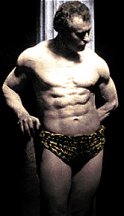 The scent of the big cats fills this book. Already Sheeta and Numa have had nearly equal billing with Tarzan and Valthor; now lions are given prominence. Now Tarzan emerges from the flood, which symbolizes a major life change, into the land of lions and lion worship. the ownership of lions is a mark of distinction in Cathne, Cahtnean chariots are even drawn by lions which brings to mind the chariots of goddesses like Cybele, Harmonia and Cadmus. Nemone will promise to reward Tarzan with three hundred lions, apparently an incredible number making him the top Lion Man. Remember the next novel Tarzan And The Lion Man will continue the theme.
Continuing an old theme from Tarzan And The Golden Lion a lion is even the god of Cathne. The symbol of Nemone’s Animus is a great black maned male lion named Belthar. The novel will devolve into a battle between Nemone’s lion, Belthar, and Tarzan’s lion, Jad-Bal-Ja. Also continuing an old device employed in Tarzan And The Jewels Of Opar by the jewels and in Tarzan And The Ant Men by Tarzan’s locket this story is unified by the image of a great lion drawing ever nearer to Tarzan. So amid all these lions is the true Lion Man, Tarzan’s personal lion. His own guardian animal.
It does seem clear that ERB associates the big cats with sexuality.
ERB is building this story very carefully with great attention to spacing and pacing. Captured by the
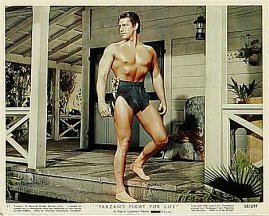
Gordon Scott As Tarzan
Cathneans ERB takes care to ingratiate the Big Bwana with the troops. He has Tarzan and the Cathnean soldiers enter into a spirit of camaraderie as he introduces them to and instructs them in the use of the bow. Nemone is instroduced but seems to take little notice of the Big Guy condemning him to fight in the arena.
Taken to a prison cell he and we are introduced at some length and in some detail to a character named Phobeg. Phobeg is billed as the strongest man in Cathne.
ERB devotes an amazing amount of space to his confrontation between Phobeg and Tarzan. His development of such a minor character is unusual. I think what we have here is a confrontation between Tarzan and the actual man who inspired Burroughs to create Tarzan, the man who was the physical basis of the Lion Man. Phobeg can be no other than the first important body builder in the world- The Great Sandow. Just as in Tarzan The Magnificent Burroughs takes care to indicate that Tarzan has now replaced H.M. Stanley as the symbol of Africa, so here he puts down ‘the strongest man in the world’ in favor of his hero.
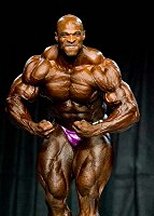 Sandow (1867-1925) had died a few years earlier. While other muscle men had replaced Sandow, most notably Charles Atlas, Burroughs was still obsessed by the man he had seen at the Columbian Expo of 1893. It would seem certain that ERB occasionally picked up a copy of Physical Culture Magazine to keep up on the latest builds. He couldn’t have missed the memorial copy devoted to Sandow, the greatest and still the greatest of the body builders. The award given to Mr. Olympia is called the Sandow.
While bowled over by the strongman, and strongmen, ERB was always offended by the bunchy muscles created by body building. he repeatedly makes allusions to strongmen throughout the corpus while Tarzan himself is both the antithesis and the perfection of the strongman. That is why Tarzan has smooth muscles flowing like molten metal beneath his skin while in this case Phobeg as a Sandow surrogate has the knotted muscles of the body builder.
If Burroughs found Sandow’s build offensive he would have gone apoplectic at the most recent champions who seems to have developed musculature as far as it can go. Unlike builders like Charles Atlas, Gordon Scott or Arnold Schwarzenegger who aspired to the Apolline figure, Ronnie Coleman and his successor Jay Cutler have opted for muscle upon muscle until there is nothing but muscle with no attention to a human shape. As an example check out Jay Cutler the current Mr. Olympia and holder of the Sandow at www.emusclemag.com. This guy is only 5’9″ but bulks up at 320 lbs., paring down to 275 for performance. And that is literally all muscle. One look at Cutler and ERB would have been foaming at the mouth
Just as Sandow was billed as the strongest man in the world, so Phobeg is billed as the strongest man in
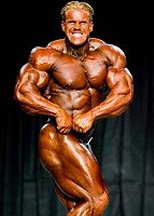
Jay Cutler In Full Pump
Cathne. ERB makes him a braggart in relation to Tarzan but if he was the strongest man in Cathne he had little reason to respect Tarzan’s physique which was more like ‘Apollo than Hercules.’ Tarzan’s strength though greater than Phobeg’s was disguised.
At they are to fight each other to the death in the arena this allows Burroughs to introduce another of his interests which may be related, that of professional wrestling. Burroughs had Tarzan jokingly suggest that they stage the fight much as professional wrestlers. Burroughs who still attended the matches was disgusted becasue the matches were pure entertainment, something he should have applauded. Then as now the professional wrestling matches were staged. Professional wrestling then as now has more to do with entertainment than sport. Either you can get caught up in the fun and drama or you can’t. ERB obviously did although as he still thought of the shows as wrestling he felt put upon.
After several pages of Phobeg’s bragging and Tarzan’s false humility the ‘really big shoo’ begins. Tarzan and Phobeg are the last act on the program and they would have been a difficult act to follow.
ERB must have loved this part as the lenghty description of the gambling taking place is many times more detailed that he usually is. Whether the gambling aspect went on at the wrestling matches he attended or not, I don’t know. The odds naturally are for Phobeg, whose Cathnean reputation is immense and accurate as concerns the past. Everyone expects the inveterate gambler Nemone to bet on the sure thing as was her custom. They hedged their bets when they could at fantastic odds. Nemone then surprised them by betting on Tarzan. Nearly bankrupted the whole coterie of Lion Men.
Tarzan wins of course but refusing to kill Phobeg he instead does his trademark thing lifting Phobeg above his head and tossing him into the stands at Nemone’s feet. Now that is one hard act to follow.
Having now won his liberty, a lion man named Gemnon is assigned custodian of Tarzan taking him under his wing. Up to this point there seems to be no reference to contemporary affairs except for Sandow and wrestling. At this point ERB displays a numerous and surprising set of literary references.
Go To Tarzan And The City Of Gold part two.
Ragtime Talking Eddie Burroughs
July 18, 2008
Ragtime Talking Eddie Burroughs:
Another Look At Minidoka
by
R.E. Prindle

While I was wandering through the pages of Minidoka one day looking for some firm dating device I came across what may very well be a key to explaining the method of reading the story. When I first read the story I tried to read it straight which was a very unsatisfying experience. The story seemed to be a clumsy first effort. While a first effort, perhaps, the story is far from clumsy, indeed it is a well crafted and polished tale.
The story isn’t written in plain English; it seems that our very hep ERB is ‘talking ragtime.’ First the proof and then an attempt to understand the concept of talking ragtime.
On page 22 there is an exchange between Minidoka and the Hoobody:
“Now, don’t be frightened,” said the Hoobody. “I’m really very fond of young people, expecially hash browned. But candidly, I have come to you as a friend, sent by the Little Horned Toad whom we all obey. You are in terrible danger and if you don’t do just what I tell you, your name is Alkalai dust.”
“I’m in the hand of my friends,: replied Minidoka. “But I glean that you are talking rag-time,” he added to himself.
The Hoobody’s speech can then be understood as an example of ragtime talking. One can’t write what one doesn’t know so it is clear that ERB knows what ragtime talking is and knows it well enough to confidently reproduce it. Hence ERB is a hep dude. I’m not talking ragtime either. It would seem that as in latter days ERB would have had an affinity to the Hipsters, the Beats, Beatniks and the Hippies. He was cool.
Now, what might talking ragtime be.
Talking ragtime woud be based on the principles of ragtime music but independent of it. Ragging a tune led to ragging the language.
While ragtime is a distinct musical genre of original pieces any song can be converted into ragtime by changing the time values of melody notes. This is known as ragging the piece. (Wikipedia) Thus ragtime talking distorts ordinary English into strange or outre phrasing and notions. The Hoobody says he is fond of young people, especially hash browned. The surprise effect of young people and an edible dish is clever or amusing if not outright funny. Thus the language is being ‘ragged.’
As ERB follows the technique throughout the book the story must be a ragtime story. While my first thought was that ERB put the story aside because it’s quality wasn’t publishable I am now of the opinion that while within a ragtime genre the quality is fine perhaps there were no publications that accepted ragtime stories. I may be wrong.
That ERB may have been deep into the technique is evident from the transformation of Bodine into a Coyote. I am not clear on the connection between the Coyote and ragtime talking and lyrics but the Coyote plays a central role. Thus Bodine is a Coyote throughout most of the story.
Ragtime music first surfaced as a genre at that place of all firsts the Chicago Columbian Exposition of 1893. Thus from the age of seventeen on ERB would at least have known of Ragtime music. The music was definitely popular from c. 1900-1918. When Ragtime talking became a hipster dialect isn’t clear.
In the story ERB has Smith driving a ‘horseless carriage.’ An anomaly of sorts as by the terms of the story it should have been a cowless carriage as ERB reverses nearly every conventional usage throughout the story. The automobile wouldn’t have been that common in the first few years of the century while by 1907-08 when I believe the story was written, it would have been. The electric car that Burroughs drove at the Expo wouldn’t have been called a ‘horseless carriage.’
I can find no reference to ragtime talking on the internet so that if the method developed in the early years of the century until it was common amongst hipsters that would have to have been by 1907-08. There would have been no way for ERB to learn the concept while he was in backward Idaho in 1903 and 04. So that in my opinion the story written in ’07-’08 and possibly later.
The story is definitely not a children’s story. The story is meant for adults. The use of the term ‘threw a couple Delsartes’ would very likely be incomprehensible to children. The Delsarte method was a series of sterotypical emotional responses designed for stage actors. I append a page in demonstration borrowed from the incomparable Our Times by the great Mark Sullivan.
 Lyrics: Since Birdie Commenced Her Delsarte:
Her right hand goes this way, her left one goes that,
And she flings them high into the air,
To show her improvement she give the “wave” movement
And impersonates Hate and Despair…
There’s lots of sleep-walking, also dumb talking,
Since Birdie’s commenced her Delsarte.
So, if one reads Minidoka as an example of ragged English not unlike Fractured Fairy Tales or a couple of verses from Phil Harris; That’s What I Like About The South it makes perfect sense:
 Won’t you come with me to Alabammy
Let’s go see my dear old Mammy
She’s fryin’ eggs and boiling hammy
That’s what I like about the South.
Well it’s way down where the cane grows tall
Down where they say “Y’all
Walk on in with that Southern Drawl
‘Cause that’s what I like about the South.
Did I tell you ’bout the place called Doo Wah Diddy?
It ain’t a town and it ain’t a city
It’s just awful small, but awful pretty
That’s Do Wah Diddy.
Rag, Mama, rag.
So Mindoka is ERB in a light hearted effort to amuse while demonstrating his coolness. Can’t get much hipper. Viewed from that perspective we have an accomplished effort on a level with the best of his work.
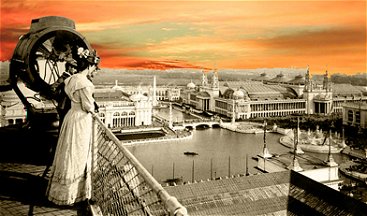
1893 Columbian Exposition At Chicago
Men Like Gods: Tarzan Pays Homage To Heracles
July 9, 2008
Men Like Gods
Tarzan Pays Homage To Heracles
by
R.E. Prindle
First published in the online Magazine: ERBzine
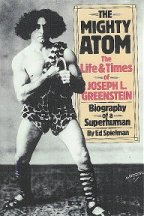
Cover of The Mighty Atom
The Golden Age of Strongmen had captured the imagination of the world between 1890 and 1910….Into the 1920s the strongman continued as a living wonder and inspiring vision that could be had for the modest price of admission
-Ed Spielman: The Mighty Atom:
The Life And Times Of Joseph L. Greenstein
When I was a child and youth in the 1940s and ’50s the legendary strongmen of the turn of the twentieth century were, if no longer living, living legends. At least one, Bernarr Madfadden, the father of American bodybuilding, was still going strong.
The most legendary of the strongmen was Frederick Mueller who was known professionally as the Great Sandow.
In his heyday Sandow was so strong that he was capable of ‘exploding’ or breaking the ‘Test Your Strength’ machines in the arcades of Vienna, Austria. There were so many broken machines that it was thought a vandal was destroying them but when apprehended it was discovered that Sandow was not only testing his own strength but the strength of the machines. He flippantly suggested that they be made of better materials.
On stage as Spielman relates, Sandow, who was trained as a turner, could do a back somersault over a chair with a thirty-five pound dumbbell in each hand. He could do a one arm chin-up with the grip of any of his fingers of either hand, including his thumbs.
He could…wait a minute! I’ve heard something like that before. Oh yea, I remember now. In Edgar Rice Burroughs’ Tarzan And The Lion Man he has Tarzan leap up to seize stakes pointing down from a ten foot high wall, then draw himself straight up until his torso was above the stakes, then roll over the top defeating the purpose of the stakes. Was he thinking of the Great Sandow when he wrote that?
I think he was.
Burroughs was a fan of boxing and a great admirer of the strongmen of the Golden Age, although he didn’t like the bulky physiques. He repeatedly denounces the physical build of the Strongmen in preference for Tarzan’s ‘smooth rippling muscles.’ In my day the bodybuilders were ridiculed as being ‘muscle bound.’ But the ladies panted when they said it. Tarzan is as strong or stronger than the strongmen but sleek.
Next one asks is there any place that it can be shown that Burroughs ever saw Sandow? yes, and where else? The Chicago Columbian Exposition of 1893. The Expo was a life changing experience for 17 year-old Ed Burroughs. Bill Hillman of ERBzine has written a wonderful series on the influence of the Fair on young Burroughs.
The influence of the Fair was as moving for the rest of America and the World as it was on Our Man. There apparently has never been so influential a World’s Fair as that of Chicago of 1893.
One of the best attended features of the Fair was put on by the Great Sandow. Bodybuilding had already gotten started in England. Sandow was a student of the innovative Professor Attila in London. He came to the attention of Florenz Ziegfeld while performing in New York. Ziegfeld brought him to Chicago for the Expo. Sandow was a sensation.

The Great Sandow
He created quite a stir at the fair. Not only did Burroughs see him there but so did a man named Bernarr Macfadden. At the time he was known as Bernard McFadden but he chose Bernarr because it sounded more like a lion’s roar and Macfadden because he thought it looked more distinguished in print. As a result of seeing Sandow Macfadden became the father of bodybuilding and the health movement in the United States. John Dos Passos spoofs him in Vol. III, The Big Money, of the his USA Trilogy.
Macfadden was the discoverer of isometric exercises, which his student, Charles Atlas, renamed Dynamic Tension and made a fortune.
Unless I’m mistaken Macfadden would cross ERB’s path sometime between 1908 to 1912.
Sandow made bodybuilding a rage after the Fair while Macfadden organized the sport around his magazine ‘Physical Culture’ which he began publishing in the wake of the Fair. Sandow also opened the way for a number of strongmen to build careers on their physiques.
They all passed through Chicago. How many of them ERB paid the modest price of admissio to see we can’t know, but as he always speaks of the strongmen in the plural one assumes that he saw several.
Anyone who has watched the Strongest Men In The World competition on cable TV will understand how impressive both the feats and the physiques of these men were.
In ERB’s day a man called Warren Travis Lincoln could lift a platform that held twenty-five men with his back. That was a weight of about 4200 pounds.
G.W. Rolandow could stack three decks of playing cards and tear them in two. One assumes that was before they were plastic coated.
Emil Knaucke who weighed in at five hundred pounds, a spectacle in itself, could hold a car above his head with one hand. Spielman doesn’t specify make or model.
Louis Cyr, one of the most famous strongmen, could restrain a team of horses on either side at the same time. Really spectacular stuff.

Bent Press Arthur Saxon
A man like Arthur Saxon of the Saxons was considered to be the strongest man in the world. He could do a bent press of nearly five hundred pounds. As in the photo, in the bent press a lifter raised a barbell above his head with one hand in a bent posture then raised another weight with his other hand.
Eighteen ninety to nineteen-ten were formative years for ERB. He would have from fifteen to thirty-five so that when he saw Sandow in ’93 at seventeen he was at a most impressionable age.
ERB turned 40 in 1915 and 50 in 1925.
By the twenties vitamins and food supplements had been discovered and were being developed for commercial use. Vitamins were still novel when I was kid in the late forties. Not everyone knew of their value as late as then.
The Great Sandow, Louis Cyr, and a trio of German strongmen called the Saxons were all naturally strong but by the 20s it was possible to build muscular Adonae from the scratch of a 98 lb. weakling. With vitamins, food supplements and a rigorous regimen for bodybuilding a normal body could be turned into as mammoth a specimen as Tarzan, as witness Arnold Schwarzenegger and his contemporaries who emerged from New York City gyms in the 1960s.
In point of fact you didn’t even need all that gym equipment. If you followed the body building plan of the most famous Adonis of the 40s and 50s, Charles Atlas, all you needed were your own opposed muscles.
Atlas took Macfadden’s isometric exercises and called them the more commercial sounding Dynamic Tension. By pitting one muscle against its opposite fantastic results could be achieved.
Charles Atlas, who changed his name from Angelo Siciliano, was voted the world’s most perfectly developed man in 1922 by his mentor, Macfadden and Physical Culture magazine.
Angelo, born in 1894 in Acri, Sicily came to the US in 1904, thus he would have been 18 in 1922, 18 in 1912.
Siciliano actually had been a 98 lb. weaking who had sand kicked in his face by a bully. His girl friend actually did walk away from him. Siciliano then built himself up into what I’ve always considered to be the image of Tarzan and changed his name to Charles Atlas.
I was not as successful with the Dynamic Tension plan Chuck sold me in the 50s but then I didn’t try that hard and I couldn’t afford the food supplements which are indispensable. Nevertheless it had become possible to turn out ‘Men Like Gods’ on an assembly line basis.
It is more than likely that Burroughs was very familiar with the bodybuilding or fitness program of Macfadden. That photo of him flexing his muscles on the dock at Coldwater is that of a man who has been working out. I can’t beleive that a man who was interested in magazines as Burroughs was couldn’t be familiar with Physical Culture Magazine. Not only would he have the living memory of the Great Sandow in his mind from the Expo but Bernarr Macfadden had moved his headquarters from Battle Creek to Chicago in 1908. He had a very prosperous looking facility.
During these years from 1899 when ERB was bashed in the head in Toronto to 1910 at least, he complainedof excruciating headaches that began when he got up in the morning and lasted through half the day. These would have been very enervating affecting his ability to work. In The Girl From Farris’s he has his hero Ogden Secor suffering from the same headaches going from doctor to doctor ‘tinkering with his skull’ in hopes of finding relief. The doctors could do nothing for Secor so he undertook a fitness regime which eased his situation. So must have ERB.
Once again, the picture of ERB standing with his legs apart flexing his muscles on the dock at Coldwater in 1916 shows that he was either proud of a moderate physique or he was trying to develop those ‘rippling’ muscles like Tarzan and Charles Atlas.
At fifty in 1925 ERB probably thought himself beyond the age when he could develop his physique into a semblance of his creation, Tarzan. Ten or twenty years younger and you might have seen Burroughs as another Charles Atlas or Tarzan.
There is every reason to believe that sometime between 1908 and 1912 he developed an interest in Macfadden’s program.
When he sat down to begin his Tarzan series at the end of 1911, Burroughs’ mind must have been filled with the feats of Sandow and the other strongmen. Anent this, Tarzan’s leopard skin loin cloth was borrowed from the strongmen. Leopard skin shorts were de riguer for the bodybuilding crowd.
Of course the role models for these strongmen were Samson and Heracles. The latter is better known in his Roman usage as Hercules. For the purposes of this essay I will refer to him as Heracles in hs Greek manifestation.
Especially in his original manifestation Heracles was a Sun god as the companion of the Earth Mother, Hera. When the Patriarchal system was imposed on the Matriarchy Hera was wed to Zeus while her former consort, Heracles- The Glory Of Hera- was demoted to the role of Holy Fool and the strngest man in the world.
ERB often refers to Tarzan as a Jungle God and a latter day Hercules. Burroughs had a good Greek and Latin education so one might asume that he had some familiarity with the cycle of myths devoted to the feats and tribulations of that ancient type of all strongmen, Heracles.
In fact, without stretching the point unduly, one can posit a relationship between the Pelasgian Sun God, Heracles and the Flaming God of Opar and through them to Tarzan; they can be construed as one.
Whether ERB was conscious of what he had done in conflating the three cannot be determined for sure but as he was manipulating valid historical data why shouldn’t he have been conscious of what he was doing? The Aztec ritual of tearing the heart out to offer to the sun god is implicit in scenes where Tarzan lies across the sacrificial block, pardon me, altar. The annual sacrifice of the queen’s consort is implicit once again as La raises the sacrificial knife. A blatant resemblance to Cybele and Attis.
While the subconsious is always important it is the conscious mind that organizes, plots and writes. As a writer I may have subconscious motives which may emerge but assembling and organizing my material is a conscious intellectual act. It is axiomatic that one cannot write what one does not know.
One of the great mysteries of mythological studies has been the relationship of Heracles to his namesake the former Matriarchal Earth Goddess, Hera. I noted just previously, during the matriarchy as the Sun, Heracles would have been appropriately called ‘The Glory Of Hera’ or of the Earth. The same notion can be applied to Mesopotamian and Egyptian mythology. For instance, as David Adams points out somewhere, the lion is a symbol of both the sun and the matriarchy. It is a fact that the body of the Sphinx at Memphis is older than the head. The head of the original has been replaced by that of a man. It therefore follows that the Sphinx was carved during the Matriarchy having either a lion’s or a woman’s head. After the succession of the Patriarchy the head was changed to reflect the New Order.
In the Greek Oedipus myth the Theban Sphinx was still represented as the original matriarchal symbol of a lion with a woman’s head. Woman-lion/sun/Heracles. The answer to her riddle after which she committed suicide was ‘man’ which denied the Matriarchy, hence she had to kill herself as the Patriarchy thus symbolically replaced the Matriarchy. Apply that to the Egyptian Sphinx and the change of heads.

Theban Sphinx
Now, the original Egyptian Sphinx was exactly the same as the Theban Sphinx: a woman’s head on a lion’s body. the Sphinx is positioned to be looking due East at sunrise in the Age Of Leo. Thus, perhap, the secret of the Sphinx is simply that as Mother Earth she sat waiting for her consort Heracles (or his Egypian counterpart) to appear on the horizon each morning.
The notion has simplicity to recommend it.
As we all know, Oparians were a group of Atlanteans isolated from the main body when mythical Atlantis broke apart and sank beneath the waves of the Atlantic Ocean. The worship of the Flaming God was inherited from the parent civilization by Opar.
Thus whether Burroughs knew what he was doing or not he always gets the sequence of events right.
Without getting into any discussion of if, where or when Atlantis may have existed, let me say, neverttheless, that all the evidence points to a predecessor civilization anterior to Crete, Pelasgian Greece, Egypt and Mesopotamia in much the same way Atlantis preceded Opar.
The predecessor civilization must have existed in the Mediterranean Basin during the last ice age when ocean levels, scientists tell us, were several hundred feet lower than they are today. There are evidences of quarrying several hundred feet below sea level on the flanks of the island of Malta for instance. Given this as a fact, then when the ice melted and the waters rose during the Great Flood to their present levels any society or civilization that existed in the Mediterranean Basin was forced to move to higher ground which is to say above the present sea level.
One thing is certain, if the Basin was habitable it was inhabited.
The disruption caused a long dark age from which mankind only slowly recovered. At the same time these relatively highly developed people moving into less developed savage societies had a fertilizing influence introducing more sophisticated ideas and methods such as agriculture.
Lower Egypt, one of Two Lands, was obviously settled by the displaced Libyan dynasty. After centuries of warfare the Upper Egyptians succeeded in conquering Lower Egypt uniting the Two Lands. The Third Dynasty was a Libyan Dynasty so that the warfare was translated from an external one to an internal one in which the Libyans defeated the Upper Egyptians. During the Libyan Dynasty the great pyramids were built reflecting in some way the the flooded predecessor civilization.
So Crete and Pelasgian Greece received survivors also. The Sumerians of Mesopotamia attribute their civilization to the advice of Oannes, John in English, who came from the sea.
Often ignored by classical scholars but obviously part of this great Mediterranean culture is ancient Spain. Now, Spain has one of the great traditions of the worship of Heracles as a Sun god. This tradition preceded and was uninfluenced by any Patriarchal tradition from Greece. In point of fact the Patriarchal Heracles went West to annex the Spanish traditions to the Patriarchal cause. In the process he rounded up the cattle of the Sun i.e. the Matriarachal Heracles to bring back to Greece. Throughout history, including modern Africa, lifting another man’s cattle transferred his authority to oneself. See the great cattle raid of Cooley in Irish mythology. It therefore follows that the Greek Patriarchal myths of Heracles are built on an earlier Matriarchal mythological cycle while being perverted or converted to Patriarchal needs.
Heracles was originally a sun god. He was the original of the Flaming God. I can’t say Burroughs knew this either consciously or subconsciously, however as we will see there is substantial evidence to indicate that he was consciously manipulating the material.
The city of Seville in Spain is built over a Sun Temple in which Heracles was the sun deity. This site beneath Seville can still be vistited today. Assuming that the history of the Spanish Heracles developed independently of the Greek Heracles which after all is a Greek interpretation of a Pelasgian god then it follows that the two traditions must have come from a common source. That source cannot have been other than the ante-deluvian civilization of the Mediterranean Basin.
It follows then that whatever names they were known by in this anterior civilization Hera was the Great Mother Goddess while her ‘Glory’ Heracles must be no other than the Flaming God, the Sun. What else could the ‘Glory’ of the Earth Mother be?
Thus when the Great Flood, which must be the same as that spoken of by the Sumerians who would have gotten the story from Oannes, destroyed the civilization of the Mediterranean Basin the inhabitants fled to the former highlands surrounding them taking their traditions with them. The Spanish Heracles was yet identical to the Pelasgian and Cretan models which later became variant.
When the Greeks entered Pelasgia at the beginning of the Arien Age, the Zodiac dates back to the anterior civilization, they found this remnant of the ante-deluvian civilization with immemorial religious traditions occupying the land. As the Arien Age began a great shift in the mental and social organization of man progressed in its evoltuion. The shift was from a Matriarchal consciousness to a Patriarchal consciousness. In other words, the God replaced the Goddess as the most important sex. Fecundation became more important than actual reproduction.
This meant that all the divine myths had to have all the sexual relationships reversed so that the God took precedence over the goddess. Hera could no longer be allowed to have a male god as her subordinate ‘Glory’, the roles had to be reversed. Hera would have to become the dependent of Zeus.
Homer’s Iliad is one key in the story of this reversal.
As Hera was unwillingly made subordinate to her Lord and Master, Zeus, Heracles had to be appropriated by the God. The Patriarchy then turned Heracles into a scourge of Hera and she his enemy in ridicule of the previous dispensation. Kind of a Burroughsian style sly joke.
The meaning of the name Heracles as the glory of Hera was thus lost. Heracles lost his identification with the Sun becoming a buffoon as the greatest of men; a physical giant of somewhat dim intelligence. Hera’s glory was turned into a laughing stock but still a good sort of fellow who could aspire to godhood at death.
In the Patriarchal myths Heracles destroyed various Matriarchal cult centers such as the Hydra at Lerna, the Stymphalian Swamps, the Stag of Artemis, the Nemean Lion and others. His cycle of adventures was involved in replacing the Matriarchal with the Patriarchal sarcastic ‘Glory’ of Hera.
To make a feeble Patriarchal attempt at accounting for the meaning of Heracles’ name Homer tells the following story in book XIX of the Iliad. Zeus, influenced by the goddess Folly, announced to the assembled Gods on Olympus that before the day was out a descendant of his lineage would be born to a mortal woman who would be the greatest man in the world.
Hera, who hated the infidelities of Zeus, heard his proclamation with scorn. She knew her husband but too well. She knew he referred to Alcmene who was bearing Heracles but she also knew that a son was to be born to the wife of Sthenelus who was only seven months pregnant. Sthenelus was of the lineage of Zeus.
Hera rushed off to visit Eileithyia, the goddess of childbirth, to ask her to hasten the birth of Eurytheus while delaying that of Heracles. The former having been born first became the greatest monarch of the age after the Patriarchal fashion but by Matriarchal means.
Hastening back to Alcmene Eileithyia uncrossed her legs allowing Heracles to be the younger son of Zeus born on that day. While Heracles was the bravest and strongest of men he was nevertheless compelled by Hera’s resourcefulness and prompt action to be subservient to Eurystheus. Thus the will of Zeus which could not be averted was perverted by Hera to thwart the Big Guy’s will.
Heracles was still the strongest man alive but he was subordinate to the will of Hera through Eurystheus, portrayed as one of th weakest and most cowardly men of his time hiding behind his mother’s skirts but by the grace of Hera and the matriarchy, the greatest ruler.
Zeus, appalled by his lapse of judgment threw Folly off Olympus from which she is still banned.
In that sardonic manner Homer explained the meaning of Heracles as the glory of Hera. She had used him to Ace Zeus. Heracles had been stripped of his role as the glorious Sun companion of Hera. He comes down to us as the strongest man who ever lived. In the Roman nomenclature of Hercules he became the role model of every strong man who ever lifted a dumbbell. Yet they all wore leopard skin shorts, the leopard being a symbol of the Matriarchy. You can’t fool Mother Nature.
To Burroughs who was a student of Greek mythology the great strongmen of the Golden Age must have appeared as men like gods. Their feats of strength, their marvelous physiques, were so far beyond the abilities of ordinary men that they must have seemed to be in a class by themselves far above mortal men.
In that sense Tarzan is the greatest of the strongmen, above Sandow, Arthur Saxon and even Heracles.
Heracles himself had been demoted to a mere mortal although his legend was so great that he was allowed immortality by the Patriarchy after his mortal death. Unwilling to grant him too much credit he was allowed to be the doorman of Olympus. He held this position throughout the Arien Age being replaced by St. Peter in the New Dispensation of the Piscean Age.
Burroughs, familiar with the mythic cycle of Heracles, however he understood it, plays with both identities of Heracles in the person of Tarzan at Opar. He also brings in a number of elements from H. Rider Haggard’s novel She. There can be no doubt of the influence of Haggard. Burroughs even names his heroine La which is what ‘She’ is designated as in French translations of Haggard’s novel. The palance of Opar is also based to some extent on the labyrinthine caves of She.
There are many literary influences for the creation of Tarzan not least of which are the real life H.M. Stanley and Haggard’s fictional heroes Sir Henry Curtis and Allan Quatermain. I would now like to direct attention to a third, that of the heor of She, Leo Vincey.
If one closely examines Vincey it will be discovered that he too was a Sun King whose death had been caused in an earlier incarnation by She. The cartouche which contains the name of Leo’s distant Egyptian ancestor was translated as ‘The Royal Son Of Ra’ or son of the Sun as in Egyptian mythology Ra is the sun.
Leo also translates from the Latin as Lion so we have the Son of the Sun who also is a Lion Man which is how Burroughs refers to Tarzan in ‘The Invincible’ and undoubtedly as how he always thought of his creation.
Haggard translates Vincey as the Avenger. Tarzan is the ‘Avenger’ or guard of Africa. Haggard describes Vincey as almost inhumanly beautiful while Tarzan is the most handsome man in the world not unlike Charles Atlas.
Haggard’s She is indescribably old kept forever youthful by having bathed in the fire of eternal youth. Hera was also eternally youthful and a virgin queen. She restored her youth and virginity by bathing annually in a holy spring. Hera’s bath obviously refers to the Spring rains which inundated Mother Earth just prior to vegetation springing forth in virgin birth. After the summer heat the vegetation dies down and Earthy Hera becomes barren once more to await her bath and return to virginity.
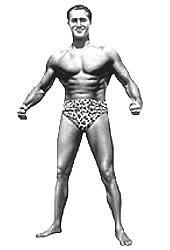
Mr. Dynamic Tension- Charles Atlas
So a connection can be made between Sun>Heracles>Vincey>Tarzan and Mother Nature>Hera>She>La.
Burroughs La was neither ancient nor immortal in the personal sense although she was the latest in an immortal line of Priestesses. She is a priestess of the Sun or Ra, The Flaming God.
Haggard’s Leo Vincey was the direct descendant of Kallikrates She’s great love of two millennia past. She, or Alyesha, to use her name, had killed Kallicrates in a rage. Kallikrate’s descendants were sworn to avenge the murder. Thus Vincey travels from England to far off Africa to locate this fabulous woman.
Kallikrates was the love of Alyesha’s very long life. When she recognizes Leo Vincey as her lost lost love she saves his life while offering him eternal youth if he will only bathe in the flames of eternal life. He hesitates to do so. To encourage him Alyesha steps once again into the flames which was a serious miscalculation. She crumbled to dust. Thus while Leo Vincey doesn’t actually avenge the death of Kallikrates she is nevertheless his victim.
Tarzan while actually born in Africa was conceived in England so he made the trip to Opar from England although he is ignorant of La. When Tarzan is captured in Opar he is laid on the altar of the Flaming God, La with the sacrifical knife raised, looks down on this Jungle God, this man like a god, and falls in love. Thus we have a replay of the She-Kallikrates situation.
Unable to take Tarzan’s life, La releases him begging him for his love. Alyesha’s full title was She-Who-Must-Be-Obeyed in the Matriarchal sense. The old conflict arises, Tarzan is more on the Patriarchal side, he has his moly in the waistband of his loin cloth, monagamous we are led to believe, happily married, so the Lion Man Sun King declines the honor of being mated to La>Hera. He asserts his Patriarchal prerogative to disobey although he always has a soft spot in his heart for La.
In a fairly masterful way ERB conflates the legend of Heracles, the fiction of H. Rider Haggard and the incredible strongmen of the Golden Age and his own little bit to write a charming and beautiful story which is fairly simple on the surface but one which becomes immensely rich with a deeper understanding of the sources.
Ernest Hemmingway once said that before one sat down to write one should have ten time the information in your possession as you put on paper else the story will seem shallow and contrived. It would seem that the sources upon which Burroughs was drawing, from the bodybuilding strongmen of his day to the legendary cycle of Heracles to the adventures of H.M. Stanley and the fiction of H. Rider Haggard might well fulfill Hemingway’s dictum.
When one searches for the sources of Burroughs one finds layer after layer of golden riches while discovering that in fact ERB did indeed create a man like a god- Tarzan The Magnificent.
Addendum
This is a quote taken from Bonzo Dog’s song Mr. Apollo. I don’t know whether the reader is familiar with the Bonzos but they were one of my favorites. Several glorious LPs. Neil Innes came from them as well as the great but tragic Viv Stanshall. Leave those drugs alone, boys.
Follow Mr. Apollo,
Everybody knows a healthy body
Makes a healthy mind.
Follow Mr. Apollo,
He’s the strongest man the world has ever seen.
If you take his courses
He’ll make you big and rough.
And you can kick the sand right back in their faces.
A few years ago I was a four stone apology-
Today, I am two separate…Gorillas.
Bonzo Dog Doo Dah Band
Long may they wave.
Reconstruction, Tourgee And Dixon
June 9, 2008
A Review
Reconstruction:
Albion Winegar Tourgee And Thomas Dixon Jr.
by
R.E. Prindle
The conflict between the North and South is the central conflit of United States history. Whether the Civil War was fought to preserve the Union or over slavery the African issue was the central problem of the country. The aftermath of Reconstruction was and has been devastating to US history. Mark Sullivan comments the Reconstruction period in Our Times, Vol. III. He is writing c. 1930:
Hardly to this day has any unbiassed summation been made of the destruction that the North visited upon the South. Rarely has any conqueror in history been so ruthless- by comparison, the treatment of Germany by the Allies was the rebuke of a complaisant parent to a naughty child. The North, by abolishing slavery, wiped out five billion dollars’ worth of the South’s property. That was but the beginning. Abolition of slavery was the complete destruction of the South’s economic system, land in the South was made valueless. Then the North, by conferring suffrage on the negro, set the former slave in power over his recent master, and for ten years maintained him there by arms. The very aorta of civilization in the South was more near to being completely severed than historians have commonly realized. In the University of South Carolina, a State institution authority over which rested the legislature, a corn-field negro, barefooted, illiterate, sat in the chair and drew the salary of the Professor of Greek. Over a period of forty years, including war, reconstruction (ironic word!) and the aftermath of both, the lamp of education in the South was saved from complete extinction only by the devotion and patience of half a dozen men. With the other consequences went a discouragement which accepted the physical deterioration, through disease, of large portions of the rural South, as merely one detail of a fate it was useless to resist.
The excuse of the North was that Southern Whites had enslaved the African. For some reason the New England States made Southern slavery an issue although those states, as Bible pounders, were not opposed to slavery in principle. Shortly after the Civil War certain New England citizens established themselves in the Hawaiian Islands where they began to grow staple agricultural crops. Farm labor therefore became as big a problem for them as it had been in the South. They were not averse to establishng a contract labor system which was a form of wage slavery. The New Englanders, some of them churchmen, saw the Chinese as inferior coolie laborers not unlike the African. Learning from the Reconstruction African situation in the South they were reluctant to import the Chinese as permanent residents.
Thus the contracts of the Chinese specified that the Chinese return to China after the termination of their contracts. This the Chinese saw no reason to do staying on as permanent residents. Reluctant to import more Chinese the New England planters cast about for another alternative. They settled on the Japanese. Thus a ship sailed into Tokyo Bay and the Planters forcefully abducted, kidnapped, a hundred odd Japanese from Yokohama taking them back to Hawaii where they were put to work.
So we may assume that the New Englanders were not entirely sincere in their objection to Southern slavery.
In addition during the Grant administration while Reconstruction was in progress the annexation of San Domingo or Haiti was proposed. Under the French administration of the area using African slave labor San Domingo was the richest and most productive colony in the world. It could be made so again under American administration. How they proposed to farm the land without African labor remains a mystery. It could only have been achieved by some compulsive means.
As the Africans have never worked the land of this richest of areas without compulsion one would be amused to learn the proposed solution to this pressing problem of labor.
One can only conclude that as no region of the US objected to forced labor that truly the Union was the reason for the Civil War. The reason for Reconstruction has to be explained otherwise.
The next problem is the nature of the African. Nowhere in the world without an overawing show of force were the Africans docile. The history of Africa is perpetual genocidal, tribal warfare. The Africans had the very reasonable attitude that the way to treat an enemy was to stamp them flat. Exterminate them.
The attitude is apparent everywhere in Africa today most obivious at the moment in Zimbabwe and South Africa.
In Haiti at the end of the eighteenth century the small number of French planters proved unable to control the overwhelming number of Africans, the latter rising up and defeating their owners. In this action known as the San Domingo Moment the White males were exterminated to the man while the females were given the option of sex slavery or rape and death.
One might say this was race hatred but I say no. The response was no different than any other tribal conflict in Africa; the difference in Haiti being merely that the French were White.
In the US the White Planters managed the Africans by the threat of slightly superior numbers while overawing the Africans into if not total submission something very nearly so. Thus the character the North gave the Africans in the South was at complete variance with the worldwide reality.
The North took the forced submission of the African in the South that produced a seemingly submissive inoffensive, harmless type of being the actual nature of the African. Tourgee refers to Africans as ‘poor innocents.’ Northerners believed that the lack of apparent intellectual capability was due to ill treatment and the lack of opportunity for education. So the real question is who was right about the relative capability of the African to the Caucasian? The North or the South? This problem is important and has to be dealt with.
We are told that the African was first to evolve as a Homo Sapiens from the Last Hominid Predecessor. That was c. 150,000 years ago. Had the African not been disturbed by outside peoples he would be living today as he was when he evolved so long ago. Many peoples have visited sub-Saharan Africa, that is to say, Black Africa, over the last few millennia. Phoenicians and Carthaginians visited sub-Saharan Africa both overland and on voyages around the coasts. Greek traders visited the source of the Nile, identifying the Mountains of the Moon while Romans established trade routes across the Sahara. The Arabs established contact beginning in the seventh century at least while Malays from Indonesia established themselves on Madagascar while penetrating into the continent itself making settlements about the year +1000.
All influences were absorbed by the Africans without any serious changes to their intellectual or social organization. Europeans established stronger settlements in Africa ruling Africa for a hundred years or more. They have been or are being expelled from Africa while most notably in Zimbabwe and South Africa Africans are destroying any traces of European civilization and reverting to their ancestral ways. Only a liberal could deny these obvious facts.
The African capability for civilization was fixed one hundred fifty thousand years ago. The African mind is incapable of permanently adjusting to any higher level of civilization.
The Southern Planters in daily contact with Africans had this fact impressed upon them continuously. The mind is not so elastic that it can escape its evolutionary limitations.
As an example I quote Rudyard Kipling from his American Notes of 1889:
The Americans once having made them (the Africans) citizens cannot unmake them. He says, in his newspaper, they ought to be elevated by education. He is trying this; but it is like to be a long job, because black blood is more adhesive than white, and throws back with annoying persistence. When the negro gets a religion he returns directly as a hiving bee, to the first instincts of his people. Just now a wave of religion is sweeping over some of the Southern States. Up to the present two Messiahs and a Daniel have appeared and several human sacrifices have been offered up to these incarnations. The Daniel managed to get three young men, who he insisted were Shadrach, Meshach and Abednego, to walk into a blast furnace; guaranteeing non-combustion. They did not return. I have seen nothing of this kind, but I have attended a negro church. The congregation were moved by the spirit to groans and tears, and one of them danced up the aisle to the mourners bench. The motive may have been genuine. The movements of the shaken body were those of Zanzibar stick dancers, such as you see at Aden on the coal boats; and even as I watched the people, the links that bound them to the white man snapped one by one and I saw before me- the Hubsha (the Woolly One) praying to a god he did not understand. Those neatly dressed folk on the benches, the gray-headed elder by the window, were savages- neither more nor less. What will the American do with the negro? The South will not consort with him….The North is every year less and less in need of his services. And yet he will not disappear. His friends will urge that he is as good as a white man. His enemies…it is not good to be a negro in the land of the free and the home of the brave.
Of course the Liberal will say that Kipling does not observe accurately and that HE is a ‘bigot.’ Nevertheless if one looks at locales in the United States where the African dominates such as Mississippi, Detroit, Pontiac, Flint, Saginaw, Chicago, New Orleans, what does he find? A replica of Lagos or Zimbabwe. A return to ancestral ways.
I’m not one to quote IQ scores because they only prove what is obvious to the naked eye. Genetic studies prove that as Homo Sapiens continues to evolve, the African who, as a species, is fully evolved, will only continue to fall further and further behind. This may not be his fault but it remains a fact.
To counter these facts the Liberal merely says that a hundred fifty thousand years isn’t enough time to make an accurate assessment; we must be patient.
Thus when the Civil War ended and Reconstruction began Albion Winegar Tourgee went South with his prejudices as a carpetbagger to try to place the African over the Southern White.
Tourgee was an honest man who sincerely believed that he was doing right by punishing the White while trying to impose the African on him. Tourgee moved back North after Reconstruction and took up his pen to become a successful novelist. Among his works were two novels recounting his experiences and opinions during Reconstruction. The novels are: A Fool’s Errand by One Of The Fools and Bricks Without Straw. They are both reasonably good novels although the latter is more or less a strike off of the former but for my tastes a better story and novel.
It is in A Fool’s Errand that Tourgee tackles the problem more head on. Completely disrgarding the character of the African in Africa or Haiti he takes the paternalistic Liberal approach that he is dealing with innocent little children who need his protection. This attitude is actually only a variant on the Southern. His is a good Northern Charlie compared to the bad Southern Charlie.
His anlysis of the Southern attitude is quite accurate and well thought out; his solutions are faulty. A Fool’s Errand is well worth reading to contrast the two viewpoints. His own pretensions of innocence and superiority to the Souterners is revolting. He should have known of Grant’s plans to annex Haiti that should have given him an intimation of the vulnerability of Northern pretensions. I’m sure he probably wasn’t aware of Puritan doings in Hawaii and Japan.
Slavery is detestable, I myself have no problems with that although firms like Nestle’s and Starbuck’s are accused of benefiting from slave labor in the chocolate and coffee businesses. That means that you and I enjoy the fruits of slave labor with our coffee and chocolate. Those big screen TVs we all covet so much are made by slave labor in China. Tourgee if he had thought about it would have noticed that the African franchise he was attempting to force on Southern Whites was denied Africans in his home State of Michigan and nearly universally among all parts of the Northland and West. Kipling writing a few years later than Tourgee was speaking accurately.
Tourgee was indignant at what, as he puts it, the Southern Planter had done to the African. He says quite plainly that there was no punishment too severe for the Southern White nor should it end quickly. He virtually proclaims the need to boil the Southern White in oil. This seems extreme in a world where slavery was rife most especially on the African continent. He might have put just a little of the blame on those greedy African chiefs who sold their people into bondage for filthy lucre.
He might also have noted the Israelite Solomon who when he ran short of money to finance his temple to his god gathered together numbers of His people and sold them into slavery to get on with the building of the House Of The Lord.
Tourgee’s novels went unanswered while selling well for a decade or two. But then Thomas Dixon Jr. took up the cudgels on the behalf of the South and told their version of Reconstruction in his trilogy of The Leopard’s Spots, The Clansman and The Traitor. Of course Liberals who control the seminaries of their religious system sometimes referred to as the American University System, dismiss Dixon as a stone cold bigot and ‘racist.’ One suspects without ever having read him which is of no consquence as they pay no attention to the other side of the story once their minds are made up.
As Dixon points out, those Puritan sea captains made a fortune or two out of the slave trade, the profits of which returned North to finance Puritan bigotry and possibly large bequests to Harvard University. Puritan cotton mills processed the cheap slave produced crop without worrying too much about its provenance. Dixon gives numerous examples of the hypocrisy of the New Englanders.
Slavery of any sort past or present cannot be justified but it was that very cotton that caused slavery to blossom and extend into Alabama and Mississippi. The institution then ran into the unique State of Louisiana.
Louisiana and more specifically New Orleans had a history dating back to the French Caribbean plantations, in fact, New Orleans was part of the French circle but a remote outpost in relation to the British colonies of the East Coast. As on Haiti and other French islands freed Africans were allowed full citizenship privileges including owning slaves. Thus, as the American settlers moved West after 1793 and the invention of the cotton gin becoming mere frontiersmen the closer they got to Louisiana, where the African, French and mixed races already were. Louisiana Africans, as in Haiti, were slave owners.
As W.E.B. Du Bois points out but gives no reasons for it, slavery in Louisiana where Africans were influential was of a different character than in the East. The East was as benevolent a form of slavery as is possible while in Louisiana as Du Bois himself points out the African owners preferred to work slaves to death, fhen buy replacements. This in turn created a market for slave breeders who arose in Kentucky.
The breeding of Africans for slaves was especially repellent to American sensibilities but had slavery continued public opinion would have gotten used to it as it gets used to every other perversion. It can however be no coincidence that slave breeding occurred just up river from the slave consuming States of Mississippi and Louisiana.
I mention this matter only to show that the subject of slavery is not monolithic but much more complex than normally discussed.
Both Tourgee and Dixon write about affairs in North Carolina on the East Coast. This differentiation should not go unnoticed. I suspect that a very large proportion of the illegal importation of slaves that occurred after 1800 was done through ports in Louisiana and Texas far from the central authority. If that should be true then the character of slaves fresh from Africa between, say, 1850 and 1860 would be much different than those Tourgee was familiar on the settled East Coast.
Tourgee, convinced that the Africans were gentle, innocent people, was blind to the outrages committed by both carpetbaggers and the more truculent Africans many of whom wore the Union uniform with the full backing of the Federal government which was bent on persecuting Whites.
Dixon then whose credibility the Liberals wish to destroy writing twenty years or so after Tourgee and probably in reaction to him wishes to give the Southern side of the Reconstruction story. He is much more realistic and sympathetic than Tourgee. The latter writes both his novels with nary a reference to the radical reconstruction of the insane abolitionists in Congress like Stevens and Stanton who quite literally wished to see Southern Whites exterminated ‘root and branch’ a la the San Domingo Moment and the entire South given over to the Africans. As Tourgee himself said, they believed there was no punishment too severe for the Whites.
One need not wonder how Tourgee would view the White genocide occurring in Zimbabwe and South Africa today as his current Liberal counterparts applaud lustily. In that light one shudders to think what will happen in the US if these Liberal assassins are not displaced before they seize the government in the Stalinist style and initiate the genocide of Whites they are currently advocating which one assumes will include themselves.
To understand the problem, the attitude among both Liberals and Africans from the Civil War/Reconstruction period that persist through today a reading of Tourgee, especially A Fool’s Errand, and Thomas Dixon would be some time well spent.
Finis
Our Times, Mark Sullivan And Edgar Rice Burroughs
June 6, 2008
Our Times, Mark Sullivan And Edgar Rice Burroughs
by
R.E. Prindle
Mark Sullivan doesn’t show up in ERB’s library although one wonders why not. Sullivan’s Our Times is a history of America from 1900-1925 as it might have been gleaned from newspapers. This is history as seen from the point of view of newspaper readers. Sullivan himself was a journalist. He was also almost an exact contemporary of Burroughs, born in 1874 died in 1952, so we can be can be certain that Burroughs was infuenced by all the events that Sullivan cherishes. Cherishes is the right word because Sullivan is also writing his own intellectual biography through his perception of the world he lived in. These events formed the warp and woof of his life. A life he obviously loved.
He was present at many of the events while knowing such men as Teddy Rooselt reasonably well. Others he was able to interview and failing that, as many of these participant in some really astounding events were still alive as he began writing Our Times in the twenties, he was able to get written impressions from such as Orville Wright and Thomas Edison among a great many others. Altogether the six volumes of Our Times are a unique, vastly interesting, entertaining and altogether charming record of the times. Of course Sullivan would have had a more intimate knowledge of matters than mere newspaper readers but these are the stories Burroughs saw, observed and experienced hence forming the warp and woof of his own life.
We are fortunate then to have a record that actually forms the background of ERB’s life as he might have seen it as selected and lovingly recounted by Sullivan.
Sullivan gives a good background to race relations that throws light on how Burroughs himself perceived them. At least from 1900 to 1920 the lingering effects of the Civil War and Reconstruction were quite strong heavily influencing if not dominating the thought of the times. There was a strong party that wanted to go on punishing Southeners both as rebels and as former slave owners. On the other hand there was also a strong party that wanted to reconcile the Whites of North and South healing the rift and bringing the two factions together into one nation. The former might be called the Tourgee school and the latter the Dixon school.
Sullivan was of the latter group as well as Burroughs and their hero Theodore Roosevelt. Sullivan recounts how Roosevelt worked very hard to bring the Southeners back into a respectable political condition only to blow his efforts away by inviting a Negro to lunch with him in the White House. That Negro was Booker T. Washington.
It was against this backdrop that Thomas Dixon was writing his Reconstruction novels The Leopard’s Spots, The Clansman and The Traitor. His trilogy was made was made into the movie The Birth Of A Nation in 1915. The movie was meant to be a seal on the healing process. From the inception of the United States the country was divided into two nations. The North and the South with two approaches to civilization. The Civil War began over the separation of those two civilizations while the subsequent period was devoted to uniting the two approaches into one people hence the title of the movie- The Birth Of A Nation. In other words Southern and Northern Whites combined into one people with one ideology.
The clinker in the coal pile was the African. No matter the relation between the two White peoples the problem was what to do about the African. Thus Sullivan, Burroughs and Roosevelt while wishing to unite the Northeners and Southeners had still to deal with the Africans. Obviously the introduction of the Africans into the equation as social equals was an impossibility for all concerned. They weren’t wanted.
Booker Washington’s response to the issue was not to try to socialize with the Whites but to live independent lives while trying to equal the White man’s achievement. The approach was correct but impossible for the Africans.
There was no racial animosity as such on the part of Sullivan, Burroughs and Roosevelt but there was no solution to the racial differences then as there are none now. Somewhat presciently Burroughs in his Martian trilogy had the Black First Born attack and demolish the White citadel thus conquering and eliminating them. This is along the lines of what is happening today where White males have been legally emasculated while White females are encouraged to seek Black males. Thus potentially without violence genocide would be committed on the Whites.
What was clear to all participants was that Whites and Blacks were not of equal capabilities. Whatever Sullivan and Roosevelt may have thought it is clear that Burroughs believed that Africans were not as evolutionarily developed as Whites.
From 1900 to 1920 this was the prevailing attitude in the country but then began to change as immigration changes began to disintegrate the social fabric. Circa 1900 the conflict was three way between the Liberals, the Reconcilers and the Africans being manageable to the Africans disadvantage. Just before 1920 the great racial organizations of the of the Jews – ADL and AJC-, the Africans- the NAACP-, the Italians- the Mafia- and the Whites- the second Ku Klux Klan- took shape that managed to spinter the forces along several racial lines with all except the KKK working against the Whites. Thus post-war America and post-war Burroughs developed in a different way than The Birth Of A Nation proposed.
Sullivan also lovingly chronicles the rise of popular music that began to take definite shape in the last years of the nineteenth century and the first two decades of the twentieth as Tin Pan Alley came into existence. While Emma was trained as a formal singer ERB loved the pop tunes. He even went so far as to take a portable record player on their cross country trip in 1916. Of course electricity was not needed to play records as the players were wind up. The amplification was minimal as the needle translates the grooves through a large bell or horn. ERB’s record tastes were somewhat along the lines of his interest in boxing. Emma, I am sure, would have called his tastes vulgar.
Sullivan gives great coverage of the heavy weight boxing championship of the African, Jack Johnson. Johnson’s victory was one of the most traumatic events of the first two decades for White psychology. Burroughs himself was deeply chagrined resulting in the boxing story of The Mucker. The Mucker, Billy Byrne, became in essence a literary Great White Hope.
There is no indication that I have found that Burroughs read Our Times although Only Yesterday by Frederick Lewis Allen published near the same time dealing with the Twenties in the same way as Sullivan is found in his library. So, the approach was interesting to Burroughs and in some ways he also incorporated a lot of current events into his writing. Read between the lines his is a history of his times. Nearly every story can be related to something or things happening in his society. This approach goes back to his earliest writing long before Sullivan conceived Our Times.
Certainly ERB would have known of both Sullivan and Our Times. As an inveterate magazine and newspaper reader there is probably very little that escaped ERB’s notice.
The point of this essay is to recommend Our Times as background to the events that would have had great influence on Burroughs both before he began writing and as he wrote incorporating events such as Jack Johnson or the Mexican scare of 1915 and Pancho Villa into his writing.
Not only will the volumes of Our Times provide a social and political backdrop to ERB’s development but they will be a very enjoyable read with a lot of interesting pictures and cartoons to make the pages turn especially fast.
Part 9 Tarzan And The Lion Man: A Review
May 24, 2008
A Review
Themes And Variations
The Tarzan Novels Of Edgar Rice Burroughs
#18 Tarzan And The Lion Man
No. 9 of 10 parts
by
R.E. Prindle
First published on the ezine, ERBzine
Conclusions And Prospectus
A careful reading of the output of the ’30s reveals a developing antagonism, war if you will, between the Communists, the Jews and ERB. The attempt to shut down non-Communist writers appears to have been extended to ERB, forcing him into self-publishing in 1930 with Tarzan The Invincible being the first title. this was followed by its sequel Tarzan Triumphant.
The two titles would seem to indicate he met that challenge successfully.
Then in a seemingly unrelated event MGM released the movie version of Trader Horn in 1931. Trader Horn seems to have led MGM to sign Burroughs on for his Tarzan character shortly after the movie’s release. MGM would then go on to film six Tarzan features over a ten or eleven year period from 1932 to 1942. All the movies were profitable yet after the release of Tarzan’s New York Adventure MGM sold a stellar property to the Sol Lesser Company even allowing Johnny Weissmuller and Sheffield to go with the sale. O’ Sullivan chose to abandon the series.
The entire MGM series used Trader Horn footage transferring it to the Tarzan series as Tarzan’s home base. Over the years they incorporated scenes relying on Tarzan And The Leopard Men and Tarzan And The Lion Man. It would appear they sudied the series closely. Compare this description of Lady Barbara Collis’s flight in Tarzan Triumphant with the scene used twice in MGM movies of the plane approaching the Escarpment. Triumphant, p. 10:
…and when there loomed suddenly close to the tip of her left wing a granite escarpment that was lost immediately above and below her in the all eveloping vapor…
There can be little doubt that the intent was to defame the character of Tarzan with the release of Tarzan, The Ape Man, first of the series. Ten years later in Tarzan’s New York Adventure he is still the ignorant lout he was as the feral boy of the first film after having been the ‘mate’ of the seemingly well bred, well read, intelligent Jane played by Maureen O’ Sullivan. After ‘finding’ a son in 1939, three years later, ‘Boy’, as he was generically named, speaks intelligently and is able to write a note telling his mother he will be gone for a day. At the same time Tarzan is still going around speaking pidgin English like ‘Tarzan kill’ or ‘Me Tarzan, you Jane.’ There’s a guy who isn’t even listening to Jane talk to him. I personally find this amazing. The question then is why didn’t MGM develop the character in a more intelligent manner.
Also, the question arises as to why the character wasn’t made a profit center for MGM as Charlie Chan was for Twentieth Century Fox. As Burroughs notes in ‘Writer’s Markets And Methods’ in 1938 in reference to the Chan movies, the public was hungry for the serialization of popular characters during the thirties. There were nearly fifty Charlie Chan films made, some years at a clip of four. The astonishingly strong and continuing appeal of Tarzan would certainly have justified the attept to produce two or more a year. Certainly an annual film. After assuming the license from MGM beginning in 1943 Lesser released a film a year in a very profitable manner. So, as he found plenty of ideas the argument that MGM exhausted the story potential of the character doesn’t hold up. Something else was going on.
That something else was the role of Burroughs as an anti-Communist and in Jewish eyes, an anti-Semite.
It is important to have an idea of the Jewish role in history as they are invariably in antagonism to the citizens of their host country. One need look no further for an explanation than the Old Testament story of Cain and Abel. The story encapsulates the Jewish attitude toward the other peoples of the world.
The story involves God or in other words, a higher authority, Abel who becomes the the higher authority’s favorite and Cain who is rejected by the higher authority. Abel presents his offering to God or the higher authority and Cain his. Abel’s offering is an exploitation of the natural increase of the flocks. In other words cattle do all the labor while Abel harvests them. Cain labors in the fields offering the produce of his labor which is rejected as unworthy.
Once the higher authority chooses the offering of Abel he makes him his favorite. Abel then lords it over Cain who quite naturally resents this. Cain then invites Abel into the field where he kills him. Eh voila! The origins of Semitism and anti-Semitism. The problem of anti-Semitism is solved.
Now, the Jews will compulsively repeat the story of Cain and Abel after the Freudian manner endlessly over the millennia as the story is encoded in their brains.
Now for the application. In 1995, BenZion Netanyahu published his mammoth volume titled, The Origins Of The Inquisition In Fifteenth Century Spain. BenZion is the father of Benyimin the former Prime Minister of Israel. Mr. Netanyahu’s large sized, eleven hundred pages, book investagates the problem in excruciating and verbose detail. Mr. Netanyahu chats on interminably in an attempt to deny the obvious. It’s as though he believes that if he talks long enough the truth will go away.
Mr. Netanyahu notes that in every instance over the last twenty-five hundred years the Jews have at first been warmly received by the host nation only to have this affection turn to such a hatred over a period of time that the Jews are either killed or thrown out. He examines the problem in fifteenth century Spain. His conclusion is that the cattle, or anti-Semites as he styles them, are at fault while his Jews are as blameless as Abel. Thus he avoids answering the question of why this is the invariable result of Jewish cohabitation in a society.
For Jewish historians there are two versions of Jewish history. One is the annals of the Jews and the other is the history of anti-Semites. This is how the Jews organize their story. Any thing critical of Judaism automatically falls into the category of the History of anti-Semitism. One of the most persistent objections to Judaism over the last twenty-five hundred years is that the Jews see the non-Jews or Cainites as cattle meant to contribute to Jewish welfare. Even though the idea is clearly contained in the story of Cain and Abel the Jews have always considered the charge what they call an anti-Semitic slur. However Mr. Netanyahu describes the system perfectly in his overlong essay. This isn’t history. This is one long whine.
Skipping a repetitious millennium or two let us skip along with Mr. Netanyahu to fifteenth century Spain.
Our author erroneously established the origins of anti-Semitism in the Hellenic and Roman periods of the Middle East. He chose to completely ignore the blueprint of Semitism and anit-Semitism as presented in the story of Cain and Abel in Genesis, the first book of the Bible. For him he has the inexplicable paradox of every people warmly receiving the Jews into their midst while after a period of time universally and brutally rejecting them. He appears to be genuinely so obtuse as to be unable to understand this.
The history of the Jews in Spain goes back at least to the Roman transportation to Spain after the destruction of Jerusalem in 70AD.
While the usual tradition of the Jewish historian, Heinrich Graetz and others, is to portray the Spain before the expulsion as an idyllic sojourn in ‘The Land Of The Three Religions,’ Mr. Netanyahu presents a picture of cultural conflict under the Visigothic kings down to the expulsion.
Of course the Moslems occupied Spain from c. 700AD until they were completely expelled in +1492. The Reconquest began almost immediately, while by c. +1100 when Mr. Netanyahu reaches the beginning of his central story was successful over most of Spain. Following the scenario of Cain and Abel the Jews were able to insinuate themselves into the role of middlemen between the kings of the various kingdoms, or higher authorities, and the indigenous Spaniards, or cattle who Mr. Netanyahu disparages as Christians as though the conflict were of a religious nature rather than a cultural one. Spain was a multi-cultural society that functioned as all multi-cultural societies must until one culture establishes itself as the Top Dog.
We have the classic situation of the Abelites farming their Cainites as a human herd of cattle. The cattle produce the wealth, the middlemen reap the harvest. Thus the kings appointed the Jews tax collectors and tax farmers.
There is no more vicious or unopular job than that of tax collector. Even today when governmental functions are institutionalized and no longer personal the resistance is still strong. The Jews had the advantage of segregating themselves as a distinct culture so that they escaped the opprobrium they would have felt if they had been native tax farmers living amongst their brethren.
In the nature of tax farming per se there is no reason to believe that the Jews were any more honest or gentle than any other tax farmers. Exploiting their human cattle as tax farmers the Jews then dug deeper by acting as loan sharks after having expropriated the wealth of the Spaniards as taxes. Interest or usury as it was called was forbidden the faithful by the Catholic Church so miraculously, almost, the loan sharks had the field to themselves, not ever a shard of competition. And they took advantage of it. So for roughly two or three hundred years the Jews exploited their human kine unmercifully. Mr. Netanyahu acknowledges this although with a different characterization.
As Abel exploited his position as favorite of God with Cain who, becoming exasperated, killed Abel so in 1391 driven past their endurance the Spanish cattle rose up, as Mr. Netanyahu puts it, to virtually exterminate the Jewish population. As exaggeration no doubt. Mr. Netanyahu virtually equates the uprising with the Stalin-Hitler period in Central and Eastern Europe.
In the interests of brevity we will now skip another four hundred years or so to the post-Revolutionary period of 1913 to the present. The story was the same in every society the Jews infiltrated; one of expulsion or slaughter during this intervening period. There is no aberration in history over the period from 1913 to 1945; it is all a continuation of the Abel and Cain story; Semitism and its inevitable reaction. Underline the word inevitable. The United States will not be immune to this reaction.
From 1300 to the French Revolution Jews had been expelled from every Western European country while being placed under civil disabilities in Central and Eastern Europe. The French Revolution reestablished opportunities for them. They quickly reestablished their role as middlemen.
By the time of the Revolution State functions had been depersonalized and institutionalized. The law of fiat by the king had been replaced by the ‘Rule of Law.’ Thus, while individual rulers who remained goyim were still important, they functioned under the higher authority of the ‘Law.’ The term Majesty indicates the concept of The Law had replaced the Royal authority.
Thus to regain their position of middlemen Jews had to subvert the Law. This has been all but completely accomplished in our own time. In the interim between 1913 and 1953, actually, the Jews fully exasperated their Central and Eastern European host States, thus during the Stalin-Hitler period from 1928 to 1953 Nazis and Communists took the psychological solution of inviting Abel out into the field and killing him. Both Stalin and Hitler began to systematically exterminate the Jews. This should surprise no one familiar with the Cain and Abel story and history.
Stalin was assassinated on the eve of the execution of the order to round up Eastern European Jews for transportation to the gulags in the far North. Not only a virtual but an actual death sentence. Thus the Jews in Europe would have been all but destroyed.
I hope this is suffiecient background for us to now return to the story of Burroughs, Tarzan, MGM and the Judaeo-Communists of Hollywood.
it is an accepted fact today that the various national CPs were all 50 to 60% Jewish. Insofar as Jewish Cultural ends coincided with Communist goals, which were not entirely synonymous, all Jews may be said to be Communist sympathizers. After the establishment of Israel in 1948 a rift occurred between the two cultural factions that resulted in a rejection of the Jews by the Communists.
We know that ERB became suspect as an anti-Semite after 1919 and I suspect a confirmed one in AJC/ADL eyes, at least by 1924’s Marcia Of The Doorstep, reinforced by Tarzan Triumphant a few years later. :Little is known of ERB’s attitude toward the Jews before 1919. He must have been aware of the Jewish presence in Chicago.
Gus Russo in his volume Supermob describes their arrival in Chicago in this manner. p. 4:
This community…was centered around the intersection of Halsted and Maxwell Streets, where the population was 90% Jewish. Over the next twenty years (after 1871) an estimated fifty-five thousand Eastern European Jewish immigrants crowded into this tiny locus. So dense had this ghetto become that one social scientist determined that if the rest of the city were similarly clotted, Chicago would boast, instead of two million residents, over thirty-two million people, half the population of the entire country.
We know that ERB was familiar with the area because Billy Byrne, the Mucker, came from the area, so ERB must have observed the Jewish community in this habitat. With further arrivals that brought the Jewish population of Chicago to 350,000 the area of Lawndale was colonized.
Hollywood in the thirties was rapidly changing. (When wasn’t Los Angeles rapidly changing?) Beginning in the thirties a remendous influx of revolutionary and conspiratorial Jews arrived from Germany, especially after 1933. At the same time the Outfit began to annex California as its own crime colony. As part of this organized crime influx came the generation of Jews from Lawndale in Chicago as the so-called financial wizards of the Chicago Outfit. Thus the whole charater of LA Burroughs knew from the teens and twenties changed much for the worse. It will be remembered that ERB was a neighbor of the Sicilian mobster Johnny Roselli in the late thirties while gangsters became prominent in his work beginning with Danny ‘Gunner’ Patrick of Tarzan Triumphant and the assassins of The Swords Of Mars.
As far as I know ERB was too discreet to discuss his opinions of Jews other than what can be gleaned fromt the novels. It does seem clear that he knows who he was dealing with.
We know he was an anti-Communist which was enough to have him shut down as an author, while it is probable that the Jews considered him an anti-Semite which is another reason for him to be brought into line. The means of doing this was to control him economically while subverting his character of Tarzan. It was a fairly easy matter to break him financially, but the strength of the appeal of Tarzan was such and the means applied so covert, that when MGM gave up after Tarzan’s New York Adventure the ape man had been too strong for them.
So, when the string of six MGM Tarzans began in 1932 the intent was to diminish Tarzan to a laughing stock, but the character was too much for them while the movies became extremely profitable. Even then the Studio abandoned the lucrative series in 1942. This is inexplicable unless something is going on behind the scenes.
For the next essay I am going to concentrate on the last of the MGM movies, Tarzan’s New York Adventure primarily because it seems to be directly related to the situation around Tarzan And The Lion Man. It is highly improbable that Lion Man was not read by those involved with this project at MGM. They must therefore have reacted to it. The novel very likely has concealed messages that escape us but which they would have picked up. The movies also have concealed messages which were directed at Burroughs. If I am right Tarzan’s New York Adventure is a lecture tha was directed at the old Lion Man, Edgar Rice Burroughs.
Go to part 10 of 10 Tarzan’s Excellent New York Adventure
Part 8 Tarzan And The Lion Man: A Review
May 22, 2008
A Review
Themes And Variations
The Tarzan Novels Of Edgar Rice Burroughs
#18 Tarzan And The Lion Man
Part 8 of 10 parts
by
R.E. Prindle
First published on the ezine, ERBzine
More Stars Than There Are In Heaven
The last two chapters are titled ‘Goodby Africa; and ‘Hello, Hollywood.’ Burroughs thus complements Ring L1 with Ring R1 completing the circle. If one reads the book with this structure in mind rather than the linear one leading to a climax at the end the story will make more sense and be much more pleasurable.
ERB had had a rocky road in Hollywood since his arrival in 1919. The purchase of the spectacular Otis estate immediately called attention to him, an attention that he would have to fulfill. ERB obviously failed to live up to the expectations he had created while souring the relationship further by writing the muckraking Girl From Hollywood in 1922. In Lion Man he once agains ridicules Hollywood and actually the movie colony, as well it should have been. The first and last chapters are direct attacks. Comments of this sort are always resented and seldom forgiven. MGM was not in a forgiving mood.
Burroughs opens the chapter with a description of Tarzan. p. 180:
A year had passed.
A tall, bronzed man alighted from the Chief (Santa Fe RR passenger train called The Chief) in the railroad station of Los Angeles. The easy majestic grace of his carriage; his tread, at once silent and bold; his flowing muscles; the dignity of his mien; all suggested the leonine, as though he were, indeed a personification of Numa, the lion.
Yes indeed, the Lion Man had hit Tinseltown, flowing muscles, whatever flowing muscles may be, and all. Hollywood had come to Africa and now Africa had come to Hollywood with a silent but bold tread, whatever that is. MGM would make merry over the Lion Man.
Just by coincidence Tarzan arrives at the same time as Balza, The Golden Girl, who had already found fame and stardom in the movie capitol is returning. She now has green hair and has learned to say Mahvelous, in true Hollywood fashion. After all she had a human brain. All Hollywood stars said Mahvelous at the time which was a source of some amusement and derision. ‘That’s mahvelous, darling.’
The Freeman Lang Burroughs mentions was a real person, the Hollywood greeter. ERB had obviously listened to or seen several such spectacles- a nice snapshot of a bygone era.
With the trace of a smile Tarzan continues to downtown Hollywood and the Roosevelt Hotel. Named after TR obviously. The Roosevelt was real and so far as I know is still in use, although I haven’t been to Hollywood for twenty years or so now, so I can’t say for sure. The Hotel was frequented by the movie crowd while having a somewhat seedy reputation according to my sources.
While checking in, one of the local sharpers watches him sign his name- John Clayton of London. ERB has been around, he knows what’s happening. When Tarzan comes down from his room the sharper accosts him in the lobby with a ‘Say, aren’t you John Clayton from London?’
The sharper claims to have met Tarzan in London, although he doesn’t specify the major island of Africa or the lesser island England. Obviously he could never have met John Clayton on the lesser Island. He attaches himself to Tarzan as a guide.
He guides Tarzan to the then famous Brown Derby, an actual restaurant. Hollywood and LA are much different today than they were in the thirties,forties and fifties. All the garish wonder and splendor is gone. The Brown Derby was actually shaped like a brown Derby hat. I saw it before they tore it down but I never ate there; I did eat at the one over in Beverly Hills but it wasn’t the same. Burroughs makes some very unflattering remarks about the movie folk eating lunch there, which probably didn’t help him socially during the rest of the decade.
ERB then offers another slice of Hollywood life portraying the premier of Balza’s new film at Grauman’s Chinese Theatre, which I am sure everyone is familiar with. Freeman Lang again officiates at the mike. I’m sure everyone has seen such a depiction in either newsreels or movies. The Day Of The Locust would be a good example.
After the movies Reece, the sharper, suggests that he, a friend, and Tarzan attend a party. He fails to mention that they’ll be crashing it as they have no invitations, indeed, don’t even know the hosts.
Here ERB is giving an excellent portrayal of a Hollywood type who persists today, although much rougher now that cocaine and other drugs have been introduced. Formerly merely audacious and crooked, now they are vicious and criminal, using drugs as an entree.
Tarzan is not aware of what’s going on as Reece brushes past the doorman. While Tarzan makes himself amenable in small talk Reece and friend set about to rob the hostess of her jewels.
Tarzan is appraised by some studio types as a suitable condidate to play a jungle god. One of the men may be meant to represent Louis B. Mayer although if so, ERB is too cautious to mention his real name.
We also learn that Rhonda has been married to Orman and is now in the South Seas making another movie. If La and Rhonda did represent ERB’s Anima figure, then he has abandoned her which means that as Tarzan is now one undivided person he has no Anima and no woman. Strange situation.
About this time the screams of the hostess announce that Reece and his friend are doing violence to the lady. Tarzan rescues her then jumps through a window into a conveniently placed tree as the cops arrive.
Surprisingly he runs into Reece the next day. Asked why he isn’t in jail Reece casually says that his friend has a contact who fixed it. He feels no remorse or shame secure in the knowledge that nearly any crime can be fixed.
The party and the fixing are realistic portrayals of Hollywood. ERB must have attended such parties, while as a man about town he was familiar with the various Hollywood types.
BO Studios call asking him to come in for an audition. ERB does some flim flam about an adagio dancer playing the Lion Man, gives Tarzan a minor role because he isn’t the type to play the Lion Man, then Tarzan muffs his chance by killing a trained lion. Rather weak from my point of view. Tarzan then turns his back on Hollywood asking for directions back to Africa.
So the novel Tarzan And The Lion Man ends ‘not with a bang but a whimper.’ The duel with MGM has already begun.
Go To Part 9: Conclusions and Prospectus
Part 7, Tarzan And The Lion Man: A Review
May 20, 2008
A Review
Themes And Variations
The Tarzan Novels Of Edgar Rice Burroughs
#18, Tarzan And The Lion Man
Part 7 of 10 Parts
by
R.E. Prindle
First published on the ezine, ERBzine

The Storyteller
The City Of God
7 a.
The first to the Falls, Rhonda was then spotted from the plateau by some of the Apes of God.

The Reviewer
Now begins the story within the story. A long short story or novelette that is as fine as anything in Fantasy or Science Fiction. This story is the eighteen caret ruby in the diadem of the Tarzan series. That this story should have gone unrecognized for over seventy years is incredible.
Not only is it objectively stunning but the subjective richness is beyond measure. Just as some background on the number of influences on the story let us begin with two, both of which are interconnected in ERB’s mind.
The novel by Mary Shelley, Frankenstein, had a profound effect on ERB’s mind. He apparently read it early which is to say before 1900. The possibility of creating life had interested him from the beginning of his corpus while references to it are interspersed throughout. One of the greatest of his creations, the great physician and scientist Dr. Ras Thavas, will succeed in creating life five years hence in The Synthetic Men Of Mars but will botch the job terribly.
In this story Burroughs’ character, God, doesn’t create life but he manipulates genes to create a whole new species. Mary Shelley wrote Frankenstein in 1818 and in 1931 Universal made the definitive movie. That was two years before Burroughs wrote Lion Man so it is reasonable to assume the movie had an effect on him.
IMDb provides a quote from the movie that may have inspired ERB; I don’t think there is any doubt that he saw this seminal horror film.
Henry Frankenstein: Look! It’s moving. It’s alive. It’s alive….It’s alive, it’s moving, etc.
Victory Moritz: Henry- in the name of god!
Henry Frankenstein: Oh, in the name of God! Now I know what it feels like to be God!
Frankenstein's Monster

The 1931 Frankenstein is stil an overwhelming experience to watch over seventy years later. For the audiences of 1931 it must have been overpowering. The fabulous castle of Dr. Frankenstein was surely an inspiration for the castle of Burroughs’ God. What Burroughs did with the inspiration is as astonishing as both the Shelley original and the movie.
In the news also at the time for over a period of a decade or more was the spectacular career of John R. ‘Goat Glands’ Brinkley. This is an astonishing story. I rely mainly on two accounts: Vishwas Gatitonde’s excellent article “Magic Men’ in BB New Series #59 and the account in Wlofman Jack’s autobiography. Wolfman Jack’s autobiography slipped by unnoticed but is one of the great autobiographies of the second half of the twentieth century, probably the twentieth century and possibly of all time.
Also see on the internet:
Dr. John R. Brinkley- A Story You Should Know
Grift, Goats and Gonads by Scott McLemee
Kansas State Historical Papers- John R. Brinkley
Border Radio Quackery by Gene Fowler and Bill Crawford
The Goat Gland Doctor by Joe Schwarcz, PH.D
The medical practices of God involve gland transplants along with genetic implanting or splicing. Over the years based on a foundation of Frankenstein ERB had built up a magnificent fantastical scientific edifice of life creation based on Evolution.
There can be no doubt that he read and thought about the subject a great deal. He was very well informed on evolutionary matters. He was a well educated, thoughtful, intelligent man contrary to nearly every opinion about him. His ideas as presented in Lion Man are probably as far as he could take them based on the knowledge of his time. The discovery of DNA was only a little over a decade away, actually made a few years before he died. One wonders what he would have made of it. Even then ERB’s notion of ‘germ cells’ with their indestructability contains the essence of DNA so ERB was on the right track in his thinking. I’m going to handle this out of order as the ideas explain what follows better.
ERB was familiar with the use of cannibalism to ingest certain qualities of slain warriors. Thus it was thought that to eat the brains of especially intelligent people transmitted that intelligence to oneself. To eat the flesh of a brave man made oneself also brave, etc.
From there to cellular therapy is a short step. Even though there was probably no one who believed in the physical benefits of human cannibalism this side of Africa when it came to animals parts intelligent men threw common sense out the window.
Cellular Therapy arose at the end of the nineteenth century. Joe Schwarcz explains:
Charles-Edouard Brown-Sequard, a noted French physiologist, had shocked the medical community by injecting himself with the crushed testicles of young dogs and gunea pigs. Afterwards he claimed that he had regained the physical stamina and intellectual vigor of his youth. Many men availed themselves of ‘La Methode Sequardienne’, but once the placebo effect was filtered out little remained. In Vienna physiologist Eugen Steinach proposed that youthful vitality could be restored by increasing levels of testosterone. the easiet way to do this, Steinach said, was through vasectomy. Sperm production wasted testosterone, and if the channel leading from the testes to the ejaculatory duct were tied off, then blood levels of testosterone would rise. Brinkley may also have heard of the work of Serge Vorenoff, a French doctor who was stirring u a storm of controversy with his experimental gland transplants. Vorenof had been a physician in the court of the King of Egypt, and there he had spent a great deal of time treating the court eunuchs, who suffered from a variety of illnesses. He hyposthesized that maintaining active genital glands was the secret of health. As proof, he cited his experiments with an aging ram into which he transplanted the testicles of young lamb. the ram’s wool got thicker, and his sexual vigor returned. Voreneff then went on to transplant bits of monkey testes into aging men; he claimed success, although he could offer no scientific validation of his claim. In America the stage was set for the meteoric rise of J.R. Brinkley.
Brinkley began to transplant goat glands into the testicles of his patients. As he began his career in the early 1920s radio made its appearance as a commercial entity. On the qui vive Brinkley realized its potential to increase his business and spread his gospel. He bought the first radio station in Kansas in 1923, his practice was in Melford, His call leters were KFKB- Kansas First-Kansas Best- as bold a claim as his medical ones. He was actually a fine broadcaster transmitting Country Music, weather, farm reports and other items of interest as well as infomercials for his medical practice. This notoriety brought the AMA and government down on him. By 1930 he had had both his medical and broadcasting licenses revoked.
Now, here’s where the man showed his innovative brilliance. This really got him attention. Nothing daunted he moved down to fabled Del Rio, Texas, Brinkley created the fable, across the Rio Grande from Villa Acuna. His radio station in Kansas was small, a mere 1000 watts, although probably non-directional.
In Mexico without US regulations he was able to build a boombox of 75,000 to 100,000 non-directional watts. This was later incresed, if this is believable, to 500,000 watts and tahen to1,000,000 watts according to Fowler and Crawford who really should know.

Clap For The Wolfman
Alright. When I grew up in Michigan in the 1950s I could clearly pick up the successor Del Rio station after dark when its power was only 250,000 watts. Wolfman Jack who worked the station tells an amusing story of his arrival. Driving through the desert to the transmitter he noted that all the cars parked there had left their headlights on. This mystified him but then he learned that the wattage was so powerful that headlights glowed in consequence. The air crackled around him. At a half million and a million watts people must have levitated.
So, Dr. Brinkley was much in the news all these years so that ERB as Gaitonde suggests couldn’t have missed him. While in our time there is no reason to mention La Methode Sequardienne yet with Brinkley being reviled it is quite possible ERB came across a discussion of cellular therapy in his reading which did mention these earlier experiments.
ERB has God, a formerly handsome Englishman, create a hybrid hominid between a gorilla and a human. God himself has regressed being a hybrid human/gorilla. p. 133:
“What is this strange purpose we are to serve?” asked Rhonda.
“It is purely scientific; but it is a long story and I shall have to start at the beginning,” explained God.
In the beginning. God appears to have been a medical student back in England with a strong interest in biology. p. 134:
“I had always been intrigued by Lamarck’s investigations and later by Darwin’s. They were on the right track, but they did not go far enough; then shortly after my graduation, I was traveling in Austria when I met a priest at Brunn who was working along lines similar to mine. His name was Mendel. We exchanged ideas. He was the only man in the world who could appreciate me, but he couldn’t go all the way with me. I got some help from him; but doubtless, he got more from me; though I never heard anything more about him before I left England.”
ERB gives us a fair amount of information here. He is familiar with the Frenchman Lamarck of the eighteenth century who centered on heridity. A red flag goes up on Darwin because if God left England in 1859 he would have known nothing of Darwin who published that year. In any event while Darwin’s Origin Of Species sheds light on the mechanics of the variations among a species I can’t find any evidence of how species themselves evolve. ERB is also familiar with the genetics of the monk, not priest, Gregor Mendel, who published in 1866 sending a copy to Darwin which the latter dismissed as irrelevant. However, Burroughs through God seems to have taken Darwin less seriously than Mendel.
He imples that Mendel was on the right track with his peas but that following the same line of reasoning God went well beyond him which indeed he did. Mendel was disregarded in 1866, his revival beginning in the year 1900. So Burroughs in 1930 is keeping up his reading.
Burroughs then goes on to explain God’s theory of heredity. His theory is not all that bad. It shows Burroughs obviously doing some reading and thinking on the subject. p. 134:
“In 1857 I felt that I had practically solved the myster of heredity, and in that year I published a monograph on the subject. I will explain the essence of my discoveries in as simple language as possible, so that you may understand the purpose you are to serve.
“Briefly, there are two types of cells we inherit from our parents- body cells and germ cells. these cells are composed of chromosomes containing genes- a separate gene for each mental and physical characteristic. The body cells, dividing and multiplying, changing, growing, determine the sort of individual we are to be; the germ cells remaining practically unchanged from our conception, determine what characteristics our progeny will inherit, through us, from our progentors and from us.
“I determined that heredity could be controlled through the transference of these genes from one individual to another. I learned that these genes never die; they are abosolutely indestructible- the basis of life on earth, the promise of immortality through all eternity.
It appears that ERB’s main concern is heredity and indeed genealogy was important to him. While his information is a clumsy account compared to what has been learned since then, given the times ERB was quite advanced. He doesn’t have the handle on DNA which is a decade or so in the future, Watson and Crick published in 1947, but in the germ cells he’s on the track of the right idea. The notion of the body cells is, of course, superfluous.
But now God runs up against a brick wall when he publishes his theory in 1857. Remember Mendel’s discoveries were still eight years in the future while so far ahead of their time that they will be disregarded for thirty-four years.
I don’t know what horror films have been released by this time, Dracula and Frankenstein for sure, but here the plot seems very familiar, possible Burke and Hareish. Unable to proceed in a legal manner because of society’s obtuseness God turns to criminal means, but quite novel crime.
As he has detemined that germ cells are immortal he raids the tombs of Westminster Abbey extracting germ cells from Henry VIII and his court and entourage. Thus he has a little time capsule when he is discovered and flees England to avoid blackmail. He decides to conduct his experiments on gorillas in Africa. He finds the greatest concetration of gorillas in Africa, and hence on earth, in the valleyof diamonds. In something like seventy years he converts pure gorillas into a hybrid of gorillas and humans capable of speech and human cognition. They build his magnificent City of God for him which must have been quite new when Tarzan arrived.
As they are bred from the genes of medieval Englishmen the effects of Lamarckian heredity are evident as they speak a medieval form of English and replicate the City called London after its medieval progenitor. Following Burroughs’ earlier thought in Opar the gorillas accept only beings born in gorilla form with human attributes. Sports and mutations are expelled. the other are, of course, the result of Mendelian genetics that are beings with odd combination of genes.
God was born in 1833, the same year as Burroughs’ father, thus in 1933 he is one hundred one years old. Some forty years back or so as he realized he was aging so he decided to splice in the body cells of young gorillas in a form of cellular therapy to rejuvenate himself. This worked well in preserving his youth but unfortunately the more gorilla body cells he spliced in the more gorilla-like he became, so that when Tarzan and Rhonda meet him he is a grotesque hybrid, more intellignet than the gorilla hybrids, but reverting rapidly to pure gorilla. Serious problem.
God is very pleased to capture two such fine looking human specimens as Tarzan and Rhonda because by splicing in their body cells he will be able to resume his human shape in some style.
So Burroughs has been developing his ideas in a creditable scientific way. While it’s true his actual science is speculative he is employing some fairly sound reasoning on the matter that may not have been too dissimilar from the tack taken by Stalin’s scientists, while creating a human-ape hybrid has apparently been a timeless fascination. It is said that our own scientists have succeeded in actually creating a chimp-human hybrid but that the specimens have been destroyed. I haven’t any confirmed proof that such has been done but rumors are around.
Having given a reasonable scientific explanation of the gorilla hybrids and God’s purpose for Tarzan and Rhonda, Burroughs with his usual ghoulish delight introduces his favorite topic of cannibalism. He informs the two that after satisfying his need for body cells he intends to eat them thus imbibing their characteristics. He also says that he will extract several glands from Rhonda for some special purpose.
I’m not exactly clear on what cannibalism meant to ERB. It seems he associates it with his father who was particulary hard on Burroughs in his youth which ERB may have interpreted as being eaten alive by his father. As we have God, cannibalism and his father associated here his father may be the reason for the recurring reference to cannibalism is his work.
The female glands recur again in Tarzan’s Quest where the Kavuru chief Kavandavanda requires female glands for his immortality pills and Vishwas Gaitonde finds the subject mentioned again in Tarzan The Magnificent.
So when Rhonda arrives at the Falls and is spotted from above by the seeming gorillas, she is actually spotted by a clone of the real fifteenth century Lord Buckingham in his gorilla guise.
Now begins a series of astonishments, jokes and twists such as are found in few novels. As I mentioned, today much of this is old hat, but in 1933 this was startling fresh and new. At this point we are unaware of the hybrid nature of the gorillas. The following passage then was not only startling to Rhonda but to us. p. 94:
(Rhonda) felt very small and alone and tired. With a sigh she sat down on a rounded boulder and leaned against another piled behind it. All her remaining strength seemed to have gone from her. She closed her eyes wearily, and two tears rolled down her cheeks. Perhaps she dozed, but she was startled into wakefulness by a voice speaking near her. At first she thought she was dreaming and did not open her eyes.
“She is alone,” the voice said. “We will take her to God- he will be pleased.”
it was an English voice, or at least the accent was English, but the tones were gruff and deep and guttural. The strange words convinced her she was dreaming. She opened her eyes, and shrank back with a little scream of terror. Standing close to her were two gorillas, or such she thought them to be until one of them opened his mouth and spoke.
“Come with us,” it said; “we are going to take you to God;” then it reached out a mighty, hairy hand and seized her.
There’s a shocking opener to the twilight zone between R2 and R3 as ERB prepares the curiosity of the reader for what is perhaps the most amazing story he ever told.
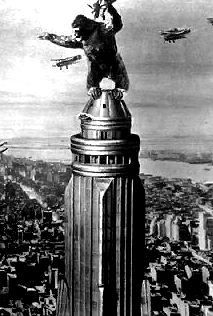
King Kong
Rhonda, physically and emotionally exhausted by the terrific events of the past few days, slips into a trance in the middle of Africa only to be brought out of it by voices speaking Enalish saying they are taking her to God. What can that possibly mean? When she opens her eyes she sees two gorillas are doing the speaking.
That’s something else, isn’t it? Had they been on the screen could they have competed with King Kong that was released in that year of 1933? Out of King Kong came 1949’s Mighty Joe Young while the public’s fascination with gorillas continued until Planet Of The Apes which, if it doesn’t owe anything to Burroughs’ story, develops the theme ad absurdam. Kong, Young and Planet Of The Apes, Stalin’s experiments all owe their origins to the Tarzan oeuvre.
Burroughs raises the theme to heights that have never been surpassed. Combining the human gorillas with the City of God was incomparable genius.
With the background clear let’s take a leap into the future.
The City Of God
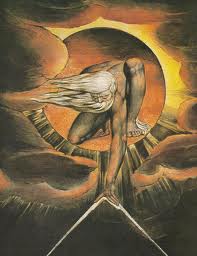
God At Work
7 b.
The whole thing seemed like a hideous and grotesque nightmare,
yet it was so real that she couldn’t know whether or not
she was dreaming.
Lion Man p. 95
In taking the ‘germ cells’ of individuals from the time of Henry VIII, as the cells were cloned with those of the gorillas the hybrids cloned the environment they knew. While clones have no mermory of a previous existence, in the popular imagination they do. Thus in the paranoid classic movie The Boys From Brazil of 1978 the number of clones of Adolf Hitler all exhibited the supposed conditioned responses of the original which they could not have experienced themselves.
At the same time ERB cleverly replicates the political situation between God, Church and Henry VIII. When Rhonda was captured, two gorillas named the Dukes of Buckingham and Suffolk quarrel over whether she is to be taken to Henry VIII or God. As we still have no idea of what is going on we are as mystified as Rhonda.
And then as Rhonda tries to order her bobbled brain she realized she could communicate with these improbably English speaking apes. p. 96:
Now she had an instant in which to think clearly, and with it came the realization that she had the means of communicating with her captors.
‘Who are you?” she damanded. “And why have you made me a prisoner?”
‘The two turned suddenly upon her. She thought their faces denoted surprise.
“She speaks English!” exclained one of them.
There’s a neat turnabout similar to when Tarzan addresses Buckingham in Mangani and the gorilla answers him in English. The gorilla exclaims, “She speaks English.”
Then follows an explanation of God, Henry VIII and Cranmer that only succeeds in confusing Rhonda further as she seems to be in some costume play in which for some inexplicable reason actors clad as gorillas are acting out a play about Henry VIII. She pinches herself to no avail. She is awake. This isn’t theatre, although Hamlet soon would be played in Nazi uniforms which is just about as ridiculous.
The gorillas take her to Henry VIII where we will leave her until she is joined by Tarzan.
While Rhonda escaped theArabs Naomi had been recaptured. In company with the Arabs she is brought to the canyon that leads to an easy ascent of the plateau according to the map. As the ascent becomes steep they leave the horses with Eyad going ahead on foot. Awaiting them at the crest is Stalin’s dream corps. Throughout the oeuvre one is always amazed at the disregard for their own well being the apes exhibit. They charge in story after story with complete disregard for their own well being. Always a signficant portion are left on the field of battle but the survivors never complain while Tarzan complacently accepts their sacrifice as his due.
So here, barehanded against the Arab firearms the gorillas launch a wave attack reminiscent of the Chinese in Korea that doesn’t stop until all the Arabs are dead. No regard at all for casualities. No wonder Stalin thought Burroughs was on to something. While the apes perform as they have always performed in Tarzan stories the difference here is that these are not mere apes but hybrids with human intelligence. If Burroughs was aware of Stalin’s experiments was he laughing at the Great Commissar? Is this battle a reference to Stalin? One can’t be positive of course but I am sure that the character of God-the formerly handsome Englishman- is partially based on H.G. Wells who was associated with Stalin.
Naomi was with the Arabs. She is captured by Buckingham who asks her how she got away from God; she is identical to Rhonda so Buckingham naturally confused her for the latter. The Apes sense of smell was not as developed as Tarzan’s. I’m sure the Big Bwana would have smelled the difference immediately.
ERB is now dealing with his sexual problems. Of the three women involved with the City of God- Naomi, Rhonda and Balza, it is necessary to sort out which woman represents what to ERB. As Naomi is weak and vacillating she obviously represents Emma. Rhonda who is strong and self-willed seems to represent ERB’s Anima ideal or in other words, La of Opar. La disappears from the oeuvre after Tarzan The Invincible of 1930 but as Tarzan and Rhonda in God’s prison replicate Tarzan and La in the Lion’s den of Invincible it seems probable that ERB has transported La from the fantasy world of Opar to the mere imaginary world of the movies. This leaves Balza- The Golden Girl- who probably represents Florence, but we will deal with her in the appropriate place.
ERB has now gotten the two women, the Arabs and Tarzan to the Falls. Orman, West and the safari are assembling at the base of the Falls so, having dissolved his story after the Bansuto attack ERB has now reintegrated it.
After a series of adventures during which Buckingham kills Suffolk, Tarzan appears to rescue Naomi killing Buckingham. At this point in Burroughs’ psychology he assumes the identity of his ordinary self and that of Tarzan into one being. As the movie people have never seen Tarzan they assume that he is Stanley Obroski his identical twin. Tarzan does not correct anyone but allows them to believe he is Stanley.
As I perceive it then ERB has now deluded himself into believing that he is Tarzan. Those who know him still perceive him as Ed Burroughs. He has no choice but to let them believe that because if he attempted to impose his delusion on them he might have been committed. Thus for a period of about five to six years from 1934 to 1939-40 Burroughs perceives himself as Tarzan but capitulates in Tarzan And The Madman giving up his illusion of being the Big Bwana. In Lion Man he describes Tarzan as a madman so the two novels are linked by the concept of madness.
After writing Madman Burroughs left California for Hawaii where he forced Florence away from him. WWII came along which saved him from himself. After the war he went back to LA to die. It is interesting that he didn’t choose to live in Tarzana but bought a house in Encino that backed against the Promised Land. thus like Moses, with whom there was a connection made in Tarzan Of The Apes, ERB was destined to view the Promised Land but not enter it.
In Lion Man he is flush with the hope of being able to live out his fantasy. He is now a few months from abandoning Emma so symbolically he returns Naomi to the safari at the Falls from whence she disappears from the story.
Only Rhonda and Balza will figure in the rest of the story. Emma is no more although Jane will appear again in Quest probably as Emma’s replacement Florence. In Magnificent Florence is mentioned only anonymously as Tarzan’s ‘wife.’ ERB is definitely struggling.
Having delivered Naomi to the safari Tarzan then reascends the plateau in search of Rhonda and the City of God.
The City Of God
7 c.
Every one of us, I believe, is possessed of two characters.
Often time they are so much alike that the duality is not noticeable,
but again there is a divergence so great
That we have the phenomenon of a Dr. Jekyll and Mr. Hyde
in a single individual.
E.R. Burroughs- The Swords Of Mars
Tarzan And the Lion Man was followed at the end of 1933 by the Mars story The Swords Of Mars which features the return of John Carter. ERB had taken a vacation from Emma returning to the scene of his own early adventures- Arizona. Not coincidentally in the White Mountain of Apache country. ERB’s motivations are sometimes obscure. He was in the Army in Arizona in 1896-97 which was before he married Emma. So he took his leave of absence from Emma to a place before he married her. Setting the clock back, so to speak, somewhat reminiscent of The Eternal Lover.
Just as Tarzan and Stanley met in Lion Man so while about to go to sleep, O.B.- The Other Burroughs- hears the door open, the clank of a man in war gear walking across the floor; terrified like an adolescent in a bad dream, O.B. is relieved and pleased when John Carter, back from Mars, greets him. A real Jekyll and Hyde situation. Thus as with Tarzan and Stanley the two Martian aspects of Buroughs are reunited but not melded. John Carter then tells O.B. a bedtime story as though Burroughs were a child again. I’m not that familiar with the Mars stories but there must be a connection to Lion Man and the MGM situation. This must be true because this is the novel in which the opening letters of each chapter spell- TO FLORENCE WITH ALL MY LOVE, ED. One assumes then that although the decision to leave Emma was difficult to make, ERB made the final decision in the Arizona mountains.
So now a few months earlier Tarzan/Stanley makes the journey to the City of God where he will be reunited with his Anima ideal, Rhonda -La of Opar- in prison. Thus his whole person both Anima and Animus are locked up by MGM.
Rhonda had been taken to Henry VIII by Buckingham and Suffolk. The city was called London, the country England and the river The Thames. As ERB jokingly smirks- The English always take a little bit of England with them wherever they go. Pretty funny, actually.
Here the events of Henry’s reign are being reenacted. As the apes are clones of Henry and his court who replicate their times one wonders whether each succeeding generation will be stuck in this one period of history reenacting it over and over until the end of time. Once again I am reminded of The Eternal Lover. ERB seems to be obsessed by the idea of time.
Rhonda was first placed with the wives of Henry, a week later being moved to a cell in God’s castle where Tarzan found her when he too was captured.
For now he was moving through the night until he came up against the ten foot high wall surrounding the City of London and within it the City of God. Here we have the historical confrontation between the spiritual and temporal powers. At the least the story is a very humorous parody of the religious situation of Henry VIII. Once again ERB ridicules religion and this is done so cleverly and with such genius.
But there are many levels of meaning. Earlier I mentioned that the capture of Tarzan may have been meant to replicate ERB;’s capture by MGM. In that sense then the City of God might represent MGM which boasted that it had more stars then Heaven. So there is probably a joke there too.
On the other hand, God is described as a formerly handsome Englishman. The only candidate for that role I can come up with is ERB’s bete noir, H.G. Wells. I think that I have adequately documented the literary feud between Wells and Burroughs. Wells began well with his scientific romances. While not as fresh and stunning as they were at the time of issue they still hold up well today. Even though ERB denied having ever read Wells I think that claim can be dismissed out of hand. ERB, then, would have been as impressed with Wells’ early romances as anyone else. Then when Wells began his campaign of defamation and ridicule which is most clearly represented in his Mr. Blettsworthy On Rampole Island he fell from favor in Burroughs’ eyes, hence the grotesquely deformed ‘formerly handsome Englishman.’
As much as I like Wells he does pontificate. Like all Liberals he has a difficult time distinguishing his opinion from truth, right and wrong, or reality. While he does sometimes make a hit in his prophesying he is mostly wrong. Backing the Worker’s Paradise of Stalin’s USSR was certainly wrong and more than enough to discredit him in the staunch anti-Communist Burroughs’ eyes.
Wells probably shook Burroughs’ faith in the glory of England which had been a keystone of his secular faith fromt he beginning. Thus, combining MGM, Stalin and the USSR and Wells, Burroughs packages all the troublemakers of this perilous time for him into one big box with a bigger bow on top.
As his story could have no effect on his situation let us hope it was at least cathartic for him. When Tarzan ends up in the cage with Rhonda that about epitomizes Burroughs’ situation vis-a-vis MGM, Stalin and Wells. There are so many coincidences here that the brain revolves like a turret. Was it wholly coincidental that Wells showed up in Hollywood at the end of ’35 to visit fellow Red Charlie Chaplin just as Burroughs was completely boxed in because of his Guatemalan adventure?
Isn’t it amazing that Burroughs met his fate in Guatemala, the scene of the adventures of his early hero General Christmas and also the scene of some of the adventures of Ogden McClurg who was killed shortly after this return from the area in 1926? It may be truly coincidental but the further one digs very often the more dirt one turns up.
Burroughs may have felt confident he could write his way out of this box just as he was able to escape by self-publishing in 1930; perhaps he thought he could escape this time by making his own movies. If so, a little analysis would have shown him that the rules had drastically changed. Especially as he had signed the rights to represent his character Tarzan away.
Coincidental with the release of the MGM Tarzan movies which preempted the nature of Tarzan from literature came the decline in Burroughs’ own literary powers. Whereas in 1930 he was able to respond to the challenge with a series of top novels, after Lion Man there is a preciptious decline in the the quality of is work. While the later novels have their charms for Burroughs’ admirers they do lack commercial appeal.
By 1935 also Burroughs had antagonized radio which had become the major source of his income so that that medium was closed to him during his lifetime. With publication revenues declining and the comics by Burroughs’ own admission producing a pittance, ERB had only one major source of income left and that was the moves. MGM had him over a barrel.
MGM might have produced a whole series of Tarzan films along the lines of the Charlie Chan movies as Burroughs reuefully remarked but they chose instead to issue only four movies between 1932 and 1939. Obviously the makret would have borne more. The limited release schedule kept EBB on a short financial tether.
It is said that events cast their shadow before them so that it is possible, if not probable, that Burroughs foresaw the shape of things to come even as he wrote Lion Man.
In 1930 when the Reds invaded his dream land of Opar ERB abandoned that fantasy. The fabled city ceased to exist in his imagination while disappearing from the oeuvre. Now in Lion Man it appears that the enemy had captured the castle while building a ten foot wall around it with Tarzan/Burroughs on the outside. Thus Burroughs’ dream of separating himself from the world by a tne foot wall has been inverted in his imagination. He wasn’t keeping the world out; the world was keeping him out.
In the novel succeeding Lion Man, The Swords Of Mars, when the mad inventor Fal Sivas quails at taking hsi invented spaceship to the Martian moon Thuria the following exchange takes place between he and John Carter:
“But you built this ship to go to Thuria,: Carter cried. “You told me so yourself.”
“It was a dream,” he mumbled; “I am always dreaming, for in dreams nothing bad an happen to me.”
Fal Sivas can be taken as an alter ego of Burroughs. The Sivas probably refers to the Hindu god Shiva or Siva with whom Burroughs had become a devotee or developed a fascination for. Thus while his heroes Tarzan and John Carter are men of action Sivas/Burroughs or any other combination is not.
So in Lion Man Burroughs is desperately trying to become the man of action rather than the dreamer. The problem now is that ERB himself is past the point of no return. He has been walled out from the City of God.
In dreams however Tarzan enters the Heavenly City by a fantastic feat of strength that recalls Burroughs’ 1890-1920 infatuation with the Strong Men such as the Great Sandow.
The wall which Tarzan fancies was built to keep out lions i.e. the Lion Man has sharpened stakes pointing downward. p. 124:
…he leaped for the stakes. His hands closed upon two of them; then he drew himself up slowly until his hips were on a level with his hands, his arms straight at his sides. Leaning forward, he let his body drop slowly forward until it rested on the stakes and the top of the wall.
That seems to be an impossible feat of strength except in dreams, but then by this point Tarzan thinks he is dreaming. This might as well be an MGM movie lot such Burroughs spent five weeks on. Here the dream faces a sort of reality. As though pasing through a movie set as ERB must have done during those five weeks Tarzan comes to the steps leading to the Heaven of God. this Stariway to Heaven, Jacob’s Ladder.
As if to accent the relationship to MGM he passes the Apes of God who are dancing and partying. The scene will be replicated at the foot of the Falls when the movie company duplicates this scene thus strengthening the connection with MGM.
Tarzan begins the long climb up the Stairway to Heaven. The fire flares illuminating him on the steps but the apes below don’t notice- high above on a parapet of Heaven, God does. Note the resemblance to the move castle of Frankenstein. A man of action God quickly prepares a trap.
In real life the trap was probably the promise of the contract and money. ERB blames the movies for being duplicitous, which is definitely true, still, he had had a dozen or more years to work out the conditions prevailing on his own. After all, by 1932 he had proven product to sell. The public had even given a profit to some pretty crummy movies so that had he taken the time, acted on his own conditions, rather than just signing for a few quick bucks he might have retained a position of some control, made himself an equal partner. So, while MGM did betray him he might have been able to manage the situation.
Tarzan enters the castle to be confronted by six doors of which only #3 is open. Depending on how you count them there were six to eight major studios, thus the six doors may represent the Studios of which only MGM was willing to deal with him. Remember he had been blacklisted since 1922, the blacklist having been broken in 1928 by Joseph Kennedy.
Tarzan descends the stairs as heedlessly as Burroughs signed the contract and like Burroughs he finds himself trapped. The nose of noses sniffs the air and detects the delicate scent of a White woman. He has found she whom he sought, Rhonda.
7 d.
The Confrontation With God
Now Tarzan is reunited with his Anima ideal in the person of Rhonda formerly La of Opar. That Rhonda can be associated with La is because this scene is a replication or double of Tarzan and La in the lion’s den of Invincible. There La and Tarzan were imprisoned in a cell beneath Opar. They escaped the cell in a duplication of their escape from this prison. In Invicible there was a runway within which the lion fed. A shaft led upward to a room in a tower. There the old man who betrayed them discovered them.
In this case a breeze passing over the floor indicates an air shaft to Tarzan. This is probably borrowed from Rider Haggard’s King Solomon’s Mines although it will soon if not already be a staple of the movie genre. Tarzan locates the shaft in the ceiling in a corner of the cell. He and Rhonda ascend it to the opening in front of which God is talking to some gorillas. Thus the scene virtually duplicates Invincible. La and Rhonda must be associated in ERB’s mind.
As an aside Burrughs uses a variation of this scenario in The Swords Of Mars when John Carter is imprisoned. There are beams some twenty feet ot so above the floor to which Carter leaps. He takes a position above the door dropping on his keeper when he enters.
At this point in the story Tarzan and Stanley Obroski may be considered to be reunited as one persona. Rhonda, who has never seen Tarzan, addressed the person in Stanley’s guise as Stanley. ERB has a little fun as he has Tarzan play along.
As he says in Swords, he is convinced that every man has a dual Animus, that is two different aspects, sometimes nearly identical but sometimes as different as Dr. Jekyll and Mr. Hyde. Thus at this point his mind is impressed with Shelley’s Frankenstein and Stevenson’s Dr. Jekyll And Mr. Hyde. He had read both novels before 1900 while both stories were released as movies in 1931. So the stories are very fresh in his mind.
Tarzan/Obroski may be considered of the Jekyll/Hyde variety. There is little doubt that Burroughs saw the pair and himself that way. Thus Carter and Fall Sivas in Swords may also be seen as two sides (Jekyll/Hyde) of the same persona. Tarzan does not try to convince Rhonda that he is not Stanley, but in the Jekyll side of the persona he astounds here with Hydelike feats compelling her to reevaluate him.
There are undoubtedly snippets of other horror movies here that ERB has seen also but I can’t remember the titles or dates. There was one about two Scottish body snatchers Burke and Hare which I think I can detect here and another about a mad doctor who operated on the brains of abducted victims that shows up here and in Swords that was called the Black Sleept or somesuch. The latter would have had a castle along these lines as well as Frankenstein. Of course, which of that ilk of movie didn’t? Burroughs is combining an astounding number of influences here both literary and cinematic but both combined.
Thus, having availed himself of ‘such a God given opportunity’ to find Rhonda he is imprisoned with her. The joke was ERB’s. You know, God left the doors open- God given opportunity. I chuckled softly to myself as I read.
After an exchange of repartee between Stanley/Tarzan and Rhonda God makes his appearance. Not exactly what one would expect God to look like. In fact it is almost amazing that the fundamentalist Christians didn’t create an uproar. After all according to the Old Testament man was created in God’s image. There’s a laugh. Here’s the image. p. 128:
It had the face of a man, but its skin was black like that of a gorilla. Its grinning lips revealed the heavy fangs of an anthropoid. Scant black hair covered those portions of its body that an open shirt and a loin cloth revealed. The skin of the body, arms, and legs was black with large patches of white. The bare feet were the feet of a man; the hands were black and hairy and wrinkled, with long, curved claws; the eyes were the sunken eyes of an old man- a very old man.
The Scopes Monkey Trial had only been about seven years before. So here Burroughs is making sport of God with a sort of reverse evolution. God is a cross between a man and a gorilla. Yet ERB led such a charmed life that his mockery or parody of God created no comment. If he wanted to start a ruckus to promote his book sales he failed miserably.
God might have been half ape but he had a whole hearted sense of;humor. Overhearing Tarzan say that he had come for Rhonda his opening comments are mock injury. p. 128:
“So you are acquainted?” He said. “How interesting! And you came to get her, did you? I thought that you had come to call on me. Of course it is not quite the proper thing for a stranger to come by night without an invitation- and by stealth.
“It was just by the merest chance that I learned of your coming. I have Henry to thank for that. Had he not been staging a dance I should not have known, and thus I should have been denied the pleasure of receiving you, as I have.
“You see, I was looking down from my castle into the courtyard of Henry’s palace when his bonfire flared up and lighted the Holy Stairs- and there you were!
Burroughs is justly criticized for the occasional bit of wooden dialogue but I find the confrontation with God very well written. The constantly mocking tone of God is carried off very well. Tarzan’s indignation is very well executed. The influence of Shelley, Stevenson and the various movies is seamlessly blended into a very tightly executed scene.
All this is done in a very few pages while it is a remarkable bit of writing.
God hints at his motives for their use for him. p. 129:
“…I shall keep you for a while for the pleasure of conversing with rational human beings.
“I have not seen any for a long time, a long, long time. Of course I hate them nonentheless, but I must admit that I shall find pleasure in this companionship for a short time. You are both very good looking too. That will make it all the more pleasant, just as it increases your value for the purpose which I intend you- the final purpose, you understand. I am particularly pleased that the girl is so beautiful. I always did have a fondness for blonds. Were I not already engaged along some other lines of research, and were it possible, I should like nothing better than to conduct a scientific investigation to determine the biologial or psychological explanation of the profound attraction the blond female has for the male of all races.”
Burroughs doesn’t tell us how blonde Rhonda and Naomi are, whether they are platinum blondes like Kali Bwana or merely blondes. Of course today ERB would be censored for his handling of the sexual and racial preferences for blondes but it is a recurrent theme in his writing and one worth studying.
Having piqued our curiosity as to his purpose for the couple God leaves to check up on Henry. p. 130:
“Come back here!” (Tarzan) commanded. “Either let us out of this hole or tell us why you are holding us- what you intend doing with us.”
The creature wheeled suddenly, its expression transformed by a hideous snarl. “You dare issue orders to me!” It screamed.
“And why not?” demanded the ape-man. “Who are you?”
The creature took a step nearer the bars and tapped its hairy chest with a thorny talon. “I am God.” it cried.
There you go. The cat’s out of the bag.
The scene is dramatically successful while the reader is now left to guess the model for God. We are told that he was a formerly handsome Englishman now deformed as a hybrid ape-human. The city is London, the territory is England and the river is the Thames. A reasonable place to look would be among the English. Who among the English is bedeviling ERB? H.G. Wells is the only one I can think of. Regardless of whether Wells considered himself a Communist or not he is sailing his craft so close to the wind that it is impossible to distniguish between the two. At the very least Wells is throughly subversive. If anything he resents not being in Stalin’s place. So Burroughs must consider him Communist.
To my mind then, Burroughs is mocking Wells much as Wells mocked Burroughs in ‘Blettsworthy.’ God has delusions of grandeur and so does the highly pontificating Wells. My vote for the model is Wells.
One also notes that in the last of the MGM Tarzan movies, 1942’s Tarzan’s New York Adventure, Tarzan is captured by the circus roustabouts and thrown into a mobile cage. The camera then pans around to front which identifies the cage as a lion cage. One thus has the joke of the Lion Man in a lion’s cage. A final thumbing of the nose at Burroughs exiled in Hawaii. MGM then dropped what had been a very lucrative series. Strange behavior indeed.
God then returns to give his history as detailed earlier in the essay. While for some reason everyone, fans and detractors alike, wants to think of Burroughs as a semi-literate boob who is coincidentally a ‘master of adventure’ yet both in content and exposition, God presents his story in a masterly way. In 1930 there may have been few of his readers who had ever heard of Mendel and possibly Lamarck, although one hopes all had heard of Darwin. So it is possible that a reader might have been puzzled by the inclusion of Darwin while dismissing Larmarck and Mendel as fictitious. Of course if you’re reading strictly for fast-paced adventure you may not notice the details even though they are far from concealed.
God also clears up the mystery of the map. Surprisingly the map is not a stage prop but authentic. In fact, God made it about seventy years previously. It seems that he had been in love with a women back in England but she preferred wealth to being the wife of an impoverished scientist.
This may be a coincidence but that is the premise of the plot of H.G. Wells’ In The Days Of The Comet. Perhaps it was a message to Wells in case he hasn’t gotten it yet. But then God discovered the immense number of diamonds in the valley so he wrote the girl promising her riches beyond imagination. He had employed a native runner to take the letter to the coast to mail it but since he had never had a reply he wondered if it had ever been received. Now it came back to him. A simple but inventive twist.
When God leaves this time Tarzan sets to work to escape. Following the draft across the floor he finds the air shaft. Just as in Invincible he sends La up first now he sends Rhonda up first. As in the earlier story they are trapped at the top.
Looking through the entrance to the shaft they spy God and some gorillas in front of it. Their escape is spoiled. Now begins the Gotterdamerung.
The City of God
7 e.
The Gotterdamerung
Burroughs now has both aspects of his Animus with his Anima trapped in the tower unable to go foward or backward. God and his gorillas stand in anticipation before the opening. Burroughs has been stalemated. At this point one aspect of God must be MGM and its contract.
ERB has spun out his fantasy in a plausible way to this point, but now he has to find a way to resolve his dilemma. As he is daydreaming and this is a mad dream, as Fal Sivas says in Swords, in dreams nothing bad can happen to you. In this bind something bad can happen to ERB. He can lose his grip on reality. In that way he becomes mad or insane which is what the story is about.
In speaking of Henry God might also be speaking of ERB. p. 143:
“You all forget,” (God) cried, “that it was I who created you; it is I who can destroy you. First I shall make Henry mad, and then I shall crush him. That is the kind of gods humans like- it is the only kind they can understand. Because they are jealous and cruel and vindictive they have to have a jealous, cruel and vindictive god.”
There’s a lot information in that quote. It refers to the ancient Greek saying: Those who the gods would destroy they first make mad. So we have an excellent joke here. The incredible mind of Burroughs can conceive humor in the midst of the blackest despair.
He is talking of the Yahweh of the Old Testament while he quite soundly understands that god is a psychological projection of the mind of his creator. In a masterly grasp of Freudian group psychology, whether he knew it or not, he realized tha the people have created a god in their own image and not vice versa. Trapped in the tower this is a real agonized cry of despair before losing his grip on reality.
I don’t mean to say that ERB went stark raving mad but he edged into a fantasy world at least once removed from the fantasy he had been living since 1912. For the period of his marriage to Florence he can only be described as spaced out. Bear in mind that it’s going to get worse as he gets trapped into his movie production experience.
The Masenas in The Swords Of Mars make the threatening moves on John Carter who keeps backing away. Only too late he realized he had maneuvered himself where they wanted him. The Masenas were cat-men, i.e. lions who had two mouths. In a sly way Burroughs is caricaturing the Jews of MGM and their mascot Leo the Lion. The upper mouth which is sort of pursy and purring to seduce one, is above a lower mouth that is all teeth and no lips to rend one. So he is saying that he is dealing with two-faced people. While the upper mouth is assuring, the lower rending mouth is ever ready to destroy you.
Tarzan realizes that he has no choices left but to stay put or rush God and the gorillas. Alone he would have had a chance of success but with Rhonda in tow he is lost. This is an interesting reflection on the relationship of the Animus to the Anima. I’m at a bit of a loss to explain this.
God had sent for Rhonda to be told that she was not in the cell. Knowing that Tarzan was in the air shaft it followed that Rhonda was too as neither could have escaped the cell otherwise. He orders smudge pots to be lighted to smoke them out. Thus Burroughs acknowledges that his own situation is untenable while he has no solution. The only one left is the Samson like effort of pulling the temple down on his own head destroying both himself and his enemies.
God’s plan backfires as he sets his own castle afire. Unable to stand the smoke any longer Tarzan rushes out to be felled by a blow from one of the apes. At this precise point ERB goes mad or loses his mental balance. I don’t believe there is a Tarzan novel in which the Big Bwana isn’t knocked on the head at least once. In this case when he gets up he won’t have lost his memory but he will be a different man, another round of emasculation.
Once again he is separated from his Anima. Rhonda is spirited off to Henry. God and Tarzan are trapped on the patio as the castle becomes engulfed in flames.
This chapter is appropriately titled ‘The Holocaust.’ In its way everything that ERB had hoped and dreamed goes up in flames with God’s castle. Heaven is reduced to ashes.
Tarzan has his trusty rope so he can escape over the parapet to the roof of a lower level. God begs him to save him which Tarzan reluctantly does.
Tarzan, one has difficulty in styling him the Big Bwana in this emasculated state, reverses the actual situation between Burroughs and MGM by placing the rope around God’s neck putting him on a short tether. Henry is now in full revolt. Tarzan agrees to help God in exchange for his help in recovering Rhonda and letting them leave. Perhaps Burroughs was asking MGM for a release from his contract. Let by Tarzan the forces of God defeat Henry.
I’m not clear who Henry represents or if he is meant to represent a real individual. Aware of his defeat Henry abandons his wives for the blonde White woman, Rhonda. He has a secret subterranean escape route. Thus Burroughs, who through Tarzan stormed the gates of Heaven, the heights of consciousness, has first returned to earth and now slips back into the subconscious. In all probability then, his attempt to integrate his personality had failed while coming so close.
Henry had followed his tunnel to emerge into the valley of diamonds and mutants. Here he encounters a lion. Throwing Rhonda down he runs from the lion which we all know is the exact wrong thing to do. Rhonda then escapes.
Tarzan emerges from the tunnel just as the lion is rending Henry. So Henry perishes. Tarzan sets off into the valley of diamonds in pursuit of Rhonda or, in another word, his Anima.
The City Of God
7 f.
The Golden Girl
While one is astonished that there was no uproar because of ERB’s treatment of God, Heaven and the gorillas, one is even more astonished that at no time since 1912 was ERB ever under attack for his views on evolution. The oeuvre is a veritable compendium on the various possible results of evolution yet no one ever said a word nor has to this day.
In LIon Man which treats of evolution in perhaps his most daring way yet, his effort is met with stony silence. God, in his creation of the hybrid gorillas according to the logic of Gregor Mendel, had a large number of sports and variations. The ‘normal’ hybrid apes refused to accept these either killing them or driving them from their society.
God laments that the tendency to exclusivity, or like to like, was such a strong characteristic of the new species that he could do nothing to break the hybrid’s attitude. This must be a wry comment on those who wished to break down racial and special barriers.
Apart from the role of White women in racial politics, which ERB through God has already commented on, there is not, nor will there ever be, inclusivity of different races on the pshysiological level nor even on the intellectual level of religion.
Thus the theme of separation in this spurious London, England was a variation on Opar where normal males were killed producing the ape-like male Oparians, while only the beautiful females were preserved. In this case the rejected hybrids, who bear some resemblance to the Hormads created by Ras Thavas, have taken up residence across the Thames. Among them, as one might suppose, Mendelian genetics predicts, were two human looking specimens. The male who was perfectly human in form had a gorilla mind; the female although rumored to have a gorilla mind in fact was a perfect human in mind while also possessing a normal human form.
She is the mate of the human looking male as kind mates with kind. Tarzan, having recovered Rhonda, finds Balza, which means Golden Girl, being abused by her mate. He rescues her but the trio is set upon by the whole tribe of mutants.
Balza explains to Tarzan that having defeated her former mate Tarzan has claimed her for his own. She is his, will-he or nil he. She then becomes hostile to the Anima figure of Rhonda.
So now we have a difficult psychological situation. Burroughs, who believes that every man is of a dual personality, has first united the two Lion Men and has now killed off one half of the duality leaving Tarzan as a single psychological unit. Not integrated but half a man so to speak. This is in violation of his stated belief which he has clarified no further. At the same time Balza seems to be driving his old Anima figure of La/Rhonda away, replacing her. Thus this Wild Thing becomes both Burroughs’ Anima ideal and human woman. We have single with single, or half with half. Now we have a single Animus, the Lion Man, Tarzan and Wild Thing as his Anima and woman. This is quite a combination. That would certainly explain the nature of the next several years of ERB’s life when he seems to run completely off the rails.
He expresses this in his work of the thirties in different ways. The Venus series is born out of this conflict in the second half of 1932 subsequent to the release of the movie Tarzan, The Ape Man. John Carter does reappear at the end of 1933 in The Swords Of Mars but Burroughs in the Venus series creates a much lesser man than either Carter or Tarzan; Napier is a pale shadow reflecting Burroughs neo-emasculated state.
In the first venus volume Napier heads for Mars in his rocket ship. Mars or the Greek Ares is the manly planet. But now suffering from his further emasculation Burroughs no longer feels capable of competing with men on Mars. Thus Napier has miscalculated the influence of the Moon, or female influence, which bends his trajectory sending him to the female planet Venus instead. In terms of classical mythology with which Burroughs was very familiar the Moon represents the feminine principle, while Venus, the Roman form of the Greek Aphrodite, represents the force of Love. Thus in symbolical terms ERB/Napier is diverted from the Manly principle of Mars by the female principle of the Moon and sent to the planet representing domination by the feminine principle of Love. Napier is not a warrior.
In Lion Man, written a few months after The Pirates Of Venus Tarzan follows his female Anima principle, Rhonda, into the valley of diamonds, where he is attached to The Golden Girl, Balza. In Burroughs’ terminology diamonds represent the realization of his sexual hopes. So Rhonda in this instance can be taken to represent Napier’s moon who leads him to Balza, the planet Venus or Florence. Burroughs is now severely handicapped in his conflict with MGM. In this chapter of Lion Man when he catches up with Rhonda comes across Balza being beaten by her man, the sport with the human appearance and gorilla brain. Balza had been misrepresented earlier, actually having a human brain. She now attaches herself to the emasculated Tarzan.
In their flight from the mutants- Tarzan running away again- they discover a pit full of diamonds. Presaging Tarzan And The Forbidden City in which the father of diamonds is a piece of coal, the huge pile of diamonds has lost any value to him. Thus Burroughs senses in 1933 that love is going to be a serious disappointment.
As a matter of fact in his psychological malaise Balza/Florence seems to have lost any value to him. He leads the women to the foot of the Falls where they rejoin the movie company who are living riotously. Their dance is a double of the Dum Dum like dance of the gorillas. Not a favorable comparison, perhaps indicating that man has not advanced much from the apes. Leaving Balza to become a movie star Tarzan returns to the jungle to find Stanley dead, thus the dead Stanley is rather unaccountably accepted by the movie company who return to LA. The whole story becomes a sort of mirage which, while we know it did happen, never happened.
ERB as a writer has now completed Ring 2. He completes his Ring construction by returning to the site of Ring Left 1, Hollywood as Ring Right 1. As Holtsmark notes he has followed the classical mode of Homer. He has not only done that but written his most perfect example. I find Lion Man masterly on all levels, in fact, ERB’s Magnum Opus.
A year after the movie company returned to the US Tarzan himself undertakes a visit to the film colony of Hollywood.
Go To Part 8, More Stars Than There Are In Heaven
 I, Dynamo