A Review

Themes And Variations

The Tarzan Novels Of Edgar Rice Burroughs

#18 Tarzan And The Lion Man

Part 5

by

R.E. Prindle

First published on the ezine, ERBzine

Tarzan, Obroski And Burroughs


     Burroughs has been ridiculing Obroski right along as an arrant coward.  Wherever the action is, Stanley isn’t.  When it’s over he shows up ready to fight.  When a call for the safe job of kitchen help is made after the porters desert Stanley raises his hand.

     The cowardice is in contrast to his magnficent physique.  Standing 6’8″ or 9″  in his bare feet while his strength is as prodigious as that of Tarzan.  No one in the safari has yet seen Tarzan but he and Stanley are as identical twins.  When Stanley becomes fever stricken and disappears from the story the movie cast will confuse Tarzan for Obroski providing some amusing moments.

     Over the oeuvre Burroughs uses the divice of a Tarzan double a number of time  times.  Esteban Miranda in Tarzan And The Golden Lion/Ant Men, here as Stanley Obroski and again in Tarzan And The Forbidden City  as Brian Gregory stand out.  The doubles are quite obviously aspects of Burroughs’ own character.  As the doubles are all cowardly, inept or both one has to assume they represent Burroughs as he perceived himself before becoming a success while Tarzan represents Burroughs as a success.  There was obviously a constant psychic tug of war between the two Burroughs.  This was something ERB was desperately trying to resolve in favor of the Tarzan persona.

     The quesiton is, was he ever successful in resolving the problem by psychologically integrating his personality?  At several times in the corpus he seems to have succeeded even to the extent of killing off his old persona.  But then there are doubts and Brian Gregory appears a few years later.

     If I live long enough I will try a comparison of Miranda, Obroski, Gregory and Burroughs.  Notiice the progression of the double from Spanish to Slav to Anglo. The Spaniard was the epitome of worthlessness at the turn of the century while the Slav though higher was despised.  Gregory as an Anglo would indicate that Burroughs may have reconciled his self-esteem at least.

     As a more or less irrelevant aside it is known that Tennessee Williams (1911-83) was a Tarzan fan.  He was twenty-three years old when Lion Man was issued while A Streetcar Named Desire was staged in 1947.  It may seem tenuous to make the connection between the names of Stanley Obroski and Stanley Kowalski but there it is.  There are resemblances between Stanley-Naomi and Stanley-Blanche allowing for the fictionalizing powers of Williams.  There is no proof that Williams specifically read Lion Man that I know of but it is neither impossible or improbable given his admiration for the character.  Perhaps the germ of Stanley-Blanche was placed in Williams’ mind in 1934-35 germinating away in his subconscious to blossom eleven or twelve years later.  I don’t say it’s so but it is worth investigating.

     In the construction of this novel the story of Obroski and Tarzan forms Ring Three.  The story moves from Ring Two, The Safari and will segue into the inner ring.

     In Chaper 8, The Coward, Burroughs devotes six pages to explaining or rather justifying the character of Obroski.  In justifying Obroski Burroughs is justifying himself which is why he took such pains with this book.

     During the last Bansuto attack in Chapter 8 Obroski panicked.  As the Bansuto attacked from one side Obroski ran off in the opposite direction.  Unfortunately the Bansuto were on both sides and Obroski ran into their open arms.  Now cornered Obroski fought from reflex:  pp.  46-47:

     Death stared him in the face!  Heretofore Obroski’s dangers had been more or less imaginary; now he was faced with a stark reality.

     Terror galvanized his mind and his giant muscles into instant action.  He seized the black and lifted him above his head; then he hurled him heavily to the ground.

     The black, fearful for his life, started to rise.  Obroski fearful for his own, lifted him high overhead and again cast him down.  As he did so a half dozen blacks, closed upon him from the tall surrounding grasses and bore him to earth.

     His mind half numb with terror, Obroski fought like a cornered rat.  The blacks were no match for his great muscles.  He seized them and tossed them aside, then he turned to run.  But the black he had first hurled to the ground reached out and seized him by an ankle, gripping him; then the others were upon him again and more came to their assistance…In all his life Stanley Obroski had never fought before.  A good disposition and his strange complex had prevented him from seeking trouble and his great size and strength had deterred others from picking quarrels with him.

     So, while Obroski was a coward when he had time to consider, in the grip of terror he was quite capable of using his great strength and size to fight back.

     His cowardice was not his fault or part of his nature.  Burroughs reflects further.   p. 45:

     We are either the victims or beneficiaries of heredity or environment.

     Obroski was obviously the result of nurture.  Thus we have no responsibility for what we are and can take no credit as we are either victims or beneficiaries.  This is a fairly serious position statement.

     Stanley Obroski (Burroughs) was one of the victims.  Heredity had given him a mighty physique, a noble bearing and a handsome face.  Environment had sheltered  and protected him throughout his life.  Also everyone with whom he had come in contact had admired his great strength and attributed to him courage commensurate with it.

     Never until the past few days had Obroski been confronted by an emergency that might test his courage, and so all his life had been wondering if his courage would measure up to what was expected of it when the emergency developed.

     He had given the matter far more thought than does the man of ordinary physique because he knew so much more was expected of him than of the ordinary man.  It had become an obsession together with the fear that he might not live up to the expectations of his admirers.  And finally he became afraid- afraid of being afraid.

     It is a failing of nearly all large men to be keenly affected by ridicule.  It was the fear of ridicule, should he show fear, rather than the fear of physical suffering, that Obroski shrank from, though perhaps he did not realize this.  It was a psyche far too complex for easy analysis.

     It is impossible to know for certain at this time what psychology texts Burroughs had been studying but ‘a psyche far too complex for easy analysis’ points in the direction of Freud, Jung or both.  ERB seems to have been involved in Depth Psychology of some sort.  David Adams finds traces of Jung.  I am not prepared to concede so much at present but David may be much more sensitive on that score than myself.  I don’t rule it out although I would lean more to Freud as the better known.  Still, as I find ERB to be a very inquisitive guy there is no reason he couldn’t have known of both.  Either would likely have been mentioned in his varied reading and we know he was an omnivorous reader.

     At any rate it seems clear that Obroski’s heredity was overridden by the conditioning of environment.  Unable to overcome the conditioning or hypnotic suggestion he became as we find him.

     There seems little doubt that here ERB is explaining himself.  Obroski and Tarzan are identical in stature and abilities but in order to realize his Tarzanic potential he must overcome his environmental conditionings and assume his proper being.

     Whether the emergency Tarzan/Burroughs is facing in his difficulty with MGM or something else it seems likely MGM as the struggle is placed in the context of the MGM/BO Studios filming Trader Horn/Tarzan, The Ape Man.

     So Obroski is captured by the Bansuto and made prisoner in their village.  Here he encounters Kwamudi, captain of the safari Blacks and a couple porters who had been captured after deserting.  Obroski learns that the Bansuto are cannibals and that he will be the man who came to dinner.

     Burroughs gets in some sly humor here.  Bound and starved Obroski complains about his treatment.  p. 51:

     “This is no way to treat people you’re going to eat.”  grumbled Obroski.  “You ought to get ’em fat, not starve ’em thin.”

     ERB has already given notice that he is in psychological mode.  He says that Obroski’s psyche is too complex for easy analysis, whatever that might be.  That’s what we all say and it’s bosh.  When I was younger I thought my psyche so unique and complex I wanted to offer myself to science as a specimen.  As my own self-psychoanalysis evolved I realized the only thing that made it so complex was the resistance involved in facing the fixations.  So with Burroughs.  In a few pages he lays out out completely the problem he is facing in symbolical or dream imagery.  Only resistance anf fear prevent him from breaking on through.

     A psychoanalyst could lay your whole problem before you but if you weren’t ready to deal with it, in other words, overcome the resistance, you wouldn’t be able to see it.  You’d think he was talking about someone else.  So here ERB lays out his whole problem before you but if you weren’t ready to deal with it, in other words, over come the resistance, you wouldn’t be able to see it.  You’d think he was talking about someone else.  So here ERB lays out his whole problem.  Whether he resolved it is a matter of debate.  David Adams thinks not while I have not yet made up my mind.

     The problem he is dealing with is his central childhood fixation of John The Bully.  I have already gone into this in Doubles and Insanity but it won’t hurt to give a variant interpretation as this very key incident meets with a lot of resistance from Bibliophiles  on its own.

     As has been noted Burroughs was plagued by dreams of appearing naked in public.  Nakedness is a significant theme in the oeuvre.  Tarzan himself runs around naked except for a skimpy g-string; so Tarzan’s natural condition and Burroughs dream fears mesh.  He has made a virtue of necessity.

     In psychological terms John The Bully so emasculated Burroughs that he lost his offensive and defensive armor which is to say to the civilized man his clothes.  Burroughs always says of Tarzan that his veneer of civilization went no deeper than his clothes.  Nothing could be clearer than the relationship to ERB’s situation on the corner.  ERB explains the nature of nakedness to the civilized man.  p. 58:

     “He says for you to take off your clothers, Bwana.”  said Kwamudi,   “he wants them.”

     “All of them?” inquired Obroski.

     “All of them, Bwana.”

     (Note the excruciating deliberateness as ERB painfully drags this scene out.)

     Exhausted by sleeplessness, discomfort, and terror, (Here ERB makes excuses for himself.)  Obroski had felt that nothing but torture and death could add to his misery, but now the thought of nakedness awoke him to new horrors.  To the civlilized man clothing imports a confidence that is stripped away with his garments.

     So, in real life, Burroughs had been psychologically stripped naked by John having lost his self-confidence.  This is an accurate understanding.  When he constructed his alter ego, Tarzan, he made him naked in his uncivilized state, hence full of self-confidence though naked, but then clothed him handsomely in his civilized state in which he was uncomfortable.  Thus ERB attempted to resolve the problem.

     Now when John bullied ERB he forced a split in his personality.  while his physical self was humiliated his psychological self split off symbolically taking to the trees for refuge.  Hence Tarzan’s fabulous arboreal exploits while he views so many scenes from above in a tree.

     Now comes the very interesting scene in Rungula’s village where Tarzan suffers the shock of recognition as he looks down on his own replica from the tree to the ground.

     Tarzan is in no rush to visit Rungula’s village, perhaps indicating resistance.  Here’s how ERB describes it.  p.61:

     Tarzan of the Apes was ranging a district new to him, and with the keen alertness of the wild creature he was alive to all that was strange or unusual.  Upon the range of his knowledge depended his ability to cope with the emergencies of an unaccustomed environment.  Nothing was so trivial that it did not require investigation: and already, in certain matters concerning the haunts and habits of game, both large and small, he knew quite as much if not more than many creatures that had been born here.

     For three nights he had heard the almost continuous booming of tom-toms, faintly, from afar; and during the day following the third night he had drifted slowly in his hunting in the direction from which the sounds had come.

     Surely an old jungle baby like Tarzan could understand the language of the drums?  That is called procrastination.

     And so on the third day ‘He was arisen.’  Hmmm.  In Tarzan Of The Apes the birth of Tarzan replicated that of Moses and now Obroski is to die while a new Tarzan arises a la Jesus.

     I had my attention called to this Moses part while visiting a Jewish site.  The writer was marveling that Superman was Jewish and that his birth replicated that of Moses which it does.  I had always thought that the two teenage Jewish boys who created Superman were replicating Tarzan’s birth and that may be equally true.

     In the Moses story he is born to a Jewish woman who places him in an ark  then puts it in the Nile on which  he floats downstream to be rescued by an Egyptian princess who rears him among a different people.  This story presupposes that heredity overcomes environment which is nonsense.  One is not born a Jew one is educated into the identity.

     Superman is born a Kryptonite, placed in a rocket ship that crashes into this goyish earth couple’s backyard.  They then rear the Kryptonite child as their own who then has a double identity as an ineffective Earthman while retaining his Kryptonite powers.  Thus the Jew represents himself as superior to the goy.

     Tarzan too is born to a human mother who dies.  He is lying in his cradle when the ape, Kala, snatches him up rearing him as her own.  The different people Tarzan grows up with are apes.  Thus he too has a double identity.

     All three stories are identical while Moses is first, Tarzan second and Superman third.  Thus in his first incarnation Tarzan appears to be a Moses figure.

     In Lion Man Tarzan apperas to be born again when he absorbs his other split off half- Obroski.  Thus on the third day Tarzan assumes a Christ like identity.

     Many have noted that the intitials of John Carter and John Clayton are JC and they call attention to the fact that they are the same initials as Jesus Christ.

     So, here we have Tarzan, a walking dead man so to speak, who after three nights -Good Friday to Easter Sunday- looks down on the other half of his split personality and recognizes himself.  The two halves then begin a process of amalgamation becoming one again.  So Tarzan/Burroughs is born again or arises from the dead.

     Tarzan then unites the Old  and New Testaments being at one and the same time both Moses and Jesus Christ.  The old Adam and the new Adam.  Fairly astonishing stuff.  What does it mean?

     Tarzan then hauls Rungula up into his tree i.e. John the Bully is brought up to Burroughs split off personality where Tarzan demands that he release Obroski i.e. John restore Burroughs other half to himself while at the same time making him promise to be always kind to Whites.

     Obroski then leaves Rungula/John’s village where he joins Tarzan.  Thus Burroughs symbolically reunites his split personality or in other words appears to integrate his personality.  At least he makes the attempt.

     At the very least he has analyzed himself to the threshold of integration.  Whether he actually stepped over the threshold is open to doubt.  As a comparison let us examine Feodor Dostoievsky’s great nineteenth century novel Crime And Punishment.  There is no direct evidence that Burroughs might have read the book but the possibility exists that his curiosity led him to this very famous 1866 novel.  If so, Dostoievsky’s analysis of Raskolnikov might have influenced ERB on the unconscious level.  I had to read the novel three times to get a conscious grasp of it.

     The novel concerns the character’s dependence on women.  Raskolnikov is dependent on his mother and sister who make tremendous sacrifices of their own well being to put him through law school.  Raskolnikov resents his dependence yet can’t tear himself from it even when offered a simple and easy opportunity to do so.  His solution to his psychological problem bypasses analysis for an impossible external one.  He decides to symbolically kill his mother and sister hoping thus to free himself.  Psychologically this is not a viable method.

     As his victim he selects an old female pawnbroker.  This woman has large assets stored in her apartment.  Thus Raskolnikov takes valuables from her in lieu of the money he is receiving from his mother.  In the process he kills the old woman and when her daughter appears he kills her too.  Thus he has killed surrogates of his own women.   The pawn broker’s  body lies before him.  To free himself, according to Dostoievsky it is necessary for him to step over the body thus completing the crime.  Raskolnikov cannot do this, walking around the body instead thus negating the benefits of his murder.

     In Burroughs’ case his imaginary alter ego, Tarzan, convinces Rungula/John to release Obroski/Burroughs from custody.  In other words, exorcise the fixation.  However, psychologically Rungula/John cannot do this.  It is necessary for Burroughs to confront his fixation and recognize it thus negating the hypnotic suggestion that made it his fixation that he is a coward thus freeing himself.  That is the only way it can be done.  Thus as Raskolnikov did not step over the pawnbroker’s body so Burroughs does not cross over the threshold of integration at this time.

      Instead his imaginary self, Tarzan, attempts to teach his temporal self, Obroski, to be brave and fearless.  Hence, in what might be seen as high comedy, Tarzan introduces the Faux Lion Man to the real lion.  However Tarzan advises Obroski to be careful around Jad-Bal-Ja’s new love of whom Tarzan has no experience.

     As soon as Tarzan disappears Obroski/Burroughs who had been freed by John scurries for the security of the lower terrace where he cowers until the Big Bwana’s return.  Subsequently he catches fever not unlike Raskolnikov, if Burroughs read Crime And Punishment.   Tarzan entrusts the unconscious Obroski to a native chief to nurse.  From that point on Tarzan assumes both identities as the movie company who have never seen him and are unaware that he and Obroski are twinlike mistake him for Obroski which Tarzan lets them do.  Obroski then dies.

     If Burroughs thought he had solved his problem by wishing himself into the role of Tarzan he had to be mistaken.  As Jung pointed out in Mysterium Coniunctionis one cannot will one’s fixations away.  No matter what temporary success you may enjoy the fixation will out.

     In the role of Tarzan Burroughs set himself an impossible task to perform.  Tarzan is an ideal to hold before oneself for emulation’s sake but an impossible role to fill.  Burroughs admitted this in his posthumously published novel Tarzan And The Madman in which in the end he simply gets into a plane and flies off into the sunset.

     The story of the two Lion Men forms the third ring in the story.  We will now examine the inner ring, the center of the storm, and then the other side of ring three, the parellel story of the two female lookalikes, Naomi and Rhonda.

Advance to Part 6: The Center Of The Circle


A Review

Themes And Variations

The Tarzan Novels Of Edgar Rice Burroughs

#18 Tarzan And The Lion Man

Part 4 of 10 parts

by

R.E. Prindle

First published on the ezine, ERBzine


The Safari To The Capture Of Stanley Obroski


     I consider this novel to be the magnum opus of the Tarzan series.  If it doesn’t have everything it’s not lacking anything essential.  Like most of Burroughs’ stuff the story expands in the transition from the page to the mind.  This one blossoms into a giant bouquet.  The enormous spectacular story is condensed into a hundred eighty-five pages.  As always the pace is astonishingly rapid while entirely coherent; nothing is left our nor is the story jumpy.

     Do the critics condemn ERB?  Well, he was somewhat of the same mind as H.G. Wells of whom it was said:

“…he…had a horror of being ambushed in the grove of academe.  ‘Better the wild rush of the Boomster and the Quack,’  he told Henry James in 1912, ‘than the cold politeness of the established thing.’

As quoted by W. Warren Wagar, H.G. Wells:

Jouranlism and Prophecy 1893-1946, Houghton Mifflin Co. 1964, p. 12

     ERB put it a little differently when he explained that every once and a while an important novel came along but that those were few and far between.  Even time erases that significance except for the specialist.  Burroughs is still read both by the specialist and the hoi polloi.

     That this book was important for the author is evident by the extended period of time of writing, for him, of 110 days that he took to write the novel.  He wanted it to be his major best seller in which hope he was disappointed.

     After a very amusing, even funny, first chapter ERB got his story rolling in the chapter titled ‘Mud’ in which in a masterful five and a half pages he introduces his story in media res, places the scene and introduces several key characters.  The atmosphere is terrific.  In just five and a half pages!

     The amount of content in the first paragraph is actually astonishing.  p. 11:

     Sheykh Ab El-Ghrennem and his swarthy followers sat in silence on their ponies and watched the mad Nasara sweating and cursing as they urged on two hundred blacks in an effort to drag a nine-ton generator truck through the muddy bottom of a small stream.

     The quote features a unique spelling of Sheykh which ERB didn’t use again reverting to the usual Sheik  An oddity.  Plus he couldn’t have gotten more letters into the Sheykh’s title.  That the Sheik and his followers are not good guys is indicated by the word ‘swarthy.’  If you’re swarthy you’re bad.  ERB confirms this as he contrasts the idle Arabs on their ponies with the ‘mad Nasara sweating and cursing.’

     Arabs don’t do the work of the world, they get others to do it for them.  Thus for a thousand years they had depopulated Africa in the search for slaves to fetch and hew.  Their contempt for the mad Nasara, or White people, who are working alongside the Blacks is apparent and accurate.  ERB is a superb multi-culturalist who has studied cultural attitudes, in fact, he could have invented the term.  He is not of either the utopian or sentimental multi-cultural schools however but of the factual kind.

     In the next two pages ERB instroduces the female leads Naomi Madison and Rhonda Terry while quickly establishing their characters.  Then he quickly brings attention back to the Arabs.  p. 12:

     Naomi: …It is no more your fault that you can’t act than it is the fault of that sheik over there that he was not born a white man.”

     “What a disillusionment that sheik was!”  exclaimed Rhonda.

     “How so?”  asked Blaine.

     “When I was a little girl I saw Rudolph Valentino on the screen, ah, brothers, sheiks was sheiks in them days!”

     “This bird doesn’t look much like Valentino,” agreed Blaine.

     “Imagine being carried off into the desert by that bunch of whiskers and dirt!  And here I’ve been waiting all these years to be carried off.”

      Once again we are advised of the unsavoriness of the Arabs while ERB evokes the sentimental memory of Valentino, the female hearthrob whose funeral in 1926 was swamped by adoring admirers.

     He contrasts the film variety to the real thing by portraying the real thing as ‘whiskers and dirt.’  In the novelistic manner he also gives the premonition that Rhonda will be carried off by this repulsive speciment.  We are alerted to watch for when.

     Then the spotlight is turned on the Sheik who explains the Arab presence:

“Which of the benat, Atewy, is she who holds the secret of the valley of diamonds?”

     Thus we are advised again what to expect but not when.  The secret is, of course, a map of doubtful authenicity.  The map serves the function of the Jewels Of Opar, the locket of Ant Men and Kali Bwana of Leopard Men.  It is full of astonishing surprises not least of which is that it is an authentic map.  Working all that out must be part of the reason the book took 110 days to write.

     ERB then once again denotes cultural differences between the Arabs and Whites.  Not in any sense derogatory to the Arabs but merely noting cultural differences in interpretation.  Once again this novel will be an exploration in multi-culturalism

     ERB then introduces the director, Tom Orman.  p. 14:

Sweating, mud covered, Mr. Thomas Orman stood near the line of natives straining on the ropes attached to a heavy truck.  In one hand he carred a long whip.  At his elbow stood a bearer, but in lieu of a rifle he carried a bottle of Scotch.

     Well, that’s quite a description.  Orman is down in the mud ‘working’ which might be commendable by Western standards but not Arab and the long whip indicates he is a cruel taskmaster, once again by Western standards, and the bottle of Scotch gives the reason why.  After some quick but comprehensive scene setting and character sketching the safari gets underway.  By now we know everything we have to know to get a complete image of the story in our minds.

     There may be people who say ERB can’t write but I defy anyone to do a better job in as few pages.  Henry James would have taken a hundred fifty and accomplished no more.

     In the next seven pages ‘Poisoned Arrows’ ERB rings the story to a crux, even a mini-climax.

     ERB once said that he learned Greek and Latin almost before English and that it affected his writing.  I found that difficult to understand until I recently read Erling Holtsmark’s  Tarzan And Tradition.  Holtsmark points out that Burroughs used the ring construction of the Iliad and the Odyssey  of Homer rather than the current construction of a sequence of events leading up to a grand climax and out.  As one is used to the modern usage of the climax the ring construction makes Burroughs read awkwardly.   If one bears in mind the ring construction the stories become more comprehensible.

     In Lion Man ERB constructs a perfect ring novel.

     The opening and closing Hollywood scenes form the outer ring.  Thus once Burroughs wrote The Conference he was obligated to write a closing Hollywood scene.  The safari sequence is balanced by the story of God.  The story of the twin Lion Men is balanced by the story of the twins Naomi and Rhonda just before the story of God.  The inner ring of the concentric circles is the transition from Bansuto territory to the Omwamwi Falls.  If one reads the novel with this construction in mind it reads very smoothly.

     In addition it appears that ERB was writing a movie scenario as each chapter represents a scene in a movie.  After all ERB appears to be telling MGM how to write a truly imaginative movie quite superior to the rather commonplace story of Cyril Hume.  Hume essentially wrote an H. Rider Haggard story based on The  Ivory Child leaving out the imagination.  ERB even supplies snappy dialogue that would come across well on the screen.

     So, in this scene the Bansuto of Rungula begin a series of guerilla attacks to set up the next scene ‘Dissension’ while allowing ERB to develop characters and internal tensions.  In Dissension the porters warn that they will desert if Orman doesn’t retreat and take the longer way around.  Also ERB develops the relationship between Obroski and Naomi while once again contrasting the characters of Naomi and Rhonda.

     ERB makes an interesting comment in this chapter.  On p. 26 he says:

     “No,” (Naomi) acquiesced thoughtfully, “that wouldn’t be good.  He’s (Orman) got a nasty temper, and there’s lots of things a director can do if he gets sore.”

     “In a piture like this he could get a guy killed and make it look like an accident.”  said Obroski.

     She nodded.  “Yes.  I saw it done once.  The director and the leading man were both stuck on the same girl.  The director had the wrong command given to a trained elephant.”

     Here ERB must be alluding to Kamuela Searle who appeared in the 1921 film Son Of Tarzan.  Accounts vary but according to Porges, Edgar Rice Burroughs: The Man Who Created Tarzan, p.20:

     Kamuela Searle, handled roughly by the elephant that was carrying him, sustained injuries which resulted in his death.

     If that is true ERB is explaining why Searle, bound to a pole, was dropped.  ERB may be giving us some very pertinent inside information.

     The chapter also shows Obroski and Naomi in the girl’s tent when the drunken Orman bursts in.  Naomi is shown as cowering while Rhonda with presence of mind orders Orman out of the tent.

     Chapter 5, Death, introduces Tarzan into the story in a rather unusual way for the Big Bwana.  p. 20:

     While the camp slept, a bronzed white giant, naked but for a loin cloth, surveyed – sometimes from the branch of overhanging trees, again from the ground inside the circle of sentries.  Then, he moved among the tents of the whites and the shelters of the natives as soundlessly as a shadow.  He saw everything, he heard much.  With the coming of dawn, he melted away into the mist that enveloped the forest.

      This seems more like a movie stunt than the real Tarzan.

     A number of porters desert and the column is attacked once again.

     In Chapter 6, Remorse, in three and a half pages the Arabs learn the whereabouts of the treasure map, setting up the abduction of both Rhonda and Naomi because the two are identical in appearance.  Orman gives up drinking.

     In chapter 7, ‘Disaster’, the next to worst thing that could happen happens, the porters all desert during the night.  The company slogs on with tensions increasing.  They leave the forest into a grassy area in which they feel safe.  This corresponds to the scene in Trader Horn when the Blacks chase Horn’s party after they leave the village with Nina T.  Instead the safari is attacked by the Bansuto in force.  Fearing the grass might be fired they push on into the forest.  Here they discover that Stanley Obroski is missing.

     This is the transition point from the second ring into the third ring.  Chapter 8, The Coward, is devoted to examining Obroski’s state of mind which we will consider in a moment.  While in Chapter 9 the Arabs abscond abducting Naomi and Rhonda while stealing the treasure map.

     Thus Chapter 8 sets up the third ring dealing with the adventures of Stanley Obroski and Tarzan while Chapter 9 leads into the inner ring or center of the story.

      Up to this point following the classical ring model ERB has ordered Ring 1:  The conference in Hollywood, 2.  Brought the safari to the center of Africa, set the stage for Ring 3 and the center of the ring, all in thirty-eight pages.

     Further he has created a viable movie scenario with both story and dialogue.  It was apparently common usage for one writer to create the story and another to write the dialogue.  So in Tarzan, The Ape Man Cyril Hume had written a commonplace story while Ivor Novello wrote some limp dialogue.  Here Burroughs has written an exciting story with much snappier dialogue than Novello.  He seems to be taking MGM by the hand to show them how.

Now to part 5, the story of Stanley Obroski and Tarzan.


A Review

Themes And Variation

The Tarzan Novels Of Edgar Rice Burroughs

#18  Tarzan And The Lion Man

Part 3 of 10 parts

by

R.E. Prindle

First published on the ezine- ERBzine


Part 3: The Source


     Unlike the rest of Burroughs’ novels you don’t have to look very far for the main source of this one.  While Tarzan And  The Leopard Men was heavily influenced by the MGM movie Trader Horn Lion Man is the story of the famed MGM expedition to Africa to film it.

     In Chapter 1 ERB provides  a fictional account of the decision to make the expedition.  In the next few chapters he gives a fictional account of the safari.  Excising the story within the story Burroughs’ account is reasonably accurate, allowing for a little authorial license that is.

     The safare was active for seven months in 1929.  The safari was a cause celebre in Hollywood as the expedition ran up what were enormous costs for the time.  While they were in Africa Black Friday, the collapse of the stock market, occured plunging the nation into depression so that money became of more consequence to MGM.  There was speculation that the dirctor, W.S. Van Dyke would bankrupt the company.  Like Howard Hughes’ famous difficulties with Hell’s Angels of 1930 the bills kept rolling in but when the receipts were counted like Hughes’ movie there was a tidy profit left over.  If nothing else the hullabaloo was mere advance publicity and cheap at the price.

     MGM even liked the movie so much they did it again in 1953’s Mogambo.  While I see Mogambo as a remake of Trader Horn the movie site lists its antecedents as Red Dust, 1932 and Congo Maisie of 1940.  Haven’t seen either. 

     The 1929 expedition was incredibly audacious.  On the liner notes of my VCR copy of Trader Horn MGM describes the expedition like this:

     When this landmark film ws made, parts of Africa were still uncharted.  The savannahs teemed with big game, the rivers with crocodiles and snakes.  Few Europeans or Americans dared enter what was then called the Congo.

     That was true and still is, MGM rushed in where few Europeans and Americans dared to tread.  Africa was to transit from the stone age to the age of science in the blink of an eye.  As Van Dyke noted, barely pacified, already the Kikiyu or Kukuas as Van Dyke called them were organizing resistance.  A mere savage like Jomo Kenyatta was attending Oxford University in England.  Truly astonishing that a stone age African with no familiarity with either techonology or science could be listened to attentively by the most highly educated Europeans.  What could Kenyatta actually understand?  Would they have given equal attention to the mutterings of an Appalachian farm boy?  The mind boggles.

     It had been a mere forty years since Henry Morton Stanley had covered the same ground to relieve Emin Pasha.  Only Forty years earlier Stanley had been the first Euro-American to penetrate the Ituri Rain Forest  Only forty years earlier Stanley could claim the discovery of the fabled Mountains Of The Moon.  In the interim few Euro-Americans had been there.  Gosh, even the great beast the Okapi had just been discovered in the Ituri..

     Kampala and Entebbe in Uganda were now occupied by British governors.  The ancient kings of Uganda and Unyoro were no more.  As Van Dyke states, the Africans were held down by the few Europeans with an Iron Hand.  Ah, you say, the European Iron hand.  Abominable.  But when weren’t the African tribesmen held down by an Iron Hand.  But then it was Black or Moslem and not White.  The venerable ancient kings of Uganda wanted to hold a funeral for some distant relative during the time of Stanley so they selected a couple thousand Ugandans, slit their throats and dumped them in the grave as company for their dead relative.  The Ugandan king slaughtered a few of his own people in an attempt to amuse Stanley.  TV had not reached Uganda back then.

     King Mteses’ gangs roamed the countryside after dark murdering any citizens they met.  Well, that was normal.  Now White Bwanas arrested troublesome tribesmen and threw them in jail for a period rather than killing them.  That wasn’t normal.  Dead men file no complaints.

     So a benign rule in White hands was less desirable than a malign rule in Black hands.  Such is the way the human mind works.  In the African case the native king owns everything including oneself and that is acceptable.  In another invaders occupy a few thousand acres producing food that makes you better fed than ever you were on your own and that is bad.  Better savagery among equals than civilization as an inferior.

     Africa was not yet familiar with the wheel when a guy with the nickname ‘Woody’ shows up with nine-ton genearator trucks.  Sound trucks!  The talkies had been around only two years and they already had sound trucks.

     Van Dyke in his justification of himself to MGM in his Horning  Into Africa has this to say.  p. 212:

    On the screen we had over thirty-five varieties of African big game, with our actors working in the scenes with them.  We had the dances, the songs, the native life of over fifteen African tribes, and on our film was a thin dark strip running down the edge which constituted the sound they made in all their different activities.

     …on our film we had a thin dark strip running down the edge which constituted the sound they made in all their different activities….  Think of it.  Stone age Africans captured as stone age people by equipment of which the Africans could have no concept, no possible way of accounting for, let alone understanding it, that might have as well have been the work of aliens beamed down from outer space or one of Bertie Well’ visitors slipped through the plane of a parallel universe.  Was there any difference between Wells’ English visitors to his utopia of 1923 when he viewed the men of a parallel universe as gods and the Hollywood Mutia and Riano saw when transported from or ‘beamed’ down from Africa?  Not much I would say.

     If the Africans thought Henry Morton Stanley was supernatural what in the world did they think of Woody Van Dyke, his cameras and fleet of trucks.

     What did Van Dyke think about, talk about, such an excellent adventure?  p. 26:

     I did not realize what he meant by the adjective “amazing”.  It made me think of certain American film producers.  The only thing about it that had been amazing, to my mind, was its inception.  After all, for a Hollywood producer (Irving Thalberg) to conceive the idea of sending twenty-five or thirty Hollywood motion picture actors with ninety-two tons of equipment into the center of Africa, to go prancing around over the thorn bush terrain, considering the great cost in dollars and cents involved was a rather amazing idea.  Nobody but an adventurer would have thought of it, no one but a goof would have tried to do it, and no but a clown could have gotten away with it.

     Van Dyke considering the term ‘amazing’ further:

     Previous to our debut the largest safari to enter Africa had been that of Prince Edward, a stupendous undertaking with about a dozen whites, fifty blacks, ten or twelve cars, and possibly seven or eight tons of equipment.  His safari had not been underway many days when his Royal Highness was called home by the illness of his fathr, King George, but the fact that the white hunters had maneuvered such a large safari over several miles of Africa without a casualty and with no one dying from fever was considered remarkable.

     We had been in Africa more than seven months with thirty-five whites, one hundred ninety-two blacks, thirty-four cars, one generator truck and two sound wagons.  The speedometers on the cars showed that we had traveled over nine thousand miles of African soil, to say nothing of rail, lake and river travel and distances covered on foot, and we had brought everyone back- black and white.

     And furthermore they not only had it on a film strip, which was old technology by white standards but unimaginable by African standards and running down that strip of film was a thin black line indicating sound.  What would a stone age African think seeing and hearing himself on film going around and around on reels like wheels which in themselves had been but recently seen in Africa.  Jomo Kenyatta was at university in England.  They would have laughed at that Appalachian farm boy if he showed up for registration.

     So, MGM and Van Dyke provided ERB with a readymade story of epic proportions.

     We know he read the book.  The question is did Van Dyke regale him with other stories and details during ERB’s five week stint on the MGM lot, a little additional color not found in the book.

     Now we can turn to Burroughs’ story and align it with that of Van Dyke.  ERB is writing a novel so he doesn’t have to stay too close to the facts, he can play fast and loose with them.  Let’s see how he does.

     In the first place he converts the story from that of Trader Horn to Tarzan, The Ape Man.  Rather than filming Trader Horn they are filming the story of a feral boy who was raised among the lions.  p. 9

     “Joe’s written a great story- it’s going to be a knock-out.  You see this fellow’s born in the jungle and brought up by a lioness.  He pals around with the lions all his life- doesn’t know any other friends.  The lion is king of beasts; when the boy grows up he’s king of the lions; so he bosses the whole menagerie.  See?  Big shot of the jungle.”

     “Sounds familiar.”  Commented Orman.

     Yes, it does sound familiar, ERB says with tongue in cheek and a wink at we readers.  It sounds familiar to us too.  As the Lion Man the studio has picked Stanley Obroski, a giant cowardly fellow.

     As Harry Carey, a bete noire of ERB, played Trader Horn Burroughs may be projecting a little Carey into Obroski’s cowardice as vengeance although one assumes that Johnny Weissmuller is the model but Obroski isn’t that similar to him either.

     As a leading lady ERB creates Naomi Madison.  I’m sure there are a lot of insults and jokes about MGM in the book.  A lot or most of them may be lost on us today.  However Naomi may have been modeled on Irving Thalberg’s wife Norma Shearer.  Naomi=Norma.

     Some say Shearer made it on her own while there are those backbiters who say she got all those plum roles because she was married to the producer, Irving Thalberg.  I’m not too hep on early thirties films but it is possible a little favoritism may have been involved.  In the novel Burroughs casts Naomi in a rather unfavorable light as the lover of Director Orman.  Perhaps Thalberg saws such things in a negative light.

     It may be possible that Shearer was or was reported to be seeing someone on the side.  If so, ERB was taking some chances.

     He does have her down as having been a hash slinger before becoming The Madison.  There was a period in New York when the Shearer family was down at the heels when Norma was seeking theatrical work that she waited tables.  Bringing up that fact would not have endeared ERB to the Thalbergs or MGM.  Norma would probably have been more dangerous than Irving.

     The Thalbergs wouldn’t have mattered too much because Irving had a heart attack in 1933.  When he returned to work several months later Mayer had stripped him of his position.  He became just another producer for a couple years before he died in 1936.  Shearer got no more roles, plums or otherwise.  So as it turned out ERB wouldn’t have had to worry about either.

     ERB doubles Naomi with a stunt woman named Rhonda Terry.  As no comparable figure was on the safarie she must have been only necessary for the story.

     Van Dyke organized and led the expedition being the supreme authority, the actual Big Bwana.  As might be expected of a safari of this size and complexity there were numerous problems naturally occurrring while Van Dyke himself as a Hollywood director trying to realize his vision of the movie was rather cavalier with the landscape.  The native hierarchy was in disarray from the time of Stanley now having a Birtish hierarchy overlain on the native.  But the British had only been there for a couple decades while the native revolt led by Kenyatta and his Kikiyu was already underway.  As Burroughs indicates Leopard Men were roaming Africa while the Kikiyu would erupt as the Mau Mau only twenty years hence.

     The African chiefs considered every human, every animal, every stick or tree on their territory as their personal private property.  There hadn’t been enough time as yet for that understanding to die out.  And now we have a real muilti-cultural conflict brewing.  Van Dyke shows up with a fleet of cars and trucks such as was new to the sight of the Africans.  Van Dyke proceeds to drive these trucks all over Kenya, Uganda, the Congo and Tanganyika as they were then known.  Along the way he chops down trees that don’t belong to him, if you see what I mean, as though he was the sovereign of the land and not the chiefs.

     From the African point of view the man was contemptuous of Africans and disrespectful.  Van Dyke, in what we must assume was his innocence, was completely unaware of his desecrations.  His culture was not only White American, which would have been insult enough to the Africans, but he was of the fiilm capitol of the world, Hollywood, which respects no man or mountain in making a movie.  Van Dyke’s mind functioned on one premise alone- make this movie.

     At one point he wanted to shoot a scene near Lake Albert, probably didn’t even make the final cut.  At that point of the lake a volcanic dyke serveral feet high formed a barrier preventing access.  There was no way to get the trucks and equipment over the barrier.   The solution seemed rational to Van Dyke.  When no one was looking he got some dynamite and blew a big hole in this barrier.  Problem solved from Woody’s point of view.  I don’t know what the Africans thought about this desecration of the landscape but Van Dyke does report what seems to be a fair amount of unrest among the African bearers.

     In Burroughs’ story the movie company goes directly to the Ituri Rain Forest but Van Dyke began his filming at Murchison Falls where the  Nile flows from Lake Victoria.  After having brought his crew and equipment to the railhead at Jinja he crossed the lake to Kampala and Entebbe in Uganda.

     He wanted to film at Murchison Falls where, as he says, the entire flood of the Nile passing from Lake Victoria passes through a gorge only fifteen feet wide.  As he said a good broad jumper could leap the Nile at that point.  If he wanted to take the chance.

     Now, the British had determined the area at the foot of the falls to be so infested with the sleeping sickness bearing Tsetse flies that they had made it off limits to man and beast.  Well, Woody had a movie to make and wanted to make it in that exact spot.  In fact several scenes in Trader Horn are filmed there.

     Disregarding what we must assume were the real dangers of the place Van Dyke cajoled an exception for this safari taking his cast and bearers into this Tsetse infested area.  It will be remembered that Edwina Booth, the female star, was incapacitated for life because of diseases contracted in Africa.

     What seems normal to a movie maker may seem bizarre to a less interested observer.  Van Dyke wanted a crocodile scene involving an island.  There was no island where he wanted so he loaded the spot with fill until there was one.  Another neat job of problem solving.  Then he wanted a large nuber of crocodiles around the island so he slaughered game as lure for the crocs.  They came, they saw, the ate, but they wouldn’t spend the night as Woody wanted.

     So now Woody shoots some more wild life to lure the crocs to the island while he built a large barrier.  Once the crocs were within he closed the gate.  Well and good from Woody’s point of view but from the multi-cultural point of view of the crocs they either just broke through or climbed the six foot barrier.  Wasn’t high enough.

     W.S. Van Dyke was one determined guy.  He had a movie to make.  His next step was once the crocs got inside and they wanted out at, oh say, 2:00 AM, Woody got his whole crew of actors armed with torches and poles to place themselves between the crocs and freedom to force them to stay inside.  In a quite thrilling description he tells of stuffing burning torches down the throats of crocodiles.  When he said stay, he meant it.  Harry Carey, apparently some sort of testosterone driven madman, was a stalwart but Van Dyke even had Edwina Booth on the barrier torch in hand.  Van Dyke lauds his crew as well he should have but one is struck by a certain degree of lunacy.  Or, perhaps, Scotch.

     Burroughs draws inference away from Van Dyke by making Tom Orman a different physical type but as ERB was working from Van Dyke’s Horning Into Africa and possibly personal communication from Van Dyke, or members of his crew it is impossible for Orman not to reflect W.W. ‘One Shot’ Woody Van Dyke.

     Burroughs makes Orman a drunk or at least a real tyrant when he has been drinking.  Van Dyke records some heavy drinking of his own.  He slipped right into the colonial practice of’Sundowners’, that is when the sun went down the bottle came out.  There may be some factual basis then for Orman’s behavior.

     Orman heads for the Ituri through an area he has been warned not to go that would correspond to Van Dyke’s insistence on filming at the Murchison Falls where he ws forbidden to go but overcame the injunction.

     The attack of the Bansutos is ERB’s invention however there were a couple serious native disaffections in the safari.  Late in the expedition the Kikiyu show up, which I would think meant that they were unhappy with the expedition while Van Dyke describes them as a surly lot.

     In Burroughs’ story the safari falls apart after the Bansuto attack but then at the end of the story he reforms the safari at the Omwami Falls in the story or Murchison Falls in fact.  The party atmosphere at the Falls may reflect his impression of Van Dyke’s account.

     It was probably with a sigh of relief that the British bid farewell to this troublemaking Hollywood film crew.  Or perhaps, just perhaps, they wired MGM to get these people out of here.  I don’t know but I wouldn’t be surprised.

     So far as I know the only two accounts of Van Dyke’s excellent African adventure are his own and that of Burroughs.

     It is a pity MGM didn’t have the foresight to compile an extended account of the safari with hundreds of pictures.  In the liner notes to my VCR copy they say:

…director W.S. Van Dyke and his heroic cast and crew camped there for a year, hauling eighty tons of equipment through the equatorial jungle.  They battled disease and predators, to risk their lives to film this story of two men- legendary trader Alfred Aloysius Horn (Harry Carey) and his naive protoge Peru (Cisco Kid Duncan Renaldo)- and their struggle to reclaim a beautiful woman (Edwina Booth) who was lost in the jungle as a baby and raised by indigenous tribes.

     True enough as far as it goes.  Van Dyke’s obviously sanitized narrative takes it a little further, Burroughs’ fiction may reveal a little more, but Edwina Booth who was never able to work again adds another detail.  She petitioned MGM for compensation but MGM refused to consider it for this heroic, crocodile battling member of the cast who battled predators and disease and lost.

     What a fabulouss story.  ERB had a lot to work with and turned out a fabulous effort.

Next Part four of ten parts: The Safari To The Capture Of Stanley Obroski


Part 2 Tarzan And The Lion Man


Themes And Variations

The Tarzan Novels Of Edgar Rice Burroughs

#18 Tarzan And The Lion Man

Part 2 of 10 parts

by R.E. Prindle

Doubles And Insanity

First published on the ezine- ERBzine


Sometimes I feel like I’m dreaming.

-Tarzan

Penguin Dictionary Of Symbols p. 306

Doubles:  In every culture artists have depicted double-headed creatures, SERPENTS, DRAGONS, BIRDS, LIONS, BEARS and so on.  This is due neither to mere love of ornamentation nor to some Manichean influence, the creatures so depicted all have a bipolarity, both benign and malign, and this is described in their individual entries in this dictionary.  It is very likely that it is this double aspect of the live creature which is suggested by its depiction with two heads. For example, the lions strength symboizes both sovereign power and a consuming lust, whether it be for justice, or for the exercise of absolute authroity in a bloodthirsty tyrant.  Similarly, ribbons or wreaths depicted round a person’s head may symbolize, if they form a CLOSED circle, confinement in difficulty and misfortune, but if broken, release.

Sometimes duplication serves merely to re enforce and redouble the meaning attached to one of the POLES of the symbol.

Traditonal religions generally thought of the soul as being the double of the living owner, able to leave the body at death, in dreams or through magical practices, and to return to the same or some other body.  Mankind thus provided its own self-portrait in duplicate.  In any case, instances of hysterical or schizophrenic duplication of personality are well known to psychotherapy.

German Romanticism endowed this notion of a person’s double (Doppelganger)  with tragic and fatal overtones….It may sometimes be our complement, but it is more often the foe with whom we are lured to fight….In some ancient traditons, meeting one’s double is an unlucky occurrence, and is sometimes even a presage of death.

—————
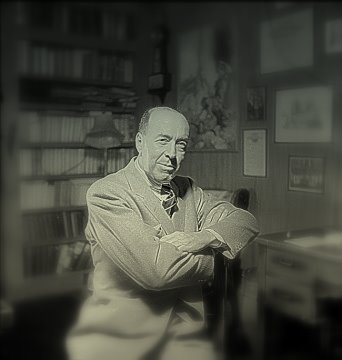
 

Edgar Rice Burroughs

Lion Man is overwhelmingly a novel of doubles or duplicity.  The number of things doubled is bewildering.  I deal only with the most obvious here.  The reason Burroughs concentrates on doubling, I believe is because he discovered the double meaning of the terms of the contract he signed with MGM.  He was stunned by the duplicity.

On p. 154 Burroughs comments on duplicity such as he found at MGM.  Remember he names them BO or Stinky studios in the novel.

Tarzan was suspicious.  He saw a trap, he saw duplicity in every thing conceived by the mind of man.

Thus having been betrayed Burroughs is now alert seeing doubling or duplicitness everywhere.

St. John, the illustrator of the book also picked up on the aspect of doubling.  This novel was so extremely important to Burroughs, he even issued it on his birthday, September 1st, 1934, that he asked St. John for something different for a jacket illustration.  St. John concentrated on the Obraoski/Tarzan doubling, producing a Janus like cameo of Tarzan/Obroski facing in opposte directions.  As in the Penguin definition representing both characters of the Lion Men Tarzan and Obroski.

In this case the two faces represent the earlier cowardly Bureroughs who has to die and the strong masterly Tarzan figure Burroughs wishes to be.

Thus, before considering the story it would be fruitful to examine ERB’s use of doubling and confusion of reality, or in other words craziness, madness or insanity.

It is obvious that when ERB is passing rhough a period of extreme stress Tarzan loses his memory and/or doubles- that is to say splits his personality in a hysterical or schizophrenic way.  At this point in his life Burroughs is enduring the stress of sexual conflict – the change in affections from Emma to Florence- as well as the extreme stress of having lost control of his creation and actual alter ego to MGM as representatives of his Judaeo-Communist enemies.  In point of fact, as Burroughs may have realized, the battle, even the war, was lost.  As MGM’s 1936 movie Tarzan Escapes, indicates Tarzan/Burroughs had been captured.  Hence the tenuous grasp on sanity in this book.

In Burroughs’ mind and in fact he had been trapped by duplicity, itself a form of doubling.  When Tarzan, having climbed the Stairway To Heaven finds the front door standing open he scents a trap but as his intention was to enter anyway he enters.  He is now only in the antechamber of fate, he could still back out.  He notices six doors of which Door #3 is standing open.  He does try the other five doors but they are locked.  Entering Door #3 he begins the descent down a dark stairwell.  He encounters another door.  Rather than checking the door first he merely enters to have the door click shut behind him.  The wall is smooth, there is now no way out.

This scene may well be a fictionalized account of his negotiations with MGM.  The Studio, perhaps representing Door #3 was offering him a contract which no other studio, doors 1,2,4,,5,6 was willing to do.  Granted not everyone can spot a sterling opportunity that is staring them in the face but it does seem odd that no other studio was interested in a proven character.  After all Twentieth Century-Fox was working Charlie Chan movies hard and doing well.  But all doors were closed to Burroughs/Tarzan except Door #3, MGM.  Not a bad thing on the surface of it as MGM was far and away the best studio in Hollywood.

So Burroughs entered into negotiations with MGM in the same manner as Tarzan descended the dark staircase in which he couldn’t see very well, i.e. Burroughs didn’t understand the clauses.  Like Tarzan ERB didn’t exercise caution and while the door snapped shut trapping Tarzan so Burroughs signed the contract which he represented as the prison Tarzan found himself in.

The reader may find the above farfetched but remember the first third of the story is an account of MGM’s Trader Horn expedition that he ridicules.  This book is about MGM.

Before dealing with the main doubles of the story let’s consider the story within the story- a form of doubling itself.  We have God on Earth doubling God in Heaven.  This becomes the source of many jokes.  Stress or no stress Burroughs doesn’t lose his sense of humor.  God’s castle is known as Heaven thus doubling Heaven.  The Stairway to Heaven doubles Jacob’s Ladder thus calling to mind the biblical story.  Tarzan then doubles Jacob.  That’s just part of sly old Burroughs’s humor.

God himself has created a parallel universe doubling England, London and the Thames.  Thus the gorilla plateau is called England while they live in London on the Thames River.  Thus a doubling of Africa and an island off the coast of Europe.

Just as God in Heaven in the biblical story created Man so God in this story has hybridized gorillas into a new species of gorilla men.  The hybrid gorillas are doubles of both gorillas and men while God is a double of man and Gorilla.

In this dizzying array of doubles the gorillas are not just a doubling of men but a doubling of the fifteenth century court of Henry VIII of England.  They have been altered by the use of deathless genes  or, atually, DNA, which was unknown to Burroughs at the time but the nature of which he dimly perceives.  The DNA has been inserted or spliced into the genes of the gorillas, thus the gorilla Henry VIII is actually, Henry VIII.  The Fifteenth century is doubled in the twentieth century while the political scene of the twentieth duplicates that of the fifteenth.  ERB may here be influenced by Mark Twain’s The Mysterious Stanger with his notion of ascending and descending staircases of time.

During this phase of the story within the story Tarzan is actually himself while posing as, or doubling, Stanley Obroski thus actually being self contained twins; in other words the personality formerly split between he and Stanley Obroski is reunited with Tarzan dominant.  Thus Tarzan redeems Burroughs’ former shamed self.  At this moment Stanley is dying of fever and when he does the double disappears leaving Tarzan or Burroughs then undivided.  The dead body of Obroski is shipped back to the States while Tarzan remains in the jungle.

The story within the story is a stunning achievement whose genius has gone unrecognized.

b.

The most obvious examples of doubling is in the main characters.  As incredible as it may seem not only are Tarzan and Stanley Obroski so close they can’t be told apart but so are the female leads Naomi Madison and Rhonda Terry.

I’m sure there are doubles I’m missing here but even Tom Orman, the Dirctor, is a double of himself when he’s under the influence of alcohol.  Drunk he becomes a different Tom Orman than when sober.  Obroski himself is two people.  An errant coward when he has time to think he become ferociously brave when his back is against the wall and there is no time for reflection.

Naomi Madison who has become a prima donna or an artiste was at one time a waitress in a cheap restaurant which role she is forced to assume again which is another form of doubling.  In this joke Naomi is an insult to Irving Thalberg’s wife, Norma Shearer, whose early career is duplicated.

Also this movie Tarzan is a doubling of the literary Tarzan so both Obroski and Tarzan are doubles of Johnny Weissmuller who played the MGM Tarzan.  As Burroughs suggests in this novel he was half out of his mind from the terrific stresses.  The stress did produce however a terrific novel.

It would seem that Burroughs was Tarzan and Obroski as twin aspects of his own Animus while Naomi and Rhonda represented the twin aspects of his Anima.  Naomi obviously represents Emma while Rhonda is an extension of La of Opar combined with Florence.  Naomi disappears from the story apparently replaced by Balza, The Golden Girl, while Burroughs marries Rhonda to Orman.

As regards the doubling of Tarzan who is actually a double of Burroughs himself, Bibliophile David Adams has emphasized that Tarzan usually views from above so that it might be the time to look into this aspect of the character.  In Lion Man Obroski is captured and held prisoner by Rungula, chief of the Bansuto.  this whole scene of Obroski with the Bansuto is one of the numerous variations of the theme of Burroughs humiliation by John the Bully.

Burroughs was plagued with the dream, as he notes the dream frequent among dreamers, of going naked in public.  It is a frequent dream because multitudes of people have suffered similar humiliation as his.

ERB has Obroski stand before Rungula who demands his clothes, in other words his defensive and offensive armor, that without which Obroski is exposed defenseless to the world, he loses his ‘front.’  John had symbolically stripped young ERB.  Burrughs describes his humiliation in excruciating detail as Obroski does a virtual striptease.  First his shirt on down until Burroughs makes a joke of his gaily printed boxer shorts.  While the Bansuto would not have understood the signficance of the shorts ERB takes a certain pleasure in humiliating himself further.  To cover rhis nakedness Obroski pleads for the proverbial fig leaf and is given a skimpy dirty g-string.  Thus when he is led out for torture he fights the Bansuto naked but in a Tarzan guise.  Heck, Tarzan, who is not civilized in the jungle, walks around naked anyway.  Although the natives themselves are naked Obroski is civilized while they are savages.  Having been subdued Obroski is lain before Rungula.  By this time Tarzan is in a tree, apparently planted there for his convenience.  He looks down on Obroski in amazement to see a replica of himself.  p. 104:

In the light of a new day Tarzan of the Apes stood looking down upon the man who resembled him so closely that the ape-man experienced the uncanny sensation of standing apart, like a disembodied spirit, viewing his corporeal self.

What Burroughs is describing here is the splitting of the personality.  He may have the correct psychologically sequence, first the stripping of the armor- i.e. emasculation, and then the disembodiment, the dissociation of the mind and body.  The mind unable to deal with the reality seems to leave the body rising above and looking down on the humiliation of his poor self.  This theme runs all through Burroughs work although this is his most exact and detailed description.

Obroski has been led out to be tortured to death and eaten by Rungula the cannibal chief.  Usually Tarzan is placed in an arena to fight one or more wild beasts.  In a normal confrontation Obroski is a coward which is to say he is unable to defend himself.  In other words his subconscious mind has been conditioned to accept the dominance and authority of hte oppressor.  In still other words in a state of terror his subconscious had been accessed to accept certain hypnotic suggestions.  But, with his back to the wall his instinct of self-preservation overrules the hypnotic suggestion and he fights like the proverbial cornered rat.

In this instance he used his full potential to fell a whole battalion of Rungula’s men, performing authentic Tarzanic feats like lifting men above his head casting them among his foes.  At the time Tarzan is looking down at him he has finally been subdued lying at Rungula’s feet.

You know whre I’m going , don’t you?  Right.  that street corner in Chicago where John the Bully confronted young ERB.  Burroughs didn’t fight like a berserker though, he ran.  (Chief Run-gu-la?) But that was when he split his personality being able to look down on his corporeal self like a disembodied spirit.

As the Penguin Dictionary says:  Instances of hysterical or schizophrenic duplication of personality are well know to psychotherpy.  There are many examples of this phenomenon.  Here are a couple to show how it works.

When a person is enduring an unbearable situation in which he is powerless to resist, rather than believe the situation is happening to him he does split off a psychological projection of himself as a disembodied spirit who sympathetically views his now alter ego’s humiliation.

For instance when Jean Genet, the author and playwright was at the Mettray Reformatory he was caught out by a gang of homosexuals and gang raped.  As the rape progressed, escape being impossible while becoming so unbearable for him, to retain his sanity he split off a projection, a disembodied spirit, if you will, that floated above the scene.  Thus Genet was able to actually observe his rape without participating in it.  As he watched he muttered ‘Poor Jean, poor poor Jean.’  Thus the mind provides a somewhat feeble defense but one that allows one to keep one’s sanity after a fashion.  Of course the hypnotic suggestion  from this terrifically shameful event caused him to relinquish his will to the oppressor, part of the deal to keep one’s sanity.  Genet’s character was changed for life; he became a homosexual who had no will to resist that of men while becoming an active agent in his future degradation.  He was always able to rationalize his actions so that they seemed right.

I will use my own experience as a second example.  In kindergarten the elite group forced a confrontation with me in which they lost and looked bad.  Circumstances removed me to a different school before they had a chance to relaliate on me.   But then in second grade I was returned to that school.  At that point they were waiting for me.  This situation is more analogous to Burroughs than Genet but all three involve a rape of the mind which is what emasculation is.

The general conclusion is that my and Burroughs situations are normal, they happen to everyone.  Perhaps.  And everyone reacts in their individual way but everyone reacts.  A few years later and I would have been able to handle this situation without a problem as would have been true with Burroughs.  Remember with Burroughs however that while John the Bully only threatened him in 1884-85 fifteen years later in a similar to identical situation he had his head broken thus reinforcing the original situation.

In my case the situation formed my central childhood fixation as did Burroughs’.  My subconscious was opened to admit certain hypnotic suggestions which were fixed in my subconscious.  It then closed but refused to allow me to remember which of course is why the situation became a fixation, or suggestion I could not refuse to observe.

At recess in the second grade a group of, shall we say, twelve formed a semi-circle around me.  Like Burroughs I am compelled to make excuses for myself.  For the previous year I had been shuttled between foster homes and thus I had no support or defense.  I was alone.  In kindergarten the boy, the leaderof the pack, had ordered two new kids, the first Negroes in the school, to sit on the sandbox and not move during recess.  I took the Blacks’ side offering to fight the leader.  He, standing at point, declined combat stepping back into the support of his crowd gathered behind him.  That was his mistake.  He and his crowd had realized this.  Now in the second grade the boy still refused to challenge me individually.  Now they formed a semi-circle around me while their leader stood at keystone, still enveloped by his gang so that, I presume, they could fall on me if I resisted.

They all beamed hatred and contempt at me.  I was unable to resist the projected hatred of the boys and girls while at this date having only the vaguest or no notion of what I was guilty of, I was ordered to take a step forward which to my eternal shame I did.  In midstep I was ordered to stop and stay in that suspended step throughout recess.  To my shame, I did.  He said:  You’re going to have to be our nigger now.  The shame killed my personality, my identity, my ego.  I assumed the role of ‘nigger.’  Terror opened the way to the subconscious and the suggestion, you are a nigger, among others was entered.  Like Jean Genet a projection of myself arose above to say something like:  Poor kid, poor poor kid.’

The suggestion was so horrific to me that I immediately forgot it or, perhaps since that ego died the incident was not part of the life of the survivor.  The memory was accepted and encysted in my subconscious what Freud and Jung would call the unconscious.  I not only forgot the situation but I forgot the faces and names of the kids involved.  I could not remember them from that day forward although I could talk to them as though I did know them.

The consequence was that I had to do what I was told to do by nearly anyone.  Much the same as Burroughs who wrote a medieval story, of which he knew nothing, at the suggestion or command of Metcalf and wrote Son Of Tarzan which he later regretted, and Tarzan And The Ant Men at the suggestion or command of Bob Davis.  Buroughs became a variation of the dependent personality as did I.

On the one hand my conscious mind understood the proper means of defense but as I began to do so my subconscious mind overruled or shoved my conscious mind aside and obsequiously obeyed.

This plight was only changed when I succeeded in integrating my personality in the year of around forty-two.  That is to say the subconscious contents of my mind centered around the cyst of my central childhood fixation was made manifest to my conscious mind allowing the subconscious to be integrated into consciousness.  Where the ‘Id’ was ‘Ego’ shall be, as Freud put it.

Burroughs in  Lion Man at fifty-eight is describing the same situation as that experienced by Genet and myself but in a different way.  Like myself and Genet he would have been easy to direct.  So at that age he had not yet exorcised that particular demon.  As ERB kills Obroski off in this novel assuming both identities while discarding that of Obroski, returning the corpse to Hollywood, becoming solely Tarzan of the Apes one wonders if he succeeded in integraing his personality at that point.  That is what he is describing.

His experiences with John The Bully, the splitting of his personality explains why Tarzan observes from above rather than as a participant on the ground. In Lion Man perhaps agitated by the movie duplicate of the literary Tarzan he brought the situation of John the Bully to consciousness. Rungula the Bansuto taking John’s place while the aspect of Tarzan or his split off alter ego watches from above while Obroski fought like a berserker on the ground but was overcome by numbers or in the John situation, size.

Thus Tarzan spies on the safari from the trees by day while walking rhough the camp at night.  Having dealt with his humiliation in some way in Rungula’s village, when Orman and West are threatened by a lion Tarzan plummets from his tree to kill the lion on the ground then without a word vaults back into the tree.  Orman and West mistake him for his lookalike Obroski.  Thus we have the beginning of the reuniting of the split personality which will continue in the Heaven of the gorilla god.

Burroughs was under such extreme stress from both his sexual desires and the MGM betrayal that he must have felt half mad.  While he and Rhonda are captive in Heaven he says:  Sometimes I think I must be dreaming.  A statement that seems to be out of character for the Big Bwana.  The scene might be interpreted as ERB’s Anima and Animus being imprisoned while on one level God might represent MGM.

Tarzan comes into contact with Stanley Obroski which Tarzan finds amusing and lets them do.  Both women pinch tmeselves to see if they are dreaming or mad as well they might.  Tarzan rejects Naomi which must have confused her as she and Obroski were in love with each other.  Having ditched Naomi Tarzan/Obroski goes back for the wise cracking Rhonda.

Then too Burroughs actually describes Tarzan as a madman at one point.  This would be tantamount to describing himself as mad.  Indeed the whole novel centers on mad or insane happenings.

The madness or insanity would be an aspect of Tarzan’s viewing from above as a disembodied spirit.  The splitting off of the aspect from his and ERB’s personality would be the result of the extreme stress of the moment that produced the feeling of dizzying  madness.

Burroughs handling of the stress in what I consider a very extraordinary novel is abolutely masterly.  I can’t think of a finer science fiction story that the story within the story of God’s in his Heaven and all’s wrong with the world.

ADDENDUM

David Adams who had an advance copy of this piece brought up the point that perhaps Tom Orman in his drunken state was a comment on Emma’s drinking problem.  A scenario instantly suggested itself.

Imagine Orman in his drunken state as a personification of John Barleycorn.  Imagine sweet sober Naomi as Emma in her sober state and Obroski as Burroughs in his non-Tarzan, actually Obroski state.

John Barleycorn claimed Emma as his own as Orman claimed Naomi.  Barleycorn is a jealous man and won’t tolerate Burroughs as a lover of Emma.  So the couple have to sneak a moment or two when John Barleycorn isn’t around.  In other words, when Emma is sober.

As Burroughs fictionally represents the situation Obroski/Burroughs is visiting Naomi/Emma in her tent.  they appear to be in love and accord.  Orman is drunk in his tent and isn’t expected to be abroad.  Then Obroski hears the drunken Orman approaching the tent.  Unable to stand up to Orman Obroski obsequiously flees.

So in real life Burroughs and Emma are getting along fine until Emma hits the bottle conjuring up John Barleycorn.  ERB can’t compete with the bottle while Emma becomes verbally abusive under the influence just as Orman used the lash on bearers while drunk.  ERB can’t take it so like the bearers he vanishes into the night.

I think it may be a viable scenario although obviously ERB’s version of the truth.

End of Part II.  Part III, The Source follows.


A Review

Themes And Variations

The Tarzan Novels Of Edgar Rice Burroughs

#18 Tarzan And The Lion Man

Part one of ten parts

by

R.E. Prindle

First published on the ezine-ERBzine

Preface

     As has been seen 1931 was a very eventful year for ERB.  The viewing of Trader Horn was a seminal event in his life.  The movie became a major influence on his next Tarzan novel- Tarzan And The Leopard Men.  As has been noted, in April he signed the contract with MGM.

     Reports vary but it appears that he may have sold the movie rights for the first film for twenty-two thousand dollars plus a five week employment contract at a thousand dollars a week.  It is fair to assume that ERB spent his five weeks on the MGM lot in Culver City.

     During that period of time he obviously attended conferences with Irving Thalberg so his descriptions of the ‘Boy Wonder’ are taken first hand.  One imagines that he became acquainted with the Director Woody ‘One Take’ Van Dyke.  I like to think they hit off with ERB getting some first hand accounts of Africa that showed up in Lion Man.  As he had a copy of Van Dyke’s privately printed Horning Into Africa in his library it would seem obvious that Van Dyke presented him with a copy.  Thus ERB had a fund of first hand information lacking in his earlier novels.

     One also imagines he met the African stars Mutia and Riano when they visited Hollywood.  They would have been the first Africans he had met.  There is a world of difference between Africans and American Negroes.  Perhaps for these reasons his Leopard Men varies somewhat from his usual hidden civilizations formula.

     And also he would have met his script writing counterpart Cyril Hume.  His new partner one might say.  And coincidentally Johnny Weissmuller and Maureen O’ Sullivan.

     One is astonished at the speed with which MGM signed Burroughs, developed a script, found actors for Tarzan and Jane, made a movie and released it a bare ten months later.  What orgzainization.!

     We know that ERB watched the result with sinking heart and bitter remorse for signing the contract.  The MGM version of his creation was the antithesis of his own.  Rather than a literate, cosmopolitan Tarzan at home both in the jungle and the capitols of Europe and cities of America the MGM Tarzan was a feral boy who wasn’t even a lord, let alone  the lord of the jungle.

     Our Man had just finished Tarzan And The City Of Gold  when he viewed the movie.  Now with his brain reeling in shock it would be a year before he got out his reply.

     In my estimation it would be his last great Tarzan novel.  The Big Bwana had been emasculated.  But the greatest of the Tarzan novels was the result.

     ERB also made it a Hollywood novel, perhaps as trenchant a criticism of the film capitol as his 1922 effort The Girl From Hollywood.   He ridiculed the whole thing.  MGM, Thalberg, the African expedition, the movie Tarzan and in a closing chapter Hollywood itself.  In his pain and hurt he drove himself to heights he had never before attained.

     Stunned by the duplicity of MGM his novel is a story of duplicity, of doubles and more doubles until one has doubles coming out one’s ears.  The story within the story, the double of the story itself, of God in Heaven but all wrong with the world is a masterpiece of imaginative fiction that transcends even the exploits of his Martian creation, Ras Thavas.

     As Leopard Men was permeated with sexual desire with a hint of madness, Lion Man is deeply involved with madness, insanity and a complete feeling of unreality.  As Tarzan says:  Sometimes I think I must be dreaming.  Yea, verily, brothers and sisters.  This story is one of dreams and nightmares but a dream of a story.

1.

     In the novel Burroughs had two major objectives: 1.  To ridicule and humiliate MGM and 2.  To show them how to use all new material in a much more imaginative way than Cyril Hume had.  Hume is probably ridiculed as both the writer Joe in the foreword and the scenarist Pluant in the Hollywood afterword.

     There can be no mistake that the introductory story refers to the Trader Horn expedition while Burroughs includes a planning session with Milt Smith/Irving Thalberg in his MGM/BO office.  Let us look at the introductory chapter carefully.

     There can be no doubt that Burroughs was included in such sessions concerning the movie Tarzan, The Ape Man so that the chapter ‘In Conference’ is an authentic snapshot of how business was conducted.

     The opening sentence is:  Mr. Milton Smith, Executive Vice President In Charge Of Productions was in conference.  There is no doubt that here Burroughs is referring to Irving Thalberg.  Burroughs goes on to describe Thalberg’s actions which were considered peculiar by everyone in Hollywood.

     Mr. Smith had a chair behind a big desk, but he seldom occupied it.  He was an imaginative dynamic person.  He required freedom and space in which to express himself.  His large chair was too small; so he paced about his office more often than he occupied the chair, and his hands interpreted his thoughts quite as fluently as his tongue.

p9.  Smith was walking around the room, acting out the scente.  He was the girl bathing in the pool in one corner of the room, and then he went to the opposite corner and was the Lion Man.

     That doesn’t sound unfriendly or hostile to me but as ERB has already identified MGM as BO (Body Odor) or Stinky Pictures Louis B. Mayer, MGM’s president, may have taken all ERB’s comments from then on as intended insults.

     In point of fact ERB’s descriptions of Smith/Thalberg seem to be accurate.  Thalberg was the subject of Scott Fitzgerald’s unfinished final book The Last Tycoon.  The novel was made into a movie of the same name in 1976, the last movie directed by Elia Kazan.  Thalberg is portrayed exactly as Burroughs depicted him.

      The conventional mind seems to be unable to grasp the idiosyncrasies of genius.  The genius of Thalberg was that he was able to visualize the film in the manner Burroughs describes, alsmost as the author.  Had he failed he would have been merely weird but as he was the greatest and surest producer of the studio era the seeming eccentricity becomes an attribute of his genius.  As a writer of genius I think ERB saw Thalberg that way; how the latter of MGM interpreted ERB’s remarks may have been less generous.

     The director, Tom Orman’s character is quite similar to that of Woody Van Dyke although as the physique of Orman is opposite that of Van Dyke it is clear that Orman is intended to be more fictional.  The name Or-man can interpreted as Gold-man from the French Or which translates as gold.  As Goldman ERB may have been slamming the Jews.  ERB was less than careful in that respect in the novel.  In the last chapter ERB definitely characterized Abe Potkin as a Jew placing his conversation in dialect.  By Abe Potkin ERB may have been referring to Louis B. Mayer.  The introduction of Clayton to Abe leaves this open to conjecture.  p. 186:

     This is Mr. Potkin, John Clayton, Abe Potkin, you know,  (italics mine)

     If ERB did ridicule both Thalberg and Mayer or was perceived as doing so then he was definitely asking for trouble.  Fighting the Law in Hollywood as it were.

     Like Van Dyke who had been called in to relieve director Robert J. Flaherty on a behind schedule film White Shadows On The South Seas in which Van Dyke was successful so Orman had been called in to complete a picture being shot in Borneo.

     Just as Van Dyke was then assigned Trader Horn on location in Africa so now Orman is assigned to make the biggest African picture ever in the Ituri Rain Forest.

     ERB probably met Van Dyke in the summer of ’31 on the MGM lot.  It would seem that the two men hit it off as Orman is as well treated as Lion Man allows.  It  is to be presumed that Van Dyke presented ERB with a copy of his privately printed Horning Into Africa  at that time.

      The rest of the chapter is joshing around in a light hearted banter that was characteristic of this type of conference and introducing the members of the cast thus establishing the nature of their characters.

     A detail of interest is the following quote.  p. 8:

     “And are we going to shoot:” inquired Orman, “fifty miles from Hollywood?”

     ‘No, sir!  We’re going to send a company right to the heart of Africa to the -er-ah- what’s the name of that forest, Joe?’

     “The Ituri Forest.”

      “Yes, right to the Ituri Forest with sound equipment and everything.  Think of it, Tom!  You get the real stuff, the real natives, the jungle, the animals, the sounds.  You ‘shoot’ a giraffe and at the same time you record the actual sound of his voice.”

     “You won’t need much sound equipment for that, Milt.”

     “Why?”

     “Giraffes don’t make sounds; they’re not supposed to have any vocal organs.”

     “Well, what of it?  That was just an illustration.  But take the other animals for instance; Lions, elephants, tigers- Joe’s written a gret tiger sequence.  It’s going to yank them right out of their seats.”

     “There ain’t any tigers in Africa, Milt,”  explained the director.

     “Who says there ain’t?”    

     “I do,”  replied Orman grinning.

     “How about it, Joe?”  Smith turned toward the scenarist.

     “Well, Chief, you said you wanted a tiger sequence.”

     “Oh, what’s the difference?  We’ll make it a crocodile sequence.”

     In this instance ERB is spoofing himself.  Over the years he had all kinds of complaints for faunal inaccuracies.  The tiger bit probably hurt him the worst.  He had written a great tiger scene for the first Tarzan novel that had to be changed from the All Story magazine version to the book version.  ERB finally gets a chance to exorcise his frustration over that one.  He was also criticized for having deer in Africa, Bara the deer, of which there are none.  He first tried to bull his way through by saying he just wanted Bara the deer there.  He gave in by Tarzan The Invincible  and spoke of Bara the antelope.  This also apparently proved unacceptable as in Leopard Men he speaks of Wappi the antelope, while the name Bara disappears completely.  In the joke about the giraffe voice he is showing off knowledge while venting a little steam.

     Thus he sets the scene for the first stage of the novel, the penetration of the film company into the Ituri Rain Forest.  I found this sequence as well handled as any movie version might have been.  ERB doesn’t try to follow Van Dyke’s narrative but creates his own story based on Van Dyke’s.

     I have no doubt that there are references in this introduction and throughout the book to real people and real incidents that have gone over my head.  I have located what I can with my present knowledge but I’m sure the novel is loaded with many others.

Go to:  Part 2:  Doubles And Insanity


Edgar Rice Burroughs And The Lost Cause

by

R.E. Prindle

     Edgar Rice Burroughs was a man of his times.  He was a concientious observer and interpreter with a prodigious memory.  He seems to have had the remarkable faculty of being able to compartmentalize nearly everything he learned in his mind.  When he writes his sources are nearly transparent when you know the sources.  Of course the more you’ve read the novels the easier it is to see his influences.

     Underlying, perhaps, its whole intellectual structure is his understanding of the Civil War and Reconstruction.  His father was a veteran of the GAR.  One imagines that his father sometimes talked to him of his experiences although not necessarily so.  How he integrates this understanding into his personal psychology is interesting.  I have attempted to point out in my last few essays that Burroughs felt as though his early expectations in life of what was to be were destroyed at some point in his youth changing the direction of his life from success to failure.  The story of his subsequent life then was the attempt to regain this lost status. 

     In the terms of the Civil War the triumphant North represented his personal defeat while the defeated South with their Lost Cause represented his life after the loss of his expectations.

     He is fairly open about this mentioning his three favorite books The Prince And The Pauper by Mark Twain, Little Lord Fauntleroy by Frances Hodgson Burnett and The Virginian by Owen Wister.

     Prince begins as Burroughs began.  Then in a sort of nightmare the Pauper who is a twin of the Prince shows up and the two identical lads exchange places, the Prince becomes the Pauper and the Pauper become the Prince.  In the end the Prince regains his rightful position.  The attempt to regain that position is the story of Burroughs’ life.  Twinning also become an important part of the plotting of the Tarzan books.

     In Fauntleroy the Prince lives a humble life after his father dies but then come back into his own.

     The Virginian, of course, must have been part of the Slaveocracy dispossessed by the Civil War then trying to find his place in the world

     While slavery enters into the issue it is not part and parcel of the Lost Cause.  The South today stil talks of Southern civilization as opposed to Northern civilization.  Both civilizations thought of the Negro in the same way but in adopting Negro slavery the slave owner thought of the Negro as another form of livestock intermediate between an animal and Homo Sapiens.  To put it bluntly the Planter saw the Negro as an intelligent ape.  Hence there was no more guilt to be associated with working the Negro than there was in working a mule.  They were both livestock.

     Thus while the North was commercially rude and crude the Southerner- The Virginian- was courtly and mannered.  The Negro livestock created a situation for such a civilization to exist.  The Civil War destroyed this situation so very pleasant for the Slaveocracy.

     So what was lost by the emancipation of the slaves was not only so much livestock but a whole conception of life.  This conception of life was the Lost Cause.  Thus Burroughs having also been deprived of his early paradisical expectations was able to identify with the Lost Cause but not necessarily with the freed Negro.

     With emancipation the whole relationship to the Negro changed.  He was no longer something of value that had to be understood and used but a competitor who had to be baffled.  The Southern Planter like John Carter and Tarzan was clearly the superior White man in pre-Civil War times and he retained that status during Reconstruction and the Jim Crow era because of his superior talents- what today would be called White Skin Privilege.

     Tarzan was an alter ego of Burroughs but John Carter was not although he may have had some relationship to ERB.  It is more likely that Carter was based on Burroughs’ ideal of what his father might have been.  It is noteworthy that Carter loses his preeminence in the Martian novels after 1913 and the death of Burroughs’ father.

      Ronnie Faulkner in his recent article in Erbzine Volume 2177 makes the comment:

     When Burrughs’ heroes brought change its purpose was conservative- “to restore a lost order, to put a rightful prince back on the throne.”

     This is a perceptive observation but the purpose wasn’t conservative in the political sense.  The purpose was to right a Lost Cause or in  other words “to restore a lost order”, that order that existed in Burroughs’ childhood, “to put a rightful prince back on the throne’, that is, Burroughs himself.  The whole corpus is saturated with the Prince and the Pauper theme.

     The problem of the Negro remains.

     In the God Of Mars the Holy Therns who are White undoubtedly represent the Planters of the slaveocracy.  In American politics from the early days the South was dominant in politics.  This was aided by the slaves being counted as three-fifths of a voter but with votes being voted by the Planters.  Not the Whites but the Whites who were Planters.  The Planters were but a very small portion of the Southern population with the Blacks and poor Whites or White Trash as we were unkindly spoken of by both the Planters and the Negroes while being equally controlled by the Planters.  We po’ White Trash were forced to fight and die in the Planter’s war.

     In the same way the Therns from their center in the South of Barsoom controlled both the North by religious means and the Black First Born.  As in the popular representation of the Civil War the Blacks were the cause of the destruction of Joel Chandler Harris paradise, the wonder land of Disney’s Song Of The South.

     The First Born of Barsoom or the Southern Negroes successfully took on the Holy Therns and destroyed their hold over them and the people of Northern Helium.

     As in the South where Planters were compelled to accept their defeat and mingle with the Negroes they did the same on Barsoom.

     Emancipation solved one problem but created a few others.  The North sought by Reconstruction to place the Negro over the White.  While slavery was wrong the placing of the White above the Negro was seen as right.  That Burroughs so believed is prove by both John Carter and Tarzan.  John Carter became the Warlord of Barsoom or Supreme Commander while Tarzan was the Lord Of The Jungle, the arbiter of African fates.

     Whatever one thinks of Thomas Dixon Jr. he was the spokesman for the Lost Cause.  He wasn’t the only one who wrote Reconstruction novels.  Equally successful was a writer by the name of A.W. Tourgee.  Tourgee wrote, among others, two very successful novels:  A Fool’s Errand By One Of The Fools and Bricks Without Straw.  He wrote from a carpetbagger and Northern point of view; the Negroes were poor benighted heathen while the Whites were merely benighted but the Negroes were superior in most respects to the Whites.  Tourgee was a successful carpetbagger.  Writing beginning in 1880, three years after Reconstruction ended he preceded Dixon by a few years.  Dixon most likely was writing in reaction to Tourgee.

     Tourgee’s novels enjoyed a longish vogue so that Dixon’s and Tourgee’s would have been competing for the popular favor.  The war was over and different sentiments took precedence favoring the point of view of Dixon.

     While the North rather hypocritically tried to force Negro equality or even supremacy on the South they maintained separateness of the species in the North.  While the Negro was given the franchise in the South he was unable to vote in the North.  So that while there seemed to be sympathy for the Negro species there was little or none for the Black individual.

     This was more or less the reverse of Burroughs’ dilemma.  He honored the manhood of the Black individual but he denied it to the African species.  I don’t believe there can be any denying of this; thus Tarzan is The Lord Of The Jungle, a jungle god, the Big Bwana, the arbiter of African destinies.  It is important that Tarzan was seen as a god compared to the Africans.

     So in real life Burroughs chose Dixon over Tourgee.  I’m sure he knew of both.  While the carpetbagger pushed the superiority of the Negro in a society that no longer cared about Blacks, the war being over, Dixon advanced the interest of the White species against the African species while the Lost Cause resonated in Burroughs’ soul as it does today in any person who feels that they have been deprived of their birthright in life.

     Oddly Burroughs had only the third volume of Dixon’s Reconstruction trilogy – The Traitor- in his library.  Perhaps because John Carter’s tomb seems to be based on the tomb in the The Traitor.  There can be little doubt that the latter was the inspiration for the former.

     In The Traitor the tomb had been sealed from the ouside but there was a secret entrance to the tomb and once inside the tomb an underground passage led from the tomb to the old manse.  Of course, Carter’s tomb was sealed with the latch being on the inside.

     In 1907 William A. Dunning published his Reconstruction: Politcal and Economic which furthered the Lost Cause view and set the tone for scholarship until Du Bois published in 1935. 

     So, in  a way the South had risen again as the Southern view of the struggle gained preeminence.  The high water mark for the attitude was the filming of Dixon’s trilogy as The Birth Of The Nation by D.W. Griffith in 1915.  Political winds then turned in favor of the Blacks again.  A last salvo was fired by Claude Bowers in 1929 in his successful Reconstruction history, The Tragic Era.  Bowers’ book dealt not so much with Reconstruction as with the politics of the era that Mark Twain depicted as The Gilded Age of which Reconstruction was a part.

      Bowers book was answered in 1935 by W.E.B. Du Bois in his Black Reconstruction In America 1860-1880.  This book successfully downed the Dunning hypothesis.  The racial tide now swung in favor of the Blacks with any critics discredited and silenced as bigots.  Just as Dixon and Dunning were successfully attacked during the twenties and thirties suffering total defeat at the end of the latter decade so were any dissident voices.

     The pro-Negro point of view continued to gain strength as the century advanced.  In 1988 Eric Foner published his Reconstruction: America’s Unfinished Revolution that has become the standard view.  Today Reconstruction as the unfinished revolution is expected to be completed by the next Presidential election.  Thus it is believed that the Lost Cause will disappear forever while according to Ronnie Faulkner Burroughs will become the apostle racial integration.

Exhuming Bob

Part IX

Chronicles Vol. I:

Pensees 2

by

R.E. Prindle


     I rather admire Bob’s method of integrating his life into history.  He makes himself part of the unfolding plan of historical development.  As some very ancient fellow once said:  The unexamined life is not worth living.  Having posted the rather narrow parameters of his story- that of his signing by Lou Levy and his subsequent redemption of the contract- he fits in most of his intellectual development to the time of the redemption of the contract.

     He does this in an interesting way.  In Chaper 2, The Lost Land, an interesting title in itself, gives the feel of prehistory, he begins by describing how like some insect he burrowed into the nest of Ray Gooch and Chloe Kiel where he lived in parasitic comfort.

     The path to Ray and Chloe’s door is interesting.  First he met Dave Van Ronk, through Van Ronk he met Paul Clayton and through Clayton Gooch and Kiel.  Bob is going to suck off Van Ronk and Clayton to a very large extent also.  Bob describes his hosts as quite eccentric, one might almost say, weird.  As a foreign body in the cocoon he even studies them dispassionately, clinically, one might say.  As one species of another.

     As with the other people he attached himself to they had a terrific record collection and what appears to be a large very eclectic library.  While Bob appreciates the library one feels that he believes the selection of books as odd and weird his hosts.  The library apparently formed the basis of his adult education as he thumbed the books.  This is really the first step in how Bobby Zimmerman became Bob Dylan the songwriter.  Remember he has only a year or so before his career is fairly launched and he no longer has any use for people like Ray and Chloe.  Both appear to have been queintessential Bohemians- or Bohos in brief.

     In this environment Bob provides us with this biographical sketch.  P. 28

     I was born in the spring (5/24) of 1941.  The Second World War was alreadey raging in Europe, and America would soon be in it.  The world was being blown apart and chaos was already driving its fist into the face of all new visitors.  If you were born around this time or were living and alive, you could feel the old world go and the new one beginning.  It was like putting the clock back to when B.C. became A.D.  Everybody born around my time was a part of both.  Hitler, Churchill, Mussolini, Stalin, Roosevelt- towering figures that the world would never see the likes of again, men who relied on their own resolve, for better or worse, every one of them prepared to act alone, indifferent to approval, indifferent to wealth or love, all presiding over the destiny of mankind and reducing the world to rubble.  Coming from a long line of Alexanders and Julius Caesars, Ghengis Khans, Charlemagnes and Naopleons, they carved up the world like a really dainty dinner.  Whether they parted their hair in the middle or wore a Viking helmet, they would not be denied and were impossible to reckon with- rude barbarians stampeding cross the earth and hammering out their own ideas of geography.

     I don’t necessarily agree with the interpretation but one might ask what its intellectual background is.   As bob was writing at the age of 53 of a period he didn’t remember and probably hadn’t formulated his opinions by 1959 he is projecting subsequently obtained knowledge back on his birth as falsified Persistence of Memory.  I admire that.  One has to have order in one’s life.

     Actually if one has read more than somewhat in certain areas the intellectual foundations are more than apparent.  Bob was born Jewish and for four years after his Bar Mitzvah- turning 13- he attended a Zionist summer camp for a month or month and a half in those summers.

     There was a synagogue in Hibbing but it isn’t clear that Bob regularly attended services or was very observant.  As an illustration of what being Jewish means let me cite an ad for the new cable channel called Shalom.  This is the first all Jewish channel.  In the ad or blurb a man is discussing his Jewish education.  He says that they tell you that you will attend a goi school where you will learn to be an educated man.  And then you will also attend this other school where you will learn what it means to be a Jew.  The man says that he already knows what it means to be a Jew-  You suffer.  You suffer.

     Thus at Camp Herzl- the Zionist Camp- Bob spent four summers learning to suffer as a Jew.  Bob didn’t mention Camp Herzl in his book.

     Now, Jewish teaching is that only Jews can rule a just world.  Only Jews are cultured and learned, all others are like ignorant bulls in a china shop- mere barbarians.  The last phrase In the quote from Bob is that the goi leaders were- rude barbarians stampeding across the  earth and hammering out thier own ideas of geography.  This is the exact opposite of how Jews imagine that they would be managing things.

     the notion is that only Jews are capable of creating a just sane society.  This notion hasn’t proven out well in post-WWI Russia, Hungary, and Central Europe or today’s Palestine but facts don’t disturb the notions of ideologues.  We know that Bob is an Israeli citizen and it appears he follows the Party line.  Can’t help himself, really, that was the way he was educated on the Jewish side.

     Then, on pages 27 and 28 bob finds it important to mention Adolf Eichmann.  Now, Bob only has 300 pages to work with here so we may assume he has selected only very key items to discuss.  One could easily write 300 pages without mentioning Eichmann.  I’ve written close to 3000 pages of autobiographical fiction and I don’t believe Eichmann has come up once.  Nevertheless Bob writing of the time at the age of 53 has this to say:

     (Ray worked) also an Omaha slaughterhouse on the kill floor.  Once I asked him what it was like.  “You ever heard of Auschwitz?”  Sure I had, who hadn’t?  It was one of the Nazi death camps in Europe and Adolf Eichmann, the chief Nazi Gestapo organizer who’d managed this, had been put on  trial recently, in Jerusalem….His trial was a big deal.  On the witness stand Eichmann  declared he was merely following orders, but his prosecutors had no problem proving that he had carried out his mission with monstrous zeal and relish.  Eichmann had been convicted and his fate was now being decided on….The State of Israel claimed the right to act as heir and executor of all who perished in the final solution.  the trial reminds the whole world of what led to the formation of the Israeli State.

     Spoken like a true Israeli patriot.  There is no need to defend Eichamnn, the disposal of the conquered belongs to the conqueror without the legal hocus pocus of a trial.  Did anyone believe that the Nuremburg Trial wouldn’t find the defendants guilty?  Why the charade?  There was no exonerting evidence that was going to be considered.  The Israeli State was not even in existence during the Second Wrold War so by what right does the State of Israel act.  None.  Their own will.  Be honest, they wanted to kill this guy, that’s all.  They weren’t even one of the conquerors.  They had nothing to do with the defeat of the Axis.

     So what does the trial of Eichmann mean?  The Israelis violated all international law by abducting an Argentine citizen without authority or extradition.  If Eichmann was a thug the Israelis were no less so.  Did they feel they had an overriding grievance?  Bully for them.  If they’re interested I’ll send a list of mine which I feel no less passionately.

     And then the State of Israel has appointed itself to act as heir and executor of all who perished.  That’s a convenient right to assign oneself.  I, The Jury as Mickey Spillane said.  What a convenient right.  It doesn’t square with justice but then who among them are objecting.  The Jews were self-righteously against capital punishment in all the other barbaric countries of the world.  But…they would make an exception in Eichmann’s case.  As time would show they would make a lot of exceptions.  Assassination became there mode of operations.

     As I say there is no need to defend Eichmann, if you want to kill him, kill him.  No one will object, but to set aside all the rules, all the laws that separate civilization from barbarism seems a bit extreme.  It does make one question one’s sincerity.

     The trial does fit within the time frame of the novel though, so Bravo! Bob.

      After that little moriaistic lesson for us all Bob brings us up to date on some of his musical influences, which were all excellent and then acquaints us with the foundation of his literary and intellectual education as provided by Ray and Chloe.

     He says he did little reading as a kid.  He also says he was not much of a student.  One gathers then that the talk of the biographers about Bob being on the honor roll was a figment of Mother Beatttie’s imagination.  She was apparently telling them of the Bob she wished Bob had been instead of the Bob that was.  Primarily his own reading considted of Edgar Rice Burroughs, Luke Short and H.G. Wells.

     Good influences all.  Luke Short was also my favorite Western writer, him and Ernest Haycox.  Of course I remember not a shred.  The choice of H.G. Wells is probably represented by Seven Science Fiction Novels  of H.G. Wells.  His reading or Wells probably consisted of The War Of The Worlds, The Island Of Dr. Moreau and The Invisible Man.  The other four didn’t get read very often but I have come to really appreciate The Food Of The Gods and In The Days Of The Comet.  I’m a big Wells fancier myself having read about 90% of a very large corpus, some of it two or three times.  At Bob’s age however I was only familiar with the volume Seven Science Fiction Novels Of H.G. Wells.

     Edgar Rice Burroughs is my forte as my essays on I, Dynamo and ERBzine will attest.  So both Bob’s and my own influences closely mesh.  It is of interest to note that having read Tarzan Bob married a Black woman and installed her in Tarzana.  Burroughs of course founded Tarzana naming it after Tarzan.  Cute.

     Bob goes on to discuss items he read in Ray’s library.  Ray was a pretty interesting reader.  Bob really fell through the rabbit hole when he moved in with Ray and Chloe.

     I don’t feel the need to run through what he read, the reader can check it out himself if he wishes, but Ray provided Bob with a nagnificent foundation in a very short time.  I am impressed that Bob found Honore de Balzac a great writer.  Damn, that Bob does have an unerring nose for the best in both records and literature.  Balzac is one of my favorites too although I’ve only read about twenty volumes of the immense corpus Balzac called the Human Comedy.  If you want to read a really stunning story, a novelette, get The Girl With The Golden Eyes and have your life changed.  Too bad Bob got confused by being forced to try to combine a liberal education with a Jewish one.  I’ve got a Jewish one too, acquired late however, but I scrapped it as useless.


A Contribution To The ERB Library Project

A Review of

THE TRAITOR

by

Thomas F. Dixon Jr.

Thomas F. Dixon, Jr.

Review by R.E. Prindle

Of Thomas Dixon’s Reconstruction Trilogy- The Leopard’s Spots, The Clansman and The Traitor- only the last is found in ERB’s library. It would seem reasonably sure that he read the other two also. As The Traitor was published in 1907 it seems certain that the trilogy was read before ERB put pen to paper so that Dixon was influential on the whole of ERB’s career.

This is no small influence as the Civil War and Reconstruction are central to ERB’s works. Once again, one is amazed at how ERB could absorb so many influences and keep each nearly discrete. Further on I will postulate the possible influence of Alexandre Dumas’ French Revolution series.

Of interest to ERB’s reading habits Bill Hillman recently posted a list of books in ERBzine of ERB’s post WWII reading list that Burroughs described as a few of the books he’d read. As the list was substantial the complete list must have been enormous. The list mainly consisted of books in the areas of crime and other topics which certain minds share. As I happen to be one of those minds based on the internal evidence of the novels and shared intellectual direction I feel a fair amount of confidence in my speculations concerning his reading although I leave room for error.

I am also of the opinion now that he could have read from 500 to 750 books from, say, fifteen to thirty-five when he began writing. His consumption from 1911 to 1940 must have been enormous. Fortunately we can get a pretty good fix on the type of books he preferred from his library.

Thomas Dixon Jr. lived from 1864 to 1946. Reconstruction was in effect from 1865 to 1877 when the last occupation troops were withdrawn. Dixon grew up in Shelby, North Carolina where his father was an important figure in the first Ku Klux Klan. The Traitor is apparently based on his father’s career. It is said that because of corruption in the Klan his father was instrumental in disbanding it.

Dixon although young would then have had first hand experience with both Reconstruction and the Clan.

Dixon believed, and I second him, that Reconstruction was one of the most brutal crimes in history. It certainly ranks in the same category as the French Revolution’s criminal acts in The Vendee and Hitler and Stalin’s actions from 1925 to 1945. One should not underestimate the horrors of Reconstruction. Liberals, for their own reasons, have attempted to excise the period from US history while sanitizing what little is taught. One is certain than an inquiring mind like Burroughs sought out the true and whole story.

Liberals have blackened Dixon’s name as they have that of Dixon’s fellow Southerner, D.W. Griffith, who produced the Dixon trilogy as the most amazing movie of its time- The Birth Of A Nation. In 1915.

While both Griffith and Dixon have been defamed as racists in today’s multi-cultural society they must no longer be seen as racists merely as representatives of an anti-Liberal segment of White culture.

Dixon was one of the most popular American writers of the period to at least until the aftermath of the Russian Revolution when he and writers like him, including Burroughs, came under attack from the Communists. With the exception of Burroughs all have been defamed into oblivion today.

As we know Burroughs’ father, George T., served in the Union Army during the Civil War. His father’s more admirable attributes seem to have gone into the character of John Carter, the hero of the first three Martian stories. He seems to have been combined with a Confederate Officer of Virginia stock as well as a character of the nature of Count Caliogstro of the pre-French Revolution period.

Here the problem of Alexandre Dumas and his Revolutionary romances enters. John Carter’s tomb in Connecticut is probably based on Graham’s tomb in The Traitor. The similarity is striking. Carter’s longevity may be based in part on Dumas’ description of the charlatanry of Cagliostro who claimed to be as old as the Great Historical Bum while rationalizing his ability to survive much as the thousand year old Martians did.

The Great Alexandre Dumas

The Martians were in fact deathless as was Cagliostro’s claim unless they were killed by some sort of physical accident. Dumas’ Caliogstro describes his situation in these exact terms. The novels in Dumas’ roman a fleuve are the Memoirs Of A Physician, Joseph Balsamo, The Queen’s Necklace, Ange Pitou, The Countess Of Charny, The Chevalier Of The Maison Rouge and The Blue And The White. I can recommend them highly. We know that Burroughs read The Three Musketeers and probably The Count Of Monte Cristo. He may have read one, two or more of the Revolution series also.

There is an interesting passage in the Physician in which an ignorant country boy teaches himself to write both printed and cursive letters after a very rudimentary instruction in reading. The passage bears comparison to Tarzan’s teaching himself to read and write. The point being that Burrough’s imagination was probably fired by this series.

Now, we know that Burroughs was always opposed to the Revolution. Dumas would have introduced him to conspiracy theory. I would guess that ERB read Dumas before 1900 but that is just a guess. Also bear in mind what we consider ‘classical’ literature was current in Burroughs’ youth. All these books would have been new and therefore doubly exiting. As David Adams noted to me concerning Baum’s Oz series the books would have been equivalent to a new Beatles record in the sixties when people rushed to stores at the earliest possible moment to get their copy. Knowing this stuff would have made one a very hep cat.

We also know that prior to 1911 Burroughs associated with several knowing people among which were Sweetser and Dr. Stace. These buys are always into conspiracy theory as, indeed, am I . As I have said as Burroughs and I share the same reading tastes I think it less than pure speculation that Burroughs also knew something about the Revolutionary conspiracy. Difficult to tell what.

It doesn’t appear that ERB was ever a Freemason. The Revolution was attributed to the Masons. The lodges then would have been thought Communist then by their opponents. Communist and Illuminated. The Illuminati are, of course, central to any conspiracy theory.

In theory and certainly in fact the lodges were instrumental in the overthrow of the French monarchy. I have even read that Oliver Cromwell and the Puritans were involved with the Rosicrucians, hence the Freemasons and hence the Masonic revolution against thrones. While I don’t find the idea improbable I haven’t got enough evidence to speculate one way or the other. I find it interesting though to see that John Adams was thought to be Illuminated. It is certain that Revolutionary cadres in the form of Libertines were active in England during the seventeenth century and were certainly instrumental in the destruction of London’s Newgate Prison some few years before the destruction of the Bastille.

It is also certain that Adam Weishaupt’s Illuminati infiltrated the French Freemasons some few years before 1789 and that the Jacobins arose from them. It is also clear that the Illuminatti infiltrated American Freemasons at least by 1799. There are those who believe with good evidence that Thomas Jefferson was Illuminated. Indeed, the Communists of the twenties called Jefferson one of their own. It seemed ridiculous until one looks a little further. Whether Lincoln was one of the Communists’ own along with Jefferson as they claim seems preposterous on the surface of it.

However an illuminated Mason by the name of Morgan was about to publish a book exposing the Masonic plot in 1843 when he was abducted and murdered. A symbol of the Illuminatti was the Phrygian Cap. The Union enlisted cap is nothing less than the Phrygian Cap with the front knob truncated and replaced by a flat board. So, shall we say that the Illuminatti took a prominent but disguised role in the Civil War.

If this Jacobin-Illuminatti attitude was in the Northern attitude then it must have been represented in the Abolitionist attitude. Their hatred always directed against authority was the directed against the Southern Whites and in favor of the Negroes. And in fact it was attempted to make Whites slaves to the Negroes. Just as in France the hatred was directed against not only Aristocracy but against peasants or anyone who resisted the Jacobin or Liberal will. In the Vendee of France which remained loyalist genocide was carried out on the Vendeans. I have no doubt out and out genocide would have been committed against Southerners if it had been possible. In that respect perhaps Sherman’s antecedents should be examined to determine unrecognized motives for the march from Atlanta to the sea.

There is no question that a great many of the post-Civil War immigrants were Communists or socialists and that they refused to accept a non-socialist America. Many if not most of the 48ers who fled Europe after the failure of the Revolution of 1848 were socialist while there is no reason to suppose that a large number of those were Jacobins or Illuminated.

Burroughs first contact with these people was as a child or teenager when he saw them parading through Chicago under the Red banner. It seems very unlikely that he wouldn’t have picked up a lot of anti-Socialist information. At any rate his hatred of German and things German began at that time developing into a near mania during the Great War and a firmest attitude by WWII.

I can’t guarantee that he read Dumas’ Revolutionary novels but there are enough seeming contact points in the novels to indicate that he may have. Thus John Carter’s longevity may be based on Dumas’ portrayal of Cagliostro. This input Burroughs combined then combined with his readings of The Virginian and the positive aspects of his father to create John Carter. It is probably significant that Carter was the main character in only the first three Martian novels before ERB’s father died. When George T. died John Carter ceased being the dominant character being replaced by his son Carthoris in the next novel, Thuvia, Maid Of Mars. Burroughs may not have been able to divide his own alter-ego between Carthoris and Tarzan as the former disappears being replaced by a number of different personae.

However ERB understood the Civil War and Reconstruction the two events were a significant part of his mental makeup.

Pioneering Filmmaker, D.W. Griffith

The three Dixon novels were formative before he began to wirte while the Dixon scripted The Birth Of A Nation filmed by D.W. Griffith and released in 1915 had a terrific impact on Burroughs as well as the Nation.

The movie would have revived all his emotions on the two topics. I have read the novels of the subsequent years with this thought in mind but echoes may be there.

Over the following decades Liberals have succeeded in characterizing Birth Of A Nation as ‘racist’ which it is not. The story may be culturally centered on the White side of the story rather than the Black but this fact doesn’t make the movie any more racist than if it had been culturally centered on the Black aspect. The issue of race simply cannot be avoided.

The movie misunderstands the breach between the two White viewpoints of the North and the South. While the movie is plea for Whites to never do this again and to reunite as one people, the bigots of the North wished only for the destruction of Southern Whites. As the Jewish historian Eric Foner writes, Reconstruction is the unfinished Revolution that is still going on today and will culminate in the election of Barry Dunham-Obama and its sequel.

Eric Foner

Eric Foner is part of the Foner dynasty of Communist historians. His uncle Phil Foner wrote distorted labor chronicles while his Pappy Jack was dismissed from his academic position in the ‘50s as a Communist.

The movie was the most successful of its time providing the funds for the MGM empire. Louis B. Mayer who was a theatre operator at the time made enough from the movie to go to Hollywood and establish the Mayer studios which Loews later combined into Metro-Goldwyn-Mayer when they crushed William Fox of Fox Studios which then was combined with Twentieth Century to become Twentieth-Century Fox.

The movie certainly was not considered racist at the time except by the Jacobin faction who were not as influential then as they have become today. The Democratic president of the time, Woodrow Wilson, thought it a superb movie.

Interestingly both Wilson (1856-1924) and Dixon were together at Johns Hopkins University with Dixon being a champion of Wilson. D.W. Griffith, from the South as was Wilson, was Burroughs nearly exact contemporary. Griffith was born in Louisville, Kentucky also in 1875 dying in 1948 two years before Burroughs. Griffith was another who was marginalized by the Communists.

Thus the essential Edgar Rice Burroughs was taking its final form in the years from 1900-1911. I would like to organize those years as part of his early married years. This is not easy. As we are aware when he and Emma returned to Chicago from Idaho and Salt Lake City in 1904 ERB was suffering from the excruciating headaches that lasted half a day incurred from his beating in Toronto.

His sojourn in Salt Lake must also be included as part of his education as with his innate anthropological curiosity he would have investigated the absurdities of that religion. Once again he was much closer to the origins of the religion as it had only about sixty years of history to deal with rather than one hundred and sixty.

Even on the train trip back to Chicago ERB would have traveled through an entirely different landscape along approximately the Mormon Trail than today. The geographic changes have been enormous. The earlier geography would have influenced Mormon memories and stories that he would have heard. As an example of a feature that has been completely destroyed is a description from a book titled: The Mormon Trail: Voyage Of Discovery, The Story Behind The Scenery by Stanley B. and Violet Kimball. Page 35:

Weary teamsters and tired oxen struggled onward despite the difficult, rocky terrain. Many journals commented on the hordes of grasshoppers that had helped deplete the area of grass. Still, the optimism remained high in camp for they knew the Sweetwater River was just around the bend. The ground here proved to be miry, “smelled bad”, was swampy and many oxen got “buried in the mud.” Mosquitoes and “Gad flies” were numerous, and both oxen and humans were plagued for miles. The water along this route was so bad that even the cattle refused to drink. Most of the time they had to use sage for firewood here because buffalo chips were scarce and so was wood.Among the several landmarks along this part of the Trail were the Avenue Of Rocks and The Devil’s Backbone. Today the quarter-mile-long Avenue Of Rocks is gone, a victim of road widening.

That’s how little Americans care for their environment. Possibly the Avenue of Rocks was used by Fennimore Cooper as a locale in his novel The Prairie that Burroughs was certain to have read.

The Mormons would have made the trip a scant thirty or so years before so Burroughs would have been regaled with stories by those who had made the trip, probably before Buffalo Bill cleared the prairie of buffalo. Certainly before the tremendous network of reservoirs that now cover the area.

Having returned to Chicago Burroughs had to get down to some serious living; something he wasn’t good at. One would imagine that his father with a long history in business in Chicago could have gotten him a decent job to start but for some reason of which we are not informed he seemed to be in disrepute. ERB literally started at the bottom taking jobs for which there were few applicants.

Burroughs ran through an odd assortment of jobs over the next seven or nine years. After all it was only seven years from 1904 to 1911. Short enough in the telling but the equivalent of several lifetimes in the living. I won’t do a recital of the jobs as I’ve done it before while everyone is familiar with the story.

Intellectually these were stimulating times for Burroughs. L. Frank Baum’s Oz books began at the turn of the century, Baum trying to end the series in 1910. The Oz stories had a great influence on ERB. Jack London began publishing whose hobo experiences probably rekindled Burroughs interest in that life find expression in the trilogy of novel involving Billy Byrne that began in 1913 shortly after ERB began writing.

Owen Wister published The Virginian that would be so influential on Burroughs’ writing going into the character of John Carter. The Graustark novels of George Barr McCutcheon also began appearing the memory of which ERB would cherish to his dying day.

And of course ERB had his relationship with Dr. Stace. Now, Porges gives us very little information on this period in ERB’s life. However John Dos Passos in his USA trilogy includes a character who closely resembles Burroughs. This is in the third volume, The Big Money. Dos Passos was a vicious little man. At the time he was an open Red. Somewhat later in life he supposedly became a ‘conservative.’ As Reds go becoming ‘conservative’ in my opinion merely means getting old. I don’t see how anyone who has based their life on Communist principles can ever embrace opposite principles but many people can, or at least, they allow themselves to think they can.

It would be absurd to think that there would be no stories circulating about one of the most successful writers in the world. Dos Passos was actually from Chicago although absent most of his life, still he undoubtedly picked up some stories on Burroughs who would have been thought of, at the very least, as a colorful character. Thus writing in the thirties Dos Passos may very well have picked up stories from people like Frank Martin himself. Can’t be sure at this time of course…but if you look…

John Dos Passos

Dos Passos carefully describes the type of businessman ERB was. There apparently was a type of scrabbler who while not being able to afford an office of their own would rent space for a desk in someone else’s office so they could have an address. Sort of like the mail box addresses existing today. As an independent businessman Burroughs was of this type. In this capacity Dos Passos has his character turn up with a patent medicine type who go through Michigan trying to sell their wares. Dos Passos details of the foray are unimportant and probably highly imaginative but definitely derogatory. But then his whole corpus is of a mocking nature.

The point is Porges describes about this time, 1907 or so, that Burroughs sent Emma a note from South Bend, Indiana lauding the town saying that he would be back home soon. Porges doesn’t say what he was doing in South Bend. We are left to guess.

I would imagine it was something along the lines that Dos Passos describes. Or perhaps this was about the time the Feds cracked down on the Patent Medicine business and Burroughs and Stace may have found it convenient to absent themselves from the Windy City. I haven’t been able to find a reference to such a trip in the corpus as yet.

More to follow.

Something Of Value

Book II

Part 4

Edgar Rice Burroughs, Evolution And Religion

by

R.E. Prindle

ERB And The World 1875-1950

Edgar Rice Burroughs

     Edgar Rice Burroughs entered a world he never made on September 1, 1875.  He would have some hand in editing the making of the next century or so.  He seemed a less than likely candidate for such a chore.  He was dealt a tough hand to play by life.  It took him some thirty-five years to learn how to play his hand but once he learned there was no stopping him.  He wasn’t perfect, probably had what we call an abrasive personality, and he didn’t always do the right thing but, then, who does?  He worked hard and he walked his dog with an ample leash.  But in this essay we’re not particularly concerned with ERB the personality but ERB the force.

     ERB’s world was made for him.  It was his job to navigate his way through it.  I have already prepared a view of the world and its history in terms of religion and evolution extrapolated from the writing of Burroughs.  It may be of use to give a bit of the local history that had such a profound effect on his development.

     ERB was born in Chicago.  The Chicago that he was born into was one of the seven wonders of the modern world.  There had been nothing like it seen before, not New York City, not Paris, not London, not even ancient Athens or Rome.  The Iron Chancellor of Germany, Bismark, lamented the fact that he would never get to see ‘that Chicago.’  It is hard to imagine the role Chicago played today.  Chicago was unique, both wonderful and terrible. It may be difficult to visualize but for the Chicago of Burroughs’ youth, to the East was civilization and directly to West was Indian Territory.  The Indian Fighters came direct from the battlefield to the metropolis of Chicago.  I mean, Buffalo Bill had Sitting Bull as one of his performers.  Blows my mind.

     As if to prove its uniqueness Chicago staged the 1893 Columbian Exposition or World’s Fair, the fabled White City.  The White City may be compared to OZ while workaday Chicago was known as the Black City.  You gotta work at visualizing this stuff.   The White City was as audacious as Chicago itself.  It only took fifty years to raise this strange, bizarre and wonderful city out of the muck alongside Lake Michigan and it only took a year to build what was really a spectacular purpose built city of some magnitude.  Even more  mindboggling it s purpose existed for only six months then it was discarded like so much waste paper.  Incendiaries burned this amazing effort to the ground the next year.  Nothing was left of this prodigious effort.  It is truly a crazy world.

     Bill Hillman of ERBzine made a valiant effort to present the wonder of this spectacle especially as it affected the young Edgar Rice Burroughs.  It was a valiant attempt and a worthy one opening my eyes to this wonder in ways they had never been opened before, however as good as Hillman’s effort was it couldn’t come close to the grandeur of the spectacle.

     To have visited this incredible fair for few days, a week, or even two was to have seen nothing.  Edgar Rice Burroughs, then 17, had the great good fotune to have spent the whole summer at the fair.  It was the experience of his life.  The world was on display.  Authentic Dahomean villages with real tribesmen brought  from the jungles for the purpose, authentic Irish villages- of course, there were enough authentic Irish around Chicago to staff those so they didn’t have to be brought over- Arab camps, evolution, religions of the world, scientific wonders, everything imaginable and in real authentic detail with real everything and it was cutting edge.  This was not any Disneyland fake.  It was like traveling around the world.  A diorama of realities.  It blasted through ERB’s existence like a tornado across the Kansas plains.  That was how the author of the Oz series, L. Frank Baum, who was in attendance saw it.  It was a regular tornado that transported him to another world- we’re not in Kansas anymore, Toto.

     As Editor Hillman pointed out in his series of articles, the White City was a phenomenon of firsts.  Bill didn’t get them all though.  One he missed was that Frederick Jackson Turner, always be suspicious of three name writers, first presented his thesis ‘The Influence Of The Frontier In American History’ at the fair.  The disappearance of the frontier was as important an event in world history as any.  With the arrival of HSII and III on the Pacific shores all sub-species were in direct contact with each other around the world.  The stage for ev0lutionary Armageddon was constructed.

     In its own way 1893 was as important as 9/11/01.  A world change began to take place.  The previous four hundred years of HSII & III domination began to wane.  As usual the avant guard of writers and artists had a glimmer of understanding; the rest kept walking right along as though they hadn’t passed through the glimmer into this new parallel world.

     The writers perceived things differently.  Among the writers were H.G. Wells, Sax Rohmer, Conan Doyle, Robert Louis Stevenson, Edgar Allan Poe and of course Edgar Rice Burroughs.  As it is with artists they began writing in terms of the new reality, perhaps without being conscious that they had abandoned the old.  By the mid-teens and early twenties non-fiction accounts had begun to appear.  Most famous were those of Madison Grant and Lothrop Stoddard.  Stoddard’s The Rising Tide Of Color pinpointed the issue but after some initial success he was denounced as a bigot and throughly discredited.  It wasn’t like he didn’t know what he was talking about but his message was offensive to certain pressure groups.

     In its own way so were the writings of the great mythographers.  With the exception of Wells they were all political conservatives.  Well’s success came as a mythographer before he declared himself a Red/Liberal in 1920.  From that point, which occurred just as the Great War ended, his novels fell flat although his Outline Of History was a great success.

     Every effort has been made to discredit the mythographers, but their creations have maintained a stunning popularity despite Red/Liberal efforts to destroy them.  Lately the Reds have turned to detournement.  In Well’s case, as a member of the prevailing orthodoxy he has, of course, been idolized and eulogized, but they can’t get anybody to buy anything but his science fiction.

     Perhaps because he tackled the different themes of religion and evolution in an independent manner great effort has been made to discredit Burroughs.  Frontal attacks have failed to this point although perhaps ridicule and detournement will be more effective.  The Disney Corporation may be successful in trivializing the Big Bwana unless we counter with a more effective campaign.

     Many thinkers were presenting scientific bases for the analysis of social and historical trends.  Two of the most prescient were Darwin and Freud of whom I have gone to some effort in integrate into my analysis.  These men presented scientific methods, where were real methods, objective bases not based on the inner world of wishful thinking.  I can understand how Red/Liberals wish to cast their web of wishful thinking over the mind of mankind but I don’t understand the unwillingness of people to see through this fantastic projection.  The reality principle has to take effect sometime.

     Yet these mythographic prophets of reality have been scorned or willfully miscontrued.  If one looks at Burroughs’ work carefully he is functioning as a prophet based on scientific principles that were plausible in his day.  Nothing he or any of the mythographers said has been disproved by further scientific advances.

     Before going into this further let us take a close look at Burroughs’ magnum opus Tarzan Of The Apes.  What he had read in evolution to this time except for Darwin isn’t certain.  In 1933’s Tarzan And The Lion Man he implies he has read Lamarck, Darwin, Mendel and August Weismann.  Lamarck was of the eighteenth century who believed in inherited characteristics.  Darwin published his Origin Of Species in 1859, Mendel wrote his genetic study in 1866 which was rejected by Darwin who eclipsed Mendel until, as the result of Weismann’s studies, he was rediscovered in 1900.  Weismann wrote during the eighties and nineties advancing the theory of germ and soma cells.  It is possible that Burroughs could have been familiar with all four by the time he wrote Tarzan Of The Apes.  Lamarck and Darwin are readily evident.  Burroughs favored the notion of Lamarckian inherited characteristics, which is justly out of favor today.  Thus as an allegory of the ascent of man Tarzan relies heavily on Tarzan’s heritage to explain his sense of his separation from the apes among which he grew up as a feral child.

      In Burroughs’ story Tarzan comes from the finest hereditary stock of noble Englishmen.  Thus according to Burroughs he inherits a number of moral and mental faculties rather than acquiring them.  There is no mistake that Burroughs considered the English to be the crown of creation.  As a one year infant Tarzan’s parents die while he is adopted by Kala the ape.  Burroughs’ apes are not known to any science perhaps representing the ‘missing link’ which used to be a hot topic.

     The idea of an unknown species of ape falling somewhere between known apes and human beings is not as unreasonable as it may sound.  It was only in 1902 that the existence of the Mountain Ape was confirmed.  The Mountain Apes of the Mountains of the Moon had been rumored for some time before the first specimen was killed and the skin brought back. These are amazing anthropoids.  So, within the context of the times the notion of such apes was not all that far fetched.

     Many wonders were thought to be hidden in Africa.  Even as late as 1920 The New York Herald ran an article seriously considering the notion that dinosaurs still existed in the Congo.  While at this day we may read Burroughs with a very large grain of salt much of what he writes about was discussable as possible fact at the time.

     As Burroughs’ apes are evolutionarily above the monkeys and gorillas they may be seen as the last stage of evolution before the First Born appeared.  Burroughs makes a big point that Tarzan passes through the full evolutionary program on his way to realizing his noble English heritage as a fully evolved human being.

     This theme is also reviewed in his The Land That Time Forgot.

     One of the most difficult feats of Tarzan to accept is the manner in which he taught himself to read and write English without knowing a single phonetic value.  However his ability to do so can be explained in a reasonable manner.

     While reading through John Chadwick’s work The Decipherment of Linear B, Linear B is, of course, the written language of the ancient Myceneans and Minoans, which was a terrific problem until Michael Ventris succeeded in breaking the code, I came across this passage:

     Cryptology has now contributed a new weapon to the sudent of unknown scripts.  It is now generally known that any code can in theory be broken, provided sufficient examples of coded texts are available.  The only method by which to achieve complete security is to ensure continuous change in the coding system or to make the code so complicated that the amount of material necessary to break it can never be obtained.  The detailed procedures are irrelevant, but the basic principle is the analysis and indexing of coded texts, so that the underlying patterns and regularities can be discovered.  If a number of instances can be collected , it may appear that a certain group of signs in the coded text has a particular function, it may, for example, serve as a conjunction.  A knowledge of the circumstances in which a message was sent may lead to other identifications, and from these tenuous gains further progress becomes possible, until the meaning of most of the coded words is known.  The application to unknown languages is obvious; such methods enable the decipherer to determine the meaning of sign-groups without knowing how to pronounce the signs.  Indeed it is possible to imagine (my italics) a case where texts  in an unknown language might be understood without finding the phonetic value of a single sign.

     The task before Tarzan was formidable but he had all the time in the world without any distractions.  I do not mean to say that it would be possible for a feral boy to develop this amazing intellectual ability since the feral children found are quite incapable of learning.  But, in Burroughs’ mind Lamarckian notions of inherited characteristics was foremost so that he believed as did most of his contemporaries and a signficant percentage of the population today that these characteristics were operative.

    As one reads one comes across some remarkable things.  Having just read Alexandre Dumas’ Memoirs Of A Physician I came across a tale somewhat reminiscent of Tarzan’s story.  In fact the similarities of some of the details between Dumas’ book and Burroughs’ are quite amazing although I do not suggest that Burroughs ever read this Dumas novel.

     In this scene a young man named Gilbert has met the philosopher Jean Jacques Rousseau in the woods where Rousseau is collecting botanic specimens.  Gilbert does not know who he is talking to.

     ‘You can read and write.’  (Rousseau asked.)

     ‘My mother had time before she died to teach me to read.  My poor mother, seeing that I was not strong, always said, ‘He will never make a good workman; he must be a priest or a learned man.’  When I showed any distaste for my lessons, she would say, ‘Learn to read, gilbert, and you will not have to cut wood, drive a team, or break stones.’  So I commenced to learn but unfortunately I could scarcely read when she died.’

     ‘And who taught you to write?’

     ‘I taught myself.’

     ‘You taught yourself?’

     ‘Yes, with a stick which I pointed, and with some sand which I made fine by putting it through a sieve.  For two years I wrote the letters which are used in printing, copying them from a book.  I did not know that there were any others than these, and I could soon imitate them very well.  But one day, about three years ago, when Mademoiselle Andree had gone to a convent, the steward handed me a letter from her for her father, and then I saw that there existed other characters.  M. De Taverny having broken the seal, threw the cover away; I picked it up very carefully, and when the postman came again, I made him read me what was on it.  It was, ‘To the Baron de Taverney-Maison-Rouge, at his chateau near Pierrefitte.’  Under each of these letters I put its corresponding printed letter, and found that I had nearly all the alphabet.  Then I imitated the writing; and in a week had copied the address ten thousand times perhaps, and had taught myself to write.

      This is surely no less fantastic than Burroughs’ story but because Dumas is considered more credible nothing that I know of has ever been said about it.

     In Tarzan’s case Burroughs makes a point of saying that he had a number of children’s picture books so that he could, for instance match the printed spelling of B-O-Y with a picture of a boy.  In this way also he learned that he was not a freaky hairless ape but an entirely different species.  I cannot, of course, defend the plausibility of either Burroughs’ or Dumas’ story but there is a possibility.

     In some ways the notion of inherited characteristics seems as though it could be true.  In the course of evolution the thrust has always been towards more intelligence.  A species once evolved has its range of capabilities and once those are fully developed no further advance is possible in that sub-species.  It is up to the next stage of evolved sub-species or species even to advance to the limits of its capabilities and so on.  Thus it was not possible for Tarzan’s fellow ape, Terkoz, under any circumstances to succeed in Tarzan’s quest.  The necessary intelligence genes were missing.  Even though Tarzan was raised by apes less evolved than himself he himself did have the necessary inherited genetic makeup to undertake the task with some chance of success.  So, in that sense Lamarck’s inherited characteristics did apply.

     It may be argued that Tarzan couldn’t have recognized the signs as language.  In theory he could have.  Whether in fact he would have or whether it would have taken him much longer to break the code than eight years are of course valid realistic objections.  But Burroughs was writing the story so that against all objections there are methods by which it was theoretically possible for Tarzan to do so.

     This is no small point for the story as the story is, as I see it, an allegory of the ascent of man toward godhood.  Burroughs will repeatedly call Tarzan a jungle god.

     He is introduced to the next evolutionary stage when his ape mother is killed by one of the First born.  Drawn into contact with the FB Tarzan passes through this stage in evolution.  I don’t think there can be any doubt that Burroughs considered the First Born an antecedent level of evoltuion to HSII and III.  While some might inanely cry bigotry, mocern science, which was unavailable to Burroughs, has at least proven the plausibility of the position.

     Tarzan then comes into contact with a cross section of HSIIs and IIIs.  To my mind the differences are presented as innate and not a matter of environment or nurture.  Just as Tarzan must realize his noble English heritage because it is his innate nature so these ruffians are ruffians because of their innate nature.  Burroughs seems to be saying that you cannot make a silk purse out of a sow’s ear.

     While withing a particular sub-species I am an environmentalist believing that people beocme what they are for reasons beyond their contro, the majority of mankind, at least those place in favorable circumstances, believe that they are innately better than the rest.  So if Burrughs was srong on this point, as I believe he was, he was in step with the prevailing prejudice.

     Thus under the tutelage of Paul D’Arnot, his French mentor, Tarzan realizes his full potential as a human being uniting the two ‘highest’ branches of what was then known as the White race.  Tarzan can read and write English but not speak it while he can speak French but neither read nor write it.  There’s something going in Burroughs’ mind but I haven’t decided what.  But he tosses off these details in such an offhand manner that all seems so natural there is no reason to note it.

     It must also be remembered that Burroughs wrote at the transition point where for the first time in US history there were more people living in cities than in the country.  The new city dwellers had just reason to long for the rural ‘paradise’ they had just left.  Thus Tarzan having seen all there is to see of civilization snubs his nose at it to return to his beloved jungles and its animals and primitive but honest First Born.

     In a sense then the jungle and the First Born can be interpreted as the farm and the crude but honest farmer.  An idealization to be sure.

     As far as I can see Burroughs was the first novelist, or at least successful one, to treat of evolution by which I don’t mean to say Lost World adventures.  Further he treats with it as established incontrovertible fact at a time when evolution was accpted by few while being rejected by the vast majority.  And I repeat, Burroughs was learned and thoughtful about the subject.  That he was also fanciful is beside the point.

     At the same time Burroughs was offering some serious reflection on evolution he was also presenting some serious thinking on the evolution of religion which is certainly on a par with Freud’s Totem and Taboo.

     Burroughs says and this is seemingly in his hown historical voice that the Dum Dum as practiced by the apes was the source of all social and civil rituals.  As I read Tarzan Of The Apes it seems that Burroughs thinks that Dum-Dums or something just like them really took place.  Of course such round or circle dances are in fact of great antiquity.  Perhaps something just like a Dum Dum did perform a role in the evolution of institutions.

     Following that explanation for the foundation of religious and civil institutions Burroughs goes into a very careful explanation of how Tarzan became the god, Manungo-Keewati of Chief Mbonga’s tribe.  This explanation is very carefully developed.  Burroughs is also very serious and I think believes he has a handle on the truth about the evolution of god.

     As part one of a trilogy on religion Tarzan Of The Apes is followed by The Gods Of Mars and then the Return Of Tarzan.  Gods Of Mars is a condemnation of formal religion with far reaching ramifications.  In Gods Burroughs plays the role of a savior through his character, J.C.- John Carter.  Carter destroys the ancient and flase religion which clearly resembles the Catholic Church, thus being the liberator of Barsoomkind.

     In The Return Of Tarzan he gives a fanciful but reasonable vision of ancient sun worship which would fall somewhere between Munumgo-Keewati and the Holy Therns of Barsoom.

     Thus under the guise of ‘pure’ entertainment the attentive reader can detect a serious attempt to explain evoltuion both special and religious while undermining established beliefs in the manner of a prophet.  It is not necessary to accept it only recognize it.

     I’m sure Burroughs in the light of all the unsetlling discoveries beleives he is a light bringer doing a service for mankind.  I accept him at his own valuation.

     Running through all Burroughs work is an unstated vision of psychology.  One may well ask where this vision came from as Burroughs was not fortunate enough to attend Yale which is two eldest prothers did and which he keenly regretted not having done.  I’m sure the man was reasonably well read in the subject while his views appear to follow rather closely those of his brothers’ partner in the Idaho ranch, Lew Sweetser.

     A very fine article on Sweetser by Philip R. Burger appears in issue #19 of the Burroughs Bulletin, since republished on ERBzine.  Now, Sweetser graduated from Yale in 1889 a little before Freud began his psychological publication and twenty years or more before his books were translated into English.  I doubt that Sweetser ever read Freud, but I can’t say.

     He was fully conversant with a concept of the unconscious and exceptionally well informed on the rule of suggestion and hypnosis.  Whether over the intervening eyars from 1889 to 1920 when he took to the stage as a lecturer he read extensively or whether re reworded his ideas acquired by 1889 I can’t say.  But he had a good grip on the concepts of the subconscious and suggestion including auto-suggestion.

     Burroughs came into contact with him as a 16 year old when he worked on the Idaho ranch in 1891.  Again in 1898-99 and once again in 1903.  Burroughs own views on psychology follows those of Sweetser very closely with add ons from further study.

     If not as systematic Burrughs presents a consistent approach which is as viable as Freud’s but different in the treatment of the subconscious.  Both Sweetser and Burroughs always speak of the subconscious, never the unconscious, while Freud chose to believe in a metaphysical unconscious.

     What I  hope I have shown here is that Burroughs had a fairly mature understanding of life and society when he began to write and which he continued to develop throughout his life.

     While hos own life was lived somewhat erratically his intellectual mooring was much more sound.  It is the latter which is telling for us.

     The importance of his intellect being developed by the time he began writing is that the period of the teens of the twentieth century is when subsequent history took shape.  Just as Burroughs collected the strands of neo-mythographers to give them their new direction so the teens did also for the evolution of the species and religion in both the United States and the world.

     While Burroughs and the other mythogrpahers realized very early that the tide of history had changed it was only by 1916 to 1922 that the concept found expression in an academic manner.

     In 1916 Madison Grant published his The Passing Of The Great Race and in 1922 Lothrop Stoddard published his The Rising Tide Of Color Agains White World Supremacy.  and here comes the division in society that can never be reconnected.  Both Grant and Stoddard are quite serious historians; both are men of good will, both have been seriously defamed by others who object to the resulsts of their investigations.

     These objectors seem to think that their opinion is of divine origin and that any other opinion is not only wrong but evil.  They take a stand not much different fromt he Inquisition and its witch hunting which I have already discussed.  Thus these people want to run dissenters to ground and if not actually kill them at least hurt them so bad or brand them as pariahs that they will shut up.

     A recent example is Richard Slotkin’s Gunslinger Nation.  The book is an attempt to squash writers such as Grant, Stoddard and Burroughs.  The first 225 pages of his mammoth book are dedicated to demonstrating that Edgar Rice Burroughs was a vile ‘racist’ who was influenced by the even more vile ‘racists’ Madison Grant and Lothrop Stoddard.

     While you can throw away the last five hundred pages of Gunslinger Nation which is inadequately researched and poorly presented, the first 225 pages are fairly interesting if skewed.  A lot of good information of possible influences on Burroughs.  Slotkin’s fine biographical sketch of Buffalo Bill is very informative.

     Slotkin lists a number of Burroughs’ books which he has apparently didainfully skimmed but without any understanding.  If he had read more carefully he ought to have realized that Burroughs’ ideas were fully developed before Grant and Stoddard were issued.  While many of the ideas of the latter writers may have been complementary to Burroughs’ ideas they couldn’t have been formative.

     Further with the customary tunnel vision of the Red/Liberal Slotkin ignores what was happening against which these men were reacting.  Of course he and his contemporaries give this data such a skew as to lack all credibility.

     Like all Liberals Slotkin believes that immigration is a prescriptive right for anyone who wants ‘to share what we’ve made here.’  While not wanting to get involved in immigration quarrels, which are fruitless, I do believe that as I have a right to say who can and cannot enter my home, any country has a aright to say who can and cannot immigrate to their country.  It doesn’t matter whether there’s a good reason or not nor does it matter if rejection is based on the grossest prejudice.  No one has a right to invite himself to your table.  You see why there is no chance of agreement.  So much for immigration.

     Now in Darwinian terms the various sub-species were not only in contact with each other, they were peacefully intermingling in the West and in the West only.  It is important to remember that HSII and III were about to be driven out of Africa and Asia.  The invasive flow was now beginning in the opposite direction only.  While the HSIIs and IIIs had been able to displace the American aborigenes without trouble this was no longer possible anywhere in the world.  The tide against the HSIIs & IIIs had turned.  While the IIs & IIIs  would slowly be expelled from Asia and Africa, Africans and Asians while already in Europe and America would begin to increase their numbers dramatically.

     Today a city of Toronto is 50% what Torontians call ‘visible minorities.’

     Thus while IIs & IIIs began a retreat the other sub-species began an advance into II and III territories while becoming highly organized.  The Eastern European Semites began to arrive in the United States in numbers beginning in the 1870s.  Always politically aggressive, the German Semites formed the B’nai B’rith in 1843.  the American Jewish Committee in 1906 and the horribly bigoted Anti-Defamation League in 1913, the year Woodrow Wilson entered the White House.

     The Great War beginning in 1914 closed off European immigration to the United States but increased the internal migration of the First Born.  It’s an ill wind that blows no one good.  The First Born began to organize on an international basis.  African, Brazilian, Caribbean and American First Born began to act as a unit.  This organization was led by West Indians who emigrated to the United States to agitate.  Marcus Garvey, a Jamaican, personated this most important stage of evolution which has led to the present situation.  At roughly the same time, under the guidance of Semitic Jews, the NAACP- Natinal Association For The Advancement Of Colored People- was formed.

     In reaction to these very aggressive developments the post-Reconstruction Ku Klux Klan was called into existence.  On top of all these unpleasant developments the Bolshevik Revolution succeeded in Russia in 1917.  Thus a whole new paradigm was formed within just a few years in the teens.  Against this Burroughs’ mindset had been formed by the years from 1890-1910.  the new developments sure appeared to him as a bad motorcycle with the devil in the seat.

     The world which emerged from the Great War was much different from that which preceded it.  the balance of world emigration changed, as it were, overnight.  A good harbinger of things to come was The Rising Tide Of Color Against The White World Supremacy by Lothrop Stoddard.  Stoddard’s title was very ill chosen although it represented the emerging reality.  He might better have chosen a more neutral title such as ‘Changing Patterns in World Migration’ or some such.  The book is unfairly characterized as ‘racist’ by its detractors, which it is not.

     Stoddard pointed out the obvious:  that from having been the dominant sub-species the tide had now turned and rather than being a dominant military presence the HSIIs and IIIs had become a minority in a world of sub-species seeking like Darwin’s ratos or cockroaches to drive the others before it.  From having been invaders, Europe and America would now be invaded.

     This is the way of the world:  ;either you’re on the top or you’re on the bottom.  A world of equality is a world away.

     Stoddard was the proverbial voice calling in the wilderness.  The only people taking him seriously were the peoples he was warning about.  Confident in teir seeming superiority the HSIIs and IIIs went about their business as if nothing had changed.

     Not exactly as if nothing had changed because the Bolsheviks continued special and religious battles.  Just as Catholicism was infused with Semitic ideals, through Karl Marx, Bolshevism was a Semito-Red/Liberal religion.

     Of the five sub-species by far the smallest was the Semitic branch; they were and are therefore the most threatened.  In order to hope to exercise world dominion, and don’t think world dominion isn’t the question, the Judaic and Moslem religions were created.  The Jews had the daring to go it alone while the Moslems sought and seek to convert the world to Moslemism within which the Semites are the preeminent holy people.  A nation of priests as the Bible says.

     Thus while it might be possible for the largest sub-species as represented by the Chinese to overrun the world much more effectively than the HSiis and IIIs did, it would be equally possible for the Moslems to convert the Chinese with the Semites taking a position analagous to ERB’s Holy Therns in Barsoom.

     Thus while stymied for the time being in the West Moslems were increasing by leaps and bounds in the East.  They may have looked stagnant from the West but they were dynamic indeed when viewed from the East.

     Having been disturbed in their homeland the Chinese and Japanese Mongolids began sending colonies out wherever they could be received and by this time all space on the earth was fully occupied.  This wasn’t therefore the loud noisy colonization of the HSIIs & IIIs  but a more peaceful infiltration.  A lot of smuggling of small groups into the United States and Canada went on, as it still does.  Large colonies were sent to South America.  Peru passed a Chinese Exclusion Act for much the same reason the United States did.  Didn’t really have anything to do with color, it was that the countries were being taken over by foreign elements.  Japan had colonies in Brazil, Colombia and other South American States.These colonies were designed to retain their ethnic origins so that they wouldn’t assimilate.  I’ve met Japanese from Japan via Colombia who were smuggled across the border from Tijuana.

     Thus on the world scene Darwinian clash of sub-species continued  outside Asia while the Mongolids were successfully expelling the HSII and III invaders from Asian homelands.  This is essentially what the much despised Lothrop Stoddard, Harvard graduate, too, was pointing out.

     In the United States the immigrating sub-species had to disarm the dominant Anglo-Saxon hierarchy.  As pointed out, led by the West Indian immigrant First Born that sub-species was organizing its own conquest of America and Europe.  Their own population was increasing prodigiously around the world.  Even in the face of tremendous immigration into the United States the percentage of First Born has never declined but has increased.  Today in the fact of even greater immigration FB percentages have increased to fifteen percent vis-a-vis HS II and III.

     Under the so-called Gentlemen’s Agreement between the US under TR and Japan the Japanese ‘voluntarily agreed’ to restrict the flow of immigrants.  The US, a sovereign nation, accepted this ‘compromise.’  The early Japanese immigrants had been nearly one hundred percent male.  These womanless men now demanded women so the other half of the invasion in the form of picture brides arrived swelling the Japanese population past double.  The so-called Issei are the first generation born in America.  As their parents paired up at the same time the whole next generation came of age about the time of 12/7/42.  An interesting immigration fact.  Thus by taking advantage of HSII and III goodwill the immigration agreement was evaded.

     So the flow of populations contesting the same territories with the same Darwinian economic needs came into further conflict.

     The Jewish race of the Semites had been poised to transfer their entire East European population tothe United States just as the Great War broke out.  Now with the war over the Semites renewed their plans.  However there had been problems with immigrants from the Central Powers including their Irish allies during the war which sent shivers down the spines of the Anglo-Saxons.  TR himself voiced the fear that the United States had become merely ‘an international boarding house.’  So people do catch on after it’s too late.

     After a hundred years of unrestricted immigration, a golden period worldwide actually well worth study, the opponents of immigration carried the day severely restricting immigration if not closing the door completely.

     This action enraged the Judaic race of Semites who considered it their go-given right to go where they wanted when then wanted and whether a country wished to receive them or not.  But there is more than way to skin a cat.  The Anti-Defamation League whose ostensible purpose was to prevent defamation wherever it might occur began a defamation campaign against anyone with an independent point of view that conflicted with their own in any way.

     The ADL was lined up with the Communist?Red/Liberal Coalition.  The combinatin effectively split and weadened the HSIIs and IIIs putting the subspecies at war with themselves, something like Cadmus throwing a stone among the indigenous peoples setting them against each other until they killed each other off making the Semitic conquest of Boeotia easy.  Divide and conquer.

     Led by the ADL whith its ever potent charge of anti-Semitism the Liberal coalition opened war on any dissidents.  The idea was to discredit anyone whether they were concerned or merely passive who didn’t follow their program.  Prime targets were Madison Grant, Lothrop Stoddard and Edgar Rice Burroughs.  ERB made himself conspicuous when in reaction to the Bolshevik revolution he sent around a draft of the Moon Maid which in the original version was apparently little more than an expose codemning the Bolsheviks.

     Stoddard and Grant who were competent scholars and men of good will were nevertheless characterized as hopeless bigots and anti-Semites thereby being easily disposed of.  By the end of the decade they were neutralized and by the end of the thirties disposed of.  Quite naturally the Liberal coalition denied any involvement.

     As the thirties dawned there were major activities affot.  In Asia, Japan which deeply resented HSII & III penetration, began a campaign to drive them out.  Talk about the tail wagging ghe dog, their plan was to conquer Asia from Japan to Australia in the South, and India in the East.  It staggers the imagination.  Yet it was no less than England had done with the same population. But, different measures for different times.

     When TR said ‘Speak softly and carry a big stick’ the audacity of the Japanese plan which required a very big stick was beyond their powers of execution.  Nevertheless they first invaded Manchuria and then China itself.

     In Europe, in reaction to defeat and the Judeo-Communist threat the Nazis under Adolf Hitler came to power in 1933 which did not bode well for the world.  In the United States also a disaster as big as Hitler and Nazis occurred when Franklin Roosevelt was elected President.  That did not bode well for the United States.  The world was then primed for the big explosion.

     Perhaps because of the concept of Manifest Destiny under which the Red/Liberal tide was supposed to roll over the North American continent, jump the Pacific then race across China and Asia to return again to America in an unbroken wave of triumph the Red/Liberals looked upon the Chinese as a swell people who would offer no resistance to their goals, indeed, embrace and forward them.  Thus in some sort of Disney fantasy China was seen as complicit in the Liberal design.

     FDR was one devious son-of-a-gun.  As the good guys were being attacked by the Japanese bad boys Roosevelt took it upon himself to aid the Chinese with American wherewithall.  It would have been better to let the two combatants exhaust themselves and keep our ‘limitless’ resources to ourselves.

     Remember that the Japanese hatred of the West was caused when the United States forced them out of their seclusion at gunpoing thereby emasculating them.

     Now Roosevelt was trying to thwart their ends by disgorging America’s wealth on China.  If you free your mind from false moral assumptions you wll see how stupid this was.

     As an American I can do nothing but deplore Japan’s attack on Pearl Harbor but as a psychologist and analyst I can see nothing but its inevitability as the result of the US’s inconsiderate actions.

     The Japanese simply had to try to put a stop to American aid to China.  Whatever the proof may be that FDR knew of Pearl Harbor before hand, if he didn’t know he was provoking such an attack he was denser than any man has a right to be which I don’t think he was.

     In Europe the situation was intensified when the Communists elected sympathizers to most government who then formed a Popular Front against the Axis powers of Germany, Italy and Spain.  The Roosevelt administration was a Popular Front government.  On the religious front it was competition between Communism and established faiths.

     To all appearances the Judeo-Communists had the Axis surrounded.  Even before Hitler was elected the Jews of the United States were working hard to subvert him.  Assassination attempts had already taken place.  When FDR was elected, as with all Popular Front governments the Jews urged the United States to take first strike action against Germany.

     As part of this program in the United States the Judeo-Communists demanded an Un-American Activities Committee by which unamerican meant non-Judeo Communist.  In 1938 they succeeded when the House Un-American Activities Committee was created.  To their disappointment the chairmanship escaped them going to a member who corrected believed that Communists were a bigger threat than Nazis.  This infuriated Roosevelt.

     When was was declared in Europe the American Judeo-Communists were for intervention.  They changed their tune after the German-Soviet pact then changed back again after the German invasion of the Soviet Union.

     As can be plainly seen what is at stake here are sub-special interests rather than national ones.  On 12/7/41 the Japanese attacked Pearl Harbor.  All the sub-species were at war.

     The War fatally weakened the HSIIs and IIIs much as the percipient Lothrop Stoddard had predicted.  In the aftermath of the War HSIIs and IIIs were expelled from Asia.  Although preifly garrisoned with American troops there was no other action taken against Japan other than that they were set on their economic feet.

     In 1948 the HSIIs and IIIs were driven from India.

     In 1948 the Judeo-Semites occupied Palestine.

     In 1948 the Chinese Communists were clearly going to be victors in China thusputting the Chinese squarely at odds with the West.

     While for a few years the United States was in the enviable position of arbitrating world affairs, it chose to favor the non HSII and III subspecies over the ‘colored’ peoples thus further weakening HSIIs and IIIs.

     When Edgar Rice Burroughs died in 1950 there had been little happening in his literary and business affairs for a decade.  The only thing keeping the Burroughs literary legacy alive was his continuing popularity with the masses.  You and me.  But they could find few editions of any of the corpus to buy.

     From 1945 to 1963 there was little of his literary oeuvre that was available although demand continued strong.  For some strange reason ERB, Inc. refused to issue titles.  Then in 1963 publishers seized on expired copyrights and the second boom in Tarzan began.  Once more his message contained something of value for his readers.  Let us now begin Book III of Something Of Value which cover the period from 1945 to 9/11/01 and the closing of the old dispensation and the beginning of the new.

The Age Of Aquarius was dawning.

Book II

Something Of  Value

Part 3

Edgar Rice Burroughs, Evolution And Religion

by

R.E. Prindle

Part 3

Bad Motorcycle With The Devil In The Seat

Don’t go out tonight,

They’re sure to take your life,

There’s a bad moon on the rise.

-John Fogerty


     (a.) The Evolution Of Religion 0-1875

     Prior to, say, -800 the approximate date of Homer’s Iliad, religion was comprosed of all three facets of learning:  Religion, Philosophy and Science.  The reason for the Priesthood was intact.  Then beginning with Homer in the Greek world, who was reverenced with good reason, learning became gradually secularized as the Pre-Socratics developed Philosophy and Science independently of the Priesthood.  In the West this was the real deathblow to religion; in the Semitic East no such development took place.   The Semites are incapable of either Philosophy or Science.

      About this time also, Astronomy as a science developed, which doomed Astrology to insignificance although its traditions linger on as the world prepares for the Age of Aquarius.  It will really happen too.  Don’t ask me how, but it will, it is happening.  If you want to read an excellent analysis of aspects of the Age of Pisces check out C.G. Jung.  The amazing thing is that there is little to indicate a system for perpetuating this design of ancient times, no evidence of a secret society forwarding Astrological designs.  The ancients having set the plan in motion apparently knew it would be self-perpetuating as individuals like myself, and I have no interest in Astrology per se would penetrate the workings of the design moving it forward whether advertently  or inadvertently.  But you have to look at it to see it.  My interest was aroused when I detected a constant presence.  I myself have no prejudices, I don’t dismiss phenomena out of hand.  The Tarot has its significance also.   You don’t have to believe it, you study its historical development.

     Astrology was still a very active force as the Age of Pisces dawned.  The Semitic Jewish reaction was based on the dawning of a new Age, the Piscean.  When this mistaken adventure ended in 135 AD, when it became clear that the New Age meant little in concrete terms, although defeated militarily and dispersed from Palestine the Jews still had that old ace in the hole.  Religion.

     There was still the spiritual world.  While the Rabbis censured Jesus of Nazareth as an imposter a cult of Jewish followers developed after the death of Jesus.  The Jews in those days or just previous to the Jewish Wars had been active proselytizers.  Large Jewish communities existed in all the cities of the Roman Empire including Rome itself.  For various reasons these facts have been downplayed.  Any serious historical study of the role of the Jews in the Roman Empire is severely discountenanced, at least in American Universities.

     As orthodoxy required circumcision and following the ridiculous Jewish dietary laws, I mean, what makes wine kosher or not is whether it has been touched by non-Jewish hands somewhere in the winemaking process, the limits of conversion may have been reached.  A lot of folks might think such a condition mere bigotry but I decline to comment.  Paul realized this, thus he wisely discarded circumcision and the dietary laws in his version of Christianity.  This at least made it possible to convert the Gentile although without bigotry Christianity could never have succeeded in being more than a prevalent religion.  Persuasion can only go so far.  A religion can’t get anywhere without bigotry.

     After Constantine made Christianity the official religion, empowered, the Catholic Church went to work to suppress all other forms of thought, religious, philosophical or scientific.  The academy of Plato was shut down while the library at Alexandria was burned to the ground.

     Thus the Semito-Roman Catholic Church solidified its position as the official representative of Christ on Earth.

     Now, after Jesus was crucified the remaining disciples and adherents were run to earth where possible and killed.  It became expedient to flee into hiding.  From this dispersal has arisen the tradition of the Holy Grail.  This fabulous literary repository has come down to us attached to the exploits of King Arthur.  Known to most through the collation of Mallory, the original documents run to tens of thousands of pages.  The Vulgate-Lancelot alone is close to ten thousand 350-400 word pages.

     The legends which begin with the crucifixion represent a secret history of Europe.  There is much interesting investigation being forwarded on the topic currently by Laurence Gardner and his series of books, he can be accessed at his Mediaquest site on the web, and Michael Baigent, Richard Leigh and Henry Lincoln in two interesting books: Holy Blood, Holy Grail and The Messianic Legacy.  There are others but these two series are most direct.  There’s a lot more actually but much of it is very speculative.  Worth looking into though by the right minds.

     According to these writers Mary Magdalen fled Palestine for Marseilles in southern France where she bore a son of Jesus.  This son became the progenitor of the Merovingian line of kings of France.  These in turn presented a challenge to the authority of the Semito-Roman Catholic Church.  Thus the Church encouraged the usurpation of the throne by the line that would be known as Carolingian which when the Church succeeded in crowning Charlemagne the Holy Roman Emperor it gained the right to invest the royal houses of Europe.  The Merovingians were thus dispossessed.

     With the right to make or break kings in a quasi-theological empire the success of the Church was more of less assured although in a still very difficult political situation.  Still, all Europe West of what became Russia was brought within its sway, hence the recent Polish pope.

     Not content with leaving well enough alone the Church in the eleventh and twelfth centuries encouraged the recovery of Palestine from the Moslems.  Contact in the East introduced two heresies which were to have a decisive and devisive impact on subsequent history down to the present day.

     The Europeans chose to invade Palestine during the heyday of the chief of the assassin cult, Hassan i Sabbah.  Thus while having only a limited military success, still a Christian presence was maintained for over two hundred years which is about as long as the United States had been in existence, the crusaders were infected with a heresy.  At the same time the Cathar heresy was introduced into Europe from the East.  The Cathars also known as the Albigensians, and the Knights Templar presented the Semito-Catholic Church with a soul destroying problem.  This is where the Church met its Waterloo although it would be difficult to understand what else they could have done.

     Westerners don’t seem to understand that if you’re going to interfere in other people’s lives you have to go all the way or suffer the consequences.  The assassins of Hassan i Sabbah introduced a very potent brand of heresy into Europe in vengeance for the invasion of Palestine.  Both examples have proven very pernicious and ought to have been suppressed.

     The watchword of the Cathars is given expression in the Rabelasian phrase:  Do What Thou Wilt.  I haven’t read Nietsche but he gave a different formulation in ‘Nothing is true, everything is permitted.’

     Thus the Moslems through the Assassins were able to corrupt the morality of the West.  Thus Cathars prospered across Southern France where the aurthority of the Semito-Catholic Church was challenged.  If the Cathar heresy, really an error, grew the Church would find itself displaced.

     The rule of the Church is that the Church cannot shed blood, which is why heretics were burnt, but they could get others to do it for them.  Establishing the Inquisition to smell out heretics the Church called on the French crown to crusade against the Albigensians.  What do you do with people who will believe differently than you do?  As Victor Hugo said, you have to kill them so that a new world may arise.  As Lenin and Stalin believed,  you have to exterminate the recalcitrants.  As Hitler said, there is the final solution.  Well, that’s what they did to the Albigensians.  The soldiers asked how they were to determine whether one was or wasn’t a Cathar, they were told to kill them all, God would know his own.

     The devastation if not total was a very serious attempt.

     Here you have one of those insuperable problems, what are you going to do?  If you do nothing you lose, if you let God sort out his own, you lose.  The Cathars would have been enough trouble but then the Church was faced with the Templar heresy.  Same solution, same results.

     The only consolation the Semito-Catholics had was that at about this same time the troops of Genghis Khan swept over the Middle East rooting the Assassins out of their ‘impregnable’ mountain fastness.

     The result of the Church’s action and that of their royal accomplices was a seething hatred of both by the survivors who after all, believed nothing was true and everything was permitted.  Dangerous people with dangerous ideas.  Several subversive organizations arose, the Free Spirits, Beghards and Beguines who eventually came together as the Libertines in pre-Revolutionary France.

     The Church demonized the survivors, according to Laurence Gardner as witches, hence the witch hunts.  I’m not sure it is true but it does make sense, provides a rational motive for the persecutions.  With the inquisition in place Europe was made a hell on Earth.  Nevertheless learning wiggled out from under the suppression of the Church to flower forth as the Enlightenment.  Thus after the Cathars and Templars Science presented a challenge to the Church which has been the knock out blow.  Both the Semito-Catholic Church and the Semitic Jews were presented with a very difficult problem which no amount of persecution could resolve.

     The Church has stubbornly clung to its authority giving up only a minimum to reason.  The Inquisition itself was only discontinued in mid-nineteenth century.  The Jews, on the other hand, were thrown into complete disarray by the Enlightenment at least in the West.  The great bloc of Judaism in the Pale of Eastern Europe responded much more slowly but then very large numbers of that group emigrated to the United States during the nineteenth and twentieth centuries where the religion faced even more serious challenges.

     The Western Jews ran through a whole series of experimental forms before, under the influence of the Eastern Jews, the compromise of Zionism was evolved.

     Along the way Marx, Einstein and Freud evolved political, physical and psychological pseudo-scientific ideas which had the effect of confusing the West.

      Aiding the emergence of Science and the freeing  of speculative religion from the suppression of the Church was the French Revolution of 1789.  The Revolution was as epochal an event in the Piscean Age as the crucifixion of Christ.  The Revolutionists restarted their calendar at year one which was probably symbolically correct.

     It is probably signficant that Jean Baptiste de Monet, the Chevalier de Lamarck, was appointed professor of invertebrate zoology at the Paris Museum of Natural History in the critical year of 1793.  As an evolutionist Lamarck preceded Charles Darwin.  In his Tarzan And The Lion Man  Burroughs mentions Lamarck along with Gregor Mendel and Darwin as well as the proposer of the germ theory of evolution, August Weismann, who Burroughs did not mention by name.  While Burroughs played with evolution in many fantastic ways his playfulness was informed by a thorough grounding in the learning of his day.

     One has to be very alert and attentive to see just how playful he is.

     In  Tarzan The Terrible the primitive species, mistakenly called races in most discussions, had tails.  When Tarzan wishes to disguise himself he affixes a severed tail to his posterior.  Now, there was a legend of a tailed people in the Congo Basin.  The legend was based on the fact that this tribe affixed animal tails on their posteriors much as Tarzan does.  Thus Burroughs combines evoltuionary speculation with historical legend and fact in a humorous episode.  It’s possible he may have been waiting a hudred years anyone to get that joke.  He picked up his information from H.M. Stanley’s In Darkest Africa.

     The Revolution itself was not as spontaneous as it is often depicted nor is the wanton destruction the result of a frustrated peasantry.  The Revolution was planned and coordinated by the descendants of those very Albigensians and Templars Church and Crown had crushed in the thirteenth and fourteenth centuries.  The Albigenian and Templar heresies and error were thus released on the world in a more concentrated form than previously.  The disorder in society today is caused by the followers of those errors.

     Burroughs was born a short 70 some odd years after the failure of the Revolution.  Sixteen years after Darwin released his Origin Of Species on the world.  In between incredible advances were made.  Champollion broke the hieroglyphic alphabet of Egypt opening the ancient world to us.  The ancient civilizations of the Middle East were unearthed.  Surely all those ruins Burroughs speaks of were influenced by those discoveries.  Babylonians, Sumerians, Hittites, Cretans and other discoveries such as Schliemann’s unearthing of Troy and Mycenae.  The Church was delivered one blow after another as the authority of its Holy Scriptures crumbled into falsehood.

     At the same time a plethora of suppressed religious speculation burst the bonds of repression.  Esotericists stumbled all over themselves to formulate doctrines.  The Spiritualist movement sprang up fully formed like Athene from the forehead of Zeus.  The greatest of the great, Madame Helena P. Blavatsky, ransacked the religious speculative literature of the ages to reassemble it into a spectacular tour de force she called Theosophy.  Just as religion, Philosophy and Science had diverged c. -800 she now tried to reunite them under one head.  She couldn’t do it but her work is a magnificent effort none the less.

     If you’ve got the time and patience The Book Of Urantia is an equally stunning tour de force.  Great science fiction if nothing else.

     Thus Edgar Rice Burroughs was born into this incredible religious, intellectual and scientific ferment.  Learning had become so vast that no one mind could grasp all the details, but like Madame B, it were better to fail gloriously than never to make the attempt.  Underneath all the foolery and fantasy of his fiction ERB went at with a will.

(b.)  Relations Of The Sub-species 0-1875.

     At the risk of being repetitious it might be appropriate here to quote Darwin again to keep the thought fresh in our minds:

     Quote:

     As the species of the same genus usually have, but by no means invariably, much similarity in habits and constitution, and always in structure, the struggle will generally be more severe between them, if they come into competition with each other, than between species of distant genera.

     Unquote.

     So, when the Semites erupted from the desert the modern phase of competition between the Homo-Sapiens sub-species began.  The populations had now expanded so that there was not room for all.  One sub-species must drive out all the others.  Thus the outer reality, or world of appearances, will and must triumph over the inner world of wishful thinking.  So the world turns.

     Darwin again:

     Quote:

     We see this in the recent extension over parts of the United States of one species of swallow having caused the decrease of another species.  The recent increase of the missal-thrush in Scotland has caused the decrease of the song-thrush.  How frequently we hear of species of rat taking the place of another species under the most different climates.  In Russia the small Asiatic cockroach has everywhere driven before it its great congenor.  In Australia the imported hive bee is rapidly exterminating the small, stingless native bee.  One species of charlock has been known to supplant another species, and so in other cases.  We can dimly see why the competition should be most severe between allied forms, which fill nearly the same place in the economy of nature, but probably in no one case could we precisely say why one species had been victorious over another in the great battle of life.’

     Unquote.

     Let us never forget that there is a great battle for life while with Homo Sapiens we can precisely say why one species will be victorious.  I cannot show the victory but I can show, for my purposes here, how the struggle progressed to 1875.  The next section following will take us to 1950, the next after that to 9/11 and than a fictional effort will end with a possible scenario of the end of civilization as we know it.

     The method followed by Homo Sapiens is easily learned, you just have to condition yourself to accept the facts, the outer reality rather than the inner world of wishful thinking.  In encounters before this period the method was simple.  A band of invaders conquered the indigenous folk, slew all the males, kept the females for themselves.  In an evolutionary sense this is the natural method.

     Amongst, lions for instance, a male is only allowed to enjoy his Pride for a limited time.  Then a couple males gang up on him, driving him away.  One of the new males then acquires the lionesses killing the former lion’s offspring at the same time.  The complacent females then go into heat producing a new group of offspring for the new male.  Simple.  Why the simp lion helps his fellow for no reward is beyond me but it works the same way among Homo Sapiens.

     So when the Saxons drove the Britons out of England into Brittany where the Britons conquered the natives, the Britons not only massacred the males but they cut the tongues out of the women so that the language wouldn’t be corrupted.  Very offensive to our professed standards but completely within the range of normality.  I mean, you know, get real.  This sort of thing can and will happen again.  Nazi Germany wasn’t any aberration.  The Jews of today are calling for the extermination of one billion White people.  This is a fact.  Google Noel Ignatiev and see for yourself.  Your problem will be that you just won’t take him seriously although the evidence is clearly before your eyes.

     In this great struggle of life all sub-species of Homo Sapiens are more or less physically equal.  Mental genetics have given HSII and III the edge in scientific intelligence.  Along with the intelligence comes the ability to see farther and clearer so that lacking tunnel vision the will is blunted.  Rather than following the ancient methods and disposing of indigenous peoples, which they could easily have done at the time, the HSIIs and IIIs created a legacy of ill will through their misguided benignity which at the end of this period began to come back to haunt them.

     From the period of Mohammed the sub-species began to be moved around in earnest.

     A legacy of the Semitic Moslem triumph was that the West was cut off from all intercourse with the East.  The Moslems blocked all the formerly active trade routes.  The legacy remains today when otherwise well educated historians know nothing of Africa and many points of the Near East.

     Having conquered the Mediterranean littoral of North Africa the Semites began the penetration of sub-Saharan Africa.  Superior in both intellignece and will to the First Born the Semites treated them as though they were mere animals, intelligent Apes.  If the African slave trade hadn’t existed before, it began then.  It was brutal.

     Many Africans converted to Moslemism because it gained them immunity from being enslaved.  They in turn captured non-Moslem Africans to sell to the Arabic Semites.  This Moslem African slave trade began c. +700 and continues to the present day although the Semites will deny it.

     North of Arabia the Moslems captured part of the Byzantine Asian lands while occupying Persia, central Asia and parts of India plus a fair penetration into China.  Today if one includes Pakistan, Bangladesh and India as a unit the Indian subcontinent is predominantly Moslem.

     In the West the Moslems were slowly driven from Spain which was accomplished just as the Ottoman Turks who had invaded the Middle East from Central Asia destroyed the last vestiges of the Roman or Byzantine Empire.

     The Ottomans then began the conquest of the Balkans moving into the Ukraine, Romania and Hungary to the very Gates of Vienna before the combined forces of Austria, Poland and Russia drove them back to the present borders just as Edgar Rice Burroughs was being born.  An incredibly long struggle that was just a pause in hostilities.  After that defeat the Ottomans were known as ‘the sick man of Europe.’

     During this entire period from the fall of the Western Roman Empire to the fifteenth century Europe was in turmoil as society reformed from a congeries of Germanic tribes into a semblance of the modern nation states.

     In 1492 a Genoese sailor named Christopher Columbus changed the direction of European society.  Cut off from the East by the Moslems who took advantage of straddling the trade routes to charge exorbitant prices for Easter luxuries, Portugal led European exploration of the world circumnavigating Africa finding an ocean route to the Orient thereby bypassing the Arabs eclipsing their prosperity sending them into complete stagnation.  Maybe this is what Bernard Lewis means by ‘something went wrong.’

     Columbus found the islands of the Caribbean Sea occupied by the Caribs.  Here we can see clearly Darwin’s dilemma resolved.  Between the introduction of virulent diseases to which the Caribs were unacclimated and brutal treatment the Europeans like the Asian cockroack drove their predecessors before them.  What had been a Carib lake became a European lake and would soon become an African lake.

     The islands were perfect for the labor intensive sugar industry but the Europeans didn’t want to do the intensive labor themselves.  They in turn went to the great slave capitol of the world which the Semites had not yet exhausted to bring large numbers of the First Born out of Africa.  Like all ruling classes the HSIIs and IIIs having displaced the native Caribs, were now displaced by the First Born who at present have possession of the Caribbean Islands.

     So now if Darwin were alive he could see how it works.  Caribs>HSIIs & IIIs>First Born.  Simple.

     The Spaniards also overran Mexico, Central America and South America.  Here their numbers were few in comparison with the indigenes who were apparently of a hardier stock than the Caribs.  The Spaniards were able to maintain their dominance over the indigenes of the area.  Even today the President of Mexico is of obvious European descent while the peons are Indios.

     Following Columbus’ lead the English and French invaded further North in lands that became the United States and Canada.

     Once again here we can plainly see how one species of Homo Sapiens displaces another just as one species of swallow did to its great congenor.

     The new invaders from Europe displaced the native Homo Sapiens along the seaboard then as their population steadily increased they rolled the aboriginals back before their advance.  There was no attempt at extermination although there was callous disregard for life in the human sense.  In the evolutionary sense there was no consideration of aboriginal rights.

     At the same time the First Born were removed from Africa to serve as laborers in the English colonies of North America.  The First Born would never have left Africa had they not been removed by the Semites and HSII and III.  The First Born secured no presence in the Middle East with whatever implications that holds, but from Brazil through the Caribbean to the United States First Born territories were extended greatly.

     The orginal HSIII population which originally controlled Central Asia was either driven from the area by invading Mongolid tribes or exhausted their numbers migrating West.  As numerous HSIII populations have existed in the Caucasus and in other pockets of central Asia the latter is unlikely.  The HSIIs were undoubtedly driven before the Mongolids in the Darwinian sense.  the Mongolids first made their appearance in the West with the fifth century Huns.  They swept all before them until defeated in what amounts to a last ditch stand by the French.  From the Huns forward Central Asia belonged to the Mongolids.

     Then in the thirteenth century on the heels of the Western Crusades Genghis Khan organized the Central Asians to conquer both the Chinese Mongolids in the East as well as sweeping West to overrun Russia and Eastern Europe to the North before retiring back into the Steppes from which they exercised hegemony over Russia for hundreds of years.

     To the South the Mongolids rolled over the Moslems before being defeated in Mesopotamia then, again, retiring back into the Steppes.

     The russians eventually threw the Mongolid yoke off, then by running gunboats on the Volga they were able to prevent the Mongolid hordes from crossing.  Thus Central Asia was brought under control.

     The French and English quickly followed the Portuguese into the East.  By then the Spanish had already seized the Philippines.  European religious interference caused the Japanese to close their borders to both ingress and egress.  From the early seventeenth century to nearly the birth of ERB Japan was isolated taking no part in world history.

     With either superior luck or organization the English branch of HSII and III was able to be the most influenctial branch in the East.  All of India was brought under their control, both Hindus and Moslems.  Southeast Asia acknowledged at least the hegemony of England.  The Dutch seized Indonesia while the French annexed Indo-China.

     England, France and Germany were in the process of annexing China itself when they were interfered with by the United States.  As usual the United States with so-called good intentions produced the opposite result.  John Hay of the United States announced his Open Door Policy in regard to China forcing the European branches to back down from their concept of spheres of interest.  America has been a very destructive force in world politics.

     In the late eighteenth and early nineteenth centuries, lacking sufficient colonists of their own, England began moving Indians and Chinese from their homelands into their colonies.  Thus these peoples who up to that point had been quite content to remain where they were realized the advantages of colonization themselves.  Before too long they would in their turn be colonizing Europe and the Americas.

     Although Chinese and Japanese migrations will fall mainly in the period after ERB’s birth, well before mid-nineteenth century the Chinese had begun a substantial migration to the West Coasts of the Americas.  In 1849, the time of the California gold rush, they represented a very substantial percentage of the West Coast population.  It was because of the Chinese that Dennis Kearney announced that California was White Man’s Country.

     Fearful of being overrun by the Chinese, which was a very well founded fear, Kearney led the effort for a congressional law excluding Chinese from immigration.  This law was secured in 1882.  It was repealed or superseded by the 1965 revision of the immigration act which was promoted by the Semitic Jews.

     Americans concentrate only on what happens in this country but in fact once stirred up by the British the Chinese began to emigrate to all parts of the world as circumstance allowed.  Americans refuse to allow volition to any other people assuming the role of world directors is some sort of perversion of Manifest Destiny

End Of Part III.  Go to Part IV.