A Review: Beau Sabreur by P.C. Wren
August 1, 2009
Note: I mistakenly placed the review of Beau Geste on another of my blogs: reprindle.wordpress.com. The review may be found there.
A Contribution To The
Erbzine Library Project
The Beau Ideal Trilogy Of
P.C. Wren
Beau Geste~Beau Sabreur~Beau Ideal
Part III
Review Of Beau Sabreur
by
R.E. Prindle
Part I: Introduction
Part II: A Review Of Beau Geste
Part III: A Review Of Beau Sabreur
Part IV: A Review Of Beau Ideal
Bibliographial Entry: Welland, James: ‘The Merchandise Was Human’, Horizon Magazine, Vol. VII, No. 1, Winter 1965. PP. 111-117
Beau Sabreur shifts from the classic literary style of the mid-nineteenth century to the vernacular of pulp or, perhaps, Wold Newton era. The pulp writers seem to have all read each other and Wren has certainly done his share of reading.
This novel begins at a pre-Zinderneuf time when Charles De Beaujolais was a mere cadet entering the service. If Beau Geste began in c. 1888 Beau Sabreur is set back at the beginning to perhaps 1875. De Beaujolais’ circumstances quite parallel those of the hero of Joseph Conrad’s Heart Of Darkness. Conrad has maintained a very respectable readership down to the present even though stoutly anti-Communist and a colonial writer. Both Communists and Africans are working hard to bury his reputation. It’s amazing how guys like Conrad manage to hang on, but that may not be for long as Western influence in society declines.
So it is that De Beaujolais is a sort of lounger applying himself to nothing in particular when his uncle recruits him for the French secret service as an agent to be attached to the African Spahis, an army corps. His uncle says that he will severely try him and should he fail in any particular he will be immediately dismissed. This essentially means that if De Beaujolais lets a woman come between him and his duty it is all over for him. So we are forewarned that there will a choice between love and duty.
The book was written after 1917 so Wren introduces a subversive Communist or anarchist character. In this book he assumes the name of Becque at the beginning. In Beau Geste he went by Rastignac and late in the novel he will be recognized as Rastignac although he appears to be going by another name. Wren has a good idea of the type describing him thusly under the name Becque:
He was clearly a monomaniac whose whole mental content was hate- hate of France; hate of all who had what he had not; hate of control, discipline and government; hate of whatsoever and whomever did not meet his approval. I put him down as one of those sane lunatics, afflicted with a destructive complex; a diseased egoist, and a treacherous, dangerous mad dog. Also a very clever man indeed, an eloquent, plausible and forceful personality…The perfect agent-provacteur, in fact.
Thus Becque in his various incarnations is always subversive, whether of army morale or working the Moslems up against the French. This will be a major theme of the novel. the same theme will appear in Tarzan The Invincible developed for his own needs.
Having been recruited by his uncle, De Beaujolais is sent to a sort of boot camp to learn the hard way. His ordeal is very convincingly described by Wren. It seems authentic enough to make one believe that Wren himself actually experienced such an indoctrination but there is no record that he did. He is just a consummate artist.
While learning to be a soldier Becque attempts to recruit him as a Communist agent. This leads to a sword fight in which De Beajuolais injures Becque but does not kill him.
Having completed his boot camp De Beaujolais takes his station with the secret service and the Spahis in Africa. Spahis are not FFL but a different corps.
When the French conquered Algeria in 1830 they disrupted a thousand year old social system. The North African Moslems had an insatiable need for slaves. Not only did they raid European shores to abduct Whites but an immense system for deliviering Negro slaves had been in existence since the Moslem conquest. This system had been run by the Tuaregs. This people was descended from Whites dating back to at least the Phoenician conquest of North Africa. Their alphabet probably precedes that of the Phoenicians. Undoubtedly they were the descendants of the former inhabitants of Mediterranean Valley known as Libyans in Egypt flushed out by the melting of the ice age.
What they did before the arrival of the Moslems isn’t known but with the African conquest of the Moslems they became the middle men between Africans of the Sahel and the Moslems of the North. Every year for a thousand years the Tuaregs had collected convoys of Negroes from the South driving them North across the Sahara. This was necessarily done with great loss of life as the Tuaregs were not that tender toward the Negroes.
With the advent of the Atlantic Slave Trade in the sixteenth century the Tuaregs also captured Negroes and drove them to St. Louis in Senegal for sale and transshipment to the Americas. According to James Welland the depredations on the Blacks was so great that the area around Lake Tchad had been cleared of inhabitants. This age old life style was disrupted in 1830 by the French. By that time Europeans had discontinued the slave trade so that the French disrupted the trans-Sahara trade causing a disruption in the Tuareg economy from which there was no recovery. Welland explains:
In short, the official abolition of the slave trade, the desert tribes, the desert itself for that matter began to play a diminished part in human affairs, and the Tuareg, who had been the only link for two and a half thousand years between Central Africa and the Mediterranean- in other words, between the Negro and the White world- began to pass from the stage of history. They were left unemployed and purposeless, with the result that they turned to intertribal war and oasis raiding to keep some semblance of their nationhood. Then again, as the supply of black labor dried up, the palmeries were increasingly neglected and often, as the consequence of a razzia, comepletely destroyed. The size and number of oases decreased, sand filled the wells and cisterns- many of which had been maintained since Roman times- and the age old trails became more hazardous and finally were hardly used at all.
In the secret service in Africa De Beaujolais becomes involved in the maelstrom of change, racial conflict and bad memories which were now exacerbated by the arrival of the non-Moslem, or Christian, French. The novel beomes then a sort of proto-thriller. De Beaujolais is on a mission to a town called Zaguig when he is caught up in a Moslem revolt. In Zaguig he meets the touring Mary and Otis Vanbrugh. Otis, you will remember returns from Beau Geste.
Mary is the love interest in the story and she will conflict De Beaujolais between his love for her and his duty as imposed by his uncle. Frankie Laine or Tex Ritter and songwriters Dimitri Tiomkin and Ned Washington (I tried to work Trad. in there somewhere but couldn’t do it) expressed the balance well in the song High Noon:
Oh to be torn ‘betwixt’ love and duty
Supposin’ I lose my fair haired beauty…
De Beaujolais relates the story of another agent who chose his beauty over duty and was drummed out of the service ultimately being killed. De Beaujolais has a premonition. Wren cleverly resolves the choice so that De Beaujolais gets his beauty while fulfilling his duty.
At the same time Otis Vanbrugh meets the apparent Arab dancing girl, who yet retains European features, who will figure largely in the sequel.
As the revolt erupts these conflicts emerge. As is usual in thrillers things are not what they seem. Raoul D’Auray De Redon, a close friend of De Beaujolais’ remains behind disguised as an Arab to confuse their attack on a small French garrison destined to be wiped out. De Beaujolais has important dispatches which must be delivered. Thus duty makes him appear to be an ingrate and coward humiliating him before Mary. His job is to locate the latest Arab Mahdi and suborn him the the French side.
De Beaujolais thinks little of Otis Vanbrugh and we are meant to accept his opinion. His true story will appear in the sequel.
Mary was one of those women who flirt by taunting or ridiculing her guy. In her case when De Beaujolais was within hearing she mockingly whistled a tune De Beaujolais couldn’t quite place but was called Abdullah Bulbul Amir. This was a very popular song and poem of the time that can be found at http://wiki.answers.com/Q/lyrics_of_bhulbhuliya. A couple of verses of its 19 will suffice to give its tenor but the poem is one you should be familiar with.
The sons of the Prophet are hardy and bold,
And quite unaccustomed to fear,
But the most reckless of life or of limb
Was Abdullah Bulbul Amir.
When they wanted a man to encourage the van
Or harass a foe from the rear,
Storm fort or redoubt, they had only to shout
For Abdullah Bulbul Amir.
Apparently the poem was so well known that Wren felt no need to name it and he doesn’t.
The time to leave Zaguig comes, so taking his entourage of faithful soldiers, Mary and her maid Maud, he sets out into the desert toward Oran.
Soon Tuareg or Arab raiders pick his party up and they are forced to fight a pitched battle although from an advantageous position. Here De Beaujolais has to make a very difficult choice between between loyalty to his men and his duty to get his dispatches through. Getting his men into position he is compelled to abandon them to their fate and push on.
This puts a strain on his relationship with Mary who cannot understand the concept of duty or necessity- the necessity to get the dispatches through. After a long flight the party falls into the hands of a desert tribe. But this is a strange desert tribe. Rather than the usual unorganized tactics these fellows seem to have the scientific training of the French. Another mystery.
As luck would have it De Beaujolais and the women were captured by the Mahdi’s troops. By way of explanation the Moslem Mahdi is equivalent to the Jewish Messiah but not the Christian Messiah. There’s only one Christ but Jewish Messiahs and Moslem Mahdis pop up everywhere.
So now, going back to the ending of Beau Geste, the two Americans Hank and Buddy were out there somewhere trodding the burning sands. Hank was discovered and rescued on the point of death by a kind hearted Sheik while Buddy was captured by hard hearted Tuaregs being saved from death when Hank Sheik’s tribe defeated his captors. Buddy was out there somewhere for a long time because Hank had been rescued years before.
Having been rescued at the point of death Hank was aware of the necessity to pass as a Moslem so he pretends to be dumb until he has learned the language so well he can pass. He then cleverly becomes the tribe’s sheik. The tribe is then threatened by a razzia of Tuaregs. As this takes place in the North Tuaregs no longer having Negroes to convoy have taken to raiding the oases. Normally the tribe would have run and hid leaving their goods and a few token members as slaves for the Tuaregs. Hank has a better idea and using his superior scientific French training the tribe rather than waiting to be attacked unexpectedly attack the Tuareg camp handily defeating them. Buddy is thus rescued. Coincidences are dime dozen out on the burning sands.
Teaching Buddy the language while he too plays dumb, Buddy becomes Hank’s vizier. With Buddy as military commander the tribe is trained in scientific methods in earnest. They then begin to organize the tribes into a confederation thus earning Hank the title of Mahdi in French eyes. De Beaujolais was thus on a mission to co-opt the new Mahdi.
As luck, or coincidence, would have, at the same time De Beaujolais and the girls arrive so does Becque/Rastignac. Becque is now employed one supposes by the Soviet Union to arouse the Moslems to a jihad. He comes bearing gifts not realizing that Hank and Buddy are his old Legion comrades. He doesn’t recognize them but Hank recognizes him. Becque and De Beaujolais have that old unsettled score to settle. De Beaujolais now settles his hash removing that source of irritation.
I’ve pointed out before that Burroughs very likely drew inspiration for his series of political Tarzan novels from 1930 to 1933 after reading this trilogy from 1924 to 1928. The Sahara had fascinated him long before he read Wren. David Innes of Pelucidar even surfaces in the Sahara returning from the Inner World. The great desert and the Sahel is not quite as we Westerners have imagined it. The thousand year long history of amazing suffering boggles the imagination. A thousand years of thousand mile treks from South to North, untold millions of Africans were trekked across the burning sands with equally untold millions falling along the way. This is not all. This is a horror story. Welland again, p. 116:
Even after the slave trade had been suppressed, the old life of the desert survived for a while for one simple reason…the absence of salt in the Sudan. Nearly all the salt in Central Africa had always come from the north across the Sahara on the backs of camels, donkeys, horses and men. The salt mines in the middle of the most terrible wastelands of the desert- at Taghaza, at Taodeni, and at Bilma- had always been worked all the year round by Negro slaves, who died within a few years of their arrival at the mines and were immediately replaced by new workers. The salt they mined was worth its weight in gold in Timbuktu, and its transport across the desert was a considerable enterprise of unbelievable size, involving the assembling of as many as 40,000 camels to make the quick dash from Bilma to Kano.
Think of it. For a thousand years Negroes were dropped down a funnel in a steady stream to live the most miserable of lives for a very few years. Over a millennium! Think of it. I should think those Negroes who travelled the Middle Passage in the Atlantic Slave Trade ending up in the paradise of the Caribbean and the Americas should bless their deliverers from that African hell.
Africans should bless the French for delivering them from total servitude and degradation. When one digs for facts beneath the surfice, the things one finds.
Thus without giving any historical background Wren is telling the story of how Europe saved the Africans from themselves. Indeed, Hank and Buddy singlehandely rearrange North Africa on livable lines. The two, in the story, break the power of the Tuaregs while establishing an African paradise in a hundred square mile oasis. Their people are delivered into prospeirty by a million franc subsidy from France that Hank and Buddy use for the betterment of their people rather than sequestering it in a numbered Swiss bank account. A new day for Africa indeed courtesy of Western enlightenment.
Thus De Beaujolais accomplishes his mission to align the new Mahdi, Hank, with France while winning his fair heared beauty and pleasing his uncle.
Hank marries Maud the maid leaving Buddy hanging out but not for long. We still have the last of the trilogy, Beau Ideal to go. Let’s go.
A Review: Pt. I P.C. Wren The Beau Geste Trilogy
June 23, 2009
A Contribution To The Erbzine Library Project
The Beau Ideal Trilogy Of
P.C. Wren
Beau Geste, Beau Sabreur, Beau Ideal

Review by R.E. Prindle
Part I: Introduction
Part II: Review of Beau Geste
Part III: Review Of Beau Sabreur
Part IV: Review Of Beau Ideal

P.C. Wren
For hundreds of years after the expulsion of the Moors from Spain the Moslems raided the European c0asts of the Mediterranean abducting men, women and children as slaves while also preying on shipping. The newly formed United States sought unsuccessfully to suppress this Moslem piracy. ‘Millions for defense but not one penny for tribute.’ If you remember that one from school.
Finally in 1830 France invaded, conquered and occupied what is now known as Algeria ending the Barbary Pirates.
An army corps was formed and named the Legion Etrangere in French, French Foreign Legion in English to pacify Algeria. Over the next hundred years the Legion was used for peaceful penetration into the Sahara and Sahel to form the French West African Empire.
In an astonishing turn around the Moslem power evaporated while the French easily became the masters of the bulge of Africa. The military superiority was to last until post-WWII when exhausted by two world wars accompanied by a moral collapse as the best and brightest died on the battlefields leaving nothing but singers and dancers to live off the fat of the land. The French were militarily capable but morally bankrupt. The Moslems reasserted themselves in the fifties forcing the French out of Algeria while beginning the invasion of France by peaceful penetration. A neat reversal of fortunes. Thus the conquest of Europe interrupted by the Spanish expulsion began again.
Immediately after the French invasion of Algeria the deserts of Africa beame a playground of Europeans. The lure of the desert held a strange appeal for them. Perahaps devoid of romance in their homelands the desert with its now no longer dangerous but exotic inhabitants replaced the fairies and elves displaced by the scientific revolution. The Euroamerican romance with ‘noble savages’ and ‘inferior races’ may very well be caused by the void created by the scientific revolution. Euroamericans hoped to find or create those emotional or psychological needs lost in the advance of civilization. This may explain to some extent the White worship of people of color whose ‘natural’ uninhibited behavior they profess to admire and imitate. Witness the tatooing and body piercing in imitation of the Africans who themselves appear to have to given it up.
The French having conquered Algeria had to establish an army corps dedicated to perpetual warfare. That unit was the Legion Etrangere or French Foreign Legion. The duty in the Sahara amid an enemy population was so execrable that only men without hope, that is criminals and outcasts with no other options need have applied.
In 1831 then, a year after the conquest and annexation of Algeria as an actual Department of France the French Foreign Legion was created by Louis Philippe the new Bourgeois King of France.
The Legend of the Legion apparently grew very quickly. the first legion novel is thought to be that of the English writer Ouida. She published her novel Under Two Flags in the 1860s. It was a great success ultimately being made into a movie. Alongside the Legion novels were a number of novels that dealt with the desert in a very romantic way.
The genre of novel could only have developed after the French conquest of Algeria after 1830 and a little later with the pacification of the Moslems. If not pacification at least intimidation. Astonishingly the centuries intervening between Roman Africa and the conquest of Algeria vanished from the consciousness of Europeans. In only a hundred years (well, a hundred twenty-five years) a brief interlude, Europeans were in turn expelled from North Africa with their tremendous superiority shattered and in ruins. That brief century now appears like a fairy story without real substance. A hundred years of struggle and dieing ant then- poof! But the stories were great.
Fans of Jules Verne have a very good story- The Barsac Mission- that undoubteldy was an influence of P.C. Wren. The work has only been translated recently issued in two volumes as Into The Niger Bend and The City Of The Sahara by Americor. Some consider the novel science fiction.
The publishers are escapist types who have retreated to Mattituck N.Y. at the most extreme end of Long Island. Unfortunately, as with many of Verne’s books the Barsac has been bowlderized to reflect current Liberal tastes. The translator I.O. Evans coyly expresses it this way: I have also taken the liberty, found necessary by most of Verne’s other translators, of abbreviating or omitting a few passage of minor interest. (cough, cough)
Another wonderful Sahara novel written at the same time as the Barsac is Robert Hichens’ The Garden Of Allah. Hichens was an influence on Burroughs. The novel was very well known at least through my youth. I knew people with whom Hichens’ reputation was very great although I imagine there are few who would recognize his name today.
And then ERB himself devoted a number of pages to the romance of the desert. In The Return Of Tarzan it will be remembered that Tarzan was despatched to Algeria as a French secret agent just along the lines of Wren’s De Beaujolais. The Lad And The Lion is of course a complete Sahara novel that appears to have had an influence on Wren. Korak the Killer of The Son Of Tarzan operated on the margins of the desert while the Sahara plays a frequent part in a lot of the Tarzan novels.
There is no question that E.M. Hull’s The Sheik was a major influence on Wren as he actually parodies Mrs. Hull’s novel virutally by name.
With Wren the myth of the Sahara and the Legion comes into full bloom.
If one has read only Beau Geste one has read an amazingly good story but to understand Wren’s intent it is necessary to read Beau Geste, Beau Sabreur and Beau Ideal in sequence. By the time Wren wrote, the handwriting was on the wall. The Western will had already been sapped. The beau ideals that had inspired Western men since the days of the Arthurian epics was fading from the Western consciousness being replaced by the effete homosexual ‘ideals’ of today. The strength and confidence that allowed Western man to subjugate the world was becoming just a memory. Wren in his way is either commemorating the ideals or seeking to reverse the decline.
The three novels are concerned with the fortunes of two families, one English, the other American. Wren has a wonderful feel for the difference between the English and the American characters, not to mention the French. His command of American dialect and hobo slang is virtually alone worth reading the trilogy.
The first volume, Beau Geste based on Wilkie Collins The Moonstone (a so-so read) concerns the early history of the Geste brothers, Beau, Digby and John and the story of Fort Zinderneuf away out there almost beyond a hobo’s imagination.
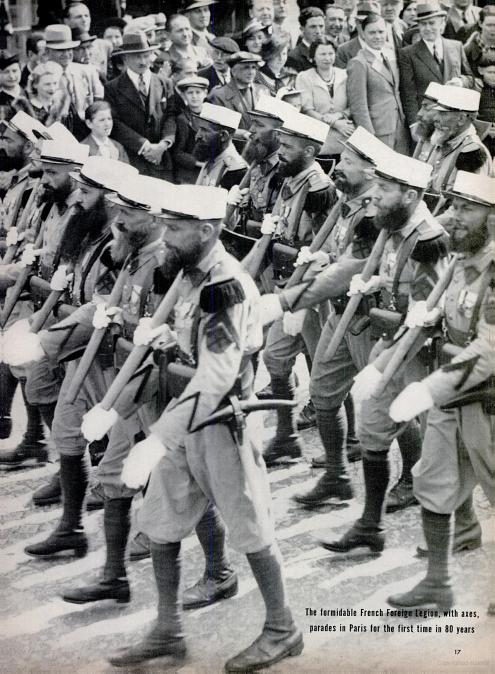
FFL 1939: Life Magazine
.
The novel does introduce the two American hoboes, Hank and Buddy, serving in the Legion. Wren kills off Michael and Digby Geste in this first novel putting the load on John.
In the second novel of the trilogy, Beau Sabreur (The good sword or swordsman) John returns to Africa to try to locate Hank and Buddy who were lost in the drifting sands after saving his life.
In this manner Wren introduces the American family of which Hank is a member. Hank and his friend Buddy were the two men lost in the desert that John Geste is seeking. Both men lying in the desert near death in different locations were rescued by the Bedouins. As luck would have it Hank managed to work his way up to Sheik acquiring Buddy as his vizier. They introduce superior Western discipline and tactics into their tribe giving them dominance in the desert. Hank then comes to the attention of the French as the new Mahdi. De Beaujolais is sent to coopt the new Mahdi. Through a series of adventures De Beaujolais meets and falls in love with Hank’s sister Mary who is traveling with her other brother Otis Vanbrugh. They as well as Hank are fleeing from a brutish father.
At stories end the whole cast Henri De Beaujolais who had wed Mary, Otis, Hank, Buddy, John Geste and his wife Isobel, who plays a large part, are back at the ranch in Texas facing the old brute of a father down while trying to free Hank’s other sister from thralldom to the old brute so she can marry Buddy and begin a life of her own. Hold on, now, Wren must have been studying Burroughs because he’s got a number of twists up his sleeve, or perhaps, tricks.
While Otis was in Algeria an Arab dancing girl had fallen in love with him who was apparently the queen of the desert. Otis tried to escape her but in exchange for help in recovering John from the penal battalion of the FFL he promised to marry her. Aw shucks, that’s right, you guessed it. Nakhla was in reality his sister. The old brute had fathered her on another dancing girl when he was out making deals in the desert. So we have Nakhla, the same name as the heroine of Burroughs’ The Lad And The Lion, pretty much following the plot line of The Girl From Farris’s. So maybe Wren should also be included in the Farmerian Wold Newton Universe.
So that is the broad overview of the story line that holds the three volumes together. Before I go on to the individula reviews there is one other problem I wrestle with that I would like to to discuss and that is the
Western fascination with primitive life styles.
For a convenient starting point we’ll use H. Rider Haggard, no, cancel that. I’ll go back a little further to the French Wold Newton. I’m reading the Paul Feval Black Coats series and they have some earlier antecedents. Balzac, Dumas, Eugene Sue and Feval all deal with organized crime groups. A Dumas title that I haven’t been able to get is titled The Mohicans Of Paris while Feval makes several reference to crime organizations adopting a sort of ‘red indian’ mentality. What Dumas called Mohicans evolved into the Apaches of late nineteenth century Paris. Anyone who watched TV in the fifties is familiar with French Apache dancing.
Thus while the French were becoming fascinated with the North American Indians and their primitive mentality Haggard was celebrating the primitive African mentality. And then along comes Ouida, Verne, Hichens, Burroughs, Hull and Wren celebrating the ‘free and wild’ life of the desert.
As of the beginning of the nineteenth century, if not before, the Euroamericans evolved into the Scientific Consciousness leaving the rest of the world behind in the mythopoeic or Religious Consciousness. However the transition from one consciousness to the other is not a clean break. Haggard, for instance, never really made the transition while Burroughs did. That may be why Burroughs reads as modern if a trifle old fashioned while Haggard is purely of an anterior psychology- good but just a little stodgy.
Thus, as the White Man spread over the globe, the, what I shall I call it, White Man’s Burden, White Man’s novel appeared. A whole genre of either stated or implied White superiority appeared of which Haggard and Burroughs are the most promient. From these writers the genre went on to the Sheena, Queen Of The Jungle stuff to imitative White Jungle god stories. Conrad sang the colonial era in lyric tones. Kipling told of the Raj of India while inventing the White Man’s Burden which was very real.
Ouida is usually credited with the first FFL novel, Under Two Flags, while Burroughs contributed The Return of Tarzan in which Tarzan goes to Algeria as a French secret agent although not as FFL.
In 1924 P.C. Wren wrought the glamor of the French Foreign Legion with the first novel of his trilogy, Beau Geste, followed by Beau Sabreur and Beau Ideal. These novels are also scientific demonstrating the superiority of Euroamerican intelligence over the mythopoeic mentality of the desert tribes. Merely by introducing European military discipline into the tribe Hank and Buddy enable the tribe to defeat all others and dominate the desert. This while Abd El Krim and the Riff dominated Western news instilling admiration for the primitive desert tribes over Western Civilization. I had a tearcher in high school who would get sexually aroused just talking about El Krim.
Thus while the transition from mythopoeic and scientific thinking was not complete if even half evolved the West was presented with various mythopoeic cultures that drew them back from the transition to the Scientific Consciousness. At present, then, the West has a split personality in which they admire the Negro and Arab mentality so much that they denigrate their own scientific side. It doesn’t seem likely that Euroamericans in sufficient numbers will make the transition to Scientific Consciousness quickly enough to preserve Western civilization hence the present bizarre worship of primitive races in North America and Europe. On the other hand the rest of the world seeks to imitate the West in matters that they cannot understand or sustain on their own. If the West is in trouble imagine the actual psychological state of things in China and India.
Now it is time to move on the first of the reviews- Beau Geste.
Edgar Rice Burroughs On Mars
A Review
Thuvia, Maid Of Mars
Part III-A
What We Have Here Is Change
by
R.E. Prindle
In the recent American presidential campaign in the US the winner won by promising the inevitable, Change. A very safe promise as the history of the world is one of change. Indeed, the life of the individual is one of unending change from the cradle to the grave. Change is now and forever. The question is, what response is made to the changes.
The times of Edgar Rice Burroughs were a period of the most earth shaking and rapid of all. At the same time most perilous, as the evolution of actual scientific knowledge in all fields was in its infancy and subject to misinterpretation. One might say in Burroughsian imagery that a series of doors stood before mankind, entering the right door would be more beneficial than the wrong doors.
Burroughs and others made tantative moves for the right door but others entered by the wrong door drawing most others through with them. What looked like progress turned into a regression. To shut up criticism the regressives began to demonize all those of different opinions. Burroughs was among those.
Some say he adapted poorly to the flood of change but the peole who do so are so confident in their opinions that to disagree with them is to be accused of being not only wrong but either criminal or insane. One doesn’t take their opinions too seriously as change will certainly demonstrate their opinions as ludicrous if it hasn’t already. Nevertheless as they are quite vocal in their condemnation of Edgar Rice Burroughs we have to consider the accuracy of their accusations as well as that of their own viewpoint. How well do they understand the issues?
ERB has some interesting observations on the changes occurring in the history, society and racial matters of his times as well as the concealed role of hypnotism in the transformation of that society. The basis of hypnotism is suggestion. As ERB say in Thuvia all is based on suggestion and counter-suggestion. If one conciders life and learning from that angle it presents some interesting possibilites.
What is learning? What is suggestion?
When the child is conceived he must of necessity have a mind with a blank slate. Freud, Jung and many others seem to seriously believe that newborns can inherit ancestral memories even though there is no one beyond the womb who has ever recalled any.
In fact without experience or learning that has has been introjected into the mind there is nothing for the mind to consider, hence no cogitation at all. This mind can only begin to form with the ejection from the womb. This occurs with a brain still in the process of formation. The development of the brain can only be considered completed shortly after puberty.
It seems obvious then that you can’t get out of a mind what isn’t in it. It behooves society then to begin loading the mind of a child as soon as the child is capable of handling education. The education of the mind must be built step by step to provide a firm foundation for the intellectual superstructure. Whatever is in the mind must come from or be suggested from outside the mind. There is no internal system of knowledge. Thus all knowledge is suggested to the child’s mind by his caretakers. They may be good or bad, well or ill intentioned. The brain is organized to receive suggestions or, in another word, experience. The reactive structure may already be in place dut to experiences in the womb and the actual birthing process but the actual learning process begins the moment the newborn emerges from the womb and receives a slap on the bottom to get his lungs started.
Thus the mind of the child is extremely malleable during the time until about puberty and shortly thereafter. If education is neglected during this early period and shortly thereafter it is unlikely that the adult can ever make up the lack. For instance if the basics or reading, writing and arithmetic are not loaded into the brain during this malleable period it is very rare that the skills can be acquired at a later time.
Thus, as it was always known that the child is father to the man various doctrinaire organizations such as the Jesuits believed that if they could form the education of the child or, in another word, indoctrinte him, they could shape the future in their own image. In Burroughs’ time the mechanisms of education were more fully understood. Various schemes were proposed to revise educational methods many of which were just odd or crude, but the better thought to change the direction of society toward a higher ideal.
The Communists were well are at the time that suggestion was the basis of education. Lothrop Stoddard writing in his The Revolt Against Civilization of 1922 quotes Eden and Cedar Paul from their book Proletcult of 1921:
“There is no such thing as “scientific” economics or sociology. For these reasons…there should be organized and spread abroad a new kind of education, “Proletcult.” Thus…in a fighting culture aimed at the overthrow of capitalism and at the replacement of democratic culture and bourgeois ideology by ergatocratic culture and proletarian ideology…” The authors warmly endorse the Soviet government’s prostitution of education and all other forms of intellectual activity to Communist propaganda, for we are told that the “new education” is inspired by the “new psychology”, which “provides the philosophical justification of Bolshevism and supplies a theoretical guide for our efforts in the field of proletarian culture…. Education is suggestion. The recognition that suggestion is auto suggestion, and that auto suggestion is the means whereby imagination controls the subconscious self, will enable us to make a right use of the most potent force which has become available to the members of the human herd since the invention of articulate speech.
I’m sure you can find appropriate application of the doctrine since Stoddard wrote in education, movies, TV, books and phonograph records and CDs. While I would disagree with the Pauls’ notion of suggestion and auto suggestion the Freudian influence is quite clear. This would be abetted by John Dewey’s notions on education that deemphasized the educational foundation while directing it more toward ideological considerations, or ‘relatively unstructured, free, student-directed progressive education.’
God only knows what free, progressive education is but this sort of social engineering was the wrong turn being taken in this era of rapid change.
So, loading the brain to deal with life’s exigencies is of necessity a slow process. As the brain continues to develop outside the womb there is plenty of room for malfunction. As man is incapable of creating anything original the education of the child may be compared to the loading of a computer. First the operating system. Whether consciously or unconsciously since all man knows is his own brain he has replicated it in his machine. A computer functions just like a brain, which should astound no one, as man can only devise what he already knows.
Now, human experience dates back about a hundred thousand years. I intentionally leave out the African development as it had nothing to do with the education of mankind. The African contribution is nil. Education began outside Africa. Having painfully and laboriously accumulated the huge fund of knowledge it must be entered into the brain of the new being. This sort of suggestion is called education. There’s not much room for anything called ‘free’ or ‘progressive.’ Getting it ain’t going to be free, the child has to work like a mule. This is a slow, laborious process as extensive foundations must be laid down before any superstructure can rise. Thus years are consumed just to teach the child reading, writing and arithmetic. With these three tools he can learn anything else. Inexplicably this fact seems to have been lost sight of in today’s educational theories unless of course the Pauls’ dictum is being followed.
Once the foundation has been laid, a form of suggestion and actually hypnosis, the child, now a student, must be taught how to manage and interpret what he learns at an increasingly rapid pace. Unfortunately there will be children left behind; any other expectation is fatuous, some are just brighter than others. Managing and interpreting comes from within the experience of the organism. Here’s the real problem because the same data will by analyzed differently and produce different results and opinions.
Along with learning factual matters the child must at the same time develop emotionally and psychologically. Nasty work. This is a difficult part. As the child has little ability to understand and even less ability to accurately analyze it he has to reason from faulty premisses. This ignorance of reality is what forms Freud’s notion of the unconscious or Id. Correcting this unconscious to consciousness is the conversion of Freud’s Id to Ego. A child misinterprets suggestions. Some become fixated in his un- or subconscious. The fixations are what distort consciousness from the subconscious interfering with the integration of the subconscious and the conscious. While the child is made more conscious in his ability to understand and reject harmful suggestions these fixations like post-hypnotic suggestions control his responses. The fixations must be exorcised which is the intended function of the psychoanalysis of Freud and Jung.
Once again, suggestion is everything outside your mind. Your mind cannot function without these suggestions because there will be nothing in the mind to function. Be carefull of what you put into your mind or, at least, that you do put something of value into it. Whether ERB realized this or not, his ideas of hypnosis and suggestion indicate he might have, he pursued a program of continuing education all his adult life. At the time of writing Thuvia he was working through Edward Gibbons’ Decline And Fall Of The Roman Empire, a vast minefield of amazing and truly educational suggestion.
Part B follows.
Thuvia, Maid Of Mars by Edgar Rice Burroughs: A Review
March 14, 2009
Edgar Rice Burroughs On Mars
A Review
Thuvia, Maid Of Mars
by
Edgar Rice Burroughs
Part I
Review by R.E. Prindle
This very interesting sdtory was written shortly after ERB returned to Chicago from his first San Diego excursion. It was placed between the Girl From Fariss’s, the last story written in San Diego and The Cave Man.
The material deals almost exclusively with suggestion and hypnosis. Although hypnosis is a recurring theme in Burroughs one is startled by his concentration on the subject and his seemingly informed ideas of it, especially the role of suggestion.
One wonders why his interest surfaced at this time and where ERB learned or developed this information. He was just back from San Diego and I’m going to suggest he picked it up from his hero, L. Frank Baum. As Baum was such a significant influence on Edgar Rice Burroughs perhaps it may be worthwhile to attempt an assessment on Baum’s role in literature and history. There can be no question but that the OZ series of Baum took a central place in the American psyche and a place in the European psyche. Baum’s books have been in demand since 1900 when he began writing them to the present. Baum put Kansas on the map. The Wizard, Dorothy and Toto are household names. Baum’s play from the Wizard was a box office success while MGM’s movie is certainly in the top ten of influential movies, perhaps even in a tie for first with Gone With The Wind. Even American Negroes made their own Black version called The Wiz. The list goes on.
I’m going to suggest that Fritz Lang, the movie Director, was highly influenced by Baum as reflected in his important film, The Testament Of Dr. Mabuse. I wouldn’t be surprised if Lang was also very familiar with Burroughs.
Baum himself was a committed Theosophist. Introduced to the religion by his mother-in-law Baum picked up his card in 1893. By 1913 when he met Burroughs he had been a practicing member for twenty years. When he left Chicago he first went to Coronado across the Bay from San Diego. Katherine Tingley had established her Theosophical organization on Point Loma near that city. Baum must have been an important member of that congregation. Perhaps he had a falling out with Tingley but he did remove himself to Hollywood in 1910. In Hollywood he undoubtedly connected with the Pasadena Theosophical Society that at present is the mother organization.
As a Theosophist Baum would have had to have been familiar with the works of Madame Helena Blavatsky. Her great works are Isis Unveiled and The Secrect Doctrine. Theosophy of course is on a par with the Semitic religions of Judaism and Christianity. While Madame B is often referred to as nonsense she is in fact very learned in the ancient religious doctrines of the human mind that went to form all Middle Eastern religious expressions. Hence while Madame B’s works are metaphysical in nature they are no less relevant to the development of the human intellect than say, St. Augustine or others of the metaphysical ilk.
Madame B had some strong opinions on hypnotism. Hypnotism had come to the fore of Euroamerican consciousness in the years preceding the French Revolution through the efforts of Dr. Franz Mesmer. Though discredited as as a charlatan he was dealing with the real thing as subsequent history shows. He originally called hypnotism Animal Magnetism. That was changed to Mesmerism and then to Hypnotism. As far as possible influences on Burroughs it will be remembered that Edgar Allan Poe wrote Mesmeric Revelation in 1844 and The Facts In The Case Of M. Valdemar in 1845. There are clear indications that ERB was familiar with the Valdemar story.
Now, the essence of hypnotism is the suggestion. Suggestion is perhaps the most important intellectual or psychological phenomenon. Suggestion isperhaps the basis of intellect, intelligence and psychology. C.G. Jung in his investigations of symbols was dealing with the nature of universal suggestion from nature. Freud early learned to separate suggestion from the hypnotic trance. Artfully used suggestion obviates the need for trancelike states. Thus people don’t understand that and how they are hypnotized by movies and TV.
The art of successful literature is merely to suggest scenes and situations and have the reader visualize them in his own mind. Once accepted the suggestion becomes part of the intellect of the reader. He may be able to reject it later but that is a separate volitional act. The great writers realize this. Freud understood perfectly, while Baum developed the art of the concrete image to a remarkable degree. His works are a series of remarkable images. If Freud had had Baum’s skill, and he wasn’t far short, he would have been even more effective than he has been.
The prescient Fritz Lang picked up on Freud, Baum and hypnotism in his remarkable Dr. Mabuse series of movies. The first story, Dr. Mabuse The Gambler of 1922, concerns a Freudlike megalomaniac named Dr. Mabuse. Freud’s activities during the Great War and after would be known to the cognoscenti. It would be foolish to think that Adolf Hitler and other Volkish leaders wouldn’t have been aware of what Freud was up to. Mabuse is into all kinds of criminal activities to undermine society and the State, as was Freud. He is also a master hypnotist as was Freud. In a scene reminiscent of the scene in Thuvia where Jav says ‘You want to see them? Then, look.’ The scene of ancient bustling Lothar then appears to Carthoris and Thuvia’s wondering hypnotized eyes. As well as mine, certainly. I had no trouble seeing what Burroughs wanted me to see. So Dr. Mabuse in his role of stage hypnotizer, the man wore many hats, makes a parade appear before the wondering eyes of his audience. It can be done. I saw a man make Diamond Head disappear before the whole world on TV. Pretty amazing.
At the end of the movie Mabuse is captured and conveniently tucked away in an insane asylum. He goes catatonic until 1930 or so when Lang made the sequel The Testament Of Dr. Mabuse. The Dr. emerging from his catatonic state makes signs that he wants pen and paper which the head of the asylum, one Dr. Baum, provides.
Mabuse then turns out page after endless page of instructions to destroy civilization not unlike what Herr Dr. Freud was doing from his study in Vienna. The writing had an hypnotic effect on Dr. Baum who executes the plans of the cell bound Dr. Mabuse.
The use of the name Baum could be a coincidence but Dr. Baum like the Wizard Of Oz is an unseen superior. He issues orders but is otherwise an unknown to those he directs. In issuing his orders we are led to believe that he sits behind a curtain unseen while giving his directions. Then, just as Dorothy did, the hero dares to pull back the curtain and he finds…a phonograph player. Unlike Dorothy who finds a tubby timid little imposter, there is no one there. Surely this is a parody of Dorothy’s famous scene which makes the name Dr. Baum less of a coincidence.
So it would seem that L. Frank Baum’s influence extended to Germany and an originator of film noir. Not so unlike as Baum’s stories are much darker than they might appear at first reading. At any rate his literary images make long remembered illusions of reality not unlike that of Dr. Baum while being of a suggestive hypnotic nature. I can still visualize Dorothy pulling the curtain back exposing the mild mannered Big Brother sixty years after. I can remember the image I formed.
So, my suggestion is that L. Frank Baum was the direct inspiration for Thuvia of Mars. As noted ERB was probably familiar with Poe’s stories of hypnotism while I am certain that he had read George Du Maurier’s Trilby concerning the hypnotist Svengali and probably also Du Maurier’s other two novels, Peter Ibbetson, and The Martian both related to unusual psychological states. Len Carter believes that ERB read William Morris who also uses some hypnotic themes in his fantasy novels. Lew Sweetser, ERB’s mentor in Idaho via Yale, might also have given him some information on hypnotism while ERB was still a boy. Plus I’m sure hypnotism was a hot topic of popular discussions.
ERB’s emphasis on suggestion as the operative means of hypnotism points to some more direct instruction. Most think that ERB first met Baum in 1916 which means the two formed a fast friendship immediately. I think it more likely that they met in 1913 renewing the acquanitance in 1916. Whether Baum had read any of Burroughs’ stories in 1913 which seems would be paying pretty close atention to literary trends in pulp magazines he may have heard of Tarzan. Probably aware of this ERB may have brought along a magazine or two to show Baum. If Baum then read the proffered stories he certainly would have seen his influence in the Mars stories if ERB didn’t actually point them out to him hoping for the Zeusian nod of approval from the master.
Probably flattered Baum would have encouraed the relationship. Assuming that to be true the two men having similar interests would certainly engage in conversations on Theosophy, hypnotism, writing techniques and whatever.
Certainly Burroughs writing style which while always colorful was a little heavy on the narrative side seems to open up to a more allusive suggestive style blossoming significantly in 1915’s Tarzan And The Jewels of Opar.
I can’t find a more immediate source for ERB’s sudden interest in hypnotism. But, on to the story.
Tarzan Over Africa
February 23, 2009
Tarzan Over Africa
The Psychological Roots Of Tarzan In The Western Psyche
by
R.E. Prindle
As the strong man exhibits in his physical ability, delighting in such exercises as call the muscles into action, so glories the analyst in that moral activity which disentagles. He derives pleasure from even the most trivial occupations bringing his intellect into play. He is fond of enigmas, conundrums, hieroglypics; exhibiting in his solutions of each a degree of acumen which appears to the ordinary apprehension as praeternatural. His results brought about by the very soul and essence of method, have in truth, the whole air of intuition.
Edgar Allen Poe- The Murders In The Rue Morgue
…he dreams of the sight
of Zulu impis
breaking on the foe
like surf upon the rocks
and his heart rises in rebellion
against the strict limits
of civilized life.
H. Rider Haggard- Allan Quatermain
Yes! I noticed this dichotomy in the Western soul myself at least two thirds of a lifetime ago. I was always puzzled by it. Why in the midst of plenty and seeming perfection should the Western psyche be so discontented with its lot.
Well, time has passed. Two thirds of a lifetime in fact. After much mental lucubration and travail I now find myself in a position not only to understand it myself but to be able, perhaps, to make it clear to others; perhaps hopefully to you who are looking at this screen.
The problem began we are told, by people who ought to know, about one hundred fifty thousand years ago when our species, Homo Sapiens, evolved from its predecessor hominid, which has never been traced being the famous Missing Link, to begin its odyssey through time and space.
We are told that Homo Sapiens originated in Africa and that Black Africans, or what Tarzan would call savages, were the first Homo Sapiens. We are told, once again, that White people mutated from this original Black stock. This may or may not be so. I am in no position to affirm or deny the fact myself but, if so, there was a qualitative difference as well as a quantitative difference that then occurred. In fact, if one were to judge solely from appearances two sub-species of Homo Sapiens came into existence when the White evolved from the Black. This qualitative difference between the sub-species or what we have been taught to consider races, was noticed by all the early explorers with differing interpretations.
As the English novelist, H. Rider Haggard, who as a man of considerable experience and acumen, put it:
I say that as the savage is, so is the white man, only this latter is more inventive, and possesses a faculty of combination…
Rider Haggard was quite right, both sub-species evolved from the same stock, both had the same emotional makeup, but what Haggard dismisses as only ‘more inventive’ and ‘a faculty of combination’ is precisely that which separates the White sub-species from the Black sub-species and makes it evolutionarily more advanced. In conventional terms invention and a faculty of combination is called the scientific method.
The scientific method is not to be dismissed lightly. It is a faculty of mind that is an evolutionary step in advance of the White sub-species’ evolutionary predecessor, the Black sub-species.
This may be a startling interpretation to you, however if one is to follow the scientific logic adduced by scientists of Evolution the facts follow as day follows night. They cannot be avoided nor can they be explained away. They must be dealt with head on, just as our Attorney General Eric Holder has stated.
The evolutionary step within the Homo Sapiens species is almost tentative to our White minds, not so clear cut as to separate, say, the Chimpanzee species from the Gorilla species. The transition is however in that direction.
In the nineteenth century the cleavage between the scientific mind and that of the savage or first Homo Sapiens mind was beginning to become felt in the Western psyche. A malaise of spirit was created which troubled the soul of Western man. The ‘strict limits’ of scientific civilization versus the seeming naturalness and open simplicity of the African became a dichotomy in the Western psyche.
Haggard was not the first to confront the problem but before I begin at the beginning with who I consider to be the first let me elucidate the problem further by another quote from Rider Haggard.
Ah! this civilization what does it all come to? Full forty years and more I spent among savages, and studied them and their ways, and now for several years I have lived here in England and in my own stupid manner have done my best to learn the ways of the children of light; and what do I find? A great gulf fixed? No, only a very little one, that a plain man’s thought may spring across.
Haggard was quite correct as far as he went. What he failed to understand, ‘in his own stupid way’, was that there was a small gulf over which civilized man thinks he could spring backward without difficulty but from the other side that small gulf appears a great chasm which the completed mind of the first Homo Sapiens can never find a way across.
Edgar Rice Burroughs who read Haggard and was also struck by this really important introductory chapter to ‘Allan Quatermain’ pondered the issue long and hard and resolved the issue in his own mind when he said that the savage mind could never grasp science while only one in a hundred of the White species could, with perhaps one in a thousand being able to advance science. ERB intuited what modern genetics would prove.
This dichotomy between the primitive and scientific mind does not become truly prominent until the mid-nineteenth century. It wasn’t observable to the naked eye before then and only begins to establish itself in literature with the apperance in 1841 of Edgar Allan Poe’s ‘Murders In The Rue Morgue.’
Poe created a whole new genre of literature, not only of the detective story, but of the conflict between what Freud would later identify in his system as the Unconscious and the Conscious mind. Prior to Poe reason, or the forebrain, was the sole approach to knowledge; after Poe awareness of the Unconscious element began its long rise until today it is dominant.
When dissatisfaction with Haggard’s strict limits of civilization began to forcibly intrude into White consciousness, causing the split identity, is not clear to me although it may well have been the introduction of the Age of Steam. Certainly by 1841 the intrusion of the steam railroad was going a long way to condition man’s mind to a rigid one way view of reality as laborers spun out the long steel ribbons along which the great unyielding iron locomotives ran.
The science of steam was unforgiving, with a low level of tolerance for human error, and making no allowance for individual idiosyncracies.
In the days of the great steamboat races on the Mississippi boiler pressure was controlled by a little governor. Greater speed could be attained if the governor was removed allowing boiler pressure to increase. Of course, the inevitable result was the explosion of the boiler and destruction of the steamboat and crew. Even knowing the scientific consequences of removing the governor operators time after time did it in hopes of defeating physics and winning the race.
Thus science seemed ‘unfair’ and the White man’s limited undeveloped understanding began to rebel.
When evolution gave man access to science he reached the limits of what human exertion alone could do. Thus the forebrain was frustrated, driving it back toward the brain stem and the Unconscious. A new scientific frontier was opened thereby- the study of the human mind.
Edgar Allan Poe grasped this significance expressing it in poetic language. ‘Murders In The Rue Morgue’ posits the problem in the form of C. Auguste Dupin who, while using rigorous scientific method is mistaken for being intuitive. The Conscious mind versus the Unconscious.
The Unconscious is always disreputable. It is there that little understood sexual urges and primitive egoistic rituals reside. It is there that the primitive man resides; the savage of Rider Haggard, the Negro of the present day. It is there that the Western psyche rebels, seeking to emerge triumphant over science and understanding. That is the little leap backwards that Rider Haggard saw. In academic writers of the nineteenth century it was called ‘the thin veneer of civilization.’
Thus the initials of C. Auguste Dupin spell CAD, or a slightly disreputable man. A man who thinks only of himself. If Poe doesn’t introduce the notion of the doppel ganger, he certainly defines the role and purpose. Dupin and the narrator are two halves of the same person. They are in fact one personality.
This notion would be further developed in Conan Doyle with his creation of Sherlock Holmes and his doppelganger, Dr. Watson. The notion would be brought to horrifying fruition in the classic tale of the split between the conscious and unconscious minds, Robert Louis Stevenson’s ‘Dr. Jekyll And Mr. Hyde.’
Poe’s narrator being of greater means than Dupin who is seedy and down at the heels rents an old dilapidated house in the Faubourg St. Germain which creaks as lustily as the House of Usher. The house is a symbol of psychological decay. The Faubourg St. Germain is itself a symbol of decay. Formerly the home of the pre-revolutionary elite, since the French Revolution it is the home of shattered fortunes.
The two men, who are inseparable, lock themselves up in this mansion by day with all the curtains drawn, sure sign of intense depression, going out only after dark into what the narrator calls the ‘real night’ as opposed to the night of the soul; the dark Freudian unconscious.
And then two women are murdered in mysterious circumstances. Using all his scientific method Dupin divines the murderer to be an Orang-outang, which was no small feat whether scientific or intuitive. Thus the highest mental powers were symbolically pitted against man’s animal nature.
Poe thus states the central problem of the Western psyche which is still unresolved at this time while still being discussed as much. While Rider Haggard was wrestling with the problem Conan Doyle was writing his Sherlock Holmes stories. Holmes like Dupin is a bit of a cad; not entirely an admirable person. He has placed himself above the law, being quite capable of executing summary judgment on one who might in his sole opinion escape the toils of the law. Holmes companion, Dr. Watson, is a sturdy unimaginative burgher who serves as the example of the unconscious to Holmes’ conscious but scientifically unfeeling mind.
Robert Louis Stevenson takes matters to an even more intense level at roughly the same time. Jekyll and Hyde are in fact one man. Jekyll is the example of what Freud would call the repressed man but one which society calls a disciplined and respectable man. He is in total control of himself but he suspects there is another side to his character which he would like to discover.
Unable to find access to this other side by psychological or rational means, he uses his scientific acumen to invent a potion which releases this demon, Mr. Hyde, concealed inside his unconscious. Hyde is a very destructive character and having been once released he proves impossible to put back in the bottle. He returns unsummoned. Eventually he suppresses Jekyll becoming the sole personality. The jump only works one way.
Thus Stevenson predicted the evolution of the twentieth century. This little cluster of writers bridging the nineteenth and twentieth centuries is very interesting.
In the intervening near fifty years between ‘Murders In The Rue Morge’ and ‘Dr. Jekyll And Mr. Hyde’ science had been revealing nature at a galloping pace placing even greater stress on the Western psyche. Central to the further deteriorization of the psyche was Charles Darwin’s ‘Origin Of Species’ which appeared in 1859 just on the eve of the exploration of Central Africa when the stressed scientific Western psyche confronted its dark unconscious in the form of the African Black man. Thus Africa became the Heart Of Darkness for the White man just as Hyde was the heart of darkness to Jekyll. That little gulf across which he thought he might leap appeared as a gigantic chasm.
The notion of evolution versus Biblical creation not only caused a tremendous social dislocation but the notion of evolution from a lower to a higher, from Ape to White man, placed the Black man or Negro in an intermediary state of development just as Burroughs would later depict the role of Tarzan Of The Apes.
Beginning c. 1860 with the expedition of Capt. Richard Francis Burton into the lake regions of Central Africa the problem began to take a concrete form.
What the White Man found in the interior of Africa startled him. For here the dichotomy between his unconscious and conscious was juxtaposed in reality between himself and the Black African. The Black African seemed to represent unchanged what man had been one hundred fifty thousand years before when he evolved from the hominid predecessor.
For Burton and Henry Morton Stanley who followed him as an explorer the superiority of the White was apparent. In the Negro they saw only the child of nature; men without alphabets, physics, chemistry, astronomy or intellectual attainments of any kind. The Negro was to be pitied, treated paternalistically as a little brother or as the Negro would later be known: The White Man’s Burden, Idi Amin notwithstanding.
The main period of exploration and discovery was ending when Rider Haggard began publishing his great African adventure trilogy from 1885 to 1888.
While Burton and Stanley felt an easy superiority over the Blacks, Rider Haggard took a more disquieted attitude. He was troubled when he noted that for all the White man’s scientific attainments there was no difference in the emotional development of the two sub-species.
And what did he find? A way forward? A great gulf fixed? No. ‘Only a little one, that a plain man’s thought might spring across. I say,’ he said, ‘that as the savage is, so is the white man, only the latter is more inventive, and possesses a faculty of combination…’
Well, indeed. But wasn’t Haggard undervaluing the quality of being more inventive and possessing a faculty of combination? Those two qualities, after all, comprise the scientific faculty which cannot be attained by effort but is evolutionarily ingrained. It is forever beyond the reach of the first Homo Sapiens. Haggard and all other writers recognized that this faculty is what the Africans lacked.
Consider then in one hundred fifty thousand years the Africas were so incurious that they had never observed the heavens. They had no astronomy! When the White split off probably one hundred thousand years ago this is the first science they established. Think about it.
Is this scientific faculty such a small thing? If, in fact, a White man of plain understanding can make the leap backward to a natural state can the Black or natural man leap the chasm to a scientific state of consciousness?
Darwin’s theory of evolution is based on natural selection, actually a form of eugenics, by which he believed new species were evolved. It would appear, however that evolution is caused by genetic mutations and when a species has mutated into the complete expression of itself evolution stops for that species which then becomes, as it were, a living fossil.
Rather than natural selection there is perhaps natural rejection. When a new sub-speices forms with its differences it is more likely that the predecessor recognizes the differences and ejects the new comer rather than the new species recognizing itself and banding together. Consider Tarzan among the apes.
When the White sub-species came into existence perhaps one hundred thousand years ago it is more than probable that the sub-species was rejected by its Black predecessors and forcibly ejected from sub-Saharan Africa.
Thus in the two closest known predecessors of Homo Sapiens, the Great Mountain Ape and the Chimpanzee both species are completed and now await extinction as they are unable to compete with their successor hominids.
Scientists tell us, I have no way of disputing their conclusion only interpreting them, that Homo Sapiens evolved from a predecessor about a hundred fifty thousand years ago. They further tell us that the first Homo Sapiens was the Negro sub-species.
The predecessor, who has disappeared without a trace, unless he is the Bushman, was a completed species; he was incapable of further evolution himself but from him the Negro sub-species of Homo Sapiens evolved.
Now comes the hard part to accept. Science is science; one must either follow its facts or abandon the pretence of being scientific man.
As the first Homo Sapiens was the Negro sub-species, is the Negro sub-species complete as an example of evolutionary development? If the Negro was the first Homo Sapiens then the White sub-species must be evolved from the Negro and as nature is ever groping toward higher intelligence the White must be an intellectual improvement on its Black predecessor. The apparent facts indicate this.
Evolution appears to be always toward a form of higher intelligence. Thus the qualities of combination and inventiveness may be completely beyond the reach of the Black sub-species. The Black may stand in relation to the White as the Great Mountain Ape stands to the Chimp.
Further, if one assumes, as one must, that evolution has not stopped either with the development of Homo Sapiens or its sub-species the White man, then the White man must carry the genetic makeup for the mutation to the next step of evolution. As only fifty thousand years intervened between the evolution of the first Homo Sapiens and its White successor than the next evolutionary sub-species or species may already be among us. This is what H.G. Wells novel The Food Of The Gods is about. Apparently the evolutionary bud, like a swelling on a tree, may only blossom once and then the sub-species or species is incapable of budding again becoming fixed in form
The question then arises will the next step be to a new species that will make Homo Sapiens a completely inferior species such as now exists between Homo Sapiens and the Chimpanzee or a new sub-species that will merely increase the distance between it and the first sub-species.
If the new mutation increases its intellectual capabilities will it also be able to evolve a new emotional organization that will separate it from Homo Sapiens and its animal nature completely? Or is it possible that the dichotomy between the two under which Western man suffers will increase involving some sort of evolutionary insanity or suicide?
Well, as the nineteenth century drew to a close vitamins hadn’t even been discovered let alone genetics so people muddled along in a dissatisified condition.
The unconscious aspects of man began to predominate over the conscious as Western man confronted with his natural state in Africa began to slip back across the little gulf in admiration of the seeming ‘natural ‘ state of the ‘noble savage.’ This slip backward was aided and abetted by Sigmund Freud’s vision of the unconscious.
Late in the century Thomas Alva Edison invented the movie camiera. This invention was to have a major effect on the rise of the Unconscious or retrogression to the primitive as the dominating factor in the Western psyche. At approximately the same time as the film industry was becoming important Sigmund Freud published his seminal work: The Interpretation Of Dreams. Thus a scientific vocabulary began to come into existence by which the workings of the mind could be analyzed and discussed. the Unconscious became an established entity.
Now, writing is work of the forebrain or in other words, a scientific pursuit, while movie making is a function of the Unconscious. A good story is more important in writing while subliminal drives are the stuff of movies. It is only required that movies make emotional but not rational sense. They follow a different logic.
Edgar Rice Burroughs was to be confused by this difference when he tried to translate his books to the screen. While the early Tarzan films were not unsuccessful they were not all that satisfying; it was not until MGM invented the Tarzan of primal desires impersonated by Johnny Weismuller that the movie Tarzan became potent. However in that guise Tarzan was entirely another creation. His being had become independent of ERB’s mind.
One movie is capable of finding more viewers than a thousand books can find readers. Thus the subconscious began to dominate over the conscious Tarzan.
I am of the opinion that Freud was already aware of the effect of the emergence of the Unconscious as a formative factor in society before he codified the phenomenon in scientific language. After all Freud was subject to the same influences as Poe, Haggard, Doyle, Stevenson and Burroughs.
Freud himself came from an earlier school which delighted in the unrestrained indulgence of the unconscious or passions. In English terms the attitude took form as the Hell Fire Club to which the American Benjamin Franklin belonged. Its motto was: Do What Thou Wilt. Its bible on the continent was ‘Gargantua and Pantagruel’ by Rabelais, while in Jewish circles the credo had been established by Jacob Frank and his descendants. Frank’s position was that man will never be good until he commits evil to his heart’s content. Freud being Jewish was of this school.
These groups of people were quite extreme. Their credo was startlingly expressed in the eighteenth century by Tobias Smollet when his hero, Roderick Random, is introduced into a woman’s home who wrote the following:
Thus have I sent the simple king to hell
Without or coffin, shroud or passing bell.
To me what are divine or human laws?
I court no sanction but my own applause!
Rapes, robb’ries, treasons, yield my soul delight;
And human carnage gratifies my sight;
I drag the parent by the hoary hair,
And toss the sprawling infant on my spear,
While the fond mother’s cries regale my ear.
I fight, I vanquish, murder friends and foes;
Nor dare the Immortal gods my rage oppose.
The above pretty much defines Freud’s intent in his psychology. So long as such sentiments were consciously expressed in print they horrified a rational thinker while remaining strictly an underground movement. But now Freud combined the attitude with the malaise of soul which had been called into existence by the dichotomy of the scientific and unconscious minds.
Freud reduced the mind, including the Unconscious, into scientific terms by which such Rabelaisan attitudes could be discussed and disseminated into polite society as scientific thought rather than eccentric opinion.
Freud despised what he called the morality of the day or in other words, Christian morality. He determined that the main cause of mental illness was the repression of disorderly or anti-social desires. He glorified these base desires as the Ego and proclaimed that where the Unconscious was Ego shall be. This is another way of saying: Do What Thou Wilt.
Thus in the decades following Freud the whole notion of self control and a disciplined mind fell into disrepute as Western man began to revel in his most criminal desires; for the Unconscious which always disregards the rights of others is alway criminal.
So it was that the terrible figure of Dracula who began his rise in the 1890s became the dominant psychological projection of the twentieth century. Dracula is the Unconscious incarnate. Completely despising the rights of others, even their right to life; he sucks anyone’s life blood so that he alone may live.
Like Dupin and the narrator of ‘Murders In The Rue Morgue’ Dracula only comes out in the ‘real night’. In fact, one ray of the sun, in other words, consciousness, will turn him to dust. Light is anathema to him; he must shun the day.
Alongside Dracula the cult of the Phantom Of The Opera has grown into huge proportions being disseminated to polite society by Andrew Lloyd Weber’s opera of the same name.
Talk about conscious and unconscious, the Phantom lives in a sewer, the very home of the Unconscious, where he has installed a huge organ on which he plays the most glorious conscious creations of Johann Sebastian Bach.
Deformed in soul, the deformation has been extended to his exterior in the form of a burned face which he covers with a mask just as one masks one’s interior motives from others. Attracted to the higher things from the depths of his sewer he haunts an opera house directly above where, spying from secret passages, he falls in love with the beautiful opera singer who, initially repulsed by the soul shown on his face gradually succumbs to the lure of the unconscious.
Edgar Rice Burroughs was born into this strange social milieu, as we know, in 1875. Seemingly failing in every thing he did, he had scant prospects in life until at the age of 37 in 1912 his education jelled into the creation of his life, Tarzan the Magnificent.
Tarzan is extraordinary in that he runs counter to the other expressions of the Western malaise. Tarzan is whole and entire. In Freudian terms, where Unconscious was, now Ego reigned and it was good Ego, not the criminal model of Freud.
As Tarzan was, so must have been Burroughs, although I have no idea how he achieved this. It appears, nevertheless, to be true. In fact, whatever Burroughs read or was thinking about he seems to have resolved in Tarzan the mental dilemma which was first formulated by Poe. Further, he acknlowledges Poe’s influence.
We know that Burroughs read and revered the African adventure novels of Rider Haggard. It can be stated certainly that he read the African explorers Capt. Richard Burton and Henry Morton Stanley. Whether he read the other seekers of the source of the Nile, Speke and Baker, I don’t know, as I cannot so state with certainty. It is not impossible that Baker’s wife was a model for Jane.
It is certain nevertheless that the great age of African exploration thrilled him while occupying a prominent place in his daily thoughts.
Being scientifically inclined, he applied his reading in evolution, exploration, geology, psychology and other subjects to the formation of his great creation, Tarzan. As he says, he wrote to amuse and entertain (read: make money) so that he expressed the results of his deepest study in seemingly frivolous tales. Then, while he captured the imagination of the reading public, he offended the critics of ‘serious’ literature who refused to take him seriously. He even found it difficult to find a book publisher even though he was a proven popular success.
Yet he pondered deeply the dilemma propounded by Poe while apparently puzzling out the deeper meaning of Haggard’s introductory chapter to ‘Allan Quatermain.’ Stevenson’s Jekyll and Hyde filled his thoughts.
There is little doubt that Haggard’s hero, Sir Henry Curtis, is a progenitor of Tarzan. One can see Tarzan in the great White English warrior standing tall in a sea of Black soldiers. Sir Henry Curtis leads the Black Kukuana into battle against their foes. The first Big Bwana had come into existence.
Burroughs wants his hero Tarzan to be born in Africa so in 1888 the year ‘Allan Quatermain’ was published and Sir Henry Curtis sealed himself in his valley high in the Mountains Of The Moon, Lord Greystoke and his wife, the Lady Alice Greystoke are abandoned on the West Coast of Africa where, as we know, they both lost their lives but not before Lady Alice gave birth to a son who was then adopted by the great she ape, Kala.
In The Return Of Tarzan the putative successor to Lord John Greystoke is voyaging through the Suez Canal around Africa in his yacht, the Lady Alice, when he is shipwrecked near the exact spot where his father and mother built their tree house in Africa.
To understand fully this sequence in Burroughs’ imagination one has to examine the other source for his creation, Tarzan- Henry Morton Stanley.
There can be no question that before Burroughs wrote Tarzan he had read if not studied the books of H.M. Stanley. And, why not? Stanley’s most important titles are: How I Found Livingstone In Central Africa, Through The Dark Continent and In Darkest Africa.
‘Through The Dark Continent’ is one of the great adventure stories of all time. The conscious living out of Stanley’s unconscious needs and desires is remarkable reading.
One might think that Burroughs’ yacht ‘Lady Alice’ was named after Clayton’s mother, Lady Alice Greystoke. Not so. Burroughs is full of subtle jokes and elaborate circumlocutions. If not Clayton’s mother then how did Burroughs come up with the name ‘Lady Alice’ for the yacht? Well, if you read Stanley’s ‘Through The Dark Continent’ you will find that he carried for thousands of miles through Africa a boat in sections that could be broken down and rebuilt. With this boat Stanley circumnavigated Lake Victoria as well as Lake Tanganyika, then sailed the boat down the entire length of the mighty Congo River. That boat was named the Lady Alice. Thus Tarzan like Stanley was carried by the Lady Alice. That’s a very subtle joke, Son. Stanley himself had named the boat after his Cincinnati fiancee, Alice. During his sail down the Congo she ditched him for another man. In weird synchronicity Stanley ditched the Lady Alice on a bluff overlooking the Atlantic nearly at the end of his journey. What a true coincidence.
As an aside, the psychology of it is very interesting. Psychologically a vessel represents a woman. the Holy Grail which is a chalice represents woman while the blood it contains represents man. Thus you have the man, Stanley in the boat, woman. Stanley’s mother abandoned him as a child. He saw her only once thereafter. Thus, his mother, the most important woman in any man’s life abandoned him. In the Lady Alice, Stanley was obviously carried once again by his mother although I don’t know if her name was Alice also. He then abandoned his boat the Lady Alice.
Stanley didn’t follow the Congo to the sea as is popularly believed but abandoned the river after traversing an incredible series of rapids when he came to an identified rapids at Stanley Pool where, completely exhausted and having reached an explored point, he considered his job done. He had the Lady Alice carried to a hill top where he left it to the elements. Now, in Burroughs mind he may have landed the Lady Alice at the approximate place he thought Stanley had abandoned his Lady Alice. So, Tarzan’s house may have been intended to be on the coast directly below the Lady Alice. That would also make the location in Gabon. In that sense Tarzan was the successor of H.M. Stanley.
One may therefore assume that the Greystokes were put ashore near the mouth of the Congo where the fictional yacht Lady Alice ws shipwrecked within sight, as it were, of the real Lady Alice. That’s how the mind of Edgar Rice Burroughs worked.
On his way from England on the Emin Relief Expedition which forms the content of ‘In Darkest Africa’ just like Lord Greystoke Stanley sailed from England through the Suez to Zanzibar where he collected his porters, sailed with them to Capetown and from thence to the mouth of the Congo. Then Stanley began his incredible journey up the Congo across Africa from West to East into the Northern lake regions where on this trip he located and identified the fabled and thought mythical, snow capped on the equator, Mountains Of The Moon.
Anyone who doesn’t admire Henry Morton Stanley has the heart of a dullard. What a man! What terrific incredible adventures. I’d rather read about them than live them myself but what a story. So thought Edgar Rice Burroughs who never tried to live such adventures either.
Very important to Tarzan is Stanley’s dealings with the various African tribes. Stanley is virtually a single White man leading a faithful band of Negroes just like Tarzan and his faithful Waziri.
Africa was virtually Stanley’s province as it was for Tarzan. Tarzan’s reputation was far famed throughout Africa or at least the areas of Africa through which Stanley traveled. Tarzan doesn’t have much to do with South Africa which has no association with Stanley although Tarzan does travel in North Africa of which Samuel Baker wrote.
Stanley, whose three major expeditions covered a period of about fifteen years must also have become legendary amongst the Blacks. The exploration of Lakes Victoria and Tanganyika coupled with the journey down the Congo must have been the subject of astonished conversation in every village in Central Africa. The more so because Stanley was on scientific expeditions to map geographical features like lakes and rivers which reason no African could ever comprehend.
They could comprehend slaving and ivory buying but they couldn’t comprehend scientific endeavors.
Stanley’s situation in Uganda near the Ripon Falls, the outlet of the Nile from Lake Victoria, with its emperor Mtessa is the stuff of legend for either Blacks or Whites. Stanley, virtually singlehandedly at the head of a band of African natives successfully negotiated months at the court of Mtessa and lived to the tell the tale which I believe few could have accomplished. Then traveling South through areas that had never seen a White man he successully negotiated the circumnavigation of Lake Tanganyika. Both Victoria and Tanganyika are among the largest bodies of fresh water on earth, huge lakes. Then transporting the Lady Alice to the Congo he made the extraordinarily hazardous descent of that enormous and hostile river. This is really mind boggling stuff.
There are too many allusions in Burroughs to the adventures of Stanley to believe that he wasn’t a source for Tarzan.
As more or less an aside there is even a possible allusion to a scene in Burton’s ‘Travels In The Lake Regions Of Central Africa.’ Burton describes in particularly vivid detail an apparition he had while suffering from fever. In a fairly remarkable psychological projection he experienced himself as two different people, not unlike Jekyll and Hyde, who were at war with each other; the one attempting to defeat the best efforts of the other.
In 1857 this psychic manifestation could not be understood. Today it can be interpreted. It would seem that Burton was consciously aware that he seemed to thwart his own projects. He undoubtedly worried about this a great deal but as an unresolved subconscious controls the conscious mind he couldn’t penetrate the mystery.
Under the influence of malarial fever the psychic barriers of the subconscious broke down and his desire was shown to him symbolically by his unconscious mind. Had Burton been psychologically capable of pursuing this insight to its logical conclusion unearthing the fixation on which it was based then he would have resolved his problem and integrated his personality becoming a single unit or whole person. His legs wouldn’t have given out on him as he came close to his goal. Depth psychology was unknown in 1857 so the psychological manifestation remained a mystery to him.
It seems clear that Burroughs was equally impressed by this incident which he later used to create an alter ego for Tarzan called Esteban Miranda. If you recall, Miranda’s inept activities were bringing Tarzan into disrepute. Africa began to wonder.
As the evolution of Tarzan, as I mentioned in my earlier essay, the idea of Tarzan entered the back of Burroughs’ mind bearing a candle which in a pitch black cave is a pretty strong light. This idea was probably an identification with Sir Henry Curtis of Rider Haggard but Burroughs was unable to develop the train of thought when he came to the water barrier in the vaults of Opar.
Tarzan successfully leaped the barrier but Burroughs lost his train of thought when the candle symbolically blew out leaving the idea of Tarzan to gestate in his subconscious. There Curtis slowly combined with Henry Morton Stanley to erupt from Burroughs’ forehead fully formed in 1912 as Tarzan.
Burroughs probably read Stanley in the nineties. His creative juices would have been jogged when Stanley died in 1905. Stanley’s devoted wife gathered several chapters of Stanley’s autobiography of his childhood, composed by himself, then cobbled together the rest of his life from diaries, news clippings and the like.
Stanley’s autobiography was released in 1909. The first Tarzan book was written in 1912. I don’t know when Stanley’s autobiography came to Burroughs’ attention but sometime before 1912 he read it completing the idea of Tarzan in his mind. As Burroughs’ prospectus to All Story Magazine indicates, Burroughs was struggling to combine a number of ideas into the entity that was to become Tarzan.
The publication of Stanley’s autobiography plus the pressure at age 37 of having to so something to merit his high opinion of himself probably forced the jelling of the idea of Tarzan which erupted from his forehead bearing gold ingots like Tarzan emerging from the rock of Opar above the gold vaults.
Burroughs now had the ideal vehicle to give expression to all his social theories. Critics may see Burroughs as a mere shallow entertainer but I don’t. I bought my first Tarzan book the year Burroughs died in 1950 with I was twelve. I continued to buy them until 1954 when I was sixteen. I was totally absorbed in them; not as mere entertainment. I thought Burroughs was writing some pretty heavy stuff even if I missed the much I picked up later when my interests were subconsciously directed to the same social problems that concerned Burroughs. I found to my surprise that Tarzan having entered the back of my mind had formed much if not most of my social thought. I give you the results of my education by Burroughs here.
I find myself amazed by the depth and profundity of Burroughs’ thinking. The ease with which he handled these complex problems without directly identifying them or preaching is fairly amazing. I pointed out in my earlier essay how Burroughs addressed the problem of eugenics in the males and females of Opar.
So he took on the problem of psychic dislocation in the White sub-species in the very nature of his creation, Tarzan.
We know he was heavily influenced by Poe’s ‘Murders In The Rue Morgue’ because he retells the story in the ‘Return Of Tarzan’ in Chaper 3, ‘What happened In The Rue Maule.’ Now this retelling is close enough to be considered borrowing if not plagiarism if his purpose hadn’t been to develop Poe’s theory. Poe was positing the problem; Burroughs was offering the solution.
Just by way of reference; my copies of Tarzan are those of Grosset and Dunlap from the late forties and early fifties. They also have what I consider the finest artwork on Tarzan, a matter of taste, I know.
Where in Poe, Dupin is a human while the Orang-outang a beast, Burroughs combines the two in one. The sub-conscious and the conscious are integrated. Tarzan is at once the most charming and civilized of men but once aroused he quickly reverts to animal ferocity. But he is able to pass back and forth at will, unlike Jekyll and Hyde, and at a moments notice; he is in control of both his animal and human nature.
He even escapes by leaping from the window to a telephone pole, which had appeared since Poe’s time, shinnying up the pole, having had the good sense, or science, to look down first to see a policeman standing guard, he then makes a fairly daring leap, the result of his jungle training, to the roof of the building scampering across numerous rooftops. Tarzan then descends to earth down another telephone pole. There were telephone poles in Chicago but I don’t know whether Burroughs checked to see if there were telephone poles in Paris.
Running wildly for a few blocks he then enters a cafe, successfully cleaning himself up to a gentlemanly appearance in the rest room. Now fully human again he ‘saunters’ down the avenue where he meets the countess as his charming urbane self.
These two stories of Poe and Burroughs are fairly remarkable; one posits the problem which the other resolves. Was either conscious of what the problem was that they were dealing with? The results would indicate yes but in the chapter on the Rue Maule Burroughs has this to say:
‘Tarzan spent the two following weeks reviewing his former brief acquaintace with Paris. In the daytime he haunted the libraries and picture galleries. He had become an omnivorous reader and the world of possibilities that were opened to him in this seat of culture and learning fairly appalled him when he contemplated the very infinitesimal crust of the sum total of human knowledge that a single individual might hope to acquire even after a lifetime of study and research, but he learned what he could.
Surely Burroughs is here reflecting on his own study and research with becoming modesty. His thirty-seven years have not been wasted in idleness. As an omnivorous reader he has acquired some small store of knowledge which he has considered deeply. He does think about the problems of his times. The conflict between the split conscious and unconscious mind of the White man which was commonly discussed as we have seen interested him. Tarzan is simply the result of his cogitations.
Tarzan, born in Africa, the seat of the primitive, reared by Kala a she ape as a pure animal, then progressing straight from his animal nature to the civilized pursuits of study and absinthe he returns to the jungle to experience the intermediate Black nature as chief of his faithful Waziri. This pretty well describes the historical reality of Western man. Then Tarzan rules over Africa as an avatar of science.
Sometime after 1915 when Freud’s body of work began to develop in translation Burroughs must have done a quick study finding, apparently, no difficulty in understanding what Freud was talking about. Further, I think he quickly went beyond Freud’s own understanding, or at least, he applied Depth psychology in a positive way while Freud chose the negative way. Thus Tarzan integrates his personality while Freud exacerbates the separation of conscious and unconscious.
Both Freud’s and Tarzan’s influence grew during the period between the wars. However when MGM preempted the influence of the books in the thirties withe the invention of the movie Tarzan, the great jungle hero began to be lost in the Freudian miasma. The movies turned him into part of the unconscious.
At the same time Africa became a known quantity and while not losing its charm for the Western dichotomy it lost its mystery becoming more commonplace as the Black African absorbed the forms of Western culture. A Black African in a shirt, pants and shoes is just an ordinary Black man. He is no longer the ‘noble savage.’
Then, too, Black resentment at White dominance came to the fore and resistance to the White began along with an offensive for not only equality but superiority.
Thus Marcus Garvey appeared with his Universal Negro Improvement Association. While he was ridiculed in America and had his credibility destroyed he nevertheless laid the ground work for what has followed. His UNIA was truly universal organziaing Blacks in Africa, the West Indies, Brazil and the United States.
At the same time White scholars like Lothrop Stoddard were proposing the innate superiority of the White man. As the science of the time posited one species of Homo Sapiens composed of three separate ‘races’ there were slight grounds to suppose that there were any other than superficial differences between the ‘races.’ There was no basis to differentiate substantial qualities as between two sub-species of different developmental stages. Stoddard and the ‘racists’ were discredited and ridiculed as much as Marcus Garvey had been.
The Second World War intervened suspending discussion for a few years. After the war Freudian thought had taken hold of the psychological community. The founder’s ideas were revered rather than questioned or tested. Freud’s ridiculous map of the mind took on concrete form as students struggled to understand such nonsense as the Id, Libido and Super-ego. Really laughable stuff.
His notions of the unconscious were embraced by the people at large. The ideas of self-discipline and mental training were rejected in favor of avoiding ‘repression.’ The criminal aspects of the unconscious gained the ascendance furthered along by the avatars of the unconscious- movies and movie makers.
As 1960 dawned the Whites began a precipitous slide back across that narrow little gulf, which Haggard saw, toward savagery.
However as there was a difference in the quality of the mind of the White it became apparent that it was not so possible as it seemed to abandon their scientific nature. While the Black without the scientific ‘gene’ could be relatively comfortable in a scientific milieu supported by Whites, the scientific White could not be comfortable in a savage world, He was troubled either way.
Freud had thus injured the sub-species greatly by insisting on the ego occupying the unconscious rather than melding the two halves of the mind by eliminating the destructive elements of the subconscious.
I had taken my Tarzan in subconsciously so that in 1960 when the challenges to White intellectuality became confusing I was able to hold on to my standards if not undisturbed then at least securely. When I later integrated my personality I became proof against the destructive elements of Freudiansim.
Through Burroughs then I identified with his hero Tarzan to save my soul. When I say that Tarzan lives I mean that he was my sheet anchor on the stormiest of seas. It was because of ERB’s creation of Tarzan that I have survived whole and entire. May Tarzan ever prosper and never die. May he have discovered the fountain of youth. Look to the future and keep you eye on the bouncing ball.
A Review: Kevin MacDonald: Psychoanalysis In Its Death Throes
December 18, 2008
A Review
Kevin MacDonald:
Psychoanalysis In Its Death Throes
by
R.E. Prindle
MacDonald, Kevin: http://www.csulb.edu/~kmacd/paper-CrewsFreud.html
This is a review or commentary of Kevin MacDonald’s paper of 1996: Freud’s Follies: Psychoanalysis As Religion, Cult And Political Movement.
The paper has apparently been retitled here as Psychoanalysis In Its Death Throes: The Moral And Intellectual Legacy Of A Pseudoscience.
I don’t know Kevin but I have had some correspondence with him over the internet so I hope he won’t find me presumptuous by referring to him as Kevin. As a Professor at California State University At Long Beach Kevin MacDonald has a distinguished record adding to the luster of the faculty.
His book Culture of Critique is a valuable addition to the literature. Generally speaking I endorse all his conclusions in this paper with the exception of his condemnation of psychoanalysis. I do not believe the discipline to be a pseudo-science. The problem is with Freud and not psychoanalysis. The investigation of the mind was in its elementary stages at the time Freud entered the picture. Indeed people had a horror at the very notion of almost any psychological concept and still do. To my mind Freud’s most valuable contribution was the The Psychopathology Of Everyday Life. Even the study of simple everyday psychologically revealing traits was derided. The thought that a ‘Freudian slip’ could give away one’s inner thoughts was too horrifying to contemplate.
But there it was in bold relief- the subconscious, or unconscious as Freud called it. Freud neither invented nor discovered the unconscious as many people still believe. The unconscious had been a topic of investigation for some time. It was a mystery then, a mystery to most now, many people disbelieved the concept then, many still do.
The trouble with Freud’s vision of the unconscious is that he believed it was inherently evil, uncontrollable and actually a separate entity of the mind but connected somehow.
His error was pointed out to him at the time but as Kevin points out Freud had insulated his vision of psychoanalysis by making an Order of it. He thus separated his thoughts from scientific criticism building a wall around them just as his Jews built a wall around Torah. As Kevin points out:
The apex of the authoritarian, anti-scientific institutional structure was the Secret Committee of hand-picked loyalsits sworn to uphold psychoanalytic orthodoxy, described by Phyllis Grosskurth in ‘The Secret Ring: Freud’s Inner Circle And The Politics of Pyschoanalysis. By insisting the Committee must be absolutely secret, Freud enshrined the principle of confidentiality. The various psychoanalytic societies that emerged from the Committee were like Communist cells, in which the members vowed eternal obedience to their leader. Psycholanalysis became institutionalized by the founding of journals and the training of candidates; in short an extraordinarly effective political society.
Thus Freud was able to separate his doctrine from scientific scrutiny while creating a terrific mystique about himself and his ‘science.’
In fact while his doctrine was based on sound, for the state of learning at the time, factual research he fashioned the facts into a tool or weapon for a specific purpose for which any changes to the doctrine would weaken its effectiveness. It was essential that it stay the same.
As Kevin points out Freud was a politician first, researcher secondly and a scientist thirdly. While more scientific outsiders were critical Freud’s fellow Jewish insiders picked up the ball and ran with it.
Freud was a member of the International Order of B’nai B’rith. He attended meetings regularly in Vienna while lecturing on psychological matters frequently. Can it be a coincidence that the Anti-Defamation League of B’nai B’rith was created in the United States in 1913? Does anyone believe that the subtle psychological methods weren’t worked out in Vienna?
When the Frankfurt School Of Social Research was organized in Germany in 1923 incorporating Freudian psychology does anyone believe that was a coincidence? The Marxists embraced a Freudian agenda. You may be sure that Franz Boas applied Freudian doctrines to Anthropology.
There was a good deal of natural reisistance to Freudian doctrines in Europe but the Nazi disaster played into Freudian hands completely. After Hitler’s election in 1933 droves of Freudian analysts and the whole Frankfurt School fled Germany most choosing to settle in the United States in the cultural capitols of NYC and Hollywood.
While psychoanalysis was all the rage through the fifties the reaction set in during the sixties. There was much to disagree with in what was essentially an unchanging doctrine that was hostile to the non-Jewish world. Freud’s reputation has gradually been demolished among the goyim since the sixties. However this is irrelevant. It doesn’t matter what the goyim think. The tool, the wapon is in the hands of Freud’s fellow Jews where it has been and is being wielded effectively.
So, while Kevin MacDonald’s critque and condemnation is accurate and effective among the goyim it is of no consquence to the effective application of the doctrine by Freud’s fellow Jews. It’s like Machiavelli. Just because you’re appalled by his doctrines doesn’t mean they don’t work and aren’t being used.
One would do better to educate people to defend themselves against this pernicious doctrine than to merely condemn it.
While I agree with Kevin’s analysis I do disagree with his condemnation of the effectiveness of a psychoanalytic approach.
The key to Freud’s misuse of psychological analysis is his description of the unconscious. As a scientist it is diffiicult for me to believe that he actually perceived the unconscious in such a way. I have to believe that his private understanding was quite different then his public description. It is possible that his understanding is purely religious based on Kabbalah and Talmud and having nothing to do with science. The notion that the unconscious exists independently of both mind and body is absurd on the face of it.
One thing to bear in mind is that Freud was well informed on the subject of hypnosis. He studied (for a couple months) under the Frenchman Jean-Martin Charcot who associated hypnotism quite correctly with hysteria. Freud also visited Bernstein of the Nancy hypnotic school. He must have had a reasonable understanding of hypnosis and its active agent, suggestion.
When he says that he abandoned hypnosis for subliminal recall which he says he found just as effective he is betraying a profound knowledge of the relationship of the un- or subconscious mind and conscious actions. He actually discovered that he no longer needed to put people into a trance to obtain the same results. Contrary to his statement I’m sure he was very effective as a hypnotist.
In point of fact in the interchange between the conscious and the unconscious he had discovered the true nature of the subconscious. That is what the interior dialogue is- a discussion between the clear conscious mind and the fixated subconscious which distorts reality to conform with its mistaken understanding.
Further, I would be surprised if Freud didn’t understand that fixation was merely hypnotic suggestion. By suggestion I dont limit the notion of spoken suggestions by others but to suggestion by circumstances. For instance if one is defeated at a game by another this may suggest a lack of manliness on one’s own part. In retreating into a hypnoid state the suggestion of unmanliness may be translated into a fixation of emasculation that renders one effeminate in relation to other men. This is done unawares to oneself but the fixation controls all future responses unless exorcised. It is possible that an exorcism may occur spontaneously in relation to another event later in life but otherwise the fixation has to be recognized and rectified by analysis.
The inadequacy is a diminution of ego. Such a diminution of ego always takes a response of a sexual nature.
In fact, Freud’s work centers on hypnosis and suggestion, emasculation and sex. He himself was severely emasculated and sexually repressed. So there you have the core of Freudian psychology. This understanding is then used to further the Jewish cause in the warfare with European ‘Christian’ society. I exclude America because Freud was too European to extend his interest further.
Freud then devised a plan to mass hypnotize, confuse and psychologically conquer Europe and by extension the West. Running his special knowledge as an Order, as Kevin indicates, he was under no compunction to share his knowledge in a scientific manner. In other words he sought to control his knowledge uninfluenced by outside contributions that would render his intent ineffective. Even inside the Order as Kevin points out Freud strictly controlled psychoanalysis by the use of his Secret Committee and strict disciplining of what he considered deviant thought.
Both facets were absolutely necessary if his plan of subversion was to work. So far the plan has functioned perfectly.
There is no reason to throw the baby out with the bath water however.
Freud and Freud’s doctrine should be repudiated.
Psychoanalysis however is a valid psychological approach. However administration of it take great skill. Once a correct understanding of suggestion and hypnosis is adopted as the basis of psychology and its relationship to fixation in a subconscious having an active relationship with the conscious, fixations can be located and exorcised freeing the mind from compulsive behavior.
The individual with a proper understanding can then be put on guard to prevent new fixations. I think it may require a certain amount of intelligence.
Freud’s system completely negates the role of intelligence and the conscious mind in favor of compulsive behavior. Thus by emphasizing the individual’s ability to control both his conscious and subconscious minds he will be able to master his own will and act without interference from fixations.
Those are the key factors. While I second Kevin MacDonald in his analysis of Freud and Freudianism I affirm the scientific nature of psychoanalysis itself. Just because Freud used his knowledge dishonestly doesn’t mean he wasn’t onto something.
Exhuming Bob XVIII: Bob Dylan, My Son, The Corporation
December 10, 2008

Electrified Dylan
…Bobby stems from a middle class background in which much emphasis is placed on education and conformity and plans for a respectable career.Bobby didn’t quite fit into that framework and preferred a more bohemian type of life. His parents say he frowns on being called a beatnik, and they don’t like that designation for him either. But he was in fact adopting some of the manners associated with beatniks- or folkniks- in an area where that makes a person stand out as a strange character.
Zimmerman as Dylan
People who knew him before he set out to become a folknik chuckle at his back country twang and attire and at the imaginative biographies they’ve been reading about him. They remember him as a fairly ordinary youth from a respectable family, perhaps a bit peculiar in his ways, but bearing little resemblance to the sham show business character he is today.
“He wanted to have a free rein.” says Zimmerman. “He wanted to be a folk singer, an entertainer. We couldn’t see it, but we felt he was entitled to the choice. It’s his life, after all, and we didn’t want to stand in the way. So we made an agreement that he could have one year to do as he pleased, and if at the end of that year we were not satisfied with his progress he’d go back to school.”
“It was eight months after that, says (Abe) Zimmerman, that Bobby received a glowing ‘two column’ review in the New York Times. So we figured that anybody who can get his picture and two columns in the New York Times is doing pretty good. Anyway it was a start.”
His rise in barely three years has been almost as impressive as the fortune he has already amassed…
My son is a corporation and his public image is strictly an act…Hard to follow this act.

Albert Grossman was born in Chicago on May 21, 1926, the son of Russian Jewish immigrants who worked as tailors. He attended Lane Technical School and graduated from Roosevelt University, Chicago with a degree in economics.After university he worked for the Chicago Housing Authority, leaving in the late 1950s to go into the club business. Seeing folk star Bob Gibson perform at the Off Beat Room in 1956 prompted Grossman’s idea of a ‘listening room’ to showcase Gibson and other talent, as the folk movement grew. The result was The Gate Of Horn in the basement of the Rice Hotel, where Jim (Roger) McGuinn began his career as a 12 string guitarist. Grossman moved into managing some of the acts who appeared at his club and in 1959, he joined forces with George Wein, who founded the Newport Jazz Festival, to start up the Newport Folk Festival. At the first Newport Folk Festival, Grossman told New York Times critic, Robert Shelton: “The American public is like Sleeping Beauty, waiting to be kissed awake by the Prince of Folk Music.
In the decades prior to the 60s, through the work of such avatars as Woody Guthrie, the Weavers and Pete Seeger, folk music had become identified with sociopolitical commentary, but the notion had been forced underground in the Senator Joe McCarthy witch-hunting era… Peter Paul and Mary came together to juxtapose these cross currents and thus to reclaim folk’s potency as a social, cultural and political force.
“We have absolutely no part in his affairs. Those are his own operation. He’s a corporation and he has a manager.”
The Burden Of Being Cowboy Bob Dylan
Exhuming Bob XVII: Bob Dylan, A Napoleon In Rags
December 1, 2008
Exhuming Bob XVII
A Napoleon In Rags
by
R.E. Prindle
Hoffman, Michael, Judaism Discovered, 2008
Jay Michaelson: http://www.nextbook.org/cultural/feature.html?id=1725
Cornyn, Sean: http://www.rightwingbob.com/weblog/archives/1850
Hartley, Mick: http://www.mickhartley.typepad.com/blog/2008/10/dylans-true-message.html
Prindle, R.E. https://idynamo.wordpress.com/2008/06/25/exhuming-b0b-x-lubavitcher-bob/
How does the ‘Napoleon in rags’, Bob Dylan, conceive himself in his role as a reformer of Judaism because that is what Messianic Judaism is. What does this believer in the Bible as the literal word of God see as his mission? One should note that as Dylan places the Bible above the Talmud he is a Rabbinical Judaic outlaw as Michaelson says. Did Dylan really just wake up one morning and say: ‘Oh L-ordy, I have crashed. I need the crutch of Jesus’ as Michaelson, Cornyn and Hartley suggest or was there an ulterior motive? Perhaps a conceptual idea if not a well thought out program.
Jay Michaelson, claiming to be a ‘secular’ Jew takes exception to ‘Messianic’ Judaism. What exactly is Messianic Judaism? The notion may take many readers by surprise; those who are only familiar with mainstream Judaism and Christianity. Most non-Jews don’t realize that Judaism has as many sects as Christianity.
For instance Dylan’s stance smacks of Karaitism. the Karaites are a Jewish sect that denies the authority of the oral law or Talmud and hence the Rabbis. They are outlawed as a cult. Messianic Jews accepting Jesus as the Jewish Messiah and hence the New Dispensation are and always have been by definition Outlaws, being outside THE LAW.
The Rabbi David M. Hargis of The Messianic Bureau International is quoted by Michael Hoffman in his Judaism Discovered p. 844:
“Messianic Judaism” is a means for subverting Christianity by incorporated reverence for the rabbis who are heirs to the religion and customs of the ancient Pharisees as recorded in the Talmud. The claim of Messianic Judaism is that historic Christianity is “pagan” and imbued with “gentile culture” needlessly alienating and offending Judaics who might otherwise convert to Jesus Christ. Their “solution” is to fashion a supposedly pagan-free form of Judaism that allegedly believes in Jesus. ‘We believe it would be the best and is ultiamtely necessary for all Jewish people to know their Messiah Yeshua, but we do not believe that God has called any Jewish person to become Gentile or Western Christian in custom. Rather, we believe it would be best and is ultimately necessary for Christianity to remove its pagan influences and return to the roots of Judaism, that is, to return to the way of Yeshua as He walked by example and set forth in His entire Word….However this does not mean that Modern Rabbinical Judaism does not have truth within it.”- Rabbi David M. Hargis & Messianic Bureau International, “Basics of Messianic Judaism.” www.messianic.com/articles/basics.htm (as of Feb. 25, 2008; it may be altered after that date.)
So it would appear that Messianic Jews want a return to pre-Pauline Jesusism deleting all non-Jewish influences in Christianity. These would include Platonic influences, the Dionysian Kyrios Christos, the Persian influences, Gnostic influences and the Egyptian influence that made Mary the Mother of God as patterned after Isis. In other words the Messianic Jewish Jesus would be one that Christians would scarcely recognize.
As can be seen by the title of Rabbi Hargis’ organization that it is an international one; indeed, Dylan’s outfit Jews For Jesus is international in scope. You can call that a conspiracy if you like as Cronyn and Hartley do.
It would be fair to assume that Mitch Glaser’s and Al Kasha’s organization, Jews For Jesus, also an international organization, is affiliated to, or at least is associated with the Messianic Bueau International in some way or other as like minded organizations. We know for certain that Dylan was and is associated with Jews For Jesus. A purpose of Messianic Judaism is to strip Western, that is to say “pagan” influences from the figure of Jesus returning him to the status of ‘pure’ Semite.
That is to say that the Greek cult of Kyrios Christos is to be abstracted so that Jesus is no longer The Christ. So the purpose of Messianic Judaism is to take back Jesus from the Christians while reuniting Messianic and Rabbinical Judaism. The messianics are willing to concede that there is some ‘truth’ in Rabbinical Judaism.
Dylan was not merely preaching Messianic Judaism to Jews but whiffing it past Christians also. It is true that he thinned out his audience rather quickly having apparently misjudged the religiosity of his following. As a Jew of Orthodox sensibiities Dylan, in his mission as Messiah, or King of the Jews as Michaelson styles him, would have to learn something of Christian beliefs and sensibilities. It would seem likely then that he approached Dwyer of the Vineyard Fellowship to pick his brains. The question then was Dylan exploited by the Christians as Michaelson believes or was Dylan exploiting the Christians?
A question then arises as to whether Dylan wasn’t ‘speaking falsely now’ when he said ‘he never wanted to be the voice of his generation, and he certainly never asked to be ‘King of the Jews’ or a vessel for our hopes and dreams.’ Can we believe the denial of this self-styled ‘Napoleon in rags?’ If Napoleon wasn’t a ‘leader’ who demanded following who has ever been? How mistaken could his contemporaries have been in taking this ‘Napoleon in rags’ as their spokesman. Can Dylan have changed direction in 1979 when he wanted to become a great Messianic spokesman leading his people to some Promised Land? What else could have been his intent in becoming a Jim Jones style religious preacher? ‘There’s something happening here and you don’t know what is, do you Mr. Jones?’
Dylan definitely confuses Michaelson who opines ‘his latest incarnation, as a mustachioed journeyman musician, is made of equal parts of authenticity and con’ and ‘Dylan, who always seems to be in on the con when he’s not perpetrating one himself.’ Indeed. Dylan does project a duplicitous character; speaks out of both sides of his mouth at once. Or once again as Michaelson understands it: ‘…like him, I think I can understand the appeal of authentic religious experience in the context of superficiality and doublespeak.’ Uh huh!
Thus Dylan’s double edged mission was and is to strip ‘Christians’ of their ‘pagan’ sensibilities- i.e. Western culture- while converting Rabbinical Jews to Messianism or Jesus. So, whether Cornyn and Hartley believe it or not, yes, there is a ‘Great Bob Dylan Conspiracy.’
It is embarrassing that at this late date in the evolution of human consciousness that Bob Dylan believes the Bible to be the literal word of God. Consciousness has evolved to that level that the sham of the Religious Consciousness should be apparent to all. Both Science and Communism have been proclaiming the falsity of the religion and extreme Jewish nationalism that Dylan affects for a hundred years or more.
I certainly have to reject the Religious Consciousness. As such I feel defrauded by Dylan’s early career and my attachment to it. Dylan willfully misrepresented himself, doublespeak, and cheated me as well as all his fans who thought he was enlightened. I was misled.
Sorry Bob, but you’re a fraud.
Exhuming Bob XVI: Bob Dylan’s Dream..Or Nightmare?
November 27, 2008
Exhuming Bob XVI
Bob Dylan’s Dream or…Nightmare?
by
R.E. Prindle
I’ll let you be in my dream if you’ll let me be in yours.
-Bob Dylan

http://www.nextbook.org/cultural/print.html?id=1725
When Dylan wrote those words, was he sincere or was it just part of the con? I was recently asked not ot contribute anymore to expectingrain.com by person or persons unknown. The webmaster refuses to identify he or them to me. Too ashamed to let their names by known, I guess. Or chicken. I know I’d rather not be known as a rasty, nasty censor.
I was ejected for voicing pretty much the same sentiments as Jay Michaelson does in the above referenced review of Joel Gilbert’s The Jesus Years. Maybe the difference between Jay and me is that I don’t think Dylan is such a mysterious elusive guy. Anybody with a little Freud under his belt has got Dylan pinned.
He suffers from a fairly severe depression while being very emasculated. He is so emasculated he can’t even fix on an identity for himself. His natal Bobby Zimmerman failed him so he apparently attempted to become Elston Gunn which he wasn’t able to sustain so he then became Bob Dylan which also became too much of a burden to him so he threw that identity up for grabs saying anybody can be Bob Dylan who wants it, then he became Masked and Anonymous eschewing any identity whatever. An empty suit.
If that isn’t clear to you then there is no reason for you to tackle Freud or psychology now.
So, what was the conflict? Duh. Could it have been that between his Jewish upbringing and his Christian milieu? Gosh, I don’t know, do you? Is there anything in his subsequent history that would suggest such a conflict? Let me think. I think there is, therefore I am.
Is there a conflict in the minds of Dylan’s disciples. Well, now there we’re on firm gound. Just listen to Jay:
There’s a telling moment in Joel Gilbert’s new (?) documentary Inside Bob Dylan’s Jesus Years: an interviewee says that when Dylan became a born again Christian, he went, in two short years, from being an American Jewish hero to the “greatest apostate of the twentieth century”… But worse, because Dylan embodied a specific kind of liberal American Jewish hope that someone would speak truth to power, and that the world would listen. These were very Jewish dreams, and Dylan fulfilled them for awhile.
Damn, then it wasn’t anything I said as the messenger. I guess it was just not being Jewish that I shouldn’t have attempted to deliver the message. Right message, wrong face. Gee, I guess I can’t be in Dylan’s dream because I’m not Jewish. Whatever happened to One World, One Dream? Everybody being brothers? The Global Village? They didn’t think there wouldn’t be variations on the theme I hope. Well, no matter Dylan and his People can still be in my dream. I’m inclusive.
But Jay and his People themselves apparently feel excluded from Dylan’s dream also. Jay says:
Dylan never wanted to be the voice of his generation, and he certainly never asked to be King of the Jews or vessel for our hopes and dreams. (My italics.)
Wow! King of the Jews, Jesus Christ. I may have thought it but I didn’t have the cojones (My italics), Jay does and actually says it. Jesus, I’d be running for my life let alone being kicked off expectingrain.com.
Jay and his People just can’t seem to get it. Dylan never became a Christian, he became a Jew For Jesus. Jay even has the answer before him but his religious bigotry won’t let him see it: “Why did Dylan…record two religious albums proclaiming the word of G-d?” There you have it Jay. Dylan was conflating Jesus and God into one and then substituting G-d for Jes-s. Jesus is Christian, God is Jewish. Duh. For Christ’s sake, c’mon Jay.
Well enough of that. I’m sure you can’t stop laughing. Jay is supposed to be reviewing Gilbert’s documentary. Michaelson; is not either well read on his subject of Dylan or well researched. Maybe he smoked enough dope that he thinks he automatically knows everything about Dylan. I’ve seen it happen.
As far as the film goes, it may not be a particularly good movie but then it is a documentary and has to judged differently. As documentaries go I found it more than satisfactory. The clip art was an unusual special effect but I actually found some of them humorous. I wouldn’t have done it that way myself but Gilbert can do as he pleases and did.
Gilbert doesn’t mysteriously look like Dylan as Jay says. There is no mystery involved. Gilbert is trying to clone himself as Dylan; does a good job. He has a good understanding of his subject, after all he’s trying to be Dylan. His selection of subjects provided enough penetrating information that I have to think they were well chosen. Perhaps they were all that Gilbert could get, in which case the film maker drew them out well. Rob Stoner was the key. He was intelligent, understanding, and well informed- he knew what he was talking about. Kasha and Glaser gave you all the information you needed to understand the Christian-Jews For Jesus scam. Come on Jay, open your eyes.
Weberman has been saying that Dylan was a heroin addict since Christ was a baby. At least from 1964. It may have been true, I don’t know, but it didn’t have anything to do with Dylan’s crash. If Jay knew anything about his subject he would realize that the divorce was the key. Dylan had finally, after a life time of trying, become so defiled that he had to turn to God/Jesus to lead him back. I hope he found the way. Freud again.
For Michaelson who can’t separate his Jewishness from Dylan the problem is a paramount betrayal because ‘We’re (Jews) scarred and traumatized by two thousand years of Christian hegemony… So, there you have it, the cat’s out of the bag, couldn’t have said it better myself. Jay and his People thought Dylan was the Messiach who was going to establish a Jewish hegemony over ‘Christians,’ ‘speak the truth to power.’
I’m not so sure Dylan won’t still try but that has little to do with the documentary. The con and exploitation was not that of Dwyer on Dylan but Dylan over the Vineyard Fellowship. Dylan was using them to try to reach his fellow Jews in his faith of Jews For Jesus. As we are never tired of being told: Jes-s was a J-w. Case closed. Forget hegemony.
In summation Gilbert, in my estimation, did an excellent job for what he set out to do. I was properly instructed and…I got it. But, I was still kicked out of Dylan’s dream. He conned me too. What a nightmare!
 I, Dynamo