A Review: Martin Scorsese’s No Direction Home
September 20, 2008
Greil Marcus, Bob Dylan And Martin Scorsese
A Review of the Movie
No Direction Home by Martin Scorsese
by
R.E. Prindle
Texts:
Scorsese, Martin: No Direction Home- A Film
Marcus, Greil: http://www.powells.com/essays/marcus.html
I’m not the only one that shakes his head over the rants of Greil Marcus. The perspective he’s coming from deserves some attention. Greil Marcus in the disciple, probably the successor. of the decadent leader of the Situationist International, Guy Debord.
The SI is a crank organization. Like Hitler they place a lot of emphasis on architecture. Architecture seems to go with the totalitarian personality. Unlike Hitler whose goal was a Roman grandiosity to match his Thousand Year Reich, we can’t be sure what SI architecture would be like other than ‘human to make people happy.’ In other words Debord found fault with architecture that the majority were happy with but displeased him. He seemed to think that he could create some stunning new architecture that might please someone other than himself. We all know how hard a feat that is.
But he ranted and raved actually being influential in the moronic disturbances in France in 1968. Whatever beauty he proposed we’re still waiting to see. Greil Marcus still thinks the ability of the SI to transform God, life and beauty is within his grasp. He runs around America at the public expense trying to drum up the Revolution. Bob Dylan seems to be the centerpiece of his plans. Greil’s reaction to Martin Scorcese’s Dylan movie might then be a little more understandable.
As film biographies go, and they don’t go very well on average, I thought Scorsese’s effort made the most of not too much. After all there is really very little earth shattering in the career of Bob Dylan. Greil thinks Bob brought in something new; at best Bob just brought in something a little different no matter how startling it seemed from the perspective of the times. From the perspective of this time one wonders what the fuss was all about. Nevertheless Scorcese maintained a nice tension of interest. But not for Greil.
Martin Scorsese’s Dylan documentary- a shape-shifting assemblage of 1950s and 1960s film footage, still photos, strange music, and interviews with Dylan and compatriots conducted over the past years by Dylan’s manager, Jeff Rosen- never holds still, it allows, say, the Irish folksinger Liam Clancy, telling stories of Dylan in Greenwich Village, to contradict Dylan telling his own stories about the same thing; the film contradicts itself. There is nothing definitive here; within the film there is not a single version of a single song that runs from beginning to end.
So now we’re essentially back to Guy Debord’s SI architecture argument. Whatever has been created is no good and must be replaced by Debord’s ideas which unfortunately for us we cannot evaluate because Debord gave no examples. It doesn’t really matter, of course, because if he did their ‘definitive’ beauty and utility would not be, perhaps, so apparent to the rest of us as it was to him.
So, as Debord’s successor Marcus implies that Scorsese has made a movie as ugly as the architecture that Debord and presumably Marcus despises. The implication is the Greil would have done much better.
You can imagine Rosen driving up to Scorsese’s door with a truck and dumping thousands of pounds of books, interview tapes, film reels, loose photographs, a complete collection of Dylan albums along with a few hundred or a few thousand bootlegs, and then leaving, trusting that a fan who also knows how to make a movie to make you watch…could wave his hands and just like that a movie would emerge…
Well, why not? I’m not aware of Scorsese’s process but a very fine movie of its type does emerge. With unerring insight Scorsese seeks out key influences, the most important artists in Dylan’s life, introduces them to the viewer, very likely for the first time, and brings some coherence into the Dylan story. It’s only a movie though, no substitute for study.
I do not consider it a fault that Scorsese presents all the high points covered by the four main biographies. His purpose seems to be to cover the years from Dylan’s high school beginnings to Bob’s nervous breakdown in 1966 which he does. Although already a long film it is never boring while to cover more ground it would be necessary to condense and eliminate to add anything beyond 1966 making the film unintelligible- something like Greil’s own prose. Of course, the Situationist International that believes in magic might be able to snap its fingers and make it happen, although I think their blank screen notion might be easier to conceive than something with content. Besides I don’t believe in magic.
Greil apparently doesn’t believe in differences of opinion or else he feels that loyalty to his ideal requires everyone to ask what Bob said and confirm it. Marcusian version of freedom of speech.
As it is I thought Scorcese very skillfully selected song snippets to bring out the very best of artists like Hank Williams, John Jacob Niles, Makem and the Clancys and others. His interviews with Dave Van Ronk, Liam Clancy, John Cohen and Suze Rotolo were apt and to the point presenting each as attractively as possible.
I mean Bob left some bad vibes behind that were not accentuated, nay, even glossed over.
The key point of the movie was the actual monologue or dialogue carried on with a very careworn looking Dylan. Time has treated him fairly viciously. Bob revealed himself as much as a modest man could. There was very little braggadocio while Bob explained himself in a very natural droll manner. He was much more charming than first person reports of him would lead you to believe.
Of course, Greil is fixated on what he considers the revolutionary break with the Folk Tradition with Bob as the Promethean figure bringing electricity to ‘weird old America.’
Greil apparently believes we viewer have been hoodwinked by Scorsese of malevolent intent as a result.
So you enter the movie with your ideas suspended and your prejudices disarmed, thrown back- eager to be moved- as in moved from one place to another- as you were. You’ve been set up; you’re ready for anything. You’ll buy whatever the movie is selling.
But by the end- when the film has taken the viewer from Dylan’s childhood to those halcyon days in the spring of 1966, then cutting the story off, cold, with just a little card to indicate that the story went on, Bob Dylan continued to do various things, but it’s not the movie’s problem so good night- you don’t know how it got to “Like A Rolling Stone” starting up on stage one more time.
By this point Marcus has divorced himself from reality and vanished into the pure rhetoric of his armed prejudices. He’s no longer talking about the content of Scorsese’s movie. Greil is contrasting the movie he thinks he would have made, Debordian architecture, with the movie or architecture that actually exists. An inability to perceive reality that is quite mad in its own way.
It’s what the Jews call building a fence around Torah. A mad attempt to prevent reality from disturbing the lovely inner version of not only the way they think things could be but shoud be. Once again as with Debordian architecture or Marcus’ movie not a vision likely to be shared by many others. One’s private dreams never would be.
Greil even disagrees with Scorsese’s title in a rather vehement way:
…despite that title, “No Direction Home,” from Dylan’s greatest hit, “Like A Rolling Stone”- already used as a title for Robert Shelton’s 1986 Dylan biography- such a cliche, isolated like that, so “On The Road”, so “it’s the journey, not the destination,” so corny.
LOL. I suppose so, but it didn’t bother me nor affect my enjoyment of the movie. The running interview with Dylan unifies the movie while giving us an open window to Bob’s motivations and the working of his mind. While no song was finished Scorcese has great taste and selected the most moving passages from the songs he showed displaying the remarkable vocal talents of the singers. I was astonished at the mad approach of John Jacob Niles with its odd setting of his auditors standing over him as he sang. I melted before Tommy Makem’s rendition of the Butcher Boy. (Don’t know the real title.) while the Clancys were superb. I’d heard all these artists on record before but the recordings lost all the dynamics of the performances. Even the old Red Pete Seeger really put his song across live. The New Lost City Ramblers unfortunately were as stiff as their recordings.
By this time I suppose most people reading this have seen Scorsese’s movie but for those Dylan fans who haven’t the movie is highly recommended.
As for Greil I can only cite the words of the old Children’s game: Greil Marcus, Greil Marcus, come out, come out, from wherever you are.
A Review
The Low Brow And The High Brow
An In Depth Study Of Edgar Rice Burroughs’ Novels
The Mucker And Marcia Of The Doorstep
Part IV
Marcia Of The Doorstep ERB’s Serious Literary Attempt
by
R.E. Prindle
The ten year interval from the writing of The Mucker to Marcia Of The Doorstep were momentous years in the life of Edgar Rice Burroughs. When one looks back on those years from ERB’s personal side and from the societal side one is astonished at the changes both were going through. Both had changed greatly; neither ERB nor the world was the same as it had been before 1920.
While ERB evolved rapidly on the psychological side he was rather slow on the emotional side. He seems to have been slow to adjust to the new demands placed on him. On one level ‘Marcia’ records ERB’s inability to handle his newly minted money. ‘Marcia’ will record in metaphorical terms, ‘highly fictionalized,’ ERB’s running through a fortune to end in debt by 1924.
The story retells the history of the period from say 1900 when he married Emma to 1924, or his present. He is no longer the person who wrote ‘The Mucker.’ That book had wallowed in the low brow. The whole milieu of the story was set in low brow locations from the beginning in the great West Side of Chicago to the boxing milieu of New York City. The story is sort of an ode to the grungy side of life.
The following two novels of what is actually a quartet showed ERB evolving from a completely vulgar low brow guy through the Bridge of ‘Out There Somewhere’ tramping in search of himself and the ‘found’ Bridge of ‘Bridge And The Oskaloosa Kid’ who returns to his aristocratic Virginian origins reunited with his Anima. Now returned to polite society in a Bohemian fashion in ‘Marcia Of The Doorstep’ ERB is writing a high brow version of ‘The Mucker.’ The coin has flipped from tails to heads.
The milieu has changed from Chicago streets and New York gyms to the parlors of wealthy New Yorkers and the conforts of middle class LA. ERB’s alter ego is now the grandson of a wealthy ex-Senator.
Whereas Byrne felt completely alien on entering Barbara Harding’s New York mansion Dick Steel, a lower class but aspiring to better things suitor of Marcia is introduced by her into the upper class environment where he is quite comfortable and at ease, chatting amiably with no faux pas. So, perhaps the trip from Grand Avenue to Riverside Drive within one lifetime is possible. In this sense perhaps Dick and Marcia are alternate personas for ERB and Emma. I think ERB was struggling to adapt himself to his new circumstances during the previous decade; perhaps the character of Marcia was meant to create his new persona for him. A second beginning as it were.
At the same time, if Marcia’s foster-father Marcus Aurelius Sackett is a version of himself, as he certainly is, then he sees himself as an impractical wastrel who even when handed the means for a prosperous life manages to lose the money. This easily parallels ERB’s own life as he was on the edge of ruin in 1924 when he wrote the story.
He defiantly says of Sackett that he had never learned the value of money and never would which was an accurate prediction of his future course. One has the feeling that despite present hardships ERB thought the money would never run out and that Emma’s financial worries were unfounded. Indeed, this proved to be the case as phenomenal income did continue to come in as comic strips, radio and a new lease on movie life for his Tarzan in an improvement on the film medium in the form or sound that was unthinkable in 1924. Tarzan money came in at a pace more slowly than he could spend it. Until late in life when he became too ill to spend ERB remained one step from the crest of the hill leading to the poor house.
His preposterous attempt to make a fortune as a hog farmer was ending in disaster. Rather than making money on his grade Duroc Berkshires he lost as much as thirty-nine thousand dollars in a single year.
At the same time he had managed to antagonize Hollywood so badly that after a very promising start in films, from 1921 to 1927 no movies of Burroughs novels were made. Thus ERB was cut off from a very lucrative stream of revenue at this critical time. Network radio wa just coming on stream in the twenties while ERB would earn nothing from the medium until the thirties. The comic strip which produced a handsome income stream also came at the end of the decade. As these forms of entertainment were incomparably more lucrative than publishing ERB’s income depending solely on books and magazines was severely curtailed during this period. The twenties then were a comparatively lean period for Burroughs.
I have never seen any evidence as to how the Otis Estate was paid for. The price of $125,000 seems a bargain in the burgeoning LA real estate market even today. Indeed, a friend of Herb Weston’s from LA speculated that ERB paid half a million for it. Whether ERB paid cash or what period of time he made payments so far as I know has never been revealed. Whether he had clear title to the property before he mortgaged it is unknown.
Originally looking for about twenty acres according to his correspondence with Herb Weston, within a couple weeks of arriving in LA he had purchased 540 acres. Typical Burroughs. And what an estate it was. In a letter of 3/14/19 to Weston ERB describes the ranch which was apparently renamed Tarzana from its inception. Thusly, p.83, ‘Brother Men.’
Tarzana is a delightful place. We have 540 acres on the State Highway (Ventura Blvd.) – a boulevard running from Los Angeles to San Francisco- in the San Fernando Valley foothills of the Santa Monica Mountains. The place is 23 miles from L.A. shopping district and 13 miles from the ocean- by auto road. The house stands on the top of a hill about half a mile from the boulevard and has- as nearly as I can count them- eighteen rooms & six baths. It is of Spanish architecture built around a patio in which are many flowers and shrubs. The hill comprises some fifteen acres set out in flowers, shrubs and trees. I think there are some two thousand trees of several hundred varieties- many of which were brought from Asia and Africa.
Half a mile up the canyon are the foreman’s house, bunk houses, barns, corrals, etc. I acquired five hundred head of pure bred Angora (mohair) goats, five horses, a cow, forty hens and a bum dog, beside farm implements and $8000.00 worth of iron and concrete piping. There is an abundance of water and I almost forgot a 12 acre grove of olive, lemon, apricot & orange trees, besides 250 English walnut trees.
In addition, during prohibition, the estate came with a fully stocked cellar of the finest liquors and wines.
ERB kept telling Weston Tarzana had drawbacks while Weston kept repeating incredulously: What drawbacks?
Within weeks of purchasing this Garden of Eden developers arrived at his door wishing to develop the City of Tarzana for him.
All the elements of prosperity were there for him. He had five producing orchards plus a large herd of Angora goats. Both the orchards and the goats should have been able to produce a substantial income if managed wisely. Not only was Tarzana a bargain but it should have been nearly self-supporting from day one not including being able to relax with a bottle of old vintage wine at day’s end.
Within two years of Tarzana’s purchase ERB was on the verge of bankruptcy deep into schemes to develop country clubs and sub-divisions in an effort to raise cash. Perhaps such efforts were merely schemes to display his business talents. If so they were nearly as ill-advised as his attempt to commercially raise hogs.
b.
In his attempt to be high brow ERB seems to have been highly influenced by F. Scott Fitzgerald’s ‘The Beautiful And Damned. The choice of the model is interesting. ERB’s first role model, Jack London, had died in 1916; his second, Booth Tarkington was still going strong strong winning Pulitzer Prizes in fact, one for ‘The Magnificent Ambersons’ and another for ‘Alice Adams.’ But Tarkington’s mindset belonged to the earlier era. After the sea change of the Bolshevik Revolution and the end of the War a new mood characterized society. The Flappers, the Roaring Twenties and the New Era were coming into prominence.
I find this interesting. ERB picked up on the change immediately attempting to adjust his writing to the New Era. His earlier ‘The Girl From Hollywood’ can also be seen in that light. ERB also honed in on the writer who epitomized the era. F. Scott Fitzgerald’s first novel ‘This Side Of Paradise’ appeared in 1920. The Beautiful And Damned was published in 1922. A short two years later then ERB had recognized that Fitzgerald represented the new direction, bought his book soon after issue and immediately incorporated the book into his work. Between 1922 and ’24 then ERB had recognized that Fitzgerald represented the new direction. Remarkably, rather than condemning the new or rejecting it he readily accepted it trying to emulate it in Marcia. I don’t know about you but I admire that.
If ‘The Girl From Hollywood’ was a hybrid attempt in 1922, in 1923 ‘Marcia’ was conceived and delivered on the new model a year later. Of course ERB was still ERB but ‘Marcia’ is very interesting.
One can’t say for certain how Burroughs saw the progression of his writing career but by 1924 he was no longer stunning the world with creations like John Carter of Mars or Tarzan Of The Apes but was a more predictable quantity. After all, how could anyone actually know what the future held so he was trying to carve a new niche. Originally his puplisher McClurg’s wanted only to publish the Tarzan series, reluctantly beginning to publish the Mars series late in the second decade, so that none other of Burroughs huge output of the teens found its way to book form until the twenties. McClurg’s grudgingly put them in print, then sneeringly sold the plates to him as worthless toward the end of the decade as if to say, we told you so.
As publishers they may have evaluated the other titles as too rough for publication which opinion has some merit. Perhaps without movie revenues to flesh out his income during this period ERB put a lot of pressure on McClurg’s to publish the stuff in a desperate attempt to boost his income. That could explain some of the developing friction between the two.
Of all the titles published in the twenties ‘Marcia’ wasn’t one of them. The book didn’t see print until 1999 when Donald M. Grant took the risk. I find the book fairly interesting;, as a Bibliophile I could do no other, and while not a great novel I think that as a Burroughs title it would have made money without damaging his reputation. There is a great deal to it. I like ‘Out There Somewhere’ and ‘Bridge And The Oskaloosa Kid’ better but I might give ‘Marcia’ the edge over ‘The Mucker.’ In fact, I would. I didn’t think ‘The Mucker’ was among ERB’s best.
Compounding Burroughs’ publishing problems was the fact that he was impetuous in his reaction to the Bolshevik Revolution rushing the condemnatory ‘Under The Red Flag’ to publishers. The novel, or possibly tract, was universally rejected. As originally written the story may have been a polemic which was not suitable for the magazines to which he submitted it. The story may have been too shrill in any event.
————–
As if by magic the Red/Liberal faction appeared from nowhere to dominate publishing, the arts, education, religion and innumerable little rivulets of society. All of a sudden the previously dominant Republican administrations that had been so solidly entrenched since the Civil War was in a minority. They were able to hang on through the Harding, Coolidge and Hoover administrations but then their ideology was completely overturned by the twenty years of treason of the FDR-Truman administrations.
Thus Burroughs identified himself with the minority counterrevoltionary party. Already ridiculed by the publishing world he would find it increasingly difficult to publish over the next two decades. He would be under constant attack both at home and abroad. As he owned the magnificent intellectual property of Tarzan- and really, all his other work pales beside the Big Bwana- he couldn’t be completely disposed of although it should not be forgotten that as the decade of the twenties closed he turned to self-publication. This may have been from greed as he publicly said but it should be remembered that a few blackballed writers like Upton Sinclair who were denied publication through the regular channels also turned to self-publication about the same time.
ERB’s novels of the early twenties apart from the Tarzan and Mars series were 1922’s ‘The Girl From Hollywood and 1923’s ‘The Bandit From Hell’s Bend.’ He complained that ‘The Girl From Hollywood’ was sabotaged, taken off the market, that it was selling well and could have sold better which is undoubtedly true. The novel while not great, is on a par with Harry Leon Wilson’s ‘Merton Of The Movies’ or the Graham Bros. ‘Queer People.’
All three novels were early examples of the Hollywood novel at the time TInseltown was in its infancy and did not yet glory in its immorality. The movies were assuming a central place in American culture. Novel and novel of the times makes reference to the movies or Hollywood. The Grahams’ ‘Queer People’ was a completely negative vision of the movie capitol and is still worth reading. The Queer in the title does not refer to homosexuality but to strange and weird such as Weston referred to ERB. The novel was the Grahams’ way of saying sayonara, as they were run out of town after the book was published. There’s a tribute for ya.
ERB’s ‘The Girl From Hollywood’ falls in between ‘Merton’ and ‘Queer People.’ ERB’s book may have displeased the moguls but because of his standing he couldn’t be run out of town. It is possible they were the people who were interfering with the publication of ‘Girl’ behind the scenes forcing its discontinuation. The filming of Tarzan movies did end about the time of ‘Girl’s’ publication. The hiatus in Tarzan films may have been a result as a punishment. The second half of ‘Marcia’ which is also a Hollywood story is all sweetness and compliments to the film industry so probably ERB was trying to make amends.
His ‘Bandit From Hell’s Bend’ was the first of his two Westerns. As Westerns go it is a good book. Set in Arizona ERB was writing about country he knew. Contrary to his protestations that he wrote as well or better of places he had only imagined rather than seen he writes better of the seen. You can’t take public statements at face value.
Then in 1924 he took up his pen to write ‘Marcia Of The Doorstep.’ This may have been an attempt to write a blockbuster that would alleviate his financial distress. Also he tired of being called a low brow and a hack writer. He put his heart and soul into the book but he was never able to sell it. The book was rejected by every publisher until he finally gave up. Once again, he was possibly denied publication as a punishment.
Is it any good? Well, it’s characteristically Edgar Rice Burroughs. He manages to compress what should have been the final two hundred pages into fifty. Still, while perhaps not great literature, after you’ve read a number of novels of the era I don’t think it compares unfavorably. I think the book could have been published profitably which in business is all that counts. If the public liked ‘The Girl From Hollywood’, ‘Marcia’ should have sold OK. As it is it’s historically valuable.
I don’t regret having read it once nor as a Burroughs scholar do I regret having read it four times. It does improve with each reading. Being no fan of Scott Fitzgerald I don’t consider it much inferior to ‘The Beautiful and Damned’ on which the main frame of Marcia is based.
c.
In discussing ‘Marcia’ I would like to break the book down into components. The first is the cast of characters. ERB obviously intended the book to break him into the big slicks like Collier’s or the Saturday Evening Post. He had heard of fifty thousand dollar paydays to people like Zane Grey. The money would have been especially welcome in 1924. I think the book was good enough for those magazines myself but I wasn’t the editor.
In writing about the New York theatre and Hollywood it was inevitable that Jewish characters should have a central part. Both the New York stage and the Big Screen were controlled by that ethnic group. ‘Marcia’ has a fairly large cast of Jews. Abe Finkel and Max Heimer, both early bi-coastals. And there was Judge Berlanger the attorney from New York. Jews are also discussed by the characters Della Maxwell and the Sacketts. Della is especially caustic.
The immigrant scene was in a state of rapid transition. The dialect comedy had not yet disappeared although with the cessation of unrestricted immigration and the establishemnt of the ADL the type of story was in decline, however the dialect joke persisted into my boyhood when we were suddenliy forbidden to laugh. In 1955-56 my class was assigned reading from Leo C. Rosten’s ‘The Education Of Hyman Kaplan’ which is about a Jewish immigrant in night school. Rosten not only wrote this book as late as 1937 but he rather belatedly wrote a sequel ‘The Return Of Hyman Kaplan’ in 1959.
In ‘Marcia’ ERB makes mention of the Jewish comedy characters Potash and Perlmutter in relation to Finkel and Heimer as movie producers. Potash and Permutter was the creation of Montague Glass from 1909 to 1914. Glass ceased writing the stories in the latter year at the request of the AJC and ADL. The stories appeared in the Saturday Evening Post where ERB undoubtedly saw them. While no book exists in ERB’s library they were collected in a couple volumes of which I have obtained one. For whatever reason Samuel Goldwyn revived the characters for the movies in 1923, 1924 and subsequently.
http://movies2.nytimes.com/gst/movies/movie.html?v_id=106441
http://movies2.nytimes.com/gst/movies/movie.html?v_id=96392
The first was titled ‘Postash And Perlmutter.’ The second was ‘In Hollywood With Potash And Perlmutter.’ It was undoubtedly this last film that inspired ERB to bring his character Abe Finkel out from New York and unite him with Max Heimer as movie producers. He either reviewed the dialogue in Glass’ stories or remembered it.
ERB grew up with dialect comedy as the immigrants integrated themselves into American society. He would have been familiar with many stage dialect acts including many Jewish ones. The stage was full of plays like ‘Abie’s Irish Rose’ and ‘Potash And Perlmutter.’
These times of his youth were when immigrants were especially greenish. They spoke with accents and characteristic phrasing. They couldn’t be accurately produced without replicating the accents. The great story of the period is that when an Italian push cart vendor was asked: You have no bananas? replied: Yes, we have no bananas today. The phrase was overheard, turned into a popular song and for some reason caught the fancy of America.
The Jews of the period had their verbal mannerisms and ERB copied them in the character of Max Heimer, a shyster lawyer. He is careful to designate Max as ‘Jews of this type.’ His other Jewish lawyer, Judge Isaac ‘Ike’ Berlanger, is meant to balance the Jewish characterization as he is the epitome of respectability speaking perfect English. But balance isn’t the issue.
The anti-Defamation League of the B’nai B’rith had been organized in 1913. The organization then began to censor the media to remove any comment tthat could possibly be considered derogatory to Jews. It is not improbable that Montague Glass stopped writing the ‘Potash And Permutter’ stories at the request of the ADL. He thereafter concentrated on other ethnic groups.
It seems remarkable that ten years later Goldwyn revived the stage play for his movie. As Janis Garza in the NYTimes review comments:
In 1923 he (Goldwyn) decided to make a film of the play (also written by Glass and Charles Klein), which went against the preference of most moguls of the day- they shunned anything Jewish, although most of them were Jewish themselves. The ethnic comedy was Goldwyn’s first as an independent producer.
The moguls didn’t so much as shun Jewish subjects as that the ADL was closely monitoring their activities. Perhaps Goldwyn bucked the ADL because in his insecurity as an independent producer he felt such Jewish self-deprecation would be well received by the gentiles and his own people. If so, he was right.
Is it to be wondered then that ERB probably thought he was on safe ground in his own comic characterization since he was only doing what Jews were doing? After all the immigrant culture in this diverse, multi-cultural paradise was as much his as it was theirs. What does multi-culturalism mean if the cultures can’t be shared by everyone? Exclusivity is not the way.
Still, as I said, balance isn’t the issue. One was supposed to depict jews only of the Berlanger type. So I’m sure one of the principal reasons the book wasn’t published was the character of Max Heimer and his partner Abe Finkel.
At this time the concept of the Melting Pot, which itself was a Jewish invention, was still the immigration ideal although the vision had been all but shattered for the Old Stock side by the Great War. The period through at least 1925 was that of 110% Americanism as a reaction to perceived immigrant disloyalty during the war and since the Bolshevik Revolution. The period also saw the flourishing of the second Ku Klux Klan which was nearing its apogee at this time. Great pressure was being put on immigrants to be ‘American.’
The Jewish battle with Henry Ford had not yet been settled so I imagine Max Heimer drew some unwanted attention to Burroughs.
The beginnings of the concept of the Diversity were taking form in a shift away from the concept of the Melting Pot. Elements of the immigrants who didn’t wish to merge their ethnic identity in a Melting Pot fought back to impose their ethnicity on the old stock, which, after all was only to be expected.
The leaders of the movement were the Jews and Italians both of which the old stock had always feared were unassimilable. Their fears were justified as neither group have been assimilated to this day. Witness the Sopranos.
If one is to have a concept of diversity then perforce each element must have a character of its own; they must be different to a degree that is obvious. If no one is different then there is no diversity. Ergo- don’t you think? Therefore it would be wrong not to depict these differences. Well, it is. Except in the movies for some reason.
At this particular time the Jews were especially sensitive. Hollywood, as Neal Gabler said, was an empire of the Jew’s own. All the important studios were under Jewish ownership. The American Jewish Committee, the B’nai B’rith and its terrorist unit the anti-Defamation League patrolled the corridors of publishers and studios to prevent anything they didn’t want published or filmed. I think ERB’s portrayal of the shyster lawyer Max Heimer fell within the prohibition.
That ERB was innocent of any attempt to defame Jews, or anyone else for that matter, was irrelevant. However in response to accusations his portrayal of the worthy Jewish gentleman in his ‘Moon Maid’ may have been an attempt to conciliate the AJC and ADL.
ERB had previously been contacted by the AJC on May 10, 1919. (See Hillman-Burroughs Bio Timeline 1910-1919). The American Jewish Committee is a killer watchdog outfit operating in conjunction with the ADL. The latter was six years old in 1919. The AJC thirteen. The ADL was already disliked and feared as the Jewish enforcer. The AJC isn’t particularly well known. My aunt who has been active in all kinds of Jewish protests hadn’t even heard of it when I mentioned the agency to her so I’m surprised the AJC itself contacted Burroughs rather than the ADL. I wonder why.
The letter was not addressed to him in Tarzana but forwarded from his old address at 700 Linden in Oak Park, so the contact may have originated at the end of 1918 or the beginning of 1919. These two years would have been critical for the Jews who became very active in the wake of the Bolshevik Revolution.
The letter requests (demands) that ERB sign a card endorsing a ‘Jewish Bill Of Rights.’ I’m a student of Jewish history but I had never heard of the Jewish Bill Of Rights before reading of it in the Timeline. The Jewish Bill Of Rights was an appeal to end the persecution of and discrimination against Jews. Now, in fact, this ‘request’ was a threat. If you did not sign and return it one must therefore be considered an ‘anti-Semite.’ As an anti-Semite one would need your own Bill Of Rights.
Apparently the AJC sent a copy of the Jewish Bill Of Rights for ERB to read which, according to Hillman and Danton Burroughs ERB did, in some detail. In his reply ERB was ambivalent enough to mark him as at least a latent anti-Semite who bore watching.
On May 21, 1919, fairly promptly, ERB replied that ‘he had always peen perplexed by the intolerance and inhumanity that all religions- Jews, Christians, Moslems, Pagans, etc.- had exhibited toward each other.’ This was not the appropriate response. First, he compared Jews to other religions as equals: secondly, he said that Jews also were guilty of intolerance and inhumanity and thirdly, ERB excludes himself from any religious category speaking down to them as some misguided souls of an inferior mentality. As one of a Scientific Consciousness ERB could do no other- he was above the Religious Consciousness, but his reply must have branded him as a latent or real anti-Semite. There is no freedom of conscience in the Religious Consciousness.
Let me repeat, the AJC is top Jewish watchdog. While the ADL whose director is perforce high profile as the Enforcer, no one is aware of who the director of the AJC is. That ERB was contacted, then, is significant. Either he wrote something the AJC objected to or possibly the agency was winnowing out writers in its postwar offensive. If the Jewish Bill Of Rights was sent to all writers then their replies would identify them as philo- or anti-Semites.
ERB then compounded his error by objecting to clause 6 of this Jewish Bill Of Rights. He found the clause unclear ‘as he always believed that every alien should be expected to read and write in the language of the country to which they were immigrating.’
Every ‘alien.’ Oops!
Without having read this Jewish Bill Of Rights, based on my studies, I opine what clause 6 probably meant was this: At that time, as now, the Jews were seeking complete autonomy in the US, as they had been in Czarist Russia. In 1918-19 they thought they had attained their goal in the Soviet Union. In Russia they had always wanted to make Yiddish an official second language on a par with Russian. This meant that the Russians would have to learn Yiddish. Eventually then Yiddish would displace Russian as the premier language. From Yiddish to Hebrew would then be a short leap. Sound far fetched? Consider, within a hundred years the Jews had wiped the name of Russia from the map. The country was then known as the Union Of The Autonomous Soviet Socialist Republics. Not bad work, huh?
They also hoped to make Yiddish the official other language of the US, much as the Mexicans are working toward doing with their language today, which would eventually displace English to be replaced in turn by Hebrew. In the long run then Yiddish would become the lingua franca of the West eventually the whole world to be succeeded by Hebrew and the triumph of the Revolution. Not as difficult as it might look.
This may be what ERB refers to as being unclear to him. Once again, by questioning, even denying, Jewish goals he made himself a marked man. He had failed the AJC test. He would be carefully watched. Thus his characters of Max Heimer and Abe Finkel probably made his book unpublishable. (See my ERB and FLA Exit The Twenties on ERBzine). As he never tried to publish Marcia under his own imprint that would imply that he finally got the message. The message was forget ‘Marcia.’
d.
As Max Heimer is the male protagonist, Della Maxwell is the female protagonist. She has an importance that might go unnoticed by the casual reader. Della is actually a finely drawn character integrated into the story in a meaningful way. Della represents the Chicago aspects of ERB’s origins. She was from Chicago although her antecedents aren’t clear.
A significant category of books in the library are Chicago novels. One that that isn’t there but which ERB may have read is Theodore Dreiser’s ‘Sister Carrie.’ In Dreiser’s novel Carrie was a young girl down from Wisconsin who was seduced by an older man named Hurstwood. They left Chicago for New York where he slowly disintegrated while Carrie became a star of of the stage.
Della not only had an illicit romance with a married man in Chicago but the fellow was a bigamist also marrying Della. So while Marcia was a doorstep child she was legitimate after a fashion. Della was only seventeen or eighteen when Marcia was born so she couldn’t have older than fifteen or sixteen when she began her relationship with her ‘husband.’ As Della was an experienced actress when she hit the Big Apple she must have been on the stage by at least fifteen at the time she was filling that long engagement in Chicago.
Learning that she was her husband’s second wife she left him going to NYC shortly before Marcia was born. Thus Burroughs duplicates the story of ‘Sister Carrie’ approximately which could be just a coincidence or he might be influenced by Dreiser here.
It doesn’t seem plausible that she could have known the Sacketts before as Burroughs indicates but she apparently did. Knowing them as the finest of the fine she left Marcia on their doorstep.
The next day she arrives as a long lost friend to take rooms with them. Thus while she never identifies herself as the baby’s mother she lives with and has a hand in rearing her child. While Max Heimer gets the story moving on the Animus side Della does the same from the Anima side.
Now, Della bears a great resemblance to a number of Burroughs’ other representations of his Anima figure. For instance, Maud the nursemaid of ‘The Outlaw Of Torn’ or Hetty Penning, the girl thrown from the car in ‘Bridge And The Oskaloosa Kid among others who represent the failed Anima of Burroughs. It is not surprising then, that Della gives birth to the replacement Anima figure of Marcia and is around until Marcia is able to unite with the Animus figure Chase III. Della’s dying letter is responsible for removing the barrier to Marcia and Chase III’s marriage.
In terms of Burroughs’ psychology Della represents the Anima betrayed in his confrontation with john The Bully. Marcia then represents his new Anima (Barbara Harding, Gail Prim, Marcia to match John Chase I, II and III) born from the dishonor of his old Anima- in other words Marcia was born of an illicit romance between Della and a married man.
Marcus Aurelius Sackett as ERB then lives in his house with his wife Clara (Emma), Marcia Aurelia, named after himself, and therefor an integral part of his existence as his replacement Anima and his old failed Anima, Della Maxwell. An interesting solution to ERB’s problem.
This also brings up numerical problems. Marcia is explicitly said to have been left on the Sackett doorstep on 4/10/06. The numbers add up to twenty. Twenty is the age ERB’s Anima replacements have to be. Why isn’t clear. Thus Marcia won’t be twenty until 1926. On 4/6/27 when Marcia would have still been twenty ERB began his play ‘You Lucky Girl.’ The commencement of the play coincides with his meeting of Florence Gilbert so Marcia now twenty coincides with Florence who may very well have been intended as the ‘Lucky Girl.’
I don’t know the reason why but numbers in the corpus are significant.
Della is the equivalent of the golden hearted prostitute who first appears in ERB’s work in 1913-14’s ‘The Girl From Farris’s. Della is a hard case but with the good sense Sackett lacks. Psychologically this would be in keeping as, when John The Bully emasculated Burroughs making him a dependent personality he lost the ability to act in his own self-interest always deferring to the wishes of others at critical junctures.
Always the great good friend of the Sacketts Della saves the day from the grave for Marcia and Jack Chase III.
e.
The story’s not bad although the execution may not be up to the highest standards of literary fiction which this story attempts to be. I’ve already given my opinion of Scott Fitzgerald’s influence and I might add that to Edith Wharton of ‘The House Of Mirth’, also in Burroughs’ library, was another signficant influence on Marcia.
The Sacketts while central figures in the book are passive. Things happen to them but they do little to make things happen. The couple is obviously based on ERB and Emma. ERB accurately portrays himself as an unrealistic, good hearted, bumbling wastrel without one shred of common sense. In the splitting of his personality common sense remained with his old Anima which was no longer of any use to him.
Clara Sackett is portrayed as his long suffering but devoted and loving wife. It is easy to imagine that her worries about financial matters were those of Emma herself. Beginning in 1913 when ERB first came into money the stuff had been water in his hands. He had literally gone through a million dollars from 1913 to the time this story was written and was actually deep in debt near bankruptcy. If ERB really wanted to be a businessman he should have gone to night school.
In the story when Mark Sackett receives the money from Chase I Clara is nearly beside herself in fear he will squander this very large sum. In fact the first thing Mark does is draw out some old blueprints for a yacht which he has been cherishing. Clara shudders when she comes upon him studying the plans. She is desperate because the couple is getting older and they have no other savings to fall back on.
Her worst fears are realized when Mark uses the money to organize a Shakespearean touring company. I think we can equate this with ERB’s purchase of the Otis Estate. However the tour is a great success but Sackett is cheated out of not only the earnings of the tour but his original twenty thousand dollars by Max Heimer who he had retained as his business manager. Thus stranded in LA, symbolically, the couple is again penniless.
This was precisely ERB and Emma’s own position in 1924 when Burroughs through his own mismanagement had all but lost Tarzana. I think, then, that Clara Sackett is a fairly accurate idea of how Burroughs perceived his wife.
As in real life the couple begins well but a long decline in their fortunes begins which leaves them destitute. Clara’s jewelry is gone. Pawned and lost just as Emma’s had been in the couple’s dark hour around 1910. The jewelry also figures importantly in ‘Tarzan The Untamed.’ Then Max Heimer extorts the twenty thousand dollars from Chase I which at least get the couple to LA.
Nineteen thirteen’s ‘The Mucker’ had been a low brow novel dealing with low brow themes in low brow millieux. Marcia, a decade later, psychologically light years later, is meant to rehabilitate ERB as a high brow. He has spent the last ten years trying to realize his ambition to be a prince. However as he wrote at the end of ‘The Mucker’, it takes more than one lifetime to travel from Grand Avenue to Riverside Drive. ERB wasn’t going to be allowed to make that journey in this lifetime.
Thus he makes Sackett, which is to say himself, a Shakespearean actor, the ultimate in high brow, of the old cultured school who abjures the low brow flicks. In Chicago Emma had acquainted Our Man with the stage which obviously completely entranced him. I don’t know for sure who ERB modeled Sackett on but in Marcia he trots out his knowledge of the stage by mentioning such stellar lights as Henry Irving, Forbes-Robertson, Julia Marlowe, E.H. Sothern and a few others. Wherever he acquired his knowledge of the stage, I haven’t been able to locate any such books in his library, either the books have been lost or he himself made use of the public library; no computers in those days. On the other hand they’re just names.
Of course, there is one other possible source, always overlooked, that source would be his wife Emma. As a voice student in Chicago Emma would have become steeped in the lore of the theatre. For instance while performing aboard ship Marcia sings ‘The Jewel Song’ from Faust followed by Gottschalk’s ‘The Girl I Loved.’ I could be wrong but personally I don’t believe ERB knew Gottschalk from Yellin. If he had ever heard ‘The Jewel Song’ from Faust it was from Emma’s lips. I will return to this topic in a moment but if this novel doesn’t betray an influence from Emma I don’t know what does.
Yet, again Burroughs amazes by the range of his knowledge. One should always bear in mind that nothing can come out of your brain that isn’t in it. Creativity doesn’t mean that you can invent knowledge, knowledge is the substance of creativity, thus ERB had to do some studying to be able to write this book as well as his others. He must also have had an excellent memory without which study is useless.
In addition to presenting the great names of the theatre ERB is allowed to present himself as a learned and cultured high brow fella. He has spent the last ten years attempting to shed himself of his post-confrontation origins, to return to his interrupted destiny as a prince.
You can feel his yearning for respectability, for an entrance into polite society or at least the pages of Collier’s or The Saturday Evening Post. Hollywood, the then unoffical porn capitol of the world, now officially, was no place to look for polite society but as there are affected people everywhere, it may have seemed so. As the publishers tossed ‘Marcia’ back in his face he wasn’t going to make any grand entrance into society as a result of this book.
After the rejection of ‘Marcia’ Burroughs would be allowed to write nothing but Tarzans and science fiction. Even though his two Apache novels were published in this decade his second Western, which is more than good enough for the genre, was rejected.
ERB was condemned to continue as a low brow writer.
In 1923-24 ERB was treading financial deep water as was Sackett not knowing whether he was going to sink or swim. The move to LA was becoming a financial disaster. His ill-advised plan of becoming a pig farmer was draining him of cash. The hiatus in the production of Tarzan movies meant that he was cut off from the easy movie money which made his intellectual property so valuable. During this period he had to rely exclusively on magazine sales and book royalties which were inadequate for his inflated life style.
As is common with artists who pursue the glamour rather than the substance and as usual with ERB he had spent his earnings as he had gotten them. As Hillman points out in his 1920 Timeline Burroughs incurred phenomenal expenses immediately after acquiring the Otis Estate which was also immediately renamed Tarzana as though ERB had been planning it a long time.
For the year 1920: Tarzana undergoes major renovations: central heating, a three car garage, servants rooms, workshop, a study that doubles as a home school room, a ballroom/movie theatre/playroom, projection booth, swimming pool, golf course, lion and monkey cages, riding trails, hen house, hog pen, dairy barn and horse stalls, maintenance etc.
And that doesn’t include three cars for the garage, his pedigreed grade Duroc Berkshire swine, horses and other live stock which consumed enormous amounts of money with no return as ERB knew little or nothing about farming or stock raising.
ERB went into this with the romantic notion of getting back to the land. Herb Weston warned him about the attitude advising him that if he himself were to go into farming he would run the farm as a factory with strict cost/return controls. One wonders whether ERB ripped out the fruit and nut orchards to make room for the golf course. I suspect so.
As was predictable by mid-year 1922 ERB was seeking a loan to cover his losses. He realized he lacked the know how and skills to run a profitable working farm so in January of 1923 as per Hillman’s Timeline he ‘…disposes of his livestock and farm equipment in an auction.’ It is also significant that a couple months later on March 2nd he incorporated himself as Edgar Rice Burroughs, Inc. The move may have been for the economic reason of reducing taxes but perhaps an even more compelling reason was the defensive one of placing his most valuable assets beyond the reach of his creditors in case he had to declare bankruptcy. As all his copyrights and literary assets as well as the other properties of the corporation would be beyond the reach of his creditors.
The strategic move may also have prevented his creditors moving on him as what was left as assets was more trouble than it was worth. His creditors may have thought it better to let him try to dig himself out since the property would ultimately be theirs anyway than to incur the expense of disposing of the real property themselves.
However as Burroughs could no longer use the income accruing to the corporation the question is where did he get the money to retire his personal debts. You know, the problem really needs some explanation.
Burroughs was desperate for cash. Looking longingly across LA to Santa Fe Springs and Signal Hill with their spectacular oil strikes ERB attempted to find oil in Tarzana. Unfortunately there isn’t any in the San Fernando Valley.
It is to be noted that Chase III gets involved in oil schemes in ‘Marcia.’ This aspect of ERB’s finaglings should be examined more closely too.
In what I would call near desperation ERB came up with schemes for his El Caballero Country Club and subdividing Tarzana. He was renting sites on the ranch to movie companies for productions. This sort of income would have been separate from his salary as an employee of ERB, Inc. All such oil or real estate income could be applied to his personal debt.
Turning his home into a clubhouse necessitated his moving from the ranch to LA. By early 1925 he was forced to borrow $200,000.00 to stay afloat. Thus ERB could tailor John C. Fremont’s quip: ‘When I came to California I was penniless…now I owe two millions of dollars.’ to his own situation.
Incredibly ERB’s magnificent earnings of the last ten years of a million or so had been turned into a debt of 200,000 dollars. That’s some work; not everyone can get loans of that magnitude.
‘Marcia Of The Doorstep’ rather faithfully portrays this course of events. The Sacketts begin moderately prosperous sinking into some real povery when they are rescued by the virtual gift of Max Heimer. One can read that as his first income from novels. Sackett, like Burroughs, has little idea of the value of money. He spends it as fast as he gets it then loses everything. The Sacketts are dead broke.
Interestingly they learn of their impoverishment in San Francisco the town from which Billy Byrne was shanghaied. I am unfamiliar with ERB’s connection with Baghdad By The Bay. While Byrne went to sea the Sacketts find their way to LA. ERB talks of leaving the land of fog for the Sunny Southland so he must have had some experience with SF.
Sackett is too proud to go into movies so he exhausts his few resources being ultimately turned out of lodgings by his landlady in a fictionalized account of ERB’s actual situation in Tarzana.
Now arises a problem with Emma that probably contributed to ERB’s divorcing her. P. 222:
Marcus Aurelius Sackett found that three hundred dollars did not go very far in Los Angeles. Even a modest room was expensive and food was as high as in New York- also Marcus Aurelius Sackett had not yet learned the value of money. He never would. After he had invited several old friends to dine with them at the Montmartre Clara had taken what was left from him and put him on an allowance that was barely sufficient to cover cigars and carfare. It was the first time in their married life that Clara had taken the reins into her own hands; but as she told Marcus, she didn’t purpose being thrown on the charity of a strange city any sooner than was absolutely necessary.
After having watched her new husband gamble away their last forty dollars in 1904, gone through the first real money they had seen in 1913 and now watching their assets disappear in 1924 it appears that Emma took matters in hand to take control of finances from ERB.
While ERB was probably confident that the money would always come in they couldn’t have been sure of it nor guessed at the substantial amounts that would always be on the horizon. Are to this day. Besides giving money to ERB was like giving matches to a pyromaniac. The guy didn’t even put it in his pocket before he spent it. Also I’m not sure that Emma wasn’t entitled to a little more sayso than ERB allowed her.
Clara Sackett is portrayed by ERB as an inveterate reader of novels. She is always putting a novel down. He makes a point of indicating this. This was probably true of Emma also. So, let us assume that Emma had good literary sense. ERB always gave his stories to Emma to read before he submitted them. She was kept on the payroll after the divorce as a reader. Further, let us assume that an ERB manuscript looked something like ‘Tarzan And The Forbidden City’ which an uncharitable reviewer might say was a collection of notes. There is a noticeable decline in the quality of ERB’s writing after the divorce.
Now suppose that, while not actually taking a hand in the writing, Emma provided editorial skills to whip a manuscript into shape. Every writer can use a good editor and I suspect ERB more than most. Thus if Emma had provided editorial skills and services, I don’t say she rewrote anything, over the years she may have had more of a hand in ERB’s success than one thinks. Bear in mind I don’t say she did any of the writing or affected the imaginative quality of the stories, only that she was active possibly as a contributing editor.
So, Marcia is a highly fictionalized account of ERB’s exodus from Chicago and the four year debacle to 1925.
I think that if you squint your eyes and let your imagination view the story you will find a fairly accurate portrayal of ERB and Emma. Of course he left out the squabbles. Emma comes off extremely well. Perhaps ERB’s subconscious appreciation of the woman got the truth from him.
Within the context of Burroughs, ‘Marcia’ is really an incredible story. The amazing thing is that with all these financial worries ERB was able to not only continue to turn out his two books a year but to keep up on his reading. The library contains a large number of books that were purchased in these years and read.
Apparently the strain was great enough that ERB didn’t have time to maintain his correspondence with Herb Weston. From June 1919 to August 1926 there is a hiatus in the correspondence. Either Weston lost the letters or ERB was too stressed to write.
f.
Central to the story are the Chases- John Hancock Chase I, II and III. The initials JC are the same as both John Carter and John Clayton. Here we have a total of five Johns so ERB’s fixation with John The Bully is given a positive twist. If ERB didn’t change his own name to John he gave it to his supreme heroes.
John Hancock Chase I as the name implies is of fine Old Stock. John Hancock was one of the preeminent heroes of the American Revolution who wrote his name large on the Declaration Of Independence so that King George could read it without his spectacles. Thus the Chases are connected with the Puritan founding fathers. He was also originally from the South, Baltimore, and lives in New York thereby uniting the country from New England and the Middle States to the South.
How old he is isn’t clear. He lost his wife in childbirth forty-six years previously which would have been c. 1875-76 depending on whether the story commences in 1922 or not. If he maried at thirty that would make him eighty-nine in 1922. Probably still had that old ramrod military bearing but definitely an Ancient Mariner. In 1924 he would have been 91. If one assumes he married young at twenty make it 81 which is also plausible. An element of Chase I’s character may be that of George T., ERB’s father. He was born in 1833 so that if Chase I was born in 1833 he was eighty-nine. A little old but I’m betting on a birth date of 1833.
Still another source may be that fine old Southern gentleman portrayed by Thomas Dixon, Jr. in his novels. Chase I is from Maryland so that he is from the South living in New York City. That ERB does not make him a Virginian may mean he was not of the first water as was John Carter. Anent Carter, the Carter’s were in real life one of the first families of Virginia. However it is interesting that his antecedents cover the Puritans, the Cavaliers, and the middle colony of New York. Thus in a Dixonian sense he has reunited the country, ‘The Birth Of A Nation’, in the person of Chase I, healed all those Reconstruction wounds.
Another possible interpretation is that while ERB professed to love his father there was enough resentment to demote him to Maryland. As Baltimore appears frequently in the corpus while there is no indication that Burroughs visited the city its importance may be simply as the place Poe died. Burroughs would likely have been familiar with the poem ‘The Streets Of Baltimore’ commemorating Poe by the ever prolific Anon. The poem, by the way, can be found in the collection entitled ‘The Best Loved Poems Of The American People’ available since 1936.
Burroughs was probably familiar with most of the poems, athough perhaps not the book, as the poems are written mostly in the galloping rhythmic style of Kipling that ERB himself emulated. While Burroughs was influenced by novels and non-fiction one should never forget the cornpone verse and song lyrics he loved that may have had as much or more influence on him than anything else. He indirectly references many poems such as Will Carleton’s ‘Over The Hill To The Poor House.’ At about the time he was writing this book he was honored by a visit from ‘Uncle’ Walt Mason who wrote prose poems in the same galloping rhythm. He was apparently so infatuated with Mason’s stuff that he visited the writer at his home in Emporia, Kansas on his 1916 cross country trip. Thus poets like Mason and H.H. Knibbs, who he also made a point of looking up- Robert W. Service, Kipling and others may have been as influential on his development, or moreso, than writers like London or Tarkington even. He could have looked up Zane Grey who had a place in Pasadena but he never did. I am convinced he would have looked up London but for the latter’s untimely death.
In ‘Marcia’ he names the captain of the Lady X ‘Danny’ Dever after Kipling’s poem of the same name. It is quite possible that many of his characters can be traced back to well known poems or those that are obscure or forgotten. Verse was everywhere in thos days from the pages of pulps to newspapers. ERB had a copy of Edgar A. Guest’s newspaper verse, which was syndicated, in his library so the guy obviously loved paperly verse. Eugene Field. Get yourself a copy of ‘The Best Loved Poems Of The American People’ and familiarize yourself with them.
The Boy stood on the burning deck,
Whence all but he had fled:
The flames that lit the battle’s wreck
Shone round over the dead.
Felicia Hemans- Casabianca
Think about it.
If Chase I was influenced by ERB’s father while being a Southern Gentleman from Maryland where did the Southern influence come from: Very popular at this time was Thomas Dixon, Jr. and his Reconstruction novels- The Leopard’s Spots, The Clansman and The Traitor. ERB had a copy of ‘The Traitor’ in his library, while it would seem likely he had read the first two volumes of the trilogy and certain that he had seen D.W. Griffith’s 1915 movie adaptation of the trilogy- The Birth Of A Nation.
A large part of the Southrons alive would have experienced Reconstruction and its Jim Crow aftermath. the victors hadn’t yet written the censored history of the period so opinion was as yet quite varied as ‘The Birth Of A Nation’ indicated.
Chase I resonates the fine old Southern Gentleman in Dixon’s novels. It is quite possible then that Burroughs has moved one of Dixon’s Southern gentlemen North to New York City. This may possibly have been meant to humanize the Northern industrial magnate of whom Dixon is as caustically critical as any Gustavus Myers. And on sounder grounds too.
Chase I may then have been a portrait of the type of father ERB would have liked to have had. Cultured, wealthy, kind and generous but stern.
Chase II, who as a married man, lives in his father’s house along with his young son, Chase III, gets into a problem with a woman that isn’t explained very well. Chase II at some celebration drank so much that he blacked out for nine hours. Max Heimer somehow picked him up in this drunken condition taking him to his own apartment. Heimer had apparently been living with the woman Mame Myerz for several years. Although she later states that she wasn’t home that night Heimer concocts a scheme in which she was supposed to have conceived a child by Chase II. Nine months later Heimer returns to begin blackmailing Chase II. Unable to bear the shame Chase II shoots himself.
Obviously Mame Myerz is Jewish. The correct spelling of her name must have been Meyers or Meiers but perhaps ERB didn’t have the courage to make both her and Heimer clearly Jewish or perhaps she changed the spelling of her name to avoid appearing Jewish as was commonly done.
Ever on the qui vive it is this story that Heimer exploits sixteen years later when he learns Marcia was left with the Sacketts on about the same date, 4/10/06. If you note, those numbers add up to 20. Pretty Freudian, huh?
Chase II then, represents ERB’s failed Animus on the street corner with John the Bully while Mame Myerz blends with Della Maxwell as the failed Anima. Burroughs despises his failed Anima but as part of himself he can’t hate it. His Anima representations always start out as ‘bad’ girls but he then rehabilitates them. Perhaps by separating out Mame Myerz from Della Maxwell he can vent his hatred twice removed.
Chase III born of his failed Animus represents ERB as he would like to have been. Tall, clean limbed, clean living, thoroughly clean. The emphasis on clean is probably because John The Bully besmirched ERB’s Animus making him feel dirty as did Norman in ‘The Outlaw Of Torn.’ Rather than making Chase III an Army officer, for some reason ERB makes him a Naval officer. However, stationed in Hawaii. The Islands were becoming a fixation of Burroughs probably influenced by Jack London’s stories of the Islands. The Islands will figure importantly in ERB’s later life. All roads are trending toward Hawaii.
Thus, Marcia, his Anima replacement and Chase III, his new Animus, meet in paradise on the waters of his subconscious. Marcia first sees Chase III rising from the waters, as it were, as he climbs over the side of the yacht. I asume the yacht is anchored in Pearl Harbor although ERB makes it appear to be on the open ocean. Chase III then takes Marcia to the land for her first time. Thus ERB and Florence honeymooned in Hawaii while they later lived on the Honolulu side of Pearl. There is an interesting passage in Marcia on pp. 237-8 where the sailor Crumcrow, the name indicates his worthlessness, soliloquizes as he spies on the pirate camp:
“That Bledgo…Say, that guy’s the toughest nut I ever seen. Talk about hard boiled! Gee! Hard boiled is soft alongside o’ him. I wonder what he’d say if I walked in there right now. Probably knock my block clean off. Wisht I’d kept my bazoo shut. They’re havin’ a good time there an’ we ain’t never had a good time in our camp- nothing but watch and work. I’m sick o’ work. that guy Chase gives me a pain. Nothin’ but work and watch, an’ you can’t kick ’cause the damn boob does it himself. I’d like to be an officer. You’d bet your pants I’d not work or watch either. What do I have to work for him for? I ain’t in the army no more. And say, wouldn’t it give you a swift pain the way I say ‘yes, sir’ and ‘no, sir’ him an’ salute him. Every time I see that guy’s mug I snap to attention. Gee! It makes me sick. I don’t know what makes me do it, and he hit me once, too, knocked me coo-coo- the dirty —–.”
That’s a quick encapsulation of ERB’s life between John The Bully and his brief army career. Bledgo here represents John The Bully beside whom a hard boiled egg is soft. Forty years later the memory of his confrontations with John is as green as the day it happened. And rightly so, John changed his life.
ERB also changed the status of his own life when he entered the Army forsaking his chance to be an officer. Thus Chase III represents ERB as he would like to have been who orders the shadow of his former self around. ‘You used to be in the army?’ Chase asked Crumcrow.
Crumcrow then deserts to John/Bledgo’s side passing out of ERB’s life, hopefully.
By 1924 ERB was rebooting his life and able to see his earlier character from a distance.
g.
ERB put a lot of loving care into the creation of Marcia. Late in the book he actually describes her as Cinderella. That fairy tale figure began life well but was dispossessed being turned into a servant girl who swept the ashes from the fire. Her innate role of a princess was discovered by the Prince because of her unique foot which retored her to her true position. Something like the unique birthmark that identifies the real Prince.
As ERB’s Anima figure there can be no doubt that ERB is recapitulating his own history. He makes Marcia impossibly sweet and beautiful but then novels are filled with these sweet and beautiful women who are so difficult to find in real life.
Everyone loves Marcia while she fits in everywhere, perhaps as ERB wished he did. Only sixteen when she is adopted by the Ashley’s, grown men like Banks von Spiddle and Chase III fall head over heels in love with her. Although she came from an impoverished stage actors background she is able to adapt to high society manners in a trice and without any glitches, unlike Billy Byrnes. Born to the manner and manor as they say. The Ashleys invite her to take a trip with them on their yacht where it seems as a tyro sixteen year old she might be slightly out of place. Marcia however has the social aplomb and sophisticated patter of a woman much older than herself.
As with Billy Byrne and Barbara Harding, Marcia and Chase III are marooned on a desert island. Chase III and Harding change places while Marcia assumes in her relationship to Chase III that of Byrne to Barbara.
The Samurai are replaced by Bledgo and the IWW malcontents. Bledgo is the shadow of John the Bully who continues to haunt ERB’s imagination. He is knocked unconscious as Marcia and Chase III try to evade him. His end is unknown as it is not known whether he sailed with the pirate crew or not nor is it any concern. Thus ERB hopefully disposes of the hateful memory of John and his former self in the shape of Crumcrow; maybe he has exorcised their files from his memory banks. He hopes so.
ERB’s Anima an Animus are reunited climbing the slopes of the mountain spiritually cleansed by the torrential driving rain. The rain storm of course remains a symbol for sexual passion. This is terrific stuff; ERB has his moments.
Across the crest they are reunited with the society people from whom they had been separated by John the Bully, symbolically represented by their taking different boats during the disaster at sea. The people of his former existence had landed on the other side of the island.
Marcia’s seeming happiness is delayed when in Manila she receives Berlanger’s letter advising her that she and Chase III are brother and sister.
Fleeing her lover on the eve of their reunion/wedding she takes ship to California on which is a movie director who…
But I will save that for the play by play description of the book in Part V.
The essentials of her role have been dealt with.
The writing of Marcia was a virtual financial disaster for ERB. He had taken a whole year to write it while the fifty thousand that he hoped to receive never materialized. The year returned nothing to him at this very critical juncture in his finances. The experiment was so costly he never tried it again.
To recapitulate:
In 1066 and succeeding centuries the Norman conquerors enslaved the Anglo-Saxons of East Anglia which was an affront deeply resented. Take a lesson.
In the sixteenth century when the printed Old Testament became universally available the East Anglians identified with the enslaved Hebrews of Exodus. They elected themselves as a Chosen People and developed the compensatory Utopian attitude of inherent virtue as a Chosen People of God.
In the seventeenth century New England (Anglia) was settled by emigrants from East Anglia. Not just English but East Anglians. Virginia was settled by descendents of the Norman conquerors of 1066. The Virginians once again chose slavery as their method of labor. First indentured White people then Africans.
While Utopian ideals developed in New England the abolitionist movement began which resulted in the Civil War/War Between The States, war between regions or actually war between ideologies. There was no chance the South was going to discontinue slavery anytime soon no matter what anyone says.
In revenge for 1066 the Cavaliers (Whites) of the South were absolutely crushed giving up all rights by surrendering unconditionally.
The nascent Liberal Party of Puritans elevated the Africans over the Cavaliers thus establishing a protectorate over the ‘victims’ which is characteristic of the faith while establishing their power over dissident Whites. Thus the Liberals ultimately aligned themselves with all colored revolutionary movements in the world against White European conquerors.
Within the United States they viewed immigrants as ‘victims’ of the Old Stock pathologizing the Old Stock as ‘bigots’ no better than Cavaliers of the Old South. All opponents to their Liberal religious ideology which included the intellectual mindset of Science thus became wrong headed vile ‘bigots’ who had no right to live. After the Bolshevik Revolution of 1917 the utopian Communist ideology became their politics; call it Socialism it all comes out the same.
As Edgar Rice Burroughs was not a Liberal, not a Communist and not religious but Scientific he unwittingly placed himself in opposition to the Liberal Coalition. On that basis a serious attempt was made to abort his career while subsequently an attempt to erase his name and work from history is being conducted.
Thus the twenties ushered in a new changed era fraught with new adjustments which were misunderstood or not understood at all. Burroughs’ career after 1920 has to be seen in the light of this concealed antagonism that he had to counter without being clear as to the causes.
Part V of The Mucker and Marcia Of The Doorstep follows in another post.
A Review: Part III, The Mucker And Marcia Of The Door Step By Edgar Rice Burroughs
September 11, 2008
A Review
The Low Brow And The High Brow
An In Depth Study Of Edgar Rice Burroughs’
The Mucker And Marcia Of The Door Step
Part III
by
R.E. Prindle
Background Of the Second Decade Social And Political
1.
I have been criticized for discussing material that seems to bear no relationship to the work of Edgar Rice Burroughs. The social milieu in which a man lives and works directly affect what and how he writes. He will react within that milieu whether he can understand and articulate it or not.
ERB understood much. He understood the main conflict of his times- that between the Religious and Scientific Consciousnesses. How he understood it is one thing, its exact nature is another. The battle was not necessarily put into the terms of science versus religion. On the objective level science had more prestige while on the subjective level religion had the upper hand creating a dualistic conflict. As Voltaire said: No one ever willed himself an athiest. The same can said of Science. The usual terms employed in the conflict was that of spirtiualism versus materialism. So those two words were supercharged masking the real conflict.
While religion retained great strength in this period science was so strong that religions had to adapt to science, thus one had the ecumenical Congress Of Religions in Chicago in 1893 during which a common plan of resistance was discussed.
One reaction to Science was American Liberalism. Liberalism is in fact a religion founded on beliefs rather than facts. American Liberalism developed out of the Puritan faith of New England. The Puritans believed themselves to be the successor of the Hebrews of the Old Testament as the Chosen People of God.
Two very interesting studies have appeared in the last couple decades which illuminate the English background of the United States. One is David Hackett Fischer’s Albion’s Seed; the other is Kevin Phillips’ The Cousins Wars. Both illustrate the continuity of behavior of the colonists between England and the Colonies. That continuity began with the Norman invasion of England in 1066 and continues through the strange Liberal mentality of today. Burroughs who was of the ‘Conservative’ mentality had to struggle with the forces of Liberalism in his day.
When the Normans invaded England they enslaved the Anglo-Saxon inhabitants. Anyone who has read Ivanhoe by Walter Scott has the image of Gurth with his iron colar inscribed on his memory. This piece of arrogance was to have serious consequences in both England and America.
The Normans occupied the Southern counties of England which Thomas Hardy caled Wessex, while the brunt of slavery fell on the East Anglian counties. The insult of slavery was burned into East Anglian memories along with a desire for revenge made more savage by the the religious certitude that they were the Chosen People of God.
The East Anglians, of course, revolted against the Norman Church Of England, emigrating to North America where they settled in the States of New England. New England = New Anglia. In England they fought the English Civil War against the Normans. Puritan Roundheads against Norman Cavaliers. It then became the turn of the defeated Cavaliers to emigrate to North America. They chose to go to Virginia where they gave the colony its Norman Cavalier character and nickname. The ancient enemies were now divided North and South.
As Fischer points out, slavery by the Norman descendents in England had disappeared only about a hundred years before the English Civil War. The Cavaliers now revived slavery in their Southern colonies. First they brought indentured servants from England who were slaves subject to the whims of their masters for a stated period of years that could easily be extended. Then African slavery was introduced. For a period of time both White and Black slaves worked side by side in the fields with the Blacks gradually displacing the Whites.
The New Englanders looked with fear and loathing on the Norman Virginians, who as they saw it, now resumed their old habits. It was here that the American Civil War was conceived. The Puritan New Englanders after having first rejected the king in the American Revolution which their East Anglian forebearers had failed to do in England then turned to agitating a war against the Norman Cavaliers of the South, whose ancestors had enslaved them, on the basis of an anti-slavery abolitionist program.
Just as they had succeeded against the Crown where their forebearers had failed they succeeded in absolutely crushing the descendents of the Normans. This punishment of the Cavaliers was the most severe of any since 1066. Thus subsequent US history with its notion of unconditional surrender was formed. This was a vicious attitude formed from the same feeling of defeat.
To return to the East Anglians in England to explain the American Liberal mindset. Shortly after printed books became readily available the East Anglians bought Bibles adopting the Old Testament notion of the Chosen People by substituting themselves for the Hebrew Children. A British Israelite group formed calling the English people the new Chosen People. Indeed, the British throne is believed to be in lineal descent from that of King David of Old Israel.
Thus there were at least three Chosen Peoples in existence from the fifteenth century on- Jews, the English and the Puritan New Englanders. New England became Greater New England as the Puritans multiplied spreading across the Northern tier of States.
A psychological characteristic of Chosen Peoples is that they upload their needs and wishes to an imaginary god in the sky then download the same needs and wishes back to themselves as the Will Of God. Thus they say not my will but they will be done, O Lord. The faithful thus become justified sinners. Any criminal act can be justified as the Will of God which it is the duty of the faithful to perform This also creates a double standard because what is right for themselves in the eyes of the Lord is forbidden to others. The children of Israel can exterminate other peoples with impunity, but it is wrong for other peoples to even defend themselves against the children of the Lord. Serious stuff.
These ends and desires are accepted then as a messianic or utopian goal. It is the duty of the Chosen People to impose God’s Will on the rest of the world. To resist that Will is evil making the non-believer a dastard, a heretic, an infidel, an anti-Semite or whatever.
In the United States the Will of the god of the Puritans was transformed into Manifest Destiny, which in turn metamorphosed into the triumph of Democracy as defined by the Chosen People of America, who in turn metamorphosed from Puritans into Liberals.
As a chosen people and as a result of the Civil War the Liberals identified with the victims who needed their help. Thus the Civil War was fought in their minds by a virtuous people acting out the Will of God to rescue unfortunate victims from a malevolent White minority. In the case of the Civil War it was the Negro slaves. As the century and Liberalism developed the umbrella of help was extended to all the ‘enslaved’ or colonial peoples of Europe which is to say all the colored peoples of the world. It was not enough that injustice as perceived by the Liberals should be corrected, but that the perpetrators should be condignly and brutally punished unconditionally in the name of and by the Will of their God, which is to say the projected desires and wishes of a self-appointed Chosen People.
Utopian literature which flourished after the Civil War is the direct result of this Messianic fervor. Utopian literature abounds in England, Greater New England and with the jews.
Having then succeeded in crushing the Cavaliers of the South the Liberals attempted to demean, belittle and abuse the White South in the most draconian manner. The period of Reconstruction is the blackest hour in American history. The Whites were stripped of civil rights having the Negroes placed over them as masters. The Whites, so far as possible, were expropriated of all property through taxation when not stolen outright. The Whites, of course, reacted by forming the first Ku Klux Klan to protect their lives and interests. Reconstruction lasted until 1877 well nigh into the twentieth century. The South was impoverished and set back for at least a century and may still be recovering today if such is possible under the present Liberal regime.
All factual references to Reconstruction have been obscured by references to the KKK but in the nineteenth and early twentieth centuries memories of Liberal crimes in the South were fresh and bleeding wounds. As is well known Jim Crow was the inevitable result of the attempt to crush and bury the White South.
As the nineteenth century progressed and utopian literature flourished the Puritans, now Liberals, identified with all the ‘oppressed’ which is to say colored peoples of the world against the European conquerors. Everywhere America sided with the natives against Europeans. In a feeling of total frustration Charles De Gaulle would remark: America is a White country, but it acts like a colored country.
At about mid-nineteenth century Jewish utopian messianists under the direction of Karl Marx formed the Communist Party. Thus Jewish utopian messianism spread from England- Marx was based in London- throughout Europe to the world. As Communism also opposed Western colonialism, although not Communist colonialism, these two powerful agencies worked to upset the Western hegemony of the world. As someone will always have hegemony of the world what appears on the surface as ‘justice’ is merely the transfer of power to another agency and hence new ‘injustice.’ As of this writing it appears that the beneficiary of American and Communist efforts will be the Chinese. This shift has already happened but has not yet been officially acknowledged. Thus the result of the Liberal and Communist quest for ‘social justice’ will be merely to place Europe and America’s neck under a Chinese yoke rather than the other way around. Obviously the Chinese god is not the same as the Utopian God.
During the period of Reconstruction as the Liberals were punishing the Southern Whites and rewarding the Negroes immigration from Eastern and Southern Europe began in earnest. While the Irish and Germans had created their own set of problems yet culturally they were close enough to the original Anglo-Saxon colonists to be, after a fashion, readily assimilated.
But with the congeries of nationalities from East and Southern Europe came many and diverse customs and languages. Assimilating them into Anglo-Celtic-Teutonic America was not so easy. Thus groups of Americans resisting immigration arose. The Know Nothings fought the Irish but this was different.
The Liberals could then pathologize the anti-immigration people as ‘nativists’, later White Supremacists and other derogatory terms. They could afirm their own virtue against these people as they had against the Southern Whites. When the power base of restrictionists took form in the South as the second Ku Klux Klan this only served to show the perfidy of Southern Whites in a new shade.
The Liberals then allied themselves not only with the interests of Negroes but with the immigrants to form the Liberal Coalition which was to dominate American society from the Second Decade to the present.
Already British and Puritan utopianists, they were now joined by the Jews who from 1870 to 1914 represented the largest nationality of immigrants. Both the Liberals and the Jews were Bible based. Liberals considered Jews as the successors to the Biblical Hebrews if not Hebrews themselves. While Roman Catholics distanced themselves from Hebrewism the Protestant sects derived directly from the Old Testament considered themselves neo-Hebrews so they were quite willing to defer to what they considered paleo-Hebrews. Thus the two versions of utopianism were joined. Both forms of Hebrewism accepted anti-Semitism as the greatest vice. The foregoing discussion has been a good account of what Semitism is: that is a belief in one’s own divinely appointed role as the arbiter of the world’s fate.
So far as I know neithr Semitism or anti-Semitism have ever been adequately defined so for the purposes of this paper anti-Semitism will be defined quite simply as the denial of the Semitist’s self-appointed role as the agent of God on earth.
As one of a Scientific Consciousness such a denial seems hardly necessary but as most people are of a Religious Consciousness there it stands.
Needless to say Burroughs was of the Scientific Consciousness therefore per force an anti-Semitist although he would never have understood his position in those terms.
As can be seen Judeo/Liberal/Utopianism is a religious matter that will defy reason. It is a matter dependent upon a subjective, spiritual belief system. It is beyond the reach of logic. Never argue with them. The adherents cannot be argued with, they must humored. Reigions are revealed not thought out.
2.
The nineteenth century also saw the rise of Science which is an objective materialistic sysem, conscious not subconscious, based on facts and reality. It doesn’t take a genius to spot that the religious systems and the scientific systems are incompatible; one must subordinate or destroy the other. Now, seriously folks, this is war to the knife.
Knowledge is hard won and built up slowly while revealed religion is complete and entire at conception. While the former is subject to trial and error the latter is seemingly pat- it is God’s own Word.
As Freud pointed out the religious consciousness received three main blows. The first was that the Universe was heliocentric rather than terracentric; the third was the malleable construction of the human mind as defined by psychoanalysis. These two could be religiously managed; nothing had been revealed that couldn’t be manipulated to religion’s use. The middle blow could not. That was the concept of Evolution as enunciated by Charles Darwin. Thus it was clear except to the most entrenched religionist that the world was not created by God in 4004 BC as Bishop Ussher stated but evolved beginning somewhat over four billion years ago. There’s an incompatibility there that cannot be swept under the carpet or even ignored.
Make no mistake: science and religion are at odds in the struggle for the human mind. Writing in 1829 the incomparable Edgar Allen Poe expressed the problem in his brilliant poem:
Sonnet – To Science
Science! true daughteer of Old Time thou art!
Who alterest all things with thy peering eyes.
Who preyest thus on this poet’s heart,
Vulture, whose wings are dull realities?
How should he love thee? or how deem thee wise,
Who wouldst not leave him in his wandering
To seek for treasure in the jewelled skies,
Albeit he soared with an undaunted wing?
Hast thou not dragged Diana from her car,
And driven the Hamadryad from the wood
To seek a shelter in some happier star?
Has thou not torn the Naiad from her flood,
The Elfin from the green grass, and from me
The summer dream beneath the tamarind tree?
In addition to driving the Hamadryad from the wood, science also pulled God down from the heavens and exposed the fraud. Freud showed God to be merely a projection of human desires. How could religion counter the claims of Science?
I do not single out any specific religion whether Christian, Jewish, Moslem or whatever. All religions evolved in human consciousness and represent a phase of development in that evolution. A phase of evolution but not its end. Dig it!
It then became necessary for religionists to absolutely deny Evolution. In their favor was the fact that Darwin not merely but only enunciated the concept, but had no infallible proofs of the process. Thus relgionists could say silly things like: Do you really believe human being, you, actually descended from an ape? and be fairly convincing. Most people were ashamed of such an ancestry. Nobody asked the monkeys how they felt about the comparison.
Inherent in Evolution is the idea of speciation. Thus every time a species evolved there was a chance that it was an improvement on previous manifestations. Between the Chimp and Homo Sapiens I are innumberable steps which have since disappeared. If that were true then religious concepts which insisted that God created Man whole and entire without evolving were false. If Creation was false than Religion was false. There were many who empowered by the concept of Evolution and reasoning from appearances made the claim that was called ‘race’ rather than species. The genetic differences between the ‘races’ were not yet clear.
Until fairly recent times and the rise of genetics there was no infallible evidence to indicate speciation. Today there is. From 1859 when Darwin enunciated Evolution through the period under examination here, the second decade of the twentieth century, anyone asserting speciation could be ridiculed and destroyed as a bigot by the religionist. Evolution itself was attacked and undermined in the thirties by the Boasian school of Anthropology which is still vital today. (See Kevin MacDonald, The Culture Of Critique, 1998, 2002).
In this period the Evolutionist was in a minority position. Thus when Burroughs came down so strongly on the side of Evolution in his Tarzan series it is very surprising he created no uproar and there is no evidence the series was noticed on that account.
It appears that Burroughs took the broad approach to these social problems. He could see both sides of the issue deciding on the merits of the case rather than the ideology of the situation. As has been noted he was quite capable of changing his mind on vital issues when presented with convincing evidence, i.e. life on Mars. He was a true scientist.
3.
Perhaps around 1910 it began to dawn on a significant number or people for the first time that unlimited and unrestricted immigration was causing unexpected and irreversible changes in the social fabric. The war on Anglo-Saxon ideals, institutions and customs was well underway. Such reactions had been a recurring feature of American society but now there was no West to escape to. In addition industry had reshaped the cities. Farm machinery was reshaping farming practices reducing the need for farmhands so that country boys migrated to the cities. By mid-decade for the first time more people lived in the cities than on the land.
These changes were unwelcome and uncomfortable to a lot of people creating a malaise. Those who viewed Reconstruction for the horror it was as well as those who considered themselves Old Stock were pathologized by the Liberals but their views found expression in books and articles but usually on the defensive side as with Jack London’s Valley Of The Moon and not on the aggressive side which would be visited by condign punishment as heresy.
If one mentioned immigrants at all it was possible to discuss only positive attributes. The Liberal turned a blind eye to the aggression of home countries preferring to see these home places too as victims who needed their protection. As Chosen People the Liberal sees himself as naturally superior to the ‘victims’ but does not perceive his supposed superiority as ‘racism.’
An honest and well meaning writer like Homer Lea who had actually been in the Orient and learned of Japanese plans first hand was pathologized and dismissed as a crank although his prognostications were based in fact as Pearl Harbor was to show.
Some feelings are vague and can’t be articulated. Even as a child I was disquieted by the notion that everyone came to america to escape oppression or to seek religious freedom. I saw but couldn’t articulate the two facedness of this notion. Only in the last decade or so have I found the means to acquire the necessary knowledge and developed modes to express it.
Quite frankly the US was used as a haven for many, many revolutionary groups. Perhaps the American Revolution caused most Americans to look upon all revolutions as beneficent. I couldn’t and can’t see it tht way.
American ‘malcontents’ were told to shut up while a malcontent could come from anywhere else in the world and be honored for resisting repression. I mean, criminals, murderers, mere disturbers of the peace in their own countries. Cranks. East Indian malcontents gathered in San Francisco to plot against the British Raj. Sun Yat Sen lived in LA where he raised funds and was lionized. Homer Lea was recruited by Sun Yat Sen to serve as a general in the Chinese Army. Lea’s story may have been the influence that charmed Burroughs into seeking a place in the Chinese Army.
The United States not only knew of the malcontents’ activities but even tolerated them perhaps abetting them. The US role in European history has been that of a spoiler. Looking upon all colored peoples as victims needing their help Liberals could do no other than work for their interests against the Europeans.
One of the more disastrous actions was John Hay’s Open Door policy in China. At the time in the 1890s the European States were about to partition China into spheres of influence. What the result would have been is anybody’s guess however the world would probably be much different today. Hay’s Open Door policy scotched the partition with the result that China remained a unified State. Of all the turning points one can find in history this is undoubtedly a turn in the tide of fortunes for the West. Subsequent to the Hay policy Chinese revolutionaries were hosted in California. Mexican gun runners operated from the US during the Mexican Revolution as Zane Grey records in novels like The Light Of Western Stars and Desert Gold.
Of course the Irish who called Ireland the Ould Sod and America the New Island acted as one people divided by an ocean. Funds and guns were raised in America and used in Ireland against the British. In the unrestricted immigration of the time Irish revolutionists moved back and forth across the Atlantic. If arrested in Ireland they claimed American citizenship and were released to return to the US.
In 1919 a most egregious example occurred which received no reprimand from the US, while England didn’t even bother to file an objection. Eamon De Valera, the future premier of Ireland escaped the British to be smuggled to the US where he functioned openly. William K. Klingaman tells the story in his popular history ‘1919’ of 1987:
Eamon De Valera, meanwhile, had been smuggled out of Ireland and into the United States, where he was touring the major cities along the East Coast, drumming up financial support for Sinn Fein and the Irish Republic. His reception was nothing short of spectacular. De Valera was given the presidential suite at the Waldorf; the Massachusetts state legislature received him in a special joint session; forty thousand wildly cheering supporters turned out to hear one of his speeches in Boston; and the press seemed to love him wherever he went. After all, he was excellent copy, and news of English injustices in Ireland always sold plenty of papers. As the Nation noted with bemusement, “He gets a front-page spread whenever he wants it, with unexampled editorial kindliness thrown in.” The tall, very thin, dark Irishman brought no message of peace and goodwill to the United States, however. Now that the Peace Conference was over and freedom-loving Irishmen still remained enslaved under the British yoke, De Valera told an enthusiastic audience in Providence, “the war front is now transferred to Ireland.”
So, while the Irish were embattled on the Ould Sod, the Irish of the New Island had enough influence and power to baffle any objections either in the US or England. They were truly functioning as a state within a state in the US and as revolutionists on the Ould Sod. Thus the US influence in international politics was unique indeed.
The Italians also functioned as emigrant workers of Italian citizenship before the War and were an irredentist population within the United States with many colonial beach heads. After the war, assuming the continuance of unrestricted immigration Mussolini attempted to shift the cost of medical treatment for wounded Italian soldiers by sending them to the US for free medical treatment. This is astonishing stuff that gets no notice in history books.
Of course, the most famous instance of dual citizenship of a divided homeland is that of the Jews.
A ship landed in the seventeenth century in New York City, New Amsterdam as it was known then, bearing a hundred plus Sephardic Jews from Brazil. The next immigrant cadre were the German Jews mainly from 1830 to 1850. These two immigrations were small compared to the influx of millions of Jews from the Pale of Settlement usually known as Polish or Russian Jews. From 1870 to 1914 they came in increasing numbers. As I have detailed elsewhere the intent to transfer the whole population of Jews from the Pale to the United States was aborted by the outbreak of the Great War.
Jews had always been forbidden Great Russia. However during an expansionist phase Russian annexed the Ukraine, Byelorussia and the North. The annexed areas became the Pale Of The Settlement along with the Polish Jews acquired by the first partition of Poland. Thus Jewish nationalism came into conflict with Russian assimilationism. The Russians, of course, were sovereigns of the land while the Jews were a stateless nationality. The Russians along with the rest of their acquired peoples attempted to Russify the Jews. These along with Poles, Letts, Estonians, Lithuanians and whatever resisted Russification. In point of fact, the Czars had bitten off more than they could chew.
Had the Russians been facing mere dissident peoples they may have been able to manage them. But, along about mid-nineteenth century the political ideology of Communism provided a framework within which all peoples could combine thus submerging their national identities for their political goals. It is true that fifty to sixty percent of all Comunist parties were Jewish but the remainder which was substantial, wasn’t. As part of its ideology Communism discouraged nationality so it was possible for numbers of all nationalities to work together.
The Russians became the adversaries of the Jews, the Czar their bete noir. Thus a remendous undeclared war existed between the Communist Revolution, usually called just The Revolution and the Russian government and people.
By the time the Jewish emigration to America began in earnest in the 1870s the Jewish mind was conditioned by this warfare. Now, all Israel is one. Therefore the German Jews who had preceded the Jews from the Pale prepared the way for those from the Pale. Whole industries were immediately controlled by Jews. The male and female garment industries being the prime example. The work force of these industries was almost entirely Jewish. Thus the infamous sweat shop may be said to be of Jewish origin although it is usually used to defame the United States.
The whole garment industry of the country then was controlled from New York City. We’re talking big money with a lot of it flowing into Jewish agencies sometimes euphemistically called charities. This money in turn fueled worldwide Jewish warfare on Russia.
The Equitable Insurance fraud for instance was caused by the international banker Jacob Schiff who as administrator looted the Equitable of a couple hundred million dollars to finance the Japanese in the Russo-Japanese war of 1903-05. The Japanese could not have fought the war without that money. Thus Schiff and his people paved the way to Pearl Harbor.
While the Russians had their hands full in the East Schiff and his fellow Jews engineered and financed the First Russion Revolution. The signing of the Russo-Japanese Peace Treaty was done at Portsmouth, New Hampshire ostensibly by then US President Theodore Roosevelt but under the watchful eyes of Schiff and his fellows.
As I have said simply because a people emigrated doesn’t mean they renounced their original identity. Witness the Irish. As is clear from their intent to evacuate the Pale in favor of America the Jews retained their Eastern European interests. This would be even more manfest after the restriction of immigration at the end of the War.
Like the Irish who used American citizenship to negate the laws of England the Jews used their American citizenship to thwart the interests of Russians, or the Czar as they put it.
The Russians forbade Jewish traffic over their borders in an attempt to contain Jewish subversion. If you were in, you were in, if you were out you were out. In line with European concepts of nationality this was workable. But Jews resident in America using their US citizenship, in this instance, demanded to be treated strictly as US citizens but of the Jewish ‘religion.’ Thus, they said Russia could not refuse them entrance on the basis of their ‘religion.’
The US with its polyglot population all with US citizenship whether Irish, Jewish, Italian or whatever had to insist on the rights of all US citizens. Thus Jews were able to travel freely across Russian borders to coordinate Jewish actions to subvert the Russian State. As I have pointed out, after the Revolution the name Russia was dropped from the State name as it became the Union Of Soviet Socialist Republics governed almost exclusively by non-Russians.
The B’nai B’rith had been around since 1843. Then the American Jewish Committee was created in 1906. Within seven years Jewish influence had increased so signficantly that they were able to direct US policy to the extent that diplomatic relations were broken off between Russia and the US in 1913 the year the Liberal Coalition elected Woodrow Wilson as its first president. From 1913 to 1933 the US had no diplomatic relations with Russia/USSR. It is interesting that relations with a legitimate government were discontinued by Woodrow Wilson and resumed with an illegitimate government by his disciple Franklin Delano Roosevelt. On of his first acts as President.
In 1913 the B’nai B’rith created its terrorist arm the Anti-Defamation League. So there was actually a dual drive to acquire control of the USSR and the USA which one might add came very close to succeeding. And this be a very small but dedicated number of people.
As I point out in Part IV in 1919 the AJC contacted Burroughs undoubtedly amongst a host of others to endorse a Jewish Bill Of Rights. The program was in place by 1920 when this segment of my study ends.
As can be seen the unofficial role of the United States in world affairs was an unsettling and disturbing one of the inactive aiding and abetting of revolutionary movements from China to India, across the border into Mexico while actively aiding if not abetting the Irish against England and aiding and abetting if not supporting the Jewish war on Russia.
To the American Liberal all these revolutionary efforts were being conducted by victims. Hence Liberal efforts at directing American policy were in the interests of any revolutionary group which includes the Socialist and Communist parties. This Liberal attitude continues worldwide to the present time.
Within the United States these ‘victims’ were gathered together under the aegis of the Liberal Coalition. All dissenters whether anti-immigrationists, nativists or whatever were pathologized as mentally unstable people. Insanity then becomes a religious attitude complementary to terms such as heretic, infidel or anti-Semite; terms not to be taken seriously.
Liberalism is a religion thus assuming control over institutions of hgher learning. The University system of the United States was turned from one of educational insitutions into religious seminaries. The American university system of today is a religious system of Liberal seminaries. Only the correct religious view is permitted, any other is penalized.
Now, the Liberals who derived from the Puritans were an Old Testament biblical group who considered themselves the successosrs of the Hebrews as a Chosen People. Beginning in 1870 the original Chosen People began their invasion. It was like two Napoleons meeting in an insane asylum. Each considered the other an imposter. But the Jews had the whip hand over the Liberals as they quickly controlled the communiations media gradually eliminating anything seditious to its belief system. As I explained earlier any writing that casts doubt on the claims of Judaism is anti-Semitist. Americans were conditioned to view anti-Semitism as the worst possible crime deserving imprisonment or expulsion from the body social. What we really have is the reimposition of the medieval Catholic Church in the form of Judaism. Having seized control of the political system of the United States by 1920 the other important object was the discrediting of Science.
Hast thou not torn the Naiad from the flood,
The Elfin from the green grass, and from me
The summer dream beneath the tamarind tree?
And Poe might have added: God from his heaven/ pleasant summer dreams of chosenness from our minds. Yes, Science was the great enemy, the great anti-Semite. It is not particularly well known but Jews are more anti-evolution than even the Christian fundamentalists of Tennessee in the twenties or the Kansans of today. Evolution absolutely denies the fact that the world was created by god 4004 years before Bishop Ussher or the year 5778 or whatever of the Jewish calendar. Make no mistake the notion of the world having been created by god recently is fundamental to Semitic religions. Once it is disallowed the basis of the Semitic religions ends. You can see why they fight so hard against Science.
Science still being the problem religion was cloaked in its guise. The scienfific Socialism of Marx is little more than Talmudic Judaism. Freud’s exaltation of the subconscious is little more than an assault on the conscious rational thinking that makes Science possible. Einstein’s preposterous notion of the ‘fabric’ of Time and Space among others is a disguised attempt at imposing faith.
All of these movements came to fruition in the Second Decade. Einstein’s theories were supposedly proven during an eclipse of the sun in 1919 during which it was ‘confirmed’ that the light of distant stars streamed around immovable bodies. I mean, the Greeks said it: What happens when an easily resistible force meets an immovable object? It flows around it just like water around a rock suspended in a stream. Boy, you have to be a genius to figure that one out- wrap it up in the facric of Time and Space and send it as present to God.
So, the problem still remained what to do with the ‘pathological’ types who gave the lie to the Judeo-Liberal doctrine? Science and Religion cannot co-exist. This is a sea change in human consciousness comparable to the transition from the Matriarchal to the Patriarchal. Good will is not the problem and cannot solve the problem. In 1943 Gustavus Myers devised the current method of interpreting American history in his book The History Of Bigotry In The United States. He thus provided the means to pathologize the non-Judeo-Liberal people. They became irrational, insane, evil bigots. So then one has the people of the book the Judeo-Liberals on one side and ‘bigots’ on the other. So, Moslem-Infidels, Semites-anti-Semites, and Liberals-Bigots. It isn’t rational, it’s religious. Virtue goes with the one; criminality with the other. Once you are accused there is no argument. Confess your heresy and take your punishment. The role model is the Inquisition of the Catholic Church.
Myers began from the beginning hitting his stride with the Know Nothing Party of the 1850s. He essentially made all immigrants victims in the Liberal sense by depicting them as virtuous innocents insanely treated by American ‘bigots.’ Hence the title of his book. His school took root and flourishes today. Oscar Handlin, John Higham, Richard Slotkin.
Handlin’s stuff is irrational. John Higham’s Strangers In The Land is valuable but skewed. The skewing can be easily unscrambled. But Richard Slotkin’s Gunslinger Nation is of importance to Burroughs and our theme here. The first 225 pages of Slotkin’s book lead up to a denunciation of Burroughs as the premier bigot of American literature actually making him responsible for the My Lai massacre in Viet Nam. The first 225 pages are worth reading although you can throw the rest of the book away.
I’ll get back to the scientific aspects of the issue in a minute but, first, as Slotkin concentrates on the Western movie in American culture let’s take a look at one of the premier efforts in the genre, John Ford’s The Man Who Shot Liberty Valence. The movie was scripted by James Warner Bellah and Willis Goldbeck or, since this is Hollywood, men who would answer to those names. They are probably jewish. The film perfectly inllustrates the Liberal dogma.
John Wayne plays the Liberal lead as Tom Doniphon, strange name, along with his noble Negro sidekick, Pompey. Lee Marvin plays a deranged psychopathic Anglo named Liberty Valence. Jimmy Stewart plays the long suffering representative of the Law, Ransom- Rance- Stoddard. Rance is an adjunct to Tom Doniphon. Liberals = The Law, Bigots (Liberty Valence) = the outlaws.
Tom can be seen as the abolitionist, justice seeking Liberal aiding the victims. He is on the side of the victims of Liberty Valence (read, say, the KKK) which is the whole town except himself. Tom has his negro valet while he helps all the cute immigrants in town still being aloof from the Southwest town’s sizable but segregated Mexican population.
The scripters assigned the odd name of Liberty Valence to Lee Marvin. Liberty is a positive virtue while Valence means strong- strong for freedom. There is little positive about Valence. He is in fact a psychopathic killer who terrorized the town of law seeking innocent sodbusters. He actually becomes insane when he extends his whip handle just beating the tar out of his victims. Valence is employed by the evil cattlemen (read, say, The South) above the Picket Wire (a river). Why the cattlemen have sent Valence to the town isn’t clear.
As the representative of the Old South and also any stray anti-Semitic clans who may happen to be about, Valence is especially offended by the peaceable but effeminate Rance Stoddard, who at one point actually wears an apron, the man who is bringing THE LAW West of the Pecos or at least below the Picket Wire. Apparently the ranchers don’t need no law above the Picket Wire. Valence harasses and bullies Stoddard who is usually protected by the omnipotent Tom Doniphon but comes a time when Stoddard realizes he has to fight. After all a man’s a man for all that. Don’t know what for though, either his honor or life or maybe to move the plot along. Liberty is goading Rance into a gunfight that will be plain murder, as quite frankly, Rance don’t know how to handle a gun and Liberty does, oh boy.
As the gunfight is filmed from behind Rance it appears that he actually guns Liberty down freeing all the victims of his menace. (The Law vs. The Outlaw; The Liberal vs. The Bigot, The Semite vs. the anti-Semite.) Thus Rance brings the law to Shinbone, that’s the ridiculous name of the town. You can see why Liberty terrorized it.
Later we will see the same gun battle rotated ninety degrees to the right. Ol’ Tom isn’t going to let Liberty gun down Rance, and also he doesn’t want Rance to be guilty of bloodshedding so he takes the guilt on hisself as he knowed he would. He and his faithful Negro sidekick cum African gunbearer Pompey (This may be the reason Cassius Clay changed from his ‘slave’ name to Mohammed Ali, another slave name) are standing in an alley opposite Liberty’s left side. Tom is in the middle of the side street, Pompey bearing the gun, stands against the side of the building. With breathtaing precision just before Liberty shoots, Tom, in that awe inspiring quitet uncontradictable authority of his says like the Great White Hunter of Africa: Gun, Pompey. The ever faithful Negro flips the rifle across to Tom who snatches it from mid-air with is right hand, puts it to his shoulder and snaps off a head shot through the temple that killed Liberty Valence. (Evil disappears from the town.)
In order to kill Valence Tom had to shoot him in the left side of his head yet none of the dumbheads of the town wonders how Stoddard accomplished this miraculous feat.
At any rate Rance is known as the man who shot Liberty Valence. The old peace loving legalist is carrying his burden of blood guilt pretty well until he is nominated to be the new Congressman from the Picket Wire/Shinbone district (There’s a joke in there somewhere isn’t there?) and from whence he can put those damnable evil, bigoted ranchers in their place. But damn it, he’s got blood on his hands; how can he serve the people in Washington since he is impure? This mght have ruined a very promising and lucrative career and perhaps a good movie but Tom takes this moment to tell Rance the True story of the man who shot Liberty Valence. Rance had to be told this.
‘Hot diggity-dog!’ Exclaims Rance trampling over Tom in his hurry to be the next and first representative for Picket Wire. There may have been gold in them thar hills but it was as nothing compared to the gold to be found in Washington D.C.
Like a good myth the movie can viewed on several different levels. At face value the story is the story. It doesn’t take much to view the film as a satire while on another level as a black comedy, or a wry commentary on the difference between the way things appear and the way they really are.
But on the allegorical level in which I am viewing the story it allegorized the Judeo-Liberal vision of America. Tom/ Rance represents their vision of themselves while Liberty is ther vision of bigots/anti-Semites. I don’t know about the writers but John Ford was certainly able to see it that way.
As a religious metaphor the movie expresses the Judeo-Liberal vision of itself. That vision can only be realized if science can be disposed of because science, the truth, is the greatest anti-Semite of all. As Poe realized Science disposes of the idea of God. Without god there is no Judaism or Liberalism. One or the other has to go.
As I have said technological applications of science weren’t actually a threat but Evolutionists like Gall, Darwin and Dalton were. Gall was the man who first enunciated a theory that the different areas of the brain controlled different actions or responses. In Steven Pinker’s terms he discovered the brain was more than a meatloaf.
Darwin proposed the idea of evolution while Francis Galton proposed the idea of Eugenics. As I said before, revealed Religion arrives complete and entire being a product of the imagination no different than Tarzan Of The Apes. Science has to be built up step by step. Gall, Darwin and Galton took the first developmental steps and while true in their limited way were easy to attack.
Gall’s exploiters developed the theory of Phrenology which is of course unsupportable so If anyone has heard of Gall he is immediately discredited for Phrenology, something he didn’t do.
Going into the Second Decade Darwin and Galton had great credibility, if being in minority positions, although Eugenics was very well received by every shade of the political spectrum from far left to far right. Richard Slotkin bases his attempts to discredit Edgar Rice Burroughs and all non-Coalition writers over Evolution and Eugenics.
Edgar Rice Burroughs is usually considered a fantasy writer. One could hardly consider the writer of the Mars, Venus, Pellucidar and Tarzan series anything else. Fantay writers are not usually taken very seriously being relegated to the non-literary end of of the fiction spectrum. So then, one asks, why does a Myerian Judeo-Liberal like Richard Slotkin devote so much effort to prove that Edgar Rice Burrughs was ultimately responsible for the My Lai Massacre?
The simple answer is that Burroughs is one of the most influential mind forming writers of fiction, worldwide, of the Twentieth Century…and counting. There have been serious efforts to designate Burroughs as a bigot and an anti-Semitist. The editions of the copies you read have actually been bowlderized. Slotkin’s Gunslinger Nation is a serious attempt to pathologize Burroughs.
Gunslinger Nation Is the third volume of a trilogy on violence in America, a never ending tiresome concern of the Coalition. Slotkin is more at home in the nineteenth century of the two first volumes than he is in the twentieth century of this volume. He should have suspended his pen after the second volume.
He not only has a shallow appreciation of his theme but he admits it. The remaining 400+ pages succeeding those on Burroughs are based, I suspect, on one time viewings of several hundred Western movies. At least he says he’s seen them. His analysis of categories within the genre and individual films leaves much to be desired.
He admits that he read no, or very few, Western novels from 1900-1975 because the field is so vast no one could be expected to do it.
His nineteenth century material, if skewed in interpretation, is admirably presented. By rotating the images 180 degrees one can obtain a fairly accurate picture of his subjects. His presentation on Buffalo Bill and his Wild West was really quite good. His views on Fenimore Cooper and the Dime Novelists were attractive if prejudiced.
By the time he gets to Burroughs of whom he has cursorily read a dozen novels or so he is both uncomprehending and imcomprehensible. He has made no effort to understand the man yet he comes to preposterous conclusions. As Burroughs was of the Scientific Consciousness which gives the lie to the Religious Consciousness Slotkin attacks on the scientific level.
He attacks through Gall, Darwin and Galton. The Liberal Coalition using its religious mentality is able to condemn in others what it applauds in itself.
The mentality is quite capable of including Burroughs, Henry Ford and Adolf Hitler in one breath as though all three men were on the same level. What they call crimes in others they call virtues in themselves.
Thus, during the French Revolution a factory was organized in Paris to make footwear from the skins of murdered aristocrats. The fact has been suppressed while the story of the lampshades made from the skins of enemies of the Fascist State is held as inhuman.
The great hero of the Revolution, Victor Hugo, writing in his novel 1793 during the 1860s about the massacres in the Vendee quite bluntly states that those people were in the way of the realization of the Utopian Communist State and had to be removed. What was fact in 1793 was true in the 1860 mind of Victor Hugo, exercised by the Communists after 1917 and by extension is still applicable today. Yet all other exterminations are evil in the Coalition mind. Their own religion justifies their actions as justified sinners.
During the second and third decades Galton’s ideas on Eugenics had become the vogue. The use of Eugenics by Hitler and the Nazis is used to discredit the concept and yet Reds of all hues including H.G. Wells and George Bernard Shaw were enthusiastic Eugenicists.
Joseph Stalin, the greatest Red who ever lived, rather amusingly embraced Eugenics. (see: http://thescotsman.scotsman.com/print.cfm?id=2434192005 )
In the 1920s before Hitler, Stalin ordered his scientists to breed a new super warrior. “I want a new invincible human being, insensible to pain, resistant and indifferent about the quality of food they eat.”
You can see where this leading I’m sure. Apparently Stalin had been reading Burrughs’ Beasts Of Tarzan because he ordered the scientists to cross a human and an ape to create his New Order warrior. Imagine a couple divisions of these shaggy haired ape men trudging through the snow behind a line of tanks with a AK 47 in one hand and a frozen banana in the other.
At any rate Slotkin wishes to link Burroughs up with these ideas that Liberals themselves promoted. As the second decade wore on a number of writers dealt with these emerging problems of the age. The two most prominent American bete noirs of the Judeo-Liberals are Madison Grant and his Passing Of The Great Race of 1916 and Lothrop Stoddard and his The Rising Tide Of Color of 1920. As these men are scientists they were labeled ‘bigots’ which is to say heretics or anti-Semites by the Liberal Coalition.
It is not impossible that Burroughs may have read these books but there is no indication he did so so that there is no confirmed connection between he and Grant and Stoddard. As I read Slotkin he believes that Burroughs is complicit with both Madison Grant and Stoddard. Further there is no doubt Slotkin believes all three men are bad with evil intent. As the Scienfific findings of these men contradict the religious tenets of the Myersian Liberal Coalition I suppose Slotkin can do no other. How he manges to lump Burroughs in as an evil malicious bigot seems a stretcher.
In the first place although the findings of Grant and Stoddard are offensive to Slotkin and the Liberal Coalition they nevertheless show the honest unbiased scientific results of the research of honest scholars who are no less decent and honorable than any of the Liberal Coalition. Grant’s work is an essay into proto-genetics for which subsequent learning shows no fault. Stoddard’s work is an excellent faultless political analysis which has been borne out by subequent developments.
While the Liberal Coalition has chosen to pathologize and demonize all three of these writers their opinion should just be waved aside, disregarded as irrelevant. Their opinions should be marginalized. Grant and Stoddard are good and honorable men.
When I first read Slotkin’s analysis of Burroughs I was outraged and then baffled. I rejected the criticism but as Slotkin obvously believes this stuff although he poorly documents it his notions were filed in the bck of my brain while I began to search for his reasons.
From a scientific point of view Slotkin has no basis for his claims but when one lays the Judeo-Red-Liberal matrix over the science all becomes clear. This is a conflict betwen Arien Age religion and twentieth century science.
If one looks closely at Burroughs one will find he has embraced science and rejected religion thus immediately becoming classified as a bigot/anti-Semite in their eyes.
While Burroughs was from the North he is not in full sympathy with abolitionist and Liberal ideals. he appears to reject the harshness of their attitude toward Southern Whites. As in Marcia, John Hancock Chase from Baltimore living in New York City seems to be an attempt to reunify the country according to the ideas of Thomas Dixon, Jr. and his Reconstruction novels and D.W. Griffith’s movie The Birth Of A Nation. To merely be sympathetic to Southern Whites is to deny the victimhood of the Negroes which arouses the animosity of Liberals. Burroughs has thus identified himself as a ‘bigot, heretic, anti-Semite’. He is plainly the enemy of the Liberal Coalition.
And, then, while Burroughs didn’t join organizations like the A.P.A.- American Protective Association- still, like his fellow writers Jack London and Zane Grey he regretted the passingof Anglo-Saxon dominated America. He hated to see the Old Stock in decline. Thus in the Myersian sense he becomes pathologized as a ‘bigot.’ From the Liberal point of view Burroughs is clearly guilty and should be banned from literature. Put on the Liberal Index. However one has to accept the Liberal point of view to think so.
He rejects all religion but as to whether he specifically singles out Catholics, Jews or any other sect I don’t believe that there is a shred of evidence.
One can’t read with his contemporaries eyes so perhaps what isn’t so clear now leaped out of the page then. Burroughs ruminations on Eugenics, especially in the pages of Tarzan And The Jewels Of Opar, may then have been more obvious to them than to us. But at the same time his opinions wouldn’t have been offensive to them. As the Liberals accepted Eugenics then as readily as anyone else it would seem that the present emphasis on Burroughs’ fascination with the subject arises primarily from the Liberal rejection of their own past although it is still possible that what contemporary Liberals accepted in themselves they rejected in others as they do today.
While I originally rejected the notion that there was any reason to suspect Burroughs of being an ‘anti-Semite’ I think that if one is looking for indications from the Coalition point of view one can find them. As I point out in Part IV the American Jewish Committee contacted him in 1919 while there are passages in Marcia Of The Doorstep that the Coalition could construe as anti-Semitism and for which Burroughs was possibly punished.
Finally Burroughs as a follower of Teddy Roosevelt rather than Woodrow Wilson might have been suspect. The period after the Great War when it became evident that a very large percentage of the immigrants did not really consider themselves American’s caused TR to remark that America had become merely an international boarding house. Quite true but who would have thought anything else was possible? Today the term ‘international boarding house’ might be interpreted as Diversity or multi-culturalism. TR was head of his times.
The period ending in 1919 also represented the changing of the guard. Buffalo Bill died in 1917 taking hs mythic Wild West with him to the grave. He also represented the end of the first America. The Anglo-Saxons who had won the West. Of course the winners of the West were not nearly so Ango-Saxon as represented but in general it was true. There are almost no non-Anglo-Saxon names in the novels of Zane Grey other than Mexican.
Also in 1919 TR himself passed away just as he was scheduled to be the Republican Presidential candidate for 1910. His loss was keenly felt by Burroughs and his friend Herb Weston. I doubt TR could have adapted to the new problems America was facing even as well as Warren G. Harding did. How TR might have interpreted the challenge to American Democracy of the Liberal Coalition isn’t too obvious.
4.
Recapitulation
In 1066 and succeeding centuries the Norman Conquerors enslaved the Anglo-Saxons of East Anglia which was an affront deeply resented. Take a lesson.
In the sixteenth century when the printed Old Testament became universally available the East Anglians identified with the enslaved Hebrews of Exodus. They elected themselves a Chosen People and developed the compensatory Utopian attitude of inherent virtue as the Chosen People Of God.
In the seventeenth century New England was settled by emigrants from East Anglia. Not just English but East Anglians. Virginia was settle by descendents of the Norman conquerors of 1066. The Virginians once again chose slavery as the method of labor. First indentured White people then Africans.
While Utopian ideals developed in New England the abolitionist movement began which resulted in the Civil War-War Between The States. War between regions or actually a war between ideologies. There was no chance the South was going to discontinue slavery anythime soon no matter what anyone says.
In revenge for 1066 the Cavaliers (Whites) of the South were absolutely crushed giving up all rights by surrendering unconditionally.
The nascent Liberal Party of Puritans elevated the Africans over the Cavaliers thus establishing their protectorship over the ‘victims’ which is characteristic of the faith while establishing their power over dissident Whites. Thus the Liberals ultimately aligned themselves with all colored revolutionary movements in the world against White European conquerors.
Within the United States they viewed immigrants as ‘victims’ of the Old Stock pathologizing the Old Stock as ‘bigots’ no better than the Cavaliers of the Old South or the Europeans. All opponents of of their Liberal religious ideology which included the intellectual mindset of Science thus became wrong headed vile ‘bigots’ who had no right to live. After the Bolshevik Revolution of 1917 the utopian Communist ideology became their politics; call it Socialism it comes out the same.
As Edgar Rice Burrough was not a Liberal, not a Communist and not Religious but Scientific he unwittingly placed himself in opposition to the Liberal Coalition. On that basis a serious attempt was made to abort his career while subsequently an attempt to erase his name and work from history is being conducted.
Thus the twenties ushered in a new changed era fraught with new adjustments which were misunderstood or not understood at all.
Burroughs career after 1920 has to be seen in the light of this concealed antagonism that he had to counter without being clear as to its causes.
Thus the contrast between The Mucker and Marcia Of The Doorstep can be seen as a response to two different challenges united by Burroughs personal psychological development.
Go To Part IV:of The Mucker And Marcia Of The Doorstep
A Review
The Low Brow And The High Brow
An In Depth Study Of Edgar Rice Burroughs’
The Mucker And Marcia Of The Doortstep
by
R.E. Prindle
Part II
Background Of The Second Decade- Personal
Erwin Porges’ ground breaking biography Edgar Rice Burroughs: The Man Who Invented Tarzan is the basic source for the course of ERB’s life. John Taliaferro’s Tarzan Forever is heavily indebted to Porges adding little new. Robert Fenton’s excellent The Big Swinger is a brilliant extrapolation of Burroughs’ life taken from the evidence of the Tarzan series.
Porges, the first to pore though the unorganized Tarzana archives, is limited by the inadequacies of his method and his deference for his subject. His is an ideal Burroughs rather than a flesh and blood one. Matt Cohen’s Brother Men: The Correspondene Of Edgar Rice Burroughs and Herbert T. Weston has provided much fresh material concerning ERB’s character.
Bearing in mind always that Weston’s evaluation of Burroughs in his August 1934 letter in reply to Charles Rosenberg, whoever he was, about ERB’s divorce is one man’s opinion nevertheless his statements can be corroborated by ERB’s behavior over this decade as well as throughout his life. My intent is not to diminish ERB in any way. Nothing can take away the fact that Burroughs created Tarezan, but like anyone else he was subjected to glacial pressures that distorted and metamorphosed his character.
During the Second Decade as he experienced a realization of who he was, or who he had always thought he should be, or in other words as he evolved back from a pauper to a prince, he was subjected to excruciatingly difficult changes.
A key to his character in this period is his relationship to his marriage. It seems clear that he probably would never have married, stringing Emma along until she entered spinsterhood while never marrying her. He seemingly married her to keep her away from Frank Martin. As he later said of Tarzan, the ape man should never have married.
Rosenberg in his letter to Weston (p.234, Brother Men) said that ‘…Ed says he has always wanted to get rid of Emma….’ The evidence seems to indicate this. After ERB lost Emma’s confidence in Idaho, gambling away the couple’s only financial resources, his marriage must have become extremely abhorrent to him. I’m sure that after the humiliations of Salt Lake City this marriage had ended for him in his mind. That it was his own fault changes nothing. He may simply have transferred his self-loathing to Emma.
That Emma loved and stood by Burroughs is evident. that he was unable to regain her confidence is clear from his writing. The final Tarzan novels of the decade in one of which, Tarzan The Untamed, Burroughs burns Jane into a charred mess identifiable only by her jewelry show a developing breach. Probably the jewelry was that which ERB hocked as the first decade of the century turned. Now, this is a fairly violent reaction.
ERB states that he walked out on Emma several times over the years. In Fenton’s extrapolation of Burroughs’ life from his Tarzan novels this period was undoubtedly one of those times. There seems to have been a reconciliation attempt between Tarzan and Jane between Tarzan The Untamed and Tarzan The Terrible. Then between Tarzan And The Golden Lion and Tarzan And The Ant Men ERB’s attempt to regain Emma’s confidence seems to have failed as Jane chooses the clown Tarzan- Esteban Miranda-, one of my favorite characters- over the heroic Tarzan -ERB – in Tarzan And The Ant Men.
This undoubtedly began ERB’s search for a Flapper wife which took form in the person of Florence Gilbert beginning in 1927.
b.
Weston says of ERB in his disappointment and rage over ERB’s divorce of Emma that ‘…the fact that Ed always has been unusual, erratic and perhaps queer, has been his great charm and attraction for me…’ (p.223, Brother Men) There’s a remote possibility that ‘queer’ may mean homosexual but I suppose he means ‘odd’ or imcomprehensible in his actions. The evidence for this aspect of ERB’s character is overwhelming while being well evidenced by his strange, spectacular and wonderful antics during the second decade. When Weston says of him that ‘…there is no woman on earth that would have lived with him, and put up with him, except Emma…’ there is plenty of reason to accept Weston’s opinion.
Part of ERB’s glacial overburden came from his father, George T. who died on February 13, 1913. Burroughs always professed great love for his father, celebrating his birthday every year of his life, although one wonders why.
Apparently George T. broadcast to the world that he thought ERB was ‘no good.’ His opinion could have been no secret to Burroughs. Weston who says that he always maintained cordial relations with George T., still thought him a difficult man, always dropping in to visit him on trips through Chicago said that George T. complained to him, ERB’s best friend, that his son was no good. While without disagreeing with George T. up to that point, Weston said that he thought there was plenty of good in ERB but that he just hadn’t shown it yet. Kind of a back handed compliment, reminds me of Clarence Darrow’s defense of Big Bill Haywood: Yeah, he did it, but who wouldn’t?’
Such an opinion held by one’s father is sure to have a scarring effect on one’s character. How exactly the effect of this scarring worked itself out during this decade isn’t clear to me. Perhaps Burroughs’ mid year flight to California shortly after his father’s death was ERB’s attempt to escape his father’s influence. Perhaps his 1916 flight was the same while his move to California in 1919 was the culmination of his distancing himself from his father. That is mere conjecture at this point.
Now, what appears erratic from outside follows an inner logic in the subject’s mind unifying his actions. What’s important to the subject is not what obsevers think should be important.
c.
The scholars of the Burroughs Bulletin, ERBzine and ERBList have also added much with additional niggardly releases of material by Danton Burroughs at the Tarzana archives. One of the more valuable additions to our knowledge has been Bill Hillman’s monumental compilation of the books in ERB’s library.
Let’s take a look at the library. It was important to ERB; a key to his identity. Books do furnish a mind, as has been said, so in that light in examining his library we examine the furnishing of his mind. The shelves formed an important backdrop to his office with his desk squarely in front of the shelves. ERB is seated proudly at the desk with his books behind him.
How much of the library survived and how much was lost isn’t known at this time. Hillman lists over a thousand titles. Not that many, really. The library seems to be a working library. There are no the long rows of matching sets by standard authors. The evidence is that Burroughs actually read each and every one of these books. They found their way into the pages of his books in one fictionalized form or another. Oddly authors who we know influenced him greatly like London, Wells, Haggard and Doyle are not represented.
Most of the works of these authors were released before 1911 when Burroughs was short of the ready. Unless those books were lost he never filled in his favorites of those years. That strikes me as a little odd.
It is generally assumed that he picked up his Martian information from Lowell, yet in Skelton Men Of Jupiter he says: ‘…I believed with Flammarion that Mars was habitable and inhabited; then a newer and more reputable school of scientists convinced me it was neither….’ The statement shows that Camille Flammarion’s nineteenth century book was the basis for Burroughs’ vision of Mars while Lowell was not. Further having committed himself to Flammarion’s vision he was compelled to stick to it after he had been convinced otherwise. When that understanding was obtained by him we don’t know but at sometime he realized that the early Martian stories were based on a false premiss.
Thus, his Mars became a true fiction when his restless, searching mind was compelled by judicious reasoning of new material to alter his opinion. That he could change his mind so late in life is an important fact. It means that behind his fantasy was a knowledge of solid current fact. The results of his pen came from a superior mind. It was not the maundering of an illiterate but amusing boob.
Organizing the books of his library into a coherent pattern is difficult. I haven’t and I Imagine few if any have read all his list. Based on my preliminary examination certain patterns can be found. He appeared to follow the Chicago novel by whomever, Edna Ferber’s So Big is a case in point. Seemingly unrelated titles can be grouped aorund certain Burroughs’ titles as infuences.
In 1924 when Marcia Of The Doorstep was written ERB had already formed his intention of leaving, or getting rid, of Emma. He began a fascination with Flappers that would result in his liaison with Florence.
After the move to Hollywood in 1919 a number of sex and Flapper potboilers find their way into his library. The tenor of literature changed greatly after the War showing a sexual explicitness that was not there prior to the Big Event. To be sure the graphic descriptions of the sex act current in contemporary literature was not permissible but the yearning to do so was certainly there. Language was retrained but ‘damn’ began to replace ‘d–n’ and a daring goddamn became less a rarity.
Perhaps the vanguard of the change came in 1919 when an event of great literary and cultural import took place. Bernarr Macfadden whose health and fitness regimes had very likely influenced Burroughs during the first couple decades decided to publish a magazine called “True Story.” The magazine was the forerunner of the Romance pulp genre while certainly being in the van of what would become the Romance genre of current literature.
The advance was definitely low brow, not to say vulgar, indicating the direction of subsequent societal development including the lifting of pornographic censorship. Pornography followed from “True Store” as night follows day.
The magazine coincided with the emergence of the Flapper as the feminine ideal of the twenties. In literature this was abetted by the emergence in literary fiction of F. Scott Fitzgerald. His Beautiful And Damned is a key volume in Burroughs’ library forming an essential part of Marcia. To my taste Fitzgerald is little more than a high quality pulp writer like Burroughs. I can’t see the fuss about him. He riminds me of Charles Jackson’s The Lost Weekend and vice versa. In fact, I think Jackson mined the Beautiful And Damned. Plagiarize would be too strong a word.
“True Story” caught on like a flash. By 1923 the magazine was selling 300,000 copies an issue; by 1926, 2,000,000. Low brow was on the way in. Vulgarity wouldn’t be too strong a word. Macfadden had added titles such as “True Romances” and “Dream World” to his stable. His magazine sales pushed him far ahead of the previous leader, Hearst Publications, and other publishers. Pulpdom had arrived in a big way.
Where Macfadden rushed in others were sure to follow. The sex thriller, the stories of willful and wayward women, which weren’t possible before, became a staple of the twenties in both books and movies.
ERB’s own The Girl From Hollywood published in magazine form in 1922, book form in 1923, might be considered his attempt at entering the genre. Perhaps if he had thrown in a few Flapper references and changed the appearance and character of his female leads he mgiht have created a seamless transition from the nineteenth century to the twenties. A few Flapper terms might have boomed his ales much as when Carl Perkins subsititued ‘Go, cat, go’ for go, man, go’ in his Blue Suede Shoes and made sonversts of all us fifties types.
Certainly ERB’s library shows a decided interest in the genre from 1920 to 1930. Whether the interest was purely professional, an attempt to keep up with times, or personal in the sense of his unhappiness in his marriage may be open to question. I would have to reread his production of these years with the New Woman in mind to seek a balance.
Still, during the period that led up to his affair with Forence ERB seems to have been an avid reader of Flapper and New Woman novels.
He had a number of novels by Elinor Glyn who was the model of the early sex romance. He had a copy of E.M. Hull’s The Sheik, that shortly became the movie starring Rudolph Valentine with its passionate sex scenes. A ‘Sheik’ became the male synonym for Elinor Glyn’s ‘It’ girl.
Of course, the influence of Warner Fabian’s Flaming youth of 1923, both book and movie, on ERB is quite obvious.
Just prior to this relationship with Florence he read a number of novels by Beatrice Burton with such sexy titles as The Flapper wife-The Story Of A Jazz Bride, Footloose, Her Man, Love Bound and Easy published from 1925 to 1930.
I would like to concentrate on Burton’s novels for a couple reasons; not least because of the number of her novels in ERB’s library but that when Burroughs sought publication for his low brow Tarzan in 1913-14 he was coldly rebuffed even after the success of his newspaper serializations. The disdain of the entire publishing industry was undoubtedly because Burroughs was the pioneer of a new form of literature. In its way the publication of Tarzan was the prototype on which Macfadden could base “True Story.” Not that he might not have done it anyway but the trail was already trampled down for him. In 1914 Burroughs violated all the canons of ‘polite’ or high brow literature.
A.L. Burt accepted Tarzan Of The Apes for mass market publication reluctantly and only after guarantees for indemnification against loss. Now at the time of Beatrice Burton’s low brow Romance genre novels, which were previously serialized in newspapers, Grosset and Dunlap sought out Burton’s stories publishing them in cheap editions without having been first published as full priced books much like Gold Seal in the fifties would publish paperback ‘originals’ which had never been in hard cover. Writers like Burton benefited from the pioneering efforts of Burroughs. G& D wasn’t going to be left behind again. Apparently by the mid-twenties profits were more important than cultural correctness.
As ERB had several Burton volumes in his library it might not hurt to give a thumbnail of who she was. needless to say I had never read or even heard of her before getting interested in Burroughs and his Flapper fixation. One must also believe that Elinor Glyn volumes in ERB’s library dating as early as 1902 were purchased in the twenites as I can’t believe ERB was reading this soft sort of thing as a young man. Turns out that our Man’s acumen was as usual sharp. Not that Burton’s novels are literary masterpieces but she has a following amongst those interested in the Romance genre. The novels have a crude literary vigor which are extremely focused and to the point. This is no frills story telling. The woman could pop them out at the rate or two or three a year too.
Her books are apparently sought after; fine firsts with dust jackets go for a hundred dollars or more. While that isn’t particularly high it is more than the casual reader wants to pay. Might be a good investment though. The copies I bought ran from fifteen to twenty dollars, which is high for what is usually filed in the nostalgia section. Love Bound was forty dollars. I bought the last but it was more than I wanted to pay just for research purposes.
There is little biographical information about Burton available. I have been able to piece together that she was born in 1894. No death date has been recorded as of postings to the internet so she must have been alive at the last posting which woud have made her a hundred at least.
She is also known as Beatrice Burton Morgan. She was an actress who signed a contract with David Belasco in 1909 which would have made her fifteen or sixteen. Her stage name may have been Beatrice Morgan. The New York Public Library has several contracts c. 1919 in her papers.
One conjectures that her stage and film career was going nowhere. In The Flapper Wife she disparages Ziegfeld as Ginfeld the producer of the famous follies.
Casting about for alternatives in the arts she very likely noticed the opening in sex novels created by Macfadden and the Roaring Twenties. The Flapper Wife seems to have been her first novel in 1925. The book may possibly have been in response to Warner Fabian/Samuel Hopkins Adams’ Flaming Youth.
As the motto for his book he had “those who know, don’t tell, those who tell, don’t know.’ The motto refers to the true state of mind of women. Burton seems to have taken up the challenge- knows all and tells all. Flapper Wife was an immediate popular success when taken from the newspapers by G&D. Critics don’t sign checks so while their opinion is noted it is irrelevant.
Burton apparently hit it big as the movies came afer her, Flapper Wife was made into a movie in 1925 entitled His Jazz Bride. Burton now had a place in Hollywood. Burroughs undoubtedly also saw the movie. What success Burton’s later life held awaits further research. As there is no record of her death on the internet it is safe to assume that when her copyrights were renewed in the fifties it was by herself.
There are a number of titles in the library having to do with the Flapper. The library, then gives a sense of direction to ERB’s mental changes. There are, of course, the Indian and Western volumes that prepared his way for novels in those genres. As always his off the top of his head style is backed by sound scholarship.
The uses of the various travel volumes, African and Southeast Asian titles are self-evident. I have already reviewed certain titles as they applied to Burroughs’ work; this essay involves more titles and I hope to relate other titles in the future. So the library can be a guide to Burroughs’ inner changes as he develops and matures over the years.
The amont of material available to interpret ERB’s life has expanded greatly since Porges’ groundbreaking biography. Much more work remains to be done.
The second decade is especially important for ERB’s mental changes as his first couple dozen stories were written beginnng in 1911. Moreso than most writers, and perhaps more obviously Burroughs work was autobiographical in method. As he put it in 1931’s Tarzan, The Invincible, he ‘highly fictionalized’ his details. For instance, the Great War exercised him greatly. From 1914 to the end of the War five published novels incorporate war details into the narrative: Mad King II, Beyond Thirty, Land That Time Forgot, Tarzan The Untamed, and Tarzan The Terrible as well as unpublished works like The Little Door. Yet I don’t think the extent that the War troubled him is recognized. The man was a serious political writer.
Thus between the known facts and his stories a fairly coherent life of Burroughs can be written. My essays here on the ERBzine can be arranged in chronological order to give a rough idea of what my finished biography will be like.
Burroughs was a complex man with a couple fixed ideas. One was his desire to be a successful businessman. This fixed obsession almost ruined him. He was essentially a self-obsessed artist and as such had no business skills although he squandered untold amounts of time and energy which might better have been applied to his art than in attempts to be a business success.
In many ways he was trying to justify his failure to be a business success by the time he was thirty rather than making the change to his new status as an artist.
As a successful artist he was presented with challenges that had nothing to do with his former life. These were all new challenges for which he had no experience to guide him while he was too impetuous to nsit down and thnk them out properly. Not all that many in his situation do. Between magazine sales, book publishing and the movies he really should have had a business manager as an intermdiary. Perhaps Emma might have been able to function in that capacity much as H.G. Well’s wife jane did for him. At any rate book and movie negotiations diverted time and energy from his true purpose of writing.
His attempt to single handedly run a five hundred plus acre farm and ranch while writing after leaving Chicago ended in a dismal failure. Even his later investments in an airplane engine and airport ended in a complete disaster. Thank god he didn’t get caught up in stock speculations of the twenties. As a businessman he was doomed to failure; he never became successful. It if hadn’t been for the movie adaptations of Tarzan he would have died flat broke.
Still his need was such that he apparently thought of his writing as a business even going so far as to rent office space and, at least in 1918, according to a letter to Weston, keeping hours from 9:00 to 5:30. Strikes me as strange. Damned if I would.
At the end of the decade he informed Weston that he intended to move to Los Angeles, abandon writing and, if he was serious, go into the commercial raising of swine. The incredulousness of Weston’s reply as he answered ERB’s questions on hog feed comes through the correspondence.
Think about it. Can one take such flakiness on ERB’s part seriously? Did he really think his income as a novice pig raiser would equal his success as a writer with an intellectual property like Tarzan? Weston certainly took him seriously and I think we must also. There was the element of the airhead about him.
A second major problem was his attitude toward his marriage and his relationship with Emma.
He appears to have been dissatisfied with both at the beginning and decade and ready to leave both at the end. According to the key letter of Weston ERB was an extremely difficult husbnad with whom Emma had to be patient. As Weston put it, no other woman would have put up with his antics. Unfortunately he doesn’t give details of those antics but the indications are that Emma was a long suffering wife.
ERB’s resentment of her apparently became an abiding hatred. Danton Burroughs released information about ERB’s third great romance with a woman named Dorothy Dahlberg during the war years of WWII through Robert Barrett the BB staff writer in issue #64.
After having been estranged from her husband for about a decade Emma died on 11-05-44, probably of a broken heart. ERB returned to Los Angeles from Hawaii to dispose of her effects. Arriving on 11/19/44 after visiting his daughter he met with Ralph Rothmund in Tarzana where he proceeded to get soused, apparently in celebration of Emma’s death.
To quote Barrett, p. 25, Burroughs Bulletin #64.
After Ed met with Ralph Rothmund, he opened a case of Scotch and took out a bottle after which he drove to Emma’s home in Bel-Air- where he and Jack “sampled” the Scotch a couple times.” From Bel-Air Jack drove Ed to the Oldknows, some friends also in Bel-Air, where they continued to sample the Scotch. After this visit Ed and Jack returned to Emma’s home at 10452 Bellagio Road, where Jack brought out a nearly full bottle of bourbon. Jack asked the maids to postpone dinner for 30 minutes, while they waited for Joan and Joan II. This evidently irritated the two maids as they both quit and walked out on them! Ed reported in his diary that after the two maids walked out, ‘we had a lovely dinner and a grand time.”
That sort of strikes me as dancing on the grave of Emma which indicates a deep hatred for her on the part of ERB. We are all familiar with the storyof ERB’s pouring the liquor in the swimming pool humiliating Emma in front of guests which she stood so Weston must have known what he was talking about.
There is a certain hypocrisy in Burroughs now getting blotto in celebration of Emma’s death. Between the two of them in the space of a couple hours ERB and his son, John Coleman, finished a fifth of Scotch and went ripping through a bottle of bourbon. I don’t know how rough and tough you are but that would put me under the pool table.
In this inebriated and hostile state they apparently had words with what I assume to have been Emma’s long time maids. Maids don’t walk out because you ask them to hold dinner for a few minutes. Being a maid is a job; they don’t respond that way to reasonable requests. So in his drunken state ERB must have been offensive about Emma or the maids causing their reaction.
Thus sitting totally soused in the ‘alcoholic’ Emma’s home they ‘had a lovely dinner and a grand time.’ The woman was both good to him and good for him but it isn’t incumbent on any man to see his best interests. There was a crtain dignity lacking in ERB’s behavior at this good woman’s death, not to mention the hypocrisy of getting thoroughly jazzed.
d.
The decade also witnesses the unfolding of ERB’s psyche from the repressed state of 1910 to an expanded and partially liberated state at the end of the decade when he fled Chicago. Pyschologically ERB was always a dependent personality. He let his editors both magazine and book bully him and take advantage of his good will. He also needed a strong role model which is one reason his literary role models are so obvious.
From 1911 to 1916 he seemed to lean on Jack London as his role model. The problem with London is that we can’t be sure which of his books ERB read as he had none of his books in his library. It seems certain that he read London’s early Gold Rush books. ERB’s hobo information is probably based on London’s The Road and then he may possibly have read The Abyssmal Brute which is concerned with the results of the Jack Johnson-Jim Jeffries fight and a preliminary to The Valley Of The Moon.
It is difficult to understand how Burroughs could have read much during this decade what with his writing schedule and hectic life style. Yet we know for a fact that between 1913-15 he found time to read Edward Gibbon’s massive The Decline And Fall Of The Roman Empire.
At the same time additions to his library from this decade are rather sparse, the bulk of the library seems to have been purchased from 1920 on. Still, if one assumes that he read all the books of London including 1913’s Valley Of The Moon, then it is possible that his cross=country drive of 1916 may have been partially inspired by Billy and Saxon Roberts’ walking tour of Northern California and Southern Oregon in that book as well as on ERB’s hobo fixation. Certainly London must have been his main influence along with H.H. Knibbs and Robert W. Service. He may have wished to emulate London by owning a large ranch.
I suspect he meant to call on London in Sonoma during his 1916 stay in California but London died in the fall of that year which prevented the possible meeting. With the loss of London Burroughs had to find another role model which he did in Booth Tarkington. He does have a large number of Tarkington’s novels in his library, most of which were purchased in this decade. Tarkington was also closely associated with Harry Leon Wilson who also influenced ERB with a couple two or three novels in his library, not least of which is Wison’s Hollywood novel, Merton Of The Movies. Just as a point of interest Harry Leon Wilson was also a friend of Jack London.
ERB’s writing in the last years of the decade seems to be heavily influenced by Tarkington as in Bridge And The Oskaloosa Kid, The Efficiency Expert and The Girl From Hollywood.
Burroughs was an avid reader and exceptionally well informed with a penetrating mind so that his ‘highly fictionalized’ writing which seems so casual and off hand is actually accurate beneath his fantastic use of his material. While he used speculations of Camille Flammarion and possibly Lowell on the nature of Mars he was so mentally agile that when better information appeared which made his previous speculations untenable he had no difficulty in adjusting to the new reality. Not everyone can do that.
I have already mentioned his attention to the ongoing friction between the US and Japan that appeared in the Samurai of Byrne’s Pacific island. In this connection Abner Perry of the Pellucidar series is probably named after Commodore Matthew Perry who opened Japan in 1853. After all Abner Perry does build the fleet that opened the Lural Az. Admiral Peary who reached the North Pole about this time is another possible influence. The identical pronunciation of both names would have serendipitous for Burroughs.
As no man writes in a vacuum, the political and social developments of his time had a profound influence on both himself and his writing.
The effects of unlimited and unrestricted immigration which had been decried by a small but vocal minority for some time came to fruition in the Second Decade as the Great War showed how fragile the assumed Americanization and loyalty of the immigrants was. The restriction of immigration from 1920 to 1924 must have been gratifying to Burroughs.
I have already indicated the profound reaction that Burroughs, London and White America in general had to the success of the Black Jack Johnson in the pursuit of the heavyweight crown. The clouded restoration of the crown through Jess Willard did little to alleviate the gloom. Combined with the sinking of the Ttitanic and the course of the suicidal Great War White confidence was irrevocably shaken.
Burroughs shared with London the apprehension that the old stock was losiing its place of preeminence to the immigrants. This fear woud find its place in Burroughs writing where he could from time to time make a nasty comment. His characterization of the Irish is consistently negative while his dislike of the Germans first conceived when he saw them as a young man marching through the streets of Chicago under the Red flag was intense. Their participation in the Haymarket Riot combined with the horrendous reports of German atrocities during the War reinforced his dislike almost to the point of fanaticism. While the post-war German reaction in his writing was too belated he had been given cause for misinterpretation.
Always politically conservative he was a devoted admirer of Teddy Roosevelt while equally detesting Woodrow Wilson who was President eight of the ten years of the Second Decade. When the Bolsheviks took over Russia in 1917 polarizing public opinion into the Right and Left ERB was definitely on the Right.
By the end of the decade the world he had known from 1875 to 1920 had completely disappeared buried by a world of scientific and technological advances as well and social and political changes that would have been unimaginable in his earlier life. The changes in sexual attitudes caused by among others Krafft-Ebbing, Havelock Ellis and Margaret Sanger would have been astounding.
The horse had been displaced by the auto. Planes were overhead. The movies already ruled over the stage, vaudeville and burlesque. Cities had displaced the country. The Jazz Age which was the antithesis of the manners and customs of 1875-1920 realized the new sexual mores so that the Flapper and Red Hot Mama displaced the demure Gibson Girl as the model of the New Woman.
When ERB moved from Chicago to LA in 1919 he, like Alice, virtually stepped through the looking glass into a world he never made and never imagined. A Stranger In A Strange Land not different in many ways from the Mars of his imagination.
Go to Part III- Background Of The Second Decade Social And Political
A Review: Flaming Youth By Warner Fabian
September 4, 2008
A Review
In Pursuit Of Youth
Edgar Rice Burroughs And Samuel Hopkins Adams
A Review Of Warner Fabian’s Flaming Youth
As It Pertained To Edgar Rice Burroughs
by
R.E. Prindle
Texts And Web References:
Warner Fabian (Samuel Hopkins Adams) Flaming Youth, 1923
ERB Personal Library Shelf: A1, ERB Personal Library: Shelf F! @ ERBzine
F. Gwynplaine McIntyre’s Review of the movie Flaming youth, 2002
http://.www.imdb.com/title/tt0014045/usercomments
R.E. Prindle, Tales Of Space And Time #2&3
http://www.erbzine.com/mag13/1346.html
As the 1920s dawned ERB was becoming increasingly restless in his marriage. That he wished out and was looking around is evidenced by 1918’s Tarzan The Untamed in which he had Jane murdered and burnt beyond recognition, identifiable only by her jewelry. Late in the novel he has Tarzan eyeing another woman. Perhaps ERB’s constant moving contained a notion of losing Emma.
While societal changes had been stirring for a few decades it seemed that they all matured under cover of the Great War emerging like a phoenix in its aftermath. Most importantly sexual attitudes had changed dramatically. Representative of the changes was the appearance of the flapper. Thought of as a devil-may-care anything goes girl they were enough to excite any man in his mid-life crisis.
In 1920 ERB at forty-five would have been in the midst of his. Life was passing while he was evidently in a marriage he was finding unsatisfactory. Perhaps it had been unsatisfactory since 1902-04 when he had committed the faux pas which shattered his wife’s confidence in him. He was never to regain it during their marriage.
While in this state of mind a book was published followed by its movie which lustfully inflamed his imagination. In 1923 Samuel Hopkins Adams, using the pseudonym Warner Fabian, published his very successful novel, Flaming Youth. While the book doesn’t show up on the best seller lists of either 1923 or 24, from January to June it had gone through nine printings of which my copy is of the ninth, for the year perhaps fifteen or more. Still couldn’t reach the top ten of the charts, must have been a great literary year. Before the year was out the movie had been made and was in the theatres.
ERB both had a copy of the the book in his library and had seen the movie at least once, possible, even probably, several times. If his search for a hot number had been latent before it certainly flamed after. In 1927 he found his flapper ideal in Florence Gilbert Dearholt.
While Flaming Youth was a major success in 1923-24 reading it today makes understanding why difficult. It is not a particularly good book nor really very well written. Adams appears to have dashed it off taking no pains with it. Thus rather than being a literary novel it is more of a pulp romance of the type Bernarr Macfadden was making famous in his pulp magazines like True Romance.
Samuel Hopkins Adams had an interesting career. Four years older than ERB he lived eight years longer. He began his career as a journalist writing several articles in 1906 about the patent medicine business which were instrumental in the passage of the Pure Food And Drug Act of that year. The articles were later issued in book form as The Great American Fraud. Burroughs’ own life would be seriously affected by the Pure Food And Drug Act through his relationship with Dr. Stace. It was perhaps then he learned about the police and Grand Juries of which he wrote so eloquently.
Adams’ own career prospered as he was very proficient in writing for the movies. In Flaming Youth he had a double-barreled hit.
While his title Flaming Youth has entered the vocabulary even as modern youth attempt to ‘flame’ I found the title somewhat misleading and far better than the story.
Perhaps Adams proves the adage of H.L. Mencken who flourished at this time when he said ‘No one ever went broke underestimating the intelligence of the American public.’ Actually the story reminded me a great deal of Grace Metolious’ 1954 novel, Peyton Place. Adams’ book was definitely aimed at the erotic zone of America. In a rather clever framing device worthy of ERB’s best efforts Adams palms Warner Fabian off as a family physician. I’ll quote the frame in its entirety:
A WORD FROM THE WRITER TO THE READER
“Those who know will not tell; those who tell do not know.”
The old saying applies to woman in today’s literature. Women writers when they write of women, evade and conceal and palliate. Ancestral references, sexual loyalties, dissuade the pen.
Men writers when they write of women do so without comprehension. Men understand women only as men choose to have them, with one exception, the family physician. He knows. He see through the body and soul. But he may not tell what he sees. Professional honour binds him. Only through the unaccustomed medium of fiction and out of the vatic incense-cloud of pseudonymity may he speak the truth. Being a physician, I must conceal my identity, and not less securely the identity of those whom I picture.
There is no such suburb as Dorrisdale…and there are a score of Dorrisdales. There is no such family as the Fenrisses…and there are a thousand Fenriss families. For the delineation which I have striven to present, honestly and unreservedly, of the twentieth century woman of the luxury-class I beg only the indulgence permissible to the neophyte’s pen. I have no other apologia to offer.
To the woman of the period thus set forth, restless, seductive, greedy, discontented, craving sensation, unrestrained, a little morbid, more than a little selfish, slack of mind as she is trim of body, neurotic and vigorous, a worshipper of tinsel gods at perfumed altars, fit mate for the hurried, reckless and cynical man of the age, predestined mother of- what manner of being? To her I dedicate this study of herself.
W.F.
Whether ERB got sucked in by such persiflage is open to question. A writer using such flim-flam himself he certainly should have seen through it. Having been a victim of Samuel Hopkins Adams once when the Pure Food and Drug Act drove he and Stace out of the patent medicine business it is kind of a joke that Adams got him a second time with such drivel under the pseudonym of Dr. Warner Fabian. It is mind-boggling that Adams did it posing as a medical quack.
Adams must have learned something along snake oil lines by investigating the patent medicine business. His ‘Word To The Reader’ is certainly a lesson in promising much and delivering little. It appears to be a conscious atempt too. One must ask if the term Writer in his headline is meant to refer to himself or his alter ego Warner Fabian. I rather think Fabian as a ‘neophyte’ would refer to himself as an author while Adams considered himself a professional writer so that Adams may be speaking in his own persona to the reader when he says ‘Those who know will not tell…’ so that if he does know he won’t tell which alerts the perceptive reader to the fact that what he is about to read is a fraud or a put on; ‘…those who tell do not know.’ or alternatively he doesn’t know so what you are about to read isn’t authentic.
Further along he says that there is one exception to the rule, as why not? there’s always an exception to the rule. That one exception is the family physician. He knows. The only problem with that is that Adams is lying- he is neither the Dr. Warner Fabian he purports to be, while he does admit that Warner Fabian is a pseudonym in any circumstance, nor is he a family physician. This book is a total medical fraud no less than the patent medicine dealers Adams shut down. Adams carries the fraud further using the purple prose he employs throughout the book- ‘…only through the unaccustomed medium of fiction and out of the vatic-incense cloud of pseudonymity may he (the doctor) speak the truth.’
Anybody here know what vatic means? Our old friend Mr. Webster says that it relates to the seer and prophecy. So much for the concept of medical science. I haven’t figure out what the phrase ‘vatic incense-cloud of pseudonymity’ means yet or maybe we weren’t supposed to. If anyone knows let me know. However, it sounds not only good but spectacular. Fabian is only pseudonymous, whatever that means, still he must conceal his identity. A careful reader understands the pseudonymous doctor is not really Warner Fabian so one wonders why he stresses the point so.
Adams does tell you that he is not telling the truth as he frankly admits that there is no Dorrisdale but in the metaphoric sense there are twenty of them. Only twenty in the whole US? Or twenty in the immediate vicinity of wherever. Anyway we are to imagine twenty is an infinitude, something like the stars in a clear cold night sky.
Adams tells us these are very decadent times. He doesn’t compare them to any former times like pre-war Dorrisdales but the times are definitely more decadent than they ever have been before. There is no actual Fentriss family, closer to the truth, but there is an allegorical thousand of Fentriss families in the twenty Dorrisdales. Figure it out, do the math. Twenty goes into a thousand fifty times. There are fifty such families in each of these small Dorrisdales the population of which is what? Two thousand. Fifty families times six members is three hundred. As lessers ape greaters we now have twenty totally decadent Dorrisdales. The whole universe as it were. Since all these families are apparently having nude parties by their swimming pools as in the story so where’s the news? Who is there left to be shocked?
The book went through nine printings in six months so somebody didnt get an invitation to these orgies. I don’t know who. Oh well, not everyone can be in the luxury-class. Proto Jet set. Andy Warhol’s Factory. People need orgies for mental health, don’t they? Or do they?
Let’s just say the vatic incense-cloud must have been the devil weed itself burning which sent Adams off on this flight of fancy that captured the imagination of a nation. Poor old prurient America. Oh Dr. Freud, please turn off the sex spigot.
I found the masterful title a misnomer. The title purports to reveal the antics of modern youth but the only Flaming Youth in the story is Patricia Fentriss- she’s a fast one but not that fast, she doesn’t go all the way. Adams is good at setting things up then not delivering. Robert Heinlein must have sat at his feet. In perhaps the book’s most famous quote on page 13- 13?, Adams dips his pen into his purple ink well to write:
“That’s the measure they dance to, the new generation. Doesn’t it get into your torpid blood, Bob? Don’t you wish you were young again! To be a desperado of twenty? They’re all desperadoes, these kids, all of them with any life in their veins; the girls as well as the boys; maybe even more than the boys. Even Connie with her eyes of the vestal! Ah!”
Ah! indeed!
So who’s Adams writing this tripe for?
The title may be Flaming Youth but the story is about Sputtering Age. This is a May-September romance. Burroughs was forty-eight in 1923 Adams was fifty-two. What yearning for a younger woman occurs in those ages. Anything to stave off the march of time. Both men had been raised essentially in the nineteenth century; they must have been thouroughly aroused by the short-skirted flapper of the post-war era. What lusts did these girls call forth? Sam may as well have been standing next to ERB at the dance asking: ‘Doesn’t it get into your torpid blood, Ed? Don’t you wish you were young again?’
Darn right Ed wished he was young again, but as that wasn’t about to happen the next best thing for an oldtimer to do to revive that torpid blood was to get next to one of those young red hot flappers.
That is what Adams does for himself in Flaming Youth. The book is not so much about Flaming Youth as to return to the flame of youth. Adams acquaints Pat Fentriss with a forty-or-so-year-old ultra sophisticate hyper intelligent man of the world named Cary Scott. Obviously a simulacrum of himself. As Scott carefully explains to Pat, a good looking body may be good enough for ‘the First Dreaming’ but she will soon tire of that and her mind in ‘the Second Dreaming’, this is the family physician who knows the interior working of the female mind talking, will require something more stimulating -like himself.
The story then actually concerns the trials and tribulations of this romance until it comes to a happy fruition in the end.
ERB as he was entering the Second Dreaming reached out for a hot young firebrand which he found a short three years later in 1927.
That was the book. Hardly a great or even a very good novel but successful enough to cement Adams’ reputation.
The movie which was rushed out by year’s end was apparently somewhat different from the book. The movie made the career of Colleen Moore with whom ERB was to have contact a decade later when he wrote the minature book Tarzan, Jr. for her miniature library in her doll house.
In researching the movie the consensus was that no copy of the movie had survived. Then I read that one reel survived. And then I came across a review of the whole movie on www.imdb.com/title/tt00145045/usercomments by F. Gwynplaine MacIntyre, a London based journalist, who seemed to have seen the movie.
I contacted him and he advised me that a print did exist. He advised me by email that: ‘I have viewed a partially deteriorted nitrate print of Flaming Youth in Europe, in the private collection of an individual who does not wish to be publicly identified. The partly deteriorated film includes a few frames of a faded image that appears to be a British exhibition certificate.’
As an example of what ERB saw Mr. MacIntyre describes the action:
“Moore plays Pat Fentriss, the spoilt daughter of well-to-do (luxury class in the book) parents who are the 1920s equivalent of “swingers”. Pat’s parents are always throwing wild parties, with jazz bands and (Illegal) Prohibition booze and orgies. Pat wants to join in on the fun, even though she’s just barely at the age of sexual consent. One young man at the parent’s pool party shows a sexual interest in Pat until he finds out her age, then he curtly tells her: “Baby must go back to her cradle.”
“The high point of the movie is a scene at the pool party which shows the male and female guests undressing together for the nude swimming. The film makers probably wanted to show the guests in full nudity, but didn’t dare, so we get a lot of indirect lighting and camera angles, with everybody dressing in half shadow.”
That part more or less follows the book. The movie apparently doesn’t concentrate on the May -September romance between Cary Scott and Pat. The nudity would have been enough to get one’s torpid blood flowing like Niagara.
According to Mr. MacIntyre in the movie Pat runs away with a fiddler, hopping a yacht for Europe. When the violinist, to be culturally correct, makes his move young Pat leaps overboard to escape his advances. Pretty flaming huh? With rare good fortune a sailor passing by fishes her out of the briny deep.
In the book Pat meets a violin player or ‘artiste’, Leo Stenay. Adams shows his distaste for the Bohemian style by having Pat reject him because she feared he wore dirty socks. As with most writers of the period Adams shows his respect for the Diversity by including and referring to many different typs of the Diversity.
Thus the stimulating part of the movie for a revivifying ERB would have been the nude swimming party. One would think they would have been much easier to find in Hollywood than in the score of Dorrisdales with their fifty families of the luxury-class, but not for Ed, even though he had just written The Girl From Hollwyood dealing with just such licentiousness.
Combining the movie version with Cary Scott of the book ERB became a lonely hunter until he met Florence Gilbert Dearholt, a married woman, at which time he discovered the perils of the Second Dreaming.
One wonders what course his life would have taken if there had been no Samuel Hopkins Adams, no Great American Fraud and no Flaming Youth. It is strange indeed that a man we have no reason to believe he ever met could have had such a profound effect on his life. First with his articles condemning the patent medicine manufacturers which may have introduced ERB to the police and Grand Juries and secondly with Flaming Youth that undoubtedly completed ERB’s dissatisfaction with his marriage.
I wonder if ERB ever gave Samuel Hopkins Adams a second thought.
A Review: Tarzan And The City Of Gold Part 2
August 18, 2008
A Review
Themes And Variations
The Tarzan Novels Of Edgar Rice Burroughs
#16 Tarzan And The City Of Gold
Part 2
by
R. E. Prindle
The City Of Gold itself, which is a white and gold city, evokes the image of the red and gold ruin of Opar and the Forbidden City of the same title, as well as The White City of the Columbian Exposition. As Burroughs was writing construction was going on for Chicago’s second great exposition on the fortieth anniversary of the first. Chicago, incorporated in 1833, was about to present its Century Of Progress expo of 1933-34. So Burroughs would have had his mind redirected to the scenes of his childhood.
What I am going to suggest may seem far fetched to many but having gained some idea of the way Burroughs’ mind worked I think the suggestion plausible. Emmett Dedmon tells the following story about the Great Sandow at the ’93 Expo. If anyone doesn’t know Sandow by now he was the first great bodybuilder who also performed at the Expo. As Florenz Zeigfeld was representing Sandow there is a no reason to think of the story as other than a publicity stunt, but I leave the judgment to you. (Emmett Dedmon, Fabulous Chicago, 1953, NY, p. 235)
Amy Leslie, the drama critic for the News, described Sandow as a fascinating mixture of brute force and poetic sentimentality. On a walk through the Wooded Island…Sandow snipped a tiny cup from a stock of snapdragon. “now, when we were little in Germany,” Sandow told the astonished Miss Leslie, “we took these blossoms and pressed them so, and if the flower mouth opened, why that was a sign they were calling us home.” As Amy reported it, “he touched the tinted bud and its rosy lips parted in a perfumed smile.” Just as Sandow finished his sentence, a Columbian guard shouted that he had violated the rule against picking flowers. To emphasize the reprimand the guard seized Sandow by the elbow and attempted to push him away. At this effrontery Sandow lifted the surprised guard off the ground and held him at arm’s length, examining him as though he were a curious discovery. Miss Leslie, more conscious of the dignity of the law, persuaded Sandow to put the guard down, which the strong man did with an ouburst of German expletives and an explanation (in English) to Miss Leslie that he did not think much of humans as guards. “I prefer nice well-bred dogs,” he said.
This made a great story that made the rounds of the fair. The question is did 17 year old Burroughs hear it and did it make an impression on him? Strangely enough we can definitely answer that question in the affirmative. Nearly twenty years later Burroughs borrowed the incident for his first Tarzan novel. Not only that but he has Tarzan play the part of Sandow. So, Sandow, Tarzan; Tarzan, Phobeg.
At the end of Tarzan Of The Apes Burroughs replicates the Sandow scene on the Wooded Island when he terrorizes Robert Canler holding him at arms length with one hand. Thus in this novel Tarzan not only holds Sandow/Phobeg at arm’s length but raises him above his head throwing him into the stands. Burroughs usually has his characters going their models one better as Tarzan does here.
As Sandow was strolling through the Wooded Island with Miss Leslie so Tarzan strolls through town with Gemnon. Instead of picking a flower Tarzan notices a lion eating a human while no one takes any notice. Cosmopolitan Tarzan inquires for an explanation. Gemnon calmly explains the quaint custom just as Sandow so pleasantly explained his snapdragon story. Dragons, lions, all the same thing. Burroughs does a neat parody and makes his joke but the original was such a great story he can’t let it go.
Indeed, Tarzan’s habit of picking men up and tossing them around can probably be traced back to this one arm trick of Sandow’s. Like I said, you’ll probably think it’s a stretcher but I think it both plausible and probable. Can’t be absolutely proven of course, but we can and have proven that the incident left an indelible imprint of ERB’s memory.
That said and moving along to 1920-24 there is also a flavor of H.G. Wells’ utopian novel Men Like Gods to be found here. Once again Burroughs turns Wells’ utopia around a bit but the tour of Cathne with Gemnon seems to be a paraody of a similar tour in Men Like Gods. ERB was still in the thick of his literary duel with Wells at the time.
The plot involving Nemone is slightly more complex and better worked out than is usual for ERB. Tomos, Erot, M’Duze and Nemone reflect other influences. The plot has the feel of French overtones. Of course we know that ERB read Eugene Sue’s The Mysteries Of Paris, Dumas’ Three Musketeers and The Count Of Monte Criisto, while the prisoner behind the golden door points in the direction of The Man In The Iron Mask. We also know that ERB had read Victoy Hugo’s Les Miserables.
All these may have provided some inspiration. However more directly influential I believe are two other books found in ERB’s library as listed on ERBzine. ( www.erbzine.com ) They are Rafael Sabatini’s Scaramouche and Stanley J. Weyman’s Under The Red Robe. Never heard of Stan Weyman? Me neither but, believe it or not, there is a Stanley J. Weyman Society on the internet that you may join if so inclined.
Both books were hugely influential in Hollywood, each being filmed several times with at least one version getting very good reviews. Let’s start with Sabatini. While Weyman, one would believe is all but forgotten, Sabatini enjoyed an excellent reputation down to at least my graduation from high school. Probably not so much lately although my copy of Scaramouche is the Common Reader edition published in 1999 so there must be fans out there.
Sabatini was Burroughs exact contemporary- 1875-1950. Like Burroughs he had to defend himself against charges of plagiarism. His stuff all reads like you’ve read it somewhere before, so in Scaramouche he presents an extended defense of himself.
Nevertheless he writes in a simple direct style that is ‘easy to uderstand’ but cleverly presented. Sabatini was obviously one of the first to understand that stories written like movie scenarios had a better chance of selling to the movies.
Like Burroughs he has his point of view which is admirably presented. Also like Burroughs he was intellectually unsympathetic to Communism. His reaction was less emotional that ERB. Although Scaramouche is about the opening years of the French Revolution Sabatini gives it only a slanting attention as he concentrates on people who are caught up in the flood much against their wishes. In that sense there is very little politics in the novel. The participants are merely caught up in the political events.
Scaramouche is a country lawyer unsympathetic to revolutionary ideology but he becomes a revolutionary fugitive when his Red friend is murdered by a reactionary nobleman. The story is well developed and an exciting one with a lot of swordplay. In fact Scarmouche become the fastest swordsman of France. You can see what drew ERB’s attention to the novel.
Of more importance for ERB and an undeveloped subplot of City Of Gold is one that involves Scaramouche’s ancestry. Bearing in mind that ERB became a voluntary orphan when he was sent to the MMA I think Burroughs found the mystery of Scaramouche’s ancestry compelling. Scaramouch is named after the clown of the Italian Comedia Del Arte which also nests neatly with the clown aspect of ERB’s psychology.
It is thought that Scaramouche was the illigetimate son of a village nobleman. The fact that the boy was well looked after by this man seemed proof. In fact, as we learn later in the book Scaramouche is the bastard son of his foster father’s sister, the noblewoman, Madame de Plougastel. She bore Scaramouche illegimately then trusted him to her brother. Thus on one side Scaramouche was of noble birth. An orphan or pretended orphan’s dream. His father remains a mystery for the moment.
Scaramouche’s friend had been murdered by the nobeman Le Tour d’Azyr. Scaramouche had sworn an eternal enmity to him. At a crucial moment in the story Scaramouche learns that this same La Tour d’Azyr is his father. I should have seen it coming from a long way off but I didn’t. It is possible that ERB was surprised too. Sabatini handles it well. Thus Scaramouche the illegitimate child is a nobleman by birth on both sides but the Revolution invalidates this advantage.
It would have been normal for Burroughs to have concocted a fantasy in which his parents now dead to him were not his real parents but some mysterious others. In fact he did concoct two fantasies: the one of John Carter who has been alive forever but can remember no parents and Tarzan whose parents were killed with the result that he was raised by ape foster parents. Not exactly noble people in the ordinary sense but his deceased parents were. One imagines the impact this really good story had on him although he first read it in the early twenties.
In any event he attempts to weave in a subplot providing mysterious parentage for Nemone and her brother Alextar. The subplot isn’t very well developed. On the one hand we are asked to suspect that Nemone was the child of the old king and a Black M’duze who in her youth was tall and beautiful while on the other hand it is insinuated that Nemone is the child of Tomos and M’duze. The latter through her machinations has placed Nemone on the throne and imprisoned Alextar. So Burroughs throws in some misceganation which has always been the most excing literary topic of America, then as now.
Not convincingly done by ERB he had nevertheless carried the story of Scaramouche around in his head for a decade waiting for the opportunity to employ it.
Another book in ERB’s library which is influential here is Stanley J. Weyman’s Under The Red Robe. Like Scaramouche this story was very well thought of in Hollywood being filmed more than once. It seems a fact that ERB saw the 1923 silent film. He was so impressed that he went out and bought the 1923 Grosset and Dunlap Photoplay Edition. I obtained an identical copy so as to to have read the same text and viewed the same plates.
I think I’ll have to include a few of Burroughs’ experiences at the MMA to bring this all together. It would seem that Sabatini considered himself a psychological orphan also. The man was born in Italy to an Italian father and an English mother. As they were traveling actors, not unlike what Scaramouche becomes at one point in his story, they sent young Rafael back to England to live with relatives. As Sabatini’s stories often concern orphans it follows that his reaction to being put away from his parents was that he considered himself an orphan.
Burroughs was also put away by his father. Three times. He was sent to Idaho, Massachusetts and Michigan. Thus he too was put away by his parents. As his reaction was to play the clown developing an off beat sense of humor we know that he reacted negatively to all this shuffling about. His exile to the Michigan Military Academy was the straw that broke the camel’s back. He rebelled, running away. The incident is treated rather uncomprehendingly by Porges in his biography which of course is my authority.
From ERB’s point of view the MMA was an elite reformatory school where bad rich boys were offloaded by their parents. Thus the boy was declassed and slgihtly criminalized in his own mind. As he treated his own sons and the Gilbert boy the same way it is easy to see how seriously he was affected by the experience. ERB was cast adrift with no direction home which happened so many times to characters in his stories, most notably in the original short version of The Lad And The Lion. ERBzine should publish the magazine version of this novel
Having run away from the MMA he was promptly escorted back by his father becoming in his own mind an orphan as in Tarzan’s case and a motherless child as in John Carter’s. Like the race horse Stewball of musical fame, Carter just blew down in a storm. Another standard orphan’s solution to being forced outside society.
Stanley J. Weyman’s (1855-1929) novel also meshes with this persona. As a result of his mistreatment Burroughs developed a very negative self-conception. He became, in fact, a ne’er-do-well. Much to his father’s satisfaction I might add. This self-conception would explain his eccentric behavior from the time he left the MMA in 1896 through 1903 if not for the rest of his life. The man was conflicted. On the one hand he knew he was very capable and on the other he felt worthless so he sought failure.
A fact easily glided over is his quarterbacking and captaincy of the MMA football team. One’s team members don’t elect one captain unless they have confidence in you. One also cannot be quarterback without their confidence while quarterbacking requires organizational and executive abilities. In fact the Burroughs led team defeated all comers in their class and while yet high schoolers they played the varsity teams of Michigan and Notre Dame. The Burroughs led MMA fought the U of M to a tie.
As a result he was offered a football scholarship to the University. He might well have become a football hero having an entirely different kind of life. ERB inexplicably declined the U of M offer. He offered some lame excuse that both his brothers had attended Yale and it was Yale or nothing for him. Possible but hardly probable. Most likely he felt comforatable leading the juvenile delinquents of MMA while he didn’t feel respectable enought to lead the Wolverines.
Leaving for the Army as an enlisted man instead he and a few other ne’er-do-wells formed a group calling themselves The Might Have Seen Better Days Club. You don’t have to be a Freudian to figure that one out. So I think his history in these years can be explained by his negative orphan self-image.
There is one very crucial event, the shame of which never left him, that figures into the Nemone story. That was when in Idaho he gambled away his and Emma’s last forty dollars. Certainly this was a turning point in his life.
In Weyman’s Under The Red Robe the hero is a ne’er-do-well who has exhausted all his chances but one. Named de Berrault the story opens when he is accused of using marked cards in a French game of the early seventeenth century. “Marked Cards!’ are the opening words of Weyman’s novel.
Indeed it would seem certain that Burroughs felt he had been cheated of his forty dollars. In my experience of card games I’m certain he was. De Berrault insists he didn’t use marked cards but that he used the mirror behind the player. Perhaps Burroughs said to himself when reading this: Yeah. that must have been it. At any rate thirty years later the incident was green in his mind and Why Not?
While The City Of Gold is crtical of Nemone/Emma ERB could never forget that he had done Emma wrong in gambling away those forty dollars. Perhaps as much as anything his shame required a separation. Perhaps he thought Emma was too good for a ne’er-do-well like himself.
And then there is this very interesting passage in Under The Red Robe p. 208:
I stood a moment speechless and disordered; stunned by her words, by my thoughts- so I have seen a man stand when he has lost all, his last at the table. Then I turned to her, and for an instant I thought that my tale was told already. I thought she had pierced my disguise, for her face was aghast, stricken with sudden fear. Then I saw that she was not looking at me but beyond me, and I turned quickly and saw a servant hurrying from the house to us.
Just as I admired ERB’s version of this device of looking past the intermediate person so he admired Weyman’s.
The line ‘I stood there speechless and disordered, stunned by her words, by my thoughts- when I have seen a man stand when he has lost his all, his last, at the table…’ must have resonated with ERB from the time he had experienced the same emotion in 1903 as Emma waited for him upstairs.
It becomes seen how ERB wove his various influences into his writing. At this point I would like to bring up another very long novel that formed a backdrop to ERB’s writing in general. the novel is the ten volume, five thousand page work of George W.M. Reynolds entitledThe Mysteries Of London or alternatively, The Mysteries Of The Court Of London. Modeled after The Mysteries Of Paris Reynolds lacks the lunacy of Eugene Sue but maintains a fantastic level of excitement all the way through. ‘The Master Of Adventure’ may very well have learned his own mastery from the pages of Reynolds.
The further one gets into ERB library the more clear things become but to really understand the man I highly recommend the reading of the Mysteries of Paris and London.
Another almost irrelevant theme ERB takes up in this novel is the theme of the Grand Hunt or the Man Hunt. The idea is no way original to ERB; he seems to be in reaction to it, repelled by it. I can’t pretend to trace the story back to its origins but the theme has been used repeatedly in movies and on television. The story is attributed to Richard Edward Connell who is credited with writing the original short story in 1924 for which he received the O. Henry Prize for that year, entitled The Most Dangerous Game. Perhaps the story was original to him but it doesn’t seem likely.
The story was made into a movie starring Joel McCrea in 1932. Whether this movie was released early enough in the year to influence City Of Gold I don’t know, or, perhaps Burroughs saw an advance screening. At any rate ERB gives the idea an extended treatment and prominent place in his novel, actually using it twice.
If Connell did indeed orginate the story in 1924 which seems unlikely than Buroughs treatment comes as close to plagiarism or, perhaps, appropriation as any story could. That he is in raction to the story condemning its implications is obvious.
In his version Tarzan defeats the aims of the hunters by carrying their intended victim to safety while adding the filup that he too was an intended victim. At the very least the Man Hunt is one of the least disguised influences in the corpus. Extraordinary in that no ruckus was raised by his appropriation of the story. Either ERB was not taken seriously or he led a charmed life.
b.
Should I stay, Or Should I Go?
The crux of the story is Tarzan’s relationship with Nemone or, in other words, ERb’s relationship with Emma. If the oeuvre is a guide ERB had already decided to throw his lot with Florence. That seems clear from Tarzan And The Leopard Men. City Of Gold then is mere procrastination. One imagines that Florence was pestering him to break the news to Emma. He would only muster the courage to do this at the end of 1933. For now he seems torn and indecisive.
The appearance is that Tarzan and Nemone would have gotten together but for two things. The first was M’duze who seemed to exert some sort of hypnotic control over Nemone and the other was her pet lion, Belthar.
M’duze was determined to maintain control over Nemone while Tarzan just left a bad taste in Belthar’s mouth. It were well that Tarzan kept his distance.
In point of fact Tarzan was a prisoner on parole. He could easily have escaped or walked away but for two things: one was his fascination with Nemone and the other was that he was bound by oath to Gemnon to not escape. In those days people had a sense of honor.
ERB had constructed an interesting psychological situation in the female image of Nemone. ERB has been really successful in portraying the Xy male construction of the Anima and Animus throughout the corpus but this is his first attempt as far as I know of constructing the XX of the female.
This is always the qustion of whether he knew what he was doing. This is a difficult question to answer but the enidence in the writing seems to imply he did. The situation seems too perfect to be accidental. As I’ve noted elsewhere when the chromosomal division took place and sexual identities came into existence of the four possibilities, XXX and y, the male received an X and the y with the y making him male. You can’t be male without the y, you can’t be female with it. Boys are boys and girls are girls. Now, this is not an ‘oh wow, isn’t that interesting’ type of fact; the fact has consequences.
For instance the whole burden of child bearing became the female’s portion. I am not interested in all the different possibilites of how young are fertilized, incubated and born, yes, there are myriad possibilities but none of them apply to human beings but this one. The method for human beings is impregnation in the womb, a nine month incubation period and then birth followed by a very long period of helpless development outside the womb.
These simple facts determined the post partum relationship of the role of the male and the female. When paternity was unknown the result was close knit communities held together by the offspring. It was a question of interdependence whether Freud thought so or not.
Physiologically the male required the female for sexual release while the female was attracted by the y chromosome of the male, the penis envy for which Freud was castigated for uttering. He wasn’t always right but he was right on this.
While the female is XX chromosomally still one X is received from the mother which is of the passive ovum; the other X is received from the father’s mother through him in the form of an active X sperm. The two Xes while both X are not identical. If both were passive the female would be virtually immobile.
Thus ERB posits the ovate X as M’duze who dominates Nemone’s Anima, which would be correct, while the male lion Belthar provides the activity of the X of the Animus. Whether Burroughs thought this out or not, it works out. Could be accidental, I suppose.
Lacking the y chromosome which she formerly enjoyed during the sexless period the female has an uncontrollable longing for the male or penis. Thus Nemone and her desire for Tarzan. Now, this is classic, no matter how indifferent or rude Tarzan is to her Nemone continues to have an intense longing, or love, for the Big Guy.
This may or may not reflect Emma’s attitude toward Burroughs but Tarzan’s attitude toward Nemone certainly reflects Burroughs attitude toward Emma. In point of fact, Emma’s fidelity is nothing short of marvelous.
Also in Weyman’s Under The Red Robe which is an influence on City a subplot concerns the relations between a Mademoiselle de Cocheforet and the protagonist, de Berrault. The lady distrusts the gentleman, as well she might as Cardinal Richelieu has suborned de Berrault to surreptitiously arrest her brother as a Huguenot. De Berrault conceals his intentions but is found out when he arrests Mademoiselle’s brother. Construing the arrest as a betrayal of her trust, which it wasn’t de Berrault forfeits the lady’s trust.
Thus the novel combines the fateful card game with the forfeiture of Emma’s trust. Having lost her trust ERB was never able to gain it back even though Emma continued with him loving, one supposes, the man despite his faults. Quite possibly the situation between Tarzan and Nemone portrays the actual relationship between ERB and Emma in which as they were about to unite the past comes between them.
Thus in Tarzan and Nemone’s first encounter Tarzan has fallen under Nemone’s spell being about to succumb when M’duze, or Nemone’s Anima, appears as though from the past, taps the floor with her staff breaking the spell while ordering Nemone from the room. Belthar, Nemone’s Animus, rears up on his chains roaring and clawing the air at Tarzan.
Thus both the Anima as represented by M’duze and the Animus as represented by Belthar interfere in Nemone’s attempt to realize her desire for Tarzan.
The scene is repeated in reverse later in the novel as Nemone is about to succumb to Tarzan’s spell M’duze appears once again to disrupt the relationship. Thus as in real life neither Burroughs nor Emma could get past that fatal card game.
In the end then Tarzan presumes on Nemone’s desire too much. She turns on him in the fury we all saw coming making him the object of the Grand Hunt. One sees the influence of The Most Dangerous Game in ERB’s mind. He is given a head start and then Belthar is released to pursue him. Thus he is about to be destroyed by Nemone’s Animus. ERB probably felt this way about Emma in real life.
We have never seen the resourceful ape-man so defenceless and helpless before but now without his father’s knife to murder virtually defenseless lions Tarzan calmly awaits death after a game attempt to outrun Belthar. He should have played dead; we all know that story by now.
Not to worry. All during the novel a mysterious lion has been tracking the Big Bwana appearing at intervals in the story. Perhaps some people were mystified as to who this lion was but not this writer, no sirree, Bob. I knew it was Jad-Bal-Ja all along. I was just surprised the Golden Lion hadn’t brought Nkima with him.
Now just as Belthar rears to cut the Big Guy down to size Jad-Bal-Ja flashes past Tarzan to destroy Nemone’s lion. As ERB says, Jad-Bal-Ja won because he was bigger. Does that mean that ERB’s ego was bigger than Emma’s?
The oeuvre needs a complete analysis of Tarzan and his relationship to animals for on one hand he is a beast. The lion situation is complicated by the fact that originally there were to have been both lions and tigers in the series. That would have changed the complexion of the stories.
However after the magazine publication of Tarzan Of The Apes the readers created an uproar about the fact that there were no tigers in geographical Africa so Burroughs was forced to change tigers to lions for book publication. I am unaware whether changes were made to the newspaper serialization of the story.
The appearance is that Burroughs intended tigers to be villainous while lions were intended to be noble, as witness Jad-Bal-Ja. In that situation most, if not all, the lions Tarzan killed would have been tigers. Thus while as David Adams points out Tarzan kills a lion to put a seal on a sexual situation the very likely killing would have been a tiger.
So the psychological aspect of the story gets skewed. Just as Burroughs has insisted that Tarzan killed deer while there are no deer in Africa so his readers forced him to change Bara the deer to Bara the antelope by Tarzan The invincible.
The climax of the story returns us again to the problem of lions in Burroughs. As David Adams points our Tarzan kills a lion to put a seal on a sexual situation. In this instance Tarzan is helpless but Jad-Bal-Ja his Anima substitute comes to his rescue which is the same as Tarzan killing Belthar. Thus the killing of Belthar seals off Tarzan’s relationship to Nemone and ERB’s to Emma.
I’m sure David Adams would take exception with me but I see Jad-Bal-Ja as an Anima figure of Tarzan/Burroughs while I see Belthar as the Anumus figure of Emma/Nemone. I know both lions are males but the lion male or female is associatied with the goddess or Anima in Greek mythology. A case can be made that the six gods and six goddesses are generalized archetypes of the character types.
Now, Jad-Bal-Ja came into the oeuvre at a critical time in the lives of ERB and Emma and at a critical juncture. It is known that ERB walked out on Emma several times in the course of their marriage. These instances are not well documented at this time. It would appear that a very serious conflict in the marriage began at the time of Tarzan The Untamed through the period leading up to the writing of Tarzan And The Golden Lion.
As Golden Lion opens Tarzan, Jane and Jack are returning from Pal-Ul-Don from whence Tarzan has retrieved Jane.
As I read the story there seems to be a certain coolness and distance between Tarzan and Jane on Tarzan’s part. At this point the lion cub who will become Jad-Bal-Ja makes his appearance standing in the middle of the trail. David’s sexual seal of the killed lion would be the cub’s mother who was accidentally killed by a Native who stumbled on the lioness and cub. As a defense mechanism against Emme/Jane Tarzan/Burroughs adopts the cub as an Anima surrogate.
In an email to me of 1/23/07 David makes these comments:
Through the first nine Tarzan novels the hero gradually establishes the lion symbol as his own until in Tarzan And The Golden Lion he is completely aligned with his source of power in the merging of lion symbol and self/Jad-Bal-Ja. Even though Jad is described as a glorified dog, this is only his personal devotion to the ape-man being explained in easy terms. Tarzan himself always respects Jad, saying “A lion is always a lion.” he is far from the domesticated ones in Cathne in purpose and spirit.
My thinking is that David is right in that the lion symbol and self are united but not within the ego but separately as the Anima and Animus. So what we have is Anima/Jad-Bal-Ja and Animus/Tarzan. Tarzan is sort of doubly armed with two masculine sides with Jad-Bal-Ja being associated with the goddess and partaking in some way of her femininity.
There wouldn’t be too much of a conflict between the female Anima and the Male Anima figure as ERB’s Anima was subsumed by the male fencing master Jules de Vac of The Outlaw Of Torn. De Vac killed ERB/Norman’s Anima figure Maud and then assuming female attire lived with Norman in the attic of a house over the Thames for a fairly long period of time thus becoming a substitute Anima.
Thus the anomaly of a male lion Anima is easily explained. As a symbol of the goddess Jad-Bal-Ja is, as it were, clothed in female attire as was De Vac. Further Jad-Bal-Ja is always indifferent to Jane/Emma. Jane has no real relationship with the Golden Lion.
David once again:
The mad queen of Cathne, Nemone, is an example of negative Anima, a feminine power corrupt and dangerous. Her lion Belthar is the dark shadow opposite of Tarzan and Jad who are symbols of power and light and sun. Her lion is treated as a dark god and is linked to Nemone’s own dark soul. When Jad kills Belthar, Nemone kills herself because the source of her power is gone. It is an archetypal case of light overcoming darkness. The masculine power of light overcoming a dark feminine anima.
In the general sense I have no problem with David’s analysis although I would argue that Belthar is Nemone’s Animus. Nemone is playing the part of Circe in the myth of Odysseus while that story is the triumph of the male ego in freeing itself from matriarchal sexual thralldom. This whole series of novels is related to the Odyssey. So that, in that sense Tarzan is imprisoned by the charms of Nemone/Circe. He is being emasculated, deprived of his will, by the feminine will by one might say, the maneater, Nemone.
In fact Nemone as ruler of Cathne has emasculated the leonine male power. As David Adams sagely observes:
In Cathne lions are employed as domesticated animals for the purpose of pulling chariots, hunting and racing. This is a reduction of the power of the lion symbol to the mundane, even to the point of being ridiculous. It is a degradation and humiliaton of ERB’s ultimate symbol of power and virility.
Yes, and that would be in keeping with the story of Circe who turned Odysseus’ crew into swine and would have Odysseus except that he had a pocketful of Moly, a charm to set Circe at naught. Likewise the queen of the City of Gold of the Legends Of Charlemagne who enchanted the paladins of that king, except for one who then freed the others.
So, Nemone had Tarzan at her mercy except for the strange situation of the lion of ERB’s Anima defeating the lion of Nemone’s Animus.
Once this was done the charm of Nemone/Circe/Queen of the City of Gold was destroyed with the City of Gold being restored to male supremacy and Alextar restored to his rightful throne. Things were then returned to their rightful order as in the domains of Circe and the Queen. We are led to believe that a Utopian age begins. This may be a slap at Wells and his Men Like Gods.
Conclusion
This review completes this very important series of five novels. Obviously I consider the key novels to be Tarzan The Invincible, Tarzan And The Leopard Men and Tarzan And The Lion Man. These novels are more directly concerned with ERB’s political and religious opinions. A trilogy concerning ERB’s sexual problems could be made up of Tarzan Triumphant, Leopard Men and City Of Gold bracketed by Invincible and Lion Man but Triumphant and City Of Gold appear to me to be more minor key than the other three.
Nevertheless these five novels usually treated as the least significant of the series are the most crucial to the understanding of Burroughs while being very good stories in themselves.
Excluding Tarzan And The Foreign Legion that is outside Burroughs’ psychological development, although a good story, ERB published only another three Tarzan novels in his lifetime and they were all decidedly inferior to that which preceded them, still good stories, but ERB’s concentration had been broken. Tarzan’s Quest is the best of the last three but just as Lion Man ends with Burroughs’ dreams going up in flames so does Quest. Perhaps eccentric best describes Tarzan And The Forbidden City. The title says it all. He was never to find salvation; the doors of the Sacred City remained closed to him. Tarzan The Magnificent while having exciting episodes just doesn’t come together.
Magnificent less Foreign Legion concluded the oeuvre until Castaways and Madman were discovered twenty years later. However Burroughs himself chose not to publish those books so they must be an addendum to the series. The two posthumous novels complete ERB’s psychological development being important in that respect for the student.
Further his psychological development was brought to a head during the writing of these five novels. In this tremendous struggle between ERB, the Communists and the Jews ERB was routed by the time he wrote Tarzan And The Lion Man. He didn’t think his tactics and strategy through to the end.
Thus ERB’s whole life was a prelude to the Gotterdamerung that ended as Tarzan fled the City of God.
ERB’s whole life is a magnificent adventure that in itself would make a tremendous movie with the right and unfettered treatment. It could the grandest of grand opera worhty of Mozart. I’d like to see it; even better i’d like to write it.
A Review: Tarzan And The City Of Gold Pt. 1
August 16, 2008
A Review
Themes And Variations
The Tarzan Novels Of Edgar Rice Burroughs #16
Tarzan And The City Of Gold
by
R.E. Prindle
Tall, magnificently proportioned, muscled more like Apollo than Hercules,
Garbed only in a narrow G-string of lion skin
With a lion’s tail depending before and behind,
He presented a splendid figure of primitive manhood
That suggested more, perhaps, the demigod
Of the forest than it did man.
E.R. Burroughs
This novel follows Tarzan And The Leopard Men in the sequence in which the novels were written. Ballantine lists it as number sixteen while placing Leopard Men in eighteen in the sequence in which they were published. In order to understand Burroughs’ psychological development however Leopard Men should be read before City Of Gold.
The amazing use of symbolism in Leopard Men is continued in City Of Gold. I am convinced that at this

The Swami
time Burroughs was investigating the Indian religion of Vedantism. Swami Prabhavananda had established a temple in Hollywood at the beginning of the decade which quickly took hold. The symbolism would be employed by the Vedantists while Burroughs’ interest in symbolism itself was piqued. Shortly after this novel ERB purchased a 1932 volume entitled The Scientific Dream Book And Dictionary Of Dream Symbols by one Johnathan B. Westerfield. Thus ERB was investigating the psychological origin of his dreams. The man was trying hard.
It is clear that this sequence of novels is heavily influenced by Homer, especially by his Odyssey. Homeric motifs run all through these five novels while as Doctor Hermes and David Adams have pointed out Burroughs uses the Athenian monetary unit, the drachma, as the currency of Cathne.
A third probable source would be from the Legends Of Charlemagne volume of Bulfinch’s Mythology. In the last Bulfinch tells of a City Of Gold in which an enchantress keeps the paladins of Charlemagne captive. That story seems to be based on Homer’s story of Circe and Odysseus, or Ulysses in the Roman telling, so Burroughs combines both stories in his own enchantress, Nemone, of his City Of Gold. One may take the City Of Gold to be the Sacred City of the Iliad.
The rival kingdoms of Cathne and Athne- my spell check just pointed out to me that Athne respelled is Athen which is very close to Athene or Athens- have Greek sounding names reinforcing the Homeric connection.
While the sexual symbolism of Leopard Men is dark and brooding placed in a swamp not unlike the Lernean Swamp of Greek mythology in which Heracles fought the furious female Hydra, The City Of Gold is much brighter and airier, more intellectual than the darker urges of the subconscious.
Having now read many of the Tarzan novels four-five and even six times I am astonished at how well they maintain their freshness from reading to reading. Rather than weary me, each reading is a fresh experience that opens a whole new vista of possibilities. The more I seem to understand of what I’m reading the more signficance the words have as the story seems to rise from the page to form concrete living images, as it were.
In this novel expecially I am impressed by the pacing, the effort put into preparing the scenes and the masterly execution in which each word assumes its independent value almost as though ERB had put as much care into word selection as, say, the poet Tennyson. Of course we all know ERB read Tennyson as well as other verse and poetry while also being familiar with song lyrics. Thus while writing prose he is able to maintain a poetic intensity.
The opening scene is an excellent example of his skill. Tarzan is out hunting when he is spotted by some shiftas. He’s in Ethiopia at the end of the rainy season. We aren’t told why he is there but he has commanded Nkima and Jad-Bal-Ja to stay home. As a corollary, just before he leaves Emma two years later he will take a solo vacation to the mountains of Arizona. The spatial arrangement conveyed in this scene is that of Tarzan between the shiftas and the prey he is hunting. While he is silently stalking the prey the shiftas are more noisily stalking him. The movement of the shiftas which can be seen by the prey but not by Tarzan who has his back to them is caught by the prey who looks past Tarzan to the shiftas. Tarzan noticing the prey looking beyond him also looks back to spot the shiftas stalking him.
The spatial concepts involved are astonishing while three views of time are also evident. I only picked up on this aspect with my fifth reading. My interest was thus piqued and heightened so that the novel took on an entirely new aspect. The scene as written is so well paced and spaced that it made a vignette I’m sure I shall never forget, while I now long to duplicate such a scene in my own writing.
The patient lulling slow pace of Tarzan’s hunt was now broken. As Tarzan’s quarry fled, the action between Tarzan and the shiftas became fast, furious and frenzied, while the sexual symbolism bursts into one’s consciousness.
As the shiftas bear down upon him Tarzan realizes that he cannot escape by running. If he could have he would have because as Burrughs never tires of noting there is no disgrace in running from a force majeure. Instead Tarzan shot arrows among the the shiftas. Than as a shifta bore down on him lance leveled:
There could be no retreat for Tarzan; there could be no sidestepping to avoid the thrust, for a step to either side would have carried him in front of one of the other horsemen. He had but a slender hope for survival, and that hope forlorn though it appeared, he seized upon with the celerity, strength and agility that make Tarzan Tarzan. Slipping his bow string about his neck after his final shot, he struck up the point of the menacing weapon of his antagonist, and grasping the man’s arm swung himself to the horse’s back behind the rider.
Abilities like that make Tarzan Tarzan and I’m sure such a feat could be done in reality as in the imagination although possibly not if Tarzan had had the bunchy muscles of the professional strongman. Smooth ones flowing beneath the skin like molten metal are undoubtedly a prerequisite.
Dispatching the shifta Tarzan is now symbolically seated on a horse. The horse directly plunges into a river to swim to the other side. In mid-stream the horse and rider are attacked by a crocodile that Tarzan kills or disables. Emerging from the river Tarzan gallops into a forest where he abandons the horse for the security of the trees.
There in a short passage we have a wealth of symbolism that tells in a few paragraphs what ERB could have developed in many chapter if told in straight prose.
The horse is a symbol of the female. Thus Tarzan as Animus is symbolically united with his Anima. the horse plunges into the river which is also a female symbol representing the waters of the unconscious. Still mounted Tarzan is in the conscious sphere above water while the horse is submerged in the subconscious. The crocodile also a female symbol representing the greedy, devouring, emasculating aspect of the female attacks. The horse turns upstream in an attempt to flee the croc. Tarzan strings his bow firing an arrow, as a masculine symbol, into the crocodile’s mouth disabling it thus escaping the disabling aspect of the feminine while with strange violence sending the arrow down the throat. One has to think about these things.
The horse scrambles up on the opposite bank signifying a change in life, then gallaps into the forst of the subconscious where one goes in search of oneself. The forest here is the same as all those underground mazes in Burrough’s corpus.
Once in the forest Tarzan abandons the horse, or Anima for the security of the trees where he is above it all. Apparently there is a deep cleavage between his Animus and Anima. Now begins a very strange encounter. Burroughs apparently felt he left something of himself on the other side of the river so he goes back for it.
Coming upon the camp of the shiftas he notices that they have a bound captive. As this appears to be what he returned for one can only speculate that the bound captive is an aspect of himself. Perhaps the captive represents his marriage to Emma in which he is in the bonds of matrimony wishing to escape them. Tarzan takes action. At this point Burroughs offers this rather remarkable passage describing the Ape-Man. p. 15:
It was difficult for Tarzan to think of himself as a man, and his psychology was more often that of the wild beast than the human, nor was he particularly proud of his species. While he appreciated the intellectual superiority of man over other creatures, he harbored contempt for him because he had wasted the greater part of his inheritance. To Tarzan, as to many other created things, contentment is the highest ultimate goal of achievement, health and culture the principal avenues along which man may approach this goal. With scorn the ape-man viewed the overwhelming majority of mankind which was wanting in one essential or the other, when not wanting in both. He saw the greed, the selfishness, the cowardice, and the cruelty of man; and, in view of man’s vaunted mentality, he knew that these characteristics placed man upon a lower spiritual scale than the beasts, while barring him eternally from the goal of contentment.
In the above quote ERB outlines the central problem of mankind. In the evolution of mankind from beast to homo sapiens the much vaunted mentality of HS has failed to make the transition from the pure mentality of the beast to that of, essentially, the god. In orther words his origins are dragging him back as he tries to make the leap to the next stage of evolution and development.
While having a godlike intelligence rather than using it to elevate himself above primal desires as the direction of the nineteenth century was going, in the early twentieth century Freud undercut the drive to perfection dragging mankind back down to primal desires. This is Freud’s great crime for which he should be burned in his effigy of Satan once a year in a great world wide holiday. Thus as Man uses his intelligence to get at the root of things, and I think we’re very close to understanding all, Man’s primal desires lapsing back into the ‘unconscious’ of Freud, and make no mistake the current conception of the unconscious is of Freuds’ personal devising, devise even more fiendish ways of evil as that knowledge increases. Thus rather than aspiring toward a spiritual contentment Man chooses to give in to desires that lower him beneath the hyena.
Thus Tarzan, who has attained spiritual contentment, and become godlike, looks with scorn and contempt on the humanity of his fellows preferring to think of himself as a ‘spiritually pure’ beast.
While this attitude is a theme throughout the oeuvre and the corpus as a whole perhaps this rant was sharpened by the developing difficulties at MGM. Shortly after this was written Tarzan, The Ape Man hit the screens scrambling ERB’s vision of Tarzan forever. The screen Tarzan has no intellect. In the movie Tarzan’s Desert Adventure Boy even has to read Jane’s letter to him.
On his way to the shifta camp the ever present Numa is between him and the desperadoes. Taking to the trees of the forest to pass over Numa he spots a strangely garbed man in the shifta camp. Still smarting because he lost his quarry and operating on the primitive logic that since the shiftas had deprived him of dinner it would only be right to deprive them of something they wanted, he decides to free the captive.
He was about to fail in his attempt when the ever present Numa saves his skin by attacking the shifta camp. In the confusion Tarzan and the prisoner escape. The man turns out to be an Athnean named Valthor. Having escaped they must put up for the night. Sheeta the panther is abroad. As David Adams is wont to point out, for Burrough Sheeta is a sexual symbol, so the next scene has strong homoerotic overtones.
The question is who does Valthor represent. He is curiously vague in personality. As Burroughs was obsessed with the Jekyll and Hyde notion at this time I suspect that Valthor is an aspect of Burroughs’ own personality with some sort of relation to Tarzan as Jekyll to Hyde. Valthor’s life is saved as Sheeta leaps for him so that one feels he may be related in some way to Stanley Obroski, another alter ego of Tarzan, who will actually die in the succeeding novel, Tarzan And The Lion Man.
In this novel, in putting up for the night, Tarzan with his superior junglecraft, finds a tree where two horizontal branches fork. He cuts some smaller limbs to form a pallet for himself for the night. He had eaten but he is unconcerned whether the able bodied Valthor has eaten or not. Tarzan does not hunt for other men. If he hadn’t already eaten he would have made a kill and shared the abundance.
Valthor lies down on the ground. Sheeta is watching silently. So silently even Tarzan does not hear him breathe, until readying himself to springs, he quietly brushed a leaf or two. Tarzan hears for his ears are not as yours or mine. As Sheeta launches himself on Valthor Tarzan shouts a warning while rolling from the pallet to descend on Sheeta’s back.
Now, this scene replicates a similar scene in Beasts Of Tarzan when Tarzan leaps on Sheeta’s back in midair as she was about to leap on the ape, Akut. I hadn’t thought of homoerotic overtones between Akut and Tarzan but they may be there. It may be signficant that Akut later became the mentor of young Jack Clayton otherwise known as Korak The Killer.
In the instance of Akut, the ape became sort of a vassal of Tarzan, while in this story Tarzan and Valthor become fast friends although the relationship is one of superior to inferior- Batman to Robin. After killing Sheeta, Tarzan takes a more motherly attitude toward Valthor, making a bed for him in the tree because he knew Numa was prowling the forest. That undoubtedly he knew that before was he leaving Valthor for Numa?
They awoke in the morning. p. 26:
Nearby, the other man sat up and looked about him. His eyes met Tarzan’s and he smiled and nodded. For the first time the ape-man had an opportunity to examine his new acquaintance by daylight. The man had removed his single garment for the night, covering himself with leaves and branches. Now as he arose, his only garment was a G-string and Tarzan saw six feet of well muscled, well proportioned body topped by a head that seemed to bespeak breeding and intelligence. The wild beast in Tarzan looked into the brown eyes of the stranger and was staisfied that here was one who might be trusted.
Not exactly a description of love at first sight but a definite tinge of homoeroticism. Brown eyes. In fact Tarzan and Valthor become fast friends. Quickly learning each other’s language by the point and name system, or at least, Tarzan learning Valthor’s language, they are soon chatting away amiably.
Valthor comes from the mountains but after they wander around for a week he admits he is lost. Tarzan gets the general direction then setting out in a bee line. Their goal is the huge extinct volcano, Xarator, which they soon locate. Just as Leopard Men was cast in the erotic swamps of the feminine as Old Timer lusted and panted after Kali Bwana so The City Of Gold is located in a valley high in the mountains where heaven and earth meet and the cold incisive intellect works best. Tarzan is not going to lust; like brave Ulysses he is going to resist the sexual blandishments of his Circe, Nemone.
Both City Of Gold and Tarzan Triumphant take place near or in volcanos so the volcano must link the two stories. The extent of emotion involved in this one is indicated by the atmospheric conditions as the two men enter the valley. Compare this scene with that of Tarzan The Invincible when Tarzan and La leave Opar. the symbolism is ferocious.
The scene is set in the mountains of Ethiopa. The rainy season is about to end but the last and most furious storm of the season bursts on the two. It seems certain here that Valthor is another aspect of Burroughs’ Animus in the Jekyll-Hyde sense. In this case the two are not so widely divergent as Jekyll and Hyde but are closer in aspects . Tarzan is still definitely superior and Valthor inferior.
Athne and Cathne are twin cities in the valley but they have to pass through Cathne- The City Of Gold which is to say perfection- to get to Athne. Athneans are Elephant men while Cathneans are Lion Men. As the two begin to cross the valley the great storm breaks. The storm no doubt symbolizes that storm feared by Burroughs of actually separating himself from Emma, certainly one of the most difficult thing he would ever have to do.
The separation must have been terrific internal trauma so that ERB kept putting it off rather than face it. One imagines that as in a situation like this Florence was continually asking him when he was going to tell Emma. It would be another two years before he could force himself to make the break. It is significant that just before he left he took a leave of absence from Emma returning to Arizona where, as here, he stayed in the mountains, the White Mountains of the Apaches. Thus his time in the Army must have had more significance for him than we credit. He must have thought, as miserable as he appeared to be, that those were the happiest days of his life.
In Cathne the rains came down. This was the mother of all storms. Between the thunder, lightning and literal sheets of rain the two were severed from all reality. They were walking ankle deep along the road. Once again they have to cross a stream. ERB has seen such a stream in Arizona, so this whole situation seems to be recalled by his Army days. Actually the nine months he spent in Arizona was a fairly rainy period of fourteen inches. In February 1897, I believe, four and half inches fell probably in one stormy period. ERB records a stream that became a raging torrent in his last Western novel. To some extent then he was writing from experience but already thinking of the good old days before he married.
As hard as it was raining in Cathne the river should have been unfordable but art has its demands.
Valthor knowing the ford begins to lead Tarzan across. He gets too far ahead. Tarzan in his uncertainty misses a step being swept away by the flood. He is now in the possession of the waters of the feminine, that is, his female problems, just barely able to get his breath. He is swept from side to side by the violent action of the waters, tumbled head over heels, but he keeps his mental presence. There is a great waterfall ahead of him which threatens certain death. The symbolism should be clear. In a last ditch effort Tarzan catches a rock hauling himself from the water, if I am correct, on the same side of the river, in other words, Emma. He doesn’t cross which is symbolically important. Refer that back to the earlier crossing in which he actually crosses but then returns.
Gathering his senses about him he sees some lights, going to investgate. He unwittingly stumbles into Nemone’s garden. Out of the frying pan, into the fire so to speak.
Brave Ulysses has found his Circe.
B1
 The scent of the big cats fills this book. Already Sheeta and Numa have had nearly equal billing with Tarzan and Valthor; now lions are given prominence. Now Tarzan emerges from the flood, which symbolizes a major life change, into the land of lions and lion worship. the ownership of lions is a mark of distinction in Cathne, Cahtnean chariots are even drawn by lions which brings to mind the chariots of goddesses like Cybele, Harmonia and Cadmus. Nemone will promise to reward Tarzan with three hundred lions, apparently an incredible number making him the top Lion Man. Remember the next novel Tarzan And The Lion Man will continue the theme.
Continuing an old theme from Tarzan And The Golden Lion a lion is even the god of Cathne. The symbol of Nemone’s Animus is a great black maned male lion named Belthar. The novel will devolve into a battle between Nemone’s lion, Belthar, and Tarzan’s lion, Jad-Bal-Ja. Also continuing an old device employed in Tarzan And The Jewels Of Opar by the jewels and in Tarzan And The Ant Men by Tarzan’s locket this story is unified by the image of a great lion drawing ever nearer to Tarzan. So amid all these lions is the true Lion Man, Tarzan’s personal lion. His own guardian animal.
It does seem clear that ERB associates the big cats with sexuality.
ERB is building this story very carefully with great attention to spacing and pacing. Captured by the
Gordon Scott As Tarzan
Cathneans ERB takes care to ingratiate the Big Bwana with the troops. He has Tarzan and the Cathnean soldiers enter into a spirit of camaraderie as he introduces them to and instructs them in the use of the bow. Nemone is instroduced but seems to take little notice of the Big Guy condemning him to fight in the arena.
Taken to a prison cell he and we are introduced at some length and in some detail to a character named Phobeg. Phobeg is billed as the strongest man in Cathne.
ERB devotes an amazing amount of space to his confrontation between Phobeg and Tarzan. His development of such a minor character is unusual. I think what we have here is a confrontation between Tarzan and the actual man who inspired Burroughs to create Tarzan, the man who was the physical basis of the Lion Man. Phobeg can be no other than the first important body builder in the world- The Great Sandow. Just as in Tarzan The Magnificent Burroughs takes care to indicate that Tarzan has now replaced H.M. Stanley as the symbol of Africa, so here he puts down ‘the strongest man in the world’ in favor of his hero.
 Sandow (1867-1925) had died a few years earlier. While other muscle men had replaced Sandow, most notably Charles Atlas, Burroughs was still obsessed by the man he had seen at the Columbian Expo of 1893. It would seem certain that ERB occasionally picked up a copy of Physical Culture Magazine to keep up on the latest builds. He couldn’t have missed the memorial copy devoted to Sandow, the greatest and still the greatest of the body builders. The award given to Mr. Olympia is called the Sandow.
While bowled over by the strongman, and strongmen, ERB was always offended by the bunchy muscles created by body building. he repeatedly makes allusions to strongmen throughout the corpus while Tarzan himself is both the antithesis and the perfection of the strongman. That is why Tarzan has smooth muscles flowing like molten metal beneath his skin while in this case Phobeg as a Sandow surrogate has the knotted muscles of the body builder.
If Burroughs found Sandow’s build offensive he would have gone apoplectic at the most recent champions who seems to have developed musculature as far as it can go. Unlike builders like Charles Atlas, Gordon Scott or Arnold Schwarzenegger who aspired to the Apolline figure, Ronnie Coleman and his successor Jay Cutler have opted for muscle upon muscle until there is nothing but muscle with no attention to a human shape. As an example check out Jay Cutler the current Mr. Olympia and holder of the Sandow at www.emusclemag.com. This guy is only 5’9″ but bulks up at 320 lbs., paring down to 275 for performance. And that is literally all muscle. One look at Cutler and ERB would have been foaming at the mouth
Just as Sandow was billed as the strongest man in the world, so Phobeg is billed as the strongest man in
Jay Cutler In Full Pump
Cathne. ERB makes him a braggart in relation to Tarzan but if he was the strongest man in Cathne he had little reason to respect Tarzan’s physique which was more like ‘Apollo than Hercules.’ Tarzan’s strength though greater than Phobeg’s was disguised.
At they are to fight each other to the death in the arena this allows Burroughs to introduce another of his interests which may be related, that of professional wrestling. Burroughs had Tarzan jokingly suggest that they stage the fight much as professional wrestlers. Burroughs who still attended the matches was disgusted becasue the matches were pure entertainment, something he should have applauded. Then as now the professional wrestling matches were staged. Professional wrestling then as now has more to do with entertainment than sport. Either you can get caught up in the fun and drama or you can’t. ERB obviously did although as he still thought of the shows as wrestling he felt put upon.
After several pages of Phobeg’s bragging and Tarzan’s false humility the ‘really big shoo’ begins. Tarzan and Phobeg are the last act on the program and they would have been a difficult act to follow.
ERB must have loved this part as the lenghty description of the gambling taking place is many times more detailed that he usually is. Whether the gambling aspect went on at the wrestling matches he attended or not, I don’t know. The odds naturally are for Phobeg, whose Cathnean reputation is immense and accurate as concerns the past. Everyone expects the inveterate gambler Nemone to bet on the sure thing as was her custom. They hedged their bets when they could at fantastic odds. Nemone then surprised them by betting on Tarzan. Nearly bankrupted the whole coterie of Lion Men.
Tarzan wins of course but refusing to kill Phobeg he instead does his trademark thing lifting Phobeg above his head and tossing him into the stands at Nemone’s feet. Now that is one hard act to follow.
Having now won his liberty, a lion man named Gemnon is assigned custodian of Tarzan taking him under his wing. Up to this point there seems to be no reference to contemporary affairs except for Sandow and wrestling. At this point ERB displays a numerous and surprising set of literary references.
Go To Tarzan And The City Of Gold part two.
Exhuming Bob 11:
Bob Dylan And Toby Thompson
A Review
Positively Main Street
Text:
Thompson, Toby: Positively Main Street, U Minnesota Press, 2008 reprint of the 1971 edition.

Forty Miles Of Bad Road Later
Toby Thompson’s self identification with Bob Dylan is an interesting situation. In a way he predated the Elvis impersonators; blazing a new trail. That he recorded his infatuation on the spot and got it into print is even more fascinating.
I suppose people have always identified with important people as the insane asylums full of Napoleon Bonapartes indicate, but when the movies came into existence things changed. Movie actors were designed to appeal to certain character traits making identification with the actors more accessible. That the actors came from social strata much like one’s own with no apparent effort or skills made identification easier. (See the novel Merton Of The Movies by Harry Leon Wilson) When sound was matched to image one could act like and even talk like these heroes.
Older people being formed already were more immune than younger people so that the John Wayne imitators, Bogarts, Jimmie Stewarts or what have you began to surface in numbers beginning in the fifties. Still there was a psychological distance between the people on the screen and oneself while a direct imitation brought ridicule on oneself.
Then in the mid-fifties Presley burst on the scene. Here was a guy who drove truck, we were told, one day and was a major recording star the next. Then, as immediately as it seemed to all of us, more to some of us than others, he parlayed that into becoming a movie star. That was just about every teenagers dream. Now that was something we all could do and a great many of the most venturesome did get at least to the level of recording stars but they all wanted the movies.
Presley was the first who created a legion of impersonators. The movies formed a cadre of amateur impersonators but Presley spawned a full frontal impersonation for a profit; People who became Elvis Presley as a surrogate for themselves. This began fairly early in the Presley career too.
Then as the sixties hit young people were conditioned by phonograph records. Records were the way the generation communicated with each other; They took the place of movies and literature. One could still write books or rarely, like Presley, make it into the movies but anyone with enough ambition, little training during the sixties and none in the seventies, could make a record.
This was no more evident than in the case of Bob Dylan. Quite frankly my own first impression was that here is a talentless guy putting out records. If Dylan could do it, if I wanted to, I could. It then became easy to identify with Dylan. Plus he was a nobody, had never even been to college.
After I and many others had written his early records off he surfaced in a way to seize your attention, however his appeal was limited to a certain psychology. But, now, in the twentieth century via records and radio if there were only a million of any certain type those million could make an artist very, very successful, viz. Janis Joplin.
When Big Brother And The Holding Company with Janis Joplin released its first CBS disc the record went to the top of the charts on the strength of a small minority of the public. The vast, and I mean vast, majority of the public had never heard of the band or Joplin. I was in the record business at that time and was astounded that a relatively few hippies made a group and singer unkown to 9 1/2 out of ten, at the minimum, could send a record to the top. Hippies were not known to take care of their possessions. They trashed that record in a week or two playing it perhaps a hundred times or more then coming back to buy another one after another. Each one of those sales contributed to the accumulation of a million so the entire course of American music was swayed by the success of a record purchased by a very small percentage of the population, and the lunatic fringe at that.
So with Dylan. Dylan provoked a violent split in society. Just as Pat Boone was opposed to Elvis as a role model so Simon and Garfunkle were opposed to Bob Dylan. In 1966-67 the S & G faction was much larger than Dylan’s. Bob got more TV attention however. His cult was as the misunderstood, oppressed genius, the Outsider who was shucking the world. You can see where his fan base came from. So, all of us who were in that category became devoted, almost obsessed, advocates of Bob Dylan. I was one, I’m merely analyzing not being superior. I never went as far as Toby Thompson in my obsession but then I didn’t think of what he did either and I was six years older. I already had a life of my own, such as it was.
The younger people took to the pop stars with ease. We had Jim Morrisons, various Beatles and Stones or whatever as well as Dylans walking around campus, people completely immersed in the various identies. I don’t even have to p[oint out the Deadheads and they were truly legion.
So Thompson’s notion of reliving Bob’s youth in his own person while extreme was not completely imcomprehensible. Still psychotic but borderline as he never completely lost contact with reality. Really interesting because unlike Freud’s Schreiber he was able to write a book about it even as it happened.
Thompson was born in 1944 being three years younger than Bob thus being able to look up to him as a role model. Being three years older than Bob I always looked down on him as a younger sibling who was somehow outshining me. The identification was there nonetheless.
Through 1966 Bob befogged us all. Blonde On Blonde was such a towering effort both musically and lyrically that it was incomprehensible. No one could understand it. Some of it you couldn’t even listen to but you were convinced it was a work of genius. The people who called it mere noise weren’t entirely wrong either. Philistines nonetheless.
I knew that Bob had peaked along those musical lines and there would have to be a model change. But then the word came out that Bob was dead, close to it or paralyzed from the eyes down. He disappeared from the stage for a while but as he wasn’t dead or paralyzed we all stood with out faces turned to Woodstock waiting for news from the East. We all, being those of like psychology.
Then Bob dressed like Billy the Kid or some other Western desperado released John Wesley Harding. the psychology was changed. What had drawn us in for ’64 to ’66 was the muse using Bob Dylan as an instrument and he now had been discarded. I dropped him as did many others.
A year later Toby Thompson conceived the idea of searching out Dylan’s roots in Minnesota. He didn’t go as a mere reporter though. He went as a Bob Dylan impersonator. There was Toby Thompson standing in Bob Dylan’s shoes.
The Thompson that emerges from his telling is a very disturbed young man of twenty-four. His intake of alcohol and marijuana was prodigious. Of course, he’s telling a story, but I can’t recall one day that he wasn’t stone drunk. He keeps a pint in his glove compartment. He gets so drunk he stands on his head in the middle of a dance floor and can’t remember it the next day. The guy must have smelled like a brewery all the time. I’m sure the fumes coming from him when he interviewed Dylan’s mother in the daytime gave her a very negative opinion of him. Robert Shelton, Dylan’s biographer, future biographer at this time, had been out to Minnesota the year before. He was a professional Journalistic persona older than Dylan’s friends. Thompson was three years younger and appears to have been accepted on a personal rather than professional basis. After all he had no journalistic history, he was only going to write.
On that basis he formed an intimate relationship with Dylan’s high school sweetheart, Echo Helstrom. I’m going to concentrate on that aspect of the book for this review. Bear in mind that she is three years older than Thompson.
Thompson’s visit to Hibbing must have had the locals’ heads spinning. Thompson, in his book, doesn’t seem to be aware of the impression he was creating. From his description it seems that he appeared among them as a Bob Dylan impersonator. Bobby Zimmerman left Hibbing ten years earlier, became Bob Dylan, and now ten years later this guy shows up impersonating him. Doing a good job of it too.
One can only imagine what Hibbingites thought.
The idea of this guy pictured below going forth to conquer the world of popular music appears to be absurd. We all have known kids who wanted to do the same. We may even be one of those kids but the odd
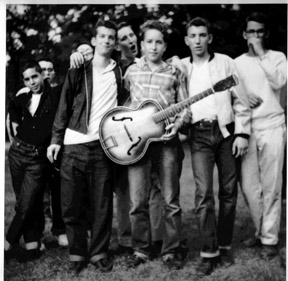
Look Out Little Richard
of succeeding were about a million and a half to one. How could anyone even suspect that Bobby Zimmerman, the kid above, from the virtually uninhabited North Country would be the ONE. Everyone in town must have been laughing up their sleeve, like the guy on the right above, when Bobby Zimmerman sallied forth to ‘join Little Richard’ and conquer the world.
Now, this guy Thompson using his own name came posing as a journalist but impersonating Bob shows up. Thompson seems surprised at the reaction of Maurice and Paul Zimmerman, Bob’s uncles, but can you imagine being interviewed by a guy talking and acting like your nephew Bob. It’s kind of crazy. Imagine what Beattie Zimmerman, Bob’s mother, thought sitting across from Toby doing Bob. Maybe that’s what Bob meant when he said ‘This guy Toby Thompson has got some things to learn.’
Nobody knew what was going on there, did they?
When Bob and John Bucklen and Echo Helstrom were kids, like many another group of Musketeers, they swore that if one of them made it he or she would help the others along. Well, Bob made it but he forgot John and Echo. No big deal. Teenage vows even spoken in earnest have no meaning after the fact but the promise lives on in the innocent hearts of those who aren’t pulled through by the successful one. There is a sense of betrayal. Added to that there was romantic ill will on Echo’s part because of Bob’s eleventh and twelfth grade betrayal.
Bob is making it big while Echo just has a job. A young woman trying to make her way has a tougher row to hoe than a guy. But, if she knows how to work it she does have a story that’s worth at least a couple three or four years worth of wages. She doesn’t know how to market it though. Robert Shelton came out to Minneapolis a year before Thompson and paid her a hundred dollars for an interview. She held the hundred up to Toby as hint but he wasn’t thinking that way. She was only going to get screwed by Toby, literally.
If Toby hadn’t been in an alcholic haze he might have realized that the story Positively Main Street was only subsidiary to Absolutely Sweet Echo. The money was with Echo.

Echo When She Knew Bob
As they’re driving up Highway 61 Echo pulls out a hundred dollar bill and says ‘See what Robert Shelton gave me for an interview.’ The light still didn’t go off in Thompson’s head. He reached into the glove compartment for his pint.
I am astonished at the amount of alcohol Thompson consumed on these trips. If he isn’t novelizing the guy was in a virtual stupor the whole time. When he and Echo arrive in Hibbing they go to a bar where Toby becomes blotto on beer, no less. He has no memory of the moment but Echo tells him that he stood on his head in the middle of the dance floor as coins and keys showered out of his pockets.
Echo must have been one tolerant girl or else she was hoping for something to happen. Perhaps a large part of the charm of Positively Main Street is the stunning unconciousness of Thompson. The guy was twenty-four years old at the time, not a kid- exactly. He had been telling Echo he was going to write a book. When he gets the first trip written up he sends her sixty pages. Echo writes back: ‘Sixty pages isn’t enough for a book is it?’ She has reasons to be disappointed. Heck, Toby is using her to attempt to make his fortune and he hasn’t even promised to cut Echo in for a dime. Think about this. The self centered naivete shines through with startling clarity. For that reason it is one of the most interesting books in the the Dylan canon.

Echo When She Knew Toby
Now, in these sixty pages Toby has misunderstood what Echo told him about the time Bob called her on the phone and played Bobby Freeman’s Do You Want To Dance claiming to be singing the song.
In his sixty pages he projects a better story where Bob shows up on Echo’s front porch playing guitar and sings Do You Want To Dance then strutting all through the house singing and playing somewhat like Elvis in the dime store in King Creole.
Echo points out this error. Toby liked his version so much he left it in the way he first wrote it. Then when Echo introduces this Bob Dylan impersonator into his parents home Toby whips out his quitar and reenacts his version of the incident strutting around the house as he plays and sings. The guy was absolutely out of his mind in his alcohol haze. He must have smelled like a brewery the whole time.
One is astonished that he was so well tolerated. Of course maybe everyone was thinking: ‘This is amazing, but it won’t last long’ and let it pass. Waved his car goodbe as he sped away.
One wonders what Echo’s emotional rection to the Bob Dylan impersonator was. Toby must have reactivated dormant affections for Bobby Zimmerman as he came on to her strongly in Bob’s persona. Echo had ten year old memories of Bob and now here he was, his double, coming onto her again. Frightening actually.
Toby left again and never returned. In the book he seems oblivious to the havoc he created in Echo’s life. In the interview at the end of Main Street given many years later he doesn’t seem to be any more aware. In fact he seems to be still posing as Dylan’s double. He mentions that he still contacts Echo, who has moved to LA, occasionally as does Bob but Bob seems to have better success in finding her.
Hurt and mystified that Thompson had no more use for her she wrote a poem for him that she mailed to him in far off Washington D.C.
Hey! Toby!
Where can you be?
Somebody told me
That you went back to
Washing Machine D.C.
How can that be?
You came to town in your Volkswagen
And I’ll tell you we sure had fun!
And now you’re gone!
You played for me on your old guitar,
Took me for a ride in your little car,
Drove me near and drove me far,
We looked at the moon,
And stared at the stars,
You stood on your head in my hometown bar…
How could it be you’ve gone so far?
Hey Toby? Where are you?
– Echo Helstrom
Toby hadn’t gone anywhere. Like Bob he’d just never been there. His fantasy like Bob’s didn’t include anyone else, they were just bit players in his own movie. Toby was no longer thinking of Echo. He was married to the bottle. He was touring bars across the country to get material for his next book. Echo could just consider herself as one of those bars. Once Toby had visited it there was no reason to return.
The tragedy for Echo was that she was betrayed once by Bob in 1958 and then again by a Bob impersonator in 1968. Perhaps a wound was created in her heart that could never heal. One wonders what her later history was after she left Minneapolis and drifted West.
I wonder where you are tonight.
I wonder if you are alright.
I wonder if you think of me
In my lonely misery.
There stands the glass,
Fill it up to the brim,
Till it flows o’er the rim,
It’s my first one today.
-Webb Pierce.
Here’s to old memories. Bottoms up.
Our Times, Mark Sullivan And Edgar Rice Burroughs
June 6, 2008
Our Times, Mark Sullivan And Edgar Rice Burroughs
by
R.E. Prindle
Mark Sullivan doesn’t show up in ERB’s library although one wonders why not. Sullivan’s Our Times is a history of America from 1900-1925 as it might have been gleaned from newspapers. This is history as seen from the point of view of newspaper readers. Sullivan himself was a journalist. He was also almost an exact contemporary of Burroughs, born in 1874 died in 1952, so we can be can be certain that Burroughs was infuenced by all the events that Sullivan cherishes. Cherishes is the right word because Sullivan is also writing his own intellectual biography through his perception of the world he lived in. These events formed the warp and woof of his life. A life he obviously loved.
He was present at many of the events while knowing such men as Teddy Rooselt reasonably well. Others he was able to interview and failing that, as many of these participant in some really astounding events were still alive as he began writing Our Times in the twenties, he was able to get written impressions from such as Orville Wright and Thomas Edison among a great many others. Altogether the six volumes of Our Times are a unique, vastly interesting, entertaining and altogether charming record of the times. Of course Sullivan would have had a more intimate knowledge of matters than mere newspaper readers but these are the stories Burroughs saw, observed and experienced hence forming the warp and woof of his own life.
We are fortunate then to have a record that actually forms the background of ERB’s life as he might have seen it as selected and lovingly recounted by Sullivan.
Sullivan gives a good background to race relations that throws light on how Burroughs himself perceived them. At least from 1900 to 1920 the lingering effects of the Civil War and Reconstruction were quite strong heavily influencing if not dominating the thought of the times. There was a strong party that wanted to go on punishing Southeners both as rebels and as former slave owners. On the other hand there was also a strong party that wanted to reconcile the Whites of North and South healing the rift and bringing the two factions together into one nation. The former might be called the Tourgee school and the latter the Dixon school.
Sullivan was of the latter group as well as Burroughs and their hero Theodore Roosevelt. Sullivan recounts how Roosevelt worked very hard to bring the Southeners back into a respectable political condition only to blow his efforts away by inviting a Negro to lunch with him in the White House. That Negro was Booker T. Washington.
It was against this backdrop that Thomas Dixon was writing his Reconstruction novels The Leopard’s Spots, The Clansman and The Traitor. His trilogy was made was made into the movie The Birth Of A Nation in 1915. The movie was meant to be a seal on the healing process. From the inception of the United States the country was divided into two nations. The North and the South with two approaches to civilization. The Civil War began over the separation of those two civilizations while the subsequent period was devoted to uniting the two approaches into one people hence the title of the movie- The Birth Of A Nation. In other words Southern and Northern Whites combined into one people with one ideology.
The clinker in the coal pile was the African. No matter the relation between the two White peoples the problem was what to do about the African. Thus Sullivan, Burroughs and Roosevelt while wishing to unite the Northeners and Southeners had still to deal with the Africans. Obviously the introduction of the Africans into the equation as social equals was an impossibility for all concerned. They weren’t wanted.
Booker Washington’s response to the issue was not to try to socialize with the Whites but to live independent lives while trying to equal the White man’s achievement. The approach was correct but impossible for the Africans.
There was no racial animosity as such on the part of Sullivan, Burroughs and Roosevelt but there was no solution to the racial differences then as there are none now. Somewhat presciently Burroughs in his Martian trilogy had the Black First Born attack and demolish the White citadel thus conquering and eliminating them. This is along the lines of what is happening today where White males have been legally emasculated while White females are encouraged to seek Black males. Thus potentially without violence genocide would be committed on the Whites.
What was clear to all participants was that Whites and Blacks were not of equal capabilities. Whatever Sullivan and Roosevelt may have thought it is clear that Burroughs believed that Africans were not as evolutionarily developed as Whites.
From 1900 to 1920 this was the prevailing attitude in the country but then began to change as immigration changes began to disintegrate the social fabric. Circa 1900 the conflict was three way between the Liberals, the Reconcilers and the Africans being manageable to the Africans disadvantage. Just before 1920 the great racial organizations of the of the Jews – ADL and AJC-, the Africans- the NAACP-, the Italians- the Mafia- and the Whites- the second Ku Klux Klan- took shape that managed to spinter the forces along several racial lines with all except the KKK working against the Whites. Thus post-war America and post-war Burroughs developed in a different way than The Birth Of A Nation proposed.
Sullivan also lovingly chronicles the rise of popular music that began to take definite shape in the last years of the nineteenth century and the first two decades of the twentieth as Tin Pan Alley came into existence. While Emma was trained as a formal singer ERB loved the pop tunes. He even went so far as to take a portable record player on their cross country trip in 1916. Of course electricity was not needed to play records as the players were wind up. The amplification was minimal as the needle translates the grooves through a large bell or horn. ERB’s record tastes were somewhat along the lines of his interest in boxing. Emma, I am sure, would have called his tastes vulgar.
Sullivan gives great coverage of the heavy weight boxing championship of the African, Jack Johnson. Johnson’s victory was one of the most traumatic events of the first two decades for White psychology. Burroughs himself was deeply chagrined resulting in the boxing story of The Mucker. The Mucker, Billy Byrne, became in essence a literary Great White Hope.
There is no indication that I have found that Burroughs read Our Times although Only Yesterday by Frederick Lewis Allen published near the same time dealing with the Twenties in the same way as Sullivan is found in his library. So, the approach was interesting to Burroughs and in some ways he also incorporated a lot of current events into his writing. Read between the lines his is a history of his times. Nearly every story can be related to something or things happening in his society. This approach goes back to his earliest writing long before Sullivan conceived Our Times.
Certainly ERB would have known of both Sullivan and Our Times. As an inveterate magazine and newspaper reader there is probably very little that escaped ERB’s notice.
The point of this essay is to recommend Our Times as background to the events that would have had great influence on Burroughs both before he began writing and as he wrote incorporating events such as Jack Johnson or the Mexican scare of 1915 and Pancho Villa into his writing.
Not only will the volumes of Our Times provide a social and political backdrop to ERB’s development but they will be a very enjoyable read with a lot of interesting pictures and cartoons to make the pages turn especially fast.
 I, Dynamo