Pt. VI Springtime For Edgar Rice Burroughs
August 15, 2007
Springtime For Edgar Rice Burroughs
Part VI
Working Around The Blues
by
R.E. Prindle
Nineteen-fourteen dawned with ERB trying to work around his problems. As unbelievable as it may seem he wrote three stories in the first quarter of that year- The Beasts Of Tarzan, The Lad And The Lion and The Girl From Farris’s.
Beasts probably relates to his continuing problems with Emma. Quite probably the wishes expressed in Nu Of The Niocene remained unfulfilled as Tarzan and Jane or ERB and Emma become estranged or separated in Beasts. The separation is reminiscent of the separation in Tarzan The Untamed, Tarzan The Terrible and Tarzan And The Golden Lion. Obviously something is going on in the marriage but apart from inferences in the novel we can’t be clear as to what. Suffice it to say the couple remains together.
Then in February ERB began what must have been a painful book for him to write. He began the book on 2/12/14 almost exactly one year after his father died. George T. passed away on 2/15/13. ERB had had a year to mull over his dad’s dieing and Lad is the result.
George T. appears to have been a difficult father for his sons, all of them not just ERB. Except for ERB slipping the noose by becoming a writer none of the Burroughs Boys would have been a success in life by business standards.
The hangman’s noose is a minor theme in the stories of the teens appearing most significantly in Bridge And The Oskaloosa Kid. The noose also make an appearance on the 100th anniversary of George T.’s birth in 1933’s Tarzan And The Lion Man. While the noose was intended for Burroughs alter egos in the teens in Lion Man the situation is reversed when Tarzan/ERB places a noose around the neck of God/George T. Perhaps the strange piebald appearance of God reflects ERB’s love/hate relationship with his father.
Little study of George T. Burroughs has been done. But if we postulate the burning of his distillery as the central fact of his later life from which he never recovered but edged slowly downhill then the burning of God’s castle may possibly represent the burning of the distillery.
It is possible that the fire changed the personality of George T. He may have been one man before the fire and another after. It is significant that God/George T. is associated with cannibalism. Thus the theme of cannibalism that looms large in the corpus may be associated with ERB’s relationship with his father. Thus the noose and cannibalism would be symbols of ERB’s treatment by his father.
In Lad his father surrogate is a deaf mute crazy old coot who torments the Lad and his Anima every day of their lives. I am not clear on ERB’s relationship with his mother but let us compare a passage from Howard Pyle’s story of King Arther from Volume II The Story Of The Champions Of The Round Table which it is very probable Burroughs read and was influenced by:
Quote:
So she (Percival’s mother) kept Percival always with her and in ignorance of all that concerned the world of knighthood. And though Percival waxed great of body and was beautiful and noble of countenance yet he dwelt there among those mountains knowing no more of the world that lay beyond that place in which he dwelt and the outer world, then would a little innocent child. Nor did he ever see anyone from the outside world, saving only an old man who was a deaf mute.
Unquote.
Transfer the above setting to the deck of the derelict, make the old deaf mute vicious and mean and possible substitute the lion for the mother and you have transposed Percival to the Lad And The Lion.
We don’t have enough information to be certain of the characters of George T. and Mary Evaline. ERB is reticent about his mother. Either I’m missing the key or she doesn’t appear in the stories. Not much has been said of her after her husband’s death in 1913 and her own death in April of 1920 while visiting in Tarzana. Prior to that she had been visiting her sons spending three months at a time with them. Whether she had just began this rotation is uncertain but this was the first time she had visited ERB and Emma.
George T. figures more largely in Burroughs’ writing while always in a love/hate relationship. I never had a father so I have that blind spot in my education meaning that, perhaps, I may not be the best judge of the father-son relationship. My evaluation of George T. is that he wished to maintain a dominant role over his sons. Perhaps, like many fathers, he was fearful that as his powers waned theirs would wax and they would become more powerful than he. Something along the lines of the Greek god Cronus who, having been warned that one of his offspring would replace him swallowed them whole as they were born. A stone was offered Cronus in place of his youngest son, Zeus, who did grow up to replace him.
It is interesting that George T.’s youngest son, ERB, was able to escape his meshes just as the father died.
The letters of the Burroughs Boys – George and Harry- from Yale indicate that while their father supported them he kept them on a short leash. It is true that they began college after the distillery fire so that he may have been more liberally handed before the fire so as to bind the Boys to him but we won’t know.
Having finished Yale as graduates of the Sheffield Scientific School they returned home to take up roles in the battery business that succeeded the distillery. They were only able to escape their father’s domination when Harry became ill from battery fumes requiring his living in the dry climate of the West. George begged to follow him and was so allowed.
George T. didn’t own the battery business outright in its first years. It would be nice to know something about his business associates in that business.
I have already detailed the difficulties he placed in ERB’s life that were detrimental to the formation of the lad’s character.
And then we have Herb Weston’s characterization of George T. as a stern man of the old school who he yes, sirred and no, sirred and got along with him famously.
It is not impossible that John Carter is the idealized character of ERB’s father. Carter’s own role in the Mars series does not disappear after 1913’s Warlord Of Mars but his role is greatly curtailed. A possibility.
I think it is a near certainty that the deaf mute old coot of the derelict is the negative father. In Lad he doesn’t die naturally but is killed by the Lion who rips his face off. This must be an affect of his father’s death as after the Lion kills him the Lad and the Lion continue to drift along for several months before the ship gently beaches itself, the tide goes out and the two walk ashore. Then, just as Percival saw the knights, being drawn into the outside world, the Lad sees the Arab ‘knights’ being also drawn into the outside world. He experiments with the burnoose just as Percival experimented with the armor.
Thus a year after his father’s death Burroughs attempts to escape from the ‘crazy old coots’ shadow.
That done, ERB then turns to a story begun the previous May to finish it. The long period of incubation indicates the difficulty he had in getting the story out. The Girl From Farris’s tells of the period from his bashing in 1899 to his return from Idaho in 1904.
It is a difficult story vis-a-vis Emma. ERB places his heroine in a brothel in Chicago. Harris’s, the original location, was actually a famous brothel; Harris himself being a noteworthy figure which is probably why the name was changed to Farris’s.
The woman escapes from the brothel. After a series of adventures in Chicago she leaves for Idaho where she meets the hero Ogden Secor again who had aided her back home.
Secor is in a desperate psychological state and that is probably an accurate description of ERB’s state of mind during those few years.
The woman is identified and taken back to Chicago where after a bit of legal hoopla she is exonerated, we learn that she was never a prostitute and she and Secor are married. After this number of terrible years something good happens to Secor and, one assumes Burroughs, the ray of light breaking through the clouds.
At this point in March, nearly April, of 1914 ERB and the family return to Chicago, after once again auctioning off their belongings as they had done in Salt Lake City before returning to Chicago in 1904. This has to signify in Burroughs’ mind that he had reversed his shameful performance of ten years earlier. He undoubtedly expected Emma to also accept 1913-14 as a redemption of 1903-04. Just as he had gambled and lost in ’03, in 1913-14 he had gambled and won.
Even though according to him he was living hand to mouth he ordered a new automobile (not a used Velie) for delivery upon his arrival back in Chicago. If the car was Burroughs’ Hudson then that would indicate that he had visited Baum in Hollywood as Baum drove a Hudson. ERB would want to emulate his hero. Then within a month or two the Burroughs left their old address in Chicago to move into the fancier suberb of Oak Park. Perhaps this move was made possible by the expected book royalties. Thus Burroughs continued to spend in anticipation of income rather than from money in his pocket. So Burroughs kept his hopes and dreams alive.
The springtime of ERB thus ended. The incredible psychological release of success was now to be tempered by new realities. The act of writing would now become a full time job. From 1911 to 1913 he wrote from hopes and dreams. Now he would have to settle down to turning out two or three books a year for magazine sales plus book royalties and newspaper royalties soon to be joined by movie revenues. ERB had won the gamble of quitting his day job. The Roving Gambler could now turn to the pleasures of life on the yacht.
But first there was the unfinished business of the three stories- The Mad King, The Cave Girl and The Eternal Lover- to be taken care of.
Properly belonging to 1913 the three sequels would take up a large block of time in 1914 which makes that year a transition year.
I will review the stories in the sequence in which they were written: The Cave Man July-August of 1914, The Eternal Lover, August and September and The Mad King, September-October.
Next:
Part VII
The Denouements.
Pt. 5 Springtime For Edgar Rice Burroughs
August 10, 2007
Springtime For Edgar Rice Burroughs
Part 5
by
R.E. Prindle
In this year of excitement for Burroughs as his success becomes established and he tries to work out his psycho-sexual conflicts it is interesting to follow the development of both.
Three of his stories expecially concerned with his sexual conflicts were followed by sequels relating to their development. The first The Cave Girl finished in March as a sort of sequel was followed by the Mad King of October-November and then in November-December of 1913 by The Eternal Lover. After a fashion these novels may be considered a trilogy.
Writing approximately a year later – 16 months for Cave Girl, a year for Mad King and eight months for The Eternal Lover- the three sequels rapidly followed each other. The Cave Man was writtin in July-August of 1914, Sweetheart Primeval (The Eternal Lover) in August-September and Barney Custer of Beatrice (The Mad King) from September to November. The diptyches were then published as single volumes. They have been disconcertedly packaged as single stories when they should be considered as different stories with different approaches to the same problem. Unless I am mistaken with the sequel to the Mad King Emma is written out of the story.
Following Cave Girl in early 1913 Burroughs wrote The Monster Men in April-May that probably has little to do with his psycho-sexual problems but relates to his long admiration of Frankenstein and probably the more recent H.G. Wells’ novel The Island Of Dr. Moreau. There will be a number of related stories along this line if not sequels.
The Warlord of Mars followed in June and July. John Carter probably relateing to Burroughs’ emasculation concerns thus having little or nothing to do with Emma. August to October’s The Mucker is a very important book, the first of what I consider a quartet exploring Burroughs psycho-sexual needs. In The Mucker a low brow hoodlum from Chicago is thrown together with a New York society girl. The novel brings together the theme of yachts, shipwrecks, cannibalism and the stranding on a South Seas island.
In this case the low brow realizes that he won’t make it in a high brow world so he renounces his claim on the society woman.
The first sequel to the Mucker gestated for three years until 1916’s Out There Somewhere (The Return Of The Mucker). In this novel Burroughs splits his personality into Bily Byrne- the Mucker- and the gentleman hobo, Bridge. Thus by 1916 it apears that Burroughs sees himself as more polished than his Mucker creation. Bridge is a voluntary exile from a wealthy Virginia family so that he unites The Prince And The Pauper in his identity while reversing the order of Little Lord Fauntleroy. It will be noticed however that Bridge combines all three of Burroughs’ most favorite books.
In the denouement Burroughs gives the society girl to the Mucker while Bridge goes off in search of the ideal ‘mate’ who is Out There Somewhere.
The second sequel, Bridge And The Oskaloosa Kid (The Oakdale Affair), of 1917 continues the story of Bridge in, really, a very good story, in which at the end Bridge is revealed as not a bum, assuming his true identity as a Virginia gentleman. The Pauper become the Prince, Fauntlroy comes into his own.
The last of the quartet is 1924’s Marcia Of The Doorstep in which in a wholly fictitious way Burroughs’ Anima and Animus are united in the characters of Chase III and Marcia. This novel appears to conclude this particular exploration that has lasted for eleven years.
The Mucker was followed by October-November’s The Mad King. The Mucker was written in both Chicago and San Diego while the Mad King was written wholly in San Diego.
The Mad King returns to the theme of the Cave Girl of ERB’s relationship to Emma. He even names the lead female Emma. It seems possible that the uprooting from Chicago with all their possessions had an unsettling effect on Emma so that ERB’s difficulties with her probably become more pronounced. Certainly her discomfort is understandable but the Mad King may have determined her fate.
The title The Mad King is probably significant in this context. Once again Burroughs creates doppelgangers so that both characters are split from his own personality. Once again we have The Prince And The Pauper theme of an interchange of roles. At this stage ERB may have felt like a king but realized he was acting in a mad way.
The Mad King is followed immediately in November-December actually a matter of only twenty days by The Eternal Lover- Nu Of The Niocene. The two stories must be closely related in Burroughs’ mind. Indeed the sequel to Nu Of The Niocene, Sweetheart Primeval includes several characters from The Mad King. So one would have to ask how does Barney Custer’s sister Victoria relate to Emma.
I intend to devote a few pages to the The Eternal Lover which I consider perhaps the most imaginative and interesting of Burroughs’ stories. The inspiration for the story can be related to two of Burroughs significant influences, Rider Haggard and Rudyard Kipling. Among others of Haggard’s work She stands out most prominently while Kpling’s very interesting ‘The Finest Story In The World’ bears directly on the theme of reincarnation and close encounters in time.
From further reading that I am doing all the time it is also becoming apparent that Burroughs is part of a very large intellectual and literary background activity. In reading a volume: H.G. Wells’ Literary Criticism I came across this entry: (p. 62, note 2.)
Quote: At the end of (Grant) Allen’s novel, Frida Monteith, now a Liberated Woman, hoping that suicide will enable her to join her lover in the twenty-fifth century, ‘walked on by herself…across the open moor and purple heath, towards black despair and the trout-ponds of Broughton.’
Unquote.
I don’t suggest that ERB read Grant Allen’s novel but as ERB himself said ‘plots are in the air.’ So that ERB is working within an intellectual milieu. His notion of time travel in 1913 is not unreminiscent of Mark Twain’s posthumous 1916 novel Operator 44. While I would not suggest that Twain received any inspiration from Burroughs certainly conceptions of time and time travel were ‘in the air.’ I merely suggest that there is a milieu from which all are drawing inspiration. Burroughs also seems to have in mind H.G. Wells’ When The Sleeper Wakes although he claimed virtually to have never heard of ‘Mr. Wells.’ In Wells’ story his hero had fallen asleep awaking several centuries in the future to find his investments had accrued making him the richest man in the world, the object of a religious cult and an impediment to its continuation.
In The Eternal Lover Nu has been asleep for a hundred thousand years. Burroughs’ title for Chap. III is ‘Nu The Sleeper Awakes.’ No chance of a coincidence. Instead of monetary rewards Nu will find that which makes life worthwhile- the perfect mate he had left behind in the Niocene. Burroughs make an unbelievably subtle comment on Wells. Wells did read Burroughs but whether he caught this is open to conjecture at this time.
In fact, Burroughs setting up Nu’s return to consciousness and his relationship to Victoria, Barney’s sister, is extremely well handled by ERB. I doubt if there is anything in genre literature that surpasses it.
Victoria and Barney have just passed the rock structure within which Nu lies sleeping. The Once And Future King motif is also suggested here as well as possibly Vivien’s enchantment of Merlin.
Speaking of her sensations she says to Barney: p. 14
Quote:
“Barney, there is something about these hills back there that fills me with the strongest sensation of terror imaginable. Today I passed an outcropping of volcanic rock that gave evidence of a frightful convulsion of nature is some bygone age. At sight of it I commenced to tremble from head to foot, a cold perspiration breaking out all over me. But that part is not so strange- you know I have always been subject to these same silly attacks of unreasoning terror at the sight of any evidence of the mighty forces that have wrought changes in the earth’s crust, or the slightest tremor of an earthquake; but today the feeling of unalterable loss which overwhelmed me was almost unbearable- it is though one whom I loved above all others had been taken from me.’
“And yet,” she continued, “through all my inexplicable sorrow there shone a ray of brilliant hope as remarkable as the deeper and depressing emotion which still stirred me.”
Unquote.
That sets the premonition of what is coming as discreetly as anything I’ve read. The psychology of Victoria’s emotions is as succinctly and accurately expressed as possible. It is very difficult to imagine the scene bettered by any writer. Haggard and Kipling who may have recognized their own work as a source of inspiration must have shook their heads in awe.
Barney is sympathetic: p. 16
Quote:
“Oh, Barney.” she cried, “You are such a dear never to have laughed at my silly dreams. I’m sure I should go quite mad did I not have you in whom to confide; but lately I have hesitated to speak of it even to you- he has been coming so often! Every night since we first hunted in the vicinity of the hills I have walked hand in hand with him beneath a great equatorial moon beside a restless sea, and more clearly than ever in the past have I seen his form and features. He is very handsome, Barney, and very tall and strong, and clean limbed- I wish that I might meet such a man in real life. I know it is ridiculous, but I can never love any of the pusillanimous weaklings who are forever falling in love with me- not after having walked hand in hand with such as he and read the love in his clear eyes. And yet, Barney, I am afraid of him. Is it not odd?”
Unquote:
So in a few pages Burroughs has created a mystery of instense interest that will be explained in the next few pages to stunning effect, certainly in 1913 if not today. Since 1913 the topic has been explared in a number of ways not least of which was the very interesting movie Somewhere In Time.
Victoria is afraid of earthquakes. As might be expected a major quake hits. The rock facing of the cave in which Nu has been sleeping for the last hundred thousand years sheers away releasing the gas and allowing fresh air to awaken the sleeper, much as in H.G. Wells excellent story.
Burroughs’ treatment of Nu’s experiencing the new world is exceedingly well done. Through a series of well wrought adventures Nu and Victoria/Nat-Ul are reunited then split asunder again as the Arabs capture Victoria carrying her to the well known fate worse than death in the hands of a Northern Sheik.
Barney and his crew find Nu taking him back to Tarzan’s house. Here Burroughs tells a story before Nu leaves to recover Natu-Ul that seems strange.
The story is told by an unnamed narrator who happens to be a guest of Lord Greystoke at the time.
As the whole scenario is taking place in the mind of Edgar Rice Burroughs we may be forgiven for assuming that the anonymous I is he.
ERB has a strange attitude toward his creation Tarzan here, almost demeaning. When Nu escapes with the wolf hound Greystoke just off handedly asserts that Nu had killed the missing dog. When this proves wrong ERB allows the others to verbally abuse their host. Rather strange, I thought.
It appears that this story that follows Mad King I can be construed as a continuation of that story as when Barney shows up at John Clayton’s ranch, the man formerly known as Tarzan, he is fresh from Lutha and there to forget. As he lost Emma in Lutha one assumes that she is what he’s trying to forget.
An American named Curtiss shows up. Victoria says:
Quote:
“Mr. Curtiss!…and Lieutenant Butzow! Where in the world did you come from?”
“The world left us,” replied the officer, smiling, “and we have followed her to the wilds of Equatorial Africa.”
Unquote.
A charming compliment to Victoria. Indeed, Curtiss is there to propose to her. Curtiss begins very charming then slowly turns vicious. Reminds one of Robert Canler or perhaps Frank Martin in real life. At one point Victoria was about to consent to marry Curtiss (Frank Martin?) but then demurred.
But then she made contact with her dream lover, Nu. the interchange of time sequences is extrememly well handled as Burroughs manages the hundred thousand year gap betwen Nu and Victoria in inventive and satisfying ways. Once again he has mingled prehistory and the present in what is definitely his most virtuoso performance. His depiction of Victoria/Nat-Ul’s blending of dream states and waking states is handled flawlessly and convincingly.
As Curtiss realizes that Nu is his competitor for Victoria/Nat-Ul he derides Nu calling him a ‘white nigger.’ I found the use of the term strange within the context.
When Nu had recovered Victoria from the Arabs Curtiss comes upon the two in the jungle unawares. He is about to shoot Nu in the back (Martin’s arranged bashing of ERB in Toronto?) when the wolf hound who has been protecting Nu and Natu-Ul leaps on him ripping out his throat and chest.
Burroughs seems to gloat over this gruesome death so that one must ask who Curtiss could represent in Burroughs’ real life.
That means, who are Nu and Nat-Ul?
Once again we have to go back to the period 1896-1900 and the subsequent years. It seems likely that Curtiss must represent Frank Martin who courted Emma during those crucial four years in ERB’s life. In ERB/Nu’s absence Curtiss/Martin courted Emma/Victoria/Nat-ul. We may assume that Emma was about to say yes to Martin/Curtiss’ proposal when Burroughs/Nu returned from the Niocene/Idaho thus foiling Curtiss/Martin’s hopes.
Now, when Nu rescued Victoria/Nat-Ul from the lion Curtiss shot him in the dark creasing his skull. This is a theme seldom or never absent from any of Burroughs’ books, therefore it follows that as Martin was responsible for Burroughs’ bashing in Toronto that Martin/Curtiss are the same.
Curtiss becomes abusive of Nu after he recovers from the effects of the near miss revealing his ‘true’ or mean side. So Martin may have, or probably did, become abusive of ERB upon their return from Toronto. It is not to be believed that he just disappeared from the couple’s life without some demonstration of anger. As we know that Martin paid close attention to Burroughs and Emma from 1900 to at least the divorce when he sent his friend Butzow/Patchin to LA to talk to Burroughs it is very likely that he interfered in their marriage through the whole Chicago period. This would explain the gruesomeness of Curtiss/Martins’ killing and ERB’s seeming to revel in it. So the whole Narrator, Barney Custer, Lord Greystoke and Curtiss story is somehow related. The missing piece of the puzzle is Burroughs’ seeming hostility to Tarzan/Greystoke. I haven’t got that yet.
Having rescued Victoria/Nat-Ul from the Arab abductor in one of the most satisfying fight sequences in the corpus Nu tries to claim Nat-ul as his own. He is still confused as to how Victoria can be of two minds as both Victoria and Nat-ul. Before we consider Burroughs’ masterful handling of the fictional situation let us consider the relation of the sequence to Burroughs’ and Emma’s real life situation. This story was written in San Diego not Chicago.
The prehisoric aspect of the story may represent the early days of their marriage before ERB lost Emma’s trust in Idaho. Thus Victoria/Emma remembers the old days but she isn’t necessarily willing as yet to replace her trust in ERB. Nu/ERB having now the two tusks of Oo the saber toothed tiger on him as proof of his devotion, possibly once again representing his John Carter and Tarzan successes, insists that Victoria/Emma return to the past with him. i.e. the early days of the marriage. In other words Burroughs wants to start all over again. The name Nu- New- may mean that ERB thinks himself a new man but the same old guy he used to be.
My hair is still curly,
My eyes are still blue,
Why don’t you love me
Like you used to do.
Hank Williams
As this half of the story ends somewhat in a quandary regarding the relationship, Victoria nevertheless agrees to return to the past with Nu.
As ERB tells the story in the novel he creates a most extraordinary scene.
Quote.
“You do not love me Nat-Ul?” He asked. “Have the strangers turned you against me? What one of them could have fetched you the head of Oo, the man hunter? See!” He tapped the two great tusks that hung from his loin cloth. “Nu slew the mightest of beasts for his Nat-ul- the head is buried in the cave of Oo- yet now I come to take you as my mate I see fear in your eyes and something else which never was there before. What is it Natu-ul- have the strangers stolen your love from Nu?
The man spoke in a tongue so ancient that in all the world there lived no man who spoke or knew a word of it, yet to Victoria Custer it was as intelligible as her own English, nor did it seem strange to her that she answered Nu in his own language.
“My heart tells me that I am yours, Nu,” she said, “but my judgement and training warn me against the step that my heart prompts. I love you; but I could not be happy to wander, half naked through the jungle for the balance of my life, and if I go with you now, even for a day, I may never return to my people. Nor would you be happy in the life that I lead- it would stifle and kill you. I think I see now something of the miracle that has overwhelmed us. To you it has been but a few days since you left your Nat-ul to hunt down the ferocious Oo; but in reality countless ages have rolled by. By some strange freak of fate you have remained unchanged during all these ages until now you step forth from your long sleep an unspoiled cave man of the stone age into the midst of the twentieth century, while I doubtless, have been born and reborn a thousand times, merging form one incarnation to another until in this we are again united. Had you, too, died and been born again during all these weary years no gap of ages would intervene between us now and we should meet again upon a common footing as do other souls, and mate and we to be born again to a new mating and new life with its inevitable death- you have refused to die and now that we meet again at least a hundred thousand years lie between us- an unbridgeable gulf across which I may not return and over which you may not come other than by the same route I have followed- through death and new life thereafter.”
Unquote.
Wow! I don’t know that that can be topped in fantasy or other fiction. And there are people who say that Burroughs has no occult background. The passage fairly drips of Haggard and Kipling. Novels and stories that he’d read perhaps twenty years or more before had been working away in his mind to surface in this magnificent speech and wonderful story.
The unbridgeable gulf clearly refers to Haggard’s Allan Quatermain. The influence of the story of She is unmistakeable while Kipling’s The Finest Story In The World is clear. yet Burroughs has built an entirely new edifice that rises magnificently above the old foundations.
Haggard and Kipling read the story too, I’m sure with their mouths hanging open. It inspired them four years later to collaborate on Haggard’s own Love Eternal. While inspired by his masters Burroughs also inspired them. It’s a pity they didn’t all three sit down to smoke a cigar and have a brandy together.
That this story has gone unrecognized seems incredible. With this half of the story ERB capped his incredible year of 1913.
The tone of the corpus changes after Nu of the Niocene.
—–
As he worked his stories were being published elsewhere. It would not be before mid 1914 that Tarzan Of The Apes would see book form but perhaps more importantly his work was recognized and serialized in the newspapers. We have to thank Bibliophile Robert R. Barrett for collating the newspaper publications that George McWhorter published in the Winter 2005 NS #61 of the BB. My information is gratis Mr. Barrett’s collation.
The New York Evening World kicked off Burroughs career when it serialized Tarzan Of The Apes beginning in January of 1913. The paper also published many subsequent novels. Following the Evening World Tarzan Of The Apes was published by the Los Angeles Record, Chicago Record, the Bowman ND Citizen.
The Return Of Tarzan was syndicated by the Scripp’s Howard papers and The Cave Girl by the NY Evening World. After 1913-14 the number of papers publishing Tarzan Of The Apes increased greatly so by the time the book was published in June of 1914 Tarzan was much more widely disseminated than the mere publication in the All Story Magazine would warrant.
Burroughs’ book publishing history is difficult to understand. the reports of untold millions of copies cannot be substantiated. Indeed it appears that in 1914 fewer than fifteen thousand copies were sold. There is no record that his publishers, McClurg’s even printed the full fifteen thousand copes of the contract. When they leased the reprint rights to A.L.Burt in 1915 there had been no record of sales success. Indeed Burt would only take the title if McClurg’s would indemnify them for the first twenty thousand copies if unsold.
The cheap edition did well well but Burt reported less than seven hundred thousand copies ehen they turned the rights over to Grossett & Dunlap. So Burroughs while having a success never realized the substantial royalties on which he had been counting and would have bought him his yacht.
The springtime of ERB was nearly over. By the time he wrote the sequels to The Mad King, Cave Girl and The Eternal Lover in 1914 he was already entering Summer.
Let us now examine the year 1914.
End Of Part V
Lipstick Traces: Greil Marcus
A Review
Part IV
The Art Of Yesterday’s Crash
by R.E. Prindle
As I mentioned in Part II Mr. Marcus seems to consider himself first an Old Testament prophet prophesying fire and destruction for the United States. Secondly he sees himself as a continuator of the Frankfurt School or New School Of Social Research and thirdly the spiritual successor to Guy Debord and perhaps the new leader of the Situationist International.
In the situations under consideration he turns his New School For Social Research and SI sides up.
Now as it happens that when I attended Cal State At Hayward one of the professors was a fellow named Theodore Roszak. Mr Roszak wrote a volume called The Making Of A Counter Culture while teaching at Cal State; probably something called American Studies or some such, I can’t remember, which these Frankfurters always aim for and we’ll see why.
We are now talking ’64-’65. Sixty-five is probably best known for the Black rebellion in LA’s Watts district. That kicked off the violent revolt of the Blacks which smolders on today flaring up here and there. Thus in Mr. Marcus’ The Shape Of Things To Come he prophesys blood in the streets.
It was also the beginning of the San Francisco Scene. The San Francisco Mime Troop- a Communist outfit- had been active in street theatre for some little time. Then Kesey organized the Merry Pranksters, Owsley entered the picture and the Acid Tests began. I was invited to the Acid Test but declined to go. Couldn’t see the social utility; it would have been interesting but I’m not sorry I missed it.
Roszak. So everybody assumed that this book he advertised he was writing called The Making Of A Counter Culture was about what Jack Kerouac called ‘The Rucksack Revolution.’ These were the post-British Invasion days so long hair was slowly making inroads into the East Bay. I didn’t have long hair but I had a strange long ducktail from the fifties. Cal State was on a windy plateau so everytime I went outside I looked like a hurricane walking around. This was enough for the profs and administration who were terrified that the Free Speech Movement would edge up from Berkeley to classify me as a ‘radical.’
I was sent to Roszak as he was presumably writing a book on the ‘counter culture’ which is what the hip movement was known as. I found Roszak one guilty customer. Dark mind too, repellent. He thought I was sent as a spy. That increased his guilty reaction.
When his book came out it didn’t have anything to do with a Hippie counter culture. It was all about the Frankfurt School, Marcuse et al. The book was about the Jewish Revolution. Roszak must have thought the ‘anti-Semites’ sent me. So, now I understand Mr. Marcus; use of the term ‘Secret History.’ He doesn’t just mean obscure. Roszak was part of history being made but it was unintelligible to the uninformed mind. Even though the Frankfurt School was operating openly I don’t know if anyone knew that subterranean history was being lived in the open but there it was as plain as day. Roszak was a continuator. I don’t know if Mr. Marcus knows Mr. Roszak but it wouldn’t surprise me if he did, they are both Jews etc, but as a continuator of the Frankfurt School Mr. Marcus may be described as having the baton passed to him through Mr. Roszak. Mr. Marcus is more prolific and effective while being more obscure and secretive than Mr. Roszak. The reader, even the informed reader, probably doesn’t know he is being spoon fed Semitism.
Mr. Marcus even allows himself to be called by the presumptuous title of The Holy Greil even further insulting his subordinate Euroamerican culture. I don’t mind Mr. Marcus and others insulting the half-Jewish Jesus but I do want him to keep his hands off the essence of Euroamerican Culture. I can accord Mr. Marcus neither Holiness nor any association with the Grail stories even though his style incomprehensible as it is is pretty entertaining. Must have learned that from Old Bob.
Mr. Marcus establishes himself as a continuator of the Frankfurt School and then says he is going to criticize the living crap out of everything. Well, alright, OK! I would like to point out however that criticism is not analysis. Any fool can criticize but analysis requires a little science. There’s a serious rub in Mr. Marcus’ style, not science, all, well, not all, blather.
I will give him credit for not beginning this Situation with the Armory Show. My god and Jesus H. Christ we know how that changed America but, well, as an Israeli citizen and man of the world Mr. Marcus isn’t talking about America or anything as earth shaking as the Armory show. No. He’s talking about six inconsquential nerds pulling sophomoric stunts in Zurich in 1916 while there was a war going on. All a bunch of draft dodgers too, except for the woman doing the splits with the madonna face whatever one of those is. I been looking but not finding.
These six Mr. Marcus informs us created Da Da. They gave their shenanigans a name that stuck. While Mr. Marcus seems to revere their stuff I have to confess that it doesn’t seem much different than the shenanigans of any other generation. Da Da is just a state of mind that certain people experience at a certain stage and condition of life.
If Mr. Marcus had looked around Berkeley and the Bay Area he would have seen plenty of evidence of the state of mind in the Mime Troupe, the whole San Francisco Sound was Da Da. Kesey was Da Da, and everyone was pulling the same kind of stunts with the same results. That trick with the splits and madonna face is so commonplace it doesn’t bear mentioning. A guy playing an imaginary violin? Whew! Wow, who in the world could ever have thought that one up?
The hell with this Da Da crap. Real men dying in the trenches and these guys are scraping an imaginary violin? Not too impressed, Mr. Marcus. Let’s get on to the real stuff. This gets passed over by The Holy Greil. The foundation of the Frankfurt School c. 1923. Here’s the real crux of Mr. Marcus; psychology, the culture wars between the Semitic intellect and the European intellect. A lttle clash of loyalties here in that dual citizenship Mr. Marcus holds.
While the clowns in Zurich, for that is what they were , were trying to live down their antics at the Cabaret Voltaire the real revolution was forming in Frankfurt. This the revolution of which Mr. Marcus is the continuator. This is the real substance of Mr. Marcus’ work. Nice work too, don’t get me wrong.
I’ve done some work on this subject but I’m going to refer any possible readers to this web page for a quick history of the Frankfurt School: http://no-maam.blogspot.com/2007/07/great-historical-outline-of-cultural.html The article was posted by Mr. Rob Fedders. Bear in mind this analysis represents the foundation of Mr. Marcus thought, intellect and purpose. His writing makes much more sense in this context.
Quote:
Before World War I, Marxist theory said that if Europe ever erupted in war, the working classes in every European country would rise in revolt overthrow their govenments and create a new Communist Europe, but when war broke out in the summer of 1914, that didn’t happen. Instead the workers of every European country lined up by the millions to fight their country’s enemies….After World War I ended in 1918, Marxist theorists had to ask themselves a question: What went wrong?…two leading Marxist intellectuals, Antonio Gramsci in Italy and George Lukacs in Hungary…independently came up with the same answer. They said that Western culture and the Christian religion had so blinded the working class to its true, Marxist class interests, that a Communist revolution was impossible in the West, until both could be destroyed. That objective, established as cultural Marxism’s goal right at the beginning, has never changed.
Unquote.
There’s a little secret history for you. The Frankfurt School employed the political theory of Marx, the psychological theory of Freud and the relativistic nonsense of Einstein to undermine Western culture backed up by the ever potent charge of ‘anti-Semitism.’ Their BS could easily have been resisted and rejected but for their alliance with Liberals. To merely state that a critic was anti-Semitic was enough to set the conditioned Liberals on the accused and make him or her a non-person in society. Thus without their Liberal slaves the Frankfurt School would not have been that effective. Liberals are the true enemy.
Now, skipping the interim machinations, by the time of the Free Speech Movement the Jewish Revolution had been nearly completed.
In addition to the music the introduction of hallucinigens made the capture of the whole generation child’s play.
As with the so-called Free Speech Movement the problem was not one shared by society as a whole which was functioning quite nicely, thank-you, but a cultural problem within the Semitic species. As always the inability of the Semites to compete effectively with the Indo-Europeans, or to be brief, Aryan species was the crux of the problem. The Terachites challenged the Ur of the Chaldees. In the ancient conflict between the Semites and the Aryan Sumerians the latter were centered about Ur while the Semites were centered further North. So Abram as a Semite was challenging the Aryan Sumerians who had understood and developed Astronomy. The Egyptians were an amalgam of the HSII Libyans and the Egyptians of the Upper Nile valley. In my opinion the intellectual content of Egypt was injected by the Libyan refugees from the post-ice age flooding of the Mediterranean.
The Semites then came into collision with the superior intellecual and scientific civilization of the Hellenes more especially in Greek Alexandria where Philo attempted to subvert Hellenic science in favor of ‘Talmudic’ mythology. The Romans who created the most amazing empire the Mediterranean world had ever seen once again, as it were, illuminated the inferiority of the Semitic intellect. The Jews set about to subvert and destroy the Roman Empire which, in my opinion they did both in the exhausting Roman-Jewish Wars and the succeeding Pauline Judeo-Christian subversion. Matters were then stalemated for centuries until Aryan science finally pushed through the Judeo-Christian meshes in the seventeenth and eighteenth centuries.
Once again the inferiority of the Semitic intellect was displayed. Marx, Freud and Einstein created the basic non-scientific means posing as science to subvert the Aryan scientific intellect. The groundwork laid by the big three, the epigone went to work. The nitwits of Da Da may be considered shock troops while the Frankfurt School- The Institute For Social Research- formed c. 1923 began the serious work of undermining Western Civilization. Once again, Mr. Marcus seems to consider himself first a continuator of the Frankfurt School, a reincarnation of Guy Debord and then in The Shape Of Things To Come to graduate to the role of a Hebrew prophet.
Now, in every instance in which the Jewish Semites have confronted the Aryans they have failed to excel them although taking advantage of the reluctance to face the problem directly on the part of the Aryans the Jewish Semites have been able without exception to destroy the Aryan achievement.
The Jews also insist that they are the Chosen People of mankind just as the Arabs insist that they are The Central People. Chosen, Central are the same things. We are talking a characteristic of the Semitic species. Yet evolutionarily they are constitutionally or genetically inferior to Aryans. No matter what happens they will never be able to match or sustain Aryan achievements.
What to do? I know most readers have never delved deeply into this area of study so that the reader may be astonished by what is going on and find it unbelievable. It isn’t. Realizing that they can never excel the Aryans the Jewish Semites have resolved to exterminate- that is commit genocide- on the whole species. They propose to and are fairly well advanced in their program to eliminate a species of over a billion people.
Astounding and unbelievable isn’t it. Well, while you were sleeping astounding developments were in progress. It is time for the sleeper to awake. Be patient with me and I’ll explain how it is being done and why Mr. Marcus may possibly see himself advance from Hebrew prophet to Judge-Penitent of the Aryan peoples. (See my review of Albert Camus’ The Fall here on I, Dynamo.)
The plan is available on line at a site run by a former Harvard professor, Noel Ignatiev called Race Traitor. Mr. Ignatiev believes in races even though he is a Jew and the current Jewish line is that races do not exist. The first stage of this program is part of psychological warfare based on the Freudian model.
Mr. Ignatiev as spokesman for the Jewish culture asserts that all the evil in the world proceeds from the Aryan ‘races.’ It is true that the Jews argue in other situations that ‘race’ exists only as a social construct however as ‘race’ is useful in this instance the idea is reconstituted. The approach is a key tenet of ‘critical theory’ in which the critical base point is one’s relative need at the moment.
As all evil proceeds from the Aryan ‘race’ it follows that if the Aryan race is eliminated from the face of the earth by ‘any means necessary’ that evil will disappear from the world. This notion is apparently a variation on the eighteenth century Jewish notion of Jacob Frank that Jews will only become good when they expend all the evil in their system. Apparently at that time Jews were the evil ‘race’ but at some point between then and now they have expended all the evil in their system and have become ‘good’ along with the rest of the world. All this stuff sounds good according to Jewish ‘critical theory’ but falls apart under ‘Aryan’ scientific analysis.
The problem is the obvious Aryan superior intelligence so that Mr. Ignatiev invents the concept of ‘White Skin Privilege.’ Using critical theory the only reason Aryans or Whites, to which term I will revert, have obtained the prominent position among the ‘races’ is because Aryans have White Skin. Real Tarzans if you know what I mean. Thus the superiority is based on cosmetics. Change the cosmetics and the superiority will go away. Not bad reasoning really. It therefor follows that if Whites can be persuaded to give up their ‘White Skin Privilege’ why, the Utopia will become a reality and evil will disappear from the world. I’m not making this up.
Therefore from sheer shame Whites should voluntarily abandon ‘Whiteness.’ Remember this line of reasoning comes from a Harvard graduate and a Harvard professor. I would have been laughed out of a ‘third rate’ college like Cal State for proposing such nonsense. To my knowledge neither the Jewish culture or Harvard University have ever publicly repudiated Mr. Ignatiev so one must assume he speaks with the full approval of both.
Mr. Ignatiev also calls his program the New Abolitionism calling for the abolition of the White ‘race.’
The easiest course, or least painful, for Whites to abolish themselves, actually, is to marry Black people. Any resulting offspring will be non-White so that if all Whites could be persuaded to do this ‘Whiteness’ would disappear within, well, a generation.
Realistically this isn’t going to happen although historically conquerors have killed the men and kept the women. Without White men White women will have to produce colored children. This was actually done during the Haitian revolution from France. The men were killed and the White women were told that they could live only if they served as wives to Black men. Most of them did. Thus we have the result of Haitians being the most beautiful people in the world while having constructed the most successful and glorious society not to mention culture.
Now, if you follow what’s happening in education, kindergartners are being taught to be homosexuals. Is it necessary to say that homosexuals cannot reproduce themselves? It therefor follows that if White boys are raised as homosexuals White women will have to turn to Black men while if such a program is successful White men will diminish say by a half life a generation. Thus another method to eliminate Whites. And White people are dumb enough to go for it. Can’t ask for more than that, can one?
And then for the remainder of hard cases there are always industrial means to eliminate them. Gas chambers or whatever means necessary, who cares?
So as you can see Mr. Ignatiev is not theorizing but helping to implement a program that is well advanced.
Now then, the strength of the US economy and well being of Whites as a result is a standing rebuke to the other ‘races’ of the world and a cause of the most destructive envy. We don’t want to look at Zimbabwe and South Africa do we? Naw. How’s that going to prove anything? Thus jobs were exported out of the country to everywhere. The US economy as a whole was picked up and moved to China which for all practical purposes is run with the lowest cost slave labor possible.
The unions have been broken and the well being of the working man has been destroyed by unrestricted Mexican immigration which is lower cost. Technical jobs have been given to lower cost immigrant labor via the worker visa program.
Back in the eighties the savings and Loan industry was savagely looted. One of the beneficiaries of that theft was the family of the current President of the United States. The housing debacle which will be a blow from which the US economy will not recover was engineered from the start to impending finish with the full knowledge of that President.
It only remains to gut the savings of the older generation. At the appropriate time this will be done by inflation. At that point the United States and the West will be defenseless. One can’t imagine what the Liberals have to gain from this.
So, within the matter of a few decades ‘White Skin Privilege’ will be just a memory. Of course other ‘situations’ may enter in to redirect the course of history. No one can accurately prophesy including Mr. Marcus.
Thus if Mr. Marcus lives long enough he may finish his life as a ‘Judge Penitent’ choosing who may live and who not.
I will end this Part here and meld the end of The Art Of Yesterday’s Crash with the next situation The Crash Of Yesterday’s Art.
Pt. III Lipstick Traces: Greil Marcus Legends Of Freedom
August 2, 2007
GREIL MARCUS
LIPSTICK TRACES
A Review
Part III
Legends Of Freedom
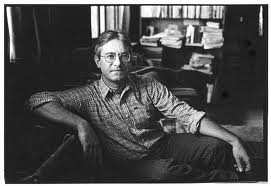
Greil En Repose
So Mr. Marcus’ question is: Why am I nothing when I should be everything? Sounds like a lot of frustration to me. If the questioner doesn’t understand the answer then he is in a veritable quandary. In the first place nobody can be ‘everything.’ Nobody can corner all the money in the world although it doesn’t stop some people from trying, some people who have a more effective plan than Karl Marx or…Johnny Rotten or…Guy Debord or…do I dare say Greil Marcus?
One must question in this novel of frustrations, for that is what it is, to what extent is the author talking about himself; he certainly sems to identify with his characters. He named a subsequent book The Shape Of Things To Come after a title of the man who wrote The Anatomy Of Frustration, H.G. Wells.
Writing is a dangerous vocation. I’m terrified by it everytime I put pen to paper. No matter how careful you are you must expose your real self to a readership that may or may not be all that forgiving. For myself I have abandoned any hope of concealment and write as my needs dictate. However once published your fate is in the hands of any readers. So, I sympathize with Mr. Marcus but wonder if he himself isn’t frustrated by a lack of monetary success that he thinks he deserves.
Why else would he concentrate on such nonentities as Johnny Rotten, Guy Debord and these non-entities hanging around the Cafe Voltaire. I have a feeling that Lipstick Traces could have been titled The New Anatomy Of Frustration.
Why am I nothing when I should be everything?
Did Guy Debord think he would become everything by plastering grafitti like Ne Travaille Jamais all over Paris? Ne travaille Jamais?
Guy Debord
There’s a defeatist slogan if I ever heard one. Mr. Marcus has worked plenty hard to realize his something. My god, the effort I have put in trying to make a success as a writer. Mr. Marcus at least has made it into print for which he has been paid something I should think. I’ve spent twenty years writing with no recompense and I still am. The only consolation I have is that the readership of my blogs seems to be growing. That’s something, no money, but something.
Ne travaille jamais? Why does Mr. Marcus want to make a hero out of some yo-yo sitting around a bar cadging drinks from people who do travaille? Unless Mr. Marcus explains, that is going to remain a mystery to me.
What is Guy Debord doing as he sits around drinking cadged absinthe, ruining his liver? Yes, but he’s trying to dream up ‘situations’ in which he can bring the society that won’t recognize his greatness to its knees. And according to Mr. Marcus he nearly succeeded in the Paris of 1968. That was the the work of the SI he says. SI, Situationist International.
Debord and his SI remind me of nothing so much as the fable of the Ants And The Grasshopper. You remember that. The Ants worked hard all summer storing up supplies against the long cold winter that inevitably follows the short pleasant summer while the grasshoppers lived heedlessly off the land fiddling and dancing.
When the inevitable happened as the inevitable will they who had thought they were everything turned out to be nothing. They demanded charity, much as Debord and his kind do, when they were refused their response was that they would burn the stores of the Ants and they wouldn’t have anything either. Mr. Marcus appears to admire this attitude.
What did Shakespeare say in Hamlet of ‘the spurns that patient merit takes of the unworthy’? Are those who will not contribute to be given the same consideration as those who do? The people who trashed Paris in ’68 thought so. The Grasshoppers did the only thing they knew how, they burned what les travailleurs had created.
Mr. Marcus admires that. Unless I read him wrong he considers that ‘freedom’. Guy Debord is one of legends of freedom.
SI. Situationist International. International- some guy sitting in a bar in Paris cadging drinks dreaming that he runs an International subversive organization. Some legend of freedom. So far Mr. Marcus’ argument is not very convincing.
During some very very formative years Mr. Marcus and I were subjected to many of the very same influences. I’d gotten out of the Navy in late ’59 moving into the East Bay of the SF Bay. Mr Marcus at that time, as I gather, was growing up in Menlo Park on the Peninsula. I was based in San Leandro-Castro Valley-Hayward. I worked in Oakland and San Francisco while hanging out as much as I could in Berkeley. While as I gather Mr. Marcus was fortunate enough to attend UC-Berkeley I was running the gamut of various Junior Colleges beginning with Oakland City finally ending up at Hayward State from which I graduated in ’66.
I’m willing to bet that Mr. Marcus is familiar with Henry Miller, The Story Of O, Steppenwolf and several other similar titles that were de rigeur in that cockpit of Freedom, the so-called Free Speech Movement from ’64 or slightly earlier on. Needless to say the apostles of the Frankfurt School, Adorno, Fromm, Reich, Marcuse et al. were running around trying to force that crap on everyone.
Since we’re talking Legends Of Freedom here that Mr. Marcus identifies, jokingly I hope, p.181:
They were “enfants perdu” Debord often said, lost children, and so they claimed any father in whose faces they could recognize their own; (cough, cough) the surrealists, the dadaists, the failed revolutionaries of the first third of the twentieth century, the Communards, the young Karl Marx, Saint-Just, medieval heretics-and all, as Debord and the others began talking in the 1950s, were moribund, forgotten memories and rumors, manque, maudit. All were, at best, legends- to the LI and SI, part of the legend of freedom.
Legends of freedom! Hmm…pardon me while I smile, pardon me further, I’m beginning to shake uncontrollably from laughter. Karl Marx and the Soviet Union legends of freedom? Oh yes, indeed, Mr. Marcus. A trick of perspective perhaps?
Listen now. Mr. Marcus hopes that the so-called Free Speech Movement at Berkeley may be included in those great freedom battles. But I ask Mr. Marcus, Freedom for who? As it happens Cal-State was a new college with a very small library so we were given library privileges at UC. So I was actually on campus when a lot of this was going on. I even tried to join up but was rejected in this great experiment in freedom because I wasn’t…Jewish. But I would be allowed to carry a sign and throw my body on the barricades…if I wanted to help this legend of freedom along. Well, I declined, envisioning myself in a more exalted postion as I did, I who should have been everything spurned away with the foot as nothing.
As I say I graduated in’66 so I spent the summer attending summer school at Berkeley. By this time the Revolution was over and the revolutionists were in control. When I came up from Hayward I entered the campus through the famous Sather Gate, perhaps since renamed Legends Of Freedom Gate, I don’t know. I used to see the ‘fabled’ Allen Ginsberg there trying to sell the Berkeley Barb or whatever.
Just inside the Gates Of Freedom, I think Dylan sang about some such fantasy, just inside the gates of freedom the Jewish Commissars of the revolution sat. One was supposed to submit one’s free American manhood to these ‘revolutionary’ slugs if one wished to attend classes unmolested. I just walked by these slugs because I didn’t know what was going on. I was told what was going on. Well, I’m a free American boy, born that way, not going to give it up, you dig? I don’t submit my manhood to anybody least of all some degenerate looking slug pretending to be Cheka, Gestapo, Che or whatever. Fuck that… pardon me, none of that for me.
Now, Berkeley had these huge thousand member or something like that, lecture classes. The teaching genius who wrote a book or two you’ve never heard of, lectured from a podium about a mile away then we were all divided into groups of about thirty and turned over to teaching assistants who were, you guessed it, vetted by the Commissars. You know where I stood in that great battle for, what was that word Mr. Marcus? Freedom? A legendary one too.
And you mentioned all these legends of freedom that preceded the so-called Free Speech Movement of Berkeley as representative?
And did we all dance with one hand waving free with no fences but the sky facing?
Don’t be disingenuous sir! None of the people you mention were interested in the least in freedom for anyone but themselves and I’m afraid that might include you. So was Berkeley a mere created situation that preceded the situation in Paris in ’68? Were the Commissars active in Paris as they were in Berkeley? I’ll bet they were.
Actually I’m beyond the third reading which is quite a tribute to Mr. Marcus. I’m up to five readings of Legends Of Freedom and I’ll probably be at five for the rest of the situations Mr. Marcus records. I may do some more detail work when I finish the main outline.
Next let us turn to the second situation. The Art Of Yesterday’s Crash.
End Of Part III
Lipstick Traces
A Review
Greil Marcus:
A Few Back Pages
by R.E. Prindle
The Man Who Shook The World
For even if they should say something true, one who loves the Truth should not, even so, agree with them. For not all true things are the Truth nor should that truth which seems true according to human opinions be preferred to the true Truth- that according to faith.
–Clement Of Alexandria
Clement was a man defending orthodox Christianity against not only the Pagans but competing Christian sects. Here he enunciates the credo of the true believer- it is True because we believe it, any other opinion even if true, or truer, must be considered false according to the faith.
In the twentieth century the Jewish comedian Woody Allen has a scene in one of his movies where some Jewish men are discussing things at a seder. Allen has one say that he would take God over the Truth. Or, like Clement he would sacrifice reason to the Faith or, in other words, Superstition.
There we have the crux of the matter. To criticize Jews is to criticize God in the Jewish mind. The inevitable result for those who do not accept the true Truth is to be labelled as anti-Semites. Thereon hangs the whole of Jewish history, past, present and future. It is to be devoutly hoped that the following discussion will not be defamed as Semites vs. anti-Semites but approved as Reason vs. Superstition. After all in the age of Science one would hope that Superstition is a thing of the past.
The argument will center on the ideas and career of Sigmund Freud- the man who shook the world. But first the world will have to be placed in the context of competing viewpoints within a Jewish context.
For many millennia the role of Science was given a subsidiary position below that of Religion. The truths of Science were denied because they conflicted with the true Truth of Religion.
In this environment the Jews were advantageously placed to dispute with Roman Catholics. After all Catholicism used the Jewish texts as its holy scripture. Thus in debating contests with Catholicism the Jews almost always came out the victors. This gave them great pride as being superior to the Gentiles. Their very high opinion of themselves seemed justified.
Had things remained a matter of faith the Jewish opinion of themselves would probably still be unchallengeable. However Science which had been treated by the Church more roughly than the Jews refused to be suppressed. Actually a higher percentage of Scientists were persecuted to death by the Church than Jews but this fact has to my knowledge never been considered.
The rise of Science in the seventeenth and eighteenth centuries not only shook the faith of the religious to its roots but actually cast the Semitic faiths into the dust bin of history. With the rise of Science Judaism became irrelevant. It could not win any debates with Science.
In the many crises of the Jewish soul this was a very significant one. It caused the breakup of medieval Judaism. For the first time the Jews left their ghettos and attempted to enter the mainstream of European life.
The Talmud which the Jews had always considered the repository of all true wisdom and knowledge now appeared to enlightened Jews to be the collection of nonsense the goys had always claimed it was.
As the Jews, then, began to enter the mainstream of European society they did so consciously as inferiors trying to impose themselves with their old dignity on superiors. The raison d’ etre of Judaism had to be replaced or the faith would just fade away.
The Talmud was useless to them in argument; they could only embrace the alien ideology of Science and try to excel the European originators of it.
Bearing in mind their desire to avenge themselves on the Europeans by befuddling them because of their expulsion from Spain they campaigned both politically and intellectually.
The first major attempt at establishing a science was that of Karl Marx who espoused ‘scientific’ socialism which was superior to ‘utopian’ socialism. Thus a Jewish social system supposedly scientifically constructed was placed in opposition to a European social system.
In the realm of Physics Einstein managed what seemed to be a more accurate description of reality. So in politics and physics the Jews had established a seeming scientific superiority.
At the same time as Einstein Sigmund Freud coalesced a theory of psychology that was superior to the fragmented state of psychology.
All three men then tried to turn their achievements to the benefit of the Jewish culture. As much as anything this was the cause of the two European wars as Hitler so accurately recognized.
As a little aside it is interesting to note the career of Immanuel Velikovsky. Like Einstein Velikovsky was a very competent Scientist, that is to say, working within an European intellectual milieu. But whereas Einstein stopped short at attempting to prove the veracity of Genesis and Exodus Velikovsky plowed straight ahead. Using his scientific skills to attempt to validate the literal accuracy of every fable he broke on the rock of superstition. Still, he wrote some very entertaining books, somewhat along Marcusian lines.
2.
The influence of Sigmund Freud on psychology has been immense while that influence has been almost entirely of a negative character. The increase in crime can be attributed to the implementation of his theories. Certainly the self-centered attitude of the homosexuals aboard the Teufelsdreck is about to lead to crimes and thwarted crimes which can be laid to Freud’s teachings. Let us review Freud’s ideas in the light of his milieu.
3.
One of Freud’s discoveries was the neurotic need to repeat. In other words, the subject repeatedly acts out the encysted subconscious fixation in an attempt to exorcise or realize the fixation. This phenomenon applies to cultures as well as individuals as Freud taught. In cultures it is called the ‘national character.’ In other words, a people must always act out its characteristic view of reality, the true Truth of the faith vs. the actual scientific state of things.
The Jews by and large have been a Stateless people since their origins. If one takes Genesis as fact, and it is psychological fact for sure, the Jews enter history ‘On The Road’ having been expelled from Ur of the Chaldees seventy-five years after having come into existence as a people. The theme of expulsion is a repeated figure in Jewish history. They are never tolerated for long. This is a fact, a truth, but in variance with the true Truth of the faith.
If we take the Jewish historian, Josephus, at face value they were expelled from Ur because of the jealousy of the Chaldean astronomers who were angry at Abram’s superior skills. The Chaldeans were known as the foremost astronomers of the ancient world so the Jewish ego must excel them at their own game.
The Jews then went to Egypt which was the home of the greatest magicians. After having outperformed Pharaoh’s magicians at feats of magic they take to the road again, fleeing Egypt.
Thus the main tenets of the Jewish character are fixed. They see themselves as an invasive people who are naturally superior to any people whose territory they invade and then they leave. These two themes repeat and repeat.
Thus in the nineteenth century when the Jews move West out of the Pale of Settlement into Vienna the migration must be seen as an invasion of a hostile culture intent on taking over the State as in Ur or Egypt.
A historical characteristic of Jewish invasions is that they are not usually militaristic but infiltratory. Like the military invasion of Hungary by the Magyars the Jewish invasion of Vienna was no less belligerent and exhibited the same needs to impose its culture.
In the biblical account of the invasion of Palestine the Jews put entire peoples to the sword to make living space for themselves. Thus they committed genocide several times over. There is no reason to believe they wouldn’t have done the same in Vienna given time and opportunity.
The bulk of the Jewish people after 1700 had been collected in Eastern Europe in what became known as the Pale of Settlement. This was mainly in Eastern Poland and Western Russia. When Poland was partitioned between Russia, Austria and Germany in the eighteenth century Austria acquired a large Jewish population in Galicia and its other Eastern provinces.
The Western Jews had already realized that the great challenge to their sense of superiority came from Science. What is called the Emancipation of the Jews was done by the French Revolution c. 1789-93. The Emancipation allowed the Jews to begin participation in European society. The work of the Church was undone. Thus the Jewish intellect came into conflict with the European intellect. In Germany this created a reaction known as the Kulturkampf. What the Germans had done was to give their intellect a name. They opposed German Kultur to Jewish Semitism. Semitism is the Jewish name for their intellect. Hence both anti-Semitism and anti-Kulturism came into existence.
Once within the Austrian Empire the Jews began to migrate toward its capitol, Vienna.
The Austro-Hungarian Empire was already an unwieldy amalgam of disputing nationalities and races. Its German governors had their hands full. Austria was sort of an early version of the United States.
Unable to destroy the Germans by the sword the Jews made a cultural assault on the institutions of the Empire. They pitted the Jewish intellect, Semitism, against the German intellect, Kultur. Freud who fully understood the meaning of Kultur wrote a book denouncing it- Civilization And Its Discontents.
Now, Jews are not smarter than anyone else although the mythology of the West so asserts. In fact, Jews are not under the same constraints as the indigenous peoples. Thus, the Jews are always a free, if circumscribed, people. The indigenous peoples were seldom as free. Medieval Europe had been a caste society in which only certain castes had freedom of movement. The Russian Serfs were both unfree and circumscribed until 1861 when they were at least nominally freed although not allowed to freely participate in society. They and other European peasants had a role akin to the American Negro of 1900 in the South who were supposed to know their place and keep it.
Thus a university education was beyond the aspirations of the indigenous lower classes but open to Jews of any class. It doesn’t take a genius to realize that social advancement is much facilitated by a solid education. The Jews accordingly flooded European universities in greatly disproportionate numbers to the population. Any Jew could thus place himself above the majority of the indigenous population.
It was inevitable that they be disproportionately represented in law, the judiciary, medicine, education, the arts and all prestigious occupations. As Semitism was unassimilable to Kultur it was inevitable that if the invasion was not resisted that Semitism would replace Kultur. This left the Germans in a difficult situation. They must either discriminate against the invaders, kill them, or go under.
Given more freedom of movement than the indigenous population and possessing a universal language, Yiddish, the Jews could form the international business corps of any community unrestrained by the business mores of the indigenous people. They could make their own rules, upsetting established traditions and customs as in Egypt and Chaldea.
This too is an established Jewish custom. Things don’t absolutely have to be done in the manner in which they are being done. When the Jews invaded Egypt they began to slaughter the sacred animals which the Egyptians had protected for millennia. The Jews saw no reason for the custom so they rudely pushed Egyptian mores aside. This habit is repeated in every country they invade. The peoples can learn to do it the Jewish way like it or not. They feel they speak with the authority of the true Truth of God.
By 1899 they were over 10% of the population of Vienna which is where critical mass begins. Muscling into the cultural life of the city they acquired a disproportionate number of seats in the symphony orchestras. As in Chaldea and Egypt they assumed that the Semitist style of playing was superior to that of Kultur. As music in Germania occupied an analogous position to astronomy in Chaldea and magic in Egypt the Jews naturally assumed they were better musicians than the Germans although music had never played a large part in their culture before.
As the scientific demands of music are greater than ancient astronomy and magic the Jews were never able to muster a composer of the first rank although their instrumentalists dominated the stage. But then all the empresarios were Jewish so they would necessarily hear with the Jewish intellect. Even today the Jews believe that without the Semitic intellect the orchestras of Europe sound nowhere as good as before the Holocaust.
They established their own newspapers and publishing houses. They used them to defame anyone who dissented from their program.
Without physical resources they had to resort to psychological means to disarm their opponents. They had to ‘psyche’ them out. Anyone who opposed or criticized them was branded as an anti-Semite and his own people were instructed by the Jews to ostracize him. Thus German nationalists became, if not criminals, at least, pariahs in their own land. The Austrian reaction to Jewish nationalism was extremely violent giving expression to itself only after the Anschluss.
These German defense forces were active and powerful during the period from approx. 1890-1914. After 1918 resistance to the Jewish invasion crumpled everywhere. The Millennial Revolution had gone swimmingly. Jews assumed the top positions or became dominantly influential in nearly all governments including the United States. The Jewish Invasion was for all practical purposes a success.
Two men were born into this Viennese environment that would have a profound impact on world history, Sigmund Freud and Adolf Hitler.
4.
Freud’s main desire was to become a great man. This idea was planted in his intellect by his Christian nurse as a child. He succeeded in realizing this in the field of psychology. Freud was himself an immoral man nor does he advocate morality for others. He advocates an unbridled self-indulgence. Like he says: Life is short. To succeed in one’s aims it is permissable to take immoral shortcuts even to use criminal means. The Mafia believes the same thing.
As a young man he was schooled in the tradition of Anton Mesmer from whom modern psychology descends. He was heavily indebted to the teaching of the French psychologist Jean Martin Charcot as well as to the school of Nancy. His own approach was an adaptation of their methods. He at first used Mesmerism or hypnotism as did the schools of Paris and Nancy but later abandoned it in favor of a form of self-hypnotism that he called free association. Hypnotism as a result went into a period of disfavor although applications are being found for it once again.
He got his real start by insinuating himself into the good graces of Josef Breuer whose work he very nearly appropriated. Having plundered Breuer he broke off with him never speaking to him for the rest of Breuer’s life. Thus does conscience make villains of us all.
Unable to admit his indebtedness to his teachers he repudiated their influence acting as though he had evolved his theories out of whole cloth. As an aspect of his character he was unable to suffer any criticism or advancement on his own ideas by others. He eventually acrimoniously broke with any of his associates with intellegence and independence.
Freud was a Jew which is to say devoutly so. He did not consider himself Austrian or German but an ethnic Jew. He believed in the supremacy of the Jewish people.
The most revealing anecdote concerning him was that as a child he was walking with his father who told him how when a young man he was wearing a new hat when a Gentile knocked it off his head into the street.
‘What did you do?’ Freud asked breathlessly expecting the answer to be that his father knocked the Gentile down.
‘I went out into the street and picked it up.’ His father replied.
Freud then lost all respect for his father which troubled him greatly for he wrote: ‘I cannot think of any need in childhood as strong as the need for a father protector.’ His dad wasn’t it.
So Freud’s own psychic needs distorted his approach from one of science as Jung claimed to one based on his personal needs. He falsely maintained that the father figure is the most important in a man’s life. When his disciple Otto Rank had the courage to correctly insist that the mother was the most important, Freud drummed him out of the ranks.
Disappointed by his own father he took as a surrogate father figure Hamilcar Barca, the father of Hannibal. Hamilcar Barca having suffered an injury at the hands of the Romans made his son swear on his sword, which is only a substitute for the ‘thigh’ or penis, that he would avenge him on the Romans. Clearly Freud would have promised his dad to avenge him on the Europeans if he had asked. Maybe he did.
Curiously Freud doesn’t carry Hannibal’s story through to its conclusion. The Romans exterminated the Carthaginians and razed their city.
Freud’s lapses in the application of his psychology are very peculiar. Having discovered the psychological compulsion to repeat he applied it neither to an analysis of himself or of his culture and people. He might have saved the Jews much suffering if he had. In his desire to avenge his father he became a central figure in the millennial period of 1913-28 which ended in yet another attempt to exterminate the Jews.
Post exilic history for the Jews began rather favorably. They returned to Palestine just as the Middle Eastern Empires were entering a time of troubles. The succeeding Hellenistic period left them more or less independent until in 186 BC the Seleucids interfered in their internal affairs. Under the Maccabbees the Jews were able to defeat the relatively weak Seleucid Emperors who were besieged on all sides. The victory gave them a feeling in invincibility.
The feeling was shattered by the Romans.
The Jews tried again and failed in seventeenth century Europe.
Their third repeated attempt was in 1913-28 which can be extended to the present.
Freud made the incredible and mind boggling statement on the eve of the Bolshevik, or Jewish Revolution in Russia: We tell ourselves that anyone who has succeeded in educating himself to truth about himself is permanently defended against the danger of immorality even though the standard of morality may differ in some respects from that which is customary in society. He then goes on to say especially since the existing standards of morality are beneath contempt.
Thus he advocates that a private, personal, obviously self-serving morality is superior to an ideal morality that has evolved over millennia extending those millennia anterior to the Old Testament.
What could Freud, knowing the imperfect nature of man, have found so objectionable about the existing morality? I don’t experience it as he did. It can only have been that it was based on European traditions and not Freud’s Jewish heritage.
The birth of modern Judaism was caused by the rise of the European Scientific attitude. Science was the sole creation of Europeans with which the Jews had nothing to do. Prior to the Enlightenment in their argument with Roman Catholicism the Jews had not only been equals but superiors. As the creator of the corpus followed by the Church the Jews were in a better position to understand and interpret it through the repository of the Talmud.
When as a result of the Enlightenment, scientific Europeans left the puerile biblical debates behind the Jews were hopelessly medieval. The Talmud, so effective against the bible, was worthless against science. The more intelligent or, perhaps, less traditional Jews began to reorganize Judaism to meet the Scientific times. This left them second rate beneath the Europeans, a serious affront to their amour propre.
The real challenge then was to regain their superiority. This could only be done by excelling in Science as they could invent nothing superior to it. The true Truth of religion broke on the rock of reality. If they merely excelled in Science they merely excelled in an European milieu. They were clearly then no longer the Chosen People; they became lost in the ruck. Freud at one time says that he saw no reason why the ‘wisdom’ of the Talmud couldn’t be raised to a level with Science thus bringing the Jews level with the Europeans in their dreams.
Strangely he didn’t understand that the entry into full consciousness caused by the understanding of the workings of the psyche obviated all forms of consciousness that went before including the so-called wisdom of the Talmud.
So, to whom was Freud speaking about educating himself against the danger of immorality? By Freud’s own admission his fellow Jews.
Freud’s vision of psychoanalysis is personal, dealing exclusively with the subjective workings of the subject’s mind. He doesn’t even seem to grasp that the fixations are caused by external forces. He seems to think the mind functions independently of the outside world. Input does not seem important to him.
To Jung and others Man’s relationship to his world is based more on a Challenge and Response system. In other words, the intellect, which Freud denies, plays a very important part.
Freud’s own intellect cast against his ideas places them in a different light. The man was born in 1856 in a Central European Jewish milieu. It will be remembered that the Hasidic religious movement grew out of psychological trauma that occurred in 1648. Founded c. 1700 the Hasidic movement was only about a hundred fifty years old at his birth thus retaining much of its original vitality.
Also arising out of the Jewish disappointments caused by the failed Messiah, Sabbatai Zevi, in 1666 a movement was led by a follower of Zevi by the name of Jacob Frank. This movement also took shape in the first half of the eighteenth century and was still flourishing during Freud’s young manhood.
As a consequence of Zevi’s failure Frank believed that man was inherently evil thus God would never redeem him until the evil was spent. The only way to expel evil was to commit enough crimes to get it out of one’s system. Novel pyschology to say the least. Thus he taught to a large and attentive Jewish audience that one must commit evil for evil’s sake and that good will come of it. So, in a manner of speaking, one is doing good by doing evil.
Now, one can trace the spread of this idea in various forms and guises through space and time. One very interesting advocate who deserves more study is an eighteenth century English Jew by the name of Samuel Falk. Another is a twentieth century American Jew by the name of Arnold Rothstein. And of course, Marx and Freud.
Freud does not go into the external influences that formed his outlook or life or personal Weltanschauung but this emphasis on a personal morality that is superior to prevailing morality seems a sublimation of Jacob Frank and his evil for evil’s sake.
Now, to whom was Freud speaking and why? Certainly Freud considered himself a prophet of the Jewish people amidst the dawning millennium. He had an intense desire to avenge his people on the goyim. Did this Hannibal in that role have anything to do with organizing or directing the Jewish Revolution of the dawning millennium?
There is no question that his statement that anyone who has educated himself to truth about himself is permanently defended against the danger of immorality (and hence a guilty conscience) could be construed as advance absolution for any acts of the Bolsheviks that would be considered crime by ‘conventional morality.’
Freud’s statement and role resembles those a great deal of Simeon Bar Yochai, a second century rabbi of the Roman Wars. The Roman-Jewish war of 66-135 AD was perhaps the first of the Holy Wars. Its rationale and leadership was provided by the religious leaders of Judaism.
Simeon Bar Yochai was a leading architect of that war, probably its guiding light. After Bar Kochba’s defeat in 135 AD Yochai was compelled to go into hiding in a cave from which he daren’t move for many years until the Romans gave up the search. As a tribute to his influence in the war his obituary at his death said that he was the man who shook the world to its foundations.
Just before the bloodbath of 116 when the Jews rose up to slaughter hundreds of thousands of Gentiles a moral quandary arose in the Jewish community. They wondered whether it was permissable to kill ‘good’ Gentiles as well as the ‘bad.’ The rabbis without a moments hesitation replied that it was permissable to kill any and all Gentiles.
In 1666 with the expected advent of the millennium heralded by the messiah, Sabbatai Zevi, the Jews had been prepared on the strength of ‘God’s promise’ to rise up and murder Europeans much as they had done in the Roman War.
The third repeat of the Jewish Revolution of which the millennial date was 1913-28 had come to a slow boil with the Communist Manifesto of 1847.
It will be remembered that following Marx’ manifesto all the national Communist parties were over half Jewish. The non-Jew, Kropotkin, as leader of the anarchists had been discredited and the anarchists disenfranchised from the Communist Movement. The Jews than held all the leading positions.
Thus four Jews led the Bolshevik Revolution in Russia- Lenin, Kamenev, Zinoviev and Trotsky. All the abortive revolutions of Central Europe were led by Jews. They actually repeated the massacres of the Roman Wars in Russia and Hungary and were prepared to do so throughout the world as the Revolution rolled on to success.
In Russia slaughterhouses were established in which Jewish murderers ‘worked’ all day long slaughtering Gentiles until they stood ankle deep in blood and gore. Were they able to do this because Freud and made known to them truths about themselves that prevented them from committing immoral acts? Were they absolved of their crimes in advance as were the Jews of the Roman Wars? They must have been or they couldn’t have performed their ‘work.’ As it was numbers of them had nervous breakdowns as a result.
The atrocities in Hungary and the projected total annihilation in the Crimea have already been mentioned. The similarities between the Roman and European slaughters are quite pronounced in their ferocity. Of course all the details of the former had been recorded in that epistle of ‘science’, the Talmud.
Did the Jews go to Freud to justify their atrocities as they had to Simeon Bar Yochai two thousand years earlier? There is the compulsion to repeat. The Jews were very well organized before, during and after the Great War. Agents of the American Jewish Joint Distribution Committee swarmed over Central and Eastern Europe after the War in an attempt to rehabilitate their brethren first so they could assume control. The AJC and B’nai B’rith were the leading components of the ‘Joint.’ Freud had been a member of B’nai B’rith since 1895. He lectured to them in Austria on a consistent basis for years, even decades. As a psychoanalyst what was he telling them? His intellect deserves closer examination for what else can ‘anyone who has succeeded in educating himself to a few truths about himself is permanently defended against immorality’ mean except a license to kill. If a Jewish supremacy arose out of that evil wouldn’t good have come out of it in Jewish eyes? Yochai, Frank, Freud, there is a succession.
Placed in that context one must reevaluate the whole period as well as the careers of Hitler and Stalin, for as Freud wrote openly in a universal idiom his rationale can be appropriated by any individual for his personal morality.
The invasion of Vienna was preceded by and coincident with the rise of Jews in France. At the time of the Russian Revolution a document became prominent called the Protocols Of The Learned Elders Of Zion. The document outlines a method for creating discord in society so that a junta can easily assume control. It was said that this document was a Jewish blueprint for world dominion. The provenance of the Protocols has never been established for certain. The Jews say it is a ‘forgery’ while their opponents say it is authentic.
Over the years the Jews have managed to discredit the document and have its study suppressed. This is a great disservice because whoever wrote it its precepts are currently being followed by several groups. Have you ever looked at Homeland Security carefully? It behooves every person interested in current affairs to be conversant with the Protocols of Zion.
In point of fact the Protocols are of Jewish provenance.
One thing all disputants agree on is that the Protocols were based on an earlier document of Franco-Jewish provenance called in English: Dialogues Between Montesquiou And Machiavelli In Hell. The Dialogues are of Jewish provenance so whether the Protocols are or not is a moot point.
The Dialogues were attributed to a French Jew by the name of Maurice Joly but internal evidence indicates several hands including that of the ‘Gibbon’ or Jewish historians, Heinrich Graetz.
The creation of the Dialogues was coordinated by a French Jew by the name of Adolph Cremieux. Little known outside Jewish circles but extremely important to a number of situations Cremieux also deserves further study. He was a lawyer and politico deeply involved in the revolutions of 1830 and 1848. If one takes the Jewish ‘Gibbon’ Graetz at his word both revolutions were the result of Jewish machinations. On this point Graetz and Hitler are in accord.
Cremieux was responsible during the annexation of Algeria in 1830 under cover of that year’s revolution for obtaining French citizenship for the Algerian Jews. Thus with the annexation the barbarous medieval Jews of Algeria became full French citizens gaining precedence over the native Algerians in one fell swoop. Clever move for the Jews bad move for France.
As Jewish affairs were consolidating nicely in France twelve years after the 1848 revolution a Jewish central governing body called the Alliance Israelite Universelle was founded by Cremieux in 1860. The Dialogues were supposed to have appeared in 1862. The name means The International Alliance of Jewry or in a slightly different translation: The International Jewish Conspiracy. Actually the Alliance was the seat of the Jewish government until c. 1900 when the seat was transferred to the United States under the guidance of the financier, Jacob Schiff.
Thus the Protocols arose out of the Dialogues in direct succession sometime during the 1880s. It should be noted that the Dialogues was never seen in bookstores. The whole printing was confiscated by Napoleon III according to report against whom they were supposedly directed. It follows that the only people who could have known of the book and provided a copy as a model for the Protocols were its producers the Jews of France.
Nevertheless, as masters of misinformation, disinformation and misdirection the Jewish government was able to shame the liberal parties into rejecting Jewish provenance of the Protocols. The Liberals then condemned any Gentiles who persisted in saying so as anti-Semitic cranks. That is actually the nature of the ‘proof’ that the Protocols aren’t of Jewish provenance.
Jacob Schiff himself was a very effective Prime Minister. He was able to engineer the First Russian Revolution of 1903-05 by funding the Japanese war machine from America while he and European financiers prevented funding to the Russians.
Schiff was able to disrupt American and Russian diplomacy for the benefit of the Jews from 1900 to 1913 when he succeeded in persuading the US to break off diplomatic relations completely. Immediately with the Bolshevik succession he rushed huge loans of American dollars to their coffers even during the Great War to shore up the regime.
Thus absolved by Freud of guilt and supported by world resources from 1917 to 1924 it looked as though the Jews were on the eve of success in their millennial pursuit. With the possible exceptions of Mussolini and Ford it looked at though there were no fences facing.
However Hitler and Stalin sensed the danger. Hitler himself was always hostile to Freudian beliefs; it may be assumed that Hitler read at least some Freud. He was hostile to Freud for much the same reasons that Freud was hostile to Kultur. Living in the Vienna under the governance of the ‘anti-Semitic’ Mayor Lueger Hitler was self-educated. He spent years in the libraries organizing his view of the world.
In Freudian terms both he and Stalin certainly knew truths about themselves which prevented them from committing ‘immoral’ acts. Freud’s dictum could be construed as also authorizing their crimes.
Coming to maturity in the Red Terror of 1917-24 Hitler had a good understanding of the course of events in Central and Eastern Europe. It is silly to think that he acted solely from his own impulses. There was a civil war going on between Reds and Whites from 1918-33 in Germany. Judeo-Communist atrocities were daily before his eyes. As he said, he knew his head would roll in the sand if he lost. That was not mere rhetoric.
Hitler’s experience in Vienna convinced him of the nature of the war between Jews and Gentiles. The evidence is clear that the Viennese shared his views. Once given the upper hand over their invaders the Austrians were much more obdurate than the Germans. Never forget that an Austrian, Hitler, directed the fate of the German nation.
Hitler’s book burning in 1933 might be construed as nothing more than a vindictive censorship of ideas he didn’t like. But the books burned were those of Jewish writers, expecially Freud, it should probably be seen as an attempt to eject Semitism from Kultur. In other words the triumph of Kultur over Semitism. In the end the Germans chose to kill the Jews rather than discriminate against them or go under. You may be sure the Jews would have done the same.
As Stalin usurped power from the Jews in Russia a strange thing happened. Psychoanalytic methods assumed great importance. Spectacular show trials ensued.
When Freud’s disciple Otto Rank defected from the ranks of Freudian pyschoanalysts he was excommunicated. The validity of his views was not examined; even if true they were not the true Truth of the faith. Hence Rank was compelled to submit to criticism, confess his faults and beg for acceptance back into the faith.
The Show Trials of 1936 were conducted in the exact same manner except that the sinners were given the death sentence. The method surfaced again in Red China in 1966 when the Red Guards and Cultural Revolutionaries of Mao Ze Dong overturned that society. The accused were criticized in mass meetings, compelled to confess their ‘faults’ and beg to be allowed to rehabilitate themselves through hard labor.
Thus Marxist and Freudian ideas converged in an orgy of evil to destroy the oldest continuous civilization in the world.
The notion prevails in Politically Correct circles in the US today. Thus Freudianism has had a profound if unsuspected impact on the world.
Freud remained confident through 1928, began to waver in 1930 and by 1938 the horror of the impending destruction of the Jews as a repeat of the Roman War was before his eyes as fled Austria for England. In Moses and Monotheism he pitifully whines that the Jews had given up those notions of world dominion long ago. Or, in other words, I’m sorry.
Like Hannibal, his attempt to avenge his father resulted in the destruction of his people. As in the Roman War the Nazis conducted a manhunt to find every single Jew and kill him. Not only had Bar Kochba and Sabbatai Zevi failed the Jews as messiahs; so had the Revolution. The Jews failed in this third attempt to take over the world but the legacy of Sigmund Freud lives on in the ambiguous words of his corpus. His immediate political aims failed but his undermining of European society was much more successful.
Apart from his political intent Freud had uncovered a great scientific area of study.
5.
The Shirt Of Nessus
While Freud’s short term political goals ended in disaster for his people, as did those of his role model, Hannibal, Freud’s long term goal of destroying the social foundations of the Gentiles has succeeded quite well.
As an innovator Freud cannot be expected to have had a complete and final idea. Much of the information that became available after 1950 was undeveloped in Freud’s time, such as the Matriarchal and Hetairic periods, so he cannot be held accountable for not knowing them. Physiology has made tremendous strides since his day.
Freud’s errors do not so much lay in areas of knowledge but in the areas of intent or motive. He was unable to separate his own psychology of hatred from that of his scientific discipline. Hence his mistaken emphasis on the importance of the father figure and his misbegotten notions of the Oedipus Complex. Then too, he projected his hatred of the Gentiles into his views of religion and sexuality.
The only thing of value Freud had to offer, that of the formation of neuroses, has been rejected by the lay and medical communities alike.
Strangely his nonsense is revered as great revelations of truth, largely because they fit in with prevailing prejudices. In his attack on the Christian religion Freud was curiously unaware that the Scientific Consciousness displaced the anterior consciousnesses of Hetaira, Matriarchy and Patriarchy. Thus the people who were dependent on Religion as the basis of the mentality were people whose beliefs could not be dislodged. On the one hand were the various esoteric religions whose beliefs do not depend on the divinity of Jesus and the Fundamentalists whose belief is so secure that nothing can shake it. For those who need a supernatural agency in their lives New Age people using science as a tool have created alien intelligence from beyond the solar system to serve as their ‘God.’
If Freud thought dispelling Christianity as a religious belief would bring the Gentiles down he was mistaken. The ‘illusion’ had already been replaced by a ‘reality.’ The futility of trying to dispel religious beliefs should have been clear to Freud. The exposure of the illusion or, even delusion, of the compact between the Jewish people and their god had no effect on them; they continue to believe the compact exists and that Palestine was given to them by their tribal god inalienably.
The most potent dissolvent in Freud’s arsenal was his sexual theory. He was quite severely criticised for his sexual beliefs then and they should be rejected now.
Everything Freud believed on the subject was wrong. Basic to his misunderstanding was the physical structure of the human organism.
He quite correctly picked up the ovate and spermatic halves of the psyche but since he didn’t associate them with physical origins he mistakenly thought that men were part woman and vice versa. This was a critical misconception as it opened the door to much erroneous speculation on homosexuality.
There may be rare cases of sexual ambiguity caused by birth defects in the physical apparatus or defective hormonal systems but any other expression of ambiguity is a perversion that is not part of the most perfect specimens but comes about only when the ovate is fixated and spermatic repressed or, in other words when the organism is mentally disturbed. Psychological perversion has nothing to do with the physical organization.
Since Freud misunderstood the physical organism he equated sexuality not with the Power Train itself but only with sexual intercourse. Freud actually equated fucking with mental health. Because psychic discomfort is reflected in sexual urges he actually believed that the more fucking one did the better person one would be. Such nonsense has not only passed unchallenged for eighty years but is actually embraced today as the Gospel of Fuck.
Freud did not believe in the intellect or the effectiveness of intelligence. While he made the grandiose pronouncement: Where Id is, Ego shall be, he failed to explain how this would come about. For whatever reason he considered the intellect nonexistent and intelligence ineffective and unimportant. In keeping with his times he believed in the hereditary transmission of mental traits.
More importantly he invented a whole category of affects he identified as self-sufficient ‘instincts.’ Like the Unconscious instincts do not exist. There are no instincts, not a single one, all is a matter of learning and education.
Even eating is not an instinct but taught at the mother’s breast. Hunger may be a physical reality but it is not an instinct. Assuaging hunger must be learnt and that literally at the mother’s breast. The first lesson an infant is taught is when the mother inserts the nipple in his mouth. His mouth is blocked he has no choice but to resist by sucking. Imagine his surprise when the liquid emitted seems delicious and when he swallows it because he can’t spit it out the physical reaction is terrific. It feels good. Having learnt to eat he wants more. Being a quick learner, from that point on the infant will demand to be fed. But without that first infusion he would die hungry not knowing what the desire to eat meant.
Because Freud wanted to project his own psychic vision he gave instincts precedence over all other psychic functions. He professed that the individual was incapable of resisting or controlling what the Ancients characterized as the Raging Bull and what he called the Ego.
Both the Church and Esoteric religions have devised rigors to control or domesticate this Bull or Ego/instincts by using intelligence. Freud thought that to use your intelligence to control your ‘instincts’ was to incur damaging inhibitions and repressions. Hence he was opposed to European morality. Freud imagined this did irreparable damage to the psyche especially sexual inhibitions and repressions hence the Gospel of Fuck.
If fucking actually made a person better, then the logical conclusion is that libertines and homosexuals would be the best people in the world. Fucking dominates the libertine and homosexual mind. It is not unusual for them to commit thirty or forty sex acts a day for as many days as they can sustain it.
As the only thing that counts in this view of sexual activity is the climax it follows that if machines were placed in prominent places to masturbate the individual on an hourly basis or less that society would be darn near perfect. I don’t know why people are leery of buying the Brooklyn Bridge when they have bought the myth of sexual intercourse.
The fact is that libertines and homosexuals are the worst people in the world so the basis of Freud’s argument is very limp.
The West has generally embraced Freud’s misguided sexual theory. The United States is actually fucked. Freud’s sexual theory was picked up by the lame third rate novelist Henry Miller who actually formulated the Gospel of Fuck during the twenties and thirties in the Tropics of Cancer and Capricorn.
Henry Miller was gaining respectability during the fifties with psychotic fringe groups in the San Francisco Bay Area and elsewhere. By the sixties he would have a profound impact on society with the reverence given his two volumes of the Tropics.
As Freud was interpreted in the common mind repression and inhibition were the causes of psychic discomfort. The common mind had no idea how inhibitions and repressions were caused except by not being allowed to do whatever you wanted to do. Through the forties and fifties children of innumerable families were encouraged to indulge their whims and fancies regardless of who they might hurt. They were given no instruction or correction lest they become inhibited and repressed. It was thought that when they grew up they would naturally gravitate to the intelligent choice.
The so-called ‘Me’ generation of the sixties and seventies lacked proper instruction in managing their ‘instincts.’ The pervading influence of past mores prevented them from expressing themselves with true lack of ‘inhibition’ or repression. The wave of high school shootouts of the later century when the succeeding generation had moved out from the shadow of earlier mores were committed by the offspring of the ‘Me’ generation. They are the logical progression of Freudian sexual theory.
Employing metal detectors and other ‘inhibitory’ or ‘repressive’ systems will not solve the problem. Freud has to be amended.
Freud’s thesis was advanced by the Jewish monologist Lenny Bruce as well as furthered by Jewish interests in Hollywood who produced innumerable ‘action’ films in which the uninhibited and unrepressed protagonist attempts to solve his problems from the barrel of a gun rather than reason them out.
So, this brings us up to Greil Marcus and the present. Greil Marcus is himself a Jew so the question is how does Greil Marcus and his writing fit into this Jewish cultural scheme of things. On my first reading of the book I had no idea what Mr. Marcus was talking about. I had heard of the Situationist International but knew nothing about it. Reading the blurbs I was under the impression that Mr. Marcus was going to explain the SI. Not very clearly anyway. As I turned the last page I had no idea what the book was all about.
Second reading same as the first. Then I read his 2006 effort The Shape Of Things To Come. I gathered from that that Mr. Marcus considered himself in direct descent from the Old Testament Hebrew prophets and that he had conflated Israel and the United States. Armed with that understanding I had the thin edge of the wedge. I went back to a third reading of Lipstick Traces. Pay dirt! I think.
I gather from the third reading that Mr. Marcus considers himself also a direct lineal descendent of Theodore Adorno and Herbert Marcuse, in other words The Frankfurt School or alternatively The Institute For Social Research or alternatively still The New School For Social Research. Now we’re getting somewhere. In addition his intellectual romance with fellow Jew Guy Debord who was the Situationist International seemed that in much the same way Dr. Baum assumed the soul of Dr. Mabuse in Fritz Lang’s The Testament of Dr. Mabuse I gather that Mr. Marcus may feel that like some Buddhist Lama the soul of the dead Debord has passed into himself and he is the new leader of the Situationist International. So as I perceive it Mr. Marcus views himself as an ancient Hebrew prophet, a critic in the mold of the Frankfurt School and the leader of the Situationist International.
For some in depth background on the Frankfurt School the interested reader might try Kevin MacDonald’s ‘The Culture Of Critique.’
Following the above notion of who Greil Marcus might think he is and what he thinks he’s doing I will attempt an interpretation of Lipstick Traces. Mr. Marcus as the leader of the Situationist International seems to have compiled his book which is as much a stream of consciousness impressionistic novel as anything else as a number of situations.
I will deal with each situation as a separate entity which indeed a situation is. Rather than begin with the first situation which as I see it should be last I will begin with the second situation, part of Version Two- A Secret History Of A Time That Passed- Legends Of Freedom.
The theme of the book as a whole seems to be the saying of Karl Marx that Mr. Marcus refers to repeatedly:
I am nothing and I should be everything.
End of Part II.
The Beginning Of A Review Of
Greil Marcus’ Lipstick Traces
She Belonged To Him:
Me And Bob Dylan
by R.E. Prindle
I was bouncing around the internet the other day and I came across a guy who wondered why Dylan since his sales were so poor had become such an overriding influence. And then I was working my way through Greil Marcus’ Lipstick Traces for the third time trying to figure out where he was coming from, where he wanted to go and how he proposed to get there when he posed the problem of where were the roots of Punk.
And then, I’ve been thinking about Dylan lately wondering where he went after Blonde On Blonde and I think I may be able to answer all three questions. I don’t listen to Dylan anymore, can’t, whatever charm he had for me went South and I mean South Of The Borders, I mean South of the Equator, I mean…South.
Can’t listen to him but Bob’s overriding influence remains. I still buy every book about him that comes out. Bought one today. I even bought and read and reread Chronicles Vol. I. Disappointing. Wish he hadn’t written it. But if Volume II comes out you can bet I’ll buy that too. So, Yes, Dylan was a major influence on my life but only three records- Bringing It All Back Home, Highway 61 Revisited and Blonde On Blonde. God, what great titles. The mystique was built in.
I was at grad school at the University Of Oregon in 1967-’68. My mental state was such that I began each day, right after getting up, with a side from one of those three albums. Everyday for a year and a half. You’d think I’d have those records memorized but, you know, I couldn’t quote one complete verse but I remember the tones of his voice and the moods of the songs quite well.
I don’t know what my wife thought of those records. Never said anything to me about them, never complained but she’s never put a Dylan record on the turntable and she still has never mentioned those records.
So, the influence came from those moods, those seeming articulations of the 60s angst. The lack of sales came from that godawful voice he used.
I was out in California in ’64. Had no idea what was going on in Greenwich Village in the Big Apple. I’d never heard of Bob Dylan but one day I dropped in on my brother-in-law. The guy had an impeccable ear for the next big thing at the time. He took off the Righteous Brothers and said listen to this. I don’t know what record it was of Dylan’s but one of the first three. What godawful noise, the guy couldn’t sing and he couldn’t play. Sounded like he’d just picked up a guitar and blew harmonica like a six year old. I was shocked beyond description. Well, listen to the words my brother-in-law said. Well, they still weren’t much but the guy seemed offended at everything going on in the world and was sincere. Boy, there’s a recommendation.
That’s where the Punk came in. You can interchange early Dylan with Johnny Rotten and you’ve got Punk. Dylan was an eye opener for younger kids with no talent and a lot of angst. Check out the Chocolate Watch Band and their ‘I’m Not Like Anybody Else’ Post Dylan-pre Rotten. I don’t understand why the Sex Pistols didn’t do this, uh, song.
Actually I’m grateful to Bob; he saved me from myself. In 1964 I was on my way to being a mental eighty year old man. Following Dylan I’m younger than that now. He pulled me back from the mental graveyard and restored my youth. Of course Bob would have been in the musical graveyard except for a little good luck.
I wasn’t there so what I’m going to say now comes from reading all those books. Dylan started out as a complete snit. I don’t care if he changed his name or not. Tiny Tim had the right idea. If one name isn’t working try another. Well, Dylan worked perfectly for Bob so he only needed one name change. Tiny Tim went through several. Probably looking for a new one right now if he’s still alive.
Bob’s early adventures in Minnesota may be interesting but they don’t concern me now. Somewhere along the way he developed a fixation on Woody Guthrie. God, I wouldn’t give you a quarter for any record Guthrie made unless I could turn a quick profit on it.
So, Bob shows up in New York City as a Guthrie clone. Didn’t do him any good. Dressed funny too. Like a Hollywood vision of the Dust Bowl. People said things to him about it. Dylan realized he was peddling his bicycle as fast as could down a dead end street. He decided to give it up. Had to search around for a new persona. Took him a while but he found one. Plundered all his friends of their styles but, a boy’s got to learn somewhere. What’s plagiarism to some is education to others.
He was bright and he could mangle words and images. If you really parse ‘Blowin’ In The Wind’ it doesn’t hang together, makes no sense. But the MOOD, god, the mood is terrific. The lyrics don’t have to mean anything. Of course with his raucus voice and guitar banging and harp blowing the song would have just lain there. But as Bob would later sing- She belonged to him. And she planted a kiss on him the likes of which very few ever experience. Don’t want to get over confident though. Like Jesse Winchester later sang- First She’s yours and then She’s his and that’s the way it is and always will be. In ’63 and ’64 She was just toying with him. Albert Grossman was on the other end of the line. Enough to scare anybody. He formed Peter, Paul And Mary, kind of a sweet singing Kingston Trio and they picked up on Blowin’ In The Wind and coming from their sweet harmonies Bob became established as a songwriter. That’s where the mega influence came in. Pretty soon all the good singers were doing his songs. Songs that no one would listen to on his own albums. The Byrds called it Folk Rock. The generation loved it.
So people began to reverence Bob Dylan as a songwriter. Then in ’64 or so She really entered his life. Both Sides Of Dylan was a record groping for the future and in the next Bringing It All Back Home he really began to do that. We went into the future and the future sold.
Bringin’ It All Back Home was supposed to be a radical departure for Dylan; he threw over Folk for Rock n’ Roll. Smart move. He may have sounded terrible but he wasn’t dumb besides with a sharp rock band behind him you couldn’t hear him as well. Look what Frank Zappa did for Wild Man Fischer. Folk had worn out its ethic; there was no future for it; all past tense. Now, when Johnny Rotten sang no future, no future in 1975 Rock had also worn out its ethic. It was on the verge of becoming stale or already over the line, so sounding as rotten as early Dylan the Sex Pistols pulled the plug on Rock. Had to happen. Everything gets old.
Well, anyway Bringin’ It Back opened the eyes of all us doubters while Highway ’61 Revisited made us sit up and pay attention. There was something happening there wasn’t there? Not much in retrospect but it was a revelation at the time. That was when She came to live with Bob for a year or so. It was bliss, you ask him. Words just spilled out of his mouth. Highway ’61 was such an advance on rock n’ roll you just didn’t know what to think. Everyone stood around breathlessly waiting for the next one. That came out in the summer of ’66. I had just graduated from Cal State At Hayward attending summer school at UC Berkeley. Boy, was I a strange one in a state of transition from squarish to hippish. Bob’s Blonde On Blonde lay there next to Procol Harum and Canned Heat. Man, the rock revolution was really on.
She and Bob were really making it. Blonde On Blonde was such a peak no one could see how it could ever be topped. It couldn’t. That was when She and Bob split. She went one way and Bob went another. We heard about his accident. Reports came he was alive but had broken his neck. I stopped worrying about what Bob would do next; I knew it wouldn’t top Blonde. I wasn’t sure about Her but I knew his mind had stopped. I knew because I saw Her walking down the street. I tried to catch up but She was too fleet for me.
Bob recovered and came back with the insipid John Wesley Harding- Lay Lady Lay- for Chrissakes, give me a break. For Bob a kiss was just a kiss but what a kiss. The kind you never forget.
I tried to follow his career but the stuff was just, well, ordinary. Blood On The Tracks was so-so. Tangled Up In Blue was a good song but that’s just it, it was a good song. A simple narrative with a beginning, middle and end, certainly no Sad Eyed Lady Of The Lowlands or Desolation Row. I’m not big on depression, at least not anymore, but I sure loved those songs. Stuck Inside Of Mobile Again? She was cooing in his ear during that sweet moment of bliss. Lay, lady, lay?
So Johnny Rotten did MacDougal And Bleecker Revisited and went over like the proverbial lead. Nobody liked Rotten’s crap; nobody listened to it. Don’t know what Greil Marcus is talking about; who does he think he’s kidding?
Anyway, kid, you wanted to know why Dylan is so important and sold so few records. This is the crux of the matter. Might be a little more to it. I’m still working on Greil Marcus and what he is trying to say in Lipstick Traces. I’ll get back to you on it. This is only a beginning.
Second Thoughts Greil Marcus Shape Of Things To Come
July 23, 2007
Greil Marcus
Shape Of Things To come
Second Thoughts
A Review
by R.E. Prindle
Freud in his 1921 essay Group Psychology And The Analysis Of The Ego laid down the basis of what would later evolve into the concept of Multi-Culturalism. Thus each culture is a discrete entity governed by its own cultural iudeals or Ego. Judaism is a culture with a set of ideals and a culture. Americanism is a set of edeals without either an ego or culture of its own. Hence ‘Americans’ are eclectic borrowing from many cultures while believing in none and also while granting a sort of sanctity to these cultures because of the lack of its own.
From the Jews ‘American’s borrowed the concept of the Chosen People and redeemers of the world. Greil Marcus in his latest effort ‘The Shape Of Things To Come’ seems to know this but I don’t think he understands its implications. Mr. Marcus seems to be motivated by a sdort of cultural envy. Indeed the Jews and Americans are in competition for the role of the ‘Chosen People.’ Perhaps it is significant that like all Jews Mr. Marcus has dual passports. He is at one and the same time an Israeli and an American. In other words he is neither one nor the other but like any other American he blesses the non-American side of his split identity.
Mr. Marcus in this volume of prophecy takes on the role of one of the ancient prophets of Israel. He seems angry that John Winthrop would borrow the description of Jerusalem as a City On The Hill and apply it to New England.
Mr. Marcus takes offence at this and comes back to it repeatedly.
As he points out that as with the Jews those who form a covenant with God will be scourged by God as the Jews have repeatedly been. He seems to think that the colonial predilection for slavery is somehow offensive in the eyes of God although slavery was an institution among the ancient Jews for thousands of years. Solomon the Wise sold his own people into slavery to pay for his temple.
American slavery, offensive to the nostrils of any decent person, was first White then evolved to Black when scoundrels of various nationalities, including a hefty proportion of Jews, unloaded shiploads of Africans in America. The Blacks eventually displaced the Whites but there is many an African-American with the blood of a raped White ‘servant girl’ in his veins.
All this is neither here nor there. The point is that Mr. Marcus believes the day of retribution is at hand. That is The Shape Of Things To Come that he prophesies. He seems ato take a fair amount of pleasure in his visions of blood running in the streets.
Having established the notion that ‘Americans’ are going to get their comeupance he then goes on to give the Jewish cultural vision of America and Americans. He relies on John Dos Passos USA trilogy and the paranoid delusions of Philip Roth both of whom are Jewish. It is a characteristic of Mr. Marcus to cast his fellow Jews as virtuous while the evil persons are goyish.
As it chances I have read Dos Passos’ USA trilogy a trilogy of times. While able to plow through the occasional Roth volume no more than once although I did enjoy The Breast immensely. Perhaps Mr. Roth’s novelette may explain his psychology.
Now, Mr. Marcus entitled on of is earlier volumes The Weird Old America. I tranlsiterate the title into The Bad Old America. thus Mr. Marcus emphasizes the negative appraisal of America by Dos Passos. There is no denying the negative side of any culture. But it is wrong to speak only positively of the Jewish culture and only negatively of the American. My undersanding of the work has changed with each reading so that by the end of the third volume, The Big Money, in my third reading I was ready to vomit. If one were to contrast Booth Tarkington’s Penrod and Seventeen with the USA trilogy you would not only think yourself on another planet but in a parallel universe. I personally remember the evils of growing up but I also remember the joys. I have seen the slums, lived in them, but I have also seen the magnificent college campuses before the really big money, concrete and masses of humanity arrived.
Yes, I have had my moments of displeasure too but I have also experienced the exaltation of delight. More importantly so has Greil Marcus.
After having condemned the Bad Old America of the past from the landing of the Pilgrim Fathers on Plymouth Rock to 1936 when Dos Passos finished The Big Money to the present. All right Mr. Marcus, I’ve got it. We’re sorry for Hitler did to the Jews. OK? But let’s not forget what the Jews did to the Amalekites among numerous others. There are no innocents. Right?
As an example of how foul small town American ‘really was’ Mr. Marcus offers us the vision of an apparent psychopath, movie maker David Lynch. Mr. Lunch, apparently from Boise was responsible for an aborted TV series, Twin Peaks and a movie sequel called Fire Walk With Me which apparently entranced Mr. Marcus.
Well, why go into details. Suffice it to say who would want to live in such a hell hole. If Mr. Lynch’s vision coincides with that of Mr. Marcus I’m amazed that he can take any pleasure in living let alone living in a place like Berkeley. Seems exceedingly masochistic to me. Mr. Marcus’ fellow Berkeleyans had better hope that he never takes it in mind to reveal the real Berkeley steeped in crime and infamy.
Well, I could go on like this but I’m getting tired of all this negativity. I do agree with Mr. Marcus that it is a wicked, wicked world out there that requires a lot of caution and precaution to more or less successfully negotiate it. There is a lot of evil out there to prophesy but the real danger Mr. Marcus as another Jewish prophet, Jacob Frank once foresaw is the evil within. urge thyself Mr. Marcus. I won’t be moving to Israel anytime soon to escape the evils of America.
End Of Second Thoughts
A Review: Jack Finney: Invasion Of The Body Snatchers
July 20, 2007
A Review
Invasion Of The Body Snatchers
Pub. 1955, Revised 1978
by
Jack Finney
Review
by R.E. Prindle

Jack Finney
Body Snatchers was one of a number of books of the mid to late fifties dealing with the loss of identity. One by Richard Matheson was titled I Am Legend. Another was The Blob from a story by Irving Milgate. They were all made into motion pictures and because they dealt with a real problem experienced by the whole population of the US have survived in memory becoming ‘cult classics.’
Finney tackles the problem in the most direct and comprehensible manner. The problem was becoming apparent about 1954-55 when I Am Legend and Body Snatchers were written. It took a poet’s mind to see it. I am not aware of the date of Millgate’s story but as the movie The Blob was conceived about ’56-’57 the story is in the same time frame.
The problem was that the doctrine of the Freudian unconscious was beginning to subvert the American consciousness. Operative from the beginning of the twentieth century Freud’s views were accelerated by the mass exodus of Freudian analysts from Europe to the US during the 1930s. The analysts were concentrated in the US cultural capitols of New York and Los Angeles. After WWII ended Freudian doctrines were promulgated from the publishing capitol of New York and the entertainment capitol of Los Angeles/Hollywood.
The average American was A-bombed, literally, out of his mind by these doctrines which were alien to him. As Finney suggests metaphorically they descended on him from outer space. Formerly normal people were now pathologized as ‘sick.’ This was the era of sickness- sick humor, sick novels, sick movies, everything was sick. You were sick, I was sick, everyone was sick. No one was normal.
Finney caught the malady perfectly, and early, in his Body Snatchers. Indeed, the wife, the husband, brother, sister, mother, father everyone you thought you knew seemed to be someone else. They seemed the same on the outside as Finney indicates but they were somehow different. They were being taught that all their ideals, morals and beliefs were wrong. Thrown into doubt they had no real defences as these ideas had ‘drifted down from outer space.’ Authorities told them that Freud was right and they were wrong. Oh, they hated Freud as one hates any other oppressor because they had to be responsible for their actions but they gobbled up his fraudulent sexual theories because they liked that, they readily accepted that, as they were controlled from the subconscious, they should not repress themselves, that they should abandon self-control but they were no longer able to discriminate between good and bad, right and wrong.
Their minds were opened to all the wrong influences while all the wrong people were in control of the hypnopaedic media. Movies, television, records, books, magazines, and newspapers all directed them on to self-destructive paths. Thus in Finney’s sense a body snatcher grew an identical person with a different set of values replacing each.
In the book the Body Snatchers got no further than Mill Valley but in real life they captured or neutralized the majority while retaining control of the hynopaedic media leaving only a minority to resist. Matheson’s legend- The Omega Man. The battle goes on.
It has taken sixty years for the intelligent to begin to organize but as evil can never triumph no matter how close it may come, the tide has now turned. Decency will triumph just as it did in Finney’s prophetic novel- The Invasion Of The Body Snatchers.
End Of Review
David Kalat’s The Strange Case Of Dr. Mabuse: A Review
July 19, 2007
A Review
The Strange Case Of Dr. Mabuse
by
David Kalat
by R.E. Prindle

Fritz
The message and the medium are the same. For those who like obscure but important issues a book appeared in 2001, of all years, by David Kalat entitled ‘The Strange Case Of Dr. Mabuse published by McFarland, the publishers of obscure studies par excellence.
For those unfamiliar with Dr. Mabuse, for this study may indeed be obscure, Dr. Mabuse was a film character created by the movie auteur, Fritz Lang, in 1922 when he filmed Dr. Mabuse: The Gambler. Kalat chronicles the whole series of twelve films and some related titles extending from 1922 to the present. However my concern will be primarily Lang’s The Testament Of Dr. Mabuse of 1933.
There are great similarities in Lang’s film to The Cabinet Of Dr. Caligari because Lang was also involved in that film. Mabuse may be the logical extension of it.
The premise of the series is the undemining and destruction of society to be replaced by the anarchy and chaos of a Mabusian Empire Of Crime. As you can see, if you look around you, Mabuse’s goal has been all but realized.
Dr. Mabuse himself went insane at the end of The Gambler having been confined to an insane asylum administered by one Dr. Baum. Catatonic for quite some time, Mabuse began moving his hand and fingers in a gesture of writing. Baum provided Mabuse with pen and paper which Mabuse used to begin writing non-stop until he died. He wrote his criminal manifesto for destroying society as we know it. He was a master hypnotist apparently hypnotizing Baum through his writings. His soul or spirit thus entered Baum so that he, posing as the incapacitated Dr. Mabuse set in motion a whole series of crimes meant to destabilize society.
In the end Baum too went insane after becoming in actuality Dr. Mabuse himself, recently deceased.
Mabuse, in the Rosicrucian tradition, was an ‘unknown superior’ who directs the society of criminals anonymously. Baum too was one. Was Fritz Lang another? Was the film his method of transmitting instructions to all the malcontents of the world who mesmerized from the screen rather than the printed page became agents in the establishment of the Empire Of Crime? I rather suspect so.
Mabuse is very sillily supposed to represent Hitler and the Nazis but nothing could be further from the intent and nature of the Empire Of Crime. The excellent DVD of ‘Testament’ includes an interview with Fritz Lang. Lang gives an account of his interview with Joseph Goebbels just before he fled Nazi Germany.
Even though an evil Nazi Goebbels was no fool. He easily saw through the equally evil Lang’s intent and purpose. As he told Lang there was no State that could not be undermined by such methods which, once again, look around and you will find it is true. Blair, Chirac, and Bush act like brain washed zombies aiding the Mabuse program. Their acts are so contrary to reason, elementary reason, that one wonders if, indeed, they have not been hypnotized, coerced in some strange way to act against society’s and their own best interest. Manchurian Candidates every one.
So Goebbels banned the film confiscating the prints. However the canny and evil Lang had been one step ahead of him. He had concurrently reshot the whole movie in French which he had smuggled out of Germany. The French in turn smuggled the movie out of Nazi occupied France to the United States where the film was shown beginning in 1943 thus perpetuating the legacy of Dr. Mabuse which might otherwise have been lost.
As Mabuse, although based on a novel by Norbert Jacques, essentially sprang from the mind of Fritz Lang being commited to celluloid, the inescapable conclusion is that he himself was one of the many faces of Dr. Mabuse as Joseph Goebbels had no trouble realizing.
The above goes well beyond Kalat’s text. His book is a good description of the Mabuse phenomenon while providing good biographies of Lang and the German, French and Spanish movie people who perpetuated the program willingly or not. For those not familiar with the European movie scene, or part of it, of which I am one, the book is also an excellent introduction.
If you are Mabusian, whether you know it or not, you will find Kalat’s book indispensable. If, like myself, you opposed to Mabusianism the book will provide essential background. Kalat’s All Day Entertainment site has a good bargain on a combo book and movie offer. If nothing else you will be able to entertain yourself all day in the grand manner.
End Of Dr. Mabuse Review
Albert Camus: The Fall A Review
July 19, 2007
A Review Of
THE FALL
by
Albert Camus
Review by R.E. Prindle
Table of Contents.
I. Review of The Fall
II. Article and Commentary on Camus’ and Jews
III. Review Of The Outsider
IV. Comparison of The Fall and A Rebours. (Projected as of 12/27/11)
V. Comments
Albert Camus- Prototypical Hipster Pose
This novel goes to show that you can fool all the people all the time.
The cover blurb of my edition has the New York Times yodeling: ‘An irresistably brilliant examination of the modern conscience.’ which is complete and total nonsense. This isn’t even the examination of anyone’s conscience.
Camus was a French Jew from Algeria then living in France. He was not an Algerian Jew as the Jews of Algeria were made French citizens in the revolution of 1830. This distinction is important.
The Fall Camus is talking about is the post-Enlightenment destruction of the religious basis for considering the Jews as a Chosen People, or rather, The Chosen People. In Jewish mythology the world is organized God>Jews>the rest of humanity>the animal kingdom. As Camus was not unintelligent he realized that without God the Jews had no special status. HIs purpose here is to reestablish a reason for Jewish superiority over the rest of mankind. Thus he creates Jean-Baptiste Clamence as his spokesman to represent Jewry originating the role of judge-penitent for him and them.
Clamence is not an admirable person. Never was, never can be. His extreme arrogance before the Fall is characteristic of the Jewish people. The Fall was undoubtedly the extermination of Jews during WWII. While Hitler is given sole credit for the dirty work, in the Jewish mind they were rejected by the whole world. One should not underestimate the effect on the Jewish mind of the turning back of the St. Louis from Cuba. These facts were devastating.
Camus’ Clamence thus felt degraded by the Fall from confidence. He becomes libertine, criminal, degenerate, taking up his abode in the criminal quarter of Amsterdam which he seems to equate with the most criminal place in the world. He is a penitent. There in sackcloth and ashes. It is precisely because he knows extreme degradation, having once been of God’s Chosen People, that he has appointed himself a judge over all the peoples of the world.
He- the Jews- have regained their imagined position of the Chosen People through extreme debasement and degradation.
That is why they have made the Holocaust the central feature of their new identity. Their God rejected them, once again, allowing the Nazis to destroy them. Thus the Holocaust replaces God. If the Holocaust is not sacred to them and honored by the rest of the world, as their God once was, then they not only lose their place as the Chosen People but have no chance of regaining it.
That is the import of Camus’ The Fall. The book has nothing to do with an examination of the ‘modern conscience’, which is to say my conscience. I reject Camus. I reject his book. I reject his situation. He and it have nothing in common with me. His problem is not a universal problem as the NY Times states. Camus’ book is merely a tedious rendition of someone else’s angst that has nothing to do with me or mine.
End Of Review
https://idynamo.wordpress.com/2007/05/08/part-i-the-deconstruction-of-edgar-rice-burroughsamerica/
The below response to Robert Zaretsky’s article develops the argument of the origin of The Fall. http://www.tabletmag.com/arts-and-culture/books/82555/camus-the-jew/
CAMUS THE JEW
by
R.E. Prindle
Mr. Robert Zaretsky who wrote the above titled article for Tablet Ezine is indeed an example of the absurdity he deplores. He is atavism personified. How can anyone in this post-Darwinian age be so simple and naive as to be a believing Jew. The human intellect has moved well beyond such simplicity. To be a Jew, a Moslem or even Fundamentalist Christian which is to say a distaff Jew should be a logical impossibility.
One might claim to be an Israeli, claiming allegiance to Israel, without making oneself look ridiculous but to claim nationality the same as everyone else is to renounce the extraordinaryly specious claim to some sort of special superiority based on an equally specious divine preference is quite akin to insanity in this post-Darwinian scientific world. The very idea of Yeshivas and Seminaries is repellent to contemporary knowledge.
Given this willful obtuseness one is not astonished to realize that ‘Jews’ renounce all involvement as the cause of the disorder, death and destruction from 1913, when the Jewish millennium was said to begin, to the present. In the height of arrogance the ‘Jews’ ascribe any resistance to the genocidal war begun by them in 1913 as ‘anti-Semitism.’ In other words one is to accept their dominance without a struggle; to resist is considered perverse.
Thus, what makes Camus at least an honorary Jew was his deferential embracement of the Jewish cause as his own. To Bob Zaretsky the actions of God in testing the Jews by an inexplicable defeat can only be compared to the trials of Job. Having been stripped of his children and property but remaining loyal to his perverse god:
We think we know how the story of Job ends: Rewarded by God for his loyalty, Job is paid back with even more children, sheep and property. But is this the ending? A number of biblical scholars suggest the Job we hear in the final chapter, the one who accepts and resigns himself to God’s power play, is not the same Job we hear in the preceding 40 chapters. Instead, he is a throwback to an earlier story that was grafted onto the otherwise perplexing account. Instead the real Job is Camus’ Job. He is a Job who answers God’s deafening and dismal effort at self-justification with scornful silence.
Thus, Bob, and one suspects all Jews refuse to take responsibility for their actions perceiving Camus here as some sort of intermediary. Bob, has a distorted notion of the relationship between his Jews and Europeans. He says:
In republican France Jewishness was largely a private matter: it was only when Nazi Germany buried the Republic in 1940 that Jewishness became a public matter and indifference to the fate of the Jews was no longer possible- or should not have been possible.
Bob completely overlooks the Dreyfus Affair of the 1890s that underlined the basic conflict between the French and Jews. Nor did the opposition cease with the unjust reversal of Dreyfus’ conviction but simmered along through the Popular Front and Blum years until the Nazi reaction. French dissatisfaction with the Jewish situation was always prominent, especially after the Eastern Jews stampeded the border during the late thirties and early forties creating havoc and destroying the French quality of life:
Yet when the authoritarian regime of Vichy passed a salvo of anti-Semitic laws in 1940, most Frenchmen and -women did not blink. One of the few who did blink- in fact doubled over in shock and revulsion- was Camus. Working for the newspaper Paris-Soir, Camus was stunned when his Jewish colleagues were fired. In a letter to his wife Francine Faure- a native or Oran, Algeria, who was very close to the Jewish community- Camus said that he could not continue to work at the paper; any job at all in Algeria, even one on a farm, would be preferable. As for the new regime, he was merciless: “Cowardice and senility is all they have to offer. Pro-German policies, a constitution in the style of totalitarian regimes, a great fear of a revolution that will not come: all of this to truckle up to an enemy who has already pulverized us and to salvage privileges which are not threatened.”
Camus was less than prescient about the revolution and totalitarian regimes as both are succeeding now worldwide. The question is who did Camus mean was pulverized- the Jews or the French? Camus according to Bob is plainly casting his lot with the Jews although conveniently excaping to Algeria beyond the Nazi reach. This then is the background of The Fall that gives Clamence his depression. God’s trial of Job was too severe in this instance for continued belief so that rather than complain Clamence/Camus turns his back on God in a disdainful ‘silence’ while pouting and drinking his life away.
Camus is a Jew, fully so in sentiment and the Fall is in reaction to the holocaust.
End of supplement.
III.
A Review
The Outsider (L’Etranger)
by
Albert Camus
Review by R.E. Prindle
Edition: Folio Society 2011
Comes now the time to review Camus’ The Stranger, Outsider or Misfit. A commenter or two have suggested I read The Outsider and I have. The only thing I can compare it and Camus to is the Grateful Dead. It is said that the Dead are an acquired taste. Over the years I have listened to the Dead for many hours in the attempt not so much to acquire the taste as to understand it. I know that Deadheads think that Jerry Garcia, of blessed memory, was a great guitarist but I can’t penetrate his style. In fact I find the Dead so distasteful I’ve given up on them.
I put Camus in the same category as the Dead; he must be an acquired taste except for those of a similar mind. Actually, I recently read the Myth of Sisyphus on line while I read The Plague several years ago. Zero sympathy.
The Outsider strikes me as a high school novelist trying to be heavy. Camus was twenty five in 1938 when he conceived the idea of his little trilogy, that included this book. The novel must have been written in ‘40-’41 as it was published in ‘42 during the war. I suppose most of us experienced the confusion of life in much the same way at twenty-seven or twenty-eight just before the age of reason bit at thirty.
My edition contains an afterword by Camus dated 8 January 1955 in which he says:
A long time ago I summed up The Outsider in a sentence which I realize is extremely paradoxical: ‘In our society (meaning French Algeria I suppose) any man who doesn’t cry at his mother’s funeral is liable to be condemned to death.’ I simply meant that the hero of the book is condemned because he doesn’t play the game. In this sense, he is an outsider to the society in which he lives, wandering on the fringe, on the outskirts of life, solitary and sensual. And for this reason, some readers have been tempted to regard him as a reject. But to get a more accurate picture of his character, or rather one that conforms more closely to his author’s intentions, you must ask yourself in what way Meursault doesn’t play the game. The answer is simple; he refuses to lie.
Camus’ evaluation of his story only proves once again that no author truly understands what he has written. Not only that but his is such a perverse interpretation as to be incredible. Meursault neither lies or tells the truth; he is just a passive receptacle of other people’s needs. Further, the book even if considered a fantasy doesn’t make sense; it doesn’t appear to be founded on human experience.
Obviously the story does not hinge on Meursault’s refusal to lie but simply his treatment of his mother and his refusal to show emotion at her funeral. That’s it. The fact that he killed a man in self-defense which is not brought out is merely an excuse for executing him for his perceived coldness toward his mother.
I don’t know the nature of French Algerian jurisprudence of the time but I find it very difficult to believe that judges adjudicating an ostensible murder would conduct the trial on the basis of whether a man cried at his mother’s funeral or not. Who knows what his actual relationship his mother had with him and so what?
The issue is the killing. As I read the story Meursault only drew his gun when the Arab flashed his knife. The glare of the sun on the blade intensified the threat so in self defense Meursault shot him. There is absolutely no reason that Meursault couldn’t have told the judge ‘the truth’- he drew a knife on me so having a gun I shot him. Where is the refusal to lie? The mother combined with the killing doesn’t make sense; there is no connection. But, maybe that’s what existentialism means, you got me.
The center of the novel which merely demonstrates the extreme passivity of Meursault doesn’t satisfactorily explain the sudden act of volition in shooting the Arab especially as he apparently didn’t construe it as an act of self-defense.
All through the main body he lacks volition just going where the wind blew. Raymond demands that Meursault be his ‘mate’ to which he complies even though Raymond is the last guy anyone would want to know while to be the mate of someone who mercilessly beats a woman is beyond comprehension. What is going through Albert Camus’ mind?
Marie, a woman he hardly knows proposes marriage to him so Meursault assents although he tells her he doesn’t love her and she doesn’t care. For me this nonsense is merely exasperating. I had no interest in any of the characters; the sequence of events make no sense other than to demonstrate the extreme passivity and lack of volition of Meursault.
The final outburst is in contrast to his passivity:
…I looked up at the mass of signs and stars in the night sky and laid myself open for the first time to the benign indifference of the world. And finding it so much like myself, in fact so fraternal, I realized that I’d been happy, and that I was still happy. For the final consummation and for me to feel less lonely, my last wish was that there should be a crowd of spectators at my execution and that they should greet me with cries of hatred.
Why hatred? The guy just said he was happy and contented. Like I say, Camus is an acquired taste. I have no interest in him but if you do- Enjoy.
By the way, has anyone read Sartre’s trilogy, The Roads To Freedom?
 I, Dynamo