Henry Ford And The International Jewish Conspiracy
September 12, 2013
Henry Ford And The International Jewish Conspiracy
A Review Of The Jewish Virtual Library Post ‘Henry Ford
Invents a Jewish Conspiracy’
by
R.E. Prindle

The Great Henry Ford
http://www.jewishvirtuallibrary.org/jsource/anti-semitism/ford1.html
http://contemporarynotes.wordpress.com/2008/08/08/henry-ford-and-louis-marshall/
Jews should always avoid writing on history. Because of their extreme ethnic bias they can produce only the most self serving twaddle. This is no more evident than in their Jewish Virtual Library post concerning Henry Ford. The mere title of the post expresses its falsification of history. Ford neither invented a Jewish conspiracy nor the International Jewish Conspiracy. In the course of events he was swept up into the Jewish War against Europeans much against his wishes.
The JVL isn’t even capable of putting Ford and the auto industry into a historical context without which Ford’s actions cannot be understood. Among the many battle events that appeared after 1900 was that of the bankers versus modern industry. There were of course Aryan banking firms and Jewish banking firms, at the time quite distinct from each other and in competition on an ethnic basis.
The railroad industry had dominated the banker’s attention in the nineteenth century thus they pooh poohed and disparaged new industries such as that of autos.
Both Jewish and Aryan banking firms refused to loan to the auto makers so the makers in turn developed new methods that freed them from dependence on loans from bankers while still allowing them to develop rapidly without interference from bankers. The two stellar auto makers were Henry Ford at Ford Motors and William C. Durant at Buick. Durant, perhaps the most imaginative auto genius but an inveterate over reacher attempted to gather the most prominent auto makers into a combine he called General Motors with which Ford initially flirted.

William Crapo Durant ‘Billy Durant’, A Great Visionary
Now after 1910 when autos seemed to be a permanent fixture and Durant overextended himself the bankers moved in and pushed Durant out. Now as several recent bailouts attest bankers don’t even know how to run banks much less than an auto company in the teens. Under the bankers Buick stood still while Ford shot ahead. Durant regrouped using the auto of Louis Chevrolet to reenter the field while using its success to recapture Buick and regenerate General Motors.
Ever expansive he once again overextended himself being forced out once more. This time the bankers installed an auto maker management that made GM a success capable of challenging and surpassing Ford.
While this was going on WWI was being fought. Woodrow Wilson then president was a socialist so that when the US entered the war in 1917 the government seized either control or direction of industry. The rails were nationalized while industry in general fell under government controls administered by an agency called the War Industries Board, the WIB.
One of Ford’s supposed faults according to the JVL was that he was opposed to government regulation of business. True, but so were all industrialists and such opposition could only be considered a fault by Communists qua socialists. The WIB was the agent of that regulation.
Now, whether the writers of the JVL like it or not it is a fact that Warburg came to the United States where he immediately organized the Federal Reserve System that was owned as a private enterprise by these so-called Socialists by nine international Jewish banking firms plus Rockefeller. This is an undeniable fact.
The Federal Reserve controlled, and still controls, US currency lending it to the US for use. Thus the dollar was a Jewish financial instrument for the use of which US taxpayers paid the Jewish owned Federal Reserve System interest every year. Apparently the Jews thought Ford and others were ignorant of what was happening. Quite fatuous on their part.
While, as I understand it, the Jews still deny that Wilson brought rafts of Jews into government beginning with his inauguration in 1913. In 1917 the WIB board was virtually a Jewish agency. This was all known at the time but strenuously denied by the Jews. Its director was Bernard Baruch who became the grand old Jewish advisor of presidents later in life.
Wilson appointed the first Jew, Louis Brandeis, to the Supreme Court. Brandeis, an ardent Zionist, was reputed to be the wisest of the wise, the sagest of the sage and a universal genius. FDR, a disciple of Wilson in these years, would brand Brandeis during his own administration ‘our Isaiah.’ So while the writers of JVL may simper because ‘rumors were dredged up’ that Wilson took ‘secret’ orders from Brandeis over the phone, while deleting the pejorative word secret, it is not unlikely that Wilson did discuss situations with the ‘wisest of the wise’ whether over the phone or face to face. Nothing would be more likely.
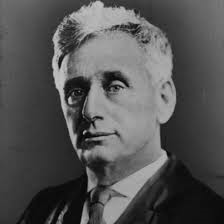
Louis Brandeis ‘Our Isaiah’
Indeed, the Jews so loved Justice Brandeis that they named their national university in the US Brandeis University after him. He and the arch criminal Arnold Rothstein were the big Jewish men of he teens and twenties. Just recently the Jews opened a ‘national’ museum in Las Vegas celebrating Rothstein and other specifically Jewish criminals.
While the railroads were nationalized the Wilson Administration demanded that the major industries file financial statements and business plans with the WIB. The auto industry objected to this rightly believing that through the Jews who ran the WIB their industrial knowledge would pass into the hands of the Jews giving them an inestimable advantage.
One imagines that the JVL will pooh pooh this yet it remains true that at the end of WWII the Alien Properties Board that controlled the confiscated properties of the Germans and Japanese valued into the billions was directed by the Jew David Bazelon who sold these properties without bids to his fellow Jews at less than fire sale prices making their post-war fortunes while robbing American tax payers.
The auto makers then were right to protest these regulations. They, especially the Dodge brothers, did so vociferously while using intemperate racial slurs directed at Baruch that Baruch later rapaid when the Dodge Brothers both died mysterious deaths in 1920. There was even an attempt made on Ford’s life.
After the war friction between Ford and his major stockholder James Couzens was such that Ford was forced to buy him out. Not having the necessary cash he was forced to violate his principles and go to the bankers. They shortly called the loan that Ford was unable to meet on short notice. However by drastic reorganization of his business he was able to meet the loan this thwarting a Jewish attempt to take over Ford Motors. Harboring resentments he was now his own man.
As a major condemnation the JVL says that: ‘He opposed various symbols of social and cultural change aound him, including Hollywood movies, out of house child care, government regulation of business, Eastern European immigration and new styles in dress and music.
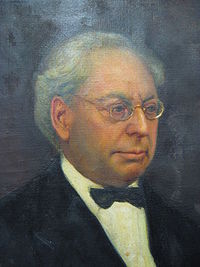
Louis Marshall
Consider these defamatory ‘sins’ in the context of the times. Hollywood movies were under constant attack during the teens and twenties. There were many local moves to ban them. Carl Laemmle of Universal, himself a Jew, even pledged to make no more anti-Semitic movies. The Catholic leagues were pressing for censorship. In 1921 in an effort to quiet criticism Hollywood itself established the Hays Office to censor themselves. Self-censorship is always especially effective. Will Hays, Harding’s very effective Postmaster General, was lured away at a royal salary of millions in today’s currency to run it. So Ford opposed the immorality of Hollywood movies? Then he was on the right side.
He opposed government regulation of business? Well, Harding and the Republican Interregnum of 1920 to 1933 repudiated Wilsonian socialism returning the railroads to private hands and returning the twenties to the most laissez-faire period of American business. Once again Ford was on the right side.
Ford opposed Eastern European immigration? Eastern European is code for Jews. The Jews were in the process of organizing the whole of European Jewry for transportation to the US. Reacting to this the country passed restrictive laws in 1921 and 1924 thwarting the Jewish plan. Once again Ford was in tune with universal sentiment. Me thinketh that Jewish protests are spurious.
As for new styles in dress and music neither did these new modes go unchallenged by a vociferous public while as a young boy in Michigan in the late forties we were still under the influence of Ford’s musical taste singing folk songs on a daily basis in class. One might then without too much of a stretch claim that Ford was the father of the folk revival of the fifties and sixties. It will be remembered that Carl Sandburg published his compendium of old timey songs in this period also.
So, really, the writers of the Jewish Virtual Library ought to either develop better research methods or lose some their ethnocentric chauvinism and xenophobia.
Ford, then, may fairly be said to have been in a contest not of his own making with the Jews when he began to publish his newspaper the Dearborn Independent.
The implication in the Jewish Virtual Library article is that Ford was some insane irate individual crazed lone wolf anti-Semite. Once again, placed in the historical context of the times this accusation is completely false. In fact the Communist Revolution in Russia created a huge furor with large factions in all European countries pointing to the huge involvement of Jews in not only the successful revolution in Russia but all the failed national revolutions of Europe and yes, that of the US. The evidence was overwhelming, denial was absurd, however that was the tack the Jews took.
Paul Warburg
Jewish damage controllers rushed into the fray howling anti-Semitic charges right, left and down the middle. As a centerpiece they chose a negligible manifesto culled from earlier Jewish writings called the Protocols Of The Learned Elders Of Zion. The Protocols was a pale imitation of Marx’s Communist Manifesto, hardly worth bothering about. Certainly it was amateurish next to the total Jewish assault on Western Culture led by the Frankfurt School of Critical Theory that would continue from the early twenties through today backed by the emerging technologies of movies, radio and TV. The Jews still talk about the Protocols as some sort of horror.
Ford should have dismissed the book as some sort of Jewish folly but he took it seriously and actually published it as the first volume of his four volume series of essays, The International Jew.
Ford’s use of he term international Jews did not refer to all Jews. Ford himself was tolerant of all religions and nationalities including the Negroes, more than he should have been. Ford’s point was that there was a cadre of international Jewish politicians just as there was an international Communist conspiracy. This cadre of Jewish politicians was easily identifiable although Ford did not name them, probably because they would sue him as he nevertheless was three times. For a confirmation of Ford’s allegations read my post linked above. Louis Marshall who was the international Jewish secretary of state confirms Ford’s analysis in his collected letters.
Now, Cameron’s essays approved by Ford were not wild eyed anti-Semitic rantings as the JVL claims but were well researched documented essays concerning Jewish involvement in specific areas of American society. Ford amassed a several thousand volume library of Jewish writings pro and con that were at Cameron‘s hand. When Ford discontinued his contest with the Jews he asked them what he was to do with the library. He was absolutely disgusted when he was told to donate the library to the Jewish Theological Seminary in Cincinnati. Whatever became of the library is not known.
The articles were however ‘critical theory’ of Jewish activities making them unforgivable in Jewish eyes. Thus, the astonishing campaign of vilification against Ford, slanderous, vile and mean spirited.
The International Jew articles are readily available for reading on the internet today for the inspection of the curious.
Finally, the JVL asserts: Ford’s attempt to prevent unionism at his plants produced strikes and violence, mostly provoked by Ford’s own strike breakers.
While it is true that Ford saw no need for unions as he believed that he took better care of his employee’s interests than any union thugs could.
Ford was the first industrialist to ensure a clean, well lighted, airy work environment for his employees. Even in the Communist Charlie Chaplin’s parody of Ford’s assembly line in his movie Modern Times the line was immaculate. You could eat off the floor. Ford’s line was designed so that there would be little bending and stooping. The parts passed by waist high.
Taylorite efficiency experts determined the most efficient movements to do a task with maximum efficiency. Every consideration of the employee was taken. I, myself, have worked the line at a GM assembly plant, I know how it is done. I know the human material that has to be managed and it is difficult material. Molding the steel is easier.
In addition when Ford realized the money that could be made by efficient operation combined with an unsaturated seemingly inexhaustible demand he voluntarily with no prompting doubled the wages of his employees.
From 1914 to the Depression he increased wages so that by the beginning of the Depression he was paying eight dollars a day or better than three times his 1914 wage. The Depression contrived by the Judaeo-Left forced him to lower wages rather than raising them which he would have continued to do. This reduction caused Ford great anxiety as though he had failed his employees.
Now, the Reds had never forgiven Ford for doubling wages back in ‘14. They hated him and wanted to destroy that symbol of capitalist efficiency, Ford’s River Rouge plant.
While writers such as at the JVL seem to assume that unions were universally favored and Ford was alone in not favoring them, nothing could be further from the truth. Remember the JVL is Jewish fantasy and not history. Workers except for Red doctrinaires didn’t want unions. Unions made little to no headway until the Reds got their man, FDR, into the White House where he passed laws declaring companies and workers had to accept them whether they wanted them or not. Most workers didn’t feel the need for another boss and more fees, taxes by another name, extorted by union thus and they were criminal thugs that nobody can deny. Even today after seventy yeas of favoritism less than 25% of workers belong to unions.
Using FDR’s Wagner Act then the Communists organized a march on River Rouge with the express intent of smashing the assembly line and destroying Ford Motors. Of course the writers at the JVL think any thwarting of their wishes is criminal so Ford’s successful defense of his property in their eyes is a criminal offence. Suffice it to say that in the Battle Of The Overpass two opposing armies were fighting a war that Ford won.
That the JVL can write such twaddle as the Ford article and hope to pass it off as objective history is amazing. After all, the whole world is not only watching but reading. This will not pass.
It is writing such as this at the Jewish Virtual Library that gives the internet a bad name. These people should be ashamed of themselves.

Carl Sandburg- The Great American Songbook
Mick Jagger, The Rolling Stones And The Revolt Of The Yobbos
Part II
by
R.E. Prindle
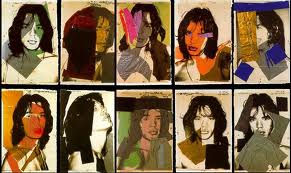
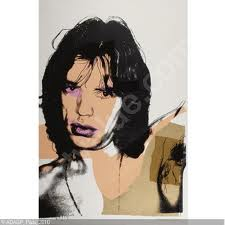
Warhol Jagger
Mick, Dave And Andy
If you had looked you wouldn’t have seen it but Sigmund Freud, or at least, his ghost was quietly at work transforming the psychology of Western Man. The old chivalric ideals of the Arthurian sagas was rapidly being replaced by the Jewish hopes and fears of Sigmund Freud and the Jewish people.
The Aryan ideal was based on an intense consciousness and objectivity while the Jewish understanding was unconscious and subjective. Aryans followed a concept of honor, Jews followed a concept of chutzpah. The transformation was understood if not clearly seen by the science fiction writers of the fifties. Stories subsequently made into movies such as The Blob, Invasion Of The Body Snatchers, book title: The Body Snatchers, and I Am Legend told the tale of the subversion of the conscious as people were portrayed as the living dead or zombies.

Warhol Jagger
With the way prepared then the next step was the free expression of subconscious desires undeterred by reflection and the subversion of men and women in sex. Freud proclaimed that the more frequently men ejaculated the better a person they would be, at the same time preaching the dangers of repressing those psychological ‘needs’ or desires to the exclusion of all others.
The Libertine element or Bohemians of society seized the opportunity while those yet imbued with Chivalric or Christian ideals held out while those ideals were slowly eroded replaced by Jewish ideals. Of course the Pill and drugs came along to push Freudian ideals into fast forward, a bunch of Charlie Chaplins rushing to the future.

Warhol Jagger
At the same time movies and TV began to glorify the expression of an undefined rage against Western ideals and justifications of its impression appeared regularly in ever more sadistic and uncontrolled expressions. Movies glorifying drug use and homosexuality appeared regularly. This enabled homosexuals, sadists and what have you to recognize and find each other thus being able to organize in associations. The Homosexual, Sexual and Yobbo, or Undermen, revolutions were thus able to more forward much more rapidly. One was able to discuss these aberrations as normal conversation, mere expressions of the varieties of sexual experience. Then in 1962 Anthony Burgess published the Yobbo bible, A Clockwork Orange, which in 1971 was made into the most despicable of movies.
The Yobbo bible apparently found a ready audience awaiting it. In New York, the Prince, even the King, of the Yobbos, Andy Warhol, teamed up with the London fashion photographer David Bailey to buy the screen rights from Burgess at bargain basement rates. They obviously saw the book’s potential for forwarding the revolutions on the screen for the corruption of Western youth. Bailey who must have been one the earliest jet setters having met Andy on an earlier occasion perhaps after Andy had introduced his soup cans unless Andy had been recognized as a leader of the revolutions before he had gained fame as an artist.
Warhol and Bailey were quick off the block obtaining the rights in either late ‘62 or early ‘63. Certainly a prescient move. As Andy was just beginning his switch from art to film while having no experience in film making Bailey’s collaboration seems as though it were a leap of faith. Perhaps if they met in ‘62 or even earlier he and Andy jabbered about the potential of movies while riding a white horse name Obetrol.
David Bailey who had risen rapidly in the late fifties at British Vogue is credited with being one of the originators of
Warhol Jagger
Swinging London. What a knockout combination that was, had us all slavering at the mouth wishing we were part of it. Bailey even had his career commemorated in Antonioni’s film, Blow Up of 1966. A sensational film in its day though I find it difficult to see the significance today although still good mood and photography.
David had met Mick sometime in 1963 through his girl friend model Jean Shrimpton. Mick was dating Jean’s sister Chrissie who introduced him to Jean. Jean had no trouble spotting the Stones potential introducing David to Mick with the giddy news that he and the Stones were going to be bigger than the Beatles. Slightly enthusiastic; the Stones were going to be big but not bigger. Nothing really approaches the impact of the Beatles. The dead Lennon is either a god or nearly one while none of the Stones will reach that status.
David and Mick bonded immediately becoming in David’s word, mates. David was five years older than Mick and already successful so that must have enhanced his appeal to Mick. As David looked at Mick and saw the Stones play he apparently said to himself; These are the yobbos I need for my movie, droogs if I ever saw them. He and Mick boarded a big 707 jetliner, one assumes, in mid to late ’63 to be introduced to co-owner of the movie rights of the intellectual property as the star of the semi-porn flick, at least as it would be filmed in 1971.

David Bailey- Fashion Photographer
This was a fateful connection for Mick and the Stones. Now, Mick had been attending the London School of Economics, LSE, during ‘62 and ‘63 only leaving university in late ‘63 when he believed the Stones were going to make it. It is hard to believe that he would give up school for the ephemeral success of England- two good years and out, replaced by the next pretty face. Perhaps Bailey and Warhol were already planning the exploitation of the record industry as a propaganda tool. Certainly Bailey was conscious of the trans-Atlantic connection between British and American Vogue. For guys on the qui vive it wouldn’t be much of a leap to imagine trans-Atlantic musicians, after all, the Englishman (Scot, I know) Lonnie Donnegan had already had a few hits, including a monster, The Rock Island Line, in America. If, in their discussion Mick could have seen the potential, leaving university would be a bet on a bigger and more glorious future.
Some think Bailey and Warhol would have made the movie but ALO placed the price of the Stone’s too high. As Oldham was as keen on Clockwork Orange as anyone that doesn’t necessarily ring true. There must have been other reasons.
Nor was Mick studying bookkeeping at LSE as often represented. The school was established by the Fabian socialist Webbs c. 1900 and was a Communist training ground. Mick did have a scholarship which means he must have been vetted as good future material. Although LSE does have an accounting department Mick was enrolled in political science with the intention of being a Communist politician. So, Mick, David and Andy were to follow a revolutionary agenda pushing the envelope in sex and unruliness. The emerging drug scene promoted both aspects and added a new one.
Shortly after Mick returned home the Beatles burst upon the scene from the Ed Sullivan show in February of ‘64. This was the avant garde of the British Invasion opening up fabulous new vistas for the yobbos of small insular England. For whatever reason the Beatles were an immediate sensation. I’ve got a very good ear but I couldn’t hear it then and I still can’t. The Stones, not really that big a deal yet, followed shortly after gaining full national exposure on Sullivan’s show. Young America was watching. Regardless of the opinion of Stones’ fans they didn’t cut it. There didn’t seem to be much there other than the hype. Mick couldn’t sing while having a very weird appearance. All eyes were on the magnetism of Brian Jones, looking right past Mick. You can see him noticing where the attention was going and looking over at Brian as though to say: But I’m the singer and should be the center of attention. Perhaps Brian’s fate was sealed at that moment. Certainly if he had been brought up front, as all four Beatles had been, there might have been more interest.
No matter, the first tour may have been a bummer but the conquest was still quick enough. The Stones were after all British. Gold, at the moment.
In any event Warhol and Jagger became fast friends. A friendship that was to endure to Andy’s death in 1987. By the time the Stones had gotten settled in Andy had been shot in 1968 actually killing him but the doctors brought him back.
The early endorsement of Warhol had cemented the relationship of the Stones with the yobbos of Bohemia. In ‘63-64 Warhol was only just getting the Factory, the clubhouse of homosexual drug addicted Yobbos, going but that gang would have spread the word effectively in Manhattan club land.
I’m sure Mick’s sexual ambiguity, bi-sexuality, or whatever you wanted to call it kept the enormous homosexual population of Greenwich Village Bohemia in his corner. After Andy’s recovery in 1969-70 the relationship between the two men developed.

Andy Warhol
To quote the website
http://www.montauklife.com/history/hist-main2.htm :
Mick Jagger was painted [by Warhol] while he was at the height of fame. Andy and Jagger first met in 1963. Warhol spent a lot of time with Jagger and his wife, Bianca, but claimed he was the closest to their daughter Jade, whom Andy remembers teaching to paint. Over the years the artistically inclined Jagger kept tabs on the musically inclined Warhol. Mick was such an admirer, that in 1972 when the Stones formed their own record company, they tapped Andy to design their logo.
Montauk is the easternmost town at the end of Long Island. Andy and Paul Morrisey had bought a twenty acre compound there that they rented out. In 1975 they would rent it to the Stones for 5K a month while they were making Black and Blue.
In the meantime the Stones expanded their list of celebrity acquaintances on their 1972 Exile On Main Street tour. Needless to say these celebrities were all related to Warhol and the Bohemian scene. This included meeting the Warholite photographer Peter Beard who directed the Stones to Montauk. The linked Montauk site is worth reading.

Clockwork Orange Poster
All right. A Clockwork Orange was released in 1971 with devastating results. Just previously in 1969 the Homosexual Revolution had succeeded in escaping the restraints of New York City laws with the Stonewall Riots leading to the golden age of homosexuality before AIDS hit. The Stonewall Inn was on Christopher Street in the Village, the very heart of the Homosexual Revolution and Warhol’s empire. This led to an increase in the corruption of society. Following on the heels of the Riots perhaps encouraged by them the effects of A Clockwork Orange were much greater than The Blackboard Jungle and Rebel Without A Cause of the mid-fifties.
There were serious consequences not least of which was a sado-masochistic tone to the Stones as exhibited in their Black And Blue release of 1975. It is hard to believe that this record didn’t reflect Andy’s sado-masochistic influence. The inside cover depicting a bound woman being brutalized, the title Black and Blue seeming to indicate the bruises she was getting from the beating caused a major uproar, especially amongst Lesbian groups, resulting in the photo’s being withdrawn to be replaced by a group shot. Warhol and Mick were in sync.
In addition to providing the Stones’ logo Andy also designed three record covers for them which advanced the homosexual sadistic agenda. The first was the blatantly homo Sticky Fingers. The title was interpreted to mean the result of beating off while the cover has the famous zippered jeans with the working zipper.
The second cover was Love You Live with its double entendre of cannibalism. The third, Emotional Tattoo, a bootleg, featured Mick on the cover of 1983.
In 1975 showing Andy’s great admiration or love or Mick he made a portfolio of large 42 x29 inch prints reproduced in this article.

During this whole period of the seventies Mick’s wife Bianca was the reigning queen of the Warhol/Halston entourage. While Mick promoted satanic sex riding an enormous inflated penis on the stage he was somewhat more puritan with his wife off stage. He found Bianca’s sexual behavior in the Warhol entourage so humiliating that he was forced to divorce her. One can say that he was patient with her past the endurance of most guys.
But Andy and Mick remained good friends. In 1987 when Andy took the one way barge trip to a new life Mick was the only celebrity friend who took the time to attend Andy’s funeral in Pittsburgh. Thus ended probably one of the most significant friendships of our time.
By the time Andy died they and one presumes, David Bailey, had been more successful in achieving their goals than they might have hoped. Of course Sigmund Freud gave them more than a leg up.
Next: Nemesis Catches Up With The Stones.
Four Crucial Years
In The Life Of Edgar Rice Burroughs
Part II
by
R.E. Prindle
…presumptuous attempts to conquer the outer world of appearances by the inner world of wishful thinking.
–S. Freud, Letter To Arnold Zweig 5/8/32.
Quoted by Schur: Freud: Living and Dying
Now back in Chicago he had to consider what direction his life was to take. At least secure working for his Dad, ERB made a tentative move in the direction of an artistic career. During the summer he enrolled in the Chicago Art Institute.
Chicago is billed as America’s Second City but in many ways it is or was, America’s First, certainly West of the Appalachians. The city was much more important to the Southern States than New York City, while its importance to the West is shown by the fact that the Outfit- the Chicago Mafia- considers the whole West as its province. The Outfit ruled everything west of the Appalachians by the end of the fifties
At the time in question when Chicago’s population was a mill six the population of the country was about 75 million so Chicago represented over 2% of the total. West of the towers rising from the mud there was virtually no one and those that existed were rubes and hicks or living on the reservation. During Burroughs entire youth this most modern of American capitals stood a beacon of civilization, such as it was, on what was then known as the great American desert.
Burroughs was to approach this metropolis from the West several times so is it any wonder that when John Carter emerged from the deserts of the Green Men- read Indians- the towers of Helium rose from nowhere much like Chicago. The twin of Chicago was probably New York City in ERB’s mind.
As the capital of the Empire, Helium, like Chicago, reflected the racial and ethnic makeup of Mars.
Chicago was polyglot and the mix was troubling. Bruce Grant who wrote the history of the Union Club of Chicago entitled characteristically ‘Fight For A City’ in 1955 characterized the situation during Burroughs’ time in this manner, page 96:
The thousands of laborers and adventurers who were attracted to Chicago during the rebuilding era following the fire of 1871 were for the most part uneducated newcomers. Ignorant of the underlying spirit of American institutions. Chicago was the Western distributing point for a vast European immigration. With the good came the bad, and borne along with the stream were the scum and dregs of countries where despotism had made paupers and tyranny had bred conspirators. From Russia came the Nihilists, described by one newspaper as ‘the gift of centuries of Slavic slavery and cruelty.’ From the German states came the Socialists, the offspring of military exactions and autocratic government. And from Europe generally, including Great Britain and Ireland, Chicago drained the feverish spirit of human resentment against laws and life; of property and of conduct which it had no hand in making or enforcing.
This was the environment Burroughs was growing up in. I suppose he was getting his Russian and Jewish information from the newspapers. Therefore it was heavily slanted in favor of the Jews. But as he walked around Chicago he must have thought himself a Stranger In A Strange Land. I do today. No more than 10% of Chicago’s population could be considered native. The city had a larger Irish population than Dublin, was the most populous German city in the world, The Polish population could compete with Warsaw and on down the line.
The Socialists paraded shouting and screaming Revolution under the Red banner which may have made sense in Germany but made no sense to the native born. Anarchists unfurled the Black Flag with their preposterous social conceptions.
The remarkable thing about America is the extent that the Anglos went to accommodate the immigrants. Of course there were movements such as the APA- American Protective Association- and later the Ku Klux Klan, but these were scorned and ineffective in any event, regardless of how seriously some paranoid immigrant writers like Gustavus Myers might take them.
Then as now Liberals controlled the country. More typical of the reaction was this querulous little poem gleaned from the pages of ‘Chicago’s Public Wits: a Chapter In The American Comic Spirit,’ Edited by Kenny J. Williams and Bernard Duffy. LSU Press, 1983:
I Wish I Was A Foreigner
by
An American
I wish I was a foreigner, I really, really do.
A right down foreign foreigner; pure foreigner through and through;
Because I find Americans, with all of native worth,
Don’t stand one half the chances here with men of foreign birth.
It seems to be unpopular for us to hold a place,
For we are made to give it up to men of foreign race.
The question of necessity and fitness to possess
Must never be considered- who cares for our distress.
Perhaps it is not wicked to be of foreign birth,
Or to mutter a mild protest when an alien wants the earth;
But the latest importation is sure to strike a job,
And be the sooner qualified to strike and lead a mob.
A Dutchman (German) or an Irishman, a Frenchman or a Turk
Comes here to be a voter, and is always given work;
A native born American is here, and here he must stay;
So it matters little how he lives, he cannot get away.
The Spaniard and Bohemian, the Russian and the Pole,
Are looking toward America with longings in the soul,
Because the politicians will receive them with open arms,
And the goddess of our freedom bid them welcome to her charms.
But the law abiding Chinaman from the Celestial shore,
Because he has no franchise, is driven from our shore;
Americans and Chinamen are not in much demand,
The one remains neglected while the other is barred the land.
So I wish I was a Dutchman, or some other foreign cuss
I’d lord it over the natives- who don’t dare to make a fuss,
But my blushes tell the story, I am native to the soil’
So the aliens hold the places- visitors must never toil.
With the real American response as above, the retiring Bill Moyer doesn’t have to worry much about ‘the thunder on the Right’ caused by a few radio announcers. The real threat to them is that the Liberal ideology will be shown to be false and ridiculous not that the ‘danger from the Right’ is pernicious.
One believes that if Burroughs were alive today Rush Limbaugh and Bill O’Reilly would find him an ardent supporter. One wouldn’t want to be called ‘an unapologetic Conservative.’ The Liberal oppression is that strong.
The resignation is fairly bitter in the above poem. The Chinese, the only nationality ever excluded, had been denied entry in 1882, which was shortly before the above poem was written; thus the writer laments that ‘Americans and Chinamen are not in much demand’ comparing natives with the excluded Chinese.
By the nineties the Irish had seized control of many municipal administrations, including Chicago’s, so that they were in control of political patronage. The boodle as it was known. All the sinecures, city and county, were theirs to distribute to friends and cronies. The Irish effectively controlled Chicago. As the poem indicates this privilege was obtained by the vote and votes were obtained by corruption thus the Irish and the Democrats, then as today, were the party of corruption. All Irish city administrations were corrupt.
The failure of the potato, of course, sent the Irish fleeing Ireland for more emerald pastures, but the Scottish emigration to the US and Canada caused by the Highland Clearances is virtually unknown. There were two clearances, one in the eighteenth century which sent the Highlanders to the colonies or US and second , 1800-1860 which populated Canada.
After the Union when the Scottish Lairds no longer had need of armed retainers they simply cleared the natives off the land in about as brutal a manner as the Americans cleared the Indians to make room for sheep. All these people who had lived in the highlands for centuries discovered they were mere squatters on land which legally belonged to the Laird. Past services were forgotten; they were literally thrown off the land. How do you like that? Matches any hardluck story you’ve ever heard, doesn’t it?
The Lairds then invoked the law to kick their former retainers not only off the land but out of the country. Dig that, and take heed for the future. Sheriffs burned down their houses around their ears. There was then no place for them in their homeland. They were ordered to emigrate. What was that Walter Scott said:
Breathes there a man
With Soul so dead,
Who to himself hath not said,
This is my home,
My native land…
Well, with a mere change of place you can that about Canada, too. That’s how the Scots came to the US and Canada.
The Irish supremacy in the US lasted until the thirties when the massive immigration of the nineties through 1914 wrested power from them. Fiorello LaGuardia, the Jewish-Italian politician, replaced Jimmy Walker in New york ending the long Celtic rule of that city. James T. O’Farrell in his Studs Lonigan trilogy has the Irish lamenting that the Slavs are swamping the Irish causing them to lose control of the boodle. The Irish of Chicago must have rallied because Mayor Daley put the Irish back on top but because of the huge Negro influx into Chicago the Irish have to share power with the Blacks.
If one makes an analogy of the present with the past it won’t be long before Mexicans and Moslems are directing the affairs of municipalities and States. A vote is a vote.
Be that as it may, in 1897 I believe ERB would have been in sympathy with the author of I Wish I Was A Foreigner. The Irish certainly figure largely in both his personal and political images of the time. David Adams writing in the ERBzine has come up with several possible origins for the name of the Mahars of Pellucidar. I think the most obvious is that the Mahars are intended to be a parody of the Irish administration of Chicago. Mahar is an Irish name.
Earlier in the century the city of Chicago which was built on slightly different gradients so that sidewalks had a lot of up and down stairs had been literally jacked up to one level making the sidewalks even. Entire huge buildings and city blocks were raised several feet above ground to make a level city. The resulting cavity produced an underground city which the indigent occupied.
This might suggest the image of the occupants as slimy reptiles into an imaginative mind. Putting the images together one comes up with an Irish administration of slimy reptiles. I haven’t figured out why they’re deaf and female yet unless ERB was unhappy with Emma who may have been deaf to his entreaties. For the present I’ll leave that one up to you.
2.
I shall permit myself to send you a small book which is sure to be unknown to you. Group Psychoogy And The Analysis Of The Ego, published in 1921. Not that I consider this work to be particularly successful, but it shows a way from the analysis of the individual to an understanding of society.
— S. Freud to Romain Rolland.
Quoted by Max Schur: Freud Living And Dying
Working at the Battery Company, starting from the ground up, his father must still have allowed ERB flexible hours because Our Man found time to attend classes at the Chicago Art Institute. He was not a very cooperative student, refusing to accept any discipline. According to Porges he only wanted to draw horses and that without acquiring the fundamentals of drawing. As he couldn’t find anyone willing to drop some hints on the fine points of equine deliniation he lost interest dropping out of school
I for one would be very much interested in learning exaclty how he passed his time during this halcyon period. If he and Emma went to the theatre as Porges suggests I would like to know what shows or lecture they attended. Lecturers were a much more important adjunct to entertainment than they are today. Robert Ingersoll had a huge reputation and of course Mark Twain. There was also the Chautauqua Circuit.
In the much discussed issue of Theosophy in Burroughs’ life it is quite possible that he attended a lecture or series of lectures either in their own building or some other place. There undoubtedly would have been reviews of lecture in the papers. Chicago had at least a dozen, in which the tenets or beliefs would be discussed. In the crowd in which Burroughs associated I’m sure the fairly amazing doctrines would be discussed.
When the US government places its 30 million pages of newspapers on the internet by 2006 dating back to the earlyh nineteenth century we will be able to examine this pertinent period in detail.
At the theatre he and Emma would most likely have seen an actor by the name of John McCulloch who was a fixture of the Chicago stage. This would have struck ERB as quite a coincidence as his mother had a John McCulloch as an ancestor. If I am right in my surmise John the Bully was surnamed McCulloch.
Nor would this be such a far fetched coincidence. There must have been a couple dozen John McCullochs in Chicago at the time, probably hundreds in the United States. As I write, my phone book lists a half dozen John McCullochs in this area.
If Emma introduced ERB to the theatre at this time, there seem to be no reference3s to the theatre earlier, it held an attraction for him he never lost. The old actor in Marcia Of The Doorstep is probably based on John McCulloch while ERB wrote his play You Lucky Girl at about the same time for his daughter Joan.
Then at the beginning of the thirties ERB wrote his novelette Pirate Blood using the pseudonym John T. McCulloch which united the McCulloch references in his life. It is said that ERB capitalized too much in his writing on improbable coincidences which on the one hand may be true but on the other, life is just like that, isn’t it?
A near contermporary of ERB, Vachel Lindsay, who was born in 1879 in Springfield, Illinois, catalogs the influences to which he and his generation were subject. It might not hurt to look through the poem here to try to capture some of the essence of what it meant to be young during this period. The piece is entitled: John L. Sullivan, The Strong Boy Of Boston.
The poem may be especially relevant to Burroughs as it centers on boxing which was a special interest of his. During the period from 1892 to 1897 Burroughs’ idol, Gentleman Jim Corbett, was the heavyweight champion. Corbett had defeated the incredible hulk, John L. Sullivan, in 1892 by landing one on the solar plexus making that piece of anatomy a topic of conversation down to when I was a kid. In 1897 Bob Fitzsimmons took the title from Corbett.
In the poem, Lindsay lists the many influences on his young life centered around 1889. Pervading and overriding all is the ominous figure of Sullivan and the Irish. Both Lindsay and Burroughs were Anglos. The refrain ‘East side, West side’ refers to the Irish domination of New York City while the capitalized LONDON BRIDGE IS FALLING DOWN of the last stanza implies that the Irish were conquering the Anglos.
When I was nine years old in 1889,
I sent my love a lacy valentine.
Suffering boys were dressed like Fauntleroys,
While Puck and Judge in quiet humor vied.
The Gibson Girl came shining like a bride
To spoil Tennyson’s Elaine.
Louisa Alcott was my gentle guide….
Then…
I heard a battle trumpet sound.
Nigh New Orleans
Upon an emerald plain
John L. Sullivan
The strong boy
of Boston
Fought seventy-five red round with Jake Kilrain.
In simple sheltered 1889
Nick Carter I would piously deride.
Over the Elsie books I moped and sighed.
St. Nicholas magazine was all my pride;
While coarser boys on cellar doors would slide.
The grownups bought refinement by the pound.
Rogers groups had not been told to hide.
E.P. Roe had just begun to wane.
Howells was rising, surely to attain!
The nation for a jamboree was gowned.
The hundreth year of roaring freedom crowned.
The British Lion ran and hid from Blaine
The razzle-dazzle hip-hoorah from Maine.
The mocking bird was singing in the lane….
Yet…
“East side, west side, all around the town the tots sang: ‘Ring a rosie-
‘London Bridge is falling down.’
And…
John L. Sullivan
The strong boy
Of Boston
Broke every single rib of Jake Kilrain.
In dear provincial 1889
Barnum’s bears and tigers could astound
Ingersoll was called a most vile hound,
And named with Satan, Judas, Thomas Paine!
Phillips Brooks for heresy was fried.
Boston Brahmins patronized Mark Twain.
The baseball rules were changed. That was a gain!
Pop Anson was our darling pet and pride.
Native sons in Irish votes were drowned.
Tammany once more escaped it chain.
Once more each raw slaoon was raising Cain.
The mocking bird was singing in the lane….
Yet…
“East side, west side, all around the town
The tots sang: ‘Ring a rosie’
‘London Bridge is falling down.'”
And…
John L. Sullivan
The strong boy
Of Boston
Finished the ring career of Jake Kilrain.
In mystic, ancient 1889
Wilson with pure learning was allied.
Roosevelt gave forth a chriping sound.
Stanley found old Emin and and his train.
Stout explorers sought the pole in vain.
To dream of flying proved a man insane.
The newly rich were bathing in champagne.
Van Bibber Davis, at a single bound
Displayed himself and a simpering glory found.
John J. Ingalls, like a lonely crane
Swore and swore and stalked the Kansas plain.
The Cronin murder was the ages’ stain.
Johnstown was flooded, and the whole world cried.
We heard of Louvain and Lorraine,
Of a million heroes for their freedom slain.
Of Armageddon and the world’s birth-pain,
The League of nations, the new world allied,
With Wilson crucified, then justified.
We thought the world would loaf and sprawl and mosey,
The gods of Yap and Swat were sweetly dozy,
We thought the far off gods of Chow had died.
The mocking bird was singing in the lane….
Yet…
“East side, west side, all around the town
the tots sang: ‘Ring a rosie’
‘LONDON BRIDGE IS FALLING DOWN.'”
And…
John L. Sullivan knocked out Jake Kilrain.
So many of the references which had an influence on Vachel Lindsay have lost their relevance but there are two which are important for our story. One is that: The Gibson Girl came shining like a bride to spoil the cult of Tennyson’s Elaine. Elaine came from Tennyson’s Arthurian poem ‘Idylls Of The King.’ She was sort of pale and wan. The Gibson Girl was created by the illustrator, Charles Gibson. The latter girl was a robust saucy temptation of the All American Girl. Emma made the choice between the two the Gibson Girl her role model which is why I find her so entrancing. In that sense Emma was forward looking heading into the twentieth century. The Gibson Girl may be said to epitomize the woman of the myth of the twentieth century. From the Gibson Girl the ideal progressed to the Vargas pinup girl of the heyday of Esquire Magazine and from there she degenerated to the sex fantasies of Hugh Hefner and on down to Larry Flynt’s Hustler. The story could have had a happy ending but didn’t. It’s gotten worse. I don’t want to go into that.
The second key point is the general regretful tone concerning the Irish. Just as in the poem I Wish I Was A Foreigner where the American complains …’the foreigner comes here to be a voter,’ so Lindsay notes ‘Native sons in Irish votes were drowned.’ This is serious. This was a major problem with the ‘democracy’ when its intended fairness was turned against itself. In a homogeneous society votes are used to determine an issue regarding the welfare of the whole people. In a heterogeneous society votes are used to advance the interests of one segment against the others. Thus the whole democratic process is subverted.
Thus while the Anglos were concerned with regulating the country and immigration for the benefit of all, the Irish put themselves forward as the benefactors of the immigrants against the Anglos taking moral shortcuts which undermined the integrity of the State. Immigrants then were brought in on the Irish side condemning the Anglos who were their true benefactors.
Hence the baffling undercurrent of condemnation and complaint that runs thorugh American historical writing.
Vachel Lindsay would also run afoul of the Diversity with his poem of the Congo which the Left portrayed as anti-Negro while it merely was an expression of Lindsay’s understanding of the culture of the Negro Group within the Diversity. The Negro deserves to have his own psychology and he does. We should value and honor that.
Such censoring of opinion will have its consequences. Burroughs himself was and is charged with racism merely for having prescient views. The man was a deep thinker. Viewing the world around him at this time he came to a remarkably accurate conclusion. I can’t tell what his thought processes were but analyzing history he came to this conclusion.
In his prophetic futuristic novel ‘Beyond Thirty’ of 1915, just after the Great War began, he has a post-war Europe ruled, as I thought improbably by Black Africans. In light of recent events this now seems not so improbable.
Life is not what we would have it: The world is not run on any principles we can cheerfully accept. The twentieth century was one of unprecedented disasters in their scope. Shiva and Kali rule whether we will or not. The twenty-first century will be even more destructive. Now, beginning in the fifteenth century Europe, in essence, began the invasion of the world. Scientifically far in advance of the rest of the world its success was dazzling. However, somewhere in these years, we are considering, perhaps specifically 1893, the Euroamericans, the West, lost its will to dominate. This lack of will was presciently picked up by a number of writers including Burroughs.
The way of the world is that one either conquers or one is conquered. Having begun to impose its will on the world there was no turning back for the West. However it has attempted to do so. The result is that instead of invading and conquering the West is now being invaded and conquered.
Any Freudian analysis of the ego of the various peoples or, Groups, will provide a record of their mental processes, objectives and desires, not mention, capabilities. The myth of the twentieth century was destroyed on 9/11/01 when the Moslems destroyed the religious symbol of the World Trade Center.
The West at the height of their confidence moved peoples about the world to satisfy their needs. East Indians were taken to all corners of the world while Chinese were moved into areas in the Pacific where their skills were in advance of the native populations. During the two wars Africans were recruited to fight from Europe to the Far East. A great deal of the consequences have been suppressed. Having set the peoples of the world in motion, the West withdrew from its conquests, the conquered peoples began to assert their Group egos realizing that it was either conquer or be destroyed. Then they began their invasions.
The Japanese attempt to expel the West from Asia was successful although costly for themselves. Nevertheless by the 50s the West had been expelled from Asia while the enclave in Hong Kong was allowed to live out the terms of their lease.
By the early sixtes the Africans had expelled the West except in South Africa. that fearful drama is not yet finished.
Africans had been dispersed throughout the Americas during gthe 16th through 19th centuries. Beginning recently they have begun to invade Europe from the North African ports especially from Libya.
At the same time the world’s population has grown so large that there are areas that can no longer support their populations. Whether by design or natural increase the Semitic States were so productive that they began exporting people throughout th world beginning in the seventies while their populations at home continue to grow.
As the Moslems invaded the world in this second Eruption From The Desert this narrow, bigoted, antiquated religious faith came into conflict with Western Scientific knowledge.
To accept scientific knowledge would destroy the Moslem faith in much the same way that the Christian and Jewish faiths in the West have been affected. There can be no compromise between the two; this is an either-or situation.
While Moslem proselytizing has never ceased since the seventh century there was now a renewed burst of activity combined with an all out assault on the West, well conducted within Moslem military limitations.
On 9/11/01 they were successful in destroying the symbol of scientific achievement, the World Trade Center in New York City. They aimed directly at the strength of the West- its economic system.
It is a mistake to think that anything can be achieved by fair minded discussion or concessions, otherwise known as appeasement. Appeasement didn’t work out so well in the thirties when another determined ideology asserted its will. This is a war to the knife; only one side will be left standing.
More remarkable still, having disturbed the Africans in their nest, the Africans are on the move having begun an invsion of Euorpe which is already over populated there being no room for vast numbers of either Africans or Moslems, unless…. Religious and racial intolerance began to take a vicious turn in the twentieth centgury when racial clashes began almost simultaneoulsy in Europe and Asia.
Since then genocidal wars of either a racial or religious nature have proliferated. The Moslems have opened a guerilla war on the world. In areas where resources are insufficient to support an Arab or Semitic population against other races the Semites or Arabs are conducting genocidal wars as in the Sudan where they are wiping out the Negroes or driving them beyond the borders.
As Moslems and Negroes flood into Europe this must result in a terrific struggle for survival of the Europeans, probably breaking out within the next ten or twenty years.
The resultant war must be genocidal in nature. If the European struggle is successful it must result in the death of alien populations or their being driven out of Europe the same as the long struggle to drive the Moslems out of Spain. Or the Europeans will be annihilated.
This is an unpleasant but inevitable prospect.
If the Europeans fail as I am sure they will then Burroughs remarkable prophecy of a Black Europe in ‘Beyond Thirty’ is almost certain to become a reality. Life does not give you any easy choices. Here in America you’re not even supposed to talk about this problem in a realistic manner so there is no hope of avoiding destruction.
ERB’s head must have been aswirl with all these thoughts that society forbade him to express directly.
Probably wrestling with all these macro thoughts he had the really important micro thoughts to deal with. Really, what to do with Emma who he wanted but didn’t want to marry, while still not losing her to Frank Martin.
In February of ’98 he once again for some reason decided to seek an officer’s appointment. He wrote to a former commandant at the MMA, Capt. Fred A. Smith, seeking his assistance. Smith, of course, replied that there was nothing he could do. ERB still didn’t understand the consequences of abandoning his post in 1896.
Shortly thereafter ERB pulled up stakes to return to Idaho abruptly abandoning Emma again. Why he should have done so is not clear although perhaps there is a clue in the Return Of Tarzan. Remember that dream displacement and disfiguration are in operation so that one cannot expect a literal representation of the incident. One has to demythologize it.l In the Return W.C. Clayton, Tarzan’s rival for Jane, and Jane have been stranded in the jungle.
Tarzan has chanced upon their camp. As he watched an aged, toothless lion was about to spring on a cringing W.E. Clayton as Jane watches. Tarzan transfixes the lion with his spear. He then sees Clayton get up to embrace and kiss Jane. Mistaking the import of the embrace and kiss, Tarzan turns sorowfully back to disappear into the jungle.
Burroughs himself may have seen Frank Martin kissing Emma. Perhaps he thought that a pauper like himself had lost out to a prince like Martin. Thinking himself cut out might have been the reason for his departure to Idaho much as Tarzan melted back into the jungle.. With no more thought for his Dad at the Battery Company than he had for Col. Rogers at the MMA ERB just up and left. Poor old Emma must have been wondering what she had done. Couldn’t have been anything she said.
Continue to Part III.
A Review
Part II
The Myth Of The Twentiety Century
by
Alfred Rosenberg
Rosenberg, Alfred, The Myth Of The Twentieth Century, Noontide Press, 1982.
It should be borne in mind that The Myth is subtitled: An evaluation of the spiritual-intellectual confrontations of our age. The book then is an attempt to objectively analyze the political situation in those terms. While himself a Nazi this is not a Nazi tract while at the same time it is inevitable that Rosenberg ananlyze the situation from a Nordic or Aryan viewpoint. If Nazi and Aryan are synonomous in your mind you should disassociate the terms.
When Rosenberg says the conflict is one of differing values between Asiatics and Europeans it is necessary to know what he means as his basis of interpretation is accurate. The conflict between Asia, which is to say the Middle East, began fifty-five hundred years ago on the plains of Mesopotamia, todays Iraq; and has slowly spread outward until today the Asiatics, or specifically, Semites, stand on the verge of worldwide victory. Even though the Semites themselves are divided between Jews and Arabs, which is why the Jews support Arab Semites outside the Middle East, the Jewish segment is confident that they will be able to manage the Arab Moslems in the triumph.
The major conflict then in Rosenberg’s mind was the prime conflict between Semitic values and Aryan values. He considered the Roman Catholic Church as auxiliaries. The Church may be said to be a third Semitic religion.
The situation as Rosenberg perceived it, and he was a very perceptive man, was that the German people were surrounded on three sides by Semitic forces alien to Aryan ideals.
He saw a Roman Catholic Semitic Church centered to the South of Germany that had also infiltrated and alienated a large part of his German people.
To the East he saw the Semitized Soviet Empire looming as a threat. He had no doubt, and sincerely believed that Communism was a Jewish political system managed according to Semitic ideology.
Just as the behemoth to the East was controlled by Jews so with the ascension of Franklin D. Roosevelt was the behemoth of the West, the United States of America. Of course, denial is the order of the day but denials are ridiculous in the face of facts.
Just as Jews had managed the hyper inflation of German currency in 1923 so Jews had maneuvered the West into the Great Depression through their control and literal ownership of the Federal Reserve Banking System of the US.
Through the manipulation of credit and currency in the years leading up to the Great Crash of 1929 the Fed, which is to say the Jews, created the speculative stock market bubble. At the same time they created the unsound practice of holding companies of holding companies. Thus shares with no substance behind them collapsed entirely losing all value. Between such failures as these and extended credit for margin speculation the stage was set, as in Germany, for the complete collapse of the US economic system. This was no different than the real estate and credit bubble of today.
While many many volumes on the crash have been written over the decades none of them would deal with the problem as it actually was for fear of being denounced as anti-Semites.
You may be sure that Rosenberg, Hitler and the Nazi think tank understood the situation completely. The question is how the Nazi finance minister Hjalmar Schacht interrelates with his banking counterparts of the West.
That the situation was created that ‘discredited’ the capitalist system, allowing a Judeo-Communist like FDR to assume the the reins of power you may be assured. Roosevelt was a disciple of Woodrow Wilson. Just as the Jews flooded into Washington in 1913 managing Wilson’s presidency so in 1933 they returned to power with FDR. You can see how urgent it was for Roosevelt to stay in office for as many terms as he lived.
The situation of today is a replica of 1929-33 with the hope of putting Barry obama into the role of FDR. Rosenberg and the Nazis predicted this scenario in the 1930s. They also predicted the dissolution of the United States over racial problems. This is bound to and must happen.
In addition to the USSR and the USA the Jews were running France and directing England so that Rosenberg believed the Germans to be beleagured, which they were.
The history of the entire period has been written by Liberals, Communists and Jews, hence you have been conditioned to see the issues soley from their point of view.
If you were to view the times from a slightly different perspective a quite different picture would appear before your eyes as if by magic.
It is true that the Nazis took a direct and brutal route to obtain their objectives. They have been thoroughly castigated for this however they merely did what had already been done during and after the Great War in Russia and Hungary and what the Liberal/Jewish/Negro/Communist coalition is in process of doing today as regards the White species. So in light of current deeds what makes the Nazis so evil?
While we were all astonished in the fifties as the insanity of the Nazi attempt became real to us we should no less condemn the Liberal/Jewish/Negro/Communist coalition for their plan to exterminate the entire White species of a billion plus people. This means you.
I am sure that Rosenberg and Hitler are sitting up in Heaven looking down upon us with wry bemusement.
So, this is the way in which Rosenberg perceived the racial aspect of the spiritual and intellectual confrontation of early twentieth century Europe.
Rosenberg calls it the struggle for freedom rather than submission to a false god, which is to say Semitic intellectual belief systems. He rightly says that the confrontation is between Asia and Europe going back fifty-five hundred years. The Fascist States, that is to say Germany, Italy and Spain placed themselves in battle with the entire semiticized world. The Semites themselves without military might did as the ancient Semite Cadmus did in ancient Boeotia of Greece when he incited the indigenous peoples into a ruinous civil war that allowed his Semitic invaders to take control.
Those who do not learn from history are condemned to repeat it.
Part III will follow in another post.
The High Brow And The Low Brow
The Mucker And Marcia Of The Doorstep
Part VI
Living On Tulsa Time
by
R.E. Prindle, Dugald Warbaby and Dr. Anton Polarion
Livin’ on Tulsa Time.
Livin’ on Tulsa Time.
Gonna set my watch back to it,
‘Cause you know that I’ve been through it,
Livin’ on Tulsa Time.
– Danny Flowers
During the ’60s a lot of energy was put into the notion that one live in the HERE and NOW or someone else’s impression of the NOW. There used to be a big San Francisco poster with nothing but a black background with the giant word IS in white. NOW IS NOW.
They didn’t know how much they were asking. It is impossible to actually live in the NOW; No one can do it. Rather the past is a drag on NOW preventing a full involvement with the present. The period of time it takes to digest the previous NOW and update to an approximate notion of the current NOW is excruciatingly slow. The sharper the break between the past and present the more traumatic the reaction.
In the song Living On Tulsa Time the singer, no matter what time zone he is in sets his watch to Central Tulsa time.
I know where that one is at. One of my shattering breaks with the past was when I went active in the Navy in ’56. Sent from Eastern Standard to Pacific Standard I kept my watch set to Eastern Standard time nearly the whole three years of my enlistment. I only switched to PST in 1959 when I accepted the fact that I would never return East; that California was my new home.
Brought into contact with a new NOW I was still not ready for the present. I continued to dress as we did in ’56 well into the sixties. Got hard to find some new duds. I only ceased dressing that way when I became a Hippie in ’66 and adopted fantastic Hippie garb. I was an urban spaceman:
I’m the Urban Spaceman
I’ve got speed,
I’ve got everything I need.
I don’t feel pleasure,
I don’t feel pain,
If you were to knock me down
I’d just get up again.
I wake up every morning with a smile upon my face.
My natural exuberance spills out all over the place.
-Neil Innes
I was really NOW there for just a little while but I wasn’t alone. As Bob Dylan said, everytime I looked back the past was just behind. When the Hippie era ended I reverted to a modified 1956 style. The past came back again. All those screaming about living in the NOW in ’67-’69 are still back there claiming they’re still living in the NOW but time has passed them by. I didn’t wait around, baby, I slid out into limbo and I’m doing fine now, thank-you.
Thus when ERB began writing in 1911 he was not so much concerned with his NOW as he was in vindicating his past from 1896 to 1905. His reality in those early novels from 1911 to 1915 continue to reflect his earlier travails. Thus in the group of novels embraced by The Girl From Faris’s he is trying to vindicate his past to his present and hopefully to his future.
After nineteen-fifteen he was released from his past to a large extent and began to concentrate on adjusting to the NOW of his altered circumstances. Change is NOW and ERB was going though a lot of ch-ch-changes. His nerves were jangling as he was jerked from time frame to time frame but he didn’t enter the Promised Land of NOW. Oh Lord, he might have prayed, if he could have seen the future- Deliver me from NOW.
Ten years after and a world of different NOWs the Mucker far in a distant past that had disappeared behind a cloud where he couldn’t see he tackled almost the identical theme in a different world, a fast moving world, a world where NOW was so strange it was unrecognizable from day to day. The political situation he had grown up with was no longer recognizable; it had been replaced by a new reality. He was almost living by two different clocks in some strange Einsteinian time zone where the guide posts had been removed and renamed and everything was relative to another reality that couldn’t be recognized by any clock ticking.
Living on Tulsa time in another time zone. There I was in ERB’s sunny Southland with my watch running three hours ahead of everyone else’s. It didn’t matter. I was on the water where time stands still for everyone. The crisis came in ’58 when I stepped back on land to journey through the time zones back to Eastern Standard Time. I was all alone out there, you know, cut off from a past I was soon to learn couldn’t be retrieved. Wolfe was right, you can never go home again. The only secure place, as dangerous and that was, was my ship. My terminal place was also a realtively secure harbor but I was stuck in the middle for six days between the time zones in which I had no place and no identity except the tenuous one of my leave papers. A queer cop threw them into the wind and let those blow away in Illinois. After that I was naked to the universe. I’ve hated cops ever since.
I wouldn’t recommend hitchhiking to anyone. My life was on the line for twenty-five hundred miles and six days. Twenty-five hundred miles and six days on the road without food or sleep. I’d add without drink but in a gas station in Gary I downed six seven ounce bottles of Coca-Cola in a row. Created a minor sensation.
After surviving a lunatic who picked me up on the western edge of the Mojave who wanted to kill me because he was convinced I had two hundred dollars on me, which by a strange coincidence I had, I was picked up Mountain Standard in the Panhandle of Texas by a couple homosexuals who wanted a different treasure I possessed and dropped off Central Time in Tulsa. My watch was only one ahour ahead by then. I was getting close to some kind of NOW or was I? No. Time is much more relative than that. I was soon to be living a strange combination of NOW and THEN.
Tulsa was a tough town. I don’t need to see Tulsa again. I wasn’t about to start living on Tulsa Time. I was an hour ahead which couldn’t have been better. I had to walk through Tulsa, hungry and thirsty. I spied a place across this great expanse of grass between it and the freeway. As I approached the place began to glitter. Fancy, but I could see a coffee shop at the top of a long flight of stairs to the left. I didn’t want to spend money so I thought I’d just get a glass of water.
Oh Dan, can you see
That great green tree
Where the water’s running free
Just waiting there for you and me.
Water…cool…clear…water.
But between me and the water was this big cowboy in high heeled boots, a tuxedo and ten gallon hat. Fancy goings on as I noticed ladies entering to the right in ball gowns escorted by tuxedos. I came prepared or thought I did. I was in my dress blues and my Uncle Sam told me I should never be ashamed of my uniform, it could pass for a tuxedo anywhere. Anywhere but Tulsa. That cowboy had never discussed the issue with my Uncle Sam.
I was bold but the problem was he had the advantage being on the landing at the top of the stairs and I had to climb the stairs to get past him. He had his fist doubled and these high heeled boots with those silver plates on the toes. That was a mean looking business proposition. I had a lot further to fall than he did. Get my uniform messed up and things. Then where would I be out of time and place? Whew! Why does one have to face tough choices?
I’m getting a drink of water, I said, trying to combine thoughness with masculine geniality a al the cowboy ethic.
Not here you ain’t. He said, making a move to kick me down the stairs.
Hey buddy, this is a tuxedo I’m wearing. I faltered.
His reply was not one of which my Uncle Sam would approve.
I left Tulsa still thirsty not liking cowboys any better than I liked cops. NOW has its perils.
A day or so later I was still in Central Time. Tulsa was a tough place and the rest of Oklahoma was no California. I was heading North now which kept me in the same time zone. Then I made the mistake of crossing the Mississippi into East St. Louis. After just a couple minutes I really liked Tulsa. Wished I was back there.
I don’t know what evil forces made me want to hitchhike across country, damn Jack Kerouac, but I was within a hair’s breadth of being sliced and diced on the streets of East St. Louis. Whould have tossed me in the river as so much driftwood. Three Black guys with switchblades in their hands kept inching toward me while I kept inching closer to the middle of the highway.
That morning some guy got in his car for a pleasant drive to Louisville. He decided ot go through East St. Louis for some mysterious but critical reason. He arrived in East St. Louis just as these three knives were deciding to make their move. This guy sized up the situation from a couple blocks away, slammed on his brakes throwing open the passenger door at the same time shouting ‘Get In’ for God’s sake get in, NOW.’ Novel experience for a hitchiker. I wasn’t sure I wanted to rush because if I made a break for it those three knives might move faster than i could. I hopped in casually casting a smiling glance over my shoulder. The driver peeled out of there nearly separating a hand from the wrist on the door handle. I was saved from that particular NOW and END but I was on the road to Louisville which was still a far cry from Eastern Standard which was the time zone I so ardently desired.
It took me another day or so as I had a lot of North to make up but I did get into Eastern Standard. Now my watch matched the time zone but there was a mismatch between the present and the past. Rather there were two different presents and pasts going on at the same time. Mine and theirs. I don’t think Einstein is right but well, maybe, time wasn’t that relative but the uses they and I were making of past and present sure were.
That’s where memory comes in which makes time and space so relative. I had been absent for two years and what I had been experiencing was much different than what they had been experiencing. They had actually been living on Eastern Standard Time while I was just pretending. I knew I was out of time. For me time had been rapidly changing but for them time had more or less stood still or, rather traveled in a straight line. To me they were still living in the past. Oh, they had aged a couple years but their trajectory was different and slower. Relatively they had stood still while I had rocketed away.
It was as though I had been a gamma cloud burped from some collapsed star in some galaxy a billion light years away. As is known once set in motion an object will travel in a straight line at the same speed unless some other agent interferes with it. It was as though I had been careening through space ripping apart the fabric of time and space or disregarding it completely as though it wasn’t there; at any rate completely unaffected by this fabric which apparently has no tensile strength, there was no gravity of any force that deflected my course in a curve while if space is curved I was traveling so fast I careened right off the curved track.
Who knows how many black holes i passed over without being drawn into the vortex; who knows how many puny suns I swept across without having one atom deflected by the puny gravitational pull of the strongest sun; who knows how many planets I depopulated. One billion light years and running, my speed and trajectory were the same as when I was emitted from that distant star.
Now, as though by some miracle here I was back where I began but in two different time zones at one time. Theirs and mine. Obvious I must have passed through a worm hole or fallen into a memory hole. We stared at each other blankly each unable to comprehend the other. They thought I have become weird,or perhaps weirder, because they had stood still while I had been careening through time and space in timezones they would never know.
I smiled and got on a bus, enough of the adventures of hitchhiking. One the way back to Standard Pacific Time I abandoned Eastern Standard adjusting my watch as I passed through Central Standard and Mountain Standard. I was not exactly living in the NOW but I was in the correct time zone.
Minor but vital adjustment.
So, when ERB caught up with himself in 1914-15 he was no longer living on Tulsa time. He was trying to adjust his watch to his current time zone.
But as he was careening through space and time, space and time was moving at an even more frantic pace so it was difficult for him to get his bearings.
Science was changing his world at a rate faster than the mind could follow. Events in the far off Detroit that he had known and loved as a young fellow were going to affect his life just a few years hence. In 1914 Henry Ford had shocked the industrial, moral and social world by ‘unilaterally’ doubling the wage for unskilled labor.
This was a violation of ‘natural law’ which is to say religious sensibilities. At the time a natural law of labor was believed and incorporated into religion. The law was that if only one man can do a job he can command his price. Skilled labor can demand more than unskilled labor but when anyone can do the job as in unskilled labor they will have to take what is offered. Thus Ford pitted science against serious religious beliefs.
At about this time a Judge in a labor dispute asked the strikers if they didn’t know they were going against God’s will on earth.
This was at the time when the Liberal Coalition was forming and there were strangers in the land, to use John Higham’s expression, who believed they truly represented God’s Will. There is no greater enemy to God’s Will on earth than Science and the Scientific Consciousness. If you recall the so-called Christian Scientists reject scientific medical cures preferring to depend on the Will of God. Apparently it has never occurred to them that a case of a ruptured appendix means God’s Will is death while a simple operation means life.
Nevertheless Ford upset the natural or religious order of things and had to be stopped. Ford himself believed he had discovered a universal law in mass production so that he was actually a prophet of his own new religion. Believing himself in the possession of the truth he acted accordingly seeking to apply his method to each and every problem. Thus when the Great War began it was deemed possible to negotiate with the participants on a personal level to get them to cease hostilities. Ford believed he could do it. The Strangers In The Land who were living on Babylon Time saw their opportunity to pit their religion against Ford’s science and they took it. The Man of Science was in their pocket. They convinced Ford to take a horde of well meaning but naive people to Germany for a confab with the Kaiser. Ford fell for it. This was the famous Peace Ship episode that shredded Ford’s reputation two short years after he had made it.
Ford always maintained that after the ship was at sea the Strangers revealed themselves telling him that only they could change the course of the war. They began it and only they could end it. When he returned home he found the Strangers in charge of the War Industries Board and they and the Wilson Administration were telling him how to run his business. Babylon Time had met the Twentieth Century and found it could make the clock run.
Ford with his universal panacea was not the kind of man to take this sort of thing lying down. Ford Motor Co. had as much cash laying around as Bill Gates and Microsoft does today. Ford put his money to use. These are complex times so I am going to edit out all information that doesn’t pertain to my moral.
Ford believed in his method. By applying it properly he saw no reason he couldn’t solve the age old problem of the Jews here and now. He thought reason would work, poor man, so he bought himself a library of Jewish studies, put his man Bill Cameron on the job to study the library and publish the results in his newspaper, the Dearborn Independent, that he bought to disseminate his reasonable solution to the problem. He made the Dearborn Independent a national newspaper, perhaps the first of its kind. He even had a distribution system handy. He made all his Ford dealers distribute the papers, even out in Hollywood, California.
The Independent made such a noise that the papers couldn’t be given the silent treatment.
The independent appealed to a very large number of people although Liberal historians have given the impression that the paper went unread. The paper didn’t go unread. Out in Hollywood a man named Edgar Rice Burroughs apparently read the paper assiduously. As, why not, even if you don’t agree with the premise of a movie like The Passion Of The Christ that doesn’t mean you don’t go to see it. I used to read The Christian Science Monitor and I’ve never been a Christian Scientist. I used to read the Daily Worker and I’ve never been a Communist. A lot of people did go see the Passion making it one of the most lucrative films in history and lots of people read the Dearborn Independent, even devoured it.
Each week the paper issued a new article exposing the true nature of the ‘Jewish Problem.’ The articles were well researched, reasonable and accurate, but as they criticized a religion, no religion will stand any criticism if they can help it, they were necessarily labeled heretical, infidelic, bigoted, anti-Semitist. In this case you can check anti-Semitist. From this particular religion’s point of view they were anti-Semitic but from a reasonable scientific viewpoint they weren’t and aren’t.
The Jewish reaction was strong and violent. As a member of the Liberal Coalition they called in their allies who branded Ford an anti-Semite and ostracized him. Then Ford was out there all alone. A major campaign of vilification and defamation was conducted against him. All the hypnopaedic media were called into play against Ford. William Fox, the Fox part of the later Twentieth Century-Fox, used his Movietone News shorts to portray every Ford that was in an accident as at fault and unsafe. Now that’s defamation with a capital D. By 1925 it was clear that Ford could use some allies.
Enter Edgar Rice Burroughs and Marcia Of The Doorstep.
As we know Marcia was never published so ERB’s aid was hypothetical. A reasonable question is what evidence do I have for ERB’s intent. I offer Marcia Of The Doorstep as my evidence and certain articles from the Dearborn Independent. As I’ve said before ERB in Marcia exhibits a seemingly involved knowledge of the theatre. I have been puzzled as to where he got it.
I think I may have his source. The original Ford articles were issued weekly beginning in 1920-21 later being collected into a series of four volumes entitled ‘The International Jew’. What I am dealing with here is literature and history. I have no concern in the nature of the Ford articles. My only interest is what Ford and Burroughs understood and how they expressed it. Leave it at that. (It wasn’t left at that. As of 10/27/08 this essay has been censored by being left out my catalog of essays and not mentioned under any of the tags; Old habits are hard to break, I guess.)
Like Burroughs believed, or as Burroughs understood Ford there are two types of Jews. The ordinary Jew who goes about his business and the international Jews who is causing all the mischief. Thus the title International Jew excludes the mass of ordinary Jews and refers only the the International trouble makers. For Burroughs there was the ‘type’ of Max Heimer corresponding the the International Jews and the type of Judge Berlanger representing the ordinary of ‘Good Jew.’
In Volume II of the Interntional Jew there is a series of four atrticles on the American Theatre.
The books themselves have long since been stolen from the libraries and destroyed in an informal kind of censorship but due to the wonders of modern technology they’re available on the internet. The relevant theatre chapters can be fund at the URLs below:
http://www.jrbooksonline.com/Intl_Jew_full_version/ij28.htm
http://jrbooksonline.com/Intl_Jew_full_version/ij29.htm
http://jrbooksonline.com/Intl_Jew_full_version/ij31.htm
http://jrbooksonline.com/Intl_Jew_full_version/ij32.htm
The first is entitled Jewish Control of the American Theatre of 1/121; the second: The Rise of the First Theatrical jewish Trust of 1/8/21; the third: Jewish Aspect of the Movie Problem; and the fourth Jewish Supremacy In The Motion Picture World of 2/19/21. I believe all the necessary theatrical information is contained in these four atircles. All were written in 1921 giving ERB plenty of time to involve himself by 1924.
As you may remember ERB was sent a copy of the Jewish Bill Of Rights in 1919 and it was demanded that he endorse them. Thus there are an additional three articles from Vol. II that may be applicable. They are found at:
http://jrbooksonline.com/Intl_Jew_full_version/ij34.htm
http://jrbooksonline.com/Intl_Jew_full_version/ij35.htm
http://jrbooksonline.com/Intl_Jew_full_version/ij36.htm
While the last three do not reflect on Marcia to a great degree they will provide a better backgrund to ERB’s thinking on the issues as he must have studied them carefully.
—————–
It is very probable that ERB coded information into the novel to let Ford know this one was for him. For instance Clara Sackett was probably named after Clara Ford. Could be coincidental but the engineer of the Lady X was named Sorenson while Ford’s Chief Engineer was Charles Sorenson. Given ERB’s obvious connection to the Dearborn independent which Ford would easily have recognized, if he would ever have read the book, I think the references are conclusive.
While on this topic I would also like to point out that when the ban on Tarzan movies was broken in 1926 it was done by the arch ‘anti-Semite’ Joseph Kennedy who owned FBO Studios at the time. FBO was a little later bought by David Sarnoff of RCA who formed RKO. Radio-Keith-Orpheum thus editing Kennedy and FBO out of the picture. Punishment?
Also if you want a lively account of these proceedings check out Upton Sinclair’s self-published Upton Sinclair Presents William Fox. Sinclair’s is a nice first person I Was There type thing plus when William Fox was driven out of the movies, this is really exciting stuff, he went to Sinclair with his story. so Sinclair not only lives through this from a distance but is told part of the story first hand. I just love this stuff.
I am not particularly concerned here with whether the Dearborn Independent articles are true and accurate, although I am sure they are, but my concern is that Burroughs read them, believed them and acted on them. Bearing in mind his contact with the AJC he had no reason to disbelieve the articles.
In the first article ‘Jewish Control Of The American Theatre’, after an introduction that relates Jewish activities in Russia to Jewish activities in the United States a general statement on the theatre is made:
The Theatre has long been a part of the Jewish program for guidance of the public taste (hypnopaedic media) and influencing the public mind…it is the instant ally night by night, week by week of any idea which the ‘power behind the scenes’ wishes to put forth. It is not by accident that in Russia, where they now have scarcely anything else, they still have the Theater, especially revived, stimulated and supported by Jewish-Bolshevists because they believe in the Theater just as they believe in the Press; it is one of the two great means of molding popular opinion.
Cameron should have mentioned movies and song publishing and he would have had the major elements of hypnopaedic conditioning so brilliantly illustrated by Aldous Huxley in his Brave New World.
As we all know Burroughs was opposed to the Bolsheviks; he undoubtedly believed as did any knowledgeable observer that the Bolsheviks were predominantly Jewish. We may believe that he endorses the premises of these article.
Further down (a shortcoming of the internet is that there are no page numbers) the article says:
Down to 1885 the American Theater was in the hands of Gentiles. From 1885 dates the first invasion of Jewish influences. It meant the parting of the ways, and the future historian of the American stage will describe that year with the word “Ichabod.”
Second paragraph below:
About the time that Jewish control appeared, Sheridan, Sothern, McCollough, Madame Junuschek, Mary Anderson, Frank Mayo, John T. Raymond began to pass off the stage.
———————
All that remained after the Hebrew hand fell across the stage were a few artists who had recieved their training under the Gentile school- Julia Marlowe, Tyrone Power, R.D. McLean and a little later Richard Mansfield, Robert Martell. Two of this group remain, and along with Maude Adams they constitute the last flashingsof an era that has gone- an era that apparently leaves no great exemplars to perpetuate it.
There you have the premise of ERB in Marcia and enough history to flesh out the fiction. The old school was gone. ERB then names several players as here. The last surviving exemplar of this tradition is Mark Sackett. But even for Mark there are no plays worthy to perform in. As a member of Abe Finkel’s troupe he condescends to perform in problem plays and the new sex comedy.
The article continues:
“Shakespeare spells ruin”: was the utterance of the Jewish manager. “High brow stuff” is also a Jewish expression. These two sayings, one appealing to the managerial end, the other to the public end of the Theater have formed the epitaph of the classic era.
So there you have the complete story of Mark Sackett.
He was the last of the breed, a fine old Gentile actor of the old school of pre-1885. Corrupted by the Jewish influence on the theatre he accepts demeaning roles.
When he comes in to money he tells Max Heimer that he is going to perform Shakespeare. Max takes the position that ‘Shakespeare spells ruin’ arguing for a Ziegfeld Follies type show, a problem play or a sex comedy which he feels is a surer hope of success than the ‘high brow’ stuff. Straight from the Dearborn Independent.
‘…the rage is for extravaganze and burlesque.’
Now,
In this manner was laid the foundation of the latter day Theatrical Trust. The booking firm was that of Klaw and Erlanger, the former a young Jew from Kentucky who had studied law, but drifted into theatrical life as an agent; the latter a young Jew from Cleveland with little education but with experience as an advance agent.
Thus Abe Finkel is probablly the Klaw of Klaw and Erlanger. It may be coincidence but Judge B-erlanger is Erlanger prefaced with a B. thus those two would reprsent Klaw and Erlanger. Another version would be Finkel and Heimer in Hollywood also patterned after the Potash and Perlmutter movies of Samuel Goldwyn.
The trust was resisted just as Mark Sackett resisted.
(From The Rise Of The Theatrical Trust)
The opposition offered by the artists was prolonged and dignified, Francis Wilson, Nat C. Goodman, James A. Herne, James O’Neill, (Eugene O’ Neill’s father) Richard Mansfield, Mrs. Fiske and James K. Hackett stood out for a time…
Mark Sackett held out then in defiance of theatrical wisdom forming a Shakespearean company. This might be seen as a form of the Little Theatre movement which Cameron says developed in reaction to the first Theatrical Trust.
So the basis for the New York and theatrical end of Sackett’s career may be said to have been inspired by the two theatrical articles of Cameron in the Dearborn Independent. ERB probably read them in newspaper form shortly after publication in 1921. Because of the AJC approach to him as well as heightened anxiety over the immigrant question caused by loyalty concerns in the wake of the War Burroughs was especially receptive to Ford’s concerns.
If the germ of the story was conceived in 1921 the concern over Ford’s struggle was becoming difficult by 1924 may have inspired Burroughs to come to his literary aid. Thus we have this story of Marcia which when examined more closely is very involved in post-war Revolutionary and Jewish problems.
While the novel was universally rejected for publication this was undoubtedly because of ADL censors closely watching the publishing industry.
One can’t be certain but it is possible that Burroughs would have been finished in Hollywood but for Kennedy’s FBO Studios breaking the blacklist on Burroughs in 1926. Jewish movies of Tarzan began again in 1927. After 1932s MGM film which in itself may have been a parody to discredit the Big Bwana, the property became so lucrative especially in a Depression Era climate, that movies continued to be made saving Burroughs from complete ruin.
The war on Ford continued. Henry Ford is an interesting figure who, like Burroughs, would continue to be a Judaeo-Communist target into the thirties and forties, to the end of his life and beyond.
Ford zipped into the NOW in the years around 1914 when his Model T transformed America. But then he slipped back into Tulsa Time. The Model T was so successful for him that he failed to keep up with developments in the industry. The Model T remained essentially the same until 1925 when a better Chevrolet overtook the Ford as the best seller.
Ford then did an extraordinary thing that baffled conventional minds. He shut down production for over a year as he designed the new Model A. For this model he revolutionized the industry by designing the V8. The Model A was an instant success reviving Ford’s fortunes but the present and the future were now so commingled, things were changing so fast that the NOW was gone before you sat down to dinner. Constant model changes were now necessary. The world that Ford had created had gotten away from him.
He realized that he had lost his battle with the Jewish establishment. He capitulated in 1927 when Louis Marshall of the Jewish government demanded an ‘apology’ to call off hostilities. Ford told him to write one out and he would sign it. Marshall wrote an abject apology which Ford signed without edits or reading. Marshall then had the ‘apology’ published, bound and sent to every library free of charge. The apology is easier to find than the Dearborn independent articles.
The fracas came to a humiliating end for Ford and the Scientific Consciousness. ERB’s reaction isn’t known, however on December 10, 1929 (ERB Bio Timeline 1920-29) in a letter to his son Hulbert he made these observation on Religion and Science:
A man can be highly religious, he can believe in God and in an omnipotent creator and still square his belief with advanced scientific discoveries, but he cannot have absolute faith in the teachings and belief of any church, of which I have knowledge, and also believe in the accepted scientific theories of the origin of the earth, of animal and vegetable life upon it, or the age of the human race…(Religious) enthusiasms and sincerity never ring true to me and I think there has been no great change in this all down the ages, insofar as fundamentals are concerned. There is just as much intolerance and hyprocrisy as there ever was, and if any church were able to obtain political power today I believe you would see all the tyranny and inustice and oppression which has marked the political ascendency of the church at all times.
You can’t be any more clear sighted than that. Here ERB has clearly and succinctly stated the religious problem of the twentieth century and beyond. His is an objective analysis of facts; religion is a subjective projection of desires and wishes. As he notes science and religion cannot be reconciled. As he goes on to note in the conflict between the objective and subjective, the conscious and unconscious, the tyranny of the unconscious is an unavoidable fact. The question of which religion he fears would impose all the tyranny, injustice and oppression was clearly the Liberal Coalition and more especially the Jewish element of its multi-cultural diversity.
We now come back to Richard Slotkin and his charges against Burroughs as the ‘mastermind’ of My Lai. that an objection was lodged against Burroughs because he was interested in Eugenics can be discarded. People of all political persuasions were interested in Eugenics. If any abuses of Eugenics were made, Burroughs didn’t make them. Besides, it’s a matter of how you interpret Eugenics. The half man, half beast of Stalin is obviously an objectionable use.
On the score of whether Burroughs was an anti-Semitist, which is what Slotkin really means, from a subjective religious point of view that may be so but it is not a question for the religious to decide; they are not competent to do so. Sigmund Freud himself said that religion is a neurosis. (That means a departure from mental health.) If he is to be respected as a scientific genius why shouldn’t we respect his opinion? If religion is a neurosis then it should be treated as a mental disease.
On a Scienfitic basis then is it possible to call Burroughs an anti-Semitist? Clearly not. The man was a clear minded rational human being of great achievement and should be honored as such.
Should his scientific opinions differ from those of a religious bent it is they who must take a back seat not Burroughs.
Slotkin is clearly wrong in his interpretation of Burroughs. Slotkin represents the unconscious rather than the conscious.
For the foregoing reasons then I think that Marcia Of The Doorstep and 1924 was the pivot of ERB’s career. After 1924 it was no longer possible for him to live on Tulsa Time. He came under attack from the Liberal Coalition which was as formidable for him as it was for Henry Ford.
His novels after Marcia reflect this attack. Those novels are perhaps his greatest. Certainly one of the high points where he meets his enemies head on is Tarzan The Invincible that he was forced to publish under his own imprint. The title says it all.
I may be sentimental but I like Marcia Of The Doorstep. I only wish he had had the patience to flesh out the ending.
ERB wrote well in any time zone there was from Babylon Time to Tulsa Time to the NOW.
You know that I’ve been through it
But I just can’t go back to it.
There is no living on Tulsa Time.
NOW is the time.
End of Review
The High Brow And The Low Brow
The Mucker And Marcia Of The Doorstep
Part V
Marcia Explicated
by
R.E. Prindle
The contrast between The Mucker and Marcia Of The Doorstep can be seen as a response to two different challenges united by Burroughs’ personal psychological development.
He took the whole of 1924 to write this story so it may have been a real struggle. Unlike his other novels he doesn’t record a beginning and ending date in Porges so we have no accurate idea of how long it took him. It is possible that he had taken so much time, felt the need for money so intensely, that he rushed the ending through to try to sell the story. One the other hand he usually scamps his endings.
An indication that Emma may have been an influence in the planning and organization of the story is that it concerns matters that were very familiar to her. Just as she was a voice student as a girl, so Marcia. As Emma had to give up the studies so does Marcia.
The milieu of the stage would have been more familiar to Emma, although having gotten involved with the movies ERB might also have familiarized himself with the stage somewhat. I would have to opt for more involvement from Emma though. (For further thoughts on this read Part VI)
Unlike the other novels which feel as though they were written from the top of the head, Marcia has indications of more careful plotting. If that is true I don’t think ERB would have been capable of it so that would argue for more involvement by Emma once again. This is also a fairly complex plot that differs from ERB’s usual style.
Unless I’m mistaken the novel, even though unpublished, landed him in hot water with the AJC and ADL. I’m sure the reason would have been a mystery to ERB. If you’ve read Part II, Section II what I have to say will be clear, if you haven’t read the Parts I recommend it.
According to the Religious Consciousness there is no freedom of speech concerning the specific religion. The Religion will control who is speaking, what is said and how expression is to be allowed. ERB was not a member of the Jewish religion and as he was speaking unacceptably he was perforce an anti-Semite as the religion he was discussing was Judaism. Had he been discussing Liberalism he would have been pathologized as a crazy bigot. As Judaism was part of the diversity composing the Coaliton, Liberals would have considered him a bigot anyway. Bigot is the Liberal equivalent of anti-Semite.
The character in question is the shyster Jewish lawyer, Max Heimer. Max is an expecially well drawn character from the viewpoint of the Scientific Consciousness, which is to say, Max is accurately drawn. Whether from life or not is not yet known.
Max is the protagonist of the story. That anything happens at all is because of him. He is not an admirable character but on the other hand he is neither truly malicious or evil. The only thing that matters to Max, and would especially offend the sensibilities of the AJC and ADL, is the bucks. Max would probably stoop to outright thieving but he is a blackmailer, a swindler and a cheat. While what he does is criminal it is done in such a way as to escape detection. Even if you know he’s guilty the chances are you could never get a conviction.
But, he’s not really a bad guy at heart and by his lights he’s darn near a philathropist.
Max is always on the qui vive. One has the impression that he never lets an opportunity pass. Thus, one night he came across a drunken gentleman on the street, John Hancock Chase II. Chase II for some reason was totally incapacitated. Heimer took him home sensing an opportunity.
Max had been living with a woman, out of wedlock, named Mame Myerz. Although Mame wasn’t at home Max conceived the notion to tell the married Chase II that he had had sexual relations with Mame which he did nine months later when he showed up to tell Chase II he was a proud papa. Max would keep this a secret for a fee. Unable to sustain the blackmail Chase II shoots himself ruining a perfectly good source of income for Max. This is no skin off Max’s nose as he blithely goes about his and other people’s business for the next sixteen years.
That fine old gentleman, John Hancock Chase I bears the loss of his son stoically.
As it happened Della Maxwell bore her child and left it on the Sackett’s doorstep on 4/10/06.
If Max is finely drawn, no less can be said about Marcus Aurelius Sackett and his wife Clara, the long suffering wife of the air headed Mark, who is especially finely depicted. Just a few deft strokes but she is always in the background worrying over her man. Either I’m projecting from knowledge or ERB is able to portray a large loving woman who accepts the foibles of her husband, tolerating him and perhaps even loving him for them.
Both she and Mark are overjoyed at the child left on their step. They are no less overjoyed when Della shows up next day to move in with them. Della Maxwell is a well chosen name. Max-bad, Max-well.
Mark Sackett is ably portrayed as an actor of the old school who while he fumes at the modern trash of the stage is nevertheless the kind of trooper who doesn’t leave his fellows in the lurch. At this time in New York City he is working for Abe Finkel. Abe is obviously another Jew modeled on the producers Klaw and Erlanger. This is at the time of the development of movies from 1905 to 1914 or so.
In 1919 ERB moved to Hollywood where he would have been privy to all the stories of the origins of the studio owners who with few exception were Jewish. Most were from New York while Carl Laemmle was from Chicago via Wisconsin. They all had risen from mundane occupations to real wealth. Samuel Goldwyn had been a glove salesman. Harry Cohn had been a street car conductor, Louis Mayer had had a string of jobs worthy of ERB himself so it will be historically accurate for both Max and Abe to turn up in Hollywood as studio owners.
ERB was very good at weaving real life stories into his writing. There are probably real life models for many of these characters and their stories may be based on true stories as they say in Hollywood. For instance, Marcia’s first boyfriend Dick Steele goes to Hollywood as a stunt pilot where he meets his death, some mgiht say committed suicide, in a spectacular airplane stunt. As it turns out ERB didn’t make this story up from scratch but merely, fictionalized an actual event that occurred on a movie lot in 1920. William K. Klingaman tells the story ERB used in his popular history ‘1919’ of 1987.
Lieutenant Ormer Locklear moved to Hollywood in February 1920, where he originated many of the airplane stunts used in the movies. (He was the first aviator charged with reckless driving in the air, when he looped the loop over a public park in Los Angeles in April.) In the summer of 1920 he was working on a film called, “The Skywayman”; the last stunt was supposed to be a shot of a pilot plunging to his death with the plane in flames. Just before he ascended to film the sequence on the evening of August 3, Locklear turned to friends and said: ‘I have a hunch that I should not fly tonight.’ Spectators on the ground watched and marveled at the stuntman’s skill. Then they suddenly saw the plane only two hundred feet from the ground, struggling to right itself. It crashed in flames. Locklear died instantly, the farewell letter to his mother that he always carried with when he flew was found undamaged.
As ERB had no experience with the theatre and as his stage stuff seems fairly authentic and knowledgeable he may have borrowed stories like the Locklear tale and adapted them for his uses or else Emma had a fund of stories which she supplied for the novel. At an rate these first 125 pages are full of charming detail about the theatre.
Now safe in LA ERB even takes a loving poke at hometown Chicago. Della Maxwell explaining her breaking of an engagement in Chicago says on p. 30:
“I couldn’t stand (Chicago) any longer, Uncle Mark…It’s a hick town, filled with coal dust, wind and tank town talent. And slow, say, if I’d smoked a cigarette on the street I’d a been pinched for sure.”
Max Heimer keeps the story moving along when he visits the Sackett household as the legal representative of some unpaid actors. While there he notices the sixteen year old Marcia. Learning that she is sixteen his mind clicks back to 1906 when his and Mame’s plan fizzled when Chase II committed suicide. Ever on the qui vive he learns that Marcia was left on the Sackett’s doorstep on 4/10/06 which conincidence he can put to use.
Ever shameless and brazen, they call it chutzpah, he contacts Chase I to advise him that he has found Chase II’s illegitimate daughter. He’s picked the wrong man because the Senator, that fine old example of early American manhood, refuses to have anything to do with him however he has his Jew, that fine old examplar of the race, Judge Isaac ‘Ike’ Berlanger contact Heimer for him. If his son’s daughter is out there the fine old gentleman feels obligated to take care of her.
Probably already in deep for selecting a chosen person for a villain ERB begins here to really compound his error in the confrontation between ‘Ike’ Berlanger and the wily Max Heimer. Woodrow Wilson during his first administration appointed the first Jew to be a justice of the Supreme Court. This was Louis D. Brandeis of Louisville, Kentucky. Just as the Liberal Coalition propaganda machine remorselessly pilloried its victims so it equally exalted its favorites. Brandeis has been depected as a wise old saint for so long no one questions it. FDR in his administration referred to Brandeis as our ‘Isaiah’ whatever that might mean.
ERB doesn’t usually go far to find his models so I’m suggesting that Louis D. Brandeis was the model for Judge Berlanger. Alright. ERB probably thinks he’s going to get away with portraying ‘a Jew of the type; of Heimer by presenting a ‘fair and balanced’ picture of a ‘Jew of the type’ of Brandeis/Berlanger. Doesn’t work that way as Charles Dickens, who was accused of being an anti-Semite, found to his dismay when he balanced a Jew of probity against the villainous Jew, Fagin, of Oliver Twist.
One should always bear in mind that the very worst of a Chosen People is better than the best of the rest. Thus all heroes must be from the Chosen while the villains must be from the rest. So it is that all the villains currently have Anglo-Saxon/Teutonic names while all the heroes are of the Liberal Coalition.
Thus ERB was very ill advised to meddle in these proto-Politically Correct matters. Even though the entertainment industry of the twenties had been thoroughly Judaized he should have made Heimer an Anglo-Teuton while he was on track by making Berlanger an element of the Coalition.
The exchange between Berlanger and Heimer very likely sealed ERB’s fate for the next several years while he confessed his error in his portrait of the wise old Jew in The Moon Maid in attempt to do his penance. I can’t recall any more references to Jews in the corpus after this period. If you know of any, let me know.
The result of the conference between the two Chosen ones is that Senator Chase I is to settle twenty thousand on the Sacketts while providing Marcia with an income of a thousand a month.
Here ERB goes into some interesting ruminations on the effect of coming into money when you’ve never had any. Probably by 1924 he was wishing he had his finances to do over although he does say of Mark Sackett that he would never learn the value of money.
The intention of Heimer was to receive the twenty thousand from Chase, keep fifteen for himself and give five to the Sacketts. Berlanger is ahead of him giving the twenty directly to the Sacketts. Don’t rule out Max yet though; he’s one canny Scot.
Watching Mark come into money provides some amusing moments and an insight of how it had been with ERB. Mark goes out and buys a car which allows ERB to work in his accident with the taxi in Chicago. Charming passage though.
The old ham Sackett decides to use the money to bring back the glories of the stage; he wants to organize a touring Shakespearean company. There is some really nice wordplay as he attempts to inform Max of his plans. Max on the gui vive. He had not been denied that twenty thousand he had only been forestalled. He appoints himself the tour’s business manager so not only will he embezzle the tour’s profits but the original capital. But I get ahead of myself.
Bear in mind that all along Della Maxwell is aware of what a shyster Max is as she knows for a fact that Chase II wasn’t close to being the father of Marcia and she is also absolutely certain that Mame Myerz isn’t the mother. She keeps trying to warn Mark of what a shyster Max is without giving herself away to Mark.
As far as Max and the Sacketts go in the first 125 pages of the book, that covers it. The first third is of very nice quality, notwithstanding the ‘Politically Incorrect’ aspects. If ERB could have sustained this level of concentration throughout the book he would have had a truly excellent story.
Marcia is the other story line which has to be followed. When this precocious girl comes into her money, and twelve thousand dollars a year was nothing to sneeze at in 1922, her life changes also. Prior to the advent of her wealth she had been virtually betrothed to young Dick Steele. Marcia is troublesome as a character becasue ERB portrays her with such incredible maturity for a young girl. She’s barely legal, completely inexperienced but handles herself so well.
Dick with quick prescience realizes that this is the end of the line for his hopes but he’s going to hang on as best he can. He immediately quits school and gets a job in an airplane plant to make lots of money fast because he knows he’s going to need it. This employment leads to his job as a stunt pilot.
Marcia had been taking voice lessons for some time where she had met a wealthy young socialite named Patsy Kellar. When Patsy learns that Marcia is worth twelve thousand a year she invites her to join her circle. Marcia snaps into place like a memory stick in a digital camera. Personally I think ERB is pushing his luck here. The only thing that makes Marcia’s ability to fit in plausible is that she comes from a family of actors who may have aped the manners of the well-to-do. Indeed, ERB has speeches coming out of Sackett’s mouth that prove his ability to use the King’s English just in case anyone thought ERB was an illiterate, fantasy writer. ERB shows ’em how to in this one.
The Ashtons to whose circle Patsy belongs are about to take a cruise into the South Seas in their yacht, the Lady X. They think this sixteen year old flower of youth would be a delightful addition to their party. Which, in fact, she turns out to be.
Patsy takes her on a buying trip for clothes during which Marcia finds out how little a thousand dollars is. This also allows ERB to build some female interest a la Zane Grey to appeal to the lady readers of the Saturday Evening Post. So, the crew splits for Hawaii via San Francisco.
Now, when Chase II chose to exit rather than face the music he had a little son, Chase III. J.H. Chase III is now a twenty some odd Lieutenant in the US Navy and is stationed in- ready? Hawaii. Does he know Patsy Kellar and the Ashtons? Darn right. Old buddies. Welcome aboard. Chase III could have used his leave to go back to NYC to visit Grandpa but he opts for those soft South Sea breezes instead. Who can fault him except Grandpa and Grandpa doesn’t. Alright. So now he’s on board the Lady X with Marcia. All sixteen lovely years of her. Now begins the action of the middle part of the book.
ERB begins to fall back into his old ways although he has two stories to keep going. In the story of the Sacketts everyone considers Mark’s dream of bringing quality theatre to the heartland of America the height of foolishness but, I’ll be darned, the Heartland flocks to Mark’s performances to lap up the Bard. A little touch of culture really finishes off the man, you know. The tour is a huge success playing to SRO houses everywhere. The fly in the ointment is Max. The guy just can’t keep his hands off the money. He embezzles everything except for pocket cash of 300.00 for the Sacketts.
Stranded in San Francisco again, Max got the loot while the Sacketts got the hotel bill. The question is where did ERB get the story?
I had the haunting feeling the story was familiar. ERB didn’t have any theatre experience, nor did Emma, so he must have gotten the story, or combination of stories, really, from somewhere.
By 1924 he had been in LA for four years so he’d plenty of time to pick up theatre lore. The story of the tour sounds very close to the tour that brought Charlie Chaplin West. Chaplin wasn’t doing Shakespeare on that tour, that tour may have been another one ERB heard of. As I recall the Chaplin tour went bust in Salt Lake City also with Chaplin hoofing it to Hollywood.
In Salt Lake Max tells Mark that the jig is up, the show has gone bust, financially that is. Mark is incredulous as he has been playing to sold out houses but Max tells him there is no money and that is a fact difficult to argue about. Mark accepts the fact and, indeed, even if he knew Max had embezzled the money whatever records Max kept he said he had sent back to New York while as Mark was broke he couldn’t afford to sue anyway.
Now, let’s look to see if we can relate this to ERB’s life. ERB had had his best year ever after the move to LA in 1921 in which he earned approximately one hundred thousand dollars which might equate to the twenty thousand Mark received. While Mark lost his money in this improbable Shakespeare tour, or rather it was embezzled, ERB lost his on his pig farm. Who knows what was going on there? ERB had his income from 1919, 1921 and 1922 which must have amounted to from 200,000 to 250,000. Multiply that by fifty or so for inflation and that is a tremedous expenditure. It seems improbable that anyone could spend that much on a pig farm. Perhaps ERB thought someone had embezzled from him. Probably could use some investigation if for no other reason than to clear it up.
OK. Why Salt Lake City? If ERB is following Chaplin’s story then Salt Lake City would logically follow. However Salt Lake is one of ERB’s critical geographical locations. His interest in the Mormons hasn’t been properly examined although Dale Broadhurst made a stab in that direction. ERB made a special visit to Salt Lake in 1898 just after he purchased his stationery store. That was his first visit. Then in 1904 he and Emma resided there for several months during a very crucial period in his life, even a terrifying, desperate, excoriating one.
One that had him at his wit’s end shaking in his boots. While it is difficult to accurately pinpoint when his attitude toward Emma turned sour the several months in Salt Lake as a railroad shack may have been it.
Thus the tour breaking up in Salt Lake City may represent the beginning of the breaking up his marriage in 1904. The city certainly held a lot of memories for him.
Mark and Clara are left high and dry in SF. While Clara is out Mark turns on the gas and sticks his head in the oven. I’ve read that exact story before too but I can’t remember where. Or, perhaps, it is standard theatre fare.
From the Land of Fogs Mark and Clara wend their way down the coast to the Land of Smogs, the mecca of all actors. Mark is still too proud to work in the movies…but, we’ll leave the Sacketts in Hollywood while we follow out the story line of Marcia. This one is pure Burroughs.
While ERB has written Emma and himself into the story as Mark and Clara Sackett, Chase III and Marcia also represent his Anima and Animus. This central section is essentially a retelling of The Mucker ten years after. ERB no longer feels like the low brow scuzzy Billy Byrne, who was nevertheless ‘all man’, but is attempting the high brow Chase III. ERB has changed back from the Pauper to the Prince. His Anima presents a different problem. He didn’t feel up to Barbara Harding so he married her off to Byrne in Out There Somewhere. In Bridge And The Kid he scaled down from a New York socialite to the daughter of a big man in a small town. Gail Prim was apparently too much for the beat up hommy he was so now he scales down even further to a girl who is an orphan left on a doorstep to be brought up by strangers. Thus the role of Harding and Byrne are reversed. The Animus, Chase III, now has social standing while the Anima, Marcia does not. However everybody loves her and she is acceptable wherever she goes. There is some competition for her between the foppish socialite Banks Von Spiddle, the humorous name is a giveaway, and the military officer Chase III while the latter wins as might be expected given ERB’s prejudices. This very likely reflects the competition between ERB and Frank Martin that ERB won and is a recurring theme in his writing from his unpublished first story, Minidoka, and this one.
Just as there was a shipwreck in The Mucker so there is one here. Here ERB produces a new variation in that there are two life boats in one of which the best people were to go while in the other the muckers. In the turmoil of the storm and sinking Chase III and Marcia are separated from the first boat ending up with the muckers including the terrible Bledgo who obviously represents John the Bully as the storm represents the encounter on the street corner.
After the usual interval of several days adrift on the sea the crew spots the inevitable desert island. Going ashore the better people separate themselves from the worst of the muckers forming two parties which sends Bledgo searching for Chase III and Marcia. As the Animus represents the spermatic side of the body while the Anima represents the ovate Bledgo is really searching for the two aspects of Burroughs’ personality- the one he wishes to kill and the other to rape.
As the rest of Chase’s party realize that Bledgo only wants Chase III and Marcia they urge the pair to flee which they do. Bledgo doesn’t give up the search but pursues the pair up the mountain. There is a fight during which Chase III brings the butt of his revolver down on the forehead of Bledgo, reminiscent of ERB’s bashing in Toronto. The pair then continue their flight up the mountain.
In this sequence Burroughs takes vengeance on John the Bully by defending himself and his Anima as he felt he should have on the streetcorner while retaliating the horrific blow to the head he received in Toronto on his ancient enemy.
Thus as Chase III and Marcia continue up the mountain in a torrential downpour ERB’s Anima and Animus are reunited. He is a whole person again.
Reaching the top of the ridge they discover the best people singing, playing on the beach on the sunny side of the mountain. Thus ERB rejoins the people he was supposed to be among but was separated from by his encounter with John. How well this squares with real life is uncertain. It may just be wishful thinking especially as ERB is teetering on the edge of bankruptcy.
Incest and cannibalism are two recurring themes in ERB. The latter was a concern on the boat, the former now rears its ugly head. Chase III and Marcia reach the Philippines where they are to be married the next day however Marcia opens the mail waiting for her which includes a letter from Judge Berlanger. The letter advises her that Jack Chase is her half brother. Horrified and chagrined Marcia steals away in the night to take ship for San Francisco. SF and disaster again. It always happens that way for ERB in Baghdad By The Bay. Wonder why.
Aboard ship an entertainment is organized for which Marcia agrees to sing and act in a skit. She’s emaciated but that can’t mask her loveliness. Also aboard is a famous Hollywood producter. Needless to say Marcia is ‘discovered.’ A movie contract awaits her in Hollywood.
As I pointed out earlier there was a hiatus in the production of movies from Burroughs’ books from about the time he wrote Girl From Hollywood until 1927. Part was probably due to ERB’s writing on Jews in this novel but part was also due to his very negative portrayal of Hollywood in ‘Girl’. Thus just as he portrays a venerable Jew in The Moon Maid to atone for his portrayal of Heimer et al., here in this novel he lauds Hollywood as the home of the most wonderful people in the world. He reverses his portrayal of the director Wilson Crumb in the character of the kindly upright director Otto Appel, who also sounds Jewish.
ERB has now told two thirds of his story and is at page 295 of 351. He’s got a lot of story to go that he crams into the remaining fifty of so pages. Honestly, he needs at least two hundred to flesh out his story properly. Perhaps he had been at work on the story for most of 1924 during which he had generated no new income and wished to get the story off to the Saturday Evening P{ost for that fifty thousand dollar paycheck plus book rights. The amazing thing is that ERB doesn’t seem to have received advances from his publishers at any time. Also at this time things were getting strained between McClurg’s and himself. It won’t be too long before he breaks with them. We need more information on this aspect of his career.
So, Jack and Marcia are separated again while Jack has no idea where she may be. In the interval between their leaving and returning the world as they knew it had broken apart. No one was where they had been except Grandpa. Chase III runs into Pilkins, one of the sailors in SF. Pilkins had taken the same ship back with Marcia so he advises Chase III that she has gone to LA to be in the movies where Chase III follows.
I can’t think of a positive reference to SF in ERB’s writing. Either he just didn’t like the city or something happened there. If so, it would be good to know what.
At this time we have a whole crew in LA: The Sacketts, Marcia, Dick Steele, Banks Von Spiddle, Chase III, Max Heimer and Abe Finkel with Ike Berlanger to follow. This may be the alternative version of how the West was won.
I wish ERB had put more effort into this ending. Fleshed out this would be a pretty good story of the exodus of the entertainment industry from New York to Hollywood. This would be good first hand history of Hollywood at least, of which ERB was actually a fairly significant figure. I get kind of excited trying to piece together how it may have been.
ERB at one time had been allowed on the lots so we may assume that his production scenes were authentic as well as his depiction of Poverty Row. the latter was real where the more impoverished companies had their quarters. Mack Sennet had his quarters on Poverty Row. Sennet’s autobiography is well worth reading. Poverty Row is where F&H Studios set up business. Yes, after embezzling that thirty thousand dollars from Mark Sackett Max Heimer ran into his old acquaintance Abe Finkel. The two combined to form F&H. They are the one’s who give Dick Steele his start as a stunt pilot.
Max is about town where he runs into Mark Sackett frequently. Max is not a bad guy, in the same circumstances many another who had injured a man would hate him contriving to injure him further. Not Max. Once he’s got the money he’s a congenial fellow. He presses small loans on Mark who after all is only receiving his own again. Max, who undoubtedly has developed some pull, gives Mark leads to jobs that if Mark had taken them would probably have led to decent prosperity if not more. As Mark is too proud to accept movie roles he doesn’t follow up but Max does his best by him.
As I pointed out in Part III, Sam Goldwyn had revived the Potash and Permutter stories of Montague Glass filming the Broadway play in 1923 which was a great success. In 1924 he filmed In Hollywood With Potash and Perlmutter that was an equal success while probably charming ERB so much that he based the F&H Studios of Finkel and Heimer on the movie.
Here ERB compounded his error of the first part of the book by making the two Jews humorous and despicable. The inference is that because of their cheapness they were responsible for Dick Steele’s death.
Remember Mame Myerz? No sooner does Max make a few dollars than he takes up with a gorgeous starlet. Mame gets wind of this back in the Big Apple where she goes berserk. She immediately tramps into Judge Berlanger’s office attempting to sell him the true story of Marcia. The old Judge doesn’t give in that easy so Mame spills the beans that she isn’t Marcia’s mother and she wasn’t anywhere near Chase II.
Thus the way is cleared for Marcia and Chase III to marry; no danger of incest. Max hears of this putting the screws to Mame to retract her statement which she does. Now there’s enough doubt in Marcia’s mind that the marriage is off once again.
In Max’s last scene, I kinda hated to see the little guy go, Judge Berlanger, also now in LA confronts Max with the theft of Mark’s money. Chutzpah deserts the wily little attorney. Unable to brave it out with Berlanger Max accepts defeat turning his assets over to Mark. He was forbidden LA and New York in which places he hasn’t been seen to this day. By stories end I kind of liked Max Heimer although it would be best to go the other way if you saw him coming.
Marcia was lost track of after the Philippines. She has lost track of everyone else. She becomes a star but as she had taken another name no one knows where she is. They don’t go to her movies, apparently. Mark and Clara’s fortunes continue to decline becasue of his bullheadedness until finally their landlady turns them out into the street. This was probably how ERB and Emma felt when they had to leave Tarzana after only four years.
ERB’s situation must have created a lot of gossip. After all a famous author comes to town buys a huge estate, c;mon 540 acres? and within two years is in financial difficulties and after four a virtual bankrupt forced from the estate. Tongues must have wagged. I’d sure like to know what they were saying. Just exactly how ERB’s Hollywood contemporaries thought of him.
In the meantime, completely destitute, Mark accepts movie work. He is sitting on a lounge on the set when the star, Marian Sands, walks on the set. She sees Mark who recognizes her as Marcia and the family is reunited again.
Chase III arrives in LA in search of Marcia. He apparently never goes to the movies so he doesn’t make a connection between Marian Sands and Marcia Sackett. He enters a career of dissipation turning to drink and gambling. Too proud to contact granddad he runs through his money.
He has some amusing encounters with oilmen which probably reflect ERB’s own as he floundered around trying to find ways to make money fast. There’s a lot to be done here in researching ERB’s business doings in LA. Later in the decade he will get involved in the Apache airplane engine and airport development so it seems unlikely that he wasn’t trying to be a business success in the early and mid-twenties. Dearholt showed up a couple years later with movie schemes that ERB bought into so what was he doing in the business sense?
Chase III who has been hanging around the studios looking for Marcia rather than studying theatre marquees gets into the movies finally locating his loved one. Some direct borrowing from Merton Of The Movies here. Moving very rapidly and sketchily ERB throws in a couple suicide attempts as the couple get together. Resemblance between Edith Wharton and Scot Fitzgerald here.
Together again there is still no hope of marriage because of possible incest, even though Marcia will never love another or marry.
OK. Della Maxwell. Remember her? She’s back in Chicago in the hospital dying a slow death. Well, you know, she is Marcia’s mother. On her death bed, I mean, the pen falls from her fingers as she signs the letter to Marcia, she makes a clean breast of it telling the story, sending the bigamist marriage license, birth certificate, everything so there will be no doubt that Marcia is semi-legit and not related to Chase III.
We’re almost there do you think? Not by a long shot and there’s only ten pages left. The mail train with Della’s package is held up somewhere in Arizona. The bandits disappearing over the border with the swag that contains Della’s letter and little metal box.
Wow? What next? OK, ERB’s got a twist or two still hidden up his sleeve. Banks Von Spiddle- yes, he’s out there, too- has a ranch down in Mexico that the Revolutionaries of 1914 failed to expropriate. A guy with a name like Banks Von Spiddle ought to get lucky once in a while I should think.
He and his vaqueros go out coyote hunting. They have a good day, getting a full bag. The last coyote tries to hole up in a small cave where Von Spiddle blasts the life out of him. While he’s drawing the coyote from the cave he notices a decayed leather mail pouch kind of thing. What do you suppose that might have been? Yeh, right. Della’s letter and little metal box intact. Von Spiddle can be small or he can be big. He chooses to be big giving the info to Chase III and Marcia so they can be married and live happily for however long marriages last in Hollywood.
Thus ERB manages to compress a marathon into a hundred yard dash in the last fifty pages.
Over all a good enough story. Neither Collier’s, Saturday Evening Post nor anyone else wanted it so ERB lost a year with no income, or income from new work anyway. If he was living on edge at the beginning of the year he was still on the edge at the end. Whew!
How did he get out of that financial bind?
Part VI and End is the next post.
A Review
The Low Brow And The High Brow
An In Depth Study Of Edgar Rice Burroughs’
The Mucker And Marcia Of The Doortstep
by
R.E. Prindle
Part II
Background Of The Second Decade- Personal
Erwin Porges’ ground breaking biography Edgar Rice Burroughs: The Man Who Invented Tarzan is the basic source for the course of ERB’s life. John Taliaferro’s Tarzan Forever is heavily indebted to Porges adding little new. Robert Fenton’s excellent The Big Swinger is a brilliant extrapolation of Burroughs’ life taken from the evidence of the Tarzan series.
Porges, the first to pore though the unorganized Tarzana archives, is limited by the inadequacies of his method and his deference for his subject. His is an ideal Burroughs rather than a flesh and blood one. Matt Cohen’s Brother Men: The Correspondene Of Edgar Rice Burroughs and Herbert T. Weston has provided much fresh material concerning ERB’s character.
Bearing in mind always that Weston’s evaluation of Burroughs in his August 1934 letter in reply to Charles Rosenberg, whoever he was, about ERB’s divorce is one man’s opinion nevertheless his statements can be corroborated by ERB’s behavior over this decade as well as throughout his life. My intent is not to diminish ERB in any way. Nothing can take away the fact that Burroughs created Tarezan, but like anyone else he was subjected to glacial pressures that distorted and metamorphosed his character.
During the Second Decade as he experienced a realization of who he was, or who he had always thought he should be, or in other words as he evolved back from a pauper to a prince, he was subjected to excruciatingly difficult changes.
A key to his character in this period is his relationship to his marriage. It seems clear that he probably would never have married, stringing Emma along until she entered spinsterhood while never marrying her. He seemingly married her to keep her away from Frank Martin. As he later said of Tarzan, the ape man should never have married.
Rosenberg in his letter to Weston (p.234, Brother Men) said that ‘…Ed says he has always wanted to get rid of Emma….’ The evidence seems to indicate this. After ERB lost Emma’s confidence in Idaho, gambling away the couple’s only financial resources, his marriage must have become extremely abhorrent to him. I’m sure that after the humiliations of Salt Lake City this marriage had ended for him in his mind. That it was his own fault changes nothing. He may simply have transferred his self-loathing to Emma.
That Emma loved and stood by Burroughs is evident. that he was unable to regain her confidence is clear from his writing. The final Tarzan novels of the decade in one of which, Tarzan The Untamed, Burroughs burns Jane into a charred mess identifiable only by her jewelry show a developing breach. Probably the jewelry was that which ERB hocked as the first decade of the century turned. Now, this is a fairly violent reaction.
ERB states that he walked out on Emma several times over the years. In Fenton’s extrapolation of Burroughs’ life from his Tarzan novels this period was undoubtedly one of those times. There seems to have been a reconciliation attempt between Tarzan and Jane between Tarzan The Untamed and Tarzan The Terrible. Then between Tarzan And The Golden Lion and Tarzan And The Ant Men ERB’s attempt to regain Emma’s confidence seems to have failed as Jane chooses the clown Tarzan- Esteban Miranda-, one of my favorite characters- over the heroic Tarzan -ERB – in Tarzan And The Ant Men.
This undoubtedly began ERB’s search for a Flapper wife which took form in the person of Florence Gilbert beginning in 1927.
b.
Weston says of ERB in his disappointment and rage over ERB’s divorce of Emma that ‘…the fact that Ed always has been unusual, erratic and perhaps queer, has been his great charm and attraction for me…’ (p.223, Brother Men) There’s a remote possibility that ‘queer’ may mean homosexual but I suppose he means ‘odd’ or imcomprehensible in his actions. The evidence for this aspect of ERB’s character is overwhelming while being well evidenced by his strange, spectacular and wonderful antics during the second decade. When Weston says of him that ‘…there is no woman on earth that would have lived with him, and put up with him, except Emma…’ there is plenty of reason to accept Weston’s opinion.
Part of ERB’s glacial overburden came from his father, George T. who died on February 13, 1913. Burroughs always professed great love for his father, celebrating his birthday every year of his life, although one wonders why.
Apparently George T. broadcast to the world that he thought ERB was ‘no good.’ His opinion could have been no secret to Burroughs. Weston who says that he always maintained cordial relations with George T., still thought him a difficult man, always dropping in to visit him on trips through Chicago said that George T. complained to him, ERB’s best friend, that his son was no good. While without disagreeing with George T. up to that point, Weston said that he thought there was plenty of good in ERB but that he just hadn’t shown it yet. Kind of a back handed compliment, reminds me of Clarence Darrow’s defense of Big Bill Haywood: Yeah, he did it, but who wouldn’t?’
Such an opinion held by one’s father is sure to have a scarring effect on one’s character. How exactly the effect of this scarring worked itself out during this decade isn’t clear to me. Perhaps Burroughs’ mid year flight to California shortly after his father’s death was ERB’s attempt to escape his father’s influence. Perhaps his 1916 flight was the same while his move to California in 1919 was the culmination of his distancing himself from his father. That is mere conjecture at this point.
Now, what appears erratic from outside follows an inner logic in the subject’s mind unifying his actions. What’s important to the subject is not what obsevers think should be important.
c.
The scholars of the Burroughs Bulletin, ERBzine and ERBList have also added much with additional niggardly releases of material by Danton Burroughs at the Tarzana archives. One of the more valuable additions to our knowledge has been Bill Hillman’s monumental compilation of the books in ERB’s library.
Let’s take a look at the library. It was important to ERB; a key to his identity. Books do furnish a mind, as has been said, so in that light in examining his library we examine the furnishing of his mind. The shelves formed an important backdrop to his office with his desk squarely in front of the shelves. ERB is seated proudly at the desk with his books behind him.
How much of the library survived and how much was lost isn’t known at this time. Hillman lists over a thousand titles. Not that many, really. The library seems to be a working library. There are no the long rows of matching sets by standard authors. The evidence is that Burroughs actually read each and every one of these books. They found their way into the pages of his books in one fictionalized form or another. Oddly authors who we know influenced him greatly like London, Wells, Haggard and Doyle are not represented.
Most of the works of these authors were released before 1911 when Burroughs was short of the ready. Unless those books were lost he never filled in his favorites of those years. That strikes me as a little odd.
It is generally assumed that he picked up his Martian information from Lowell, yet in Skelton Men Of Jupiter he says: ‘…I believed with Flammarion that Mars was habitable and inhabited; then a newer and more reputable school of scientists convinced me it was neither….’ The statement shows that Camille Flammarion’s nineteenth century book was the basis for Burroughs’ vision of Mars while Lowell was not. Further having committed himself to Flammarion’s vision he was compelled to stick to it after he had been convinced otherwise. When that understanding was obtained by him we don’t know but at sometime he realized that the early Martian stories were based on a false premiss.
Thus, his Mars became a true fiction when his restless, searching mind was compelled by judicious reasoning of new material to alter his opinion. That he could change his mind so late in life is an important fact. It means that behind his fantasy was a knowledge of solid current fact. The results of his pen came from a superior mind. It was not the maundering of an illiterate but amusing boob.
Organizing the books of his library into a coherent pattern is difficult. I haven’t and I Imagine few if any have read all his list. Based on my preliminary examination certain patterns can be found. He appeared to follow the Chicago novel by whomever, Edna Ferber’s So Big is a case in point. Seemingly unrelated titles can be grouped aorund certain Burroughs’ titles as infuences.
In 1924 when Marcia Of The Doorstep was written ERB had already formed his intention of leaving, or getting rid, of Emma. He began a fascination with Flappers that would result in his liaison with Florence.
After the move to Hollywood in 1919 a number of sex and Flapper potboilers find their way into his library. The tenor of literature changed greatly after the War showing a sexual explicitness that was not there prior to the Big Event. To be sure the graphic descriptions of the sex act current in contemporary literature was not permissible but the yearning to do so was certainly there. Language was retrained but ‘damn’ began to replace ‘d–n’ and a daring goddamn became less a rarity.
Perhaps the vanguard of the change came in 1919 when an event of great literary and cultural import took place. Bernarr Macfadden whose health and fitness regimes had very likely influenced Burroughs during the first couple decades decided to publish a magazine called “True Story.” The magazine was the forerunner of the Romance pulp genre while certainly being in the van of what would become the Romance genre of current literature.
The advance was definitely low brow, not to say vulgar, indicating the direction of subsequent societal development including the lifting of pornographic censorship. Pornography followed from “True Store” as night follows day.
The magazine coincided with the emergence of the Flapper as the feminine ideal of the twenties. In literature this was abetted by the emergence in literary fiction of F. Scott Fitzgerald. His Beautiful And Damned is a key volume in Burroughs’ library forming an essential part of Marcia. To my taste Fitzgerald is little more than a high quality pulp writer like Burroughs. I can’t see the fuss about him. He riminds me of Charles Jackson’s The Lost Weekend and vice versa. In fact, I think Jackson mined the Beautiful And Damned. Plagiarize would be too strong a word.
“True Story” caught on like a flash. By 1923 the magazine was selling 300,000 copies an issue; by 1926, 2,000,000. Low brow was on the way in. Vulgarity wouldn’t be too strong a word. Macfadden had added titles such as “True Romances” and “Dream World” to his stable. His magazine sales pushed him far ahead of the previous leader, Hearst Publications, and other publishers. Pulpdom had arrived in a big way.
Where Macfadden rushed in others were sure to follow. The sex thriller, the stories of willful and wayward women, which weren’t possible before, became a staple of the twenties in both books and movies.
ERB’s own The Girl From Hollywood published in magazine form in 1922, book form in 1923, might be considered his attempt at entering the genre. Perhaps if he had thrown in a few Flapper references and changed the appearance and character of his female leads he mgiht have created a seamless transition from the nineteenth century to the twenties. A few Flapper terms might have boomed his ales much as when Carl Perkins subsititued ‘Go, cat, go’ for go, man, go’ in his Blue Suede Shoes and made sonversts of all us fifties types.
Certainly ERB’s library shows a decided interest in the genre from 1920 to 1930. Whether the interest was purely professional, an attempt to keep up with times, or personal in the sense of his unhappiness in his marriage may be open to question. I would have to reread his production of these years with the New Woman in mind to seek a balance.
Still, during the period that led up to his affair with Forence ERB seems to have been an avid reader of Flapper and New Woman novels.
He had a number of novels by Elinor Glyn who was the model of the early sex romance. He had a copy of E.M. Hull’s The Sheik, that shortly became the movie starring Rudolph Valentine with its passionate sex scenes. A ‘Sheik’ became the male synonym for Elinor Glyn’s ‘It’ girl.
Of course, the influence of Warner Fabian’s Flaming youth of 1923, both book and movie, on ERB is quite obvious.
Just prior to this relationship with Florence he read a number of novels by Beatrice Burton with such sexy titles as The Flapper wife-The Story Of A Jazz Bride, Footloose, Her Man, Love Bound and Easy published from 1925 to 1930.
I would like to concentrate on Burton’s novels for a couple reasons; not least because of the number of her novels in ERB’s library but that when Burroughs sought publication for his low brow Tarzan in 1913-14 he was coldly rebuffed even after the success of his newspaper serializations. The disdain of the entire publishing industry was undoubtedly because Burroughs was the pioneer of a new form of literature. In its way the publication of Tarzan was the prototype on which Macfadden could base “True Story.” Not that he might not have done it anyway but the trail was already trampled down for him. In 1914 Burroughs violated all the canons of ‘polite’ or high brow literature.
A.L. Burt accepted Tarzan Of The Apes for mass market publication reluctantly and only after guarantees for indemnification against loss. Now at the time of Beatrice Burton’s low brow Romance genre novels, which were previously serialized in newspapers, Grosset and Dunlap sought out Burton’s stories publishing them in cheap editions without having been first published as full priced books much like Gold Seal in the fifties would publish paperback ‘originals’ which had never been in hard cover. Writers like Burton benefited from the pioneering efforts of Burroughs. G& D wasn’t going to be left behind again. Apparently by the mid-twenties profits were more important than cultural correctness.
As ERB had several Burton volumes in his library it might not hurt to give a thumbnail of who she was. needless to say I had never read or even heard of her before getting interested in Burroughs and his Flapper fixation. One must also believe that Elinor Glyn volumes in ERB’s library dating as early as 1902 were purchased in the twenites as I can’t believe ERB was reading this soft sort of thing as a young man. Turns out that our Man’s acumen was as usual sharp. Not that Burton’s novels are literary masterpieces but she has a following amongst those interested in the Romance genre. The novels have a crude literary vigor which are extremely focused and to the point. This is no frills story telling. The woman could pop them out at the rate or two or three a year too.
Her books are apparently sought after; fine firsts with dust jackets go for a hundred dollars or more. While that isn’t particularly high it is more than the casual reader wants to pay. Might be a good investment though. The copies I bought ran from fifteen to twenty dollars, which is high for what is usually filed in the nostalgia section. Love Bound was forty dollars. I bought the last but it was more than I wanted to pay just for research purposes.
There is little biographical information about Burton available. I have been able to piece together that she was born in 1894. No death date has been recorded as of postings to the internet so she must have been alive at the last posting which woud have made her a hundred at least.
She is also known as Beatrice Burton Morgan. She was an actress who signed a contract with David Belasco in 1909 which would have made her fifteen or sixteen. Her stage name may have been Beatrice Morgan. The New York Public Library has several contracts c. 1919 in her papers.
One conjectures that her stage and film career was going nowhere. In The Flapper Wife she disparages Ziegfeld as Ginfeld the producer of the famous follies.
Casting about for alternatives in the arts she very likely noticed the opening in sex novels created by Macfadden and the Roaring Twenties. The Flapper Wife seems to have been her first novel in 1925. The book may possibly have been in response to Warner Fabian/Samuel Hopkins Adams’ Flaming Youth.
As the motto for his book he had “those who know, don’t tell, those who tell, don’t know.’ The motto refers to the true state of mind of women. Burton seems to have taken up the challenge- knows all and tells all. Flapper Wife was an immediate popular success when taken from the newspapers by G&D. Critics don’t sign checks so while their opinion is noted it is irrelevant.
Burton apparently hit it big as the movies came afer her, Flapper Wife was made into a movie in 1925 entitled His Jazz Bride. Burton now had a place in Hollywood. Burroughs undoubtedly also saw the movie. What success Burton’s later life held awaits further research. As there is no record of her death on the internet it is safe to assume that when her copyrights were renewed in the fifties it was by herself.
There are a number of titles in the library having to do with the Flapper. The library, then gives a sense of direction to ERB’s mental changes. There are, of course, the Indian and Western volumes that prepared his way for novels in those genres. As always his off the top of his head style is backed by sound scholarship.
The uses of the various travel volumes, African and Southeast Asian titles are self-evident. I have already reviewed certain titles as they applied to Burroughs’ work; this essay involves more titles and I hope to relate other titles in the future. So the library can be a guide to Burroughs’ inner changes as he develops and matures over the years.
The amont of material available to interpret ERB’s life has expanded greatly since Porges’ groundbreaking biography. Much more work remains to be done.
The second decade is especially important for ERB’s mental changes as his first couple dozen stories were written beginnng in 1911. Moreso than most writers, and perhaps more obviously Burroughs work was autobiographical in method. As he put it in 1931’s Tarzan, The Invincible, he ‘highly fictionalized’ his details. For instance, the Great War exercised him greatly. From 1914 to the end of the War five published novels incorporate war details into the narrative: Mad King II, Beyond Thirty, Land That Time Forgot, Tarzan The Untamed, and Tarzan The Terrible as well as unpublished works like The Little Door. Yet I don’t think the extent that the War troubled him is recognized. The man was a serious political writer.
Thus between the known facts and his stories a fairly coherent life of Burroughs can be written. My essays here on the ERBzine can be arranged in chronological order to give a rough idea of what my finished biography will be like.
Burroughs was a complex man with a couple fixed ideas. One was his desire to be a successful businessman. This fixed obsession almost ruined him. He was essentially a self-obsessed artist and as such had no business skills although he squandered untold amounts of time and energy which might better have been applied to his art than in attempts to be a business success.
In many ways he was trying to justify his failure to be a business success by the time he was thirty rather than making the change to his new status as an artist.
As a successful artist he was presented with challenges that had nothing to do with his former life. These were all new challenges for which he had no experience to guide him while he was too impetuous to nsit down and thnk them out properly. Not all that many in his situation do. Between magazine sales, book publishing and the movies he really should have had a business manager as an intermdiary. Perhaps Emma might have been able to function in that capacity much as H.G. Well’s wife jane did for him. At any rate book and movie negotiations diverted time and energy from his true purpose of writing.
His attempt to single handedly run a five hundred plus acre farm and ranch while writing after leaving Chicago ended in a dismal failure. Even his later investments in an airplane engine and airport ended in a complete disaster. Thank god he didn’t get caught up in stock speculations of the twenties. As a businessman he was doomed to failure; he never became successful. It if hadn’t been for the movie adaptations of Tarzan he would have died flat broke.
Still his need was such that he apparently thought of his writing as a business even going so far as to rent office space and, at least in 1918, according to a letter to Weston, keeping hours from 9:00 to 5:30. Strikes me as strange. Damned if I would.
At the end of the decade he informed Weston that he intended to move to Los Angeles, abandon writing and, if he was serious, go into the commercial raising of swine. The incredulousness of Weston’s reply as he answered ERB’s questions on hog feed comes through the correspondence.
Think about it. Can one take such flakiness on ERB’s part seriously? Did he really think his income as a novice pig raiser would equal his success as a writer with an intellectual property like Tarzan? Weston certainly took him seriously and I think we must also. There was the element of the airhead about him.
A second major problem was his attitude toward his marriage and his relationship with Emma.
He appears to have been dissatisfied with both at the beginning and decade and ready to leave both at the end. According to the key letter of Weston ERB was an extremely difficult husbnad with whom Emma had to be patient. As Weston put it, no other woman would have put up with his antics. Unfortunately he doesn’t give details of those antics but the indications are that Emma was a long suffering wife.
ERB’s resentment of her apparently became an abiding hatred. Danton Burroughs released information about ERB’s third great romance with a woman named Dorothy Dahlberg during the war years of WWII through Robert Barrett the BB staff writer in issue #64.
After having been estranged from her husband for about a decade Emma died on 11-05-44, probably of a broken heart. ERB returned to Los Angeles from Hawaii to dispose of her effects. Arriving on 11/19/44 after visiting his daughter he met with Ralph Rothmund in Tarzana where he proceeded to get soused, apparently in celebration of Emma’s death.
To quote Barrett, p. 25, Burroughs Bulletin #64.
After Ed met with Ralph Rothmund, he opened a case of Scotch and took out a bottle after which he drove to Emma’s home in Bel-Air- where he and Jack “sampled” the Scotch a couple times.” From Bel-Air Jack drove Ed to the Oldknows, some friends also in Bel-Air, where they continued to sample the Scotch. After this visit Ed and Jack returned to Emma’s home at 10452 Bellagio Road, where Jack brought out a nearly full bottle of bourbon. Jack asked the maids to postpone dinner for 30 minutes, while they waited for Joan and Joan II. This evidently irritated the two maids as they both quit and walked out on them! Ed reported in his diary that after the two maids walked out, ‘we had a lovely dinner and a grand time.”
That sort of strikes me as dancing on the grave of Emma which indicates a deep hatred for her on the part of ERB. We are all familiar with the storyof ERB’s pouring the liquor in the swimming pool humiliating Emma in front of guests which she stood so Weston must have known what he was talking about.
There is a certain hypocrisy in Burroughs now getting blotto in celebration of Emma’s death. Between the two of them in the space of a couple hours ERB and his son, John Coleman, finished a fifth of Scotch and went ripping through a bottle of bourbon. I don’t know how rough and tough you are but that would put me under the pool table.
In this inebriated and hostile state they apparently had words with what I assume to have been Emma’s long time maids. Maids don’t walk out because you ask them to hold dinner for a few minutes. Being a maid is a job; they don’t respond that way to reasonable requests. So in his drunken state ERB must have been offensive about Emma or the maids causing their reaction.
Thus sitting totally soused in the ‘alcoholic’ Emma’s home they ‘had a lovely dinner and a grand time.’ The woman was both good to him and good for him but it isn’t incumbent on any man to see his best interests. There was a crtain dignity lacking in ERB’s behavior at this good woman’s death, not to mention the hypocrisy of getting thoroughly jazzed.
d.
The decade also witnesses the unfolding of ERB’s psyche from the repressed state of 1910 to an expanded and partially liberated state at the end of the decade when he fled Chicago. Pyschologically ERB was always a dependent personality. He let his editors both magazine and book bully him and take advantage of his good will. He also needed a strong role model which is one reason his literary role models are so obvious.
From 1911 to 1916 he seemed to lean on Jack London as his role model. The problem with London is that we can’t be sure which of his books ERB read as he had none of his books in his library. It seems certain that he read London’s early Gold Rush books. ERB’s hobo information is probably based on London’s The Road and then he may possibly have read The Abyssmal Brute which is concerned with the results of the Jack Johnson-Jim Jeffries fight and a preliminary to The Valley Of The Moon.
It is difficult to understand how Burroughs could have read much during this decade what with his writing schedule and hectic life style. Yet we know for a fact that between 1913-15 he found time to read Edward Gibbon’s massive The Decline And Fall Of The Roman Empire.
At the same time additions to his library from this decade are rather sparse, the bulk of the library seems to have been purchased from 1920 on. Still, if one assumes that he read all the books of London including 1913’s Valley Of The Moon, then it is possible that his cross=country drive of 1916 may have been partially inspired by Billy and Saxon Roberts’ walking tour of Northern California and Southern Oregon in that book as well as on ERB’s hobo fixation. Certainly London must have been his main influence along with H.H. Knibbs and Robert W. Service. He may have wished to emulate London by owning a large ranch.
I suspect he meant to call on London in Sonoma during his 1916 stay in California but London died in the fall of that year which prevented the possible meeting. With the loss of London Burroughs had to find another role model which he did in Booth Tarkington. He does have a large number of Tarkington’s novels in his library, most of which were purchased in this decade. Tarkington was also closely associated with Harry Leon Wilson who also influenced ERB with a couple two or three novels in his library, not least of which is Wison’s Hollywood novel, Merton Of The Movies. Just as a point of interest Harry Leon Wilson was also a friend of Jack London.
ERB’s writing in the last years of the decade seems to be heavily influenced by Tarkington as in Bridge And The Oskaloosa Kid, The Efficiency Expert and The Girl From Hollywood.
Burroughs was an avid reader and exceptionally well informed with a penetrating mind so that his ‘highly fictionalized’ writing which seems so casual and off hand is actually accurate beneath his fantastic use of his material. While he used speculations of Camille Flammarion and possibly Lowell on the nature of Mars he was so mentally agile that when better information appeared which made his previous speculations untenable he had no difficulty in adjusting to the new reality. Not everyone can do that.
I have already mentioned his attention to the ongoing friction between the US and Japan that appeared in the Samurai of Byrne’s Pacific island. In this connection Abner Perry of the Pellucidar series is probably named after Commodore Matthew Perry who opened Japan in 1853. After all Abner Perry does build the fleet that opened the Lural Az. Admiral Peary who reached the North Pole about this time is another possible influence. The identical pronunciation of both names would have serendipitous for Burroughs.
As no man writes in a vacuum, the political and social developments of his time had a profound influence on both himself and his writing.
The effects of unlimited and unrestricted immigration which had been decried by a small but vocal minority for some time came to fruition in the Second Decade as the Great War showed how fragile the assumed Americanization and loyalty of the immigrants was. The restriction of immigration from 1920 to 1924 must have been gratifying to Burroughs.
I have already indicated the profound reaction that Burroughs, London and White America in general had to the success of the Black Jack Johnson in the pursuit of the heavyweight crown. The clouded restoration of the crown through Jess Willard did little to alleviate the gloom. Combined with the sinking of the Ttitanic and the course of the suicidal Great War White confidence was irrevocably shaken.
Burroughs shared with London the apprehension that the old stock was losiing its place of preeminence to the immigrants. This fear woud find its place in Burroughs writing where he could from time to time make a nasty comment. His characterization of the Irish is consistently negative while his dislike of the Germans first conceived when he saw them as a young man marching through the streets of Chicago under the Red flag was intense. Their participation in the Haymarket Riot combined with the horrendous reports of German atrocities during the War reinforced his dislike almost to the point of fanaticism. While the post-war German reaction in his writing was too belated he had been given cause for misinterpretation.
Always politically conservative he was a devoted admirer of Teddy Roosevelt while equally detesting Woodrow Wilson who was President eight of the ten years of the Second Decade. When the Bolsheviks took over Russia in 1917 polarizing public opinion into the Right and Left ERB was definitely on the Right.
By the end of the decade the world he had known from 1875 to 1920 had completely disappeared buried by a world of scientific and technological advances as well and social and political changes that would have been unimaginable in his earlier life. The changes in sexual attitudes caused by among others Krafft-Ebbing, Havelock Ellis and Margaret Sanger would have been astounding.
The horse had been displaced by the auto. Planes were overhead. The movies already ruled over the stage, vaudeville and burlesque. Cities had displaced the country. The Jazz Age which was the antithesis of the manners and customs of 1875-1920 realized the new sexual mores so that the Flapper and Red Hot Mama displaced the demure Gibson Girl as the model of the New Woman.
When ERB moved from Chicago to LA in 1919 he, like Alice, virtually stepped through the looking glass into a world he never made and never imagined. A Stranger In A Strange Land not different in many ways from the Mars of his imagination.
Go to Part III- Background Of The Second Decade Social And Political
Exhuming Bob 2-2 Detourning The Folks
December 24, 2007
A Critique
Exhuming Bob 2-2
Detourning The Folks
Greil Marcus has written of detournment extensively especially in his Lipstick Traces. The French word means hijacking, rerouting or diversion, or in other words changing the direction of the flow or meaning. Thus one strips an object of its familiar values and replaces them with others but leaves the object intact. In a conflict of cultures the question becomes who will assign the values or meanings to objects and words.
I will use as a starting point for my purposes here H.L. Mencken of the twenties. The values into which immigrants migrated were those of the Anglo-Saxons. From the immigrant viewpoint the Anglo-Saxons detourned their languages and cultures attempting to replace them with English and Anglo-Saxon values. The inevitable result was that immigrants felt that they had been devalued and demeaned. So it is no wonder that having recovered some balance by the end of WWII they fought back by attempting to detourne Anglo-Saxon culture in their favor.
This is nowhere more apparent than between the Jews and Angl0-Saxons. No matter whether you place the conflict between the Old Dispensation or the New Dispensation the Jews always view themselves as a separate, independant and potentially dominant culture. Hence the drive is always first for autonomy and then detourning the host culture to reflect Jewish laws and customs, hopefully making Hebrew the official language. To Jews, like Greil Marcus and Bob Dylan then ‘freedom’ means the replacement of the Anglo-Saxon law and culture with Jewish law and culture with the Jews as arbiters of the fate of what become essentially subject peoples. The Jews can never be ‘free’ no matter how unrestrained they may be so long as they are subject to others legal and social systems. This is the central problem the United States and the West refuse to face. The same is true of the Semitic Moslems. It is the purpose of Moslems to detourne Western culture for a Moslem Culture. It is quite simple.
By the time H.L. Mencken was making his rise Anglo-Saxon pride was at its maximum. I haven’t been able to determine whether Mencken was Jewish but he allied himself with the Jews making common cause with them. The approach naturally was to defame Anglo-Saxonism. Mencken naturally chose the least sophisticated Anglo-Saxons to represent the whole. Thus he went to the mountain folk of Appalachia and the hill country all along the Line. He began to ridicule these people as representative of all Anglo-Saxons. I mean, he was mean; he was vicious; his Jews caused a huge fuss for much less criticism or in their terms- defamation.
Expanding the arena, using these rural folk as their model the Communists then picked up on these people with the least possibility of education as the example of Anglo-Saxonism. In 1932 and 1933 following Mencken’s example Erskine Caldwell, a Communist writer, published two mammoth best sellers, Tobacco Road and God’s Little Acre. These books were especially mean and vicious making Mencken look laudatory in comparison. Perhaps using Mencken and Caldwell as inspirations a Jewish cartoonist by the name of Al Capp created the L’il Abner comic strip in 1934. This strip also ridiculed Anglo-Saxons but in a less demeaning manner that not only didn’t offend the majority but actually pleased them. There were some few of us who saw through the sham but there was nothing obvious enough that the majority could see.
Capp would be convicted on a morals charge late in his career that effectively ended his influence. The motif was carried forward on television in the series Archie Bunker.
Now, the Anglo-Saxons used to represent the whole were the custodians of the Folk music that was so revered by the New York City Jews of the late fifties and early sixties. So you actually have Jews imitating Hillbillies.
The vilification the Mountain Folk endured actually shamed the city Anglo-Saxons causing a dichotomy in their character. They rejected the Mountain Folk as representing all Anglo-Saxons. This is made quite clear in Caldwell’s novel when his urban relative throws his rural cousins out of his house and tells them to never come back. Something like a son testifying against his father. The Liberal-Conservative split was given a difinitive form.
The Mountain Folk formed what Greil Marcus calls the Weird Old America. After the Roosevelt administration was elected and the New Deal was established as a continuation of the Wilsonian New Democracy Jews flooded back into Washington as under Wilson.
During the twenties as radio became a reality and recording technology became more widespread and available a number of Mountain Folk and/or White Trash as they were alternately known, recorded their distinctive music in their own voice. Nor was this music ill received, many of the recordings were huge sellers according to the standards of the times while some like Jimmie Rodgers and the Carter Family became very successful recording acts. Thus what was known as Hillbilly music until 1954 came into existence. For whatever reason whoever controls these things thought the term Hillbilly was insulting so the various rural flavored musics were grouped under the term, Country and Western. Hicks are hicks to me whatever you call them, Hillbilly or Country, I’ve been called worse. Having ancestors that came down from the Kentucky hills I have no objection to my Hillbilly ancestry.
The Anglo-Saxon dichotomy was such that those who were shamed by Communist efforts had an extreme aversion to Hillbilly or Country music that they considered ignorant while professing to admire the Blues simply because it was performed by Blacks even though the intellectual content was well below that of Hillbilly music.
Nevertheless the Hill Folk were the custodians of the old English folk traditions. Folk music was then separated from Hillbilly music and approved on that basis. Thus after the Roosevelt administration was installed in an effort to counter the Depression certain cultural programs were developed. One involved the attempt to preserve the quaint customs and music of the Hill Folk and the rural Blacks. These two peoples were treated as anthropological specimens on the same level as Tobriand Islanders and others.
The New Deal of the Roosevelt administration was a direct continuation of Wilsonian New Democracy. It was as though they’d never been gone. With the creation of a huge new bureaucracy Jews came flooding back into Washington as they had in the two Wilson administrations. In many if not most cases these people were the ones sent out to deal with our homegrown anthropological specimens as Superior to Inferior. Sort of a domestic Peace Corps. Yes, they did profess to revere the music of these simple folks.
So Folk Music always had an honored place in Anglo-Saxon cultivated circles perhaps spurred to some extent by the ‘field’ recordings of the New Dealers. Folk played a prominent part in popular music from the end of WWII on. Foremost practioners of the genre were the Almanac Singers and their successors The Weavers.
A key member of both groups was Pete Seeger. Pete was both Jewish and Red. This was a bad combination during the post-war anti-Communist reaction. While making hits of a number of Leadbelly songs under Seeger’s guidance The Weavers had a major success with the Jewish melody Hava Nagila. It was a catchy tune. I liked it.
Capitalizing on this success The Weaver’s under Seeger’s guidance concocted a ‘folk’ tune called Song of the Sabra celebrating Jewish ‘pioneer’ efforts in Israel. Apparently the Sabras were some kind of hobo outfit that sat around campfires and ate stew a lot. Thus the effort to detourne American Folk Music began. The Song of the Sabras was so egregiously promotive of Israeli/Jewish interests that the song caused a big reaction. If I remember correctly it was staged at least once on a TV version of the Lucky Strike Hit Parade. That’s where I got the camp fire bit as Pete roasted his weeny and sang. Whether it was an extra or supposedly in the Top Ten I can’t remember.
Somewhere about then Seeger and The Weavers were found to be subservice giving a bad name to Folk Music as long as the genre lasted in 1966 or ’67. The Weavers disappeared from the air waves. However at least one member would be instrumental in guiding the musical direction of the Kingston Trio.
Folk music continued strong between the demise of The Weavers and the emergence of the Kingston Trio both as popular music and ‘purist’ Folk. The greatest of them all was Lonnie Donegan who had a successful career in the US and a tremendous impact on the British scene from England to Australia as Skiffle Music. Josh White, Odetta, Harry Belafonte, Terry Gilkyson and the Easy Riders among others, one might add Mitch Miller, had many memorable folk tunes competing equally with Rock and Roll if not its superior. If one considers the Presley Sun recordings objectively they also can be seen as Folk or highly influenced by Folk. After all Elvis was known as the Hillbilly Cat.
The Kingston Trio with their Tom Dooley that was an actual sensation in 1958 sort of broke the taboo against Folk music although the Kingstons were plenty subversive. The great Chad Mitchell Trio emerged at this time also as an even more politically subversive group but also with a popular sound and enough bite to defuse Dylan’s claim to have introduced serious lyrics into popular music. The Chad Mitchell Trio is probably running neck and neck with the Kingstons as my favorite folk groups although Terry Gilkyson along with the Pozo-Seco Singers are right behind them. The old Seekers from Australia are hot stuff too.
So that brings us up to Grossman’s Gate of Horn in Chicago of ’58 and the founding of the Newport Folk Festival in ’59 as well as Dylan’s entry into the New York Folk Scene in ’61.
3.
After WWII the Jews had introduced the raw form of multi-culturalism designed to replace the Anglo-Saxon model of society with the Jewish. With the election of the Irish Catholic John F. Kennedy it appeared that the Anglos had been defeated.
The next phase of the Jewish program was put in place. The thing was to detourne or hijack American culture.
Detourning Folk music was part of it. The study of Dylan concentrates on the New York City East Village group that was virtually Jewish with its specific outlook. Actually the Folk scene was very diverse and different in its emphasis in each locale. Bob would focus the entire Folk movement in himself.
Boston with the Mel Lyman family and Jim Kweskin Jug Band, Geoff and Maria Muldaur was quite different from NYC. The strictly commercial LA scene with Randy Sparks’ New Christy Minstrels had its own flavor. In San Francisco Jerry Garcia, Robert Hunter and others had credentials that easily matched those of Dylan. The whole San Francisco Sound was Folk based.
The top bands like Kingston Trio, Chad Mitchell Trio and semi-pop groups like the Brothers Four and the Christy Minstrels really carried the banner for folk.
And then there was the Country or Hillbilly faction that was considerable. Great old tunes like Jimmy Brown The News Boy were Country smashes. Hank Snow recorded a passel of old Folk songs like Nobody’s Child. New murder ballads appeared for people who like that sort of thing that were fabulous like Snow’s Miller’s Cave and Lefty Frizzell’s dazzling The Long Black Veil. It would be years before it was known that Veil was newly written and not an old Hillbilly song. If you compare the Kingston’s Tom Dooley with Frizzell’s Long Black Veil you can’t tell the difference.
A word about Harry Smith’s Anthology Of American Folk Music that Greil Marcus and Bob Dylan revere so much. The collection is a very small selection of songs culled from a huge mass of material that just happened to fit Harry Smith’s personal psychosis. Anyone going over the same mass of material could select an entirely different selection of songs that reflected their own personal outlook and would be just as ‘authentic.’ I mean, I heard The Cuckoo and I Wish I Was A Mole In The Ground over the radio decades ago as a kid. I was signally unimpressed. I never called in to hear either again. So as far as being some authentic voice of America I rather think the collection reflects Jewish and Communist ideals.
What is the message exactly of ‘I wish I were a mole in the ground, I would burrow until I brought that mountain down.’
It that isn’t a call to detournement I don’t know what is. So Harry Smith is Harry Smith and welcome to him but I have my own agenda.
So Dylan left his old life behind to begin a new life in New york City but with an old agenda. His secret agenda was to detourne American culture. Of course the word ‘detourne’ was unknown in America at that time. I have to thank Greil Marcus for adding that very useful word to my vocabulary.
Bob started out detourning Woody Guthrie. Within a couple months he had hijacked Woody’s life. Clinton Heylin believes that even the Guthrie persona was second hand having been detourned from Jack Elliot who had of course detourned it from Guthrie. Boy, there was another stone bore I never could listen to, Ramblin’ Jack Elliot.
Dylan more or less confirms this in his Chronicles Vol. I. I’m copying a quote from Chronicles as noted by Jim Kunstler in his excellent review of Bob’s memoir:
http://www.kunstler.com/mags_dylan.html
Quote:
“You’re trying hard, but you’ll never turn into Woody Guthrie,’ (John) Pankake says to me as if he’s looking down from some high hill, like something has violated his instincts. It was no fun being around Pankake. He made me nervous. He breathed fire through his nose. ‘You’d better think of something else. You’re doing it for nothing. Jack Elliot’s already been where you are and gone. Ever heard of him?’ No, I ‘d never heard of Jack Elliot. When Pankake said his name it was the first time I’d heard it. ‘Never heard of him, no….’ Pankake lived in an apartment over McCosh’s bookstore, a place that specialized in eclectic, ancient texts, philosophical political pamphlets from the 1800s on up. It was a neighborhood hangout for intellectuals and Beat types, on the main floor of an old Victorian house only a few blocks away. I went there with Pankake and saw it was true, he had all the incredible records, ones you never saw and wouldn’t know where to get. For somone who didn’t sing and play it was amazing he had so many….Pankake was right. Elliot was far beyond me….I sheepishly left the apartment and went back out in the cold street, aimlessly walked around, I felt like I had nowhere to go, felt like one of the deadmen walking through the catacombs. It would be hard not to be influenced by the guy….He was overseas in Europe, anyway, in a self-imposed exile. The US hadn’t been ready for him. Good. I was hoping he’d stay gone, and I kept hunting for Guthrie songs.”
Unquote.
Of course the US hadn’t been ready for Elliot. One Guthrie was one too many. Who needed a Guthrie detourned by another Jew? Let the English have Elliot. But that didn’t stop Bob from detourning both Guthrie and Elliot when he got to the Big Apple. He followed Elliot around studying and copying his mannerisms. Elliot should have painted on his guitar the slogan: This machine kills copycats.
Well, no matter Bob learned his error when he learned another Guthrie copycat wasn’t needed in NYC but Bob had mastered a style, a persona on which he could build. That was more than he had had before.
Pete Seeger and the Jewish busybodies were busy fomenting discord in the South. Already knee deep in the Big Muddy Seeger was encourging others to write political diatribe songs. The path was clear and Bob met a girl named Suze Rotolo. Rotolo worked at CORE. She then encouraged Bob to write ‘politically relevant’ songs. Well, what are you going to do but go with the flow, swim with the current? Bob didn’t like the topical songs though. You have to give him credit for good sense there. He wrote literary style lyrics that talked around the political issues without dealing with them directly.
Now there were songs that other voices could sing.
As a lyricist Bob was not a tunesmith so he merely borrowed tunes from old ballads and other people. In other words he detourned Anglo-Saxon folk tunes grafting on Jewish sensibilities. Heylin gives a perfect example in an exchange Dylan had with Martin Carthy in England. Carthy showed him the old English ballad Greensleeves. Bob dutifully learned the song. Then he went away for a few weeks. When he came back he collared Carthy and played him Greensleeves. Here’s your Greensleeves he said. Then he played the tune set to the words of Girl From The North Country. Thus he detourned tune after tune to his own Jewish sensibilities.
Now things were heating up on the Jewish revolutionary front. The so-called Free Speech Movement was being launched at UC Berkeley.
As I mentioned Jews could never be ‘free’ so long as they were merely part of a dominant other culture. So ‘Freedom’ meant to them detourning the dominant culture so that their own law and culture was supreme. Freedom for the Jews meant slavery for everyone else. Thus we have Greil Marcus in the bleachers cheering his heart out at Free Speech rallies for ‘freedom.’ There were many of us in the bleachers much less enthusiastic. But then we weren’t Jewish and we weren’t clear as to what was going on.
Dylan as a Jew came to Berkeley to play where he was received as a hero by his fellow Jews. Both must have been aware of what they were doing. Jerry Rubin was the sparkplug whether Greil Marcus slyly disagrees with him or not.
The revolt at Berkeley soon spread to Columbia and the rest of the Ivy League and across the country where it meshed with Mao’s Cultural Revolution.
Dylan himself progressed from his political associations to Another Side of Bob Dylan in which he worked out his own personal problems in a Jewish social context in highly symbolic language. The lyrics are complex, poetical and not easily understood. the concept of ‘Freedom’ plays a prominent role.
4.
Freedom as the idea of a complete lack of constraints developed in the latter half of the twentieth century. Prior to this ‘freedom’ meant to be free so long as your own freedom didn’t conflict with the freedom of others. Latterly it has taken the meaning that others be damned so long as one can do what one wants. This entails the related notion: consequences be damned. Consequences won’t be damned so if one does the crime one must do the time. I suppose the notion is that if you can run fast enough you can avoid the consequences. I don’t know if one can but some have done a very presentable job of it. Mao was one, Dylan is another. Of course there was that one little incident at Redwing that didn’t work out too well but since then it has been fairly smooth sailing for Bob and he may leave the building without suffering too many serious consequences.
Now, in order to be free one has to dominate everyone else. If one is obligated to an other then one isn’t free according to this latter day interpretation of ‘freedom.’ In that sense in the entertainment industry Frank Sinatra was as free as anyone has ever been. The man need only place a call to anyone elses wife and she would leave her husband’s bed and run over and give Frank a blow job and there was nothing the husband could do about it. This is no joke. Sinatra could have anyone beaten up with impunity. When he was offended by President Kennedy, Kennedy was shot. There are those who maintain Frank had a hand in it. Never been proven but there are reasons to so believe. Frank Sinatra had ‘freedom’ while he escaped the most serious consquences dying in bed a very old man. Alone and despised perhaps but then one can’t escape all the consequences.
So while limiting himself to a field in which he could be successful Bob has perhaps been the most ‘free’ of the Rock ‘n Rollers. He never took on Frank however and if he had he would have discovered the limits of his ‘freedom.’ Although Albert Grossman may have limited Bob’s ‘freedom’ somewhat I find it interesting that Bob came out at least even in his brush with the current Hollywood hard-on, David Geffen.
Now, Bob wasn’t so free that he could achieve his goals without leaning on or being dependent on others. However to compensate himself he destroyed, trashed whoever and whatever he had used as stepping stones to achieve his ‘freedom.’ In the pursuit of his freedom he became a very vicious and nasty man.
There is no reason to believe that at the 1965 Newport Folk Festival he wasn’t trashing the whole Folk scene that he had used to get him to the launching pad of his Rock ‘n Roll dream.
The arguments about how or who brought Folk Rock into existence may well be interminable. The fact is that both Folk and Rock at the time were stagnant. Whether the music died in that corn field in Iowa in 1959 or not the big labels had pretty well tamed the music of the fifties. Columbia had separated Dion from the Belmonts and had him singing standards to syrupy instrumentals. Ruby Baby was his last great effort before Columbia detourned him. Safe teen acts and emasculated falsettos dominated the airwaves . By late 1963 and early 1964 the Folk ethic had worn out as Folk groups dressed in loden green pull overs and sang like the Brothers Four. Even the emasculated and detourned version of Michael Row The Boat Ashore couldn’t prop up Folk for long.
So musicians had to be searching for something different if not new. Folk Rock was as new as anything while the electric blues served as different. Thus as the middle sixties came in one had Folk Rock, the electric blues and rough sounding garage bands like the Seeds. Oh yes, that was another development temper tantrum teenagers screaming ‘I don’t want to be like anybody else.’ Not to worry.
Folk rock would have or did develop without any real help from Bob. He already had electric recordings out so that if he didn’t want to stick it in their ear he could have done an acoustic set at Newport and let his electric side take its natural course.
I’m not so sure even then that electricity was the problem. Personally I welcomed the electric Bob. I was glad to see him leave the Folk stuff behind. I was on the West Coast but I didn’t run into many or any people who were emotionally involved. Even Greil Marcus doesn’t seem to be put out by the change.
I think you had to be emotionally invested in Bob the protest singer. When that fellow in Manchester cried out Judas I would have to think that his problem wasn’t an electric guitar but the fact that Bob seemingly betrayed the political stuff he had been singing. He had pandered to the protest crowd and now he wasn’t letting them down easy. He was turning his back on them. Rathr than being the standard bearer of spokesman for the generation that he had let them believe he was he now trashed everything they believed in. They had given him his and now he didn’t need them anymore.
His whole career was based on trashing his believers. Not that I understood any of this at the time. I didn’t even know about it and if I had I wouldn’t have cared.
Positively Fourth Street was his ‘kiss my ass’ song to all those Folkies he had used and abused and now abandoned.
An interesting aside that could use closer examination was his visit to Carl Sandburg in 1964. All the biographers assume that Carl Sandburg snubbed Bob because he hadn’t heard of him. Maybe, I can’t say but it is significant that Sandburg was a folksinger himself or, at least, he sang folk songs. While Bob and Greil are enthusiastic about Harry Smith Sandburg himself had published his American Songbag in 1928 and then followed it up in 1950 with a new collection. Unless he was brain dead in ’64 there is little reason to believe he hadn’t maintained his interest in folk into the sixties and kept up with it.
After all the Christies were doing a number of songs from the 1928 Songbag so Sandburg must have experienced great satisfaction that everything he had been hoping for had come to pass. I don’t know his singing style, and he did publicly perform the songs, but I suspect it was more Christy style than the cacophony of Bob.
I don’t think it improbable that he in fact knew exactly who Bob Dylan was, had probably heard him on record and/or the radio and fully detested him, so that when he opened his door and found Bob Dylan, let us say the folk devil himself, standing there he just froze. It would be nice to know exactly what was said. I think it unlikely that he would have been familiar with Paul Clayton but as Clinton Heylin suggests if he had dropped the needle into the groove there is little doubt which record would have been played through.
If Sandburg had shown any preference for Clayton at all for any reason, manners for instance, there is little doubt that that sealed Clayton’s fate with Bob.
If It’s All Over Now Baby Blue was a put down of Clayton which seems likely then the odds are that it was resentment over something that was said or done at Sandburg’s is the reason.
That would have been added to the fact that Bob had stolen a couple tunes from Clayton that required the trashing of the man in ’64 to cover up the evidence. One can’t hold it against Bob that Clayton committed suicide, after all, we’re all big boys here, but he must certainly have contributed to a deteriorating mental state.
The trashing of Joan Baez also at this time doesn’t require further comment in this place. Suffice it to say that Bob had taken hers to keep with his and now it was her turn for the circular file. It is hard to believe Bob didn’t enjoy what he was doing amidst the flashing gongs on the road to ‘freedom.’
In ’66 Bob’s mind broke. He had what used to be called a nervous breakdown. In his terms a motorcycle accident. There was a long recovery period of several years. I certainly don’t hold the nervous breakdown against him. He was pushing too hard. Even if he had been straight he would have become distraught, but under the influence of what all his biographers agree were monumental amounts of drugs washed down with quantities of alcohol it is a wonder if not a miracle that he lasted as long as he did. Apparently he was driven to complete the sound in his head and vomit out all his rage accumulated up there in the North country before he cracked.
When he went down he went down hard but in pleasant enough circumstances.
Why he came out isn’t clear unless it was to trash his fans. It didn’t take much for me to catch on back then but then on the first hearing of Blonde on Blonde I realized he’d ridden his board all the way to shore. From there he would have to start all over again while he would never catch a wave like that again.
Bob still had a lot of past to bury though.
He achieved this in spectacular fashion in 1975 on his Rolling Thunder tour as an overseer on his very own Maggie’s Farm. The tour mayby be considered as a vision of Plantation Bob. And he was a sadistic overseer too.
As Heylin points out the shows were over four hours long while Bob may have been on stage only a few minutes to a half hour or possibly a little more. Thus his cast of characters were slaving on Maggie’s Farm while Maggie or Bob showed up from time to time to make sure his darkies were singing as they slaved. A very good joke. If you step back and look at it the gig is pretty transparent.
Now, Dylan asked people if they were for it. As the only ‘free’ man in the group Bob had no trouble in getting his victims to come on board his ship that had just come in. The performers couldn’t have been paid much if at all. The payroll and expenses of such an extravaganza couldn’t have been recouped at all. If there was any money left over it went into Bob’s pocket.
Bob reached way back in the past to bring Ramblin’ Jack Elliot aboard. Bob owed Elliot a lot so the old man had to be trashed. McGuinn was brought along because he had traded on Bob’s talent or else had done such sparkling versions of Bob’s songs that he had made Bob look bad.
Phil Ochs wasn’t allowed to come along not because Bob had pity on his fragile mental state but simply because Bob didn’t owe him anything. If he had had reason to trash Ochs you may be sure he would have.
One may guess that he was already finished with Sara, his wife, as he not only allowed her to come along to witness his degenerate behavior but actually cast her as a prositute in his movie Reynaldo and Clara. One just doesn’t allow the mother of one’s children much less a woman one respects to play a prostitute. I find it unforgiveable while Sara took him for much much more than thirty-five million if Heylin and Sounes are correct which is pretty good wages of sin.
As if that wasn’t enough Bob brought along his old inamorata Joan Baez to confront his wife, Sara. Gratuitously cruel and unnecessary so I suppose Bob was attempting to trash his entire pre-1975 past. Like a snake shedding his skin he was attempting to begin a new existence.
Here his Frankist upbringing rose up to bite him because you can’t pour out that quart and half of evil. As Bob said you can change your name but you can’t run from yourself. Bob wasn’t released and one can never be released, only the truth can set you free. You have to come to terms with yourself and acept things as they were and are. Even then your freedom is conditional; at best you are only out on parole. You can’t trash reality.
End of Exhuming Bob 2-2
The Deconstruction Of
Edgar Rice Burroughs’
America
by
R.E. Prindle
Part V
The Byss And The Abyss
You could kiss your lips, and have all the fun
to yourself,
If you only knew the trick.
It would be perfectly easy
If they would only stay there
Until you got around to them.
Why don’t you manage it somehow?
Benjamin Paul Blood:
Quoted by William James
The Varieties Of Religious Experience
In 1914-15 the great modern Jewish cultural adventure was beginning. The culture was prepared. As they say of a good football team, it makes its own breaks. It was a matter of waiting patiently for opportunity then taking advantage of it. In 1917 the Big Break came when the German General Ludendorff transported Lenin and his cadre of Jewish Revolutionaries to the Finland Station in St. Petersburg. In October Trotsky drove the nail home. The Jews had been prepared. They had been working out the details for a couple decades or more. At least since Freud joined with his like minded fellows of B’nai B’rith in 1895.
Little details pop up in his writing. In his 1914 On the History Of The Psychoanalytic Movement he lets drop a line that the progress of the French Revolution had been charted and understood. A few years later the Jewish Revolutionaries in Petersburg would be running around with this little volume of analysis in their back pockets. Freud refers to the revolution, Thermidors, epigones and reaction. Psychologically events have to follow in a certain order. they will follow in that order so if you are aware of things to come in their proper order you will be in a position to anticpate and manipulate. What the French Revolution had to do with the history of the Psychoanalytic movement isn’t made clear.
My feeling is that the study of the French Revolution was the role of the men of B’nai B’rith to which Freud was privy. His role as a psychoanalyst would be to prepare the minds of the revolutionaries for the slaughtering to come while he probably also assisted in the damage control applications for the inevitable reaction when the Europeans had realized what the Jews had done. Remember in a multicultural environment each culture maintains its identity so that it is necessary to speak of a distinct Jewish and European cultures. The cultures will of necessity be antagonistic contrary to the ill informed Liberal projection of universal brotherhood.
Thus in 1917, four years into the Jewish Revolution the culture enjoyed a signal success in Russia; implementing the plan then became the problem. While the culture might well have expected a rapid worldwide success as all allied governments, including the US, were heavily infiltrated with fellow culturalists. However the Jews were baffled by the successes of Hitler and Stalin
While things seemed to be going according to plan in Russia the premature death of Lenin was not accounted for nor the success of Stalin. You can understand the rage of Trotsky in exile in the swamps of Asia against the triumph of what he considered the epigone, Josef Stalin. The Man of Steel was a National Socialist who aborted the international revolution pursued by Trotsky and his culture. This was no small thing for the Jewish Revolution.

Herr Doktor Professor Sigmund Freud
In the West as Freud had predicted a firestorm of protest against the Jewish culture took place. Behind the phalanx of Liberals who took their side the culture had two main lines of defense. One was simply to deny everything much as they accuse the so-called Holocaust deniers of today and the second was to denounce accusers as madmen, conspiracy theorists, cranks and anti-Semites. As they pretty effectively controlled the media, which they denied, these courses were easy for them.
As an historian this stuff is my meat. I like it. It was at that time that a little book appeared entitled The Protocols Of The Learned Elders Of Zion. This volume is the center of the firestorm. Naturally the culture denied any involvement with the book calling it a forgery by which they meant someone other than themselves had written it and palmed it off on them.
Over the next twenty years or so it was claimed that their authorship was ‘proven’ false. This is not true. The authorship is still an open question, nothing has been proven either way. As the book was reproduced by Henry Ford in his Dearborn Independent articles and we know Burroughs read the articles let us deal with that issue first.
————————————
While the Protocols are claimed to be a forgery it is also universally assented that they are pased on an 1864 predecessor by the French Jew Maurice Joly entitled Dialogues Between Machiavelli and Montesquiou in Hell. Clearly so. Both works are now readily available if you’re interested in this sort of thing.
It is claimed that Joly was a Jew while being denied, naturally, by the culture. Joly was at the least of Jewish descent, which is to say the son of Jews, while I have seen his picture and he looks Jewish to me. But perhaps he was a secular and not religious Jew whatever than distinction might mean.
It is said the Dialogues applied to Napoleon III then reigning in France but then it is said the Testament Of Dr. Mabuse parodies the Nazis. I don’t think either is true. How many times can you pull the same trick before someone, anyone catches on?
At any rate it is said that Napoleon III got wind of publication of the book that it so alarmed and inflamed him that he confiscated the entire printing at the printers. Thus the book must have been legendary and unable to influence anyone. The stories are too good to pass over thoughs which is why I like this sort of thing. This stuff would make a good movie.
Here is one version I just pulled up on the internet that I had not heard before.
http://www.jewishvirtuallibrary.org/jsource/anti-semitism/protocols.html
Quote:
Joly’s “Dialogues” while intended as a political satire, soon fell into the hands of a German anti-Semite named Herman Goedsche writing under the name of Sir John Retcliffe. Goedsche was a postal clerk and spy for the Prussian secret police. He had been forced to leave postal work due to his part in forging evidence in the prosecution against the Democratic leader Benedict Waldeck in 1849. Goedsche adapted Joly’s ‘Dialogues’ into a mythical tale of a Jewish conspiracy as part of a series of novels entitled “Biarritz” which appeared in 1868. In a chapter called “The Jewish Cemetery In Prague And The Representatives Of The Twelve Tribes Of Israel,” he spins the fantasy of a secret centennial rabbinical conference which meets at midnight and whose purpose is to review the past hundred years and to make plans for the next century.
Unquote.
To delet the paranoia I am familiar with the Goedsche story, this from Jewish sources only, but I have never heard of his using a copy of the Dialogues before. As a government spy in a government post office I fail to see why the government wouldn’t have covered for him unless something else was involved. In any event there is no shame on Goedsche involved.
He was simply doing his job for the government rather than the revolution.
My studies indicate that the chapter referred to was from a trilogy called ‘To Sedan’ that would indicat a publication date after 1871. I have read the indicated chapter which is good Gothic stuff. As a novel I see no reason to take the chaper seriously as history or based on Joly. It may have happened, it may not have but the atmospheris care terrific and it moves the story along. A nice bit of writing. the bit about the representatives of the twelve tribes I took as a literary touch but then I’m not that sensitive on the matter.
If the Jewish Virtual Library means to imply that the culture was not an organized political entity with specific political goals carried on in a conspiritorial manner than I would have to take issue with the wirter or writers. As we have Rabbi Abba Hillel Silver’s testimony that sometime after 1666 when the Sabatai Zevi messiahship failed that the, shall we call them the Elders Of Zion, met and formulated the hope of the Jewish Revolution. Virtually as Goedsche wrote the ‘elders’ of B’nai B’rith were sitting in Vienna in the company of Herr Doctor Professor Sigmund Freud planning to bring about the Revolution imminently. While I don’t accept the novelist’s meeting of the Elders in the Prague graveyard as a fact I don’t think the idea can even be called a stretcher nor because of the story should Goedsche be defamed as an anti-Semite. One would expect the culture to deny the story, naturally.
Back to the Protocols. It is not improbable that the culture disseminated the Protocols so that its proponensts could be defamed for

Maruice Joly
making a ‘forgery.’ After all mis- and disinformation is a part of the game. One should always look for it. In order to discredit the Protocols, and hence any notion of an international Jewish conspiracy, it was suddenly remembered, by whom it is never said, that the Protocols must have been based on the earlier Dialogues. A great public search was instituted throughout the great public libraries of Europe although if the edition had been confiscated and destroyed one wonders why. Aw heck, in fairness, let’s disregard logic. Needless to say the search was fruitless. No copy could be found of this legendary book, not even that used by Herman Goedsche who we all know must have had one. The suspense mounted hauntingly. Would the Dialogues ever be found? Not to worry. An emigre soldier of Wrangel’s passing through Constantinople, now Istanbul, had a copy missing cover and title page that he sold to a Jewish second hand book dealer. I mean, this is good stuff; I wish the story wasn’t already taken. This more than kind hearted book dealer paid good money for this piece of trash unable to even know what he had bought or what the book was about. Stories of really human kind hearted bood dealers like this warm the heart.
One doesn’t know in what language the book was printed, possible French, which fortunately this kind hearted Jewish second hand book dealer could read. This fellow was also an expert on The Protocols Of The Learned Elders Of Zion. What a concatenation of coincidences, hey? As he was reading along to see what he might have bought he said to himself: Wait a minute! I’ve read this before. A light went on in his head. By golly or perhaps, oy vey, he said to himself, What I’ve got here must be the long lost Dialogues Entre Machiavelle Et Monstesquiou Aux Enfers. Remember this was the first copy of this book anyone had ever seen except, possibly, Herman Goedsche. Be damned it if wasn’t. Filled with joy at his lucky buy the used book dealer turned the book over to B’nai B’rith or whoever and saved the day. It was now ‘proved’ that the Protocols were a forgery based on the Dialogues. Hey, listen, the Dialogues could have been a forgery themselves. There’s a good chance even that the Nineteenth Century is a forgery. The history of the nineteenth century is one of the more implausible stories. I’ve heard. What do you think. At any rate this beat up copy of the Dialogues disappeared never to be found again. One wonders where the copies now being published came from.
So, the damage controllers enlisting the support of their Liberal allies shouted down their accusers. For myself, the culture’s story is so fishy and contrived that I at the very least doubt the defense but I sure as heck like the story. Could Conan Doyle have done any better? Pshh…
Well, so much for the prep work. As there was no longer room in Russia for the dead Czar’s men a very large number of them fled to, where else, the United States of America. Hence all those jokes about waiters who used to be Russian dukes. Some of them were. Among the emigres was a gentleman named Boris Brasol who just happened to have a copy of the Protocols in his back pocket.
The plot thickens. Gets really good. Now, Henry Ford had been picked out as an anti-Semite back in ’14 when he ‘unilaterally’ doubled the prevailing wage. This act was considered a blow at the Revolution. No good deed shall go unpunished.
Hooray for Honkety Hank and his hootenanny automobile.
Consequently Ford was lured into the Peace Ship deal of ’16 by the Jewish Rosa Schwimmer. The folly was one from which Ford’s reputation never recovered although the idea of the Peace Ship isn’t as absurd as it sounds. As a result of the Peace Ship Ford began to have his doubts about the sincerity and motives of the culture which were certainly justified.
The doubts were sharpened into certainties by the role of Bernard Baruch and his Jews of the WIB and in the government. It wil be remembered that the Dodge Brothers lost their lives because of a confrontation with Baruch while Ford had his company’s finances attacked as a result of the confrontation in 1919-20. At that point Brasol showed up with his copy of the Protocols which he provided to Ford for the small sum of 10,000. Ford then bought the Dearborn Independent which began to publish the articles that became the four volumes of the famed International Jew.
Today these volumes are classed with the Protocols and are forbidden reading. On the Coalition Index. The Liberal Coalition has the bad habit of denying history by preventing its examination. I haven’t leafed thrugh the Dearborn Independent but there are a couple sample copies on the internet. It was a pretty decent newspaper cum magazine of the uplifting sort.
http://www.rationalrevolution.net/special/library/dearborn_independent.html
The story of Ford and the Independent articles is an interesting study made more delicious by being forbidden. One knows how much better forbidden fruit tastes, doesn’t one?
It should be remembered that the Jewish culture was especially active after the October Revolution, the fourth year of the Jewish Revolution. the fourth through eighth years are especially important. The AJC- American Jewish Committee- wished to ascertain where the centers of American resistance might be the strongest. At sometime either during or after the War the AJC drew up something called the Jewish Bill Of Rights. They sent it to prominent men and women to ascertain their stance toward the Jews. Their responses or non-responses would determine if the recipient was an ‘anti-Semite’ or not. If not, fine; if so then efforts would be made to marginalize or destroy them. Edgar Rice Burroughs was sent a copy of this Jewish Bill Of Rights. He failed the test by questioning one or more clauses while taking an independent attitude. He was thus marked down for destruction. It would be interesting to know to whom this questionnaire was sent and how they fared.

Horace And John Dodge
As I noted the Dodges were assassinated in 1920 while Ford’s business was attacked. It might also be noted that Ford was run off the road while returning home one night suffering injuries but nothing serious. His Ford pulled him out of another one.
Had the bankers succeeded in filching Ford Motor Co. it would have been quite a coup. At the time the company was valued by Ford at a billion dollars, a hundred billion in today’s dollars. In the bankers valuation the company put on the market at that time could be made to produce three to five billion dollars. As I said the Revolution was an expensive affair. If the Jewish banking houses had been able to secure Ford they could have recouped a profit of as much as four or five billion in 1920 dollars for their projects. You will be able to understant the sort of assault that was made on Ford.
The coalition, which has written all the histories, characterizes Ford’s defensive maneuvers as cranky anti-Semitism which he displayed for no other reason than that he was an insane cranky anti-Semite who attacked Jews qua Jews.
Nor were Ford’s Independent articles mere ranting without an understanding of the problem as some would have you believe. The articles were written by William Cameron Ford’s employee. Ford as usual did things in a thorough way. Almost overnight he amassed a huge library concerning Judaism. I mean, this was massive. The Jews wanted it. They asked him for it after the apology. Ford sneered. While the library is described as anti-Semitic it embraced the whole range of Jewish activities. Perhaps a unique collection
Cameron set to work master this huge mass of material. The result was the four volumes of The International Jew with several uncollected articles left over. While the volumes have been defamed as anti-Semitic balderdash they are nothing of the kind. They are well researched accurate accounts of the topics covered. The first volume dealing with the Protocols merely duplicates what already existed but the remaining three volumes recording the various roles of Jews in American are interesting studies and true, which is to say based on verifiable facts. However as we have recently learned- the truth is no defense.
When the articles began appearing they created quite furor. If you have checked the Dearborn Independent samples on the internet site you will have an idea of what the paper looked like. Just insert one of the Jewish articles and you have what the readers of the twenties saw.
Ford’s liquid wealth in today’s terms was in the tens of billions of dollars so he was well able to afford a defense. Mr. Deep Pockets. He created something called the Service Department that was a counterspy outfit not unlike that of Daddy Warbucks of Little Orphan Annie fame. It will be remembered that Little Orphan Annie made its debut at this time. Ford Employed agents who were supposed to get the lowdown on Jewish activities such as those featured in the Dr. Mabuse series. Starting from scratch the Service Department was no match for Jewish agences like the AJC, ADL or B’nai B’rith and others that had had decades if not centuries of experience in subversive activities.
One only has the Coalition accounts of these years of the Jewish Revolution so the reader has undoubtedly been conditioned to view Ford as an insane crank. To my knowledge no other accounts have appeared. How contemporaries other than the Liberal side reacted isn’t recorded at present. However Edgar Rice Burroughs tried in his modest way to assist Ford.’
Ford and Burroughs were Americans raised on the ideals of that scrap of paper, the Constitution. They therefore made the mistake of thinking that they could appeal to the reason of ideologues or bigots. You can’t. An ideologue has his projection and he knows he got it from from God. As I have pointed out before a devout member of a religion must, of necessity, be a bigot; there is no room for any opinion that contradicts dogma. So Ford and Burroughs were wasting their time.
By 1924 Burroughs must have known he was under attack both demestically and internationally by the Communists. His 1919 effort, Under The Red Flag, had signaled his antagonism to Communism just as his response to the Jewish Bill Of Rights signaled his refusal to be bulldozed from that quarter.
Using material gleaned from the Independent concerning the role of Jews in the theatrical business Burroughs wrote a book entitled, Marcia Of The Doorstep in support of Ford and gently rebuking his fellow Americans for their authoritarianism. The book didn’t see print until 1999. The novel isn’t bad. It would have sold reasonably well under the Edgar Rice Burroughs name. As has been indicated the Liberal Coalition was in control of publishing; nothing was published that didn’t pass their censorship. Burroughs novel was rejected. Now, this is interesting. Burroughs began his own imprint in 1930 eventually publishing all his titles but not, I repeat, not Marcia Of The Doorstep. One might well ask stayed his hand on that title.
At any rate, probably as punishment, there were no Tarzan movies made by Jewish controlled studios from 1922 to 1928. Ford also was having his problems. The auto industry was p;rogressing faster than he was. By 1927 the Model T was approaching obsolescence losing its sales lead to Chevrolet which it never recovered.
It became necessary to call off his war with the AJC-ADL to concentrate on saving his business. In 1927 he was forced to sign a bogus apology. It was a forgery. Ford had no hand in its writing. However he promised to abandon the battle.
With Ford’s collapse anything approaching to resistance to the Jewish Revolution in America collapsed.
While the Republican interregnum of 1920-32 slowed the Revolution down the Liberal Wilsonian Revolution was resumed in 1933 by Wilson’s disciple Franklin Delano Roosevelt. With Roosevelt the Jews returned to Washington in force. Among the first things FDR did was to recognize the Soviet Union just as Jacob Schiff had immediately reversed the Jewish policy toward Russia after the Bolshevik Revolution by granting huge loans to the still nascent and insecure Bolshevik government. This was OPM- other people’s money. The money of the citizens of the United States Of America. Thus the everyday American was forced to underwrite the Bolshevik Revolution whether he knew it or not.
 Schiff who was the Prime Minsister of the International Jewish Culture, was called down to Washington by the President of the United States to justify himself on the charges of Bolshevism. He was apparently successful as when he left the capitol of the United States to got back to the Capitol of the Jewish Revolution, NYC, it was with a face wreathed in smiles. Jacob Schiff didn’t smile often. He quickly resumed his loans to the Bolsheviks.
To return to 1919.
This part if followed by Freud which is Part VI and the Deconstruction Of Edgar Rice Burroughs’ America without a part number which is Part VII.
Thanks for your interest.
 I, Dynamo