A Review, Pt. 10: Tarzan The Invincible by Edgar Rice Burroughs
November 21, 2010
A Review
Themes And Variations
The Tarzan Novels Of Edgar Rice Burroughs
#14 Tarzan The Invincible
by
R.E. Prindle
Part 10

The Prohpet- Edgar Rice Burroughs
Religion: Standing On The Promises
Even though at the beginning of the novel Burroughs says he does not consider Politics and Religion suitable topics for fiction- unless highly fictionalized- the two topics seem to constitute a major portion of his work.
The Great One does not feel called upon to exhibit a foolish consistency. In Invincible the first sentence is: I am no historian. In Tarzan Triumphant he says: ‘Being merely a simple historian and no prophet…’ So in the few months between Invincible and Triumphant he has gone from no historian to a mere simple one while hinting that while he is no prophet he may become one. We can’t be certain what the future holds in store for him. I’ve already sensed that he is a prophet. Tarzan is the god and Edgar Rice Burroughs is his prophet. So much for Mohammed being the end of the prophetic line.
Under cover of fiction Triumphant will deal extensively with the Jewish and Christian religions so this might be an appropriate place to review some aspects of the history and nature of religion.
Evolution occurs on many levels other than the biological. The biological naturally controls all other forms of evolution. The species has developed from a time of pre-hominid ancestors that must at some time have diverged from that of the other anthropoids as unpleasant as that may be for a certain type of mind although, for the life of me, I can’t imagine why. One of the more significant areas of evolution has been that of the brain. Nothing should be clearer than that the brain of HSIII is superior to the brain of the first Homo Sapiens and species which evolved from the Last Hominid Predecessor. I mean gorillas must have a relatively primitive brain.
There is no reason for this not to be so. The brain of the infant Homo Sapiens continues to develop outside the womb until at least the early twenties. At each stage the ability of the brain to function increases. As above, so below; as in the macro so in the micro.
Thus as in each stage of evolution from the first Homo Sapiens to the present most highly evolved specimen Homo Sapiens III, abilities to think and function have increased. Thus HS’s understanding of the world and universe are immeasurably different from the first Homo Sapiens model. I can’t imagine anyone who would dissent from that conclusion.
Now, except for the intermingling of human species certain human species would still be unacquainted with the approximately true nature of the world and universe that we have attained. I don’t see how this can be disputed. Without European influence the rest of the world would still think the earth was flat. These are facts whether one likes them or not. Indeed, even among the most advanced human species there are very large numbers who resist the scientific explanation of nature. These people still prefer the atavistic, antiquated religious Semitic explanation of natural phenomena. These people can barely accept the notion of a heliocentric solar system, many don’t. Why should anyone pay attention to them?
If one accepts that Homo Sapiens is 150K to 200K years old then it seems to me impossible that all human intellectual development has occurred in the last ten thousand years. Weapons of some sort have been in existence for many tens of thousands of years if not from the beginning of Homo Sapiens having been evolved from the Last Hominid Predecessor. It seems evident to me that a highly developed civilization existed in the Med Basin beginning c. 100K years ago. That doesn’t mean they had advanced Science it merely means that they had an organized society with relatively sophisticated thought processes and tools. Religion is basically an attempt to understand and make order of the world. All interpretations of the natural order must be based on that order.
Hence the North Polar stars which never set are the basis of religion. The Polar stars rotate about the Pole over a period of some 25K odd years forming what is called a Great Year. The Great year was made to conform to the terrestrial year of twelve months therefore being divided into twelve periods called Ages.
The Great Year with it twelve Ages formed the basis of religion. We will call that religion the Astrological Religion. Thus the religion goes back for tens of thousands of years as Sumerian records indicate. These Ancients did not make up their lives or talk through the backs of their necks.
Each Age of the Astrological Religion had its male and female religious archetypes. These are, perhaps most easily traced as far back as four ages, possibly five, in the Greco-Cretan mythology. The historical ages are the Taurian, Arien, Piscean and the next, the Aquarian. I am not a New Ager although I see no reason to disparage them and I am in sympathy with the outlook. One may say that I am of the Astrological religious tradition as we will see, I think, was Edgar Rice Burroughs.
In ancient days the Hom Sapiens species were separated each having distinct territories so that in the Darwinian sense they were not yet in conflict. When the last Ice Age came to an end flooding the Med Basin- this is not speculation, but fact- the civilization of the Basin was forced to higher ground bringing them into contact with the highland savages from West to East. Thus civilization as we now know it began.
The first settlers of Mesopotamia brought the Astrological Religion with them or, according to Mesopotamian mythology a man-god named Oannes- the name Oannes evolved into Johannes or John- appeared from the sea to teach them the rudiments of civilization and the Astrological Religion. Immense amounts of lore must have been lost, that is forgotten, so perhaps that is where the legend of the Lost Word comes in.
Now, off to the East on the Arabian Peninsula a different species lived. These were called the Semites or would be after the later Hebrews so named them after their mythical ancestor, Shem. Mere desert dwellers the Semites were attracted to the glitter of the Astrological Religion. There is no evidence that the Semites had a civilization or anything that could be called an actual culture of their own. They merely mimicked the existing culture infiltrating it much as Europe and America are being infiltrated today by their descendants. Eventually they will succeed the European civilization just as their ancestors did the Sumerian.
The evidence is that they had no religious forms of their own so that they attempted to take over both the physical and cultural edifices of their predecessor civilization, the Sumerian.
The Semites did not have the same mental organization or capabilities as their predecessors so they could maintain neither the civilization nor the religion. The major conflict came at the transition from the Age of Taurus to the Age of Aries. Here is where the real conflict between the Semites and Indo-Europeans or the Semites and HSII & III begins to take its historical form.
When the Astrological Age changes the religious archetypes change. For instance Cronus had been succeeded by Zeus at the transition from Taurus to Aries. Zeus himself was succeeded by Jesus the Christ at the transition from Aries to Pisces. Zeus would have been succeeded by Dionysus but the Semites either had to be accommodated or they forced Jesus of Nazareth on the Age which was later combined with the Kyrios Christos to form the composite deity the Semitic Jesus and Hellenic Christ. The role of Paul was very important in forcing Jesus of Nazareth on the goyim as Burroughs attests in Triumphant.
As we are now about to transit from Pisces to Aquarius a new set of archetypes will emerge representing the current intellectual and psychological development of Homo Sapiens.
This raises the question of whether Burroughs was merely a simple historian or was he also a prophet. Is Tarzan his offering for the role of the male archetype for the Aquarian Age? I think he is. For those who scoff at such an idea it would be wise to examine Burroughs relation to Mormonism during his stay in Salt Lake City. If it was possible for Joseph Smith to befuddle the minds of intelligent Westerners with his nonsense in the middle of the nineteenth century, or Mohammed to impose his twaddle even in the seventh, then I see no reson to be amazed that Burroughs would attempt the same thing in the twentieth century. I mean, look at this stuff for what it is.
Also, believe it or not, I read recently where someone thinks Oprah Winfrey could be the female archetype for the Aquarian Age. Get out of here. I don’t whether to laugh or barf. So, the notion of religious archetypes for the new age is a fairly active one. Any such discussions are in conflict with Semitism. So, we’re back to that problem.
Semitism took identifiable form at the transit from Taurus to Aries.
The record of such happenings is, of course, much more recent than the transition from Taurus to Aries. It could have been made up during the Babylonian captivity. The Old Testament record was only recorded, perhaps even formulated, after the Captivity which began in 586 BC lasting for only fifty years although rather than return to the pleasure of the temple most Jews remained behind by the waters of Babylon just as their ancestors yearned for the fleshpots of Egypt.
To clarify the nature of human species according to Jewish sources: The Jews argue that all mankind is derived from Jewish or Hebrew stock. The only survivors of the great flood were Jews- Noah and his family. The ancient Hebrews while knowing many cultures knew of only three species or stocks. They acccordingly named them Hamites, Shemites and Japhetites after sons of Noah. In their conversations with De Great Lawd which were frequently carried on in public He apparently dispensed information on a need to know basis so he withheld the info on the Mongolids and West African Negroes as no account of them is taken in the descendants of Noah. A little gap in the perfect knowledge of the Old Testament.
Thus the Old Testament acknowledges the differences between the Semites, the Europeans or Japhetites and the Hamites are more than merely racial, which is to say Cosmetic. Such an idea is of course in line with genetic learning.
The Med People or HSII devised a fluid religious system that allowed for the development or evolution of the human mind. In other words they not only accepted but embraced change. This is a quality of mind not shared by HSI, the Semites or the Mongolids.
Depending on what time period the Semites began the infiltration of Mesopotamia which may have overlapped the Geminian and Taurian Ages or perhaps fell completely within the Taurian Age there would have been no conflict with the Semitic need for stasis and the Astrological allowance for development, evolution or growth. However, by the time of the transit from Taurus to Aries the Semites had gained political control of Mesopotamia while the religious control was still in the hands of the Aryan priesthood.
Following Astrological precedents the ancient Aryan priesthood wanted to change to the Arien archetypes. In European Greece where the Semitic influence was lower the transit from Cronus to Zeus was made with only the usual warfare hence the legends of the Cronian Titans and the Olympians.
In Mesopotamia where the Semites were in the ascendant, according to Jewish myhthology, the Terahites, under the tutelage of Abram, disputed the succession with the ancient priesthood. According to Jewish mythology Abram and the Terahites argued that the religious archetypes were eternal and there was no Astrological tradition. Thus in the ancient world the Jews were believed to worship Saturn. If Saturn were the Taurian archetype then this was very likely true as Saturn would then be the basis for the Eternal which the Jews do acknowledge worshipping.
In the Semitic manner, then, the Semitic mind being incapable of accepting change, having been fully developed before they emerged from the desert, went into opposition to the Astrological Religion. Thus the conflict changed from a termporal one to a ‘spiritual’ one. At that point then diaspora was possible without the laws of national identity. As a spiritual entity, Judaism was born. The notion of Semitism developed along with its opposite anti-Semitism. Christ = Anti-Christ. Thus the explanation of the origin of this so-called anti-Semitism is simply explained. In reality Semitism was in conflict with the Astrological Religion and hence was anti-Astrological. Any other religion must perforce be anti-Semitism. The struggle then became a struggle for the souls of men as well as their bodies.
Once again in direct conflict Europe and Asia began a long theological dispute. As the Piscean transition progressed the Semites began their attempt to convert the Astrological religion to Semitism. They were effective in shutting down intellectual inquiry which is the motive force for change. We will see this again in the nineteenth century efforts of Marx, Freud and Einstein.
As the ancient world ended, its religious legatees were the Catholic Church and Judaism. All other ancient religions disappeared from the face of the earth except in ineffective remnants or underground movements.
It is interesting that fourteen hundred years after being forbidden the Arien Age worship of Zeus has been made lawful again in Greece. There’s really no place in the Aquarian Age for the Olympian pantheon but it is an interesting atavistic attempt reviving as it were the struggle between the Arien Age religions of Olympia and Israel.
Gradually the Egyptian and Anatolian elements of the Christian manifestation of the Piscean archetypes have been displaced in favor of the Semitic models. The Catholic Church was able to contain the Semitic influence in Europe from the end of the Western Roman Empire to the Age of the Enlightenment of the seventeenth and eighteenth centuries. The Enlightenment let Simitism loose on the world again.
While the Roman Empire militarily defeated the political entity of Jerusalem from 66 AD to 135 AD the battle weakened the Empire allowing in Asiatic influences like the Emperor Heliogabalus. Then in the seventh century AD the present form of the struggle between Europe and Asia took form when the prophet Mohammed formed the Moslem Religion based largely on its predecessor religion, Judaism.
The Moslems stormed across North Africa into Spain and France where they were stopped at Tours by Charles The Hammer. It took nearly one thousand years to drive the Moslems from France and Spain which result was finally obtained in 1492.
As the Moors were driven from Europe by Ferdinand and Isabella they also expelled the Semitic Jews. In the evolutionary sense this was the other correct response to an invasion of a competing species. The other, of course, would have been extermination. Thus at this stage of European history they were responding in an evolutionarily correct manner. England had expelled the Jews in 1190 and France in 1307. The various small German States fluctuated in their attitude sometimes expelling sometimes readmitting. There were always German States that allowed Semites. Otherwise the great mass of European Semites lived in the no-mans land between Russia and Germany that would after Russian annexation be called the Pale of the Settlement meaning this area was roped off for Jewish residence.
While these actions may have been evolutionarily correct and probably even politically correct the defensive party seldom thinks in such grand terms as evolutionary inevitability. So, really, in evolutionary terms the only correct response is extermination. The Shona of Zimbabwe fully understand this principle. I say this to show I am not springing anything new or unusual on you. These natural responses are going on today in Zimbabawe, South Africa, South and West Sudan, Indonesia, in former Yugoslavia where Moslems are exterminating non-Moslems. If you don’t believe these things, open your eyes, open your eyes.
Now, wars do not end after seeming victory. The expelled Moslems of Spain continued the war establishing the Barbary Pirates who then preyed on Europe for the next three hundred years plundering and enslaving Europeans. The actual invasion of North Africa first by Spain and then by France was an attempt to end this savage warfare.
Burroughs would have been brought up on the legend of millions for defense but not one cent for tribute as was my generation. Until recently I believed that Americans had ended Barbary piracy. This was just something we were told in the fourth grade. Actually the Barbary pirates were put down only in 1830 when France conquered and annexed Algeria.
France at that time ought to have either exterminated or driven out the Moslems. Having once expelled them, if they had had the power, they should have swept across North Africa, as the Moslems had done, driving the Moslems before them until they had reached Suez.
Thus Africa would have been reclaimed for Europe. First it was held by the HSII survivors of the Med Basin flooding, then the Semitic-Carthaginians, then HSII Romans and back again to the Semitic Arabs. So such a preemption was certainly historically justified. The Moslems make a great noise about the Crusades but the modern problem was their offense of the Eruption From The Desert. Get straight.
At the same time the Jewish and Arab Semitic struggles were going on the yeast of the suppressed religions of the Middle East and philosophies of Greece were converting the Europeans from Semitic stasis to Aryan intellectual activity. The Eastern Roman Empire fell at the time of the expulsion of the Jews and Moslems from Spain. Scholars flooded out of the East. These Egyptian, Greek and Syrian influences burst forth in the seventeenth and eighteenth century as the Enlightenment. Previously the discussion had been between the Semitic reigions of Judaism, Moslemism and Christianity. The level of human consciousness between the three was nearly equal although still retaining some measure of the Astrological Religion. This is a very serious subject for study. Christianity, such as it was, was intellectually superior. Remember, however, that Catholicism was so imbued with the limited Semitic intellect that the Pope made Galileo deny the notion of a heliocentric system.
The release of the Scientific Consciousness after the long suppression of several hundreds of years put the inferior religious consciousnesses on the defensive. The Semitic counterattack going on today is the culmination of the Jewish response to the Enlightenment. It is imperative that a Scientific offensive be made against this anterior and surpassed form of the evolution of human consciousness. As in the past a victory cannot be achieved without a perhaps bloody and costly struggle. Such as is going on now.
We, you readers, Burroughs and I, are concerned with the middle of the Englightenment period here, say from 1890 to 1935. I think we will see that Edgar Rice Burroughs is deeply and constructively involved in this struggle between the Religious and Scientific Consciousnesses.
As I’ve noted before, the Christian response to the scientific challenge was to declare either the Pope or the Bible infallible. Protestants didn’t have a Pope so they declared the Bible infallible. Same thing. American Liberals who evolved from the Puritan/Abolitionist nexus essentially became secular religionists. It is to be remembered that the Puritans the Liberals evolved from considered themselves neo-Hebrews hence the new Chosen People. According to John Adams as Neo-Hebrews they even rejected the celebration of Christmas. Thus Liberals tend to give science a religious spin rejecting Christianity.
The Jews on the other hand confronted by a hard edged Science that could not be bent to Semitic ideas decided to co-opt Science perverting it so that it resembles their religion. All these responses have been taking place since the French Revolution of 1789 which emancipated the Jews removing them from Roman Catholic control.
As I pointed out in an earlier essay there was a brilliant episode on the TV show Twilight Zone in which monks had captured and imprisoned Satan. They made the mistake of allowing a lost traveler to stay the night in the monestery. The monks warned the visitor to pay no attention to the entreaties of the prisoner to release him. The traveler did not heed the warning and prisoner who was Satan was released again in the world. A little allegory.
Thus the Revolution and Napoleon emancipated the Jews who immediately began the conquest of Europe. France was the first to fall. Karl Marx then hi-jacked Socialism in the name of Communism. Communism negates change in favor of stasis. Its story is all regulation and control, no different than Judaism. An elite administers to the ‘masses’ as the Chosen People administers to the goys.
Just as the Moslems are called to prayer five times a day and the Jews are expected to apply their 613 commands to every action before they take it, so Communism coopts the individual into the collectivity and regulates his every action.
Using Socialism as its cutting edge the way was paved for Communism in Europe.
Burroughs first encountered Socialism on the streets of Chicago as Socialists marched along under their waving red banners. The scene made an indelible impression on the young boy resulting after the Russian Revolution in his book, Under The Red Flag. Thus the Semites coopted the political ideology of the next one hundred years.
Science unfolded very quickly in the years following Darwin’s Origin Of Species. Particularly great progress was made in the scientific understanding of the mind. Psychology then was coopted by the Jew, Sigmund Freud. It is rather difficult to understand why all research seems to have been channeled through Freudianism. A rather fecund area of research seems to have been enveloped into one train of thought.
Freud quickly established his version of the static ‘unconscious’ as the sole vision of the mind. He demoted the conscious mnd to a position of irrelvance. His intention is quite clear. The conscious mind is the engine of change. By emphasizing the static unconscious combined with is vision of sex, which is to say only sexual intercourse, he was attempting to disarm the conscious mind and hence stop change or in other words establish stasis. Success in such a course is not instantaneous so naturally science continues to progress as the pall of the unconscious spreads. It doesn’t take a genius to understand why scientists are male and white. Once you have established the fact that scientists will be male and white it becomes necessary to stultify and emasculate white males, thereby establishing stasis. One would have to be blind not to see that that is exactly what is happening.
In point of fact the unconscious does not have an objective existence. Its apparent existence is merely a mind in an arrested state of development. The stasis is caused by fixations from challenges too stressful for the conscious mind to handle. Once the fixations are dealt with and disappear, which is included in Freud’s understanding of the mind, the mind or personality is allowed to integrate, the Freudian unconscious disappearing.
Freud never integrated his personality remaining under the influence of his ‘unconscious’ so it is possible he didn’t understand the integration of the personality although his disciple, Jung, did.
However in Freud’s hands the unconscious became a weapon in the Semitic attempt to subjugate mankind. This subjugation is not religious or moral but a matter of one species seeking dominance over the others. Thus as Marx perverted the science of politics so Freud perverted the science of the mind. The third perversion of Science was the conquest of physics by Einstein. As Marx and Freud had interjected Semitic religious concepts into Politics and Psychology so Einstein did the same in Physics. It matters little that there is some scientific content in the the theories of these men. Their intent is to subordinate science to religion just as they had done vis-a-vis the Astrological Religion to the Semitic Religion when the Religious Consciousness was supreme.
That Einsten has been able to befog the minds of very intelligent men with his nonsense about the ‘fabric’ of space and time is nothing short of incredible. Yet, by the second decade of the twentieth century the perverted notions of these three men were directing the course of research in these three essential disciplines.
Thus cored from within the Aryans were made susceptible to the rising time of Wahabi Moslemism that Lothrop Stoddard noted and warned against but which warning was defused due to the machinations of Jewish Semites within Western Civilization.
Running concurrently in the background contra to the Semitic stream was the evolving Astrological Religion. Just as the evolution of the Dionysiac Archetype of the Age of Pisces developed for hundreds of years within the Arien dispensation of Zeus so the formation of the Aquarian has been taking place in the Age of Pisces.
The Enlightenment with its advance in the development of scientific consciousness was undoubtedly the opening salvo. Unlike Semitic development the Astrological evolution was not institutionalized. It is an idea that once set in motion is maintained by volunteers who get the idea and keep it perpetuating.
The principle is known. For instance the notion that America is a land of immigrants has been allowed to develop to the point of self-destruction. Of course that notion is constantly forwarded by the Liberal Coalition. Even though it is obvious to the feeblest intelligence that the land is capable of supporting only a finite number of humans the madness has now reached the point where it is beleived that the whole world can be imported ‘to share what we have.’ One of the most, if not the most, bizarre notions in all history. Such insanity is difficult to understand.
If one assumes, as one must, that human consciousness has been developing over the 150K years since humans evolved from the Last Hominid Predecessor then this transition to the Aquarian Age is the most dramatic development of history. All previous stages of evolution have involved the progression from one stage of supernatural religion to another. In this transition, for the first time, it has been proclaimed that ‘God is dead.’ That is to say a supernatural being who guide’s our destiny.
With the age of Science mankind realizes the true nature of appearances or Nature itself. The concept of Evolution destroyed the basis of the Semitic religion. There is no God, no Yahweh, no Allah, no stasis. Oh, Lord, crikey Massa, don’t put me jail for saying that! People who still believe in such non-existent deities have not been relegated to the dustbin of history.
Burroughs, and I consider this fairly remarkable, seems to have accepted the New Order of Science upon his first contact with Darwin and Evolution. To say that ‘God is dead’ creates a vacuum in human consciousness such as the integration of the personality changes one’s mental structure leaving an aching vacancy between the vacation of the old personality and its replacement by the new. Thus for the last hundred years or so mankind has been seaching for a metaphysical sucessor to the supernatural concept of God.
Just as the Enlightenment may have opened the way to the transition to the new consciousness so men have appeared to direct consciousness into constructive channels. One of these writing as Burroughs writhed through the years between his marriage and the epiphany that produced his writing career and Tarzan was a man called Levi Dowling writing under the name of Levi. His effort, I’m certain what he considered his gift to the world, was a work called The Aquarian Gospel Of Jesus The Christ.
I doubt Burroughs read this book although one never knows. Chicago in the period before Los Angeles was the American hotbed of religious speculation. One should never overlook that. Burroughs lived in a welter of religious speculation. Added to that Burroughs was heavily influenced by Lew Sweetser who was particularly interested and well informed on such topics. Plus Burroughs lived in Mormonland for a decent period of time making a special visit ot the Mormon capital in 1898, while living in Salt Lake City for several months in 1903-04. It would be hard to believe that he wasn’t learning of the Mormon doctrines especially how a noodle brain like Joseph Smith was able in the nineteenth century to impose his religious will on thousands of people.
Joseph Smith, the founder of Mormonism, came from an area highly influenced by the fantastic religious notions of the Rhineland Pietistic Germans who became known as the Pennsylvania Dutch in America. Magazines would have been full of this stuff while the Chicago papers must have covered these religious speculations in detail. There is no reason to believe that Burroughs’ mind wasn’t filled with these speculations. Such ideas spill out all over the pages of his books.
Many writers have noted that the initials of John Carter and John Clayton are JC the same as Jesus the Christ. No Freudian believes in coincidence so there must be an intellectual connection. Burroughs repeatedly says that the next deity must be a man-god and that is explicitly what Tarzan is.
There is nothing supernatural about Tarzan. He is completely a man of science. The most highly involved specimen of humanity ever. If like Jesus the Christ he doesn’t have a magical birth he certainly has a miraculous upbringing from the age of one. Unlike Sargon and Moses who were fished from rivers in baskets thus breaking continuity with human predecessors Tarzan was taken from the cradle by an ape thus breaking continuity with human predecessors while establishing a new human paradigm. He in fact unites nature with civilization or, at least, a thin veneer of it. Now, this is completely in keeping with the Dionysiac paradigm.
Dionysus has two sides. The soft feminine side which has characterized the Piscean Age and the wild natural side which is meant to characterize the Aquarian Age. The undisciplined natural side of human consciousness that the Patriarachy tried to suppress in favor of the strictly rational as characterized by Apollo wouldn’t be suppressed. As mythology relates it, women could not be rational thus they embraced the Dionysiac religion imposing its ecstasies on society. The Dionysiac ethos was so strong that it forced itself on the Delphic Oracle in partnership with Apollo. Thus Delphi came to represent both the rational and irrational sides of consciousness. The conscious and unconscious if you will.
Thus as the Piscean Age dawned and the religious archetypes changed from Zeus and Hera to Dionysus and Isis the struggle was to keep consciousness or the rational uppermost. Of course, Dionysus and Isis were supplanted by the Semitic ideals Jesus and his mother, Mary who later became the Mother of God. Later the Dionysiac Kyrios Christos was grafted onto Jesus of Nazareth and he became Jesus the Christ as Levi Dowling correctly notes.
One can’t be certain how learned Burroughs was in this lore. He most probably was somewhat read in it while brilliantly intuiting the direction the evolution of consciousness must take. One can never be sure although there is little in the surviving library to indicate he read deeply in such lore. But then, so much of his knowledge he does evidence can’t be found in the library either. Suffice it to say that such knowledge seems to be apparent in his stories.
Needless to say the idea of Tarzan expanded and developed over his career. The Tarzan of the teens is quite different from the Tarzan of the thirties. There are a couple of passages in Tarzan Triumphant that make you do a double take. To wit: p. 12
…Tarzan with knitted brows, looked down upon the black kneeling at his feet.
“Rise!” he commanded, and then; “Who are you and why have you sought Tarzan Of The Apes?”
“I am Kabarega, O Great Bwana,” replied the black. “I am chief of the Bangalo people of Bungalo. I come to the Great Bwana because my people suffer much sorrow and great fear and our neighbors, who are related to the Gallas, have told us that you are the friend of those who suffer wrongs at the hands of bad men.”
So here Tarzan as become a Sultan, a King, an Emperor, a great judge and dispenser of justice; shall we say a god? Certainly the Lord Of The Jungle. He also seems to have lost perspective but then, perhaps a god must keep up appearances. We do have a new imperious Tarzan here who was not in any books before Invincible.
And then in Chapter 13, p. 98 in the Bowlderized Ballantine edition:
The “Gunner” was waiting for him upon the summit of the cliff directly behind the village, and for the second time these strangely dissimilar men met- dissimilar and yet, in some respects alike. Each was ordinarily quiet to taciturnity, each was self-reliant, each was a law unto himself in his own environment; but there their similarity ceased for the extremes of environment had produced psychological extremes (opposites) as remotely separated as the poles.
The ape-man had been reared amidst scenes of eternal beauty and grandeur, his associates the beast of the jungle, savage perhaps, but devoid of avarice, petty jealousy, treachery, meanness, and intentional cruelty; while the “Gunner” had known naught but the squalid aspects of scenery defiled by man, of horizons grotesque with screaming atrocities of architecture, of an earth hidden by concrete and asphaltum and littered with tin cans and garbage, his associates, in all walks of life activated by grand and petty meannesses unknown to any but mankind.
“A machine gun has its possibilities,” said the ape-man, with the flicker of a smile.
The last near hundred years has been characterized by the attempt to overturn the Scientific Consciousness in the name of two Arien Age Semitic religions, Judaism and Moslemism. Indeed the ‘hand of God’ moves in mysterious ways. Let’s look at one called ‘The Iron Law Of Wages.’ When you read in the Old Testament that ‘the poor shall be always with us’ you probably didn’t notice the arrogance of the remark nor that it is an actual ‘eternal’ tenet of Semitic religious belief. The remark put into academic terms might be that the price of labor is the lowest price that a man can be gotten to do a job and that they may be worked to death like slaves thereby insuring that the poor shall always be with us.
The religious theory was formulated in scientific terms by David Ricardo in 1817. Described as a British economist Ricardo was actually a Sephardic Jew. That is to say his people fled Spain c.1492 in this case first to Holland and then to England which was undoubtedly done illegally after a period of Dutch acculturation. It will be easily seen that Ricardo is adapting the ancient Semitic belief that the poor will always be with us to British conditions. Indeed, as his formulation became the bedrock of employment practices it may be said he created poverty as the industrial age took shape until Henry Ford disproved this ancient historical bunk in 1914. At that time he ‘unilaterally’ doubled the wages of unskilled labor to begin to create the prosperity that characterized American society until the reemergence of Semitic beliefs in the twenty-first century.
I personally deplore unionism but I also see its necessity. Ford’s action raised the price of labor across the board. Unionism was successfully fought by managers until unionism gained the backing of the government under FDR. Backed by the government support unions made excessive and ridiculous demands until their momentum was stopped when Ronald Reagan sent the Air Controllers back to work which put unionism on the defensive.
Ricardo’s Iron Law Of Wages was not re-instituted at that time. Fordism still prevailed. Then jobs were exported wholesale to ‘multi-cultural’ areas of low wages. This was a crucial mistake for the world. Even this did not break the back of labor.
The next strategic move was simply to open the borders allowing millions of immigrants who would work for lower wages under distressing conditions. While immigration makes no sense on any other level it does put the Biblical managers in control of labor once again. President Bush himself was a primitive religionist unacquainted even with the twentieth century who had surrounded himself with even more primitive Jewish religionists. The war of religion against Science goes on.
Thus the Semitic counterattack against Science goes on. Both major races of Semites, the Jews and Arabs, are waging war on the most primitive basis. The issue is not the issue. Immigration, the ostensible issue, is simply a Red Herring to disguise the true issue which is to defeat Fordism and re-institute Ricardo’s Iron Law Of Wages to ensure that the poor will always be with us. The streets are now filled with the homeless.
This is the real reason Ford is called an anti-Semite and on that basis he certainly was. God bless his memory.
So, the unsuspecting young Burroughs thrust himself into this melee. Just as Ford was in actuality a religious prophet with a new industrial dispensation so Burroughs, judging from results set himself the task of creating an archetype for the Aquarian Age. Something of value for one to aspire to. One can trace the development of Tarzan from the miraculous babe to the finished archetype as the man-god.
As H.G. Wells noted in his First And Last Things there is a necessity for metaphysics. Man does not live by bread alone. While Science reduced everything to its material basis it destroyed the means of ‘spiritual’ or psychological comfort. With God dead mankind lost its identity and sense of direction. As the old psychological projection of its identity had failed a new one was required that would be based on scientific material realities.
Levi Dowling’s vision of an Aquarian Jesus is unsatisfactory. Burroughs vision of the competent Tarzan satisfies on several different levels. Burroughs seems to have caught the essence of the Astrological Religion although there is difficulty in understanding how he came by his knowledge. The rudiments can be clearly seen so the answer must be in his personal digestion of the ideas. Lew Sweetser is obvious while perhaps Burroughs loyalty to a medical charlatan like Dr. Stace may possibly be explained by the man’s esoteric knowledge. Such knowledge frequently goes hand in hand with special diets and medical nostrums. There is no reason to believe that Stace didn’t sincerly believe in his nostums just because science couldn’t find a reason for them to be effective. Men have misled themselves to a much greater degree than that. Nevertheless I am convinced that Burroughs acquired his New Age beliefs as evidenced by Tarzan more from his associates’ conversation than reading.
The idea of Tarzan as the man-god culminates in Tarzan The Invincible and Tarzan Triumphant. With these two novels he is a fully functioning psychological projection of the Aquarian Age. The ‘spritual’ basis for Western man to regain its psychological balance destroyed by the ‘death’ of God.
He is what stands between the immolation of Euroamerican men on the altars of Semitism and the triumph of the scientific Aquarian Age.
Mankind, or at least Euroamerican mankind, must make the great leap for mankind into the Scientific Consciousness, into evolution to the next level. The old Religious Consciousness must be rejected. One cannot tolerate primitive belief systems any more than there can be no tolerance of the intolerant whatever that may mean.
Burroughs has given us an avatar of the future. It is up to us only to accept him and make use of the gifts he brought us.
A Review: Part III Tarzan And The Madman by Edgar Rice Burroughs
October 13, 2010
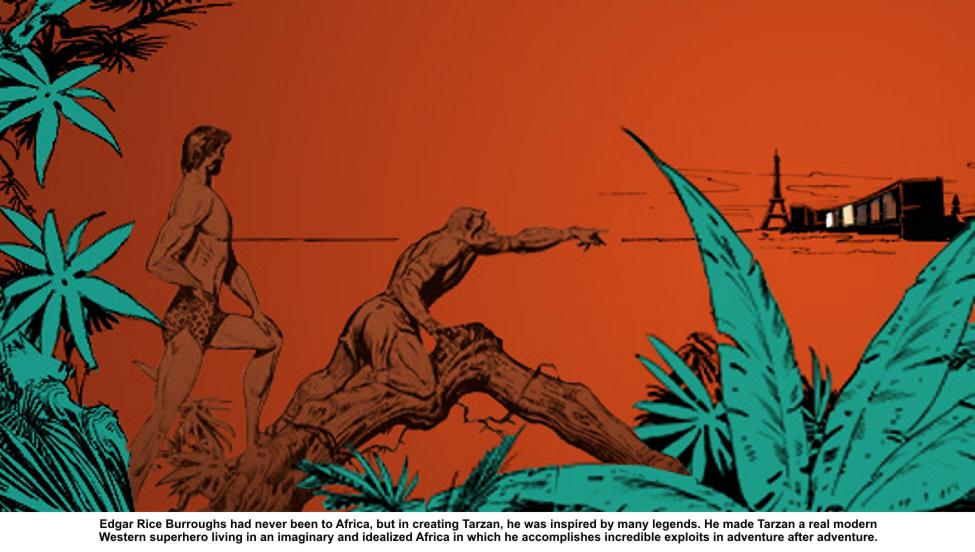
The Aquarian Archetype
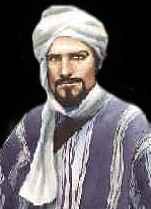
The Renowned Arab Traveler- Mohammed Ibn Batuta
Writing in the fourteenth century Ibn Batuta had visited the East African coast trodding the soil of Kilwa Island on the southern border of Tanganyika, now Tanzania. Zanzibar replaced Kilwa as the Moslem trading entropot on the East Coast. Haggard apparently had done the same as he mentions ruins that dated back to before the tenth century. So, we have established commercial activity in Southern Africa before the arrival of the Shona people in Zimbabwe.
Ruiz stood behind a low, stone altar which appeared to have been painted a rusty brown red.For a long time Ruiz the high priest held the center of the stage. The rites where evidently of a religious nature that went on interminably. Three times Ruiz burned powder upon the altar. From the awful stench Sandra judged the powder must have consisted mostly of hair. The assemblage intoned a chant to the weird accompaniment of heathenish tom toms. The high priest occasionally made the sign of the cross, but it seemed obvious to Sandra that she had become the goddess of a bastard religion which bore no relationship to Christianity beyond the symbolism of the cross, which was evidently quite meaningless to the high priest and his followers.She heard mentioned several times Kibuka, the war god; and Walumbe the god of death, was often supplicated, while Mizimo departed spirits, held a prominent place in the chant and the progress. It was evidently a very primitive form of heathenish worship from which voodooism is derived.
Looking up, she saw a dozen naked dancing girls enter the apartment, and behind them two soldiers dragging a screaming Negro girl of about thirteen. Now the audience was alert, necks craned and every eye centered upon the child. The tom-toms beat out a wild cadence. The dancers, leaping, bending, whirling, approached the altar; and while they danced the soldiers lifted the still screaming girl and held her face up, upon its stained brown surface.The high priest made passes with his hands above the victim, the while he intoned some senseless gibberish. The child’s screams had been reduced to moaning sobs, as Ruiz drew a knife from beneath his robe. Sandra leaned forward in her throne-chair, clutching the arms, her wide eyes straining at the horrid sight below her.A deathly stillness fell upon the room broken only by the choking sobs of the girl. Ruiz’s knife flashed for an instant above his victim; and then the point was punged into her heart. Quickly he cut the throat and dabbing his hands in the spurting blood sprinkled it upon the audience, which surged forward to receive it…
“Well, what of it?’ demanded da Gama. “I am king. Do I not sit on a level with God and his goddess? I am as holy as they. I am a god as well as a king; and the gods can do no wrong.”“Rubbish!” exclaime the high priest. “You know a well as I do that the man is not a god, and the woman no goddess. Fate sent the man down from the skies- I don’t know how; but I’m sure he’s as mortal as you or I; then you get the idea that by controlling him you could control the country. You were jealous of me that’s all; then you get the idea that by controlling him you could control the church, for you know that who controls the church controls the country. You were jealous of me that’s all; then you conceived the idea of having a goddess, too, which you thought might double your power. Well, you have them; but they’re going to be just as useful to me as they are to you. Already, the people believe in them, and if I should go to them and say that you had harmed the god, they would tear you to pieces…”
“…you don’t stand any too well with the people, Chris, anyway; and there are plenty of them who think da Serra would make a better king.”“Sh-h-h,” cautioned da Gama. “Don’t talk so loud. Somebody may overhear you. But let’s not quarrel, Pedro. Our interests are identical. If Osorio da Serra becomes king of Alemtejo, Pedro Ruiz will die mysteriously; and Quesada the priest will become high priest. He might become high priest while I am king.”
“You should know,” he said. “You are a woman.”“I am not a mortal woman. I am a goddess.” She grasped at a straw.Rateng laughed at her. “There is no god but Allah.”“If you harm me you will die.” she threatened.“You are an infidel,” said Rateng, “and for every infidel I kill, I shall have greater honor in heaven.”
A Review
Woman
by
Alan Clayson
Yoko Ono And The Men Who Influenced Her
Review by R.E. Prindle
Clayson, Alan: Woman: The Incredible Life Of Yoko Ono, Chrome Dreams, 2004.

Girlish Yoko- Warhol School by Richard Bernstein
Yoko Ono involved herself with several of the most influential men in the arts during the sixties, seventies and eighties of the twentieth century. She drew her inspiration from them patterning her own efforts after them. At the same time she was one of the leading feminists of the day having her share in shaping and furthering the movement. The mantra was female liberation, equality between men and women. In fact women were equal to men in the West but only by acknowledging the biological differences between men and women. The fact is the differences are real and not social constructs as women would have us believe. The fact is women are women and men are men. So, in seeking ‘female liberation’ feminists were seeking much more than ‘equality’ however the term may be defined.
The fact is that in the Ages old war between the sexes feminists are seeking to restore the Matriarchy and destroy the Patriarchy. That is why many men favor feminism, they prefer the Matriarchy. Thus the feminists are atavistic. Yoko and her cohorts wished, in her words, to restore ‘heart’ as she viewed the Matriarchy and eliminate ‘reason’ as she viewed quite rightly the basis of Patriarchalism. Nevermind that bilogical science has invalidated the concepts of Matriarachy and Patriarchy. This is a post Matriarchy and Patriarchy world.
Circa -2000 in the West men revolted against the mind stifling Matriarchy and the vaginal swamp of the ‘heart’ seeking to establish

Smilin' Jack Cage
the authority of the infinite power of the mind of Zeus on ethereal Olympus. This is the story of Homer’s Iliad and Odyssey and the Greek myths in general recording the struggle.
The Western male was able to impose the ascendency of reason over the heart for 3000 years until the disestablishment of the old order by science about mid-nineteenth century. The center could not hold during this period of extreme change as W.B. Yeats put it as the rearrangement of the intellectual order moved into the twentieth century.
Yoko Ono sought with her feminist fellows to return to the biological innocence of 2000 BC. She herself had no talent. Filled with audacity she pitted her ‘heart’ against the reason of John Cage, Andy Warhol and John Lennon. I’m sure she had a mentor for her so-called performance art but I am as yet unaware of who he may be. Perhaps Maciunas and the Fluxus group.
Thus her first manifestation as an artist was based on the musical ideas of John Cage while her artistic efforts were at least based in the avant garde ideas of the Fluxus group. Her first assault on the NYC art world failed so in 1961 she returned in defeat to Japan. When she returned to NYC in 1964 she found an entirely different art scene. On the musical side the focus was on Bobby Dylan and the Beatles while on the artistic side Andy Warhol and his Factory had destroyed the Abstract Expressionists and the old avant garde. Dylan, the Beatles and Warhol had in fact usurped the avant garde which now had little meaning. From my point of view held at the time the avant garde had ceased to exist. Of course I didn’t understand exactly why or how.
From 1964 when Yoko returned to NYC until 1966 when she left for London I’m sure Yoko was at a loss. She developed her silly

The Bag Yoko And Tony Are In
notion of Bagism at this time even having a black bag on a stand in Max’s Kansas City that some one or ones were supposed to slide into. This seems to have been thought a lame idea at the time as it seems now.
At this time while retaining allegiance to John Cage’s musical ideas she was falling under the influence of Andy Warhol’s artistic notions. Warhol’s intent had been to destroy the idea of ‘fine art’. In this he pretty well succeeded. As Yoko expressed it you didn’t need any talent to be an artist. She seems to demonstrate this notion in her own artistic efforts. Warhol had also redefined the notion of film with his static studies. He then sought to combine his film ideas with live music, probably in competition with Bob Dylan who was also attempting to move in that direction. Warhol adopted Lou Reed and his band the Velvet Underground as the Factory house band while creating a multi-media show called the Exploding Plastic Inevitable, innovative for its time. Thus a concert at his hall, the Dom, was an ‘experience.’
While Yoko makes no mention about how this, actually, incredible development affected her there can be no doubt that she was well aware of Dylan, the Beatles and the Warhol Experience and was affected by it. Indeed, the first manifestation was the making of her Warhol style films such as Bottoms.
The second manifestation was her removal to London to seduce either Lennon or McCartney of the Beatles, thus in the manner of Warhol’s adoption of the Velvet Underground she sought to co-opt the Beatles, the premier rock group in the world. Real chutzpah and more than one upping Warhol. I think it would be nonsense to think she had any other goal in mind.
She undoubteldy learned that Paul McCartney was actively involved with John Dunbar and his Indica Gallery that opened in 1965.
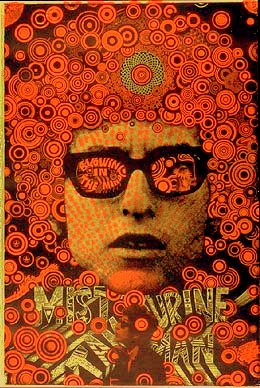
Psychedelic Dylan
Some say she first set her sights on McCartney but the more vulnerable Lennon showed up and the Spider Woman spread her web.
She was still married to her second husband, Tony Cox, but, regardless of what she says she very aggressively pursued, or attacked, Lennon. Lennon was emotionally under water unable to handle his success while drugging himself out of his mind. He was unwillingly married to his wife Cynthia. It appears that he married Cynthia out of duty when she became pregnant. He doesn’t seem to have been happy in his virtue. Yoko had no difficulty in capturing his affections.
Now, just as Warhol had adopted the Velvets and imposed his female singer, Nico, on the band Yoko sought to imp[ose herself on the Beatles through Lennon. At this time she was still musically completely in thrall to John Cage understanding nothing about Rock music. She and Lennon had made a ridiculous LP called Two Virgins in 1968. She combined her cagian screechings while using an avant garde ‘performance’ notion of the couple posing nude on the cover; full frontal on the obverse, full posterior on the reverse. As no store would carry the cover the couple reverted to Yoko’s idea of Bagism placing the cover inside a plain manila envelope or bag. While it didn’t sell the record this form of Bagism was actually a successful artistic statement. The nude cover given an outer garment so to speak.
Well, the public was prepared to forgive the Beatles anything but the other three Beatles weren’t prepared to forgive Yoko for forcing herself on them thus she broke up the most successful act of the sixties. Still, she had succeeded according to her wildest dream. Lennon and his wonderful reputation and fortune were hers. She had gone from a neglected, nondescript ‘performance’ artist to center stage, not on her own womanly talents but by attaching herself to a talented man. Yoko’s ‘heart’ was useless without the male intellect. Yoko was now the most influencial feminist in the world. She knew what to do with that.
After several ‘performance’ acts such as the ‘Bed In For Peace’ the couple left England to return to the place Yoko wished to subjugate artistically, New York City. She had raised herself to a par with Andy Warhol. She now had to meld her musical and artistic goals through Lennon and Warhol.
On the musical side she began to develop her rock n’ roll skills under the tutelage of Lennon. While not abandoning the avant garde notions of John Cage she now emasculated her husband. Always semi-delusional or perhaps completely so, she fantasized that she was not only equal to Lennon in skill and popularity but superior to him. She imagined herself more popular than Lennon. Thus one has such travesties as the LP Double Fantasy. It was only after Lennon’s death that she was forced to recognize than Lennon’s fans did not appreciate her efforts. So she failed as a musician.
She quickly tired of being Mrs. Lennon. Thus she and Lennon separated for eighteen months or so during the years 1973-75. She then realized that her financial well being and musical acceptance depended on Lennon. In 1975 she called him back resuming their relationship until his death in 1980. But, things had changed.
She began to adopt Warhol’s life style on her return to NYC. While she propagated the notion that she was some sort of business whiz Iam having difficulties discovering any such skills. It appears that with the enormous income of Lennon she emulated Warhol in

Andy the Demon
spending her way to prosperity.
She was in a position to not only match Warhol’s spending but exceeding it by many times. Through the seventies and eighties Warhol came into his own as an artist while reaping a fortune doing portraits. There appears to have been no effort on his part to invest in income producing vehicles. Rather he bought stuff. He purchased buildings in NYC and elsewhere while acquring undeveloped acreage in places like Aspen. He shopped nearly every day buying antiques from furniture to objets d’ art by the bushel almost as though he were trying to excel the incredible W.R. Hearst.
He usually didn’t even look at the stuff once he bought it merely filling rooms with his shopping bags. At his death all this junk was auctioned off for 25 million dollars, a nice appreciation in value.
Yoko followed the exact pattern buying apartments and houses as well as an extensive dairy farm with a herd of prize cows. She not only had but has five apartments in her principal dwelling, the Dakota apartment building and many other houses scattered around.
Like Warhol the Dakota apartments are stuffed with junk. Valuable, but, you know, stuff. She bought at good prices. Her extensive collection of Egyptian antiquities was mostly purchased before a steep rise in value.
Like the Rothschilds of old Yoko didn’t do all her own shopping but employed agents to search things out. Chief among these was an associate of Warhol’s, Sam Green, and an Hungarian immigrant by the name of Sam Havadtoy.

Buddies- Yoko, John, Andy
There should be no surprise then that she now has an extensive collection of Warhol’s artwork as well as his portraits of Lennon. The Warhols would have been purchased for form 25 to 50K while now being listed on her assets at tens of millions. She also has been said to have a good collection of Magrittes as well as one assumes other artists. So, much of her net worth is tied up in artwork purchased through Sam Green.
Sam Havadtoy was an antiques dealer as well as an interior designer. He appears to have been a somewhat shady character. It is very difficult to find much about him, however there is a sharp portrait available from the notorious A.J. Weberman ( http://www.acid-trip.org/lennon/ )
…(the Lennons) hired a sleazy Eastern European bisexual to renovate the pad. (Dakota) I had heard of this dude, whose name escapes me, from an asswipe named BRUCE KIRSH, who worked for him. KIRSH told me that the dude, who worked for the King of Morocco, would form a dummy renovation company, hire employees like Kirsch who were willing to work under false names, then, when it came time to pay taxes, everyone would disappear. I learned of him long before he was hired by John and Yoko, and I was taken aback when Yoko took up with him after John’s death.
I know that Weberman is not particularly well thought of by fandom but this is because of his harassment of Dylan who did, after all, misrepresent himself to the revolutionaries like Weberman. A.J. himself is an intelligent observer who was wading through it when it was deep. I do believe he knows what he’s talking about although his interpretations of Dylan’s lyrics seem absurd.
I would have to question Yoko’s judgment in taking him in. Both he and Sam Green were candidates as successors to Lennon with

Lennon by Warhol
whom she consorted in front of Lennon before he died while Yoko chose Havadtoy as his successor the day he died.
Perhaps she selected Havadtoy over Green because he was more rough trade. With Lennon while managing to reconcile revolution with peace and love with Havadtoy she discarded peace and love in favor of strong arm methods against her former employee Fred Seaman when it was totally unnecessary.
Havadtoy was living in a homosexual arrangement with his business partner when Yoko beckoned him to switch to her. Apparently an able switch hitter he was lured by the money to this much older woman. The arrangement did last for twenty years before Havadtoy removed to his native Hungary taking a nice cash settlement and several of the Warhols.
Thus, just as Warhol had his live-in homosexual arrangement so after Lennon’s death Yoko adopted the exact arrrangement. Today she apparently lives alone, a seventy-eight year old woman.
After Lennon’s death there was an accession of from 30 million to a possible 100 million dollars as their last album, Double Fantasy, sold into the millions while the rest of Lennon’s catalog and one assumes the Beatles’ catalog was reinvigorated while all things Lennon sold. This is, of course, no reflection on Yoko but the inevitable result with intellectual properties when the maker dies.
Post-Lennon, then, Yoko realized that her recording and art careers were nil. Heart without intellect is worthless. She then became the caretaker of the Lennon legacy. His recordings, of course, continued to sell, but even his artwork eclipsed that of Yoko. So she suffered the humiliation of being a mere appendage to a man. The feminine dismal swamp was eclipsed by the Olympian heights of the male intellect. As in ancient times the God had trumped the Goddess. And yet as with Hera and Zeus the Goddess gets her way. Yoko came up with the money and goods while Lennon’s spirit was wafted into the stratosphere.
As any reader of mythology knows Hera ruled the Lernean swamps of Argolis while Zeus ruled the gods on ethereal Olympus. Thus one has the symbolism of the biological difference between the male and female.
In ancient times the female had her share in magic. She knew herbs and plants, was familiar with poisons and cures as with the arch witch of the ancient world, Medea. The reputation of the female witch even as a consort of Satan persisted down through medieval and post-medieval times, indeed, even up to the dawn of the scientific enlightenment. One would have thought that magic and witchery were a thing of the past in the 1960s and yet Yoko embodied the whole female swamp mentality.
She established something called the Spirit Foundation attributing the direction to Lennon who in fact knew nothing of these matters but followed her lead. The Spirit Foundation celebrated the ancient art of the Shaman or witch doctor. Shamanism itself even preceded the Matriarchal swamps of Argolis. It was a rich repository of magical tradition. Further the Foundation was feminist in that it was dedicated to preserving the magical traditions of the women of the Pacific islands still living in such archaic societies. The wealth generated by the male intellect was appropriated by the female vagina or ‘heart.’
In her own life and that of Lennon’s Yoko was addicted to a variety of magical practices- astrology, numerology, Tarot readings, and indeed she traveled to the Caribbean to sell her soul to Satan through the offices of a female curandera. Her Tarot reader, John Green, was a priest in the shamanistic, magical, Yoruban African cult of Santeria.
Her feminism was more a magical effort to restory Matriarchal supremacy over the Patriarchy thus reversing the Patriarchal victory of three thousand years previously. Indeed, what has been called the movement for female equality is nothing more than a covert campaign to restore the Matriarchy.
Thus while Yoko o9riginatd nothing she usurped the abilities of the reason of men- Cage, Warhol, Lennon and male magicians such as John Green. Indeed the Trojan War itself was a war of men in service of women.
In her associations with men she preferrred to deal with emasculated types such as homosexuals like Cage, Warhol, Sam Green and Sam Havadtoy. Lennon claimed to have always been dependent of women for comfort and guidance while Yoko caught him at his most confused and vulnerable.
While she received direction from Cage and Warhol she was able to manipulate Lennon out of his talent somewhat as Vivian did that of Merlin of the Arthurian saga. When Vivian had usurped Merlin’s magical knowledge she buried him deep much as Lennon was put out of the way. Yoko then appropriated his wealth and residual income after his death. It was this constant inflow of cash that allowed her to propagate the notion that she was a financial genius.
Then as the female of the ‘heart’ or vaginal swamp she managed and appropriated the reason of Olympus through Cage, Warhol and Lennon. What she got from Havadtoy other than brute strength is not clear to me.
As such Yoko is Woman. In her case a seeming reversion to the archetypal Shaman of the most ancient times.
Themes And Variations
The Tarzan Novels Of Edgar Rice Burroughs
#5 Tarzan And The Jewels Of Opar
by
R.E. Prindle

Edgar Rice Burroughs
Part IV
From Achmet Zek’s Camp To The Recovery Of The Jewels
The nature of the story changes from the departure of Werper and Jane from Achmet Zek’s camp . To that point the story had been developed in a linear fashion. From Zek’s camp on ERB either loses control of his story or changes into an aggregation of scenes between the camp and the Estate leading to the return. Perhaps there is a modification in his psychology.
The struggle for the possession of the jewels and the woman contunues unabated. As always Burroughs tries to construct a story of many surprising twists and turns. This may be an influence of the detective story, Holmes, on him. He may be trying to emulate Doyle.
The problem of who the characters represent in ERB’s life becomes more difficult to determine. Werper continues as ERB’s failed self. I think as relates to Zek and the jewels Zek represents Burroughs’ old sexual competitor, Frank Martin, while Zek, the gold and the Abyssinians represent the deal between McClurg’s and its deal in 1914-15 with A. L. Burt. Burt first had the reprint rights to Tarzan Of The Apes, published in the summer of 1914. Those rights shortly passed to Grossett and Dunlap.
In my estimation Martin never ceased interfering with Burroughs’ marriage at least from 1900 to 1919 when Burroughs fled Chicago. We know that Martin tried to murder Burroughs in 1899 and that his pal, R.S. Patchin, looked up Burroughs in LA after the divorce in 1934 and sent a mocking condolence letter in 1950 when Burroughs died and after Martin had died sometime earlier. Patchin would obviously have been directed by Martin to taunt Burroughs in ’34. It’s clear then that Martin carried a lifelong grudge against Burroughs because of Emma.
Martin is thus portrayed as being in competition with Burroughs in 1914-15 and possibly but probably to a lesser extent in LA.
Jane is shown being captured by Zek twice in the story. Thus Emma was courted or captured by Martin when Burroughs was in Arizona and Idaho. In this story Jane is captured while Tarzan is absent in Opar. The second capture or courting by Martin is diffiicult to pinpoint by the inadequate information at our disposal but following the slender lead offered by the novelist, John Dos Passos, in his novel The Big Money I would think it might be in 1908 when ERB left town for a few weeks or months probably with Dr. Stace. It was of that time that the FDA (Federal Food And Drug Administration) was after Stace for peddling his patent medicines. Burroughs was probably more deeply involved with that than is commonly thought. At any rate his being out of town would have provided an opportunity for Martin. Whether something more current was going on I don’t find improbable but I can’t say.
I would also be interested to learn whether there was any connection between McClurg’s and Martin. Martin was Irish, his father being a railroad executive which explains the private rail car at his disposal, as were, of course, the McClurgs and so was the chief executive Joe Bray. If Martin knew Bray he might have pressured Bray to reject publication of Tarzan doing a quick turnaround when interest was shown by the Cincinatti firm. Martin then might have meddled with Burroughs’ contract with McClurg’s. The contract and McClurg’s attitude is difficult to understand otherwise.
The gold is buried which Zek is supposed to have gotten through Werper, then they have a falling out and Werper is captured by Mourak and his Abyssinians. Mourak would then represent A.L. Burt and a division of the the royalties. If McClurg’s had promoted Tarzan Of The Apes, which they didn’t, Burroughs would have received 10% of 1.30 per copy. Thus at even 100,000 or 200,000 copies he would have received 13,000 or 26.000 dollars. that would have been a good downpayment on his yacht. Martin who must have thought of Burroughs as a hard core loser from his early life would have been incensed by such good fortune that might have placed Burroughs’ income well above his own.
Instead, it doesn’t appear that McClurg’s even printed the whole first edition of 15,000 copies. The book immediately went to A.L. Burt where the price of the book was reduced to 75 or 50 cents with the royalty much reduced to 4 1/2 cents divided fifty-fifty between McClurg’s and Burroughs. It’s hard to believe that ERB wasn’t robbed as he certainly thought he had been. Thus when Mourak unearths the gold he is settling for a portion of the hoard when Zek’s men show up and the battle necessary for the story begins.
In this manner the key issues of gold, jewels and woman are resolved.
So, Werper with the jewels goes in search of Jane to find that she has already fled Zek’s camp. The scenes of the story now take place between the camp, perhaps representing McClurg’s offices and the Estate, representing Burroughs.
The latter half of the book, pages 81-158 in the Ballantine paperback is very condensed in a dream like fashion. The action within the very prescribed area with a multitude of people and incidents is impossible except as a dream story. The appearance of the Belgian officer and askaris must have been photoshopped it is so impossible. In other words, then, the whole last half of the book, if not the whole book, is a dream sequence in which dream logic prevails. I will make an attempt to go into late nineteenth century dream speculation in Part V.
A key point of the story is the regaining of the memory of Tarzan. This occurs near story’s end on page 139 and following. It’s fairly elaborate. In connection with his memory return I would like to point out the manner of his killing the lion when he rescues Jane from Mourak’s boma. The roof fell on Tarzan in imitation of his braining in Toronto while now he picks up a rifle swinging on the rearing lion’s head splintering the stock along with the lion’s skull so that splinters of bone and wood penetrate the brain while the barrel is bent into a V. Rather graphic implying a need for vengeance. Not content with having the roof fall on Tarzan’s head, while trying to escape the Belgian officer an askari lays him out with a crack to the back of the head but ‘he was unhurt.’ One can understand how Raymond Chandler marveled. My head hurts from writing about it. Also Chulk has his head creased by a bullet adding another skull crusher to the story.
The description of the return of Tarzan’s reason seems to fit exactly with Burroughs’ injury. I would have to question whether Burroughs himself didn’t have periods of amnesia. P. 139:
Vaguely the memory of his apish childhood passed slowly in review- then came a strangely tangled mass of faces, figures and events that seemed to have no relation to Tarzan of the Apes, and yet which were, even in this fragmentary form, familiar.
Slowly and painfully recollection was attempting to reassert itself, the hurt brain was mending, as the course of its recent failure to function was being slowly absorbed or removed by the healing process of perfect circulation.
According to medical knowledge of his time the description seems to apply to his own injury. His own blood clot had either just dissolved or was dissolving. Then he says almost in the same manner as in The Girl From Farriss’s:
The people who now passed before his mind’s eye for the first time in weeks were familiar faces; but yet he could neither place them in niches they had once filled in his past life nor call them by name.
In this hazy condition he goes off in search of the She he can’t remember clearly. His memory fully returns as he has Werper by the throat who calls him Lord Greystoke. That and the name John Clayton bring Tarzan fully back to himself. For only a few pages at the end of the book does he have his memory fully recovered.
In order to summarize the rest I have had to outline the actions of the main characters for as with Tarzan and his memory the story is one of ‘a strangely tangled mass of faces, figures and events.’ Whether this is artistry on Burroughs’ part or a dream presentation I am unable to ascertain for certain. Let’s call it artistry.
We will begin with Werper’s activities. While Tarzan promised to retrieve La’s sacred knife Werper appears to no longer have it as it disappears from the story. When Werper escaped from Zek unable to locate Jane he heads East into British territory. He is apprehended by one of Zek’s trackers. On the way back a lion attacks the Arab unhorsing him. Werper mounts the horse riding away directly into the Abyssinian camp of Mourak. Mugambi is captured at the same time. While the troop bathes in a river Mugambi discovers the gems managing to exchange them for river pebbles. Werper tempts Mourak with the story of Tarzan’s gold. While digging the gold they are attacked by Zek and his men. Werper rides off as Mourak is getting the worst of the fight. Zek rides after him. Werper’s horse trips and is too exhausted to rise. Using a device that ERB uses in one of his western novels Werper shoots the horse of the following Zek, crouching behind his own for cover. Zek has lost the woman but now wants the jewels. Werper hasn’t the woman while unknown to himself he neither has the jewels. In exchange for his life he offers Zek the pouch of river stones believing it contained the jewels. Zek accepts. Both men are treacherous. Werper waits to shoot Zek but Zek out foxes him picking up the bag by the drawstring with his rifle barrel from the security of the brush.
Discovering the pebbles he thinks Werper has purposely deceived him stalking down the trail to finish him off. Werper is waiting and pots him with his last shell. As Zek falls the woman, Jane, appears as if by a miracle reuniting the two. Could happen I suppose but definitely in dreams.
So, what are the two men fighting over? The sex interest, as the jewels are involved. Who do Werper and Zek represent? Obviously Burroughs and Martin. The stones are false but as Werper disposes of Zek in the competition for the woman Jane appears as if by magic to run to Werper/ Burroughs with open arms.
Werper with Jane returns to Zek’s camp now under the direction of Zek’s lieutenant, Mohammed Beyd. Rigamarole, then Werper deposits Jane in a tree from whence he expects to retrieve her on the following morning. The next day she is gone.
Werper once again turns East. He is spotted riding along by Tarzan. The Big Guy falls from a tree throwing Werper to the ground demanding to know where his pretty pebbles are. It is at this point Werper recalls Tarzan to his memory by calling him Lord Greystoke. Also at the moment the Belgian officer appears from nowhere, having miraculously ascertained Werper’s whereabouts, to arrest him.
Tarzan wants Werper more than the Belgian so tucking his man under his arm he breaks through the circle of askaris. On the point of success he is brought down from behind. Another thwack on the head. Apparently in a desperate situation Tarzan hears voices from the bush. The Great Apes have their own story line but here it is necessary to introduce them as Tarzan’s saviors. The voice is from Chulk who Tarzan sends after the troop. They attack routing the Africans. In the process Chulk, who is carrying the bound Werper is shot. If you remember Chulk stole the stones from Mugambi, or maybe I haven’t mentioned that yet. Werper falls across him in such a way that his hands bound behind his back come into contact with the pouch. Werper quickly recognizes what the bag contains although he has no idea how the ape came by them.
He then advises Tarzan where he left Jane. The two set out when the furore in Mourak’s camp reaches his ears. ‘Jane might be involved.’ Says Werper. ‘She might.’ says Tarzan telling Werper to wait for him while he checks.
Werper waits not, disappearing into the jungle where his fate awaits him.
Those are the adventures of only one character in this swirling vortex of seventy some pages.
Let’s take Mugambi next as he is the key to the story of the jewels yet plays a minor role. After crawling after Jane and regaining his strength he arrives at Zek’s camp at the same time as Tarzan and Basuli but none are aware of the others. Werper and Jane have already escaped when Tarzen enters the camp to find them missing. Mugambi follows him later also finding both missing. He goes in search of Jane. He walks through the jungle ludicrously calling out ‘Lady’ after each quarter mile or so. Leathern lungs never tiring he shouts Lady into the face of Mourak and is captured. Being a regular lightfoot he escapes having lifted the jewels from Werper. Chulk then lifts them from him, Mugambi disappears until story’s end.
Let’s see: Jane next. Jane along with the jewels is the key to the story. The jewels represent the woman as man’s female treasure. Jane is the eternal woman in that sense. The various men’s attitude toward the jewels reflects their own character. Thus, Tarzan in his amnesiac simplicity wants the jewels for their intrinsic beauty. He rejected the uncut stones for the faceted ones in Opar. Even in the semi darkness of the vaults, or in other words, his ignorance, he perceived the difference.
Werper at various times thinks he can get the gold, the jewels and the woman at once. He is happy to settle for the jewels taking them to his grave. Mourak knowing nothing of the jewels is willing to settle for a few bars of gold. When he takes the woman into his possession it is for the sole purpose of a bribe to his Emperor to mitigate his overall failure. Not at all unreasonable.
Zek is too vile to consider as a human being dying in the fury of losing all. Mugambi and Basuli are happy in their devotion to the woman to whom neither jewels or gold mean anything.
Tarzan then, pure in soul and spirit wins it all, woman, jewels and gold. One is tempted to say he lived happily forever after but, alas, we know the trials ahead of him.
So Jane is carried off to Zek’s camp where all the action is centred while she is there. Both Tarzan and Mugambi show up to rescue her but she has escaped just ahead of Werper who would thus have had the woman and the jewels. Alone in the jungle she once again falls into Zek’s hands- that is to say those of Frank Martin.
Now, Tarzan, who has fallen in with a troop of apes chooses two, Taglat and Chulk, to help him rescue Jane from Zek. Chulk is loyal but Taglat is an old and devious ape, apparently bearing an old grudge against Tarzan, who intends to steal Jane for his own fell purposes much worse than death.
In Tarzan’s attempt to rescue Jane, Taglat succeeds in abducting her. He is in the process of freeing her bonds when a lion leaps on him. In the succeeding battle Jane is able to escape the lion who had just killed Taglat.
Wandering through the jungle she hears shots, the voices of men. Approaching the noise she discover Werper and Zek fighting it out. She climbs a tree behind Werper. When he shoots Zek he hears a heavenly voice from above congratulating him. Jane runs to him hands outstretched. So now Werper has the woman again while believing he can retrieve the jewels. He can’t find them because unbeknownst to him Mugambi had substituted river rocks.
Improbably, except in a dream, he returns to Zek’s camp where he has to solve the problem of Zek’s second in command, Mohammed Beyd. Werper spirits Jane out of the camp but finds her gone the next morning. She had mistaken Mourak and his Abyssinians for Werper. Mourak now in possession of the woman, no gold no jewels, thinks to redeem himself with his Emperor, Menelik II, with this gorgeous female.
During that night’s camp the boma is attacked by hordes of lions. Lions play an amazingly central role in this story. Interestingly this scene is replicated almost exactly in the later Tarzan And The City Of Gold. In Jewels Tarzan rescues a woman while in Gold Tarzan rescues a man. That story’s woman becomes his enemy.
But now Tarzan and Werper hear the tremendous battle with Tarzan entering the boma to rescue Jane. By the time of the rescue Tarzan has regained the woman and the gold but lacks the jewels.
Unless I’m mistaken we now have only Tarzan and the apes to account for.
ERB’s life was at a turning point. At this stage in his career he must have realized that he would have a good annual income for the rest of his life. If only 5000 copies of the first edition of Tarzan of the Apes sold he would have received 6,500.00 Add his magazine sales to that and other income and 1914 must have equaled his income of 1913 or exceeded it. His income probably grew until he was earning c. 100,000 per year for three years from 1919-1922. So he had every reason to believe the world was his oyster through the teens. That must have been an exhilarating feeling. A sense of realization and power must have made him glow. But the period was one of transition, a casting off of the old skin while growing into the new. Thus one sees ERB abandoning his old self -Werper- while attempting to assume the new in Tarzan. Thus in death Werper transfers the jewels, call them the Family Jewels, from himself to Tarzan.
Tarzan begins the novel as an asexual being unaware of what jewels were or their value and receives them a the end of the novel as a release from emasculation or awareness of his sexual prowess. Once again Werper fades in the novel while Tarzan unaware of who he is comes to a full realization. Presumably Burroughs thinks he is able to assume his new role as 1915 ends.
In the novel when Tarzan realizes Werper has stolen the jewels he goes off in search of this symbol of his manhood. Werper is not in Zek’s camp. On the trail Tarzan comes across the dead body of the Arab sent after Werper with he face bitten off. He assumes this is Werper but can’t find the jewels. Wandering about he discovers a troop of apes deciding to run with them for a while. Selecting Chulk and Taglat he goes back to Zek’s camp to rescue Jane. At that point Taglat makes off with Jane. Discovering Zek and Werper on the way to the Estate Tarzan becomes involved in the battle between Zek and Mourak. He sees Zek take the jewels and then throw them to the ground as worthless river rocks.
He encounters Werper in the jungle again and prompted by the man fully regains his memory only to have Werper arrested by the Belgian police officer. The battle between Mourak and the lions ensues. Tarzan goes to rescue Jane, Werper goes to his death.
The unarmed Tarzan faces a rampant lion. Picking up an abandoned rifle he brains the lion, apparently in vengeance for all the indignities and injuries ERB has suffered in life.
Leaping with Jane into a tree they begin the journey back to the Estate to begin life anew. Some time later they come across the bones of Werper to recover the jewels and make the world right.
The novel closes with Tarzan’s exclamation.
“Poor devil!”…Even in death he has made restituion- let his sins lie with his bones.”
Was Burroughs speaking of Werper as his own failed self? I believe sothe latter. Remember that a favorite novel of ERB was Dr. Jekyll and Mr. Hyde and that he believed that every man was two men or had two more or less distinct selves. Human duality is one of the most prominent themes in the corpus; thus ERB himself must have believed that he had a dual personality. Tarzan will have at least two physical doubles, one is Esteban Miranda in Golden Lion and Ant Men, and the other Stanley Obroski in Lion Man. Both were failed men as Werper is here. Both obviously represented the other or early Burroughs as Werper does here.
In killing Werper ERB hoped to eliminate the memory of his failed self as he did with Obroski in Lion Man. In other words escape his emasculation and regain his manhood.
The jumbled and incredibly hard to follow, or at least, remember, last half of the book with its improbable twists and turns in such a compressed manner gives the indication that this is a dream story. Only dream logic makes the story comprehensible if still unbelievable. The story then assumes fairy tale characteristics that don’t have to be probable to be understood as possible.
Can be genius, can be luck. I will examine Burroughs novels in relation to dreams in Part V. This part will not be as comprehensive as I would like but time grows short and it is better to make the attempt as not.
Part V follows.
Part III Tarzan And The Jewels Of Opar: Edgar Rice Burroughs
September 25, 2009
Themes And Variations
The Tarzan Novels Of Edgar Rice Burroughs
#5 Tarzan And The Jewels Of Opar
by
R.E. Prindle
Part III
From Opar To Achmet Zek’s Camp
Tarzan and Werper begin the trek back to the Estate. As Tarzan is an amnesiac that indicates that Burroughs is under stress. What kind of stress? As the stress involves sparkling Jewels it is therefore sexual stress. During the stories of the Russian Quartet the personalities of Tarzan and Burroughs were much more separate and distinct.
Success seems to now affect Burroughs so that he begins to identify himself with his great creation. He begins to assume a dual personality. His last Tarzan novel, Tarzan And The Madman will be a confession of his failure to realize his dream. For now we may consider the bewildered Tarzan as the emergence of the new Burroughs while Werper represents the loser Burroughs of his first 36 years. Bear in mind at all times that Burroughs has to tell his sotry so the apparent story has a different appearance than the allegorical story. The jewels then represent the discovery of his submerged sexuality.
As Werper and Tarzan are trekking they have gotten ahead of the slower moving Waziri. The Waziri catch up to them each bearing 120 lbs. of gold or two 60 lb. ingots. Six thousand pound or three tons of gold. So, for a brief moment Burroughs financial success and sexual prowess are on the same spot.
Tarzan not recognizing the jewels for what they are in his befuddled state indicates that Burroughs isn’t aware of how to take advantage of his new desirability.
Tarzan’s first thought when he sees the Waziri is to kill them as he vaguely recalls that Kala, his ape mother, was murdered by a Black. Werper talks him out of it. What story lies behind Kala?
The Waziri reach the burned out Estate, bury the gold, and go in search of Jane. Tarzan and Werper arrive on the heels of the Waziri.
Tarzan sees the Waziri burying the gold. Werper tells him that the Waziri are hiding it for safe keeping. Tarzan decides that would be an excellent thing to do with the jewels. When he believes Werper is asleep that night he digs a hole with his father’s knife burying the jewels.
On the ashes of his former existence then the gold representing his novels and the jewels representing his sexuality are buried.
Werper representing Burroughs old self was not sleeping; waiting for Tarzan to sleep he digs up the jewels fleeing to the camp to Achmet Zek and Jane. Thus the jewels and Jane are reunited with Werper being the possessor of the jewels and hence Jane. Fearing that Zek will murder him for the jewels in the middle of the night Werper persuades Jane to accompany him in flight thus setting up the next transfer of the jewels and Jane.
Meanwhile Tarzan wakes up finding Werper missing and reverts back to his role as an ape, or Great White Beast. peraps this signifies returning to his rough and rowdy ways of bachelorhood. However La and the little hairy men have left Opar in search of Tarzan and the sacred knife. They track him down to essentially the Estate. Perhaps this represents a new beginning on the ashes of the old.
This is the first time La has been outside the gates of Opar.
She is infuriated that Tarzan has rejected her love. After the usual hoopla about sacrificing the Big Guy night falls. La spends time pleading with Tarzan to return her love. She collapses over Tarzan much as over Werper in Opar. She lays atop Tarzan. Remember both Tarzan and La are always nearly nude so we have a very sensual image here. Finding Tarzan unresponsive La curls up beside Tarzan thus sleeping with him although chastely.
The next day the sacrificial hoopla begins again. Just as Tarzan is about to be sacrificed he hears Tantor the elephant in the distance. He emits a cry to attract Tantor.
As the elephant approaches Tarzan realizes that Tantor is in must, sexually aroused. He warns La who releases him just as Tantor charges into the clearing. Seizing La Tarzan runs up the convenient tree. Tantor thoroughly aroused directed his lust specifically at Tarzan and La. The tree is a large one but Tantor tries to bull it over. Failing this the mighty beast wraps his trunk around the bole and rearing titanically actually manages to uproot the tree.
As the tree topples Tarzan throws La on his back making a terrific leap to a lesser tree. Tantor follows as Tarzan leaps from tree to tree. Tantor’s attention wanders and he runs off in another direction leaving La and Tarzan.
So what does this scene mean? Possibly the temptation of Edgar Rice Burroughs. As I said it would be highly improbable if, as a successful writer, Burroughs didn’t attract the attention of other women who would make themselves available to him. This would place incredible stress on him making himself unable to ‘remember’ who he was, what he had been for 36 years.
He said he walked out on Emma a number of times. Leaving for Opar could be equivalent to walking out on Emma. The first night with La could be the first temptation. The elephant in must might indicate surrender to the temptation or at least a terrific struggle to avoid it.
In any event Tarzan returns La to the little hairy men then returning to the Estate to recover the jewels. This could be interpreted as a reconciliation. He finds the jewels gone. Realizing Werper stole them he sets out on the spoor to Zek”s camp.
In the meantime Basuli wounded as he was had crawled after Zek. Recovering his strength he returns to fighting form. The fifty Waziri also followed after Zek. All three parties arrive at the same time.
Clambering over the wall as usual Tarzan discovers that both Werper and Jane were gone. Now in pursuit of the jewels and Jane Tarzan returns to the jungle.
Part IV follows.
Part II: Tarzan And The Jewels Of Opar By Edgar Rice Burroughs
September 1, 2009
Themes And Variations
The Tarzan Novels Of Edgar Rice Burroughs
#5: Tarzan And The Jewels Of Opar
Part II
by
R.E. Prindle
Reliving Past Crimes And Humiliations
Let us put Chapter 6: The Arab Raid at this point in the discusssion so as to achieve greater continuity at the scenes in Opar.
With Tarzan absent from the Estate Zek makes his move to obtain Jane. The brave Waziri warriors rally around Jane putting up a fierce resistance. For whatever reason Tarzan hasn’t armed them with the latest repeating rifles and perhaps a Gatling Gun preferring they fight their battles with spears; hence they are no match for Zek whose men are armed with some woefully outdated firearms. We aren’t even told whether they’re Snyders. Burroughs just calls them ‘long guns.’
Jane herself is armed with what seems to be a repeating rifle. While there are those who refer to Jane as wimpy she is far from wilting here as she gamely fires through the closed door.
It is difficult to determine ERB’s intent here. In 1903-04 when Emma traveled to the wilds of Idaho with her husband she was far from the frontier type. ERB undoubtedly wanted her to be the dauntless frontier woman perhaps as was the wife portrayed in the Virginian but he discovered she was a citified fashion queen. Perhaps here he is demonstrating to Emma what he had wanted her to be.
The Estate is fired as it will be again three years hence when the Germans arrive. At that time ERB led us to believe that Jane was murdered while here she is about to be taken far away. In ERB’s troubled mind it would appear that he wanted to be rid of Emma. He would actually say he always wanted to be rid of her twenty years hence.
Oblivious of the fate of Jane Tarzan is in far away Opar loading the remaining faithful Waziri with the oddly shaped gold ingots.
Werper has followed him into the vaults. As an allegory Werper in this place can represent Ogden McClurg. The vaults can represent ERB’s mind where the wealth of his imagination is stored. Thus the publisher is taking what is rightfully ERB’s labor.
In actuality Ogden McClurg was seldom in Chicago. He was a naval officer who was in the Caribbean most of the time coming back briefly and then when The Great War broke out he became involved in those operations. The manager Joe Bray seems to have been the responsible person. I haven’t been able to ascertain McClurg’s position while I have been told the records for McClurg’s were destroyed so that may be impossible. I have gone through the correspondence between McClurg’s, A.L. Burt and Grosset and Dunlap in the archives of the University of Louisville. There seems to have been an agreement between McClurg’s and G&D to, how shall I say it, defraud Burroughs of royalties. If Burroughs was the best selling author of the time he is represented to be his royalty checks were ludicrously small, by the late thirties five, six and seven dollars per title. Hardly worth either McClurg’s or G&D’s bother if accurate. One is at a loss to understand why they clung so obstinately to the titles. One compares such small checks with the enormous sales of the 1960s. You can draw your own conclusions but it definitely seems there are some unsolvable contradictions.
Burroughs always believed he was being cheated. Based on the evidence I have seen I have to agree with him.
The gold has been brought to the top of the shaft. Tarzan goes back for a last look when the roof literally caves in. An earthquake occurs; a portion of the roof lands on Tarzan’s head putting him out. Werper who was in the same place with Tarzan is uninjured. Unable to go forward he takes the candle stub fleeing down the corridor toward Opar. In this instance he appears almost as a doppelganger of Tarzan.
Tarzan when locked in a cell on the previous occasion had removed the bricks in the wall opening into this corridor. Werper now traces Tarzan’s steps in reverse. Coming to the well he makes the same leap with with same success. Removing the bricks he retraces Tarzan’s steps back up into the sacrificial chamber. Here the little hairy men seize him tossing him onto the altar where La awaits. Duplicating the sacrifical scene with Tarzan she is about to plunge the knife into Werper’s breast when the air is shattered by a deafening roar. A lion has announced his presence in the chamber. The little hairy men flee, La faints and Werper prays.
We know this story because it is ERB’s favorite theme written in many variations.
ERB leaves Werper at the altar and returns to Tarzan who we last saw lying on the floor in a spreading pool of blood. The sequence in Opar recapitulates the main psychological traumas in ERB’s life in one of its many variations. The story changes and evolves but the facts remain the same. The overriding trauma here was ERB’s bashing in Toronto in 1899. The blow from the sap or pipe had a fixating effect on ERB. I’m sure he relived the situation over two or three times every day. It remains to be discovered if he blamed Emma for it. Had he not been competing with Martin for her hand the blow would never have happened. Here he couples the memory of the blow with the abduction of Emma.
Inert for a period of time he recovers but has lost his memory. A usual occurrence in periods of great stress for ERB. He didn’t think he lost consciousness in Toronto but he was knocked down having his scalp torn so that he was covered in blood by the time he arrived at the hospital. I think he did lose consciousness although he may not have been ‘out cold.’
I compare the situation with one of mine. At fifteen I was ice skating when I saw a boy scoot between two girls holding hands at arm’s length. I thought I would emulate him but the two girls closed up as I came from behind. I was better at starting than stopping. My legs flew up and I landed on the back of my head. I literally saw stars, five pointed colored stars in a burst of light. I can still recall the sound of my skull striking the ice. It was an odd sound. I never thought I lost consciousness but I remember opening my eyes so I must have been unconscious for some seconds at least. I suspect that ERB as he fell lost consciousness for at least a few seconds if not longer. Here in Opar he has Tarzan knocked cold for some time which must have been the way he had felt. ERB had fairly serious mental problems for at least a couple decades. While he doesn’t record losing his memory as such he has the hero of Girl From Farriss’s who received a blow duplicate to that received by himself, Ogden Secor, walking past friends as though he didn’t know them. A form of memory loss.
There is no story of Burroughs in which the main character doesn’t get bopped once or twice. This was noticed by Raymond Chandler, the creator of Philip Marlowe, who wrote a semi-dissertaion on bopping in one of his stories. Chandler had read Burroughs extensively. He speculated that no man could survive so many bashings as Tarzan received. Probably true. Chandler then proceeds to have a character bashed twice in succession. Chandler preferred the lump behind the ear which produces euphoric dreams.
At any rate Tarzan recovers while dimly remembering his ‘heavy war spear’ that he searches for. It is interesting that Tarzan never adopts modern weapons even though Jane had a repeater and one as knowledgeable as Tarzan must have been up on the Maxim gun by the time these stories were written. Rope, knife, spear and bow and arrows, Tarzan scorned guns.
Now, following in the footsteps of Werper, he comes to the well and falls in but doesn’t lose his grasp of his heavy war spear. The well probably represents a descent into the subconscious into the waters of the feminine. Bobbing to the surface he clambers out where the waters are level with the floor. An odd situation. Perhaps overflowing into the corridor from time to time making the floor treacherous, Tarzan has a difficult time keeping his footing until he climbs some stairs of many turnings. This is all terrific atmosphere although the meaning eludes me. Tarzan thus enters the forgotten jewel room of Opar. Here the Jewels of Opar come into play. Like the old singalongs at the Saturday movie matinee where you followed the bouncing ball now we begin to follow the course of the Jewels through the rest of the story.
This associates Werper and Opar with the novels of Tarzan And The Golden Lion and Tarzan And The Ant Men. In that sense Werper becomes a prototype of Esteban Miranda, one of my favorite characters. In those two novels Miranda like Werper tries to steal the gold. Miranda unlike Werper was a Tarzan lookalike. Instead of following the jewels in those two novels we follow Tarzan’s locket containing the pictures of his mother and father. Thus the stories change but the themes remain the same.
Tarzan merely sees the jewels as fascinating pretty baubles unable to discern their value because of his memory loss. He keeps the cut stones which diffract the light throwing the uncut stones back. Odd detail but perhaps significant. Just as the gold represents Burrough’s writing earnings the Jewels, especially diamonds, are associated with his sexual goals. Thus in Lion Man he associated Balza, who represents Florence, with an abundance of diamonds as he thinks he has realized his sexual goals. Then when he realizes his error in Tarzan And The Forbidden City the much sought after ‘father of diamonds’ turns out to be a piece of coal.
He then emerges into the sanctuary just as the lion emits its fearful roar. Let’s examine this scene in detail as ERB here replicates symbolically his confrontation with John the Bully on the street corner in the fourth grade.
For those who haven’t followed my essays ERB was confronted by a bully named John when eight or nine who terrorized his soul fixating him forever.
I know there are Bibliophiles who find the analysis of the confrontation as I have dealt with it to this point difficult to believe. The majority of people, in fact, appear to not undertand how something that happened when you were eight or nine can affect your mind for life. Most people think things are just forgotten. It is all a matter of suggestion when your mind is in a hypnoid state. The interpretation of the event enters your mind where it becomes fixated. Compare it to the clipboard of your computer. You can’t see the information copied but it exists on your computer nonetheless and in certain conditions manifests itself. This is probably close to what the French psychologist Pierre Janet meant by his term ‘idee fixe.’ Once in your mind the idea may take a few days or longer to become fixed thereafter directing your actions. The suggestion becomes a reality to your essentially hypnotized mind.
When confronted by John, a much larger and older boy, and a hoodlum, the young ERB was terrorized; this opened his mind to the hypnotic suggestion creating a hypnoid state. As ERB replicates this scene almost as often as the Toronto incident these two scenes are the twin poles of his psychosis. They are closely allied in his mind as Tarzan has just come from a bashing and now meets his nemesis John in the form of the lion. The lion is big and fearsome as was John.
When ERB was a child John, or the lion, destroyed ERB’s self-image. In this instance Tarzan is a giant with the thews of steel, a heavy war spear and his father’s knife. He is loaded for lions and eager to kill.
On the sacrifical altar, probably a metaphor of the psychological death he experienced with John, is Werper. As I believe Werper is a prototype of the latter doppelgangers Esteban Miranda and Stanley Obroski. Miranda and thus Werper represent the inefective Burroughs who quailed before John. Miranda is a Tarzan lookalike, an identical twin as it were. Neither in Werper nor Miranda does ERB resolve his conflict between the defeated wimp of his youth and the heroic Tarzan he now visualizes himself as. Werper and Miaranda then will morph into Stanley Obroski of Tarzan And The Lion Man who is another twin where Werper/Miranda/Obroski die as ERB beilieves or hopes that he has succeeded in realizing a heroic character. When he wrote Tarzan And The Madfman he realized that he was not the man he hoped to become.
In Opar the lion is about to leap on Werper and La has fainted across his body thus associating the Anima and Animus. In this instance La represents ERB’s failed Anima while Werper is the emasculated Animus. Tarzan/ERB then steps between the lion and La and Werper to save them. He drives his heavy war spear into the lion’s chest, itself an act that ERB portrays often.
Then, leaping on the back of the lion he repeatedly drives his father’s knife into its side. This is in itself a simulation of the sexual act, probably anal. At the same time the violence of copulation is an act of supreme hatred, very homosexual in nature actually. Having killed his adversary, John the Lion, he puts his foot on the body and exults with the terrifying victory cry of the bull ape. In his fantasy then he corrects his defeat on the street corner.
Now, the effect of the encounter with John on ERB’s psychology was profound. When John defeated the child ERB here represented by Werper and La, he assumed a half share role in both ERB’s Anima and Animus. Remember the fainted La is lying over the body of Werper. Thus the lion becomes Tarzan/ERB’s symbol of both helper and enemy; the lion becomes the enemy of his Animus and helper to his Anima. It is quite possible that if it hadn’t been pointed out to him after the publication of Tarzan Of The Apes that there were no tigers in Africa that the lion would have been a helpmate and the tiger the enemy. In that case there mgiht have been dramatic lion and tiger fights in which the tiger was always defeated. It is also possible that the lion would have been male and the tiger female thus prefiguring Burroughs’ later pronounced misogyny.
As John was male so is the lion so we have the anomaly of an Anima represented half by a loser female and half by a man in drag while the Animus is a loser male that ERB has to dispose of if he is to reintegrate his personality. This must have been a terrible conflict with potentially disastrous consequences.
The dilemma is most clearly represented in ERB’s second written book, The Outlaw Of Torn. Outlaw is not a book he chose to write but one which was suggested to him by his editor, Metcalf, at All Story Magazine. ERB casts his story in his familiar Prince and Pauper format. His mental dilemma is clearly depicted.
Norman, the hero, is the son of the English king, Henry. Henry insults his fencing instructor De Vac who avenges himself on Norman. The child is playing in a fenced yard attended by his nurse, Maud, who represents his Anima. She is chatting with a domestic failing to keep a close eye on Norman. He is lured through the gate outside the garden (of Eden) where De Vac waits to kidnap him. Realizing the boy’s danger Maud rushes to Norman’s rescue where De Vac brutally murders her. Thus Norman/ERB’s Anima is now destroyed. The mind cannot exist without an Anima so De Vac takes the young boy to London where they occupy the attic of a house over the Thames. The river represents the waters of the feminine while the house represents ERB and the attic his mind. Now, to replace the anima De Vac dresses as an old woman associating with Norman in that guise until Norman/ERB’s mind heals enough for ERB to function. At that time De Vac shifts to the Animus side training Norman in the manly arts. Thus Norman becomes a sort of predecessor of Tarzan. Tarzan Of The Apes will be the third novel ERB writes. At that point drawing on the clear example of Outlaw Of Torn ERB began to evolve his way out of his psychological dilemma.
The reason he can never develop a relationship with La is because she represents ERB’s failed Anima. In this scene La is on her knees pleading with Tarzan to accept her love. Tarzan coldly replies that he does not want her. Then walks away taking Werper his alter ego with him.
The little hairy men come shrieking after them. Tarzan’s heroic side clubs them down with his heavy war spear thus replicating the blow he recieved in Toronto on his enemies, correcting that insult and injury. Over and over the heavy war spear falls on head after head. Werper, befitting a coward, follows Tarzan in his shadow as it were clutching the sacred sacrifical knife of Opar.
Thus we have two knives. Tarzan’s father’s knife and the sacred knife of Opar as two sides to the same man. The hairy men do not attack Werper out of respect for the sacred knife. Werper discovers this. Reversing the role he precedes Tarzan waving the sacred knife as the little hairy men part before them. I don’t have an explanation of the sacred knife at this time.
The hairy men do not pursue them. Searching for the exit they come upon a tribe of great apes. Not content with having reenacted his traumas once ERB gains a little extra gratification by having Tarzan challenged by a large bull much, once again, as John confronted him on the street corner. Thus the apes may have an association with John. Tarzan is ready for the ape:
Werper saw a hairy bull swing down from a broken column and advance, stiff legged and bristling, toward the naked giant. The yellow fangs were bared, angry snarls and barkings rumbled threateningly through the thick and hanging lips….
But there was no battle. It ended as the majority of such jungle encounters end- one of the boasters loses his nerve and becomes suddenly interested in a blowing leaf, a beetle, or the lice on his hairy stomach.
Notice how all these offensive types are hairy.
And so ERB caps the reliving of Toronto and John. in his imagination he had corrected both encounters reversing actuality to a more psychologically comfortable conclusion. But, after all, it was just a fantasy and temporary fix. ERB would continue to deal with the two traumas in an attempt to exorcize them. I don’t think he ever found a satisfactory resolution. In fact in a manner Frank Martin continued the warfare from his grave to that of ERB. After ERB died R.S. Patchin, Martin’s partner in crime, sent a letter to John Coleman Burroughs in which he maliciously related the story of the bashing or, in reality, attempted murder. Martin through Patchin got the last laugh. Emma was dead by then anyway.
We can continue to Part III.
A Contribution To The
Erbzine Library Project.
Edgar Rice Burroughs, Science And Spiritualism
Camille Flammarion, Scientist and Spiritualist
by
R.E. Prindle

The last story in Ray Bradbury’s Martian Chronicles is about the expulsion from Earth of the various supernatural or imaginary beings such as fairies, elves, the elementals, all those beings external to ourselves but projections of our minds on Nature, to Mars as a last resort and how they were all dieing as Mars became scientifically accessible leaving no place for them to exist.
On Earth the rejection of such supernatural beings began with the Enlightenment. When the smoke and fury of the French Revolution and the Napoleonic years settled and cleared it was a new world with a completely different understanding of the nature of the world. Science, that is, knowing, had displaced belief as a Weltanschauung.
The old does not give way so easily to the new. Even while knowing that fairies did not exist the short lived reaction of the Romantic Period with its wonderful stories and fictions followed the Napoleonic period.
Supernatural phenomena displaced from the very air we breathed reformed in the minds of Men as the ability of certain people called Mediums to communicate with spirits although the spirits were no longer called supernatural but paranormal. Thus the fairies morphed into dead ancestors, dead famous men, communicants from beyond the grave. Men and women merely combined science with fantasy. Science fiction, you see.
Spiritualism was made feasible by the rediscovery of hypnotism by Anton Mesmer in the years preceding the French Revolution. The first modern glimmerings of the sub- or unconscius began to take form. The unconscious was the arena of paranormal activity.
Hypnotism soon lost scientific credibility during the mid-century being abandoned to stage performers who then became the first real investigators of the unconscious as they practiced their art.
While the antecedents of spiritualism go back much further the pehnomena associated with it began to make their appearance in the 1840s. Because the unconscious was so little understood spiritualism was actually thought of as scientific. The investigators of the unconscious gave it incredible powers and attributes, what I would call supernatural but which became known as paranormal. Communicating with spirits, teleportation, telecommunications, all the stuff that later became the staples of science fiction.
Thus in 1882, Jean-Martin Charcot, a doctor working in the Salpetriere in Paris made hypnotism once again a legitimate academic study.
The question here is how much innovation could the nineteenth century take without losing its center or balance. Yeats’ poem The Second Coming presents the situation well. Freud, who was present at this particular creation, was to say that three discoveries shattered the confidence of Man; the first was the Galilean discovery that the Earth was not the center of the universe, the second revelation was Darwin’s announcement that Man was not unique in creation and the last was the discovery of the unconscious. Of these three the last two happened simultaneiously amidst a welter of scientific discoveries and technological applications that completely changed Man’s relationship to the world. One imagines that these were the reasons for the astonishing literary creativity as Victorians grappled to deal with these new realities. There was a sea change in literary expression.
Key to understanding these intellectual developments is the need of Man for immortality. With God in his heaven but disconnected from the world supernatural explanations were no longer plausible. The longing for immortality remained so FWH Myers a founder of the Society For Psychical Research changed the word supernatural into paranormal. As the notion of the unconscious was now wedded to science and given, in effect, supernatural powers under the guise of the paranormal it was thought, or hoped, that by tapping these supernormal powers one could make contact with the departed hence spiritism or Spiritualism.
While from our present vantage point after a hundred or more years of acclimatizing ourselves to an understanding of science, the unconscious and a rejection of the supernatural, the combination of science and spiritualism seems ridiculous. Such was not the case at the time. Serious scientists embraced the notion that spirtualism was scientific.
Now, a debate in Burroughs’ studies is whether and/or how much Burroughs was influenced by the esoteric. In my opinion and I believe that of Bibliophile David Adams, a great deal. David has done wonderful work in esbatlishing the connection between the esotericism of L. Frank Baum and his Oz series of books and Burroughs while Dale Broadhurst has added much.
Beginning in the sixties of the nineteenth century a French writer who was to have a great influence on ERB, Camille Flammarion, began writing his scientific romances and astronomy books. Not only did Flammarion form ERB’s ideas of the nature of Mars but this French writer was imbued with the notions of spiritualism that informed his science and astronomy. He and another astronomer, Percival Lowell, who is often associated with ERB, in fact, spent time with Flammarion exchanging Martian ideas. Flammarion and Lowell are associated.
So, in reading Flammarion ERB would have imbibed a good deal of spiritualistic, occult, or esoteric ideas. Flammarion actually ended his days as much more a spiritualist than astronomer. As a spiritualist he was associated with Conan Doyle.
Thus in the search for a new basis of immortality, while the notion of God became intenable, Flammarion and others began to search for immortality in outer space. There were even notions that spirits went to Mars to live after death somewhat in the manner of Bradbury’s nixies and pixies. In his book Lumen Flammarion has his hero taking up residence on the star Capella in outer space after death. Such a book as Lumen must have left Burroughs breathless with wonderment. Lumen is some pretty far out stuff in more ways than one. After a hundred fifty years of science fiction these ideas have been endlessly explored becoming trite and even old hat but at the time they were
Camille Flammarion
excitingly new. Flammarion even put into Burroughs’ mind that time itself had no independent existence. Mind boggling stuff.
I believe that by now Bibliophiles have assembled a library of books that Burroughs either did read or is likely to have read before 1911 that number at least two or three hundred. Of course, without radio, TV, or movies for all of Burroughs’ childhood, youth and a major portion of his young manhood, although movies would have become a reality by the time he began writing, there was little entertainment except reading. Maybe a spot of croquet.
As far as reading goes I suspect that ERB spent a significant portion of his scantily employed late twenties and early thirties sitting in the Chicago Library sifting through the odd volume. It can’t be a coincidence that Tarzan lounged for many an hour in the Paris library before he became a secret agent and left for North Africa.
I have come across a book by the English author Charles Howard Hinton entitled Scientific Romances of which one explores the notion of a fourth dimension . Hinton is said to have been an influence on H.G. Wells’ The Time Machine. It seems certain that Burroughs read The Time Machine while he would have found many discussions of the fourth dimension as well as other scientific fantasies in the magazines and even newspapers as Hillman has so amply demonstrated on ERBzine. We also know that ERB had a subscription to Popular Mechanics while probably reading Popular Science on a regular basis. Popular Science was established in 1872.
It is clear that ERB was keenly interested in psychology and from references distributed throughout the corpus, reasonably well informed.
I wouldn’t go so far as to maintain that ERB read the French psychologist Theodore Flournoy’s From India To The Planet Mars but George T. McWhorter does list it as a volume in Vern Corriel’s library of likely books read by Burroughs. The book was published in 1899 just as Burroughs was entering his very troubled period from 1900 to 1904-05 that included his bashing in Toronto with subsequent mental problems, a bout with typhoid fever and his and Emma’s flight to Idaho and Salt Lake City. So that narrows the window down a bit.
However the book seems to describe the manner in which his mind worked so that it provides a possible or probable insight into the way his mind did work.
ERB’s writing career was born in desperation. While he may say that he considered writing unmanly it is also true that he tried to write a lighthearted account of becoming a new father a couple years before he took up his pen in seriousness. Obviously he saw writing as a way out. His life had bittely disappointed his exalted expectations hence he would have fallen into a horrible depression probably with disastrous results if the success of his stories hadn’t redeemed his opinion of himself.
Helene Smith the Medium of Fluornoy’s investigation into mediumship was in the same situation. Her future while secure enough in the material sense, as was Burroughs, fell far short of her hopes and expectations. Thus she turned to mediumship to realize herself much as Burroughs turned to literature. She enjoyed some success and notoriety attracting the attention of, among others, the psychologist Theodore Flournoy. Fournoy who enjoyed some prominence at the time, was one of those confusing spiritualism with science because of his misunderstanding of the unconscious. Thus as Miss Smith unfolded her conversations with the inhabitants of Mars it was taken with some plausibility.
If any readers I may have have also read my review of Du Maurier’s Peter Ibbetson he or she will remember that Peter and Mary were restricted in their dream activities to only what they had done, seen and remembered or learned. As I have frequently said, you can only get out of a mind what has gone into it. In this sense Miss Smith was severely handicapped by an inadequate education and limited experience. While she was reasonably creative in the construction of her three worlds- those of ancient India, Mars and the court of Marie Antoinette- she was unable to be utterly convincing. In the end her resourcefulness gave out and the scientific types drifted away. She more or less descended into a deep depression as her expectations failed. Had she been more imagination she might have turned to writing as Burroughs did.
If Burroughs did read Flournoy, of which I am not convinced, he may have noted that Miss Smith’s method was quite similar to his habit of trancelike daydreaming that fulfilled his own expectations of life in fantasy.
In Burroughs’ case he had the inestimable advantage of having stuffed his mind with a large array of imaginative literature, a fairly good amateur’s notions of science and technology, along with a very decent range of valuable experience. His younger days were actually quite exciting. He was also gifted with an amazing imagination and the ability to use it constructively.
Consider this possibility. I append a poem that he would have undoubtedly read- When You Were A Tadpole And I Was A Fish. Read this and then compare it to The Land That Time Forgot.
Evolution
by
Langdon Smith
When you were a tadpole and I was a fish
In the Paleozoic time,
And side by side on the ebbing tide
We sprawled through the ooze and slime,
Or skittered with many a caudal flip
Through the depths of the Cambrian fen,
My heart was rife with the joy of life,
For I loved you even then.
Mindless we lived and mindless we loved
And mindless at last we died;
And deep in the rift of the Caradoc drift
We slumbered side by side.
The world turned on in the lathe of time,
The hot lands heaved amain,
Til we caught our breath from the womb of death
And crept into light again.
We were Amphibians, scaled and tailed,
And drab as a dead man’s hand;
We coiled at ease ‘neath the dripping trees
Or trailed through the mud and sand.
Croaking and blind, with out three-clawed feet
Writing a language dumb,
With never a spark in the empty dark
To hint at a life to come.
Yet happy we lived and happy we loved,
And happy we died once more;
Our forms were rolled in the clinging mold
of a Neocomian shore.
The eons came and the eons fled
And the sleep that wrapped us fast
Was riven away in a newer day
And the night of death was past.
Then light and swift through the jungle trees
We swung in our airy flights,
Or breathed in the balms of the fronded palms
In the hush of the moonless nights;
And, oh! what beautiful years were there
When our hearts clung each to each;
When life was filled and our senses thrilled
In the first faint dawn of speech.
Thus life by life and love by love
We passed through the cycles strange,
And breath by breath and death by death
We followed the chain of change,
Till there came a time in the law of life
When over the nursing side
The shadows broke and the soul awoke
In a strange, dim dream of God.
I was thewed like Auroch bull
And tusked like the great cave bear;
And you, my sweet, from head to feet
Were gowned in your glorious hair,
Deep in the gloom of a fireless cave,
When the night fell o’er the plain
And the moon hung red o’er the river bed
We mumbled the bones of the slain.
I flaked a flint to a cutting edge
And shaped it with brutish craft;
I broke a shank from the woodland lank
And fitted it, head and haft;
Then I hid me close to the reedy tarn,
Where the mammoth came to drink;
Through the brawn and bone I drove the stone
And slew him upon the brink.
Loud I howled through the moonlit wastes,
Loud answered our kith and kin,
From west and east to the crimson feast
The clan came tramping in.
O’er joint and gristle and padded hoof
We fought and clawed and tore,
And cheek by jowl with many a growl
We talked the marvel o’er.
I carved that fight on a reindeer bone
With rude and hairy hand;
I pictured his fall on the cavern wall
That men might understand,
For we lived by blood and the right of might
Ere human laws were drawn,
And the age of sin did not begin
Till our brutal tush were gone.
And that was a million years ago
In a time that no man knows;
Yet here tonight in the mellow light
We sit at Delmonico’s.
Your eyes are deep as the Devon springs,
Your hair is dark as jet,
Your years are few, your life is new,
Your soul untried, and yet-
Our trail is on the Kimmeridge clay
And the scarp of the Purbeck flags;
We have left our bones in the Bagshot stones
And deep in the Coralline crags;
Our love is old, our lives are old,
And death shall come amain;
Should it come today, what man may say
We shall not live again?
God has wrought our souls from the Tremadoc beds
And furnished them wings to fly;
He sowed our spawn in the world’s dim dawn,
And I know that it shall not die,
Though cities have sprung above the graves
Where the crook-bone men make war
And the oxwain creaks o’er the buried caves
Where the mummied mammoths are.
Then as we linger at luncheon here
O’er many a dainty dish,
Let us drink anew to the time when you
Were a tadpole and I was a fish.
With something like that stuffed into his subconscious what wonders might ensue. Obviously The Land That Time Forgot and The Eternal Lover.
As Miss Smith had turned to spiritualism and mediumship, Burroughs turned his talents to writing. According to himself he used essentially mediumistic techniques in hiswriting. He said that he entered a tracelike state, what one might almost call automatic writing to compose his stories. He certainly turned out three hundred well written pages in a remarkably short time with very few delays and interruptions. He was then able to immediately begin another story. This facility lasted from 1911 to 1914 when his reservoir of stored material ws exhausted. His pace then slowed down as he had to originate stories and presumably work them out more rather than just spew them out.
Curiously like Miss Smith he created three main worlds with some deadends and solo works. Thus while Miss Smith created Indian, Martian and her ‘Royal’ identity Burroughs created an inner World, Tarzan and African world, and a Martian world.
Perhaps in both cases three worlds were necessary to give expression to the full range of their hopes and expectations. In Burroughs’ case his worlds correspond to the equivalences of the subconscious in Pellucidar, the conscious in Tarzan and Africa and shall we say, the aspirational or spiritual of Mars. In point of fact Burroughs writing style varies in each of the three worlds, just as they did in Miss Smith’s.
Having exhausted his early intellectual resources Burroughs read extensively and exhaustively to recharge his intellectual batteries. This would have been completely normal because it is quite easy to write oneself out. Indeed, he was warned about this by his editor, Metcalf. Having, as it were, gotten what was in your mind on paper what you had was used up and has to be augmented. One needs fresh experience and more knowledge. ERB was capable of achieving this from 1911 to about 1936 when his resources were essentially exhausted. Regardless of what one considers the quality of the later work it is a recap, a summation of his work rather than extension or innovatory into new territory. Once again, not at all unusual.
As a child of his times his work is a unique blend of science and spiritualism with the accent on science. One can only conjecture how he assimiliated Camille Flammarion’s own unique blend of spiritualism and science but it would seem clear that Flammarion inflamed his imagination setting him on his career as perhaps the world’s first true science-fiction writer as opposed to merely imaginative or fantasy fiction although he was no mean hand at all.
A Review
Catherine James
Dandelion: Memoir Of A Free Spirit
by
R.E. Prindle

I looked at the sea and it seemed to say,
“I took your baby from you away.”
I heard a voice cryin’ in the deep,
Come join me baby in my endless sleep.
Ran in the water, heart full of fear,
There in the breakers I saw her near.
Reached for my darlin’, held her to me,
Stole her away from the angry sea.
-Jody Reynolds- The Endless Sleep
Texts:
Des Barres, Pamela: Let’s Spend The Night Together, Chapter- The Elusive Miss James, Chicago Review Press, 2008
James, Catherine: Dandelion Memoir Of A Free Spirit, St. Martin’s, 2007
https://idynamo.wordpress.com/2008/11/10/a-review-pamela-des-barres-lets-spend-the-night-together/
Dandelion by Catherine James is an excellent read whether you consider it a memoir, a novel, or based on a true story. As a memoir it is a little too sketchy, while as a novel it is a charming read with some effective, real touches of pathos. The tenderly related death scenes of her Grandmother and mother may not rank with the passing of Little Nell but they do choke you up a bit.
Dandelion was apparently written by Miss James unaided by a co-author. When one considers that she had no schooling beyond the seventh grade this is a remarkable achievement. In the explanation of her skill, apart from a native intelligence, at a rather advanced age she returned to Jr. College where she took a writing class apparently with good effect. After a remarkable childhood and youth she is now entering an equally remarkable old age, uh, maturity.
Miss James had a childhood a bit out of the ordinary in its horridness, a crazy mother, and a succession of housing changes including a stint in a reformatory and a couple years in an orphanage. My own childhood experiences parallel those of Miss James to some extent so I think I can write of her situation with some sympathy.
Miss james’ narrative is a coherent psychological whole progressing from beginning to end in an impressive manner, but I am only going to deal with the first half of her memoir.
I understand the following: Catherine’s mother, Diana, was vain of her appearance while aspiring to a recording and performing career. She did succeed in recording an LP titled Dian And The Greenbrier Boys. I’m guessing that she had no intention of having children but as she married at seventeen on an impulse Catherine is probably a result of that impulse.
Diana probably then resented her daughter for inhibiting her ability to realize her ambitions. She then took her frustrations out on her child. She apparently developed a Hydelike personality in relation to her child. Mad to the nth degree. On her death bed she c0nfessed to Catherine that ‘the witches got her.’ One assumes then that Diana was what in the old days was known as being ‘possessed’ by the ‘witches’ when she was around her child. In a manner of speaking she wasn’t responsible for her actions toward her daughter. She was severely psychotic.
By all rights Miss James should have developed into a schizophrenic. That she didn’t is the result of peculiarity of mind that I share. Like Miss James I had some difficult years and like her I was able to maintain a separate identity in a world seemingly insane.
When Catherine’s mother divorced her father she was placed in a high class orphanage, call it a boarding school perhaps, for a period of time. Understandably Catherine’s notion of time is hazily remembered at this period although she seems to have retained startlingly clear memories beginning from about the year two. Catherine has no memory of an explanation being given to her for the removal to the boarding school. It just happened one day. She was inexplicably dropped off where she remained uncontested by any of her family until one day Grandmother Mimi picked her up from the home. Catherine lived for perhaps two years with her grandparents without any communication from mother until for some reason her mother reclaimed her. Perhaps because she had remarried. The marriage flopped and after some time her mother took up with Travis Edmundson (deceased this year) of the Bud and Travis folk duo. Her mother had aspirations to be a folksinger having, as mentioned, actually recorded an album as Dian And The Greenbrier Boys. Dian was shortened from Diana. More exotic.
According to Catherine Travis was as bizarre as her mother with the result that at the tender age of ten or eleven she left the house. The police picked her up but she refused to give them any information. Stangely they sent her to Los Padrinos Girl’s Reformatory in Downey, California. She either was or believes she was committed until she was eighteen. This seems extraordinary to me, although stranger things have happened I’m sure. But to lock a very young girl up without charges, trial and sentencing for six or seven years boggles the mind.
With her child safely behind bars, Diana renounced her daughter making her a ward of the State. Good God! Talk about cruel and inhuman. One can’t be sure exactly what Catherine knew of what was going on but Diana and Travis refused to allow the girl to be released to her grandparents care. Since her mother had made the girl a ward of the State it isn’t clear what she would have had to say about it. Her grandparents now sought to reclaim her but after legal maneuvers the best they could do for her was to get her released to an orphanage. Orphanages are slight improvements over lockups.
Here Catherine becomes intentionally vague. Her grandfather was named Al Newman and he wrote musical scores for the movies. The only Al Newman who wrote for the movies I have been able to locate over the internet is Alfred Newman. Alfred Newman wrote scores for about a hundred movies receiving an incredible amount of awards. Catherine mentions that when she was staying with her grandparents a large number of Hollywood film people visited the home including Harpo and Chico Marx. I would assume that she is coyly indicating that her grandparents were the Alfred Newmans.
If that’s so then her mother’s maiden name was Diana Newman and Randy Newman must therefore be Catherine’s cousin. Now, she was placed in a country club Jewish orphanage. Her grandfather Al Newman, she tells us, was a benefactor of the orphanage, so she assumes that is what got a Catholic girl into a Jewish orphanage. If Al Newman was a benefactor then whether he was the famous Alfred Newman who was Jewish or not, Al Newman must have been Jewish. In that case it shouldn’t have been that difficult to place her in the Jewish orphanage. Even so, she says, she was not allowed to visit her grandparents on weekends. An inexplicable lack of clout, but this is Catherine’s story.
She implies that efforts were made to convert her from Catholicism to Judaism which she stoutly resisted. This all requires some clarification here. She nevertheless learned Hebrew and could at the time recite some Jewish prayers in the language. She was in the orphanage for about two years from eleven or twelve to fourteen.
Once agains this seems odd. Things are done differently in different places no doubt but I also spent a couple years in the municipal orphanage which was much less posh than the place she describes. She says they gave her good food; the food in our place was so execrable that I virtually didn’t eat for the two years. She implies she had rather been in a Catholic orphanage but I do believe I can disabuse her of that notion. An orphanage immediately declasses the inmates placing them outside society so that upon entry a child becomes a societal outcast.
In the municipal orphanage we were pretty free to come and ago as we chose provided we were back for dinner but even if we hadn’t I’m not so sure anything would or could have been done about it. We were a coed facility but the kids were moved out into foster homes at ten to avoid the inevitable sexual problems of old boys among younger girls and boys so I’m surprised Catherine was allowed to stay until she was fourteen.
I have a little experience with a Catholic orphanage. There was one down the street from our place. This place was a hell hole. The municipal orphanage had a chain link fence around it but the Catholic place had a ten foot high brick wall. The difference between that and Los Padrinos was non-existent. Los Padrinos guards probably were more lenient than the nuns and priests. The latter were not lovely people. We used to be invited to the Catholic home for special occasions like Catholic movies and other events. They used to show the Catholic kids what the world outside their institution looked like through the movies. Like they say, no matter how bad off you are there are others worse off but of course that doesn’t improve your own situation. I was very happy to return to the municipal home after visiting the Catholic home. I think I ran all the way back.
Theirs was a rough life. I’ll tell you a little story.
Catherine mentions that kids at the Jr. High she attended didn’t want to have anything to do with orphans. True in spades all over the world. We had this kid, all this happened to him in one year, who began the school year with the Catholics. Those kids were schooled on premises, I’m not kidding you, they never saw the outside world, never. His parents transferred him to the municipal home where he had to try to fit into the public school we were abused at. Then he was transferred back to the Catholic home. I was never so happy to see anyone leave as I was him. He was already stark raving mad. Then they transferred the kid back to the municipal home. Barely holding unto to my own sanity the bastard was pushing me over the edge when fate intervened once again and he was sent back to the Catholic home. I have no idea who or what he imagined he was by that time. I had enough trouble surviving in the public school without switching back and forth. Of course, with the right attitude it would have been a real learning experience but I hadn’t learned to dissociate like that yet. I lived in total fear he would return.
A couple years later after my mother remarried and we moved into a garage I was reading the paper where I read that this kid, having returned to his parents from the Catholic home, locked all the doors of the house one night and torched it incinerating parents, siblings and himself. I was shocked when I recognized who they were writing about. I understood the situation expliclitly. I had to keep my mouth shut of course but I lustily cheered what he had done although I certainly would not have burned myself up. What could they do to you that already hadn’t been done? It would just be a move from one institution to another. I’m sure this kid was thought of as the ‘monster.’ Nobody knew the trouble he’d seen, man’s inhumanity to man. Well, we all have our crosses to bear.
He was an extreme case but not that far gone compared to the rest of us. Getting to my point with Catherine. The boys in the orphanage tended toward violent reactions, rebillion as it was amusingly called. I would imagine most of them became criminals of one stripe or another. The girls on the other hand responded to their emotional neglect by offering themselves to anyone who would give them seemingly tender attention. And there were a lot of them waiting to do that. The fence of the orphanage was lined with perverts hitting on their preference- either boys or girls eight to ten years old. Cops said there was no way they could run them off. Free country. Whoever said this wasn’t a great country, right?
So, at puberty, Miss James fled the orphanage, unchaperoned, into the great wide world with an instiable desire to be loved and somehow regain her social status as provided by the Al Newmans. She fled into a world of rock ‘n roll where unlimited opportunites with guitar ‘gods’ existed. This was a unique historical opportunity to realize her desires. A couple years earlier…?
The story she tells must be a severely edited and corrected version of the reality. One wonders what really happened.
Let me explain the genesis of this review. I wrote a review of Miss Pamela’s ‘Let’s Spend The Night Together’ in which I was critical of Miss James’ claim that she met Bob Dylan while in an orphanage. She appended a comment to the review suggesting I reread Miss Pamela and then read her own book- Dandelion. As she said, she doesn’t make things up. All right. I did both. As I say, I am sympathetic to any former alumnus of Orphanage U. but you don’t want to drift too far off the band in your reminiscing; that way lies madness. Who wants to burn their own house down except for the irretrievably damaged- destroyed.
Miss James’ book of adventures is very tightly edited to produce a certain effect or opinion of the author while not all her memories check out. Not terribly unusual in itself but she tries very hard to convince you that she is absolutely truthful and accurate. I will say I’m getting a heck of an education checking her stories out though. As they fit in with my agenda I have no problem with that. The extension of my folk knowledge through the investigation of Bud and Travis has been very beneficial.
Miss James career was essentially from 1965 (possibly very late ’64) to 1970. That’s five years more or less. She managed to live two or three lifetimes in those years. Ah, the sixties, weren’t those the times though?
Her mother’s agent who was hot after a ten, eleven or twelve year old Catherine was named Jim Dickson (Catherine says some names have been changed so…but then there was a Jim Dickson, talent scout and producer who helped work up the Byrds around LA at that time.) He was working with the Byrds in ’63-’64 and he had something to do with Dylan according to Miss James. The orphanage would barely allow Al Newman, a large benefactor of the home to visit his grand-daughter and yet they allowed an adult unrelated male to pick a 13 year old girl up and drive away with her. Well, OK, if Catherine says so…
Dickson then took her to a Dylan concert. Dylan was in LA in May and/or June of ’63 for a short time according to biographer, Sounes, and again in ’64. In ’63 Catherine, who certainly must have looked young, if Dickson hadn’t told Dylan that she was 13, says that Dylan asked her to a party where he spent, she says, several hours sitting talking to her while ignoring the big girls and execs. Well, I don’t know, but I doubt it. I can’t imagine how Dickson explained things to the orphanage when he brought Catherine back in the wee small hours of the morning.
Dylan was interested in her, she says, to the extent that every time he came to town he called on her at the orphanage. These were in addition to the ’63 and ’64 visits so it is difficult to account for them. Hard to believe, but as we’ll see she says all these famous rock musicians beat a path to her door, she didn’t pursue them.
Al Newman’s influence with the orphanage notwithstanding his large contributions was pretty limited so that he would have been unable to prevent Catherine being sent back to the reformatory which was then proposed. One night she scooted out the back door to take her chances. Brave girl; I shudder to think of it.
She says she took two hours to hoof it down to the Troubadour Folk Club at the junction of Melrose and Santa Monica. Doug Weston founded the club in ’57 and this was early ’64. Catherine is usually shy about identifying the seasons so one can’t pinpoint time within any given year. She says because her step-father Travis of Bud and Travis was a performer there she was also allowed to perform at the troubadour as a twelve or thirteen year old. Seems like a trifle of a stretch; she gives us no idea of her repertoire, Mary Had A Little Lamb or whatever.
In two short hours the orphanage had missed her presence, not very likely in my experience, divined that she was headed for the Troubadour, called the plice who were already on the spot passing her picture around: Seen this here thirteen year old around here, anywheres? OK. Sure, why wouldn’t the cops have her photo already on file? Handy.
Rather than turning tail she slips into the club ascending the balcony to the right rear seat that just happened to be the only seat left. I didn’t get to the Troubadour until the early seventies. Saw Pentangle there. I din’t go back. The club was already on the way to becoming the rough place it became. Anyway I know where she’s talking about.
This girl cannot possibly have looked, spoken or acted any older than she was. She tells the guy next to her to pretend he knows her. She later describes this guy to be in his early twenties although he was only nineteen. He obligingly wraps his arm around a 13 year old. Alright! That’s a chance I wouldn’t have taken. Probably worth twenty to life in California and we had been terrorized at the prospect of statutory rape. That was when you looked cross eyed at underage which was against the statutes.
Catherine tells him all those cops swarming the place are after her. Can he get her out of there? Nothing daunted by anything like a statutory rape charge he throws his jacket over her shoulders and he and 13 year old Catherine stroll out right under the noses of the coppers. I think I saw that movie.
The Good Sam turns out to be the brother of John Stewart of the Kingson Trio, Michael. In 1964 he was up at San Francisco State where he was forming the We Five but at the time he hadn’t. You Were On My Mind was a year in the future. He first drops her off at a house with a whole bunch of guys way back in the hills but she was not afraid. Michael then drives her North to Mill Valley, remember those statutory rape laws if caught, and brother John’s house where she is taken in as a nanny, and California’s Most Wanted Child, for his kids. The Stewarts want to adopt her which is her cue to split. It is amazing how lovable this troubled child is.
As I say, I’ve been researching these astounding stories. The problem with this one is that John Stewart was single at the time not marrying until 1968 when he wed Buffy Ford. This story is definitely on the shaky side so that affects Catherine’s credibility a little more than somewhat.
Traveling to Berkeley with some ‘hippie’ kids she hit the high spot of fabled Telegraph Avenue. Hippy kids seem a stretcher in ’64. Now, we’re on home ground though. I was around Berkeley a bit from ’64-’66. she appears to be describing a later edition of Telegraph. In ’64 the street was in transition from trad collegiate to what it later became. It was the first time I had ever been panhandled. Some girl wanted 3.98 to get her dog out of the vet. Could have been Catherine for all I know. Naw, this girl was well past 13.
On Telegraph she chances into the son of Barbara Dane and Rolf Cahn. Cahn, a guitarist, is living up at Inverness on the ocean side of Marin County. The younger Cahn puts her up at a sorority, which might seem plausible unless you’ve met some of those stuck ups. To get her over to Inverness he invents the story that the police are passing pictures around. Well, they couldn’t find Patty Hearst a couple years later either. Not to worry, his bed in Inverness awaits. Just one look was all it too, having his fill of her he splits the next morning with no intention of returning. His dad also splits leaving her alone in the house. A different world than I grew up in, no offense. These things can happen, I don’t say they don’t, but ten or fifteen in a row is worthy of Guiness.
The next day this guy from Boston shows up looking for Rolf, he’s a music lover. Likes the stuff, flew out from Boston to listen to Rolf for an afternoon. He is vastly amused at this endlessly charming 13 year old offering to fly her back to Boston with him which offer she accepts.
Once in Boston she’s hot to get to NYC so someone going that way offers to drive her down to the East Village while Dr. Cummins, for that was his name, gives her a twenty for bus fare back. Am I going too fast? Catherine tells a fast paced story.
Now, in NYC where Dylan mostly hangs out she has to locate this lad who found her so charming in California. We’ve moved up from ’63 to very late ’64 or early ’65 so Bob is heading into the thick of his ’64-’66 epiphany. Thanks to Peter Paul and Mary he is now – Somebody. Things are rollin’ for Bob.
At this point Catherine tells two different stories. In her memoir she calls Woodstock where she says a woman answers and informs her that Dylan has gone on tour. In Miss Pamela’s book she says she asked some kids where to find Bob Dylan. Dylan obligingly pulls to a stop in front of her, slow moving traffic. She runs over to say hi. Dylan rolls down the window, coldly says he’s on his way to a concert, driving off. She made no further attempt to contact him and he would have been easy to find.
Alright, I read and reread. What am I supposed to believe?
So, this is 1965, the next five years are truly spectacular. Unlike any other groupie I’ve ever heard of the rock stars gravitated toward the now fifteen year old Miss James with no effort on her part. She doesn’t have to shriek for their attention or bare her boobs, she’s stunning and they come running. Here she makes another minor error. She says she sees Morrison and The Doors performing Light My Fire in NYC. A couple of years ahead of the facts. A small error doesn’t mean much but what about the rest.
From this point on in order to create an impression of herself Catherine severely edits the facts distorting the reality at the least, what one puts in, what one leaves out.
In ’65 she met Denny Laine, make-up naturally fooled him, although still young she is now 15. Close but still statutory. I’m surprised the Moodies were in the US in ’65 because Go Now, their first hit, didn’t make that big an impression. Still, on their website the Moodies describe themselves as part of the British Invasion. In my experience they didn’t hit until ’68.

The two met more or less formally at a party so the meeting was formalized rather than a groupie-star existential encounter. Catherine always wishes to create a meeting Southern Belle style where the stars are impressed by her as much as she is by them. “Oh, Rhett, you don’t mean it?’
Laine forms the central theme of her groupie years. She has a child by him which carries her into seventeen and 1967. It isn’t easy creating a time frame or setting for her cast of characters. During the three years 1967-1970 she has relations of some sort with the following without mentioning Bob Dylan who dropped off the radar in 1965.
Roger Daltrey
David Gilmour
John Mayall
Jimmy Webb
Roman Polanski
Jimi Hendrix
Jimmy Page
Eric Clapton
Jackson Browne
Ginger Baker
Mick Jagger
Geno, partner in Granny Takes A Trip
+ Denny Laine
As you can see it is a regular A list. George Harrison could be included but she had no relations with him, just a friend.
Catherine doesn’t mention Geno or David Gilmour herself. Miss Pamela provides that in Spend The Night. The gig with Geno and Miss Pamela also took a couple months. Miss Pamela came to England with Geno’s partner. The four then took up residence together all sleeping in the same bed with baby Damian in a crib in the corner. He must have a Freudian memory or two.
Catherine artfully tells her groupie career bringing the story to a grand climax before she throws in the towel and tries to establish a life as a respectable hausfrau. The apex of groupiedom was Mick Jagger. A story made the rounds at the time of a groupie who finally made it to the bed of Mick. When asked how he was the next day, her reply was: Well, he was OK, but he was no Mick Jagger.
Catherine characteristically was wooed by Mick, herself doing no chasing. She was staying at Eric Clapton’s when Mick came over for a party. Catherine tells it this way:
I remember being engrossed in a book in the study when he peeked in and said: “You’re pretty.” With a blush, all I could think to say was a faint “thank you”, and went back to reading my book.
Just like a debutante Catherine was engrossed in her book. As the party got into swing and as the mescaline punch was about to hit Catherine thought to call Denny Laine while still coherent.
As I was speaking with Denny, Mick came into the room and closed the door behind him. I was seated at the desk in a regal, antique high-back chair with ornate carved arms. Mick walked up next to me and just stood there. He was wearing these delicious black-and-white checkered houndstooth wool trousers with a soft cotton white shirt. When I looked over, all I could see was the undulating moving pattern of the houndstooth. Mick didn’t say a word, but I felt the electricity. He was clearly waiting for me to get off the phone.
I think that’s pretty effective writing for a girl who barely finished grade school. Obviously she put her time to good use after giving up the life. Just picture sweet Lady Catherine sitting there as her Prince Charming came into her life, ‘regal, antique, high backed chair with ornate carved arms!’
The above passage is for the girls who never made it with Jagger. You can just hear Miss James cooing: Eat your hearts out girls.
Catherine not only has one night with Mick but moves into the mansion for ‘a couple of months’. The absolute untopable climax comes next.
For the event I wore my long, whimsical, gypsy dress from the posh Ozzie Clark’s boutique. The velvet bodice was formfitting, buttoning down to a billowing skirt of colored silk layers. My pale pink platform boots with appliqued silver cresent moons and stars from Granny Takes A Trip went perfectly with my outfit. Stevie Wonder was the hottest ticket in town, and I felt like a female divinity sitting between Mick and Eric, taking in Mr. Wonder’s stellar performance.
Yes, there was the fairy princess sitting with not one but two Prince Charmings watching Stevie Wonder. There was no way to top that so apparently Catherine’s philosophy was quit while you’re on top. I quite agree with her if you know when that is. And thus perhaps after having gratified one compensatory fantasy she returned to the US to begin her redemption by hard work. As she has written this book she apparently did that too.
After knowing all those rock gods so intimately I think it noteworthy that only Roger Daltrey deigned to write a blurb for the jacket. He and Miss Pamela.
The book was a very interesting read leading me to some other interesting discoveries that added substance to my understanding of the era. I have Miss James to thank for that.
As an alumnus of the orphanage, and believe me orphanages are all one form of horror story or another, I have solidarity with Miss James and wish her well. I’m sure everything she wrote was based on the facts but I still want some corroboration for the Dylan bit.
Miss James’ book has enjoyed some success. My copy is of the second printing so she sold out the first. At the last check the title was listed as about the 100,000th best seller on Amazon. I’m not sneering, mine is at about 5,500,000.
If anyone likes horror stories of this nature may I direct them to my description of an orphanage- Far Gresham Vol. I- that can be found at reprindle.wordpress.com. May I also direct your attention to my The Sonderman Constellation by R.E. Prindle published by iUniverse available through alibris, Amazon etc. I need some readers and sales too. I probably don’t need more than two sales to jump up to the 1,000.000th best selling. C’mon help a fellow out It’s a good book, you won’t regret it.
7/27/12 Update.

The Book
Here is corroboration for Catherine’s liaison with Mick Jagger. The following quote can be found on pp. 223-4 of the Tony Sanchez/John Blake memoir Up And Down With The Rolling Stones, 1979, John Blake Publishing (6.95) originally published as I Was Keith Richard’s Drug Dealer. Reprint 2010.
While I have no reason to doubt Catherine, corroboration is always a good thing. This corroborates both Mick and Eric Clapton. Quote:
Then along came Catherine. She was an exotic-looking Californian who’d enjoyed a brief affair with Eric Clapton. Eric introduced her to Mick at a party, and a couple hours later Catherine was tucked in Mick’s huge three-hundred-year-old bed in Cheyne Walk. The two of them stayed in bed for the next twenty-four hours, and after that, Catherine moved her things in.
Jan was piqued. She seemed to have fallen in love with Mick. Next to him other men lacked imagination and energy. I had seen other girls, even tough little groupies, entranced in much the same way, Jagger’s feminine qualities seem to give him an unusual insight into women, and he uses that insight to give him total power over them. But Jan said nothing- to do so whould be un-cool, and Mick hated uncoolness in women. Besides, she was a paid employee- no strings attached.
The friction between Jan and Catherine sent sparks flying almost every day. Jan hated Catherine because she had won Jagger’s body. Catherine hated Jan because she seemed to have captiviated Jagger’s mind. The situation was untenable, and when Mick was out, the girls would have bitter, screaming arguments. In his presence they attempted to feign sycophantic devotion. For Mick it was a perfect set-up. He had all the sex and company he wanted without involvement. Neither girl was secure enough to dare complain….
Mick loved to set them against each other until they were at the screaming point. It was as if he had become the person he pretended to be on stage, he needed his fans fighting over him, even in his living room. He was so egocentric now that he couldn’t love anyone except himself. He was emulating mad, debauched , oversexed Turner, the character he had played in Performance. With Marianne gone, Mick’s last link to earth was severed and his image swallowed him up. Michael Philip Jagger had ceased to exist. Now there was only Mick Jagger, Superstar, twenty-four hours a day.
The farce at Cheyne Walk couldn’t drag on forever. Mick’s cosy menage a trois came to a stormy close when he announced in August that the Stones were off on a tour of Europe and that Catherine would not be coming. “Sorry, darling.” he told her. “It’s a band rule, always has been, I don’t take my old lady on the road.”
…Catherine wept for days. She knew it was over. Jagger wanted her out of the house by the time he returned from the tour. All her dreams of being the next Marianne Faithfull were flying out the window. When the final explosion came she lashed out at Jagger, kicking, spitting, scratching and trying to tear his hair out by the roots. It was, of course, a very uncool thing to do. Catherine left quietly that night.
A slightly different version than Catherine’s which was ultra-cool.
By the way, disregard any negative criticism of this book. It is authentic. Sanchez was inside and his co-author, John Blake, was a very well informed, intelligent journalist from an outside perspective. Essential for Stones’ fans.
Update 8/11/12
Another version of Catherine’s stay with Mick comes from Christoper Andersen’s Mick, Gallery Books, 2012. Anderson does not give his sources.
(Mick) preferring instead to amuse himself by rotating among the members of his floating harem. Among them: Janice Kenner, a stunning blonde from LA, ostensibly hired to be a housekeeper cook and “personal assistant”; New Yorker Patti D’Arbanville, a nineteen-year-old model and actress; another leggy California, Catherine James and Brian’s ex-girlfriend Suki Poitier.
Even for these women, there were limits when it came to sharing Mick. When one girl came upon Catherine James in bed with Mick at Stargroves, he merely suggested a menage a trois. James, furious, stormed out. After hastily making love to the interloper, Jagger spent the rest of the evening trying to talk James out of catching the next flight home. He succeeded, but it wasn’t long before James decided she “definitely wasn’t the right girlfriend for Mick. “Eventually I would have killed him in his sleep. I’ve a jealous nature.”
A different version than that of either Catherine or Sanchez. Anderson goes on to provide corroboration for Catherine’s account in which she called Mick after Bianca moved in. This paragraph refers to the account of Miss Pamela but is nevertheless confirmatory:
Now ensconced with Mick at Stargroves, Bianca began cleaning house. One by one, she ordered the other women in Mick’s life to stay away from her man. When Miss Pamela called, she was surprised when a husky voiced woman answered the phone. “You are never, ever, under any circumstances to call Mick, ever again.” Bianca said. “Get the picture.”
So, we acquire richly varied accounts of Catherine and Mick.
Update 9/13/12
Ronnie Wood, Ronnie, 2007, St. Martin’s Press. This from Ronnie Wood page 69:
On the subject of women, on another Beck tour I fell for Kathy James, who is famous in rock and roll mythology because she was the original groupie. And absolutely gorgeous woman, believe me, she had a special feel for special musicians.
Update 10/4/12
Philip Norman: Mick Jagger, Harper Collins, 2012 pp, 402, 405
For a time, just like Performance’s Turner, he had two live-in female companions, albeit in this case both Californian rather than French and polyglot Danish. The first to be installed, a bubble-haired blonde named Janice Kenner, had found herself alone with Mick in the back of his car and received a well-tried Jagger line: “Do you like waking up in the city or the country?” Replying “the country,” she had been spirited away to Stargroves, there acquitting herself well enough to be asked to wake up in the city with him as well. Soon afterward, he also brought home Catherine James, a solemn-looking twenty-two-year-old who had taken the same roundabout car ride via Berkshire. The two coexisted in Cheyne Walk without rancor, each fixing on a distinct role for herself” Catherine was Mick’s girlfriend while Janice was his cook, but available for the occasional “romp.” In fact, their easy relationship rather irked Mick, who preferred the women around him to be at loggerheads for his attention. One day, to their bemusement, he got them to plaster each other with strawberries and whipped cream like a polite English garden-party version of mud wrestling.
As further proof of his rather lonely state, he also asked “Miss Pamela” on the tour (she decided to return to her boyfriend, however) and took along one of Cheyne Walk’s two resident houris, his “cook” Janice Kenner. The other, Catherine James, was dismissed as she lay in bed, with a farewell kiss and instructions to lock up the house before returning home to California.
Update 1/22/13
From Scaduto, Tony: Mick Jagger, Everybody’s Lucifer, David McKay Company, Inc., 1974. pp. 348, 349, 350.
Eventually, however, Catherine came along- introduced to Jagger by Eric Clapton- and she moved in, a replacement for Marianne in a way. Catherine is a Californian, outstandingly beautiful, but Janice didn’t think she was especially sophisticated. Catherine is a super-groupie, the elite of the groupies: Instead of flying on her own to meet a superstar, the superstars send her plane tickets so she won’t forget to come to them. Jagger impressed on Catherine the fact that she was living in a grand house, had a lot of money to spend on it, and must learn to be a real English lady, Janice recalls. But Catherine seemed to have no idea how to be a lady: she took to flickering her cigarette ashes on the floor because there was someone around to clean them up, Janice felt. Catherine appeared to be trying to play the role Jagger was forcing on her, telling Janice it was all so romantic to be Mick Jagger’s lady and how madly in love she was with him. And Janice thought: Mick’s not in love with you, he’s just interested in fucking you and having a good time. He’s fucking around with your head, and you’re going to be terribly hurt when you wake up. Jagger’s games made Janice angry, and she tried to warn Catherine about it, gently. Catherine refused to permit reality to get in the way of romantic dreams, Janice felt, and the two women started getting into arguments over it. Janice later said: “Mick knew it and loved it. he played it up and instigated arguments between us. I remember thinking: “The guy is fantasizing that we’re fighting over him.”
The Stones were going off on tour again- a month in Europe through September and part of October. Catherine appeared furious because she was being left behind, and even Janice was being taken along, a last minute assignment to help Anita take care of her baby because Shirley Arnold had sprained her ankle and couldn’t go. They were up in Jagger’s bedroom, packing his clothes for the tour. Catherine sat on the bed crying that she was being left behind, and Jagger seemed to be feeling sorry for her. He leaned over and stroked her hair very lightly. “Let’s go downstairs to the other bedroom,” he said. Turning to Janice: “Finish packing this shit.” They left the room, and Janice sat on the bed, lit up a huge joint, and thought: He’s giving her a farewell fuck. She sat there a long while, smoking, getting too stoned to finish packing. And she thought: I’m really glad he took her downstairs because it’ll make her feel a lot better; she’s done nothing but cry for days.
Suddenly, Jagger came rushing back into the bedroom, shouting: “I don’t understand her,” followed by a tall, willowy and very exotic woman, a friend who had dropped in to visit. She also shouts: “I don’t understand.” Catherine rushes in, screaming: “I hate you, I hate you.” And Janice, stoned, sits there thinking: It’s like a fucking movie comedy. When everyone quiets down, and the woman goes home, and Jagger leaves the room for moment, Catherine explains what the commotion was all about:
“We’re in bed, fucking.” she tells Janice, when in walks this bitch and makes some remark, and Mick invites her to get in bed with us. I guess I just got hysterical and I started screaming and kicking Mick and scratching. My last night in bed with Mick, and he wants another chick to join us.”
Update 3/29/13
Hodkinson, Mark: Marianne Faithfull, As Tears Go By, 1991, Omnibus Press
p. 136
On his visits to England, Jagger began sleeping with a succession of girls, and Stargroves, the grandiose emblem for Jagger and Marianne’s love, became the setting of his numerous one night stands. He had a longer romance with Suki Potier, a former girlfriend of Brian Jones, and spent several weeks in the company of a Californian girl called Catherine James.
Update 4/21/14
Eric Clapton: The Autobiography, 2007, Broadway Books
On the first day, while I was sitting in the theater during rehearsals, watching the various acts do their turn, a very beautiful blond girl came and sat next to me. We struck up a conversation, and at some point she asked if I would like to stay with her while I was in town. She was gorgeous, and seeming to sense my shyness with women, did her best to put me at ease. Her name was Kathy, and she took care of me the whole time I was in New York.
She had her own apartment, and I moved in with her. She showed me around, taking me to the various places where I could tick off the list of things I wanted to experience. I remember her taking me to various coffee bars in the Village, and we went to one or two music stores, like Manny’s on Forty-eight Street She also took me to a big saddler’s called Kaufman’s which sold western gear, where I bought my first cowboy boots, and with this beautiful girl on my arm, I thought I had died and gone to heaven.
A Review: Peter Ibbetson by George Du Maurier
May 8, 2009
A Review
The Novels Of George Du Maurier
Peter Ibbetson, Trilby, The Martian
Part IV
Peter Ibbetson
Singers and Dancers and Fine Romancers
What do they know?
What do they know?
-Larry Hosford
Review by R.E. Prindle
Table of Contents
I. Introduction
II Review of Trilby
III. Review of The Martian
IV. Review of Peter Ibbetson
Peter Ibbetson is the first of the three novels of George Du Maurier. As elements of the later two novels are contained in embryo in Ibbetson it would seem that Du Maurier had the three novels at least crudely plotted while a fourth dealing with politics but never realized is hinted at. Actually Du Maurier has Ibbetson who writes this ‘autobiography’ write several world changing novels from inside the insane asylum to which he had been committed. In the Martian Barty Josselin wrote several world changing books while ‘possessed’ by an alien intelligence, in a way, not too dissimilar to the situation of Ibbetson. Du Maurier himself comes across, as I have said, as either a half demented lunatic or a stone genius.
He has Ibbetson and the heroine, The Duchess of Towers write in code while they read encrypted books. Du Maurier says that Ibbetson and hence the two following books deal with weighty subjects but in a coded manner that requires attention to understand.
On page 362 of the Modern Library edition he says:
…but more expecially in order to impress you, oh reader, with the full significance of this apocalyptic and somewhat minatory utterance (that may haunt your fever sense during your midnight hours of introspective self-communion), I have done my best, my very best to couch it in the obscurest and most unitelligible phraseology, I could invent. If I have failed to do this, if I have unintentionally made any part of my meaning clear, if I have once deviated by mistake into what might almost appear like sense, mere common-sense- it is the fault of my half French and wholly imperfect education.
So, as Bob Dylan said of the audiences of his Christian tour: Those who were meant to get it, got it, for all others the story is merely a pretty story or perhaps fairy tale. The fairy tale motif is prominent in the form of the fee Tarapatapoum and Prince Charming of the story. Mary, the Duchess of Towers is Tarapatapoum and Peter is Prince Charming. It might be appropriate here to mention that Du Maurier was highly influenced by Charles Nodier the teller of fairy tales of the Romantic period. Interestingly Nodier wrote a story called Trilby. Du Maurier borrowed the name for his novel Trilby while he took the name Little Billee from a poem by Thackeray. A little background that makes that story a little more intelligible.
Those that watch for certain phobias such as anti-Semitism and Eugenics will find this story of Du Maurier’s spolied for them as was Trilby and probably The Martian. One is forced to concede that Du Maurier deals with those problems in a coded way. Whether his meaning is derogatory or not lies with your perception of the problems not with his.
Thus on page 361 just above the previous quote Du Maurier steps from concealment to deliver a fairly open mention of Eugenics. After warning those with qualities and attributes to perpetuate those qualities by marrying wisely, i.e. eugenically, he breaks out with this:
Wherefore, also, beware and be warned in time, ye tenth transmitters of a foolish face, ye reckless begetters of diseased or puny bodies, with hearts and brains to match! Far down the corridors of time shall clubfooted retribution follow in your footsteps, and overtake you at every turn.
Here we have a premonition of Lothrop Stoddards Overman and Underman. The best multiply slowly while the worst rear large families. Why anyone would find fault with the natural inclination to marry well if one’s handsome and intelligent with a similar person is beyond me. Not only is this natural it has little to do with the Eugenics Movement. Where Eugenics falls foul, and rightly so, is in the laws passed to castrate those someone/whoever deemed unworthy to reproduce. This is where the fault of the Eugenics Movement lies. Who is worthy to pass such judgment? Certainly there are obvious cases where neutering would be appropriate and beneficial for society but in my home town, for instance, no different than yours I’m sure, the elite given the opportunity would have had people neutered out of enmity and vindictiveness. that is where the danger lies. There is nothing wrong with handsome and intelligent marrying handsome and intelligent. How may people want a stupid, ugly partner?
Du Maurier had other opinions that have proved more dangerous to society. One was his belief in the virtues of Bohemians, that is say, singers and dancers and fine romancers. On page 284 he says:
There is another society in London and elsewhere, a freemasonry of intellect and culture and hard work- la haute Ashene du talent- men and women whose names are or ought to be household words all over the world; many of them are good friends of ine, both here and abroad; and that society, which was good enough for my mother and father, is quite good enough for me.
Of course, the upper Bohemia of proven talent. But still singers and dancers and fine romancers. And what do they know? Trilby was of the upper Bohemia as was Svengali but Trilby was hypnotized and Svengali but a talented criminal. What can a painter contribute but a pretty picture, what can a singer do but sing his song, I can’t think of the dancing Isadora Duncan or the woman without breaking into laughter. And as for fine romancers, what evil hath Jack Kerouac wrought.
I passed part of my younger years in Bohemia, Beat or Hippie circles, and sincerely regret that Bohemian attitudes have been accepted as the norm for society. Bohemia is fine for Bohemians but fatal for society which requires more discipline and stability. Singers and dancers and fine romancers, wonderful people in their own way, but not builders of empires.
In that sense, the promotion of Bohemianism, Du Maurier was subversive.
But the rules of romancing are in the romance and we’re talking about Du Maurier’s romance of Peter Ibbetson.
Many of the reasons for criticizing Du Maurier are political. The man whether opposed to C0mmunist doctrine or not adimired the Bourgeois State. He admired Louis-Philippe as the Beourgeois king of France. This may sound odd as he also considered himself a Bohemian but then Bohemians are called into existence by a reaction to the Bourgeoisie. Perhaps not so odd. He was able to reconcile such contradictions. Indeed he is accused of having a split personality although I think this is false. Having grown up in both France and England he developed a dual national identity and his problem seems to be reconciling his French identity with his English identity thus his concentration on memory.
In this novel he carefully builds up a set of sacred memories of his childhood. He very carefully introduces us to the people of his childhood. Mimsy Seraskier his little childhood sweetheart. All the sights and sounds and smells. In light of the quote I used telling how he disguises his deeper meaning one has to believe that he is giving us serious theories he has worked out from science and philosophy.
Having recreated his French life for us Peter’s parents die and Ibbetson’s Uncle Ibbetson from England adopts him and takes him back to the Sceptered Isle. Thus he ceases to be the French child Pasquier and becomes the English child Peter Ibbetson. A rather clean and complete break. From this point on his childhood expectations are disappointed with the usual psychological results. He develops a depressed psychology. The cultural displacement prevents him from making friends easily or at all. His Uncle who has a difficult boorish personality is unable to relate to a sensitive boy with a Bohemian artistic temperament. Hence he constantly demeans the boy for not being like himself and has no use for him.
This is all very skillfully handled. We have intimations that bode no good for Peter. The spectre is prison. The hint of a crime enters into the story without anything actually being said. But the sense of foreboding enters Peter’s mind and hence the reader’s. This is done extremely well. It’s a shame the Communists are in control of the media so that they can successfully denigrate any work of art that contradicts or ignores their beliefs. For instance the term bourgeois itself. The word is used universally as a contemptuous epithet even though the Bourgeois State was one of the finest created. Why then contempt? Simply because the Communists must destroy or denigrate any success that they canot hope to surpass. I was raised believing that what was Bourgeois was contemptible without ever knowing what Bourgeois actually meant. It is only through Du Maurier at this late stage in life that I begin to realize what the argument really was and how I came to accept the Communist characterization. I’m ashamed of myself.
Hence all Du Maurier criticism is unjust being simply because it is the antithesis of Communist beliefs. The man as a writer is very skillful, as I have said, a genius. If I were read these novels another couple of times who knows what riches might float up from the pages.
Colonel Ibbetson apprentices Peter to an architect, a Mr Lintot, which, while not unhappy, is well below Peter’s expectations for his fairy Prince Charming self. As a lowly architect he is placed in a position of designing huts for the workers of the very wealthy. The contrast depresses him even further. He has been disappointed in love and friendship and then he is compelled by business exigencies to attend a ball given by a wealthy client. He definitely feels out of place. Psychologically incapable of mixing he stands in a corner.
At this ball the most beautiful woman he has ever seen, The Duchess of Towers, is in attendance. From across the room she seems to give him an interested glance. Peter can only hope, hopelessly. As a reader we have an intimation that something will happen but we can’t be sure how. I couldn’t see. Then he sees her in her carriage parading Rotten Row in Hyde Park. She sees him and once again it seems that she gives him a questioning look.
Then he takes a vacation in France where he encounter her again. After talking for a while he discovers that she is a grown up Mimsey Seraskier, his childhood sweetheart. Thus his French childhood and English adulthood are reunited in her. Wow! There was a surprise the reader should have seen coming. I didn’t. I had no trouble recognizing her from childhood in France but Du Maurier has handled this so skillfully that I am as surprised as was Peter. I tipped my imaginary hat to Du Maurier here.
Perhaps I entered into Du Maurier’s dream world here but now I began to have flashbacks, a notion that I had read this long ago, most likely in high school or some other phantasy existence. I can’t shake the notion but I can’t remember reading the book then at all. Don’t know where I might have come across it. Of course that doesn’t mean an awful lot. If asked if I had ever read a Charles King novel I would have said no but when George McWhorter loaned me a couple to read that he had in Louisville I realized I had read one of them before. Eighth grade. I could put a handle on that but not Peter Ibbetson. Perhaps Du Marurier has hypnotized me. Anyway certain images seem to stick in my mind from a distant past.
It was at this time that Mary, the Duchess if Towers, formerly Mimsy, enters Peter’s dream, in an actual real life way. This is all well done, Peter dreamt he was walking toward an arch when two gnomish people tried to herd him into prison. Mary appears and orders the gnomes to vanish which they do. ‘That’s how you have to handle that.’ She says. And that is very good advice for dreams that Du Maurier gives. As we’ll see Du Maurier has some pretensions to be a psychologist.
She then instructs Peter in the process of ‘dreaming true.’ In such a manner they can actually be together for real in a shared dream. Now, Trilby, while seemingly frivolous, actually displays a good knowledge of hypnotism. More than that it puts Du Maurier in the van of certain psychological knowledge. Hypnotism and psychology go together. Without an understanding of hypnotism one can’t be a good psychologist. If he wasn’t ahead of Freud at this time he was certainly even with him. Remember this is 1891 while Freud didnt’ surface until 1895 and then few would have learned of him. He wrote in German anyway.
Freud was never too developed on auto-suggestion. Emile Coue is usually attributed to be the originator of auto-suggestion yet the technique that Mary gives to Peter is the exact idea of auto-suggestion that Coue is said to have developed twenty or twenty-five years on.
Du Maurier speaks of the sub-conscious which is more correct than the unconscious. He misunderstands the nature of the subconscious giving it almost divine powers but in many ways he is ahead of the game. Now, Ibbetson was published in 1891 which means that Du Maurier was in possession of his knowledge no later than say 1889 while working on it from perhaps 1880 or so on. It will be remembered that Lou Sweetser, Edgar Rice Burroughs mentor in Idaho, was also knowledgable in psychology in 1891 but having just graduated a couple of years earlier from Yale. So Freud is very probably given too much credit for originating what was actually going around. This earlier development of which Du Maurier was part has either been suppressed in Freud’s favor or has been passed over by all psychological historians.
So, Mary gives Peter psychologically accurate information on auto-suggestion so that he can ‘dream true.’ I don’t mean to say that anyone can share another’s dreams which is just about a step too far but by auto-suggestion one can direct and control one’s dreams. Auto-suggestion goes way back anyway. The Poimandre of Hermes c. 300 AD is an actual course in auto-suggestion.
Peter is becoming more mentally disturbed now that his denied expectations have returned to haunt him in the person of Tarapatapoum/Mimsey/Mary. Once again this is masterfully done. The clouding of his mind is almost visible. Over the years he has generated a deep seated hatred for Colonel Ibbetson even though the Colonel, given his lights, has done relatively well by him. Much of Peter’s discontent is internally generated by his disappointed expectations. The Colonel has hinted that he might be Peter’s father rather than his Uncle. This completely outrages Peter’s cherished understanding of his mother and father. The Colonel according to Peter was one of those guys who claimed to have made every woman he’d ever met. One must bear in mind that Peter is telling the story while the reader is seeing him become increasingly unstable.
While Peter doesn’t admit it to himself he confronts the Colonel with the intention of murdering him. He claims self-defense but the court doesn’t believe it nor does the reader. It’s quite clear the guy was psycho but, once again, Du Maurier handles this so skillfully that one still wonders. Given the death penalty his friends and supporters, the influential Duchess of Towers, get the sentence commuted to life imprisonment.
Then begins Peter’s double life in prison that goes on for twenty years. By day a convict, at night Peter projects hemself into a luxurious dream existence with his love, Mary, the Duchess of Towers. Quite insane but he has now realized his expections if only in fantasy. Now, this novel as well as Du Maurier’s other novels is textually rich. The style is dense while as Du Maurier tells us it is written in more than one key, has encoded messages, so I’m concentrating on only the main thread here. That concerns memory.
While it is possible to subconsciously manage one’s dreams, I do it to a minor extent, of course it is impossible for two people to dream toether and share that dream. This is to venture into the supernatural. Spiritualism and Theosophy both dealing with the supernatural as does all religion including Christianity, were at their peak at this time. Du Maurier has obviously studied them. Just because one utilizes one’s knowledge in certain ways to tell a story doesn’t mean one believes what one writes. Ibbetson is written so well that the writer seems to have fused himself with the character. If I say Du Maurier believes that may not be true but as the same themes are carried through all his novels without a demurrer it seems likely.
Du Maurier seems to be pleading a certain understanding of the subconscious giving it as many or more supernatural powers as Freud himself will later. This might be the appropriate place to speculate on Du Maurier’s influence on Mark Twain. We know Twain was an influence on Burroughs so perhaps both were.
Before he died Twain wrote a book titled the Mysterious Stranger. This was twenty-five years after Peter Ibbetson. Operator 44, the Mysterious Stranger, is a time time traveler who has some sort of backstair connecting years as a sort of memory monitor. Peter and Mary over the years work out a system that allows them to travel back through times even to prehistoric times. Thus Peter is able to sketch from life stone age man hunting mastodons, or Napoleon at the Battle of Waterloo. They are present at these events but as sort of ghost presences without substance. they have no substance hence cannot affect reality.
This would be a major them in fifties science fiction in which, for instance, a time traveler steps on a grub, then comes back to his present time finding everyone talking a different language. Change one item and you change all others. Du Maurier avoids this problem that he very likely thought of in this clever way.
We can clearly see the future of twentieth century imaginiative writing taking form here. One can probably trace several twentieth century sci-fi themes back to Du Maurier.
Peter and Mary have a magic window through they can call up any scene within their memories. In their dream existence they are dependent on memory they can only re-experience, they cannot generate new experiences. The memory extends back genetically although Du Maurier speaks in terms of reincarnation. Peter hears Mary humming a tune he has never heard before. Mary explains that the tune is a family melody written by an ancestress hundreds of years before. Thus one has this genetic memory persisting through generations. This gives Du Maurier room to expatiate on the persistence of memory through past, present and future.
Du Maurier has worked out an elaborate scheme in which memory unites past, present and future, into a form of immortality. This is actually a religious concept but a very beautiful concept, very attractive in its way.
Peter and Mary had elected to stay at one age- twenty-six to twenty-eight- so for twenty years they retained their youthful form and beauty. Then one night Peter enters the mansion of his dreams through a lumber room to find the way blocked. He knows immediately that Mary has died. He then learns that in attempting to save a child from a train she was herself killed.
Peter goes into an insane rage attacking the prison guards while calling each Colonel Ibbetson. Clearly insane and that’s where the send him. The mad house. Originally he continues to rage so they put him in a straight jacket where he remains until his mind calms enough to allow him to dream. In his dream he returns to a stream in France. Here he believes he can commit suicide in his dream which should be shock enough to stop his heart in real life. Something worth thinking about. Filling his pockets with stones he means to walk in over his head. Then, just ahead he spies the back of a woman sitting on a log. Who else but Mary. She has done what has never been done before, what even Houdini hasn’t been able to do, make it to back to this side.
Now outside their mansion, they are no longer young, but show their age. This is nicely done stuff. Of course I can’t replicate the atmosphere and feel but the Du Maurier feeling is ethereal. As I say I thought he was talking to me and I entered his fantasy without reserve.
Here’s a lot of chat about the happiness on the otherside. When Peter awakes back in the asylum he is calm and sane. He convinces the doctors and is restored to full inmate rights. Once himself again he begins to write those wonderful books that right the world.
One gets the impression that Du Maurier believes he himself is writing those immortal books that will change the world. Time and fashions change. Today he is thought a semi-evil anti- Semite, right wing Bourgeois writer. I don’t know if he’s banned from college reading lists but I’m sure his works are not used in the curriculum. I think he’s probably considered oneof those Dead White Men. Thus a great writer becomes irrelevant.
It’s a pity because from Peter Ibbetson through Trilby to The Martian he has a lot to offer. The Three States of Mind he records are thrilling in themselves, as Burroughs would say, as pure entertainment while on a more thoughtful read there is plenty of nourishment. Taken to another level his psychology is very penetrating. His thought is part of the mind of the times. Rider Haggard shares some of the mystical qualities. The World’s Desire is comparable which can be complemented by his Heart Of The World. The latter may turn out to be prophetic shortly. H.G. Wells’ In The Days Of The Comet fits into this genre also. Another very good book. Of course Burroughs’ The Eternal Lover and Kipling and Haggard’s collaboration of Love Eternal. Kipling’s Finest Story In The World might also fit in as well, I’m sure there are many others of the period of which I’m not aware. I haven’t read Marie Corelli but she is often mentioned in this context. You can actually slip Conan Doyle in their also.
Well, heck, you can slip the whole Wold Newton Universe, French and Farmerian in there. While there is small chance any Wold Newton meteor had anything to do with it yet as Farmer notes at about that time a style of writing arose concerned with a certain outlook that was worked by many writers each contributing his bit while feeding off the others as time went by.
I don’t know that Du Maurier is included in the Wold Newton Universe (actually I know he isn’t) but he should be. He was as influential on the group as any other or more so. He originated many of the themes.
Was Burroughs influenced by him? I think so. There was no way ERB could have missed Trilby. No possible way. If he read Trilby and the other two only once which is probable any influence was probably subliminable. ERB was not of the opinion that a book could change the world, so he disguised his more serious thoughts just as Du Maurier did his. He liked to talk about things though.
Singers and dancers. What do they know? What do they know? In the end does it really matter what they know. Time moves on, generations change, as they change the same ideas come around expressed in a different manner. They have their day then are replaced. The footprint in the concrete does remain. Genius will out.
A Review: The Martian by George Du Maurier
May 5, 2009
A Review:
The Novels Of George Du Maurier
Peter Ibbetson, Trilby, The Martian
Part III
The Martian
Review by R.E. Prindle
There’s a somebody I’m longin’ to see
I hope that she turns out to be
Someone who’ll watch over me.
-Ella Fitzgerald
Contents:
Part I: Introduction
Part II: Review of Trilby
Part III: Review Of The Martian
Part IV: Review of Peter Ibbetson
If Trilby was a premontion of his death, in the Martian Du Maurier puts his intellecual affairs in order for his long journey into the night. In the novel he even advises us that he has convinced himself that there is life after death. On the completion of The Martian Du Maurier died of a heart attack. The novel appeared posthumously.
I have read that Trilby was meant as a neo-Gothic novel as the Gothic was enjoying a revival at the time. If Trilby was neo-Gothic then The Martian is associated with the Spiritualist revival of the moment. Du Maurier even does a mini dissertation on table turning and rapping, two prominent manifestations of Spiritualism.
At the same time a Martian craze was in progress. ERBzine a while back ran a list of early Martian novels so the topic was under discussion. H.G. Wells’ War Of The Worlds was published at about the same time as The Martian so Burroughs in 1911 was in the genre, possibly he had been thinking of a Martian novel for a few years. At least it was the first notion that popped into his head. With Du Maurier then we have an interplanatary spiritualistic love story for love story it is. A spectucular one.
The notion is that a female Martian was expelled from Mars coming to Earth in a meteor shower a hundred years previously. Must have landed at Wold Newton. During that time she had inhabited thousands of bodies in search of the ideal situation. She settled on Barty Josselin’s family who were especially attractive and English. She inhabited Barty from an early age. When inhabited Barty had an unerring ability to tell the North. No matter how many times he was spun around or disoriented he could always point to due North. Later in the novel we learn that because of peculiar magnetic influences stronger on Mars than on Earth Martia the Martian was oriented to the North. Thus when she was inhabiting Barty he could unerringly feel due North, if she left him for a while he lost the ability. For most of the book we have no idea how he could feel North but it is explained at last. Very clever explanation too.
Martia falls in love with Barty, planning his life for him as he is to be a great success. I’m looking for that kind of angel. But that’s in the second half of the novel while Du Maurier has to get us from here to there. In each of the novels he has long preambles covering half the book in which he carefully builds up character. Everything then falls neatly into place.
Now, as I said in the introduction, the novel is ostensibly a biography of Barty as told by his friend Robert Maurice, illustrated by the real life Du Maurier at Maruice’s request and also edited by him. This gives Du Maurier triple distance as a writer allowing him I should think to say things it might have been difficult to say otherwise. Even then the distance is frequently breached and one has the feeling that Du Maurier is actually Barty, Bob and himself. Talk about table turnings and rappings. Burroughs come close to this feel and complexity in The Eternal Lover. In that novel he also gives himself a role as well as his character Tarzan. Quite similar to the Martian.
The spate of novels Burroughs produced from 1911 to the first quarter of 1914 must all have been in his mind in embryo before he wrote A Princess Of Mars hence all his readings from childhood to early manhood are reflected. It was only when he switched from talented amateur to professional writer in mid-1914 that he had to search for his plots and stories thus taking in more current literary sources as well.
Whereas in Trilby Du Maurier concentrated on the decade from 1860 to 1870 plus a year or two in this novel he lovingly recreates his school years in Paris during the 1840s before taking Barty up through the years until his death. As a projection of himself Barty is an idealized Du Maurier who does many things Du Maurier did and didn’t.
Barty is 6’4″ and impossibly handsome and winning neither of which would describe Du Maurier. Barty has a wonderful singing voice but too thin for grand opera although he tries as did Du Maurier. Barty had the perfect voice for intimate occasions in which he was invariably successful. Du Maurier also was fond of the musical occasion and, perhaps, in this current age of electronic amplification both could have been successful recording stars a la Gordon Lightfoot or Jesse Colin Young.
Like Du Maurier Barty, while not a great artist, enjoys some success an an illustrator before becoming a wildly successful author. Mostly he knocks around from hand to mouth living off his looks and manners. Women just love him.
As with Du Maurier Barty develops a detached retina in his left eye leaving him blind in that eye. Much discussion of eyes and doctors. Always entertainingly done. Thus in search of a good doctor Barty is directed to a Dr. Hasenclever in Dusseldorf which finally congeals the story and get it moving toward its end.
Re-enter Martia, or actually enter Martia. She just shows up out of the blue. Here we get real Spiritualistic. Barty had begun to despair about his eyes. He despaired to the point of organizing his suicide which he would have done if Martia hadn’t intervened. She puts Barty to sleep. When he wakes his poison is gone, quite disappeared, and in its place a long letter from Martia explaining the situation in his own hand. Spooky what?
In the letter Martia advises him that he is not to think of suicide as she has big plans for him and he is destined to move mountains. Apparently an oculist of some note she gives him expert medical advice then directing him to Dusseldorf and Dr. Hasenclever. Being rather promiscuous in inhabiting bodies she may have passed a one nighter in Hasenclever. I’m only speculating.
It seems that all of England is having optical problems all converging on Dusseldorf and the fabled Dr. Hasenclever at one time. Thus Barty is brought together with his destined wife, Leah.
Barty and Bob Maurice were both attracted to Leah when she was fourteen. Attractive as a young girl she has developed into the premier beauty of the world. She has rejected all suitors including the narrator, Bob, who lives his life as a bachelor as a result. Leah has had her eye on Barty all along.
At this point it might be best to give Martia’s history. Du Maurier’s account is interesting so at the risk of offending I’ll give a very lengthy quotation of seven pages. As few readers of this review will read The Martian I don’t think it will hurt.
That Barty’s version of his relations with “The Martian” is absolutely sincere is impossible to doubt. He was quite unconscious of the genesis of every book he ever wrote. His first hint of every one of them was the elaborately worked out suggestion he found by his bedside in the morning- written by himself in his sleep during the preceding night, with his eyes wide open, while more often than not his wife anxiously watched him at his unconscious work, careful not to wake or disturb him in any way.
Roughly epitomized Martia’s story was this:
For an immense time she had gone through countless incarnations, from the lowest form to the highest, in the cold and dreary planet we call Mars, the outermost of the four inhabited worlds of our system, where the sun seems no bigger than an orange, and which but for its moist, thin, rich atmosphere and peculiar magnetic conditions that differ from ours, would be too cold above ground for human or animal or vegetable life. As it is, it is only inhabited now in the neighborhood of tis equator’ and even there during its long winter it is colder and more desolate than Cape Horn or Spitzbergen- except that the shallow, fresh-water sea does not freeze except for a few months at either pole.
All these incarnations were forgotten by her but the last; nothing remained of them all but a vague consciusness that they had once been, until their culmination in what would be in Mars the equivalent of a woman on our earth.
Man in Mars is, it appears, a very different being from what he is here. he is amphibious and descends from no monkey, but from a small animal that seems to be something between our seal and our sea-lion.
According to Martia, his beauty is to that of the seal as that of Theseus or Antinous to that of an orang-outang. His five senses are extraordinarily acute, even the sense of touch in his webbed fingers and toes; and in addition to these he possesses a sixth, that comes from his keen and unintermittent sense of the magnetic current, which is far stronger in Mars than on the earth, and far more complicated and more thoroughly understood.
When any object is too delicate and minute to be examined by the sense of touch and sight, the Martian shuts he eyes and puts it against the pit of his stomach, and knows all about it, even its inside.
In the absolute dark, or with his eyes shut, and when he stops his ears, he is more intensely conscious of what immediately surrounds him than at any other time, except that all colour-perception ceases; conscious not only of material objects, but of what is passing in his fellow-Martian’s mind- and this for an area of many hundreds of cubic yards.
In the course of its evolution this extraordinary faculty- which exists on earth in a rudimentary state, but only among some birds and fish and insects and in the lower forms of animal life- has developed the Martian mind in a direction very different from ours, since no inner life apart from the rest, no privacy, no concealment is possible except at a distance involving absolute isolation; not even thought is free; yet in some incomprehensible way there is, as a matter of fact, a really greater freedom of thought than is conceivable among ourselves; absolute liberty in absolute obedience to law; a paradox beyond our comprehension.
Their habits are simple as those we attribute to cave-dwellers during the prehistoric periods of the earth’s existence. But their moral sense is so far in advance of ours that we haven’t even a terminology by which to express it.
In comparison, the highest and best of us are monsters of iniquity and egoism, cruelty and corruption; and our planet is (a very heaven for warmth and brilliancy and beauty, in spite of earthquakes and cyclones and tornadoes) a very hell through the creatures that people it- a shambles, a place of torture, a grotesque and impure pandemonium.
These exemplary Martians wear no clothes but the exquisite fur with which nature has endowed them, and which constitutes a part of their immense beauty, according to Martia.
They feed exclusively on edible moss and roots and submarine seaweed, which they know how to grow and prepare and preserve. Except for heavy-winged bat-like birds, and big fish, which they have domesticated and use for their own purposes in an incredible manner (incarnating a portion of themselves and their consciousness at will in their bodies), they have cleared Mars of all useless and harmful and mutually destructive forms of animal life. A sorry fauna, the Martian- even at its best- and a flora beneath contempt, compared to ours.
They are great engineers and excavators, great irrigators, great workers in delicate metal, stone, marble, and precious gems (there is no wood to speak of), great sculptors and decorators of the beautiful caves, so fancifully and so intricately connected, in which they live, and which have taken thousands of years to design and excavate and ventilate and adorn, and which they warm and light up at will in a beautiful manner by means of the tremendous magnetic current.
This richly party-colored light is part of their mental and moral life in a way it is not in us to apprehend, and has its exact equivalent in sound- and vice versa.
They have no language of words, and do not need it, since they can only be isolated in thought from each other at a distance greater than that which any vocal sound can traverse; but their organs of voice and hearing are far more complex and perfect than ours, and their atmosphere infinitely more conductive of phonal vibrations.
It seems that everything which can be apprehended by the eye or hand is capable of absolute sonorous translation; light, colour, texture, shape in its three dimensions, weight and density. The phonal expression and comprehension of all these are acquired by the Martian baby almost as soon as it knows how to swim or dive, or move upright and erect on dry land or beneath it; and the mechanical translation of such expression, by means of wind and wire and sounding texture and curved surface of extraordinary elaboration, is the principal business of Martian life- an art by which all the combined past experience and future aspirations of the race receive the fullest utterance. Here again personal magnetism plays an enormous part.
And it is by means of this long and patiently evolved and highly trained faculty that the race is still developing towards perfection with constant strain and effort- although the planet is far advanced in its decadence, and within measurable distance of its unfitness for life of any kind.
All is so evenly and harmoniously balanced, whether above ground or beneath, that existence is full of joy in spite of the tremendous strain of life, in spite also of a dreariness of outlook on barren nature, which is not to be matched by the most inhospitable regions of the earth; and death is looked upon as the crowning joy of all, although life is prolonged by all means in their power.
For when the life of the body ceases, and the body itself is burned and its ashes scattered to the winds and waves, the infinitesimal, imponderable and indestructible something we call the soul is known to lose itself in a sunbeam and make for the sun, with all its memories about it, that it may then receive further development, fitting it for other systems altogether beyond conception; and the longer it has lived in Mars the better for its eternal life in the future.
But it often, on its journey sunwards, gets tangled in other beams, and finds its way to some intermediate planet- Mercury, Venus, or the Earth; and putting on flesh and blood and bone once more, and losing for a space all its knowledge of its own past, it has to undergo another mortal incarnation- a new personal experience, beginning with its new birth; a dream and a forgetting, till it awakens again after the pangs of dissolution, and finds itself a step further on the way to freedom.
Martia, it seems, came to our earth in a shower of shooting-stars a hundred years ago. She had not lived her full measure of years on Mars; she had elected to be suppressed, through some unfitness, physical or mental or moral, which rendered it expedient that she should become a mother of Martians, for they are very particular about that sort of thing in Mars; we shall have to be so here some day, or else we shall degenerate and become extinct; or even worse!
Many Martian souls come to our planet in this way, it seems, and hasten to incarnate themselves in as promising unborn but just begotten men and women as they find, that they may the sooner be free to hie them sunwards, with all their collected memories.
According to Martia, most of the best and finest of our race have souls that have lived forgotten lives in Mars. But Martia was in no hurry; she was full of intelligent curiosity, and for ten years she went up and down the earth, revelling in the open air, lodging herself in the brains and bodies of birds, beasts, and fishes, insects, and animals of all kinds- like a hermit crab in a shell that belongs to another- but without the slightest inconvience to the legitimate owners, who were always quite unconscious of her presence, although she made what use she could of what wits they had.
Thus she had a heavenly time on this sunlit earth of ours- now a worm, now a porpoise, now a sea-gull or a dragon-fly, now some fleet footed, keen-eyed quadruped that did not live by slaying, for she had a horror of bloodshed.
She could only go where these creatures chose to take her, since she had no power to control their actions in the slightest degree; but she saw, heard, smelled and touched and tasted with their organs of sense, and was as conscious of their animal life as they were themselves. Her description of this phase of her earthly career is full of extraordinary interest, and sometimes extremely funny- though quite unconsciously so, no doubt. For instance, she tells how happy she once was when she inhabited a small brown Pomeranian dog called “Schanpfel,” in Cologne, and belonging to a Jewish family who dealt in old clothes near the Cathedral; and how she loved and looked up to them- how she revelled in fried fish and the smell of it- and in all the stinks in every street of the famous city- all except one, that arose from Herr Johann Maria Farina’s renowned emporium in the Julichs Platz, which so offended the canine nostrils that she had to give up inhabiting that small Pomeranian dog for ever, &c.
Then she took to man, and inhabited man and woman, and especially child, in all parts of the globe for many years; and finally, for the last fifty or sixty years or so, she settled herself exclusively among the best and healthiest English she could find.
One can find many threads leading to current science fiction ideas as developed through the intervening years. Mental telepathy is a virtual human fixation. Having once given up the notion of God, man turned to the idea of visitations from outer space to replace that religious impulse. Thus Martia from Mars. There were many notions there to enter Burroughs mind and set him thinking.
Du Maurier enters a thought on Eugenics which was dear to his heart. He always has beautiful and intelligent marrying the same so that the genes (although genes were not yet known) would be transmitted to the offspring.
He also has the soul making for the sun with all its memories intact. Memories are very important to Du Maurier who records impressions of sight, sounds and smells as when Martia inhabited the little dog.
Martia wanted Barty to marry a Julia Royce who was the second most beautiful woman in the world after Leah and one of the richest but Barty defied Martia preferring his long time love Leah Gibson who had shown up in Dusselforf with her mother, friends and rest of England.
Martia leaves Barty in a huff. He and Leah return to England Martialess where he leads a determined life as an illustrator along the lines of that of Du Maurier Martia finally takes pity on him returning to be his collaborator and muse as the pair launch a spectacular literary career, I suppose not unlike that of Du Maurier. If Martia has a sister send her my way. I’m paying attention to those meteor showers now.
Martia advises him to keep his pad and pencil bedside so that when she inhabits him he will be able to write. So Barty writes two hours a night, setting up outlines and plans which he elaborates during the day. I would like such a muse to watch over me as I imagine every writer would. Barty’s books astonish the world changing the course of history. His masterwork is called Sardonyx.
Eventually Martia tires of this, wishing to be incarnated and get on with her journey from Mars to the Sun with Barty in tow.
That Du Maurier has his own death in mind and The Martian is a book about death, we have this quote:
He (Barty) has robbed Death of nearly all its terrors; even for the young it is no longer the grisly phantom it once was for ourselves, but rather of an aspect mellow and benign; for to the most skeptical he (and only he) has restored that absolute conviction of an indestructible germ of Immortality within us, born of remembrance made perfect and complete after dissolution; he alone has built the golden bridge in the middle of which science and faith can shake hands over at least one common possibilty- nay, one common certainty for those who have read him aright. (That might possibly be you and me, I think he means.)
There is no longer despair in bereavement- all bereavement is but a half parting; there is no real parting except for those who survive, and the longest earthly life is but a span. Whatever future may be, the past will be ours forever, and that means our punishment and our reward and reunion with those we loved. It is a happy phrase, that which closes the career of Sardonyx. It has become as universal as the Lord’s Prayer!
One guesses that science had destroyed any hope of immortality for the educated person. Of all human desires the hope of immortality is the strongest hence the fear of losing it is the strongest fear. Thus Barty (and Martia) came up with a scientifically tenable hope of escaping death that satisfied the religious need. It’s a pity that Du Maurier didn’t quote Barty in extenso so that we might learn what the solution was.
Having solved that problem from there we go to Martia’s announcement to Barty that she is going to be his next child. Martia is born to die an early death as she is anxious to complete the journey to the center of the sun. Given the content of Peter Ibbetson and Trilby one begins to question Du Maurier’s own sanity. These books are really convincingly written; one wonders how wobbly the guy really was. Either he was a master writer or he really half believed this stuff.
Martia writes a letter to Barty explaining her intentions to be reincarnated. This is all actually written by Barty in his own handwriting which his wife and intimates, like Bob Maurice, his biographer, know. they have doubts about Barty’s sanity but when a guy is churning out books after book changing the world for the better what is one to say?
“MY BELOVED BARTY,- The time has come at last when I must bid you farewell.
“I have outstayed my proper welcome on earth, as a disembodied conscience by just a hundred years, and my desire for reincarnatin has become an imperious passion not to be resisted.
“It is more than a desire- it is a duty as well, a duty far too long deferred.
“Barty, I am going to be your next child. I can conceive no greater earthly felicity than to be a child of yours and Leah’s. I should have been one long before, but that you and I have had so much to do together for this beautiful earth- a great debt to pay; you, for being as you are; I , for having known you.
“Barty, you have no conception what you are to me, and always have been.
“I am to you but a name, a vague idea, a mysterious inspiration; sometimes a questionable guide, I fear. You don’t even believe all I have told you about myself- you think it all a somnambulistic invention of your own; and so does your wife, and so does your friend.
“Oh that I could connect myself in your mind with the shape I wore when I was last a living thing! No shape on earth, not either yours or Leah’s or that of any child yet born to you both, is more beautiful to the eye that has learned how to see than the fashion of the lost face and body of mine.
Etc.
I don’t know what any readers I may have think of these quotes but these three novels are either the work of a genius or a nut cake. I read with one eyebrow raised in a state of astonishment. Du Maurier is daring. Perhaps it is just as well he died as he finished this, what wonders what he would come up with next.
Martia is born a girl. She is named Marty. Singularly delicate as a spindle. As a young girl Martia falls from a tree injuring her spine. The result is physical degeneration. Within a few years she is dead. As she died Barty died with her.
This poses an interesting reflection. Father and daughter are united in death then married in the after life. I suppose there is many a father and daughter so close that they would like to marry but society and time prevent such unions. Indeed, such marriages could but go sour amid the stresses of life. Nevertheless in a shocking development Barty has not only solved the problem of immoratality but marriage between daughters and fathers. Threw me for a loop when I realized what had happened.
One supposes the pair reached the sun turning into sunbeams that have lighted the Earth continuing on toward Betelguese.
The closing line is: Barty Josselin is no more.
Prophetic of George Du Maurier’s own death shortly.
Thus Du Maurier closed out a singularly influential life. It was perhaps just as well that he died when he did. He was only sixty-two but in another ten or fifteen years the world he knew, loved and reprsented would be swept away forever. He would have had no place in the new order. As with all of us the past retains a hold while the swift moving earth slips from beneath our feet.
It is amusing to think Du Maurier was reincarnated in the career of Edgar Rice Burroughs who penned his own A Princess Of Mars in 1911. One can’t say for sure that Martia and Dejah Thoris are related but I rather think that Du Maurier’s The Martian is a literary antecendent that formed part of ERB’s vision of Mars.
Like Du Maurier he was able to incorporate a multitude of literary worlds within his own.
 I, Dynamo