A Review: Tarzan And The City Of Gold Part 2
August 18, 2008
A Review
Themes And Variations
The Tarzan Novels Of Edgar Rice Burroughs
#16 Tarzan And The City Of Gold
Part 2
by
R. E. Prindle
The City Of Gold itself, which is a white and gold city, evokes the image of the red and gold ruin of Opar and the Forbidden City of the same title, as well as The White City of the Columbian Exposition. As Burroughs was writing construction was going on for Chicago’s second great exposition on the fortieth anniversary of the first. Chicago, incorporated in 1833, was about to present its Century Of Progress expo of 1933-34. So Burroughs would have had his mind redirected to the scenes of his childhood.
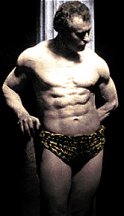
What I am going to suggest may seem far fetched to many but having gained some idea of the way Burroughs’ mind worked I think the suggestion plausible. Emmett Dedmon tells the following story about the Great Sandow at the ’93 Expo. If anyone doesn’t know Sandow by now he was the first great bodybuilder who also performed at the Expo. As Florenz Zeigfeld was representing Sandow there is a no reason to think of the story as other than a publicity stunt, but I leave the judgment to you. (Emmett Dedmon, Fabulous Chicago, 1953, NY, p. 235)
Amy Leslie, the drama critic for the News, described Sandow as a fascinating mixture of brute force and poetic sentimentality. On a walk through the Wooded Island…Sandow snipped a tiny cup from a stock of snapdragon. “now, when we were little in Germany,” Sandow told the astonished Miss Leslie, “we took these blossoms and pressed them so, and if the flower mouth opened, why that was a sign they were calling us home.” As Amy reported it, “he touched the tinted bud and its rosy lips parted in a perfumed smile.” Just as Sandow finished his sentence, a Columbian guard shouted that he had violated the rule against picking flowers. To emphasize the reprimand the guard seized Sandow by the elbow and attempted to push him away. At this effrontery Sandow lifted the surprised guard off the ground and held him at arm’s length, examining him as though he were a curious discovery. Miss Leslie, more conscious of the dignity of the law, persuaded Sandow to put the guard down, which the strong man did with an ouburst of German expletives and an explanation (in English) to Miss Leslie that he did not think much of humans as guards. “I prefer nice well-bred dogs,” he said.
This made a great story that made the rounds of the fair. The question is did 17 year old Burroughs hear it and did it make an impression on him? Strangely enough we can definitely answer that question in the affirmative. Nearly twenty years later Burroughs borrowed the incident for his first Tarzan novel. Not only that but he has Tarzan play the part of Sandow. So, Sandow, Tarzan; Tarzan, Phobeg.
At the end of Tarzan Of The Apes Burroughs replicates the Sandow scene on the Wooded Island when he terrorizes Robert Canler holding him at arms length with one hand. Thus in this novel Tarzan not only holds Sandow/Phobeg at arm’s length but raises him above his head throwing him into the stands. Burroughs usually has his characters going their models one better as Tarzan does here.
As Sandow was strolling through the Wooded Island with Miss Leslie so Tarzan strolls through town with Gemnon. Instead of picking a flower Tarzan notices a lion eating a human while no one takes any notice. Cosmopolitan Tarzan inquires for an explanation. Gemnon calmly explains the quaint custom just as Sandow so pleasantly explained his snapdragon story. Dragons, lions, all the same thing. Burroughs does a neat parody and makes his joke but the original was such a great story he can’t let it go.
Indeed, Tarzan’s habit of picking men up and tossing them around can probably be traced back to this one arm trick of Sandow’s. Like I said, you’ll probably think it’s a stretcher but I think it both plausible and probable. Can’t be absolutely proven of course, but we can and have proven that the incident left an indelible imprint of ERB’s memory.
That said and moving along to 1920-24 there is also a flavor of H.G. Wells’ utopian novel Men Like Gods to be found here. Once again Burroughs turns Wells’ utopia around a bit but the tour of Cathne with Gemnon seems to be a paraody of a similar tour in Men Like Gods. ERB was still in the thick of his literary duel with Wells at the time.
The plot involving Nemone is slightly more complex and better worked out than is usual for ERB. Tomos, Erot, M’Duze and Nemone reflect other influences. The plot has the feel of French overtones. Of course we know that ERB read Eugene Sue’s The Mysteries Of Paris, Dumas’ Three Musketeers and The Count Of Monte Criisto, while the prisoner behind the golden door points in the direction of The Man In The Iron Mask. We also know that ERB had read Victoy Hugo’s Les Miserables.
All these may have provided some inspiration. However more directly influential I believe are two other books found in ERB’s library as listed on ERBzine. ( www.erbzine.com ) They are Rafael Sabatini’s Scaramouche and Stanley J. Weyman’s Under The Red Robe. Never heard of Stan Weyman? Me neither but, believe it or not, there is a Stanley J. Weyman Society on the internet that you may join if so inclined.
Both books were hugely influential in Hollywood, each being filmed several times with at least one version getting very good reviews. Let’s start with Sabatini. While Weyman, one would believe is all but forgotten, Sabatini enjoyed an excellent reputation down to at least my graduation from high school. Probably not so much lately although my copy of Scaramouche is the Common Reader edition published in 1999 so there must be fans out there.
Sabatini was Burroughs exact contemporary- 1875-1950. Like Burroughs he had to defend himself against charges of plagiarism. His stuff all reads like you’ve read it somewhere before, so in Scaramouche he presents an extended defense of himself.
Nevertheless he writes in a simple direct style that is ‘easy to uderstand’ but cleverly presented. Sabatini was obviously one of the first to understand that stories written like movie scenarios had a better chance of selling to the movies.
Like Burroughs he has his point of view which is admirably presented. Also like Burroughs he was intellectually unsympathetic to Communism. His reaction was less emotional that ERB. Although Scaramouche is about the opening years of the French Revolution Sabatini gives it only a slanting attention as he concentrates on people who are caught up in the flood much against their wishes. In that sense there is very little politics in the novel. The participants are merely caught up in the political events.
Scaramouche is a country lawyer unsympathetic to revolutionary ideology but he becomes a revolutionary fugitive when his Red friend is murdered by a reactionary nobleman. The story is well developed and an exciting one with a lot of swordplay. In fact Scarmouche become the fastest swordsman of France. You can see what drew ERB’s attention to the novel.
Of more importance for ERB and an undeveloped subplot of City Of Gold is one that involves Scaramouche’s ancestry. Bearing in mind that ERB became a voluntary orphan when he was sent to the MMA I think Burroughs found the mystery of Scaramouche’s ancestry compelling. Scaramouch is named after the clown of the Italian Comedia Del Arte which also nests neatly with the clown aspect of ERB’s psychology.
It is thought that Scaramouche was the illigetimate son of a village nobleman. The fact that the boy was well looked after by this man seemed proof. In fact, as we learn later in the book Scaramouche is the bastard son of his foster father’s sister, the noblewoman, Madame de Plougastel. She bore Scaramouche illegimately then trusted him to her brother. Thus on one side Scaramouche was of noble birth. An orphan or pretended orphan’s dream. His father remains a mystery for the moment.
Scaramouche’s friend had been murdered by the nobeman Le Tour d’Azyr. Scaramouche had sworn an eternal enmity to him. At a crucial moment in the story Scaramouche learns that this same La Tour d’Azyr is his father. I should have seen it coming from a long way off but I didn’t. It is possible that ERB was surprised too. Sabatini handles it well. Thus Scaramouche the illegitimate child is a nobleman by birth on both sides but the Revolution invalidates this advantage.
It would have been normal for Burroughs to have concocted a fantasy in which his parents now dead to him were not his real parents but some mysterious others. In fact he did concoct two fantasies: the one of John Carter who has been alive forever but can remember no parents and Tarzan whose parents were killed with the result that he was raised by ape foster parents. Not exactly noble people in the ordinary sense but his deceased parents were. One imagines the impact this really good story had on him although he first read it in the early twenties.
In any event he attempts to weave in a subplot providing mysterious parentage for Nemone and her brother Alextar. The subplot isn’t very well developed. On the one hand we are asked to suspect that Nemone was the child of the old king and a Black M’duze who in her youth was tall and beautiful while on the other hand it is insinuated that Nemone is the child of Tomos and M’duze. The latter through her machinations has placed Nemone on the throne and imprisoned Alextar. So Burroughs throws in some misceganation which has always been the most excing literary topic of America, then as now.
Not convincingly done by ERB he had nevertheless carried the story of Scaramouche around in his head for a decade waiting for the opportunity to employ it.
Another book in ERB’s library which is influential here is Stanley J. Weyman’s Under The Red Robe. Like Scaramouche this story was very well thought of in Hollywood being filmed more than once. It seems a fact that ERB saw the 1923 silent film. He was so impressed that he went out and bought the 1923 Grosset and Dunlap Photoplay Edition. I obtained an identical copy so as to to have read the same text and viewed the same plates.
I think I’ll have to include a few of Burroughs’ experiences at the MMA to bring this all together. It would seem that Sabatini considered himself a psychological orphan also. The man was born in Italy to an Italian father and an English mother. As they were traveling actors, not unlike what Scaramouche becomes at one point in his story, they sent young Rafael back to England to live with relatives. As Sabatini’s stories often concern orphans it follows that his reaction to being put away from his parents was that he considered himself an orphan.
Burroughs was also put away by his father. Three times. He was sent to Idaho, Massachusetts and Michigan. Thus he too was put away by his parents. As his reaction was to play the clown developing an off beat sense of humor we know that he reacted negatively to all this shuffling about. His exile to the Michigan Military Academy was the straw that broke the camel’s back. He rebelled, running away. The incident is treated rather uncomprehendingly by Porges in his biography which of course is my authority.
From ERB’s point of view the MMA was an elite reformatory school where bad rich boys were offloaded by their parents. Thus the boy was declassed and slgihtly criminalized in his own mind. As he treated his own sons and the Gilbert boy the same way it is easy to see how seriously he was affected by the experience. ERB was cast adrift with no direction home which happened so many times to characters in his stories, most notably in the original short version of The Lad And The Lion. ERBzine should publish the magazine version of this novel
Having run away from the MMA he was promptly escorted back by his father becoming in his own mind an orphan as in Tarzan’s case and a motherless child as in John Carter’s. Like the race horse Stewball of musical fame, Carter just blew down in a storm. Another standard orphan’s solution to being forced outside society.
Stanley J. Weyman’s (1855-1929) novel also meshes with this persona. As a result of his mistreatment Burroughs developed a very negative self-conception. He became, in fact, a ne’er-do-well. Much to his father’s satisfaction I might add. This self-conception would explain his eccentric behavior from the time he left the MMA in 1896 through 1903 if not for the rest of his life. The man was conflicted. On the one hand he knew he was very capable and on the other he felt worthless so he sought failure.
A fact easily glided over is his quarterbacking and captaincy of the MMA football team. One’s team members don’t elect one captain unless they have confidence in you. One also cannot be quarterback without their confidence while quarterbacking requires organizational and executive abilities. In fact the Burroughs led team defeated all comers in their class and while yet high schoolers they played the varsity teams of Michigan and Notre Dame. The Burroughs led MMA fought the U of M to a tie.
As a result he was offered a football scholarship to the University. He might well have become a football hero having an entirely different kind of life. ERB inexplicably declined the U of M offer. He offered some lame excuse that both his brothers had attended Yale and it was Yale or nothing for him. Possible but hardly probable. Most likely he felt comforatable leading the juvenile delinquents of MMA while he didn’t feel respectable enought to lead the Wolverines.
Leaving for the Army as an enlisted man instead he and a few other ne’er-do-wells formed a group calling themselves The Might Have Seen Better Days Club. You don’t have to be a Freudian to figure that one out. So I think his history in these years can be explained by his negative orphan self-image.
There is one very crucial event, the shame of which never left him, that figures into the Nemone story. That was when in Idaho he gambled away his and Emma’s last forty dollars. Certainly this was a turning point in his life.
In Weyman’s Under The Red Robe the hero is a ne’er-do-well who has exhausted all his chances but one. Named de Berrault the story opens when he is accused of using marked cards in a French game of the early seventeenth century. “Marked Cards!’ are the opening words of Weyman’s novel.
Indeed it would seem certain that Burroughs felt he had been cheated of his forty dollars. In my experience of card games I’m certain he was. De Berrault insists he didn’t use marked cards but that he used the mirror behind the player. Perhaps Burroughs said to himself when reading this: Yeah. that must have been it. At any rate thirty years later the incident was green in his mind and Why Not?
While The City Of Gold is crtical of Nemone/Emma ERB could never forget that he had done Emma wrong in gambling away those forty dollars. Perhaps as much as anything his shame required a separation. Perhaps he thought Emma was too good for a ne’er-do-well like himself.
And then there is this very interesting passage in Under The Red Robe p. 208:
I stood a moment speechless and disordered; stunned by her words, by my thoughts- so I have seen a man stand when he has lost all, his last at the table. Then I turned to her, and for an instant I thought that my tale was told already. I thought she had pierced my disguise, for her face was aghast, stricken with sudden fear. Then I saw that she was not looking at me but beyond me, and I turned quickly and saw a servant hurrying from the house to us.
Just as I admired ERB’s version of this device of looking past the intermediate person so he admired Weyman’s.
The line ‘I stood there speechless and disordered, stunned by her words, by my thoughts- when I have seen a man stand when he has lost his all, his last, at the table…’ must have resonated with ERB from the time he had experienced the same emotion in 1903 as Emma waited for him upstairs.
It becomes seen how ERB wove his various influences into his writing. At this point I would like to bring up another very long novel that formed a backdrop to ERB’s writing in general. the novel is the ten volume, five thousand page work of George W.M. Reynolds entitledThe Mysteries Of London or alternatively, The Mysteries Of The Court Of London. Modeled after The Mysteries Of Paris Reynolds lacks the lunacy of Eugene Sue but maintains a fantastic level of excitement all the way through. ‘The Master Of Adventure’ may very well have learned his own mastery from the pages of Reynolds.
The further one gets into ERB library the more clear things become but to really understand the man I highly recommend the reading of the Mysteries of Paris and London.
Another almost irrelevant theme ERB takes up in this novel is the theme of the Grand Hunt or the Man Hunt. The idea is no way original to ERB; he seems to be in reaction to it, repelled by it. I can’t pretend to trace the story back to its origins but the theme has been used repeatedly in movies and on television. The story is attributed to Richard Edward Connell who is credited with writing the original short story in 1924 for which he received the O. Henry Prize for that year, entitled The Most Dangerous Game. Perhaps the story was original to him but it doesn’t seem likely.
The story was made into a movie starring Joel McCrea in 1932. Whether this movie was released early enough in the year to influence City Of Gold I don’t know, or, perhaps Burroughs saw an advance screening. At any rate ERB gives the idea an extended treatment and prominent place in his novel, actually using it twice.
If Connell did indeed orginate the story in 1924 which seems unlikely than Buroughs treatment comes as close to plagiarism or, perhaps, appropriation as any story could. That he is in raction to the story condemning its implications is obvious.
In his version Tarzan defeats the aims of the hunters by carrying their intended victim to safety while adding the filup that he too was an intended victim. At the very least the Man Hunt is one of the least disguised influences in the corpus. Extraordinary in that no ruckus was raised by his appropriation of the story. Either ERB was not taken seriously or he led a charmed life.
b.
Should I stay, Or Should I Go?
The crux of the story is Tarzan’s relationship with Nemone or, in other words, ERb’s relationship with Emma. If the oeuvre is a guide ERB had already decided to throw his lot with Florence. That seems clear from Tarzan And The Leopard Men. City Of Gold then is mere procrastination. One imagines that Florence was pestering him to break the news to Emma. He would only muster the courage to do this at the end of 1933. For now he seems torn and indecisive.
The appearance is that Tarzan and Nemone would have gotten together but for two things. The first was M’duze who seemed to exert some sort of hypnotic control over Nemone and the other was her pet lion, Belthar.
M’duze was determined to maintain control over Nemone while Tarzan just left a bad taste in Belthar’s mouth. It were well that Tarzan kept his distance.
In point of fact Tarzan was a prisoner on parole. He could easily have escaped or walked away but for two things: one was his fascination with Nemone and the other was that he was bound by oath to Gemnon to not escape. In those days people had a sense of honor.
ERB had constructed an interesting psychological situation in the female image of Nemone. ERB has been really successful in portraying the Xy male construction of the Anima and Animus throughout the corpus but this is his first attempt as far as I know of constructing the XX of the female.
This is always the qustion of whether he knew what he was doing. This is a difficult question to answer but the enidence in the writing seems to imply he did. The situation seems too perfect to be accidental. As I’ve noted elsewhere when the chromosomal division took place and sexual identities came into existence of the four possibilities, XXX and y, the male received an X and the y with the y making him male. You can’t be male without the y, you can’t be female with it. Boys are boys and girls are girls. Now, this is not an ‘oh wow, isn’t that interesting’ type of fact; the fact has consequences.
For instance the whole burden of child bearing became the female’s portion. I am not interested in all the different possibilites of how young are fertilized, incubated and born, yes, there are myriad possibilities but none of them apply to human beings but this one. The method for human beings is impregnation in the womb, a nine month incubation period and then birth followed by a very long period of helpless development outside the womb.
These simple facts determined the post partum relationship of the role of the male and the female. When paternity was unknown the result was close knit communities held together by the offspring. It was a question of interdependence whether Freud thought so or not.
Physiologically the male required the female for sexual release while the female was attracted by the y chromosome of the male, the penis envy for which Freud was castigated for uttering. He wasn’t always right but he was right on this.
While the female is XX chromosomally still one X is received from the mother which is of the passive ovum; the other X is received from the father’s mother through him in the form of an active X sperm. The two Xes while both X are not identical. If both were passive the female would be virtually immobile.
Thus ERB posits the ovate X as M’duze who dominates Nemone’s Anima, which would be correct, while the male lion Belthar provides the activity of the X of the Animus. Whether Burroughs thought this out or not, it works out. Could be accidental, I suppose.
Lacking the y chromosome which she formerly enjoyed during the sexless period the female has an uncontrollable longing for the male or penis. Thus Nemone and her desire for Tarzan. Now, this is classic, no matter how indifferent or rude Tarzan is to her Nemone continues to have an intense longing, or love, for the Big Guy.
This may or may not reflect Emma’s attitude toward Burroughs but Tarzan’s attitude toward Nemone certainly reflects Burroughs attitude toward Emma. In point of fact, Emma’s fidelity is nothing short of marvelous.
Also in Weyman’s Under The Red Robe which is an influence on City a subplot concerns the relations between a Mademoiselle de Cocheforet and the protagonist, de Berrault. The lady distrusts the gentleman, as well she might as Cardinal Richelieu has suborned de Berrault to surreptitiously arrest her brother as a Huguenot. De Berrault conceals his intentions but is found out when he arrests Mademoiselle’s brother. Construing the arrest as a betrayal of her trust, which it wasn’t de Berrault forfeits the lady’s trust.
Thus the novel combines the fateful card game with the forfeiture of Emma’s trust. Having lost her trust ERB was never able to gain it back even though Emma continued with him loving, one supposes, the man despite his faults. Quite possibly the situation between Tarzan and Nemone portrays the actual relationship between ERB and Emma in which as they were about to unite the past comes between them.
Thus in Tarzan and Nemone’s first encounter Tarzan has fallen under Nemone’s spell being about to succumb when M’duze, or Nemone’s Anima, appears as though from the past, taps the floor with her staff breaking the spell while ordering Nemone from the room. Belthar, Nemone’s Animus, rears up on his chains roaring and clawing the air at Tarzan.
Thus both the Anima as represented by M’duze and the Animus as represented by Belthar interfere in Nemone’s attempt to realize her desire for Tarzan.
The scene is repeated in reverse later in the novel as Nemone is about to succumb to Tarzan’s spell M’duze appears once again to disrupt the relationship. Thus as in real life neither Burroughs nor Emma could get past that fatal card game.
In the end then Tarzan presumes on Nemone’s desire too much. She turns on him in the fury we all saw coming making him the object of the Grand Hunt. One sees the influence of The Most Dangerous Game in ERB’s mind. He is given a head start and then Belthar is released to pursue him. Thus he is about to be destroyed by Nemone’s Animus. ERB probably felt this way about Emma in real life.
We have never seen the resourceful ape-man so defenceless and helpless before but now without his father’s knife to murder virtually defenseless lions Tarzan calmly awaits death after a game attempt to outrun Belthar. He should have played dead; we all know that story by now.
Not to worry. All during the novel a mysterious lion has been tracking the Big Bwana appearing at intervals in the story. Perhaps some people were mystified as to who this lion was but not this writer, no sirree, Bob. I knew it was Jad-Bal-Ja all along. I was just surprised the Golden Lion hadn’t brought Nkima with him.
Now just as Belthar rears to cut the Big Guy down to size Jad-Bal-Ja flashes past Tarzan to destroy Nemone’s lion. As ERB says, Jad-Bal-Ja won because he was bigger. Does that mean that ERB’s ego was bigger than Emma’s?
The oeuvre needs a complete analysis of Tarzan and his relationship to animals for on one hand he is a beast. The lion situation is complicated by the fact that originally there were to have been both lions and tigers in the series. That would have changed the complexion of the stories.
However after the magazine publication of Tarzan Of The Apes the readers created an uproar about the fact that there were no tigers in geographical Africa so Burroughs was forced to change tigers to lions for book publication. I am unaware whether changes were made to the newspaper serialization of the story.
The appearance is that Burroughs intended tigers to be villainous while lions were intended to be noble, as witness Jad-Bal-Ja. In that situation most, if not all, the lions Tarzan killed would have been tigers. Thus while as David Adams points out Tarzan kills a lion to put a seal on a sexual situation the very likely killing would have been a tiger.
So the psychological aspect of the story gets skewed. Just as Burroughs has insisted that Tarzan killed deer while there are no deer in Africa so his readers forced him to change Bara the deer to Bara the antelope by Tarzan The invincible.
The climax of the story returns us again to the problem of lions in Burroughs. As David Adams points our Tarzan kills a lion to put a seal on a sexual situation. In this instance Tarzan is helpless but Jad-Bal-Ja his Anima substitute comes to his rescue which is the same as Tarzan killing Belthar. Thus the killing of Belthar seals off Tarzan’s relationship to Nemone and ERB’s to Emma.
I’m sure David Adams would take exception with me but I see Jad-Bal-Ja as an Anima figure of Tarzan/Burroughs while I see Belthar as the Anumus figure of Emma/Nemone. I know both lions are males but the lion male or female is associatied with the goddess or Anima in Greek mythology. A case can be made that the six gods and six goddesses are generalized archetypes of the character types.
Now, Jad-Bal-Ja came into the oeuvre at a critical time in the lives of ERB and Emma and at a critical juncture. It is known that ERB walked out on Emma several times in the course of their marriage. These instances are not well documented at this time. It would appear that a very serious conflict in the marriage began at the time of Tarzan The Untamed through the period leading up to the writing of Tarzan And The Golden Lion.
As Golden Lion opens Tarzan, Jane and Jack are returning from Pal-Ul-Don from whence Tarzan has retrieved Jane.
As I read the story there seems to be a certain coolness and distance between Tarzan and Jane on Tarzan’s part. At this point the lion cub who will become Jad-Bal-Ja makes his appearance standing in the middle of the trail. David’s sexual seal of the killed lion would be the cub’s mother who was accidentally killed by a Native who stumbled on the lioness and cub. As a defense mechanism against Emme/Jane Tarzan/Burroughs adopts the cub as an Anima surrogate.
In an email to me of 1/23/07 David makes these comments:
Through the first nine Tarzan novels the hero gradually establishes the lion symbol as his own until in Tarzan And The Golden Lion he is completely aligned with his source of power in the merging of lion symbol and self/Jad-Bal-Ja. Even though Jad is described as a glorified dog, this is only his personal devotion to the ape-man being explained in easy terms. Tarzan himself always respects Jad, saying “A lion is always a lion.” he is far from the domesticated ones in Cathne in purpose and spirit.
My thinking is that David is right in that the lion symbol and self are united but not within the ego but separately as the Anima and Animus. So what we have is Anima/Jad-Bal-Ja and Animus/Tarzan. Tarzan is sort of doubly armed with two masculine sides with Jad-Bal-Ja being associated with the goddess and partaking in some way of her femininity.
There wouldn’t be too much of a conflict between the female Anima and the Male Anima figure as ERB’s Anima was subsumed by the male fencing master Jules de Vac of The Outlaw Of Torn. De Vac killed ERB/Norman’s Anima figure Maud and then assuming female attire lived with Norman in the attic of a house over the Thames for a fairly long period of time thus becoming a substitute Anima.
Thus the anomaly of a male lion Anima is easily explained. As a symbol of the goddess Jad-Bal-Ja is, as it were, clothed in female attire as was De Vac. Further Jad-Bal-Ja is always indifferent to Jane/Emma. Jane has no real relationship with the Golden Lion.
David once again:
The mad queen of Cathne, Nemone, is an example of negative Anima, a feminine power corrupt and dangerous. Her lion Belthar is the dark shadow opposite of Tarzan and Jad who are symbols of power and light and sun. Her lion is treated as a dark god and is linked to Nemone’s own dark soul. When Jad kills Belthar, Nemone kills herself because the source of her power is gone. It is an archetypal case of light overcoming darkness. The masculine power of light overcoming a dark feminine anima.
In the general sense I have no problem with David’s analysis although I would argue that Belthar is Nemone’s Animus. Nemone is playing the part of Circe in the myth of Odysseus while that story is the triumph of the male ego in freeing itself from matriarchal sexual thralldom. This whole series of novels is related to the Odyssey. So that, in that sense Tarzan is imprisoned by the charms of Nemone/Circe. He is being emasculated, deprived of his will, by the feminine will by one might say, the maneater, Nemone.
In fact Nemone as ruler of Cathne has emasculated the leonine male power. As David Adams sagely observes:
In Cathne lions are employed as domesticated animals for the purpose of pulling chariots, hunting and racing. This is a reduction of the power of the lion symbol to the mundane, even to the point of being ridiculous. It is a degradation and humiliaton of ERB’s ultimate symbol of power and virility.
Yes, and that would be in keeping with the story of Circe who turned Odysseus’ crew into swine and would have Odysseus except that he had a pocketful of Moly, a charm to set Circe at naught. Likewise the queen of the City of Gold of the Legends Of Charlemagne who enchanted the paladins of that king, except for one who then freed the others.
So, Nemone had Tarzan at her mercy except for the strange situation of the lion of ERB’s Anima defeating the lion of Nemone’s Animus.
Once this was done the charm of Nemone/Circe/Queen of the City of Gold was destroyed with the City of Gold being restored to male supremacy and Alextar restored to his rightful throne. Things were then returned to their rightful order as in the domains of Circe and the Queen. We are led to believe that a Utopian age begins. This may be a slap at Wells and his Men Like Gods.
Conclusion
This review completes this very important series of five novels. Obviously I consider the key novels to be Tarzan The Invincible, Tarzan And The Leopard Men and Tarzan And The Lion Man. These novels are more directly concerned with ERB’s political and religious opinions. A trilogy concerning ERB’s sexual problems could be made up of Tarzan Triumphant, Leopard Men and City Of Gold bracketed by Invincible and Lion Man but Triumphant and City Of Gold appear to me to be more minor key than the other three.
Nevertheless these five novels usually treated as the least significant of the series are the most crucial to the understanding of Burroughs while being very good stories in themselves.
Excluding Tarzan And The Foreign Legion that is outside Burroughs’ psychological development, although a good story, ERB published only another three Tarzan novels in his lifetime and they were all decidedly inferior to that which preceded them, still good stories, but ERB’s concentration had been broken. Tarzan’s Quest is the best of the last three but just as Lion Man ends with Burroughs’ dreams going up in flames so does Quest. Perhaps eccentric best describes Tarzan And The Forbidden City. The title says it all. He was never to find salvation; the doors of the Sacred City remained closed to him. Tarzan The Magnificent while having exciting episodes just doesn’t come together.
Magnificent less Foreign Legion concluded the oeuvre until Castaways and Madman were discovered twenty years later. However Burroughs himself chose not to publish those books so they must be an addendum to the series. The two posthumous novels complete ERB’s psychological development being important in that respect for the student.
Further his psychological development was brought to a head during the writing of these five novels. In this tremendous struggle between ERB, the Communists and the Jews ERB was routed by the time he wrote Tarzan And The Lion Man. He didn’t think his tactics and strategy through to the end.
Thus ERB’s whole life was a prelude to the Gotterdamerung that ended as Tarzan fled the City of God.
ERB’s whole life is a magnificent adventure that in itself would make a tremendous movie with the right and unfettered treatment. It could the grandest of grand opera worhty of Mozart. I’d like to see it; even better i’d like to write it.
A Review: Tarzan And The City Of Gold Pt. 1
August 16, 2008
A Review
Themes And Variations
The Tarzan Novels Of Edgar Rice Burroughs #16
Tarzan And The City Of Gold
by
R.E. Prindle
Tall, magnificently proportioned, muscled more like Apollo than Hercules,
Garbed only in a narrow G-string of lion skin
With a lion’s tail depending before and behind,
He presented a splendid figure of primitive manhood
That suggested more, perhaps, the demigod
Of the forest than it did man.
E.R. Burroughs
This novel follows Tarzan And The Leopard Men in the sequence in which the novels were written. Ballantine lists it as number sixteen while placing Leopard Men in eighteen in the sequence in which they were published. In order to understand Burroughs’ psychological development however Leopard Men should be read before City Of Gold.
The amazing use of symbolism in Leopard Men is continued in City Of Gold. I am convinced that at this

The Swami
time Burroughs was investigating the Indian religion of Vedantism. Swami Prabhavananda had established a temple in Hollywood at the beginning of the decade which quickly took hold. The symbolism would be employed by the Vedantists while Burroughs’ interest in symbolism itself was piqued. Shortly after this novel ERB purchased a 1932 volume entitled The Scientific Dream Book And Dictionary Of Dream Symbols by one Johnathan B. Westerfield. Thus ERB was investigating the psychological origin of his dreams. The man was trying hard.
It is clear that this sequence of novels is heavily influenced by Homer, especially by his Odyssey. Homeric motifs run all through these five novels while as Doctor Hermes and David Adams have pointed out Burroughs uses the Athenian monetary unit, the drachma, as the currency of Cathne.
A third probable source would be from the Legends Of Charlemagne volume of Bulfinch’s Mythology. In the last Bulfinch tells of a City Of Gold in which an enchantress keeps the paladins of Charlemagne captive. That story seems to be based on Homer’s story of Circe and Odysseus, or Ulysses in the Roman telling, so Burroughs combines both stories in his own enchantress, Nemone, of his City Of Gold. One may take the City Of Gold to be the Sacred City of the Iliad.
The rival kingdoms of Cathne and Athne- my spell check just pointed out to me that Athne respelled is Athen which is very close to Athene or Athens- have Greek sounding names reinforcing the Homeric connection.
While the sexual symbolism of Leopard Men is dark and brooding placed in a swamp not unlike the Lernean Swamp of Greek mythology in which Heracles fought the furious female Hydra, The City Of Gold is much brighter and airier, more intellectual than the darker urges of the subconscious.
Having now read many of the Tarzan novels four-five and even six times I am astonished at how well they maintain their freshness from reading to reading. Rather than weary me, each reading is a fresh experience that opens a whole new vista of possibilities. The more I seem to understand of what I’m reading the more signficance the words have as the story seems to rise from the page to form concrete living images, as it were.
In this novel expecially I am impressed by the pacing, the effort put into preparing the scenes and the masterly execution in which each word assumes its independent value almost as though ERB had put as much care into word selection as, say, the poet Tennyson. Of course we all know ERB read Tennyson as well as other verse and poetry while also being familiar with song lyrics. Thus while writing prose he is able to maintain a poetic intensity.
The opening scene is an excellent example of his skill. Tarzan is out hunting when he is spotted by some shiftas. He’s in Ethiopia at the end of the rainy season. We aren’t told why he is there but he has commanded Nkima and Jad-Bal-Ja to stay home. As a corollary, just before he leaves Emma two years later he will take a solo vacation to the mountains of Arizona. The spatial arrangement conveyed in this scene is that of Tarzan between the shiftas and the prey he is hunting. While he is silently stalking the prey the shiftas are more noisily stalking him. The movement of the shiftas which can be seen by the prey but not by Tarzan who has his back to them is caught by the prey who looks past Tarzan to the shiftas. Tarzan noticing the prey looking beyond him also looks back to spot the shiftas stalking him.
The spatial concepts involved are astonishing while three views of time are also evident. I only picked up on this aspect with my fifth reading. My interest was thus piqued and heightened so that the novel took on an entirely new aspect. The scene as written is so well paced and spaced that it made a vignette I’m sure I shall never forget, while I now long to duplicate such a scene in my own writing.
The patient lulling slow pace of Tarzan’s hunt was now broken. As Tarzan’s quarry fled, the action between Tarzan and the shiftas became fast, furious and frenzied, while the sexual symbolism bursts into one’s consciousness.
As the shiftas bear down upon him Tarzan realizes that he cannot escape by running. If he could have he would have because as Burrughs never tires of noting there is no disgrace in running from a force majeure. Instead Tarzan shot arrows among the the shiftas. Than as a shifta bore down on him lance leveled:
There could be no retreat for Tarzan; there could be no sidestepping to avoid the thrust, for a step to either side would have carried him in front of one of the other horsemen. He had but a slender hope for survival, and that hope forlorn though it appeared, he seized upon with the celerity, strength and agility that make Tarzan Tarzan. Slipping his bow string about his neck after his final shot, he struck up the point of the menacing weapon of his antagonist, and grasping the man’s arm swung himself to the horse’s back behind the rider.
Abilities like that make Tarzan Tarzan and I’m sure such a feat could be done in reality as in the imagination although possibly not if Tarzan had had the bunchy muscles of the professional strongman. Smooth ones flowing beneath the skin like molten metal are undoubtedly a prerequisite.
Dispatching the shifta Tarzan is now symbolically seated on a horse. The horse directly plunges into a river to swim to the other side. In mid-stream the horse and rider are attacked by a crocodile that Tarzan kills or disables. Emerging from the river Tarzan gallops into a forest where he abandons the horse for the security of the trees.
There in a short passage we have a wealth of symbolism that tells in a few paragraphs what ERB could have developed in many chapter if told in straight prose.
The horse is a symbol of the female. Thus Tarzan as Animus is symbolically united with his Anima. the horse plunges into the river which is also a female symbol representing the waters of the unconscious. Still mounted Tarzan is in the conscious sphere above water while the horse is submerged in the subconscious. The crocodile also a female symbol representing the greedy, devouring, emasculating aspect of the female attacks. The horse turns upstream in an attempt to flee the croc. Tarzan strings his bow firing an arrow, as a masculine symbol, into the crocodile’s mouth disabling it thus escaping the disabling aspect of the feminine while with strange violence sending the arrow down the throat. One has to think about these things.
The horse scrambles up on the opposite bank signifying a change in life, then gallaps into the forst of the subconscious where one goes in search of oneself. The forest here is the same as all those underground mazes in Burrough’s corpus.
Once in the forest Tarzan abandons the horse, or Anima for the security of the trees where he is above it all. Apparently there is a deep cleavage between his Animus and Anima. Now begins a very strange encounter. Burroughs apparently felt he left something of himself on the other side of the river so he goes back for it.
Coming upon the camp of the shiftas he notices that they have a bound captive. As this appears to be what he returned for one can only speculate that the bound captive is an aspect of himself. Perhaps the captive represents his marriage to Emma in which he is in the bonds of matrimony wishing to escape them. Tarzan takes action. At this point Burroughs offers this rather remarkable passage describing the Ape-Man. p. 15:
It was difficult for Tarzan to think of himself as a man, and his psychology was more often that of the wild beast than the human, nor was he particularly proud of his species. While he appreciated the intellectual superiority of man over other creatures, he harbored contempt for him because he had wasted the greater part of his inheritance. To Tarzan, as to many other created things, contentment is the highest ultimate goal of achievement, health and culture the principal avenues along which man may approach this goal. With scorn the ape-man viewed the overwhelming majority of mankind which was wanting in one essential or the other, when not wanting in both. He saw the greed, the selfishness, the cowardice, and the cruelty of man; and, in view of man’s vaunted mentality, he knew that these characteristics placed man upon a lower spiritual scale than the beasts, while barring him eternally from the goal of contentment.
In the above quote ERB outlines the central problem of mankind. In the evolution of mankind from beast to homo sapiens the much vaunted mentality of HS has failed to make the transition from the pure mentality of the beast to that of, essentially, the god. In orther words his origins are dragging him back as he tries to make the leap to the next stage of evolution and development.
While having a godlike intelligence rather than using it to elevate himself above primal desires as the direction of the nineteenth century was going, in the early twentieth century Freud undercut the drive to perfection dragging mankind back down to primal desires. This is Freud’s great crime for which he should be burned in his effigy of Satan once a year in a great world wide holiday. Thus as Man uses his intelligence to get at the root of things, and I think we’re very close to understanding all, Man’s primal desires lapsing back into the ‘unconscious’ of Freud, and make no mistake the current conception of the unconscious is of Freuds’ personal devising, devise even more fiendish ways of evil as that knowledge increases. Thus rather than aspiring toward a spiritual contentment Man chooses to give in to desires that lower him beneath the hyena.
Thus Tarzan, who has attained spiritual contentment, and become godlike, looks with scorn and contempt on the humanity of his fellows preferring to think of himself as a ‘spiritually pure’ beast.
While this attitude is a theme throughout the oeuvre and the corpus as a whole perhaps this rant was sharpened by the developing difficulties at MGM. Shortly after this was written Tarzan, The Ape Man hit the screens scrambling ERB’s vision of Tarzan forever. The screen Tarzan has no intellect. In the movie Tarzan’s Desert Adventure Boy even has to read Jane’s letter to him.
On his way to the shifta camp the ever present Numa is between him and the desperadoes. Taking to the trees of the forest to pass over Numa he spots a strangely garbed man in the shifta camp. Still smarting because he lost his quarry and operating on the primitive logic that since the shiftas had deprived him of dinner it would only be right to deprive them of something they wanted, he decides to free the captive.
He was about to fail in his attempt when the ever present Numa saves his skin by attacking the shifta camp. In the confusion Tarzan and the prisoner escape. The man turns out to be an Athnean named Valthor. Having escaped they must put up for the night. Sheeta the panther is abroad. As David Adams is wont to point out, for Burrough Sheeta is a sexual symbol, so the next scene has strong homoerotic overtones.
The question is who does Valthor represent. He is curiously vague in personality. As Burroughs was obsessed with the Jekyll and Hyde notion at this time I suspect that Valthor is an aspect of Burroughs’ own personality with some sort of relation to Tarzan as Jekyll to Hyde. Valthor’s life is saved as Sheeta leaps for him so that one feels he may be related in some way to Stanley Obroski, another alter ego of Tarzan, who will actually die in the succeeding novel, Tarzan And The Lion Man.
In this novel, in putting up for the night, Tarzan with his superior junglecraft, finds a tree where two horizontal branches fork. He cuts some smaller limbs to form a pallet for himself for the night. He had eaten but he is unconcerned whether the able bodied Valthor has eaten or not. Tarzan does not hunt for other men. If he hadn’t already eaten he would have made a kill and shared the abundance.
Valthor lies down on the ground. Sheeta is watching silently. So silently even Tarzan does not hear him breathe, until readying himself to springs, he quietly brushed a leaf or two. Tarzan hears for his ears are not as yours or mine. As Sheeta launches himself on Valthor Tarzan shouts a warning while rolling from the pallet to descend on Sheeta’s back.
Now, this scene replicates a similar scene in Beasts Of Tarzan when Tarzan leaps on Sheeta’s back in midair as she was about to leap on the ape, Akut. I hadn’t thought of homoerotic overtones between Akut and Tarzan but they may be there. It may be signficant that Akut later became the mentor of young Jack Clayton otherwise known as Korak The Killer.
In the instance of Akut, the ape became sort of a vassal of Tarzan, while in this story Tarzan and Valthor become fast friends although the relationship is one of superior to inferior- Batman to Robin. After killing Sheeta, Tarzan takes a more motherly attitude toward Valthor, making a bed for him in the tree because he knew Numa was prowling the forest. That undoubtedly he knew that before was he leaving Valthor for Numa?
They awoke in the morning. p. 26:
Nearby, the other man sat up and looked about him. His eyes met Tarzan’s and he smiled and nodded. For the first time the ape-man had an opportunity to examine his new acquaintance by daylight. The man had removed his single garment for the night, covering himself with leaves and branches. Now as he arose, his only garment was a G-string and Tarzan saw six feet of well muscled, well proportioned body topped by a head that seemed to bespeak breeding and intelligence. The wild beast in Tarzan looked into the brown eyes of the stranger and was staisfied that here was one who might be trusted.
Not exactly a description of love at first sight but a definite tinge of homoeroticism. Brown eyes. In fact Tarzan and Valthor become fast friends. Quickly learning each other’s language by the point and name system, or at least, Tarzan learning Valthor’s language, they are soon chatting away amiably.
Valthor comes from the mountains but after they wander around for a week he admits he is lost. Tarzan gets the general direction then setting out in a bee line. Their goal is the huge extinct volcano, Xarator, which they soon locate. Just as Leopard Men was cast in the erotic swamps of the feminine as Old Timer lusted and panted after Kali Bwana so The City Of Gold is located in a valley high in the mountains where heaven and earth meet and the cold incisive intellect works best. Tarzan is not going to lust; like brave Ulysses he is going to resist the sexual blandishments of his Circe, Nemone.
Both City Of Gold and Tarzan Triumphant take place near or in volcanos so the volcano must link the two stories. The extent of emotion involved in this one is indicated by the atmospheric conditions as the two men enter the valley. Compare this scene with that of Tarzan The Invincible when Tarzan and La leave Opar. the symbolism is ferocious.
The scene is set in the mountains of Ethiopa. The rainy season is about to end but the last and most furious storm of the season bursts on the two. It seems certain here that Valthor is another aspect of Burroughs’ Animus in the Jekyll-Hyde sense. In this case the two are not so widely divergent as Jekyll and Hyde but are closer in aspects . Tarzan is still definitely superior and Valthor inferior.
Athne and Cathne are twin cities in the valley but they have to pass through Cathne- The City Of Gold which is to say perfection- to get to Athne. Athneans are Elephant men while Cathneans are Lion Men. As the two begin to cross the valley the great storm breaks. The storm no doubt symbolizes that storm feared by Burroughs of actually separating himself from Emma, certainly one of the most difficult thing he would ever have to do.
The separation must have been terrific internal trauma so that ERB kept putting it off rather than face it. One imagines that as in a situation like this Florence was continually asking him when he was going to tell Emma. It would be another two years before he could force himself to make the break. It is significant that just before he left he took a leave of absence from Emma returning to Arizona where, as here, he stayed in the mountains, the White Mountains of the Apaches. Thus his time in the Army must have had more significance for him than we credit. He must have thought, as miserable as he appeared to be, that those were the happiest days of his life.
In Cathne the rains came down. This was the mother of all storms. Between the thunder, lightning and literal sheets of rain the two were severed from all reality. They were walking ankle deep along the road. Once again they have to cross a stream. ERB has seen such a stream in Arizona, so this whole situation seems to be recalled by his Army days. Actually the nine months he spent in Arizona was a fairly rainy period of fourteen inches. In February 1897, I believe, four and half inches fell probably in one stormy period. ERB records a stream that became a raging torrent in his last Western novel. To some extent then he was writing from experience but already thinking of the good old days before he married.
As hard as it was raining in Cathne the river should have been unfordable but art has its demands.
Valthor knowing the ford begins to lead Tarzan across. He gets too far ahead. Tarzan in his uncertainty misses a step being swept away by the flood. He is now in the possession of the waters of the feminine, that is, his female problems, just barely able to get his breath. He is swept from side to side by the violent action of the waters, tumbled head over heels, but he keeps his mental presence. There is a great waterfall ahead of him which threatens certain death. The symbolism should be clear. In a last ditch effort Tarzan catches a rock hauling himself from the water, if I am correct, on the same side of the river, in other words, Emma. He doesn’t cross which is symbolically important. Refer that back to the earlier crossing in which he actually crosses but then returns.
Gathering his senses about him he sees some lights, going to investgate. He unwittingly stumbles into Nemone’s garden. Out of the frying pan, into the fire so to speak.
Brave Ulysses has found his Circe.
B1
 The scent of the big cats fills this book. Already Sheeta and Numa have had nearly equal billing with Tarzan and Valthor; now lions are given prominence. Now Tarzan emerges from the flood, which symbolizes a major life change, into the land of lions and lion worship. the ownership of lions is a mark of distinction in Cathne, Cahtnean chariots are even drawn by lions which brings to mind the chariots of goddesses like Cybele, Harmonia and Cadmus. Nemone will promise to reward Tarzan with three hundred lions, apparently an incredible number making him the top Lion Man. Remember the next novel Tarzan And The Lion Man will continue the theme.
Continuing an old theme from Tarzan And The Golden Lion a lion is even the god of Cathne. The symbol of Nemone’s Animus is a great black maned male lion named Belthar. The novel will devolve into a battle between Nemone’s lion, Belthar, and Tarzan’s lion, Jad-Bal-Ja. Also continuing an old device employed in Tarzan And The Jewels Of Opar by the jewels and in Tarzan And The Ant Men by Tarzan’s locket this story is unified by the image of a great lion drawing ever nearer to Tarzan. So amid all these lions is the true Lion Man, Tarzan’s personal lion. His own guardian animal.
It does seem clear that ERB associates the big cats with sexuality.
ERB is building this story very carefully with great attention to spacing and pacing. Captured by the
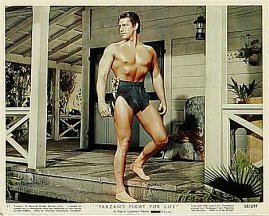
Gordon Scott As Tarzan
Cathneans ERB takes care to ingratiate the Big Bwana with the troops. He has Tarzan and the Cathnean soldiers enter into a spirit of camaraderie as he introduces them to and instructs them in the use of the bow. Nemone is instroduced but seems to take little notice of the Big Guy condemning him to fight in the arena.
Taken to a prison cell he and we are introduced at some length and in some detail to a character named Phobeg. Phobeg is billed as the strongest man in Cathne.
ERB devotes an amazing amount of space to his confrontation between Phobeg and Tarzan. His development of such a minor character is unusual. I think what we have here is a confrontation between Tarzan and the actual man who inspired Burroughs to create Tarzan, the man who was the physical basis of the Lion Man. Phobeg can be no other than the first important body builder in the world- The Great Sandow. Just as in Tarzan The Magnificent Burroughs takes care to indicate that Tarzan has now replaced H.M. Stanley as the symbol of Africa, so here he puts down ‘the strongest man in the world’ in favor of his hero.
 Sandow (1867-1925) had died a few years earlier. While other muscle men had replaced Sandow, most notably Charles Atlas, Burroughs was still obsessed by the man he had seen at the Columbian Expo of 1893. It would seem certain that ERB occasionally picked up a copy of Physical Culture Magazine to keep up on the latest builds. He couldn’t have missed the memorial copy devoted to Sandow, the greatest and still the greatest of the body builders. The award given to Mr. Olympia is called the Sandow.
While bowled over by the strongman, and strongmen, ERB was always offended by the bunchy muscles created by body building. he repeatedly makes allusions to strongmen throughout the corpus while Tarzan himself is both the antithesis and the perfection of the strongman. That is why Tarzan has smooth muscles flowing like molten metal beneath his skin while in this case Phobeg as a Sandow surrogate has the knotted muscles of the body builder.
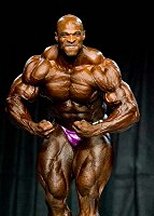
If Burroughs found Sandow’s build offensive he would have gone apoplectic at the most recent champions who seems to have developed musculature as far as it can go. Unlike builders like Charles Atlas, Gordon Scott or Arnold Schwarzenegger who aspired to the Apolline figure, Ronnie Coleman and his successor Jay Cutler have opted for muscle upon muscle until there is nothing but muscle with no attention to a human shape. As an example check out Jay Cutler the current Mr. Olympia and holder of the Sandow at www.emusclemag.com. This guy is only 5’9″ but bulks up at 320 lbs., paring down to 275 for performance. And that is literally all muscle. One look at Cutler and ERB would have been foaming at the mouth
Just as Sandow was billed as the strongest man in the world, so Phobeg is billed as the strongest man in

Jay Cutler In Full Pump
Cathne. ERB makes him a braggart in relation to Tarzan but if he was the strongest man in Cathne he had little reason to respect Tarzan’s physique which was more like ‘Apollo than Hercules.’ Tarzan’s strength though greater than Phobeg’s was disguised.
At they are to fight each other to the death in the arena this allows Burroughs to introduce another of his interests which may be related, that of professional wrestling. Burroughs had Tarzan jokingly suggest that they stage the fight much as professional wrestlers. Burroughs who still attended the matches was disgusted becasue the matches were pure entertainment, something he should have applauded. Then as now the professional wrestling matches were staged. Professional wrestling then as now has more to do with entertainment than sport. Either you can get caught up in the fun and drama or you can’t. ERB obviously did although as he still thought of the shows as wrestling he felt put upon.
After several pages of Phobeg’s bragging and Tarzan’s false humility the ‘really big shoo’ begins. Tarzan and Phobeg are the last act on the program and they would have been a difficult act to follow.
ERB must have loved this part as the lenghty description of the gambling taking place is many times more detailed that he usually is. Whether the gambling aspect went on at the wrestling matches he attended or not, I don’t know. The odds naturally are for Phobeg, whose Cathnean reputation is immense and accurate as concerns the past. Everyone expects the inveterate gambler Nemone to bet on the sure thing as was her custom. They hedged their bets when they could at fantastic odds. Nemone then surprised them by betting on Tarzan. Nearly bankrupted the whole coterie of Lion Men.
Tarzan wins of course but refusing to kill Phobeg he instead does his trademark thing lifting Phobeg above his head and tossing him into the stands at Nemone’s feet. Now that is one hard act to follow.
Having now won his liberty, a lion man named Gemnon is assigned custodian of Tarzan taking him under his wing. Up to this point there seems to be no reference to contemporary affairs except for Sandow and wrestling. At this point ERB displays a numerous and surprising set of literary references.
Go To Tarzan And The City Of Gold part two.
Picturing Greil Marcus
July 20, 2008
Picturing Greil Marcus
by
R.E. Prindle
What polluted wretches would the next glance show…
Greil Marcus
…using the novel technique of occupying one building, and then, when the police arrived, filing out, only to seize another building, and then another, and another- Berkeley radicals called on their fellows to “Do a Columbia”; not for any reason, not in the face of any injustice or insult, but for the lack of anything better to do.
Greil Marcus
Greil looks down his nose at us.
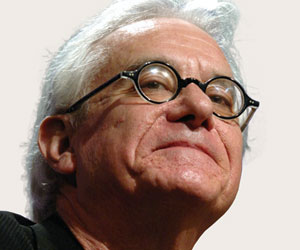
Greil Marcus is among us like some IT that came from outer space or conversely like some Creature From The Black Lagoon arising all dripping and encrusted with slime, like some Blob. And what does he want from us?
The fellow can’t genuinely be that unhappy. He was raised by a multi-millionaire San Francisco attorney by the name of Gerald Marcus. There are some conflicts in Gerald Marcus’ history. He made big money form ‘good’ causes thereby attaining a certain smugness as a defender of the downtrodden. Mr. Marcus made his millions representing various farm unions thereby combining greed with ‘benevolence.’
Using his magnificent income he provided young Greil with what now must be a multi-million dollar home next to Atherton on the Peninsula, one of the most prestigious locations in California if not top of the list. Upon graduation from high school Greil had a ready made admittance to UC- Berkeley thanks to his father’s prominence in the Boalt Law School of that insitution.
Thus at the age of twenty-one or twenty-two young Greil stepped out into the world armed cap-a-pie to begin the battle of life. No deprivation there; who could ask for more? Indeed, many of us would have settled for less and thought we were doing well.
Indeed, Amerikka, as Greil has spelled it, showed the fairest of faces to our young hero. He didn’t even have to get a paying job; he could continue to play supported, one assumes, by his step-daddy’s millions. Greil went across the big Bay Bridge to San Francisco and took a play job at Rolling Stone Magazine that started up about the time he graduated. It wasn’t a job that paid a living wage but then Greil had time. He bummed around Rock journalism for several years building a reputation that the over the years blossomed into what it is now.

The Old Warrior As The Shadows Deepen
The feast of Amerikka had been spread before him; young Greil had grabbed a plate, knife and fork, and dug in. Young Greil sat down with a plate heaped with good things before him and began a bitch with every bite. What he found wasn’t good. To young Greil the feast was a product of corruption. He, like his step-father, could accommodate himself to it though as the pay was good. Greil got himself a fine house in a prime location in Berkeley above the university that many would kill for. I’m not saying that Greil didn’t. He didn’t stop bitching though. Indeed, ‘what polluted wretches would his next glance show…’
Everywhere he looked his glance fell on pollution, on wretches in the horror of the ‘air conditioned nightmare’ as Henry Miller expressed it. The air conditioned nightmare! Let that concept roll around your mind for a while. Ninety-five degrees in the shade, 100% humidity outside and you’re living in an air conditioned nightmare. Interesting. Where I grew up when the heat and humidity hit one ran for the movie theatres with ‘refrigerated air.’ It was refrigerated too. Go in like melted butter and come out a solid brick. I didn’t hear anyone complaining about a ‘nightmare’ though. But then what is is how you perceive it. And how did Greil perceive it?
He sought out all the more horrid representations of the most horrid and perverse literature and movies he could find and called it ‘normal.’ He concentrates on this Twin Peaks of David Lynch and its spin off movie Fire Walk With Me. He even dwells on a novel based on the movie by Lynch’s daughter as though it were serious literature; as though the perversion of the movie and book was the accepted norm. As though the depression of Lynch was rational vision.
Indeed, a very deep psychological depression seems to characaterize Greil’s writing. As Dylan put it, he tries to get you into the hole he’s in. There is certainly no climbing out of the hole Greil is in. The more he writes the deeper the hole gets. Worse still he seems to have no reason for his depression. He ‘Does the Columbia’ on us not because of any injustice we’ve done him or any insult we’ve offered him but ‘for a lack of anything better to do.’ The man is not to be taken seriously.
Oh, he does have a deep psychological grievance but it doesn’t have anything to do with us. It seems that his mother only knew his father a couple days or weeks before his father shipped out during the war and died in that great holocaust. Greil never knew his father thus causing him to wonder what might have been and throwing him into a deep funk.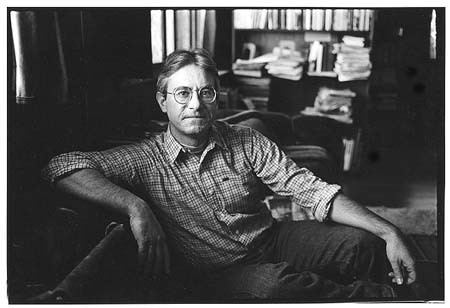
Over the decades this sense of anomie preyed on his mind. Gradually he developed a hatred of the Amerikka that had ‘murdered’ his father so senselessly. He conceived the notion that that the Captain of his father’s ship was an incompetent who had purposely been placed over his father to cause his death. He developed the notion of the heroism of his father based on nothing but his wishes. And then one day he learned that a television production about his father’s squadron had been made depicting the manner in which his father’s ship sank. Terrible storm, huge typhoon. Under wartime conditions when the ship was improperly ballasted for such a monster the top heavy ship rolled. The whole fleet suffered terribly. In those days they didn’t have satellite weather reports that gave advance warning of what was coming. Weather was weather in those days. Look out. Keep your head down.
So misconstruing the whole situation against the Beast Greil bore a grudge against Amerikka. I don’t know if that’s the whole reason for his grudge but that form its basis.
I suppose it’s terrible to lose your biologic father at sea. I lost mine when three when he and my mother divorced. I haven’t ever really regretted it though. People are different but it didn’t bother me. It would have bothered me even less if someone like Gerald Marcus came along and married my mom. I might even have considered that a blessing. I got a real clinker for a step-father. I’ve got a reason for depression. Could easily have done without him. Should have stayed an orphan.
But rather than try to dig his way out of his hole, Greil dug in deeper. He wrote weird stuff like Weird Old America, left out the double K so as not to limit the size of his readership. I can’t tell you what Greil was thinking. He freehandedly insulted a whole group of people who had little reason to regret their pasts. I mean, Grandpappy lived in those Kentucky hills where Dock Boggs lived. That’s my ancestry Greil’s talking about. And Greil says we were all…well, I don’t know exactly what we all were in his mind but it isn’t good. I mean, compared to what? What is Greil comparing us to in which the comparison is so unfavorable? Himself? I look around me and I don’t see any people or thing much better. I’ve been around too. This Lynch guy and his portrait of ‘smalltown’ Amerikka isn’t all that familiar to me. I grew up in that environment. Sure there were nasty things going on but that’s just the way people are. Small and nasty most of the time. But they had and have their ideals too. Those people created a town that was a lot nice than the Twin Peaks Lynch portrays.
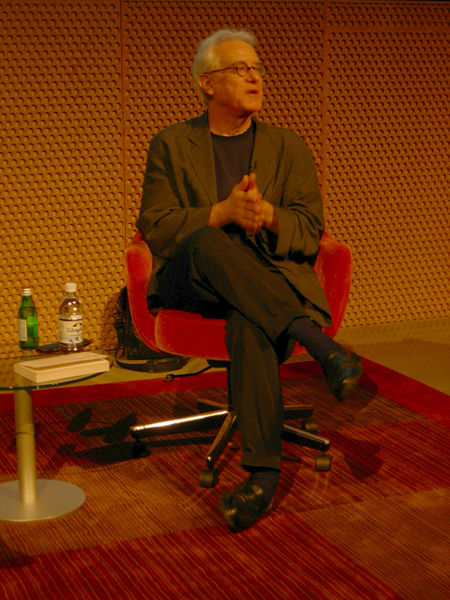
Let me see.
Of course, I haven’t seen what Lynch portrayed because I never saw the show that apparently wasn’t all that popular because it didn’t get that far. Greil himself says that movie was so horrible that everyone ignored it but him. He makes it sound so terrible that I have no reason to check it out.
But Greil revels in that corruption. Rolls around in it, enjoys it. He almost shouts for joy that a major slut is elected home coming queen. He loves it that her father is doing her and then kills her. That’s how I read it anyway. So, maybe Greil should do something about his depression.
I mean, Freud lived and died a hundred years ago; his legacy lives on practiced by a legion of psycho-analysts. Why not check one out. Why not step back and look a the life he’s leading. Running around making people feel bad with his book of murder ballads.
We all know that stuff goes on. There are unbalanced men and women out there who do terrible things. But there are a lot more who are better balanced and don’t do those things. There are lots of people who work hard to make the world a better place, to make their immediate vicinity a better environment. There are people who create beautiful gardens and wonderful parks. There is pleasure and joy in this life. It’s a struggle to get it but it’s worth struggling for. Greil should open his eyes and keep some kind of perspective on pollution and cleanliness.
I can’t imagine someone getting up and delivering the commencement address that Greil delivered at UC in 2006. He opens with a positive reference to a perverted Mafia figure who goes to some kind of pervert heaven in New Hampshire, wakes up in the moring to find that the whole world has gone pervert. Greil calls this the American Dream. They talk perversion over breakfast. As Greil wants us to believe, they are free and this is the freedom that Amerikka is supposed to represent before the Weird Old Americans got in the way.
I don’t know, Greil, get a life and then get some help. Life doesn’t have to be as weird as all that.
The Profile
Exhuming Bob IX, Pensees 7: Into The Lost Land
July 6, 2008
Exhuming Bob IX, Pensees 7:
Into The Lost Land
by
R.E. Prindle
Texts:
Dylan, Bob, Chronicles Vol. I, Simon And Schuster, 2004
Prindle, R.E. Exhuming Bob, VIII The Walls Of Red Wing, idynamo,wordpress.com 2008
Thompson, Toby, Positively Main Street, U. Minnesota, 2008, reprint from 1971
http://www.hibbing.org/dylan1/story.html Life In Hibbing: Hibbing Chamber Of Commerce
http://www.interferenza.com/bcs/interw/85-dec.htm Bob Dylan Is Not Like A Rolling Stone Interview, Spin Magazine, Volume One, Number Eight, December 1985
http://www.interferenza.com/bcs/interw/play78.htm Playboy Interview: Bob Dylan 1978
http://www.interferenza.com/bcs/interw/66-jan.htm Playboy Interview: Bob Dylan February 1966
1940
Abe And Beattie
In attempting to put together a reasonable facsimile of Bob’s life in Hibbing and Minneapolis, Minnesota and New York City as he mythologized it in his chapter of Chronicles, The Lost Land, I have come to the following tentative conclusions.
Bob was born in Duluth, Minnesota on 5/24/41. In 1943 he was taken to Hibbing where he lived from then until graduation from high school in the Spring of 1959.
Within the concept of normal Bob had a fairly advantaged childhood. His parents were indulgent buying him anything he wanted while providing adequate pocket cash. Bob’s family was one of the more important in town both within the Jewish community and the town at large. In what appears to have been a tight small town social scene Bob either excluded himself or was excluded from the dominant social groups within which he had a right to be included.
Perhaps Bob’s conception of the Hibbing period could be best interpreted from his favorite movie, Rebel Without A Cause, starring James Dean. Bob is said to have seen the movie several times. This was unusual as few people ever saw a movie more than once. He would have been a very impressionable fifteen at the time. Most of us didn’t have the money while quite frankly few movies, if any, were worth watching twice including Rebel Without A Cause. I was seventeen when I saw it and while I was in awe I wasn’t submerged. Of course Bob’s relatives owned the theatres so he got in for free.
As he set up a Dean shrine in his basement which greatly offended Father Abe we may be justified in assuming that Dean was a controlling influence in his life from the time he saw the movie. It is of interest that Abe was to remove the Dean shrine from the basement after Bob left replacing it with a shrine to his own son Bob Dylan ne Zimmerman.
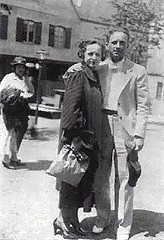
Abe Zimmerman (1911-1968) worked for Standard Oil in Duluth when Bob was born. According to the C of C he lost his job in 1943 moving to Hibbing where his wife’s family, the Stones, could help the young couple. Why Standard Oil should lay Abe off in the middle of the war during a manpower shortage seems to pose a question. As can be seen from the photograph of Abe and Beattie above borrowed from the Flickr photostream of <drineevar> he was a well set up handsome man. He appears to be exceptionally self-possessed, sound in the eyes. Beattie appears to be a haughty high fashion queen which would accord with later facts.
Abram Zimmerman, for such was his name. Usually called Abraham, the name on his tombstone is Abram, and his two brothers Maurice and Paul bought the Micka Electric Company in 1943 changing the name to Zimmerman Appliance. In 1968 Paul Zimmerman told Thompson that they had been in business for twenty-five years which would mean 1943 although the date seems odd.
According to the C of C Abe came down with polio in 1946 requiring a lengthy convalescence. The C of C says that the Zimmermans bought Micka’s after his convalescence but if Paul Zimmerman is accurate it would have to have been 1943. There would be no record of what Abe did for a living then from 1943 to 1946. As Bob says both his uncles served in the Army it would seem that they bought Micka’s going into the Army shortly thereafter leaving Abe to tend the business.
Maurice and Paul became President and Vice-President of the corporation while Abe siginficantly assumed the controlling post of Secretary-Treasurer. Managed the money, paid the bills.
During the fifties at least Abe spent a fair amount of money on both Bob and Beattie. Angel Marolt whose family bought the Zimmerman residence after Abe’s death was trying to tell him of Beattie’s several fur coats, diamonds and Cadillac but Thompson says he wasn’t paying attention.
Thompson quotes Echo Helstrom as saying that the Zimmermans had stores in both Hibbing and Duluth. Having a customer base of approx. 250,000 makes more sense when one considers the amounts of Abe’s expenditures and the fact that the profits had to be split three ways.
The C of C describes Abe as a ‘big man’ in town partial to those big thick long cigars.

The Dylan Home
The couple had enough money on arrival to buy the large nine room house that Bob grew up in so Abe must have been well paid at Standard Oil before he was laid off. Both he and Beattie are well dressed in the picture while Beattie is actually overdressed.
Bob was entrolled at Alice School for his kindergarten year in 1946 at five years of age. The status of Alice School is unclear. Perhaps it was closed the following year or consolidated with the Hibbing High complex as Bob was transferred. Hibbing High housed kindergarten through twelve as well as the Jr. College. Thompson describes it as a huge and rambling building.
So from first grade to graduation Bob was with the same group of students. I sure wouldn’t have wanted to move into town in tenth grade and try to break into that one. While he wouldn’t have known them all well he must have known the entire student population on sight. This presents the problem then of why Bob, who was the son of the Big Man in town, wasn’t included in the top social cliques. Those cliques undoubtedly formed early persisting through graduation. If Bob was in one he was either forced out early or found it uncongenial to remain for whatever reason. Perhaps he thought his Jewishness excluded him. So if something happened we don’t know what it was and won’t; unless Bob tells it’s going to be difficult to trace.
Growing up in a small town anyone with any ambition looks around and sees very limited opportunities. Working for his father wasn’t a viable option. Not everyone wants to be a doctor or lawyer either. Nuclear Science is OK but a lot of those guys are out of a job now too. My next door neighbor when I was a kid for one.
Bob’s mind turned early to music and then to Rock and Roll. While Rn’R went on to conquer the world and become as respectable as such a spectacle could it was definitely considered discreditible and low class almost volunteer outlawry in the fifties. At the very least it was ‘pimple’ music. It took a certain amount of courage to say you liked Elvis Presley. Pat Boone was set up as his rival and you had better say you liked ol’ White Bucks. If you don’t think Elvis was considered a social criminal check out a couple of his movie roles like King Creole or Jailhouse Rock. What was the Colonel thinking? Clown roles, that’s all Elvis ever got.
And then Bob chose as his hero and model Little Richard. People looked at you funny if you said you
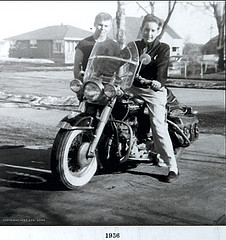
Young Bob On Harley
liked Little Richard! I mean, Bill Doggett was a respectable Negro with music you could understand, Fats Domino was as lovable as a chubby ten year old but Little Richard! They hadn’t even created the ghetto he could come out of. His band might have passed but then he opened his mouth. If there was ever a direct challenge to middle class sensibilities Tutti-Frutti was it. Not only was the song incomprehensible it was about queers. Nobody ever quoted the lyrics correctly, while I’m walking around saying ‘Tutti Frutti, I want Rudy?’ What does that mean? I hope no one overheard me. So when Bob gets up, ignoring Pat Boone entirely, and launches into some screaming vision like Rip It Up or She’s Got It or God only knows what, was the crowd taken aback? Chuckle, chuckle.
So Bob having opted for the lifestyle was forced to associate with the hoody crowd or have become a loner. Besides Colin Wilson’s book The Outsider had appeared in 1956 that began a cult of The Loner that peopled the early sixties. These guys, who were by no means rebels but deep thoughtful guys who had a line on the truth denied anyone else and that penetrated sham and hypocrisy sat alone ever ready to resolve a situation setting things right were highly romanticized fellows. There were as many Loners in those days as there were Hawkeyes a couple generations later. So Bob wouldn’t necessarily have been thought of as weird, strange but a Loner. A Loner was next door to weird and strange. Thin line if you get my meaning.
On the other hand the C of C describes the L&B Cafe as a regular jumping Bop Street right there in the heart of Hibbing, Minnesota. Bands set up and played continuously. They knew how to party in Hibbing. The C of C even says there was a radio station in town playing Bob’s kind of music thereby contradicting every other source even Bob. He says he had to go to Shreveport on the radio waves to get his kind of music. In this case I’m betting on Bob.
The C of C tells of Bob’s musical debut like this putting the best possible face on it:
Described by fellow students as polite, easy to talk with, and somewhat introspective, it was a total shock when he pushed back the piano bench and stood up to pound the first notes of a song into the auditorium, electrifying the student body. Kids jumped up, stared at each other open mouthed not knowing what the reaction would be.
Well, yes, they were electried but did they like it?

Rockin' Bobby Zimmerman
According to the C of C, looking back fondly, Bob went over real well with his fellow students. If you like this version don’t check the other sources as this is at variance with every other known account but then this is the Chamber Of Commerce speaking. Up to this point in the C of C account there is no reason for Bob to be as bitter as he is about Hibbing at all.
A note of interest is the reoccurence of Fourth Street in Hibbing, Minneapolis and New York City. Quite a coincidence, I knew there had to be some association with Fourth St. in Hibbing. So far we learn that Bob attended Jewish shule there. Whether the synagogue was also located there isn’t clear. The synagogue Bob attended is no longer anywhere at any rate. Tore it down. It was in the way. Had to go. Even though Bob’s father was the most prominent Jew in town, the President of B’nai B’rith and ADL as well as his business interests, and even though Bob had a mega Bar Mitzvah with four hundred people in attendance some say at the most prominent spot in town, the Androy Hotel, some say at the synagogue, he wished to conceal he was Jewish. This attitude may have contributed to his renouncing the Jewish fraternity house to which he pledged at UM while also hiding his religion in New York. The attitude was strange since he seemed to prefer Jewish musicians around him to the exclusion of goys.
Bob’s father Abe, was quite frankly a marvelous provider, spending very large sums of money on son Bob, wife Beattie and his second son, David. When he died in 1968 the house on 7th Ave., now Bob Dylan Ave. was sold. The owners at the time of Thompson’s visit were the Marolts. Angel Marolt who was at home when Thompson called offered to show him around. One thing he learned was that Bob had a clause in the sale’s contract that allowed him to stay in his old room in the Marolt’s house whenever he was in town. Too weird.
What quirk in Bob’s mind compelled him to live in other people’s houses? Perhaps Rebbe Maier back in 1954 impressed on Bob that Biblical scripture presribes that Jews would live in houses they never built. As an article of religion that injuction is a mind boggler. One can’t predict how anyone’s mind will interpret instruction. Bob who functions out of his subconscious very heavily must have accepted such teachings in literal ways. Rebbe Maier was a definite turning point in Bob’s life. Imagine getting out of school, going upstairs at a Rn’R cafe to sit before the only bearded man you may ever have seen, dressed completely in black with a black yarmulke perched on the back of his crown intoning things like: The Jews shall live in houses they never built and then go downstairs to boogie. Pretty spooky, don’t you think? And then as Bob says, he disappeared like a ghost. Let that roll around your brain for little while and see what you come up with.
Mrs. Marolt was trying to tell Thompson something about Mrs. Zimmerman’s multiple furs, heaps of diamonds, I’m sure all the latest fashions and her own Cadillac.
Bob was indulged to the extent of apparently more than one motorcycle, a car, lots of amplifiers and electronic gear for his bands, whatever he wanted plus free movie admissions and plenty of pocket cash. He must have had a large record collection for a kid as he spent his spare time at Crippas record store ordering the odd title. You can bet Crippas didn’t discount either, charging full bore. At the time (after 1958) stereo was 5.98 and mono was 4.98.
As the profits from a sole Hibbing store divided three ways could not have supported this sort of expenditure, having a store in Duluth could account for it. It is significant also tha Abram died in June 1968 and the store closed a few months later. Was the store a losing proposition for the last few years? Did Bob provide the difference so Abe wouldn’t be embarrassed by going banko? Then with his father gone there was no reason to support Uncles Maurice and Paul?
There really is something happening here, isn’t there?
Also as a petty expenditure for Bob (it would have been huge in my life) according to the C of C:
Almost every day Bob came in after school for his regular snack: cherry pie a la mode and coffee (or Coke.)
And then to dinner? No wonder the young Bob had all that baby fat.
If Echo bought those hot dogs for Bob and bought his story that his dad didn’t give him an allowance she was had in more ways than one.
So, Abe was nothing if not a generous father and husband. Beattie as President of Hadassah as well as a Stone must have made the Zimmermans the most powerful Jews in the syngogue while actually giving she and her husband the means to be petty dictators of the town, I saw something like this in Eugene, Oregon in the sixties and seventies, or, as the C of C says a Big Man and big people.
Bob must have a quirk in his mind to misrepresent his childhood so. He was the Fortunate Son John Fogerty only sings about.
In Thompson’s interview with Beattie he quotes her:
How can you know you have a genius in your house, when all my time is spent trying to feed him and keeping his clothes pressed.
In Bob’s story, The Lost Land, Chloe Kiel is shown ironing Bob’s shirts and at the end of the chapter she ‘slaps’ a plate of steak and fried onions in front of him just before he darts out the door to begin the next chapter, A New Morning, just as in the old days when he returned home from school for lunch and was fed by his mother he darted back to school.
Ironing his shirts and providing free steaks was a signal service for bare acquaintances like Ray and Chloe.
Chloe comes across as cold and indifferent and indeed there is a tinge of resentment and anger beneath Beattie’s statement. Motherly, of course, but there. Still, she doesn’t impress me as any Yiddishe Mama of the Mrs. Goldberg variety. Whether Bob was a good boy or not he does have an ambivalent attitude toward his parents. But then he claims that he was really raised by his grandmother, whether Stone or Zimmerman isn’t clear.
I believe the big change came over Bob with his Bar Mitzvah and I’m not talking puberty alone. According to the C of C Bob attended Jewish shule during his young years. This was done after public school hours. Then in 1953-54 when his Bar Mitzvah was approaching Father Abe sent to Brooklyn, New York to have an ultra-orthodox, almost certainly a Lubavitcher Rebbe, sent to Hibbing to indoctrinate Bob in untra-orthodox teachings. It can’t be any surprise that when Bob exhibited his Jewish reverence after his Jesus indoctrination with the Vineyard Fellowship he chose to show himslef as a Lubavitcher. Welcome home, Bob. The C of C tells it this way:
According to a 1985 Spin Magazine interview by Dave Engel, Bob said it was above the (L&B) Cafe that Rabbi Reuben Maier stayed while giving Bob Hebrew lessons in preparation for his Bar Mitzvah. The Rabbi and his wife showed up one day and stayed for a year while Bob got ready for his big event . The article quotes Bob as saying he would learn Hebrew after school or in the evening for an hour, then go downstairs and boogie at the L&B. After completing his Bar Mitzvah the Rabbi just disappeared.
In the interview Bob tells it this way:
There weren’t many Jews in Hibbing, Minnesota. Most of them I was related to. The town didn’t have a rabbi, and it was time for me to be bar mitzvahed. Suddenly a rabbi showed up under strange circumstances for only a year. He and his wife got off the bus in the middle of the winter. He showed up just in time for me to learn this stuff. He was an old man from Brooklyn who had a white beard and wore a black hat and black clothes. They put him upstairs in the cafe, which was the local hangout. It was a rock n’ roll cafe where I used to hang out, too. I used to go there everyday to learn this stuff either after school or after dinner. After studying with him an hour, or so, I’d come down and boogie. The rabbi taught me what I had to learn, and after conducting the bar mitzvah, he just disappeared. The people didn’t want him. He didn’t look like anybody’s idea of a rabbi. He was an embarrassment. All the Jews there shaved their heads and, I think, worked on Saturdays. And I never saw him again. It’s like he came and went like a ghost. Later I found out he was Orthodox. Jews separate themselves like that. Christians, too. Baptists, Assembly of God, Methodists, Calvinists. God has no respect for a person’s title. He don’t care what you call yourself.
The C of C knows the Rebbe’s name was Reuben Maier and Bob Dylan doesn’t? There were enough people in Hibbing to have a temple and shule but they didn’t have a Rabbi? The Rebbe Maier showed up in time for Bobby Zimmerman’s Bar Mitzvah but what? it was the first Bar Mitzvah in Hibbing’s Rabbiless history? No wonder four hundred people showed up. The Jews in Hibbing shaved their heads and worked on Saturday’s? I presume Bob means they didn’t wear beards but shaved their faces unlike the Lubavitcher in white beard and one of those funny round hats. I serously doubt there were three hundred or more Jews walking around Hibbing with shaved heads in 1954.
They took one look at Rebbe Reuben’s weird beard and outre attire and told him to get out of town? Now that I can believe. Beards in ’54 were a sign of great eccentricity or a psychotic desire to draw attention to oneself. But why in ’85 the mysterioso act? He just showed up to teach Bobby Zimmerman, a complete unknown with no direction home Lubavitcher tales like this: (actually this is pretty standard esoteric doctrine adapted for Jewish needs)
The messianic thing has to do with the world of mankind, like it is. This world is scheduled to go for 7,000 years. Six thousand years of this where man has his way and 1,000 years when God has his way. Just like the week. Six days work, one day rest. The last thousand years is called the Messianic Age, Messiah will rule.
Essentially what we have here is a variant of Madame Blavatsky’s Theosophy along with a little Hebrew Theology. If one looks real closely one can see the outline of Sigmund Freud’s notion of the unconscious.
According to Beattie Bob knew, oh, two hundred words of Hebrew. So much for several years of shule and a year of intensive training by Rebbe Reuben.
Whether Bob knows or admits it, it must be true that Father Abram sent for Reuben to instruct Bob in mysteries that Abe thought were essential to his vision of Jewish religion while they were not part of the services of the Hibbing congregation.
It is possible that Abram brought the Rebbe in on the approval of the congregation who rejected him. The comment by Bob of working Saturdays may be signficant here. The Jewish sabbath begins on Friday sundown and continues to Saturday sundown.
As a Lubavitcher, Rebbe Reuben could not have tolerated working during the sabbath while the congregation found it essential amidst a gentile population. Likewise beards are an integral part of the orthodox religion so that the congregation also refused to stop shaving. The only thing mysterious is why it took Reuben so long to catch on. Or maybe he had a contract for one year and the year was up. Of course Bob did need help on those two hundred words.
So Bob’s upstairs memorizing his two hundred words while the throbbing beat pounds insistently through the floor. The super patient Reuben and his wife never object. Bob shortly joins the revelers with his two hundred Hebrew words rattling round his skull, steps up to the mike and begins screaming: I’ve got a girl and her name is Echo. Hmmm. Quite an image out there in the Lost Land of Bob.
Now indoctrinated in quaint antiquarian rites Bob is bundled off to Webster, Wisconsin and Camp Herzl to steep himself in Israeli style Jewish living. Camp Herzl was conducted as Israel in America so those two hundred Hebrew words came in handy in that surrogate for summer in a kibbutz in the Holy Land.
The summer sojourns must have set Abram back a handsome fee for the times. Six to eight weeks of essentially summer boarding school does have expenses. Abe apparently was deeply religious: in Protestant circles he would have been known as a Fundamentalist nut. He and Mike Huckabee would have gotten along fine. One wonders if younger son David was given the same treatment.
So Bob from 1954 on is definitely the product of two nations. The world of the Three Hanks as the C of C puts it and this world of Adam, Moses and the Messiah. Bob was named after Sabbatai Zevi the last acknowledged Jewish messiah in the seventeenth century, his Jewish name is Sabtai.
As kids we all have a lot to reconcile, begin working out at graduation. Bob had a double load; he had two Bobs to reconcile. Personalities wander and widen in those years, Bob made a clean split. On the one hand he was the twerp Bobby Zimmerman of whom it may be said: There’s no success like failure while on the other he was struggling to be the super successful Bob Dylan in which he failed to assume the mantle so that failure is no success at all. At least he made this split off persona’s name mean something. As a note, it was not generally known Dylan was Jewish until after Blonde On Blonde.
Thus in his movie Renaldo and Clara he is not Bob Dylan. Anybody can be Bob Dylan he says, you can be Bob Dylan. Toby Thompson thought he could be and did a pretty good job of it walking a mile or so in Bob’s shoes. Sounded just like him.
As remarkable as it is that Bob realized his fantasy beyond anything he could have dreamed and became the hugely successful Bob Dylan he created an entire new set of problems whose solution eluded him. Well, you know, there’s something lost and something gained while it’s hard to know whether the gain was worth the loss. However the money has disappeared from the table.
The result then is Bob looking backward from 2004 to create a fantasy of how it was in Ray and Chloe’s place on Vestry Street in NYC. The chapter is approriately titled The Lost Land or possibly Never-Never Land might have been better. The chapter isn’t a complete fabrication but it is fiction. Something like the various incidents might have happened but not exactly the way Bob tells it. The framing story of Ray Gooch and Chloe Kiel is pure fiction however. They could not possibly have existed.
Bob tells the whole story of the Lost Land within the reference of Ray and Chloe and their fabulous apartment near Vestry below Canal near the Hudson across the street fromt he Cathedral with its bell tower. Thompson got it right.
A troubling aspect of Bob for me is his insistance on bumming other people’s apartments. This seems to be compulsive behavior.
Bob was actually voluntarily homeless from January of ’61 to October or November of the same year when he and ‘roommate’ Suze Rotolo took up digs on Fourth St. I suspect that Father Abe would have been only too happy to supply Bob with funds to live on Vestry Street if he had asked. Bob is simply untrustworthy in any of his stories. As he said of what he learned from folk music: If you told the truth, well and good; if you told the untruth, well and good also, so in Bob’s mind there are no lies, there is only the truth or untruth both having the same value and whichever is more serviceable at the moment. You can’t believe him.
A troubling aspect of Bob’s behavior is his habit of bumming couches in other people’s nests; gaining meaning, as it were, from other people’s lives. Perhaps that was the way he felt of his life in his mother and father’s house. Or perhaps as a Jewish outsider in a goyish land it was his attempt to insinuate himself in the main stream much as he appropriated Woody Guthrie’s persona. Of the houses I have traced they have all been those of goys; he didn’t choose to insinuate himself into the houses of his fellow Jews. His imaginary hosts Gooch and Kiel are obviously goys.
The Lost Land then is a mythologized version of his childhood and first few months in New York City. To my mind Ray Gooch is a combination of Dave Van Ronk, Paul Clayton, Matt Helstrom and his father. Chloe seems simply to be an idealized notion of his mother. (Study her picture for a few moments again.)
As the Gooch frame brackets the period from Bob’s encounter with Gorgeous George to the apartment with Suze Rotolo it must represent a time frame from sometime in ’58 to October ’61. In October Bob Dylan ceased sponging off others to take up his own apartment.
The only one in this time frame he knew who had a large gun collection was Matt Helstrom. The Helmstroms also had a large record collection that Bob listened to. The couch and apartment undoubtedly belonged to Van Ronk while certain exoticisms of Gooch are characteristic of Clayton. The library of Gooch may simply be the New York City Library of which the long narrow room would merely describe the stacks.
The Southern character of Gooch must represent a time after Bob studied the South in the library since there are several references to his Civil War studies. Gooch himself is a Southerner from Virginia gone North which is a symbol in itself. This can be symbolically described as Father Abe being a Jew in Gentile America.
Here then Bob creates or accentuates the more pleasant aspects of his memories in contrast to the very bitter unpleasant memories of the songs. He tells us a great deal about his dream life but little of its realities. At this point I am of the opinion that the party of Camilla ( who Bob says he gets to know quite intimately) is another fabrication of the based on a true story variety.
As Bob would say, folk music taught him that if what you said was true,well and good; if what you said was untrue well and good also. We may probably construe the Lost Land as both true and untrue while a good folk tale. Even the title has a fictive quality a la Edgar Rice Burroughs.
To round off the period back in the C of C milieu of Hibbing: Bob spent his last summer at Camp Herzl in 1957. In the summer of ’58 he was running back and forth between Hibbing and Minneapolis. At that time he would have become familiar with Highway 61.
In his Junior year of ’57-’58 he took up his relationship with Echo Helstrom. They were going steady hence were not supposed to be dating others. As he was in Minneapolis most of the summer he left Echo sitting home alone. She resented this. As the Senior year began she told Thompson, she took a revenge on Bobby returning his token in public in the hall at school. Boy, that hurts.
The feelings must have been much harder than either Bob or Echo portray them. A key problem area is did Bob spend time in Red Wing Reformatory on Highway 61 below Minneapolis and if he did what did he do to receive his sentence: I examine this more fully in Exhuming Bob VIII: The Walls Of Redwing.
He says in Chronicles that he was absent from school from some time at the beginning of April of ’59. He was back at least by the June 5th graduation. His birthday is May 24th. After that date he would have been eighteen and subject to adult sentencing. For what It’s worth he says in his song that no inmate was over seventeen. I’m suggesting that he spent a month of two at Red Wing returning in time for graduation. Certainly a Big Man in town like Abe could have arranged the graduation if he couldn’t get Bob off that time.
The question is what did Bob do? By the middle of this Senior year it appears that he had been in enough scrapes to be known as a troublesome boy; perhaps living out a Rebel Without A Cause persona. Father Abe used his influence up to that time to avoid unpleasant consequences for the lad.
I believe Bob’s song The Chimes Of Freedom tells the story of his crime. Quite simply Echo set him up. She obviously was not quite as complacent as she tells it. See Exhuming Bob VIII: Walls Of Red Wing.
Returning home from Red Wing his parents threw a graduation party for him. Bob was reluctant to attend the party, perhaps with good reason but was persuaded to do so.
This then leaves a very sketchy account of the three or four months of the summer of ’59 for which Bob provides little information. In Walls Of Red Wing I place his stint at Red Wing in August but that is probably wrong. In any event the period from April of ’59 to September of ’59 needs to be explained more fully.
Bob gives some brief details of his stay at Dinkytown but not much. A little bit of the John Pankake episode while avoiding the important details of his theft of Pankake’s records.
Thompson has some good information from Ellen Baker whose father’s folk song collection Bob used extensively.
Then to NYC and his account of The Lost Land segues into his New Morning.
Conversations With Robin
June 19, 2008
Conversations With Robin
Robin Mark and R.E. Prindle
Conversations continued from Post: Lipstick Traces Part IX: Greil Marcus
OK, OK, OK. I’m getting it, took a while. STONE. Everybody must get stoned. What’s your mother’s maiden name, Bob? Stone. Right. Dylan might be tongue tied. I certainly was. Still am to a certain extent. But, I think one place to start is the religious conflict he had to endure.
His father, Abe, was a fundamentalist religious weirdo. Just because one is Jewish doesn’t mean you can’t be as religiously weird as Mike Huckabee. For Christ’s sake, Bob believes the Bible is literally the word of God. Somebody recorded his rants between songs and published them. Don’t have the book as yet but I’ve read a couple of exerpts. I already know all that crap. Spent much youthful time among the Nazarenes and other weird outfits. They had me for a while but I threw them off. The taste still lingers though. Bob apparently hasn’t. God, how can anyone believe that crap.
Beattie in Thompson’s book say Bob sampled the various churches as well as attending Jewish sabbath. Yes, I can believe that. So he’s got a father who’s king of B’nai B’rith and ADL and a controlling mother who’s quieen of Hadassah. As if this isn’t enough when he turns thirteen his old man straps him to the torture rack, pries his eyelids open with toothpicks and bombards the poor little bastard with Lubavitcher bullroar.
And then…and then, they send him off to be preached Zionist poppycock for a month or two every summer for four years. I can’t tell you how much I hated church camp. I mean, I can, but maybe later.
Apart from the religious issue then we have the personalities of Abe and Beattie. I got a vaguely uncomfortable mother feeling about Beattie from Thompson’s Main Street. I wouldn’t say I didn’t like her but I probably would have been very respectful and kept my distance if she had been the mother of my best friend.
So then, how does Bob tell her and Abe how he feels? Can’t just speak right up to his parents, who can? Consider the successive titles: Bringing It All Back Home and Highway 61 Revisited. Like all artists Bob can combine several different influences into one song or even one line. Highway 61 is nowhere near Hibbing which is situated North of Duluth so if Highway 61 figures in anywhere it’s down at Redwing or perhaps the run back and forth to Minneapolis.
It is mere coincidence that Highway 61 continues to the Mississippi Delta. Has nothing to do with Bob’s thoughts. He can’t express himself plainly so he has a couple accusatory poses photographed looking straight at Abe and Beattie and goes into rants like ‘God said to Abraham…’
All that’s possible.
I’ve been reading on Bob’s religious odyssey in Restless Pilgrim: The Spiritual Journey Of Bob Dylan by Scott M. Marshall and Marcia Ford and also Marshall’s solo piece from the web on Jewsweek. Very enlightening stuff. Sounes and Heylin could have blended it into their biographies and given some sense to his later years.
The guy actually believes the Bible stuff literally. When he says: God said to Abraham… he means it. He thinks it actually happened. I spent a lot of time with those people in my yout’. Been there, done that. No thank you.
I am getting clearer on why I thought the Middle Period was so entrancing though. Still don’t forgive myself but I was there so I suppose I had to go through it.
Part 9 Tarzan And The Lion Man: A Review
May 24, 2008
A Review
Themes And Variations
The Tarzan Novels Of Edgar Rice Burroughs
#18 Tarzan And The Lion Man
No. 9 of 10 parts
by
R.E. Prindle
First published on the ezine, ERBzine
Conclusions And Prospectus
A careful reading of the output of the ’30s reveals a developing antagonism, war if you will, between the Communists, the Jews and ERB. The attempt to shut down non-Communist writers appears to have been extended to ERB, forcing him into self-publishing in 1930 with Tarzan The Invincible being the first title. this was followed by its sequel Tarzan Triumphant.
The two titles would seem to indicate he met that challenge successfully.
Then in a seemingly unrelated event MGM released the movie version of Trader Horn in 1931. Trader Horn seems to have led MGM to sign Burroughs on for his Tarzan character shortly after the movie’s release. MGM would then go on to film six Tarzan features over a ten or eleven year period from 1932 to 1942. All the movies were profitable yet after the release of Tarzan’s New York Adventure MGM sold a stellar property to the Sol Lesser Company even allowing Johnny Weissmuller and Sheffield to go with the sale. O’ Sullivan chose to abandon the series.
The entire MGM series used Trader Horn footage transferring it to the Tarzan series as Tarzan’s home base. Over the years they incorporated scenes relying on Tarzan And The Leopard Men and Tarzan And The Lion Man. It would appear they sudied the series closely. Compare this description of Lady Barbara Collis’s flight in Tarzan Triumphant with the scene used twice in MGM movies of the plane approaching the Escarpment. Triumphant, p. 10:
…and when there loomed suddenly close to the tip of her left wing a granite escarpment that was lost immediately above and below her in the all eveloping vapor…
There can be little doubt that the intent was to defame the character of Tarzan with the release of Tarzan, The Ape Man, first of the series. Ten years later in Tarzan’s New York Adventure he is still the ignorant lout he was as the feral boy of the first film after having been the ‘mate’ of the seemingly well bred, well read, intelligent Jane played by Maureen O’ Sullivan. After ‘finding’ a son in 1939, three years later, ‘Boy’, as he was generically named, speaks intelligently and is able to write a note telling his mother he will be gone for a day. At the same time Tarzan is still going around speaking pidgin English like ‘Tarzan kill’ or ‘Me Tarzan, you Jane.’ There’s a guy who isn’t even listening to Jane talk to him. I personally find this amazing. The question then is why didn’t MGM develop the character in a more intelligent manner.
Also, the question arises as to why the character wasn’t made a profit center for MGM as Charlie Chan was for Twentieth Century Fox. As Burroughs notes in ‘Writer’s Markets And Methods’ in 1938 in reference to the Chan movies, the public was hungry for the serialization of popular characters during the thirties. There were nearly fifty Charlie Chan films made, some years at a clip of four. The astonishingly strong and continuing appeal of Tarzan would certainly have justified the attept to produce two or more a year. Certainly an annual film. After assuming the license from MGM beginning in 1943 Lesser released a film a year in a very profitable manner. So, as he found plenty of ideas the argument that MGM exhausted the story potential of the character doesn’t hold up. Something else was going on.
That something else was the role of Burroughs as an anti-Communist and in Jewish eyes, an anti-Semite.
It is important to have an idea of the Jewish role in history as they are invariably in antagonism to the citizens of their host country. One need look no further for an explanation than the Old Testament story of Cain and Abel. The story encapsulates the Jewish attitude toward the other peoples of the world.
The story involves God or in other words, a higher authority, Abel who becomes the the higher authority’s favorite and Cain who is rejected by the higher authority. Abel presents his offering to God or the higher authority and Cain his. Abel’s offering is an exploitation of the natural increase of the flocks. In other words cattle do all the labor while Abel harvests them. Cain labors in the fields offering the produce of his labor which is rejected as unworthy.
Once the higher authority chooses the offering of Abel he makes him his favorite. Abel then lords it over Cain who quite naturally resents this. Cain then invites Abel into the field where he kills him. Eh voila! The origins of Semitism and anti-Semitism. The problem of anti-Semitism is solved.
Now, the Jews will compulsively repeat the story of Cain and Abel after the Freudian manner endlessly over the millennia as the story is encoded in their brains.
Now for the application. In 1995, BenZion Netanyahu published his mammoth volume titled, The Origins Of The Inquisition In Fifteenth Century Spain. BenZion is the father of Benyimin the former Prime Minister of Israel. Mr. Netanyahu’s large sized, eleven hundred pages, book investagates the problem in excruciating and verbose detail. Mr. Netanyahu chats on interminably in an attempt to deny the obvious. It’s as though he believes that if he talks long enough the truth will go away.
Mr. Netanyahu notes that in every instance over the last twenty-five hundred years the Jews have at first been warmly received by the host nation only to have this affection turn to such a hatred over a period of time that the Jews are either killed or thrown out. He examines the problem in fifteenth century Spain. His conclusion is that the cattle, or anti-Semites as he styles them, are at fault while his Jews are as blameless as Abel. Thus he avoids answering the question of why this is the invariable result of Jewish cohabitation in a society.
For Jewish historians there are two versions of Jewish history. One is the annals of the Jews and the other is the history of anti-Semites. This is how the Jews organize their story. Any thing critical of Judaism automatically falls into the category of the History of anti-Semitism. One of the most persistent objections to Judaism over the last twenty-five hundred years is that the Jews see the non-Jews or Cainites as cattle meant to contribute to Jewish welfare. Even though the idea is clearly contained in the story of Cain and Abel the Jews have always considered the charge what they call an anti-Semitic slur. However Mr. Netanyahu describes the system perfectly in his overlong essay. This isn’t history. This is one long whine.
Skipping a repetitious millennium or two let us skip along with Mr. Netanyahu to fifteenth century Spain.
Our author erroneously established the origins of anti-Semitism in the Hellenic and Roman periods of the Middle East. He chose to completely ignore the blueprint of Semitism and anit-Semitism as presented in the story of Cain and Abel in Genesis, the first book of the Bible. For him he has the inexplicable paradox of every people warmly receiving the Jews into their midst while after a period of time universally and brutally rejecting them. He appears to be genuinely so obtuse as to be unable to understand this.
The history of the Jews in Spain goes back at least to the Roman transportation to Spain after the destruction of Jerusalem in 70AD.
While the usual tradition of the Jewish historian, Heinrich Graetz and others, is to portray the Spain before the expulsion as an idyllic sojourn in ‘The Land Of The Three Religions,’ Mr. Netanyahu presents a picture of cultural conflict under the Visigothic kings down to the expulsion.
Of course the Moslems occupied Spain from c. 700AD until they were completely expelled in +1492. The Reconquest began almost immediately, while by c. +1100 when Mr. Netanyahu reaches the beginning of his central story was successful over most of Spain. Following the scenario of Cain and Abel the Jews were able to insinuate themselves into the role of middlemen between the kings of the various kingdoms, or higher authorities, and the indigenous Spaniards, or cattle who Mr. Netanyahu disparages as Christians as though the conflict were of a religious nature rather than a cultural one. Spain was a multi-cultural society that functioned as all multi-cultural societies must until one culture establishes itself as the Top Dog.
We have the classic situation of the Abelites farming their Cainites as a human herd of cattle. The cattle produce the wealth, the middlemen reap the harvest. Thus the kings appointed the Jews tax collectors and tax farmers.
There is no more vicious or unopular job than that of tax collector. Even today when governmental functions are institutionalized and no longer personal the resistance is still strong. The Jews had the advantage of segregating themselves as a distinct culture so that they escaped the opprobrium they would have felt if they had been native tax farmers living amongst their brethren.
In the nature of tax farming per se there is no reason to believe that the Jews were any more honest or gentle than any other tax farmers. Exploiting their human cattle as tax farmers the Jews then dug deeper by acting as loan sharks after having expropriated the wealth of the Spaniards as taxes. Interest or usury as it was called was forbidden the faithful by the Catholic Church so miraculously, almost, the loan sharks had the field to themselves, not ever a shard of competition. And they took advantage of it. So for roughly two or three hundred years the Jews exploited their human kine unmercifully. Mr. Netanyahu acknowledges this although with a different characterization.
As Abel exploited his position as favorite of God with Cain who, becoming exasperated, killed Abel so in 1391 driven past their endurance the Spanish cattle rose up, as Mr. Netanyahu puts it, to virtually exterminate the Jewish population. As exaggeration no doubt. Mr. Netanyahu virtually equates the uprising with the Stalin-Hitler period in Central and Eastern Europe.
In the interests of brevity we will now skip another four hundred years or so to the post-Revolutionary period of 1913 to the present. The story was the same in every society the Jews infiltrated; one of expulsion or slaughter during this intervening period. There is no aberration in history over the period from 1913 to 1945; it is all a continuation of the Abel and Cain story; Semitism and its inevitable reaction. Underline the word inevitable. The United States will not be immune to this reaction.
From 1300 to the French Revolution Jews had been expelled from every Western European country while being placed under civil disabilities in Central and Eastern Europe. The French Revolution reestablished opportunities for them. They quickly reestablished their role as middlemen.
By the time of the Revolution State functions had been depersonalized and institutionalized. The law of fiat by the king had been replaced by the ‘Rule of Law.’ Thus, while individual rulers who remained goyim were still important, they functioned under the higher authority of the ‘Law.’ The term Majesty indicates the concept of The Law had replaced the Royal authority.
Thus to regain their position of middlemen Jews had to subvert the Law. This has been all but completely accomplished in our own time. In the interim between 1913 and 1953, actually, the Jews fully exasperated their Central and Eastern European host States, thus during the Stalin-Hitler period from 1928 to 1953 Nazis and Communists took the psychological solution of inviting Abel out into the field and killing him. Both Stalin and Hitler began to systematically exterminate the Jews. This should surprise no one familiar with the Cain and Abel story and history.
Stalin was assassinated on the eve of the execution of the order to round up Eastern European Jews for transportation to the gulags in the far North. Not only a virtual but an actual death sentence. Thus the Jews in Europe would have been all but destroyed.
I hope this is suffiecient background for us to now return to the story of Burroughs, Tarzan, MGM and the Judaeo-Communists of Hollywood.
it is an accepted fact today that the various national CPs were all 50 to 60% Jewish. Insofar as Jewish Cultural ends coincided with Communist goals, which were not entirely synonymous, all Jews may be said to be Communist sympathizers. After the establishment of Israel in 1948 a rift occurred between the two cultural factions that resulted in a rejection of the Jews by the Communists.
We know that ERB became suspect as an anti-Semite after 1919 and I suspect a confirmed one in AJC/ADL eyes, at least by 1924’s Marcia Of The Doorstep, reinforced by Tarzan Triumphant a few years later. :Little is known of ERB’s attitude toward the Jews before 1919. He must have been aware of the Jewish presence in Chicago.
Gus Russo in his volume Supermob describes their arrival in Chicago in this manner. p. 4:
This community…was centered around the intersection of Halsted and Maxwell Streets, where the population was 90% Jewish. Over the next twenty years (after 1871) an estimated fifty-five thousand Eastern European Jewish immigrants crowded into this tiny locus. So dense had this ghetto become that one social scientist determined that if the rest of the city were similarly clotted, Chicago would boast, instead of two million residents, over thirty-two million people, half the population of the entire country.
We know that ERB was familiar with the area because Billy Byrne, the Mucker, came from the area, so ERB must have observed the Jewish community in this habitat. With further arrivals that brought the Jewish population of Chicago to 350,000 the area of Lawndale was colonized.
Hollywood in the thirties was rapidly changing. (When wasn’t Los Angeles rapidly changing?) Beginning in the thirties a remendous influx of revolutionary and conspiratorial Jews arrived from Germany, especially after 1933. At the same time the Outfit began to annex California as its own crime colony. As part of this organized crime influx came the generation of Jews from Lawndale in Chicago as the so-called financial wizards of the Chicago Outfit. Thus the whole charater of LA Burroughs knew from the teens and twenties changed much for the worse. It will be remembered that ERB was a neighbor of the Sicilian mobster Johnny Roselli in the late thirties while gangsters became prominent in his work beginning with Danny ‘Gunner’ Patrick of Tarzan Triumphant and the assassins of The Swords Of Mars.
As far as I know ERB was too discreet to discuss his opinions of Jews other than what can be gleaned fromt the novels. It does seem clear that he knows who he was dealing with.
We know he was an anti-Communist which was enough to have him shut down as an author, while it is probable that the Jews considered him an anti-Semite which is another reason for him to be brought into line. The means of doing this was to control him economically while subverting his character of Tarzan. It was a fairly easy matter to break him financially, but the strength of the appeal of Tarzan was such and the means applied so covert, that when MGM gave up after Tarzan’s New York Adventure the ape man had been too strong for them.
So, when the string of six MGM Tarzans began in 1932 the intent was to diminish Tarzan to a laughing stock, but the character was too much for them while the movies became extremely profitable. Even then the Studio abandoned the lucrative series in 1942. This is inexplicable unless something is going on behind the scenes.
For the next essay I am going to concentrate on the last of the MGM movies, Tarzan’s New York Adventure primarily because it seems to be directly related to the situation around Tarzan And The Lion Man. It is highly improbable that Lion Man was not read by those involved with this project at MGM. They must therefore have reacted to it. The novel very likely has concealed messages that escape us but which they would have picked up. The movies also have concealed messages which were directed at Burroughs. If I am right Tarzan’s New York Adventure is a lecture tha was directed at the old Lion Man, Edgar Rice Burroughs.
Go to part 10 of 10 Tarzan’s Excellent New York Adventure
Greil Marcus In The Threepenny Review
March 16, 2008
Greil Marcus And His Problem Fathers
A Psychological Analysis
by
R.E. Prindle
Part I
Greil Marcus has a new article on his old theme in the Spring 2008 Threepenny Review. The way it is written it appears to have been a talk or lecture at some unidentified place. His obsession must be intense for while the theme is of an interesting psychological motif I don’t really understand why he thinks the theme is of such general interest it bears repeating so often.
If he’s looking for a psychological interpretation I am prepared to offer him one. It must be understood that I offer an objective analysis of that which M. Marcus has publicly aired. Whatever I say is based on what he says. No unkindness is intended. This version of his obsession is the fullest he has yet offered. To read the article go to: http://www.threepennyreview.com/samples/marcus_sp08.html
The main facts are these: M. Marcus’ father and mother met in 1944 during WWII. She had just graduated from Stanford in May or June. He, Greil Gerstley, came from Philadelphia. He was an officer in the Navy, apparently a full lieutenant so he may have been in uniform since shortly after hostilities began. They met in San Francisco which was crawling with Navy in 1944. M. Marcus either doesn’t know or doesn’t tell us but it would appear that as a wartime romance they met and married within a week or two. M. Marcus doesn’t tell us what Gerstley’s social status in Philadelphia was but it appears as though he came from an affluent background. We are left uninformed as to the time of year they met. I’m guessing September or October. Shortly after marriage the couple left for Seattle where Gerstley shipped out. He was subsequently lost at sea six months and a day before M. Marcus was born in the summer of ’45.
Approximately three years later in 1948 his mother married Mr. Marcus whose first name, I believe is or was Gerald. He apparently married the mother and adopted the son in one swift movement.
Thus, and this is crucial, for the first three years of his life of which he says he has only haunting memories, M. Marcus was Greil Gerstley. Even though he has only faint memories of the period this dual identity has left an indelible impression.
Now we get into what C.G. Jung calls the collective unconscious. M. Marcus is not responsible for any of his reactions. They all emerge from the true unconscious.
Gerald Marcus and his mother gave him siblings. M. Marcus’ half-brother Bill looks out for him and runs an internet alert. I have been in communication with brother Bill. In 1955 the family moved into a fine new home in Menlo Park, California. Menlo Park is a very affluent suburb on the San Francisco Peninsula so Gerald Marcus was a good provider. M. Marcus seems to have no complaints about his step-father. Indeed as Gerald adopted him on marriage it would appear that he was trying to sidestep unconscious psychological animosities by making another man’s child his own, at least in name.
Shortly after moving into the house in Menlo Park M. Marcus was toying with the radio and heard an announcement about American GIs fathering babies on Korean mothers and then abandoning them. M. Marcus immediately related that announcement to his biological father’s marriage to his mother and subsequent death that struck a subliminal chord related to the abandonment of the Korean children. Now the response is not rational but unconscious and fully explicable on that level.
At some later time M. Marcus saw David Lynch’s movie Blue Velvet. Certain homey scenes struck the subliminal chord of his father’s abandonment making him believe that the idyllic scenes were what he had lost with his father’s death or abandonment. He subconsciously perceived his father’s death or non-return as abandonment.
These are the facts for Part I.
In analysis there seems to be a sense of loss between birth and the age of three when his mother remarried. A blank spot in his life. When he questioned his mother (now deceased) about his father she had nothing to tell him as she had only known the man for two months or even less. Thus M. Marcus virtually knew this man he had never met almost as well as his mother. Whether he has been able to accept her statement or not he doesn’t make clear but there seems to be some doubt. Some nagging sense of the need for closure which cannot be obtained.
Now, M. Marcus carries the genes of Greil Gerstley and not those of Gerald Marcus. Therefore Gerald and his progeny must always have seemed foreign to him. M. marcus may have resented Gerald’s co-habitation with his mother. For instance my mother divorced my father when I was three although I have plenty of memories of my first three years, remarrying seven years later. I never thought about it then but I always resented my step-father having access to my father’s woman at the same time, my mother. The attitude comes from the collective unconscious and is not a conscious reaction. There is no defense against it. Therefore from three to ten M. Marcus probably suffered a degree of alienation from his step-father with some lingering resentment of his mother and that resentment was brought into focus in this new house when he heard of the abandoned Korean children. Even though his step-father was providing well M. Marcus believed, thought or hoped that his real father would have provided even better. Once again, the reaction was unconscious and could not be helped. Still this attitude must have distanced him from his step father a little probably causing some resentment on Gerald’s part.
When M. Marcus saw Blue Velvet with its idyllic opening scenes the subliminal message was that life would have been like that with Gerstley but that had been irrevocably lost when he ‘abandoned’ M. Marcus in the same way the Korean children were abandoned. I’m almost surprised that he didn’t change his name back to Greil Gerstley.
A secondary problem is with his mother. I suspect that he has a haunting feeling that perhaps Greil Gerstley may not be his father and indeed there is a chance that this is so.
M. Marcus makes a point of saying he was born exactly six months and a day after his father was lost at sea. but, he refuses to give us his birth date instead saying that he was born between VE and VJ days which leaves some lattitude. Nor does he give us the date the couple were married or the date Gerstley shipped out. His mother destroyed any letters received from Gerstley so that resource is missing.
Certainly apart from the wartime conditions of romance the hasty marriage might have implications. No one can now know but I suspect the fear haunts M. Marcus.
I know that children in his situation have real difficulties with their fathers. I have known adopted children who went to great lengths to locate a biological parent inevitibly being disappointed. For myself I never saw my father again but neither have I had real curiosity about him.
Greil Gerstley is gone from M. Marcus’ life and his is stuck with the frustrating situation of being able to do nothing about it except possibly accepting the fact that that was the hand fate dealt him. That’s how I’ve always dealt with this early part of my life. What can you do but play the cards you were dealt. Wartime conditions produce wartime results. What can anyone say or do?
Then one day M. Marcus almost miraculously learned the details of the day his father’s ship went down.
That in Part 2.
Book II, Pt. 4 Something Of Value
February 13, 2008
Something Of Value
Book II
Part 4
Edgar Rice Burroughs, Evolution And Religion
by
R.E. Prindle
ERB And The World 1875-1950

Edgar Rice Burroughs
Edgar Rice Burroughs entered a world he never made on September 1, 1875. He would have some hand in editing the making of the next century or so. He seemed a less than likely candidate for such a chore. He was dealt a tough hand to play by life. It took him some thirty-five years to learn how to play his hand but once he learned there was no stopping him. He wasn’t perfect, probably had what we call an abrasive personality, and he didn’t always do the right thing but, then, who does? He worked hard and he walked his dog with an ample leash. But in this essay we’re not particularly concerned with ERB the personality but ERB the force.
ERB’s world was made for him. It was his job to navigate his way through it. I have already prepared a view of the world and its history in terms of religion and evolution extrapolated from the writing of Burroughs. It may be of use to give a bit of the local history that had such a profound effect on his development.
ERB was born in Chicago. The Chicago that he was born into was one of the seven wonders of the modern world. There had been nothing like it seen before, not New York City, not Paris, not London, not even ancient Athens or Rome. The Iron Chancellor of Germany, Bismark, lamented the fact that he would never get to see ‘that Chicago.’ It is hard to imagine the role Chicago played today. Chicago was unique, both wonderful and terrible. It may be difficult to visualize but for the Chicago of Burroughs’ youth, to the East was civilization and directly to West was Indian Territory. The Indian Fighters came direct from the battlefield to the metropolis of Chicago. I mean, Buffalo Bill had Sitting Bull as one of his performers. Blows my mind.
As if to prove its uniqueness Chicago staged the 1893 Columbian Exposition or World’s Fair, the fabled White City. The White City may be compared to OZ while workaday Chicago was known as the Black City. You gotta work at visualizing this stuff. The White City was as audacious as Chicago itself. It only took fifty years to raise this strange, bizarre and wonderful city out of the muck alongside Lake Michigan and it only took a year to build what was really a spectacular purpose built city of some magnitude. Even more mindboggling it s purpose existed for only six months then it was discarded like so much waste paper. Incendiaries burned this amazing effort to the ground the next year. Nothing was left of this prodigious effort. It is truly a crazy world.
Bill Hillman of ERBzine made a valiant effort to present the wonder of this spectacle especially as it affected the young Edgar Rice Burroughs. It was a valiant attempt and a worthy one opening my eyes to this wonder in ways they had never been opened before, however as good as Hillman’s effort was it couldn’t come close to the grandeur of the spectacle.
To have visited this incredible fair for few days, a week, or even two was to have seen nothing. Edgar Rice Burroughs, then 17, had the great good fotune to have spent the whole summer at the fair. It was the experience of his life. The world was on display. Authentic Dahomean villages with real tribesmen brought from the jungles for the purpose, authentic Irish villages- of course, there were enough authentic Irish around Chicago to staff those so they didn’t have to be brought over- Arab camps, evolution, religions of the world, scientific wonders, everything imaginable and in real authentic detail with real everything and it was cutting edge. This was not any Disneyland fake. It was like traveling around the world. A diorama of realities. It blasted through ERB’s existence like a tornado across the Kansas plains. That was how the author of the Oz series, L. Frank Baum, who was in attendance saw it. It was a regular tornado that transported him to another world- we’re not in Kansas anymore, Toto.
As Editor Hillman pointed out in his series of articles, the White City was a phenomenon of firsts. Bill didn’t get them all though. One he missed was that Frederick Jackson Turner, always be suspicious of three name writers, first presented his thesis ‘The Influence Of The Frontier In American History’ at the fair. The disappearance of the frontier was as important an event in world history as any. With the arrival of HSII and III on the Pacific shores all sub-species were in direct contact with each other around the world. The stage for ev0lutionary Armageddon was constructed.
In its own way 1893 was as important as 9/11/01. A world change began to take place. The previous four hundred years of HSII & III domination began to wane. As usual the avant guard of writers and artists had a glimmer of understanding; the rest kept walking right along as though they hadn’t passed through the glimmer into this new parallel world.
The writers perceived things differently. Among the writers were H.G. Wells, Sax Rohmer, Conan Doyle, Robert Louis Stevenson, Edgar Allan Poe and of course Edgar Rice Burroughs. As it is with artists they began writing in terms of the new reality, perhaps without being conscious that they had abandoned the old. By the mid-teens and early twenties non-fiction accounts had begun to appear. Most famous were those of Madison Grant and Lothrop Stoddard. Stoddard’s The Rising Tide Of Color pinpointed the issue but after some initial success he was denounced as a bigot and throughly discredited. It wasn’t like he didn’t know what he was talking about but his message was offensive to certain pressure groups.
In its own way so were the writings of the great mythographers. With the exception of Wells they were all political conservatives. Well’s success came as a mythographer before he declared himself a Red/Liberal in 1920. From that point, which occurred just as the Great War ended, his novels fell flat although his Outline Of History was a great success.
Every effort has been made to discredit the mythographers, but their creations have maintained a stunning popularity despite Red/Liberal efforts to destroy them. Lately the Reds have turned to detournement. In Well’s case, as a member of the prevailing orthodoxy he has, of course, been idolized and eulogized, but they can’t get anybody to buy anything but his science fiction.
Perhaps because he tackled the different themes of religion and evolution in an independent manner great effort has been made to discredit Burroughs. Frontal attacks have failed to this point although perhaps ridicule and detournement will be more effective. The Disney Corporation may be successful in trivializing the Big Bwana unless we counter with a more effective campaign.
Many thinkers were presenting scientific bases for the analysis of social and historical trends. Two of the most prescient were Darwin and Freud of whom I have gone to some effort in integrate into my analysis. These men presented scientific methods, where were real methods, objective bases not based on the inner world of wishful thinking. I can understand how Red/Liberals wish to cast their web of wishful thinking over the mind of mankind but I don’t understand the unwillingness of people to see through this fantastic projection. The reality principle has to take effect sometime.
Yet these mythographic prophets of reality have been scorned or willfully miscontrued. If one looks at Burroughs’ work carefully he is functioning as a prophet based on scientific principles that were plausible in his day. Nothing he or any of the mythographers said has been disproved by further scientific advances.
Before going into this further let us take a close look at Burroughs’ magnum opus Tarzan Of The Apes. What he had read in evolution to this time except for Darwin isn’t certain. In 1933’s Tarzan And The Lion Man he implies he has read Lamarck, Darwin, Mendel and August Weismann. Lamarck was of the eighteenth century who believed in inherited characteristics. Darwin published his Origin Of Species in 1859, Mendel wrote his genetic study in 1866 which was rejected by Darwin who eclipsed Mendel until, as the result of Weismann’s studies, he was rediscovered in 1900. Weismann wrote during the eighties and nineties advancing the theory of germ and soma cells. It is possible that Burroughs could have been familiar with all four by the time he wrote Tarzan Of The Apes. Lamarck and Darwin are readily evident. Burroughs favored the notion of Lamarckian inherited characteristics, which is justly out of favor today. Thus as an allegory of the ascent of man Tarzan relies heavily on Tarzan’s heritage to explain his sense of his separation from the apes among which he grew up as a feral child.
In Burroughs’ story Tarzan comes from the finest hereditary stock of noble Englishmen. Thus according to Burroughs he inherits a number of moral and mental faculties rather than acquiring them. There is no mistake that Burroughs considered the English to be the crown of creation. As a one year infant Tarzan’s parents die while he is adopted by Kala the ape. Burroughs’ apes are not known to any science perhaps representing the ‘missing link’ which used to be a hot topic.
The idea of an unknown species of ape falling somewhere between known apes and human beings is not as unreasonable as it may sound. It was only in 1902 that the existence of the Mountain Ape was confirmed. The Mountain Apes of the Mountains of the Moon had been rumored for some time before the first specimen was killed and the skin brought back. These are amazing anthropoids. So, within the context of the times the notion of such apes was not all that far fetched.
Many wonders were thought to be hidden in Africa. Even as late as 1920 The New York Herald ran an article seriously considering the notion that dinosaurs still existed in the Congo. While at this day we may read Burroughs with a very large grain of salt much of what he writes about was discussable as possible fact at the time.
As Burroughs’ apes are evolutionarily above the monkeys and gorillas they may be seen as the last stage of evolution before the First Born appeared. Burroughs makes a big point that Tarzan passes through the full evolutionary program on his way to realizing his noble English heritage as a fully evolved human being.
This theme is also reviewed in his The Land That Time Forgot.
One of the most difficult feats of Tarzan to accept is the manner in which he taught himself to read and write English without knowing a single phonetic value. However his ability to do so can be explained in a reasonable manner.
While reading through John Chadwick’s work The Decipherment of Linear B, Linear B is, of course, the written language of the ancient Myceneans and Minoans, which was a terrific problem until Michael Ventris succeeded in breaking the code, I came across this passage:
Cryptology has now contributed a new weapon to the sudent of unknown scripts. It is now generally known that any code can in theory be broken, provided sufficient examples of coded texts are available. The only method by which to achieve complete security is to ensure continuous change in the coding system or to make the code so complicated that the amount of material necessary to break it can never be obtained. The detailed procedures are irrelevant, but the basic principle is the analysis and indexing of coded texts, so that the underlying patterns and regularities can be discovered. If a number of instances can be collected , it may appear that a certain group of signs in the coded text has a particular function, it may, for example, serve as a conjunction. A knowledge of the circumstances in which a message was sent may lead to other identifications, and from these tenuous gains further progress becomes possible, until the meaning of most of the coded words is known. The application to unknown languages is obvious; such methods enable the decipherer to determine the meaning of sign-groups without knowing how to pronounce the signs. Indeed it is possible to imagine (my italics) a case where texts in an unknown language might be understood without finding the phonetic value of a single sign.
The task before Tarzan was formidable but he had all the time in the world without any distractions. I do not mean to say that it would be possible for a feral boy to develop this amazing intellectual ability since the feral children found are quite incapable of learning. But, in Burroughs’ mind Lamarckian notions of inherited characteristics was foremost so that he believed as did most of his contemporaries and a signficant percentage of the population today that these characteristics were operative.
As one reads one comes across some remarkable things. Having just read Alexandre Dumas’ Memoirs Of A Physician I came across a tale somewhat reminiscent of Tarzan’s story. In fact the similarities of some of the details between Dumas’ book and Burroughs’ are quite amazing although I do not suggest that Burroughs ever read this Dumas novel.
In this scene a young man named Gilbert has met the philosopher Jean Jacques Rousseau in the woods where Rousseau is collecting botanic specimens. Gilbert does not know who he is talking to.
‘You can read and write.’ (Rousseau asked.)
‘My mother had time before she died to teach me to read. My poor mother, seeing that I was not strong, always said, ‘He will never make a good workman; he must be a priest or a learned man.’ When I showed any distaste for my lessons, she would say, ‘Learn to read, gilbert, and you will not have to cut wood, drive a team, or break stones.’ So I commenced to learn but unfortunately I could scarcely read when she died.’
‘And who taught you to write?’
‘I taught myself.’
‘You taught yourself?’
‘Yes, with a stick which I pointed, and with some sand which I made fine by putting it through a sieve. For two years I wrote the letters which are used in printing, copying them from a book. I did not know that there were any others than these, and I could soon imitate them very well. But one day, about three years ago, when Mademoiselle Andree had gone to a convent, the steward handed me a letter from her for her father, and then I saw that there existed other characters. M. De Taverny having broken the seal, threw the cover away; I picked it up very carefully, and when the postman came again, I made him read me what was on it. It was, ‘To the Baron de Taverney-Maison-Rouge, at his chateau near Pierrefitte.’ Under each of these letters I put its corresponding printed letter, and found that I had nearly all the alphabet. Then I imitated the writing; and in a week had copied the address ten thousand times perhaps, and had taught myself to write.
This is surely no less fantastic than Burroughs’ story but because Dumas is considered more credible nothing that I know of has ever been said about it.
In Tarzan’s case Burroughs makes a point of saying that he had a number of children’s picture books so that he could, for instance match the printed spelling of B-O-Y with a picture of a boy. In this way also he learned that he was not a freaky hairless ape but an entirely different species. I cannot, of course, defend the plausibility of either Burroughs’ or Dumas’ story but there is a possibility.
In some ways the notion of inherited characteristics seems as though it could be true. In the course of evolution the thrust has always been towards more intelligence. A species once evolved has its range of capabilities and once those are fully developed no further advance is possible in that sub-species. It is up to the next stage of evolved sub-species or species even to advance to the limits of its capabilities and so on. Thus it was not possible for Tarzan’s fellow ape, Terkoz, under any circumstances to succeed in Tarzan’s quest. The necessary intelligence genes were missing. Even though Tarzan was raised by apes less evolved than himself he himself did have the necessary inherited genetic makeup to undertake the task with some chance of success. So, in that sense Lamarck’s inherited characteristics did apply.
It may be argued that Tarzan couldn’t have recognized the signs as language. In theory he could have. Whether in fact he would have or whether it would have taken him much longer to break the code than eight years are of course valid realistic objections. But Burroughs was writing the story so that against all objections there are methods by which it was theoretically possible for Tarzan to do so.
This is no small point for the story as the story is, as I see it, an allegory of the ascent of man toward godhood. Burroughs will repeatedly call Tarzan a jungle god.
He is introduced to the next evolutionary stage when his ape mother is killed by one of the First born. Drawn into contact with the FB Tarzan passes through this stage in evolution. I don’t think there can be any doubt that Burroughs considered the First Born an antecedent level of evoltuion to HSII and III. While some might inanely cry bigotry, mocern science, which was unavailable to Burroughs, has at least proven the plausibility of the position.
Tarzan then comes into contact with a cross section of HSIIs and IIIs. To my mind the differences are presented as innate and not a matter of environment or nurture. Just as Tarzan must realize his noble English heritage because it is his innate nature so these ruffians are ruffians because of their innate nature. Burroughs seems to be saying that you cannot make a silk purse out of a sow’s ear.
While withing a particular sub-species I am an environmentalist believing that people beocme what they are for reasons beyond their contro, the majority of mankind, at least those place in favorable circumstances, believe that they are innately better than the rest. So if Burrughs was srong on this point, as I believe he was, he was in step with the prevailing prejudice.
Thus under the tutelage of Paul D’Arnot, his French mentor, Tarzan realizes his full potential as a human being uniting the two ‘highest’ branches of what was then known as the White race. Tarzan can read and write English but not speak it while he can speak French but neither read nor write it. There’s something going in Burroughs’ mind but I haven’t decided what. But he tosses off these details in such an offhand manner that all seems so natural there is no reason to note it.
It must also be remembered that Burroughs wrote at the transition point where for the first time in US history there were more people living in cities than in the country. The new city dwellers had just reason to long for the rural ‘paradise’ they had just left. Thus Tarzan having seen all there is to see of civilization snubs his nose at it to return to his beloved jungles and its animals and primitive but honest First Born.
In a sense then the jungle and the First Born can be interpreted as the farm and the crude but honest farmer. An idealization to be sure.
As far as I can see Burroughs was the first novelist, or at least successful one, to treat of evolution by which I don’t mean to say Lost World adventures. Further he treats with it as established incontrovertible fact at a time when evolution was accpted by few while being rejected by the vast majority. And I repeat, Burroughs was learned and thoughtful about the subject. That he was also fanciful is beside the point.
At the same time Burroughs was offering some serious reflection on evolution he was also presenting some serious thinking on the evolution of religion which is certainly on a par with Freud’s Totem and Taboo.
Burroughs says and this is seemingly in his hown historical voice that the Dum Dum as practiced by the apes was the source of all social and civil rituals. As I read Tarzan Of The Apes it seems that Burroughs thinks that Dum-Dums or something just like them really took place. Of course such round or circle dances are in fact of great antiquity. Perhaps something just like a Dum Dum did perform a role in the evolution of institutions.
Following that explanation for the foundation of religious and civil institutions Burroughs goes into a very careful explanation of how Tarzan became the god, Manungo-Keewati of Chief Mbonga’s tribe. This explanation is very carefully developed. Burroughs is also very serious and I think believes he has a handle on the truth about the evolution of god.
As part one of a trilogy on religion Tarzan Of The Apes is followed by The Gods Of Mars and then the Return Of Tarzan. Gods Of Mars is a condemnation of formal religion with far reaching ramifications. In Gods Burroughs plays the role of a savior through his character, J.C.- John Carter. Carter destroys the ancient and flase religion which clearly resembles the Catholic Church, thus being the liberator of Barsoomkind.
In The Return Of Tarzan he gives a fanciful but reasonable vision of ancient sun worship which would fall somewhere between Munumgo-Keewati and the Holy Therns of Barsoom.
Thus under the guise of ‘pure’ entertainment the attentive reader can detect a serious attempt to explain evoltuion both special and religious while undermining established beliefs in the manner of a prophet. It is not necessary to accept it only recognize it.
I’m sure Burroughs in the light of all the unsetlling discoveries beleives he is a light bringer doing a service for mankind. I accept him at his own valuation.
Running through all Burroughs work is an unstated vision of psychology. One may well ask where this vision came from as Burroughs was not fortunate enough to attend Yale which is two eldest prothers did and which he keenly regretted not having done. I’m sure the man was reasonably well read in the subject while his views appear to follow rather closely those of his brothers’ partner in the Idaho ranch, Lew Sweetser.
A very fine article on Sweetser by Philip R. Burger appears in issue #19 of the Burroughs Bulletin, since republished on ERBzine. Now, Sweetser graduated from Yale in 1889 a little before Freud began his psychological publication and twenty years or more before his books were translated into English. I doubt that Sweetser ever read Freud, but I can’t say.
He was fully conversant with a concept of the unconscious and exceptionally well informed on the rule of suggestion and hypnosis. Whether over the intervening eyars from 1889 to 1920 when he took to the stage as a lecturer he read extensively or whether re reworded his ideas acquired by 1889 I can’t say. But he had a good grip on the concepts of the subconscious and suggestion including auto-suggestion.
Burroughs came into contact with him as a 16 year old when he worked on the Idaho ranch in 1891. Again in 1898-99 and once again in 1903. Burroughs own views on psychology follows those of Sweetser very closely with add ons from further study.
If not as systematic Burrughs presents a consistent approach which is as viable as Freud’s but different in the treatment of the subconscious. Both Sweetser and Burroughs always speak of the subconscious, never the unconscious, while Freud chose to believe in a metaphysical unconscious.
What I hope I have shown here is that Burroughs had a fairly mature understanding of life and society when he began to write and which he continued to develop throughout his life.
While hos own life was lived somewhat erratically his intellectual mooring was much more sound. It is the latter which is telling for us.
The importance of his intellect being developed by the time he began writing is that the period of the teens of the twentieth century is when subsequent history took shape. Just as Burroughs collected the strands of neo-mythographers to give them their new direction so the teens did also for the evolution of the species and religion in both the United States and the world.
While Burroughs and the other mythogrpahers realized very early that the tide of history had changed it was only by 1916 to 1922 that the concept found expression in an academic manner.
In 1916 Madison Grant published his The Passing Of The Great Race and in 1922 Lothrop Stoddard published his The Rising Tide Of Color Agains White World Supremacy. and here comes the division in society that can never be reconnected. Both Grant and Stoddard are quite serious historians; both are men of good will, both have been seriously defamed by others who object to the resulsts of their investigations.
These objectors seem to think that their opinion is of divine origin and that any other opinion is not only wrong but evil. They take a stand not much different fromt he Inquisition and its witch hunting which I have already discussed. Thus these people want to run dissenters to ground and if not actually kill them at least hurt them so bad or brand them as pariahs that they will shut up.
A recent example is Richard Slotkin’s Gunslinger Nation. The book is an attempt to squash writers such as Grant, Stoddard and Burroughs. The first 225 pages of his mammoth book are dedicated to demonstrating that Edgar Rice Burroughs was a vile ‘racist’ who was influenced by the even more vile ‘racists’ Madison Grant and Lothrop Stoddard.
While you can throw away the last five hundred pages of Gunslinger Nation which is inadequately researched and poorly presented, the first 225 pages are fairly interesting if skewed. A lot of good information of possible influences on Burroughs. Slotkin’s fine biographical sketch of Buffalo Bill is very informative.
Slotkin lists a number of Burroughs’ books which he has apparently didainfully skimmed but without any understanding. If he had read more carefully he ought to have realized that Burroughs’ ideas were fully developed before Grant and Stoddard were issued. While many of the ideas of the latter writers may have been complementary to Burroughs’ ideas they couldn’t have been formative.
Further with the customary tunnel vision of the Red/Liberal Slotkin ignores what was happening against which these men were reacting. Of course he and his contemporaries give this data such a skew as to lack all credibility.
Like all Liberals Slotkin believes that immigration is a prescriptive right for anyone who wants ‘to share what we’ve made here.’ While not wanting to get involved in immigration quarrels, which are fruitless, I do believe that as I have a right to say who can and cannot enter my home, any country has a aright to say who can and cannot immigrate to their country. It doesn’t matter whether there’s a good reason or not nor does it matter if rejection is based on the grossest prejudice. No one has a right to invite himself to your table. You see why there is no chance of agreement. So much for immigration.
Now in Darwinian terms the various sub-species were not only in contact with each other, they were peacefully intermingling in the West and in the West only. It is important to remember that HSII and III were about to be driven out of Africa and Asia. The invasive flow was now beginning in the opposite direction only. While the HSIIs and IIIs had been able to displace the American aborigenes without trouble this was no longer possible anywhere in the world. The tide against the HSIIs & IIIs had turned. While the IIs & IIIs would slowly be expelled from Asia and Africa, Africans and Asians while already in Europe and America would begin to increase their numbers dramatically.
Today a city of Toronto is 50% what Torontians call ‘visible minorities.’
Thus while IIs & IIIs began a retreat the other sub-species began an advance into II and III territories while becoming highly organized. The Eastern European Semites began to arrive in the United States in numbers beginning in the 1870s. Always politically aggressive, the German Semites formed the B’nai B’rith in 1843. the American Jewish Committee in 1906 and the horribly bigoted Anti-Defamation League in 1913, the year Woodrow Wilson entered the White House.
The Great War beginning in 1914 closed off European immigration to the United States but increased the internal migration of the First Born. It’s an ill wind that blows no one good. The First Born began to organize on an international basis. African, Brazilian, Caribbean and American First Born began to act as a unit. This organization was led by West Indians who emigrated to the United States to agitate. Marcus Garvey, a Jamaican, personated this most important stage of evolution which has led to the present situation. At roughly the same time, under the guidance of Semitic Jews, the NAACP- Natinal Association For The Advancement Of Colored People- was formed.
In reaction to these very aggressive developments the post-Reconstruction Ku Klux Klan was called into existence. On top of all these unpleasant developments the Bolshevik Revolution succeeded in Russia in 1917. Thus a whole new paradigm was formed within just a few years in the teens. Against this Burroughs’ mindset had been formed by the years from 1890-1910. the new developments sure appeared to him as a bad motorcycle with the devil in the seat.
The world which emerged from the Great War was much different from that which preceded it. the balance of world emigration changed, as it were, overnight. A good harbinger of things to come was The Rising Tide Of Color Against The White World Supremacy by Lothrop Stoddard. Stoddard’s title was very ill chosen although it represented the emerging reality. He might better have chosen a more neutral title such as ‘Changing Patterns in World Migration’ or some such. The book is unfairly characterized as ‘racist’ by its detractors, which it is not.
Stoddard pointed out the obvious: that from having been the dominant sub-species the tide had now turned and rather than being a dominant military presence the HSIIs and IIIs had become a minority in a world of sub-species seeking like Darwin’s ratos or cockroaches to drive the others before it. From having been invaders, Europe and America would now be invaded.
This is the way of the world: ;either you’re on the top or you’re on the bottom. A world of equality is a world away.
Stoddard was the proverbial voice calling in the wilderness. The only people taking him seriously were the peoples he was warning about. Confident in teir seeming superiority the HSIIs and IIIs went about their business as if nothing had changed.
Not exactly as if nothing had changed because the Bolsheviks continued special and religious battles. Just as Catholicism was infused with Semitic ideals, through Karl Marx, Bolshevism was a Semito-Red/Liberal religion.
Of the five sub-species by far the smallest was the Semitic branch; they were and are therefore the most threatened. In order to hope to exercise world dominion, and don’t think world dominion isn’t the question, the Judaic and Moslem religions were created. The Jews had the daring to go it alone while the Moslems sought and seek to convert the world to Moslemism within which the Semites are the preeminent holy people. A nation of priests as the Bible says.
Thus while it might be possible for the largest sub-species as represented by the Chinese to overrun the world much more effectively than the HSiis and IIIs did, it would be equally possible for the Moslems to convert the Chinese with the Semites taking a position analagous to ERB’s Holy Therns in Barsoom.
Thus while stymied for the time being in the West Moslems were increasing by leaps and bounds in the East. They may have looked stagnant from the West but they were dynamic indeed when viewed from the East.
Having been disturbed in their homeland the Chinese and Japanese Mongolids began sending colonies out wherever they could be received and by this time all space on the earth was fully occupied. This wasn’t therefore the loud noisy colonization of the HSIIs & IIIs but a more peaceful infiltration. A lot of smuggling of small groups into the United States and Canada went on, as it still does. Large colonies were sent to South America. Peru passed a Chinese Exclusion Act for much the same reason the United States did. Didn’t really have anything to do with color, it was that the countries were being taken over by foreign elements. Japan had colonies in Brazil, Colombia and other South American States.These colonies were designed to retain their ethnic origins so that they wouldn’t assimilate. I’ve met Japanese from Japan via Colombia who were smuggled across the border from Tijuana.
Thus on the world scene Darwinian clash of sub-species continued outside Asia while the Mongolids were successfully expelling the HSII and III invaders from Asian homelands. This is essentially what the much despised Lothrop Stoddard, Harvard graduate, too, was pointing out.
In the United States the immigrating sub-species had to disarm the dominant Anglo-Saxon hierarchy. As pointed out, led by the West Indian immigrant First Born that sub-species was organizing its own conquest of America and Europe. Their own population was increasing prodigiously around the world. Even in the face of tremendous immigration into the United States the percentage of First Born has never declined but has increased. Today in the fact of even greater immigration FB percentages have increased to fifteen percent vis-a-vis HS II and III.
Under the so-called Gentlemen’s Agreement between the US under TR and Japan the Japanese ‘voluntarily agreed’ to restrict the flow of immigrants. The US, a sovereign nation, accepted this ‘compromise.’ The early Japanese immigrants had been nearly one hundred percent male. These womanless men now demanded women so the other half of the invasion in the form of picture brides arrived swelling the Japanese population past double. The so-called Issei are the first generation born in America. As their parents paired up at the same time the whole next generation came of age about the time of 12/7/42. An interesting immigration fact. Thus by taking advantage of HSII and III goodwill the immigration agreement was evaded.
So the flow of populations contesting the same territories with the same Darwinian economic needs came into further conflict.
The Jewish race of the Semites had been poised to transfer their entire East European population tothe United States just as the Great War broke out. Now with the war over the Semites renewed their plans. However there had been problems with immigrants from the Central Powers including their Irish allies during the war which sent shivers down the spines of the Anglo-Saxons. TR himself voiced the fear that the United States had become merely ‘an international boarding house.’ So people do catch on after it’s too late.
After a hundred years of unrestricted immigration, a golden period worldwide actually well worth study, the opponents of immigration carried the day severely restricting immigration if not closing the door completely.
This action enraged the Judaic race of Semites who considered it their go-given right to go where they wanted when then wanted and whether a country wished to receive them or not. But there is more than way to skin a cat. The Anti-Defamation League whose ostensible purpose was to prevent defamation wherever it might occur began a defamation campaign against anyone with an independent point of view that conflicted with their own in any way.
The ADL was lined up with the Communist?Red/Liberal Coalition. The combinatin effectively split and weadened the HSIIs and IIIs putting the subspecies at war with themselves, something like Cadmus throwing a stone among the indigenous peoples setting them against each other until they killed each other off making the Semitic conquest of Boeotia easy. Divide and conquer.
Led by the ADL whith its ever potent charge of anti-Semitism the Liberal coalition opened war on any dissidents. The idea was to discredit anyone whether they were concerned or merely passive who didn’t follow their program. Prime targets were Madison Grant, Lothrop Stoddard and Edgar Rice Burroughs. ERB made himself conspicuous when in reaction to the Bolshevik revolution he sent around a draft of the Moon Maid which in the original version was apparently little more than an expose codemning the Bolsheviks.
Stoddard and Grant who were competent scholars and men of good will were nevertheless characterized as hopeless bigots and anti-Semites thereby being easily disposed of. By the end of the decade they were neutralized and by the end of the thirties disposed of. Quite naturally the Liberal coalition denied any involvement.
As the thirties dawned there were major activities affot. In Asia, Japan which deeply resented HSII & III penetration, began a campaign to drive them out. Talk about the tail wagging ghe dog, their plan was to conquer Asia from Japan to Australia in the South, and India in the East. It staggers the imagination. Yet it was no less than England had done with the same population. But, different measures for different times.
When TR said ‘Speak softly and carry a big stick’ the audacity of the Japanese plan which required a very big stick was beyond their powers of execution. Nevertheless they first invaded Manchuria and then China itself.
In Europe, in reaction to defeat and the Judeo-Communist threat the Nazis under Adolf Hitler came to power in 1933 which did not bode well for the world. In the United States also a disaster as big as Hitler and Nazis occurred when Franklin Roosevelt was elected President. That did not bode well for the United States. The world was then primed for the big explosion.
Perhaps because of the concept of Manifest Destiny under which the Red/Liberal tide was supposed to roll over the North American continent, jump the Pacific then race across China and Asia to return again to America in an unbroken wave of triumph the Red/Liberals looked upon the Chinese as a swell people who would offer no resistance to their goals, indeed, embrace and forward them. Thus in some sort of Disney fantasy China was seen as complicit in the Liberal design.
FDR was one devious son-of-a-gun. As the good guys were being attacked by the Japanese bad boys Roosevelt took it upon himself to aid the Chinese with American wherewithall. It would have been better to let the two combatants exhaust themselves and keep our ‘limitless’ resources to ourselves.
Remember that the Japanese hatred of the West was caused when the United States forced them out of their seclusion at gunpoing thereby emasculating them.
Now Roosevelt was trying to thwart their ends by disgorging America’s wealth on China. If you free your mind from false moral assumptions you wll see how stupid this was.
As an American I can do nothing but deplore Japan’s attack on Pearl Harbor but as a psychologist and analyst I can see nothing but its inevitability as the result of the US’s inconsiderate actions.
The Japanese simply had to try to put a stop to American aid to China. Whatever the proof may be that FDR knew of Pearl Harbor before hand, if he didn’t know he was provoking such an attack he was denser than any man has a right to be which I don’t think he was.
In Europe the situation was intensified when the Communists elected sympathizers to most government who then formed a Popular Front against the Axis powers of Germany, Italy and Spain. The Roosevelt administration was a Popular Front government. On the religious front it was competition between Communism and established faiths.
To all appearances the Judeo-Communists had the Axis surrounded. Even before Hitler was elected the Jews of the United States were working hard to subvert him. Assassination attempts had already taken place. When FDR was elected, as with all Popular Front governments the Jews urged the United States to take first strike action against Germany.
As part of this program in the United States the Judeo-Communists demanded an Un-American Activities Committee by which unamerican meant non-Judeo Communist. In 1938 they succeeded when the House Un-American Activities Committee was created. To their disappointment the chairmanship escaped them going to a member who corrected believed that Communists were a bigger threat than Nazis. This infuriated Roosevelt.
When was was declared in Europe the American Judeo-Communists were for intervention. They changed their tune after the German-Soviet pact then changed back again after the German invasion of the Soviet Union.
As can be plainly seen what is at stake here are sub-special interests rather than national ones. On 12/7/41 the Japanese attacked Pearl Harbor. All the sub-species were at war.
The War fatally weakened the HSIIs and IIIs much as the percipient Lothrop Stoddard had predicted. In the aftermath of the War HSIIs and IIIs were expelled from Asia. Although preifly garrisoned with American troops there was no other action taken against Japan other than that they were set on their economic feet.
In 1948 the HSIIs and IIIs were driven from India.
In 1948 the Judeo-Semites occupied Palestine.
In 1948 the Chinese Communists were clearly going to be victors in China thusputting the Chinese squarely at odds with the West.
While for a few years the United States was in the enviable position of arbitrating world affairs, it chose to favor the non HSII and III subspecies over the ‘colored’ peoples thus further weakening HSIIs and IIIs.
When Edgar Rice Burroughs died in 1950 there had been little happening in his literary and business affairs for a decade. The only thing keeping the Burroughs literary legacy alive was his continuing popularity with the masses. You and me. But they could find few editions of any of the corpus to buy.
From 1945 to 1963 there was little of his literary oeuvre that was available although demand continued strong. For some strange reason ERB, Inc. refused to issue titles. Then in 1963 publishers seized on expired copyrights and the second boom in Tarzan began. Once more his message contained something of value for his readers. Let us now begin Book III of Something Of Value which cover the period from 1945 to 9/11/01 and the closing of the old dispensation and the beginning of the new.
The Age Of Aquarius was dawning.
Book II-2 Something Of Value
January 11, 2008
Something Of Value
Book II-2
by
R.E. Prindle
Edgar Rice Burroughs, Evolution And Religion
Your world is out of step in the planetary procession.
– Book Of Urantia
The melting of the ice caps threw the evolutionary world out of equilibrium. As the peoples fled, who can now be called Libyans, they bumped into populations settled in what were formerly the highlands. In Egypt this caused a confrontation with the Upper Egyptians that may have lasted a couple millennia or more until the Libyans of Lower Egypt were conquered by the Upper Egyptians uniting the Two Lands.
No one knows what took place on Crete which may already have been part of the Basin civilization while it is possible that the Cretans spread the Basin civilization to Pelasgia on the mainland.
Probably North Africa including Egypt and Crete received the bulk of the emigrants. Smaller numbers unable to hold their own obviously settled in the Levant and adjacent areas. The wonderful temples of Catul Huyuk dated to 6500 B.C. must have been built by the fleeing Libyans. These settlements may have later been overwhelmed by their savage neighbors. A group may have reached present day Hungary since this area seems to have been a hotbed of intelligence. Laurence Gardner in his interesting series of books believes writing originated there from whence migrants carried the knowledge to Sumer about- -4000. Might be true, timeframe is possible.
We tend to see such occurrences as History outside Darwinian evolution. Viewed from a perspective of Darwinian evolution what we have here is a clash of sub-species. Darwin poses this problem in his ‘Origin of Species.’
As the species of the same genus usually have, but by no means invariably, much similarity in habits and constitution, and always in structure, the struggle will generally be more severe between them, if they come into competition with each other, than between species of distant genera. We see this in the recent extension over parts of the United States of one species of swallow having caused the decrease of another species. The recent increase of the missal-thrush in parts of Scotland has caused the decrease of the song-thrush. How frequently we hear of one species of rat taking the place of another species under the most different climates. In Russia the small Asiatic cockroach has everywhere driven before it its great congener. In Australia the imported hive bee is rapidly exterminating the small, stingless native bee. One species of charlock has been known to supplant another species; and so in other cases. We can dimly see why the competition should be most severe between allied forms, which fill nearly the same place in the economy of nature; but probably in no one case could we precisely say why one species has been victorious over another in the great battle of life.
With Homo Sapiens we will be able to see precisely why. The discussion I make will not be based on morality but on the exigencies of the battle of life. The sub-species of Homo Sapiens are part of the natural order engaged in the struggle for survival and not outside it. Altruistic ideas about the brotherhood of man are all very well but such ideas can be interpreted in different ways. For instance one might argue that we will all be brothers when all are Moslems; or, we will all be brothers when under Chinese hegemony. But it is doubtful that very many but the totally naive believe we are all brothers as things stand.
Many peoples who have existed no longer have an existence and it is certain that in the not too distant future many others are going to become as extinct as the legendary Dodo bird. That’s why people talk about being dumb as a Dodo, you Dodo, etc. So no sentimentality here.
The initial clash came between the Semites and the Sumerians. While the origin of the Sumerians is in doubt, as they had a proto-scientific civilization they were not Semites. However as they built up their civilization creating something from, as it were, nothing, envy will draw attention. The Semites of the desert attracted by this glittering something which far exceeded their own thinking began to infiltrate Sumeria.
As Darwin put it: How frequently we hear of one species of rat taking the place of another… The Sumerians chose to be tolerant with a people who are by nature intolerant. By the year -2000 or the beginning of the Age Of Aries the Semites had overrun and displaced the Sumerians. Sumerian institutions which had great allure for the Semites were not abandoned or destroyed but the Semites gutted the forms of their scientific content replacing it with their own brand of stasis.
At the Dawning of Aries according to Genesis a conflict arose between the Terachites and the Mesopotamians over the nature of God. It will be remembered that the transition of the Ages between Taurus and Aries in Greece saw the replacement of Cronus by Zeus. In Greek mythology this was represented as the battle between Zeus and the Titans. In Sumerian mythology it was represented by the killing of the Bull of Heaven by Gilgamesh and Enkidu. Having succeeded in their heroic task the haunch of Taurus was made a constellation over the North Pole. In other words a remnant of the previous Age.
The Lugal Banda assumed the reins from the fourth king after the Flood. Now, we are led to believe that the Terachites under their Astrological genius Abram objected to the notion of Ages. Abram insisted that there was one god who was eternal. As the Old Order would not give on this point we are told that the overriding genius Abram and the Terachites were caused to flee for their lives. They wisely did, however they kept this idea alive for two thousand years becoming an ever greater cause of disturbance during the transit from Aries to Pisces.
Thus, one may say the battle was joined between the Astrological Religion and Semitic religious ideas. This battle is central to understanding world history. We will see a refinement of the Jewish position when Mohammed formulated his own even sillier religion.
Let us take a moment to examine the Semitic position. The question is not one of Jews and Arabs as the two are parts of the same stock, but that of Semites. The religions of Judaism and the Moslemism that Mohammed formulated are quite close. They both give their people preeminence amongst the peoples of the world and they both take an adamant position against change. The Jews wish to make their god sole and eternal while the Moslems hope to stop time and change by declaring Mohammed the last prophet and his word the last word. Vain hopes!
Now, in the seventh century the Moslems burst from the desert overrunning large areas of North Africa and Asia forcing their religion on the subject peoples. Some people, Bernard Lewis for one, fancy that this rule was liberal but that something went wrong a couple centuries later. Nothing went wrong from the Semitic point of view, everything went right. It merely took them that long to suppress the scientific and intellectual vitality of the subject peoples. The story was the same as in Sumer. Once in control they suppressed science and knowledge in favor of their projection of Allah or his early formulation as the god of stasis.
Edgar Rice Burroughs recognized this in a passage of Tarzan Of The Apes that has not gotten the attention it deserves. Archimedes Q. Porter and Mr. Philander are walking down the beach apparently discussing the Alhambra and the Moors in Spain. Philander’s was a stock argument still current in my childhood and apparently still current with scholars of the stripe of Bernard Lewis.
Samuel T. Philander is speaking:
‘But, my dear professor,’ he was saying, ‘I still maintain that but for the victories of Ferdinand and Isabella over the fifteenth century Moors in Spain the world would be to-day a thousand years in advance of where we now find ourselves.’
‘The Moors were essentially a tolerant, broad minded, liberal race of agriculturists, artisans and merchants- the very type of people that has made possible such civilization as we find in America and Europe- while the Spaniards-‘
‘Tut, tut, Mr. Philander,’ interrupted Professor Porter, ‘their religion positively precluded the possibilities you suggest. Moslemism was, is, and always will be a blight on that scientific progress which has marked…
Before 9/11 a reader might have skimmed over that passage without a remark but the Twin Towers have given it a new significance. Burroughs presciently put his finger on the Moslem problem that is its antipathy to science; to that knowledge that contradicts the word of Allah as imparted to Mohammed sitting on a rock baking in the hot desert sun.
Mr. Philander voices the received wisdom of society as it existed down to my childhood while if Mr. Bernard Lewis and his ‘something went wrong’ is representative of the present is still current today.
Burroughs through the mouth of Professor Porter boldly contradicts the almost universal opinion. Furthermore he is right as events have amply proven. ‘Moslemism was, is and always will be a blight on…scientific progress.’
Moslemism per se is a tool of the Semites in their bid for universal dominion as per Darwin. The Semite ever was and always will be opposed to any science that denies him that role. The Science of Bruce Lahn and genetics have driven that last nail in the Semitic coffin.
The Semite then as now seeks to arrest the development of knowledge and intelligence keeping things perpetually in stasis.
When Sigmund Freud gave us Group Psychology And The Analysis Of The Ego the coupling of the two states means that there is a group ego and that it can be analyzed. A group, any group, has its objectives and goals for which it creates an agenda it follows. The Semites as a whole, both Jews, Arabs and others form a psychological group with objectives and goals. Therefore their group psychology can be analyzed.
Their methods and ways and means can be analyzed. As Freud indicates, such an analysis does not constitute bigotry or ‘hate.’ It is just scholarship. I didn’t mean to interrupt my narrative but I felt it was time to clear the air on that issue especially in light of what is happening to Mr. Le Pen in France.
Now, the Semite has a fear of being overwhelmed by numbers and being relegated to the dust bin of history. They wish preeminence. They realize wishful thinking won’t obtain it for them. It takes action. The year -2000 is when that action began in earnest.
First the Semites overran Sumer subordinating the people and its culture to Semitic ideals of Stasis.
I personally do not believe the Jewish account in Genesis. I believe that the Hebrews, as their Northwest Semitic dialect indicates, were located far to the West and North before they descended on Palestine. The whole of the first eleven books of Genesis must have been concocted from Mesopotamian records studied during the captivity after -586.
So I will not consider a Jewish influence before the final invasion of Palestine c. -1200.
After the investing of Sumer and the acquisition of Mesopotamia conflicts between the sub-species became more frequent. In the Darwinian sense the sub-special contest for dominance had begun. As Darwin stated: ‘We can see…why competition should be most severe between allied forms, which fill nearly the same place in the economy of nature…’
First Pharaoh toured the East disturbing the peoples, then the Hittites and Greeks entered civilization. The Asians countered by invading the Delta which was a long occupation before they were driven out.
The contest between the Semites and Egyptians was between HSII and the Semites. That of the Hittites was between the Semites and HS III. That of the Greeks between HSII and HS III and then as the Greeks and Semites clashed moving in the opposite direction between HS III and Semites.
As Greek legend tells it, the Semitic king, Agenor, had three sons (read surplus population) which he sent to populate new areas. One went to Cilicia in Asia Minor, another went to Crete while the third, Cadmus settled at Thebes in mainland Greece. This provoked a major war to eject them. Just before the assault on Troy the Argives waged a two generation war to eject the Semites, or sub-species competitors, that was commemorated in the legend of the Seven Against Thebes. Sarpedon, the son of Agenor, was also expelled from Crete returning to the mainland.
Subsequent to Troy the Greeks invaded and occupied the Anatolian littoral also occupying Crete and Cypress. The Aegean became an HSIII lake.
The Semites meanwhile threw out colonies from Phoenicia from whence came Agenor. The most famous was the Semitic power of Carthage which was to come into conflict with both Greeks and HSII Romans. The Semitic Assyrians who had become the paramount power in Asia found the strength to smash Egypt which terminated that ancient HSII nation as a power. The Assyrians and Babylonians were in their turn brought low by the HSIII Persians who seemed to have been or were assimilated by the Semitic culture.
Then the Macedonians organized a terrific military campaign under Alexander and his HSIII Greeks and Macedonians overran the entire Eastern Mediterranean. Alexander died at the end of the conquest which broke theEast into three Hellenic kingdoms. A Macedonian, a Greek kingdom, the kingdom of the Seleucids in Asia and the kingdom of Ptolemy in Egypt. For the moment than the HSIII were dominant.
The Hellenic culture was so attractive that the majority had no problem adapting to it. The Semites seemed pleased to act HSIII. Then, as Bernard Lewis might say, ‘Something went wrong.’ As might be expected there were Semitic dissenters.
Chief among these were the Jews. The Jews since their alleged expulsion from Ur had been active. Colonies of Jews had been established in all the major cities which transferred the struggle from the military to the religious sphere. Unlike today, at that time the Jews were active proselytizers.
They set themselves up as a quasi-empire in Jerusalem not unlike the later Roman Catholic Church based in Rome, in fact as the Roman Catholic Church is quasi-Semitic, Jerusalem probably served as the model. Tithes flowed from every part of the Mediterranean into the coffers at Jerusalem just as they later would to Medieval Rome.
The Jews fought the Seleucids to a standstill but then the really Big Boys entered the picture. The Romans had already disposed of the Semitic Carthaginians but now the Semitic Jews established colonies everywhere in the Empire including Rome itself. The chief authority for this period is the Jewish traitor Josephus. Burroughs had a copy of the works in his library.
So as the Age of Aries drew to a close the Mediterranean was under the military domination of the HSII Romans while the cultural and religious sphere was dominated by HSIII Greeks and Semitic Jews.
Just as the transition from the Taurean Age to the Arien Age was fraught with wars so now the transition from Aries to Pisces was blighted by a major conflict between HSII, HSIII and the Semites. As you may note the transition between Pisces and Aquarius is being fraught with a major war between the Semites and the rest of the world.
Much of the nonsense of the Jewish War can be explained by the notion that the Astrological Age change was the literal end of the world. When Jesus spoke of the end times he wasn’t being vague, he meant right then. The Jews on Masada could never have killed themselves if they hadn’t believed that they were going to rise up within the next few days and come into their inheritance. Poor deluded people, their successors probably won’t make that mistake again.
The terrific war with unbelievable bloodshed continued from 66 BC to 135 AD when with the defeat of Bar Kochba the Jews threw in the towel. Peace is just war conducted by other means as the famous General said.
2.
The Semitic Jews were defeated decisively in 135 AD. However the Kingdom of Heaven remained unconquered. The Jews had been proselytizing the Mediterranean world for centuries and not without success but it was slow work while having its limits. For too many people circumcision and the absurd dietary laws were an insuperable obstacle. Enter Saul/Paul to the rescue. There is no reason to take any of the legend of Paul too seriously. Stories like his are mere hagiography.
Suffice it to say that he discovered a way to turn the discredited Jewish messiah to account. Rather than making him the savior of the Jews he made him the savior of the world discarding the objectionable circumcision and the laughable dietary laws. Paul may have been a bigot but he wasn’t stupid.
What the Jews couldn’t accomplish on their own the hybrid Gentile-Jewish religion of Christianity did. The Semitic mentality was grafted unto the Gentile. Christianity was therefore repressive and bigoted. It is no accident that Freud made repression a centerpiece of his dogma.
Within only a couple centuries ‘something went wrong’ as Bernard Lewis would put it. Absolute Catholic orthodoxy was imposed which allowed for no further discussion or speculation. Anyone who questioned the central authority was run to earth and murdered, ‘exposed’ as a heretic and discountenanced in every way. It is interesting that Hitler is condemned for bookburning when these Semito-Catholics destroyed the greatest repository of ancient learning in a magnificent bonfire at the library in Alexandria. I doubt if any greater crime has ever been committed and that includes the so-called holocaust.
Thus just as in Sumer, when learning was crushed, everything was going right for the Semites. If Bernard Lewis weren’t a Semite he might see things somewhat differently.
The Semito-Catholics were still wrestling with stubborn dissidents when the ‘last of the prophets’ sat down on his rock amidst the burning sands to dictate his little notes and thoughts. Mohammed could neither read nor write. He still thought he could talk to God. God most have thought it was an amusing conversation. He’s probably still laughing.
The ‘brotherhood of man’ sure as heck isn’t.
I’m sure that Mohammed surveyed the scene, listened to the talk in the cafes, Semites complaining of how the nasty Gentiles prevented them from realizing the sovereignty of the world and how they had almost captured the whole ball of wax when by some dirty tricks they were defeated by the Romans. With a level playing field, you know, they would have won.
Undoubtedly they laughed because the stupid goyim were actually practicing Semitic religion and didn’t know it.
Judging from the results Mohammed thought that what the Jews lacked to realize the Semitic dream was a sufficient military arm to convert the goyim by force. The man did create an ideological force that when joined to the Arab military force was able to overrun North Africa, Persia and the Asian interior as well as parts of Asian Byzantium. By the end of the +eighth century the Moorish auxiliaries of the Arabs occupied Spain. So as this period ended the Semite sub-species in the Darwinian sense had imposed themselves on much of HSII, part of HSIII and large goegraphic areas controlled by the Mongolids. They were doing as well as those swallows would in the United States.
3.
Brief Interlude
…presumptuous attempts to conquer the outer world of appearances by the inner world of wishful thinking.
-S. Freud. Letter to Arnold Zweig 5/8/32 as quoted by Max Schur: Freud: Living and Dying.
Time now for a little recapitulation, reflection and analysis. Regardless of that endlessly repeated dogma that no system of thought is better than another, everything is relative; noting is good or bad but thinking makes it so, etc. there are some signal differences between the Astrological Religion and the Semitic Religion; the latter stultifies while the former liberates into a glorious freedom. Which would you rather be, a stupid slave or an intelligent free man? Judging from all the chat about freedom we hear I’m going to assume your answer rather than wait for it. Free and intelligent, right?
Freud hit the nail on the head in the above quote. The Astrological Religion accepts the world of appearances and attempts to adjust to them, hence it has a scientific outlook. Astrology is based on a mistaken apprehension of reality which is why on the intellectual level it is no longer taken seriously. However the Astrolgical theory is based on a great many correct astronomical facts. Astro in both words refers to the stars. I’m sure the ancients would have expressed their hard won knowledge differently if they had had more accurate facts. It is all very well to sneer at Astrology as stupid but Astrology is not stupid. It is merely mistaken. Determining the Great Year is a tremendous discovery made by people who couldn’t read while having mastered the barest rudiments of language. Do not sneer at your ancestors; they can still tell you a thing or two.
Furthermore by dividing the Great Year into Ages they left room for the evolution of intelligence. If you study the transits carefully you will see that at each transit a revolution was necessary for the new age to come into existence. Thus our genius ancestors made certain that mankind would never stultify itself by being unable to grow.
Now compare this freedom loving program with that of the Semites with whom we are now contending for supremacy or, in Darwinian terms, survival as a species.
Beginning with the failed Semito-Jewish revolt at the beginning of the Age of Aries the Semitic doctrine has been opposed to any change. Their god is ‘eternal’ and unchanging. The Jews created a psychological projection based on their ‘inner world of wishful thinking’ as defined by their compatriot Sigmund Freud. Thus the Semitic religion is closed to innovation. There is no consideration of the world of appearances. The Jewish god, Yahvey must be offensive to any thinking person. Nor can the Jews dismiss criticism as ‘oh, that’s anti-Semitism.’ That’s one interpretation, another is why should anyone be stultified by a religion that promises nothing to anyone who is not by blood a Semite?
Think that over now, fellas.
The same is true of the Arab god, Allah. Allah is not even a projection of the Arab people being only the psychological projection of the inner world of wishful thinking of a demented Mohammed.
My god, man.
As with the Jews and their Eternal Yahvey Mohammed creates his own eternal god to supplant that of the Jews and then declares himself the final prophet beyond whom no further speculation is permitted. Mohammed wants to stop history in its tracks. Mohammed had probably never heard of science. As Edgar Rice Burroughs pointed out science never shows up in Mohammed’s doctrine.
Mohammed was able to stultify his own people and a very large percentage of mankind. Bernard Lewis is mystified about ‘what went wrong?’ I’m mystified by Bernard Lewis.
Religious speculation did go on in the West while Moslem children bobbed and weaved ‘studying’ the worthless psychological projecton of Mohammed’s called the Koran. Here’s a guy who learned to fool all the people all the time.
The West produced a wonderful succession of speculators working against the ever vigilant Semito-Catholic Church. Paracelsus, Meister Eckehardt, Jacob Boehm, Emmanuel Swedenborg, the nineteenth century Spiritualists including the incredible Madame Helena Blavatsky. Arising from all these is an astounding organization dating from 1955 in Chicago called Urantia.
Check this out: The Book Of Urantia claims his paper was presented by:
…a divine counselor, a member of the group of celestial personalities assigned by the Ancient of Days on Uversa, the headquarters of the seventh superuniverse, to supervise those portions of these forthcoming revelations which have to do with affairs beyond the borders of the local universe of Nebadon. I am commissioned to announce these papers portraying the nature and attributes of God because I represent the highest source of information available for such a purpose on any inhabited world. I have served as a Divine Counselor in all seven of the superuniverses and have long resided at the Paradise center of all things. Many times have I enjoyed the supreme pleasure of a sojourn in the immediate personal presence of the Universal Father. I portray the reality and truth of the Father’s nature and attributes with unchallengable authority; I know whereof I speak.
The writer wisely pefers anonymity to revealing his ‘earthly’ identity. Makes you smile doesn’t it? Yet that writer in his Book of Urantia is intelligent and well read. Much more so than Moses or Mohammed but you refuse to believe his claims and rightly so. But then why do you give credence to the equally laughable Moses and Mohammed. Just because they lived a couple thousand years ago?
How can you accept the psychological projections of Yahveh and Allah as ‘real’ when you would laugh at anyone who believed Bran Stoker’s psychological projection of Dracula was real. Or, if you think Yahveh and Allah are real why should you not think that Edgar Rice Burroughs’ psychological projection of Tarzan the Jungle God is not real?
Tarzan has as much reason to claim to be an extension of Dionysus as Jesus of nazareth. Now that the Age of Aquarius is dawning why shouldn’t this exemplar of Dionysus be the religious archetype of the Age of Aquarius and Edgar Rice Burroughs his prophet?
Tarzan’s world is based on scientific conceptions and their developments thus there is room to grow. Rather than being reserved for the so-called elect of God which excludes those of us who are not Semites any of us can aspire to be as Tarzan- a healthy mind in a healthy body. If you want to be a hulk, with application you can turn yourself into one. We can be men like gods if we elect or we can be stultified cretins if we follow the Semitic path.
The Age of Aquarius will be ruled by the more free masculine side of Dionysus as the Age of Pisces was ruled by the gentle, loving feminine side of Dionysus. Tarzan as a psychological projection for us all is a perfect specimen; he is master of both his conscious and sub-conscious minds as well as master of his environment. Thus he moves freely in the world of appearances while being in control of his inner world of wishful thinking.
Tarzan is God and Edgar Rice Burroughs is his prophet. Move over Mohammed.
Is that any less believable than Allah is God and Mohammed is his prophet?
Think about it.
The next section should take us to the marriage of Burroughs and Emma.
 I, Dynamo