Four Crucial Years
In The Life Of Edgar Rice Burroughs
Part II
by
R.E. Prindle
…presumptuous attempts to conquer the outer world of appearances by the inner world of wishful thinking.
–S. Freud, Letter To Arnold Zweig 5/8/32.
Quoted by Schur: Freud: Living and Dying
Now back in Chicago he had to consider what direction his life was to take. At least secure working for his Dad, ERB made a tentative move in the direction of an artistic career. During the summer he enrolled in the Chicago Art Institute.
Chicago is billed as America’s Second City but in many ways it is or was, America’s First, certainly West of the Appalachians. The city was much more important to the Southern States than New York City, while its importance to the West is shown by the fact that the Outfit- the Chicago Mafia- considers the whole West as its province. The Outfit ruled everything west of the Appalachians by the end of the fifties
At the time in question when Chicago’s population was a mill six the population of the country was about 75 million so Chicago represented over 2% of the total. West of the towers rising from the mud there was virtually no one and those that existed were rubes and hicks or living on the reservation. During Burroughs entire youth this most modern of American capitals stood a beacon of civilization, such as it was, on what was then known as the great American desert.
Burroughs was to approach this metropolis from the West several times so is it any wonder that when John Carter emerged from the deserts of the Green Men- read Indians- the towers of Helium rose from nowhere much like Chicago. The twin of Chicago was probably New York City in ERB’s mind.
As the capital of the Empire, Helium, like Chicago, reflected the racial and ethnic makeup of Mars.
Chicago was polyglot and the mix was troubling. Bruce Grant who wrote the history of the Union Club of Chicago entitled characteristically ‘Fight For A City’ in 1955 characterized the situation during Burroughs’ time in this manner, page 96:
The thousands of laborers and adventurers who were attracted to Chicago during the rebuilding era following the fire of 1871 were for the most part uneducated newcomers. Ignorant of the underlying spirit of American institutions. Chicago was the Western distributing point for a vast European immigration. With the good came the bad, and borne along with the stream were the scum and dregs of countries where despotism had made paupers and tyranny had bred conspirators. From Russia came the Nihilists, described by one newspaper as ‘the gift of centuries of Slavic slavery and cruelty.’ From the German states came the Socialists, the offspring of military exactions and autocratic government. And from Europe generally, including Great Britain and Ireland, Chicago drained the feverish spirit of human resentment against laws and life; of property and of conduct which it had no hand in making or enforcing.
This was the environment Burroughs was growing up in. I suppose he was getting his Russian and Jewish information from the newspapers. Therefore it was heavily slanted in favor of the Jews. But as he walked around Chicago he must have thought himself a Stranger In A Strange Land. I do today. No more than 10% of Chicago’s population could be considered native. The city had a larger Irish population than Dublin, was the most populous German city in the world, The Polish population could compete with Warsaw and on down the line.
The Socialists paraded shouting and screaming Revolution under the Red banner which may have made sense in Germany but made no sense to the native born. Anarchists unfurled the Black Flag with their preposterous social conceptions.
The remarkable thing about America is the extent that the Anglos went to accommodate the immigrants. Of course there were movements such as the APA- American Protective Association- and later the Ku Klux Klan, but these were scorned and ineffective in any event, regardless of how seriously some paranoid immigrant writers like Gustavus Myers might take them.
Then as now Liberals controlled the country. More typical of the reaction was this querulous little poem gleaned from the pages of ‘Chicago’s Public Wits: a Chapter In The American Comic Spirit,’ Edited by Kenny J. Williams and Bernard Duffy. LSU Press, 1983:
I Wish I Was A Foreigner
by
An American
I wish I was a foreigner, I really, really do.
A right down foreign foreigner; pure foreigner through and through;
Because I find Americans, with all of native worth,
Don’t stand one half the chances here with men of foreign birth.
It seems to be unpopular for us to hold a place,
For we are made to give it up to men of foreign race.
The question of necessity and fitness to possess
Must never be considered- who cares for our distress.
Perhaps it is not wicked to be of foreign birth,
Or to mutter a mild protest when an alien wants the earth;
But the latest importation is sure to strike a job,
And be the sooner qualified to strike and lead a mob.
A Dutchman (German) or an Irishman, a Frenchman or a Turk
Comes here to be a voter, and is always given work;
A native born American is here, and here he must stay;
So it matters little how he lives, he cannot get away.
The Spaniard and Bohemian, the Russian and the Pole,
Are looking toward America with longings in the soul,
Because the politicians will receive them with open arms,
And the goddess of our freedom bid them welcome to her charms.
But the law abiding Chinaman from the Celestial shore,
Because he has no franchise, is driven from our shore;
Americans and Chinamen are not in much demand,
The one remains neglected while the other is barred the land.
So I wish I was a Dutchman, or some other foreign cuss
I’d lord it over the natives- who don’t dare to make a fuss,
But my blushes tell the story, I am native to the soil’
So the aliens hold the places- visitors must never toil.
With the real American response as above, the retiring Bill Moyer doesn’t have to worry much about ‘the thunder on the Right’ caused by a few radio announcers. The real threat to them is that the Liberal ideology will be shown to be false and ridiculous not that the ‘danger from the Right’ is pernicious.
One believes that if Burroughs were alive today Rush Limbaugh and Bill O’Reilly would find him an ardent supporter. One wouldn’t want to be called ‘an unapologetic Conservative.’ The Liberal oppression is that strong.
The resignation is fairly bitter in the above poem. The Chinese, the only nationality ever excluded, had been denied entry in 1882, which was shortly before the above poem was written; thus the writer laments that ‘Americans and Chinamen are not in much demand’ comparing natives with the excluded Chinese.
By the nineties the Irish had seized control of many municipal administrations, including Chicago’s, so that they were in control of political patronage. The boodle as it was known. All the sinecures, city and county, were theirs to distribute to friends and cronies. The Irish effectively controlled Chicago. As the poem indicates this privilege was obtained by the vote and votes were obtained by corruption thus the Irish and the Democrats, then as today, were the party of corruption. All Irish city administrations were corrupt.
The failure of the potato, of course, sent the Irish fleeing Ireland for more emerald pastures, but the Scottish emigration to the US and Canada caused by the Highland Clearances is virtually unknown. There were two clearances, one in the eighteenth century which sent the Highlanders to the colonies or US and second , 1800-1860 which populated Canada.
After the Union when the Scottish Lairds no longer had need of armed retainers they simply cleared the natives off the land in about as brutal a manner as the Americans cleared the Indians to make room for sheep. All these people who had lived in the highlands for centuries discovered they were mere squatters on land which legally belonged to the Laird. Past services were forgotten; they were literally thrown off the land. How do you like that? Matches any hardluck story you’ve ever heard, doesn’t it?
The Lairds then invoked the law to kick their former retainers not only off the land but out of the country. Dig that, and take heed for the future. Sheriffs burned down their houses around their ears. There was then no place for them in their homeland. They were ordered to emigrate. What was that Walter Scott said:
Breathes there a man
With Soul so dead,
Who to himself hath not said,
This is my home,
My native land…
Well, with a mere change of place you can that about Canada, too. That’s how the Scots came to the US and Canada.
The Irish supremacy in the US lasted until the thirties when the massive immigration of the nineties through 1914 wrested power from them. Fiorello LaGuardia, the Jewish-Italian politician, replaced Jimmy Walker in New york ending the long Celtic rule of that city. James T. O’Farrell in his Studs Lonigan trilogy has the Irish lamenting that the Slavs are swamping the Irish causing them to lose control of the boodle. The Irish of Chicago must have rallied because Mayor Daley put the Irish back on top but because of the huge Negro influx into Chicago the Irish have to share power with the Blacks.
If one makes an analogy of the present with the past it won’t be long before Mexicans and Moslems are directing the affairs of municipalities and States. A vote is a vote.
Be that as it may, in 1897 I believe ERB would have been in sympathy with the author of I Wish I Was A Foreigner. The Irish certainly figure largely in both his personal and political images of the time. David Adams writing in the ERBzine has come up with several possible origins for the name of the Mahars of Pellucidar. I think the most obvious is that the Mahars are intended to be a parody of the Irish administration of Chicago. Mahar is an Irish name.
Earlier in the century the city of Chicago which was built on slightly different gradients so that sidewalks had a lot of up and down stairs had been literally jacked up to one level making the sidewalks even. Entire huge buildings and city blocks were raised several feet above ground to make a level city. The resulting cavity produced an underground city which the indigent occupied.
This might suggest the image of the occupants as slimy reptiles into an imaginative mind. Putting the images together one comes up with an Irish administration of slimy reptiles. I haven’t figured out why they’re deaf and female yet unless ERB was unhappy with Emma who may have been deaf to his entreaties. For the present I’ll leave that one up to you.
2.
I shall permit myself to send you a small book which is sure to be unknown to you. Group Psychoogy And The Analysis Of The Ego, published in 1921. Not that I consider this work to be particularly successful, but it shows a way from the analysis of the individual to an understanding of society.
— S. Freud to Romain Rolland.
Quoted by Max Schur: Freud Living And Dying
Working at the Battery Company, starting from the ground up, his father must still have allowed ERB flexible hours because Our Man found time to attend classes at the Chicago Art Institute. He was not a very cooperative student, refusing to accept any discipline. According to Porges he only wanted to draw horses and that without acquiring the fundamentals of drawing. As he couldn’t find anyone willing to drop some hints on the fine points of equine deliniation he lost interest dropping out of school
I for one would be very much interested in learning exaclty how he passed his time during this halcyon period. If he and Emma went to the theatre as Porges suggests I would like to know what shows or lecture they attended. Lecturers were a much more important adjunct to entertainment than they are today. Robert Ingersoll had a huge reputation and of course Mark Twain. There was also the Chautauqua Circuit.
In the much discussed issue of Theosophy in Burroughs’ life it is quite possible that he attended a lecture or series of lectures either in their own building or some other place. There undoubtedly would have been reviews of lecture in the papers. Chicago had at least a dozen, in which the tenets or beliefs would be discussed. In the crowd in which Burroughs associated I’m sure the fairly amazing doctrines would be discussed.
When the US government places its 30 million pages of newspapers on the internet by 2006 dating back to the earlyh nineteenth century we will be able to examine this pertinent period in detail.
At the theatre he and Emma would most likely have seen an actor by the name of John McCulloch who was a fixture of the Chicago stage. This would have struck ERB as quite a coincidence as his mother had a John McCulloch as an ancestor. If I am right in my surmise John the Bully was surnamed McCulloch.
Nor would this be such a far fetched coincidence. There must have been a couple dozen John McCullochs in Chicago at the time, probably hundreds in the United States. As I write, my phone book lists a half dozen John McCullochs in this area.
If Emma introduced ERB to the theatre at this time, there seem to be no reference3s to the theatre earlier, it held an attraction for him he never lost. The old actor in Marcia Of The Doorstep is probably based on John McCulloch while ERB wrote his play You Lucky Girl at about the same time for his daughter Joan.
Then at the beginning of the thirties ERB wrote his novelette Pirate Blood using the pseudonym John T. McCulloch which united the McCulloch references in his life. It is said that ERB capitalized too much in his writing on improbable coincidences which on the one hand may be true but on the other, life is just like that, isn’t it?
A near contermporary of ERB, Vachel Lindsay, who was born in 1879 in Springfield, Illinois, catalogs the influences to which he and his generation were subject. It might not hurt to look through the poem here to try to capture some of the essence of what it meant to be young during this period. The piece is entitled: John L. Sullivan, The Strong Boy Of Boston.
The poem may be especially relevant to Burroughs as it centers on boxing which was a special interest of his. During the period from 1892 to 1897 Burroughs’ idol, Gentleman Jim Corbett, was the heavyweight champion. Corbett had defeated the incredible hulk, John L. Sullivan, in 1892 by landing one on the solar plexus making that piece of anatomy a topic of conversation down to when I was a kid. In 1897 Bob Fitzsimmons took the title from Corbett.
In the poem, Lindsay lists the many influences on his young life centered around 1889. Pervading and overriding all is the ominous figure of Sullivan and the Irish. Both Lindsay and Burroughs were Anglos. The refrain ‘East side, West side’ refers to the Irish domination of New York City while the capitalized LONDON BRIDGE IS FALLING DOWN of the last stanza implies that the Irish were conquering the Anglos.
When I was nine years old in 1889,
I sent my love a lacy valentine.
Suffering boys were dressed like Fauntleroys,
While Puck and Judge in quiet humor vied.
The Gibson Girl came shining like a bride
To spoil Tennyson’s Elaine.
Louisa Alcott was my gentle guide….
Then…
I heard a battle trumpet sound.
Nigh New Orleans
Upon an emerald plain
John L. Sullivan
The strong boy
of Boston
Fought seventy-five red round with Jake Kilrain.
In simple sheltered 1889
Nick Carter I would piously deride.
Over the Elsie books I moped and sighed.
St. Nicholas magazine was all my pride;
While coarser boys on cellar doors would slide.
The grownups bought refinement by the pound.
Rogers groups had not been told to hide.
E.P. Roe had just begun to wane.
Howells was rising, surely to attain!
The nation for a jamboree was gowned.
The hundreth year of roaring freedom crowned.
The British Lion ran and hid from Blaine
The razzle-dazzle hip-hoorah from Maine.
The mocking bird was singing in the lane….
Yet…
“East side, west side, all around the town the tots sang: ‘Ring a rosie-
‘London Bridge is falling down.’
And…
John L. Sullivan
The strong boy
Of Boston
Broke every single rib of Jake Kilrain.
In dear provincial 1889
Barnum’s bears and tigers could astound
Ingersoll was called a most vile hound,
And named with Satan, Judas, Thomas Paine!
Phillips Brooks for heresy was fried.
Boston Brahmins patronized Mark Twain.
The baseball rules were changed. That was a gain!
Pop Anson was our darling pet and pride.
Native sons in Irish votes were drowned.
Tammany once more escaped it chain.
Once more each raw slaoon was raising Cain.
The mocking bird was singing in the lane….
Yet…
“East side, west side, all around the town
The tots sang: ‘Ring a rosie’
‘London Bridge is falling down.'”
And…
John L. Sullivan
The strong boy
Of Boston
Finished the ring career of Jake Kilrain.
In mystic, ancient 1889
Wilson with pure learning was allied.
Roosevelt gave forth a chriping sound.
Stanley found old Emin and and his train.
Stout explorers sought the pole in vain.
To dream of flying proved a man insane.
The newly rich were bathing in champagne.
Van Bibber Davis, at a single bound
Displayed himself and a simpering glory found.
John J. Ingalls, like a lonely crane
Swore and swore and stalked the Kansas plain.
The Cronin murder was the ages’ stain.
Johnstown was flooded, and the whole world cried.
We heard of Louvain and Lorraine,
Of a million heroes for their freedom slain.
Of Armageddon and the world’s birth-pain,
The League of nations, the new world allied,
With Wilson crucified, then justified.
We thought the world would loaf and sprawl and mosey,
The gods of Yap and Swat were sweetly dozy,
We thought the far off gods of Chow had died.
The mocking bird was singing in the lane….
Yet…
“East side, west side, all around the town
the tots sang: ‘Ring a rosie’
‘LONDON BRIDGE IS FALLING DOWN.'”
And…
John L. Sullivan knocked out Jake Kilrain.
So many of the references which had an influence on Vachel Lindsay have lost their relevance but there are two which are important for our story. One is that: The Gibson Girl came shining like a bride to spoil the cult of Tennyson’s Elaine. Elaine came from Tennyson’s Arthurian poem ‘Idylls Of The King.’ She was sort of pale and wan. The Gibson Girl was created by the illustrator, Charles Gibson. The latter girl was a robust saucy temptation of the All American Girl. Emma made the choice between the two the Gibson Girl her role model which is why I find her so entrancing. In that sense Emma was forward looking heading into the twentieth century. The Gibson Girl may be said to epitomize the woman of the myth of the twentieth century. From the Gibson Girl the ideal progressed to the Vargas pinup girl of the heyday of Esquire Magazine and from there she degenerated to the sex fantasies of Hugh Hefner and on down to Larry Flynt’s Hustler. The story could have had a happy ending but didn’t. It’s gotten worse. I don’t want to go into that.
The second key point is the general regretful tone concerning the Irish. Just as in the poem I Wish I Was A Foreigner where the American complains …’the foreigner comes here to be a voter,’ so Lindsay notes ‘Native sons in Irish votes were drowned.’ This is serious. This was a major problem with the ‘democracy’ when its intended fairness was turned against itself. In a homogeneous society votes are used to determine an issue regarding the welfare of the whole people. In a heterogeneous society votes are used to advance the interests of one segment against the others. Thus the whole democratic process is subverted.
Thus while the Anglos were concerned with regulating the country and immigration for the benefit of all, the Irish put themselves forward as the benefactors of the immigrants against the Anglos taking moral shortcuts which undermined the integrity of the State. Immigrants then were brought in on the Irish side condemning the Anglos who were their true benefactors.
Hence the baffling undercurrent of condemnation and complaint that runs thorugh American historical writing.
Vachel Lindsay would also run afoul of the Diversity with his poem of the Congo which the Left portrayed as anti-Negro while it merely was an expression of Lindsay’s understanding of the culture of the Negro Group within the Diversity. The Negro deserves to have his own psychology and he does. We should value and honor that.
Such censoring of opinion will have its consequences. Burroughs himself was and is charged with racism merely for having prescient views. The man was a deep thinker. Viewing the world around him at this time he came to a remarkably accurate conclusion. I can’t tell what his thought processes were but analyzing history he came to this conclusion.
In his prophetic futuristic novel ‘Beyond Thirty’ of 1915, just after the Great War began, he has a post-war Europe ruled, as I thought improbably by Black Africans. In light of recent events this now seems not so improbable.
Life is not what we would have it: The world is not run on any principles we can cheerfully accept. The twentieth century was one of unprecedented disasters in their scope. Shiva and Kali rule whether we will or not. The twenty-first century will be even more destructive. Now, beginning in the fifteenth century Europe, in essence, began the invasion of the world. Scientifically far in advance of the rest of the world its success was dazzling. However, somewhere in these years, we are considering, perhaps specifically 1893, the Euroamericans, the West, lost its will to dominate. This lack of will was presciently picked up by a number of writers including Burroughs.
The way of the world is that one either conquers or one is conquered. Having begun to impose its will on the world there was no turning back for the West. However it has attempted to do so. The result is that instead of invading and conquering the West is now being invaded and conquered.
Any Freudian analysis of the ego of the various peoples or, Groups, will provide a record of their mental processes, objectives and desires, not mention, capabilities. The myth of the twentieth century was destroyed on 9/11/01 when the Moslems destroyed the religious symbol of the World Trade Center.
The West at the height of their confidence moved peoples about the world to satisfy their needs. East Indians were taken to all corners of the world while Chinese were moved into areas in the Pacific where their skills were in advance of the native populations. During the two wars Africans were recruited to fight from Europe to the Far East. A great deal of the consequences have been suppressed. Having set the peoples of the world in motion, the West withdrew from its conquests, the conquered peoples began to assert their Group egos realizing that it was either conquer or be destroyed. Then they began their invasions.
The Japanese attempt to expel the West from Asia was successful although costly for themselves. Nevertheless by the 50s the West had been expelled from Asia while the enclave in Hong Kong was allowed to live out the terms of their lease.
By the early sixtes the Africans had expelled the West except in South Africa. that fearful drama is not yet finished.
Africans had been dispersed throughout the Americas during gthe 16th through 19th centuries. Beginning recently they have begun to invade Europe from the North African ports especially from Libya.
At the same time the world’s population has grown so large that there are areas that can no longer support their populations. Whether by design or natural increase the Semitic States were so productive that they began exporting people throughout th world beginning in the seventies while their populations at home continue to grow.
As the Moslems invaded the world in this second Eruption From The Desert this narrow, bigoted, antiquated religious faith came into conflict with Western Scientific knowledge.
To accept scientific knowledge would destroy the Moslem faith in much the same way that the Christian and Jewish faiths in the West have been affected. There can be no compromise between the two; this is an either-or situation.
While Moslem proselytizing has never ceased since the seventh century there was now a renewed burst of activity combined with an all out assault on the West, well conducted within Moslem military limitations.
On 9/11/01 they were successful in destroying the symbol of scientific achievement, the World Trade Center in New York City. They aimed directly at the strength of the West- its economic system.
It is a mistake to think that anything can be achieved by fair minded discussion or concessions, otherwise known as appeasement. Appeasement didn’t work out so well in the thirties when another determined ideology asserted its will. This is a war to the knife; only one side will be left standing.
More remarkable still, having disturbed the Africans in their nest, the Africans are on the move having begun an invsion of Euorpe which is already over populated there being no room for vast numbers of either Africans or Moslems, unless…. Religious and racial intolerance began to take a vicious turn in the twentieth centgury when racial clashes began almost simultaneoulsy in Europe and Asia.
Since then genocidal wars of either a racial or religious nature have proliferated. The Moslems have opened a guerilla war on the world. In areas where resources are insufficient to support an Arab or Semitic population against other races the Semites or Arabs are conducting genocidal wars as in the Sudan where they are wiping out the Negroes or driving them beyond the borders.
As Moslems and Negroes flood into Europe this must result in a terrific struggle for survival of the Europeans, probably breaking out within the next ten or twenty years.
The resultant war must be genocidal in nature. If the European struggle is successful it must result in the death of alien populations or their being driven out of Europe the same as the long struggle to drive the Moslems out of Spain. Or the Europeans will be annihilated.
This is an unpleasant but inevitable prospect.
If the Europeans fail as I am sure they will then Burroughs remarkable prophecy of a Black Europe in ‘Beyond Thirty’ is almost certain to become a reality. Life does not give you any easy choices. Here in America you’re not even supposed to talk about this problem in a realistic manner so there is no hope of avoiding destruction.
ERB’s head must have been aswirl with all these thoughts that society forbade him to express directly.
Probably wrestling with all these macro thoughts he had the really important micro thoughts to deal with. Really, what to do with Emma who he wanted but didn’t want to marry, while still not losing her to Frank Martin.
In February of ’98 he once again for some reason decided to seek an officer’s appointment. He wrote to a former commandant at the MMA, Capt. Fred A. Smith, seeking his assistance. Smith, of course, replied that there was nothing he could do. ERB still didn’t understand the consequences of abandoning his post in 1896.
Shortly thereafter ERB pulled up stakes to return to Idaho abruptly abandoning Emma again. Why he should have done so is not clear although perhaps there is a clue in the Return Of Tarzan. Remember that dream displacement and disfiguration are in operation so that one cannot expect a literal representation of the incident. One has to demythologize it.l In the Return W.C. Clayton, Tarzan’s rival for Jane, and Jane have been stranded in the jungle.
Tarzan has chanced upon their camp. As he watched an aged, toothless lion was about to spring on a cringing W.E. Clayton as Jane watches. Tarzan transfixes the lion with his spear. He then sees Clayton get up to embrace and kiss Jane. Mistaking the import of the embrace and kiss, Tarzan turns sorowfully back to disappear into the jungle.
Burroughs himself may have seen Frank Martin kissing Emma. Perhaps he thought that a pauper like himself had lost out to a prince like Martin. Thinking himself cut out might have been the reason for his departure to Idaho much as Tarzan melted back into the jungle.. With no more thought for his Dad at the Battery Company than he had for Col. Rogers at the MMA ERB just up and left. Poor old Emma must have been wondering what she had done. Couldn’t have been anything she said.
Continue to Part III.
A Review
Woman
by
Alan Clayson
Yoko Ono And The Men Who Influenced Her
Review by R.E. Prindle
Clayson, Alan: Woman: The Incredible Life Of Yoko Ono, Chrome Dreams, 2004.

Girlish Yoko- Warhol School by Richard Bernstein
Yoko Ono involved herself with several of the most influential men in the arts during the sixties, seventies and eighties of the twentieth century. She drew her inspiration from them patterning her own efforts after them. At the same time she was one of the leading feminists of the day having her share in shaping and furthering the movement. The mantra was female liberation, equality between men and women. In fact women were equal to men in the West but only by acknowledging the biological differences between men and women. The fact is the differences are real and not social constructs as women would have us believe. The fact is women are women and men are men. So, in seeking ‘female liberation’ feminists were seeking much more than ‘equality’ however the term may be defined.
The fact is that in the Ages old war between the sexes feminists are seeking to restore the Matriarchy and destroy the Patriarchy. That is why many men favor feminism, they prefer the Matriarchy. Thus the feminists are atavistic. Yoko and her cohorts wished, in her words, to restore ‘heart’ as she viewed the Matriarchy and eliminate ‘reason’ as she viewed quite rightly the basis of Patriarchalism. Nevermind that bilogical science has invalidated the concepts of Matriarachy and Patriarchy. This is a post Matriarchy and Patriarchy world.
Circa -2000 in the West men revolted against the mind stifling Matriarchy and the vaginal swamp of the ‘heart’ seeking to establish

Smilin' Jack Cage
the authority of the infinite power of the mind of Zeus on ethereal Olympus. This is the story of Homer’s Iliad and Odyssey and the Greek myths in general recording the struggle.
The Western male was able to impose the ascendency of reason over the heart for 3000 years until the disestablishment of the old order by science about mid-nineteenth century. The center could not hold during this period of extreme change as W.B. Yeats put it as the rearrangement of the intellectual order moved into the twentieth century.
Yoko Ono sought with her feminist fellows to return to the biological innocence of 2000 BC. She herself had no talent. Filled with audacity she pitted her ‘heart’ against the reason of John Cage, Andy Warhol and John Lennon. I’m sure she had a mentor for her so-called performance art but I am as yet unaware of who he may be. Perhaps Maciunas and the Fluxus group.
Thus her first manifestation as an artist was based on the musical ideas of John Cage while her artistic efforts were at least based in the avant garde ideas of the Fluxus group. Her first assault on the NYC art world failed so in 1961 she returned in defeat to Japan. When she returned to NYC in 1964 she found an entirely different art scene. On the musical side the focus was on Bobby Dylan and the Beatles while on the artistic side Andy Warhol and his Factory had destroyed the Abstract Expressionists and the old avant garde. Dylan, the Beatles and Warhol had in fact usurped the avant garde which now had little meaning. From my point of view held at the time the avant garde had ceased to exist. Of course I didn’t understand exactly why or how.
From 1964 when Yoko returned to NYC until 1966 when she left for London I’m sure Yoko was at a loss. She developed her silly

The Bag Yoko And Tony Are In
notion of Bagism at this time even having a black bag on a stand in Max’s Kansas City that some one or ones were supposed to slide into. This seems to have been thought a lame idea at the time as it seems now.
At this time while retaining allegiance to John Cage’s musical ideas she was falling under the influence of Andy Warhol’s artistic notions. Warhol’s intent had been to destroy the idea of ‘fine art’. In this he pretty well succeeded. As Yoko expressed it you didn’t need any talent to be an artist. She seems to demonstrate this notion in her own artistic efforts. Warhol had also redefined the notion of film with his static studies. He then sought to combine his film ideas with live music, probably in competition with Bob Dylan who was also attempting to move in that direction. Warhol adopted Lou Reed and his band the Velvet Underground as the Factory house band while creating a multi-media show called the Exploding Plastic Inevitable, innovative for its time. Thus a concert at his hall, the Dom, was an ‘experience.’
While Yoko makes no mention about how this, actually, incredible development affected her there can be no doubt that she was well aware of Dylan, the Beatles and the Warhol Experience and was affected by it. Indeed, the first manifestation was the making of her Warhol style films such as Bottoms.
The second manifestation was her removal to London to seduce either Lennon or McCartney of the Beatles, thus in the manner of Warhol’s adoption of the Velvet Underground she sought to co-opt the Beatles, the premier rock group in the world. Real chutzpah and more than one upping Warhol. I think it would be nonsense to think she had any other goal in mind.
She undoubteldy learned that Paul McCartney was actively involved with John Dunbar and his Indica Gallery that opened in 1965.
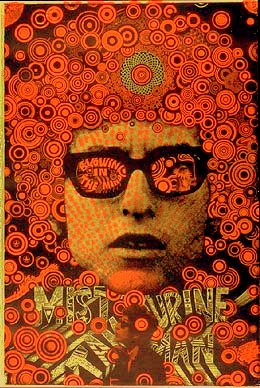
Psychedelic Dylan
Some say she first set her sights on McCartney but the more vulnerable Lennon showed up and the Spider Woman spread her web.
She was still married to her second husband, Tony Cox, but, regardless of what she says she very aggressively pursued, or attacked, Lennon. Lennon was emotionally under water unable to handle his success while drugging himself out of his mind. He was unwillingly married to his wife Cynthia. It appears that he married Cynthia out of duty when she became pregnant. He doesn’t seem to have been happy in his virtue. Yoko had no difficulty in capturing his affections.
Now, just as Warhol had adopted the Velvets and imposed his female singer, Nico, on the band Yoko sought to imp[ose herself on the Beatles through Lennon. At this time she was still musically completely in thrall to John Cage understanding nothing about Rock music. She and Lennon had made a ridiculous LP called Two Virgins in 1968. She combined her cagian screechings while using an avant garde ‘performance’ notion of the couple posing nude on the cover; full frontal on the obverse, full posterior on the reverse. As no store would carry the cover the couple reverted to Yoko’s idea of Bagism placing the cover inside a plain manila envelope or bag. While it didn’t sell the record this form of Bagism was actually a successful artistic statement. The nude cover given an outer garment so to speak.
Well, the public was prepared to forgive the Beatles anything but the other three Beatles weren’t prepared to forgive Yoko for forcing herself on them thus she broke up the most successful act of the sixties. Still, she had succeeded according to her wildest dream. Lennon and his wonderful reputation and fortune were hers. She had gone from a neglected, nondescript ‘performance’ artist to center stage, not on her own womanly talents but by attaching herself to a talented man. Yoko’s ‘heart’ was useless without the male intellect. Yoko was now the most influencial feminist in the world. She knew what to do with that.
After several ‘performance’ acts such as the ‘Bed In For Peace’ the couple left England to return to the place Yoko wished to subjugate artistically, New York City. She had raised herself to a par with Andy Warhol. She now had to meld her musical and artistic goals through Lennon and Warhol.
On the musical side she began to develop her rock n’ roll skills under the tutelage of Lennon. While not abandoning the avant garde notions of John Cage she now emasculated her husband. Always semi-delusional or perhaps completely so, she fantasized that she was not only equal to Lennon in skill and popularity but superior to him. She imagined herself more popular than Lennon. Thus one has such travesties as the LP Double Fantasy. It was only after Lennon’s death that she was forced to recognize than Lennon’s fans did not appreciate her efforts. So she failed as a musician.
She quickly tired of being Mrs. Lennon. Thus she and Lennon separated for eighteen months or so during the years 1973-75. She then realized that her financial well being and musical acceptance depended on Lennon. In 1975 she called him back resuming their relationship until his death in 1980. But, things had changed.
She began to adopt Warhol’s life style on her return to NYC. While she propagated the notion that she was some sort of business whiz Iam having difficulties discovering any such skills. It appears that with the enormous income of Lennon she emulated Warhol in
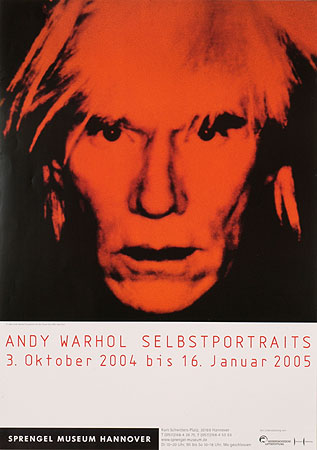
Andy the Demon
spending her way to prosperity.
She was in a position to not only match Warhol’s spending but exceeding it by many times. Through the seventies and eighties Warhol came into his own as an artist while reaping a fortune doing portraits. There appears to have been no effort on his part to invest in income producing vehicles. Rather he bought stuff. He purchased buildings in NYC and elsewhere while acquring undeveloped acreage in places like Aspen. He shopped nearly every day buying antiques from furniture to objets d’ art by the bushel almost as though he were trying to excel the incredible W.R. Hearst.
He usually didn’t even look at the stuff once he bought it merely filling rooms with his shopping bags. At his death all this junk was auctioned off for 25 million dollars, a nice appreciation in value.
Yoko followed the exact pattern buying apartments and houses as well as an extensive dairy farm with a herd of prize cows. She not only had but has five apartments in her principal dwelling, the Dakota apartment building and many other houses scattered around.
Like Warhol the Dakota apartments are stuffed with junk. Valuable, but, you know, stuff. She bought at good prices. Her extensive collection of Egyptian antiquities was mostly purchased before a steep rise in value.
Like the Rothschilds of old Yoko didn’t do all her own shopping but employed agents to search things out. Chief among these was an associate of Warhol’s, Sam Green, and an Hungarian immigrant by the name of Sam Havadtoy.

Buddies- Yoko, John, Andy
There should be no surprise then that she now has an extensive collection of Warhol’s artwork as well as his portraits of Lennon. The Warhols would have been purchased for form 25 to 50K while now being listed on her assets at tens of millions. She also has been said to have a good collection of Magrittes as well as one assumes other artists. So, much of her net worth is tied up in artwork purchased through Sam Green.
Sam Havadtoy was an antiques dealer as well as an interior designer. He appears to have been a somewhat shady character. It is very difficult to find much about him, however there is a sharp portrait available from the notorious A.J. Weberman ( http://www.acid-trip.org/lennon/ )
…(the Lennons) hired a sleazy Eastern European bisexual to renovate the pad. (Dakota) I had heard of this dude, whose name escapes me, from an asswipe named BRUCE KIRSH, who worked for him. KIRSH told me that the dude, who worked for the King of Morocco, would form a dummy renovation company, hire employees like Kirsch who were willing to work under false names, then, when it came time to pay taxes, everyone would disappear. I learned of him long before he was hired by John and Yoko, and I was taken aback when Yoko took up with him after John’s death.
I know that Weberman is not particularly well thought of by fandom but this is because of his harassment of Dylan who did, after all, misrepresent himself to the revolutionaries like Weberman. A.J. himself is an intelligent observer who was wading through it when it was deep. I do believe he knows what he’s talking about although his interpretations of Dylan’s lyrics seem absurd.
I would have to question Yoko’s judgment in taking him in. Both he and Sam Green were candidates as successors to Lennon with

Lennon by Warhol
whom she consorted in front of Lennon before he died while Yoko chose Havadtoy as his successor the day he died.
Perhaps she selected Havadtoy over Green because he was more rough trade. With Lennon while managing to reconcile revolution with peace and love with Havadtoy she discarded peace and love in favor of strong arm methods against her former employee Fred Seaman when it was totally unnecessary.
Havadtoy was living in a homosexual arrangement with his business partner when Yoko beckoned him to switch to her. Apparently an able switch hitter he was lured by the money to this much older woman. The arrangement did last for twenty years before Havadtoy removed to his native Hungary taking a nice cash settlement and several of the Warhols.
Thus, just as Warhol had his live-in homosexual arrangement so after Lennon’s death Yoko adopted the exact arrrangement. Today she apparently lives alone, a seventy-eight year old woman.
After Lennon’s death there was an accession of from 30 million to a possible 100 million dollars as their last album, Double Fantasy, sold into the millions while the rest of Lennon’s catalog and one assumes the Beatles’ catalog was reinvigorated while all things Lennon sold. This is, of course, no reflection on Yoko but the inevitable result with intellectual properties when the maker dies.
Post-Lennon, then, Yoko realized that her recording and art careers were nil. Heart without intellect is worthless. She then became the caretaker of the Lennon legacy. His recordings, of course, continued to sell, but even his artwork eclipsed that of Yoko. So she suffered the humiliation of being a mere appendage to a man. The feminine dismal swamp was eclipsed by the Olympian heights of the male intellect. As in ancient times the God had trumped the Goddess. And yet as with Hera and Zeus the Goddess gets her way. Yoko came up with the money and goods while Lennon’s spirit was wafted into the stratosphere.
As any reader of mythology knows Hera ruled the Lernean swamps of Argolis while Zeus ruled the gods on ethereal Olympus. Thus one has the symbolism of the biological difference between the male and female.
In ancient times the female had her share in magic. She knew herbs and plants, was familiar with poisons and cures as with the arch witch of the ancient world, Medea. The reputation of the female witch even as a consort of Satan persisted down through medieval and post-medieval times, indeed, even up to the dawn of the scientific enlightenment. One would have thought that magic and witchery were a thing of the past in the 1960s and yet Yoko embodied the whole female swamp mentality.
She established something called the Spirit Foundation attributing the direction to Lennon who in fact knew nothing of these matters but followed her lead. The Spirit Foundation celebrated the ancient art of the Shaman or witch doctor. Shamanism itself even preceded the Matriarchal swamps of Argolis. It was a rich repository of magical tradition. Further the Foundation was feminist in that it was dedicated to preserving the magical traditions of the women of the Pacific islands still living in such archaic societies. The wealth generated by the male intellect was appropriated by the female vagina or ‘heart.’
In her own life and that of Lennon’s Yoko was addicted to a variety of magical practices- astrology, numerology, Tarot readings, and indeed she traveled to the Caribbean to sell her soul to Satan through the offices of a female curandera. Her Tarot reader, John Green, was a priest in the shamanistic, magical, Yoruban African cult of Santeria.
Her feminism was more a magical effort to restory Matriarchal supremacy over the Patriarchy thus reversing the Patriarchal victory of three thousand years previously. Indeed, what has been called the movement for female equality is nothing more than a covert campaign to restore the Matriarchy.
Thus while Yoko o9riginatd nothing she usurped the abilities of the reason of men- Cage, Warhol, Lennon and male magicians such as John Green. Indeed the Trojan War itself was a war of men in service of women.
In her associations with men she preferrred to deal with emasculated types such as homosexuals like Cage, Warhol, Sam Green and Sam Havadtoy. Lennon claimed to have always been dependent of women for comfort and guidance while Yoko caught him at his most confused and vulnerable.
While she received direction from Cage and Warhol she was able to manipulate Lennon out of his talent somewhat as Vivian did that of Merlin of the Arthurian saga. When Vivian had usurped Merlin’s magical knowledge she buried him deep much as Lennon was put out of the way. Yoko then appropriated his wealth and residual income after his death. It was this constant inflow of cash that allowed her to propagate the notion that she was a financial genius.
Then as the female of the ‘heart’ or vaginal swamp she managed and appropriated the reason of Olympus through Cage, Warhol and Lennon. What she got from Havadtoy other than brute strength is not clear to me.
As such Yoko is Woman. In her case a seeming reversion to the archetypal Shaman of the most ancient times.
Themes And Variations
The Tarzan Novels Of Edgar Rice Burroughs
#5 Tarzan And The Jewels Of Opar
Part V
by
R.E. Prindle
Texts:
Du Maurier, George: Peter Ibbetson
Dudgeon, Piers: Captivated: J.M. Barrie, The Du Mauriers & The Dark Side Of Neverland, 2008, Chatto And Windus
Hesse, Herman: The Bead Game
Neumann, Erich: The Origins and History Of Consciousness, 1951, Princeton/Bollingen
Vrettos, Athena: “Little Bags Of Remembrance: Du Maurier’s Peter Ibbetson And Victorian Theories Of Ancestral Memories” Erudit Magazine Fall 2009.
While it is today commonly believed that Sigmund Freud invented or discovered the Unconscious this is not true. As so happens a great cataclysm, The Great War of 1914-18, bent civilization in a different direction dissociating it from its recent past.
Studies in the earlier spirit of the unconscious continued to be carried on by C.G. Jung and his school but Freud successfully suppressed their influence until quite recently actually. Through the fifties of the last century Freud’s mistaken and harmful, one might say criminal, notion of the unconscious held the field. Thus there is quite a difference in the tone of Edgar Rice Burroughs writing before and after the 1917 Bolshevik Revolution.
There are those who argue that Burroughs was some kind of idiot savant who somehow knew how to write exciting stories. In fact he was a well and widely read man of varied interests who kept up on intellectual and scientific matters. He was what might be called an autodidact with none of the academic gloss. He was very interested in psychological matters from hypnotism to dream theory.
The scientific investigation of the unconscious may probably be dated to the appearance of Anton Mesmer and his interest in hypnotism also variously known as Mesmerism and Animal Magnetism. The full fledged investigation of the unconscious began with hypnotism. Slowly at first but by the last quarter of the nineteenth century in full flower with varied colors. Science per se was a recent development also flowering along with the discovery of the unconscious.
While Charles Darwin had brought the concept of evolution to scientific recognition in 1859 the key discipline of genetics to make sense of evolution was a missing component. It is true that Gregor Mendel discovered the concept of genetics shortly after Darwin’s Origin Of Species was issued but Mendel’s studies made no impression at the time. His theories were rediscovered in 1900 but they were probably not widely diffused until after the Great War. Burroughs knew of the earlier Lamarck, Darwin and Mendel by 1933 when he wrote Tarzan And The Lion Man. His character of ‘God’ is the result of genetic mutation.
Lacking the more complete knowledge of certain processes that we have today these late nineteenth century speculators seem ludicrous and wide of the mark but one has to remember that comprehension was transitting the religious mind of the previous centuries to a scientific one, a science that wasn’t accepted by everyone then and still isn’t today. The Society For Psychical Research sounds humorous today but without the advantage of genetics, especially DNA such speculations made more sense except to the most hard nosed scientists and skeptics. The future poet laureate John Masefield was there. Looking back from the perspective of 1947 he is quoted by Piers Dudgeon, p. 102:
Men were seeking to discover what limitations there were to personal intellect; how far it could travel from its home personal brain; how deeply it could influence other minds at a distance from it or near it; what limits, if any, there might be to an intense mental sympathy. This enquiry occupied many doctors and scientists in various ways. It stirred George Du Maurier…to speculations which deeply delighted his generation.
Whether believer or skeptic Burroughs himself must have been delighted by these speculations as they stirred his own imagination deeply until after the pall of the Revolution and Freud’s triumph.
Burroughs was subjected to dreams and nightmares all his life. Often waking from bad dreams. He said that his stories were derived from his dreams but there are many Bibliophiles who scoff at this notion. The notion of ‘directed dreaming’ has disappeared from popular consideration but then it was a serious topic. Freud’s own dream book was issued at about this time. I have already reviewed George Du Maurier’s Peter Ibbetson on my blog, I, Dynamo and on ERBzine with Du Maurier’s notions of ‘Dreaming True’. It seems highly probable that Burroughs read Ibbetson and Du Maurier’s other two novels so that from sometime in the nineties he would have been familiar with dream notions from that source.
Auto-suggestion is concerned here and just as support that Burroughs was familiar with the concept let me quote from a recent collection of ERB’s letters with Metcalf as posted on ERBzine. This letter is dated December 12, 1912.
If they liked Tarzan, they will expect to like this story and this very self-suggestion will come to add to their interest in it.
Athena Vrettos whose article is noted above provides some interesting information from Robert Louis Stevenson who developed a system of ‘directed dreaming’ i.e. auto-suggestion. We know that Burroughs was highly influenced by Stevenson’s Dr. Jekyll And Mr. Hyde while he probably read other novels of Stevenson. How could he have missed Treasure Island? Whether he read any of Stevenson’s essays is open to guess but in an 1888 essay A Chapter On Dreams Stevenson explained his method. To Quote Vrettos:
Rather than experiencing dreams at random, fragmented images and events, Stevenson claims he has learned how to shape them into coherent, interconnected narratives, “to dream in sequences and thus to lead a double life- one of the day, one of the night- one that he had every reason to believe was the true one, another that he had no means of proving false.” Stevenson describes how he gains increasing control of his dream life by focusing his memory through autosuggestion, he sets his unconscious imagination to work assisting him in his profession of writer by creating “better tales than he could fashion for himself.” Becoming an enthusiastic audience to his own “nocturnal dreams”, Stevenson describes how he subsequently develops those dreams and memories into the basis for many of his published stories, most notably his 1886 Dr. Jekyll And Mr. Hyde.
Now, directed dreaming and Dreaming True sound quite similar. One wonder if there was a connection between Stevenson and Du Maurier. It turns out that there was as well as with nearly the entire group of English investigators. Let us turn to Piers Dudgeon again, p. 102:
Shortly after they met, the novelist Walter Besant invited [Du Maurier] to join a club he was setting up, to be named ‘The Rabelais’ after the author of Gargantua and Pantagruel. Its name raised expectations of bawdiness, obscenity and reckless living, (which were not in fact delivered) as was noted at the time. Henry Ashbee, a successful city businessman with a passion for pornography, and reputed to be Robert Louis Stevenson’s model for the two sides of his creation, Dr. Jekyll And Mr. Hyde, denounced its members as ‘very slow and un-Rabelaisian’, and there is a story that Thomas Hardy, a member for a time, objected to the attendance of Henry James on account of his lack of virility.
Virility was not the issue however. The members of the Rabelais were interested in other worlds. Charles Leland was an expert on fairy lore and voodoo. Robert Louis Stevenson was the author of The Strange Case Of Dr. Jekyll And Mr. Hyde (1886) which epitomized the club’s psychological/occult speculations. Arthur Conan Doyle, who became a member of the British Society For Psychical Research, was a dedicated spiritualist from 1916. Henry James was probably more at home than Hardy, for both his private secretary Theodora Besanquet, and brother William, the philosopher, were members of the Psychical Society.
In many ways the Rabelais was a celebration that [Du Maurier’s] time had come. Parapsychological phenomena and the occult were becoming valid subjects for rigorous study. There was a strong feeling that the whole psychic scene would at any moment be authenticated by scientific explanation.
Du Maurier was obviously well informed of various psychical ideas when he wrote Ibbetson. In addition he had been practicing hypnosis since his art student days in the Paris of the late 1850s.
So this was the literary environment that Burroughs was growing up in. As Bill Hillman and myself have attempted to point out, ERB’s mental and physical horizons were considerably broadened by the Columbian Expo of 1893. Everything from the strong man, The Great Sandow, to Francis Galton’s psychological investigations were on display. The cutting edge of nineteenth century thought and technology was there for the interested. Burroughs was there for every day of the Fair. He had time to imbibe all and in detail. The Expo shaped his future life. That he was intensely interested in the intellectual and literary environment is evidenced by the fact that when he owned his stationery story in Idaho in 1898 he advertised that he could obtain any magazine or book from both England and America. You may be sure that he took full advantage of the opportunity for himself. As this stuff was all the rage there can be no chance that he wasn’t familiar with it all if he didn’t actually immerse himself in it. Remember his response to Kipling’s The White Man’s Burden was instantaneous. Thus you have this strange outpost of civilization in Pocatello, Idaho where any book or magazine could be obtained. Of course, few but Burroughs took advantage of this fabulous opportunity. It should also be noted that he sold the pulp magazines so that his interest in pulp literature went further back than 1910.
In addition ERB was enamored of the authors to the point of hero worship much as musical groups of the 1960s were idolized so he would have thirsted for any gossip he could find. It isn’t impossible that he knew of this Rabelais Club. At any rate his ties to psychology and the occult become more prominent the more one studies.
It seems to me that longing as he did to be part of this literary scene, that if one reads his output to 1920 with these influences in mind, the psychological and occult content of, say, the Mars series, becomes more obvious. He is later than these nineteenth century lights so influences not operating on them appear in his own work making it more modern.
At least through 1917 the unconscious was thought of as a source of creativity rather than the source of evil impulses. If one could access one’s unconscious incalculable treasures could be brought up. Thus gold or treasure is always depicted in Burroughs’ novels as buried. The gold represents his stories, or source of wealth, brought up form his unconscious. The main vaults at Opar are thus figured as a sort of brain rising above ground level. One scales the precipice to enter the brain cavity high up in the forehead or frontal lobe. One then removes the ‘odd shaped ingots’ to cash them in. Below the vaults are two levels leading back to Opar that apparently represent the unconscious. Oddly enough these passageways are configured along the line of Abbot’s scientific romance, Flatland.
In Tarzan And The Jewels Of Opar the gold is taken to the Estate and buried replicating the vaults. Once outside Opar and in circulation, so to speak, the ingots are accessible to anyone hence the duel of Zek and Mourak for them. The first gold we hear of in the Tarzan series is brought ashore and buried by the mutineers. This also sounds vaguely like Stevenson’s Treasure Island. The watching Tarzan then digs the gold up and reburies it elsewhere. In The Bandit Of Hell’s Bend the gold is stolen and buried beneath the floorboards of the Chicago Saloon. Thus gold in the entire corpus is always from or in a buried location. These are never natural veins of gold but the refined ingots.
Not only thought of as a source of treasure during this period the unconscious was thought to have incredible powers such as telekinesis, telepathy and telecommunication. One scoffs at these more or less supernatural powers brought down from ‘God’ and installed in the human mind. As they have been discredited scientifically Western man has discarded them.
On the other hand Western Man deludes himself into accepting the oriental Freud’s no less absurd assertion that the unconscious exists independently of the human body somewhat like the Egyptian notion of the ka and is inherently evil while controlling the conscious mind of the individual. This notion is purely a religious concept of Judaism identifying the unconscious as no less than the wrathful, destructive tribal deity of the old testament Yahweh. Further this strange Judaic concept of Freud was allowed to supersede all other visions of the unconscious while preventing further investigation until the writing of C.G. Jung were given some credence beginning in the sixties of the last century.
In point of fact there is no such unconscious. The supernatural powers given to the unconscious by both Europeans and Freud are preposterous on the face of it. For a broader survey of this subject see my Freud And His Vision Of The Unconscious on my blogsite, I, Dynamo.
This so-called unconscious is merely the result of being born with more or less a blank mind that needs to be programmed. The programming being called experience and education. The maturation and learning process are such that there is plenty of room for error. All learning is equivalent to hypnosis, the information being suggestion which is accepted and furthers the development of the individual. Learning the multiplication tables for instance is merely fixing them in your mind or, in other words, memorizing them. All learning is merely suggestion thus it is necessary that it be constructive or education and not indoctrination or conditioning although both are in effect. Inevitably some input will not be beneficial or it may be misunderstood. Thus through negative suggestion, that is bad or terrifying suggestions, fixations will result. A fixation is impressed as an obsession that controls one’s behavior against one’s conscious will, in the Freudian sense. The fixation seems to be placed deep in the mind, hence depth psychology. Thus when ERB was terrified and humiliated by John the Bully certain suggestions occurred to him about himself that became fixations or obsessions. These obsessions directed the content of his work.
To eliminate the fixations is imperative. This is what so-called depth psychology is all about. The subconscious, then, is now ‘seprarated’ from the conscious, in other words the personality or ego is disintegrated. The goal is to integrate the personality and restore control. Once, and if that is done the fixations disappear and the mind become unified, integrated or whole; the negative conception of the unconscious is gone and one is left with a functioning conscious and subconscious. The subconscious in sleep or dreams then reviews all the day’s events to inform the conscious of what it missed and organize it so that it can be acted on. No longer distorted by fixations, or obsessions, the individual can act in his own interests according to his abilities. The sense of living a dream life and a real life disappears.
That’s why experience and education are so important. What goes into the mind is all that can come out.
But, the investigation of the unconscious was blocked by Freudian theory and diverted from its true course to benefit the individual in order to benefit Freud’s special interests.
So, after the War ERB forgot or abandoned the wonderful notions of the unconscious and was forced to deal with and defend himself against Freudian concepts. The charactger of his writing begins to change in the twenties to meet the new challenges of aggressive Judaeo-Communism until by the thirties his work is entirely directed to this defense as I have shown in my reviews of his novels from 1928 to 1934.
Tarzan And The Jewels Of Opar then reflects this wonderful vision of the subconscious as portrayed by George Du Maurier and Robert Louis Stevenson
Then the grimmer reality sets in.
End Of Review.
A Review: Beau Sabreur by P.C. Wren
August 1, 2009
Note: I mistakenly placed the review of Beau Geste on another of my blogs: reprindle.wordpress.com. The review may be found there.
A Contribution To The
Erbzine Library Project
The Beau Ideal Trilogy Of
P.C. Wren
Beau Geste~Beau Sabreur~Beau Ideal
Part III
Review Of Beau Sabreur
by
R.E. Prindle
Part I: Introduction
Part II: A Review Of Beau Geste
Part III: A Review Of Beau Sabreur
Part IV: A Review Of Beau Ideal
Bibliographial Entry: Welland, James: ‘The Merchandise Was Human’, Horizon Magazine, Vol. VII, No. 1, Winter 1965. PP. 111-117
Beau Sabreur shifts from the classic literary style of the mid-nineteenth century to the vernacular of pulp or, perhaps, Wold Newton era. The pulp writers seem to have all read each other and Wren has certainly done his share of reading.
This novel begins at a pre-Zinderneuf time when Charles De Beaujolais was a mere cadet entering the service. If Beau Geste began in c. 1888 Beau Sabreur is set back at the beginning to perhaps 1875. De Beaujolais’ circumstances quite parallel those of the hero of Joseph Conrad’s Heart Of Darkness. Conrad has maintained a very respectable readership down to the present even though stoutly anti-Communist and a colonial writer. Both Communists and Africans are working hard to bury his reputation. It’s amazing how guys like Conrad manage to hang on, but that may not be for long as Western influence in society declines.
So it is that De Beaujolais is a sort of lounger applying himself to nothing in particular when his uncle recruits him for the French secret service as an agent to be attached to the African Spahis, an army corps. His uncle says that he will severely try him and should he fail in any particular he will be immediately dismissed. This essentially means that if De Beaujolais lets a woman come between him and his duty it is all over for him. So we are forewarned that there will a choice between love and duty.
The book was written after 1917 so Wren introduces a subversive Communist or anarchist character. In this book he assumes the name of Becque at the beginning. In Beau Geste he went by Rastignac and late in the novel he will be recognized as Rastignac although he appears to be going by another name. Wren has a good idea of the type describing him thusly under the name Becque:
He was clearly a monomaniac whose whole mental content was hate- hate of France; hate of all who had what he had not; hate of control, discipline and government; hate of whatsoever and whomever did not meet his approval. I put him down as one of those sane lunatics, afflicted with a destructive complex; a diseased egoist, and a treacherous, dangerous mad dog. Also a very clever man indeed, an eloquent, plausible and forceful personality…The perfect agent-provacteur, in fact.
Thus Becque in his various incarnations is always subversive, whether of army morale or working the Moslems up against the French. This will be a major theme of the novel. the same theme will appear in Tarzan The Invincible developed for his own needs.
Having been recruited by his uncle, De Beaujolais is sent to a sort of boot camp to learn the hard way. His ordeal is very convincingly described by Wren. It seems authentic enough to make one believe that Wren himself actually experienced such an indoctrination but there is no record that he did. He is just a consummate artist.
While learning to be a soldier Becque attempts to recruit him as a Communist agent. This leads to a sword fight in which De Beajuolais injures Becque but does not kill him.
Having completed his boot camp De Beaujolais takes his station with the secret service and the Spahis in Africa. Spahis are not FFL but a different corps.
When the French conquered Algeria in 1830 they disrupted a thousand year old social system. The North African Moslems had an insatiable need for slaves. Not only did they raid European shores to abduct Whites but an immense system for deliviering Negro slaves had been in existence since the Moslem conquest. This system had been run by the Tuaregs. This people was descended from Whites dating back to at least the Phoenician conquest of North Africa. Their alphabet probably precedes that of the Phoenicians. Undoubtedly they were the descendants of the former inhabitants of Mediterranean Valley known as Libyans in Egypt flushed out by the melting of the ice age.
What they did before the arrival of the Moslems isn’t known but with the African conquest of the Moslems they became the middle men between Africans of the Sahel and the Moslems of the North. Every year for a thousand years the Tuaregs had collected convoys of Negroes from the South driving them North across the Sahara. This was necessarily done with great loss of life as the Tuaregs were not that tender toward the Negroes.
With the advent of the Atlantic Slave Trade in the sixteenth century the Tuaregs also captured Negroes and drove them to St. Louis in Senegal for sale and transshipment to the Americas. According to James Welland the depredations on the Blacks was so great that the area around Lake Tchad had been cleared of inhabitants. This age old life style was disrupted in 1830 by the French. By that time Europeans had discontinued the slave trade so that the French disrupted the trans-Sahara trade causing a disruption in the Tuareg economy from which there was no recovery. Welland explains:
In short, the official abolition of the slave trade, the desert tribes, the desert itself for that matter began to play a diminished part in human affairs, and the Tuareg, who had been the only link for two and a half thousand years between Central Africa and the Mediterranean- in other words, between the Negro and the White world- began to pass from the stage of history. They were left unemployed and purposeless, with the result that they turned to intertribal war and oasis raiding to keep some semblance of their nationhood. Then again, as the supply of black labor dried up, the palmeries were increasingly neglected and often, as the consequence of a razzia, comepletely destroyed. The size and number of oases decreased, sand filled the wells and cisterns- many of which had been maintained since Roman times- and the age old trails became more hazardous and finally were hardly used at all.
In the secret service in Africa De Beaujolais becomes involved in the maelstrom of change, racial conflict and bad memories which were now exacerbated by the arrival of the non-Moslem, or Christian, French. The novel beomes then a sort of proto-thriller. De Beaujolais is on a mission to a town called Zaguig when he is caught up in a Moslem revolt. In Zaguig he meets the touring Mary and Otis Vanbrugh. Otis, you will remember returns from Beau Geste.
Mary is the love interest in the story and she will conflict De Beaujolais between his love for her and his duty as imposed by his uncle. Frankie Laine or Tex Ritter and songwriters Dimitri Tiomkin and Ned Washington (I tried to work Trad. in there somewhere but couldn’t do it) expressed the balance well in the song High Noon:
Oh to be torn ‘betwixt’ love and duty
Supposin’ I lose my fair haired beauty…
De Beaujolais relates the story of another agent who chose his beauty over duty and was drummed out of the service ultimately being killed. De Beaujolais has a premonition. Wren cleverly resolves the choice so that De Beaujolais gets his beauty while fulfilling his duty.
At the same time Otis Vanbrugh meets the apparent Arab dancing girl, who yet retains European features, who will figure largely in the sequel.
As the revolt erupts these conflicts emerge. As is usual in thrillers things are not what they seem. Raoul D’Auray De Redon, a close friend of De Beaujolais’ remains behind disguised as an Arab to confuse their attack on a small French garrison destined to be wiped out. De Beaujolais has important dispatches which must be delivered. Thus duty makes him appear to be an ingrate and coward humiliating him before Mary. His job is to locate the latest Arab Mahdi and suborn him the the French side.
De Beaujolais thinks little of Otis Vanbrugh and we are meant to accept his opinion. His true story will appear in the sequel.
Mary was one of those women who flirt by taunting or ridiculing her guy. In her case when De Beaujolais was within hearing she mockingly whistled a tune De Beaujolais couldn’t quite place but was called Abdullah Bulbul Amir. This was a very popular song and poem of the time that can be found at http://wiki.answers.com/Q/lyrics_of_bhulbhuliya. A couple of verses of its 19 will suffice to give its tenor but the poem is one you should be familiar with.
The sons of the Prophet are hardy and bold,
And quite unaccustomed to fear,
But the most reckless of life or of limb
Was Abdullah Bulbul Amir.
When they wanted a man to encourage the van
Or harass a foe from the rear,
Storm fort or redoubt, they had only to shout
For Abdullah Bulbul Amir.
Apparently the poem was so well known that Wren felt no need to name it and he doesn’t.
The time to leave Zaguig comes, so taking his entourage of faithful soldiers, Mary and her maid Maud, he sets out into the desert toward Oran.
Soon Tuareg or Arab raiders pick his party up and they are forced to fight a pitched battle although from an advantageous position. Here De Beaujolais has to make a very difficult choice between between loyalty to his men and his duty to get his dispatches through. Getting his men into position he is compelled to abandon them to their fate and push on.
This puts a strain on his relationship with Mary who cannot understand the concept of duty or necessity- the necessity to get the dispatches through. After a long flight the party falls into the hands of a desert tribe. But this is a strange desert tribe. Rather than the usual unorganized tactics these fellows seem to have the scientific training of the French. Another mystery.
As luck would have it De Beaujolais and the women were captured by the Mahdi’s troops. By way of explanation the Moslem Mahdi is equivalent to the Jewish Messiah but not the Christian Messiah. There’s only one Christ but Jewish Messiahs and Moslem Mahdis pop up everywhere.
So now, going back to the ending of Beau Geste, the two Americans Hank and Buddy were out there somewhere trodding the burning sands. Hank was discovered and rescued on the point of death by a kind hearted Sheik while Buddy was captured by hard hearted Tuaregs being saved from death when Hank Sheik’s tribe defeated his captors. Buddy was out there somewhere for a long time because Hank had been rescued years before.
Having been rescued at the point of death Hank was aware of the necessity to pass as a Moslem so he pretends to be dumb until he has learned the language so well he can pass. He then cleverly becomes the tribe’s sheik. The tribe is then threatened by a razzia of Tuaregs. As this takes place in the North Tuaregs no longer having Negroes to convoy have taken to raiding the oases. Normally the tribe would have run and hid leaving their goods and a few token members as slaves for the Tuaregs. Hank has a better idea and using his superior scientific French training the tribe rather than waiting to be attacked unexpectedly attack the Tuareg camp handily defeating them. Buddy is thus rescued. Coincidences are dime dozen out on the burning sands.
Teaching Buddy the language while he too plays dumb, Buddy becomes Hank’s vizier. With Buddy as military commander the tribe is trained in scientific methods in earnest. They then begin to organize the tribes into a confederation thus earning Hank the title of Mahdi in French eyes. De Beaujolais was thus on a mission to co-opt the new Mahdi.
As luck, or coincidence, would have, at the same time De Beaujolais and the girls arrive so does Becque/Rastignac. Becque is now employed one supposes by the Soviet Union to arouse the Moslems to a jihad. He comes bearing gifts not realizing that Hank and Buddy are his old Legion comrades. He doesn’t recognize them but Hank recognizes him. Becque and De Beaujolais have that old unsettled score to settle. De Beaujolais now settles his hash removing that source of irritation.
I’ve pointed out before that Burroughs very likely drew inspiration for his series of political Tarzan novels from 1930 to 1933 after reading this trilogy from 1924 to 1928. The Sahara had fascinated him long before he read Wren. David Innes of Pelucidar even surfaces in the Sahara returning from the Inner World. The great desert and the Sahel is not quite as we Westerners have imagined it. The thousand year long history of amazing suffering boggles the imagination. A thousand years of thousand mile treks from South to North, untold millions of Africans were trekked across the burning sands with equally untold millions falling along the way. This is not all. This is a horror story. Welland again, p. 116:
Even after the slave trade had been suppressed, the old life of the desert survived for a while for one simple reason…the absence of salt in the Sudan. Nearly all the salt in Central Africa had always come from the north across the Sahara on the backs of camels, donkeys, horses and men. The salt mines in the middle of the most terrible wastelands of the desert- at Taghaza, at Taodeni, and at Bilma- had always been worked all the year round by Negro slaves, who died within a few years of their arrival at the mines and were immediately replaced by new workers. The salt they mined was worth its weight in gold in Timbuktu, and its transport across the desert was a considerable enterprise of unbelievable size, involving the assembling of as many as 40,000 camels to make the quick dash from Bilma to Kano.
Think of it. For a thousand years Negroes were dropped down a funnel in a steady stream to live the most miserable of lives for a very few years. Over a millennium! Think of it. I should think those Negroes who travelled the Middle Passage in the Atlantic Slave Trade ending up in the paradise of the Caribbean and the Americas should bless their deliverers from that African hell.
Africans should bless the French for delivering them from total servitude and degradation. When one digs for facts beneath the surfice, the things one finds.
Thus without giving any historical background Wren is telling the story of how Europe saved the Africans from themselves. Indeed, Hank and Buddy singlehandely rearrange North Africa on livable lines. The two, in the story, break the power of the Tuaregs while establishing an African paradise in a hundred square mile oasis. Their people are delivered into prospeirty by a million franc subsidy from France that Hank and Buddy use for the betterment of their people rather than sequestering it in a numbered Swiss bank account. A new day for Africa indeed courtesy of Western enlightenment.
Thus De Beaujolais accomplishes his mission to align the new Mahdi, Hank, with France while winning his fair heared beauty and pleasing his uncle.
Hank marries Maud the maid leaving Buddy hanging out but not for long. We still have the last of the trilogy, Beau Ideal to go. Let’s go.
A Review: Pt. I P.C. Wren The Beau Geste Trilogy
June 23, 2009
A Contribution To The Erbzine Library Project
The Beau Ideal Trilogy Of
P.C. Wren
Beau Geste, Beau Sabreur, Beau Ideal

Review by R.E. Prindle
Part I: Introduction
Part II: Review of Beau Geste
Part III: Review Of Beau Sabreur
Part IV: Review Of Beau Ideal

P.C. Wren
For hundreds of years after the expulsion of the Moors from Spain the Moslems raided the European c0asts of the Mediterranean abducting men, women and children as slaves while also preying on shipping. The newly formed United States sought unsuccessfully to suppress this Moslem piracy. ‘Millions for defense but not one penny for tribute.’ If you remember that one from school.
Finally in 1830 France invaded, conquered and occupied what is now known as Algeria ending the Barbary Pirates.
An army corps was formed and named the Legion Etrangere in French, French Foreign Legion in English to pacify Algeria. Over the next hundred years the Legion was used for peaceful penetration into the Sahara and Sahel to form the French West African Empire.
In an astonishing turn around the Moslem power evaporated while the French easily became the masters of the bulge of Africa. The military superiority was to last until post-WWII when exhausted by two world wars accompanied by a moral collapse as the best and brightest died on the battlefields leaving nothing but singers and dancers to live off the fat of the land. The French were militarily capable but morally bankrupt. The Moslems reasserted themselves in the fifties forcing the French out of Algeria while beginning the invasion of France by peaceful penetration. A neat reversal of fortunes. Thus the conquest of Europe interrupted by the Spanish expulsion began again.
Immediately after the French invasion of Algeria the deserts of Africa beame a playground of Europeans. The lure of the desert held a strange appeal for them. Perahaps devoid of romance in their homelands the desert with its now no longer dangerous but exotic inhabitants replaced the fairies and elves displaced by the scientific revolution. The Euroamerican romance with ‘noble savages’ and ‘inferior races’ may very well be caused by the void created by the scientific revolution. Euroamericans hoped to find or create those emotional or psychological needs lost in the advance of civilization. This may explain to some extent the White worship of people of color whose ‘natural’ uninhibited behavior they profess to admire and imitate. Witness the tatooing and body piercing in imitation of the Africans who themselves appear to have to given it up.
The French having conquered Algeria had to establish an army corps dedicated to perpetual warfare. That unit was the Legion Etrangere or French Foreign Legion. The duty in the Sahara amid an enemy population was so execrable that only men without hope, that is criminals and outcasts with no other options need have applied.
In 1831 then, a year after the conquest and annexation of Algeria as an actual Department of France the French Foreign Legion was created by Louis Philippe the new Bourgeois King of France.
The Legend of the Legion apparently grew very quickly. the first legion novel is thought to be that of the English writer Ouida. She published her novel Under Two Flags in the 1860s. It was a great success ultimately being made into a movie. Alongside the Legion novels were a number of novels that dealt with the desert in a very romantic way.
The genre of novel could only have developed after the French conquest of Algeria after 1830 and a little later with the pacification of the Moslems. If not pacification at least intimidation. Astonishingly the centuries intervening between Roman Africa and the conquest of Algeria vanished from the consciousness of Europeans. In only a hundred years (well, a hundred twenty-five years) a brief interlude, Europeans were in turn expelled from North Africa with their tremendous superiority shattered and in ruins. That brief century now appears like a fairy story without real substance. A hundred years of struggle and dieing ant then- poof! But the stories were great.
Fans of Jules Verne have a very good story- The Barsac Mission- that undoubteldy was an influence of P.C. Wren. The work has only been translated recently issued in two volumes as Into The Niger Bend and The City Of The Sahara by Americor. Some consider the novel science fiction.
The publishers are escapist types who have retreated to Mattituck N.Y. at the most extreme end of Long Island. Unfortunately, as with many of Verne’s books the Barsac has been bowlderized to reflect current Liberal tastes. The translator I.O. Evans coyly expresses it this way: I have also taken the liberty, found necessary by most of Verne’s other translators, of abbreviating or omitting a few passage of minor interest. (cough, cough)
Another wonderful Sahara novel written at the same time as the Barsac is Robert Hichens’ The Garden Of Allah. Hichens was an influence on Burroughs. The novel was very well known at least through my youth. I knew people with whom Hichens’ reputation was very great although I imagine there are few who would recognize his name today.
And then ERB himself devoted a number of pages to the romance of the desert. In The Return Of Tarzan it will be remembered that Tarzan was despatched to Algeria as a French secret agent just along the lines of Wren’s De Beaujolais. The Lad And The Lion is of course a complete Sahara novel that appears to have had an influence on Wren. Korak the Killer of The Son Of Tarzan operated on the margins of the desert while the Sahara plays a frequent part in a lot of the Tarzan novels.
There is no question that E.M. Hull’s The Sheik was a major influence on Wren as he actually parodies Mrs. Hull’s novel virutally by name.
With Wren the myth of the Sahara and the Legion comes into full bloom.
If one has read only Beau Geste one has read an amazingly good story but to understand Wren’s intent it is necessary to read Beau Geste, Beau Sabreur and Beau Ideal in sequence. By the time Wren wrote, the handwriting was on the wall. The Western will had already been sapped. The beau ideals that had inspired Western men since the days of the Arthurian epics was fading from the Western consciousness being replaced by the effete homosexual ‘ideals’ of today. The strength and confidence that allowed Western man to subjugate the world was becoming just a memory. Wren in his way is either commemorating the ideals or seeking to reverse the decline.
The three novels are concerned with the fortunes of two families, one English, the other American. Wren has a wonderful feel for the difference between the English and the American characters, not to mention the French. His command of American dialect and hobo slang is virtually alone worth reading the trilogy.
The first volume, Beau Geste based on Wilkie Collins The Moonstone (a so-so read) concerns the early history of the Geste brothers, Beau, Digby and John and the story of Fort Zinderneuf away out there almost beyond a hobo’s imagination.
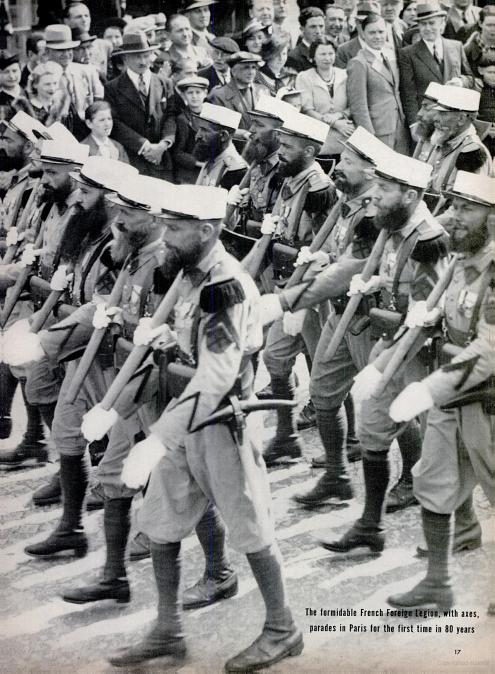
FFL 1939: Life Magazine
.
The novel does introduce the two American hoboes, Hank and Buddy, serving in the Legion. Wren kills off Michael and Digby Geste in this first novel putting the load on John.
In the second novel of the trilogy, Beau Sabreur (The good sword or swordsman) John returns to Africa to try to locate Hank and Buddy who were lost in the drifting sands after saving his life.
In this manner Wren introduces the American family of which Hank is a member. Hank and his friend Buddy were the two men lost in the desert that John Geste is seeking. Both men lying in the desert near death in different locations were rescued by the Bedouins. As luck would have it Hank managed to work his way up to Sheik acquiring Buddy as his vizier. They introduce superior Western discipline and tactics into their tribe giving them dominance in the desert. Hank then comes to the attention of the French as the new Mahdi. De Beaujolais is sent to coopt the new Mahdi. Through a series of adventures De Beaujolais meets and falls in love with Hank’s sister Mary who is traveling with her other brother Otis Vanbrugh. They as well as Hank are fleeing from a brutish father.
At stories end the whole cast Henri De Beaujolais who had wed Mary, Otis, Hank, Buddy, John Geste and his wife Isobel, who plays a large part, are back at the ranch in Texas facing the old brute of a father down while trying to free Hank’s other sister from thralldom to the old brute so she can marry Buddy and begin a life of her own. Hold on, now, Wren must have been studying Burroughs because he’s got a number of twists up his sleeve, or perhaps, tricks.
While Otis was in Algeria an Arab dancing girl had fallen in love with him who was apparently the queen of the desert. Otis tried to escape her but in exchange for help in recovering John from the penal battalion of the FFL he promised to marry her. Aw shucks, that’s right, you guessed it. Nakhla was in reality his sister. The old brute had fathered her on another dancing girl when he was out making deals in the desert. So we have Nakhla, the same name as the heroine of Burroughs’ The Lad And The Lion, pretty much following the plot line of The Girl From Farris’s. So maybe Wren should also be included in the Farmerian Wold Newton Universe.
So that is the broad overview of the story line that holds the three volumes together. Before I go on to the individula reviews there is one other problem I wrestle with that I would like to to discuss and that is the
Western fascination with primitive life styles.
For a convenient starting point we’ll use H. Rider Haggard, no, cancel that. I’ll go back a little further to the French Wold Newton. I’m reading the Paul Feval Black Coats series and they have some earlier antecedents. Balzac, Dumas, Eugene Sue and Feval all deal with organized crime groups. A Dumas title that I haven’t been able to get is titled The Mohicans Of Paris while Feval makes several reference to crime organizations adopting a sort of ‘red indian’ mentality. What Dumas called Mohicans evolved into the Apaches of late nineteenth century Paris. Anyone who watched TV in the fifties is familiar with French Apache dancing.
Thus while the French were becoming fascinated with the North American Indians and their primitive mentality Haggard was celebrating the primitive African mentality. And then along comes Ouida, Verne, Hichens, Burroughs, Hull and Wren celebrating the ‘free and wild’ life of the desert.
As of the beginning of the nineteenth century, if not before, the Euroamericans evolved into the Scientific Consciousness leaving the rest of the world behind in the mythopoeic or Religious Consciousness. However the transition from one consciousness to the other is not a clean break. Haggard, for instance, never really made the transition while Burroughs did. That may be why Burroughs reads as modern if a trifle old fashioned while Haggard is purely of an anterior psychology- good but just a little stodgy.
Thus, as the White Man spread over the globe, the, what I shall I call it, White Man’s Burden, White Man’s novel appeared. A whole genre of either stated or implied White superiority appeared of which Haggard and Burroughs are the most promient. From these writers the genre went on to the Sheena, Queen Of The Jungle stuff to imitative White Jungle god stories. Conrad sang the colonial era in lyric tones. Kipling told of the Raj of India while inventing the White Man’s Burden which was very real.
Ouida is usually credited with the first FFL novel, Under Two Flags, while Burroughs contributed The Return of Tarzan in which Tarzan goes to Algeria as a French secret agent although not as FFL.
In 1924 P.C. Wren wrought the glamor of the French Foreign Legion with the first novel of his trilogy, Beau Geste, followed by Beau Sabreur and Beau Ideal. These novels are also scientific demonstrating the superiority of Euroamerican intelligence over the mythopoeic mentality of the desert tribes. Merely by introducing European military discipline into the tribe Hank and Buddy enable the tribe to defeat all others and dominate the desert. This while Abd El Krim and the Riff dominated Western news instilling admiration for the primitive desert tribes over Western Civilization. I had a tearcher in high school who would get sexually aroused just talking about El Krim.
Thus while the transition from mythopoeic and scientific thinking was not complete if even half evolved the West was presented with various mythopoeic cultures that drew them back from the transition to the Scientific Consciousness. At present, then, the West has a split personality in which they admire the Negro and Arab mentality so much that they denigrate their own scientific side. It doesn’t seem likely that Euroamericans in sufficient numbers will make the transition to Scientific Consciousness quickly enough to preserve Western civilization hence the present bizarre worship of primitive races in North America and Europe. On the other hand the rest of the world seeks to imitate the West in matters that they cannot understand or sustain on their own. If the West is in trouble imagine the actual psychological state of things in China and India.
Now it is time to move on the first of the reviews- Beau Geste.
A Contribution To The
Erbzine Library Project.
Edgar Rice Burroughs, Science And Spiritualism
Camille Flammarion, Scientist and Spiritualist
by
R.E. Prindle

The last story in Ray Bradbury’s Martian Chronicles is about the expulsion from Earth of the various supernatural or imaginary beings such as fairies, elves, the elementals, all those beings external to ourselves but projections of our minds on Nature, to Mars as a last resort and how they were all dieing as Mars became scientifically accessible leaving no place for them to exist.
On Earth the rejection of such supernatural beings began with the Enlightenment. When the smoke and fury of the French Revolution and the Napoleonic years settled and cleared it was a new world with a completely different understanding of the nature of the world. Science, that is, knowing, had displaced belief as a Weltanschauung.
The old does not give way so easily to the new. Even while knowing that fairies did not exist the short lived reaction of the Romantic Period with its wonderful stories and fictions followed the Napoleonic period.
Supernatural phenomena displaced from the very air we breathed reformed in the minds of Men as the ability of certain people called Mediums to communicate with spirits although the spirits were no longer called supernatural but paranormal. Thus the fairies morphed into dead ancestors, dead famous men, communicants from beyond the grave. Men and women merely combined science with fantasy. Science fiction, you see.
Spiritualism was made feasible by the rediscovery of hypnotism by Anton Mesmer in the years preceding the French Revolution. The first modern glimmerings of the sub- or unconscius began to take form. The unconscious was the arena of paranormal activity.
Hypnotism soon lost scientific credibility during the mid-century being abandoned to stage performers who then became the first real investigators of the unconscious as they practiced their art.
While the antecedents of spiritualism go back much further the pehnomena associated with it began to make their appearance in the 1840s. Because the unconscious was so little understood spiritualism was actually thought of as scientific. The investigators of the unconscious gave it incredible powers and attributes, what I would call supernatural but which became known as paranormal. Communicating with spirits, teleportation, telecommunications, all the stuff that later became the staples of science fiction.
Thus in 1882, Jean-Martin Charcot, a doctor working in the Salpetriere in Paris made hypnotism once again a legitimate academic study.
The question here is how much innovation could the nineteenth century take without losing its center or balance. Yeats’ poem The Second Coming presents the situation well. Freud, who was present at this particular creation, was to say that three discoveries shattered the confidence of Man; the first was the Galilean discovery that the Earth was not the center of the universe, the second revelation was Darwin’s announcement that Man was not unique in creation and the last was the discovery of the unconscious. Of these three the last two happened simultaneiously amidst a welter of scientific discoveries and technological applications that completely changed Man’s relationship to the world. One imagines that these were the reasons for the astonishing literary creativity as Victorians grappled to deal with these new realities. There was a sea change in literary expression.
Key to understanding these intellectual developments is the need of Man for immortality. With God in his heaven but disconnected from the world supernatural explanations were no longer plausible. The longing for immortality remained so FWH Myers a founder of the Society For Psychical Research changed the word supernatural into paranormal. As the notion of the unconscious was now wedded to science and given, in effect, supernatural powers under the guise of the paranormal it was thought, or hoped, that by tapping these supernormal powers one could make contact with the departed hence spiritism or Spiritualism.
While from our present vantage point after a hundred or more years of acclimatizing ourselves to an understanding of science, the unconscious and a rejection of the supernatural, the combination of science and spiritualism seems ridiculous. Such was not the case at the time. Serious scientists embraced the notion that spirtualism was scientific.
Now, a debate in Burroughs’ studies is whether and/or how much Burroughs was influenced by the esoteric. In my opinion and I believe that of Bibliophile David Adams, a great deal. David has done wonderful work in esbatlishing the connection between the esotericism of L. Frank Baum and his Oz series of books and Burroughs while Dale Broadhurst has added much.
Beginning in the sixties of the nineteenth century a French writer who was to have a great influence on ERB, Camille Flammarion, began writing his scientific romances and astronomy books. Not only did Flammarion form ERB’s ideas of the nature of Mars but this French writer was imbued with the notions of spiritualism that informed his science and astronomy. He and another astronomer, Percival Lowell, who is often associated with ERB, in fact, spent time with Flammarion exchanging Martian ideas. Flammarion and Lowell are associated.
So, in reading Flammarion ERB would have imbibed a good deal of spiritualistic, occult, or esoteric ideas. Flammarion actually ended his days as much more a spiritualist than astronomer. As a spiritualist he was associated with Conan Doyle.
Thus in the search for a new basis of immortality, while the notion of God became intenable, Flammarion and others began to search for immortality in outer space. There were even notions that spirits went to Mars to live after death somewhat in the manner of Bradbury’s nixies and pixies. In his book Lumen Flammarion has his hero taking up residence on the star Capella in outer space after death. Such a book as Lumen must have left Burroughs breathless with wonderment. Lumen is some pretty far out stuff in more ways than one. After a hundred fifty years of science fiction these ideas have been endlessly explored becoming trite and even old hat but at the time they were
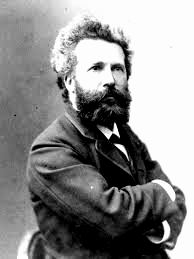
Camille Flammarion
excitingly new. Flammarion even put into Burroughs’ mind that time itself had no independent existence. Mind boggling stuff.
I believe that by now Bibliophiles have assembled a library of books that Burroughs either did read or is likely to have read before 1911 that number at least two or three hundred. Of course, without radio, TV, or movies for all of Burroughs’ childhood, youth and a major portion of his young manhood, although movies would have become a reality by the time he began writing, there was little entertainment except reading. Maybe a spot of croquet.
As far as reading goes I suspect that ERB spent a significant portion of his scantily employed late twenties and early thirties sitting in the Chicago Library sifting through the odd volume. It can’t be a coincidence that Tarzan lounged for many an hour in the Paris library before he became a secret agent and left for North Africa.
I have come across a book by the English author Charles Howard Hinton entitled Scientific Romances of which one explores the notion of a fourth dimension . Hinton is said to have been an influence on H.G. Wells’ The Time Machine. It seems certain that Burroughs read The Time Machine while he would have found many discussions of the fourth dimension as well as other scientific fantasies in the magazines and even newspapers as Hillman has so amply demonstrated on ERBzine. We also know that ERB had a subscription to Popular Mechanics while probably reading Popular Science on a regular basis. Popular Science was established in 1872.
It is clear that ERB was keenly interested in psychology and from references distributed throughout the corpus, reasonably well informed.
I wouldn’t go so far as to maintain that ERB read the French psychologist Theodore Flournoy’s From India To The Planet Mars but George T. McWhorter does list it as a volume in Vern Corriel’s library of likely books read by Burroughs. The book was published in 1899 just as Burroughs was entering his very troubled period from 1900 to 1904-05 that included his bashing in Toronto with subsequent mental problems, a bout with typhoid fever and his and Emma’s flight to Idaho and Salt Lake City. So that narrows the window down a bit.
However the book seems to describe the manner in which his mind worked so that it provides a possible or probable insight into the way his mind did work.
ERB’s writing career was born in desperation. While he may say that he considered writing unmanly it is also true that he tried to write a lighthearted account of becoming a new father a couple years before he took up his pen in seriousness. Obviously he saw writing as a way out. His life had bittely disappointed his exalted expectations hence he would have fallen into a horrible depression probably with disastrous results if the success of his stories hadn’t redeemed his opinion of himself.
Helene Smith the Medium of Fluornoy’s investigation into mediumship was in the same situation. Her future while secure enough in the material sense, as was Burroughs, fell far short of her hopes and expectations. Thus she turned to mediumship to realize herself much as Burroughs turned to literature. She enjoyed some success and notoriety attracting the attention of, among others, the psychologist Theodore Flournoy. Fournoy who enjoyed some prominence at the time, was one of those confusing spiritualism with science because of his misunderstanding of the unconscious. Thus as Miss Smith unfolded her conversations with the inhabitants of Mars it was taken with some plausibility.
If any readers I may have have also read my review of Du Maurier’s Peter Ibbetson he or she will remember that Peter and Mary were restricted in their dream activities to only what they had done, seen and remembered or learned. As I have frequently said, you can only get out of a mind what has gone into it. In this sense Miss Smith was severely handicapped by an inadequate education and limited experience. While she was reasonably creative in the construction of her three worlds- those of ancient India, Mars and the court of Marie Antoinette- she was unable to be utterly convincing. In the end her resourcefulness gave out and the scientific types drifted away. She more or less descended into a deep depression as her expectations failed. Had she been more imagination she might have turned to writing as Burroughs did.
If Burroughs did read Flournoy, of which I am not convinced, he may have noted that Miss Smith’s method was quite similar to his habit of trancelike daydreaming that fulfilled his own expectations of life in fantasy.
In Burroughs’ case he had the inestimable advantage of having stuffed his mind with a large array of imaginative literature, a fairly good amateur’s notions of science and technology, along with a very decent range of valuable experience. His younger days were actually quite exciting. He was also gifted with an amazing imagination and the ability to use it constructively.
Consider this possibility. I append a poem that he would have undoubtedly read- When You Were A Tadpole And I Was A Fish. Read this and then compare it to The Land That Time Forgot.
Evolution
by
Langdon Smith
When you were a tadpole and I was a fish
In the Paleozoic time,
And side by side on the ebbing tide
We sprawled through the ooze and slime,
Or skittered with many a caudal flip
Through the depths of the Cambrian fen,
My heart was rife with the joy of life,
For I loved you even then.
Mindless we lived and mindless we loved
And mindless at last we died;
And deep in the rift of the Caradoc drift
We slumbered side by side.
The world turned on in the lathe of time,
The hot lands heaved amain,
Til we caught our breath from the womb of death
And crept into light again.
We were Amphibians, scaled and tailed,
And drab as a dead man’s hand;
We coiled at ease ‘neath the dripping trees
Or trailed through the mud and sand.
Croaking and blind, with out three-clawed feet
Writing a language dumb,
With never a spark in the empty dark
To hint at a life to come.
Yet happy we lived and happy we loved,
And happy we died once more;
Our forms were rolled in the clinging mold
of a Neocomian shore.
The eons came and the eons fled
And the sleep that wrapped us fast
Was riven away in a newer day
And the night of death was past.
Then light and swift through the jungle trees
We swung in our airy flights,
Or breathed in the balms of the fronded palms
In the hush of the moonless nights;
And, oh! what beautiful years were there
When our hearts clung each to each;
When life was filled and our senses thrilled
In the first faint dawn of speech.
Thus life by life and love by love
We passed through the cycles strange,
And breath by breath and death by death
We followed the chain of change,
Till there came a time in the law of life
When over the nursing side
The shadows broke and the soul awoke
In a strange, dim dream of God.
I was thewed like Auroch bull
And tusked like the great cave bear;
And you, my sweet, from head to feet
Were gowned in your glorious hair,
Deep in the gloom of a fireless cave,
When the night fell o’er the plain
And the moon hung red o’er the river bed
We mumbled the bones of the slain.
I flaked a flint to a cutting edge
And shaped it with brutish craft;
I broke a shank from the woodland lank
And fitted it, head and haft;
Then I hid me close to the reedy tarn,
Where the mammoth came to drink;
Through the brawn and bone I drove the stone
And slew him upon the brink.
Loud I howled through the moonlit wastes,
Loud answered our kith and kin,
From west and east to the crimson feast
The clan came tramping in.
O’er joint and gristle and padded hoof
We fought and clawed and tore,
And cheek by jowl with many a growl
We talked the marvel o’er.
I carved that fight on a reindeer bone
With rude and hairy hand;
I pictured his fall on the cavern wall
That men might understand,
For we lived by blood and the right of might
Ere human laws were drawn,
And the age of sin did not begin
Till our brutal tush were gone.
And that was a million years ago
In a time that no man knows;
Yet here tonight in the mellow light
We sit at Delmonico’s.
Your eyes are deep as the Devon springs,
Your hair is dark as jet,
Your years are few, your life is new,
Your soul untried, and yet-
Our trail is on the Kimmeridge clay
And the scarp of the Purbeck flags;
We have left our bones in the Bagshot stones
And deep in the Coralline crags;
Our love is old, our lives are old,
And death shall come amain;
Should it come today, what man may say
We shall not live again?
God has wrought our souls from the Tremadoc beds
And furnished them wings to fly;
He sowed our spawn in the world’s dim dawn,
And I know that it shall not die,
Though cities have sprung above the graves
Where the crook-bone men make war
And the oxwain creaks o’er the buried caves
Where the mummied mammoths are.
Then as we linger at luncheon here
O’er many a dainty dish,
Let us drink anew to the time when you
Were a tadpole and I was a fish.
With something like that stuffed into his subconscious what wonders might ensue. Obviously The Land That Time Forgot and The Eternal Lover.
As Miss Smith had turned to spiritualism and mediumship, Burroughs turned his talents to writing. According to himself he used essentially mediumistic techniques in hiswriting. He said that he entered a tracelike state, what one might almost call automatic writing to compose his stories. He certainly turned out three hundred well written pages in a remarkably short time with very few delays and interruptions. He was then able to immediately begin another story. This facility lasted from 1911 to 1914 when his reservoir of stored material ws exhausted. His pace then slowed down as he had to originate stories and presumably work them out more rather than just spew them out.
Curiously like Miss Smith he created three main worlds with some deadends and solo works. Thus while Miss Smith created Indian, Martian and her ‘Royal’ identity Burroughs created an inner World, Tarzan and African world, and a Martian world.
Perhaps in both cases three worlds were necessary to give expression to the full range of their hopes and expectations. In Burroughs’ case his worlds correspond to the equivalences of the subconscious in Pellucidar, the conscious in Tarzan and Africa and shall we say, the aspirational or spiritual of Mars. In point of fact Burroughs writing style varies in each of the three worlds, just as they did in Miss Smith’s.
Having exhausted his early intellectual resources Burroughs read extensively and exhaustively to recharge his intellectual batteries. This would have been completely normal because it is quite easy to write oneself out. Indeed, he was warned about this by his editor, Metcalf. Having, as it were, gotten what was in your mind on paper what you had was used up and has to be augmented. One needs fresh experience and more knowledge. ERB was capable of achieving this from 1911 to about 1936 when his resources were essentially exhausted. Regardless of what one considers the quality of the later work it is a recap, a summation of his work rather than extension or innovatory into new territory. Once again, not at all unusual.
As a child of his times his work is a unique blend of science and spiritualism with the accent on science. One can only conjecture how he assimiliated Camille Flammarion’s own unique blend of spiritualism and science but it would seem clear that Flammarion inflamed his imagination setting him on his career as perhaps the world’s first true science-fiction writer as opposed to merely imaginative or fantasy fiction although he was no mean hand at all.
Tarzan Over Africa
February 23, 2009
Tarzan Over Africa
The Psychological Roots Of Tarzan In The Western Psyche
by
R.E. Prindle
As the strong man exhibits in his physical ability, delighting in such exercises as call the muscles into action, so glories the analyst in that moral activity which disentagles. He derives pleasure from even the most trivial occupations bringing his intellect into play. He is fond of enigmas, conundrums, hieroglypics; exhibiting in his solutions of each a degree of acumen which appears to the ordinary apprehension as praeternatural. His results brought about by the very soul and essence of method, have in truth, the whole air of intuition.
Edgar Allen Poe- The Murders In The Rue Morgue
…he dreams of the sight
of Zulu impis
breaking on the foe
like surf upon the rocks
and his heart rises in rebellion
against the strict limits
of civilized life.
H. Rider Haggard- Allan Quatermain
Yes! I noticed this dichotomy in the Western soul myself at least two thirds of a lifetime ago. I was always puzzled by it. Why in the midst of plenty and seeming perfection should the Western psyche be so discontented with its lot.
Well, time has passed. Two thirds of a lifetime in fact. After much mental lucubration and travail I now find myself in a position not only to understand it myself but to be able, perhaps, to make it clear to others; perhaps hopefully to you who are looking at this screen.
The problem began we are told, by people who ought to know, about one hundred fifty thousand years ago when our species, Homo Sapiens, evolved from its predecessor hominid, which has never been traced being the famous Missing Link, to begin its odyssey through time and space.
We are told that Homo Sapiens originated in Africa and that Black Africans, or what Tarzan would call savages, were the first Homo Sapiens. We are told, once again, that White people mutated from this original Black stock. This may or may not be so. I am in no position to affirm or deny the fact myself but, if so, there was a qualitative difference as well as a quantitative difference that then occurred. In fact, if one were to judge solely from appearances two sub-species of Homo Sapiens came into existence when the White evolved from the Black. This qualitative difference between the sub-species or what we have been taught to consider races, was noticed by all the early explorers with differing interpretations.
As the English novelist, H. Rider Haggard, who as a man of considerable experience and acumen, put it:
I say that as the savage is, so is the white man, only this latter is more inventive, and possesses a faculty of combination…
Rider Haggard was quite right, both sub-species evolved from the same stock, both had the same emotional makeup, but what Haggard dismisses as only ‘more inventive’ and ‘a faculty of combination’ is precisely that which separates the White sub-species from the Black sub-species and makes it evolutionarily more advanced. In conventional terms invention and a faculty of combination is called the scientific method.
The scientific method is not to be dismissed lightly. It is a faculty of mind that is an evolutionary step in advance of the White sub-species’ evolutionary predecessor, the Black sub-species.
This may be a startling interpretation to you, however if one is to follow the scientific logic adduced by scientists of Evolution the facts follow as day follows night. They cannot be avoided nor can they be explained away. They must be dealt with head on, just as our Attorney General Eric Holder has stated.
The evolutionary step within the Homo Sapiens species is almost tentative to our White minds, not so clear cut as to separate, say, the Chimpanzee species from the Gorilla species. The transition is however in that direction.
In the nineteenth century the cleavage between the scientific mind and that of the savage or first Homo Sapiens mind was beginning to become felt in the Western psyche. A malaise of spirit was created which troubled the soul of Western man. The ‘strict limits’ of scientific civilization versus the seeming naturalness and open simplicity of the African became a dichotomy in the Western psyche.
Haggard was not the first to confront the problem but before I begin at the beginning with who I consider to be the first let me elucidate the problem further by another quote from Rider Haggard.
Ah! this civilization what does it all come to? Full forty years and more I spent among savages, and studied them and their ways, and now for several years I have lived here in England and in my own stupid manner have done my best to learn the ways of the children of light; and what do I find? A great gulf fixed? No, only a very little one, that a plain man’s thought may spring across.
Haggard was quite correct as far as he went. What he failed to understand, ‘in his own stupid way’, was that there was a small gulf over which civilized man thinks he could spring backward without difficulty but from the other side that small gulf appears a great chasm which the completed mind of the first Homo Sapiens can never find a way across.
Edgar Rice Burroughs who read Haggard and was also struck by this really important introductory chapter to ‘Allan Quatermain’ pondered the issue long and hard and resolved the issue in his own mind when he said that the savage mind could never grasp science while only one in a hundred of the White species could, with perhaps one in a thousand being able to advance science. ERB intuited what modern genetics would prove.
This dichotomy between the primitive and scientific mind does not become truly prominent until the mid-nineteenth century. It wasn’t observable to the naked eye before then and only begins to establish itself in literature with the apperance in 1841 of Edgar Allan Poe’s ‘Murders In The Rue Morgue.’
Poe created a whole new genre of literature, not only of the detective story, but of the conflict between what Freud would later identify in his system as the Unconscious and the Conscious mind. Prior to Poe reason, or the forebrain, was the sole approach to knowledge; after Poe awareness of the Unconscious element began its long rise until today it is dominant.
When dissatisfaction with Haggard’s strict limits of civilization began to forcibly intrude into White consciousness, causing the split identity, is not clear to me although it may well have been the introduction of the Age of Steam. Certainly by 1841 the intrusion of the steam railroad was going a long way to condition man’s mind to a rigid one way view of reality as laborers spun out the long steel ribbons along which the great unyielding iron locomotives ran.
The science of steam was unforgiving, with a low level of tolerance for human error, and making no allowance for individual idiosyncracies.
In the days of the great steamboat races on the Mississippi boiler pressure was controlled by a little governor. Greater speed could be attained if the governor was removed allowing boiler pressure to increase. Of course, the inevitable result was the explosion of the boiler and destruction of the steamboat and crew. Even knowing the scientific consequences of removing the governor operators time after time did it in hopes of defeating physics and winning the race.
Thus science seemed ‘unfair’ and the White man’s limited undeveloped understanding began to rebel.
When evolution gave man access to science he reached the limits of what human exertion alone could do. Thus the forebrain was frustrated, driving it back toward the brain stem and the Unconscious. A new scientific frontier was opened thereby- the study of the human mind.
Edgar Allan Poe grasped this significance expressing it in poetic language. ‘Murders In The Rue Morgue’ posits the problem in the form of C. Auguste Dupin who, while using rigorous scientific method is mistaken for being intuitive. The Conscious mind versus the Unconscious.
The Unconscious is always disreputable. It is there that little understood sexual urges and primitive egoistic rituals reside. It is there that the primitive man resides; the savage of Rider Haggard, the Negro of the present day. It is there that the Western psyche rebels, seeking to emerge triumphant over science and understanding. That is the little leap backwards that Rider Haggard saw. In academic writers of the nineteenth century it was called ‘the thin veneer of civilization.’
Thus the initials of C. Auguste Dupin spell CAD, or a slightly disreputable man. A man who thinks only of himself. If Poe doesn’t introduce the notion of the doppel ganger, he certainly defines the role and purpose. Dupin and the narrator are two halves of the same person. They are in fact one personality.
This notion would be further developed in Conan Doyle with his creation of Sherlock Holmes and his doppelganger, Dr. Watson. The notion would be brought to horrifying fruition in the classic tale of the split between the conscious and unconscious minds, Robert Louis Stevenson’s ‘Dr. Jekyll And Mr. Hyde.’
Poe’s narrator being of greater means than Dupin who is seedy and down at the heels rents an old dilapidated house in the Faubourg St. Germain which creaks as lustily as the House of Usher. The house is a symbol of psychological decay. The Faubourg St. Germain is itself a symbol of decay. Formerly the home of the pre-revolutionary elite, since the French Revolution it is the home of shattered fortunes.
The two men, who are inseparable, lock themselves up in this mansion by day with all the curtains drawn, sure sign of intense depression, going out only after dark into what the narrator calls the ‘real night’ as opposed to the night of the soul; the dark Freudian unconscious.
And then two women are murdered in mysterious circumstances. Using all his scientific method Dupin divines the murderer to be an Orang-outang, which was no small feat whether scientific or intuitive. Thus the highest mental powers were symbolically pitted against man’s animal nature.
Poe thus states the central problem of the Western psyche which is still unresolved at this time while still being discussed as much. While Rider Haggard was wrestling with the problem Conan Doyle was writing his Sherlock Holmes stories. Holmes like Dupin is a bit of a cad; not entirely an admirable person. He has placed himself above the law, being quite capable of executing summary judgment on one who might in his sole opinion escape the toils of the law. Holmes companion, Dr. Watson, is a sturdy unimaginative burgher who serves as the example of the unconscious to Holmes’ conscious but scientifically unfeeling mind.
Robert Louis Stevenson takes matters to an even more intense level at roughly the same time. Jekyll and Hyde are in fact one man. Jekyll is the example of what Freud would call the repressed man but one which society calls a disciplined and respectable man. He is in total control of himself but he suspects there is another side to his character which he would like to discover.
Unable to find access to this other side by psychological or rational means, he uses his scientific acumen to invent a potion which releases this demon, Mr. Hyde, concealed inside his unconscious. Hyde is a very destructive character and having been once released he proves impossible to put back in the bottle. He returns unsummoned. Eventually he suppresses Jekyll becoming the sole personality. The jump only works one way.
Thus Stevenson predicted the evolution of the twentieth century. This little cluster of writers bridging the nineteenth and twentieth centuries is very interesting.
In the intervening near fifty years between ‘Murders In The Rue Morge’ and ‘Dr. Jekyll And Mr. Hyde’ science had been revealing nature at a galloping pace placing even greater stress on the Western psyche. Central to the further deteriorization of the psyche was Charles Darwin’s ‘Origin Of Species’ which appeared in 1859 just on the eve of the exploration of Central Africa when the stressed scientific Western psyche confronted its dark unconscious in the form of the African Black man. Thus Africa became the Heart Of Darkness for the White man just as Hyde was the heart of darkness to Jekyll. That little gulf across which he thought he might leap appeared as a gigantic chasm.
The notion of evolution versus Biblical creation not only caused a tremendous social dislocation but the notion of evolution from a lower to a higher, from Ape to White man, placed the Black man or Negro in an intermediary state of development just as Burroughs would later depict the role of Tarzan Of The Apes.
Beginning c. 1860 with the expedition of Capt. Richard Francis Burton into the lake regions of Central Africa the problem began to take a concrete form.
What the White Man found in the interior of Africa startled him. For here the dichotomy between his unconscious and conscious was juxtaposed in reality between himself and the Black African. The Black African seemed to represent unchanged what man had been one hundred fifty thousand years before when he evolved from the hominid predecessor.
For Burton and Henry Morton Stanley who followed him as an explorer the superiority of the White was apparent. In the Negro they saw only the child of nature; men without alphabets, physics, chemistry, astronomy or intellectual attainments of any kind. The Negro was to be pitied, treated paternalistically as a little brother or as the Negro would later be known: The White Man’s Burden, Idi Amin notwithstanding.
The main period of exploration and discovery was ending when Rider Haggard began publishing his great African adventure trilogy from 1885 to 1888.
While Burton and Stanley felt an easy superiority over the Blacks, Rider Haggard took a more disquieted attitude. He was troubled when he noted that for all the White man’s scientific attainments there was no difference in the emotional development of the two sub-species.
And what did he find? A way forward? A great gulf fixed? No. ‘Only a little one, that a plain man’s thought might spring across. I say,’ he said, ‘that as the savage is, so is the white man, only the latter is more inventive, and possesses a faculty of combination…’
Well, indeed. But wasn’t Haggard undervaluing the quality of being more inventive and possessing a faculty of combination? Those two qualities, after all, comprise the scientific faculty which cannot be attained by effort but is evolutionarily ingrained. It is forever beyond the reach of the first Homo Sapiens. Haggard and all other writers recognized that this faculty is what the Africans lacked.
Consider then in one hundred fifty thousand years the Africas were so incurious that they had never observed the heavens. They had no astronomy! When the White split off probably one hundred thousand years ago this is the first science they established. Think about it.
Is this scientific faculty such a small thing? If, in fact, a White man of plain understanding can make the leap backward to a natural state can the Black or natural man leap the chasm to a scientific state of consciousness?
Darwin’s theory of evolution is based on natural selection, actually a form of eugenics, by which he believed new species were evolved. It would appear, however that evolution is caused by genetic mutations and when a species has mutated into the complete expression of itself evolution stops for that species which then becomes, as it were, a living fossil.
Rather than natural selection there is perhaps natural rejection. When a new sub-speices forms with its differences it is more likely that the predecessor recognizes the differences and ejects the new comer rather than the new species recognizing itself and banding together. Consider Tarzan among the apes.
When the White sub-species came into existence perhaps one hundred thousand years ago it is more than probable that the sub-species was rejected by its Black predecessors and forcibly ejected from sub-Saharan Africa.
Thus in the two closest known predecessors of Homo Sapiens, the Great Mountain Ape and the Chimpanzee both species are completed and now await extinction as they are unable to compete with their successor hominids.
Scientists tell us, I have no way of disputing their conclusion only interpreting them, that Homo Sapiens evolved from a predecessor about a hundred fifty thousand years ago. They further tell us that the first Homo Sapiens was the Negro sub-species.
The predecessor, who has disappeared without a trace, unless he is the Bushman, was a completed species; he was incapable of further evolution himself but from him the Negro sub-species of Homo Sapiens evolved.
Now comes the hard part to accept. Science is science; one must either follow its facts or abandon the pretence of being scientific man.
As the first Homo Sapiens was the Negro sub-species, is the Negro sub-species complete as an example of evolutionary development? If the Negro was the first Homo Sapiens then the White sub-species must be evolved from the Negro and as nature is ever groping toward higher intelligence the White must be an intellectual improvement on its Black predecessor. The apparent facts indicate this.
Evolution appears to be always toward a form of higher intelligence. Thus the qualities of combination and inventiveness may be completely beyond the reach of the Black sub-species. The Black may stand in relation to the White as the Great Mountain Ape stands to the Chimp.
Further, if one assumes, as one must, that evolution has not stopped either with the development of Homo Sapiens or its sub-species the White man, then the White man must carry the genetic makeup for the mutation to the next step of evolution. As only fifty thousand years intervened between the evolution of the first Homo Sapiens and its White successor than the next evolutionary sub-species or species may already be among us. This is what H.G. Wells novel The Food Of The Gods is about. Apparently the evolutionary bud, like a swelling on a tree, may only blossom once and then the sub-species or species is incapable of budding again becoming fixed in form
The question then arises will the next step be to a new species that will make Homo Sapiens a completely inferior species such as now exists between Homo Sapiens and the Chimpanzee or a new sub-species that will merely increase the distance between it and the first sub-species.
If the new mutation increases its intellectual capabilities will it also be able to evolve a new emotional organization that will separate it from Homo Sapiens and its animal nature completely? Or is it possible that the dichotomy between the two under which Western man suffers will increase involving some sort of evolutionary insanity or suicide?
Well, as the nineteenth century drew to a close vitamins hadn’t even been discovered let alone genetics so people muddled along in a dissatisified condition.
The unconscious aspects of man began to predominate over the conscious as Western man confronted with his natural state in Africa began to slip back across the little gulf in admiration of the seeming ‘natural ‘ state of the ‘noble savage.’ This slip backward was aided and abetted by Sigmund Freud’s vision of the unconscious.
Late in the century Thomas Alva Edison invented the movie camiera. This invention was to have a major effect on the rise of the Unconscious or retrogression to the primitive as the dominating factor in the Western psyche. At approximately the same time as the film industry was becoming important Sigmund Freud published his seminal work: The Interpretation Of Dreams. Thus a scientific vocabulary began to come into existence by which the workings of the mind could be analyzed and discussed. the Unconscious became an established entity.
Now, writing is work of the forebrain or in other words, a scientific pursuit, while movie making is a function of the Unconscious. A good story is more important in writing while subliminal drives are the stuff of movies. It is only required that movies make emotional but not rational sense. They follow a different logic.
Edgar Rice Burroughs was to be confused by this difference when he tried to translate his books to the screen. While the early Tarzan films were not unsuccessful they were not all that satisfying; it was not until MGM invented the Tarzan of primal desires impersonated by Johnny Weismuller that the movie Tarzan became potent. However in that guise Tarzan was entirely another creation. His being had become independent of ERB’s mind.
One movie is capable of finding more viewers than a thousand books can find readers. Thus the subconscious began to dominate over the conscious Tarzan.
I am of the opinion that Freud was already aware of the effect of the emergence of the Unconscious as a formative factor in society before he codified the phenomenon in scientific language. After all Freud was subject to the same influences as Poe, Haggard, Doyle, Stevenson and Burroughs.
Freud himself came from an earlier school which delighted in the unrestrained indulgence of the unconscious or passions. In English terms the attitude took form as the Hell Fire Club to which the American Benjamin Franklin belonged. Its motto was: Do What Thou Wilt. Its bible on the continent was ‘Gargantua and Pantagruel’ by Rabelais, while in Jewish circles the credo had been established by Jacob Frank and his descendants. Frank’s position was that man will never be good until he commits evil to his heart’s content. Freud being Jewish was of this school.
These groups of people were quite extreme. Their credo was startlingly expressed in the eighteenth century by Tobias Smollet when his hero, Roderick Random, is introduced into a woman’s home who wrote the following:
Thus have I sent the simple king to hell
Without or coffin, shroud or passing bell.
To me what are divine or human laws?
I court no sanction but my own applause!
Rapes, robb’ries, treasons, yield my soul delight;
And human carnage gratifies my sight;
I drag the parent by the hoary hair,
And toss the sprawling infant on my spear,
While the fond mother’s cries regale my ear.
I fight, I vanquish, murder friends and foes;
Nor dare the Immortal gods my rage oppose.
The above pretty much defines Freud’s intent in his psychology. So long as such sentiments were consciously expressed in print they horrified a rational thinker while remaining strictly an underground movement. But now Freud combined the attitude with the malaise of soul which had been called into existence by the dichotomy of the scientific and unconscious minds.
Freud reduced the mind, including the Unconscious, into scientific terms by which such Rabelaisan attitudes could be discussed and disseminated into polite society as scientific thought rather than eccentric opinion.
Freud despised what he called the morality of the day or in other words, Christian morality. He determined that the main cause of mental illness was the repression of disorderly or anti-social desires. He glorified these base desires as the Ego and proclaimed that where the Unconscious was Ego shall be. This is another way of saying: Do What Thou Wilt.
Thus in the decades following Freud the whole notion of self control and a disciplined mind fell into disrepute as Western man began to revel in his most criminal desires; for the Unconscious which always disregards the rights of others is alway criminal.
So it was that the terrible figure of Dracula who began his rise in the 1890s became the dominant psychological projection of the twentieth century. Dracula is the Unconscious incarnate. Completely despising the rights of others, even their right to life; he sucks anyone’s life blood so that he alone may live.
Like Dupin and the narrator of ‘Murders In The Rue Morgue’ Dracula only comes out in the ‘real night’. In fact, one ray of the sun, in other words, consciousness, will turn him to dust. Light is anathema to him; he must shun the day.
Alongside Dracula the cult of the Phantom Of The Opera has grown into huge proportions being disseminated to polite society by Andrew Lloyd Weber’s opera of the same name.
Talk about conscious and unconscious, the Phantom lives in a sewer, the very home of the Unconscious, where he has installed a huge organ on which he plays the most glorious conscious creations of Johann Sebastian Bach.
Deformed in soul, the deformation has been extended to his exterior in the form of a burned face which he covers with a mask just as one masks one’s interior motives from others. Attracted to the higher things from the depths of his sewer he haunts an opera house directly above where, spying from secret passages, he falls in love with the beautiful opera singer who, initially repulsed by the soul shown on his face gradually succumbs to the lure of the unconscious.
Edgar Rice Burroughs was born into this strange social milieu, as we know, in 1875. Seemingly failing in every thing he did, he had scant prospects in life until at the age of 37 in 1912 his education jelled into the creation of his life, Tarzan the Magnificent.
Tarzan is extraordinary in that he runs counter to the other expressions of the Western malaise. Tarzan is whole and entire. In Freudian terms, where Unconscious was, now Ego reigned and it was good Ego, not the criminal model of Freud.
As Tarzan was, so must have been Burroughs, although I have no idea how he achieved this. It appears, nevertheless, to be true. In fact, whatever Burroughs read or was thinking about he seems to have resolved in Tarzan the mental dilemma which was first formulated by Poe. Further, he acknlowledges Poe’s influence.
We know that Burroughs read and revered the African adventure novels of Rider Haggard. It can be stated certainly that he read the African explorers Capt. Richard Burton and Henry Morton Stanley. Whether he read the other seekers of the source of the Nile, Speke and Baker, I don’t know, as I cannot so state with certainty. It is not impossible that Baker’s wife was a model for Jane.
It is certain nevertheless that the great age of African exploration thrilled him while occupying a prominent place in his daily thoughts.
Being scientifically inclined, he applied his reading in evolution, exploration, geology, psychology and other subjects to the formation of his great creation, Tarzan. As he says, he wrote to amuse and entertain (read: make money) so that he expressed the results of his deepest study in seemingly frivolous tales. Then, while he captured the imagination of the reading public, he offended the critics of ‘serious’ literature who refused to take him seriously. He even found it difficult to find a book publisher even though he was a proven popular success.
Yet he pondered deeply the dilemma propounded by Poe while apparently puzzling out the deeper meaning of Haggard’s introductory chapter to ‘Allan Quatermain.’ Stevenson’s Jekyll and Hyde filled his thoughts.
There is little doubt that Haggard’s hero, Sir Henry Curtis, is a progenitor of Tarzan. One can see Tarzan in the great White English warrior standing tall in a sea of Black soldiers. Sir Henry Curtis leads the Black Kukuana into battle against their foes. The first Big Bwana had come into existence.
Burroughs wants his hero Tarzan to be born in Africa so in 1888 the year ‘Allan Quatermain’ was published and Sir Henry Curtis sealed himself in his valley high in the Mountains Of The Moon, Lord Greystoke and his wife, the Lady Alice Greystoke are abandoned on the West Coast of Africa where, as we know, they both lost their lives but not before Lady Alice gave birth to a son who was then adopted by the great she ape, Kala.
In The Return Of Tarzan the putative successor to Lord John Greystoke is voyaging through the Suez Canal around Africa in his yacht, the Lady Alice, when he is shipwrecked near the exact spot where his father and mother built their tree house in Africa.
To understand fully this sequence in Burroughs’ imagination one has to examine the other source for his creation, Tarzan- Henry Morton Stanley.
There can be no question that before Burroughs wrote Tarzan he had read if not studied the books of H.M. Stanley. And, why not? Stanley’s most important titles are: How I Found Livingstone In Central Africa, Through The Dark Continent and In Darkest Africa.
‘Through The Dark Continent’ is one of the great adventure stories of all time. The conscious living out of Stanley’s unconscious needs and desires is remarkable reading.
One might think that Burroughs’ yacht ‘Lady Alice’ was named after Clayton’s mother, Lady Alice Greystoke. Not so. Burroughs is full of subtle jokes and elaborate circumlocutions. If not Clayton’s mother then how did Burroughs come up with the name ‘Lady Alice’ for the yacht? Well, if you read Stanley’s ‘Through The Dark Continent’ you will find that he carried for thousands of miles through Africa a boat in sections that could be broken down and rebuilt. With this boat Stanley circumnavigated Lake Victoria as well as Lake Tanganyika, then sailed the boat down the entire length of the mighty Congo River. That boat was named the Lady Alice. Thus Tarzan like Stanley was carried by the Lady Alice. That’s a very subtle joke, Son. Stanley himself had named the boat after his Cincinnati fiancee, Alice. During his sail down the Congo she ditched him for another man. In weird synchronicity Stanley ditched the Lady Alice on a bluff overlooking the Atlantic nearly at the end of his journey. What a true coincidence.
As an aside, the psychology of it is very interesting. Psychologically a vessel represents a woman. the Holy Grail which is a chalice represents woman while the blood it contains represents man. Thus you have the man, Stanley in the boat, woman. Stanley’s mother abandoned him as a child. He saw her only once thereafter. Thus, his mother, the most important woman in any man’s life abandoned him. In the Lady Alice, Stanley was obviously carried once again by his mother although I don’t know if her name was Alice also. He then abandoned his boat the Lady Alice.
Stanley didn’t follow the Congo to the sea as is popularly believed but abandoned the river after traversing an incredible series of rapids when he came to an identified rapids at Stanley Pool where, completely exhausted and having reached an explored point, he considered his job done. He had the Lady Alice carried to a hill top where he left it to the elements. Now, in Burroughs mind he may have landed the Lady Alice at the approximate place he thought Stanley had abandoned his Lady Alice. So, Tarzan’s house may have been intended to be on the coast directly below the Lady Alice. That would also make the location in Gabon. In that sense Tarzan was the successor of H.M. Stanley.
One may therefore assume that the Greystokes were put ashore near the mouth of the Congo where the fictional yacht Lady Alice ws shipwrecked within sight, as it were, of the real Lady Alice. That’s how the mind of Edgar Rice Burroughs worked.
On his way from England on the Emin Relief Expedition which forms the content of ‘In Darkest Africa’ just like Lord Greystoke Stanley sailed from England through the Suez to Zanzibar where he collected his porters, sailed with them to Capetown and from thence to the mouth of the Congo. Then Stanley began his incredible journey up the Congo across Africa from West to East into the Northern lake regions where on this trip he located and identified the fabled and thought mythical, snow capped on the equator, Mountains Of The Moon.
Anyone who doesn’t admire Henry Morton Stanley has the heart of a dullard. What a man! What terrific incredible adventures. I’d rather read about them than live them myself but what a story. So thought Edgar Rice Burroughs who never tried to live such adventures either.
Very important to Tarzan is Stanley’s dealings with the various African tribes. Stanley is virtually a single White man leading a faithful band of Negroes just like Tarzan and his faithful Waziri.
Africa was virtually Stanley’s province as it was for Tarzan. Tarzan’s reputation was far famed throughout Africa or at least the areas of Africa through which Stanley traveled. Tarzan doesn’t have much to do with South Africa which has no association with Stanley although Tarzan does travel in North Africa of which Samuel Baker wrote.
Stanley, whose three major expeditions covered a period of about fifteen years must also have become legendary amongst the Blacks. The exploration of Lakes Victoria and Tanganyika coupled with the journey down the Congo must have been the subject of astonished conversation in every village in Central Africa. The more so because Stanley was on scientific expeditions to map geographical features like lakes and rivers which reason no African could ever comprehend.
They could comprehend slaving and ivory buying but they couldn’t comprehend scientific endeavors.
Stanley’s situation in Uganda near the Ripon Falls, the outlet of the Nile from Lake Victoria, with its emperor Mtessa is the stuff of legend for either Blacks or Whites. Stanley, virtually singlehandedly at the head of a band of African natives successfully negotiated months at the court of Mtessa and lived to the tell the tale which I believe few could have accomplished. Then traveling South through areas that had never seen a White man he successully negotiated the circumnavigation of Lake Tanganyika. Both Victoria and Tanganyika are among the largest bodies of fresh water on earth, huge lakes. Then transporting the Lady Alice to the Congo he made the extraordinarily hazardous descent of that enormous and hostile river. This is really mind boggling stuff.
There are too many allusions in Burroughs to the adventures of Stanley to believe that he wasn’t a source for Tarzan.
As more or less an aside there is even a possible allusion to a scene in Burton’s ‘Travels In The Lake Regions Of Central Africa.’ Burton describes in particularly vivid detail an apparition he had while suffering from fever. In a fairly remarkable psychological projection he experienced himself as two different people, not unlike Jekyll and Hyde, who were at war with each other; the one attempting to defeat the best efforts of the other.
In 1857 this psychic manifestation could not be understood. Today it can be interpreted. It would seem that Burton was consciously aware that he seemed to thwart his own projects. He undoubtedly worried about this a great deal but as an unresolved subconscious controls the conscious mind he couldn’t penetrate the mystery.
Under the influence of malarial fever the psychic barriers of the subconscious broke down and his desire was shown to him symbolically by his unconscious mind. Had Burton been psychologically capable of pursuing this insight to its logical conclusion unearthing the fixation on which it was based then he would have resolved his problem and integrated his personality becoming a single unit or whole person. His legs wouldn’t have given out on him as he came close to his goal. Depth psychology was unknown in 1857 so the psychological manifestation remained a mystery to him.
It seems clear that Burroughs was equally impressed by this incident which he later used to create an alter ego for Tarzan called Esteban Miranda. If you recall, Miranda’s inept activities were bringing Tarzan into disrepute. Africa began to wonder.
As the evolution of Tarzan, as I mentioned in my earlier essay, the idea of Tarzan entered the back of Burroughs’ mind bearing a candle which in a pitch black cave is a pretty strong light. This idea was probably an identification with Sir Henry Curtis of Rider Haggard but Burroughs was unable to develop the train of thought when he came to the water barrier in the vaults of Opar.
Tarzan successfully leaped the barrier but Burroughs lost his train of thought when the candle symbolically blew out leaving the idea of Tarzan to gestate in his subconscious. There Curtis slowly combined with Henry Morton Stanley to erupt from Burroughs’ forehead fully formed in 1912 as Tarzan.
Burroughs probably read Stanley in the nineties. His creative juices would have been jogged when Stanley died in 1905. Stanley’s devoted wife gathered several chapters of Stanley’s autobiography of his childhood, composed by himself, then cobbled together the rest of his life from diaries, news clippings and the like.
Stanley’s autobiography was released in 1909. The first Tarzan book was written in 1912. I don’t know when Stanley’s autobiography came to Burroughs’ attention but sometime before 1912 he read it completing the idea of Tarzan in his mind. As Burroughs’ prospectus to All Story Magazine indicates, Burroughs was struggling to combine a number of ideas into the entity that was to become Tarzan.
The publication of Stanley’s autobiography plus the pressure at age 37 of having to so something to merit his high opinion of himself probably forced the jelling of the idea of Tarzan which erupted from his forehead bearing gold ingots like Tarzan emerging from the rock of Opar above the gold vaults.
Burroughs now had the ideal vehicle to give expression to all his social theories. Critics may see Burroughs as a mere shallow entertainer but I don’t. I bought my first Tarzan book the year Burroughs died in 1950 with I was twelve. I continued to buy them until 1954 when I was sixteen. I was totally absorbed in them; not as mere entertainment. I thought Burroughs was writing some pretty heavy stuff even if I missed the much I picked up later when my interests were subconsciously directed to the same social problems that concerned Burroughs. I found to my surprise that Tarzan having entered the back of my mind had formed much if not most of my social thought. I give you the results of my education by Burroughs here.
I find myself amazed by the depth and profundity of Burroughs’ thinking. The ease with which he handled these complex problems without directly identifying them or preaching is fairly amazing. I pointed out in my earlier essay how Burroughs addressed the problem of eugenics in the males and females of Opar.
So he took on the problem of psychic dislocation in the White sub-species in the very nature of his creation, Tarzan.
We know he was heavily influenced by Poe’s ‘Murders In The Rue Morgue’ because he retells the story in the ‘Return Of Tarzan’ in Chaper 3, ‘What happened In The Rue Maule.’ Now this retelling is close enough to be considered borrowing if not plagiarism if his purpose hadn’t been to develop Poe’s theory. Poe was positing the problem; Burroughs was offering the solution.
Just by way of reference; my copies of Tarzan are those of Grosset and Dunlap from the late forties and early fifties. They also have what I consider the finest artwork on Tarzan, a matter of taste, I know.
Where in Poe, Dupin is a human while the Orang-outang a beast, Burroughs combines the two in one. The sub-conscious and the conscious are integrated. Tarzan is at once the most charming and civilized of men but once aroused he quickly reverts to animal ferocity. But he is able to pass back and forth at will, unlike Jekyll and Hyde, and at a moments notice; he is in control of both his animal and human nature.
He even escapes by leaping from the window to a telephone pole, which had appeared since Poe’s time, shinnying up the pole, having had the good sense, or science, to look down first to see a policeman standing guard, he then makes a fairly daring leap, the result of his jungle training, to the roof of the building scampering across numerous rooftops. Tarzan then descends to earth down another telephone pole. There were telephone poles in Chicago but I don’t know whether Burroughs checked to see if there were telephone poles in Paris.
Running wildly for a few blocks he then enters a cafe, successfully cleaning himself up to a gentlemanly appearance in the rest room. Now fully human again he ‘saunters’ down the avenue where he meets the countess as his charming urbane self.
These two stories of Poe and Burroughs are fairly remarkable; one posits the problem which the other resolves. Was either conscious of what the problem was that they were dealing with? The results would indicate yes but in the chapter on the Rue Maule Burroughs has this to say:
‘Tarzan spent the two following weeks reviewing his former brief acquaintace with Paris. In the daytime he haunted the libraries and picture galleries. He had become an omnivorous reader and the world of possibilities that were opened to him in this seat of culture and learning fairly appalled him when he contemplated the very infinitesimal crust of the sum total of human knowledge that a single individual might hope to acquire even after a lifetime of study and research, but he learned what he could.
Surely Burroughs is here reflecting on his own study and research with becoming modesty. His thirty-seven years have not been wasted in idleness. As an omnivorous reader he has acquired some small store of knowledge which he has considered deeply. He does think about the problems of his times. The conflict between the split conscious and unconscious mind of the White man which was commonly discussed as we have seen interested him. Tarzan is simply the result of his cogitations.
Tarzan, born in Africa, the seat of the primitive, reared by Kala a she ape as a pure animal, then progressing straight from his animal nature to the civilized pursuits of study and absinthe he returns to the jungle to experience the intermediate Black nature as chief of his faithful Waziri. This pretty well describes the historical reality of Western man. Then Tarzan rules over Africa as an avatar of science.
Sometime after 1915 when Freud’s body of work began to develop in translation Burroughs must have done a quick study finding, apparently, no difficulty in understanding what Freud was talking about. Further, I think he quickly went beyond Freud’s own understanding, or at least, he applied Depth psychology in a positive way while Freud chose the negative way. Thus Tarzan integrates his personality while Freud exacerbates the separation of conscious and unconscious.
Both Freud’s and Tarzan’s influence grew during the period between the wars. However when MGM preempted the influence of the books in the thirties withe the invention of the movie Tarzan, the great jungle hero began to be lost in the Freudian miasma. The movies turned him into part of the unconscious.
At the same time Africa became a known quantity and while not losing its charm for the Western dichotomy it lost its mystery becoming more commonplace as the Black African absorbed the forms of Western culture. A Black African in a shirt, pants and shoes is just an ordinary Black man. He is no longer the ‘noble savage.’
Then, too, Black resentment at White dominance came to the fore and resistance to the White began along with an offensive for not only equality but superiority.
Thus Marcus Garvey appeared with his Universal Negro Improvement Association. While he was ridiculed in America and had his credibility destroyed he nevertheless laid the ground work for what has followed. His UNIA was truly universal organziaing Blacks in Africa, the West Indies, Brazil and the United States.
At the same time White scholars like Lothrop Stoddard were proposing the innate superiority of the White man. As the science of the time posited one species of Homo Sapiens composed of three separate ‘races’ there were slight grounds to suppose that there were any other than superficial differences between the ‘races.’ There was no basis to differentiate substantial qualities as between two sub-species of different developmental stages. Stoddard and the ‘racists’ were discredited and ridiculed as much as Marcus Garvey had been.
The Second World War intervened suspending discussion for a few years. After the war Freudian thought had taken hold of the psychological community. The founder’s ideas were revered rather than questioned or tested. Freud’s ridiculous map of the mind took on concrete form as students struggled to understand such nonsense as the Id, Libido and Super-ego. Really laughable stuff.
His notions of the unconscious were embraced by the people at large. The ideas of self-discipline and mental training were rejected in favor of avoiding ‘repression.’ The criminal aspects of the unconscious gained the ascendance furthered along by the avatars of the unconscious- movies and movie makers.
As 1960 dawned the Whites began a precipitous slide back across that narrow little gulf, which Haggard saw, toward savagery.
However as there was a difference in the quality of the mind of the White it became apparent that it was not so possible as it seemed to abandon their scientific nature. While the Black without the scientific ‘gene’ could be relatively comfortable in a scientific milieu supported by Whites, the scientific White could not be comfortable in a savage world, He was troubled either way.
Freud had thus injured the sub-species greatly by insisting on the ego occupying the unconscious rather than melding the two halves of the mind by eliminating the destructive elements of the subconscious.
I had taken my Tarzan in subconsciously so that in 1960 when the challenges to White intellectuality became confusing I was able to hold on to my standards if not undisturbed then at least securely. When I later integrated my personality I became proof against the destructive elements of Freudiansim.
Through Burroughs then I identified with his hero Tarzan to save my soul. When I say that Tarzan lives I mean that he was my sheet anchor on the stormiest of seas. It was because of ERB’s creation of Tarzan that I have survived whole and entire. May Tarzan ever prosper and never die. May he have discovered the fountain of youth. Look to the future and keep you eye on the bouncing ball.
Part III: Zane Grey, Edgar Rice Burroughs And The Anima And Animus
February 4, 2009
The ERB Library Project
Zane Grey, Edgar Rice Burroughs And The Animus And Anima
Part III
The Rainbow Trail
Bad Blood In The Valley Of Hidden Women
by
R.E. Prindle, Dr. Anton Polarion And Dugald Warbaby
Texts:
Burroughs, Edgar Rice: Corpus 1911-1940
Grey, Zane: The Riders Of The Purple Sage, 1912
Grey, Zane: The Rainbow Trail, 1915
Grey, Zane: The Mysterious Rider, 1921
Prindle, R.E.: Freudian Psycology Updated To Modern Physics, ERBzine, 2004
Prindle, R.E.: Something Of Value Books I, II, III, Erbzine, 2005.
The protagonist of this continuation of Riders Of The Purple Sage is named John Shefford. The appeal of this book and Mysterious Stranger to ERB is evident since John Bellounds and John Shefford are both Johns which was ERB’s favorite male name for both heroes and villains. Shefford is the hero here while Bellounds was a villain.
Symbolical of the religious problems of the period Shefford had been pushed into the ministry, some undefined sect, by his parents. But he had his doubts. These doubts found expression in his sermons to his flock. This may have been just after the Civil War to keep time periods straight. Not sharing his doubts the faithful threw him out of their church. So on the religious level Shefford is searching for a belief system. His old one had been ruined by Science. So we have the science-religion dichotomy here.
Shefford’s congregation was in Beaumont, Illinois which is where Venters and Bess of Purple Sage took Night and Black Star and their bag of gold. They had told their story to Shefford who found Bess strange and wonderful deciding that where she came from there must be others and that he was going there to get him one. In my youth, they called it Kansas City but this is not the case here.
When they told him the story of Fay Larkin he decided to go in search of her himself and locate this duplicate of Bess known as Fay Larkin. We should note that a fay is a fairie, so Fay Larkin is in essence a fairy princess. Thus Shefford is not only looking for redemption for his Animus but he seeks to reconcile his Anima. This is not much different from the Hungarian myth where the Anima was imprisoned in bridge footing, here the Anima is imprisoned in Surprise Valley just over the Arizona line in Utah. Get this, at the foot of the Rainbow Bridge. How elemental can you get.
With the blessing of Venters and the unmasked Rider, Bess, Shefford sets out for the desert in search of redemption. So, we have the religious dilemma of the period caused by Darwin and other scientific advances as the foundation of the story coupled with the Anima-Animus problem of the male.
The book was published in magazine form as The Desert Crucible. For the meaning of this metaphor for Grey check out his 1910 novel The Heritage Of The Desert. For Grey the desert tries a man’s soul either making or breaking him. The hero of Heritage, John Hare, was a ‘lunger’, that is tubercular, who was healed both physically and mentally in the desert crucible. In Shefford’s case he tapped his breast and said: ‘I’m sick here.’ meaning his heart or soul. I haven’t read a lot of Grey but of what I have read he never deviates much from his basic story; it’s all pretty much the same told from different perspectives. Shefford will have his heart or ‘soul’ healed just as Hare had his lung healed while finding himself as a man ‘way out there.’ Out There Somewhere as Knibbs and Burroughs would say.
Pretty much the same notion as Burroughs who believed a return to nature was the solution of the urban problem. Neither writer was unique in this respect but symptomatic of the times.
Whereas the desert was lush in Purple Sage under the dominion of the Great Mother, now under the control of the Patriarchal Mormon men viewed through the heartsick eyes of John Shefford the desert is dry as a bone, the water and the Great Mother are gone, all is barren and bleak.
Even the old landmarks have disappeared. No one has ever heard of Deception Pass although they think it may have been what is now known as the Sagi. Amber Spring has dried up. The town of Cottonwoods razed, only a few walls standing, while nobody reallys wants to discuss it. Verboten. No one has ever heard of Surprise Valley, which after all was sealed off from the world. But the name Fay Larkin does ring a bell. Hope in the wilderness.
Purple Sage took place in 1871, this is twelve years later, hence 1883. The United States Government, interfering in both religious and sexual matters, declared polygamy illegal in 1882 in response to this Mormon threat. In the background then is the US tribunal trying to root out the Mormon vice of polygamy. Time is moving right along on the last frontier.
In Grey and Burroughs’ real time, this book was published in 1915, the problem would have been a different Semitic intrusion, the Jews, who were manipulating US policy, certainly vis-a-vis Czarist Russia, for their own ends. Both writers would have been aware of Jewish political activities as well as the Great War that broke out in 1914. The Mormon-US confrontation may very well be also an examination of the Jewish-Gentile situation which was felt more keenly by contemporaries than the history books wish to tell as well as concern for the Big One in Europe.
The consequences of the situation described by Grey in Purple Sage would have been a serious one for the Mormon government. Clearly the situation had been allowed to get out of hand by Bishop Dyer and Elder Tull. Direct action should never have allowed to develop; it should have been kept more covert as any well managed operation should be. My god, the number of Mormons and others who died should have been a scandal. Wars have reported fewer deaths. The fact that Cottonwoods was destroyed, Amber Spring stopped up, and whatever indicates it was the Mormons who were trying to wipe the past from the history books. No need to talk about this one. One may compare this incident to Egyptian history. When the female Pharaoh Hatshepsut died her name was chiseled off every monument in the land. The idea that you can change the past by chiseling it out of the history books is current as well today.
The Mormons did not forget Lassiter and Jane walled up in Surprise Valley but there was no entry to get at them. Grey, a better writer than astute geologist, hastens erosion in the valley. More erosion occurred in these twelve years than in the previous two or three thousand. There were constant landslides and then the really Big One occurred when the canyon wall opposite the cliff dwellings gave way allowing for an entrance but still too formidable for an escape.
A watching Piute, Navajos are Grey’s noble savages, the Piutes his ignoble savages, Twain excoriated them too, informs the Mormons who invade the Valley seizing Lassiter and Jane. Lassiter had, of course, left his empty guns outside the Valley eleven years before and was unarmed or, in other words, emasculated.
The Mormons were going to string the Hammer up from his own sour apple tree when they decide to spare him if he and Jane will give them Fay Larkin for a fate worse than death, that is being given to a Mormon as one of his multiple wives and educated to the faith. It’s not clear why they asked as Jane and Uncle Jim had no power to refuse. At any rate, they considered it a square deal. The Mormons took the girl, apparently leaving Uncle Jim with his hands tied and the hempen noose still around his neck. Rather ludicrous vision when you think that he was attired in a fairly loose fitting garment made of jackrabbit hides.
Thus as the story begins Lassiter and Jane are alone in Surprise Valley, Fay Larkin is being educated to be the youngest wife of a Mormon Elder but as yet untouched, the US Government is pursuing the Mormons to prevent polygamy and John Shefford is in search of god and himself slogging knee deep through sand dunes in search of an obliterated past.
Do you believe in magic? You’re going to have to.
Because of US pressure the Mormons have gotten very devious. They have moved their extra wives across the Utah border into Arizona in a village of hidden women called Fredonia which means Free Women, are you laughing yet, apparently in the sexual sense. An oxymoron if there ever was one as these women were definitely not free. I find it difficult to follow Grey’s thinking here.
The Mormons forbid men to visit here while they themselves make periodic visits to their wives and children. That these are quality time visits is evidenced by the large numbers of children and no resident men. Hmm, freaky, Fredonia huh?
Of course supplies have to be brought in by men but these are men the Mormons ‘trust.’ Shefford links up with the trader Willets who is one of the trusted ones who vouches for the stranger Shefford so that he is allowed into the Valley Of Hidden Women.
Grey is incredible, in Purple Sage there was only one woman in Surprise Valley, now in Fredonia there is a whole village of delectable females. Willets encourages Shefford to mingle with them, get to know them, make them like him, but don’t touch.
On his way to the ladies Shefford has to pass through the crucible of the desert. It’s hard work but, boy, your muscles feel good, the air is great too. On the way Shefford is befriended by the Navajo, Nas Ta Bega, the navvy actually making him his brother. Say Nas Ta Bega rapidly three or four times and it almost comes out Nasty Beggar. Coincidence. This is the beginning of Shefford’s new religion.
For the Navajos religion was material, they worshipped the sun, the rocks, the winds, anything they see or feel. The natural rock formation, Rainbow Bridge, is their greatest terrestrial god, none daring approach it.
Shefford meets Mary his first day in Fredonia. We all know Mary is Fay Larkin and really so does Shefford but he has to make her say it. As she is his Anima figure they naturally love each other at first sight but as she is the affianced of Elder Waggoner he has to get her away from him.
This is not 1871, there is no longer any wild gunslinging. The law is here. In fact a court of inquiry is taking place in Stonebridge just across the border in Utah. Interesting how closely Grey follows ancient legends of which he probably had no knowledge. The Mormon wives are immured in a hidden valley on the other side of the border from Stonebridge not unlike the Anima figure entombed in the bridge foundation on the other side of the river in Hungarian myth.
The US judge has no luck in making the women admit to being other wives, in fact, to Grey’s horror, they allow themselves to be thought of as prostitutes rather than admit to polygamy. Apparently the US was unable to prove one case of polygamy anywhere in Utah. Them Mormons was close lipped.
Shefford still has to get Fay Larkin away from her prospective Mormon husband. As with all of Grey’s protagonists Shefford procrastinates and vacillates. Fay Larkin invites him into her house, obviously on a sexual pretext which he is slow to pick up. While he is allowing for the information to seep into his brain bootsteps are heard on the porch. It is not the milkman. Fay wants Shefford to kill Waggoner but Shefford has strong moral principles against killing for any reason. As Fay looks imporingly to him for protection her husband is opening the door. Shefford dives through an open window running as fast as his legs will carry him.
Grey seems to consider this natural as Shefford has an aversion to killing; strangely, Fay Larkin does not seem to resent his hasty departure leaving her to the mercy of her husband whose intent is to impose a fate worse than death on her.
In fact, Shefford’s will seems to be paralyzed from here to the end of the story not unlike the paralysis Jane inflicted on Lassiter. Something about those Withersteen women. Fay has after all been renamed Mary after the Mother Mary. Everyone else does things for Shefford as he wanders about in a daze; he seems to be able to do nothing for himself.
Fay’s husband is found dead on her doorstep the next morning. She thinks Shefford did it and is pleased; he thinks she did it and is horrified. Actually the Navajo, Nas Ta Bega, Shefford’s Bi Nai, or blood brother, did it for him. Is Grey thinking about the contemporary Jews? Bi Nai is awfully close to the B’nai of B’nai B’rith. B’nai means brother or brotherhood. B’nai B’rith means Brothers of the Ceremony. I can’t say for certain but it is the little details that give you away.
Nas Ta Bega has been doing the legwork for Shefford all along. He actually discovered that Mary was Fay larkin for certain. Whereas no one had ever heard of Surprise Valley Nas Ta Bega had found it. Shefford is too paralyzed to kill Waggoner so n=Nas Ta Bega does it for him. While Shefford himself could never shed blood and he was horrified that Fay Larkin might have done it he is relieved that Nas Ta Bega did it accepting the gift without any qualms. Grey is a strange one.
There is some resemblance here to Daddy Warbucks of Orphan Annie fame where Warbucks himself kills no one but his confederates the Indian Punjab and indeterminate Asp eliminate people by the dozen for him. Thus Warbucks’ hands are always clean but the job gets done anyway. Here Shefford remains innocent of the murder shuffling the guilt off to Nas Ta Bega his blood brother.
The bunch heads to Surprise Valley to get Lassiter and Jane out. It requires pegs and ropes to get into the valley but there they find a very relaxed, one might even say, comatose, Uncle Jim who says ‘Shore’ to everything, for shore. Very amiable guy for a man with the blood of dozens of Mormons on his hands.
He and Jane are released and now begins a very complicated escape plan down the Colorado River then through the rapids to safety on the Arizona side. The Mormons at this stage of history thought that Utah extended to the North Rim of the Grand Canyon although the US authorities thought differently.
The story effectively ends with the release of Lassiter and Jane from Surprise Valley. Shore, it does. But Grey throws an extra forty pages in the ending mainly to give a description of a boat ride down the rapids of the Colorado which he has apparently taken. Lassiter and Jane are reunited with Venters and Bess, Night and Black Star back in Beaumont, Illinois. Shefford finds his Anima, redeems his soul, finds a true religion and lives happily ever after.
2.
G.M. Farley, the editor of Zane Grey Collector, in his charming appreciation of Zane Grey for the ERBzine says that Grey wrote no fantasy, but these two novels, Purple Sage and Rainbow, are just that, pure fantasy. Lassiter, Venters and Shefford are archetypes. Surprise Valley nor anything like it ever existed nor did the Valley Of The Hidden Women. Both these books are pure fantasy. If appreciated properly these two books should stand as the cornerstones of Grey’s literary legacy. Much better than his ordinary cornpone Westerns. When it come to Westerns I will take those of Burroughs over Grey every day.
Burroughs is absolutely learned compared to Grey. The former’s insatiable curiosity is very evident in his writing while Grey gives the impression of having read nothing. Of course if you’re writing several months out of the year and out to sea for the rest perhaps there isn’t much time for reading. The contrast between land and water in Grey’s fiction was lived out in his real life. Psychoogically land represents the hard, dry Animus while water is representative of the creative Anima. As Roger Miller said, he had too much water for his land which is to say that he was subject to wild flights of fantasy but unable to govern his life. He also said quite correctly, Squares, that is people with a lot of land, make the world go ’round. Thus the Mormon squares controlled the situation while ‘hipsters’ Jane and Lassiter ended up buried in the canyon.
Thus Grey’s concentration on the desert as compared to farmland or the forest is signficant. The opening scenes of Rainbow when Shefford slogs through the sand drifts to arrive at a bitter waterhole is significant of his inner barrenness; a nonfunctioning Anima. Contrast the bitter water with the sweet water Amber Spring of Purple Sage. When Shefford is united with his Anima figure, Fay Larkin, they travel through harsh desert to leave finally on a raging torrent washed over with water until they are nearly drowned to land on a hospitable South shore of the Colorado in Arizona not Utah.
Likewise Grey lived his life between the desert and the sea. On the sea angling for the big fish a la Jonah or perhaps the fish of wisdom of Sumerian Oannes.
Certainly the epic is a search for both wisdom and redemption. Having been disowned by his church Shefford has been set adrift without any new guidelines or directions home.
As Shefford explains to Fay Larkin:
“So when the church disowned me…I conceived the idea of wandering into the wilds of Utah to save Fay Larkin from that canon prison. It grew to be the best and strongest desire of my life. I think if I could save her that it would save me. (Right.) I never loved any girl. I can’t say that I love Fay Larkin. How could I when I’ve never seen her- when she is only a dream girl? But I believe if she were to become a reality- a flesh and blood girl- that I would love her.”
So that Shefford hopes to find redemption in Fay Larkin. He might indeed love her- if she were a flesh and blood girl as well as his Anima ideal- but the Anima ideal can never become a real flesh and blood girl. Real women are different.
Shefford’s situation seems to be that of the Hungarian myth with the Anima trapped in a sealed in valley rather than the buttress of a bridge. As it doesn’t appear that Grey read or studied much, this understanding must have been a realization of his own situation which he was able to objectify on paper.
In many ways this then is exactly what Burroughs was searching for as most of his novels are Anima/Animus novels although ERB did not have such a clear grasp while being much more involved with the psychoses of the subconscious.
And then there were the other two themes: the search for the realization of manhood, or the escape from emasculation , and finding a new religious identity.
As noted, Grey thought the desert brought out manhood. His trip West with Buffalo Jones a few years before Purple Sage must have been a real eye opening experience. The Grand Canyon with its contrast between desert and water must have really inspired the author.
Thus Shefford, before he finds his Anima first learns to be a man ‘way out there.’ The test of manhood involves the carrying of a large stone that proved Navajo manhood.
A few passages:
“Joe placed a big hand on the stone and tried to move it. According to Shefford’s eye measurements the stone was nearly oval (egg shaped), perhaps three feet high, but a little over two in width. (Big egg) Joe threw off his sombrero, took a deep breath and, bending over, clasped the stone in his arms. He was an exceedingly heavy and powerful man, and it was plain to Shefford that he meant to lift the stone if that were possible. Joe’s broad shoulders strained, flattened; his arms bulged, his joints cracked, his neck corded, and his face turned black. By gigantic effort he lifted the stone and moved it about six inches. Then as he relaxed his hold he fell, and when he sat up his face was wet with sweat.
Lucky he lived through that.
“Try it,” (Joe Lake) said to Shefford, with his lazy smile. “See if you can heave it.”
Shefford was strong, and there had been a time when he took pride in his strength. Something in Joe’s supreme effort and in the gloom of the Indian’s eyes (Nas Ta Bega) made Shefford curious about this stone. He bent over and grasped it as Joe had done. He braced himself and lifted with all his power, until a red blur obscured his sight and shooting stars seemed to explode in his head. But he could not even stir the stone.
“Shefford, maybe you’ll be able to lift it some day,” observed Joe. Then he pointed to the stone and addressed Nas Ta Bega.
The Indian shook his head and spoke for moment.
“This is the Isende Aha of the Navajos.” explained Joe. “The young braves are always trying to carry this stone. As soon as one of them can carry it he is a man. He who carries it farthest is the biggest man. And just so soon as any Indian can no longer lift it he is old. Nas Ta Bega says the stone has been carried two miles in his lifetime. His own father carried it the length of six steps.”
So, manhood consists of lifting a stone, carrying that weight. It would seem to me that pale-faced education would have less to do with being built like Louis Cyr or Man Mountain Dean. I, myself, don’t feel any less a man because I can’t lift a 350 lb. rock.
Talking about fantasy: If the stone were moved two miles in Nas Ta Bega’s lifetime while his mighty father movied it six toddling steps, if only ten percent of the Navajos were big enough to move the stone then the Navajos should have been as populous as the sands of the desert.
As as a Patriarchal Mormon Joe Lake could lift the stone, as a Matriarchal Gentile Shefford couldn’t and it was impossible for the completely emasculated Indian, Nas Ta Bega, what we have here is a lesson in masculinity.
For myself, I’ve carried that weight for decades but I wouldn’t waste my time and kill myself by trying to lift some rock.
The search for manhood and faith went on but we’re getting closer if no less ridiculous. Another quote, Shefford to Fay Larkin:
“Listen,” his voice was a little husky, but behind it there seemed a tide of resistless utterance. “Loss of faith and name did not send me into this wilderness. But I had love- love for that lost girl, Fay Larkin. I dreamed about her till I loved her. I dreamed that I would find her- my treasure- at the foot of a rainbow. Dreams!…When you told me she ws dead I accepted that. There was truth in your voice, I respected your reticence. But something died in me then. I lost myself, the best of me, the good that might have uplifted me. I went away, down upon the barren desert (Oh Dan, can you see that great green tree where the water’s running free…) and there I grew into another and a harder man. Yet strange to say, I never forgot her (Water) though my dreams were done. (Clear) As I suffered and changed I loved her, the thought of her- (Water) more and more. Now I have come back to these walled valleys- to the smell of pinon, to the flowers in the nooks, to the wind on the heights, to the silence and loneliness and beauty.”
“And here the dreams came back and she is with me always. Her spirit is all that keeps me kind and good, as you say I am. But I suffer and I long for her live. If I loved her dead, how could I love her living! Always I torture myself with the vain dream that- that she might not be dead. I have never been anything but a dreamer. And here I go about my work by day and lie awake at night with that lost girl in my mind. I love her. Does that seems strange to you? But it would not if you understood. Think. I have lost faith, hope. I set myself a great work- to find Fay Larkin. And by the fire and iron and the blood that I felt it would cost me to save her some faith must come to me again…My work is undone- I’ve never saved her. But listen, how strange it is to feel- now- as I let myself go- that just the loving her and the living here in the wilderness that holds her somewhere have brought me hope again. Some faith must come, too. It was through her that I met the Indian, Nas Ta Bega. He has saved my life- taught me much. What would I have ever learned of the naked and vast earth, of the sublimity of the the vast uplands, of the storm and night and sun, if I had not followed the gleam she inspired? In my hunt for a lost girl perhaps I wandered into a place where I shall find a God and my salvation. Do you marvel that I love Fay Larkin- that she is not dead to me? Do you marvel that I love her, when I know, were she alive, chained in a canon, or bound, or lost in any way my destiny would lead me to her, and she should be saved?’
Wow! You get old Zane wound up and he’s hard to stop. This guy must have been a terror with the girls. Dazzled ’em. Stars in their eyes. Remember from eight to seventeen Fay was locked up in Surprise Valley where with the passing years Jane and Uncle Jim spoke less and less as they slowly became as clams. Now as an eighteen year old girl with absolutely no human intercourse and Jane and Jim weren’t speaking she has been undergoing a heavy course of indoctrination in Mormonism while being isolated in her cabin. Could she understand this torrent of words from Shefford? Think about it. She’s a nature girl from the Stone Age moving into the nineteenth century in the twinkling of an eye.
It seems pretty clear to us, astute in varying degrees, that Shefford is going to find salvation in Fay but how about religion. Once again, bear in mind that Grey has displaced the contemporary situation in 1915 back to 1883. In that way he doesn’t have to deal with all those troubling immigrants while the major religious war between the Semites and Gentiles can be discussed under cover of the conflict between the Mormons and the Gentiles. Polygamy might be compared to the Semitic concept of the Chosen People. End either one and the source of conflict would disappear.
Just as Jane and Lassiter have reverted to the Stone Age so Grey goes to his noble savages, the Navajos, to find Shefford’s religious solution:
The Navajo, dark, stately, inscrutable, faced the sun- his god. This was the Great Spirit, the desert was his mother, but the sun was his life. To the keeper of the winds and rains, to the master of light, to the maker of fire, to the giver of life the Navajo sent up his prayer:
Of all the good things of the earth let me always have plenty.
Of all the beautiful things of the earth let me always have plenty.
Peacefully let my horses go and peacefully let my sheep go.
God of the Heavens, help me to talk straight.
Goddess of the Earth, my Mother, let me walk straight.
Now all is well, now all is well, now all is well, now all is well.
Hope and faith were his.
Hope and faith may be the essence of religion. As I say, I doubt if Grey read much but he has certainly captured the essence of mythology. The bit about the sun as keeper of the wind and rains is astute. As Grey said, the Navajo religion was materialistic. Pantheistic too, perhaps. There is nothing spiritual here just a prayer for plenty of what makes life enjoyable for the Navajo combined with the essence of morality which is to talk and walk straight. Quite admirable really. I can imagine the ERB was very nearly in awe as he read it. Of course, by 1915 ERB had already smashed the old religious system on Barsoom supplanting it with his own vision of the man-god but I’m sure he concurred with Grey.
Then Grey sums up the turbulent Colorado:
“Life was eternal. Man’s immortality lay in himself. Love of a woman was hope- happiness. Brotherhood- that mystic ‘Bi Nai” of the Navajo- that was religion.
Yes, as they passed under the Rainbow Bridge at the foot of the rainbow it all become clear. What happened later when reality hit I don’t know.
Grey’s formula reads well: Life in the general sense, in whatever form, will last for a long time but hardly eternally. ‘Man’s immortality lay in himself’ is difficult to parse. Not exactly sure what that means. ‘Love of a woman was hope- happiness.’ Possibly, if he’s talking about a reconciliation of the X and y chromosomes into a unified whole but for an old philanderer like Grey he should amend his statement to love of any or many women, a quick one in other words. And the mystic and grand “Bi Nai.’ Yep. That was religion.
I imagine ERB was goggle eyed when he finished this one and lovingly patted it back on the shelf.
The good things of this world had come the way of Grey and Burroughs in abundance. Grey was able to ‘get back to the land’ six months of the year while testing his manhood like Ahab landing the big fish on the seas the other part of the year. I used to love those travelogues on Saturdays when they showed those heroes trolling the seas for swordfish off Florida proving that had to be a real man to land those big fellas.
Then they would show the little woman standing proudly by her catch towering over her. They fished ’em out by the time I was in a position to prove my manhood. I’ll have to take up skydiving or bungee jumping; to heck with climbing Everest.
Burroughs also got back to the land in a big way. Some of the letters in Brother Men, the collection of his and Herb Weston’s letters are quite delightful as ERB exults about planting every known species of vegetable while raising most of the better known food animals in great quantities. Just that he couldn’t figure out how to make a profit at it. All expense the way he went about it. That wasn’t according to plan.
In their own way both Grey and Burroughs retreated from the social realities of their day both in their fiction and in their lives. Depending on how one defines fantasy both men retreated into fantasy rather than deal with an uncomfortable reality. At the same time both tried to come up with solutions to the pressing social and relgious problems of their times in fiction.
Of the two I much prefer Burroughs because of his wider ranging intellectual interests as well as his highly developed sense of humor. There isn’t one grain of humor in Grey; the man is deadly serious all the time; he must have played shortstop in baseball.
Times change. I find nothing enduring in Grey save the Purple Sage/Rainbow diptych and that because of his amazing portrayal of the Anima/Animus problem.
Burroughs has a certain quality to what he does. Herb Weston in Brother Men seemed put off by ERB’s Mastermind Of Mars. the novel first appeared in Amazing Stories; Weston thought the story was truly amazing. So do I. I can’t explain exactly why I think Mastermind is an enduring story because on one level it isn’t a very good book; yet on another, while Ras Thavas is a great character there is something being said which still escapes me but seems important.
As Grey and Burroughs are representative of the period 1890-1910 just let me say that I really love this period of history in the United States. I like most of the writers and Burroughs and Grey are two of my favorites. They probably read each other but their intellects were so disparate that I doubt if they could have gotten along if they had met.
Fortunately this is a moot point as they didn’t.
Happy trails to you hoping that if you look you can find Surprise Valley and The Valley Of The Hidden Women. Just don’t take your guns to town, Son, leave the Bad Blood at home.
Bob Dylan: Dark As A Dungeon Way Down In A Mind
January 15, 2009
Bob Dylan:
Dark As Dungeon Way Down In A Mind
by
R.E. Prindle
We’re on a bad motorcycle with the devil in the seat
Going ninety miles an hour down a dead end street.
Hank Snow

Dylan Feinstein Photo
My correspondent replied to my post Bob Dylan The Reactionary. An excerpt:
Poetry is a funny thing: it bypasses the cerebral when it is best IMHO…Poetry is nonsense, making the nonsense of mortality a bit more bearable for a moment in time.
I suppose that’s a valid reflection. There has been some debate as to whether song lyrics are poetry. In a lyric’s effort to condense experience into the fewest possible words my own thinking is that they are of the essence of poetry whether or not one considers them ‘true poetry.’
I certainly carry innumerable song lyrics around in my head while very little ‘true poetry’ has had the same effect on me. A great many of the lyrics are Country and Western and what passed for Folk. I find references in Dylan of the same importance of favorites that I have.
I recently ran Hank Snow’s Ninety Miles An Hour Down A Dead End Street on Rhapsody and was surprised to discover that Dylan had actually recorded a heavily edited version as a religious gospel dirge. Don’t get the connection but if Dylan says so…
The part of the lyric that has always struck me the most forcefully is the line: We’re on a bad motorcycle with the devil in the seat going ninety miles an hour down a dead end street. I apply the line to all kinds of situations including the present political quagmire. Dylan seems to emphasize the illicit love affair. Doesn’t really matter, the point is that that little piece of ephemera had a profound influence on us. Dylan resurrected the song fifty years on while I use the image that appealed to me in my writing frequently. Poetry? Well, I think maybe.
There are a couple of other country classics that live in my mind by Merle Travis: Dark As A Dungeon Way Down In A Mine and Nine Pound Hammer. I always imagined those were folk songs dating back to the 1880s or something but Travis wrote as late as 1947. The relevant quotes for me:
It’s dark as a dungeon way down in a mine
Where the wind never blows, and the sun never shines,
Where the dangers are double and the pleasures are few.
Merle Travis- Sixteen Tons
———————–
Roll on buddy, don’t you roll so slow,
Tell me, how can I roll when the wheels won’t go.
This nine pound hammer is a little too heavy
For my size, boys, for my size.
The first quote is from Dungeon, the latter from Nine Pound Hammer.
For myself I always gave the lyrics a psychological twist saying ‘mind’ for mine. Roll on buddy referred to my habitual procrastination, psychological blockage preventing action. Had problems. Solved ’em. Are these songs poetry? They are in my mind. I make all kinds of things out of them even the innocuous line:
It’s a long way to Harlan,
It’s a long way to Hazard,
Just to get a little brew. boys,
Just to get a little brew.
I’m not thinking of booze either as in ‘My Buckets Got A Hole In It.’ Can’t buy no beer.
I’m sure Dylan cherishes both those songs. They’re the classics that people in the know know. They don’t call us cognoscenti for nothing. Roll on buddy…
As a last example before I get to the gist of this thing is the song ‘Grand Coulee Dam written by Woody Guthrie a man I really despise- damn it. But talent will out and while I have my prejudices I’m no bigot. For me this lyric is as poetic as you can get.
Well, the world holds seven wonders that the travelers always tell,
Some gardens and some towers, I guess you know them well,
But now the greatest wonder is in Uncle Sam’s fair land,
It’s the great Columbia River and the big Grand Coulee Dam.
She heads up the Canadian Rockies where the rippling waters glide,
Comes a-roaring down the canyon to meet the salty tide,
Of the wide Pacific Ocean where the sun sets in the West
And the big Grand Coulee country in the land I love the best.
Uncle Sam took up the challenge in the year of thirty-three,
For the farmer and the factory hand and for all of you and me,
He said, “Roll along, Columbia, you can ramble to the sea,
But river, while you’re rambling, you can do some work for me.”
Now in Washington and Oregon you can hear the factories hum,
Making chrome and making manganese and bright aluminum,
And there roars the Flying Fortress now to fight for Uncle Sam,
Spawned upon the King Columbia past the Big Grand Coulee Dam.
In the misty crystal glitter of that wild and windward spray,
Men have fought the pounding waters and met a watery grave,
Well she tore their boats to splinters but she gave men dreams to dream
Of the day the Coulee Dam would cross that wild and wasted stream.
Nice stuff from my point of view. Doesn’t get any better than that. The song gave me dreams to dream. If you want to hear the best rendition ever by Lonnie Donegan click this:
http://www.youtube.com/watch?v=0Jc2efqj5Js
My verdict is that good lyrics are good poetry while bad poetry doesn’t necessarily make a good lyric.
2.
Now as to the lyrics to Highwater by Dylan that my correspondent referred me to that I discussed in the post: Bob Dylan The Reactionary.
As the lyric touched my correspondent’s psychology I tackled the lyric from a different angle as the way I was interpreting it may not have reflected his. For all I know this doesn’t either but I think it’s interesting.
The lyric in question:
Well, George Lewis told the Englishman, the Italian and the Jew
You can’t open up your mind, boys, to
every conceivable point of view
They got Charles Darwin trapped out on Highway 5
Judge says to the high sheriff, I want him dead or alive
Either one, I don’t care
Highwater everywhere.
The format Dylan uses here is that of the genre of old jokes that begins something like this: A Protestant, a Catholic and a Jew… then moves on to the punchline. Dylan’s presentation can be interpreted as flip so he is probably thinking of the verse as a joke.
As I said in my previous post George Lewis represents a Black, the Englishman as Science or Darwin, the Italian Catholicism or Christianity and the Jew Judaism. Four different conceivable views that can’t be held simultaneously no matter how open you think your mind is.
These are four crucial irreconcilable conflicts in Dylan’s mind while they probably represent the major psychological dilemma of most White or Jewish people.
The problem is especially acute for Dylan who was indoctrinated into Jewish Lubavitcher beliefs for his Bar Mitzvah while having
Hank Snow- It Don't Get No Better
been brought up from infancy on Hillbilly music, Country if you prefer, which is quintessential Christian music whether sung in church or honky-tonk. Those good old boys live with their religion even when they’re robbing banks so even with0ut going to church Dylan has a strong Christian background. He did sing a sexual anthem like Ninety Miles An Hour as a hymn. Ponder that for a minute.
So Dylan has had to reconcile his dual religious beliefs seeming to have come down on the side of his Lubavitcher Judaism which is no surprise. He then has to do something about his religious vs. scientific or evolutionary beliefs. Darwin doesn’t go with Judaism. He centers the problem on Darwin as Science. Here he has made the decision to imprison or kill Evolutionary beliefs. Dead or Alive, either way, Judge says, he don’t care. Having eliminated Science and Christianity we have Judasim and the Blacks on the racial issue. Dylan has subordinated himself to the Blacks on the racial issue and is willing to take the inferior position. While he believes he has resolved these for him difficult problems they still trouble him or he wouldn’t be talking about them. Strange.
Why did my correspondent associate me with the verse? He says: Just thought of you and the line(s) for some reason. My correspondent seems to be wrestling with Dylan’s problem himself. As I have written on all four topics fairly extensively and I know the correspondent has read lots of my stuff I suppose the lines suggested me. The song isn’t good poetry and not even good lyrics but if it succeeded at least on my correspondent’s level one would have to concede that lyrics are poetry. The better the lyric the better the poetry. And now for a little circular logic: The better the poetry the better the lyric.
Bob Dylan The Reactionary
January 14, 2009
Bob Dylan The Reactionary
by
R.E. Prindle
As I say I haven’t listened to anything by Dylan since ’66. Not exactly true, I have listened to and watched a couple of newer items on You Tube or wherever but I hope I won’t be judged too harshly on account of a chance listening like that.
What I mean to say is a correspondent sent me a quote from a song called Highwater- for Charlie Patton.
I’m more clear now on why I haven’t listened to later Dylan because I didn’t think the song was very good. The Poet Laureate of Rock can surely do better than that. The song was from an album called Love and Theft. I’m not sure which half of the equation this song represents.
As the quote has religious overtones perhaps my correspondent was reacting to the recent examination of Dylan’s religious attitudes in the movie by Joel or perhaps to some religious essays on Dylan I’ve written like for instance, Lubavitcher Bob. Beyond that I don’t know what he could have meant.
From the lyrics it looks like Dylan takes himself quite seriously as a man in black. I thought the lyrics were pretty nonsensical as represented by these three lines:
Well, the cuckoo is a pretty bird, she warbles as she flies
I’m preachin’ the word of G-d, I’m puttin’ out your eyes
I asked Fat Nancy for somethin’ t’ eat
Well, I’m not going to struggle too hard to unravel the deep inner meaning of those lines, let Charlie do it, but I am taking Dylan literally on the middle one. As a man in black he is preachin’ some word anyway- G-d, the D-vil or somewhere in between. Not always easy t’ tell.
But back t’ the quote my correspondent sent that does have probable religious overtones. Since it’s expressed so cryptically of course, it’s all deniable:
Well, George Lewis told the Englishman, the Italian and the Jew
You can’t open your mind, boys,
to every conceivable point of view.
They got Charles Darwin trapped out there on Highway 5
Judge says to the high sheriff, I want him dead or alive.
Either way, I don’t care.
Highwater everywhere.
In this song of unlimited non-sequiturs this verse can almost be read to make sense.
In the next verse which may make it related, or perhaps not, Dylan says he’s a preacherman so we’ll assume Dylan is speaking Biblically. He is a Bible scholar you know as well as a Lubavitcher. Dylan always blazes new trails, don’t he?
OK. I don’t know who George Lewis is supposed to be. There’s a couple Black musicians by that name so let’s assume a Black man is ‘tellin’ the Englishman, Italian and Jew what’s what. Nobody can believe three things at one time so the wise thing would be to bet on the Jew if you want to win, win, win. That last is a parody on a line or two from the old folk song Stewball for those who didn’t recognize it. I almost didn’t.
We will assume that Darwin and Evolution are meant by the Englishman, the Pope and Catholicism by the Italian while the Jew needs no explanation. Might be Dylan, I don’t know. Two, Pope and Jew, are religious while Darwin is Scientific and his science demolishes religion. “The King takes the Queen every time’ to quote a new folk song by Larry Hosford. So the Pope and Jew are out to get Darwin in order to preserve their folly. Thus they have Darwin trapped out on Highway 5. Why 5? Why not 61? Dylan must have been cruising the highway from LA to Seattle at the time looked out the window of the bus saw a sign saying I5 so he said ‘That rhymes’ and put it in.
Dylan trapped on Highway 5 is filler so to the Judge i.e. Biblical authority tells the high sheriff- high sheriff sounds real wild west, don’t it, I knowed you’d think so- he wants Evolution/Darwin brought in dead or alive. OK. So as Dylan believes that the Bible is literally true and the veritable word of G-d proceeding from his own lips then it follows that Dylan is anti-Evolution and Darwin. Must be or we’ve got ourselves a contradiction here. Dylan is thus first cousin to William Jennings Bryan who persecuted Scopes way down there in Tennessee where they make that sippin’ whiskey. Hence Dylan is a reactionary rejecting the truth, as Woody Allen would say, for G-d.
Well, brav-, but a big raspberry for B-b if that is what he meant. Who can say? It’s poetry. Of sorts. A bigger raspberry for my c-rresp-ndent who should learn to say what he means without pinching his heroe’s words.
Highwater everywhere. He’s a drowning man.
 I, Dynamo