Edgar Rice Burroughs On Mars
November 16, 2008
Edgar Rice Burroughs On Mars
by
R.E. Prindle
ERB scholars have long noted that the entire corpus of novels reads almost as one long book. I believe this is because ERB records his life in his novels. If one reads the novels in the sequence in which they were written and if one understands the symbolism used by Burroughs against a background of what’s happening in his life ERB actually records his mental state of the moment.
In this essay I am going to concentrate on a role of John Carter in the Mars series and that of Ulysses Paxton in the Mastermind Of Mars.
In real life before ERB began writing he was powerless on earth. I would call him an abject failure but even though he appeared one he was only on the verge of being one and if his attempt at a writing career in 1911 had failed he would have been plunged into the abyss.
As he was a failure or at least an unfulfilled seeker in 1911 he makes John Carter into a mold he admired, that of a Virginian and a soldier who was seeking his post-Civil War fortune in the deserts of the Southwest. Carter, whose initials are JC, actually finds his gold mine but attacked by Indians he escapes death by transporting himself to Mars.
Mars has a lesser gravity than Earth so on Mars he has superhuman powers. Thus unable to realize any of his ambitions on Earth ERB transports himself in his imagination to Mars as the Superman, John Carter.
Amazingly the idea struck a responsive chord in his soon to be Editor at Munsey’s, Metcalf, who bought the story. It doesn’t matter for how much, the point is it validated ERB’s lofty opinion of his destiny. Fortified by this response he brought himself down to Earth in the fantastic form of Tarzan Of The Apes in an imaginary Africa. Here was the gold mine he as John Carter was seeking. There was no one, no Indians, to drive him off so he was off to the races.
The first rush carried him through the line into 1920 when he left Chicago behind and fled to Los Angeles.
In LA his careless financial habits soon led him into hot water virtually bankrupting him but definitely stripping him of his assets. By 1926 when he wrote The Mastermind Of Mars he was virtually financially prostrate.
The hero of Mastermind is Ulysses Paxton. Ulysses can stand for the Greek wanderer and seeker Odysseus or for the great warrior, Ulysses S. Grant. So what we have is a duplicate of John Carter.
ERB is on record as saying that he thought that every man was two persons not unlike Dr. Jekyll And Mr. Hyde, some more divided , some less. Under stress the two personas like Jekyll and Hyde became distinct.
Now, in 1911 ERB was an unrealized genius but in 1926 he was a failed genius. In other words he had had his legs cut from beneath him. He might as well have been dead. Therefore Ulysses Paxton while serving in the Great War has a shell explode beside him. When he comes to he realizes his legs have been blown away. While he lies dying he looks up to Mars as John Carter had fifteen years before. When he next comes to his legs are restored and he is standing in a garden on Mars.
Thus in real life ERB imagines himself figuratively in Paxton’s situation returning in his imagination to the Red Planet in the hope of making lightning strike twice.
He hadn’t written a Tarzan novel since Ant Men four years previously. He was black listed by the movie colony that refused to make any Tarzan movies even though they would have been lucrative. He was under attack nationally and internationally by the Reds who were doing everything possible to destroy his sales and reputation. ERB truly had his back to the wall or figuritively had had his legs cut off.
Fortune would once again favor him when FBO Studios broke the blacklist against him. After a couple fumbling attempts at Tarzan novels he would hit a magnificent stride through the Tarzan novels from 1929 to 1936.
The Mastermind Of Mars was his attempt to recover his career. His style while revered by his fans was old hat by 1926 so he could no longer take the world by storm as he had in 1911.
Mastermind is a complex novel of which I haven’t completely broken the code but let us concentrate on two aspects. The first is ERB’s troubled state of mind over his marriage. Thus he invents the story of Xaxa and Valla Dia as he fights to deal with his sexual problem. The second is the religious problem caused by his confrontation with the Jews beginning in 1919 and continuing not only through 1924’s Marcia Of The Doorstep, and 1926 but to the end of his career.
In 1926 ERB had not yet met Florence Dearholt although he was probably already familiar with her husband Ashton and through that acquaintance he may already have seen her, and perhaps, also on the screen as she was an actress. He did meet her in March of ’27 when Dearholt approached him on a movie deal and was either immediately smitten or had the opinion of her he already had confirmed.
In Mastermind ERB expresses the thought that he has a wife to whom he owes everything but who he hates. This strong emotion would be realized at his own Emma’s death.
In this novel Emma is represented by the brain of the horrid Xaxa. Ras Thavas, the demon mastermind of Mars and physician nonpareil, has transplanted the brain of Xaxa into the beautiful body of Valla Dia and vice versa. Dia is Latin for goddess. I don’t know what Valla means.
The body of Xaxa containing the brain of Valla Dia is held in suspended animation by Ras Thavas. Bringing the body to life Paxton is smitten by the beauty of Valla Dia’s brain. Knowing that her body is of incomparable beauty he conceives the notion of restoring her brain to her body and taking her to wife. Valla Dia may also be seen a version of Helen of Troy.
I interpret this to mean that ERB’s Anima ideal was the beautiful Valla Dia, perhaps as he had once viewed Emma. But to his mind Emma had developed an ugly mind that animated the body of his Anima ideal. the beautiful mind he sought was thus in an ugly body while an ugly mind was in a beautiful body. ERB’s dilemma was to shuck Emma and find a beautiful mind in a beautiful body. When he met Florence in 1927 he thought he had found his Anima ideal of a beautiful mind in a beautiful body. His problem then was how to rid himself of Emma.
On that level then ERB is struggling with his sexual problem. In this book his struggle would take the form of an astonishing number of dual and split personalities. This is quite a study in that sense and an indication of ERB’s extreme stress. Perhaps Mastermind is a worthy successor to Stevenson’s Dr. Jekyll And Mr. Hyde.
The second and less resolvable problem is the religious issue. At this moment in time the Jews of Hollywood have got ERB boxed. Indeed, they have cut off his legs. The logjam was about to be broken by FBO Studios which would free ERB up until the late thirties when he was forced into exile in Hawaii. For now though he has to deal with this very difficult problem. He has by now learned that freedom of speech ends where Judaism begins. If I am right he was denied publication of Marcia Of The Doorstep because of the manner in which he discussed his dilemma.
In Mastermind while the religious issue assumes primary importance ERB puts it into an ecumenical form denouncing all religion. Does he refer to his Jewish situation in any cloudy form? I think he does.
The god in this story is a huge several story high idol named Tur to which all must bow down. The name Tur is an odd name for a god, at least in my mind. I have said before you cannot talk about that which isn’t in your mind. If you haven’t studied religions there is nothing you can say about them. As ERB has a great deal to say it is obvious that he knows something about religion and religions. Theology isn’t the issue here, that is a separate matter.
Given ERBs method, when he learned he had a problem with Judaism I’m sure he went out and learned something about it. It isn’t necessary that he had a profound knowledge; it is only necessary that he learned some things. We can’t be sure what. The word Tur is signficant in Jewish historiography. His use of Tur may be a coincidence but there you have it- Tur is Tur any way you turn it, frontwards or backwards, Tur is Tur.
The word Tur appears in Judaic lore in this manner:
…Rabbi Jacob (Yaakov) ben Asher (1270-1343) the “Baal ha-Turim” compiled the Arba Turim, first printed in 1458. “Tur” is used as shorthand for both the title of the whole work and for Rabbi Asher himself since it is customary in Judaism to call a compiler by the name of his compilation. The Tur is the predecessor of Rabbi Joseph Karo’s Schulchan Aruch. The four part structure of the Tur and its division into chapters (simanim) were adopted by Karo in the later code, Shulchan Aruch. Each of the four divisions of the work is a Tur, so a particular passage is cited a Tur…
p. 127 Hoffman, Michael, Judaism Discovered, 2008
While one can’t be certain ERB learned the above fact it isn’t particularly recondite and might have been easily learned. At the least the use of Tur for the god is a remarkable coincidence.
Making Tur an idol to which all must bow would have been an egregious offence to the Jews and one which any knowledgeable Jew, who might have read the book, always a precondition, would have picked up on it whether Burroughs intended it or not. Paranoia strikes deep.
The idol itself could possibly be modeled on the Alexandrine Egypto-Greek god, Sarapis. Burroughs would have known of this from the Bible if not from his readings in the classics. We know he reread Plutarch’s Lives at least twice with one of those times just previous to writing Mastermind. If he read the Lives twice he undoubtedly read other classics so there is no reason to believe that he didn’t have knowledge in these matters.
The manner of Paxton’s posing as Tur and bamboozling the bamboozlers is a mockery of religion in general although given the context of the word Tur the application of the mockery might have been taken more personally.
Forced to use the most discreet measures to avoid accusations of anti-Semitism ERB may have thought he was undetectably clever while he is certainly having a good laugh. Paxton congratulates himself and gives himself a couple pats on the back at the success of his ruse.
The end result, of course, is that he frees the people from the bondage to the false religion of Tur.
I’m not quite clear on the nature of Ras Thavas who is named after the Ethiopian Prince Ras Tafari who became the Emperor Haile Selassie and the namesake of the Jamaican Rastafarians.
The book is a worthy of the attempted second birth of ERB’s faltering career. The characters are magnificent and finely drawn. Ras Thavas is surely one of the great characters of pulp fiction. Mastermind paired with The Synthetic Men Of Mars makes for one of the greatest diptyches of science fiction.
A Review: Pamela Des Barres, Let’s Spend The Night Together
November 10, 2008
A Review
Let’s Spend The Night Together
by
Pamela Des Barres
Review by R.E. Prindle
Des Barres, Pamela, Let’s Spend The Night Together, 2008 Chicago Review Press
Wild thing,
You make my heart sing.
Wild Thing,
You make everything,
groov-eh.
Chip Taylor
Gather ye rosebuds while ye may
For tomorrow brings but sorrow,
The girls that are so sweet today
Will be mothers-in-law tomorrow.
College Humor

Pamela
Pamela Des Barres having apparently exhausted what appeared to be an inexhaustible fund of rock n’ roll memories returns to the publishing fold with a whole book full of other groupies’ memories. She introduces some twenty-four supergroupies to tell their back stage secrets of rock gods.
If you’re into titillating sexual stuff you’ve just found the Dutchman’s lost gold mne. For those into this stuff Cynthia Plaster Caster is pictured fondling the immortalized member of Jimi Hendrix. At least we know that one’s true. However some of the memories recorded seem to be sort of stretchers to me. Making a good story better is OK but pure invention is something else.
I did catch one of the girls, women, mothers-in-law, almost all grandmothers, in a fabrication or, shall I say, a delusion. I don’t want to be unkind because the lady in question, Catherine James, did time in the orphanage while having one of those mothers from hell. I can sympathize, a double whammy like that can do things to you. I had a number of issues with my mother, who has now gone to her greater reward wherever that may be, while she too put me in the orphanage. So, as I say, I can sympathize.

Catherine
Well, Miss James says she quit the groupie game in 1971 at the age of nineteen while she began at age thirteen. That would have made her beginning in 1965. As she tells it those six years were eventful enough for any busload of wayward girls.
As I read my eyebrows kept going up. This was too amazing, it seemed, to be true. After reading her chapter I put the book down while my eyes were spinning around in my head. Then I began going over the details looking for that fatal flaw. As there was no way I could contradict her stories based on her revelatory details, I would have to examine dates and when I did I found that flaw. Not gentlemanly, but I do have that inquisitive mind that just won’t be satisfied. As it happened the flaw involved the ‘spokesman of his generation’ Bob Dylan.
Miss James says that she met Bob, as I gather he was the first, at thirteen. As she tells it Bob gave her some good soul saving advice about her mother; otherwise she might have been driven mad. I can dig that, too.
But there was a problem with that. Miss James lived in the LA area. She says she met Bob in California between the recording of Bob Dylan and The Free Wheelin’. That would probably have been about the time Bob was heavy with Suze Rotolo in NYC. At any rate in ’62 Miss James would have been about ten years old not thirteen.
Miss James who has extraordinary faith in the art of cosmetology believes that at thirteen she could make herself up successfully enough to fool a guy into thinking she was minimally legal. That alone seems like a mega stretcher to me. But what are cosmetics going to do for a ten year old?
Quite clearly Miss James could not have met Bob when she was thirteen in LA. She would like to have met Bob and gotten that good advice but she couldn’t have.
Making a good story better she compounds the delusion by saying that still at thirteen she made the pilgrimage to Greenwich Village to be with Bob. In an interesting dream sequence she describes arriving in NYC broke, not unlike Bob, with no place to stay. Talking to some young people in the Village she told them she was there to visit Bob. Naturally this admission was greeted with snickers. But, lo and behold, who should drive up to the street corner at that instant but Bob himself. She ran over to greet him. He rolled down the window to say he was off to a concert and drove away.
As I say I don’t wish to cause Miss James distress and I’m sure she ins’t any less truthful than any of these girls, women, mothers-in-law, but much of this stuff requires that extra grain of salt.
The opening chapter concerning the adventures of someone called Tura Satana and Elvis requires some documentation. But, why go into it. As Samuel Johnson said who but a blockhead wouldn’t write for money. I presume that Miss Pamela would like to see a nice fat royalty check. Lord knows Frank Zappa left Miss Pamela short when she was a member of the GTOs, so buy a copy if you like this stort of thing and make that ageing Wild Thing’s heart sing. She’s got it coming, believe me.
A Review
The Myth Of The Twentieth Century
by
Alfred Rosenberg
Part III
Rosenberg, Alfred, The Myth Of The Twentieth Century, Noontide Press, 1982
https://idynamo.wordpress.com/2007/03/16/hello-world/
https://idynamo.wordpress.com/2008/07/09/men-like-gods-tarzan-pays-homage-to-heracles/
In contrasting the spiritual and intellectual attributes of the Semites and Nordics Rosenberg seems to confuse tenacity with will. The Semites pursue their goal so tenaciously because they don’t have the intellgence to compare different intellectual and spiritual views. There is really no intellectual progression of evaluation in the Semitic psyche.
Contrast for instance the approach taken by the Hebrew predecessors of the jews with the Greeks in this primary problem of the evolution of society and the human psyche; that of the change from human sacrifice to that of animal and then vegetable sacrifice. The Semitic Bible tells the story under the title of Cain and Abel.
At one time we are led to believe the standard approach to appeasing the gods was human sacrifice. If the Cain and Abel story had been written down c. -2000 to -1000 the content would have been about human sacrifice rather than animal sacrifice. By c. -500 to -400 when the story was written human sacrifice, except under extraordinary circumstances had been abandoned. Animal sacrifice was still retained by the Abelites while the Cainites had abandoned animal sacrifice for an offering of the fruits of the earth.
As the Bible tells it the Abelites offered animal sacrifice to the god Shamash, while the Cainites offered vegetable produce. As the Abelites are telling the story their god being as conservative as the Abelites preferred the flesh sacrifice to the vegetable rewarding the Abelites and rejecting the Cainites. The Abelites then lorded it over the Cainites who retaliated by killing the Abelites.
In the Greek version as recounted by the late nineteenth century A.B. Cook in his magnum opus, Zeus, the story is told quite differently. It doesn’t appear that Cook understood the Greek story to be their version of Cain and Abel or, in other words, the evolution of sacrifice to the gods.
Zeus was always known as the god of the sky. In this story he is called Zeus Lykaios thus seemingly associated with the wolf; as Cook supposes, a wolf god.
I don’t think this is the case. I think the tale should be something like Zeus vs. Human Sacrifice or Zeus against the wolfish practice of man eating that might be supposed a habit of wolves. In the myth a tribesman as scapegoat is singled out, stripped naked, compelled to swim across a body of water then live for ten years in this primitive or wolfish condition. If he passes the ten years without eating human flesh he is allowed back into the community. One may assume that during this probationary period the community itself is forbidden human sacrifice thus ending the practice.
An offering is then made to the gods of a wheaten wafer.
One can compare that story to that of the Christ who offers a glass of wine in substituion of his blood and a wafer for his body but is still a human sacrifice on the cross.
The messages seem quite clear. Zeus disapproves of human sacrifice and cannibalism of the human sacrifice. The above way is the Greek way of demonstrating disapproval of the practice while the acceptance of the wafer is an example of what is considered appropriate. Semitic development is halted at animal sacrifice.
Thus one is able to compare and contrast the psychological attitudes of the Semites and the Aryans. Ye shall be judged by your acts. On the one hand the Semitic story is extrememly dogmatic while the Aryan story shows more science and intelligence.
The two attitudes remain constant down through history.
Thus the unyielding dogmatic or bigoted approach has the advantage over a more yeilding or understanding attitude. It is the former attitude to which Rosenberg is actually objecting.
When developed in the religious sphere the hatred of the opposing point of view is translated into an inquisition in which the holders of the opposing viewpoint are tortured to death or burned at the stake. Put on the cross. The temporal authorities are called in as in the cases of the Waldenses, Cathars, and Huguenots to exterminate the entire body of the dissidents. Whether done by Catholics, Jews or Moslems extermination of unbelievers is the inevitable result whether a single individual, tens of thousands or in the case of the current crusade, a billion of Whites.
In Rosenberg’s case his scientific Nordics have nothing like the insane Semitic god. Thus in the religious sphere the Whites have never had an alternative to the Semitic god hence being at a disadvantage.
A certain type of mind prefers a storming Yahweh figure to an intelligent Zeus. No intelligent person can accept the notion of a supernatural diety whether Yahweh or Zeus. Thus, to some extent Hitler himself was ofered a a version of a man-god. As no flesh and blood man can successfully pose as a god what was and is needed is an idealized man-god not as a supernatural person but as an ideal toward which one can strive.
Perhaps it is time to create one. Actually this has already been done. The American writer Edgar Rice Burroughs of the first half of the twentieth century created the only acceptable version of the ideal man-god, Tarzan Of The Apes.
Burroughs is seldom taken seriously and yet a careful reading in any of the novels of the Tarzan series is seen to be drenched with explorations on religious themes. Not the least important position is the need to abandon supernatural deities for a realistic man-god.
This is not to say that any living man should be accorded the status of a god but that a god like ideal would replace the supernatural psychological projections. After all any notion of god is merely an intellectual projection of a given people in their own image. Thus the Greek pantheon is a reflection of the Greek psyche, Yahweh is the projection of the Jewish psyche and its god. So with Buddha, he is merely the aspirations of the Indian psyche.
Tarzan, it follows is a projection of Burroughs’ psyche and one might add satisfactory to millions around the world as a god like projection. The Tarzan religion is already in place. It remains only to develop and codify it. Further as an ideal he is attainable to the dedicated aspirant. When Burroughs wrote the ability to build bodies of ideal proportions was in its infancy but has been perfected over the years to such magnificent specimens as Charles Atlas and Arnold Schwarzenegger in their primes. These two men realized the physical perfection of Tarzan. My essay Men Like Gods looks into this aspect more closely.
Psychological perfection can be attanined but may be more restricted than physical perfection and take longer to achieve but refined methods may be able to break the crust sooner. As Burroughs portrays Tarzan he seems to have the essential integrated personality; that is his conscious and subconscious minds are unified. To achieve this goal one must have an accurate idea of how the subconscious functions in relation to the conscious. Freud’s notion of the ‘unconscious’ is completely erroneous. I examine that problem and offer a solution in my essay on Freud a link for which is provided at the head of this essay that for some reason is titled Hello World.
And finally in the area of intelligence we have the means to prepare the mind with accurate scientific knowledge. Because of varying intellectual capacities that are unavoidable success in education will depend on the innate intelligence of the individual.
Yet with the proper guidance and the ideal of the man-god before him the youth will be ale to see that to which he is to strive. Of course, the physical is the most easily attained by nearly all healthy men; psychology and education will depend on the individual.
The old gods are dead; they are no longer viable. Each represented a stage in the psychology of human evolution. It is now time to evolve into scientific man and leave the religious mind behind.
If Rosenberg didn’t explcitly state the goal it was implied. Edgar Rice Burroughs did state the goal and gave an example of the ideal. The time has come for the man-god. It remains only to set up the ideal as a beacon to draw people to it.
In so doing an acceptable and soul satisfying ideal can be supplied to heal and anneal the troubled soul of man that so disturbed Rosenberg, troubled Burroughs and plagues the world.
The old gods, almost dead, must go.
Part IV to follow.
A Review
Part II
The Myth Of The Twentiety Century
by
Alfred Rosenberg
Rosenberg, Alfred, The Myth Of The Twentieth Century, Noontide Press, 1982.
It should be borne in mind that The Myth is subtitled: An evaluation of the spiritual-intellectual confrontations of our age. The book then is an attempt to objectively analyze the political situation in those terms. While himself a Nazi this is not a Nazi tract while at the same time it is inevitable that Rosenberg ananlyze the situation from a Nordic or Aryan viewpoint. If Nazi and Aryan are synonomous in your mind you should disassociate the terms.
When Rosenberg says the conflict is one of differing values between Asiatics and Europeans it is necessary to know what he means as his basis of interpretation is accurate. The conflict between Asia, which is to say the Middle East, began fifty-five hundred years ago on the plains of Mesopotamia, todays Iraq; and has slowly spread outward until today the Asiatics, or specifically, Semites, stand on the verge of worldwide victory. Even though the Semites themselves are divided between Jews and Arabs, which is why the Jews support Arab Semites outside the Middle East, the Jewish segment is confident that they will be able to manage the Arab Moslems in the triumph.
The major conflict then in Rosenberg’s mind was the prime conflict between Semitic values and Aryan values. He considered the Roman Catholic Church as auxiliaries. The Church may be said to be a third Semitic religion.
The situation as Rosenberg perceived it, and he was a very perceptive man, was that the German people were surrounded on three sides by Semitic forces alien to Aryan ideals.
He saw a Roman Catholic Semitic Church centered to the South of Germany that had also infiltrated and alienated a large part of his German people.
To the East he saw the Semitized Soviet Empire looming as a threat. He had no doubt, and sincerely believed that Communism was a Jewish political system managed according to Semitic ideology.
Just as the behemoth to the East was controlled by Jews so with the ascension of Franklin D. Roosevelt was the behemoth of the West, the United States of America. Of course, denial is the order of the day but denials are ridiculous in the face of facts.
Just as Jews had managed the hyper inflation of German currency in 1923 so Jews had maneuvered the West into the Great Depression through their control and literal ownership of the Federal Reserve Banking System of the US.
Through the manipulation of credit and currency in the years leading up to the Great Crash of 1929 the Fed, which is to say the Jews, created the speculative stock market bubble. At the same time they created the unsound practice of holding companies of holding companies. Thus shares with no substance behind them collapsed entirely losing all value. Between such failures as these and extended credit for margin speculation the stage was set, as in Germany, for the complete collapse of the US economic system. This was no different than the real estate and credit bubble of today.
While many many volumes on the crash have been written over the decades none of them would deal with the problem as it actually was for fear of being denounced as anti-Semites.
You may be sure that Rosenberg, Hitler and the Nazi think tank understood the situation completely. The question is how the Nazi finance minister Hjalmar Schacht interrelates with his banking counterparts of the West.
That the situation was created that ‘discredited’ the capitalist system, allowing a Judeo-Communist like FDR to assume the the reins of power you may be assured. Roosevelt was a disciple of Woodrow Wilson. Just as the Jews flooded into Washington in 1913 managing Wilson’s presidency so in 1933 they returned to power with FDR. You can see how urgent it was for Roosevelt to stay in office for as many terms as he lived.
The situation of today is a replica of 1929-33 with the hope of putting Barry obama into the role of FDR. Rosenberg and the Nazis predicted this scenario in the 1930s. They also predicted the dissolution of the United States over racial problems. This is bound to and must happen.
In addition to the USSR and the USA the Jews were running France and directing England so that Rosenberg believed the Germans to be beleagured, which they were.
The history of the entire period has been written by Liberals, Communists and Jews, hence you have been conditioned to see the issues soley from their point of view.
If you were to view the times from a slightly different perspective a quite different picture would appear before your eyes as if by magic.
It is true that the Nazis took a direct and brutal route to obtain their objectives. They have been thoroughly castigated for this however they merely did what had already been done during and after the Great War in Russia and Hungary and what the Liberal/Jewish/Negro/Communist coalition is in process of doing today as regards the White species. So in light of current deeds what makes the Nazis so evil?
While we were all astonished in the fifties as the insanity of the Nazi attempt became real to us we should no less condemn the Liberal/Jewish/Negro/Communist coalition for their plan to exterminate the entire White species of a billion plus people. This means you.
I am sure that Rosenberg and Hitler are sitting up in Heaven looking down upon us with wry bemusement.
So, this is the way in which Rosenberg perceived the racial aspect of the spiritual and intellectual confrontation of early twentieth century Europe.
Rosenberg calls it the struggle for freedom rather than submission to a false god, which is to say Semitic intellectual belief systems. He rightly says that the confrontation is between Asia and Europe going back fifty-five hundred years. The Fascist States, that is to say Germany, Italy and Spain placed themselves in battle with the entire semiticized world. The Semites themselves without military might did as the ancient Semite Cadmus did in ancient Boeotia of Greece when he incited the indigenous peoples into a ruinous civil war that allowed his Semitic invaders to take control.
Those who do not learn from history are condemned to repeat it.
Part III will follow in another post.
A Review: The Myth Of The Twentieth Century by Alfred Rosenberg
October 30, 2008
A Review
The Myth Of The Twentieth Century
by
Alfred Rosenberg
Rosenberg, Alfred, The Myth Of The Twentieth Century, An Evaluation Of The Spiritual-Intellectual Confrontations Of Our Age, The Noontide Press, 1982 New translation of the 1930 text.
Part One
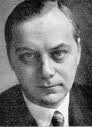
Alfred Rosenberg
The Conflict Of Values
Subtitled ‘An evaluation of the spiritual-intellectual confrontations of our age’ Rosenberg’s book is not only a valuable treatise on socio-psychological issues of his time but as recent events indicate also an accurate prophesy.

Adolf Hitler- The Scourge Of God
Alfred Rosenberg was, of course, the theorist of the Nazi Party in Germany over the twenties and thirties. He may be one of the lesser known figures. As such he is verboten to read or study, but as it is important to understand the mental outlook of this most important period of world history, that none can deny, I’m going to cast caution to the winds and try to deal with the reality rather than the prejudices.
This book was a key to Rosenberg’s earning the hangman’s close attention at Nuremberg as a result of the collapse of the Nazi State. The book is also on on the Jewish Index of Proscribed Books; it was only translated and published in English in 1980 by the Noontide Press, another proscribed outfit. So reading and discussing the book is a titillating forbidden thrill not unlike picking up an illicit copy of James Joyce’s Ulysses in 1930. I’ve read both and this is the better book. One wonders how many on the Court at Nuremberg knew German well enough to have read it. I suspect that very few of the allies had and if so but cursorily.
As so many books that have been given high praise prove worthless on the reading so also many authors and their books that have been demonized prove worthwhile. The Myth Of The Twentieth Century is one of the latter. While Jewish hysteria would have you believe that The Myth is one long rabid anti-Jewish diatribe such is not the case. Rather Rosenberg cast his scenario in the ages long warfare between the Semitic East and Indo-European West. As he rightly says the issue is a spiritual and intellectual confrontation between the two.
There is no denying this fact no matter how unpalatable the reality may be.
That the conquest of Rome by the East in the waning years of the Republic and opening three centuries of the Empire was the key to the formation of the Roman Catholic Church in the mold of the Eastern mystery cults of which Judaism was an element, but only one, cannot be denied.
Indeed the church founders Sts. Peter and Paul were Jews of the Jews. Oddly the New Testament had nothing to do with the content of Catholicism. Before Gutenberg even the priesthood had never read the New Testament. How Jesus wormed his way in there is something of a mystery. As odd as it may seem one could be arrested in Spain for distributing or possessing a New Testament probably up to the 1931 Revolution that ended that nonsense.
Rosenberg believed and the facts attest that the Nordics, Germans or Aryans (if words frighten you, choose the least offensive) found the Asiatic doctrines to run counter to their innate beliefs. The fact that England and the North of Europe rejected Catholicism should be proof enough for anyone. Rosenberg’s main argument then is against the Catholic Church which in his view was based on Etruscan savagery, Jewish and other Eastern mystery religions.
In the savage warfare he depicts between the Semitic Catholic Church and Nordic dissidents it reads like so many holocausts led by the Semitic Church that the Jewish holocaust of the forties pales in comparison.
The savage campaigns of extermination against religious heretics like the Waldenses, Cathars and Huguenots makes your hair curl and the roots sweat. And then on top of those crimes against humanity on the part of the Semitic based Roman Catholic Church came the horrors of the Thirty Years War from 1608 to 1638 that devastated the Germans so badly it made the Jewish losses of the 1940s seem trivial. Over thirty years fully a third of the German people were destroyed while Rosenberg claims two thirds. As Liberal historians prefer to minimize German losses in accord with their anti-European prejudices I suspect Rosenberg is closer to the truth. As he says it took two hundred years for the Germans to recover in a greatly altered intellectual condition. That would bring the story up to Bismarck and modern times when the Pope declared himself infallible.
Rosenberg insists this was at the instigation of and was the policy of the Papacy. It would be impossible to disagree with him. In fact the Roman Catholic Inquisition extended from the thirteenth century to mid-nineteenth century. Some six hundred fifty years of Semitic hostility to things Nordic.
While that record of intolerance is deplorable it should be remembered that the Church was thoroughly saturated with a Semitic intellectual mindset. Its policies were based in the psychology of the Middle Eastern Semitic peoples. One is no less guilty than the other. Intolerance is characteristic of the Semites much moreso than the Europeans as will undoubtedly be learned first hand soon enough as we have failed to learn it from a distance.
2.
While Rosenberg deals with religious and racial confrontations that are in essence the same thing he also gives a nice concise analysis of the stock market economy. In the light of recent events the man was remarkably prescient. He blames stock jobbing on the Jews. As he was a Nazi one is tempted to cry: Shame, shame, without examining the facts, but in fact this recent managed debacle used the US Federal Reserve System. The Fed is a privately held semi-government agency of which the only non-Jewish component are the Rockefeller banks. Thus there appears to be a real foundation of the Nazi claim of Jewish dominance of finance.
If one looks at finance with an unjaundiced eye from this vantage point of history when everything is or should be clear, it is clear that the Jewish World Government sold the US a bill of goods in 1913 when the Fed was formed. The Fed was the vehicle that gave its owners the means to control world money matters. What an engine for construction or destruction. What a pity the course of destruction was chosen.
One has been forbidden to look too closely at Jewish financial management but when one does many things become clear. Henry Ford has been criticised for using the term The International Jew, but there you have it. See my essay at Contemporary Notes on Henry Ford and Louis Marshall.
http://contemporarynotes.wordpress.com/2008/08/08/henry-ford-and-louis-marshall/
Through their American-Jewish Joint Distribution Committee formed during the Great War in preparation for the aftermath the Jews were able to use the Fed and ‘charity’ to move huge sums into Europe in support of Judaism against the Gentile nations. Engineering the tremendous inflation in Germany in 1923 that impoverished the indigenous population money from the US, Great Britain and France was supplied to German Jews who then, using the hard currency against the now worthless German currency, essentially bought up Germany on the cheap. Even as late as 1937 after years of disenfranchisement Jews still owned over 30% of German real estate.
If one compares that with the current debacle in the US and actually worldwide in which by using the vehicle of unsound loans the US and possibly the world has been financially gutted with all investments slowly sinking into worthlessness while the already bankrupt US government has been placed beyond redemption. The question is when it all comes down who will own what? It will all have to be owned by someone. If Germany of the Weimar Republic is any guide the answer is quite clear.
It seems obvious that the whole debacle was planned from the beginning. After all we have been conditioned from childhood to perceive the Jews as innately financial geniuses. We have also been conditioned to view Jews as the most intelligent people on the earth. Indeed the foremost Jewish intellect of the latter half of the twentieth century, Rabbi Schneerson, a man of profound scientific training, so we are told, fully believed that Jews have an extra intelligence gene that makes intellectual competition with them impossible.
So, who was in control of the Fed, who is Secretary of the Treasury, etc. etc. Jews. Now, I’m fairly low down on the totem pole but I could see the inevitable result of loaning money to people without the means to pay it back. I don’t have that extra gene that Jews have either. I’m not bragging, there were actually loads of us with the apparently missing intelligence gene who saw it coming. Heck, Rosenberg and the Nazis, all missing that extraordinary gene, predicted the thing eighty years ago. Sure, they were evil but that doesn’t mean they were stupid.
So, if the ‘most intelligent’ people on the planet didn’t see the inevitable result of their own policies then, possibly, the intelligence gene has an on-off switch but without the little light so we never know whether they’re switched on or off. But I’m betting the boys knew what they were doing and what the results would be. Can’t fool me. Quite obviously you didn’t need that extra gene and I’m betting that Rabbi Schneerson was just joshing when he dreamed the notion up.
I have to give Rosenberg full credence in his analysis of stock market economies. He saw it quite clearly eighty years ago. He couldn’t have been alone. Rosenberg was smart but he wasn’t that much smarter than anyone else. Henry Ford saw it.
So why weren’t Rosenberg and Ford listened to? Because the Jews used that ‘extra gene’- the charge of being an anti-Semite. Ford was discredited and neutralized while the Nazis taking on the whole world were destroyed root and branch.
That’s how Alfred Rosenberg evaluated a couple of the spiritual-intellectual confrontations in the first chapter of his very valuable work: The Myth Of The Twentieth Century.
There is more that I will take up in Part II.
The High Brow And The Low Brow
The Mucker And Marcia Of The Doorstep
Part VI
Living On Tulsa Time
by
R.E. Prindle, Dugald Warbaby and Dr. Anton Polarion
Livin’ on Tulsa Time.
Livin’ on Tulsa Time.
Gonna set my watch back to it,
‘Cause you know that I’ve been through it,
Livin’ on Tulsa Time.
– Danny Flowers
During the ’60s a lot of energy was put into the notion that one live in the HERE and NOW or someone else’s impression of the NOW. There used to be a big San Francisco poster with nothing but a black background with the giant word IS in white. NOW IS NOW.
They didn’t know how much they were asking. It is impossible to actually live in the NOW; No one can do it. Rather the past is a drag on NOW preventing a full involvement with the present. The period of time it takes to digest the previous NOW and update to an approximate notion of the current NOW is excruciatingly slow. The sharper the break between the past and present the more traumatic the reaction.
In the song Living On Tulsa Time the singer, no matter what time zone he is in sets his watch to Central Tulsa time.
I know where that one is at. One of my shattering breaks with the past was when I went active in the Navy in ’56. Sent from Eastern Standard to Pacific Standard I kept my watch set to Eastern Standard time nearly the whole three years of my enlistment. I only switched to PST in 1959 when I accepted the fact that I would never return East; that California was my new home.
Brought into contact with a new NOW I was still not ready for the present. I continued to dress as we did in ’56 well into the sixties. Got hard to find some new duds. I only ceased dressing that way when I became a Hippie in ’66 and adopted fantastic Hippie garb. I was an urban spaceman:
I’m the Urban Spaceman
I’ve got speed,
I’ve got everything I need.
I don’t feel pleasure,
I don’t feel pain,
If you were to knock me down
I’d just get up again.
I wake up every morning with a smile upon my face.
My natural exuberance spills out all over the place.
-Neil Innes
I was really NOW there for just a little while but I wasn’t alone. As Bob Dylan said, everytime I looked back the past was just behind. When the Hippie era ended I reverted to a modified 1956 style. The past came back again. All those screaming about living in the NOW in ’67-’69 are still back there claiming they’re still living in the NOW but time has passed them by. I didn’t wait around, baby, I slid out into limbo and I’m doing fine now, thank-you.
Thus when ERB began writing in 1911 he was not so much concerned with his NOW as he was in vindicating his past from 1896 to 1905. His reality in those early novels from 1911 to 1915 continue to reflect his earlier travails. Thus in the group of novels embraced by The Girl From Faris’s he is trying to vindicate his past to his present and hopefully to his future.
After nineteen-fifteen he was released from his past to a large extent and began to concentrate on adjusting to the NOW of his altered circumstances. Change is NOW and ERB was going though a lot of ch-ch-changes. His nerves were jangling as he was jerked from time frame to time frame but he didn’t enter the Promised Land of NOW. Oh Lord, he might have prayed, if he could have seen the future- Deliver me from NOW.
Ten years after and a world of different NOWs the Mucker far in a distant past that had disappeared behind a cloud where he couldn’t see he tackled almost the identical theme in a different world, a fast moving world, a world where NOW was so strange it was unrecognizable from day to day. The political situation he had grown up with was no longer recognizable; it had been replaced by a new reality. He was almost living by two different clocks in some strange Einsteinian time zone where the guide posts had been removed and renamed and everything was relative to another reality that couldn’t be recognized by any clock ticking.
Living on Tulsa time in another time zone. There I was in ERB’s sunny Southland with my watch running three hours ahead of everyone else’s. It didn’t matter. I was on the water where time stands still for everyone. The crisis came in ’58 when I stepped back on land to journey through the time zones back to Eastern Standard Time. I was all alone out there, you know, cut off from a past I was soon to learn couldn’t be retrieved. Wolfe was right, you can never go home again. The only secure place, as dangerous and that was, was my ship. My terminal place was also a realtively secure harbor but I was stuck in the middle for six days between the time zones in which I had no place and no identity except the tenuous one of my leave papers. A queer cop threw them into the wind and let those blow away in Illinois. After that I was naked to the universe. I’ve hated cops ever since.
I wouldn’t recommend hitchhiking to anyone. My life was on the line for twenty-five hundred miles and six days. Twenty-five hundred miles and six days on the road without food or sleep. I’d add without drink but in a gas station in Gary I downed six seven ounce bottles of Coca-Cola in a row. Created a minor sensation.
After surviving a lunatic who picked me up on the western edge of the Mojave who wanted to kill me because he was convinced I had two hundred dollars on me, which by a strange coincidence I had, I was picked up Mountain Standard in the Panhandle of Texas by a couple homosexuals who wanted a different treasure I possessed and dropped off Central Time in Tulsa. My watch was only one ahour ahead by then. I was getting close to some kind of NOW or was I? No. Time is much more relative than that. I was soon to be living a strange combination of NOW and THEN.
Tulsa was a tough town. I don’t need to see Tulsa again. I wasn’t about to start living on Tulsa Time. I was an hour ahead which couldn’t have been better. I had to walk through Tulsa, hungry and thirsty. I spied a place across this great expanse of grass between it and the freeway. As I approached the place began to glitter. Fancy, but I could see a coffee shop at the top of a long flight of stairs to the left. I didn’t want to spend money so I thought I’d just get a glass of water.
Oh Dan, can you see
That great green tree
Where the water’s running free
Just waiting there for you and me.
Water…cool…clear…water.
But between me and the water was this big cowboy in high heeled boots, a tuxedo and ten gallon hat. Fancy goings on as I noticed ladies entering to the right in ball gowns escorted by tuxedos. I came prepared or thought I did. I was in my dress blues and my Uncle Sam told me I should never be ashamed of my uniform, it could pass for a tuxedo anywhere. Anywhere but Tulsa. That cowboy had never discussed the issue with my Uncle Sam.
I was bold but the problem was he had the advantage being on the landing at the top of the stairs and I had to climb the stairs to get past him. He had his fist doubled and these high heeled boots with those silver plates on the toes. That was a mean looking business proposition. I had a lot further to fall than he did. Get my uniform messed up and things. Then where would I be out of time and place? Whew! Why does one have to face tough choices?
I’m getting a drink of water, I said, trying to combine thoughness with masculine geniality a al the cowboy ethic.
Not here you ain’t. He said, making a move to kick me down the stairs.
Hey buddy, this is a tuxedo I’m wearing. I faltered.
His reply was not one of which my Uncle Sam would approve.
I left Tulsa still thirsty not liking cowboys any better than I liked cops. NOW has its perils.
A day or so later I was still in Central Time. Tulsa was a tough place and the rest of Oklahoma was no California. I was heading North now which kept me in the same time zone. Then I made the mistake of crossing the Mississippi into East St. Louis. After just a couple minutes I really liked Tulsa. Wished I was back there.
I don’t know what evil forces made me want to hitchhike across country, damn Jack Kerouac, but I was within a hair’s breadth of being sliced and diced on the streets of East St. Louis. Whould have tossed me in the river as so much driftwood. Three Black guys with switchblades in their hands kept inching toward me while I kept inching closer to the middle of the highway.
That morning some guy got in his car for a pleasant drive to Louisville. He decided ot go through East St. Louis for some mysterious but critical reason. He arrived in East St. Louis just as these three knives were deciding to make their move. This guy sized up the situation from a couple blocks away, slammed on his brakes throwing open the passenger door at the same time shouting ‘Get In’ for God’s sake get in, NOW.’ Novel experience for a hitchiker. I wasn’t sure I wanted to rush because if I made a break for it those three knives might move faster than i could. I hopped in casually casting a smiling glance over my shoulder. The driver peeled out of there nearly separating a hand from the wrist on the door handle. I was saved from that particular NOW and END but I was on the road to Louisville which was still a far cry from Eastern Standard which was the time zone I so ardently desired.
It took me another day or so as I had a lot of North to make up but I did get into Eastern Standard. Now my watch matched the time zone but there was a mismatch between the present and the past. Rather there were two different presents and pasts going on at the same time. Mine and theirs. I don’t think Einstein is right but well, maybe, time wasn’t that relative but the uses they and I were making of past and present sure were.
That’s where memory comes in which makes time and space so relative. I had been absent for two years and what I had been experiencing was much different than what they had been experiencing. They had actually been living on Eastern Standard Time while I was just pretending. I knew I was out of time. For me time had been rapidly changing but for them time had more or less stood still or, rather traveled in a straight line. To me they were still living in the past. Oh, they had aged a couple years but their trajectory was different and slower. Relatively they had stood still while I had rocketed away.
It was as though I had been a gamma cloud burped from some collapsed star in some galaxy a billion light years away. As is known once set in motion an object will travel in a straight line at the same speed unless some other agent interferes with it. It was as though I had been careening through space ripping apart the fabric of time and space or disregarding it completely as though it wasn’t there; at any rate completely unaffected by this fabric which apparently has no tensile strength, there was no gravity of any force that deflected my course in a curve while if space is curved I was traveling so fast I careened right off the curved track.
Who knows how many black holes i passed over without being drawn into the vortex; who knows how many puny suns I swept across without having one atom deflected by the puny gravitational pull of the strongest sun; who knows how many planets I depopulated. One billion light years and running, my speed and trajectory were the same as when I was emitted from that distant star.
Now, as though by some miracle here I was back where I began but in two different time zones at one time. Theirs and mine. Obvious I must have passed through a worm hole or fallen into a memory hole. We stared at each other blankly each unable to comprehend the other. They thought I have become weird,or perhaps weirder, because they had stood still while I had been careening through time and space in timezones they would never know.
I smiled and got on a bus, enough of the adventures of hitchhiking. One the way back to Standard Pacific Time I abandoned Eastern Standard adjusting my watch as I passed through Central Standard and Mountain Standard. I was not exactly living in the NOW but I was in the correct time zone.
Minor but vital adjustment.
So, when ERB caught up with himself in 1914-15 he was no longer living on Tulsa time. He was trying to adjust his watch to his current time zone.
But as he was careening through space and time, space and time was moving at an even more frantic pace so it was difficult for him to get his bearings.
Science was changing his world at a rate faster than the mind could follow. Events in the far off Detroit that he had known and loved as a young fellow were going to affect his life just a few years hence. In 1914 Henry Ford had shocked the industrial, moral and social world by ‘unilaterally’ doubling the wage for unskilled labor.
This was a violation of ‘natural law’ which is to say religious sensibilities. At the time a natural law of labor was believed and incorporated into religion. The law was that if only one man can do a job he can command his price. Skilled labor can demand more than unskilled labor but when anyone can do the job as in unskilled labor they will have to take what is offered. Thus Ford pitted science against serious religious beliefs.
At about this time a Judge in a labor dispute asked the strikers if they didn’t know they were going against God’s will on earth.
This was at the time when the Liberal Coalition was forming and there were strangers in the land, to use John Higham’s expression, who believed they truly represented God’s Will. There is no greater enemy to God’s Will on earth than Science and the Scientific Consciousness. If you recall the so-called Christian Scientists reject scientific medical cures preferring to depend on the Will of God. Apparently it has never occurred to them that a case of a ruptured appendix means God’s Will is death while a simple operation means life.
Nevertheless Ford upset the natural or religious order of things and had to be stopped. Ford himself believed he had discovered a universal law in mass production so that he was actually a prophet of his own new religion. Believing himself in the possession of the truth he acted accordingly seeking to apply his method to each and every problem. Thus when the Great War began it was deemed possible to negotiate with the participants on a personal level to get them to cease hostilities. Ford believed he could do it. The Strangers In The Land who were living on Babylon Time saw their opportunity to pit their religion against Ford’s science and they took it. The Man of Science was in their pocket. They convinced Ford to take a horde of well meaning but naive people to Germany for a confab with the Kaiser. Ford fell for it. This was the famous Peace Ship episode that shredded Ford’s reputation two short years after he had made it.
Ford always maintained that after the ship was at sea the Strangers revealed themselves telling him that only they could change the course of the war. They began it and only they could end it. When he returned home he found the Strangers in charge of the War Industries Board and they and the Wilson Administration were telling him how to run his business. Babylon Time had met the Twentieth Century and found it could make the clock run.
Ford with his universal panacea was not the kind of man to take this sort of thing lying down. Ford Motor Co. had as much cash laying around as Bill Gates and Microsoft does today. Ford put his money to use. These are complex times so I am going to edit out all information that doesn’t pertain to my moral.
Ford believed in his method. By applying it properly he saw no reason he couldn’t solve the age old problem of the Jews here and now. He thought reason would work, poor man, so he bought himself a library of Jewish studies, put his man Bill Cameron on the job to study the library and publish the results in his newspaper, the Dearborn Independent, that he bought to disseminate his reasonable solution to the problem. He made the Dearborn Independent a national newspaper, perhaps the first of its kind. He even had a distribution system handy. He made all his Ford dealers distribute the papers, even out in Hollywood, California.
The Independent made such a noise that the papers couldn’t be given the silent treatment.
The independent appealed to a very large number of people although Liberal historians have given the impression that the paper went unread. The paper didn’t go unread. Out in Hollywood a man named Edgar Rice Burroughs apparently read the paper assiduously. As, why not, even if you don’t agree with the premise of a movie like The Passion Of The Christ that doesn’t mean you don’t go to see it. I used to read The Christian Science Monitor and I’ve never been a Christian Scientist. I used to read the Daily Worker and I’ve never been a Communist. A lot of people did go see the Passion making it one of the most lucrative films in history and lots of people read the Dearborn Independent, even devoured it.
Each week the paper issued a new article exposing the true nature of the ‘Jewish Problem.’ The articles were well researched, reasonable and accurate, but as they criticized a religion, no religion will stand any criticism if they can help it, they were necessarily labeled heretical, infidelic, bigoted, anti-Semitist. In this case you can check anti-Semitist. From this particular religion’s point of view they were anti-Semitic but from a reasonable scientific viewpoint they weren’t and aren’t.
The Jewish reaction was strong and violent. As a member of the Liberal Coalition they called in their allies who branded Ford an anti-Semite and ostracized him. Then Ford was out there all alone. A major campaign of vilification and defamation was conducted against him. All the hypnopaedic media were called into play against Ford. William Fox, the Fox part of the later Twentieth Century-Fox, used his Movietone News shorts to portray every Ford that was in an accident as at fault and unsafe. Now that’s defamation with a capital D. By 1925 it was clear that Ford could use some allies.
Enter Edgar Rice Burroughs and Marcia Of The Doorstep.
As we know Marcia was never published so ERB’s aid was hypothetical. A reasonable question is what evidence do I have for ERB’s intent. I offer Marcia Of The Doorstep as my evidence and certain articles from the Dearborn Independent. As I’ve said before ERB in Marcia exhibits a seemingly involved knowledge of the theatre. I have been puzzled as to where he got it.
I think I may have his source. The original Ford articles were issued weekly beginning in 1920-21 later being collected into a series of four volumes entitled ‘The International Jew’. What I am dealing with here is literature and history. I have no concern in the nature of the Ford articles. My only interest is what Ford and Burroughs understood and how they expressed it. Leave it at that. (It wasn’t left at that. As of 10/27/08 this essay has been censored by being left out my catalog of essays and not mentioned under any of the tags; Old habits are hard to break, I guess.)
Like Burroughs believed, or as Burroughs understood Ford there are two types of Jews. The ordinary Jew who goes about his business and the international Jews who is causing all the mischief. Thus the title International Jew excludes the mass of ordinary Jews and refers only the the International trouble makers. For Burroughs there was the ‘type’ of Max Heimer corresponding the the International Jews and the type of Judge Berlanger representing the ordinary of ‘Good Jew.’
In Volume II of the Interntional Jew there is a series of four atrticles on the American Theatre.
The books themselves have long since been stolen from the libraries and destroyed in an informal kind of censorship but due to the wonders of modern technology they’re available on the internet. The relevant theatre chapters can be fund at the URLs below:
http://www.jrbooksonline.com/Intl_Jew_full_version/ij28.htm
http://jrbooksonline.com/Intl_Jew_full_version/ij29.htm
http://jrbooksonline.com/Intl_Jew_full_version/ij31.htm
http://jrbooksonline.com/Intl_Jew_full_version/ij32.htm
The first is entitled Jewish Control of the American Theatre of 1/121; the second: The Rise of the First Theatrical jewish Trust of 1/8/21; the third: Jewish Aspect of the Movie Problem; and the fourth Jewish Supremacy In The Motion Picture World of 2/19/21. I believe all the necessary theatrical information is contained in these four atircles. All were written in 1921 giving ERB plenty of time to involve himself by 1924.
As you may remember ERB was sent a copy of the Jewish Bill Of Rights in 1919 and it was demanded that he endorse them. Thus there are an additional three articles from Vol. II that may be applicable. They are found at:
http://jrbooksonline.com/Intl_Jew_full_version/ij34.htm
http://jrbooksonline.com/Intl_Jew_full_version/ij35.htm
http://jrbooksonline.com/Intl_Jew_full_version/ij36.htm
While the last three do not reflect on Marcia to a great degree they will provide a better backgrund to ERB’s thinking on the issues as he must have studied them carefully.
—————–
It is very probable that ERB coded information into the novel to let Ford know this one was for him. For instance Clara Sackett was probably named after Clara Ford. Could be coincidental but the engineer of the Lady X was named Sorenson while Ford’s Chief Engineer was Charles Sorenson. Given ERB’s obvious connection to the Dearborn independent which Ford would easily have recognized, if he would ever have read the book, I think the references are conclusive.
While on this topic I would also like to point out that when the ban on Tarzan movies was broken in 1926 it was done by the arch ‘anti-Semite’ Joseph Kennedy who owned FBO Studios at the time. FBO was a little later bought by David Sarnoff of RCA who formed RKO. Radio-Keith-Orpheum thus editing Kennedy and FBO out of the picture. Punishment?
Also if you want a lively account of these proceedings check out Upton Sinclair’s self-published Upton Sinclair Presents William Fox. Sinclair’s is a nice first person I Was There type thing plus when William Fox was driven out of the movies, this is really exciting stuff, he went to Sinclair with his story. so Sinclair not only lives through this from a distance but is told part of the story first hand. I just love this stuff.
I am not particularly concerned here with whether the Dearborn Independent articles are true and accurate, although I am sure they are, but my concern is that Burroughs read them, believed them and acted on them. Bearing in mind his contact with the AJC he had no reason to disbelieve the articles.
In the first article ‘Jewish Control Of The American Theatre’, after an introduction that relates Jewish activities in Russia to Jewish activities in the United States a general statement on the theatre is made:
The Theatre has long been a part of the Jewish program for guidance of the public taste (hypnopaedic media) and influencing the public mind…it is the instant ally night by night, week by week of any idea which the ‘power behind the scenes’ wishes to put forth. It is not by accident that in Russia, where they now have scarcely anything else, they still have the Theater, especially revived, stimulated and supported by Jewish-Bolshevists because they believe in the Theater just as they believe in the Press; it is one of the two great means of molding popular opinion.
Cameron should have mentioned movies and song publishing and he would have had the major elements of hypnopaedic conditioning so brilliantly illustrated by Aldous Huxley in his Brave New World.
As we all know Burroughs was opposed to the Bolsheviks; he undoubtedly believed as did any knowledgeable observer that the Bolsheviks were predominantly Jewish. We may believe that he endorses the premises of these article.
Further down (a shortcoming of the internet is that there are no page numbers) the article says:
Down to 1885 the American Theater was in the hands of Gentiles. From 1885 dates the first invasion of Jewish influences. It meant the parting of the ways, and the future historian of the American stage will describe that year with the word “Ichabod.”
Second paragraph below:
About the time that Jewish control appeared, Sheridan, Sothern, McCollough, Madame Junuschek, Mary Anderson, Frank Mayo, John T. Raymond began to pass off the stage.
———————
All that remained after the Hebrew hand fell across the stage were a few artists who had recieved their training under the Gentile school- Julia Marlowe, Tyrone Power, R.D. McLean and a little later Richard Mansfield, Robert Martell. Two of this group remain, and along with Maude Adams they constitute the last flashingsof an era that has gone- an era that apparently leaves no great exemplars to perpetuate it.
There you have the premise of ERB in Marcia and enough history to flesh out the fiction. The old school was gone. ERB then names several players as here. The last surviving exemplar of this tradition is Mark Sackett. But even for Mark there are no plays worthy to perform in. As a member of Abe Finkel’s troupe he condescends to perform in problem plays and the new sex comedy.
The article continues:
“Shakespeare spells ruin”: was the utterance of the Jewish manager. “High brow stuff” is also a Jewish expression. These two sayings, one appealing to the managerial end, the other to the public end of the Theater have formed the epitaph of the classic era.
So there you have the complete story of Mark Sackett.
He was the last of the breed, a fine old Gentile actor of the old school of pre-1885. Corrupted by the Jewish influence on the theatre he accepts demeaning roles.
When he comes in to money he tells Max Heimer that he is going to perform Shakespeare. Max takes the position that ‘Shakespeare spells ruin’ arguing for a Ziegfeld Follies type show, a problem play or a sex comedy which he feels is a surer hope of success than the ‘high brow’ stuff. Straight from the Dearborn Independent.
‘…the rage is for extravaganze and burlesque.’
Now,
In this manner was laid the foundation of the latter day Theatrical Trust. The booking firm was that of Klaw and Erlanger, the former a young Jew from Kentucky who had studied law, but drifted into theatrical life as an agent; the latter a young Jew from Cleveland with little education but with experience as an advance agent.
Thus Abe Finkel is probablly the Klaw of Klaw and Erlanger. It may be coincidence but Judge B-erlanger is Erlanger prefaced with a B. thus those two would reprsent Klaw and Erlanger. Another version would be Finkel and Heimer in Hollywood also patterned after the Potash and Perlmutter movies of Samuel Goldwyn.
The trust was resisted just as Mark Sackett resisted.
(From The Rise Of The Theatrical Trust)
The opposition offered by the artists was prolonged and dignified, Francis Wilson, Nat C. Goodman, James A. Herne, James O’Neill, (Eugene O’ Neill’s father) Richard Mansfield, Mrs. Fiske and James K. Hackett stood out for a time…
Mark Sackett held out then in defiance of theatrical wisdom forming a Shakespearean company. This might be seen as a form of the Little Theatre movement which Cameron says developed in reaction to the first Theatrical Trust.
So the basis for the New York and theatrical end of Sackett’s career may be said to have been inspired by the two theatrical articles of Cameron in the Dearborn Independent. ERB probably read them in newspaper form shortly after publication in 1921. Because of the AJC approach to him as well as heightened anxiety over the immigrant question caused by loyalty concerns in the wake of the War Burroughs was especially receptive to Ford’s concerns.
If the germ of the story was conceived in 1921 the concern over Ford’s struggle was becoming difficult by 1924 may have inspired Burroughs to come to his literary aid. Thus we have this story of Marcia which when examined more closely is very involved in post-war Revolutionary and Jewish problems.
While the novel was universally rejected for publication this was undoubtedly because of ADL censors closely watching the publishing industry.
One can’t be certain but it is possible that Burroughs would have been finished in Hollywood but for Kennedy’s FBO Studios breaking the blacklist on Burroughs in 1926. Jewish movies of Tarzan began again in 1927. After 1932s MGM film which in itself may have been a parody to discredit the Big Bwana, the property became so lucrative especially in a Depression Era climate, that movies continued to be made saving Burroughs from complete ruin.
The war on Ford continued. Henry Ford is an interesting figure who, like Burroughs, would continue to be a Judaeo-Communist target into the thirties and forties, to the end of his life and beyond.
Ford zipped into the NOW in the years around 1914 when his Model T transformed America. But then he slipped back into Tulsa Time. The Model T was so successful for him that he failed to keep up with developments in the industry. The Model T remained essentially the same until 1925 when a better Chevrolet overtook the Ford as the best seller.
Ford then did an extraordinary thing that baffled conventional minds. He shut down production for over a year as he designed the new Model A. For this model he revolutionized the industry by designing the V8. The Model A was an instant success reviving Ford’s fortunes but the present and the future were now so commingled, things were changing so fast that the NOW was gone before you sat down to dinner. Constant model changes were now necessary. The world that Ford had created had gotten away from him.
He realized that he had lost his battle with the Jewish establishment. He capitulated in 1927 when Louis Marshall of the Jewish government demanded an ‘apology’ to call off hostilities. Ford told him to write one out and he would sign it. Marshall wrote an abject apology which Ford signed without edits or reading. Marshall then had the ‘apology’ published, bound and sent to every library free of charge. The apology is easier to find than the Dearborn independent articles.
The fracas came to a humiliating end for Ford and the Scientific Consciousness. ERB’s reaction isn’t known, however on December 10, 1929 (ERB Bio Timeline 1920-29) in a letter to his son Hulbert he made these observation on Religion and Science:
A man can be highly religious, he can believe in God and in an omnipotent creator and still square his belief with advanced scientific discoveries, but he cannot have absolute faith in the teachings and belief of any church, of which I have knowledge, and also believe in the accepted scientific theories of the origin of the earth, of animal and vegetable life upon it, or the age of the human race…(Religious) enthusiasms and sincerity never ring true to me and I think there has been no great change in this all down the ages, insofar as fundamentals are concerned. There is just as much intolerance and hyprocrisy as there ever was, and if any church were able to obtain political power today I believe you would see all the tyranny and inustice and oppression which has marked the political ascendency of the church at all times.
You can’t be any more clear sighted than that. Here ERB has clearly and succinctly stated the religious problem of the twentieth century and beyond. His is an objective analysis of facts; religion is a subjective projection of desires and wishes. As he notes science and religion cannot be reconciled. As he goes on to note in the conflict between the objective and subjective, the conscious and unconscious, the tyranny of the unconscious is an unavoidable fact. The question of which religion he fears would impose all the tyranny, injustice and oppression was clearly the Liberal Coalition and more especially the Jewish element of its multi-cultural diversity.
We now come back to Richard Slotkin and his charges against Burroughs as the ‘mastermind’ of My Lai. that an objection was lodged against Burroughs because he was interested in Eugenics can be discarded. People of all political persuasions were interested in Eugenics. If any abuses of Eugenics were made, Burroughs didn’t make them. Besides, it’s a matter of how you interpret Eugenics. The half man, half beast of Stalin is obviously an objectionable use.
On the score of whether Burroughs was an anti-Semitist, which is what Slotkin really means, from a subjective religious point of view that may be so but it is not a question for the religious to decide; they are not competent to do so. Sigmund Freud himself said that religion is a neurosis. (That means a departure from mental health.) If he is to be respected as a scientific genius why shouldn’t we respect his opinion? If religion is a neurosis then it should be treated as a mental disease.
On a Scienfitic basis then is it possible to call Burroughs an anti-Semitist? Clearly not. The man was a clear minded rational human being of great achievement and should be honored as such.
Should his scientific opinions differ from those of a religious bent it is they who must take a back seat not Burroughs.
Slotkin is clearly wrong in his interpretation of Burroughs. Slotkin represents the unconscious rather than the conscious.
For the foregoing reasons then I think that Marcia Of The Doorstep and 1924 was the pivot of ERB’s career. After 1924 it was no longer possible for him to live on Tulsa Time. He came under attack from the Liberal Coalition which was as formidable for him as it was for Henry Ford.
His novels after Marcia reflect this attack. Those novels are perhaps his greatest. Certainly one of the high points where he meets his enemies head on is Tarzan The Invincible that he was forced to publish under his own imprint. The title says it all.
I may be sentimental but I like Marcia Of The Doorstep. I only wish he had had the patience to flesh out the ending.
ERB wrote well in any time zone there was from Babylon Time to Tulsa Time to the NOW.
You know that I’ve been through it
But I just can’t go back to it.
There is no living on Tulsa Time.
NOW is the time.
End of Review
The High Brow And The Low Brow
The Mucker And Marcia Of The Doorstep
Part V
Marcia Explicated
by
R.E. Prindle
The contrast between The Mucker and Marcia Of The Doorstep can be seen as a response to two different challenges united by Burroughs’ personal psychological development.
He took the whole of 1924 to write this story so it may have been a real struggle. Unlike his other novels he doesn’t record a beginning and ending date in Porges so we have no accurate idea of how long it took him. It is possible that he had taken so much time, felt the need for money so intensely, that he rushed the ending through to try to sell the story. One the other hand he usually scamps his endings.
An indication that Emma may have been an influence in the planning and organization of the story is that it concerns matters that were very familiar to her. Just as she was a voice student as a girl, so Marcia. As Emma had to give up the studies so does Marcia.
The milieu of the stage would have been more familiar to Emma, although having gotten involved with the movies ERB might also have familiarized himself with the stage somewhat. I would have to opt for more involvement from Emma though. (For further thoughts on this read Part VI)
Unlike the other novels which feel as though they were written from the top of the head, Marcia has indications of more careful plotting. If that is true I don’t think ERB would have been capable of it so that would argue for more involvement by Emma once again. This is also a fairly complex plot that differs from ERB’s usual style.
Unless I’m mistaken the novel, even though unpublished, landed him in hot water with the AJC and ADL. I’m sure the reason would have been a mystery to ERB. If you’ve read Part II, Section II what I have to say will be clear, if you haven’t read the Parts I recommend it.
According to the Religious Consciousness there is no freedom of speech concerning the specific religion. The Religion will control who is speaking, what is said and how expression is to be allowed. ERB was not a member of the Jewish religion and as he was speaking unacceptably he was perforce an anti-Semite as the religion he was discussing was Judaism. Had he been discussing Liberalism he would have been pathologized as a crazy bigot. As Judaism was part of the diversity composing the Coaliton, Liberals would have considered him a bigot anyway. Bigot is the Liberal equivalent of anti-Semite.
The character in question is the shyster Jewish lawyer, Max Heimer. Max is an expecially well drawn character from the viewpoint of the Scientific Consciousness, which is to say, Max is accurately drawn. Whether from life or not is not yet known.
Max is the protagonist of the story. That anything happens at all is because of him. He is not an admirable character but on the other hand he is neither truly malicious or evil. The only thing that matters to Max, and would especially offend the sensibilities of the AJC and ADL, is the bucks. Max would probably stoop to outright thieving but he is a blackmailer, a swindler and a cheat. While what he does is criminal it is done in such a way as to escape detection. Even if you know he’s guilty the chances are you could never get a conviction.
But, he’s not really a bad guy at heart and by his lights he’s darn near a philathropist.
Max is always on the qui vive. One has the impression that he never lets an opportunity pass. Thus, one night he came across a drunken gentleman on the street, John Hancock Chase II. Chase II for some reason was totally incapacitated. Heimer took him home sensing an opportunity.
Max had been living with a woman, out of wedlock, named Mame Myerz. Although Mame wasn’t at home Max conceived the notion to tell the married Chase II that he had had sexual relations with Mame which he did nine months later when he showed up to tell Chase II he was a proud papa. Max would keep this a secret for a fee. Unable to sustain the blackmail Chase II shoots himself ruining a perfectly good source of income for Max. This is no skin off Max’s nose as he blithely goes about his and other people’s business for the next sixteen years.
That fine old gentleman, John Hancock Chase I bears the loss of his son stoically.
As it happened Della Maxwell bore her child and left it on the Sackett’s doorstep on 4/10/06.
If Max is finely drawn, no less can be said about Marcus Aurelius Sackett and his wife Clara, the long suffering wife of the air headed Mark, who is especially finely depicted. Just a few deft strokes but she is always in the background worrying over her man. Either I’m projecting from knowledge or ERB is able to portray a large loving woman who accepts the foibles of her husband, tolerating him and perhaps even loving him for them.
Both she and Mark are overjoyed at the child left on their step. They are no less overjoyed when Della shows up next day to move in with them. Della Maxwell is a well chosen name. Max-bad, Max-well.
Mark Sackett is ably portrayed as an actor of the old school who while he fumes at the modern trash of the stage is nevertheless the kind of trooper who doesn’t leave his fellows in the lurch. At this time in New York City he is working for Abe Finkel. Abe is obviously another Jew modeled on the producers Klaw and Erlanger. This is at the time of the development of movies from 1905 to 1914 or so.
In 1919 ERB moved to Hollywood where he would have been privy to all the stories of the origins of the studio owners who with few exception were Jewish. Most were from New York while Carl Laemmle was from Chicago via Wisconsin. They all had risen from mundane occupations to real wealth. Samuel Goldwyn had been a glove salesman. Harry Cohn had been a street car conductor, Louis Mayer had had a string of jobs worthy of ERB himself so it will be historically accurate for both Max and Abe to turn up in Hollywood as studio owners.
ERB was very good at weaving real life stories into his writing. There are probably real life models for many of these characters and their stories may be based on true stories as they say in Hollywood. For instance, Marcia’s first boyfriend Dick Steele goes to Hollywood as a stunt pilot where he meets his death, some mgiht say committed suicide, in a spectacular airplane stunt. As it turns out ERB didn’t make this story up from scratch but merely, fictionalized an actual event that occurred on a movie lot in 1920. William K. Klingaman tells the story ERB used in his popular history ‘1919’ of 1987.
Lieutenant Ormer Locklear moved to Hollywood in February 1920, where he originated many of the airplane stunts used in the movies. (He was the first aviator charged with reckless driving in the air, when he looped the loop over a public park in Los Angeles in April.) In the summer of 1920 he was working on a film called, “The Skywayman”; the last stunt was supposed to be a shot of a pilot plunging to his death with the plane in flames. Just before he ascended to film the sequence on the evening of August 3, Locklear turned to friends and said: ‘I have a hunch that I should not fly tonight.’ Spectators on the ground watched and marveled at the stuntman’s skill. Then they suddenly saw the plane only two hundred feet from the ground, struggling to right itself. It crashed in flames. Locklear died instantly, the farewell letter to his mother that he always carried with when he flew was found undamaged.
As ERB had no experience with the theatre and as his stage stuff seems fairly authentic and knowledgeable he may have borrowed stories like the Locklear tale and adapted them for his uses or else Emma had a fund of stories which she supplied for the novel. At an rate these first 125 pages are full of charming detail about the theatre.
Now safe in LA ERB even takes a loving poke at hometown Chicago. Della Maxwell explaining her breaking of an engagement in Chicago says on p. 30:
“I couldn’t stand (Chicago) any longer, Uncle Mark…It’s a hick town, filled with coal dust, wind and tank town talent. And slow, say, if I’d smoked a cigarette on the street I’d a been pinched for sure.”
Max Heimer keeps the story moving along when he visits the Sackett household as the legal representative of some unpaid actors. While there he notices the sixteen year old Marcia. Learning that she is sixteen his mind clicks back to 1906 when his and Mame’s plan fizzled when Chase II committed suicide. Ever on the qui vive he learns that Marcia was left on the Sackett’s doorstep on 4/10/06 which conincidence he can put to use.
Ever shameless and brazen, they call it chutzpah, he contacts Chase I to advise him that he has found Chase II’s illegitimate daughter. He’s picked the wrong man because the Senator, that fine old example of early American manhood, refuses to have anything to do with him however he has his Jew, that fine old examplar of the race, Judge Isaac ‘Ike’ Berlanger contact Heimer for him. If his son’s daughter is out there the fine old gentleman feels obligated to take care of her.
Probably already in deep for selecting a chosen person for a villain ERB begins here to really compound his error in the confrontation between ‘Ike’ Berlanger and the wily Max Heimer. Woodrow Wilson during his first administration appointed the first Jew to be a justice of the Supreme Court. This was Louis D. Brandeis of Louisville, Kentucky. Just as the Liberal Coalition propaganda machine remorselessly pilloried its victims so it equally exalted its favorites. Brandeis has been depected as a wise old saint for so long no one questions it. FDR in his administration referred to Brandeis as our ‘Isaiah’ whatever that might mean.
ERB doesn’t usually go far to find his models so I’m suggesting that Louis D. Brandeis was the model for Judge Berlanger. Alright. ERB probably thinks he’s going to get away with portraying ‘a Jew of the type; of Heimer by presenting a ‘fair and balanced’ picture of a ‘Jew of the type’ of Brandeis/Berlanger. Doesn’t work that way as Charles Dickens, who was accused of being an anti-Semite, found to his dismay when he balanced a Jew of probity against the villainous Jew, Fagin, of Oliver Twist.
One should always bear in mind that the very worst of a Chosen People is better than the best of the rest. Thus all heroes must be from the Chosen while the villains must be from the rest. So it is that all the villains currently have Anglo-Saxon/Teutonic names while all the heroes are of the Liberal Coalition.
Thus ERB was very ill advised to meddle in these proto-Politically Correct matters. Even though the entertainment industry of the twenties had been thoroughly Judaized he should have made Heimer an Anglo-Teuton while he was on track by making Berlanger an element of the Coalition.
The exchange between Berlanger and Heimer very likely sealed ERB’s fate for the next several years while he confessed his error in his portrait of the wise old Jew in The Moon Maid in attempt to do his penance. I can’t recall any more references to Jews in the corpus after this period. If you know of any, let me know.
The result of the conference between the two Chosen ones is that Senator Chase I is to settle twenty thousand on the Sacketts while providing Marcia with an income of a thousand a month.
Here ERB goes into some interesting ruminations on the effect of coming into money when you’ve never had any. Probably by 1924 he was wishing he had his finances to do over although he does say of Mark Sackett that he would never learn the value of money.
The intention of Heimer was to receive the twenty thousand from Chase, keep fifteen for himself and give five to the Sacketts. Berlanger is ahead of him giving the twenty directly to the Sacketts. Don’t rule out Max yet though; he’s one canny Scot.
Watching Mark come into money provides some amusing moments and an insight of how it had been with ERB. Mark goes out and buys a car which allows ERB to work in his accident with the taxi in Chicago. Charming passage though.
The old ham Sackett decides to use the money to bring back the glories of the stage; he wants to organize a touring Shakespearean company. There is some really nice wordplay as he attempts to inform Max of his plans. Max on the gui vive. He had not been denied that twenty thousand he had only been forestalled. He appoints himself the tour’s business manager so not only will he embezzle the tour’s profits but the original capital. But I get ahead of myself.
Bear in mind that all along Della Maxwell is aware of what a shyster Max is as she knows for a fact that Chase II wasn’t close to being the father of Marcia and she is also absolutely certain that Mame Myerz isn’t the mother. She keeps trying to warn Mark of what a shyster Max is without giving herself away to Mark.
As far as Max and the Sacketts go in the first 125 pages of the book, that covers it. The first third is of very nice quality, notwithstanding the ‘Politically Incorrect’ aspects. If ERB could have sustained this level of concentration throughout the book he would have had a truly excellent story.
Marcia is the other story line which has to be followed. When this precocious girl comes into her money, and twelve thousand dollars a year was nothing to sneeze at in 1922, her life changes also. Prior to the advent of her wealth she had been virtually betrothed to young Dick Steele. Marcia is troublesome as a character becasue ERB portrays her with such incredible maturity for a young girl. She’s barely legal, completely inexperienced but handles herself so well.
Dick with quick prescience realizes that this is the end of the line for his hopes but he’s going to hang on as best he can. He immediately quits school and gets a job in an airplane plant to make lots of money fast because he knows he’s going to need it. This employment leads to his job as a stunt pilot.
Marcia had been taking voice lessons for some time where she had met a wealthy young socialite named Patsy Kellar. When Patsy learns that Marcia is worth twelve thousand a year she invites her to join her circle. Marcia snaps into place like a memory stick in a digital camera. Personally I think ERB is pushing his luck here. The only thing that makes Marcia’s ability to fit in plausible is that she comes from a family of actors who may have aped the manners of the well-to-do. Indeed, ERB has speeches coming out of Sackett’s mouth that prove his ability to use the King’s English just in case anyone thought ERB was an illiterate, fantasy writer. ERB shows ’em how to in this one.
The Ashtons to whose circle Patsy belongs are about to take a cruise into the South Seas in their yacht, the Lady X. They think this sixteen year old flower of youth would be a delightful addition to their party. Which, in fact, she turns out to be.
Patsy takes her on a buying trip for clothes during which Marcia finds out how little a thousand dollars is. This also allows ERB to build some female interest a la Zane Grey to appeal to the lady readers of the Saturday Evening Post. So, the crew splits for Hawaii via San Francisco.
Now, when Chase II chose to exit rather than face the music he had a little son, Chase III. J.H. Chase III is now a twenty some odd Lieutenant in the US Navy and is stationed in- ready? Hawaii. Does he know Patsy Kellar and the Ashtons? Darn right. Old buddies. Welcome aboard. Chase III could have used his leave to go back to NYC to visit Grandpa but he opts for those soft South Sea breezes instead. Who can fault him except Grandpa and Grandpa doesn’t. Alright. So now he’s on board the Lady X with Marcia. All sixteen lovely years of her. Now begins the action of the middle part of the book.
ERB begins to fall back into his old ways although he has two stories to keep going. In the story of the Sacketts everyone considers Mark’s dream of bringing quality theatre to the heartland of America the height of foolishness but, I’ll be darned, the Heartland flocks to Mark’s performances to lap up the Bard. A little touch of culture really finishes off the man, you know. The tour is a huge success playing to SRO houses everywhere. The fly in the ointment is Max. The guy just can’t keep his hands off the money. He embezzles everything except for pocket cash of 300.00 for the Sacketts.
Stranded in San Francisco again, Max got the loot while the Sacketts got the hotel bill. The question is where did ERB get the story?
I had the haunting feeling the story was familiar. ERB didn’t have any theatre experience, nor did Emma, so he must have gotten the story, or combination of stories, really, from somewhere.
By 1924 he had been in LA for four years so he’d plenty of time to pick up theatre lore. The story of the tour sounds very close to the tour that brought Charlie Chaplin West. Chaplin wasn’t doing Shakespeare on that tour, that tour may have been another one ERB heard of. As I recall the Chaplin tour went bust in Salt Lake City also with Chaplin hoofing it to Hollywood.
In Salt Lake Max tells Mark that the jig is up, the show has gone bust, financially that is. Mark is incredulous as he has been playing to sold out houses but Max tells him there is no money and that is a fact difficult to argue about. Mark accepts the fact and, indeed, even if he knew Max had embezzled the money whatever records Max kept he said he had sent back to New York while as Mark was broke he couldn’t afford to sue anyway.
Now, let’s look to see if we can relate this to ERB’s life. ERB had had his best year ever after the move to LA in 1921 in which he earned approximately one hundred thousand dollars which might equate to the twenty thousand Mark received. While Mark lost his money in this improbable Shakespeare tour, or rather it was embezzled, ERB lost his on his pig farm. Who knows what was going on there? ERB had his income from 1919, 1921 and 1922 which must have amounted to from 200,000 to 250,000. Multiply that by fifty or so for inflation and that is a tremedous expenditure. It seems improbable that anyone could spend that much on a pig farm. Perhaps ERB thought someone had embezzled from him. Probably could use some investigation if for no other reason than to clear it up.
OK. Why Salt Lake City? If ERB is following Chaplin’s story then Salt Lake City would logically follow. However Salt Lake is one of ERB’s critical geographical locations. His interest in the Mormons hasn’t been properly examined although Dale Broadhurst made a stab in that direction. ERB made a special visit to Salt Lake in 1898 just after he purchased his stationery store. That was his first visit. Then in 1904 he and Emma resided there for several months during a very crucial period in his life, even a terrifying, desperate, excoriating one.
One that had him at his wit’s end shaking in his boots. While it is difficult to accurately pinpoint when his attitude toward Emma turned sour the several months in Salt Lake as a railroad shack may have been it.
Thus the tour breaking up in Salt Lake City may represent the beginning of the breaking up his marriage in 1904. The city certainly held a lot of memories for him.
Mark and Clara are left high and dry in SF. While Clara is out Mark turns on the gas and sticks his head in the oven. I’ve read that exact story before too but I can’t remember where. Or, perhaps, it is standard theatre fare.
From the Land of Fogs Mark and Clara wend their way down the coast to the Land of Smogs, the mecca of all actors. Mark is still too proud to work in the movies…but, we’ll leave the Sacketts in Hollywood while we follow out the story line of Marcia. This one is pure Burroughs.
While ERB has written Emma and himself into the story as Mark and Clara Sackett, Chase III and Marcia also represent his Anima and Animus. This central section is essentially a retelling of The Mucker ten years after. ERB no longer feels like the low brow scuzzy Billy Byrne, who was nevertheless ‘all man’, but is attempting the high brow Chase III. ERB has changed back from the Pauper to the Prince. His Anima presents a different problem. He didn’t feel up to Barbara Harding so he married her off to Byrne in Out There Somewhere. In Bridge And The Kid he scaled down from a New York socialite to the daughter of a big man in a small town. Gail Prim was apparently too much for the beat up hommy he was so now he scales down even further to a girl who is an orphan left on a doorstep to be brought up by strangers. Thus the role of Harding and Byrne are reversed. The Animus, Chase III, now has social standing while the Anima, Marcia does not. However everybody loves her and she is acceptable wherever she goes. There is some competition for her between the foppish socialite Banks Von Spiddle, the humorous name is a giveaway, and the military officer Chase III while the latter wins as might be expected given ERB’s prejudices. This very likely reflects the competition between ERB and Frank Martin that ERB won and is a recurring theme in his writing from his unpublished first story, Minidoka, and this one.
Just as there was a shipwreck in The Mucker so there is one here. Here ERB produces a new variation in that there are two life boats in one of which the best people were to go while in the other the muckers. In the turmoil of the storm and sinking Chase III and Marcia are separated from the first boat ending up with the muckers including the terrible Bledgo who obviously represents John the Bully as the storm represents the encounter on the street corner.
After the usual interval of several days adrift on the sea the crew spots the inevitable desert island. Going ashore the better people separate themselves from the worst of the muckers forming two parties which sends Bledgo searching for Chase III and Marcia. As the Animus represents the spermatic side of the body while the Anima represents the ovate Bledgo is really searching for the two aspects of Burroughs’ personality- the one he wishes to kill and the other to rape.
As the rest of Chase’s party realize that Bledgo only wants Chase III and Marcia they urge the pair to flee which they do. Bledgo doesn’t give up the search but pursues the pair up the mountain. There is a fight during which Chase III brings the butt of his revolver down on the forehead of Bledgo, reminiscent of ERB’s bashing in Toronto. The pair then continue their flight up the mountain.
In this sequence Burroughs takes vengeance on John the Bully by defending himself and his Anima as he felt he should have on the streetcorner while retaliating the horrific blow to the head he received in Toronto on his ancient enemy.
Thus as Chase III and Marcia continue up the mountain in a torrential downpour ERB’s Anima and Animus are reunited. He is a whole person again.
Reaching the top of the ridge they discover the best people singing, playing on the beach on the sunny side of the mountain. Thus ERB rejoins the people he was supposed to be among but was separated from by his encounter with John. How well this squares with real life is uncertain. It may just be wishful thinking especially as ERB is teetering on the edge of bankruptcy.
Incest and cannibalism are two recurring themes in ERB. The latter was a concern on the boat, the former now rears its ugly head. Chase III and Marcia reach the Philippines where they are to be married the next day however Marcia opens the mail waiting for her which includes a letter from Judge Berlanger. The letter advises her that Jack Chase is her half brother. Horrified and chagrined Marcia steals away in the night to take ship for San Francisco. SF and disaster again. It always happens that way for ERB in Baghdad By The Bay. Wonder why.
Aboard ship an entertainment is organized for which Marcia agrees to sing and act in a skit. She’s emaciated but that can’t mask her loveliness. Also aboard is a famous Hollywood producter. Needless to say Marcia is ‘discovered.’ A movie contract awaits her in Hollywood.
As I pointed out earlier there was a hiatus in the production of movies from Burroughs’ books from about the time he wrote Girl From Hollywood until 1927. Part was probably due to ERB’s writing on Jews in this novel but part was also due to his very negative portrayal of Hollywood in ‘Girl’. Thus just as he portrays a venerable Jew in The Moon Maid to atone for his portrayal of Heimer et al., here in this novel he lauds Hollywood as the home of the most wonderful people in the world. He reverses his portrayal of the director Wilson Crumb in the character of the kindly upright director Otto Appel, who also sounds Jewish.
ERB has now told two thirds of his story and is at page 295 of 351. He’s got a lot of story to go that he crams into the remaining fifty of so pages. Honestly, he needs at least two hundred to flesh out his story properly. Perhaps he had been at work on the story for most of 1924 during which he had generated no new income and wished to get the story off to the Saturday Evening P{ost for that fifty thousand dollar paycheck plus book rights. The amazing thing is that ERB doesn’t seem to have received advances from his publishers at any time. Also at this time things were getting strained between McClurg’s and himself. It won’t be too long before he breaks with them. We need more information on this aspect of his career.
So, Jack and Marcia are separated again while Jack has no idea where she may be. In the interval between their leaving and returning the world as they knew it had broken apart. No one was where they had been except Grandpa. Chase III runs into Pilkins, one of the sailors in SF. Pilkins had taken the same ship back with Marcia so he advises Chase III that she has gone to LA to be in the movies where Chase III follows.
I can’t think of a positive reference to SF in ERB’s writing. Either he just didn’t like the city or something happened there. If so, it would be good to know what.
At this time we have a whole crew in LA: The Sacketts, Marcia, Dick Steele, Banks Von Spiddle, Chase III, Max Heimer and Abe Finkel with Ike Berlanger to follow. This may be the alternative version of how the West was won.
I wish ERB had put more effort into this ending. Fleshed out this would be a pretty good story of the exodus of the entertainment industry from New York to Hollywood. This would be good first hand history of Hollywood at least, of which ERB was actually a fairly significant figure. I get kind of excited trying to piece together how it may have been.
ERB at one time had been allowed on the lots so we may assume that his production scenes were authentic as well as his depiction of Poverty Row. the latter was real where the more impoverished companies had their quarters. Mack Sennet had his quarters on Poverty Row. Sennet’s autobiography is well worth reading. Poverty Row is where F&H Studios set up business. Yes, after embezzling that thirty thousand dollars from Mark Sackett Max Heimer ran into his old acquaintance Abe Finkel. The two combined to form F&H. They are the one’s who give Dick Steele his start as a stunt pilot.
Max is about town where he runs into Mark Sackett frequently. Max is not a bad guy, in the same circumstances many another who had injured a man would hate him contriving to injure him further. Not Max. Once he’s got the money he’s a congenial fellow. He presses small loans on Mark who after all is only receiving his own again. Max, who undoubtedly has developed some pull, gives Mark leads to jobs that if Mark had taken them would probably have led to decent prosperity if not more. As Mark is too proud to accept movie roles he doesn’t follow up but Max does his best by him.
As I pointed out in Part III, Sam Goldwyn had revived the Potash and Permutter stories of Montague Glass filming the Broadway play in 1923 which was a great success. In 1924 he filmed In Hollywood With Potash and Perlmutter that was an equal success while probably charming ERB so much that he based the F&H Studios of Finkel and Heimer on the movie.
Here ERB compounded his error of the first part of the book by making the two Jews humorous and despicable. The inference is that because of their cheapness they were responsible for Dick Steele’s death.
Remember Mame Myerz? No sooner does Max make a few dollars than he takes up with a gorgeous starlet. Mame gets wind of this back in the Big Apple where she goes berserk. She immediately tramps into Judge Berlanger’s office attempting to sell him the true story of Marcia. The old Judge doesn’t give in that easy so Mame spills the beans that she isn’t Marcia’s mother and she wasn’t anywhere near Chase II.
Thus the way is cleared for Marcia and Chase III to marry; no danger of incest. Max hears of this putting the screws to Mame to retract her statement which she does. Now there’s enough doubt in Marcia’s mind that the marriage is off once again.
In Max’s last scene, I kinda hated to see the little guy go, Judge Berlanger, also now in LA confronts Max with the theft of Mark’s money. Chutzpah deserts the wily little attorney. Unable to brave it out with Berlanger Max accepts defeat turning his assets over to Mark. He was forbidden LA and New York in which places he hasn’t been seen to this day. By stories end I kind of liked Max Heimer although it would be best to go the other way if you saw him coming.
Marcia was lost track of after the Philippines. She has lost track of everyone else. She becomes a star but as she had taken another name no one knows where she is. They don’t go to her movies, apparently. Mark and Clara’s fortunes continue to decline becasue of his bullheadedness until finally their landlady turns them out into the street. This was probably how ERB and Emma felt when they had to leave Tarzana after only four years.
ERB’s situation must have created a lot of gossip. After all a famous author comes to town buys a huge estate, c;mon 540 acres? and within two years is in financial difficulties and after four a virtual bankrupt forced from the estate. Tongues must have wagged. I’d sure like to know what they were saying. Just exactly how ERB’s Hollywood contemporaries thought of him.
In the meantime, completely destitute, Mark accepts movie work. He is sitting on a lounge on the set when the star, Marian Sands, walks on the set. She sees Mark who recognizes her as Marcia and the family is reunited again.
Chase III arrives in LA in search of Marcia. He apparently never goes to the movies so he doesn’t make a connection between Marian Sands and Marcia Sackett. He enters a career of dissipation turning to drink and gambling. Too proud to contact granddad he runs through his money.
He has some amusing encounters with oilmen which probably reflect ERB’s own as he floundered around trying to find ways to make money fast. There’s a lot to be done here in researching ERB’s business doings in LA. Later in the decade he will get involved in the Apache airplane engine and airport development so it seems unlikely that he wasn’t trying to be a business success in the early and mid-twenties. Dearholt showed up a couple years later with movie schemes that ERB bought into so what was he doing in the business sense?
Chase III who has been hanging around the studios looking for Marcia rather than studying theatre marquees gets into the movies finally locating his loved one. Some direct borrowing from Merton Of The Movies here. Moving very rapidly and sketchily ERB throws in a couple suicide attempts as the couple get together. Resemblance between Edith Wharton and Scot Fitzgerald here.
Together again there is still no hope of marriage because of possible incest, even though Marcia will never love another or marry.
OK. Della Maxwell. Remember her? She’s back in Chicago in the hospital dying a slow death. Well, you know, she is Marcia’s mother. On her death bed, I mean, the pen falls from her fingers as she signs the letter to Marcia, she makes a clean breast of it telling the story, sending the bigamist marriage license, birth certificate, everything so there will be no doubt that Marcia is semi-legit and not related to Chase III.
We’re almost there do you think? Not by a long shot and there’s only ten pages left. The mail train with Della’s package is held up somewhere in Arizona. The bandits disappearing over the border with the swag that contains Della’s letter and little metal box.
Wow? What next? OK, ERB’s got a twist or two still hidden up his sleeve. Banks Von Spiddle- yes, he’s out there, too- has a ranch down in Mexico that the Revolutionaries of 1914 failed to expropriate. A guy with a name like Banks Von Spiddle ought to get lucky once in a while I should think.
He and his vaqueros go out coyote hunting. They have a good day, getting a full bag. The last coyote tries to hole up in a small cave where Von Spiddle blasts the life out of him. While he’s drawing the coyote from the cave he notices a decayed leather mail pouch kind of thing. What do you suppose that might have been? Yeh, right. Della’s letter and little metal box intact. Von Spiddle can be small or he can be big. He chooses to be big giving the info to Chase III and Marcia so they can be married and live happily for however long marriages last in Hollywood.
Thus ERB manages to compress a marathon into a hundred yard dash in the last fifty pages.
Over all a good enough story. Neither Collier’s, Saturday Evening Post nor anyone else wanted it so ERB lost a year with no income, or income from new work anyway. If he was living on edge at the beginning of the year he was still on the edge at the end. Whew!
How did he get out of that financial bind?
Part VI and End is the next post.
Exhuming Bob 13 Fit 5: Bob As Messiah
October 19, 2008
Exhuming Bob 13
Fit 5:
Bob As Messiah
by
R.E. Prindle
Are you that Man Of Constant Sorrow
Of whom the authors write-
Grief comes with every morrow
And wretchedness at night?
Anon.
Source of quotes: Scott Marshall, Bob Dylan’s Unshakeable Monotheism- downloaded from Jewseek.com  but no longer available. The site is no longer functioning. Roughly the same material can be found in Scott M. Marshall with Marion Ford, Restless Pilgrim: The Spiritual Journey Of Bob Dylan, Relevant Media, 2004. No longer in print new copies may still be obtained for under three dollars at Alibris.com for any who are interested.
In the dead of winter in 1961 Bob Dylan, ne Bobby Zimmerman, left Minnesota to try his chances in New York City. At this point he must have realized that his better chances lay with Folk Music than Rock n’ Roll. Indeed, upon his arrival in New York he realized that Tin Pan Alley had the recording world sewn up except for the ‘race’ musics of Country And Western and R&B, and the Alley was already fairly tight with R&B. He quickly and astutely realized that whatever he intended to do would find no home on the Great White Way.
While Bob traveled light as far as material possessions went he brought a lot of psychological and religious baggage with him. The kind of stuff you can’t leave in a locker at the bus station. As his whole career has been an unfolding of this religious impulse it would behoove us to examine it somewhat closely.
Bob received intense religious indoctrination in his youth until the time he left home in the Summer of 1959. This religious education was of an intense Orthodox Jewish kind. He recieved this from his family, both parents were deeply religious in the Orthodox mode, although the Hibbing syngogue was more often without a Rabbi of any kind than not. Perhaps of premier importance was his Bar Mitzvah indoctrination in 1954 from a Lubavitcher Orthodox Rabbi direct from Brooklyn. That combined with four years of extended stays at the Zionist summer camp, Camp Herzl in Webster, Wisconsin.
In speaking to Paul Vitello of the Kansas City Times after announcing his call to Jesus/God, Bob told him:
I believe in the Bible, literally. Everything in it, I believe, was written by the hand of God.
That is the statement of a religious fundamentalist and one without much sense or discernment. If Bob doesn’t know the the ‘hand of God’ has written nothing then he can be written off as a rational human being. Bob in the same interview went further:
Everything that’s happening in the news today is prophesied in the scriptures. It’s all in the Book of Daniel and the Book of Revelations.
For myself, I begin to run when I hear some Christian fundamentalist bring up the Book of Revelations. It has the same effect on me as anti-Semite has for the Jew.
We can assume therefore that upon his arrival in New York in 1961 Bob was a card carrying Biblical devotee. This religious baggage for the time being took a back seat to Bob’s psychological baggage but was absorbed into it. Hence the Biblical sounding ranting of Like A Rolling Stone.
At the same time as with most young people Bob was in rebellion against his upbringing. That is to say he was trying to find his own place in life while reconciling his upbringing to the emerging realities presented to him by life. As his line from his song My Back Pages would seem to indicate: I become my own enemy when I begin to preach. he realized that his religious beliefs would alienate any listeners and abort the possibility of establishing his career and reaching them later.
Indeed, the sixties, and expecially the New york fold crowd was intensely anti-religious. It was about this time that Bob read a headline on a Time Magazine cover asking the rhetorical quesiton: ‘Is God dead?’ Bob was extremely offended by it dating the decline of Western Civilization from that headline.
From 1961 to 1966 then Bob wrote mainly of his psychological problems and frustrations. His dream life, which is to say, subconscious, received a lot of attention during this period as well as later in his career.
It was precisely the speaking from his subconscious to the subconscious of his audience that drew this specific type of person to him.
Phil Ochs, a contemporary Folkie of Dylan, recognized what he was doing in stirring up deeply held resentment and thought he was brewing trouble for himself. However Dylan, while hating, did not necessarily stir up emotions that would lead to violent actions. Instead his hate was characterized by self-pity and resentment that would be satisfied by showing people how wrong people were in their judgement of him. Thus he would accentuate his God as a god of judgement. He left the actual judgemental punishment of them up to his god. Thus those of us in his audience who linked up were also characterized by self-pity and resentment but not violent.
For instance, in a 1983 interview with Martin keller he was quoted:
My so-called Jewish roots are in Egypt. They went down there with Joseph, and they came back out with Moses- you know, the guy that killed the Egyptian, married an Ethiopian girl, and brought the Law down from the mountain. The same Moses whose staff turned into a serpent. The same person who killed 3,000 Hebrews for getting down, stripping off their clothes, and dancing around a golden calf. These are my roots. (My italics.) Jacob had four wives and thirteen children, who fathered thirteen chiidren, who fathered an entire people. These are my roots, too. Gideon with a small army, defeating an army of thousands. Deborah, the prophetess; Esther the Queen, and many Canaanite women, Reuben slipping into his father’s bed when his father wasn’t home. These are my roots.
Delilah tempting Samson, killing him softly with her song. The mighty King David was an outlaw before he was king, you know. He had to hide in caves and get his meals at back doors. The wonderful King Saul had a warrant out on him- a ‘no knock’ search warrant. They wanted to cut his head off. John the Baptist could tell you more about it. [That’s a joke in this standup routine, Son.] Roots, man- we’re talking Jewish roots, you want to know more? Check up on Elijah the prophet. He could make rain. Isaiah the prophet, even Jeremiah, see if their brethren didn’t want to bust their brains for telling it right like it is. Yeah, these are my roots, I suppose.
Now, those are extremely violent, murderous roots but they form the staples of Bob’s conscious and unconscious minds. The selected examples, all from the Old Testament, are revealing in the Freudian sense. Vengeance dominates.
Nor are these ‘Jewish’ roots in any exlusive sense. These actors were Hebrews and not Jews. I know all this bullroar from Christian (Methodist) services. I was repelled at once and rejected this crap when I escaped the stultifying influence of my childhood. This crap is unworthy stuffing for human minds.
This mean spirit is felt throughout the whole of Bob’s corpus from 1961 to 1966, more especially in that most puerile of all his songs: Masters Of War.
Significantly Bob mentions nothing about Jesus or the New Testament; his roots are all Old Testament. This raises the question of whether his embracing of Jesus in 1979 was calculated or not. There is in fact little differentiation between his conception of jesus and the Jewish Yahweh. Indeed the idiot church I attended as a youth seemed to accentuate the Old Testament Yahweh over the New Testament Jesus. I have a much stronger conception of Yahwey over Jesus so one might say I share ‘Jewish roots’ as much as Bob does. I am as much a dual citizen as Bob is except more American/Ancient Hebrew rather than Israeli/American.
As of 1964 Bob Dylan wasn’t really going anywhere. True, his manager Albert Grossman was busy promoting his songs to others whose recordings then inflated Bob’s reputation but that didn’t necessarily translate into big sales for his own albums.
Then in 1964 Bob had a stroke of luck, the Beatles came to America. There had been a massive promotion along the lines- The Beatles Are Coming, The Beatles Are Coming. No one had ever heard of them but when they appeared on Ed Sullivan everyone was tuned in to see what the fuss was about. After it was over, other than the screaming girls in the audience, that, I might add, was a new phenomenon, few of us still knew what the fuss was about.
Nevertheless it seemed that from that point on the Beatles were on the news nearly every night. This was unprecedented attention for a mere ‘pimple’ music pop group which is all the Beatles were at that time.
Why the Beatles received this attention has never been clear to me. However these were four goi musicians although their manager Brian Epstein was Jewish. In the inter-cultural competition a Jewish super-star was now required. After all the first of the superstars Elvis Presley was an all-American hillbilly. Fabian the last before the Beatles was Italian. These four English kids then came up and so a Jewish kid was required to keep up the Jewish image. The only real alternative was Bob Dylan although few or any of us knew, or even suspected he was Jewish. Bob had sure worked hard to keep that a secret. Even his girlfriend Suze Rotolo was slow to find out.
Bob then was given the big media buildup also being on the news frequently, also being given the star treatment in the big national magazines. While the Beatles handled their fame with chipper aplomb Bob approached it with negative depression. But, it worked just as well. The pressure was enormous, plus Albert Grossman was pushing him too hard, working the kid to death. Literally according to Bob.
Whether there really was a motorcycle accident or Bob had a nervous breakdown from contemplating the next killer tour his manager had arranged may never be known for sure. After completing Blonde On Blonde that filled out his core oeuvre Bob went into seclusion for a period.
He put this seclusion to good use. Although his premier creative period was over, his golden age so to speak, he succeeded in a magnificent Silver Age. He and the members of his backup band, later known simply as The Band, created a huge and significant body of work. Dozens of songs, some of them really good while most of them were good. It was here that Bob perfected the technique of clothing his religious thoughts in Amerian indigenous Folk forms. This ability was exhibited on his next LP, John Wesley Harding, that was released not that long after Blonde On Blonde.
In one of this period’s songs, You Ain’t Going Nowhere, Bob had this to say: ‘Find ourself a tree with roots.’ Thus the cover of the Harding album showed Bob standing next to a tree with roots dressed in Jesse James era Western foul weather gear. Now, Bob had also sung: ‘I may look like Robert Ford, but I feel just like Jesse James.’ This guy looked like the Minnesota Northfield raid while the tree with roots reprsented his Jewish affiliation.
Now Bob was on track for his Jewish liaison and subsequent demonstration of his Jewish Lubavitcher roots. Those who follow Bob’s religious odyssey, and there have been several books written on this topic, all call attention to the close relation of Biblical topics to his lyrics from 1961 to the present. If you have the backgound and take both a broad and narrow approach to looking for them you will find that they abound. The method becomes second nature for Bob so that he may not ever be aware of many of the references himself until they’re pointed out to him; or he may be conscious of them all.
What is clear is that Bob views his career as a religious calling; that is to say a messianic mission to bring the word of God to as many people as he can. In May 1980 he told interviewer Karen Hughes:
He was disarmingly honest with Hughes about his sense of God’s call: “I guess He’s always been calling me. Of course, how would I have ever known that, that it was Jesus calling me….
So now we have the anomaly of God calling to a Jew through Jesus. While both Christians and Jews who now view Jesus as a Western and not a Jewish figure had trouble accepting the fact that a Jew could accept Jesus and remain a Jew nothing is more reasonable. That Bob, a Jew living in a Christian country, could amalgamate Judaism and Jesus wasn’t even all that odd.
Jesus himself was a Jew while the early Christians were all Jews who accepted every Jewish rite including circumcision and the dietary laws. It was only when Saint Paul separated Christianity from these Judaic laws that Christianity succeeded.
As Marshall’s interviewees point out, the New Testament is a Jewish novel in which 25 out 27 books were written by Jews. John and Revelations being the exceptions. Even as Bob embraced Jesus, the Jews for Jesus, based in San Francisco, who themselves did not convert to Christianity were active. Just as the Jews persecuted the early Jewish Christians even to death so they put the screws to Jews For Jesus and have at least destroyed their effectiveness.
Thus in 1983 the Lubavitchers re-entered Bob’s life when as they thought they attempted ot reconvert him. As Bob had never left the faith, he has said in effect, I am a Jew of the Jews, I suppose he played along until they were satisfied then went along his way as a Jewish Christian. Makes perfect sense to me, I don’t have a problem with the manner in which Bob expresses his religiosity.
I have a problem in that he expresses it at all. I find it incredible in this this day and age of scientific reallty that anyone can make the statement that the Bible is the actual word of Yahweh or any other god.
Goodness gracious, Bob, shape up before it’s too late. We’re almost down to that last grain of sand. The lights are beginning to dim. It is getting dark.
:
Exhuming Bob 13, Fit 4: Bob As Messiah
October 14, 2008
Exhuming Bob 13
Fit 4:
Bob As Messiah
by
R.E. Prindle
The most difficult thing on earth is to believe in something that is palpably untrue. “We must respect the other fellow’s religion but only in the sense and to the extent that we do his theory that his wife is beautiful and his children smart.”
– H.L. Mencken
I become my own enemy the moment that I preach.
– Bob Dylan

Religion is palpably untrue whether it be Christianity, Judaism or Moslemism. The fundamentalist religious attitude is the enemy of reason and hence the mental development of mankind. Such an attitude no longer has any place in society. Nevertheless its influence lingers on like some spectre from the crypt of human consciousness.
Part and parcel of religious fundamentalism is the notion of an external redeemer or messiah. As the Piscean Age began society fixed itself on the notion that since individuals could not alter their behavior a redeemer or messiah would arise who would redeem their errant behavior. While the notion was endemic in the ancient world at this change from the Arien to Piscean ages it found its purest expression among the Jews.
While the Jews did not fix on any one exemplar as the Messiah the Western world did. Thus Jesus became the sole exemplar of a Messiah for them as they expectantly awaited his second coming.
Christianity is at its bottom an offshoot of Judaism as is the later Arab edition of the Semitic religious group, Moslemism. Both Judaism and Moslemism have a rather fluid notion of messianism. Anyone may declare himself a messiah in Judaism as in Moslemism. In Moslemism the messiah goes by the name of the Mahdi or Expected One.
Over the centuries innumerable messiahs and mahdis have appeared, failed and disappeared while the Christian world of the West patiently awaited the return of its Jesus. It’s been a long wait and it probably won’t end too soon.
The appeal of messianism is very strong for the individual. I would imagine that every boy with a Christian or Jewish upbringing has wondered whether he might be the embodiment of Jesus as the second coming or the Messiah to redeem the people. As always Jewish claimants proliferate. If he is not disabused of the notion by adolescence he could probably be found wandering around the insane asylum with the many other imitations of Christ.
In the Eastern world such is not the case. While weak personalities go under strong personalities may very well impress their fantasy on society although invariably with disastrous results. Bob’s Jewish namesake, Sabbatai Zevi, was one of these who flourished in the seventeenth century. Sigmund Freud was one in the last century.
Naturally in the conflict between imagined anointment and actual realities a dual personality must come into existence, thus we have, for instance, Bobby Zimmerman and his alter ego Bob Dylan. Beginning in the nineteenth century when science began to challenge societal religious fantasies dual personalities became more common or, at least, became more prominent in literature.
Literature is full of dual personalities from the Dupin and the narrator of Poe through the Scarlet Pimpernel, Sherlock Holmes and Moriarty, Dr. Jekyll and Mr. Hyde and a much longer list. One of the more amazing examples is Bobby Zimmerman/Bob Dylan the little Jewish kid and the quasi-Cowboy pop star. Throughout his career Bob has wavered between the two, now one, now the other. In the late seventies and early eighties he appeared to embrace Christianity for a few years and then abruptly returned to that of the Orthodox Lubavitcher Jew. Just recently he passed through a Cowboy phase and now, as per this recent picture he has re-emerged as a Hebrew prophet complete with peyos and a vaguely demented look like some ancient Ezekiel or Jeremiah. (go to touchingtheelephant.wordpress.com Bob Dylan Marchin’ To The City)
Disquisitions such as this will disturb the equanimity of religious fundamentalists.
Will Bob now regale us with Jeremiads as he preached to us in 1980? To find that answer one must go back to the now ancient past in the little Minnesota town of Hibbing up on the Iron Range.
Bob’s memories of the North Country are as dualistic as his personality. He speaks of bittler cold winters, so cold that one slept in multiple layers of clothes and summers so swelteringly hot and humid as to be in the Great Dismal Swamp.
And then he was Jewish in what has been characterized as a predominantly Catholic town. A small Jewish island in a sea of foreign culture. In those postwar days when his Jews lived in trembling fear of an impossible American Nazi holocaust. Jews hid their origins and culture as much as possible denying their religion and seeking to blend in as seamlessly as chameleons. Thus it was as young Bobby Zimmerman entered high school. Then in 1956 as he approached the massive front doors of his high school the Jews of the eight year old State of Israel fought a lightning war with the surrounding Arabs. Instead of being driven into the sea sas the Arabs propesied they themselves were humiliated and driven back. How now? The Jews became assertive in their identity emerging to challenge the dominant culture for supremacy. They ceased to be humble, hence, the sixties.
Already masters of Hibbing’s retail district one imagines they began to flex their muscles without fear of gas chambers. Foremost among them, the President of the local chapter of B’nai B’rith and the ADL, was little Bobby Zimmerman’s own father, Abram. Abram took to smoking huge black cigars, a sure sign of aggressive manhood.
Years later when Bob Dylan had immured Bobby Zimmerman behind walls like in Poe’s Cask of Amontillado, Bob Dylan would return to Hibbing and combine the two images of his childhood of the two Zimmermans as he sat on a motorcycle on a corner smoking an immense black cigar. What vision of vengeance was this? As one of his cowboy heroes, Hank Snow, sang: I’ve got a troubled mind.
Bob’s father Abram viewed himself as something of a Jewish scholar. He had a bent toward the Orthodox even toward the Lubavitcher. In 1954 as his son’s Bar Mitzvah approached he sent for a Lubavitcher Rabbi to instruct his son in the puerilities of the Lubavitcher approach to Judaism. The Rabbi, one Reuben Maier, was undoubtedly brought to Hibbing on a one year trial contract. When the year was up and the congregation had rejected him he left.
In telling of his Bar Mitzvah indoctrination Bob dramtizes Rabbi Maier’s arrival as a mystery with himself as the messianic center of the mystery. As he tells it one day a Greyhound bus ground to a stop at the Hibbing terminal; the Rabbi stepped off and said: Where’s Bobby Zimmerman, I’m here to indoctrinate him into the Lubavitcher mysteries. I exaggerate for effect of course but true to the spirit. Then having taught Bobby what he was supposed to learn he reboarded the bus and disappeared down Highway 61 as mysteriously as he arrived. It could have seemed that way to a thirteen year old. The key point is that Bobby learned what the Rabbi had to teach. As Bob said he taught him what he had to know.
If the accounts are correct Bobby Zimmerman’s was the first Bar Mitzvah in town for several years and it was huge. Four hundred or more people were in attendance. One assumes that the loot collected was beyond the avarice of the average thirteen year old. Bob boasted of the Bar Mitzvah for years.
But of more importance for us is what information Rabbi Reuben imparted to Bob. I have pointed out in Fit 2 that Rabbi Maier was associated with Rabbi Schneerson in Brooklyn, New York. Schneerson had strong notions of the superiority of the Jew to all other peoples while having a strong notion of the messianic nature of Judaism in bringing the word of the Jewish god to the peoples. This is absolutely undeniable and calling someone who tells the truth to you an anti-Semite will not change the truth. Such an accusation only makes the accuser look an ignoramus.
It would seem to follow then that Rabbi Maier could teach his young disciple nothing other than the prevailing Lubavitcher doctrines of Rabbi Schneerson.
Indeed in later life Bob Dylan would write the symbolical song Quinn The Eskimo while after his Christian stint say words to the effect: ‘You know what? Things are going to fall apart and all peoples are going to run to the Jews to save them. But, guess what, the Jews won’t be able to do it because they haven’t lived according to the Law.’ Sounds just like the Protocols, doesn’t it, Sean?
Now, where do you suppose Bob would pick up an idea like that?
Enduring heavy Jewish indoctrination during his high school years Bob was also conflicted by his immersion in the dominant culture thus contributing to his dual personality. Thus we have Cowboy Bob who listened to endless hours of Country and Western and we have Rabbi Bob using his pulpit to preach Jewish tenets, whether in Christian form or not, to what passed for his faithful.
Starting from a low base Bob was actually to gather a following of millions as of this date. Many if not most of them see him as either a Christian savior or a Jewish messiah.
Young Bobby Zimmerman left Hibbing in a state of Mixed Up Confusion that it would take him decades to order as much as he ever has.
I hope I haven’t unduly offended anyone but the fanatics to this point. They will always scream anti-Semite at anyone who challenges their cherished fantasies. They are religious fundamentalists and are to be scorned by any intelligent people. Disrgard them. Laugh at them. If the reader will find the story anti-Semitic then all I can say is that he or she find the truth anti-Semitic.
Owls- they whinny down the night;
Bats go zigzag by.
Ambushed in shadow beyond sight
The outlaws lie.
Old gods, tamed to silence, there
In the wet woods they lurk,
Greedy of human stuff to snare
in nets of murk.
Look up, else your eye will drown
In a moving sea of black;
Between the tree-tops, upside down,
Goes the sky-track.
Look up, else your feet will stray
Into that ambuscade
Where spider-like they trap their prey
With webs of shade.
For though creeds whirl away in dust,
Faith dies and men forget,
These aged gods of power and lust
Cling to life yet-
Old gods almost dead, malign,
Starving for unpaid dues;
Incense and fire, salt, blood and wine
And a drumming muse,
Banished to woods and a sickly moon,
Shrunk to mere bogey things,
Who spoke with thunder once at noon
To prostrate kings:
With thunder from an open sky
To warrior, virgin, priest,
Bowing in fear with a dazzled eye
Toward the dreaded East-
Proud gods, humbled, sunk so low,
Living with ghosts, and ghouls,
And ghosts of ghosts, and last year’s snow
And Dead Toadstools.
Outlaws by Robert Graves.
Fit 5 follows in another post.
Bob
 I, Dynamo