A Review: Pt. III She by H. Rider Haggard
November 25, 2009
A Contribution To The
ERBzine ERB Library Project
She
by
H. Rider Haggard
Review by R.E. Prindle
Part III
The Gruesome, The Morbid AndThe Hideous
Rider Haggard was criticized severely by certain of his contemporaries for employing so many gruesome, morbid and hideous details. Indeed, ‘ She’ seems to be a study in the hideous, the gruesome and the morbid. If one concentrates on those aspects of the story one might actually question Haggard’s mental health.
Haggard himself calls attention to this morbidity. In King Solomon’s Mines he pointed out his humor with references to the Ingoldsby Legends; in She he makes a pointed reference to a Mark Tapley. I had no idea who Mark Tapley might be but thought I’d consult that most magnificent of encyclopedias, the internet. No problem. Mark Tapley was a character from Charles Dickens’ Martin Chuzzlewit. No matter how adverse the circumstances were Tapley was always cheerful and ebullient. Haggard must have thought him ridiculous. Thus he is devising a series of incidents that would bring even Mark Tapley down. Hmm. Interesting experiment.
It would seem then that Haggard was suffering from a fairly deep depression. In that sense She is sort of a horror story not too different in intent than, say, Bram Stoker’s Dracula. Indeed, at one point Ayesha explains that she rules by terror. That being the most effective way to control brutes like the Amahagger.
Certainly the storm at sea prior to entering Kor was an example of terror on the part of nature, a portent of things to come. Not least of these was the hot potting and projected cannibalism of the surviving member of the ship’s crew, Mohammed. ‘She’ had only required the safety of the Whites; as Mohammed was apparently a negrified Arab the Amahagger excluded him from the ban on Whites. An interesting example of White Skin privilege.
Their custom of killing their victims was to heat a pot red hot and turn it over on the victim’s head. There’s a gruesome and hideous enough example. You can see where Burroughs picked up his fascination for the gruesome and hideous.
The Caves of Kor are actually a city of the dead. Kor was an active civilization before Egypt existed in the fifth or sixth millennium BC. As embalming was a known practice when the Dynasties began c. 3400 the practice must have developed long before. Quite possibly it was practiced by the peoples of the Basin before the Mediterranean was flooded. In The World’s Desire Haggard mentions that the ancient Egyptians possessed writings in a precedent language. If so, how far back things like embalming go might be prodigious.
Egyptian embalming was primitive compared to that of the Korians. While Egyptian mummies became desicated the Korian process was such that the body was preserved forever in an apparent state of health. Thus bodies perhaps ten thousand years old or older had the appearance of freshness.
Now, this is positively creepy. Holly’s Amahagger attendent Bilalli while discussing Korian embalming told Holly that while he was a young man a particularly beautiful female corpse occupied the very slab on which Holly slept. Bilalli used to enter the cell and sit looking admiringly on the beautiful corpse by the hour. One day his mother caught him at it. The embalming fluid used was extremely flammable. Bilalli’s mother stood the body up and lit it. Like a huge torch the body burned down to the feet. The feet were still as good as new. Bilalli wrapped them and stored them beneath Holly’s slab. Groping around beneath the slab he brought out those ten thousand year old feet, still fresh, except for some charring at the ankles.
Haggard doesn’t stop there but goes on to emphasize the beauty of one particular foot. One wonders if perhaps George Du Maurier read She becoming entranced by the foot image thus reproducing the image in his novel Trilby when Little Billee draws Trilby’s beautiful foot on th wall. It is a thing Du Maurier would do as he inserted his literary baggage as profusely as Burroughs.
What effect this image had on Haggard’s contemporary readers may be guessed from the complaints about his gruesomeness.
In fact Haggard projects a depressed brooding evil permeating the Caves of Kor very well. This may have been caused by his and Lang’s theories of the Matriarchy. Human sacrifice was an integral part of the Matriarchal world. The sacrifices were invariably of men because women had greater economic value. When men were no longer sacrificed bulls, rams, the males of the species were substituted, the female still having greater economic value. Thus the story of Isaac and the Ram. That would be a great advance in civilization. About that time Isis ceased being the Egyptian symbol of the firmament being replaced by the female cow as the symbol of economics. Something like the kings of England sitting on the woolsack.
Depending on Haggard’s and Lang’s theories of the Matriarchy then Haggard may have been portraying a consciousness that has ceased to exist. There is always an element of misogyny in Haggard’s stories that is no longer tolerated. Then men were men and women were women instead of the attempted strange unisexuality of today. Thus the tens of miles of swamp between the Amahagger quarters and the citadel of Kor indicate the extent and quality of the Matriarchy. Swamps are the symbol of the female and the Matriarchy or, in other words, this very primitive superstitious consciousness.
The Korian swamp was haunted by mephitic vapors, evil smelling and oppressive. The ground they walked on was of uncertain solidity; it might look firm but this was only illusory as one could break through the crust. Often the litter bearers were walking through evil smelling muck up to their knees.
At one point an accident occurs and Bilalli’s litter with him in it is dumped into the slimy water. He would have drowned if Holly hadn’t leaped into the rank female waters to save him. They emerge looking something like the creature from the Black Lagoon.
It will be remembered that Holly was something of a misogynist. One may be stretching a point but even though rejecting women and marriage Holly managed to inherit a son from a man who was also a womanless widower. Haggard makes a strong contrasting point when he says that Leo was not averse to female company. The manservant, Job, is absolutely terrified of the female.
After traversing this desolate swamp of the female for days they arrive at the citadel or temple of Kor. Now, the citadel of Kor was built on an ancient lake bed that had been drained ten thousand years before. In that sense Ayesha is the same as Nimue or the Lady Of The Lake of King Arthur. Nemue lived at the bottom of a lake where she raised Lanclot who consequently was called Lancelot of the Lake.
Compare this also with Haggard’s postumously published Treasure of the Lake in which the Anima figure lives on an island in the middle of a lake in the middle of a volcanic crater. The lake of Kor was also in the middle of a crater.
When the Korian civilization was extinguished it wasn’t by invasion or other external reasons but by a monster plague something like the fourteenth century european Black Death that wiped out nearly everyone. At the resulting rate of death it wasn’t possible to embalm everyone so that tens of thousands of bodies were dumped into a huge subterranean pit.
In conducting Holly and Leo on a guided tour of Kor which was one gigantic necropolis, talk about depressing, Ayesha brings them to this pit. I quote:
Accordingly I followed (She) to a side passage opening out of the main cave, then down a great number of steps, and along an underground shaft that cannot have been less than sixty feet beneath the surface of the rock, and was ventilated by curious borings that ran upward, I do not know where. Suddenly this passage ended, and Ayesha halted, bidding the mutes return, and, as she prophesied, I saw a scene such as I was not likely to behold again. We were standing in an enormous pit, or rather on the brink of it, for it went down deeper- I do not know how much- than the level on which we stood, and was edged in with a low wall of rock. So far as I could judge, this was about the size of the space beneath the dome of St. Paul’s in London, and when the lamps were held up I saw that it was nothing but one vast charnel-house, being literally fullof thousands of human skeletons, which lay piled up in an enormous gleaming pyramid, formed by the slipping down of the bodies at the apex as others were dropped in from above. Anything more appalling than this mass of human remains of a departed race I cannot imagine, and what made it even more dreadful was that in this dry air a considerable number of bodies had become dessicated with the skin still on them, and now, fixed in every conceivable position, stared at us out of a mountain of white bones, grotesquely horrible caricatures of humanity. In my astonishment I uttered an ejaculation, and the echoes of my voice, ringing in that vaulted space, disturbed a skull which hd been accurately balanced for many thousands of years near the apex of the pile. Down it came with a run, bounding along merrily towards us, and of course bringing an avalanche of other bones after it, till at last the whole pit rattled with their movement, even as though the skeletons were rising up to greet us.
Talk about a holocaust! Imagine standing in that dimly lit space far beneath ground, in the grave itself so to speak,and viewing that. Holly was overcome and perhap Mark Tapley himself would have lost a little of his cheeriness. If that didn’t do it the ball Ayesha threw would have.
Before I move on to that though let’s take a penultimate example that might actually unsettle Mark Tapley. This is truly unsettling with truly macabre and voyeuristic soft porn details that are quite remarkable. Let me say that it is only with the fourth reading that the horrific nature of these details really began to sink in. I hope to really make this clear in the next section in which I intend to do an in depth analysis of Ayesha.
In his cell at the citadel of Kor Holly notices a cleft in the wall he hadn’t noticed before. This cleft is going to lead him to Ayesha’s sleeping room. This is not unlike King Solomon’s Mines in which upon entering the symbolic vagina they were led to the womb or treasure box. As I say Holly entered this cleft, let your imagination dwell on that, and followed a dark, dank, narrow corridor until he perceived a light.
He is looking into Ayesha’s sleeping room where in a certain deshabille, very erotic, she is addressing a covered form on a bier next to hers. This is the embalmed body of Kallicrates who she murdered twenty-two hundred years before. So she has been sleeping with this corpse for twenty-two centuries. Now, dwell on that for moment, let the horror of it sink in.
She addresses the corpse in a fairly demented way. Twenty-two hundred years of this would drive anybody nuts. Finally to the dismay of Holly she animates the body by telekinetic powers actually causing it to stand zombie like so she can kiss and caress it. A lot of necrophilia in this novel. Haggard must have been half dotty when he wrote this. Of course Kallicrates is a double of Leo so Holly has all he can do to keep from crying out. Causing the dead man to lay himself down Ayesha covers him and blows out the light.
Holly has to find his way back in the dark reminding one of innumerable passages in Burroughs where his characters have to find their way in the dark. Holly gets only so far and collapses in the tunnel. Waking he sees a light coming in from his cell allowing him to find his way back.
And then Ayesha throws her ball. If you’ve read carefully and really ingested these macabre, gruesome, and as Burroughs’ would say, hideous details they’re beginning to oppress your mind, perhaps even a mind like Mark Tapley’s.
Now Haggard trundles out the frosting. To illuminate her ball Ayesha brings out piles of ten thousand year old corpses placing them around the perimeter as human torches. Laying out a large bonfire the corpses are stacked alternately like so much cordwood and replaced as they were consumed. Remember these are as fresh looking as you or I. The Roman emperor Nero actually used live humans in the same manner. Haggard notes this in the text which I thought weakened the effect.
Ayesha seems to be aware of the effect, indeed, intended it and appears to relish the reaction.
These are the high points of these horrfic details. Minor ones are constant so that the cumulative effect leading up to the terrific images of the demise of Ayesha, temporary though it might be, is overwhelming. But about She, Ayesha, in the next part.
Part I A Review: She By H. Rider Haggard
November 17, 2009
A Contribution To The
ERBzine ERB Library Project
SHE
by
H. Rider Haggard
Review by R.E. Prindle
Part I
The Framing Device

From eighteen eighty-five to two thousand nine is one hundred twenty-five years. The span records many changes. In 1885 there were no movies, no radio or TV. Movies came in c. 1900 beginning to change the literary paradigm. The movies produced a definite class structure in literature. With the introduction of sound in 1927-28 two classes of film developed. A movies and B movies. A movies employed A or literary fiction such as War And Peace, Oliver Twist and such while the developing fields of genre fiction were reduced to an inferior B status.
Time has erased the meaning of the terms A and B pictures. I suppose that if a younger person was told that he was watching a B movie he wouldn’t know what was meant. Even if a devoted movie buff, the mere classification would have no experiential significance. You had to have been there.
In the development of the film industry it was thought that studios had to have their own theatre chains. Thus MGM movies wouold be shown only at Loewe’s first run theatres and so on.
In those glory days of the movies first run theatres were gorgeous temples, often named The Temple, the Roxy in NYC has the most spectacular reputation. The goal of the studios was to produce 52 A movies a year to supply the ‘exhibition’ chain a new first run A film a week. Only MGM was to reach this goal.
Once having been exhibited for its week or period A movies were released to rerun theatres usually outside the chains where they were shown at reduced prices. As an added incentive a second feature was shown and this was a B movie.
We lucky kids who inhabited Saturday matinees every week year around usually got two B movies and selected short subjects which included previews, a serial, a cartoon, a newsreel, and some sort of film usually a travelogue on deep sea fishing or water skiing matter. These comprised an alternate reality in addition to real life and dreams. Nor did we feel shorted by B movies. To our young minds these movies were fraught with the most profound thoughts imaginable. Hopalong Cassidy and Tarzan were the favorites of most kids- Gene Autry, Roy Rogers a distant second to Gene. Unbeknownst to us of course the literary granddaddy of the B movie was H. Rider Haggard and She.
Not that Haggard movies were shown with any regularity but he managed to anticipate all the elements of B movies to perfection. Many if not most of the key elements of B moviedom were pinched from Haggard. What Haggard didn’t provide was tossed in by his disciple Edgar Rice Burroughs.
Burroughs borrowed his use of the framing device from Haggard probably with the frame of She as his model. The framing device of Tarzan Of The Apes shows emulation of that of She. It’s a good one.
Most writers of these tall yarns wanted the reader to believe he was reading a true story, in other words, an invitation to suspend disbelief- that is, everything fits in so he divised a framing story as persuasion.
The first paragraph of She’s preface is perfection of its kind:
In giving to the world the record of what, considered as an adventure only, is I suppose one of the most wonderful and mysterious experiences ever undergone by mortal man, I feel it incumbent on me to explain my exact connection with it. So I will say at once that I am not the narrator but only the editor of this extraordinary history, and then go on to tell how it found its way into my hands.
If one compares that to the first paragraph of Tarzan Of The Apes the similarities become immediately apparent. Both authors claim no authorship. In both cases the story, or history, was given to them by a second party. Thus Haggard the author as editor can speak in the first person while making editorial comments.
The hint is made that Allan Quatermain is the actual editor. The editor was visiting Cambridge University one day some twenty years previously when he noticed two interesting people. His friend knowing them offered to introduce him.
“All right,” answered my friend, “nothing easier. I know Vincey; I’ll introduce you,” and he did, and for some minutes we stood chatting- about the Zulu people, I think I had just returned from the Cape at that time.
So the canny reader hopefully having read King Solomon’s Mines can infer that the unnamed editor is, in fact, Allan Quatermain as a garrulous amiable gentleman.
Twenty some odd years after that casual and very brief meeting, as improbable as it may seem, one of the two men, Vincey’s guardian, Horace Holly sends the Editor the text for She.
Holly says: ‘You will be surprised considering the slight nature of our acquaintance to get a letter from me.’ I should say so. What a great memory.
Holly goes on:
I have recently read with much interest a book of yours describing a Central African adventure. I take it this book is partly true, and partly an effort of the imagination. However this may be, it has given me an idea. It happens, how you will see in the accompanying manuscript (which together with the scarab, the ‘Royal Son of the Sun), and the original sherd, I am sending you by hand) that my ward, or rather my adopted son Leo Vincey, and myself have recently passed through a real African adventure, of a nature and much more marvellous than the one which you describe, that to tell the truth I am almost ashamed to submit it to you but you should believe my tale.
So Holly sees through Quatermain’s preposterous story as only half true while Holly’s equally preposterous story is the whole truth, the real thing. Well, if you’ve accepted the premiss there’s no way to go but further in so, all one can say to Holly is that his story is going to have to go some to exceed Quatermain’s.
Generously Holly offers any profits from publication as a reward while underwriting any possible loss. That was real Haggard accepting that bundle on Quatermain’s part.
Rounding out the baloney the editor says:
Of the history itself the reader must judge. I give it to him, with the exception of a very few alterations, made with the object of concealing the identity of the actors from the general public, exactly as it has come to me.
As a reader my judgement is that it is an excellent whopper but I don’t believe a word- or do I?
The frame continues:
With slight [five pages] preface, which circumstances make necessary, I introduce the world to Ayesha and the Caves of Kor.
Ready when you are, C.B.
An excellent, convincing framing device. The Editor must be Allan Quatermain yet the name of the editor is concealed from us as well as the identities of the actors. Where we are going is mystery piled on mystery, the strange and wonderful lie before us, we in complete safety.
So with Burroughs framing device of Tarzan Of The Apes. While not copied word for word certainly idea for idea. The influence of Haggard is apparent but not paramount. Burroughs’ mind was a maelstrom into which innumerable influences (a slight exaggeration) are drawn to the depths of his subconscious and emerge melded into something so close and yet so different than his many, many sources.
Having roped the reader in like a carnival barker luring the victim into his peep show Haggard begins to lay out his nearly perfect story of the type.
Part B follows.
Zane Grey, Edgar Rice Burroughs And The Anima And Animus
February 1, 2009
Zane Grey, Edgar Rice Burroughs And The Anima And Animus
by
R. E. Prindle And Dr. Anton Polarion and Dugald Warbaby
Bad Blood In The Valley Of The Hidden Women:
Thoughts On Riders Of The Purple Sage And The Rainbow Trail
Texts:
Burroughs, Edgar Rice: Corpus 1911-1940
Grey, Zane: The Riders Of The Purple Sage 1912
Grey, Zane: The Rainbow Trail, 1915
Grey, Zane: The Mysterious Rider, 1921
Prindle, R.E. Freudian Psychology Updated To Modern Physics, ERBzine 2004.
Prindle, R.E. Something Of Value Books I, II, III. Erbzine 2005

Zane Grey
Intro.
Anton and I had never read Zane Grey before reviewing the library of Edgar Rice Burroughs as published on ERBzine by Mr. Hillman. Nor probably would we have but for the Bill Hillman series of articles comparing Zane Grey and Edgar Rice Burroughs. Anton and I dismissed any such connection as being relevant but then Prindle read The Rainbow Trail and said we should check it out. Prindle is a close friend of ours; a little on the independent side but alright.
Grey refers to The Rainbow Trail as a continuation of The Riders Of The Purple Sage so Anton, he’s a psychologist became intrigued by the manner in which Grey treated aspects of the Anima and Animus. We both then read Riders in which we discovered a full blown theory of the Anima and Animus.
It should be noted here that Grey had passages excised by his editors that they thought dealt too explicitly with the sexual aspects of the Anima and Animus while reducing the commerical viability of the story. The unexpurgated version of the story was published under the title The Desert Crucible in 2003. I have the Leisure Historical Fiction edition in mass market paperback.
Grey’s ideas were presented in a very pure manner with complete and intact symbolism so there could be no mistaking that Grey was presenting a well thought out theory. Anton became very excited as he said Grey’s theory certainly rivaled the ideas of Freud and Jung and must have been developed independently of their thought much as Burrughs’ ideas of psychology were.
Although Riders Of The Purple Sage wasn’t among the books listed by Hillman as being in the Library we have to assume that Burroughs read it along with a number of other Grey titles although he must have found Rainbow Trail and The Mysterious Rider the tales of Grey he found most significant for his needs. We will assume that this is so. To understand The Rainbow Trail originally titled The Desert Crucible which was in ERB’s library it is necessary to also review Riders Of The Purple Sage.
1.
Grey in this book examines the nature of the Animus and the Anima of the male as well as the relationship between the living male and female. The micro study of the Anima and Animus is placed in the macro study of Mormon society and law of 1871 versus Gentile society and law. This is also a study of the nature of religion.
The Gentiles- I follow Grey’s thought here- Mormons refer to themselves as the Chosen People and ‘others’ as Gentiles- are all of a stricken Anima which paralyzes their Animus while the Mormons have a strong Animus but disturbed by a stricken relation with the Anima which they completely repress not unlike the Jews and Moslems.
Thus Mormons have a strong affinity with the Semitic religious systems from which they derive their religion in part. Anton, the psychologist, avers that the problem of the Animus and Anima has been known for at least five or six thousand years. Anton is close to Prindle who is a historian, so much of the historical part comes to Anton through him although Anton is well versed in the history of human consciousness.

Edward Borein: Six Riders Of The Purple Sage
Historically the struggle of the male to come to terms with the X chromosome and the y chromosome or Animus is central to history and psychology. During the Matriarchal Age, which is to say a sub- or unconscious age, the X chromosome or Anima ruled the mind of man. As consciousness evolved and the conscious mind emerged from the subconscious the nature of the y chromosome or Animus became apparent. The Patriarchal Consciousness evolved.
To reconcile or not to reconcile?
The Egyptians developed their own theories but here we are not concerned with HS II and IIIs and the Semites. Suffice it to say that the Semites borrowed from the Egyptians while adding very little of their own. If one reads the story of Psyche and Eros in Apuleius’ The Golden Ass one will have a good general introduction to the HS II and III point of view as expressed in Grey’s Gentile characters such as Lassiter and Venters. As said the Mormons reflect the Semitic view on women.
The Semites on the other hand, exaggerted the importance of the Animus in favor of suppressing or subordinating the Anima which has been passed on to the HS IIs and IIIs through the adoption of aspects of the Semitic religions. In a Hungarian myth of the Christian Era the Anima is portrayed as being entombed in the support of a bridge. Thus imprisoned on one side of the river or brain it is denied its rightful function.
The Semitic attitude is reflected in the way the two peoples treat their living females who stand as a symbol and only a symbol of the X chromosome of the male. In both existing Semitic relgions, the Judaic and the Mohammedan, the females are treated as property no different than cattle. Some of these attitudes have been temporarily weakened through contact with the HS II and IIIs. They haven’t gone away or changed.
The Semitic attitude infiltrated the HS II and III consciousness through their religion which was amalgameted into the HS-Semitic hybrid called Christianity.
Then in 1930 in the Unied States a man named Joseph Smith created a religion called Mormonism based on the extreme Patriarchal notions of the Semites. As Grey puts it the religion was based on the notion of ruling women. Smith devised rules by which women were completely subordinated to the Animus much as in the Hungarian myth while the men were required to take multiples wives. Smith himself racked up 30 plus.
According to Grey the women were not happy with the arrangement but in the thrall of religious belief they thought it their god assigned role.
As polygamy is not part of HS II and III culture Smith and the Mormons came into conflict with constituted society in Smith’s home base of Fayette, New York being driven out. They encountered the same opposition in their new homes which led finally to Nauvoo, Illinois. Smith, who apparently overplayed his hand was murdered in 1844. In 1847 Brigham Young led the new Chosen People from Nauvoo to the Promised Land on the shores of the Great Salt Lake. By 1871 when Riders takes place they must have multiplied exponentially because they occupy all of Utah and parts of adjacent states. This prologue of the diptych is placed before the passage of the 1882 law of the United States outlawing polygamy. The denouement of the novel will take place as the US attempts to stamp out the practice.
The action of Riders-Trail takes place on the border of Utah and Arizona and parts of adjacent states with the Grand Canyon of the Colorado as a backdrop.

Edward Borein: Riders On The Mesa
As with the other Semitic religions the Mormon Bishops and Elders with untempered Animi have made their will the law. Thus, according to Grey, the Churchmen have become criminals willing to commit any crime to achieve their personal desires which they equate with the will of God.
As Riders opens a Mormon woman, Jane Withersteen, against all the rules of Mormon society is living as an independent woman in Cottonwoods on the Utah-Arizona border, Gentile Law on one side, Mormon law on the other. She does this in defiance of Bishop Dyer (die-er?) who has ordered her to marry and end her independent status. She has her own duchy among the Mormons owning her own town, the water, aparently several counties, a magnificent bunch of horses (emblematic of the Anima) and six thousand head of cattle divided into two herds, the red and the white. (emblematic of the male and female.)
Her independence is a standing affront to the Mormon Elders and Bishops. Having been ordered to marry Elder Tull as one of his many wives she has no wish to submit to the Bishop’s will. Read- Will of God.
These men are not to be balked. The woman Withersteen has no actual rights under Semitic law. As these men have a crazed Animus untempered by the acknowledgement of the female principle or Anima which they deny they have lost all sense of justice, or rather, they equate justice with their desires which they believe are supported by divine law. They are going to use every concealed criminal means to break Jane Witherspoon down. As their will is law they can’t see the difference between subjective criminal methods and objective legal ones.
Jane is already having trouble hiring Mormon riders, riders are the same as cowboys in Grey’s lexicon, to manage her herds so she has resorted to hiring Gentiles.
The Mormons must be seen as a species of Semite and in the Semitic manner they punish Gentiles, or unbelievers as the Moslems would put it, destroying any attempts at their prosperity. If you read the first few lines of the Koran you will find it plainly stated that unbelievers must be punished. Hence all the Gentiles are kept uneducated and impoverished. Jane’s ramrod, is a young Gentile named Bern Venters. Venters at one time had been a prosperous cattle rancher but the Mormons had emasculated him by lifting his cattle. Venters was rescued by Jane from complete impoverishment by offering him a job.
The Elders hate her for this. They have warned Jane to get rid of him and her other Gentile employees but as a sort of Great Mother figure, an active female principle opposed to their male principle, she has refused. She is sort of a Matriarchal throwback among these Patriarchs. As the story opens Elder Tull has dragged Venters out of Jane’s house where Tull gives Venters the choice of hightailing it out of the Territory, Utah being a territory from 1850 to 1895 when it became a State, or being whipped to an inch of his life. Now, Tull means this, they are going to whip Venters nearly to death for being a Gentile in Mormonland.
Having already been emasculated by the lifting of his cattle which, in reality, he couldn’t prevent, Venters now chooses to take the whipping rather than emasculate himself further by hightailing it. Difficult choice.

Rainbow Bridge
Tull is about to have him stripped when the Hammer Of The Mormons, Lassiter, appears out of the purple sage riding a blind horse- you heard right- a blind horse. This guy is Bad Blood personified. Boy, they’ve heard about him but how. Black hat, black leather chaps, two massive black handled pistols worn very low, apparently at his ankles, his reputation as a Mormon Killer is well established. Tull gets the cold shivers just looking at him on his blind horse. The blind horse probably indicates that at this point Lassiter is oblivious to female charms, the horse being a symbol of the female and he’s riding a blind pony.
Lassiter makes a few mild mannered inquiries then orders the Mormons to let Venters go. We’re talking Animus to Animus here, cojones to cojones, whoever backs down is emasculated in relation to the other, and Lassiter’s twin pistols make him the master Animus. The Mormons have to eat dirt or die. The Mormons powerful as a collective cannot be so man to man. Tull gives a hint of throwing an iron on Lassiter but the latter goes into his famous gunslinger’s crouch so he grab one of those guns around his ankles, intimidating the dickens out of the Mormons who retire leaving this field to him while muttering threats that he’d better watch his back.
As we said, all the Gentiles are stricken in there relationship between their Animas and Animi. Between Riders and Rainbow they will be healed.
Grey handles the symbolism starkly and masterfully. Jane Withersteen is a masterful Matriarch. Her independence and relationship to the Gentile men has left the impression that she is sexually loose. It isn’t clear to the reader whether she is nor not. She is more the Great Mother rather than the Siren.
Her role seems to be the womanly one of tempering the raging Animus of the male. While she has no effect whatsoever on the Mormon men she is successful in emasculating the stricken Gentiles. She had persuaded Venters to abandon his six gun which made it possible for Elder Tull to seize him while it was only Lassiter’s two black handled six pistols that freed him.
In a rather sexually explicit scene Jane would stand in front of Lassiter to seize a gun in each hand in an attempt to dissuade him from carrying them thus emasculating him. This at a time when Mormons were trying to gun him down. Her role seems to be one of civilizing society although her method seems backward.
Lassiter is a wronged individual seeking his personal justice in a vengeful way. He has shot up several Mormon towns being now known as a Mormon slayer or, in other words, the equivalent of an anti-Semite.
The reason for his anti-Semitism is that a Mormon kidnapped his sister, Millie Erne, holding her captive until she consented to become one of his wives. Hint, hint. Her remains are buried on Jane Withersteen’s property.
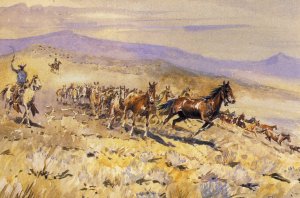
Edward Borein: Lassiter on his blind horse?
Lassiter’s horse was blinded when men held it down then placed a white hot iron alongside the eyes searing them. The horse as a female mother symbol represents Lassiter’s striken relationship with his Anima.
If one reads this novel in a literal sense then many of its incidents are improbable if not ridiculous. What notorious gunslinger would ride a blind horse? Grey has been criticized for wooden characters which is womewhat unjust. These are archetypal characters who are fully developed and can’t change. As allegories there is no need to change. This is mythology.
The Mormons lift Jane’s red herd. This may represent her female Animus as in iconography the male is usually represented as red while the female is white. They next try to stampede her white herd by devious means which they believe are undetectable such as flashing a white sheet from a distance. As a Chosen People they even have to convince themselves that what happens was not caused by them but was the will of God.
Lassiter notes this taking Jane with him to show her. As they watch the cattle begin to stampede. Three thousand on the hoof they stream down the valley. Lassiter on his blind horse races full speed down the slope, obviously no blind horse could do this, out on the flat to single handedly mill the cows. As the lead cows enter the center of spiral Lassiter disappears in the dust. He emerges sans horse to appear before Jane: ‘My horse got kilt.’ he announces. Jane’s response is ‘Lassiter, will you be my rider?’ Pretty clear sexually I think. Not exactly changing horses in midstream but obviusly the transition from a blind horse to a sighted jane is an improvement in Lassiter’s relationship with his Anima. ‘You bet I will Jane.’ Lassiter promptly and positively responds.
Whether you want to consider this stuff ‘high literature’ or not read properly it is not much different from the Iliad or Odyssey.
As a mother figure Jane is a keeper of horses, a symbol of the mother and female. The blinding of Lassiter’s horse was the equivalent of separating him from the mother figure. Jane not only has a full stable of horses but she has the prized horses Night, Black Star and Wrangler. As Grey makes clear these are the devil’s own mounts. In the big chase scene Grey has Wrangler close to breathing flames as he compares the horse to the devil.
The Mormons steal Jane blind while she refuses to allow Lassiter to defend either himself or her. Seems to be the Great American Dilemma even today.
Remember this is a war between Gentiles and Semites qua Mormons. The Gentiles hands are stayed while the Semites are allowed to run wild. Maybe Grey is making a social comment. Also remember that Jane is a Mormon so that while she is powerless to control her own aging maniac men the only men she can influence are the Gentiles whom she emasculates. As soon as the emasculated Venters gets away from her while pursuing the rustlers he immediately begins to revert to full manhood.
The Mormons set both Mormon men and women to steal from her. They take her bags of gold, this woman is prodigal, rich, her deeds and anything of value. They steal her six thousand cows. They want to kill Lassiter, dozens of Mormons lurk in the cottonwood groves (female places) but something stays their hands; they can’t shoot him either from behind or in front.
The only thing Jane worries about is her horses. Black Star and Night. It is possible that in this instance Jane represents the moon goddess. Finally the Mormons steal these symbols of her power. The independent woman is now completely violated. She has a man who could shoot down all the Mormons in Utah but she won’t let him use his guns.
So why should we care?
2.
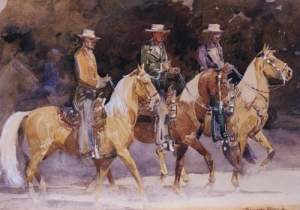
Edward Borein: The Three Caballeros
The myth switches to an alternate plot. Young Bern Venters goes in search of the rustler gang. Once again, Jane attempts to emasculate her men by pleading with Venters not to go, to stay beside her. Why anyone would want to hang around such a loser woman isn’t clear.
Venters goes in search of the rustler gang which is led by a man named Oldring. Old Ring. I’m sure the name has significant meaning but I can’t place it. The wind soughing through the caves is known as Old Ring’s Knell. Even though Oldring’s gang consists of a couple dozen men who have punched a herd of three thousand red cows they have somehow left no trail. Over all the years they have been rustling and pillaging there is no one who has been able to find this robber’s roost.
Venters has traced them to the foot of a waterfall where he loses track. While he is mulling this over a group of desperadoes return from pillaging plodding up the stream. Lo and behold they ride right through the waterfall into yet another hidden valley. Big enough to hold three thousand head of cattle. The West was a big country.
Venters rides off to relate this discovery to Jane and Lassiter when he encounters a despearado with the famous Masked Rider, reputed to have shot down dozens of men. He is dressed from head to toe in black wearing a black mask. This Rider is credited with shooting down any Mormons Lassiter overlooked.
Venters takes out his ‘long gun.’ You know how riders despise the long gun or rifle preferring six shooters, and by dint of long practice he shoots the lead rustler dead and wounds the Masked Rider. While examining the Masked One’s wound he unbuttons the shirt to discover the ‘beautiful swell of a female breast.’ Boy, howdy. You got it, the Masked Rider is a woman, a mannish girl. The image of Venter’s Anima.
Stranded in the desert while trying to nurse this girl back to health Venters chases a rabbit up a slope where he notices ancient steps cut in the rock. Following these he comes into ‘Surprise Valley.’ Formerly the home of cliff dwellers the place is a vitual paradise, green and verdant. No one would ever discover him and the Rider there. Carrying the slight figure of the Rider up hill and down for maybe ten miles or so Venters secretes themselves in the Valley which abounds in game and delightsome frolics.
About this time I recognized some teen fantasies of my own. Shooting and wounding a woman while having to tend her wounds in a secluded place where she has to be eternally grateful when healed was just too obvious. In my case, just after the onset of puberty, I think, when the Anima would be making itself known, I came up with the daydream of having this woman I could keep in a milk bottle until I wanted her. When I let her out of the bottle she became full sized and did whatever I wanted then she willingly went back into the bottle until the next time I wanted her.
As a thirteen year old before the advent of universal pornography I didn’t know what I wanted the woman for but I knew it would be fun. Grey here creates his version of the same fantasy. The Rider, who turns out to be Bess, apparently has a past. I say apparently because nearly everyone in this story has an apparent history which turns out to be false. As a member of the gang she was thought to have been, um…the piece…of Oldring. He kept her in a cabin up on a ledge in his valley behind the waterfall. He was gone a lot so we’re not clear that he ever laid a hand on her but Venters believes she is not ‘pure’ which in his great love for her he is willing to over look but it rankles him.
If you want to know the wonders of Surprise Valley read the book yourself. Comes a time when Venters has to go into Cottonwoods for supplies. There he realizes that he and Bess can’t stay hidden away forever. He has enough money for supplies obviously but not enough to flee from Mormonland.
They don’t call it Surprise Valley for nothing. When he returns Bess hauls out a big bag of gold to give to him. This must be the treasure that the female brings the male. The whole several mile length of the river which runs through this valley is lined with pebbles of gold which Bess has collected. Shades of Opar, huh? In her girlish gratitude she wants Bern to have the lot.
‘Gosh,’ says Bern. ‘Now I don’t have to get a job.’ (He didn’t put it quite that way.) ‘We can leave this valley and go far away from Mormonland.’

Edward Borein: Four Navajos Crossing The Desert
Far away from Mormonland, by the way, is either Quincy or Beaumont (beautiful mountain) Illinois. Not too far from Nauvoo which was the Mormon stronghold jumping off place for the long march to the Great Salt Lake into the fantastic scenery Grey either describes or imagines. Certinly the West of Grey’s imagination is as fantastic as anything Burroughs created on Barsoom.
Even though Grey refers to the desert this is certainly the lushest desert anyone has ever seen. The purple sage is the equal to Burroughs red moss of Mars.
Grey wrote an essay about what the desert meant to him. His desert with its plentiful water complements his vision of the Anima and Animus. The desert may answer to Grey’s subconscious which appears to be missing in his analysis of Anima and Animus, so that perhaps the desert stand for the subconscious.
His desert reminds me of a dream I used to have with some frequency. In my dream I was walking across this immense barren desert spotted at invervals with small oases in which I wasn’t allowed to remain. Off in the distance I could see this great brain shaped mountain. On approaching the mountain I found a small stream of water leading down into the mountain. As I descended I noticed that the stream ran through a bed of solid salt which rendered the water bitter.
Descending further the water disappeared beneath a steel chute. Unable to turn back while unwilling to go further I was nevertheless pushed into the chute where dropping into a steel lined entry I was pushed into a steel walled laundry room as the steel door slammed behind me. There was plenty of water but no way out. There was a ventilation shaft along the ceiling of the back wall. I conceived a plan of drinking to repletion then urinating into the ventilation shaft creating such a smell that they would want to find the source.
My plan worked. Three maintenance men opened the door and I dashed out so fast they didn’t know I had been there. Still in a steel lined area I saw a bank of elevators which would take me back to ground level. A door opened but the elevator was filled with classmates from my high school who pushed me back refusing to allow me to enter.
I don’t know how but I gat back to the surface where once again I approached the back side of the mountain which I ascended this time rather than descended. Now, the mountain was deep in a frozen snow but starting from the low grade at the back I had no trouble climbing, walking on top of the snow. The sun was shining brightly but all was frozen white. When I reached the top I found I was standing above the brow of the face of a great idol carved in the snow. Thousands of feet below terified and intimidated people were kneeling in the desert worshipping the great snow face. From where I stood I couldn’t see the face but I conceived the notion of destroying the snow god to free the people. Leaping into the air I came down on the god’s forehead creating an avalanche. The great face slid away as I descended thousands of feet on a cushion of snow to alight unharmed.
As I hoped, the destruction of the god freed the minds of the people from the domination of their morose god. The melting snow created numerous streams watering the desert among which the people danced and sang as the desert bloomed, while I looked on admiringly.
I don’t know enough about Grey’s background to say how unhappy his childhood had been but since his plot of Riders/Rainbow roughly follows my dream I suspect what the desert meant to him was the barrenness of his early life. The appeal of the novels to Burroughs must have been of the same order.
When Venters leaves the Valley Grey begins to lose control of his story. The clarity and focus of the first half becomes jumbled. He finally just crams the ending through as Burroughs so frequently does.
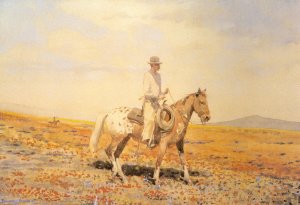
Edward Borein: The Apaloosa
Venters, riding Wrangler, crosses trails with the men who stole Night and Black Star from Jane. A sort of running joke throughout the novel is whether Wrangler is faster than the two blacks. Wrangler proves his mettle in this chase overtaking the two even though they were ridden by the best rider on the range, Jerry Card. Card is sort of a puzzle, at least for me. His horsemanship was so great that racing at full tilt leading one horse he could keep both horses side by side at full pace; in addition he could hop back and forth from horse to horse. Whether Grey was making a joke or not, I can’t really tell, he describes Card’s appearance as froglike. Hop-frog of Poe? Card is a little misshapen runty man. Whatever Grey had in mind for him he forgot to develop.
Card abandons the horses as the race ends disappearing into the purple sage. Wrangler gets away from Venters to be captured by Card. In a rather spectacular scene Card is trying to guide the horse by biting it on the nose. He is actually being dragged with his teeth in Wrangler’s nose. I’m no horseman but I’d really have to have the fine points of this maneuver explained to me.
Unable to hit the small fragile Card with a rifle shot as rider and horse rode alongside an escarpment rather than let Card get away, Venters shot the horse who leaped off the edge in what Grey describes as a fitting end for the greatest horse and greatest rider of the purple sage. I can’t follow his reasoning here but he must be trying to say something.
Venters rides the remaining two horses down the main street of Cottonwoods with apparently no more reason than to enrage Bishop Dyer and Elder Tull and announce in stentorian tones that Jerry Card is dead. Reminds me of the myth in which it is announced that the great God Pan is dead.
Venters packs some saddlebags with provisions then, in what seems a comic touch, since Jane’s wonderful stable of horses is now empty, mounts a burro to return to Surprise Valley. Riding one and leading a string of burros he looks behind him to see if he being followed by men on horses I presume he would have hopped off the burro and started running. The burro appears to represent severe emasculation.
Another essential subplot has been the arrival of a small child still annoyingly gushing babytalk- muvver for mother and oo for you- by the name of Fay Larkin. Fay is going to be the heroine of the sequel. She was the daughter of a Gentile woman who died. The woman asked Jane, who was ever kind to the despised Gentiles, to take the child which Jane did. She now ‘cannot live without the child.’
Having stolen everything else of the woman in the name of God, the Mormons now steal Fay.
This is too much for Lassiter who coldly disregards Jane’s imploring to disregard this insult and injury too, even though a moment before she ‘couldn’t live without the child.’ While it seems that Mormon men emascualte their women, Mormon women in turn emasculate their men. Maybe that’s what the story is about: the conflict between the sexes. Lassiter disregards her, strapping on not only his big blacks but an extra brace that he hides beneath his coat. The extra brace doesn’t figure into the story so it isn’t clear why two gun Lassiter became four gun Lassiter.
Lassiter shoots the Mormons up pretty good killing Bishop Dyer. Elder Tull is out of town at the moment. Lassiter and Jane know they have to get a move on so, packing enough to stagger any ten horses , including bags of gold, they skedaddle riding Night and Black Star.
Somewhere in here Grey must have become stymied in his story not having the progression to Rainbow Trail figured out. Something like the odd ending of Burroughs’ Princess Of Mars. Venters still thinks Bess was Oldring’s girl hence something only his great love for her can make him overlook. Loading up their burros they leave Surprise Valley. Out in the purple sage who should appear much as he had at the beginning of the story but Lassiter, this time with Jane.
It now comes out that Venters thinks Oldring is Bess’ father. Jane lets out the fact that he had then killed his future wife’s dad. Bess is revolted at the thought, calling off the wedding. Lassiter to the rescue. He produces a locket with a picture of his sister Millie Erne and her husband Frank. Lassiter explains that Millie was pregnant by Frank when Millie was kidnapped and that Frank Erne is her real father. The obstacle that had appeared between Venters and Bess now disappears as he hadn’t killed her father, just the guy who reared her. At the same time Bess is no longer the daughter of a low rustler but of a respectable man.
But wait, there’s more. Grey can produce as many twists as Edgar Rice Burroughs. It was the literary fashion of the day.
Not only is Bess the daughter of Millie Erne but the Mormon kidnapper of Millie had been no ther than Jane Withersteen’s father. The ever-forgiving Lassiter, now Uncle Jim to Bess, mutters something like ‘Aw shucks, Jane, I don’t pay thet no nevermind.’ and sister Millie is forgotten. nearly two decades of bad blood goes up in smoke with a shrug.
Venters and Bess head off for the safety and security of civilization in Beaumont, Illinois, while Lassiter and Jane depart for the security of Surprise Valley. Two problems remain for the next ten pages or so, Fay Larkin and Elder Tull.
Just like Tarzan, Lassiter can apparently smell a white girl because there is no other way that he could have located her. She was being held by some Mormons in a side canyon. Setting Jane to one side, Lassiter enters the canyon from which after firing every cartridge in his four guns and belts- Grey didn’t actually make it clear that he was still wearing the extra set up under his coat but he didn’t say he took them off either- of’ four guns Lassiter kills all the varmints, emerging from the canyon with little Fay in his arms and ‘five holes in his carcase.’
As they glory over little Fay, who was problem number one, problem nuber two, Elder Tull and his band of Mormon riders appear on the horizon. Leaping on their burros, did I mention Jane and Uncle Jim swapped Night and Black Star with Venters and Bess for their burros?- the Hammer Of The Mormons and Jane jog off with the Mormons in hot pursuit on horses, but tired ones.
One would think that even tired horses would have the advantage over burros but it is a very tight race. You see why Grey’s stuff translated to the movies so well. Getting all safe within Surprise Valley on the other side of balancing rock (did Grey borrow this detail from the She of Rider Haggard?) Uncle Jim lacks the nerve to roll that stone because Jane has pretty completely emasculated him. ‘Roll that stone’ Jane commands restoring Lassiter’s will. He does just as Elder Tull ad his Mormon band reach the cleft. The stone falls eliminating Tull and his Mormons while sealing off Surprise Valley ‘forever’ with Uncle Jim, Jane and Little Fay Larkin inside. Of course they are well provided because Venters has stocked the Valley with burros, fruit tree stock and plenty of grain seed. At the same time he had eliminated coyotes and other beasts of prey so that jackrabbits, quail and other small food animals have mutiplied exponentially. It’s going to be a long twelve years in the valley so the bunch has to be well provided. Without his gun though Lassiter is going to have to catch those jackrabits with his hands. During their long stay Lassiter and Jane apparently have no sexual relations as there were no additional children when the valley was reentered by the Mormons. Jane must truly have been a mother figure.
On this incomplete note Grey ends his novel.
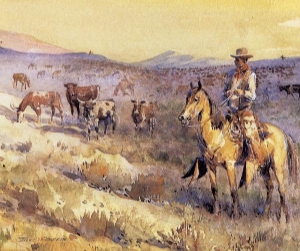
Edward Borein: Grazing Cattle
3.
Indeed, from the Enlightenment to the present has ben a period of intense religion formation, especially the nineteenth and twentieth centuries.
Utopian and Scientific Socialism may both be considered forms of religion, especially the latter in its Semito-Marxist form.
Mormonism itself, which has no basis in science, orginated from the brain of Joseph Smith in 1830. Madame B’s Theosophy, Mary Baker Eddy’s Christian Science, Ron Hubbard’s Scientology and the Urantia religion all have a basis in science as do most religions formed after Darwin. With the emergence of science none of the old religions were satisfactory. Hence it should come as no surprise that writers like Grey and Burroughs were intensely concerned with the problem.
As I have mentioned in Something Of Value no adequate myth for the scientific age developed, leaving men and women whose faith in the Semitic gods was undermined with a stricken religious consciousness such as in the case of John Shefford, the protagonist of Rainbow Trail, and probably both Grey and Burroughs.
So the search for meaning was endemic in this period not being confined to Burroughs and Grey who were merely symptomatic.
Another attitude that both authors share is a yearning for the wide open spaces of their youth that, while we may look back in envy, were rapidly disappearing before their eyes. Somehow this yearning was also connected to a feeling for the prehistoric past, perhaps as a Golden Age.
Both men were charmed by the notionof cliffdwellers. It would seem that Americans of the period were also absolutely charmed and enamored with the Anasazi of the American Southwest. Burroughs was very nearly obsessed with cliffdwellers. Novel after novel is replete with cliffdwellings whether in Pellucidar, various terrestrial locations or even on Mars.
The inhabitants of the skyscrapers of Chicago were nicknamed cliffdwellers; a replica of Southwest cliffdwellings was built for the Columbian Expo of 1893 that apparently made a great impression on 17-year 0ld ERB. The premier literary club of Chicago was known as the Cliff Dwellers which was on the 8th floor and roof of Orchestra Hall. I think Burroughs had a yearning to be a member of this club.
Thus there were many cliffdweller influences on ERB’s life , whether he had ever seen the Anasazi dwellings before 1920 is doubtful, it would be interesting to know if Grey had before 1910.
At any rate cliffdwellers had carved out homes in Surprise Valley in some distant prehistoric time. Thus both Venters and Bess and Uncle Jim Lassiter and Jane were actual cliffdwellers utilizing the old dwellings. Lassiter, Jane and Fay Larkin would be cliffdwellers for twelve years. This must have had a very romantic appeal for Grey’s contemporary readers.
During that period they dressed in skins living as close to a stone age existence as was possible. So one may compare the Surprise Valley of Lassiter and Jane with the cliffdwellers of Burroughs’ Cave Girl.
As all these themes were in the air of the period it is not necessary for either of these two authors to be influenced by each other to this point but it is probable that both were influenced by the stone age stories of Jack London and H.G. Wells among others.
I doubt Burroughs was influenced during this period by Grey although he did have a copy of Rainbow Trail in his library, one of only two Grey titles. We can’t be sure when he bought Trail. Grey’s stories complement Burroughsian attitudes but only after this formative preriod around 1912. ERB’s Western and Indian novels probably owe something to Grey but they were written after 1920.
Riders Of The Purple Sage sets the scene for its denouement which is The Rainbow Trail. Riders was a wonderful romantic vision of the West which answered the needs of the period when for the first time the percentage of Americans living in cities surpassed that of those living on farms. Indeed, very like these authors, modern cliffdwellers had a heartsick longing for the Paradise they had lost. For decades it would be a crazy dream of city dwellers to buy a farm and ‘get back to the land.’ The movie ‘Easy Rider’ was a good laugh in that respect.
Both Burroughs’ and Grey’s novels addressed that need.
Burroughs’ interest in Rainbow Trail would stem from religious aspects and the perfect union of the Anima and Animus when John Shefford and Fay Larkin unite. It might be noted that a fay is a fairie. Cliffdwelling and the purity of Grey’s noble savages, the Navajos, would have been compelling for ERB.
Before continuing on to The Rainbow Trail let us take a brief interlude to examine some aspects that would have interested ERB from the other Grey title in his library- The Mysterious Rider.
Something Of Value I
October 1, 2007
Something Of Value I
by
R.E. Prindle
If a man does away
With his traditional way of living
And throws away his good customs,
He had better first make certain
That he has something of value to replace them.
–Basuto proverb as quoted by Robert Ruark
Dedicated to
Greil Marcus
Part One
One Hundred Years In The Sewers Of Paris
With Jean Valjean.
Edgar Rice Burroughs, Sigmund Freud
And The Myth Of The Twentieth Century
1.
The Concepts Of The Unconscious And Emasculation
It has been truly said that man does not live by bread alone. He also requires a mythic foundation on which to base his actions. In the neolithic era his mythology was governed by a Matriarchal vision of reality. In the subsequent Egypto-Greco-Mesopotamian mythology the Matriarchal series went through a revision being replaced by an advanced Patriarchal mythological consciousness. This system was followed by the Judaeo-Christian mythological system which endured as the basis of mythological belief until the seventeenth and eighteenth centuries when the belief system was subverted by the emergence of the Scientific Consciousness.
Unlike the mythopoeic consciousness which preceded it the Scientific Consciousness left no place for supernatural explanations; all had to be explained within a rational scientific framework. This placed a great strain on a significant portion of the population which did not have the intellectual equipment to evolve. Thus the basis of psychological comfort provided by religion was destroyed. The code of behavior seemingly sent down from the sky had lost its validity.
In place of an apparent unified consciousness it now became noticeable that EuroAmerican man had an unconscious or subconscious mind as well as a conscious mind. Thus another evolutionary degree of differentiation unfolded that separated the advanced Scientific Consciousness from the anterior Religious Conciousness. A struggle has ensued in which advanced people are compelled to reintegrate their conscious and subconscious minds while the Religious Consciousness divided into the two camps of the Devout and the Reds resist.
The discovery of what was known as the Unconscious began with the emergence from the Religious Consciousness during and after the Enlightenment. Anton Mesmer with his discovery of Animal Magnetism or hypnotism may have been the first stage. Goethe and others carried the discussion forward until the Englishman FWH Myers isolated or identified the subconscious by the name of the unconscius in 1886.
The notion of the unconscious as known during the twentieth century was formulated by Sigmund Freud during the twentieth century’s first decade. Both Myers and Freud misconceived the nature of the sub or unconscious. Myers’ conception was more generous than Freud’s and more in accordance with proto-scientific Patriarchal Greek mythological conceptions which were also mistaken but visionary.
In Myers’ vision of the unconscious it had two aspects: the destructive aspect which he gave the Greek name of Ate and the constructive aspect he termed Menos. Thus he recognized that the unconcious could be good or bad.
Myers’ vision may have been based in Greek mythology. It will be remembered that the creative god, Hephaestus, was married to the emotional goddess, Aphrodite. Hephaestus and Aphrodite had their digs at the bottom of the sea which is to say the symbol of the unconscious which corresponds to the seeming location of the unconscious at the bottom of the mind or, in other words, the brain stem.
Thus it is said that Aphrodite, the goddess of love, which is to say irrationality, emerged from the sea on the half shell.
So, I suppose, love, being never rational is a subconscious decision which is one sided or a half shell. Love may be either constructive or destructive.
Thus also good ideas, a la Hephaestus, seem to rise unbidden from the subconscious or the depths.
Hephaestus and Aphrodite were ancient gods dating back to the Matriarchy. The incoming Patriarchal god, Zeus, had no part in their creation; they were solely a part of Hera the great goddess of the Matriarchy. She was much older than Zeus but the youthful Zeus united with her in the form of a cuckoo bird who as she clutched it to her breast slipped down her dress and ravaged her. So the Patriachy subsumed the Matriarchy.
When Hephaestus later sided with his mother against Zeus, the great Olympian threw him from heaven laming him. Then Aphrodite was given to him to wife. Unbridled lust combined with creative activity, Ate and Menos.
Aphrodite was not happy with the lamed god. While Hephaestus was on trips to Olympus she dallied with another Matriarchal god, Ares, the symbol of uncontrollable desire or rage. Hephaestus having been informed of Aphrodite’s infidelity set a trap for her and Ares. He constructed a finely meshed net of gold which he suspended over his bed.
Aphrodite, unbridled lust, and Ares, uncontrollable rage, were literally caught in the act being unable to disengage. Thus we have two aspects of Ate, lust and rage, caught by the efforts of creativity in the depths of the sea or the unconscious
Hephaestus called the other gods to witness. Athene, a new Patriarchal goddess who was the counterpart and antithesis of Ares and Aphrodite turned away in disgust. Apollo, another new Patriarchal god and the antithesis of Hermes just laughed. Hermes, the patron god of thieves, a Matriarchal god, said he would change places with Ares in a second. Thus, lust, rage and dishonesty are combined in one figure of Ate in the subconscious.
The image of Ate and Menos is what Myers meant by his idea of the unconscious. Freud, on the other hand, understood the unconscious as pure Ate.
Both the Greeks and Myers attempted scientific explanations while Freud gave the unconscious a religious and supernatural twist. He seemed to believe that the unconscious has an independent existence outside the mind of man which is beyond man’s control while being wholly evil.
Opposed to morality, Freud then wished to unleash this conception of the unconscious on the world. He was uniquely prepared to do so. All he had to do was manipulate the symbols of psychoanalysis of which he had full control. The question then is did Freud have deeper understandings that he concealed in order to bring about his desired ends?
Such is the case with his conceptions of sexuality. There is no need for him to have had deeper understanding, after all he was a pioneer opening a new field of inquiry. On the other hand…
Defining the unconscious was done by many men preceding Freud so that his is only one of many understandings, not necessarily the best, although today in common belief he invented the concept of the unconscious.
Next he chose to define the concepts of sex. He was equally successful in this field as far as the public was concerned, although I differ in understanding the matter as I do with the unconscious.
In analyses with patients Freud discovered that there was a fear of castration out of all proportion to actual incidents of sexual mutilation. It follows then that castration symbolizes something other than the removal of the genitals. I contend that it was impossible for Freud to have missed the signficance of castration as a symbol.
Castration as a symbol represents the broader concept of Emasculation, in this case psychological emasculation. This does occur in everyone’s life in many different manifestations while being something to really fear or avoid. Unless I am mistaken all neuroses and psychoses depend from it.
Understanding Emasculation is as much a ‘royal road to the unconscious’ as dreams.
I do not accept Freud’s map of the mind but we both agree that the Ego or Animus is the key to identity. Freud fully understood the significance of the Ego. Thus when the Ego is challenged with an affront or insult to which it is either unable or doesn’t know how to respond to successfully emascualtion to some degree takes place. There is no unconscious, just as there are no instincts so that a fixation is suppressed in the subconscious as a result of the affront. These fixations produce effects, which can be grouped in categories such as hysteria, paranoia, obsessive-compulsiveness and the whole panoply of general affects. The affects then find expression physically and psychologically, or in another word, psychosomatically. The mind and the body is one unit. These affects answer to what Freud called neuroses and psychoses.
When the Ego or Animus is denied its right to assertion the denial is frequently espressed in a hysterically sexual manner corresponding to the the insult. If the victim feels he has been taken from behind he will undoubtedly resort to anal intercourse as one type of underhanded response in an attempt to get back his own as in the case with homosexuality. Homosexuality is Emasculation par excellence.
The human mind is very limited in its inventiveness so all these affects can be catalogued and matched with the insult so that, absent resistance under analysis, they can easily be addressed and exorcised. The problem is not as complicated as it has been made out.
Freud understood so much more than he was willing to tell the goys but then he was not a scientist but a Jewish prophet. In his Group Psychology And The Analysis Of The Ego to which we will return he gave the game away.
The individual can and does submerge his own ego into a, or at various times, many group egos. Prominent among these group egos are ethnic, national and religious group egos.
Just as the individual can be emascualted so can ethnic, national or religious groups be emasculated which the individual will share. I mention the Jews only as the most obvious case although Negroes, American Indians or any defeated people suffer emasculation to one degree or another.
Thus I will discuss the unconscious from a general point of view with Freud’s concept prominent while the concept of Emascultion will be discussed by my understanding based on the studies of Freud on the castration complex and group psychology.
Bear in mind that I think Freud criminally distorted scientific knowledge for ethnic, national and religious ends.
2.
Quo Vadis?
Born with an integrated mind, circumstances soon disintegrate the personality so that the mind must be reintegrated to return to a state of psychic wholeness. A sort of personal mythology is created by one’s early disintegrative experiences which form one’s dreamscape in an attempt to deal with an overwhelming reality. However, when a person gains some control over external reality when the personality is integrated and the initial dreamscape based on early memories is eliminated a sort of distressing vacuum ensues that exists until a new dreamscape is formed which, while sufficient to ease the discomfort lacks the depth and substance of the fully mythologized dreamscape of childhood. One had reached a scientific consciousness. It may not be as satisfying but it fills the space while not controlling one’s behavior.
Western man, Euroamerican man, as the only segment of mankind so differentiated had then to begin to work out a new mythology based on rational scientific ideas. In other words he had to create a comfortable basis from which to understand and interpret the world.
Thus after a couple proto-mythographies in the early nineteenth century a cluster of writers or neo-mythographers began to create a mythology for the Scientific Consciousness.
The destruction of the Religious Consciousness began to become obvious after the eighteenth century Industrial Revolution in England. With the advent of steam the problem began to become acute.
The proto-mythologers may be Walter Scott, Byron, Peacock and the Shelleys. There is a departure in feel and style with these writers. Mary Shelley’s Frankenstein posits the scientific problem laying a foundation for the new mythology but does not itself deal with the psychological effects.
The first mythographer to make an attempt to explain the split consciousness from my own researches was the American, Edgar Allan Poe, 1801-49.
Poe began his writing career as a psychologically troubled man ending it insane. Along the way he wrestled with the problem of the void in the subconscious created by the elimination of the supernatural. His message was received by the later group of mythographers who read him without exception all being influenced by his work.
Poe caught the great intellectual change as it emerged. The period from 1830-1880 was the period of the great initial scientific advances that would change the world. From Poe’s death in 1849 to the emergence of the new breed of mythographers beginning in the 1880s was a period of literary quiescence.
Poe began his influential masterpiece The Murders In The Rue Morgue with the paragraph:
Quote:
As the strong man exhibits his physical ability, delighting in such excercises as call his muscles into action, so glories the analyst in the moral activity which disentangles. He derives pleasure from even the most trivial occupations bringing his intellect into play. He is fond of enigmas, conundrums, hieroglyphics; exhibiting in his solutions of each a degree of acumen which appears to the ordinary apprehension as praeternatural. His results brought about by the very soul and essence of method, have in truth the whole air of intuition.
Unquote.
By analysis Poe didn’t mean the sort of educated guesswork that had passed for analysis in the pre-scientific consciousness. No, this was scientific analysis that disassembled a problem into the component parts revealing the secret than reassembling the problem to its original state.
In doing so Poe revealed himself as a master mythographer as well as a scientist. In C. August Dupin, the initials spell cad, Poe created the archetype of the eccentric madman who would be the here of countless novels. As a projection of Poe’s own mentality Dupin and his unnamed alter ego live in a dilapidated house. The house is the psychological symbol for self which Poe used almost to exhaustion. As the Fall of the House of Usher prefigured Poe’s own descent into insanity as to a number of alter egos representing his sane side figure in the House of Usher, William Wilson, Rue Morgue and most notably in the System of Dr. Tarr And Professor Fether in which his sane alter ego drops his other half off at the door of an insane asylum.
The two Dupins live in a darkened house during the day, creaking not unlike the House Of Usher, going out only into the depressed asylum of the night.
Poe thus presents the separation of the conscious and subconscious modern man in the riddle of the murders in the Rue Morgue. In the Rue Morgue the subconscious is represented by the Orang u tang or animal side of human nature while the conscious is represented by the sailor owner. From Poe to at least Freud the subconscious was popularly considered a dangerous wild side of man.
In Dupin and his alter ego versus the sailor and the Orang, Poe may have perceived the emergence of a new species much as H.G. Wells was to do at the end of the century. Thus both men perceived that the antecedent consciousness and the Scientific Consciousness were not just matters of learning but a genetic difference although they didn’t put it that way that couldn’t be bridged.
Both aspects were brought out brilliantly by Robert Louis Stevenson (1850-94) in his 1880 novel: The Strange Case Of Dr. Jekyll And Mr. Hyde. This book may properly be said to be the first true represention of the scientific myth.
In this case the good Dr. Jekyll is the disciplined, self-controlled scientist committed to doing good in the world. Beneath his intelligent exterior he feels the primitive wild man lurking. The primitive of what is in fact a predecessor Homo Sapiens is very very appealing to him. Unable to bring this aspect of his psychology to the surface by conventional means he resorts to drugs.
Having once freed his wild side, who he names Mr. Hyde, he is unable to put Hyde back into the bottle or syringe, whichever the case may be. Hyde assumes control of the personality which leads both aspects of the personality to destruction. This is not unlike Freud’s notion of the unconscious.
Thus Stevenson brilliantly prefigured the twentieth century future in which the scientist is dragged back to the level of the predecessor species through a psychological inability to take the great leap forward and turn his back on his past.
The same sense of the alienation from a predecessor existence was evidenced in the work of a great transitional figure, H. Rider Haggard (1856-1925). Let me say that Haggard is a much neglected literary figure. As his topics concerned Esoterica and Africa, the former which is scorned and the latter ignored, his literary reputation has been allowed to virtually disappear. Having read a large part of his work in the pursuit of these studies I would rank Haggard very highly, certainly among the top ten authors, possibly as high as number five. one and two are Walter Scott and Balzac, while Dumas holds down third and possibly Trollope in the fourth spot. Haggard is a writer of genius.
He spent his late teens and early twenties in the South African provinces of Natal and Zululand where he acquired a vision of the difference between the first Homo Sapiens, the Negro, and the current scientific man. As the saying goes, there’s something to be lost and something gained when you move up the ladder.
Haggard never made it to scientific man himself being stuck in the Religious Consciousness. He belonged to the Esoteric side rather than the Christian. In the third novel of his great African trilogy, Allan Quatermain, Haggard examined the difference between the African and European in this manner.
Quote:
Ah! this civilization what does it all come to? Full forty years and more I spent among savages, and studied them and their ways; and now for several years I have lived here in England, and in my own stupid manner have done my best to learn the ways of the children of light; and what do I find? A great gulf fixed? No, only a very little one, that a plain man’s thought may spring across. I say that as the savage is, so is the white man, only the latter is more inventive, and possesses a faculty of combination…but in all essential the savage and child of civilization are identical.
Unquote.
In the same book Haggard also put the problem more poetically:
…he dreams of the sight
of Zulu impis
breaking on the foe
like surf upon the rocks
and his heart rises in rebellion
against the strict limits
of the civilized life.
Here Haggard states the central thesis of Stevenson’s Jekyll and Hyde. In the evolution of the species there is always a small gulf between two adjacent species: nature does not take great leaps, it moves in small increments. Thus it may be a small leap between the two, expecially when the next transition creates not only a new variety but a new species, but the leap is backwards as in Jekyll’s case while it is impossible for Hyde to make the leap forward, nor is he capable of adjusting to the new strict limits. Wasn’t Stevenson precocious?
Haggard who was not of the Scientific Consciousness was left behind while his work formed the basis of the greatest of the scientific mythographers.
Before moving on let us here consider the patron saint of the future Red/Liberal aspect of the Religious Consciousness, the Frenchman, Victor Hugo (1802-85).
Paris Is A Leaky Basket
Paris has another Paris under herself; a Paris of sewers; which has its streets, its crossings, its squares, its blind alleys, its arteries and its circulation, which is slime minus its human form.
~Victor Hugo- Les Miserables
As Haggard was a transitional figure for the mythographers one might say that Victor Hugo created the literary foundation for the Red/Liberal faction of the Religious Consciousness. His Les Miserables with its tragi-comic format forms the bedrock of Revolutionary beliefs. Hugo was himself a Revolutionary. His novel Les Miserables is the account, so he says, of the apotheosis of Jean Valjean from bestiality to salvation. Along the way to his apotheosis Valjean makes a detour through the sewers of Paris.
Hugo was a poet; his account of the sewers of paris is, shall we say, poetic. In fact a scatalogical masterpiece worthy of our own Lenny Bruce. If Lenny had studied Vic a little he would have been able to say everything he wanted to say while staying out of jail at the same time.
One wonders whether Freud read Hugo. There are certain similarities in style. Certainly they both seem to have had the same notion of the unconscious. Valjean’s trip through the sewers of Paris, he with the bleeding Marius on his back must have been intended as a representation of the unconscious. And a very funny one at that.
Freud would certainly have agreed with Hugo when the latter wrote: The history of men is the history of cloacae. From Hugo’s description of the sewers of Paris it is clear that Paris was not anal retentive.
Freud was no less scatological in his approach to psychology than this astonishing section of Hugo’s book. Who wouldn’t be miserable down in a sewer; miserable enough if only your mind was in the sewer. In Hugo one gets the same macabre, morbid sense of humor Freud exhibits in his own work. Oh yes, read properly Freud tells a lot of jokes. Didn’t he write a book titled: Jokes And Their Relation To The Unconscious? Sure he did. Knew what he was talking about too.
The first chapter of the section of Hugo’s book, The Intestines Of Leviathan is a series of morbid one liners which are as funny as anything Lenny Bruce came up with. Double entendre? To say Paris is a leaky basket! In the underworld homosexual argot of Jean Genet the term basket refers to a man’s crotch and penis. Undoubtedly the same argot was current in Hugo’s time. He was a student of criminal argot. So Paris being a leaky basket is equivalent to saying Paris was incontinent, pissing all over itself. Don’t you think that’s funny?
And then: “The sewer is the conscience of the city.” Hm? ‘This can be said for the garbage dump, that it is no liar.” I ask you, does Victor Hugo know how to get down and boogie? Let us follow Jean Valjean into the “Conscience of Paris” “which is no liar” from which Hugo says Villon talks to Rabelais. Fabulous funny images, morbid but fabulous and funny.
To be sure, psychology in 1862 when Les Miserables was published, had not been developed, yet notice how closely Hugo’s tongue-in-cheek, laughing in his sleeve, description of Jean Valjean’s journey through the pitch black maze of this subterranean worker’s paradise into which from time to time faint glimmerings of light enter answers to the images of Freudian Depth Psychology. Depth psychology? Was that a pun or play on words?
Just imagine Jean Valjean as he enters the sewer. Take time to construct concrete images in your mind. After this, shall we say, harrowing of hell not unlike that of Theseus and Peirithous, from which Perithous never returned, Valjean receives his apotheosis not unlike Hercules. One might also compare this scene with the temptation of Christ.
Valjean is carrying the bleeding Marius on his back who might or might not be dead. Hugo doesn’t let us know. This might be compared to one’s old self before or during the integration of the personality. In fact Valjean sheds Marius after emerging from the sewer from which the gatekeeper of Hell, Thenardier, allows him to emerge after being paid his obol.
The sewer is certainly a symbol of the unconscious for the scatological Freud who seems to revel in such fecal images. Amidst a chatty history of the sewers of Paris which Hugo keeps up as Valjean plods through the darkness always intuitively heading in the right direction, down. He evades the thought police who are searching for him or someone just like him in the sewers. A shot sent blindly down his gallery grazes his cheek. Jesus! Isn’t a man safe from harassment in the depths of his own mind? If you think Paris is dangerous, try the sewers.
Valjean is exhausted from his long walk carrying Marius on his back, poor suffering humanity, the sign of the cross, nevertheless with the heart of a lion he plods on. He moves forward through deepening fluids as his bare feet sink into fecal matter “which does not lie” while Hugo carries on a charming separate conversation with we readers about little known facts of the Paris sewers. No, the fecal matter, as well as Hugo, tells the truth however hard that may be to decipher from the material at hand as well as underfoot.
As the fluid (also however that may be composed as Hugo is writing scatologically) rises, his feet sink up to his knees into “the conscience of the city.” Get this! Valjean is one of the great strongmen, he lifts the dead weight of Marius above his head on his extended arms still sucking his feet from the muck. Hugo does not reveal whether Valjean lost his shoes during this ordeal or not but surely a while back. Perhaps of all the details Hugo records this particular item which consumes my interest had none for him.
Nevertheless, heedless of the the danger to her shoes, Valjean plods on. Plod, plod.
Now, here’s a detail of interest Hugo does record. Feet and legs deep in the conscience of paris, Marius held above his head visualize this, the fecal fluid had risen above Valjean’s mouth and nose so that he has to tip his head back, I’m not sure this would have been effective, until only a mask can be seen rising eerily above the surface, as well as two arms and Marius. He ain’t heavy, he’s my other self. Seen in Stygian darkness that is.
If we’re all in the same sewer here imagine particles of the conscience of Paris, scatologically know as turds, bumping up against the mask probably trailing behind Our Man Of The Sewer in a wake of fetid glory.
Even in the pitch black Thenardier is watching this spectacle. Fortunately the psychic crisis is past. Valjean leaves the conscience of Paris which does not lie, you can say that about it, behind striking solid, er, ground.
A striking vision of Freud’s and the Revolution’s reality. Had Valjean been given the name Spartacus the Revolutionary vision would have been complete. The Red/Liberals had spent a hundred years or more in the sewers of Paris before they turned this primary text of theirs into the Broadway musical of Les Miserables. Next time you see it put it into this context of the sewers of Paris. The songs will take on new meaning.
Part II of Something Of Value I follows.
Springtime For Edgar Rice Burroughs
May 29, 2007
Springtime For Edgar Rice Burroughs, Part One
Including A Review Of
The Cave Girl
by
R.E. Prindle
Book I: The Cave Girl
1.
In 1912 Edgar Rice Burroughs was looking back on nearly forty years of humiliation and failure. As 1913 dawned, after that lifetime of suppression and depression it must have seemed as though the Millennium had arrived. Success on his own terms seemed to be within his grasp. The Gambler had finally won the gamble.
As the year turned he finished his fifth novel since he took up his pen in 1911, The Return Of Tarzan. As of the beginning of 1913 only two had been published and those only in pulp magazine form. Perhaps such publication was rewarding in the personal sense but the pulps had a very low literary reputation. Pulp writers were always second class literary citizens. Both his first publications created a sensation among the pulp readership while the second ‘Tarzan Of The Apes’ was a stunner.
His reputation was augmented when Tarzan Of The Apes began to be serially published in various newspapers. So while he had not established a reputation from the pulp publications the newspapers had spread his fame. Book publication was still a full year away.
Thus by 1913 A Princess Of Mars and Tarzan Of The Apes were before the world. Gods Of Mars would be published later in the year. His second novel, Outlaw Of Torn, had been met with outright rejection.
Based on this promising but hardly conclusive beginning, less than 2500.00 had changed hands in two years, Burroughs decided to throw over his day job to became a full time writer. As he says everyone thought he was crazy; without the benefit of foresight he most surely was. Burroughs himself even says he thought so. The Gambling Man was risking his all on a turn of the cards. His whole life he had seemed driven to take the riskiest and longest of long shots. His characters would behave in the same way. Shall we say on the positive side that it was an act of supreme confidence?
page 1.
Not only did he give up his day job but he set himself the daunting task of writing a story every two months of which he expected every one to sell. He ultimately wrote seven in 1913 of which all did sell. In this year of the most daring audacity he did earn over 10,000 dollars and that beat the cost of living and then some.
Burroughs won that bet, too.
The first book of the year, At The Earth’s Core began his Inner World series. It was also the begining of his exploration of prehistoric and evolutionary themes. The prehistoric novel was already a genre. Fictional treatments by Jack London and H.G. Wells were certainly known to him while he may have been familiar with the anthropological studies of J.G. Frazer in one form or another. Frazer made the phrase ‘the thin veneer of civilization’ a household phrase that Burroughs was so frequently to use and mock throughout his work. He may possibly have picked the phrase up through newspapers and magazines or possibly as David Adams has suggested through Jack London who used it before him and who we can be reasonably certain Burroughs read.
Frazer was at the height of his influence at this time having written three different versions of his most famous work, The Golden Bough. In 1910 he published a four volume study called Totemism and Exogamy that Sigmund Freud cribbed to write his own semi fictional work, Totem And Taboo.
Personally I would place Totem And Taboo with the prehistoric work of London, Wells and Burroughs. Read as a novel Totem And Taboo isn’t all that bad. Unfortunately Freud took himself seriously thinking he had more than he did. But as fiction Totem And Taboo is OK.
page 2.
Interestingly for Freud he formed his very speculative theories in the historical blind spot in the place between his intense Jewish Patriarchalism and the discovery of the Matriarchy that preceded Patriarchy. So his theories are somewhat skewed. Matriarchal theories were very stoutly resisted gaining any degree of acceptance only after the 1960s.
It is to Freud’s credit that he didn’t resist the concept. Even as early as Totem And Taboo he had heard of the discovery of the Matriarchy through the work of the Swiss mythologist, J.J. Bachofen, although he didn’t know how to incorporate the material. By 1938 he seemed to be conversant with Matriarchalism but still didn’t know how to fit it into his system. He was still touting the ridiculous theories of Totem And Taboo.
For some reasons I haven’t yet identified I find similarities between Freud’s and Burroughs’ writing. After all Freud did get his Nobel prize for literature not science.
Freud was in many ways a speculative and wild writer and so in fact was Burroughs. While the others wrote interesting but conventional prehistoric stories Burroughs discovered ways to link the various evolutionary stages with the present. While it is overlooked, at the time it was very innovative. The approach may have been suggested to him by his Prince and Pauper mentality in which he believed a clean break between his past and present had been made when he was sent to the Michigan Military Academy.
There is no clearer link for this possibility than the story of Tarzan. In Tarzan Of The Apes Tarzan was born a ‘Prince’ to an aristocratic British family but became a ‘Pauper’ when his parents died and he was adopted by the great she ape, Kala. Thus he was raised in a prehistoric environment before the advent of man. Tarzan then evolves into the fully human right before our eyes eventually becoming the very epitome of civilization. A thin veneer perhaps but a veneer.
So ERB devises all sorts of clever ways to somehow get his contemporary characters into prehistoric environments. In his fifth book, The Return Of Tarzan, he invents the lost land of Opar. Opar is a fossil city dating back to prehistoric Atlantis. The Oparians have never advanced beyond the culture of Atlantis and lost most of that. Behind Opar is an even earlier stage of culture called The Valley Of The Diamonds. This place is ruled by a highly developed form of gorillas.
page 3.
In Tarzan The Terrible Tarzan crosses a great swamp to arrive in prehistoric Pal-ul-Don. In the Inner World series he employs two methods of entering. In the first David Innes invents an earth borer that drills through the crust to discover a hollow core containing the Inner World. In Tarzan At The Earth’s Core Burroughs employs the notion of a North Pole entry using the dirigible O-220 to enter in that manner.
In the most wild of all the stories, The Eternal Lover, his hero Nu is gassed in what Burroughs calls the Neocene to wake up in the twentieth century. He acquires a lover with whom he successfully travels back to the Neocene. On the return journey to the present he failed to keep his grip on the strap and didn’t make it. Wonderful story concept. Certainly as fine as anything Burroughs ever did.
Then in the trilogy The Land That Time Forgot the crew of the submarine discover a submarine entrance to the lagoon of a large island that is prehistoric but covers the whole range of evolution from amoeba to full fledged humans. Quite daring actually and Burroughs is able to make these impossible stories work. If one compares The Land That Time Forgot with Freud’s Totem And Taboo I think it possible to find many similarities. Of the two Burroughs was by far the most successful writer in their time although he received no Nobel prize. Both writers have weathered the vicissitudes of fortune quite well. One hundred years from those days both men are top sellers although Burroughs has the edge.
page 4.
The novel under consideration, The Cave Girl has a terrifically interesting scenario. In this story Burroughs anticipates The Land That Time Forgot by creating a large prehistoric island off the shipping lanes that is ‘seldom visited’ although it seems that no one has trouble finding it.
In this story Burroughs reverses Tarzan Of The Apes. Instead of an infant boy being abandoned he has the infant girl, Nadara, survive her parents. Instead of a female ape rescuing Tarzan he has a cave man rescue and nurture the girl. The Cave Man retains a little leather bag containing the emblems of Nadara’s origins, while Tarzan has his father’s cabin and books.
In this instance Nadara having been left on the island, just as Jane and her party are landed on the spot of Tarzan’s father’s cabin so the civilized castaway, Waldo Emerson Smith-Jones is washed from the deck of the steamer by a big wave during a storm landing on the siland where as Tarzan watched Jane’s party arriving Nadara observes the arrival of Waldo Emerson Smith-Jones.
It isn’t stated how old she was when she and the civilized Waldo got together but I should think twenty on the analogy of Tarzan.
Burroughs’ two favored terrestrial locations for his stories are Africa and the South Seas. Both locations occupy legendary possibilities in the imagination of the West. They were thought to be locations where the White man was freed from the restraints and limitations of civilization.
page 5.
Go to Springtime For Edgar Rice Burroughs Part II
Part IV: A Mother’s Eyes
May 7, 2007
A Mother’s Eyes
by
R.E. Prindle
Part IV
The Hand That Rocks the Cradle
In Part I, Huxley’s Eyes, I showed the Structural Psychology of the Male. I hope I made the consequences of the X and y chromosomes clear.
In our day the drive by women is to establish the notion that the differences between the sexes are superficial or cosmetic rather than substantial and genetic. The notion began to have an effect on society in the late nineteenth century. The consequences for society have been disastrous. H.G. Wells may not have known to what he was referring in his autobiography of 1934 when he says that of the nineties: In those gentle days before the return toward primitive violence begam…
Edgar Allan Poe may be considered to be a presage of that return. The return toward primitive violence is now nearly complete. At the bottom the cause of this primitive violence which women claim to abhor is Woman’s refusal to either accept or understand her Structural Psychology. She refuses to acknowledge
page 1.
The Female role in relation to the Male in an attempt to create some fantasy in which she is actually dual sexual enjoying the best of both sexes while avoiding the worst of the Male.
Before the evolution of sexuality at some time in the past there existed a unisexual organism that contained all four chromosomes, XXXy. This notion was well understood in ancient times. Although sexual identity began long before the evolution of man the ancients understood that the first organism must have been unisexual and male in character. They didn’t know that the y chromosome was the reason but they did know that the first organism logically had to have a male identity.
Thus before either the egg or chicken there existed a unisexual organism of a male character. The y chromosome is the essence of the matter.
When sexual identity evolved, as there were three X chromosomes and only one y chromosome, of necessity one sex received two Xs and one an X and a y. The y like it or not is the critical chromosome. It is what the female lacks and misses. It is what makes the male intellectually and physically dominant.
This was recognized in Greek mythology as after the subordination of Hera to Zeus she acknowledged his physical superiority and what Homer refers to as his mind of infinite power. Hera was left with physical inferiority and a low intellectual cunning to achieve her ends.
As above, so below.
Just as the X side of the body is weaker and more passive so the Female with a double X is smaller and less assertive. This is not to say less significant or important. The species cannot exist without all four chromosomes. The y chromosome is not deteriorating and on the verge of extinction as some emasculates claim. Indeed, as the animal mother of the race Woman has a significance out of proportion to her share of the division of sexual spoils.
Because the sexual division of spoils has denied the Female the very powerful y chromosome she has a longing for it to complete herself. This was expressed in ancient times by the female adoration of the bull and then the horse. Sigmund Freud picked this up in his usual smutty sexual way by characterizing the longing as Penis Envy which while
page 2.
it gratified his vanity rather missed the point. Nevertheless he was correct. On a brainstem level the Female recognizes her incompleteness.
While the Male clothes his Anima with Female role models, the Female clothes both her X chromosomes with Female role models of two different types; a passive feminine set for the Anima and an aggressive male oriented for the Animus. The longing for the Male rests between the two.
Now, while the Female has been denied the y chromosome she has been gifted with the ability to give birth to a man child or son. Hence the ancient symbol of the Great Mother seated on the Throne beholding the Son in her lap while the Father stands ineffectually behind her gazing down. This scene is replicated in the birth of Jesus, the Savior of Man, in the manger or eating trough.
It is a shame that the present day refuses to understand the significance of the story of Christ for the psychic well being of mankind. The avant garde among us have now passed to the Scientific Consciousness and the way of the future but the main body is still mired in the Religious Consciousness.
Just as Evolution is replicated in the development of the physical organism so one must replicate the evolutionary development of consciousness in the individual. To cut out any part or parts is to do oneself irreparable damage. One should learn to separate the symbols from the scourge of human religious and political activities.
There never was a single person killed in the name of Christ, blasphemers merely used the name to cover their own vile passions. Bear in mind that neither Polarion nor myself are nominal Christians. We hold no brief for Churches. We just know where to look for the sun shining through the clouds.
While Evolution has denied the Female physical strength and aggression it has awarded her the Throne on which society rests. She has the power to make or break her men.
Several adages which are not taken as seriously as
page 3.
they should be attest to this fact. It is said that a man’s wife is his luck. Nothing could be truer. As another adage says: Behind every successful man stands a woman. Thus the character of a man’s wife will either build him up and push him forward or drag him down and push him under. It can equally be said that behind every failure stands a woman. that woman will be the man’s mother or her reflection that he married.
Women since Wells’ ‘gentle days’ fail to recognize their dual role. They tend to see themselves only in the positive light with no negatives.
So it is in the matter of her son. The true role of the Mother is as ‘cow-eyed’ Hera. Now, in the myth of Heracles and Eurystheus the ancient Greeks make this abundantly clear. The Matriarchal Heracles as consort of Hera must have represented the perfect symbiotical relationship between man and woman. The Sun blesses the Earth and the Earth bursts forth in productivity. The Patriarchate turned Hera into Heracles’ enemy. In the Patriarchal myth Hera blessed Eurystheus and cursed Heracles. Indeed when Heracles was a little, tiny baby Hera sent two snakes to kill him in the cradle. Cut ahead to to Jesus in the manger when Herod decreed the death of the firstborn. To show the power of the Patriarchy over the Matriarchy the sweet baby Heracles strangled a snake in each hand.
The power of the Matriarchy was in no way nullified. In ‘Hera and Poe’ I indicated that the longer a mother nurses a child the better his chances of success in life. Indeed, the act of early weaning may have a profound negative effect on the child with or without abandonment. The very act of weaing may be interpreted by the mind of the boy child as rejection.
So with the Mother’s blessing Hera’s favorite, Eurystheus was a weak chicken livered man who dominated both society and Heracles while Heracles the strongest and best man who ever lived was relegated to a role of dependency and the frustration of his superior abilities because of the animosity of the Mother. The most powerfull Male figure in the universe couldn’t rescue him from this ignominy.
Hera achieved this end even though she was physically weaker and intellectually inferior to her lord, Zeus, through mere cunning.
page 4.
Heracles was indentured to the weak Eurystheus for whom he was compelled to perform twelve of the most impossible labors imaginable. Each one would have been enough to baffle an ordinary man.
After completing the first labor he reported back to Eurystheus who was so terrified in Heracles’ presence that he retreated into a bronze vessel half buried in the Earth which represents the womb of the Great Mother. Thus the Mother’s influence is such as to make a despicable man rule and make an admirable man serve.
So, if it is true that behind every successful man is his mother it is also true that behind every axe murderer is his mother. It may be said that the Hand That Rocks The Cradle makes or wrecks the world. Check out the story of Ma Barker.
The last problem is the crux of the period from ‘those gentle days’ before the return of primitive violence to these latter days when primitive violence rules.
Woman complains about the claimed increasing violence of men toward women. Women’s solution is to punish men for their lack of ‘respect’ for women. Actually the increasing violence is caused by women’s lack of respect for both themselves and their sons.
If only the rules of Structural Psychology were applied women would undoubtedly be better mothers; but women have been given very active brains that function on the everyday level as well as those of men. In fact, since women are more single minded because of their child bearing faculty their brains may function better on the everyday level. However on the speculative or creative or scientific level Structural Psychology favors the Male.
Moreover her intelligence makes the Female unsatisfied with her role as perpetuator of the species. She want all that belongs to the female and because of what Freud called Penis Envy all that appertains to the Male. You begin to see what either the possession or lack of the potent y chromosome means.
page 5.
Because of both her child bearing capabilities and her inferior size in relation to the Male Woman has acquired a superior will characterized by low cunning. Unfortunately for her undisciplined intelligence and will to thwart her role as Mother of the Species she chafes at the responsibility of motherhood.
In the case of Huxley his mother willfully rejected him to start her girl’s school. In both Huxley’s and Poe’s cases the death of their mothers was unpreventable but disastrous to them and the women associated with them by the nature of things. In Ted Bundy’s case his mother willfully abandoned him giving him to his grandparents to rear. Speck’s mother denied him everything.
The result in all these cases was disastrous. Huxley sought out a woman who would allow herself to be persecuted for his mother’s sins; Poe was driven mad while it is almost certain judging from his writings that he became a killer of women; in Bundy’s case there is no doubt he avenged his mother’s abandonment of him on dozens of young women; Speck uncorked one day to slaughter a number of girls; not only girls but nurses who are known as ‘angels of mercy.’ Would Speck have murdered them if his mother hadn’t betrayed her role as an ‘angel of mercy?’ Look for the symbolism.
Women condemn these acts as representative of the Male character but they are not representative of the Male character; they are the result of unavoidable disruptions in the mother/son relationships: of Huxley and Poe and the completely avoidable disruptions in the cases of Bundy and Speck.
If Bundy’s mother had been stronger in resisting her seducer or had accepted the consequences of her weakness by keeping her son with her it is a certain fact that Ted Bundy would never have killed those girls.
The number of mutilators, stranglers and serial killers seems to increase on a daily basis. Women demand more jails and tougher punishment to stem this rising tide of brutality against women because of ‘horrid men.’
page 6.
I suggest that because of the high divorce rate, day care schools and the number of unwed mothers that the crimes against women will continue to escalate. What has been done in the past few decades cannot be undone. Domestic violence will in all probability continue to increase as sons visit their maternal resentment on their wives, daughters and other women.
Unless educated to the reason for their rage they will never know why they are reacting as they do nor will they be able to control or change their actions. Nor, are they any more responsible for their actions which arise from Structural Psychology of the brainstem than their mothers.
Whether the female of the species likes it or not the fault lies with them more than with their sons. A well nurtured son of a loving mother will seldom if ever visit violence on women.
The Hand That Rocks The Cradle can either build or wreck the world. What’s it going to be, Mom?
The end of A Mother’s Eyes.
 I, Dynamo