Exhuming Bob 22: Prophet, Mystic, Poet?
December 17, 2009
Exhuming Bob 22:
Prophet, Mystic, Poet?
by
R.E. Prindle
http://www.forward.com/articles/120548/
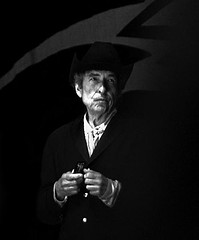
Looking for a direction hom.
Back in the early sixties a film appeared under the title: The Man Who Shot Liberty Valence. It was a Jewish fable clothed in Western Americana not unlike Bob Dylan’s lyrics.
The story line is about how to deconstruct one legend and reconstruct it to suit one’s purposes. The gist is that once a falsehood is enshrined as legendary truth it is impossible to debunk it. This film and notion was obviously for goyish consumption. As we know from experience a whole culture with a long history can be ‘debunked’ with minimal trouble if you control the media. Thus in fifty short years Americans have gone from being the most benevolent and generous people on Earth to the most destructive self-centered Nazi types. Furthermore Americans were conditioned to believe it about themselves. ‘Why do they hate us?’
The secret was contained in The Man Who Shot Liberty Valence. One of the primary agents of that change was the prophet, mystic ans seer, the very Jewish Bob Dylan. I left off poet because at best Dylan is merely an effective lyricist.
A San Francisco Bay Area fellow, Seth Rogovoy, has written an essay on Dylan with the above title without the question mark. Stephen Hazan Arnoff who is the executive directory of New York’s 14th St. YMHA has written a review of Rogovoy which he subtitles ‘Jerimiah, Nostradamus and Allen Ginsberg all Rolled Up Into One.’ High praise indeed, if unwarranted. Just as Mr. Arnoff inflates Dylan’s significance he grossly inflates that of the pornographic so-called poet, Allen Ginsberg. Perhaps it is time to use techniques learned from ‘Liberty Valence to debunk the reputation of Dylan.
Dylan is no prophet, he is merely topical using enigmatic phrasing to give the appearance of depth. There is little actual difference between the topical material of Dylan and Phil Ochs. Mr. Arnoff improbably writes:
(Dylan’s) prophetic persona is particularly resonant in his first few albums where songs like “Blowin’ In The Wind” and “The Times They Are a-Changin'” sets the gold standard for prophecy in popular music.
Prophecy in popular music? What’s that? Actually neither song is prophetic. ‘Blowin” actually refers to the past of Dylan’s youth in Hibbing although topically it has usually been extended to represent the then current civil rights activities in the South. ‘Times’ is merely a cocky know-it-all sneer at politicians who aren’t aware that the kids are alright, on the move, have a voracious apetite to eat them up. Both songs have borrowed tunes (no crime or even sin in my estimation) and, if Rogovoy is correct lyrics cribbed from the Bible.
As Mr. Arnoff notes, Rogovoy chooses a single critical lens- Judaism- for understanding Dylan and his work. No fault in an essay, pointing out the Jewish influence in Dylan’s work. Actually Mr. Rogovoy is no innovator or pathfinder, the same material has been adequately covered by numerous investigators including myself in a series of essays.
But Mr. Arnoff also notes there are other avenues to approach the songs that Mr. Arnoff believes are equally valid: Greil Marcus explains him as a mystic raconteur of the secret history of the United States, coded thorugh traditional music while Christopher Ricks describes a master interpreter of classical Western literature and thought.’ (cough, cough)
While Greil Marcus is another good Jewish boy I hardly think he is a responsible authority on anything. He takes roughly the same approach as Mr. A.J. Weberman while the latter is vastly more entertaining. I have to combine Mr. Marcus and Mr. Ricks. While I certainly respect Dylan’s intelligence and acumen I would have to question both the breadth and depth of his education.
Dylan attended high school in Hibbing, Minnesota which is a far cry from any of the leading cultural centers of either the Western or Eastern worlds. I grew up in a slightly larger town up North than Dylan although probably not much different than Hibbing intellectually. I keenly felt the lack of intellectual opportunites when I went out into the large world.
There is a question as to whether Dylan graduated from high school while he never attended college. Immediately immersing himself in folk music he left Minnesota for NYC. There he found people with libraries of which he availed himself while boarding with them. This was a very brief period during which he could only have picked up names and impressions such as he employed in his song Desolation Row. His girl friend Suze Rotolo introduced him to more culture than he could have imagined from 1961 to 1965. This could not have been much.
During that time Dylan spent a lot of time writing songs, drinking and drugging and touring. Not a lot of opportunity to become a ‘master interpreter of classical Western literature and thought.’ I have no idea what Mr. Arnoff means by ‘classical.’ I doubt seriously if Dylan is any authority on, say, the pre-Socratics. If Mr. Ricks believes as Mr. Arnoff represents him I would have to question Professor Ricks’ qualifications for his post. There’s something wrong there.
Now, as to Mr. Marcus and his mystic raconteur of the secret history of the US. What secret history? Dylan says he studied the ante-bellum South from newspaper accounts in the archives of the NYC library. This would have been over a couple of months only. As near as I can tell he did so with an enquiring and open mind and is fully capable of making cogent observations. This however is scarcely a secret history while being only one brief period and region.
What Dylan has done is immerse himself in the songs of the US. He says that when he visited Carl Sandburg it was with the itent to discuss Sandburg’s ‘American Song Bag.’ One certainly has to respect Dylan’s song knowledge and his excellent taste. This knowledge however is well beyond Mr. Marcus’ ability to understand. He, as far as I have been able to ascertain had nil knowledge of songs and music until he joined Rolling Stone Magazine in the late sixties.
Up in Hicksville Dylan immersed himself in every kind of music, without discrimination. He was fully conversant with Hillbilly as his native music. The Carter Family was a living entity to him and not an academic study. All those now obscure names were living legends to him and not mere footnotes at the bottom of a page. Thus while Dylan’s Jewish influences are prominent, uppermost and dominant he nevertheless has a foot in both cultures. His American culture is musical however, and what sounds like ‘a secret history’ to Mr. Marcus is merely the hillbilly interpretation of ‘revenuers’ ‘white lightning’ and such. I do not see Dylan as a ‘classically’ educated man.
Mr. Arnoff displays his Jewish bigotry when he says: Messianic Judaism (or Jews for Jesus) is the weakest form of interpretation for Dylan. So far as I know no one interprets Dylan’s work through the lens of Messianic Judaism. However it is equally apparent that Dylan was interested enough to study the topic carefully. That says more for Dylan’s open mindedness than Mr. Arnoff’s narrow minded bigotry. One must be ‘open minded’ n’est-ce pas?
As Mr. Arnoff notes, Dylan always said he was ‘a song and dance man’ and I think that says as much as need be said. Anyone who has been able to entertain a significant audience nearly fifty years now has to have a serious talent. One should bear in mind though that Dylan appeals to a relatively small and well-defined audience he himself defines as ‘the abused, misused, confused, strung out ones and worse.’ This is his core constituency to which he ‘kvetches.’ Apparently English isn’t good enough for Mr. Arnoff.
Dylan’s greatest song is Positively Fourth Street which is maximum kvetching. I considered myself abused and misused when I first heard the song. The lyrics had me slavering like one of Pavlov’s dogs when he heard the dinner bell ring. But, like Pavlov’s dog there wasn’t really anything on the plate. Once I passed through that phase of my psychology I lost interest in Dylan.
While Dylan has managed to retain, recruit and entertain his audience he is far from the man who shot Liberty Valence or Jeremiah, Nostrodamus and Allen Ginsberg all rolled up into one. I’m afraid that’s one legend that will be debunked before it’s formed.
Kvetcher or not I still can’t listen to him.
A Review: King Solomon’s Mines By H. Rider Haggard
November 13, 2009
A Contribution To The
ERBzine ERB Library Project
King Solomon’s Mines
by
H. Rider Haggard
Review by R.E. Prindle
Three volumes made Rider Haggard’s reputation then and maintain it today. Classics of the B genre. The first of these is the subject of this review, King Solomon’s Mines. The other two are She and Allan Quatermain. The novels were written between 1885 and 1888. These were very interesting years in the exploration of Africa. Speke had identified the source of the White Nile twenty some years earlier. Robert Livingstone had been found and sensationally recounted by the great Henry Morton Stanley.
Subsequently Stanley had navigated the course of the Nile from the plateau down to the sea, a stunning accomplishment. His rescue of the Emin Pasha in 1886 was on everyone’s lips. The white spaces on the maps were rapidly disappearing. In the midst of this excitement Rider Haggard’s great African trilogy made a propitious appearance. No better timeing could have been devised. And the novels were sensational, plausible too, at that time. Who knew what additional wonders Africa concealed. There was room in that gigantic continent for a lot of lost cities and civilizations. Haggard and his disciple, Edgar Rice Burroughs rapidly populated Africa with a host of them.
Haggard would continue to write exciting African tales until the day he died in 1925 after a lifetime of putting out two or three novels a year. They usually followed the same format, a long trip out taking up at least half the novel, the intense situation on arrival and a return home. The same format Edgar Rice Burroughs would use. The novels were packed with esoteric lore and authentic African details.
It is said that Haggard wrote the Mines on a bet after being told he couldn’t write the equal of Stevenson’s Treasure Island. He did do that but Mines is written tongue in cheek with a lot of jokes. Haggard makes this clear when Quatermain says that his two literary mainstays are the Bible and the Ingoldsby Legends. The Legends written in the 1830s and 1840s are a collection of humorous parodies of Folklore themes and poems by Richard Harris Barham writing anonymously as Thomas Ingoldsby of Tappingham Manor. The book was very popular with, it seems, all the the authors till the turn of the century at least. One finds it mentioned frequently. Taking the hint I read a copy. Thus, Haggard is protecting his rear in case of failure by saying his story is just a put on or joke.
King Solomon’s Mines is told in the first person by the old knockabout hunter, Allan Quatermain. He has a bumbling self-effacing manner not unlike Inspector Columbo of the TV series. You don’t think he can do it but he’s spot on every time.
As was common with this sort of adventure story the point is to make the reader think the story is true. Burroughs probably picked up his habit of framing from Haggard. Many of the details of Mines are true to Haggard’s own life while his study of the Zulus and other tribes accurately portray their customs. Haggard is very sympathetic to African customs and mentality actually seeming to envy them. He genuinely can see little difference between Black and White while adopting a fairly critical attitude towards Whites and a sympathetic one toward Blacks. Very modern. Indeed, in this novel the White heroes join a Zulu Impi or regiment and fight with the Zulus as White Zulus. Naturally they comport themselves heroically, Curtis excelling the Blacks at their own game.
As the novel begins Haggard sets up the story. The Englishmen, Curtis and Good, are out in search of a lost brother. The meeting with Quatermain on shipboard is fortuitous leading to his subsequent employment as their guide. Haggard describes a boat journey from Capetown to Durban that is obviously authentic; Haggard himself has taken the same trip. Thus unlike Burroughs’ imaginary Africa this is authentic, the Real Thing. On the journey Quatermain meets Sir henry Curtis and his friend John Good, who need a guide to take them in search of Curtis’ lost brother.
The search will take them to a hidden Zulu enclave behind a burning desert and a towering mountain range. The trip out is filled with interesting authentic details but no need to dwell on them here.
Crossing the burning sands not known to have been successfully navigated before, they are confronted by the towering twin peaks of Sheba’s Breasts topped with four thousand foot nipples. Who can’t see the humor there. Pretty racy for what are thought of as stodgy old Victorian times. Bear in mind the Ingoldsby Legends while reading the story as probably most of Haggard’s readers would have been familiar with them. They are of this sort of tongue in cheek humor. The ancient map they are following indicated the route to follow.
Behind the Breasts lies Kukuanaland. Undoubtledly Kuku should be read coo-coo. The Kukuanas are the Zulu tribe in possession of King Solomon’s Mines. Kukuanaland is somewhere near the ruins of Zimbabwe, although Haggard doesn’t allude directly to the site. I’m sure everyone has heard of the ruins of Zimbabwe. The old Zimbabwe I mean.
There has always been a dispute as to who built Zimbabwe. Africans claim it was built by Africans while the thought in Haggard’s time was that Zimbabwe was built by Phoenicians hence a few mentions of them. The notion was that these were the ruins through the Queen of Sheba of King Solomon, hence the title King Solomon’s Mines. Zimbabwe is either in or next to lands of the Shona people. The Shona arrived in the area from the North possibly from 300 to 800 AD. There is no record of stone work among the Shona before or after. The structures of Zimbabwe are of shale like stone merely piled on top of each other being very thick and very high. Instead of piled up stones it is customary to say the construction is without mortar as though that is a great skill. Without mortar = piled up stones, doesn’t it?
It seems unlikely the Shona would have built them while it is also a remote possibility that the Phoenicians did. It is true however that Greeks traded on these shores but they didn’t build them. A more probable builder is the Malagasy people. I don’t think the Malagasy arrival is commonly known yet, it wasn’t to me until a few years ago. The Malgasies made the long sea journey from Indonesia to arrive in Madagascar and East Africa sometime between 500 and 1000 AD. As they would have been invaders into a recently and sparsely settled territory any groups landing on the continent would have been automatically at war with the Shona thus needing a fort for protection. Being much more technologically advanced than the Africans they would likely be familiar with stonework.
As it is said that Zimbabwe was a mining and trading community, as the Malagasy were seafarers it is likely they would be the more obvious candidate otherwise one has to explain where the traders of what is described as an extensive trade come from as the the Africans couldn’t possibly have gone to the buyers or known what to trade. Interestingly the Malagasies introduced the banana and an improved yam to Africa thus they had to land on African shores.
Zimbabwe had only been discovered by Europeans a few years before Haggard arrived in Durban. Very likely he was eager to see the ruins and did as he does have at least three stories in which Zimbabwe figures. Here he combines Zimbabwe, King Solomon and the Phoenicians.
As the party approaches Kukuanaland they are faced by a huge mountain range towering perhaps 15,000 to 18,000 feet into the sky. Facing them are two huge mountains named Queen Sheba’s Breasts, the Grand Tetons of Africa.
Here I have to mention a blogger (feministbookworm.wordpress.com) who pointed out the female arrangement of Kukuanaland. This escaped me in my previous readings but is of some interest. Haggard in a cryptic way has written a fairly pornographic story, especially for Victorian times. I’m sure most people didn’t get it even though Haggard provides a fairly obvious map although turned upside down. This is along the coy lines of various pop songs such as ‘Baby, let me bang your box.’ After shouting out this line several times allowing the average guy to think a woman is being propositioned the singer reveals he’s actually referring to a piano- box in musician’s slang equals piano. Box = a woman’s pudenda in sexual slang.
If one looks at Haggard’s map Sheba’s Breast’s are to the South while there is a triangle of mountains to the North. The triangle of three mountains forms a female Delta or box. In the middle between the Breasts and Delta is the Kukuana capitol called Loo. Loo is British slang for toilet or ‘shitter’ so we some scatology going on here.
This gets better. I jump ahead to the ending. The Englishmen are promised diamonds from King Solomon’s Mines. The mines are located within the Delta or pudenda. British slang of times for the female pudenda was Treasure Box. Thus the Englishmen are going to descend through the vagina into the womb of the mines where the diamonds are stored in actual treasure boxes. Humor, remember. Bear in mind that in Burroughs diamonds are of the female, actually Anima, treasure. Same here. This is going to get better.
Apart from Mother Earth, represented by Sheba’s pudenda, there are only two women in the story which Haggard smirkingly points out: One is a Bantu beauty who becomes attached to Good, the other is an old hag named Gagool. The latter forms the model for Burroughs’ old Black crone in Gods of Mars and Nemone’s guardian in Tarzan And The City Of Gold.
Both accompany the three White men to King Solomon’s mines. At whatever age Burroughs first read this the impressions stuck. This stuff was current literature to him while Classics to us. One must imagine the excitement with which these novels were read. Readers of Opar Tarzan novels (Return, Jewels, Golden Lion and Invincible) will immediately recognize the setup although there are differences.
Always one to employ horror effects Haggard is at his best in this early novel. The group descended as it were through the vagina into the depths of the womb. Along the way are giant stalactites. (Penises?) Then they enter a chamber in which the dead kings of Kukuana are preserved. Rather than Egyptian mummification they are set beneath a drip being turned into stalactites or, in other words, big pricks. Seems to me like an obvious joke. A huge figure of death presides over the immortal enclave.
Proceeding further they come upon a door set in the wall blocking the way. The door is a huge slab several feet thick operated by a hidden mechanism that lifts the slab vertically into the ceiling. Gagool with a hidden movement releases the door which slowly and efficiently retracts into the ceiling. The party can now enter the treasure room or womb. The door stands for men’s sexual desire for the female. As with the hymen without equal desire on the part of the woman entrance is barred but with woman’s compliance the way opens easily.
Inside the room or womb are the treasure chests containing unlimited value in diamonds.
After taunting the men Gagool makes a break for the door having released the lever that closes it. She is held back by Foulata who worshipped Good. Stabbed by Gagool she falls to the ground but has successfully delayed Gagool. In attempting to roll under the descending slab the tardy witch is crushed flatter than a piece of paper. The men are now trapped in the womb but they have a candle for light. Quatermain stuffs his pockets with stones while filling a basket Foulata brought.
Here’s the classic B movie part: While waiting for death they notice that the air remains fresh. Good discovers a trap door in a corner. Opening this they descend as it were into the bowels of this elogated represention of a woman who might represent Mother Earth or the Great Mother thus forming a collective Anima for the three White men. Anticipating She a little. A bizarre Anima for Haggard also. OK, I’ve got a weird sense of humor. I’ve always known it but that doesn’t make it less funny. No longer having a light they are forced to feel their way through the tunnels. The tunnels eerily represent the intestines. Haggard is getting really scatological here as you know what emerges from intestines.
As they pick their way along Good falls into a stream that greatly resembles the urethra. Fortunately Quatermain has some matches. One is used to locate Good clinging to a rock in midstream, possibly meant as a kidney stone as a joke. Hauled ashore they backtrack and resume their way. Curtis spots a dim light toward which they move. The opening narrows down to the point that the men have to squeeze through tumbling out into the diamond shaft like so many turds. Haggard must have been gleeful at what he was getting away with.
Climbing out of the pit they discover they have returned to the entrance. Thus vagina and rectum are only a short distance apart. Anatomically correct as it were. Haggard had a fine sense of humor.
While adapting the topography for his own needs one can easily see how Burroughs replicates Haggards’ design in Opar. Burroughs designed a long straight corridor but broken by a fifteen foot or so gap. In Jewels of Opar Tarzan falls through the gap dropping into a pool of water or river much as in Mines. Proceeding further he enters he jewel room of Opar filling his pouch as he had neither pockets or basket.
Opar itself replicates the Treasure House of Kukuanaland. The gold vaults represent the head of the female figure or perhaps only one of Sheba’s breasts. Proceeding down the corridor, or Great Road of Kukuanaland one comes to the sacrificial chamber situated much as the city of Loo. Proceeding from the chamber one comes to the exit. This is described by Burroughs as a narrow crack or cleft in the wall to pass through which Tarzan had to turn his shoulders sideways. So, Opar and Kukuanaland are built according to the same scheme.
Obviously the memory popped into Burroughs’ mind in The Return Of Tarzan, developed in Jewels of Opar and Golden Lion and came to perfection in Tarzan The Invincible. It would seem clear that ERB understood the sexual structure of King Solomon’s Mines.
If we go back to the other end of Kukuanaland we have the two towering mountains known as Queen Sheba’s Breasts. In order to prevent anyone taking a low level route between the Breasts there is a perpendicular barrier running between the breasts rising several thousand feet. Odd geological formation. Rising 4000 feeet above the breasts themselves are the nipples. That should be enough to make anyone laugh.
A recurrent theme in the stories is a juxtaposition of ice with summer weather, often associated with a woman as here. Perhaps Haggard had a cold, cold mother.
While the party is both starving and thirsting they find neither game nor water until Umbopo discovers some melon patches providing food and water until they reach the snow line. Soon they come to the nipple rising sheer from the breast. At the base of the nipple is a cave. This cave may possibly have been appropriated as the entrance to Opar’s gold vaults in Burroughs. In the cave is the frozen body of Da Silvestre who made the map they have been following. The bushman servant freezes to death during the night so they set him over by Da Silvestre. There’s a joke here but I don’t get.
Continuing down Sheba’s left breast they reach below the snow line. The boys spot an antelope way off there, long shot, but Quatermain makes it, cleanly knocking out a vertebrae in the neck. While cleaning up in an adjacent stream and eating they are surprised by a band of Kukuana and taken.
Umbopo who signed on back in Durban always had this mysterious royal air about him and now we’re going to find out why. For those contemporaries who insist that no book should violate their enlightened prejudices whether the book be as old as Homer or not they may feel uncomfortable reading this book. By and large Haggard shares the attitudes toward race, gender and whatever of his times rather than Liberal notions of today. Can be painful for certain types.
Nevertheless Haggard has a deep admiration for the Zulu tribes and a kind of understanding one toward the lesser Bushman and Hottentots. The Zulus are uniformly tall and well built while Quatermain and Good are smaller and more comical in appearance. Only Sir Henry Curtis is of the same stature, slightly larger, as the Zulus. He seems to stand in for what is otherwise a race of inferior stature.
There is a great fifty foot wide road that runs from the barrier of Sheba’s Breasts to Sheba’s Delta. The road is over a hundred miles long with Loo in the center.
The city of Loo is modeled after the encampment of the Zulu chief, Chaka. The details Haggard describes are undoubtedly accurate. Chaka flourished 1830-40 while the last of his line, Cetywayo, ruled during Haggard’s tenure in Africa. His fictional king is called Twala. We now discover that Twala is Umbopo’s brother. The latter was rightful heir but Gagool who is represented as being hundreds of years old favored Twala expelling Umbopo and his mother which is why he was in Durban. His identity is assured because of an Uroboros that encircles his waist. This snake appears to be a birth mark rather than a tatoo.
After accepting a rifle from Curtis as a gift Twala sends three chain mail shirts of medieval manufacture which proves that Zimbabwe was formerly occupied by another race, I suppose.
We have a civil war brewing here as Umbopa asserts his rights. Before the war develops Twala holds a ceremony I find really interesting, the smelling out of witches. The regiments were assembled. In this case Gagool runs up and down the ranks smelling out the witches. Anyone she indicates is removed from the ranks and immediately killed. This was an actual Zulu custom. Haggard portrays them more than once in what is his pretty decent historyof the Zulus in the novels.
Interestingly under the African president of the United States we have the same situation occurring. Obama denounces those in opposition to him essentially as witches. While currently we are put under surveillance the time may shortly arrive when we are merely arrested and despatched. Thus the innate African soul reasserts itself hundreds of years out of Africa. Of course, Obama was born in Kenya but he didn’t live there.
After the smelling out the regiments align themselves according to their allegiance. The three White men suit up on the side of the pretender, Umbopo. In his admiration of the Impi battle plan Haggard has the Whites disdain to use firearms preferring to show Whites returned to primitive savagery. Of course he normalizes the British and Zulu societies so that any difference is perceived but not real.
If you want to how this attitude was digested by the British public rent a copy of the movie If c. 1965. A British public school story that viewed better the first time around for me but still of interest. I might rent it again, though.
It is at this point of the story that the ‘White giant’ Sir Henry Curtis took his place in the Zulu ranks to show White supremacy that is when the actual basis of Tarzan took place in Burroughs’ mind.
The three Whites are the only ones wearing chain mail so that they come through bruised but alive. Without the chain mail, of course, all three would have been killed many times over. Perhaps the chain mail is symbolic of the science of the Maxim.
My feeling is that Haggard was so enamored of primitive Zulu warfare as organized by Chaka that he thrilled himself by placing the three in their ranks. Haggard had his peculiarities. As I say, he seemed to reject science.
Umbopo’s troops triumph over greater odds while King Twala is captured. Sentenced to die he demands the right to hand to hand combat selecting Curtis as his adversary.
Thus a duel ensues providing two or three pages of excitement in which a very hard battle is fought. Curtis decapitates Twala proving I suppose that on their own turf, evenly matched, the White Man is the greater.
Morally, however, Haggard gives the nod to Umbopo and the Zulus. Umbopo apparently feels a bond has been vilolated between the trio and himself. He offers them wifes, land and honors if they choose to stay in Kukuanaland. They instead choose to gather diamonds from Sheba’s treasure box. Umbopo is disgusted that White men care about nothing but money. Haggard sheepishly agrees with Umbopo but the trio nevertheless collect their diamonds and scoot, setting themselves up splendidly in England where money matters. Regardless of Haggard’s moral it is clear that the Kukuanas have no use for money in their primitive society while being broke in London is a sort of hell.
One wonders whether when Umbopo sent Gagool with them he knew that he was sending them to their deaths. Their return was after all rather miraculous. Leaving Kukuanaland the three arrive safely and rich in England.
Postscript.
Burroughs read not only King Solomon’s Mines, She and Allan Quatermain but probably the whole corpus. What he read before 1911 was obviously the most influential on him through the twenties. So an an investigator, Haggard’s novels before 1911 are the one to familiarize oneself with first. The very late Treasure Of The Lake however did influence Tarzan Triumphant.
Sir Henry Curtis was a key element in the formation of the idea of Tarzan and a role model. I suspect that Treasure Island by Stevenson provided he means to get the Claytons to Africa. Evolution provided the background of Kala and Tarzan’s life with the apes.
Whether Good or Quatermain had any influence on the character of Paul D’Arnot or not I’m not sure. He may have evolved from Dupin of Poe’s Murders In The Rue Morgue forming a double for Tarzan not unlike the narrator and Dupin of Murders.
I have explained the probable relationship of Opar to Sheba’s treasure box. That seems pretty secure to me.
Haggard developed the story line of the preamble and journey to the scene of action, a flurry of action in the crisis and the return home. Burroughs seems to follow this format although he can introduce picaresque elements.
The landscape and terrain of Burroughs is quite similar to Haggard’s. Over the years as Haggard read Burroughs’ novels there are Burroughsian elements that creep into Haggard’s work. Treasure Of The Lake bears a number of similarities to Burroughs especially the elephant dum dum. That also owes a great deal to Kipling and Mowgli. A stunning scene in Haggard. I would really start with Treasure Of The lake and then begin with King Solomon’s Mines, She and Allan Quatermain.
La, of course, is derived from the next novel, She.
A Review: On Tarzan By Alex Vernon
November 13, 2009
A Review:
On Tarzan
by
Alex Vernon
Review by R.E. Prindle
Vernon, Alex: On Tarzan, 2008, UGeorgia Press
This book reads almost like the cover of The Doors LP Strange Days. You’ve entered into some kind of literary twilight zone. This is perhaps the most eccentric book I’ve ever read. I can’t believe it was actually published- and by a University press!
Alex Vernon has a PhD and is an Associate Professor at Hendrix College. Must have been founded by Jimi before he OD’d. I’m flabbergasted that the guy has a job. Average looking Joe from the back cover. Happy, smiling. Doesn’t look like he’d be sex obsessed but it could be a problem for him.
The phallus on the cover dismayed me but prepared me for the sex driven content. Zany, zany, zany. A large phallus rises out of what might be the swamp, symbol of the female, or perhaps jungle growth meant to represent pubic hair.
When Vernon says On Tarzan he doesn’t mean Tarzan by Edgar Rice Burroughs he means Tarzan as a ‘living’ entity to which history Burroughs is only one contributor albeit an important one, Philip Jose Farmer almost eclipses Burroughs as a contributor to the Tarzan ethos in Vernon’s mind. Mainly for Farmer’s outrageous sex episodes.
Tarzan ethos is about it. Everything is thrown indiscriminately into the stew pot. Books, movies, TV shows, articles, even artefacts, Tarzan underwear. Vernons says he interviewed Bill Hillman at ERBzine although it is difficult to find what he gleaned from the conversation, wait a minute, maybe the reference to the 1893 Columbian Expo. Bill was probably hot on that topic.
As literary critic Vernon doesn’t so much analyze as create. He uses Tarzan body parts from various books and films to create his own monster, and his Tarzan is monstrous.
As I say he uses his sources as though making a stew; mixing them up to creat a sex driven Tarzan that no twelve year would recognize as his hero.
Vernon doesn’t seem able to distinguish the motives, the agendas of the various sources who are projecting their own inner world on Tarzan such as Bo and John Derek in their vision of The Big Bwana. I didn’t say Banana; I said Bwana. Melding these sources doesn’t create a ‘biographical composite’ of Tarzan that all can agree on; it is merely the projection of Vernon’s own inner psyche.
Apparently Vernon’s approach is a valid historical literary criticism technique in today’s academic environment. It’s not what you say but who you say it about. As I say it goes beyond interpretation or revisionism into creating an alternate universe.
The approach intrigued me. In that spirit I offer my own creation of Tarzan and a revisionist/creation of history. In the view of facts as they might be construed by a fanatic with an agenda I offer Tarzan as an agent of Globalism serving as the first viceroy of Africa.
Mr. Vernon keeps talking about a colonial period as if such a thing has ever existed. His professors must have been from the stone age. As advanced thinkers know what these prehistoric monsters refer to as colonialism was in reality the early stages of what is now recoginized as Globalism. This how Globalism began. In the very early stages all cultures were relatively distinct, living in separate well defined areas. The Chinese were in China, Africans were in Africa, Europeans were in Europe. Further relatively internal distinct sub-divisions can be made on all continents. It was clear to the most primitive minds, well, actually European primitive minds, that what was needed to…well for whatever reason they had…to make the world a more secure place was Globalism. Wars were anathema but one couldn’t create Globalism without some really destructive wars so they forged fearlessly ahead secure in the purity of their intentions. This posited the problem of bringing together in most cases people who didn’t know other cultures even existed, those ‘lesser races outside the law.’
As I say Europeans were then and are now the promoters of the cause of Globalism. It’s good for people and it’s good for the Global Money Trust. Initially Europe sent out ships and explorers to the four corners of the Earth. In that far off, almost once upon a, time unlike today local populations were hostile to what they mistakenly called invaders. Sometimes their resistance involved military force, in other words war; so in self-defense it was necessary to mow the heathens down. We had screw guns and maxims and they didn’t. Rather foolish on their part while causing Globalists a great deal of emotional distress. Almost had a nervous breakdown. It could have been avoided. Globalists only wanted peace if they had understood.
Gradually the peoples of the world learned that they going to have to peacefully interact if even at gunpoint. But then there was disagreement in Europe. the Global barriers were being lowered as this beneficent ideology of Globalism was slowly accepted. As expected there were reactionary elements. In both cases the criminal Germans were the hard nuts. They insisted on the right to be themselves rather than submerging their identity into what the Globalists wanted. Their resistance was futile; Globalists got what they wanted anyway, the Globe be damned. After the second German petulance Globalists crushed them. Some wanted to exterminate the whole lot, raze Germany to the ground and turn it into pasture land. I don’t have to tell you that gentler and more loving heads prevailed. Globalists gave the African troops leave to loot Strasbourg and rape the German women and let it go at that. You see, there are some sacrifices we all have to make.
It is best not to oppose Globalist wishes. Globalism will be had on their terms or they’ll get rid of ya. As another example, the Kulaks of Russia opposed Globalist wishes and it was necessary to exterminate them to the man, woman and child. I won’t tell you the intense emotional pain that incident cost the Globalists, those were not crocodile tears as often alleged. People won’t be happy unless the blessings of globalism are universal. That’s what Globalism means, universal.
Now, one of the great advocates of Globalism was the progressive American ‘fantasy’ writer, Edgar Rice Burroughs. Fantasy, humph. As Edgar’s avatar of Globalism he created the character of Tarzan the Ape Man. The brilliance of the ape man is almost incomprehensible. As Mr. Vernon points out Tarzan united the fauna being man and beast at one and the same time. His being encompassed all evolution, unlike the rest of us who are products of only a few of the commoner genes, as he passed through the stages of Beast, Negro and European. How fitting that Edgar Rice Burroughs should make him the very first Commissar, even Czar, of Africa. Yes, he was White. But only we Liberal White people have understood our manifest destiny to bring all peoples together in Globalism. Well, yes, there were mistakes and, quite frankly, genocides, but they were necessary and not arbitrary. They were decided on only after long and careful deliberation. It was like pruning a tree to make it more beautiful. When Chairman Mao finished pruning the recalcitrant Chinese there were 50 million branches on the ground, but, what of it? As Mao himself benignly and poetically, he was a poet you know, intoned: ‘So? Will the flowers not blossom in spring and cool breezes not blow across waving fields of grain.’ Of course they would and as proof they have and will continue to do so. How ridiculous! There’s always new babies to replace those gone. Come on!
Edgar very cleverly has that man we now know as a villain, Stalin, seek to replace Tarzan as Commissar because he was in fact too just and too gentle with his charges. Rather than compelling Africans to hew to the Party line Edgar portrays Tarzan letting the Africans do as they please so long as they didn’t kill each other. That was in his brilliant history he called Tarzan the Invincible, and he wasn’t kidding. It wasn’t unreasonable to send a replacement from Moscow but Edgar perversely has Tarzan defeat his replacement. You can read about it in Edgar’s history yourself.
So, Mr. Vernon has expended a great deal of effort to prove the unprovable. He completely mistakes the reason for the US presence in Viet Nam. This was not nation building as he has been induced by his professors to believe. This was a necessary stage in the creation of Globalism. Today the two halves of Viet Nam have been reunited because of their efforts and Globalism is progressing nicely there, thank you very much.
A larger problem was to bring China into the Globalist empire.. But that was cleverly done by inducing them to manufacture big screen TVs for not only the province of the United States but the world. Today they are the Globe’s largest manufacturer of flat screen TVs and tennis shoes and are assisting in the Globalism of Africa sending their tens of millions of excess personnel to help the Africans enter the Global economy.
I certainly appreciate the effort Mr. Vernon has put into his project; it is regretable he has been so ill informed about the difference between Globalism and colonialism. Colonialism is when you occupy a country for selfish reasons; Globalism is when you subject or exterminate a people for the right reasons.
The Global Cabal is sorry people had to die. As the old saw says: You can’t make an omelet without breaking a few eggs. Its better to be the hammer than the nail.
I’m sorry Mr. Vernon but I can’t recommend your book.
Conversations With Robin Page 3
August 20, 2009
< Wep>
Conversations With Robin, Page 3
Conversations between R.E. Prindle And Robin Mark
Well, well, well. Robert Goulet. I should have known that filthy bastard would be mixed up in there somewhere. What amazes me is that Guralnik could write two fat volumes on Elvis and never mention the Mob once. I think we can begin to integrate Elvis’ Mob conflicts pretty clearly now, although research will have to establish the connections for sure.
For starters, entertainment is a Mob industry both records and movies; that includes both Jews and Sicilians. If you haven’t read Gus Russo’s Supermob yet, do so. The Sidney Korshak role at MCA is crucial.
Anent shooting out TVs remember that Sinatra had a plane he called Superwop or something to that effect so it is clear he bore a grudge against the Anglo world. The plane was a small ‘Lear’ if I remember correctly. Elvis went out and bought a 707. Big plane, big penis; little plane little penis. Not exactly true in Frank’s case, but you get the point. So at least Goulet and Sinatra. I can understand why Dean Martin tried to distance himself from those creeps.
Parker must have had the business dealings with the Outfit. As he ran into gambling problems the only commodity he had to barter was Presley. Thus he would have had to ‘sell’ Presley to keep both his legs under him. Elvis’ rapid deterioration could have been because of his realization that he was ‘caught in a trap. I can’t get out.’ Devastating awareness. One could only retreat into booze and/or drugs.
Now, Leiber said that he and Stoller at one time worked for the Mafia. This wouldn’t be unusual nor should it be held against them because if you’re in entertainment you’re involved, like it or not. The question is when were they involved, for how long, and for what purpose.
We all know Fabian was a Mob creation. Why not others? If you haven’t seen and studied The Girl Can’t Help It, do so. The movie is an alegory of the record business. Everything you see in the movie is the Outfit in action. In the fifties every Juke Box in America was stocked by the Outfit. You didn’t get your record stocked unless you were Mobbed up somewhere along the line. Someone recently told me that the girls on the Dick Clark Show were prostitutes and Bandstand was used to showcase them for Johns. Don’t know that it’s true but I wouldn’t be surprised.
Leiber and Stoller could have been co-opted to write songs for, say, The Coasters. A Black act with interchangeable personnel. Kind of an early Back Street Boys. I don’t know but I’d like to hear Leiber talk about it. Might prove enlightening.
So, let us assume that the Colonel was drawn into the Mob scene from the beginning of Presley’s movie career. That might explain some of his stupid decisions and those dumb movies. Perhaps Parker didn’t have a free hand but was ‘wise’ enough to figure out that something is better than nothing.
Then after Vegas Presley was increasingly drawn into orbit until he learned the horrifying truth. Guralnik seems to have his head up his ass as far as I’m concerned.
As Presley learned the truth looking forward to forty more years of slavery he found drugs more comfortable than reality. Possible, it would make things make sense.
A Review: Beau Sabreur by P.C. Wren
August 1, 2009
Note: I mistakenly placed the review of Beau Geste on another of my blogs: reprindle.wordpress.com. The review may be found there.
A Contribution To The
Erbzine Library Project
The Beau Ideal Trilogy Of
P.C. Wren
Beau Geste~Beau Sabreur~Beau Ideal
Part III
Review Of Beau Sabreur
by
R.E. Prindle
Part I: Introduction
Part II: A Review Of Beau Geste
Part III: A Review Of Beau Sabreur
Part IV: A Review Of Beau Ideal
Bibliographial Entry: Welland, James: ‘The Merchandise Was Human’, Horizon Magazine, Vol. VII, No. 1, Winter 1965. PP. 111-117
Beau Sabreur shifts from the classic literary style of the mid-nineteenth century to the vernacular of pulp or, perhaps, Wold Newton era. The pulp writers seem to have all read each other and Wren has certainly done his share of reading.
This novel begins at a pre-Zinderneuf time when Charles De Beaujolais was a mere cadet entering the service. If Beau Geste began in c. 1888 Beau Sabreur is set back at the beginning to perhaps 1875. De Beaujolais’ circumstances quite parallel those of the hero of Joseph Conrad’s Heart Of Darkness. Conrad has maintained a very respectable readership down to the present even though stoutly anti-Communist and a colonial writer. Both Communists and Africans are working hard to bury his reputation. It’s amazing how guys like Conrad manage to hang on, but that may not be for long as Western influence in society declines.
So it is that De Beaujolais is a sort of lounger applying himself to nothing in particular when his uncle recruits him for the French secret service as an agent to be attached to the African Spahis, an army corps. His uncle says that he will severely try him and should he fail in any particular he will be immediately dismissed. This essentially means that if De Beaujolais lets a woman come between him and his duty it is all over for him. So we are forewarned that there will a choice between love and duty.
The book was written after 1917 so Wren introduces a subversive Communist or anarchist character. In this book he assumes the name of Becque at the beginning. In Beau Geste he went by Rastignac and late in the novel he will be recognized as Rastignac although he appears to be going by another name. Wren has a good idea of the type describing him thusly under the name Becque:
He was clearly a monomaniac whose whole mental content was hate- hate of France; hate of all who had what he had not; hate of control, discipline and government; hate of whatsoever and whomever did not meet his approval. I put him down as one of those sane lunatics, afflicted with a destructive complex; a diseased egoist, and a treacherous, dangerous mad dog. Also a very clever man indeed, an eloquent, plausible and forceful personality…The perfect agent-provacteur, in fact.
Thus Becque in his various incarnations is always subversive, whether of army morale or working the Moslems up against the French. This will be a major theme of the novel. the same theme will appear in Tarzan The Invincible developed for his own needs.
Having been recruited by his uncle, De Beaujolais is sent to a sort of boot camp to learn the hard way. His ordeal is very convincingly described by Wren. It seems authentic enough to make one believe that Wren himself actually experienced such an indoctrination but there is no record that he did. He is just a consummate artist.
While learning to be a soldier Becque attempts to recruit him as a Communist agent. This leads to a sword fight in which De Beajuolais injures Becque but does not kill him.
Having completed his boot camp De Beaujolais takes his station with the secret service and the Spahis in Africa. Spahis are not FFL but a different corps.
When the French conquered Algeria in 1830 they disrupted a thousand year old social system. The North African Moslems had an insatiable need for slaves. Not only did they raid European shores to abduct Whites but an immense system for deliviering Negro slaves had been in existence since the Moslem conquest. This system had been run by the Tuaregs. This people was descended from Whites dating back to at least the Phoenician conquest of North Africa. Their alphabet probably precedes that of the Phoenicians. Undoubtedly they were the descendants of the former inhabitants of Mediterranean Valley known as Libyans in Egypt flushed out by the melting of the ice age.
What they did before the arrival of the Moslems isn’t known but with the African conquest of the Moslems they became the middle men between Africans of the Sahel and the Moslems of the North. Every year for a thousand years the Tuaregs had collected convoys of Negroes from the South driving them North across the Sahara. This was necessarily done with great loss of life as the Tuaregs were not that tender toward the Negroes.
With the advent of the Atlantic Slave Trade in the sixteenth century the Tuaregs also captured Negroes and drove them to St. Louis in Senegal for sale and transshipment to the Americas. According to James Welland the depredations on the Blacks was so great that the area around Lake Tchad had been cleared of inhabitants. This age old life style was disrupted in 1830 by the French. By that time Europeans had discontinued the slave trade so that the French disrupted the trans-Sahara trade causing a disruption in the Tuareg economy from which there was no recovery. Welland explains:
In short, the official abolition of the slave trade, the desert tribes, the desert itself for that matter began to play a diminished part in human affairs, and the Tuareg, who had been the only link for two and a half thousand years between Central Africa and the Mediterranean- in other words, between the Negro and the White world- began to pass from the stage of history. They were left unemployed and purposeless, with the result that they turned to intertribal war and oasis raiding to keep some semblance of their nationhood. Then again, as the supply of black labor dried up, the palmeries were increasingly neglected and often, as the consequence of a razzia, comepletely destroyed. The size and number of oases decreased, sand filled the wells and cisterns- many of which had been maintained since Roman times- and the age old trails became more hazardous and finally were hardly used at all.
In the secret service in Africa De Beaujolais becomes involved in the maelstrom of change, racial conflict and bad memories which were now exacerbated by the arrival of the non-Moslem, or Christian, French. The novel beomes then a sort of proto-thriller. De Beaujolais is on a mission to a town called Zaguig when he is caught up in a Moslem revolt. In Zaguig he meets the touring Mary and Otis Vanbrugh. Otis, you will remember returns from Beau Geste.
Mary is the love interest in the story and she will conflict De Beaujolais between his love for her and his duty as imposed by his uncle. Frankie Laine or Tex Ritter and songwriters Dimitri Tiomkin and Ned Washington (I tried to work Trad. in there somewhere but couldn’t do it) expressed the balance well in the song High Noon:
Oh to be torn ‘betwixt’ love and duty
Supposin’ I lose my fair haired beauty…
De Beaujolais relates the story of another agent who chose his beauty over duty and was drummed out of the service ultimately being killed. De Beaujolais has a premonition. Wren cleverly resolves the choice so that De Beaujolais gets his beauty while fulfilling his duty.
At the same time Otis Vanbrugh meets the apparent Arab dancing girl, who yet retains European features, who will figure largely in the sequel.
As the revolt erupts these conflicts emerge. As is usual in thrillers things are not what they seem. Raoul D’Auray De Redon, a close friend of De Beaujolais’ remains behind disguised as an Arab to confuse their attack on a small French garrison destined to be wiped out. De Beaujolais has important dispatches which must be delivered. Thus duty makes him appear to be an ingrate and coward humiliating him before Mary. His job is to locate the latest Arab Mahdi and suborn him the the French side.
De Beaujolais thinks little of Otis Vanbrugh and we are meant to accept his opinion. His true story will appear in the sequel.
Mary was one of those women who flirt by taunting or ridiculing her guy. In her case when De Beaujolais was within hearing she mockingly whistled a tune De Beaujolais couldn’t quite place but was called Abdullah Bulbul Amir. This was a very popular song and poem of the time that can be found at http://wiki.answers.com/Q/lyrics_of_bhulbhuliya. A couple of verses of its 19 will suffice to give its tenor but the poem is one you should be familiar with.
The sons of the Prophet are hardy and bold,
And quite unaccustomed to fear,
But the most reckless of life or of limb
Was Abdullah Bulbul Amir.
When they wanted a man to encourage the van
Or harass a foe from the rear,
Storm fort or redoubt, they had only to shout
For Abdullah Bulbul Amir.
Apparently the poem was so well known that Wren felt no need to name it and he doesn’t.
The time to leave Zaguig comes, so taking his entourage of faithful soldiers, Mary and her maid Maud, he sets out into the desert toward Oran.
Soon Tuareg or Arab raiders pick his party up and they are forced to fight a pitched battle although from an advantageous position. Here De Beaujolais has to make a very difficult choice between between loyalty to his men and his duty to get his dispatches through. Getting his men into position he is compelled to abandon them to their fate and push on.
This puts a strain on his relationship with Mary who cannot understand the concept of duty or necessity- the necessity to get the dispatches through. After a long flight the party falls into the hands of a desert tribe. But this is a strange desert tribe. Rather than the usual unorganized tactics these fellows seem to have the scientific training of the French. Another mystery.
As luck would have it De Beaujolais and the women were captured by the Mahdi’s troops. By way of explanation the Moslem Mahdi is equivalent to the Jewish Messiah but not the Christian Messiah. There’s only one Christ but Jewish Messiahs and Moslem Mahdis pop up everywhere.
So now, going back to the ending of Beau Geste, the two Americans Hank and Buddy were out there somewhere trodding the burning sands. Hank was discovered and rescued on the point of death by a kind hearted Sheik while Buddy was captured by hard hearted Tuaregs being saved from death when Hank Sheik’s tribe defeated his captors. Buddy was out there somewhere for a long time because Hank had been rescued years before.
Having been rescued at the point of death Hank was aware of the necessity to pass as a Moslem so he pretends to be dumb until he has learned the language so well he can pass. He then cleverly becomes the tribe’s sheik. The tribe is then threatened by a razzia of Tuaregs. As this takes place in the North Tuaregs no longer having Negroes to convoy have taken to raiding the oases. Normally the tribe would have run and hid leaving their goods and a few token members as slaves for the Tuaregs. Hank has a better idea and using his superior scientific French training the tribe rather than waiting to be attacked unexpectedly attack the Tuareg camp handily defeating them. Buddy is thus rescued. Coincidences are dime dozen out on the burning sands.
Teaching Buddy the language while he too plays dumb, Buddy becomes Hank’s vizier. With Buddy as military commander the tribe is trained in scientific methods in earnest. They then begin to organize the tribes into a confederation thus earning Hank the title of Mahdi in French eyes. De Beaujolais was thus on a mission to co-opt the new Mahdi.
As luck, or coincidence, would have, at the same time De Beaujolais and the girls arrive so does Becque/Rastignac. Becque is now employed one supposes by the Soviet Union to arouse the Moslems to a jihad. He comes bearing gifts not realizing that Hank and Buddy are his old Legion comrades. He doesn’t recognize them but Hank recognizes him. Becque and De Beaujolais have that old unsettled score to settle. De Beaujolais now settles his hash removing that source of irritation.
I’ve pointed out before that Burroughs very likely drew inspiration for his series of political Tarzan novels from 1930 to 1933 after reading this trilogy from 1924 to 1928. The Sahara had fascinated him long before he read Wren. David Innes of Pelucidar even surfaces in the Sahara returning from the Inner World. The great desert and the Sahel is not quite as we Westerners have imagined it. The thousand year long history of amazing suffering boggles the imagination. A thousand years of thousand mile treks from South to North, untold millions of Africans were trekked across the burning sands with equally untold millions falling along the way. This is not all. This is a horror story. Welland again, p. 116:
Even after the slave trade had been suppressed, the old life of the desert survived for a while for one simple reason…the absence of salt in the Sudan. Nearly all the salt in Central Africa had always come from the north across the Sahara on the backs of camels, donkeys, horses and men. The salt mines in the middle of the most terrible wastelands of the desert- at Taghaza, at Taodeni, and at Bilma- had always been worked all the year round by Negro slaves, who died within a few years of their arrival at the mines and were immediately replaced by new workers. The salt they mined was worth its weight in gold in Timbuktu, and its transport across the desert was a considerable enterprise of unbelievable size, involving the assembling of as many as 40,000 camels to make the quick dash from Bilma to Kano.
Think of it. For a thousand years Negroes were dropped down a funnel in a steady stream to live the most miserable of lives for a very few years. Over a millennium! Think of it. I should think those Negroes who travelled the Middle Passage in the Atlantic Slave Trade ending up in the paradise of the Caribbean and the Americas should bless their deliverers from that African hell.
Africans should bless the French for delivering them from total servitude and degradation. When one digs for facts beneath the surfice, the things one finds.
Thus without giving any historical background Wren is telling the story of how Europe saved the Africans from themselves. Indeed, Hank and Buddy singlehandely rearrange North Africa on livable lines. The two, in the story, break the power of the Tuaregs while establishing an African paradise in a hundred square mile oasis. Their people are delivered into prospeirty by a million franc subsidy from France that Hank and Buddy use for the betterment of their people rather than sequestering it in a numbered Swiss bank account. A new day for Africa indeed courtesy of Western enlightenment.
Thus De Beaujolais accomplishes his mission to align the new Mahdi, Hank, with France while winning his fair heared beauty and pleasing his uncle.
Hank marries Maud the maid leaving Buddy hanging out but not for long. We still have the last of the trilogy, Beau Ideal to go. Let’s go.
Exhuming Bob 21: Will The Real Bob Dylan…?
July 27, 2009
Exhuming Bob 21:
Will The Real Bob Dylan…?
http://contemporarynotes.wordpress.com/2009/04/05/greil-marcus-bob-dylan-bill-ayers-barry-obama/

Dylan
Our friend Bob Dylan has given the impression that he knew nothing of Barry Obama, The Great Black Hope, until the summer of 2008 with just a few months left in the campaign when he gave the candidate his endorsement. Surely this isn’t so. Surely he not only knew of the Hope but knew him personally probably before 9/11/01.
In my essay Bill Ayers, Greil Marcus, Bob Dylan and Barry Obama on my Contemporary Notes blog, linked above, I posit that all four knew each other and of 9/11 before it happened. Impossible, huh? Stranger things have happened.
I hadn’t thought about it much after writing my piece but then a few days ago- 7/22/09- I came across a post by one Lark, The Times Are A Changing (Again): Bob Dylan On Obama. Lark quotes Dylan on Obama in the London Times. Let’s review it:
Dylan begins: “Well you know right now America is in a state of upheaval.”
True enough. Many sorts of upheaval. What sort of upheaval does Dylan refer to:

Bomber Billy Ayers
Poverty is demoralizing.
Can’t argue with that. Is he talking about coal miners, fruit pickers, the unemployed, or what?
You can’t expect people to have the virtue of purity when they’re poor.
More problematic here. Purity isn’t a virtue it’s a state or condition. Has nothing to do with poverty. Well, Dylan’s a poet, one of the enigmatic kind, so I presume he may mean honest by pure. But which people, is he talking about Blacks?
Well, I come from a long line of poor people and so far as I know we were the kind described as ‘poor but honest.’ In other words we didn’t steal or cheat. I’m not sure how scrupulous we were about lieing. Seems to be a much more common fault. I’ve been around the block a few times now and I’ve come to the conclusion that crime has nothing to do with poverty. Rich or poor a thief steals and is well able to justify his thefts. Need I point out the 50 billion dollar thief Bernie Madoff? Or about the raft of Rabbis just arrested in New Jersey for some very serious financial crimes. And then I read about this reasonably well off one guy who stole some records because he thought he could use them better than the rightful owner. So it may be common to think you have to be poor to be ‘impure’ or dishonest but mistaken nevertheless.
Bob makes himself a little more clear:
But we’ve got this guy out there now who is redefining the nature of politics from the ground up…Barack Obama.
Naive but sincere. Spoken like a true cheerleader. ‘This guy out there’ sounds like affection if not familiarity to me. So now, when and how did Dylan become aware of the Hope? As I conjecture it Greil Marcus is the key to the riddle. I’m guessing, but my guess is that Marcus’ curiosity led him to introduce himself or be introduced to Bill Ayers, the ole Mad Weatherman Bomber, probably in Chicago. Ayers and Marcus being of the school of Whiteness is a plague on the Earth probably quickly came into accord. And then the Hope was probably on the way under the sponsorship of Ayers so Marcus and the Hope were introduced when certain anti-American and anti-White plans were discussed probably among them a projected attack on America. Certainly one remembers that Ayers had already made several bomb attacks on America so why not the Big One…the Really Big One…the World Trade Center.

Greil Marcus
Dylan and Marcus are pretty close. Dylan is either a Lubavitcher or close to them. Lubavitchers hate Whites, especially of the Christian sort. That partially excludes me by the way, White but not of the Christian persuasion.
As it appears that Dylan was much more familiar with the Hope than he let on and his album Love And Theft seems to reflect a pre-knowledge of 9/11 coupled with Marcus’ Rolling Stone article as detailed in the link to my essay above, there is every reason to believe, or think, or fear that Dylan, Marcus, Ayers and Obama were privy to 9/11 well before it happened. Possibly if not probably in on the planning stages.
Dylan goes on: He’s redefining what a politician is, so we’ll have to see how things play out.
If the Hope is redefining what a politician is then the definition is toward that of an African chief. An African chief owned every bit of his territory personally. He owned every inhabitant as his slave to dispose of as he wished. He was free to do with all as he chose with or without their consent.
That seems to be how the Hope is playing things out. True, the Hope is somewhat hobbled by the remains of the old political system but with his Liberal allies he has so far met with no insuperable resistance. To oppose his plans is to be vile. So far the fear of being considered vile has prevailed.
Then Dylan: Am I hopeful? Yes. I’m hopeful that things might change. Some things are going to have to.
Well things have changed. Many of us believe the way things are changing is in a direction more destructive than beneficial. In short the Hope is already a complete failure. We’d all be pleased to have a detailed opinion from Dylan on whether his hopes have been realized.
Dylan then closes with a platitude: You should always take the best from the past, leave the worst back there and go forward into the future.

Yep. Sure enough. I suppose the argument would break down over the issue of what’s best or worst and which has been left behind. There’s no doubt we’re headed into the future. Some kind of future at least.
A Review: Pt. I P.C. Wren The Beau Geste Trilogy
June 23, 2009
A Contribution To The Erbzine Library Project
The Beau Ideal Trilogy Of
P.C. Wren
Beau Geste, Beau Sabreur, Beau Ideal

Review by R.E. Prindle
Part I: Introduction
Part II: Review of Beau Geste
Part III: Review Of Beau Sabreur
Part IV: Review Of Beau Ideal

P.C. Wren
For hundreds of years after the expulsion of the Moors from Spain the Moslems raided the European c0asts of the Mediterranean abducting men, women and children as slaves while also preying on shipping. The newly formed United States sought unsuccessfully to suppress this Moslem piracy. ‘Millions for defense but not one penny for tribute.’ If you remember that one from school.
Finally in 1830 France invaded, conquered and occupied what is now known as Algeria ending the Barbary Pirates.
An army corps was formed and named the Legion Etrangere in French, French Foreign Legion in English to pacify Algeria. Over the next hundred years the Legion was used for peaceful penetration into the Sahara and Sahel to form the French West African Empire.
In an astonishing turn around the Moslem power evaporated while the French easily became the masters of the bulge of Africa. The military superiority was to last until post-WWII when exhausted by two world wars accompanied by a moral collapse as the best and brightest died on the battlefields leaving nothing but singers and dancers to live off the fat of the land. The French were militarily capable but morally bankrupt. The Moslems reasserted themselves in the fifties forcing the French out of Algeria while beginning the invasion of France by peaceful penetration. A neat reversal of fortunes. Thus the conquest of Europe interrupted by the Spanish expulsion began again.
Immediately after the French invasion of Algeria the deserts of Africa beame a playground of Europeans. The lure of the desert held a strange appeal for them. Perahaps devoid of romance in their homelands the desert with its now no longer dangerous but exotic inhabitants replaced the fairies and elves displaced by the scientific revolution. The Euroamerican romance with ‘noble savages’ and ‘inferior races’ may very well be caused by the void created by the scientific revolution. Euroamericans hoped to find or create those emotional or psychological needs lost in the advance of civilization. This may explain to some extent the White worship of people of color whose ‘natural’ uninhibited behavior they profess to admire and imitate. Witness the tatooing and body piercing in imitation of the Africans who themselves appear to have to given it up.
The French having conquered Algeria had to establish an army corps dedicated to perpetual warfare. That unit was the Legion Etrangere or French Foreign Legion. The duty in the Sahara amid an enemy population was so execrable that only men without hope, that is criminals and outcasts with no other options need have applied.
In 1831 then, a year after the conquest and annexation of Algeria as an actual Department of France the French Foreign Legion was created by Louis Philippe the new Bourgeois King of France.
The Legend of the Legion apparently grew very quickly. the first legion novel is thought to be that of the English writer Ouida. She published her novel Under Two Flags in the 1860s. It was a great success ultimately being made into a movie. Alongside the Legion novels were a number of novels that dealt with the desert in a very romantic way.
The genre of novel could only have developed after the French conquest of Algeria after 1830 and a little later with the pacification of the Moslems. If not pacification at least intimidation. Astonishingly the centuries intervening between Roman Africa and the conquest of Algeria vanished from the consciousness of Europeans. In only a hundred years (well, a hundred twenty-five years) a brief interlude, Europeans were in turn expelled from North Africa with their tremendous superiority shattered and in ruins. That brief century now appears like a fairy story without real substance. A hundred years of struggle and dieing ant then- poof! But the stories were great.
Fans of Jules Verne have a very good story- The Barsac Mission- that undoubteldy was an influence of P.C. Wren. The work has only been translated recently issued in two volumes as Into The Niger Bend and The City Of The Sahara by Americor. Some consider the novel science fiction.
The publishers are escapist types who have retreated to Mattituck N.Y. at the most extreme end of Long Island. Unfortunately, as with many of Verne’s books the Barsac has been bowlderized to reflect current Liberal tastes. The translator I.O. Evans coyly expresses it this way: I have also taken the liberty, found necessary by most of Verne’s other translators, of abbreviating or omitting a few passage of minor interest. (cough, cough)
Another wonderful Sahara novel written at the same time as the Barsac is Robert Hichens’ The Garden Of Allah. Hichens was an influence on Burroughs. The novel was very well known at least through my youth. I knew people with whom Hichens’ reputation was very great although I imagine there are few who would recognize his name today.
And then ERB himself devoted a number of pages to the romance of the desert. In The Return Of Tarzan it will be remembered that Tarzan was despatched to Algeria as a French secret agent just along the lines of Wren’s De Beaujolais. The Lad And The Lion is of course a complete Sahara novel that appears to have had an influence on Wren. Korak the Killer of The Son Of Tarzan operated on the margins of the desert while the Sahara plays a frequent part in a lot of the Tarzan novels.
There is no question that E.M. Hull’s The Sheik was a major influence on Wren as he actually parodies Mrs. Hull’s novel virutally by name.
With Wren the myth of the Sahara and the Legion comes into full bloom.
If one has read only Beau Geste one has read an amazingly good story but to understand Wren’s intent it is necessary to read Beau Geste, Beau Sabreur and Beau Ideal in sequence. By the time Wren wrote, the handwriting was on the wall. The Western will had already been sapped. The beau ideals that had inspired Western men since the days of the Arthurian epics was fading from the Western consciousness being replaced by the effete homosexual ‘ideals’ of today. The strength and confidence that allowed Western man to subjugate the world was becoming just a memory. Wren in his way is either commemorating the ideals or seeking to reverse the decline.
The three novels are concerned with the fortunes of two families, one English, the other American. Wren has a wonderful feel for the difference between the English and the American characters, not to mention the French. His command of American dialect and hobo slang is virtually alone worth reading the trilogy.
The first volume, Beau Geste based on Wilkie Collins The Moonstone (a so-so read) concerns the early history of the Geste brothers, Beau, Digby and John and the story of Fort Zinderneuf away out there almost beyond a hobo’s imagination.
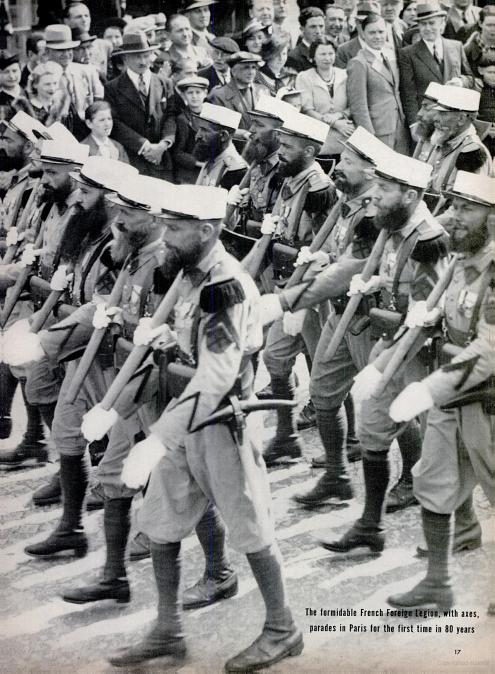
FFL 1939: Life Magazine
.
The novel does introduce the two American hoboes, Hank and Buddy, serving in the Legion. Wren kills off Michael and Digby Geste in this first novel putting the load on John.
In the second novel of the trilogy, Beau Sabreur (The good sword or swordsman) John returns to Africa to try to locate Hank and Buddy who were lost in the drifting sands after saving his life.
In this manner Wren introduces the American family of which Hank is a member. Hank and his friend Buddy were the two men lost in the desert that John Geste is seeking. Both men lying in the desert near death in different locations were rescued by the Bedouins. As luck would have it Hank managed to work his way up to Sheik acquiring Buddy as his vizier. They introduce superior Western discipline and tactics into their tribe giving them dominance in the desert. Hank then comes to the attention of the French as the new Mahdi. De Beaujolais is sent to coopt the new Mahdi. Through a series of adventures De Beaujolais meets and falls in love with Hank’s sister Mary who is traveling with her other brother Otis Vanbrugh. They as well as Hank are fleeing from a brutish father.
At stories end the whole cast Henri De Beaujolais who had wed Mary, Otis, Hank, Buddy, John Geste and his wife Isobel, who plays a large part, are back at the ranch in Texas facing the old brute of a father down while trying to free Hank’s other sister from thralldom to the old brute so she can marry Buddy and begin a life of her own. Hold on, now, Wren must have been studying Burroughs because he’s got a number of twists up his sleeve, or perhaps, tricks.
While Otis was in Algeria an Arab dancing girl had fallen in love with him who was apparently the queen of the desert. Otis tried to escape her but in exchange for help in recovering John from the penal battalion of the FFL he promised to marry her. Aw shucks, that’s right, you guessed it. Nakhla was in reality his sister. The old brute had fathered her on another dancing girl when he was out making deals in the desert. So we have Nakhla, the same name as the heroine of Burroughs’ The Lad And The Lion, pretty much following the plot line of The Girl From Farris’s. So maybe Wren should also be included in the Farmerian Wold Newton Universe.
So that is the broad overview of the story line that holds the three volumes together. Before I go on to the individula reviews there is one other problem I wrestle with that I would like to to discuss and that is the
Western fascination with primitive life styles.
For a convenient starting point we’ll use H. Rider Haggard, no, cancel that. I’ll go back a little further to the French Wold Newton. I’m reading the Paul Feval Black Coats series and they have some earlier antecedents. Balzac, Dumas, Eugene Sue and Feval all deal with organized crime groups. A Dumas title that I haven’t been able to get is titled The Mohicans Of Paris while Feval makes several reference to crime organizations adopting a sort of ‘red indian’ mentality. What Dumas called Mohicans evolved into the Apaches of late nineteenth century Paris. Anyone who watched TV in the fifties is familiar with French Apache dancing.
Thus while the French were becoming fascinated with the North American Indians and their primitive mentality Haggard was celebrating the primitive African mentality. And then along comes Ouida, Verne, Hichens, Burroughs, Hull and Wren celebrating the ‘free and wild’ life of the desert.
As of the beginning of the nineteenth century, if not before, the Euroamericans evolved into the Scientific Consciousness leaving the rest of the world behind in the mythopoeic or Religious Consciousness. However the transition from one consciousness to the other is not a clean break. Haggard, for instance, never really made the transition while Burroughs did. That may be why Burroughs reads as modern if a trifle old fashioned while Haggard is purely of an anterior psychology- good but just a little stodgy.
Thus, as the White Man spread over the globe, the, what I shall I call it, White Man’s Burden, White Man’s novel appeared. A whole genre of either stated or implied White superiority appeared of which Haggard and Burroughs are the most promient. From these writers the genre went on to the Sheena, Queen Of The Jungle stuff to imitative White Jungle god stories. Conrad sang the colonial era in lyric tones. Kipling told of the Raj of India while inventing the White Man’s Burden which was very real.
Ouida is usually credited with the first FFL novel, Under Two Flags, while Burroughs contributed The Return of Tarzan in which Tarzan goes to Algeria as a French secret agent although not as FFL.
In 1924 P.C. Wren wrought the glamor of the French Foreign Legion with the first novel of his trilogy, Beau Geste, followed by Beau Sabreur and Beau Ideal. These novels are also scientific demonstrating the superiority of Euroamerican intelligence over the mythopoeic mentality of the desert tribes. Merely by introducing European military discipline into the tribe Hank and Buddy enable the tribe to defeat all others and dominate the desert. This while Abd El Krim and the Riff dominated Western news instilling admiration for the primitive desert tribes over Western Civilization. I had a tearcher in high school who would get sexually aroused just talking about El Krim.
Thus while the transition from mythopoeic and scientific thinking was not complete if even half evolved the West was presented with various mythopoeic cultures that drew them back from the transition to the Scientific Consciousness. At present, then, the West has a split personality in which they admire the Negro and Arab mentality so much that they denigrate their own scientific side. It doesn’t seem likely that Euroamericans in sufficient numbers will make the transition to Scientific Consciousness quickly enough to preserve Western civilization hence the present bizarre worship of primitive races in North America and Europe. On the other hand the rest of the world seeks to imitate the West in matters that they cannot understand or sustain on their own. If the West is in trouble imagine the actual psychological state of things in China and India.
Now it is time to move on the first of the reviews- Beau Geste.
A Review: Peter Ibbetson by George Du Maurier
May 8, 2009
A Review
The Novels Of George Du Maurier
Peter Ibbetson, Trilby, The Martian
Part IV
Peter Ibbetson
Singers and Dancers and Fine Romancers
What do they know?
What do they know?
-Larry Hosford
Review by R.E. Prindle
Table of Contents
I. Introduction
II Review of Trilby
III. Review of The Martian
IV. Review of Peter Ibbetson
Peter Ibbetson is the first of the three novels of George Du Maurier. As elements of the later two novels are contained in embryo in Ibbetson it would seem that Du Maurier had the three novels at least crudely plotted while a fourth dealing with politics but never realized is hinted at. Actually Du Maurier has Ibbetson who writes this ‘autobiography’ write several world changing novels from inside the insane asylum to which he had been committed. In the Martian Barty Josselin wrote several world changing books while ‘possessed’ by an alien intelligence, in a way, not too dissimilar to the situation of Ibbetson. Du Maurier himself comes across, as I have said, as either a half demented lunatic or a stone genius.
He has Ibbetson and the heroine, The Duchess of Towers write in code while they read encrypted books. Du Maurier says that Ibbetson and hence the two following books deal with weighty subjects but in a coded manner that requires attention to understand.
On page 362 of the Modern Library edition he says:
…but more expecially in order to impress you, oh reader, with the full significance of this apocalyptic and somewhat minatory utterance (that may haunt your fever sense during your midnight hours of introspective self-communion), I have done my best, my very best to couch it in the obscurest and most unitelligible phraseology, I could invent. If I have failed to do this, if I have unintentionally made any part of my meaning clear, if I have once deviated by mistake into what might almost appear like sense, mere common-sense- it is the fault of my half French and wholly imperfect education.
So, as Bob Dylan said of the audiences of his Christian tour: Those who were meant to get it, got it, for all others the story is merely a pretty story or perhaps fairy tale. The fairy tale motif is prominent in the form of the fee Tarapatapoum and Prince Charming of the story. Mary, the Duchess of Towers is Tarapatapoum and Peter is Prince Charming. It might be appropriate here to mention that Du Maurier was highly influenced by Charles Nodier the teller of fairy tales of the Romantic period. Interestingly Nodier wrote a story called Trilby. Du Maurier borrowed the name for his novel Trilby while he took the name Little Billee from a poem by Thackeray. A little background that makes that story a little more intelligible.
Those that watch for certain phobias such as anti-Semitism and Eugenics will find this story of Du Maurier’s spolied for them as was Trilby and probably The Martian. One is forced to concede that Du Maurier deals with those problems in a coded way. Whether his meaning is derogatory or not lies with your perception of the problems not with his.
Thus on page 361 just above the previous quote Du Maurier steps from concealment to deliver a fairly open mention of Eugenics. After warning those with qualities and attributes to perpetuate those qualities by marrying wisely, i.e. eugenically, he breaks out with this:
Wherefore, also, beware and be warned in time, ye tenth transmitters of a foolish face, ye reckless begetters of diseased or puny bodies, with hearts and brains to match! Far down the corridors of time shall clubfooted retribution follow in your footsteps, and overtake you at every turn.
Here we have a premonition of Lothrop Stoddards Overman and Underman. The best multiply slowly while the worst rear large families. Why anyone would find fault with the natural inclination to marry well if one’s handsome and intelligent with a similar person is beyond me. Not only is this natural it has little to do with the Eugenics Movement. Where Eugenics falls foul, and rightly so, is in the laws passed to castrate those someone/whoever deemed unworthy to reproduce. This is where the fault of the Eugenics Movement lies. Who is worthy to pass such judgment? Certainly there are obvious cases where neutering would be appropriate and beneficial for society but in my home town, for instance, no different than yours I’m sure, the elite given the opportunity would have had people neutered out of enmity and vindictiveness. that is where the danger lies. There is nothing wrong with handsome and intelligent marrying handsome and intelligent. How may people want a stupid, ugly partner?
Du Maurier had other opinions that have proved more dangerous to society. One was his belief in the virtues of Bohemians, that is say, singers and dancers and fine romancers. On page 284 he says:
There is another society in London and elsewhere, a freemasonry of intellect and culture and hard work- la haute Ashene du talent- men and women whose names are or ought to be household words all over the world; many of them are good friends of ine, both here and abroad; and that society, which was good enough for my mother and father, is quite good enough for me.
Of course, the upper Bohemia of proven talent. But still singers and dancers and fine romancers. And what do they know? Trilby was of the upper Bohemia as was Svengali but Trilby was hypnotized and Svengali but a talented criminal. What can a painter contribute but a pretty picture, what can a singer do but sing his song, I can’t think of the dancing Isadora Duncan or the woman without breaking into laughter. And as for fine romancers, what evil hath Jack Kerouac wrought.
I passed part of my younger years in Bohemia, Beat or Hippie circles, and sincerely regret that Bohemian attitudes have been accepted as the norm for society. Bohemia is fine for Bohemians but fatal for society which requires more discipline and stability. Singers and dancers and fine romancers, wonderful people in their own way, but not builders of empires.
In that sense, the promotion of Bohemianism, Du Maurier was subversive.
But the rules of romancing are in the romance and we’re talking about Du Maurier’s romance of Peter Ibbetson.
Many of the reasons for criticizing Du Maurier are political. The man whether opposed to C0mmunist doctrine or not adimired the Bourgeois State. He admired Louis-Philippe as the Beourgeois king of France. This may sound odd as he also considered himself a Bohemian but then Bohemians are called into existence by a reaction to the Bourgeoisie. Perhaps not so odd. He was able to reconcile such contradictions. Indeed he is accused of having a split personality although I think this is false. Having grown up in both France and England he developed a dual national identity and his problem seems to be reconciling his French identity with his English identity thus his concentration on memory.
In this novel he carefully builds up a set of sacred memories of his childhood. He very carefully introduces us to the people of his childhood. Mimsy Seraskier his little childhood sweetheart. All the sights and sounds and smells. In light of the quote I used telling how he disguises his deeper meaning one has to believe that he is giving us serious theories he has worked out from science and philosophy.
Having recreated his French life for us Peter’s parents die and Ibbetson’s Uncle Ibbetson from England adopts him and takes him back to the Sceptered Isle. Thus he ceases to be the French child Pasquier and becomes the English child Peter Ibbetson. A rather clean and complete break. From this point on his childhood expectations are disappointed with the usual psychological results. He develops a depressed psychology. The cultural displacement prevents him from making friends easily or at all. His Uncle who has a difficult boorish personality is unable to relate to a sensitive boy with a Bohemian artistic temperament. Hence he constantly demeans the boy for not being like himself and has no use for him.
This is all very skillfully handled. We have intimations that bode no good for Peter. The spectre is prison. The hint of a crime enters into the story without anything actually being said. But the sense of foreboding enters Peter’s mind and hence the reader’s. This is done extremely well. It’s a shame the Communists are in control of the media so that they can successfully denigrate any work of art that contradicts or ignores their beliefs. For instance the term bourgeois itself. The word is used universally as a contemptuous epithet even though the Bourgeois State was one of the finest created. Why then contempt? Simply because the Communists must destroy or denigrate any success that they canot hope to surpass. I was raised believing that what was Bourgeois was contemptible without ever knowing what Bourgeois actually meant. It is only through Du Maurier at this late stage in life that I begin to realize what the argument really was and how I came to accept the Communist characterization. I’m ashamed of myself.
Hence all Du Maurier criticism is unjust being simply because it is the antithesis of Communist beliefs. The man as a writer is very skillful, as I have said, a genius. If I were read these novels another couple of times who knows what riches might float up from the pages.
Colonel Ibbetson apprentices Peter to an architect, a Mr Lintot, which, while not unhappy, is well below Peter’s expectations for his fairy Prince Charming self. As a lowly architect he is placed in a position of designing huts for the workers of the very wealthy. The contrast depresses him even further. He has been disappointed in love and friendship and then he is compelled by business exigencies to attend a ball given by a wealthy client. He definitely feels out of place. Psychologically incapable of mixing he stands in a corner.
At this ball the most beautiful woman he has ever seen, The Duchess of Towers, is in attendance. From across the room she seems to give him an interested glance. Peter can only hope, hopelessly. As a reader we have an intimation that something will happen but we can’t be sure how. I couldn’t see. Then he sees her in her carriage parading Rotten Row in Hyde Park. She sees him and once again it seems that she gives him a questioning look.
Then he takes a vacation in France where he encounter her again. After talking for a while he discovers that she is a grown up Mimsey Seraskier, his childhood sweetheart. Thus his French childhood and English adulthood are reunited in her. Wow! There was a surprise the reader should have seen coming. I didn’t. I had no trouble recognizing her from childhood in France but Du Maurier has handled this so skillfully that I am as surprised as was Peter. I tipped my imaginary hat to Du Maurier here.
Perhaps I entered into Du Maurier’s dream world here but now I began to have flashbacks, a notion that I had read this long ago, most likely in high school or some other phantasy existence. I can’t shake the notion but I can’t remember reading the book then at all. Don’t know where I might have come across it. Of course that doesn’t mean an awful lot. If asked if I had ever read a Charles King novel I would have said no but when George McWhorter loaned me a couple to read that he had in Louisville I realized I had read one of them before. Eighth grade. I could put a handle on that but not Peter Ibbetson. Perhaps Du Marurier has hypnotized me. Anyway certain images seem to stick in my mind from a distant past.
It was at this time that Mary, the Duchess if Towers, formerly Mimsy, enters Peter’s dream, in an actual real life way. This is all well done, Peter dreamt he was walking toward an arch when two gnomish people tried to herd him into prison. Mary appears and orders the gnomes to vanish which they do. ‘That’s how you have to handle that.’ She says. And that is very good advice for dreams that Du Maurier gives. As we’ll see Du Maurier has some pretensions to be a psychologist.
She then instructs Peter in the process of ‘dreaming true.’ In such a manner they can actually be together for real in a shared dream. Now, Trilby, while seemingly frivolous, actually displays a good knowledge of hypnotism. More than that it puts Du Maurier in the van of certain psychological knowledge. Hypnotism and psychology go together. Without an understanding of hypnotism one can’t be a good psychologist. If he wasn’t ahead of Freud at this time he was certainly even with him. Remember this is 1891 while Freud didnt’ surface until 1895 and then few would have learned of him. He wrote in German anyway.
Freud was never too developed on auto-suggestion. Emile Coue is usually attributed to be the originator of auto-suggestion yet the technique that Mary gives to Peter is the exact idea of auto-suggestion that Coue is said to have developed twenty or twenty-five years on.
Du Maurier speaks of the sub-conscious which is more correct than the unconscious. He misunderstands the nature of the subconscious giving it almost divine powers but in many ways he is ahead of the game. Now, Ibbetson was published in 1891 which means that Du Maurier was in possession of his knowledge no later than say 1889 while working on it from perhaps 1880 or so on. It will be remembered that Lou Sweetser, Edgar Rice Burroughs mentor in Idaho, was also knowledgable in psychology in 1891 but having just graduated a couple of years earlier from Yale. So Freud is very probably given too much credit for originating what was actually going around. This earlier development of which Du Maurier was part has either been suppressed in Freud’s favor or has been passed over by all psychological historians.
So, Mary gives Peter psychologically accurate information on auto-suggestion so that he can ‘dream true.’ I don’t mean to say that anyone can share another’s dreams which is just about a step too far but by auto-suggestion one can direct and control one’s dreams. Auto-suggestion goes way back anyway. The Poimandre of Hermes c. 300 AD is an actual course in auto-suggestion.
Peter is becoming more mentally disturbed now that his denied expectations have returned to haunt him in the person of Tarapatapoum/Mimsey/Mary. Once again this is masterfully done. The clouding of his mind is almost visible. Over the years he has generated a deep seated hatred for Colonel Ibbetson even though the Colonel, given his lights, has done relatively well by him. Much of Peter’s discontent is internally generated by his disappointed expectations. The Colonel has hinted that he might be Peter’s father rather than his Uncle. This completely outrages Peter’s cherished understanding of his mother and father. The Colonel according to Peter was one of those guys who claimed to have made every woman he’d ever met. One must bear in mind that Peter is telling the story while the reader is seeing him become increasingly unstable.
While Peter doesn’t admit it to himself he confronts the Colonel with the intention of murdering him. He claims self-defense but the court doesn’t believe it nor does the reader. It’s quite clear the guy was psycho but, once again, Du Maurier handles this so skillfully that one still wonders. Given the death penalty his friends and supporters, the influential Duchess of Towers, get the sentence commuted to life imprisonment.
Then begins Peter’s double life in prison that goes on for twenty years. By day a convict, at night Peter projects hemself into a luxurious dream existence with his love, Mary, the Duchess of Towers. Quite insane but he has now realized his expections if only in fantasy. Now, this novel as well as Du Maurier’s other novels is textually rich. The style is dense while as Du Maurier tells us it is written in more than one key, has encoded messages, so I’m concentrating on only the main thread here. That concerns memory.
While it is possible to subconsciously manage one’s dreams, I do it to a minor extent, of course it is impossible for two people to dream toether and share that dream. This is to venture into the supernatural. Spiritualism and Theosophy both dealing with the supernatural as does all religion including Christianity, were at their peak at this time. Du Maurier has obviously studied them. Just because one utilizes one’s knowledge in certain ways to tell a story doesn’t mean one believes what one writes. Ibbetson is written so well that the writer seems to have fused himself with the character. If I say Du Maurier believes that may not be true but as the same themes are carried through all his novels without a demurrer it seems likely.
Du Maurier seems to be pleading a certain understanding of the subconscious giving it as many or more supernatural powers as Freud himself will later. This might be the appropriate place to speculate on Du Maurier’s influence on Mark Twain. We know Twain was an influence on Burroughs so perhaps both were.
Before he died Twain wrote a book titled the Mysterious Stranger. This was twenty-five years after Peter Ibbetson. Operator 44, the Mysterious Stranger, is a time time traveler who has some sort of backstair connecting years as a sort of memory monitor. Peter and Mary over the years work out a system that allows them to travel back through times even to prehistoric times. Thus Peter is able to sketch from life stone age man hunting mastodons, or Napoleon at the Battle of Waterloo. They are present at these events but as sort of ghost presences without substance. they have no substance hence cannot affect reality.
This would be a major them in fifties science fiction in which, for instance, a time traveler steps on a grub, then comes back to his present time finding everyone talking a different language. Change one item and you change all others. Du Maurier avoids this problem that he very likely thought of in this clever way.
We can clearly see the future of twentieth century imaginiative writing taking form here. One can probably trace several twentieth century sci-fi themes back to Du Maurier.
Peter and Mary have a magic window through they can call up any scene within their memories. In their dream existence they are dependent on memory they can only re-experience, they cannot generate new experiences. The memory extends back genetically although Du Maurier speaks in terms of reincarnation. Peter hears Mary humming a tune he has never heard before. Mary explains that the tune is a family melody written by an ancestress hundreds of years before. Thus one has this genetic memory persisting through generations. This gives Du Maurier room to expatiate on the persistence of memory through past, present and future.
Du Maurier has worked out an elaborate scheme in which memory unites past, present and future, into a form of immortality. This is actually a religious concept but a very beautiful concept, very attractive in its way.
Peter and Mary had elected to stay at one age- twenty-six to twenty-eight- so for twenty years they retained their youthful form and beauty. Then one night Peter enters the mansion of his dreams through a lumber room to find the way blocked. He knows immediately that Mary has died. He then learns that in attempting to save a child from a train she was herself killed.
Peter goes into an insane rage attacking the prison guards while calling each Colonel Ibbetson. Clearly insane and that’s where the send him. The mad house. Originally he continues to rage so they put him in a straight jacket where he remains until his mind calms enough to allow him to dream. In his dream he returns to a stream in France. Here he believes he can commit suicide in his dream which should be shock enough to stop his heart in real life. Something worth thinking about. Filling his pockets with stones he means to walk in over his head. Then, just ahead he spies the back of a woman sitting on a log. Who else but Mary. She has done what has never been done before, what even Houdini hasn’t been able to do, make it to back to this side.
Now outside their mansion, they are no longer young, but show their age. This is nicely done stuff. Of course I can’t replicate the atmosphere and feel but the Du Maurier feeling is ethereal. As I say I thought he was talking to me and I entered his fantasy without reserve.
Here’s a lot of chat about the happiness on the otherside. When Peter awakes back in the asylum he is calm and sane. He convinces the doctors and is restored to full inmate rights. Once himself again he begins to write those wonderful books that right the world.
One gets the impression that Du Maurier believes he himself is writing those immortal books that will change the world. Time and fashions change. Today he is thought a semi-evil anti- Semite, right wing Bourgeois writer. I don’t know if he’s banned from college reading lists but I’m sure his works are not used in the curriculum. I think he’s probably considered oneof those Dead White Men. Thus a great writer becomes irrelevant.
It’s a pity because from Peter Ibbetson through Trilby to The Martian he has a lot to offer. The Three States of Mind he records are thrilling in themselves, as Burroughs would say, as pure entertainment while on a more thoughtful read there is plenty of nourishment. Taken to another level his psychology is very penetrating. His thought is part of the mind of the times. Rider Haggard shares some of the mystical qualities. The World’s Desire is comparable which can be complemented by his Heart Of The World. The latter may turn out to be prophetic shortly. H.G. Wells’ In The Days Of The Comet fits into this genre also. Another very good book. Of course Burroughs’ The Eternal Lover and Kipling and Haggard’s collaboration of Love Eternal. Kipling’s Finest Story In The World might also fit in as well, I’m sure there are many others of the period of which I’m not aware. I haven’t read Marie Corelli but she is often mentioned in this context. You can actually slip Conan Doyle in their also.
Well, heck, you can slip the whole Wold Newton Universe, French and Farmerian in there. While there is small chance any Wold Newton meteor had anything to do with it yet as Farmer notes at about that time a style of writing arose concerned with a certain outlook that was worked by many writers each contributing his bit while feeding off the others as time went by.
I don’t know that Du Maurier is included in the Wold Newton Universe (actually I know he isn’t) but he should be. He was as influential on the group as any other or more so. He originated many of the themes.
Was Burroughs influenced by him? I think so. There was no way ERB could have missed Trilby. No possible way. If he read Trilby and the other two only once which is probable any influence was probably subliminable. ERB was not of the opinion that a book could change the world, so he disguised his more serious thoughts just as Du Maurier did his. He liked to talk about things though.
Singers and dancers. What do they know? What do they know? In the end does it really matter what they know. Time moves on, generations change, as they change the same ideas come around expressed in a different manner. They have their day then are replaced. The footprint in the concrete does remain. Genius will out.
A Review
Thuvia, Maid Of Mars
by
Edgar Rice Burroughs.
Part III-C

Review by R.E. Prindle
Edgar Rice Burroughs
Civilization And Its Malcontents
Let us say that for the fifty years or so before the 1920s there was a growing sense of societal malaise. This malaise was reflected most notably in the creation of Edgar Rice Burroughs’ psychological projection, Tarzan Of The Apes. One has to account for the immediate acceptation by society of such an absurdity. Tarzan, in fact, completely rejected civilization for the life of the romantic ‘unrestrained freedom’ of the jungle. The noble savage in fact.
Thus in a metaphor Burroughs reflected the malaise of his time so brilliantly that his creation was accepted as virtually a real person. Writers like Grant and Stoddard put the same theme into more scholarly terms. As noted, contrary to Richard Slotkin’s idea, Grant had little or no influence on Burroughs while the slightly later Lothrop Stoddard whose three relevant works appeared only from 1920 to 1922 could have had no influence on Burroughs’ formative years. It seems probable that Burroughs did read Stoddard and was influenced by his work but only after his ideas were fully formed. Even then The Revolt Against Civilization appeared after Burroughs had examined some of the same problems in his rejected manuscript, Under The Red Flag of 1919.
The problem of the malcontents and their war on civilization was examined by a number of writers during the twenties and thirties so why Slotkin singled out Burroughs, Grant and Stoddard isn’t as clear as it might be. Postwar German cinema was intensely concerned with the matter as why should it not? Germany was under asault by what Stoddard called the Underman. Nor need Slotkin think Stoddard was alone. I’m sure there were dozens of forgotten books prophesying the end of the world by one means or another including the Undermen of Communism.

The Underman, or the Communist, was not even a term unique to Stoddard. Gustave Le Bon, the French scholar on whose work Sigmund Freud based his study Group Psychology And The Analysis Of The Ego wrote prolifically on the psychological foundations of the Underman. Freud based his book on Le Bon’s 1895 study The Psychology Of Crowds. Unless I’m mistaken he based his 1930 study Civilization And Its Discontents on Le Bon’s 1921 book The World In Revolt: A Psychological Study Of Our Times.
On the cinematic side the problem was examined in the great silent films The Cabinet Of Dr. Caligari and Fritz Lang’s 1922 film Dr. Mabuse, The Gambler. Lang would follow that ten years later with the sound film The Testament Of Dr. Mabuse.
Even though Buroughs’ Under The Red Flag was rejected in 1919 he persisted, rewriting and extending the text into the 1926 story, The Moon Maid. This story reflects a possible reading of The Revolt Against Civilization but such a reading was much more evident in 1934’s Tarzan And The Lion Man.
The development of the problem was evident to all these writers which it seems to have escaped Slotkin who attributes the recognition of societal evolution to mere ‘racism’ in the writers. One thinks that perhaps Slotkin is too involved in his own agenda.
Rider Haggard enunciated the problem quite clearly in his 1888 novel Allan Quatermain in which Quatermain grouses about the ‘strict limits’ of civilization compared to the ‘natural’ life of the African Zulus. It might almost seem that the idea of Tarzan arose in Burroughs’ mind from that observation. In fact science was undermining all the comforting beliefs that mankind had been settled in for a hundred thousand years. During that long period characterized by the mental mode of what is called mythopoeic thinking man’s mind devoid of true knowledge projected a vision of reality that resulted in the notion of God. Thus reasoning from insufficient knowledge man’s mind came up with an erroneous result. You can’t get out of a mind what isn’t in it; all education is suggestion.
As Freud was to say, man’s settled view of reality received its three great shocks when Galileo disproved the geocentric notion of the universe, Darwin disproved the uniqueness of man’s position in the animal kingdom and he, Freud, displaced the conscious mind with his vision of the unconscious mind. Once again Le Bon was there ahead of him.
Thus as the nineteenth century opened and progressed the bases of mankind’s notions of reality were shattered leaving him emotionally and intellectually bereft of foundations of belief. Adrift without an anchor.
As if that were not bad enough the great cataclysm that ushered in the modern era, The French Revolution, was based on the the absolute notion that not only were all men created equal but remained equal in all aspects of their existence. The advance of civilization would toss this certainty into the trash can of history also.
As civilization placed greater and greater demands on the intelligence and self-discipline of men and women the incontestable gap between those less intelligent and those more intelligent became more and more obvious. Thus as the century progressed the notion of the Overman and the Underman began to become clear.
At the same time the first tentative efforts at measuring the intellectual potential of the individual began to become possible. Of course the basic inequality of men and women in its physical aspect had always been apparent. Some men were naturally stronger and better muscled than others. But, even that was changing. The science of physical culture was making it possible for the 98 lb. weakling to develop himself into a man mountain. Thus artifically developed srongmen like the Great Sandow ushered in the golden age of the strong man topped off by Charles Atlas who guaranteed he could turn you into a man mountain if you followed his program.
There was the promise that you could dethrone that bully and kick sand back in his face. On the other side Francis Galton was originating the first primitive tests to measure intelligence potential. Burroughs would have seen both proponents during his miraculous summer of 1893 at the Chicago Columbian Exposition. I mean to say that both facts entered his mind where they could be digested and emerge later. Nothing can come out of your mind that didn’t go in it.
And then after the turn of the century Binet devised he first actual IQ test. Thus, just as Sandow and Atlas could measure the size of muscles, the psychologists became able to measure the intelligence potential. Those with high IQs were set up; those with low IQs were cooked. The upshot was that all men were not created equal nor could they ever attain intellectual equality.
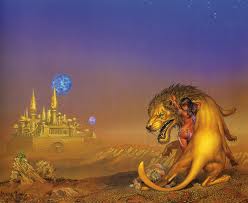
To a very large extent what became the Communist Party recognized the inequality while demanding equality against reason. Recognizing subconsciously, perhaps, that men could never be intellectual equals rather than try the futile task of raising the less fortunate they sought to destroy education which brings out the inequality but doesn’t create it. No matter what happens there are always going to be the more intelligent just as there will always be the physically stronger. As Le Bon points out, if you needed to hear it, nature don’t know from equality.
Thus the Communist Party devised the well sounding slogan- From each according to his ability; to each according to his need. Good plan for the needy, slavery for the able. The needy were organized beginning their struggle to achieve superiority by collective action. This was accomplished in Russia in 1917. The battle was joined.
Just as individuals are created with different capabilities so are peoples and races. Some can achieve and some can’t. Slotkin who must be a Communist thus takes offence at what he perceives to be, and is, an attitude of White Supremacy in Burroughs, Grant and Stoddard. While I am aware there are those who will disagree with White superiority it is nevertheless not an attitude but an evolutionary fact. That is the reason Communists have Darwin under attack. While Darwin doesn’t say it, it is the inevitable result of his studies. Just as it was necessary for the Undermen to destroy education in the hopes of creating intellectual equality so it became necessary to destroy White achievement of the last five hundred years. The whites must be demonized and made to feel evil and inferior morally. That is the import of Slotkin’s Gunfighter Nation.
At that level all three writers are guilty. As has been stated in Canadian courts- Truth is not a defense. So there’s nothing to discuss. Might is right and whoever has the might will prevail.
It is a fact that all three writers were anti-Communists so it may be assumed that whatever Communists believe, they didn’t. And why should they? Might may be right but it can still be nonsense. Communism is a flawed ideology based on a false premiss. It always fails wherever it is introduced. Failure is not evidence of a bad plan in Communist eyes. One just continues to shovel sand against the tide and pray. So succeed or fail they always think they can succeed by the same flawed ideology. The fault for failure lies elsewhere.
In that sense Burroughs was wasting his time assailing this religion of failure with his Under The Red Flag and its successor The Moon Maid. The only people who would applaud his effort would be we non-Communists but he could never convince anyone with Communist leanings. Of course that wasn’t well understood at the time.

If Burroughs were accused of not believing in equality that would be true. Not only are John Carter and Tarzan superior to any contemporaries on two worlds but Burroughs has a whole hierarchy of value. John Carter is the Warlord of Mars ruling from the top city of Mars, Helium. The races of Mars pretty much reflect those of Earth and their relative stations. The main exception is the ruling Red race. As Whites do and have existed on Mars in Burroughs stories while at one time being the dominant race perhaps the Red race is some sort of amalgam of the various Eropean immigrants of the United States. I believe the Green Men represent the American Indian. Both roam the great plains while being essentially savages.
Tarzan though always spoken of as being White is described as a bronze giant. Bronze is a fairly dark metal so that Tarzan and the Red men of Mars may be more or less identical in color.
Tarzan is the man-god so there are none superior or even equal to him. Below him come the English who are the cream of mankind. Perhaps slightly below the English are the French and then the rest of the Whites. Tarzan himself is psychologically an animal having been raised by the Apes. Not your ordinary gorilla or Chimp but a species intermediate between Gorilla and the Negro. Slotkin hasn’t read enough Burroughs to make an intelligent comment but the undeniable attitude of Burroughs is enough for Slotkin to condemn him as an unregenerate bigot. The reader may believe as he likes. I have stated my opinion eslewhere and that is enough. Whether any of these opinions of Burroughs influenced American soldiers at My Lai is open to question. The burden of proof is on Slotkin and he hasn’t provided it.
Along with the Undermen however, speaking through Tarzan, Burroughs is heartily discontented with civilization.
The spectacle of Chicago of the 1890s as a dirty unpleasant place haunts Burroughs. In contrast to the great White City of the Columbian Expo was what was afterwards known as the Black City of everyday Chicago. The contrast was so strong and so offensive to the Undermen that within a year of the Expo’s closing the entire White City was burned to the ground with the exception of one building. Hence perhaps the decayed crimson and gold ruins of Opar and the crimson and gold twin cities of Helium. One wonders what effect the sight of the ruin of the White City had on Burroughs when he revisited the site sometime after his miraculous summer of ’93. The mind creates nothing from nothing so there must have been models of the great cities of ERB’s imagination.
There are points at which Burroughs and Communism have quite similar views. It will be remembered that Burroughs only reluctantly married and throughout his life expressed discontent with the institution. To some extent or other ERB must have been an advocate of free love. Communists would have heartily approved of ERB’s women who went nude except for certain ‘adornments.’ Communists of course want women to be accesible to any man who wants them at any time while they have always advocated bare breasts.
In many ways when the Communists appropriated Tarzan for the MGM movies it took but slight changes to make Tarzan conform to their ideals. The MGM Tarzan and Jane were not married. While Burroughs’ Tarzan was a highly educated on-again off-again sophisticate the MGM Tarzan was a stupid illiterate oaf and one who rejected the attributes of civilization high up there in the Cloud Cuckoo Land of the Mutia Plateau.
On the essentials though Burroughs rejected the demands of the Underman as The Moon Maid clearly shows. There was very little in Stoddard’s The Revolt Against Civilization that Burroughs would have disagreed with. At the same time there was probably very little he didn’t already believe although he had never codified his information as Stoddard had. Slotkin’s contention that Burroughs was influenced by either Grant or Stoddard is surely wrong. ERB had already taken hs positions before either men had begun to write.
Each writer was, in his own way, an advocate of White Supremacy. It now become clear that White Supremacy has nothing to do with a fringe element in Liberal ideology. All Whites are White Supremacists in that ideology unless they reject ‘White skin privilege’ whatever that is. Ayers and Dorhn explain in their recent Race Course In White Supremacy. Interestingly constructed title. Nor as Slotkin would have it is the attitude based on mere racial pride and bigotry but on a solid record of achievement unattained by any other people. The quesiton is not was it right for some people to rule or be supreme because in the nature of things some people will rule and be supreme but which of the peoples are most qualified to be supreme.
All people have had equal opportunity so that one can only conclude that the race has gone to the most qualified participant. In the contest the Whites unified the other peoples against them as must inevitably be the consequence of being the top people. As they say, getting there is the easy part; staying there is the hard part.
Slotkin merely represents the envious losers, the Undermen. who clutch at any firebrand to burn the White House down. Who is most to be admired and emulated? Builders or destroyers?
Finis of Thuvia, Maid Of Mars Review
 I, Dynamo