Pt. IV: H.G. Wells, Sigmund Freud, Edgar Rice Burroughs And The Development Of Contemporary Sexual Attitudes
September 15, 2010
H.G. Wells, Sigmund Freud, Edgar Rice Burroughs
And The Development Of Contemporary Sexual Attitudes
Part IV
by
R.E. Prindle
Edgar Rice Burroughs’ Contribution

The Artist Fidus, 1893 Illustration
That Edgar Rice Burroughs is one of the, if not the most, influential writers, America has produced goes without saying. The only question is in how many different ways did he do it and was an attitude toward sexual mores one of them. I think it can be shown that that is true. Was Burroughs an ideologue in sexual matters. At this point I can’t say yes or no although his attitudes seem consistent throughout his career.
A first hurdle we have to get over is whether Burroughs was some sort of idiot savant who just had the knack for writing adventure stories or was he an auto-didact who educated himself in exemplary fashion. The consensus is more along the idiot savant line which I hope I have shown in my by now voluminous writings that ERB was very well read, had a sound if not spectacular education while being an intelligent man with at least a 120-130 IQ.
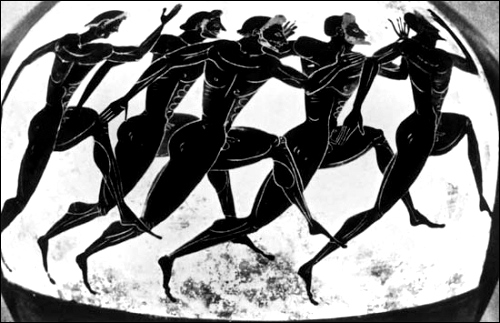
Greeks At Play
I think I have shown that he was a full participant in the intellectual culture of 1875-1920 which influenced the first phase of his writing career. We know he was well read because he references hundreds of books that he read in his own pages. He tells us he read Gibbon’s Decline And Fall Of The Roman Empire which is an essential for a liberal education. He tells us he read and reread Plutarch’s Parallel Lives which also is no mean achievement. Those may be isolated instances or, as I think, they are the tip of the iceberg. He was near expert on Evolution while being deeply read in esoteric and exoteric religion. The guy was a virtual marvel. His learning shows up in his writings although in a fantastic manner for enterainment purposes.
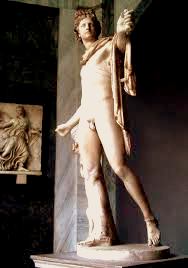
Apollo
For our purposes here we can begin when his father placed him in the Harvard Latin School of Chicago. He was to spend what we would call his Junior High years there. It was there he learned Latin and possibly some Greek. He was to complain later that he learned Latin before he learned to write in English which he thought affected his style and it may have as some of his writing reads like he was translating from Latin. While he may not have qualified as a Latin scholar I’m sure that for the rest of his life he could find his way through an extensive Latin quotation. When I was in school that was considered an achievement of a high order. So ERB had a pretty decent founding in the Classics.
Now, there has been a pretty fair controvercy on ERBzine recently over how nude Martians were. I don’t think there is any question but that both men and women hang out, that is ventral and dorsal nudity. One might therefore infer that in Burroughs’ vision of an utopia the style was to be au naturel.
Was this original or did ERB, as usual, borrow from the culture, have his sources?
Let’s start at Harvard Latin School. At the time the Patriarchy was in full control of the culture. There were grumblings from both the Matriarchy and the Hetaerarchy but those were in the beginning stages of the revolt. As late as the 1960s when I was an Ancient History major you would have been thrown out of school for challenging the Patriarchal version of Ancient History, that is to say Greek and Roman. ERB then couldn’t have been given less than a 110% Patriarchal education.
Any illustrations of Greek statues he would have seen showed the genitals fully exposed unless a fig leaf had been placed over them. The Greek vases he may have seen would have shown Greek men at play or leisure with fully exposed genitals, any weapons belted on would look exactly like his Martians. They might have a wrap thrown over the shoulder for protection from inclement weather.
The phallicism, the pride in manhood, runs all through Greek art and literature. At the time men were liberating themselves from the Matriarchy with its cruel attitude toward the males. It had been discovered that the male inseminated the female so men claimed the child as theirs while the women were mere incubators or storehouses rather than the fecund goddesses of creation. Man was the creator. That was the answer the riddle posed by the Theban sphinx to Oedipus was, Man. So the psychological reaction must have been if you’ve got one, show it. Meanwhile as the man was the progenitor of a woman’s offspring, a man’s wife had to be secluded so that another man couldn’t impregnate her. Whereas in the past women were more or less commonly available to the certified they now became the exclusive possession of one man, except for prostitutes or hetaerists. The children were his.
How much, if any, of this ERB understood he at least saw a society where the men went fully nude. As the Martian children were hatched from eggs incubated in the Martian sun it sounds as though he had read Plato where Socrates expatiated on the old days when men and women were hatched from eggs. Indeed, Leda impregnated by Zeus in the form of a swan hatched two eggs that produced Castor and Pollux and Helen and Clytemnestra as two sets of twins. It’s not too far from there to Mars, don’t you think?
Around the turn of the century the Nudist movement took form in German. We tend to think of these earlier times as staid when in reality the modern world was in its birth throes. The nudity thing since the French Revolution had been slowly growing. For the Medieval Free Spirits and Anabatists nudity was a key point as it was for the Libertines and as it was adopted by the Communist offshoots of the Revolution. Men want to look at the female nude.
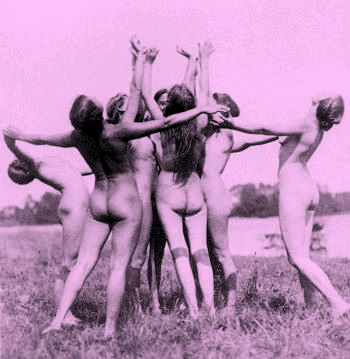
Early Nudists
In Germany at the turn of the century the nudity movement jelled, an actual movement taking shape in conjunction with the Wandervogel movement. This is turn led to the development of the Nature movement resulting in the incredible Nature Boy scene in the US of the thirties and forties which in turn evolved into the Beat/Hippie phenomenon of the fifties, sixties and seventies and into today.

Eden Ahbez- Writer of Nature Boy
Burroughs would have been aware of this whole phenomenon up to 1950 endorsing it enthusiastically. Tarzan was the ultimate Nature Boy and Burroughs developed the character with that in mind. The ideal. I have no douts that Burroughs intended him as the exemplar of this growing movement. Hence the development of the Nature movement was aided, abetted and intentionally forwarded by ERB clearly linking him to the scene in Bohemian NY of the sixties and the whole Beat/Hippie scene.
So Burroughs’ writings actually promote nudism and the Nature movement throughout his career. John Carter arrives, born again, nude on Mars where he would have been unnoticeable on that account, completely blending in. Indeed, the only difference was that he was white instead of red which was a curiosity. Thus, as soon as he leaves Earth he become a nudist in what was a sort of utopian society to Burroughs.
Tarzan necessarily practiced nudity for his first twenty years, only donning his ‘fig leaf’ or G-string when he came in contact with civilization.
Burroughs always refers to Tarzan’s ‘adornment’ as a G-string in the early novels. A G-string only cover the genitals with a flap and not the rear so Tarzan was essentially nude in the jungle. He was a Nature Boy and that is the way most of his readers have perceived him.

Maxmillian- Star Nature Boy c. 1948
The MGM Tarzan is the exemplar of the Nature Boy living on fruit and nuts. The MGM movies regularly show bowls of fruits and nuts while Tarzan, unless memory fails, is never shown squatting over a haunch eating the flesh raw as in Burroughs’ novels. As with Burroughs and the Nature Boys Tarzan rejects all the appurtenances of civilization except for some mechanical engineering at which Tarzan was apparently a genius. Might even have been a Nuclear Physicist even though he could barely grunt in the MGM movies.
It seems clear that there was vitually no one who hadn’t heard of Tarzan or Burroughs. Nearly everyone was influenced by the two. It therefore seems probable that the Nature Boys, the nudists took Tarzan as an avatar.
Certainly John Derek directed his movie, Tarzan, The Ape Man of the 1980s, concentrating on the sexual and nature aspects of the image. No argument there, I hope.
Now, the Bohemian scene in NYC was among other things a return to the primitive. The crowd surrounding Andy Warhol in his Factory was a bunch of savages stripped of all but the rudiments of civilization. They were the Tarzans of the asphalt jungle. The more affluent savages, the Haute Boheme lived a life of sexual abandon that Burroughs, Wells and Freud could only have dreamed of, and they did dream of it.
Once the attitude was institutionalized at Studio 54 the world Burroughs, Wells and Freud longed for was realized. It was Hetaerism and Matriarchialism on wheels, a complete overthrow of Patriarchalism. Our three musketeers would have gained easy admitance and found each in his own particular utopia. From 1880 to 1980 was only a hundred years. A short time indeed to overturn civilization.
Burroughs was a leading figure in this revolution.
Pt. II: H.G. Wells, Sigmund Freud, Edgar Rice Burroughs And The Development Of Contemporary Sexual Attitudes
August 22, 2010
H.G. Wells, Sigmund Freud, Edgar Rice Burroughs
And The Development Of Contemporary Sexual Attitudes
by
R.E. Prindle

Edgar Rice Burroughs And His Tiger
To put our three protagonists into perspective: Sigmund Freud The eldest of the three was born in 1856, Wells in 1866 and Burroughs, the youngest in 1875. All three were heavily influenced by Charles Darwin and the various theories of Evolution. While today Darwin is touted as the sole source of evolution he was in fact one of many voices as the theory of evolution developed. Thus all three spent their formative years in the latter half of the nineteenth century. Freud was 44 as the century turned in 1900, Wells 34 and Burroughs 25 each neatly spaced 10 years from his predecessor.
Wells was the first to make the leap into prominence followed by Freud and then Burroughs. All three men were desperate to find fame and fortune. Freud even advtertised he’d sell his soul to do it.
Wells came from close to the bottom of the social ladder. His parents eked out a living as shopkeepers without commercial abilities on the edge of London. Wells’ father was an able cricket player who gained his self-esteem from that sport. The parents split up. His mother went into domestic service. She placed young Wells as a Draper’s assistant- a clerk in a dry goods shop. As one might well believe Wells rebelled at this dead end destiny in life. Possessing a good brain Wells began a series of educational maneuvers that led to his being a student of T.H. Huxley, an apostle of Evolution. A science career seemed to be opening for Wells but he was led away by his sexual needs. He married a cousin with whom he was a boarder in her mother’s house only to discover her Victorian notions of male-female sexual relations differed widely from his. He divorced her taking up with a fellow student. She was an able financial manager so he put her in charge and began chasing skirts. It didn’t seem to bother his wife Catharine who he renamed Jane. After a series of hairy but educational employments Wells began to find success in journalism and writing. With his story The Time Machine he broke into the bigtime giving Jane some real work to do. Quickly following The Time Machine up with his succession of sci-fi novels by 1900 he was assured of a lifetime income.

Bertie Wells
It was well because his work after 1906 while prolific was unlucrative except for 1922’s Outline Of History. There was a winner. The Outline was his second great break setting him up for the rest of his life along with the science fiction. Ah, those Seven Science Fiction Novels. And, of course, his close to amazing collection of short stories. There was another gold mine. Jane raked in the cash and Bertie, for that was how he wished to be called, spent it.
He associated himself with the socialist Fabian Society of the late nineteenth and early twentieth century with their ‘advanced’ sexual notions. Why the old Hetaerist notion of promiscuity is considered ‘advanced’ is beyond me. At the same time Bertie claimed to be a Feminist. The women’s Matriarchal movement was very active from mid-century on. His Feminism, however, was concerned only with eliminating chastity thereby allowing any man access to any woman at any time, anywhere. Purely Hetaeric, although Wells wouldn’t have understood his ancient roots in that manner.
It was when Wells turned to his sex novels that he put his reputation in jeopardy. After his intial spate of sci-fi his reputation slid, the only bright spot being The Outline Of History. While his later novels, tend toward the tedious and require a certain determination to read through they are almost always redeemed by the social context. I like Wells and don’t mind the stuff too much but I can’t recommend it very strongly. It’s a matter of taste, either you like Wells or you don’t.
Wells major themes are outlined in the last of the Seven Sci-Fi Novels- In The Days Of The Comet- when he shades into the sex novel. In my estimation this is a very fine book as utopian novels go. After Tono-Bungay and When the Sleeper Wakes it may be my favorite. The turn of the century was a hey day of the utopian novel with the dystopian novel being introduced. If you like the genre many fine ones were written: News From Nowhere by William Morris. I came to Morris late in life but if you like the mystical utopian or quasi-utopian novel Morris has a lot to recommend himself including several utopian forays. I’m sure he influenced both Wells and Burroughs; Edward Bellamy’s Looking Backward is another fine example of the period. They’re all bushwa but fun to read. Utopian novels are usually a projection of the author’s own needs and desires into which all humanity is to conform. Usually by some miracle all humanity becomes reconciled to living in universal harmony with no unseemly disturbances of the temper. Museums and lecture halls flourish while dance halls and crime atrophy. Culture is much more elevated. To the most casual observor such an utopia is impossible without an alteration of the human brain. Only one utopianist I have read has addressed that problem and that one is H.G., our Bertie.
In The Days Of The Comet was published in 1906 at the time that Halley’s Comet was due to make its scheduled seventy-five year fly-by in 1910. It was projected to pass very close to the earth which it did unlike its 1985 appearance when you had to know where to look for it. Indeed, the comet came with trails of glory so bright you could read newsprint by it at night.
Thus Wells uses the comet as his agent to change the physical structure of the human brain. Wells fails to mention any change to the brains of the lesser animals and insects. Perhaps the lion really did lie down with the lamb. Before the comet, or the Big Change as the passing was referred to, people’s brains were as ours are now; after the Change they all resembled that of H.G. I am in sympathy with Wells; I fancy that one morning I will sally forth, flick my finger tips a couple times, say abracadabra and the people of the world will be tranformed into clones of myself. What’s holding me back is that I don’t know which will be the Big Morning and I don’t wish to be seen as an eccentric or worse who failed to take his medicine by repeatedly trying and failing. You know, out there flicking my finger tips into the empty air.
But, Wells had it worked out. The comet came trailing this tail of green gas. As the comet passed the gas enveloped the earth much like a magnetar, I suppose, knocking people out for several hours while the gas did its work. When England came to the world was changed and everyone thought like Wells. Sort of the same thing that was thought would happen when Obama was elected. The Magic Negro would save us all.
Actually the Comet reflected a change in Wells own circumstances. In 1898 when Wells published The War Of The Worlds he was balanced between hope and despair. He was close to financial independence but not quite there. Thus in WOW the tone is between hope and despair. The world is invaded by Martians who destroy everything in their path, themselves being destroyed by a virus taken in through their beastly habit of drinking human blood. One neglected detail is that the projectiles they arrived in trailed some green clouds. The last projectile had a larger one so that perhaps Wells was going to develop the notion but then couldn’t work it in. He did have the Martians project a black gas that killed people though.
By 1906 his success was assured, he was shooting his pistol off around London having several sexual affairs so his outlook was brighter and, hence, that of the planet, so the novel describes the transition from the evil old world to the brave new one In other words, Wells had passed from poverty to affluence.
Sex is the issue here.
Before the Comet Willie, the hero, was courting his childhood sweetheart Nettie from whom he expected to be her sole sexual companion. In the weird old world sex was exclusive. They had committed themselves to each other as children which remained a claim in Willie’s mind.
However Willie is a poor boy with no prospects. Nettie is courted by the rich guy’s son, Verrall with whom she runs off. Willie treks 16 miles to see her only to find she has abandoned her parents’ home in company with Verrall. Well, Willie’s not going to endure such treatment from Nettie or take that from Verrall so he steals some money, buys a revolver and a train ticket to track them down and shoot them dead. You see, in the days before The Big Change that was the way things were done.
In the meantime the Comet is getting closer, C-hour is near, and war breaks out between England and Germany, this is eight years before 1914 so Bertie exhibits his prescience. The details are well handled so we have the increasing color of the green cloud and the flash and boom of the big navel guns as the climax takes place by the seashore. This was really nicely handled.
Willie tracks the couple down to a Bohemian enclave on the East Anglian coast. Nettie and Verrall had gotten married so it seems rather odd that they searched out a Bohemian enclave. So, as the battle rages and the green cloud descends on the earth Willie is chasing the couple down the beach firing his pistol wildly. This is the moment of the Big Change. Everybody gets gassed for a few hours then arise, born again, in a new heaven and a new earth. Utopia!
The same device is used a few decades later in the great movie The Village Of The Damned. A good device. It won’t go stale.
In the new world, new rules and reasonings apply. Nettie no longer has to choose between Willie and Verrall. She can have both…and more.
As Willie comes to he hears groaning. The groaning is coming from a prominent politician who was out bicycling at two in the morning when the green fog descended and fell off his bike as he conked breaking his ankle. Thus Willie makes a connection changing the direction of his life allowing him to become prominent in the establishment of this brave new world. Thus he later meets Nettie and Verrall on equal terms.
Nettie informs Verrall that she wants a menage a trois with Willie to which, in this best of all impossible worlds, Verrall compliantly agrees. Later Willie marries making the arrangment a menage a quatre. Neato! Was this all? No…
In the frame for the story it turns out that the story teller is Willie. In the Frame Wells comes upon this white haired old dude, Willie, writing this memoir. He has pages clipped in fascicles of fifty that Willie allows the editor, H.G., to read.
Finishing the last fascicle the author asks if Nettie had sexual relations with others. The white haired dude replies somethng like this: ‘Oh, heavens, yes. Hundreds. You don’t think a beautiful girl like Nettie wouldn’t attract numerous suitors do you?’
So there you have it. In the brave new world the woman of Wells’ dreams is a mere sex object who spends her life being pawed by, shall we say, all comers. A Hetaerist’s dream. This is Wells’ sexual program. At this point he began to lose readers. Too avant garde; you don’t want to get too far out in front of the pack. In addition to the sexual proselytizing of his novels he carried his didacticism to extremes advancing educational theories for instance. For over a hundred years we’ve been told our educational system is faulty. New systems have succeeded new systems. After over a century of tinkering are people better schooled? No. They’re worse. There’s only one way to learn and that’s the drudgery of study. Not every mind is prepared to do that, somebody’s going to be left behind. Wells’ notions as everyone else’s is what they think they would have liked. No study. Lots of play.
At any rate carrying all these utopian notions Wells passed through the horrific war years to have all his expectations disappointed. Not surprisingly his mind broke and he went into a deep depression. First he tried the God trip and when that failed he embraced the Communist Revolution in Russia. He essentially became an agent of Moscow. As a very prominent writer he was a desirable acquistion for the Revolution. As a major theorist and propagandist he had an entree first to Lenin and then after 1924 when Lenin died, Stalin.
In 1921 he interviewed Lenin and received his instructions. the Soviets had a system of State prostitution. These women were assigned as agents to service writers while spying on them for Moscow. In 1921 he met Moura Budberg for whom he fell. At that time she had been assigned to manage a consular agent, Bruce Lockhart, who along with the agency was in process of being expelled. Wells became intensely jealous of Lockhart because of this connection badmouthing him from then on. In any case Moura Budberg was assigned to Maxim Gorky then living in exile in Italy with whom she stayed until Gorky was enticed back to the USSR at which time she was reassigned to shepherd Wells.
Now Wells became a Soviet literary hatchet man. It was his job to interfere and discredit writers who refused to propagate the Party line. Among these was Edgar Rice Burroughs who had proclaimed his anti-Communism with a tract or study titled Under The Red Flag of 1919. Publishers refused the piece. Wells anti-Burroughs campaign was so discreet that my discovery of it three or four years ago was the first mention of it. I repeat the story here for those who have not read my earlier essays.
In the first place all these writers read each other. Kipling and Haggard for instance read each other as well as writers like Wells and Burroughs and vice versa. They could pass disguised messages in their novels. As Burroughs was the last of these writers to begin writing and that in US pulp magazines in 1912 that may never have reached Europe while his book titles only reached print in 1914 after the Great War began and were only the Tarzan titles until the end of the decade Wells may not have read Burroughs until 1918 or slightly after. Nevertheless Burroughs influence shows in Wells’ 1923 effort Men Like Gods. This book also ridicules Burroughs.
Men Like Gods takes place in a parallel universe. There is some resemblance to the Eloi of The Time Machine. For the first time Wells’ characters are nearly nude. This was the only time he ever did this so he was probably under the influence of Burroughs whose characters never wore clothes or only minimally.
Burroughs apparently picked up the references or had them pointed out to him. In any event in 1926 he wrote The Moon Maid in answer to Wells, The First Men In The Moon. Wells’ book was pretty clumsycompared to that of Burroughs who demonstrated his imaginative superiority by running circles around Wells. The second part of the story was a rewrite of Under The Red Flag that was a direct challenge to the Soviets. By 1926 of course Stalin was directing the USSR.
Wells then countered with an undisguised attack that portrayed Burroughs as insane. This was Mr. Blettsworthy On Rampole Island. Here Wells parodied a pulp magazine story not yet in book form, The Lad And The Lion, and the last third of The Land That Time Forgot. Burroughs returned the fire with Tarzan At The Earth’s Core and Tarzan The Invincible that featured Stalin himself as a character.

Moura Budberg Young
At about this time Moura Budberg was assigned to Wells as a concubine as Gorky had returned to the USSR. This was to cause a falling out between Wells and Stalin while perhaps leading to Stalin’s assassination in 1953.
Burroughs’ entire series of novels from Tarzan At The Earth’s Core to Tarzan And The Lion Man deals with Wells and the Reds. The Communists attacked unrelentingly on several fronts probably robbing Burroughs blind in royalties while trying to squeeze off his sales. His British publishers did just that. Although it appears that they refused or were reluctant to keep his titles in print Alan Hodge and Robert Graves in their history of the twenties and thirties, The Long Weekend, twice refer to Burroughs’ great popularity, once in the twenties and once in the thirties.
In Germany the Communists attacked ERB for his anti-German comments in books written during the war

Moura Budberg Old
years thereby destroying that lucrative market. The Soviets never paid royalties anyway so there was no monetary effect from that market. In the US Burroughs had troubles with his publishers McClurg’s and Grossett & Dunlap who seem quite hostile to in the correspondence in the archives at ULouisville. ERB left McClurg in the late twenties going through two more publishers before winning the battle by publishing under his own imprint. Thus by 1930’s Tarzan The Invincible, note the title, he seemed to have won the battle if not the war.
However sound had come to the movies in 1927-28 which rearranged the playing field. Rather than just being ‘flickers’ they were now more on a par with literature while being even more influential. With sound the movie version of a story took pecedence over the book, heck, it took precedence over history. Thus the movie version took precedence as the canon over the book, the latter became an adjunct that few read in comparison to those who saw and heard the movie. As the movies paid in one lump sum what it might take years to dribble in as royalties authors were willing to give the devil a cut to have their novels produced. Books could be issued in their thousands of titles a year but there were only a couple hundred movies released in a year. The number of producers had been consolidated from many to a few after the shakeout of the twenties, hence combines like Metro, Goldwyn and Mayer, Radio-Keith-Orpheum- RKO- and the combine of Twentieth Century Pictures and William Fox.
MGM was of course top dog by far. There was no vacuum there but the Commies moved in anyway soon taking over de facto control. When Burroughs published his own books, quite profitably, he had slipped the noose but only temporarily. As a strategist he did poorly. In 1931, because Burroughs didn’t ever bother to dread his contracts, MGM finessed his meal ticket, Tarzan, from him thereby making him financially dependent on them. Even though they might have exploited the Tarzan character by making two or three movies a year and zillions of dollars they chose to make only six movies between 1931 and 1940 thereby keeping Burroughs on a short financial lease while depriving him of hundreds of thousands of dollars in income. Remember that at the same time Roosevelt after 1933 drove the income tax rate as high as 90% so there was some difficulty forcing a grin in those trying times.
This is a good story and I covered it in some detail in my ten part review of Tarzan And The Lion Man, expecially parts 6-10 to which I refer you if you’re interested. Wells and Burroughs bickered back and forth although it appears that Burroughs lost heart after Tarzan And The Lion Man. By that time he knew he had been had. He did concede defeat in the issuance of a book version of The Lad And The Lion in 1935; a notice to both Wells and Stalin. The story was a short one so while leaving the old story as a notice to Wells who had mocked him and the story in his Blettsworthy novel, Burroughs interpolated chapters with a story mocking the Communist Revolution in Russia. Then he retired from the field.
However he gives Wells a grand slam in the story of ‘God’ in the middle of Lion Man. That is a great story within the story however I wasn’t clear on its relation to Wells at the time so I will give a modified version here.
Now, Burroughs had a remarkable mind. He was able to carry the story lines of hundreds of books he had read in his head retrieving details whenever they suited his needs. He was always conscious of what he was doing but he wrote pastiches anyway.
The story of Tarzan and God mocks Wells’ The Island Of Dr. Moreau. Burroughs had already used Moreau in his 1913 novel The Monster Men plus he wrote around the theme repeatedly. Moreau itself plays around with the Frankenstein theme which also figures prominently in Burroughs’ literary antecedents.
Remember that Burroughs is able to combine numerous details of other books into one composite figure so that Wells is only one source for the character of ‘God’ in Lion Man. For our purposes one may assume that when Tarzan talks to God (smirk) it is equivalent to Burroughs talking to Wells. Gone is the transcendant confidence of Tarzan The Invincible and Tarzan Triumphant. However the coup of the capture of Tarzan in 1931 when Burroughs signed away his rights to the movie representation of Tarzan to MGM had stripped Burroughs of all defences and he himself was now trapped in a cage at the mercy of MGM, Wells and Stalin. During Tarzan’s movie history dating back to the late teens Burroughs had always complained, making a nuisance of himself because the studios weren’t following his stories closely. Now, he had given MGM the right to create their own stories. ERB was dissatisfied with the representation of Tarzan but the character was so good that even though MGM tried they couldn’t destroy it.
Nevertheless they were in a position to substitute the movie Tarzan for the literary Tarzan in the public mind and they did. For me and many others the discovery that there was a literary Tarzan came long after we had been viewing Tarzan movies. We invariably found the literary Tarzan superior. For now Tarzan/ERB was imprisoned in a cell. The best ERB can do is to come up with a better Moreau story than Wells.
So, ERB creates a mock London, England in the wilds of Africa with a replica of the court of Henry VIII peopled by mutated gorillas. By 1930 when this story was written ERB was probably as well informed about evolution as anyone. He had kept up his reading becoming as knowledgeable concerning genetics as any but researchers. Thus while thirty years earlier Moreau had been clumsily experimenting with vivisection ‘God’ had used the lastest genetic techniques that ERB can devize to convert gorillas into a cross between apes and human beings. The apes of God are human in all but appearance. There are many jokes concealed in this episode, apes of God perhaps being one. Wyndham Lewis used the term apes of God as a synonym for writers so he may be calling Wells as God and writer an ape. ‘God’ himself who has exchanged ape genes with himself is now half ape. See, a joke. Whether Wells recognized his portrait isn’t known.
Tarzan sets about to escape but as there is no escape from his real life situation ERB merely burns God’s castle down disrupting one supposes the USSR. Perhaps gratifying to the imagination but futile for changing his situation. No longer in control of his creation Burroughs creative powers begin to atrophy.

Uncle Joe As FDR Would Say
Thus Stalin triumphed over his literary adversary. Perhaps Stalin despised writers for he set out to humiliate Wells after the defeat of Burroughs. As noted the State prostitute Moura Budberg had formerly serviced Maxim Gorky while after his return Budberg was assigned to Wells. H.G. had fallen hard for Budberg apparently seriously in love with her. Stalin called Wells to Moscow in 1936 when Gorky was on his last legs, about to die. Budberg was also in Moscow but when Wells asked to see her she told him she was called out of town. In a rather malicious ploy Stalin arranged for Wells to see Gorky and Budberg together as, of course, she wasn’t out of town.
Wells was completely destroyed unable to penetrate Stalin’s duplicity, or at least believe it, at the time. However when it finally sank in he had no more means to retaliate than Burroughs so he wrote a book too- The Holy Terror. In that book, the ruffian leader of the revolution, or Stalin in real life, has lost the ability to lead the revolution and has to be discreetly removed. A conspiracy is set afoot. A doctor’s plot in which the leader is artfully removed by medical means. I am unaware of how much influence Wells may have had to incite others to achieve his result. At any rate the War intervened making it inexpedient to dispatch Stalin while Wells died in 1946 before he could reactivate the plan.
It may be coincidence but Stalin discovered a doctor’s plot in the early fifties that he was able to foil. However Khruschev and Beria and others poisoned Stalin at a dinner in 1953 thus removing this singularly successful but troublesome dictator.
The turmoil of the thirties may have derailed Wells sexual program somewhat but sexual matters were still moving in his desired direction. Sexual matters had been loosened a great deal but there were still miles to go.

Sex And The Psyche
In Part III I will deal with the key mover in sexual matters, Sigmund Freud who was the second of the three to reach prominence. Thus Burroughs the third to arrive on the scene and the last to leave will be saved for the last part.
Pt.I: H.G.Wells, Sigmund Freud, Edgar Rice Burroughs And The Development Of Contemporary Sexual Attitudes
August 14, 2010
H. G. Wells, Sigmund Freud, Edgar Rice Burroughs
And The Development Of Contemporary Sexual Attitudes
by
R.E. Prindle
Part I
Certainly it is to be hoped that (the) naturalistic school of writing will never take firm root in England, for it is an accursed thing. It is impossible to help wondering if its followers ever reflect on the mischief that they must do, and, reflecting do not shrink from the responsiblility to look at the matter from one point of view only, Society has made a rule for the benefit of the whole community, individuals must keep their passions within certain fixed limits, and our system is so arranged that any transgression of this rule produces mischief of one sort or another, if not actual ruin, to the transgressor. Especially is this so is she be a woman. Now, as it is, human nature is continually fretting against these artificial bounds, and especially among young people it requires considerable fortitude and self-restraint to keep the feet from wandering. We all know too, how much this sort of indulgence depends upon the imagination, and we all know how easy it is for a powerful writer to excite it in that direction. Indeed, there could be nothing more easy to a writer of any strength or vision, especially if he spoke with an air of evil knowledge and intimate authority. There are probably several men in England at this moment who, if they turned their talents to this end, could equal, if not outdo, Zola himself, with results that would shortly show themselves among the population. Sexual passion is the most powerful lever with which to stir the mind of man, for it lies at the root of all things human; and it is impossible to over-estimate the damage that could be worked by a single English or American writer of genius, if he grasped it with a will.
–H. Rider Haggard
Appendix to the Broadview
Edition Of She

Edgar Rice Burroughs
For a long time now I’ve put off writing about Edgar Rice Burroughs in relation to H.G. Wells. Wells has been difficult to get a handle on, a point of entry. But the Woodrow Nichols’ article on nudity in Burroughs on ERBzine pointed in the direction of changing sexual attitudes in the twentieth century. Coupled with reading the above quote of Rider Haggard I realized that Wells and Burroughs were two of those powerful writers capable of unleashing those sexual passions. They, coupled with Sigmund Freud, did change sexual attitudes in the twentieth century.
That is not to say they were alone but of all of the hundreds of writers between then and now all their books remain in print continuing their work.
The sexual problem is central to civilization while it has been handled differently in the development of civilization. For some time it seemed that the Patriarchal model would be permanent. J.J. Bachofen, the great Swiss mythologist of the mid-nineteenth century, was the first to challenge the Patriarchal model. In his studies of mythologies he perceived that behind the Patriarchy first came a Matriarchy while at the beginning was a Hetaeric period. All three had different sexual approaches while all three attitudes have survived into the current age competing for dominance.
In the first Hetaeric stage of development Bachofen believed men used women, and woman, indiscriminately whether with force of persuasion when the sexual urge hit him. A good picturalization of this can be found in the movie, In Quest Of Fire. As there was no knowledge of how offspring were conceived the women of the horde merely accepted the inevitable bumper crop of children.
Being a sexual object puts an unbearable burden on the female of the species no matter how natural. Since most females began bearing at twelve or thirteen with the onset of puberty they were worn out at twenty with few probably surviving to thirty. Indeed, a huge percentage must have died in child birth from twelve to twenty. One imagines a surplus of males in the horde not unlike affairs in the nineteenth century when men frequently went through two or three wives or more as the women died young in childbirth.

J.J. Bachofen- One Of The Greats
While conception or paternity wasn’t recognized there was no mistaking motherhood. By some process of refinement the sexual mores of hordes evolved into Matriarchy which acknowledged female parentage while giving women some sort of sexual control, preference if you will. The change from the Hetaeric to the Matriarchal inevitably left behind a reactionary or conservative group who saw no reason for change or giving up their sexual prerogatives. Thus conflicts between the two attitudes, perhaps warfare.
The Matriarchy was still thriving when history began to be recorded. Thus Homer’s Iliad and Odyssey concern the Patriarchal revolution against the Matriarchy amongst the Europeans. By now paternity had been discovered by which the male discovered that he impregnated the female which he now considered the most important part of the process and one which involved the exclusive use of the female as he had no wish to care for another man’s children. Hence Patriarchalism- the primacy of the father- evolved putting the three systems into conflict and competition. This is a main theme of Greek mythology.
Concessions had to be made to the Hetaerists who were irate at the loss of their prerogatives. Hence temple prostitution undoubtedly evolved in which all the young females were kept in a temple compound until they had sex with any man who demanded it. Civilization being civilization, of course, there was a fee, hence protitution. Upon completion of the duty the female was released.
The Patriarchal revolt was a long slow drawn out process with many setbacks and compromises such as the above. Indeed, the Patriarchal god, Apollo, wrested Delphi from the Matriarchy but in the Matriarchal reaction he was forced to share the shrine with the effiminate Matriarchal hybrid god, Dionysus who, himself was destined to replace Zeus as the avatar of the Piscean Age. He assumed both male and female characteristics in the attempt to arrange the sexual conflict. That’s why the Jewish prophet Jesus of Nazareth, who substituted for him in yet another compromise is so effiminate. With the admixture of the Semitic influence in European religion with its uncompromising Patriarchalism the evolving Catholic Church was all but able to extinguish the Matriarchal Dionysian influence as well as the Hetaeric. Chastity, celibacy and monogamy became not only dominant but exclusive.
Just as the Matriarchy, while suppressed, has never disappeared or admitted defeat so also the Hetaerists have survived assuming different disguises while waging continued war with the Patriarchy and the Scientific view which is say Western Science and the Roman Catholic Church.
Reviled by the Church and persecuted sometimes to death the various sects fought back often posing as Catholics to become priests, even occasionally a Pope, and bore from within. Thus arose the Free Spirit sect which demanded the right of access to any woman at any time in any place. Thus John Sinclair in 1960s and 70s demanding the right to ‘fuck in the streets.’ An irrational request by any other standard. The Free Spirits delighted in debauching nuns when they had sufficient numbers to seize a place.
The spirit surfaced among the Anabaptists, for instance, who were not only suppressed but destroyed root and branch. With the Enlightenment when the Hetaerists surfaced as the Libertines we hear of them forwarding the French Revolution while their ideals were absorbed by the nascent Communist political movement. The Libertines per se seem to have transmogrifed into La Vie Boheme after the Napoleonic Empire, Bohemianism reaching down to our time.
La Vie Boheme as depicted by the French novelist Henri Murger evolved in the early nineteenth century along with their more overtly criminal cousins, the Mohicans of Paris as the novelist Alexandre Dumas styled them and known as Apaches by the end of the century. In the US fifties the Apaches were represented on TV with a mystifyingly violent effect as Apache dancers from France. I suppose the Apache style was transmogrified into the New York Bohemian style also. So this quasi-criminal Bohemian Apache style pervaded Euroamerican civilization through the nineteenth century and in diluted form into the twentieth and present day. The Fall 2010 Nordstrom catalog for instance celebrates the New York Haut Boheme.
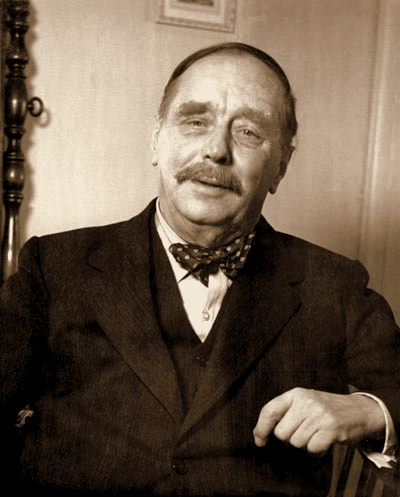
H.G. Wells
I was trying to relate this latter day form of Behemianism to Burroughs in my three part series on Presley, Lennon and Yoko Ono that Bill Hillman courageously published in ERBzine but over some very strenuous objections. I presume I lost the Bibliophiles on that issue.
That Burroughs was fascinated by the Bohemian style while actually furthering the Hetaeric sexual program is fairly obvious. He said that he wrote his first unpublished work, Minidoka, in Ragtime speech, that is to say the Bohemian mode. In other words ERB considered himself plenty hep, at least a closet Bohemian. Some may find that disturbing but, it is so. In ’60s NYC terminology ERB would hve been of the Haut Boheme. Along with those sympathies went a set of Hetaeric sexual mores that Burroughs advocated.
I have already examined the Bohemian influence of George Du Maurier on Burroughs with his novels Peter Ibbetson, Trilby and The Martian. Du Maurier was also of the Haut Boheme. A photograph of ERB behind the camera in Idaho in 1899 shows ERB dressed in full artistic Boho mode. He had just emerged from a short stay at the Chicago Art Institute where he would have immersed himself in Boho mores as artists then and now were virtually all Boho, at least in outlook. Writers too.
It seems quite extraordinary that Libertinism was discouraged and contained between the end of the eighteenth and beginning of the nineteenth century. Perhaps the answer can be found in the transition from aristocratic society to bourgeois society. Perhaps the Bourgeois requiring a different sexual morality than the aristocracy succeeded in imposing their version of sexual mores by sheer numbers.
Libertinism did regain prominence amongst the wealthy Haut Boheme of NYC thence spreading throughout society as a Bohemian sensibility began to displace the Bourgeois.
A book I have reviewed on ERBzine, found in ERB’s library which he read, GWM Reynolds’ The Mysteries Of The Court Of London scrupulously records the libertine activities in a fictional form of Prince George, later King George IV, whose career of seduction ended only in the 1820s. Certainly Reynolds’ depiction of the libertine actiities of George and his circle out Zolaed Zola by more than somewhat.
The whole libertine attitude was nowhere more prominently displayed than in NYC’s Haut Boheme nightclub, Studio 54. So the suppression of the libertine spirit during and since the reign of Queen Victoria was short. Perhaps Haggard’s novel She echoes the memories of the Libertinage of the eighteenth century Hellfire Club in some obscure way.
Haggard had no reason to put on airs because as I pointed out in my review of his King Solomon’s Mines that novel is smutty from top to bottom while ‘She’ has some very salacious passages. As Horace stands watching the scene of She and the dead body of Kallicrates for instance one is more than excited. She had murdered her former lover Kallicrates for running off with another woman. Immediately remorseful she kept the body preserved in perfect condition for two thousand years. She could even psychically animate the body so that it stood although still insensate. The necrotic effect is hypnotizing, making the reader a voyeuristic accomplice of Horace. As he and we watch the bodice of She’s dress slips to her waist exposing her magnificent charms according to your imagination. As we watch she then raises her arms above her head lifting and pointing the golden orbs. She does this not once but twice so it is clear Haggard was exciting and taunting his readers. If one imagines Ursula Andress who played She in one of the movies the effect is exhilarating indeed.

Ursula Andres As She
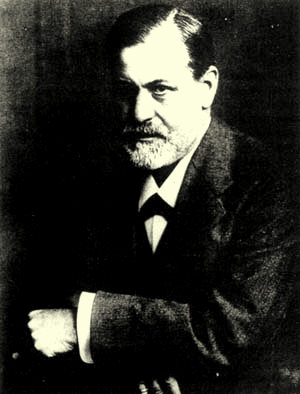
Haggard aside, as he says there were writers in England and America who were champing at the bit to alter the course of sexual history. Chief among these was H.G. Wells in England and our own Edgar Rice Burroughs. Both would make significant contributions to the ‘change’ but the most effective writer of them all was the secret sexual pervert, the undisputed master of them all, Sigmund Freud. But to go first to H.G. Wells and take things in order.
The Mad Herr Doktor Professor

The Last Sane Man Left Alive
A Review
Themes And Variations
The Tarzan Novels Of Edgar Rice Burroughs
#14 Tarzan The Invincible
Part VI of X
by
R.E. Prindle
Inside The Gates Of Opar

Edgar Rice Burroughs
Life is just too short for some folks,
For other folks it just drags on.
Some folks like the taste of smokey whiskey
Others think that tea’s too strong.
Me, I’m the kind of guy who likes to ride the middle
I don’t like this bouncing back and forth.
Me, I want to live with my feet in Dixie
And my head in the cool blue North.
–Jesse Winchester: Nothing But A Breeze
And now we come to the heart of Edgar Rice Burroughs. One reason he is literarily disdained is that the story is not the story. Porges, p.524:
As the story progresses the perceived theme of a worldwide conspiracy is abruptly abandoned. Burroughs in his contempt for the communists refuses to allow them to be sincere even in their Marxist goals.
This is not true. Porges has misconceived the story. To quote the sixties Jewish revolutionary Mark Rudd: The issue is not the issue. By that Rudd meant that the Jews had created a diversion to mask the true issue which was the establishment of the Jewish culture as top culture or dictator in this multi-cultural world.
Burroughs intent is exactly the same as regards Tarzan. True, Burroughs has contempt for Communism but that is merely a frame story and a side issue. The true issue is that Tarzan’s authority as guardian of Africa is being challenged on the spot. The duel is between himself and Sveri mano a mano. He discredits the collectivity through the individuals. Thus at novel’s end Tarzan sits in state as Guardian or Emperor disposing the fates, godlike, of the remaining conspiritors. Magnanimously he allow Paul Ivitch (Paulevitch) to be escorted out of Africa rather than be thrown on his own resources that would have resulted in his certain death.
The issue within the issue, as always, is Burroughs attempt to resolve his psychological difficulties. Thus one has the Colt-Drinov combination, possibly reprsenting ERB and Emma, an episode within Opar of Nao who may represent Florence releasing him from the prison of his marriage to Emma, and Colt-La, the Anima and Animus problem. Tarzan and Colt change partners so that La nurses Colt and Tarzan nurses Zora. But to that in the next section.
While one expects a pure shoot out with the Communists, Tarzan is not going to defeat them by direct action but by a terrorist campaign of which Tarzan is the jungle master.
To compound the problem Burroughs confuses realism with dreamwork. This is not a realistic novel but a dream fantasy. It was said that Burroughs wrote out his dreams which has a basis in fact. The scenarios may have originated in his sleeping dreams but then he modifies them in day dream style while consciously molding the story for political and commercial purposes. A writer does need readers.
To give a basis for comparison for the dreamwork I’m going to play Freud here and offer up a dream of my own; it is similar to Burroughs’ in many way. Since integrating my personality I don’t have wonderful dreams like this anymore. As Jung correctly surmised when one integrates the conscious and sub-conscious minds memory destroys the symbolic basis of your dreams. I can analyze the common place dreams I have now even as I dream them. Something is lost, something is gained, but it might be of lesser value. I think I like the mysterious flavor of the smokey whiskey even though the water I have to drink now is better for me.
In my dream I began on the edge of a vast desert dotted with a few oases while far off in the distance twenty years away, rather than miles, away in the the distance a great white shining mountain arose. The distances were so vast they were measured not in miles but years. Indeed, the years of my life. I had to traverse the vast desert reaches between the oases. Each oasis merely refreshed me for the next perilous journey. Having traversed the years I came to the great white shining mountain. One might compare it to the tor containing the treasure vaults of Opar out on its desert. These are symbols common to multitudes.
I then came to the white shining mountain which might compare to the city of Opar. Censorship prevented me from climbing the mountain at that time. In other words in the control of my subconscious, consciousness was denied me. I approached the mountain from the back where I noticed a trickle of water leading into and down the mountain. I tried to drink the water but as it ran through a pure salt bed it was too salty. Unlike Burroughs who was in the pits of darkness I was always bathed in a clear light which came from nowhere.
I followed the little stream down the subterranean path into the mountain. Thus I had all land and no water, a barren psychological situation. Following the cave down I came to a series of gates made entirely of steel. I hesitated to go forward but there was no going back. I was impelled into one of the gates which turned into a chute that spilled me out onto a steel floor where unseen hands seized me pushing me into a steel room as the steel door slammed shut. Like Tarzan beneath Opar I was a prisoner with no seeming way out.
As I looked around I realized that this was a laundry room. All steel, of course. While I had no food I now had sinks full of water. My situation had been reversed from all land to all water, from the pure masculine to almost pure feminine. Where before I was barren now I was spilling over with wisdom. I knew I had to get out of there reasonably soon or I would starve to death. There was impenetrable steel all around. But I had plenty of water. Too much water. Looking around I spotted ventilation ducts along the ceiling. I conceived the notion that I could drink lots of water then urinate in the ducts which would create a foul odor that would be distributed throughout the rooms above. They would search for the source of the odor thus opening the door of my prison.
The ducts were difficult to reach but I was able to urinate in them. As I expected voices came down the duct asking ‘What is that smell?’. The door to my prison opened inward so I stood to the side that opened waiting. Sure enough a couple maintenance men flung the door open bursting into the room. I slipped out the door behind them unnoticed.
I now descended still further until I came to a bank of elevators. One door was open for which I made a rush. The elevator was packed with boys I knew from high school. With doubled fists they pushed me back refusing to allow me in the elevator with them. Mocking me as the doors closed I was left alone way down there.
There was a flight of stairs but censorship prevented my using them. I waited in vain for another elevator. As with dreams I next found myself at the back of the mountain but the path into the mountain had disappeared so I now had to climb The Great White Shining Mountain.
If, like Burroughs, I were writing a story I would provide a plausible story line for my escape but I’m not. I’m merely transcribing a dream.
The reason the mountain shone was because it was covered by snow several hundreds of feet, possibly thousands, thick. As previously the water in the stream was too salty to drink now it was frozen. The sun shone brightly, not only brightly, but brilliantly, as I began my climb. I had left the subconscious for the conscious as I strove for the light. The climb was long from the back of the brain to the forebrain but not tiring. Apart from the barrenness of the snow I was enjoying myself. Would it be too offensive a pun if I said I enjoyed being high? After a long climb I came to a precipice past which I could go no further. Nor could I go back.
As I studied my position I looked down this sheer precipice to the desert thousands of feet below. There was snow all the way to the desert floor. Down there, way down there, I could see the tiny ant-like people in the barren sands doing obeisance to the moutain which they apparently treated as a god.
Looking down the sheer face of snow I could dimly perceive the outlines of a great face carved in the snow. This god, then, retained all the water behind his visage that could make the desert bloom. Just as I had used water to escape the prison of my subconscious I conceived the notion that I could release the water and make the desert bloom freeing the people from their bondage.
Now, this was hard snow. I had no trouble walking the surface without breaking through while if the snow didn’t give way as I jumped on it to destroy the snow god I would plummet several feet into the desert. Neverthless I leaped up landing on my bottom. The snow gave way as I rode the avalanche several thousand feet down the mountain side to land on the desert floor while I destroyed the god who had been impounding the water.
Many streams now flowed out from the mountain. The desert bloomed turning green and bursting with flowers. Now that we have a comparison let us examine Burroughs’ great dream of Opar.
Opar first found expression way back at the end of 1912 and the beginning of 1913. Appearing at the end of The Return Of Tarzan the story was included in Burroughs’ fourth published story and fifth written story, the Outlaw Of Torn had been written but not published yet.
As with Invincible the story of The Return was not the story. The story was what Burroughs hung the details of what appeared to be the story on. Hence Return was rejected by Metcalf Burroughs’ first editor at Munsey’s who undoubtedly couldn’t understand it. This is the novel in which Tarzan makes his first raid on the fabulous treasure vaults of Opar. Burroughs will continue his wonder stories of Opar through three more books. Each return occurs at a crucial point in his life.
That Opar is a dream location is proven by the topography of the location. It is not too dissimilar to any dream. The jungle grows right up to the base of towering mountains behind which Opar is hidden. On the other side of these it is a dry dusty desert exemplifying Burroughs’ life as the twenty year desert in my dream did mine. Entry into the valley in this story is through a narrow defile apparently several thousands of feet high above which the peaks of the surrounding mountain range tower several thousand feet more. This entry also closely resembles that of Haggard in King Solomon’s Mines. Haggard is never far from Burroughs’ mind as he writes his stuff.
Working your way down into the dreamscape is considerably more easy than climbing it. And then off in the distance rose the shining red and gold domes and turrets of Opar. A dream city if there ever was one. One is reminded of the two great literary and psychological influences on Burroughs, H. Rider Haggard and L. Frank Baum. Of Haggard’s work beyond King Solomon’s Mines I have Heart Of The World and People Of The Mist most readily called to mind. It might be appropriate to mention that Freud also read some Haggard. He specifically mentions Heart Of The World and She but I suspect he probably read others as well. Opar might be a ruined version of Baum’s Emerald City of Oz. Opar is red and gold while from a distance its ruination is not obvious. Mine was a shining white mountain. Burroughs probably tinkered with his to make a good story better.
Now, the fabled Thebes of Greek mythology had seven gates. Cities Of The Sun had up to a hundred. Opar doesn’t have any. The entrance is a narrow cleft in the wall on which on entering this narrow 20″ gap for which Tarzan had to turn his massively broad shoulders sideways and then immediatley climb a flight of ancient stairs. This appears to be a reverse birth story in which Tarzan is reentering the womb, an impossible feat, but then, Tarzan goes where even devils fear to tread. Try some of the books of the psychologist Stanislav Grof. There’s definitely a sexual image that requires a little thought to understand. Hmm. No gates but a narrow cleft too narrow for the shoulders and a flight of steps leading back into the what, womb? Whose cleft? ERB mother’s, Emma’s, possibly Florence’s by this time, or that of his Anima figure? Well, the last is waiting for him inside the domed inner chamber of this sacred city who is aptly named La, which is French for She. ‘She’ was Ayesha the heroine of Haggard’s novel She. I’m sure Burroughs is not writing consciously here.
At this point Tarzan is accompanied by fifty of his brave and faithful but superstitious Waziri. In fact, in this story as Tarzan goes through his incarnation of a Black savage he is Chief Waziri, eponymous head of the Waziri. P. 42:
As the ape man and his companions stood gazing in varying degrees of wonderment at this ancient city in the midst of savage Africa, several of them became aware of movement within the structure at which they were looking. There was nothing tangible that the eye could grasp- only an uncanny suggestion of life where it seemed that there should be no life, for living things seemed out of place in this weird, dead city of the long dead past.
Dead city of the long dead past. That’s what dreams are all about, one’s own long dead past. Thus the ridge separating the lush live jungle from this dry, dusty plain eight years wide was Burroughs own dead past. I suggest the mountain range, perhaps sixteen thousand feet high, represented ERB’s confrontation with John the Bully when he was eight or nine. On the jungle side was his early life as a Little Prince while on the dry dusty side was his blighted, blasted life after John. Opar represents his ruined mind inhabited by the suggestion of life and the Queen of his dreams the beautiful High Priestess of the Flaming God, the woman of indescribable beauty, La of Opar.
La is obviously a combination of Haggard’s She and L. Frank Baum’s Ozma Of Oz.
Tarzan is seized by the Frightful Men, bound and gagged and left lying in a courtyard at high noon. The rays of the Flaming God bear down on him. Whether this is merely part of an ancient Oparian religious rite or whether Tarzan becomes the chosen Son of theSun a god among men, isn’t clear to the reader. The Oparians have their own ideas.
Burroughs describes this rite in a really masterful way. The maddened murderous Oparian who disturbs the ceremony just before Tarzan is to be sacrificed is nicely handled. Believe me, I feel like I am there. As La looks down on Tarzan’s form on the altar she recognizes the One, the Son of the Sun, the One for which she is destined. Once again, Haggard’s She.
Freed in the melee caused by the crazed Oparian Tarzan is taken down to the Chamber of the Dead by La where she hides him. As she said nobody would look for him in the Chamber of the Dead. This Chamber answers very well to the laundry room of my dream. Tarzan/Burroughs is in a stone dungeon with walls fifteen feet thick, fourteen in Invincible, in total darkness while I was in a steel room with no exit but bright light. These locations answer to the rigid confines of one’s owned damaged psyche. There is no way out but there is, there has to be. While palpating this stony prison at the back of the cell Tarzan discerns a flow of air coming through. This scene is a replication of one in Haggard’s King Solomon’s Mines while becoming a B movie staple. The big Bwana discovers some loose stones. He is able to dislodge these creating an exit through the fifteen foot depth of stones of the fortress wall. Somehow Burroughs has worked his psyche to give himself a chance. Once beyond the foundation walls, free of the Chamber of the Dead (I once dreamed I was looking for my soul in the House of the Distraught) but act among the living, Tarzan feels his way down this long dark corridor. One can’t be certain of ERB’s age when he achieved this escape. As it takes place just before Tarzan marries Jane the time might have been 1898-99. Perhaps when he was in the stationery business in Idaho. Perhaps something he read acted as a lever. Apart from Darwin’s Origin Of Species I would venture to say he read Eugene Sue’s Mysteries Of Paris a copy of which is in his library while traces of it are here in his earliest work.
Sue’s rare mentality permeates every page of this first visit while Sue’s extraordinary consciousness is everywhere apparent throughout ERB’s entire corpus. Burroughs himself is absolutely incredible in the manner he associates with numerous other writer’s intellects, seemingly simultaneously within a given passage or even sentence. Myself, Adams, Hillman, Broadhurst, Burger and others have written extensively on these influences. Hillman even goes so far as to virtually twin Burroughs with some of his major literary influences. Burroughs does make all these writers his virtual doubles.
I have stressed Sue’s influence in several earlier essays. I can only urge you to read Sue’s Mysteries Of Paris- a big three-volume work and too short at that- which Burroughs in his own reading found a life changing experience. Possibly he did read it in 1898-99. I found it a life changing experience; I’ve never been able to free myself of its influence, while it appears that Burroughs couldn’t either. A lot of the late nineteenth century writers make reference to Eugene Sue. H.G. Wells based the beginning of an early novel on Sue. The remnant remains only as a short story.
Sue wrote from outside the bounds of sanity. Privately I consider him insane but so brilliantly rational as to transcend the very meaning of insanity. He’s a dangerous writer. His last work was confiscated by the French authorities. It undoubtedly had such a private personal sense of morality that I am sure it would have undone society much as the pornography from Hollywood has undone ours. DeSade and Restif De La Bretonne, who in some ways Sue resembles, were mere unbalanced pornographers who disturb only the disturbed. Sue’s vision of morality is coldly clear, it forms the basis of Tarzan’s but is always on the side of reason and virtue. This fact makes it no less dangerous to a weak mind or that of the obsessive-compulsive Liberal. Still, only the strong survive. I heartily recommend you take your chance.
Tarzan freed from the prison of the psyche, was he insane? was I? or were we merely trapped by a device of other’s making? I can’t say but ERB’s sanity after he escaped was conditioned by that of Eugene Sue. I, of course, rise above all influences.
Progressing down the corridor Tarzan comes to the First Censor. He finds a gap in the floor into which he might have fallen had he not been careful. He would have fallen into the unknown but he would have been alright. He would have fallen into water which in his condition would have been life-giving water rather than dangerous or perhaps he might have drowned in the waters of the subcoscious or Oblivion.
In high school I had a teacher who used to chalk a half dozen slogans on the black board, one each morning. The only one I remember is ‘when you reach the end of your rope tie a knot and hang on.’ I did this for a couple decades then one day I let go. The joke was on me. There was nowhere to fall. I was only a fraction of an inch from a solid surface. However Tarzan culdn’t have known this since he didn’t fall in, this time. He would three years later.
By chance he looked up where he saw some light entering to discover he was at the edge of a well. Yes, you see, the water of life. He dimly descried the other side fifteen feet away which was child’s play for him to leap. Thus he passed the First Censor. Mine was at the elevators which I apparently merely disregarded.
Continuing on for some time in total darkness, so far that he believes himself outside the walls of Opar he enters the treasure vaults. These vaults are filled with what appears to be forty pound barbells of solid gold. Now, this gold is old. So old that no Oparian knows that it is there nor do any old legends even mention it. This is an intriguing part. The gold was mined millennia in the past after the sinking of Atlantis. This raises the question of what did Burroughs know of Atlantis and did he believe in it? I can’t answer the sources of the former but I’m betting on Ignatius Donnelly as one of them. As to the latter I believe he did. He mentions Atlantis in Invincible with a confidence and familiarity that convinces me that over the eighteen years since Return he has read and thought enough to convince himself of the reality of the lost continent. He appears to accept a mid-Atlantic location.
The gold represents the income he’s receiving for his stories. The stories spring from his dead past. That the vaults are outside Opar indicates he freed his mind from its prison or that the money comes from outside the prison, i.e. his publishers. That the gold is Atlantean indicates that his stories are based on his own ancient experience. In other words he is mining his past already completed as ingots or accomplished facts.
What experience then catalyzed his ability to write? I believe that from 1908-10 when he read L. Frank Baum’s Ozma of Oz, Dorothy And The Wizard Of Oz and The Emerald City Of Oz he found a means to express himself. These books bypassed his last censor allowing him to write Minidoka. That book was not suitable for publication but it freed his genius so that he immediately followed it with A Princess Of Mars.
Now, outside the gates of the Emerald City/Opar in the midst of the equivalent of Baum’s Great Sandy Desert he found the handle on his own destiny.
Tarzan locates the fifty faithful but superstitious Waziri loading them up with two forty pound ingots each and points them toward the coast.
At the same time Fifty Frightful Men from Opar who are tracking him discover Jane instead. Dreamy enough for you? Given a choice between Tarzan and Jane I’d take Jane and so did the Fifty Frightful Men.
So now Jane’s on the altar under the sacrifical knife of La. Skipping the irrelevant details La discovers Jane is Tarzan’s beloved. Interesting confrontation between Tarzan/Burroughs real life woman and his Anima. La is shattered as Tarzan rejects her for Jane.
This is a key point in the oeuvre. This is what makes the novels so repulsive to the literary mind. The story is not the story; the issue is not the issue. Opar is the story within the story that will be told in four short parts over eighteen years. So we have part one here without any indication the story will be continued. A segment of the story is just plopped down into The Return Of Tarzan, sort of irrelevantly.
Weird style actually. I’m not even sure it works, but it nevertheless must be effective else why would the stuff still be in print a century on. You’re on your own, Jack, I can’t even attempt to solve that one. Not today anyway.
The next novel examining this psychological is the 5th novel of the oeuvre, Tarzan And The Jewels Of Opar of 1915.
At this point Tarzan, a profligate if there ever was one, has run through the two tons of gold the fifty faithful Waziri brought out and is broke. Two tons of gold in three years. Think about it. He needs to make another run on Opar.
The character of the series changes with Jewels Of Opar from the character of the Russian Quartet, the first four novels. They not only have an Oz influence but they become Ozlike. Burroughs apparently drew on The Beasts Of Tarzan as the foundation for what is essentially a new series.
After writing five Oz stories, in the sixth, The Emerald City Of Oz, Baum attempted to abandon the series. He closed the series off with the news that there will be no more communication from the fairy kingdom. Because Oz has been invaded three times now, what with the advent of airplanes that will be able to spot Oz from the air Ozma is making the kingdom invisible. Is it coincidence that Opar disappears from the oeuvre after the third invasion?
Baum’s Emerald City Of Oz appeared in 1910. It was the last of the stories to be datelined Coronado in his prefaces. When he was forced to begin writing Oz stories again in 1913 they were datelined Ozcot in Hollywood. In 1910 Hollywood was just a pleasant Los Angeles suburb. The movies didn’t begin to make Hollywood the center of the world porn industry until 1914.
Whether Burroughs knew that Baum left Coronado in 1911 isn’t known but I find it signficant that when he went to California in 1913 his first choice of residence was Coronado where he perhaps thought he would be close to Baum who afer all had a close connection with Chicago. Baum wasn’t in Coronado so Burroughs moved across the bay to San Diego.
The question then is: did Burroughs make a pilgrimage to Ozcot to see Baum in 1913? I have to believe he did. Tarzan was one heck of an entree such that Baum could hardly refuse to see ERB. How long or how often the men met then is conjectural but I think it was long enough for Baum to give Burroughs some tips on fantasy writing. Already an ardent admirer of the Oz books Burroughs would have had no trouble accepting advice from this master.
Thus when Burroughs returned to LA and Ozcot in 1916 it is certain that they met while they were probably already familiar with each other. In 1919, when Burroughs moved to LA permanently, Baum was on his deathbed so there was no chance to renew the acquaintance. I also believe that Baum’s Ozcot influenced Burroughs in naming his own estate Tarzana.
In any event Tarzan returns to Opar in 1915. Except for the first visit when Tarzan following the directions of the old Waziri, chief of the Waziri, visited Opar to take the gold, in the rest of the visits he is battling interlopers who wish to steal the gold from him. It might pay to look at the nature of the intrusions and the intruders.
In 1911-12 Burroughs had for the first time in his life come into more money than he could spend, only for a brief moment of course. Thus Tarzan removes the gold more on a whim not really knowing what to do with it. One might think this a strange attitude for one who had tasted the night life of Paris; but a foolish conisistency is the bugbear of small minds as one of those venerated old timers once said. I don’t wish to be thought of as small minded so we’ll let the observation pass.
By 1915 having lost his two tons of gold in some bad investments Tarzan has better learned the value of money or, at least, the absence of it. And so, perhaps, has Edgar Rice Burroughs. One can see the ghost of old George T. shaking his head muttering: ‘When will that boy ever learn?” Well, George, it would take more time than allotted to him.
After 1912 Burroughs had created something of value. That value could be stolen or at least exploited. In 1914 McClurg’s offered him a publishing contract. Nicely crafted it gve all the advantages to McClurg’s and none to Burroughs. Burroughs undoubtedly did not understand the legal implications of what he signed. I can’t explain this but McClurg’s made no effort to merchandise a sure fire hit. They didn’t even publish the full fifteen thousand copies called for in the contract. They released the book to reprint publisher A.L. Burt after p;rinting only ten thousand copies themselves. Explain it how you will but there was a guaranteed huge absolutely visible market waiting for book publication. Syndication in newspapers had guaranteed the book’s success. So why did McClurg’s willfully refuse to take advantage of such a deal?
Burroughs probably had stars in his eyes at the prospect of 10-15% royalties on hundreds of thousands if not millions of books. Instead he got comparatively nothing. The royalties from Burt were miniscule and to be shared 50/50 with McClurg’s. You can imagine Burroughs’ disappointment as a golden future became brass before his eyes.
Back to Opar. Tarzan entered the vaults before his faithful Waziri who were warriors and would act as bearers for no other man. Alone Tarzan made six trips from the vaults to the top of the tor bringing up forty-eight forty-pound ingots. That’s 320 lbs. per carry for a total of 1920 lbs or nearly a ton. According to Freud, and I believe him, all numbers are significant, although I don’t have enough information to delve completely into the meaning of these numbers. The Waziri then brought up fifty-two ingots. some two of the fifty got stuck with carrying two ingots or two went back for one more. That made slightly over a standard of 2000 lbs.
Tarzan’s forty-eight ingots are roughly half of the total that undoubtedly represents the fifty-fifty split with McClurg’s. At the time Ogden McClurg, the son of the father who built the company, Alexander McClurg, was the nominal head of the company. The firm was actually owned by the employees since about 1902, which Burroughs probably didn’t know. The man he dealt with, Joseph Bray, was probably the real head of the company. Actually Ogden was away from the company for long stretches on adventures in Central America and WWI so that he would have been unfamiliar with the day-to-day workings of the company. Burroughs, however, formed a grudge against Ogden McClurg. I suspect that the Belgian villain Albert Werper is based partly on Ogden McClurg while also being an alter ego of Burroughs. So, a story behind the story is how Ogden McClurg stole ERB’s royalties.
At the same time Tarzan spurns La for a second time so the Anima-Animus story of Tarzan, Jane and La continues. La has Tarzan within her power but in the life and death situation love triumphs over her hurt so she spares the The Big Guy. Not without consequences. The Fifty Frightful Men, or what’s left of them after the maddened Tantor tramples a few, led by Cadj, who now makes his appearance, feel betrayed repudiating La. Thus is begun the conspiracy to replace La which will be the focal point of the next two visits. You know, love or hate, I don’t know which is to be feared the most.
In the next visit in Tarzan And The Golden Lion Tarzan has gone through his second two tons of gold. That is four tons of gold in roughly ten years plus the Jewels of Opar that our spendthrift hero has managed to go through. Four tons of gold! That’s 128,000 ounces of gold. At today’s price of over a thousand dollars an ouce it works out to 128 billion dollars and change. My friends, that is prodigality. Good thing there was more where that came from, hey?
Of course a lot of the loss came from loans to the British Empire to float the Great War. But like certain other borrowings, to which Burroughs may be making an allusion, the Empire had no intention of repaying.
Once again this sort of excess had brought Tarzan to the edge of bankruptcy not unlike ERB in 1922. Just as creditors were besieging ERB for money so some private individuals led by a former employee, Flora Hawkes, attempt to extract the gold from Opar. Tarzan first fails, then recovers not only the gold but the bag of diamonds. The significance of the jewels is explained in the Tarzan and Esteban Miranda story contained in Tarzan And The Ant Men. That story is a duplicate Jewels Of Opar with different details. The history of the Jewels Of Opar also duplicates the history of Tarzan’s locket in Ant Men. If you’ve found something good don’t hesitate to use it more than once.
Fifteen years after the visit in Jewels Of Opar and eight years after the Golden Lion/Ant Men the scene returns to Opar, where once again others are to make a run on Tarzan’s private bank at Opar. Apparently Tarzan has them baffled from the start as, although they know there are treasure vaults at Opar, they have no idea where they are. It appears the Communists have read the earlier books, but not with close attention, nor did they bring their copies along with them to bone up during all those idle moments in camp. Playing cards is alright after reading, but time better spent before. You can see why these dodos failed.
Burroughs had read his Oz stories. One can’t be sure whether he ever reread the stories or whether he was working from twenty year old memories. There are similarities here with the Emerald City Of Oz of 1910. In that book Baum attempts to end the series. He says that it will be the last communication from Oz. It too involves an invasion of Oz by the Nome King and his horrid allies. In Baum’s story Ozma refused to defend her Communist State, predating Russia by seven years, but arranges it so that the invaders who are tunneling beneath the Great Sandy Desert emerge in front of the fountain of the Waters of Oblivion. The fountain has apparently been spiked with LSD as the drinkers get lost in a world of their own returning through the tunnel without a fight. Perhaps the first military use of drugs in history. An excellent fairy tale, hey?
Burroughs’ Communists make two attempts to enter Opar. Circling the city unable to find any gates to Burroughs dreamworld they do find the narrow cleft in the wall. Spooky sounds and happenings disconcert the Blacks and Arabs of this multi-cultural coalition so that any concerted action is frustrated. Although the Russians and the Mexican, Romero, enter, only Romero has the courage to penetrate beyond the courtyard. The Russians are arrant cowards who flee at the sound of the first Oparian shriek.
Returning to base camp they find that Wayne Colt, having tramped the breadth of Africa, has joined the group.
A second attempt is made. The superstitious Arabs refuse to return being also disgusted by Zveri’s lack of leadership and cowardice. Taking the six Communists and the Blacks Zveri returns to Opar for a second attempt. While absent from the base camp the coalition begins to come apart as the Arabs desert the cause, looting and burning the camp while taking the two White women with them. La has joined Zora but more on that in the next section.
The second expedition fares no better than the first for the same reasons. On this attempt both Wayne Colt and Romero enter the sanctuary where they are engaged in a serious battle with the Frightful Men. Colt is felled by a thrown bludgeon that knocks him down but doesn’t crush his skull. Romero retreats, Colt is dropped unconscious before the high priestess, now Oah and Dooth. Cadj was destroyed by Jad-Bal-Ja in Golden Lion so Dooth has taken his place.
If La is the good mother aspect of the male psyche, Oah is the bad or wicked mother. Still beautiful but not quite as much so as La.
She orders Colt taken to a dungeon to await the full moon or some other propitious moment to sacrifice him.
Oah’s plans will be foiled because among those present is a nubile young maiden named Nao who falls head over heels for Wayne at first sight. Burroughs describes Nao as having entered the first bloom of womanhood. To me that represents a fourteen-year old girl. Indeed, Nao is fresh as a flower.
One remembers Uhha who accompanied Esteban Mirands in Ant Men was specifically mentioned as being fourteen. So the ages fourteen, nineteen and twenty have special female connotations in Burroughs’ stories. As Freud rightly says people should only be held responsible for their actions and not their thoughts. Certainly there is no mention of Miranda having relations with Uhha while Nao had to be content with watching Colt disappear into the night after she released him from prison, murdering a man, be it noted, to do it. All that Priestess sacrificial training with knives comes in handy.
It will be remembered that ERB is said to have begun proposing to Emma when she was in the first bloom of womanhood at fourteen. So it is probable that the memory is associated with Uhha and Nao.
Colt as Burroughs alter ego thus allows Burroughs to visit Opar and have his fling with Nao as Colt while Tarzan has his with La. there’s a sort of joining of the two aspects of Burroughs’ Animus much as there was with Esteban Miranda and Tarzan in Golden Lion/Ant Men as well as Werper and Tarzan in Jewels Of Opar.
Tarzan himself returns to Opar before the first expedition of the Communists.
It has been eight years and four novels since Tarzan visited the fabled red and gold city of Burroughs’ dreams. Tarzan has a number of misconceptions of his relationship with the Oparians. The high priest Cadj who had become a problem in Jewels Of Opar was killed by Jad-Bal-Ja in Golden Lion. La had been replaced on her throne with the Bolgani of the Valley of Diamonds as her body guard and the Gomangani, who had no thin veneer of civilization at all, as her slaves, I guess. Tarzan then sees himself as an Oparian benefactor, not unlike the US in today’s Iraq, who will be received as a friend. Our hero shows himself a poor psychologist.
With a light springing step he turns sideways to enter the cleft, bounds up the stairs to enter the inner sanctum where the howling Frightful Men bash him over the head yet again. Tarzan could have been tagged Skull Of Steel to survive all these bashings with very heavy clubs and grazing by full metal jacket bullets. I tell you, man, I’d reather read of adventures like this than live them.
Coming to, Tarzan is surprised to find Oah as High Priestess with Dooth as her High Priest.
‘Where is La?’ Tarzan asks.
‘Dead.’ Replies Oah. ‘Throw him in the dungeon.’
Back to the pits of Opar for the Big Bwana where one imagines his sensitive nostrils will be grossly offended.
Once again Tarzan escapes his prison. Seeking a way out he is spotted by some hairy bandy-legged men. Fleeing down an endless corridor flanked by doors he chooses one and enters. Whew! What an aroma assails his sensitive nostrils. He is face to face with a half starved lion. The Big Guy hears the hairy men rushing down the corridor just as the lion springs. The door opens inward, unlike most prisons but apparently commonly in dreamscapes, so Tarzan opens it and steps behind it. As the lion springs past him he slams the door which was not too swift a move as the bar falls locking him in. He has the comfort of hearing the lion tearing up the Frightful Men but the stench of the lion’s den for once is so powerful it disguises the aroma of a White woman at the back of the cell. Surprise! La isn’t dead she’s been palling around with this lion for a while. Fortunately as in Ant Men there is a door between her inner cell and that of the lion that she can open. They built prisons differently back then.
So, the Animus and Anima are reunited but in prison once again. As in all dream sequnces there is a way out.
There’s a lot of shuffling about; this one is fairly complicated. In order to bring food to La at the back of the cell it is necessary to first feed the lion. There is a corridor across the front of the cell. a barred gate separates it from the lion’s den while La’s cell with its unlocked door is at the back. The corridor leads to a little chamber that is open from above. The lion’s food is thrown down after the gate has been lifted and closed somehow. While the lion is feeding in this corridor the attendant picks his way among the lion piles and puddles to take the food back to La. The chow must be tasteless in this overpowering stench.
Tarzan investigates then raising the gate for La when she advises him that the Oparians are coming back with the lion. This is very fast work by the Oparians so you can see the stuff is dreamwork. Tarzan raises La into the opening following her.
They follow the winding staircase until they enter a chamber that is the highest point in Opar. Thus they have ascended from the subconscious to the conscious. Here La once again confesses her love for the Beast of Beasts. The Big Guy is still not interested.
As they are plotting a way to get down from the tower they hear someone ascending a ladder. As the fellow pops his head above floor level Tarzan seizes the guy by the neck. My first reaction was to think that this was the Old Stowaway from Tarzan And The Golden Lion who would now be sixty-eight. Apparently not although Burroughs makes him sound different from one of the Frightful Men.
The old boy assures Tarzan and La that he is faithful as he as wellas most of the Oparians pine for the return of La. Plans are made for La to return to her throne. The Old Boy was a master of deceit however. Oah, Dooth and the Frightful Men who are still very angry with La and Tarzan are waiting for the pair when they enter from behind the curtain. A little Wizard of Oz touch. Humor, I think.
Tarzan might well have voiced the words of Marty Robbins in El Paso:
Many thoughts ran through my mind
As I stood there.
I had but one chance
And that was to run.
And run the Big Bwana did in a scene that was almost as comical as when he ran from the Alalus women in Tarzan And The Ant Men.
Breaking through the ring of Frightful Men Tarzan tosses the slower La over a shoulder and rapidly puts one of his clean limbs before the other. The bandy little legs of the Frightful Men are no match for the Big Bwana. Shouting epithets like: Good riddance of bad rubbish and Don’t come back again if you know what’s good for you. they snarlingly turned back to the City of Red and Gold.
Far across the dusty plain Tarzan and La climbed the ridge separating Opar from the outside world. First outside the gates of Opar in 1915s Jewels Of Opar chasing after Tarzan, once again in Tarzan And The Golden Lion to rescue Tarzan, La now makes her longest and most hazardous stay in the great wide world.
Part Seven follows.
A Review
Themes And Variations
The Tarzan Novels Of Edgar Rice Burroughs
#14 Tarzan The Invincible
Part V of X
by
R.E. Prindle
First Published On The Ezine, ERBzine

The Man
Six White Men In Search Of An African Empire
If one believes that Burroughs is merely on a rant against Communism in Tarzan The Invincible and Tarzan Triumphant then there is nothing more to say. Still, it is remarkable that ERB specifically names Stalin as a persecutor of Tarzan in both books. As Burroughs says he doesn’t mind fictionizing political and religious realities the question is , is he fictionizing a real life situation where Stalin, or the Communists are giving him a hard time?
Seems really improbable doesn’t it? People are used to thinking of Burroughs as a barely literate fantasy writer better ignored by the literati. But more insignificant men than ERB have been the victims of hate campaigns.

Dr. Harvey Springer- The Cowboy Evangelist
Who now, for instance, remembers Harvey Springer? Harvey Springer? Never heard of him? I don’t wonder. Oddly enough when I was in San Diego in 1957-58 Harvey Springer, who was some kind of evangelicalist, was going to appear at some church out where no sailor ever went. He was kind of a cowboy evangelical from Denver. His most dramatic stunt was placing one of size fourteens, he was a tall rangy man, on one chair and the other on another to harangue the crowd.
I hadn’t heard of him, you know, nor had anyone I knew, but Harvey Springer was reputed to be an arch anti-Semite. Could have been for all I knew, but I’m not going to take anyone’s word for it. The point is the Jews sent all kinds of people into the streets to tell people not to go see Harvey. I don’t how many times they must have heard- Who’s Harvey Springer?- in reply. Rather than say he’s an anti-Semite, of which I had even less knowledge at the time never having heard the term, all that was necessary was to say the two words, church and evangelical to cool my ardor, if I had any, to find where he was speaking and go see him.
In addition the AJC and ADL published books in which they denounced Harvey Springer as a very dangerous anti-Semite. Now, if certain people would go to such extremes to persuade someone not to do something he had no intention of doing what would they do to defame someone with an international reputation? The only one who didn’t realize the extent of ERB’s fame seems to have been ERB himself. He was no self promoter, he thought it best to keep his head down.
In that sense, judging from the unpublished Under The Red Flag and the published Moon Maid, Invincible and Triumphant Burroughs was actually a leading anti-Communist voice. I mean, people read this stuff. They read it in America , they read it in England, they read it in numerous translations and they read it in the Soviet Union. Here’s the kicker, Stalin read it. Not only that, Stalin was a movie buff. And he requested Tarzan films (reported in a recent UK Telegraph story and the book of Simon Sebag Montefiori: Stalin: The Court Of The Red Tsar.)
History is not a mystery, it’s just schoolyard bullies bigger than life.
We also know that Stalin ordered his scientists in the 1920s to attempt to cross an ape and a human to create a super warrior. It’s clear to me that Stalin had read Beasts Of Tarzan. The Man of Steel may have had a difficult time distinguishing between fact and fiction as many another. Besides, remember eugenics was a hot topic of conversation in Red circles then as it is today. Not knowing what we know now about genetics crossing an ape and human may not have seemed that far fetched. It doesn’t to a lot of people now. Heck, the Old Testament enjoins one to destroy the results of an animal-human union so the ancient Hebrews thought it was not only possible but a regular occurrence.
There is very clear evidence that the Reds were conducting a campaign of vilification against Burroughs. I’ve mentioned it before but the clearst evidence is H.G. Wells’ novel Mr. Blettsworthy On Rampole Island.

Bertie Wells
May we take a moment to look more closely at Wells? Don’t think I’m antagonistic toward Wells. I dearly love Wells just as I do Burroughs. I have a complete collection of Burroughs while I’m looking for the odd volume of the more obscure Wells. I’m not boasting, I’m just saying this in the way of credentials. I’ve read all of Burroughs more than once and I’ve read all the Wells’ titles I have, many of them more than once. In point of fact I love all the literature from say, Haggard’s King Solomon’s Mines to 1930 and perhaps an odd year or so beyond. I love. I mean, I love it. I love Edgar Wallace who, if you can believe it, is claimed to have sold one out of four books sold in England during this period. If you don’t know him he was one of the co-writers of the movie King Kong and then he died. All this stuff of this period is wonderful. Robert Hitchens, P.C. Wren.
So, you know, it’s like this: H.G. Wells was a Soviet literary hatchet man.
The man had a wonderful career. You know his most famous novels, The War Of The Worlds, First Men In The Moon, The Island Of Dr. Moreau, In The Days Of The Comet. If you like Wells, and I do, those are the tip of the iceberg. A few of his short stories and he wrote many are as good as short stories get.
He was always a socialist and perhaps a terrorist conspiritor, but he was a child of the nineteenth century until his mind broke at the end of the Great War. At that time he lost faith, in god, transferring his faith to the Revolution, becoming a Soviet dupe. His literary career may be divided into two halves, pre-God- The Invisible King and post-God. That was one of his books.
He was not taken seriously as a fiction writer after the war. During the twenties and thirties he turned out an unending stream of novels that were ignored. It’s not difficult to see why, but I find them a little more tolerable. I like Wells. His reputation and career were saved by his 1922 effort An Outline Of History. It was a massive volume and it sold massively for twenty years or more while being hugely influential in literature. Put him on easy street for the rest of his long life. As much as any artist who is skilled at spending money can be on Easy Street.
As a novelist however, he was pretty much a has been. While none of his post-1920 novels take off he hits the spot with me.
From 1920 on his soul belonged to the Revolution, which is to say the Socialist homeland, which is to say the Union Of Soviet Socialist Republics. That means he was more loyal to Russia than he was to England. In short, a traitor in intent if not in deed. While no Liberal ever deals in realities hence are in constant denial, The Man of Steel, Josef Stalin, was his boss. Wells naturally would have denied this.
The Soviets had a pretty comprehensive system which once again is denied. There were a number of State prostitutes who were assigned to the various important Red writers to service them as mistresses, while reporting back to the Kremlin. This is, of course, denied by the Liberals. I don’t understand living a life that has to be denied, where everything you do has to be represented as something else, but such duplicity is apparently congenial to the Liberal mind. They must seek it.
Moura Budberg
Wells was assigned a woman named Moura Budberg. She must have known how to turn on the charm as she was able to make a number of men she was assigned to sincerely love her, including the British diplomat Bruce Lockhart, the Russian writer Maxim Gorky and H.G. Wells. She wasn’t that good looking either. All of these people led double, triple or quadruple lives. They must have been really able to compartmentalize their minds. Freud didn’t touch that type.
After Wells’ visit to Lenin in 1921 he was signed on. He began his career as literary hatchet man. In his writing he portrayed recognizable people, sometimes under their real names, in negative or positive lights. As a skilled writer, whether you like his later stuff or not, he was more than competent to do this. It appears that he first targeted Burroughs in his 1923 novel Men Like Gods. Among his science fiction novels this one should rank more highly than it does. Burroughs’ 1926 Moon Maid reads like a reply to Wells. Especially the first part of the trilogy where Burroughs dances imaginative rings around the First Men In The Moon. From there Wells took up the challenge with Mr. Blettsworthy On Rampole Island of 1928 which unmistakably is a parody of Burroughs in which he portrays Burroughs as insane, but not a bad analysis.
Burroughs responded possibly with At The Earth’s Core but definitely with Tarzan The Invincible. At the same time one interprets Stalin’s interest in crossing apes with humans as being derived from Beasts Of Tarzan and other Tarzan novels there may have been more direct Soviet interest in ERB. One notes that Tarzan The Invincible was the first title published under the Burroughs imprint. I think it highly probable that his publishing was being interfered with by the Reds in addition to whatever other grievances against his publishers Burroughs may have had.
One may say that Burroughs was too insignificant for Stalin to bother with, yet according to Simon Sebag Montefiori Stalin put out a contract on John Wayne because he was such an ardent anti-Communist. Khruschev is said to have told Wayne that he concelled the contract after Stalin’s death. Edgar Rice Burroughs was at least as significant in 1930 as Wayne in the 1940s and 50s.
At any rate in 1930 Burroughs has Stalin and the Reds invading his dream world of Opar to steal his gold, i.e. put him out of the publishing business. Invincible and Triumphant, notice the titles, both deal with Stalin and the Soviets then the topic disappears from the oeuvre. Was Burroughs given incentive to counter-attack the Reds? I think there is enough evidence to warrant the opinion while time will tell even more. Research is just beginning.
It is signficant that Burroughs introduces the story in his own voice, not a framing device. He may be simply talking to the reader or he may be addressing Wells and, dare I say say it, The Man Of Steel himself. Perhaps a subtitle could be ‘The Big Bwana Meets The Man Of Steel.’ Now, it should also be remembered that this is the fourteenth novel of the series. the first title had been written eighteen years earlier. At that time the surprise of the character had knocked the socks off the reading public. In 1930 Tarzan was in danger of becoming old hat. Burroughs had to think up new and interesting devices to keep his readers coming back. As with most series of this type the readership was limited. Maximum sales could be predicted so that success meant not falling below a certain level of interest or letting interest diminish below unsupportable levels. As his own publisher Burroughs was now taking all the risks financial as well as literary. He had to turn out a successful book.
I think he did a superb job. Since the series continued to flourish his readers must have thought so too. I do wish ERB, Inc. would release some sales figures though.
For the premiss of his story Burroughs postulates that Stalin and the Soviets wish to instigate a new world war which will allow them to pick up the pieces establishing a complete European dictatorship. Not at all farfetched. Burroughs postulates that Mussolini and his Fascists are aiming at a European hegemony. This is 1930 so Hitler and the Nazis are not on anyone’s radar as a threat to world peace except for a few fringe elements. At the time Hitler and the NSDAP were in hand to hand combat with the Communists for control of Germany. They would not assume power until three years hence.
The Reds then wish to create an incident that would cause the Italians to attack France. The indirect approach is usually more effective than the direct approach so they wish to create an incident in Africa where French colonial troops appear to invade Italian Somaliland.
At that instant expendable confederates in Italy would reveal a bogus French plan to Mussolini. It is assumed that Italy would then declare war on France and the holocaust would begin. As we all know Italy did not declare war on France in 1930 so the plan must have misfired somewhere along the way. Tarzan was the reason. Burroughs gives these little known details that would have been lost to…well… if not history, remembrance. So, uh, really ERB is providing a valuable service here.
There may be two sides to every story, but usually one is on one side or the other. We don’t have to be reminded ERB is not on the side of the Reds. In fact, ERB is exposing their plans and weaknesses. He displays a fairly profound understanding of the goals and workings of the Communists. He is read up on the subject, He has studied. He is not shooting from the hip. He knows whereof he speaks. If not an authority on the subject he is pretty darn close.
ERB has his eyes on how ‘American’ manufacturers are relating to Moscow. He has Zora Drinov analyze the situation this way, p. 12
“But what do the puny resources of this single American (Wayne Colt) mean to us?” demanded Zora. “A mere nothing compared to what America is already pouring into Soviet Russia. What is his treason compared with the treason of those others who are already doing more to hasten the day of world communism than the Third Internationale itself- it is nothing, not a drop in the bucket.’
“What do you mean Zora?” asked Miguel.
“I mean the bankers, and manufacturers, and engineers of America, who are selling their own country and the world to us in the hope of adding more gold to their already bursting coffers. One of their most pious and lauded citizens is building great factories for us in Russia, where we may turn out tractors and tanks; their manufacturers are vying with each other to furnish us with engines for countless thousands of airplanes; their engineers are selling us their brains and their skill to build a grreat modern manufacturing city, in which ammunitions and engines of war may be produced. These are the traitors, these are the men who are hastening the day when Moscow shall dictate the policies of our world.”
“…their government is a capitalistic government that is so opposed to our beliefs that it has never recognized our government; yet in their greed, these swine are selling out their own kind and their own country for a few more rotten dollars.”
Sound anything like the US and China today? That was a mouthful. The first thing FDR did upon taking the reins of government was to recognize Soviet Russia. Tell you anything about FDR? That was a mouthful that should have eraned ERB the hatred of the Liberal Coalition.
You can see why they wanted to stop his mouth. Passages such as this are probably the reason Richard Slotkin and his crowd, John Taliaferro, group ERB with Madison Grant and Lothrop Stoddard. A charge of racism is usually a cover for a multitude of offences that have nothing to do with race. One is merely opposing the Liberal program. If they were to say- the fellow opposes the Liberal program they would get no rise- they might even have to explain the Liberal program- so the charge of racism is used as a red herring. One should always suspect such an accusation and disregard it.
Liberals however, never answer such charges. They merely deny them. In 1953-54 they were even denying themselves as Communists or taking the Fifth, which is the euivalent of saying, yes I am, but I’m not going to admit it.
The Revolution was only twelve years old in 1930. The CPUSA had been briefly outlawed in the early twenties but ‘disinterested parties’ believing in the time honored notion of ‘free speech’ had the ban lifted. Over in Russia their free speech loving comrades were filling cattle cars with dissenters destined for the Gulag or else they were murdered outright. Today, of course, these freedom loving people are throwing dissenters in prison on the basis of trumped up laws. The Program is moving right along isn’t it?
Even William Z. Foster denied he was a Communist as he was running for President on the Communist ticket. Today a tenured Law  Professor at Harvard actually denies that AIPAC, which is a registered lobby group, exists. They ought to throw such people into cells next to David Irving. Denial of themselves is what Liberalism is all about. You couldn’t find anyone to admit to being a Communist. They all denied it. The hypocrisy of Liberals throwing men as decent or moreso than themselves into jail for denying the holocaust is mind boggling. Well, it would be, if you didn’t already know what’s going on.
So ERB would have been roundly denounced as a paranoid delusive for the above passage.

Henry Ford- Philanthropist
Men like Armand Hammer, Bernard Baruch, essentially the whole Jewish government in exile here in the US were working furiously to make the Revolution a global reality. They really had no idea of Hitler’s intentions at the time, yet they attempted assassination while through the German Communist Party they were waging street warfare against the National Socialists. The word National is what they objected to not so much the man Hitler. Burroughs mentions the Third International. The Comintern- short for Communist International as it was known- was essentially a beta model for what is now multi-culturalism. It was the Jewish cultural vision of the world. Thus industrialists like Armand Hammer and Bernard Baruch using their Jewish identity as a shield from criticism, any criticism would be characterized as anti-Semitism, were directing huge sums of money into the development of Soviet Russia.
In addition a well-meaning industrialist, Henry Ford, who would later be denounced as a Nazi, was doing the

Armand Hammer
same thing. The mention of tractor factories refers to Henry Ford- the Jewish bete noir- who was trying to relieve the Communist induced famine by selling or even giving tractors to the Russians to increase food production. He was also building the factories for them. I mean, you know, gratis; altruism run rampant. The great industrial city probably refers to Stalingrad.
Even Burroughs biographers Porges and Taliaferro disparage Burroughs for his rational stance against Communism. Burroughs doesn’t stop his analysis with the multi-cultural contradiction within American society, p. 35:
“The general plan, of course, is no secret to any of us here,” said Zora, “and I shall betray no confidence in explaining it to you. It is part of a larger plan to embroil the capitalistic powers in wars and revolutions to such an extent that they will be helpless to unite against us.”
“Our emissaries have been laboring a long time toward the culmination of the revolution in India that will distract the attention and armed forces of Great Britain. We are not succeeding so well in Mexico as we had planned, but there is still hope, while our prospects in the Philippines are very bright. The conditions in China you well know. She is absolutely helpless, and we have hope that with our assistance she will eventually constitute a real menace to Japan. Italy is a very dangerous enemy, and it is largely for the purpose of embroiling her in war with France that we are here.”
Once again you will note that there is no reference to a threat from Germany. No one could have seen it but the Communists who were opposed not merely to Hitler but any Volkish attempt to govern. The Volkish movement was inherently anti-Communist. To be anti-Communist was equivalent to being anti-Semitic, so that Hitler was automatically an enemy to be destroyed. When he and the Nazis assumed power in 1933 an automatic boycott of Germany and things German was instituted by the Jews. One might say that WWII began in January of 1933 at the instance of the Jews. The obvious conclusion is that if Hitler’s actions against the Jews were not self-defense, they were acts of war in which the first offensives had been begun by the Jews. Needless to say any such opinion is and will be denied. Any such discussion of such matters will be ridiculed and suppressed. But there you have it. At any rate ERB was not one of those far-sighted individuals who foresaw the rise of Hitler. Italy turned out to be a not so dangerous enemy.
In his story Italy was merely to be a dupe of the Soviets.
In order to present his analysis ERB had to be especially well informed. What he read or where isn’t clear as there is nothing in the existing library that even deals with the Communists per se. ERB does have a copy of Hitler’s Mein Kampf but that could only have been obtained after 1940 when the war was in progress.
As the story opens then, the Reds are assembling their forces for the march on Italian Somaliland.
Things aren’t to be quite so simple as the leader of the expedition, Peter Sveri, develops delusions of grandeur hoping to establish his own Empire in Africa with himself as Emperor. On the one hand Communism breaks down on the rocks of the interests of the various cultures, while in seeking to establish himself in Africa Zveri is infringing on the domain of its current Emperor, Tarzan.
Tarzan handily frustrates Zveri’s designs, while at the same time beating Stalin and the Reds, hence the title Tarzan The Invincible. One imagines though that there may be something more behind it. Originally titled Tarzan, Guardian Of Africa the change of title indicates something deeper.
In order to finance his operations Zveri intends to loot the fabled treasure vaults of Opar of which, one assumes, he has read about in The Return Of Tarzan, Jewels Of Opar and Tarzan And The Golden Lion. This makes him somewhat a fan of the amanuensis of the Big Bwana.
This is the fourth and last of Burroughs’ Opar stories. In section six let’s review Opar and its significance to this story.
A Review
Themes And Variations
The Tarzan Novels Of Edgar Rice Burroughs
#14 Tarzan The Invincible
Part II of X
by
R.E. Prindle

ERB
Time On His Hands
I pair this novel with Tarzan At The Earth’s Core. Burroughs could have titled that novel Tarzan In Pellucidar but he didn’t. Why not? Probably because he was trying to avoid as much confusion between his two imaginary worlds as possible, or possibly he needed the site to illustrate his point but didn’t want to make it a Pellucidar novel. Earth’s Core isn’t merely a story in which Tarzan makes a guest shot in another of Burrough’s worlds. Rather ERB is making a serious exploration of Einstein’s Theory of Time and Space. Alternatively the novel might have been titled, Tarzan, Lost In Time. The novel is written to disprove the objective existence of Time. Burroughs’ own conclusion is that time is merely a human construct for mankind’s own convenience but not substantial. I think he’s right.
The nature of Time was a topic of serious discussion during the late nineteenth century, into the twentieth , still going on today. Indeed the Pellucidar series as a whole is a discussion on the aspects of Time. Of course Burroughs was familiar also with H.G. Wells’ The Time Machine.
Perhaps one of the more interesting notions of Time and Space and time travel was one advanced by Mark Twain in 1916 in his interesting novel No. 44, The Mysterious Stranger. In his story Twain imagines that space and time are assembled like a multi-storied building with each diorama of time and space continuing in replay eternally. Thus his hero, #44 scoots around in time and space in what is apparently a system of chutes and ladders.
It is possible in this system to visit ancient Egypt to watch the Pyramids being built, climb through the years to discover the head of the Sphinx sticking out of the sand as Napoleon saw it in 1798, climb once again to watch the first Aswan dam being built, move up a story or two to watch the High Dam being built and off to Troy to stand in the front ranks with poor maligned Ajax.
To The Time Machine, Einstein’s Theory and The Mysterious Stranger, now add Tarzan At The Earth’s Core. There are more similarities than dissimilarities.
ERB apprently didn’t think he made his point in At The Earth’s Core or perhaps he received some criticism from someone so he carries the discussion over into Invincible. While incongruous for this story ERB works it in.
As there are no book s on Einstein in his library one may ask what evidence there is that ERB had ever thought of Relativity. Well, I’ve got the evidence right here, p. 104:
…but though Time and space go on forever, whether in curves or straight lines…
One can’t mention curved space and Time without being familiar with Einstein. And then, Einstein absurdly claimed that a nonexistent mental construct like Time forms a Fourth Dimension which somehow interacts with the other three. We are still waiting for a demonstration of that but we’ll let it pass. I’m sure Einstein picked that up from H.G. Wells Time Machine which was a very fine piece of imaginative literature but reflected no known physics then or now. Someone ought to pin a big red bozo nose on Einstein but, back to the future.
ERB had discussed the notion of Time thoroughly in Tarzan At The Earth’s Core. Actually that’s a contradiction of terms as a hollow earth obviates the notion of core. The key fact at the Earth’s Core is that it is always high noon. The central sun knows only endless day without a contrasting night to give the appearance of Time. Without the contrast between day and night and the revolution of the Earth around the Sun the concept of Time disappears; there is nothing to measure just pure duration.
In Invincible Burroughs explains it this way, if you didn’t catch it in At The Earth’s Core, p. 104 again, same paragraph:
The beasts of the jungle acknowledge no master, least of all the cruel tyrant that drives civilized man throughout his headlong race from the cradle to the grave- Time, the master of countless millions of slaves. Time, the measurable aspect of duration, was meaningless to Tarzan and Tantor.
Not only is Time meaningless to Tarzan and Tantor but Time is meaningless to the universe itself. Nothing that ocurs in the Universe is dependent on Time nor can Time change any occurrence. The so-called Fourth Dimension is totally ineffective. Everything will happen just as it does now and has always without any reference to Time. The progress of a physcial action will progress in scientifically determined steps from inception to completion without any interference from that clown Einstein’s ‘fabric of time and space.’

Albert Einstein
That is the import of timelessness at the Earth’s core. The inhabitants live and die without the ability to know they are getting older as there is no night, day or year. The organism merely comes into existence, behaving according to physical laws determined by genes and other micro-organisms progressing through all the changes until the final change which change no longer has any conscious meaning.
The same is true of suns and galaxies. It is virtually meaningless to say the Sun is several billions of years old. It is only a mental construct that lets you grasp a concept of duration. It is much more relevant to say, for instance, that the changes in the Sun’s development are, say, 30% completed. You see, it’s all quantative not qualitative. Barring accidents and diseases, at twenty the average life span in the US is 25% consumed. The changes relative to that portion of development in the organism have occurred and will not occur again. On that basis I have used up about 85% of the physical changes alloted my organism. The nature of future changes are predictable. They cannot be avoided. This has no reference to Time no matter what state of development an organism is in.
While in a state of depletion I become ‘old’ only if my psychology is affected by the concept of ‘age.’ While my physical capabilities are not what they were at twenty, that phase of development having been passed through, my mental capabilities have developed accordingly. As my body has decreased in powers my mind has increased. The beginning has compensated the end. If I die today or tomorrow that is as it must be. Everything has its end. There is no tragedy involved.
Life and death are completed, unaffected by Time. If time ‘stopped’ as people imagine it can, everything would continue as now. Organisms merely run their physical course. That is the point Burroughs is trying to make. He is repudiating Einstein.
As a young man I was conditioned to revere Einstein. I did this unquestioningly and, boy, was I sincere. I disgust myself in memory. But then, somewhere along the line the hypnotic spell wore off, contradicted by facts. Einstein began to unravel before my eyes. It wasn’t that I questioned his reputation it was just that a mist began to lift. I began to have doubts; sort of religious doubts. I blinked once and Einstein was no longer the archetype of genius. At the second blink I began to ask questions. I tripped over the notion of the physical reality of Time just as Burroughs did.
When I read the ancient Jewish historian Josephus I began to sense the specious nature of the problem. According to Josephus Abraham was the greatest astronomer cum astrologer of his time just as Einstein is thought to be the greatest of ours. At the time of the transition between the Age of Taurus and the Age of Aries Abraham had an astrological/astronomical dispute with the academy.
You see, at that stage of the evolution of human consciousness astronomy and astrology were united into one discipline. The magical element of astrology wouldn’t be separated from the scientific element of astronomy until the scientific consciousness of humanity had separated itself from the magical or religious which two systems are synonymous. The concept of god functions only in a magical sense as his presence is even less noticeable than that of Time.
However magic and astrology are still part of human consciousness although with a quasi-scientific basis so that systems organized perhaps tens of thousands of years ago continue to function through inertia. I have been accused of being New Age. Quite frankly as New Age in my view rejects the scientific consciousness as much as any other religious system, Fundamentalist Judaism, for instance, hint hint, I cannot be New Age. But, I sure like the way they talk.
What I discuss is scientific history. Facts which religious people reject because they disavow the ideas behind them but accept as real, i.e. Thou shalt not suffer a witch to live. Why bother worrying about it; witches do not exist except in the imagination.
So whether you ‘believe’ in astrology, the Zodiac or whatever is irrelevant. The fact is at one time in history people universally did and they acted on their beliefs.
At any rate the fact is at the time of the transition from the Age of Taurus to the Age of Aries Abraham had an astrological/astronomical dispute with the Chaldean astronomers of Ur. As I understand it they said the religious archetype was changing with the transition from Taurus to Aries. (I think of this as a form of set theory; it is so because everyone agrees it is so. No different than now.) Abraham argued that the archetype of the Ages was Eternal, unchanging, the Rock Of Ages to you religious types. Rock of Ages means unchanging through all the signs of the Zodiac, all twelve Ages. An Age is one sign of the Zodiac. Ages are the twelve zodiacal signs. (Hello, Central? Put me through to God.)
Now, to be Eternal is astrologically impossible. The Earth wobbles on its axis visible at the North Pole so that every twenty-five thousand years or so it creates a Great Year then begins again. The Ancients divided the Great year in the system of twelve periods, called Ages, to correspond with the months of the terrestrial year.
Apparently Abraham denied this and adamantly insisted on the Eternal. For this reason, according to Josephus Abraham and his fellow Terahite cultists were run out of town.
Lousy astronomers, then, Abraham’s descendants had learned little by the time Einstein stepped onto the world stage to give his oration. Just as Abraham had voiced his foolishness four thousand years previously Einstein did the same in our time. There are those who seriously argue that time travel is possible in Einstein’s universe. Well, maybe in his, but not in this one.
Nothing is relative but one’s point of view. The physical universe is one of absolutes; that is the nature of science. Science cannot be relative; in order for an experiment to be true it must replicate itself the same way under the same conditions. As unpleasant as that may be to some intellects there is in fact only one way in a given set of circumstances. A+B will always equal A+B. If one switches to A+C then the result will always be A+C. There is nothing relative about it. You may religiously expect other results but you will be eternally disappointed. So Einstein said that the further out in Space his mind penetrated the closer he got to god. Who can say, but he never got close enough to touch God. Einstein was not a scientist. He was a Rabbi. There is no g-d to get closer to. I’m sure that a good Rabbi would find arguments in the Talmud almost identical to those of Einstein.
Burroughs saw through Einstein hence his arguments disproving the physical existence of Time and the futility of any supposed Fourth Dimension. These are religious matters requiring a belief in a supernatural being.
Having said that Time was measureless to Tarzan and Tantor which was not entirely true since the rotation of the Earth divides ‘Time’ into night and day unlike at the Earth’s core. Burroughs then goes on to say, p. 104, same paragraph:
Of all the vast resources that Nature had placed at their disposal, she had been most profligate with Time, since she had awarded to each all that he could use during his lifetime, no matter how extravagant of it he might be. So great was the supply of it that it could not be wasted, since there is always more, even up to the moment of death, after which it ceases, with all things, to be essential to the individual. Tantor and Tarzan therefore were wasting no time as they communed together in silent meditation…
A beautiful piece of sophistry. Regardless of the Time involved, immutable physical changes continued to take place. What opportunities appropriate to that physical state were lost forever.
Apropos of which carrying his argument further, on p. 120 he says:
Time is of the essence of many things to civilized man. He fumes and frets, and reduces his mental and physical efficiency if he is not accomplishing something concrete during the passage of every minute of that medium which seems to him like a flowing river, the waters of which are utterly wasted if they are not utilized as they pass by.
Imbued by some such insane conception of time, Wayne Colt sweated and stumbled through the jungle, seeking his companions as though the fate of the universe hung upon the slender chance that he could reach them without the loss of a second.
I understand what ERB is saying, of course, I’m virtually a disciple. Tarzan lolling on the back of Tantor achieved his goal more easily than the frantic Colt. Still, one should remember: Work, for the hour grows late. Those irreversible physical changes are drawing one closer to the grave. Get it done now.
ERB displays a seeming peevishness over the issue which has little or no bearing on this story. It is an interesting aside but it does not illuminate the tale. Maybe somebody criticized the ideas expressed in At The Earth’s Core and Burroughs is carrying on the argument. Nobody paid any attention, still I am charmed by the vision of Tantor and Tarzan suspended in Space and Time wandering blissfully through the jungle unaware of any impending doom.
Proceed to Part III of X
A Review
Themes And Variations
The Tarzan Novels Of Edgar Rice Burroughs
#14 Tarzan The Invincible
Part I of X
by
R.E. Prindle
Edgar Rice Burroughs
Introduction
By 1930 ERB was fifty-six years old. An age when many or even most people have become hardened into unchangeable forms. Burroughs seems to have been an exception to this rule. His ability to evolve with the times is remarkable. Some can, some can’t. The problem isn’t one of merely attempting to mimic the style of the period but to adapt one’s mental outlook so that one thinks in the current idiom,
The post-Civil War period into which Burroughs had been born had disappeared now long ago. There might have been a couple survivors of the GAR but not many. The Indian Wars of his childhood were over. The plains had been swept clean of the buffalo. Even the buffalo robe that could easily be found during the first two decades of the century became difficult to find in the twenties and impossible to find in the thirties.
So that past which must still have been vivid in ERB’s memory was no more. Frank James and Cole Younger had died as late as 1915 and 1916 respectively. Buffalo Bill in 1917. TR in 1919. Charlie Siringo who had been present at the shootout with Billy The Kid was giving advice to authenticate Western movies even as he passed away in 1928. Heck, Burroughs could claim to be an authentic cowboy. He was out on the Idaho range in 1890 the heyday of the cowboy, Johnson County war and all that. His Western novels are about as authentic as you can get, maybe even more so than one of ERB’s heroes, Owen Wister.
The guy was carrying impressive baggage from the past to the present and into the future. The era of the first two decades had come and gone disappearing into the Roaring Twenties, the New Era. The twenties were a major transitional period for ERB. He picked up on the new trends by such writers as F. Scott Fitzgerald and kept on hoofing it down the highways and byways. The Shaggy Man of Tarzana.
There was a hiatus of four years between Tarzan And The Ant Men, which may be considered the last of the Tarzan novels of the first period and 1927’s Tarzan, Lord Of The Jungle. The latter may be considered a transitional work between the first and the later period.
Tarzan And The Lost Empire of 1928 shows him saying goodbye to the Lost Empire of his early dreams. By this time he had begun his affair with Florence Gilbert Dearholt that would result in the end of his marriage of thirty-four years to the lovely Emma.
Also a new political element entered his writing competing with the love element of Emma and Florence. Tarzan novels fairly gushed from his pen over the next seven years. Tarzan At The Earth’s Core of 1928-29, Tarzan The Invincible of 1930, Tarzan Triumphant of 1931, Tarzan And The Leopard Men also of 1931, Tarzan And The City Of Gold of 1931-32, Tarzan And The Lion Man of 1933 and Tarzan’s Quest of 1934-35. With the divorce his fecundity ended; he had severed his connection with his origins.
Politics had entered his life in earnest with the Bolshevik Revolution of 1917. He had always been involved with politics to some extent. In his youth his basic attitudes had been formed by immigration while he watched immigrant German socialists parade through the streets of Chicago under the red flag shouting, Down with America. The Russian situation had troubled him too. The villains of the Russian Quartet had been Russians. A very great many of his villains were Russians. The Communist leaders of Tarzan The Invincible are Russian.
In 1919 he rushed his political tract Under The Red Flag denouncing the Russian revolutionaries to his publishers. Haven’t read it but I suspect it was much too polemical for the pulp fiction magazines for which he wrote. It if was anything like The Little Door I can understand why it was rejected on literary grounds. I don’t doubt the novel was rejected for political reasons also as Reds and Fellow Travelers had already worked themselves into the cultural edifices of the US.
Certainly he was flagged as a counterrevolutionary to be watched and interfered with. It is now becoming apparent that ERB was more widely read in the new Soviet union than previously thought. Josef Stalin may even have followed the Tarzan series. We know for certain

Joseph Stalin
that Tarzan novels were read to workers on the job.
H.G. Wells
It appears that H.G. Wells was appointed to harass Burroughs in print. His 1923 novel Men Like Gods seems to reference Burroughs in a negative way. The means of communication between Wells, the Reds and ERB remains to be discovered but there appears to be novelistic warfare between the two. Wells seemingly was the Soviet hatchet man attacking other notable counterrevolutionaries such as Aldous Huxley.
ERB refined his approach getting his condemnatory novel of Bolshevism, The Moon Maid, published in 1926. The Moon Maid wasn’t that satisfactory although Wells replied to it in 1928 with Mr. Blettsworthy of Rampole Island.
Wells unmistakably alludes to Burroughs in this novel calling him insane. Tarzan At The Earth’s Core which is an attack on some core beliefs of the revolutionaries may possibly have been a rushed response to Blettsworthy.
In Tarzan The Invincible which may be incontrovertibly considered his third attack on the Revolution and an answer to Wells ERB succeeded in the grand manner. He shed the nineteenth century trappings of The Moon Maid that was written in the style of Wells’ First Men In The Moon to write a thoroughly modern novel. Invincible might be considered a prototype of the modern spy thriller, one of the first of the genre. Not only a prototype of the genre but as David Adams points out in ERBzine 0199 a superb blending of fact and fiction:
Fictional author: Burroughs pulls off a tour de force by narrating an introduction in his own voice, then slipping into the story so smoothly one is deceived into believing it is part of a newspaper story in a historical setting.
By which David means current events occurring almost as we speak. Tour de force is correct. David got the handle on that one. Tarzan is actually integrated into a current political situation as an actual historical figure. Tarzan interacts with fictional agents of Stalin who are represented as real acting under orders from Moscow. Incredibly Opar devolves from a mere fantasy of Burroughs into an actual geographic location somewhere in southern Abyssinia. The Soviet agent Dorsky tells Tarzan that they know that he knows where the gold of Opar is hidden and that he is going to tell them.
Thus Stalin has apparently kept up on Tarzan’s adventures which he thinks are real being aware of the source of Tarzan’s wealth and his earlier expeditions to Opar. In fact, one knows that Tarzan’s adventures are common knowledge which they should be as several millions of copies had been sold worldwide. Tarzan’s amanuensis Burroughs has seen to that.
The Soviets had located Kitembo of the Basembos who knew where Opar was and had actually seen it. The Basembos were native to the area of the railhead on Lake Victoria. One assumes that Kitembo must have known one of the faithful Warziri who showed him the ruins. As ERB explains only Tarzan and some of the Waziri had been to Opar. That overlooks Ozawa, who probably bore Tarzan a little grudge for the gold taken from him and the bearers of Esteban Miranda of Tazan And The Golden Lion but possibly the well-known Curse of Atlantis had carried them all off. Haven’t heard of the Curse of Atlantis? Well, you’ve heard of the Curse of the Pharaohs haven’t you? Same thing, only different.
The Reds trying to loot Opar isn’t all that far-fetched. As has been mentioned elsewhere Stalin actually ordered his scientists at about this time to cross an ape and a human to attempt to create a new super warrior that could run on regular. We know that Stalin was a fan of the Tarzan series, both books and movies, possibly even a secret admirer of our favorite author. The possibility of Stalin thinking a eugenic hybrid of ape and human possible from reading Burroughs seems to have a high degree of probability. The Oparian males were believed to have some ape blood in them. If word of the experiments had reached Burroughs, Tarzan The Invincible could be part a spoof on Moscow. So, in a way, the blending of fact and fiction David notes could on the other hand be a blending of fiction and science by Stalin. Amusing to think about. I’m sure more information will surface in the future. At any rate this story does read as an unreported behind the scenes actual event.
Let’s take a look at how Burroughs sets it up. From the opening paragraph.
I am no historian, no chronicler of facts…
OK, so we’re warned that we’re about to be put upon.
Had the story I am about to tell you broken in the newspapers of two certain European powers, it might have precipitated another and a more terrible world war. But with that I am not particularly concerned. What interests me is that it is a good story that is particularly well adapted to my requirements through the fact that Tarzan of the Apes was intimately connected with many of its most thrilling episodes.
Ah, so Tarzan really exists.
That passage is reminiscent of both the first framing story of Tarzan of the Apes and any number of story introductions of Dr. Watson for Sherlock Holmes. The echoes are very strong. An overlooked fact is that Burroughs actually plays Dr. Watson’s role for Tarzan. Burroughs
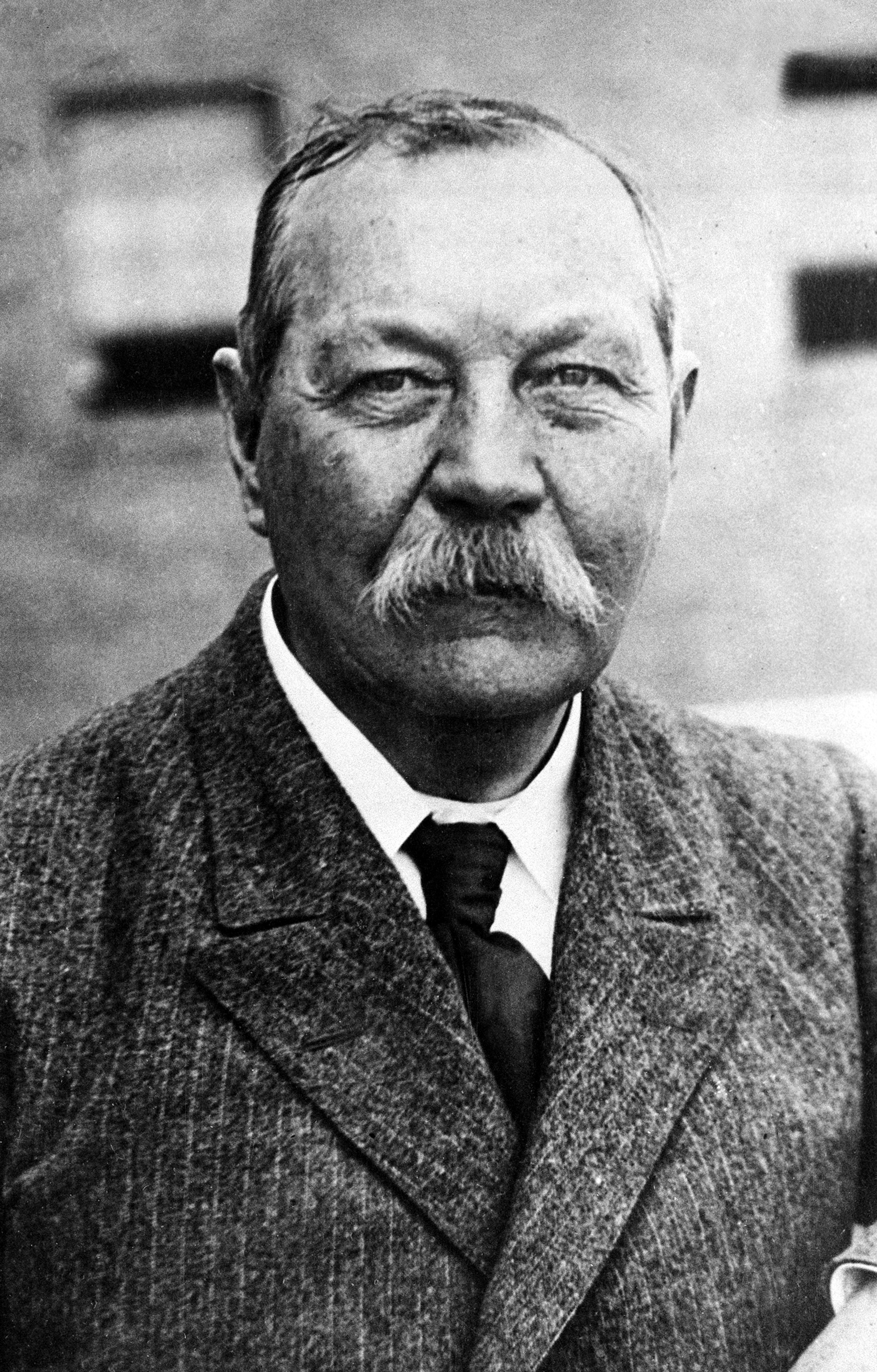
Arthur Conan Doyle
in fact is the chronicler of Tarzan’s adventures as was Watson those of Holmes.
Burroughs goes on to establish his story’s authenticity:
Take the story simply as another Tarzan story, in which, it is hoped, you will find entertainment and relaxation. If you find food for thought so much the better.
Doubtless, very few of you saw, and still fewer will remember having seen, an news dispatch that appeared inconspicuously (how inconspicuously?) in the papers some time since, reporting a rumor that French colonial troops stationed in Somaliland, on the northeast coast of Africa, had invaded an Italian African colony. Back of that news item is a story of conspiracy, intrigue, adventure, and love- a story of scoundrels and of fools, of brave men, of beautiful women, a story of the beasts of the forest and the jungle.
That seems like it covers all the bases of what a story should have. It is also pure Dr. Watson or, rather, Arthur Conan Doyle; let’s not fail to differentiate between fact and fiction. So far what Burroughs has posited could well be true. After all few read and fewer remembered the news item which appeared inconspicuously sometime in the not too distant past. Now Burroughs removes the story from the news item another step and quietly slips into full fiction mode:
If there were few who saw the newspaper acount of the invasion of Italian Somaliland upon the northeast coast of Africa, it is equally a fact that none of you saw a harrowing incident that occurred in the interior some time previous to the affair.
Um, yes, if there were few…then it’s a fact there were none. It seems ERB has established an incontestable ‘fact.’ So if you let that sophistry slip by you he’s going to tell you pure fiction. If you know the difference you won’t care, if you don’t it won’t matter. Anyway his intro was a perfect synthesis of nineteenth century humbug brought completely up to date.
Burroughs’ writing style is even close to reportorial. Tarzan, La and Opar become ‘real’ as ‘real life’ Reds make their assault on the ancient Atlantean colony. So, in a way, Atlantis becomes an established fact rather than an hypothesis.
Burroughs uses clear, concise sentences developing his story news style. For once his story is evenly paced with a well developed beginning, middle and unrushed end. He doesn’t cram a hundred page ending into ten as usual.
While one hesitates to call the book his best Tarzan novel it may be his best written. Thoroughly modern in its swift and pleasant reading with wonderful detailing I certainly can’t consider the novel hack work or inferior to any of the Tarzan novels in any way. The characters are entirely plausible, the premiss doesn’t seem far fetched. There are historical antecedents that we will examine. The novel could easily have take its place among the major spy thrillers written in the last fifty or sixty years. David is right. The novel is a major tour de force.
Part II of X follows.

R.E. Prindle
A Contribution To The
Erbzine Library Project.
Edgar Rice Burroughs, Science And Spiritualism
Camille Flammarion, Scientist and Spiritualist
by
R.E. Prindle

The last story in Ray Bradbury’s Martian Chronicles is about the expulsion from Earth of the various supernatural or imaginary beings such as fairies, elves, the elementals, all those beings external to ourselves but projections of our minds on Nature, to Mars as a last resort and how they were all dieing as Mars became scientifically accessible leaving no place for them to exist.
On Earth the rejection of such supernatural beings began with the Enlightenment. When the smoke and fury of the French Revolution and the Napoleonic years settled and cleared it was a new world with a completely different understanding of the nature of the world. Science, that is, knowing, had displaced belief as a Weltanschauung.
The old does not give way so easily to the new. Even while knowing that fairies did not exist the short lived reaction of the Romantic Period with its wonderful stories and fictions followed the Napoleonic period.
Supernatural phenomena displaced from the very air we breathed reformed in the minds of Men as the ability of certain people called Mediums to communicate with spirits although the spirits were no longer called supernatural but paranormal. Thus the fairies morphed into dead ancestors, dead famous men, communicants from beyond the grave. Men and women merely combined science with fantasy. Science fiction, you see.
Spiritualism was made feasible by the rediscovery of hypnotism by Anton Mesmer in the years preceding the French Revolution. The first modern glimmerings of the sub- or unconscius began to take form. The unconscious was the arena of paranormal activity.
Hypnotism soon lost scientific credibility during the mid-century being abandoned to stage performers who then became the first real investigators of the unconscious as they practiced their art.
While the antecedents of spiritualism go back much further the pehnomena associated with it began to make their appearance in the 1840s. Because the unconscious was so little understood spiritualism was actually thought of as scientific. The investigators of the unconscious gave it incredible powers and attributes, what I would call supernatural but which became known as paranormal. Communicating with spirits, teleportation, telecommunications, all the stuff that later became the staples of science fiction.
Thus in 1882, Jean-Martin Charcot, a doctor working in the Salpetriere in Paris made hypnotism once again a legitimate academic study.
The question here is how much innovation could the nineteenth century take without losing its center or balance. Yeats’ poem The Second Coming presents the situation well. Freud, who was present at this particular creation, was to say that three discoveries shattered the confidence of Man; the first was the Galilean discovery that the Earth was not the center of the universe, the second revelation was Darwin’s announcement that Man was not unique in creation and the last was the discovery of the unconscious. Of these three the last two happened simultaneiously amidst a welter of scientific discoveries and technological applications that completely changed Man’s relationship to the world. One imagines that these were the reasons for the astonishing literary creativity as Victorians grappled to deal with these new realities. There was a sea change in literary expression.
Key to understanding these intellectual developments is the need of Man for immortality. With God in his heaven but disconnected from the world supernatural explanations were no longer plausible. The longing for immortality remained so FWH Myers a founder of the Society For Psychical Research changed the word supernatural into paranormal. As the notion of the unconscious was now wedded to science and given, in effect, supernatural powers under the guise of the paranormal it was thought, or hoped, that by tapping these supernormal powers one could make contact with the departed hence spiritism or Spiritualism.
While from our present vantage point after a hundred or more years of acclimatizing ourselves to an understanding of science, the unconscious and a rejection of the supernatural, the combination of science and spiritualism seems ridiculous. Such was not the case at the time. Serious scientists embraced the notion that spirtualism was scientific.
Now, a debate in Burroughs’ studies is whether and/or how much Burroughs was influenced by the esoteric. In my opinion and I believe that of Bibliophile David Adams, a great deal. David has done wonderful work in esbatlishing the connection between the esotericism of L. Frank Baum and his Oz series of books and Burroughs while Dale Broadhurst has added much.
Beginning in the sixties of the nineteenth century a French writer who was to have a great influence on ERB, Camille Flammarion, began writing his scientific romances and astronomy books. Not only did Flammarion form ERB’s ideas of the nature of Mars but this French writer was imbued with the notions of spiritualism that informed his science and astronomy. He and another astronomer, Percival Lowell, who is often associated with ERB, in fact, spent time with Flammarion exchanging Martian ideas. Flammarion and Lowell are associated.
So, in reading Flammarion ERB would have imbibed a good deal of spiritualistic, occult, or esoteric ideas. Flammarion actually ended his days as much more a spiritualist than astronomer. As a spiritualist he was associated with Conan Doyle.
Thus in the search for a new basis of immortality, while the notion of God became intenable, Flammarion and others began to search for immortality in outer space. There were even notions that spirits went to Mars to live after death somewhat in the manner of Bradbury’s nixies and pixies. In his book Lumen Flammarion has his hero taking up residence on the star Capella in outer space after death. Such a book as Lumen must have left Burroughs breathless with wonderment. Lumen is some pretty far out stuff in more ways than one. After a hundred fifty years of science fiction these ideas have been endlessly explored becoming trite and even old hat but at the time they were
Camille Flammarion
excitingly new. Flammarion even put into Burroughs’ mind that time itself had no independent existence. Mind boggling stuff.
I believe that by now Bibliophiles have assembled a library of books that Burroughs either did read or is likely to have read before 1911 that number at least two or three hundred. Of course, without radio, TV, or movies for all of Burroughs’ childhood, youth and a major portion of his young manhood, although movies would have become a reality by the time he began writing, there was little entertainment except reading. Maybe a spot of croquet.
As far as reading goes I suspect that ERB spent a significant portion of his scantily employed late twenties and early thirties sitting in the Chicago Library sifting through the odd volume. It can’t be a coincidence that Tarzan lounged for many an hour in the Paris library before he became a secret agent and left for North Africa.
I have come across a book by the English author Charles Howard Hinton entitled Scientific Romances of which one explores the notion of a fourth dimension . Hinton is said to have been an influence on H.G. Wells’ The Time Machine. It seems certain that Burroughs read The Time Machine while he would have found many discussions of the fourth dimension as well as other scientific fantasies in the magazines and even newspapers as Hillman has so amply demonstrated on ERBzine. We also know that ERB had a subscription to Popular Mechanics while probably reading Popular Science on a regular basis. Popular Science was established in 1872.
It is clear that ERB was keenly interested in psychology and from references distributed throughout the corpus, reasonably well informed.
I wouldn’t go so far as to maintain that ERB read the French psychologist Theodore Flournoy’s From India To The Planet Mars but George T. McWhorter does list it as a volume in Vern Corriel’s library of likely books read by Burroughs. The book was published in 1899 just as Burroughs was entering his very troubled period from 1900 to 1904-05 that included his bashing in Toronto with subsequent mental problems, a bout with typhoid fever and his and Emma’s flight to Idaho and Salt Lake City. So that narrows the window down a bit.
However the book seems to describe the manner in which his mind worked so that it provides a possible or probable insight into the way his mind did work.
ERB’s writing career was born in desperation. While he may say that he considered writing unmanly it is also true that he tried to write a lighthearted account of becoming a new father a couple years before he took up his pen in seriousness. Obviously he saw writing as a way out. His life had bittely disappointed his exalted expectations hence he would have fallen into a horrible depression probably with disastrous results if the success of his stories hadn’t redeemed his opinion of himself.
Helene Smith the Medium of Fluornoy’s investigation into mediumship was in the same situation. Her future while secure enough in the material sense, as was Burroughs, fell far short of her hopes and expectations. Thus she turned to mediumship to realize herself much as Burroughs turned to literature. She enjoyed some success and notoriety attracting the attention of, among others, the psychologist Theodore Flournoy. Fournoy who enjoyed some prominence at the time, was one of those confusing spiritualism with science because of his misunderstanding of the unconscious. Thus as Miss Smith unfolded her conversations with the inhabitants of Mars it was taken with some plausibility.
If any readers I may have have also read my review of Du Maurier’s Peter Ibbetson he or she will remember that Peter and Mary were restricted in their dream activities to only what they had done, seen and remembered or learned. As I have frequently said, you can only get out of a mind what has gone into it. In this sense Miss Smith was severely handicapped by an inadequate education and limited experience. While she was reasonably creative in the construction of her three worlds- those of ancient India, Mars and the court of Marie Antoinette- she was unable to be utterly convincing. In the end her resourcefulness gave out and the scientific types drifted away. She more or less descended into a deep depression as her expectations failed. Had she been more imagination she might have turned to writing as Burroughs did.
If Burroughs did read Flournoy, of which I am not convinced, he may have noted that Miss Smith’s method was quite similar to his habit of trancelike daydreaming that fulfilled his own expectations of life in fantasy.
In Burroughs’ case he had the inestimable advantage of having stuffed his mind with a large array of imaginative literature, a fairly good amateur’s notions of science and technology, along with a very decent range of valuable experience. His younger days were actually quite exciting. He was also gifted with an amazing imagination and the ability to use it constructively.
Consider this possibility. I append a poem that he would have undoubtedly read- When You Were A Tadpole And I Was A Fish. Read this and then compare it to The Land That Time Forgot.
Evolution
by
Langdon Smith
When you were a tadpole and I was a fish
In the Paleozoic time,
And side by side on the ebbing tide
We sprawled through the ooze and slime,
Or skittered with many a caudal flip
Through the depths of the Cambrian fen,
My heart was rife with the joy of life,
For I loved you even then.
Mindless we lived and mindless we loved
And mindless at last we died;
And deep in the rift of the Caradoc drift
We slumbered side by side.
The world turned on in the lathe of time,
The hot lands heaved amain,
Til we caught our breath from the womb of death
And crept into light again.
We were Amphibians, scaled and tailed,
And drab as a dead man’s hand;
We coiled at ease ‘neath the dripping trees
Or trailed through the mud and sand.
Croaking and blind, with out three-clawed feet
Writing a language dumb,
With never a spark in the empty dark
To hint at a life to come.
Yet happy we lived and happy we loved,
And happy we died once more;
Our forms were rolled in the clinging mold
of a Neocomian shore.
The eons came and the eons fled
And the sleep that wrapped us fast
Was riven away in a newer day
And the night of death was past.
Then light and swift through the jungle trees
We swung in our airy flights,
Or breathed in the balms of the fronded palms
In the hush of the moonless nights;
And, oh! what beautiful years were there
When our hearts clung each to each;
When life was filled and our senses thrilled
In the first faint dawn of speech.
Thus life by life and love by love
We passed through the cycles strange,
And breath by breath and death by death
We followed the chain of change,
Till there came a time in the law of life
When over the nursing side
The shadows broke and the soul awoke
In a strange, dim dream of God.
I was thewed like Auroch bull
And tusked like the great cave bear;
And you, my sweet, from head to feet
Were gowned in your glorious hair,
Deep in the gloom of a fireless cave,
When the night fell o’er the plain
And the moon hung red o’er the river bed
We mumbled the bones of the slain.
I flaked a flint to a cutting edge
And shaped it with brutish craft;
I broke a shank from the woodland lank
And fitted it, head and haft;
Then I hid me close to the reedy tarn,
Where the mammoth came to drink;
Through the brawn and bone I drove the stone
And slew him upon the brink.
Loud I howled through the moonlit wastes,
Loud answered our kith and kin,
From west and east to the crimson feast
The clan came tramping in.
O’er joint and gristle and padded hoof
We fought and clawed and tore,
And cheek by jowl with many a growl
We talked the marvel o’er.
I carved that fight on a reindeer bone
With rude and hairy hand;
I pictured his fall on the cavern wall
That men might understand,
For we lived by blood and the right of might
Ere human laws were drawn,
And the age of sin did not begin
Till our brutal tush were gone.
And that was a million years ago
In a time that no man knows;
Yet here tonight in the mellow light
We sit at Delmonico’s.
Your eyes are deep as the Devon springs,
Your hair is dark as jet,
Your years are few, your life is new,
Your soul untried, and yet-
Our trail is on the Kimmeridge clay
And the scarp of the Purbeck flags;
We have left our bones in the Bagshot stones
And deep in the Coralline crags;
Our love is old, our lives are old,
And death shall come amain;
Should it come today, what man may say
We shall not live again?
God has wrought our souls from the Tremadoc beds
And furnished them wings to fly;
He sowed our spawn in the world’s dim dawn,
And I know that it shall not die,
Though cities have sprung above the graves
Where the crook-bone men make war
And the oxwain creaks o’er the buried caves
Where the mummied mammoths are.
Then as we linger at luncheon here
O’er many a dainty dish,
Let us drink anew to the time when you
Were a tadpole and I was a fish.
With something like that stuffed into his subconscious what wonders might ensue. Obviously The Land That Time Forgot and The Eternal Lover.
As Miss Smith had turned to spiritualism and mediumship, Burroughs turned his talents to writing. According to himself he used essentially mediumistic techniques in hiswriting. He said that he entered a tracelike state, what one might almost call automatic writing to compose his stories. He certainly turned out three hundred well written pages in a remarkably short time with very few delays and interruptions. He was then able to immediately begin another story. This facility lasted from 1911 to 1914 when his reservoir of stored material ws exhausted. His pace then slowed down as he had to originate stories and presumably work them out more rather than just spew them out.
Curiously like Miss Smith he created three main worlds with some deadends and solo works. Thus while Miss Smith created Indian, Martian and her ‘Royal’ identity Burroughs created an inner World, Tarzan and African world, and a Martian world.
Perhaps in both cases three worlds were necessary to give expression to the full range of their hopes and expectations. In Burroughs’ case his worlds correspond to the equivalences of the subconscious in Pellucidar, the conscious in Tarzan and Africa and shall we say, the aspirational or spiritual of Mars. In point of fact Burroughs writing style varies in each of the three worlds, just as they did in Miss Smith’s.
Having exhausted his early intellectual resources Burroughs read extensively and exhaustively to recharge his intellectual batteries. This would have been completely normal because it is quite easy to write oneself out. Indeed, he was warned about this by his editor, Metcalf. Having, as it were, gotten what was in your mind on paper what you had was used up and has to be augmented. One needs fresh experience and more knowledge. ERB was capable of achieving this from 1911 to about 1936 when his resources were essentially exhausted. Regardless of what one considers the quality of the later work it is a recap, a summation of his work rather than extension or innovatory into new territory. Once again, not at all unusual.
As a child of his times his work is a unique blend of science and spiritualism with the accent on science. One can only conjecture how he assimiliated Camille Flammarion’s own unique blend of spiritualism and science but it would seem clear that Flammarion inflamed his imagination setting him on his career as perhaps the world’s first true science-fiction writer as opposed to merely imaginative or fantasy fiction although he was no mean hand at all.
A Review: Peter Ibbetson by George Du Maurier
May 8, 2009
A Review
The Novels Of George Du Maurier
Peter Ibbetson, Trilby, The Martian
Part IV
Peter Ibbetson
Singers and Dancers and Fine Romancers
What do they know?
What do they know?
-Larry Hosford
Review by R.E. Prindle
Table of Contents
I. Introduction
II Review of Trilby
III. Review of The Martian
IV. Review of Peter Ibbetson
Peter Ibbetson is the first of the three novels of George Du Maurier. As elements of the later two novels are contained in embryo in Ibbetson it would seem that Du Maurier had the three novels at least crudely plotted while a fourth dealing with politics but never realized is hinted at. Actually Du Maurier has Ibbetson who writes this ‘autobiography’ write several world changing novels from inside the insane asylum to which he had been committed. In the Martian Barty Josselin wrote several world changing books while ‘possessed’ by an alien intelligence, in a way, not too dissimilar to the situation of Ibbetson. Du Maurier himself comes across, as I have said, as either a half demented lunatic or a stone genius.
He has Ibbetson and the heroine, The Duchess of Towers write in code while they read encrypted books. Du Maurier says that Ibbetson and hence the two following books deal with weighty subjects but in a coded manner that requires attention to understand.
On page 362 of the Modern Library edition he says:
…but more expecially in order to impress you, oh reader, with the full significance of this apocalyptic and somewhat minatory utterance (that may haunt your fever sense during your midnight hours of introspective self-communion), I have done my best, my very best to couch it in the obscurest and most unitelligible phraseology, I could invent. If I have failed to do this, if I have unintentionally made any part of my meaning clear, if I have once deviated by mistake into what might almost appear like sense, mere common-sense- it is the fault of my half French and wholly imperfect education.
So, as Bob Dylan said of the audiences of his Christian tour: Those who were meant to get it, got it, for all others the story is merely a pretty story or perhaps fairy tale. The fairy tale motif is prominent in the form of the fee Tarapatapoum and Prince Charming of the story. Mary, the Duchess of Towers is Tarapatapoum and Peter is Prince Charming. It might be appropriate here to mention that Du Maurier was highly influenced by Charles Nodier the teller of fairy tales of the Romantic period. Interestingly Nodier wrote a story called Trilby. Du Maurier borrowed the name for his novel Trilby while he took the name Little Billee from a poem by Thackeray. A little background that makes that story a little more intelligible.
Those that watch for certain phobias such as anti-Semitism and Eugenics will find this story of Du Maurier’s spolied for them as was Trilby and probably The Martian. One is forced to concede that Du Maurier deals with those problems in a coded way. Whether his meaning is derogatory or not lies with your perception of the problems not with his.
Thus on page 361 just above the previous quote Du Maurier steps from concealment to deliver a fairly open mention of Eugenics. After warning those with qualities and attributes to perpetuate those qualities by marrying wisely, i.e. eugenically, he breaks out with this:
Wherefore, also, beware and be warned in time, ye tenth transmitters of a foolish face, ye reckless begetters of diseased or puny bodies, with hearts and brains to match! Far down the corridors of time shall clubfooted retribution follow in your footsteps, and overtake you at every turn.
Here we have a premonition of Lothrop Stoddards Overman and Underman. The best multiply slowly while the worst rear large families. Why anyone would find fault with the natural inclination to marry well if one’s handsome and intelligent with a similar person is beyond me. Not only is this natural it has little to do with the Eugenics Movement. Where Eugenics falls foul, and rightly so, is in the laws passed to castrate those someone/whoever deemed unworthy to reproduce. This is where the fault of the Eugenics Movement lies. Who is worthy to pass such judgment? Certainly there are obvious cases where neutering would be appropriate and beneficial for society but in my home town, for instance, no different than yours I’m sure, the elite given the opportunity would have had people neutered out of enmity and vindictiveness. that is where the danger lies. There is nothing wrong with handsome and intelligent marrying handsome and intelligent. How may people want a stupid, ugly partner?
Du Maurier had other opinions that have proved more dangerous to society. One was his belief in the virtues of Bohemians, that is say, singers and dancers and fine romancers. On page 284 he says:
There is another society in London and elsewhere, a freemasonry of intellect and culture and hard work- la haute Ashene du talent- men and women whose names are or ought to be household words all over the world; many of them are good friends of ine, both here and abroad; and that society, which was good enough for my mother and father, is quite good enough for me.
Of course, the upper Bohemia of proven talent. But still singers and dancers and fine romancers. And what do they know? Trilby was of the upper Bohemia as was Svengali but Trilby was hypnotized and Svengali but a talented criminal. What can a painter contribute but a pretty picture, what can a singer do but sing his song, I can’t think of the dancing Isadora Duncan or the woman without breaking into laughter. And as for fine romancers, what evil hath Jack Kerouac wrought.
I passed part of my younger years in Bohemia, Beat or Hippie circles, and sincerely regret that Bohemian attitudes have been accepted as the norm for society. Bohemia is fine for Bohemians but fatal for society which requires more discipline and stability. Singers and dancers and fine romancers, wonderful people in their own way, but not builders of empires.
In that sense, the promotion of Bohemianism, Du Maurier was subversive.
But the rules of romancing are in the romance and we’re talking about Du Maurier’s romance of Peter Ibbetson.
Many of the reasons for criticizing Du Maurier are political. The man whether opposed to C0mmunist doctrine or not adimired the Bourgeois State. He admired Louis-Philippe as the Beourgeois king of France. This may sound odd as he also considered himself a Bohemian but then Bohemians are called into existence by a reaction to the Bourgeoisie. Perhaps not so odd. He was able to reconcile such contradictions. Indeed he is accused of having a split personality although I think this is false. Having grown up in both France and England he developed a dual national identity and his problem seems to be reconciling his French identity with his English identity thus his concentration on memory.
In this novel he carefully builds up a set of sacred memories of his childhood. He very carefully introduces us to the people of his childhood. Mimsy Seraskier his little childhood sweetheart. All the sights and sounds and smells. In light of the quote I used telling how he disguises his deeper meaning one has to believe that he is giving us serious theories he has worked out from science and philosophy.
Having recreated his French life for us Peter’s parents die and Ibbetson’s Uncle Ibbetson from England adopts him and takes him back to the Sceptered Isle. Thus he ceases to be the French child Pasquier and becomes the English child Peter Ibbetson. A rather clean and complete break. From this point on his childhood expectations are disappointed with the usual psychological results. He develops a depressed psychology. The cultural displacement prevents him from making friends easily or at all. His Uncle who has a difficult boorish personality is unable to relate to a sensitive boy with a Bohemian artistic temperament. Hence he constantly demeans the boy for not being like himself and has no use for him.
This is all very skillfully handled. We have intimations that bode no good for Peter. The spectre is prison. The hint of a crime enters into the story without anything actually being said. But the sense of foreboding enters Peter’s mind and hence the reader’s. This is done extremely well. It’s a shame the Communists are in control of the media so that they can successfully denigrate any work of art that contradicts or ignores their beliefs. For instance the term bourgeois itself. The word is used universally as a contemptuous epithet even though the Bourgeois State was one of the finest created. Why then contempt? Simply because the Communists must destroy or denigrate any success that they canot hope to surpass. I was raised believing that what was Bourgeois was contemptible without ever knowing what Bourgeois actually meant. It is only through Du Maurier at this late stage in life that I begin to realize what the argument really was and how I came to accept the Communist characterization. I’m ashamed of myself.
Hence all Du Maurier criticism is unjust being simply because it is the antithesis of Communist beliefs. The man as a writer is very skillful, as I have said, a genius. If I were read these novels another couple of times who knows what riches might float up from the pages.
Colonel Ibbetson apprentices Peter to an architect, a Mr Lintot, which, while not unhappy, is well below Peter’s expectations for his fairy Prince Charming self. As a lowly architect he is placed in a position of designing huts for the workers of the very wealthy. The contrast depresses him even further. He has been disappointed in love and friendship and then he is compelled by business exigencies to attend a ball given by a wealthy client. He definitely feels out of place. Psychologically incapable of mixing he stands in a corner.
At this ball the most beautiful woman he has ever seen, The Duchess of Towers, is in attendance. From across the room she seems to give him an interested glance. Peter can only hope, hopelessly. As a reader we have an intimation that something will happen but we can’t be sure how. I couldn’t see. Then he sees her in her carriage parading Rotten Row in Hyde Park. She sees him and once again it seems that she gives him a questioning look.
Then he takes a vacation in France where he encounter her again. After talking for a while he discovers that she is a grown up Mimsey Seraskier, his childhood sweetheart. Thus his French childhood and English adulthood are reunited in her. Wow! There was a surprise the reader should have seen coming. I didn’t. I had no trouble recognizing her from childhood in France but Du Maurier has handled this so skillfully that I am as surprised as was Peter. I tipped my imaginary hat to Du Maurier here.
Perhaps I entered into Du Maurier’s dream world here but now I began to have flashbacks, a notion that I had read this long ago, most likely in high school or some other phantasy existence. I can’t shake the notion but I can’t remember reading the book then at all. Don’t know where I might have come across it. Of course that doesn’t mean an awful lot. If asked if I had ever read a Charles King novel I would have said no but when George McWhorter loaned me a couple to read that he had in Louisville I realized I had read one of them before. Eighth grade. I could put a handle on that but not Peter Ibbetson. Perhaps Du Marurier has hypnotized me. Anyway certain images seem to stick in my mind from a distant past.
It was at this time that Mary, the Duchess if Towers, formerly Mimsy, enters Peter’s dream, in an actual real life way. This is all well done, Peter dreamt he was walking toward an arch when two gnomish people tried to herd him into prison. Mary appears and orders the gnomes to vanish which they do. ‘That’s how you have to handle that.’ She says. And that is very good advice for dreams that Du Maurier gives. As we’ll see Du Maurier has some pretensions to be a psychologist.
She then instructs Peter in the process of ‘dreaming true.’ In such a manner they can actually be together for real in a shared dream. Now, Trilby, while seemingly frivolous, actually displays a good knowledge of hypnotism. More than that it puts Du Maurier in the van of certain psychological knowledge. Hypnotism and psychology go together. Without an understanding of hypnotism one can’t be a good psychologist. If he wasn’t ahead of Freud at this time he was certainly even with him. Remember this is 1891 while Freud didnt’ surface until 1895 and then few would have learned of him. He wrote in German anyway.
Freud was never too developed on auto-suggestion. Emile Coue is usually attributed to be the originator of auto-suggestion yet the technique that Mary gives to Peter is the exact idea of auto-suggestion that Coue is said to have developed twenty or twenty-five years on.
Du Maurier speaks of the sub-conscious which is more correct than the unconscious. He misunderstands the nature of the subconscious giving it almost divine powers but in many ways he is ahead of the game. Now, Ibbetson was published in 1891 which means that Du Maurier was in possession of his knowledge no later than say 1889 while working on it from perhaps 1880 or so on. It will be remembered that Lou Sweetser, Edgar Rice Burroughs mentor in Idaho, was also knowledgable in psychology in 1891 but having just graduated a couple of years earlier from Yale. So Freud is very probably given too much credit for originating what was actually going around. This earlier development of which Du Maurier was part has either been suppressed in Freud’s favor or has been passed over by all psychological historians.
So, Mary gives Peter psychologically accurate information on auto-suggestion so that he can ‘dream true.’ I don’t mean to say that anyone can share another’s dreams which is just about a step too far but by auto-suggestion one can direct and control one’s dreams. Auto-suggestion goes way back anyway. The Poimandre of Hermes c. 300 AD is an actual course in auto-suggestion.
Peter is becoming more mentally disturbed now that his denied expectations have returned to haunt him in the person of Tarapatapoum/Mimsey/Mary. Once again this is masterfully done. The clouding of his mind is almost visible. Over the years he has generated a deep seated hatred for Colonel Ibbetson even though the Colonel, given his lights, has done relatively well by him. Much of Peter’s discontent is internally generated by his disappointed expectations. The Colonel has hinted that he might be Peter’s father rather than his Uncle. This completely outrages Peter’s cherished understanding of his mother and father. The Colonel according to Peter was one of those guys who claimed to have made every woman he’d ever met. One must bear in mind that Peter is telling the story while the reader is seeing him become increasingly unstable.
While Peter doesn’t admit it to himself he confronts the Colonel with the intention of murdering him. He claims self-defense but the court doesn’t believe it nor does the reader. It’s quite clear the guy was psycho but, once again, Du Maurier handles this so skillfully that one still wonders. Given the death penalty his friends and supporters, the influential Duchess of Towers, get the sentence commuted to life imprisonment.
Then begins Peter’s double life in prison that goes on for twenty years. By day a convict, at night Peter projects hemself into a luxurious dream existence with his love, Mary, the Duchess of Towers. Quite insane but he has now realized his expections if only in fantasy. Now, this novel as well as Du Maurier’s other novels is textually rich. The style is dense while as Du Maurier tells us it is written in more than one key, has encoded messages, so I’m concentrating on only the main thread here. That concerns memory.
While it is possible to subconsciously manage one’s dreams, I do it to a minor extent, of course it is impossible for two people to dream toether and share that dream. This is to venture into the supernatural. Spiritualism and Theosophy both dealing with the supernatural as does all religion including Christianity, were at their peak at this time. Du Maurier has obviously studied them. Just because one utilizes one’s knowledge in certain ways to tell a story doesn’t mean one believes what one writes. Ibbetson is written so well that the writer seems to have fused himself with the character. If I say Du Maurier believes that may not be true but as the same themes are carried through all his novels without a demurrer it seems likely.
Du Maurier seems to be pleading a certain understanding of the subconscious giving it as many or more supernatural powers as Freud himself will later. This might be the appropriate place to speculate on Du Maurier’s influence on Mark Twain. We know Twain was an influence on Burroughs so perhaps both were.
Before he died Twain wrote a book titled the Mysterious Stranger. This was twenty-five years after Peter Ibbetson. Operator 44, the Mysterious Stranger, is a time time traveler who has some sort of backstair connecting years as a sort of memory monitor. Peter and Mary over the years work out a system that allows them to travel back through times even to prehistoric times. Thus Peter is able to sketch from life stone age man hunting mastodons, or Napoleon at the Battle of Waterloo. They are present at these events but as sort of ghost presences without substance. they have no substance hence cannot affect reality.
This would be a major them in fifties science fiction in which, for instance, a time traveler steps on a grub, then comes back to his present time finding everyone talking a different language. Change one item and you change all others. Du Maurier avoids this problem that he very likely thought of in this clever way.
We can clearly see the future of twentieth century imaginiative writing taking form here. One can probably trace several twentieth century sci-fi themes back to Du Maurier.
Peter and Mary have a magic window through they can call up any scene within their memories. In their dream existence they are dependent on memory they can only re-experience, they cannot generate new experiences. The memory extends back genetically although Du Maurier speaks in terms of reincarnation. Peter hears Mary humming a tune he has never heard before. Mary explains that the tune is a family melody written by an ancestress hundreds of years before. Thus one has this genetic memory persisting through generations. This gives Du Maurier room to expatiate on the persistence of memory through past, present and future.
Du Maurier has worked out an elaborate scheme in which memory unites past, present and future, into a form of immortality. This is actually a religious concept but a very beautiful concept, very attractive in its way.
Peter and Mary had elected to stay at one age- twenty-six to twenty-eight- so for twenty years they retained their youthful form and beauty. Then one night Peter enters the mansion of his dreams through a lumber room to find the way blocked. He knows immediately that Mary has died. He then learns that in attempting to save a child from a train she was herself killed.
Peter goes into an insane rage attacking the prison guards while calling each Colonel Ibbetson. Clearly insane and that’s where the send him. The mad house. Originally he continues to rage so they put him in a straight jacket where he remains until his mind calms enough to allow him to dream. In his dream he returns to a stream in France. Here he believes he can commit suicide in his dream which should be shock enough to stop his heart in real life. Something worth thinking about. Filling his pockets with stones he means to walk in over his head. Then, just ahead he spies the back of a woman sitting on a log. Who else but Mary. She has done what has never been done before, what even Houdini hasn’t been able to do, make it to back to this side.
Now outside their mansion, they are no longer young, but show their age. This is nicely done stuff. Of course I can’t replicate the atmosphere and feel but the Du Maurier feeling is ethereal. As I say I thought he was talking to me and I entered his fantasy without reserve.
Here’s a lot of chat about the happiness on the otherside. When Peter awakes back in the asylum he is calm and sane. He convinces the doctors and is restored to full inmate rights. Once himself again he begins to write those wonderful books that right the world.
One gets the impression that Du Maurier believes he himself is writing those immortal books that will change the world. Time and fashions change. Today he is thought a semi-evil anti- Semite, right wing Bourgeois writer. I don’t know if he’s banned from college reading lists but I’m sure his works are not used in the curriculum. I think he’s probably considered oneof those Dead White Men. Thus a great writer becomes irrelevant.
It’s a pity because from Peter Ibbetson through Trilby to The Martian he has a lot to offer. The Three States of Mind he records are thrilling in themselves, as Burroughs would say, as pure entertainment while on a more thoughtful read there is plenty of nourishment. Taken to another level his psychology is very penetrating. His thought is part of the mind of the times. Rider Haggard shares some of the mystical qualities. The World’s Desire is comparable which can be complemented by his Heart Of The World. The latter may turn out to be prophetic shortly. H.G. Wells’ In The Days Of The Comet fits into this genre also. Another very good book. Of course Burroughs’ The Eternal Lover and Kipling and Haggard’s collaboration of Love Eternal. Kipling’s Finest Story In The World might also fit in as well, I’m sure there are many others of the period of which I’m not aware. I haven’t read Marie Corelli but she is often mentioned in this context. You can actually slip Conan Doyle in their also.
Well, heck, you can slip the whole Wold Newton Universe, French and Farmerian in there. While there is small chance any Wold Newton meteor had anything to do with it yet as Farmer notes at about that time a style of writing arose concerned with a certain outlook that was worked by many writers each contributing his bit while feeding off the others as time went by.
I don’t know that Du Maurier is included in the Wold Newton Universe (actually I know he isn’t) but he should be. He was as influential on the group as any other or more so. He originated many of the themes.
Was Burroughs influenced by him? I think so. There was no way ERB could have missed Trilby. No possible way. If he read Trilby and the other two only once which is probable any influence was probably subliminable. ERB was not of the opinion that a book could change the world, so he disguised his more serious thoughts just as Du Maurier did his. He liked to talk about things though.
Singers and dancers. What do they know? What do they know? In the end does it really matter what they know. Time moves on, generations change, as they change the same ideas come around expressed in a different manner. They have their day then are replaced. The footprint in the concrete does remain. Genius will out.
A Review: The Martian by George Du Maurier
May 5, 2009
A Review:
The Novels Of George Du Maurier
Peter Ibbetson, Trilby, The Martian
Part III
The Martian
Review by R.E. Prindle
There’s a somebody I’m longin’ to see
I hope that she turns out to be
Someone who’ll watch over me.
-Ella Fitzgerald
Contents:
Part I: Introduction
Part II: Review of Trilby
Part III: Review Of The Martian
Part IV: Review of Peter Ibbetson
If Trilby was a premontion of his death, in the Martian Du Maurier puts his intellecual affairs in order for his long journey into the night. In the novel he even advises us that he has convinced himself that there is life after death. On the completion of The Martian Du Maurier died of a heart attack. The novel appeared posthumously.
I have read that Trilby was meant as a neo-Gothic novel as the Gothic was enjoying a revival at the time. If Trilby was neo-Gothic then The Martian is associated with the Spiritualist revival of the moment. Du Maurier even does a mini dissertation on table turning and rapping, two prominent manifestations of Spiritualism.
At the same time a Martian craze was in progress. ERBzine a while back ran a list of early Martian novels so the topic was under discussion. H.G. Wells’ War Of The Worlds was published at about the same time as The Martian so Burroughs in 1911 was in the genre, possibly he had been thinking of a Martian novel for a few years. At least it was the first notion that popped into his head. With Du Maurier then we have an interplanatary spiritualistic love story for love story it is. A spectucular one.
The notion is that a female Martian was expelled from Mars coming to Earth in a meteor shower a hundred years previously. Must have landed at Wold Newton. During that time she had inhabited thousands of bodies in search of the ideal situation. She settled on Barty Josselin’s family who were especially attractive and English. She inhabited Barty from an early age. When inhabited Barty had an unerring ability to tell the North. No matter how many times he was spun around or disoriented he could always point to due North. Later in the novel we learn that because of peculiar magnetic influences stronger on Mars than on Earth Martia the Martian was oriented to the North. Thus when she was inhabiting Barty he could unerringly feel due North, if she left him for a while he lost the ability. For most of the book we have no idea how he could feel North but it is explained at last. Very clever explanation too.
Martia falls in love with Barty, planning his life for him as he is to be a great success. I’m looking for that kind of angel. But that’s in the second half of the novel while Du Maurier has to get us from here to there. In each of the novels he has long preambles covering half the book in which he carefully builds up character. Everything then falls neatly into place.
Now, as I said in the introduction, the novel is ostensibly a biography of Barty as told by his friend Robert Maurice, illustrated by the real life Du Maurier at Maruice’s request and also edited by him. This gives Du Maurier triple distance as a writer allowing him I should think to say things it might have been difficult to say otherwise. Even then the distance is frequently breached and one has the feeling that Du Maurier is actually Barty, Bob and himself. Talk about table turnings and rappings. Burroughs come close to this feel and complexity in The Eternal Lover. In that novel he also gives himself a role as well as his character Tarzan. Quite similar to the Martian.
The spate of novels Burroughs produced from 1911 to the first quarter of 1914 must all have been in his mind in embryo before he wrote A Princess Of Mars hence all his readings from childhood to early manhood are reflected. It was only when he switched from talented amateur to professional writer in mid-1914 that he had to search for his plots and stories thus taking in more current literary sources as well.
Whereas in Trilby Du Maurier concentrated on the decade from 1860 to 1870 plus a year or two in this novel he lovingly recreates his school years in Paris during the 1840s before taking Barty up through the years until his death. As a projection of himself Barty is an idealized Du Maurier who does many things Du Maurier did and didn’t.
Barty is 6’4″ and impossibly handsome and winning neither of which would describe Du Maurier. Barty has a wonderful singing voice but too thin for grand opera although he tries as did Du Maurier. Barty had the perfect voice for intimate occasions in which he was invariably successful. Du Maurier also was fond of the musical occasion and, perhaps, in this current age of electronic amplification both could have been successful recording stars a la Gordon Lightfoot or Jesse Colin Young.
Like Du Maurier Barty, while not a great artist, enjoys some success an an illustrator before becoming a wildly successful author. Mostly he knocks around from hand to mouth living off his looks and manners. Women just love him.
As with Du Maurier Barty develops a detached retina in his left eye leaving him blind in that eye. Much discussion of eyes and doctors. Always entertainingly done. Thus in search of a good doctor Barty is directed to a Dr. Hasenclever in Dusseldorf which finally congeals the story and get it moving toward its end.
Re-enter Martia, or actually enter Martia. She just shows up out of the blue. Here we get real Spiritualistic. Barty had begun to despair about his eyes. He despaired to the point of organizing his suicide which he would have done if Martia hadn’t intervened. She puts Barty to sleep. When he wakes his poison is gone, quite disappeared, and in its place a long letter from Martia explaining the situation in his own hand. Spooky what?
In the letter Martia advises him that he is not to think of suicide as she has big plans for him and he is destined to move mountains. Apparently an oculist of some note she gives him expert medical advice then directing him to Dusseldorf and Dr. Hasenclever. Being rather promiscuous in inhabiting bodies she may have passed a one nighter in Hasenclever. I’m only speculating.
It seems that all of England is having optical problems all converging on Dusseldorf and the fabled Dr. Hasenclever at one time. Thus Barty is brought together with his destined wife, Leah.
Barty and Bob Maurice were both attracted to Leah when she was fourteen. Attractive as a young girl she has developed into the premier beauty of the world. She has rejected all suitors including the narrator, Bob, who lives his life as a bachelor as a result. Leah has had her eye on Barty all along.
At this point it might be best to give Martia’s history. Du Maurier’s account is interesting so at the risk of offending I’ll give a very lengthy quotation of seven pages. As few readers of this review will read The Martian I don’t think it will hurt.
That Barty’s version of his relations with “The Martian” is absolutely sincere is impossible to doubt. He was quite unconscious of the genesis of every book he ever wrote. His first hint of every one of them was the elaborately worked out suggestion he found by his bedside in the morning- written by himself in his sleep during the preceding night, with his eyes wide open, while more often than not his wife anxiously watched him at his unconscious work, careful not to wake or disturb him in any way.
Roughly epitomized Martia’s story was this:
For an immense time she had gone through countless incarnations, from the lowest form to the highest, in the cold and dreary planet we call Mars, the outermost of the four inhabited worlds of our system, where the sun seems no bigger than an orange, and which but for its moist, thin, rich atmosphere and peculiar magnetic conditions that differ from ours, would be too cold above ground for human or animal or vegetable life. As it is, it is only inhabited now in the neighborhood of tis equator’ and even there during its long winter it is colder and more desolate than Cape Horn or Spitzbergen- except that the shallow, fresh-water sea does not freeze except for a few months at either pole.
All these incarnations were forgotten by her but the last; nothing remained of them all but a vague consciusness that they had once been, until their culmination in what would be in Mars the equivalent of a woman on our earth.
Man in Mars is, it appears, a very different being from what he is here. he is amphibious and descends from no monkey, but from a small animal that seems to be something between our seal and our sea-lion.
According to Martia, his beauty is to that of the seal as that of Theseus or Antinous to that of an orang-outang. His five senses are extraordinarily acute, even the sense of touch in his webbed fingers and toes; and in addition to these he possesses a sixth, that comes from his keen and unintermittent sense of the magnetic current, which is far stronger in Mars than on the earth, and far more complicated and more thoroughly understood.
When any object is too delicate and minute to be examined by the sense of touch and sight, the Martian shuts he eyes and puts it against the pit of his stomach, and knows all about it, even its inside.
In the absolute dark, or with his eyes shut, and when he stops his ears, he is more intensely conscious of what immediately surrounds him than at any other time, except that all colour-perception ceases; conscious not only of material objects, but of what is passing in his fellow-Martian’s mind- and this for an area of many hundreds of cubic yards.
In the course of its evolution this extraordinary faculty- which exists on earth in a rudimentary state, but only among some birds and fish and insects and in the lower forms of animal life- has developed the Martian mind in a direction very different from ours, since no inner life apart from the rest, no privacy, no concealment is possible except at a distance involving absolute isolation; not even thought is free; yet in some incomprehensible way there is, as a matter of fact, a really greater freedom of thought than is conceivable among ourselves; absolute liberty in absolute obedience to law; a paradox beyond our comprehension.
Their habits are simple as those we attribute to cave-dwellers during the prehistoric periods of the earth’s existence. But their moral sense is so far in advance of ours that we haven’t even a terminology by which to express it.
In comparison, the highest and best of us are monsters of iniquity and egoism, cruelty and corruption; and our planet is (a very heaven for warmth and brilliancy and beauty, in spite of earthquakes and cyclones and tornadoes) a very hell through the creatures that people it- a shambles, a place of torture, a grotesque and impure pandemonium.
These exemplary Martians wear no clothes but the exquisite fur with which nature has endowed them, and which constitutes a part of their immense beauty, according to Martia.
They feed exclusively on edible moss and roots and submarine seaweed, which they know how to grow and prepare and preserve. Except for heavy-winged bat-like birds, and big fish, which they have domesticated and use for their own purposes in an incredible manner (incarnating a portion of themselves and their consciousness at will in their bodies), they have cleared Mars of all useless and harmful and mutually destructive forms of animal life. A sorry fauna, the Martian- even at its best- and a flora beneath contempt, compared to ours.
They are great engineers and excavators, great irrigators, great workers in delicate metal, stone, marble, and precious gems (there is no wood to speak of), great sculptors and decorators of the beautiful caves, so fancifully and so intricately connected, in which they live, and which have taken thousands of years to design and excavate and ventilate and adorn, and which they warm and light up at will in a beautiful manner by means of the tremendous magnetic current.
This richly party-colored light is part of their mental and moral life in a way it is not in us to apprehend, and has its exact equivalent in sound- and vice versa.
They have no language of words, and do not need it, since they can only be isolated in thought from each other at a distance greater than that which any vocal sound can traverse; but their organs of voice and hearing are far more complex and perfect than ours, and their atmosphere infinitely more conductive of phonal vibrations.
It seems that everything which can be apprehended by the eye or hand is capable of absolute sonorous translation; light, colour, texture, shape in its three dimensions, weight and density. The phonal expression and comprehension of all these are acquired by the Martian baby almost as soon as it knows how to swim or dive, or move upright and erect on dry land or beneath it; and the mechanical translation of such expression, by means of wind and wire and sounding texture and curved surface of extraordinary elaboration, is the principal business of Martian life- an art by which all the combined past experience and future aspirations of the race receive the fullest utterance. Here again personal magnetism plays an enormous part.
And it is by means of this long and patiently evolved and highly trained faculty that the race is still developing towards perfection with constant strain and effort- although the planet is far advanced in its decadence, and within measurable distance of its unfitness for life of any kind.
All is so evenly and harmoniously balanced, whether above ground or beneath, that existence is full of joy in spite of the tremendous strain of life, in spite also of a dreariness of outlook on barren nature, which is not to be matched by the most inhospitable regions of the earth; and death is looked upon as the crowning joy of all, although life is prolonged by all means in their power.
For when the life of the body ceases, and the body itself is burned and its ashes scattered to the winds and waves, the infinitesimal, imponderable and indestructible something we call the soul is known to lose itself in a sunbeam and make for the sun, with all its memories about it, that it may then receive further development, fitting it for other systems altogether beyond conception; and the longer it has lived in Mars the better for its eternal life in the future.
But it often, on its journey sunwards, gets tangled in other beams, and finds its way to some intermediate planet- Mercury, Venus, or the Earth; and putting on flesh and blood and bone once more, and losing for a space all its knowledge of its own past, it has to undergo another mortal incarnation- a new personal experience, beginning with its new birth; a dream and a forgetting, till it awakens again after the pangs of dissolution, and finds itself a step further on the way to freedom.
Martia, it seems, came to our earth in a shower of shooting-stars a hundred years ago. She had not lived her full measure of years on Mars; she had elected to be suppressed, through some unfitness, physical or mental or moral, which rendered it expedient that she should become a mother of Martians, for they are very particular about that sort of thing in Mars; we shall have to be so here some day, or else we shall degenerate and become extinct; or even worse!
Many Martian souls come to our planet in this way, it seems, and hasten to incarnate themselves in as promising unborn but just begotten men and women as they find, that they may the sooner be free to hie them sunwards, with all their collected memories.
According to Martia, most of the best and finest of our race have souls that have lived forgotten lives in Mars. But Martia was in no hurry; she was full of intelligent curiosity, and for ten years she went up and down the earth, revelling in the open air, lodging herself in the brains and bodies of birds, beasts, and fishes, insects, and animals of all kinds- like a hermit crab in a shell that belongs to another- but without the slightest inconvience to the legitimate owners, who were always quite unconscious of her presence, although she made what use she could of what wits they had.
Thus she had a heavenly time on this sunlit earth of ours- now a worm, now a porpoise, now a sea-gull or a dragon-fly, now some fleet footed, keen-eyed quadruped that did not live by slaying, for she had a horror of bloodshed.
She could only go where these creatures chose to take her, since she had no power to control their actions in the slightest degree; but she saw, heard, smelled and touched and tasted with their organs of sense, and was as conscious of their animal life as they were themselves. Her description of this phase of her earthly career is full of extraordinary interest, and sometimes extremely funny- though quite unconsciously so, no doubt. For instance, she tells how happy she once was when she inhabited a small brown Pomeranian dog called “Schanpfel,” in Cologne, and belonging to a Jewish family who dealt in old clothes near the Cathedral; and how she loved and looked up to them- how she revelled in fried fish and the smell of it- and in all the stinks in every street of the famous city- all except one, that arose from Herr Johann Maria Farina’s renowned emporium in the Julichs Platz, which so offended the canine nostrils that she had to give up inhabiting that small Pomeranian dog for ever, &c.
Then she took to man, and inhabited man and woman, and especially child, in all parts of the globe for many years; and finally, for the last fifty or sixty years or so, she settled herself exclusively among the best and healthiest English she could find.
One can find many threads leading to current science fiction ideas as developed through the intervening years. Mental telepathy is a virtual human fixation. Having once given up the notion of God, man turned to the idea of visitations from outer space to replace that religious impulse. Thus Martia from Mars. There were many notions there to enter Burroughs mind and set him thinking.
Du Maurier enters a thought on Eugenics which was dear to his heart. He always has beautiful and intelligent marrying the same so that the genes (although genes were not yet known) would be transmitted to the offspring.
He also has the soul making for the sun with all its memories intact. Memories are very important to Du Maurier who records impressions of sight, sounds and smells as when Martia inhabited the little dog.
Martia wanted Barty to marry a Julia Royce who was the second most beautiful woman in the world after Leah and one of the richest but Barty defied Martia preferring his long time love Leah Gibson who had shown up in Dusselforf with her mother, friends and rest of England.
Martia leaves Barty in a huff. He and Leah return to England Martialess where he leads a determined life as an illustrator along the lines of that of Du Maurier Martia finally takes pity on him returning to be his collaborator and muse as the pair launch a spectacular literary career, I suppose not unlike that of Du Maurier. If Martia has a sister send her my way. I’m paying attention to those meteor showers now.
Martia advises him to keep his pad and pencil bedside so that when she inhabits him he will be able to write. So Barty writes two hours a night, setting up outlines and plans which he elaborates during the day. I would like such a muse to watch over me as I imagine every writer would. Barty’s books astonish the world changing the course of history. His masterwork is called Sardonyx.
Eventually Martia tires of this, wishing to be incarnated and get on with her journey from Mars to the Sun with Barty in tow.
That Du Maurier has his own death in mind and The Martian is a book about death, we have this quote:
He (Barty) has robbed Death of nearly all its terrors; even for the young it is no longer the grisly phantom it once was for ourselves, but rather of an aspect mellow and benign; for to the most skeptical he (and only he) has restored that absolute conviction of an indestructible germ of Immortality within us, born of remembrance made perfect and complete after dissolution; he alone has built the golden bridge in the middle of which science and faith can shake hands over at least one common possibilty- nay, one common certainty for those who have read him aright. (That might possibly be you and me, I think he means.)
There is no longer despair in bereavement- all bereavement is but a half parting; there is no real parting except for those who survive, and the longest earthly life is but a span. Whatever future may be, the past will be ours forever, and that means our punishment and our reward and reunion with those we loved. It is a happy phrase, that which closes the career of Sardonyx. It has become as universal as the Lord’s Prayer!
One guesses that science had destroyed any hope of immortality for the educated person. Of all human desires the hope of immortality is the strongest hence the fear of losing it is the strongest fear. Thus Barty (and Martia) came up with a scientifically tenable hope of escaping death that satisfied the religious need. It’s a pity that Du Maurier didn’t quote Barty in extenso so that we might learn what the solution was.
Having solved that problem from there we go to Martia’s announcement to Barty that she is going to be his next child. Martia is born to die an early death as she is anxious to complete the journey to the center of the sun. Given the content of Peter Ibbetson and Trilby one begins to question Du Maurier’s own sanity. These books are really convincingly written; one wonders how wobbly the guy really was. Either he was a master writer or he really half believed this stuff.
Martia writes a letter to Barty explaining her intentions to be reincarnated. This is all actually written by Barty in his own handwriting which his wife and intimates, like Bob Maurice, his biographer, know. they have doubts about Barty’s sanity but when a guy is churning out books after book changing the world for the better what is one to say?
“MY BELOVED BARTY,- The time has come at last when I must bid you farewell.
“I have outstayed my proper welcome on earth, as a disembodied conscience by just a hundred years, and my desire for reincarnatin has become an imperious passion not to be resisted.
“It is more than a desire- it is a duty as well, a duty far too long deferred.
“Barty, I am going to be your next child. I can conceive no greater earthly felicity than to be a child of yours and Leah’s. I should have been one long before, but that you and I have had so much to do together for this beautiful earth- a great debt to pay; you, for being as you are; I , for having known you.
“Barty, you have no conception what you are to me, and always have been.
“I am to you but a name, a vague idea, a mysterious inspiration; sometimes a questionable guide, I fear. You don’t even believe all I have told you about myself- you think it all a somnambulistic invention of your own; and so does your wife, and so does your friend.
“Oh that I could connect myself in your mind with the shape I wore when I was last a living thing! No shape on earth, not either yours or Leah’s or that of any child yet born to you both, is more beautiful to the eye that has learned how to see than the fashion of the lost face and body of mine.
Etc.
I don’t know what any readers I may have think of these quotes but these three novels are either the work of a genius or a nut cake. I read with one eyebrow raised in a state of astonishment. Du Maurier is daring. Perhaps it is just as well he died as he finished this, what wonders what he would come up with next.
Martia is born a girl. She is named Marty. Singularly delicate as a spindle. As a young girl Martia falls from a tree injuring her spine. The result is physical degeneration. Within a few years she is dead. As she died Barty died with her.
This poses an interesting reflection. Father and daughter are united in death then married in the after life. I suppose there is many a father and daughter so close that they would like to marry but society and time prevent such unions. Indeed, such marriages could but go sour amid the stresses of life. Nevertheless in a shocking development Barty has not only solved the problem of immoratality but marriage between daughters and fathers. Threw me for a loop when I realized what had happened.
One supposes the pair reached the sun turning into sunbeams that have lighted the Earth continuing on toward Betelguese.
The closing line is: Barty Josselin is no more.
Prophetic of George Du Maurier’s own death shortly.
Thus Du Maurier closed out a singularly influential life. It was perhaps just as well that he died when he did. He was only sixty-two but in another ten or fifteen years the world he knew, loved and reprsented would be swept away forever. He would have had no place in the new order. As with all of us the past retains a hold while the swift moving earth slips from beneath our feet.
It is amusing to think Du Maurier was reincarnated in the career of Edgar Rice Burroughs who penned his own A Princess Of Mars in 1911. One can’t say for sure that Martia and Dejah Thoris are related but I rather think that Du Maurier’s The Martian is a literary antecendent that formed part of ERB’s vision of Mars.
Like Du Maurier he was able to incorporate a multitude of literary worlds within his own.
 I, Dynamo