Something Of Value I
October 1, 2007
Something Of Value I
by
R.E. Prindle
If a man does away
With his traditional way of living
And throws away his good customs,
He had better first make certain
That he has something of value to replace them.
–Basuto proverb as quoted by Robert Ruark
Dedicated to
Greil Marcus
Part One
One Hundred Years In The Sewers Of Paris
With Jean Valjean.
Edgar Rice Burroughs, Sigmund Freud
And The Myth Of The Twentieth Century
1.
The Concepts Of The Unconscious And Emasculation
It has been truly said that man does not live by bread alone. He also requires a mythic foundation on which to base his actions. In the neolithic era his mythology was governed by a Matriarchal vision of reality. In the subsequent Egypto-Greco-Mesopotamian mythology the Matriarchal series went through a revision being replaced by an advanced Patriarchal mythological consciousness. This system was followed by the Judaeo-Christian mythological system which endured as the basis of mythological belief until the seventeenth and eighteenth centuries when the belief system was subverted by the emergence of the Scientific Consciousness.
Unlike the mythopoeic consciousness which preceded it the Scientific Consciousness left no place for supernatural explanations; all had to be explained within a rational scientific framework. This placed a great strain on a significant portion of the population which did not have the intellectual equipment to evolve. Thus the basis of psychological comfort provided by religion was destroyed. The code of behavior seemingly sent down from the sky had lost its validity.
In place of an apparent unified consciousness it now became noticeable that EuroAmerican man had an unconscious or subconscious mind as well as a conscious mind. Thus another evolutionary degree of differentiation unfolded that separated the advanced Scientific Consciousness from the anterior Religious Conciousness. A struggle has ensued in which advanced people are compelled to reintegrate their conscious and subconscious minds while the Religious Consciousness divided into the two camps of the Devout and the Reds resist.
The discovery of what was known as the Unconscious began with the emergence from the Religious Consciousness during and after the Enlightenment. Anton Mesmer with his discovery of Animal Magnetism or hypnotism may have been the first stage. Goethe and others carried the discussion forward until the Englishman FWH Myers isolated or identified the subconscious by the name of the unconscius in 1886.
The notion of the unconscious as known during the twentieth century was formulated by Sigmund Freud during the twentieth century’s first decade. Both Myers and Freud misconceived the nature of the sub or unconscious. Myers’ conception was more generous than Freud’s and more in accordance with proto-scientific Patriarchal Greek mythological conceptions which were also mistaken but visionary.
In Myers’ vision of the unconscious it had two aspects: the destructive aspect which he gave the Greek name of Ate and the constructive aspect he termed Menos. Thus he recognized that the unconcious could be good or bad.
Myers’ vision may have been based in Greek mythology. It will be remembered that the creative god, Hephaestus, was married to the emotional goddess, Aphrodite. Hephaestus and Aphrodite had their digs at the bottom of the sea which is to say the symbol of the unconscious which corresponds to the seeming location of the unconscious at the bottom of the mind or, in other words, the brain stem.
Thus it is said that Aphrodite, the goddess of love, which is to say irrationality, emerged from the sea on the half shell.
So, I suppose, love, being never rational is a subconscious decision which is one sided or a half shell. Love may be either constructive or destructive.
Thus also good ideas, a la Hephaestus, seem to rise unbidden from the subconscious or the depths.
Hephaestus and Aphrodite were ancient gods dating back to the Matriarchy. The incoming Patriarchal god, Zeus, had no part in their creation; they were solely a part of Hera the great goddess of the Matriarchy. She was much older than Zeus but the youthful Zeus united with her in the form of a cuckoo bird who as she clutched it to her breast slipped down her dress and ravaged her. So the Patriachy subsumed the Matriarchy.
When Hephaestus later sided with his mother against Zeus, the great Olympian threw him from heaven laming him. Then Aphrodite was given to him to wife. Unbridled lust combined with creative activity, Ate and Menos.
Aphrodite was not happy with the lamed god. While Hephaestus was on trips to Olympus she dallied with another Matriarchal god, Ares, the symbol of uncontrollable desire or rage. Hephaestus having been informed of Aphrodite’s infidelity set a trap for her and Ares. He constructed a finely meshed net of gold which he suspended over his bed.
Aphrodite, unbridled lust, and Ares, uncontrollable rage, were literally caught in the act being unable to disengage. Thus we have two aspects of Ate, lust and rage, caught by the efforts of creativity in the depths of the sea or the unconscious
Hephaestus called the other gods to witness. Athene, a new Patriarchal goddess who was the counterpart and antithesis of Ares and Aphrodite turned away in disgust. Apollo, another new Patriarchal god and the antithesis of Hermes just laughed. Hermes, the patron god of thieves, a Matriarchal god, said he would change places with Ares in a second. Thus, lust, rage and dishonesty are combined in one figure of Ate in the subconscious.
The image of Ate and Menos is what Myers meant by his idea of the unconscious. Freud, on the other hand, understood the unconscious as pure Ate.
Both the Greeks and Myers attempted scientific explanations while Freud gave the unconscious a religious and supernatural twist. He seemed to believe that the unconscious has an independent existence outside the mind of man which is beyond man’s control while being wholly evil.
Opposed to morality, Freud then wished to unleash this conception of the unconscious on the world. He was uniquely prepared to do so. All he had to do was manipulate the symbols of psychoanalysis of which he had full control. The question then is did Freud have deeper understandings that he concealed in order to bring about his desired ends?
Such is the case with his conceptions of sexuality. There is no need for him to have had deeper understanding, after all he was a pioneer opening a new field of inquiry. On the other hand…
Defining the unconscious was done by many men preceding Freud so that his is only one of many understandings, not necessarily the best, although today in common belief he invented the concept of the unconscious.
Next he chose to define the concepts of sex. He was equally successful in this field as far as the public was concerned, although I differ in understanding the matter as I do with the unconscious.
In analyses with patients Freud discovered that there was a fear of castration out of all proportion to actual incidents of sexual mutilation. It follows then that castration symbolizes something other than the removal of the genitals. I contend that it was impossible for Freud to have missed the signficance of castration as a symbol.
Castration as a symbol represents the broader concept of Emasculation, in this case psychological emasculation. This does occur in everyone’s life in many different manifestations while being something to really fear or avoid. Unless I am mistaken all neuroses and psychoses depend from it.
Understanding Emasculation is as much a ‘royal road to the unconscious’ as dreams.
I do not accept Freud’s map of the mind but we both agree that the Ego or Animus is the key to identity. Freud fully understood the significance of the Ego. Thus when the Ego is challenged with an affront or insult to which it is either unable or doesn’t know how to respond to successfully emascualtion to some degree takes place. There is no unconscious, just as there are no instincts so that a fixation is suppressed in the subconscious as a result of the affront. These fixations produce effects, which can be grouped in categories such as hysteria, paranoia, obsessive-compulsiveness and the whole panoply of general affects. The affects then find expression physically and psychologically, or in another word, psychosomatically. The mind and the body is one unit. These affects answer to what Freud called neuroses and psychoses.
When the Ego or Animus is denied its right to assertion the denial is frequently espressed in a hysterically sexual manner corresponding to the the insult. If the victim feels he has been taken from behind he will undoubtedly resort to anal intercourse as one type of underhanded response in an attempt to get back his own as in the case with homosexuality. Homosexuality is Emasculation par excellence.
The human mind is very limited in its inventiveness so all these affects can be catalogued and matched with the insult so that, absent resistance under analysis, they can easily be addressed and exorcised. The problem is not as complicated as it has been made out.
Freud understood so much more than he was willing to tell the goys but then he was not a scientist but a Jewish prophet. In his Group Psychology And The Analysis Of The Ego to which we will return he gave the game away.
The individual can and does submerge his own ego into a, or at various times, many group egos. Prominent among these group egos are ethnic, national and religious group egos.
Just as the individual can be emascualted so can ethnic, national or religious groups be emasculated which the individual will share. I mention the Jews only as the most obvious case although Negroes, American Indians or any defeated people suffer emasculation to one degree or another.
Thus I will discuss the unconscious from a general point of view with Freud’s concept prominent while the concept of Emascultion will be discussed by my understanding based on the studies of Freud on the castration complex and group psychology.
Bear in mind that I think Freud criminally distorted scientific knowledge for ethnic, national and religious ends.
2.
Quo Vadis?
Born with an integrated mind, circumstances soon disintegrate the personality so that the mind must be reintegrated to return to a state of psychic wholeness. A sort of personal mythology is created by one’s early disintegrative experiences which form one’s dreamscape in an attempt to deal with an overwhelming reality. However, when a person gains some control over external reality when the personality is integrated and the initial dreamscape based on early memories is eliminated a sort of distressing vacuum ensues that exists until a new dreamscape is formed which, while sufficient to ease the discomfort lacks the depth and substance of the fully mythologized dreamscape of childhood. One had reached a scientific consciousness. It may not be as satisfying but it fills the space while not controlling one’s behavior.
Western man, Euroamerican man, as the only segment of mankind so differentiated had then to begin to work out a new mythology based on rational scientific ideas. In other words he had to create a comfortable basis from which to understand and interpret the world.
Thus after a couple proto-mythographies in the early nineteenth century a cluster of writers or neo-mythographers began to create a mythology for the Scientific Consciousness.
The destruction of the Religious Consciousness began to become obvious after the eighteenth century Industrial Revolution in England. With the advent of steam the problem began to become acute.
The proto-mythologers may be Walter Scott, Byron, Peacock and the Shelleys. There is a departure in feel and style with these writers. Mary Shelley’s Frankenstein posits the scientific problem laying a foundation for the new mythology but does not itself deal with the psychological effects.
The first mythographer to make an attempt to explain the split consciousness from my own researches was the American, Edgar Allan Poe, 1801-49.
Poe began his writing career as a psychologically troubled man ending it insane. Along the way he wrestled with the problem of the void in the subconscious created by the elimination of the supernatural. His message was received by the later group of mythographers who read him without exception all being influenced by his work.
Poe caught the great intellectual change as it emerged. The period from 1830-1880 was the period of the great initial scientific advances that would change the world. From Poe’s death in 1849 to the emergence of the new breed of mythographers beginning in the 1880s was a period of literary quiescence.
Poe began his influential masterpiece The Murders In The Rue Morgue with the paragraph:
Quote:
As the strong man exhibits his physical ability, delighting in such excercises as call his muscles into action, so glories the analyst in the moral activity which disentangles. He derives pleasure from even the most trivial occupations bringing his intellect into play. He is fond of enigmas, conundrums, hieroglyphics; exhibiting in his solutions of each a degree of acumen which appears to the ordinary apprehension as praeternatural. His results brought about by the very soul and essence of method, have in truth the whole air of intuition.
Unquote.
By analysis Poe didn’t mean the sort of educated guesswork that had passed for analysis in the pre-scientific consciousness. No, this was scientific analysis that disassembled a problem into the component parts revealing the secret than reassembling the problem to its original state.
In doing so Poe revealed himself as a master mythographer as well as a scientist. In C. August Dupin, the initials spell cad, Poe created the archetype of the eccentric madman who would be the here of countless novels. As a projection of Poe’s own mentality Dupin and his unnamed alter ego live in a dilapidated house. The house is the psychological symbol for self which Poe used almost to exhaustion. As the Fall of the House of Usher prefigured Poe’s own descent into insanity as to a number of alter egos representing his sane side figure in the House of Usher, William Wilson, Rue Morgue and most notably in the System of Dr. Tarr And Professor Fether in which his sane alter ego drops his other half off at the door of an insane asylum.
The two Dupins live in a darkened house during the day, creaking not unlike the House Of Usher, going out only into the depressed asylum of the night.
Poe thus presents the separation of the conscious and subconscious modern man in the riddle of the murders in the Rue Morgue. In the Rue Morgue the subconscious is represented by the Orang u tang or animal side of human nature while the conscious is represented by the sailor owner. From Poe to at least Freud the subconscious was popularly considered a dangerous wild side of man.
In Dupin and his alter ego versus the sailor and the Orang, Poe may have perceived the emergence of a new species much as H.G. Wells was to do at the end of the century. Thus both men perceived that the antecedent consciousness and the Scientific Consciousness were not just matters of learning but a genetic difference although they didn’t put it that way that couldn’t be bridged.
Both aspects were brought out brilliantly by Robert Louis Stevenson (1850-94) in his 1880 novel: The Strange Case Of Dr. Jekyll And Mr. Hyde. This book may properly be said to be the first true represention of the scientific myth.
In this case the good Dr. Jekyll is the disciplined, self-controlled scientist committed to doing good in the world. Beneath his intelligent exterior he feels the primitive wild man lurking. The primitive of what is in fact a predecessor Homo Sapiens is very very appealing to him. Unable to bring this aspect of his psychology to the surface by conventional means he resorts to drugs.
Having once freed his wild side, who he names Mr. Hyde, he is unable to put Hyde back into the bottle or syringe, whichever the case may be. Hyde assumes control of the personality which leads both aspects of the personality to destruction. This is not unlike Freud’s notion of the unconscious.
Thus Stevenson brilliantly prefigured the twentieth century future in which the scientist is dragged back to the level of the predecessor species through a psychological inability to take the great leap forward and turn his back on his past.
The same sense of the alienation from a predecessor existence was evidenced in the work of a great transitional figure, H. Rider Haggard (1856-1925). Let me say that Haggard is a much neglected literary figure. As his topics concerned Esoterica and Africa, the former which is scorned and the latter ignored, his literary reputation has been allowed to virtually disappear. Having read a large part of his work in the pursuit of these studies I would rank Haggard very highly, certainly among the top ten authors, possibly as high as number five. one and two are Walter Scott and Balzac, while Dumas holds down third and possibly Trollope in the fourth spot. Haggard is a writer of genius.
He spent his late teens and early twenties in the South African provinces of Natal and Zululand where he acquired a vision of the difference between the first Homo Sapiens, the Negro, and the current scientific man. As the saying goes, there’s something to be lost and something gained when you move up the ladder.
Haggard never made it to scientific man himself being stuck in the Religious Consciousness. He belonged to the Esoteric side rather than the Christian. In the third novel of his great African trilogy, Allan Quatermain, Haggard examined the difference between the African and European in this manner.
Quote:
Ah! this civilization what does it all come to? Full forty years and more I spent among savages, and studied them and their ways; and now for several years I have lived here in England, and in my own stupid manner have done my best to learn the ways of the children of light; and what do I find? A great gulf fixed? No, only a very little one, that a plain man’s thought may spring across. I say that as the savage is, so is the white man, only the latter is more inventive, and possesses a faculty of combination…but in all essential the savage and child of civilization are identical.
Unquote.
In the same book Haggard also put the problem more poetically:
…he dreams of the sight
of Zulu impis
breaking on the foe
like surf upon the rocks
and his heart rises in rebellion
against the strict limits
of the civilized life.
Here Haggard states the central thesis of Stevenson’s Jekyll and Hyde. In the evolution of the species there is always a small gulf between two adjacent species: nature does not take great leaps, it moves in small increments. Thus it may be a small leap between the two, expecially when the next transition creates not only a new variety but a new species, but the leap is backwards as in Jekyll’s case while it is impossible for Hyde to make the leap forward, nor is he capable of adjusting to the new strict limits. Wasn’t Stevenson precocious?
Haggard who was not of the Scientific Consciousness was left behind while his work formed the basis of the greatest of the scientific mythographers.
Before moving on let us here consider the patron saint of the future Red/Liberal aspect of the Religious Consciousness, the Frenchman, Victor Hugo (1802-85).
Paris Is A Leaky Basket
Paris has another Paris under herself; a Paris of sewers; which has its streets, its crossings, its squares, its blind alleys, its arteries and its circulation, which is slime minus its human form.
~Victor Hugo- Les Miserables
As Haggard was a transitional figure for the mythographers one might say that Victor Hugo created the literary foundation for the Red/Liberal faction of the Religious Consciousness. His Les Miserables with its tragi-comic format forms the bedrock of Revolutionary beliefs. Hugo was himself a Revolutionary. His novel Les Miserables is the account, so he says, of the apotheosis of Jean Valjean from bestiality to salvation. Along the way to his apotheosis Valjean makes a detour through the sewers of Paris.
Hugo was a poet; his account of the sewers of paris is, shall we say, poetic. In fact a scatalogical masterpiece worthy of our own Lenny Bruce. If Lenny had studied Vic a little he would have been able to say everything he wanted to say while staying out of jail at the same time.
One wonders whether Freud read Hugo. There are certain similarities in style. Certainly they both seem to have had the same notion of the unconscious. Valjean’s trip through the sewers of Paris, he with the bleeding Marius on his back must have been intended as a representation of the unconscious. And a very funny one at that.
Freud would certainly have agreed with Hugo when the latter wrote: The history of men is the history of cloacae. From Hugo’s description of the sewers of Paris it is clear that Paris was not anal retentive.
Freud was no less scatological in his approach to psychology than this astonishing section of Hugo’s book. Who wouldn’t be miserable down in a sewer; miserable enough if only your mind was in the sewer. In Hugo one gets the same macabre, morbid sense of humor Freud exhibits in his own work. Oh yes, read properly Freud tells a lot of jokes. Didn’t he write a book titled: Jokes And Their Relation To The Unconscious? Sure he did. Knew what he was talking about too.
The first chapter of the section of Hugo’s book, The Intestines Of Leviathan is a series of morbid one liners which are as funny as anything Lenny Bruce came up with. Double entendre? To say Paris is a leaky basket! In the underworld homosexual argot of Jean Genet the term basket refers to a man’s crotch and penis. Undoubtedly the same argot was current in Hugo’s time. He was a student of criminal argot. So Paris being a leaky basket is equivalent to saying Paris was incontinent, pissing all over itself. Don’t you think that’s funny?
And then: “The sewer is the conscience of the city.” Hm? ‘This can be said for the garbage dump, that it is no liar.” I ask you, does Victor Hugo know how to get down and boogie? Let us follow Jean Valjean into the “Conscience of Paris” “which is no liar” from which Hugo says Villon talks to Rabelais. Fabulous funny images, morbid but fabulous and funny.
To be sure, psychology in 1862 when Les Miserables was published, had not been developed, yet notice how closely Hugo’s tongue-in-cheek, laughing in his sleeve, description of Jean Valjean’s journey through the pitch black maze of this subterranean worker’s paradise into which from time to time faint glimmerings of light enter answers to the images of Freudian Depth Psychology. Depth psychology? Was that a pun or play on words?
Just imagine Jean Valjean as he enters the sewer. Take time to construct concrete images in your mind. After this, shall we say, harrowing of hell not unlike that of Theseus and Peirithous, from which Perithous never returned, Valjean receives his apotheosis not unlike Hercules. One might also compare this scene with the temptation of Christ.
Valjean is carrying the bleeding Marius on his back who might or might not be dead. Hugo doesn’t let us know. This might be compared to one’s old self before or during the integration of the personality. In fact Valjean sheds Marius after emerging from the sewer from which the gatekeeper of Hell, Thenardier, allows him to emerge after being paid his obol.
The sewer is certainly a symbol of the unconscious for the scatological Freud who seems to revel in such fecal images. Amidst a chatty history of the sewers of Paris which Hugo keeps up as Valjean plods through the darkness always intuitively heading in the right direction, down. He evades the thought police who are searching for him or someone just like him in the sewers. A shot sent blindly down his gallery grazes his cheek. Jesus! Isn’t a man safe from harassment in the depths of his own mind? If you think Paris is dangerous, try the sewers.
Valjean is exhausted from his long walk carrying Marius on his back, poor suffering humanity, the sign of the cross, nevertheless with the heart of a lion he plods on. He moves forward through deepening fluids as his bare feet sink into fecal matter “which does not lie” while Hugo carries on a charming separate conversation with we readers about little known facts of the Paris sewers. No, the fecal matter, as well as Hugo, tells the truth however hard that may be to decipher from the material at hand as well as underfoot.
As the fluid (also however that may be composed as Hugo is writing scatologically) rises, his feet sink up to his knees into “the conscience of the city.” Get this! Valjean is one of the great strongmen, he lifts the dead weight of Marius above his head on his extended arms still sucking his feet from the muck. Hugo does not reveal whether Valjean lost his shoes during this ordeal or not but surely a while back. Perhaps of all the details Hugo records this particular item which consumes my interest had none for him.
Nevertheless, heedless of the the danger to her shoes, Valjean plods on. Plod, plod.
Now, here’s a detail of interest Hugo does record. Feet and legs deep in the conscience of paris, Marius held above his head visualize this, the fecal fluid had risen above Valjean’s mouth and nose so that he has to tip his head back, I’m not sure this would have been effective, until only a mask can be seen rising eerily above the surface, as well as two arms and Marius. He ain’t heavy, he’s my other self. Seen in Stygian darkness that is.
If we’re all in the same sewer here imagine particles of the conscience of Paris, scatologically know as turds, bumping up against the mask probably trailing behind Our Man Of The Sewer in a wake of fetid glory.
Even in the pitch black Thenardier is watching this spectacle. Fortunately the psychic crisis is past. Valjean leaves the conscience of Paris which does not lie, you can say that about it, behind striking solid, er, ground.
A striking vision of Freud’s and the Revolution’s reality. Had Valjean been given the name Spartacus the Revolutionary vision would have been complete. The Red/Liberals had spent a hundred years or more in the sewers of Paris before they turned this primary text of theirs into the Broadway musical of Les Miserables. Next time you see it put it into this context of the sewers of Paris. The songs will take on new meaning.
Part II of Something Of Value I follows.
Albert Camus: The Fall A Review
July 19, 2007
A Review Of
THE FALL
by
Albert Camus
Review by R.E. Prindle
Table of Contents.
I. Review of The Fall
II. Article and Commentary on Camus’ and Jews
III. Review Of The Outsider
IV. Comparison of The Fall and A Rebours. (Projected as of 12/27/11)
V. Comments
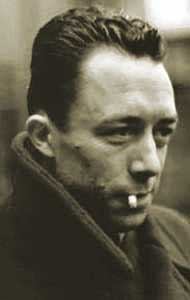
Albert Camus- Prototypical Hipster Pose
This novel goes to show that you can fool all the people all the time.
The cover blurb of my edition has the New York Times yodeling: ‘An irresistably brilliant examination of the modern conscience.’ which is complete and total nonsense. This isn’t even the examination of anyone’s conscience.
Camus was a French Jew from Algeria then living in France. He was not an Algerian Jew as the Jews of Algeria were made French citizens in the revolution of 1830. This distinction is important.
The Fall Camus is talking about is the post-Enlightenment destruction of the religious basis for considering the Jews as a Chosen People, or rather, The Chosen People. In Jewish mythology the world is organized God>Jews>the rest of humanity>the animal kingdom. As Camus was not unintelligent he realized that without God the Jews had no special status. HIs purpose here is to reestablish a reason for Jewish superiority over the rest of mankind. Thus he creates Jean-Baptiste Clamence as his spokesman to represent Jewry originating the role of judge-penitent for him and them.
Clamence is not an admirable person. Never was, never can be. His extreme arrogance before the Fall is characteristic of the Jewish people. The Fall was undoubtedly the extermination of Jews during WWII. While Hitler is given sole credit for the dirty work, in the Jewish mind they were rejected by the whole world. One should not underestimate the effect on the Jewish mind of the turning back of the St. Louis from Cuba. These facts were devastating.
Camus’ Clamence thus felt degraded by the Fall from confidence. He becomes libertine, criminal, degenerate, taking up his abode in the criminal quarter of Amsterdam which he seems to equate with the most criminal place in the world. He is a penitent. There in sackcloth and ashes. It is precisely because he knows extreme degradation, having once been of God’s Chosen People, that he has appointed himself a judge over all the peoples of the world.
He- the Jews- have regained their imagined position of the Chosen People through extreme debasement and degradation.
That is why they have made the Holocaust the central feature of their new identity. Their God rejected them, once again, allowing the Nazis to destroy them. Thus the Holocaust replaces God. If the Holocaust is not sacred to them and honored by the rest of the world, as their God once was, then they not only lose their place as the Chosen People but have no chance of regaining it.
That is the import of Camus’ The Fall. The book has nothing to do with an examination of the ‘modern conscience’, which is to say my conscience. I reject Camus. I reject his book. I reject his situation. He and it have nothing in common with me. His problem is not a universal problem as the NY Times states. Camus’ book is merely a tedious rendition of someone else’s angst that has nothing to do with me or mine.
End Of Review
https://idynamo.wordpress.com/2007/05/08/part-i-the-deconstruction-of-edgar-rice-burroughsamerica/
The below response to Robert Zaretsky’s article develops the argument of the origin of The Fall. http://www.tabletmag.com/arts-and-culture/books/82555/camus-the-jew/
CAMUS THE JEW
by
R.E. Prindle
Mr. Robert Zaretsky who wrote the above titled article for Tablet Ezine is indeed an example of the absurdity he deplores. He is atavism personified. How can anyone in this post-Darwinian age be so simple and naive as to be a believing Jew. The human intellect has moved well beyond such simplicity. To be a Jew, a Moslem or even Fundamentalist Christian which is to say a distaff Jew should be a logical impossibility.
One might claim to be an Israeli, claiming allegiance to Israel, without making oneself look ridiculous but to claim nationality the same as everyone else is to renounce the extraordinaryly specious claim to some sort of special superiority based on an equally specious divine preference is quite akin to insanity in this post-Darwinian scientific world. The very idea of Yeshivas and Seminaries is repellent to contemporary knowledge.
Given this willful obtuseness one is not astonished to realize that ‘Jews’ renounce all involvement as the cause of the disorder, death and destruction from 1913, when the Jewish millennium was said to begin, to the present. In the height of arrogance the ‘Jews’ ascribe any resistance to the genocidal war begun by them in 1913 as ‘anti-Semitism.’ In other words one is to accept their dominance without a struggle; to resist is considered perverse.
Thus, what makes Camus at least an honorary Jew was his deferential embracement of the Jewish cause as his own. To Bob Zaretsky the actions of God in testing the Jews by an inexplicable defeat can only be compared to the trials of Job. Having been stripped of his children and property but remaining loyal to his perverse god:
We think we know how the story of Job ends: Rewarded by God for his loyalty, Job is paid back with even more children, sheep and property. But is this the ending? A number of biblical scholars suggest the Job we hear in the final chapter, the one who accepts and resigns himself to God’s power play, is not the same Job we hear in the preceding 40 chapters. Instead, he is a throwback to an earlier story that was grafted onto the otherwise perplexing account. Instead the real Job is Camus’ Job. He is a Job who answers God’s deafening and dismal effort at self-justification with scornful silence.
Thus, Bob, and one suspects all Jews refuse to take responsibility for their actions perceiving Camus here as some sort of intermediary. Bob, has a distorted notion of the relationship between his Jews and Europeans. He says:
In republican France Jewishness was largely a private matter: it was only when Nazi Germany buried the Republic in 1940 that Jewishness became a public matter and indifference to the fate of the Jews was no longer possible- or should not have been possible.
Bob completely overlooks the Dreyfus Affair of the 1890s that underlined the basic conflict between the French and Jews. Nor did the opposition cease with the unjust reversal of Dreyfus’ conviction but simmered along through the Popular Front and Blum years until the Nazi reaction. French dissatisfaction with the Jewish situation was always prominent, especially after the Eastern Jews stampeded the border during the late thirties and early forties creating havoc and destroying the French quality of life:
Yet when the authoritarian regime of Vichy passed a salvo of anti-Semitic laws in 1940, most Frenchmen and -women did not blink. One of the few who did blink- in fact doubled over in shock and revulsion- was Camus. Working for the newspaper Paris-Soir, Camus was stunned when his Jewish colleagues were fired. In a letter to his wife Francine Faure- a native or Oran, Algeria, who was very close to the Jewish community- Camus said that he could not continue to work at the paper; any job at all in Algeria, even one on a farm, would be preferable. As for the new regime, he was merciless: “Cowardice and senility is all they have to offer. Pro-German policies, a constitution in the style of totalitarian regimes, a great fear of a revolution that will not come: all of this to truckle up to an enemy who has already pulverized us and to salvage privileges which are not threatened.”
Camus was less than prescient about the revolution and totalitarian regimes as both are succeeding now worldwide. The question is who did Camus mean was pulverized- the Jews or the French? Camus according to Bob is plainly casting his lot with the Jews although conveniently excaping to Algeria beyond the Nazi reach. This then is the background of The Fall that gives Clamence his depression. God’s trial of Job was too severe in this instance for continued belief so that rather than complain Clamence/Camus turns his back on God in a disdainful ‘silence’ while pouting and drinking his life away.
Camus is a Jew, fully so in sentiment and the Fall is in reaction to the holocaust.
End of supplement.
III.
A Review
The Outsider (L’Etranger)
by
Albert Camus
Review by R.E. Prindle
Edition: Folio Society 2011
Comes now the time to review Camus’ The Stranger, Outsider or Misfit. A commenter or two have suggested I read The Outsider and I have. The only thing I can compare it and Camus to is the Grateful Dead. It is said that the Dead are an acquired taste. Over the years I have listened to the Dead for many hours in the attempt not so much to acquire the taste as to understand it. I know that Deadheads think that Jerry Garcia, of blessed memory, was a great guitarist but I can’t penetrate his style. In fact I find the Dead so distasteful I’ve given up on them.
I put Camus in the same category as the Dead; he must be an acquired taste except for those of a similar mind. Actually, I recently read the Myth of Sisyphus on line while I read The Plague several years ago. Zero sympathy.
The Outsider strikes me as a high school novelist trying to be heavy. Camus was twenty five in 1938 when he conceived the idea of his little trilogy, that included this book. The novel must have been written in ‘40-’41 as it was published in ‘42 during the war. I suppose most of us experienced the confusion of life in much the same way at twenty-seven or twenty-eight just before the age of reason bit at thirty.
My edition contains an afterword by Camus dated 8 January 1955 in which he says:
A long time ago I summed up The Outsider in a sentence which I realize is extremely paradoxical: ‘In our society (meaning French Algeria I suppose) any man who doesn’t cry at his mother’s funeral is liable to be condemned to death.’ I simply meant that the hero of the book is condemned because he doesn’t play the game. In this sense, he is an outsider to the society in which he lives, wandering on the fringe, on the outskirts of life, solitary and sensual. And for this reason, some readers have been tempted to regard him as a reject. But to get a more accurate picture of his character, or rather one that conforms more closely to his author’s intentions, you must ask yourself in what way Meursault doesn’t play the game. The answer is simple; he refuses to lie.
Camus’ evaluation of his story only proves once again that no author truly understands what he has written. Not only that but his is such a perverse interpretation as to be incredible. Meursault neither lies or tells the truth; he is just a passive receptacle of other people’s needs. Further, the book even if considered a fantasy doesn’t make sense; it doesn’t appear to be founded on human experience.
Obviously the story does not hinge on Meursault’s refusal to lie but simply his treatment of his mother and his refusal to show emotion at her funeral. That’s it. The fact that he killed a man in self-defense which is not brought out is merely an excuse for executing him for his perceived coldness toward his mother.
I don’t know the nature of French Algerian jurisprudence of the time but I find it very difficult to believe that judges adjudicating an ostensible murder would conduct the trial on the basis of whether a man cried at his mother’s funeral or not. Who knows what his actual relationship his mother had with him and so what?
The issue is the killing. As I read the story Meursault only drew his gun when the Arab flashed his knife. The glare of the sun on the blade intensified the threat so in self defense Meursault shot him. There is absolutely no reason that Meursault couldn’t have told the judge ‘the truth’- he drew a knife on me so having a gun I shot him. Where is the refusal to lie? The mother combined with the killing doesn’t make sense; there is no connection. But, maybe that’s what existentialism means, you got me.
The center of the novel which merely demonstrates the extreme passivity of Meursault doesn’t satisfactorily explain the sudden act of volition in shooting the Arab especially as he apparently didn’t construe it as an act of self-defense.
All through the main body he lacks volition just going where the wind blew. Raymond demands that Meursault be his ‘mate’ to which he complies even though Raymond is the last guy anyone would want to know while to be the mate of someone who mercilessly beats a woman is beyond comprehension. What is going through Albert Camus’ mind?
Marie, a woman he hardly knows proposes marriage to him so Meursault assents although he tells her he doesn’t love her and she doesn’t care. For me this nonsense is merely exasperating. I had no interest in any of the characters; the sequence of events make no sense other than to demonstrate the extreme passivity and lack of volition of Meursault.
The final outburst is in contrast to his passivity:
…I looked up at the mass of signs and stars in the night sky and laid myself open for the first time to the benign indifference of the world. And finding it so much like myself, in fact so fraternal, I realized that I’d been happy, and that I was still happy. For the final consummation and for me to feel less lonely, my last wish was that there should be a crowd of spectators at my execution and that they should greet me with cries of hatred.
Why hatred? The guy just said he was happy and contented. Like I say, Camus is an acquired taste. I have no interest in him but if you do- Enjoy.
By the way, has anyone read Sartre’s trilogy, The Roads To Freedom?
 I, Dynamo