Part 7, Tarzan And The Lion Man: A Review
May 20, 2008
A Review
Themes And Variations
The Tarzan Novels Of Edgar Rice Burroughs
#18, Tarzan And The Lion Man
Part 7 of 10 Parts
by
R.E. Prindle
First published on the ezine, ERBzine

The Storyteller
The City Of God
7 a.
The first to the Falls, Rhonda was then spotted from the plateau by some of the Apes of God.

The Reviewer
Now begins the story within the story. A long short story or novelette that is as fine as anything in Fantasy or Science Fiction. This story is the eighteen caret ruby in the diadem of the Tarzan series. That this story should have gone unrecognized for over seventy years is incredible.
Not only is it objectively stunning but the subjective richness is beyond measure. Just as some background on the number of influences on the story let us begin with two, both of which are interconnected in ERB’s mind.
The novel by Mary Shelley, Frankenstein, had a profound effect on ERB’s mind. He apparently read it early which is to say before 1900. The possibility of creating life had interested him from the beginning of his corpus while references to it are interspersed throughout. One of the greatest of his creations, the great physician and scientist Dr. Ras Thavas, will succeed in creating life five years hence in The Synthetic Men Of Mars but will botch the job terribly.
In this story Burroughs’ character, God, doesn’t create life but he manipulates genes to create a whole new species. Mary Shelley wrote Frankenstein in 1818 and in 1931 Universal made the definitive movie. That was two years before Burroughs wrote Lion Man so it is reasonable to assume the movie had an effect on him.
IMDb provides a quote from the movie that may have inspired ERB; I don’t think there is any doubt that he saw this seminal horror film.
Henry Frankenstein: Look! It’s moving. It’s alive. It’s alive….It’s alive, it’s moving, etc.
Victory Moritz: Henry- in the name of god!
Henry Frankenstein: Oh, in the name of God! Now I know what it feels like to be God!
Frankenstein's Monster

The 1931 Frankenstein is stil an overwhelming experience to watch over seventy years later. For the audiences of 1931 it must have been overpowering. The fabulous castle of Dr. Frankenstein was surely an inspiration for the castle of Burroughs’ God. What Burroughs did with the inspiration is as astonishing as both the Shelley original and the movie.
In the news also at the time for over a period of a decade or more was the spectacular career of John R. ‘Goat Glands’ Brinkley. This is an astonishing story. I rely mainly on two accounts: Vishwas Gatitonde’s excellent article “Magic Men’ in BB New Series #59 and the account in Wlofman Jack’s autobiography. Wolfman Jack’s autobiography slipped by unnoticed but is one of the great autobiographies of the second half of the twentieth century, probably the twentieth century and possibly of all time.
Also see on the internet:
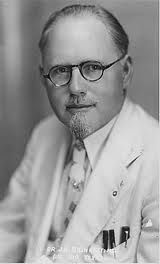
Dr. John R. Brinkley- A Story You Should Know
Grift, Goats and Gonads by Scott McLemee
Kansas State Historical Papers- John R. Brinkley
Border Radio Quackery by Gene Fowler and Bill Crawford
The Goat Gland Doctor by Joe Schwarcz, PH.D
The medical practices of God involve gland transplants along with genetic implanting or splicing. Over the years based on a foundation of Frankenstein ERB had built up a magnificent fantastical scientific edifice of life creation based on Evolution.
There can be no doubt that he read and thought about the subject a great deal. He was very well informed on evolutionary matters. He was a well educated, thoughtful, intelligent man contrary to nearly every opinion about him. His ideas as presented in Lion Man are probably as far as he could take them based on the knowledge of his time. The discovery of DNA was only a little over a decade away, actually made a few years before he died. One wonders what he would have made of it. Even then ERB’s notion of ‘germ cells’ with their indestructability contains the essence of DNA so ERB was on the right track in his thinking. I’m going to handle this out of order as the ideas explain what follows better.
ERB was familiar with the use of cannibalism to ingest certain qualities of slain warriors. Thus it was thought that to eat the brains of especially intelligent people transmitted that intelligence to oneself. To eat the flesh of a brave man made oneself also brave, etc.
From there to cellular therapy is a short step. Even though there was probably no one who believed in the physical benefits of human cannibalism this side of Africa when it came to animals parts intelligent men threw common sense out the window.
Cellular Therapy arose at the end of the nineteenth century. Joe Schwarcz explains:
Charles-Edouard Brown-Sequard, a noted French physiologist, had shocked the medical community by injecting himself with the crushed testicles of young dogs and gunea pigs. Afterwards he claimed that he had regained the physical stamina and intellectual vigor of his youth. Many men availed themselves of ‘La Methode Sequardienne’, but once the placebo effect was filtered out little remained. In Vienna physiologist Eugen Steinach proposed that youthful vitality could be restored by increasing levels of testosterone. the easiet way to do this, Steinach said, was through vasectomy. Sperm production wasted testosterone, and if the channel leading from the testes to the ejaculatory duct were tied off, then blood levels of testosterone would rise. Brinkley may also have heard of the work of Serge Vorenoff, a French doctor who was stirring u a storm of controversy with his experimental gland transplants. Vorenof had been a physician in the court of the King of Egypt, and there he had spent a great deal of time treating the court eunuchs, who suffered from a variety of illnesses. He hyposthesized that maintaining active genital glands was the secret of health. As proof, he cited his experiments with an aging ram into which he transplanted the testicles of young lamb. the ram’s wool got thicker, and his sexual vigor returned. Voreneff then went on to transplant bits of monkey testes into aging men; he claimed success, although he could offer no scientific validation of his claim. In America the stage was set for the meteoric rise of J.R. Brinkley.
Brinkley began to transplant goat glands into the testicles of his patients. As he began his career in the early 1920s radio made its appearance as a commercial entity. On the qui vive Brinkley realized its potential to increase his business and spread his gospel. He bought the first radio station in Kansas in 1923, his practice was in Melford, His call leters were KFKB- Kansas First-Kansas Best- as bold a claim as his medical ones. He was actually a fine broadcaster transmitting Country Music, weather, farm reports and other items of interest as well as infomercials for his medical practice. This notoriety brought the AMA and government down on him. By 1930 he had had both his medical and broadcasting licenses revoked.
Now, here’s where the man showed his innovative brilliance. This really got him attention. Nothing daunted he moved down to fabled Del Rio, Texas, Brinkley created the fable, across the Rio Grande from Villa Acuna. His radio station in Kansas was small, a mere 1000 watts, although probably non-directional.
In Mexico without US regulations he was able to build a boombox of 75,000 to 100,000 non-directional watts. This was later incresed, if this is believable, to 500,000 watts and tahen to1,000,000 watts according to Fowler and Crawford who really should know.

Clap For The Wolfman
Alright. When I grew up in Michigan in the 1950s I could clearly pick up the successor Del Rio station after dark when its power was only 250,000 watts. Wolfman Jack who worked the station tells an amusing story of his arrival. Driving through the desert to the transmitter he noted that all the cars parked there had left their headlights on. This mystified him but then he learned that the wattage was so powerful that headlights glowed in consequence. The air crackled around him. At a half million and a million watts people must have levitated.
So, Dr. Brinkley was much in the news all these years so that ERB as Gaitonde suggests couldn’t have missed him. While in our time there is no reason to mention La Methode Sequardienne yet with Brinkley being reviled it is quite possible ERB came across a discussion of cellular therapy in his reading which did mention these earlier experiments.
ERB has God, a formerly handsome Englishman, create a hybrid hominid between a gorilla and a human. God himself has regressed being a hybrid human/gorilla. p. 133:
“What is this strange purpose we are to serve?” asked Rhonda.
“It is purely scientific; but it is a long story and I shall have to start at the beginning,” explained God.
In the beginning. God appears to have been a medical student back in England with a strong interest in biology. p. 134:
“I had always been intrigued by Lamarck’s investigations and later by Darwin’s. They were on the right track, but they did not go far enough; then shortly after my graduation, I was traveling in Austria when I met a priest at Brunn who was working along lines similar to mine. His name was Mendel. We exchanged ideas. He was the only man in the world who could appreciate me, but he couldn’t go all the way with me. I got some help from him; but doubtless, he got more from me; though I never heard anything more about him before I left England.”
ERB gives us a fair amount of information here. He is familiar with the Frenchman Lamarck of the eighteenth century who centered on heridity. A red flag goes up on Darwin because if God left England in 1859 he would have known nothing of Darwin who published that year. In any event while Darwin’s Origin Of Species sheds light on the mechanics of the variations among a species I can’t find any evidence of how species themselves evolve. ERB is also familiar with the genetics of the monk, not priest, Gregor Mendel, who published in 1866 sending a copy to Darwin which the latter dismissed as irrelevant. However, Burroughs through God seems to have taken Darwin less seriously than Mendel.
He imples that Mendel was on the right track with his peas but that following the same line of reasoning God went well beyond him which indeed he did. Mendel was disregarded in 1866, his revival beginning in the year 1900. So Burroughs in 1930 is keeping up his reading.
Burroughs then goes on to explain God’s theory of heredity. His theory is not all that bad. It shows Burroughs obviously doing some reading and thinking on the subject. p. 134:
“In 1857 I felt that I had practically solved the myster of heredity, and in that year I published a monograph on the subject. I will explain the essence of my discoveries in as simple language as possible, so that you may understand the purpose you are to serve.
“Briefly, there are two types of cells we inherit from our parents- body cells and germ cells. these cells are composed of chromosomes containing genes- a separate gene for each mental and physical characteristic. The body cells, dividing and multiplying, changing, growing, determine the sort of individual we are to be; the germ cells remaining practically unchanged from our conception, determine what characteristics our progeny will inherit, through us, from our progentors and from us.
“I determined that heredity could be controlled through the transference of these genes from one individual to another. I learned that these genes never die; they are abosolutely indestructible- the basis of life on earth, the promise of immortality through all eternity.
It appears that ERB’s main concern is heredity and indeed genealogy was important to him. While his information is a clumsy account compared to what has been learned since then, given the times ERB was quite advanced. He doesn’t have the handle on DNA which is a decade or so in the future, Watson and Crick published in 1947, but in the germ cells he’s on the track of the right idea. The notion of the body cells is, of course, superfluous.
But now God runs up against a brick wall when he publishes his theory in 1857. Remember Mendel’s discoveries were still eight years in the future while so far ahead of their time that they will be disregarded for thirty-four years.
I don’t know what horror films have been released by this time, Dracula and Frankenstein for sure, but here the plot seems very familiar, possible Burke and Hareish. Unable to proceed in a legal manner because of society’s obtuseness God turns to criminal means, but quite novel crime.
As he has detemined that germ cells are immortal he raids the tombs of Westminster Abbey extracting germ cells from Henry VIII and his court and entourage. Thus he has a little time capsule when he is discovered and flees England to avoid blackmail. He decides to conduct his experiments on gorillas in Africa. He finds the greatest concetration of gorillas in Africa, and hence on earth, in the valleyof diamonds. In something like seventy years he converts pure gorillas into a hybrid of gorillas and humans capable of speech and human cognition. They build his magnificent City of God for him which must have been quite new when Tarzan arrived.
As they are bred from the genes of medieval Englishmen the effects of Lamarckian heredity are evident as they speak a medieval form of English and replicate the City called London after its medieval progenitor. Following Burroughs’ earlier thought in Opar the gorillas accept only beings born in gorilla form with human attributes. Sports and mutations are expelled. the other are, of course, the result of Mendelian genetics that are beings with odd combination of genes.
God was born in 1833, the same year as Burroughs’ father, thus in 1933 he is one hundred one years old. Some forty years back or so as he realized he was aging so he decided to splice in the body cells of young gorillas in a form of cellular therapy to rejuvenate himself. This worked well in preserving his youth but unfortunately the more gorilla body cells he spliced in the more gorilla-like he became, so that when Tarzan and Rhonda meet him he is a grotesque hybrid, more intellignet than the gorilla hybrids, but reverting rapidly to pure gorilla. Serious problem.
God is very pleased to capture two such fine looking human specimens as Tarzan and Rhonda because by splicing in their body cells he will be able to resume his human shape in some style.
So Burroughs has been developing his ideas in a creditable scientific way. While it’s true his actual science is speculative he is employing some fairly sound reasoning on the matter that may not have been too dissimilar from the tack taken by Stalin’s scientists, while creating a human-ape hybrid has apparently been a timeless fascination. It is said that our own scientists have succeeded in actually creating a chimp-human hybrid but that the specimens have been destroyed. I haven’t any confirmed proof that such has been done but rumors are around.
Having given a reasonable scientific explanation of the gorilla hybrids and God’s purpose for Tarzan and Rhonda, Burroughs with his usual ghoulish delight introduces his favorite topic of cannibalism. He informs the two that after satisfying his need for body cells he intends to eat them thus imbibing their characteristics. He also says that he will extract several glands from Rhonda for some special purpose.
I’m not exactly clear on what cannibalism meant to ERB. It seems he associates it with his father who was particulary hard on Burroughs in his youth which ERB may have interpreted as being eaten alive by his father. As we have God, cannibalism and his father associated here his father may be the reason for the recurring reference to cannibalism is his work.
The female glands recur again in Tarzan’s Quest where the Kavuru chief Kavandavanda requires female glands for his immortality pills and Vishwas Gaitonde finds the subject mentioned again in Tarzan The Magnificent.
So when Rhonda arrives at the Falls and is spotted from above by the seeming gorillas, she is actually spotted by a clone of the real fifteenth century Lord Buckingham in his gorilla guise.
Now begins a series of astonishments, jokes and twists such as are found in few novels. As I mentioned, today much of this is old hat, but in 1933 this was startling fresh and new. At this point we are unaware of the hybrid nature of the gorillas. The following passage then was not only startling to Rhonda but to us. p. 94:
(Rhonda) felt very small and alone and tired. With a sigh she sat down on a rounded boulder and leaned against another piled behind it. All her remaining strength seemed to have gone from her. She closed her eyes wearily, and two tears rolled down her cheeks. Perhaps she dozed, but she was startled into wakefulness by a voice speaking near her. At first she thought she was dreaming and did not open her eyes.
“She is alone,” the voice said. “We will take her to God- he will be pleased.”
it was an English voice, or at least the accent was English, but the tones were gruff and deep and guttural. The strange words convinced her she was dreaming. She opened her eyes, and shrank back with a little scream of terror. Standing close to her were two gorillas, or such she thought them to be until one of them opened his mouth and spoke.
“Come with us,” it said; “we are going to take you to God;” then it reached out a mighty, hairy hand and seized her.
There’s a shocking opener to the twilight zone between R2 and R3 as ERB prepares the curiosity of the reader for what is perhaps the most amazing story he ever told.
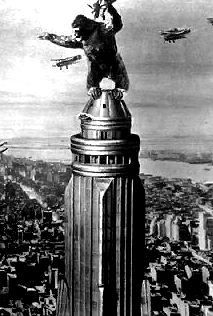
King Kong
Rhonda, physically and emotionally exhausted by the terrific events of the past few days, slips into a trance in the middle of Africa only to be brought out of it by voices speaking Enalish saying they are taking her to God. What can that possibly mean? When she opens her eyes she sees two gorillas are doing the speaking.
That’s something else, isn’t it? Had they been on the screen could they have competed with King Kong that was released in that year of 1933? Out of King Kong came 1949’s Mighty Joe Young while the public’s fascination with gorillas continued until Planet Of The Apes which, if it doesn’t owe anything to Burroughs’ story, develops the theme ad absurdam. Kong, Young and Planet Of The Apes, Stalin’s experiments all owe their origins to the Tarzan oeuvre.
Burroughs raises the theme to heights that have never been surpassed. Combining the human gorillas with the City of God was incomparable genius.
With the background clear let’s take a leap into the future.
The City Of God
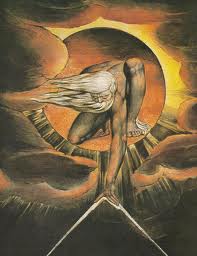
God At Work
7 b.
The whole thing seemed like a hideous and grotesque nightmare,
yet it was so real that she couldn’t know whether or not
she was dreaming.
Lion Man p. 95
In taking the ‘germ cells’ of individuals from the time of Henry VIII, as the cells were cloned with those of the gorillas the hybrids cloned the environment they knew. While clones have no mermory of a previous existence, in the popular imagination they do. Thus in the paranoid classic movie The Boys From Brazil of 1978 the number of clones of Adolf Hitler all exhibited the supposed conditioned responses of the original which they could not have experienced themselves.
At the same time ERB cleverly replicates the political situation between God, Church and Henry VIII. When Rhonda was captured, two gorillas named the Dukes of Buckingham and Suffolk quarrel over whether she is to be taken to Henry VIII or God. As we still have no idea of what is going on we are as mystified as Rhonda.
And then as Rhonda tries to order her bobbled brain she realized she could communicate with these improbably English speaking apes. p. 96:
Now she had an instant in which to think clearly, and with it came the realization that she had the means of communicating with her captors.
‘Who are you?” she damanded. “And why have you made me a prisoner?”
‘The two turned suddenly upon her. She thought their faces denoted surprise.
“She speaks English!” exclained one of them.
There’s a neat turnabout similar to when Tarzan addresses Buckingham in Mangani and the gorilla answers him in English. The gorilla exclaims, “She speaks English.”
Then follows an explanation of God, Henry VIII and Cranmer that only succeeds in confusing Rhonda further as she seems to be in some costume play in which for some inexplicable reason actors clad as gorillas are acting out a play about Henry VIII. She pinches herself to no avail. She is awake. This isn’t theatre, although Hamlet soon would be played in Nazi uniforms which is just about as ridiculous.
The gorillas take her to Henry VIII where we will leave her until she is joined by Tarzan.
While Rhonda escaped theArabs Naomi had been recaptured. In company with the Arabs she is brought to the canyon that leads to an easy ascent of the plateau according to the map. As the ascent becomes steep they leave the horses with Eyad going ahead on foot. Awaiting them at the crest is Stalin’s dream corps. Throughout the oeuvre one is always amazed at the disregard for their own well being the apes exhibit. They charge in story after story with complete disregard for their own well being. Always a signficant portion are left on the field of battle but the survivors never complain while Tarzan complacently accepts their sacrifice as his due.
So here, barehanded against the Arab firearms the gorillas launch a wave attack reminiscent of the Chinese in Korea that doesn’t stop until all the Arabs are dead. No regard at all for casualities. No wonder Stalin thought Burroughs was on to something. While the apes perform as they have always performed in Tarzan stories the difference here is that these are not mere apes but hybrids with human intelligence. If Burroughs was aware of Stalin’s experiments was he laughing at the Great Commissar? Is this battle a reference to Stalin? One can’t be positive of course but I am sure that the character of God-the formerly handsome Englishman- is partially based on H.G. Wells who was associated with Stalin.
Naomi was with the Arabs. She is captured by Buckingham who asks her how she got away from God; she is identical to Rhonda so Buckingham naturally confused her for the latter. The Apes sense of smell was not as developed as Tarzan’s. I’m sure the Big Bwana would have smelled the difference immediately.
ERB is now dealing with his sexual problems. Of the three women involved with the City of God- Naomi, Rhonda and Balza, it is necessary to sort out which woman represents what to ERB. As Naomi is weak and vacillating she obviously represents Emma. Rhonda who is strong and self-willed seems to represent ERB’s Anima ideal or in other words, La of Opar. La disappears from the oeuvre after Tarzan The Invincible of 1930 but as Tarzan and Rhonda in God’s prison replicate Tarzan and La in the Lion’s den of Invincible it seems probable that ERB has transported La from the fantasy world of Opar to the mere imaginary world of the movies. This leaves Balza- The Golden Girl- who probably represents Florence, but we will deal with her in the appropriate place.
ERB has now gotten the two women, the Arabs and Tarzan to the Falls. Orman, West and the safari are assembling at the base of the Falls so, having dissolved his story after the Bansuto attack ERB has now reintegrated it.
After a series of adventures during which Buckingham kills Suffolk, Tarzan appears to rescue Naomi killing Buckingham. At this point in Burroughs’ psychology he assumes the identity of his ordinary self and that of Tarzan into one being. As the movie people have never seen Tarzan they assume that he is Stanley Obroski his identical twin. Tarzan does not correct anyone but allows them to believe he is Stanley.
As I perceive it then ERB has now deluded himself into believing that he is Tarzan. Those who know him still perceive him as Ed Burroughs. He has no choice but to let them believe that because if he attempted to impose his delusion on them he might have been committed. Thus for a period of about five to six years from 1934 to 1939-40 Burroughs perceives himself as Tarzan but capitulates in Tarzan And The Madman giving up his illusion of being the Big Bwana. In Lion Man he describes Tarzan as a madman so the two novels are linked by the concept of madness.
After writing Madman Burroughs left California for Hawaii where he forced Florence away from him. WWII came along which saved him from himself. After the war he went back to LA to die. It is interesting that he didn’t choose to live in Tarzana but bought a house in Encino that backed against the Promised Land. thus like Moses, with whom there was a connection made in Tarzan Of The Apes, ERB was destined to view the Promised Land but not enter it.
In Lion Man he is flush with the hope of being able to live out his fantasy. He is now a few months from abandoning Emma so symbolically he returns Naomi to the safari at the Falls from whence she disappears from the story.
Only Rhonda and Balza will figure in the rest of the story. Emma is no more although Jane will appear again in Quest probably as Emma’s replacement Florence. In Magnificent Florence is mentioned only anonymously as Tarzan’s ‘wife.’ ERB is definitely struggling.
Having delivered Naomi to the safari Tarzan then reascends the plateau in search of Rhonda and the City of God.
The City Of God
7 c.
Every one of us, I believe, is possessed of two characters.
Often time they are so much alike that the duality is not noticeable,
but again there is a divergence so great
That we have the phenomenon of a Dr. Jekyll and Mr. Hyde
in a single individual.
E.R. Burroughs- The Swords Of Mars
Tarzan And the Lion Man was followed at the end of 1933 by the Mars story The Swords Of Mars which features the return of John Carter. ERB had taken a vacation from Emma returning to the scene of his own early adventures- Arizona. Not coincidentally in the White Mountain of Apache country. ERB’s motivations are sometimes obscure. He was in the Army in Arizona in 1896-97 which was before he married Emma. So he took his leave of absence from Emma to a place before he married her. Setting the clock back, so to speak, somewhat reminiscent of The Eternal Lover.
Just as Tarzan and Stanley met in Lion Man so while about to go to sleep, O.B.- The Other Burroughs- hears the door open, the clank of a man in war gear walking across the floor; terrified like an adolescent in a bad dream, O.B. is relieved and pleased when John Carter, back from Mars, greets him. A real Jekyll and Hyde situation. Thus as with Tarzan and Stanley the two Martian aspects of Buroughs are reunited but not melded. John Carter then tells O.B. a bedtime story as though Burroughs were a child again. I’m not that familiar with the Mars stories but there must be a connection to Lion Man and the MGM situation. This must be true because this is the novel in which the opening letters of each chapter spell- TO FLORENCE WITH ALL MY LOVE, ED. One assumes then that although the decision to leave Emma was difficult to make, ERB made the final decision in the Arizona mountains.
So now a few months earlier Tarzan/Stanley makes the journey to the City of God where he will be reunited with his Anima ideal, Rhonda -La of Opar- in prison. Thus his whole person both Anima and Animus are locked up by MGM.
Rhonda had been taken to Henry VIII by Buckingham and Suffolk. The city was called London, the country England and the river The Thames. As ERB jokingly smirks- The English always take a little bit of England with them wherever they go. Pretty funny, actually.
Here the events of Henry’s reign are being reenacted. As the apes are clones of Henry and his court who replicate their times one wonders whether each succeeding generation will be stuck in this one period of history reenacting it over and over until the end of time. Once again I am reminded of The Eternal Lover. ERB seems to be obsessed by the idea of time.
Rhonda was first placed with the wives of Henry, a week later being moved to a cell in God’s castle where Tarzan found her when he too was captured.
For now he was moving through the night until he came up against the ten foot high wall surrounding the City of London and within it the City of God. Here we have the historical confrontation between the spiritual and temporal powers. At the least the story is a very humorous parody of the religious situation of Henry VIII. Once again ERB ridicules religion and this is done so cleverly and with such genius.
But there are many levels of meaning. Earlier I mentioned that the capture of Tarzan may have been meant to replicate ERB;’s capture by MGM. In that sense then the City of God might represent MGM which boasted that it had more stars then Heaven. So there is probably a joke there too.
On the other hand, God is described as a formerly handsome Englishman. The only candidate for that role I can come up with is ERB’s bete noir, H.G. Wells. I think that I have adequately documented the literary feud between Wells and Burroughs. Wells began well with his scientific romances. While not as fresh and stunning as they were at the time of issue they still hold up well today. Even though ERB denied having ever read Wells I think that claim can be dismissed out of hand. ERB, then, would have been as impressed with Wells’ early romances as anyone else. Then when Wells began his campaign of defamation and ridicule which is most clearly represented in his Mr. Blettsworthy On Rampole Island he fell from favor in Burroughs’ eyes, hence the grotesquely deformed ‘formerly handsome Englishman.’
As much as I like Wells he does pontificate. Like all Liberals he has a difficult time distinguishing his opinion from truth, right and wrong, or reality. While he does sometimes make a hit in his prophesying he is mostly wrong. Backing the Worker’s Paradise of Stalin’s USSR was certainly wrong and more than enough to discredit him in the staunch anti-Communist Burroughs’ eyes.
Wells probably shook Burroughs’ faith in the glory of England which had been a keystone of his secular faith fromt he beginning. Thus, combining MGM, Stalin and the USSR and Wells, Burroughs packages all the troublemakers of this perilous time for him into one big box with a bigger bow on top.
As his story could have no effect on his situation let us hope it was at least cathartic for him. When Tarzan ends up in the cage with Rhonda that about epitomizes Burroughs’ situation vis-a-vis MGM, Stalin and Wells. There are so many coincidences here that the brain revolves like a turret. Was it wholly coincidental that Wells showed up in Hollywood at the end of ’35 to visit fellow Red Charlie Chaplin just as Burroughs was completely boxed in because of his Guatemalan adventure?
Isn’t it amazing that Burroughs met his fate in Guatemala, the scene of the adventures of his early hero General Christmas and also the scene of some of the adventures of Ogden McClurg who was killed shortly after this return from the area in 1926? It may be truly coincidental but the further one digs very often the more dirt one turns up.
Burroughs may have felt confident he could write his way out of this box just as he was able to escape by self-publishing in 1930; perhaps he thought he could escape this time by making his own movies. If so, a little analysis would have shown him that the rules had drastically changed. Especially as he had signed the rights to represent his character Tarzan away.
Coincidental with the release of the MGM Tarzan movies which preempted the nature of Tarzan from literature came the decline in Burroughs’ own literary powers. Whereas in 1930 he was able to respond to the challenge with a series of top novels, after Lion Man there is a preciptious decline in the the quality of is work. While the later novels have their charms for Burroughs’ admirers they do lack commercial appeal.
By 1935 also Burroughs had antagonized radio which had become the major source of his income so that that medium was closed to him during his lifetime. With publication revenues declining and the comics by Burroughs’ own admission producing a pittance, ERB had only one major source of income left and that was the moves. MGM had him over a barrel.
MGM might have produced a whole series of Tarzan films along the lines of the Charlie Chan movies as Burroughs reuefully remarked but they chose instead to issue only four movies between 1932 and 1939. Obviously the makret would have borne more. The limited release schedule kept EBB on a short financial tether.
It is said that events cast their shadow before them so that it is possible, if not probable, that Burroughs foresaw the shape of things to come even as he wrote Lion Man.
In 1930 when the Reds invaded his dream land of Opar ERB abandoned that fantasy. The fabled city ceased to exist in his imagination while disappearing from the oeuvre. Now in Lion Man it appears that the enemy had captured the castle while building a ten foot wall around it with Tarzan/Burroughs on the outside. Thus Burroughs’ dream of separating himself from the world by a tne foot wall has been inverted in his imagination. He wasn’t keeping the world out; the world was keeping him out.
In the novel succeeding Lion Man, The Swords Of Mars, when the mad inventor Fal Sivas quails at taking hsi invented spaceship to the Martian moon Thuria the following exchange takes place between he and John Carter:
“But you built this ship to go to Thuria,: Carter cried. “You told me so yourself.”
“It was a dream,” he mumbled; “I am always dreaming, for in dreams nothing bad an happen to me.”
Fal Sivas can be taken as an alter ego of Burroughs. The Sivas probably refers to the Hindu god Shiva or Siva with whom Burroughs had become a devotee or developed a fascination for. Thus while his heroes Tarzan and John Carter are men of action Sivas/Burroughs or any other combination is not.
So in Lion Man Burroughs is desperately trying to become the man of action rather than the dreamer. The problem now is that ERB himself is past the point of no return. He has been walled out from the City of God.
In dreams however Tarzan enters the Heavenly City by a fantastic feat of strength that recalls Burroughs’ 1890-1920 infatuation with the Strong Men such as the Great Sandow.
The wall which Tarzan fancies was built to keep out lions i.e. the Lion Man has sharpened stakes pointing downward. p. 124:
…he leaped for the stakes. His hands closed upon two of them; then he drew himself up slowly until his hips were on a level with his hands, his arms straight at his sides. Leaning forward, he let his body drop slowly forward until it rested on the stakes and the top of the wall.
That seems to be an impossible feat of strength except in dreams, but then by this point Tarzan thinks he is dreaming. This might as well be an MGM movie lot such Burroughs spent five weeks on. Here the dream faces a sort of reality. As though pasing through a movie set as ERB must have done during those five weeks Tarzan comes to the steps leading to the Heaven of God. this Stariway to Heaven, Jacob’s Ladder.
As if to accent the relationship to MGM he passes the Apes of God who are dancing and partying. The scene will be replicated at the foot of the Falls when the movie company duplicates this scene thus strengthening the connection with MGM.
Tarzan begins the long climb up the Stairway to Heaven. The fire flares illuminating him on the steps but the apes below don’t notice- high above on a parapet of Heaven, God does. Note the resemblance to the move castle of Frankenstein. A man of action God quickly prepares a trap.
In real life the trap was probably the promise of the contract and money. ERB blames the movies for being duplicitous, which is definitely true, still, he had had a dozen or more years to work out the conditions prevailing on his own. After all, by 1932 he had proven product to sell. The public had even given a profit to some pretty crummy movies so that had he taken the time, acted on his own conditions, rather than just signing for a few quick bucks he might have retained a position of some control, made himself an equal partner. So, while MGM did betray him he might have been able to manage the situation.
Tarzan enters the castle to be confronted by six doors of which only #3 is open. Depending on how you count them there were six to eight major studios, thus the six doors may represent the Studios of which only MGM was willing to deal with him. Remember he had been blacklisted since 1922, the blacklist having been broken in 1928 by Joseph Kennedy.
Tarzan descends the stairs as heedlessly as Burroughs signed the contract and like Burroughs he finds himself trapped. The nose of noses sniffs the air and detects the delicate scent of a White woman. He has found she whom he sought, Rhonda.
7 d.
The Confrontation With God
Now Tarzan is reunited with his Anima ideal in the person of Rhonda formerly La of Opar. That Rhonda can be associated with La is because this scene is a replication or double of Tarzan and La in the lion’s den of Invincible. There La and Tarzan were imprisoned in a cell beneath Opar. They escaped the cell in a duplication of their escape from this prison. In Invicible there was a runway within which the lion fed. A shaft led upward to a room in a tower. There the old man who betrayed them discovered them.
In this case a breeze passing over the floor indicates an air shaft to Tarzan. This is probably borrowed from Rider Haggard’s King Solomon’s Mines although it will soon if not already be a staple of the movie genre. Tarzan locates the shaft in the ceiling in a corner of the cell. He and Rhonda ascend it to the opening in front of which God is talking to some gorillas. Thus the scene virtually duplicates Invincible. La and Rhonda must be associated in ERB’s mind.
As an aside Burrughs uses a variation of this scenario in The Swords Of Mars when John Carter is imprisoned. There are beams some twenty feet ot so above the floor to which Carter leaps. He takes a position above the door dropping on his keeper when he enters.
At this point in the story Tarzan and Stanley Obroski may be considered to be reunited as one persona. Rhonda, who has never seen Tarzan, addressed the person in Stanley’s guise as Stanley. ERB has a little fun as he has Tarzan play along.
As he says in Swords, he is convinced that every man has a dual Animus, that is two different aspects, sometimes nearly identical but sometimes as different as Dr. Jekyll and Mr. Hyde. Thus at this point his mind is impressed with Shelley’s Frankenstein and Stevenson’s Dr. Jekyll And Mr. Hyde. He had read both novels before 1900 while both stories were released as movies in 1931. So the stories are very fresh in his mind.
Tarzan/Obroski may be considered of the Jekyll/Hyde variety. There is little doubt that Burroughs saw the pair and himself that way. Thus Carter and Fall Sivas in Swords may also be seen as two sides (Jekyll/Hyde) of the same persona. Tarzan does not try to convince Rhonda that he is not Stanley, but in the Jekyll side of the persona he astounds here with Hydelike feats compelling her to reevaluate him.
There are undoubtedly snippets of other horror movies here that ERB has seen also but I can’t remember the titles or dates. There was one about two Scottish body snatchers Burke and Hare which I think I can detect here and another about a mad doctor who operated on the brains of abducted victims that shows up here and in Swords that was called the Black Sleept or somesuch. The latter would have had a castle along these lines as well as Frankenstein. Of course, which of that ilk of movie didn’t? Burroughs is combining an astounding number of influences here both literary and cinematic but both combined.
Thus, having availed himself of ‘such a God given opportunity’ to find Rhonda he is imprisoned with her. The joke was ERB’s. You know, God left the doors open- God given opportunity. I chuckled softly to myself as I read.
After an exchange of repartee between Stanley/Tarzan and Rhonda God makes his appearance. Not exactly what one would expect God to look like. In fact it is almost amazing that the fundamentalist Christians didn’t create an uproar. After all according to the Old Testament man was created in God’s image. There’s a laugh. Here’s the image. p. 128:
It had the face of a man, but its skin was black like that of a gorilla. Its grinning lips revealed the heavy fangs of an anthropoid. Scant black hair covered those portions of its body that an open shirt and a loin cloth revealed. The skin of the body, arms, and legs was black with large patches of white. The bare feet were the feet of a man; the hands were black and hairy and wrinkled, with long, curved claws; the eyes were the sunken eyes of an old man- a very old man.
The Scopes Monkey Trial had only been about seven years before. So here Burroughs is making sport of God with a sort of reverse evolution. God is a cross between a man and a gorilla. Yet ERB led such a charmed life that his mockery or parody of God created no comment. If he wanted to start a ruckus to promote his book sales he failed miserably.
God might have been half ape but he had a whole hearted sense of;humor. Overhearing Tarzan say that he had come for Rhonda his opening comments are mock injury. p. 128:
“So you are acquainted?” He said. “How interesting! And you came to get her, did you? I thought that you had come to call on me. Of course it is not quite the proper thing for a stranger to come by night without an invitation- and by stealth.
“It was just by the merest chance that I learned of your coming. I have Henry to thank for that. Had he not been staging a dance I should not have known, and thus I should have been denied the pleasure of receiving you, as I have.
“You see, I was looking down from my castle into the courtyard of Henry’s palace when his bonfire flared up and lighted the Holy Stairs- and there you were!
Burroughs is justly criticized for the occasional bit of wooden dialogue but I find the confrontation with God very well written. The constantly mocking tone of God is carried off very well. Tarzan’s indignation is very well executed. The influence of Shelley, Stevenson and the various movies is seamlessly blended into a very tightly executed scene.
All this is done in a very few pages while it is a remarkable bit of writing.
God hints at his motives for their use for him. p. 129:
“…I shall keep you for a while for the pleasure of conversing with rational human beings.
“I have not seen any for a long time, a long, long time. Of course I hate them nonentheless, but I must admit that I shall find pleasure in this companionship for a short time. You are both very good looking too. That will make it all the more pleasant, just as it increases your value for the purpose which I intend you- the final purpose, you understand. I am particularly pleased that the girl is so beautiful. I always did have a fondness for blonds. Were I not already engaged along some other lines of research, and were it possible, I should like nothing better than to conduct a scientific investigation to determine the biologial or psychological explanation of the profound attraction the blond female has for the male of all races.”
Burroughs doesn’t tell us how blonde Rhonda and Naomi are, whether they are platinum blondes like Kali Bwana or merely blondes. Of course today ERB would be censored for his handling of the sexual and racial preferences for blondes but it is a recurrent theme in his writing and one worth studying.
Having piqued our curiosity as to his purpose for the couple God leaves to check up on Henry. p. 130:
“Come back here!” (Tarzan) commanded. “Either let us out of this hole or tell us why you are holding us- what you intend doing with us.”
The creature wheeled suddenly, its expression transformed by a hideous snarl. “You dare issue orders to me!” It screamed.
“And why not?” demanded the ape-man. “Who are you?”
The creature took a step nearer the bars and tapped its hairy chest with a thorny talon. “I am God.” it cried.
There you go. The cat’s out of the bag.
The scene is dramatically successful while the reader is now left to guess the model for God. We are told that he was a formerly handsome Englishman now deformed as a hybrid ape-human. The city is London, the territory is England and the river is the Thames. A reasonable place to look would be among the English. Who among the English is bedeviling ERB? H.G. Wells is the only one I can think of. Regardless of whether Wells considered himself a Communist or not he is sailing his craft so close to the wind that it is impossible to distniguish between the two. At the very least Wells is throughly subversive. If anything he resents not being in Stalin’s place. So Burroughs must consider him Communist.
To my mind then, Burroughs is mocking Wells much as Wells mocked Burroughs in ‘Blettsworthy.’ God has delusions of grandeur and so does the highly pontificating Wells. My vote for the model is Wells.
One also notes that in the last of the MGM Tarzan movies, 1942’s Tarzan’s New York Adventure, Tarzan is captured by the circus roustabouts and thrown into a mobile cage. The camera then pans around to front which identifies the cage as a lion cage. One thus has the joke of the Lion Man in a lion’s cage. A final thumbing of the nose at Burroughs exiled in Hawaii. MGM then dropped what had been a very lucrative series. Strange behavior indeed.
God then returns to give his history as detailed earlier in the essay. While for some reason everyone, fans and detractors alike, wants to think of Burroughs as a semi-literate boob who is coincidentally a ‘master of adventure’ yet both in content and exposition, God presents his story in a masterly way. In 1930 there may have been few of his readers who had ever heard of Mendel and possibly Lamarck, although one hopes all had heard of Darwin. So it is possible that a reader might have been puzzled by the inclusion of Darwin while dismissing Larmarck and Mendel as fictitious. Of course if you’re reading strictly for fast-paced adventure you may not notice the details even though they are far from concealed.
God also clears up the mystery of the map. Surprisingly the map is not a stage prop but authentic. In fact, God made it about seventy years previously. It seems that he had been in love with a women back in England but she preferred wealth to being the wife of an impoverished scientist.
This may be a coincidence but that is the premise of the plot of H.G. Wells’ In The Days Of The Comet. Perhaps it was a message to Wells in case he hasn’t gotten it yet. But then God discovered the immense number of diamonds in the valley so he wrote the girl promising her riches beyond imagination. He had employed a native runner to take the letter to the coast to mail it but since he had never had a reply he wondered if it had ever been received. Now it came back to him. A simple but inventive twist.
When God leaves this time Tarzan sets to work to escape. Following the draft across the floor he finds the air shaft. Just as in Invincible he sends La up first now he sends Rhonda up first. As in the earlier story they are trapped at the top.
Looking through the entrance to the shaft they spy God and some gorillas in front of it. Their escape is spoiled. Now begins the Gotterdamerung.
The City of God
7 e.
The Gotterdamerung
Burroughs now has both aspects of his Animus with his Anima trapped in the tower unable to go foward or backward. God and his gorillas stand in anticipation before the opening. Burroughs has been stalemated. At this point one aspect of God must be MGM and its contract.
ERB has spun out his fantasy in a plausible way to this point, but now he has to find a way to resolve his dilemma. As he is daydreaming and this is a mad dream, as Fal Sivas says in Swords, in dreams nothing bad can happen to you. In this bind something bad can happen to ERB. He can lose his grip on reality. In that way he becomes mad or insane which is what the story is about.
In speaking of Henry God might also be speaking of ERB. p. 143:
“You all forget,” (God) cried, “that it was I who created you; it is I who can destroy you. First I shall make Henry mad, and then I shall crush him. That is the kind of gods humans like- it is the only kind they can understand. Because they are jealous and cruel and vindictive they have to have a jealous, cruel and vindictive god.”
There’s a lot information in that quote. It refers to the ancient Greek saying: Those who the gods would destroy they first make mad. So we have an excellent joke here. The incredible mind of Burroughs can conceive humor in the midst of the blackest despair.
He is talking of the Yahweh of the Old Testament while he quite soundly understands that god is a psychological projection of the mind of his creator. In a masterly grasp of Freudian group psychology, whether he knew it or not, he realized tha the people have created a god in their own image and not vice versa. Trapped in the tower this is a real agonized cry of despair before losing his grip on reality.
I don’t mean to say that ERB went stark raving mad but he edged into a fantasy world at least once removed from the fantasy he had been living since 1912. For the period of his marriage to Florence he can only be described as spaced out. Bear in mind that it’s going to get worse as he gets trapped into his movie production experience.
The Masenas in The Swords Of Mars make the threatening moves on John Carter who keeps backing away. Only too late he realized he had maneuvered himself where they wanted him. The Masenas were cat-men, i.e. lions who had two mouths. In a sly way Burroughs is caricaturing the Jews of MGM and their mascot Leo the Lion. The upper mouth which is sort of pursy and purring to seduce one, is above a lower mouth that is all teeth and no lips to rend one. So he is saying that he is dealing with two-faced people. While the upper mouth is assuring, the lower rending mouth is ever ready to destroy you.
Tarzan realizes that he has no choices left but to stay put or rush God and the gorillas. Alone he would have had a chance of success but with Rhonda in tow he is lost. This is an interesting reflection on the relationship of the Animus to the Anima. I’m at a bit of a loss to explain this.
God had sent for Rhonda to be told that she was not in the cell. Knowing that Tarzan was in the air shaft it followed that Rhonda was too as neither could have escaped the cell otherwise. He orders smudge pots to be lighted to smoke them out. Thus Burroughs acknowledges that his own situation is untenable while he has no solution. The only one left is the Samson like effort of pulling the temple down on his own head destroying both himself and his enemies.
God’s plan backfires as he sets his own castle afire. Unable to stand the smoke any longer Tarzan rushes out to be felled by a blow from one of the apes. At this precise point ERB goes mad or loses his mental balance. I don’t believe there is a Tarzan novel in which the Big Bwana isn’t knocked on the head at least once. In this case when he gets up he won’t have lost his memory but he will be a different man, another round of emasculation.
Once again he is separated from his Anima. Rhonda is spirited off to Henry. God and Tarzan are trapped on the patio as the castle becomes engulfed in flames.
This chapter is appropriately titled ‘The Holocaust.’ In its way everything that ERB had hoped and dreamed goes up in flames with God’s castle. Heaven is reduced to ashes.
Tarzan has his trusty rope so he can escape over the parapet to the roof of a lower level. God begs him to save him which Tarzan reluctantly does.
Tarzan, one has difficulty in styling him the Big Bwana in this emasculated state, reverses the actual situation between Burroughs and MGM by placing the rope around God’s neck putting him on a short tether. Henry is now in full revolt. Tarzan agrees to help God in exchange for his help in recovering Rhonda and letting them leave. Perhaps Burroughs was asking MGM for a release from his contract. Let by Tarzan the forces of God defeat Henry.
I’m not clear who Henry represents or if he is meant to represent a real individual. Aware of his defeat Henry abandons his wives for the blonde White woman, Rhonda. He has a secret subterranean escape route. Thus Burroughs, who through Tarzan stormed the gates of Heaven, the heights of consciousness, has first returned to earth and now slips back into the subconscious. In all probability then, his attempt to integrate his personality had failed while coming so close.
Henry had followed his tunnel to emerge into the valley of diamonds and mutants. Here he encounters a lion. Throwing Rhonda down he runs from the lion which we all know is the exact wrong thing to do. Rhonda then escapes.
Tarzan emerges from the tunnel just as the lion is rending Henry. So Henry perishes. Tarzan sets off into the valley of diamonds in pursuit of Rhonda or, in another word, his Anima.
The City Of God
7 f.
The Golden Girl
While one is astonished that there was no uproar because of ERB’s treatment of God, Heaven and the gorillas, one is even more astonished that at no time since 1912 was ERB ever under attack for his views on evolution. The oeuvre is a veritable compendium on the various possible results of evolution yet no one ever said a word nor has to this day.
In LIon Man which treats of evolution in perhaps his most daring way yet, his effort is met with stony silence. God, in his creation of the hybrid gorillas according to the logic of Gregor Mendel, had a large number of sports and variations. The ‘normal’ hybrid apes refused to accept these either killing them or driving them from their society.
God laments that the tendency to exclusivity, or like to like, was such a strong characteristic of the new species that he could do nothing to break the hybrid’s attitude. This must be a wry comment on those who wished to break down racial and special barriers.
Apart from the role of White women in racial politics, which ERB through God has already commented on, there is not, nor will there ever be, inclusivity of different races on the pshysiological level nor even on the intellectual level of religion.
Thus the theme of separation in this spurious London, England was a variation on Opar where normal males were killed producing the ape-like male Oparians, while only the beautiful females were preserved. In this case the rejected hybrids, who bear some resemblance to the Hormads created by Ras Thavas, have taken up residence across the Thames. Among them, as one might suppose, Mendelian genetics predicts, were two human looking specimens. The male who was perfectly human in form had a gorilla mind; the female although rumored to have a gorilla mind in fact was a perfect human in mind while also possessing a normal human form.
She is the mate of the human looking male as kind mates with kind. Tarzan, having recovered Rhonda, finds Balza, which means Golden Girl, being abused by her mate. He rescues her but the trio is set upon by the whole tribe of mutants.
Balza explains to Tarzan that having defeated her former mate Tarzan has claimed her for his own. She is his, will-he or nil he. She then becomes hostile to the Anima figure of Rhonda.
So now we have a difficult psychological situation. Burroughs, who believes that every man is of a dual personality, has first united the two Lion Men and has now killed off one half of the duality leaving Tarzan as a single psychological unit. Not integrated but half a man so to speak. This is in violation of his stated belief which he has clarified no further. At the same time Balza seems to be driving his old Anima figure of La/Rhonda away, replacing her. Thus this Wild Thing becomes both Burroughs’ Anima ideal and human woman. We have single with single, or half with half. Now we have a single Animus, the Lion Man, Tarzan and Wild Thing as his Anima and woman. This is quite a combination. That would certainly explain the nature of the next several years of ERB’s life when he seems to run completely off the rails.
He expresses this in his work of the thirties in different ways. The Venus series is born out of this conflict in the second half of 1932 subsequent to the release of the movie Tarzan, The Ape Man. John Carter does reappear at the end of 1933 in The Swords Of Mars but Burroughs in the Venus series creates a much lesser man than either Carter or Tarzan; Napier is a pale shadow reflecting Burroughs neo-emasculated state.
In the first venus volume Napier heads for Mars in his rocket ship. Mars or the Greek Ares is the manly planet. But now suffering from his further emasculation Burroughs no longer feels capable of competing with men on Mars. Thus Napier has miscalculated the influence of the Moon, or female influence, which bends his trajectory sending him to the female planet Venus instead. In terms of classical mythology with which Burroughs was very familiar the Moon represents the feminine principle, while Venus, the Roman form of the Greek Aphrodite, represents the force of Love. Thus in symbolical terms ERB/Napier is diverted from the Manly principle of Mars by the female principle of the Moon and sent to the planet representing domination by the feminine principle of Love. Napier is not a warrior.
In Lion Man, written a few months after The Pirates Of Venus Tarzan follows his female Anima principle, Rhonda, into the valley of diamonds, where he is attached to The Golden Girl, Balza. In Burroughs’ terminology diamonds represent the realization of his sexual hopes. So Rhonda in this instance can be taken to represent Napier’s moon who leads him to Balza, the planet Venus or Florence. Burroughs is now severely handicapped in his conflict with MGM. In this chapter of Lion Man when he catches up with Rhonda comes across Balza being beaten by her man, the sport with the human appearance and gorilla brain. Balza had been misrepresented earlier, actually having a human brain. She now attaches herself to the emasculated Tarzan.
In their flight from the mutants- Tarzan running away again- they discover a pit full of diamonds. Presaging Tarzan And The Forbidden City in which the father of diamonds is a piece of coal, the huge pile of diamonds has lost any value to him. Thus Burroughs senses in 1933 that love is going to be a serious disappointment.
As a matter of fact in his psychological malaise Balza/Florence seems to have lost any value to him. He leads the women to the foot of the Falls where they rejoin the movie company who are living riotously. Their dance is a double of the Dum Dum like dance of the gorillas. Not a favorable comparison, perhaps indicating that man has not advanced much from the apes. Leaving Balza to become a movie star Tarzan returns to the jungle to find Stanley dead, thus the dead Stanley is rather unaccountably accepted by the movie company who return to LA. The whole story becomes a sort of mirage which, while we know it did happen, never happened.
ERB as a writer has now completed Ring 2. He completes his Ring construction by returning to the site of Ring Left 1, Hollywood as Ring Right 1. As Holtsmark notes he has followed the classical mode of Homer. He has not only done that but written his most perfect example. I find Lion Man masterly on all levels, in fact, ERB’s Magnum Opus.
A year after the movie company returned to the US Tarzan himself undertakes a visit to the film colony of Hollywood.
Go To Part 8, More Stars Than There Are In Heaven
Part 6, Tarzan And The Lion Man: A Review
May 19, 2008
A Review
Themes And Variations
The Tarzan Novels Of Edgar Rice Burroughs
#18 Tarzan And The Lion Man
Part 6
by
R.E. Prindle
First published on the ezine, ERBzine
The Center Of The Circle
Burroughs does a remarkable thing in this ring that clearly shows the Greek classical influence per Erling Holtsmark in his Tarzan And Tradition. ERB disolves his story and cast of characters after the last Bansuto attack. The cast is dispersed in several directions but ERB will deliver them all to Omwamwi Falls as he begins the three right hand rings: 3-2-1
In fact this does follow the Homeric tradition. The story of the Trojan Wars was actually a massive story of which only three parts survive, the Iliad, which concerns the central part of the epic and th two Returns, The Odyssey and The Oresteia. All the rest has been lost or survives only in fragments such as ‘The Judgement Of Paris.” Originally the epic was thousands of pages long. There were undoubtedly few scholars who had ever read the story in its entirety and fewer still who understood it.
It seems incredible that a very young ERB could have grasped the structure so completely while seeming to understand it so thoroughly. Holtsmark quotes ERB as saying that he was rereading Plutarch’s Lives in 1923 when he discovered that Numa was the name of a Roman emperor, actually one of the Republican kings, To that point he had believed that he had made up the name.
Thus we learn that ERB did some rereading and his subconscious supplied material. He could have, it is plausible, read the Iliad and Odyssey a number of times over his life. Along with other classical reading the basic method was established in his subconscious which he was able to consciously manipulate.
The Trojan War was the first of the three great sprawling European epics, unmatched in any other literatrue. The second was the Arthurian Saga also huge, sprawling through many thousands of pages and many different variations. The story has its roots in Greek mythology as well as in the Christian ethos. The Lancelot-Grail alone is several thousand pages. Burroughs doesn’t seem to have been much concerned with it. Indeed, most of it would have been untranslated in his time thus being unavailable to him.
The third great cycle was the strange nineteenth century English pursuit of the Grail in the search for the source of the Nile. In my estimation a rather peculiar obsession. This story too occupies several thousands of pages as all the participants recorded their efforts in copious detail. Livingston, Stanley, Burton, Baker and Speke have written magnficent narratives. Speke walking the Nile North after just having discovered the source actually ran into Baker following the Nile South. A remarkable accidental encounter that goes unnoticed. The best overview and history of the quest is Alan Moorehead’s The White Nile of 1960. He provides an adequate background for these modern knights in seach of an unlikely Grail. The Tarzan oeuvre might be indluded as a fourth cycle based on cycles one and three.
The first and third epics then involved ERB intimately. The Tarzan series is based on the Africa of the Nile Quest while framed in the literary construction of the first.
Burroughs then dissolves his story after the Bansuto attack then telling the story of the several participants on the way to Omwamwi Falls in the manner of the Homeric Returns. He then reassembles them less Obroski at the Omwamwi or Murchison Falls on the Nile. Thus the river cascading from the plateau is actually the Nile. What he calls the Thames on the plateau of the City of God must be indeed a substantial stream.
We have already dealt with the fate of Stanley Obroski and Tarzan. After the last Bansuto attack the Arabs agreed to take the midnight to six watch. During the night they folded their tents and silently stole away taking Rhonda, Naomi and the map with them.
Orman decides to go off in pursuit of them alone. Bill West convinces him to take himself along so the two abandon the safari to pursue the girls and Arabs.
Tarzan neutralizes the Bansuto by having them promise to be kind to Whites so the remaining safari members are able to somehow get their trucks and equpment to the Falls unmolested, that leaves the girls, the Arabs and Orman and West.
After leaving Obroski shivering with fright in a tree Tarzan comes upon Orman and West as they are being attacked by a lion. Plummeting from the convenient tree Tarzan dispatches the lion, immediately disappearing back into his tree. This is the first incident of the cast mistaking Tarzan for Obroski. I happen to think Burroughs handles this confusion extremely well. After all, Burroughs has firmly established Obroski’s cowardice with the safari members.
Orman and West’s astonishment at the seeming Obroski feat is very genuine. Later when Tarzan supplies them with a buck while translating Arabic from Atewy their astonishment can’t be more complete. Very effectively handled. Having supplied them with food Tarzan points them in the right direction and gets them started with a swift kick so that leaves the Arabs and the girls to account for. This also begins the comparison of the qualities of Rhonda and Naomi.
The Arabs have the map to the valley of diamonds that they believe is genuine and indeed it is. Unable to read English, the language of the map, they make promises of freedom to gain the cooperation of the girls. Rhonda scoffs at the genuineness of the map believing it a movie prop. However they can locate their position according to the landmarks provided by the map. Astonishingly they are able to locate all the landmarks which lead them to the Omwamwi Falls.
Naomi accepts her captivity while Rhonda plans escape. She effects this by saddling a couple ponies at night while driving the rest of the herd off. This episode is also well handled and quite believable given that this is a fantasy novel. The net result is that Naomi is recaptured while Rhonda makes it to the falls where the story is forwarded by her capture by the Apes of God. Another little joke, I presume.
Following both the map and Rhonda the Arabs and Naomi arrive at the Falls. The action then finishes the parallel story to Tarzan and Obroski of the girls and begins the right second ring story of The City Of God. This is a magnificent story full of many twists and surprises. In our day this stuff has been used over and over so that the imaginative feat is diluted or lost. If one places one’s imagination back in 1933 one can marvel at Burroughs; ingenuity while seeing how disappointed ERB was that the novel fell flat. Such is life.
Part 1 Tarzan And The Lion Man: A Review
May 14, 2008
A Review
Themes And Variations
The Tarzan Novels Of Edgar Rice Burroughs
#18 Tarzan And The Lion Man
Part one of ten parts
by
R.E. Prindle
First published on the ezine-ERBzine
Preface
As has been seen 1931 was a very eventful year for ERB. The viewing of Trader Horn was a seminal event in his life. The movie became a major influence on his next Tarzan novel- Tarzan And The Leopard Men. As has been noted, in April he signed the contract with MGM.
Reports vary but it appears that he may have sold the movie rights for the first film for twenty-two thousand dollars plus a five week employment contract at a thousand dollars a week. It is fair to assume that ERB spent his five weeks on the MGM lot in Culver City.
During that period of time he obviously attended conferences with Irving Thalberg so his descriptions of the ‘Boy Wonder’ are taken first hand. One imagines that he became acquainted with the Director Woody ‘One Take’ Van Dyke. I like to think they hit off with ERB getting some first hand accounts of Africa that showed up in Lion Man. As he had a copy of Van Dyke’s privately printed Horning Into Africa in his library it would seem obvious that Van Dyke presented him with a copy. Thus ERB had a fund of first hand information lacking in his earlier novels.
One also imagines he met the African stars Mutia and Riano when they visited Hollywood. They would have been the first Africans he had met. There is a world of difference between Africans and American Negroes. Perhaps for these reasons his Leopard Men varies somewhat from his usual hidden civilizations formula.
And also he would have met his script writing counterpart Cyril Hume. His new partner one might say. And coincidentally Johnny Weissmuller and Maureen O’ Sullivan.
One is astonished at the speed with which MGM signed Burroughs, developed a script, found actors for Tarzan and Jane, made a movie and released it a bare ten months later. What orgzainization.!
We know that ERB watched the result with sinking heart and bitter remorse for signing the contract. The MGM version of his creation was the antithesis of his own. Rather than a literate, cosmopolitan Tarzan at home both in the jungle and the capitols of Europe and cities of America the MGM Tarzan was a feral boy who wasn’t even a lord, let alone the lord of the jungle.
Our Man had just finished Tarzan And The City Of Gold when he viewed the movie. Now with his brain reeling in shock it would be a year before he got out his reply.
In my estimation it would be his last great Tarzan novel. The Big Bwana had been emasculated. But the greatest of the Tarzan novels was the result.
ERB also made it a Hollywood novel, perhaps as trenchant a criticism of the film capitol as his 1922 effort The Girl From Hollywood. He ridiculed the whole thing. MGM, Thalberg, the African expedition, the movie Tarzan and in a closing chapter Hollywood itself. In his pain and hurt he drove himself to heights he had never before attained.
Stunned by the duplicity of MGM his novel is a story of duplicity, of doubles and more doubles until one has doubles coming out one’s ears. The story within the story, the double of the story itself, of God in Heaven but all wrong with the world is a masterpiece of imaginative fiction that transcends even the exploits of his Martian creation, Ras Thavas.
As Leopard Men was permeated with sexual desire with a hint of madness, Lion Man is deeply involved with madness, insanity and a complete feeling of unreality. As Tarzan says: Sometimes I think I must be dreaming. Yea, verily, brothers and sisters. This story is one of dreams and nightmares but a dream of a story.
1.
In the novel Burroughs had two major objectives: 1. To ridicule and humiliate MGM and 2. To show them how to use all new material in a much more imaginative way than Cyril Hume had. Hume is probably ridiculed as both the writer Joe in the foreword and the scenarist Pluant in the Hollywood afterword.
There can be no mistake that the introductory story refers to the Trader Horn expedition while Burroughs includes a planning session with Milt Smith/Irving Thalberg in his MGM/BO office. Let us look at the introductory chapter carefully.
There can be no doubt that Burroughs was included in such sessions concerning the movie Tarzan, The Ape Man so that the chapter ‘In Conference’ is an authentic snapshot of how business was conducted.
The opening sentence is: Mr. Milton Smith, Executive Vice President In Charge Of Productions was in conference. There is no doubt that here Burroughs is referring to Irving Thalberg. Burroughs goes on to describe Thalberg’s actions which were considered peculiar by everyone in Hollywood.
Mr. Smith had a chair behind a big desk, but he seldom occupied it. He was an imaginative dynamic person. He required freedom and space in which to express himself. His large chair was too small; so he paced about his office more often than he occupied the chair, and his hands interpreted his thoughts quite as fluently as his tongue.
p9. Smith was walking around the room, acting out the scente. He was the girl bathing in the pool in one corner of the room, and then he went to the opposite corner and was the Lion Man.
That doesn’t sound unfriendly or hostile to me but as ERB has already identified MGM as BO (Body Odor) or Stinky Pictures Louis B. Mayer, MGM’s president, may have taken all ERB’s comments from then on as intended insults.
In point of fact ERB’s descriptions of Smith/Thalberg seem to be accurate. Thalberg was the subject of Scott Fitzgerald’s unfinished final book The Last Tycoon. The novel was made into a movie of the same name in 1976, the last movie directed by Elia Kazan. Thalberg is portrayed exactly as Burroughs depicted him.
The conventional mind seems to be unable to grasp the idiosyncrasies of genius. The genius of Thalberg was that he was able to visualize the film in the manner Burroughs describes, alsmost as the author. Had he failed he would have been merely weird but as he was the greatest and surest producer of the studio era the seeming eccentricity becomes an attribute of his genius. As a writer of genius I think ERB saw Thalberg that way; how the latter of MGM interpreted ERB’s remarks may have been less generous.
The director, Tom Orman’s character is quite similar to that of Woody Van Dyke although as the physique of Orman is opposite that of Van Dyke it is clear that Orman is intended to be more fictional. The name Or-man can interpreted as Gold-man from the French Or which translates as gold. As Goldman ERB may have been slamming the Jews. ERB was less than careful in that respect in the novel. In the last chapter ERB definitely characterized Abe Potkin as a Jew placing his conversation in dialect. By Abe Potkin ERB may have been referring to Louis B. Mayer. The introduction of Clayton to Abe leaves this open to conjecture. p. 186:
This is Mr. Potkin, John Clayton, Abe Potkin, you know, (italics mine)
If ERB did ridicule both Thalberg and Mayer or was perceived as doing so then he was definitely asking for trouble. Fighting the Law in Hollywood as it were.
Like Van Dyke who had been called in to relieve director Robert J. Flaherty on a behind schedule film White Shadows On The South Seas in which Van Dyke was successful so Orman had been called in to complete a picture being shot in Borneo.
Just as Van Dyke was then assigned Trader Horn on location in Africa so now Orman is assigned to make the biggest African picture ever in the Ituri Rain Forest.
ERB probably met Van Dyke in the summer of ’31 on the MGM lot. It would seem that the two men hit it off as Orman is as well treated as Lion Man allows. It is to be presumed that Van Dyke presented ERB with a copy of his privately printed Horning Into Africa at that time.
The rest of the chapter is joshing around in a light hearted banter that was characteristic of this type of conference and introducing the members of the cast thus establishing the nature of their characters.
A detail of interest is the following quote. p. 8:
“And are we going to shoot:” inquired Orman, “fifty miles from Hollywood?”
‘No, sir! We’re going to send a company right to the heart of Africa to the -er-ah- what’s the name of that forest, Joe?’
“The Ituri Forest.”
“Yes, right to the Ituri Forest with sound equipment and everything. Think of it, Tom! You get the real stuff, the real natives, the jungle, the animals, the sounds. You ‘shoot’ a giraffe and at the same time you record the actual sound of his voice.”
“You won’t need much sound equipment for that, Milt.”
“Why?”
“Giraffes don’t make sounds; they’re not supposed to have any vocal organs.”
“Well, what of it? That was just an illustration. But take the other animals for instance; Lions, elephants, tigers- Joe’s written a gret tiger sequence. It’s going to yank them right out of their seats.”
“There ain’t any tigers in Africa, Milt,” explained the director.
“Who says there ain’t?”
“I do,” replied Orman grinning.
“How about it, Joe?” Smith turned toward the scenarist.
“Well, Chief, you said you wanted a tiger sequence.”
“Oh, what’s the difference? We’ll make it a crocodile sequence.”
In this instance ERB is spoofing himself. Over the years he had all kinds of complaints for faunal inaccuracies. The tiger bit probably hurt him the worst. He had written a great tiger scene for the first Tarzan novel that had to be changed from the All Story magazine version to the book version. ERB finally gets a chance to exorcise his frustration over that one. He was also criticized for having deer in Africa, Bara the deer, of which there are none. He first tried to bull his way through by saying he just wanted Bara the deer there. He gave in by Tarzan The Invincible and spoke of Bara the antelope. This also apparently proved unacceptable as in Leopard Men he speaks of Wappi the antelope, while the name Bara disappears completely. In the joke about the giraffe voice he is showing off knowledge while venting a little steam.
Thus he sets the scene for the first stage of the novel, the penetration of the film company into the Ituri Rain Forest. I found this sequence as well handled as any movie version might have been. ERB doesn’t try to follow Van Dyke’s narrative but creates his own story based on Van Dyke’s.
I have no doubt that there are references in this introduction and throughout the book to real people and real incidents that have gone over my head. I have located what I can with my present knowledge but I’m sure the novel is loaded with many others.
Go to: Part 2: Doubles And Insanity
Exhuming Bob IX: Chronicles I: Pensees 5
May 12, 2008
Exhuming Bob IX
Chronicles I
Pensee 5
by
R.E. Prindle

Younger Pete Seeger
Larry Sloman has an interesting interview with Mike Bloomfield in his On The Road With Bob Dylan of 1978. It takes up twelve pages- 286-297- of the 2002 Revised Edition.
Mike Bloomfield was, or course, the White Southside Chicago Blues guitarist who rose to fame as the lead guitarist of the Paul Butterfield Blues Band. Butterfield’s LP East-West was one of the seminal records of the sixties. If you’re hip and don’t know the record, you should take care of that as soon as possible.
The interview is interesting in a number of ways. Bloomfield who was a Jew ‘hanging out with ‘the niggers’ on the Southside as he puts it, has a rather surprising attitude toward Blacks and opinions on Dylan.
Born in ’43 Bloomfield was two years younger than Dylan thus his mind was more malleable to the propaganda of the fifties as he turned fifteen only in ’58, graduating, if he did, in ’61. The tremendous persecution indoctrination and conditioning of the mid to late fifties in the Jewish community would likely have influenced his mental state more profoundly than Dylan’s.
The Jewish community has always been affected by the Negro mental situation. A low down Jew in his own community was frequently designated a ‘nigger’ often carrying the nickname of Nig or Big Nig. Sloman, also a Jew, repeatedly refers to himself as the ‘nigger’ of the tour while designating Ronee Blaklee as his female nigger counterpart.
While not having enough information to diagnose Bloomfield’s mental state nevertheless since he abjured the White world for the Black world of the Blues it would seem that he interpreted the intense Jewish indoctrination as meaning that since the world hated the Jews only because they were Jews that the Jews were no better than the ‘niggers’ and that he should go live with them. The psychological conditioning young Jews went through in the fifties was just horrid in the effects on their psyches. Really crazy stuff.
So, while feeling no better than the Blacks Bloomfield at the same time recognized his separateness, difference and apparent inferiority.
This was certainly different than the image being projected to the equally impressionable youth of America who through musicians like Bloomfield reverenced the Negro. In fact Bloomfield was a perfect catalogue of prejudices if one looks at it that way. Another way of looking at it is that having had close contact with the various cultures he had a clear idea of their characteristics as compared to the Jews and Whites.
Mike Bloomfield
Still, at Newport he was scandalized by Peter Seeger’s behavior. Quite clearly Bloomfield was not your typical White Liberal. p. 291-292:
To play with anyone at a folk festival, I would have plugged my guitar into Pete Seeger’s tuchus, really man, and put a fuzz tone on his peter. You know what fucking Pete Seeger was doing? He brought a whole bunch of schwartzes from a chain gain to beat on a log and sing schwartze songs, chain gang songs, and he was doing that, can you believe this guy? Here’s a white guy, got money, married to a Japanese woman, beating on a log with schwartzes singing ‘All I hate about lining track, whack, this old chain gang gwine break my back, actually saying ‘gwine’, whack and Seeger’s doing this and he’s pissed off at us for bringing electric guitars to the fucking folk festival! He brings murderers from a schwartze prison to beat on a log! Oh, I couldn’t believer how fucking crazy it was!
Schwartze italicized in the original, of course, is Yiddish for nigger. The above is terrific scene painting that represents about how probably 90% of America at the time would have perceived the scene. Seeger was a Liberal Commie Red American living this incredible fantasy life in which he was the star of his own movie in which there were no consequences while the plot is perpetually arranged to suit his convenience.
This was the beginning of the period when White Americans believed themselves in control of the destinies of the people of the world. Kennedy had just created the Peace Corps under whose auspices raw youths with no worldly experience were sent out into the world to supposedly tell forty and fifty year old men and women that they were doing everything wrong and these mere kids were going to tell them how to do it right. I can’t tell you how the concept boggled my mind. Seeger married to a Japanese while calling these Negros cons to Newport to play chain gang songs is actually treating these people as though they were his toys. The arrogance of this Liberal so-called peace-loving, people-loving creep is amazing.
As Bloomfield says, Seeger came unglued over the violation of his fantasy when electricity was introduced into his rural pre-Civil War fantasy while idolizing Negro murderers that he had had released from prison for the weekend. Imagine, for his convenience without any regard for the feelings of the prisoners he had done that. Then he has them perform a scenario where they are beating on a hollow log as caricatures of themselves of a century earlier singing railroad songs that hadn’t had any relevance for at least fifty years.
Obviously Bloomfield while he had some fantasy that he was a psychological nigger who was at home on the Southside still longed to be Uptown with the White folks. Hence he is so scandalized that Seeger, a man with money, in other words, while Seeger didn’t have to play with schwartzes was actually, and here Mike’s incredulity is palpable, singing Negro dialect like ‘gwine’ and going whack.
I mean, in Seeger’s incredible movie life he’s got a Japanese wife and everything, bank account. If he tires of that fantasy he dumps her and marries a – whatever, whoever the film running through the sprockets of his mind fancies. I mean, the guy’s got a long lead between second and third out on the grass and nobody’s even running him down. Bloomfield is completely flabbergasted.
And then Dylan is toying with him and he does know that. Dylan comes to Chicago right after the first album, Bloomfield grabs his guitar, just like in Crossroads, intending to cut Dylan down which he can do with ease and cutting is done everyday in Chicago so it is legit. Dylan must have blanched with fear knowing Mike could do it. Now, remember this is an intra-Jewish thing. Rather than risk embarrassment Bob abases himself and charms Mike into believing they are friends. Deceived, Mike lets Bob off.

Dylan At Peak
Now safely back in New York Dylan calls Bloomfield to ask him if he wants to play on Highway 61, the most vengeful record ever recorded. Bloomfield accepts showing up in the enemy’s camp at Woodstock. Now Dylan insults Bloomfield and strips him of his dangerous skills. Bob says: ‘I don’t want you to play any of that B.B. King shit, none of that fucking blues I want you to play something else.’ so we fooled around and finally played something he liked, it was very weird…’
So Bob makes himself superior by taking away Bloomfield’s identity (I had to change their faces and give them all brand new names) but he takes the trouble to actually teach Bloomfield the songs because he is going to need him.
I have to give Bob credit for being an improvisational genius. At the Highway 61 session he and Mike are the only guys who know what they’re doing while the other musicians are keying to them. The result in my estimation is sensational. As a musician Bloomfield didn’t think much of it but as a listener without those kinds of professional prejudices the result is astonishing. To be sure the sound is not as tight as a Johnny Rivers record but that is its genius.
Bob assumes that Bloomfield knows he is now Bob’s shadow or guitar player. When Mike goes with Butterfield Bob feels rejected. When Bob’s feelings are hurt Bob gets revenge. A number of years later Bob asks Mike to play on Blood On The Tracks This time he doesn’t need Mike so harking back to their first encounter in Chicago he roars through the songs in one tuning so fast Bloomfield can’t keep up. Bob has cut Bloomfield as Mike had meant to cut him. Bob walks out, king of the Crossroads. Bob has ‘proved’ himself the better musician. End of that story. Bloomfield ODed a few years later.
At one point Sloman asks Mike ‘What was he like?’ pp. 286-287:
“There was this frozen guy there,” Bloomfield says. “It was very disconcerting. It leads you to think, if I hadn’t spent some time in the last ten or eleven years with Bob that were extremely pleasant, where I got the hippie intuition that this was a very, very special and, in some ways, an extremely warm and perceptive human being, I would now say that this dude is a stone prick.’
Bloomfield then describes Dylan in conjunction with Neuwirth and Albert Grossman holding themselves aloof from others while indulging in savage put downs of anyone and everyone. Bob in fact was a stone prick. The question is why?
After this introduction to the problem , in Pensee 6 I will return to the root of the problem built around Bob’s reverence for Mike Seeger.
Book II, Pt. 4 Something Of Value
February 13, 2008
Something Of Value
Book II
Part 4
Edgar Rice Burroughs, Evolution And Religion
by
R.E. Prindle
ERB And The World 1875-1950

Edgar Rice Burroughs
Edgar Rice Burroughs entered a world he never made on September 1, 1875. He would have some hand in editing the making of the next century or so. He seemed a less than likely candidate for such a chore. He was dealt a tough hand to play by life. It took him some thirty-five years to learn how to play his hand but once he learned there was no stopping him. He wasn’t perfect, probably had what we call an abrasive personality, and he didn’t always do the right thing but, then, who does? He worked hard and he walked his dog with an ample leash. But in this essay we’re not particularly concerned with ERB the personality but ERB the force.
ERB’s world was made for him. It was his job to navigate his way through it. I have already prepared a view of the world and its history in terms of religion and evolution extrapolated from the writing of Burroughs. It may be of use to give a bit of the local history that had such a profound effect on his development.
ERB was born in Chicago. The Chicago that he was born into was one of the seven wonders of the modern world. There had been nothing like it seen before, not New York City, not Paris, not London, not even ancient Athens or Rome. The Iron Chancellor of Germany, Bismark, lamented the fact that he would never get to see ‘that Chicago.’ It is hard to imagine the role Chicago played today. Chicago was unique, both wonderful and terrible. It may be difficult to visualize but for the Chicago of Burroughs’ youth, to the East was civilization and directly to West was Indian Territory. The Indian Fighters came direct from the battlefield to the metropolis of Chicago. I mean, Buffalo Bill had Sitting Bull as one of his performers. Blows my mind.
As if to prove its uniqueness Chicago staged the 1893 Columbian Exposition or World’s Fair, the fabled White City. The White City may be compared to OZ while workaday Chicago was known as the Black City. You gotta work at visualizing this stuff. The White City was as audacious as Chicago itself. It only took fifty years to raise this strange, bizarre and wonderful city out of the muck alongside Lake Michigan and it only took a year to build what was really a spectacular purpose built city of some magnitude. Even more mindboggling it s purpose existed for only six months then it was discarded like so much waste paper. Incendiaries burned this amazing effort to the ground the next year. Nothing was left of this prodigious effort. It is truly a crazy world.
Bill Hillman of ERBzine made a valiant effort to present the wonder of this spectacle especially as it affected the young Edgar Rice Burroughs. It was a valiant attempt and a worthy one opening my eyes to this wonder in ways they had never been opened before, however as good as Hillman’s effort was it couldn’t come close to the grandeur of the spectacle.
To have visited this incredible fair for few days, a week, or even two was to have seen nothing. Edgar Rice Burroughs, then 17, had the great good fotune to have spent the whole summer at the fair. It was the experience of his life. The world was on display. Authentic Dahomean villages with real tribesmen brought from the jungles for the purpose, authentic Irish villages- of course, there were enough authentic Irish around Chicago to staff those so they didn’t have to be brought over- Arab camps, evolution, religions of the world, scientific wonders, everything imaginable and in real authentic detail with real everything and it was cutting edge. This was not any Disneyland fake. It was like traveling around the world. A diorama of realities. It blasted through ERB’s existence like a tornado across the Kansas plains. That was how the author of the Oz series, L. Frank Baum, who was in attendance saw it. It was a regular tornado that transported him to another world- we’re not in Kansas anymore, Toto.
As Editor Hillman pointed out in his series of articles, the White City was a phenomenon of firsts. Bill didn’t get them all though. One he missed was that Frederick Jackson Turner, always be suspicious of three name writers, first presented his thesis ‘The Influence Of The Frontier In American History’ at the fair. The disappearance of the frontier was as important an event in world history as any. With the arrival of HSII and III on the Pacific shores all sub-species were in direct contact with each other around the world. The stage for ev0lutionary Armageddon was constructed.
In its own way 1893 was as important as 9/11/01. A world change began to take place. The previous four hundred years of HSII & III domination began to wane. As usual the avant guard of writers and artists had a glimmer of understanding; the rest kept walking right along as though they hadn’t passed through the glimmer into this new parallel world.
The writers perceived things differently. Among the writers were H.G. Wells, Sax Rohmer, Conan Doyle, Robert Louis Stevenson, Edgar Allan Poe and of course Edgar Rice Burroughs. As it is with artists they began writing in terms of the new reality, perhaps without being conscious that they had abandoned the old. By the mid-teens and early twenties non-fiction accounts had begun to appear. Most famous were those of Madison Grant and Lothrop Stoddard. Stoddard’s The Rising Tide Of Color pinpointed the issue but after some initial success he was denounced as a bigot and throughly discredited. It wasn’t like he didn’t know what he was talking about but his message was offensive to certain pressure groups.
In its own way so were the writings of the great mythographers. With the exception of Wells they were all political conservatives. Well’s success came as a mythographer before he declared himself a Red/Liberal in 1920. From that point, which occurred just as the Great War ended, his novels fell flat although his Outline Of History was a great success.
Every effort has been made to discredit the mythographers, but their creations have maintained a stunning popularity despite Red/Liberal efforts to destroy them. Lately the Reds have turned to detournement. In Well’s case, as a member of the prevailing orthodoxy he has, of course, been idolized and eulogized, but they can’t get anybody to buy anything but his science fiction.
Perhaps because he tackled the different themes of religion and evolution in an independent manner great effort has been made to discredit Burroughs. Frontal attacks have failed to this point although perhaps ridicule and detournement will be more effective. The Disney Corporation may be successful in trivializing the Big Bwana unless we counter with a more effective campaign.
Many thinkers were presenting scientific bases for the analysis of social and historical trends. Two of the most prescient were Darwin and Freud of whom I have gone to some effort in integrate into my analysis. These men presented scientific methods, where were real methods, objective bases not based on the inner world of wishful thinking. I can understand how Red/Liberals wish to cast their web of wishful thinking over the mind of mankind but I don’t understand the unwillingness of people to see through this fantastic projection. The reality principle has to take effect sometime.
Yet these mythographic prophets of reality have been scorned or willfully miscontrued. If one looks at Burroughs’ work carefully he is functioning as a prophet based on scientific principles that were plausible in his day. Nothing he or any of the mythographers said has been disproved by further scientific advances.
Before going into this further let us take a close look at Burroughs’ magnum opus Tarzan Of The Apes. What he had read in evolution to this time except for Darwin isn’t certain. In 1933’s Tarzan And The Lion Man he implies he has read Lamarck, Darwin, Mendel and August Weismann. Lamarck was of the eighteenth century who believed in inherited characteristics. Darwin published his Origin Of Species in 1859, Mendel wrote his genetic study in 1866 which was rejected by Darwin who eclipsed Mendel until, as the result of Weismann’s studies, he was rediscovered in 1900. Weismann wrote during the eighties and nineties advancing the theory of germ and soma cells. It is possible that Burroughs could have been familiar with all four by the time he wrote Tarzan Of The Apes. Lamarck and Darwin are readily evident. Burroughs favored the notion of Lamarckian inherited characteristics, which is justly out of favor today. Thus as an allegory of the ascent of man Tarzan relies heavily on Tarzan’s heritage to explain his sense of his separation from the apes among which he grew up as a feral child.
In Burroughs’ story Tarzan comes from the finest hereditary stock of noble Englishmen. Thus according to Burroughs he inherits a number of moral and mental faculties rather than acquiring them. There is no mistake that Burroughs considered the English to be the crown of creation. As a one year infant Tarzan’s parents die while he is adopted by Kala the ape. Burroughs’ apes are not known to any science perhaps representing the ‘missing link’ which used to be a hot topic.
The idea of an unknown species of ape falling somewhere between known apes and human beings is not as unreasonable as it may sound. It was only in 1902 that the existence of the Mountain Ape was confirmed. The Mountain Apes of the Mountains of the Moon had been rumored for some time before the first specimen was killed and the skin brought back. These are amazing anthropoids. So, within the context of the times the notion of such apes was not all that far fetched.
Many wonders were thought to be hidden in Africa. Even as late as 1920 The New York Herald ran an article seriously considering the notion that dinosaurs still existed in the Congo. While at this day we may read Burroughs with a very large grain of salt much of what he writes about was discussable as possible fact at the time.
As Burroughs’ apes are evolutionarily above the monkeys and gorillas they may be seen as the last stage of evolution before the First Born appeared. Burroughs makes a big point that Tarzan passes through the full evolutionary program on his way to realizing his noble English heritage as a fully evolved human being.
This theme is also reviewed in his The Land That Time Forgot.
One of the most difficult feats of Tarzan to accept is the manner in which he taught himself to read and write English without knowing a single phonetic value. However his ability to do so can be explained in a reasonable manner.
While reading through John Chadwick’s work The Decipherment of Linear B, Linear B is, of course, the written language of the ancient Myceneans and Minoans, which was a terrific problem until Michael Ventris succeeded in breaking the code, I came across this passage:
Cryptology has now contributed a new weapon to the sudent of unknown scripts. It is now generally known that any code can in theory be broken, provided sufficient examples of coded texts are available. The only method by which to achieve complete security is to ensure continuous change in the coding system or to make the code so complicated that the amount of material necessary to break it can never be obtained. The detailed procedures are irrelevant, but the basic principle is the analysis and indexing of coded texts, so that the underlying patterns and regularities can be discovered. If a number of instances can be collected , it may appear that a certain group of signs in the coded text has a particular function, it may, for example, serve as a conjunction. A knowledge of the circumstances in which a message was sent may lead to other identifications, and from these tenuous gains further progress becomes possible, until the meaning of most of the coded words is known. The application to unknown languages is obvious; such methods enable the decipherer to determine the meaning of sign-groups without knowing how to pronounce the signs. Indeed it is possible to imagine (my italics) a case where texts in an unknown language might be understood without finding the phonetic value of a single sign.
The task before Tarzan was formidable but he had all the time in the world without any distractions. I do not mean to say that it would be possible for a feral boy to develop this amazing intellectual ability since the feral children found are quite incapable of learning. But, in Burroughs’ mind Lamarckian notions of inherited characteristics was foremost so that he believed as did most of his contemporaries and a signficant percentage of the population today that these characteristics were operative.
As one reads one comes across some remarkable things. Having just read Alexandre Dumas’ Memoirs Of A Physician I came across a tale somewhat reminiscent of Tarzan’s story. In fact the similarities of some of the details between Dumas’ book and Burroughs’ are quite amazing although I do not suggest that Burroughs ever read this Dumas novel.
In this scene a young man named Gilbert has met the philosopher Jean Jacques Rousseau in the woods where Rousseau is collecting botanic specimens. Gilbert does not know who he is talking to.
‘You can read and write.’ (Rousseau asked.)
‘My mother had time before she died to teach me to read. My poor mother, seeing that I was not strong, always said, ‘He will never make a good workman; he must be a priest or a learned man.’ When I showed any distaste for my lessons, she would say, ‘Learn to read, gilbert, and you will not have to cut wood, drive a team, or break stones.’ So I commenced to learn but unfortunately I could scarcely read when she died.’
‘And who taught you to write?’
‘I taught myself.’
‘You taught yourself?’
‘Yes, with a stick which I pointed, and with some sand which I made fine by putting it through a sieve. For two years I wrote the letters which are used in printing, copying them from a book. I did not know that there were any others than these, and I could soon imitate them very well. But one day, about three years ago, when Mademoiselle Andree had gone to a convent, the steward handed me a letter from her for her father, and then I saw that there existed other characters. M. De Taverny having broken the seal, threw the cover away; I picked it up very carefully, and when the postman came again, I made him read me what was on it. It was, ‘To the Baron de Taverney-Maison-Rouge, at his chateau near Pierrefitte.’ Under each of these letters I put its corresponding printed letter, and found that I had nearly all the alphabet. Then I imitated the writing; and in a week had copied the address ten thousand times perhaps, and had taught myself to write.
This is surely no less fantastic than Burroughs’ story but because Dumas is considered more credible nothing that I know of has ever been said about it.
In Tarzan’s case Burroughs makes a point of saying that he had a number of children’s picture books so that he could, for instance match the printed spelling of B-O-Y with a picture of a boy. In this way also he learned that he was not a freaky hairless ape but an entirely different species. I cannot, of course, defend the plausibility of either Burroughs’ or Dumas’ story but there is a possibility.
In some ways the notion of inherited characteristics seems as though it could be true. In the course of evolution the thrust has always been towards more intelligence. A species once evolved has its range of capabilities and once those are fully developed no further advance is possible in that sub-species. It is up to the next stage of evolved sub-species or species even to advance to the limits of its capabilities and so on. Thus it was not possible for Tarzan’s fellow ape, Terkoz, under any circumstances to succeed in Tarzan’s quest. The necessary intelligence genes were missing. Even though Tarzan was raised by apes less evolved than himself he himself did have the necessary inherited genetic makeup to undertake the task with some chance of success. So, in that sense Lamarck’s inherited characteristics did apply.
It may be argued that Tarzan couldn’t have recognized the signs as language. In theory he could have. Whether in fact he would have or whether it would have taken him much longer to break the code than eight years are of course valid realistic objections. But Burroughs was writing the story so that against all objections there are methods by which it was theoretically possible for Tarzan to do so.
This is no small point for the story as the story is, as I see it, an allegory of the ascent of man toward godhood. Burroughs will repeatedly call Tarzan a jungle god.
He is introduced to the next evolutionary stage when his ape mother is killed by one of the First born. Drawn into contact with the FB Tarzan passes through this stage in evolution. I don’t think there can be any doubt that Burroughs considered the First Born an antecedent level of evoltuion to HSII and III. While some might inanely cry bigotry, mocern science, which was unavailable to Burroughs, has at least proven the plausibility of the position.
Tarzan then comes into contact with a cross section of HSIIs and IIIs. To my mind the differences are presented as innate and not a matter of environment or nurture. Just as Tarzan must realize his noble English heritage because it is his innate nature so these ruffians are ruffians because of their innate nature. Burroughs seems to be saying that you cannot make a silk purse out of a sow’s ear.
While withing a particular sub-species I am an environmentalist believing that people beocme what they are for reasons beyond their contro, the majority of mankind, at least those place in favorable circumstances, believe that they are innately better than the rest. So if Burrughs was srong on this point, as I believe he was, he was in step with the prevailing prejudice.
Thus under the tutelage of Paul D’Arnot, his French mentor, Tarzan realizes his full potential as a human being uniting the two ‘highest’ branches of what was then known as the White race. Tarzan can read and write English but not speak it while he can speak French but neither read nor write it. There’s something going in Burroughs’ mind but I haven’t decided what. But he tosses off these details in such an offhand manner that all seems so natural there is no reason to note it.
It must also be remembered that Burroughs wrote at the transition point where for the first time in US history there were more people living in cities than in the country. The new city dwellers had just reason to long for the rural ‘paradise’ they had just left. Thus Tarzan having seen all there is to see of civilization snubs his nose at it to return to his beloved jungles and its animals and primitive but honest First Born.
In a sense then the jungle and the First Born can be interpreted as the farm and the crude but honest farmer. An idealization to be sure.
As far as I can see Burroughs was the first novelist, or at least successful one, to treat of evolution by which I don’t mean to say Lost World adventures. Further he treats with it as established incontrovertible fact at a time when evolution was accpted by few while being rejected by the vast majority. And I repeat, Burroughs was learned and thoughtful about the subject. That he was also fanciful is beside the point.
At the same time Burroughs was offering some serious reflection on evolution he was also presenting some serious thinking on the evolution of religion which is certainly on a par with Freud’s Totem and Taboo.
Burroughs says and this is seemingly in his hown historical voice that the Dum Dum as practiced by the apes was the source of all social and civil rituals. As I read Tarzan Of The Apes it seems that Burroughs thinks that Dum-Dums or something just like them really took place. Of course such round or circle dances are in fact of great antiquity. Perhaps something just like a Dum Dum did perform a role in the evolution of institutions.
Following that explanation for the foundation of religious and civil institutions Burroughs goes into a very careful explanation of how Tarzan became the god, Manungo-Keewati of Chief Mbonga’s tribe. This explanation is very carefully developed. Burroughs is also very serious and I think believes he has a handle on the truth about the evolution of god.
As part one of a trilogy on religion Tarzan Of The Apes is followed by The Gods Of Mars and then the Return Of Tarzan. Gods Of Mars is a condemnation of formal religion with far reaching ramifications. In Gods Burroughs plays the role of a savior through his character, J.C.- John Carter. Carter destroys the ancient and flase religion which clearly resembles the Catholic Church, thus being the liberator of Barsoomkind.
In The Return Of Tarzan he gives a fanciful but reasonable vision of ancient sun worship which would fall somewhere between Munumgo-Keewati and the Holy Therns of Barsoom.
Thus under the guise of ‘pure’ entertainment the attentive reader can detect a serious attempt to explain evoltuion both special and religious while undermining established beliefs in the manner of a prophet. It is not necessary to accept it only recognize it.
I’m sure Burroughs in the light of all the unsetlling discoveries beleives he is a light bringer doing a service for mankind. I accept him at his own valuation.
Running through all Burroughs work is an unstated vision of psychology. One may well ask where this vision came from as Burroughs was not fortunate enough to attend Yale which is two eldest prothers did and which he keenly regretted not having done. I’m sure the man was reasonably well read in the subject while his views appear to follow rather closely those of his brothers’ partner in the Idaho ranch, Lew Sweetser.
A very fine article on Sweetser by Philip R. Burger appears in issue #19 of the Burroughs Bulletin, since republished on ERBzine. Now, Sweetser graduated from Yale in 1889 a little before Freud began his psychological publication and twenty years or more before his books were translated into English. I doubt that Sweetser ever read Freud, but I can’t say.
He was fully conversant with a concept of the unconscious and exceptionally well informed on the rule of suggestion and hypnosis. Whether over the intervening eyars from 1889 to 1920 when he took to the stage as a lecturer he read extensively or whether re reworded his ideas acquired by 1889 I can’t say. But he had a good grip on the concepts of the subconscious and suggestion including auto-suggestion.
Burroughs came into contact with him as a 16 year old when he worked on the Idaho ranch in 1891. Again in 1898-99 and once again in 1903. Burroughs own views on psychology follows those of Sweetser very closely with add ons from further study.
If not as systematic Burrughs presents a consistent approach which is as viable as Freud’s but different in the treatment of the subconscious. Both Sweetser and Burroughs always speak of the subconscious, never the unconscious, while Freud chose to believe in a metaphysical unconscious.
What I hope I have shown here is that Burroughs had a fairly mature understanding of life and society when he began to write and which he continued to develop throughout his life.
While hos own life was lived somewhat erratically his intellectual mooring was much more sound. It is the latter which is telling for us.
The importance of his intellect being developed by the time he began writing is that the period of the teens of the twentieth century is when subsequent history took shape. Just as Burroughs collected the strands of neo-mythographers to give them their new direction so the teens did also for the evolution of the species and religion in both the United States and the world.
While Burroughs and the other mythogrpahers realized very early that the tide of history had changed it was only by 1916 to 1922 that the concept found expression in an academic manner.
In 1916 Madison Grant published his The Passing Of The Great Race and in 1922 Lothrop Stoddard published his The Rising Tide Of Color Agains White World Supremacy. and here comes the division in society that can never be reconnected. Both Grant and Stoddard are quite serious historians; both are men of good will, both have been seriously defamed by others who object to the resulsts of their investigations.
These objectors seem to think that their opinion is of divine origin and that any other opinion is not only wrong but evil. They take a stand not much different fromt he Inquisition and its witch hunting which I have already discussed. Thus these people want to run dissenters to ground and if not actually kill them at least hurt them so bad or brand them as pariahs that they will shut up.
A recent example is Richard Slotkin’s Gunslinger Nation. The book is an attempt to squash writers such as Grant, Stoddard and Burroughs. The first 225 pages of his mammoth book are dedicated to demonstrating that Edgar Rice Burroughs was a vile ‘racist’ who was influenced by the even more vile ‘racists’ Madison Grant and Lothrop Stoddard.
While you can throw away the last five hundred pages of Gunslinger Nation which is inadequately researched and poorly presented, the first 225 pages are fairly interesting if skewed. A lot of good information of possible influences on Burroughs. Slotkin’s fine biographical sketch of Buffalo Bill is very informative.
Slotkin lists a number of Burroughs’ books which he has apparently didainfully skimmed but without any understanding. If he had read more carefully he ought to have realized that Burroughs’ ideas were fully developed before Grant and Stoddard were issued. While many of the ideas of the latter writers may have been complementary to Burroughs’ ideas they couldn’t have been formative.
Further with the customary tunnel vision of the Red/Liberal Slotkin ignores what was happening against which these men were reacting. Of course he and his contemporaries give this data such a skew as to lack all credibility.
Like all Liberals Slotkin believes that immigration is a prescriptive right for anyone who wants ‘to share what we’ve made here.’ While not wanting to get involved in immigration quarrels, which are fruitless, I do believe that as I have a right to say who can and cannot enter my home, any country has a aright to say who can and cannot immigrate to their country. It doesn’t matter whether there’s a good reason or not nor does it matter if rejection is based on the grossest prejudice. No one has a right to invite himself to your table. You see why there is no chance of agreement. So much for immigration.
Now in Darwinian terms the various sub-species were not only in contact with each other, they were peacefully intermingling in the West and in the West only. It is important to remember that HSII and III were about to be driven out of Africa and Asia. The invasive flow was now beginning in the opposite direction only. While the HSIIs and IIIs had been able to displace the American aborigenes without trouble this was no longer possible anywhere in the world. The tide against the HSIIs & IIIs had turned. While the IIs & IIIs would slowly be expelled from Asia and Africa, Africans and Asians while already in Europe and America would begin to increase their numbers dramatically.
Today a city of Toronto is 50% what Torontians call ‘visible minorities.’
Thus while IIs & IIIs began a retreat the other sub-species began an advance into II and III territories while becoming highly organized. The Eastern European Semites began to arrive in the United States in numbers beginning in the 1870s. Always politically aggressive, the German Semites formed the B’nai B’rith in 1843. the American Jewish Committee in 1906 and the horribly bigoted Anti-Defamation League in 1913, the year Woodrow Wilson entered the White House.
The Great War beginning in 1914 closed off European immigration to the United States but increased the internal migration of the First Born. It’s an ill wind that blows no one good. The First Born began to organize on an international basis. African, Brazilian, Caribbean and American First Born began to act as a unit. This organization was led by West Indians who emigrated to the United States to agitate. Marcus Garvey, a Jamaican, personated this most important stage of evolution which has led to the present situation. At roughly the same time, under the guidance of Semitic Jews, the NAACP- Natinal Association For The Advancement Of Colored People- was formed.
In reaction to these very aggressive developments the post-Reconstruction Ku Klux Klan was called into existence. On top of all these unpleasant developments the Bolshevik Revolution succeeded in Russia in 1917. Thus a whole new paradigm was formed within just a few years in the teens. Against this Burroughs’ mindset had been formed by the years from 1890-1910. the new developments sure appeared to him as a bad motorcycle with the devil in the seat.
The world which emerged from the Great War was much different from that which preceded it. the balance of world emigration changed, as it were, overnight. A good harbinger of things to come was The Rising Tide Of Color Against The White World Supremacy by Lothrop Stoddard. Stoddard’s title was very ill chosen although it represented the emerging reality. He might better have chosen a more neutral title such as ‘Changing Patterns in World Migration’ or some such. The book is unfairly characterized as ‘racist’ by its detractors, which it is not.
Stoddard pointed out the obvious: that from having been the dominant sub-species the tide had now turned and rather than being a dominant military presence the HSIIs and IIIs had become a minority in a world of sub-species seeking like Darwin’s ratos or cockroaches to drive the others before it. From having been invaders, Europe and America would now be invaded.
This is the way of the world: ;either you’re on the top or you’re on the bottom. A world of equality is a world away.
Stoddard was the proverbial voice calling in the wilderness. The only people taking him seriously were the peoples he was warning about. Confident in teir seeming superiority the HSIIs and IIIs went about their business as if nothing had changed.
Not exactly as if nothing had changed because the Bolsheviks continued special and religious battles. Just as Catholicism was infused with Semitic ideals, through Karl Marx, Bolshevism was a Semito-Red/Liberal religion.
Of the five sub-species by far the smallest was the Semitic branch; they were and are therefore the most threatened. In order to hope to exercise world dominion, and don’t think world dominion isn’t the question, the Judaic and Moslem religions were created. The Jews had the daring to go it alone while the Moslems sought and seek to convert the world to Moslemism within which the Semites are the preeminent holy people. A nation of priests as the Bible says.
Thus while it might be possible for the largest sub-species as represented by the Chinese to overrun the world much more effectively than the HSiis and IIIs did, it would be equally possible for the Moslems to convert the Chinese with the Semites taking a position analagous to ERB’s Holy Therns in Barsoom.
Thus while stymied for the time being in the West Moslems were increasing by leaps and bounds in the East. They may have looked stagnant from the West but they were dynamic indeed when viewed from the East.
Having been disturbed in their homeland the Chinese and Japanese Mongolids began sending colonies out wherever they could be received and by this time all space on the earth was fully occupied. This wasn’t therefore the loud noisy colonization of the HSIIs & IIIs but a more peaceful infiltration. A lot of smuggling of small groups into the United States and Canada went on, as it still does. Large colonies were sent to South America. Peru passed a Chinese Exclusion Act for much the same reason the United States did. Didn’t really have anything to do with color, it was that the countries were being taken over by foreign elements. Japan had colonies in Brazil, Colombia and other South American States.These colonies were designed to retain their ethnic origins so that they wouldn’t assimilate. I’ve met Japanese from Japan via Colombia who were smuggled across the border from Tijuana.
Thus on the world scene Darwinian clash of sub-species continued outside Asia while the Mongolids were successfully expelling the HSII and III invaders from Asian homelands. This is essentially what the much despised Lothrop Stoddard, Harvard graduate, too, was pointing out.
In the United States the immigrating sub-species had to disarm the dominant Anglo-Saxon hierarchy. As pointed out, led by the West Indian immigrant First Born that sub-species was organizing its own conquest of America and Europe. Their own population was increasing prodigiously around the world. Even in the face of tremendous immigration into the United States the percentage of First Born has never declined but has increased. Today in the fact of even greater immigration FB percentages have increased to fifteen percent vis-a-vis HS II and III.
Under the so-called Gentlemen’s Agreement between the US under TR and Japan the Japanese ‘voluntarily agreed’ to restrict the flow of immigrants. The US, a sovereign nation, accepted this ‘compromise.’ The early Japanese immigrants had been nearly one hundred percent male. These womanless men now demanded women so the other half of the invasion in the form of picture brides arrived swelling the Japanese population past double. The so-called Issei are the first generation born in America. As their parents paired up at the same time the whole next generation came of age about the time of 12/7/42. An interesting immigration fact. Thus by taking advantage of HSII and III goodwill the immigration agreement was evaded.
So the flow of populations contesting the same territories with the same Darwinian economic needs came into further conflict.
The Jewish race of the Semites had been poised to transfer their entire East European population tothe United States just as the Great War broke out. Now with the war over the Semites renewed their plans. However there had been problems with immigrants from the Central Powers including their Irish allies during the war which sent shivers down the spines of the Anglo-Saxons. TR himself voiced the fear that the United States had become merely ‘an international boarding house.’ So people do catch on after it’s too late.
After a hundred years of unrestricted immigration, a golden period worldwide actually well worth study, the opponents of immigration carried the day severely restricting immigration if not closing the door completely.
This action enraged the Judaic race of Semites who considered it their go-given right to go where they wanted when then wanted and whether a country wished to receive them or not. But there is more than way to skin a cat. The Anti-Defamation League whose ostensible purpose was to prevent defamation wherever it might occur began a defamation campaign against anyone with an independent point of view that conflicted with their own in any way.
The ADL was lined up with the Communist?Red/Liberal Coalition. The combinatin effectively split and weadened the HSIIs and IIIs putting the subspecies at war with themselves, something like Cadmus throwing a stone among the indigenous peoples setting them against each other until they killed each other off making the Semitic conquest of Boeotia easy. Divide and conquer.
Led by the ADL whith its ever potent charge of anti-Semitism the Liberal coalition opened war on any dissidents. The idea was to discredit anyone whether they were concerned or merely passive who didn’t follow their program. Prime targets were Madison Grant, Lothrop Stoddard and Edgar Rice Burroughs. ERB made himself conspicuous when in reaction to the Bolshevik revolution he sent around a draft of the Moon Maid which in the original version was apparently little more than an expose codemning the Bolsheviks.
Stoddard and Grant who were competent scholars and men of good will were nevertheless characterized as hopeless bigots and anti-Semites thereby being easily disposed of. By the end of the decade they were neutralized and by the end of the thirties disposed of. Quite naturally the Liberal coalition denied any involvement.
As the thirties dawned there were major activities affot. In Asia, Japan which deeply resented HSII & III penetration, began a campaign to drive them out. Talk about the tail wagging ghe dog, their plan was to conquer Asia from Japan to Australia in the South, and India in the East. It staggers the imagination. Yet it was no less than England had done with the same population. But, different measures for different times.
When TR said ‘Speak softly and carry a big stick’ the audacity of the Japanese plan which required a very big stick was beyond their powers of execution. Nevertheless they first invaded Manchuria and then China itself.
In Europe, in reaction to defeat and the Judeo-Communist threat the Nazis under Adolf Hitler came to power in 1933 which did not bode well for the world. In the United States also a disaster as big as Hitler and Nazis occurred when Franklin Roosevelt was elected President. That did not bode well for the United States. The world was then primed for the big explosion.
Perhaps because of the concept of Manifest Destiny under which the Red/Liberal tide was supposed to roll over the North American continent, jump the Pacific then race across China and Asia to return again to America in an unbroken wave of triumph the Red/Liberals looked upon the Chinese as a swell people who would offer no resistance to their goals, indeed, embrace and forward them. Thus in some sort of Disney fantasy China was seen as complicit in the Liberal design.
FDR was one devious son-of-a-gun. As the good guys were being attacked by the Japanese bad boys Roosevelt took it upon himself to aid the Chinese with American wherewithall. It would have been better to let the two combatants exhaust themselves and keep our ‘limitless’ resources to ourselves.
Remember that the Japanese hatred of the West was caused when the United States forced them out of their seclusion at gunpoing thereby emasculating them.
Now Roosevelt was trying to thwart their ends by disgorging America’s wealth on China. If you free your mind from false moral assumptions you wll see how stupid this was.
As an American I can do nothing but deplore Japan’s attack on Pearl Harbor but as a psychologist and analyst I can see nothing but its inevitability as the result of the US’s inconsiderate actions.
The Japanese simply had to try to put a stop to American aid to China. Whatever the proof may be that FDR knew of Pearl Harbor before hand, if he didn’t know he was provoking such an attack he was denser than any man has a right to be which I don’t think he was.
In Europe the situation was intensified when the Communists elected sympathizers to most government who then formed a Popular Front against the Axis powers of Germany, Italy and Spain. The Roosevelt administration was a Popular Front government. On the religious front it was competition between Communism and established faiths.
To all appearances the Judeo-Communists had the Axis surrounded. Even before Hitler was elected the Jews of the United States were working hard to subvert him. Assassination attempts had already taken place. When FDR was elected, as with all Popular Front governments the Jews urged the United States to take first strike action against Germany.
As part of this program in the United States the Judeo-Communists demanded an Un-American Activities Committee by which unamerican meant non-Judeo Communist. In 1938 they succeeded when the House Un-American Activities Committee was created. To their disappointment the chairmanship escaped them going to a member who corrected believed that Communists were a bigger threat than Nazis. This infuriated Roosevelt.
When was was declared in Europe the American Judeo-Communists were for intervention. They changed their tune after the German-Soviet pact then changed back again after the German invasion of the Soviet Union.
As can be plainly seen what is at stake here are sub-special interests rather than national ones. On 12/7/41 the Japanese attacked Pearl Harbor. All the sub-species were at war.
The War fatally weakened the HSIIs and IIIs much as the percipient Lothrop Stoddard had predicted. In the aftermath of the War HSIIs and IIIs were expelled from Asia. Although preifly garrisoned with American troops there was no other action taken against Japan other than that they were set on their economic feet.
In 1948 the HSIIs and IIIs were driven from India.
In 1948 the Judeo-Semites occupied Palestine.
In 1948 the Chinese Communists were clearly going to be victors in China thusputting the Chinese squarely at odds with the West.
While for a few years the United States was in the enviable position of arbitrating world affairs, it chose to favor the non HSII and III subspecies over the ‘colored’ peoples thus further weakening HSIIs and IIIs.
When Edgar Rice Burroughs died in 1950 there had been little happening in his literary and business affairs for a decade. The only thing keeping the Burroughs literary legacy alive was his continuing popularity with the masses. You and me. But they could find few editions of any of the corpus to buy.
From 1945 to 1963 there was little of his literary oeuvre that was available although demand continued strong. For some strange reason ERB, Inc. refused to issue titles. Then in 1963 publishers seized on expired copyrights and the second boom in Tarzan began. Once more his message contained something of value for his readers. Let us now begin Book III of Something Of Value which cover the period from 1945 to 9/11/01 and the closing of the old dispensation and the beginning of the new.
The Age Of Aquarius was dawning.
Tarzan The Untamed
January 3, 2008
Themes And Variations
The Tarzan Novels Of Edgar Rice Burroughs
#7 Tarzan The Untamed
By
R.E. Prindle
Edgar Rice Burroughs seems to be searching for his sexual identity in Tarzan The Untamed. The untamed may refer to the notion that he may be married but Emma has not domesticated the roaring Lion Man.
On my first reading of the novel I merely picked up the surface story, that, to tell the truth, I don’t find very interesting perhaps even implausible and ridiculous. On the second and third readings however the story behind the story, ERB’s psychological dilemma begins to emerge coloring the story with interest.
The story even begins to assume a certain beauty, a poetic shimmer, that takes form as you stare into it. I began to relate Untamed to other novels and stories, that seemed to me to be related and partake of the same dilemma. I don’t know that I can successfully relate them to Untamed but I’ll give it a shot.
For the last few years shifting around in the back of my mind have been the tales of E.T.A. Hoffman. Just a moment ago as I write this I finished another tale of the German romantics, a charming story that I recommend highly, Undine, by Friedrich de la Motte-Fouque. And finally although this may be difficult to see Fyodor Dostoievsky’s Crime and Punishment.
Untamed begins with the murder of Jane, Burroughs aspect of female sexuality, and Tarzan’s killing of the panther or his emasculated sexuality that manifests itself as a homosexual latency.
One then is led to believe that by killing sexual desire Tarzan or ERB believes that he has eliminated the troubling sexual ambivalence of his character. Yet, just a few pages on they flicker to life again in the character of the putative German spy Bertha Kircher. Tarzan first sees Kircher as a woman in the German camp so grasping at the obvious he assumes that she is a German spy. He doesn’t realize and we won’t be told until the end of the story that she is a double agent. In reality she is an English spy posing as a German spy. There’s a complexity there that eludes me at the moment.
She is thus introduced to Tarzan as a woman. The next time he sees her is as a man disguised as a British agent in the English camp. He doesn’t recognize her although he know he has seen him somewhere before. Thus the old sexual ambivalence resurfaces. In what seems to be your standard adventure story delicate psychological nuances begin to flicker around the action story like St. Elmo’s Fire. No matter what the surface story is about the secondary story is about something else.
La Motte Fouque in his Undine also addresses the problem of a man faced with a sexual dilemma that lies within. The path is clear for the hero, Huldbrand, it is only his own weakness that creates the problem for him. In Huldbrand’s case his decision is between two women amidst elemental forces of nature that contrast with the elemental human nature. Undine is a story of astonishing beauty that I can only slaughter in interpreting . I highly recommend you read it. For those deeply into fantasy you will find Undine as fantastic as anything you have ever read; for those into myth and fairytale it is a masterpiece of the kind. Anyone who reads around in this area will have heard it mentioned. I have known of the title for many years but recently in my researches into H.G. Wells it was mentioned that Undine was a favorite of his. I thought it necessary background so I added this gorgeous story to my memory stacks. I should have waited so long; it is a superb Anima-Animus story.
In the December 14th ERBzine George McWhorter provided a list of a few post-WWII books that ERB read. As ERB titles the list, a few of the books he has read, and the list is astonishingly long from a few one can only guess that ERB’s full list must have a couple hundred or more. As reading was a lifelong habit for him and if he consumed titles at that voracious pace then it is truly difficult to guess how many books he read from, say, 1888 to 1910 just before he began writing. Of course his potential list to select from before 1910 was much shorter than ours is today. Titles as obscure today as Undine were relatively well known then. I may be wrong but I pick up hints of Crime and Punishment in ERB’s corpus from time to time. Certainly by his WWII list he had crime on his mind.
We do know that the stories that disappeared into his capacious mind from the period before 1910 gestated for decades in the back of his mind finally finding expression thirty or forty years later. I’m thinking of George W.M. Reynold’s Mysteries Of The Court Of London that burst forth in the 1938 version of The Lad And The Lion. So while I can’t say for certain that ERB read these three authors there is a certain wistfulness and fairy tale quality to the story of Tarzan, Bertha Kircher and Harold Percy Smith-Oldwick that reminds one of the three authors that I have mixed up with Untamed.
So, a woman named Bertalda sends the knight Huldbrand into the elemental forest to prove his love for her. Thus Huldbrand goes to a destiny he never imagined. In the sense of C.G. Jung’s collective unconscious which as I interpret as a set of symbols common to the Western mind, Burroughs also sends Tarzan and his two sexual identities into the elemental jungles of Africa.
La Motte-Fouque invents the water spirit Kuhleborn to forward the action. The presence of so much water indicates that the action takes place in the subconscious of Huldbrand.
Water plays a very different role in Burroughs’ story. In his tale Tarzan braves a watered land to traverse eight very deep and steep ravines that become progressively drier until in the last he almost dies of thirst. As Burroughs’ story covers the four years in his life from late 1914 until mid-1919 one may assume that he had eight bouts of progressively severe depression the eighth and last occurring as he writes his story.
On the other side of the last canyon the well watered jungle begins again. Thus the main story of Tarzan, Bertha and Smith-Oldwick takes place on the edges of the forest and a meadow.
In La Motte-Fouque’s story the elements had set up the conflict from the beginning. As we are told Kuhleborn stole the baby Bertalda away from her parents in an apparent drowning. He then restored a child to the bereaved parents with the child Undine who was actually a water sprite. Bertalda was left by the side of the road where a noble couple found and adopted her. She is the lost daughter of the now aged couple of Undine’s adoptive parents to which Kuhleborn now leads Huldbrand.
Undine’s parents live on an isolated peninsula. As soon as the storm drives Huldbrand to the peninsula the elemental Kuhleborn in the form of a raging torrent turns the peninsula into an island from which there is no escaping. Huldbrand and Undine are thus thrown together. Elemental spirits have no souls. This notion would certainly have had great appeal for Burroughs for whom men without souls was a preoccupation. Undine can only acquire a soul, which she greatly longs for, from the love of a man who has one. She therefore in effect seduces Huldbrand. Kuhleborn disapproves but as to a point Undine’s magic is stronger than his he is reluctantly forced to accede on certain conditions.
A wandering priest is tossed up on shore by Kuhleborn who ties the knot for Undine and Huldbrand. They return to civilization and Berthalda where the conflict between a human woman with a soul and a water sprite without one puts Huldbrand to the test.
So Tarzan who is first associated with Bertha Kircher is once again presented with his emasculation conflict when Smith-Oldwick appears in the picture. The name Smith occurs in Burroughs’ work with some frequency while Old-wick may have sexual connotations unless I’m being too Freudian.
Before Smith-Oldwick does appear Tarzan has to cross the continent from East to West. His wish is to return to his father’s cabin, build an addition or two to make it more roomy and comfortable then settle in as a sort of gentleman farmer. Ah, to be so world weary. And yet that is what Burroughs is about to do.
In a rather remarkable episode Tarzan is crossing Africa when he comes upon Bertha Kircher out there somewhere. He takes her captive but for some unknown reason doesn’t relieve her of the pistol at her side. Even stranger he walks along in front of his captive. Bertha not slow to grasp an opportunity reaches up and lays the butt of her pistol alongside the back of the Big Fella’s head. There’s one bash in the head so far.
Bertha takes off for the railroad leaving Tarzan lying face down in the trail. As he lies Sheeta the panther comes upon him. This presents a sexual problem difficult of analysis. Does it mean that Tarzan is unaware of his attraction to Bertha or what? Tarzan is all but dead as Sheeta prepares to spring on him when who should appear but the Lion whose will Tarzan broke earlier in the story. Now totally devoted to his oppressor he kills Sheeta. Tarzan regains consciousness to find himself nose to nose with Numa. Reminds you of that horrid joke Hillman told a while back about the elephant. In this case it was the same lion.
So the Lion and Tarzan are united in spirit. Tarzan is not yet known as the Lion Man but he will be. In any event the Lion is a guardian spirit for him. In the second book after this one, perhaps reflecting this lion Tarzan will raise and tame the Golden Lion who will be his helpmate and guardian angel. I suspect that the lions Tarzan kills would have been tigers if someone hadn’t objected to the fact that there are no tigers in Africa. In some ways panthers are substitutes for the tiger.
Relieved to find that this lion is his lion Tarzan gets up giving the lion a pat and then trots off down the trail in search of Bertha. In a sort of hobo flashback Bertha finds the train line and hops a freight a few steps ahead of the White Ape. Tarzan misses the connection so we find him forsaking the middle terraces for a trudge down the tracks into town.
I don’t know how many people find these two sequences funny but I do.
Tarzan loses track of Bertha so he begins the long walk to Gabon. Here he has to traverse the eight deep canyons. These canyons have vertical walls while being very deep so that even for the Ape Man these thing become too difficult. Each crevasse gets drier and drier so Tarzan gets weaker and weaker being deprived of, as it were, the feminine water of life. By the time he hits the eighth canyon he is spent. I mean, he has had it. This may be as close to death as the Great Tarmangani has ever come.
He lays down in a manner that indicates he will never get up. The chapter is titled Blood Will Out. A little double entendre. A vulture descends to wait for his meal to die. Instead Tarzan grabs the vulture by the neck sinking his strong white teeth into it throat. Here’s the joke: Blood Will Out. Tarzan’s inherited greatness appears while the vulture’s blood saves his life. Tarzan sucks the vulture dry gaining liquid refreshment while eating the flesh. He now has just enough strength to climb out. He discovers he has crossed the desert and is now in a watered land.
One may assume then that Burroughs has fought off several bouts of severe depression from 1914 to 1919.
Back up on the surface he discover Bertha Kircher in the possession of a Black German trooper. At the same time Smith-Oldwick is flying on a reconnaissance mission when he develops engine trouble landing in a meadow. He whips out his monkey wrench, fixes the problem but before he can take off he is captured by the locals.
Thus he Tarzan and Bertha are brought together. So Tarzan having thought he had resolved his sexual hang-ups at the beginning of the book now learns he hasn’t. The old ambivalence returns in the persons of Bertha and Percy Smith-Oldwick.
In a series of interesting adventures the three Whites are brought together. Tarzan’s male figure falls in love with Bertha. The plane is relocated. An adventure with Usanga the Black German soldier intervenes that is not germane here. Tarzan’s intention is still to go off alone to his father’s cabin so he sees Smith-Oldwick and Bertha off as they begin the flight back to Kenya. Thus we have a second resolution to Burroughs’ sexual dilemma. He packs his sexual problems in a plane and flies them off higher above him than he is high above his daily cares in the trees. He is seen standing in a tree safely above it all watching the plane disappear into the distance. The plane is soaring very high over the tree tops when it takes a dive back to earth. Thus that dream of Burroughs’ getting rid of his ambivalence crashes.
Even this attempt to resolve his sexual dilemma is doomed to failure. He can’t abandon the two so he starts back into the desert from which he almost met his death. His sexual ambivalence has landed in the eighth and most desolate canyon. Undaunted Tarzan returns to near certain death to resolve his problem. The three are in an impossible situation from which it appears that there is no escape.
There he learns that a very unintelligent vulture had apparently mistaken the plane for a dead something. Descending on it the vulture became entangled in the propeller. Never one to lose a chance to bash someone/anyone on the head Burroughs has the bird break a piece of the propeller loose that bashes Smith-Oldwick in the forehead. The bashing definitely establishes Smith-Oldwick as Burroughs’ sexual alter-ego as he presumably now has the same scar on his forehead that both Burroughs and Tarzan sport.
The vulture is an ancient symbol of the mother. One can’t be too sure how aware Burroughs may have been of this but in the Jungian sense of the collective unconscious the symbol would have or may have suggested itself from the common fund. As a student of Africa Burroughs would certainly have had plenty of time to consider vultures especially as his idol Rider Haggard includes vultures in most of his African novels.
If Burroughs is using the vulture as a symbol for his mother that opens the interesting problem of what exactly his relationship to his mother was. First Tarzan strangles, drinks the blood and eats the flesh of the vulture, with perhaps a very sly joke of blood will out, and then the vulture attacks his sexual identity destroying any chance Burroughs may have had of successfully resolving the issue. I merely raise the point.
Having been bashed but not knocked unconscious Smith-Oldwick recovers in time to ease that airplane down. Tarzan arrives but there seems to be no hope of the three leaving the canyon alive.
At this point the residents of the lost civilization of Xuja capture them. Once again not germane to my point here after a series of very interesting hair raising adventures the trio is rescued by some British troops searching for Smith-Oldwick.
Burroughs and Tarzan still have to resolve the sexual dilemma.
The rescue officer advises Tarzan that Jane is not after all dead. This fact apparently resolves the problem for Tarzan. Bertha and Smith-Oldwick return to get married while Tarzan now psychically reunited with Jane returns to East Africa to begin the search for Pal-Ul-Don rather than returning to his father’s cabin.
We don’t know where this leaves Burroughs in August of 1919, more or less the anniversary of the beginning of the Great War in 1914, when he finished the book. We don’t know what his relations with Emma were except that possibly they had reached an accord psychologically.
The story began in Tarzan’s mythical Africa during the War. In the novel the story must take place in 1914-15 but in real life the war ended in November of 1918. This probably coincides with Tarzan drifting off from East Africa back West to Gabon. At the same time in real life Burroughs left Chicago in January 1919 moving West to Los Angeles.
So the village of Usanga in the middle of Africa must represent Chicago. The lost city of Xuja that is located in a desert valley watered by canals brought from a distance must represent the move to LA. So that Burroughs is recording his sexual dilemma and also the move from Chicago to LA against the background of the Great War. Pretty nifty footwork.
He and Emma must have been together as it is very difficult to believe he would have absented himself from her and Tarzana so that this long separation of Tarzan from Jane must represent a mental estrangement from Emma. Perhaps the strain of the move was more than she could bear.
In the next novel Tarzan The Terrible Tarzan makes the long trek to the lost land of Pal-Ul-Don in search of Jane. While the succeeding novel Tarzan And The Golden Lion opens with Jane, Jack and Tarzan returning from Pal-Ul-Don reunited again. At that time there is a distinct coolness between Tarzan and Jane. Whatever reconciliation took place between Emma and Burroughs it was less than satisfactory on Burroughs’ side.
In Golden Lion the two discover a lion cub on the trail that Tarzan takes home to raise as the Golden Lion. The Lion is always cool toward Jane while seeming to protect Tarzan from her. As soon as the lion is mature and trained Tarzan takes off to visit La at Opar. In this instance he and La come close to being a couple while the Golden Lion becomes a close male companion.
Thus Bertha and Smith-Oldwick have turned into La and the Golden Lion. Still unable to resolve his real life problem Burroughs ends Golden Lion by having Tarzan return to Jane. Burroughs has now resolved his emasculation problem by having the Golden Lion as Tarzan’s male buddy. As a beast he is not threat to Burroughs’ masculine identity. The Golden Lion remains Tarzan’s male pal throughout the remaining novels.
Now I have to return to Tarzan The Untamed. This is a very complex novel and I don’t know if I can do it justice.
Addendum To Springtime For Edgar Rice Burroughs
November 16, 2007
Addendum To Springtime For Edgar Rice Burroughs
An Analysis Of Chap. I, Tarzan The Untamed
By
R.E. Prindle
I hope I will be excused for submitting an analysis of only the first Chapter of Tarzan The Untamed. It seems to be very significant while justice couldn’t be done to its remarkable content within a full book review.
Tarzan The Untamed is unusual in that it took ERB a little over a year to write. A very long time for him. The book is also one of the longest Tarzan volumes.
The book was begun three months before Armistice Day on November 11, 1918. This was a tremendously busy period for Burroughs as in January of 1919 he severed his lifelong ties with Chicago forever, moving to Los Angeles. The evidence of the first chapter undoubtedly written by him in August of ‘18 is that this was an especially traumatic period of life for him.
He said he walked out on Emma several times during their marriage. The external evidence of Tarzan The Untamed, Tarzan The Terrible and Tarzan And The Golden Lion is that this period was one of them. At the very least this was a very stormy period for him in his marriage.
The Chapter in question can be divided into three episodes: The killing of Jane and Tarzans discovery of the deed, his reversion to a ‘great white ape’, and the confrontation with the panther. As David Adams has pointed out, whenever a leopard or panther is involved Burroughs is dealing with his sexual problems.
Writing in 1918-19 Burroughs antedates the story to the Fall of 1914 just after the Great War began. He seems to have been particularly aroused by the War. Much to the amazement of his publisher he wanted to become a war correspondent. He was unable to find a place. His writing during this period is replete with references to the War.
It seems possible to relate the death of Jane in the Fall of 1914 to Emma and the Mad King which was written between 9/26 and 11/2 in the Fall of 1914 when the Great War was in progress as reflected in ERB’s story. In the earlier story, ‘Barney Custer of Beatrice’, Barney had performed great services for the Princess Emma, done everything he could do to win her love and trust but she remained distant and distrustful. As the Princess Emma’s attitude refects that of Emma Burroughs this refusal to trust him must have infuriated ERB who at the time must have felt that he done everything a woman could expect of a man. He, in the character of Waldo in 1913’s Cave Girl Part I, actually tells Nadara, who had the same attitude as Princess Emma, that.
ERB’s and Emma’s relationship must have been strained over the intervening four years perhaps reaching a crisis at this time as ERB appears to have walked out at some time in this period although with the turmoil of moving and resettling it is difficult to tell when.
At any rate the brutal murder of Jane burned beyond all recognition except significantly her jewelry indicates the depth of ERB’s emotions. The jewelry may be especially significant in that ERB lamented that in his impoverished days he had to pawn Emma’s jewelry. That time or those times may have been especially bitter for him.
While it is true that he was persuaded to change the story bringing Jane back to life there seems little possibility for the reader to believe anything but that Jane was actually killed. The implication then is that Emma was dead to ERB. He had always regretted marrying Emma, or marrying at all, even going to the extent of saying that Tarzan should never have married which is to say himself. One wonders why, if he felt so strongly he didn’t seek a divorce at this time.
That is how ERB resolves that sexual problem of his wife. ERB then inserts a long paragraph explaining that now that Jane is dead Tarzan reverts to his original identity of the ‘great White ape’ or pure beast. It is explained that he never felt comfortable in his thin veneer of civilization. He assumed it merely because it pleased Jane and now that she is dead he no longer has any use for the guise. Hence as he stalks through the jungle in pursuit of the Germans he does so as a stalking beast no different than a lion or tiger. But more intelligent. He may revert to the beast but he doesn’t abandon the intellectual trappings of the veneer of civilization. Still got Daddy’s knife at his side.
Then in the last third of the chapter having resolved his heterosexual problem he turns to another serious aspect of his sexuality, that of his feeling of emasculation. That aroused homosexual feelings in him that he stoutly rejected.
ERB gave voice to this part of his psychology in Bridge And The Oskaloosa Kid, or otherwise, The Oakdale Affair of 1917, the previous year. Whether there are indications of homosexual feeling between Bridge and Billy Byrne in ‘Out There Somewhere’ is not clear to me at this time. I would have to read it again with that object in mind but they are probably there. As there are abundant indications of the sexual malaise in his subsequent writings it would seem clear that having solved one sexual problem by having others kill it he then turned to the emasculation problem that he had to deal with by himself alone, killing it.
In all other instances where the leopard or panther symbol appears women are involved except in one instance involving the male ape, Akut, in Beasts of Tarzan. There are definite homosexual overtones in that episode. As Tarzan confronts the male panther in this instance alone the beast must refer to Burroughs own sexual ambivalence. Especially as in this instance ERB combines the Panther motif with the terrific storm and extreme darkness.
The theme of storm and leopard is most dramatically portrayed in Tarzan And The Leopard Men of 1931 that opens with leopard men slashing victims, is followed by a terrific storm and succeeds to the confrontation between Old Timer/ERB and Kali Bwana/Florence.
Tarzan the Invincible of 1930 has the terrific storm as Tarzan and La come close to sexual consummation.
So, in this story almost separate from the rest of the novel, the story opens with the brutal murder of Jane followed by Tarzan’s confrontation with Sheeta in the terrific storm.
In this story we learn that Tarzan has some favorite trees. I can’t think of another instance in the oeuvre where Tarzan returns to a tree. In every other instance he merely selects a new tree for the night. In this instance having discovered the murdered Jane he goes to a tree he has often used. I don’t know what that means sexually. Perhaps if he had walked out on her before this he had some place he favored until reconciled.
Goro plays a prominent role. Unlike Greek mythology with which ERB was familiar where the moon is feminine in Burroughs mind the moon is masculine.
Thus it is night with the moon shining although a storm is building. Tarzan climbs the giant bole of the tree to find Sheeta sleeping on his mat in the crotch of the great limb. Thus the emasculation lurking in Burroughs’ subconscious haunts his nighttime bed. At this point the storm begins to break with gale force winds. Clouds obscure the moon and it gets dark, very dark, as dark, one might say as the tomb. It is a peculiarity of Burroughs’ heroes that they can see or find their way in the dark where you or I couldn’t. This is a very potent subconscious symbol. I’m not yet clear on Burroughs’ use of the symbol of darkness.
The Panther in this instance is a male as Burroughs refers to it as ‘he’. Thus in the night in his bed Tarzan comes upon a male sexual symbol. A quote:
Quote:
It was very dark now, darker even than it had ever been before, (see, we’re getting very serious) for almost the entire sky was overcast by thick black clouds.
Presently the man-beast paused, his sensitive nostrils dilating as he sniffed the air about him. Then with the swiftness and agility of a cat, he leaped far outward upon a swaying branch, sprang upward through the darkness, caught another, swung himself upon it and then to one still higher. What could so suddenly have transformed this matter-of-fact ascent (matter-of-fact ascent? What does that mean?) of the giant bole to the swift and wary action of his detour among the branches? You or I could have seen nothing- not even the little platform that an instant before had been just above him and which now was immediately below- but as he swung above it we should have heard an ominous growl; and then as the moon was momentarily uncovered , we should have seen both the platform dimly, and a dark mass that lay stretched upon it- A dark mass that presently, as our eyes became accustomed to the lesser darkness, would take the form of Sheeta, the panther.
Unquote.
As this is obviously a dream or subconscious sequence we don’t have to take into account improbabilities such as the moon breaking through the thick black clouds so conveniently.
Security for Tarzan is always being above things so that once his sensitive nostrils pick out Sheeta on his platform by a series of amazing acrobatics among the waving boughs in the rising gale Tarzan finds a secure place on a branch above the platform. He is now in a position to manage Sheeta. Tarzan always deals with Sheeta by descending upon him or leaping on his back.
In ‘Beasts’ he saves Akut by falling on Sheeta’s back as Sheeta descends from a tree on Akut. At the end of Leopard Men he does a standing leap onto Sheeta’s back. In this instance in a driving rain storm amidst lightening and thunder, on a whipping branch in a gale he does a somersault over Sheeta’s snout onto his back. These are acrobatics I would like to witness.
Now, in 1913’s Cave girl Part I Waldo killed the panther when it fell onto his upright spear. Spear equals penis as symbol. That pelt was given to Nadara after Waldo had worn it himself for some time. If the pelt is associated with both a homo and hetero sexuality homo in the sense of emasculation then there is a real sexual ambivalence indicated. In the case of Cave Girl Waldo assumed the masculinity of the Panther thus augmenting his own to its former state then having regained his masculinity he was able to invest Nadara with his love.
Jane is dead here so that it appears that Tarzan/Burroughs, still troubled by ambivalence as is also evidenced in 1917’s Bridge And The Kid where the Kid is a woman dressed as a man very ambivalently. In that story Bridge/Burroughs is very relieved to discover this boy he has fallen in love with is really a girl. Using his spear, a symbol of the penis, to goad Sheeta to an attack Tarzan retreats in gale force winds to the extremity of a large limb followed by the cat. Had the limb broken one assumes that ERB may have succumbed to his emasculation or latent homosexuality as he plunged back to earth. On earth he has to deal with realities. This is reminiscent of Heracles. Tarzan is a jungle Heracles. Having gotten Sheeta far out on the limb where his footing is insecure, it is at this point in the violence of the storm and wind that he somersaults onto Sheeta’s back.
Sheeta then loses his balance falling from the safety of the trees to earth with Tarzan on his back. Landing splay footed he is smashed to the ground by Tarzan’s weight. Unable to rise in time he is stabbed to death by Tarzan using his father’s knife.
Thus it would appear that so long as Tarzan is in the trees or his imagination he doesn’t really have to deal with earthly problems. But, once on the earth he has to deal with problems directly. As he has killed Sheeta on the earth one is to assume that he believes he has solved the problem of his sexual ambivalence. However the storm rages for a full twenty-four hours with whatever meaning that may have.
Thus in this traumatic day and night Tarzan/ERB’s heterosexual relationship is ended while we are led to believe he slays his emasculated homosexual ambivalence.
Having killed Sheeta Tarzan gathers an armful of fronds that in no way hinder his climbing the giant bole of the tree.
Quote:
Laying a few of the fronds upon the poles he lay down and covered himself against the rain with the others and despite the wailing of the wind and the crashing of thunder, immediately fell asleep.
Unquote.
Good thing the gale didn’t blow the fronds that covered him away. But this is a dream sequence, why would they?
Remember that these scenes of the killing of Jane and ERB’s dealing with his senseof emasculation are occurring in the Fall of 1914 at the time he was in fact writing the sequel to The Mad King, Barney Custer.
In that case Maenck was killing Barney’s alter ego Leopold while Emma/Emma stood round indecisively pondering whether to accept Barney/ERB in his new role as King. In other words ERB’s old loser self was dead while he was permanently assuming his new role as the successful ERB. In Untamed Jane/Emma is killed while Tarzan/ERB slays another troublesome alter ego or sexual problem.
In point of fact Emma Burroughs was quite right to insist that Jane not be killed. Had ERB let the death stand there would have been a gross inconsistency in the oeuvre as he already had Jane playing a prominent role in Jewels of Opar in 1915. Such a glaring inconsistency might have seriously compromised the on going story, actually a roman-a-fleuve, perhaps endangering its continuing success.
The Untamed in the title undoubtedly refers to ERB who is proclaiming his independence from Emma and the bonds of marriage. This theme too was explored in 1913’s Cave Girl which was concerned with the issue of marriage and free love.
Waldo in that story insisted upon waiting to consummate the love between he and Nadara until a minister was handy while she was puzzled as to why there was a need to wait when they were obviously meant for each other.
Untamed begun in Chicago would be finished in Los Angeles under very different circumstances than Burroughs’ life in the Windy City. As the story finished he would be the proud possessor of his own empire- Tarzana.
Burroughs just keeps getting more and more complex.
Pt. 4 Something Of Value I
October 30, 2007
Something Of Value I
by
R.E. Prindle
Part 4
A minor mythographer who emerged at the same time as Burroughs and his Tarzan was the famous character Dr. Fu Manchu of the Irishman Arthur H.S. Ward writing under the name of Sax Rohmer. While his subject is in disrepute at the present time, Rohmer was aware that the times were one of a world sea change. He sensed, along with a few others, now equally in disrepute, that the EuroAmerican tide had crested; its flow was now out.
Rohmer running counter to Western trends made careful ethnic identities even to the point of identifying Irish and Anglo sub-groups although some of the characteristics he attributed to them seem mistaken to my eye.
Nevertheless he sensed the world was entering a period of Mfecane, to use the African term, or a time of troubles to use the Western term.
The African Mfecane which occured among the Bantu tribes of South Africa during the first half of the nineteenth century, and recorded so ably by Burroughs’ major influence, Rider Haggard, was a time when rapdily expanding population pressed on available resources. This was the time when the Zulu chief Chaka organized the Zulu impis or military battalions so excitingly described by Haggard. They were used, in the Zulu phrase to ‘stamp the ememy flat’ which is to say, exterminate them.
Numerous Bantu tribes were either exterminated or driven out to find new lands which is to say stamp non-Zulu tribes flat or drive them off good lands into the desert. Such is the historical process which operates without respect to race. Now, historically all peoples consider themselves the true men while all others are an emasculated inferior sort. This was and is true of the Semites. We all know the legend of diabolical Jewish cleverness. As is well known the Jews consider themselves the Chosen People of not only their tribal god but they have made of their god a universal god that has been accepted by an astonishingly large number of people. The Chinese peoples, which Dr. Fu Manchu represented, consider themselves of the Celestial Empire or Middle Kingdom to which all must bend the knee. The Arab Semites pray: Praise be to Allah, Lord of Creation…Guide us in the right path, the path of those whom you have favored.
Thus both leading Semitic peoples believe they are Chosen peoples which explains that conflict. In the United States, of course, we believe we have god on our side. We are naturally right being unable to be wrong. Praise the Lord and pass the ammunition.
Strangely enough the contemporary world believes it is living outside the historical process, that evolution has ended leaving all species in stasis whereas nothing could be further from the truth. A mythographer like Sax Rohmer is in possession of the truth. This was made apparent with the success of the Bolshevik Revolution when Mfecane took definite shape.
In this long wave action by the Jewish people that began with the apostasy of Sabbatai Zevi in 1666 it seemed momentarily that the messianic years of 1913-28 would be crowned with success, that the Jews would achieve world domination by 1928. The Bolshevik Revolution created a storm of anti-Jewish reaction.
This period from the Revolution of 1917-24 when Lenin died was one of intense apprehensive literature about worldwide Jewish intentions. Not counting the new Nazi reaction in Germany there was a burst of literature criticizing the Jews. In the United States, usually so placid, a reaction was led by Henry Ford then at the crest of his reputation as an auto maker. He had his reasons.
Ford thought he was dealing with an intellectual problem. He wasn’t aware that he had involved himself in an emascualtion contest, or pissing match as they are vulgarly called. The Jews, of course, never let the problem be examined on its merits but immediately raised the spectre of anti-Semitism. Ford was accordingly branded an anti-Semite. Why he or anyone else shoud favor the manhood of Jews over his own is, or should be, open to conjecture but no one can withstand the charge of anti-Semitism and remain respectable in his community. Ford lost the fight on the grounds of anti-Semitism, not the facts, while the Jews now confess to his accusations.
Disregarding all the benefits Ford conferred on civilization, which are very, very many, his fellows deserted him and he has no reputation today.
Thus, as of 1924, it seemed to the Jews as though the millennium had come but then Lenin died. Stalin seized the reins of Soviet government while Hitler’s star was in the ascendance in Germany.
The pall of Freud’s vision of the unconscious spread over the world. All other interpretations of the unconscious had been suppressed. Men like Jean Genet were coming into their own. Then, a year before the messianic years ended when things didn’t look quite so rosy Freud wrote another book, calling this one the Future Of An Illusion. This is a difficult book to understand. To merely condemn religion in the abstract seems redundant, even puerile. Freud appears to be responding to the defeat of the Jewish revolution in the Soviet Union. This must be the illusion whose future concerns him. While Hitler had not yet crushed the Judaeo-Communist revolution in Germany matters were in hand.
Stalin was neutralizing, if not yet eliminating, the cadre that executed the Revolution. It would be another two years before Freud realized that his instructions in 1917 had been in vain. In fact his releasing of his negative vision of the subconscious was about to backfire on him in the hands of Stalin and Hitler in a spectacular way.
I think that it is also signficant that, in these later years of his life, the Castration Complex became more signficant in his thinking, almost displacing the Oedipus Complex in importance. His concentration on it has the sound of an hysterical shriek as the failure of the millennium would be a type of group castration.
For the mythographers, the Burroughs of 1911-17 had been a plateau. Burroughs had brought all the mythological strands together. Like the arrow shot in the air to land one knew not where now one knew where Burroughs’ writing had been leading. It was his turn to inseminate many minds. Those minds no longer had only books to disseminate their views but they had even more potent forms of communication. The nickelodeon of the eighteen nineties had evolved into movies shown in palaces. Looking back, the early movie theatres were a temporary but spectacular moment. In my hometown the chif theatre was appropriately called: The Temple.
The movie makers seized on the psychological projections of the mythographers which could be interpreted and manipulated quite independently of the intentions of the authors. This brought a number of projections which might have been overlooked into the forefront of world consciousness. The exploration of Bram Stoker’s Dracula began in earnest, soon bearing little relation to Stoker’s book. Another stunning projection that would have gone unnoticed except for the movies was Gaston Le Roux’s Phantom Of The Opera. While not a particularly good book, although arresting, the character was coopted by a Hollywood producer while the book was being serialized in a New York paper. Strangely, the Phantom has become a counterpart of Victor Hugo’s Jean Valjean among the Red/Liberals.
Radio had come along in 1920 to be a force from the thirties on.
Movies and radio appealed directly to the subconscious in the brain stem through the eyes and ears which are connected to the brain stem more or less bypassing the conscious mind. With the movies there is too much content to consciously assimilate while the speed with which it passes leaves no room for consideration. Books on the other hand are read into the brain stem but are immediately evaluated by the conscious mind.
At least until the emergence of video tapes beginning in the 1970s movies were an ephemeral form of entertainment. Memories of movies are extremely unreliable as the subconscious manipulates the material for its own uses. Today one can review this ephemera which had such an influence on you, understanding and correcting any misconceptions.
Even more ephemeral and now lost forever was the radio show. One that left the most indelible impression was influenced by Burrough’s work. That most mortal but penetrating pyschological projection was The Shadow.
Today he can live only in the minds of those who were there although abut 350 pulp novels were written about the Shadow of which 280 were written by one man, if you can believe it. He was Walter Gibson. One believed that the Shadow stepped through the creaking door of the Inner Sanctum.
I have never seen the pulp novels but, as Gibson was in charge of both the show and the novels, the results must be the same. The stories were unimportant, as indeed all stories are, the important thing was and is the attitude, the myth. What mythographers call the truth. Thus if you hear only the literal story you have missed the real story. All good writing is done in keys.
The shows could only have been written post-Freud as well as post-Burroughs. the images do not appeal to the conscious mind.
The Shadow had learned ‘the hypnotic power to cloud men’s minds so that they cannot see him.’ (p. 608 On The Air: The Encyclopedia Of Old Time Radio, John Dunning, Oxford 1998) This may sound like so much hocus pocus, yet if one reads Freud’s Group Psychology carefully one will see that what Freud is proposing is hypnotizing groups to achieve one’s ends unnoticed.
If you watch the movies of Hitler working up a crowd you are watching a master hypnotist at work. Perhaps he also had read Le Bon. He comes quietly to the fore after his introduction, stands quietly watching and listening, his hand drops down to manipulate some items on the table. The audience, in their thousands, sit waiting in anticipation. Hitler begins to speak, quietly, indifferently; then his pace picks up, his intensity increases, passion flows from his voice while he gestures wildly, dramatically bringing his huge audience into a trance which he is able to satisfy completely before terminating the seance in a wild orgy of screaming indignation and wildly flailing gesticulation. It may not look impressive viewing it with cool dispassion on film but he’s good, even an artist.
Watch him. You don’t even have to understand German. He was terrific.
Freud also, merely through the force of his personality and reputation was able, through his writing, to influence large numbers of influential people, through them the masses, just by telling them in abstruse terms what they wanted to hear. To wit: Let your unconscious rule, the more sex you have the better a person you will be, do not allow any fancy you may have to be repressed. It’s bad for you. The unconscious, sex and free expression of the libido are good. You like that don’t you? If you act on it you may as well consider yourself hypnotized.
The Shadow in the Freudian sense and the Burroughsian sense was a man of many identities. One becomes a personality of many facets in the unconscious, one might almost say multiple personalities. Indeed, the Shadow lived in the everyday world under a borrowed identity not even his own. “To two persons only is the Shadow’s true identity known- that of Kent Allard, internationally known aviator- and those persons are Xinca Indians, servants picked up by Allard during a stay among their tribe in Central America. A guise often used by the Shadow is that of Lamont Cranston, world renowned big game hunter and traveler, when Cranston is away on his travels. This is by leave of the real Cranston, a man of deep understanding.” (The Pulps: Fifty Years Of American Pop Culture, compiled by Tony Goodstone, Bonanza 1970, p. 228)
Cranston must indeed have been a man of deep understanding while Kent Allard was freed from responsibility for his acts. Nice situation if you can get it. Like all the psychological projections the Shadow was a man of many identities. Most of the projections were experts of disguise, being able to imitate a vast variety of human conditions perfectly from street sweeper to nuclear scientist. Real Urban Spacemen. In Burroughs’ case he created a number of alter egos including John Carter, John Clayton also known as Tarzan, Lord Passmore and other identities, David Innes and Normal Bean. Unlike Freudian/Liberals they were and are more aligned with a firm grip on morality. Jekyll to the core. As the Shadow said: Crime must go! He gave his mocking laugh and said: ‘Who knows what evil lurks in the hearts of men? The Shadow knows.’ Purge your hearts f0r there is no escaping the Shadow.
There was a lot of evil lurking in the hearts of men during the thirties. A very large part of it was centered in Germany and the Soviet union where the epic struggle between good and evil was taking shape that was to end in that catastrophic war. I know you will think that the evil was represented by Adolf Hitler and the good by Judaeo-Communism.
Hitler has been represented as the nadir of evil. He was certainly one of the bad boys of history but then his Freudian style subconscious had been released. Besides, as I have pointed out he was the antagonist and not the protagonist; in other words he could not have existed without Judaeo-Communism, possibly not without Freud: he was acting in self-defense.
Hitler was not outside history as some would have it. It is time to integrate him into the historical process so the period can be understood. The period from 1913 to 1945 was one in which the great goddess Kali danced merrily around the world while Shiva played the pipes. Death is the eternal dance of life in the deepest mythological sense. Nor do Shiva and Kali care how many or who die. Many go, many more come. Since 1913 mankind, not Hitler, but mankind has murdered its hundreds of millions but Nature has replaced the dead with billions. After the human destruction of seven decades the world population has grown to life stifling levels. If the world population is twelve billion by 2050 as has been predicted, mankind will see Kali dance more wildly than ever before while Shiva plays faster, faster and more madly still. Hitler an arch demon? What? Grow up.
From the point of view of Religious Consciousness and this holds true for Judaism, Christianity and Moslemism anything and everything that happens, is merely the will of god. God works in mysterious way his wonders to perform while his mind is beyond the ken of man. I mean…if you believe this religious stuff then you have to accept all of it or else. This is religious fact! Thus Hitler was merely peforming the will of god as he had no other choice. God had created set and setting. From the Religious point of view Hitler must therefore be blameless while god is accountable for all that transpired.
From the scientific Darwinian evolutionary point of view the great wars were inevitable. The wars were the inevitable consequence of natural selection. I know that the general consensus is that not only do we live outside the historical process but that all the evolutionary rules have been set aside in our case. To those people I say believe as you will. In point of fact the struggle for human special existence goes on today as it did in the thirties and forties. One species will triumph over the others if society as we know it is not ended by natural causes by c. 2050.
The period under consideration was a confllict between Slavs, Germans and Jews. It occurred adjacent to and was partially caused by Jewish millennial ideas. Germans and Slavs had been contending for centuries both along the Slavic German border as well as in Courland which ran around the southern and eastern Baltic and within Russian itself.
During the nineteenth century the Czars encouraged Germans to colonize the Ukraine as farmers. A large German colony was established at the mouth of the Volga River. An alien Semitic people, the Jews, resided in Germany and Russia. While the Jews claim to have been loyal German and Russian subjects this notion is nonsense which will not bear up to historical analysis. They were part of the international Jewish community residing in their respective States. Just as the Germans and Slavs wished them to accept their national identities, as Semites the Jews wished to impose their world view on them. Hence one has a classic example of Natural Selection, varieties and species in conflict. In addition Hitler and the Germans were suffering from Emasculation as a result of the Great War while in the new USSR the State was being administered by Emasculated formerly subject peoples.
While one may say this contributed to the savagery of the period from 1913 to 1945 what we have here is a classic Mfecane or Time of Troubles that is still developing. The only solution was to ‘stamp flat’ or exterminate rival combatants. This was merely a part of the historical and evolutionary process. A harsh reality but true. Kali don’t mind, Krishna plays on.
Had the Jews been powerful enough they would have stamped flat both the Germans and Russians just as they began to do with with the Crimeans and as they would do with the Palestinians if let loose today. As it was, both Hitler and Stalin set about exterminating the Semitic Jews. Stalin would have completed the job in 1954 but Kali beckoned to him first.
The Jews always preferred German culture so that in the nineteenth century when the Russians compelled them to take surnames a great many Jews resident in Russia chose German names. As Judaeo-Communists they moved back and forth between Germany and Russia creating the illusion from 1917 to 1945 of German collaboration with Russia. To have called them Jews would have opened one to the charge of anti-Semitism. Who needs that?
If the Czars had attempted to Russify the subject peoples it was as nothing compared to the effort of the USSR under Stalin. Nationality was outlawed under the Communists. Stalin made the resident Germans a special target. Unable to dent the Volga colony’s nationalism he merely exterminated them after WWII.
You could watch Kali dance and Shiva pipe.
Reverting to the Religious Consciousness what purpose of God’s will did Hitler serve? I’m sure His mind is too deep for me, but if you’re religious this point has to be considered. Well, at the time the Popular Front governments in 1936 that were all Red, Judaeo-Communism seemed on the verge of world conquest from China to the USA. Except for Germany, Italy, Spain and Japan Reds were in the ascendant. Even Germany and Italy had adopted variants of Red socialism.
While it may not appear to be so at first glance Hitler smashed the Red economy. The USSR never truly recovered from the war, limping along until its economic collapse during Reagan’s administration in the US.
The war also gave the democratic forces of the US time to organize their resistance to the Red Menace. Unfocussed and in disarray before the war the Scientific element seized control of the State Department and the armed forces so that with the death of the Popular Front president, Roosevelt, the United States actually assumed the role of Hitler and his Nazis as the bulwark against Communism forcing the Jews in the United States to reconsider their position vis-a-vis Communism. It was really at this point that many Jews became anti-Communist in the United States. Hence the Jews assumed their traditional good cop/bad cop role. The US position against Communism gave rise to Jewish charges of Fascism in their bad cop role.
If from a religious point of view everything that occurs is the will of god then god must have been a Red baiter. Today’s Reds take note.
Nevertheless as the mythographers to a man were opposed to Red totalitarianism they all came under attack from the Red/Liberal forces. Every attempt was made to abort established careers while stifling new ones.
If you remember a while back I described a scene in which Commissars were reading Tarzan to employees of the Worker’s Paradise. That fact made Edgar Rice Burroughs a marked man. A concerted effort was begun to interfere with his career. Unfortunately for the Reds this effort resulted in a dozen of the best novels of Burroughs’ career supplying him with a fresh batch of material.
At the same time publishing became more difficult for him while his editors at the pulps became hypercritical of material they had once begged for. Also at this critical time Burroughs changed secretaries. His new secretary, who became his business manager and de facto head of Edgar Rice Burroughs, Inc. was a man named Ralph Rothmund. Rothmund claimed to be Scotch although I’m sure the sept of Rothmund must have been lacking its own Tartan.
The name translates from the German to Red World. It may be coincidence or it may be a joke. Certainly when an organization is being infiltrated the most sought after post is that of secretary. All information passes through the secretary’s hands. Rasputin, for instance, not surprisingly had a Jewish secretary which led to the charges of his complicity with the Germans. You may be sure that Rasputin was not complicit while you may be equally sure that his secretary was. At least with the German Jews.
There hasn’t been much work done on Rothmund by Burroughsians nor do I have any new information to report but let us examine Rothmund’s record as secretary and business manager. What was the result of his twenty-five years of work? Was Burroughs further ahead or further behind when Rothmund went to his greater reward?
The man nearly brought the business to a halt.
He disrupted all relations with the publishers of Burroughs’ early novels, bringing the flow of royalties to a halt in 1946, they had been miniscule even laughable since 1940. Nor did he actively pursue the publication of titles owned by Edgar Rice Burroughs, Inc. The lucrative radio show was discontinued in 1936. In what some fancy as a coup Rothmund sold the movie rights to Tarzan to MGM for a flat fifty thousand a picture, no residuals. By 1940 Burroughs was so broke, or told he was by his business manager, that Rothmund advised him to leave the country for Hawaii where the great creator of Tarzan lived on the meager $250.00 a month that Rothmund allotted him. What was Rothmund’s salary at this time? How much was the corporation earning?
In addition this supposed business manager allowed Burroughs’ copyrights to lapse, never renewing them. By 1945 the most popular titles of Burroughs were available to whoever wanted to publish them. Amazingly no one did while Burroughs’ long time reprint publishers, who knew the copyrights were lapsed, Grossett and Dunlap, honored argreements they were under no obligation to do.
Burroughs’ bacon was pulled from the fire by an earlier more lucrtive movie deal he had nogotiated with a producer named Sol Lesser. When MGM tired of the Tarzan series they let Lesser assume the rights. The revenues from Lesser’s productions defeated Rothmund’s apparent purpose.
Still, after Burroughs died in 1950 Rothmund made no attempt to keep any Burroughs’ titles in print. From 1950 until 1963 at which later date publishers discovered that the copyrights had never been renewed, nothing was available but a few titles from Grossett and Dunlap.
Even then, Burroughs’ most famous book, Tarzan Of The Apes, had been out of print for twenty years or more. Some business manager.
Thus, as is probably true, as a Red infiltrator Rothmund had destroyed the career of the arch Americanist, Edgar Rice Burroughs. the greatest of the mythographers was almost silenced.
While Rothmund worked to silence the Master, the Freud/Hitler/Stalin confrontation in Europe broke out into the most destructive war the world had ever seen. Unlike the previous wars there were no rational minds seeking to ameliorate the damage. Freud had unleashed the Hyde-like destructive subconscious of the West. Hitler, who had always said if the Jews involved Europe in another disaster like the Great War, they would pay the price, meant it. He was no empty boaster. He had the will, he had the ways and means. In the coldest, most scientific way imaginable he systematically rounded the Jews up deeding them to the flames Wow! Not since the great Roman manhunt of 135. Here was new meaning to the Jewish concept of passing the enemy through the fires. Wow!
Hitler raged East and West but he raged beyond his power. As must have inevitably happened before the first shot was fired, after the initial surprise German forces were driven back on all fronts. Driven into isolation by his enemies there was no possibility for a negotiated terminus to the war. In the struggle between the revolution and counter-revolution the only end could be unconditional surrender. That sick madman in Washington, crippled in body and mind, Franklin Delano Roosevelt, working from his subconscious no less than Hitler, insanely persisted in the demand for unconditional surrender. What a different world it would have been if the West had accepted Germany’s surrender before the Russians entered Poland. Heck, Roosevelt wouldn’t have had to honor any deal he made with the Germans any more than his mentor Wilson did in the Great War. What kind of man was Roosevelt anyway?
So here we have a man emasculated by disease, a seriously emasculated man by circumstance and a politically emasculated man directing the affairs of the three most powerful States in the world. Wow!
In defeat Hitler acted in the self-destructive way of the emasculated. He knew he had to die so he wanted nothing left standing in Europe when he was gone. Stalin, Roosevelt and Churchill were nothing loath to help him.
Hitler ordered Paris wired for total destruction. The city was to be blown off the earth in the face of the advancing allies. Wow! However, with the intellectual superstructure of the City of Light destroyed it would have collapsed into the Sewers of Paris, that would have remained intact. Freud had destroyed Morality as D.H. Lawrence had feared:
Quote:
With dilated hearts we watched Freud disappearing into the cavern of darkness….He was making to the origins. We watched his ideal candle falter and go small. Then we waited as men do wait, always expecting the wonder of wonders. He came back with dreams to sell.
But sweet heaven, what merchandise!….What was there in the case?….Nothing but a huge slimy serpent of sex, and heaps of excrement, and myriad repulsive little horrors spawned between sex and excrement.
Unquote.
Wow!
Double Wow!
Yes, Freud hd destroyed the conscious mind and morality and reaped the Sewers of Paris. As the payback for the expulsion of the Jews from Spain the Jews had stultified Europe. What came out of the sewers as intellectual Paris burned?
Jean Genet!
Of course any right thinking person is appalled by the course of history from 1913 to 1945 (or from year one to the present not excluding what went before) but for every right thinking person there are at least two who aren’t. The Third Reich was a paradise for a significant minority. Jean Genet was one of those. Check out a French movie titled ‘Dr. Petiot’ if you want to see another. (The Varieties of Sexual Experience) Genet enjoyed the period. He was a man come into his own. As he has been quoted previously, he delighted in the union of the criminal mind with authority. Why wouldn’t he?
But just as the French Revolution allowed the Marquis de Sade scope for his personality, Napoleon, when he assumed the reins of government clapped de Sade into the insane asylum at Charenton. So the Post-war Fourth Republic sentenced the petty thief Jean Genet to life imprisonment.
Genet might very well have died in prison but for the fact that he, while lying in his bunk smelling his farts, composed the novel entitled: Our Lady Of The Flowers. (What scents are these?) While respectable non-Communist writers were being hounded out of literature this criminal, homosexual, severely emasculated creep found a publisher. Saint, indeed!
Not only that, he found a friend. Jean Paul Sartre had surfaced in 1936 with his novel: Nausea. From this novel he developed what was known in the post-war world as existentialism. This notion was supposedly philosophy. I have been called an existentialist by people who should know what it is but I have to say that I have never understood what Sartre means by it. I’ve even read his trilogy, Roads to Freedom. Still don’t know what he’s talking about; I deny all charges.
Nevertheless by war’s end he had a tremendous reputation within France and without. For some reason he and other literati felt that any criminal who can write a book shouldn’t be in prison, as though Genet had been sentenced for the crime of never having written a book. So they sprung Genet. He could now steal with impunity. Ain’t life just too funny for words. Sartre later wrote a book of some six hundred odd pages about this petty thief entitled: St. Genet: Thief and Martyr. The two must go together. Sort of Geminis perhaps.
Genet had Sartre’s numbers. He dedicated his autobiography, The Thief’s Journal to Sartre: a Sartre au Castor. To Sartre as Castor. If Sartre was Castor then his twin brother Genet, was Polydeukes. As we all know Castor was the mortal twin while Polydeukes was the immortal. Genet was prescient as well as mocking. Today his myth lives on while Sartre and his existentialism is all but forgotten.
The point is that Genet was instrumental in creating the cult of the homosexual. It was through him that the homosexual was allied to the post-war Red coalition. In this union of Emasculates that seized control of US culture, if not always the government, the criminal mores of the homosexual as taught by Genet formed the basis of Red morality, or immorality, as you would have it. Freud was wrong in thinking men can live without the notion of a moral code.
The great mythographers who had attempted to give mankind a positive approach to morality by a union of the conscious and subconscious minds with consciousness preeminent were driven underground as the Red/Liberals seized control of the media preventing any view but their own being expressed.
Freudian visions seem to have triumphed, still, though Edgar Rice Burroughs died in 1950 his great psychological projection Tarzan lived on. He still lives.
To recapitulate: In the course of evolution a new type of man came into being in mid-nineteenth century who required a new vision of psychology. Society, for our purposes here, was thereby split into two divisions. One of Scientific man and two factions of Religious man. One of the latter was the reaction of Christianity which refused to make any accommodation with the new reality while its fellow the Red/Liberal faction while in as violent a reaction as the Christians adopted pseudo-scientific modes while seeking to subvert the Scientific Consciousness.
On the literary level the cudgel of Science was taken up by a group of neo-mythographers who treated psychology and evolution according to the tenets of science.
The Red/Liberal faction developed a revolutionary program guided by the religious conception of science led on the literary level by Sigmund Freud.
Taking the various concepts of the unconscious developed at the end of the nineteenth and the beginning of the twentieth centuries Freud twisted them to his purposes to envision the unconscious as a bale of evil impulses; he then convinced the West to release their impulses under the rubric of liberating the unconscious. The immediate result was an orgy of hate, sadism and murder that lasted, for our purposes from 1917 until 1945 at which time the old order collapsed.
The mythographers who had been less assertive were eclipsed by the Red/Liberals who now led the post-war era. They continued their campaign to sabotage the Scientific Consciousness by instigating a subtle reign of terror from the released unconscious.
Having now completed a survey of the first hundred years centered on the concepts of psychology I will now consider the same period from the point of view of evolution as reflected in the writing of Edgar Rice Burroughs. In the final part I will entwine both the psychological and evolutionary strands in a survey of society from 1945 to the present.
I dreamed I saw Ed Burroughs
As live as live could be.
‘Ah, but Ed, you’re dead.’ Says I.
‘I never died.’ Says he.
‘I never died.’ Says he.
As he stood smiling at me he had Something Of Value in his hand which he gave to me. It was a copy of Tarzan. I became as a pillar of smoke leading the people through the desert to freedom.
End of Something of Value I
Something Of Value II follows.
Part 3 Something Of Value I
October 24, 2007
SOMETHING OF VALUE I, PART III
by
R.E. Prindle
Part 3 of Vol. I.
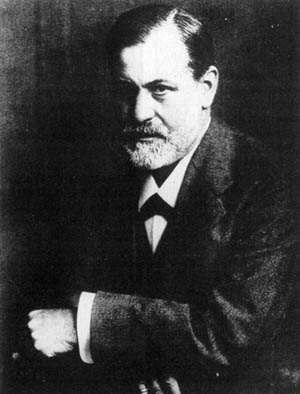
Freud was severely emasculated in both personal ego and in his group ego. He was in fact a practicing homosexual. His relationship with Fliess was homosexual in nature which Freud confessed vowing never to do it again. His group, the Jews, were and are a severely emasculated people. They have been since they walked away from Ur. But on with Freud.
Freud was fond of telling the story of his father and his hat, it seems that Mr. Freud related a story to Sigmund, or Sigismund as he was known then, (His Hebrew name significantly was Solomon) of how when he was a young man walking down the street proudly wearing his new hat, a gentile knocked the hat from his head into the gutter, snarling: ‘Go get your hat, Jew.’
When Sigmund asked breathlessly what his father did, expecting an heroic response, the old gentleman replied: ‘I stepped into the gutter and picked up my hat.’ severely disappointing the young boy.
Since Freud told and retold this story we may be forgiven for believing it had a profound effect on his young conscious and subconscious minds and possibly his ‘unconscious’ too. On the one hand he may have been so ashamed of his father’s very reasonable reaction that he shared his emasculation encapsulating it in his subconscious as a fixation. It is possible that this story either made or contributed to his homosexuality. On the other hand we know for a fact that it inflamed his group ego with an ardent desire for revenge against the gentiles.
As a result of the story he made the Carthaginian Semite, Hannibal, his alter ego. When Hannibal’s father was defeated by the Romans he had his son swear that the would never cease waging war on the Romans until he died. Obviously Freud made his vow against the Europeans although his father didn’t demand it.
It is no coincidence that both Freud and Hannibal were Semites and that the Romans and Europeans were gentiles. Nor is it a coincidence that both Hannibal and Freud were defeated after seemingly winning the war and that rather than fighting the enemy to the end both fled. Now, it therefore follows that Freud never ceased waging war against the Europeans.
You say: How? Come along. I can’t take you into the Inner Sanctum, which way you will have to find on your own, but I can show you some of the records I have been allowed to abstract from the files.
This will involve the secret history of the human race but don’t be alarmed. If you don’t want to believe it you don’t have to. It still is a rousing good story. Besides, if you should ever come around the archives you’ll find it is true.
Freud himself made an attempt to explain a little of the origins of the Jewish psyche in Inhibitions, Symptoms and Anxiety and Moses And Monotheism. The earlier millennia don’t concern us here. The Jews throughout history in their egotism have felt much put upon. This sense of grievance grew until with the expulsion from Spain after the Reconquest their sense of injustice burst into open flames. The group swore revenge on Europe. It must be remembered that at the end of the thirteenth century they were expelled from England, at the beginning of the fourteenth from France and for the duration, well, they were really welcome nowhere.
They swore to stultify Europe. Judaism is the history of messianism.
Sabbatai Zevi.
Zevi- The Last Of The Messiahs
This man was the last great messianic imposter. In 1666, the number of the beast plus a thousand, the Jews of Europe awaited the word from Sabbatai, then at the Ottoman Court to begin the slaughter. But Zevi apostatized to Moslemism instead. The uprising never came off. Hung fire. Fizzled.
Hope beats eternal. The learned Rabbis vowed never to place their hopes on a single individual again. They now concocted a plan for the group to rise as one man in rebellion. The date selected for the revolution was the period 1913-28. You want to give yourself a little leeway there. Born in 1856, in 1913 Sigmund Freud was fifty-seven years old. Although none of his biographers say much about his his Jewish background it is quite clear that he was read in Jewish lore. You may say that he wasn’t a religious Jew but he nevertheless was devoutly Jewish.
Freud quite consciously hated the gentiles for personal reasons that meshed quite well into those of his group identity.
During 1913-17 Freud’s reputation was immense both within and without the Jewish community. It was true his heir apparent, C.J. Jung had broken with him perhaps for this very reason but he and Psychoanalytic Movement had suffered no damage.
In psychoanalyis Freud had the means to instruct his group and control the gentiles. It is said that he gave up hypnotism when he turned to psychoanalysis but as a perusal of ‘Group Psychology’ will show he was preparing for a breathtaking attempt at hypnotizing the entire Western world not unlike that of Burroughs’ Lotharians against their invaders.
Freud lived in Vienna where for years, even decades before 1913, emigrating Jews had flowed through from the entry port into Austria from the East of Brody on their way to America via the North German ports. The prosperity of the whole German shipping lines was built on steerage passengers. Nor were the decisions to emigrate necessarily individual; it may have begun that way but to emigrate was soon organized and directed by the international Jewish community. Check the career of Baron Maurice Hirsch.
The Jewish establishments of both Europe and America provided funding. At about this time provisions were made to transport the entire Jewish population of the Pale, from Lithuania to Romania, to the United States Of America. At the time the international Jewish goverment led by Jacob Schiff and Louis Marshall was located in the United States, New York City. The decks were being cleared so as to remove resistance in America. So as not to call too much attention to the fact by having hordes disembark entirely in New York and Boston, for there would be resistance however feeble, the ports of New Orleans and Galveston were organized to deal with millions of immigrants.
This plan was aborted by the Great War. The Jews had already been at war with Russia, or the Czar as they personalized it, for a hundred years. The international Jewish community had engineered the Russo-Japanese war almost pulling off a revolution in its wake in 1905.
Activities were now intensified. At the time and for about the next sixty years the Jews threw a veil of obfuscation over their activities always denying involvement in Communist or Revolutionary matters. In recent years Jewish scholars, for whatever reason, have now found it expedient to admit that which they were accused of but always denied. They now admit that every national subversive Communist part was over fifty percent Jewish. Those of Russia and Germany were considerably higher. Freud had been involved in Jewish subversive organizations like the B’nai B’rith for many years. As the master psychologist, an expert in the unconscious, he prepared the Jewish mind for the great task of the millennial years in Central and Eastern Europe, which would require much bloodshed, while formulating his psychological plan of conquest not dissimilar from the military plans of his hero, Hannibal.
Freud himself was centered in Vienna. A lieutenant, Abraham, was his man in Berlin while Frerenczi was posted to Budapest in Hungary. The three crucial central European points were covered. Jung in Zurich had split off shortly before this. It is interesting that the Jewish psychoanalytic extablishment spitefully denounced him as a Nazi.
The Jewish millennial years began in 1913. The Great War began in 1914. The Bolshevik Revolution occurred in 1917. Freud’s Introductory Lectures On Psychoanalysis appeared in 1917 also, even though there must have been an extreme paper shortage; it is not a short book. Freud encoded last minute instructions to the Revolutionists in the book.
At this point in 1917 Freud released the inhibitions of millions of Mr. Hydes in Russia, Hungary and Germany. The Bolsheviks took Russia out of the war signing a seemingly humiliating peace treat at Brest-Litovsk. As Lenin said the peace treaty was meaningless because it was his intent to stab Germany in the back.
Germany had a huge Communist Party which it is now admitted was around sixty percent Jewish. Now with the United States in the war, Germany debilitated internally and crippled psychologically, thousands of Jewish revolutionaries intent on the realization of the millennium flowed back into Germany from Russia in hopes of achieving the Revolution there, giddy with the hopes of thereby annexing Central and Eastern Europe. That they didn’t was because of the efforts of the German Volkish groups such as Hitler and his Nazi Party.
The unconscious psychoses of the Jewish people who it will be remembered as a group were suffering from severe emasculation were erupting. Emasculation of the Ego is always expressed in a sexual manner frequently sadistic. Freud had been preaching the practice of unrestrained sexual activity for years. Murder is a sexual act. He was against ‘repression’ you remember.
When Russia began its program of expansion under the Romanovs it annexed an enormous number of nationalities. The Russians then tried to impose their language and manners on the conquered peoples in an attempt to form an homogeneous State. In so doing they emasculated the subject peoples. Those same subject peoples were now the masters of the Russians with permission to indulge their ‘unconscious.’
Jews, Letts, Poles and others let loose. Stalin himself was a Georgian.
Jacob Schiff- PM of the International Jewish Government at this time.
As Jean Genet correctly saw of the Nazi State, in Russia a criminal intellect was now joined to the political and legal apparatus of the State. The criminal code was changed from an objective one to a subjective one; one of vengeance. For a period of years law was suspended in Russia. Amidst the chaos International Jewish organizations including those of the United States operated openly to coordinate their hopes for the millennium.
Bela Kun- Communist Psychopath
What I’m about to say has been denied and suppressed but the example was before both Hitler and Stalin. In Hungary Freud had his man Ferenczi to coordinate the Hungarian Jews. The Jewish Bela Kun (Cohn) seized the government beginning a reign of terror against the gentiles during which thousands of non-Jews were murdered in a horrible sadistic manner commensurate with a severely emasculated Ego.
For some time the Jews had been clamoring for a State of their own. Taking advantage of the chaos in Russia the Jewish American Joint Distribution Committee under the leadership of Schiff and Marshall decided to appropriate the Crimea. Bela Kun who had escaped Hungary during the inevitable reaction, going to Moscow, was sent down to the Crimea to exterminate the population to make lebensraum for the Jews. He was in the process when Lenin died. Stalin then recalled him to Moscow where he was subsequently shot.
All these activities were obscured and suppressed. It is forbidden in American universities to study the subject to this day.
Still, Europe was so horrified that they declined to discuss it or even acknowledge it. But Hitler and Stalin remembered.
The Communists in Moscow being composed solely of emasculated peoples functioning from Freud’s vision of the unconscious like so many Hydes conducted a criminal homosexual style State that would have delighted Genet had he been there. The author the The Thief’s Journal would have gasped at the warehouses full of stolen furs, diamonds and other jewels, art objects and whatever of value that the poor emasculated wretches had stolen from their murdered victims. It was the triumph of the Common Man.
As soon as Stalin gained power he began to discredit and remove Jews from influential positions. Trotsky was sent to a malarial swamp in Siberia to die but from which he escaped to be killed by Stalin’s assasins later. As Stalin consolidated his power he acted more directly until he held the famous show trials of 1936. He then began the systematic elimination of Jews which resulted by the end of 1945 in the death of millions.
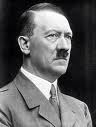
Adolf Hitler

Joseph Stalin
Thus Hitler, an emasculated man leading an emasculated people had the Judaeo-Communist example before him. As an avid anti-Communist and open anti-Semite he was virtually isolated by the world that by 1936 was under the control of Judaeo-Communists. He was the antagonist not the protagonist.
While Stalin who had religious training was clever enough to seemingly work through the system openly followed legal controlled methods although the law had been subordinated to his ends. Hitler acted as a homosexual with an ax in his hand. Stalin’s officers dispatched prisoners hidden in the depths of the Lubyanka with a bullet in the back of the head, which method, by the way, was favored by Jewish and Italian members of Organized Crdime in America of the time, while the Nazis brutally beat prisoners, finally shooting them in the back while escaping.
Stalin, Hitler, Freud, which was worse? Freud enabled, Stalin and Hitler executed. They were all the same.
In Russia during the first year or so of Lenin some Russian workers were being read to as they worked. Were they being read the works of Marx or Lenin? No. They were being read the Tarzan novels of Edgar Rice Burrougs. This infuriated the Politburo. The State was trying to impose a collectivist unconscious psychology on the Russians while Burroughs and his great psychological projection were individualist and responsible. In fact, Burroughs offered a concept of the unconscious which was directly opposed to that of Freud. One might say that Burroughs was Dr. Jekyll to Freud’s Mr. Hyde.
Burroughs himself had been severely emasculated at the age of nine. The situation seems to be this: Burroughs came from a prosperous Chicago family. His parents were very proud of their English ancestry. If you’re unwilling to understand national and racial prejudices that were very pronounced at the time then you probably won’t be able to understand. There were strong feelings between the Anglo-Saxon and Celt or English and Irish. The Anglos considered the Celts if not inferior at least eccentric. The Burroughses employed two Irish girls as servants. In all probability Young Burroughs assumed an attitude of superiority which the girls resented. They then concocted a plan to cut young Burroughs down to size.
They had a friend or relative by the name of John who was aged twelve to Burroughs’ nine. Being much larger and tougher than Burroughs he stopped the younger boy on the way to school one day where he thoroughly intimidated and terrified him. It is quite possible that Burroughs messed his pants. In any event, he suffered severe emasculation that was to haunt him all his life. He does not seem to have ever practiced homosexuality although he was haunted by a feeling of sexual ambiguity.
The incident with John the Bully not only played havoc with Burroughs personal psychlogy in the narrow sense of creating a psychosis but there was also an effect in what Freud’s erstwhile associate, C. J. Jung called the collective unconscious. The individual is limited by his very humanity to a small number of general responses.
Thus Burroughs was given a cast of mind which the Hindus denoted as Shivaistic. This is a general outlook or philosophy of life, if you wish, which one adopts unconsciously as the consequence of one’s experience. I share it although it took me nearly a lifetime to recognize and accept it.

Edgar Allan Poe- The Father Of Modern Literature
Burroughs himself was aware of the fact by at least 1931 when he wrote Tarzan And The Leopard Men. In one key or on one level the story is one of Shiva and Kali his consort. Burroughs names his heroine Kali while she is selected to be the White Goddess of the Leopard Men as part of their death cult.
As can be seen by their complete disregard for life Freud, Hitler and Stalin were also Shivaites.
Shiva and Kali are the Hindu representation of Life and Death. Shiva plays unconcernedly on the pipes while the carnage of life and death goes on around him. The song goes on. Kali, his consort, the goddess of death and regeneration dances on the bodies of the dead to Shiva’s music while wearing a necklace of skulls. Death means nothing because she as the eternal mother has the means to multiply unendingly. Do multitudes die? Why then, multitudes die. Not to worry. Life goes on.
Burroughs also developed an interest in psychology in his attempt to free his mind of the fixation given him by John the Bully. As his psychological notions were well formed by 1911 when he began to write in his attempt to expiate his guilt it follows that he acquired his knowledge during his early married years from 1900 to 1911. He married at 24. He had little opportunity to do his reading before then as the major works were only appearing in the late ’90s.
His main concern was the subconscious mind. While his evolutionary ideas are easier to trace he has left no mention of his psychological reading. It seems certain that he was familiar with FWH Myers who, as noticed, first defined the notion of the unconscious in 1886. He must have read James while Freud’s notions would have been discussed, if not yet translated; thus DH Lawrence had highly developed ideas on the Freudian unconscious in his 1911 Psychoanalysis And The Unconscious while I doubt Burroughs had read Freud in the German.
Also it seems probable that Burroughs had read Le Bon.
Burroughs’ idea of the unconscious differed greatly from Freud’s while being more soundly based in the actual functioning of the mind. While Burroughs’ hero Tarzan seems to function with an integrated personality from his creation in 1911-12 Burroughs himself came very close to integrating his own from 1913 to ’17 or may have although he always had trouble with his Animus and Anima.
Even though Freud advertised the fact that he had taken a year off (golly, a whole year) for self-analysis, whatever the results may have been he never succeeded in integrating his personality or, apparently, realized he should have. He was severely conflicted all his life. Just take a look at his photo where you can see that huge welt running from his lover right cheek across his nose into his forehead. That was caused either by excessive cocaine use or mental conflict in the brain stem, probably both.
As did all mythographers, Burroughs had read his Poe, like them he was concerned with the conscious and subconscious minds. While Stevenson’s Jekyll lost his conscious mind in his subconscious mind, Burroughs cencentrated on the concept of the beast within the man, the relationship between the conscious and the subconscious. In Chapter 3 of The Return Of Tarzan, in what appears to be a plagiarization of the murder scene of Poe’s Murders In The Rue Morgue, Burroughs has Tarzan act out the parts of both the Sailor and the Orang.
Lured up to the apartment on the pretext of helping a young woman, Tarzan is set upon by her accomplices. Discarding the trappings of his recently acquired civilization Tarzan reverts to his anthropoid education of the Jungle becoming Poe’s Orang, yet always retaining the restraints of his humanity or the Sailor.
When the police come he leaps out the window to a telephone pole which one imagines were more common in Chicago than Paris. (Burroughs had never been to Paris so he replicated the urban scene he knew.) While still in his ape guise he has the sense to look down where he sees a policeman below so he climbs up leaping to a rooftop.
Racing across the rooftops of Paris he climbs down another pole. Then in a Hyde-like transformation back to Jekyll he shakes himself from his ape self back into his human self, without the aid of drugs, enters a restaurant to clean up in the rest room then saunter jauntily down the street as though nothing had happened.
Thus the plagiarization of not only Poe but Stevenson was merely an attempt to give a better solution by using the mythological symbols.
Return was written at the end of 1912 and the beginning of 1913.
Burroughs’ own self-analysis would continue through his astonishing output of 1911-17 when he finally integrated his personality with the final volume of his Mucker Trilogy published as the Oakdale Affair but alternately titled Bridge And The Oskaloosa Kid which is the better title. At that time he had exorcised his major fixations which should have integrated his personality.
In understanding that the disintegration of the personality was caused by an affront or affronts to the Ego or Animus that resulted in the creation of fixations that festered in the subconscious that in turn manufactured affects that evidenced themselves in various physical and psychological ways he realized that the same could be exorcised returning the Ego to a whole state.
Unfortunately he strung his theory on through a couple dozen works of fiction disguised as incident. A very few would read all the novels while the only possible interpreters could be those who had read them all not only with a psychological background but an open, inquisitive mind. We’re a very small minority.
If I hadn’t been through the same process on my own I probably never would have recognized it. However as his theories were embodied in his hero Tarzan as mythology they passed into the unconscious of his readers of which, as a teenager, I was one, so shall we say, my mind was prepared.
Part 2 Something Of Value I
October 14, 2007
Something Of Value I
Part 2
by
R.E. Prindle
Back To Solid Ground, More Or Less
At the same time Stevenson and Haggard appeared, another of the great mythographers made his appearance. Arthur Conan Doyle brought his great psychological projection Sherlock Holmes onto the world stage. Doyle listed Poe as his second most influential author with whom he had been familiar since his youth. All the great mythographers were well acquainted with Poe. He was the great originator.
Holmes is the first great psychological projection of the Scientific Consciousness. He fulfills the role of Mastermind. His intellectual greatness fulfilled Poe’s dictum of the analytical mind.
As the two Dupins fulfilled the roles of ego and alter ego so Doyle gave Holmes Dr. John H. Watson as alter ego and foil. Holmes represented the future while Watson was a relic from the religious past. As the evil Hydelike representative of the subconscious Doyle provided us with the infamous criminal mastermind Dr. Moriarty.
With the introduction of Holmes the Scientific mythology began to take shape.
The new mythology was based on the new discoveries of science. The scientific mind was pouring out new technological wonders almost on a daily basis but it was the discoveries in the sciences of biology and psychology that would most undermine the Religious Consciousness.
Darwin had organized biology along the new scientific lines when his Origin Of Species appeared in 1859. There was no greater challenge to the orthodox belief system than this. When a few years later Darwin issued The Descent Of Man things really erupted. According to the religious viewpoint, since the origins of consciousness the notion had been that man was descended from the gods, later monotheistically amended to God. In a really inept choice of words Darwin states, or his followers did, that man was descended from monkeys. The idea of evolution might have met with less reistance had Darwin titled his book: The Ascent Of Man since, properly speaking, Homo Sapiens is an advance on monkeys and all that has gone before. Thus man could have been said to ascend the evolutionary scale from apes but descend from God meeting somewhere in the middle. Darwin wasn’t so farsighted.
At the same time great advances were being made in psychology. The Frenchman, Jean Martin Charcot, was proving the effect of the subconscious on our minds in his studies of hysteria and hypnosis. The sub or unconscious mind had been a topic of consideration since the days of the Enlightenment but discussion was carried on in vague terms. In 1886 the English psychologist FWH Myers identified the subconscious by the name of the Unconscious preparing the way for Freud who would set the world on its psychological ear the way Darwin had its biological ear.
The way was now prepared for one of the two greatest mythographers, H.G. Wells (1866-1946). Wells had a split personality. On the one hand he was a mythographer and on the other he was a Red/Liberal/Utopian. In 1920 the Utopian side won out and he became a whole-hearted Revolutionist.
Wells began writing about 1893. His early work was in the genre of scientific fantasias, as they were called at the time, of which genre he is said to be the founder. Wells noted quite correctly that about mid-century a new type of scientific man became increasingly apparent.
Let there be no mistake but that a few centuries earlier these scientific disturbers of the peace would have been murdered. The reaction by the beginning of the twentieth century was that science was evil and ought to be stopped. George Griffith, himself writing a scientific fantasia for Pearson’s Magazine, Stories Of Other Worlds, put these words into his heroine Zaidie’s mouth as she was on the way to Mars:
“They’re very ugly aren’t they?” said Zaidie; “and really you can’t tell which are men and which are women. I suppose they’ve civilized themselves out of everything that’s nice, and are just scientific and utilitarian and everything that’s horrid.”
And Zaidie was a sweet thing too. Against an even more hostile background Wells understood that tempers against science were running high but he came down on the side of the New Men. In his interesting fantasia The Food Of The Gods he postulates that the new men had perhaps been fed some new synthetic food which made them intellectual and physical giants.
Actually they had been around for centuries but had been suppressed by the Religious Consciousness in the form of the Judeo-Catholic religion. As their forces gathered in the sixteenth and seventeenth centuries they became strong enough to defy the Judeo-Catholics. Thus when the evidence of their emergence became evident in mid-nineteenth century they were already too numerous and too strong to be set aside. The two consciousnesses came into conflict with the Religious Consciousness splitting into the reactionary Devout group and the other the more forward leaning Red/Liberals.
Thus Wells on his Utopian side became the advocate of a form of the Religious Consciousness as he struggled with his Scientific Consciousness. After the Russian Revolution he wholeheartedly went over to the revolution.
While very influential on subsequent mythographers Wells was unable to create a psychological projection of his own while after 1920 he became a member of religious communism turning out politico-religious tracts.
Emerging at about the same time as Wells the Irishman Bram Stoker contributed the master psychological projection of the twentieth century in his masterwork, Dracula while E.W. Hornung (1866-1921) created the minor projection, the Amateur cracksman- A. J. Raffles. A cracksman was a burglar; Raffles was the archetype of the gentleman thief. While Raffles himself has virtually disappeared from the collective memory the notion of the gentleman criminal has taken hold on the mythological consciousness. Raffles is not to be confused as a version of the earlier Robin Hood who ‘stole from the rich to give to the poor.’ No, Raffles unashamedly kept and spent all the proceeds.
In the background all this time the greatest of the creative mythographers, Edgar Rice Burroughs (1875-1950) was waiting for his consciousness to mature. It matured in 1911 when he first created John Carter of Mars then followed up with the prodigious psychological projection of Tarzan Of The Apes. Shew, bigger than an A-bomb.
Burroughs was the plateau to which all other roads led and from which all other roads proceeded. He managed to consolidate all the mythological trends of the previous decades into his work where he refined and perfected them sending them on to new heights.
Edgar Rice Burroughs. To coin a cliche, Burroughs was an enigmatic figure. While himself a great original writer he managed to incorporate the various strands of the myth into his writing in such a way, either clumsy or tributary, as you wish, that he stands accused of being a plagiarist. This is nonsense of course. Like any mythographer he had to work with established materials. Myths are not original– they are cooperative efforts. The great Greek cycle, of which Homer is the center, was the work of many hands. The fact does not diminish Homer’s contribution.
Burroughs was able to incorporate the two most significant disciplines of psychology and evolution into his work in such an entertaining manner that the seriousness of his thought was lost in the glamour.
While the sources of Burroughs’ evolutionary ideas which will be discussed in Part II, are relatively easy to trace his psychological sources are more difficult. That he had already thought deeply on psychological matters before he began writing is obvious. That he continually added to his learning in psychology as well as evolution is clear from the development of his thought throughout the corpus.
Burroughs was especially concerned with the nature of the unconscious. He was an intelligent man who knew that his own behavior was controlled from his subconscious. I am certain that he was familiar with the 1886 work of FWH Myers, as well as Myers’ 1903 work Human Consciousness. As Freud was not translated into English before 1912 it seems certain that he had not had direct contact with the man’s work before then, however, by 1916 in his short story ‘Tarzan’s First Nightmare’ it seems evident that he had read at least The Interpretations Of Dreams.
Still, Burroughs had considerable contact with practicing psychologists as he indicated in The Gods Of Mars.
As the notion of the unconscious was discussed in various journals he very probably had read a number of articles, while as the notion of the Freudian slip was current in the second decade of the twentieth century he may have been familiar with Freud’s Psychopathology Of Everyday Life.
At any rate his writing of that decade drove relentlessly toward the goal of integrating his personality which is to say unifying the subconscious and conscious minds which he succeeded in doing by 1917 when he published The Oakdale Affair or, as alternatively titled, Bridge And The Oskaloosa Kid.
In his portrayal of the big Bwana, Tarzan has an integrated personality from his beginning in 1912. In his other works Burroughs constantly offers many portrayals of the subconscious.
The contrast between the conscious, or intelligent mind, and the unconscious, subconscious or ‘instinctive’ mind is one of the central tenets of the myth.
For Burroughs the study of the subconscious was to liberate, for Freud it was to subjugate the human will. Make no mistake, I consider Freud an evil presence while being the most destructive force of the twentieth century equal to any number of atomic bombs. Freud’s notion of the subconscious as a Hydelike repository of horrid repressed criminal needs was very mistaken.
One has the feeling that Freud learned much more about the human psyche than he told and that he told what he did with ulterior motives in mind. Those ulterior motives did not go unnoticed at the time. As D.H. Lawrence expressed it is his Psychoanalysis And The Unconscius of 1911:
And does it need a prophet to discern that Freud is on the brink of a Weltanschauung- or at least a Menschenschauung, which is a more risky affair? What detains him? Two things. First and foremost the moral issue. And next, but more vital, he can’t get down to the rock on which he must build his church.
Actually the unconscious was the rock but another rock was how to turn the basis of psychoanalysis, which is emasculation, into something palatable. Freud stumbled over his concept of castration which he was apparently sincerely unable to extend into the workable concept of Emasculation. The Castration Complex is only a symbol for Emasculation. And then there was the difficult moral issue. Lawrence again, same work:
First and foremost the issue is a moral issue. It is not here a matter of reform, new moral values. It is the life and death of all morality. The leaders (Freud, Ferenczi, Abraham) among the psychoanalysts know what they have in hand. Probably most of their followers are ignorant, and therefore pseudo-innocent. But it all amounts to the same thing. Psychoanalysis is out, under a therapeutic disguise, to do away entirely with the moral faculty in man. (My italics.)
Lawrence put his finger on the criminal intent. Freud was in fact running an Order in which one learned the true intent as one moved from initiate to adept. Freud in fact did wish to destroy the concept of Christian, that is to say European morality, and he had his reasons. But why the ‘unconscious’, why something which in his vision lies outside, even beyond, our minds, some alien evil force which controls our actions against our will. Lawrence persists:
It is obvious we cannot recover our moral footing until we can in some way determine the true nature of the unconscious (Percipient O!) The word unconscious itself is a mere definition by negation and has no positive meaning. Freud no doubt prefers it for this reason. He rejects subconscious and preconscious, because both of these would imply a sort of nascent consciousness, the shadowy half-consciousness which precedes mental realization. And by his unconscious he intends no such thing. He wishes rather to convey, we imagine, that which recoils from consciousness, that which reacts in the psyche away from mental consciousness. His unconscious is, we take it, that part of the human consciousness which though mental, ideal in its nature, yet unwilling to expose itself to full recognition and so recoils back into the affective regions and acts there as a secret agent, unconfessed, unadmitted, potent, and usually destructive. The whole body of repressions makes up our unconscious.
Here Lawrence states the obvious, there is no such thing as the unconscious. There is a subconscious that he rightly understands Freud to have rejected for ulterior motives. A subconscious is part of us which can be dealt with while an unconscious which is metaphysical cannot, it therefore follows that there cannot be an unconscious which would be a religious symbol, or in other words, supernatural.
However Lawrence while he scoffs seems to understand the function or a function that Freud gave to his unconscious which is in fact partially true of the subconscious. ‘The whole body of repressions makes up our unconscious.’ Not a fact because when the personality is integrated and fixations or what Freud call repressions disappear there is still a function to the subconscious which is unrelated to the fixations or repressions. I believe repression to be an inaccurate term. Rather what Freud calls repressions are fixations. A Challenge that the mind finds overwhelming is received and perpetuated as a fixation in the subconscious that in its control of the personality appeared to Freud as repression. Freud repeatedly reports the symbol as the fact whether through misconception or in intent to deceive is not always clear.
What is clear is that as Lawrence perceived so clearly in 1911 was Freud’s intent to destroy morality in a Jekylllike intent to release the Hydelike repressions on the world. In this he succeeded quite well. Much to his own injury. Just as Hyde brought destruction on himself so Freud brought destruction on the Jews in this Jewish millennial period.
At this point it might be instructive to examine an aspect of the intellectual milieu in which Freud developed. A large part of personal psychology is integral in one’s group psychology and general psychology as in, for instance, education. By education I do not mean schooling per se, but all the influences which constitue character formation.
Freud’s father came from the area of the Pale known as Galicia. This area is very close to the homeland of the ecstatic variant of Judaism known as Hasidism, and in fact his father was a Hasid. This sect arose out of the period of the last great messianic individual, Sabbatai Zevi. This man was active during the period 1640-66. As might be expected in group psychology when the Day approaches the faithful raise their expectations, growing elated, becoming forgetfull of niceties. This is what happened to the Jews of the southern Pale in 1648. As auxiliaries of the Poles who had conquered the Ukraine the Jews suffered the same fate as the Poles when the Ukrainians revolted. this massacre occurred at the same time as the expected millennium which was a complete contradiction in terms, or in other words, how mysterious can the ways of God be? Then in 1666 the whole millennial illusion collapsed when Zevi failed as a messiah.
One result of the failure was the attempt to regenerate Judaism by means of ecstatic Hasidism. By all rights Yahvey, not for the first time, having failed his people should have been renounced. The Jews couldn’t do this. There was also a second effect. Out of the wreckage of Zevi a man named Jacob Frank evolved another strain of Judaism in which he said that the age of the millennium would never appear until the Jews had exhausted their proclivity for evil. It was therefore necessary for Jews to indulge in whatever evil impulses they had to purge their systems to make way for the good or millennium.
Here also is where the Jewish notion of good arising from evil finds its clearest expression. Jewish ideas are never distinct from the ideas of the general community, in this case European. A European reaction to Judaeo-Catholicism had been going on for centuries passing through many manifestations such as the Beggars, the Free Spirtis, Anabaptists and others. All of these like the Frankists believed, like Freud, in the free expression of subconscious impulses.
Now joined by the Frankist notions after the beginning of the eighteenth century the basis of the Revolution was formed.
By mid-eighteenth century many of these groups, now styled Libertines, were functioning openly in England and on the Continent. Perhaps the most famous organization representing these beliefs which were integral to the Revolution which had been developing for centuries were clubs like the Hell Fire Club of England.
These groups of people were quite extreme. Their credo was startlingly expressed in Tobias Smollett’s 1748 novel Roderick Random. Note the date, which is just before the destruction of the notorious prisons, Newgate in England and the Bastille in France. Smollett’s novel is forty-one years before the outbreak of the French Revolution which was supported in England by members of these clubs.
Smollett’s hero, Roderick Random, was introduced into the home of one of these incendiaries to whom he attribute the following poem:
Thus have I sent the simple king to hell
Without or coffin, shroud or passing bell.
To me what are divine or human laws?
I court no sanction but my own applause!
Rapes, robb’ries, treasons, yield my soul delight;
And human carnage gratifies my sight;
I drag the hoary parent by the hair,
And toss the sprawling infant on my spear,
While the fond mother’s cries regale my ear.
I fight, I vanquish, murder friends and foes;
Nor dare the immortal gods my rage oppose.
Sound like any two revolutions you may have heard of? The above pretty much defines Freud’s intent in his use of the subconscious while forming the framework of his personal Weltanschauung. Whether Freud was consciously aware of these notions or whether they were part of his subconscious is open to question. Much of the education of this sort is absorbed on the subliminal level perhaps never being or becoming conscious. Most of this primal education is buried so deep that one is never aware of its source. I scoff at Freud’s claim that he was able to analyze himself in just one year at the turn of the century.
Now, the majority of Freud’s thought was completed by the time he published his Introductory Lectures In Psycho-Analysis in 1917 just before the Bolshevik Revolution. In order to explain the results of the Freudian ideas of the ‘unconscious’ let me provide a framework by moving ahead a little.
What we are talking about here is the context of Freud’s notion of the castration complex. Castration is a specific symbol while the generalized concept is Emasculation. the Castration Complex is not even an affect but only a symbol. If Freud was aware of the generalized Emasculation concept he nowhere lets us know. Emasculation is caused by an unresolved affront to the Ego from which all men and women suffer to some degree.
The scapegoat for our sins or arch-villain of all time as some would have it was and remains Adolf Hitler. Hitler was seriously emasculated. Having read all the major Hitler biographies while delving is some detail into the hisory of post-Great War Germany I was at a loss to explain the man and his time down to the Rock of his Church. Having folowed through on Freud’s notion of the Castration Complex exlucidating it into the Emasculation theory I came across the novels of that most horribly emasculated and repulsive figure in modern literature, Jean Genet.
For those not familiar with Genet, he wrote plays which I have not read and five novels I have which I list: Our Lady Of The Flowers, The Miracle Of The Rose, Funeral Rites, The Thief’s Journal and Querelle Of Brest.
Genet was a vicious homosexual and criminal which is to say he was completely emasculated. He wore women’s dresses but not as a transvestite. Any self-respect he had was totally negative. However, it is possible to recognize something of oneself in his hurt. He knew how to universalize his anguish. His degradation gave him some insight into his times and its personalities. He traveled in Nazi Germany between 1930 and 1940.
While not using these terms he understood and applauded the criminal annexation of Law and government to the uses of Freud’s concept of the unconscious or, in another word, criminality. The criminal nature of the regime was so in accord with his own perversions that he had no desire to thieve as such crimes seemed to him to be no insult to society in Germany.
It seemed to him that Hitler was one with himself in his desires.
I don’t believe Hitler was a practicing homosexual but he was emasculated to the point of deformity. Which is what I suppose revolted his contemporaries so. However, as all emasculation is expressed in a variant homosexual manner, self hatred being a form of homosexuality, one may believe that he was a ‘latent’ homosexual. One wonders about his relationship with Hindenburg; what exaggerated respect and smoldering resentment must have been there.
In may ways Genet forms a link between the ante and post WWII worlds. In his own goals and aims he was peculiarly related to Freud.
Shortly after the Great War Freud wrote ‘Group Psychology And The Analysis Of The Ego.’ The essay is applied Freudianism; it doesn’t do you any good to have the scientific knowledge if you don’t apply it. Man has his individual ego while sharing it in one or more group egos. The question then becomes how does one engineer the individual ego into a group ego so that the individual within an artificial group can achieve your desired political ends will he nil he, hypnotized as it were.
Freud tackles this problem in Group Ego. The book raises several interesting questions. Freud based this work on an 1895 study by the Frenchman Gustave Le Bon titled: The Crowd: A Study Of The Popular Mind. Le Bon’s was a seminal work still in print after 110 years. He might be said to have originated the concept of group psychology which Freud appropriated.
‘Group Psychology And The Analysis Of The Ego’ is virtually the Crowd rewritten with better organization and definition. At the risk of quoting too extensively I have abstracted several quotes from Le Bon used by Freud in Group Ego which form the basis of Freud’s essay. Le Bon’s book may be illustrative of the manner in which Freud built several of his
The most striking peculiarity presented by a psychological group is the following. Whoever be the individuals who compose it, however like or unlike be their mode of life, their occupations, their character, or their intelligence, the fact that they have been transformed into a group puts them in possession of a sort of collective mind which makes them feel, think and act in manner quite different from that in which each individual of them would feel, think and act were he in a state of isolation. There are certain ideas and feelings which do not come into being, or do not transform themselves into acts except in the case of individuals forming a group. The psychological group is a provisional being formed of heterogeneous elements, which for a moment are combined, exactly as the cells which constitute a living body form by their reunion a new being which displays characteristics very different from those possessed by each of the cells singly. (p. 29)
It is easy to prove how much the individual forming part of a group differs from the isolated individual but it is less easy to discover the causes of this difference.
To obtain at any rate a glimpse of them it is necessary in the first place to call to mind the truth established by modern psychology, (1895) that unconscious phenomena play an altogether preponderating part not only in organic life, but also in the operations of intelligence. The conscious life of the mind is of small importance in comparison with its unconscious life. The most subtle analyst, the most acute observer, is scarcely successful in discovering more than a very small number of the conscious motives that determine his conduct. Our conscious acts are the outcome of an unconscious stratum created in the mind mainly by hereditary influences. The substratum consists of the innumerable common characteristics handed down from generation to generation, which constitute the genius of a race. Behind the avowed causes of our acts there undoubtedly lie secret causes that we do not avow, (The issue is not issue, Mark Rudd) but behind these secret causes there are many others more secret still, of which we ourselves are ignorant. The greater part of our daily actions are the result of hidden motives which escape our observation. (Ibid. 30
A necessary transition note from Freud. (Page 8, Group Psychology). ‘Le Bon thinks that the particular acquirements of individuals become obliterated in a group, and that in this way their distinctiveness vanishes. The racial unconscious emerges, what is heterogeneous is submerged in what is homgeneous. As we should say, the mental superstructure, the development of which in individuals shows such dissimilarities is removed, and the unconscious foundations, which are similar in everyone, stand exposed to view.
In this way individuals in a group would come to show an average character. But Le Bon believes that they also show new characteristics which they have previously not possessed, and he seeks the reason for this in three different factors.’
Freud quoting Le Bon again:
The first is that the individual forming part of a group acquires, solely from numerical considerations, a sentiment of invincible power which allows him to yield to interests which, had he been alone, he would perforce have kept under restraint. He will be the less disposed to check himself, from the consideration that, a group being anonymous and in consequence irresponsible, the sentiment of responsibility which always controls individuals disappears entirely. (Ibid. 33)
The second cause, which is contagion, also intervenes to determine the manifestations in groups of their special characteristics, and at the same time the trend they are to take. Contagion is a phenomenon of which it is easy to establish the presence but which it is not easy to explain. It must be classed among those phenomena of a hypnotic order, which we shall shortly study. In a group every sentiment and act is contagious, and cantagious to such a degree that an individual readily sacrifices his personal interest to the collective interest. this is an aptitude very contrary to his nature, and of which a man is scarcely capable, except when he makes part of a group. (Ibid. 33)
A third case and by far the most important, determines in the individuals of a group special characteristics which are quite contrary at times to those presented by their isolated individual. I allude to that suggestibility of which, moreover, the contagion mentioned above is also an effect.
To understand this phenomenon it is necessary to bear in mind certain recent physiological discoveries. We know today that by various processes an individual may be brought into such a condition that, having entirely lost his conscious personality, he obeys all the suggestions of the operator who has deprived him of it, and commits acts in utter contradiction with his character and habits. The most careful investigations seem to prove than an individual immersed for some length of time in a group in action soon finds himself– whether in consequence of the magnetic influence given out by the group, or from some other cause of which we are ignorant– in a special stae, which much resembles the state of ‘fascination’ in which the hypnotized individual finds himself in the hands of the hypnotizer.
…The conscious personality has entirely vanished; will and discernment are lost. All feelings and thoughts are bent in the direction determined by the hypnotizer.
Such also is approximately the state of the individual forming part of a psychological group. He is no longer conscious of his acts. In his case, as in the case of the hypnotized subject, at the same time that certain faculties are destroyed, other may be brought to a high degree of exaltation. Under the influence of a suggestion, he will undertake the accomplishment of certain acts with irresistible impetuosity. This impetuosity is the more irresistible in the case of groups than in that of the hypnotized subject, from the fact that, the suggestion being the same for all individuals in the group, it gains in strength by reciprocity. (Ibid. 34)
We see, then, that the disappearnce of the conscious personality, the predominance of the unconscious personality, the turning by means of suggestion and contagion of feelings and ideas in the identical direction, the tendency to immediately transform the suggested idea into acts; these, we see, are the principal characteristics of the individual forming part of a group. He is no longer himself, but has become an automaton who has ceased to be guided by his will. (Ibid. 35)
The remainder of Freud’s Group Psychology is the application of Le Bon’s observations as a manual for psychologically manipulated groups through hypnosis and suggestion to achieve an agenda. I will repeatedly refer to Group Psychology in Freud’s plan hereafter. While it is clear that Freud read Le Bon’s 1895 book absorbing much, the book was immediately translated into English in 1896 where it became accesible to a world public, it is therefore probable that a number of other people read the book taking what they needed for their purposes.
One of these may very well have been Edgar Rice Burroughs. I know of no way of determining the fact that he read the book but one asks is there any evidence in his novels that would indicate that he had. I’ll be darned, there is. As I said, because of the frivolous nature of the novels one dismisses Burroughs as an uneducated fantasist. He himself said that he would take a political or social idea and highly fictionalize it into something else. If one reads his 1914 novel Thuvia, Maid Of Mars one finds a story suspiciously like Le Bon’s ideas in The Crowd but highly fictionalized.
Burroughs’ psychological ideas are difficult to trace but well developed. Throughout his corpus Burroughs is well informed about hypnosis. It appears to be a subject he gave special attention to. Le Bon’s ideas are based on group hypnosis. In Thuvia the hero finds his way to the Martian kingdom of Lothar. He engages his invaders in a battle with the Lotharians. The city walls of Lothar are manned by innumerable bowmen firing arrows on the Green Men of Mars. The field is strewn with dead Green men killed by the arrows of he phantom bowmen.
The fight ending the hero looks away for an instant breaking eye contact with Lothar. When he looks back the field is strewn with dead Green Men but the arrows are gone. Wondering about this he looks back at Lothar to find the bowmen are gone too.
As it turn out the Lotharians no longer exist in physical form but are merely psychological projections who have learned to mass hypnotize their enemies into believing that they do exist and are shooting real arrows. Their enemies believe they are real arrows and so die by them.
Thus it is quite possible that in Thuvia we have a fictionalization of Le Bon’s ideas which Burroughs must have picked up from the 1895 book converting them into fiction in 1914 well ahead of Freud and Hitler.
Oh yes. Him again. Hitler. Whether historians would agree that Germany was ‘stabbed in the back’ or not, it was universally believed by Germans, especially by Hitler, and they and he acted on that belief. Thus the psychic injury suffered by the privations of war, the loss of the war, and the belief that victory had been taken from them by traitorous means made a curious form of group emasculation of the collective ego shared by each individual creating the conditions for a group psychology which under the influence of a hypnotizer they would not be responsible for their acts. The group ego is where the emasculation occurs being then relegated to the group subconscious where it surfaces under various names and impulses. As the American Jew Mark Rudd was to say in respect to his group’s post-WWII emasculation: The issue is not the issue. In other words, their complaint was the disguise for their emasculation which is what they were really trying to address.
Jean Genet was not a philosopher or a politician so that he did not understand that Hitler was not the protagonist but the antagonist. He was not acting but reacting. What was he reacting to? Let’s go back to Freud.
End of Part 2. Go To Part 3
 I, Dynamo