A Review
Woman
by
Alan Clayson
Yoko Ono And The Men Who Influenced Her
Review by R.E. Prindle
Clayson, Alan: Woman: The Incredible Life Of Yoko Ono, Chrome Dreams, 2004.

Girlish Yoko- Warhol School by Richard Bernstein
Yoko Ono involved herself with several of the most influential men in the arts during the sixties, seventies and eighties of the twentieth century. She drew her inspiration from them patterning her own efforts after them. At the same time she was one of the leading feminists of the day having her share in shaping and furthering the movement. The mantra was female liberation, equality between men and women. In fact women were equal to men in the West but only by acknowledging the biological differences between men and women. The fact is the differences are real and not social constructs as women would have us believe. The fact is women are women and men are men. So, in seeking ‘female liberation’ feminists were seeking much more than ‘equality’ however the term may be defined.
The fact is that in the Ages old war between the sexes feminists are seeking to restore the Matriarchy and destroy the Patriarchy. That is why many men favor feminism, they prefer the Matriarchy. Thus the feminists are atavistic. Yoko and her cohorts wished, in her words, to restore ‘heart’ as she viewed the Matriarchy and eliminate ‘reason’ as she viewed quite rightly the basis of Patriarchalism. Nevermind that bilogical science has invalidated the concepts of Matriarachy and Patriarchy. This is a post Matriarchy and Patriarchy world.
Circa -2000 in the West men revolted against the mind stifling Matriarchy and the vaginal swamp of the ‘heart’ seeking to establish

Smilin' Jack Cage
the authority of the infinite power of the mind of Zeus on ethereal Olympus. This is the story of Homer’s Iliad and Odyssey and the Greek myths in general recording the struggle.
The Western male was able to impose the ascendency of reason over the heart for 3000 years until the disestablishment of the old order by science about mid-nineteenth century. The center could not hold during this period of extreme change as W.B. Yeats put it as the rearrangement of the intellectual order moved into the twentieth century.
Yoko Ono sought with her feminist fellows to return to the biological innocence of 2000 BC. She herself had no talent. Filled with audacity she pitted her ‘heart’ against the reason of John Cage, Andy Warhol and John Lennon. I’m sure she had a mentor for her so-called performance art but I am as yet unaware of who he may be. Perhaps Maciunas and the Fluxus group.
Thus her first manifestation as an artist was based on the musical ideas of John Cage while her artistic efforts were at least based in the avant garde ideas of the Fluxus group. Her first assault on the NYC art world failed so in 1961 she returned in defeat to Japan. When she returned to NYC in 1964 she found an entirely different art scene. On the musical side the focus was on Bobby Dylan and the Beatles while on the artistic side Andy Warhol and his Factory had destroyed the Abstract Expressionists and the old avant garde. Dylan, the Beatles and Warhol had in fact usurped the avant garde which now had little meaning. From my point of view held at the time the avant garde had ceased to exist. Of course I didn’t understand exactly why or how.
From 1964 when Yoko returned to NYC until 1966 when she left for London I’m sure Yoko was at a loss. She developed her silly

The Bag Yoko And Tony Are In
notion of Bagism at this time even having a black bag on a stand in Max’s Kansas City that some one or ones were supposed to slide into. This seems to have been thought a lame idea at the time as it seems now.
At this time while retaining allegiance to John Cage’s musical ideas she was falling under the influence of Andy Warhol’s artistic notions. Warhol’s intent had been to destroy the idea of ‘fine art’. In this he pretty well succeeded. As Yoko expressed it you didn’t need any talent to be an artist. She seems to demonstrate this notion in her own artistic efforts. Warhol had also redefined the notion of film with his static studies. He then sought to combine his film ideas with live music, probably in competition with Bob Dylan who was also attempting to move in that direction. Warhol adopted Lou Reed and his band the Velvet Underground as the Factory house band while creating a multi-media show called the Exploding Plastic Inevitable, innovative for its time. Thus a concert at his hall, the Dom, was an ‘experience.’
While Yoko makes no mention about how this, actually, incredible development affected her there can be no doubt that she was well aware of Dylan, the Beatles and the Warhol Experience and was affected by it. Indeed, the first manifestation was the making of her Warhol style films such as Bottoms.
The second manifestation was her removal to London to seduce either Lennon or McCartney of the Beatles, thus in the manner of Warhol’s adoption of the Velvet Underground she sought to co-opt the Beatles, the premier rock group in the world. Real chutzpah and more than one upping Warhol. I think it would be nonsense to think she had any other goal in mind.
She undoubteldy learned that Paul McCartney was actively involved with John Dunbar and his Indica Gallery that opened in 1965.
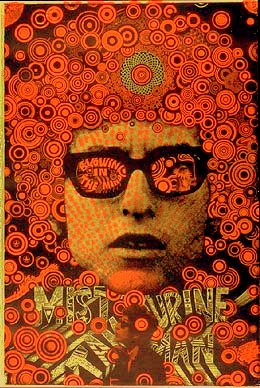
Psychedelic Dylan
Some say she first set her sights on McCartney but the more vulnerable Lennon showed up and the Spider Woman spread her web.
She was still married to her second husband, Tony Cox, but, regardless of what she says she very aggressively pursued, or attacked, Lennon. Lennon was emotionally under water unable to handle his success while drugging himself out of his mind. He was unwillingly married to his wife Cynthia. It appears that he married Cynthia out of duty when she became pregnant. He doesn’t seem to have been happy in his virtue. Yoko had no difficulty in capturing his affections.
Now, just as Warhol had adopted the Velvets and imposed his female singer, Nico, on the band Yoko sought to imp[ose herself on the Beatles through Lennon. At this time she was still musically completely in thrall to John Cage understanding nothing about Rock music. She and Lennon had made a ridiculous LP called Two Virgins in 1968. She combined her cagian screechings while using an avant garde ‘performance’ notion of the couple posing nude on the cover; full frontal on the obverse, full posterior on the reverse. As no store would carry the cover the couple reverted to Yoko’s idea of Bagism placing the cover inside a plain manila envelope or bag. While it didn’t sell the record this form of Bagism was actually a successful artistic statement. The nude cover given an outer garment so to speak.
Well, the public was prepared to forgive the Beatles anything but the other three Beatles weren’t prepared to forgive Yoko for forcing herself on them thus she broke up the most successful act of the sixties. Still, she had succeeded according to her wildest dream. Lennon and his wonderful reputation and fortune were hers. She had gone from a neglected, nondescript ‘performance’ artist to center stage, not on her own womanly talents but by attaching herself to a talented man. Yoko’s ‘heart’ was useless without the male intellect. Yoko was now the most influencial feminist in the world. She knew what to do with that.
After several ‘performance’ acts such as the ‘Bed In For Peace’ the couple left England to return to the place Yoko wished to subjugate artistically, New York City. She had raised herself to a par with Andy Warhol. She now had to meld her musical and artistic goals through Lennon and Warhol.
On the musical side she began to develop her rock n’ roll skills under the tutelage of Lennon. While not abandoning the avant garde notions of John Cage she now emasculated her husband. Always semi-delusional or perhaps completely so, she fantasized that she was not only equal to Lennon in skill and popularity but superior to him. She imagined herself more popular than Lennon. Thus one has such travesties as the LP Double Fantasy. It was only after Lennon’s death that she was forced to recognize than Lennon’s fans did not appreciate her efforts. So she failed as a musician.
She quickly tired of being Mrs. Lennon. Thus she and Lennon separated for eighteen months or so during the years 1973-75. She then realized that her financial well being and musical acceptance depended on Lennon. In 1975 she called him back resuming their relationship until his death in 1980. But, things had changed.
She began to adopt Warhol’s life style on her return to NYC. While she propagated the notion that she was some sort of business whiz Iam having difficulties discovering any such skills. It appears that with the enormous income of Lennon she emulated Warhol in
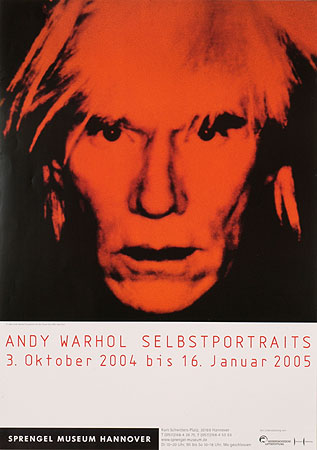
Andy the Demon
spending her way to prosperity.
She was in a position to not only match Warhol’s spending but exceeding it by many times. Through the seventies and eighties Warhol came into his own as an artist while reaping a fortune doing portraits. There appears to have been no effort on his part to invest in income producing vehicles. Rather he bought stuff. He purchased buildings in NYC and elsewhere while acquring undeveloped acreage in places like Aspen. He shopped nearly every day buying antiques from furniture to objets d’ art by the bushel almost as though he were trying to excel the incredible W.R. Hearst.
He usually didn’t even look at the stuff once he bought it merely filling rooms with his shopping bags. At his death all this junk was auctioned off for 25 million dollars, a nice appreciation in value.
Yoko followed the exact pattern buying apartments and houses as well as an extensive dairy farm with a herd of prize cows. She not only had but has five apartments in her principal dwelling, the Dakota apartment building and many other houses scattered around.
Like Warhol the Dakota apartments are stuffed with junk. Valuable, but, you know, stuff. She bought at good prices. Her extensive collection of Egyptian antiquities was mostly purchased before a steep rise in value.
Like the Rothschilds of old Yoko didn’t do all her own shopping but employed agents to search things out. Chief among these was an associate of Warhol’s, Sam Green, and an Hungarian immigrant by the name of Sam Havadtoy.

Buddies- Yoko, John, Andy
There should be no surprise then that she now has an extensive collection of Warhol’s artwork as well as his portraits of Lennon. The Warhols would have been purchased for form 25 to 50K while now being listed on her assets at tens of millions. She also has been said to have a good collection of Magrittes as well as one assumes other artists. So, much of her net worth is tied up in artwork purchased through Sam Green.
Sam Havadtoy was an antiques dealer as well as an interior designer. He appears to have been a somewhat shady character. It is very difficult to find much about him, however there is a sharp portrait available from the notorious A.J. Weberman ( http://www.acid-trip.org/lennon/ )
…(the Lennons) hired a sleazy Eastern European bisexual to renovate the pad. (Dakota) I had heard of this dude, whose name escapes me, from an asswipe named BRUCE KIRSH, who worked for him. KIRSH told me that the dude, who worked for the King of Morocco, would form a dummy renovation company, hire employees like Kirsch who were willing to work under false names, then, when it came time to pay taxes, everyone would disappear. I learned of him long before he was hired by John and Yoko, and I was taken aback when Yoko took up with him after John’s death.
I know that Weberman is not particularly well thought of by fandom but this is because of his harassment of Dylan who did, after all, misrepresent himself to the revolutionaries like Weberman. A.J. himself is an intelligent observer who was wading through it when it was deep. I do believe he knows what he’s talking about although his interpretations of Dylan’s lyrics seem absurd.
I would have to question Yoko’s judgment in taking him in. Both he and Sam Green were candidates as successors to Lennon with

Lennon by Warhol
whom she consorted in front of Lennon before he died while Yoko chose Havadtoy as his successor the day he died.
Perhaps she selected Havadtoy over Green because he was more rough trade. With Lennon while managing to reconcile revolution with peace and love with Havadtoy she discarded peace and love in favor of strong arm methods against her former employee Fred Seaman when it was totally unnecessary.
Havadtoy was living in a homosexual arrangement with his business partner when Yoko beckoned him to switch to her. Apparently an able switch hitter he was lured by the money to this much older woman. The arrangement did last for twenty years before Havadtoy removed to his native Hungary taking a nice cash settlement and several of the Warhols.
Thus, just as Warhol had his live-in homosexual arrangement so after Lennon’s death Yoko adopted the exact arrrangement. Today she apparently lives alone, a seventy-eight year old woman.
After Lennon’s death there was an accession of from 30 million to a possible 100 million dollars as their last album, Double Fantasy, sold into the millions while the rest of Lennon’s catalog and one assumes the Beatles’ catalog was reinvigorated while all things Lennon sold. This is, of course, no reflection on Yoko but the inevitable result with intellectual properties when the maker dies.
Post-Lennon, then, Yoko realized that her recording and art careers were nil. Heart without intellect is worthless. She then became the caretaker of the Lennon legacy. His recordings, of course, continued to sell, but even his artwork eclipsed that of Yoko. So she suffered the humiliation of being a mere appendage to a man. The feminine dismal swamp was eclipsed by the Olympian heights of the male intellect. As in ancient times the God had trumped the Goddess. And yet as with Hera and Zeus the Goddess gets her way. Yoko came up with the money and goods while Lennon’s spirit was wafted into the stratosphere.
As any reader of mythology knows Hera ruled the Lernean swamps of Argolis while Zeus ruled the gods on ethereal Olympus. Thus one has the symbolism of the biological difference between the male and female.
In ancient times the female had her share in magic. She knew herbs and plants, was familiar with poisons and cures as with the arch witch of the ancient world, Medea. The reputation of the female witch even as a consort of Satan persisted down through medieval and post-medieval times, indeed, even up to the dawn of the scientific enlightenment. One would have thought that magic and witchery were a thing of the past in the 1960s and yet Yoko embodied the whole female swamp mentality.
She established something called the Spirit Foundation attributing the direction to Lennon who in fact knew nothing of these matters but followed her lead. The Spirit Foundation celebrated the ancient art of the Shaman or witch doctor. Shamanism itself even preceded the Matriarchal swamps of Argolis. It was a rich repository of magical tradition. Further the Foundation was feminist in that it was dedicated to preserving the magical traditions of the women of the Pacific islands still living in such archaic societies. The wealth generated by the male intellect was appropriated by the female vagina or ‘heart.’
In her own life and that of Lennon’s Yoko was addicted to a variety of magical practices- astrology, numerology, Tarot readings, and indeed she traveled to the Caribbean to sell her soul to Satan through the offices of a female curandera. Her Tarot reader, John Green, was a priest in the shamanistic, magical, Yoruban African cult of Santeria.
Her feminism was more a magical effort to restory Matriarchal supremacy over the Patriarchy thus reversing the Patriarchal victory of three thousand years previously. Indeed, what has been called the movement for female equality is nothing more than a covert campaign to restore the Matriarchy.
Thus while Yoko o9riginatd nothing she usurped the abilities of the reason of men- Cage, Warhol, Lennon and male magicians such as John Green. Indeed the Trojan War itself was a war of men in service of women.
In her associations with men she preferrred to deal with emasculated types such as homosexuals like Cage, Warhol, Sam Green and Sam Havadtoy. Lennon claimed to have always been dependent of women for comfort and guidance while Yoko caught him at his most confused and vulnerable.
While she received direction from Cage and Warhol she was able to manipulate Lennon out of his talent somewhat as Vivian did that of Merlin of the Arthurian saga. When Vivian had usurped Merlin’s magical knowledge she buried him deep much as Lennon was put out of the way. Yoko then appropriated his wealth and residual income after his death. It was this constant inflow of cash that allowed her to propagate the notion that she was a financial genius.
Then as the female of the ‘heart’ or vaginal swamp she managed and appropriated the reason of Olympus through Cage, Warhol and Lennon. What she got from Havadtoy other than brute strength is not clear to me.
As such Yoko is Woman. In her case a seeming reversion to the archetypal Shaman of the most ancient times.
Part III: Mourning Becomes Yoko
April 3, 2010
Mourning Becomes Yoko Ono
The Passing Of John Lennon Part III
by
R.E. Prindle

Doppleganger #1
When John Lennon met Yoko Ono he knew very little of art and nothing of the New York art scene. His high school years had been spent in open and futile rebellion; the next few years had been spent only in the German underworld with no time for cultivation. From there he went into the whirl of the Beatles years so one might say he had been in cultural suspended animation for all his adult life.
Yoko Ono since 1960 had been engaged in the New York avant garde art scene. She was au courant when she left for London in 1966. Hooking up with Lennon she began to educate him according to her understanding of art. By the time the Ono-Lennons arrived in New York in the late sixties that scene was dominated by the POP art of Andy Warhol while the world both she and Lennon knew in 1960 was unrecognizable. Yoko wasted no time in ingratiating herself with Andy but not the factory. After he was shot in 1969 the old Factory disappeared and after his recovery Warhol began a new life. It is possible that she tried to establish

Doppelganger #2
contact with him between ’64 and ’66. She did know warhol’s associate, Sam Green, from her first days in the Village in 1960.
By the time of her return to NYC Yoko had achieved world wide fame by using Lennon and his fame in their charades for ‘Peace.’ Now she had the perfect entree to enter Warhol’s circle. Warhol was a sucker for celebrities, he did Lennon’s portrait, so he was flattered when Yoko asked him to introduce she and John into society. If Warhol could pester, Yoko was unstoppable. While Andy wasn’t exactly persona gratis at that time he was thick with Sam Adams Green who did have entree to society. Between the the two of them they set up a party to introduce the Ono-Lennons.
John was, of course, no Mick Jagger. While Mick adapted himself quickly to the demands of his fame and moved easily in society, John was awkward being out of the element of his self-styled working class hero. Yoko, too, was no mixer so at the party Yoko and John sat silently in a corner as though in one of Yoko’s bags watching the party goers.

Warhol Jagger 2

- Warhol Jagger
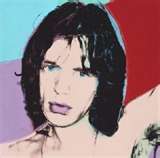
It might be apropos to point out that Jagger and Warhol were fairly close. Jagger was one of the few people attending Warhol’s funeral in Pittsburgh while Bianca was in Warhol’s entourage in the eighties. Warhol also painted a portfolio of Jagger pictures that today command healthy prices.
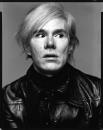
The Devil In Disguise

- Witchy Woman and Warhol

Yoko still persisted with Warhol but Andy having been disappointed once was not up for it twice. He distanced himself from the pair describing them to Sam Green as boring. An ultimate putdown.
Initially the Lennons lived in the Bohemian scene downtown. Mickey Ruskin, the owner of Max’s Kansas City, described the Bohemian scene thusly: the well-to-do Bohos, the middle and the lower class. Those associated with the Kettle of Fish and its environs of which Dylan was a member were of the lower class while the Kettle of Fish itself was owned by the Mafia. He believed Max’s was in the middle. John and Yoko first lived in New York in the West Village at 105 Bank Street next door to Yoko’s her, John Cage. They took over Joe Butler’s apartment, he formerly the drummer of Lovin’ Spoonful so Ruskin would have classed John and Yoko as haut ton beatniks.
At any rate they soon left those environs to migrate to the Upper West Side where they secured apartments in the famous, or soon to be famous, Dakota. It was then that their NYC life took its definitive form.
I have been to NYC a few times so that I know the general layout and have some feel for the place but I have by no means an intimate knowledge so essentially I’m working from maps. I know where MOMA and some few prominent art landmarks are from experience but not that many.
At any rate the Dakota is a famous landmark.. Acceptance as a tenant is by committee approval. John and Yoko were strenuously vetted but finally admitted. They took over actor Robert Ryan’s apartment #72. If you have seen the movie Rosemary’s Baby the camera pans past apartments 71 and 72. No filming was allowed inside the Dakota so while the exterior shots are authentic the interiors were shot on sets. Thus the apartment of the Satanists is a fictional 7E. The apartment next to it in which the young couple resided may have been number 72. The man of the couple who was an actor sold his wife’s body to Satan as the carrier of his child for success in the theatre which he was granted. Thus the Ono-Lennons moved into an apartment closely associated with devil worship, the occult and witchcraft.. This will become more important as Yoko associated herself with all three. In fact, Yoko through John Green would have been familiar with the Yoruban Santeria religion that she in all likelihood would have reverenced. The Spirit Foundation that she established is concerned with the preservation of just such tribal institutions.
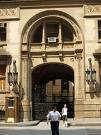
Dakota Entrance
These are magnificent apartments that I presume Rosemary’s Baby duplicates. Huge fifty foot long living rooms as part of a ten room apartment. The Ono-Lennons would soon own both 71 and 72 lacking only the fictional 7E while having a Studio apartment as well.
Being now permanently settled Yoko having access to John’s superb income began to spend it. Of course, she virtually cleaned out department stores on her buying binges, any girl’s dream. But, she also began to buy heavily into art and antiques as investments. This brought Warhol’s friend Sam Adams Green into a close association with her. Rich society women were Sam’s forte. He has an interesting story. He was actually descended from the second president of the United States, Samuel Adams. He arrived in New york in 1960 about the same time Andy Warhol was trying to establish himself as a fine artist and Yoko the same. Warhol of course began as a commercial artist doing shoe ads but in 1960 he changed the emphasis of his career.
In the fine arts field one of the first gallery people Andy met was Sam Green of the Green Gallery. Different Green, Sam only

The Dakota
worked there and shared the name. He and Andy hit it off. By 1965 Green was associated with the art department of UPennsylvania where he staged a Warhol exhibition in the same year. From there he gravitated bck to NYC where he began a career as art consultant to rich women on both continents. They liked him. Through the socialite Cecile Rothschild he was introduced to Greta Garbo with whom he was sort of a trusted companion for 15 years.
He was very knowledgeable about art as an investment traveling between Euorpe and the US advising socialites on the most investment worthy art. He apparently derived a more than comfortable income from his efforts. He was a trusted advisor of Yoko. Some say that he and Yoko’s Tarot reader, John Green, who would enter John and Yoko’s life at about this time, combined to bilk Yoko for overpriced objects. This presumes that both men were dishonest and that Yoko was a fool. As Yoko’s investments have prospered I think we can dismiss the latter, although Yoko did take pride in being able to spend vast sums. She would have taken pleasure in overpaying.
Sam Green- Current
Rather I would say that Sam Green was a very knowledgeable expert whose task was to find art that would appreciate in value. Thus the question is did he perform that function and the answer is, yes. Yoko’s acquistions increased in value far above her purchase prices. I think it is unfair then to say that the Greens bilked her. Surely the laborer is worth his hire.

Warhol Portrait
Now, Sam Green as her agent had to buy the items he acquired for her. Being knowledgeable as to who in society wanted to sell what at distressed prices he may have made some excellent buys that he then tacked on his margin which of course meant that he sold to Yoko for ‘more than they were worth.’ But, heck, even Christie’s and Sotheby’s take twenty per cent each from the buyer and seller. That’s a forty per cent surcharge. However Sam served his function of providing investment pieces so I see no evidence of bilking.
Sam Green also formed a close, probably romantic, liaison with Yoko that persisted until after John’s death. Another art dealser she became close to was a Sam Havadtoy with whom she subsequently lived for twenty years beginning immediately the day after John’s death.
Now the men Yoko associated herself with were all effetes, that were either emasculated when she found them or who she emasculated. Strangely Lennon was the strongest of the lot. Both her first Japanese husband and Tony Cox appear to have been heterosexuals but both Sam Green and Sam Havadtoy were dependent homosexuals. With Havadtoy Yoko may have had her ideal relationship. He was thoroughly emasculated while with the fortune Yoko inherited from Lennon he was totally dependent on her. The classic toy boy a couple decades younger than herself. He, by the way, after his twenty year stint as live-in retired to Hungary with an abundant palimony but he isn’t talking.
In my reading of the situation then, a not particularly compliant John became somewhat of a liability to her, especially as he began to reassert himself with the return to the recording studio in 1980. The problem has the surface appearance of separating the man form his money and discarding the man.
Yoko began building her entourage, Sam Green, John Green, Sam Havadtoy and her various occult people with what appears to be an admiration for and some sort of connection with Andy Warhol. Sam Green and Havadtoy would be a troublesome presence in Lennon’s life during the recording of Double Fantasy while he does not appear to have been enchanted with the Warhol connection
As has been mentioned Yoko became involved in occult practices. She did practice hypnotism on Lennon and was an adept at suggestion which is the essence of hypnotism. Thus on the one hand she suggested forcefully to May Pang that she take up with Lennon while it is probable she hypnotized Lennon into taking up with May Pang. Post hypnotic suggestion would give her a command over all Lennon’s actions. Once implanted she would only have to say the word and Lennon would follow her suggestions.
How complicit John Green would have been in this isn’t exactly clear but any of Yoko’s suggestions to John could have been complemented by a reading. John Green was after all dependent on Yoko for a very generous income beyond whatever he may have scammed.
John Green is another interesting case. He was apparently successful as a Tarot reader before he met Yoko while he is reported to hae been a student of the African Yoruba religion called Santeria. The Yoruba are a tribe in Nigeria, middle river, Western side. He would have obtained much of the magic information he displayed in Cartagena, Columbia, SA from that source. The sixties themselves were the great period of the dissolution of the American mind and personality. One of the key items in the disintegration was the 1962 movie, Mondo Cane. (It’s A Dog’s World). It is difficult to assess the impact of this movie on the malleable college age mind of the times.
I saw the movie then and while it passed out of my conscious mind it struck me most forcibly and lodged in my subconscious mind. I, of course, reviewed the movie for this essay and while I at first remembered little gradually my conscious mind recovered the images so that I remember almost all. The viewing at the time was very repulsive and unsettling to my mind as it was for everyone I talked to about it and every college kid saw it. Still, consciously I missed the true import of the movie completely.
The filmmakers equated some New Guinea stone age people with modern Whites and equated them- said both states of
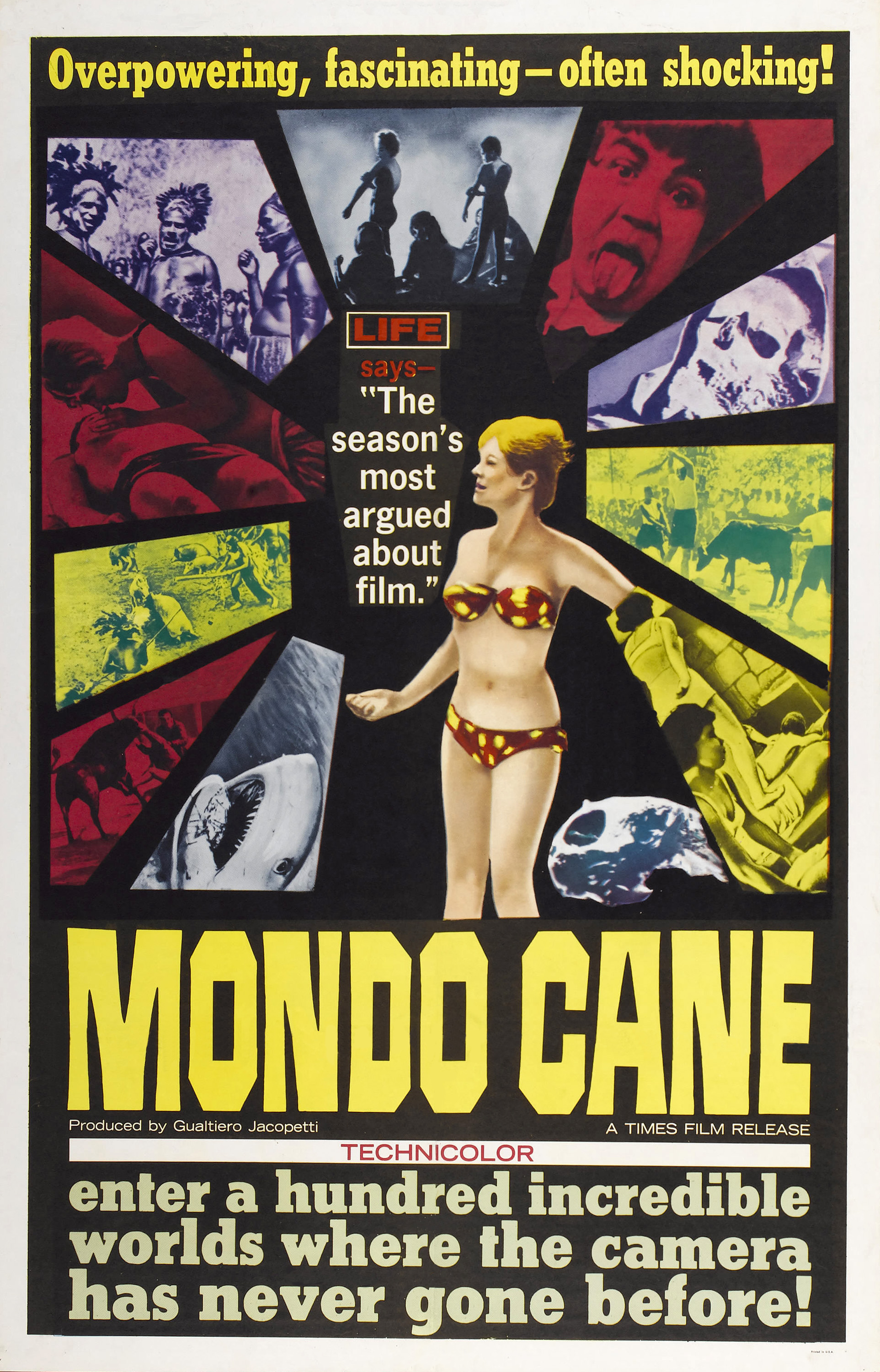
Mondo Cane Poster
consciousness were the same- and that there had been no advance between the primitive and modern. Then they showed Whites at their goofiest and most ridiculous. Drunks at a German Oktoberfest, aged tourists clumsily trying to do a hula. The movie was a real exercise in moral relativity. It was shortly after viewing the movie that I first remember hearing the phrase ‘Nothing is good or bad but thinking makes it so.’ I don’t want to philosophize on this but my thought was that if I think something is bad therefore it must be because I think it and I can’t be wrong.
The movie had a devastating effect on the attitude of the generation. It was a form of hypnosis with a great deal of post-hypnotic suggestion. Whether John Green saw the movie or not I can’t say but if he had it would have prepared him for accepting Yoruban Santeria. In fact these primitive forms of religion and what not flourished in the wake of Mondo Cane. At the same, as I indicated, Yoko would have been very open to Santeria. I think there is little doubt that Green and she at least discussed the religion and its African tribal origin. Especially as she established something she calls the Spirit Foundation. In the online prospectus she describes the foundation thusly:
The Spirit Foundation is…concerned with the protection and promotion of creative and cultural diversity amongst shamanic tribal communities worldwide. Part of the foundations work is the International Shamanic Network which aims at promoting the ancient creative archetypes of man and their binding ecological realtionship to the world.
Our emphasis is on education for action.
As mentioned Yoko and Lennon moved into the suites used in Rosemary’s Baby with its Satanic overtones. In the movie a young woman living with the Satanic couple either jumps or is pushed to her death not far from where Lennon was shot. In this very location Yoko took up Satanism. She decided she wanted to make a pact with the Devil to obtain her wishes. The ubiquitous Sam Green knew of a witch who could serve as an intermediary between Yoko and Satan. (Remember I am only retailing the story, I don’t believe Satan exists.)
Sam Green who had prospered as an art consultant had used some of his earnings to purchase what he called a castle in Cartagena, Colombia. He recommended his witch to Yoko who asked John Green to take her to the witch as he doubled as Tarot reader and Wizard. John Green did so and the witch duly negotiated a deal between Yoko and the Lord of Fire. When it came time to sign the pact Yoko asked Green to do it for her which he did. She was aghast when he told her he didn’t sign his name but hers. Yoko trying to cheat the devil.
We don’t know what she asked Satan for but we are compelled to believe she got it.

Santeria Illustration
As I believe she hypnotized Lennon into taking the Long Weekend I don’t know exactly why she wanted him out of the house. She certainly closely monitored his activities while he was away both in NYC and LA. During his absence Yoko didn’t have a Power of Attorney so she was somewhat constrained as John had her on a 300K budget. When he returned she quickly obtained his POA so that she had unlimited use of his money and, in fact, his identity.
Lennon is criticized for being a recluse in the years between 1975-80. He certainly wasn’t a recluse in that he withdrew from the world. He merely limited his contacts with it. It is said there was a fifteen month period when he was completely withdrawn. While he was obviously suffering from a mental malise in my opinion the withdrawal was completely justified. He had mental issues that had to be resolved. He had the money and time to work at it as he did.
He had a mother/father fixation he had to resolve. he had the feeling that he had been either a genius or a lunatic from boyhood. In a remarkable rant within the 1970 Rolling Stone interview he rants for pages because no one recognized him as a genius in his youth while he had now convinced himself that he was and had been a genius. The fact that he never did his schoolwork doesn’t seem to him that that may have a reason why people missed his genius and though him somewhat mad. What would theyhave done if they had? So he had to reconcile the issue in his mind.
He seems to have made no advance past his school years except in music. The years between leaving school and taking up with Yoko were completely wasted intellectually while the pressures of phenomenal success and wealth disoriented him completely not to mention the massive doses of drugs. At some time then he had to come down and organize his mind and life. From 1968 to let us say 1980 he was completely dependent on Yoko for his mental balance. In NYC he went where she did and did what she did. Hence the connection to Andy Warhol and Sam Green.
There are numerous pictures of Yoko, Lennon and Warhol. Yoko even patterned some of her work after Warhol’s style as in the ‘work’ below patterned after Warhol’s double Elvis. Thus she associates herself and Lennon with Presley.

Yoko Goes Warhol, Imitation of Double Elvis
As I mentioned before the social entree arranged by Warhol and Sam Green failed because of the social ineptness of the Ono-Lennons.
While we have a full record of what Lennon was doing during his ‘Lost Weekend’ we have a less full account of what Yoko was doing. She seems to have had romantic liaisons with at least three men- Sam Green, Sam Havadtoy and the guitarist David Spinozza.

Sam Havadtoy
Perhaps she wanted to see how well she could do on her own as a musician, to see if her reputation as a performance artist and, in her mind, musician, was sufficient to maintain a career on her own without John. If so, she was brutally disappointed as in her only solo performance she failed miserably. Thus she realized that as of 1974 her reputation as well as her wealth depended on Lennon.
It was during Lennon’s absence that John Green came into her life. While John Green tells a fairly smooth story in his Dakota Years one has the feeling that he is being highly selective in what he tells while he slyly ridicules the Ono-Lennons as their superior. The attitude easily leads to contempt and from contempt to abuse. Of course he would have to dissimulate both the contempt and abuse as Ono would be reading the book. As I imagine, a priest in the Santeria religion, he would have been in the company of some shady characters. I don’t know how many actual Yorubas were in NYC but I have met a couple elsewhere.
One imagines most of the hierarchy Green came into contact with was African or American Blacks. Santeria involves a deal of ritual sacrifice while money would be needed. I suspect that John Green was involved in the extortion attempt on the Ono-Lennons. This may have been Santeria related. Thus a sort of Black Hand organization was created. Rather than go for the big money that would have created a stir, the group settled for hitting up people with millions for a mere 200K each. An unpleasant tax for being rich but one more conveniently paid than to die resisting.
We have only Green’s version of the extortion and his relationship to it. He paints himself in a relatively good light. The Ono-Lennons did call in the FBI, they did give the extortionists newspaper rather than cash as the FBI advised. But then things went wrong. The FBI apparently had only one tail on the extortionist who came for the money rather than a series of back ups. The agent inexplicably lost his man. The Ono-Lennons never received another call but they had been warned that if they failed to pay Lennon would be killed whether it took one, two or more years. In December of 1980 the bill fell due. On December 8th he was shot. December 7th is Pearl Harbor Day so there may be a Japanese connection. Yoko Ono being Japanese, her numerologist and the assassin’s wife while Chapman missed the appointed day by one.
The question then hangs on Mark David Chapman the shooter. He is still alive and in prison. He was an assassin as the classic lone nut like Lee Harvey Oswald and any number of assassins who pay the law for the crime while the organizers go free. The technique has been well known to criminals for centuries. Any time a lone nut assassinates someone you may be sure that they were a patsy as Oswald announced over TV he was.
It seems likely that Chapman had been hypnotized. Witnesses said Chapman acted as though in a trance and he himself said he heard a voice in his head saying: Do it. Do it. Do it. The problem would be how he was recruited. I, of course, can say nothing for certain while what I am saying now is merely an hypothesis or inquiry. The main thing is that Chapman was supposed to be a lone nut. Ridiculous.
The most obvious recruitment method was the Santeria of which John Green was a member and to which Yoko Ono was
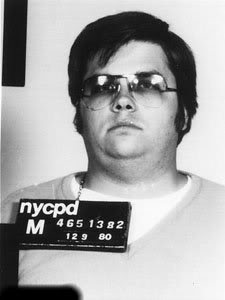
Mark Chapman
sympathetic. There are some oddities in the Chapman story that have to be explained not least of which are the large sums of money expended by Chapman in relation to his income. He was a married man therefore had a wife to support. Yet in 1978 he was in Japan at the same time as the Ono-Lennons beginning an around the world flight.
Perhaps Tokyo was the first stop of the trip around the world that then led to Seoul, Hong Kong, Bangkok, Delhi, Israel, Geneva, Paris, London, Dublin, Atlanta and back to Hawaii. His travel agent was a Japanese woman, Gloria Abe, who he then courted and married. She is reported to have been involved in occult circles. She may have seen so involved that, through Takahashi Yoshikawa, Yoko’s numerologist she was brought in to arrange the trip. Such an around the world trip in a Westerly direction- sundown to sunup- according to Yoshikawa’s numerology would be characteristic of Yoko Ono. She and Lennon made a round the world trip for occult reasons as did both Lennon individually and John Green at her instance. Green made his trip in 59 1/2 hours only leaving a plane once to change to another. As the financing of Chapman’s trip is unknown I would suggest Yoko Ono.
Two years after this very costly trip around the world Chapman flew from Hawaii to first Chicago, then Atlanta, then to New York where he landed a few days before the assassination. Once again, well beyond his means. It is said that he took paintings to Chicago that he sold. Where he would have gotten the paintings isn’t known but once again Yoko is the obvious source. She had an art gallery of valuable art work.
While in Atlanta he contacted a former roommate, then a Deputy Sheriff, Gene Scott, who gave him the hollow point exploding

Santeria Priestess
bullets for a handgun. One assumes such bullets couldn’t be bought over the counter. One wonders why Scott didn’t ask what Chapman intended to do with them. And if he did and Chapman told him Gene Scott is clearly an accomplice and should be questioned.
Chapman himself came from Atlanta where in his teen years he was known to ingest any and all drugs. Atlanta was also a Santeria center with several weird Black cults. Lennon’s death took place at the same time as the Atlanta child murders for which Wayne Williams was later convicted. The Santeria religion has been suspected in these obvious sacrificial murders while John Green establishes a Santeria connection to the Ono-Lennons and Yoko in particular.
Yoko was an excellent hypnotist who understood the use and power of suggestion. The Santerists as Africans would be well versed in the use of suggestion and hypnotism.
Chapman said he was possessed by the Devil while appearing to be in a hypnotic trance. All this rather amusingly is taking place at the Dakota, the scene of the Devil’s birth in Rosemary’s Baby. Indeed, the identical apartment.
After Lennon’s death there was no period of mourning or sense of loss by Yoko. All Lennon’s assets were in her control and name before his death. The so-called will of Lennon is suspicious, although the will was unnecessary becaue I doubt if Lennon thought of a will while the will appointed the art dealer Sam Green as the gaurdian of son Sean in the event the Ono-Lennons perished together. Lennon wasn’t that enamored of Sam Green.
Within a few days Sam Havadtoy was installed as Yoko’s live-in where he remained for twenty years.
While Yoko’s success as an artist and rock n’ roller wasn’t affected by Lennon’s death she now had the money to pay to have her art exhibited. Even then she found her reputation was indissolubly linked to her dead husband. She has become a caretaker for the Lennon legend parceling out old recordings while humiliatingly Lennon’s artwork is more in demand than hers.
She seems to have patterned her later career on that of Andy Warhol who as he acquired fame and fortune managed to insinutate himself into certain society circles. So has Yoko. Now, at 78, she has attained a certain status although still extremely self-centered while having an appearance of terminal aloneness.
Animus and Anima

A Review: Part IV, She by H. Rider Haggard
December 4, 2009
A Contribution To The
ERBzine Library Project
A Review Of
SHE
by
H. Rider Haggard
Review by R.E. Prindle
Part IV and end:
Herself Portrayed

Model of She
The idea of a twenty-two hundred year old woman patiently waiting for the reincarnation of a man she had murdered in that far off time is in itself an extraordinary concept. As an imaginative flight of fancy very likely Rider Haggard can be seen as its originator. Burroughs would borrow the notion twenty-seven years later in his The Eternal Lover when he reverses the sexes and has a cave man asleep for millennia wake to find his reincarnated woman. Since then variations on the theme have become quite common.
She, or Ayesha, was a powerful image of a woman. C.G. Jung saw her as the personification of his Anima theory. Haggard drew on many personal and historical details to create her. Ayesha was titled She-Who-Must-Be-Obeyed. As a child Haggard had a doll to which he gave that name. The doll must have represented his mother. If he invested characteristics of his mother into Ayesha then she must have been both warm and loving and cold and imperious. Over all one gets the impression that she was not particularly loving. Thus, Ayesha, while appearing to be in love with Leo/Kallicrates is nevertheless imperious, demanding and self-centered. In her only real display of afftection she kisses Leo on the forehead, as Haggard says, like a mother. As Haggard says of Meriamun in The World’s Desire, her love was not so much for her lover but an expression of her own vanity.
Haggard represents her as a living corpse in white funereal garments, completely shrouded. She has a strange accoutrement in the serpent belt with two heads facing each other. This is close to the caduceus. Perhaps Haggard had no idea of what the symbol meant in 1886 but by 1890 he had come up with an explanation. In The World’s Desire of that year Queen Meriamun of Egypt keeps something she calls the Ancient Evil in a box. The Evil is a small blob. When she warms it in her bosom it grows. World’s Desire pp. 144-45:
Thrice she breathed upon it, thrice she whispered, “Awake! Awake! Awake!”
And the first breath she breathed the Thing stirred and sparkled. The second time that she breathed it undid its shining folds and reared its head to her. The third time that she breathed it slid from her bosom to the floor, then coiled itself about her feet and grew as grows a magician’s magic tree.
Greater it grew and greater yet, and as it grew it shone like a torch in a tomb, and wound itself about the body of Meriamun, wrapping her in its fiery folds till it reached her middle. Then it reared its head on high, and from its eyes there flowed a light like the light of a flame, and lo! its face was the face of a fair woman- it was the face of Meriamun!
Now face looked on face, and eyes glared on eyes. Still as a white statue of the Gods stood Meriamun the Queen, and all about her form and in and out of her dark hair twined the flaming snake.
At length the Evil spoke- spoke with a human voice, with the voice of Meriamun, but in the dead speech of a dead people!
“Tell me my name,” it said.
“Sin is thy name,” answered Meriamun the Queen.
“Tell me whence I came.” it said again.
“From the evil within me.” answered Meriamun.
“Tell me where I go.”
“Where I go there thou goest, for I have war and thee in my breast and thou art twined about my heart.”
This quote gives an idea of what the snake belt worn by Ayesha signifies.
Of signficance while Meriamun is dealing in magic Ayesha denies all connection with the art saying she utilizes nature. She doesn’t use the word science but nature; nature would include psychology. She therefore draws on natural processes discovered but not scientific processes exposed. Thus when she kills her rival Ustane she does it by utilizing electro-magnetism, somehow using her own electro-magnetism to negate Ustane’s thus extinguishing her life force. We have then an example of tele-kinesis- action at a distance. As I’ve noted in other essays tele-kinesis was amongst an array of mental powers thought to reside in the unconscious being investigated by the Society For Psychical Research. Thus Haggard, probably through Lang, is up on the latest psychic developments.
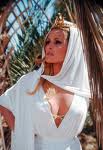
Ursula Andress As She
The ability to kill by telekinesis places a moral burden on Ayesha. If one agrees that the use of such a power may be necessary the question arises of when it may be misused. It would seem that the killing of a sexual rival was an inappropriate use, so the warring good and evil heads of her snake belt refers to the moral dilemma Ayesha faces.
Her belt seems somewhat different than that of Queen Meriamun of The World’s Desire. The latter having accepted the aid of the Ancient Evil was committed to evil being unable to remove the belt. There seems to be an element of volition remaining to Ayesha. She is not ‘possessed.’ Of course Ayesha began her life some thousand years after Meriamun so perhaps psychology was somewhat further evolved at that time or evolved with her over her two thousand year life span.
Indeed, a topic of discussion Haggard introduces shouldn’t be dimissed lightly. That topic is the age old discussion of whether good can come from evil and evil from good. This is indeed a dilemma as bad results can arise from good intentions and vice versa. There is a serious side here.
Ayesha is pure irresistable beauty. Once she shows her face no man can resist her. She glories in this power. In The World’s Desire of four years hence Haggard will separate good and evil making Meriamun represent evil while Helen, the world’s desire, is all good.
Holly is an interesting character who may be a back hand slap at the concept of evolution. Holly also makes this the story of a beauty and a beast. Holly is described as having a low forehead with a hairline growing out of his eyebrows, further his beard and his hairline meet. He is said to have a hugely broad chest and shoulders with extra long arms, perhaps down to his knees although this is not stated. What we have in Holly then is the Wolf Man combined with King Kong. Monstrous indeed.
In contrast Leo Vincey is a Greek god, a sort of Apollo. As Ayesha is irresistable to men Leo seems likewise to be irresistable to women. Indeed, he was married to Ustane within minutes of arriving in Kor. He appears to have sincerely liked Ustane even though on sighting Ayesha’s face he too loved her. Ustane was a rival for a portion of Leo’s affections so Ayesha cut off her electrical supply.
Of several truly dramatic scenes in this spectacularly well constructed story a very dramatic one is when Leo confronts his twenty-two hundred year old incarnation 0f Kallicrates. Haggard doesn’t dwell on Leo’s understanding of this strange phenomenon although from the potsherd and his father’s letter he must have been convinced of the truth. Strangely he doesn’t ask Ayesha for an account of this earlier life, nor how it was that she came to Egypt from Yemen to interfere in his romance with Amenartas.
Haggard and Lang were aware of the early history of Yemen from whence Ayesha as a pure Semite came. She was pre-Christian, although not pre-Jewish, of some ancient Arabic religious beliefs. How she got to Egypt is never disclosed or how she came into conflict with the Egyptian princess Amenartas for Kallicrate’s affections.
Ayesha, by the way the name translates as Life, merely confronts Leo as the neo-Kallicrates without any preparation. A year or so to get to know her and become accustomed to her face might have been nice. Although, Leo was married within minutes of arrival in Kor and was apparently satisfied with his wife. He was a pretty adaptable guy.
At any rate Ayesha rushes him into immortality and while tomorrow may be a long, long time, eternity is even longer. One might want to consider a moment about a relationship of that duration. Nor does she adequately prepare Leo’s mind for the ordeal of fire that she wants him to go through to become immortal. Twenty-two hundred years of waiting had done little to improve her patience.
Haggard has put everything he has into this story. He was granted clear vision only once in his life and he took advantage of it. In later years he was frequently asked why he didn’t write another story as good as She. His reply was that such a story may only come once in a man’s lifetime. The concentration and focus probably will never return again. While Allan Quatermain, his third successive attempt to create a lost civilization was on the weak side I would argue that his last, Treasure of the Lake, comes close to She.
So, the four of them set out for the place of the fire of life. Masterful effects. High in the mountains there is a gigantic balancing rock, a huge mushroom type cap balanced on a spire. It would seems that Zane Grey was also greatly affected by She as Riders Of The Purple Sage hews very close to She. A narrow ledge of rock extends out opposite with a gap of fifteen feet. To cross this gap with high winds howling through, a plank carried by the ever patient Job has to be lowered across the gap. No mean task I’m sure, with only one chance of getting it right. Once in place, thousands of feet above the gorge each has to walk from side to side; plus they have only a few minutes for all four to get over during a single beam of light from the setting sun.
Fortunately all four make it crossing the balancing rock to descend into a cave leading to the bowels of the mountain. There an eternal flame that ensures the life of the planet rumbles by every so often. Twenty-two hundred years before Ayesha had bathed in this fire which following esoteric doctrines had burned away her gross, earthly, moral impurities making her essentially, pure spirit.
A famous incident of the process is recounted of the goddess Demeter in her travels after the abduction of her daughter Persephone by Hades. Coming to Eleusis Demeter in her form of an old crone was taken in by King Celeus and his wife Metaneira. As a reward for her kind treatment Demeter set about to make their infant son Demophon immortal. Thus each night she held him over the hearth fire to burn away his mortal impurities. Surprised one night by a startled mother, Metaneira, the process was disrupted so that Demophon retained mortal impurities and failed to attain to godhood.
In this sense then the fire that maintained the life of the Earth traveled a route through this mountain at the center of the Earth. It appeared something like Old Faithful at Yellowstone periodically. When it swept by, if one stood in the flame it burned away one’s mortal impurities leaving one, it is to be assumed, wholly Spiritual. All the materiality was gone.
Spirituality and materiality are still being discussed today. Some talk of Spirit as though it exists while the materialists aver that all so-called spirituality is a seeming effect of materiality. I am of the latter school of thought. Oneself is all there is, there is nothing more. The effect of spirituality is nothing more than a mirage created by intellect and consciousness which is entirely material. It is all reduced to psychology which is a description of material existence.
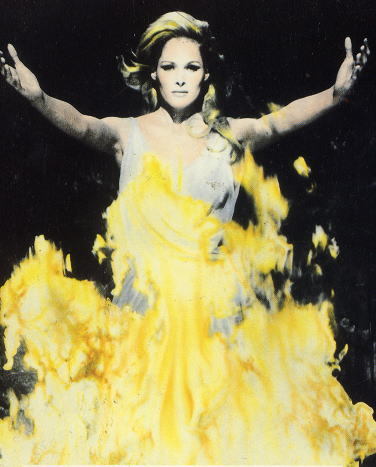
Come To Me
In Haggard’s story it is clear that Ayesha having lost her materiality to the flames is purely spiritual. This is going to cause her problems as she steps into the flames the second time.
The flame passes by while Leo dithers. Impatient for Leo to assume immortality Ayesha strips, as the flames will flame the material garments about her but not her body. As the flame comes around again Ayesha eagerly stands in its way. However having been once purified it is good for eternity. The second time is disastrous. Perhaps spiritually dessicated by the double dose Ayesha begins to wither devasted even in her death throes by her loss of beauty. Love in vain.
Job is so horrified he dies of fright leaving Leo and Holly alone.
The story for all intents is over but Haggard takes a dozen pages or so to get his heroes out of the caves and back to civilization.
Ayesha’s existence wasn’t extinguished. Her dying words were that She would return. Room left for the sequel which not surprisingly was called The Return Of She appeared in 1906.
Haggard hit the groove sharp as a knife in this incredibly well devised and executed story. One will find evidences of it strewn all through Burroughs’ corpus. Not least in his own character of La of Opar. La itself translates from the French as She, of course, so Burroughs even appropriates the name.
La is as ardent for Tarzan as She was for Leo/Kallicrates. Tarzan himself remains cold and indifferent to La throughout all four Opar stories finally abandoning her in Tarzan The Invincible.
She by Haggard is well worth three or four reads to set the story in mind and savor the wonderful and unearthly details
The End.
End of Review
A Review: Pt. III She by H. Rider Haggard
November 25, 2009
A Contribution To The
ERBzine ERB Library Project
She
by
H. Rider Haggard
Review by R.E. Prindle
Part III
The Gruesome, The Morbid AndThe Hideous
Rider Haggard was criticized severely by certain of his contemporaries for employing so many gruesome, morbid and hideous details. Indeed, ‘ She’ seems to be a study in the hideous, the gruesome and the morbid. If one concentrates on those aspects of the story one might actually question Haggard’s mental health.
Haggard himself calls attention to this morbidity. In King Solomon’s Mines he pointed out his humor with references to the Ingoldsby Legends; in She he makes a pointed reference to a Mark Tapley. I had no idea who Mark Tapley might be but thought I’d consult that most magnificent of encyclopedias, the internet. No problem. Mark Tapley was a character from Charles Dickens’ Martin Chuzzlewit. No matter how adverse the circumstances were Tapley was always cheerful and ebullient. Haggard must have thought him ridiculous. Thus he is devising a series of incidents that would bring even Mark Tapley down. Hmm. Interesting experiment.
It would seem then that Haggard was suffering from a fairly deep depression. In that sense She is sort of a horror story not too different in intent than, say, Bram Stoker’s Dracula. Indeed, at one point Ayesha explains that she rules by terror. That being the most effective way to control brutes like the Amahagger.
Certainly the storm at sea prior to entering Kor was an example of terror on the part of nature, a portent of things to come. Not least of these was the hot potting and projected cannibalism of the surviving member of the ship’s crew, Mohammed. ‘She’ had only required the safety of the Whites; as Mohammed was apparently a negrified Arab the Amahagger excluded him from the ban on Whites. An interesting example of White Skin privilege.
Their custom of killing their victims was to heat a pot red hot and turn it over on the victim’s head. There’s a gruesome and hideous enough example. You can see where Burroughs picked up his fascination for the gruesome and hideous.
The Caves of Kor are actually a city of the dead. Kor was an active civilization before Egypt existed in the fifth or sixth millennium BC. As embalming was a known practice when the Dynasties began c. 3400 the practice must have developed long before. Quite possibly it was practiced by the peoples of the Basin before the Mediterranean was flooded. In The World’s Desire Haggard mentions that the ancient Egyptians possessed writings in a precedent language. If so, how far back things like embalming go might be prodigious.
Egyptian embalming was primitive compared to that of the Korians. While Egyptian mummies became desicated the Korian process was such that the body was preserved forever in an apparent state of health. Thus bodies perhaps ten thousand years old or older had the appearance of freshness.
Now, this is positively creepy. Holly’s Amahagger attendent Bilalli while discussing Korian embalming told Holly that while he was a young man a particularly beautiful female corpse occupied the very slab on which Holly slept. Bilalli used to enter the cell and sit looking admiringly on the beautiful corpse by the hour. One day his mother caught him at it. The embalming fluid used was extremely flammable. Bilalli’s mother stood the body up and lit it. Like a huge torch the body burned down to the feet. The feet were still as good as new. Bilalli wrapped them and stored them beneath Holly’s slab. Groping around beneath the slab he brought out those ten thousand year old feet, still fresh, except for some charring at the ankles.
Haggard doesn’t stop there but goes on to emphasize the beauty of one particular foot. One wonders if perhaps George Du Maurier read She becoming entranced by the foot image thus reproducing the image in his novel Trilby when Little Billee draws Trilby’s beautiful foot on th wall. It is a thing Du Maurier would do as he inserted his literary baggage as profusely as Burroughs.
What effect this image had on Haggard’s contemporary readers may be guessed from the complaints about his gruesomeness.
In fact Haggard projects a depressed brooding evil permeating the Caves of Kor very well. This may have been caused by his and Lang’s theories of the Matriarchy. Human sacrifice was an integral part of the Matriarchal world. The sacrifices were invariably of men because women had greater economic value. When men were no longer sacrificed bulls, rams, the males of the species were substituted, the female still having greater economic value. Thus the story of Isaac and the Ram. That would be a great advance in civilization. About that time Isis ceased being the Egyptian symbol of the firmament being replaced by the female cow as the symbol of economics. Something like the kings of England sitting on the woolsack.
Depending on Haggard’s and Lang’s theories of the Matriarchy then Haggard may have been portraying a consciousness that has ceased to exist. There is always an element of misogyny in Haggard’s stories that is no longer tolerated. Then men were men and women were women instead of the attempted strange unisexuality of today. Thus the tens of miles of swamp between the Amahagger quarters and the citadel of Kor indicate the extent and quality of the Matriarchy. Swamps are the symbol of the female and the Matriarchy or, in other words, this very primitive superstitious consciousness.
The Korian swamp was haunted by mephitic vapors, evil smelling and oppressive. The ground they walked on was of uncertain solidity; it might look firm but this was only illusory as one could break through the crust. Often the litter bearers were walking through evil smelling muck up to their knees.
At one point an accident occurs and Bilalli’s litter with him in it is dumped into the slimy water. He would have drowned if Holly hadn’t leaped into the rank female waters to save him. They emerge looking something like the creature from the Black Lagoon.
It will be remembered that Holly was something of a misogynist. One may be stretching a point but even though rejecting women and marriage Holly managed to inherit a son from a man who was also a womanless widower. Haggard makes a strong contrasting point when he says that Leo was not averse to female company. The manservant, Job, is absolutely terrified of the female.
After traversing this desolate swamp of the female for days they arrive at the citadel or temple of Kor. Now, the citadel of Kor was built on an ancient lake bed that had been drained ten thousand years before. In that sense Ayesha is the same as Nimue or the Lady Of The Lake of King Arthur. Nemue lived at the bottom of a lake where she raised Lanclot who consequently was called Lancelot of the Lake.
Compare this also with Haggard’s postumously published Treasure of the Lake in which the Anima figure lives on an island in the middle of a lake in the middle of a volcanic crater. The lake of Kor was also in the middle of a crater.
When the Korian civilization was extinguished it wasn’t by invasion or other external reasons but by a monster plague something like the fourteenth century european Black Death that wiped out nearly everyone. At the resulting rate of death it wasn’t possible to embalm everyone so that tens of thousands of bodies were dumped into a huge subterranean pit.
In conducting Holly and Leo on a guided tour of Kor which was one gigantic necropolis, talk about depressing, Ayesha brings them to this pit. I quote:
Accordingly I followed (She) to a side passage opening out of the main cave, then down a great number of steps, and along an underground shaft that cannot have been less than sixty feet beneath the surface of the rock, and was ventilated by curious borings that ran upward, I do not know where. Suddenly this passage ended, and Ayesha halted, bidding the mutes return, and, as she prophesied, I saw a scene such as I was not likely to behold again. We were standing in an enormous pit, or rather on the brink of it, for it went down deeper- I do not know how much- than the level on which we stood, and was edged in with a low wall of rock. So far as I could judge, this was about the size of the space beneath the dome of St. Paul’s in London, and when the lamps were held up I saw that it was nothing but one vast charnel-house, being literally fullof thousands of human skeletons, which lay piled up in an enormous gleaming pyramid, formed by the slipping down of the bodies at the apex as others were dropped in from above. Anything more appalling than this mass of human remains of a departed race I cannot imagine, and what made it even more dreadful was that in this dry air a considerable number of bodies had become dessicated with the skin still on them, and now, fixed in every conceivable position, stared at us out of a mountain of white bones, grotesquely horrible caricatures of humanity. In my astonishment I uttered an ejaculation, and the echoes of my voice, ringing in that vaulted space, disturbed a skull which hd been accurately balanced for many thousands of years near the apex of the pile. Down it came with a run, bounding along merrily towards us, and of course bringing an avalanche of other bones after it, till at last the whole pit rattled with their movement, even as though the skeletons were rising up to greet us.
Talk about a holocaust! Imagine standing in that dimly lit space far beneath ground, in the grave itself so to speak,and viewing that. Holly was overcome and perhap Mark Tapley himself would have lost a little of his cheeriness. If that didn’t do it the ball Ayesha threw would have.
Before I move on to that though let’s take a penultimate example that might actually unsettle Mark Tapley. This is truly unsettling with truly macabre and voyeuristic soft porn details that are quite remarkable. Let me say that it is only with the fourth reading that the horrific nature of these details really began to sink in. I hope to really make this clear in the next section in which I intend to do an in depth analysis of Ayesha.
In his cell at the citadel of Kor Holly notices a cleft in the wall he hadn’t noticed before. This cleft is going to lead him to Ayesha’s sleeping room. This is not unlike King Solomon’s Mines in which upon entering the symbolic vagina they were led to the womb or treasure box. As I say Holly entered this cleft, let your imagination dwell on that, and followed a dark, dank, narrow corridor until he perceived a light.
He is looking into Ayesha’s sleeping room where in a certain deshabille, very erotic, she is addressing a covered form on a bier next to hers. This is the embalmed body of Kallicrates who she murdered twenty-two hundred years before. So she has been sleeping with this corpse for twenty-two centuries. Now, dwell on that for moment, let the horror of it sink in.
She addresses the corpse in a fairly demented way. Twenty-two hundred years of this would drive anybody nuts. Finally to the dismay of Holly she animates the body by telekinetic powers actually causing it to stand zombie like so she can kiss and caress it. A lot of necrophilia in this novel. Haggard must have been half dotty when he wrote this. Of course Kallicrates is a double of Leo so Holly has all he can do to keep from crying out. Causing the dead man to lay himself down Ayesha covers him and blows out the light.
Holly has to find his way back in the dark reminding one of innumerable passages in Burroughs where his characters have to find their way in the dark. Holly gets only so far and collapses in the tunnel. Waking he sees a light coming in from his cell allowing him to find his way back.
And then Ayesha throws her ball. If you’ve read carefully and really ingested these macabre, gruesome, and as Burroughs’ would say, hideous details they’re beginning to oppress your mind, perhaps even a mind like Mark Tapley’s.
Now Haggard trundles out the frosting. To illuminate her ball Ayesha brings out piles of ten thousand year old corpses placing them around the perimeter as human torches. Laying out a large bonfire the corpses are stacked alternately like so much cordwood and replaced as they were consumed. Remember these are as fresh looking as you or I. The Roman emperor Nero actually used live humans in the same manner. Haggard notes this in the text which I thought weakened the effect.
Ayesha seems to be aware of the effect, indeed, intended it and appears to relish the reaction.
These are the high points of these horrfic details. Minor ones are constant so that the cumulative effect leading up to the terrific images of the demise of Ayesha, temporary though it might be, is overwhelming. But about She, Ayesha, in the next part.
Edgar Rice Burroughs Meets H. Rider Haggard
October 25, 2009
A Contribution To The
ERBzine Library Project
Edgar Rice Burroughs Meets Rider Haggard
by
R.E. Prindle
Among the very many important influences on Edgar Rice Burroughs, contending for the top spot was the English novelist of Africa, Henry Rider Haggard, frequently named as just Rider Haggard.
Haggard was born on June 22, 1856 in Norfolkshire. He died on May 14, 1925. When Burroughs was born in 1875 his future idol was beginning his stay in South Africa of seven years duration. It was there that Haggard learned the history of the Zulu chiefs from Chaka to Cetywayo that figures so prominently in his African novels.
In Africa at twenty, he was back in England at 27. Even though Science was surging through England and Europe curiously Haggard was untouched by it all his life. There is not even an acknowledgement that he had ever heard of Evolution in his novels. Nor was he religious in the Christian sense. Instead he became well versed in the esoteric tradition leaning even toward a pagan pre-Christian sensibility. Perhaps very close to African animism.
One supposes that on his return to England he might have immersed himself in Madame Blavatsky’s Isis Unveiled published in 1877. He certainly seems to be a theosophical adept in his first two African novels, King Solomon’s Mines and She but he must have been pursuing his esoteric studies in Africa to have known so much. If so, he is certainly knowledgeable of Zulu and African lore having a deep sympathy for it. Indeed, he frequently comes across as half African intellectually.
Once he began writing he apparently never put down his pen. I am unclear as to how many novels he wrote. For convenience sake I have used the fantasticfiction.com bibliography which lists 50, but as I have sixty so there are obviously some missing. In addition Haggard wrote a dozen non-fiction titles.
While writing dozens of African novels Haggard also wrote a dozen or so esoteric novels placed throughout the eastern Mediterranean, Mexico and Nicaragua. These are all terrifically impressive displays of esoteric understanding, breathtaking as a whole. Usually disparaged by those without an esoteric background and education these volumes are almost essential reading for anyone so inclined. For those who would deny ERB’s esoteric training and background I refer them to Haggard’s novels.
The key to understanding Haggard’s thinking and works are a batch of novels exploring the relationship of the Anima and Animus. Haggard’s quest in which he failed was to find union with his Anima.
His fictional seeker and alter ego was Allan Quatermain. Thus the first of his esoteric novels is King Solomon’s Mines, in which he introduces Quatermain establishes his Ego or Animus. With his next novel, She, he introduces his Anima figure Ayesha otherwise known as She-Who-Must-Be-Obeyed. Early Sheena, Queen Of The Jungle.
She was much acclaimed as the epitome of the Theosophical doctrine by Madame Blavatsky while C.G. Jung asserted that She was a perfect representation of the Anima figure. Haggard followed She (1886) with Ayesha, The Return Of She (1905) and the final volume of the trilogy, Wisdom’s Daughter: The Life And Love Story Of She-Who-Must-Be-Obeyed (1923). Terrific stuff, well worth a couple reads each. She, of course, became the model for Burroughs’ La of Opar.
Haggard died in 1925 so it can be seen that he was obsessed by his quest for union with his Anima. Two additional volumes deal with his problem. The trilogy does not include Allan Quatermain so Haggard had to write his alter-ego into Ayesha’s story. This was begun in She And Allen of 1920. You can see that he closer he got to his death the problem became more urgent. The end of the story was told in his postumously published Treasure Of The Lake (1926).
Treasure is the most hauntingly beautiful title Haggard wrote. Just astonishing. In the novel Quatermain is ‘called’ to travel to a hidden land. He has no idea why but fate is visibly arranging things so that he must obey. Terrific stuff. The Treasure Of The Lake is none other than Allan’s Anima although no longer called Ayesha. She lives on an island in the middle of a lake in an extinct volcano, She being the Treasure. Heartbreakingly she is not for Allan. He is only to get a glimpse of the grail while a character is rescued by Allan who bears a striking resemblance to Leo Vincey, the hero of She who is winner of the Treasure. The Treasure is reserved for him. Thus Allan and Haggard journey back from the mountain’s top having seen the promised land but not allowed to enter. By the time the first readers, which included Edgar Rice Burroughs, turned the pages H. Rider Haggard had crossed the bar, his bark being far out on the sea.
Burroughs was impressed. His 1931 novel, Tarzan Triumphant, is a direct imitation in certain episodes. Largely on that basis I have to speculate that Burroughs read the entire Haggard corpus at least once.
The Anima novels of Haggard then are:
1. King Solomon’s Mines
2. She
3. Ayesha, The Return Of She
4.Wisdom’s Daughter: The Life And Love Story Of She-Who-Must-Be-Obeyed
5. She And Allan
6. The Treasure Of The Lake
The writing of the titles span Haggard’s writing career.
His first esoteric novels which I heartily recommend are Cleopatra, The World’s Desire (top notch), The Pearl Maiden, Montezuma’s Daughter, Heart Of The World, Morning Star and Queen Sheba’s Ring.
What most people think of and when anyone thinks of Haggard is his character Allan Quatermain. The makes and remakes of Quatermain and She movies are numerous. You could entertain yourself for many an hour.
Fourteen novels were published during Haggard’s lifetime, the best known being King Soloman’s Mines and Allan Quatermain. Many people have no idea he wrote anything else. She, of the first African trilogy, doesn’t include Quatermain.
Both of the first Quatermains were highly influential on Burroughs. Tarzan was fashioned to some extent on the character Sir Henry Curtis, the original white giant. While most people look for the origins of Tarzan in the Romulus and Remus myth of Rome that is only a small part of it that reflects Burroughs’ understanding of ancient mythology. The models for Tarzan are more diverse including not only Curtis but The Great Sandow who Burroughs saw and possibly met at the great Columbian Exposition of 1893. The list of titles in the Quatermain series: (N.B. It is Quatermain not Quartermain.)
1. King Solomon’s Mines
2. Allan Quatermain
3. Allan’s Wife
4, Maiwa’s Revenge
5. Marie
6. Child Of The Storm
7. The Holy Flower
8. Finished
9. The Ivory Child
10. The Ancient Allan
11. She And Allan
12. Heu-Heu or The Monster
13. Treasure Of The Lake
14. Allan And The Ice Gods
As I look over the list I find that they were all pretty good. The trilogy of Marie, Child Of The Storm and Finished, concerning Chaka’s wars is excellent. The Holy Flower and The Ivory Child are also outstanding. The Ivory Child introduces the notion of the Elephant’s Graveyard that captivated Hollywood while taking a central place in MGM’s Tarzan series of movies.
Other noteworthy African titles are Nada, The Lily, The People Of The Mist and Benita.
In addition to the Esoteric and African novels Haggard wrote various contemporary and historical novels. All of them are high quality but mainly for the Haggard enthusiast. Burroughs may have been influenced to write the diverse range of his stories by Haggard’s example.
In the current print on demand (POD) publishing situation nearly the entire catalog is available. The Wildside Press publishes attractive editons of forty-some titles. Kessinger Publishing publishes most of what Wildside doesn’t and most of what they do but in relatively unattractive editions. You can search other POD publishers and probably come up with what you want.
Haggard is wonderful stuff. You can choose at random and come up with something that truly entertains you.
Themes And Variations
The Tarzan Novels Of Edgar Rice Burroughs
#5 Tarzan And The Jewels Of Opar
Part V
by
R.E. Prindle
Texts:
Du Maurier, George: Peter Ibbetson
Dudgeon, Piers: Captivated: J.M. Barrie, The Du Mauriers & The Dark Side Of Neverland, 2008, Chatto And Windus
Hesse, Herman: The Bead Game
Neumann, Erich: The Origins and History Of Consciousness, 1951, Princeton/Bollingen
Vrettos, Athena: “Little Bags Of Remembrance: Du Maurier’s Peter Ibbetson And Victorian Theories Of Ancestral Memories” Erudit Magazine Fall 2009.
While it is today commonly believed that Sigmund Freud invented or discovered the Unconscious this is not true. As so happens a great cataclysm, The Great War of 1914-18, bent civilization in a different direction dissociating it from its recent past.
Studies in the earlier spirit of the unconscious continued to be carried on by C.G. Jung and his school but Freud successfully suppressed their influence until quite recently actually. Through the fifties of the last century Freud’s mistaken and harmful, one might say criminal, notion of the unconscious held the field. Thus there is quite a difference in the tone of Edgar Rice Burroughs writing before and after the 1917 Bolshevik Revolution.
There are those who argue that Burroughs was some kind of idiot savant who somehow knew how to write exciting stories. In fact he was a well and widely read man of varied interests who kept up on intellectual and scientific matters. He was what might be called an autodidact with none of the academic gloss. He was very interested in psychological matters from hypnotism to dream theory.
The scientific investigation of the unconscious may probably be dated to the appearance of Anton Mesmer and his interest in hypnotism also variously known as Mesmerism and Animal Magnetism. The full fledged investigation of the unconscious began with hypnotism. Slowly at first but by the last quarter of the nineteenth century in full flower with varied colors. Science per se was a recent development also flowering along with the discovery of the unconscious.
While Charles Darwin had brought the concept of evolution to scientific recognition in 1859 the key discipline of genetics to make sense of evolution was a missing component. It is true that Gregor Mendel discovered the concept of genetics shortly after Darwin’s Origin Of Species was issued but Mendel’s studies made no impression at the time. His theories were rediscovered in 1900 but they were probably not widely diffused until after the Great War. Burroughs knew of the earlier Lamarck, Darwin and Mendel by 1933 when he wrote Tarzan And The Lion Man. His character of ‘God’ is the result of genetic mutation.
Lacking the more complete knowledge of certain processes that we have today these late nineteenth century speculators seem ludicrous and wide of the mark but one has to remember that comprehension was transitting the religious mind of the previous centuries to a scientific one, a science that wasn’t accepted by everyone then and still isn’t today. The Society For Psychical Research sounds humorous today but without the advantage of genetics, especially DNA such speculations made more sense except to the most hard nosed scientists and skeptics. The future poet laureate John Masefield was there. Looking back from the perspective of 1947 he is quoted by Piers Dudgeon, p. 102:
Men were seeking to discover what limitations there were to personal intellect; how far it could travel from its home personal brain; how deeply it could influence other minds at a distance from it or near it; what limits, if any, there might be to an intense mental sympathy. This enquiry occupied many doctors and scientists in various ways. It stirred George Du Maurier…to speculations which deeply delighted his generation.
Whether believer or skeptic Burroughs himself must have been delighted by these speculations as they stirred his own imagination deeply until after the pall of the Revolution and Freud’s triumph.
Burroughs was subjected to dreams and nightmares all his life. Often waking from bad dreams. He said that his stories were derived from his dreams but there are many Bibliophiles who scoff at this notion. The notion of ‘directed dreaming’ has disappeared from popular consideration but then it was a serious topic. Freud’s own dream book was issued at about this time. I have already reviewed George Du Maurier’s Peter Ibbetson on my blog, I, Dynamo and on ERBzine with Du Maurier’s notions of ‘Dreaming True’. It seems highly probable that Burroughs read Ibbetson and Du Maurier’s other two novels so that from sometime in the nineties he would have been familiar with dream notions from that source.
Auto-suggestion is concerned here and just as support that Burroughs was familiar with the concept let me quote from a recent collection of ERB’s letters with Metcalf as posted on ERBzine. This letter is dated December 12, 1912.
If they liked Tarzan, they will expect to like this story and this very self-suggestion will come to add to their interest in it.
Athena Vrettos whose article is noted above provides some interesting information from Robert Louis Stevenson who developed a system of ‘directed dreaming’ i.e. auto-suggestion. We know that Burroughs was highly influenced by Stevenson’s Dr. Jekyll And Mr. Hyde while he probably read other novels of Stevenson. How could he have missed Treasure Island? Whether he read any of Stevenson’s essays is open to guess but in an 1888 essay A Chapter On Dreams Stevenson explained his method. To Quote Vrettos:
Rather than experiencing dreams at random, fragmented images and events, Stevenson claims he has learned how to shape them into coherent, interconnected narratives, “to dream in sequences and thus to lead a double life- one of the day, one of the night- one that he had every reason to believe was the true one, another that he had no means of proving false.” Stevenson describes how he gains increasing control of his dream life by focusing his memory through autosuggestion, he sets his unconscious imagination to work assisting him in his profession of writer by creating “better tales than he could fashion for himself.” Becoming an enthusiastic audience to his own “nocturnal dreams”, Stevenson describes how he subsequently develops those dreams and memories into the basis for many of his published stories, most notably his 1886 Dr. Jekyll And Mr. Hyde.
Now, directed dreaming and Dreaming True sound quite similar. One wonder if there was a connection between Stevenson and Du Maurier. It turns out that there was as well as with nearly the entire group of English investigators. Let us turn to Piers Dudgeon again, p. 102:
Shortly after they met, the novelist Walter Besant invited [Du Maurier] to join a club he was setting up, to be named ‘The Rabelais’ after the author of Gargantua and Pantagruel. Its name raised expectations of bawdiness, obscenity and reckless living, (which were not in fact delivered) as was noted at the time. Henry Ashbee, a successful city businessman with a passion for pornography, and reputed to be Robert Louis Stevenson’s model for the two sides of his creation, Dr. Jekyll And Mr. Hyde, denounced its members as ‘very slow and un-Rabelaisian’, and there is a story that Thomas Hardy, a member for a time, objected to the attendance of Henry James on account of his lack of virility.
Virility was not the issue however. The members of the Rabelais were interested in other worlds. Charles Leland was an expert on fairy lore and voodoo. Robert Louis Stevenson was the author of The Strange Case Of Dr. Jekyll And Mr. Hyde (1886) which epitomized the club’s psychological/occult speculations. Arthur Conan Doyle, who became a member of the British Society For Psychical Research, was a dedicated spiritualist from 1916. Henry James was probably more at home than Hardy, for both his private secretary Theodora Besanquet, and brother William, the philosopher, were members of the Psychical Society.
In many ways the Rabelais was a celebration that [Du Maurier’s] time had come. Parapsychological phenomena and the occult were becoming valid subjects for rigorous study. There was a strong feeling that the whole psychic scene would at any moment be authenticated by scientific explanation.
Du Maurier was obviously well informed of various psychical ideas when he wrote Ibbetson. In addition he had been practicing hypnosis since his art student days in the Paris of the late 1850s.
So this was the literary environment that Burroughs was growing up in. As Bill Hillman and myself have attempted to point out, ERB’s mental and physical horizons were considerably broadened by the Columbian Expo of 1893. Everything from the strong man, The Great Sandow, to Francis Galton’s psychological investigations were on display. The cutting edge of nineteenth century thought and technology was there for the interested. Burroughs was there for every day of the Fair. He had time to imbibe all and in detail. The Expo shaped his future life. That he was intensely interested in the intellectual and literary environment is evidenced by the fact that when he owned his stationery story in Idaho in 1898 he advertised that he could obtain any magazine or book from both England and America. You may be sure that he took full advantage of the opportunity for himself. As this stuff was all the rage there can be no chance that he wasn’t familiar with it all if he didn’t actually immerse himself in it. Remember his response to Kipling’s The White Man’s Burden was instantaneous. Thus you have this strange outpost of civilization in Pocatello, Idaho where any book or magazine could be obtained. Of course, few but Burroughs took advantage of this fabulous opportunity. It should also be noted that he sold the pulp magazines so that his interest in pulp literature went further back than 1910.
In addition ERB was enamored of the authors to the point of hero worship much as musical groups of the 1960s were idolized so he would have thirsted for any gossip he could find. It isn’t impossible that he knew of this Rabelais Club. At any rate his ties to psychology and the occult become more prominent the more one studies.
It seems to me that longing as he did to be part of this literary scene, that if one reads his output to 1920 with these influences in mind, the psychological and occult content of, say, the Mars series, becomes more obvious. He is later than these nineteenth century lights so influences not operating on them appear in his own work making it more modern.
At least through 1917 the unconscious was thought of as a source of creativity rather than the source of evil impulses. If one could access one’s unconscious incalculable treasures could be brought up. Thus gold or treasure is always depicted in Burroughs’ novels as buried. The gold represents his stories, or source of wealth, brought up form his unconscious. The main vaults at Opar are thus figured as a sort of brain rising above ground level. One scales the precipice to enter the brain cavity high up in the forehead or frontal lobe. One then removes the ‘odd shaped ingots’ to cash them in. Below the vaults are two levels leading back to Opar that apparently represent the unconscious. Oddly enough these passageways are configured along the line of Abbot’s scientific romance, Flatland.
In Tarzan And The Jewels Of Opar the gold is taken to the Estate and buried replicating the vaults. Once outside Opar and in circulation, so to speak, the ingots are accessible to anyone hence the duel of Zek and Mourak for them. The first gold we hear of in the Tarzan series is brought ashore and buried by the mutineers. This also sounds vaguely like Stevenson’s Treasure Island. The watching Tarzan then digs the gold up and reburies it elsewhere. In The Bandit Of Hell’s Bend the gold is stolen and buried beneath the floorboards of the Chicago Saloon. Thus gold in the entire corpus is always from or in a buried location. These are never natural veins of gold but the refined ingots.
Not only thought of as a source of treasure during this period the unconscious was thought to have incredible powers such as telekinesis, telepathy and telecommunication. One scoffs at these more or less supernatural powers brought down from ‘God’ and installed in the human mind. As they have been discredited scientifically Western man has discarded them.
On the other hand Western Man deludes himself into accepting the oriental Freud’s no less absurd assertion that the unconscious exists independently of the human body somewhat like the Egyptian notion of the ka and is inherently evil while controlling the conscious mind of the individual. This notion is purely a religious concept of Judaism identifying the unconscious as no less than the wrathful, destructive tribal deity of the old testament Yahweh. Further this strange Judaic concept of Freud was allowed to supersede all other visions of the unconscious while preventing further investigation until the writing of C.G. Jung were given some credence beginning in the sixties of the last century.
In point of fact there is no such unconscious. The supernatural powers given to the unconscious by both Europeans and Freud are preposterous on the face of it. For a broader survey of this subject see my Freud And His Vision Of The Unconscious on my blogsite, I, Dynamo.
This so-called unconscious is merely the result of being born with more or less a blank mind that needs to be programmed. The programming being called experience and education. The maturation and learning process are such that there is plenty of room for error. All learning is equivalent to hypnosis, the information being suggestion which is accepted and furthers the development of the individual. Learning the multiplication tables for instance is merely fixing them in your mind or, in other words, memorizing them. All learning is merely suggestion thus it is necessary that it be constructive or education and not indoctrination or conditioning although both are in effect. Inevitably some input will not be beneficial or it may be misunderstood. Thus through negative suggestion, that is bad or terrifying suggestions, fixations will result. A fixation is impressed as an obsession that controls one’s behavior against one’s conscious will, in the Freudian sense. The fixation seems to be placed deep in the mind, hence depth psychology. Thus when ERB was terrified and humiliated by John the Bully certain suggestions occurred to him about himself that became fixations or obsessions. These obsessions directed the content of his work.
To eliminate the fixations is imperative. This is what so-called depth psychology is all about. The subconscious, then, is now ‘seprarated’ from the conscious, in other words the personality or ego is disintegrated. The goal is to integrate the personality and restore control. Once, and if that is done the fixations disappear and the mind become unified, integrated or whole; the negative conception of the unconscious is gone and one is left with a functioning conscious and subconscious. The subconscious in sleep or dreams then reviews all the day’s events to inform the conscious of what it missed and organize it so that it can be acted on. No longer distorted by fixations, or obsessions, the individual can act in his own interests according to his abilities. The sense of living a dream life and a real life disappears.
That’s why experience and education are so important. What goes into the mind is all that can come out.
But, the investigation of the unconscious was blocked by Freudian theory and diverted from its true course to benefit the individual in order to benefit Freud’s special interests.
So, after the War ERB forgot or abandoned the wonderful notions of the unconscious and was forced to deal with and defend himself against Freudian concepts. The charactger of his writing begins to change in the twenties to meet the new challenges of aggressive Judaeo-Communism until by the thirties his work is entirely directed to this defense as I have shown in my reviews of his novels from 1928 to 1934.
Tarzan And The Jewels Of Opar then reflects this wonderful vision of the subconscious as portrayed by George Du Maurier and Robert Louis Stevenson
Then the grimmer reality sets in.
End Of Review.
Themes And Variations
The Tarzan Novels Of Edgar Rice Burroughs
#5 Tarzan And The Jewels Of Opar
by
R.E. Prindle

Edgar Rice Burroughs
Part IV
From Achmet Zek’s Camp To The Recovery Of The Jewels
The nature of the story changes from the departure of Werper and Jane from Achmet Zek’s camp . To that point the story had been developed in a linear fashion. From Zek’s camp on ERB either loses control of his story or changes into an aggregation of scenes between the camp and the Estate leading to the return. Perhaps there is a modification in his psychology.
The struggle for the possession of the jewels and the woman contunues unabated. As always Burroughs tries to construct a story of many surprising twists and turns. This may be an influence of the detective story, Holmes, on him. He may be trying to emulate Doyle.
The problem of who the characters represent in ERB’s life becomes more difficult to determine. Werper continues as ERB’s failed self. I think as relates to Zek and the jewels Zek represents Burroughs’ old sexual competitor, Frank Martin, while Zek, the gold and the Abyssinians represent the deal between McClurg’s and its deal in 1914-15 with A. L. Burt. Burt first had the reprint rights to Tarzan Of The Apes, published in the summer of 1914. Those rights shortly passed to Grossett and Dunlap.
In my estimation Martin never ceased interfering with Burroughs’ marriage at least from 1900 to 1919 when Burroughs fled Chicago. We know that Martin tried to murder Burroughs in 1899 and that his pal, R.S. Patchin, looked up Burroughs in LA after the divorce in 1934 and sent a mocking condolence letter in 1950 when Burroughs died and after Martin had died sometime earlier. Patchin would obviously have been directed by Martin to taunt Burroughs in ’34. It’s clear then that Martin carried a lifelong grudge against Burroughs because of Emma.
Martin is thus portrayed as being in competition with Burroughs in 1914-15 and possibly but probably to a lesser extent in LA.
Jane is shown being captured by Zek twice in the story. Thus Emma was courted or captured by Martin when Burroughs was in Arizona and Idaho. In this story Jane is captured while Tarzan is absent in Opar. The second capture or courting by Martin is diffiicult to pinpoint by the inadequate information at our disposal but following the slender lead offered by the novelist, John Dos Passos, in his novel The Big Money I would think it might be in 1908 when ERB left town for a few weeks or months probably with Dr. Stace. It was of that time that the FDA (Federal Food And Drug Administration) was after Stace for peddling his patent medicines. Burroughs was probably more deeply involved with that than is commonly thought. At any rate his being out of town would have provided an opportunity for Martin. Whether something more current was going on I don’t find improbable but I can’t say.
I would also be interested to learn whether there was any connection between McClurg’s and Martin. Martin was Irish, his father being a railroad executive which explains the private rail car at his disposal, as were, of course, the McClurgs and so was the chief executive Joe Bray. If Martin knew Bray he might have pressured Bray to reject publication of Tarzan doing a quick turnaround when interest was shown by the Cincinatti firm. Martin then might have meddled with Burroughs’ contract with McClurg’s. The contract and McClurg’s attitude is difficult to understand otherwise.
The gold is buried which Zek is supposed to have gotten through Werper, then they have a falling out and Werper is captured by Mourak and his Abyssinians. Mourak would then represent A.L. Burt and a division of the the royalties. If McClurg’s had promoted Tarzan Of The Apes, which they didn’t, Burroughs would have received 10% of 1.30 per copy. Thus at even 100,000 or 200,000 copies he would have received 13,000 or 26.000 dollars. that would have been a good downpayment on his yacht. Martin who must have thought of Burroughs as a hard core loser from his early life would have been incensed by such good fortune that might have placed Burroughs’ income well above his own.
Instead, it doesn’t appear that McClurg’s even printed the whole first edition of 15,000 copies. The book immediately went to A.L. Burt where the price of the book was reduced to 75 or 50 cents with the royalty much reduced to 4 1/2 cents divided fifty-fifty between McClurg’s and Burroughs. It’s hard to believe that ERB wasn’t robbed as he certainly thought he had been. Thus when Mourak unearths the gold he is settling for a portion of the hoard when Zek’s men show up and the battle necessary for the story begins.
In this manner the key issues of gold, jewels and woman are resolved.
So, Werper with the jewels goes in search of Jane to find that she has already fled Zek’s camp. The scenes of the story now take place between the camp, perhaps representing McClurg’s offices and the Estate, representing Burroughs.
The latter half of the book, pages 81-158 in the Ballantine paperback is very condensed in a dream like fashion. The action within the very prescribed area with a multitude of people and incidents is impossible except as a dream story. The appearance of the Belgian officer and askaris must have been photoshopped it is so impossible. In other words, then, the whole last half of the book, if not the whole book, is a dream sequence in which dream logic prevails. I will make an attempt to go into late nineteenth century dream speculation in Part V.
A key point of the story is the regaining of the memory of Tarzan. This occurs near story’s end on page 139 and following. It’s fairly elaborate. In connection with his memory return I would like to point out the manner of his killing the lion when he rescues Jane from Mourak’s boma. The roof fell on Tarzan in imitation of his braining in Toronto while now he picks up a rifle swinging on the rearing lion’s head splintering the stock along with the lion’s skull so that splinters of bone and wood penetrate the brain while the barrel is bent into a V. Rather graphic implying a need for vengeance. Not content with having the roof fall on Tarzan’s head, while trying to escape the Belgian officer an askari lays him out with a crack to the back of the head but ‘he was unhurt.’ One can understand how Raymond Chandler marveled. My head hurts from writing about it. Also Chulk has his head creased by a bullet adding another skull crusher to the story.
The description of the return of Tarzan’s reason seems to fit exactly with Burroughs’ injury. I would have to question whether Burroughs himself didn’t have periods of amnesia. P. 139:
Vaguely the memory of his apish childhood passed slowly in review- then came a strangely tangled mass of faces, figures and events that seemed to have no relation to Tarzan of the Apes, and yet which were, even in this fragmentary form, familiar.
Slowly and painfully recollection was attempting to reassert itself, the hurt brain was mending, as the course of its recent failure to function was being slowly absorbed or removed by the healing process of perfect circulation.
According to medical knowledge of his time the description seems to apply to his own injury. His own blood clot had either just dissolved or was dissolving. Then he says almost in the same manner as in The Girl From Farriss’s:
The people who now passed before his mind’s eye for the first time in weeks were familiar faces; but yet he could neither place them in niches they had once filled in his past life nor call them by name.
In this hazy condition he goes off in search of the She he can’t remember clearly. His memory fully returns as he has Werper by the throat who calls him Lord Greystoke. That and the name John Clayton bring Tarzan fully back to himself. For only a few pages at the end of the book does he have his memory fully recovered.
In order to summarize the rest I have had to outline the actions of the main characters for as with Tarzan and his memory the story is one of ‘a strangely tangled mass of faces, figures and events.’ Whether this is artistry on Burroughs’ part or a dream presentation I am unable to ascertain for certain. Let’s call it artistry.
We will begin with Werper’s activities. While Tarzan promised to retrieve La’s sacred knife Werper appears to no longer have it as it disappears from the story. When Werper escaped from Zek unable to locate Jane he heads East into British territory. He is apprehended by one of Zek’s trackers. On the way back a lion attacks the Arab unhorsing him. Werper mounts the horse riding away directly into the Abyssinian camp of Mourak. Mugambi is captured at the same time. While the troop bathes in a river Mugambi discovers the gems managing to exchange them for river pebbles. Werper tempts Mourak with the story of Tarzan’s gold. While digging the gold they are attacked by Zek and his men. Werper rides off as Mourak is getting the worst of the fight. Zek rides after him. Werper’s horse trips and is too exhausted to rise. Using a device that ERB uses in one of his western novels Werper shoots the horse of the following Zek, crouching behind his own for cover. Zek has lost the woman but now wants the jewels. Werper hasn’t the woman while unknown to himself he neither has the jewels. In exchange for his life he offers Zek the pouch of river stones believing it contained the jewels. Zek accepts. Both men are treacherous. Werper waits to shoot Zek but Zek out foxes him picking up the bag by the drawstring with his rifle barrel from the security of the brush.
Discovering the pebbles he thinks Werper has purposely deceived him stalking down the trail to finish him off. Werper is waiting and pots him with his last shell. As Zek falls the woman, Jane, appears as if by a miracle reuniting the two. Could happen I suppose but definitely in dreams.
So, what are the two men fighting over? The sex interest, as the jewels are involved. Who do Werper and Zek represent? Obviously Burroughs and Martin. The stones are false but as Werper disposes of Zek in the competition for the woman Jane appears as if by magic to run to Werper/ Burroughs with open arms.
Werper with Jane returns to Zek’s camp now under the direction of Zek’s lieutenant, Mohammed Beyd. Rigamarole, then Werper deposits Jane in a tree from whence he expects to retrieve her on the following morning. The next day she is gone.
Werper once again turns East. He is spotted riding along by Tarzan. The Big Guy falls from a tree throwing Werper to the ground demanding to know where his pretty pebbles are. It is at this point Werper recalls Tarzan to his memory by calling him Lord Greystoke. Also at the moment the Belgian officer appears from nowhere, having miraculously ascertained Werper’s whereabouts, to arrest him.
Tarzan wants Werper more than the Belgian so tucking his man under his arm he breaks through the circle of askaris. On the point of success he is brought down from behind. Another thwack on the head. Apparently in a desperate situation Tarzan hears voices from the bush. The Great Apes have their own story line but here it is necessary to introduce them as Tarzan’s saviors. The voice is from Chulk who Tarzan sends after the troop. They attack routing the Africans. In the process Chulk, who is carrying the bound Werper is shot. If you remember Chulk stole the stones from Mugambi, or maybe I haven’t mentioned that yet. Werper falls across him in such a way that his hands bound behind his back come into contact with the pouch. Werper quickly recognizes what the bag contains although he has no idea how the ape came by them.
He then advises Tarzan where he left Jane. The two set out when the furore in Mourak’s camp reaches his ears. ‘Jane might be involved.’ Says Werper. ‘She might.’ says Tarzan telling Werper to wait for him while he checks.
Werper waits not, disappearing into the jungle where his fate awaits him.
Those are the adventures of only one character in this swirling vortex of seventy some pages.
Let’s take Mugambi next as he is the key to the story of the jewels yet plays a minor role. After crawling after Jane and regaining his strength he arrives at Zek’s camp at the same time as Tarzan and Basuli but none are aware of the others. Werper and Jane have already escaped when Tarzen enters the camp to find them missing. Mugambi follows him later also finding both missing. He goes in search of Jane. He walks through the jungle ludicrously calling out ‘Lady’ after each quarter mile or so. Leathern lungs never tiring he shouts Lady into the face of Mourak and is captured. Being a regular lightfoot he escapes having lifted the jewels from Werper. Chulk then lifts them from him, Mugambi disappears until story’s end.
Let’s see: Jane next. Jane along with the jewels is the key to the story. The jewels represent the woman as man’s female treasure. Jane is the eternal woman in that sense. The various men’s attitude toward the jewels reflects their own character. Thus, Tarzan in his amnesiac simplicity wants the jewels for their intrinsic beauty. He rejected the uncut stones for the faceted ones in Opar. Even in the semi darkness of the vaults, or in other words, his ignorance, he perceived the difference.
Werper at various times thinks he can get the gold, the jewels and the woman at once. He is happy to settle for the jewels taking them to his grave. Mourak knowing nothing of the jewels is willing to settle for a few bars of gold. When he takes the woman into his possession it is for the sole purpose of a bribe to his Emperor to mitigate his overall failure. Not at all unreasonable.
Zek is too vile to consider as a human being dying in the fury of losing all. Mugambi and Basuli are happy in their devotion to the woman to whom neither jewels or gold mean anything.
Tarzan then, pure in soul and spirit wins it all, woman, jewels and gold. One is tempted to say he lived happily forever after but, alas, we know the trials ahead of him.
So Jane is carried off to Zek’s camp where all the action is centred while she is there. Both Tarzan and Mugambi show up to rescue her but she has escaped just ahead of Werper who would thus have had the woman and the jewels. Alone in the jungle she once again falls into Zek’s hands- that is to say those of Frank Martin.
Now, Tarzan, who has fallen in with a troop of apes chooses two, Taglat and Chulk, to help him rescue Jane from Zek. Chulk is loyal but Taglat is an old and devious ape, apparently bearing an old grudge against Tarzan, who intends to steal Jane for his own fell purposes much worse than death.
In Tarzan’s attempt to rescue Jane, Taglat succeeds in abducting her. He is in the process of freeing her bonds when a lion leaps on him. In the succeeding battle Jane is able to escape the lion who had just killed Taglat.
Wandering through the jungle she hears shots, the voices of men. Approaching the noise she discover Werper and Zek fighting it out. She climbs a tree behind Werper. When he shoots Zek he hears a heavenly voice from above congratulating him. Jane runs to him hands outstretched. So now Werper has the woman again while believing he can retrieve the jewels. He can’t find them because unbeknownst to him Mugambi had substituted river rocks.
Improbably, except in a dream, he returns to Zek’s camp where he has to solve the problem of Zek’s second in command, Mohammed Beyd. Werper spirits Jane out of the camp but finds her gone the next morning. She had mistaken Mourak and his Abyssinians for Werper. Mourak now in possession of the woman, no gold no jewels, thinks to redeem himself with his Emperor, Menelik II, with this gorgeous female.
During that night’s camp the boma is attacked by hordes of lions. Lions play an amazingly central role in this story. Interestingly this scene is replicated almost exactly in the later Tarzan And The City Of Gold. In Jewels Tarzan rescues a woman while in Gold Tarzan rescues a man. That story’s woman becomes his enemy.
But now Tarzan and Werper hear the tremendous battle with Tarzan entering the boma to rescue Jane. By the time of the rescue Tarzan has regained the woman and the gold but lacks the jewels.
Unless I’m mistaken we now have only Tarzan and the apes to account for.
ERB’s life was at a turning point. At this stage in his career he must have realized that he would have a good annual income for the rest of his life. If only 5000 copies of the first edition of Tarzan of the Apes sold he would have received 6,500.00 Add his magazine sales to that and other income and 1914 must have equaled his income of 1913 or exceeded it. His income probably grew until he was earning c. 100,000 per year for three years from 1919-1922. So he had every reason to believe the world was his oyster through the teens. That must have been an exhilarating feeling. A sense of realization and power must have made him glow. But the period was one of transition, a casting off of the old skin while growing into the new. Thus one sees ERB abandoning his old self -Werper- while attempting to assume the new in Tarzan. Thus in death Werper transfers the jewels, call them the Family Jewels, from himself to Tarzan.
Tarzan begins the novel as an asexual being unaware of what jewels were or their value and receives them a the end of the novel as a release from emasculation or awareness of his sexual prowess. Once again Werper fades in the novel while Tarzan unaware of who he is comes to a full realization. Presumably Burroughs thinks he is able to assume his new role as 1915 ends.
In the novel when Tarzan realizes Werper has stolen the jewels he goes off in search of this symbol of his manhood. Werper is not in Zek’s camp. On the trail Tarzan comes across the dead body of the Arab sent after Werper with he face bitten off. He assumes this is Werper but can’t find the jewels. Wandering about he discovers a troop of apes deciding to run with them for a while. Selecting Chulk and Taglat he goes back to Zek’s camp to rescue Jane. At that point Taglat makes off with Jane. Discovering Zek and Werper on the way to the Estate Tarzan becomes involved in the battle between Zek and Mourak. He sees Zek take the jewels and then throw them to the ground as worthless river rocks.
He encounters Werper in the jungle again and prompted by the man fully regains his memory only to have Werper arrested by the Belgian police officer. The battle between Mourak and the lions ensues. Tarzan goes to rescue Jane, Werper goes to his death.
The unarmed Tarzan faces a rampant lion. Picking up an abandoned rifle he brains the lion, apparently in vengeance for all the indignities and injuries ERB has suffered in life.
Leaping with Jane into a tree they begin the journey back to the Estate to begin life anew. Some time later they come across the bones of Werper to recover the jewels and make the world right.
The novel closes with Tarzan’s exclamation.
“Poor devil!”…Even in death he has made restituion- let his sins lie with his bones.”
Was Burroughs speaking of Werper as his own failed self? I believe sothe latter. Remember that a favorite novel of ERB was Dr. Jekyll and Mr. Hyde and that he believed that every man was two men or had two more or less distinct selves. Human duality is one of the most prominent themes in the corpus; thus ERB himself must have believed that he had a dual personality. Tarzan will have at least two physical doubles, one is Esteban Miranda in Golden Lion and Ant Men, and the other Stanley Obroski in Lion Man. Both were failed men as Werper is here. Both obviously represented the other or early Burroughs as Werper does here.
In killing Werper ERB hoped to eliminate the memory of his failed self as he did with Obroski in Lion Man. In other words escape his emasculation and regain his manhood.
The jumbled and incredibly hard to follow, or at least, remember, last half of the book with its improbable twists and turns in such a compressed manner gives the indication that this is a dream story. Only dream logic makes the story comprehensible if still unbelievable. The story then assumes fairy tale characteristics that don’t have to be probable to be understood as possible.
Can be genius, can be luck. I will examine Burroughs novels in relation to dreams in Part V. This part will not be as comprehensive as I would like but time grows short and it is better to make the attempt as not.
Part V follows.
Part III Tarzan And The Jewels Of Opar: Edgar Rice Burroughs
September 25, 2009
Themes And Variations
The Tarzan Novels Of Edgar Rice Burroughs
#5 Tarzan And The Jewels Of Opar
by
R.E. Prindle
Part III
From Opar To Achmet Zek’s Camp
Tarzan and Werper begin the trek back to the Estate. As Tarzan is an amnesiac that indicates that Burroughs is under stress. What kind of stress? As the stress involves sparkling Jewels it is therefore sexual stress. During the stories of the Russian Quartet the personalities of Tarzan and Burroughs were much more separate and distinct.
Success seems to now affect Burroughs so that he begins to identify himself with his great creation. He begins to assume a dual personality. His last Tarzan novel, Tarzan And The Madman will be a confession of his failure to realize his dream. For now we may consider the bewildered Tarzan as the emergence of the new Burroughs while Werper represents the loser Burroughs of his first 36 years. Bear in mind at all times that Burroughs has to tell his sotry so the apparent story has a different appearance than the allegorical story. The jewels then represent the discovery of his submerged sexuality.
As Werper and Tarzan are trekking they have gotten ahead of the slower moving Waziri. The Waziri catch up to them each bearing 120 lbs. of gold or two 60 lb. ingots. Six thousand pound or three tons of gold. So, for a brief moment Burroughs financial success and sexual prowess are on the same spot.
Tarzan not recognizing the jewels for what they are in his befuddled state indicates that Burroughs isn’t aware of how to take advantage of his new desirability.
Tarzan’s first thought when he sees the Waziri is to kill them as he vaguely recalls that Kala, his ape mother, was murdered by a Black. Werper talks him out of it. What story lies behind Kala?
The Waziri reach the burned out Estate, bury the gold, and go in search of Jane. Tarzan and Werper arrive on the heels of the Waziri.
Tarzan sees the Waziri burying the gold. Werper tells him that the Waziri are hiding it for safe keeping. Tarzan decides that would be an excellent thing to do with the jewels. When he believes Werper is asleep that night he digs a hole with his father’s knife burying the jewels.
On the ashes of his former existence then the gold representing his novels and the jewels representing his sexuality are buried.
Werper representing Burroughs old self was not sleeping; waiting for Tarzan to sleep he digs up the jewels fleeing to the camp to Achmet Zek and Jane. Thus the jewels and Jane are reunited with Werper being the possessor of the jewels and hence Jane. Fearing that Zek will murder him for the jewels in the middle of the night Werper persuades Jane to accompany him in flight thus setting up the next transfer of the jewels and Jane.
Meanwhile Tarzan wakes up finding Werper missing and reverts back to his role as an ape, or Great White Beast. peraps this signifies returning to his rough and rowdy ways of bachelorhood. However La and the little hairy men have left Opar in search of Tarzan and the sacred knife. They track him down to essentially the Estate. Perhaps this represents a new beginning on the ashes of the old.
This is the first time La has been outside the gates of Opar.
She is infuriated that Tarzan has rejected her love. After the usual hoopla about sacrificing the Big Guy night falls. La spends time pleading with Tarzan to return her love. She collapses over Tarzan much as over Werper in Opar. She lays atop Tarzan. Remember both Tarzan and La are always nearly nude so we have a very sensual image here. Finding Tarzan unresponsive La curls up beside Tarzan thus sleeping with him although chastely.
The next day the sacrificial hoopla begins again. Just as Tarzan is about to be sacrificed he hears Tantor the elephant in the distance. He emits a cry to attract Tantor.
As the elephant approaches Tarzan realizes that Tantor is in must, sexually aroused. He warns La who releases him just as Tantor charges into the clearing. Seizing La Tarzan runs up the convenient tree. Tantor thoroughly aroused directed his lust specifically at Tarzan and La. The tree is a large one but Tantor tries to bull it over. Failing this the mighty beast wraps his trunk around the bole and rearing titanically actually manages to uproot the tree.
As the tree topples Tarzan throws La on his back making a terrific leap to a lesser tree. Tantor follows as Tarzan leaps from tree to tree. Tantor’s attention wanders and he runs off in another direction leaving La and Tarzan.
So what does this scene mean? Possibly the temptation of Edgar Rice Burroughs. As I said it would be highly improbable if, as a successful writer, Burroughs didn’t attract the attention of other women who would make themselves available to him. This would place incredible stress on him making himself unable to ‘remember’ who he was, what he had been for 36 years.
He said he walked out on Emma a number of times. Leaving for Opar could be equivalent to walking out on Emma. The first night with La could be the first temptation. The elephant in must might indicate surrender to the temptation or at least a terrific struggle to avoid it.
In any event Tarzan returns La to the little hairy men then returning to the Estate to recover the jewels. This could be interpreted as a reconciliation. He finds the jewels gone. Realizing Werper stole them he sets out on the spoor to Zek”s camp.
In the meantime Basuli wounded as he was had crawled after Zek. Recovering his strength he returns to fighting form. The fifty Waziri also followed after Zek. All three parties arrive at the same time.
Clambering over the wall as usual Tarzan discovers that both Werper and Jane were gone. Now in pursuit of the jewels and Jane Tarzan returns to the jungle.
Part IV follows.
Part II: Tarzan And The Jewels Of Opar By Edgar Rice Burroughs
September 1, 2009
Themes And Variations
The Tarzan Novels Of Edgar Rice Burroughs
#5: Tarzan And The Jewels Of Opar
Part II
by
R.E. Prindle
Reliving Past Crimes And Humiliations
Let us put Chapter 6: The Arab Raid at this point in the discusssion so as to achieve greater continuity at the scenes in Opar.
With Tarzan absent from the Estate Zek makes his move to obtain Jane. The brave Waziri warriors rally around Jane putting up a fierce resistance. For whatever reason Tarzan hasn’t armed them with the latest repeating rifles and perhaps a Gatling Gun preferring they fight their battles with spears; hence they are no match for Zek whose men are armed with some woefully outdated firearms. We aren’t even told whether they’re Snyders. Burroughs just calls them ‘long guns.’
Jane herself is armed with what seems to be a repeating rifle. While there are those who refer to Jane as wimpy she is far from wilting here as she gamely fires through the closed door.
It is difficult to determine ERB’s intent here. In 1903-04 when Emma traveled to the wilds of Idaho with her husband she was far from the frontier type. ERB undoubtedly wanted her to be the dauntless frontier woman perhaps as was the wife portrayed in the Virginian but he discovered she was a citified fashion queen. Perhaps here he is demonstrating to Emma what he had wanted her to be.
The Estate is fired as it will be again three years hence when the Germans arrive. At that time ERB led us to believe that Jane was murdered while here she is about to be taken far away. In ERB’s troubled mind it would appear that he wanted to be rid of Emma. He would actually say he always wanted to be rid of her twenty years hence.
Oblivious of the fate of Jane Tarzan is in far away Opar loading the remaining faithful Waziri with the oddly shaped gold ingots.
Werper has followed him into the vaults. As an allegory Werper in this place can represent Ogden McClurg. The vaults can represent ERB’s mind where the wealth of his imagination is stored. Thus the publisher is taking what is rightfully ERB’s labor.
In actuality Ogden McClurg was seldom in Chicago. He was a naval officer who was in the Caribbean most of the time coming back briefly and then when The Great War broke out he became involved in those operations. The manager Joe Bray seems to have been the responsible person. I haven’t been able to ascertain McClurg’s position while I have been told the records for McClurg’s were destroyed so that may be impossible. I have gone through the correspondence between McClurg’s, A.L. Burt and Grosset and Dunlap in the archives of the University of Louisville. There seems to have been an agreement between McClurg’s and G&D to, how shall I say it, defraud Burroughs of royalties. If Burroughs was the best selling author of the time he is represented to be his royalty checks were ludicrously small, by the late thirties five, six and seven dollars per title. Hardly worth either McClurg’s or G&D’s bother if accurate. One is at a loss to understand why they clung so obstinately to the titles. One compares such small checks with the enormous sales of the 1960s. You can draw your own conclusions but it definitely seems there are some unsolvable contradictions.
Burroughs always believed he was being cheated. Based on the evidence I have seen I have to agree with him.
The gold has been brought to the top of the shaft. Tarzan goes back for a last look when the roof literally caves in. An earthquake occurs; a portion of the roof lands on Tarzan’s head putting him out. Werper who was in the same place with Tarzan is uninjured. Unable to go forward he takes the candle stub fleeing down the corridor toward Opar. In this instance he appears almost as a doppelganger of Tarzan.
Tarzan when locked in a cell on the previous occasion had removed the bricks in the wall opening into this corridor. Werper now traces Tarzan’s steps in reverse. Coming to the well he makes the same leap with with same success. Removing the bricks he retraces Tarzan’s steps back up into the sacrificial chamber. Here the little hairy men seize him tossing him onto the altar where La awaits. Duplicating the sacrifical scene with Tarzan she is about to plunge the knife into Werper’s breast when the air is shattered by a deafening roar. A lion has announced his presence in the chamber. The little hairy men flee, La faints and Werper prays.
We know this story because it is ERB’s favorite theme written in many variations.
ERB leaves Werper at the altar and returns to Tarzan who we last saw lying on the floor in a spreading pool of blood. The sequence in Opar recapitulates the main psychological traumas in ERB’s life in one of its many variations. The story changes and evolves but the facts remain the same. The overriding trauma here was ERB’s bashing in Toronto in 1899. The blow from the sap or pipe had a fixating effect on ERB. I’m sure he relived the situation over two or three times every day. It remains to be discovered if he blamed Emma for it. Had he not been competing with Martin for her hand the blow would never have happened. Here he couples the memory of the blow with the abduction of Emma.
Inert for a period of time he recovers but has lost his memory. A usual occurrence in periods of great stress for ERB. He didn’t think he lost consciousness in Toronto but he was knocked down having his scalp torn so that he was covered in blood by the time he arrived at the hospital. I think he did lose consciousness although he may not have been ‘out cold.’
I compare the situation with one of mine. At fifteen I was ice skating when I saw a boy scoot between two girls holding hands at arm’s length. I thought I would emulate him but the two girls closed up as I came from behind. I was better at starting than stopping. My legs flew up and I landed on the back of my head. I literally saw stars, five pointed colored stars in a burst of light. I can still recall the sound of my skull striking the ice. It was an odd sound. I never thought I lost consciousness but I remember opening my eyes so I must have been unconscious for some seconds at least. I suspect that ERB as he fell lost consciousness for at least a few seconds if not longer. Here in Opar he has Tarzan knocked cold for some time which must have been the way he had felt. ERB had fairly serious mental problems for at least a couple decades. While he doesn’t record losing his memory as such he has the hero of Girl From Farriss’s who received a blow duplicate to that received by himself, Ogden Secor, walking past friends as though he didn’t know them. A form of memory loss.
There is no story of Burroughs in which the main character doesn’t get bopped once or twice. This was noticed by Raymond Chandler, the creator of Philip Marlowe, who wrote a semi-dissertaion on bopping in one of his stories. Chandler had read Burroughs extensively. He speculated that no man could survive so many bashings as Tarzan received. Probably true. Chandler then proceeds to have a character bashed twice in succession. Chandler preferred the lump behind the ear which produces euphoric dreams.
At any rate Tarzan recovers while dimly remembering his ‘heavy war spear’ that he searches for. It is interesting that Tarzan never adopts modern weapons even though Jane had a repeater and one as knowledgeable as Tarzan must have been up on the Maxim gun by the time these stories were written. Rope, knife, spear and bow and arrows, Tarzan scorned guns.
Now, following in the footsteps of Werper, he comes to the well and falls in but doesn’t lose his grasp of his heavy war spear. The well probably represents a descent into the subconscious into the waters of the feminine. Bobbing to the surface he clambers out where the waters are level with the floor. An odd situation. Perhaps overflowing into the corridor from time to time making the floor treacherous, Tarzan has a difficult time keeping his footing until he climbs some stairs of many turnings. This is all terrific atmosphere although the meaning eludes me. Tarzan thus enters the forgotten jewel room of Opar. Here the Jewels of Opar come into play. Like the old singalongs at the Saturday movie matinee where you followed the bouncing ball now we begin to follow the course of the Jewels through the rest of the story.
This associates Werper and Opar with the novels of Tarzan And The Golden Lion and Tarzan And The Ant Men. In that sense Werper becomes a prototype of Esteban Miranda, one of my favorite characters. In those two novels Miranda like Werper tries to steal the gold. Miranda unlike Werper was a Tarzan lookalike. Instead of following the jewels in those two novels we follow Tarzan’s locket containing the pictures of his mother and father. Thus the stories change but the themes remain the same.
Tarzan merely sees the jewels as fascinating pretty baubles unable to discern their value because of his memory loss. He keeps the cut stones which diffract the light throwing the uncut stones back. Odd detail but perhaps significant. Just as the gold represents Burrough’s writing earnings the Jewels, especially diamonds, are associated with his sexual goals. Thus in Lion Man he associated Balza, who represents Florence, with an abundance of diamonds as he thinks he has realized his sexual goals. Then when he realizes his error in Tarzan And The Forbidden City the much sought after ‘father of diamonds’ turns out to be a piece of coal.
He then emerges into the sanctuary just as the lion emits its fearful roar. Let’s examine this scene in detail as ERB here replicates symbolically his confrontation with John the Bully on the street corner in the fourth grade.
For those who haven’t followed my essays ERB was confronted by a bully named John when eight or nine who terrorized his soul fixating him forever.
I know there are Bibliophiles who find the analysis of the confrontation as I have dealt with it to this point difficult to believe. The majority of people, in fact, appear to not undertand how something that happened when you were eight or nine can affect your mind for life. Most people think things are just forgotten. It is all a matter of suggestion when your mind is in a hypnoid state. The interpretation of the event enters your mind where it becomes fixated. Compare it to the clipboard of your computer. You can’t see the information copied but it exists on your computer nonetheless and in certain conditions manifests itself. This is probably close to what the French psychologist Pierre Janet meant by his term ‘idee fixe.’ Once in your mind the idea may take a few days or longer to become fixed thereafter directing your actions. The suggestion becomes a reality to your essentially hypnotized mind.
When confronted by John, a much larger and older boy, and a hoodlum, the young ERB was terrorized; this opened his mind to the hypnotic suggestion creating a hypnoid state. As ERB replicates this scene almost as often as the Toronto incident these two scenes are the twin poles of his psychosis. They are closely allied in his mind as Tarzan has just come from a bashing and now meets his nemesis John in the form of the lion. The lion is big and fearsome as was John.
When ERB was a child John, or the lion, destroyed ERB’s self-image. In this instance Tarzan is a giant with the thews of steel, a heavy war spear and his father’s knife. He is loaded for lions and eager to kill.
On the sacrifical altar, probably a metaphor of the psychological death he experienced with John, is Werper. As I believe Werper is a prototype of the latter doppelgangers Esteban Miranda and Stanley Obroski. Miranda and thus Werper represent the inefective Burroughs who quailed before John. Miranda is a Tarzan lookalike, an identical twin as it were. Neither in Werper nor Miranda does ERB resolve his conflict between the defeated wimp of his youth and the heroic Tarzan he now visualizes himself as. Werper and Miaranda then will morph into Stanley Obroski of Tarzan And The Lion Man who is another twin where Werper/Miranda/Obroski die as ERB beilieves or hopes that he has succeeded in realizing a heroic character. When he wrote Tarzan And The Madfman he realized that he was not the man he hoped to become.
In Opar the lion is about to leap on Werper and La has fainted across his body thus associating the Anima and Animus. In this instance La represents ERB’s failed Anima while Werper is the emasculated Animus. Tarzan/ERB then steps between the lion and La and Werper to save them. He drives his heavy war spear into the lion’s chest, itself an act that ERB portrays often.
Then, leaping on the back of the lion he repeatedly drives his father’s knife into its side. This is in itself a simulation of the sexual act, probably anal. At the same time the violence of copulation is an act of supreme hatred, very homosexual in nature actually. Having killed his adversary, John the Lion, he puts his foot on the body and exults with the terrifying victory cry of the bull ape. In his fantasy then he corrects his defeat on the street corner.
Now, the effect of the encounter with John on ERB’s psychology was profound. When John defeated the child ERB here represented by Werper and La, he assumed a half share role in both ERB’s Anima and Animus. Remember the fainted La is lying over the body of Werper. Thus the lion becomes Tarzan/ERB’s symbol of both helper and enemy; the lion becomes the enemy of his Animus and helper to his Anima. It is quite possible that if it hadn’t been pointed out to him after the publication of Tarzan Of The Apes that there were no tigers in Africa that the lion would have been a helpmate and the tiger the enemy. In that case there mgiht have been dramatic lion and tiger fights in which the tiger was always defeated. It is also possible that the lion would have been male and the tiger female thus prefiguring Burroughs’ later pronounced misogyny.
As John was male so is the lion so we have the anomaly of an Anima represented half by a loser female and half by a man in drag while the Animus is a loser male that ERB has to dispose of if he is to reintegrate his personality. This must have been a terrible conflict with potentially disastrous consequences.
The dilemma is most clearly represented in ERB’s second written book, The Outlaw Of Torn. Outlaw is not a book he chose to write but one which was suggested to him by his editor, Metcalf, at All Story Magazine. ERB casts his story in his familiar Prince and Pauper format. His mental dilemma is clearly depicted.
Norman, the hero, is the son of the English king, Henry. Henry insults his fencing instructor De Vac who avenges himself on Norman. The child is playing in a fenced yard attended by his nurse, Maud, who represents his Anima. She is chatting with a domestic failing to keep a close eye on Norman. He is lured through the gate outside the garden (of Eden) where De Vac waits to kidnap him. Realizing the boy’s danger Maud rushes to Norman’s rescue where De Vac brutally murders her. Thus Norman/ERB’s Anima is now destroyed. The mind cannot exist without an Anima so De Vac takes the young boy to London where they occupy the attic of a house over the Thames. The river represents the waters of the feminine while the house represents ERB and the attic his mind. Now, to replace the anima De Vac dresses as an old woman associating with Norman in that guise until Norman/ERB’s mind heals enough for ERB to function. At that time De Vac shifts to the Animus side training Norman in the manly arts. Thus Norman becomes a sort of predecessor of Tarzan. Tarzan Of The Apes will be the third novel ERB writes. At that point drawing on the clear example of Outlaw Of Torn ERB began to evolve his way out of his psychological dilemma.
The reason he can never develop a relationship with La is because she represents ERB’s failed Anima. In this scene La is on her knees pleading with Tarzan to accept her love. Tarzan coldly replies that he does not want her. Then walks away taking Werper his alter ego with him.
The little hairy men come shrieking after them. Tarzan’s heroic side clubs them down with his heavy war spear thus replicating the blow he recieved in Toronto on his enemies, correcting that insult and injury. Over and over the heavy war spear falls on head after head. Werper, befitting a coward, follows Tarzan in his shadow as it were clutching the sacred sacrifical knife of Opar.
Thus we have two knives. Tarzan’s father’s knife and the sacred knife of Opar as two sides to the same man. The hairy men do not attack Werper out of respect for the sacred knife. Werper discovers this. Reversing the role he precedes Tarzan waving the sacred knife as the little hairy men part before them. I don’t have an explanation of the sacred knife at this time.
The hairy men do not pursue them. Searching for the exit they come upon a tribe of great apes. Not content with having reenacted his traumas once ERB gains a little extra gratification by having Tarzan challenged by a large bull much, once again, as John confronted him on the street corner. Thus the apes may have an association with John. Tarzan is ready for the ape:
Werper saw a hairy bull swing down from a broken column and advance, stiff legged and bristling, toward the naked giant. The yellow fangs were bared, angry snarls and barkings rumbled threateningly through the thick and hanging lips….
But there was no battle. It ended as the majority of such jungle encounters end- one of the boasters loses his nerve and becomes suddenly interested in a blowing leaf, a beetle, or the lice on his hairy stomach.
Notice how all these offensive types are hairy.
And so ERB caps the reliving of Toronto and John. in his imagination he had corrected both encounters reversing actuality to a more psychologically comfortable conclusion. But, after all, it was just a fantasy and temporary fix. ERB would continue to deal with the two traumas in an attempt to exorcize them. I don’t think he ever found a satisfactory resolution. In fact in a manner Frank Martin continued the warfare from his grave to that of ERB. After ERB died R.S. Patchin, Martin’s partner in crime, sent a letter to John Coleman Burroughs in which he maliciously related the story of the bashing or, in reality, attempted murder. Martin through Patchin got the last laugh. Emma was dead by then anyway.
We can continue to Part III.
A Contribution To The
Erbzine Library Project.
Edgar Rice Burroughs, Science And Spiritualism
Camille Flammarion, Scientist and Spiritualist
by
R.E. Prindle

The last story in Ray Bradbury’s Martian Chronicles is about the expulsion from Earth of the various supernatural or imaginary beings such as fairies, elves, the elementals, all those beings external to ourselves but projections of our minds on Nature, to Mars as a last resort and how they were all dieing as Mars became scientifically accessible leaving no place for them to exist.
On Earth the rejection of such supernatural beings began with the Enlightenment. When the smoke and fury of the French Revolution and the Napoleonic years settled and cleared it was a new world with a completely different understanding of the nature of the world. Science, that is, knowing, had displaced belief as a Weltanschauung.
The old does not give way so easily to the new. Even while knowing that fairies did not exist the short lived reaction of the Romantic Period with its wonderful stories and fictions followed the Napoleonic period.
Supernatural phenomena displaced from the very air we breathed reformed in the minds of Men as the ability of certain people called Mediums to communicate with spirits although the spirits were no longer called supernatural but paranormal. Thus the fairies morphed into dead ancestors, dead famous men, communicants from beyond the grave. Men and women merely combined science with fantasy. Science fiction, you see.
Spiritualism was made feasible by the rediscovery of hypnotism by Anton Mesmer in the years preceding the French Revolution. The first modern glimmerings of the sub- or unconscius began to take form. The unconscious was the arena of paranormal activity.
Hypnotism soon lost scientific credibility during the mid-century being abandoned to stage performers who then became the first real investigators of the unconscious as they practiced their art.
While the antecedents of spiritualism go back much further the pehnomena associated with it began to make their appearance in the 1840s. Because the unconscious was so little understood spiritualism was actually thought of as scientific. The investigators of the unconscious gave it incredible powers and attributes, what I would call supernatural but which became known as paranormal. Communicating with spirits, teleportation, telecommunications, all the stuff that later became the staples of science fiction.
Thus in 1882, Jean-Martin Charcot, a doctor working in the Salpetriere in Paris made hypnotism once again a legitimate academic study.
The question here is how much innovation could the nineteenth century take without losing its center or balance. Yeats’ poem The Second Coming presents the situation well. Freud, who was present at this particular creation, was to say that three discoveries shattered the confidence of Man; the first was the Galilean discovery that the Earth was not the center of the universe, the second revelation was Darwin’s announcement that Man was not unique in creation and the last was the discovery of the unconscious. Of these three the last two happened simultaneiously amidst a welter of scientific discoveries and technological applications that completely changed Man’s relationship to the world. One imagines that these were the reasons for the astonishing literary creativity as Victorians grappled to deal with these new realities. There was a sea change in literary expression.
Key to understanding these intellectual developments is the need of Man for immortality. With God in his heaven but disconnected from the world supernatural explanations were no longer plausible. The longing for immortality remained so FWH Myers a founder of the Society For Psychical Research changed the word supernatural into paranormal. As the notion of the unconscious was now wedded to science and given, in effect, supernatural powers under the guise of the paranormal it was thought, or hoped, that by tapping these supernormal powers one could make contact with the departed hence spiritism or Spiritualism.
While from our present vantage point after a hundred or more years of acclimatizing ourselves to an understanding of science, the unconscious and a rejection of the supernatural, the combination of science and spiritualism seems ridiculous. Such was not the case at the time. Serious scientists embraced the notion that spirtualism was scientific.
Now, a debate in Burroughs’ studies is whether and/or how much Burroughs was influenced by the esoteric. In my opinion and I believe that of Bibliophile David Adams, a great deal. David has done wonderful work in esbatlishing the connection between the esotericism of L. Frank Baum and his Oz series of books and Burroughs while Dale Broadhurst has added much.
Beginning in the sixties of the nineteenth century a French writer who was to have a great influence on ERB, Camille Flammarion, began writing his scientific romances and astronomy books. Not only did Flammarion form ERB’s ideas of the nature of Mars but this French writer was imbued with the notions of spiritualism that informed his science and astronomy. He and another astronomer, Percival Lowell, who is often associated with ERB, in fact, spent time with Flammarion exchanging Martian ideas. Flammarion and Lowell are associated.
So, in reading Flammarion ERB would have imbibed a good deal of spiritualistic, occult, or esoteric ideas. Flammarion actually ended his days as much more a spiritualist than astronomer. As a spiritualist he was associated with Conan Doyle.
Thus in the search for a new basis of immortality, while the notion of God became intenable, Flammarion and others began to search for immortality in outer space. There were even notions that spirits went to Mars to live after death somewhat in the manner of Bradbury’s nixies and pixies. In his book Lumen Flammarion has his hero taking up residence on the star Capella in outer space after death. Such a book as Lumen must have left Burroughs breathless with wonderment. Lumen is some pretty far out stuff in more ways than one. After a hundred fifty years of science fiction these ideas have been endlessly explored becoming trite and even old hat but at the time they were
Camille Flammarion
excitingly new. Flammarion even put into Burroughs’ mind that time itself had no independent existence. Mind boggling stuff.
I believe that by now Bibliophiles have assembled a library of books that Burroughs either did read or is likely to have read before 1911 that number at least two or three hundred. Of course, without radio, TV, or movies for all of Burroughs’ childhood, youth and a major portion of his young manhood, although movies would have become a reality by the time he began writing, there was little entertainment except reading. Maybe a spot of croquet.
As far as reading goes I suspect that ERB spent a significant portion of his scantily employed late twenties and early thirties sitting in the Chicago Library sifting through the odd volume. It can’t be a coincidence that Tarzan lounged for many an hour in the Paris library before he became a secret agent and left for North Africa.
I have come across a book by the English author Charles Howard Hinton entitled Scientific Romances of which one explores the notion of a fourth dimension . Hinton is said to have been an influence on H.G. Wells’ The Time Machine. It seems certain that Burroughs read The Time Machine while he would have found many discussions of the fourth dimension as well as other scientific fantasies in the magazines and even newspapers as Hillman has so amply demonstrated on ERBzine. We also know that ERB had a subscription to Popular Mechanics while probably reading Popular Science on a regular basis. Popular Science was established in 1872.
It is clear that ERB was keenly interested in psychology and from references distributed throughout the corpus, reasonably well informed.
I wouldn’t go so far as to maintain that ERB read the French psychologist Theodore Flournoy’s From India To The Planet Mars but George T. McWhorter does list it as a volume in Vern Corriel’s library of likely books read by Burroughs. The book was published in 1899 just as Burroughs was entering his very troubled period from 1900 to 1904-05 that included his bashing in Toronto with subsequent mental problems, a bout with typhoid fever and his and Emma’s flight to Idaho and Salt Lake City. So that narrows the window down a bit.
However the book seems to describe the manner in which his mind worked so that it provides a possible or probable insight into the way his mind did work.
ERB’s writing career was born in desperation. While he may say that he considered writing unmanly it is also true that he tried to write a lighthearted account of becoming a new father a couple years before he took up his pen in seriousness. Obviously he saw writing as a way out. His life had bittely disappointed his exalted expectations hence he would have fallen into a horrible depression probably with disastrous results if the success of his stories hadn’t redeemed his opinion of himself.
Helene Smith the Medium of Fluornoy’s investigation into mediumship was in the same situation. Her future while secure enough in the material sense, as was Burroughs, fell far short of her hopes and expectations. Thus she turned to mediumship to realize herself much as Burroughs turned to literature. She enjoyed some success and notoriety attracting the attention of, among others, the psychologist Theodore Flournoy. Fournoy who enjoyed some prominence at the time, was one of those confusing spiritualism with science because of his misunderstanding of the unconscious. Thus as Miss Smith unfolded her conversations with the inhabitants of Mars it was taken with some plausibility.
If any readers I may have have also read my review of Du Maurier’s Peter Ibbetson he or she will remember that Peter and Mary were restricted in their dream activities to only what they had done, seen and remembered or learned. As I have frequently said, you can only get out of a mind what has gone into it. In this sense Miss Smith was severely handicapped by an inadequate education and limited experience. While she was reasonably creative in the construction of her three worlds- those of ancient India, Mars and the court of Marie Antoinette- she was unable to be utterly convincing. In the end her resourcefulness gave out and the scientific types drifted away. She more or less descended into a deep depression as her expectations failed. Had she been more imagination she might have turned to writing as Burroughs did.
If Burroughs did read Flournoy, of which I am not convinced, he may have noted that Miss Smith’s method was quite similar to his habit of trancelike daydreaming that fulfilled his own expectations of life in fantasy.
In Burroughs’ case he had the inestimable advantage of having stuffed his mind with a large array of imaginative literature, a fairly good amateur’s notions of science and technology, along with a very decent range of valuable experience. His younger days were actually quite exciting. He was also gifted with an amazing imagination and the ability to use it constructively.
Consider this possibility. I append a poem that he would have undoubtedly read- When You Were A Tadpole And I Was A Fish. Read this and then compare it to The Land That Time Forgot.
Evolution
by
Langdon Smith
When you were a tadpole and I was a fish
In the Paleozoic time,
And side by side on the ebbing tide
We sprawled through the ooze and slime,
Or skittered with many a caudal flip
Through the depths of the Cambrian fen,
My heart was rife with the joy of life,
For I loved you even then.
Mindless we lived and mindless we loved
And mindless at last we died;
And deep in the rift of the Caradoc drift
We slumbered side by side.
The world turned on in the lathe of time,
The hot lands heaved amain,
Til we caught our breath from the womb of death
And crept into light again.
We were Amphibians, scaled and tailed,
And drab as a dead man’s hand;
We coiled at ease ‘neath the dripping trees
Or trailed through the mud and sand.
Croaking and blind, with out three-clawed feet
Writing a language dumb,
With never a spark in the empty dark
To hint at a life to come.
Yet happy we lived and happy we loved,
And happy we died once more;
Our forms were rolled in the clinging mold
of a Neocomian shore.
The eons came and the eons fled
And the sleep that wrapped us fast
Was riven away in a newer day
And the night of death was past.
Then light and swift through the jungle trees
We swung in our airy flights,
Or breathed in the balms of the fronded palms
In the hush of the moonless nights;
And, oh! what beautiful years were there
When our hearts clung each to each;
When life was filled and our senses thrilled
In the first faint dawn of speech.
Thus life by life and love by love
We passed through the cycles strange,
And breath by breath and death by death
We followed the chain of change,
Till there came a time in the law of life
When over the nursing side
The shadows broke and the soul awoke
In a strange, dim dream of God.
I was thewed like Auroch bull
And tusked like the great cave bear;
And you, my sweet, from head to feet
Were gowned in your glorious hair,
Deep in the gloom of a fireless cave,
When the night fell o’er the plain
And the moon hung red o’er the river bed
We mumbled the bones of the slain.
I flaked a flint to a cutting edge
And shaped it with brutish craft;
I broke a shank from the woodland lank
And fitted it, head and haft;
Then I hid me close to the reedy tarn,
Where the mammoth came to drink;
Through the brawn and bone I drove the stone
And slew him upon the brink.
Loud I howled through the moonlit wastes,
Loud answered our kith and kin,
From west and east to the crimson feast
The clan came tramping in.
O’er joint and gristle and padded hoof
We fought and clawed and tore,
And cheek by jowl with many a growl
We talked the marvel o’er.
I carved that fight on a reindeer bone
With rude and hairy hand;
I pictured his fall on the cavern wall
That men might understand,
For we lived by blood and the right of might
Ere human laws were drawn,
And the age of sin did not begin
Till our brutal tush were gone.
And that was a million years ago
In a time that no man knows;
Yet here tonight in the mellow light
We sit at Delmonico’s.
Your eyes are deep as the Devon springs,
Your hair is dark as jet,
Your years are few, your life is new,
Your soul untried, and yet-
Our trail is on the Kimmeridge clay
And the scarp of the Purbeck flags;
We have left our bones in the Bagshot stones
And deep in the Coralline crags;
Our love is old, our lives are old,
And death shall come amain;
Should it come today, what man may say
We shall not live again?
God has wrought our souls from the Tremadoc beds
And furnished them wings to fly;
He sowed our spawn in the world’s dim dawn,
And I know that it shall not die,
Though cities have sprung above the graves
Where the crook-bone men make war
And the oxwain creaks o’er the buried caves
Where the mummied mammoths are.
Then as we linger at luncheon here
O’er many a dainty dish,
Let us drink anew to the time when you
Were a tadpole and I was a fish.
With something like that stuffed into his subconscious what wonders might ensue. Obviously The Land That Time Forgot and The Eternal Lover.
As Miss Smith had turned to spiritualism and mediumship, Burroughs turned his talents to writing. According to himself he used essentially mediumistic techniques in hiswriting. He said that he entered a tracelike state, what one might almost call automatic writing to compose his stories. He certainly turned out three hundred well written pages in a remarkably short time with very few delays and interruptions. He was then able to immediately begin another story. This facility lasted from 1911 to 1914 when his reservoir of stored material ws exhausted. His pace then slowed down as he had to originate stories and presumably work them out more rather than just spew them out.
Curiously like Miss Smith he created three main worlds with some deadends and solo works. Thus while Miss Smith created Indian, Martian and her ‘Royal’ identity Burroughs created an inner World, Tarzan and African world, and a Martian world.
Perhaps in both cases three worlds were necessary to give expression to the full range of their hopes and expectations. In Burroughs’ case his worlds correspond to the equivalences of the subconscious in Pellucidar, the conscious in Tarzan and Africa and shall we say, the aspirational or spiritual of Mars. In point of fact Burroughs writing style varies in each of the three worlds, just as they did in Miss Smith’s.
Having exhausted his early intellectual resources Burroughs read extensively and exhaustively to recharge his intellectual batteries. This would have been completely normal because it is quite easy to write oneself out. Indeed, he was warned about this by his editor, Metcalf. Having, as it were, gotten what was in your mind on paper what you had was used up and has to be augmented. One needs fresh experience and more knowledge. ERB was capable of achieving this from 1911 to about 1936 when his resources were essentially exhausted. Regardless of what one considers the quality of the later work it is a recap, a summation of his work rather than extension or innovatory into new territory. Once again, not at all unusual.
As a child of his times his work is a unique blend of science and spiritualism with the accent on science. One can only conjecture how he assimiliated Camille Flammarion’s own unique blend of spiritualism and science but it would seem clear that Flammarion inflamed his imagination setting him on his career as perhaps the world’s first true science-fiction writer as opposed to merely imaginative or fantasy fiction although he was no mean hand at all.
 I, Dynamo