A Review: Pt. 8, Tarzan The Invincible by Edgar Rice Burroughs
October 31, 2010
A Review
Themes And Variations
The Tarzan Novels Of Edgar Rice Burroughs
by
R.E. Prindle
Part 8
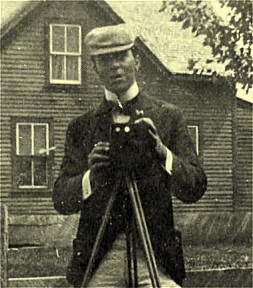
Edgar Rice Burroughs In Idaho
Red, White And Black
Now we get to the ostensible story which is the Red assault on Italian Somaliland. If few people today understand the partition of Africa by the European powers it might be well to recap the situation a little. The two big players were France and England with Spain and Portugal picking up some early real estate to be later joined by the bit players, Germany and Italy. The German possessions were stripped from them after the Great War and given to England.
This novel takes place in the Horn Of Africa or the Northeast corner facing the Arabian Peninsula and the Indian Ocean. The area contained Ethiopia otherwise known as Abyssinia, the only independent State in Africa save Liberia whose independence was guaranteed by the United States.
Ethiopia was bordered by Italian Eritrea and French and British Somaliland on the North, Italian Somaliland on the East, Kenya and Uganda on the South and Anglo-Egyptian Sudan on the West.
The Galla tribe with whom ERB became fascinated had been driven about by the Somals occupying lands mostly in the interior of Ethiopia after the manner of the Middle Eastern Kurds, where they were constantly in conflict with the Ethiopians and the Somals on the border. ERB deals with the Ethiopian-Galla situation in Tarzan And The Mad Man.
The Red camp is located in Ethiopia several days march from the border of Italian Somaliland. Opar which is nearby must now be located in Ethiopia.
The Reds have assembled an international cast of characters or in other words a multi-cultural outfit. Their multi-cultural nature will prove to be a liability rather than an asset as indeed it must in real life.
The organizers are Russian or Soviet Communists of whom there are four, Peter Zveri, the leader, Zora Drinov, Paul Ivitch and Michael Dorsky. They are joined by an American agent acting as a double agent, Wayne Colt.
Burroughs casually mentions that the expedition was put together in the United States by Zveri operating on both coasts. As Burroughs is writing a novel he wisely declines to preach or analyze, he is, as he says, an entertainer. As I who do function as an analyst pointed out in Marcia Of The Doorstep that the US had been used as a safe haven by every conspiratiorial revolutionary group on the planet. Burroughs is noting the same thing but only in passing as part of the story. If one is not attuned to such details they slip right by without significance as do the dots and dashes of the Morse code to the uninitiated.
The group is also composed of a Filipino Red, Antonio Mori and a Mexican revolutionary Miguel Romero. These people form the core group. Affiliated with them are the Moslem Arabs of Abu Batn who appear to have been recruited from the Mahgreb, perhaps Algeria, where some of Tarzan’s early adventures occurred. They do not appear to be Black Arabs of the Horn. While appearing to be Communists they remain Moslem Arabs whose real motive is to drive the Christians or Nasrany as they call them out of Africa. This means Whites of no or any religious affiliation.
Zveri has also patched on the Bantu tribe of Kitembo, the Basembos. This is because Kitembo has actually been to Opar, the only member of their party who has. Kitembo doesn’t appear to be a true Communist but is a former powerful chief from Kenya who had been displaced by the British. He comes from a place on Lake Victoria which should make him a Luo but for reasons perhaps not pertinent I tend to think of him as Kikiyu probably partly based on someone like Jomo Kenyatta who already had notoriety by 1930 although Kitembo’s history is close that that of the Unyoro Chief Kaba Rega whose story Burroughs was definitely familiar with from the memoirs of Samuel Baker.
Kitembo is interested only in recovering his past dignity augmented ten fold. All that becomes irrelevant when he deigns to lay his hands on Zora.
We should remember that Burroughs is writing in 1930 not 2010, so many things that are more or less clear to us now were undetermined at that time while understandings and motivations were quite different then from today and as those of today will be fifty years hence.
For one thing Africa was still a land of mystery where one wouldn’t have been too surprised if someone had discovered a lost civilization, a strange anthropoid- perhaps the so-called Missing Link, very real to the imagination at the time- and any number of things. One of the great losses of my childhood was the recognition that Africa was known; that nothing truly wonderful would be discovered in the world again. All was now cataloguing.
Abercrombie and Fitch who had built a very lucrative business outfitting ‘explorers’ or safaries, having not yet turned to teen porn, lost its raison d’etre as did all the ‘Explorer’ clubs where grown men sat around in khaki Safari gear drinking and dreaming. All that was left for me and my generation was Trader Vic’s and he’s gone now. The miracle is that the National Geographic found a way to survive when they could no longer portray exotic, naked, painted savages with necks supported by copper rings, plates in the upper lip and that. Now of course they don’t have to go as far for such exotica as Whites imitating the Africans sport massive tattooing suported by all kinds of nose rings and body piercings.
So, in 1930 Burroughs’ story still had a degree of probability. Especially in the way he joined contemporary politics to nineteenth century Africa. In one reads closely this is quite a story, a true tour de force.
Not only do the Arabs and the Bantus have their personal motivations apart from Communism, so we learn does Peter Zveri. The streak of individualism is not extinct in his collective mind, he sees the opportunity to make himself Emperor of Africa in Tarzan’s stead. Apparently Soviet intelligence has been keeping close tabs on the doings of the Big Ape Man because Zveri knows of Tarzan’s ‘fool dirigible trip’ believing him absent from Africa and possibly dead as no one has heard from him for the past year. This was before Google Alerts too.
Indeed Tarzan drops as from the clouds into a clearing filled with great apes as the story begins. Just coincidentally Jad-Bal-Ja and Nkima happen to be in this exact part of Tarzan’s estate of Africa at the same time. Zveri then is very disappointed to learn that his nemesis is back. As well he might because he has engaged himself mano a mano with the Big Bwana and Africa, believe it or not, is not big enough for both of them.
In his examination of Communism, multi-culturalism and human nature Burroughs is at his incisive best. Remember few of these stories go over a hundred ninety-two paperback pages. These are tremendously condensed stories. They’re somewhat like a zipped file with megabytes compressed into kilobytes. To really get the stories you have to unzip them and let them expand in y9ur mind. Don’t be deceived by their seeming simplicity.
The various cultures involved in this plot are only loosely held together by Communist ideology. The plot eventually falls apart because the cultures see through the phoniness of the Communist ideal. Zveri himself isn’t even that sincere a Communist as he intends to use the gold of Opar to make himself a third world power as Emperor of Africa. In the end Communism is a fatuous dream,whether utopian or dystopian is up to you.
Burroughs does not emphasize his opinions, he merely tells his story. My conclusions as to his intent are derived from the result of the story. In the end Communism fails because of internal contradictions while the big Bwana is invincible retaining his position as Guardian or Emperor of Africa. Not one world of preachment.
Wayne Colt in his rather absurd trek across Africa arrives too late for the first assault on Opar. He does happen into camp in time to spot the shaking tent and rescue Zora from Jafar, the Indian Communist, with Tarzan’s help. After killing Jafar Tarzan turns his steps to Opar traveling in a bee-line through the Middle Terraces he handily arrives before the first expedition which had left some time before him.
Let me take a moment to discuss Burroughs’ Africa. In the first place these stories are combination dreamscape, fairy tale and mythmaking. His Africa bears no more relation to this planet than Arthur’s Camelot bore to Medieval England. I find it tiresome for scholars to try to find the ‘real’ history of Arthur’s career. Arthur may have a loose connection to real historical events but the story, a great one, is a projection of psychological needs. There isn’t any such thing as a Holy Grail. No knights ever went in search of it.
In the same way Burroughs’ Africa is a psychological projection hopefully leading to his Holy Grail. There are no lower, middle or upper terraces in a nearly uniform jungle in the real Africa. Anyone who tries to find them will be severely disappointed. Such things are merely inventions of Burroughs’ dream world. I am glad he shared it with me, you and the millions.
The frequency with which the characters run into each other way out there is also impossible but in Burroughs’ dreamscape, his fairy tale, his myth, it happens all the time. There is no sense in arguing the impossibility. If you find it too offensive to your sensibilities then the oeuvre is not for you. One just accepts that these are fairy tales and in fairy tales things like this happen all the time. It’s a fantasy, fantastic things go on.
I try to fathom the psychological intent so while I may smile and jest at some impossible details it is only at the naive dream details and not the serious intent of the story. In our time these stories would have been taken at warp speed to another galaxy where in that context all things would be possible. But, that would be pure fiction hence unbelievable. I never did take Star Trek seriously, in fact, I refused to voluntarily watch it. Burroughs’ Africa can still be located on a map of the world connecting psychological reality with temporal reality in a very satisfying blend.
So, as this series is a roman a fleuve or River Story, Tarzan ruminates on his previous visits to Opar as he strides across the hot dusty desert, where the rain never falls, toward the fabled gold and red domes and turrets in the distance.
La’s love for him which began in Return Of Tarzan has caused dissension between her and her people. She has retained her position only through the active intervention of Tarzan. Defeating the revolution that had ousted her in Tarzan And The Golden Lion the big Bwana had replaced her on the throne guarded by the Bolgani of the Valley of Diamonds and the semi-human Gomangani. It is interesting to not that the Oparian revolution occurred after the Russian. Might be a connection.
As he approaches the city he believes that the Oparians appreciated his defeat of Cadj and that they love and respect him so that his reunion with them will be joyous. Not so. In the interim the Oparians who hate and resent Tarzan have deposed La putting her in a foul prison in the vast underground maze of dungeons of Opar. Passing back through the narrow cleft, bounding up the stairs, Tarzan is surprised to find himself attacked by the howling Frightful Men. The Man of the Steel Pate receives another frightful blow which lays him out.
He wakes to find himself the captive of Oah and Dooth. He is placed in a cell the details of which I have already related above.
I haven’t plumbed the signficance of Tarzan and La being imprisoned together while the city is attacked by the Communists unless the dreamworld of Opar represents a sanctuary that is now invaded in the attempt to destroy Burroughs’s literary career. In that event it might be necessary for the Anima and Animus to be together. This story also harks back to the invasion of the Emerald City in Baum’s story The Emerald City Of Oz.
In any event the various strange screams and noises from within Opar unsettle the superstitious Blacks and Arabs who lose their nerve refusing to enter Opar. The Blacks believe in spirits and the Arabs in jinns both of which they fear more than living men. Thus Burroughs is contemptuous of both cultures.
Zveri and his Russians are too cowardly to enter themselves. The only one with the nerve is the Mexican Miguel Romero who gets very good reviews from ERB. Miguel retreats in the the face of the horde of Frightful Men but he is very cool about it.
Returning to camp the Arabs are now disaffected having words with Zveri. The arrival of Colt and Mori puts a little heart into Zveri so that a second attempt on Opar is determined leaving the Arabs to guard the camp.
Tarzan and La escape from Opar between the two assaults becoming subsequently separated. Zveri takes the Blacks and Communists with him. Being left behind dissolves the Arab affinity with the Cause. Never good Communists, being interested only in ejecting the Nasrani from Africa, they decide to disappear into the desert.
About this time La wanders into camp. Sacking the camp, Abu Batn and his Arabs leave with the two women whose value in the North he knows full well. The Arabs are out of the story. The Communist coalition is breaking up. As Burroughs points out the goals of the two are not the same.
Back in Opar Zveri finds it impossible to force his Africans into service while he and his Russians remain cowards. Colt behaving bravely, as only an American can, along with Miguel Romero penetrates to the sanctuary where they are faced by the Frightful Men. Perhaps in a comment on American tactics Colt fires over the heads of the Oparians while the Mexican, Romero, fires directly into the mob.
Why when Americans go to war they are reluctant to do the dirty work of killing is beyond me. The reluctance to engage the enemy in Viet Nam cost us that war. The reluctance to do what we have to do in Iraq is costing us that war. Perhaps we think we can hide behind a wall of steel as our technology wars for us while we imagine we can remain safe. Our punishment of our own soldiers for merely humiliating the enemy must be unique in the annals of warfare. And they wonder why no one wants to join the Army.
Romero who shoots to kill is able to escape while the pussy footing Colt is downed by a thrown club and captured. A thrown club! Once again a Burroughs’ surrogate takes a blow to the head, but how does one survive a thrown club?
Just as Colt and Zora exchange partners in the jungle so now Colt takes Tarzan’s place in jail. Here, he is befriended by a nubile beauty, Nao, rather than as La did Tarzan and, pephaps as Florence was doing for ERB. Afer killing to free him Nao is left behind as Colt disappears into the dusty desert. Not a very thoughtful thing to do as Nao would certainly be discovered.
Zveri returns to his devastated camp to be handed a letter notifying him that Colt is a double agent. Abandoning any thoughts of Opar the Communists concentrate on their mission which is the simulated invasion of Italian Somaliland.
As they are about to leave Tarzan returns Zora to camp. Coldly dropping her off without a word he climbs onto a branch to spy on the conspirators. His leopard skin shorts are mistaken for the real thing. Here we go again. the shot at the imagined leopard grazes the Big Guy’s skull putting him out of commission for a full day. So that is at least two knockouts for Burroughs’ surrogates plus this concussion. Tarzan’s frequent lapses of attention become more intelligible.
Zveri wants to take advantage of his opportunity and kill Tarzan but Zora intervenes so Tarzan is bound which leads to next day’s episode when Dorsky threatens him only to be annihilated by Tantor.
The charming fairy tale between Nkima, Tantor, Tarzan and the Hyena then takes place which is a repeat of the same scene in Jewels Of Opar.
Nkima then goes in search of the Faithful Waziri to aid Tarzan while the Big Fella begins his campaign of terror against the Communist conspirators.
His strategy is to separate Kitembo and his Basembos from Zveri and his Communists. To do this he plays on their superstitious natures. A mysterious voice comes down from the trees, in other words, the sky, telling them to go back. In the meantime Little Nkima has recruited the Faithful Waziri who arrive to help out not with spears and bows and arrows but modern repeating rifles. Arranging themselves in front of the advancing Communists hidden in the tall grass -this stuff grows six feet high- they give the appearance of being many more than they are. Burroughs doesn’t make it clear how they can see the Communists through the grass while the Communists can’t see them but as Tarzan usually navigates pretty well even in total darkness I’m probably making a bigger problem out of it than it is.
Zveri does a rapid advance to the rear which act of cowardice completely destroys his credibility. Dorsky is dead while Romera and Mori renounce their Communism. Zora reveals she’s only in it for the revenge because Zveri had murdered her family twelve years earlier in the Revolution while, as we are aware, Colt is an American agent. This leaves only Zweri and Ivitch who I believe represent Frank Martin and R. H. Patchin, ERB’s old nemeses in Chicago.
Returning to camp Zveri spots Wayne Colt. Calling him a traitor he fires point blank missing while the bullet grazes Colt’s side without breaking the skin. That was a close one. Before Zveri can fire again he is brought down from behind by Zora. Burroughs replays scenes like this over and over with different variations. Just as the constant bashings on the head his surrogates take reflect his own experience in 1899 so must all these conflicts between his surrogates and another man and his surrogate woman reflect his situation with Frank Martin and Emma. In each instance in one way or another the woman rejects the other man. Thus Burroughs ‘fictionizes’ his own situation.
So now Zora kills Zveri so that she and Colt can bridge that gap.
As a sidekick Ivitch/Patchin is allowed to leave Africa. In point of fact Martin died some time before Burroughs although not until after 1934 while Patchin survived both.
Tarzan in the meantime escorts La back to Opar where he reinstalls her on the throne this time doing the sensible thing of eliminating Oah, Dooth and all their sympathizers. One must believe there will be no more trouble in Opar. In any event Opar disappears from the oeuvre.
Tarzan then returns to the camp to dispense justice as becomes the Lord Of The Jungle.
As the story ends the ‘invincible’ Tarzan seems to have solved all the problems confronting he and Burroughs in 1930. The Big Fella has not only thwarted Zveri but defeated Stalin and the whole Soviet empire.
As the exchange between Zveri and Romero explains it: pp. 183-84:
“Which proves,” declared Zveri, “what I have suspected for a long time; that there is more than one traitor among us,” and he looked meaningly at Romero.
“What it means,” said Romero’ “is that crazy, harebrained theories always fail when they are put to the test. You thought that all the blacks in Africa would rush to our standard and drive all the foreigners into th ocean. In theory, perhaps, you were right, but in practice one man, with a knowledge of native psychology, which you did not have, burst your entire dream like a bubble, and for every other harebrained theory in the world there is always the stumbling block of fact.”
Thus Tarzan not only defeats Zveri, Stalin and the Soviets but he disproves the whole Communist ideology as a harebrained theory.
On top of that the Invincible One restored order in Opar while putting his personal life to rights by separating out Colt and Zora or Burroughs and Emma and Tarzan and La or Burroughs and Florence.
The succeeding novel Tarzan The Triumphant- Invincible, Triumphant- will rescue the Russian situation while its successor Tarzan And The City Of Gold disposes of Emma/Jane/Zora/Nemone by her self-immolation while its successor Tarzan And the Leopard Men bring Kali/Florence and Old Timer/Burroughs together. The series climaxes with Tarzan And the Lion Man when Burroughs 2 kills off his early self, Stanley Obroski, or Burroughs 1 to come into his own, or so Burroughs supposes. The rest of the series is playing out the aftermath of the divorce from Emma and the marriage to Florence.
As could have been predicted the marriage to Florence was less than satisfying.
So, perhaps, Burroughs’ solution to his personal dilemma is based on a harebrained theory itself which fell to earth on ‘the stumbling block of fact.’
For the moment however Tarzan has saved Africa from the Communist menace and perhaps the World.
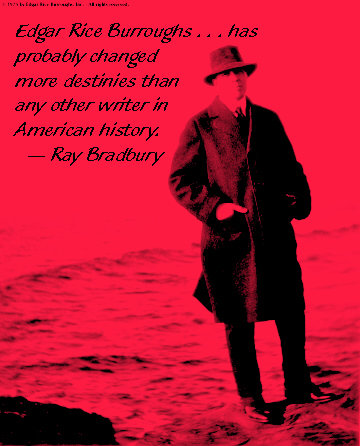
Edgar Rice Burroughs- High On A Mountain By The Sea
Chaps. 3,4 & 5:Edie Sedgwick: Maid Of Constant Sorrow
October 30, 2010
Edie Sedgwick
Maid Of Constant Sorrow
Chaps 3,4 & 5
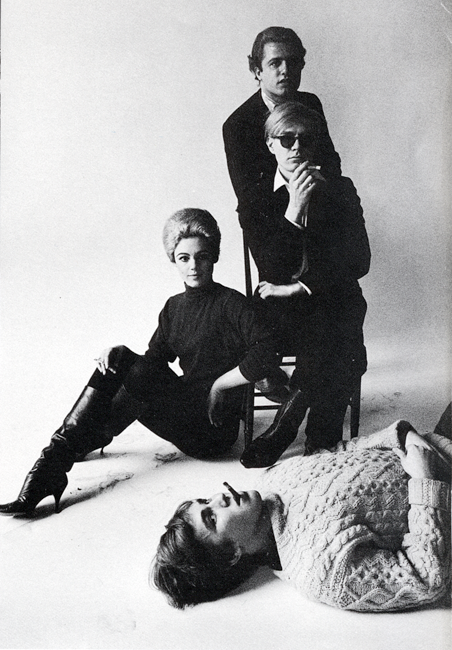
Time Is On My Side
A problem with the sixties is the concept of time. Einstein had gummed up the investigation of the concept considerably. Time is not a static thing but moves at various speeds. Strictly speaking time does not exist but is a human construct. The basis of the construction is the diurnal rotation of the earth and the earth’s revolution around the sun. There is no starting point for the revolution and no end. Man constructed a beginning based on earth’s greatest distance from the sun and because of the Plane Of The Ecliptic, the shortest day of the revolution. This was the most recognizable point to begin. Without the day and the year there is no basis for determining time; there is no other vantage point in the Universe.
Time has no existence in the universe; there is only space and matter and space cannot be defined without matter. No changes take place in the nature of space, only in matter, and time is no operative factor in those changes. Time does not exist outside the human mind.
Time as we usually think about it is a division of the earthly day into hours, minutes and seconds; of the year into seasons, months, weeks and days. As this is objective time keeping without reference to the passing of events or the perception of the individual subjective time is unaffected by objective time.
Now, let us say that the normal rate of perception and living is done in 4/4 time. To try to be specific let us say the standard is time as lived by 18-60 year olds adjusted to their societal needs. Let us just speculate that the mind in its normal state is comfortable with 4 bits of information per second and let us say that normally, whatever that means, bits of information are occuring at 20 bits per second. That means that 16 bits a second are normally over the subject’s head; he may perceive them but he can’t record them on the spot. Part of this is made up in sleep and dreams where removed from external stimulus the individual is able to subconsciously process additional bits that went by him while waking. The remainder then can only be captured and analyzed from a distance in time where what was happening can be seen but what is gained in distance is lost in immediacy. That is history, what I am attempting here. While the big picture can be seen, vast amounts of immediate detail are lost to memory or altered to conform to desires and prejudices. But, that is the way it is.
The period of ’64-’66 was one in which amphetamines and barbiturates altered or distorted 4/4 time. Under the influence of amphetamines subjects were living in, let us say, 16/4 time. They were so alert they couldn’t sleep. So long as they could control their obsessions and not be hung up on details they could turn out prodigious amounts of work. Thus to satisfy this amphetamine induced mania for work Warhol and his assistant, Gerard Malanga, could manually turn out fifty large Presley silk screen prints in an afternoon. In fact, in this period they turned out thousands and thousands of silk screens. There are a lot of Warhols out there.

Dreaming Dylan
Dylan is said to have literally and steadily turned out reams of material. He left a huge sheaf at Baez’s in Carmel in Spring of ’65 which he never reclaimed. As he said, songs just flowed through his amphetamine fueled mind. This sort of activity ceased or drew to a close when both Warhol and Dylan ceased using amphetamines- in other word their time races slowed down and their brains slid back toward 4/4 time.
Now, when the subject’s brain was racing at 16/4 it couldn’t slow down to allow him to sleep. Keith Richards says that in those days he slept only two nights out of seven. Warhol said he got two hours of sleep a night during this period and some said, perhaps with exaggeration, they didn’t sleep at all for one or two years.
So, while your brain is racing along 16/4 and you feel the need for rest you have to take barbiturates, downers, to slow your time down toward 8/4 or hopefully 4/4. This pits one drug against the other, one is speeding, one is dragging. Too much manipulation and of course one’s time slows to 0/4 and you’re dead.
Between events being clustered and racing so fast that no one can keep up, even at 16/4 and certainly at a speed to defy analysis no one had any idea of who or where they were and what was happening. No matter how fast the brain is racing one is still living in 4/4 time.
For those with 16/4 racing brains and no outlets such as art or writing, music, the result was chaos and self-destruction. In addition confusion was caused by making the 18-60 years old time race as an objective standard by which all normality is measured.
When someone says that time stood still, it literally did for the subject, the duration of that stillness cannot be measured by objective time.

All I Have To Do Is Dream
What may seem like a few seconds to an outside observer is literally timeless to the subject. The earth still turns but the mind doesn’t move, but no time is lost because time doesn’t exist. Thus children and mature people live in 2/4 or 3/4 time in which 4/4 time is irrelevant. It takes eons for a day or two to pass as a child while objective time becomes irrelevant if you no longer have to watch the clock. For instance, at 72 I live in a mix between natural time and objective time. I only have to enter objective time when it’s necessary to keep an appointment and I try to eliminate those as much as possible. Otherwise it’s day or night, Spring, Summer, Winter or Fall. I frequently don’t pay attention to what day it is because I don’t need to know and I don’t care. It doesn’t make any difference; it is always my time.
Doctors try to evaluate your memory by applying the needs of 18-60 year olds who are living according to the demands of objective time. So, since we live at different time races those whose speeds differ have a difficult time understanding each other.

Give Me Mo' Mo' Mo'
Chapter 4
Speeding Down The Highway
Lest we associate amphetamines at this time with illegal drugs let’s look at the scene in NYC. Sometime in the early sixties Feel Good doctors were dispensing massive does of amhetamines and vitamins. the most notorious, or well known, of these doctors were Max Jacobson and a man referred to as Dr. Roberts.
Jacobson appears first on the scene with a patient roster of astounding celebrity which included then President John F. Kennedy. Lyndon Johnson took a shot but perceived the situation for what it was and didn’t go back.
George Plimpton
The Beatles mention a Dr. Robert in one of their songs and he’s the man we’re concerned with here in ’65 no to be confused with Dr. Roberts. Dr. Roberts administered to some of the Warhol crowd including Edie Sedgwick. There is an astonishing account of his practice in Stein and Plimpton’s Edie. Quite an extensive account. To excerpt it I’d probably have to have permission; I’ll check into it.
These doctors were carelessly giving incredibly huge injections that kept you speeding for a week or two. But needles, syringes and drug could be obtained easily and they were which brings us to a member of the Factory entourage, Brigid Berlin. She was not old money but came from a very affluent background.
She, obviously laboring under several mental disorders, was an indiscriminate and unsound dispenser of the drug. She ran around the Factory injecting all and sundry with the same dirty needle. Her forte was to inject herself straight through the seat of her jeans.

Jean Stein
Andy, himself, used something call Obetrol which is described as a very high quality amphetamine producing a pleasant and stimulating high. While this drug kept Andy up with the exception of an hour or two of fitful sleep it also allowed him to work, work, work, industriously and with intense concentration for hours at a time. Fifty Presleys in an afternoon, think about it, assembly line pace.
Without a work outlet one had to find other ways to work off the excess energy. Non-stop talking is one but, hell, I can do that all day without the benefit of drugs. Since all these people at the Factory were living in 16/4 time they could communicate on that level with each other. There wasn’t an awful lot of intelligence being communicated. Warhol did us the service of recording 24 hours of what passed for communication and published the result as a book or novel he titled ‘a’. This book is virtually unreadable but as dedicated to my art as I am I am living proof that it can be done. Let’s hear from anyone else who had the patience. The gang was big on non-verbal communication. There are mostly a lot of incomplete sentences in the book but the conversation is forwarded in a pastiche manner each participant adding a phrase so that a sort of idea is parsed out.
As might be expected the group was low on conventional 4/4 morality, but at 16/4 they seem to have worked out a morality that all could accept but one I certainly would reject. Beatings, theft and random sex in view of others or not with anyone or anything seemed to be the moral basis. While Andy disavowed responsibility for anything that hapened at the Factory he was in fact the leader functioning as Magister Ludi. In the novel ‘a’ he is referred to as Drella, a combination of Dracula and Cinderella- a vampire and a fairy. He was in truth a bloodsucker.
He essentially took a whole group of Catholic homosexual Undermen and gave them a clubhouse and a certain immunity under the umbrella of his name and fame. Even then he and his Factory were a thorn in the side of legitimate society, the police visiting the place on a regular basis. And rightly so.
This was the scene, the environment that Chuck Wein brought Edie into. It seemed to suit her state of mind, she stayed.
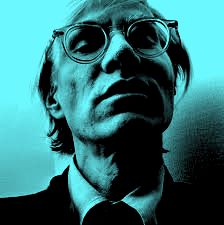
Magister Ludi
Dylan also was an amphetamine freak at the same time while using alcohol, LSD, marijuana and heroin. Warhol who was a perceptive observer said that Dylan’s songs were the amphetamine speaking. According to Andy, Dylan took other people’s words (and tunes) and because of the amphetamine was able to make them sound as though his own. He also astutely divided Dylan’s output into two periods; the first, social protest and the second, personal protest. Pretty much half a side of Another Side, plus Bringing It All Back Home, Highway 61 Revisited and Blonde On Blonde. Once again, he knew whereof he spoke. We’re concerned more with the personal protest here taking little or no interest in the social side.
Dylan’s personal protest by its very nature must be autobiographical. Indeed, Suze Rotolo identifies many of Dylan’s songs as referring to her. She should know. Dylan was quite taken with her. He obviously suffered a painful feeling of desertion whan at her mother’s insistence in 1962 she left NYC to study in Italy. This absention definitely changed the relationship although as Bob was never too constant a lover it is difficult to see how. Ego was hurt, I guess.
Although the relationship was reassumed on Suze’s return her sister, Carla, and her mother disapproved finally breaking the couple up. The break up produced the autobiographical Ballad In Plain D in which Dylan vented his emotions in a loud screaming complaint that was a direct predecessor to his magic mantra ‘Like A Rolling Stone.’
Chapter 5
I Can’t Stand The Pain In Here
According to accounts Dylan began writing Like A Rolling Stone in June of ’65. It began as 20 pages of ‘vomit’ according to Dylan, cut down to 10 and then to its released form. The 45 was a successful disc reaching the Billboard Top 10. The song is quite obviously about Edie when one learns the background. Many New Yorkers who were aware of the scene expressed their opinion that it was about Edie, pointing out further their belief that Warhol was the Napoleon in rags.
If first written in June then Dylan had made a considerable psychological investment in Edie since the previous December of ’64. One wonders where he found the time to cultivate a relationship with her between the two dates. He wrote recorded and released ‘Bringing It All Back Home’ between the meeting with Edie and April. He had performance dates. He divided his time between NYC, Woodstock and Carmel. In the last mentioned place he was staying at the home of Joan Baez while keeping Sara in Woodstock and maintaining some sort of relationship with Suze.
The extent of the rage and hatred of ‘Stone’ seems to be out of all proportion. According to the song Dylan is in a jealous rage because the ‘She’ of the song has deserted him for this ‘Napoleon in rags.’ ‘He calls to you, go to him now.’ What exactly did Dylan intend to do with Edie that he should become so emotonal? There is no question but that he intended to marry Sara; also none that he would marry either Joan, Suze or Edie. Quite simply they weren’t Jewish and Sara was. Dylan had no intention of marrying outside his religion. He intended to obey the Biblical injunction, which he takes as the literal word of God, to be fruitful and he wanted his children raised Jewish.
So what, then? What did Edie represent to him? Apart from being an uptown girl, in Volume I of his autobiographical Chronicles he suggests that one looks for the model of ‘She’ in his mother. I found this puzzling. I couldn’t make it fit the lyrics. None of the ‘facts’ of the song seemed to fit what is known of his mother. Then I saw Dylan’s 2003 movie, Masked And Anonymous. This is a delicate subject of which I am only going to skirt the edges. But, if one reads between the lines of Jack Fate’s soliloquy at his father’s death bed about his mother and faher, the lyrics of Freight Train Blues and what I’m hinting at here the fog should thin out somewhat. Remember that Dylan said his mother was connected to ‘Stone’. Since the song is about Edie it follows that Dylan associated his mother and Edie in his mind; there was a situational similarity to him.
Now, from August ’65 to the recording of Blonde On Blonde nearly the whole of Dylan’s output is centered around Edie, Warhol and the Factory. One of Dylan’s more vicious songs was ‘Leopard Skin Pill Box Hat’ which is about Edie. When Edie dissipated her inheritance she bought a slew of fur coats and a lot of jewelry. She had the leopard skin pill box hat.
Dylan’s mother was also known for having a lot of jewelry and several fur coats. Dylan recorded his version of Freight Train Blues long after 1968 when his father died. Now, immediately after his death the business owned by his father and two uncles either went bankrupt or was forced to close. In other words there was no more money left in the business. While Hibbing was not a flush market there was no competition either. So Abe Zimmerman’s exit came at a propitious moment, or…. At any rate there was no more money.
Just as Edie went through her money so Dylan’s mother kept her husband hopping in all likelihood straining the finances of the appliance store that, after all, had to support three families. Dylan, then, may have conflated Edie with his mother’s extravagance and whatever he had planned for Edie would have been done to his mother surrogate. In fact he was quite brutal to Edie, destroying her in the end. Thus one avenges oneself on one’s mother, ‘Like A Rolling Stone.’ He is probably one of those people who reject but can’t tolerate rejection because of his mother’s rejection of him per Jack Fate. According to his soliloquy in Masked And Anonymous his mother essentially rejected him plnging him into a deep depression from which he has never recovered if the movie is any indicaton. The movie too is autobiographical. He felt: ‘Nobody leaves me, I leave them.’ ‘That’ll be the day when you leave me’ as Dylan’s hero Buddy Holly put it. This was possibly the cause for the eruption of Ballad In Plain D.

Obetrol
In March of ’65 Edie entered the corrupt, even criminal, world of Warhol’s Factory. One can only speculate why Chuck Wein took her there. Perhaps the empresario was having a difficult time getting Edie launched and thought he could get her into Warhol’s hideous movies. Having run through her inheritance Edie was getting desperate for money. Perhaps in her naivete she thought movies were movies and movie stars made big money. Certainly one cause for her break from Andy was his refusal to pay her.
Warhol, in his own delusions believed that Hollywood would come knocking on his door cash in hand. That that never happened was probably a major disappointment. At any rate when this vision of the respectable Overmen appeared in this dump of a studio Andy went ga-ga. In fact, Edie was his ticket, his entry into the Upper East Side crowd. Just as Fred Hughes was to show him how to make money, Edie opened society doors to him.
This King of Scurf was creating quite a scene at the Factory. At the same time he gave a clubhouse to the Undermen, as a leading figure of the art world which, after all, is an upper class affair of wealth, he had a foot in that camp. Led by the more louche of celebrities the Factory was becoming a party destination. So Edie added some instant uptown glamor. Old family, old money.
Whether it was the hope of money from movies that kept her there or whether this degrading atmosphere filled some psychological need Edie stayed on thereby sacrificing her reputation. I imagine there’s always the hope that once you get your face up there something will pop.
Sometime between March and June Dylan became enraged that Edie was at the Factory making some pretty lame Warhol movies with little or no commercial appeal. Thus his work from this time on reflected his tug of war over Edie with Warhol.
Edie says that she didn’t get into heavy drugs before she joined Warhol’s menagerie. This may be true but as Warhol said: How do you stop someone from doing what they want to do? I would imagine the effects of electro-shock are very long lasting and discombobulating. Lou Reed of Velvet Underground was certainly whacked out from electro-shock. As I write my mind keeps going back to the time I stuck my finger in the socket as a child. I mean, it is vivid, so I can’t imagine what Electro-shock does to you. Perhaps speed replicates what electro-shock does do to you. Perhaps speed replicates or complements the feeling of electro-shock in some way.
Of amphetamines Edie is quoted as saying:
The Ghost Of Electricity
The nearly unendurable torment of speed, buzzarama, that acrylic high, horrorous, yodeling, repetitious echoes of an infinity so brutally harrowing that words cannot explain the devastation nor the tone of such a vicious nightmare.
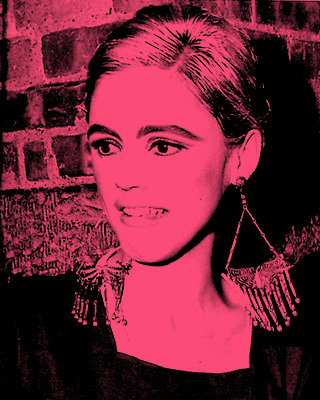
Could be close to the feeling of electro-shock. Kind of reminds me of my finger in the socket. Dylan’s seach for the ‘high mercury sound’ must also have been the result of speed. Cacophonous songs like ‘Highway 61’, ‘Subterranean Homesick Blues’ and ‘Rainy Day Women’ come to mind.
Perhaps also the amphetamine high reflected and complemented the deranged vicious goings on Warhol allowed at the Facatory. The sado-masochism. Brigid Berlin, or the Duchess as she was alternately known, roaming around with her needle and syringe ramming it into anyone will they, nil they, not much choice there. Beatings going on back in the shadows, is it any wonder that Dylan referred to Warhol as Dr. Filth in Desolation Row.
It is difficult to ascertain dates in existing sources but possibly between June and August Dylan invited Edie and Andy to a concert in upstate NY so, there was significant interaction between the three before Highway 61 Revisited. Side one of that record doesn’t reflect Factory activity as much as side two. I suspect all three songs on that side reflect Dylan’s sitation with Andy and Edie while Desolation Row definitely does. Now, while at the time there were few listeners who had any idea of what Dylan’s lyrics meant except for possibly a few, of which Warhol definitely was one. He must have recognized the reference to himself in ‘Stone’ and also in Positively Fourth Street. These songs were hits. ‘Fourth Street’ was pulled from airplay shortly after relaease but when I first heard it the sound just blew me away. I heard the put downs but too fleetingly to grasp them. Hank Williams on steroids.

Stop! In The Name Of Love
Dylan, then, was making, on Warhol a blatant attack over the airwaves of all America plus reviling Edie in a hideous manner. What did Andy think, what was his reaction? Having vented his feelings even more violently than he had in Ballad In Plain D, Dylan’s next move was obvious. Having lost Edie in March he meant to reclaim her in October. And so this epic battle for the person of Edie Sedgwick began. She was only a pawn in their game.
Chaps. 6, 7 and 8 are up on the next post.
Chaps 9,10, 11 and 12 are now up on the post following 6,7 and 8.
Chaps 13, 14 and 15 are now up also. Chap. 16 and end is in contemplation
”
Pt.I: H.G.Wells, Sigmund Freud, Edgar Rice Burroughs And The Development Of Contemporary Sexual Attitudes
August 14, 2010
H. G. Wells, Sigmund Freud, Edgar Rice Burroughs
And The Development Of Contemporary Sexual Attitudes
by
R.E. Prindle
Part I
Certainly it is to be hoped that (the) naturalistic school of writing will never take firm root in England, for it is an accursed thing. It is impossible to help wondering if its followers ever reflect on the mischief that they must do, and, reflecting do not shrink from the responsiblility to look at the matter from one point of view only, Society has made a rule for the benefit of the whole community, individuals must keep their passions within certain fixed limits, and our system is so arranged that any transgression of this rule produces mischief of one sort or another, if not actual ruin, to the transgressor. Especially is this so is she be a woman. Now, as it is, human nature is continually fretting against these artificial bounds, and especially among young people it requires considerable fortitude and self-restraint to keep the feet from wandering. We all know too, how much this sort of indulgence depends upon the imagination, and we all know how easy it is for a powerful writer to excite it in that direction. Indeed, there could be nothing more easy to a writer of any strength or vision, especially if he spoke with an air of evil knowledge and intimate authority. There are probably several men in England at this moment who, if they turned their talents to this end, could equal, if not outdo, Zola himself, with results that would shortly show themselves among the population. Sexual passion is the most powerful lever with which to stir the mind of man, for it lies at the root of all things human; and it is impossible to over-estimate the damage that could be worked by a single English or American writer of genius, if he grasped it with a will.
–H. Rider Haggard
Appendix to the Broadview
Edition Of She

Edgar Rice Burroughs
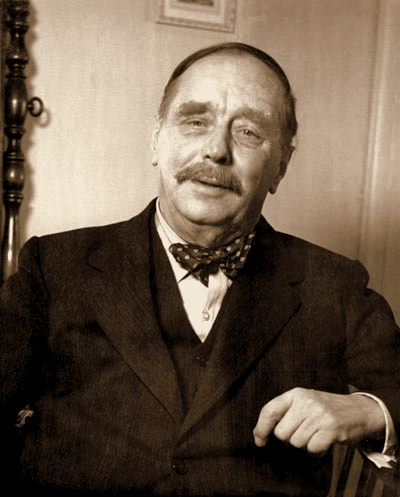
For a long time now I’ve put off writing about Edgar Rice Burroughs in relation to H.G. Wells. Wells has been difficult to get a handle on, a point of entry. But the Woodrow Nichols’ article on nudity in Burroughs on ERBzine pointed in the direction of changing sexual attitudes in the twentieth century. Coupled with reading the above quote of Rider Haggard I realized that Wells and Burroughs were two of those powerful writers capable of unleashing those sexual passions. They, coupled with Sigmund Freud, did change sexual attitudes in the twentieth century.
That is not to say they were alone but of all of the hundreds of writers between then and now all their books remain in print continuing their work.
The sexual problem is central to civilization while it has been handled differently in the development of civilization. For some time it seemed that the Patriarchal model would be permanent. J.J. Bachofen, the great Swiss mythologist of the mid-nineteenth century, was the first to challenge the Patriarchal model. In his studies of mythologies he perceived that behind the Patriarchy first came a Matriarchy while at the beginning was a Hetaeric period. All three had different sexual approaches while all three attitudes have survived into the current age competing for dominance.
In the first Hetaeric stage of development Bachofen believed men used women, and woman, indiscriminately whether with force of persuasion when the sexual urge hit him. A good picturalization of this can be found in the movie, In Quest Of Fire. As there was no knowledge of how offspring were conceived the women of the horde merely accepted the inevitable bumper crop of children.
Being a sexual object puts an unbearable burden on the female of the species no matter how natural. Since most females began bearing at twelve or thirteen with the onset of puberty they were worn out at twenty with few probably surviving to thirty. Indeed, a huge percentage must have died in child birth from twelve to twenty. One imagines a surplus of males in the horde not unlike affairs in the nineteenth century when men frequently went through two or three wives or more as the women died young in childbirth.

J.J. Bachofen- One Of The Greats
While conception or paternity wasn’t recognized there was no mistaking motherhood. By some process of refinement the sexual mores of hordes evolved into Matriarchy which acknowledged female parentage while giving women some sort of sexual control, preference if you will. The change from the Hetaeric to the Matriarchal inevitably left behind a reactionary or conservative group who saw no reason for change or giving up their sexual prerogatives. Thus conflicts between the two attitudes, perhaps warfare.
The Matriarchy was still thriving when history began to be recorded. Thus Homer’s Iliad and Odyssey concern the Patriarchal revolution against the Matriarchy amongst the Europeans. By now paternity had been discovered by which the male discovered that he impregnated the female which he now considered the most important part of the process and one which involved the exclusive use of the female as he had no wish to care for another man’s children. Hence Patriarchalism- the primacy of the father- evolved putting the three systems into conflict and competition. This is a main theme of Greek mythology.
Concessions had to be made to the Hetaerists who were irate at the loss of their prerogatives. Hence temple prostitution undoubtedly evolved in which all the young females were kept in a temple compound until they had sex with any man who demanded it. Civilization being civilization, of course, there was a fee, hence protitution. Upon completion of the duty the female was released.
The Patriarchal revolt was a long slow drawn out process with many setbacks and compromises such as the above. Indeed, the Patriarchal god, Apollo, wrested Delphi from the Matriarchy but in the Matriarchal reaction he was forced to share the shrine with the effiminate Matriarchal hybrid god, Dionysus who, himself was destined to replace Zeus as the avatar of the Piscean Age. He assumed both male and female characteristics in the attempt to arrange the sexual conflict. That’s why the Jewish prophet Jesus of Nazareth, who substituted for him in yet another compromise is so effiminate. With the admixture of the Semitic influence in European religion with its uncompromising Patriarchalism the evolving Catholic Church was all but able to extinguish the Matriarchal Dionysian influence as well as the Hetaeric. Chastity, celibacy and monogamy became not only dominant but exclusive.
Just as the Matriarchy, while suppressed, has never disappeared or admitted defeat so also the Hetaerists have survived assuming different disguises while waging continued war with the Patriarchy and the Scientific view which is say Western Science and the Roman Catholic Church.
Reviled by the Church and persecuted sometimes to death the various sects fought back often posing as Catholics to become priests, even occasionally a Pope, and bore from within. Thus arose the Free Spirit sect which demanded the right of access to any woman at any time in any place. Thus John Sinclair in 1960s and 70s demanding the right to ‘fuck in the streets.’ An irrational request by any other standard. The Free Spirits delighted in debauching nuns when they had sufficient numbers to seize a place.
The spirit surfaced among the Anabaptists, for instance, who were not only suppressed but destroyed root and branch. With the Enlightenment when the Hetaerists surfaced as the Libertines we hear of them forwarding the French Revolution while their ideals were absorbed by the nascent Communist political movement. The Libertines per se seem to have transmogrifed into La Vie Boheme after the Napoleonic Empire, Bohemianism reaching down to our time.
La Vie Boheme as depicted by the French novelist Henri Murger evolved in the early nineteenth century along with their more overtly criminal cousins, the Mohicans of Paris as the novelist Alexandre Dumas styled them and known as Apaches by the end of the century. In the US fifties the Apaches were represented on TV with a mystifyingly violent effect as Apache dancers from France. I suppose the Apache style was transmogrified into the New York Bohemian style also. So this quasi-criminal Bohemian Apache style pervaded Euroamerican civilization through the nineteenth century and in diluted form into the twentieth and present day. The Fall 2010 Nordstrom catalog for instance celebrates the New York Haut Boheme.
H.G. Wells
I was trying to relate this latter day form of Behemianism to Burroughs in my three part series on Presley, Lennon and Yoko Ono that Bill Hillman courageously published in ERBzine but over some very strenuous objections. I presume I lost the Bibliophiles on that issue.
That Burroughs was fascinated by the Bohemian style while actually furthering the Hetaeric sexual program is fairly obvious. He said that he wrote his first unpublished work, Minidoka, in Ragtime speech, that is to say the Bohemian mode. In other words ERB considered himself plenty hep, at least a closet Bohemian. Some may find that disturbing but, it is so. In ’60s NYC terminology ERB would hve been of the Haut Boheme. Along with those sympathies went a set of Hetaeric sexual mores that Burroughs advocated.
I have already examined the Bohemian influence of George Du Maurier on Burroughs with his novels Peter Ibbetson, Trilby and The Martian. Du Maurier was also of the Haut Boheme. A photograph of ERB behind the camera in Idaho in 1899 shows ERB dressed in full artistic Boho mode. He had just emerged from a short stay at the Chicago Art Institute where he would have immersed himself in Boho mores as artists then and now were virtually all Boho, at least in outlook. Writers too.
It seems quite extraordinary that Libertinism was discouraged and contained between the end of the eighteenth and beginning of the nineteenth century. Perhaps the answer can be found in the transition from aristocratic society to bourgeois society. Perhaps the Bourgeois requiring a different sexual morality than the aristocracy succeeded in imposing their version of sexual mores by sheer numbers.
Libertinism did regain prominence amongst the wealthy Haut Boheme of NYC thence spreading throughout society as a Bohemian sensibility began to displace the Bourgeois.
A book I have reviewed on ERBzine, found in ERB’s library which he read, GWM Reynolds’ The Mysteries Of The Court Of London scrupulously records the libertine activities in a fictional form of Prince George, later King George IV, whose career of seduction ended only in the 1820s. Certainly Reynolds’ depiction of the libertine actiities of George and his circle out Zolaed Zola by more than somewhat.
The whole libertine attitude was nowhere more prominently displayed than in NYC’s Haut Boheme nightclub, Studio 54. So the suppression of the libertine spirit during and since the reign of Queen Victoria was short. Perhaps Haggard’s novel She echoes the memories of the Libertinage of the eighteenth century Hellfire Club in some obscure way.
Haggard had no reason to put on airs because as I pointed out in my review of his King Solomon’s Mines that novel is smutty from top to bottom while ‘She’ has some very salacious passages. As Horace stands watching the scene of She and the dead body of Kallicrates for instance one is more than excited. She had murdered her former lover Kallicrates for running off with another woman. Immediately remorseful she kept the body preserved in perfect condition for two thousand years. She could even psychically animate the body so that it stood although still insensate. The necrotic effect is hypnotizing, making the reader a voyeuristic accomplice of Horace. As he and we watch the bodice of She’s dress slips to her waist exposing her magnificent charms according to your imagination. As we watch she then raises her arms above her head lifting and pointing the golden orbs. She does this not once but twice so it is clear Haggard was exciting and taunting his readers. If one imagines Ursula Andress who played She in one of the movies the effect is exhilarating indeed.

Ursula Andres As She
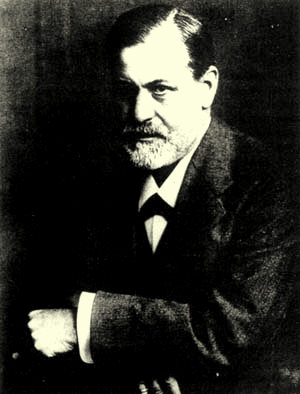
Haggard aside, as he says there were writers in England and America who were champing at the bit to alter the course of sexual history. Chief among these was H.G. Wells in England and our own Edgar Rice Burroughs. Both would make significant contributions to the ‘change’ but the most effective writer of them all was the secret sexual pervert, the undisputed master of them all, Sigmund Freud. But to go first to H.G. Wells and take things in order.
The Mad Herr Doktor Professor

The Last Sane Man Left Alive
Part III: Mourning Becomes Yoko
April 3, 2010
Mourning Becomes Yoko Ono
The Passing Of John Lennon Part III
by
R.E. Prindle

Doppleganger #1
When John Lennon met Yoko Ono he knew very little of art and nothing of the New York art scene. His high school years had been spent in open and futile rebellion; the next few years had been spent only in the German underworld with no time for cultivation. From there he went into the whirl of the Beatles years so one might say he had been in cultural suspended animation for all his adult life.
Yoko Ono since 1960 had been engaged in the New York avant garde art scene. She was au courant when she left for London in 1966. Hooking up with Lennon she began to educate him according to her understanding of art. By the time the Ono-Lennons arrived in New York in the late sixties that scene was dominated by the POP art of Andy Warhol while the world both she and Lennon knew in 1960 was unrecognizable. Yoko wasted no time in ingratiating herself with Andy but not the factory. After he was shot in 1969 the old Factory disappeared and after his recovery Warhol began a new life. It is possible that she tried to establish

Doppelganger #2
contact with him between ’64 and ’66. She did know warhol’s associate, Sam Green, from her first days in the Village in 1960.
By the time of her return to NYC Yoko had achieved world wide fame by using Lennon and his fame in their charades for ‘Peace.’ Now she had the perfect entree to enter Warhol’s circle. Warhol was a sucker for celebrities, he did Lennon’s portrait, so he was flattered when Yoko asked him to introduce she and John into society. If Warhol could pester, Yoko was unstoppable. While Andy wasn’t exactly persona gratis at that time he was thick with Sam Adams Green who did have entree to society. Between the the two of them they set up a party to introduce the Ono-Lennons.
John was, of course, no Mick Jagger. While Mick adapted himself quickly to the demands of his fame and moved easily in society, John was awkward being out of the element of his self-styled working class hero. Yoko, too, was no mixer so at the party Yoko and John sat silently in a corner as though in one of Yoko’s bags watching the party goers.

Warhol Jagger 2

- Warhol Jagger
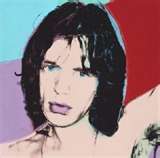
It might be apropos to point out that Jagger and Warhol were fairly close. Jagger was one of the few people attending Warhol’s funeral in Pittsburgh while Bianca was in Warhol’s entourage in the eighties. Warhol also painted a portfolio of Jagger pictures that today command healthy prices.
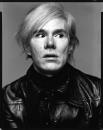
The Devil In Disguise

- Witchy Woman and Warhol

Yoko still persisted with Warhol but Andy having been disappointed once was not up for it twice. He distanced himself from the pair describing them to Sam Green as boring. An ultimate putdown.
Initially the Lennons lived in the Bohemian scene downtown. Mickey Ruskin, the owner of Max’s Kansas City, described the Bohemian scene thusly: the well-to-do Bohos, the middle and the lower class. Those associated with the Kettle of Fish and its environs of which Dylan was a member were of the lower class while the Kettle of Fish itself was owned by the Mafia. He believed Max’s was in the middle. John and Yoko first lived in New York in the West Village at 105 Bank Street next door to Yoko’s her, John Cage. They took over Joe Butler’s apartment, he formerly the drummer of Lovin’ Spoonful so Ruskin would have classed John and Yoko as haut ton beatniks.
At any rate they soon left those environs to migrate to the Upper West Side where they secured apartments in the famous, or soon to be famous, Dakota. It was then that their NYC life took its definitive form.
I have been to NYC a few times so that I know the general layout and have some feel for the place but I have by no means an intimate knowledge so essentially I’m working from maps. I know where MOMA and some few prominent art landmarks are from experience but not that many.
At any rate the Dakota is a famous landmark.. Acceptance as a tenant is by committee approval. John and Yoko were strenuously vetted but finally admitted. They took over actor Robert Ryan’s apartment #72. If you have seen the movie Rosemary’s Baby the camera pans past apartments 71 and 72. No filming was allowed inside the Dakota so while the exterior shots are authentic the interiors were shot on sets. Thus the apartment of the Satanists is a fictional 7E. The apartment next to it in which the young couple resided may have been number 72. The man of the couple who was an actor sold his wife’s body to Satan as the carrier of his child for success in the theatre which he was granted. Thus the Ono-Lennons moved into an apartment closely associated with devil worship, the occult and witchcraft.. This will become more important as Yoko associated herself with all three. In fact, Yoko through John Green would have been familiar with the Yoruban Santeria religion that she in all likelihood would have reverenced. The Spirit Foundation that she established is concerned with the preservation of just such tribal institutions.

Dakota Entrance
These are magnificent apartments that I presume Rosemary’s Baby duplicates. Huge fifty foot long living rooms as part of a ten room apartment. The Ono-Lennons would soon own both 71 and 72 lacking only the fictional 7E while having a Studio apartment as well.
Being now permanently settled Yoko having access to John’s superb income began to spend it. Of course, she virtually cleaned out department stores on her buying binges, any girl’s dream. But, she also began to buy heavily into art and antiques as investments. This brought Warhol’s friend Sam Adams Green into a close association with her. Rich society women were Sam’s forte. He has an interesting story. He was actually descended from the second president of the United States, Samuel Adams. He arrived in New york in 1960 about the same time Andy Warhol was trying to establish himself as a fine artist and Yoko the same. Warhol of course began as a commercial artist doing shoe ads but in 1960 he changed the emphasis of his career.
In the fine arts field one of the first gallery people Andy met was Sam Green of the Green Gallery. Different Green, Sam only

The Dakota
worked there and shared the name. He and Andy hit it off. By 1965 Green was associated with the art department of UPennsylvania where he staged a Warhol exhibition in the same year. From there he gravitated bck to NYC where he began a career as art consultant to rich women on both continents. They liked him. Through the socialite Cecile Rothschild he was introduced to Greta Garbo with whom he was sort of a trusted companion for 15 years.
He was very knowledgeable about art as an investment traveling between Euorpe and the US advising socialites on the most investment worthy art. He apparently derived a more than comfortable income from his efforts. He was a trusted advisor of Yoko. Some say that he and Yoko’s Tarot reader, John Green, who would enter John and Yoko’s life at about this time, combined to bilk Yoko for overpriced objects. This presumes that both men were dishonest and that Yoko was a fool. As Yoko’s investments have prospered I think we can dismiss the latter, although Yoko did take pride in being able to spend vast sums. She would have taken pleasure in overpaying.
Sam Green- Current
Rather I would say that Sam Green was a very knowledgeable expert whose task was to find art that would appreciate in value. Thus the question is did he perform that function and the answer is, yes. Yoko’s acquistions increased in value far above her purchase prices. I think it is unfair then to say that the Greens bilked her. Surely the laborer is worth his hire.

Warhol Portrait
Now, Sam Green as her agent had to buy the items he acquired for her. Being knowledgeable as to who in society wanted to sell what at distressed prices he may have made some excellent buys that he then tacked on his margin which of course meant that he sold to Yoko for ‘more than they were worth.’ But, heck, even Christie’s and Sotheby’s take twenty per cent each from the buyer and seller. That’s a forty per cent surcharge. However Sam served his function of providing investment pieces so I see no evidence of bilking.
Sam Green also formed a close, probably romantic, liaison with Yoko that persisted until after John’s death. Another art dealser she became close to was a Sam Havadtoy with whom she subsequently lived for twenty years beginning immediately the day after John’s death.
Now the men Yoko associated herself with were all effetes, that were either emasculated when she found them or who she emasculated. Strangely Lennon was the strongest of the lot. Both her first Japanese husband and Tony Cox appear to have been heterosexuals but both Sam Green and Sam Havadtoy were dependent homosexuals. With Havadtoy Yoko may have had her ideal relationship. He was thoroughly emasculated while with the fortune Yoko inherited from Lennon he was totally dependent on her. The classic toy boy a couple decades younger than herself. He, by the way, after his twenty year stint as live-in retired to Hungary with an abundant palimony but he isn’t talking.
In my reading of the situation then, a not particularly compliant John became somewhat of a liability to her, especially as he began to reassert himself with the return to the recording studio in 1980. The problem has the surface appearance of separating the man form his money and discarding the man.
Yoko began building her entourage, Sam Green, John Green, Sam Havadtoy and her various occult people with what appears to be an admiration for and some sort of connection with Andy Warhol. Sam Green and Havadtoy would be a troublesome presence in Lennon’s life during the recording of Double Fantasy while he does not appear to have been enchanted with the Warhol connection
As has been mentioned Yoko became involved in occult practices. She did practice hypnotism on Lennon and was an adept at suggestion which is the essence of hypnotism. Thus on the one hand she suggested forcefully to May Pang that she take up with Lennon while it is probable she hypnotized Lennon into taking up with May Pang. Post hypnotic suggestion would give her a command over all Lennon’s actions. Once implanted she would only have to say the word and Lennon would follow her suggestions.
How complicit John Green would have been in this isn’t exactly clear but any of Yoko’s suggestions to John could have been complemented by a reading. John Green was after all dependent on Yoko for a very generous income beyond whatever he may have scammed.
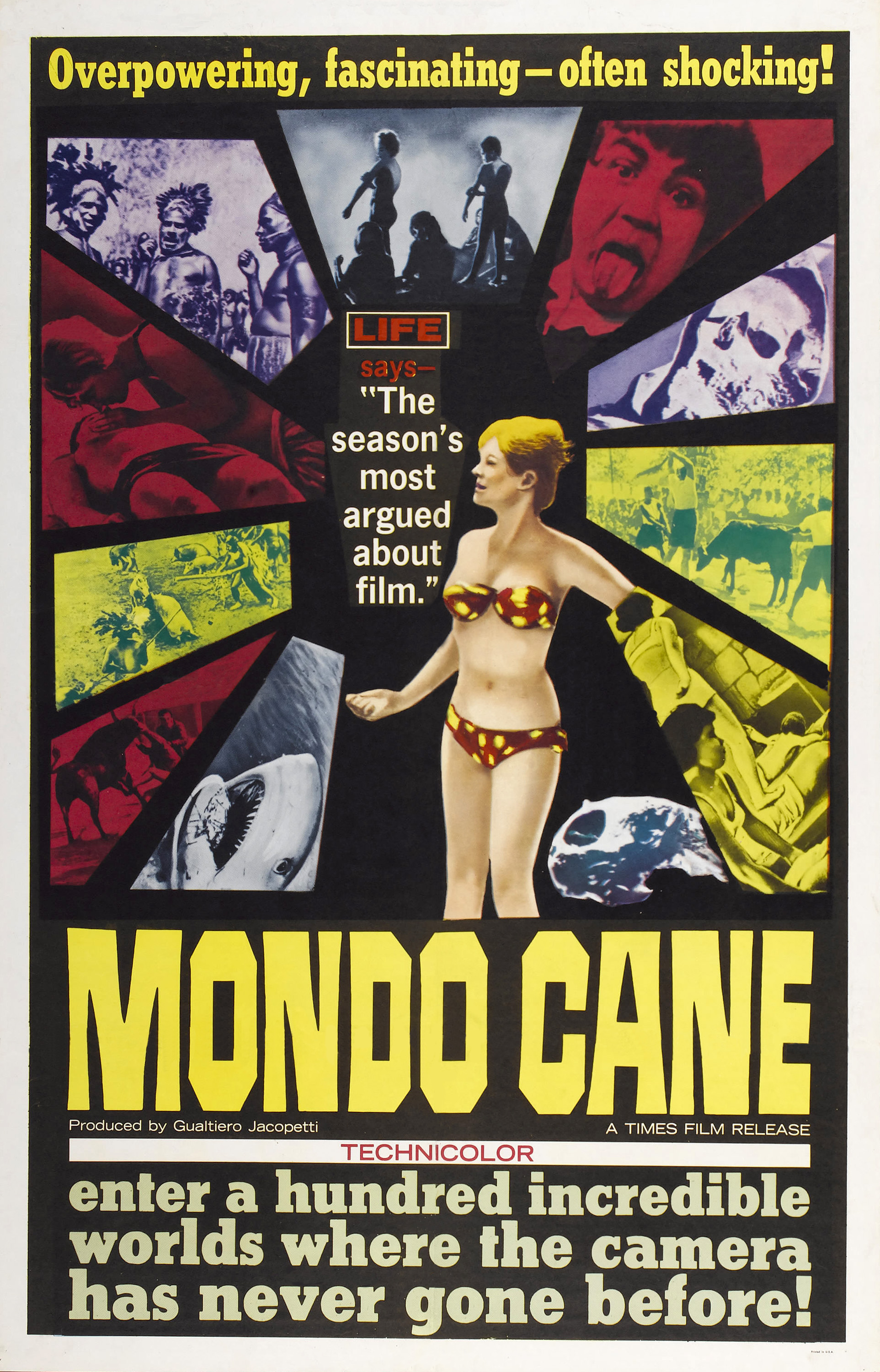
John Green is another interesting case. He was apparently successful as a Tarot reader before he met Yoko while he is reported to hae been a student of the African Yoruba religion called Santeria. The Yoruba are a tribe in Nigeria, middle river, Western side. He would have obtained much of the magic information he displayed in Cartagena, Columbia, SA from that source. The sixties themselves were the great period of the dissolution of the American mind and personality. One of the key items in the disintegration was the 1962 movie, Mondo Cane. (It’s A Dog’s World). It is difficult to assess the impact of this movie on the malleable college age mind of the times.
I saw the movie then and while it passed out of my conscious mind it struck me most forcibly and lodged in my subconscious mind. I, of course, reviewed the movie for this essay and while I at first remembered little gradually my conscious mind recovered the images so that I remember almost all. The viewing at the time was very repulsive and unsettling to my mind as it was for everyone I talked to about it and every college kid saw it. Still, consciously I missed the true import of the movie completely.
The filmmakers equated some New Guinea stone age people with modern Whites and equated them- said both states of
Mondo Cane Poster
consciousness were the same- and that there had been no advance between the primitive and modern. Then they showed Whites at their goofiest and most ridiculous. Drunks at a German Oktoberfest, aged tourists clumsily trying to do a hula. The movie was a real exercise in moral relativity. It was shortly after viewing the movie that I first remember hearing the phrase ‘Nothing is good or bad but thinking makes it so.’ I don’t want to philosophize on this but my thought was that if I think something is bad therefore it must be because I think it and I can’t be wrong.
The movie had a devastating effect on the attitude of the generation. It was a form of hypnosis with a great deal of post-hypnotic suggestion. Whether John Green saw the movie or not I can’t say but if he had it would have prepared him for accepting Yoruban Santeria. In fact these primitive forms of religion and what not flourished in the wake of Mondo Cane. At the same, as I indicated, Yoko would have been very open to Santeria. I think there is little doubt that Green and she at least discussed the religion and its African tribal origin. Especially as she established something she calls the Spirit Foundation. In the online prospectus she describes the foundation thusly:
The Spirit Foundation is…concerned with the protection and promotion of creative and cultural diversity amongst shamanic tribal communities worldwide. Part of the foundations work is the International Shamanic Network which aims at promoting the ancient creative archetypes of man and their binding ecological realtionship to the world.
Our emphasis is on education for action.
As mentioned Yoko and Lennon moved into the suites used in Rosemary’s Baby with its Satanic overtones. In the movie a young woman living with the Satanic couple either jumps or is pushed to her death not far from where Lennon was shot. In this very location Yoko took up Satanism. She decided she wanted to make a pact with the Devil to obtain her wishes. The ubiquitous Sam Green knew of a witch who could serve as an intermediary between Yoko and Satan. (Remember I am only retailing the story, I don’t believe Satan exists.)
Sam Green who had prospered as an art consultant had used some of his earnings to purchase what he called a castle in Cartagena, Colombia. He recommended his witch to Yoko who asked John Green to take her to the witch as he doubled as Tarot reader and Wizard. John Green did so and the witch duly negotiated a deal between Yoko and the Lord of Fire. When it came time to sign the pact Yoko asked Green to do it for her which he did. She was aghast when he told her he didn’t sign his name but hers. Yoko trying to cheat the devil.
We don’t know what she asked Satan for but we are compelled to believe she got it.

Santeria Illustration
As I believe she hypnotized Lennon into taking the Long Weekend I don’t know exactly why she wanted him out of the house. She certainly closely monitored his activities while he was away both in NYC and LA. During his absence Yoko didn’t have a Power of Attorney so she was somewhat constrained as John had her on a 300K budget. When he returned she quickly obtained his POA so that she had unlimited use of his money and, in fact, his identity.
Lennon is criticized for being a recluse in the years between 1975-80. He certainly wasn’t a recluse in that he withdrew from the world. He merely limited his contacts with it. It is said there was a fifteen month period when he was completely withdrawn. While he was obviously suffering from a mental malise in my opinion the withdrawal was completely justified. He had mental issues that had to be resolved. He had the money and time to work at it as he did.
He had a mother/father fixation he had to resolve. he had the feeling that he had been either a genius or a lunatic from boyhood. In a remarkable rant within the 1970 Rolling Stone interview he rants for pages because no one recognized him as a genius in his youth while he had now convinced himself that he was and had been a genius. The fact that he never did his schoolwork doesn’t seem to him that that may have a reason why people missed his genius and though him somewhat mad. What would theyhave done if they had? So he had to reconcile the issue in his mind.
He seems to have made no advance past his school years except in music. The years between leaving school and taking up with Yoko were completely wasted intellectually while the pressures of phenomenal success and wealth disoriented him completely not to mention the massive doses of drugs. At some time then he had to come down and organize his mind and life. From 1968 to let us say 1980 he was completely dependent on Yoko for his mental balance. In NYC he went where she did and did what she did. Hence the connection to Andy Warhol and Sam Green.
There are numerous pictures of Yoko, Lennon and Warhol. Yoko even patterned some of her work after Warhol’s style as in the ‘work’ below patterned after Warhol’s double Elvis. Thus she associates herself and Lennon with Presley.

Yoko Goes Warhol, Imitation of Double Elvis
As I mentioned before the social entree arranged by Warhol and Sam Green failed because of the social ineptness of the Ono-Lennons.
While we have a full record of what Lennon was doing during his ‘Lost Weekend’ we have a less full account of what Yoko was doing. She seems to have had romantic liaisons with at least three men- Sam Green, Sam Havadtoy and the guitarist David Spinozza.

Sam Havadtoy
Perhaps she wanted to see how well she could do on her own as a musician, to see if her reputation as a performance artist and, in her mind, musician, was sufficient to maintain a career on her own without John. If so, she was brutally disappointed as in her only solo performance she failed miserably. Thus she realized that as of 1974 her reputation as well as her wealth depended on Lennon.
It was during Lennon’s absence that John Green came into her life. While John Green tells a fairly smooth story in his Dakota Years one has the feeling that he is being highly selective in what he tells while he slyly ridicules the Ono-Lennons as their superior. The attitude easily leads to contempt and from contempt to abuse. Of course he would have to dissimulate both the contempt and abuse as Ono would be reading the book. As I imagine, a priest in the Santeria religion, he would have been in the company of some shady characters. I don’t know how many actual Yorubas were in NYC but I have met a couple elsewhere.
One imagines most of the hierarchy Green came into contact with was African or American Blacks. Santeria involves a deal of ritual sacrifice while money would be needed. I suspect that John Green was involved in the extortion attempt on the Ono-Lennons. This may have been Santeria related. Thus a sort of Black Hand organization was created. Rather than go for the big money that would have created a stir, the group settled for hitting up people with millions for a mere 200K each. An unpleasant tax for being rich but one more conveniently paid than to die resisting.
We have only Green’s version of the extortion and his relationship to it. He paints himself in a relatively good light. The Ono-Lennons did call in the FBI, they did give the extortionists newspaper rather than cash as the FBI advised. But then things went wrong. The FBI apparently had only one tail on the extortionist who came for the money rather than a series of back ups. The agent inexplicably lost his man. The Ono-Lennons never received another call but they had been warned that if they failed to pay Lennon would be killed whether it took one, two or more years. In December of 1980 the bill fell due. On December 8th he was shot. December 7th is Pearl Harbor Day so there may be a Japanese connection. Yoko Ono being Japanese, her numerologist and the assassin’s wife while Chapman missed the appointed day by one.
The question then hangs on Mark David Chapman the shooter. He is still alive and in prison. He was an assassin as the classic lone nut like Lee Harvey Oswald and any number of assassins who pay the law for the crime while the organizers go free. The technique has been well known to criminals for centuries. Any time a lone nut assassinates someone you may be sure that they were a patsy as Oswald announced over TV he was.
It seems likely that Chapman had been hypnotized. Witnesses said Chapman acted as though in a trance and he himself said he heard a voice in his head saying: Do it. Do it. Do it. The problem would be how he was recruited. I, of course, can say nothing for certain while what I am saying now is merely an hypothesis or inquiry. The main thing is that Chapman was supposed to be a lone nut. Ridiculous.
The most obvious recruitment method was the Santeria of which John Green was a member and to which Yoko Ono was
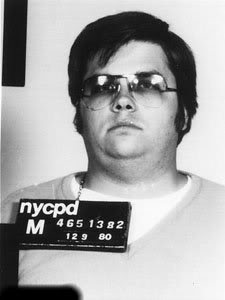
Mark Chapman
sympathetic. There are some oddities in the Chapman story that have to be explained not least of which are the large sums of money expended by Chapman in relation to his income. He was a married man therefore had a wife to support. Yet in 1978 he was in Japan at the same time as the Ono-Lennons beginning an around the world flight.
Perhaps Tokyo was the first stop of the trip around the world that then led to Seoul, Hong Kong, Bangkok, Delhi, Israel, Geneva, Paris, London, Dublin, Atlanta and back to Hawaii. His travel agent was a Japanese woman, Gloria Abe, who he then courted and married. She is reported to have been involved in occult circles. She may have seen so involved that, through Takahashi Yoshikawa, Yoko’s numerologist she was brought in to arrange the trip. Such an around the world trip in a Westerly direction- sundown to sunup- according to Yoshikawa’s numerology would be characteristic of Yoko Ono. She and Lennon made a round the world trip for occult reasons as did both Lennon individually and John Green at her instance. Green made his trip in 59 1/2 hours only leaving a plane once to change to another. As the financing of Chapman’s trip is unknown I would suggest Yoko Ono.
Two years after this very costly trip around the world Chapman flew from Hawaii to first Chicago, then Atlanta, then to New York where he landed a few days before the assassination. Once again, well beyond his means. It is said that he took paintings to Chicago that he sold. Where he would have gotten the paintings isn’t known but once again Yoko is the obvious source. She had an art gallery of valuable art work.
While in Atlanta he contacted a former roommate, then a Deputy Sheriff, Gene Scott, who gave him the hollow point exploding

Santeria Priestess
bullets for a handgun. One assumes such bullets couldn’t be bought over the counter. One wonders why Scott didn’t ask what Chapman intended to do with them. And if he did and Chapman told him Gene Scott is clearly an accomplice and should be questioned.
Chapman himself came from Atlanta where in his teen years he was known to ingest any and all drugs. Atlanta was also a Santeria center with several weird Black cults. Lennon’s death took place at the same time as the Atlanta child murders for which Wayne Williams was later convicted. The Santeria religion has been suspected in these obvious sacrificial murders while John Green establishes a Santeria connection to the Ono-Lennons and Yoko in particular.
Yoko was an excellent hypnotist who understood the use and power of suggestion. The Santerists as Africans would be well versed in the use of suggestion and hypnotism.
Chapman said he was possessed by the Devil while appearing to be in a hypnotic trance. All this rather amusingly is taking place at the Dakota, the scene of the Devil’s birth in Rosemary’s Baby. Indeed, the identical apartment.
After Lennon’s death there was no period of mourning or sense of loss by Yoko. All Lennon’s assets were in her control and name before his death. The so-called will of Lennon is suspicious, although the will was unnecessary becaue I doubt if Lennon thought of a will while the will appointed the art dealer Sam Green as the gaurdian of son Sean in the event the Ono-Lennons perished together. Lennon wasn’t that enamored of Sam Green.
Within a few days Sam Havadtoy was installed as Yoko’s live-in where he remained for twenty years.
While Yoko’s success as an artist and rock n’ roller wasn’t affected by Lennon’s death she now had the money to pay to have her art exhibited. Even then she found her reputation was indissolubly linked to her dead husband. She has become a caretaker for the Lennon legend parceling out old recordings while humiliatingly Lennon’s artwork is more in demand than hers.
She seems to have patterned her later career on that of Andy Warhol who as he acquired fame and fortune managed to insinutate himself into certain society circles. So has Yoko. Now, at 78, she has attained a certain status although still extremely self-centered while having an appearance of terminal aloneness.
Animus and Anima

A Review: King Solomon’s Mines By H. Rider Haggard
November 13, 2009
A Contribution To The
ERBzine ERB Library Project
King Solomon’s Mines
by
H. Rider Haggard
Review by R.E. Prindle
Three volumes made Rider Haggard’s reputation then and maintain it today. Classics of the B genre. The first of these is the subject of this review, King Solomon’s Mines. The other two are She and Allan Quatermain. The novels were written between 1885 and 1888. These were very interesting years in the exploration of Africa. Speke had identified the source of the White Nile twenty some years earlier. Robert Livingstone had been found and sensationally recounted by the great Henry Morton Stanley.
Subsequently Stanley had navigated the course of the Nile from the plateau down to the sea, a stunning accomplishment. His rescue of the Emin Pasha in 1886 was on everyone’s lips. The white spaces on the maps were rapidly disappearing. In the midst of this excitement Rider Haggard’s great African trilogy made a propitious appearance. No better timeing could have been devised. And the novels were sensational, plausible too, at that time. Who knew what additional wonders Africa concealed. There was room in that gigantic continent for a lot of lost cities and civilizations. Haggard and his disciple, Edgar Rice Burroughs rapidly populated Africa with a host of them.
Haggard would continue to write exciting African tales until the day he died in 1925 after a lifetime of putting out two or three novels a year. They usually followed the same format, a long trip out taking up at least half the novel, the intense situation on arrival and a return home. The same format Edgar Rice Burroughs would use. The novels were packed with esoteric lore and authentic African details.
It is said that Haggard wrote the Mines on a bet after being told he couldn’t write the equal of Stevenson’s Treasure Island. He did do that but Mines is written tongue in cheek with a lot of jokes. Haggard makes this clear when Quatermain says that his two literary mainstays are the Bible and the Ingoldsby Legends. The Legends written in the 1830s and 1840s are a collection of humorous parodies of Folklore themes and poems by Richard Harris Barham writing anonymously as Thomas Ingoldsby of Tappingham Manor. The book was very popular with, it seems, all the the authors till the turn of the century at least. One finds it mentioned frequently. Taking the hint I read a copy. Thus, Haggard is protecting his rear in case of failure by saying his story is just a put on or joke.
King Solomon’s Mines is told in the first person by the old knockabout hunter, Allan Quatermain. He has a bumbling self-effacing manner not unlike Inspector Columbo of the TV series. You don’t think he can do it but he’s spot on every time.
As was common with this sort of adventure story the point is to make the reader think the story is true. Burroughs probably picked up his habit of framing from Haggard. Many of the details of Mines are true to Haggard’s own life while his study of the Zulus and other tribes accurately portray their customs. Haggard is very sympathetic to African customs and mentality actually seeming to envy them. He genuinely can see little difference between Black and White while adopting a fairly critical attitude towards Whites and a sympathetic one toward Blacks. Very modern. Indeed, in this novel the White heroes join a Zulu Impi or regiment and fight with the Zulus as White Zulus. Naturally they comport themselves heroically, Curtis excelling the Blacks at their own game.
As the novel begins Haggard sets up the story. The Englishmen, Curtis and Good, are out in search of a lost brother. The meeting with Quatermain on shipboard is fortuitous leading to his subsequent employment as their guide. Haggard describes a boat journey from Capetown to Durban that is obviously authentic; Haggard himself has taken the same trip. Thus unlike Burroughs’ imaginary Africa this is authentic, the Real Thing. On the journey Quatermain meets Sir henry Curtis and his friend John Good, who need a guide to take them in search of Curtis’ lost brother.
The search will take them to a hidden Zulu enclave behind a burning desert and a towering mountain range. The trip out is filled with interesting authentic details but no need to dwell on them here.
Crossing the burning sands not known to have been successfully navigated before, they are confronted by the towering twin peaks of Sheba’s Breasts topped with four thousand foot nipples. Who can’t see the humor there. Pretty racy for what are thought of as stodgy old Victorian times. Bear in mind the Ingoldsby Legends while reading the story as probably most of Haggard’s readers would have been familiar with them. They are of this sort of tongue in cheek humor. The ancient map they are following indicated the route to follow.
Behind the Breasts lies Kukuanaland. Undoubtledly Kuku should be read coo-coo. The Kukuanas are the Zulu tribe in possession of King Solomon’s Mines. Kukuanaland is somewhere near the ruins of Zimbabwe, although Haggard doesn’t allude directly to the site. I’m sure everyone has heard of the ruins of Zimbabwe. The old Zimbabwe I mean.
There has always been a dispute as to who built Zimbabwe. Africans claim it was built by Africans while the thought in Haggard’s time was that Zimbabwe was built by Phoenicians hence a few mentions of them. The notion was that these were the ruins through the Queen of Sheba of King Solomon, hence the title King Solomon’s Mines. Zimbabwe is either in or next to lands of the Shona people. The Shona arrived in the area from the North possibly from 300 to 800 AD. There is no record of stone work among the Shona before or after. The structures of Zimbabwe are of shale like stone merely piled on top of each other being very thick and very high. Instead of piled up stones it is customary to say the construction is without mortar as though that is a great skill. Without mortar = piled up stones, doesn’t it?
It seems unlikely the Shona would have built them while it is also a remote possibility that the Phoenicians did. It is true however that Greeks traded on these shores but they didn’t build them. A more probable builder is the Malagasy people. I don’t think the Malagasy arrival is commonly known yet, it wasn’t to me until a few years ago. The Malgasies made the long sea journey from Indonesia to arrive in Madagascar and East Africa sometime between 500 and 1000 AD. As they would have been invaders into a recently and sparsely settled territory any groups landing on the continent would have been automatically at war with the Shona thus needing a fort for protection. Being much more technologically advanced than the Africans they would likely be familiar with stonework.
As it is said that Zimbabwe was a mining and trading community, as the Malagasy were seafarers it is likely they would be the more obvious candidate otherwise one has to explain where the traders of what is described as an extensive trade come from as the the Africans couldn’t possibly have gone to the buyers or known what to trade. Interestingly the Malagasies introduced the banana and an improved yam to Africa thus they had to land on African shores.
Zimbabwe had only been discovered by Europeans a few years before Haggard arrived in Durban. Very likely he was eager to see the ruins and did as he does have at least three stories in which Zimbabwe figures. Here he combines Zimbabwe, King Solomon and the Phoenicians.
As the party approaches Kukuanaland they are faced by a huge mountain range towering perhaps 15,000 to 18,000 feet into the sky. Facing them are two huge mountains named Queen Sheba’s Breasts, the Grand Tetons of Africa.
Here I have to mention a blogger (feministbookworm.wordpress.com) who pointed out the female arrangement of Kukuanaland. This escaped me in my previous readings but is of some interest. Haggard in a cryptic way has written a fairly pornographic story, especially for Victorian times. I’m sure most people didn’t get it even though Haggard provides a fairly obvious map although turned upside down. This is along the coy lines of various pop songs such as ‘Baby, let me bang your box.’ After shouting out this line several times allowing the average guy to think a woman is being propositioned the singer reveals he’s actually referring to a piano- box in musician’s slang equals piano. Box = a woman’s pudenda in sexual slang.
If one looks at Haggard’s map Sheba’s Breast’s are to the South while there is a triangle of mountains to the North. The triangle of three mountains forms a female Delta or box. In the middle between the Breasts and Delta is the Kukuana capitol called Loo. Loo is British slang for toilet or ‘shitter’ so we some scatology going on here.
This gets better. I jump ahead to the ending. The Englishmen are promised diamonds from King Solomon’s Mines. The mines are located within the Delta or pudenda. British slang of times for the female pudenda was Treasure Box. Thus the Englishmen are going to descend through the vagina into the womb of the mines where the diamonds are stored in actual treasure boxes. Humor, remember. Bear in mind that in Burroughs diamonds are of the female, actually Anima, treasure. Same here. This is going to get better.
Apart from Mother Earth, represented by Sheba’s pudenda, there are only two women in the story which Haggard smirkingly points out: One is a Bantu beauty who becomes attached to Good, the other is an old hag named Gagool. The latter forms the model for Burroughs’ old Black crone in Gods of Mars and Nemone’s guardian in Tarzan And The City Of Gold.
Both accompany the three White men to King Solomon’s mines. At whatever age Burroughs first read this the impressions stuck. This stuff was current literature to him while Classics to us. One must imagine the excitement with which these novels were read. Readers of Opar Tarzan novels (Return, Jewels, Golden Lion and Invincible) will immediately recognize the setup although there are differences.
Always one to employ horror effects Haggard is at his best in this early novel. The group descended as it were through the vagina into the depths of the womb. Along the way are giant stalactites. (Penises?) Then they enter a chamber in which the dead kings of Kukuana are preserved. Rather than Egyptian mummification they are set beneath a drip being turned into stalactites or, in other words, big pricks. Seems to me like an obvious joke. A huge figure of death presides over the immortal enclave.
Proceeding further they come upon a door set in the wall blocking the way. The door is a huge slab several feet thick operated by a hidden mechanism that lifts the slab vertically into the ceiling. Gagool with a hidden movement releases the door which slowly and efficiently retracts into the ceiling. The party can now enter the treasure room or womb. The door stands for men’s sexual desire for the female. As with the hymen without equal desire on the part of the woman entrance is barred but with woman’s compliance the way opens easily.
Inside the room or womb are the treasure chests containing unlimited value in diamonds.
After taunting the men Gagool makes a break for the door having released the lever that closes it. She is held back by Foulata who worshipped Good. Stabbed by Gagool she falls to the ground but has successfully delayed Gagool. In attempting to roll under the descending slab the tardy witch is crushed flatter than a piece of paper. The men are now trapped in the womb but they have a candle for light. Quatermain stuffs his pockets with stones while filling a basket Foulata brought.
Here’s the classic B movie part: While waiting for death they notice that the air remains fresh. Good discovers a trap door in a corner. Opening this they descend as it were into the bowels of this elogated represention of a woman who might represent Mother Earth or the Great Mother thus forming a collective Anima for the three White men. Anticipating She a little. A bizarre Anima for Haggard also. OK, I’ve got a weird sense of humor. I’ve always known it but that doesn’t make it less funny. No longer having a light they are forced to feel their way through the tunnels. The tunnels eerily represent the intestines. Haggard is getting really scatological here as you know what emerges from intestines.
As they pick their way along Good falls into a stream that greatly resembles the urethra. Fortunately Quatermain has some matches. One is used to locate Good clinging to a rock in midstream, possibly meant as a kidney stone as a joke. Hauled ashore they backtrack and resume their way. Curtis spots a dim light toward which they move. The opening narrows down to the point that the men have to squeeze through tumbling out into the diamond shaft like so many turds. Haggard must have been gleeful at what he was getting away with.
Climbing out of the pit they discover they have returned to the entrance. Thus vagina and rectum are only a short distance apart. Anatomically correct as it were. Haggard had a fine sense of humor.
While adapting the topography for his own needs one can easily see how Burroughs replicates Haggards’ design in Opar. Burroughs designed a long straight corridor but broken by a fifteen foot or so gap. In Jewels of Opar Tarzan falls through the gap dropping into a pool of water or river much as in Mines. Proceeding further he enters he jewel room of Opar filling his pouch as he had neither pockets or basket.
Opar itself replicates the Treasure House of Kukuanaland. The gold vaults represent the head of the female figure or perhaps only one of Sheba’s breasts. Proceeding down the corridor, or Great Road of Kukuanaland one comes to the sacrificial chamber situated much as the city of Loo. Proceeding from the chamber one comes to the exit. This is described by Burroughs as a narrow crack or cleft in the wall to pass through which Tarzan had to turn his shoulders sideways. So, Opar and Kukuanaland are built according to the same scheme.
Obviously the memory popped into Burroughs’ mind in The Return Of Tarzan, developed in Jewels of Opar and Golden Lion and came to perfection in Tarzan The Invincible. It would seem clear that ERB understood the sexual structure of King Solomon’s Mines.
If we go back to the other end of Kukuanaland we have the two towering mountains known as Queen Sheba’s Breasts. In order to prevent anyone taking a low level route between the Breasts there is a perpendicular barrier running between the breasts rising several thousand feet. Odd geological formation. Rising 4000 feeet above the breasts themselves are the nipples. That should be enough to make anyone laugh.
A recurrent theme in the stories is a juxtaposition of ice with summer weather, often associated with a woman as here. Perhaps Haggard had a cold, cold mother.
While the party is both starving and thirsting they find neither game nor water until Umbopo discovers some melon patches providing food and water until they reach the snow line. Soon they come to the nipple rising sheer from the breast. At the base of the nipple is a cave. This cave may possibly have been appropriated as the entrance to Opar’s gold vaults in Burroughs. In the cave is the frozen body of Da Silvestre who made the map they have been following. The bushman servant freezes to death during the night so they set him over by Da Silvestre. There’s a joke here but I don’t get.
Continuing down Sheba’s left breast they reach below the snow line. The boys spot an antelope way off there, long shot, but Quatermain makes it, cleanly knocking out a vertebrae in the neck. While cleaning up in an adjacent stream and eating they are surprised by a band of Kukuana and taken.
Umbopo who signed on back in Durban always had this mysterious royal air about him and now we’re going to find out why. For those contemporaries who insist that no book should violate their enlightened prejudices whether the book be as old as Homer or not they may feel uncomfortable reading this book. By and large Haggard shares the attitudes toward race, gender and whatever of his times rather than Liberal notions of today. Can be painful for certain types.
Nevertheless Haggard has a deep admiration for the Zulu tribes and a kind of understanding one toward the lesser Bushman and Hottentots. The Zulus are uniformly tall and well built while Quatermain and Good are smaller and more comical in appearance. Only Sir Henry Curtis is of the same stature, slightly larger, as the Zulus. He seems to stand in for what is otherwise a race of inferior stature.
There is a great fifty foot wide road that runs from the barrier of Sheba’s Breasts to Sheba’s Delta. The road is over a hundred miles long with Loo in the center.
The city of Loo is modeled after the encampment of the Zulu chief, Chaka. The details Haggard describes are undoubtedly accurate. Chaka flourished 1830-40 while the last of his line, Cetywayo, ruled during Haggard’s tenure in Africa. His fictional king is called Twala. We now discover that Twala is Umbopo’s brother. The latter was rightful heir but Gagool who is represented as being hundreds of years old favored Twala expelling Umbopo and his mother which is why he was in Durban. His identity is assured because of an Uroboros that encircles his waist. This snake appears to be a birth mark rather than a tatoo.
After accepting a rifle from Curtis as a gift Twala sends three chain mail shirts of medieval manufacture which proves that Zimbabwe was formerly occupied by another race, I suppose.
We have a civil war brewing here as Umbopa asserts his rights. Before the war develops Twala holds a ceremony I find really interesting, the smelling out of witches. The regiments were assembled. In this case Gagool runs up and down the ranks smelling out the witches. Anyone she indicates is removed from the ranks and immediately killed. This was an actual Zulu custom. Haggard portrays them more than once in what is his pretty decent historyof the Zulus in the novels.
Interestingly under the African president of the United States we have the same situation occurring. Obama denounces those in opposition to him essentially as witches. While currently we are put under surveillance the time may shortly arrive when we are merely arrested and despatched. Thus the innate African soul reasserts itself hundreds of years out of Africa. Of course, Obama was born in Kenya but he didn’t live there.
After the smelling out the regiments align themselves according to their allegiance. The three White men suit up on the side of the pretender, Umbopo. In his admiration of the Impi battle plan Haggard has the Whites disdain to use firearms preferring to show Whites returned to primitive savagery. Of course he normalizes the British and Zulu societies so that any difference is perceived but not real.
If you want to how this attitude was digested by the British public rent a copy of the movie If c. 1965. A British public school story that viewed better the first time around for me but still of interest. I might rent it again, though.
It is at this point of the story that the ‘White giant’ Sir Henry Curtis took his place in the Zulu ranks to show White supremacy that is when the actual basis of Tarzan took place in Burroughs’ mind.
The three Whites are the only ones wearing chain mail so that they come through bruised but alive. Without the chain mail, of course, all three would have been killed many times over. Perhaps the chain mail is symbolic of the science of the Maxim.
My feeling is that Haggard was so enamored of primitive Zulu warfare as organized by Chaka that he thrilled himself by placing the three in their ranks. Haggard had his peculiarities. As I say, he seemed to reject science.
Umbopo’s troops triumph over greater odds while King Twala is captured. Sentenced to die he demands the right to hand to hand combat selecting Curtis as his adversary.
Thus a duel ensues providing two or three pages of excitement in which a very hard battle is fought. Curtis decapitates Twala proving I suppose that on their own turf, evenly matched, the White Man is the greater.
Morally, however, Haggard gives the nod to Umbopo and the Zulus. Umbopo apparently feels a bond has been vilolated between the trio and himself. He offers them wifes, land and honors if they choose to stay in Kukuanaland. They instead choose to gather diamonds from Sheba’s treasure box. Umbopo is disgusted that White men care about nothing but money. Haggard sheepishly agrees with Umbopo but the trio nevertheless collect their diamonds and scoot, setting themselves up splendidly in England where money matters. Regardless of Haggard’s moral it is clear that the Kukuanas have no use for money in their primitive society while being broke in London is a sort of hell.
One wonders whether when Umbopo sent Gagool with them he knew that he was sending them to their deaths. Their return was after all rather miraculous. Leaving Kukuanaland the three arrive safely and rich in England.
Postscript.
Burroughs read not only King Solomon’s Mines, She and Allan Quatermain but probably the whole corpus. What he read before 1911 was obviously the most influential on him through the twenties. So an an investigator, Haggard’s novels before 1911 are the one to familiarize oneself with first. The very late Treasure Of The Lake however did influence Tarzan Triumphant.
Sir Henry Curtis was a key element in the formation of the idea of Tarzan and a role model. I suspect that Treasure Island by Stevenson provided he means to get the Claytons to Africa. Evolution provided the background of Kala and Tarzan’s life with the apes.
Whether Good or Quatermain had any influence on the character of Paul D’Arnot or not I’m not sure. He may have evolved from Dupin of Poe’s Murders In The Rue Morgue forming a double for Tarzan not unlike the narrator and Dupin of Murders.
I have explained the probable relationship of Opar to Sheba’s treasure box. That seems pretty secure to me.
Haggard developed the story line of the preamble and journey to the scene of action, a flurry of action in the crisis and the return home. Burroughs seems to follow this format although he can introduce picaresque elements.
The landscape and terrain of Burroughs is quite similar to Haggard’s. Over the years as Haggard read Burroughs’ novels there are Burroughsian elements that creep into Haggard’s work. Treasure Of The Lake bears a number of similarities to Burroughs especially the elephant dum dum. That also owes a great deal to Kipling and Mowgli. A stunning scene in Haggard. I would really start with Treasure Of The lake and then begin with King Solomon’s Mines, She and Allan Quatermain.
La, of course, is derived from the next novel, She.
A Review: On Tarzan By Alex Vernon
November 13, 2009
A Review:
On Tarzan
by
Alex Vernon
Review by R.E. Prindle
Vernon, Alex: On Tarzan, 2008, UGeorgia Press
This book reads almost like the cover of The Doors LP Strange Days. You’ve entered into some kind of literary twilight zone. This is perhaps the most eccentric book I’ve ever read. I can’t believe it was actually published- and by a University press!
Alex Vernon has a PhD and is an Associate Professor at Hendrix College. Must have been founded by Jimi before he OD’d. I’m flabbergasted that the guy has a job. Average looking Joe from the back cover. Happy, smiling. Doesn’t look like he’d be sex obsessed but it could be a problem for him.
The phallus on the cover dismayed me but prepared me for the sex driven content. Zany, zany, zany. A large phallus rises out of what might be the swamp, symbol of the female, or perhaps jungle growth meant to represent pubic hair.
When Vernon says On Tarzan he doesn’t mean Tarzan by Edgar Rice Burroughs he means Tarzan as a ‘living’ entity to which history Burroughs is only one contributor albeit an important one, Philip Jose Farmer almost eclipses Burroughs as a contributor to the Tarzan ethos in Vernon’s mind. Mainly for Farmer’s outrageous sex episodes.
Tarzan ethos is about it. Everything is thrown indiscriminately into the stew pot. Books, movies, TV shows, articles, even artefacts, Tarzan underwear. Vernons says he interviewed Bill Hillman at ERBzine although it is difficult to find what he gleaned from the conversation, wait a minute, maybe the reference to the 1893 Columbian Expo. Bill was probably hot on that topic.
As literary critic Vernon doesn’t so much analyze as create. He uses Tarzan body parts from various books and films to create his own monster, and his Tarzan is monstrous.
As I say he uses his sources as though making a stew; mixing them up to creat a sex driven Tarzan that no twelve year would recognize as his hero.
Vernon doesn’t seem able to distinguish the motives, the agendas of the various sources who are projecting their own inner world on Tarzan such as Bo and John Derek in their vision of The Big Bwana. I didn’t say Banana; I said Bwana. Melding these sources doesn’t create a ‘biographical composite’ of Tarzan that all can agree on; it is merely the projection of Vernon’s own inner psyche.
Apparently Vernon’s approach is a valid historical literary criticism technique in today’s academic environment. It’s not what you say but who you say it about. As I say it goes beyond interpretation or revisionism into creating an alternate universe.
The approach intrigued me. In that spirit I offer my own creation of Tarzan and a revisionist/creation of history. In the view of facts as they might be construed by a fanatic with an agenda I offer Tarzan as an agent of Globalism serving as the first viceroy of Africa.
Mr. Vernon keeps talking about a colonial period as if such a thing has ever existed. His professors must have been from the stone age. As advanced thinkers know what these prehistoric monsters refer to as colonialism was in reality the early stages of what is now recoginized as Globalism. This how Globalism began. In the very early stages all cultures were relatively distinct, living in separate well defined areas. The Chinese were in China, Africans were in Africa, Europeans were in Europe. Further relatively internal distinct sub-divisions can be made on all continents. It was clear to the most primitive minds, well, actually European primitive minds, that what was needed to…well for whatever reason they had…to make the world a more secure place was Globalism. Wars were anathema but one couldn’t create Globalism without some really destructive wars so they forged fearlessly ahead secure in the purity of their intentions. This posited the problem of bringing together in most cases people who didn’t know other cultures even existed, those ‘lesser races outside the law.’
As I say Europeans were then and are now the promoters of the cause of Globalism. It’s good for people and it’s good for the Global Money Trust. Initially Europe sent out ships and explorers to the four corners of the Earth. In that far off, almost once upon a, time unlike today local populations were hostile to what they mistakenly called invaders. Sometimes their resistance involved military force, in other words war; so in self-defense it was necessary to mow the heathens down. We had screw guns and maxims and they didn’t. Rather foolish on their part while causing Globalists a great deal of emotional distress. Almost had a nervous breakdown. It could have been avoided. Globalists only wanted peace if they had understood.
Gradually the peoples of the world learned that they going to have to peacefully interact if even at gunpoint. But then there was disagreement in Europe. the Global barriers were being lowered as this beneficent ideology of Globalism was slowly accepted. As expected there were reactionary elements. In both cases the criminal Germans were the hard nuts. They insisted on the right to be themselves rather than submerging their identity into what the Globalists wanted. Their resistance was futile; Globalists got what they wanted anyway, the Globe be damned. After the second German petulance Globalists crushed them. Some wanted to exterminate the whole lot, raze Germany to the ground and turn it into pasture land. I don’t have to tell you that gentler and more loving heads prevailed. Globalists gave the African troops leave to loot Strasbourg and rape the German women and let it go at that. You see, there are some sacrifices we all have to make.
It is best not to oppose Globalist wishes. Globalism will be had on their terms or they’ll get rid of ya. As another example, the Kulaks of Russia opposed Globalist wishes and it was necessary to exterminate them to the man, woman and child. I won’t tell you the intense emotional pain that incident cost the Globalists, those were not crocodile tears as often alleged. People won’t be happy unless the blessings of globalism are universal. That’s what Globalism means, universal.
Now, one of the great advocates of Globalism was the progressive American ‘fantasy’ writer, Edgar Rice Burroughs. Fantasy, humph. As Edgar’s avatar of Globalism he created the character of Tarzan the Ape Man. The brilliance of the ape man is almost incomprehensible. As Mr. Vernon points out Tarzan united the fauna being man and beast at one and the same time. His being encompassed all evolution, unlike the rest of us who are products of only a few of the commoner genes, as he passed through the stages of Beast, Negro and European. How fitting that Edgar Rice Burroughs should make him the very first Commissar, even Czar, of Africa. Yes, he was White. But only we Liberal White people have understood our manifest destiny to bring all peoples together in Globalism. Well, yes, there were mistakes and, quite frankly, genocides, but they were necessary and not arbitrary. They were decided on only after long and careful deliberation. It was like pruning a tree to make it more beautiful. When Chairman Mao finished pruning the recalcitrant Chinese there were 50 million branches on the ground, but, what of it? As Mao himself benignly and poetically, he was a poet you know, intoned: ‘So? Will the flowers not blossom in spring and cool breezes not blow across waving fields of grain.’ Of course they would and as proof they have and will continue to do so. How ridiculous! There’s always new babies to replace those gone. Come on!
Edgar very cleverly has that man we now know as a villain, Stalin, seek to replace Tarzan as Commissar because he was in fact too just and too gentle with his charges. Rather than compelling Africans to hew to the Party line Edgar portrays Tarzan letting the Africans do as they please so long as they didn’t kill each other. That was in his brilliant history he called Tarzan the Invincible, and he wasn’t kidding. It wasn’t unreasonable to send a replacement from Moscow but Edgar perversely has Tarzan defeat his replacement. You can read about it in Edgar’s history yourself.
So, Mr. Vernon has expended a great deal of effort to prove the unprovable. He completely mistakes the reason for the US presence in Viet Nam. This was not nation building as he has been induced by his professors to believe. This was a necessary stage in the creation of Globalism. Today the two halves of Viet Nam have been reunited because of their efforts and Globalism is progressing nicely there, thank you very much.
A larger problem was to bring China into the Globalist empire.. But that was cleverly done by inducing them to manufacture big screen TVs for not only the province of the United States but the world. Today they are the Globe’s largest manufacturer of flat screen TVs and tennis shoes and are assisting in the Globalism of Africa sending their tens of millions of excess personnel to help the Africans enter the Global economy.
I certainly appreciate the effort Mr. Vernon has put into his project; it is regretable he has been so ill informed about the difference between Globalism and colonialism. Colonialism is when you occupy a country for selfish reasons; Globalism is when you subject or exterminate a people for the right reasons.
The Global Cabal is sorry people had to die. As the old saw says: You can’t make an omelet without breaking a few eggs. Its better to be the hammer than the nail.
I’m sorry Mr. Vernon but I can’t recommend your book.
A Review: Beau Ideal By P.C. Wren
October 5, 2009
A Contribution To The
ERBzine ERB Library Project
The Beau Ideal Trilogy Of
P.C. Wren
Beau Geste~Beau Sabreur~Beau Ideal
Review by R.E. Prindle
Part I. Introduction
Part II. Review of Beau Geste
Part III. Review of Beau Sabreur
Part IV. Review of Beau Ideal
The first novel of the trilogy signifies a good, beautiful or noble deed. The deed being the Geste brothers taking the odium of the theft of the sapphire on themselves. The second, Beau Sabreur, meaning the Noble Warrior or Fighter. The story then centers on its Lancelot like character, De Beaujolais with attention to the noble actions of subsidiary characters. Hank and Buddy fit in as noble warriors also. Beau Ideal then centers on the noble ideals that activate the characters and are part of Western Culture as against that the the others.
I will put the dramatic first chapter second begin with the second section called The History of Otis Van Brugh, perhaps meant to be a Gawaine type. Beau Ideal is Otis’ book as the first was that of Michael Geste and his brothers and the second that of De Beaujolais.
Otis, Hank and Mary are brothers and sister with a last sister who remained at home in Texas. Their father was a brute of a fellow who drove all his children from home except the last sister. Wren himself must have had a wretched father because all the fathers in the trilogy are failed men, fellows who don’t have a grip on the meaning of really being a man.
Neal, or Hank Vanbrugh, refused to put up with it taking to a wandering life. On the road he met Buddy where they became pals ending up in the Legion.
Otis and mary being younger subsequently left Texas to lead a peripatetic ex-patriot life of the well to do. The history of Mary, Hank and Buddy has been given in Beau Sabreur.
When Otis left De Beaujolais he tried to reach the French contingent in the fort. Along the way he ran into Redon who filled him in. Otis was to try to reach the fort to request them to assist a detached unit fighting their way to the fort. He succeeds.
In the process Redon diverting the attack away from the fort is shot by friendly fire. Both he and Otis were dressed as Moslems. Otis attempts to reach Redon but is shot falling unconscious outside the fort. Thus when the French are massacred he is the sole survivor.
He returns to England where psychologically shattered he is stopped by a policeman. While being interviewed he is conveniently rescued by the leading ‘alienist’ of England. Given refuge in his asylum Otis discovers Isobel whose mental health is destabilized because her husband John Geste is in the penal battalion of the FFL. She implores Otis to find John and bring him back alive. Here’s a beau ideal. Ever loving Isobel Otis agrees to sacrifice his happiness to go back to Africa to find John.
What a guy! Otis joins the Foreign Legion with the intent of being sent to the penal battalion called the Zephyrs. He joins and succeeds in being sent to the Zephyrs. Now we return to the opening chapter.
Anyone who ever fancied joining the Legion, and the notion was discussed a lot down to the sixties of the last century when I was launching my bark upon the waters, should have read Erwin Rosen’s In The Legion first. The Legion was unconcionably cruel to its soldiers in everyday life let alone the penal battalion. As an example, the Legionnaires complained of excessive marching. They were required to do thirty miles a day carrying 50 lbs. or more with pack and rifle. One really has to read Rosen’s description to realize the horror. Those who dropped out were left where they fell. Arab women found them subjecting them to horrid tortures.
This became so common that the Legionnaires were given leave to slaughter the Arab women as a lesson. This they did with a vengeance. Rosen was shown a purse by a fellow soldier made from the severed breast of a woman. Rosen said they were common at one time; an example of what can happen when civilization meets savagery. Civilization is lowered but savagery isn’t raised. The Beau Ideal is lost.
One of the punishments Rosen mention was called the Silo. As he describes it these were holes dug into the ground with a funnel put where the victim had to stand exposed to the blazing sun during the day and freezing cold at night.
Wren converts the idea of these silos into an actual underground grain storage unit capable of holding several men. In his version the funnel was closed off admitting no light. As the story opens several men are sweltering in the pit. A Taureg raid was made on the penal colony building a road near the pit that killed the whole contingent so that no new supplies were lowered. The men are dying one by one.
Otis is in the silo the next to last survivor. He discovers that the other survivor is none other than John Geste. On the point of expiring a scout from Hank and Otis’ tribe, or headquarters, discovers the silo and hauls the two out. Coincidences and miracles just naturally go with the desert.
The scout take them to a member tribe of the federation. Both are now wanted men by the FFL with no hope of salvation. They have no alternative but to get out of Africa hopefully avoiding France.
I can’t ask you to guess who was in the camp because you wouldn’t. Remember the Arab dancing girl Otis met in Beau Sabreur? She’s the one and she’s still in love with Otis. Wren names her the Death Angel. Wren was heavily influenced by E.M. Hull’s The Sheik. Maud in Beau Sabreur was mad about sheiks, overjoyed when she won one in the person of Hank. Of couse Hank was an American sheik and not an Arab one, much as Hull’s sheik was in reality half English and half Spanish.
So, perhaps Otis and the Death Angel are revenants of the Sheik and Diana from Hull’s novel. In this case the woman has power over the man but the sexual roles remain the same as the king trumps the queen every time as Larry Hosford sings. If you don’t lose track of who you are it’s true too. Otis doesn’t lose track of who he is. Revisit the story of Circe and Ulysses.
The tribe that rescues Otis and Geste is a rival of Hank Sheik’s but a subordinate member of the confederation. Hank has organized a sort of United Emirates of the Sahara of which he serves as President for life but without any democratic trimmings. In a parody of the Sheik then the Death Angel demands ‘kiss me’ of Otis. He’s not so easy to deal with as Diana. Even with the Death Angel’s knife at his breast he refuses.
In the meantime the Zephyrs reclaim Geste and he goes back to his old job of building roads. Rosen’s account of the FFL compares with Burroughs’ account of his army days. ERB too was put to work building roads, complaining of moving or perhaps breaking huge boulders. Both his experience and that of the penal colony of the FFL are quite similar to the chain gangs of the old South of the United States.
Even when not of the Zephyrs the Legionnaires were given detestable tasks unbefitting the dignity of soldiers. According to Rosen the men were required to clean out sewers in the Arab quarter of Sidi Bel Abbes. That’s enough to make anybody desert. And then get sent to the penal battalion. Crazy, crazy world. Rosen’s In The Legion is well worth reading if you like this sort of thing. Download it from the inernet. Only a hundred pages or so.
Geste then has to be re-rescued. This forms the central part of the story along with Otis’ struggles with the Death Angel. Hank and Buddy get windof the two FFL captives coming to investigate. Otis then discovers his long lost brother. It is settled then that Hank and Buddy will give up their Sheikdom to return to pappy’s farm, or ranch.
Even though Hank and Buddy are powerful sheiks they are still deserters from the Legion so getting out of Algeria is a problem. Rosen tells a story of a deserter who made it back to Austria where he became a rich and successful manufacturer. He made the mistake of exhibiting his manufactures in Paris in person. There he was recognized by his old officer who arrested him sending him back to Africa. There he died. So Hank and Buddy run the risk of being recognized and arested on the way out of Africa as well as Otis and Geste.
Geste’s rescue is effected. The quartet successfully exit Africa arriving safely back in Texas. However the Death Angel’s help was necessary. To obtain that help Otis promises to marry her. He doesn’t want to but a Beau Ideal is a Beau Ideal and so he is going to honor his commitment. On the eve of departure the Angel gives Otis a locket she wears as a good luck charm. Very bad move. The locket contains pictures of her mother and father. Otis examines the mother with some interest then turns his attention to the father….
Should I ruin a perfectly good ERB ending for you? Sure, why not? I’ve got a little sadistic streak too. Everyone was using this one. No fooling now, the Death Angel was Otis’ sister because dear old Dad was her mother’s wife; he was known as Omar out there on the burning sands. Well, there’s a revelation, not that keen sighted readers like you and I didn’t see it coming from miles away. You can see a long way out there in the desert.
Hank, Buddy and Otis’ excellent African adventure is over. The whole episode was like watching a movie except real. But, back in Texas it may as well have been a dream. The old codger is still living as the troop of Mary and De Beaujolais, Hank and Buddy and Otis assemble at the ranch, John and Isobel are there too. Sister Janey is still waiting on her father.
Well, Hank has Maud, De Beaujolais has Mary, Geste has Isobel but Buddy’s staring at the moon alone. Still there’s Janey and that’s a match made in heaven but Dad won’t let her go and Janey waon’t leave without his consent. Otis intervenes pushing Janey toward Buddy then turning to face down his Dad for the first time in his life.
Pop doubles his fist moving to deck Otis. Otis holds up the locket like a cross before Dracula stopping the old man in his tracks. Confronted with the truth the old fellow buckles giving his son the triumph. So the Beau Ideal triumphs.
That’s all there is, no more verses left.
A Review: Tarzan And The Jewels Of Opar by Edgar Rice Burroughs
August 19, 2009
Themes And Variations
The Tarzan Novels Of Edgar Rice Burroughs
#5: Tarzan And The Jewels Of Opar
by
R.E. Prindle
Part 1:
On The Road To Opar
I have put off reviewing this Tarzan several times. I like it but I find it difficult. This may have been the first Tarzan book I read, probably in 1950. While I have always liked Tarzan And The Ant Men and Tarzan The Terrible Opar was always my favorite.
Of course in 1950 one’s choice was limited to eight or ten, not including the first, so I read the later novels only recently. Tarzan And The Lion Man is my current favorite. Opar was written in 1915 about a year after the commencement of The Great War, the occupation of Haiti and war scares with Mexico. This was also after ERB’s first spurt that ran from 1911-1914. The latter year emptied the pent up reservoir containing the residue of his early reading and experiences. That period may be described as ERB’s ‘amateur period.’ The latter part of 1914 began what may be described as his professional life as a writer. The spontaneous automatic period was over; he had to think out his stories. That meant he had to do some new reading. Opar coincided with his completion of reading Gibbon’s Decline And Fall Of The Roman Empire. What effect that may have had on Opar I’m not sure.
At the foundation of ERB’s approach to his stories are the three titles of Twain’s Prince And The Pauper, Burnett’s Little Lord Fauntleroy and Wister’s The Virginian. After 1914 he would refer to Jack London and write a series based on the style of Booth Tarkington. While he continued to produce during the twenties, the period was also one of intense reading that produced the magnificent stories of the early thirties. That need not concern us here.
While his favorite three books were the rock on which he built his church, the Oz stories of Baum contribute to the superstructure as they do so prominently in Tarzan And The Jewels Of Opar. The second chapter is even titled: On The Road To Opar. ERB only left out the yellow brick and changed the Emerald City to Opar. It is clearly indicated that Opar is based on the Emerald City.
Rather than being emerald Opar is red and gold. La, the high priestess of Opar can be considered a combination of Baum’s Ozma and Rider Haggard’s She.
The Baum connection is strengthened by the fact that, as I believe but can only conjecture at this point, Burroughs visited Baum at his Hollywood home during ERB’s residence in Southern California in 1913. One guesses but it is probable that ERB got some pointers from Baum on how to keep the Tarzan series going as Baum was producing volume after volume of Oz stories. In point of fact Baum had run out of ideas in 1910 attempting to close off the series. He was compelled to restart the series in 1913 at the insistence of his fans.
Burroughs had effectively closed the Tarzan series with The Son Of Tarzan. Son is a favorite of a lot of people but for me it’s pretty much a rehash of the first three stories; I call the four The Russian Quartet after the villains of the series. Tarzan was already old in Beasts Of Tarzan but by Son he had to come out of retirement. There was no future then, so the Big Bwana had to be reborn. The old Tarzan ended with Son; the new Tarzan began with Jewels Of Opar. A fine new beginning it was.
The Ballantine edition of 1963 prefaces the story with a quote titled: ‘In Quest Of A Lost Identity’, that might easily be changed to ‘A Search For A New Identity’, for in fact, Burroughs old identity had been lost when he gained success and riches. ERB wanted to go forward not back:
Tarzan staggered to his feet and groped his way about among the underground ways of Opar. What was he? Where was he? His head ached, but otherwise he felt no ill effects from the blow that had felled him. He did not recall the accident, nor aught of what had led up to it.
At last he found the doorway leading inward beneath the city and temple. Nothing spurred his hurt memory to a recollection of past familiarity with his surroundings. He blundered on through the darkness as though he were traversing an open plain under a noonday sun.
Suddenly he reached the brink of a well, stepped outward into space, lunged forward, and shot downward into the inky depths below. Still clutching his spear, he struck the water and sank beneath its surface…
Tarzan loses his memory at great stress points in Burroughs’ life. They take place at Opar in underground caverns surr9unded by a wealth of gold. One might think then that they are related to Burroughs’ financial success and through La to his sex life.
One must bear in mind that ERB came into the beginnings of his success just as he was edging into the mid-life crisis. Given a reasonable amount of money in 1913 he reacted in a nouveau riche manner. Remembering back to 1899 and his private railcar trip to NYC and back he tried to relive it with Emma. His trip with Frank Martin troubled his memory. He recalled it 1914 when he took the job on the railroad in Salt Lake City. In 1913 he packed the family aboard with all his belongings and rode out to Los Angeles and San Diego. He may very well have rented a whole Pullman car for himself and family that would be equivalent to a private car but we don’t know for sure at this time. We only know that he was fixated on a private car and that he rode first class.
We can be sure that he was realizing all his dreams as fast as he could earn the money to pay for them or perhaps before he had the money.
He was moving through uncharted territory thus ‘he blundered on through the darkness as though he were traversing an open plain under a noonday sun.’
ERB has his eyes wide open but the unfamiliar demands being placed on him were equivalent to darkness: he couldn’t be sure whether he was making the right decisions. ‘What was he? Where was he.’ This is a dilemma of the newly successful. And then by late 1914, early 1915 he realized that he was in over his head.
Suddenly he reached the brink of a well, stepped outward into space, lunged forward, and shot downward into the inky depths below. Still clutching his spear, he struck the water and sank beneath the surface…
What? Of course. McClurg’s released the first Tarzan as a book in 1914 treating the release in what seems a peculiar way. The contract had been signed, apparently perpetual and unbreakable, ERB, Inc. only bought it out in the fifties, so he must have realized that he had been had. He committed the same error in 1931 when he signed his contract with MGM so he didn’t learn much over the years.
His contract would certainly have been a contributing factor but there may have been other sources that put him in over his head. It is significant that Tarzan didn’t drop his spear; he was still capable fo defending himself.
Now, one would have to believe that Burroughs was at least famous in Chicago. By 1917-18 Tarzan was a household word recognized it seems by everyone. It would be odd indeed if sexual temptations weren’t placed before him. Literary groupies surrounded authors then as groupies did musicians in the ’60s.
La herself is a repressed sexual image while the novel abounds in sexual images. Perhaps signficantly when the rutting elephants charge the priests of Opar Tarzan takes refuge in a tree high above the ruckus. Even then the rutting elephants try to uproot his tree to bring the Big Bwana to earth but do not succeed. One may infer that while temptation was strong ERB remained faithful to Emma.
However by 1918’s Tarzan The Untamed, note the title, Jane is killed while Tarzan’s eye immediately wanders forming a near dalliance with another woman. It was also at this period that ERB walked out on Emma. As told in Tarzan The Terrible, note the title, and Tarzan And The Golden Lion Tarzan and Emma were separated through those two novels and Tarzan The Untamed.
So, Jewels of Opar may be describing the dark side of success when the master tempter attacks you at your most vulnerable plus Burroughs was in full blown mid-life crisis by 1914-15.
The forces of change were shaking him like a terrier shaking a rat. His situation was terrible and wonderful at the same time. So, with Tarzan And The Jewels Of Opar he launched himself on his career as a professional writer.
Part 2.
The novels of Burroughs previous to Opar had flowed from his experience and early reading. The reading had provided the framework that ERB fleshed out with his interests, ideas and experience in essentially an allegorical form. David Adams quite justly points out that Burroughs relies quite heavily on a fairy tale format although it took me a long time to recognize it. ERB’s wonderlands are lands of enchantment as much as that of Mallory’s and Pyles Arthurian England. That is certainly clear in this book.
Now Burroughs has to actually invent and construct a story from scratch. Once again he relies on his reading. The first chapter titled The Belgian And The Arab encapsulates his reading and perhaps watercooler discussions of the Belgian administration of the Congo with the depredations of the Arab slaver Tippu Tib as gleaned from Stanley’s two tremendous adventures, Through The Dark Continent and In Darkest Africa.
In the first Stanley encountered Tib on the upper Congo, Lualaba he calls it, when Tib was just beginning to extract the Congo tribes for slaves. A few years later Stanley encountered Tib on his way across the Congo from the West to East. By that time Tib was halfway across the Congo basin toward the West depopulating it on his way. In this story Achmet Zek is based on Tippu Tib while Albert Werper, the Belgian, meets him well into the Congo moving up river as in Stanley’s In Darkest Africa.
Werper, as a Belgian, epitomizes King Leopold of Belgium’s administration of the Congo. For a few decades the entire Congo Free State as it was then known was his personal possession Tippu Tib or no. As such he had to make it pay and make it pay he did. Rubber was the engine of that prosperity. As the tree was not yet cultivated as Firestone would in Malaya, the Africans were required to collect balls of rubber from the wild. Not naturally inclined to collect rubber some harsh disciplinary measures were required to give them incentive. One method if they failed to bring in their quota was to cut off their right hand. Seemingly counter-productive it was nevertheless effective although there were a lot of Africans walking around with only a left hand. In Leopold’s defense the method was suggested by Africans themselves.
Leopold made money but incurred the hatred of Africans while giving himself an atrocious reputation in Europe and America. The Belgians removed the Free State from his administration after which it became known as the Belgian Congo. Thus Burroughs unites two men of evil reputation in the Belgian Albert Werper and the Arab Achmet Zek. They naturally conspire evil.
ERB also leans on Joseph Conrad’s Heart Of Darkness for his opening episode. Heart Of Darkness was Conrad’s most famous work and it may be said his reputation has been founded on it. A sensation when published it is or was still widely read today.
The opening scene takes place at the Stanley Pool where the Congo begins its descent from the plateau. Perhaps the post was the nascent Stanleyville. Werper commits his crime then flees into the jungle where he is captured by the Arab Achmet Zek/Tippu Tib.
The Belgian and the Arab are two of a kind forming a natural partnership with Zek being the senior partner. Zek may have been able to carry on his depredations without hindrance except for the Great White Lord of the jungle, Tarzan. Thus Burroughs rectifies the situation in his imagination. Prior to Werper Zek had no way to reach the Big Bwana but with the European Werper he has an entree.
Jane, of course, will be captured to be taken to the North to Algiers or Tunis to be sold into a Moslem harem. That would have been a nifty trick from the Congo to the Mediterranean. The walk alone might have taken a year or more.
So, as the chapter ends the plan is to kill Tarzan giving Zek a free hand and capture Jane.
Part 3.
Chapter two ‘On The Road To Opar’ introduces what will be a recurrent theme in Tarzan’s life- insolvency. In this case the Big Fella has made a bad investment, not unlike Burroughs’ habit, and been wiped out. Being now impoverished he has to recruit a new fortune by taking several hundred pounds of gold from the vaults of Opar.
Tarzan justifies himself:
…the chances are that they inhabitants of Opar will never know that I have been there again and despoiled them of another portion of the treasure, the very existence of which they are as ignorant of as they would be of its value.
Thus, the Zen question, are you stealing from someone if you take what they don’t know they have or its value somewhere else? I would be interested in ERBs justification of what seems to be a felony. After all Tarzan isn’t going to show up with a brassband and waving banners; he’s going to sneak in and out hopefully unnoticed. It’s too late to ask now.
The raid on Opar may have reflected ERB’s financial condition after 1913-14’s stay in San Diego. He had to write another Tarzan novel to recoup his finances.
As Tarzan is about to leave, Zek and Werper have concocted their plan. Werper is to gain admittance to the household under guise of being a lost great white hunter and prepare the way for Zek. Werper posing as the Frenchman Frecoult overhears Tarzan and Jane discussing Opar quickly realizing there is more at stake here than killing Tarzan and selling a White woman into a Sheik’s harem in the North.
He warns Zek while following Tarzan on the road to Opar.
Chapter 3 is titled The Call Of The Jungle. As On The Road To Opar reflects Baum’s Oz stories so the Call Of The Jungle resonates rather well with Jack London’s Call Of The Wild. the jungle that Tarzan inhabits is a wonderful place, no bugs, no mosquitoes. In Africa the land of fevers that would still be unknown if Europeans had not invaded the continent Tarzan never has one. We know that ERB read Stanley. That explorer speaks of no romance of the jungle. For him it was a dark dank horrible place he couldn’t get out of fast enough. He not only suffered terrible fevers but so did everyone else. Yet in Burroughs’ imagination the jungle becomes a paradise.
Perhaps that might reflect thte lost paradise of America conquered by industrialism and cities. Perhaps in its way it represents the White City of the Columbian Exposition as opposed to the Black City of industrial Chicago. Idaho vs. Chicago; something of that order.
Now hungry Tarzan kills a deer with his favored bare hands method plunging Dad’s knife deep into its heart. Dad’s knife and plunging it into the heart of its victim. There’s an image. ERB had a terrible relationship with his father. Perhaps he visualized the relationship as his father killing him with heartaches. Haven’t actually worked out the meaning yet. Interrupted by a lion he retreats to a tree with a haunch between his strong white teeth. Another sexual image. Now, here we have another psychological problem. Tarzan is a very unforgiving guy, petty even. Having been disturbed in his dinner which surely must have been a frequent occurrence in the jungle, he is not going to let the lion eat his kill in peace. Up in his convenient tree he finds another tree nearby bearing hard fruit. Not the soft mushy kind but hard. He bombards the lion until it leaves the kill.
The lion slinks off after his own game, a lone African witch doctor. Tarzan doesn’t care if the lion kills the African but just as his dinner was disrupted he wants to punish the lion by depriving him of his. So just as the lion mauls the African Tarzan jumps on the lion’s back and kills him merely for interrupting the Big Guy’s dinner. You know, that’s capital punishment for a very minor offence. This is a little excessive to my mind.
What does it say about ERB’s own state of mind? Was he also unforgiving and draconian in his revenges? ERB himself mostly stood in his relationships as the African to the lion. There is a certain irony in the symbol of MGM being Leo The Lion. In his last major confrontation with MGM, Leo mauled ERB pretty badly. There was no room left for revenge in that struggle.
The mauled witch doctor had appeared in Tarzan Of The Apes. He recognized Tarzan but was unrecognized by the latter.
In his youth he would slain the witch-doctor without the slightest compuncition, but civilization had had its softening effect on him even as it does upon the natives and races which it touches though it had not gone far enough with Tarzan to render him either cowardly or effeminate.
From this we may infer that ERB believed Europeans and Americans to have become effeminate and cowardly. Perhaps so.
The witch doctor reminds him of Mbonga’s village of the old days when they made Tarzan the god Munango-Keewati and now he makes a prophecy:
…I shall reward you. I am a great witch-doctor. Listen to me, white man! I see bad days ahead of you…A god greater than you wil rise up and strike you down. Turn back, Munango-Keewati! Turn back before it is too late. Danger lurks ahead of you and danger lurks behind; but greater is the danger before. I see…
And then characteristically he croaks. Werper was behind and Opar ahead. But what was danger to the Big Bwana; danger was his life. Of course ERB could have been talking about himself as well. Certainly by this time ERB must have realized that success and fame was going to be no bed of roses. He needed more money to continue his new life style. Could he get it now that his first spurt was finished. He had been warned by his editor Metcalf that most pulp writers had success for a couple years but then exhausted their sources. He must have feared that he was already there.
A new period of anxiety loomed before him, probably debt behind. As Tarzan is about to lose his memory, stress may have been addling ERB’s brain. Nevertheless impelled by necessity- onward.
Part II in another post.
Two , Three And Four Dimensional Burroughs
August 2, 2009
Two, Three And Four Dimensional Burroughs
by
R.E. Prindle
George McWhorter, the headmaster of our school, published a couple of very interesting letters in the Burroughs Bulletin, New Series #79, Summer 2009 issue.
In the first letter a Leo Baker from Nova Scotia proposed an idea to ERB. Burroughs gave a very interesting reply:
On March 16, 1920, I started a story along similar lines based on a supposed theory of angles rather than planes. If we viewed our surrundings from our own “angle of experience,” the aspect of the vibrations which are supposed to consitute both matter and thought were practically identical with those pervceived by all the creatures of the world that we know, whereas, should our existence have been cast in another angle, everything would be different, including the flora and fauna and the physical topography of the world.
The thought underlying the story was that wherefrom, viewed thus from a different angle, the vibrations that are matter took on an entirely different semblance, so that where before we had seen oceans, we might now see mountains, plains and rivers inhabited by creatures that might be identical with those which we had hithertoo been familiar, or might vary diametrically.
You see that it was a crazy story….
Now, Burroughs was a child of his times. Part of those times were some very remarkable speculative works by a remarkable thinker, Camille Flammarion. In his work Lumen for instance he demonstrates the non-existence of time. We know that ERB read Flammarion. We know that Burroughs went to lengths to demonstrate the non-existence of time. He may have drawn his own conclusions but as he read Flammarion say, by 1900, the notion at least was deposited in his mind where subconsciously it came to fruition prompted by Einstein no doubt. There were a couple other imaginative scientific writers of the late nineteenth century that my Burroughs studies led to me read. As has been said of old: When the student is ready the teacher will appear. I suppose I was ready and I read. Having read them they resonated quite strongly of ERB’s work but without anything other than ‘resonances’ to go on I didn’t dare suggest the ERB might have read them.
Other than Flammarion the two works I have in mind are Edwin Abbott’s Flatland: A Romance Of Many Dimensions and Charles Howard Hinton’s Scientific Romances. Flatland was published in 1884, Scientific Romances undoubtedly inspired by Flatland appeared in 1886. Flatland is still a famous if recondite book while Hinton is less well known.
Both works deal with lines and angles in a manner that as ERB suggests is ‘crazy.’ One has an unreal feeling in reading the books. Either ERB felt the same of his story or he was so close to Abbott and Hinton that he desisted. One notes, however, that his description of his 1920 story is very close to his Pellucidar stories and it was Pellucidar that was brought to my mind while reading Hinton and Abbott. ERB notices a theory of angles rather than planes combined with ‘vibrations.’ This suggests a continuing interest intitally excited by Abbott and Hinton combined with the originator of the theory of vibrations. The last is unkown to me at present.
While there are many who believe there is no intellectual depth to Burroughs I find a great deal of mounting evidence to suggest he was very interested in the intellectual and scientific ideas of his time and, indeed, built his entire corpus around them.
Both Hinton and Abbott are readily available, as well as Flammarion, if anyone want to join in a discussion.
 I, Dynamo