A Review: Pt. 8, Tarzan The Invincible by Edgar Rice Burroughs
October 31, 2010
A Review
Themes And Variations
The Tarzan Novels Of Edgar Rice Burroughs
by
R.E. Prindle
Part 8
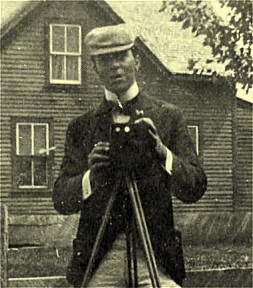
Edgar Rice Burroughs In Idaho
Red, White And Black
Now we get to the ostensible story which is the Red assault on Italian Somaliland. If few people today understand the partition of Africa by the European powers it might be well to recap the situation a little. The two big players were France and England with Spain and Portugal picking up some early real estate to be later joined by the bit players, Germany and Italy. The German possessions were stripped from them after the Great War and given to England.
This novel takes place in the Horn Of Africa or the Northeast corner facing the Arabian Peninsula and the Indian Ocean. The area contained Ethiopia otherwise known as Abyssinia, the only independent State in Africa save Liberia whose independence was guaranteed by the United States.
Ethiopia was bordered by Italian Eritrea and French and British Somaliland on the North, Italian Somaliland on the East, Kenya and Uganda on the South and Anglo-Egyptian Sudan on the West.
The Galla tribe with whom ERB became fascinated had been driven about by the Somals occupying lands mostly in the interior of Ethiopia after the manner of the Middle Eastern Kurds, where they were constantly in conflict with the Ethiopians and the Somals on the border. ERB deals with the Ethiopian-Galla situation in Tarzan And The Mad Man.
The Red camp is located in Ethiopia several days march from the border of Italian Somaliland. Opar which is nearby must now be located in Ethiopia.
The Reds have assembled an international cast of characters or in other words a multi-cultural outfit. Their multi-cultural nature will prove to be a liability rather than an asset as indeed it must in real life.
The organizers are Russian or Soviet Communists of whom there are four, Peter Zveri, the leader, Zora Drinov, Paul Ivitch and Michael Dorsky. They are joined by an American agent acting as a double agent, Wayne Colt.
Burroughs casually mentions that the expedition was put together in the United States by Zveri operating on both coasts. As Burroughs is writing a novel he wisely declines to preach or analyze, he is, as he says, an entertainer. As I who do function as an analyst pointed out in Marcia Of The Doorstep that the US had been used as a safe haven by every conspiratiorial revolutionary group on the planet. Burroughs is noting the same thing but only in passing as part of the story. If one is not attuned to such details they slip right by without significance as do the dots and dashes of the Morse code to the uninitiated.
The group is also composed of a Filipino Red, Antonio Mori and a Mexican revolutionary Miguel Romero. These people form the core group. Affiliated with them are the Moslem Arabs of Abu Batn who appear to have been recruited from the Mahgreb, perhaps Algeria, where some of Tarzan’s early adventures occurred. They do not appear to be Black Arabs of the Horn. While appearing to be Communists they remain Moslem Arabs whose real motive is to drive the Christians or Nasrany as they call them out of Africa. This means Whites of no or any religious affiliation.
Zveri has also patched on the Bantu tribe of Kitembo, the Basembos. This is because Kitembo has actually been to Opar, the only member of their party who has. Kitembo doesn’t appear to be a true Communist but is a former powerful chief from Kenya who had been displaced by the British. He comes from a place on Lake Victoria which should make him a Luo but for reasons perhaps not pertinent I tend to think of him as Kikiyu probably partly based on someone like Jomo Kenyatta who already had notoriety by 1930 although Kitembo’s history is close that that of the Unyoro Chief Kaba Rega whose story Burroughs was definitely familiar with from the memoirs of Samuel Baker.
Kitembo is interested only in recovering his past dignity augmented ten fold. All that becomes irrelevant when he deigns to lay his hands on Zora.
We should remember that Burroughs is writing in 1930 not 2010, so many things that are more or less clear to us now were undetermined at that time while understandings and motivations were quite different then from today and as those of today will be fifty years hence.
For one thing Africa was still a land of mystery where one wouldn’t have been too surprised if someone had discovered a lost civilization, a strange anthropoid- perhaps the so-called Missing Link, very real to the imagination at the time- and any number of things. One of the great losses of my childhood was the recognition that Africa was known; that nothing truly wonderful would be discovered in the world again. All was now cataloguing.
Abercrombie and Fitch who had built a very lucrative business outfitting ‘explorers’ or safaries, having not yet turned to teen porn, lost its raison d’etre as did all the ‘Explorer’ clubs where grown men sat around in khaki Safari gear drinking and dreaming. All that was left for me and my generation was Trader Vic’s and he’s gone now. The miracle is that the National Geographic found a way to survive when they could no longer portray exotic, naked, painted savages with necks supported by copper rings, plates in the upper lip and that. Now of course they don’t have to go as far for such exotica as Whites imitating the Africans sport massive tattooing suported by all kinds of nose rings and body piercings.
So, in 1930 Burroughs’ story still had a degree of probability. Especially in the way he joined contemporary politics to nineteenth century Africa. In one reads closely this is quite a story, a true tour de force.
Not only do the Arabs and the Bantus have their personal motivations apart from Communism, so we learn does Peter Zveri. The streak of individualism is not extinct in his collective mind, he sees the opportunity to make himself Emperor of Africa in Tarzan’s stead. Apparently Soviet intelligence has been keeping close tabs on the doings of the Big Ape Man because Zveri knows of Tarzan’s ‘fool dirigible trip’ believing him absent from Africa and possibly dead as no one has heard from him for the past year. This was before Google Alerts too.
Indeed Tarzan drops as from the clouds into a clearing filled with great apes as the story begins. Just coincidentally Jad-Bal-Ja and Nkima happen to be in this exact part of Tarzan’s estate of Africa at the same time. Zveri then is very disappointed to learn that his nemesis is back. As well he might because he has engaged himself mano a mano with the Big Bwana and Africa, believe it or not, is not big enough for both of them.
In his examination of Communism, multi-culturalism and human nature Burroughs is at his incisive best. Remember few of these stories go over a hundred ninety-two paperback pages. These are tremendously condensed stories. They’re somewhat like a zipped file with megabytes compressed into kilobytes. To really get the stories you have to unzip them and let them expand in y9ur mind. Don’t be deceived by their seeming simplicity.
The various cultures involved in this plot are only loosely held together by Communist ideology. The plot eventually falls apart because the cultures see through the phoniness of the Communist ideal. Zveri himself isn’t even that sincere a Communist as he intends to use the gold of Opar to make himself a third world power as Emperor of Africa. In the end Communism is a fatuous dream,whether utopian or dystopian is up to you.
Burroughs does not emphasize his opinions, he merely tells his story. My conclusions as to his intent are derived from the result of the story. In the end Communism fails because of internal contradictions while the big Bwana is invincible retaining his position as Guardian or Emperor of Africa. Not one world of preachment.
Wayne Colt in his rather absurd trek across Africa arrives too late for the first assault on Opar. He does happen into camp in time to spot the shaking tent and rescue Zora from Jafar, the Indian Communist, with Tarzan’s help. After killing Jafar Tarzan turns his steps to Opar traveling in a bee-line through the Middle Terraces he handily arrives before the first expedition which had left some time before him.
Let me take a moment to discuss Burroughs’ Africa. In the first place these stories are combination dreamscape, fairy tale and mythmaking. His Africa bears no more relation to this planet than Arthur’s Camelot bore to Medieval England. I find it tiresome for scholars to try to find the ‘real’ history of Arthur’s career. Arthur may have a loose connection to real historical events but the story, a great one, is a projection of psychological needs. There isn’t any such thing as a Holy Grail. No knights ever went in search of it.
In the same way Burroughs’ Africa is a psychological projection hopefully leading to his Holy Grail. There are no lower, middle or upper terraces in a nearly uniform jungle in the real Africa. Anyone who tries to find them will be severely disappointed. Such things are merely inventions of Burroughs’ dream world. I am glad he shared it with me, you and the millions.
The frequency with which the characters run into each other way out there is also impossible but in Burroughs’ dreamscape, his fairy tale, his myth, it happens all the time. There is no sense in arguing the impossibility. If you find it too offensive to your sensibilities then the oeuvre is not for you. One just accepts that these are fairy tales and in fairy tales things like this happen all the time. It’s a fantasy, fantastic things go on.
I try to fathom the psychological intent so while I may smile and jest at some impossible details it is only at the naive dream details and not the serious intent of the story. In our time these stories would have been taken at warp speed to another galaxy where in that context all things would be possible. But, that would be pure fiction hence unbelievable. I never did take Star Trek seriously, in fact, I refused to voluntarily watch it. Burroughs’ Africa can still be located on a map of the world connecting psychological reality with temporal reality in a very satisfying blend.
So, as this series is a roman a fleuve or River Story, Tarzan ruminates on his previous visits to Opar as he strides across the hot dusty desert, where the rain never falls, toward the fabled gold and red domes and turrets in the distance.
La’s love for him which began in Return Of Tarzan has caused dissension between her and her people. She has retained her position only through the active intervention of Tarzan. Defeating the revolution that had ousted her in Tarzan And The Golden Lion the big Bwana had replaced her on the throne guarded by the Bolgani of the Valley of Diamonds and the semi-human Gomangani. It is interesting to not that the Oparian revolution occurred after the Russian. Might be a connection.
As he approaches the city he believes that the Oparians appreciated his defeat of Cadj and that they love and respect him so that his reunion with them will be joyous. Not so. In the interim the Oparians who hate and resent Tarzan have deposed La putting her in a foul prison in the vast underground maze of dungeons of Opar. Passing back through the narrow cleft, bounding up the stairs, Tarzan is surprised to find himself attacked by the howling Frightful Men. The Man of the Steel Pate receives another frightful blow which lays him out.
He wakes to find himself the captive of Oah and Dooth. He is placed in a cell the details of which I have already related above.
I haven’t plumbed the signficance of Tarzan and La being imprisoned together while the city is attacked by the Communists unless the dreamworld of Opar represents a sanctuary that is now invaded in the attempt to destroy Burroughs’s literary career. In that event it might be necessary for the Anima and Animus to be together. This story also harks back to the invasion of the Emerald City in Baum’s story The Emerald City Of Oz.
In any event the various strange screams and noises from within Opar unsettle the superstitious Blacks and Arabs who lose their nerve refusing to enter Opar. The Blacks believe in spirits and the Arabs in jinns both of which they fear more than living men. Thus Burroughs is contemptuous of both cultures.
Zveri and his Russians are too cowardly to enter themselves. The only one with the nerve is the Mexican Miguel Romero who gets very good reviews from ERB. Miguel retreats in the the face of the horde of Frightful Men but he is very cool about it.
Returning to camp the Arabs are now disaffected having words with Zveri. The arrival of Colt and Mori puts a little heart into Zveri so that a second attempt on Opar is determined leaving the Arabs to guard the camp.
Tarzan and La escape from Opar between the two assaults becoming subsequently separated. Zveri takes the Blacks and Communists with him. Being left behind dissolves the Arab affinity with the Cause. Never good Communists, being interested only in ejecting the Nasrani from Africa, they decide to disappear into the desert.
About this time La wanders into camp. Sacking the camp, Abu Batn and his Arabs leave with the two women whose value in the North he knows full well. The Arabs are out of the story. The Communist coalition is breaking up. As Burroughs points out the goals of the two are not the same.
Back in Opar Zveri finds it impossible to force his Africans into service while he and his Russians remain cowards. Colt behaving bravely, as only an American can, along with Miguel Romero penetrates to the sanctuary where they are faced by the Frightful Men. Perhaps in a comment on American tactics Colt fires over the heads of the Oparians while the Mexican, Romero, fires directly into the mob.
Why when Americans go to war they are reluctant to do the dirty work of killing is beyond me. The reluctance to engage the enemy in Viet Nam cost us that war. The reluctance to do what we have to do in Iraq is costing us that war. Perhaps we think we can hide behind a wall of steel as our technology wars for us while we imagine we can remain safe. Our punishment of our own soldiers for merely humiliating the enemy must be unique in the annals of warfare. And they wonder why no one wants to join the Army.
Romero who shoots to kill is able to escape while the pussy footing Colt is downed by a thrown club and captured. A thrown club! Once again a Burroughs’ surrogate takes a blow to the head, but how does one survive a thrown club?
Just as Colt and Zora exchange partners in the jungle so now Colt takes Tarzan’s place in jail. Here, he is befriended by a nubile beauty, Nao, rather than as La did Tarzan and, pephaps as Florence was doing for ERB. Afer killing to free him Nao is left behind as Colt disappears into the dusty desert. Not a very thoughtful thing to do as Nao would certainly be discovered.
Zveri returns to his devastated camp to be handed a letter notifying him that Colt is a double agent. Abandoning any thoughts of Opar the Communists concentrate on their mission which is the simulated invasion of Italian Somaliland.
As they are about to leave Tarzan returns Zora to camp. Coldly dropping her off without a word he climbs onto a branch to spy on the conspirators. His leopard skin shorts are mistaken for the real thing. Here we go again. the shot at the imagined leopard grazes the Big Guy’s skull putting him out of commission for a full day. So that is at least two knockouts for Burroughs’ surrogates plus this concussion. Tarzan’s frequent lapses of attention become more intelligible.
Zveri wants to take advantage of his opportunity and kill Tarzan but Zora intervenes so Tarzan is bound which leads to next day’s episode when Dorsky threatens him only to be annihilated by Tantor.
The charming fairy tale between Nkima, Tantor, Tarzan and the Hyena then takes place which is a repeat of the same scene in Jewels Of Opar.
Nkima then goes in search of the Faithful Waziri to aid Tarzan while the Big Fella begins his campaign of terror against the Communist conspirators.
His strategy is to separate Kitembo and his Basembos from Zveri and his Communists. To do this he plays on their superstitious natures. A mysterious voice comes down from the trees, in other words, the sky, telling them to go back. In the meantime Little Nkima has recruited the Faithful Waziri who arrive to help out not with spears and bows and arrows but modern repeating rifles. Arranging themselves in front of the advancing Communists hidden in the tall grass -this stuff grows six feet high- they give the appearance of being many more than they are. Burroughs doesn’t make it clear how they can see the Communists through the grass while the Communists can’t see them but as Tarzan usually navigates pretty well even in total darkness I’m probably making a bigger problem out of it than it is.
Zveri does a rapid advance to the rear which act of cowardice completely destroys his credibility. Dorsky is dead while Romera and Mori renounce their Communism. Zora reveals she’s only in it for the revenge because Zveri had murdered her family twelve years earlier in the Revolution while, as we are aware, Colt is an American agent. This leaves only Zweri and Ivitch who I believe represent Frank Martin and R. H. Patchin, ERB’s old nemeses in Chicago.
Returning to camp Zveri spots Wayne Colt. Calling him a traitor he fires point blank missing while the bullet grazes Colt’s side without breaking the skin. That was a close one. Before Zveri can fire again he is brought down from behind by Zora. Burroughs replays scenes like this over and over with different variations. Just as the constant bashings on the head his surrogates take reflect his own experience in 1899 so must all these conflicts between his surrogates and another man and his surrogate woman reflect his situation with Frank Martin and Emma. In each instance in one way or another the woman rejects the other man. Thus Burroughs ‘fictionizes’ his own situation.
So now Zora kills Zveri so that she and Colt can bridge that gap.
As a sidekick Ivitch/Patchin is allowed to leave Africa. In point of fact Martin died some time before Burroughs although not until after 1934 while Patchin survived both.
Tarzan in the meantime escorts La back to Opar where he reinstalls her on the throne this time doing the sensible thing of eliminating Oah, Dooth and all their sympathizers. One must believe there will be no more trouble in Opar. In any event Opar disappears from the oeuvre.
Tarzan then returns to the camp to dispense justice as becomes the Lord Of The Jungle.
As the story ends the ‘invincible’ Tarzan seems to have solved all the problems confronting he and Burroughs in 1930. The Big Fella has not only thwarted Zveri but defeated Stalin and the whole Soviet empire.
As the exchange between Zveri and Romero explains it: pp. 183-84:
“Which proves,” declared Zveri, “what I have suspected for a long time; that there is more than one traitor among us,” and he looked meaningly at Romero.
“What it means,” said Romero’ “is that crazy, harebrained theories always fail when they are put to the test. You thought that all the blacks in Africa would rush to our standard and drive all the foreigners into th ocean. In theory, perhaps, you were right, but in practice one man, with a knowledge of native psychology, which you did not have, burst your entire dream like a bubble, and for every other harebrained theory in the world there is always the stumbling block of fact.”
Thus Tarzan not only defeats Zveri, Stalin and the Soviets but he disproves the whole Communist ideology as a harebrained theory.
On top of that the Invincible One restored order in Opar while putting his personal life to rights by separating out Colt and Zora or Burroughs and Emma and Tarzan and La or Burroughs and Florence.
The succeeding novel Tarzan The Triumphant- Invincible, Triumphant- will rescue the Russian situation while its successor Tarzan And The City Of Gold disposes of Emma/Jane/Zora/Nemone by her self-immolation while its successor Tarzan And the Leopard Men bring Kali/Florence and Old Timer/Burroughs together. The series climaxes with Tarzan And the Lion Man when Burroughs 2 kills off his early self, Stanley Obroski, or Burroughs 1 to come into his own, or so Burroughs supposes. The rest of the series is playing out the aftermath of the divorce from Emma and the marriage to Florence.
As could have been predicted the marriage to Florence was less than satisfying.
So, perhaps, Burroughs’ solution to his personal dilemma is based on a harebrained theory itself which fell to earth on ‘the stumbling block of fact.’
For the moment however Tarzan has saved Africa from the Communist menace and perhaps the World.
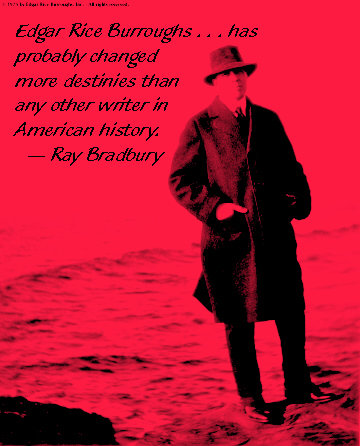
Edgar Rice Burroughs- High On A Mountain By The Sea
Pt. II: H.G. Wells, Sigmund Freud, Edgar Rice Burroughs And The Development Of Contemporary Sexual Attitudes
August 22, 2010
H.G. Wells, Sigmund Freud, Edgar Rice Burroughs
And The Development Of Contemporary Sexual Attitudes
by
R.E. Prindle

Edgar Rice Burroughs And His Tiger
To put our three protagonists into perspective: Sigmund Freud The eldest of the three was born in 1856, Wells in 1866 and Burroughs, the youngest in 1875. All three were heavily influenced by Charles Darwin and the various theories of Evolution. While today Darwin is touted as the sole source of evolution he was in fact one of many voices as the theory of evolution developed. Thus all three spent their formative years in the latter half of the nineteenth century. Freud was 44 as the century turned in 1900, Wells 34 and Burroughs 25 each neatly spaced 10 years from his predecessor.
Wells was the first to make the leap into prominence followed by Freud and then Burroughs. All three men were desperate to find fame and fortune. Freud even advtertised he’d sell his soul to do it.
Wells came from close to the bottom of the social ladder. His parents eked out a living as shopkeepers without commercial abilities on the edge of London. Wells’ father was an able cricket player who gained his self-esteem from that sport. The parents split up. His mother went into domestic service. She placed young Wells as a Draper’s assistant- a clerk in a dry goods shop. As one might well believe Wells rebelled at this dead end destiny in life. Possessing a good brain Wells began a series of educational maneuvers that led to his being a student of T.H. Huxley, an apostle of Evolution. A science career seemed to be opening for Wells but he was led away by his sexual needs. He married a cousin with whom he was a boarder in her mother’s house only to discover her Victorian notions of male-female sexual relations differed widely from his. He divorced her taking up with a fellow student. She was an able financial manager so he put her in charge and began chasing skirts. It didn’t seem to bother his wife Catharine who he renamed Jane. After a series of hairy but educational employments Wells began to find success in journalism and writing. With his story The Time Machine he broke into the bigtime giving Jane some real work to do. Quickly following The Time Machine up with his succession of sci-fi novels by 1900 he was assured of a lifetime income.

Bertie Wells
It was well because his work after 1906 while prolific was unlucrative except for 1922’s Outline Of History. There was a winner. The Outline was his second great break setting him up for the rest of his life along with the science fiction. Ah, those Seven Science Fiction Novels. And, of course, his close to amazing collection of short stories. There was another gold mine. Jane raked in the cash and Bertie, for that was how he wished to be called, spent it.
He associated himself with the socialist Fabian Society of the late nineteenth and early twentieth century with their ‘advanced’ sexual notions. Why the old Hetaerist notion of promiscuity is considered ‘advanced’ is beyond me. At the same time Bertie claimed to be a Feminist. The women’s Matriarchal movement was very active from mid-century on. His Feminism, however, was concerned only with eliminating chastity thereby allowing any man access to any woman at any time, anywhere. Purely Hetaeric, although Wells wouldn’t have understood his ancient roots in that manner.
It was when Wells turned to his sex novels that he put his reputation in jeopardy. After his intial spate of sci-fi his reputation slid, the only bright spot being The Outline Of History. While his later novels, tend toward the tedious and require a certain determination to read through they are almost always redeemed by the social context. I like Wells and don’t mind the stuff too much but I can’t recommend it very strongly. It’s a matter of taste, either you like Wells or you don’t.
Wells major themes are outlined in the last of the Seven Sci-Fi Novels- In The Days Of The Comet- when he shades into the sex novel. In my estimation this is a very fine book as utopian novels go. After Tono-Bungay and When the Sleeper Wakes it may be my favorite. The turn of the century was a hey day of the utopian novel with the dystopian novel being introduced. If you like the genre many fine ones were written: News From Nowhere by William Morris. I came to Morris late in life but if you like the mystical utopian or quasi-utopian novel Morris has a lot to recommend himself including several utopian forays. I’m sure he influenced both Wells and Burroughs; Edward Bellamy’s Looking Backward is another fine example of the period. They’re all bushwa but fun to read. Utopian novels are usually a projection of the author’s own needs and desires into which all humanity is to conform. Usually by some miracle all humanity becomes reconciled to living in universal harmony with no unseemly disturbances of the temper. Museums and lecture halls flourish while dance halls and crime atrophy. Culture is much more elevated. To the most casual observor such an utopia is impossible without an alteration of the human brain. Only one utopianist I have read has addressed that problem and that one is H.G., our Bertie.
In The Days Of The Comet was published in 1906 at the time that Halley’s Comet was due to make its scheduled seventy-five year fly-by in 1910. It was projected to pass very close to the earth which it did unlike its 1985 appearance when you had to know where to look for it. Indeed, the comet came with trails of glory so bright you could read newsprint by it at night.
Thus Wells uses the comet as his agent to change the physical structure of the human brain. Wells fails to mention any change to the brains of the lesser animals and insects. Perhaps the lion really did lie down with the lamb. Before the comet, or the Big Change as the passing was referred to, people’s brains were as ours are now; after the Change they all resembled that of H.G. I am in sympathy with Wells; I fancy that one morning I will sally forth, flick my finger tips a couple times, say abracadabra and the people of the world will be tranformed into clones of myself. What’s holding me back is that I don’t know which will be the Big Morning and I don’t wish to be seen as an eccentric or worse who failed to take his medicine by repeatedly trying and failing. You know, out there flicking my finger tips into the empty air.
But, Wells had it worked out. The comet came trailing this tail of green gas. As the comet passed the gas enveloped the earth much like a magnetar, I suppose, knocking people out for several hours while the gas did its work. When England came to the world was changed and everyone thought like Wells. Sort of the same thing that was thought would happen when Obama was elected. The Magic Negro would save us all.
Actually the Comet reflected a change in Wells own circumstances. In 1898 when Wells published The War Of The Worlds he was balanced between hope and despair. He was close to financial independence but not quite there. Thus in WOW the tone is between hope and despair. The world is invaded by Martians who destroy everything in their path, themselves being destroyed by a virus taken in through their beastly habit of drinking human blood. One neglected detail is that the projectiles they arrived in trailed some green clouds. The last projectile had a larger one so that perhaps Wells was going to develop the notion but then couldn’t work it in. He did have the Martians project a black gas that killed people though.
By 1906 his success was assured, he was shooting his pistol off around London having several sexual affairs so his outlook was brighter and, hence, that of the planet, so the novel describes the transition from the evil old world to the brave new one In other words, Wells had passed from poverty to affluence.
Sex is the issue here.
Before the Comet Willie, the hero, was courting his childhood sweetheart Nettie from whom he expected to be her sole sexual companion. In the weird old world sex was exclusive. They had committed themselves to each other as children which remained a claim in Willie’s mind.
However Willie is a poor boy with no prospects. Nettie is courted by the rich guy’s son, Verrall with whom she runs off. Willie treks 16 miles to see her only to find she has abandoned her parents’ home in company with Verrall. Well, Willie’s not going to endure such treatment from Nettie or take that from Verrall so he steals some money, buys a revolver and a train ticket to track them down and shoot them dead. You see, in the days before The Big Change that was the way things were done.
In the meantime the Comet is getting closer, C-hour is near, and war breaks out between England and Germany, this is eight years before 1914 so Bertie exhibits his prescience. The details are well handled so we have the increasing color of the green cloud and the flash and boom of the big navel guns as the climax takes place by the seashore. This was really nicely handled.
Willie tracks the couple down to a Bohemian enclave on the East Anglian coast. Nettie and Verrall had gotten married so it seems rather odd that they searched out a Bohemian enclave. So, as the battle rages and the green cloud descends on the earth Willie is chasing the couple down the beach firing his pistol wildly. This is the moment of the Big Change. Everybody gets gassed for a few hours then arise, born again, in a new heaven and a new earth. Utopia!
The same device is used a few decades later in the great movie The Village Of The Damned. A good device. It won’t go stale.
In the new world, new rules and reasonings apply. Nettie no longer has to choose between Willie and Verrall. She can have both…and more.
As Willie comes to he hears groaning. The groaning is coming from a prominent politician who was out bicycling at two in the morning when the green fog descended and fell off his bike as he conked breaking his ankle. Thus Willie makes a connection changing the direction of his life allowing him to become prominent in the establishment of this brave new world. Thus he later meets Nettie and Verrall on equal terms.
Nettie informs Verrall that she wants a menage a trois with Willie to which, in this best of all impossible worlds, Verrall compliantly agrees. Later Willie marries making the arrangment a menage a quatre. Neato! Was this all? No…
In the frame for the story it turns out that the story teller is Willie. In the Frame Wells comes upon this white haired old dude, Willie, writing this memoir. He has pages clipped in fascicles of fifty that Willie allows the editor, H.G., to read.
Finishing the last fascicle the author asks if Nettie had sexual relations with others. The white haired dude replies somethng like this: ‘Oh, heavens, yes. Hundreds. You don’t think a beautiful girl like Nettie wouldn’t attract numerous suitors do you?’
So there you have it. In the brave new world the woman of Wells’ dreams is a mere sex object who spends her life being pawed by, shall we say, all comers. A Hetaerist’s dream. This is Wells’ sexual program. At this point he began to lose readers. Too avant garde; you don’t want to get too far out in front of the pack. In addition to the sexual proselytizing of his novels he carried his didacticism to extremes advancing educational theories for instance. For over a hundred years we’ve been told our educational system is faulty. New systems have succeeded new systems. After over a century of tinkering are people better schooled? No. They’re worse. There’s only one way to learn and that’s the drudgery of study. Not every mind is prepared to do that, somebody’s going to be left behind. Wells’ notions as everyone else’s is what they think they would have liked. No study. Lots of play.
At any rate carrying all these utopian notions Wells passed through the horrific war years to have all his expectations disappointed. Not surprisingly his mind broke and he went into a deep depression. First he tried the God trip and when that failed he embraced the Communist Revolution in Russia. He essentially became an agent of Moscow. As a very prominent writer he was a desirable acquistion for the Revolution. As a major theorist and propagandist he had an entree first to Lenin and then after 1924 when Lenin died, Stalin.
In 1921 he interviewed Lenin and received his instructions. the Soviets had a system of State prostitution. These women were assigned as agents to service writers while spying on them for Moscow. In 1921 he met Moura Budberg for whom he fell. At that time she had been assigned to manage a consular agent, Bruce Lockhart, who along with the agency was in process of being expelled. Wells became intensely jealous of Lockhart because of this connection badmouthing him from then on. In any case Moura Budberg was assigned to Maxim Gorky then living in exile in Italy with whom she stayed until Gorky was enticed back to the USSR at which time she was reassigned to shepherd Wells.
Now Wells became a Soviet literary hatchet man. It was his job to interfere and discredit writers who refused to propagate the Party line. Among these was Edgar Rice Burroughs who had proclaimed his anti-Communism with a tract or study titled Under The Red Flag of 1919. Publishers refused the piece. Wells anti-Burroughs campaign was so discreet that my discovery of it three or four years ago was the first mention of it. I repeat the story here for those who have not read my earlier essays.
In the first place all these writers read each other. Kipling and Haggard for instance read each other as well as writers like Wells and Burroughs and vice versa. They could pass disguised messages in their novels. As Burroughs was the last of these writers to begin writing and that in US pulp magazines in 1912 that may never have reached Europe while his book titles only reached print in 1914 after the Great War began and were only the Tarzan titles until the end of the decade Wells may not have read Burroughs until 1918 or slightly after. Nevertheless Burroughs influence shows in Wells’ 1923 effort Men Like Gods. This book also ridicules Burroughs.
Men Like Gods takes place in a parallel universe. There is some resemblance to the Eloi of The Time Machine. For the first time Wells’ characters are nearly nude. This was the only time he ever did this so he was probably under the influence of Burroughs whose characters never wore clothes or only minimally.
Burroughs apparently picked up the references or had them pointed out to him. In any event in 1926 he wrote The Moon Maid in answer to Wells, The First Men In The Moon. Wells’ book was pretty clumsycompared to that of Burroughs who demonstrated his imaginative superiority by running circles around Wells. The second part of the story was a rewrite of Under The Red Flag that was a direct challenge to the Soviets. By 1926 of course Stalin was directing the USSR.
Wells then countered with an undisguised attack that portrayed Burroughs as insane. This was Mr. Blettsworthy On Rampole Island. Here Wells parodied a pulp magazine story not yet in book form, The Lad And The Lion, and the last third of The Land That Time Forgot. Burroughs returned the fire with Tarzan At The Earth’s Core and Tarzan The Invincible that featured Stalin himself as a character.

Moura Budberg Young
At about this time Moura Budberg was assigned to Wells as a concubine as Gorky had returned to the USSR. This was to cause a falling out between Wells and Stalin while perhaps leading to Stalin’s assassination in 1953.
Burroughs’ entire series of novels from Tarzan At The Earth’s Core to Tarzan And The Lion Man deals with Wells and the Reds. The Communists attacked unrelentingly on several fronts probably robbing Burroughs blind in royalties while trying to squeeze off his sales. His British publishers did just that. Although it appears that they refused or were reluctant to keep his titles in print Alan Hodge and Robert Graves in their history of the twenties and thirties, The Long Weekend, twice refer to Burroughs’ great popularity, once in the twenties and once in the thirties.
In Germany the Communists attacked ERB for his anti-German comments in books written during the war
Moura Budberg Old
years thereby destroying that lucrative market. The Soviets never paid royalties anyway so there was no monetary effect from that market. In the US Burroughs had troubles with his publishers McClurg’s and Grossett & Dunlap who seem quite hostile to in the correspondence in the archives at ULouisville. ERB left McClurg in the late twenties going through two more publishers before winning the battle by publishing under his own imprint. Thus by 1930’s Tarzan The Invincible, note the title, he seemed to have won the battle if not the war.
However sound had come to the movies in 1927-28 which rearranged the playing field. Rather than just being ‘flickers’ they were now more on a par with literature while being even more influential. With sound the movie version of a story took pecedence over the book, heck, it took precedence over history. Thus the movie version took precedence as the canon over the book, the latter became an adjunct that few read in comparison to those who saw and heard the movie. As the movies paid in one lump sum what it might take years to dribble in as royalties authors were willing to give the devil a cut to have their novels produced. Books could be issued in their thousands of titles a year but there were only a couple hundred movies released in a year. The number of producers had been consolidated from many to a few after the shakeout of the twenties, hence combines like Metro, Goldwyn and Mayer, Radio-Keith-Orpheum- RKO- and the combine of Twentieth Century Pictures and William Fox.
MGM was of course top dog by far. There was no vacuum there but the Commies moved in anyway soon taking over de facto control. When Burroughs published his own books, quite profitably, he had slipped the noose but only temporarily. As a strategist he did poorly. In 1931, because Burroughs didn’t ever bother to dread his contracts, MGM finessed his meal ticket, Tarzan, from him thereby making him financially dependent on them. Even though they might have exploited the Tarzan character by making two or three movies a year and zillions of dollars they chose to make only six movies between 1931 and 1940 thereby keeping Burroughs on a short financial lease while depriving him of hundreds of thousands of dollars in income. Remember that at the same time Roosevelt after 1933 drove the income tax rate as high as 90% so there was some difficulty forcing a grin in those trying times.
This is a good story and I covered it in some detail in my ten part review of Tarzan And The Lion Man, expecially parts 6-10 to which I refer you if you’re interested. Wells and Burroughs bickered back and forth although it appears that Burroughs lost heart after Tarzan And The Lion Man. By that time he knew he had been had. He did concede defeat in the issuance of a book version of The Lad And The Lion in 1935; a notice to both Wells and Stalin. The story was a short one so while leaving the old story as a notice to Wells who had mocked him and the story in his Blettsworthy novel, Burroughs interpolated chapters with a story mocking the Communist Revolution in Russia. Then he retired from the field.
However he gives Wells a grand slam in the story of ‘God’ in the middle of Lion Man. That is a great story within the story however I wasn’t clear on its relation to Wells at the time so I will give a modified version here.
Now, Burroughs had a remarkable mind. He was able to carry the story lines of hundreds of books he had read in his head retrieving details whenever they suited his needs. He was always conscious of what he was doing but he wrote pastiches anyway.
The story of Tarzan and God mocks Wells’ The Island Of Dr. Moreau. Burroughs had already used Moreau in his 1913 novel The Monster Men plus he wrote around the theme repeatedly. Moreau itself plays around with the Frankenstein theme which also figures prominently in Burroughs’ literary antecedents.
Remember that Burroughs is able to combine numerous details of other books into one composite figure so that Wells is only one source for the character of ‘God’ in Lion Man. For our purposes one may assume that when Tarzan talks to God (smirk) it is equivalent to Burroughs talking to Wells. Gone is the transcendant confidence of Tarzan The Invincible and Tarzan Triumphant. However the coup of the capture of Tarzan in 1931 when Burroughs signed away his rights to the movie representation of Tarzan to MGM had stripped Burroughs of all defences and he himself was now trapped in a cage at the mercy of MGM, Wells and Stalin. During Tarzan’s movie history dating back to the late teens Burroughs had always complained, making a nuisance of himself because the studios weren’t following his stories closely. Now, he had given MGM the right to create their own stories. ERB was dissatisfied with the representation of Tarzan but the character was so good that even though MGM tried they couldn’t destroy it.
Nevertheless they were in a position to substitute the movie Tarzan for the literary Tarzan in the public mind and they did. For me and many others the discovery that there was a literary Tarzan came long after we had been viewing Tarzan movies. We invariably found the literary Tarzan superior. For now Tarzan/ERB was imprisoned in a cell. The best ERB can do is to come up with a better Moreau story than Wells.
So, ERB creates a mock London, England in the wilds of Africa with a replica of the court of Henry VIII peopled by mutated gorillas. By 1930 when this story was written ERB was probably as well informed about evolution as anyone. He had kept up his reading becoming as knowledgeable concerning genetics as any but researchers. Thus while thirty years earlier Moreau had been clumsily experimenting with vivisection ‘God’ had used the lastest genetic techniques that ERB can devize to convert gorillas into a cross between apes and human beings. The apes of God are human in all but appearance. There are many jokes concealed in this episode, apes of God perhaps being one. Wyndham Lewis used the term apes of God as a synonym for writers so he may be calling Wells as God and writer an ape. ‘God’ himself who has exchanged ape genes with himself is now half ape. See, a joke. Whether Wells recognized his portrait isn’t known.
Tarzan sets about to escape but as there is no escape from his real life situation ERB merely burns God’s castle down disrupting one supposes the USSR. Perhaps gratifying to the imagination but futile for changing his situation. No longer in control of his creation Burroughs creative powers begin to atrophy.

Uncle Joe As FDR Would Say
Thus Stalin triumphed over his literary adversary. Perhaps Stalin despised writers for he set out to humiliate Wells after the defeat of Burroughs. As noted the State prostitute Moura Budberg had formerly serviced Maxim Gorky while after his return Budberg was assigned to Wells. H.G. had fallen hard for Budberg apparently seriously in love with her. Stalin called Wells to Moscow in 1936 when Gorky was on his last legs, about to die. Budberg was also in Moscow but when Wells asked to see her she told him she was called out of town. In a rather malicious ploy Stalin arranged for Wells to see Gorky and Budberg together as, of course, she wasn’t out of town.
Wells was completely destroyed unable to penetrate Stalin’s duplicity, or at least believe it, at the time. However when it finally sank in he had no more means to retaliate than Burroughs so he wrote a book too- The Holy Terror. In that book, the ruffian leader of the revolution, or Stalin in real life, has lost the ability to lead the revolution and has to be discreetly removed. A conspiracy is set afoot. A doctor’s plot in which the leader is artfully removed by medical means. I am unaware of how much influence Wells may have had to incite others to achieve his result. At any rate the War intervened making it inexpedient to dispatch Stalin while Wells died in 1946 before he could reactivate the plan.
It may be coincidence but Stalin discovered a doctor’s plot in the early fifties that he was able to foil. However Khruschev and Beria and others poisoned Stalin at a dinner in 1953 thus removing this singularly successful but troublesome dictator.
The turmoil of the thirties may have derailed Wells sexual program somewhat but sexual matters were still moving in his desired direction. Sexual matters had been loosened a great deal but there were still miles to go.

Sex And The Psyche
In Part III I will deal with the key mover in sexual matters, Sigmund Freud who was the second of the three to reach prominence. Thus Burroughs the third to arrive on the scene and the last to leave will be saved for the last part.
A Review
Themes And Variations
The Tarzan Novels Of Edgar Rice Burroughs
#14 Tarzan The Invincible
Part V of X
by
R.E. Prindle
First Published On The Ezine, ERBzine

The Man
Six White Men In Search Of An African Empire
If one believes that Burroughs is merely on a rant against Communism in Tarzan The Invincible and Tarzan Triumphant then there is nothing more to say. Still, it is remarkable that ERB specifically names Stalin as a persecutor of Tarzan in both books. As Burroughs says he doesn’t mind fictionizing political and religious realities the question is , is he fictionizing a real life situation where Stalin, or the Communists are giving him a hard time?
Seems really improbable doesn’t it? People are used to thinking of Burroughs as a barely literate fantasy writer better ignored by the literati. But more insignificant men than ERB have been the victims of hate campaigns.

Dr. Harvey Springer- The Cowboy Evangelist
Who now, for instance, remembers Harvey Springer? Harvey Springer? Never heard of him? I don’t wonder. Oddly enough when I was in San Diego in 1957-58 Harvey Springer, who was some kind of evangelicalist, was going to appear at some church out where no sailor ever went. He was kind of a cowboy evangelical from Denver. His most dramatic stunt was placing one of size fourteens, he was a tall rangy man, on one chair and the other on another to harangue the crowd.
I hadn’t heard of him, you know, nor had anyone I knew, but Harvey Springer was reputed to be an arch anti-Semite. Could have been for all I knew, but I’m not going to take anyone’s word for it. The point is the Jews sent all kinds of people into the streets to tell people not to go see Harvey. I don’t how many times they must have heard- Who’s Harvey Springer?- in reply. Rather than say he’s an anti-Semite, of which I had even less knowledge at the time never having heard the term, all that was necessary was to say the two words, church and evangelical to cool my ardor, if I had any, to find where he was speaking and go see him.
In addition the AJC and ADL published books in which they denounced Harvey Springer as a very dangerous anti-Semite. Now, if certain people would go to such extremes to persuade someone not to do something he had no intention of doing what would they do to defame someone with an international reputation? The only one who didn’t realize the extent of ERB’s fame seems to have been ERB himself. He was no self promoter, he thought it best to keep his head down.
In that sense, judging from the unpublished Under The Red Flag and the published Moon Maid, Invincible and Triumphant Burroughs was actually a leading anti-Communist voice. I mean, people read this stuff. They read it in America , they read it in England, they read it in numerous translations and they read it in the Soviet Union. Here’s the kicker, Stalin read it. Not only that, Stalin was a movie buff. And he requested Tarzan films (reported in a recent UK Telegraph story and the book of Simon Sebag Montefiori: Stalin: The Court Of The Red Tsar.)
History is not a mystery, it’s just schoolyard bullies bigger than life.
We also know that Stalin ordered his scientists in the 1920s to attempt to cross an ape and a human to create a super warrior. It’s clear to me that Stalin had read Beasts Of Tarzan. The Man of Steel may have had a difficult time distinguishing between fact and fiction as many another. Besides, remember eugenics was a hot topic of conversation in Red circles then as it is today. Not knowing what we know now about genetics crossing an ape and human may not have seemed that far fetched. It doesn’t to a lot of people now. Heck, the Old Testament enjoins one to destroy the results of an animal-human union so the ancient Hebrews thought it was not only possible but a regular occurrence.
There is very clear evidence that the Reds were conducting a campaign of vilification against Burroughs. I’ve mentioned it before but the clearst evidence is H.G. Wells’ novel Mr. Blettsworthy On Rampole Island.

Bertie Wells
May we take a moment to look more closely at Wells? Don’t think I’m antagonistic toward Wells. I dearly love Wells just as I do Burroughs. I have a complete collection of Burroughs while I’m looking for the odd volume of the more obscure Wells. I’m not boasting, I’m just saying this in the way of credentials. I’ve read all of Burroughs more than once and I’ve read all the Wells’ titles I have, many of them more than once. In point of fact I love all the literature from say, Haggard’s King Solomon’s Mines to 1930 and perhaps an odd year or so beyond. I love. I mean, I love it. I love Edgar Wallace who, if you can believe it, is claimed to have sold one out of four books sold in England during this period. If you don’t know him he was one of the co-writers of the movie King Kong and then he died. All this stuff of this period is wonderful. Robert Hitchens, P.C. Wren.
So, you know, it’s like this: H.G. Wells was a Soviet literary hatchet man.
The man had a wonderful career. You know his most famous novels, The War Of The Worlds, First Men In The Moon, The Island Of Dr. Moreau, In The Days Of The Comet. If you like Wells, and I do, those are the tip of the iceberg. A few of his short stories and he wrote many are as good as short stories get.
He was always a socialist and perhaps a terrorist conspiritor, but he was a child of the nineteenth century until his mind broke at the end of the Great War. At that time he lost faith, in god, transferring his faith to the Revolution, becoming a Soviet dupe. His literary career may be divided into two halves, pre-God- The Invisible King and post-God. That was one of his books.
He was not taken seriously as a fiction writer after the war. During the twenties and thirties he turned out an unending stream of novels that were ignored. It’s not difficult to see why, but I find them a little more tolerable. I like Wells. His reputation and career were saved by his 1922 effort An Outline Of History. It was a massive volume and it sold massively for twenty years or more while being hugely influential in literature. Put him on easy street for the rest of his long life. As much as any artist who is skilled at spending money can be on Easy Street.
As a novelist however, he was pretty much a has been. While none of his post-1920 novels take off he hits the spot with me.
From 1920 on his soul belonged to the Revolution, which is to say the Socialist homeland, which is to say the Union Of Soviet Socialist Republics. That means he was more loyal to Russia than he was to England. In short, a traitor in intent if not in deed. While no Liberal ever deals in realities hence are in constant denial, The Man of Steel, Josef Stalin, was his boss. Wells naturally would have denied this.
The Soviets had a pretty comprehensive system which once again is denied. There were a number of State prostitutes who were assigned to the various important Red writers to service them as mistresses, while reporting back to the Kremlin. This is, of course, denied by the Liberals. I don’t understand living a life that has to be denied, where everything you do has to be represented as something else, but such duplicity is apparently congenial to the Liberal mind. They must seek it.
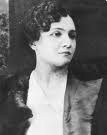
Moura Budberg
Wells was assigned a woman named Moura Budberg. She must have known how to turn on the charm as she was able to make a number of men she was assigned to sincerely love her, including the British diplomat Bruce Lockhart, the Russian writer Maxim Gorky and H.G. Wells. She wasn’t that good looking either. All of these people led double, triple or quadruple lives. They must have been really able to compartmentalize their minds. Freud didn’t touch that type.
After Wells’ visit to Lenin in 1921 he was signed on. He began his career as literary hatchet man. In his writing he portrayed recognizable people, sometimes under their real names, in negative or positive lights. As a skilled writer, whether you like his later stuff or not, he was more than competent to do this. It appears that he first targeted Burroughs in his 1923 novel Men Like Gods. Among his science fiction novels this one should rank more highly than it does. Burroughs’ 1926 Moon Maid reads like a reply to Wells. Especially the first part of the trilogy where Burroughs dances imaginative rings around the First Men In The Moon. From there Wells took up the challenge with Mr. Blettsworthy On Rampole Island of 1928 which unmistakably is a parody of Burroughs in which he portrays Burroughs as insane, but not a bad analysis.
Burroughs responded possibly with At The Earth’s Core but definitely with Tarzan The Invincible. At the same time one interprets Stalin’s interest in crossing apes with humans as being derived from Beasts Of Tarzan and other Tarzan novels there may have been more direct Soviet interest in ERB. One notes that Tarzan The Invincible was the first title published under the Burroughs imprint. I think it highly probable that his publishing was being interfered with by the Reds in addition to whatever other grievances against his publishers Burroughs may have had.
One may say that Burroughs was too insignificant for Stalin to bother with, yet according to Simon Sebag Montefiori Stalin put out a contract on John Wayne because he was such an ardent anti-Communist. Khruschev is said to have told Wayne that he concelled the contract after Stalin’s death. Edgar Rice Burroughs was at least as significant in 1930 as Wayne in the 1940s and 50s.
At any rate in 1930 Burroughs has Stalin and the Reds invading his dream world of Opar to steal his gold, i.e. put him out of the publishing business. Invincible and Triumphant, notice the titles, both deal with Stalin and the Soviets then the topic disappears from the oeuvre. Was Burroughs given incentive to counter-attack the Reds? I think there is enough evidence to warrant the opinion while time will tell even more. Research is just beginning.
It is signficant that Burroughs introduces the story in his own voice, not a framing device. He may be simply talking to the reader or he may be addressing Wells and, dare I say say it, The Man Of Steel himself. Perhaps a subtitle could be ‘The Big Bwana Meets The Man Of Steel.’ Now, it should also be remembered that this is the fourteenth novel of the series. the first title had been written eighteen years earlier. At that time the surprise of the character had knocked the socks off the reading public. In 1930 Tarzan was in danger of becoming old hat. Burroughs had to think up new and interesting devices to keep his readers coming back. As with most series of this type the readership was limited. Maximum sales could be predicted so that success meant not falling below a certain level of interest or letting interest diminish below unsupportable levels. As his own publisher Burroughs was now taking all the risks financial as well as literary. He had to turn out a successful book.
I think he did a superb job. Since the series continued to flourish his readers must have thought so too. I do wish ERB, Inc. would release some sales figures though.
For the premiss of his story Burroughs postulates that Stalin and the Soviets wish to instigate a new world war which will allow them to pick up the pieces establishing a complete European dictatorship. Not at all farfetched. Burroughs postulates that Mussolini and his Fascists are aiming at a European hegemony. This is 1930 so Hitler and the Nazis are not on anyone’s radar as a threat to world peace except for a few fringe elements. At the time Hitler and the NSDAP were in hand to hand combat with the Communists for control of Germany. They would not assume power until three years hence.
The Reds then wish to create an incident that would cause the Italians to attack France. The indirect approach is usually more effective than the direct approach so they wish to create an incident in Africa where French colonial troops appear to invade Italian Somaliland.
At that instant expendable confederates in Italy would reveal a bogus French plan to Mussolini. It is assumed that Italy would then declare war on France and the holocaust would begin. As we all know Italy did not declare war on France in 1930 so the plan must have misfired somewhere along the way. Tarzan was the reason. Burroughs gives these little known details that would have been lost to…well… if not history, remembrance. So, uh, really ERB is providing a valuable service here.
There may be two sides to every story, but usually one is on one side or the other. We don’t have to be reminded ERB is not on the side of the Reds. In fact, ERB is exposing their plans and weaknesses. He displays a fairly profound understanding of the goals and workings of the Communists. He is read up on the subject, He has studied. He is not shooting from the hip. He knows whereof he speaks. If not an authority on the subject he is pretty darn close.
ERB has his eyes on how ‘American’ manufacturers are relating to Moscow. He has Zora Drinov analyze the situation this way, p. 12
“But what do the puny resources of this single American (Wayne Colt) mean to us?” demanded Zora. “A mere nothing compared to what America is already pouring into Soviet Russia. What is his treason compared with the treason of those others who are already doing more to hasten the day of world communism than the Third Internationale itself- it is nothing, not a drop in the bucket.’
“What do you mean Zora?” asked Miguel.
“I mean the bankers, and manufacturers, and engineers of America, who are selling their own country and the world to us in the hope of adding more gold to their already bursting coffers. One of their most pious and lauded citizens is building great factories for us in Russia, where we may turn out tractors and tanks; their manufacturers are vying with each other to furnish us with engines for countless thousands of airplanes; their engineers are selling us their brains and their skill to build a grreat modern manufacturing city, in which ammunitions and engines of war may be produced. These are the traitors, these are the men who are hastening the day when Moscow shall dictate the policies of our world.”
“…their government is a capitalistic government that is so opposed to our beliefs that it has never recognized our government; yet in their greed, these swine are selling out their own kind and their own country for a few more rotten dollars.”
Sound anything like the US and China today? That was a mouthful. The first thing FDR did upon taking the reins of government was to recognize Soviet Russia. Tell you anything about FDR? That was a mouthful that should have eraned ERB the hatred of the Liberal Coalition.
You can see why they wanted to stop his mouth. Passages such as this are probably the reason Richard Slotkin and his crowd, John Taliaferro, group ERB with Madison Grant and Lothrop Stoddard. A charge of racism is usually a cover for a multitude of offences that have nothing to do with race. One is merely opposing the Liberal program. If they were to say- the fellow opposes the Liberal program they would get no rise- they might even have to explain the Liberal program- so the charge of racism is used as a red herring. One should always suspect such an accusation and disregard it.
Liberals however, never answer such charges. They merely deny them. In 1953-54 they were even denying themselves as Communists or taking the Fifth, which is the euivalent of saying, yes I am, but I’m not going to admit it.
The Revolution was only twelve years old in 1930. The CPUSA had been briefly outlawed in the early twenties but ‘disinterested parties’ believing in the time honored notion of ‘free speech’ had the ban lifted. Over in Russia their free speech loving comrades were filling cattle cars with dissenters destined for the Gulag or else they were murdered outright. Today, of course, these freedom loving people are throwing dissenters in prison on the basis of trumped up laws. The Program is moving right along isn’t it?
Even William Z. Foster denied he was a Communist as he was running for President on the Communist ticket. Today a tenured Law  Professor at Harvard actually denies that AIPAC, which is a registered lobby group, exists. They ought to throw such people into cells next to David Irving. Denial of themselves is what Liberalism is all about. You couldn’t find anyone to admit to being a Communist. They all denied it. The hypocrisy of Liberals throwing men as decent or moreso than themselves into jail for denying the holocaust is mind boggling. Well, it would be, if you didn’t already know what’s going on.
So ERB would have been roundly denounced as a paranoid delusive for the above passage.

Henry Ford- Philanthropist
Men like Armand Hammer, Bernard Baruch, essentially the whole Jewish government in exile here in the US were working furiously to make the Revolution a global reality. They really had no idea of Hitler’s intentions at the time, yet they attempted assassination while through the German Communist Party they were waging street warfare against the National Socialists. The word National is what they objected to not so much the man Hitler. Burroughs mentions the Third International. The Comintern- short for Communist International as it was known- was essentially a beta model for what is now multi-culturalism. It was the Jewish cultural vision of the world. Thus industrialists like Armand Hammer and Bernard Baruch using their Jewish identity as a shield from criticism, any criticism would be characterized as anti-Semitism, were directing huge sums of money into the development of Soviet Russia.
In addition a well-meaning industrialist, Henry Ford, who would later be denounced as a Nazi, was doing the

Armand Hammer
same thing. The mention of tractor factories refers to Henry Ford- the Jewish bete noir- who was trying to relieve the Communist induced famine by selling or even giving tractors to the Russians to increase food production. He was also building the factories for them. I mean, you know, gratis; altruism run rampant. The great industrial city probably refers to Stalingrad.
Even Burroughs biographers Porges and Taliaferro disparage Burroughs for his rational stance against Communism. Burroughs doesn’t stop his analysis with the multi-cultural contradiction within American society, p. 35:
“The general plan, of course, is no secret to any of us here,” said Zora, “and I shall betray no confidence in explaining it to you. It is part of a larger plan to embroil the capitalistic powers in wars and revolutions to such an extent that they will be helpless to unite against us.”
“Our emissaries have been laboring a long time toward the culmination of the revolution in India that will distract the attention and armed forces of Great Britain. We are not succeeding so well in Mexico as we had planned, but there is still hope, while our prospects in the Philippines are very bright. The conditions in China you well know. She is absolutely helpless, and we have hope that with our assistance she will eventually constitute a real menace to Japan. Italy is a very dangerous enemy, and it is largely for the purpose of embroiling her in war with France that we are here.”
Once again you will note that there is no reference to a threat from Germany. No one could have seen it but the Communists who were opposed not merely to Hitler but any Volkish attempt to govern. The Volkish movement was inherently anti-Communist. To be anti-Communist was equivalent to being anti-Semitic, so that Hitler was automatically an enemy to be destroyed. When he and the Nazis assumed power in 1933 an automatic boycott of Germany and things German was instituted by the Jews. One might say that WWII began in January of 1933 at the instance of the Jews. The obvious conclusion is that if Hitler’s actions against the Jews were not self-defense, they were acts of war in which the first offensives had been begun by the Jews. Needless to say any such opinion is and will be denied. Any such discussion of such matters will be ridiculed and suppressed. But there you have it. At any rate ERB was not one of those far-sighted individuals who foresaw the rise of Hitler. Italy turned out to be a not so dangerous enemy.
In his story Italy was merely to be a dupe of the Soviets.
In order to present his analysis ERB had to be especially well informed. What he read or where isn’t clear as there is nothing in the existing library that even deals with the Communists per se. ERB does have a copy of Hitler’s Mein Kampf but that could only have been obtained after 1940 when the war was in progress.
As the story opens then, the Reds are assembling their forces for the march on Italian Somaliland.
Things aren’t to be quite so simple as the leader of the expedition, Peter Sveri, develops delusions of grandeur hoping to establish his own Empire in Africa with himself as Emperor. On the one hand Communism breaks down on the rocks of the interests of the various cultures, while in seeking to establish himself in Africa Zveri is infringing on the domain of its current Emperor, Tarzan.
Tarzan handily frustrates Zveri’s designs, while at the same time beating Stalin and the Reds, hence the title Tarzan The Invincible. One imagines though that there may be something more behind it. Originally titled Tarzan, Guardian Of Africa the change of title indicates something deeper.
In order to finance his operations Zveri intends to loot the fabled treasure vaults of Opar of which, one assumes, he has read about in The Return Of Tarzan, Jewels Of Opar and Tarzan And The Golden Lion. This makes him somewhat a fan of the amanuensis of the Big Bwana.
This is the fourth and last of Burroughs’ Opar stories. In section six let’s review Opar and its significance to this story.
A Review
Themes And Variations
The Tarzan Novels Of Edgar Rice Burroughs
#14 Tarzan The Invincible
Part I of X
by
R.E. Prindle
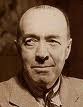
Edgar Rice Burroughs
Introduction
By 1930 ERB was fifty-six years old. An age when many or even most people have become hardened into unchangeable forms. Burroughs seems to have been an exception to this rule. His ability to evolve with the times is remarkable. Some can, some can’t. The problem isn’t one of merely attempting to mimic the style of the period but to adapt one’s mental outlook so that one thinks in the current idiom,
The post-Civil War period into which Burroughs had been born had disappeared now long ago. There might have been a couple survivors of the GAR but not many. The Indian Wars of his childhood were over. The plains had been swept clean of the buffalo. Even the buffalo robe that could easily be found during the first two decades of the century became difficult to find in the twenties and impossible to find in the thirties.
So that past which must still have been vivid in ERB’s memory was no more. Frank James and Cole Younger had died as late as 1915 and 1916 respectively. Buffalo Bill in 1917. TR in 1919. Charlie Siringo who had been present at the shootout with Billy The Kid was giving advice to authenticate Western movies even as he passed away in 1928. Heck, Burroughs could claim to be an authentic cowboy. He was out on the Idaho range in 1890 the heyday of the cowboy, Johnson County war and all that. His Western novels are about as authentic as you can get, maybe even more so than one of ERB’s heroes, Owen Wister.
The guy was carrying impressive baggage from the past to the present and into the future. The era of the first two decades had come and gone disappearing into the Roaring Twenties, the New Era. The twenties were a major transitional period for ERB. He picked up on the new trends by such writers as F. Scott Fitzgerald and kept on hoofing it down the highways and byways. The Shaggy Man of Tarzana.
There was a hiatus of four years between Tarzan And The Ant Men, which may be considered the last of the Tarzan novels of the first period and 1927’s Tarzan, Lord Of The Jungle. The latter may be considered a transitional work between the first and the later period.
Tarzan And The Lost Empire of 1928 shows him saying goodbye to the Lost Empire of his early dreams. By this time he had begun his affair with Florence Gilbert Dearholt that would result in the end of his marriage of thirty-four years to the lovely Emma.
Also a new political element entered his writing competing with the love element of Emma and Florence. Tarzan novels fairly gushed from his pen over the next seven years. Tarzan At The Earth’s Core of 1928-29, Tarzan The Invincible of 1930, Tarzan Triumphant of 1931, Tarzan And The Leopard Men also of 1931, Tarzan And The City Of Gold of 1931-32, Tarzan And The Lion Man of 1933 and Tarzan’s Quest of 1934-35. With the divorce his fecundity ended; he had severed his connection with his origins.
Politics had entered his life in earnest with the Bolshevik Revolution of 1917. He had always been involved with politics to some extent. In his youth his basic attitudes had been formed by immigration while he watched immigrant German socialists parade through the streets of Chicago under the red flag shouting, Down with America. The Russian situation had troubled him too. The villains of the Russian Quartet had been Russians. A very great many of his villains were Russians. The Communist leaders of Tarzan The Invincible are Russian.
In 1919 he rushed his political tract Under The Red Flag denouncing the Russian revolutionaries to his publishers. Haven’t read it but I suspect it was much too polemical for the pulp fiction magazines for which he wrote. It if was anything like The Little Door I can understand why it was rejected on literary grounds. I don’t doubt the novel was rejected for political reasons also as Reds and Fellow Travelers had already worked themselves into the cultural edifices of the US.
Certainly he was flagged as a counterrevolutionary to be watched and interfered with. It is now becoming apparent that ERB was more widely read in the new Soviet union than previously thought. Josef Stalin may even have followed the Tarzan series. We know for certain

Joseph Stalin
that Tarzan novels were read to workers on the job.
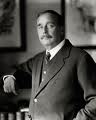
H.G. Wells
It appears that H.G. Wells was appointed to harass Burroughs in print. His 1923 novel Men Like Gods seems to reference Burroughs in a negative way. The means of communication between Wells, the Reds and ERB remains to be discovered but there appears to be novelistic warfare between the two. Wells seemingly was the Soviet hatchet man attacking other notable counterrevolutionaries such as Aldous Huxley.
ERB refined his approach getting his condemnatory novel of Bolshevism, The Moon Maid, published in 1926. The Moon Maid wasn’t that satisfactory although Wells replied to it in 1928 with Mr. Blettsworthy of Rampole Island.
Wells unmistakably alludes to Burroughs in this novel calling him insane. Tarzan At The Earth’s Core which is an attack on some core beliefs of the revolutionaries may possibly have been a rushed response to Blettsworthy.
In Tarzan The Invincible which may be incontrovertibly considered his third attack on the Revolution and an answer to Wells ERB succeeded in the grand manner. He shed the nineteenth century trappings of The Moon Maid that was written in the style of Wells’ First Men In The Moon to write a thoroughly modern novel. Invincible might be considered a prototype of the modern spy thriller, one of the first of the genre. Not only a prototype of the genre but as David Adams points out in ERBzine 0199 a superb blending of fact and fiction:
Fictional author: Burroughs pulls off a tour de force by narrating an introduction in his own voice, then slipping into the story so smoothly one is deceived into believing it is part of a newspaper story in a historical setting.
By which David means current events occurring almost as we speak. Tour de force is correct. David got the handle on that one. Tarzan is actually integrated into a current political situation as an actual historical figure. Tarzan interacts with fictional agents of Stalin who are represented as real acting under orders from Moscow. Incredibly Opar devolves from a mere fantasy of Burroughs into an actual geographic location somewhere in southern Abyssinia. The Soviet agent Dorsky tells Tarzan that they know that he knows where the gold of Opar is hidden and that he is going to tell them.
Thus Stalin has apparently kept up on Tarzan’s adventures which he thinks are real being aware of the source of Tarzan’s wealth and his earlier expeditions to Opar. In fact, one knows that Tarzan’s adventures are common knowledge which they should be as several millions of copies had been sold worldwide. Tarzan’s amanuensis Burroughs has seen to that.
The Soviets had located Kitembo of the Basembos who knew where Opar was and had actually seen it. The Basembos were native to the area of the railhead on Lake Victoria. One assumes that Kitembo must have known one of the faithful Warziri who showed him the ruins. As ERB explains only Tarzan and some of the Waziri had been to Opar. That overlooks Ozawa, who probably bore Tarzan a little grudge for the gold taken from him and the bearers of Esteban Miranda of Tazan And The Golden Lion but possibly the well-known Curse of Atlantis had carried them all off. Haven’t heard of the Curse of Atlantis? Well, you’ve heard of the Curse of the Pharaohs haven’t you? Same thing, only different.
The Reds trying to loot Opar isn’t all that far-fetched. As has been mentioned elsewhere Stalin actually ordered his scientists at about this time to cross an ape and a human to attempt to create a new super warrior that could run on regular. We know that Stalin was a fan of the Tarzan series, both books and movies, possibly even a secret admirer of our favorite author. The possibility of Stalin thinking a eugenic hybrid of ape and human possible from reading Burroughs seems to have a high degree of probability. The Oparian males were believed to have some ape blood in them. If word of the experiments had reached Burroughs, Tarzan The Invincible could be part a spoof on Moscow. So, in a way, the blending of fact and fiction David notes could on the other hand be a blending of fiction and science by Stalin. Amusing to think about. I’m sure more information will surface in the future. At any rate this story does read as an unreported behind the scenes actual event.
Let’s take a look at how Burroughs sets it up. From the opening paragraph.
I am no historian, no chronicler of facts…
OK, so we’re warned that we’re about to be put upon.
Had the story I am about to tell you broken in the newspapers of two certain European powers, it might have precipitated another and a more terrible world war. But with that I am not particularly concerned. What interests me is that it is a good story that is particularly well adapted to my requirements through the fact that Tarzan of the Apes was intimately connected with many of its most thrilling episodes.
Ah, so Tarzan really exists.
That passage is reminiscent of both the first framing story of Tarzan of the Apes and any number of story introductions of Dr. Watson for Sherlock Holmes. The echoes are very strong. An overlooked fact is that Burroughs actually plays Dr. Watson’s role for Tarzan. Burroughs
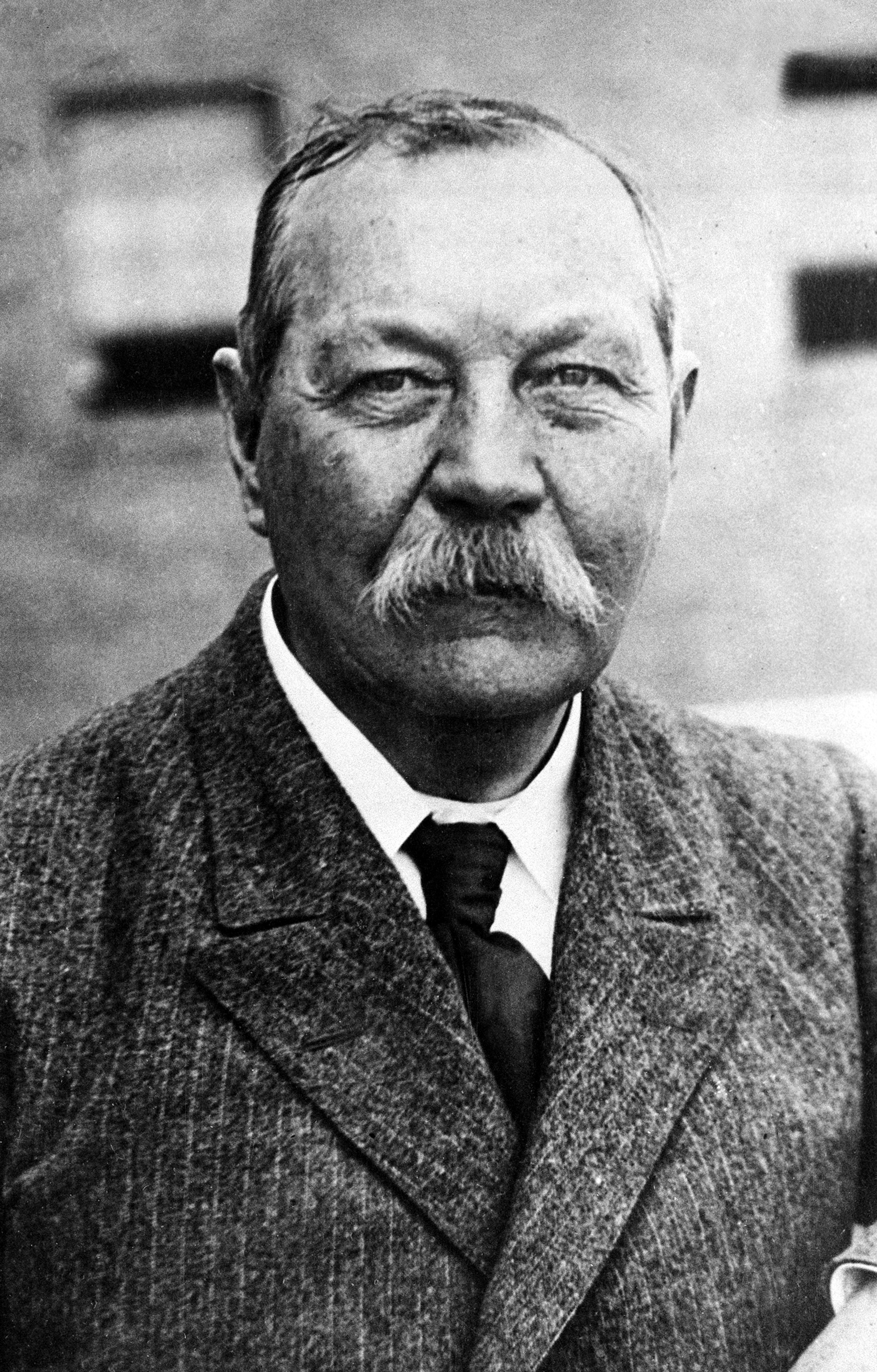
Arthur Conan Doyle
in fact is the chronicler of Tarzan’s adventures as was Watson those of Holmes.
Burroughs goes on to establish his story’s authenticity:
Take the story simply as another Tarzan story, in which, it is hoped, you will find entertainment and relaxation. If you find food for thought so much the better.
Doubtless, very few of you saw, and still fewer will remember having seen, an news dispatch that appeared inconspicuously (how inconspicuously?) in the papers some time since, reporting a rumor that French colonial troops stationed in Somaliland, on the northeast coast of Africa, had invaded an Italian African colony. Back of that news item is a story of conspiracy, intrigue, adventure, and love- a story of scoundrels and of fools, of brave men, of beautiful women, a story of the beasts of the forest and the jungle.
That seems like it covers all the bases of what a story should have. It is also pure Dr. Watson or, rather, Arthur Conan Doyle; let’s not fail to differentiate between fact and fiction. So far what Burroughs has posited could well be true. After all few read and fewer remembered the news item which appeared inconspicuously sometime in the not too distant past. Now Burroughs removes the story from the news item another step and quietly slips into full fiction mode:
If there were few who saw the newspaper acount of the invasion of Italian Somaliland upon the northeast coast of Africa, it is equally a fact that none of you saw a harrowing incident that occurred in the interior some time previous to the affair.
Um, yes, if there were few…then it’s a fact there were none. It seems ERB has established an incontestable ‘fact.’ So if you let that sophistry slip by you he’s going to tell you pure fiction. If you know the difference you won’t care, if you don’t it won’t matter. Anyway his intro was a perfect synthesis of nineteenth century humbug brought completely up to date.
Burroughs’ writing style is even close to reportorial. Tarzan, La and Opar become ‘real’ as ‘real life’ Reds make their assault on the ancient Atlantean colony. So, in a way, Atlantis becomes an established fact rather than an hypothesis.
Burroughs uses clear, concise sentences developing his story news style. For once his story is evenly paced with a well developed beginning, middle and unrushed end. He doesn’t cram a hundred page ending into ten as usual.
While one hesitates to call the book his best Tarzan novel it may be his best written. Thoroughly modern in its swift and pleasant reading with wonderful detailing I certainly can’t consider the novel hack work or inferior to any of the Tarzan novels in any way. The characters are entirely plausible, the premiss doesn’t seem far fetched. There are historical antecedents that we will examine. The novel could easily have take its place among the major spy thrillers written in the last fifty or sixty years. David is right. The novel is a major tour de force.
Part II of X follows.

R.E. Prindle
A Review: Part III, The Mucker And Marcia Of The Door Step By Edgar Rice Burroughs
September 11, 2008
A Review
The Low Brow And The High Brow
An In Depth Study Of Edgar Rice Burroughs’
The Mucker And Marcia Of The Door Step
Part III
by
R.E. Prindle
Background Of the Second Decade Social And Political
1.
I have been criticized for discussing material that seems to bear no relationship to the work of Edgar Rice Burroughs. The social milieu in which a man lives and works directly affect what and how he writes. He will react within that milieu whether he can understand and articulate it or not.
ERB understood much. He understood the main conflict of his times- that between the Religious and Scientific Consciousnesses. How he understood it is one thing, its exact nature is another. The battle was not necessarily put into the terms of science versus religion. On the objective level science had more prestige while on the subjective level religion had the upper hand creating a dualistic conflict. As Voltaire said: No one ever willed himself an athiest. The same can said of Science. The usual terms employed in the conflict was that of spirtiualism versus materialism. So those two words were supercharged masking the real conflict.
While religion retained great strength in this period science was so strong that religions had to adapt to science, thus one had the ecumenical Congress Of Religions in Chicago in 1893 during which a common plan of resistance was discussed.
One reaction to Science was American Liberalism. Liberalism is in fact a religion founded on beliefs rather than facts. American Liberalism developed out of the Puritan faith of New England. The Puritans believed themselves to be the successor of the Hebrews of the Old Testament as the Chosen People of God.
Two very interesting studies have appeared in the last couple decades which illuminate the English background of the United States. One is David Hackett Fischer’s Albion’s Seed; the other is Kevin Phillips’ The Cousins Wars. Both illustrate the continuity of behavior of the colonists between England and the Colonies. That continuity began with the Norman invasion of England in 1066 and continues through the strange Liberal mentality of today. Burroughs who was of the ‘Conservative’ mentality had to struggle with the forces of Liberalism in his day.
When the Normans invaded England they enslaved the Anglo-Saxon inhabitants. Anyone who has read Ivanhoe by Walter Scott has the image of Gurth with his iron colar inscribed on his memory. This piece of arrogance was to have serious consequences in both England and America.
The Normans occupied the Southern counties of England which Thomas Hardy caled Wessex, while the brunt of slavery fell on the East Anglian counties. The insult of slavery was burned into East Anglian memories along with a desire for revenge made more savage by the the religious certitude that they were the Chosen People of God.
The East Anglians, of course, revolted against the Norman Church Of England, emigrating to North America where they settled in the States of New England. New England = New Anglia. In England they fought the English Civil War against the Normans. Puritan Roundheads against Norman Cavaliers. It then became the turn of the defeated Cavaliers to emigrate to North America. They chose to go to Virginia where they gave the colony its Norman Cavalier character and nickname. The ancient enemies were now divided North and South.
As Fischer points out, slavery by the Norman descendents in England had disappeared only about a hundred years before the English Civil War. The Cavaliers now revived slavery in their Southern colonies. First they brought indentured servants from England who were slaves subject to the whims of their masters for a stated period of years that could easily be extended. Then African slavery was introduced. For a period of time both White and Black slaves worked side by side in the fields with the Blacks gradually displacing the Whites.
The New Englanders looked with fear and loathing on the Norman Virginians, who as they saw it, now resumed their old habits. It was here that the American Civil War was conceived. The Puritan New Englanders after having first rejected the king in the American Revolution which their East Anglian forebearers had failed to do in England then turned to agitating a war against the Norman Cavaliers of the South, whose ancestors had enslaved them, on the basis of an anti-slavery abolitionist program.
Just as they had succeeded against the Crown where their forebearers had failed they succeeded in absolutely crushing the descendents of the Normans. This punishment of the Cavaliers was the most severe of any since 1066. Thus subsequent US history with its notion of unconditional surrender was formed. This was a vicious attitude formed from the same feeling of defeat.
To return to the East Anglians in England to explain the American Liberal mindset. Shortly after printed books became readily available the East Anglians bought Bibles adopting the Old Testament notion of the Chosen People by substituting themselves for the Hebrew Children. A British Israelite group formed calling the English people the new Chosen People. Indeed, the British throne is believed to be in lineal descent from that of King David of Old Israel.
Thus there were at least three Chosen Peoples in existence from the fifteenth century on- Jews, the English and the Puritan New Englanders. New England became Greater New England as the Puritans multiplied spreading across the Northern tier of States.
A psychological characteristic of Chosen Peoples is that they upload their needs and wishes to an imaginary god in the sky then download the same needs and wishes back to themselves as the Will Of God. Thus they say not my will but they will be done, O Lord. The faithful thus become justified sinners. Any criminal act can be justified as the Will of God which it is the duty of the faithful to perform This also creates a double standard because what is right for themselves in the eyes of the Lord is forbidden to others. The children of Israel can exterminate other peoples with impunity, but it is wrong for other peoples to even defend themselves against the children of the Lord. Serious stuff.
These ends and desires are accepted then as a messianic or utopian goal. It is the duty of the Chosen People to impose God’s Will on the rest of the world. To resist that Will is evil making the non-believer a dastard, a heretic, an infidel, an anti-Semite or whatever.
In the United States the Will of the god of the Puritans was transformed into Manifest Destiny, which in turn metamorphosed into the triumph of Democracy as defined by the Chosen People of America, who in turn metamorphosed from Puritans into Liberals.
As a chosen people and as a result of the Civil War the Liberals identified with the victims who needed their help. Thus the Civil War was fought in their minds by a virtuous people acting out the Will of God to rescue unfortunate victims from a malevolent White minority. In the case of the Civil War it was the Negro slaves. As the century and Liberalism developed the umbrella of help was extended to all the ‘enslaved’ or colonial peoples of Europe which is to say all the colored peoples of the world. It was not enough that injustice as perceived by the Liberals should be corrected, but that the perpetrators should be condignly and brutally punished unconditionally in the name of and by the Will of their God, which is to say the projected desires and wishes of a self-appointed Chosen People.
Utopian literature which flourished after the Civil War is the direct result of this Messianic fervor. Utopian literature abounds in England, Greater New England and with the jews.
Having then succeeded in crushing the Cavaliers of the South the Liberals attempted to demean, belittle and abuse the White South in the most draconian manner. The period of Reconstruction is the blackest hour in American history. The Whites were stripped of civil rights having the Negroes placed over them as masters. The Whites, so far as possible, were expropriated of all property through taxation when not stolen outright. The Whites, of course, reacted by forming the first Ku Klux Klan to protect their lives and interests. Reconstruction lasted until 1877 well nigh into the twentieth century. The South was impoverished and set back for at least a century and may still be recovering today if such is possible under the present Liberal regime.
All factual references to Reconstruction have been obscured by references to the KKK but in the nineteenth and early twentieth centuries memories of Liberal crimes in the South were fresh and bleeding wounds. As is well known Jim Crow was the inevitable result of the attempt to crush and bury the White South.
As the nineteenth century progressed and utopian literature flourished the Puritans, now Liberals, identified with all the ‘oppressed’ which is to say colored peoples of the world against the European conquerors. Everywhere America sided with the natives against Europeans. In a feeling of total frustration Charles De Gaulle would remark: America is a White country, but it acts like a colored country.
At about mid-nineteenth century Jewish utopian messianists under the direction of Karl Marx formed the Communist Party. Thus Jewish utopian messianism spread from England- Marx was based in London- throughout Europe to the world. As Communism also opposed Western colonialism, although not Communist colonialism, these two powerful agencies worked to upset the Western hegemony of the world. As someone will always have hegemony of the world what appears on the surface as ‘justice’ is merely the transfer of power to another agency and hence new ‘injustice.’ As of this writing it appears that the beneficiary of American and Communist efforts will be the Chinese. This shift has already happened but has not yet been officially acknowledged. Thus the result of the Liberal and Communist quest for ‘social justice’ will be merely to place Europe and America’s neck under a Chinese yoke rather than the other way around. Obviously the Chinese god is not the same as the Utopian God.
During the period of Reconstruction as the Liberals were punishing the Southern Whites and rewarding the Negroes immigration from Eastern and Southern Europe began in earnest. While the Irish and Germans had created their own set of problems yet culturally they were close enough to the original Anglo-Saxon colonists to be, after a fashion, readily assimilated.
But with the congeries of nationalities from East and Southern Europe came many and diverse customs and languages. Assimilating them into Anglo-Celtic-Teutonic America was not so easy. Thus groups of Americans resisting immigration arose. The Know Nothings fought the Irish but this was different.
The Liberals could then pathologize the anti-immigration people as ‘nativists’, later White Supremacists and other derogatory terms. They could afirm their own virtue against these people as they had against the Southern Whites. When the power base of restrictionists took form in the South as the second Ku Klux Klan this only served to show the perfidy of Southern Whites in a new shade.
The Liberals then allied themselves not only with the interests of Negroes but with the immigrants to form the Liberal Coalition which was to dominate American society from the Second Decade to the present.
Already British and Puritan utopianists, they were now joined by the Jews who from 1870 to 1914 represented the largest nationality of immigrants. Both the Liberals and the Jews were Bible based. Liberals considered Jews as the successors to the Biblical Hebrews if not Hebrews themselves. While Roman Catholics distanced themselves from Hebrewism the Protestant sects derived directly from the Old Testament considered themselves neo-Hebrews so they were quite willing to defer to what they considered paleo-Hebrews. Thus the two versions of utopianism were joined. Both forms of Hebrewism accepted anti-Semitism as the greatest vice. The foregoing discussion has been a good account of what Semitism is: that is a belief in one’s own divinely appointed role as the arbiter of the world’s fate.
So far as I know neithr Semitism or anti-Semitism have ever been adequately defined so for the purposes of this paper anti-Semitism will be defined quite simply as the denial of the Semitist’s self-appointed role as the agent of God on earth.
As one of a Scientific Consciousness such a denial seems hardly necessary but as most people are of a Religious Consciousness there it stands.
Needless to say Burroughs was of the Scientific Consciousness therefore per force an anti-Semitist although he would never have understood his position in those terms.
As can be seen Judeo/Liberal/Utopianism is a religious matter that will defy reason. It is a matter dependent upon a subjective, spiritual belief system. It is beyond the reach of logic. Never argue with them. The adherents cannot be argued with, they must humored. Reigions are revealed not thought out.
2.
The nineteenth century also saw the rise of Science which is an objective materialistic sysem, conscious not subconscious, based on facts and reality. It doesn’t take a genius to spot that the religious systems and the scientific systems are incompatible; one must subordinate or destroy the other. Now, seriously folks, this is war to the knife.
Knowledge is hard won and built up slowly while revealed religion is complete and entire at conception. While the former is subject to trial and error the latter is seemingly pat- it is God’s own Word.
As Freud pointed out the religious consciousness received three main blows. The first was that the Universe was heliocentric rather than terracentric; the third was the malleable construction of the human mind as defined by psychoanalysis. These two could be religiously managed; nothing had been revealed that couldn’t be manipulated to religion’s use. The middle blow could not. That was the concept of Evolution as enunciated by Charles Darwin. Thus it was clear except to the most entrenched religionist that the world was not created by God in 4004 BC as Bishop Ussher stated but evolved beginning somewhat over four billion years ago. There’s an incompatibility there that cannot be swept under the carpet or even ignored.
Make no mistake: science and religion are at odds in the struggle for the human mind. Writing in 1829 the incomparable Edgar Allen Poe expressed the problem in his brilliant poem:
Sonnet – To Science
Science! true daughteer of Old Time thou art!
Who alterest all things with thy peering eyes.
Who preyest thus on this poet’s heart,
Vulture, whose wings are dull realities?
How should he love thee? or how deem thee wise,
Who wouldst not leave him in his wandering
To seek for treasure in the jewelled skies,
Albeit he soared with an undaunted wing?
Hast thou not dragged Diana from her car,
And driven the Hamadryad from the wood
To seek a shelter in some happier star?
Has thou not torn the Naiad from her flood,
The Elfin from the green grass, and from me
The summer dream beneath the tamarind tree?
In addition to driving the Hamadryad from the wood, science also pulled God down from the heavens and exposed the fraud. Freud showed God to be merely a projection of human desires. How could religion counter the claims of Science?
I do not single out any specific religion whether Christian, Jewish, Moslem or whatever. All religions evolved in human consciousness and represent a phase of development in that evolution. A phase of evolution but not its end. Dig it!
It then became necessary for religionists to absolutely deny Evolution. In their favor was the fact that Darwin not merely but only enunciated the concept, but had no infallible proofs of the process. Thus relgionists could say silly things like: Do you really believe human being, you, actually descended from an ape? and be fairly convincing. Most people were ashamed of such an ancestry. Nobody asked the monkeys how they felt about the comparison.
Inherent in Evolution is the idea of speciation. Thus every time a species evolved there was a chance that it was an improvement on previous manifestations. Between the Chimp and Homo Sapiens I are innumberable steps which have since disappeared. If that were true then religious concepts which insisted that God created Man whole and entire without evolving were false. If Creation was false than Religion was false. There were many who empowered by the concept of Evolution and reasoning from appearances made the claim that was called ‘race’ rather than species. The genetic differences between the ‘races’ were not yet clear.
Until fairly recent times and the rise of genetics there was no infallible evidence to indicate speciation. Today there is. From 1859 when Darwin enunciated Evolution through the period under examination here, the second decade of the twentieth century, anyone asserting speciation could be ridiculed and destroyed as a bigot by the religionist. Evolution itself was attacked and undermined in the thirties by the Boasian school of Anthropology which is still vital today. (See Kevin MacDonald, The Culture Of Critique, 1998, 2002).
In this period the Evolutionist was in a minority position. Thus when Burroughs came down so strongly on the side of Evolution in his Tarzan series it is very surprising he created no uproar and there is no evidence the series was noticed on that account.
It appears that Burroughs took the broad approach to these social problems. He could see both sides of the issue deciding on the merits of the case rather than the ideology of the situation. As has been noted he was quite capable of changing his mind on vital issues when presented with convincing evidence, i.e. life on Mars. He was a true scientist.
3.
Perhaps around 1910 it began to dawn on a significant number or people for the first time that unlimited and unrestricted immigration was causing unexpected and irreversible changes in the social fabric. The war on Anglo-Saxon ideals, institutions and customs was well underway. Such reactions had been a recurring feature of American society but now there was no West to escape to. In addition industry had reshaped the cities. Farm machinery was reshaping farming practices reducing the need for farmhands so that country boys migrated to the cities. By mid-decade for the first time more people lived in the cities than on the land.
These changes were unwelcome and uncomfortable to a lot of people creating a malaise. Those who viewed Reconstruction for the horror it was as well as those who considered themselves Old Stock were pathologized by the Liberals but their views found expression in books and articles but usually on the defensive side as with Jack London’s Valley Of The Moon and not on the aggressive side which would be visited by condign punishment as heresy.
If one mentioned immigrants at all it was possible to discuss only positive attributes. The Liberal turned a blind eye to the aggression of home countries preferring to see these home places too as victims who needed their protection. As Chosen People the Liberal sees himself as naturally superior to the ‘victims’ but does not perceive his supposed superiority as ‘racism.’
An honest and well meaning writer like Homer Lea who had actually been in the Orient and learned of Japanese plans first hand was pathologized and dismissed as a crank although his prognostications were based in fact as Pearl Harbor was to show.
Some feelings are vague and can’t be articulated. Even as a child I was disquieted by the notion that everyone came to america to escape oppression or to seek religious freedom. I saw but couldn’t articulate the two facedness of this notion. Only in the last decade or so have I found the means to acquire the necessary knowledge and developed modes to express it.
Quite frankly the US was used as a haven for many, many revolutionary groups. Perhaps the American Revolution caused most Americans to look upon all revolutions as beneficent. I couldn’t and can’t see it tht way.
American ‘malcontents’ were told to shut up while a malcontent could come from anywhere else in the world and be honored for resisting repression. I mean, criminals, murderers, mere disturbers of the peace in their own countries. Cranks. East Indian malcontents gathered in San Francisco to plot against the British Raj. Sun Yat Sen lived in LA where he raised funds and was lionized. Homer Lea was recruited by Sun Yat Sen to serve as a general in the Chinese Army. Lea’s story may have been the influence that charmed Burroughs into seeking a place in the Chinese Army.
The United States not only knew of the malcontents’ activities but even tolerated them perhaps abetting them. The US role in European history has been that of a spoiler. Looking upon all colored peoples as victims needing their help Liberals could do no other than work for their interests against the Europeans.
One of the more disastrous actions was John Hay’s Open Door policy in China. At the time in the 1890s the European States were about to partition China into spheres of influence. What the result would have been is anybody’s guess however the world would probably be much different today. Hay’s Open Door policy scotched the partition with the result that China remained a unified State. Of all the turning points one can find in history this is undoubtedly a turn in the tide of fortunes for the West. Subsequent to the Hay policy Chinese revolutionaries were hosted in California. Mexican gun runners operated from the US during the Mexican Revolution as Zane Grey records in novels like The Light Of Western Stars and Desert Gold.
Of course the Irish who called Ireland the Ould Sod and America the New Island acted as one people divided by an ocean. Funds and guns were raised in America and used in Ireland against the British. In the unrestricted immigration of the time Irish revolutionists moved back and forth across the Atlantic. If arrested in Ireland they claimed American citizenship and were released to return to the US.
In 1919 a most egregious example occurred which received no reprimand from the US, while England didn’t even bother to file an objection. Eamon De Valera, the future premier of Ireland escaped the British to be smuggled to the US where he functioned openly. William K. Klingaman tells the story in his popular history ‘1919’ of 1987:
Eamon De Valera, meanwhile, had been smuggled out of Ireland and into the United States, where he was touring the major cities along the East Coast, drumming up financial support for Sinn Fein and the Irish Republic. His reception was nothing short of spectacular. De Valera was given the presidential suite at the Waldorf; the Massachusetts state legislature received him in a special joint session; forty thousand wildly cheering supporters turned out to hear one of his speeches in Boston; and the press seemed to love him wherever he went. After all, he was excellent copy, and news of English injustices in Ireland always sold plenty of papers. As the Nation noted with bemusement, “He gets a front-page spread whenever he wants it, with unexampled editorial kindliness thrown in.” The tall, very thin, dark Irishman brought no message of peace and goodwill to the United States, however. Now that the Peace Conference was over and freedom-loving Irishmen still remained enslaved under the British yoke, De Valera told an enthusiastic audience in Providence, “the war front is now transferred to Ireland.”
So, while the Irish were embattled on the Ould Sod, the Irish of the New Island had enough influence and power to baffle any objections either in the US or England. They were truly functioning as a state within a state in the US and as revolutionists on the Ould Sod. Thus the US influence in international politics was unique indeed.
The Italians also functioned as emigrant workers of Italian citizenship before the War and were an irredentist population within the United States with many colonial beach heads. After the war, assuming the continuance of unrestricted immigration Mussolini attempted to shift the cost of medical treatment for wounded Italian soldiers by sending them to the US for free medical treatment. This is astonishing stuff that gets no notice in history books.
Of course, the most famous instance of dual citizenship of a divided homeland is that of the Jews.
A ship landed in the seventeenth century in New York City, New Amsterdam as it was known then, bearing a hundred plus Sephardic Jews from Brazil. The next immigrant cadre were the German Jews mainly from 1830 to 1850. These two immigrations were small compared to the influx of millions of Jews from the Pale of Settlement usually known as Polish or Russian Jews. From 1870 to 1914 they came in increasing numbers. As I have detailed elsewhere the intent to transfer the whole population of Jews from the Pale to the United States was aborted by the outbreak of the Great War.
Jews had always been forbidden Great Russia. However during an expansionist phase Russian annexed the Ukraine, Byelorussia and the North. The annexed areas became the Pale Of The Settlement along with the Polish Jews acquired by the first partition of Poland. Thus Jewish nationalism came into conflict with Russian assimilationism. The Russians, of course, were sovereigns of the land while the Jews were a stateless nationality. The Russians along with the rest of their acquired peoples attempted to Russify the Jews. These along with Poles, Letts, Estonians, Lithuanians and whatever resisted Russification. In point of fact, the Czars had bitten off more than they could chew.
Had the Russians been facing mere dissident peoples they may have been able to manage them. But, along about mid-nineteenth century the political ideology of Communism provided a framework within which all peoples could combine thus submerging their national identities for their political goals. It is true that fifty to sixty percent of all Comunist parties were Jewish but the remainder which was substantial, wasn’t. As part of its ideology Communism discouraged nationality so it was possible for numbers of all nationalities to work together.
The Russians became the adversaries of the Jews, the Czar their bete noir. Thus a remendous undeclared war existed between the Communist Revolution, usually called just The Revolution and the Russian government and people.
By the time the Jewish emigration to America began in earnest in the 1870s the Jewish mind was conditioned by this warfare. Now, all Israel is one. Therefore the German Jews who had preceded the Jews from the Pale prepared the way for those from the Pale. Whole industries were immediately controlled by Jews. The male and female garment industries being the prime example. The work force of these industries was almost entirely Jewish. Thus the infamous sweat shop may be said to be of Jewish origin although it is usually used to defame the United States.
The whole garment industry of the country then was controlled from New York City. We’re talking big money with a lot of it flowing into Jewish agencies sometimes euphemistically called charities. This money in turn fueled worldwide Jewish warfare on Russia.
The Equitable Insurance fraud for instance was caused by the international banker Jacob Schiff who as administrator looted the Equitable of a couple hundred million dollars to finance the Japanese in the Russo-Japanese war of 1903-05. The Japanese could not have fought the war without that money. Thus Schiff and his people paved the way to Pearl Harbor.
While the Russians had their hands full in the East Schiff and his fellow Jews engineered and financed the First Russion Revolution. The signing of the Russo-Japanese Peace Treaty was done at Portsmouth, New Hampshire ostensibly by then US President Theodore Roosevelt but under the watchful eyes of Schiff and his fellows.
As I have said simply because a people emigrated doesn’t mean they renounced their original identity. Witness the Irish. As is clear from their intent to evacuate the Pale in favor of America the Jews retained their Eastern European interests. This would be even more manfest after the restriction of immigration at the end of the War.
Like the Irish who used American citizenship to negate the laws of England the Jews used their American citizenship to thwart the interests of Russians, or the Czar as they put it.
The Russians forbade Jewish traffic over their borders in an attempt to contain Jewish subversion. If you were in, you were in, if you were out you were out. In line with European concepts of nationality this was workable. But Jews resident in America using their US citizenship, in this instance, demanded to be treated strictly as US citizens but of the Jewish ‘religion.’ Thus, they said Russia could not refuse them entrance on the basis of their ‘religion.’
The US with its polyglot population all with US citizenship whether Irish, Jewish, Italian or whatever had to insist on the rights of all US citizens. Thus Jews were able to travel freely across Russian borders to coordinate Jewish actions to subvert the Russian State. As I have pointed out, after the Revolution the name Russia was dropped from the State name as it became the Union Of Soviet Socialist Republics governed almost exclusively by non-Russians.
The B’nai B’rith had been around since 1843. Then the American Jewish Committee was created in 1906. Within seven years Jewish influence had increased so signficantly that they were able to direct US policy to the extent that diplomatic relations were broken off between Russia and the US in 1913 the year the Liberal Coalition elected Woodrow Wilson as its first president. From 1913 to 1933 the US had no diplomatic relations with Russia/USSR. It is interesting that relations with a legitimate government were discontinued by Woodrow Wilson and resumed with an illegitimate government by his disciple Franklin Delano Roosevelt. On of his first acts as President.
In 1913 the B’nai B’rith created its terrorist arm the Anti-Defamation League. So there was actually a dual drive to acquire control of the USSR and the USA which one might add came very close to succeeding. And this be a very small but dedicated number of people.
As I point out in Part IV in 1919 the AJC contacted Burroughs undoubtedly amongst a host of others to endorse a Jewish Bill Of Rights. The program was in place by 1920 when this segment of my study ends.
As can be seen the unofficial role of the United States in world affairs was an unsettling and disturbing one of the inactive aiding and abetting of revolutionary movements from China to India, across the border into Mexico while actively aiding if not abetting the Irish against England and aiding and abetting if not supporting the Jewish war on Russia.
To the American Liberal all these revolutionary efforts were being conducted by victims. Hence Liberal efforts at directing American policy were in the interests of any revolutionary group which includes the Socialist and Communist parties. This Liberal attitude continues worldwide to the present time.
Within the United States these ‘victims’ were gathered together under the aegis of the Liberal Coalition. All dissenters whether anti-immigrationists, nativists or whatever were pathologized as mentally unstable people. Insanity then becomes a religious attitude complementary to terms such as heretic, infidel or anti-Semite; terms not to be taken seriously.
Liberalism is a religion thus assuming control over institutions of hgher learning. The University system of the United States was turned from one of educational insitutions into religious seminaries. The American university system of today is a religious system of Liberal seminaries. Only the correct religious view is permitted, any other is penalized.
Now, the Liberals who derived from the Puritans were an Old Testament biblical group who considered themselves the successosrs of the Hebrews as a Chosen People. Beginning in 1870 the original Chosen People began their invasion. It was like two Napoleons meeting in an insane asylum. Each considered the other an imposter. But the Jews had the whip hand over the Liberals as they quickly controlled the communiations media gradually eliminating anything seditious to its belief system. As I explained earlier any writing that casts doubt on the claims of Judaism is anti-Semitist. Americans were conditioned to view anti-Semitism as the worst possible crime deserving imprisonment or expulsion from the body social. What we really have is the reimposition of the medieval Catholic Church in the form of Judaism. Having seized control of the political system of the United States by 1920 the other important object was the discrediting of Science.
Hast thou not torn the Naiad from the flood,
The Elfin from the green grass, and from me
The summer dream beneath the tamarind tree?
And Poe might have added: God from his heaven/ pleasant summer dreams of chosenness from our minds. Yes, Science was the great enemy, the great anti-Semite. It is not particularly well known but Jews are more anti-evolution than even the Christian fundamentalists of Tennessee in the twenties or the Kansans of today. Evolution absolutely denies the fact that the world was created by god 4004 years before Bishop Ussher or the year 5778 or whatever of the Jewish calendar. Make no mistake the notion of the world having been created by god recently is fundamental to Semitic religions. Once it is disallowed the basis of the Semitic religions ends. You can see why they fight so hard against Science.
Science still being the problem religion was cloaked in its guise. The scienfific Socialism of Marx is little more than Talmudic Judaism. Freud’s exaltation of the subconscious is little more than an assault on the conscious rational thinking that makes Science possible. Einstein’s preposterous notion of the ‘fabric’ of Time and Space among others is a disguised attempt at imposing faith.
All of these movements came to fruition in the Second Decade. Einstein’s theories were supposedly proven during an eclipse of the sun in 1919 during which it was ‘confirmed’ that the light of distant stars streamed around immovable bodies. I mean, the Greeks said it: What happens when an easily resistible force meets an immovable object? It flows around it just like water around a rock suspended in a stream. Boy, you have to be a genius to figure that one out- wrap it up in the facric of Time and Space and send it as present to God.
So, the problem still remained what to do with the ‘pathological’ types who gave the lie to the Judeo-Liberal doctrine? Science and Religion cannot co-exist. This is a sea change in human consciousness comparable to the transition from the Matriarchal to the Patriarchal. Good will is not the problem and cannot solve the problem. In 1943 Gustavus Myers devised the current method of interpreting American history in his book The History Of Bigotry In The United States. He thus provided the means to pathologize the non-Judeo-Liberal people. They became irrational, insane, evil bigots. So then one has the people of the book the Judeo-Liberals on one side and ‘bigots’ on the other. So, Moslem-Infidels, Semites-anti-Semites, and Liberals-Bigots. It isn’t rational, it’s religious. Virtue goes with the one; criminality with the other. Once you are accused there is no argument. Confess your heresy and take your punishment. The role model is the Inquisition of the Catholic Church.
Myers began from the beginning hitting his stride with the Know Nothing Party of the 1850s. He essentially made all immigrants victims in the Liberal sense by depicting them as virtuous innocents insanely treated by American ‘bigots.’ Hence the title of his book. His school took root and flourishes today. Oscar Handlin, John Higham, Richard Slotkin.
Handlin’s stuff is irrational. John Higham’s Strangers In The Land is valuable but skewed. The skewing can be easily unscrambled. But Richard Slotkin’s Gunslinger Nation is of importance to Burroughs and our theme here. The first 225 pages of Slotkin’s book lead up to a denunciation of Burroughs as the premier bigot of American literature actually making him responsible for the My Lai massacre in Viet Nam. The first 225 pages are worth reading although you can throw the rest of the book away.
I’ll get back to the scientific aspects of the issue in a minute but, first, as Slotkin concentrates on the Western movie in American culture let’s take a look at one of the premier efforts in the genre, John Ford’s The Man Who Shot Liberty Valence. The movie was scripted by James Warner Bellah and Willis Goldbeck or, since this is Hollywood, men who would answer to those names. They are probably jewish. The film perfectly inllustrates the Liberal dogma.
John Wayne plays the Liberal lead as Tom Doniphon, strange name, along with his noble Negro sidekick, Pompey. Lee Marvin plays a deranged psychopathic Anglo named Liberty Valence. Jimmy Stewart plays the long suffering representative of the Law, Ransom- Rance- Stoddard. Rance is an adjunct to Tom Doniphon. Liberals = The Law, Bigots (Liberty Valence) = the outlaws.
Tom can be seen as the abolitionist, justice seeking Liberal aiding the victims. He is on the side of the victims of Liberty Valence (read, say, the KKK) which is the whole town except himself. Tom has his negro valet while he helps all the cute immigrants in town still being aloof from the Southwest town’s sizable but segregated Mexican population.
The scripters assigned the odd name of Liberty Valence to Lee Marvin. Liberty is a positive virtue while Valence means strong- strong for freedom. There is little positive about Valence. He is in fact a psychopathic killer who terrorized the town of law seeking innocent sodbusters. He actually becomes insane when he extends his whip handle just beating the tar out of his victims. Valence is employed by the evil cattlemen (read, say, The South) above the Picket Wire (a river). Why the cattlemen have sent Valence to the town isn’t clear.
As the representative of the Old South and also any stray anti-Semitic clans who may happen to be about, Valence is especially offended by the peaceable but effeminate Rance Stoddard, who at one point actually wears an apron, the man who is bringing THE LAW West of the Pecos or at least below the Picket Wire. Apparently the ranchers don’t need no law above the Picket Wire. Valence harasses and bullies Stoddard who is usually protected by the omnipotent Tom Doniphon but comes a time when Stoddard realizes he has to fight. After all a man’s a man for all that. Don’t know what for though, either his honor or life or maybe to move the plot along. Liberty is goading Rance into a gunfight that will be plain murder, as quite frankly, Rance don’t know how to handle a gun and Liberty does, oh boy.
As the gunfight is filmed from behind Rance it appears that he actually guns Liberty down freeing all the victims of his menace. (The Law vs. The Outlaw; The Liberal vs. The Bigot, The Semite vs. the anti-Semite.) Thus Rance brings the law to Shinbone, that’s the ridiculous name of the town. You can see why Liberty terrorized it.
Later we will see the same gun battle rotated ninety degrees to the right. Ol’ Tom isn’t going to let Liberty gun down Rance, and also he doesn’t want Rance to be guilty of bloodshedding so he takes the guilt on hisself as he knowed he would. He and his faithful Negro sidekick cum African gunbearer Pompey (This may be the reason Cassius Clay changed from his ‘slave’ name to Mohammed Ali, another slave name) are standing in an alley opposite Liberty’s left side. Tom is in the middle of the side street, Pompey bearing the gun, stands against the side of the building. With breathtaing precision just before Liberty shoots, Tom, in that awe inspiring quitet uncontradictable authority of his says like the Great White Hunter of Africa: Gun, Pompey. The ever faithful Negro flips the rifle across to Tom who snatches it from mid-air with is right hand, puts it to his shoulder and snaps off a head shot through the temple that killed Liberty Valence. (Evil disappears from the town.)
In order to kill Valence Tom had to shoot him in the left side of his head yet none of the dumbheads of the town wonders how Stoddard accomplished this miraculous feat.
At any rate Rance is known as the man who shot Liberty Valence. The old peace loving legalist is carrying his burden of blood guilt pretty well until he is nominated to be the new Congressman from the Picket Wire/Shinbone district (There’s a joke in there somewhere isn’t there?) and from whence he can put those damnable evil, bigoted ranchers in their place. But damn it, he’s got blood on his hands; how can he serve the people in Washington since he is impure? This mght have ruined a very promising and lucrative career and perhaps a good movie but Tom takes this moment to tell Rance the True story of the man who shot Liberty Valence. Rance had to be told this.
‘Hot diggity-dog!’ Exclaims Rance trampling over Tom in his hurry to be the next and first representative for Picket Wire. There may have been gold in them thar hills but it was as nothing compared to the gold to be found in Washington D.C.
Like a good myth the movie can viewed on several different levels. At face value the story is the story. It doesn’t take much to view the film as a satire while on another level as a black comedy, or a wry commentary on the difference between the way things appear and the way they really are.
But on the allegorical level in which I am viewing the story it allegorized the Judeo-Liberal vision of America. Tom/ Rance represents their vision of themselves while Liberty is ther vision of bigots/anti-Semites. I don’t know about the writers but John Ford was certainly able to see it that way.
As a religious metaphor the movie expresses the Judeo-Liberal vision of itself. That vision can only be realized if science can be disposed of because science, the truth, is the greatest anti-Semite of all. As Poe realized Science disposes of the idea of God. Without god there is no Judaism or Liberalism. One or the other has to go.
As I have said technological applications of science weren’t actually a threat but Evolutionists like Gall, Darwin and Dalton were. Gall was the man who first enunciated a theory that the different areas of the brain controlled different actions or responses. In Steven Pinker’s terms he discovered the brain was more than a meatloaf.
Darwin proposed the idea of evolution while Francis Galton proposed the idea of Eugenics. As I said before, revealed Religion arrives complete and entire being a product of the imagination no different than Tarzan Of The Apes. Science has to be built up step by step. Gall, Darwin and Galton took the first developmental steps and while true in their limited way were easy to attack.
Gall’s exploiters developed the theory of Phrenology which is of course unsupportable so If anyone has heard of Gall he is immediately discredited for Phrenology, something he didn’t do.
Going into the Second Decade Darwin and Galton had great credibility, if being in minority positions, although Eugenics was very well received by every shade of the political spectrum from far left to far right. Richard Slotkin bases his attempts to discredit Edgar Rice Burroughs and all non-Coalition writers over Evolution and Eugenics.
Edgar Rice Burroughs is usually considered a fantasy writer. One could hardly consider the writer of the Mars, Venus, Pellucidar and Tarzan series anything else. Fantay writers are not usually taken very seriously being relegated to the non-literary end of of the fiction spectrum. So then, one asks, why does a Myerian Judeo-Liberal like Richard Slotkin devote so much effort to prove that Edgar Rice Burrughs was ultimately responsible for the My Lai Massacre?
The simple answer is that Burroughs is one of the most influential mind forming writers of fiction, worldwide, of the Twentieth Century…and counting. There have been serious efforts to designate Burroughs as a bigot and an anti-Semitist. The editions of the copies you read have actually been bowlderized. Slotkin’s Gunslinger Nation is a serious attempt to pathologize Burroughs.
Gunslinger Nation Is the third volume of a trilogy on violence in America, a never ending tiresome concern of the Coalition. Slotkin is more at home in the nineteenth century of the two first volumes than he is in the twentieth century of this volume. He should have suspended his pen after the second volume.
He not only has a shallow appreciation of his theme but he admits it. The remaining 400+ pages succeeding those on Burroughs are based, I suspect, on one time viewings of several hundred Western movies. At least he says he’s seen them. His analysis of categories within the genre and individual films leaves much to be desired.
He admits that he read no, or very few, Western novels from 1900-1975 because the field is so vast no one could be expected to do it.
His nineteenth century material, if skewed in interpretation, is admirably presented. By rotating the images 180 degrees one can obtain a fairly accurate picture of his subjects. His presentation on Buffalo Bill and his Wild West was really quite good. His views on Fenimore Cooper and the Dime Novelists were attractive if prejudiced.
By the time he gets to Burroughs of whom he has cursorily read a dozen novels or so he is both uncomprehending and imcomprehensible. He has made no effort to understand the man yet he comes to preposterous conclusions. As Burroughs was of the Scientific Consciousness which gives the lie to the Religious Consciousness Slotkin attacks on the scientific level.
He attacks through Gall, Darwin and Galton. The Liberal Coalition using its religious mentality is able to condemn in others what it applauds in itself.
The mentality is quite capable of including Burroughs, Henry Ford and Adolf Hitler in one breath as though all three men were on the same level. What they call crimes in others they call virtues in themselves.
Thus, during the French Revolution a factory was organized in Paris to make footwear from the skins of murdered aristocrats. The fact has been suppressed while the story of the lampshades made from the skins of enemies of the Fascist State is held as inhuman.
The great hero of the Revolution, Victor Hugo, writing in his novel 1793 during the 1860s about the massacres in the Vendee quite bluntly states that those people were in the way of the realization of the Utopian Communist State and had to be removed. What was fact in 1793 was true in the 1860 mind of Victor Hugo, exercised by the Communists after 1917 and by extension is still applicable today. Yet all other exterminations are evil in the Coalition mind. Their own religion justifies their actions as justified sinners.
During the second and third decades Galton’s ideas on Eugenics had become the vogue. The use of Eugenics by Hitler and the Nazis is used to discredit the concept and yet Reds of all hues including H.G. Wells and George Bernard Shaw were enthusiastic Eugenicists.
Joseph Stalin, the greatest Red who ever lived, rather amusingly embraced Eugenics. (see: http://thescotsman.scotsman.com/print.cfm?id=2434192005 )
In the 1920s before Hitler, Stalin ordered his scientists to breed a new super warrior. “I want a new invincible human being, insensible to pain, resistant and indifferent about the quality of food they eat.”
You can see where this leading I’m sure. Apparently Stalin had been reading Burrughs’ Beasts Of Tarzan because he ordered the scientists to cross a human and an ape to create his New Order warrior. Imagine a couple divisions of these shaggy haired ape men trudging through the snow behind a line of tanks with a AK 47 in one hand and a frozen banana in the other.
At any rate Slotkin wishes to link Burroughs up with these ideas that Liberals themselves promoted. As the second decade wore on a number of writers dealt with these emerging problems of the age. The two most prominent American bete noirs of the Judeo-Liberals are Madison Grant and his Passing Of The Great Race of 1916 and Lothrop Stoddard and his The Rising Tide Of Color of 1920. As these men are scientists they were labeled ‘bigots’ which is to say heretics or anti-Semites by the Liberal Coalition.
It is not impossible that Burroughs may have read these books but there is no indication he did so so that there is no confirmed connection between he and Grant and Stoddard. As I read Slotkin he believes that Burroughs is complicit with both Madison Grant and Stoddard. Further there is no doubt Slotkin believes all three men are bad with evil intent. As the Scienfific findings of these men contradict the religious tenets of the Myersian Liberal Coalition I suppose Slotkin can do no other. How he manges to lump Burroughs in as an evil malicious bigot seems a stretcher.
In the first place although the findings of Grant and Stoddard are offensive to Slotkin and the Liberal Coalition they nevertheless show the honest unbiased scientific results of the research of honest scholars who are no less decent and honorable than any of the Liberal Coalition. Grant’s work is an essay into proto-genetics for which subsequent learning shows no fault. Stoddard’s work is an excellent faultless political analysis which has been borne out by subequent developments.
While the Liberal Coalition has chosen to pathologize and demonize all three of these writers their opinion should just be waved aside, disregarded as irrelevant. Their opinions should be marginalized. Grant and Stoddard are good and honorable men.
When I first read Slotkin’s analysis of Burroughs I was outraged and then baffled. I rejected the criticism but as Slotkin obvously believes this stuff although he poorly documents it his notions were filed in the bck of my brain while I began to search for his reasons.
From a scientific point of view Slotkin has no basis for his claims but when one lays the Judeo-Red-Liberal matrix over the science all becomes clear. This is a conflict betwen Arien Age religion and twentieth century science.
If one looks closely at Burroughs one will find he has embraced science and rejected religion thus immediately becoming classified as a bigot/anti-Semite in their eyes.
While Burroughs was from the North he is not in full sympathy with abolitionist and Liberal ideals. he appears to reject the harshness of their attitude toward Southern Whites. As in Marcia, John Hancock Chase from Baltimore living in New York City seems to be an attempt to reunify the country according to the ideas of Thomas Dixon, Jr. and his Reconstruction novels and D.W. Griffith’s movie The Birth Of A Nation. To merely be sympathetic to Southern Whites is to deny the victimhood of the Negroes which arouses the animosity of Liberals. Burroughs has thus identified himself as a ‘bigot, heretic, anti-Semite’. He is plainly the enemy of the Liberal Coalition.
And, then, while Burroughs didn’t join organizations like the A.P.A.- American Protective Association- still, like his fellow writers Jack London and Zane Grey he regretted the passingof Anglo-Saxon dominated America. He hated to see the Old Stock in decline. Thus in the Myersian sense he becomes pathologized as a ‘bigot.’ From the Liberal point of view Burroughs is clearly guilty and should be banned from literature. Put on the Liberal Index. However one has to accept the Liberal point of view to think so.
He rejects all religion but as to whether he specifically singles out Catholics, Jews or any other sect I don’t believe that there is a shred of evidence.
One can’t read with his contemporaries eyes so perhaps what isn’t so clear now leaped out of the page then. Burroughs ruminations on Eugenics, especially in the pages of Tarzan And The Jewels Of Opar, may then have been more obvious to them than to us. But at the same time his opinions wouldn’t have been offensive to them. As the Liberals accepted Eugenics then as readily as anyone else it would seem that the present emphasis on Burroughs’ fascination with the subject arises primarily from the Liberal rejection of their own past although it is still possible that what contemporary Liberals accepted in themselves they rejected in others as they do today.
While I originally rejected the notion that there was any reason to suspect Burroughs of being an ‘anti-Semite’ I think that if one is looking for indications from the Coalition point of view one can find them. As I point out in Part IV the American Jewish Committee contacted him in 1919 while there are passages in Marcia Of The Doorstep that the Coalition could construe as anti-Semitism and for which Burroughs was possibly punished.
Finally Burroughs as a follower of Teddy Roosevelt rather than Woodrow Wilson might have been suspect. The period after the Great War when it became evident that a very large percentage of the immigrants did not really consider themselves American’s caused TR to remark that America had become merely an international boarding house. Quite true but who would have thought anything else was possible? Today the term ‘international boarding house’ might be interpreted as Diversity or multi-culturalism. TR was head of his times.
The period ending in 1919 also represented the changing of the guard. Buffalo Bill died in 1917 taking hs mythic Wild West with him to the grave. He also represented the end of the first America. The Anglo-Saxons who had won the West. Of course the winners of the West were not nearly so Ango-Saxon as represented but in general it was true. There are almost no non-Anglo-Saxon names in the novels of Zane Grey other than Mexican.
Also in 1919 TR himself passed away just as he was scheduled to be the Republican Presidential candidate for 1910. His loss was keenly felt by Burroughs and his friend Herb Weston. I doubt TR could have adapted to the new problems America was facing even as well as Warren G. Harding did. How TR might have interpreted the challenge to American Democracy of the Liberal Coalition isn’t too obvious.
4.
Recapitulation
In 1066 and succeeding centuries the Norman Conquerors enslaved the Anglo-Saxons of East Anglia which was an affront deeply resented. Take a lesson.
In the sixteenth century when the printed Old Testament became universally available the East Anglians identified with the enslaved Hebrews of Exodus. They elected themselves a Chosen People and developed the compensatory Utopian attitude of inherent virtue as the Chosen People Of God.
In the seventeenth century New England was settled by emigrants from East Anglia. Not just English but East Anglians. Virginia was settle by descendents of the Norman conquerors of 1066. The Virginians once again chose slavery as the method of labor. First indentured White people then Africans.
While Utopian ideals developed in New England the abolitionist movement began which resulted in the Civil War-War Between The States. War between regions or actually a war between ideologies. There was no chance the South was going to discontinue slavery anythime soon no matter what anyone says.
In revenge for 1066 the Cavaliers (Whites) of the South were absolutely crushed giving up all rights by surrendering unconditionally.
The nascent Liberal Party of Puritans elevated the Africans over the Cavaliers thus establishing their protectorship over the ‘victims’ which is characteristic of the faith while establishing their power over dissident Whites. Thus the Liberals ultimately aligned themselves with all colored revolutionary movements in the world against White European conquerors.
Within the United States they viewed immigrants as ‘victims’ of the Old Stock pathologizing the Old Stock as ‘bigots’ no better than the Cavaliers of the Old South or the Europeans. All opponents of of their Liberal religious ideology which included the intellectual mindset of Science thus became wrong headed vile ‘bigots’ who had no right to live. After the Bolshevik Revolution of 1917 the utopian Communist ideology became their politics; call it Socialism it comes out the same.
As Edgar Rice Burrough was not a Liberal, not a Communist and not Religious but Scientific he unwittingly placed himself in opposition to the Liberal Coalition. On that basis a serious attempt was made to abort his career while subsequently an attempt to erase his name and work from history is being conducted.
Thus the twenties ushered in a new changed era fraught with new adjustments which were misunderstood or not understood at all.
Burroughs career after 1920 has to be seen in the light of this concealed antagonism that he had to counter without being clear as to its causes.
Thus the contrast between The Mucker and Marcia Of The Doorstep can be seen as a response to two different challenges united by Burroughs personal psychological development.
Go To Part IV:of The Mucker And Marcia Of The Doorstep
A Review
The Low Brow And The High Brow
An In Depth Study Of Edgar Rice Burroughs’
The Mucker And Marcia Of The Doortstep
by
R.E. Prindle
Part II
Background Of The Second Decade- Personal
Erwin Porges’ ground breaking biography Edgar Rice Burroughs: The Man Who Invented Tarzan is the basic source for the course of ERB’s life. John Taliaferro’s Tarzan Forever is heavily indebted to Porges adding little new. Robert Fenton’s excellent The Big Swinger is a brilliant extrapolation of Burroughs’ life taken from the evidence of the Tarzan series.
Porges, the first to pore though the unorganized Tarzana archives, is limited by the inadequacies of his method and his deference for his subject. His is an ideal Burroughs rather than a flesh and blood one. Matt Cohen’s Brother Men: The Correspondene Of Edgar Rice Burroughs and Herbert T. Weston has provided much fresh material concerning ERB’s character.
Bearing in mind always that Weston’s evaluation of Burroughs in his August 1934 letter in reply to Charles Rosenberg, whoever he was, about ERB’s divorce is one man’s opinion nevertheless his statements can be corroborated by ERB’s behavior over this decade as well as throughout his life. My intent is not to diminish ERB in any way. Nothing can take away the fact that Burroughs created Tarezan, but like anyone else he was subjected to glacial pressures that distorted and metamorphosed his character.
During the Second Decade as he experienced a realization of who he was, or who he had always thought he should be, or in other words as he evolved back from a pauper to a prince, he was subjected to excruciatingly difficult changes.
A key to his character in this period is his relationship to his marriage. It seems clear that he probably would never have married, stringing Emma along until she entered spinsterhood while never marrying her. He seemingly married her to keep her away from Frank Martin. As he later said of Tarzan, the ape man should never have married.
Rosenberg in his letter to Weston (p.234, Brother Men) said that ‘…Ed says he has always wanted to get rid of Emma….’ The evidence seems to indicate this. After ERB lost Emma’s confidence in Idaho, gambling away the couple’s only financial resources, his marriage must have become extremely abhorrent to him. I’m sure that after the humiliations of Salt Lake City this marriage had ended for him in his mind. That it was his own fault changes nothing. He may simply have transferred his self-loathing to Emma.
That Emma loved and stood by Burroughs is evident. that he was unable to regain her confidence is clear from his writing. The final Tarzan novels of the decade in one of which, Tarzan The Untamed, Burroughs burns Jane into a charred mess identifiable only by her jewelry show a developing breach. Probably the jewelry was that which ERB hocked as the first decade of the century turned. Now, this is a fairly violent reaction.
ERB states that he walked out on Emma several times over the years. In Fenton’s extrapolation of Burroughs’ life from his Tarzan novels this period was undoubtedly one of those times. There seems to have been a reconciliation attempt between Tarzan and Jane between Tarzan The Untamed and Tarzan The Terrible. Then between Tarzan And The Golden Lion and Tarzan And The Ant Men ERB’s attempt to regain Emma’s confidence seems to have failed as Jane chooses the clown Tarzan- Esteban Miranda-, one of my favorite characters- over the heroic Tarzan -ERB – in Tarzan And The Ant Men.
This undoubtedly began ERB’s search for a Flapper wife which took form in the person of Florence Gilbert beginning in 1927.
b.
Weston says of ERB in his disappointment and rage over ERB’s divorce of Emma that ‘…the fact that Ed always has been unusual, erratic and perhaps queer, has been his great charm and attraction for me…’ (p.223, Brother Men) There’s a remote possibility that ‘queer’ may mean homosexual but I suppose he means ‘odd’ or imcomprehensible in his actions. The evidence for this aspect of ERB’s character is overwhelming while being well evidenced by his strange, spectacular and wonderful antics during the second decade. When Weston says of him that ‘…there is no woman on earth that would have lived with him, and put up with him, except Emma…’ there is plenty of reason to accept Weston’s opinion.
Part of ERB’s glacial overburden came from his father, George T. who died on February 13, 1913. Burroughs always professed great love for his father, celebrating his birthday every year of his life, although one wonders why.
Apparently George T. broadcast to the world that he thought ERB was ‘no good.’ His opinion could have been no secret to Burroughs. Weston who says that he always maintained cordial relations with George T., still thought him a difficult man, always dropping in to visit him on trips through Chicago said that George T. complained to him, ERB’s best friend, that his son was no good. While without disagreeing with George T. up to that point, Weston said that he thought there was plenty of good in ERB but that he just hadn’t shown it yet. Kind of a back handed compliment, reminds me of Clarence Darrow’s defense of Big Bill Haywood: Yeah, he did it, but who wouldn’t?’
Such an opinion held by one’s father is sure to have a scarring effect on one’s character. How exactly the effect of this scarring worked itself out during this decade isn’t clear to me. Perhaps Burroughs’ mid year flight to California shortly after his father’s death was ERB’s attempt to escape his father’s influence. Perhaps his 1916 flight was the same while his move to California in 1919 was the culmination of his distancing himself from his father. That is mere conjecture at this point.
Now, what appears erratic from outside follows an inner logic in the subject’s mind unifying his actions. What’s important to the subject is not what obsevers think should be important.
c.
The scholars of the Burroughs Bulletin, ERBzine and ERBList have also added much with additional niggardly releases of material by Danton Burroughs at the Tarzana archives. One of the more valuable additions to our knowledge has been Bill Hillman’s monumental compilation of the books in ERB’s library.
Let’s take a look at the library. It was important to ERB; a key to his identity. Books do furnish a mind, as has been said, so in that light in examining his library we examine the furnishing of his mind. The shelves formed an important backdrop to his office with his desk squarely in front of the shelves. ERB is seated proudly at the desk with his books behind him.
How much of the library survived and how much was lost isn’t known at this time. Hillman lists over a thousand titles. Not that many, really. The library seems to be a working library. There are no the long rows of matching sets by standard authors. The evidence is that Burroughs actually read each and every one of these books. They found their way into the pages of his books in one fictionalized form or another. Oddly authors who we know influenced him greatly like London, Wells, Haggard and Doyle are not represented.
Most of the works of these authors were released before 1911 when Burroughs was short of the ready. Unless those books were lost he never filled in his favorites of those years. That strikes me as a little odd.
It is generally assumed that he picked up his Martian information from Lowell, yet in Skelton Men Of Jupiter he says: ‘…I believed with Flammarion that Mars was habitable and inhabited; then a newer and more reputable school of scientists convinced me it was neither….’ The statement shows that Camille Flammarion’s nineteenth century book was the basis for Burroughs’ vision of Mars while Lowell was not. Further having committed himself to Flammarion’s vision he was compelled to stick to it after he had been convinced otherwise. When that understanding was obtained by him we don’t know but at sometime he realized that the early Martian stories were based on a false premiss.
Thus, his Mars became a true fiction when his restless, searching mind was compelled by judicious reasoning of new material to alter his opinion. That he could change his mind so late in life is an important fact. It means that behind his fantasy was a knowledge of solid current fact. The results of his pen came from a superior mind. It was not the maundering of an illiterate but amusing boob.
Organizing the books of his library into a coherent pattern is difficult. I haven’t and I Imagine few if any have read all his list. Based on my preliminary examination certain patterns can be found. He appeared to follow the Chicago novel by whomever, Edna Ferber’s So Big is a case in point. Seemingly unrelated titles can be grouped aorund certain Burroughs’ titles as infuences.
In 1924 when Marcia Of The Doorstep was written ERB had already formed his intention of leaving, or getting rid, of Emma. He began a fascination with Flappers that would result in his liaison with Florence.
After the move to Hollywood in 1919 a number of sex and Flapper potboilers find their way into his library. The tenor of literature changed greatly after the War showing a sexual explicitness that was not there prior to the Big Event. To be sure the graphic descriptions of the sex act current in contemporary literature was not permissible but the yearning to do so was certainly there. Language was retrained but ‘damn’ began to replace ‘d–n’ and a daring goddamn became less a rarity.
Perhaps the vanguard of the change came in 1919 when an event of great literary and cultural import took place. Bernarr Macfadden whose health and fitness regimes had very likely influenced Burroughs during the first couple decades decided to publish a magazine called “True Story.” The magazine was the forerunner of the Romance pulp genre while certainly being in the van of what would become the Romance genre of current literature.
The advance was definitely low brow, not to say vulgar, indicating the direction of subsequent societal development including the lifting of pornographic censorship. Pornography followed from “True Store” as night follows day.
The magazine coincided with the emergence of the Flapper as the feminine ideal of the twenties. In literature this was abetted by the emergence in literary fiction of F. Scott Fitzgerald. His Beautiful And Damned is a key volume in Burroughs’ library forming an essential part of Marcia. To my taste Fitzgerald is little more than a high quality pulp writer like Burroughs. I can’t see the fuss about him. He riminds me of Charles Jackson’s The Lost Weekend and vice versa. In fact, I think Jackson mined the Beautiful And Damned. Plagiarize would be too strong a word.
“True Story” caught on like a flash. By 1923 the magazine was selling 300,000 copies an issue; by 1926, 2,000,000. Low brow was on the way in. Vulgarity wouldn’t be too strong a word. Macfadden had added titles such as “True Romances” and “Dream World” to his stable. His magazine sales pushed him far ahead of the previous leader, Hearst Publications, and other publishers. Pulpdom had arrived in a big way.
Where Macfadden rushed in others were sure to follow. The sex thriller, the stories of willful and wayward women, which weren’t possible before, became a staple of the twenties in both books and movies.
ERB’s own The Girl From Hollywood published in magazine form in 1922, book form in 1923, might be considered his attempt at entering the genre. Perhaps if he had thrown in a few Flapper references and changed the appearance and character of his female leads he mgiht have created a seamless transition from the nineteenth century to the twenties. A few Flapper terms might have boomed his ales much as when Carl Perkins subsititued ‘Go, cat, go’ for go, man, go’ in his Blue Suede Shoes and made sonversts of all us fifties types.
Certainly ERB’s library shows a decided interest in the genre from 1920 to 1930. Whether the interest was purely professional, an attempt to keep up with times, or personal in the sense of his unhappiness in his marriage may be open to question. I would have to reread his production of these years with the New Woman in mind to seek a balance.
Still, during the period that led up to his affair with Forence ERB seems to have been an avid reader of Flapper and New Woman novels.
He had a number of novels by Elinor Glyn who was the model of the early sex romance. He had a copy of E.M. Hull’s The Sheik, that shortly became the movie starring Rudolph Valentine with its passionate sex scenes. A ‘Sheik’ became the male synonym for Elinor Glyn’s ‘It’ girl.
Of course, the influence of Warner Fabian’s Flaming youth of 1923, both book and movie, on ERB is quite obvious.
Just prior to this relationship with Florence he read a number of novels by Beatrice Burton with such sexy titles as The Flapper wife-The Story Of A Jazz Bride, Footloose, Her Man, Love Bound and Easy published from 1925 to 1930.
I would like to concentrate on Burton’s novels for a couple reasons; not least because of the number of her novels in ERB’s library but that when Burroughs sought publication for his low brow Tarzan in 1913-14 he was coldly rebuffed even after the success of his newspaper serializations. The disdain of the entire publishing industry was undoubtedly because Burroughs was the pioneer of a new form of literature. In its way the publication of Tarzan was the prototype on which Macfadden could base “True Story.” Not that he might not have done it anyway but the trail was already trampled down for him. In 1914 Burroughs violated all the canons of ‘polite’ or high brow literature.
A.L. Burt accepted Tarzan Of The Apes for mass market publication reluctantly and only after guarantees for indemnification against loss. Now at the time of Beatrice Burton’s low brow Romance genre novels, which were previously serialized in newspapers, Grosset and Dunlap sought out Burton’s stories publishing them in cheap editions without having been first published as full priced books much like Gold Seal in the fifties would publish paperback ‘originals’ which had never been in hard cover. Writers like Burton benefited from the pioneering efforts of Burroughs. G& D wasn’t going to be left behind again. Apparently by the mid-twenties profits were more important than cultural correctness.
As ERB had several Burton volumes in his library it might not hurt to give a thumbnail of who she was. needless to say I had never read or even heard of her before getting interested in Burroughs and his Flapper fixation. One must also believe that Elinor Glyn volumes in ERB’s library dating as early as 1902 were purchased in the twenites as I can’t believe ERB was reading this soft sort of thing as a young man. Turns out that our Man’s acumen was as usual sharp. Not that Burton’s novels are literary masterpieces but she has a following amongst those interested in the Romance genre. The novels have a crude literary vigor which are extremely focused and to the point. This is no frills story telling. The woman could pop them out at the rate or two or three a year too.
Her books are apparently sought after; fine firsts with dust jackets go for a hundred dollars or more. While that isn’t particularly high it is more than the casual reader wants to pay. Might be a good investment though. The copies I bought ran from fifteen to twenty dollars, which is high for what is usually filed in the nostalgia section. Love Bound was forty dollars. I bought the last but it was more than I wanted to pay just for research purposes.
There is little biographical information about Burton available. I have been able to piece together that she was born in 1894. No death date has been recorded as of postings to the internet so she must have been alive at the last posting which woud have made her a hundred at least.
She is also known as Beatrice Burton Morgan. She was an actress who signed a contract with David Belasco in 1909 which would have made her fifteen or sixteen. Her stage name may have been Beatrice Morgan. The New York Public Library has several contracts c. 1919 in her papers.
One conjectures that her stage and film career was going nowhere. In The Flapper Wife she disparages Ziegfeld as Ginfeld the producer of the famous follies.
Casting about for alternatives in the arts she very likely noticed the opening in sex novels created by Macfadden and the Roaring Twenties. The Flapper Wife seems to have been her first novel in 1925. The book may possibly have been in response to Warner Fabian/Samuel Hopkins Adams’ Flaming Youth.
As the motto for his book he had “those who know, don’t tell, those who tell, don’t know.’ The motto refers to the true state of mind of women. Burton seems to have taken up the challenge- knows all and tells all. Flapper Wife was an immediate popular success when taken from the newspapers by G&D. Critics don’t sign checks so while their opinion is noted it is irrelevant.
Burton apparently hit it big as the movies came afer her, Flapper Wife was made into a movie in 1925 entitled His Jazz Bride. Burton now had a place in Hollywood. Burroughs undoubtedly also saw the movie. What success Burton’s later life held awaits further research. As there is no record of her death on the internet it is safe to assume that when her copyrights were renewed in the fifties it was by herself.
There are a number of titles in the library having to do with the Flapper. The library, then gives a sense of direction to ERB’s mental changes. There are, of course, the Indian and Western volumes that prepared his way for novels in those genres. As always his off the top of his head style is backed by sound scholarship.
The uses of the various travel volumes, African and Southeast Asian titles are self-evident. I have already reviewed certain titles as they applied to Burroughs’ work; this essay involves more titles and I hope to relate other titles in the future. So the library can be a guide to Burroughs’ inner changes as he develops and matures over the years.
The amont of material available to interpret ERB’s life has expanded greatly since Porges’ groundbreaking biography. Much more work remains to be done.
The second decade is especially important for ERB’s mental changes as his first couple dozen stories were written beginnng in 1911. Moreso than most writers, and perhaps more obviously Burroughs work was autobiographical in method. As he put it in 1931’s Tarzan, The Invincible, he ‘highly fictionalized’ his details. For instance, the Great War exercised him greatly. From 1914 to the end of the War five published novels incorporate war details into the narrative: Mad King II, Beyond Thirty, Land That Time Forgot, Tarzan The Untamed, and Tarzan The Terrible as well as unpublished works like The Little Door. Yet I don’t think the extent that the War troubled him is recognized. The man was a serious political writer.
Thus between the known facts and his stories a fairly coherent life of Burroughs can be written. My essays here on the ERBzine can be arranged in chronological order to give a rough idea of what my finished biography will be like.
Burroughs was a complex man with a couple fixed ideas. One was his desire to be a successful businessman. This fixed obsession almost ruined him. He was essentially a self-obsessed artist and as such had no business skills although he squandered untold amounts of time and energy which might better have been applied to his art than in attempts to be a business success.
In many ways he was trying to justify his failure to be a business success by the time he was thirty rather than making the change to his new status as an artist.
As a successful artist he was presented with challenges that had nothing to do with his former life. These were all new challenges for which he had no experience to guide him while he was too impetuous to nsit down and thnk them out properly. Not all that many in his situation do. Between magazine sales, book publishing and the movies he really should have had a business manager as an intermdiary. Perhaps Emma might have been able to function in that capacity much as H.G. Well’s wife jane did for him. At any rate book and movie negotiations diverted time and energy from his true purpose of writing.
His attempt to single handedly run a five hundred plus acre farm and ranch while writing after leaving Chicago ended in a dismal failure. Even his later investments in an airplane engine and airport ended in a complete disaster. Thank god he didn’t get caught up in stock speculations of the twenties. As a businessman he was doomed to failure; he never became successful. It if hadn’t been for the movie adaptations of Tarzan he would have died flat broke.
Still his need was such that he apparently thought of his writing as a business even going so far as to rent office space and, at least in 1918, according to a letter to Weston, keeping hours from 9:00 to 5:30. Strikes me as strange. Damned if I would.
At the end of the decade he informed Weston that he intended to move to Los Angeles, abandon writing and, if he was serious, go into the commercial raising of swine. The incredulousness of Weston’s reply as he answered ERB’s questions on hog feed comes through the correspondence.
Think about it. Can one take such flakiness on ERB’s part seriously? Did he really think his income as a novice pig raiser would equal his success as a writer with an intellectual property like Tarzan? Weston certainly took him seriously and I think we must also. There was the element of the airhead about him.
A second major problem was his attitude toward his marriage and his relationship with Emma.
He appears to have been dissatisfied with both at the beginning and decade and ready to leave both at the end. According to the key letter of Weston ERB was an extremely difficult husbnad with whom Emma had to be patient. As Weston put it, no other woman would have put up with his antics. Unfortunately he doesn’t give details of those antics but the indications are that Emma was a long suffering wife.
ERB’s resentment of her apparently became an abiding hatred. Danton Burroughs released information about ERB’s third great romance with a woman named Dorothy Dahlberg during the war years of WWII through Robert Barrett the BB staff writer in issue #64.
After having been estranged from her husband for about a decade Emma died on 11-05-44, probably of a broken heart. ERB returned to Los Angeles from Hawaii to dispose of her effects. Arriving on 11/19/44 after visiting his daughter he met with Ralph Rothmund in Tarzana where he proceeded to get soused, apparently in celebration of Emma’s death.
To quote Barrett, p. 25, Burroughs Bulletin #64.
After Ed met with Ralph Rothmund, he opened a case of Scotch and took out a bottle after which he drove to Emma’s home in Bel-Air- where he and Jack “sampled” the Scotch a couple times.” From Bel-Air Jack drove Ed to the Oldknows, some friends also in Bel-Air, where they continued to sample the Scotch. After this visit Ed and Jack returned to Emma’s home at 10452 Bellagio Road, where Jack brought out a nearly full bottle of bourbon. Jack asked the maids to postpone dinner for 30 minutes, while they waited for Joan and Joan II. This evidently irritated the two maids as they both quit and walked out on them! Ed reported in his diary that after the two maids walked out, ‘we had a lovely dinner and a grand time.”
That sort of strikes me as dancing on the grave of Emma which indicates a deep hatred for her on the part of ERB. We are all familiar with the storyof ERB’s pouring the liquor in the swimming pool humiliating Emma in front of guests which she stood so Weston must have known what he was talking about.
There is a certain hypocrisy in Burroughs now getting blotto in celebration of Emma’s death. Between the two of them in the space of a couple hours ERB and his son, John Coleman, finished a fifth of Scotch and went ripping through a bottle of bourbon. I don’t know how rough and tough you are but that would put me under the pool table.
In this inebriated and hostile state they apparently had words with what I assume to have been Emma’s long time maids. Maids don’t walk out because you ask them to hold dinner for a few minutes. Being a maid is a job; they don’t respond that way to reasonable requests. So in his drunken state ERB must have been offensive about Emma or the maids causing their reaction.
Thus sitting totally soused in the ‘alcoholic’ Emma’s home they ‘had a lovely dinner and a grand time.’ The woman was both good to him and good for him but it isn’t incumbent on any man to see his best interests. There was a crtain dignity lacking in ERB’s behavior at this good woman’s death, not to mention the hypocrisy of getting thoroughly jazzed.
d.
The decade also witnesses the unfolding of ERB’s psyche from the repressed state of 1910 to an expanded and partially liberated state at the end of the decade when he fled Chicago. Pyschologically ERB was always a dependent personality. He let his editors both magazine and book bully him and take advantage of his good will. He also needed a strong role model which is one reason his literary role models are so obvious.
From 1911 to 1916 he seemed to lean on Jack London as his role model. The problem with London is that we can’t be sure which of his books ERB read as he had none of his books in his library. It seems certain that he read London’s early Gold Rush books. ERB’s hobo information is probably based on London’s The Road and then he may possibly have read The Abyssmal Brute which is concerned with the results of the Jack Johnson-Jim Jeffries fight and a preliminary to The Valley Of The Moon.
It is difficult to understand how Burroughs could have read much during this decade what with his writing schedule and hectic life style. Yet we know for a fact that between 1913-15 he found time to read Edward Gibbon’s massive The Decline And Fall Of The Roman Empire.
At the same time additions to his library from this decade are rather sparse, the bulk of the library seems to have been purchased from 1920 on. Still, if one assumes that he read all the books of London including 1913’s Valley Of The Moon, then it is possible that his cross=country drive of 1916 may have been partially inspired by Billy and Saxon Roberts’ walking tour of Northern California and Southern Oregon in that book as well as on ERB’s hobo fixation. Certainly London must have been his main influence along with H.H. Knibbs and Robert W. Service. He may have wished to emulate London by owning a large ranch.
I suspect he meant to call on London in Sonoma during his 1916 stay in California but London died in the fall of that year which prevented the possible meeting. With the loss of London Burroughs had to find another role model which he did in Booth Tarkington. He does have a large number of Tarkington’s novels in his library, most of which were purchased in this decade. Tarkington was also closely associated with Harry Leon Wilson who also influenced ERB with a couple two or three novels in his library, not least of which is Wison’s Hollywood novel, Merton Of The Movies. Just as a point of interest Harry Leon Wilson was also a friend of Jack London.
ERB’s writing in the last years of the decade seems to be heavily influenced by Tarkington as in Bridge And The Oskaloosa Kid, The Efficiency Expert and The Girl From Hollywood.
Burroughs was an avid reader and exceptionally well informed with a penetrating mind so that his ‘highly fictionalized’ writing which seems so casual and off hand is actually accurate beneath his fantastic use of his material. While he used speculations of Camille Flammarion and possibly Lowell on the nature of Mars he was so mentally agile that when better information appeared which made his previous speculations untenable he had no difficulty in adjusting to the new reality. Not everyone can do that.
I have already mentioned his attention to the ongoing friction between the US and Japan that appeared in the Samurai of Byrne’s Pacific island. In this connection Abner Perry of the Pellucidar series is probably named after Commodore Matthew Perry who opened Japan in 1853. After all Abner Perry does build the fleet that opened the Lural Az. Admiral Peary who reached the North Pole about this time is another possible influence. The identical pronunciation of both names would have serendipitous for Burroughs.
As no man writes in a vacuum, the political and social developments of his time had a profound influence on both himself and his writing.
The effects of unlimited and unrestricted immigration which had been decried by a small but vocal minority for some time came to fruition in the Second Decade as the Great War showed how fragile the assumed Americanization and loyalty of the immigrants was. The restriction of immigration from 1920 to 1924 must have been gratifying to Burroughs.
I have already indicated the profound reaction that Burroughs, London and White America in general had to the success of the Black Jack Johnson in the pursuit of the heavyweight crown. The clouded restoration of the crown through Jess Willard did little to alleviate the gloom. Combined with the sinking of the Ttitanic and the course of the suicidal Great War White confidence was irrevocably shaken.
Burroughs shared with London the apprehension that the old stock was losiing its place of preeminence to the immigrants. This fear woud find its place in Burroughs writing where he could from time to time make a nasty comment. His characterization of the Irish is consistently negative while his dislike of the Germans first conceived when he saw them as a young man marching through the streets of Chicago under the Red flag was intense. Their participation in the Haymarket Riot combined with the horrendous reports of German atrocities during the War reinforced his dislike almost to the point of fanaticism. While the post-war German reaction in his writing was too belated he had been given cause for misinterpretation.
Always politically conservative he was a devoted admirer of Teddy Roosevelt while equally detesting Woodrow Wilson who was President eight of the ten years of the Second Decade. When the Bolsheviks took over Russia in 1917 polarizing public opinion into the Right and Left ERB was definitely on the Right.
By the end of the decade the world he had known from 1875 to 1920 had completely disappeared buried by a world of scientific and technological advances as well and social and political changes that would have been unimaginable in his earlier life. The changes in sexual attitudes caused by among others Krafft-Ebbing, Havelock Ellis and Margaret Sanger would have been astounding.
The horse had been displaced by the auto. Planes were overhead. The movies already ruled over the stage, vaudeville and burlesque. Cities had displaced the country. The Jazz Age which was the antithesis of the manners and customs of 1875-1920 realized the new sexual mores so that the Flapper and Red Hot Mama displaced the demure Gibson Girl as the model of the New Woman.
When ERB moved from Chicago to LA in 1919 he, like Alice, virtually stepped through the looking glass into a world he never made and never imagined. A Stranger In A Strange Land not different in many ways from the Mars of his imagination.
Go to Part III- Background Of The Second Decade Social And Political
Book II, Pt. 4 Something Of Value
February 13, 2008
Something Of Value
Book II
Part 4
Edgar Rice Burroughs, Evolution And Religion
by
R.E. Prindle
ERB And The World 1875-1950

Edgar Rice Burroughs
Edgar Rice Burroughs entered a world he never made on September 1, 1875. He would have some hand in editing the making of the next century or so. He seemed a less than likely candidate for such a chore. He was dealt a tough hand to play by life. It took him some thirty-five years to learn how to play his hand but once he learned there was no stopping him. He wasn’t perfect, probably had what we call an abrasive personality, and he didn’t always do the right thing but, then, who does? He worked hard and he walked his dog with an ample leash. But in this essay we’re not particularly concerned with ERB the personality but ERB the force.
ERB’s world was made for him. It was his job to navigate his way through it. I have already prepared a view of the world and its history in terms of religion and evolution extrapolated from the writing of Burroughs. It may be of use to give a bit of the local history that had such a profound effect on his development.
ERB was born in Chicago. The Chicago that he was born into was one of the seven wonders of the modern world. There had been nothing like it seen before, not New York City, not Paris, not London, not even ancient Athens or Rome. The Iron Chancellor of Germany, Bismark, lamented the fact that he would never get to see ‘that Chicago.’ It is hard to imagine the role Chicago played today. Chicago was unique, both wonderful and terrible. It may be difficult to visualize but for the Chicago of Burroughs’ youth, to the East was civilization and directly to West was Indian Territory. The Indian Fighters came direct from the battlefield to the metropolis of Chicago. I mean, Buffalo Bill had Sitting Bull as one of his performers. Blows my mind.
As if to prove its uniqueness Chicago staged the 1893 Columbian Exposition or World’s Fair, the fabled White City. The White City may be compared to OZ while workaday Chicago was known as the Black City. You gotta work at visualizing this stuff. The White City was as audacious as Chicago itself. It only took fifty years to raise this strange, bizarre and wonderful city out of the muck alongside Lake Michigan and it only took a year to build what was really a spectacular purpose built city of some magnitude. Even more mindboggling it s purpose existed for only six months then it was discarded like so much waste paper. Incendiaries burned this amazing effort to the ground the next year. Nothing was left of this prodigious effort. It is truly a crazy world.
Bill Hillman of ERBzine made a valiant effort to present the wonder of this spectacle especially as it affected the young Edgar Rice Burroughs. It was a valiant attempt and a worthy one opening my eyes to this wonder in ways they had never been opened before, however as good as Hillman’s effort was it couldn’t come close to the grandeur of the spectacle.
To have visited this incredible fair for few days, a week, or even two was to have seen nothing. Edgar Rice Burroughs, then 17, had the great good fotune to have spent the whole summer at the fair. It was the experience of his life. The world was on display. Authentic Dahomean villages with real tribesmen brought from the jungles for the purpose, authentic Irish villages- of course, there were enough authentic Irish around Chicago to staff those so they didn’t have to be brought over- Arab camps, evolution, religions of the world, scientific wonders, everything imaginable and in real authentic detail with real everything and it was cutting edge. This was not any Disneyland fake. It was like traveling around the world. A diorama of realities. It blasted through ERB’s existence like a tornado across the Kansas plains. That was how the author of the Oz series, L. Frank Baum, who was in attendance saw it. It was a regular tornado that transported him to another world- we’re not in Kansas anymore, Toto.
As Editor Hillman pointed out in his series of articles, the White City was a phenomenon of firsts. Bill didn’t get them all though. One he missed was that Frederick Jackson Turner, always be suspicious of three name writers, first presented his thesis ‘The Influence Of The Frontier In American History’ at the fair. The disappearance of the frontier was as important an event in world history as any. With the arrival of HSII and III on the Pacific shores all sub-species were in direct contact with each other around the world. The stage for ev0lutionary Armageddon was constructed.
In its own way 1893 was as important as 9/11/01. A world change began to take place. The previous four hundred years of HSII & III domination began to wane. As usual the avant guard of writers and artists had a glimmer of understanding; the rest kept walking right along as though they hadn’t passed through the glimmer into this new parallel world.
The writers perceived things differently. Among the writers were H.G. Wells, Sax Rohmer, Conan Doyle, Robert Louis Stevenson, Edgar Allan Poe and of course Edgar Rice Burroughs. As it is with artists they began writing in terms of the new reality, perhaps without being conscious that they had abandoned the old. By the mid-teens and early twenties non-fiction accounts had begun to appear. Most famous were those of Madison Grant and Lothrop Stoddard. Stoddard’s The Rising Tide Of Color pinpointed the issue but after some initial success he was denounced as a bigot and throughly discredited. It wasn’t like he didn’t know what he was talking about but his message was offensive to certain pressure groups.
In its own way so were the writings of the great mythographers. With the exception of Wells they were all political conservatives. Well’s success came as a mythographer before he declared himself a Red/Liberal in 1920. From that point, which occurred just as the Great War ended, his novels fell flat although his Outline Of History was a great success.
Every effort has been made to discredit the mythographers, but their creations have maintained a stunning popularity despite Red/Liberal efforts to destroy them. Lately the Reds have turned to detournement. In Well’s case, as a member of the prevailing orthodoxy he has, of course, been idolized and eulogized, but they can’t get anybody to buy anything but his science fiction.
Perhaps because he tackled the different themes of religion and evolution in an independent manner great effort has been made to discredit Burroughs. Frontal attacks have failed to this point although perhaps ridicule and detournement will be more effective. The Disney Corporation may be successful in trivializing the Big Bwana unless we counter with a more effective campaign.
Many thinkers were presenting scientific bases for the analysis of social and historical trends. Two of the most prescient were Darwin and Freud of whom I have gone to some effort in integrate into my analysis. These men presented scientific methods, where were real methods, objective bases not based on the inner world of wishful thinking. I can understand how Red/Liberals wish to cast their web of wishful thinking over the mind of mankind but I don’t understand the unwillingness of people to see through this fantastic projection. The reality principle has to take effect sometime.
Yet these mythographic prophets of reality have been scorned or willfully miscontrued. If one looks at Burroughs’ work carefully he is functioning as a prophet based on scientific principles that were plausible in his day. Nothing he or any of the mythographers said has been disproved by further scientific advances.
Before going into this further let us take a close look at Burroughs’ magnum opus Tarzan Of The Apes. What he had read in evolution to this time except for Darwin isn’t certain. In 1933’s Tarzan And The Lion Man he implies he has read Lamarck, Darwin, Mendel and August Weismann. Lamarck was of the eighteenth century who believed in inherited characteristics. Darwin published his Origin Of Species in 1859, Mendel wrote his genetic study in 1866 which was rejected by Darwin who eclipsed Mendel until, as the result of Weismann’s studies, he was rediscovered in 1900. Weismann wrote during the eighties and nineties advancing the theory of germ and soma cells. It is possible that Burroughs could have been familiar with all four by the time he wrote Tarzan Of The Apes. Lamarck and Darwin are readily evident. Burroughs favored the notion of Lamarckian inherited characteristics, which is justly out of favor today. Thus as an allegory of the ascent of man Tarzan relies heavily on Tarzan’s heritage to explain his sense of his separation from the apes among which he grew up as a feral child.
In Burroughs’ story Tarzan comes from the finest hereditary stock of noble Englishmen. Thus according to Burroughs he inherits a number of moral and mental faculties rather than acquiring them. There is no mistake that Burroughs considered the English to be the crown of creation. As a one year infant Tarzan’s parents die while he is adopted by Kala the ape. Burroughs’ apes are not known to any science perhaps representing the ‘missing link’ which used to be a hot topic.
The idea of an unknown species of ape falling somewhere between known apes and human beings is not as unreasonable as it may sound. It was only in 1902 that the existence of the Mountain Ape was confirmed. The Mountain Apes of the Mountains of the Moon had been rumored for some time before the first specimen was killed and the skin brought back. These are amazing anthropoids. So, within the context of the times the notion of such apes was not all that far fetched.
Many wonders were thought to be hidden in Africa. Even as late as 1920 The New York Herald ran an article seriously considering the notion that dinosaurs still existed in the Congo. While at this day we may read Burroughs with a very large grain of salt much of what he writes about was discussable as possible fact at the time.
As Burroughs’ apes are evolutionarily above the monkeys and gorillas they may be seen as the last stage of evolution before the First Born appeared. Burroughs makes a big point that Tarzan passes through the full evolutionary program on his way to realizing his noble English heritage as a fully evolved human being.
This theme is also reviewed in his The Land That Time Forgot.
One of the most difficult feats of Tarzan to accept is the manner in which he taught himself to read and write English without knowing a single phonetic value. However his ability to do so can be explained in a reasonable manner.
While reading through John Chadwick’s work The Decipherment of Linear B, Linear B is, of course, the written language of the ancient Myceneans and Minoans, which was a terrific problem until Michael Ventris succeeded in breaking the code, I came across this passage:
Cryptology has now contributed a new weapon to the sudent of unknown scripts. It is now generally known that any code can in theory be broken, provided sufficient examples of coded texts are available. The only method by which to achieve complete security is to ensure continuous change in the coding system or to make the code so complicated that the amount of material necessary to break it can never be obtained. The detailed procedures are irrelevant, but the basic principle is the analysis and indexing of coded texts, so that the underlying patterns and regularities can be discovered. If a number of instances can be collected , it may appear that a certain group of signs in the coded text has a particular function, it may, for example, serve as a conjunction. A knowledge of the circumstances in which a message was sent may lead to other identifications, and from these tenuous gains further progress becomes possible, until the meaning of most of the coded words is known. The application to unknown languages is obvious; such methods enable the decipherer to determine the meaning of sign-groups without knowing how to pronounce the signs. Indeed it is possible to imagine (my italics) a case where texts in an unknown language might be understood without finding the phonetic value of a single sign.
The task before Tarzan was formidable but he had all the time in the world without any distractions. I do not mean to say that it would be possible for a feral boy to develop this amazing intellectual ability since the feral children found are quite incapable of learning. But, in Burroughs’ mind Lamarckian notions of inherited characteristics was foremost so that he believed as did most of his contemporaries and a signficant percentage of the population today that these characteristics were operative.
As one reads one comes across some remarkable things. Having just read Alexandre Dumas’ Memoirs Of A Physician I came across a tale somewhat reminiscent of Tarzan’s story. In fact the similarities of some of the details between Dumas’ book and Burroughs’ are quite amazing although I do not suggest that Burroughs ever read this Dumas novel.
In this scene a young man named Gilbert has met the philosopher Jean Jacques Rousseau in the woods where Rousseau is collecting botanic specimens. Gilbert does not know who he is talking to.
‘You can read and write.’ (Rousseau asked.)
‘My mother had time before she died to teach me to read. My poor mother, seeing that I was not strong, always said, ‘He will never make a good workman; he must be a priest or a learned man.’ When I showed any distaste for my lessons, she would say, ‘Learn to read, gilbert, and you will not have to cut wood, drive a team, or break stones.’ So I commenced to learn but unfortunately I could scarcely read when she died.’
‘And who taught you to write?’
‘I taught myself.’
‘You taught yourself?’
‘Yes, with a stick which I pointed, and with some sand which I made fine by putting it through a sieve. For two years I wrote the letters which are used in printing, copying them from a book. I did not know that there were any others than these, and I could soon imitate them very well. But one day, about three years ago, when Mademoiselle Andree had gone to a convent, the steward handed me a letter from her for her father, and then I saw that there existed other characters. M. De Taverny having broken the seal, threw the cover away; I picked it up very carefully, and when the postman came again, I made him read me what was on it. It was, ‘To the Baron de Taverney-Maison-Rouge, at his chateau near Pierrefitte.’ Under each of these letters I put its corresponding printed letter, and found that I had nearly all the alphabet. Then I imitated the writing; and in a week had copied the address ten thousand times perhaps, and had taught myself to write.
This is surely no less fantastic than Burroughs’ story but because Dumas is considered more credible nothing that I know of has ever been said about it.
In Tarzan’s case Burroughs makes a point of saying that he had a number of children’s picture books so that he could, for instance match the printed spelling of B-O-Y with a picture of a boy. In this way also he learned that he was not a freaky hairless ape but an entirely different species. I cannot, of course, defend the plausibility of either Burroughs’ or Dumas’ story but there is a possibility.
In some ways the notion of inherited characteristics seems as though it could be true. In the course of evolution the thrust has always been towards more intelligence. A species once evolved has its range of capabilities and once those are fully developed no further advance is possible in that sub-species. It is up to the next stage of evolved sub-species or species even to advance to the limits of its capabilities and so on. Thus it was not possible for Tarzan’s fellow ape, Terkoz, under any circumstances to succeed in Tarzan’s quest. The necessary intelligence genes were missing. Even though Tarzan was raised by apes less evolved than himself he himself did have the necessary inherited genetic makeup to undertake the task with some chance of success. So, in that sense Lamarck’s inherited characteristics did apply.
It may be argued that Tarzan couldn’t have recognized the signs as language. In theory he could have. Whether in fact he would have or whether it would have taken him much longer to break the code than eight years are of course valid realistic objections. But Burroughs was writing the story so that against all objections there are methods by which it was theoretically possible for Tarzan to do so.
This is no small point for the story as the story is, as I see it, an allegory of the ascent of man toward godhood. Burroughs will repeatedly call Tarzan a jungle god.
He is introduced to the next evolutionary stage when his ape mother is killed by one of the First born. Drawn into contact with the FB Tarzan passes through this stage in evolution. I don’t think there can be any doubt that Burroughs considered the First Born an antecedent level of evoltuion to HSII and III. While some might inanely cry bigotry, mocern science, which was unavailable to Burroughs, has at least proven the plausibility of the position.
Tarzan then comes into contact with a cross section of HSIIs and IIIs. To my mind the differences are presented as innate and not a matter of environment or nurture. Just as Tarzan must realize his noble English heritage because it is his innate nature so these ruffians are ruffians because of their innate nature. Burroughs seems to be saying that you cannot make a silk purse out of a sow’s ear.
While withing a particular sub-species I am an environmentalist believing that people beocme what they are for reasons beyond their contro, the majority of mankind, at least those place in favorable circumstances, believe that they are innately better than the rest. So if Burrughs was srong on this point, as I believe he was, he was in step with the prevailing prejudice.
Thus under the tutelage of Paul D’Arnot, his French mentor, Tarzan realizes his full potential as a human being uniting the two ‘highest’ branches of what was then known as the White race. Tarzan can read and write English but not speak it while he can speak French but neither read nor write it. There’s something going in Burroughs’ mind but I haven’t decided what. But he tosses off these details in such an offhand manner that all seems so natural there is no reason to note it.
It must also be remembered that Burroughs wrote at the transition point where for the first time in US history there were more people living in cities than in the country. The new city dwellers had just reason to long for the rural ‘paradise’ they had just left. Thus Tarzan having seen all there is to see of civilization snubs his nose at it to return to his beloved jungles and its animals and primitive but honest First Born.
In a sense then the jungle and the First Born can be interpreted as the farm and the crude but honest farmer. An idealization to be sure.
As far as I can see Burroughs was the first novelist, or at least successful one, to treat of evolution by which I don’t mean to say Lost World adventures. Further he treats with it as established incontrovertible fact at a time when evolution was accpted by few while being rejected by the vast majority. And I repeat, Burroughs was learned and thoughtful about the subject. That he was also fanciful is beside the point.
At the same time Burroughs was offering some serious reflection on evolution he was also presenting some serious thinking on the evolution of religion which is certainly on a par with Freud’s Totem and Taboo.
Burroughs says and this is seemingly in his hown historical voice that the Dum Dum as practiced by the apes was the source of all social and civil rituals. As I read Tarzan Of The Apes it seems that Burroughs thinks that Dum-Dums or something just like them really took place. Of course such round or circle dances are in fact of great antiquity. Perhaps something just like a Dum Dum did perform a role in the evolution of institutions.
Following that explanation for the foundation of religious and civil institutions Burroughs goes into a very careful explanation of how Tarzan became the god, Manungo-Keewati of Chief Mbonga’s tribe. This explanation is very carefully developed. Burroughs is also very serious and I think believes he has a handle on the truth about the evolution of god.
As part one of a trilogy on religion Tarzan Of The Apes is followed by The Gods Of Mars and then the Return Of Tarzan. Gods Of Mars is a condemnation of formal religion with far reaching ramifications. In Gods Burroughs plays the role of a savior through his character, J.C.- John Carter. Carter destroys the ancient and flase religion which clearly resembles the Catholic Church, thus being the liberator of Barsoomkind.
In The Return Of Tarzan he gives a fanciful but reasonable vision of ancient sun worship which would fall somewhere between Munumgo-Keewati and the Holy Therns of Barsoom.
Thus under the guise of ‘pure’ entertainment the attentive reader can detect a serious attempt to explain evoltuion both special and religious while undermining established beliefs in the manner of a prophet. It is not necessary to accept it only recognize it.
I’m sure Burroughs in the light of all the unsetlling discoveries beleives he is a light bringer doing a service for mankind. I accept him at his own valuation.
Running through all Burroughs work is an unstated vision of psychology. One may well ask where this vision came from as Burroughs was not fortunate enough to attend Yale which is two eldest prothers did and which he keenly regretted not having done. I’m sure the man was reasonably well read in the subject while his views appear to follow rather closely those of his brothers’ partner in the Idaho ranch, Lew Sweetser.
A very fine article on Sweetser by Philip R. Burger appears in issue #19 of the Burroughs Bulletin, since republished on ERBzine. Now, Sweetser graduated from Yale in 1889 a little before Freud began his psychological publication and twenty years or more before his books were translated into English. I doubt that Sweetser ever read Freud, but I can’t say.
He was fully conversant with a concept of the unconscious and exceptionally well informed on the rule of suggestion and hypnosis. Whether over the intervening eyars from 1889 to 1920 when he took to the stage as a lecturer he read extensively or whether re reworded his ideas acquired by 1889 I can’t say. But he had a good grip on the concepts of the subconscious and suggestion including auto-suggestion.
Burroughs came into contact with him as a 16 year old when he worked on the Idaho ranch in 1891. Again in 1898-99 and once again in 1903. Burroughs own views on psychology follows those of Sweetser very closely with add ons from further study.
If not as systematic Burrughs presents a consistent approach which is as viable as Freud’s but different in the treatment of the subconscious. Both Sweetser and Burroughs always speak of the subconscious, never the unconscious, while Freud chose to believe in a metaphysical unconscious.
What I hope I have shown here is that Burroughs had a fairly mature understanding of life and society when he began to write and which he continued to develop throughout his life.
While hos own life was lived somewhat erratically his intellectual mooring was much more sound. It is the latter which is telling for us.
The importance of his intellect being developed by the time he began writing is that the period of the teens of the twentieth century is when subsequent history took shape. Just as Burroughs collected the strands of neo-mythographers to give them their new direction so the teens did also for the evolution of the species and religion in both the United States and the world.
While Burroughs and the other mythogrpahers realized very early that the tide of history had changed it was only by 1916 to 1922 that the concept found expression in an academic manner.
In 1916 Madison Grant published his The Passing Of The Great Race and in 1922 Lothrop Stoddard published his The Rising Tide Of Color Agains White World Supremacy. and here comes the division in society that can never be reconnected. Both Grant and Stoddard are quite serious historians; both are men of good will, both have been seriously defamed by others who object to the resulsts of their investigations.
These objectors seem to think that their opinion is of divine origin and that any other opinion is not only wrong but evil. They take a stand not much different fromt he Inquisition and its witch hunting which I have already discussed. Thus these people want to run dissenters to ground and if not actually kill them at least hurt them so bad or brand them as pariahs that they will shut up.
A recent example is Richard Slotkin’s Gunslinger Nation. The book is an attempt to squash writers such as Grant, Stoddard and Burroughs. The first 225 pages of his mammoth book are dedicated to demonstrating that Edgar Rice Burroughs was a vile ‘racist’ who was influenced by the even more vile ‘racists’ Madison Grant and Lothrop Stoddard.
While you can throw away the last five hundred pages of Gunslinger Nation which is inadequately researched and poorly presented, the first 225 pages are fairly interesting if skewed. A lot of good information of possible influences on Burroughs. Slotkin’s fine biographical sketch of Buffalo Bill is very informative.
Slotkin lists a number of Burroughs’ books which he has apparently didainfully skimmed but without any understanding. If he had read more carefully he ought to have realized that Burroughs’ ideas were fully developed before Grant and Stoddard were issued. While many of the ideas of the latter writers may have been complementary to Burroughs’ ideas they couldn’t have been formative.
Further with the customary tunnel vision of the Red/Liberal Slotkin ignores what was happening against which these men were reacting. Of course he and his contemporaries give this data such a skew as to lack all credibility.
Like all Liberals Slotkin believes that immigration is a prescriptive right for anyone who wants ‘to share what we’ve made here.’ While not wanting to get involved in immigration quarrels, which are fruitless, I do believe that as I have a right to say who can and cannot enter my home, any country has a aright to say who can and cannot immigrate to their country. It doesn’t matter whether there’s a good reason or not nor does it matter if rejection is based on the grossest prejudice. No one has a right to invite himself to your table. You see why there is no chance of agreement. So much for immigration.
Now in Darwinian terms the various sub-species were not only in contact with each other, they were peacefully intermingling in the West and in the West only. It is important to remember that HSII and III were about to be driven out of Africa and Asia. The invasive flow was now beginning in the opposite direction only. While the HSIIs and IIIs had been able to displace the American aborigenes without trouble this was no longer possible anywhere in the world. The tide against the HSIIs & IIIs had turned. While the IIs & IIIs would slowly be expelled from Asia and Africa, Africans and Asians while already in Europe and America would begin to increase their numbers dramatically.
Today a city of Toronto is 50% what Torontians call ‘visible minorities.’
Thus while IIs & IIIs began a retreat the other sub-species began an advance into II and III territories while becoming highly organized. The Eastern European Semites began to arrive in the United States in numbers beginning in the 1870s. Always politically aggressive, the German Semites formed the B’nai B’rith in 1843. the American Jewish Committee in 1906 and the horribly bigoted Anti-Defamation League in 1913, the year Woodrow Wilson entered the White House.
The Great War beginning in 1914 closed off European immigration to the United States but increased the internal migration of the First Born. It’s an ill wind that blows no one good. The First Born began to organize on an international basis. African, Brazilian, Caribbean and American First Born began to act as a unit. This organization was led by West Indians who emigrated to the United States to agitate. Marcus Garvey, a Jamaican, personated this most important stage of evolution which has led to the present situation. At roughly the same time, under the guidance of Semitic Jews, the NAACP- Natinal Association For The Advancement Of Colored People- was formed.
In reaction to these very aggressive developments the post-Reconstruction Ku Klux Klan was called into existence. On top of all these unpleasant developments the Bolshevik Revolution succeeded in Russia in 1917. Thus a whole new paradigm was formed within just a few years in the teens. Against this Burroughs’ mindset had been formed by the years from 1890-1910. the new developments sure appeared to him as a bad motorcycle with the devil in the seat.
The world which emerged from the Great War was much different from that which preceded it. the balance of world emigration changed, as it were, overnight. A good harbinger of things to come was The Rising Tide Of Color Against The White World Supremacy by Lothrop Stoddard. Stoddard’s title was very ill chosen although it represented the emerging reality. He might better have chosen a more neutral title such as ‘Changing Patterns in World Migration’ or some such. The book is unfairly characterized as ‘racist’ by its detractors, which it is not.
Stoddard pointed out the obvious: that from having been the dominant sub-species the tide had now turned and rather than being a dominant military presence the HSIIs and IIIs had become a minority in a world of sub-species seeking like Darwin’s ratos or cockroaches to drive the others before it. From having been invaders, Europe and America would now be invaded.
This is the way of the world: ;either you’re on the top or you’re on the bottom. A world of equality is a world away.
Stoddard was the proverbial voice calling in the wilderness. The only people taking him seriously were the peoples he was warning about. Confident in teir seeming superiority the HSIIs and IIIs went about their business as if nothing had changed.
Not exactly as if nothing had changed because the Bolsheviks continued special and religious battles. Just as Catholicism was infused with Semitic ideals, through Karl Marx, Bolshevism was a Semito-Red/Liberal religion.
Of the five sub-species by far the smallest was the Semitic branch; they were and are therefore the most threatened. In order to hope to exercise world dominion, and don’t think world dominion isn’t the question, the Judaic and Moslem religions were created. The Jews had the daring to go it alone while the Moslems sought and seek to convert the world to Moslemism within which the Semites are the preeminent holy people. A nation of priests as the Bible says.
Thus while it might be possible for the largest sub-species as represented by the Chinese to overrun the world much more effectively than the HSiis and IIIs did, it would be equally possible for the Moslems to convert the Chinese with the Semites taking a position analagous to ERB’s Holy Therns in Barsoom.
Thus while stymied for the time being in the West Moslems were increasing by leaps and bounds in the East. They may have looked stagnant from the West but they were dynamic indeed when viewed from the East.
Having been disturbed in their homeland the Chinese and Japanese Mongolids began sending colonies out wherever they could be received and by this time all space on the earth was fully occupied. This wasn’t therefore the loud noisy colonization of the HSIIs & IIIs but a more peaceful infiltration. A lot of smuggling of small groups into the United States and Canada went on, as it still does. Large colonies were sent to South America. Peru passed a Chinese Exclusion Act for much the same reason the United States did. Didn’t really have anything to do with color, it was that the countries were being taken over by foreign elements. Japan had colonies in Brazil, Colombia and other South American States.These colonies were designed to retain their ethnic origins so that they wouldn’t assimilate. I’ve met Japanese from Japan via Colombia who were smuggled across the border from Tijuana.
Thus on the world scene Darwinian clash of sub-species continued outside Asia while the Mongolids were successfully expelling the HSII and III invaders from Asian homelands. This is essentially what the much despised Lothrop Stoddard, Harvard graduate, too, was pointing out.
In the United States the immigrating sub-species had to disarm the dominant Anglo-Saxon hierarchy. As pointed out, led by the West Indian immigrant First Born that sub-species was organizing its own conquest of America and Europe. Their own population was increasing prodigiously around the world. Even in the face of tremendous immigration into the United States the percentage of First Born has never declined but has increased. Today in the fact of even greater immigration FB percentages have increased to fifteen percent vis-a-vis HS II and III.
Under the so-called Gentlemen’s Agreement between the US under TR and Japan the Japanese ‘voluntarily agreed’ to restrict the flow of immigrants. The US, a sovereign nation, accepted this ‘compromise.’ The early Japanese immigrants had been nearly one hundred percent male. These womanless men now demanded women so the other half of the invasion in the form of picture brides arrived swelling the Japanese population past double. The so-called Issei are the first generation born in America. As their parents paired up at the same time the whole next generation came of age about the time of 12/7/42. An interesting immigration fact. Thus by taking advantage of HSII and III goodwill the immigration agreement was evaded.
So the flow of populations contesting the same territories with the same Darwinian economic needs came into further conflict.
The Jewish race of the Semites had been poised to transfer their entire East European population tothe United States just as the Great War broke out. Now with the war over the Semites renewed their plans. However there had been problems with immigrants from the Central Powers including their Irish allies during the war which sent shivers down the spines of the Anglo-Saxons. TR himself voiced the fear that the United States had become merely ‘an international boarding house.’ So people do catch on after it’s too late.
After a hundred years of unrestricted immigration, a golden period worldwide actually well worth study, the opponents of immigration carried the day severely restricting immigration if not closing the door completely.
This action enraged the Judaic race of Semites who considered it their go-given right to go where they wanted when then wanted and whether a country wished to receive them or not. But there is more than way to skin a cat. The Anti-Defamation League whose ostensible purpose was to prevent defamation wherever it might occur began a defamation campaign against anyone with an independent point of view that conflicted with their own in any way.
The ADL was lined up with the Communist?Red/Liberal Coalition. The combinatin effectively split and weadened the HSIIs and IIIs putting the subspecies at war with themselves, something like Cadmus throwing a stone among the indigenous peoples setting them against each other until they killed each other off making the Semitic conquest of Boeotia easy. Divide and conquer.
Led by the ADL whith its ever potent charge of anti-Semitism the Liberal coalition opened war on any dissidents. The idea was to discredit anyone whether they were concerned or merely passive who didn’t follow their program. Prime targets were Madison Grant, Lothrop Stoddard and Edgar Rice Burroughs. ERB made himself conspicuous when in reaction to the Bolshevik revolution he sent around a draft of the Moon Maid which in the original version was apparently little more than an expose codemning the Bolsheviks.
Stoddard and Grant who were competent scholars and men of good will were nevertheless characterized as hopeless bigots and anti-Semites thereby being easily disposed of. By the end of the decade they were neutralized and by the end of the thirties disposed of. Quite naturally the Liberal coalition denied any involvement.
As the thirties dawned there were major activities affot. In Asia, Japan which deeply resented HSII & III penetration, began a campaign to drive them out. Talk about the tail wagging ghe dog, their plan was to conquer Asia from Japan to Australia in the South, and India in the East. It staggers the imagination. Yet it was no less than England had done with the same population. But, different measures for different times.
When TR said ‘Speak softly and carry a big stick’ the audacity of the Japanese plan which required a very big stick was beyond their powers of execution. Nevertheless they first invaded Manchuria and then China itself.
In Europe, in reaction to defeat and the Judeo-Communist threat the Nazis under Adolf Hitler came to power in 1933 which did not bode well for the world. In the United States also a disaster as big as Hitler and Nazis occurred when Franklin Roosevelt was elected President. That did not bode well for the United States. The world was then primed for the big explosion.
Perhaps because of the concept of Manifest Destiny under which the Red/Liberal tide was supposed to roll over the North American continent, jump the Pacific then race across China and Asia to return again to America in an unbroken wave of triumph the Red/Liberals looked upon the Chinese as a swell people who would offer no resistance to their goals, indeed, embrace and forward them. Thus in some sort of Disney fantasy China was seen as complicit in the Liberal design.
FDR was one devious son-of-a-gun. As the good guys were being attacked by the Japanese bad boys Roosevelt took it upon himself to aid the Chinese with American wherewithall. It would have been better to let the two combatants exhaust themselves and keep our ‘limitless’ resources to ourselves.
Remember that the Japanese hatred of the West was caused when the United States forced them out of their seclusion at gunpoing thereby emasculating them.
Now Roosevelt was trying to thwart their ends by disgorging America’s wealth on China. If you free your mind from false moral assumptions you wll see how stupid this was.
As an American I can do nothing but deplore Japan’s attack on Pearl Harbor but as a psychologist and analyst I can see nothing but its inevitability as the result of the US’s inconsiderate actions.
The Japanese simply had to try to put a stop to American aid to China. Whatever the proof may be that FDR knew of Pearl Harbor before hand, if he didn’t know he was provoking such an attack he was denser than any man has a right to be which I don’t think he was.
In Europe the situation was intensified when the Communists elected sympathizers to most government who then formed a Popular Front against the Axis powers of Germany, Italy and Spain. The Roosevelt administration was a Popular Front government. On the religious front it was competition between Communism and established faiths.
To all appearances the Judeo-Communists had the Axis surrounded. Even before Hitler was elected the Jews of the United States were working hard to subvert him. Assassination attempts had already taken place. When FDR was elected, as with all Popular Front governments the Jews urged the United States to take first strike action against Germany.
As part of this program in the United States the Judeo-Communists demanded an Un-American Activities Committee by which unamerican meant non-Judeo Communist. In 1938 they succeeded when the House Un-American Activities Committee was created. To their disappointment the chairmanship escaped them going to a member who corrected believed that Communists were a bigger threat than Nazis. This infuriated Roosevelt.
When was was declared in Europe the American Judeo-Communists were for intervention. They changed their tune after the German-Soviet pact then changed back again after the German invasion of the Soviet Union.
As can be plainly seen what is at stake here are sub-special interests rather than national ones. On 12/7/41 the Japanese attacked Pearl Harbor. All the sub-species were at war.
The War fatally weakened the HSIIs and IIIs much as the percipient Lothrop Stoddard had predicted. In the aftermath of the War HSIIs and IIIs were expelled from Asia. Although preifly garrisoned with American troops there was no other action taken against Japan other than that they were set on their economic feet.
In 1948 the HSIIs and IIIs were driven from India.
In 1948 the Judeo-Semites occupied Palestine.
In 1948 the Chinese Communists were clearly going to be victors in China thusputting the Chinese squarely at odds with the West.
While for a few years the United States was in the enviable position of arbitrating world affairs, it chose to favor the non HSII and III subspecies over the ‘colored’ peoples thus further weakening HSIIs and IIIs.
When Edgar Rice Burroughs died in 1950 there had been little happening in his literary and business affairs for a decade. The only thing keeping the Burroughs literary legacy alive was his continuing popularity with the masses. You and me. But they could find few editions of any of the corpus to buy.
From 1945 to 1963 there was little of his literary oeuvre that was available although demand continued strong. For some strange reason ERB, Inc. refused to issue titles. Then in 1963 publishers seized on expired copyrights and the second boom in Tarzan began. Once more his message contained something of value for his readers. Let us now begin Book III of Something Of Value which cover the period from 1945 to 9/11/01 and the closing of the old dispensation and the beginning of the new.
The Age Of Aquarius was dawning.
Pt. 4 Something Of Value I
October 30, 2007
Something Of Value I
by
R.E. Prindle
Part 4
A minor mythographer who emerged at the same time as Burroughs and his Tarzan was the famous character Dr. Fu Manchu of the Irishman Arthur H.S. Ward writing under the name of Sax Rohmer. While his subject is in disrepute at the present time, Rohmer was aware that the times were one of a world sea change. He sensed, along with a few others, now equally in disrepute, that the EuroAmerican tide had crested; its flow was now out.
Rohmer running counter to Western trends made careful ethnic identities even to the point of identifying Irish and Anglo sub-groups although some of the characteristics he attributed to them seem mistaken to my eye.
Nevertheless he sensed the world was entering a period of Mfecane, to use the African term, or a time of troubles to use the Western term.
The African Mfecane which occured among the Bantu tribes of South Africa during the first half of the nineteenth century, and recorded so ably by Burroughs’ major influence, Rider Haggard, was a time when rapdily expanding population pressed on available resources. This was the time when the Zulu chief Chaka organized the Zulu impis or military battalions so excitingly described by Haggard. They were used, in the Zulu phrase to ‘stamp the ememy flat’ which is to say, exterminate them.
Numerous Bantu tribes were either exterminated or driven out to find new lands which is to say stamp non-Zulu tribes flat or drive them off good lands into the desert. Such is the historical process which operates without respect to race. Now, historically all peoples consider themselves the true men while all others are an emasculated inferior sort. This was and is true of the Semites. We all know the legend of diabolical Jewish cleverness. As is well known the Jews consider themselves the Chosen People of not only their tribal god but they have made of their god a universal god that has been accepted by an astonishingly large number of people. The Chinese peoples, which Dr. Fu Manchu represented, consider themselves of the Celestial Empire or Middle Kingdom to which all must bend the knee. The Arab Semites pray: Praise be to Allah, Lord of Creation…Guide us in the right path, the path of those whom you have favored.
Thus both leading Semitic peoples believe they are Chosen peoples which explains that conflict. In the United States, of course, we believe we have god on our side. We are naturally right being unable to be wrong. Praise the Lord and pass the ammunition.
Strangely enough the contemporary world believes it is living outside the historical process, that evolution has ended leaving all species in stasis whereas nothing could be further from the truth. A mythographer like Sax Rohmer is in possession of the truth. This was made apparent with the success of the Bolshevik Revolution when Mfecane took definite shape.
In this long wave action by the Jewish people that began with the apostasy of Sabbatai Zevi in 1666 it seemed momentarily that the messianic years of 1913-28 would be crowned with success, that the Jews would achieve world domination by 1928. The Bolshevik Revolution created a storm of anti-Jewish reaction.
This period from the Revolution of 1917-24 when Lenin died was one of intense apprehensive literature about worldwide Jewish intentions. Not counting the new Nazi reaction in Germany there was a burst of literature criticizing the Jews. In the United States, usually so placid, a reaction was led by Henry Ford then at the crest of his reputation as an auto maker. He had his reasons.
Ford thought he was dealing with an intellectual problem. He wasn’t aware that he had involved himself in an emascualtion contest, or pissing match as they are vulgarly called. The Jews, of course, never let the problem be examined on its merits but immediately raised the spectre of anti-Semitism. Ford was accordingly branded an anti-Semite. Why he or anyone else shoud favor the manhood of Jews over his own is, or should be, open to conjecture but no one can withstand the charge of anti-Semitism and remain respectable in his community. Ford lost the fight on the grounds of anti-Semitism, not the facts, while the Jews now confess to his accusations.
Disregarding all the benefits Ford conferred on civilization, which are very, very many, his fellows deserted him and he has no reputation today.
Thus, as of 1924, it seemed to the Jews as though the millennium had come but then Lenin died. Stalin seized the reins of Soviet government while Hitler’s star was in the ascendance in Germany.
The pall of Freud’s vision of the unconscious spread over the world. All other interpretations of the unconscious had been suppressed. Men like Jean Genet were coming into their own. Then, a year before the messianic years ended when things didn’t look quite so rosy Freud wrote another book, calling this one the Future Of An Illusion. This is a difficult book to understand. To merely condemn religion in the abstract seems redundant, even puerile. Freud appears to be responding to the defeat of the Jewish revolution in the Soviet Union. This must be the illusion whose future concerns him. While Hitler had not yet crushed the Judaeo-Communist revolution in Germany matters were in hand.
Stalin was neutralizing, if not yet eliminating, the cadre that executed the Revolution. It would be another two years before Freud realized that his instructions in 1917 had been in vain. In fact his releasing of his negative vision of the subconscious was about to backfire on him in the hands of Stalin and Hitler in a spectacular way.
I think that it is also signficant that, in these later years of his life, the Castration Complex became more signficant in his thinking, almost displacing the Oedipus Complex in importance. His concentration on it has the sound of an hysterical shriek as the failure of the millennium would be a type of group castration.
For the mythographers, the Burroughs of 1911-17 had been a plateau. Burroughs had brought all the mythological strands together. Like the arrow shot in the air to land one knew not where now one knew where Burroughs’ writing had been leading. It was his turn to inseminate many minds. Those minds no longer had only books to disseminate their views but they had even more potent forms of communication. The nickelodeon of the eighteen nineties had evolved into movies shown in palaces. Looking back, the early movie theatres were a temporary but spectacular moment. In my hometown the chif theatre was appropriately called: The Temple.
The movie makers seized on the psychological projections of the mythographers which could be interpreted and manipulated quite independently of the intentions of the authors. This brought a number of projections which might have been overlooked into the forefront of world consciousness. The exploration of Bram Stoker’s Dracula began in earnest, soon bearing little relation to Stoker’s book. Another stunning projection that would have gone unnoticed except for the movies was Gaston Le Roux’s Phantom Of The Opera. While not a particularly good book, although arresting, the character was coopted by a Hollywood producer while the book was being serialized in a New York paper. Strangely, the Phantom has become a counterpart of Victor Hugo’s Jean Valjean among the Red/Liberals.
Radio had come along in 1920 to be a force from the thirties on.
Movies and radio appealed directly to the subconscious in the brain stem through the eyes and ears which are connected to the brain stem more or less bypassing the conscious mind. With the movies there is too much content to consciously assimilate while the speed with which it passes leaves no room for consideration. Books on the other hand are read into the brain stem but are immediately evaluated by the conscious mind.
At least until the emergence of video tapes beginning in the 1970s movies were an ephemeral form of entertainment. Memories of movies are extremely unreliable as the subconscious manipulates the material for its own uses. Today one can review this ephemera which had such an influence on you, understanding and correcting any misconceptions.
Even more ephemeral and now lost forever was the radio show. One that left the most indelible impression was influenced by Burrough’s work. That most mortal but penetrating pyschological projection was The Shadow.
Today he can live only in the minds of those who were there although abut 350 pulp novels were written about the Shadow of which 280 were written by one man, if you can believe it. He was Walter Gibson. One believed that the Shadow stepped through the creaking door of the Inner Sanctum.
I have never seen the pulp novels but, as Gibson was in charge of both the show and the novels, the results must be the same. The stories were unimportant, as indeed all stories are, the important thing was and is the attitude, the myth. What mythographers call the truth. Thus if you hear only the literal story you have missed the real story. All good writing is done in keys.
The shows could only have been written post-Freud as well as post-Burroughs. the images do not appeal to the conscious mind.
The Shadow had learned ‘the hypnotic power to cloud men’s minds so that they cannot see him.’ (p. 608 On The Air: The Encyclopedia Of Old Time Radio, John Dunning, Oxford 1998) This may sound like so much hocus pocus, yet if one reads Freud’s Group Psychology carefully one will see that what Freud is proposing is hypnotizing groups to achieve one’s ends unnoticed.
If you watch the movies of Hitler working up a crowd you are watching a master hypnotist at work. Perhaps he also had read Le Bon. He comes quietly to the fore after his introduction, stands quietly watching and listening, his hand drops down to manipulate some items on the table. The audience, in their thousands, sit waiting in anticipation. Hitler begins to speak, quietly, indifferently; then his pace picks up, his intensity increases, passion flows from his voice while he gestures wildly, dramatically bringing his huge audience into a trance which he is able to satisfy completely before terminating the seance in a wild orgy of screaming indignation and wildly flailing gesticulation. It may not look impressive viewing it with cool dispassion on film but he’s good, even an artist.
Watch him. You don’t even have to understand German. He was terrific.
Freud also, merely through the force of his personality and reputation was able, through his writing, to influence large numbers of influential people, through them the masses, just by telling them in abstruse terms what they wanted to hear. To wit: Let your unconscious rule, the more sex you have the better a person you will be, do not allow any fancy you may have to be repressed. It’s bad for you. The unconscious, sex and free expression of the libido are good. You like that don’t you? If you act on it you may as well consider yourself hypnotized.
The Shadow in the Freudian sense and the Burroughsian sense was a man of many identities. One becomes a personality of many facets in the unconscious, one might almost say multiple personalities. Indeed, the Shadow lived in the everyday world under a borrowed identity not even his own. “To two persons only is the Shadow’s true identity known- that of Kent Allard, internationally known aviator- and those persons are Xinca Indians, servants picked up by Allard during a stay among their tribe in Central America. A guise often used by the Shadow is that of Lamont Cranston, world renowned big game hunter and traveler, when Cranston is away on his travels. This is by leave of the real Cranston, a man of deep understanding.” (The Pulps: Fifty Years Of American Pop Culture, compiled by Tony Goodstone, Bonanza 1970, p. 228)
Cranston must indeed have been a man of deep understanding while Kent Allard was freed from responsibility for his acts. Nice situation if you can get it. Like all the psychological projections the Shadow was a man of many identities. Most of the projections were experts of disguise, being able to imitate a vast variety of human conditions perfectly from street sweeper to nuclear scientist. Real Urban Spacemen. In Burroughs’ case he created a number of alter egos including John Carter, John Clayton also known as Tarzan, Lord Passmore and other identities, David Innes and Normal Bean. Unlike Freudian/Liberals they were and are more aligned with a firm grip on morality. Jekyll to the core. As the Shadow said: Crime must go! He gave his mocking laugh and said: ‘Who knows what evil lurks in the hearts of men? The Shadow knows.’ Purge your hearts f0r there is no escaping the Shadow.
There was a lot of evil lurking in the hearts of men during the thirties. A very large part of it was centered in Germany and the Soviet union where the epic struggle between good and evil was taking shape that was to end in that catastrophic war. I know you will think that the evil was represented by Adolf Hitler and the good by Judaeo-Communism.
Hitler has been represented as the nadir of evil. He was certainly one of the bad boys of history but then his Freudian style subconscious had been released. Besides, as I have pointed out he was the antagonist and not the protagonist; in other words he could not have existed without Judaeo-Communism, possibly not without Freud: he was acting in self-defense.
Hitler was not outside history as some would have it. It is time to integrate him into the historical process so the period can be understood. The period from 1913 to 1945 was one in which the great goddess Kali danced merrily around the world while Shiva played the pipes. Death is the eternal dance of life in the deepest mythological sense. Nor do Shiva and Kali care how many or who die. Many go, many more come. Since 1913 mankind, not Hitler, but mankind has murdered its hundreds of millions but Nature has replaced the dead with billions. After the human destruction of seven decades the world population has grown to life stifling levels. If the world population is twelve billion by 2050 as has been predicted, mankind will see Kali dance more wildly than ever before while Shiva plays faster, faster and more madly still. Hitler an arch demon? What? Grow up.
From the point of view of Religious Consciousness and this holds true for Judaism, Christianity and Moslemism anything and everything that happens, is merely the will of god. God works in mysterious way his wonders to perform while his mind is beyond the ken of man. I mean…if you believe this religious stuff then you have to accept all of it or else. This is religious fact! Thus Hitler was merely peforming the will of god as he had no other choice. God had created set and setting. From the Religious point of view Hitler must therefore be blameless while god is accountable for all that transpired.
From the scientific Darwinian evolutionary point of view the great wars were inevitable. The wars were the inevitable consequence of natural selection. I know that the general consensus is that not only do we live outside the historical process but that all the evolutionary rules have been set aside in our case. To those people I say believe as you will. In point of fact the struggle for human special existence goes on today as it did in the thirties and forties. One species will triumph over the others if society as we know it is not ended by natural causes by c. 2050.
The period under consideration was a confllict between Slavs, Germans and Jews. It occurred adjacent to and was partially caused by Jewish millennial ideas. Germans and Slavs had been contending for centuries both along the Slavic German border as well as in Courland which ran around the southern and eastern Baltic and within Russian itself.
During the nineteenth century the Czars encouraged Germans to colonize the Ukraine as farmers. A large German colony was established at the mouth of the Volga River. An alien Semitic people, the Jews, resided in Germany and Russia. While the Jews claim to have been loyal German and Russian subjects this notion is nonsense which will not bear up to historical analysis. They were part of the international Jewish community residing in their respective States. Just as the Germans and Slavs wished them to accept their national identities, as Semites the Jews wished to impose their world view on them. Hence one has a classic example of Natural Selection, varieties and species in conflict. In addition Hitler and the Germans were suffering from Emasculation as a result of the Great War while in the new USSR the State was being administered by Emasculated formerly subject peoples.
While one may say this contributed to the savagery of the period from 1913 to 1945 what we have here is a classic Mfecane or Time of Troubles that is still developing. The only solution was to ‘stamp flat’ or exterminate rival combatants. This was merely a part of the historical and evolutionary process. A harsh reality but true. Kali don’t mind, Krishna plays on.
Had the Jews been powerful enough they would have stamped flat both the Germans and Russians just as they began to do with with the Crimeans and as they would do with the Palestinians if let loose today. As it was, both Hitler and Stalin set about exterminating the Semitic Jews. Stalin would have completed the job in 1954 but Kali beckoned to him first.
The Jews always preferred German culture so that in the nineteenth century when the Russians compelled them to take surnames a great many Jews resident in Russia chose German names. As Judaeo-Communists they moved back and forth between Germany and Russia creating the illusion from 1917 to 1945 of German collaboration with Russia. To have called them Jews would have opened one to the charge of anti-Semitism. Who needs that?
If the Czars had attempted to Russify the subject peoples it was as nothing compared to the effort of the USSR under Stalin. Nationality was outlawed under the Communists. Stalin made the resident Germans a special target. Unable to dent the Volga colony’s nationalism he merely exterminated them after WWII.
You could watch Kali dance and Shiva pipe.
Reverting to the Religious Consciousness what purpose of God’s will did Hitler serve? I’m sure His mind is too deep for me, but if you’re religious this point has to be considered. Well, at the time the Popular Front governments in 1936 that were all Red, Judaeo-Communism seemed on the verge of world conquest from China to the USA. Except for Germany, Italy, Spain and Japan Reds were in the ascendant. Even Germany and Italy had adopted variants of Red socialism.
While it may not appear to be so at first glance Hitler smashed the Red economy. The USSR never truly recovered from the war, limping along until its economic collapse during Reagan’s administration in the US.
The war also gave the democratic forces of the US time to organize their resistance to the Red Menace. Unfocussed and in disarray before the war the Scientific element seized control of the State Department and the armed forces so that with the death of the Popular Front president, Roosevelt, the United States actually assumed the role of Hitler and his Nazis as the bulwark against Communism forcing the Jews in the United States to reconsider their position vis-a-vis Communism. It was really at this point that many Jews became anti-Communist in the United States. Hence the Jews assumed their traditional good cop/bad cop role. The US position against Communism gave rise to Jewish charges of Fascism in their bad cop role.
If from a religious point of view everything that occurs is the will of god then god must have been a Red baiter. Today’s Reds take note.
Nevertheless as the mythographers to a man were opposed to Red totalitarianism they all came under attack from the Red/Liberal forces. Every attempt was made to abort established careers while stifling new ones.
If you remember a while back I described a scene in which Commissars were reading Tarzan to employees of the Worker’s Paradise. That fact made Edgar Rice Burroughs a marked man. A concerted effort was begun to interfere with his career. Unfortunately for the Reds this effort resulted in a dozen of the best novels of Burroughs’ career supplying him with a fresh batch of material.
At the same time publishing became more difficult for him while his editors at the pulps became hypercritical of material they had once begged for. Also at this critical time Burroughs changed secretaries. His new secretary, who became his business manager and de facto head of Edgar Rice Burroughs, Inc. was a man named Ralph Rothmund. Rothmund claimed to be Scotch although I’m sure the sept of Rothmund must have been lacking its own Tartan.
The name translates from the German to Red World. It may be coincidence or it may be a joke. Certainly when an organization is being infiltrated the most sought after post is that of secretary. All information passes through the secretary’s hands. Rasputin, for instance, not surprisingly had a Jewish secretary which led to the charges of his complicity with the Germans. You may be sure that Rasputin was not complicit while you may be equally sure that his secretary was. At least with the German Jews.
There hasn’t been much work done on Rothmund by Burroughsians nor do I have any new information to report but let us examine Rothmund’s record as secretary and business manager. What was the result of his twenty-five years of work? Was Burroughs further ahead or further behind when Rothmund went to his greater reward?
The man nearly brought the business to a halt.
He disrupted all relations with the publishers of Burroughs’ early novels, bringing the flow of royalties to a halt in 1946, they had been miniscule even laughable since 1940. Nor did he actively pursue the publication of titles owned by Edgar Rice Burroughs, Inc. The lucrative radio show was discontinued in 1936. In what some fancy as a coup Rothmund sold the movie rights to Tarzan to MGM for a flat fifty thousand a picture, no residuals. By 1940 Burroughs was so broke, or told he was by his business manager, that Rothmund advised him to leave the country for Hawaii where the great creator of Tarzan lived on the meager $250.00 a month that Rothmund allotted him. What was Rothmund’s salary at this time? How much was the corporation earning?
In addition this supposed business manager allowed Burroughs’ copyrights to lapse, never renewing them. By 1945 the most popular titles of Burroughs were available to whoever wanted to publish them. Amazingly no one did while Burroughs’ long time reprint publishers, who knew the copyrights were lapsed, Grossett and Dunlap, honored argreements they were under no obligation to do.
Burroughs’ bacon was pulled from the fire by an earlier more lucrtive movie deal he had nogotiated with a producer named Sol Lesser. When MGM tired of the Tarzan series they let Lesser assume the rights. The revenues from Lesser’s productions defeated Rothmund’s apparent purpose.
Still, after Burroughs died in 1950 Rothmund made no attempt to keep any Burroughs’ titles in print. From 1950 until 1963 at which later date publishers discovered that the copyrights had never been renewed, nothing was available but a few titles from Grossett and Dunlap.
Even then, Burroughs’ most famous book, Tarzan Of The Apes, had been out of print for twenty years or more. Some business manager.
Thus, as is probably true, as a Red infiltrator Rothmund had destroyed the career of the arch Americanist, Edgar Rice Burroughs. the greatest of the mythographers was almost silenced.
While Rothmund worked to silence the Master, the Freud/Hitler/Stalin confrontation in Europe broke out into the most destructive war the world had ever seen. Unlike the previous wars there were no rational minds seeking to ameliorate the damage. Freud had unleashed the Hyde-like destructive subconscious of the West. Hitler, who had always said if the Jews involved Europe in another disaster like the Great War, they would pay the price, meant it. He was no empty boaster. He had the will, he had the ways and means. In the coldest, most scientific way imaginable he systematically rounded the Jews up deeding them to the flames Wow! Not since the great Roman manhunt of 135. Here was new meaning to the Jewish concept of passing the enemy through the fires. Wow!
Hitler raged East and West but he raged beyond his power. As must have inevitably happened before the first shot was fired, after the initial surprise German forces were driven back on all fronts. Driven into isolation by his enemies there was no possibility for a negotiated terminus to the war. In the struggle between the revolution and counter-revolution the only end could be unconditional surrender. That sick madman in Washington, crippled in body and mind, Franklin Delano Roosevelt, working from his subconscious no less than Hitler, insanely persisted in the demand for unconditional surrender. What a different world it would have been if the West had accepted Germany’s surrender before the Russians entered Poland. Heck, Roosevelt wouldn’t have had to honor any deal he made with the Germans any more than his mentor Wilson did in the Great War. What kind of man was Roosevelt anyway?
So here we have a man emasculated by disease, a seriously emasculated man by circumstance and a politically emasculated man directing the affairs of the three most powerful States in the world. Wow!
In defeat Hitler acted in the self-destructive way of the emasculated. He knew he had to die so he wanted nothing left standing in Europe when he was gone. Stalin, Roosevelt and Churchill were nothing loath to help him.
Hitler ordered Paris wired for total destruction. The city was to be blown off the earth in the face of the advancing allies. Wow! However, with the intellectual superstructure of the City of Light destroyed it would have collapsed into the Sewers of Paris, that would have remained intact. Freud had destroyed Morality as D.H. Lawrence had feared:
Quote:
With dilated hearts we watched Freud disappearing into the cavern of darkness….He was making to the origins. We watched his ideal candle falter and go small. Then we waited as men do wait, always expecting the wonder of wonders. He came back with dreams to sell.
But sweet heaven, what merchandise!….What was there in the case?….Nothing but a huge slimy serpent of sex, and heaps of excrement, and myriad repulsive little horrors spawned between sex and excrement.
Unquote.
Wow!
Double Wow!
Yes, Freud hd destroyed the conscious mind and morality and reaped the Sewers of Paris. As the payback for the expulsion of the Jews from Spain the Jews had stultified Europe. What came out of the sewers as intellectual Paris burned?
Jean Genet!
Of course any right thinking person is appalled by the course of history from 1913 to 1945 (or from year one to the present not excluding what went before) but for every right thinking person there are at least two who aren’t. The Third Reich was a paradise for a significant minority. Jean Genet was one of those. Check out a French movie titled ‘Dr. Petiot’ if you want to see another. (The Varieties of Sexual Experience) Genet enjoyed the period. He was a man come into his own. As he has been quoted previously, he delighted in the union of the criminal mind with authority. Why wouldn’t he?
But just as the French Revolution allowed the Marquis de Sade scope for his personality, Napoleon, when he assumed the reins of government clapped de Sade into the insane asylum at Charenton. So the Post-war Fourth Republic sentenced the petty thief Jean Genet to life imprisonment.
Genet might very well have died in prison but for the fact that he, while lying in his bunk smelling his farts, composed the novel entitled: Our Lady Of The Flowers. (What scents are these?) While respectable non-Communist writers were being hounded out of literature this criminal, homosexual, severely emasculated creep found a publisher. Saint, indeed!
Not only that, he found a friend. Jean Paul Sartre had surfaced in 1936 with his novel: Nausea. From this novel he developed what was known in the post-war world as existentialism. This notion was supposedly philosophy. I have been called an existentialist by people who should know what it is but I have to say that I have never understood what Sartre means by it. I’ve even read his trilogy, Roads to Freedom. Still don’t know what he’s talking about; I deny all charges.
Nevertheless by war’s end he had a tremendous reputation within France and without. For some reason he and other literati felt that any criminal who can write a book shouldn’t be in prison, as though Genet had been sentenced for the crime of never having written a book. So they sprung Genet. He could now steal with impunity. Ain’t life just too funny for words. Sartre later wrote a book of some six hundred odd pages about this petty thief entitled: St. Genet: Thief and Martyr. The two must go together. Sort of Geminis perhaps.
Genet had Sartre’s numbers. He dedicated his autobiography, The Thief’s Journal to Sartre: a Sartre au Castor. To Sartre as Castor. If Sartre was Castor then his twin brother Genet, was Polydeukes. As we all know Castor was the mortal twin while Polydeukes was the immortal. Genet was prescient as well as mocking. Today his myth lives on while Sartre and his existentialism is all but forgotten.
The point is that Genet was instrumental in creating the cult of the homosexual. It was through him that the homosexual was allied to the post-war Red coalition. In this union of Emasculates that seized control of US culture, if not always the government, the criminal mores of the homosexual as taught by Genet formed the basis of Red morality, or immorality, as you would have it. Freud was wrong in thinking men can live without the notion of a moral code.
The great mythographers who had attempted to give mankind a positive approach to morality by a union of the conscious and subconscious minds with consciousness preeminent were driven underground as the Red/Liberals seized control of the media preventing any view but their own being expressed.
Freudian visions seem to have triumphed, still, though Edgar Rice Burroughs died in 1950 his great psychological projection Tarzan lived on. He still lives.
To recapitulate: In the course of evolution a new type of man came into being in mid-nineteenth century who required a new vision of psychology. Society, for our purposes here, was thereby split into two divisions. One of Scientific man and two factions of Religious man. One of the latter was the reaction of Christianity which refused to make any accommodation with the new reality while its fellow the Red/Liberal faction while in as violent a reaction as the Christians adopted pseudo-scientific modes while seeking to subvert the Scientific Consciousness.
On the literary level the cudgel of Science was taken up by a group of neo-mythographers who treated psychology and evolution according to the tenets of science.
The Red/Liberal faction developed a revolutionary program guided by the religious conception of science led on the literary level by Sigmund Freud.
Taking the various concepts of the unconscious developed at the end of the nineteenth and the beginning of the twentieth centuries Freud twisted them to his purposes to envision the unconscious as a bale of evil impulses; he then convinced the West to release their impulses under the rubric of liberating the unconscious. The immediate result was an orgy of hate, sadism and murder that lasted, for our purposes from 1917 until 1945 at which time the old order collapsed.
The mythographers who had been less assertive were eclipsed by the Red/Liberals who now led the post-war era. They continued their campaign to sabotage the Scientific Consciousness by instigating a subtle reign of terror from the released unconscious.
Having now completed a survey of the first hundred years centered on the concepts of psychology I will now consider the same period from the point of view of evolution as reflected in the writing of Edgar Rice Burroughs. In the final part I will entwine both the psychological and evolutionary strands in a survey of society from 1945 to the present.
I dreamed I saw Ed Burroughs
As live as live could be.
‘Ah, but Ed, you’re dead.’ Says I.
‘I never died.’ Says he.
‘I never died.’ Says he.
As he stood smiling at me he had Something Of Value in his hand which he gave to me. It was a copy of Tarzan. I became as a pillar of smoke leading the people through the desert to freedom.
End of Something of Value I
Something Of Value II follows.
Part 3 Something Of Value I
October 24, 2007
SOMETHING OF VALUE I, PART III
by
R.E. Prindle
Part 3 of Vol. I.
Freud was severely emasculated in both personal ego and in his group ego. He was in fact a practicing homosexual. His relationship with Fliess was homosexual in nature which Freud confessed vowing never to do it again. His group, the Jews, were and are a severely emasculated people. They have been since they walked away from Ur. But on with Freud.
Freud was fond of telling the story of his father and his hat, it seems that Mr. Freud related a story to Sigmund, or Sigismund as he was known then, (His Hebrew name significantly was Solomon) of how when he was a young man walking down the street proudly wearing his new hat, a gentile knocked the hat from his head into the gutter, snarling: ‘Go get your hat, Jew.’
When Sigmund asked breathlessly what his father did, expecting an heroic response, the old gentleman replied: ‘I stepped into the gutter and picked up my hat.’ severely disappointing the young boy.
Since Freud told and retold this story we may be forgiven for believing it had a profound effect on his young conscious and subconscious minds and possibly his ‘unconscious’ too. On the one hand he may have been so ashamed of his father’s very reasonable reaction that he shared his emasculation encapsulating it in his subconscious as a fixation. It is possible that this story either made or contributed to his homosexuality. On the other hand we know for a fact that it inflamed his group ego with an ardent desire for revenge against the gentiles.
As a result of the story he made the Carthaginian Semite, Hannibal, his alter ego. When Hannibal’s father was defeated by the Romans he had his son swear that the would never cease waging war on the Romans until he died. Obviously Freud made his vow against the Europeans although his father didn’t demand it.
It is no coincidence that both Freud and Hannibal were Semites and that the Romans and Europeans were gentiles. Nor is it a coincidence that both Hannibal and Freud were defeated after seemingly winning the war and that rather than fighting the enemy to the end both fled. Now, it therefore follows that Freud never ceased waging war against the Europeans.
You say: How? Come along. I can’t take you into the Inner Sanctum, which way you will have to find on your own, but I can show you some of the records I have been allowed to abstract from the files.
This will involve the secret history of the human race but don’t be alarmed. If you don’t want to believe it you don’t have to. It still is a rousing good story. Besides, if you should ever come around the archives you’ll find it is true.
Freud himself made an attempt to explain a little of the origins of the Jewish psyche in Inhibitions, Symptoms and Anxiety and Moses And Monotheism. The earlier millennia don’t concern us here. The Jews throughout history in their egotism have felt much put upon. This sense of grievance grew until with the expulsion from Spain after the Reconquest their sense of injustice burst into open flames. The group swore revenge on Europe. It must be remembered that at the end of the thirteenth century they were expelled from England, at the beginning of the fourteenth from France and for the duration, well, they were really welcome nowhere.
They swore to stultify Europe. Judaism is the history of messianism.
Sabbatai Zevi.
Zevi- The Last Of The Messiahs
This man was the last great messianic imposter. In 1666, the number of the beast plus a thousand, the Jews of Europe awaited the word from Sabbatai, then at the Ottoman Court to begin the slaughter. But Zevi apostatized to Moslemism instead. The uprising never came off. Hung fire. Fizzled.
Hope beats eternal. The learned Rabbis vowed never to place their hopes on a single individual again. They now concocted a plan for the group to rise as one man in rebellion. The date selected for the revolution was the period 1913-28. You want to give yourself a little leeway there. Born in 1856, in 1913 Sigmund Freud was fifty-seven years old. Although none of his biographers say much about his his Jewish background it is quite clear that he was read in Jewish lore. You may say that he wasn’t a religious Jew but he nevertheless was devoutly Jewish.
Freud quite consciously hated the gentiles for personal reasons that meshed quite well into those of his group identity.
During 1913-17 Freud’s reputation was immense both within and without the Jewish community. It was true his heir apparent, C.J. Jung had broken with him perhaps for this very reason but he and Psychoanalytic Movement had suffered no damage.
In psychoanalyis Freud had the means to instruct his group and control the gentiles. It is said that he gave up hypnotism when he turned to psychoanalysis but as a perusal of ‘Group Psychology’ will show he was preparing for a breathtaking attempt at hypnotizing the entire Western world not unlike that of Burroughs’ Lotharians against their invaders.
Freud lived in Vienna where for years, even decades before 1913, emigrating Jews had flowed through from the entry port into Austria from the East of Brody on their way to America via the North German ports. The prosperity of the whole German shipping lines was built on steerage passengers. Nor were the decisions to emigrate necessarily individual; it may have begun that way but to emigrate was soon organized and directed by the international Jewish community. Check the career of Baron Maurice Hirsch.
The Jewish establishments of both Europe and America provided funding. At about this time provisions were made to transport the entire Jewish population of the Pale, from Lithuania to Romania, to the United States Of America. At the time the international Jewish goverment led by Jacob Schiff and Louis Marshall was located in the United States, New York City. The decks were being cleared so as to remove resistance in America. So as not to call too much attention to the fact by having hordes disembark entirely in New York and Boston, for there would be resistance however feeble, the ports of New Orleans and Galveston were organized to deal with millions of immigrants.
This plan was aborted by the Great War. The Jews had already been at war with Russia, or the Czar as they personalized it, for a hundred years. The international Jewish community had engineered the Russo-Japanese war almost pulling off a revolution in its wake in 1905.
Activities were now intensified. At the time and for about the next sixty years the Jews threw a veil of obfuscation over their activities always denying involvement in Communist or Revolutionary matters. In recent years Jewish scholars, for whatever reason, have now found it expedient to admit that which they were accused of but always denied. They now admit that every national subversive Communist part was over fifty percent Jewish. Those of Russia and Germany were considerably higher. Freud had been involved in Jewish subversive organizations like the B’nai B’rith for many years. As the master psychologist, an expert in the unconscious, he prepared the Jewish mind for the great task of the millennial years in Central and Eastern Europe, which would require much bloodshed, while formulating his psychological plan of conquest not dissimilar from the military plans of his hero, Hannibal.
Freud himself was centered in Vienna. A lieutenant, Abraham, was his man in Berlin while Frerenczi was posted to Budapest in Hungary. The three crucial central European points were covered. Jung in Zurich had split off shortly before this. It is interesting that the Jewish psychoanalytic extablishment spitefully denounced him as a Nazi.
The Jewish millennial years began in 1913. The Great War began in 1914. The Bolshevik Revolution occurred in 1917. Freud’s Introductory Lectures On Psychoanalysis appeared in 1917 also, even though there must have been an extreme paper shortage; it is not a short book. Freud encoded last minute instructions to the Revolutionists in the book.
At this point in 1917 Freud released the inhibitions of millions of Mr. Hydes in Russia, Hungary and Germany. The Bolsheviks took Russia out of the war signing a seemingly humiliating peace treat at Brest-Litovsk. As Lenin said the peace treaty was meaningless because it was his intent to stab Germany in the back.
Germany had a huge Communist Party which it is now admitted was around sixty percent Jewish. Now with the United States in the war, Germany debilitated internally and crippled psychologically, thousands of Jewish revolutionaries intent on the realization of the millennium flowed back into Germany from Russia in hopes of achieving the Revolution there, giddy with the hopes of thereby annexing Central and Eastern Europe. That they didn’t was because of the efforts of the German Volkish groups such as Hitler and his Nazi Party.
The unconscious psychoses of the Jewish people who it will be remembered as a group were suffering from severe emasculation were erupting. Emasculation of the Ego is always expressed in a sexual manner frequently sadistic. Freud had been preaching the practice of unrestrained sexual activity for years. Murder is a sexual act. He was against ‘repression’ you remember.
When Russia began its program of expansion under the Romanovs it annexed an enormous number of nationalities. The Russians then tried to impose their language and manners on the conquered peoples in an attempt to form an homogeneous State. In so doing they emasculated the subject peoples. Those same subject peoples were now the masters of the Russians with permission to indulge their ‘unconscious.’
Jews, Letts, Poles and others let loose. Stalin himself was a Georgian.
Jacob Schiff- PM of the International Jewish Government at this time.
As Jean Genet correctly saw of the Nazi State, in Russia a criminal intellect was now joined to the political and legal apparatus of the State. The criminal code was changed from an objective one to a subjective one; one of vengeance. For a period of years law was suspended in Russia. Amidst the chaos International Jewish organizations including those of the United States operated openly to coordinate their hopes for the millennium.
Bela Kun- Communist Psychopath
What I’m about to say has been denied and suppressed but the example was before both Hitler and Stalin. In Hungary Freud had his man Ferenczi to coordinate the Hungarian Jews. The Jewish Bela Kun (Cohn) seized the government beginning a reign of terror against the gentiles during which thousands of non-Jews were murdered in a horrible sadistic manner commensurate with a severely emasculated Ego.
For some time the Jews had been clamoring for a State of their own. Taking advantage of the chaos in Russia the Jewish American Joint Distribution Committee under the leadership of Schiff and Marshall decided to appropriate the Crimea. Bela Kun who had escaped Hungary during the inevitable reaction, going to Moscow, was sent down to the Crimea to exterminate the population to make lebensraum for the Jews. He was in the process when Lenin died. Stalin then recalled him to Moscow where he was subsequently shot.
All these activities were obscured and suppressed. It is forbidden in American universities to study the subject to this day.
Still, Europe was so horrified that they declined to discuss it or even acknowledge it. But Hitler and Stalin remembered.
The Communists in Moscow being composed solely of emasculated peoples functioning from Freud’s vision of the unconscious like so many Hydes conducted a criminal homosexual style State that would have delighted Genet had he been there. The author the The Thief’s Journal would have gasped at the warehouses full of stolen furs, diamonds and other jewels, art objects and whatever of value that the poor emasculated wretches had stolen from their murdered victims. It was the triumph of the Common Man.
As soon as Stalin gained power he began to discredit and remove Jews from influential positions. Trotsky was sent to a malarial swamp in Siberia to die but from which he escaped to be killed by Stalin’s assasins later. As Stalin consolidated his power he acted more directly until he held the famous show trials of 1936. He then began the systematic elimination of Jews which resulted by the end of 1945 in the death of millions.
Adolf Hitler

Joseph Stalin
Thus Hitler, an emasculated man leading an emasculated people had the Judaeo-Communist example before him. As an avid anti-Communist and open anti-Semite he was virtually isolated by the world that by 1936 was under the control of Judaeo-Communists. He was the antagonist not the protagonist.
While Stalin who had religious training was clever enough to seemingly work through the system openly followed legal controlled methods although the law had been subordinated to his ends. Hitler acted as a homosexual with an ax in his hand. Stalin’s officers dispatched prisoners hidden in the depths of the Lubyanka with a bullet in the back of the head, which method, by the way, was favored by Jewish and Italian members of Organized Crdime in America of the time, while the Nazis brutally beat prisoners, finally shooting them in the back while escaping.
Stalin, Hitler, Freud, which was worse? Freud enabled, Stalin and Hitler executed. They were all the same.
In Russia during the first year or so of Lenin some Russian workers were being read to as they worked. Were they being read the works of Marx or Lenin? No. They were being read the Tarzan novels of Edgar Rice Burrougs. This infuriated the Politburo. The State was trying to impose a collectivist unconscious psychology on the Russians while Burroughs and his great psychological projection were individualist and responsible. In fact, Burroughs offered a concept of the unconscious which was directly opposed to that of Freud. One might say that Burroughs was Dr. Jekyll to Freud’s Mr. Hyde.
Burroughs himself had been severely emasculated at the age of nine. The situation seems to be this: Burroughs came from a prosperous Chicago family. His parents were very proud of their English ancestry. If you’re unwilling to understand national and racial prejudices that were very pronounced at the time then you probably won’t be able to understand. There were strong feelings between the Anglo-Saxon and Celt or English and Irish. The Anglos considered the Celts if not inferior at least eccentric. The Burroughses employed two Irish girls as servants. In all probability Young Burroughs assumed an attitude of superiority which the girls resented. They then concocted a plan to cut young Burroughs down to size.
They had a friend or relative by the name of John who was aged twelve to Burroughs’ nine. Being much larger and tougher than Burroughs he stopped the younger boy on the way to school one day where he thoroughly intimidated and terrified him. It is quite possible that Burroughs messed his pants. In any event, he suffered severe emasculation that was to haunt him all his life. He does not seem to have ever practiced homosexuality although he was haunted by a feeling of sexual ambiguity.
The incident with John the Bully not only played havoc with Burroughs personal psychlogy in the narrow sense of creating a psychosis but there was also an effect in what Freud’s erstwhile associate, C. J. Jung called the collective unconscious. The individual is limited by his very humanity to a small number of general responses.
Thus Burroughs was given a cast of mind which the Hindus denoted as Shivaistic. This is a general outlook or philosophy of life, if you wish, which one adopts unconsciously as the consequence of one’s experience. I share it although it took me nearly a lifetime to recognize and accept it.

Edgar Allan Poe- The Father Of Modern Literature
Burroughs himself was aware of the fact by at least 1931 when he wrote Tarzan And The Leopard Men. In one key or on one level the story is one of Shiva and Kali his consort. Burroughs names his heroine Kali while she is selected to be the White Goddess of the Leopard Men as part of their death cult.
As can be seen by their complete disregard for life Freud, Hitler and Stalin were also Shivaites.
Shiva and Kali are the Hindu representation of Life and Death. Shiva plays unconcernedly on the pipes while the carnage of life and death goes on around him. The song goes on. Kali, his consort, the goddess of death and regeneration dances on the bodies of the dead to Shiva’s music while wearing a necklace of skulls. Death means nothing because she as the eternal mother has the means to multiply unendingly. Do multitudes die? Why then, multitudes die. Not to worry. Life goes on.
Burroughs also developed an interest in psychology in his attempt to free his mind of the fixation given him by John the Bully. As his psychological notions were well formed by 1911 when he began to write in his attempt to expiate his guilt it follows that he acquired his knowledge during his early married years from 1900 to 1911. He married at 24. He had little opportunity to do his reading before then as the major works were only appearing in the late ’90s.
His main concern was the subconscious mind. While his evolutionary ideas are easier to trace he has left no mention of his psychological reading. It seems certain that he was familiar with FWH Myers who, as noticed, first defined the notion of the unconscious in 1886. He must have read James while Freud’s notions would have been discussed, if not yet translated; thus DH Lawrence had highly developed ideas on the Freudian unconscious in his 1911 Psychoanalysis And The Unconscious while I doubt Burroughs had read Freud in the German.
Also it seems probable that Burroughs had read Le Bon.
Burroughs’ idea of the unconscious differed greatly from Freud’s while being more soundly based in the actual functioning of the mind. While Burroughs’ hero Tarzan seems to function with an integrated personality from his creation in 1911-12 Burroughs himself came very close to integrating his own from 1913 to ’17 or may have although he always had trouble with his Animus and Anima.
Even though Freud advertised the fact that he had taken a year off (golly, a whole year) for self-analysis, whatever the results may have been he never succeeded in integrating his personality or, apparently, realized he should have. He was severely conflicted all his life. Just take a look at his photo where you can see that huge welt running from his lover right cheek across his nose into his forehead. That was caused either by excessive cocaine use or mental conflict in the brain stem, probably both.
As did all mythographers, Burroughs had read his Poe, like them he was concerned with the conscious and subconscious minds. While Stevenson’s Jekyll lost his conscious mind in his subconscious mind, Burroughs cencentrated on the concept of the beast within the man, the relationship between the conscious and the subconscious. In Chapter 3 of The Return Of Tarzan, in what appears to be a plagiarization of the murder scene of Poe’s Murders In The Rue Morgue, Burroughs has Tarzan act out the parts of both the Sailor and the Orang.
Lured up to the apartment on the pretext of helping a young woman, Tarzan is set upon by her accomplices. Discarding the trappings of his recently acquired civilization Tarzan reverts to his anthropoid education of the Jungle becoming Poe’s Orang, yet always retaining the restraints of his humanity or the Sailor.
When the police come he leaps out the window to a telephone pole which one imagines were more common in Chicago than Paris. (Burroughs had never been to Paris so he replicated the urban scene he knew.) While still in his ape guise he has the sense to look down where he sees a policeman below so he climbs up leaping to a rooftop.
Racing across the rooftops of Paris he climbs down another pole. Then in a Hyde-like transformation back to Jekyll he shakes himself from his ape self back into his human self, without the aid of drugs, enters a restaurant to clean up in the rest room then saunter jauntily down the street as though nothing had happened.
Thus the plagiarization of not only Poe but Stevenson was merely an attempt to give a better solution by using the mythological symbols.
Return was written at the end of 1912 and the beginning of 1913.
Burroughs’ own self-analysis would continue through his astonishing output of 1911-17 when he finally integrated his personality with the final volume of his Mucker Trilogy published as the Oakdale Affair but alternately titled Bridge And The Oskaloosa Kid which is the better title. At that time he had exorcised his major fixations which should have integrated his personality.
In understanding that the disintegration of the personality was caused by an affront or affronts to the Ego or Animus that resulted in the creation of fixations that festered in the subconscious that in turn manufactured affects that evidenced themselves in various physical and psychological ways he realized that the same could be exorcised returning the Ego to a whole state.
Unfortunately he strung his theory on through a couple dozen works of fiction disguised as incident. A very few would read all the novels while the only possible interpreters could be those who had read them all not only with a psychological background but an open, inquisitive mind. We’re a very small minority.
If I hadn’t been through the same process on my own I probably never would have recognized it. However as his theories were embodied in his hero Tarzan as mythology they passed into the unconscious of his readers of which, as a teenager, I was one, so shall we say, my mind was prepared.
Lipstick Traces
A Review
Greil Marcus:
A Few Back Pages
by R.E. Prindle
The Man Who Shook The World
For even if they should say something true, one who loves the Truth should not, even so, agree with them. For not all true things are the Truth nor should that truth which seems true according to human opinions be preferred to the true Truth- that according to faith.
–Clement Of Alexandria
Clement was a man defending orthodox Christianity against not only the Pagans but competing Christian sects. Here he enunciates the credo of the true believer- it is True because we believe it, any other opinion even if true, or truer, must be considered false according to the faith.
In the twentieth century the Jewish comedian Woody Allen has a scene in one of his movies where some Jewish men are discussing things at a seder. Allen has one say that he would take God over the Truth. Or, like Clement he would sacrifice reason to the Faith or, in other words, Superstition.
There we have the crux of the matter. To criticize Jews is to criticize God in the Jewish mind. The inevitable result for those who do not accept the true Truth is to be labelled as anti-Semites. Thereon hangs the whole of Jewish history, past, present and future. It is to be devoutly hoped that the following discussion will not be defamed as Semites vs. anti-Semites but approved as Reason vs. Superstition. After all in the age of Science one would hope that Superstition is a thing of the past.
The argument will center on the ideas and career of Sigmund Freud- the man who shook the world. But first the world will have to be placed in the context of competing viewpoints within a Jewish context.
For many millennia the role of Science was given a subsidiary position below that of Religion. The truths of Science were denied because they conflicted with the true Truth of Religion.
In this environment the Jews were advantageously placed to dispute with Roman Catholics. After all Catholicism used the Jewish texts as its holy scripture. Thus in debating contests with Catholicism the Jews almost always came out the victors. This gave them great pride as being superior to the Gentiles. Their very high opinion of themselves seemed justified.
Had things remained a matter of faith the Jewish opinion of themselves would probably still be unchallengeable. However Science which had been treated by the Church more roughly than the Jews refused to be suppressed. Actually a higher percentage of Scientists were persecuted to death by the Church than Jews but this fact has to my knowledge never been considered.
The rise of Science in the seventeenth and eighteenth centuries not only shook the faith of the religious to its roots but actually cast the Semitic faiths into the dust bin of history. With the rise of Science Judaism became irrelevant. It could not win any debates with Science.
In the many crises of the Jewish soul this was a very significant one. It caused the breakup of medieval Judaism. For the first time the Jews left their ghettos and attempted to enter the mainstream of European life.
The Talmud which the Jews had always considered the repository of all true wisdom and knowledge now appeared to enlightened Jews to be the collection of nonsense the goys had always claimed it was.
As the Jews, then, began to enter the mainstream of European society they did so consciously as inferiors trying to impose themselves with their old dignity on superiors. The raison d’ etre of Judaism had to be replaced or the faith would just fade away.
The Talmud was useless to them in argument; they could only embrace the alien ideology of Science and try to excel the European originators of it.
Bearing in mind their desire to avenge themselves on the Europeans by befuddling them because of their expulsion from Spain they campaigned both politically and intellectually.
The first major attempt at establishing a science was that of Karl Marx who espoused ‘scientific’ socialism which was superior to ‘utopian’ socialism. Thus a Jewish social system supposedly scientifically constructed was placed in opposition to a European social system.
In the realm of Physics Einstein managed what seemed to be a more accurate description of reality. So in politics and physics the Jews had established a seeming scientific superiority.
At the same time as Einstein Sigmund Freud coalesced a theory of psychology that was superior to the fragmented state of psychology.
All three men then tried to turn their achievements to the benefit of the Jewish culture. As much as anything this was the cause of the two European wars as Hitler so accurately recognized.
As a little aside it is interesting to note the career of Immanuel Velikovsky. Like Einstein Velikovsky was a very competent Scientist, that is to say, working within an European intellectual milieu. But whereas Einstein stopped short at attempting to prove the veracity of Genesis and Exodus Velikovsky plowed straight ahead. Using his scientific skills to attempt to validate the literal accuracy of every fable he broke on the rock of superstition. Still, he wrote some very entertaining books, somewhat along Marcusian lines.
2.
The influence of Sigmund Freud on psychology has been immense while that influence has been almost entirely of a negative character. The increase in crime can be attributed to the implementation of his theories. Certainly the self-centered attitude of the homosexuals aboard the Teufelsdreck is about to lead to crimes and thwarted crimes which can be laid to Freud’s teachings. Let us review Freud’s ideas in the light of his milieu.
3.
One of Freud’s discoveries was the neurotic need to repeat. In other words, the subject repeatedly acts out the encysted subconscious fixation in an attempt to exorcise or realize the fixation. This phenomenon applies to cultures as well as individuals as Freud taught. In cultures it is called the ‘national character.’ In other words, a people must always act out its characteristic view of reality, the true Truth of the faith vs. the actual scientific state of things.
The Jews by and large have been a Stateless people since their origins. If one takes Genesis as fact, and it is psychological fact for sure, the Jews enter history ‘On The Road’ having been expelled from Ur of the Chaldees seventy-five years after having come into existence as a people. The theme of expulsion is a repeated figure in Jewish history. They are never tolerated for long. This is a fact, a truth, but in variance with the true Truth of the faith.
If we take the Jewish historian, Josephus, at face value they were expelled from Ur because of the jealousy of the Chaldean astronomers who were angry at Abram’s superior skills. The Chaldeans were known as the foremost astronomers of the ancient world so the Jewish ego must excel them at their own game.
The Jews then went to Egypt which was the home of the greatest magicians. After having outperformed Pharaoh’s magicians at feats of magic they take to the road again, fleeing Egypt.
Thus the main tenets of the Jewish character are fixed. They see themselves as an invasive people who are naturally superior to any people whose territory they invade and then they leave. These two themes repeat and repeat.
Thus in the nineteenth century when the Jews move West out of the Pale of Settlement into Vienna the migration must be seen as an invasion of a hostile culture intent on taking over the State as in Ur or Egypt.
A historical characteristic of Jewish invasions is that they are not usually militaristic but infiltratory. Like the military invasion of Hungary by the Magyars the Jewish invasion of Vienna was no less belligerent and exhibited the same needs to impose its culture.
In the biblical account of the invasion of Palestine the Jews put entire peoples to the sword to make living space for themselves. Thus they committed genocide several times over. There is no reason to believe they wouldn’t have done the same in Vienna given time and opportunity.
The bulk of the Jewish people after 1700 had been collected in Eastern Europe in what became known as the Pale of Settlement. This was mainly in Eastern Poland and Western Russia. When Poland was partitioned between Russia, Austria and Germany in the eighteenth century Austria acquired a large Jewish population in Galicia and its other Eastern provinces.
The Western Jews had already realized that the great challenge to their sense of superiority came from Science. What is called the Emancipation of the Jews was done by the French Revolution c. 1789-93. The Emancipation allowed the Jews to begin participation in European society. The work of the Church was undone. Thus the Jewish intellect came into conflict with the European intellect. In Germany this created a reaction known as the Kulturkampf. What the Germans had done was to give their intellect a name. They opposed German Kultur to Jewish Semitism. Semitism is the Jewish name for their intellect. Hence both anti-Semitism and anti-Kulturism came into existence.
Once within the Austrian Empire the Jews began to migrate toward its capitol, Vienna.
The Austro-Hungarian Empire was already an unwieldy amalgam of disputing nationalities and races. Its German governors had their hands full. Austria was sort of an early version of the United States.
Unable to destroy the Germans by the sword the Jews made a cultural assault on the institutions of the Empire. They pitted the Jewish intellect, Semitism, against the German intellect, Kultur. Freud who fully understood the meaning of Kultur wrote a book denouncing it- Civilization And Its Discontents.
Now, Jews are not smarter than anyone else although the mythology of the West so asserts. In fact, Jews are not under the same constraints as the indigenous peoples. Thus, the Jews are always a free, if circumscribed, people. The indigenous peoples were seldom as free. Medieval Europe had been a caste society in which only certain castes had freedom of movement. The Russian Serfs were both unfree and circumscribed until 1861 when they were at least nominally freed although not allowed to freely participate in society. They and other European peasants had a role akin to the American Negro of 1900 in the South who were supposed to know their place and keep it.
Thus a university education was beyond the aspirations of the indigenous lower classes but open to Jews of any class. It doesn’t take a genius to realize that social advancement is much facilitated by a solid education. The Jews accordingly flooded European universities in greatly disproportionate numbers to the population. Any Jew could thus place himself above the majority of the indigenous population.
It was inevitable that they be disproportionately represented in law, the judiciary, medicine, education, the arts and all prestigious occupations. As Semitism was unassimilable to Kultur it was inevitable that if the invasion was not resisted that Semitism would replace Kultur. This left the Germans in a difficult situation. They must either discriminate against the invaders, kill them, or go under.
Given more freedom of movement than the indigenous population and possessing a universal language, Yiddish, the Jews could form the international business corps of any community unrestrained by the business mores of the indigenous people. They could make their own rules, upsetting established traditions and customs as in Egypt and Chaldea.
This too is an established Jewish custom. Things don’t absolutely have to be done in the manner in which they are being done. When the Jews invaded Egypt they began to slaughter the sacred animals which the Egyptians had protected for millennia. The Jews saw no reason for the custom so they rudely pushed Egyptian mores aside. This habit is repeated in every country they invade. The peoples can learn to do it the Jewish way like it or not. They feel they speak with the authority of the true Truth of God.
By 1899 they were over 10% of the population of Vienna which is where critical mass begins. Muscling into the cultural life of the city they acquired a disproportionate number of seats in the symphony orchestras. As in Chaldea and Egypt they assumed that the Semitist style of playing was superior to that of Kultur. As music in Germania occupied an analogous position to astronomy in Chaldea and magic in Egypt the Jews naturally assumed they were better musicians than the Germans although music had never played a large part in their culture before.
As the scientific demands of music are greater than ancient astronomy and magic the Jews were never able to muster a composer of the first rank although their instrumentalists dominated the stage. But then all the empresarios were Jewish so they would necessarily hear with the Jewish intellect. Even today the Jews believe that without the Semitic intellect the orchestras of Europe sound nowhere as good as before the Holocaust.
They established their own newspapers and publishing houses. They used them to defame anyone who dissented from their program.
Without physical resources they had to resort to psychological means to disarm their opponents. They had to ‘psyche’ them out. Anyone who opposed or criticized them was branded as an anti-Semite and his own people were instructed by the Jews to ostracize him. Thus German nationalists became, if not criminals, at least, pariahs in their own land. The Austrian reaction to Jewish nationalism was extremely violent giving expression to itself only after the Anschluss.
These German defense forces were active and powerful during the period from approx. 1890-1914. After 1918 resistance to the Jewish invasion crumpled everywhere. The Millennial Revolution had gone swimmingly. Jews assumed the top positions or became dominantly influential in nearly all governments including the United States. The Jewish Invasion was for all practical purposes a success.
Two men were born into this Viennese environment that would have a profound impact on world history, Sigmund Freud and Adolf Hitler.
4.
Freud’s main desire was to become a great man. This idea was planted in his intellect by his Christian nurse as a child. He succeeded in realizing this in the field of psychology. Freud was himself an immoral man nor does he advocate morality for others. He advocates an unbridled self-indulgence. Like he says: Life is short. To succeed in one’s aims it is permissable to take immoral shortcuts even to use criminal means. The Mafia believes the same thing.
As a young man he was schooled in the tradition of Anton Mesmer from whom modern psychology descends. He was heavily indebted to the teaching of the French psychologist Jean Martin Charcot as well as to the school of Nancy. His own approach was an adaptation of their methods. He at first used Mesmerism or hypnotism as did the schools of Paris and Nancy but later abandoned it in favor of a form of self-hypnotism that he called free association. Hypnotism as a result went into a period of disfavor although applications are being found for it once again.
He got his real start by insinuating himself into the good graces of Josef Breuer whose work he very nearly appropriated. Having plundered Breuer he broke off with him never speaking to him for the rest of Breuer’s life. Thus does conscience make villains of us all.
Unable to admit his indebtedness to his teachers he repudiated their influence acting as though he had evolved his theories out of whole cloth. As an aspect of his character he was unable to suffer any criticism or advancement on his own ideas by others. He eventually acrimoniously broke with any of his associates with intellegence and independence.
Freud was a Jew which is to say devoutly so. He did not consider himself Austrian or German but an ethnic Jew. He believed in the supremacy of the Jewish people.
The most revealing anecdote concerning him was that as a child he was walking with his father who told him how when a young man he was wearing a new hat when a Gentile knocked it off his head into the street.
‘What did you do?’ Freud asked breathlessly expecting the answer to be that his father knocked the Gentile down.
‘I went out into the street and picked it up.’ His father replied.
Freud then lost all respect for his father which troubled him greatly for he wrote: ‘I cannot think of any need in childhood as strong as the need for a father protector.’ His dad wasn’t it.
So Freud’s own psychic needs distorted his approach from one of science as Jung claimed to one based on his personal needs. He falsely maintained that the father figure is the most important in a man’s life. When his disciple Otto Rank had the courage to correctly insist that the mother was the most important, Freud drummed him out of the ranks.
Disappointed by his own father he took as a surrogate father figure Hamilcar Barca, the father of Hannibal. Hamilcar Barca having suffered an injury at the hands of the Romans made his son swear on his sword, which is only a substitute for the ‘thigh’ or penis, that he would avenge him on the Romans. Clearly Freud would have promised his dad to avenge him on the Europeans if he had asked. Maybe he did.
Curiously Freud doesn’t carry Hannibal’s story through to its conclusion. The Romans exterminated the Carthaginians and razed their city.
Freud’s lapses in the application of his psychology are very peculiar. Having discovered the psychological compulsion to repeat he applied it neither to an analysis of himself or of his culture and people. He might have saved the Jews much suffering if he had. In his desire to avenge his father he became a central figure in the millennial period of 1913-28 which ended in yet another attempt to exterminate the Jews.
Post exilic history for the Jews began rather favorably. They returned to Palestine just as the Middle Eastern Empires were entering a time of troubles. The succeeding Hellenistic period left them more or less independent until in 186 BC the Seleucids interfered in their internal affairs. Under the Maccabbees the Jews were able to defeat the relatively weak Seleucid Emperors who were besieged on all sides. The victory gave them a feeling in invincibility.
The feeling was shattered by the Romans.
The Jews tried again and failed in seventeenth century Europe.
Their third repeated attempt was in 1913-28 which can be extended to the present.
Freud made the incredible and mind boggling statement on the eve of the Bolshevik, or Jewish Revolution in Russia: We tell ourselves that anyone who has succeeded in educating himself to truth about himself is permanently defended against the danger of immorality even though the standard of morality may differ in some respects from that which is customary in society. He then goes on to say especially since the existing standards of morality are beneath contempt.
Thus he advocates that a private, personal, obviously self-serving morality is superior to an ideal morality that has evolved over millennia extending those millennia anterior to the Old Testament.
What could Freud, knowing the imperfect nature of man, have found so objectionable about the existing morality? I don’t experience it as he did. It can only have been that it was based on European traditions and not Freud’s Jewish heritage.
The birth of modern Judaism was caused by the rise of the European Scientific attitude. Science was the sole creation of Europeans with which the Jews had nothing to do. Prior to the Enlightenment in their argument with Roman Catholicism the Jews had not only been equals but superiors. As the creator of the corpus followed by the Church the Jews were in a better position to understand and interpret it through the repository of the Talmud.
When as a result of the Enlightenment, scientific Europeans left the puerile biblical debates behind the Jews were hopelessly medieval. The Talmud, so effective against the bible, was worthless against science. The more intelligent or, perhaps, less traditional Jews began to reorganize Judaism to meet the Scientific times. This left them second rate beneath the Europeans, a serious affront to their amour propre.
The real challenge then was to regain their superiority. This could only be done by excelling in Science as they could invent nothing superior to it. The true Truth of religion broke on the rock of reality. If they merely excelled in Science they merely excelled in an European milieu. They were clearly then no longer the Chosen People; they became lost in the ruck. Freud at one time says that he saw no reason why the ‘wisdom’ of the Talmud couldn’t be raised to a level with Science thus bringing the Jews level with the Europeans in their dreams.
Strangely he didn’t understand that the entry into full consciousness caused by the understanding of the workings of the psyche obviated all forms of consciousness that went before including the so-called wisdom of the Talmud.
So, to whom was Freud speaking about educating himself against the danger of immorality? By Freud’s own admission his fellow Jews.
Freud’s vision of psychoanalysis is personal, dealing exclusively with the subjective workings of the subject’s mind. He doesn’t even seem to grasp that the fixations are caused by external forces. He seems to think the mind functions independently of the outside world. Input does not seem important to him.
To Jung and others Man’s relationship to his world is based more on a Challenge and Response system. In other words, the intellect, which Freud denies, plays a very important part.
Freud’s own intellect cast against his ideas places them in a different light. The man was born in 1856 in a Central European Jewish milieu. It will be remembered that the Hasidic religious movement grew out of psychological trauma that occurred in 1648. Founded c. 1700 the Hasidic movement was only about a hundred fifty years old at his birth thus retaining much of its original vitality.
Also arising out of the Jewish disappointments caused by the failed Messiah, Sabbatai Zevi, in 1666 a movement was led by a follower of Zevi by the name of Jacob Frank. This movement also took shape in the first half of the eighteenth century and was still flourishing during Freud’s young manhood.
As a consequence of Zevi’s failure Frank believed that man was inherently evil thus God would never redeem him until the evil was spent. The only way to expel evil was to commit enough crimes to get it out of one’s system. Novel pyschology to say the least. Thus he taught to a large and attentive Jewish audience that one must commit evil for evil’s sake and that good will come of it. So, in a manner of speaking, one is doing good by doing evil.
Now, one can trace the spread of this idea in various forms and guises through space and time. One very interesting advocate who deserves more study is an eighteenth century English Jew by the name of Samuel Falk. Another is a twentieth century American Jew by the name of Arnold Rothstein. And of course, Marx and Freud.
Freud does not go into the external influences that formed his outlook or life or personal Weltanschauung but this emphasis on a personal morality that is superior to prevailing morality seems a sublimation of Jacob Frank and his evil for evil’s sake.
Now, to whom was Freud speaking and why? Certainly Freud considered himself a prophet of the Jewish people amidst the dawning millennium. He had an intense desire to avenge his people on the goyim. Did this Hannibal in that role have anything to do with organizing or directing the Jewish Revolution of the dawning millennium?
There is no question that his statement that anyone who has educated himself to truth about himself is permanently defended against the danger of immorality (and hence a guilty conscience) could be construed as advance absolution for any acts of the Bolsheviks that would be considered crime by ‘conventional morality.’
Freud’s statement and role resembles those a great deal of Simeon Bar Yochai, a second century rabbi of the Roman Wars. The Roman-Jewish war of 66-135 AD was perhaps the first of the Holy Wars. Its rationale and leadership was provided by the religious leaders of Judaism.
Simeon Bar Yochai was a leading architect of that war, probably its guiding light. After Bar Kochba’s defeat in 135 AD Yochai was compelled to go into hiding in a cave from which he daren’t move for many years until the Romans gave up the search. As a tribute to his influence in the war his obituary at his death said that he was the man who shook the world to its foundations.
Just before the bloodbath of 116 when the Jews rose up to slaughter hundreds of thousands of Gentiles a moral quandary arose in the Jewish community. They wondered whether it was permissable to kill ‘good’ Gentiles as well as the ‘bad.’ The rabbis without a moments hesitation replied that it was permissable to kill any and all Gentiles.
In 1666 with the expected advent of the millennium heralded by the messiah, Sabbatai Zevi, the Jews had been prepared on the strength of ‘God’s promise’ to rise up and murder Europeans much as they had done in the Roman War.
The third repeat of the Jewish Revolution of which the millennial date was 1913-28 had come to a slow boil with the Communist Manifesto of 1847.
It will be remembered that following Marx’ manifesto all the national Communist parties were over half Jewish. The non-Jew, Kropotkin, as leader of the anarchists had been discredited and the anarchists disenfranchised from the Communist Movement. The Jews than held all the leading positions.
Thus four Jews led the Bolshevik Revolution in Russia- Lenin, Kamenev, Zinoviev and Trotsky. All the abortive revolutions of Central Europe were led by Jews. They actually repeated the massacres of the Roman Wars in Russia and Hungary and were prepared to do so throughout the world as the Revolution rolled on to success.
In Russia slaughterhouses were established in which Jewish murderers ‘worked’ all day long slaughtering Gentiles until they stood ankle deep in blood and gore. Were they able to do this because Freud and made known to them truths about themselves that prevented them from committing immoral acts? Were they absolved of their crimes in advance as were the Jews of the Roman Wars? They must have been or they couldn’t have performed their ‘work.’ As it was numbers of them had nervous breakdowns as a result.
The atrocities in Hungary and the projected total annihilation in the Crimea have already been mentioned. The similarities between the Roman and European slaughters are quite pronounced in their ferocity. Of course all the details of the former had been recorded in that epistle of ‘science’, the Talmud.
Did the Jews go to Freud to justify their atrocities as they had to Simeon Bar Yochai two thousand years earlier? There is the compulsion to repeat. The Jews were very well organized before, during and after the Great War. Agents of the American Jewish Joint Distribution Committee swarmed over Central and Eastern Europe after the War in an attempt to rehabilitate their brethren first so they could assume control. The AJC and B’nai B’rith were the leading components of the ‘Joint.’ Freud had been a member of B’nai B’rith since 1895. He lectured to them in Austria on a consistent basis for years, even decades. As a psychoanalyst what was he telling them? His intellect deserves closer examination for what else can ‘anyone who has succeeded in educating himself to a few truths about himself is permanently defended against immorality’ mean except a license to kill. If a Jewish supremacy arose out of that evil wouldn’t good have come out of it in Jewish eyes? Yochai, Frank, Freud, there is a succession.
Placed in that context one must reevaluate the whole period as well as the careers of Hitler and Stalin, for as Freud wrote openly in a universal idiom his rationale can be appropriated by any individual for his personal morality.
The invasion of Vienna was preceded by and coincident with the rise of Jews in France. At the time of the Russian Revolution a document became prominent called the Protocols Of The Learned Elders Of Zion. The document outlines a method for creating discord in society so that a junta can easily assume control. It was said that this document was a Jewish blueprint for world dominion. The provenance of the Protocols has never been established for certain. The Jews say it is a ‘forgery’ while their opponents say it is authentic.
Over the years the Jews have managed to discredit the document and have its study suppressed. This is a great disservice because whoever wrote it its precepts are currently being followed by several groups. Have you ever looked at Homeland Security carefully? It behooves every person interested in current affairs to be conversant with the Protocols of Zion.
In point of fact the Protocols are of Jewish provenance.
One thing all disputants agree on is that the Protocols were based on an earlier document of Franco-Jewish provenance called in English: Dialogues Between Montesquiou And Machiavelli In Hell. The Dialogues are of Jewish provenance so whether the Protocols are or not is a moot point.
The Dialogues were attributed to a French Jew by the name of Maurice Joly but internal evidence indicates several hands including that of the ‘Gibbon’ or Jewish historians, Heinrich Graetz.
The creation of the Dialogues was coordinated by a French Jew by the name of Adolph Cremieux. Little known outside Jewish circles but extremely important to a number of situations Cremieux also deserves further study. He was a lawyer and politico deeply involved in the revolutions of 1830 and 1848. If one takes the Jewish ‘Gibbon’ Graetz at his word both revolutions were the result of Jewish machinations. On this point Graetz and Hitler are in accord.
Cremieux was responsible during the annexation of Algeria in 1830 under cover of that year’s revolution for obtaining French citizenship for the Algerian Jews. Thus with the annexation the barbarous medieval Jews of Algeria became full French citizens gaining precedence over the native Algerians in one fell swoop. Clever move for the Jews bad move for France.
As Jewish affairs were consolidating nicely in France twelve years after the 1848 revolution a Jewish central governing body called the Alliance Israelite Universelle was founded by Cremieux in 1860. The Dialogues were supposed to have appeared in 1862. The name means The International Alliance of Jewry or in a slightly different translation: The International Jewish Conspiracy. Actually the Alliance was the seat of the Jewish government until c. 1900 when the seat was transferred to the United States under the guidance of the financier, Jacob Schiff.
Thus the Protocols arose out of the Dialogues in direct succession sometime during the 1880s. It should be noted that the Dialogues was never seen in bookstores. The whole printing was confiscated by Napoleon III according to report against whom they were supposedly directed. It follows that the only people who could have known of the book and provided a copy as a model for the Protocols were its producers the Jews of France.
Nevertheless, as masters of misinformation, disinformation and misdirection the Jewish government was able to shame the liberal parties into rejecting Jewish provenance of the Protocols. The Liberals then condemned any Gentiles who persisted in saying so as anti-Semitic cranks. That is actually the nature of the ‘proof’ that the Protocols aren’t of Jewish provenance.
Jacob Schiff himself was a very effective Prime Minister. He was able to engineer the First Russian Revolution of 1903-05 by funding the Japanese war machine from America while he and European financiers prevented funding to the Russians.
Schiff was able to disrupt American and Russian diplomacy for the benefit of the Jews from 1900 to 1913 when he succeeded in persuading the US to break off diplomatic relations completely. Immediately with the Bolshevik succession he rushed huge loans of American dollars to their coffers even during the Great War to shore up the regime.
Thus absolved by Freud of guilt and supported by world resources from 1917 to 1924 it looked as though the Jews were on the eve of success in their millennial pursuit. With the possible exceptions of Mussolini and Ford it looked at though there were no fences facing.
However Hitler and Stalin sensed the danger. Hitler himself was always hostile to Freudian beliefs; it may be assumed that Hitler read at least some Freud. He was hostile to Freud for much the same reasons that Freud was hostile to Kultur. Living in the Vienna under the governance of the ‘anti-Semitic’ Mayor Lueger Hitler was self-educated. He spent years in the libraries organizing his view of the world.
In Freudian terms both he and Stalin certainly knew truths about themselves which prevented them from committing ‘immoral’ acts. Freud’s dictum could be construed as also authorizing their crimes.
Coming to maturity in the Red Terror of 1917-24 Hitler had a good understanding of the course of events in Central and Eastern Europe. It is silly to think that he acted solely from his own impulses. There was a civil war going on between Reds and Whites from 1918-33 in Germany. Judeo-Communist atrocities were daily before his eyes. As he said, he knew his head would roll in the sand if he lost. That was not mere rhetoric.
Hitler’s experience in Vienna convinced him of the nature of the war between Jews and Gentiles. The evidence is clear that the Viennese shared his views. Once given the upper hand over their invaders the Austrians were much more obdurate than the Germans. Never forget that an Austrian, Hitler, directed the fate of the German nation.
Hitler’s book burning in 1933 might be construed as nothing more than a vindictive censorship of ideas he didn’t like. But the books burned were those of Jewish writers, expecially Freud, it should probably be seen as an attempt to eject Semitism from Kultur. In other words the triumph of Kultur over Semitism. In the end the Germans chose to kill the Jews rather than discriminate against them or go under. You may be sure the Jews would have done the same.
As Stalin usurped power from the Jews in Russia a strange thing happened. Psychoanalytic methods assumed great importance. Spectacular show trials ensued.
When Freud’s disciple Otto Rank defected from the ranks of Freudian pyschoanalysts he was excommunicated. The validity of his views was not examined; even if true they were not the true Truth of the faith. Hence Rank was compelled to submit to criticism, confess his faults and beg for acceptance back into the faith.
The Show Trials of 1936 were conducted in the exact same manner except that the sinners were given the death sentence. The method surfaced again in Red China in 1966 when the Red Guards and Cultural Revolutionaries of Mao Ze Dong overturned that society. The accused were criticized in mass meetings, compelled to confess their ‘faults’ and beg to be allowed to rehabilitate themselves through hard labor.
Thus Marxist and Freudian ideas converged in an orgy of evil to destroy the oldest continuous civilization in the world.
The notion prevails in Politically Correct circles in the US today. Thus Freudianism has had a profound if unsuspected impact on the world.
Freud remained confident through 1928, began to waver in 1930 and by 1938 the horror of the impending destruction of the Jews as a repeat of the Roman War was before his eyes as fled Austria for England. In Moses and Monotheism he pitifully whines that the Jews had given up those notions of world dominion long ago. Or, in other words, I’m sorry.
Like Hannibal, his attempt to avenge his father resulted in the destruction of his people. As in the Roman War the Nazis conducted a manhunt to find every single Jew and kill him. Not only had Bar Kochba and Sabbatai Zevi failed the Jews as messiahs; so had the Revolution. The Jews failed in this third attempt to take over the world but the legacy of Sigmund Freud lives on in the ambiguous words of his corpus. His immediate political aims failed but his undermining of European society was much more successful.
Apart from his political intent Freud had uncovered a great scientific area of study.
5.
The Shirt Of Nessus
While Freud’s short term political goals ended in disaster for his people, as did those of his role model, Hannibal, Freud’s long term goal of destroying the social foundations of the Gentiles has succeeded quite well.
As an innovator Freud cannot be expected to have had a complete and final idea. Much of the information that became available after 1950 was undeveloped in Freud’s time, such as the Matriarchal and Hetairic periods, so he cannot be held accountable for not knowing them. Physiology has made tremendous strides since his day.
Freud’s errors do not so much lay in areas of knowledge but in the areas of intent or motive. He was unable to separate his own psychology of hatred from that of his scientific discipline. Hence his mistaken emphasis on the importance of the father figure and his misbegotten notions of the Oedipus Complex. Then too, he projected his hatred of the Gentiles into his views of religion and sexuality.
The only thing of value Freud had to offer, that of the formation of neuroses, has been rejected by the lay and medical communities alike.
Strangely his nonsense is revered as great revelations of truth, largely because they fit in with prevailing prejudices. In his attack on the Christian religion Freud was curiously unaware that the Scientific Consciousness displaced the anterior consciousnesses of Hetaira, Matriarchy and Patriarchy. Thus the people who were dependent on Religion as the basis of the mentality were people whose beliefs could not be dislodged. On the one hand were the various esoteric religions whose beliefs do not depend on the divinity of Jesus and the Fundamentalists whose belief is so secure that nothing can shake it. For those who need a supernatural agency in their lives New Age people using science as a tool have created alien intelligence from beyond the solar system to serve as their ‘God.’
If Freud thought dispelling Christianity as a religious belief would bring the Gentiles down he was mistaken. The ‘illusion’ had already been replaced by a ‘reality.’ The futility of trying to dispel religious beliefs should have been clear to Freud. The exposure of the illusion or, even delusion, of the compact between the Jewish people and their god had no effect on them; they continue to believe the compact exists and that Palestine was given to them by their tribal god inalienably.
The most potent dissolvent in Freud’s arsenal was his sexual theory. He was quite severely criticised for his sexual beliefs then and they should be rejected now.
Everything Freud believed on the subject was wrong. Basic to his misunderstanding was the physical structure of the human organism.
He quite correctly picked up the ovate and spermatic halves of the psyche but since he didn’t associate them with physical origins he mistakenly thought that men were part woman and vice versa. This was a critical misconception as it opened the door to much erroneous speculation on homosexuality.
There may be rare cases of sexual ambiguity caused by birth defects in the physical apparatus or defective hormonal systems but any other expression of ambiguity is a perversion that is not part of the most perfect specimens but comes about only when the ovate is fixated and spermatic repressed or, in other words when the organism is mentally disturbed. Psychological perversion has nothing to do with the physical organization.
Since Freud misunderstood the physical organism he equated sexuality not with the Power Train itself but only with sexual intercourse. Freud actually equated fucking with mental health. Because psychic discomfort is reflected in sexual urges he actually believed that the more fucking one did the better person one would be. Such nonsense has not only passed unchallenged for eighty years but is actually embraced today as the Gospel of Fuck.
Freud did not believe in the intellect or the effectiveness of intelligence. While he made the grandiose pronouncement: Where Id is, Ego shall be, he failed to explain how this would come about. For whatever reason he considered the intellect nonexistent and intelligence ineffective and unimportant. In keeping with his times he believed in the hereditary transmission of mental traits.
More importantly he invented a whole category of affects he identified as self-sufficient ‘instincts.’ Like the Unconscious instincts do not exist. There are no instincts, not a single one, all is a matter of learning and education.
Even eating is not an instinct but taught at the mother’s breast. Hunger may be a physical reality but it is not an instinct. Assuaging hunger must be learnt and that literally at the mother’s breast. The first lesson an infant is taught is when the mother inserts the nipple in his mouth. His mouth is blocked he has no choice but to resist by sucking. Imagine his surprise when the liquid emitted seems delicious and when he swallows it because he can’t spit it out the physical reaction is terrific. It feels good. Having learnt to eat he wants more. Being a quick learner, from that point on the infant will demand to be fed. But without that first infusion he would die hungry not knowing what the desire to eat meant.
Because Freud wanted to project his own psychic vision he gave instincts precedence over all other psychic functions. He professed that the individual was incapable of resisting or controlling what the Ancients characterized as the Raging Bull and what he called the Ego.
Both the Church and Esoteric religions have devised rigors to control or domesticate this Bull or Ego/instincts by using intelligence. Freud thought that to use your intelligence to control your ‘instincts’ was to incur damaging inhibitions and repressions. Hence he was opposed to European morality. Freud imagined this did irreparable damage to the psyche especially sexual inhibitions and repressions hence the Gospel of Fuck.
If fucking actually made a person better, then the logical conclusion is that libertines and homosexuals would be the best people in the world. Fucking dominates the libertine and homosexual mind. It is not unusual for them to commit thirty or forty sex acts a day for as many days as they can sustain it.
As the only thing that counts in this view of sexual activity is the climax it follows that if machines were placed in prominent places to masturbate the individual on an hourly basis or less that society would be darn near perfect. I don’t know why people are leery of buying the Brooklyn Bridge when they have bought the myth of sexual intercourse.
The fact is that libertines and homosexuals are the worst people in the world so the basis of Freud’s argument is very limp.
The West has generally embraced Freud’s misguided sexual theory. The United States is actually fucked. Freud’s sexual theory was picked up by the lame third rate novelist Henry Miller who actually formulated the Gospel of Fuck during the twenties and thirties in the Tropics of Cancer and Capricorn.
Henry Miller was gaining respectability during the fifties with psychotic fringe groups in the San Francisco Bay Area and elsewhere. By the sixties he would have a profound impact on society with the reverence given his two volumes of the Tropics.
As Freud was interpreted in the common mind repression and inhibition were the causes of psychic discomfort. The common mind had no idea how inhibitions and repressions were caused except by not being allowed to do whatever you wanted to do. Through the forties and fifties children of innumerable families were encouraged to indulge their whims and fancies regardless of who they might hurt. They were given no instruction or correction lest they become inhibited and repressed. It was thought that when they grew up they would naturally gravitate to the intelligent choice.
The so-called ‘Me’ generation of the sixties and seventies lacked proper instruction in managing their ‘instincts.’ The pervading influence of past mores prevented them from expressing themselves with true lack of ‘inhibition’ or repression. The wave of high school shootouts of the later century when the succeeding generation had moved out from the shadow of earlier mores were committed by the offspring of the ‘Me’ generation. They are the logical progression of Freudian sexual theory.
Employing metal detectors and other ‘inhibitory’ or ‘repressive’ systems will not solve the problem. Freud has to be amended.
Freud’s thesis was advanced by the Jewish monologist Lenny Bruce as well as furthered by Jewish interests in Hollywood who produced innumerable ‘action’ films in which the uninhibited and unrepressed protagonist attempts to solve his problems from the barrel of a gun rather than reason them out.
So, this brings us up to Greil Marcus and the present. Greil Marcus is himself a Jew so the question is how does Greil Marcus and his writing fit into this Jewish cultural scheme of things. On my first reading of the book I had no idea what Mr. Marcus was talking about. I had heard of the Situationist International but knew nothing about it. Reading the blurbs I was under the impression that Mr. Marcus was going to explain the SI. Not very clearly anyway. As I turned the last page I had no idea what the book was all about.
Second reading same as the first. Then I read his 2006 effort The Shape Of Things To Come. I gathered from that that Mr. Marcus considered himself in direct descent from the Old Testament Hebrew prophets and that he had conflated Israel and the United States. Armed with that understanding I had the thin edge of the wedge. I went back to a third reading of Lipstick Traces. Pay dirt! I think.
I gather from the third reading that Mr. Marcus considers himself also a direct lineal descendent of Theodore Adorno and Herbert Marcuse, in other words The Frankfurt School or alternatively The Institute For Social Research or alternatively still The New School For Social Research. Now we’re getting somewhere. In addition his intellectual romance with fellow Jew Guy Debord who was the Situationist International seemed that in much the same way Dr. Baum assumed the soul of Dr. Mabuse in Fritz Lang’s The Testament of Dr. Mabuse I gather that Mr. Marcus may feel that like some Buddhist Lama the soul of the dead Debord has passed into himself and he is the new leader of the Situationist International. So as I perceive it Mr. Marcus views himself as an ancient Hebrew prophet, a critic in the mold of the Frankfurt School and the leader of the Situationist International.
For some in depth background on the Frankfurt School the interested reader might try Kevin MacDonald’s ‘The Culture Of Critique.’
Following the above notion of who Greil Marcus might think he is and what he thinks he’s doing I will attempt an interpretation of Lipstick Traces. Mr. Marcus as the leader of the Situationist International seems to have compiled his book which is as much a stream of consciousness impressionistic novel as anything else as a number of situations.
I will deal with each situation as a separate entity which indeed a situation is. Rather than begin with the first situation which as I see it should be last I will begin with the second situation, part of Version Two- A Secret History Of A Time That Passed- Legends Of Freedom.
The theme of the book as a whole seems to be the saying of Karl Marx that Mr. Marcus refers to repeatedly:
I am nothing and I should be everything.
End of Part II.
 I, Dynamo