Exhuming Bob 13 Fit 5: Bob As Messiah
October 19, 2008
Exhuming Bob 13
Fit 5:
Bob As Messiah
by
R.E. Prindle
Are you that Man Of Constant Sorrow
Of whom the authors write-
Grief comes with every morrow
And wretchedness at night?
Anon.
Source of quotes: Scott Marshall, Bob Dylan’s Unshakeable Monotheism- downloaded from Jewseek.com  but no longer available. The site is no longer functioning. Roughly the same material can be found in Scott M. Marshall with Marion Ford, Restless Pilgrim: The Spiritual Journey Of Bob Dylan, Relevant Media, 2004. No longer in print new copies may still be obtained for under three dollars at Alibris.com for any who are interested.
In the dead of winter in 1961 Bob Dylan, ne Bobby Zimmerman, left Minnesota to try his chances in New York City. At this point he must have realized that his better chances lay with Folk Music than Rock n’ Roll. Indeed, upon his arrival in New York he realized that Tin Pan Alley had the recording world sewn up except for the ‘race’ musics of Country And Western and R&B, and the Alley was already fairly tight with R&B. He quickly and astutely realized that whatever he intended to do would find no home on the Great White Way.
While Bob traveled light as far as material possessions went he brought a lot of psychological and religious baggage with him. The kind of stuff you can’t leave in a locker at the bus station. As his whole career has been an unfolding of this religious impulse it would behoove us to examine it somewhat closely.
Bob received intense religious indoctrination in his youth until the time he left home in the Summer of 1959. This religious education was of an intense Orthodox Jewish kind. He recieved this from his family, both parents were deeply religious in the Orthodox mode, although the Hibbing syngogue was more often without a Rabbi of any kind than not. Perhaps of premier importance was his Bar Mitzvah indoctrination in 1954 from a Lubavitcher Orthodox Rabbi direct from Brooklyn. That combined with four years of extended stays at the Zionist summer camp, Camp Herzl in Webster, Wisconsin.
In speaking to Paul Vitello of the Kansas City Times after announcing his call to Jesus/God, Bob told him:
I believe in the Bible, literally. Everything in it, I believe, was written by the hand of God.
That is the statement of a religious fundamentalist and one without much sense or discernment. If Bob doesn’t know the the ‘hand of God’ has written nothing then he can be written off as a rational human being. Bob in the same interview went further:
Everything that’s happening in the news today is prophesied in the scriptures. It’s all in the Book of Daniel and the Book of Revelations.
For myself, I begin to run when I hear some Christian fundamentalist bring up the Book of Revelations. It has the same effect on me as anti-Semite has for the Jew.
We can assume therefore that upon his arrival in New York in 1961 Bob was a card carrying Biblical devotee. This religious baggage for the time being took a back seat to Bob’s psychological baggage but was absorbed into it. Hence the Biblical sounding ranting of Like A Rolling Stone.
At the same time as with most young people Bob was in rebellion against his upbringing. That is to say he was trying to find his own place in life while reconciling his upbringing to the emerging realities presented to him by life. As his line from his song My Back Pages would seem to indicate: I become my own enemy when I begin to preach. he realized that his religious beliefs would alienate any listeners and abort the possibility of establishing his career and reaching them later.
Indeed, the sixties, and expecially the New york fold crowd was intensely anti-religious. It was about this time that Bob read a headline on a Time Magazine cover asking the rhetorical quesiton: ‘Is God dead?’ Bob was extremely offended by it dating the decline of Western Civilization from that headline.
From 1961 to 1966 then Bob wrote mainly of his psychological problems and frustrations. His dream life, which is to say, subconscious, received a lot of attention during this period as well as later in his career.
It was precisely the speaking from his subconscious to the subconscious of his audience that drew this specific type of person to him.
Phil Ochs, a contemporary Folkie of Dylan, recognized what he was doing in stirring up deeply held resentment and thought he was brewing trouble for himself. However Dylan, while hating, did not necessarily stir up emotions that would lead to violent actions. Instead his hate was characterized by self-pity and resentment that would be satisfied by showing people how wrong people were in their judgement of him. Thus he would accentuate his God as a god of judgement. He left the actual judgemental punishment of them up to his god. Thus those of us in his audience who linked up were also characterized by self-pity and resentment but not violent.
For instance, in a 1983 interview with Martin keller he was quoted:
My so-called Jewish roots are in Egypt. They went down there with Joseph, and they came back out with Moses- you know, the guy that killed the Egyptian, married an Ethiopian girl, and brought the Law down from the mountain. The same Moses whose staff turned into a serpent. The same person who killed 3,000 Hebrews for getting down, stripping off their clothes, and dancing around a golden calf. These are my roots. (My italics.) Jacob had four wives and thirteen children, who fathered thirteen chiidren, who fathered an entire people. These are my roots, too. Gideon with a small army, defeating an army of thousands. Deborah, the prophetess; Esther the Queen, and many Canaanite women, Reuben slipping into his father’s bed when his father wasn’t home. These are my roots.
Delilah tempting Samson, killing him softly with her song. The mighty King David was an outlaw before he was king, you know. He had to hide in caves and get his meals at back doors. The wonderful King Saul had a warrant out on him- a ‘no knock’ search warrant. They wanted to cut his head off. John the Baptist could tell you more about it. [That’s a joke in this standup routine, Son.] Roots, man- we’re talking Jewish roots, you want to know more? Check up on Elijah the prophet. He could make rain. Isaiah the prophet, even Jeremiah, see if their brethren didn’t want to bust their brains for telling it right like it is. Yeah, these are my roots, I suppose.
Now, those are extremely violent, murderous roots but they form the staples of Bob’s conscious and unconscious minds. The selected examples, all from the Old Testament, are revealing in the Freudian sense. Vengeance dominates.
Nor are these ‘Jewish’ roots in any exlusive sense. These actors were Hebrews and not Jews. I know all this bullroar from Christian (Methodist) services. I was repelled at once and rejected this crap when I escaped the stultifying influence of my childhood. This crap is unworthy stuffing for human minds.
This mean spirit is felt throughout the whole of Bob’s corpus from 1961 to 1966, more especially in that most puerile of all his songs: Masters Of War.
Significantly Bob mentions nothing about Jesus or the New Testament; his roots are all Old Testament. This raises the question of whether his embracing of Jesus in 1979 was calculated or not. There is in fact little differentiation between his conception of jesus and the Jewish Yahweh. Indeed the idiot church I attended as a youth seemed to accentuate the Old Testament Yahweh over the New Testament Jesus. I have a much stronger conception of Yahwey over Jesus so one might say I share ‘Jewish roots’ as much as Bob does. I am as much a dual citizen as Bob is except more American/Ancient Hebrew rather than Israeli/American.
As of 1964 Bob Dylan wasn’t really going anywhere. True, his manager Albert Grossman was busy promoting his songs to others whose recordings then inflated Bob’s reputation but that didn’t necessarily translate into big sales for his own albums.
Then in 1964 Bob had a stroke of luck, the Beatles came to America. There had been a massive promotion along the lines- The Beatles Are Coming, The Beatles Are Coming. No one had ever heard of them but when they appeared on Ed Sullivan everyone was tuned in to see what the fuss was about. After it was over, other than the screaming girls in the audience, that, I might add, was a new phenomenon, few of us still knew what the fuss was about.
Nevertheless it seemed that from that point on the Beatles were on the news nearly every night. This was unprecedented attention for a mere ‘pimple’ music pop group which is all the Beatles were at that time.
Why the Beatles received this attention has never been clear to me. However these were four goi musicians although their manager Brian Epstein was Jewish. In the inter-cultural competition a Jewish super-star was now required. After all the first of the superstars Elvis Presley was an all-American hillbilly. Fabian the last before the Beatles was Italian. These four English kids then came up and so a Jewish kid was required to keep up the Jewish image. The only real alternative was Bob Dylan although few or any of us knew, or even suspected he was Jewish. Bob had sure worked hard to keep that a secret. Even his girlfriend Suze Rotolo was slow to find out.
Bob then was given the big media buildup also being on the news frequently, also being given the star treatment in the big national magazines. While the Beatles handled their fame with chipper aplomb Bob approached it with negative depression. But, it worked just as well. The pressure was enormous, plus Albert Grossman was pushing him too hard, working the kid to death. Literally according to Bob.
Whether there really was a motorcycle accident or Bob had a nervous breakdown from contemplating the next killer tour his manager had arranged may never be known for sure. After completing Blonde On Blonde that filled out his core oeuvre Bob went into seclusion for a period.
He put this seclusion to good use. Although his premier creative period was over, his golden age so to speak, he succeeded in a magnificent Silver Age. He and the members of his backup band, later known simply as The Band, created a huge and significant body of work. Dozens of songs, some of them really good while most of them were good. It was here that Bob perfected the technique of clothing his religious thoughts in Amerian indigenous Folk forms. This ability was exhibited on his next LP, John Wesley Harding, that was released not that long after Blonde On Blonde.
In one of this period’s songs, You Ain’t Going Nowhere, Bob had this to say: ‘Find ourself a tree with roots.’ Thus the cover of the Harding album showed Bob standing next to a tree with roots dressed in Jesse James era Western foul weather gear. Now, Bob had also sung: ‘I may look like Robert Ford, but I feel just like Jesse James.’ This guy looked like the Minnesota Northfield raid while the tree with roots reprsented his Jewish affiliation.
Now Bob was on track for his Jewish liaison and subsequent demonstration of his Jewish Lubavitcher roots. Those who follow Bob’s religious odyssey, and there have been several books written on this topic, all call attention to the close relation of Biblical topics to his lyrics from 1961 to the present. If you have the backgound and take both a broad and narrow approach to looking for them you will find that they abound. The method becomes second nature for Bob so that he may not ever be aware of many of the references himself until they’re pointed out to him; or he may be conscious of them all.
What is clear is that Bob views his career as a religious calling; that is to say a messianic mission to bring the word of God to as many people as he can. In May 1980 he told interviewer Karen Hughes:
He was disarmingly honest with Hughes about his sense of God’s call: “I guess He’s always been calling me. Of course, how would I have ever known that, that it was Jesus calling me….
So now we have the anomaly of God calling to a Jew through Jesus. While both Christians and Jews who now view Jesus as a Western and not a Jewish figure had trouble accepting the fact that a Jew could accept Jesus and remain a Jew nothing is more reasonable. That Bob, a Jew living in a Christian country, could amalgamate Judaism and Jesus wasn’t even all that odd.
Jesus himself was a Jew while the early Christians were all Jews who accepted every Jewish rite including circumcision and the dietary laws. It was only when Saint Paul separated Christianity from these Judaic laws that Christianity succeeded.
As Marshall’s interviewees point out, the New Testament is a Jewish novel in which 25 out 27 books were written by Jews. John and Revelations being the exceptions. Even as Bob embraced Jesus, the Jews for Jesus, based in San Francisco, who themselves did not convert to Christianity were active. Just as the Jews persecuted the early Jewish Christians even to death so they put the screws to Jews For Jesus and have at least destroyed their effectiveness.
Thus in 1983 the Lubavitchers re-entered Bob’s life when as they thought they attempted ot reconvert him. As Bob had never left the faith, he has said in effect, I am a Jew of the Jews, I suppose he played along until they were satisfied then went along his way as a Jewish Christian. Makes perfect sense to me, I don’t have a problem with the manner in which Bob expresses his religiosity.
I have a problem in that he expresses it at all. I find it incredible in this this day and age of scientific reallty that anyone can make the statement that the Bible is the actual word of Yahweh or any other god.
Goodness gracious, Bob, shape up before it’s too late. We’re almost down to that last grain of sand. The lights are beginning to dim. It is getting dark.
:
A Review
The Low Brow And The High Brow
An In Depth Study Of Edgar Rice Burroughs’
The Mucker And Marcia Of The Doortstep
by
R.E. Prindle
Part II
Background Of The Second Decade- Personal
Erwin Porges’ ground breaking biography Edgar Rice Burroughs: The Man Who Invented Tarzan is the basic source for the course of ERB’s life. John Taliaferro’s Tarzan Forever is heavily indebted to Porges adding little new. Robert Fenton’s excellent The Big Swinger is a brilliant extrapolation of Burroughs’ life taken from the evidence of the Tarzan series.
Porges, the first to pore though the unorganized Tarzana archives, is limited by the inadequacies of his method and his deference for his subject. His is an ideal Burroughs rather than a flesh and blood one. Matt Cohen’s Brother Men: The Correspondene Of Edgar Rice Burroughs and Herbert T. Weston has provided much fresh material concerning ERB’s character.
Bearing in mind always that Weston’s evaluation of Burroughs in his August 1934 letter in reply to Charles Rosenberg, whoever he was, about ERB’s divorce is one man’s opinion nevertheless his statements can be corroborated by ERB’s behavior over this decade as well as throughout his life. My intent is not to diminish ERB in any way. Nothing can take away the fact that Burroughs created Tarezan, but like anyone else he was subjected to glacial pressures that distorted and metamorphosed his character.
During the Second Decade as he experienced a realization of who he was, or who he had always thought he should be, or in other words as he evolved back from a pauper to a prince, he was subjected to excruciatingly difficult changes.
A key to his character in this period is his relationship to his marriage. It seems clear that he probably would never have married, stringing Emma along until she entered spinsterhood while never marrying her. He seemingly married her to keep her away from Frank Martin. As he later said of Tarzan, the ape man should never have married.
Rosenberg in his letter to Weston (p.234, Brother Men) said that ‘…Ed says he has always wanted to get rid of Emma….’ The evidence seems to indicate this. After ERB lost Emma’s confidence in Idaho, gambling away the couple’s only financial resources, his marriage must have become extremely abhorrent to him. I’m sure that after the humiliations of Salt Lake City this marriage had ended for him in his mind. That it was his own fault changes nothing. He may simply have transferred his self-loathing to Emma.
That Emma loved and stood by Burroughs is evident. that he was unable to regain her confidence is clear from his writing. The final Tarzan novels of the decade in one of which, Tarzan The Untamed, Burroughs burns Jane into a charred mess identifiable only by her jewelry show a developing breach. Probably the jewelry was that which ERB hocked as the first decade of the century turned. Now, this is a fairly violent reaction.
ERB states that he walked out on Emma several times over the years. In Fenton’s extrapolation of Burroughs’ life from his Tarzan novels this period was undoubtedly one of those times. There seems to have been a reconciliation attempt between Tarzan and Jane between Tarzan The Untamed and Tarzan The Terrible. Then between Tarzan And The Golden Lion and Tarzan And The Ant Men ERB’s attempt to regain Emma’s confidence seems to have failed as Jane chooses the clown Tarzan- Esteban Miranda-, one of my favorite characters- over the heroic Tarzan -ERB – in Tarzan And The Ant Men.
This undoubtedly began ERB’s search for a Flapper wife which took form in the person of Florence Gilbert beginning in 1927.
b.
Weston says of ERB in his disappointment and rage over ERB’s divorce of Emma that ‘…the fact that Ed always has been unusual, erratic and perhaps queer, has been his great charm and attraction for me…’ (p.223, Brother Men) There’s a remote possibility that ‘queer’ may mean homosexual but I suppose he means ‘odd’ or imcomprehensible in his actions. The evidence for this aspect of ERB’s character is overwhelming while being well evidenced by his strange, spectacular and wonderful antics during the second decade. When Weston says of him that ‘…there is no woman on earth that would have lived with him, and put up with him, except Emma…’ there is plenty of reason to accept Weston’s opinion.
Part of ERB’s glacial overburden came from his father, George T. who died on February 13, 1913. Burroughs always professed great love for his father, celebrating his birthday every year of his life, although one wonders why.
Apparently George T. broadcast to the world that he thought ERB was ‘no good.’ His opinion could have been no secret to Burroughs. Weston who says that he always maintained cordial relations with George T., still thought him a difficult man, always dropping in to visit him on trips through Chicago said that George T. complained to him, ERB’s best friend, that his son was no good. While without disagreeing with George T. up to that point, Weston said that he thought there was plenty of good in ERB but that he just hadn’t shown it yet. Kind of a back handed compliment, reminds me of Clarence Darrow’s defense of Big Bill Haywood: Yeah, he did it, but who wouldn’t?’
Such an opinion held by one’s father is sure to have a scarring effect on one’s character. How exactly the effect of this scarring worked itself out during this decade isn’t clear to me. Perhaps Burroughs’ mid year flight to California shortly after his father’s death was ERB’s attempt to escape his father’s influence. Perhaps his 1916 flight was the same while his move to California in 1919 was the culmination of his distancing himself from his father. That is mere conjecture at this point.
Now, what appears erratic from outside follows an inner logic in the subject’s mind unifying his actions. What’s important to the subject is not what obsevers think should be important.
c.
The scholars of the Burroughs Bulletin, ERBzine and ERBList have also added much with additional niggardly releases of material by Danton Burroughs at the Tarzana archives. One of the more valuable additions to our knowledge has been Bill Hillman’s monumental compilation of the books in ERB’s library.
Let’s take a look at the library. It was important to ERB; a key to his identity. Books do furnish a mind, as has been said, so in that light in examining his library we examine the furnishing of his mind. The shelves formed an important backdrop to his office with his desk squarely in front of the shelves. ERB is seated proudly at the desk with his books behind him.
How much of the library survived and how much was lost isn’t known at this time. Hillman lists over a thousand titles. Not that many, really. The library seems to be a working library. There are no the long rows of matching sets by standard authors. The evidence is that Burroughs actually read each and every one of these books. They found their way into the pages of his books in one fictionalized form or another. Oddly authors who we know influenced him greatly like London, Wells, Haggard and Doyle are not represented.
Most of the works of these authors were released before 1911 when Burroughs was short of the ready. Unless those books were lost he never filled in his favorites of those years. That strikes me as a little odd.
It is generally assumed that he picked up his Martian information from Lowell, yet in Skelton Men Of Jupiter he says: ‘…I believed with Flammarion that Mars was habitable and inhabited; then a newer and more reputable school of scientists convinced me it was neither….’ The statement shows that Camille Flammarion’s nineteenth century book was the basis for Burroughs’ vision of Mars while Lowell was not. Further having committed himself to Flammarion’s vision he was compelled to stick to it after he had been convinced otherwise. When that understanding was obtained by him we don’t know but at sometime he realized that the early Martian stories were based on a false premiss.
Thus, his Mars became a true fiction when his restless, searching mind was compelled by judicious reasoning of new material to alter his opinion. That he could change his mind so late in life is an important fact. It means that behind his fantasy was a knowledge of solid current fact. The results of his pen came from a superior mind. It was not the maundering of an illiterate but amusing boob.
Organizing the books of his library into a coherent pattern is difficult. I haven’t and I Imagine few if any have read all his list. Based on my preliminary examination certain patterns can be found. He appeared to follow the Chicago novel by whomever, Edna Ferber’s So Big is a case in point. Seemingly unrelated titles can be grouped aorund certain Burroughs’ titles as infuences.
In 1924 when Marcia Of The Doorstep was written ERB had already formed his intention of leaving, or getting rid, of Emma. He began a fascination with Flappers that would result in his liaison with Florence.
After the move to Hollywood in 1919 a number of sex and Flapper potboilers find their way into his library. The tenor of literature changed greatly after the War showing a sexual explicitness that was not there prior to the Big Event. To be sure the graphic descriptions of the sex act current in contemporary literature was not permissible but the yearning to do so was certainly there. Language was retrained but ‘damn’ began to replace ‘d–n’ and a daring goddamn became less a rarity.
Perhaps the vanguard of the change came in 1919 when an event of great literary and cultural import took place. Bernarr Macfadden whose health and fitness regimes had very likely influenced Burroughs during the first couple decades decided to publish a magazine called “True Story.” The magazine was the forerunner of the Romance pulp genre while certainly being in the van of what would become the Romance genre of current literature.
The advance was definitely low brow, not to say vulgar, indicating the direction of subsequent societal development including the lifting of pornographic censorship. Pornography followed from “True Store” as night follows day.
The magazine coincided with the emergence of the Flapper as the feminine ideal of the twenties. In literature this was abetted by the emergence in literary fiction of F. Scott Fitzgerald. His Beautiful And Damned is a key volume in Burroughs’ library forming an essential part of Marcia. To my taste Fitzgerald is little more than a high quality pulp writer like Burroughs. I can’t see the fuss about him. He riminds me of Charles Jackson’s The Lost Weekend and vice versa. In fact, I think Jackson mined the Beautiful And Damned. Plagiarize would be too strong a word.
“True Story” caught on like a flash. By 1923 the magazine was selling 300,000 copies an issue; by 1926, 2,000,000. Low brow was on the way in. Vulgarity wouldn’t be too strong a word. Macfadden had added titles such as “True Romances” and “Dream World” to his stable. His magazine sales pushed him far ahead of the previous leader, Hearst Publications, and other publishers. Pulpdom had arrived in a big way.
Where Macfadden rushed in others were sure to follow. The sex thriller, the stories of willful and wayward women, which weren’t possible before, became a staple of the twenties in both books and movies.
ERB’s own The Girl From Hollywood published in magazine form in 1922, book form in 1923, might be considered his attempt at entering the genre. Perhaps if he had thrown in a few Flapper references and changed the appearance and character of his female leads he mgiht have created a seamless transition from the nineteenth century to the twenties. A few Flapper terms might have boomed his ales much as when Carl Perkins subsititued ‘Go, cat, go’ for go, man, go’ in his Blue Suede Shoes and made sonversts of all us fifties types.
Certainly ERB’s library shows a decided interest in the genre from 1920 to 1930. Whether the interest was purely professional, an attempt to keep up with times, or personal in the sense of his unhappiness in his marriage may be open to question. I would have to reread his production of these years with the New Woman in mind to seek a balance.
Still, during the period that led up to his affair with Forence ERB seems to have been an avid reader of Flapper and New Woman novels.
He had a number of novels by Elinor Glyn who was the model of the early sex romance. He had a copy of E.M. Hull’s The Sheik, that shortly became the movie starring Rudolph Valentine with its passionate sex scenes. A ‘Sheik’ became the male synonym for Elinor Glyn’s ‘It’ girl.
Of course, the influence of Warner Fabian’s Flaming youth of 1923, both book and movie, on ERB is quite obvious.
Just prior to this relationship with Florence he read a number of novels by Beatrice Burton with such sexy titles as The Flapper wife-The Story Of A Jazz Bride, Footloose, Her Man, Love Bound and Easy published from 1925 to 1930.
I would like to concentrate on Burton’s novels for a couple reasons; not least because of the number of her novels in ERB’s library but that when Burroughs sought publication for his low brow Tarzan in 1913-14 he was coldly rebuffed even after the success of his newspaper serializations. The disdain of the entire publishing industry was undoubtedly because Burroughs was the pioneer of a new form of literature. In its way the publication of Tarzan was the prototype on which Macfadden could base “True Story.” Not that he might not have done it anyway but the trail was already trampled down for him. In 1914 Burroughs violated all the canons of ‘polite’ or high brow literature.
A.L. Burt accepted Tarzan Of The Apes for mass market publication reluctantly and only after guarantees for indemnification against loss. Now at the time of Beatrice Burton’s low brow Romance genre novels, which were previously serialized in newspapers, Grosset and Dunlap sought out Burton’s stories publishing them in cheap editions without having been first published as full priced books much like Gold Seal in the fifties would publish paperback ‘originals’ which had never been in hard cover. Writers like Burton benefited from the pioneering efforts of Burroughs. G& D wasn’t going to be left behind again. Apparently by the mid-twenties profits were more important than cultural correctness.
As ERB had several Burton volumes in his library it might not hurt to give a thumbnail of who she was. needless to say I had never read or even heard of her before getting interested in Burroughs and his Flapper fixation. One must also believe that Elinor Glyn volumes in ERB’s library dating as early as 1902 were purchased in the twenites as I can’t believe ERB was reading this soft sort of thing as a young man. Turns out that our Man’s acumen was as usual sharp. Not that Burton’s novels are literary masterpieces but she has a following amongst those interested in the Romance genre. The novels have a crude literary vigor which are extremely focused and to the point. This is no frills story telling. The woman could pop them out at the rate or two or three a year too.
Her books are apparently sought after; fine firsts with dust jackets go for a hundred dollars or more. While that isn’t particularly high it is more than the casual reader wants to pay. Might be a good investment though. The copies I bought ran from fifteen to twenty dollars, which is high for what is usually filed in the nostalgia section. Love Bound was forty dollars. I bought the last but it was more than I wanted to pay just for research purposes.
There is little biographical information about Burton available. I have been able to piece together that she was born in 1894. No death date has been recorded as of postings to the internet so she must have been alive at the last posting which woud have made her a hundred at least.
She is also known as Beatrice Burton Morgan. She was an actress who signed a contract with David Belasco in 1909 which would have made her fifteen or sixteen. Her stage name may have been Beatrice Morgan. The New York Public Library has several contracts c. 1919 in her papers.
One conjectures that her stage and film career was going nowhere. In The Flapper Wife she disparages Ziegfeld as Ginfeld the producer of the famous follies.
Casting about for alternatives in the arts she very likely noticed the opening in sex novels created by Macfadden and the Roaring Twenties. The Flapper Wife seems to have been her first novel in 1925. The book may possibly have been in response to Warner Fabian/Samuel Hopkins Adams’ Flaming Youth.
As the motto for his book he had “those who know, don’t tell, those who tell, don’t know.’ The motto refers to the true state of mind of women. Burton seems to have taken up the challenge- knows all and tells all. Flapper Wife was an immediate popular success when taken from the newspapers by G&D. Critics don’t sign checks so while their opinion is noted it is irrelevant.
Burton apparently hit it big as the movies came afer her, Flapper Wife was made into a movie in 1925 entitled His Jazz Bride. Burton now had a place in Hollywood. Burroughs undoubtedly also saw the movie. What success Burton’s later life held awaits further research. As there is no record of her death on the internet it is safe to assume that when her copyrights were renewed in the fifties it was by herself.
There are a number of titles in the library having to do with the Flapper. The library, then gives a sense of direction to ERB’s mental changes. There are, of course, the Indian and Western volumes that prepared his way for novels in those genres. As always his off the top of his head style is backed by sound scholarship.
The uses of the various travel volumes, African and Southeast Asian titles are self-evident. I have already reviewed certain titles as they applied to Burroughs’ work; this essay involves more titles and I hope to relate other titles in the future. So the library can be a guide to Burroughs’ inner changes as he develops and matures over the years.
The amont of material available to interpret ERB’s life has expanded greatly since Porges’ groundbreaking biography. Much more work remains to be done.
The second decade is especially important for ERB’s mental changes as his first couple dozen stories were written beginnng in 1911. Moreso than most writers, and perhaps more obviously Burroughs work was autobiographical in method. As he put it in 1931’s Tarzan, The Invincible, he ‘highly fictionalized’ his details. For instance, the Great War exercised him greatly. From 1914 to the end of the War five published novels incorporate war details into the narrative: Mad King II, Beyond Thirty, Land That Time Forgot, Tarzan The Untamed, and Tarzan The Terrible as well as unpublished works like The Little Door. Yet I don’t think the extent that the War troubled him is recognized. The man was a serious political writer.
Thus between the known facts and his stories a fairly coherent life of Burroughs can be written. My essays here on the ERBzine can be arranged in chronological order to give a rough idea of what my finished biography will be like.
Burroughs was a complex man with a couple fixed ideas. One was his desire to be a successful businessman. This fixed obsession almost ruined him. He was essentially a self-obsessed artist and as such had no business skills although he squandered untold amounts of time and energy which might better have been applied to his art than in attempts to be a business success.
In many ways he was trying to justify his failure to be a business success by the time he was thirty rather than making the change to his new status as an artist.
As a successful artist he was presented with challenges that had nothing to do with his former life. These were all new challenges for which he had no experience to guide him while he was too impetuous to nsit down and thnk them out properly. Not all that many in his situation do. Between magazine sales, book publishing and the movies he really should have had a business manager as an intermdiary. Perhaps Emma might have been able to function in that capacity much as H.G. Well’s wife jane did for him. At any rate book and movie negotiations diverted time and energy from his true purpose of writing.
His attempt to single handedly run a five hundred plus acre farm and ranch while writing after leaving Chicago ended in a dismal failure. Even his later investments in an airplane engine and airport ended in a complete disaster. Thank god he didn’t get caught up in stock speculations of the twenties. As a businessman he was doomed to failure; he never became successful. It if hadn’t been for the movie adaptations of Tarzan he would have died flat broke.
Still his need was such that he apparently thought of his writing as a business even going so far as to rent office space and, at least in 1918, according to a letter to Weston, keeping hours from 9:00 to 5:30. Strikes me as strange. Damned if I would.
At the end of the decade he informed Weston that he intended to move to Los Angeles, abandon writing and, if he was serious, go into the commercial raising of swine. The incredulousness of Weston’s reply as he answered ERB’s questions on hog feed comes through the correspondence.
Think about it. Can one take such flakiness on ERB’s part seriously? Did he really think his income as a novice pig raiser would equal his success as a writer with an intellectual property like Tarzan? Weston certainly took him seriously and I think we must also. There was the element of the airhead about him.
A second major problem was his attitude toward his marriage and his relationship with Emma.
He appears to have been dissatisfied with both at the beginning and decade and ready to leave both at the end. According to the key letter of Weston ERB was an extremely difficult husbnad with whom Emma had to be patient. As Weston put it, no other woman would have put up with his antics. Unfortunately he doesn’t give details of those antics but the indications are that Emma was a long suffering wife.
ERB’s resentment of her apparently became an abiding hatred. Danton Burroughs released information about ERB’s third great romance with a woman named Dorothy Dahlberg during the war years of WWII through Robert Barrett the BB staff writer in issue #64.
After having been estranged from her husband for about a decade Emma died on 11-05-44, probably of a broken heart. ERB returned to Los Angeles from Hawaii to dispose of her effects. Arriving on 11/19/44 after visiting his daughter he met with Ralph Rothmund in Tarzana where he proceeded to get soused, apparently in celebration of Emma’s death.
To quote Barrett, p. 25, Burroughs Bulletin #64.
After Ed met with Ralph Rothmund, he opened a case of Scotch and took out a bottle after which he drove to Emma’s home in Bel-Air- where he and Jack “sampled” the Scotch a couple times.” From Bel-Air Jack drove Ed to the Oldknows, some friends also in Bel-Air, where they continued to sample the Scotch. After this visit Ed and Jack returned to Emma’s home at 10452 Bellagio Road, where Jack brought out a nearly full bottle of bourbon. Jack asked the maids to postpone dinner for 30 minutes, while they waited for Joan and Joan II. This evidently irritated the two maids as they both quit and walked out on them! Ed reported in his diary that after the two maids walked out, ‘we had a lovely dinner and a grand time.”
That sort of strikes me as dancing on the grave of Emma which indicates a deep hatred for her on the part of ERB. We are all familiar with the storyof ERB’s pouring the liquor in the swimming pool humiliating Emma in front of guests which she stood so Weston must have known what he was talking about.
There is a certain hypocrisy in Burroughs now getting blotto in celebration of Emma’s death. Between the two of them in the space of a couple hours ERB and his son, John Coleman, finished a fifth of Scotch and went ripping through a bottle of bourbon. I don’t know how rough and tough you are but that would put me under the pool table.
In this inebriated and hostile state they apparently had words with what I assume to have been Emma’s long time maids. Maids don’t walk out because you ask them to hold dinner for a few minutes. Being a maid is a job; they don’t respond that way to reasonable requests. So in his drunken state ERB must have been offensive about Emma or the maids causing their reaction.
Thus sitting totally soused in the ‘alcoholic’ Emma’s home they ‘had a lovely dinner and a grand time.’ The woman was both good to him and good for him but it isn’t incumbent on any man to see his best interests. There was a crtain dignity lacking in ERB’s behavior at this good woman’s death, not to mention the hypocrisy of getting thoroughly jazzed.
d.
The decade also witnesses the unfolding of ERB’s psyche from the repressed state of 1910 to an expanded and partially liberated state at the end of the decade when he fled Chicago. Pyschologically ERB was always a dependent personality. He let his editors both magazine and book bully him and take advantage of his good will. He also needed a strong role model which is one reason his literary role models are so obvious.
From 1911 to 1916 he seemed to lean on Jack London as his role model. The problem with London is that we can’t be sure which of his books ERB read as he had none of his books in his library. It seems certain that he read London’s early Gold Rush books. ERB’s hobo information is probably based on London’s The Road and then he may possibly have read The Abyssmal Brute which is concerned with the results of the Jack Johnson-Jim Jeffries fight and a preliminary to The Valley Of The Moon.
It is difficult to understand how Burroughs could have read much during this decade what with his writing schedule and hectic life style. Yet we know for a fact that between 1913-15 he found time to read Edward Gibbon’s massive The Decline And Fall Of The Roman Empire.
At the same time additions to his library from this decade are rather sparse, the bulk of the library seems to have been purchased from 1920 on. Still, if one assumes that he read all the books of London including 1913’s Valley Of The Moon, then it is possible that his cross=country drive of 1916 may have been partially inspired by Billy and Saxon Roberts’ walking tour of Northern California and Southern Oregon in that book as well as on ERB’s hobo fixation. Certainly London must have been his main influence along with H.H. Knibbs and Robert W. Service. He may have wished to emulate London by owning a large ranch.
I suspect he meant to call on London in Sonoma during his 1916 stay in California but London died in the fall of that year which prevented the possible meeting. With the loss of London Burroughs had to find another role model which he did in Booth Tarkington. He does have a large number of Tarkington’s novels in his library, most of which were purchased in this decade. Tarkington was also closely associated with Harry Leon Wilson who also influenced ERB with a couple two or three novels in his library, not least of which is Wison’s Hollywood novel, Merton Of The Movies. Just as a point of interest Harry Leon Wilson was also a friend of Jack London.
ERB’s writing in the last years of the decade seems to be heavily influenced by Tarkington as in Bridge And The Oskaloosa Kid, The Efficiency Expert and The Girl From Hollywood.
Burroughs was an avid reader and exceptionally well informed with a penetrating mind so that his ‘highly fictionalized’ writing which seems so casual and off hand is actually accurate beneath his fantastic use of his material. While he used speculations of Camille Flammarion and possibly Lowell on the nature of Mars he was so mentally agile that when better information appeared which made his previous speculations untenable he had no difficulty in adjusting to the new reality. Not everyone can do that.
I have already mentioned his attention to the ongoing friction between the US and Japan that appeared in the Samurai of Byrne’s Pacific island. In this connection Abner Perry of the Pellucidar series is probably named after Commodore Matthew Perry who opened Japan in 1853. After all Abner Perry does build the fleet that opened the Lural Az. Admiral Peary who reached the North Pole about this time is another possible influence. The identical pronunciation of both names would have serendipitous for Burroughs.
As no man writes in a vacuum, the political and social developments of his time had a profound influence on both himself and his writing.
The effects of unlimited and unrestricted immigration which had been decried by a small but vocal minority for some time came to fruition in the Second Decade as the Great War showed how fragile the assumed Americanization and loyalty of the immigrants was. The restriction of immigration from 1920 to 1924 must have been gratifying to Burroughs.
I have already indicated the profound reaction that Burroughs, London and White America in general had to the success of the Black Jack Johnson in the pursuit of the heavyweight crown. The clouded restoration of the crown through Jess Willard did little to alleviate the gloom. Combined with the sinking of the Ttitanic and the course of the suicidal Great War White confidence was irrevocably shaken.
Burroughs shared with London the apprehension that the old stock was losiing its place of preeminence to the immigrants. This fear woud find its place in Burroughs writing where he could from time to time make a nasty comment. His characterization of the Irish is consistently negative while his dislike of the Germans first conceived when he saw them as a young man marching through the streets of Chicago under the Red flag was intense. Their participation in the Haymarket Riot combined with the horrendous reports of German atrocities during the War reinforced his dislike almost to the point of fanaticism. While the post-war German reaction in his writing was too belated he had been given cause for misinterpretation.
Always politically conservative he was a devoted admirer of Teddy Roosevelt while equally detesting Woodrow Wilson who was President eight of the ten years of the Second Decade. When the Bolsheviks took over Russia in 1917 polarizing public opinion into the Right and Left ERB was definitely on the Right.
By the end of the decade the world he had known from 1875 to 1920 had completely disappeared buried by a world of scientific and technological advances as well and social and political changes that would have been unimaginable in his earlier life. The changes in sexual attitudes caused by among others Krafft-Ebbing, Havelock Ellis and Margaret Sanger would have been astounding.
The horse had been displaced by the auto. Planes were overhead. The movies already ruled over the stage, vaudeville and burlesque. Cities had displaced the country. The Jazz Age which was the antithesis of the manners and customs of 1875-1920 realized the new sexual mores so that the Flapper and Red Hot Mama displaced the demure Gibson Girl as the model of the New Woman.
When ERB moved from Chicago to LA in 1919 he, like Alice, virtually stepped through the looking glass into a world he never made and never imagined. A Stranger In A Strange Land not different in many ways from the Mars of his imagination.
Go to Part III- Background Of The Second Decade Social And Political
A Review: Flaming Youth By Warner Fabian
September 4, 2008
A Review
In Pursuit Of Youth
Edgar Rice Burroughs And Samuel Hopkins Adams
A Review Of Warner Fabian’s Flaming Youth
As It Pertained To Edgar Rice Burroughs
by
R.E. Prindle
Texts And Web References:
Warner Fabian (Samuel Hopkins Adams) Flaming Youth, 1923
ERB Personal Library Shelf: A1, ERB Personal Library: Shelf F! @ ERBzine
F. Gwynplaine McIntyre’s Review of the movie Flaming youth, 2002
http://.www.imdb.com/title/tt0014045/usercomments
R.E. Prindle, Tales Of Space And Time #2&3
http://www.erbzine.com/mag13/1346.html
As the 1920s dawned ERB was becoming increasingly restless in his marriage. That he wished out and was looking around is evidenced by 1918’s Tarzan The Untamed in which he had Jane murdered and burnt beyond recognition, identifiable only by her jewelry. Late in the novel he has Tarzan eyeing another woman. Perhaps ERB’s constant moving contained a notion of losing Emma.
While societal changes had been stirring for a few decades it seemed that they all matured under cover of the Great War emerging like a phoenix in its aftermath. Most importantly sexual attitudes had changed dramatically. Representative of the changes was the appearance of the flapper. Thought of as a devil-may-care anything goes girl they were enough to excite any man in his mid-life crisis.
In 1920 ERB at forty-five would have been in the midst of his. Life was passing while he was evidently in a marriage he was finding unsatisfactory. Perhaps it had been unsatisfactory since 1902-04 when he had committed the faux pas which shattered his wife’s confidence in him. He was never to regain it during their marriage.
While in this state of mind a book was published followed by its movie which lustfully inflamed his imagination. In 1923 Samuel Hopkins Adams, using the pseudonym Warner Fabian, published his very successful novel, Flaming Youth. While the book doesn’t show up on the best seller lists of either 1923 or 24, from January to June it had gone through nine printings of which my copy is of the ninth, for the year perhaps fifteen or more. Still couldn’t reach the top ten of the charts, must have been a great literary year. Before the year was out the movie had been made and was in the theatres.
ERB both had a copy of the the book in his library and had seen the movie at least once, possible, even probably, several times. If his search for a hot number had been latent before it certainly flamed after. In 1927 he found his flapper ideal in Florence Gilbert Dearholt.
While Flaming Youth was a major success in 1923-24 reading it today makes understanding why difficult. It is not a particularly good book nor really very well written. Adams appears to have dashed it off taking no pains with it. Thus rather than being a literary novel it is more of a pulp romance of the type Bernarr Macfadden was making famous in his pulp magazines like True Romance.
Samuel Hopkins Adams had an interesting career. Four years older than ERB he lived eight years longer. He began his career as a journalist writing several articles in 1906 about the patent medicine business which were instrumental in the passage of the Pure Food And Drug Act of that year. The articles were later issued in book form as The Great American Fraud. Burroughs’ own life would be seriously affected by the Pure Food And Drug Act through his relationship with Dr. Stace. It was perhaps then he learned about the police and Grand Juries of which he wrote so eloquently.
Adams’ own career prospered as he was very proficient in writing for the movies. In Flaming Youth he had a double-barreled hit.
While his title Flaming Youth has entered the vocabulary even as modern youth attempt to ‘flame’ I found the title somewhat misleading and far better than the story.
Perhaps Adams proves the adage of H.L. Mencken who flourished at this time when he said ‘No one ever went broke underestimating the intelligence of the American public.’ Actually the story reminded me a great deal of Grace Metolious’ 1954 novel, Peyton Place. Adams’ book was definitely aimed at the erotic zone of America. In a rather clever framing device worthy of ERB’s best efforts Adams palms Warner Fabian off as a family physician. I’ll quote the frame in its entirety:
A WORD FROM THE WRITER TO THE READER
“Those who know will not tell; those who tell do not know.”
The old saying applies to woman in today’s literature. Women writers when they write of women, evade and conceal and palliate. Ancestral references, sexual loyalties, dissuade the pen.
Men writers when they write of women do so without comprehension. Men understand women only as men choose to have them, with one exception, the family physician. He knows. He see through the body and soul. But he may not tell what he sees. Professional honour binds him. Only through the unaccustomed medium of fiction and out of the vatic incense-cloud of pseudonymity may he speak the truth. Being a physician, I must conceal my identity, and not less securely the identity of those whom I picture.
There is no such suburb as Dorrisdale…and there are a score of Dorrisdales. There is no such family as the Fenrisses…and there are a thousand Fenriss families. For the delineation which I have striven to present, honestly and unreservedly, of the twentieth century woman of the luxury-class I beg only the indulgence permissible to the neophyte’s pen. I have no other apologia to offer.
To the woman of the period thus set forth, restless, seductive, greedy, discontented, craving sensation, unrestrained, a little morbid, more than a little selfish, slack of mind as she is trim of body, neurotic and vigorous, a worshipper of tinsel gods at perfumed altars, fit mate for the hurried, reckless and cynical man of the age, predestined mother of- what manner of being? To her I dedicate this study of herself.
W.F.
Whether ERB got sucked in by such persiflage is open to question. A writer using such flim-flam himself he certainly should have seen through it. Having been a victim of Samuel Hopkins Adams once when the Pure Food and Drug Act drove he and Stace out of the patent medicine business it is kind of a joke that Adams got him a second time with such drivel under the pseudonym of Dr. Warner Fabian. It is mind-boggling that Adams did it posing as a medical quack.
Adams must have learned something along snake oil lines by investigating the patent medicine business. His ‘Word To The Reader’ is certainly a lesson in promising much and delivering little. It appears to be a conscious atempt too. One must ask if the term Writer in his headline is meant to refer to himself or his alter ego Warner Fabian. I rather think Fabian as a ‘neophyte’ would refer to himself as an author while Adams considered himself a professional writer so that Adams may be speaking in his own persona to the reader when he says ‘Those who know will not tell…’ so that if he does know he won’t tell which alerts the perceptive reader to the fact that what he is about to read is a fraud or a put on; ‘…those who tell do not know.’ or alternatively he doesn’t know so what you are about to read isn’t authentic.
Further along he says that there is one exception to the rule, as why not? there’s always an exception to the rule. That one exception is the family physician. He knows. The only problem with that is that Adams is lying- he is neither the Dr. Warner Fabian he purports to be, while he does admit that Warner Fabian is a pseudonym in any circumstance, nor is he a family physician. This book is a total medical fraud no less than the patent medicine dealers Adams shut down. Adams carries the fraud further using the purple prose he employs throughout the book- ‘…only through the unaccustomed medium of fiction and out of the vatic-incense cloud of pseudonymity may he (the doctor) speak the truth.’
Anybody here know what vatic means? Our old friend Mr. Webster says that it relates to the seer and prophecy. So much for the concept of medical science. I haven’t figure out what the phrase ‘vatic incense-cloud of pseudonymity’ means yet or maybe we weren’t supposed to. If anyone knows let me know. However, it sounds not only good but spectacular. Fabian is only pseudonymous, whatever that means, still he must conceal his identity. A careful reader understands the pseudonymous doctor is not really Warner Fabian so one wonders why he stresses the point so.
Adams does tell you that he is not telling the truth as he frankly admits that there is no Dorrisdale but in the metaphoric sense there are twenty of them. Only twenty in the whole US? Or twenty in the immediate vicinity of wherever. Anyway we are to imagine twenty is an infinitude, something like the stars in a clear cold night sky.
Adams tells us these are very decadent times. He doesn’t compare them to any former times like pre-war Dorrisdales but the times are definitely more decadent than they ever have been before. There is no actual Fentriss family, closer to the truth, but there is an allegorical thousand of Fentriss families in the twenty Dorrisdales. Figure it out, do the math. Twenty goes into a thousand fifty times. There are fifty such families in each of these small Dorrisdales the population of which is what? Two thousand. Fifty families times six members is three hundred. As lessers ape greaters we now have twenty totally decadent Dorrisdales. The whole universe as it were. Since all these families are apparently having nude parties by their swimming pools as in the story so where’s the news? Who is there left to be shocked?
The book went through nine printings in six months so somebody didnt get an invitation to these orgies. I don’t know who. Oh well, not everyone can be in the luxury-class. Proto Jet set. Andy Warhol’s Factory. People need orgies for mental health, don’t they? Or do they?
Let’s just say the vatic incense-cloud must have been the devil weed itself burning which sent Adams off on this flight of fancy that captured the imagination of a nation. Poor old prurient America. Oh Dr. Freud, please turn off the sex spigot.
I found the masterful title a misnomer. The title purports to reveal the antics of modern youth but the only Flaming Youth in the story is Patricia Fentriss- she’s a fast one but not that fast, she doesn’t go all the way. Adams is good at setting things up then not delivering. Robert Heinlein must have sat at his feet. In perhaps the book’s most famous quote on page 13- 13?, Adams dips his pen into his purple ink well to write:
“That’s the measure they dance to, the new generation. Doesn’t it get into your torpid blood, Bob? Don’t you wish you were young again! To be a desperado of twenty? They’re all desperadoes, these kids, all of them with any life in their veins; the girls as well as the boys; maybe even more than the boys. Even Connie with her eyes of the vestal! Ah!”
Ah! indeed!
So who’s Adams writing this tripe for?
The title may be Flaming Youth but the story is about Sputtering Age. This is a May-September romance. Burroughs was forty-eight in 1923 Adams was fifty-two. What yearning for a younger woman occurs in those ages. Anything to stave off the march of time. Both men had been raised essentially in the nineteenth century; they must have been thouroughly aroused by the short-skirted flapper of the post-war era. What lusts did these girls call forth? Sam may as well have been standing next to ERB at the dance asking: ‘Doesn’t it get into your torpid blood, Ed? Don’t you wish you were young again?’
Darn right Ed wished he was young again, but as that wasn’t about to happen the next best thing for an oldtimer to do to revive that torpid blood was to get next to one of those young red hot flappers.
That is what Adams does for himself in Flaming Youth. The book is not so much about Flaming Youth as to return to the flame of youth. Adams acquaints Pat Fentriss with a forty-or-so-year-old ultra sophisticate hyper intelligent man of the world named Cary Scott. Obviously a simulacrum of himself. As Scott carefully explains to Pat, a good looking body may be good enough for ‘the First Dreaming’ but she will soon tire of that and her mind in ‘the Second Dreaming’, this is the family physician who knows the interior working of the female mind talking, will require something more stimulating -like himself.
The story then actually concerns the trials and tribulations of this romance until it comes to a happy fruition in the end.
ERB as he was entering the Second Dreaming reached out for a hot young firebrand which he found a short three years later in 1927.
That was the book. Hardly a great or even a very good novel but successful enough to cement Adams’ reputation.
The movie which was rushed out by year’s end was apparently somewhat different from the book. The movie made the career of Colleen Moore with whom ERB was to have contact a decade later when he wrote the minature book Tarzan, Jr. for her miniature library in her doll house.
In researching the movie the consensus was that no copy of the movie had survived. Then I read that one reel survived. And then I came across a review of the whole movie on www.imdb.com/title/tt00145045/usercomments by F. Gwynplaine MacIntyre, a London based journalist, who seemed to have seen the movie.
I contacted him and he advised me that a print did exist. He advised me by email that: ‘I have viewed a partially deteriorted nitrate print of Flaming Youth in Europe, in the private collection of an individual who does not wish to be publicly identified. The partly deteriorated film includes a few frames of a faded image that appears to be a British exhibition certificate.’
As an example of what ERB saw Mr. MacIntyre describes the action:
“Moore plays Pat Fentriss, the spoilt daughter of well-to-do (luxury class in the book) parents who are the 1920s equivalent of “swingers”. Pat’s parents are always throwing wild parties, with jazz bands and (Illegal) Prohibition booze and orgies. Pat wants to join in on the fun, even though she’s just barely at the age of sexual consent. One young man at the parent’s pool party shows a sexual interest in Pat until he finds out her age, then he curtly tells her: “Baby must go back to her cradle.”
“The high point of the movie is a scene at the pool party which shows the male and female guests undressing together for the nude swimming. The film makers probably wanted to show the guests in full nudity, but didn’t dare, so we get a lot of indirect lighting and camera angles, with everybody dressing in half shadow.”
That part more or less follows the book. The movie apparently doesn’t concentrate on the May -September romance between Cary Scott and Pat. The nudity would have been enough to get one’s torpid blood flowing like Niagara.
According to Mr. MacIntyre in the movie Pat runs away with a fiddler, hopping a yacht for Europe. When the violinist, to be culturally correct, makes his move young Pat leaps overboard to escape his advances. Pretty flaming huh? With rare good fortune a sailor passing by fishes her out of the briny deep.
In the book Pat meets a violin player or ‘artiste’, Leo Stenay. Adams shows his distaste for the Bohemian style by having Pat reject him because she feared he wore dirty socks. As with most writers of the period Adams shows his respect for the Diversity by including and referring to many different typs of the Diversity.
Thus the stimulating part of the movie for a revivifying ERB would have been the nude swimming party. One would think they would have been much easier to find in Hollywood than in the score of Dorrisdales with their fifty families of the luxury-class, but not for Ed, even though he had just written The Girl From Hollwyood dealing with just such licentiousness.
Combining the movie version with Cary Scott of the book ERB became a lonely hunter until he met Florence Gilbert Dearholt, a married woman, at which time he discovered the perils of the Second Dreaming.
One wonders what course his life would have taken if there had been no Samuel Hopkins Adams, no Great American Fraud and no Flaming Youth. It is strange indeed that a man we have no reason to believe he ever met could have had such a profound effect on his life. First with his articles condemning the patent medicine manufacturers which may have introduced ERB to the police and Grand Juries and secondly with Flaming Youth that undoubtedly completed ERB’s dissatisfaction with his marriage.
I wonder if ERB ever gave Samuel Hopkins Adams a second thought.
A Review: Bound Away: Virginia And The Westward Movement
August 29, 2008
A Review
Bound Away:
Virginia And The Westward Movement
by
David Hackett Fischer and James C. Kelly
Review by R.E. Prindle
Texts:
Grant, Madison, Conquest Of A Continent, Liberty Bell Publications, 2004, reprint 1933 original.
Fischer, David Hackett and Kelly, James C., Bound Away: Virginia And The Westward Movement, U. Virginia Press, 2000
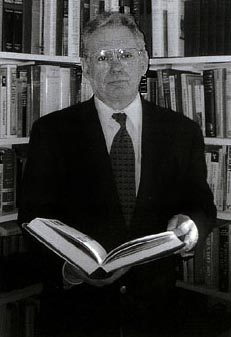
The Middle Aged Scholar
For the student of settlement patterns in the US David Hackett Fischer is indispensable. Of the many books he’s written his 1992 Albion’s Seed is absolutely necessary. In that book he involves himself in the settlement patterns of all four strains from Great Britain. In this volume he interests himself only in the colony of Virginia. He considers immigration into Virginia, migration within Virginia and emigration from Virginia.
As Madison Grant points out in his work Virginia was the mother of States. Fischer points out the whys and hows. His work might be considered and extension of Grant’s.
The founding of Virginia was much more different and tumultuous than our school books relate. The Indians came close to expelling the Virginia colonists while the English had a very difficult time adapting to the climate. The death rate was worse than on the slave ships.
Black slavery was slow to develop in Virginia as the Aristocracy preferred White slaves, politely known as

Maturity Approaches
indentured servants. It was only when the White supply dried up that the Aristocracy turned to Africans. More than in the States of the Deep South slavery defeated the Commonwealth.
Where Whites had a difficult time surviving in the rich soils of the Tidal area Africans prospered soon significantly outnumbering the Whites.
The characteristic Virginia polity of an upper cast White Aristocracy, a small middle class, and the White and Black impoverished proletariats came into existence under Governor Berkeley in 1650 being perpetuated until the Civil War.
Between the strong White caste system and slavery the White proletariat was driven to escape by emigration. Virginia gradually became depopulated over the two hundred years before the Civil War. At that time East and West Virginia were one. A look at the map, of which the book has several, will show Virginia abutting both Kentucky and Ohio. Thus the Western exodus to those two States formed the character of one and shaped the character of the other. From Kentucky and Ohio the Virginians carried through southern Indiana and Illinois while populating several counties in Missouri that were known as Little Dixie.
With the opening of Alabama and Mississippi many Virginians chose to take their slaves and migrate in that direction.
The net effect of the migrations was that Virginia lost several representatives in Congress while losing intellectual vitality. The issue of slavery caused groups like the Quakers to leave the State and it became correspondingly hazardous to one’s health to criticize slavery.
Of course after th Civil War the descendants of the Virginians continued West into California and Oregon. Thus Virginian customs and styles found their way across country.

The Scholar At Play
After the War national immigration began in earnest with Southern and Eastern Europeans forming the bulk of it. Grant laments the diminishing of the Nordic cultural influence while Fischer wisely makes no comment even ignoring the issue concerning himself only with the movement of Virginians.
Even then there is an honesty in his work that makes one wonder how he survives in the anti-truth Liberal university system. I suppose it’s a matter of not what you say but how you say it. Knowing what to leave in and what to leave out.
At any rate for those interested in US settlement patterns I heartily recommend Madison Grant’s Conquest Of A Continent and both David Hackett Fischer’s Albions’ Seed and Outward Bound. If one then overlaps something like Carl Wittke’s We Who Built America that gives some idea of how post-1871 immigration patterns shaped twentieth century America one has a pretty fair idea of how the US developed up to the 1965 revision of the Immigration Act. After that revision a whole new pattern develops.
A Review: In Your Wildest Dreams by Kimi Foos
August 5, 2008
A Review
In Your Wildest Dreams
by
Kimi Foos
Review by R.E. Prindle
Foos, Kimi, In Your Wildest Dreams, iUniverse, Inc. 2008 14.95
This lovely memoir by Kim Foos is characterized by rare charm and grace. A virtual love letter to her husband of 35 years Rick. From beginning to end one feels how lucky Rick is to be cherished so.
Kim Foos as a young girl of twelve fixed her sights on a much older (in teenage years) Rick determining then and there to make him hers. Kim lovingly chronicles Rick’s doings as a child and young man as though from a watchful distance. The anectdotes are wondrously told. Rick and Kim grew up near Wheaton, Illinois in what seems like a heavenly less populated time spent fishing, weirding out and investigating old subterranean missile sites. Sort of like my old childhood but strikingly different. I didn’t have that much fun. We didn’t have any fantastic abandoned missile sites near us. More detail could have been lavished there by the historically minded Kimi.
The innocence and sprigtliness of Rick’s springtime was rudely blasted apart as he heard a knock on the door and the low chuckle of Uncle Sam saying: Here I am. Yes. And the viet Nam war was raging in far off Asia. Like any good lad who knows his duty Rick chose the Army over Canada. Might not have been the wisest choice in retrospect. Turned his life inside out in one devastating moment when the hell he was standing on in Viet Nam moved skyward. Yes. It was thoroughly mined, a trap, an ambush. Dazed and blonkered Rick came back down to survive and stagger back to help his fellows, ears ringing and staggering nearly aimlessly. He needed as much help as anyone else.
Strangely he was not sent home but remained to serve out his term. And now Kim Foos’ story take a dark turn.
If there were enemies on the Eastern Front they had allies on the Home Front. Inept in Viet Nam our Commanders were cowardly at home. They allowed the traitorous domestic Red allies of the Communist Viet Namese to taunt and revile those who had courageously fought the battle of Justice and right. The returning soldiers who had faced a dogged and vicious enemy were told to keep their heads low on their home turf. This to appease a bunch of criminal, traitorous Red agitators who might just as easily have been shot. I don’t know who to revile more the Command or the scurvy Reds.
The shame of America that Rick experienced was to go much deeper. Returned home, reunited and united with a supportive wife in Kim now old enough to marry Rick, just barely, he took a job as auto repairman. According to Kim he was a born mechanic. When a customer learned that Rick was a returned Vietnamese vet he said he would take his custom elsewhere unless Rick was fired. Didn’t want him working on his car. to the shame of America, to the shame I share on behalf of American ingrates the garage owner fired Rick.
What does it mean to be an American? Don’t ask. It’s only an idea anyway.
Shortly thereafter Kim and Rick removed to the wastes of the Upper Peninsula of Michigan. The story continues there, the review ends here.
I close as I opened: this is a memoir of rare grace and charm. A testament to the love in a young girl’s heart. You won’t be wasting your 14.95.
A Review: Conquest Of A Continent by Madison Grant
August 4, 2008
A Review
Conquest Of A Continent
by
Madison Grant
Madison Grant
Review by R.E. Prindle
Texts:
Grant, Madison, Conquest Of A Continent, Liberty Bell Publications, 2004. Reprint of 1933 Edition
Fischer, David Hackett, Albion’s Seed: Four British Folkways In America, Oxford, 1991
Higham, John, Strangers In The Land: Patterns Of American Nativism 1860-1925 Rutgers U. Press 1955
Myers, Gustavus, History Of Bigotry In The United States, Random House, 1943
Wittke, Carl, We Who Built America: The Saga Of The Immigrant, Case Western Reserve, 1939
In the immediacy of the moment one frequently overlooks or forgets the history leading up to the moment. One might think for instance that the current flap over Diversity and Multi-Culturalism is a recent occurrence. While the two terms are of recent provenance the argument under different names goes back much farther while the protagonists are essentially the same.
The story of immigration into America is almost always told from the point of view of the immigrant. Few books tell the tale from the Nativist point of view and they are universally and viciously derided as a tale told by bigoted idiots. While charity is demanded from the Nativists none is to be expected from the immigrationists.
Thus we get volumes like Strangers In The Land by John Higham and Carl Wittke’s We Who Built America that distort the issue in favor of immigrants while deprecating the Natives.
Qustavus Myers’ History Of Bigotry In The United States on the other hand appears to be a willful misunderstanding of the nature of the relative status between immigrant and native resulting in a slanderous approach like that of the contemporary Greil Marcus.
Conquest Of A Continent has been placed on the Jewish Index Of Anti-Semitic Books. Based on that I expected a detailed derogatory examination of the Jews from their entry into America perhaps being the conquerors referred to. The President of the American Jewish Committee sent a letter to every Jewish publisher in the United States demanding that they refrain from either reviewing the book or noticing it at all. Dynamic silence was to prevail.
After reading Conquest I can only conclude that the AJC was hyper sensitive to a degree. Since his 1916 Passing Of The Great Race Mr. Grant had learned that ‘You Don’t Mess With Rohan’ to quote Adam Sandler. Grant all but ignores the Jews in his volume. No, his offense, according to the AJC was even more egregious, he uses the world Nordic and dares to imply that they are ‘the Great Race’ rather than the AJC’s own Semites.
The other volumes mentioned and, indeed, all writing in this genre which is pretty extensive, defers to the Jews as ‘the Great Race’ probably genetically superior to all others.
So Madison Grant is interested in telling the story of how the Nordic race conquered the continent. This approach can only be considered as a sin by non-Nordics. Grant then tells the story of how the US and Canada were occupied by peoples other than the native Indians.
He begins early referring to twelfth century attempts to settle by Scandinavians. In the 1100s the firece native Indians were able to exterminate the invaders and may well have been able to exterminate the Puritan settlers but for the fact that a small pox epidemic shortly before the Puritan arrival had reduced the native population by as much as half while weakening them concomitantly. Such is the luck of the draw.
Grant thus traces immingration back to its origins colony by colony and then State by State as the Nordics moved Westward.
David Fischer in his excellent Albion’s Seed retraces the same ground fifty years after Grant with much addional detail concerning the places of origin and their activities once in the US.
Grant’s approach is in some ways superior to that of Fischer since as an unabashed Nordic advocate he is interested in detailing the exact racial content of the occupation of the various states and provinces. If you aren’t aware of the progress of settlement and by whom there are numerous surprises. My own notions were certainly vaguer before I read Grant.
I was surprised at the seeming numerical superiority of Southern migrants in the Westward movement. It seems that Whites did not like to live in the South where they were compelled to compete with slave labor while being despised by both the plantation owners and their slaves. Thus there was a constant stream of the best and brightest of the South moving into the North and West. As Grant notes, Virginia was the mother of States.
Then too some of Grant’s population statistics are of interest also. At the 1790 census before the invention of the cotton gin in 1793 there were less than a million Africans in the United States. Seventy years later as the Civil War began the number had increased to four and a half million. Thus natural increase was out of the question. It follows then that between 1800 and 1860 more Africans were brought to the US than there were before 1800. As a result the slave trade fluorished more than ever.
Prior to 1800 Alabama and Mississippi had no settlers so that in 1860 these two States were still rough frontier States still in a state of organization.
There is much good background here as to how the US came under settlement. The continent was accupied in its entirely when the truly major immigration from Eastern and Southern Europe began to accelerate in the 1870s and 1880s changing the basic Nordic institutions of the country. The change in Grant’s eyes was much for the worse.
Carl Wittke’s We Who Built America published in 1939 was undoubtedly in response to Grant’s Conquest Of A Continet. Wittke, was published by Case Western Reserve University. Grant explains the meaning of The Western Reserve which has always puzzled me. The Western Reserve was three million acres set aside as a concession to the State of Connecticut for giving up other territorial rights.
Wittke made a great impression with his his volume, his opinions being taken as overriding fact. I remember my sixth grade teacher in Michigan lauding the book to the skies. I finally read it a couple years ago. Not so much.
As is usual with books and writers of this type Wittke overstates his case and underproves his facts. A contribution to the dialogue at best.
Grant’s book should prove useful to any unbiased reader. If his attitude of Nordic superiority offends you, ignore it. His history as history is sound. For those of you reared on Myer’s History of Bigory attitude you will probably be surprised to find that there is another point of view. Bigotry is not a matter solely of American destestation of immigrants as the program of Diversity and Multi-Culturalism indicates, bigotry is a red herring and not the issue. The issue is who will be Top Race. The contestants for the Top Spot have turned out to be the Africans, Semites (both Jews and Arab Moslems) Hispanics, Chinese and Euro-Americans. (Grant’s Nordics) As you can see race has replaced nationalism.
The contest is real and ongoing. Peace is merely another form of war. The prize will go to who wants it the most. If you don’t see the contest in these terms I suggest you remove your rose colored glasses.
Exhuming Bob 11:
Bob Dylan And Toby Thompson
A Review
Positively Main Street
Text:
Thompson, Toby: Positively Main Street, U Minnesota Press, 2008 reprint of the 1971 edition.

Forty Miles Of Bad Road Later
Toby Thompson’s self identification with Bob Dylan is an interesting situation. In a way he predated the Elvis impersonators; blazing a new trail. That he recorded his infatuation on the spot and got it into print is even more fascinating.
I suppose people have always identified with important people as the insane asylums full of Napoleon Bonapartes indicate, but when the movies came into existence things changed. Movie actors were designed to appeal to certain character traits making identification with the actors more accessible. That the actors came from social strata much like one’s own with no apparent effort or skills made identification easier. (See the novel Merton Of The Movies by Harry Leon Wilson) When sound was matched to image one could act like and even talk like these heroes.
Older people being formed already were more immune than younger people so that the John Wayne imitators, Bogarts, Jimmie Stewarts or what have you began to surface in numbers beginning in the fifties. Still there was a psychological distance between the people on the screen and oneself while a direct imitation brought ridicule on oneself.
Then in the mid-fifties Presley burst on the scene. Here was a guy who drove truck, we were told, one day and was a major recording star the next. Then, as immediately as it seemed to all of us, more to some of us than others, he parlayed that into becoming a movie star. That was just about every teenagers dream. Now that was something we all could do and a great many of the most venturesome did get at least to the level of recording stars but they all wanted the movies.
Presley was the first who created a legion of impersonators. The movies formed a cadre of amateur impersonators but Presley spawned a full frontal impersonation for a profit; People who became Elvis Presley as a surrogate for themselves. This began fairly early in the Presley career too.
Then as the sixties hit young people were conditioned by phonograph records. Records were the way the generation communicated with each other; They took the place of movies and literature. One could still write books or rarely, like Presley, make it into the movies but anyone with enough ambition, little training during the sixties and none in the seventies, could make a record.
This was no more evident than in the case of Bob Dylan. Quite frankly my own first impression was that here is a talentless guy putting out records. If Dylan could do it, if I wanted to, I could. It then became easy to identify with Dylan. Plus he was a nobody, had never even been to college.
After I and many others had written his early records off he surfaced in a way to seize your attention, however his appeal was limited to a certain psychology. But, now, in the twentieth century via records and radio if there were only a million of any certain type those million could make an artist very, very successful, viz. Janis Joplin.
When Big Brother And The Holding Company with Janis Joplin released its first CBS disc the record went to the top of the charts on the strength of a small minority of the public. The vast, and I mean vast, majority of the public had never heard of the band or Joplin. I was in the record business at that time and was astounded that a relatively few hippies made a group and singer unkown to 9 1/2 out of ten, at the minimum, could send a record to the top. Hippies were not known to take care of their possessions. They trashed that record in a week or two playing it perhaps a hundred times or more then coming back to buy another one after another. Each one of those sales contributed to the accumulation of a million so the entire course of American music was swayed by the success of a record purchased by a very small percentage of the population, and the lunatic fringe at that.
So with Dylan. Dylan provoked a violent split in society. Just as Pat Boone was opposed to Elvis as a role model so Simon and Garfunkle were opposed to Bob Dylan. In 1966-67 the S & G faction was much larger than Dylan’s. Bob got more TV attention however. His cult was as the misunderstood, oppressed genius, the Outsider who was shucking the world. You can see where his fan base came from. So, all of us who were in that category became devoted, almost obsessed, advocates of Bob Dylan. I was one, I’m merely analyzing not being superior. I never went as far as Toby Thompson in my obsession but then I didn’t think of what he did either and I was six years older. I already had a life of my own, such as it was.
The younger people took to the pop stars with ease. We had Jim Morrisons, various Beatles and Stones or whatever as well as Dylans walking around campus, people completely immersed in the various identies. I don’t even have to p[oint out the Deadheads and they were truly legion.
So Thompson’s notion of reliving Bob’s youth in his own person while extreme was not completely imcomprehensible. Still psychotic but borderline as he never completely lost contact with reality. Really interesting because unlike Freud’s Schreiber he was able to write a book about it even as it happened.
Thompson was born in 1944 being three years younger than Bob thus being able to look up to him as a role model. Being three years older than Bob I always looked down on him as a younger sibling who was somehow outshining me. The identification was there nonetheless.
Through 1966 Bob befogged us all. Blonde On Blonde was such a towering effort both musically and lyrically that it was incomprehensible. No one could understand it. Some of it you couldn’t even listen to but you were convinced it was a work of genius. The people who called it mere noise weren’t entirely wrong either. Philistines nonetheless.
I knew that Bob had peaked along those musical lines and there would have to be a model change. But then the word came out that Bob was dead, close to it or paralyzed from the eyes down. He disappeared from the stage for a while but as he wasn’t dead or paralyzed we all stood with out faces turned to Woodstock waiting for news from the East. We all, being those of like psychology.
Then Bob dressed like Billy the Kid or some other Western desperado released John Wesley Harding. the psychology was changed. What had drawn us in for ’64 to ’66 was the muse using Bob Dylan as an instrument and he now had been discarded. I dropped him as did many others.
A year later Toby Thompson conceived the idea of searching out Dylan’s roots in Minnesota. He didn’t go as a mere reporter though. He went as a Bob Dylan impersonator. There was Toby Thompson standing in Bob Dylan’s shoes.
The Thompson that emerges from his telling is a very disturbed young man of twenty-four. His intake of alcohol and marijuana was prodigious. Of course, he’s telling a story, but I can’t recall one day that he wasn’t stone drunk. He keeps a pint in his glove compartment. He gets so drunk he stands on his head in the middle of a dance floor and can’t remember it the next day. The guy must have smelled like a brewery all the time. I’m sure the fumes coming from him when he interviewed Dylan’s mother in the daytime gave her a very negative opinion of him. Robert Shelton, Dylan’s biographer, future biographer at this time, had been out to Minnesota the year before. He was a professional Journalistic persona older than Dylan’s friends. Thompson was three years younger and appears to have been accepted on a personal rather than professional basis. After all he had no journalistic history, he was only going to write.
On that basis he formed an intimate relationship with Dylan’s high school sweetheart, Echo Helstrom. I’m going to concentrate on that aspect of the book for this review. Bear in mind that she is three years older than Thompson.
Thompson’s visit to Hibbing must have had the locals’ heads spinning. Thompson, in his book, doesn’t seem to be aware of the impression he was creating. From his description it seems that he appeared among them as a Bob Dylan impersonator. Bobby Zimmerman left Hibbing ten years earlier, became Bob Dylan, and now ten years later this guy shows up impersonating him. Doing a good job of it too.
One can only imagine what Hibbingites thought.
The idea of this guy pictured below going forth to conquer the world of popular music appears to be absurd. We all have known kids who wanted to do the same. We may even be one of those kids but the odd
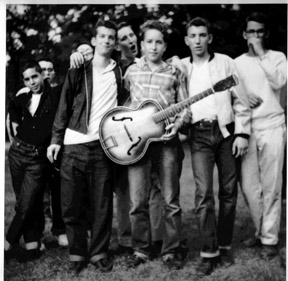
Look Out Little Richard
of succeeding were about a million and a half to one. How could anyone even suspect that Bobby Zimmerman, the kid above, from the virtually uninhabited North Country would be the ONE. Everyone in town must have been laughing up their sleeve, like the guy on the right above, when Bobby Zimmerman sallied forth to ‘join Little Richard’ and conquer the world.
Now, this guy Thompson using his own name came posing as a journalist but impersonating Bob shows up. Thompson seems surprised at the reaction of Maurice and Paul Zimmerman, Bob’s uncles, but can you imagine being interviewed by a guy talking and acting like your nephew Bob. It’s kind of crazy. Imagine what Beattie Zimmerman, Bob’s mother, thought sitting across from Toby doing Bob. Maybe that’s what Bob meant when he said ‘This guy Toby Thompson has got some things to learn.’
Nobody knew what was going on there, did they?
When Bob and John Bucklen and Echo Helstrom were kids, like many another group of Musketeers, they swore that if one of them made it he or she would help the others along. Well, Bob made it but he forgot John and Echo. No big deal. Teenage vows even spoken in earnest have no meaning after the fact but the promise lives on in the innocent hearts of those who aren’t pulled through by the successful one. There is a sense of betrayal. Added to that there was romantic ill will on Echo’s part because of Bob’s eleventh and twelfth grade betrayal.
Bob is making it big while Echo just has a job. A young woman trying to make her way has a tougher row to hoe than a guy. But, if she knows how to work it she does have a story that’s worth at least a couple three or four years worth of wages. She doesn’t know how to market it though. Robert Shelton came out to Minneapolis a year before Thompson and paid her a hundred dollars for an interview. She held the hundred up to Toby as hint but he wasn’t thinking that way. She was only going to get screwed by Toby, literally.
If Toby hadn’t been in an alcholic haze he might have realized that the story Positively Main Street was only subsidiary to Absolutely Sweet Echo. The money was with Echo.

Echo When She Knew Bob
As they’re driving up Highway 61 Echo pulls out a hundred dollar bill and says ‘See what Robert Shelton gave me for an interview.’ The light still didn’t go off in Thompson’s head. He reached into the glove compartment for his pint.
I am astonished at the amount of alcohol Thompson consumed on these trips. If he isn’t novelizing the guy was in a virtual stupor the whole time. When he and Echo arrive in Hibbing they go to a bar where Toby becomes blotto on beer, no less. He has no memory of the moment but Echo tells him that he stood on his head in the middle of the dance floor as coins and keys showered out of his pockets.
Echo must have been one tolerant girl or else she was hoping for something to happen. Perhaps a large part of the charm of Positively Main Street is the stunning unconciousness of Thompson. The guy was twenty-four years old at the time, not a kid- exactly. He had been telling Echo he was going to write a book. When he gets the first trip written up he sends her sixty pages. Echo writes back: ‘Sixty pages isn’t enough for a book is it?’ She has reasons to be disappointed. Heck, Toby is using her to attempt to make his fortune and he hasn’t even promised to cut Echo in for a dime. Think about this. The self centered naivete shines through with startling clarity. For that reason it is one of the most interesting books in the the Dylan canon.

Echo When She Knew Toby
Now, in these sixty pages Toby has misunderstood what Echo told him about the time Bob called her on the phone and played Bobby Freeman’s Do You Want To Dance claiming to be singing the song.
In his sixty pages he projects a better story where Bob shows up on Echo’s front porch playing guitar and sings Do You Want To Dance then strutting all through the house singing and playing somewhat like Elvis in the dime store in King Creole.
Echo points out this error. Toby liked his version so much he left it in the way he first wrote it. Then when Echo introduces this Bob Dylan impersonator into his parents home Toby whips out his quitar and reenacts his version of the incident strutting around the house as he plays and sings. The guy was absolutely out of his mind in his alcohol haze. He must have smelled like a brewery the whole time.
One is astonished that he was so well tolerated. Of course maybe everyone was thinking: ‘This is amazing, but it won’t last long’ and let it pass. Waved his car goodbe as he sped away.
One wonders what Echo’s emotional rection to the Bob Dylan impersonator was. Toby must have reactivated dormant affections for Bobby Zimmerman as he came on to her strongly in Bob’s persona. Echo had ten year old memories of Bob and now here he was, his double, coming onto her again. Frightening actually.
Toby left again and never returned. In the book he seems oblivious to the havoc he created in Echo’s life. In the interview at the end of Main Street given many years later he doesn’t seem to be any more aware. In fact he seems to be still posing as Dylan’s double. He mentions that he still contacts Echo, who has moved to LA, occasionally as does Bob but Bob seems to have better success in finding her.
Hurt and mystified that Thompson had no more use for her she wrote a poem for him that she mailed to him in far off Washington D.C.
Hey! Toby!
Where can you be?
Somebody told me
That you went back to
Washing Machine D.C.
How can that be?
You came to town in your Volkswagen
And I’ll tell you we sure had fun!
And now you’re gone!
You played for me on your old guitar,
Took me for a ride in your little car,
Drove me near and drove me far,
We looked at the moon,
And stared at the stars,
You stood on your head in my hometown bar…
How could it be you’ve gone so far?
Hey Toby? Where are you?
– Echo Helstrom
Toby hadn’t gone anywhere. Like Bob he’d just never been there. His fantasy like Bob’s didn’t include anyone else, they were just bit players in his own movie. Toby was no longer thinking of Echo. He was married to the bottle. He was touring bars across the country to get material for his next book. Echo could just consider herself as one of those bars. Once Toby had visited it there was no reason to return.
The tragedy for Echo was that she was betrayed once by Bob in 1958 and then again by a Bob impersonator in 1968. Perhaps a wound was created in her heart that could never heal. One wonders what her later history was after she left Minneapolis and drifted West.
I wonder where you are tonight.
I wonder if you are alright.
I wonder if you think of me
In my lonely misery.
There stands the glass,
Fill it up to the brim,
Till it flows o’er the rim,
It’s my first one today.
-Webb Pierce.
Here’s to old memories. Bottoms up.
Exhuming Bob Chronicles IX Pensees 8: New Morning
July 23, 2008
Exhuming Bob:
Chronicles IX, Pensees 8:
New Morning
by
R.E. Prindle
The chapter New Morning opens with an interesting comparison. Bob had just returned to Woodstock after his father’s funeral in the summer of 1968. The association of New Morning with the death of his father in itself presents an interesting psychological mental state. A letter was waiting for him from who he considers one of the three great American poets, Archibald MacLeish. MacLeish was just coming off his Broadway triumph J.B. In the letter he asks Bob and Sara to call on him in his Connecticut home to discuss a musical collaboration on his new play. A jewish father dies; a goy ‘father’ appears.
As Bob explains, Father Abram is somewhat dull, thinking that an artist must be a painter. The notion seems to be that Bob is slightly ashamed of his father for not understanding the distinction between pictures and the artistic soul. Thus contrasting with dull Abram is the brilliant intellectual poet-artist, Archibald MacLeish. Bob is quickly on intimate terms referring to the Poet Laureate of America as Archie.
If you’ve never read Poe’s last story Landor’s Cottage you might like to compare that description to Bob’s of MacLeish’s home. While we never meet Poe’s Landor Bob does introduce us to Archie. Coming from small town Hibbing Bob seems to be overwhelmed by the splendor of MacLeish’s dwelling place. Sure sounded good to me. So as Bob left Abram at the rosy fingered Dawn of his New Morning, MacLeish presents himself as the sun rising above the horizon. But it’s a Black Sun. MacLeish does not walk on the sunny side of the street. He’s dark, as anyone who writes a play commentary on the Book of Job must necessarily be.
His new play is called Scratch. One presumes after Old Scratch, The Devil. Bob quotes some lines of Archie’s character Scratch, p.124:
I know there is evil in the world- essential evil, not the opposite of good or the defective of good but something to which good itself is an irrelevance- a fantasy. No one can live as long as I have, hear what I have heard and not know that. I know too- more precisely- I am ready to believe that there may be something in the world-someone, if you prefer- that purposes evil, that intends it…powerful nations suddenly, without occasion, without apparent cause…decay. Their children turn against them, their families disintegrate.
The strength of the insight is too strong for Bob at that precise psychological moment but Archie has given him a hint of a reality that Bob will realize all too soon. Perhaps in reference to Abe and Archie Bob meets Frank Sinatra Jr. at the Rainbow Room. Frank, Jr. nursing one of the same travails as Bob asks him after discussing Frank Sr.: What do you do when that father turns out to be a son-of-a-bitch.
Well, yes, you’ve got an identity problem, don’t you? Bob has always had an identity problem. What started out bad has taken a turn for the worse. He wanted to be Bob Dylan but now being Bob Dylan has turned out to be a son-of-a-bitch, a burden Bob…well, just plain Bob, cant’ bear. He’s learning about this inherent evil of life Archie is talking about.
If you’ve never experienced what Bob is telling you it will be hard to understand. I’ve suffered through a mild dose of them blues, enough to give me understanding, but nothing compared to Bob. He wakes up and someone is standing in his bedroom watching he and Sara sleep. That gives you a start. But if Bob thought he had identity problems what kind of problems does some poor fish have who literally wants to get inside your skin have. Walk a mile in your shoes like Toby. Everybody want something from you that you don’t have to give. And I mean something. You by your success have emasculated them, Bob’s success. So they in turn want your dick and balls. They want ot carry them around in their pocket to give them what they lack. ‘Hey, you know what I’ve got in my pocket, look, Bob Dylan’s dick and balls.’
You want to know what emasculation is? Bob tells you. The Sheriff of Woodstock tells him that if someone is scrambling over his roof and falls off Dylan will be legally responsible. That does something to your mind. The Sheriff tells Bob that if any of these crazies attack him and he defends himself he’ll be the guy going to jail. That one sends a few synapses seeking new routes through the brain. That one did happen to me. Might as well have left the planet, the Sheriff just took your dick and balls.
Bob is now learning first hand of the evil in Archie’s world. Damn that’s rough.
Even then Bob couldn’t make his lyrics dark enough for Archie although, now this is funny, Bob did use them in his album New Morning. What does that say about a new morning?
Bob just couldn’t get used to being Bob Dylan. Being Bob was OK but being Bob Dylan was tough. They were everywhere. You couldn’t even run much less hide.
As Bob tells us he was riding down the highway with Robbie Robertson when Robbie asked him: ‘Where are you going to take it now?’ ‘Take what?’ Bob asks in return. ‘Pop music.’ Robbie naively replies.
Bob is flabbergasted but who can blame Robbie? For the last six years Bob had been calling the shots, getting booed and selling records, renovating and reinvigorating folk music, taking folk music electric, electrifying rock. Why shouldn’t Robbie think something mega revolutationary was brewing in Bob’s brain? Being Bob was easy, being Bob Dylan was damn near impossible. Those three fathers, Abe, Archie and Frank Sr. Bob was learning something about the inherent evil of living.
His new mentor, Archie, thinking perhaps that Bob was Bob Dylan pushes him to sharpen and darken the lyrics to the songs he’s written for Archie. Bob just like after Blonde On Blonde has taken it as far as it can go. He opts out on Archie. Two fathers down but there’s still that Big Guy In The Sky but that Bob will seek a little farther down the road.
New Morning was a good chapter. I could empathize. Current events are giving me a new slant on the inherent evil in the world too. Heads up.
Picturing Greil Marcus
July 20, 2008
Picturing Greil Marcus
by
R.E. Prindle
What polluted wretches would the next glance show…
Greil Marcus
…using the novel technique of occupying one building, and then, when the police arrived, filing out, only to seize another building, and then another, and another- Berkeley radicals called on their fellows to “Do a Columbia”; not for any reason, not in the face of any injustice or insult, but for the lack of anything better to do.
Greil Marcus
Greil looks down his nose at us.

Greil Marcus is among us like some IT that came from outer space or conversely like some Creature From The Black Lagoon arising all dripping and encrusted with slime, like some Blob. And what does he want from us?
The fellow can’t genuinely be that unhappy. He was raised by a multi-millionaire San Francisco attorney by the name of Gerald Marcus. There are some conflicts in Gerald Marcus’ history. He made big money form ‘good’ causes thereby attaining a certain smugness as a defender of the downtrodden. Mr. Marcus made his millions representing various farm unions thereby combining greed with ‘benevolence.’
Using his magnificent income he provided young Greil with what now must be a multi-million dollar home next to Atherton on the Peninsula, one of the most prestigious locations in California if not top of the list. Upon graduation from high school Greil had a ready made admittance to UC- Berkeley thanks to his father’s prominence in the Boalt Law School of that insitution.
Thus at the age of twenty-one or twenty-two young Greil stepped out into the world armed cap-a-pie to begin the battle of life. No deprivation there; who could ask for more? Indeed, many of us would have settled for less and thought we were doing well.
Indeed, Amerikka, as Greil has spelled it, showed the fairest of faces to our young hero. He didn’t even have to get a paying job; he could continue to play supported, one assumes, by his step-daddy’s millions. Greil went across the big Bay Bridge to San Francisco and took a play job at Rolling Stone Magazine that started up about the time he graduated. It wasn’t a job that paid a living wage but then Greil had time. He bummed around Rock journalism for several years building a reputation that the over the years blossomed into what it is now.

The Old Warrior As The Shadows Deepen
The feast of Amerikka had been spread before him; young Greil had grabbed a plate, knife and fork, and dug in. Young Greil sat down with a plate heaped with good things before him and began a bitch with every bite. What he found wasn’t good. To young Greil the feast was a product of corruption. He, like his step-father, could accommodate himself to it though as the pay was good. Greil got himself a fine house in a prime location in Berkeley above the university that many would kill for. I’m not saying that Greil didn’t. He didn’t stop bitching though. Indeed, ‘what polluted wretches would his next glance show…’
Everywhere he looked his glance fell on pollution, on wretches in the horror of the ‘air conditioned nightmare’ as Henry Miller expressed it. The air conditioned nightmare! Let that concept roll around your mind for a while. Ninety-five degrees in the shade, 100% humidity outside and you’re living in an air conditioned nightmare. Interesting. Where I grew up when the heat and humidity hit one ran for the movie theatres with ‘refrigerated air.’ It was refrigerated too. Go in like melted butter and come out a solid brick. I didn’t hear anyone complaining about a ‘nightmare’ though. But then what is is how you perceive it. And how did Greil perceive it?
He sought out all the more horrid representations of the most horrid and perverse literature and movies he could find and called it ‘normal.’ He concentrates on this Twin Peaks of David Lynch and its spin off movie Fire Walk With Me. He even dwells on a novel based on the movie by Lynch’s daughter as though it were serious literature; as though the perversion of the movie and book was the accepted norm. As though the depression of Lynch was rational vision.
Indeed, a very deep psychological depression seems to characaterize Greil’s writing. As Dylan put it, he tries to get you into the hole he’s in. There is certainly no climbing out of the hole Greil is in. The more he writes the deeper the hole gets. Worse still he seems to have no reason for his depression. He ‘Does the Columbia’ on us not because of any injustice we’ve done him or any insult we’ve offered him but ‘for a lack of anything better to do.’ The man is not to be taken seriously.
Oh, he does have a deep psychological grievance but it doesn’t have anything to do with us. It seems that his mother only knew his father a couple days or weeks before his father shipped out during the war and died in that great holocaust. Greil never knew his father thus causing him to wonder what might have been and throwing him into a deep funk.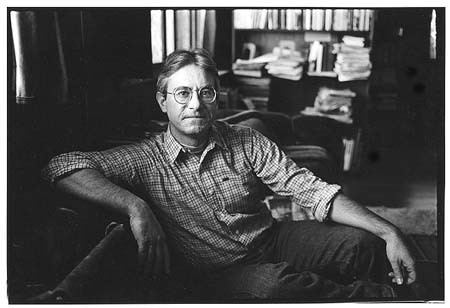
Over the decades this sense of anomie preyed on his mind. Gradually he developed a hatred of the Amerikka that had ‘murdered’ his father so senselessly. He conceived the notion that that the Captain of his father’s ship was an incompetent who had purposely been placed over his father to cause his death. He developed the notion of the heroism of his father based on nothing but his wishes. And then one day he learned that a television production about his father’s squadron had been made depicting the manner in which his father’s ship sank. Terrible storm, huge typhoon. Under wartime conditions when the ship was improperly ballasted for such a monster the top heavy ship rolled. The whole fleet suffered terribly. In those days they didn’t have satellite weather reports that gave advance warning of what was coming. Weather was weather in those days. Look out. Keep your head down.
So misconstruing the whole situation against the Beast Greil bore a grudge against Amerikka. I don’t know if that’s the whole reason for his grudge but that form its basis.
I suppose it’s terrible to lose your biologic father at sea. I lost mine when three when he and my mother divorced. I haven’t ever really regretted it though. People are different but it didn’t bother me. It would have bothered me even less if someone like Gerald Marcus came along and married my mom. I might even have considered that a blessing. I got a real clinker for a step-father. I’ve got a reason for depression. Could easily have done without him. Should have stayed an orphan.
But rather than try to dig his way out of his hole, Greil dug in deeper. He wrote weird stuff like Weird Old America, left out the double K so as not to limit the size of his readership. I can’t tell you what Greil was thinking. He freehandedly insulted a whole group of people who had little reason to regret their pasts. I mean, Grandpappy lived in those Kentucky hills where Dock Boggs lived. That’s my ancestry Greil’s talking about. And Greil says we were all…well, I don’t know exactly what we all were in his mind but it isn’t good. I mean, compared to what? What is Greil comparing us to in which the comparison is so unfavorable? Himself? I look around me and I don’t see any people or thing much better. I’ve been around too. This Lynch guy and his portrait of ‘smalltown’ Amerikka isn’t all that familiar to me. I grew up in that environment. Sure there were nasty things going on but that’s just the way people are. Small and nasty most of the time. But they had and have their ideals too. Those people created a town that was a lot nice than the Twin Peaks Lynch portrays.
Let me see.
Of course, I haven’t seen what Lynch portrayed because I never saw the show that apparently wasn’t all that popular because it didn’t get that far. Greil himself says that movie was so horrible that everyone ignored it but him. He makes it sound so terrible that I have no reason to check it out.
But Greil revels in that corruption. Rolls around in it, enjoys it. He almost shouts for joy that a major slut is elected home coming queen. He loves it that her father is doing her and then kills her. That’s how I read it anyway. So, maybe Greil should do something about his depression.
I mean, Freud lived and died a hundred years ago; his legacy lives on practiced by a legion of psycho-analysts. Why not check one out. Why not step back and look a the life he’s leading. Running around making people feel bad with his book of murder ballads.
We all know that stuff goes on. There are unbalanced men and women out there who do terrible things. But there are a lot more who are better balanced and don’t do those things. There are lots of people who work hard to make the world a better place, to make their immediate vicinity a better environment. There are people who create beautiful gardens and wonderful parks. There is pleasure and joy in this life. It’s a struggle to get it but it’s worth struggling for. Greil should open his eyes and keep some kind of perspective on pollution and cleanliness.
I can’t imagine someone getting up and delivering the commencement address that Greil delivered at UC in 2006. He opens with a positive reference to a perverted Mafia figure who goes to some kind of pervert heaven in New Hampshire, wakes up in the moring to find that the whole world has gone pervert. Greil calls this the American Dream. They talk perversion over breakfast. As Greil wants us to believe, they are free and this is the freedom that Amerikka is supposed to represent before the Weird Old Americans got in the way.
I don’t know, Greil, get a life and then get some help. Life doesn’t have to be as weird as all that.

The Profile
Ragtime Talking Eddie Burroughs
July 18, 2008
Ragtime Talking Eddie Burroughs:
Another Look At Minidoka
by
R.E. Prindle

While I was wandering through the pages of Minidoka one day looking for some firm dating device I came across what may very well be a key to explaining the method of reading the story. When I first read the story I tried to read it straight which was a very unsatisfying experience. The story seemed to be a clumsy first effort. While a first effort, perhaps, the story is far from clumsy, indeed it is a well crafted and polished tale.
The story isn’t written in plain English; it seems that our very hep ERB is ‘talking ragtime.’ First the proof and then an attempt to understand the concept of talking ragtime.
On page 22 there is an exchange between Minidoka and the Hoobody:
“Now, don’t be frightened,” said the Hoobody. “I’m really very fond of young people, expecially hash browned. But candidly, I have come to you as a friend, sent by the Little Horned Toad whom we all obey. You are in terrible danger and if you don’t do just what I tell you, your name is Alkalai dust.”
“I’m in the hand of my friends,: replied Minidoka. “But I glean that you are talking rag-time,” he added to himself.
The Hoobody’s speech can then be understood as an example of ragtime talking. One can’t write what one doesn’t know so it is clear that ERB knows what ragtime talking is and knows it well enough to confidently reproduce it. Hence ERB is a hep dude. I’m not talking ragtime either. It would seem that as in latter days ERB would have had an affinity to the Hipsters, the Beats, Beatniks and the Hippies. He was cool.
Now, what might talking ragtime be.
Talking ragtime woud be based on the principles of ragtime music but independent of it. Ragging a tune led to ragging the language.
While ragtime is a distinct musical genre of original pieces any song can be converted into ragtime by changing the time values of melody notes. This is known as ragging the piece. (Wikipedia) Thus ragtime talking distorts ordinary English into strange or outre phrasing and notions. The Hoobody says he is fond of young people, especially hash browned. The surprise effect of young people and an edible dish is clever or amusing if not outright funny. Thus the language is being ‘ragged.’
As ERB follows the technique throughout the book the story must be a ragtime story. While my first thought was that ERB put the story aside because it’s quality wasn’t publishable I am now of the opinion that while within a ragtime genre the quality is fine perhaps there were no publications that accepted ragtime stories. I may be wrong.
That ERB may have been deep into the technique is evident from the transformation of Bodine into a Coyote. I am not clear on the connection between the Coyote and ragtime talking and lyrics but the Coyote plays a central role. Thus Bodine is a Coyote throughout most of the story.
Ragtime music first surfaced as a genre at that place of all firsts the Chicago Columbian Exposition of 1893. Thus from the age of seventeen on ERB would at least have known of Ragtime music. The music was definitely popular from c. 1900-1918. When Ragtime talking became a hipster dialect isn’t clear.
In the story ERB has Smith driving a ‘horseless carriage.’ An anomaly of sorts as by the terms of the story it should have been a cowless carriage as ERB reverses nearly every conventional usage throughout the story. The automobile wouldn’t have been that common in the first few years of the century while by 1907-08 when I believe the story was written, it would have been. The electric car that Burroughs drove at the Expo wouldn’t have been called a ‘horseless carriage.’
I can find no reference to ragtime talking on the internet so that if the method developed in the early years of the century until it was common amongst hipsters that would have to have been by 1907-08. There would have been no way for ERB to learn the concept while he was in backward Idaho in 1903 and 04. So that in my opinion the story written in ’07-’08 and possibly later.
The story is definitely not a children’s story. The story is meant for adults. The use of the term ‘threw a couple Delsartes’ would very likely be incomprehensible to children. The Delsarte method was a series of sterotypical emotional responses designed for stage actors. I append a page in demonstration borrowed from the incomparable Our Times by the great Mark Sullivan.
 Lyrics: Since Birdie Commenced Her Delsarte:
Her right hand goes this way, her left one goes that,
And she flings them high into the air,
To show her improvement she give the “wave” movement
And impersonates Hate and Despair…
There’s lots of sleep-walking, also dumb talking,
Since Birdie’s commenced her Delsarte.
So, if one reads Minidoka as an example of ragged English not unlike Fractured Fairy Tales or a couple of verses from Phil Harris; That’s What I Like About The South it makes perfect sense:
 Won’t you come with me to Alabammy
Let’s go see my dear old Mammy
She’s fryin’ eggs and boiling hammy
That’s what I like about the South.
Well it’s way down where the cane grows tall
Down where they say “Y’all
Walk on in with that Southern Drawl
‘Cause that’s what I like about the South.
Did I tell you ’bout the place called Doo Wah Diddy?
It ain’t a town and it ain’t a city
It’s just awful small, but awful pretty
That’s Do Wah Diddy.
Rag, Mama, rag.
So Mindoka is ERB in a light hearted effort to amuse while demonstrating his coolness. Can’t get much hipper. Viewed from that perspective we have an accomplished effort on a level with the best of his work.
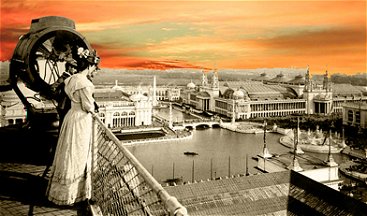
1893 Columbian Exposition At Chicago
 I, Dynamo