Second Thoughts Greil Marcus Shape Of Things To Come
July 23, 2007
Greil Marcus
Shape Of Things To come
Second Thoughts
A Review
by R.E. Prindle
Freud in his 1921 essay Group Psychology And The Analysis Of The Ego laid down the basis of what would later evolve into the concept of Multi-Culturalism. Thus each culture is a discrete entity governed by its own cultural iudeals or Ego. Judaism is a culture with a set of ideals and a culture. Americanism is a set of edeals without either an ego or culture of its own. Hence ‘Americans’ are eclectic borrowing from many cultures while believing in none and also while granting a sort of sanctity to these cultures because of the lack of its own.
From the Jews ‘American’s borrowed the concept of the Chosen People and redeemers of the world. Greil Marcus in his latest effort ‘The Shape Of Things To Come’ seems to know this but I don’t think he understands its implications. Mr. Marcus seems to be motivated by a sdort of cultural envy. Indeed the Jews and Americans are in competition for the role of the ‘Chosen People.’ Perhaps it is significant that like all Jews Mr. Marcus has dual passports. He is at one and the same time an Israeli and an American. In other words he is neither one nor the other but like any other American he blesses the non-American side of his split identity.
Mr. Marcus in this volume of prophecy takes on the role of one of the ancient prophets of Israel. He seems angry that John Winthrop would borrow the description of Jerusalem as a City On The Hill and apply it to New England.
Mr. Marcus takes offence at this and comes back to it repeatedly.
As he points out that as with the Jews those who form a covenant with God will be scourged by God as the Jews have repeatedly been. He seems to think that the colonial predilection for slavery is somehow offensive in the eyes of God although slavery was an institution among the ancient Jews for thousands of years. Solomon the Wise sold his own people into slavery to pay for his temple.
American slavery, offensive to the nostrils of any decent person, was first White then evolved to Black when scoundrels of various nationalities, including a hefty proportion of Jews, unloaded shiploads of Africans in America. The Blacks eventually displaced the Whites but there is many an African-American with the blood of a raped White ‘servant girl’ in his veins.
All this is neither here nor there. The point is that Mr. Marcus believes the day of retribution is at hand. That is The Shape Of Things To Come that he prophesies. He seems ato take a fair amount of pleasure in his visions of blood running in the streets.
Having established the notion that ‘Americans’ are going to get their comeupance he then goes on to give the Jewish cultural vision of America and Americans. He relies on John Dos Passos USA trilogy and the paranoid delusions of Philip Roth both of whom are Jewish. It is a characteristic of Mr. Marcus to cast his fellow Jews as virtuous while the evil persons are goyish.
As it chances I have read Dos Passos’ USA trilogy a trilogy of times. While able to plow through the occasional Roth volume no more than once although I did enjoy The Breast immensely. Perhaps Mr. Roth’s novelette may explain his psychology.
Now, Mr. Marcus entitled on of is earlier volumes The Weird Old America. I tranlsiterate the title into The Bad Old America. thus Mr. Marcus emphasizes the negative appraisal of America by Dos Passos. There is no denying the negative side of any culture. But it is wrong to speak only positively of the Jewish culture and only negatively of the American. My undersanding of the work has changed with each reading so that by the end of the third volume, The Big Money, in my third reading I was ready to vomit. If one were to contrast Booth Tarkington’s Penrod and Seventeen with the USA trilogy you would not only think yourself on another planet but in a parallel universe. I personally remember the evils of growing up but I also remember the joys. I have seen the slums, lived in them, but I have also seen the magnificent college campuses before the really big money, concrete and masses of humanity arrived.
Yes, I have had my moments of displeasure too but I have also experienced the exaltation of delight. More importantly so has Greil Marcus.
After having condemned the Bad Old America of the past from the landing of the Pilgrim Fathers on Plymouth Rock to 1936 when Dos Passos finished The Big Money to the present. All right Mr. Marcus, I’ve got it. We’re sorry for Hitler did to the Jews. OK? But let’s not forget what the Jews did to the Amalekites among numerous others. There are no innocents. Right?
As an example of how foul small town American ‘really was’ Mr. Marcus offers us the vision of an apparent psychopath, movie maker David Lynch. Mr. Lunch, apparently from Boise was responsible for an aborted TV series, Twin Peaks and a movie sequel called Fire Walk With Me which apparently entranced Mr. Marcus.
Well, why go into details. Suffice it to say who would want to live in such a hell hole. If Mr. Lynch’s vision coincides with that of Mr. Marcus I’m amazed that he can take any pleasure in living let alone living in a place like Berkeley. Seems exceedingly masochistic to me. Mr. Marcus’ fellow Berkeleyans had better hope that he never takes it in mind to reveal the real Berkeley steeped in crime and infamy.
Well, I could go on like this but I’m getting tired of all this negativity. I do agree with Mr. Marcus that it is a wicked, wicked world out there that requires a lot of caution and precaution to more or less successfully negotiate it. There is a lot of evil out there to prophesy but the real danger Mr. Marcus as another Jewish prophet, Jacob Frank once foresaw is the evil within. urge thyself Mr. Marcus. I won’t be moving to Israel anytime soon to escape the evils of America.
End Of Second Thoughts
A Review: Jack Finney: Invasion Of The Body Snatchers
July 20, 2007
A Review
Invasion Of The Body Snatchers
Pub. 1955, Revised 1978
by
Jack Finney
Review
by R.E. Prindle

Jack Finney
Body Snatchers was one of a number of books of the mid to late fifties dealing with the loss of identity. One by Richard Matheson was titled I Am Legend. Another was The Blob from a story by Irving Milgate. They were all made into motion pictures and because they dealt with a real problem experienced by the whole population of the US have survived in memory becoming ‘cult classics.’
Finney tackles the problem in the most direct and comprehensible manner. The problem was becoming apparent about 1954-55 when I Am Legend and Body Snatchers were written. It took a poet’s mind to see it. I am not aware of the date of Millgate’s story but as the movie The Blob was conceived about ’56-’57 the story is in the same time frame.
The problem was that the doctrine of the Freudian unconscious was beginning to subvert the American consciousness. Operative from the beginning of the twentieth century Freud’s views were accelerated by the mass exodus of Freudian analysts from Europe to the US during the 1930s. The analysts were concentrated in the US cultural capitols of New York and Los Angeles. After WWII ended Freudian doctrines were promulgated from the publishing capitol of New York and the entertainment capitol of Los Angeles/Hollywood.
The average American was A-bombed, literally, out of his mind by these doctrines which were alien to him. As Finney suggests metaphorically they descended on him from outer space. Formerly normal people were now pathologized as ‘sick.’ This was the era of sickness- sick humor, sick novels, sick movies, everything was sick. You were sick, I was sick, everyone was sick. No one was normal.
Finney caught the malady perfectly, and early, in his Body Snatchers. Indeed, the wife, the husband, brother, sister, mother, father everyone you thought you knew seemed to be someone else. They seemed the same on the outside as Finney indicates but they were somehow different. They were being taught that all their ideals, morals and beliefs were wrong. Thrown into doubt they had no real defences as these ideas had ‘drifted down from outer space.’ Authorities told them that Freud was right and they were wrong. Oh, they hated Freud as one hates any other oppressor because they had to be responsible for their actions but they gobbled up his fraudulent sexual theories because they liked that, they readily accepted that, as they were controlled from the subconscious, they should not repress themselves, that they should abandon self-control but they were no longer able to discriminate between good and bad, right and wrong.
Their minds were opened to all the wrong influences while all the wrong people were in control of the hypnopaedic media. Movies, television, records, books, magazines, and newspapers all directed them on to self-destructive paths. Thus in Finney’s sense a body snatcher grew an identical person with a different set of values replacing each.
In the book the Body Snatchers got no further than Mill Valley but in real life they captured or neutralized the majority while retaining control of the hynopaedic media leaving only a minority to resist. Matheson’s legend- The Omega Man. The battle goes on.
It has taken sixty years for the intelligent to begin to organize but as evil can never triumph no matter how close it may come, the tide has now turned. Decency will triumph just as it did in Finney’s prophetic novel- The Invasion Of The Body Snatchers.
End Of Review
David Kalat’s The Strange Case Of Dr. Mabuse: A Review
July 19, 2007
A Review
The Strange Case Of Dr. Mabuse
by
David Kalat
by R.E. Prindle

Fritz
The message and the medium are the same. For those who like obscure but important issues a book appeared in 2001, of all years, by David Kalat entitled ‘The Strange Case Of Dr. Mabuse published by McFarland, the publishers of obscure studies par excellence.
For those unfamiliar with Dr. Mabuse, for this study may indeed be obscure, Dr. Mabuse was a film character created by the movie auteur, Fritz Lang, in 1922 when he filmed Dr. Mabuse: The Gambler. Kalat chronicles the whole series of twelve films and some related titles extending from 1922 to the present. However my concern will be primarily Lang’s The Testament Of Dr. Mabuse of 1933.
There are great similarities in Lang’s film to The Cabinet Of Dr. Caligari because Lang was also involved in that film. Mabuse may be the logical extension of it.
The premise of the series is the undemining and destruction of society to be replaced by the anarchy and chaos of a Mabusian Empire Of Crime. As you can see, if you look around you, Mabuse’s goal has been all but realized.
Dr. Mabuse himself went insane at the end of The Gambler having been confined to an insane asylum administered by one Dr. Baum. Catatonic for quite some time, Mabuse began moving his hand and fingers in a gesture of writing. Baum provided Mabuse with pen and paper which Mabuse used to begin writing non-stop until he died. He wrote his criminal manifesto for destroying society as we know it. He was a master hypnotist apparently hypnotizing Baum through his writings. His soul or spirit thus entered Baum so that he, posing as the incapacitated Dr. Mabuse set in motion a whole series of crimes meant to destabilize society.
In the end Baum too went insane after becoming in actuality Dr. Mabuse himself, recently deceased.
Mabuse, in the Rosicrucian tradition, was an ‘unknown superior’ who directs the society of criminals anonymously. Baum too was one. Was Fritz Lang another? Was the film his method of transmitting instructions to all the malcontents of the world who mesmerized from the screen rather than the printed page became agents in the establishment of the Empire Of Crime? I rather suspect so.
Mabuse is very sillily supposed to represent Hitler and the Nazis but nothing could be further from the intent and nature of the Empire Of Crime. The excellent DVD of ‘Testament’ includes an interview with Fritz Lang. Lang gives an account of his interview with Joseph Goebbels just before he fled Nazi Germany.
Even though an evil Nazi Goebbels was no fool. He easily saw through the equally evil Lang’s intent and purpose. As he told Lang there was no State that could not be undermined by such methods which, once again, look around and you will find it is true. Blair, Chirac, and Bush act like brain washed zombies aiding the Mabuse program. Their acts are so contrary to reason, elementary reason, that one wonders if, indeed, they have not been hypnotized, coerced in some strange way to act against society’s and their own best interest. Manchurian Candidates every one.
So Goebbels banned the film confiscating the prints. However the canny and evil Lang had been one step ahead of him. He had concurrently reshot the whole movie in French which he had smuggled out of Germany. The French in turn smuggled the movie out of Nazi occupied France to the United States where the film was shown beginning in 1943 thus perpetuating the legacy of Dr. Mabuse which might otherwise have been lost.
As Mabuse, although based on a novel by Norbert Jacques, essentially sprang from the mind of Fritz Lang being commited to celluloid, the inescapable conclusion is that he himself was one of the many faces of Dr. Mabuse as Joseph Goebbels had no trouble realizing.
The above goes well beyond Kalat’s text. His book is a good description of the Mabuse phenomenon while providing good biographies of Lang and the German, French and Spanish movie people who perpetuated the program willingly or not. For those not familiar with the European movie scene, or part of it, of which I am one, the book is also an excellent introduction.
If you are Mabusian, whether you know it or not, you will find Kalat’s book indispensable. If, like myself, you opposed to Mabusianism the book will provide essential background. Kalat’s All Day Entertainment site has a good bargain on a combo book and movie offer. If nothing else you will be able to entertain yourself all day in the grand manner.
End Of Dr. Mabuse Review
Albert Camus: The Fall A Review
July 19, 2007
A Review Of
THE FALL
by
Albert Camus
Review by R.E. Prindle
Table of Contents.
I. Review of The Fall
II. Article and Commentary on Camus’ and Jews
III. Review Of The Outsider
IV. Comparison of The Fall and A Rebours. (Projected as of 12/27/11)
V. Comments
Albert Camus- Prototypical Hipster Pose
This novel goes to show that you can fool all the people all the time.
The cover blurb of my edition has the New York Times yodeling: ‘An irresistably brilliant examination of the modern conscience.’ which is complete and total nonsense. This isn’t even the examination of anyone’s conscience.
Camus was a French Jew from Algeria then living in France. He was not an Algerian Jew as the Jews of Algeria were made French citizens in the revolution of 1830. This distinction is important.
The Fall Camus is talking about is the post-Enlightenment destruction of the religious basis for considering the Jews as a Chosen People, or rather, The Chosen People. In Jewish mythology the world is organized God>Jews>the rest of humanity>the animal kingdom. As Camus was not unintelligent he realized that without God the Jews had no special status. HIs purpose here is to reestablish a reason for Jewish superiority over the rest of mankind. Thus he creates Jean-Baptiste Clamence as his spokesman to represent Jewry originating the role of judge-penitent for him and them.
Clamence is not an admirable person. Never was, never can be. His extreme arrogance before the Fall is characteristic of the Jewish people. The Fall was undoubtedly the extermination of Jews during WWII. While Hitler is given sole credit for the dirty work, in the Jewish mind they were rejected by the whole world. One should not underestimate the effect on the Jewish mind of the turning back of the St. Louis from Cuba. These facts were devastating.
Camus’ Clamence thus felt degraded by the Fall from confidence. He becomes libertine, criminal, degenerate, taking up his abode in the criminal quarter of Amsterdam which he seems to equate with the most criminal place in the world. He is a penitent. There in sackcloth and ashes. It is precisely because he knows extreme degradation, having once been of God’s Chosen People, that he has appointed himself a judge over all the peoples of the world.
He- the Jews- have regained their imagined position of the Chosen People through extreme debasement and degradation.
That is why they have made the Holocaust the central feature of their new identity. Their God rejected them, once again, allowing the Nazis to destroy them. Thus the Holocaust replaces God. If the Holocaust is not sacred to them and honored by the rest of the world, as their God once was, then they not only lose their place as the Chosen People but have no chance of regaining it.
That is the import of Camus’ The Fall. The book has nothing to do with an examination of the ‘modern conscience’, which is to say my conscience. I reject Camus. I reject his book. I reject his situation. He and it have nothing in common with me. His problem is not a universal problem as the NY Times states. Camus’ book is merely a tedious rendition of someone else’s angst that has nothing to do with me or mine.
End Of Review
https://idynamo.wordpress.com/2007/05/08/part-i-the-deconstruction-of-edgar-rice-burroughsamerica/
The below response to Robert Zaretsky’s article develops the argument of the origin of The Fall. http://www.tabletmag.com/arts-and-culture/books/82555/camus-the-jew/
CAMUS THE JEW
by
R.E. Prindle
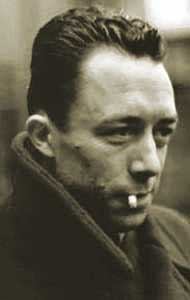
Mr. Robert Zaretsky who wrote the above titled article for Tablet Ezine is indeed an example of the absurdity he deplores. He is atavism personified. How can anyone in this post-Darwinian age be so simple and naive as to be a believing Jew. The human intellect has moved well beyond such simplicity. To be a Jew, a Moslem or even Fundamentalist Christian which is to say a distaff Jew should be a logical impossibility.
One might claim to be an Israeli, claiming allegiance to Israel, without making oneself look ridiculous but to claim nationality the same as everyone else is to renounce the extraordinaryly specious claim to some sort of special superiority based on an equally specious divine preference is quite akin to insanity in this post-Darwinian scientific world. The very idea of Yeshivas and Seminaries is repellent to contemporary knowledge.
Given this willful obtuseness one is not astonished to realize that ‘Jews’ renounce all involvement as the cause of the disorder, death and destruction from 1913, when the Jewish millennium was said to begin, to the present. In the height of arrogance the ‘Jews’ ascribe any resistance to the genocidal war begun by them in 1913 as ‘anti-Semitism.’ In other words one is to accept their dominance without a struggle; to resist is considered perverse.
Thus, what makes Camus at least an honorary Jew was his deferential embracement of the Jewish cause as his own. To Bob Zaretsky the actions of God in testing the Jews by an inexplicable defeat can only be compared to the trials of Job. Having been stripped of his children and property but remaining loyal to his perverse god:
We think we know how the story of Job ends: Rewarded by God for his loyalty, Job is paid back with even more children, sheep and property. But is this the ending? A number of biblical scholars suggest the Job we hear in the final chapter, the one who accepts and resigns himself to God’s power play, is not the same Job we hear in the preceding 40 chapters. Instead, he is a throwback to an earlier story that was grafted onto the otherwise perplexing account. Instead the real Job is Camus’ Job. He is a Job who answers God’s deafening and dismal effort at self-justification with scornful silence.
Thus, Bob, and one suspects all Jews refuse to take responsibility for their actions perceiving Camus here as some sort of intermediary. Bob, has a distorted notion of the relationship between his Jews and Europeans. He says:
In republican France Jewishness was largely a private matter: it was only when Nazi Germany buried the Republic in 1940 that Jewishness became a public matter and indifference to the fate of the Jews was no longer possible- or should not have been possible.
Bob completely overlooks the Dreyfus Affair of the 1890s that underlined the basic conflict between the French and Jews. Nor did the opposition cease with the unjust reversal of Dreyfus’ conviction but simmered along through the Popular Front and Blum years until the Nazi reaction. French dissatisfaction with the Jewish situation was always prominent, especially after the Eastern Jews stampeded the border during the late thirties and early forties creating havoc and destroying the French quality of life:
Yet when the authoritarian regime of Vichy passed a salvo of anti-Semitic laws in 1940, most Frenchmen and -women did not blink. One of the few who did blink- in fact doubled over in shock and revulsion- was Camus. Working for the newspaper Paris-Soir, Camus was stunned when his Jewish colleagues were fired. In a letter to his wife Francine Faure- a native or Oran, Algeria, who was very close to the Jewish community- Camus said that he could not continue to work at the paper; any job at all in Algeria, even one on a farm, would be preferable. As for the new regime, he was merciless: “Cowardice and senility is all they have to offer. Pro-German policies, a constitution in the style of totalitarian regimes, a great fear of a revolution that will not come: all of this to truckle up to an enemy who has already pulverized us and to salvage privileges which are not threatened.”
Camus was less than prescient about the revolution and totalitarian regimes as both are succeeding now worldwide. The question is who did Camus mean was pulverized- the Jews or the French? Camus according to Bob is plainly casting his lot with the Jews although conveniently excaping to Algeria beyond the Nazi reach. This then is the background of The Fall that gives Clamence his depression. God’s trial of Job was too severe in this instance for continued belief so that rather than complain Clamence/Camus turns his back on God in a disdainful ‘silence’ while pouting and drinking his life away.
Camus is a Jew, fully so in sentiment and the Fall is in reaction to the holocaust.
End of supplement.
III.
A Review
The Outsider (L’Etranger)
by
Albert Camus
Review by R.E. Prindle
Edition: Folio Society 2011
Comes now the time to review Camus’ The Stranger, Outsider or Misfit. A commenter or two have suggested I read The Outsider and I have. The only thing I can compare it and Camus to is the Grateful Dead. It is said that the Dead are an acquired taste. Over the years I have listened to the Dead for many hours in the attempt not so much to acquire the taste as to understand it. I know that Deadheads think that Jerry Garcia, of blessed memory, was a great guitarist but I can’t penetrate his style. In fact I find the Dead so distasteful I’ve given up on them.
I put Camus in the same category as the Dead; he must be an acquired taste except for those of a similar mind. Actually, I recently read the Myth of Sisyphus on line while I read The Plague several years ago. Zero sympathy.
The Outsider strikes me as a high school novelist trying to be heavy. Camus was twenty five in 1938 when he conceived the idea of his little trilogy, that included this book. The novel must have been written in ‘40-’41 as it was published in ‘42 during the war. I suppose most of us experienced the confusion of life in much the same way at twenty-seven or twenty-eight just before the age of reason bit at thirty.
My edition contains an afterword by Camus dated 8 January 1955 in which he says:
A long time ago I summed up The Outsider in a sentence which I realize is extremely paradoxical: ‘In our society (meaning French Algeria I suppose) any man who doesn’t cry at his mother’s funeral is liable to be condemned to death.’ I simply meant that the hero of the book is condemned because he doesn’t play the game. In this sense, he is an outsider to the society in which he lives, wandering on the fringe, on the outskirts of life, solitary and sensual. And for this reason, some readers have been tempted to regard him as a reject. But to get a more accurate picture of his character, or rather one that conforms more closely to his author’s intentions, you must ask yourself in what way Meursault doesn’t play the game. The answer is simple; he refuses to lie.
Camus’ evaluation of his story only proves once again that no author truly understands what he has written. Not only that but his is such a perverse interpretation as to be incredible. Meursault neither lies or tells the truth; he is just a passive receptacle of other people’s needs. Further, the book even if considered a fantasy doesn’t make sense; it doesn’t appear to be founded on human experience.
Obviously the story does not hinge on Meursault’s refusal to lie but simply his treatment of his mother and his refusal to show emotion at her funeral. That’s it. The fact that he killed a man in self-defense which is not brought out is merely an excuse for executing him for his perceived coldness toward his mother.
I don’t know the nature of French Algerian jurisprudence of the time but I find it very difficult to believe that judges adjudicating an ostensible murder would conduct the trial on the basis of whether a man cried at his mother’s funeral or not. Who knows what his actual relationship his mother had with him and so what?
The issue is the killing. As I read the story Meursault only drew his gun when the Arab flashed his knife. The glare of the sun on the blade intensified the threat so in self defense Meursault shot him. There is absolutely no reason that Meursault couldn’t have told the judge ‘the truth’- he drew a knife on me so having a gun I shot him. Where is the refusal to lie? The mother combined with the killing doesn’t make sense; there is no connection. But, maybe that’s what existentialism means, you got me.
The center of the novel which merely demonstrates the extreme passivity of Meursault doesn’t satisfactorily explain the sudden act of volition in shooting the Arab especially as he apparently didn’t construe it as an act of self-defense.
All through the main body he lacks volition just going where the wind blew. Raymond demands that Meursault be his ‘mate’ to which he complies even though Raymond is the last guy anyone would want to know while to be the mate of someone who mercilessly beats a woman is beyond comprehension. What is going through Albert Camus’ mind?
Marie, a woman he hardly knows proposes marriage to him so Meursault assents although he tells her he doesn’t love her and she doesn’t care. For me this nonsense is merely exasperating. I had no interest in any of the characters; the sequence of events make no sense other than to demonstrate the extreme passivity and lack of volition of Meursault.
The final outburst is in contrast to his passivity:
…I looked up at the mass of signs and stars in the night sky and laid myself open for the first time to the benign indifference of the world. And finding it so much like myself, in fact so fraternal, I realized that I’d been happy, and that I was still happy. For the final consummation and for me to feel less lonely, my last wish was that there should be a crowd of spectators at my execution and that they should greet me with cries of hatred.
Why hatred? The guy just said he was happy and contented. Like I say, Camus is an acquired taste. I have no interest in him but if you do- Enjoy.
By the way, has anyone read Sartre’s trilogy, The Roads To Freedom?
Greil Marcus The Shape Of Things To Come
July 14, 2007
Notes To A Review Of
Greil Marcus’
The Shape Of Things To Come
by
R.E. Prindle
Marcus, Greil, The Shape Of Things To Come, 2006, New York.
‘The Shape Of Things To Come’ a title borrowed from the mentor of today’s left, H.G. Wells, is Greil Marcus latest attempt at a prophecy of blood, guts and the doom of the United States. The price of Black slavery he prophesies will be blood flowing in the streets. ‘Trouble coming every day.’ as Frank Zappa put it. As to that point I am compelled to agree with him although to understand the reason why doesn’t require the religious ecstasy or possession he seems to believe he has.
I have already examined this problem in my essay The Deconstruction Of Edgar Rice Burroughs’ America that appeared on http://www.erbzine.com and in this blog in which without the rather specious gift of prophecy from De Lawd I projected by scientific reasoning that a Negro reaction to slavery is unavoidable.
I fear that the bloodshed Mr. Marcus prophesies may be upon us by the next Presidential election if there is one. I fear that there is a chance that President Bush may cancel the election continuing in power. Barring that possibility I fear days of bloodshed will arrive with the election of Barack Obama.
Thanks to a very large extent to the efforts of Mr. Marcus’ Jewish culture the American electorate has been debased to the point where it seems to be unable to deliberate on such matters of vital importance with any degree of intelligence.
In the first place the Black people have been in open rebellion since at least the 1965 Watts revolt, or riots as it is presently known.
The opening volley was undoubtedly the Supreme Court Brown decision of 1954 that slowly built into the violent eruption of 1965-69. Since then the direction has changed into a series of escalating acts of violence against individual Whites of which the recent sadistic violence against a White man and woman in Tennessee is the most detestable example. The Cutts murder in Ohio is another. Both murders have been passed over in silence by the Liberal confederates of the Blacks in the media.
The time is now ripe for the election of a Black President while Barack Obama who is totally unqualified appers as a bland and innocuous Black candidate. Personally as attractive as a Black Jack Kennedy and twice as dangerous and that saying a whole bunch. I fear that he will be nominated and elected out of White guilt for the slavery Greil Marcus loves to dwell on.
To this point I have heard no one inquire as to who might be Mr. Obama’s appointees to his Cabinet. Key posts such as Secretary Of State or Attorney General. After the slate of incompetent non-entities of the Bush administration I think the public has a right to know exactly who the friends of Mr. Obama or any other candidate for that matter are. In my opinion they are running as a slate of candidates.
Will we, for instance, have the Reverend Jesse Jackson fulminating from the pulpit of the Department of State? The Reverend Al Sharpton as Attorney General? Just who is going to serve with Mr. Obama? He is certainly going to have to satisfy his Black constituency at the expense of the White majority.
Can such a state of affairs be tolerated? Mr. Marcus obviously thinks not. As he prophesies the Black rebellion will break open and the streets will run red with blood.
Already in the State of Mississippi where in certain districts Blacks have seized the government they have denied Whites their Constitutional rights which has required Federal intervention to redress the situation. Whether the situation will be redressed without violence remains to be seen. With the possible or probable election of Mr. Obama I see the situation spreading from Mississippi throughout the South and unltimately the nation. The only possible result as Mr. Marcus foresees is civil war.
Any open warfare between Blacks and Whites will quickly inflame Mexican and Moslem passions so that within say four years the whole United States will be in flames.
Thus Mr. Marcus and his Jewish culture will once again have destroyed another civilization, culture and people. As if the Amalekites weren’t enough the Jewish culture disrupted Spain culminating in their expulsion in 1492. Attacking the whole of Europe that civilization was reduced to rubble between 1914 and 1945.
The Jews then moved on the Middle East where that area has been in turmoil since their arrival in 1948 and is now being reduced to rubble by them and on their behalf. That leaves only the United States which I fear will soon be their next victim to be reduced to rubble.
Even a casual reading of Greil Marcus’ Shape Of Things To Come will indicate that such destruction is something he and one presumes his culture gleefully anticipate.
With the election of Mr. Barack Obama I have no doupt Mr. Marcus’ hopes, dreams and wishes are in the bag.
End Of Review
Part 4c Springtime For Edgar Rice Burroughs
July 10, 2007
Springtime For Edgar Rice Burroughs
by
R.E. Prindle
4c
How Waldo Became A Man
In the complex of meanings of Waldo the question is how much Burroughs bases the character on himself. In the question of health there is no question that Burroughs had issues after his bashing in Toronto in 1899.
Judging from the Girl From Farris’s his health was a serious problem for him at least until early 1914 when he finished Farris’s. During those years he suffered from debilitating excruciatingly painful headaches for at least half the day. He either awakened with them or they developed mid-day. There is evidence that he became interested in Bernarr Macfadden’s body building and health techniques when Macfadden opened his Chicago facilities in 1908. If he were involved then perhaps the benefits of such a regimen were becoming apparent in1913-14. In 1916 in the photograph in puttees taken at Coldwater he looks like a healthy specimen and proud of it.
ERB gives Waldo the wasting disease Tuberculosis putting him on a regimen of exercise in the healthy dry air of his island thus curing him within a few months. This process is reminiscent of Grey’s hero John Hare of Heritage Of The Desert or the development of the Virginian in Owen Wister’s novel.
Burroughs claimed that his writing was heavily influenced by his dreamworld. If so then in this story as well as his others each character must represent a real person who figures in his life; the story must represent a real situation in symbolical form.
As authors so often claim their characters are composites it is likely that Burroughs also combines memories of other people with his own dreams. As Burroughs consciously manipulates his dream material he tweaks it into shape to make an entertaining novel then overlaying his conscious desires on his subconscious hopes and fears.
page 1.
In addition Burroughs retains his literary influences using them to give form to his dreamscapes. Indeed, his influences fill his mind so full they become part of his dreamscapes. The island he creates is similar to but not identical with Jules Verne’s Mysterious Island. This becomes very apparent in the sequel, The Cave Man, when Waldo sets about to improve his little society. He isn’t as obsessive-compulsive as Verne but along those lines.
Verne’s island figures prominently in many of Burroughs narratives. Oddly the book isn’t in his library.
ERB began telling his life’s story the moment he took up his pen. While John Carter seems to be dissociated from his own personality Tarzan is a true alter ego, a psychic doppelganger. Tarzan Of The Apes is a symbolical telling of his life’s story from birth to 1896 while the Return of Tarzan covers the four years from 1896 to 1900 and his marriage. (See my Four Crucial Years In The Life Of Edgar Rice Burroughs here on ERBzine.)
The Girl From Farris’s deals with the troubled years from 1899 to, it appears, March of 1914. Thus Cave Girl addresses his difficulties in making the transition to writer and then full time writer with the attendant marital or sexual problems. These marital or sexual problems occupy him through many novels in this first burst of creativity from 1913 to 1915.
Porges in working from Burroughs’ own papers in his biography has very little input from outside sources but some. The first material we have to work with from an outsider’s point of view is Matt Cohen’s fine edition of Brother Men, the collection of the Burroughs-Weston correspondence. Weston being ERB’s friend from MMA days. At the time of the divorce they had been in touch for forty years.
However I think that figure may be a little misleading as the two men had very little contact during that period. ERB met Weston in 1895 at the MMA at the beginning of the school year. He was one year younger than ERB. As Burroughs left the MMA in May of ’96 the two must have become fast friends in just eight or nine months. It isn’t probable that they met again before 1905 when Weston was passing through Chicago with his wife Margaret. At that time both Westons would have met Emma. From that time to the end of ERB’s Chicago period except for the occasional brief layover in Chicago the relationship was carried on by correspondence although as Burroughs seems to have some knowledge of Weston’s home town, Beatrice, Nebraska as evidenced in the second half of The Mad King it is possible he and Emma visited Weston but that would have had to have been between March ’14 and August ’14. Narrow window.
Thus when Weston talks so knowingly of Burroughs’ character in the letter of 1934 I will refer to I would have to question the depth of his knowledge. At any rate he claims to have knowledge of the difficulties of the marriage.
Weston was completely devastated by the announcement of the divorce. He immediatly sided with Emma breaking off relations with ERB for several years.
It appears from the letter of 1934 reproduced on page 233 of Brother Men that he contacted Burroughs’ LA friend Charles Rosenberger for information on the divorce. We have only Weston’s reply but not Rosenberger’s letter.
In reply to Rosenberger Weston says:
Quote:
I have known Ed since the fall of ’95. He has always been unusual and erratic. I have told Margaret many times, when Ed has done or said anything which seemed sort of queer that as long as I had known him he had always done or said such things.
(One of the most significant odd things would have been Burroughs leaving the MMA in mid-term in May to join the Army. One imagines that when he didn’t show up for classes next day the faculty asked: Where’s Burroughs. Perhaps Weston was the only one who knew and had to say: Uh, he joined the Army.)
I suppose looking back, that the fact that Ed has always been unusual, erratic and perhaps queer, has been his great charm and attraction for me.
Unquote.
I don’t know about you but if my best friend talked about me like that I would be less than flattered. There is another back handed compliment that Weston made to Burroughs’ father in his defense.
Burroughs’ father had made the comment to Weston that his son was no damn good. Good to have your dad on your side too. Weston defended ERB vigorously saying that he thought there was plenty of good in ERB, he just hadn’t shown it yet. Thank you, Herb Weston.
If one judges from the actions of Ogden Secor in Girl From Farris’s after he was hit on the head and if his actions approximated those of Burroughs from 1899 on then there was probably a very good reason for ERB’s unusual, erratic perhaps queer behavior apart from the fact that ERB had developed the typical character of his difficult childhood.
In reading the correspondence Weston comes across as a very conventional and highly respectable person; in other words, stodgy. It must have been that settled bourgeois quality in him that ERB appreciated. Weston did many of the things that Burroughs would have liked to have done. Weston did go on to Yale from the MMA which is what Burroughs would have liked to have done. Weston did become an officer in the Army.
On page 157 of Brother Men is a discussion of the Spanish American War. If I read it correctly Weston actually served in Cuba with a Tennessee regiment. So Burroughs had reason to be envious of him as he failed in his own attempts to get into Teddy Roosevelt’s Rough Riders.
Nevertheless Weston’s evaluation of Burroughs uses some strong language who after all didn’t have that intimate a relationship with him: unusual, erratic perhaps queer. Honestly, I don’t think I would have a friend very long who thought of me that way.
Weston is bitterly disappointed but later in the letter he refers to Burroughs as a crazy old man so, at the least, we can assume that to the average mentality Burroughs appeared eccentric. As one in the same boat I can’t help but root for the author of Tarzan. What but an unconventional mind could have conceived such a story.
Burroughs antecedents had created his persona by 1895 so the crack on the head in Toronto merely added to his unusual persona.
Apart from any inferences about Ralph Waldo Emerson and the Transcendentalists the sickly character of Waldo may represent Burroughs’ own health problems from 1899 to the time of The Cave Girl.
I feel certain that Burroughs followed some sort of health or body building regimen from perhaps 1908-09 when the American body building king Bernarr Macfadden opened his Chicago facilities to 1913. Although Ogden Secor of Girl From Farris’s was still sickly in 1914 perhaps Burroughs health was improving as Waldo evolves from a skinny sickly person to a ‘blond giant’ before our eyes. ‘Blond Giant’ also brings to mind Nietzsche’s ‘Great Blond Beast.’ I think it would be pushing it to say Burroughs read Nietzsche, nevertheless Burroughs always seems to be well informed when you look closely. He might easily have picked up references to the ‘Blond Beast’ from newspapers, magazines and conversation.
Weston is especially incensed at Burroughs leaving Emma who both he and his wife Margaret seem to have preferred. They did travel to California to visit Emma while ignoring ERB.
Weston quotes Rosenberger to the effect that ERB told Rosenberger that he had always wanted to rid himself of Emma. To which Weston replies:
Quote:
Charming, unusual, erratic personality that Ed is, there is no woman on earth that would have lived with him, and put up with him except Emma, and do not be fooled! Emma suited Ed plenty, until this insane streak hit him.
Unquote.
So we have an outsider’s view of the situation. He considers Burroughs over the line in his personality to be redeemed by his charm. Weston had asked Rosenberger his opinion of the situation between ERB and Emma. ERB had apparently told Rosenberger after the split that he had always wanted to rid himself of Emma.
As far as Burroughs’ persdonality goes it would be in keeping with a person of his background who had been bounced from school to school. Waldo may in part be a nasty caricature of the East Coasters Burroughs associated with at the Phillips Academy. As is well known Easterners at the time and still today disdain those from the West. One has the feeling that Burroughs valued his Idaho experiences highly thus the transformation from the wimpy Easterner of Waldo to the Blond Giant of the great outdoors may be Burroughs snub of his Eastern classmates.
At any rate when Weston met Burroughs at the beginning of classes in ’95 ERB’s personality seems set.
By ‘saying things’ one presumes that Weston means Burroughs had an outsider’s ‘eccentric’ sense of humor. I have a feeling that a few of we Bibliophiles know where that’s at. Certainly Burroughs’ stories reflect this trait. So, between Burroughs and Weston we have a clash of two different backgrounds.
As to Emma I believe that Burroughs was always dissatisfied with the fact that he had married when he did whoever he might have married. He has been quoted as saying that Tarzan never should have married so that idea can probably be applied to him.
If circumstances hadn’t forced his hand he very likely would have remained single. According to his psychology the right time for him to find a woman and marry would have been after 1913 and his success when he was in effect born again and a new man.
So when he says he never really wanted Emma as a wife I’m sure that is true. However he did marry the woman. So from 1913 to 1920 we have Burroughs struggling with his desire to honor his life long committment to Emma and his contrary desire to find his ideal ‘mate’ a la Dejah Thoris, La, Nadara and a number of others. Not so easily done in real life and after great success but still possible.
Added to his problem was his embarrassing behavior in Idaho when he gambled away the couple’s last forty dollars. Emma reacted badly to the Western interlude in their marriage. Burroughs’ rather feckless attitude toward earning a living between the return from Idaho and his early success in 1913 undoubtedly caused emotional problems for Emma but as Weston says she stuck by him during those lean years and as he says, there were a lot of them.
Even in 1913 when the couple earned the first real money they had ever seen Burroughs was recklessly spending it before he got it based only on his confidence that he would always be a successful writer something which by no means necessarily follows.
Emma was very proud of Burroughs as the photo ERBzine published of the couple in San Diego shows however her pride obviusly conflicted with her fears so that she may have nagged ERB in what he considered an unjustified way.
On one level Cave Girl can be construed to be a record of their relationship up to the moment with Burroughs trying to reconcile the relationship according to his confident understanding of the situation.
Writing in February-March in Chicago we have this view. In September of 1913 the family left for San Diego. Writing in San Diego during October-November in the Mad King things seem to be deteriorating as Burroughs seems to be pleading with Emma to be reasonable. Thus the Mad King concerns Prince and Pauper doppelgangers who are appealing to the same woman.
This situation may have been caused by a situation that would be very reminiscent to Emma of her situation in Idaho of ten years earlier. On this trip in which ERB and Emma were as alone and isolated as in Idaho ERB was taking another very large gamble with Emma’s and her three little children’s wellbeing at stake. As ERB proudly tells it the family, no longer just a wife, but a family of five were within an ace of being flat broke if any one of the stories Burroughs wrote in 1913 failed to sell. Unlike Idaho this was a gamble the Roving Gambler won. Now, perhaps Burroughs thought this redeemed his earlier faux pas, probably to himself it did. But what about Emma? What terrific anxieties assailed her as she wondered whether they would have a roof over their heads from day to day.
We need more facts. Perhaps the move from Coronado to San Diego was forced by necessity to reduce costs. Perhaps selling the Vellie was necessary to raise cash. Thus Emma in the midst of this actual plenty of a $10,000 income was a virtual pauper in silks and diamonds. Would there be any wonder if she were cross and nagging? As Weston said there were difficulties in living with Burroughs.
Burroughs then rather than attempting to make reasonable adjustments in his behavior yearned for the perfect mate who would ‘understand’ him.
Nevertheless he had to bear the burden assigned him. Let us assume that as Weston said, at one time Emma suited Ed plenty. That’s an outsider’s opinion but the evidence of this group of novels is that ERB was doing his best to rectify his past for Emma. If Waldo is portrayed as clownish I’m sure that ERB had played the clown in real life for some time. As Weston said ERB had always said and done unusual things. He doesn’t say what they were but in all likelihood the things he said and did were meant to be jokes, to be funny. After all he describes Tarzan as a jungle joker. The jokes that Tarzan perpetrated originated in ERB’s mind so he had to think those jokes were funny. They were usually practical jokes. No one really like a practical joker. The psychological needs that go into a practical joke are compensatory.
Where he failed Emma in the past he seems to be trying to make up for it. Perhaps his financial gamble in 1913 in some way compensates for his gambling failure in 1903 reversing the outcome of 1903 and making it alright. His actions in 1913 are so zany one has to ask what he thinks he is doing.
e.
Leaving their little Eden Waldo and Nadara set out for her village where Korth and Flatfoot await him with Nagoola in the background.
Thus Waldo’s tasks as set for him by Nadara are to kill Korth and Flatfoot. Waldo quite correctly realizes that these two tasks are beyond his present powers. So, within sight of the village he makes excuses to Nadara then abandons her running away. He heads out to the Wasteland. He appears to be living in a near desert.
Over the next several months he transforms himself from a tubercular wimp into a ‘Blond Giant.’ Tarzan has black hair so perhaps Waldo has to be blond.
One can’t be sure but this period may represent the years from John The Bully to ERB’s proposal to Emma. At any rate Waldo can’t forget Nadara having a longing for her. During his period in the Wasteland he fashions weapons for himself that make him superior in prowess to the cave men. He fashions a spear, a shield and what Burroughs jokingly, I hope, refers to as a sword, that is a sharp pointed short stick with a handle. No bow and arrow. So rather than a primitive Tarzan we have a primitive Lancelot. Waldo is actually outfitted as a knight, a la Pyle, while when he acquires the pelt of Nagoola he will be, as it were, encased in armor. So Pyle, or at least Arthur, is an influence.
In a comedy of errors Nagoola manages to kill himself by falling on Waldo’s spear. In one sense this means that Waldo has invested his sexual desires in Nadara while perhaps it is symbolic of Burroughs’ desire to do the same with Emma. At the same time the panther skin makes Nadara the best dressed girl around. It is perhaps significant that he kills Nagoola first before Korth and Flatfoot.
If one looks again at that ERBzine photo of ERB and Emma in San Diego one will notice that Emma is wearing some spiffy new togs. In her father’s house Emma was a clothes horse. In another ERBzine photo showing ERB and Emma walking in the wilds of Idaho Emma is still dressed to the nines while ERB shambles along beside her in a cheap baggy suit.
From that point in 1903 to the efflorescence of wealth in 1913 Emma had to make do with whatever garb she could afford which must have been depressing for her. As Weston says that was a sacrifice she was willing to make for her man.
Not in 1913 in Cave Girl but in 1914 in Cave Man Waldo invests Nadara with Nagoola’s pelt. Now, Waldo suffered grievously to acquire this skin. That was a major battle out there in the Wasteland. Let us assume that the skin represents Waldo’s sexual desires and that in clothing Nadara in the skin he is making her his queen or princess.
Thus in 1913-14 for the first time in his life ERB is able to reestablish Emma as a clothes horse. He has finally been able to do his duty as a man and husband. She can now buy as many clothes of whatever quality she likes and ERB is happy to have her do it. So, in a symbolic way ERB had a terrific struggle that scarred him psychologically as Waldo was physically scarred by the talons of Nagoola. Now, Burroughs was proud to be able to dress Emma to her desires. In the same way that the panther represents Waldo’s investing Nadara with his sexual desires so Emma’s clothes represent the same to ERB.
It was now up to Emma to forgive ERB for his failings and treat him as her hero. Perhaps ERB was a little premature. I think that he would have had to woo her all over again. While he had conficence he would be able to go on writing indefinitely the surety of such was problematic to others like Emma and actually ERB’s editor at Munsey, Bob Davis. Davis told him point blank that guys like Burroughs start strong, shoot their wad and fall out after two or three years. As far as others were concerned Burrroughs future remained to be seen. The evidence is that Davis and other editors thought that Burroughs had Tarzan and that was it. Apart from the Mars series how much of this other stuff was pubished to humor Burroughs to cajole more Tarzan novels is a question. Still, the fans seemed to receive it well. Cave Girl was even serialized in the New York papers.
Nadara has set Waldo three tasks all of them murderous. He is to kill Nagoola, Korth and Flatfoot. Having fulfilled the killing of Nagoola Waldo after several months sets out to return to Nadara to fulfill his last two committments.
Before he invests Nadara with Nagoola’s pelt he first kills Korth and Flatfoot. These are monster battles where like the knights of old, Lancelot, Waldo is hurt near to death.
Now, what would Emma nag ERB about during those lean years? The clothes have already been discussed so that leaves the monetary success to acquire them. So the slaying of the pair of cave men may represent financial success. Financial success came with the creation of John Carter and Tarzan. So let’s assume that Korth represents John Carter and Flatfoot Tarzan. The creation of the two or the slaying of those dragons opens the way for the hero Waldo/ERB to present Nadara/Emma with the first task, clothing.
Having killed Korth and Flatfoot Waldo still has to make up with Nadara for abandoning her at the threshhold to her village. Not an easy task. Waldo pleads that he has done everything she asked but she remains obdurate. This probably relflects ERB and Emma’s situation. A situation that apparently was never satisfactorily resolved.
But then it seems as though there is a change in the characterization and Nadara reverts back to Nadara of the beginning of the book while Waldo, believe it or not, becomes a god, if Nadara had known what gods were. Waldo scrambles up some fruit trees to toss down some food that seems to bring them together. In the last pages Burroughs gets schmaltzy writing close to purple passages.
At this time Nadara spots a yacht out over the waves. The yacht is a major theme during the teens and especially in this 1913-14 period. The significance seems to be that Burroughs envisioned his early life as The Little Prince as life on a yacht. Then the big storm comes changing his life as it sinks. Then begins the struggle for existence capped by the eventual triumph.
The yacht first appeared in Return Of Tarzan. This is its second appearance. Tarzan wasn’t on the yacht in Return and Waldo doesn’t get on the yacht in Cave Girl although he does in the sequel The Cave Man but that was a year later in 1914. So things are evolving rapidly in ERB’s psychology.
In this case he plans to join the yacht that he recognizes as his father’s. Having abandoned Nadara once she imagines he is about to do so again so she runs off.
Thoughts run through Waldo’s mind as he envisions a return to civilization with Nadara.
Quote:
For a time the man stood staring at the dainty yacht and far beyond it the civilization which it represented, and he saw there suave men and sneering women, and among them was a slender brown beauty who shrank from the cruel glances of the women- and Waldo writhed at this and at the greedy eyes of the suave men as they appraised the girl and he, too, was afraid.
—-
“Come,” he said, taking Nadara by the hand, “let us hurry back into the hills before they discover us.”
Unquote.
And so Waldo decides to remain in the stone age.
He and Nadara had left the little bag containing the relics of her mother behind. The crew of the yacht discover the bag just on the inland side of the forest.
Then we discover that Nadara is in fact the daughter of French nobles. Burroughs seems to have some love affair going on with the French. Many of his most attractive characters such as Paul D’Arnot, Nadara here, Miriam of Son of Tarzan are Gallic. So Burroughs admires most the English, the French and the Virginians it would seem.
Nadara is the daughter of Eugenie Marie Celeste de la Valois so she is a legitimate princess.
Thus ends the Cave girl with seeming finality. The way is open to the sequel but the closing seems final.
I haven’t read a book that replicates the final scene but I suspect that ERB borrowed it. I wouldn’t be surprised to learn of an earlier duplicate.
End Of Part 4c.
Part 4a,b Springtime For Edgar Rice Burroughs
June 21, 2007
Springtime For Edgar Rice Burroughs
3.
In The Beginning:
The Renascent Burroughs
a.
The psychological release Burroughs experienced when he began to realize the potential he had always felt must have been especially gratifying. In all likelihood he believed he was beginning a new life, born again, as it were. It wouldn’t have been unusual in this circumstance that he wished to dissociate himself from his entire past of failure.
For this reason it is possible that California loomed as the destination in which his new life would unfold. Making the change was difficult and would take him six years to consummate. One asks, why California? Why not Florida, for instance. I think the answer may be in his three most favorite novels: Mark Twain’s Prince And The Pauper, Little Lord Fauntleroy and Owen Wister’s The Virginian. Wister posits the West as a place of redemption and fulfillment while Burroughs youthful visit to Idaho may have had that effect on him. Hence Waldo the consumptive lands on an island as primitive as Idaho was to Chicago and becomes a man. So Burroughs may have viewed his visits in the West.
In the Prince And The Pauper a Prince becomes a Pauper and a Pauper becomes a Prince. In Fauntleroy the unknown princeling discovered his true identity thus exchanging the role of Pauper for a Prince while his alter ego the pauper Dick The Shoeshine Boy is transformed as well and through luck and pluck assumes a role of success in California as a rancher at the end of the story.
The Burroughs born a princeling then disinherited to a Pauper reassumed his role as a Prince but he had been inefaceably declassed hence though now a Prince as Fauntleroy he retains the psychology of the declasse as in the character of Dick The Shoeshine Boy. Dick at the end of Fautleroy moves to California where he finds work on a rach eventually becoming a success as a rancher himself.
It seem obvious that burroughs considered Little Lord Fauntleroy a book of destiny. Thus California would appear as his destiny. I believe that the reason for the six year delay in the actual move was necessitated by a need to combine the Fauntleroy and Dick the Shoe Shine Boy or The Prince and the Pauper into one identity. He had to have enough money to support the appearance of the Prince. I haven’t figured out why he wanted to raise hogs as yet but when he moved he anticipated only buying 20-40 acres which was well within his means, but when he arrived there Colonel Otis’ magnificent estate presented an opportunity to realize both identities in a property he couldn’t resist although he may have known he was acting in an unwise manner.
Even then it may have been possible to sustain the property if his economic situation hadn’t come under attack by the Judaeo/Red/Liberal Coalition in the early twenties.
A second very major p;roblem for him was Emma who now definitely became unwanted baggage. But, he also had the three children who were also as definitely wanted baggage. It is possible that for their sake he didn’t abandon Emma until they were grown.
His Anima ideal was foreshadowed in Dejah Thoris while in Tarzan Of The Apes he creates the stodgy but beautiful Jane Porter as a flesh and blood woman but not an Anima ideal.
The actual split begins to occur in The Return Of Tarzan when Burroughs bursting with confidence realizes that he is about to realize his visions of self-worth. At that point the past and all related to it becomes hateful to him. As might be expected he wanted to put all that behind him. Thus in creating a land of his fossilized past in Opar he also creates a vision of the ideal woman he would like to have in La of Opar. In Return the conflict between Jane and La becomes apparent when La is about to sacrifice Jane on the altar of the Flaming God. That she doesn’t means that Burroughs has elected to stay with Emma undoubtedly for the children’s sake.
But he begins to toy with ideal images in resolution of his sexual dilemma. Another woman becomes a possiblity that didn’t exist before. It would seem apparent that as Burroughs fame grew and he became a desirable sex object to women that opportunities for philandering would present themselves. At one time I believed for certain that he didn’t. Now I am less certain but there is nothing to indicate he did.
Nevertheless he does begin to explore other ideal possibilities. Nadara of Cave Girl can be seen as one of those explorations. Having created other possibilities in La of Opar Burroughs begins to develop the idea with the cave girl, Nadara. She is perhaps the most human of all of Burroughs’ Anima ideals. She is the daughter of civilized French aristocrats raised by a caveman to be a primitive woman. Thus she has none of the civilized inhibitions especially toward sex. Burroughs will now begin a series of novels concerning the sexual relationship well in advance of what he may have heard about Freud.
Once Nadara has accepted Waldo as her mate she is ready to cohabit. Burroughs seems to be advocating this as a sociological ideal; a revolt against the strict limits of civilization. However in a clash of cultures Waldo who is subject to the strict limits of civilization finds it impossible to establish sexual relations unless they have married according to civilized rites and customs. As there is no one in this stone age society to perform these rites Waldo keeps putting consummation off until such an opportunity arises, if it ever shall.
Bearing the psycho-sexual situation in mind an interpretation of The Cave Girl is possible on a number of levels. The story is set in motion with a variation of what will become the familiar ship wreck motif. In this case the Prince, Waldo, is washed off the deck of the ship by a huge wave that deposits him on the strand of a large stone age island in the South Seas. Thus Waldo has to begin life without any survival skills, born again as it were as a new born babe. He has become the Pauper.
At this point it might be best to introduce the major sources for the story that I have found. As usual there are several.
And then I received an email a day or so before this writing from Mr. Caz Cazedessus of Pulpdom Magazine. Having read the first couple sections he pointed out that Mr. J.G. Huckenpohler had written an article in the first Pulpdom issue relating Cave Girl to Zane Grey’s Heritage Of The Desert. I haven’t read Huck’s essay but I have read The Heritage Of The Desert which I have just reviewed. I can see a possible line of argument that shows a number of similarities in the plotting of the two novels.
Heritage was published at some point in 1910 while Cave Girl was written in February-March of 1913. That does leave a sufficient window for Burroughs to have read Grey’s book but it seems a little light especially as Grey was a newish author at the time without a definite reputation. However whether or not he may have read the book earlier it is possible that he read the book shortly before writing Cave Girl having elements of his plot suggested to him.
Thus both Waldo and John Hale, the hero of Heritage, are consumptives or ‘lungers’ as they say Out West. Waldo is from Boston, Hare from Connecticut. Hare goes West to Mormon Country to begin his regeneration while Waldo lands on his island. In both cases a woman is involved and two enemies are overcome by their respective heroes. So, as I say, I don’t know Huck’s argument but I’m sure it’s a good one. There are good reasons to believe that the plot line was an influence, an additional influence, on Cave Girl. Thus Heritage would be another influence on Cave Girl. OK, Caz?
As Burroughs was beginning life over there is also a definite influence from the first eleven chapters of Genesis from the Bible which I will make apparent in my essay.
Another very major influence seems to be the King Arthur mythology. I will make this apparent as I go along. While there is no doubt that Burroughs would have been familiar with Genesis it might do to try the root out his possible Arthurian influences.
While we have at least a portion of Burroughs’ library listed here on ERBzine we should never gorget that while growing up ERB would have had access to the libraries of his brothers as well as that of his father. George T.’s library would have gone back to the 1840s and probably earlier not including the then English classics such as Milton’s Paradise Lost, Bunyan’s Pilgrim’s Progress et al.
One imagines that there were Arthurian titles in the collections, at least Mallory’s Arthur. If the young Burroughs didn’t read the volumes through he would at least have handled them, browsed them and looked at the pictures, if any. We know his brothers recommended the related Greek mythology to him.
Certainly the medieval world was more often discussed in papers and magazines then than in our day. And then Burroughs did like Tennyson having his collected poems in his library. Thus ERB was likely familiar with the poet’s Idyls Of The King dealing with Arthurian stories. And those not following Mallory. Perhaps the most important Arthurian influence was Howard Pyle’s four volume retelling that while similar to Mallory’s differs significantly while Pyle adjusts the story to his own perceptions and moral concepts.
The reputation of Pyle would have loomed large to ERB. There is one Pyle title in his library, Stolen Treasure, but Pyle’s reputation as an illustrator would have drawn ERB’s attention to him. Pyle was the most influential illustrator of his time and perhaps in US history. His disciples were legion including Burroughs’ own illustrator, St. John. Pyle founded what is known as the Brandywine school of illustration.
It should be borne in mind that Burroughs had an aborted career as an illustrator before he began his successful career as writer. Burroughs was very proud of the time he spent at the Chicago Art Institute. So it would seem that ERB would have kept up on Pyle, Maxfield Parrish and others.
Pyle began rewriting the Arthurian story in 1903 completing the last volume in 1910 so Burroughs had plenty of time to ingest and digest the work before he began to egest it. Nor would Pyle and Tennyson be his only Arthurian influences.
I didn’t catch this in time to include the idea in my review of The Lad And The Lion but that story seems to be highly influenced by Pyle’s telling of the story of Percival from Pyle’s second volume, The Champions Of The Round Table. Naturally Burroughs borrows elements rather than the complete story.
Percival, I follow Pyle, was an orphan living in the forest with his mother far from the haunts of men. P. 263, prologue to Percival.
Quote:
Nor did he ever see anyone from the outside world, saving only an old man who was a deaf mute.
Unquote.
So Burroughs took the hint of the deaf mute and elaborated the idea.
The Lad’s entry into the world follows that of Percival. So also the Lad’s first sight of the desert horsemen replicates Percival’s first view of the ‘angelic’ knights.
As I did mention in my review there is a similarity between lad’s being named Aziz, translated as Beloved, by Nakhla and Percival’s thinking his name was ‘Darling Boy’ as his mother referred to him. If this last connection is valid then Burroughs also read some other Arthurian story as Pyle doesn’t tell his version in that way.
So, as usual, Burroughs mines the literature of the world to tell his story. Just as I was not aware of the influence of Grey’s Heritage Of The Desert I’m sure there are more I haven’t noticed. I may even find more as my essay unfolds.
Across the strand at no great distance is a forest representing the search for self-discovery and realization. On the mragin of the forest at dusk a figure appears. As we will learn this is the beautiful Nadara but Waldo in his hyper-fear and cowardice imagines the form to be some kind of monster of which he is terrified. The monster stands between him and the food and water he needs. In a metaphoric way then he is between the devil and the deep blue sea. He cannot go back and he is afraid to go forward.
In Burroughs own situation as he is making the fateful decision to quit his day job to devote his life to full time writing the meaning of the metaphor is quite clear.
There is also a way of looking at the tale as retelling of the Biblical Genesis. This opening scene may be represented as the Biblical chaos in which nothing is differentiated with the upper and lower firmaments resting on each other. Then a divine wind arose which separated the upper and lower firmaments.
Waldo is a comic figure while the novel itself is intended to be a comic or satiric novel. Thus Waldo who can stand the tension between the devil and the deep blue sea no more runs howling and screaming into the forest to do or die against the monster.
The shrieking may be seen as a humorous representation of the divine wind. Man having been created first as it seems pursues the phantom who turns out to be a woman. Thus Waldo and Nadara represent Adam and Eve.
Waldo’s charge into the wood can also be seen as a representation of Burroughs’ decision to become a full time writer. This must have been as stressful a decision for him as was Waldo’s charge against the demon. Once through the wood Waldo is presented with a sheer cliff that appears to be inpenetrable. So, another barrier presents itself.
Having traversed the forest that was after all fairly narrow Waldo had seen a woman scrambling up the barrier. Rather than pursue her directly Waldo reenters the wood to pick fruit and refresh himself.
This can be seen as Burroughs’ desperate attempt to become a writer. Another view of the strand and the demon of the forest- between the devil and the deep blue sea- is that Burroughs had to make the desperate attempt to redeem his life by writing. Thus that original difficult decision that might possibly be compared to Waldo’s being washed off deck by the wave while now Burroughs is faced with the even more difficult decision of working at it full time. Thus the charge through the woods might represent his giving up his day job.
It would be interesting to know at what point in the story’s composition his father died. What is even more interesting is that his father’s death did not interrupt his writing schedule. In fact in a year packed with traumatic occurrences nothing did; Burroughs continued to turn out his stories at two month intervals no matter what. It is true that he had several incomplete stories in this year which means he hadn’t thought the stories through so that it is possible that while he averted severe writer’s block when he reached the end of his chain of thought he just stopped, resuming the story when he had thought it out.
A prime example would be The Girl From Farris’s that he began about this time finishing it nearly a year later. The Cave Girl was completed at this point while The Cave Man its other half and sequel was completed the following July and August of 1914. It is possible Burroughs was trying to double his monetary return but I think it more probable that he was writing so fast with such a tight schedule that he didn’t have time to worry over completion so he just terminated his story at a convenient point and moved on to the next one that was also only half thought out.
As all this stuff is based on autobiography I am truly astonished that Burroughs was so undisturbed by the happenings in his life that he had so little reaction. I have read of authors who found writing personal stuff so difficult that they were driven to bed for a week or two at a stretch. I have never faced a long stretch like that but I have sought refuge in bed for a day or two a couple times. So Burroughs writing achievement here over 1913, ’14 and ’15 is fairly remarkable.
At any rate having made the decision to become a full time writer as symbolized by the charge through the wood. Burroughs if faced with an unforeseen barrier so he goes back to pick fruit. This could possibly be seen as having written his intial ideas out, that is John Carter and Tarzan, he had to organize his second crop of stories none of which had the impact of Carter or the Jungle God. Grey’s Heritage may fit in here as Burroughs searching for ideas and plot lines may have the read Grey’s stories at this time or just previously.
Led on by the woman Waldo had mistaken for a demon he now faces the new barrier seeking a way through. He has difficulty finding the path but once on it he discovers the opening through the wall. This is a motif Burroughs will use a number of times most notably in The Land That Time Forgot and Tarzan Triumphant, not to mention the entrance to Opar.
Now, all these openings resemble the birth canal or being born again. In the instance of The Cave Girl the result of the rebirth is self-evident as well as perhaps Tarzan Triumphant when he is about to leave Emma for Florence. The Oparian episodes would have to be examined more closely from that point of view especially as the four episodes occur at critical points in Burroughs’ life while involving sexual conflict between himself and Jane/Emma and another woman represented by his Anima ideal La. Thus, in Golden Lion when Tarzan leaves Opar with La to enter the Valley of Diamonds is it possible that he had a dalliance with another woman? One wonders.
At any rate Waldo squeezed through the opening to come out on a wonderland on the other side. There is never a thought of going back. In fact a cave man places himself between Waldo and the opening driving him forward. This could correspond to the flaming sword protecting the entrance to the Garden of Eden which would continue the biblical motif.
At the same time we have a clear reference to Alice In Wonderland or down the rabbit hole. We know Burroughs was familiar with the two Lewis Carroll stories.
Yet another barrier presents itself. Another cliff is before Waldo this one of cave dwellers another favorite motif of Burroughs especially during this period. Burroughs would have been familiar with actual cliff houses from his sojourn in Arizona with the Army while he would have been fascinated with the replica built for the Columbian Expo of ’93. At this point God created Woman as Waldo pairs up with nadara. Thus Waldo’s fears on the strand when he projected the character of a demon on this beautiful and compliant female were totally unjustified. But if Nadara represents the success that had eluded him for so long then his fears born of hysteria were warranted by his past. This is a comic novel at least at the beginning when Waldo begins his transition from the skinny, consumptive academic bookworm to that of a man of Tarzanic proportions. Thus at this stage of the book Waldo is a bumbling buffoon.
Burroughs is obviously ridiculing the Boston Transcendalist school of Ralph Waldo Emerson as Waldo’s name merely leaves off the Ralph and adds the ridiculous hyphenated Smith-Jones. The latter of course has pretensions to nobility but is compounded of the two most plebeian and common English names. Waldo’s name is as comic as Burroughs could make it. Worth a laugh or two on its own.
He may also be making a snub at his fellow students of Phillips Academy when he went East. It is well known that Easterners of the time, if not still, deprecated Westerners. Burroughs would have had to put up with much jesting and ridicule while there so perhaps he is now ridiculing those who ridiculed him.
Also he may be ridiculing his own former self.
Burroughs is fairly hostile to New England throughout his writing. He is positive on the South having more than one hero from Virginia while he is considerate of the middle states. Thus Waldo beginning as an effete New Englander will turn into something resembling John Carter/Tarzan or the Virginian of Owen Wister’s strange novel. Thus if one views Waldo in light of Burroughs three most favorite novels, The Prince And The Pauper, Little Lord Fauntleroy and The Virginian the basic tenor of all the stories is made apparent.
Waldo being pursued toward the cliff dwellings by the cave men with his legs pumping up to his chin and the stick twirling in his hand resembles a scene from a newspaper comic strip. It would seem that Burroughs was an ardent reader of the newspaper Funnies. David Innes Earth Borer was undoubtedly taken from a newspaper comic strip also. This incessant modeling or borrowing may explain a bit of the contempt for his work by contemporaries. ERB comes real close from time to time.
Having paired up with Nadara she and Waldo hold off the cave men slipping away in the night to Chapter 3, The Little Eden, which is a key chapter.
4b.
It’s A Lover’s Question
This chapter is so compacted I find it difficult to find a starting point. If Burroughs’ marriage with Emma had not run smoothly from 1900 to 1913 their relationship would become even more stressed from 1913 to 1920. The marriage apparently barely survived a major crisis c. 1918-20 finally being terminated in 1934.
The relationship of ERB and Emma is very difficult to comprehend. It seems clear that ERB had no intention of actually marrying her but wished to keep her on a string. This arrangement was doing well until Frank Martin entered the scene in 1897 or ’98. Martin forced Burroughs’ hand who was then compelled to marry Emma in 1900.
Over the years from 1900 on Burroughs developed an intense antipathy to Emma which expressed itself in its most naked form at the time of her death when ERB did everything but desecrate her grave. There must have been some deep psychological cause for this that isn’t apparent from what we know for sure of the relationship.
Perhaps the most critical event in their lives occurred on that streetcorner on the way to Brown School in the fifth grade when ERB was emasculated by John the Bully. Burroughs was then removed to the girl’s school a few months later. I have no evidence that ERB and Emma were walking to school together on that the fateful day but subsequent literary evidence points in that direction.
As a result of his emasculation it would appear that ERB was fixated in such a manner that he was unable to form relationships with women after that date and that Emma was the only female with whom he retained one. But as she reminded him of that fateful day he both rejected her and couldn’t do without her. Thus he refused to marry her yet didn’t want her to marry anyone else. When circumstances forced him to marry her this may have begun his irrational resentment toward her. As there was no other woman possible for him until the beginning of his psychological liberation in 1913 he may have tolerated her, but just.
Success seemed to liberate repressed areas of his personality and we find him dreaming of an ideal mate quite different from Jane/Emma. If one assumes that John Carter is an idealized Edgar Rice Burroughs although Burroughs projects the role of uncle on him while maintaining a dissociation from him until the end then Carter’s affiliation with Dejah Thoris on Mars would be ERB’s first Anima projection. However Dejah Thoris is more closely related to Jane. In La of Opar and Nadara Burroughs’ Anima ideal shifts more toward a wild or nature woman. This aspect of the ideal is realized in Balza, The Golden Girl of 1933 who is also represented by Florence.
So, in Cave Girl an emaciated, consumptive, over intellectualized Waldo Emerson Smith-Jones mates with the primitive Nadara who still retains the imprint of her civilized parents down by the river in the Little Eden. Thus we have Adam and Eve in the Garden before they leave never to return.
The problem of male-female relations is a dominant theme in Burroughs’ writing. Indeed the theme is one that preoccupies all writers of fiction in one degree or another. In this aspect Freud is merely a prominent writer on the sexual condition of men and women. He is perhaps more systematic but not necessarily more profound.
For instance Freud asked in a title to one of his essays What Does Woman Want and gives neither a profound nor very thoughtful answer. If he had read E.M. Hull’s 1921 novel, The Sheik, he would have have had somthing of an answer written by a woman. Burroughs did read the Sheik. He understood what Hull was saying. His answer was the major burlesque of the Alalus people of the Tarzan And The Ant Men of 1922. In this charming story of the The Cave Girl he give his 1913 answer to the question of what woman wants in a credible manner.
The answer in this case is age old. The answer was clear from ancient times to E.M. Hull’s clear story. Mostly it would appear what woman wants is a powerful protector willing to perform her will when a problem exceeds her own powers thus recompensing her for the missing X and more especially the missing y chromosome. The latter what Freud called Penis Envy. One can only conclude that woman wants to be whole, to be chomosomally undivided. Thus as a famed LA procuress once said: A woman is only as powerful as the man beside her.
Now, Nadara projects a character on Waldo as her fierce and powerful protector. As love begins in Waldo’s heart the spectre of sex arises in their little Eden in the form of the Black Panther Nagoola. Is it a coincidence that the first syllable of both names is the smae while both end in a long A? Nadara the sexual temptress.
Prompting Waldo she demands whether he could kill Nagoola. That may have a couple meanings. It may mean could he despatch the animal and it may mean can he conquer or control the sexual urge. In Waldo’s case the anwer will be yes to both questions.
He does kill Nagoola in a comedy of errors in this comic novel. In its sequel The Cave Man he will adorn Nadara with the pelt of Nagoola thus making her the physical incarnation of sexual desire. Who says Burroughs wasn’t subtle.
Too desirous of impressing Nadara as a man of prowess he allows her to think he has already killed several Nagoolas.
Very pleased to hear this she says: ‘Good. When we get to my village I want you to kill Korth and Flatfoot.’ Well now, there was a committment that Waldo had no intention of honoring, at least in his present condition.
Thus, we have a demonstration of the thesis that women are responsible for conflict. Woman proposes, man imposes.
As they can’t stay in their little Eden forever they make the trek to Nadara’s people. Waldo is committed to killing the fearsome Korth and Flatfoot. He is terrified to confront them as well he might be. As they approach the village Waldo sends Nadara ahead then legs it out of there.
Thus we have the flight or fight dilemma that is another major theme of Burroughs. At this point in his career he isn’t ready to articulate his feelings as he will later. The dilemma relates to his confrontation with John the Bully in the fifth grade. At that time as Waldo in this story Burroughs elected to run. Now, you will notice that Waldo is with Nadara which is a pretty sure indication that ERB was with Emma that fateful morning on the way to school.
In point of fact either Korth or Flatfoot would easily have killed Waldo at this stage in his career as John would have cremated the much younger Burroughs. When he would later rationalize it there is no dishonor if fleeing overwhelming force which is surely true but has its consequences.
Thus Waldo like Burroughs was sent into the Wasteland. His problem now will be to figure out how to return to kill Korth and Flatfoot to reclaim Nadara.
4c.
How Waldo Became A Man
Prindle Of The Apes
June 7, 2007
Prindle Of The Apes
by
R.E. Prindle
Intro.
This is a snapshot of the world as it appeared to one man c. 1960. This was all before the technological advances of the late 70s wiped the old world off the map.
If the reader was born after 1955 it may seem that I am describing a foreign country which in many ways I am.
But, as the wise man said, an unexamined life is not worth living. I hope you like my little memoir such as it is.
Prindle Of The Apes
…he dreams of the sight
of Zulu impis
breaking on their foes
like surf upon the rocks
and his heart rises in rebellion
against the strict limits
of the civilized life.
H. Rider Haggard
from Allan Quatermain
It was the Big Bwana.
Tarzan And The Ant Men
The layers of Prindle’s education as he began his adult life were many. As with no other earlier generation his nervous system had to be organized to differentiate many different forms of experience. Primal of course was the living of his own life: what may be called objective reality. Mixing with his real live memories into a subjective reality in a manner in which they had to be compartmentalized were many forms of pseudo-experience. There was radio which in Prindle’s early life in the forties and fifties was composed of real life news and current events, fictional radio dramas by night, soap operas by day and the fantasy world of pop music. After the advent of Top 40 music radio his listening world converted to the psycho-sexual wailings of the psychologically wounded who made pop music.
The fiction of movies, animated films and the real life portrayals of the news reels entered his mind where they had to be stored and differentiated from his real life experiences as well as categorized as truth or fiction or a combination of the two.
Television added another several dimensions of experience to his young mind. For the first time he could watch actual events as they happened in far off locations like New York or Washington and after the introduction of the coaxial cable about 1950 he could watch or listen to real time events on the West Coast a full three times zones away. What was happening in daylight on the West Coast was relayed to the nighttime Eastern Standard Time.
Thus he could watch an LA Rams game live or view the Kefauver organized crime investigations and the demise of the demigod, Joe McCarthy in the Army hearings.
He watched the Bill Paley/Edward R. Murrow character assassination of McCarthy from which Big Joe had no defense or recourse.
And then there was the printed word. Newspapers and magazines poured out an endless stream of matter of which so much seemed of such timeless quality that he swore he would never forget it. He read the daily poem of Edgar A. Guest which entranced him by the seeming facility of composition while he was disgusted by the maudlin content. Yet day after day, month after month, year after year a new poem of creditable quality appeared.
page 2.
There were the comic strips of the papers and the comic books of super heroes that stood in large stacks until his mother threw them away. What did any mother ever know? He didn’t understand why but then how much ephemera can one boy, let alone a family, accumulate.
And then there was that great body of literature called Juvenilia. Some was truly drivel like the beloved Hardy Boys written as mere enterainment for immature minds. Yet much of it was great literature which had been degraded over the decades to be considered suitable for juveniles. Not least of these were Dumas’ Three Musketeers and Scott’s Ivanhoe both among the greatest creations of literature. Not that Prindle understood these complex works except on the action level but he was to return to them more than once in the succeeding years.
He read the pulps regularly, magazines printed on the cheapest pulp paper. He read them all: Westerns, Science Fiction (lots and lots of Science Fiction), Detective and True Romance as well as Argosy and True Magazines. His mind was well stocked with the incredible and fantastic yet he never confused fiction with reality. His intellectual life was a feast. The wonder of it all.
The greatest of all his early reading was the stuff that was the staple of B movies. L. Frank Baum, Conan Doyle’s great detective hero Sherlock Holmes who actually exists in most people’s minds on the cusp between fiction and reality. And of course, the one, the only, the most incredible hero of all times: Tarzan Of The Apes.
page 3.
Around the figure of Tarzan formed the immense and important psychological complex of the Dark Continent. The very heart of darkness, the Africa of both fact and fiction.
He imbibed the mystery of Africa that was no longer believable after the watershed year of 1960 when what was over ended and what would be began. A whole aspect of the education of Prindle became obsolete and slid to the ground like one of the towers of the World Trade Center. There was no better obituary for the European past in Africa than Alan Moorehead’s fine recapitulation issued in that year under the title of ‘The White Nile.’
One associates the history of White rule in Africa as being several hundreds of years in duration so Prindle was astonished to learn that central Africa only came under European dominion between 1860 and 1900. The Scramble For Africa. In fact two life spans of sixty years each bridged the entire era. The whole period could be encompassed by the memories passed down to no more than three generations. In 1960 one man could have remembered the whole history of European discovery and annexation from the Scramble till then.
One of the natives standing in one of those National Geographic photos of 1920 could tell the whole story. At least from his point of view. He would be unable to tell of the impact of Africa on the White Man.
page 4.
The Heart Of Darkness.
The savage primitiveness of Africa and its art made a deep impression on the European psyche ripping asunder several layers of civilized overburden to reveal the primitive origins of its naked self. At the time this was called ‘the thin veneer of civilization.’ The primal call of the wild beckoned to White men with irresistibility.
The bizarre untutored art of African tribes invaded the European subconscious to call forth wondrous responses. The crude wooden images, the strong primal masks, the scrawled designs all roused the subliminal imagination of Europeans.
About 1960 a recording of a mass by Blacks titled: The Missa Luba, performed by the Luba people of the Lower Congo took White Bohemia by storm. The combination of the primitive Luba recitation and the sophistication of the Catholic Mass was a stunning performance that seemed to unite the subconscious mind of Africa with the conscious mind of the White man. The power of the Missa Luba is undeniable. It is as moving today as it was in 1960.
Beginning in 1959 the Nigerian Ibo writer, Chinua Achebe, writing from the African point of view describes the designs drawn on the bodies of women as beautiful. To a Western eye they merely appear as rude but interesting squiggles. Go through some Geographics of the twenties.
The great explorers wrote the books describing the discovery or rediscovery of the source of the White Nile from which Moorehead drew his account. the great books by Burton, Speke and H.M. Stanley had appealed strongly to an earlier generation of writers. At the fount of imaginative novels of the mysteries of the Dark Continent stood the fantastic H. Rider Haggard. Himself a onetime resident of Natal, South Africa for several years, Haggard’s triumverate of African novels, King Solomon’s Mines, She and Allan Quatermain set the trend of an Africa full of undiscovered valleys, deserts and moutain ranges that could only be reached, even if only in your imagination, by the most intrepid or desperate of travelers. Strange places that time forgot still lived according to the ways of some distant epoch often prehistoric.
page 5.
Africa was still mysterious and unknown when Haggard began to write in 1885. Central Africa had not yet been explored. General Gordon was making his last stand at Khartoum. Explorers outfitted themselves for treks into Africa at the then legendary Abercrombie and Fitch store in New York City as they sat around explorer’s clubs just before setting out. After his terms as President ending in 1908 Teddy Roosevelt trekked across Africa shooting at anything that moved, big game or small.
I don’t know whether his trek fired the imagination of the greatest of the novelists of Africa but in 1912 Edgar Rice Burroughs began the series chronicling the adventures of the Big Bwana himself, Tarzan Of The Apes.
Tarzan Of The Apes found a place in the imagination of every American male from the series’ inception to the watershed year of 1960 when he was replaced by the Lord Of The Flies. That was a significant transition from what was to what was to be.
page 6.
Burroughs himself has never had his place in American literature and psychology recognized. From 1912 to his death in 1950 thirty-eight years later Burroughs turned out a total of 22 Tarzan books as well as dozens of other titles.
His creation Tarzan created a life for Burroughs as incredible as the Big Bwana’s. Tarzan’s success in books and movies was such a bonanza for Burroughs that he was able to found a city named after his hero in the San Fernando Valley of California named Tarzana.
In the light of racial events after 1960 the name is ironic, for Tarzan in Burroughs’ invented lingo means White from Tar and skin from from Zan. Must be a joke in Tar meaning White. Tarzan is named White Skin while Tarzana would therefore mean White Skin City. An amusing fact.
Burroughs was very fortunate to begin writing just as the movies came into prominence. Tarzan was a natural for the screen. Many silent movies featuring various Tarzans were made.
The movies incidentally rescued Rider Haggard who had fallen on hard times of destitution.
Burroughs had a marvelous facility for incorporating current developments into his novels. While Rider Haggard relied on time worn themes of Esoterica for his stories Burroughs was very up to date on the latest scientific discoveries. This was sometimes woven into the story completely unawares to the reader such as his answer to the Freudian interpretation of dreams in 1919’s Jungle Tales Of Tarzan. Only after finishing the passage does one realize what one has just read.
This was often done in fantastic juxtapositions. In Tarzan Lord Of The Jungle of 1928 Jim Blake a contemporary New york executive on a photo shoot safari gets lost somewhere North of Victoria Falls where he enters a hidden valley populated by descendants of the Third Crusade of Richard I who became lost ending up in this hidden valley. Finding them dressed in Templar chain mail Blake asks them to lead him to their Director. He has confused an authentic seven hundred year old Knight Templar society with extras from a movie set.
page 7.
Of course by 1928 Burroughs was very familiar with movie sets of Tarzan. With the advent of sound in 1927 the Tarzan that Prindle’s generation knew was about to hit the screen. The great Olympic swimmer Johnny Weissmuller assumed the role as sound came into existence. This truly Tarzanic figure epitomized the great Tarmangani. Mangani- ape in Burroughs’ talk, Tar= White, Tarmangani, white ape. The role was adapted to feature Weissmuller’s swimming acrobatics. Crocodile fights became much more common.
Weissmuller perfected the triumphant victory cry of the Great Bull Ape which every boy tried to emulate and perfect. Even today the icon of victory is that the victor puts his right foot on the body of his dead victim, beats his breasts with both fists and yodels out the cry of the great bull ape. The jungle was relatively quiet until Tarzan arrived.
Many hours were spent in basements and attics as boys practiced the famous yell. Many were the discussions and arguments over who had mastered it and who hadn’t.
Even movie heroes grow old so it became necessary for Weissmuller to retire. The fierce competition for the job went to a guy named Lex Barker who nobody had ever heard of. Most of us turned our backs on Barker. His own successors in the fifties never had a chance. I didn’t even know there were successors at the time. The role is still assumed but it is just not the same.
page 8.
The age of exploration was over; social conditions prevented the notion of the Great White Ape ruling over a Black Africa and living on. Dracula, Frankenstein, the Phantom Of The Opera and Sherlock Holmes had long successful careers before them but the Great White Ape vanished like the legendary Africa of old. (Revived on Broadway since I wrote this essay.)
Still, Edgar Rice Burroughs succeeded in creating a mythic character who could take his place alongside the timeless emanations of the subconscious. Few creations have. Homer hit the groove sharp as a knife in the Iliad. The knights of Arthur’s Round Table fill the need. Conan Doyle’s Sherlock Holmes gratifies the itch in spades. Frankenstein, Dracula, the Wolf Man and The Mummy rank with H.G. Wells’ The Invisible Man. They fill specific but limited areas of the subconscious but Tarzan Of The Apes encapsulates the psychic needs of the nineteenth century and the first half of the twentieth. A new or improved expositor of the faith is needed now.
No matter that so much of Tarzan is implausible not counting finding Crusaders in contemporary Africa. If one looks closely at Tarzan swinging through ‘the middle terraces’ of the trees of the jungle faster than you and I can sprint a hundred one wonders why no branches impede his swings on his trusty grass rope. While monkeys chatter in the ‘upper terraces’ Tarzan swings through the ‘middle terraces’ to escape an arboreal panther.
page 9.
But to examine the problem of ‘the middle terraces’ is to miss the point. It is like searching for the historical Arthur and the locations of his twelve battles or trying to find Sherlock Holmes address at 221B Baker Street.
Perhaps Arthur and his twelve battles did exist but they have no bearing on the story. Prindle has stood across the street from the approximate address of Holmes on Baker Street but the reality bears no relationship to the fiction. Prindle looked at the windows across the street for Dr. Moriarty and his air gun but could find no evidence the arch villain had ever been there.
So Prindle disregarded the difficulties of the middle terrace and all other difficulties. He just allowed Burroughs to amaze him. Prindle only read seven of the earliest novels. Over the years the stories and plot lines faded from his mind. He remembered only a few details of the stories and often those inaccurately.
What did stick with him was a vision of Africa. What affected him although the notions had slipped through his conscious mind into the subconscious were the beliefs and ideals of Burroughs as placed in the Tarzan stories.
Tarzan was a very scrupulous man of high ideals. While others might stoop to skullduggery to achieve their ends Tarzan never did. He faced every problem squarely, solved it and acted on the highest principles.
Prindle ‘remembered’ many maxims which he was able to repeat verbatim although he had no idea not only where he got them but that they weren’t his own original thoughts. There were half a dozen from Sherlock Holmes that were actual guidelines for his life. Chief among them was Holmes dictum that whenever you eliminate the impossible whatever remains must be the truth no matter how improbable. Prindle repeated the dictum constantly as his own not knowing where it came from. In rereading Holmes in later life he was startled to come across these dicta word for word.
page 10.
One of the most astonishing remembrances not from Tarzan but from the movie ‘The Incredible Shrinking Man’ which he saw in 1957 almost shattered him. Prindle had had a dream in which a spectacular image had occurred to him which seemed so original that he was amazed at himself. In the dream the detail was that he was standing before two men holding up a huge Gordian Knot on a large dowel. Standing in front of them Prindle’s only way to cut the knot was to manipulate a huge pair of scissors. The scissors were so large that he could barely raise the handles from the ground let alone open them to cut the knot.
He asked for help from the two men but all they did was hold the knot higher and shake it. Dream Prindle put the scissors under his right arm and leaned on them like a crutch.
This unusual image struck him as something entirely original of which he was very proud. However on reviewing the Incredible Shrinking Man he came across a scene in which The Shrinking Man is battling a spider. The Man is of the size where a needle is an appropriately sized means of defense. On the table beside him is a spool of thread and a pair of small child’s scissors. He drops the needle off the edge dangling from the string. He then tries to use these now huge scissors to cut the string which he cannot do.
page 11.
Thus this image worked away in Trueman’s subconscious to emerge transformed as an impossible solution to his own psychological problem twenty-five years later. Prindle was forced to ask himself; Is anything truly of one’s own making?
page 12.
Tarzan in any size, and in Tarzan And The Ant Men he was shrunk to minature, or situation would have been superior to anyone and ever triumphant. He was always magnanimous. Having experienced the entire range of existence from beast to civilized man he never ill treated the African natives or even the prehistoric men and women he met along the way. The Blacks or Gomangani (Go = Black, Mangani = apes) may have been primitive savages but they were worthy of respect as men in every way. The same attitude was true of Rider Haggard. Neither he himself nor his heroes ever referred to Blacks as Niggers.
Haggard’s hero, Henry Curtis, in King Soloman’s Mines even goes native in battle donning the Black’s headdress and gear to take his place in the Black army’s ranks where of course he proved that with or without the veneer of civilization the Englishman was best of all warriors.
The Blacks may have been almost another species but they were always thought of and treated as men among men. This was quite in contrast to Joseph Conrad’s Heart Of Darkness in which the Blacks were seen as sub-human.
In Burroughs’ fantastic Africa the Black natives were only one of many species of hominids. Burroughs himself was very widely read, educated on the up to the minute scientific theories. He was well versed in evolution. He seemed to intuit that there were many vanished varieties of hominids and he peopled his Africa with them back in those hidden valleys.
In Tarzan The Terrible Burroughs has a cave man riding a Tricertops like Alley Oop of the Funnies plus two varieties of tailed monkey-like hominids that undoubtedly came before the cave man but were more highly developed. Of course there is the crown of creation Tarzan himself. As is habitual with Burroughs he introduces the present into the prehistoric past bringing World War I into it with a struggle between a German officer and Tarzan for Jane. Son Jack and his rifle are also on the way. All this going on in a land that time not only forgot but never imagined.
page 13.
Prindle recalled none of these details but they prepared his mind to deal with scientific realities when it became necessary for him to resolve the issues in his own mind.
The balance tipped in the watershed year of 1960.
Whites and Blacks presented an insoluble problem to any thinking person coming of age in 1960. That there was and had been racial inequality was an undeniable fact. Prior to 1960 however the general consensus was and had been that racial equality was based on fact and not prejudice. Tarzan had, of course, treated all people of good will well regardless of race as deserving of respect. Underlying his feelings as well as those of American society was the notion that White people were the crown of creation while the yellow and Black peoples, poor fellows, were in fact evolutionarily inferior. The Whites were Bwanas to the lower races and Tarzan in Burroughs’ words was the Big Bwana.
Not their fault so no reason to condemn them but rather to pity them. They were, in fact, ‘the White Man’s burden.’
Prindle never took anyone’s word for anything so he neither sided with those who said all men were in fact created equal or those who said White men were created superior. The question was one to be decided at some future time. The two avenues open to him were personal observation and experience and study.
page 14.
Of the Negroes with which he came into contact he saw that they were quick at learning manual skills like football and basketball but when it came to perceiving general principles and applying them there seemed to be something lacking in their minds that prevented them from making connections. Not that Blacks couldn’t take an item and perceive different uses for it than that for which it was intended but they failed to understand the underlying principle.
This was true in all fields of endeavor, they seemed unable to move from the specific to the general on their own initiative.
When, looking at Blacks in their home environment of Africa it was obvious that from the moment Homo Sapiens evolved from the Last Hominid Predecessor to the beginning of the nineteenth century when Africa fell under the White Man’s dominion that Blacks had made no advances from the Stone Age. They had merely matured as Stone Age peoples.
They had never discovered the wheel, they had no writing, they had no metallurgy, no plow had broken the African plain, they had nothing but the most primitive social organization. They were in fact untutored savages.
This fact was somewhat puzzling to Prindle as everwhere else in the world with the exception of the aborigines of Australia and the various tribes in backward areas every people had advanced up the ladder of civilization. In fact the most advanced was the White civilization of Euroamerica; regretable to many but undeniable to all.
Whether White guilt prevented acknowledging the fact or not, it was so. The Peace Corps of 1961 created by Kennedy tacitly observed that truth. White superiority was so in every field of endeavor from art and literature to science and mathematics. There was no other people that competed with the White race most especially they of Africa.
Prindle could offer no explanation in 1960 at the age of twenty-two so we will have to use the year 1960 as a fulcrum balancing the past with the future.
A Nigerian Ibo writer began his literary career in 1959 when he published a book entitled ‘Things Fall Apart.’ Chinua Achebe began to explain the Black point of view of what happened when Black and White culture collided in his part of Africa. He directed his polemics at the West as he was from Southern Christian Nigeria and not the Moslem North.
He is not very explicit as to time, dates and location but it gradually emerges from his corpus that his home was on the coast in Eastern Nigeria. The times he describes seem to be between 1910 and 1930. As was Prindle’s experiences with the American Blacks Achebe doesn’t seem to be able to relate the specific to the general; in other words, he has no science. He has a wealth of carefully selected detail but no penetration.
Insofar as the details he does use they appear to be the same as those noted by White observers but seen from the other side. The photos of Africa taken in the 1920s and 1930s which portray a completely primitive people with bizarre body piercing, strange ornaments and squiggly designs on their bodies, strange scars and tattoos are seen as beautiful and exquisite by Achebe. Truly, beauty is in the eye of the beholder.
page 16.
While reading Achebe late in life Prindle’s ideas
formed in his early life were merely reinforced. He could see no reason to change opinions of Africans so eloquently expressed in Mooerhead’s White Nile. Those opinions were edited out in later editions to conform to subsequent notions. Nevertheless subsequent events in Zimbabwe, South Africa and elsewhere merely reconfirmed Prindle’s earlier opinions.
Nor were contacts with Europeans of the nineteenth century the first outside contacts Africans had made. As Moorehead pointed out a map prepared by the Greek geographer Ptolemy in 150 AD clearly and with very reasonable accuracy depicted sub-Saharan Africa from West Africa to Central and East Africa. The course of the Niger in West Africa was accurately shown minus the effluent which remained a mystery until the nineteenth century when the Niger was related to the Oil Rivers at the Bight of Benin. The true course of the White Nile was also depicted although the strong arrogance of academic European scholars forbade their acknowledging the accuracy of any of the ancient writers.
Ptolemy’s information came from Greek traders who penetrated Central Africa from the area of future Zanzibar so we may assume that ancient intercourse with Central Africa had been going on for centuries. Yet African developed little or technology.
The same is true with West Africa for Herodotus records a Libyan expedition which occurred well before his time of c. 450 BC.
The Romans built roads across the Sahara that were well trafficked.
After the ancients the Arab slave traders made descents on Africa continually for perhaps two thousand years or more. Black slaves are common in the Arabian Nights depicting a time of 700-800 AD. By the time Europeans came into conflict with the Arab slavers in the eighteenth and nineteenth centuries the slavers were all Moslems.
page 18.
This fact gave Trueman matter to wrestle with as American Blacks decried the slave trade as something peculiarly American. In fact slavery had been endemic to Africa from time immemorial. In Chinua Achebe’s story ‘Things Fall Apart’ he makes no mention of Moslem slavers or indigenous slavery dealing only with European slavers.
Yet from c1500 to 1830 African slave raiders abducted untold numbers of Europeans from Mediterranean shores who disappeared into the Dark Continent never to be seen again.
The European slave trade was in existence only a couple hundred years after which shame made them abandon the trade. By the time Europeans came into contact with Moslems in Africa they had abolished the slave trade amongst themselves now taking what must have appeared as a hypocritical stance to Moslems in attempting to force them to desist from slaving.
As inhumane as the European slave trade may have been it was peanuts compared to the inhuman attitude of the Moslems. Anyone who has read The Arabian Nights must be struck by the contemptuous attitude of the Moslems toward Blacks. This was certainly reflected in their methods of capture and transportation.
Moorehead quotes Stanley’s account of the great slave roundup he witnessed after he met Livingstone. The Moslem slavers opened fire on the Blacks like Teddy Roosevelt opening fire on the fauna of Africa slaughtering many while dozens of others who took to the river to escape drowned. Once captured the Blacks were marched yoked together hands tied behind their backs for a thousand miles to the coast.
page 18.
Once there they were packed into decks only eighteen inches apart for the long torrid voyage to Arabia, Persia and India. The torture of being unable to roll over or change your position must have been exquisite not to mention the stench and filth. If it doesn’t kill you as they say it makes you stronger.
There was nothing in the Koran to forbid such practices although there was in the Christian bible. However the very humanity of the New Testament may have placed Christianity at a disadvantage compared to Moslemism.
Moslemism did not call for any changes in social conduct or the organization of society. The introduction of Moslemism left the African social structure intact calling only for a belief in Allah and his prophet Muhammed. Slavery was already endemic to African society so that, strangely, while the Arab slavers annually corralled tens of thousands of Black Africans into slavery or death there was an acceptance rather than a rejection of Arab religion.
Christianity clashed with nearly every tenet of African religion including slavery, polygamy, native medicine men and nearly the whole fabric of African society. Therefore while Moslemism shared most native beliefs the issue of slavery was a man to man thing and not a moral problem.
The European invaders placed themselves in opposition to both. The enslaved Blacks and the enslaving Moslems. While Europeans were successful in eliminating the Moslem slave trade centered from Zanzibar they were never successful in eliminating the slave trade above Victoria Falls. Even today the slavers are active in the Sudan and the Horn of Africa.
page 19.
At the present time several thousand Somalian female slaves and their masters are transported to Portland, Oregon every year as immigrants to the United States. It is indeed a strange world.
Christianity also tended to destroy the social order of African tribes. The tribes were all small organizations located in specific geographical locales. There was no such thing as nations or countries such as Kenya or what was then Tanganyika now Tanzania. These agglomerations were artificial administrative units set up for the convenience of Europeans.
Thus the natives no longer were able to look to their old center for the resolution of their problems but to White men located in an administrative center far from their own tribal boundaries.
As Christianity made no allowance for native customs the established order had no incentive to adopt the religion unlike Moslemism which required no change of conduct. The appeal of Christianity and the White Man’s Power then was to the disenfranchised and outcast classes. As Achebe’s Thing Fall Apart clearly shows the ‘untouchables’ were the first to respond. Christianity in which all men are equal then made the ‘untouchables’ discard the trapping of their class making them visual equals of the ‘big men’ of their tribes.
As the representatives of the White Christians these native outcasts became the political superiors of the former upper classes. That was the meaning of Achebe’s title: Things Fall Apart.
page 20.
While the Moslem areas of Black Africa were relatively complacent a huge antagonistic split existed in the Christian areas. The antagonism did not take long to surface. Within less than sixty years from their actual annexation the Central and West Africans had thrown off their White colonial rulers.
The French and English had no real liking for West Africa with its oppressive heat and humidity but the English were more desirous of holding on to the more equable Central and Southern Africa. While it can’t be said that civilian English settlers moved into West Africa they did in Central and Southern Africa. In these areas the Whites resisted Black independence movements more staunchly.
The Europeans bequeathed a national state to men like Kenya’s Jomo Kenyatta who was himself merely a member of a small tribe. He now posed as a national ruler over both diverse Black tribesmen and a unified civilized English population.
The fearsome Mau Mau, a group of natives straight out of Tarzan erupted on the world consciousness in the early fifties as they terrorized and murdered the English settlers in the most primitive manner.
Alan Moorehead didn’t concentrate on the Mau Mau which he obviously found distasteful but the Mau Mau showed the obvious difference between Europeans and Black Africans.
Fifty or sixty years is a very short time to convert stone age peoples to a level of civilization that took many thousands of years to achieve even if the two peoples had been of equal mental abilities.
page 21.
Edgar Rice Burroughs who was a fairly astute student of evolution seems to have captured the general feel of the evolutionary process. He has his hero Tarzan experience each level of development from animal to Homo Sapiens. Thus Tarzan on one level is a pure beast raised among the great apes of Africa in the tribe of Kerchak by Kala his ape mother. Following Freudian theory Tarzan kills his father Kerchak although he mourns his mother’s death rather than following in his father’s wake.
At the age of twenty he leaves Africa for Europe and America where within the short space of two years he takes on the ‘thin veneer of civilization.’ Well, it was thin, you know.
Returning to the jungle he becomes the chief of a Black African tribe named the Waziri. While for Burroughs the Black Africans are by no means despicable they nevertheless appear to be an evolutionary way station between the pure beasts and the civilized Whites.
Tarzan, of course, inherits the English title Viscount Lord Greystoke so as John Clayton he stands at the apex of civilization as well as evolution as an English gentleman entitled to sit in the House of Lords.
Although the current genetic information wasn’t available to him Burroughs intuited, or accepted, the obvious evolution of the hominid from beast to Homo Sapiens.
While it may be controversial to place the White species at the top of the evolutionary scale there is evidence that such may be actually so. All men may not, in fact, be created equal. Perhaps an unpleasant fact but then nature is not concerned with pleasantness.
page 22.
It is generally assumed by scientists that because 97% of Homo Sapiens genes are shared by the Great Mountain Ape while the Chimpanzee shares 98% that those two species of anthropoids are evolutionary predecessors of Homo Sapiens. In other words that the earliest hominid predecessor of Homo Sapiens mutated from the Chimpanzee. I don’t know what the actual percentage is but I am sure that fifty percent or more of the genes of the fruit fly are shared by Homo Sapiens. All species most likely utilize fifty percent or more of the same genes as why not if evolution is indeed a fact.Are all the product of evolution? You bet. So what are you going to make of that?
One may assume that if evolution is progressing from the less intelligent to the more intelligent that the process need not necessarily stop at the apex of Homo Sapiens. In fact, there are three obvious main species of Homo Sapiens as well as two or more at the upper end of the scale not so obvious and a couple at the lower end of the scale also going unnoticed.
In coventional parlance if race is admitted as a fact those three divisions are known as races although they may be differentiating species. Scientists tell us that there is only four tenths of one percent genetic difference between the races as though a mere four tenths disproves something. Recent genetic discoveries indicate that genetic mutation is still occurring so that differences are accruing rather than remaining static or decreasing.
If we are going to accept and apply scientific evidence this then raises the issue of which race or sub-species in actuality is the most evolved and bears the evolutionarily active gene line.
It is assumed that the first hominid came into existence in Africa somewhere about two million years ago because the earliest traces of hominids yet found have been found there. Many unwarranted assumptions based on this notion have been made for racist reasons. For instance, because only Blacks were found in modern sub-Saharan Africa it is assumed that this early hominid was also Black or Negro as though there were some distinction in being possibly the same color as the Last Hominid predecessor. In fact no one knows what color the Last Hominid Predecessor was nor is there any way of ascertaining the fact.
page 23.
The distance between this early hominid who must have been much more closely related to the Chimpanzee following the logic is unknown. Perhaps it was merely half of one percent genetic difference. Perhaps the visual relationship between this hominid and the Chimp and Ape was approximately that as now exists between the Homo-Sapiens sub-species. No one knows.
Homo Sapiens is said to have appeared in sub-Saharan Africa only one hundred fifty thousand years ago.
So far as I know there are no remains existing of the hominid from which Homo Sapiens evolved. Nor is there much of a record for extinct hominids between the remains found in Olduvai Gorge and the evolution of Homo Sapiens. All earlier forms have disappeared. The various forms of another anthropoid, Homo Erectus, all existed alongside Homo Sapiens. Whether they preceded him is not clear but that they became extinct possibly with the passing of the last ice age.
Everyone agrees that the sub-Saharan Homo Sapiens was in fact Black and that the Whites and Mongolids evolved from this Black predecessor. This may be proven true if it is allowed to examine genetics objectively rather than impose subjective hopes on the facts.
However objectivity may be denied because reason suggests that the first species evolved from the Last Hominid Predecessor is probably the least evolved Homo Sapiens intellectually. It is possible that the first evolved Homo Sapiens is physically superior in the animal sense to subsequent mutations.
page 24.
There may be some physical law that a sub-species once manifested is no longer capable of further evololution. Thus the Great Mountain Ape probably is little different than its two million year old predecessor. The same would apply to the Chimp. Once having attained perfection for its specific limitations a species is as it were fossilized in form. Thus the Black as the earliest Homo Sapiens sub-species is probably as developed intellectually as it was, is and ever will be. Further Homo Sapiens evolution will be carried to conclusion by the Whites. Each step in the evolutionary scale however leaves the others behind as the Chimp left the ape behind and Homo Sapiens left the Chimp behind. Whatever color predecessors may be they must become predecessors and hence less evolved. This is a fact that if you can’t accept then you merely refuse to accept it for ideological reasons and your reasoning is invalid.
One must assume that at some point another evolutionary step will occur creating an entire new species leaving Homo Sapiens behind in the same relation to it as the Chimp is to Homo Sapiens. You must be able to grasp this point.
Politically and socially this conclusion must be unpopular but one either adheres to scientific truth no matter how unpopular or falsehood is allowed to reign.
If one goes from mere appearances it would seem that a hierarchy of intellectual ability leads upwards from the Blacks to the Mongolids to the Whites.
While all scientific achievement may not be attributable to Whites yet all scientific achievment is based on methods introduced by Whites. In an age where all scientific information is shared almost instantaneously Black and Mongolid contributions are miniscule compare to that of Whites. Further no people in the world have made scientific contributions which were not based on White science. Nothing has come from the Orient, nothing has come from the Semitic lands and nothing has come from Africa.
page 25.
While today Joseph Conrad’s Heart Of Darkness is dismissed for racial and political reasons yet the novel has its basis in fact. The contrast between the European invaders and native Blacks throughout Africa was too pronounced to dismiss. Nor was the difference merely quantative but qualitative too.
There is an ancientness to the Africans. There is the sense that they were and are incapable of rising above the stone age mental processes that characterize them. The Africans seem to have developed stone age thinking to a logical and stultifying conclusion by the time the Whites arrived.
The Uganda described by the earliest explorers was organized in such a sophisticated stone age way that terrifying customs abandoned by Europeans over two thousand years before had fossilized into a permanent and unchangeable way of looking at things.
When Moorehead describes the king of Uganda killing thirty people for the entertainment of a visiting dignitary one has to recoil in horror. Yet in one form or another such was the case throughout Africa.
The delicacy of Europeans prevents their acknowledging certain facts primarily because if they did they would have to accept the truth. Cannibalism was a norm nor did the Africans give up such customs. In addition to the Mau Mau Leopard Men in Kenya in the fifties Moorehead reluctantly concedes that medicine men still donned the skins of the great cats to ritually murder infants at the time of his writing in 1960. Chinua Achebe admits that humans were still sacrificed in times of great need in Nigeria in his time.
page 26.
Sekou Toure who was the Prime Minister of Guinea after 1960 famed as a poet in France still kept human flesh in his refrigerator like the American madman Jeffrey Dahmer. He explained that there were certain things White Men couldn’t understand. Well, apparently Dahmer could. With that explanation the ‘poet’ was excused while Jeffrey Dahmer who wrote no poetry was sentenced to life imprisonment.
In general the Black nations of Africa have rejected an uplifting Christianity which would force them to change their ways for a more tolerant Moslemism which makes no such demands on them.
Thus the Africa of Tarzan, the National Geographic and the Explorers Clubs passed away by 1960. Moorehead’s interesting book was the epitaph of the period.
Not all Blacks remained in Africa. The forced diaspora of the seventeenth, eighteenth and nineteenth centuries had spread the species throughout the New World from Brazil through the Caribbean to the United States.
The predominant slave populations of the Caribbean quickly politically dominated their areas reducing the White population to an ancillary status without any real rights. Whites lived apologetically on the islands barely tolerated by the Blacks.
page 27.
There even after extended contact with Whites and White science the Blacks made no advances over their Black brethren in Africa. They remained on the same intellectual level. Anyone who would deny that would deny the Holocaust.
In the United States the story was no different. It is true that from the seventeenth century to emanicipation in 1863 the Blacks were slaves. Still, there were ‘house niggers’ and ‘field niggers’. If the field Black was given no opportunities for education this could not have been true of the household help. Yet by 1960 as Prindle was entering young manhood there was no indication to him that Blacks had made any intellectual advance.
The Black situation was not a small problem to him while as the Black rebellion then in progress developed the problem became of the first magnitude.
The practical effect was a barbarian assault on the institutions of the United States hitorically unparalleled since the incursion of the Roman Empire by the German barbarians which culminated in the fifth century AD.
The result of the invasions in both cases will be the same although the Germans bearing the higher genetic development were able to develop civilization over time. The same will not be true of the Blacks who can only bring civilization down to their stone age level. Sad but true.
Were the Germans capable of intellectual development while Blacks are not? This was a burning question of Prindle’s youth. Were Blacks genetically inferior to Whites or was it merely a question of educational opportunities?
page 28.
At the time the only means of determining racial intellectual abilities was testing. This was in the form of the IQ test. Whites invariably scored higher on the average than Blacks and not just by a point or two either but the gap ws significant enough to raise wonder.
The Blacks countered that the tests were racially weighted in favor of the Whites. It was suggested that if tests were written in Black patois Whites wouldn’t do quite so well.
Perhaps.
But classes were not taught in either Black or White patois but in a good clean English which was the language of the people, land and literature. People from educated families probably had a few points advantage over those from families where intellectual prowess was not quite so demanded but such a fact could not be avoided.
Barring these natural variations in opportunity the playing field was level for all. The Blacks also advanced the notion that more money was spent per White student than for a Black student. While well received and even believed against clearly visible evidence to the contrary by Whites this argument too proved fallacious.
By 1970 every school district in America was fully integrated. Those in the North and West had been for decades. In fact the same amount of money was spent on every student White or Black. While this fact should have been clear yet Whites and Blacks advanced the opposite notion as fact.
page 29.
It was also true that all White schools had a better record than integrated schools where the levels were brought down by the Blacks.
Prindle was an independent thinker. He looked beyond the rhetoric at the true facts of education. Beyond education he drew from his personal experience. He noted that no matter how clever or how adaptive a Black might be his intelligence seemed to stop at the training level. They seemed to lack the ability to associate ideas and take the next step forward. This fact was noted by even such a sympathetic observor as Rider Haggard.
There were many, although out of favor and ostracized, who believed that Blacks inherently lacked intellectual ability. Prindle silently concurred with them yet he thought there was insufficient proof to commit himself one way or the other.
Edgar Rice Burroughs had come to definite conclusions as early as 1919. Burroughs was very well read while being absolutely up to date. Most of what he believed was still being put forth by Time/Life books in their series on prehistory although recent advances have invalidated some of Burroughs’ thought while he would have been eager in updating himself.
As Burroughs named it in 1919 the quality to be sought was ‘imagination.’ As he noted the beasts had none at all. He attributed to Blacks a modicum. He thought that only Whites were capable of imaginative flights and this as he judged it was only one in a hundred thousand. That would have been more or less evolutionarily correct.
Since Burroughs time and especially since 1950 the bounds of human knowledge have been moved forward incredibly in all areas. Most importantly for my argument in the field of genetics. With the discovery of DNA in the forties science has progressed to the point where the ‘human’ genome can be read entirely. All twenty-three chromosomes have been completely mapped or soon will be.
The mechanism of mutation or evolution can be understood. And evolution is going on constantly; a mutation that seems to leading to a species of astounding ‘imagination’ or intelligence.
Genetic findings allowed Prindle to put his mind at rest concerning the relative abilities of the three sub-species. It was clear to him that as the first species of Homo Sapiens to evolve from the Last Hominid Predecessor, the Black species stagnated while the Mongolids and Whites contintued to mutate adding intellectual capabilities to their Homo Sapiens shells.
Whatever the genetic difference between Whites and Blacks that difference was expressed in scientific intelligence in Whites while Blacks remained metally lethargic.
It does no good to say that many Whites are mentally lethargic while some Blacks seem to express scientific aptitude. Even if true on an individual basis that has no effect on the general proposition. As of this writing nearly all scientific advancement is coming from Whites. Contributions by Chinese and Japanese are slight involving mainly improvements to existing models and not leaps forward.
The Black species is notably absent in the ranks of scientists.
End of Essay
Part 2 Springtime For Edgar Rice Burroughs
June 5, 2007
Springtime For Edgar Rice Burroughs
Part II
by
R.E. Prindle
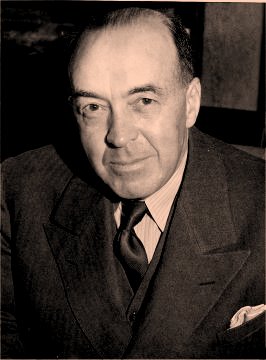
Edgar Rice Burroughs
Civilization And Its Discontents.
The period of Burroughs’ life was one of those great pivotal times of civilization. Civilization was in the midst of one of its great metamorphoses, scientific, political and intellectual. Changes which had been building up the last few centuries could no longer be absorbed by the existing religious structure. That structure was no longer viable. Its bursting mode was not only for the new Scientific Consciousness but the increasing scientific examination of the past opened the way for the revival of forgotten forms such as the Matriarchy. Thus along with the inevitable Patriarchal religious reaction the Matriarchy as well as suppressed occult religions forced their way through.
The reaction from contacts between civilizations sent various alien religions and ideologies into the Western leaven.
Confused with these intellectual challenges the agricultural basis of civilization evolved into a technological one. In the mid-teens for the first time in the United States there were more urban residents than there were rural residents.
New demands were placed on consciousness as more precision was required of the human mind. Man had had little difficulty adapting his methods to cycles of the seasons but the adaptation tothe rigors of the assembly line caused him problems.
That there was a backlash from this tremendous succession of changes should take no one by surprise. Adjustments were difficult and critical. In 1930 the founder of psychoanalysis, Sigmund Freud, published what may be his most famous title: Civilization And Its Discontents in response to this challenge. His notion of who the discontents were and of what they were discontented about is vague, indeed undecipherable.
In my estimation he doesn’t deal with the malaise at all.
On the other hand Edgar Rice Burroughs not only dealt with the malaise but offered a reasonable, if difficult to apply, solution to the problem.
page 1.
The malaise found many expressions. On the political front the socialists, Communists and anarchists were the most prominent reactionaries. Their activities reached a fever pitch in the first two decades of the Twentieth Century resulting in the two phases of the Russian Revolution of 1905 and ’17. The institutionalized discontents had their homeland after the latter date.
While Freud’s discussion of Discontents sounds generalized by the way he writes he is actually talkiking about himself and the members of his own Jewish culture and their problems with Western Civilization.
Thus Freud’s notion of Discontents falls somewhere between a general malaise and the discontent of the Communists.
The Religious Conciousness of course faced a problem that could only be resolved by surrender or reaction. There was no middle way. The evolution into Scientific Consciousness completely invalidated the religious approach. All religions are based on a false premise and Science exposed that falsity.
The transition to the Scientific Consciousness must be difficult and demanding as so few attain it. In my opinion this is because of the ongoing evolution of the brain. The Scientific Consciousness can apparently only be grasped by the further evolved. This doesn’t mean that those of a Religious Consciousness can’t work with scientific knowledge which requires only basic intelligence and a scientific environment provided by others but they are unable to envision advances.
Thus they find themselves left behind intellectually. It is the same as the difference between high and low IQ. Nothing can be done about that. However the Religious reaction is to attack those of the Scientific Consciousness to lower them to their own level.
page 2.
The problem was especially acute with Freud and his culture as Science per se invalidated all Semitic religious pretensions. This means all Semites and not just Jews. Neverthless as Jews were embedded in Western Civilization at that time and other Semites weren’t the Jewish culture was ‘discontented’ and was forced to negate science and the Scientific Consciousness.
Led by the Semitic surge of both Judiaism and Moslemism the very serious attempt to bury the Scientific Consciousness through genocide might just succeed.
As I point out in Part VII of The Deconstruction Of Edgar Rice Burroughs’ America the Jewish campaign to ‘abolish the White ‘race’ should be taken very seriously. Just because it sounds preposterous doesn’t mean it’s a joke. A segment of Whites is the bearer of the evolved gene or genes or combination of genes so that if this advance species were destroyed the wild religious reaction would succeed. Sounds just like some science fiction movie doesn’t it? Well, it isn’t.
The Scientific Consciousness created its own malaise in the newly evolving species. As literary and artistic types are always the monitors who pick up these trends first, if they don’t necessarily understand them, we shouldn’t be surprised to find a number of literateurs immersing themselves in the problem. One of the big texts is H.G. Wells important but neglected novel: The Food Of The Gods. In this novel Wells postulates that the emerging scientific Consciousness is a new species of human being. As with the real religious reaction Wells’ predecessor people wish to kill the new species. In earlier times when the world was less populated new or different species of human beings could move away from the old species. Now, the question is what makes Homo Sapiens Homo Sapiens and makes it different from the Last Hominid Predecessor? It is assumed by our scientific community that the Negro is the first Homo Sapiens species having evolved in Africa. This means that the Negro evolved from some sub-human Homo Sapiens predecessor. It’s easy, it has to be. So far no one has been able to produce an example of the Last Hominid Predecessor.
Now, the Negro was not the only, how shall we say, hominid species in Africa. The Negro apparently orginated in West Africa. The rest of Africa was inhabited by other species such as the Bushmen and Hottentots. These peoples are not Negroes and originated in Africa so the question is are they predecessors of the Negroes who we are told are the first Homo Sapiens or are they Homo Sapiens who precede or follow the Negro in evolution. Or, are they a separate non-Homo Sapiens species or are they perhaps the Last Hominid Predecessor. They are not Negroes so a place has to be found for them.
In any event the Negro and Arab combined to produce a new race or sub-species known as the Bantu peoples. The Bantus then invaded the territories of the Bushmen and Hottentots who ranged all of Africa South of the bulge, so we are told, driving the Bushmen before them. As I understand it the Hottentots are now extinct while Bantu pressure on the Bushmen is driving them toward extinction.
At the same time a newer hybrid of Black and Semite is driving the Bantu before it from its base in the Northeast corner of Africa known as the Horn.
So, Wells novelistic problem was that there was no longer a place on Earth for his new species to isolate itself. He was presented with the choice of his new species either displacing or killing off the anterior species or being eliminated itself much as the Hottentots and Bushman have been eliminated by the Bantu and as the Bantu and Negroes are being displaced and elminated by the new Black and Semitic Hybrid.
page 4.
So this was the problem c. 1900. This solution was repulsive to the existing Religious Consciousness that was psychologically unequipped to deal with this impasse.
As can be seen the Semitic special consciousness does not fear the problem In Africa in Darfur and the South of the Sudan they are actively pursuing genocide. In Euroamerica the Jewish Semitic culture is pursuing or advocating the same resolution of their problem with the White Euroamerican population. Following Semitic actions in Africa it should be clear to American Blacks what is in store for them.
So, Wells dealt with the problem in its political aspect. The internal aspect, the split in consciousness between the old and new was ably handled by a number of writers.
For a good introduction to the contrast between the Scientific Consciousness compare Holmes and Watson in Conan Doyle’s stories. In this essay I will concentrate on three others as well as Freud- H. Rider Haggard, Joseph Conrad and Edgar Rice Burroughs. Not coincidentally, I think, all three writers place their most important work in Africa. Haggard as the earlier writer rising to fame in Burroughs’ youth quite naturally had a great influence on the younger man, although I think Burroughs would have written of Tarzan and Africa with or without Haggard’s influence. The appeal of Africa is the contrast between the civilized White and the primitive Black. The two aspects of White consciousness. I hope to tackle this problem in more detail in my next essay, Edgar Rice Burroughs, Sigmund Freud And The Holy Grail.
There was nothing clearer to the English explorers, as well one might note as to the Southern planters of the US, than that there was a gulf between the intellect of the African and that of the White man.
Haggard expressed this difference in his novel Allan Quatermain. I’ve used the quote before but I will include it again here to keep the problem clear before us:
Quote:
All this civilization what does it come to? Full forty years and more I spent among the savages, and studied them and their ways, and now for several years I have lived here in England, and in my own stupid manner have done my best to learn the ways of the children of light, and what do I find? A great gulf fixed? No, only a very little one, that a plain man’s thought may spring across. I say that as the savage is, so is the white man, only the latter is more inventive and possesses a faculty of combination; save and except also the savage as I have known him, is to a large extent free from the greed of moey, which eats like a cancer in the heart of the white man. It is a depressing conclusion, but in all essentials the savage and the child of civilization are identical.
The great Liberal H.G. Wells was also clear on this difference. The nature of the gulf was the Scientific intellect of the White and the non-Scientific intellect of the Black. The question is how large did these nineteenth century men perceived the gap to be. Haggard in his Allan Quaterman, quoted above perceived the gap to be small while if one is to judge by the distance between Tarzan and the Africans Burroughs perceived it be not only large but insurmountable. Haggard thought the gap easily bridged while judging from Tarzan Burroughs thought it unbridgeable.
page 5.
It should be noted that Haggard was of the Old Religious Consciousness while Burroughs was of the advanced Scientific Consciousness. Of the two men Haggard writes from the experience of having viewed Africa or at least South Africa first hand. Everyone talks of Africa as though it were a county in Kansas whereas it is a huge continent of many diverse cultures. But, perhaps as the cultures seem to share the same level of consciousness perhaps that is the justification for speaking of Africa and Africans as a single unit.
Haggard lived in South Africa for several years as a young man while he was an astute historian and anthropologist. As a mythologist he was of the most gifted. His understanding is astonishing. He was quite familiar with all the Black peoples from the Zulus, Swazis and Basutos tothe Hottentots, Bushemen and Griquas. His judgements of the various intellects seems quite reliable. His writing is of most interest for the current rage of Zulu interest. His actual story telling ability is beyond compare.
Now, this is difficult to speak of because of the ideological stance of the Liberals and their Religious Consciousness that take the procrustean stance of trying to fit facts and reality into ideology whether they can be conveniently forced or not. They are currently anti-White and pro-African even going so far as to call for the genocide of the White species as I pointed out in the Deconstruction Of Edgar Rice Burroughs’ America. This is more than evidenced in their support of the genocide being executed in South Africa by the Shona chief robert Mugabe and the Bantu peoples of the Union of South Africa.
page 6.
There’s not much evidence that Haggard was interested or even aware of the theories of evolution which, if I may be so daring, it seems clear that Burroughs either was at the beginning of his career or became so as he aged aware of all the various strands of evolutionary theory. Thus Haggard comes across as more humane while Burroughs is more accurate.
A third opinion on the nature of the situation was provided by Joseph Conrad in his novelette: The Heart Of Darkness. One can’t be sure how much contact Conrad had with the situation he describes, but the influence of the primitive African mentality had the effect of dragging down the White intellect. As the advance in intellect was not so pronounced as Haggard noted the attraction of the primitive was so strong that many Whites retrogressed. Conrad’s hero Kurtz was an ivory buyer in the heart of the Congo. Through fraternization with the African he indeed loses his ‘thin veneer of civilization’ going native. On his death bed in viewing his period in the interior he exclaims ‘The horror, the horror’ and then ‘Exterminate the brutes.’
In point of fact if, as we are told, Homo Sapiens originated in Africa and the Negro is the departure point from the Last Hominid Predecessor which may be the Bushman or Hottentot then if this departure occurred c. 150,000 years ago, at the time the African came into contact with Whites he had made no move toward becoming civilized. Nor was he inclined to when given the example.
When H.M. Stanley interviewed the Uganda chief Mtese, that chief was incapable of visualizing anything other than trading. As he said he noticed that goods traded by the Arabs, who were first in the area, all came from Europe so he assumed that Europeans were more clever than the Arabs however he had no inclination to acquire the knowledge or skills. Nor have Africans attempted it to this day.
page 7.
As unpleasant as it may be to deal with facts or accept the science of the matter it is nevertheless necessary to consider that in the course of evolution the African brain has evolved to a certain level and stopped much as all the Hominid Predecessors did. Although Bruce Lahn of the Howard Hughes Medical Institute has been silenced his researches made it clear that the human brain was still evolving but not in all human species, only one.
It should be clear to even the most prejudiced observor that Robert Mugabe the Shona leader of Zimbabwe is in way over his head while as savage in his methods as any character Joseph Conrad could create. Nor is the reason unclear to certain Africans.
Writing in the Kampala Monitor of February 7, 2007 in an article entitled Uganda: Why Black People Have Remained Backward by Elias Biryabarema the author examines the problem:
Uganda has been fairly stable long enough. The conditions for an economic takeoff have been there for 20 years. Mr. Musevini has enjoyed generous goodwill from nearly all the world’s rich governments. Their largesse has poured in ceaselessly and in hefty amounts.
Uganda should have taken off. We haven’t. We’re stuck. And so is Tanzania, Sudan, Ethiopia, Mali, Burkina Faso, Kenya, Eretria, Malawi, Congo Republic and pretty much all of Black Africa, excluding the regions sole economic power, South Africa. This led me to pose a question to myself: Can Black people build prosperous societies?
Just about every reason- from slavery, colonialism, neo-colonialism to inequitable world trade rules- cited for the backwardness of Black African nations has been so debunked that it has now become necessary to look beyond the realm of such contemporary explanations.’
http://allafrica.com/stories/200702061131.html
Mr. Biryabarema concludes that Africans ‘only rise and touch a low ceiling.’ A disheartening realization but a cruel fact of nature because of the progression of evolution.
page 8.
So Africa came to represent an attractive past to Whites while the psychical split caused by the evolving brain caused them discomfort too. The brain had not evolved far enough to make a clean break with the animal past. What was Man, all species to do? Haggard relapsed into nostalgia. A longing to go back while nevertheless retaining his cranial development. His hero, Allan Quatermain while retaining his intellectual superiority to the Africans attempts to establish his kinship with his ‘Black brothers.’ Thus he takes a ‘Liberal’ attitude toward African/White relations that while seemingly humane has resulted in the atrocities against Whites being perpetrated by the likes of Mugabe and the South African leaders.
One shudders at Conrad’s Kurtz’s exclamation to ‘exterminate the brutes’ and yet the choice has turned out to be exterminate or be exterminated, while Africans have inexplicably opted for the latter. What can one say?
Burroughs on the other hand working from a philosophical point of view came up with a different solution. Nor is it entirely impracticable on the intellectual level. Both he and Freud begin from the same base. Both are reacting to the inhibitions and repressions placed on Man by civilization.
Burroughs seems willing to accept the ‘thin veneer of civilization’ in certain places and under certain conditions but he demands the right to be able to move freely from the primitive to the civilized state. Thus when Tarzan takes off his clothes he also removes the ‘thin veneer of civilization.’
page 9.
The basic problem for Haggard, Conrad, Freud and Burroughs is that they wish to retain the advantages of the intellectual aspects of civilization; none of them wish to opt for the ‘low ceiling’ of the primitive. They all wish to retain their advantages while indulging their primitive ‘natures.’ In some way each has to remain superior to the primitive state.
One can contrast this attitude with Mugabe of Zimbabwe and the ANC of South Africa who seem to be edging in the direction of removing all vestiges of the civilized state. They seem to be opting for a nostalgic return to the their savage past. They must have some understanding of the results of their destructive acts against civilization but choose to ignor them.
Conrad says simply- exterminate the brutes. Haggard adopts an avuncular attitude toward perpetual children. Burroughs assumes the role of…well…a god. Freud wishes to assume the role of plantation owner. The problem is insoluble except by the Shona method of ‘exterminating the arrogant bastards.’
For Burroughs as well as for Freud sex seems to be the key. Burroughs position is difficult to fathom. In all his cultures, societies and civilizations, and he creates a great many, nudity or near nudity is the ideal although as he is writing for popular consumption his characters remain sexually unexited and incredibly chaste under the most provocative conditions. Freud of course had everybody going at it like bunnies.
In Cave Girl Burroughs’ hero, Waldo Emerson Smith-Jones is the example of the over intellectualized man of extreme and enervating culture. Quite the opposite of Burrughs who obviously feels he has reached an ideal balance between the intellectual and the physical.
Waldo is meager then and consumptive when he lands on the island. He is obligatorily cowardly. He will find his Anima ideal in Nadara who is the antithesis of the civilized Jane being both nude and perhaps the most obviously sexually unihibited of any of ERB’s female characters. Burroughs contrasts her natural uninhibited sexuality with the inhibited sexuality of Waldo. There is a nice comparison with Freud possible here. Also with the Burroughs corpus there is room for an analysis of Nadara, La, and Balza.
During the course of his stay on the island , the natural primitive life will flesh Waldo out, build him up, give him conficence and make him courageous as well as curing his TB. Of course he never loses his intellectual attainments while using them to better his opponents and improve his situation. Thus neither Haggard, Conrad, Freud or Burroughs is able to resolve the conflicts of the discontents caused by civilization. As attractive as the primitive is it must remain an intellectual ideal.
Go to Part 3.
In The Beginning.
During the course
Springtime For Edgar Rice Burroughs
May 29, 2007
Springtime For Edgar Rice Burroughs, Part One
Including A Review Of
The Cave Girl
by
R.E. Prindle
Book I: The Cave Girl
1.
In 1912 Edgar Rice Burroughs was looking back on nearly forty years of humiliation and failure. As 1913 dawned, after that lifetime of suppression and depression it must have seemed as though the Millennium had arrived. Success on his own terms seemed to be within his grasp. The Gambler had finally won the gamble.
As the year turned he finished his fifth novel since he took up his pen in 1911, The Return Of Tarzan. As of the beginning of 1913 only two had been published and those only in pulp magazine form. Perhaps such publication was rewarding in the personal sense but the pulps had a very low literary reputation. Pulp writers were always second class literary citizens. Both his first publications created a sensation among the pulp readership while the second ‘Tarzan Of The Apes’ was a stunner.
His reputation was augmented when Tarzan Of The Apes began to be serially published in various newspapers. So while he had not established a reputation from the pulp publications the newspapers had spread his fame. Book publication was still a full year away.
Thus by 1913 A Princess Of Mars and Tarzan Of The Apes were before the world. Gods Of Mars would be published later in the year. His second novel, Outlaw Of Torn, had been met with outright rejection.
Based on this promising but hardly conclusive beginning, less than 2500.00 had changed hands in two years, Burroughs decided to throw over his day job to became a full time writer. As he says everyone thought he was crazy; without the benefit of foresight he most surely was. Burroughs himself even says he thought so. The Gambling Man was risking his all on a turn of the cards. His whole life he had seemed driven to take the riskiest and longest of long shots. His characters would behave in the same way. Shall we say on the positive side that it was an act of supreme confidence?
page 1.
Not only did he give up his day job but he set himself the daunting task of writing a story every two months of which he expected every one to sell. He ultimately wrote seven in 1913 of which all did sell. In this year of the most daring audacity he did earn over 10,000 dollars and that beat the cost of living and then some.
Burroughs won that bet, too.
The first book of the year, At The Earth’s Core began his Inner World series. It was also the begining of his exploration of prehistoric and evolutionary themes. The prehistoric novel was already a genre. Fictional treatments by Jack London and H.G. Wells were certainly known to him while he may have been familiar with the anthropological studies of J.G. Frazer in one form or another. Frazer made the phrase ‘the thin veneer of civilization’ a household phrase that Burroughs was so frequently to use and mock throughout his work. He may possibly have picked the phrase up through newspapers and magazines or possibly as David Adams has suggested through Jack London who used it before him and who we can be reasonably certain Burroughs read.
Frazer was at the height of his influence at this time having written three different versions of his most famous work, The Golden Bough. In 1910 he published a four volume study called Totemism and Exogamy that Sigmund Freud cribbed to write his own semi fictional work, Totem And Taboo.
Personally I would place Totem And Taboo with the prehistoric work of London, Wells and Burroughs. Read as a novel Totem And Taboo isn’t all that bad. Unfortunately Freud took himself seriously thinking he had more than he did. But as fiction Totem And Taboo is OK.
page 2.
Interestingly for Freud he formed his very speculative theories in the historical blind spot in the place between his intense Jewish Patriarchalism and the discovery of the Matriarchy that preceded Patriarchy. So his theories are somewhat skewed. Matriarchal theories were very stoutly resisted gaining any degree of acceptance only after the 1960s.
It is to Freud’s credit that he didn’t resist the concept. Even as early as Totem And Taboo he had heard of the discovery of the Matriarchy through the work of the Swiss mythologist, J.J. Bachofen, although he didn’t know how to incorporate the material. By 1938 he seemed to be conversant with Matriarchalism but still didn’t know how to fit it into his system. He was still touting the ridiculous theories of Totem And Taboo.
For some reasons I haven’t yet identified I find similarities between Freud’s and Burroughs’ writing. After all Freud did get his Nobel prize for literature not science.
Freud was in many ways a speculative and wild writer and so in fact was Burroughs. While the others wrote interesting but conventional prehistoric stories Burroughs discovered ways to link the various evolutionary stages with the present. While it is overlooked, at the time it was very innovative. The approach may have been suggested to him by his Prince and Pauper mentality in which he believed a clean break between his past and present had been made when he was sent to the Michigan Military Academy.
There is no clearer link for this possibility than the story of Tarzan. In Tarzan Of The Apes Tarzan was born a ‘Prince’ to an aristocratic British family but became a ‘Pauper’ when his parents died and he was adopted by the great she ape, Kala. Thus he was raised in a prehistoric environment before the advent of man. Tarzan then evolves into the fully human right before our eyes eventually becoming the very epitome of civilization. A thin veneer perhaps but a veneer.
So ERB devises all sorts of clever ways to somehow get his contemporary characters into prehistoric environments. In his fifth book, The Return Of Tarzan, he invents the lost land of Opar. Opar is a fossil city dating back to prehistoric Atlantis. The Oparians have never advanced beyond the culture of Atlantis and lost most of that. Behind Opar is an even earlier stage of culture called The Valley Of The Diamonds. This place is ruled by a highly developed form of gorillas.
page 3.
In Tarzan The Terrible Tarzan crosses a great swamp to arrive in prehistoric Pal-ul-Don. In the Inner World series he employs two methods of entering. In the first David Innes invents an earth borer that drills through the crust to discover a hollow core containing the Inner World. In Tarzan At The Earth’s Core Burroughs employs the notion of a North Pole entry using the dirigible O-220 to enter in that manner.
In the most wild of all the stories, The Eternal Lover, his hero Nu is gassed in what Burroughs calls the Neocene to wake up in the twentieth century. He acquires a lover with whom he successfully travels back to the Neocene. On the return journey to the present he failed to keep his grip on the strap and didn’t make it. Wonderful story concept. Certainly as fine as anything Burroughs ever did.
Then in the trilogy The Land That Time Forgot the crew of the submarine discover a submarine entrance to the lagoon of a large island that is prehistoric but covers the whole range of evolution from amoeba to full fledged humans. Quite daring actually and Burroughs is able to make these impossible stories work. If one compares The Land That Time Forgot with Freud’s Totem And Taboo I think it possible to find many similarities. Of the two Burroughs was by far the most successful writer in their time although he received no Nobel prize. Both writers have weathered the vicissitudes of fortune quite well. One hundred years from those days both men are top sellers although Burroughs has the edge.
page 4.
The novel under consideration, The Cave Girl has a terrifically interesting scenario. In this story Burroughs anticipates The Land That Time Forgot by creating a large prehistoric island off the shipping lanes that is ‘seldom visited’ although it seems that no one has trouble finding it.
In this story Burroughs reverses Tarzan Of The Apes. Instead of an infant boy being abandoned he has the infant girl, Nadara, survive her parents. Instead of a female ape rescuing Tarzan he has a cave man rescue and nurture the girl. The Cave Man retains a little leather bag containing the emblems of Nadara’s origins, while Tarzan has his father’s cabin and books.
In this instance Nadara having been left on the island, just as Jane and her party are landed on the spot of Tarzan’s father’s cabin so the civilized castaway, Waldo Emerson Smith-Jones is washed from the deck of the steamer by a big wave during a storm landing on the siland where as Tarzan watched Jane’s party arriving Nadara observes the arrival of Waldo Emerson Smith-Jones.
It isn’t stated how old she was when she and the civilized Waldo got together but I should think twenty on the analogy of Tarzan.
Burroughs’ two favored terrestrial locations for his stories are Africa and the South Seas. Both locations occupy legendary possibilities in the imagination of the West. They were thought to be locations where the White man was freed from the restraints and limitations of civilization.
page 5.
Go to Springtime For Edgar Rice Burroughs Part II
 I, Dynamo