Pt. 2: Tarzan And The River
May 8, 2011
Tarzan And The River
Part II
Edgar Rice Burroughs In Aspic
by
R.E. Prindle
When ‘Omer smote his bloomin’ lyre,
He’d heard men sing by land and sea:
An’ what ‘e thought ‘e might require,
‘E went and took- the same as me!
The market-girls an’ fishermen,
The shepherds and the sailors, too,
They ‘eard old songs turn up again,
But kept it quiet- same as you!
They knew ‘e stole, ‘e knew they knowed,
They didn’t tell, nor make a fuss,
But winked at ‘Omer down the road.
An’ ‘e winked back= the same as us.
-Rudyard Kipling
I want a dream lover,
So I don’t have to dream alone.
–Bobby Darin
First published in the Burroughs Bulletin
Spring 2003 issue.

Last Night He Had The Strangest Dream
As an author Edgar Rice Burroughs belongs to the generation of writers who wrote between the wars. He is or should be placed beside Scott Fitzgerald, Hemingway, Faulkner, Aldous Huxley, P.G. Wodehouse, H.G. Wells, John Dos Passos and John Steinbeck, among others. Further, of all those authors ERB was the best selling writer in the entire world. His reign came to an end in 1939 and then only after his talent was dissipated. This is a remarkable achievement against some very qualified and important writers. One doesn ‘t often hear of Steinbeck societies. Hemingway or any of the others but Burroughs societies exist in many countries around the world.
I consider myself an intellectual and literary snob, yet I acknowledge ERB as important an intellectual and literary figure as any of the savants mentioned above. ERB did not parade his knowledge and savvy as most writers are wont to do. He incorporated a fairly deep understanding of many contemporary issues without a hint of the lamp. Tarzan Triumphant is a case in point. Obviously the two religious groups in the novel refer to Jews and Christians, but there is no reference to either sect. One is left to infer that the Old Testament crowd led by Abraham, son of Abraham, is of the Old Testament while their rivals are New Testament. In so far as ERB allows the story to involve religious discussion, the moral is ‘a pox on both your houses.’
Even more remarkable is that over the writing of the published twenty-one Tarzans before 1940 all the novels are interrelated. ERB was able to keep his Tarzan facts in order over a twenty-seven year period of writing while being involved in the writing of dozens of other books. In point of fact the Tarzan oeuvre is a roman a fleuve- a river novel.
A River novle is a series of novels which traces the course of a nation, people, a family or an an individual over a period of at least decades. The first novel ever written was a River novel, that was the story of the Greek invasion of Troy.
The two surviving complete books of this remakarble story are Homer’s Iliad and Odyssey. Moreover, many fragments exist predating the events of the Iliad and after.
Perhaps the most prodigious of all River novels is the Vulgate Lancelot chronicling the adventures of King Arthur and his knights. The story runs on for thousands of pages.
In modern times Alexander Dumas’ five volume epic concerning the adventures of the Three Musketeers constitute a River novel. Trollope wrote two, that of the Pallisers and the Barchester series. The model for the twentieth century was Remembrance Of Things Past by Marcel Proust.
Edgar Rice Burroughs has always been treated frivolously, yet the Tarzan oeuvre is a work of some magnitude which does not compare unfavorably with Proust.
Proust’s work looks backward as he relives his life trying to make order of his psychology. Burroughs’ Tarzan oeuvre records his psychological development on a current basis as it evolves year by year.
ERB’s work is characterized as imaginative fiction while Proust’s is considered realistic fiction. In other words, realistic fiction builds on real life experience in real life situations, while the imaginative writer is compelled to ‘invent’ incidents.
Thus while the realistic writer draws primarily from personal experience and observations, the imaginative writer has to draw from published sources of either fiction or nonfiction or convert real life experiences into symbolic form. The latter is more true of science and fantasy fiction. If the science fiction writers of the forties and fifties hadn’t had a couple thousand years of esoteric literature to draw on there would have been little science fiction. Of course the writers so disguise their sources that without an extensive education in esoteric writings oneself the stories seem incredibly original.
Borrowing from every source is extensive. For instance, Arthur C. Clarke’s Childhood’s End is the same story as H.G. Wells’ Food Of The Gods with different detailing. Wells himself extrapolated his story farom Darwin’s Origin Of Species and The Descent Of Man. Darwin of course turned to nature, the ultimate source of suggestion, for his story.
That Burroughs borrowed extensively and sometimes blatantly is of little consequence, especially as his original contributions were so extensive and satisfying. As the opening poem by Kipling indicates, at least he was honest enough to admit of outside influences.
The Russian Quartet, or first four novels, is a tentative beginning to the Tarzan oeuvre. It is possible that the first novel, Tarzan Of The Apes, was just an attempt to express certain ideas about heredity and such related topics that ERB wanted to say with no thought of sequels. The story itself is absurd enough that it seems a miaracle that it was accepted and published. It is perhaps less surprising that it was so readily accepted by the reading public as the great figure of Tarzan rises shining from the pages. One ignores any story telling flaws to get a glimpse of the bronzed forest giant, the great Tarmangani, the jungle god, the Lord of the Jungle, Tarzan. A writer should be so lucky to come up with such an archetypal figure.
Return and Beasts find Burroughs groping for a direction. Beasts is is heavily influenced by H.M. Stanley’s writing on Africa as well as that of Mungo Park, not to mention Edgar Wallace’s Sanders Of The River. The story of Paulevitch’s experience in the jungle was obviously taken from Mungo Park’s Travels In The Interior Of Africa. Beasts itself which also has a lot of Defoe in it, is absurd to the extreme yet somehow redeems itself as one becomes entranced by the outrageous notion of apes and men row-row-rowing their boat down the stream. Somewhere either before the beginning of Beasts or after the end, ERB interweaves the story of Barney Custer and the Mad King and the Eternal Lover to bring his own psychology into the Tarzan character. Thus ERB pictures himself as the Son Of Tarzan in the novel of that name.
Having resolved, after a fashion, his conflicts with this father and somewhere in that tremendous gush of writing having integrated his personality, ERB then turns to himself as the conflicted Animus of Tarzan the Hero and Tarzan the Clown to resolve that psychological dilemma over the next seventeen volumes published during his lifetime.
The Russian Quartet was written over a period of three years. The eight novels between Son and Lost Empire were written over fourteen years. Whether the ‘Lost Empire’ refers to Emma and Opar is open to conjecture. In any event Lost Empire signifies a terminal junction in ERB’s psychology.
Then as the problems of his Animus and Anima resolve themselves ERB rapidly turns out six volumes over four years.
He had difficulty writing Tarzans while struggling with his psychology but wrote quickly once he had made up his mind.
From 1934 in psychologically related volumes to 1938 he published the three additional novels of Quest, Forbidden city and Magnificent. The psychologically relevant Madman was discovered and published in 1964, fourteen years after his death. Perhaps the thought the novel was too personal and painful to publish himself.
As noted “Foreign Legion’ is a propagandistic after thought to the oeuvre.
As ERB didn’t begin writing until he was thirty-six it is fair to say that his writing represents the effort of a mature mind. This is even more evident when one reflects that the majority of the Tarzan oeuvre was written between the ages of forty-one and fifty-eight. Lion Man, which is the culminating volume of ERB’s psychological odyssey was written at the last age.
The novels written between 1930 and 1934 which I consider excellent work and the best of the Tarzan oeuvre are the ones most often dismissed as repetitious. One of the very best, Tarzan And The Leopard Men, is, oddly enough, often dismissed as ‘hack work’. Very strange.
But to return to Opar and move forward from there. From 1912 or 1911 if you consider from the first moment ERB put pen to paper to 1915, things developed very rapidly in ERB’s mind. The rich experience of his lifetime, all his opinions, thoughts and fancies were so compressed within his skull that as I say he erupted with more than the force of Spindletop. It took him three years to cap that gusher and then the flow was strong and steady until 1934 when he realized himself.
Return was written in 1913 when his Anima, La of Opar, first pops up. She then disappears until 1916 when wife Emma apparently sneered at the wealth ERB had laid at her feet. She would not so soon forget the first twelve years of her humiliation.
Her rejection of ERB the Hero must have hurt Burroughs to the quick. Following Return he wrote The Mad King in which after numerous trials and tribulations and after he had disposed of Custer’s inept doppelganger, the Mad King, Barney Custer and the Princess Emma were reconciled. In all likelihood the story was a day-dream of wish fulfillment in the Freudian manner because in The Eternal Lover which followed quickly Barney Custer goes to Tarzan’s Equatorial estate but with his sister Victoria and not the ‘Princess Emma’. His marital relationship is obviously still very troubled. As noted, The Eternal Lover is a myth of the nature of Pysche and Eros, the Anima and Animus.
Interestingly, Boy Jack’s wife, which is to say ERB’s at the end of Son of Tarzan is no longer a princess but the daughter of a general. Emma had apparently been demoted in ERB’s emotions.
In a psychological quandary ERB has Tarzan leave Jane in 1916 to return to Opar and La for more gold to lay at Jane/Emma’s feet. This story is crucial for the rest of the oeuvre. ERB’s dream lover, La, spares his life and offers to marry him or in other words take him away from Jane/Emma. At this point in his life ERB is faithful in body if not in spirit. He declines her offer having his faithful Waziri stagger back to Jane under a load of one hundred twenty pounds of gold each.
Apparently the wealth of Opar of which tons of gold remained to be tapped as well as bushels of the very largest of diamonds (move ahead to the Father of Diamonds in the Forbidden City) is not enough to assuage Jane/Emma’s anger at Ed’s failure for the first twelve years of married life. She rejects ERB’s present income. This must have been a staggering blow for Burroughs who at this point in his life wanted to abandon his clown role for that of the hero.
He had already begun Jungle Tales Of Tarzan, which he managed to finish, otherwise from Jewels of Opar to Tarzan the Untamed there is a hiatus in Tarzan novels for thirty-nine months. For over three years he and Emma were apparently at a stalemate making it impossible for him to write further Tarzan adventures.
When Tarzan returns it is as The Untamed and he and Jane have been separated, possibly for good as Tarzan has no idea where she is; common report is that she is dead.
One may infer that the marriage is all but over. It takes another twenty-three months before Tarzan The Terrible appears. Tarzan goes from Untamed to Terrible. Apparently ERB and Emma are now temporarily reconciled as Tarzan finds Jane in the forgotten land of Pal-ul-don (paladin?) and he, she and Jack go swinging down the jungle trails to return to Equatoria. the family is reunited. But is it?
After the passage of twenty-two months Burroughs follows Terrible with Golden Lion. Now the title Golden Lion is somewhat misleading as the Lion doesn’t play that large a role in the story. The Lion seems to have sprung from Burroughs’ subconscious as a defense against the Lion of Emma. In this story Tarzan leaves Jane for a fairly extended visit to his dream lover, La in Opar. They are together for some time as they adventure into the adjacent lost valley called The Valley Of Diamonds. (Once again, see Tarzan And The Forbidden City.) Possibly the Father of Diamonds represents the Jewel of Great Price which turns out ironically to be a piece of coal. This was after ERB left Emma for Florence.
Golden Lion introduces the great doppelganger of Tarzan, Esteban Miranda. I am absolutely fascinated by this character. Miranda looks, talks and walks so much like Tarzan that not only can’t Jane/Emma tell them apart but Miranda even fools the faithful Waziri.
Golden Lion is paired with Tarzan And The Ant Men. You have to read both to get the whole story.
Esteban Miranda is a London actor, a clown and a cowardly fool. ERB goes to great lengths to deliniate the character of this unpleasant but goofily amiable alter ego.
In the confusion Miranda is captured by a savage tribe of Blacks where he is spared because of his resemblance to Tarzan. He escapes finally although he is a blithering idiot who has lost his memory. Get that! Even Tarzan’s doppelganger loses his memory. I haven’t been able to fugure out ERB’s problems with his memory yet.
He is discovered by the Waziri where he is once again mistaken for the real thing. He is taken to the ranch house where Jane nurses him back to health. Still mistakes him for the real Tarzan, he is about to be embraced lovingly by Jane when the terrible, untamed Tarzan appears through the French windows. Tarzan himself had been off having incredible adventures with the Ant Men returning just in the nick of time.
Here apparently Jane rejects Burroughs the Hero in favor of Burroughs the Clown of the first twelve years of her marriage. This is something which ERB can’t forgive. His resentment turns into a divorce about ten years later.
There is then another long hiatus of approximately forty months before Tarzan returns as Lord of the Jungle with Jane in a very subsidiary role. So in twelve years Burroughs wrote only about five Tarzan novels. Then between 1929 and 1934 he whipped out an additional seven.
The change of pace was caused by the quickening resolution of ERB’s psychological dilemma. He was obviously living his life vicariously as Tarzan.
It is this development of his psychology recorded through Tarzan that makes the oeuvre the most fascinating of River novels.
Let us understand that a writer, any writer, is always discussing his own psychology. this applies both to so-called non-fiction as well as fiction. Properly speaking there is no such thing as non-fiction. The difference between the two is that in non-fiction a writer describes actual events through a prism of so-called objectivity. In other words in writing about Edgar Rice Burroughs I am bound to adhere to the facts of ERB’s life and I cannot invent details to improve the story. However, in actuality I see what my own psychology has prepared me to see. My psychology, that is, in conjunction with my intelligence and emotional perspicuity.
Anyone who has read the autobiography of Frank Harris knows that his favorite adage is that no man can see over the top of his head. Therefore it behooves every man to broaden and develop his experience so that he can stand as tall as possible. In that way he can at least hopefully see over the heads of all his fellows. I was once fortunate enough to try this on a crowded street in Hong Kong where I stood head and shoulders above my fellow Chinese pedestrians. You could see the heads and shoulders of all the American sailors inching slowly along like icebergs in a sea of Chinese.
But seriously, one must develop one’s intelligence and that is exactly what Edgar Rice Burroughs did throughout his life. ERB was an avid reader both of fiction and non-fiction. He makes frequent allusion to Poe, Wells, Doyle and who I think he respects most, Rudyard Kipling. If you have read the great African explorers you will have no difficulty identifying sources. ERB was quick in picking up new titles also. Forbidden City was, I believe, based partially on Digging For Lost African Gods by Byron Khun de Protok published in 1926.
ERB was also forced to respond to hectoring outside criticism. I’m sure he little knew the effect that the Bolshevik Revolution of 1917 would have on him personally, but by 1933’s Leopard Men he was thrown on the defensive by what H.G. Wells called the ‘Open Conspiracy’ or the Red Revolution. I will deal with it in the last essay in our series called ‘Star Begotten.’
All of Burroughs stories are many layered if you care to look beyond the surface details. After Golden Lion ERB develops a whole jungle family of attendant animals which follow him through all the stories. Each novel is merely one episode in the life of Tarzan/Burroughs and each leads to the next novel in true River fashion.
This is wonderful stuff. There is no difficulty understanding why Burroughs was the best selling author of his time.
After recording the difficulties of reconciling himself with Emma from 1916 to 1928 ERB reluctantly threw in the towel when he wrote Tarzan And The Lost Empire. The double entendre of the lost empire is explicit in between the lines. It is not only the Lost Empire deep in the Heart Of Darkness but also his dream of building a great empire with Emma. The dissolution of his marriage and his search for a real live La of Opar begins with the book.
At this point he has also come under attack by the Reds who cannot tolerate the success of a Conservative writer. Consolidating rapidly from 1917 to 1923, by this time the Revolution was in control of publishing. They could deny access to new conservative writers, creating the myth that all the best new writers were Communist in faith, but they still had to destroy the reputations of older, non-conforming writers.
I don’t know that any studies have been made of literary or journalistic attacks on ERB, but he responds as though there were many. In 1929 he took time out from his personal psychology to write a major counter-attack against the Revolution with Tarzan At The Earth’s Core.
While this may appear to be simply a critique of Einstein’s Theory of Relativity, in fact Einstein was as much a political figure as a scientific one. Both he and Freud were prominent agents of the ‘Open Conspiracy’ along with that literary political agent, H.G. Wells, so that Earth’s Core is a counter-attack on his detractors.
Then in quick succession ERB turned out Tarzan the Invicinble, (watch the titles) Tarzan Triumphant, Tarzan And The City Of Gold, Tarzan And The Leopard Men and Tarzan And The Lion Man.
After a long struggle Burroughs quickly resolved his psychological dilemma. He rectified his Animus, disposing of the clown side of his nature while at the same time reconciling his Anima. He divorced Emma while marrying what he fancied was a La of Opar in Florence. The final conflict with Emma is recorded in City Of Gold. The basic idea for City was probably borrowed from Bulfinch’s The Legends Of Charlemagne. In Legends, an enchantress has captured many of the leading palladins of Charlemagne which she has imprisoned in a city of gold. The medieval writers borrowed the story of Odysseus and Circe from Homer.
In Burroughs’ story the enchantress Nemone has ‘captured’ a bemused Tarzan who may escape any time he chooses but he elects to stay around to see what will happen.
Lion Man is notable for the way Burroughs blends psychology, fiction, the movies and how the movies affect the perception of reality of movie-goers. Film, which was developed during Burroughs’ young manhood, had a profound effect on the movie-goer’s ability to distinguish real life from movie fantasy. Burroughs was qite precocious in understanding this. There are earlier references to the matter in his work but here he gives it a full scale examination, both as when the fictional Tarzan replaces the even more fictional Obroski in Africa and when as a Burroughs doppelganger Tarzan mixes on set with the movie people in Hollywood where they fail to recognize him as the real thing, Lion Man is perhaps the most interesting of all the Tarzan novels.
After Lion Man, which both rectifies his Animus and reconciles his Anima, his motive for writing fast and furious disappeared. In fact, his subject matter disappears. He had in effect run out of material. Tarzan’s Quest and Tarzan And The Forbidden City record his lingering problems with his two ladies at the age of sixty-three. You can see why he wrote it as a farce.
Tarzan And The Madman caps the story of his pschological development although he did not publish the novel during his lifetime.
At the end, as is not unusual, he returned to the beginning as in The Mad King. The totally farcical Forbidden City is an example of what his writing might have turned into if he had been allowed to publish under his pseudonym, Normal Bean. As a comic novel, Forbidden City is actually very funny, if absurd, as Tarzan is driven from pillar to post by his two women. This undoubtedly reflects his real life situation. In the end, he says, the fabulous diamond he and everyone else is seeking, the Jewel Of Great Price, is merely a mirage turning out to be as worthless as a piece of coal.
Both Lion Man and Forbidden City seem to have influenced Aldous Huxley, one of the major intellectual writers of the period. His novel, After Many A Summer Dies The Swan (1939), has allusions to Burroughs’ two novels. The theme of ‘Lion Man’ of the mad scientist, God, who reverts to a half-ape, half-man creature is replicated in Swan in which an English nobleman who has lived for two hundred years reverts to an apelike existence.
That the theme may be more than coincidental is the fact that Huxley incorporates an imaginary University of Tarzana into the story. Thus one of the great intellectuals of the period found much of deep interest in ERB’s novels while also reacting to Wells.
Edgar Rice Burroughs was in fact a great literary artist, if a trifle coarse. He is, in fact, a great talent which if the critics fail to realize it, the people don’t.
Surviving a hundred years is no small matter, it takes some talent to do that. Yet, after those hundred years ERB is still an active force in the literary coal mines. Well, it’s not like coal doesn’t burn with a pure blue flame and under pressure turn into diamonds.
Who Is The Mysterious John Carter?
December 23, 2010
Who Is The Mysterious John Carter?
by
R.E. Prindle

Edgar Rice Burroughs- The Man With The Plan
http://www.coolfrenchcomics.com/wnu1.htm#ARTICLES
There are nine wise men who control the destiny of the world and I am on a first name basis with each of them. Sworn to secrecy I cannot reveal the names of these Unknown Masters. No Wiki-leaks here. Due to the upcoming movie concerning doings under the moons of Mars first revealed by the adept Edgar Rice Burroughs beginning in 1912 I have been advised that it is thought expedient to reveal who John Carter really is.
Elipsis being the favored mode of action of the Nine rather than just give the info straight out I have been given a list of web sites, articles and books from which Carter’s identity may be deduced leaving some room for error on my part from which Carter’s identity may be deduced. Given the nature of the material, much of which I had already read that I have always thought rather fanciful I can’t guarantee that I have succeeded in determining J.C.’s true identity. If I have failed in this great trust placed in me by the Nine I lay the blame at their feet for having made an erroneus choice but it is possible that, as a result of such a possible failure, I may not be heard from again.
Burroughs, who seems to have known the true identity of Carter, whose books were part of the package given to me, as if I hadn’t already read them many times, gives us a clue in that Carter was at least one thousand years old and had enjoyed many identities over the centuries. Actually with a little invention I may be able to whiff this past the Nine.
Amongst the papers entrusted to me was the web address of the French Wold Newton Universe which I abbreviate FWNU. As this site intelligently summarizes a thousand years of history I found it an invaluable resource but just because I’m relying on the FWNU doesn’t mean I’m lazy; I’ve already read the other stuff: the Greek myths, Homer, Grave’s White Goddess, the Bible, De Santillana, Eco and a host of others, besides which I have to use the sources the Nine supplied.
It will be necessary to begin our search with the Knights Templar and the Crusades. It is quite possible that J.C. by whatever identity he may have been known is co-existent with the First Hominid Predecessor. For all we know he was present at the creation, among the artists who painted the caves at Lascaux or he may even have had an intimate acquaintance with the Via Dolorosa; but, that might merely be relying on the coincidence of initials. We have no reliable or even quasi-reliable records that far back.
We will have to content ourselves with beginning at the Crusades. The historical figure who claims an ancient pedigree is the Count de St. Germain. He makes his appearance under that name in revolutionary France. As the name he uses then is demonstrably French we have to assume that over the centuries he has been known under many, many names, many guises, many roles as the concept French is of fairly recent origin. He was perhaps one of the nine who formed the Knights Templar, a very secretive group. The Crusades changed the course of European society just as the Templars were the first catalysts of that change. While Templar history is in the hands of those sympathetic to them who find them wholly admirable I who should be among those sympathsizers have a lurking suspicion that the Order was wholly sinister. Who else, I ask you, would recruit in taverns haunted by criminals and excommunicants? What building material was this?
 The Templars ostensible purpose, good reason as opposed to real reason, for existence was that they were to protect pilgrims to the so-called Holy Land but, once created, they lost interest in such a worthy cause. Perhaps they were created for a much more subversive and less worthy purpose. The Templars are frequently linked with another band of ‘holy’ soldiers, the Assassins of Alamut in Persia. Who were the Assassins? The FWNU: Will There Be Light Tomorrow, Part I:
The word “assassins” is usually linked to hashish, and the name of the group is sometimes spelled “hashishins,” because of their alleged use of the drug to keep their fearsome warriors properly motivated…What is not widely known is that, in fact, the name “Assassins” derives from the word “Assass,” meaning “Guardians,” or “Protectors,” for the Assassins were in reality the Islamic Soldier Monks in charge of the protection of the Holy Land. “Assassins” in Arabic signifies “quardians,” and some commentators have considered this the true origin of the word: “Guardians of the secrets'” – Arkan Daraul, Secret Societies.
If the Assassins had secrets to protect and/or disseminate then they might easily have swayed the minds of a group of simple unsophisticated Nordic warriors. Once swayed then their role would have been to form a fifth column in Europe in alliance with the Assassins to subvert the Church and State which is exactly what the Templars were doing. Thus though the Moslems had been defeated and thrust back by Charles Martel the Templars would be internal allies to achieve the Moslem conquest not unlike the Liberal undermining in favor of the Moslems in the West today. Wheels within wheels, plans within plans. There undoubtedly was constant communication between the two groups for well over a hundred years until the Mongols of Ghengis Khan stormed Alamut putting an end to the Assassins c. +1260. An unforseen event. It was then only a few decades later that Philip Lebel of France terminated the career of the Templars launching Europe on the period of confusion that terminated with the murder of Louis XVI and Marie Antoinette.
From the wreckage of the Templars, for they were only wrecked not destroyed, came great criminal organizations such as the Commora, the Carbonara and the Mafia. All these elements combined to create the revolution in France during which the Compte de St. Germain and the extra sinister Caligliostro, who might have been the same, appeared and who in all possiblility emigrated to America to become…John Carter.
Names and dates in this underworld milieu can never be taken as certain. As the FWNU points out it is clear that Cagliostro left for America after 1795 or at about the same time Edgar Allan Poe was handed the mysterious manuscript detailing the adventures of Arthur Gordon Pym. We’re slipping into the realm of pure fiction here but suppose that Poe did get the story from someone and suppose that someone was merely posing as Cagliostro or St. Germain, probably the same person in two identities. Still fantistic but not impossible.
However contrary to Man’s desire nobody lives forever so at some point Cagliostro has to die but before he does he finds the Virginian John Carter and instructs him in this pious fraud to keep the tradition going. Now, it is clear that whether or not someone gave Burroughs a manuscript which he at least claimed happened in the case of John Clayton he writes of John Carter in the tradition of the Great Conspiracy that had its roots in the Crusades.
Burroughs may very well have been self-indoctrinated in the Traditions as many of us are, however Burroughs was learned in several matters not least of which was psychology by his brothers’ partner, Lew Sweetser.
Sweetser along with the Burroughs Boys was graduated from Yale University which we know is the home of the prominent occult organization the Skull and Bones Club. The Skull and Bones takes its emblem from the pirates of the Caribbean. Their banner was a corruption of the black and white Beauceant banner of the Templars. It is generally thought that the excaping French Templars, or a portion of them, fled to Scotland. After 1492 when the Spanish gold fleets of his Most Catholic Majesty, the Defender of the Faith, the King of Spain began their runs, the Templars set sail for the New World to prey on the treasure fleets to avenge themselves on Church and Throne.
I have seen no record that Lew Sweetser was in the Skull and Bones but if he was or aspired to, if the Skull and Bones have any secrets which they obviously do, Sweetser may have become privy to some and whether intentionally or inadvertantly he probably imparted some to young Burroughs. At the very least, in educating young Burroughs as he obviously did he would have given him his outlook or point of view. Young Burroughs was at an impressionable age.
This point of view was reinforced by all of Burroughs’ reading. That reading was more heavily occult and revolutionary than is usually supposed. By 1912 when he began writing ERB was fully versed in the underground French literature in translation of the day. There doesn’t seem to be a reference to Balzac although he must have read something but maybe not. He did read Eugene Sue, one of the early nineteenth century writers, a veritable mad man. Sue’s The Mysteries Of Paris was in his library while I’m relatively certain he read Sue’s Wandering Jew also. Between

A Boy Named Sue
those two books his mind would have been ripped apart and reassembled as was mine for instance. He read Dumas, Three Musketeers and Count Of Monte Cristo for sure and probably The Man In The Iron Mask. He plowed through Victor Hugo’s sewer epic, Les Miserables. He devoured whatever was translated of Jules Verne. Verne’s works were firmly implanted in his mind: From Earth To The Moon and Mysterious Island absolutely filled his mind. Paul Feval and

E.A. Poe, obviously under mental stress
Emile Gaboriau weren’t translated as yet so these very important crime/revolutionary writers missed him. They write much more directly at what Sue, Dumas, Hugo and Verne imply. But, all four of those guys are powerful writers dealing with life in a very direct way. Edgar Allan Poe, another prime influence of Burroughs, 1808-1849 seems to have been influenced by the early bunch of French writers, probably Balzac and some writers less well known but earlier than Feval and the rest. Poe may be the most astounding writer of all in the French school although its hard to top Sue. I shudder while I write his name. And then it is impossible to know what magazine and newspaer articles about such topics Burroughs may have read. His age was a magazine and newspaper age.

Cagliostro
And, of course, Burroughs read a full slate of English and American writers not least the detective stories of Conan Doyle and many others. One should not overlook George W.M. Reynolds incredible ten volume novel The Mysteries Of The Court Of London which is found in ERB’s library. An amazing 5000 page novel.
All of this reading seemed to come together in the John Carter Martian Trilogy. Burroughs never again wrote anything quite like it. One could remember that one doesn’t have to be fully conscious of what one is writing. One is caught up in the sweep of intellectual currents developing themes whose antecedents began long before so that one is merely developing the themes.
Thus Burroughs was part of the breaking up of the Semito-Aryan mythology of say -2000 to +1000 which was accentuated by the first of the three major blows to Man’s self-confidence picked out by Freud- the place of the Earth in the Universe. Once it was understood that Earth was merely one lone planet spinning in a Universe that if not thought boundless in his time was understood to be more extensive than mythological heaven. The old mythology crubled to the ground, the old gods of the Semitic religions had their teeth pulled, their knees crushed, in other words, they lost their power to command.

Jules Verne
Now, it is often asserted that there is no mythology to replace the old mythology, that science has destroyed the concept. This is not true. The Templars began a new mythology, while Galileo, Copernicus and Kepler forwarded it when they discovered or revealed that the Earth was a point in a surrounding universe. Thus, if the Earth is not the center of the universe with God in his heaven above it then Man can penetrate this boundless space. This is where John Carter enters the mythology of the Scientific Era.
The idea of traveling in space according to the FWNU was almost immediately written in a story by Kepler himself. While this is a sort of change of venue travel in the upper spheres has a long history predating Kepler. To cite only two examples there is Jacob’s Ladder on which Jacob was said to ascend to the heavens or, in other words, space. Mohammed is said to have mounted his horse and risen to the Seventh Heaven, way up there in the ideas of the time, where he conversed face to face with God, or in Moslem terms, Allah. So, now that space became open it isn’t unusual that Kepler immediately translated the old mythology into scientific terms. So while a magic carpet may have served Gullivar Jones if fails as science.
Thus from Kepler to Burroughs the tales of space travel and the complexity of methods increases.

Camille Flammarion
With the development of astronomy, that is space, the concept of Time developed apace. The Earthly year had already been adequately measured so now the conquest of the Earth day, hour, minute and seconds- eventually nanoseconds- began. Thus Time and Space became one word, timeandspace. Along with rocketry came the fantasy of the Time Machine, the time traveler. As we know Burroughs was an expert on both, having some very well developed ideas about Time. Rather than being a merely frivolous romanticist then it can be seen that Burroughs was trying to work out the central problems of his times. to a very large extent, he did. In a literary sense, then, Burroughs is the equal of Freud and Einstein. Hence his writing style is odd. He is trying to convey ideas he is struggling to understand, not unlike Freud and Einstein. While Freud is considered a literary stylist I find him barely comprehensible, not at all clear.
As the FWNU points out, while John Carter takes his place in space travel in the 1860s his amanuensis, Burroughs, only published Carter’s exploits from 1912 to 1914.
Burroughs himself completely distorts the facts as he claims he himself was born c. 1855 in the Trilogy while we know he was actually born twenty years later in 1875. He could not possibly have known Carter as a child and been his ‘favorite nephew.’ Why he would tell such a transparent falsehood isn’t clear. Even when Carter made his second vanishing in 1888 Burroughs would have been entering his teen years while being in Illinois rather than living on the Hudson in the State of New York. Does he think we’re stupid? Perhaps he is concealing his real sources.
Even though the issue is somewhat clouded because of the lapse of time between the historical events and Burroughs’ publication of them only in 1912, one thing is clear, John Carter is the Lord Of Time And Space. As Burroughs recounts Carter’s words claimed to be to him in the prologue to the Gods Of Mars:
I have learned the secret, nephew, and I may traverse the trackless void at my will, coming and going between the countless planets as I list…
Carter’s achievement is of great import because it means that he has become one with the gods. he has joined the heavenly pantheon with the added advantage that he can move equally freely between the spiritual and the temporal. Not even the Great Gods can do that. Although he has the secret he doesn’t choose to divulge it to his ‘favorite nephew’ who we know did not possess this occult secret.
It is interesting in light of Carter’s achievement to pay some attention to the Urania Book that was received by another Chicagoan. Why Chicago was selected to be the center of revelation at this time isn’t known. The book of Urania is a massive volume giving the details of the celestial organization of the gods dispersed throughout the universe of which Carter must have been familiar although he didn’t impart that knowledge to his nephew. Fortunately that vast organization was related by the Uranians.
As Burroughs was left more or less on his own on that score by Carter it is evident that Burroughs must have fleshed out Carter’s bare announcement of having discovered the ‘secret’ of traversing interstellar space by hints from the famed French explorer of space Camille Flammarion. That author discusses outer space in several profound works chief of which are The Plurality Of Inhabited Worlds, The Inhabitants Of Other Worlds, Imaginary And Real Worlds and Lands In The Sky. It is to be noted also that rather than taking his information on the nature of Mars from the American Percival Lowell Burroughs took it from the Frenchman, Camille Flammarion. Lowell and Flammarion were in close communication so it is probable that Lowell’s inspiration was taken from Flammarion. Burroughs speaks of Flammarion many times even going so far as to say he formed his early ideas on him but he never mentions Lowell. Unfortunately Flammarion’s information on Mars turned out to be more inspired than factual. Let us hope his ideas on interplanetary space are more sound. But then he is a pioneer and the lay of the land always looks different to the first comers than the settlers who become familiar with it. Cartographers so to speak. Geographers, that sort of thing.
At any rate the transition from the old astrology to the new astronomy, from myth to science, was achieved through the medium of Edgar Rice Burroughs. There should a BB and AB, before and after Burroughs. Thus with the publication of A Princess of Mars in 1912 world history entered a new phase. The centuries after Keplers’ space epic culminated with Burroughs in 1912 when he more or less perfected the new mythology as far as the heavens were concerned.
Nor was Burroughs finished when Carter using the ‘secret’ transported himself to Mars the second time. One is inclined to believe that Carter stumbled on the secret before the cave in Arizona or else was selected by the Celestial Organization to receive it. The latter would have been impossible for a naive earthling like Burroughs to understand so Carter probably chose to say he discovered the secret.
Burroughs himself who was undoubtedly chosen as the conduit to the New Mythology was immediately recognized as the avatar of the New Mythology as nearly all other mythographers began to develop the ideas in Burroughs framework. His knowledge which was itself almost miraculous seems as though it must have been divinely imparted. Perhaps the two concusssions he received before 1900 rearranged his synapses so that he could intellectually go where no man had gone before. He celebrates the memory of these two concussions by beating a steady tattoo on the skull of Tarzan.
Having organized the way in which inter-stellar planetary travel was to be perceived Burroughs set out to create the man-god of the New Age on earth, the second aspect of the trinity, John Clayton otherwise known as Tarzan Of The Apes. Burroughs retained the JC initials linking Jesus Christ, John Carter and John Clayton as so many have noted although those three are not the Trinity in question- the three in one, one in three. One must beware of the so-called revolutionaries who with their inability to understand common sense deride the triple aspect of mankind as faulty arithmetic. In the course of evolution it would seem that they failed to acquire the advanced intelligence gene.
Three of Burroughs’ most formative years were spent at Harvard Latin School in Chicago where he developed his classical knowledge and fell in love with classical mythology.
Thus, as the mythological god of heaven was Zeus to whom John Carter corresponds, John Clayton, or Tarzan corresponds to the terrestrial god, Poseidon or, perhaps more accurately to the son of Zeus, the great man-god Heracles. Burroughs often refers to Tarzan as the Heracles of the jungle so perhaps he shoved Poseidon aside in favor of the son of Zeus. This leaves only the realm of the underworld ruled by Pluto or Hades in Classical Mythology which Burroughs renamed Pelucidar and placed at the center of the Earth. He doesn’t seem to have felt the need for a ruler of that particular realm. Thus while the three realms exist in his mythology the trinity seems to be curiously truncated by one but perhaps I’m missing something.
Thus Burroughs updated the Trinity. It might be coincidence or maybe it was destiny but Burroughs was chosen to transit the bases of the New Mythology at the first glimmer of the dawning of the Age of Aquarius. Was he conscious of his role as the Man of Destiny? While he could never be sure he undoubtedly hoped the Light was shining on him.
Although obscure this move shows a very astute religious understanding. If one wishes to supplant a religion the wise idea is to appropriate the forms of symbols, shrines and ideas and replace their content with your own. Catholicism did this with Greek and German sites and Jewish and Moslem religions are attempting the same with Christian and or Western sites, symbols and ideas now. There is an eternal religious war. For instance Jews have instituted the new Jewish holiday Hannukah in opposition to the Western Christmas which in itself contains the superposition of the Christian religion on pagan sites. While shining the light on their Hannukah they make vicious attacks on Christmas trying to have it outlawed. Christmas celebrants are thus being nudged to embrace Hannukah at which time they will be left in peace to celebrate their Christmas under the guise of Hannukah. In the time honored manner Christianity will have been superseded, in this case by a lesser religious faith. Undoubtedly they will be happy with an eight day celebration rather than a one. A little bribery works well.
Thus Burroughs makes John Carter the Master of Time and Space in place of Jahweh or Allah. When the scientific British conquered India and scoffed at the Hindu notion that the world rested on the back of the elephant as an impossibility the Hindu priests withdrew, worked it over in their minds and countered: OK. The world rests on the back of the tortoise. The Hindus could not accept the negation of their religious beliefs.
So science made clear to Christians, Jews and and Moslems that there was no god and that instead of the earth nestling in an egg of seven heavens with god in the seventh and highest balanced by seven layers of hell beneath the flat earth and that space was in fact boundless and the earth occupied an infinitessimally small space in the universe, the Christians, Jews and Moslems retired to consider the problem then each gave a new solution based on God in heaven much as the Hindus switched from an elephant to a tortoise. It is impossible to just switch the human mind from one system to another. As Voltaire said: No one ever willed himself an athiest.
Science is abstract while religion is visceral. so even those working in science retain their religious views. The Christians said: Alright then, if God didn’t create mankind what happened is that a comet brought life to Earth. You see, Evolution or Creation must come from outside. It is more comfortable to think that. Thus nothing changed, life came from ‘above.’ As the space idea developed one had the spectacular Uranian religion develop where the entire universe becomes one huge revival camp while ‘visitors’ from outer space landed handing knowledge to dumb ox earthlings. Knowledge wasn’t acquired bit by bit by humble earthlings but was given by superior aliens, i.e. God. The Aliens then began to hover over Earth in flying saucers to monitor our activities until we were ‘ready’ to enter the congress of planets in a peaceful manner. Like God they don’t interfere in our affairs.
Thus John Carter the man-god can replace both God in his heaven and space aliens and God will still be in his heaven and all right with the world. Only the symbols will change which is as it must be. As above, so below. Following that religious formula Burroughs placed the avatar of primitiveness and sophistication, Tarzan, as overlord of Africa. Tarzan remains a savage but is sometimes dressed in a tuxedo, even in the jungle.
How aware is this? Currently certain groups are going into the very heart of darkness to haul Negroes out of the jungle, put them on airplanes which they may only have seen flying high above them and transporting them to the United States where these groups expect these primitives to get a job, eat frozen food, and flush the toilet none of which the primitives have any knowledge. As is well known feral humans are incapable of transiting to human society. The brain can only absorb so much and at such a rate. This inability cannot be accelerated or changed. Even well educated, supposedly sophisticated humans can’t make the transition from a magical religious mindset to a rational scientific one so what is to become of primitives? Scientific thought has had no part in Chinese or Asian thought until very recently so how can these peoples be expected to abandon their essentially mythopoeic thought processes for a scientific one?
So, while Burroughs was attempting to lead the way to an Aquarian scientific conception of the coming New Age he was wisely attempting to do the impossibhle: Putting new wine in old bottles without bursting the bottles. It may be impossible yet it has to be done. The issue has now been complicated, probably irreparably, by the introduction of hundreds of millions of people into Western society for which the transition is a complete impossibility. The enlightened Westerner will be swamped by those incapable of understanding whether it be their natural limitations or not.
In this global society the Aquarian religion must displace several antiquated thought systems. The truth is obvious. A palatable religion has to be packaged for the masses that will make them psychologically comfortable and an elite and priesthood who hopefully understand the issues who can keep society moving forward on an even keel. Is this possible? Even Burroughs could solve the problem only by continuing the institution of slavery. Slavery permeates his entire work.
In our situation it is important to keep the religious warfare confined to the warring elites and away from the masses.
That means of course that the egalitarian character of the last two hundred years has come to an end. Of course, the Semites put a period to that on 9/11.
The question then is who will wear the crown? Burroughsian religious ideas must triumph. The Carter-Clayton ideas must be put into action driving the three Semitic religions off the field as well as conquering the minds of the Asians and Africans.
Not as difficult as it may seem but it takes a steely determination so far shown only by the Jews and Moslems. You have to know who you are, what you want and be prepared to deal with any obstacles as these two groups obviously are an do. Know who you are and the superiority of your beliefs. There is no longer any room for tolerance as with them. Everything else out there is inferior, nothing can successfully slander our beliefs unless we permit it.

Beam Me Up, Scotty
A Review: Pt. 8, Tarzan The Invincible by Edgar Rice Burroughs
October 31, 2010
A Review
Themes And Variations
The Tarzan Novels Of Edgar Rice Burroughs
by
R.E. Prindle
Part 8
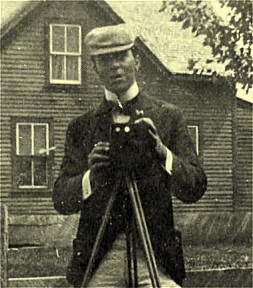
Edgar Rice Burroughs In Idaho
Red, White And Black
Now we get to the ostensible story which is the Red assault on Italian Somaliland. If few people today understand the partition of Africa by the European powers it might be well to recap the situation a little. The two big players were France and England with Spain and Portugal picking up some early real estate to be later joined by the bit players, Germany and Italy. The German possessions were stripped from them after the Great War and given to England.
This novel takes place in the Horn Of Africa or the Northeast corner facing the Arabian Peninsula and the Indian Ocean. The area contained Ethiopia otherwise known as Abyssinia, the only independent State in Africa save Liberia whose independence was guaranteed by the United States.
Ethiopia was bordered by Italian Eritrea and French and British Somaliland on the North, Italian Somaliland on the East, Kenya and Uganda on the South and Anglo-Egyptian Sudan on the West.
The Galla tribe with whom ERB became fascinated had been driven about by the Somals occupying lands mostly in the interior of Ethiopia after the manner of the Middle Eastern Kurds, where they were constantly in conflict with the Ethiopians and the Somals on the border. ERB deals with the Ethiopian-Galla situation in Tarzan And The Mad Man.
The Red camp is located in Ethiopia several days march from the border of Italian Somaliland. Opar which is nearby must now be located in Ethiopia.
The Reds have assembled an international cast of characters or in other words a multi-cultural outfit. Their multi-cultural nature will prove to be a liability rather than an asset as indeed it must in real life.
The organizers are Russian or Soviet Communists of whom there are four, Peter Zveri, the leader, Zora Drinov, Paul Ivitch and Michael Dorsky. They are joined by an American agent acting as a double agent, Wayne Colt.
Burroughs casually mentions that the expedition was put together in the United States by Zveri operating on both coasts. As Burroughs is writing a novel he wisely declines to preach or analyze, he is, as he says, an entertainer. As I who do function as an analyst pointed out in Marcia Of The Doorstep that the US had been used as a safe haven by every conspiratiorial revolutionary group on the planet. Burroughs is noting the same thing but only in passing as part of the story. If one is not attuned to such details they slip right by without significance as do the dots and dashes of the Morse code to the uninitiated.
The group is also composed of a Filipino Red, Antonio Mori and a Mexican revolutionary Miguel Romero. These people form the core group. Affiliated with them are the Moslem Arabs of Abu Batn who appear to have been recruited from the Mahgreb, perhaps Algeria, where some of Tarzan’s early adventures occurred. They do not appear to be Black Arabs of the Horn. While appearing to be Communists they remain Moslem Arabs whose real motive is to drive the Christians or Nasrany as they call them out of Africa. This means Whites of no or any religious affiliation.
Zveri has also patched on the Bantu tribe of Kitembo, the Basembos. This is because Kitembo has actually been to Opar, the only member of their party who has. Kitembo doesn’t appear to be a true Communist but is a former powerful chief from Kenya who had been displaced by the British. He comes from a place on Lake Victoria which should make him a Luo but for reasons perhaps not pertinent I tend to think of him as Kikiyu probably partly based on someone like Jomo Kenyatta who already had notoriety by 1930 although Kitembo’s history is close that that of the Unyoro Chief Kaba Rega whose story Burroughs was definitely familiar with from the memoirs of Samuel Baker.
Kitembo is interested only in recovering his past dignity augmented ten fold. All that becomes irrelevant when he deigns to lay his hands on Zora.
We should remember that Burroughs is writing in 1930 not 2010, so many things that are more or less clear to us now were undetermined at that time while understandings and motivations were quite different then from today and as those of today will be fifty years hence.
For one thing Africa was still a land of mystery where one wouldn’t have been too surprised if someone had discovered a lost civilization, a strange anthropoid- perhaps the so-called Missing Link, very real to the imagination at the time- and any number of things. One of the great losses of my childhood was the recognition that Africa was known; that nothing truly wonderful would be discovered in the world again. All was now cataloguing.
Abercrombie and Fitch who had built a very lucrative business outfitting ‘explorers’ or safaries, having not yet turned to teen porn, lost its raison d’etre as did all the ‘Explorer’ clubs where grown men sat around in khaki Safari gear drinking and dreaming. All that was left for me and my generation was Trader Vic’s and he’s gone now. The miracle is that the National Geographic found a way to survive when they could no longer portray exotic, naked, painted savages with necks supported by copper rings, plates in the upper lip and that. Now of course they don’t have to go as far for such exotica as Whites imitating the Africans sport massive tattooing suported by all kinds of nose rings and body piercings.
So, in 1930 Burroughs’ story still had a degree of probability. Especially in the way he joined contemporary politics to nineteenth century Africa. In one reads closely this is quite a story, a true tour de force.
Not only do the Arabs and the Bantus have their personal motivations apart from Communism, so we learn does Peter Zveri. The streak of individualism is not extinct in his collective mind, he sees the opportunity to make himself Emperor of Africa in Tarzan’s stead. Apparently Soviet intelligence has been keeping close tabs on the doings of the Big Ape Man because Zveri knows of Tarzan’s ‘fool dirigible trip’ believing him absent from Africa and possibly dead as no one has heard from him for the past year. This was before Google Alerts too.
Indeed Tarzan drops as from the clouds into a clearing filled with great apes as the story begins. Just coincidentally Jad-Bal-Ja and Nkima happen to be in this exact part of Tarzan’s estate of Africa at the same time. Zveri then is very disappointed to learn that his nemesis is back. As well he might because he has engaged himself mano a mano with the Big Bwana and Africa, believe it or not, is not big enough for both of them.
In his examination of Communism, multi-culturalism and human nature Burroughs is at his incisive best. Remember few of these stories go over a hundred ninety-two paperback pages. These are tremendously condensed stories. They’re somewhat like a zipped file with megabytes compressed into kilobytes. To really get the stories you have to unzip them and let them expand in y9ur mind. Don’t be deceived by their seeming simplicity.
The various cultures involved in this plot are only loosely held together by Communist ideology. The plot eventually falls apart because the cultures see through the phoniness of the Communist ideal. Zveri himself isn’t even that sincere a Communist as he intends to use the gold of Opar to make himself a third world power as Emperor of Africa. In the end Communism is a fatuous dream,whether utopian or dystopian is up to you.
Burroughs does not emphasize his opinions, he merely tells his story. My conclusions as to his intent are derived from the result of the story. In the end Communism fails because of internal contradictions while the big Bwana is invincible retaining his position as Guardian or Emperor of Africa. Not one world of preachment.
Wayne Colt in his rather absurd trek across Africa arrives too late for the first assault on Opar. He does happen into camp in time to spot the shaking tent and rescue Zora from Jafar, the Indian Communist, with Tarzan’s help. After killing Jafar Tarzan turns his steps to Opar traveling in a bee-line through the Middle Terraces he handily arrives before the first expedition which had left some time before him.
Let me take a moment to discuss Burroughs’ Africa. In the first place these stories are combination dreamscape, fairy tale and mythmaking. His Africa bears no more relation to this planet than Arthur’s Camelot bore to Medieval England. I find it tiresome for scholars to try to find the ‘real’ history of Arthur’s career. Arthur may have a loose connection to real historical events but the story, a great one, is a projection of psychological needs. There isn’t any such thing as a Holy Grail. No knights ever went in search of it.
In the same way Burroughs’ Africa is a psychological projection hopefully leading to his Holy Grail. There are no lower, middle or upper terraces in a nearly uniform jungle in the real Africa. Anyone who tries to find them will be severely disappointed. Such things are merely inventions of Burroughs’ dream world. I am glad he shared it with me, you and the millions.
The frequency with which the characters run into each other way out there is also impossible but in Burroughs’ dreamscape, his fairy tale, his myth, it happens all the time. There is no sense in arguing the impossibility. If you find it too offensive to your sensibilities then the oeuvre is not for you. One just accepts that these are fairy tales and in fairy tales things like this happen all the time. It’s a fantasy, fantastic things go on.
I try to fathom the psychological intent so while I may smile and jest at some impossible details it is only at the naive dream details and not the serious intent of the story. In our time these stories would have been taken at warp speed to another galaxy where in that context all things would be possible. But, that would be pure fiction hence unbelievable. I never did take Star Trek seriously, in fact, I refused to voluntarily watch it. Burroughs’ Africa can still be located on a map of the world connecting psychological reality with temporal reality in a very satisfying blend.
So, as this series is a roman a fleuve or River Story, Tarzan ruminates on his previous visits to Opar as he strides across the hot dusty desert, where the rain never falls, toward the fabled gold and red domes and turrets in the distance.
La’s love for him which began in Return Of Tarzan has caused dissension between her and her people. She has retained her position only through the active intervention of Tarzan. Defeating the revolution that had ousted her in Tarzan And The Golden Lion the big Bwana had replaced her on the throne guarded by the Bolgani of the Valley of Diamonds and the semi-human Gomangani. It is interesting to not that the Oparian revolution occurred after the Russian. Might be a connection.
As he approaches the city he believes that the Oparians appreciated his defeat of Cadj and that they love and respect him so that his reunion with them will be joyous. Not so. In the interim the Oparians who hate and resent Tarzan have deposed La putting her in a foul prison in the vast underground maze of dungeons of Opar. Passing back through the narrow cleft, bounding up the stairs, Tarzan is surprised to find himself attacked by the howling Frightful Men. The Man of the Steel Pate receives another frightful blow which lays him out.
He wakes to find himself the captive of Oah and Dooth. He is placed in a cell the details of which I have already related above.
I haven’t plumbed the signficance of Tarzan and La being imprisoned together while the city is attacked by the Communists unless the dreamworld of Opar represents a sanctuary that is now invaded in the attempt to destroy Burroughs’s literary career. In that event it might be necessary for the Anima and Animus to be together. This story also harks back to the invasion of the Emerald City in Baum’s story The Emerald City Of Oz.
In any event the various strange screams and noises from within Opar unsettle the superstitious Blacks and Arabs who lose their nerve refusing to enter Opar. The Blacks believe in spirits and the Arabs in jinns both of which they fear more than living men. Thus Burroughs is contemptuous of both cultures.
Zveri and his Russians are too cowardly to enter themselves. The only one with the nerve is the Mexican Miguel Romero who gets very good reviews from ERB. Miguel retreats in the the face of the horde of Frightful Men but he is very cool about it.
Returning to camp the Arabs are now disaffected having words with Zveri. The arrival of Colt and Mori puts a little heart into Zveri so that a second attempt on Opar is determined leaving the Arabs to guard the camp.
Tarzan and La escape from Opar between the two assaults becoming subsequently separated. Zveri takes the Blacks and Communists with him. Being left behind dissolves the Arab affinity with the Cause. Never good Communists, being interested only in ejecting the Nasrani from Africa, they decide to disappear into the desert.
About this time La wanders into camp. Sacking the camp, Abu Batn and his Arabs leave with the two women whose value in the North he knows full well. The Arabs are out of the story. The Communist coalition is breaking up. As Burroughs points out the goals of the two are not the same.
Back in Opar Zveri finds it impossible to force his Africans into service while he and his Russians remain cowards. Colt behaving bravely, as only an American can, along with Miguel Romero penetrates to the sanctuary where they are faced by the Frightful Men. Perhaps in a comment on American tactics Colt fires over the heads of the Oparians while the Mexican, Romero, fires directly into the mob.
Why when Americans go to war they are reluctant to do the dirty work of killing is beyond me. The reluctance to engage the enemy in Viet Nam cost us that war. The reluctance to do what we have to do in Iraq is costing us that war. Perhaps we think we can hide behind a wall of steel as our technology wars for us while we imagine we can remain safe. Our punishment of our own soldiers for merely humiliating the enemy must be unique in the annals of warfare. And they wonder why no one wants to join the Army.
Romero who shoots to kill is able to escape while the pussy footing Colt is downed by a thrown club and captured. A thrown club! Once again a Burroughs’ surrogate takes a blow to the head, but how does one survive a thrown club?
Just as Colt and Zora exchange partners in the jungle so now Colt takes Tarzan’s place in jail. Here, he is befriended by a nubile beauty, Nao, rather than as La did Tarzan and, pephaps as Florence was doing for ERB. Afer killing to free him Nao is left behind as Colt disappears into the dusty desert. Not a very thoughtful thing to do as Nao would certainly be discovered.
Zveri returns to his devastated camp to be handed a letter notifying him that Colt is a double agent. Abandoning any thoughts of Opar the Communists concentrate on their mission which is the simulated invasion of Italian Somaliland.
As they are about to leave Tarzan returns Zora to camp. Coldly dropping her off without a word he climbs onto a branch to spy on the conspirators. His leopard skin shorts are mistaken for the real thing. Here we go again. the shot at the imagined leopard grazes the Big Guy’s skull putting him out of commission for a full day. So that is at least two knockouts for Burroughs’ surrogates plus this concussion. Tarzan’s frequent lapses of attention become more intelligible.
Zveri wants to take advantage of his opportunity and kill Tarzan but Zora intervenes so Tarzan is bound which leads to next day’s episode when Dorsky threatens him only to be annihilated by Tantor.
The charming fairy tale between Nkima, Tantor, Tarzan and the Hyena then takes place which is a repeat of the same scene in Jewels Of Opar.
Nkima then goes in search of the Faithful Waziri to aid Tarzan while the Big Fella begins his campaign of terror against the Communist conspirators.
His strategy is to separate Kitembo and his Basembos from Zveri and his Communists. To do this he plays on their superstitious natures. A mysterious voice comes down from the trees, in other words, the sky, telling them to go back. In the meantime Little Nkima has recruited the Faithful Waziri who arrive to help out not with spears and bows and arrows but modern repeating rifles. Arranging themselves in front of the advancing Communists hidden in the tall grass -this stuff grows six feet high- they give the appearance of being many more than they are. Burroughs doesn’t make it clear how they can see the Communists through the grass while the Communists can’t see them but as Tarzan usually navigates pretty well even in total darkness I’m probably making a bigger problem out of it than it is.
Zveri does a rapid advance to the rear which act of cowardice completely destroys his credibility. Dorsky is dead while Romera and Mori renounce their Communism. Zora reveals she’s only in it for the revenge because Zveri had murdered her family twelve years earlier in the Revolution while, as we are aware, Colt is an American agent. This leaves only Zweri and Ivitch who I believe represent Frank Martin and R. H. Patchin, ERB’s old nemeses in Chicago.
Returning to camp Zveri spots Wayne Colt. Calling him a traitor he fires point blank missing while the bullet grazes Colt’s side without breaking the skin. That was a close one. Before Zveri can fire again he is brought down from behind by Zora. Burroughs replays scenes like this over and over with different variations. Just as the constant bashings on the head his surrogates take reflect his own experience in 1899 so must all these conflicts between his surrogates and another man and his surrogate woman reflect his situation with Frank Martin and Emma. In each instance in one way or another the woman rejects the other man. Thus Burroughs ‘fictionizes’ his own situation.
So now Zora kills Zveri so that she and Colt can bridge that gap.
As a sidekick Ivitch/Patchin is allowed to leave Africa. In point of fact Martin died some time before Burroughs although not until after 1934 while Patchin survived both.
Tarzan in the meantime escorts La back to Opar where he reinstalls her on the throne this time doing the sensible thing of eliminating Oah, Dooth and all their sympathizers. One must believe there will be no more trouble in Opar. In any event Opar disappears from the oeuvre.
Tarzan then returns to the camp to dispense justice as becomes the Lord Of The Jungle.
As the story ends the ‘invincible’ Tarzan seems to have solved all the problems confronting he and Burroughs in 1930. The Big Fella has not only thwarted Zveri but defeated Stalin and the whole Soviet empire.
As the exchange between Zveri and Romero explains it: pp. 183-84:
“Which proves,” declared Zveri, “what I have suspected for a long time; that there is more than one traitor among us,” and he looked meaningly at Romero.
“What it means,” said Romero’ “is that crazy, harebrained theories always fail when they are put to the test. You thought that all the blacks in Africa would rush to our standard and drive all the foreigners into th ocean. In theory, perhaps, you were right, but in practice one man, with a knowledge of native psychology, which you did not have, burst your entire dream like a bubble, and for every other harebrained theory in the world there is always the stumbling block of fact.”
Thus Tarzan not only defeats Zveri, Stalin and the Soviets but he disproves the whole Communist ideology as a harebrained theory.
On top of that the Invincible One restored order in Opar while putting his personal life to rights by separating out Colt and Zora or Burroughs and Emma and Tarzan and La or Burroughs and Florence.
The succeeding novel Tarzan The Triumphant- Invincible, Triumphant- will rescue the Russian situation while its successor Tarzan And The City Of Gold disposes of Emma/Jane/Zora/Nemone by her self-immolation while its successor Tarzan And the Leopard Men bring Kali/Florence and Old Timer/Burroughs together. The series climaxes with Tarzan And the Lion Man when Burroughs 2 kills off his early self, Stanley Obroski, or Burroughs 1 to come into his own, or so Burroughs supposes. The rest of the series is playing out the aftermath of the divorce from Emma and the marriage to Florence.
As could have been predicted the marriage to Florence was less than satisfying.
So, perhaps, Burroughs’ solution to his personal dilemma is based on a harebrained theory itself which fell to earth on ‘the stumbling block of fact.’
For the moment however Tarzan has saved Africa from the Communist menace and perhaps the World.
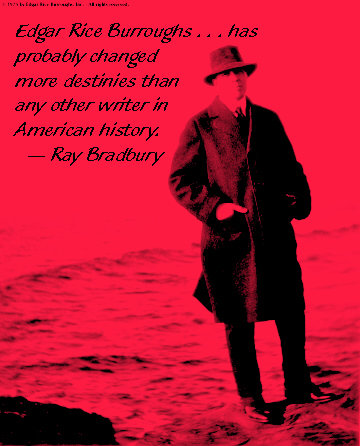
Edgar Rice Burroughs- High On A Mountain By The Sea
Pt. IV: H.G. Wells, Sigmund Freud, Edgar Rice Burroughs And The Development Of Contemporary Sexual Attitudes
September 15, 2010
H.G. Wells, Sigmund Freud, Edgar Rice Burroughs
And The Development Of Contemporary Sexual Attitudes
Part IV
by
R.E. Prindle
Edgar Rice Burroughs’ Contribution

The Artist Fidus, 1893 Illustration
That Edgar Rice Burroughs is one of the, if not the most, influential writers, America has produced goes without saying. The only question is in how many different ways did he do it and was an attitude toward sexual mores one of them. I think it can be shown that that is true. Was Burroughs an ideologue in sexual matters. At this point I can’t say yes or no although his attitudes seem consistent throughout his career.
A first hurdle we have to get over is whether Burroughs was some sort of idiot savant who just had the knack for writing adventure stories or was he an auto-didact who educated himself in exemplary fashion. The consensus is more along the idiot savant line which I hope I have shown in my by now voluminous writings that ERB was very well read, had a sound if not spectacular education while being an intelligent man with at least a 120-130 IQ.
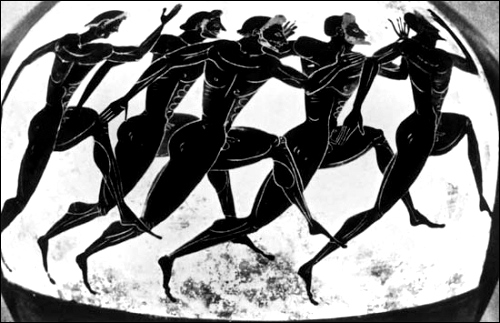
Greeks At Play
I think I have shown that he was a full participant in the intellectual culture of 1875-1920 which influenced the first phase of his writing career. We know he was well read because he references hundreds of books that he read in his own pages. He tells us he read Gibbon’s Decline And Fall Of The Roman Empire which is an essential for a liberal education. He tells us he read and reread Plutarch’s Parallel Lives which also is no mean achievement. Those may be isolated instances or, as I think, they are the tip of the iceberg. He was near expert on Evolution while being deeply read in esoteric and exoteric religion. The guy was a virtual marvel. His learning shows up in his writings although in a fantastic manner for enterainment purposes.
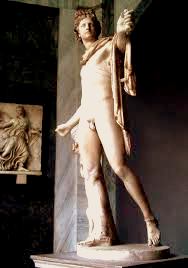
Apollo
For our purposes here we can begin when his father placed him in the Harvard Latin School of Chicago. He was to spend what we would call his Junior High years there. It was there he learned Latin and possibly some Greek. He was to complain later that he learned Latin before he learned to write in English which he thought affected his style and it may have as some of his writing reads like he was translating from Latin. While he may not have qualified as a Latin scholar I’m sure that for the rest of his life he could find his way through an extensive Latin quotation. When I was in school that was considered an achievement of a high order. So ERB had a pretty decent founding in the Classics.
Now, there has been a pretty fair controvercy on ERBzine recently over how nude Martians were. I don’t think there is any question but that both men and women hang out, that is ventral and dorsal nudity. One might therefore infer that in Burroughs’ vision of an utopia the style was to be au naturel.
Was this original or did ERB, as usual, borrow from the culture, have his sources?
Let’s start at Harvard Latin School. At the time the Patriarchy was in full control of the culture. There were grumblings from both the Matriarchy and the Hetaerarchy but those were in the beginning stages of the revolt. As late as the 1960s when I was an Ancient History major you would have been thrown out of school for challenging the Patriarchal version of Ancient History, that is to say Greek and Roman. ERB then couldn’t have been given less than a 110% Patriarchal education.
Any illustrations of Greek statues he would have seen showed the genitals fully exposed unless a fig leaf had been placed over them. The Greek vases he may have seen would have shown Greek men at play or leisure with fully exposed genitals, any weapons belted on would look exactly like his Martians. They might have a wrap thrown over the shoulder for protection from inclement weather.
The phallicism, the pride in manhood, runs all through Greek art and literature. At the time men were liberating themselves from the Matriarchy with its cruel attitude toward the males. It had been discovered that the male inseminated the female so men claimed the child as theirs while the women were mere incubators or storehouses rather than the fecund goddesses of creation. Man was the creator. That was the answer the riddle posed by the Theban sphinx to Oedipus was, Man. So the psychological reaction must have been if you’ve got one, show it. Meanwhile as the man was the progenitor of a woman’s offspring, a man’s wife had to be secluded so that another man couldn’t impregnate her. Whereas in the past women were more or less commonly available to the certified they now became the exclusive possession of one man, except for prostitutes or hetaerists. The children were his.
How much, if any, of this ERB understood he at least saw a society where the men went fully nude. As the Martian children were hatched from eggs incubated in the Martian sun it sounds as though he had read Plato where Socrates expatiated on the old days when men and women were hatched from eggs. Indeed, Leda impregnated by Zeus in the form of a swan hatched two eggs that produced Castor and Pollux and Helen and Clytemnestra as two sets of twins. It’s not too far from there to Mars, don’t you think?
Around the turn of the century the Nudist movement took form in German. We tend to think of these earlier times as staid when in reality the modern world was in its birth throes. The nudity thing since the French Revolution had been slowly growing. For the Medieval Free Spirits and Anabatists nudity was a key point as it was for the Libertines and as it was adopted by the Communist offshoots of the Revolution. Men want to look at the female nude.
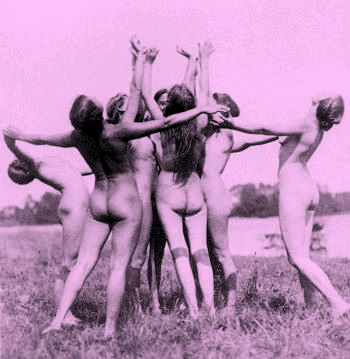
Early Nudists
In Germany at the turn of the century the nudity movement jelled, an actual movement taking shape in conjunction with the Wandervogel movement. This is turn led to the development of the Nature movement resulting in the incredible Nature Boy scene in the US of the thirties and forties which in turn evolved into the Beat/Hippie phenomenon of the fifties, sixties and seventies and into today.

Eden Ahbez- Writer of Nature Boy
Burroughs would have been aware of this whole phenomenon up to 1950 endorsing it enthusiastically. Tarzan was the ultimate Nature Boy and Burroughs developed the character with that in mind. The ideal. I have no douts that Burroughs intended him as the exemplar of this growing movement. Hence the development of the Nature movement was aided, abetted and intentionally forwarded by ERB clearly linking him to the scene in Bohemian NY of the sixties and the whole Beat/Hippie scene.
So Burroughs’ writings actually promote nudism and the Nature movement throughout his career. John Carter arrives, born again, nude on Mars where he would have been unnoticeable on that account, completely blending in. Indeed, the only difference was that he was white instead of red which was a curiosity. Thus, as soon as he leaves Earth he become a nudist in what was a sort of utopian society to Burroughs.
Tarzan necessarily practiced nudity for his first twenty years, only donning his ‘fig leaf’ or G-string when he came in contact with civilization.
Burroughs always refers to Tarzan’s ‘adornment’ as a G-string in the early novels. A G-string only cover the genitals with a flap and not the rear so Tarzan was essentially nude in the jungle. He was a Nature Boy and that is the way most of his readers have perceived him.

Maxmillian- Star Nature Boy c. 1948
The MGM Tarzan is the exemplar of the Nature Boy living on fruit and nuts. The MGM movies regularly show bowls of fruits and nuts while Tarzan, unless memory fails, is never shown squatting over a haunch eating the flesh raw as in Burroughs’ novels. As with Burroughs and the Nature Boys Tarzan rejects all the appurtenances of civilization except for some mechanical engineering at which Tarzan was apparently a genius. Might even have been a Nuclear Physicist even though he could barely grunt in the MGM movies.
It seems clear that there was vitually no one who hadn’t heard of Tarzan or Burroughs. Nearly everyone was influenced by the two. It therefore seems probable that the Nature Boys, the nudists took Tarzan as an avatar.
Certainly John Derek directed his movie, Tarzan, The Ape Man of the 1980s, concentrating on the sexual and nature aspects of the image. No argument there, I hope.
Now, the Bohemian scene in NYC was among other things a return to the primitive. The crowd surrounding Andy Warhol in his Factory was a bunch of savages stripped of all but the rudiments of civilization. They were the Tarzans of the asphalt jungle. The more affluent savages, the Haute Boheme lived a life of sexual abandon that Burroughs, Wells and Freud could only have dreamed of, and they did dream of it.
Once the attitude was institutionalized at Studio 54 the world Burroughs, Wells and Freud longed for was realized. It was Hetaerism and Matriarchialism on wheels, a complete overthrow of Patriarchalism. Our three musketeers would have gained easy admitance and found each in his own particular utopia. From 1880 to 1980 was only a hundred years. A short time indeed to overturn civilization.
Burroughs was a leading figure in this revolution.
Exhuming Bob 25: Bob And Sam
June 5, 2010
Exhuming Bob 25:
Bob And Sam
by
R.E. Prindle

Shepard, Sam: The Rolling Thunder Logbook, 1977, Sanctuary Publishing.
Sometime in the mid-seventies, possibly in 1976 Paul Simon wrote in one of his lyrics: I don’t think this stuff is funny anymore. Coincidentally at the same time as I surveyed my record store of a Saturday morning the same thought occurred to me. Things had been overdone. In one bat of an eyelash the whole thing got old.

Bert Williams In Blackface
This was not case with Bob Dylan who in the waning months of 1975 put the greatest clown act New England had ever seen on the road. The Rolling Thunder Revue; or as it might alternatively have been named: The New Bob Dylan Minstrels. One purpose of the Revue seems to have been to spring the convicted triple murderer and ex-boxer Hurricane Carter from jail. That didn’t come until the very end.
Along the way Dylan wanted to film a sort of existential movie that would later be released as Renaldo and Clara. Working from some strange chaos theory Dylan had no actors, no script, no-nothing. Needing some sort of guiding hand he commanded the actor, cowboy, playwright Sam Shepard to attend to his writing needs. Sam then wrote what he called a log of the experience called the Rolling Thunder Logbook.
On the first reading I didn’t think Sam put much into it but the pictures were good. Still there was the nagging feeling that I might have missed something. On the second reading the logbook assumed more significance. It’s kind of impressionistic. It’s not a narrative; like the title says its sort of like a ship’s logbook. The impressions sort of pile up until you have a definite impression. I don’t know if that’s what Sam intended but that’s the way it worked with me.
Bob being the kind of powerful show biz personality he is didn’t bother to negotiate terms with Sam; he didn’t even bother to call himself; his agent or stooge or whatever interrupted the life of Shepard to tell him Dylan wanted him in New England. Sam doesn’t mention any terms, or indeed any payment. He just dropped everything, literally, and drove East. Did I mention he was in California? Well, he was; he was in the process of moving.
Bob tries pretty hard to cultivate that elusive, mysterious image and he succeeded with Sam who couldn’t locate him for a few days after he got there. Bob probably wanted to accustom him to the menagerie before he showed his face. Even then Sam didn’t have any guidelines he just expected Sam to free lance a few lines of dialogue if at any time he saw the cameras running. The film crew was more disorganized than Dylan if that were possible.
What was it all about anyway?

It Takes A Worried Man- Sam Shepard
As we should be aware 1976 was the two hundreth anniversary celebration of the American Revolution. But there were a number of conflicting revolutions running simultaneously. There was the revolt of the Matriarchy, what Eric Foner calls the Unfinished Revolution which was the replacement of Whites by Negroes and of course the perpetual revolution of the Jews against mankind, not to mention the revolution of the gay crowd. Bob as we all know is Jewish so one may reasonably ask why he chose New England for his chaotic Marx Brothers routine on the occasion of the Yankee Revolution around the new England sites such as Bunker Hill? Could he have been thumbing his nose at America? Well, it does look suspicious.
As Sam notes the crew made it a point to visit Plymouth Rock and the replica of the Mayflower which sacred symbols of pre-immigration America they reviled all but pissing on the Rock. The faux American cowboy, Elliott Adnopoz was swinging from the yardarm of the Mayflower. Y’all know Elliott as the yodelin’ cowboy Ramblin’ Jack Elliott o’ course. For the rest they pissed and farted their way across New England carousing and corrupting as they went. Of course it might just have been New England exercising the gang’s Rock n’ Roll genes, no more than that. Sam kept his discontent sotto voce by which I mean between the lines. Bob, with his need for conflict invited not only his old flame Joan Baez and his new flame Joni Mitchell but his wife Sarah playing each against each. Baez who grows more Mexican with each passing year seems willing to put up with whatever Bob does. Shortly after the tour Sara came downstairs one morning to find Bob dandling a strange beauty on his knee for breakfast. Well, you know, she threw in the tower after that, as, who wouldn’t? Bob seemed to be perfectly dismayed by this untoward turn of events. ‘Women in my family just don’t divorce.’ He whined uncomprehendingly. Well, at least, not without due provocation.

Joni Mitchell Looking Out Her Window
That leaves Joni Mitchell. She’s apparently been stewing about her treatment for thirty-five years. She just recently expressed herself by saying in effect that Dylan is just a god-damned phony. Well, Bob can always go join Joanie in that bomb shelter in Viet Nam. They can exchange rings made of the fuselages of American fighter planes, if they haven’t already. So, how sincere is their devotion to this great land of the once free and no longer brave? It would seem their loyalties lie elsewhere.
In my own obtuseness, quivering in my own psychological bomb shelter, I never saw Bob as a revolutionary in those far off days but then I was just listening to records, I didn’t know anything about him; boy, I sure have remedied that situation.
Back in those palmy days of the early sixties before racial and religious animosities had reached their present prominence I don’t know that anyhbody really thought of Dylan as a Jew. Certainly the name Dylan is not Jewish and I’m not sure how many people would have known Zimmerman was. Or, that they would have cared. In those days everyone cheered when Israel won one of those too frequent wars. Now, though, one has to put Bob’s religious affiliation up front. Make no mistake, he’s a fundamentalist, believes the Bible is the literal word of god. Orthodox. Chabad Lubavitcher even. Thinks the universe is fifty-seven hundred years old like his deceased mentor Rabbi Schneerson. Swear to g-d.
Must have picked it all up from Rebbe Rueben who came West from Brooklyn to Hibbing to indoctrinate him in Lubavitcher lore for his Bar Mitzvah. Like Bob said, he learned what he was supposed to learn. He very cleverly inserted the stuff into all those songs too.
Bob broke his mind in the excesses of the sixties, that high mercury sound he was seeking was the result of all those amphetamines he was shooting back then. Andy Warhol had his boy pegged.
In the late sixties and early seventies Bob had to rebuild his personality and he rebuilt it around his religion. His Mom was real proud of the way he had his Bible open on a stand in his living room so he could jump up and check it as the occasion arose.
Then as he got back on his feet he aligned himself with Meyer Kahane’s violent extremist revolutionary Jewish Defense League carrying a couple of JDL thugs around with him as bodyguards. Maybe his Jewish revolutionary mode was getting too obvious so in ’77 he began hanging out with Jews For Jesus and the Christian Vinyard Fellowship organization. Once that clouded the picture he reverted back to his Lubavitchers where he has been since.
So on the Rolling thunder tour one may be excused for thinking that he was in his revolutionary phase. Sam Shepard doesn’t mention it but his experience left a very bad taste in his mouth which he expresses with as much force as Joni Mitchell really has.
On the tour Bob did the strange thing of wearing white makeup which has remained a mystery. It shouldn’t be really. Remember the tour was to end in a successful attempt to free a Black man while the Black boxer Muhammed Ali was unstage at the Garden. A Garden party a la Ricky Nelson, get it? The Revue was actually a parody of the Minstrel show of what Greil Marcus would call the old weird America. In the old Minstrel shows the White actor wore black face in imitation of Black people. This may sound strange to you but Jews don’t consider themselves White notwithstanding their pale complexions they consider themselves Jews and goys as White. So, in disguising himself in White Face he was parodying the old Black Minstrel shows while mocking his ultra-White New England audience.
Bob Dylan was having the time of his life. The joke was on the Honkies. Funny, huh?
As noted, the keynote of the tour was the final concert at Madison Square Garden at Christmas where he took on America over the issue of the Black Hurricane Carter and won. Now, compare that Christmas show with the 2009 release of Bob’s Christmas album. Seemingly done straight it also mocks Whites. In Bob’s video for the song It Must Be Santa Claus you may have noticed that the audience showed minimal diversity. The airheads were all White. Bob comes prancing through wearing a lank blonde White girl’s wig, climbs into a balcony and stands looking down his nose in his wig at us all. It’s great. Nobody gets it. There is something happening here but you don’t know what it is, do you, Mr. Jo-o-o-nes.
Jewish power vs. American power, make no mistake.
Sam jumped ship before the end of the tour, he’d had enough, but he was there for the Garden party. He can’t even force himself to dissimulate a complimentary attitude as he did at the beginning of the Minstrel show. And then the final confrontation between the playwright and the singer.
At this point is is clear that the Rolling Thunder tour is something Sam wished he hadn’t gone on and an experience he preferred to forget.
Shepard closes with a chapter concerning the opening of his play The Geography Of A Horse Dreamer. I don’t know the play but it may have been based on Rolling Thunder. In the play Sam names the horse Sara D. Dylan is in New York at the time wanting to see the play. He wants to make his entrance in company with Sam. Sam writes:
..so I’m in the hotel lobby waiting for the Cadillac convertible to haul us over to the theatre. The big boxcar camper pulls up outside and Dylan hops out. My stomach does a full gainer as I see him approaching the hotel. The idea of him sitting in the audience is more like a nightmare than a blessing…He pauses at one of these signs (reading signs in the lobby) long enough for me to scuttle past him out into the street and hail a cab. It’s bad enough knowing that he’ll be there without having to ride there with him in the same car.
So not only was the tour distasteful to Sam’s sensibilities but the experience of first hand acquaintance with Bob has also left a bitter taste. Well he isn’t the only one. The evening of the opening of Sam’s show is not going to improve relations.
…the so-called curtain is being held up for Dylan’s late arrival. He shows up plastered, along with Neuwirth, Kemp, Sara and Gary Shafner. They take up a whole row.
So whatever the cause of the conflict Dylan is reciprocating his disrespect fully. He means to sabotage Sam’s show and then leave early too.
At intermission Sam doesn’t see Bob so he hopes he’s left the theatre. No such luck. Dylan comes out of the toilet.
He sees me standing there and pauses as though trying to bring certain thoughts into focus. “Hey, Sam, what happens to this guy in the play anyway?’ I’m dumbfounded for a reply but come out with something like, “That’s the reason for seeing the second act.” He stares at the floor, his knees shifting slightly as though he’s about to go into a nose dive.
“Hey, how come you named that horse in the play Sara D?”
“That’s the name of a racing dog in England.” It suddenly cuts through me that it’s also the name of his wife.
“I mean it’s the name of a greyhound. A real greyhound. You know the kind that race around the track.”
He smiles and shuffles through the door, almost making a left turn into the light booth.
Apparently Dylan didn’t find that answer any more satisfactory than I would have. Something is going on here, isn’t it?
As the play draws to its end Dylan makes his move. Shameless. Pure chutzpah immersed in chocolate sauce.
Dylan stands in the back row. “Wait a minute!” Who’s he yelling to? The actors? “Wait a second! why’s he get the shot? He shouldn’t get that shot! The other guy should get it!” Lou Kemp is trying to haul him back down in his seat….
Dylan is struggling to free himself from Kemp’s hammerlock grip. Neuwirth is telling him to shut up…Finally the Sam Peckinpah sequence begins, with shotguns and catsup all over the stage. Dylan leaps up again. “I DON’T HAVE TO WATCH THIS! I DIDN’T COME HERE TO WATCH THIS!
Apparently the Rolling Thunder tour didn’t end until Sam had written this play and run it by Bob. Dylan didn’t like the play any better than Shepard liked the tour. Hard feelings everywhere.
Apparently Bob used people much too roughly. He managed to either blow off a number of people immediately following such as Shepard, Jack Elliott, Neuwirth, the maligned Larry Sloman and probably the whole film crew while Joni Mitchell has weighed in thirty-five years on. We have yet to hear from a number of other people, most notably Roger McGuinn.
Bob managed to trash everybody including the USA with his Minstrel show for the 200th anniversary year. Which revolutions was he leading? I don’t think this stuff is funny anymore, do you?

Bob and Joan, Joan and Bob?
A Contribution To The
Erbzine Library Project.
Edgar Rice Burroughs, Science And Spiritualism
Camille Flammarion, Scientist and Spiritualist
by
R.E. Prindle

The last story in Ray Bradbury’s Martian Chronicles is about the expulsion from Earth of the various supernatural or imaginary beings such as fairies, elves, the elementals, all those beings external to ourselves but projections of our minds on Nature, to Mars as a last resort and how they were all dieing as Mars became scientifically accessible leaving no place for them to exist.
On Earth the rejection of such supernatural beings began with the Enlightenment. When the smoke and fury of the French Revolution and the Napoleonic years settled and cleared it was a new world with a completely different understanding of the nature of the world. Science, that is, knowing, had displaced belief as a Weltanschauung.
The old does not give way so easily to the new. Even while knowing that fairies did not exist the short lived reaction of the Romantic Period with its wonderful stories and fictions followed the Napoleonic period.
Supernatural phenomena displaced from the very air we breathed reformed in the minds of Men as the ability of certain people called Mediums to communicate with spirits although the spirits were no longer called supernatural but paranormal. Thus the fairies morphed into dead ancestors, dead famous men, communicants from beyond the grave. Men and women merely combined science with fantasy. Science fiction, you see.
Spiritualism was made feasible by the rediscovery of hypnotism by Anton Mesmer in the years preceding the French Revolution. The first modern glimmerings of the sub- or unconscius began to take form. The unconscious was the arena of paranormal activity.
Hypnotism soon lost scientific credibility during the mid-century being abandoned to stage performers who then became the first real investigators of the unconscious as they practiced their art.
While the antecedents of spiritualism go back much further the pehnomena associated with it began to make their appearance in the 1840s. Because the unconscious was so little understood spiritualism was actually thought of as scientific. The investigators of the unconscious gave it incredible powers and attributes, what I would call supernatural but which became known as paranormal. Communicating with spirits, teleportation, telecommunications, all the stuff that later became the staples of science fiction.
Thus in 1882, Jean-Martin Charcot, a doctor working in the Salpetriere in Paris made hypnotism once again a legitimate academic study.
The question here is how much innovation could the nineteenth century take without losing its center or balance. Yeats’ poem The Second Coming presents the situation well. Freud, who was present at this particular creation, was to say that three discoveries shattered the confidence of Man; the first was the Galilean discovery that the Earth was not the center of the universe, the second revelation was Darwin’s announcement that Man was not unique in creation and the last was the discovery of the unconscious. Of these three the last two happened simultaneiously amidst a welter of scientific discoveries and technological applications that completely changed Man’s relationship to the world. One imagines that these were the reasons for the astonishing literary creativity as Victorians grappled to deal with these new realities. There was a sea change in literary expression.
Key to understanding these intellectual developments is the need of Man for immortality. With God in his heaven but disconnected from the world supernatural explanations were no longer plausible. The longing for immortality remained so FWH Myers a founder of the Society For Psychical Research changed the word supernatural into paranormal. As the notion of the unconscious was now wedded to science and given, in effect, supernatural powers under the guise of the paranormal it was thought, or hoped, that by tapping these supernormal powers one could make contact with the departed hence spiritism or Spiritualism.
While from our present vantage point after a hundred or more years of acclimatizing ourselves to an understanding of science, the unconscious and a rejection of the supernatural, the combination of science and spiritualism seems ridiculous. Such was not the case at the time. Serious scientists embraced the notion that spirtualism was scientific.
Now, a debate in Burroughs’ studies is whether and/or how much Burroughs was influenced by the esoteric. In my opinion and I believe that of Bibliophile David Adams, a great deal. David has done wonderful work in esbatlishing the connection between the esotericism of L. Frank Baum and his Oz series of books and Burroughs while Dale Broadhurst has added much.
Beginning in the sixties of the nineteenth century a French writer who was to have a great influence on ERB, Camille Flammarion, began writing his scientific romances and astronomy books. Not only did Flammarion form ERB’s ideas of the nature of Mars but this French writer was imbued with the notions of spiritualism that informed his science and astronomy. He and another astronomer, Percival Lowell, who is often associated with ERB, in fact, spent time with Flammarion exchanging Martian ideas. Flammarion and Lowell are associated.
So, in reading Flammarion ERB would have imbibed a good deal of spiritualistic, occult, or esoteric ideas. Flammarion actually ended his days as much more a spiritualist than astronomer. As a spiritualist he was associated with Conan Doyle.
Thus in the search for a new basis of immortality, while the notion of God became intenable, Flammarion and others began to search for immortality in outer space. There were even notions that spirits went to Mars to live after death somewhat in the manner of Bradbury’s nixies and pixies. In his book Lumen Flammarion has his hero taking up residence on the star Capella in outer space after death. Such a book as Lumen must have left Burroughs breathless with wonderment. Lumen is some pretty far out stuff in more ways than one. After a hundred fifty years of science fiction these ideas have been endlessly explored becoming trite and even old hat but at the time they were
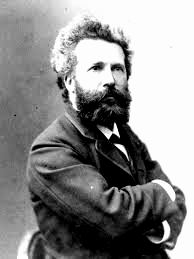
Camille Flammarion
excitingly new. Flammarion even put into Burroughs’ mind that time itself had no independent existence. Mind boggling stuff.
I believe that by now Bibliophiles have assembled a library of books that Burroughs either did read or is likely to have read before 1911 that number at least two or three hundred. Of course, without radio, TV, or movies for all of Burroughs’ childhood, youth and a major portion of his young manhood, although movies would have become a reality by the time he began writing, there was little entertainment except reading. Maybe a spot of croquet.
As far as reading goes I suspect that ERB spent a significant portion of his scantily employed late twenties and early thirties sitting in the Chicago Library sifting through the odd volume. It can’t be a coincidence that Tarzan lounged for many an hour in the Paris library before he became a secret agent and left for North Africa.
I have come across a book by the English author Charles Howard Hinton entitled Scientific Romances of which one explores the notion of a fourth dimension . Hinton is said to have been an influence on H.G. Wells’ The Time Machine. It seems certain that Burroughs read The Time Machine while he would have found many discussions of the fourth dimension as well as other scientific fantasies in the magazines and even newspapers as Hillman has so amply demonstrated on ERBzine. We also know that ERB had a subscription to Popular Mechanics while probably reading Popular Science on a regular basis. Popular Science was established in 1872.
It is clear that ERB was keenly interested in psychology and from references distributed throughout the corpus, reasonably well informed.
I wouldn’t go so far as to maintain that ERB read the French psychologist Theodore Flournoy’s From India To The Planet Mars but George T. McWhorter does list it as a volume in Vern Corriel’s library of likely books read by Burroughs. The book was published in 1899 just as Burroughs was entering his very troubled period from 1900 to 1904-05 that included his bashing in Toronto with subsequent mental problems, a bout with typhoid fever and his and Emma’s flight to Idaho and Salt Lake City. So that narrows the window down a bit.
However the book seems to describe the manner in which his mind worked so that it provides a possible or probable insight into the way his mind did work.
ERB’s writing career was born in desperation. While he may say that he considered writing unmanly it is also true that he tried to write a lighthearted account of becoming a new father a couple years before he took up his pen in seriousness. Obviously he saw writing as a way out. His life had bittely disappointed his exalted expectations hence he would have fallen into a horrible depression probably with disastrous results if the success of his stories hadn’t redeemed his opinion of himself.
Helene Smith the Medium of Fluornoy’s investigation into mediumship was in the same situation. Her future while secure enough in the material sense, as was Burroughs, fell far short of her hopes and expectations. Thus she turned to mediumship to realize herself much as Burroughs turned to literature. She enjoyed some success and notoriety attracting the attention of, among others, the psychologist Theodore Flournoy. Fournoy who enjoyed some prominence at the time, was one of those confusing spiritualism with science because of his misunderstanding of the unconscious. Thus as Miss Smith unfolded her conversations with the inhabitants of Mars it was taken with some plausibility.
If any readers I may have have also read my review of Du Maurier’s Peter Ibbetson he or she will remember that Peter and Mary were restricted in their dream activities to only what they had done, seen and remembered or learned. As I have frequently said, you can only get out of a mind what has gone into it. In this sense Miss Smith was severely handicapped by an inadequate education and limited experience. While she was reasonably creative in the construction of her three worlds- those of ancient India, Mars and the court of Marie Antoinette- she was unable to be utterly convincing. In the end her resourcefulness gave out and the scientific types drifted away. She more or less descended into a deep depression as her expectations failed. Had she been more imagination she might have turned to writing as Burroughs did.
If Burroughs did read Flournoy, of which I am not convinced, he may have noted that Miss Smith’s method was quite similar to his habit of trancelike daydreaming that fulfilled his own expectations of life in fantasy.
In Burroughs’ case he had the inestimable advantage of having stuffed his mind with a large array of imaginative literature, a fairly good amateur’s notions of science and technology, along with a very decent range of valuable experience. His younger days were actually quite exciting. He was also gifted with an amazing imagination and the ability to use it constructively.
Consider this possibility. I append a poem that he would have undoubtedly read- When You Were A Tadpole And I Was A Fish. Read this and then compare it to The Land That Time Forgot.
Evolution
by
Langdon Smith
When you were a tadpole and I was a fish
In the Paleozoic time,
And side by side on the ebbing tide
We sprawled through the ooze and slime,
Or skittered with many a caudal flip
Through the depths of the Cambrian fen,
My heart was rife with the joy of life,
For I loved you even then.
Mindless we lived and mindless we loved
And mindless at last we died;
And deep in the rift of the Caradoc drift
We slumbered side by side.
The world turned on in the lathe of time,
The hot lands heaved amain,
Til we caught our breath from the womb of death
And crept into light again.
We were Amphibians, scaled and tailed,
And drab as a dead man’s hand;
We coiled at ease ‘neath the dripping trees
Or trailed through the mud and sand.
Croaking and blind, with out three-clawed feet
Writing a language dumb,
With never a spark in the empty dark
To hint at a life to come.
Yet happy we lived and happy we loved,
And happy we died once more;
Our forms were rolled in the clinging mold
of a Neocomian shore.
The eons came and the eons fled
And the sleep that wrapped us fast
Was riven away in a newer day
And the night of death was past.
Then light and swift through the jungle trees
We swung in our airy flights,
Or breathed in the balms of the fronded palms
In the hush of the moonless nights;
And, oh! what beautiful years were there
When our hearts clung each to each;
When life was filled and our senses thrilled
In the first faint dawn of speech.
Thus life by life and love by love
We passed through the cycles strange,
And breath by breath and death by death
We followed the chain of change,
Till there came a time in the law of life
When over the nursing side
The shadows broke and the soul awoke
In a strange, dim dream of God.
I was thewed like Auroch bull
And tusked like the great cave bear;
And you, my sweet, from head to feet
Were gowned in your glorious hair,
Deep in the gloom of a fireless cave,
When the night fell o’er the plain
And the moon hung red o’er the river bed
We mumbled the bones of the slain.
I flaked a flint to a cutting edge
And shaped it with brutish craft;
I broke a shank from the woodland lank
And fitted it, head and haft;
Then I hid me close to the reedy tarn,
Where the mammoth came to drink;
Through the brawn and bone I drove the stone
And slew him upon the brink.
Loud I howled through the moonlit wastes,
Loud answered our kith and kin,
From west and east to the crimson feast
The clan came tramping in.
O’er joint and gristle and padded hoof
We fought and clawed and tore,
And cheek by jowl with many a growl
We talked the marvel o’er.
I carved that fight on a reindeer bone
With rude and hairy hand;
I pictured his fall on the cavern wall
That men might understand,
For we lived by blood and the right of might
Ere human laws were drawn,
And the age of sin did not begin
Till our brutal tush were gone.
And that was a million years ago
In a time that no man knows;
Yet here tonight in the mellow light
We sit at Delmonico’s.
Your eyes are deep as the Devon springs,
Your hair is dark as jet,
Your years are few, your life is new,
Your soul untried, and yet-
Our trail is on the Kimmeridge clay
And the scarp of the Purbeck flags;
We have left our bones in the Bagshot stones
And deep in the Coralline crags;
Our love is old, our lives are old,
And death shall come amain;
Should it come today, what man may say
We shall not live again?
God has wrought our souls from the Tremadoc beds
And furnished them wings to fly;
He sowed our spawn in the world’s dim dawn,
And I know that it shall not die,
Though cities have sprung above the graves
Where the crook-bone men make war
And the oxwain creaks o’er the buried caves
Where the mummied mammoths are.
Then as we linger at luncheon here
O’er many a dainty dish,
Let us drink anew to the time when you
Were a tadpole and I was a fish.
With something like that stuffed into his subconscious what wonders might ensue. Obviously The Land That Time Forgot and The Eternal Lover.
As Miss Smith had turned to spiritualism and mediumship, Burroughs turned his talents to writing. According to himself he used essentially mediumistic techniques in hiswriting. He said that he entered a tracelike state, what one might almost call automatic writing to compose his stories. He certainly turned out three hundred well written pages in a remarkably short time with very few delays and interruptions. He was then able to immediately begin another story. This facility lasted from 1911 to 1914 when his reservoir of stored material ws exhausted. His pace then slowed down as he had to originate stories and presumably work them out more rather than just spew them out.
Curiously like Miss Smith he created three main worlds with some deadends and solo works. Thus while Miss Smith created Indian, Martian and her ‘Royal’ identity Burroughs created an inner World, Tarzan and African world, and a Martian world.
Perhaps in both cases three worlds were necessary to give expression to the full range of their hopes and expectations. In Burroughs’ case his worlds correspond to the equivalences of the subconscious in Pellucidar, the conscious in Tarzan and Africa and shall we say, the aspirational or spiritual of Mars. In point of fact Burroughs writing style varies in each of the three worlds, just as they did in Miss Smith’s.
Having exhausted his early intellectual resources Burroughs read extensively and exhaustively to recharge his intellectual batteries. This would have been completely normal because it is quite easy to write oneself out. Indeed, he was warned about this by his editor, Metcalf. Having, as it were, gotten what was in your mind on paper what you had was used up and has to be augmented. One needs fresh experience and more knowledge. ERB was capable of achieving this from 1911 to about 1936 when his resources were essentially exhausted. Regardless of what one considers the quality of the later work it is a recap, a summation of his work rather than extension or innovatory into new territory. Once again, not at all unusual.
As a child of his times his work is a unique blend of science and spiritualism with the accent on science. One can only conjecture how he assimiliated Camille Flammarion’s own unique blend of spiritualism and science but it would seem clear that Flammarion inflamed his imagination setting him on his career as perhaps the world’s first true science-fiction writer as opposed to merely imaginative or fantasy fiction although he was no mean hand at all.
A Review
Thuvia, Maid Of Mars
by
Edgar Rice Burroughs.
Part III-C

Review by R.E. Prindle
Edgar Rice Burroughs
Civilization And Its Malcontents
Let us say that for the fifty years or so before the 1920s there was a growing sense of societal malaise. This malaise was reflected most notably in the creation of Edgar Rice Burroughs’ psychological projection, Tarzan Of The Apes. One has to account for the immediate acceptation by society of such an absurdity. Tarzan, in fact, completely rejected civilization for the life of the romantic ‘unrestrained freedom’ of the jungle. The noble savage in fact.
Thus in a metaphor Burroughs reflected the malaise of his time so brilliantly that his creation was accepted as virtually a real person. Writers like Grant and Stoddard put the same theme into more scholarly terms. As noted, contrary to Richard Slotkin’s idea, Grant had little or no influence on Burroughs while the slightly later Lothrop Stoddard whose three relevant works appeared only from 1920 to 1922 could have had no influence on Burroughs’ formative years. It seems probable that Burroughs did read Stoddard and was influenced by his work but only after his ideas were fully formed. Even then The Revolt Against Civilization appeared after Burroughs had examined some of the same problems in his rejected manuscript, Under The Red Flag of 1919.
The problem of the malcontents and their war on civilization was examined by a number of writers during the twenties and thirties so why Slotkin singled out Burroughs, Grant and Stoddard isn’t as clear as it might be. Postwar German cinema was intensely concerned with the matter as why should it not? Germany was under asault by what Stoddard called the Underman. Nor need Slotkin think Stoddard was alone. I’m sure there were dozens of forgotten books prophesying the end of the world by one means or another including the Undermen of Communism.

The Underman, or the Communist, was not even a term unique to Stoddard. Gustave Le Bon, the French scholar on whose work Sigmund Freud based his study Group Psychology And The Analysis Of The Ego wrote prolifically on the psychological foundations of the Underman. Freud based his book on Le Bon’s 1895 study The Psychology Of Crowds. Unless I’m mistaken he based his 1930 study Civilization And Its Discontents on Le Bon’s 1921 book The World In Revolt: A Psychological Study Of Our Times.
On the cinematic side the problem was examined in the great silent films The Cabinet Of Dr. Caligari and Fritz Lang’s 1922 film Dr. Mabuse, The Gambler. Lang would follow that ten years later with the sound film The Testament Of Dr. Mabuse.
Even though Buroughs’ Under The Red Flag was rejected in 1919 he persisted, rewriting and extending the text into the 1926 story, The Moon Maid. This story reflects a possible reading of The Revolt Against Civilization but such a reading was much more evident in 1934’s Tarzan And The Lion Man.
The development of the problem was evident to all these writers which it seems to have escaped Slotkin who attributes the recognition of societal evolution to mere ‘racism’ in the writers. One thinks that perhaps Slotkin is too involved in his own agenda.
Rider Haggard enunciated the problem quite clearly in his 1888 novel Allan Quatermain in which Quatermain grouses about the ‘strict limits’ of civilization compared to the ‘natural’ life of the African Zulus. It might almost seem that the idea of Tarzan arose in Burroughs’ mind from that observation. In fact science was undermining all the comforting beliefs that mankind had been settled in for a hundred thousand years. During that long period characterized by the mental mode of what is called mythopoeic thinking man’s mind devoid of true knowledge projected a vision of reality that resulted in the notion of God. Thus reasoning from insufficient knowledge man’s mind came up with an erroneous result. You can’t get out of a mind what isn’t in it; all education is suggestion.
As Freud was to say, man’s settled view of reality received its three great shocks when Galileo disproved the geocentric notion of the universe, Darwin disproved the uniqueness of man’s position in the animal kingdom and he, Freud, displaced the conscious mind with his vision of the unconscious mind. Once again Le Bon was there ahead of him.
Thus as the nineteenth century opened and progressed the bases of mankind’s notions of reality were shattered leaving him emotionally and intellectually bereft of foundations of belief. Adrift without an anchor.
As if that were not bad enough the great cataclysm that ushered in the modern era, The French Revolution, was based on the the absolute notion that not only were all men created equal but remained equal in all aspects of their existence. The advance of civilization would toss this certainty into the trash can of history also.
As civilization placed greater and greater demands on the intelligence and self-discipline of men and women the incontestable gap between those less intelligent and those more intelligent became more and more obvious. Thus as the century progressed the notion of the Overman and the Underman began to become clear.
At the same time the first tentative efforts at measuring the intellectual potential of the individual began to become possible. Of course the basic inequality of men and women in its physical aspect had always been apparent. Some men were naturally stronger and better muscled than others. But, even that was changing. The science of physical culture was making it possible for the 98 lb. weakling to develop himself into a man mountain. Thus artifically developed srongmen like the Great Sandow ushered in the golden age of the strong man topped off by Charles Atlas who guaranteed he could turn you into a man mountain if you followed his program.
There was the promise that you could dethrone that bully and kick sand back in his face. On the other side Francis Galton was originating the first primitive tests to measure intelligence potential. Burroughs would have seen both proponents during his miraculous summer of 1893 at the Chicago Columbian Exposition. I mean to say that both facts entered his mind where they could be digested and emerge later. Nothing can come out of your mind that didn’t go in it.
And then after the turn of the century Binet devised he first actual IQ test. Thus, just as Sandow and Atlas could measure the size of muscles, the psychologists became able to measure the intelligence potential. Those with high IQs were set up; those with low IQs were cooked. The upshot was that all men were not created equal nor could they ever attain intellectual equality.
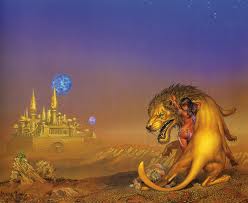
To a very large extent what became the Communist Party recognized the inequality while demanding equality against reason. Recognizing subconsciously, perhaps, that men could never be intellectual equals rather than try the futile task of raising the less fortunate they sought to destroy education which brings out the inequality but doesn’t create it. No matter what happens there are always going to be the more intelligent just as there will always be the physically stronger. As Le Bon points out, if you needed to hear it, nature don’t know from equality.
Thus the Communist Party devised the well sounding slogan- From each according to his ability; to each according to his need. Good plan for the needy, slavery for the able. The needy were organized beginning their struggle to achieve superiority by collective action. This was accomplished in Russia in 1917. The battle was joined.
Just as individuals are created with different capabilities so are peoples and races. Some can achieve and some can’t. Slotkin who must be a Communist thus takes offence at what he perceives to be, and is, an attitude of White Supremacy in Burroughs, Grant and Stoddard. While I am aware there are those who will disagree with White superiority it is nevertheless not an attitude but an evolutionary fact. That is the reason Communists have Darwin under attack. While Darwin doesn’t say it, it is the inevitable result of his studies. Just as it was necessary for the Undermen to destroy education in the hopes of creating intellectual equality so it became necessary to destroy White achievement of the last five hundred years. The whites must be demonized and made to feel evil and inferior morally. That is the import of Slotkin’s Gunfighter Nation.
At that level all three writers are guilty. As has been stated in Canadian courts- Truth is not a defense. So there’s nothing to discuss. Might is right and whoever has the might will prevail.
It is a fact that all three writers were anti-Communists so it may be assumed that whatever Communists believe, they didn’t. And why should they? Might may be right but it can still be nonsense. Communism is a flawed ideology based on a false premiss. It always fails wherever it is introduced. Failure is not evidence of a bad plan in Communist eyes. One just continues to shovel sand against the tide and pray. So succeed or fail they always think they can succeed by the same flawed ideology. The fault for failure lies elsewhere.
In that sense Burroughs was wasting his time assailing this religion of failure with his Under The Red Flag and its successor The Moon Maid. The only people who would applaud his effort would be we non-Communists but he could never convince anyone with Communist leanings. Of course that wasn’t well understood at the time.

If Burroughs were accused of not believing in equality that would be true. Not only are John Carter and Tarzan superior to any contemporaries on two worlds but Burroughs has a whole hierarchy of value. John Carter is the Warlord of Mars ruling from the top city of Mars, Helium. The races of Mars pretty much reflect those of Earth and their relative stations. The main exception is the ruling Red race. As Whites do and have existed on Mars in Burroughs stories while at one time being the dominant race perhaps the Red race is some sort of amalgam of the various Eropean immigrants of the United States. I believe the Green Men represent the American Indian. Both roam the great plains while being essentially savages.
Tarzan though always spoken of as being White is described as a bronze giant. Bronze is a fairly dark metal so that Tarzan and the Red men of Mars may be more or less identical in color.
Tarzan is the man-god so there are none superior or even equal to him. Below him come the English who are the cream of mankind. Perhaps slightly below the English are the French and then the rest of the Whites. Tarzan himself is psychologically an animal having been raised by the Apes. Not your ordinary gorilla or Chimp but a species intermediate between Gorilla and the Negro. Slotkin hasn’t read enough Burroughs to make an intelligent comment but the undeniable attitude of Burroughs is enough for Slotkin to condemn him as an unregenerate bigot. The reader may believe as he likes. I have stated my opinion eslewhere and that is enough. Whether any of these opinions of Burroughs influenced American soldiers at My Lai is open to question. The burden of proof is on Slotkin and he hasn’t provided it.
Along with the Undermen however, speaking through Tarzan, Burroughs is heartily discontented with civilization.
The spectacle of Chicago of the 1890s as a dirty unpleasant place haunts Burroughs. In contrast to the great White City of the Columbian Expo was what was afterwards known as the Black City of everyday Chicago. The contrast was so strong and so offensive to the Undermen that within a year of the Expo’s closing the entire White City was burned to the ground with the exception of one building. Hence perhaps the decayed crimson and gold ruins of Opar and the crimson and gold twin cities of Helium. One wonders what effect the sight of the ruin of the White City had on Burroughs when he revisited the site sometime after his miraculous summer of ’93. The mind creates nothing from nothing so there must have been models of the great cities of ERB’s imagination.
There are points at which Burroughs and Communism have quite similar views. It will be remembered that Burroughs only reluctantly married and throughout his life expressed discontent with the institution. To some extent or other ERB must have been an advocate of free love. Communists would have heartily approved of ERB’s women who went nude except for certain ‘adornments.’ Communists of course want women to be accesible to any man who wants them at any time while they have always advocated bare breasts.
In many ways when the Communists appropriated Tarzan for the MGM movies it took but slight changes to make Tarzan conform to their ideals. The MGM Tarzan and Jane were not married. While Burroughs’ Tarzan was a highly educated on-again off-again sophisticate the MGM Tarzan was a stupid illiterate oaf and one who rejected the attributes of civilization high up there in the Cloud Cuckoo Land of the Mutia Plateau.
On the essentials though Burroughs rejected the demands of the Underman as The Moon Maid clearly shows. There was very little in Stoddard’s The Revolt Against Civilization that Burroughs would have disagreed with. At the same time there was probably very little he didn’t already believe although he had never codified his information as Stoddard had. Slotkin’s contention that Burroughs was influenced by either Grant or Stoddard is surely wrong. ERB had already taken hs positions before either men had begun to write.
Each writer was, in his own way, an advocate of White Supremacy. It now become clear that White Supremacy has nothing to do with a fringe element in Liberal ideology. All Whites are White Supremacists in that ideology unless they reject ‘White skin privilege’ whatever that is. Ayers and Dorhn explain in their recent Race Course In White Supremacy. Interestingly constructed title. Nor as Slotkin would have it is the attitude based on mere racial pride and bigotry but on a solid record of achievement unattained by any other people. The quesiton is not was it right for some people to rule or be supreme because in the nature of things some people will rule and be supreme but which of the peoples are most qualified to be supreme.
All people have had equal opportunity so that one can only conclude that the race has gone to the most qualified participant. In the contest the Whites unified the other peoples against them as must inevitably be the consequence of being the top people. As they say, getting there is the easy part; staying there is the hard part.
Slotkin merely represents the envious losers, the Undermen. who clutch at any firebrand to burn the White House down. Who is most to be admired and emulated? Builders or destroyers?
Finis of Thuvia, Maid Of Mars Review
Edgar Rice Burroughs On Mars
A Review
Thuvia, Maid Of Mars
Part III-A
What We Have Here Is Change
by
R.E. Prindle
In the recent American presidential campaign in the US the winner won by promising the inevitable, Change. A very safe promise as the history of the world is one of change. Indeed, the life of the individual is one of unending change from the cradle to the grave. Change is now and forever. The question is, what response is made to the changes.
The times of Edgar Rice Burroughs were a period of the most earth shaking and rapid of all. At the same time most perilous, as the evolution of actual scientific knowledge in all fields was in its infancy and subject to misinterpretation. One might say in Burroughsian imagery that a series of doors stood before mankind, entering the right door would be more beneficial than the wrong doors.
Burroughs and others made tantative moves for the right door but others entered by the wrong door drawing most others through with them. What looked like progress turned into a regression. To shut up criticism the regressives began to demonize all those of different opinions. Burroughs was among those.
Some say he adapted poorly to the flood of change but the peole who do so are so confident in their opinions that to disagree with them is to be accused of being not only wrong but either criminal or insane. One doesn’t take their opinions too seriously as change will certainly demonstrate their opinions as ludicrous if it hasn’t already. Nevertheless as they are quite vocal in their condemnation of Edgar Rice Burroughs we have to consider the accuracy of their accusations as well as that of their own viewpoint. How well do they understand the issues?
ERB has some interesting observations on the changes occurring in the history, society and racial matters of his times as well as the concealed role of hypnotism in the transformation of that society. The basis of hypnotism is suggestion. As ERB say in Thuvia all is based on suggestion and counter-suggestion. If one conciders life and learning from that angle it presents some interesting possibilites.
What is learning? What is suggestion?
When the child is conceived he must of necessity have a mind with a blank slate. Freud, Jung and many others seem to seriously believe that newborns can inherit ancestral memories even though there is no one beyond the womb who has ever recalled any.
In fact without experience or learning that has has been introjected into the mind there is nothing for the mind to consider, hence no cogitation at all. This mind can only begin to form with the ejection from the womb. This occurs with a brain still in the process of formation. The development of the brain can only be considered completed shortly after puberty.
It seems obvious then that you can’t get out of a mind what isn’t in it. It behooves society then to begin loading the mind of a child as soon as the child is capable of handling education. The education of the mind must be built step by step to provide a firm foundation for the intellectual superstructure. Whatever is in the mind must come from or be suggested from outside the mind. There is no internal system of knowledge. Thus all knowledge is suggested to the child’s mind by his caretakers. They may be good or bad, well or ill intentioned. The brain is organized to receive suggestions or, in another word, experience. The reactive structure may already be in place dut to experiences in the womb and the actual birthing process but the actual learning process begins the moment the newborn emerges from the womb and receives a slap on the bottom to get his lungs started.
Thus the mind of the child is extremely malleable during the time until about puberty and shortly thereafter. If education is neglected during this early period and shortly thereafter it is unlikely that the adult can ever make up the lack. For instance if the basics or reading, writing and arithmetic are not loaded into the brain during this malleable period it is very rare that the skills can be acquired at a later time.
Thus, as it was always known that the child is father to the man various doctrinaire organizations such as the Jesuits believed that if they could form the education of the child or, in another word, indoctrinte him, they could shape the future in their own image. In Burroughs’ time the mechanisms of education were more fully understood. Various schemes were proposed to revise educational methods many of which were just odd or crude, but the better thought to change the direction of society toward a higher ideal.
The Communists were well are at the time that suggestion was the basis of education. Lothrop Stoddard writing in his The Revolt Against Civilization of 1922 quotes Eden and Cedar Paul from their book Proletcult of 1921:
“There is no such thing as “scientific” economics or sociology. For these reasons…there should be organized and spread abroad a new kind of education, “Proletcult.” Thus…in a fighting culture aimed at the overthrow of capitalism and at the replacement of democratic culture and bourgeois ideology by ergatocratic culture and proletarian ideology…” The authors warmly endorse the Soviet government’s prostitution of education and all other forms of intellectual activity to Communist propaganda, for we are told that the “new education” is inspired by the “new psychology”, which “provides the philosophical justification of Bolshevism and supplies a theoretical guide for our efforts in the field of proletarian culture…. Education is suggestion. The recognition that suggestion is auto suggestion, and that auto suggestion is the means whereby imagination controls the subconscious self, will enable us to make a right use of the most potent force which has become available to the members of the human herd since the invention of articulate speech.
I’m sure you can find appropriate application of the doctrine since Stoddard wrote in education, movies, TV, books and phonograph records and CDs. While I would disagree with the Pauls’ notion of suggestion and auto suggestion the Freudian influence is quite clear. This would be abetted by John Dewey’s notions on education that deemphasized the educational foundation while directing it more toward ideological considerations, or ‘relatively unstructured, free, student-directed progressive education.’
God only knows what free, progressive education is but this sort of social engineering was the wrong turn being taken in this era of rapid change.
So, loading the brain to deal with life’s exigencies is of necessity a slow process. As the brain continues to develop outside the womb there is plenty of room for malfunction. As man is incapable of creating anything original the education of the child may be compared to the loading of a computer. First the operating system. Whether consciously or unconsciously since all man knows is his own brain he has replicated it in his machine. A computer functions just like a brain, which should astound no one, as man can only devise what he already knows.
Now, human experience dates back about a hundred thousand years. I intentionally leave out the African development as it had nothing to do with the education of mankind. The African contribution is nil. Education began outside Africa. Having painfully and laboriously accumulated the huge fund of knowledge it must be entered into the brain of the new being. This sort of suggestion is called education. There’s not much room for anything called ‘free’ or ‘progressive.’ Getting it ain’t going to be free, the child has to work like a mule. This is a slow, laborious process as extensive foundations must be laid down before any superstructure can rise. Thus years are consumed just to teach the child reading, writing and arithmetic. With these three tools he can learn anything else. Inexplicably this fact seems to have been lost sight of in today’s educational theories unless of course the Pauls’ dictum is being followed.
Once the foundation has been laid, a form of suggestion and actually hypnosis, the child, now a student, must be taught how to manage and interpret what he learns at an increasingly rapid pace. Unfortunately there will be children left behind; any other expectation is fatuous, some are just brighter than others. Managing and interpreting comes from within the experience of the organism. Here’s the real problem because the same data will by analyzed differently and produce different results and opinions.
Along with learning factual matters the child must at the same time develop emotionally and psychologically. Nasty work. This is a difficult part. As the child has little ability to understand and even less ability to accurately analyze it he has to reason from faulty premisses. This ignorance of reality is what forms Freud’s notion of the unconscious or Id. Correcting this unconscious to consciousness is the conversion of Freud’s Id to Ego. A child misinterprets suggestions. Some become fixated in his un- or subconscious. The fixations are what distort consciousness from the subconscious interfering with the integration of the subconscious and the conscious. While the child is made more conscious in his ability to understand and reject harmful suggestions these fixations like post-hypnotic suggestions control his responses. The fixations must be exorcised which is the intended function of the psychoanalysis of Freud and Jung.
Once again, suggestion is everything outside your mind. Your mind cannot function without these suggestions because there will be nothing in the mind to function. Be carefull of what you put into your mind or, at least, that you do put something of value into it. Whether ERB realized this or not, his ideas of hypnosis and suggestion indicate he might have, he pursued a program of continuing education all his adult life. At the time of writing Thuvia he was working through Edward Gibbons’ Decline And Fall Of The Roman Empire, a vast minefield of amazing and truly educational suggestion.
Part B follows.
A Review: The Myth Of The Twentieth Century by Alfred Rosenberg
October 30, 2008
A Review
The Myth Of The Twentieth Century
by
Alfred Rosenberg
Rosenberg, Alfred, The Myth Of The Twentieth Century, An Evaluation Of The Spiritual-Intellectual Confrontations Of Our Age, The Noontide Press, 1982 New translation of the 1930 text.
Part One
Alfred Rosenberg
The Conflict Of Values
Subtitled ‘An evaluation of the spiritual-intellectual confrontations of our age’ Rosenberg’s book is not only a valuable treatise on socio-psychological issues of his time but as recent events indicate also an accurate prophesy.

Adolf Hitler- The Scourge Of God
Alfred Rosenberg was, of course, the theorist of the Nazi Party in Germany over the twenties and thirties. He may be one of the lesser known figures. As such he is verboten to read or study, but as it is important to understand the mental outlook of this most important period of world history, that none can deny, I’m going to cast caution to the winds and try to deal with the reality rather than the prejudices.
This book was a key to Rosenberg’s earning the hangman’s close attention at Nuremberg as a result of the collapse of the Nazi State. The book is also on on the Jewish Index of Proscribed Books; it was only translated and published in English in 1980 by the Noontide Press, another proscribed outfit. So reading and discussing the book is a titillating forbidden thrill not unlike picking up an illicit copy of James Joyce’s Ulysses in 1930. I’ve read both and this is the better book. One wonders how many on the Court at Nuremberg knew German well enough to have read it. I suspect that very few of the allies had and if so but cursorily.
As so many books that have been given high praise prove worthless on the reading so also many authors and their books that have been demonized prove worthwhile. The Myth Of The Twentieth Century is one of the latter. While Jewish hysteria would have you believe that The Myth is one long rabid anti-Jewish diatribe such is not the case. Rather Rosenberg cast his scenario in the ages long warfare between the Semitic East and Indo-European West. As he rightly says the issue is a spiritual and intellectual confrontation between the two.
There is no denying this fact no matter how unpalatable the reality may be.
That the conquest of Rome by the East in the waning years of the Republic and opening three centuries of the Empire was the key to the formation of the Roman Catholic Church in the mold of the Eastern mystery cults of which Judaism was an element, but only one, cannot be denied.
Indeed the church founders Sts. Peter and Paul were Jews of the Jews. Oddly the New Testament had nothing to do with the content of Catholicism. Before Gutenberg even the priesthood had never read the New Testament. How Jesus wormed his way in there is something of a mystery. As odd as it may seem one could be arrested in Spain for distributing or possessing a New Testament probably up to the 1931 Revolution that ended that nonsense.
Rosenberg believed and the facts attest that the Nordics, Germans or Aryans (if words frighten you, choose the least offensive) found the Asiatic doctrines to run counter to their innate beliefs. The fact that England and the North of Europe rejected Catholicism should be proof enough for anyone. Rosenberg’s main argument then is against the Catholic Church which in his view was based on Etruscan savagery, Jewish and other Eastern mystery religions.
In the savage warfare he depicts between the Semitic Catholic Church and Nordic dissidents it reads like so many holocausts led by the Semitic Church that the Jewish holocaust of the forties pales in comparison.
The savage campaigns of extermination against religious heretics like the Waldenses, Cathars and Huguenots makes your hair curl and the roots sweat. And then on top of those crimes against humanity on the part of the Semitic based Roman Catholic Church came the horrors of the Thirty Years War from 1608 to 1638 that devastated the Germans so badly it made the Jewish losses of the 1940s seem trivial. Over thirty years fully a third of the German people were destroyed while Rosenberg claims two thirds. As Liberal historians prefer to minimize German losses in accord with their anti-European prejudices I suspect Rosenberg is closer to the truth. As he says it took two hundred years for the Germans to recover in a greatly altered intellectual condition. That would bring the story up to Bismarck and modern times when the Pope declared himself infallible.
Rosenberg insists this was at the instigation of and was the policy of the Papacy. It would be impossible to disagree with him. In fact the Roman Catholic Inquisition extended from the thirteenth century to mid-nineteenth century. Some six hundred fifty years of Semitic hostility to things Nordic.
While that record of intolerance is deplorable it should be remembered that the Church was thoroughly saturated with a Semitic intellectual mindset. Its policies were based in the psychology of the Middle Eastern Semitic peoples. One is no less guilty than the other. Intolerance is characteristic of the Semites much moreso than the Europeans as will undoubtedly be learned first hand soon enough as we have failed to learn it from a distance.
2.
While Rosenberg deals with religious and racial confrontations that are in essence the same thing he also gives a nice concise analysis of the stock market economy. In the light of recent events the man was remarkably prescient. He blames stock jobbing on the Jews. As he was a Nazi one is tempted to cry: Shame, shame, without examining the facts, but in fact this recent managed debacle used the US Federal Reserve System. The Fed is a privately held semi-government agency of which the only non-Jewish component are the Rockefeller banks. Thus there appears to be a real foundation of the Nazi claim of Jewish dominance of finance.
If one looks at finance with an unjaundiced eye from this vantage point of history when everything is or should be clear, it is clear that the Jewish World Government sold the US a bill of goods in 1913 when the Fed was formed. The Fed was the vehicle that gave its owners the means to control world money matters. What an engine for construction or destruction. What a pity the course of destruction was chosen.
One has been forbidden to look too closely at Jewish financial management but when one does many things become clear. Henry Ford has been criticised for using the term The International Jew, but there you have it. See my essay at Contemporary Notes on Henry Ford and Louis Marshall.
http://contemporarynotes.wordpress.com/2008/08/08/henry-ford-and-louis-marshall/
Through their American-Jewish Joint Distribution Committee formed during the Great War in preparation for the aftermath the Jews were able to use the Fed and ‘charity’ to move huge sums into Europe in support of Judaism against the Gentile nations. Engineering the tremendous inflation in Germany in 1923 that impoverished the indigenous population money from the US, Great Britain and France was supplied to German Jews who then, using the hard currency against the now worthless German currency, essentially bought up Germany on the cheap. Even as late as 1937 after years of disenfranchisement Jews still owned over 30% of German real estate.
If one compares that with the current debacle in the US and actually worldwide in which by using the vehicle of unsound loans the US and possibly the world has been financially gutted with all investments slowly sinking into worthlessness while the already bankrupt US government has been placed beyond redemption. The question is when it all comes down who will own what? It will all have to be owned by someone. If Germany of the Weimar Republic is any guide the answer is quite clear.
It seems obvious that the whole debacle was planned from the beginning. After all we have been conditioned from childhood to perceive the Jews as innately financial geniuses. We have also been conditioned to view Jews as the most intelligent people on the earth. Indeed the foremost Jewish intellect of the latter half of the twentieth century, Rabbi Schneerson, a man of profound scientific training, so we are told, fully believed that Jews have an extra intelligence gene that makes intellectual competition with them impossible.
So, who was in control of the Fed, who is Secretary of the Treasury, etc. etc. Jews. Now, I’m fairly low down on the totem pole but I could see the inevitable result of loaning money to people without the means to pay it back. I don’t have that extra gene that Jews have either. I’m not bragging, there were actually loads of us with the apparently missing intelligence gene who saw it coming. Heck, Rosenberg and the Nazis, all missing that extraordinary gene, predicted the thing eighty years ago. Sure, they were evil but that doesn’t mean they were stupid.
So, if the ‘most intelligent’ people on the planet didn’t see the inevitable result of their own policies then, possibly, the intelligence gene has an on-off switch but without the little light so we never know whether they’re switched on or off. But I’m betting the boys knew what they were doing and what the results would be. Can’t fool me. Quite obviously you didn’t need that extra gene and I’m betting that Rabbi Schneerson was just joshing when he dreamed the notion up.
I have to give Rosenberg full credence in his analysis of stock market economies. He saw it quite clearly eighty years ago. He couldn’t have been alone. Rosenberg was smart but he wasn’t that much smarter than anyone else. Henry Ford saw it.
So why weren’t Rosenberg and Ford listened to? Because the Jews used that ‘extra gene’- the charge of being an anti-Semite. Ford was discredited and neutralized while the Nazis taking on the whole world were destroyed root and branch.
That’s how Alfred Rosenberg evaluated a couple of the spiritual-intellectual confrontations in the first chapter of his very valuable work: The Myth Of The Twentieth Century.
There is more that I will take up in Part II.
A Review: Part III, The Mucker And Marcia Of The Door Step By Edgar Rice Burroughs
September 11, 2008
A Review
The Low Brow And The High Brow
An In Depth Study Of Edgar Rice Burroughs’
The Mucker And Marcia Of The Door Step
Part III
by
R.E. Prindle
Background Of the Second Decade Social And Political
1.
I have been criticized for discussing material that seems to bear no relationship to the work of Edgar Rice Burroughs. The social milieu in which a man lives and works directly affect what and how he writes. He will react within that milieu whether he can understand and articulate it or not.
ERB understood much. He understood the main conflict of his times- that between the Religious and Scientific Consciousnesses. How he understood it is one thing, its exact nature is another. The battle was not necessarily put into the terms of science versus religion. On the objective level science had more prestige while on the subjective level religion had the upper hand creating a dualistic conflict. As Voltaire said: No one ever willed himself an athiest. The same can said of Science. The usual terms employed in the conflict was that of spirtiualism versus materialism. So those two words were supercharged masking the real conflict.
While religion retained great strength in this period science was so strong that religions had to adapt to science, thus one had the ecumenical Congress Of Religions in Chicago in 1893 during which a common plan of resistance was discussed.
One reaction to Science was American Liberalism. Liberalism is in fact a religion founded on beliefs rather than facts. American Liberalism developed out of the Puritan faith of New England. The Puritans believed themselves to be the successor of the Hebrews of the Old Testament as the Chosen People of God.
Two very interesting studies have appeared in the last couple decades which illuminate the English background of the United States. One is David Hackett Fischer’s Albion’s Seed; the other is Kevin Phillips’ The Cousins Wars. Both illustrate the continuity of behavior of the colonists between England and the Colonies. That continuity began with the Norman invasion of England in 1066 and continues through the strange Liberal mentality of today. Burroughs who was of the ‘Conservative’ mentality had to struggle with the forces of Liberalism in his day.
When the Normans invaded England they enslaved the Anglo-Saxon inhabitants. Anyone who has read Ivanhoe by Walter Scott has the image of Gurth with his iron colar inscribed on his memory. This piece of arrogance was to have serious consequences in both England and America.
The Normans occupied the Southern counties of England which Thomas Hardy caled Wessex, while the brunt of slavery fell on the East Anglian counties. The insult of slavery was burned into East Anglian memories along with a desire for revenge made more savage by the the religious certitude that they were the Chosen People of God.
The East Anglians, of course, revolted against the Norman Church Of England, emigrating to North America where they settled in the States of New England. New England = New Anglia. In England they fought the English Civil War against the Normans. Puritan Roundheads against Norman Cavaliers. It then became the turn of the defeated Cavaliers to emigrate to North America. They chose to go to Virginia where they gave the colony its Norman Cavalier character and nickname. The ancient enemies were now divided North and South.
As Fischer points out, slavery by the Norman descendents in England had disappeared only about a hundred years before the English Civil War. The Cavaliers now revived slavery in their Southern colonies. First they brought indentured servants from England who were slaves subject to the whims of their masters for a stated period of years that could easily be extended. Then African slavery was introduced. For a period of time both White and Black slaves worked side by side in the fields with the Blacks gradually displacing the Whites.
The New Englanders looked with fear and loathing on the Norman Virginians, who as they saw it, now resumed their old habits. It was here that the American Civil War was conceived. The Puritan New Englanders after having first rejected the king in the American Revolution which their East Anglian forebearers had failed to do in England then turned to agitating a war against the Norman Cavaliers of the South, whose ancestors had enslaved them, on the basis of an anti-slavery abolitionist program.
Just as they had succeeded against the Crown where their forebearers had failed they succeeded in absolutely crushing the descendents of the Normans. This punishment of the Cavaliers was the most severe of any since 1066. Thus subsequent US history with its notion of unconditional surrender was formed. This was a vicious attitude formed from the same feeling of defeat.
To return to the East Anglians in England to explain the American Liberal mindset. Shortly after printed books became readily available the East Anglians bought Bibles adopting the Old Testament notion of the Chosen People by substituting themselves for the Hebrew Children. A British Israelite group formed calling the English people the new Chosen People. Indeed, the British throne is believed to be in lineal descent from that of King David of Old Israel.
Thus there were at least three Chosen Peoples in existence from the fifteenth century on- Jews, the English and the Puritan New Englanders. New England became Greater New England as the Puritans multiplied spreading across the Northern tier of States.
A psychological characteristic of Chosen Peoples is that they upload their needs and wishes to an imaginary god in the sky then download the same needs and wishes back to themselves as the Will Of God. Thus they say not my will but they will be done, O Lord. The faithful thus become justified sinners. Any criminal act can be justified as the Will of God which it is the duty of the faithful to perform This also creates a double standard because what is right for themselves in the eyes of the Lord is forbidden to others. The children of Israel can exterminate other peoples with impunity, but it is wrong for other peoples to even defend themselves against the children of the Lord. Serious stuff.
These ends and desires are accepted then as a messianic or utopian goal. It is the duty of the Chosen People to impose God’s Will on the rest of the world. To resist that Will is evil making the non-believer a dastard, a heretic, an infidel, an anti-Semite or whatever.
In the United States the Will of the god of the Puritans was transformed into Manifest Destiny, which in turn metamorphosed into the triumph of Democracy as defined by the Chosen People of America, who in turn metamorphosed from Puritans into Liberals.
As a chosen people and as a result of the Civil War the Liberals identified with the victims who needed their help. Thus the Civil War was fought in their minds by a virtuous people acting out the Will of God to rescue unfortunate victims from a malevolent White minority. In the case of the Civil War it was the Negro slaves. As the century and Liberalism developed the umbrella of help was extended to all the ‘enslaved’ or colonial peoples of Europe which is to say all the colored peoples of the world. It was not enough that injustice as perceived by the Liberals should be corrected, but that the perpetrators should be condignly and brutally punished unconditionally in the name of and by the Will of their God, which is to say the projected desires and wishes of a self-appointed Chosen People.
Utopian literature which flourished after the Civil War is the direct result of this Messianic fervor. Utopian literature abounds in England, Greater New England and with the jews.
Having then succeeded in crushing the Cavaliers of the South the Liberals attempted to demean, belittle and abuse the White South in the most draconian manner. The period of Reconstruction is the blackest hour in American history. The Whites were stripped of civil rights having the Negroes placed over them as masters. The Whites, so far as possible, were expropriated of all property through taxation when not stolen outright. The Whites, of course, reacted by forming the first Ku Klux Klan to protect their lives and interests. Reconstruction lasted until 1877 well nigh into the twentieth century. The South was impoverished and set back for at least a century and may still be recovering today if such is possible under the present Liberal regime.
All factual references to Reconstruction have been obscured by references to the KKK but in the nineteenth and early twentieth centuries memories of Liberal crimes in the South were fresh and bleeding wounds. As is well known Jim Crow was the inevitable result of the attempt to crush and bury the White South.
As the nineteenth century progressed and utopian literature flourished the Puritans, now Liberals, identified with all the ‘oppressed’ which is to say colored peoples of the world against the European conquerors. Everywhere America sided with the natives against Europeans. In a feeling of total frustration Charles De Gaulle would remark: America is a White country, but it acts like a colored country.
At about mid-nineteenth century Jewish utopian messianists under the direction of Karl Marx formed the Communist Party. Thus Jewish utopian messianism spread from England- Marx was based in London- throughout Europe to the world. As Communism also opposed Western colonialism, although not Communist colonialism, these two powerful agencies worked to upset the Western hegemony of the world. As someone will always have hegemony of the world what appears on the surface as ‘justice’ is merely the transfer of power to another agency and hence new ‘injustice.’ As of this writing it appears that the beneficiary of American and Communist efforts will be the Chinese. This shift has already happened but has not yet been officially acknowledged. Thus the result of the Liberal and Communist quest for ‘social justice’ will be merely to place Europe and America’s neck under a Chinese yoke rather than the other way around. Obviously the Chinese god is not the same as the Utopian God.
During the period of Reconstruction as the Liberals were punishing the Southern Whites and rewarding the Negroes immigration from Eastern and Southern Europe began in earnest. While the Irish and Germans had created their own set of problems yet culturally they were close enough to the original Anglo-Saxon colonists to be, after a fashion, readily assimilated.
But with the congeries of nationalities from East and Southern Europe came many and diverse customs and languages. Assimilating them into Anglo-Celtic-Teutonic America was not so easy. Thus groups of Americans resisting immigration arose. The Know Nothings fought the Irish but this was different.
The Liberals could then pathologize the anti-immigration people as ‘nativists’, later White Supremacists and other derogatory terms. They could afirm their own virtue against these people as they had against the Southern Whites. When the power base of restrictionists took form in the South as the second Ku Klux Klan this only served to show the perfidy of Southern Whites in a new shade.
The Liberals then allied themselves not only with the interests of Negroes but with the immigrants to form the Liberal Coalition which was to dominate American society from the Second Decade to the present.
Already British and Puritan utopianists, they were now joined by the Jews who from 1870 to 1914 represented the largest nationality of immigrants. Both the Liberals and the Jews were Bible based. Liberals considered Jews as the successors to the Biblical Hebrews if not Hebrews themselves. While Roman Catholics distanced themselves from Hebrewism the Protestant sects derived directly from the Old Testament considered themselves neo-Hebrews so they were quite willing to defer to what they considered paleo-Hebrews. Thus the two versions of utopianism were joined. Both forms of Hebrewism accepted anti-Semitism as the greatest vice. The foregoing discussion has been a good account of what Semitism is: that is a belief in one’s own divinely appointed role as the arbiter of the world’s fate.
So far as I know neithr Semitism or anti-Semitism have ever been adequately defined so for the purposes of this paper anti-Semitism will be defined quite simply as the denial of the Semitist’s self-appointed role as the agent of God on earth.
As one of a Scientific Consciousness such a denial seems hardly necessary but as most people are of a Religious Consciousness there it stands.
Needless to say Burroughs was of the Scientific Consciousness therefore per force an anti-Semitist although he would never have understood his position in those terms.
As can be seen Judeo/Liberal/Utopianism is a religious matter that will defy reason. It is a matter dependent upon a subjective, spiritual belief system. It is beyond the reach of logic. Never argue with them. The adherents cannot be argued with, they must humored. Reigions are revealed not thought out.
2.
The nineteenth century also saw the rise of Science which is an objective materialistic sysem, conscious not subconscious, based on facts and reality. It doesn’t take a genius to spot that the religious systems and the scientific systems are incompatible; one must subordinate or destroy the other. Now, seriously folks, this is war to the knife.
Knowledge is hard won and built up slowly while revealed religion is complete and entire at conception. While the former is subject to trial and error the latter is seemingly pat- it is God’s own Word.
As Freud pointed out the religious consciousness received three main blows. The first was that the Universe was heliocentric rather than terracentric; the third was the malleable construction of the human mind as defined by psychoanalysis. These two could be religiously managed; nothing had been revealed that couldn’t be manipulated to religion’s use. The middle blow could not. That was the concept of Evolution as enunciated by Charles Darwin. Thus it was clear except to the most entrenched religionist that the world was not created by God in 4004 BC as Bishop Ussher stated but evolved beginning somewhat over four billion years ago. There’s an incompatibility there that cannot be swept under the carpet or even ignored.
Make no mistake: science and religion are at odds in the struggle for the human mind. Writing in 1829 the incomparable Edgar Allen Poe expressed the problem in his brilliant poem:
Sonnet – To Science
Science! true daughteer of Old Time thou art!
Who alterest all things with thy peering eyes.
Who preyest thus on this poet’s heart,
Vulture, whose wings are dull realities?
How should he love thee? or how deem thee wise,
Who wouldst not leave him in his wandering
To seek for treasure in the jewelled skies,
Albeit he soared with an undaunted wing?
Hast thou not dragged Diana from her car,
And driven the Hamadryad from the wood
To seek a shelter in some happier star?
Has thou not torn the Naiad from her flood,
The Elfin from the green grass, and from me
The summer dream beneath the tamarind tree?
In addition to driving the Hamadryad from the wood, science also pulled God down from the heavens and exposed the fraud. Freud showed God to be merely a projection of human desires. How could religion counter the claims of Science?
I do not single out any specific religion whether Christian, Jewish, Moslem or whatever. All religions evolved in human consciousness and represent a phase of development in that evolution. A phase of evolution but not its end. Dig it!
It then became necessary for religionists to absolutely deny Evolution. In their favor was the fact that Darwin not merely but only enunciated the concept, but had no infallible proofs of the process. Thus relgionists could say silly things like: Do you really believe human being, you, actually descended from an ape? and be fairly convincing. Most people were ashamed of such an ancestry. Nobody asked the monkeys how they felt about the comparison.
Inherent in Evolution is the idea of speciation. Thus every time a species evolved there was a chance that it was an improvement on previous manifestations. Between the Chimp and Homo Sapiens I are innumberable steps which have since disappeared. If that were true then religious concepts which insisted that God created Man whole and entire without evolving were false. If Creation was false than Religion was false. There were many who empowered by the concept of Evolution and reasoning from appearances made the claim that was called ‘race’ rather than species. The genetic differences between the ‘races’ were not yet clear.
Until fairly recent times and the rise of genetics there was no infallible evidence to indicate speciation. Today there is. From 1859 when Darwin enunciated Evolution through the period under examination here, the second decade of the twentieth century, anyone asserting speciation could be ridiculed and destroyed as a bigot by the religionist. Evolution itself was attacked and undermined in the thirties by the Boasian school of Anthropology which is still vital today. (See Kevin MacDonald, The Culture Of Critique, 1998, 2002).
In this period the Evolutionist was in a minority position. Thus when Burroughs came down so strongly on the side of Evolution in his Tarzan series it is very surprising he created no uproar and there is no evidence the series was noticed on that account.
It appears that Burroughs took the broad approach to these social problems. He could see both sides of the issue deciding on the merits of the case rather than the ideology of the situation. As has been noted he was quite capable of changing his mind on vital issues when presented with convincing evidence, i.e. life on Mars. He was a true scientist.
3.
Perhaps around 1910 it began to dawn on a significant number or people for the first time that unlimited and unrestricted immigration was causing unexpected and irreversible changes in the social fabric. The war on Anglo-Saxon ideals, institutions and customs was well underway. Such reactions had been a recurring feature of American society but now there was no West to escape to. In addition industry had reshaped the cities. Farm machinery was reshaping farming practices reducing the need for farmhands so that country boys migrated to the cities. By mid-decade for the first time more people lived in the cities than on the land.
These changes were unwelcome and uncomfortable to a lot of people creating a malaise. Those who viewed Reconstruction for the horror it was as well as those who considered themselves Old Stock were pathologized by the Liberals but their views found expression in books and articles but usually on the defensive side as with Jack London’s Valley Of The Moon and not on the aggressive side which would be visited by condign punishment as heresy.
If one mentioned immigrants at all it was possible to discuss only positive attributes. The Liberal turned a blind eye to the aggression of home countries preferring to see these home places too as victims who needed their protection. As Chosen People the Liberal sees himself as naturally superior to the ‘victims’ but does not perceive his supposed superiority as ‘racism.’
An honest and well meaning writer like Homer Lea who had actually been in the Orient and learned of Japanese plans first hand was pathologized and dismissed as a crank although his prognostications were based in fact as Pearl Harbor was to show.
Some feelings are vague and can’t be articulated. Even as a child I was disquieted by the notion that everyone came to america to escape oppression or to seek religious freedom. I saw but couldn’t articulate the two facedness of this notion. Only in the last decade or so have I found the means to acquire the necessary knowledge and developed modes to express it.
Quite frankly the US was used as a haven for many, many revolutionary groups. Perhaps the American Revolution caused most Americans to look upon all revolutions as beneficent. I couldn’t and can’t see it tht way.
American ‘malcontents’ were told to shut up while a malcontent could come from anywhere else in the world and be honored for resisting repression. I mean, criminals, murderers, mere disturbers of the peace in their own countries. Cranks. East Indian malcontents gathered in San Francisco to plot against the British Raj. Sun Yat Sen lived in LA where he raised funds and was lionized. Homer Lea was recruited by Sun Yat Sen to serve as a general in the Chinese Army. Lea’s story may have been the influence that charmed Burroughs into seeking a place in the Chinese Army.
The United States not only knew of the malcontents’ activities but even tolerated them perhaps abetting them. The US role in European history has been that of a spoiler. Looking upon all colored peoples as victims needing their help Liberals could do no other than work for their interests against the Europeans.
One of the more disastrous actions was John Hay’s Open Door policy in China. At the time in the 1890s the European States were about to partition China into spheres of influence. What the result would have been is anybody’s guess however the world would probably be much different today. Hay’s Open Door policy scotched the partition with the result that China remained a unified State. Of all the turning points one can find in history this is undoubtedly a turn in the tide of fortunes for the West. Subsequent to the Hay policy Chinese revolutionaries were hosted in California. Mexican gun runners operated from the US during the Mexican Revolution as Zane Grey records in novels like The Light Of Western Stars and Desert Gold.
Of course the Irish who called Ireland the Ould Sod and America the New Island acted as one people divided by an ocean. Funds and guns were raised in America and used in Ireland against the British. In the unrestricted immigration of the time Irish revolutionists moved back and forth across the Atlantic. If arrested in Ireland they claimed American citizenship and were released to return to the US.
In 1919 a most egregious example occurred which received no reprimand from the US, while England didn’t even bother to file an objection. Eamon De Valera, the future premier of Ireland escaped the British to be smuggled to the US where he functioned openly. William K. Klingaman tells the story in his popular history ‘1919’ of 1987:
Eamon De Valera, meanwhile, had been smuggled out of Ireland and into the United States, where he was touring the major cities along the East Coast, drumming up financial support for Sinn Fein and the Irish Republic. His reception was nothing short of spectacular. De Valera was given the presidential suite at the Waldorf; the Massachusetts state legislature received him in a special joint session; forty thousand wildly cheering supporters turned out to hear one of his speeches in Boston; and the press seemed to love him wherever he went. After all, he was excellent copy, and news of English injustices in Ireland always sold plenty of papers. As the Nation noted with bemusement, “He gets a front-page spread whenever he wants it, with unexampled editorial kindliness thrown in.” The tall, very thin, dark Irishman brought no message of peace and goodwill to the United States, however. Now that the Peace Conference was over and freedom-loving Irishmen still remained enslaved under the British yoke, De Valera told an enthusiastic audience in Providence, “the war front is now transferred to Ireland.”
So, while the Irish were embattled on the Ould Sod, the Irish of the New Island had enough influence and power to baffle any objections either in the US or England. They were truly functioning as a state within a state in the US and as revolutionists on the Ould Sod. Thus the US influence in international politics was unique indeed.
The Italians also functioned as emigrant workers of Italian citizenship before the War and were an irredentist population within the United States with many colonial beach heads. After the war, assuming the continuance of unrestricted immigration Mussolini attempted to shift the cost of medical treatment for wounded Italian soldiers by sending them to the US for free medical treatment. This is astonishing stuff that gets no notice in history books.
Of course, the most famous instance of dual citizenship of a divided homeland is that of the Jews.
A ship landed in the seventeenth century in New York City, New Amsterdam as it was known then, bearing a hundred plus Sephardic Jews from Brazil. The next immigrant cadre were the German Jews mainly from 1830 to 1850. These two immigrations were small compared to the influx of millions of Jews from the Pale of Settlement usually known as Polish or Russian Jews. From 1870 to 1914 they came in increasing numbers. As I have detailed elsewhere the intent to transfer the whole population of Jews from the Pale to the United States was aborted by the outbreak of the Great War.
Jews had always been forbidden Great Russia. However during an expansionist phase Russian annexed the Ukraine, Byelorussia and the North. The annexed areas became the Pale Of The Settlement along with the Polish Jews acquired by the first partition of Poland. Thus Jewish nationalism came into conflict with Russian assimilationism. The Russians, of course, were sovereigns of the land while the Jews were a stateless nationality. The Russians along with the rest of their acquired peoples attempted to Russify the Jews. These along with Poles, Letts, Estonians, Lithuanians and whatever resisted Russification. In point of fact, the Czars had bitten off more than they could chew.
Had the Russians been facing mere dissident peoples they may have been able to manage them. But, along about mid-nineteenth century the political ideology of Communism provided a framework within which all peoples could combine thus submerging their national identities for their political goals. It is true that fifty to sixty percent of all Comunist parties were Jewish but the remainder which was substantial, wasn’t. As part of its ideology Communism discouraged nationality so it was possible for numbers of all nationalities to work together.
The Russians became the adversaries of the Jews, the Czar their bete noir. Thus a remendous undeclared war existed between the Communist Revolution, usually called just The Revolution and the Russian government and people.
By the time the Jewish emigration to America began in earnest in the 1870s the Jewish mind was conditioned by this warfare. Now, all Israel is one. Therefore the German Jews who had preceded the Jews from the Pale prepared the way for those from the Pale. Whole industries were immediately controlled by Jews. The male and female garment industries being the prime example. The work force of these industries was almost entirely Jewish. Thus the infamous sweat shop may be said to be of Jewish origin although it is usually used to defame the United States.
The whole garment industry of the country then was controlled from New York City. We’re talking big money with a lot of it flowing into Jewish agencies sometimes euphemistically called charities. This money in turn fueled worldwide Jewish warfare on Russia.
The Equitable Insurance fraud for instance was caused by the international banker Jacob Schiff who as administrator looted the Equitable of a couple hundred million dollars to finance the Japanese in the Russo-Japanese war of 1903-05. The Japanese could not have fought the war without that money. Thus Schiff and his people paved the way to Pearl Harbor.
While the Russians had their hands full in the East Schiff and his fellow Jews engineered and financed the First Russion Revolution. The signing of the Russo-Japanese Peace Treaty was done at Portsmouth, New Hampshire ostensibly by then US President Theodore Roosevelt but under the watchful eyes of Schiff and his fellows.
As I have said simply because a people emigrated doesn’t mean they renounced their original identity. Witness the Irish. As is clear from their intent to evacuate the Pale in favor of America the Jews retained their Eastern European interests. This would be even more manfest after the restriction of immigration at the end of the War.
Like the Irish who used American citizenship to negate the laws of England the Jews used their American citizenship to thwart the interests of Russians, or the Czar as they put it.
The Russians forbade Jewish traffic over their borders in an attempt to contain Jewish subversion. If you were in, you were in, if you were out you were out. In line with European concepts of nationality this was workable. But Jews resident in America using their US citizenship, in this instance, demanded to be treated strictly as US citizens but of the Jewish ‘religion.’ Thus, they said Russia could not refuse them entrance on the basis of their ‘religion.’
The US with its polyglot population all with US citizenship whether Irish, Jewish, Italian or whatever had to insist on the rights of all US citizens. Thus Jews were able to travel freely across Russian borders to coordinate Jewish actions to subvert the Russian State. As I have pointed out, after the Revolution the name Russia was dropped from the State name as it became the Union Of Soviet Socialist Republics governed almost exclusively by non-Russians.
The B’nai B’rith had been around since 1843. Then the American Jewish Committee was created in 1906. Within seven years Jewish influence had increased so signficantly that they were able to direct US policy to the extent that diplomatic relations were broken off between Russia and the US in 1913 the year the Liberal Coalition elected Woodrow Wilson as its first president. From 1913 to 1933 the US had no diplomatic relations with Russia/USSR. It is interesting that relations with a legitimate government were discontinued by Woodrow Wilson and resumed with an illegitimate government by his disciple Franklin Delano Roosevelt. On of his first acts as President.
In 1913 the B’nai B’rith created its terrorist arm the Anti-Defamation League. So there was actually a dual drive to acquire control of the USSR and the USA which one might add came very close to succeeding. And this be a very small but dedicated number of people.
As I point out in Part IV in 1919 the AJC contacted Burroughs undoubtedly amongst a host of others to endorse a Jewish Bill Of Rights. The program was in place by 1920 when this segment of my study ends.
As can be seen the unofficial role of the United States in world affairs was an unsettling and disturbing one of the inactive aiding and abetting of revolutionary movements from China to India, across the border into Mexico while actively aiding if not abetting the Irish against England and aiding and abetting if not supporting the Jewish war on Russia.
To the American Liberal all these revolutionary efforts were being conducted by victims. Hence Liberal efforts at directing American policy were in the interests of any revolutionary group which includes the Socialist and Communist parties. This Liberal attitude continues worldwide to the present time.
Within the United States these ‘victims’ were gathered together under the aegis of the Liberal Coalition. All dissenters whether anti-immigrationists, nativists or whatever were pathologized as mentally unstable people. Insanity then becomes a religious attitude complementary to terms such as heretic, infidel or anti-Semite; terms not to be taken seriously.
Liberalism is a religion thus assuming control over institutions of hgher learning. The University system of the United States was turned from one of educational insitutions into religious seminaries. The American university system of today is a religious system of Liberal seminaries. Only the correct religious view is permitted, any other is penalized.
Now, the Liberals who derived from the Puritans were an Old Testament biblical group who considered themselves the successosrs of the Hebrews as a Chosen People. Beginning in 1870 the original Chosen People began their invasion. It was like two Napoleons meeting in an insane asylum. Each considered the other an imposter. But the Jews had the whip hand over the Liberals as they quickly controlled the communiations media gradually eliminating anything seditious to its belief system. As I explained earlier any writing that casts doubt on the claims of Judaism is anti-Semitist. Americans were conditioned to view anti-Semitism as the worst possible crime deserving imprisonment or expulsion from the body social. What we really have is the reimposition of the medieval Catholic Church in the form of Judaism. Having seized control of the political system of the United States by 1920 the other important object was the discrediting of Science.
Hast thou not torn the Naiad from the flood,
The Elfin from the green grass, and from me
The summer dream beneath the tamarind tree?
And Poe might have added: God from his heaven/ pleasant summer dreams of chosenness from our minds. Yes, Science was the great enemy, the great anti-Semite. It is not particularly well known but Jews are more anti-evolution than even the Christian fundamentalists of Tennessee in the twenties or the Kansans of today. Evolution absolutely denies the fact that the world was created by god 4004 years before Bishop Ussher or the year 5778 or whatever of the Jewish calendar. Make no mistake the notion of the world having been created by god recently is fundamental to Semitic religions. Once it is disallowed the basis of the Semitic religions ends. You can see why they fight so hard against Science.
Science still being the problem religion was cloaked in its guise. The scienfific Socialism of Marx is little more than Talmudic Judaism. Freud’s exaltation of the subconscious is little more than an assault on the conscious rational thinking that makes Science possible. Einstein’s preposterous notion of the ‘fabric’ of Time and Space among others is a disguised attempt at imposing faith.
All of these movements came to fruition in the Second Decade. Einstein’s theories were supposedly proven during an eclipse of the sun in 1919 during which it was ‘confirmed’ that the light of distant stars streamed around immovable bodies. I mean, the Greeks said it: What happens when an easily resistible force meets an immovable object? It flows around it just like water around a rock suspended in a stream. Boy, you have to be a genius to figure that one out- wrap it up in the facric of Time and Space and send it as present to God.
So, the problem still remained what to do with the ‘pathological’ types who gave the lie to the Judeo-Liberal doctrine? Science and Religion cannot co-exist. This is a sea change in human consciousness comparable to the transition from the Matriarchal to the Patriarchal. Good will is not the problem and cannot solve the problem. In 1943 Gustavus Myers devised the current method of interpreting American history in his book The History Of Bigotry In The United States. He thus provided the means to pathologize the non-Judeo-Liberal people. They became irrational, insane, evil bigots. So then one has the people of the book the Judeo-Liberals on one side and ‘bigots’ on the other. So, Moslem-Infidels, Semites-anti-Semites, and Liberals-Bigots. It isn’t rational, it’s religious. Virtue goes with the one; criminality with the other. Once you are accused there is no argument. Confess your heresy and take your punishment. The role model is the Inquisition of the Catholic Church.
Myers began from the beginning hitting his stride with the Know Nothing Party of the 1850s. He essentially made all immigrants victims in the Liberal sense by depicting them as virtuous innocents insanely treated by American ‘bigots.’ Hence the title of his book. His school took root and flourishes today. Oscar Handlin, John Higham, Richard Slotkin.
Handlin’s stuff is irrational. John Higham’s Strangers In The Land is valuable but skewed. The skewing can be easily unscrambled. But Richard Slotkin’s Gunslinger Nation is of importance to Burroughs and our theme here. The first 225 pages of Slotkin’s book lead up to a denunciation of Burroughs as the premier bigot of American literature actually making him responsible for the My Lai massacre in Viet Nam. The first 225 pages are worth reading although you can throw the rest of the book away.
I’ll get back to the scientific aspects of the issue in a minute but, first, as Slotkin concentrates on the Western movie in American culture let’s take a look at one of the premier efforts in the genre, John Ford’s The Man Who Shot Liberty Valence. The movie was scripted by James Warner Bellah and Willis Goldbeck or, since this is Hollywood, men who would answer to those names. They are probably jewish. The film perfectly inllustrates the Liberal dogma.
John Wayne plays the Liberal lead as Tom Doniphon, strange name, along with his noble Negro sidekick, Pompey. Lee Marvin plays a deranged psychopathic Anglo named Liberty Valence. Jimmy Stewart plays the long suffering representative of the Law, Ransom- Rance- Stoddard. Rance is an adjunct to Tom Doniphon. Liberals = The Law, Bigots (Liberty Valence) = the outlaws.
Tom can be seen as the abolitionist, justice seeking Liberal aiding the victims. He is on the side of the victims of Liberty Valence (read, say, the KKK) which is the whole town except himself. Tom has his negro valet while he helps all the cute immigrants in town still being aloof from the Southwest town’s sizable but segregated Mexican population.
The scripters assigned the odd name of Liberty Valence to Lee Marvin. Liberty is a positive virtue while Valence means strong- strong for freedom. There is little positive about Valence. He is in fact a psychopathic killer who terrorized the town of law seeking innocent sodbusters. He actually becomes insane when he extends his whip handle just beating the tar out of his victims. Valence is employed by the evil cattlemen (read, say, The South) above the Picket Wire (a river). Why the cattlemen have sent Valence to the town isn’t clear.
As the representative of the Old South and also any stray anti-Semitic clans who may happen to be about, Valence is especially offended by the peaceable but effeminate Rance Stoddard, who at one point actually wears an apron, the man who is bringing THE LAW West of the Pecos or at least below the Picket Wire. Apparently the ranchers don’t need no law above the Picket Wire. Valence harasses and bullies Stoddard who is usually protected by the omnipotent Tom Doniphon but comes a time when Stoddard realizes he has to fight. After all a man’s a man for all that. Don’t know what for though, either his honor or life or maybe to move the plot along. Liberty is goading Rance into a gunfight that will be plain murder, as quite frankly, Rance don’t know how to handle a gun and Liberty does, oh boy.
As the gunfight is filmed from behind Rance it appears that he actually guns Liberty down freeing all the victims of his menace. (The Law vs. The Outlaw; The Liberal vs. The Bigot, The Semite vs. the anti-Semite.) Thus Rance brings the law to Shinbone, that’s the ridiculous name of the town. You can see why Liberty terrorized it.
Later we will see the same gun battle rotated ninety degrees to the right. Ol’ Tom isn’t going to let Liberty gun down Rance, and also he doesn’t want Rance to be guilty of bloodshedding so he takes the guilt on hisself as he knowed he would. He and his faithful Negro sidekick cum African gunbearer Pompey (This may be the reason Cassius Clay changed from his ‘slave’ name to Mohammed Ali, another slave name) are standing in an alley opposite Liberty’s left side. Tom is in the middle of the side street, Pompey bearing the gun, stands against the side of the building. With breathtaing precision just before Liberty shoots, Tom, in that awe inspiring quitet uncontradictable authority of his says like the Great White Hunter of Africa: Gun, Pompey. The ever faithful Negro flips the rifle across to Tom who snatches it from mid-air with is right hand, puts it to his shoulder and snaps off a head shot through the temple that killed Liberty Valence. (Evil disappears from the town.)
In order to kill Valence Tom had to shoot him in the left side of his head yet none of the dumbheads of the town wonders how Stoddard accomplished this miraculous feat.
At any rate Rance is known as the man who shot Liberty Valence. The old peace loving legalist is carrying his burden of blood guilt pretty well until he is nominated to be the new Congressman from the Picket Wire/Shinbone district (There’s a joke in there somewhere isn’t there?) and from whence he can put those damnable evil, bigoted ranchers in their place. But damn it, he’s got blood on his hands; how can he serve the people in Washington since he is impure? This mght have ruined a very promising and lucrative career and perhaps a good movie but Tom takes this moment to tell Rance the True story of the man who shot Liberty Valence. Rance had to be told this.
‘Hot diggity-dog!’ Exclaims Rance trampling over Tom in his hurry to be the next and first representative for Picket Wire. There may have been gold in them thar hills but it was as nothing compared to the gold to be found in Washington D.C.
Like a good myth the movie can viewed on several different levels. At face value the story is the story. It doesn’t take much to view the film as a satire while on another level as a black comedy, or a wry commentary on the difference between the way things appear and the way they really are.
But on the allegorical level in which I am viewing the story it allegorized the Judeo-Liberal vision of America. Tom/ Rance represents their vision of themselves while Liberty is ther vision of bigots/anti-Semites. I don’t know about the writers but John Ford was certainly able to see it that way.
As a religious metaphor the movie expresses the Judeo-Liberal vision of itself. That vision can only be realized if science can be disposed of because science, the truth, is the greatest anti-Semite of all. As Poe realized Science disposes of the idea of God. Without god there is no Judaism or Liberalism. One or the other has to go.
As I have said technological applications of science weren’t actually a threat but Evolutionists like Gall, Darwin and Dalton were. Gall was the man who first enunciated a theory that the different areas of the brain controlled different actions or responses. In Steven Pinker’s terms he discovered the brain was more than a meatloaf.
Darwin proposed the idea of evolution while Francis Galton proposed the idea of Eugenics. As I said before, revealed Religion arrives complete and entire being a product of the imagination no different than Tarzan Of The Apes. Science has to be built up step by step. Gall, Darwin and Galton took the first developmental steps and while true in their limited way were easy to attack.
Gall’s exploiters developed the theory of Phrenology which is of course unsupportable so If anyone has heard of Gall he is immediately discredited for Phrenology, something he didn’t do.
Going into the Second Decade Darwin and Galton had great credibility, if being in minority positions, although Eugenics was very well received by every shade of the political spectrum from far left to far right. Richard Slotkin bases his attempts to discredit Edgar Rice Burroughs and all non-Coalition writers over Evolution and Eugenics.
Edgar Rice Burroughs is usually considered a fantasy writer. One could hardly consider the writer of the Mars, Venus, Pellucidar and Tarzan series anything else. Fantay writers are not usually taken very seriously being relegated to the non-literary end of of the fiction spectrum. So then, one asks, why does a Myerian Judeo-Liberal like Richard Slotkin devote so much effort to prove that Edgar Rice Burrughs was ultimately responsible for the My Lai Massacre?
The simple answer is that Burroughs is one of the most influential mind forming writers of fiction, worldwide, of the Twentieth Century…and counting. There have been serious efforts to designate Burroughs as a bigot and an anti-Semitist. The editions of the copies you read have actually been bowlderized. Slotkin’s Gunslinger Nation is a serious attempt to pathologize Burroughs.
Gunslinger Nation Is the third volume of a trilogy on violence in America, a never ending tiresome concern of the Coalition. Slotkin is more at home in the nineteenth century of the two first volumes than he is in the twentieth century of this volume. He should have suspended his pen after the second volume.
He not only has a shallow appreciation of his theme but he admits it. The remaining 400+ pages succeeding those on Burroughs are based, I suspect, on one time viewings of several hundred Western movies. At least he says he’s seen them. His analysis of categories within the genre and individual films leaves much to be desired.
He admits that he read no, or very few, Western novels from 1900-1975 because the field is so vast no one could be expected to do it.
His nineteenth century material, if skewed in interpretation, is admirably presented. By rotating the images 180 degrees one can obtain a fairly accurate picture of his subjects. His presentation on Buffalo Bill and his Wild West was really quite good. His views on Fenimore Cooper and the Dime Novelists were attractive if prejudiced.
By the time he gets to Burroughs of whom he has cursorily read a dozen novels or so he is both uncomprehending and imcomprehensible. He has made no effort to understand the man yet he comes to preposterous conclusions. As Burroughs was of the Scientific Consciousness which gives the lie to the Religious Consciousness Slotkin attacks on the scientific level.
He attacks through Gall, Darwin and Galton. The Liberal Coalition using its religious mentality is able to condemn in others what it applauds in itself.
The mentality is quite capable of including Burroughs, Henry Ford and Adolf Hitler in one breath as though all three men were on the same level. What they call crimes in others they call virtues in themselves.
Thus, during the French Revolution a factory was organized in Paris to make footwear from the skins of murdered aristocrats. The fact has been suppressed while the story of the lampshades made from the skins of enemies of the Fascist State is held as inhuman.
The great hero of the Revolution, Victor Hugo, writing in his novel 1793 during the 1860s about the massacres in the Vendee quite bluntly states that those people were in the way of the realization of the Utopian Communist State and had to be removed. What was fact in 1793 was true in the 1860 mind of Victor Hugo, exercised by the Communists after 1917 and by extension is still applicable today. Yet all other exterminations are evil in the Coalition mind. Their own religion justifies their actions as justified sinners.
During the second and third decades Galton’s ideas on Eugenics had become the vogue. The use of Eugenics by Hitler and the Nazis is used to discredit the concept and yet Reds of all hues including H.G. Wells and George Bernard Shaw were enthusiastic Eugenicists.
Joseph Stalin, the greatest Red who ever lived, rather amusingly embraced Eugenics. (see: http://thescotsman.scotsman.com/print.cfm?id=2434192005 )
In the 1920s before Hitler, Stalin ordered his scientists to breed a new super warrior. “I want a new invincible human being, insensible to pain, resistant and indifferent about the quality of food they eat.”
You can see where this leading I’m sure. Apparently Stalin had been reading Burrughs’ Beasts Of Tarzan because he ordered the scientists to cross a human and an ape to create his New Order warrior. Imagine a couple divisions of these shaggy haired ape men trudging through the snow behind a line of tanks with a AK 47 in one hand and a frozen banana in the other.
At any rate Slotkin wishes to link Burroughs up with these ideas that Liberals themselves promoted. As the second decade wore on a number of writers dealt with these emerging problems of the age. The two most prominent American bete noirs of the Judeo-Liberals are Madison Grant and his Passing Of The Great Race of 1916 and Lothrop Stoddard and his The Rising Tide Of Color of 1920. As these men are scientists they were labeled ‘bigots’ which is to say heretics or anti-Semites by the Liberal Coalition.
It is not impossible that Burroughs may have read these books but there is no indication he did so so that there is no confirmed connection between he and Grant and Stoddard. As I read Slotkin he believes that Burroughs is complicit with both Madison Grant and Stoddard. Further there is no doubt Slotkin believes all three men are bad with evil intent. As the Scienfific findings of these men contradict the religious tenets of the Myersian Liberal Coalition I suppose Slotkin can do no other. How he manges to lump Burroughs in as an evil malicious bigot seems a stretcher.
In the first place although the findings of Grant and Stoddard are offensive to Slotkin and the Liberal Coalition they nevertheless show the honest unbiased scientific results of the research of honest scholars who are no less decent and honorable than any of the Liberal Coalition. Grant’s work is an essay into proto-genetics for which subsequent learning shows no fault. Stoddard’s work is an excellent faultless political analysis which has been borne out by subequent developments.
While the Liberal Coalition has chosen to pathologize and demonize all three of these writers their opinion should just be waved aside, disregarded as irrelevant. Their opinions should be marginalized. Grant and Stoddard are good and honorable men.
When I first read Slotkin’s analysis of Burroughs I was outraged and then baffled. I rejected the criticism but as Slotkin obvously believes this stuff although he poorly documents it his notions were filed in the bck of my brain while I began to search for his reasons.
From a scientific point of view Slotkin has no basis for his claims but when one lays the Judeo-Red-Liberal matrix over the science all becomes clear. This is a conflict betwen Arien Age religion and twentieth century science.
If one looks closely at Burroughs one will find he has embraced science and rejected religion thus immediately becoming classified as a bigot/anti-Semite in their eyes.
While Burroughs was from the North he is not in full sympathy with abolitionist and Liberal ideals. he appears to reject the harshness of their attitude toward Southern Whites. As in Marcia, John Hancock Chase from Baltimore living in New York City seems to be an attempt to reunify the country according to the ideas of Thomas Dixon, Jr. and his Reconstruction novels and D.W. Griffith’s movie The Birth Of A Nation. To merely be sympathetic to Southern Whites is to deny the victimhood of the Negroes which arouses the animosity of Liberals. Burroughs has thus identified himself as a ‘bigot, heretic, anti-Semite’. He is plainly the enemy of the Liberal Coalition.
And, then, while Burroughs didn’t join organizations like the A.P.A.- American Protective Association- still, like his fellow writers Jack London and Zane Grey he regretted the passingof Anglo-Saxon dominated America. He hated to see the Old Stock in decline. Thus in the Myersian sense he becomes pathologized as a ‘bigot.’ From the Liberal point of view Burroughs is clearly guilty and should be banned from literature. Put on the Liberal Index. However one has to accept the Liberal point of view to think so.
He rejects all religion but as to whether he specifically singles out Catholics, Jews or any other sect I don’t believe that there is a shred of evidence.
One can’t read with his contemporaries eyes so perhaps what isn’t so clear now leaped out of the page then. Burroughs ruminations on Eugenics, especially in the pages of Tarzan And The Jewels Of Opar, may then have been more obvious to them than to us. But at the same time his opinions wouldn’t have been offensive to them. As the Liberals accepted Eugenics then as readily as anyone else it would seem that the present emphasis on Burroughs’ fascination with the subject arises primarily from the Liberal rejection of their own past although it is still possible that what contemporary Liberals accepted in themselves they rejected in others as they do today.
While I originally rejected the notion that there was any reason to suspect Burroughs of being an ‘anti-Semite’ I think that if one is looking for indications from the Coalition point of view one can find them. As I point out in Part IV the American Jewish Committee contacted him in 1919 while there are passages in Marcia Of The Doorstep that the Coalition could construe as anti-Semitism and for which Burroughs was possibly punished.
Finally Burroughs as a follower of Teddy Roosevelt rather than Woodrow Wilson might have been suspect. The period after the Great War when it became evident that a very large percentage of the immigrants did not really consider themselves American’s caused TR to remark that America had become merely an international boarding house. Quite true but who would have thought anything else was possible? Today the term ‘international boarding house’ might be interpreted as Diversity or multi-culturalism. TR was head of his times.
The period ending in 1919 also represented the changing of the guard. Buffalo Bill died in 1917 taking hs mythic Wild West with him to the grave. He also represented the end of the first America. The Anglo-Saxons who had won the West. Of course the winners of the West were not nearly so Ango-Saxon as represented but in general it was true. There are almost no non-Anglo-Saxon names in the novels of Zane Grey other than Mexican.
Also in 1919 TR himself passed away just as he was scheduled to be the Republican Presidential candidate for 1910. His loss was keenly felt by Burroughs and his friend Herb Weston. I doubt TR could have adapted to the new problems America was facing even as well as Warren G. Harding did. How TR might have interpreted the challenge to American Democracy of the Liberal Coalition isn’t too obvious.
4.
Recapitulation
In 1066 and succeeding centuries the Norman Conquerors enslaved the Anglo-Saxons of East Anglia which was an affront deeply resented. Take a lesson.
In the sixteenth century when the printed Old Testament became universally available the East Anglians identified with the enslaved Hebrews of Exodus. They elected themselves a Chosen People and developed the compensatory Utopian attitude of inherent virtue as the Chosen People Of God.
In the seventeenth century New England was settled by emigrants from East Anglia. Not just English but East Anglians. Virginia was settle by descendents of the Norman conquerors of 1066. The Virginians once again chose slavery as the method of labor. First indentured White people then Africans.
While Utopian ideals developed in New England the abolitionist movement began which resulted in the Civil War-War Between The States. War between regions or actually a war between ideologies. There was no chance the South was going to discontinue slavery anythime soon no matter what anyone says.
In revenge for 1066 the Cavaliers (Whites) of the South were absolutely crushed giving up all rights by surrendering unconditionally.
The nascent Liberal Party of Puritans elevated the Africans over the Cavaliers thus establishing their protectorship over the ‘victims’ which is characteristic of the faith while establishing their power over dissident Whites. Thus the Liberals ultimately aligned themselves with all colored revolutionary movements in the world against White European conquerors.
Within the United States they viewed immigrants as ‘victims’ of the Old Stock pathologizing the Old Stock as ‘bigots’ no better than the Cavaliers of the Old South or the Europeans. All opponents of of their Liberal religious ideology which included the intellectual mindset of Science thus became wrong headed vile ‘bigots’ who had no right to live. After the Bolshevik Revolution of 1917 the utopian Communist ideology became their politics; call it Socialism it comes out the same.
As Edgar Rice Burrough was not a Liberal, not a Communist and not Religious but Scientific he unwittingly placed himself in opposition to the Liberal Coalition. On that basis a serious attempt was made to abort his career while subsequently an attempt to erase his name and work from history is being conducted.
Thus the twenties ushered in a new changed era fraught with new adjustments which were misunderstood or not understood at all.
Burroughs career after 1920 has to be seen in the light of this concealed antagonism that he had to counter without being clear as to its causes.
Thus the contrast between The Mucker and Marcia Of The Doorstep can be seen as a response to two different challenges united by Burroughs personal psychological development.
Go To Part IV:of The Mucker And Marcia Of The Doorstep
 I, Dynamo