A Review

Themes And Variations

The Tarzan Novels Of Edgar Rice Burroughs #16

Tarzan And The City Of Gold

by

R.E. Prindle


Tall, magnificently proportioned, muscled more like Apollo than Hercules,

Garbed only in a narrow G-string of lion skin

With a lion’s tail depending before and behind,

He presented a splendid figure of  primitive manhood

That suggested more, perhaps, the demigod

Of the forest than it did man.

E.R. Burroughs

     This novel follows Tarzan And The Leopard Men in the sequence in which the novels were written.  Ballantine lists it as number sixteen while placing Leopard Men in eighteen in the sequence in which they were published.  In order to understand Burroughs’ psychological development however Leopard Men should be read before City Of Gold.

     The amazing use of symbolism in Leopard Men is continued in City Of Gold.  I am convinced that at this

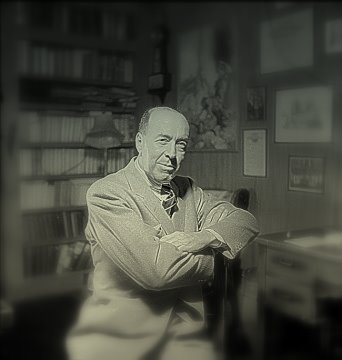
The Swami

The Swami

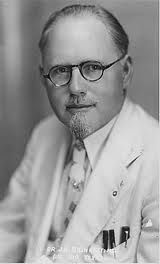
time Burroughs was investigating the Indian religion of Vedantism.  Swami Prabhavananda had established a temple in Hollywood at the beginning of the decade which quickly took hold.  The symbolism would be employed by the Vedantists while Burroughs’ interest in symbolism itself was piqued.  Shortly after this novel ERB purchased a 1932 volume entitled The Scientific Dream Book And Dictionary Of Dream Symbols by one Johnathan B. Westerfield.  Thus ERB was investigating the psychological origin of his dreams.  The man was trying hard.

     It is clear that this sequence of novels is heavily influenced by Homer, especially by his Odyssey.  Homeric motifs run all through these five novels while as Doctor Hermes and David Adams have pointed out Burroughs uses the Athenian monetary unit, the drachma, as the currency of Cathne.

     A third probable source would be from the Legends Of Charlemagne volume of Bulfinch’s Mythology.  In the last Bulfinch tells of a City Of Gold in which an enchantress keeps the paladins of Charlemagne captive.  That story seems to be based on Homer’s story of Circe and Odysseus, or Ulysses in the Roman telling, so Burroughs combines both stories in his own enchantress, Nemone, of his City Of Gold.  One may take the City Of Gold to be the Sacred City of the Iliad.

     The rival kingdoms of Cathne and Athne- my spell check just pointed out to me that Athne respelled is Athen which is very close to Athene or Athens- have Greek sounding names reinforcing the Homeric connection.

     While the sexual symbolism of Leopard Men is dark and brooding placed in a swamp not unlike the Lernean Swamp of Greek mythology in which Heracles fought the furious female Hydra, The City Of Gold is much brighter and airier, more intellectual than the darker urges of the subconscious.

     Having now read many of the Tarzan novels four-five and even six times I am astonished at how well they maintain their freshness from reading to reading.  Rather than weary me, each reading is a fresh experience that opens a whole new vista of possibilities.  The more I seem to understand of what I’m reading the more signficance the words have as the story seems to rise from the page to form concrete living images, as it were.

     In this novel expecially I am impressed by the pacing, the effort put into preparing the scenes and the masterly execution in which each word assumes its independent value almost as though ERB had put as much care into word selection as, say, the poet Tennyson.  Of course we all know ERB read Tennyson as well as other verse and poetry while also being familiar with song lyrics.  Thus while writing prose he is able to maintain a poetic intensity.

     The opening scene is an excellent example of his skill.  Tarzan is out hunting when he is spotted by some shiftas.  He’s in Ethiopia at the end of the rainy season.  We aren’t told why he is there but he has commanded Nkima and Jad-Bal-Ja to stay home.  As a corollary, just before he leaves Emma two years later he will take a solo vacation to the mountains of Arizona.  The spatial arrangement conveyed in this scene is that of Tarzan between the shiftas and the prey he is hunting.  While he is silently stalking the prey the shiftas are more noisily stalking him.  The movement of the shiftas which can be seen by the prey but not by Tarzan who has his back to them is caught by the prey who looks past Tarzan to the shiftas.  Tarzan noticing the prey looking beyond him also looks back to spot the shiftas stalking him.

     The spatial concepts involved are astonishing while three views of time are also evident.  I only picked up on this aspect with my fifth reading.  My interest was thus piqued and heightened so that the novel took on an entirely new aspect.  The scene as written is so well paced and spaced that it made a vignette I’m sure I shall never forget, while I now long to duplicate such a scene in my own writing.

     The patient lulling slow pace of Tarzan’s hunt was now broken.  As Tarzan’s quarry fled, the action between Tarzan and the shiftas became fast, furious and frenzied, while the sexual symbolism bursts into one’s consciousness.

     As the shiftas bear down upon him Tarzan realizes that he cannot escape by running.  If he could have he would have because as Burrughs never tires of noting there is no disgrace in running from a force majeure.  Instead Tarzan shot arrows among the the shiftas.  Than as a shifta bore down on him lance leveled:

There could be no retreat for Tarzan; there could be no sidestepping to avoid the thrust, for a step to either side would have carried him in front of one of the other horsemen.  He had but a slender hope for survival, and that hope forlorn though it appeared, he seized upon with the celerity, strength and agility that make Tarzan Tarzan.  Slipping his bow string about his neck after his final shot, he struck up the point of the menacing weapon of his antagonist, and grasping the man’s arm swung himself to the horse’s back behind the rider.

     Abilities like that make Tarzan Tarzan and I’m sure such a feat could be done in reality as in the imagination although possibly not if Tarzan had had the bunchy muscles of the professional strongman.  Smooth ones flowing beneath the skin like molten metal are undoubtedly a prerequisite.

     Dispatching the shifta Tarzan is now symbolically seated on a horse.  The horse directly plunges into a river to swim to the other side.  In mid-stream the horse and rider are attacked by a crocodile that Tarzan kills or disables.  Emerging from the river Tarzan gallops into a forest where he abandons the horse for the security of the trees.

     There in a short passage we have a wealth of symbolism that tells in a few paragraphs what ERB could have developed in many chapter if told in straight prose.

     The horse is a symbol of the female.  Thus Tarzan as Animus is symbolically united with his Anima.  the horse plunges into the river which is also a female symbol representing the waters of the unconscious.  Still mounted Tarzan is in the conscious sphere above water while the horse is submerged in the subconscious.  The crocodile also a female symbol representing the greedy, devouring, emasculating aspect of the female attacks.  The horse turns upstream in an attempt to flee the croc.  Tarzan strings his bow firing an arrow, as a masculine symbol, into the  crocodile’s mouth disabling it thus escaping the disabling aspect of the feminine while with strange violence sending the arrow down the throat.  One has to think about these things.

     The horse scrambles up on the opposite bank signifying a change in life, then gallaps into the forst of the subconscious where one goes in search of oneself.  The forest here is the same as all those underground mazes in Burrough’s corpus.

     Once in the forest Tarzan abandons the horse, or Anima for the security of the trees where he is above it all.  Apparently there is a deep cleavage between his Animus and Anima.  Now begins a very strange encounter.  Burroughs apparently felt he left something of himself on the other side of the river so he goes back for it.

     Coming upon the camp of the shiftas he notices that they have a bound captive.  As this appears to be what he returned for one can only speculate that the bound captive is an aspect of himself.  Perhaps the captive represents his marriage to Emma in which he is in the bonds of matrimony wishing to escape them.  Tarzan takes action.  At this point Burroughs offers this rather remarkable passage describing the Ape-Man.  p. 15:

It was difficult for Tarzan to think of himself as a man, and his psychology was more often that of the wild beast than the human, nor was he particularly proud of his species.  While he appreciated the intellectual superiority of man over other creatures, he harbored contempt for him because he had wasted the greater part of his inheritance.  To Tarzan, as to many other created things, contentment is the highest ultimate goal of achievement, health and culture the principal avenues along which man may approach this goal.  With scorn the ape-man viewed the overwhelming majority of mankind which was wanting in one essential or the other, when not wanting in both.  He saw the greed, the selfishness, the cowardice, and the cruelty of man; and, in view of man’s vaunted mentality, he knew that these characteristics  placed man upon a lower spiritual scale than the beasts, while barring him eternally from the goal of contentment.

     In the above quote ERB outlines the central problem of mankind.  In the evolution of mankind from beast to homo sapiens the much vaunted mentality of HS has failed to make the transition from the pure mentality of the beast to that of, essentially, the god.  In orther words his origins are dragging him back as he tries to make the leap to the next stage of evolution and development.

     While having a godlike intelligence rather than using it to elevate himself above primal desires as the direction of the nineteenth century was going, in the early twentieth century Freud undercut the drive to perfection dragging mankind back down to primal desires.  This is Freud’s great crime for which he should be burned in his effigy of Satan once a year in a great world wide holiday.  Thus as Man uses his intelligence to get at the root of things, and I think we’re very close to understanding all, Man’s primal desires lapsing back into the ‘unconscious’ of Freud, and make no mistake the current conception of the unconscious is of Freuds’ personal devising, devise even more fiendish ways of evil as that knowledge increases.  Thus rather than aspiring toward a spiritual contentment Man chooses to give in to desires that lower him beneath the hyena.

     Thus Tarzan, who has attained spiritual contentment, and become godlike, looks with scorn and contempt on the humanity of his fellows preferring to think of himself as a ‘spiritually pure’ beast.

     While this attitude is a theme throughout the oeuvre and the corpus as a whole perhaps this rant was sharpened by the developing difficulties at MGM.  Shortly after this was written Tarzan, The Ape Man hit the screens scrambling ERB’s vision of Tarzan forever.  The screen Tarzan has no intellect.  In the movie Tarzan’s Desert Adventure Boy even has to read Jane’s letter to him.

     On his way to the shifta camp the ever present Numa is between him and the desperadoes.  Taking to the trees of the forest to pass over Numa he spots a strangely garbed man in the shifta camp.  Still smarting because he lost his quarry and operating on the primitive logic that since the shiftas had deprived him of dinner it would only be right to deprive them of something they wanted, he decides to free the captive.

     He was about to fail in his attempt when the ever present Numa saves his skin by attacking the shifta camp.  In the confusion Tarzan and the prisoner escape.  The man turns out to be an Athnean named Valthor.  Having escaped they must put up for the night.  Sheeta the panther is abroad.  As David Adams is wont to point out, for Burrough Sheeta is a sexual symbol, so the next scene has strong homoerotic overtones.

     The question is who does Valthor represent.  He is curiously vague in personality.  As Burroughs was obsessed with the Jekyll and Hyde notion at this time I suspect that Valthor is an aspect of Burroughs’ own personality with some sort of relation to Tarzan as Jekyll to Hyde.  Valthor’s life is saved as Sheeta leaps for him so that one feels he may be related in some way to Stanley Obroski, another alter ego of Tarzan, who will actually die in the succeeding novel, Tarzan And The Lion Man.

     In this novel, in putting up for the night, Tarzan with his superior junglecraft, finds a tree where two horizontal branches fork.  He cuts some smaller limbs to form a pallet for himself for the night.  He had eaten but he is unconcerned whether the able bodied Valthor has eaten or not.  Tarzan does not hunt for other men.  If he hadn’t already eaten he would have made a kill and shared the abundance.

     Valthor lies down on the ground.  Sheeta is watching silently.  So silently even Tarzan does not hear him breathe, until readying himself to springs, he quietly brushed a leaf or two.  Tarzan hears for his ears are not as yours or mine.  As Sheeta launches himself on Valthor Tarzan shouts a warning while rolling from the pallet to descend on Sheeta’s back.

     Now, this scene replicates a similar scene in Beasts Of Tarzan when Tarzan leaps on Sheeta’s back in midair as she was about to leap on the ape, Akut.  I hadn’t thought of homoerotic overtones between Akut and Tarzan but they may be there.  It may be signficant that Akut later became the mentor of young Jack Clayton otherwise known as Korak The Killer.

     In the instance of Akut, the ape became sort of a vassal of Tarzan, while in this story Tarzan and Valthor become fast friends although the relationship is one of superior to inferior- Batman to Robin.  After killing Sheeta, Tarzan takes a more motherly attitude toward Valthor, making a bed for him in the tree because he knew Numa was prowling the forest.  That undoubtedly he knew that before was he leaving Valthor for Numa?

     They awoke in the morning.  p. 26:

Nearby, the other man sat up and looked about him.  His eyes met Tarzan’s and he smiled and nodded.  For the first time the ape-man had an opportunity to examine his new acquaintance by daylight.  The man had removed his single garment for the night, covering himself with leaves and branches.  Now as he arose, his only garment was a G-string and Tarzan saw six feet of well muscled, well proportioned body topped by a head that seemed to bespeak breeding and intelligence.  The wild beast in Tarzan looked into the brown eyes of the stranger and was staisfied that here was one who might be trusted.

     Not exactly a description of love at first sight but a definite tinge of homoeroticism.  Brown eyes.  In fact Tarzan and Valthor become fast friends.  Quickly learning each other’s language by the point and name system, or at least, Tarzan learning Valthor’s language, they are soon chatting away amiably.

     Valthor comes from the mountains but after they wander around for a week he admits he is lost.  Tarzan gets the general direction then setting out in a bee line.  Their goal is the huge extinct volcano, Xarator, which they soon locate.  Just as Leopard Men was cast in the erotic swamps of the feminine as Old Timer lusted and panted after Kali Bwana so The City Of Gold  is located in a valley high in the mountains where heaven and earth meet and the cold incisive intellect works best.  Tarzan is not going to lust; like brave Ulysses he is going to resist the sexual blandishments of his Circe, Nemone.

     Both City Of Gold and Tarzan Triumphant take place near or in volcanos so the volcano must link the two stories.  The extent of emotion involved in this one is indicated by the atmospheric conditions as the two men enter the valley.  Compare this scene with that of Tarzan The Invincible when Tarzan and La leave Opar.  the symbolism is ferocious.

     The scene is set in the mountains of Ethiopa.  The rainy season is about to end but the last and most furious storm of the season bursts on the two.  It seems certain here that Valthor is another aspect of Burroughs’ Animus in the Jekyll-Hyde sense.  In this case the two are not so widely divergent as Jekyll and Hyde but are closer in aspects .  Tarzan is still definitely superior and Valthor inferior.

     Athne and Cathne are twin cities in the valley but they have to pass through Cathne- The City Of Gold which is to say perfection- to get to Athne.  Athneans are Elephant men while Cathneans are Lion Men.  As the two begin to cross the valley the great storm breaks.  The storm no doubt symbolizes that storm feared by Burroughs of actually separating himself from Emma, certainly one of the most difficult thing he would ever have to do.

     The separation must have been terrific internal trauma so that ERB kept putting it off rather than face it.  One imagines that as in a situation like this Florence was continually asking him when he was going to tell Emma.  It would be another two years before he could force himself to make the break.  It is significant that just before he left he took a leave of absence from Emma returning to Arizona where, as here, he stayed in the mountains, the White Mountains of the Apaches.  Thus his time in the Army must have had more significance for him than we credit.  He must have thought, as miserable as he appeared to be, that those were the happiest days of his life.

     In Cathne the rains came down.  This was the mother of all storms.  Between the thunder, lightning and literal sheets of rain the two were severed from all reality.  They were walking ankle deep along the road.  Once again they have to cross a stream.  ERB has seen such a stream in Arizona, so this whole situation seems to be recalled by his Army days.  Actually the nine months he spent in Arizona was a fairly rainy period of fourteen inches.  In February 1897, I believe, four and half inches fell probably in one stormy period.  ERB records a stream that became a raging torrent in his last Western novel.  To some extent then he was writing from experience but already thinking of the good old days before he married.

     As hard as it was raining in Cathne the river should have been unfordable but art has its demands.

     Valthor knowing the ford begins to lead Tarzan across.  He gets too far ahead.  Tarzan in his uncertainty misses a step being swept away by the flood.  He is now in the possession of the waters of the feminine, that is, his female problems, just barely able to get his breath.  He is swept from side to side by the violent action of the waters, tumbled head over heels, but he keeps his mental presence.  There is a great waterfall ahead of him which threatens certain death.  The symbolism should be clear.  In a last ditch effort Tarzan catches a rock hauling himself from the water, if I am correct, on the same side of the river, in other words, Emma.  He doesn’t cross which is symbolically important.  Refer that back to the earlier crossing in which he actually crosses but then returns.

     Gathering his senses about him he sees some lights, going to investgate.  He unwittingly stumbles into Nemone’s garden.  Out of the frying pan, into the fire so to speak.

     Brave Ulysses has found his Circe.

B1

     The scent of the big cats fills this book.  Already Sheeta and Numa have had nearly equal billing with Tarzan and Valthor; now lions are given prominence.  Now Tarzan emerges from the flood, which symbolizes a major life change, into the land of lions and lion worship.  the ownership of lions is a mark of distinction in Cathne, Cahtnean chariots are even drawn by lions which brings to mind the chariots of goddesses like Cybele, Harmonia and Cadmus.  Nemone will promise to reward Tarzan with three hundred lions, apparently an incredible number making him the top Lion Man.  Remember the next novel Tarzan And The Lion Man will continue the theme.

     Continuing an old theme from Tarzan And The Golden Lion a lion is even the god of Cathne.  The symbol of Nemone’s Animus is a great black maned male lion named Belthar.  The novel will devolve into a battle between Nemone’s lion, Belthar, and Tarzan’s lion, Jad-Bal-Ja.  Also continuing an old device employed in Tarzan And The Jewels Of Opar by the jewels and in Tarzan And The Ant Men by Tarzan’s locket this story is unified by the image of a great lion drawing ever nearer to Tarzan.  So amid all these lions is the true Lion Man, Tarzan’s personal lion.  His own guardian animal.

     It does seem clear that ERB associates the big cats with sexuality.

     ERB is building this story very carefully with great attention to spacing and pacing.  Captured by the

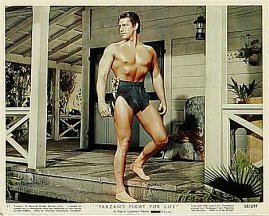
Gordon Scott As Tarzan

Gordon Scott As Tarzan

Cathneans ERB takes care to ingratiate the Big Bwana with the troops.  He has Tarzan and the Cathnean soldiers enter into a spirit of camaraderie as he introduces them to and instructs them in the use of the bow.  Nemone is instroduced but seems to take little notice of the Big Guy condemning him to fight in the arena.

     Taken to a prison cell he and we are introduced at some length and in some detail to a character named Phobeg.  Phobeg is billed as the strongest man in Cathne.

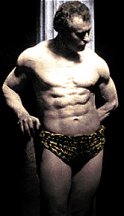
     ERB devotes an amazing amount of space to his confrontation between Phobeg and Tarzan.  His development of such a minor character is unusual.  I think what we have here is a confrontation between Tarzan and the actual man who inspired Burroughs to create Tarzan, the man who was the physical basis of the Lion Man.  Phobeg can be no other than the first important body builder in the world- The Great Sandow.  Just as in Tarzan The Magnificent Burroughs takes care to indicate that Tarzan has now replaced H.M. Stanley as the symbol of Africa, so here he puts down ‘the strongest man in the world’ in favor of his hero.

     Sandow (1867-1925) had died a few years earlier.  While other muscle men had replaced Sandow, most notably Charles Atlas, Burroughs was still obsessed by the man he had seen at the Columbian Expo of 1893.  It would seem certain that ERB occasionally picked up a copy of Physical Culture Magazine to keep up on the latest builds.  He couldn’t have missed the memorial copy devoted to Sandow, the greatest and still the greatest of the body builders.  The award given to Mr. Olympia is called the Sandow.

     While bowled over by the strongman, and strongmen, ERB was always offended by the bunchy muscles created by body building.  he repeatedly makes allusions to strongmen throughout the corpus while Tarzan himself is both the antithesis and the perfection of the strongman.  That is why Tarzan has smooth muscles flowing like molten metal beneath his skin while in this case Phobeg as a Sandow surrogate has the knotted muscles of the body builder.

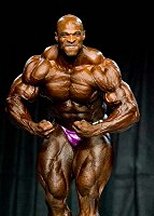
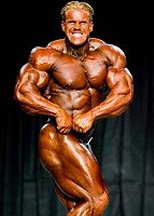
     If Burroughs found Sandow’s build offensive he would have gone apoplectic at the most recent champions who seems to have developed musculature as far as it can go.  Unlike builders like Charles Atlas, Gordon Scott or Arnold Schwarzenegger who aspired to the Apolline figure, Ronnie Coleman and his successor Jay Cutler have opted for muscle upon muscle until there  is nothing but muscle with no attention to a human shape.  As an example check out Jay Cutler the current Mr. Olympia and holder of the Sandow at www.emusclemag.com.  This guy is only 5’9″ but bulks up at 320 lbs., paring down to 275 for performance.  And that is literally all muscle.  One look at Cutler and ERB would have been foaming at the mouth

     Just as Sandow was billed as the strongest man in the world, so Phobeg is billed as the strongest man in

Jay Cutler In Full Pump

Jay Cutler In Full Pump

Cathne.  ERB makes him a braggart in relation to Tarzan but if he was the strongest man in Cathne he had little reason to respect Tarzan’s physique which was more like ‘Apollo than Hercules.’  Tarzan’s strength though greater than Phobeg’s was disguised.

     At they are to fight each other to the death in the arena this allows Burroughs to introduce another of his interests which may be related, that of professional wrestling.  Burroughs had Tarzan jokingly suggest that they stage the fight much as professional wrestlers.  Burroughs who still attended the matches was disgusted becasue the matches were pure entertainment, something he should have applauded.  Then as now the professional wrestling matches were staged.  Professional wrestling then as now has more to do with entertainment than sport.  Either you can get caught up in the fun and drama or you can’t.  ERB obviously did although as he still thought of the shows as wrestling he felt put upon.

     After several pages of Phobeg’s bragging and Tarzan’s false humility the ‘really big shoo’ begins.  Tarzan and Phobeg are the last act on the program and they would have been a difficult act to follow.

     ERB must have loved this part as the lenghty description of the gambling taking place is many times more detailed that he usually is.  Whether the gambling aspect went on at the wrestling matches he attended or not, I don’t know.  The odds naturally are for Phobeg, whose Cathnean reputation is immense and accurate as concerns the past.  Everyone expects the inveterate gambler Nemone to bet on the sure thing as was her custom.  They hedged their bets when they could at fantastic odds.  Nemone then surprised them by betting on Tarzan.  Nearly bankrupted the whole coterie of Lion Men.

     Tarzan wins of course but refusing to kill Phobeg he instead does his trademark thing lifting Phobeg above his head and tossing him into the stands at Nemone’s feet.  Now that is one hard act to follow.

     Having now won his liberty, a lion man named Gemnon is assigned custodian of Tarzan taking him under his wing.  Up to this point there seems to be no reference to contemporary affairs except for Sandow and wrestling.  At this point ERB displays a numerous and surprising set of literary references.

Go To Tarzan And The City Of Gold part two. 


Exhuming Bob 11:

Bob Dylan And Toby Thompson

A Review

Positively Main Street

Text:

Thompson, Toby: Positively Main Street, U Minnesota Press, 2008 reprint of the 1971 edition.

Forty Miles Of Bad Road Later

Forty Miles Of Bad Road Later

     Toby Thompson’s self identification with Bob Dylan is an interesting situation.  In a way he predated the Elvis impersonators; blazing a new trail.  That he recorded his infatuation on the spot and got it into print is even more fascinating.

     I suppose people have always identified with important people as the insane asylums full of Napoleon Bonapartes indicate, but when the movies came into existence things changed.  Movie actors were designed to appeal to certain character traits making identification with the actors more accessible.  That the actors came from social strata much like one’s own with no apparent effort or skills made identification easier.  (See the novel Merton Of The Movies by Harry Leon Wilson)  When sound was matched to image one could act like and even talk like these heroes.

     Older people being formed already were more immune than younger people so that the John Wayne imitators, Bogarts, Jimmie Stewarts or what have you began to surface in numbers beginning in the fifties.  Still there was a psychological distance between the people on the screen and oneself while a direct imitation brought ridicule on oneself.

     Then in the mid-fifties Presley burst on the scene.  Here was a guy who drove truck, we were told, one day and was a major recording star the next.  Then, as immediately as it seemed to all of us, more to some of us than others, he parlayed that into becoming a movie star.  That was just about every teenagers dream.  Now that was something we all could do and a great many of the most venturesome did get at least to the level of recording stars but they all wanted the movies.

     Presley was the first who created a legion of impersonators.  The movies formed a cadre of amateur impersonators but Presley spawned a full frontal impersonation for a profit; People who became Elvis Presley as a surrogate for themselves.  This began fairly early in the Presley career too.

     Then as the sixties hit young people were conditioned by phonograph records.  Records were the way the generation communicated with each other; They took the place of movies and literature.  One could still write books or rarely, like Presley, make it into the movies but anyone with enough ambition, little training during the sixties and none in the seventies, could make a record.

     This was no more evident than in the case of Bob Dylan.  Quite frankly my own first impression was that here is a talentless guy putting out records.  If Dylan could do it, if I wanted to, I could.  It then became easy to identify with Dylan.  Plus he was a nobody, had never even been to college.

     After I and many others had written his early records off he surfaced in a way to seize your attention, however his appeal was limited to a certain psychology.  But, now, in the twentieth century via records and radio if there were only a million of any certain type those million could make an artist very, very successful, viz. Janis Joplin.

      When Big Brother And The Holding Company with Janis Joplin released its first CBS disc the record went to the top of the charts on the strength of a small minority of the public.  The vast, and I mean vast, majority of the public had never heard of the band or Joplin.  I was in the record business at that time and was astounded that a relatively few hippies made a group and singer unkown to 9 1/2 out of ten, at the minimum, could send a record to the top.  Hippies were not known to take care of their possessions.  They trashed that record in a week or two playing it perhaps a hundred times or more then coming back to buy another one after another.  Each one of those sales contributed to the accumulation of a million so the entire course of American music was swayed by the success of a record purchased by a very small percentage of the population, and the lunatic fringe at that.

     So with Dylan.  Dylan provoked a violent split in society.  Just as Pat Boone was opposed to Elvis as a role model so Simon and Garfunkle were opposed to Bob Dylan.  In 1966-67 the S & G faction was much larger than Dylan’s.  Bob got more TV attention however.  His cult was as the misunderstood, oppressed genius, the Outsider who was shucking the world.  You can see where his fan base came from.  So, all of us who were in that category became devoted, almost obsessed, advocates of Bob Dylan.  I was one, I’m merely analyzing not being superior.  I never went as far as Toby Thompson in my obsession but then I didn’t think of what he did either and I was six years older.  I already had a life of my own, such as it was.

     The younger people took to the pop stars with ease.  We had Jim Morrisons, various Beatles and Stones or whatever as well as Dylans walking around campus, people completely immersed in the various identies.  I don’t even have to p[oint out the Deadheads and they were truly legion.

     So Thompson’s notion of reliving Bob’s youth in his own person while extreme was not completely imcomprehensible.  Still psychotic but borderline as he never completely lost contact with reality.  Really interesting because unlike Freud’s Schreiber he was able to write a book about it even as it happened.

     Thompson was born in 1944 being  three years younger than Bob thus being able to look up to him as a role model.  Being three years older than Bob I always looked down on him as a younger sibling who was somehow outshining me.  The identification was there nonetheless.

     Through 1966 Bob befogged us all.  Blonde On Blonde was such a towering effort both musically and lyrically that it was incomprehensible.  No one could understand it.  Some of it you couldn’t even listen to but you were convinced it was a work of genius.  The people who called it mere noise weren’t entirely wrong either.  Philistines nonetheless.

     I knew that Bob had peaked along those musical lines and there would have to be a model change.  But then the word came out that Bob was dead, close to it or paralyzed from the eyes down.  He disappeared from the stage for a while but as he wasn’t dead or paralyzed we all stood with out faces turned to Woodstock waiting for news from the East.  We all, being those of like psychology.

     Then Bob dressed like Billy the Kid or some other Western desperado released John Wesley Harding.  the psychology was changed.  What had drawn us in for ’64 to ’66 was the muse using Bob Dylan as an instrument and he now had been discarded.  I dropped him as did many others.

     A year later Toby Thompson conceived the idea of searching out Dylan’s roots in Minnesota.  He didn’t go as a mere reporter though.  He went as a Bob Dylan impersonator.  There was Toby Thompson standing in Bob Dylan’s shoes.

     The Thompson that emerges from his telling is a very disturbed young man of twenty-four.  His intake of alcohol and marijuana was prodigious.   Of course, he’s telling a story, but I can’t recall one day that he wasn’t stone drunk.  He keeps a pint in his glove compartment.  He gets so drunk he stands on his head in the middle of a dance floor and can’t remember it the next day.  The guy must have smelled like a brewery all the time.  I’m sure the fumes coming from him when he interviewed Dylan’s mother in the daytime gave her a very negative opinion of him.  Robert Shelton, Dylan’s biographer, future biographer at this time, had been out to Minnesota the year before.  He was a professional Journalistic persona older than Dylan’s friends.  Thompson was three years younger and appears to have been accepted on a personal rather than professional basis.  After all he had no journalistic history, he was only going to write.

     On that basis he formed an intimate relationship with Dylan’s high school sweetheart, Echo Helstrom.  I’m going to concentrate on that aspect of the book for this review.  Bear in mind that she is three years older than Thompson.

     Thompson’s visit to Hibbing must have had the locals’ heads spinning.  Thompson, in his book, doesn’t seem to be aware of the impression he was creating.  From his description it seems that he appeared among them as a Bob Dylan impersonator.  Bobby Zimmerman left Hibbing ten years earlier, became Bob Dylan, and now ten years later this guy shows up impersonating him.  Doing a good job of it too.

     One can only imagine what Hibbingites thought. 

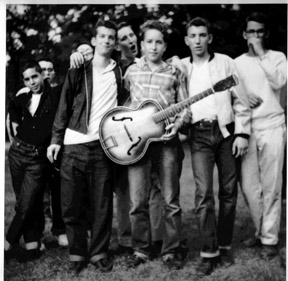
The idea of this guy pictured below going forth to conquer the world  of popular music appears to be absurd.  We all have known kids who wanted to do the same.  We may even be one of those kids but the odd

Look Out Little Richard

       Look Out Little Richard

of succeeding were about a million and a half to one.  How could anyone even suspect that Bobby Zimmerman, the kid above, from the virtually uninhabited North Country would be the ONE.  Everyone in town must have been laughing up their sleeve, like the guy on the right above, when Bobby Zimmerman sallied forth to ‘join Little Richard’ and conquer the world.

     Now, this guy Thompson using his own name came posing as a journalist but impersonating Bob shows up.  Thompson seems surprised at the reaction of Maurice and Paul Zimmerman, Bob’s uncles, but can you imagine being interviewed by a guy talking and acting like your nephew Bob.  It’s kind of crazy.  Imagine what Beattie Zimmerman, Bob’s mother, thought sitting across from Toby doing Bob.  Maybe that’s what Bob meant when he said ‘This guy Toby Thompson has got some things to learn.’

     Nobody knew what was going on there, did they?

     When Bob and John Bucklen and Echo Helstrom were kids, like many another group of Musketeers, they swore that if one of them made it he or she would help the others along.  Well, Bob made it but he forgot John and Echo.  No big deal.  Teenage vows even spoken in earnest have no meaning after the fact but the promise lives on in the innocent hearts of those who aren’t pulled through by the successful one.  There is a sense of betrayal.  Added to that there was romantic ill will on Echo’s part because of Bob’s eleventh and twelfth grade betrayal.

     Bob is making it big while Echo just has a job.  A young woman trying to make her way has a tougher  row to hoe than a guy.  But, if she knows how to work it she does have a story that’s worth at least a couple three or four years worth of wages.  She doesn’t know how to market it though.  Robert Shelton came out to Minneapolis a year before Thompson and paid her a hundred dollars for an interview.  She held the hundred up to Toby as hint but he wasn’t thinking that way.  She was only going to get screwed by Toby, literally.

     If Toby hadn’t been in an alcholic haze he might have realized that the story Positively Main Street was only subsidiary to Absolutely Sweet Echo.  The money was with Echo.

Echo When She Knew Bob

Echo When She Knew Bob

          As they’re driving up Highway 61 Echo pulls out a hundred dollar bill and says ‘See what Robert Shelton gave me for an interview.’  The light still didn’t go off in Thompson’s head.  He reached into the glove compartment for his pint.

     I am astonished at the amount of alcohol Thompson consumed on these trips.  If he isn’t novelizing the guy was in a virtual stupor the whole time.  When he and Echo arrive in Hibbing they go to a bar where Toby becomes blotto on beer, no less.  He has no memory of the moment but Echo tells him that he stood on his head in the middle of the dance floor as coins and keys showered out of his pockets.

     Echo must have been one tolerant girl or else she was hoping for something to happen.  Perhaps a large part of the charm of Positively Main Street is the stunning unconciousness of Thompson.  The guy was twenty-four years old at the time, not a kid- exactly.  He had been telling Echo he was going to write a book.  When he gets the first trip written up he sends her sixty pages.  Echo writes back:  ‘Sixty pages isn’t enough for a book is it?’  She has reasons to be disappointed.  Heck, Toby is using her to attempt to make his fortune and he hasn’t even promised to cut Echo in for a dime.  Think about this.  The self centered naivete shines through with startling clarity.  For that reason it is one of the most interesting books in the the Dylan canon.

Echo When She Knew Toby

Echo When She Knew Toby

     Now, in these sixty pages Toby has misunderstood what Echo told him about the time Bob called her on the phone and played Bobby Freeman’s Do You Want To Dance claiming to be singing the song.

     In his sixty pages he projects a better story where Bob shows up on Echo’s front porch playing guitar and sings Do You Want To Dance then strutting all through the house singing and playing somewhat like Elvis in the dime store in King Creole.

     Echo points out this error.  Toby liked his version so much he left it in the way he first wrote it.  Then when Echo introduces this Bob Dylan impersonator into his parents home Toby whips out his quitar and reenacts his version of the incident strutting around the house as he plays and sings.  The guy was absolutely out of his mind in his alcohol haze.  He must have smelled like a brewery the whole time.

     One is astonished that he was so well tolerated.  Of course maybe everyone was thinking:  ‘This is amazing, but it won’t last long’ and let it pass.  Waved his car goodbe as he sped away.

     One wonders what Echo’s emotional rection to the Bob Dylan impersonator was.  Toby must have reactivated dormant affections for Bobby Zimmerman as he came on to her strongly in Bob’s persona.  Echo had ten year old memories of Bob and now here he was, his double, coming onto her again.  Frightening actually.

     Toby left again and never returned.  In the book he seems oblivious to the havoc he created in Echo’s life.  In the interview at the end of Main Street given many years later he doesn’t seem to be any more aware.  In fact he seems to be still posing as Dylan’s double.  He mentions that he still contacts Echo, who has moved to LA, occasionally as does Bob but Bob seems to have better success in finding her. 

     Hurt and mystified that Thompson had no more use for her she wrote a poem for him that she mailed to him in far off Washington D.C.

Hey! Toby!

Where can you be?

Somebody told me

That you went back to

Washing Machine D.C.

How can that be?


You came to town in your Volkswagen

And I’ll tell you we sure had fun!

And now you’re gone!


You played for me on your old guitar,

Took me for a ride in your little car,

Drove me near and drove me far,

We looked at the moon,

And stared at the stars,

You stood on your head in my hometown bar…

How could it be you’ve gone so far?


Hey Toby?  Where are you?

– Echo Helstrom

     Toby hadn’t gone anywhere.  Like Bob he’d just never been there.  His fantasy like Bob’s didn’t include anyone else, they were just bit players in his own movie.  Toby was no longer thinking of Echo.  He was married to the bottle.  He was touring bars across the country to get material for his next book.  Echo could just consider herself as one of those bars.  Once Toby had visited it there was no reason to return.

     The tragedy for Echo was that she was betrayed once by Bob in 1958 and then again by a Bob impersonator in 1968.  Perhaps a wound was created in her heart that could never heal.  One wonders what her later history was after she left Minneapolis and drifted West.

I wonder where you are tonight.

I wonder if you are alright.

I wonder if you think of me

In my lonely misery.

There stands the glass,

Fill it up to the brim,

Till it flows o’er the rim,

It’s my first one today.

-Webb Pierce.

     Here’s to old memories.  Bottoms up.


Exhuming Bob IX, Pensees 7:

Into The Lost Land

by

R.E. Prindle

Texts:

Dylan, Bob, Chronicles Vol. I, Simon And Schuster, 2004

Prindle, R.E.   Exhuming Bob, VIII The Walls Of Red Wing, idynamo,wordpress.com 2008

Thompson, Toby, Positively Main Street, U. Minnesota, 2008, reprint from 1971

http://www.hibbing.org/dylan1/story.html  Life In Hibbing: Hibbing Chamber Of Commerce

http://www.interferenza.com/bcs/interw/85-dec.htm  Bob Dylan Is Not Like A Rolling Stone Interview, Spin Magazine, Volume One, Number Eight, December 1985

http://www.interferenza.com/bcs/interw/play78.htm  Playboy Interview: Bob Dylan 1978

http://www.interferenza.com/bcs/interw/66-jan.htm  Playboy Interview:  Bob Dylan  February 1966

                                                                               1940

Abe And Beattie

Abe And Beattie

     In attempting to put together a reasonable facsimile of Bob’s life in Hibbing and Minneapolis, Minnesota and New York City as he mythologized it in his chapter of Chronicles, The Lost Land, I have come to the following tentative conclusions.

     Bob was born in Duluth, Minnesota on 5/24/41.  In 1943 he was taken to Hibbing where he lived from then until graduation from high school in the Spring of 1959.

     Within the concept of normal Bob had a fairly advantaged childhood.  His parents were indulgent buying him anything he wanted while providing adequate pocket cash.  Bob’s family was one of the more important in town both within the Jewish community and the town at large.  In what appears to have been a tight small town social scene Bob either excluded himself or was excluded from the dominant social groups within which he had a right to be included.

     Perhaps Bob’s conception of the Hibbing period could be best interpreted from his favorite movie, Rebel Without A Cause, starring James Dean.  Bob is said to have seen the movie several times.  This was unusual as few people ever saw a movie more than once. He would have been a very impressionable fifteen at the time.   Most of us didn’t have the money while quite frankly few movies, if any, were worth watching twice including Rebel Without A Cause.  I was seventeen when I saw it and while I was in awe I wasn’t submerged.  Of course Bob’s relatives owned the theatres so he got in for free.

     As he set up a Dean shrine in his basement which greatly offended Father Abe we may be justified in assuming that Dean was a controlling influence in his life from the time he saw the movie.  It is of interest that Abe was to remove the Dean shrine from the basement after Bob left replacing it with a shrine to his own son Bob Dylan ne Zimmerman.

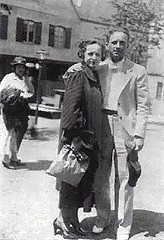
     Abe Zimmerman (1911-1968)   worked for Standard Oil in Duluth when Bob was born.  According to the C of C he lost his job in 1943 moving to Hibbing where his wife’s family, the Stones, could help the young couple.  Why Standard Oil should lay Abe off in the middle of the war during a manpower shortage seems to pose a question.  As can be seen from the photograph of Abe and Beattie above borrowed from the Flickr photostream of <drineevar> he was a well set up handsome man.  He appears to be exceptionally self-possessed, sound in the eyes.  Beattie appears to be a haughty high fashion queen which would accord with later facts.

      Abram Zimmerman, for such was his name.  Usually called Abraham, the name on his tombstone is Abram, and his two brothers Maurice and Paul bought the Micka Electric Company in 1943 changing the name to Zimmerman Appliance.  In 1968 Paul Zimmerman told Thompson that they had been in business for twenty-five years which would mean 1943 although the date seems odd.

     According to the C of C Abe came down with polio in 1946 requiring a lengthy convalescence.  The C of C says that the Zimmermans bought Micka’s after his convalescence but if Paul Zimmerman is accurate it would have to have been 1943.  There would be no record of what Abe did for a living then from 1943 to 1946.  As Bob says both his uncles served in the Army it would seem that they bought Micka’s going into the Army shortly thereafter leaving Abe to tend the business.

     Maurice and Paul became President and Vice-President of the corporation while Abe siginficantly assumed the controlling post of Secretary-Treasurer.  Managed the money, paid the bills.

     During the fifties at least Abe spent a fair amount of money on both Bob and Beattie.  Angel Marolt whose family bought the Zimmerman residence after Abe’s death was trying to tell him of Beattie’s several fur coats, diamonds and Cadillac but Thompson says he wasn’t paying attention.

     Thompson quotes Echo Helstrom as saying that the Zimmermans had stores in both Hibbing and Duluth.  Having a customer base of approx. 250,000 makes more sense when one considers the amounts of Abe’s expenditures and the fact that the profits had to be split three ways.

     The C of C describes Abe as a ‘big man’ in town partial to those big thick long cigars.


The Dylan Home

The Dylan Home

    The couple had enough money on arrival to buy the large nine room house that Bob grew up in so Abe must have been well paid at Standard Oil before he was laid off.  Both he and Beattie are well dressed in the picture while Beattie is actually overdressed.

     Bob was entrolled at Alice School for his kindergarten year in 1946 at five years of age.  The status of Alice School is unclear.  Perhaps it was closed the following year or consolidated with the Hibbing High complex as Bob was transferred.  Hibbing High housed kindergarten through twelve as well as the Jr. College.  Thompson describes it as a huge and rambling building.

     So from first grade to graduation Bob was with the same group of students.  I sure wouldn’t have wanted to move into town in tenth grade and try to break into that one.  While he wouldn’t have known them all well he must have known the entire student population on sight.  This presents the problem then of why Bob, who was the son of the Big Man in town, wasn’t included in the top social cliques.  Those cliques undoubtedly formed early persisting through graduation.  If Bob was in one he was either forced out early or found it uncongenial to remain for whatever reason.  Perhaps he thought his Jewishness excluded him.  So if something happened we don’t know what it was and won’t; unless Bob tells it’s going to be difficult to trace.

     Growing up in a small town anyone with any ambition looks around and sees very limited opportunities.  Working for his father wasn’t a viable option.  Not everyone wants to be a doctor or lawyer either.  Nuclear Science is OK but a lot of those guys are out of a job now too.  My next door neighbor when I was a kid for one.

     Bob’s mind turned early to music and then to Rock and Roll.  While Rn’R went on to conquer the world and become as respectable as such a spectacle could it was definitely considered discreditible and low class almost volunteer outlawry in the fifties.  At the very least it was ‘pimple’ music.  It took a certain amount of courage to say you liked Elvis Presley.  Pat Boone was set up as his rival and you had better say you liked ol’ White Bucks.  If you don’t think Elvis was considered a social criminal check out a couple of his movie roles like King Creole or Jailhouse Rock.  What was the Colonel thinking?  Clown roles, that’s all Elvis ever got.

      And then Bob chose as his hero and model Little Richard.  People looked at you funny if you said you

Young Bob On Harley

Young Bob On Harley

liked Little Richard!  I mean, Bill Doggett was a respectable Negro with music you could understand, Fats Domino was as lovable as a chubby ten year old but Little Richard!  They hadn’t even created the ghetto he could come out of.  His band might have passed but then he opened his mouth.  If there was ever a direct challenge to middle class sensibilities Tutti-Frutti was it.  Not only was the song incomprehensible it was about queers.  Nobody ever quoted the lyrics correctly, while I’m walking around saying ‘Tutti Frutti, I want Rudy?’  What does that mean?  I hope no one overheard me.  So when Bob gets up, ignoring Pat Boone entirely,  and launches into some screaming vision like Rip It Up or She’s Got It or God only knows what, was the crowd taken aback?  Chuckle, chuckle.

     So Bob having opted for the lifestyle was forced to associate with the hoody crowd or have become a loner.  Besides Colin Wilson’s book The Outsider  had appeared in 1956 that began a cult of The Loner that peopled the early sixties.  These guys, who were by no means rebels but deep thoughtful guys who had a line on the truth denied anyone else and that  penetrated sham and hypocrisy sat alone ever ready to resolve a situation setting things right were highly romanticized fellows.  There were as many Loners in those days as there were Hawkeyes a couple generations later.  So Bob wouldn’t necessarily have been thought of as weird, strange but a Loner.  A Loner was next door to weird and strange.  Thin line if you get my meaning.

     On the other hand the C of C describes the L&B Cafe as a regular jumping Bop Street right there in the heart of Hibbing, Minnesota.  Bands set up and played continuously.  They knew how to party in Hibbing.  The C of C even says there was a radio station in town playing Bob’s kind of music thereby contradicting every other source even Bob.  He says he had to go to Shreveport on the radio waves  to get his kind of music.  In this case I’m betting on Bob.

     The C of C  tells of Bob’s musical debut like this putting the best possible face on it:

Described by fellow students as polite, easy to talk with, and somewhat introspective, it was a total shock when he pushed back the piano bench and stood up to pound the first notes of a song into the auditorium, electrifying the student body.  Kids jumped up, stared at each other open mouthed not knowing what the reaction would be.

     Well, yes, they were electried but did they like it?

Rockin' Bobby Zimmerman

Rockin' Bobby Zimmerman

     According to the C of C, looking back fondly, Bob went over real well with his fellow students.  If you like this version don’t check the other sources as this is at variance with every other known account but then this is the Chamber Of Commerce  speaking.  Up to this point in the C of C account there is no reason for Bob to be as bitter as he is about Hibbing at all.

     A note of interest is the reoccurence of Fourth Street in Hibbing, Minneapolis and New York City.  Quite a coincidence, I knew there had to be some association with Fourth St. in Hibbing.  So far we learn that Bob attended Jewish shule there.  Whether the synagogue was also located there isn’t clear.  The synagogue Bob attended is no longer anywhere at any rate.  Tore it down.  It was in the way.  Had to go.  Even though Bob’s father was the most prominent Jew in town, the President of B’nai B’rith and ADL as well as his business interests, and even though Bob had a mega Bar Mitzvah with four hundred people in attendance some say at the most prominent spot in town, the Androy Hotel, some say at the synagogue, he wished to conceal he was Jewish.  This attitude may have contributed to his renouncing the Jewish fraternity house to which he pledged at UM while also hiding his religion in New York.  The attitude was strange since he seemed to prefer Jewish musicians around him to  the exclusion of goys.

     Bob’s father Abe, was quite frankly a marvelous provider, spending very large sums of money on son Bob, wife Beattie and his second son, David.  When he died in 1968 the house on 7th Ave., now Bob Dylan Ave. was sold.  The owners at the time of Thompson’s visit were the Marolts.  Angel Marolt who was at home when Thompson called offered to show him around.  One thing he learned was that Bob had a clause in the sale’s contract that allowed him to stay in his old room in the Marolt’s house whenever he was in town.  Too weird.

     What quirk in Bob’s mind compelled him to live in other people’s houses?  Perhaps Rebbe Maier back in 1954 impressed on Bob that Biblical scripture presribes that Jews would live in houses they never built.  As an article of religion that injuction is a mind boggler.  One can’t predict how anyone’s mind will interpret instruction.  Bob who functions out of his subconscious very heavily must have accepted such teachings in literal ways.  Rebbe Maier was a definite turning point in Bob’s life.  Imagine getting out of school, going upstairs at a Rn’R cafe to sit before the only bearded man you may ever have seen, dressed completely in black with a black yarmulke perched on the back of his crown intoning things like:  The Jews shall live in houses they never built and then go downstairs to boogie.  Pretty spooky, don’t you think?  And then as Bob says, he disappeared like a ghost.  Let that roll around your brain for little while and see what you come up with.

     Mrs. Marolt was trying to tell Thompson something about Mrs. Zimmerman’s multiple furs, heaps of diamonds, I’m sure all the latest fashions and her own Cadillac.

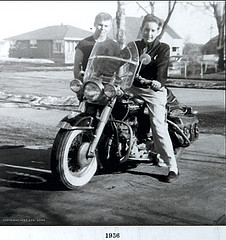
     Bob was indulged to the extent of apparently more than one motorcycle, a car, lots of amplifiers and electronic gear for his bands, whatever he wanted plus free movie admissions and plenty of pocket cash.  He must have had a large record collection for a kid as he spent his spare time at Crippas record store ordering the odd title.  You can bet Crippas didn’t discount either, charging full bore.  At the time (after 1958)   stereo was 5.98 and mono was 4.98.

     As the profits from a sole Hibbing store divided three ways could not have supported this sort of expenditure, having a store in Duluth could account for it.  It is significant also tha Abram died in June 1968 and the store closed a few months later.  Was the store a losing proposition for the last few years?  Did Bob provide the difference so Abe wouldn’t be embarrassed by going banko?  Then with his father gone there was no reason to support Uncles Maurice and Paul?

     There really is something happening here, isn’t there?

     Also as a petty expenditure for Bob (it would have been huge in my life) according to the C of C:

Almost every day Bob came in after school for his regular snack: cherry pie a la mode and coffee (or Coke.)

     And then to dinner?  No wonder the young Bob had all that baby fat. 

     If Echo bought those hot dogs for Bob and bought his story that his dad didn’t give him an allowance she was had in more ways than one.

     So, Abe was nothing if not a generous father and husband.  Beattie as President of Hadassah as well as a Stone must have made the Zimmermans the most powerful Jews in the syngogue while actually giving she and her husband the means to be petty dictators of the town,  I saw something like this in Eugene, Oregon in the sixties and seventies, or, as the C of C says a Big Man and big people.

     Bob must have a quirk in his mind to misrepresent his childhood so.  He was the Fortunate Son John Fogerty only sings about.

     In Thompson’s interview with Beattie he quotes her:

How can you know you have a genius in your house, when all my time is spent trying to feed him and keeping his clothes pressed.

     In Bob’s story, The Lost Land, Chloe Kiel is shown ironing Bob’s shirts and at the end of the chapter she ‘slaps’ a plate of steak and fried onions in front of him just before he darts out the door to begin the next chapter, A New Morning, just as in the old days when he returned home from school for lunch and was fed by his mother he darted back to school.

     Ironing his shirts and providing free steaks was a signal service for bare acquaintances like Ray and Chloe.

     Chloe comes across as cold and indifferent and indeed there is a tinge of resentment and anger beneath Beattie’s statement.  Motherly, of course, but there.  Still, she doesn’t impress me as any Yiddishe Mama of the Mrs. Goldberg variety.  Whether Bob was a good boy or not he does have an ambivalent attitude toward his parents.  But then he claims that he was really raised by his grandmother, whether Stone or Zimmerman isn’t clear.

     I believe the big change came over Bob with his Bar Mitzvah and I’m not talking puberty alone.  According to the C of C Bob attended Jewish shule during his young years.  This was done after public school hours.  Then in 1953-54 when his Bar Mitzvah was approaching Father Abe sent to Brooklyn, New York to have an ultra-orthodox, almost certainly a Lubavitcher Rebbe, sent to Hibbing to indoctrinate Bob in untra-orthodox teachings.  It can’t be any surprise that when Bob exhibited his Jewish reverence after his Jesus indoctrination with the Vineyard Fellowship he chose to show himslef as a Lubavitcher.  Welcome home, Bob.  The C of C tells it this way:

According to a 1985 Spin Magazine interview by Dave Engel, Bob said it was above the (L&B) Cafe that Rabbi Reuben Maier stayed while giving Bob Hebrew lessons in preparation for his Bar Mitzvah.  The Rabbi and his wife showed up one day and stayed for a year while Bob got ready for his big event .  The article quotes Bob as saying he would learn Hebrew after school or in the evening for an hour, then go downstairs and boogie at the L&B.  After completing his Bar Mitzvah the Rabbi just disappeared.

     In the interview Bob tells it this way:

There weren’t many Jews in Hibbing, Minnesota.  Most of them I was related to.  The town didn’t have a rabbi, and it was time for me to be bar mitzvahed.  Suddenly a rabbi showed up under strange circumstances for only a year.  He and his wife got off the bus in the middle of the winter.  He showed up just in time for me to learn this stuff.  He was an old man from Brooklyn who had a white beard and wore a black hat and black clothes.  They put him upstairs in the cafe, which was the local hangout.  It was a rock n’ roll cafe where I used to hang out, too.  I used to go there everyday to learn this stuff either after school or after dinner.  After studying with him an hour, or so, I’d come down and boogie.  The rabbi taught me what I had to learn, and after conducting the bar mitzvah, he just disappeared.  The people didn’t want him.  He didn’t look like anybody’s idea of a rabbi.  He was an embarrassment.  All the Jews there shaved their heads and, I think, worked on Saturdays.  And I never saw him again.  It’s like he came and went like a ghost.  Later I found out he was Orthodox.  Jews separate themselves like that.  Christians, too.  Baptists, Assembly of God, Methodists, Calvinists.  God has no respect for a person’s title.  He don’t care what you call yourself.

     The C of C knows the Rebbe’s name was Reuben Maier and Bob Dylan doesn’t?  There were enough people in Hibbing to have a temple and shule but they didn’t have a Rabbi?  The Rebbe Maier showed up in time for Bobby Zimmerman’s Bar Mitzvah but what? it was the first Bar Mitzvah in Hibbing’s Rabbiless history?  No wonder four hundred people showed up.  The Jews in Hibbing shaved their heads and worked on Saturday’s?  I presume Bob means they didn’t wear beards but shaved their faces unlike the Lubavitcher in white beard and one of those funny round hats.  I serously doubt there were three hundred or more Jews walking around Hibbing with shaved heads in 1954.

     They took one look at Rebbe Reuben’s weird beard and outre attire and told him to get out of town?  Now that I can believe.  Beards in ’54 were a sign of great eccentricity or a psychotic desire to draw attention to oneself.  But why in ’85 the mysterioso act?  He just showed up to teach Bobby Zimmerman, a complete unknown with no direction home Lubavitcher tales like this:  (actually this is pretty standard esoteric doctrine adapted for Jewish needs)

The messianic thing has to do with the world of mankind, like it is.  This world is scheduled to go for 7,000 years.  Six thousand years of this where man has his way and 1,000 years when God has his way.  Just like the week.  Six days work, one day rest.  The last thousand years is called the Messianic Age, Messiah will rule.

     Essentially what we have here is a variant of Madame Blavatsky’s Theosophy along with a little Hebrew Theology.  If one looks real closely one can see the outline of Sigmund Freud’s notion of the unconscious.

     According to Beattie Bob knew, oh, two hundred words of Hebrew.  So much for several years of shule and a year of intensive training by Rebbe Reuben.

     Whether Bob knows or admits it, it must be true that Father Abram sent for Reuben to instruct Bob in mysteries that Abe thought were essential to his vision of Jewish religion while they were not part of the services of the Hibbing congregation.

     It is possible that Abram brought the Rebbe in on the approval of the congregation who rejected him.  The comment by Bob of working Saturdays may be signficant here.  The Jewish sabbath begins on Friday sundown and continues to Saturday sundown.

     As a Lubavitcher, Rebbe Reuben could not have tolerated working during the sabbath while the congregation found it essential amidst a gentile population.  Likewise beards are an integral part of the orthodox religion so that the congregation  also refused to stop shaving.  The only thing mysterious is why it took Reuben so long to catch on.  Or maybe he had a contract for one year and the year was up.  Of course Bob did need help on those two hundred words.

     So Bob’s upstairs memorizing his two hundred words while the throbbing beat pounds insistently through the floor.  The super patient Reuben and his wife never object.  Bob shortly joins the revelers with his two hundred Hebrew words rattling round his skull, steps up to the mike and begins screaming: I’ve got a girl and her name is Echo.  Hmmm.  Quite an image out there in the Lost Land of Bob.

     Now indoctrinated in quaint antiquarian rites Bob is bundled off to Webster, Wisconsin and Camp Herzl to steep himself in Israeli style Jewish living.  Camp Herzl was conducted as Israel in America so those two hundred Hebrew words came in handy in that surrogate for summer in a kibbutz in the Holy Land.

     The summer sojourns must have set Abram back a handsome fee for the times.  Six to eight weeks of essentially summer boarding school does have expenses.  Abe apparently was deeply religious: in Protestant circles he would have been known as a Fundamentalist nut.  He and Mike Huckabee would have gotten along fine.  One wonders if younger son David was given the same treatment.

     So Bob from 1954 on is definitely the product of two nations.  The world of the Three Hanks as the C of C puts it and this world of Adam, Moses and the Messiah.  Bob was named after Sabbatai Zevi the last acknowledged Jewish messiah in the seventeenth century, his Jewish name is Sabtai.

     As kids we all have a lot to reconcile, begin working out at graduation.  Bob had a double load; he had two Bobs to reconcile.  Personalities wander and widen in those years, Bob made a clean split.  On the one hand he was the twerp Bobby Zimmerman of whom it may be said:  There’s no success like failure while on the other he was struggling to be the super successful Bob Dylan in which he failed to assume the mantle so that failure is no success at all.  At least he made this split off persona’s name mean something.  As a note, it was not generally known Dylan was Jewish until after Blonde On Blonde.

     Thus in his movie Renaldo and Clara he is not Bob Dylan.  Anybody can be Bob Dylan he says, you can be Bob Dylan.  Toby Thompson thought he could be and did a pretty good job of it walking a mile or so in Bob’s shoes.  Sounded just like him.

     As remarkable as it is that Bob realized his fantasy beyond anything he could have dreamed and became the hugely successful Bob Dylan he created an entire new set of problems whose solution eluded him.  Well, you know, there’s something lost and something gained while it’s hard to know whether the gain was worth the loss.  However the money has disappeared from the table.

     The result then is Bob looking backward from 2004 to create a fantasy of how it was in Ray and Chloe’s place on Vestry Street in NYC.  The chapter is approriately titled The Lost Land or possibly Never-Never Land might have been better.  The chapter isn’t a complete fabrication but it is fiction.  Something like the various incidents might have happened but not exactly the way Bob tells it.  The framing story of Ray Gooch and Chloe Kiel is pure fiction however.  They could not possibly have existed.

     Bob tells the whole story of the Lost Land within the reference of Ray and Chloe and their fabulous apartment near Vestry below Canal near the Hudson across the street fromt he Cathedral with its bell tower.  Thompson got it right.

     A troubling aspect of Bob for me is his insistance on bumming other people’s apartments.  This seems to be compulsive behavior.

     Bob was actually voluntarily homeless from January of ’61 to October  or November of the same year when he and ‘roommate’ Suze Rotolo took up digs on Fourth St.  I suspect that Father Abe would have been only too happy to supply Bob with funds to live on Vestry Street if he had asked.  Bob is simply untrustworthy in any of his stories.  As he said of what he learned from folk music:  If you told the truth, well and good; if you told the untruth, well and good also, so in Bob’s mind there are no lies, there is only the truth or untruth both having the same value and whichever is more serviceable at the moment.  You can’t believe him.

     A troubling aspect of Bob’s behavior is his habit of bumming couches in other people’s nests; gaining meaning, as it were, from other people’s lives.  Perhaps that was the way he felt of his life in his mother and father’s house.  Or perhaps as a Jewish outsider in a goyish land it was his attempt to insinuate himself in the main stream much as he appropriated Woody Guthrie’s persona.  Of the houses I have traced they have all been those of goys; he didn’t choose to insinuate himself into the houses of his fellow Jews.  His imaginary hosts Gooch and Kiel are obviously goys.

     The Lost Land then is a mythologized version of his childhood and first few months in New York City.  To my mind Ray Gooch is a combination of Dave Van Ronk, Paul Clayton, Matt Helstrom and his father.  Chloe seems simply to be an idealized notion of his mother.  (Study her picture for a few moments again.)

     As the Gooch frame brackets the period from Bob’s encounter with Gorgeous George to the apartment with Suze Rotolo it must represent a time frame from sometime in ’58 to October ’61.  In October Bob Dylan ceased sponging off others to take up his own apartment.

      The only one in this time frame he knew who had a large gun collection was Matt Helstrom.  The Helmstroms also had a large record collection that Bob listened to.  The couch and apartment undoubtedly belonged to Van Ronk while certain exoticisms of Gooch are characteristic of Clayton.  The library of Gooch may simply be the New York City Library of which the long narrow room would merely describe the stacks.

     The Southern character of Gooch must represent a time after Bob studied the South in the library since there are several references to his Civil War studies.  Gooch himself is a Southerner from Virginia gone North which is a symbol in itself.  This can be symbolically described as Father Abe being a Jew in Gentile America.

     Here then Bob creates or accentuates the more pleasant aspects of his memories in contrast to the very bitter unpleasant memories of the songs.  He tells us a great deal about his dream life but little of its realities.  At this point I am of the opinion that the party of Camilla ( who Bob says he gets to know quite intimately) is another fabrication of the based on a true story variety.

     As Bob would say, folk music taught him that if what you said was true,well and good; if what you said was untrue well and good also.  We may probably construe the Lost Land as both true and untrue while a good folk tale.  Even the title has a fictive quality a la Edgar Rice Burroughs.

     To round off the period back in the C of C milieu of Hibbing:  Bob spent his last summer at Camp Herzl in 1957.  In the summer of ’58 he was running back and forth between Hibbing and Minneapolis.  At that time he would have become familiar with Highway 61.

     In his Junior year of ’57-’58 he took up his relationship with Echo Helstrom.  They were going steady hence were not supposed to be dating others.  As he was in Minneapolis most of the summer he left Echo sitting home alone.  She resented this.  As the Senior year began she told Thompson, she took a revenge on Bobby returning his token in public in the hall at school.  Boy, that hurts.

     The feelings must have been much harder than either Bob or Echo portray them.  A key problem area is did Bob spend time in Red Wing Reformatory on Highway 61 below Minneapolis and if he did what did he do to receive his sentence:  I examine this more fully in Exhuming Bob VIII:  The Walls Of Redwing.

     He says in Chronicles that he was absent from school from some time at the beginning of April of ’59.  He was back at least by the June 5th graduation.  His birthday is May 24th.  After that date he would have been eighteen and subject to adult sentencing.  For what It’s worth he says in his song that no inmate was over seventeen.  I’m suggesting that he spent a month of two at Red Wing returning in time for graduation.  Certainly a Big Man in town like Abe could have arranged the graduation if he couldn’t get Bob off that time.

     The question is what did Bob do?  By the middle of this Senior year it appears that he had been in enough scrapes to be known as a troublesome boy; perhaps living out a Rebel Without A Cause persona.  Father Abe used his influence up to that time to avoid unpleasant consequences for the lad.

     I believe Bob’s song The Chimes Of Freedom tells the story of his crime.  Quite simply Echo set him up.  She obviously was not quite as complacent as she tells it.  See Exhuming Bob VIII:  Walls Of Red Wing.

     Returning home from Red Wing his parents threw a graduation party for him.  Bob was reluctant to attend the party, perhaps with good reason but was persuaded to do so.

     This then leaves a very sketchy account of the three or four months of the summer of ’59 for which Bob provides little information.  In Walls Of Red Wing I place his stint at Red Wing in August but that is probably wrong.  In any event the period from April of ’59 to September of ’59 needs to be explained more fully.

     Bob gives some brief details of his stay at Dinkytown but not much.   A little bit of the John Pankake episode while avoiding the important details of his theft of Pankake’s records.

     Thompson has some good information from Ellen Baker whose father’s folk song collection Bob used extensively.

     Then to NYC and his account of The Lost Land segues into his New Morning.


Conversations With Robin

June 19, 2008


Conversations With Robin

Robin Mark and R.E. Prindle

Conversations continued from Post:  Lipstick Traces Part IX: Greil Marcus


     OK, OK, OK.  I’m getting it, took a while.  STONE.  Everybody must get stoned.  What’s your mother’s maiden name, Bob?  Stone.  Right.  Dylan might be tongue tied.  I certainly was.  Still am to a certain extent.  But, I think one place to start is the religious conflict he had to endure.

     His father, Abe, was a fundamentalist religious weirdo.  Just because one is Jewish doesn’t mean you can’t be as religiously weird as Mike Huckabee.  For Christ’s sake, Bob believes the Bible is literally the word of God.  Somebody recorded his rants between songs and published them.  Don’t have the book as yet but I’ve read a couple of exerpts.  I already know all that crap.  Spent much youthful time among the Nazarenes and other weird outfits.  They had me for a while but I threw them off.  The taste still lingers though.  Bob apparently hasn’t.  God, how can anyone believe that crap.

     Beattie in Thompson’s book say Bob sampled the various churches as well as attending Jewish sabbath.  Yes, I can believe that.  So he’s got a father who’s king of B’nai B’rith and ADL and a controlling mother who’s quieen of Hadassah.  As if this isn’t enough when he turns thirteen his old man straps him to the torture rack, pries his eyelids open with toothpicks and bombards the poor little bastard with Lubavitcher bullroar. 

     And then…and then, they send him off to be preached Zionist poppycock for a month or two every summer for four years.  I can’t tell you how much I hated church camp.  I mean, I can, but maybe later.

     Apart from the religious issue then we have the personalities of Abe and Beattie.  I got a vaguely uncomfortable mother feeling about Beattie from Thompson’s Main Street.  I wouldn’t say I didn’t like her but I probably would have been very respectful and kept my distance if she had been the mother of my best friend. 

     So then, how does Bob tell her and Abe how he feels?  Can’t just speak right up to his parents, who can?  Consider the successive titles:  Bringing It All Back Home and Highway 61 Revisited.  Like all artists Bob can combine several different influences into one song or even one line.  Highway 61 is nowhere near Hibbing which is situated North of Duluth so if Highway 61 figures in anywhere it’s down at Redwing or perhaps the run back and forth to Minneapolis.

     It is mere coincidence that Highway 61 continues to the Mississippi Delta.  Has nothing to do with Bob’s thoughts.  He can’t express himself plainly so he has a couple accusatory poses photographed looking straight at Abe and Beattie and goes into rants like ‘God said to Abraham…’

     All that’s possible.

     I’ve been reading on Bob’s religious odyssey in Restless Pilgrim: The Spiritual Journey Of Bob Dylan by Scott M. Marshall and Marcia Ford and also Marshall’s solo piece from the web on Jewsweek.  Very enlightening stuff.  Sounes and Heylin could have blended it into their biographies and given some sense to his later years.

     The guy actually believes the Bible stuff literally.  When he says:  God said to Abraham… he means it.  He thinks it actually happened.  I spent a lot of time with those people in my yout’.  Been there, done that.  No thank you.

     I am getting clearer on why I thought the Middle Period was so entrancing though.  Still don’t forgive myself but I was there so I suppose I had to go through it.


A Review

Themes And Variations

The Tarzan Novels Of Edgar Rice Burroughs

#18 Tarzan And The Lion Man

Part 10 of 10 parts

by

R.E. Prindle

First published on the ezine, ERBzine

Tarzan’s Excellent New York Adventure


     Sound movies were a unique cultural addition.  The Studios had little or nothing to do with ‘artists.’  The Studios were entertainment factories organized along the same lines as Ford’s assembly plants.  Like Ford’s factories their interest was mass production.  There was a tremendous investment in theatres and distribution.  The theatres could not sit idle waiting for the next picture hence a studio’s goal was to porduce fifty-two A movies a year, or one a week to change the marquee.

     Unlike Broadway theatres where the production and performance would hopefully last a year, two, or three or publishing where a bestseller would take a writer quite some time to compose, usually, and would take a year or two to sell through, the writers, actors, directors and such were merely employees.  ‘Workers’ in Communist terminology.  This was a major departure in the ‘arts.’

     The only entity taking a risk was the Studio or corporation hence each and every film was organized and supervised from the top down.  Once the executives determined on a project the necesary ‘workers’ were assembled.  With the amount of money involved in each production the Studio could ill afford to let projects originate in any other way.

     Thus as industrial units writers were not allowed sole authorship of any movies.  One writer might work up the idea which was then assigned to other writers to add to, change and polish until the executives thought they had a money maker.  And then the movie was taken for a test  drive for audience reaction and underwent other changes.  Few original ideas were used.  Usually a project was based on a a proven entity like a novel, old play or tried and true plot line.

     Naturally in such a situation any group could be disciplined to follow one of any number of tacks.  The jobs were highly paid and desirable.  To not go with the flow, to not follow orders was to lose a very lucrative employment.

     The executives were in control.  When Burroughs was in the employ of MGM for those five weeks he had a chance to view the system in operation.  As he observed in Lion Man, p. 8:

     “There ain’t no tigers in Africa, Milt,”  explained the director.

     “Who says there ain’t?”

     “I do.”  replied Orman, grinning.

     ‘How about it, Joe?”  Smith turned toward the scenarist.  (Writer)

     “Well, Chief, you said you wanted a tiger sequence.”

     “Oh, what’s the difference?  We’ll make it a crocodile sequence.”

     Quite clearly the writer is not an originator but an employee who works up material to order.  This quite natural consequence of mass production, then, played into Communist hands.

     The Communists arrived in Hollywood almost simultaneously with sound while Communism was already the normal way of Jewish collective thinking.

     Thus the collective mindset of Judaism and Communism was already in place.  It remained only for the Communists to organize the ‘cultural workers’ as in any other indistry which they immediately set to do.  The cultural clash between individualistic actors and writers as ‘artists’ was already undermined by the studio system but some ‘cultural workers’ were still offended by becoming mere ciphers in an industrial machine.  Nonetheless the Communists organized the culural workers into units such as the Screen Actors Guild- SAG-and Screen Writers Guild-SWG.  IATSE covered the technical people.

     Once a collective is formed, whether a guild, a religion, a corporation or political party, an executive committee is necessary to handle affairs and set policy.  Anyone who doesn’t accept policy must be disciplined until he does or he is expelled, denied work, blacklisted or in the extreme case of  Stalin’s USSR, eliminated.

     So the Communists set their ideals against those of the studios.  In a few years this would create a conflict between the Communists and the Studio heads when HUAC came to Hollywood.  The Communists denied guilt acccording to John Howard Lawson, one of the leaders.  (Larry Ceplair and Steven Englund: The Inquisition In Hollywood:  Politics In The Film Community, 1930-1960, University Of California Press, 1983.)

(Ceplair and Englund speaking)

      Communist screenwriters could not themselves, directly improve or change content through political inserts- whistling the “Internationale”, speeches about democracy- or by writing Communist films stressing the importance of collectivity over the individual and graphically depicting the plight of the dispossessed, the nature of their struggle, and their inevitable class triumph, or by imitating Russian Marxists aethetics.  (John Howard) Larson, for one, was very forthright about the lack of success in those directors:

     Ceplair, Englund quote Lawson:

     As a matter of undeviating practice in the motion picture industry it is impossible for any screen writer to put anything into a motion picture to which the executive producers object.  The content of motion pictures is controlled exclusively by producers; {all aspects of  a film] are carefully studied, checked, edited and filtered by executive producers and persons acting directly under their supervision.

     While I would disagree with Lawson that a clever writer couldn’t slip quite a few items past any censor or censors I think the point has been clearly made that the final film product reflects the wishes and attitudes of the Studio executives.  Thus whatever the process, the content and apparent meaning of the six MGM Tarzan films reflect the intent of the MGM executives from Lous B. Mayer on down.  Thus Judaeo-Communists are forming the popular image of Tarzan to reflect their own ends.  The chief caveat is that the films must make money so any motives on the screen must be ulterior so as not to destroy the entertainment value.  Ceplair and Englund’s idea of making bloated politial speeches as the only way of injecting political or social content is absurd.

     Perhaps in those days people weren’t as yet so sensitive to multi-culturalism and Diversity as society is today.  For that reason I am reevaluating the era in terms of modern Multi-Culturalism  and Diversity.  It’s like hitting the Saturation button, if you know what I mean.

     Before moving on from the background of the situation to the actual analysis of MGM’s last Tarzan effort it will be necessary to update the Jewish Cain and Abel play to the United States.

     As mentioned previously the thirties brought a tremendous influx of Central European Jews to Hollywood.  While Freud himself remained in Vienna until well past the last moment then choosing to emigrate to England as his 1909 visit to Clark College in Massachusetts left a worse taste in his mouth than those horrid cigars, huge numbers of psychoanalysts and psychologists found their way to the West as well as a large percentage of the Jewish film colony of Germany.  Accompanying these Europeans west were the Jewish criminals attached to the Outfit of Chicago.  These were all Jews from the Pale born c. 1900-10.

     The earlier German Jews who arrived after the 1848 Revolution were now being absorbed by the Jews from the Pale or dying out.  They had been responsible for establishing the first Jewish occupation when they aligned themselves with the Woodrow Wilson Administration of 1913-21.  There they established the classic Abelite relationship with higher authority.  President Wilson gave them pretty much the same latitude as the Spanish kings of the pre-Inquisition or any number or early rulers.  This has gone unnoticed but they established their traditional role of ‘tax farmers’ or overseers of the goyim cattle under Wilson.

     The WIB or War Industries Board, was a key instrument in the attempt to subordinate the goyim.  Wilson himself was a self-absorbed simpleton who was easily manipulated; I doubt if he had any idea of what was really going on.  He placed the Jewish speculator and financier, Bernard Baruch, at the head of the WIB.

     Baruch then under the guise of the ‘war emergency’ required each and every business of each and every industry to submit their confidential data so they could be reorganized as a component of the war effort.

     This sounds reasonable enough but there was no war emergency in the United States.  War hysteria perhaps, but no emergency.  Wilson himelf, beneath his outward calm, was an hysteric.  He was not emotionally qualified for the presidency.  Interestingly Teddy Roosevelt perceived this without any difficulty.  The stringency of the measures taken to ensure uniformity were not based on war necessities but on a socialistic program to render everyone ‘equal’ or the same while at the same time bringing industry under Jewish control.

     Industry protested vigorously against the measures taken by Baruch and his WIB only to be called anti-Semites.  Foremost of these were Henry Ford and the Dodge Brothers.  The Dodge Brothers who were less temperate than Ford in denouncing the WIB and Baruch correctly identified the problem as the Cain and Abel syndrome.  For this they were murdered in 1920.  Ford went into strong reaction buying the Dearborn Independent which ran his series of articles denouncing the syndrome thereby being characterized by the Jews as ‘anti-Semitic.’

      The ‘war emergency’ ended just as some of the more remarkable edicts of the WIB were about to be put into effect.  Wilson was run out of office in 1921, he would have run for a third term had his health permitted, thus the Jewish cultural program was put into abeyance until 1933.

     Franklin Delano Roosevelt was an under Secretary Of The Navy during Wilson’s last term.  Roosevelt became a disciple of Wilson’s so that when he was elected President in 1932 the whole Wilson program was reinstated.  The Jews returned to government in unprecedented numbers under the shelter of the higher authority of Roosevelt.  Punitive income tax rates were established to emasculate men the Jews considered enemies such as W.R. Hearst.

     Twentieth century Amrica was different from fifteenth century Spain in that the executive role was considerably reduced as Governmental functions had become institutionalized.  The executive was now subject to a consitution and the rule of law.  Secure under the wing of the executive it was necessary for the Cain and Able Syndrome, the Culture, to subvert the law.

     Woodrow Wilson had appointed the first Jewish Supreme Court Justice, Louis Brandeis.  He had been canonized by the media as would be his successor to the ‘Jewish’ seat on the Supreme Court, Felix Frankfurter.  These two men were put forward as secular saints although it is difficult to imagine why when one examines their careers in the light of today’s multi-culturalism and diversity.

     The agents of Jewish culture would make many decisions to undermine the British based legal system to convert it to a Semitic based system favoring the culture of the Jews.  Today’s ‘hate’ laws promulgated under the cover of a mistaken version of multi-culturalism and diversity are an impostion of civil disabilites on dissenters and are an example of what evolved.

     Thus working above board legally and below board criminally the Jewish culture sought to realize the age old Cain and Abel dream in the United States.  While Gus Russo in his Supermob concentrates on arch criminals like Sidney Korshak and other crooks looting the American industrial system he passes lightly over the career of one who seems very significant by the name of David Bazelon, also from Chicago’s Lawndale.

     Bazelon functioned as an enabler while being a civil servant.  In this way he was able to direct certain opportunities to his mob contacts in the Chicago Outfit.  All the Jews connected to the Outfit were lawyers.  They used their legal knowledge and skills to circumvent the law rather than applying it.

     Bazelon later almost made the Supreme Court.  In the year or so following the confiscation of Japanese property in California in 1942 he used his position in the Office Of Alien Properties disposing of that property.  In a very corrupt manner he sold the properties at bargain prices to his associates in the Outfit, both Jewish and Sicilian.  Thus they were not only able to utilize the immense proceeds from their criminal activities but were able to bilk from the upper world legal profits from these properties.

     Thus Bazelon violated the trust placed in him by the American government but at the same time was able to sabotage that same government.

     To return to Mr. Netanyahu’s complaint about the Jews in Spain.  A Spaniard by the name of Marcos Garcia who was a leader of the insurrection against the Jews felt that the crimes of the (Jews) embrace all spheres of life.  They are manifest in religion, economy, government, and of course in all personal relationships between the (Jews) and the (Spanish.)  Thus they gnaw at (Spanish) society from all angles and undermine all its institutions.

     Thus Mr. Netanyahu unconsciously states how ‘anti-Semitism’ comes into existence.  He doesn’t seem to be aware of the Cain-Abel Syndrome but that is what he is explaining.  From the origins of the Hebrews through Spain to the contemporary situation in the Central and Eastern Europe and the United States of then and today the story is always the same.

     Just as the Spaniards he is describing were attempting to exterminate the Jews, so as in Burroughs’ time both Nazis and Communists were doing the same.  That is the inevitable programmed result of the Cain-Able Syndrome.  Mr. Netanyahu should diligently study Sigmund Freud’s The Future Of An Illusion.

     In the multi-cultural sense the Jews then and now were trying to establish their cultural supremacy.  I do not argue against this per se as the inevitable result of the clash of cultures is and must be the dominance of one.  The inevitble result of diversity is the destruction of all cultures but one.  I have demonstrated this in the Darwinian evolutionary sense repeatedly.  The point is there is no reason for me or anyone else to supinely allow their culture to be destroyed for the benefit of another.  Or course, if a culture doesn’t have the backbone to defeat another then so be it.

     I have also quoted Rabbi Schneerson’s ‘scientific’ argument for the innate superiority of the Jews.  In Spanish times a religious argument demonstrating such superiority was used.  Quoting Juan de Torquemada, the uncle of the Inquisitor, Mr Netanyahu argurs thusly, pp. 481-82:

     …it is a fact that the gentiles, to elevate their status, had to be “grafted” onto the “tree” of the Jews.  As the Apostle said, “You gentiles, (this word is added to Torquemada), who are an oleaster” (namely a wild olive tree which cannot bear good fruit), you had neither the Law nor the Prophets, or even the worship of God, as you were dedicated to idolatry, ought to remember that you “were grafted among them”- that is, among the standing branches (ramis stantibus), which are the apostles and the other faithful Jews, “and with them you aprtake of the root”- that is the faith of the Patriarchs and the Prophets, “and the fatness of the olive tree”- that is, of the doctrine and grace of Christ which came from the Jews.

      So, the context changes but the argument always remains the same.  As George Santayana said:  Those who do not learn from history are doomed to repeat it.  Since the Illusion has not changed the result must ever be the same whether Spain, Europe or the United States.  Mr. Russo in his Supermob without realizing it was replicating the description in the United States of Mr. Netanyahu’s description in Spain.

     So now, with a grasp of the underlying strategies we can return to Burroughs and MGM.  The purpose of MGM was to discipline a ‘loose cannon’ like Burroughs.

     There had been recent renewed activity in Tarzan films after a hiatus of several years, however MGM’s interest seems to have been catalyzed by their interest in Trader Horn.  Perhaps the story showed them the way.  All the MGM Tarzans would bear the imprint of Trader Horn.  It appears that MGM first considered a Trader Horn series with Tarzan as a subsidiary character.  Cyril Hume’s first script was a Trader Horn sequel in which Tarzan appeared only as a supporting character having little or no relationship to the literary Tarzan.  There wasn’t even a Jane as Tarzan was paired up with a female scientist.  That’s an interesting subliminal association.  As Hume was undoubtedly trying to fulfill suggestions from the executives we don’t know why the screenplay was scrapped.  As Burroughs got his paychecks for those five weeks probably attending planning sessions in Thalberg’s office it may be that he objected.

     The finished product clearly reflects the first script although the emphasis is changed to make Tarzan more prominent but not clearly the central character.  Jane actually is the more dominant personality.

     The entire series takes place on the MGM invented Mutia escarpment which would have been above the Murchison Falls of the Nile.  As is well known the name Mutia comes from the first name of the actor playing Renchoro in Trader Horn. 

     The first two movies which were either pre-Lion Man or unaffected by the novel don’t seem to refer to any of Burroughs’ works being a free interpretation of the character.  The last four movies have references to Lion Man while Tarzan’s Secret Treasure reflects the Opar theme, Tarzan And The Leopard Men as well as Lion Man.  Both the latter novels make reference to Trader Horn as MGM seems to date the beginning of Tarzan to the post-Trader Horn period.  Tarzan is introduced as a grown man in the movies whle as an infant in the novels.

     The movies attempted to denigrate and belittle the character which if you’re familiar with the literary Tarzan they do.  The magnificence and appeal of the character is so great that even the MGM Tarzan defeats their efforts remaining an entrancing character for the movie going public.

     As a boy I can’t be sure which movies I saw other than Tarzan Triumphs although I must have seen all the Lesser films.  On reviewing the MGM Tarzans they don’t ring any bells.  Perhaps the movies were forgettable but Tarzan wasn’t.  As a young boy I was entranced seeing nothing negative in the ape man’s portrayal so perhaps most of the audience didn’t either.  Of course neither they nor I knew what to look for.

     After five profitable successes MGM decided to abandon the series which must be unique In Movieland.  For the final film the location was moved to New York City.  In Trader Horn the location was moved from the US to Africa; in the final Tarzan episode Africa came to the US.  In this episode Tarzan is subordinated to civilization and stripped of his jungle mystique.

     By this time Burroughs himself had been exiled from Hollywood to Hawaii.  There he separated from his young wife while sinking into alcoholism.  His son had to go to Hawaii in an attempt to win ERB from the bottle.  I don’t mean to be unkind but it is true.  From MGM’s point of view he may have appeared a shattered wreck of a man who no longer merited their attention.  As they were done with the Lion Man so they were done with his alter ego.  ERB might have drunk himself to death if the war hadn’t intervened.  The movie obviously has a lot of references directed at Burroughs; some I picked up but I may not have interpreted correctly while many have probably gone over my head but I’m sure that as ERB sat watching they didn’t go over his.

     The reference to the Mutia Escarpment immediately refers to the Trader Horn connection.  I can’t get the exact relationship between Trader Horn and Tarzan but it obviously existed to MGM.  The Escarpment is said to be so high that it reaches to the stars.  Stars may be a reference to MGM which boasted ‘more stars than there are in Heaven.’  Thus the reference would be mocking ERB.

     One of the key goals of both the Reds and Jews would be to subordinate Tarzan.  One has to keep Freudian concepts in mind at all times.  A culture is a group and must obey the laws of its group psychology.  That group psychology can be scientifically analyzed just as individual psychology can.  There is no escaping the evidence of your behavior or its consequences.

     Both groups, the Jews and Reds were into collectivism.  Independent thought is not allowed.  Tarzan was the supreme individualist.  He is in fact a loner among humans although on very good terms with the animals.  Tarzan was a law unto himself; he was not subject to any external law.  thus he had to have his independence destroyed and brought within the Law and the collectivity.  Let’s deal with jewish aspects first.

     The movies were made in 1932, 1934, 1936, 1939, 1941 and 1942.  The New York adventure was conceived and finished before Pearl Harbor so that event had no effect on the movie.  So the spacing is two, two, three, two and one in years.  Burroughs lamented that MGM wasn’t producing at least one movie a year.  MGM might have chosen to have done this.  As the Charlie Chan movies, on which ERB commented were being popped out at the rate of three or four a year to a profitable tune it is obvious that the same could have been done with Tarzan.  One imagines that ERB urged MGM to do so.  MGM chose to pass on the profits.  One asks why?

     As the decade wore on ERB became more and more dependent on the movies for income.  Book sales must have lagged overall while he had no major successes after Tarzan And The City Of Gold.  Lion Man’s sales were disappointing while it is difficult to see its successors doing any better.  He was off the radio after 1935 while the comic strip was not a major contributor to his income.  Thus MGM controlled his purse strings.

     ERB’s finances were desperate after his movie venture if 1935-36.  He had those notes oming due.  MGM might have helped him along by putting out two or three quick Tarzans, instead at this crucial moment there was the long hiatus from 1936 to 1939.  With no movie money coming in for three long years the spendthrift writer must have been driven to the wall contributing to his decision to exile himself to Hawaii where he lived on a pittance.

     The appearance in Hawaii is that he was a broken man seeking solace in alchohol.  In ’41 and ’42 in quick succession Tarzan’s Secret Treasure, note the mocking tone of the title, and Tarzan’s New York Adventure were made.  As they intended to drop the series, the release of one per year for those two years may have been a calculated insult, both could be viewed as mocking films.  A great deal of work has to be done to determine how Burroughs was perceived in Hollywood.  I suspect as somewhat of a joke. 

     In the early novles when Tarzan needed money he made another run on the gold of Opar.  Now living in actual poverty in Hawaii MGM made a movie where large gold nuggets lay at the bottom of a pool while Tarzan knew of a place where gold could be scooped out of veins by the bucketful.  But ERB’s ability to turn a buck now depended on MGM, so the notion could be viewed as a mockery, especially as the mine was Tarzan’s but it was to be exploited by others i.e. MGM.

     As it is possible that MGM now saw ERB as a wreck, totally defeated, they decided to wrap thier involvement up with the succeeding movie.  Their object of the destruction of Burroughs having been realized, they lost interest abandoning the series.

      They certainly had not exhausted the possibilities of story lines.  Nor had the series become unprofitable as Sol Lesser proved for a decade or more.  The probable reason is simply that with Burroughs out of the  picture their intent was realized.  So as a farewell gesture they lectured Tarzan on his attitude toward the Law by which I mean to say the Jewish Law.

     As the New York Adventure begins some circus types abduct Boy to perform as an animal trainer in their circus.  As I watch the picture from this vantage point it is easy to see how MGM is ridiculing the ape man.

     After ten years of living with Jane, during which her good cooking has fattened the feral boy up Tarzan still can’t put together a complete sentence.  He’s still at the Me Tarzan, you Jane stage or the even simpler, Tarzan, Jane.  Boy, who was found in the jungle two years previously, has learned a great deal from the very literate Jane, even being able to write cursively although weak in orthography, But then the kid’s big for his age of three.

     So if Boy could learn to speak intelligently from Jane why after ten years of living with Jane is Tarzan still grunting?  Not only grunting but he appears to be simple minded, purely a natural savage.  He doesn’t even act like he knows his way around the jungle.

     But Jane and Tarzan set out to find Boy in the big wide world with a twenty-five or fifty pound bag of nuggets slung over the Big Fella’s shoulder.  Let me say here that the average viewer is not nearly as critical as I am here.  The animal scenes are actually pretty thrilling while Boy’s fight with the lion using a stick must have bowled the kids over.  So, while my point of view here is to understand how MGM mocked Burroughs and disparaged Tarzan, as a theatre experience New York Adventure is not a bad movie.

     MGM’s attempt to ridicule Tarzan in the first film was not nearly so successful as in this one.  Tarzan and Jane in clothes lose all their charm.  Jane although dressed stylishly becomes just an ordinary looking woman.  A little on the frumpy side, actually.  Although Maureen O’ Sullivan was a beautiful woman in any circumstances the insouciance and verve of her jungle raiment and demeanor is completely gone in a suit and hat.  Not the same.

     Tarzan, or Weissmuller in a double breasted suit while handsome is not commanding.  So, right away Tarzan and Jane are demi-gods brought to earth.  The scene in the tailor’s shop with the Chinese tailors might also be a joke on Burroughs bringing to mind Charlie Chan.  Tarzan’s primitive manner of speech just becomes ludicrous and oafish in New York city.  You can take the feral boy out of the jungle, but you can’t take the jungle out of the feral boy.  Here the contest becomes one of Tarzan’s law versus the law of the legal system and by extension the Jewish Law.  Tarzan fights the law and the law wins just as the Jewish Law did over Burroughs.

     Thus the crucial part of the movie begins in the ludicrous scene in the courtroom.  The trial is being held for the custody of Boy.  On the one side are Buck and his circus associate who have kidnapped and actually enslaved Boy; they have no claim on him legitimate or otherwise.  On the other side are his apparent parents, Tarzan and Jane.  Tarzan had wanted to handle the situation  according to his own law but Jane, as usual in the movie version , dissuaded him, telling him to rely on the law of the legal system and by inference the Jewish Law.  I hope Tarzan hadn’t forgotten how vilely Jane betrayed him just the previous year.

     Jane lets slip that she and Tarzan ‘found’ Boy in the jungle.  Boy is not the issue of Tarzan or Jane.  In this zany courtroom scene the ‘ownership’ of Boy thus becomes unclear.  It seems that the kidnappers and enslavers who are about to sell Boy to a Brazilian circus have as much claim to the kid as his ostensible parents.  This is apparently ‘law.’

     Tarzan reacting in the tried and true jungle manner grabs the opposing attorney and dumps him bodily into the jury box.  The act of violence proves him an unfit parent.  The trial is interrupted.  Waiting for the trial to resume Jane concedes to Tarzan that as usual she was wrong, his law is better than the Law.  Coming to life Tarzan announces in amazing pidgin English:  Tarzan find Boy.  Slightly obscene in its application actually, but why nitpick?  Tarzan crashes through a twelfth story or so window which luckily has an ample ledge.  If logic isn’t essential to your enjoyment of an ‘action’ film the next few sequences are quite thrilling.

     The end result is that Tarzan is taken into custody and delivered before the kindliest judge who ever graced the bench.  Now, there can be no doubt that Tarzan offended the Majesty of the Law by rioting in court.  Under Jewish Law the accused is guilty until proven innocent but is supposed to gratefully accept any verdict just or not.

     He is then duly convicted of what is apparently considered a misdemeanor or even an offense rather than a felony as his crime only carried a sentence of thirty days and sentenced as guilty, which he was.  It is important to remember at this point that Tarzan has been convicted as a criminal.  He has a criminal record from this point on.  The judge generously suspends the sentence but remember Tarzan is still guilty.

     Tarzan mutters some more memorable pidgin English to the effect of ‘Tarzan bad, law good.’  Thus Tarzan is subsumed to the collective culture giving up his independence.  No longer as the Invincible or Triumphant will he pass judgment on jungle offenders or Stalinites.

     The judge even invades his territory up there on the Escarpment as a right and as the Law assuming paramountcy in Tarzan’s former Jungletopia.  The judge advises Tarzan that he will visit him on a fishing trip.  Tarzan says something like: ‘Judge come’, rather than ‘Bring money.  Tarzan bailiwick.  No license, no fishee.’  Or he could simply have arrested the judge, convicted him of the offence of fishing wihout a license, make him a criminal, and then suspend the sentence, appropriating the fish and iviting the criminal to a fish fry.

     Tarzan wasn’t that quick and from this point on he has a criminal record in Tinseltown.  MGM successfully emasculated Burroughs and his Big Bwana.  After ten years  MGM succeeded in its goal.  It is probably for that reason they abaondoned this profitable series.  It wasn’t that they had run out of ideas which is an absurd supposition with a couple hundred writers on the lot but that they had said what they meant to say.

     It would seem that this part of the series was the primary concern of the MGM executives.  If as John Howard Lawson said, that nothing found its way into a movie unless it was approved by the executives, then this long ten-year persecution of both Burroughs and Tarzan must have come from the top- that is Louis B. Mayer.  Mayer who undoubtedly to the ADL/AJC would then be acting as an agent of the Jewish people, religion, race, species or however they would have it.

     While it is true that 50-60% of the US Communist Party was Jewish the remaining 40-50% weren’t.  Thus the Jewish supremacy was not part of their goal.  Even in the Socialist Homeland of the USSR where anti-Semitism was an actual crime, the Jews were systematically slaughtered by the Central Committee under the direction of Stalin.  Thus the goy Communists had a program of their own differing from that of the Jews.  This became clear and obvious after the establishment of Israel in 1948 when the two factions began to drift apart.  The Left is also immune to charges of anti-Semitism.

     Communism was nothing new in the nineteenth century, it was merely a reformulation of ideals that can be traced back to the dawn of consciousness.  The great Swiss mythologist, J.J. Bachofen, on whom too much praise cannot be heaped, is the earliest student of human consciousness known to me.  Unfortunately with the exception of a volume of excerpts his work has not been translated into English.  The excerpts speak volumes, however.

     Bachofen, very likely the first, recognized that the Matriarchal Age preceeded the Patriarchal Age and the developing Scientific Age but he also discerned an age preceeding the Matiarchal that he called the Hetaeric.  A large number of modern minds have never made it past the Hetaeric.  Thus all four ages of consciousness exist side by side with the five different human species.

     Once again the Top Dog enters the picture.  Which consciousness will prevail?  It will readily be seen that the highest form of consciousness’ the Scienfific- is in the most danger.  One only has to look at the developments in France and Belgium to shudder.

     The modern form of the Hetaeric developed in Medieval Europe with such groups as the Beghards and Bequines, the Anabaptists and the Free Spirits.  These beliefs were incorporated into those of the LIbertines and Jacobins and thence into Communism.  The program may be sloganized as Liberty, Equality and Fraternity.  Like all such organizations the slogan is developed with more malice toward the established order as one moves up the ladder of initiation.

     In many ways the ideas of Edgar Rice Burroughs are not in conflict with the Communists whole ideals do reflect universal longings in one form or another.  Like them he sees civilization as an imposition on the individual.  One of the charms of New York Adventure is the contrast between the natural ‘good’ ideals of the Mutia Escarpment and corruption of civilization.  One’s heart aches for the lost paradise.  Louis Prima humorously summed it up in a post-war comic song:  Bongo, Bongo, Bongo, I don’t want to leave the Congo.  It may be coincidence but then it’s possible the songwriter at least had Tarzan’s New York Adventure in the back of his mind.

     Actually New York Adventure may have had the largest audience of all Tarzan movies.  According to IMDb: Trivia this was the first film shown free to servicemen overseas.  So there’s a good chance that a few millions of all those men in uniform saw the movie for nothing plus the theatre distribution on the home front.

     Now, when the Communists say equality they mean just that, they don’t mean equal rights but no evidences of distinction whatsoever.  Race (or species), income, sex, education or anything else.  The ideal is a page full of rows of zeroes.  Communism is the rule of pure envy, a terror that one may not be able to compete on an equal basis.  On a practical level this translates into the Soviet and Chinese models where the brutal seize power and follow a program of to the victors belong the spoils.  This is because the human mind cannot function in an equal manner.  The Scientific model is beyond the capabilities of the untutored mind.  Hence one has the deplorable state of affairs of today where the scientific  demands of society crumble before the stunted religious expression of the human mind whether it be Moslemism, Judaism, Christianity, Hinduism or whatever.  Freudianism has allowed the basic criminality of the human consciousness to dominate.  There is today no criminal attitude that is not dominant or in the process of becoming dominant.  The dormancy of resistance to criminal develpements is nothing less than startling.  The human consciousness seems to be paralyzed.  This naturally would be the end result of equality to the Communist mind.

     The movie Tarzan fits this ideal.  MGM’s Tarzan is quite frankly, stupid.  He is not a commanding figure, but a lovable clown.  His love for Jane allows him to be led by the nose until her counsels become disastrous at which point Tarzan beats her out by mindless violence, never with any planning, always an impulsive knee jerk reaction.  Thus this duncelike Tarzan is always correct over the educated civilized Jane.  There is a subtle message there that Communist writers say they weren’t clever enough to get past the executive censors who we are led to believe wanted such sentiments censored.  I doubt both posits.

     We then get to Communist notions of sex, sexuality and family.  There can be no doubt that Tarzan and Jane were doing what was then known as ‘shacking up.’  Their romance was a version of ‘free love.’  A common access to women is the Communist ideal.  They were opposed to marriage and the ideal of the family, preferring communal living with free access to every woman.  Any notion of female ‘liberation’ always gets down to the notion that every woman should make herself available on demand to any man after the homosexual manner; a guick bang and we’ll see you around.

     Had Cyril Hume had his way there would have been no movie Jane.  He had already written her out in his first draft.  If he had had his way Tarzan would have had a succession of brief affairs.  Wham! Bam! Thank-you Ma’am! and off swinging into the jungle again .  Thus the movie Tarzan would have realized the Communist ideal completely but for reasons that remain unknown.

     One should note that Hume tried to kill Jane off in Tarzan Finds A Son so that Tarzan could live a more libertine existence.  By then the family role of Tarzan, Jane and Boy became established but the writers were always trying to break it up going so far as having a court award Boy to his kidnappers and enslavers.

     As I say, it isn’t clear why the Studio made the decision to include Jane from the beginning.  the Jewish attitude toward women was and is as brutal as that of the goy Communists.  From the White Slavery days to the present Jews have exploited the women of Central and Eastern Europe without either shame or mercy, whether goy or Jewish.  Prostitution of women on the Lower East Side of NYC showed a psychology of complete lack of self respect.

     On the other hand, as intermediaries between God and mankind, Jews feel they are entitled to whatever they want which includes free access to women.  Thus one has the sexual morality of Hollywood.  That morality has been propagated around the world by movies, such as for instance, the Tarzan series.  While you can talk women into any fashion, the women are always the losers, the victims; as Yoko One said- the niggers of the world.

     The psychological damage being inflicted on humans by the brutal approach to living is astounding.  No matter what you tell yourself the effects of evil living are murderous.  You cannot lie to yourself.

     Consider the words of one of Stalin’s mass executioners, G.G. Yagoda as he himself was about to be executed.  Simon Sebag Montefiori: Stalin: The Court Of The Red Czar, pp. 220-223:

     Yagoda told his interrogator:  “You can put down in your report to Yezhof that I said there must be a God after all.  From Stalin I deserved nothing but gratitude for my faithful service; from God, I deserved the most severe punishment for having violated his commandments thousands of times.  Now look where I am and judge for yourself; is there a God or not?”

     Yagod’as plight doesn’t prove the existence of God nor does his ‘punishment’ which was so richly merited and for which deeds he shows no remorse do anything for his victims, but his attitude does indicate the conflict in his mind as he carried out his orders.  The conflict found expression in his need for pornography and violating the innocence of very young prepubescent girls.  Unhealthy mental states always find expression in sexual obsessions.  Once again, look at the world today.  Such perversions male and female are rampant.  And don’t think they aren’t perversions.  The propaganda today that would make you think they’re normal is just the sort of denial Yagoda experienced.

     Some say the Victorian role of woman was negative but I’d rather have a mother who had self-respect than one who was at the beck and call of any scuzbag with a hard-on.

     So, in their subtle way the Tarzan films were anti-marriage and anti-family while being for female promiscuity.

     These ideals were placed in an African utopia, a place that appears on no map, the Mutia Escarpment.  the place is such a parallel universe pilots can’t even see it until they apparently pass through an interface and are suddenlyconfronted by it.  Using what appears to be identical footage the scene is replicated in both Finds A Son and New York Adventure.

     Both Burroughs and Communists are aligned in their views of the evils of civlilization.  Civilization, but not science or technology.  It seems that Tarzan has some Rube Goldberg genius for inventing 1930s technological items like dishwashers, fans, etc.  In fact, for being an inarticulate boob without the ability to use verbs his inventive genius is nothing less than startling.  I don’t believe the MGM Tarzan had even seen a wheel, yet astoundingly he has mastered the concepts of wheels, pulleys and leverage from scratch.  That’s as good as the literary Tarzan teaching himself to read.  Well, Henry Ford was nearly inarticulate too and look how he changed the world.

     Further, the screenwriters, once Boy is introduced, try to break up the familiy.  In Finds A Son one has the bizarre situation where Jane lures Tarzan into an inescapable pit while she, supposedly a mother, gives Boy to the adventurers.

     One may wonder at Hume’s own childhood and upbringing.  Not only is Hume sending Boy off to England, but he attempts to kill Jane off thus completely destroying the family leaving Tarzan alone in the jungle.  Jane takes a spear in the back, square on the spine.  IN the original script she was then dead.  Burroughs politely, even apologetically, explained to MGM that eliminating Jane was not wise as he himself had discovered when he tried to kill Jane off.  After consideration MGM agreed, so that when Tarzan forgives Jane for her betrayal she miraculously recovers.

     Bear in mind that as John Howard Lawson says, nothing went into the script that was not either suggested from above or approved by them.  Compare ERB’s scene with the producer Milt Smith/Thalberg and his scenarist.  That writer was Cyril Hume.  So it is reasonable to assume that the scene was dictated to him.  For whatever reason then, Mayer and his executives wanted the family broken up.

     In Tarzan’s New York Adventure not only is there a threatened abduction but an actual one.  Boy is taken to New York City by his kidnappers.  This time not only is Jane near death but the script leads us to believe that both Tarzan and Jane have died from a hundred foot or so fall when the vine they are swinging on is severed by a Jaconi native.  Thre grass around them is set afire so that they will be burned beyond recognition much as Jane was in Tarzan The Untamed.  Just as Burroughs had a death wish for Jane so, it appears, do the MGM execs for both she and Tarzan.  Fortunately displaying superb equality with his human counterprts the chimp has more brains than anyone else involved rather miraculously rescuing the pair.

     You may argue that this is the story.  Yes, but it doesn’t have to be the story.  Lesser’s stories were quite different.  the stories of each represent subliminal values.  Dream wish fulfillments a la Sigmund Freud.  If I have been the script writer at MGM able to do my own writing the stories would have been completely different reflecting my own psychological interests and needs.  The point is both MGM and the Reds wished Tarzan and Burroughs dead.  Of course, if they had died they wouldn’t have had a movie.

     Now, whenever Tarzan and Jane are visited up there on the Escarpment they are invariably visited by greedy capitalists seeking ivory, gold or riches of one sort or another.  One may take the Escarpment as the Socialist Homeland where everything is equal, simple and perfect.  Anarchy of the highest order.  Civilization is represented by New York City and the circus as the Capitalist Homeland.

     This contrasts the Communist version of a time of human perfection when the need for government will disappear and a perfected anarchy will come into existence.  Freud touched on this problem somewhat in his Civilization And Its Discontents.  Before Freud J.G. Frazer’s The Golden Bough went into the problem extensively while Burroughs dwells on the problem throughout the corpus.  Indeed, in this scene, ERB and the Communists are in agreement, as were many, many people who were discontented with civilization.  Tarzan, Jane and Boy are actually living out the Communist ideal up there in Cloud Cuckooland on the Escarpment.  This fact causes a problem for both executives and Communists, where they don’t coincide, as they are in love with Tarzan ideal also as, indeed, who wouldn’t be?

     While their original intent may have been to ridicule Tarzan into extinction his powerful appeal to the ‘masses’ undoubtedly prevented this.  No kidding, folks, the NO. 1 Commissar in the entire free or enslaved world loved the character.  That must have counted for something in Hollywood.

     So, in a way, the movie Tarzan was a symbol of Communism for the Party faithful, in contrast to the greedy capitalists who invaded Cloud Cuckooland up on the Escarpment much as the Reds invaded ERB’s dreamland of Opar.  There are many conflicts in life as we wander through this lonesome valley.

     It follows then that Communists had no problem injecting Red ideals into whatever movie they chose whether the executives approved each and every scene, as we are told by Lawson, or not.  The Studios themselves were fashioned after the USSR government with the Party leader on top surrounded by a Central Committee that ruled with an iron fist.  The jobs paid so well that rather than lose them one constantly looked to the top for direction.  To err was to be cast into relative poverty blacklisted by every studio.  HUAC didn’t invent the Hollywood blacklist, the studios did.

     Burroughs was essentially blacklisted while MGM played cat and mouse with him until they tired of it in late 1941 or early 1942.

     The War then changed the direction of the game as ERB finally became the war correspondent he had always wanted to be.  No matter what MGM might do, he would always be Edgar Rice Burroughs to his public.


RECAPITULATION

1. Communist oppostion probably forced ERB into self-publication.

2.  Tarzan The Invincible his first self-published title attacked the Communists.

3.  The sequel Tarzan Triumphant did the same with a probable covert criticism of the Jews.

4.Trader Horn was released by MGM which somehow led to their signing Burroughs and Tarzan to avenge imagined wrongs.

5.  Completely taken by Trader Horn Burroughs wrote Tarzan And The Leopard Men.  He had premonitions of error in signing away the movie rights to Tarzan.

6.  MGM released Tarzan, The Ape Man turning a cosmopolitan Tarzan into a feral boy.

7.  ERB countered with Tarzan And The Lion Man ridiculing MGM

8.MGM continuing on its program released Tarzan And His Mate but seemed to let the contract lapse.

9.  In this hiatus Ashton Dearholt lured Burroughs into producing his own Tarzan movie.

10.  Driven deep into debt by Dearholt Burroughs was all but bankrupt, now dependent almost entirely on MGM for income.

11.  Burroughs was relieved suspiciously by a man who was most certainly associated with ERB’s enemies.

12.  ERB continued to live at the limit or beyond the limit of his income which was now derived largely from MGM.

13.  Unable to sustain hs life style Burroughs exiled himself to Hawaii where he became a heavy drinker.

14.  MGM released Tarzan’s New York Adventure in which Tarzan is brought within the Law losing his independence much as Burroughs lost his.

15.  MGM sells its contract to Lesser abandoning the series and its interest in Burroughs.

16.  Beginning in 1943 Lesser’s movies are very successful restoring Burroughs’ prosperity.

17.  Burroughs becomes a war correspondent for the duration all but abandoning his literary career as he returned from exile in post-war years dying shortly thereafter.


A Review

Themes And Variations

The Tarzan Novels Of Edgar Rice Burroughs

#18, Tarzan And The Lion Man

Part 7 of 10 Parts

by

R.E. Prindle

First published on the ezine, ERBzine

The Storyteller

The City Of God

7 a.


     The first to the Falls, Rhonda was then spotted from the plateau by some of the Apes of God.

The Reviewer

     Now begins the story within the story.  A long short story or novelette that is as fine as anything in Fantasy or Science Fiction.  This story is the eighteen caret ruby in the diadem of the Tarzan series.  That this story should have gone unrecognized for over seventy years is incredible.

     Not only is it objectively stunning but the subjective richness is beyond measure.  Just as some background on the number of influences on the story let us begin with two, both of which are interconnected in ERB’s mind.

     The novel by Mary Shelley, Frankenstein, had a profound effect on ERB’s mind.  He apparently read it early which is to say before 1900.  The possibility of creating life had interested him from the beginning of his corpus while references to it are interspersed throughout.  One of the greatest of his creations, the great physician and scientist Dr. Ras Thavas, will succeed in creating life five years hence in The Synthetic Men Of Mars but will botch the job terribly.

     In this story Burroughs’ character, God, doesn’t create life but he manipulates genes to create a whole new species.  Mary Shelley wrote Frankenstein in 1818 and in 1931 Universal made the definitive movie.  That was two years before Burroughs wrote Lion Man so it is reasonable to assume the movie had an effect on him.

     IMDb provides a quote from the movie that may have inspired ERB; I don’t think there is any doubt that he saw this seminal horror film.

     Henry Frankenstein:  Look! It’s moving.  It’s alive.  It’s alive….It’s alive, it’s moving, etc.

     Victory Moritz:  Henry- in the name of god!

     Henry Frankenstein:  Oh, in the name of God!  Now I know what it feels like to be God!

Frankenstein's Monster

     The 1931 Frankenstein is stil an overwhelming experience to watch over seventy years later.  For the audiences of 1931 it must have been overpowering.  The fabulous castle of Dr. Frankenstein was surely an inspiration for the castle of Burroughs’ God.  What Burroughs did with the inspiration is as astonishing as both the Shelley original and the movie.

     In the news also at the time for over a period of a decade or more was the spectacular career of John R. ‘Goat Glands’ Brinkley.  This is an astonishing story.  I rely mainly on two accounts:  Vishwas Gatitonde’s excellent article “Magic Men’ in BB New Series #59 and the account in Wlofman Jack’s autobiography.  Wolfman Jack’s autobiography slipped by unnoticed but is one of the great autobiographies of the second half of the twentieth century, probably the twentieth century and possibly of all time.

Also see on the internet:

Dr. John R. Brinkley- A Story You Should Know

Grift, Goats and Gonads by Scott McLemee

Kansas State Historical Papers- John R. Brinkley

Border Radio Quackery by Gene Fowler and Bill Crawford

The Goat Gland Doctor by Joe Schwarcz, PH.D

     The medical practices of God involve gland transplants along with genetic implanting or splicing.  Over the years based on a foundation of Frankenstein ERB had built up a magnificent fantastical scientific edifice of life creation based on Evolution.

     There can be no doubt that he read and thought about the subject a great deal.  He was very well informed on evolutionary matters.  He was a well educated, thoughtful, intelligent man contrary to nearly every opinion about him.  His ideas as presented in Lion Man are probably as far as he could take them based on the knowledge of his time.  The discovery of DNA was only a little over a decade away, actually made a few years before he died.  One wonders what he would have made of it.  Even then ERB’s notion of ‘germ cells’ with their indestructability contains the essence of DNA so ERB was on the right track in his thinking.  I’m going to handle this out of order as the ideas explain what follows better.

     ERB was familiar with the use of cannibalism to ingest certain qualities of slain warriors.  Thus it was thought that to eat the brains of especially intelligent people transmitted that intelligence to oneself.  To eat the flesh of a brave man made oneself also brave, etc.

     From there to cellular therapy is a short step.  Even though there was probably no one who believed in the physical benefits of human cannibalism this side of Africa when it came to animals parts intelligent men threw common sense out the window.

     Cellular Therapy arose at the end of the nineteenth century.  Joe Schwarcz explains:

     Charles-Edouard Brown-Sequard, a noted French physiologist, had shocked the medical community by injecting himself with the crushed testicles of young dogs and gunea pigs.  Afterwards he claimed that he had regained the physical stamina and intellectual vigor of his youth.  Many men availed themselves of ‘La Methode Sequardienne’, but once the placebo effect was filtered out little remained.  In Vienna physiologist Eugen Steinach proposed that youthful vitality could be restored by increasing levels of testosterone.  the easiet way to do this, Steinach said, was through vasectomy.  Sperm production wasted testosterone, and if the channel leading from the testes to the ejaculatory duct were tied off, then blood levels of testosterone would rise.  Brinkley may also have heard of the work of Serge Vorenoff, a French doctor who was stirring u a storm of controversy with his experimental gland transplants.  Vorenof had been a physician in the court of the King of Egypt, and there he had spent a great deal of time treating the court eunuchs, who suffered from a variety of illnesses.  He hyposthesized that maintaining active genital glands was the secret of health.  As proof, he cited his experiments with an aging ram into which he transplanted the testicles of young lamb.  the ram’s wool got thicker, and his sexual vigor returned.  Voreneff then went on to transplant bits of monkey testes into aging men; he claimed success, although he could offer no scientific validation of his claim.  In America the stage was set for the meteoric rise of J.R. Brinkley.

     Brinkley began to transplant goat glands into the testicles of his patients.  As he began his career in the early 1920s radio made its appearance as a commercial entity.  On the qui vive Brinkley realized its potential to increase his business and spread his gospel.  He bought the first radio station in Kansas in 1923, his practice was in Melford, His call leters were KFKB- Kansas First-Kansas Best- as bold a claim as his medical ones.  He was actually a fine broadcaster transmitting Country Music, weather, farm reports and other items of interest as well as infomercials for his medical practice.  This notoriety brought the AMA and government down on him.  By 1930 he had had both his medical and broadcasting licenses revoked.

     Now, here’s where the man showed his innovative brilliance.  This really got him attention.  Nothing daunted he moved down to fabled Del Rio, Texas, Brinkley created the fable, across the Rio Grande from Villa Acuna.  His radio station in Kansas was small, a mere 1000 watts, although probably non-directional.

      In Mexico without US regulations he was able to build a boombox of 75,000 to 100,000 non-directional watts.  This was later incresed, if this is believable, to 500,000 watts and tahen to1,000,000 watts according to Fowler and Crawford who really should know.


Clap For The Wolfman

   Alright.  When I grew up in Michigan in the 1950s I could clearly pick up the successor Del Rio station after dark when its power was only 250,000 watts.  Wolfman Jack who worked the station tells an amusing story of his arrival.  Driving through the desert to the transmitter he noted that all the cars parked there had left their headlights on.  This mystified him but then he learned that the wattage was so powerful that headlights glowed in consequence.  The air crackled around him.  At a half million and a million watts people must have levitated.

     So, Dr. Brinkley was much in the news all these years so that ERB as Gaitonde suggests couldn’t have missed him.  While in our time there is no reason to mention La Methode Sequardienne yet with Brinkley being reviled it is quite possible ERB came across a discussion of cellular therapy in his reading which did mention these earlier experiments.

     ERB has God, a formerly handsome Englishman, create a hybrid hominid between a gorilla and a human.  God himself has regressed being a hybrid human/gorilla.  p. 133:

     “What is this strange purpose we are to serve?”  asked Rhonda.

     “It is purely scientific; but it is a long story and I shall have to start at the beginning,” explained God.

     In the beginning.  God appears to have been a medical student back in England with a strong interest in biology.  p. 134:

     “I had always been intrigued by Lamarck’s investigations and later by Darwin’s.  They were on the right track, but they did not go far enough; then shortly after my graduation, I was traveling in Austria when I met a priest at Brunn who was working along lines similar to mine.  His name was Mendel.  We exchanged ideas.  He was the only man in the world who could appreciate me, but he couldn’t go all the way with me.  I got some help from him; but doubtless, he got more from me; though I never heard anything more about him before I left England.”

     ERB gives us a fair amount of information here.  He is familiar with the Frenchman Lamarck of the eighteenth century who centered on heridity.  A red flag goes up on Darwin because if God left England in 1859 he would have known nothing of Darwin who published that year.  In any event while Darwin’s Origin Of Species sheds light on the mechanics of the variations among a species I can’t find any evidence of how species themselves evolve.  ERB is also familiar with the genetics of the monk, not priest, Gregor Mendel, who published in 1866 sending a copy to Darwin which the latter dismissed as irrelevant.  However, Burroughs through God seems to have taken Darwin less seriously than Mendel.

     He imples that Mendel was on the right track with his peas but that following the same line of reasoning God went well beyond him which indeed he did.  Mendel was disregarded in 1866, his revival beginning in the year 1900.  So Burroughs in 1930 is keeping up his reading.

     Burroughs then goes on to explain God’s theory of heredity.  His theory is not all that bad.  It shows Burroughs obviously doing some reading and thinking on the subject.  p. 134:

     “In 1857 I felt that I had practically solved the myster of heredity, and in that year I published a monograph on the subject.  I will explain the essence of my discoveries in as simple language as possible, so that you may understand the purpose you are to serve.

     “Briefly, there are two types of cells we inherit from our parents- body cells and germ cells.  these cells are composed of chromosomes containing genes- a separate gene for each mental and physical characteristic.  The body cells, dividing and multiplying, changing, growing, determine the sort of individual we are to be; the germ cells remaining practically unchanged from our conception, determine what characteristics our progeny will inherit, through us, from our progentors and from us.

     “I determined that heredity could be controlled through the transference of these genes from one individual to another.  I learned that these genes never die; they are abosolutely indestructible- the basis of life on earth, the promise of immortality through all eternity.

     It appears that ERB’s main concern is heredity and indeed genealogy was important to him.  While his information is a clumsy account compared to what has been learned since then, given the times ERB was quite advanced.  He doesn’t have the handle on DNA which is a decade or so in the future, Watson and Crick published in 1947, but in the germ cells he’s on the track of the right idea.  The notion of the body cells is, of course, superfluous.

      But now God runs up against a brick wall when he publishes his theory in 1857.  Remember Mendel’s discoveries were still eight years in the future while so far ahead of their time that they will be disregarded for thirty-four years.

     I don’t know what horror films have been released by this time, Dracula and Frankenstein for sure, but here the plot seems very familiar, possible Burke and Hareish.  Unable to proceed in a legal manner because of society’s obtuseness God turns to criminal means, but quite novel crime.

     As he has detemined that germ cells are immortal he raids the tombs of Westminster Abbey extracting germ cells from Henry VIII and his court and entourage.  Thus he has a little time capsule when he is discovered and flees England to avoid blackmail.  He decides to conduct his experiments on gorillas in Africa.  He finds the greatest concetration of gorillas in Africa, and hence on earth, in the valleyof diamonds.  In something like seventy years he converts pure gorillas into a hybrid of gorillas and humans capable of speech and human cognition.  They build his magnificent City of God for him which must have been quite new when Tarzan arrived.

     As they are bred from the genes of medieval Englishmen  the effects of Lamarckian heredity are evident as they speak a medieval form of English and replicate the City called London after its medieval progenitor.  Following Burroughs’ earlier thought in Opar the gorillas accept only beings born in gorilla form with human attributes.  Sports and mutations are expelled.  the other are, of course, the result of Mendelian genetics that are beings with odd combination of genes.

     God was born in 1833, the same year as Burroughs’ father, thus in 1933 he is one hundred one years old.  Some forty years back or so as he realized he was aging so he decided to splice in the body cells of young gorillas in a form of cellular therapy to rejuvenate himself.  This worked well in preserving his youth but unfortunately the more gorilla body cells he spliced in the more gorilla-like he became, so that when Tarzan and Rhonda meet him he is a grotesque hybrid, more intellignet than the gorilla hybrids, but reverting rapidly to pure gorilla.  Serious problem.

     God is very pleased to capture two such fine looking human specimens as Tarzan and Rhonda because by splicing in their body cells he will be able to resume his human shape in some style.

     So Burroughs has been developing his ideas in a creditable scientific way.  While it’s true his actual science is speculative he is employing some fairly sound reasoning on the matter that may not have been too dissimilar from the tack taken by Stalin’s scientists, while creating a human-ape hybrid has apparently been a timeless fascination.  It is said that our own scientists have succeeded in actually creating a chimp-human hybrid but that the specimens have been destroyed. I haven’t any confirmed proof that such has been done but rumors are around.

     Having given a reasonable scientific explanation of the gorilla hybrids and God’s purpose for Tarzan and Rhonda, Burroughs with his usual ghoulish delight introduces his favorite topic of cannibalism.  He informs the two that after satisfying his need for body cells he intends to eat them thus imbibing their characteristics.  He also says that he will extract several glands from Rhonda for some special purpose.

      I’m not exactly clear on what cannibalism meant to ERB.  It seems he associates it with his father who was particulary hard on Burroughs in his youth which ERB may have interpreted as being eaten alive by his father.  As we have God, cannibalism and his father associated here his father may be the reason for the recurring  reference to cannibalism is his work.

     The female glands recur again in Tarzan’s Quest where the Kavuru chief Kavandavanda requires female glands for his immortality pills and Vishwas Gaitonde finds the subject mentioned again in Tarzan The Magnificent. 

     So when Rhonda arrives at the Falls and is spotted from above by the seeming gorillas, she is actually spotted by a clone of the real fifteenth century Lord Buckingham in his gorilla guise.

     Now begins a series of astonishments, jokes and twists such as are found in few novels.  As I mentioned, today much of this is old hat, but in 1933 this was startling fresh and new.  At this point we are unaware of the hybrid nature of the gorillas.  The following passage then was not only startling to Rhonda but to us.  p. 94:

     (Rhonda) felt very small and alone and tired.  With a sigh she sat down on a rounded boulder and leaned against another piled behind it.  All her remaining strength seemed to have gone from her.  She closed her eyes wearily, and two tears rolled down her cheeks.  Perhaps she dozed, but she was startled into wakefulness by a voice speaking near her.  At first she thought she was dreaming and did not open her eyes.

     “She is alone,”  the voice said.  “We will take her to God- he will be pleased.”

     it was an English voice, or at least the accent was English, but the tones were gruff and deep and guttural.  The strange words convinced her she was dreaming.  She opened her eyes, and shrank back with a little scream of terror.  Standing close to her were two gorillas, or such she thought them to be until one of them opened his mouth and spoke.

     “Come with us,” it said; “we are going to take you to God;” then it reached out a mighty, hairy hand and seized her.

     There’s a shocking opener to the twilight zone between R2 and R3 as ERB prepares the curiosity of the reader for what is perhaps the most amazing story he ever told.
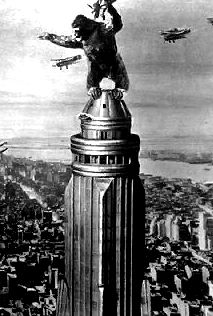
King Kong

     Rhonda, physically and emotionally exhausted by the terrific events of the past few days, slips into a trance in the middle of Africa only to be brought out of it by voices speaking Enalish saying they are taking her to God.  What can that possibly mean?  When she opens her eyes she sees two gorillas are doing the speaking.

     That’s something else, isn’t it?  Had they been on the screen could they have competed with King Kong that was released in that year of 1933?   Out of King Kong came 1949’s Mighty Joe Young while the public’s fascination with gorillas continued until Planet Of The Apes which, if it doesn’t owe anything to Burroughs’ story, develops the theme ad absurdam.  Kong, Young and Planet Of The Apes, Stalin’s experiments all owe their origins to the Tarzan oeuvre.

     Burroughs raises the theme to heights that have never been surpassed.  Combining the human gorillas with the City of God was incomparable genius.

     With the background clear let’s take a leap into the future.

The City Of God
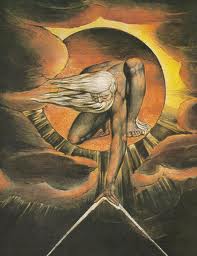
God At Work


7 b.

The whole thing seemed like a hideous and grotesque nightmare,

yet it was so real that she couldn’t know whether or not

she was dreaming.

Lion Man p. 95

     In taking the ‘germ cells’ of individuals from the time of Henry VIII, as the cells were cloned with those of the gorillas the hybrids cloned the environment they knew.  While clones have no mermory of a previous existence, in the popular imagination they do.  Thus in the paranoid classic movie The Boys From Brazil of 1978 the number of clones of Adolf Hitler all exhibited the supposed conditioned responses of the original which they could not have experienced themselves.

     At the same time ERB cleverly replicates the political situation between God, Church and Henry VIII.  When Rhonda was captured, two gorillas named the Dukes of Buckingham and Suffolk quarrel over whether she is to be taken to Henry VIII or God.  As we still have no idea of what is going on we are as mystified as Rhonda.

     And then as Rhonda tries to order her bobbled brain she realized she could communicate with these improbably English speaking apes.  p. 96:

     Now she had an instant in which to think clearly, and with it came the realization that she had the means of communicating with her captors.

     ‘Who are you?”  she damanded.  “And why have you made me a prisoner?”

     ‘The two turned suddenly upon her.  She thought their faces denoted surprise.

     “She speaks English!” exclained one of them.

     There’s a neat turnabout similar to when Tarzan addresses Buckingham in Mangani and the gorilla answers him in English.  The gorilla exclaims, “She speaks English.”

     Then follows an explanation of God, Henry VIII and Cranmer that only succeeds in confusing Rhonda further as she seems to be in some costume play in which for some inexplicable reason actors clad as gorillas are acting out a play  about Henry VIII.  She pinches herself to no avail.  She is awake.  This isn’t theatre, although Hamlet soon would be played in Nazi uniforms which is just about as ridiculous.

     The gorillas take her to Henry VIII where we will leave her until she is joined by Tarzan.

     While Rhonda escaped theArabs Naomi had been recaptured.  In company with the Arabs she is brought to the canyon that leads to an easy ascent of the plateau according to the map.  As the ascent becomes steep they leave the horses with Eyad going ahead on foot.  Awaiting them at the crest is Stalin’s dream corps.  Throughout the oeuvre one is always amazed at the disregard for their own well being the apes exhibit.  They  charge in story after story with complete disregard for their own well being.  Always a signficant portion are left on the field of battle but the survivors never complain while Tarzan complacently accepts their sacrifice as his due.

     So here, barehanded against the Arab firearms the gorillas launch a wave attack reminiscent of the Chinese in Korea that doesn’t stop until all the Arabs are dead.  No regard at all for casualities.  No wonder Stalin thought Burroughs was on to something.  While the apes perform as they have always performed in Tarzan stories the difference here is that these are not mere apes but hybrids with human intelligence.  If Burroughs was aware of Stalin’s experiments was he laughing at the Great Commissar?  Is this battle a reference to Stalin?  One can’t be positive of course but I am sure that the character of God-the formerly handsome Englishman- is partially based on H.G. Wells who was associated with Stalin.

     Naomi was with the Arabs.  She is captured by Buckingham  who asks her how she got away from God;  she is identical to Rhonda so Buckingham naturally confused her for the latter.  The Apes sense of smell was not as developed as Tarzan’s.  I’m sure the Big Bwana would have smelled the difference immediately.

     ERB is now dealing with his sexual problems.  Of the three women involved with the City of God- Naomi, Rhonda and Balza, it is necessary to sort out which woman represents what to ERB.  As Naomi is weak and vacillating she obviously represents Emma.  Rhonda who is strong and self-willed seems to represent ERB’s Anima ideal or in other words, La of Opar.  La disappears from the oeuvre after Tarzan The Invincible of 1930 but as Tarzan and Rhonda in God’s prison replicate Tarzan and La in the Lion’s den of Invincible it seems probable that ERB has transported La from the fantasy world of Opar to the mere imaginary world of the movies.  This leaves Balza- The Golden Girl- who probably represents Florence, but we will deal with her in the appropriate place.

     ERB has now gotten the two women, the Arabs and Tarzan to the Falls.  Orman, West and the safari are assembling at the base of the Falls so, having dissolved his story after the Bansuto attack ERB has now reintegrated it.

     After a series of adventures during which Buckingham kills Suffolk, Tarzan appears to rescue Naomi killing Buckingham.  At this point in Burroughs’ psychology he assumes the identity of his ordinary self and that of Tarzan into one being.  As the movie people have never seen Tarzan they assume that he is Stanley Obroski his identical twin.  Tarzan does not correct anyone but allows them to believe he is Stanley.

      As I perceive it then ERB has now deluded himself into believing that he is Tarzan.  Those who know him still perceive him as Ed Burroughs.  He has no choice but to let them believe that because if he attempted to impose his delusion on them he might have been committed.  Thus for a period of about five to six years from 1934 to 1939-40 Burroughs perceives himself as Tarzan but  capitulates  in Tarzan And The Madman giving up his illusion of being the Big Bwana.  In Lion Man he describes Tarzan as a madman so the two novels are linked by the concept of madness.

     After writing Madman Burroughs left California for Hawaii where he forced Florence away from him.  WWII came along which saved him from himself.  After the war he went back to LA to die.  It is interesting that he didn’t choose to live in Tarzana but bought a house in Encino that backed against the Promised Land.  thus like Moses, with whom there was a connection made in Tarzan Of The Apes, ERB was destined to view the Promised Land but not enter it.

     In Lion Man he is flush with the hope of being able to live out his fantasy.  He is now a few months from abandoning Emma so symbolically he returns Naomi to the safari at the Falls from whence she disappears from the story.

     Only Rhonda and Balza will figure in the rest of the story.  Emma is no more although Jane will appear again in Quest probably as Emma’s replacement Florence.  In Magnificent Florence is mentioned only anonymously as Tarzan’s ‘wife.’  ERB is definitely struggling.

     Having delivered Naomi to the safari Tarzan then reascends the plateau in search of Rhonda and the City of God.

The City Of God

7 c.

Every one of us, I believe, is possessed of two characters.

Often time they are so much alike that the duality is not noticeable,

but again there is a divergence so great

That we have the phenomenon of a Dr. Jekyll and Mr. Hyde

in a single individual.

E.R. Burroughs- The Swords Of Mars

     Tarzan And the Lion Man was followed at the end of 1933 by the Mars story The Swords Of Mars which features the return of John Carter.  ERB had taken a vacation from Emma returning to the scene of his own early adventures- Arizona.  Not coincidentally in the White Mountain of Apache country.  ERB’s motivations are sometimes obscure.  He was in the Army in Arizona in 1896-97 which was before he married Emma.  So he took his leave of absence from Emma to a place before he married her.  Setting the clock back, so to speak, somewhat reminiscent of The Eternal Lover.

     Just as Tarzan and Stanley met in Lion Man so while about to go to sleep, O.B.- The Other Burroughs- hears the door open, the clank of a man in war gear walking across the floor; terrified like an adolescent in a bad dream, O.B. is relieved and pleased when John Carter, back from Mars, greets him.  A real Jekyll and Hyde situation.  Thus as with Tarzan and Stanley the two Martian aspects of Buroughs are reunited but not melded.  John Carter then tells O.B. a bedtime story as though Burroughs were a child again.  I’m not that familiar with the Mars stories but there must be a connection to Lion Man and the MGM situation.  This must be true because this is the novel in which the opening letters of each chapter spell- TO FLORENCE WITH ALL MY LOVE, ED.  One assumes then that although the decision to leave Emma was difficult to make, ERB made the final decision in the Arizona mountains.

     So now a few months earlier Tarzan/Stanley makes the journey to the City of God where he will be reunited with his Anima ideal, Rhonda -La of Opar- in prison.  Thus his whole person both Anima and Animus are locked up by MGM.

     Rhonda had been taken to Henry VIII by Buckingham and Suffolk.  The city was called London, the country England and the river The Thames.  As ERB jokingly smirks- The English always take a little bit of England with them wherever they go.  Pretty funny, actually.

     Here the events of Henry’s reign are being reenacted.  As the apes are clones of Henry and his court who replicate their times one wonders whether each succeeding generation will be stuck in this one period of history reenacting it over and over until the end of time.  Once again I am reminded of The Eternal Lover.  ERB seems to be obsessed by the idea of time.

     Rhonda was first placed with the wives of Henry, a week later being moved to a cell in God’s castle where Tarzan found her when he too was captured.

     For now he was moving through the night until he came up against the ten foot high wall surrounding the City of London and within it the City of God.  Here we have the historical confrontation between the spiritual and temporal powers.  At the least the story is a very humorous parody of the religious situation of Henry VIII.  Once again ERB ridicules religion and this is done so cleverly and with such genius.

     But there are many levels of meaning.  Earlier I mentioned that the capture of Tarzan may have been meant to replicate ERB;’s capture by MGM.  In that sense then the City of God might represent MGM which boasted that it had more stars then Heaven.  So there is probably a joke there too.

     On the other hand, God is described as a formerly handsome Englishman.  The only candidate for that role I can come up with is ERB’s bete noir, H.G. Wells.  I think that I have adequately documented the literary feud between Wells and Burroughs.  Wells began well with his scientific romances.  While not as fresh and stunning as they were at the time of issue they still hold up well today.  Even though ERB denied having ever read Wells I think that claim can be dismissed out of hand.  ERB, then, would have been as impressed with Wells’ early romances as anyone else.  Then when Wells began his campaign of defamation and ridicule which is most clearly represented in his Mr. Blettsworthy On Rampole Island  he fell from favor in Burroughs’ eyes, hence the grotesquely deformed ‘formerly handsome Englishman.’

     As much as I like Wells he does pontificate.  Like all Liberals he has a difficult time distinguishing his opinion from truth, right and wrong, or reality.  While he does sometimes make a hit in his prophesying he is mostly wrong.  Backing the Worker’s Paradise of Stalin’s USSR was certainly wrong and more than enough to discredit him in the staunch anti-Communist Burroughs’ eyes.

     Wells probably shook Burroughs’ faith in the glory of England which had been a keystone of his secular faith fromt he beginning.  Thus, combining MGM, Stalin and the USSR and Wells, Burroughs packages all the troublemakers of this perilous time for him into one big box with a bigger bow on top.

     As his story could have no effect on his situation let us hope it was at least cathartic for him.  When Tarzan ends up in the cage with Rhonda that about epitomizes Burroughs’ situation vis-a-vis MGM, Stalin and Wells.  There are so many coincidences here that the brain revolves like a turret.  Was it wholly coincidental that Wells showed up in Hollywood at the end of ’35 to visit fellow Red Charlie Chaplin just as Burroughs was completely boxed in because of his Guatemalan adventure?

     Isn’t it amazing that Burroughs met his fate in Guatemala, the scene of the adventures of his early hero General Christmas and also the scene of some of the adventures of Ogden McClurg who was killed shortly after this return from the area in 1926?  It may be truly coincidental but the further one digs very often the more dirt one turns up.

      Burroughs may have felt confident he could write his way out of this box just as he was able to escape by self-publishing in 1930; perhaps he thought he could escape this time by making his own movies.  If so, a little analysis would have shown him that the rules had drastically changed.  Especially as he had signed the rights to represent his character Tarzan away.

     Coincidental with the release of the MGM Tarzan movies which preempted the nature of Tarzan from literature came the decline in Burroughs’ own literary powers.  Whereas in 1930 he was able to respond to the challenge with a series of top novels, after Lion Man there is a preciptious decline in the the quality of is work.  While the later novels have their charms for Burroughs’ admirers they do lack commercial appeal.

     By 1935 also Burroughs had antagonized radio which had become the major source of his income so that that medium was closed to him during his lifetime.  With publication revenues declining and the comics by Burroughs’ own admission producing a pittance, ERB had only one major source of income left and that was the moves.  MGM had him over a barrel.

     MGM might have produced a whole series of Tarzan films along the lines of the Charlie Chan movies as Burroughs reuefully remarked but they chose instead to issue only four movies between 1932 and 1939.  Obviously the makret would have borne more.  The limited release schedule kept EBB on a short financial tether.

     It is said that events cast their shadow before them so that it is possible, if not probable, that Burroughs foresaw the shape of things to come even as he wrote Lion Man.

     In 1930 when the Reds invaded his dream land of Opar ERB abandoned that fantasy.  The fabled city ceased to exist in his imagination while disappearing from the oeuvre.  Now in Lion Man it appears that the enemy had captured the castle while building a ten foot wall around it with Tarzan/Burroughs on the outside.  Thus Burroughs’ dream of separating himself from the world by a tne foot wall has been inverted in his imagination.  He wasn’t keeping the world out; the world was keeping him out.

     In the novel succeeding Lion Man, The Swords Of Mars, when the mad inventor Fal Sivas quails at taking hsi invented spaceship to the Martian moon Thuria the following exchange takes place between he and John Carter:

     “But you built this ship to go to Thuria,:  Carter cried.  “You told me so yourself.”

     “It was a dream,” he mumbled; “I am always dreaming, for in dreams nothing bad an happen to me.”

     Fal Sivas can be taken as an alter ego of Burroughs.  The Sivas probably refers to the Hindu god Shiva or Siva with whom Burroughs had become a devotee or developed a fascination for.  Thus while his heroes Tarzan and John Carter are men of action Sivas/Burroughs or any other combination is not.

     So in Lion Man Burroughs is desperately trying to become the man of action rather than the dreamer.  The problem now is that ERB himself is past the point of no return.  He has been walled out from the City of God.

     In dreams however Tarzan enters the Heavenly City by a fantastic feat of strength that recalls Burroughs’ 1890-1920 infatuation with the Strong Men such as the Great Sandow.

     The wall which Tarzan fancies was built to keep out lions i.e. the Lion Man has sharpened stakes pointing downward.  p. 124:

     …he leaped for the stakes.  His hands closed upon two of them; then he drew himself up slowly until his hips were on a level with his hands, his arms straight at his sides.  Leaning forward, he let his body drop slowly forward until it rested on the stakes and the top of the wall.

      That seems to be an impossible feat of strength except in dreams, but then by this point Tarzan thinks he is dreaming.  This might as well be an MGM movie lot such Burroughs spent five weeks on.  Here the dream faces a sort of reality.  As though pasing through a movie set as ERB must have done during those five weeks Tarzan comes to the steps leading to the Heaven of God.  this Stariway to Heaven, Jacob’s Ladder.

     As if to accent the relationship to MGM he passes the Apes of God who are dancing and partying.  The scene will be replicated at the foot of the Falls when the movie company duplicates this scene thus strengthening the connection with MGM.

     Tarzan begins the long climb up the Stairway to Heaven.  The fire flares illuminating him on the steps but the apes below don’t notice- high above on a parapet of Heaven, God does.  Note the resemblance to the move castle of Frankenstein.  A man of action God quickly prepares a trap.

     In real life the trap was probably the promise of the contract and money.  ERB blames the movies for being duplicitous, which is definitely true, still, he had had a dozen or more years to work out the conditions prevailing on his own.  After all, by 1932 he had proven product to sell.  The public had even given a profit to some pretty crummy movies so that had he taken the time, acted on his own conditions, rather than just signing for a few quick bucks he might have retained a position of some control, made himself an equal partner.  So, while MGM did betray him he might have been able to manage the situation.

     Tarzan enters the castle to be confronted by six doors of which only #3 is open.  Depending on how you count them there were six to eight major studios, thus the six doors may represent the Studios of which only MGM was willing to deal with him.  Remember he had been blacklisted since 1922, the blacklist having been broken in 1928 by Joseph Kennedy.

     Tarzan descends the stairs as heedlessly as Burroughs signed the contract and like Burroughs he finds himself trapped.  The nose of noses sniffs the air and detects the delicate scent of a White woman.  He has found she whom he sought, Rhonda.

7 d.

The Confrontation With God

     Now Tarzan is reunited with his Anima ideal in the person of Rhonda formerly La of Opar.  That Rhonda can be associated with La is because this scene is a replication or double of Tarzan and La in the lion’s den of Invincible.  There La and Tarzan were imprisoned in a cell beneath Opar.  They escaped the cell in a duplication of their escape from this prison.  In Invicible there was a runway within which the lion fed.  A shaft led upward to a room in a tower.  There the old man who betrayed them discovered them.

     In this case a breeze passing over the floor indicates an air shaft to Tarzan.  This is probably borrowed from Rider Haggard’s King Solomon’s Mines although it will soon if not already be a staple of the movie genre.  Tarzan locates the shaft in the ceiling in a corner of the cell.  He and Rhonda ascend it to the opening in front of which God is talking to some gorillas.  Thus the scene virtually duplicates Invincible.  La and Rhonda must be associated in ERB’s mind.

     As an aside Burrughs uses a variation of this scenario in The Swords Of Mars when John Carter is imprisoned.  There are beams some twenty feet ot so above the floor to which Carter leaps.  He takes a position above the door dropping on his keeper when he enters.

     At this point in the story Tarzan and Stanley Obroski may be considered to be reunited as one persona.  Rhonda, who has never seen Tarzan, addressed the person in Stanley’s guise as Stanley.  ERB has a little fun as he has Tarzan play along.

      As he says in Swords, he is convinced that every man has a dual Animus, that is two different aspects, sometimes nearly identical but sometimes as different as Dr. Jekyll and Mr. Hyde.  Thus at this point his mind is impressed with Shelley’s Frankenstein and Stevenson’s Dr. Jekyll And Mr. Hyde.  He had read both novels before 1900  while both stories were released as movies in 1931.  So the stories are very fresh in his mind.

     Tarzan/Obroski may be considered of the Jekyll/Hyde variety.  There is little doubt that Burroughs saw the pair and himself that way.  Thus Carter and Fall Sivas in Swords may also be seen as two sides (Jekyll/Hyde) of the same persona.  Tarzan does not try to convince Rhonda that he is not Stanley, but in the Jekyll side of the persona he astounds here with Hydelike feats compelling her to reevaluate him.

     There are undoubtedly snippets of other horror movies here that ERB has seen also but I can’t remember the titles or dates.  There was one about two Scottish body snatchers Burke and Hare which I think I can detect here and another about a mad doctor who operated on the brains of abducted victims that shows up here and in Swords that was called the Black Sleept or somesuch.  The latter would have had a castle along these lines as well as Frankenstein.  Of course, which of that ilk of movie didn’t?  Burroughs is combining an astounding number of influences here both literary and cinematic but both combined.

     Thus, having availed himself of ‘such a God given opportunity’ to find Rhonda he is imprisoned with her.  The joke was ERB’s.  You know, God left the doors open- God given opportunity.  I chuckled softly to myself as I read.

     After an exchange of repartee between Stanley/Tarzan and Rhonda God makes his appearance.  Not exactly what one would expect God to look like.  In fact it is almost amazing that the fundamentalist Christians didn’t create an uproar.  After all according to the Old Testament man was created in God’s image.  There’s a laugh.  Here’s the image.  p. 128:

     It had the face of a man, but its skin was black like that of a gorilla.  Its grinning lips revealed the heavy fangs of an anthropoid.  Scant black hair covered those portions of its body that an open shirt and a loin cloth revealed.  The skin of the body, arms, and legs was black with large patches of white.  The bare feet were the feet of a man; the hands were black and hairy and wrinkled, with long, curved claws; the eyes were the sunken eyes of an old man- a very old man.

     The Scopes Monkey Trial had only been about seven years before.  So here Burroughs is making sport of God with a sort of reverse evolution.  God is a cross between a man and a gorilla.  Yet ERB led such a charmed life that his mockery or parody of God created no comment.  If he wanted to start a ruckus to promote his book sales he failed miserably.

     God might have been half ape but he had a whole hearted sense of;humor.  Overhearing Tarzan say that he had come for Rhonda his opening comments are mock injury.  p. 128:

     “So you are acquainted?”  He said.  “How interesting! And you came to get her, did you?  I thought that you had come to call on me.  Of course it is not quite the proper thing for a stranger to come by night without an invitation- and by stealth.

     “It was just by the merest chance that I learned of your coming.  I have Henry to thank for that.  Had he not been staging a dance I should not have known, and thus I should have been denied the pleasure of receiving you, as I have.

     “You see, I was looking down from my castle into the courtyard of Henry’s palace when his bonfire flared up and lighted the Holy Stairs- and there you were!

     Burroughs is justly criticized for the occasional bit of wooden dialogue but I find the confrontation with God very well written.  The constantly mocking tone of God is carried off very well.  Tarzan’s indignation is very well executed.  The influence of Shelley, Stevenson and the various movies is seamlessly blended into a very tightly executed scene.

     All this is done in a very few pages while it is a remarkable bit of writing.

     God hints at his motives for their use for him.  p. 129:

     “…I shall keep you for a while for the pleasure of conversing with rational human beings.

     “I have not seen any for a long time, a long, long time.  Of course I hate them nonentheless, but I must admit that I shall find pleasure in this companionship for a short time.  You are both very good looking too.  That will make it all the more pleasant, just as it increases your value for the purpose which I intend you- the final purpose, you understand.  I am particularly pleased that the girl is so beautiful.  I always did have a fondness for blonds.  Were I not already engaged along some other lines of research, and were it possible, I should like nothing better than to conduct a scientific investigation to determine the biologial or psychological explanation of the profound attraction the blond female has for the male of all races.”

      Burroughs doesn’t tell us how blonde Rhonda and Naomi are, whether they are platinum blondes like Kali Bwana or merely blondes.  Of course today ERB would be censored for his handling of the sexual and racial preferences for blondes but it is a recurrent theme in his writing and one worth studying.

     Having piqued our curiosity as to his purpose for the couple God leaves to check up on Henry.  p. 130:

“Come back here!” (Tarzan) commanded.  “Either let us out of this hole or tell us why you are holding us- what you intend doing with us.”

     The creature wheeled suddenly, its expression transformed by a hideous snarl.  “You dare issue orders to me!”   It screamed.

     “And why not?” demanded the ape-man.  “Who are you?”

     The creature took a step nearer the bars and tapped its hairy chest with a thorny talon.  “I am God.”  it cried.

     There you go.  The cat’s out of the bag.

     The scene is dramatically successful while the reader is now left to guess the model for God.  We are told that he was a formerly handsome Englishman now deformed as a hybrid ape-human.  The city is London, the territory is England and the river is the Thames.  A reasonable place to look would be among the English.  Who among the English is bedeviling ERB?  H.G. Wells is the only one I can think of.  Regardless of whether Wells considered himself a Communist or not he is sailing his craft so close to the wind that it is impossible to distniguish between the two.  At the very least Wells is throughly subversive.  If anything he resents not being in Stalin’s place.  So Burroughs must consider him Communist.

     To my mind then, Burroughs is mocking Wells much as Wells mocked Burroughs in ‘Blettsworthy.’ God has delusions of grandeur and so does the highly pontificating Wells.  My vote for the model is Wells.

     One also notes that in the last of the MGM Tarzan movies, 1942’s Tarzan’s New York Adventure, Tarzan is captured by the circus roustabouts and thrown into a mobile cage.  The camera then pans around to front which identifies the cage as a lion cage.  One thus has the joke of the Lion Man in a lion’s cage.  A final thumbing of the nose at Burroughs exiled in Hawaii.  MGM then dropped what had been a very lucrative series.  Strange behavior indeed.

     God then returns to give his history as detailed earlier in the essay.  While for some reason everyone, fans and detractors alike, wants to think of Burroughs as a semi-literate boob who is coincidentally a ‘master of adventure’ yet both in content and exposition, God presents his story in a masterly way.  In 1930 there may have been few of his readers who had ever heard of Mendel and possibly Lamarck, although one hopes all had heard of Darwin.  So it is possible that a reader might have been puzzled by the inclusion of Darwin while dismissing Larmarck and Mendel as fictitious.  Of course if you’re reading strictly for fast-paced adventure you may not notice the details even though they are far from concealed.

     God also clears up the mystery of the map.  Surprisingly the map is not a stage prop but authentic.  In fact, God made it about seventy years previously.  It seems that he had been in love with a women back in England but she preferred wealth to being the wife of an impoverished scientist.

     This may be a coincidence but that is the premise of the plot of H.G. Wells’ In The Days Of The Comet.  Perhaps it was a message to Wells in case he hasn’t gotten it yet.  But then God discovered the immense number of diamonds in the valley so he wrote the girl promising her riches beyond imagination.  He had employed a native runner to take the letter to the coast to mail it but since he had never had a reply he wondered if it had ever been received.  Now it came back to him.  A simple but inventive twist.

     When God leaves this time Tarzan sets to work to escape.  Following the draft across the floor he finds the air shaft.  Just as in Invincible he sends La up first now he sends Rhonda up first.  As in the earlier story they are trapped at the top.

     Looking through the entrance to the shaft they spy God and some gorillas in front of it.  Their escape is spoiled.  Now begins the Gotterdamerung.

The City of God

7 e.

The Gotterdamerung

      Burroughs now has both aspects of his Animus with his Anima trapped in the tower unable to go foward or backward.  God and his gorillas stand in anticipation before the opening.  Burroughs has been stalemated.  At this point one aspect of God must be MGM and its contract.

     ERB has spun out his fantasy in a plausible way to this point, but now he has to find a way to resolve his dilemma.  As he is daydreaming and this is a mad dream, as Fal Sivas says in Swords, in dreams nothing bad can happen to you.  In this bind something bad can happen to ERB.  He can lose his grip on reality.  In that way he becomes mad or insane which is what the story is about.

     In speaking of Henry God might also be speaking of ERB. p. 143:

         “You all forget,” (God) cried, “that it was I who created you; it is I who can destroy you.  First I shall make Henry mad, and then I shall crush him.  That is the kind of gods humans like- it is the only kind they can understand.  Because they are jealous and cruel and vindictive they have to have a jealous, cruel and vindictive god.”

     There’s a lot information in that quote.  It refers to the ancient Greek saying:  Those who the gods would destroy they first make mad.  So we have an excellent joke here.  The incredible mind of Burroughs can conceive humor in the midst of the blackest despair.

     He is talking of the Yahweh of the Old Testament while he quite soundly understands that god is a psychological projection of the mind of his creator.  In a masterly grasp of Freudian group psychology, whether he knew it or not, he realized tha the people have created a god in their own image and not vice versa.  Trapped in the tower this is a real agonized cry of despair before losing his grip on reality.

     I don’t mean to say that ERB went stark raving mad but he edged into a fantasy world at least once removed from the fantasy he had been living since 1912.  For the period of his marriage to Florence he can only be described as spaced out.  Bear in mind that it’s going to get worse as he gets trapped into his movie production experience.

     The Masenas in The Swords Of Mars make the threatening moves on John Carter who keeps backing away.  Only too late he realized he had maneuvered himself where they wanted him.  The Masenas were cat-men, i.e. lions who had two mouths.  In a sly way Burroughs is caricaturing the Jews of MGM and their mascot Leo the Lion.  The upper mouth which is sort of pursy and purring to seduce one, is above a lower mouth that is all teeth and no lips to rend one.  So he is saying that he is dealing with two-faced people.  While the upper mouth is assuring, the lower rending mouth is ever ready to destroy you.

     Tarzan realizes that he has no choices left but to stay put or rush God and the gorillas.  Alone he would have had a chance of success but with Rhonda in tow he is lost.  This is an interesting reflection on the relationship of the Animus to the Anima.  I’m at a bit of a loss to explain this.

     God had sent for Rhonda to be told that she was not in the cell.  Knowing that Tarzan was in the air shaft it followed that Rhonda was too as neither could have escaped the cell otherwise.  He orders smudge pots to be  lighted to smoke them  out.  Thus Burroughs acknowledges that his own situation is untenable while he has no solution.  The only one left is the Samson like effort of pulling the temple down on his own head destroying both himself and his enemies.

     God’s plan backfires as he sets his own castle afire.  Unable to stand the smoke any longer Tarzan rushes out to be felled by a blow from one of the apes.  At this precise point ERB goes mad or loses his mental balance.  I don’t believe there is a Tarzan novel in which the Big Bwana isn’t knocked on the head at least once.  In this case when he gets up he won’t have lost his memory but he will be a different man, another round of emasculation.

     Once again he is separated from his Anima.  Rhonda is spirited off to Henry.  God and Tarzan are trapped on the patio as the castle becomes engulfed in flames.

     This chapter is appropriately titled ‘The Holocaust.’  In its way everything that ERB had hoped and dreamed goes up in flames with God’s castle.  Heaven is reduced to ashes.

     Tarzan has his trusty rope so he can escape over the parapet to the roof of a lower level.  God begs him to save him which Tarzan reluctantly does.

     Tarzan, one has difficulty in styling him the Big Bwana in this emasculated state, reverses the actual situation between Burroughs and MGM by placing the rope around God’s neck putting him on a short tether.  Henry is now in full revolt.  Tarzan agrees to help God in exchange for his help in recovering Rhonda and letting them leave.  Perhaps Burroughs was asking MGM for a release from his contract.  Let by Tarzan the forces of God defeat Henry.

     I’m not clear who Henry represents or if he is meant to represent a real individual.  Aware of his defeat Henry abandons his wives for the blonde White woman, Rhonda.  He has a secret subterranean escape route.  Thus Burroughs, who through Tarzan stormed the gates of Heaven, the heights of consciousness, has first returned to earth and now slips back into the subconscious.  In all probability then, his attempt to integrate his personality  had failed while coming so close.

     Henry had followed his tunnel to emerge into the valley of diamonds and mutants.  Here he encounters a lion.  Throwing Rhonda down he runs from the lion which we all know is the exact wrong thing to do.  Rhonda then escapes.

      Tarzan emerges from the tunnel just as the lion is rending Henry.  So Henry perishes.  Tarzan sets off into the valley of diamonds in pursuit of Rhonda or, in another word, his Anima.

The City Of God

7 f.

The Golden Girl

     While one is astonished that there was no uproar because of ERB’s treatment of God, Heaven and the gorillas, one is even more astonished that at no time since 1912 was ERB ever under attack for his views on evolution.  The oeuvre is a veritable compendium on the various possible results of evolution yet no one ever said a word nor has to this day.

     In LIon Man which treats of evolution in perhaps his most daring way yet, his effort is met with stony silence.  God, in his creation of the hybrid gorillas according to the logic of Gregor Mendel, had a large number of sports and variations.  The ‘normal’ hybrid apes refused to accept these either killing them or driving them from their society.

     God laments that the tendency to exclusivity, or like to like, was such a strong characteristic of the new species that he could do nothing to break the hybrid’s attitude.  This must be a wry comment on those who wished to break down racial and special barriers.

     Apart from the role of White women in racial politics, which ERB through God has already commented on, there is not, nor will there ever be, inclusivity of different races on the pshysiological level nor even on the intellectual level of religion.

     Thus the theme of separation in this spurious London, England was a variation on Opar where normal males were killed producing the ape-like male Oparians, while only the beautiful females were preserved.  In this case the rejected hybrids, who bear some resemblance to the Hormads created by Ras Thavas, have taken up residence across the Thames.  Among them, as one might suppose, Mendelian genetics predicts, were two human looking specimens.  The male who was perfectly human in form had a gorilla mind; the female although rumored to have a gorilla mind in fact was a perfect human in mind while also possessing a normal human form.

     She is the mate of the human looking male as kind mates with kind.  Tarzan, having recovered Rhonda, finds Balza, which means Golden Girl, being abused by her mate.  He rescues her but the trio is set upon by the whole tribe of mutants.

     Balza explains to Tarzan that having defeated her former mate Tarzan has claimed her for his own.  She is his, will-he or nil he.  She then becomes hostile to the Anima figure of Rhonda.

     So now we have a difficult psychological situation.  Burroughs, who believes that every man is of a dual personality, has first united the two Lion Men and has now killed off one half of the duality leaving Tarzan as a single psychological unit.  Not integrated but half a man so to speak.  This is in violation of his stated belief which he has clarified no further.  At the same time Balza seems to be driving his old Anima figure of La/Rhonda away, replacing her.  Thus this Wild Thing becomes both Burroughs’ Anima ideal and human woman.   We have single with single, or half with half.  Now we have a single Animus, the Lion Man, Tarzan and Wild Thing as his Anima and woman.  This is quite a combination.  That would certainly explain the nature of the next several years of ERB’s life when he seems to run completely off the rails.

     He expresses this in his work of the thirties in different ways.  The Venus series is born out of this conflict in the second half of 1932 subsequent to the release of the movie Tarzan, The Ape Man.  John Carter does reappear at the end of 1933 in  The Swords Of Mars but Burroughs in the Venus series creates a much lesser man than either Carter or Tarzan; Napier is a pale shadow reflecting Burroughs neo-emasculated state.

     In the first venus volume Napier heads for Mars in his rocket ship.  Mars or the Greek Ares is the manly planet.  But now suffering from his further emasculation Burroughs no longer feels capable of competing with men on Mars.  Thus Napier has miscalculated the influence of the Moon, or female influence,  which bends his trajectory sending him to the female planet Venus instead.  In terms of classical mythology with which Burroughs was very familiar the Moon represents the feminine principle, while Venus, the Roman form of the Greek Aphrodite, represents the force of Love.  Thus in symbolical  terms ERB/Napier is diverted from the Manly principle of Mars by the female principle of the Moon and sent to the planet representing domination by the feminine principle of Love.  Napier is not a warrior.

     In Lion Man, written a  few months after The Pirates Of Venus Tarzan follows his female Anima principle, Rhonda, into the valley of diamonds, where he is attached to The Golden Girl, Balza.  In Burroughs’ terminology diamonds represent the realization of his sexual hopes.  So Rhonda in this instance can be taken to represent Napier’s moon who leads him to Balza, the planet Venus or Florence.  Burroughs is now severely handicapped in his conflict with MGM.  In this chapter of Lion Man when he catches up with Rhonda  comes across Balza being beaten by her man, the sport with the human appearance and gorilla brain.  Balza had been misrepresented earlier, actually having a human brain.  She now attaches herself to the emasculated Tarzan.

     In their flight from the mutants- Tarzan running away again- they discover a pit full of diamonds.  Presaging Tarzan And The Forbidden City in which the father of diamonds is a piece of coal, the huge pile of diamonds has lost any value to him.  Thus Burroughs senses in 1933 that love is going to be a serious disappointment.

     As a matter of fact in his psychological malaise Balza/Florence seems to have lost any value to him.  He leads the women to the foot of the Falls where they rejoin the movie company who are living riotously.  Their dance is a double of the Dum Dum like dance of the gorillas.  Not a favorable comparison, perhaps indicating that man has not advanced much from the apes.  Leaving Balza to become a movie star Tarzan returns to the jungle to find Stanley dead, thus the dead Stanley is rather unaccountably accepted by the movie company who return to LA.  The whole story becomes a sort of mirage which, while we know it did happen, never happened.

     ERB as a writer has now completed Ring 2.  He completes his Ring construction by returning to the site of Ring Left 1, Hollywood as Ring Right 1.  As Holtsmark notes he has followed the classical mode of Homer.  He has not only done that but written his most perfect example.  I find Lion Man masterly on all levels, in fact, ERB’s Magnum Opus.

     A year after the movie company returned to the US Tarzan himself undertakes a visit to the film colony of Hollywood.

Go To Part 8, More Stars Than There Are In Heaven


A Review

Themes And Variations

The Tarzan Novels Of Edgar Rice Burroughs

#18  Tarzan And The Lion Man

Part 6

by

R.E. Prindle

First published on the ezine, ERBzine

The Center Of The Circle


     Burroughs does a remarkable thing in this ring that clearly shows the Greek classical influence per Erling Holtsmark in his Tarzan And Tradition.   ERB disolves his story and cast of characters after the last Bansuto attack.  The cast is dispersed in several directions but ERB will deliver them all to Omwamwi Falls as he begins the three right hand rings:  3-2-1

     In fact this does follow the Homeric tradition.  The story of the Trojan Wars was actually a massive story of which only three parts survive, the Iliad, which concerns the central part of the epic and th two Returns, The Odyssey and The Oresteia.  All the rest has been lost or survives only in fragments such as ‘The Judgement Of Paris.”  Originally the epic was thousands of pages long.  There were undoubtedly few scholars who had ever read the story in its entirety and fewer still who understood it.

     It seems incredible that a very young ERB could have grasped the structure so completely while seeming to understand it so thoroughly.  Holtsmark quotes ERB as saying that he was rereading Plutarch’s Lives in 1923 when he discovered that Numa was the name of a Roman emperor, actually one of the Republican kings,  To that point he had believed that he had made up the name.

     Thus we learn that ERB did some rereading and his subconscious supplied material.  He could have, it is plausible, read the Iliad and Odyssey a number of times over his life.  Along with other classical reading the basic method was established in his subconscious which he was able to consciously manipulate.

     The Trojan War was the first of the three great sprawling European epics, unmatched in any other literatrue.   The second was the Arthurian Saga also huge, sprawling through many thousands of pages and many different variations.  The story has its roots in Greek mythology as well as in the Christian ethos.  The Lancelot-Grail alone is several thousand pages.  Burroughs doesn’t seem to have been much concerned with it.  Indeed, most of it would have been untranslated in his time thus being unavailable to him.

     The third great cycle was the strange nineteenth century English pursuit of the Grail in the search for the source of the Nile.  In my estimation a rather peculiar obsession.  This story too occupies several thousands of pages as all the participants recorded their efforts in copious detail.  Livingston, Stanley, Burton, Baker and Speke have written magnficent narratives.  Speke walking the Nile North after just having discovered the source actually ran into Baker following the Nile South.  A remarkable accidental encounter that goes unnoticed.  The best overview and history of the quest is Alan Moorehead’s The White Nile of 1960.  He provides an adequate background for these modern knights in seach of an unlikely Grail.  The Tarzan oeuvre might be indluded as a fourth cycle based on cycles one and three.

     The first and third epics then involved ERB intimately.  The Tarzan series is based on the Africa of the Nile Quest while framed in the literary construction of the first.

     Burroughs then dissolves his story after the Bansuto attack then telling the story of the several participants on the way to Omwamwi Falls in the manner of the Homeric Returns.  He then reassembles them less Obroski at the Omwamwi or Murchison Falls on the Nile.  Thus the river cascading from the plateau is actually the Nile.  What he calls the Thames on the plateau of the City of God must be indeed a substantial stream.

     We have already dealt with the fate of Stanley Obroski and Tarzan.  After the last Bansuto attack the Arabs agreed to take the midnight to six watch.  During the night they folded their tents and silently stole away taking Rhonda, Naomi and the map with them.

     Orman decides to go off in pursuit of them alone.  Bill West convinces him to take himself along so the two abandon the safari to pursue the girls and Arabs.

     Tarzan neutralizes the Bansuto by having them promise to be kind to Whites so the remaining safari members are able to somehow get their trucks and equpment to the Falls unmolested,  that leaves the girls, the Arabs and Orman and West.

     After leaving Obroski shivering with fright in a tree Tarzan comes upon Orman and West as they are being attacked by a lion.  Plummeting from the convenient tree Tarzan dispatches the lion, immediately disappearing back into his tree.   This is the first incident of the cast mistaking Tarzan for Obroski.  I happen to think Burroughs handles this confusion extremely well.  After all, Burroughs has firmly established Obroski’s cowardice with the safari members.

     Orman and West’s astonishment at the seeming Obroski feat is very genuine.  Later when Tarzan supplies them with a buck while translating Arabic from Atewy their astonishment can’t be more complete.  Very effectively handled.  Having supplied them with food Tarzan points them in the right direction and gets them started with a swift kick so that leaves the Arabs and the girls to account for.  This also begins the comparison of the qualities of Rhonda and Naomi.

     The Arabs have the map to the valley of diamonds that they believe is genuine and indeed it is.  Unable to read English, the language of the map, they make promises of freedom to gain the cooperation of the girls.  Rhonda scoffs at the genuineness of the map believing it a movie prop.  However they can locate their position according to the landmarks provided by the map.  Astonishingly they are able to locate all the landmarks which lead them to the Omwamwi Falls.

     Naomi accepts her captivity while Rhonda plans escape.  She effects this by saddling a couple ponies at night  while driving the rest of the herd off.  This episode is also well handled and quite believable given that this is a fantasy novel.  The net result is that Naomi is recaptured while Rhonda makes it to the falls where the story is forwarded by her capture by the Apes of God.  Another little joke, I presume.

     Following both the map and Rhonda the Arabs and Naomi arrive at the Falls.  The action then finishes the parallel story to Tarzan and Obroski  of the girls and begins the right second ring story of The City Of God.  This is a magnificent story full of many twists and surprises.  In our day this stuff has been used over and over so that the imaginative feat is diluted or lost.  If one places one’s imagination back in 1933 one can marvel at Burroughs; ingenuity while seeing how disappointed ERB was that the novel fell flat.  Such is life.


A Review

Themes And Variations

The Tarzan Novels Of Edgar Rice Burroughs

#18 Tarzan And The Lion Man

Part 5

by

R.E. Prindle

First published on the ezine, ERBzine

Tarzan, Obroski And Burroughs


     Burroughs has been ridiculing Obroski right along as an arrant coward.  Wherever the action is, Stanley isn’t.  When it’s over he shows up ready to fight.  When a call for the safe job of kitchen help is made after the porters desert Stanley raises his hand.

     The cowardice is in contrast to his magnficent physique.  Standing 6’8″ or 9″  in his bare feet while his strength is as prodigious as that of Tarzan.  No one in the safari has yet seen Tarzan but he and Stanley are as identical twins.  When Stanley becomes fever stricken and disappears from the story the movie cast will confuse Tarzan for Obroski providing some amusing moments.

     Over the oeuvre Burroughs uses the divice of a Tarzan double a number of time  times.  Esteban Miranda in Tarzan And The Golden Lion/Ant Men, here as Stanley Obroski and again in Tarzan And The Forbidden City  as Brian Gregory stand out.  The doubles are quite obviously aspects of Burroughs’ own character.  As the doubles are all cowardly, inept or both one has to assume they represent Burroughs as he perceived himself before becoming a success while Tarzan represents Burroughs as a success.  There was obviously a constant psychic tug of war between the two Burroughs.  This was something ERB was desperately trying to resolve in favor of the Tarzan persona.

     The quesiton is, was he ever successful in resolving the problem by psychologically integrating his personality?  At several times in the corpus he seems to have succeeded even to the extent of killing off his old persona.  But then there are doubts and Brian Gregory appears a few years later.

     If I live long enough I will try a comparison of Miranda, Obroski, Gregory and Burroughs.  Notiice the progression of the double from Spanish to Slav to Anglo. The Spaniard was the epitome of worthlessness at the turn of the century while the Slav though higher was despised.  Gregory as an Anglo would indicate that Burroughs may have reconciled his self-esteem at least.

     As a more or less irrelevant aside it is known that Tennessee Williams (1911-83) was a Tarzan fan.  He was twenty-three years old when Lion Man was issued while A Streetcar Named Desire was staged in 1947.  It may seem tenuous to make the connection between the names of Stanley Obroski and Stanley Kowalski but there it is.  There are resemblances between Stanley-Naomi and Stanley-Blanche allowing for the fictionalizing powers of Williams.  There is no proof that Williams specifically read Lion Man that I know of but it is neither impossible or improbable given his admiration for the character.  Perhaps the germ of Stanley-Blanche was placed in Williams’ mind in 1934-35 germinating away in his subconscious to blossom eleven or twelve years later.  I don’t say it’s so but it is worth investigating.

     In the construction of this novel the story of Obroski and Tarzan forms Ring Three.  The story moves from Ring Two, The Safari and will segue into the inner ring.

     In Chaper 8, The Coward, Burroughs devotes six pages to explaining or rather justifying the character of Obroski.  In justifying Obroski Burroughs is justifying himself which is why he took such pains with this book.

     During the last Bansuto attack in Chapter 8 Obroski panicked.  As the Bansuto attacked from one side Obroski ran off in the opposite direction.  Unfortunately the Bansuto were on both sides and Obroski ran into their open arms.  Now cornered Obroski fought from reflex:  pp.  46-47:

     Death stared him in the face!  Heretofore Obroski’s dangers had been more or less imaginary; now he was faced with a stark reality.

     Terror galvanized his mind and his giant muscles into instant action.  He seized the black and lifted him above his head; then he hurled him heavily to the ground.

     The black, fearful for his life, started to rise.  Obroski fearful for his own, lifted him high overhead and again cast him down.  As he did so a half dozen blacks, closed upon him from the tall surrounding grasses and bore him to earth.

     His mind half numb with terror, Obroski fought like a cornered rat.  The blacks were no match for his great muscles.  He seized them and tossed them aside, then he turned to run.  But the black he had first hurled to the ground reached out and seized him by an ankle, gripping him; then the others were upon him again and more came to their assistance…In all his life Stanley Obroski had never fought before.  A good disposition and his strange complex had prevented him from seeking trouble and his great size and strength had deterred others from picking quarrels with him.

     So, while Obroski was a coward when he had time to consider, in the grip of terror he was quite capable of using his great strength and size to fight back.

     His cowardice was not his fault or part of his nature.  Burroughs reflects further.   p. 45:

     We are either the victims or beneficiaries of heredity or environment.

     Obroski was obviously the result of nurture.  Thus we have no responsibility for what we are and can take no credit as we are either victims or beneficiaries.  This is a fairly serious position statement.

     Stanley Obroski (Burroughs) was one of the victims.  Heredity had given him a mighty physique, a noble bearing and a handsome face.  Environment had sheltered  and protected him throughout his life.  Also everyone with whom he had come in contact had admired his great strength and attributed to him courage commensurate with it.

     Never until the past few days had Obroski been confronted by an emergency that might test his courage, and so all his life had been wondering if his courage would measure up to what was expected of it when the emergency developed.

     He had given the matter far more thought than does the man of ordinary physique because he knew so much more was expected of him than of the ordinary man.  It had become an obsession together with the fear that he might not live up to the expectations of his admirers.  And finally he became afraid- afraid of being afraid.

     It is a failing of nearly all large men to be keenly affected by ridicule.  It was the fear of ridicule, should he show fear, rather than the fear of physical suffering, that Obroski shrank from, though perhaps he did not realize this.  It was a psyche far too complex for easy analysis.

     It is impossible to know for certain at this time what psychology texts Burroughs had been studying but ‘a psyche far too complex for easy analysis’ points in the direction of Freud, Jung or both.  ERB seems to have been involved in Depth Psychology of some sort.  David Adams finds traces of Jung.  I am not prepared to concede so much at present but David may be much more sensitive on that score than myself.  I don’t rule it out although I would lean more to Freud as the better known.  Still, as I find ERB to be a very inquisitive guy there is no reason he couldn’t have known of both.  Either would likely have been mentioned in his varied reading and we know he was an omnivorous reader.

     At any rate it seems clear that Obroski’s heredity was overridden by the conditioning of environment.  Unable to overcome the conditioning or hypnotic suggestion he became as we find him.

     There seems little doubt that here ERB is explaining himself.  Obroski and Tarzan are identical in stature and abilities but in order to realize his Tarzanic potential he must overcome his environmental conditionings and assume his proper being.

     Whether the emergency Tarzan/Burroughs is facing in his difficulty with MGM or something else it seems likely MGM as the struggle is placed in the context of the MGM/BO Studios filming Trader Horn/Tarzan, The Ape Man.

     So Obroski is captured by the Bansuto and made prisoner in their village.  Here he encounters Kwamudi, captain of the safari Blacks and a couple porters who had been captured after deserting.  Obroski learns that the Bansuto are cannibals and that he will be the man who came to dinner.

     Burroughs gets in some sly humor here.  Bound and starved Obroski complains about his treatment.  p. 51:

     “This is no way to treat people you’re going to eat.”  grumbled Obroski.  “You ought to get ’em fat, not starve ’em thin.”

     ERB has already given notice that he is in psychological mode.  He says that Obroski’s psyche is too complex for easy analysis, whatever that might be.  That’s what we all say and it’s bosh.  When I was younger I thought my psyche so unique and complex I wanted to offer myself to science as a specimen.  As my own self-psychoanalysis evolved I realized the only thing that made it so complex was the resistance involved in facing the fixations.  So with Burroughs.  In a few pages he lays out out completely the problem he is facing in symbolical or dream imagery.  Only resistance anf fear prevent him from breaking on through.

     A psychoanalyst could lay your whole problem before you but if you weren’t ready to deal with it, in other words, overcome the resistance, you wouldn’t be able to see it.  You’d think he was talking about someone else.  So here ERB lays out his whole problem before you but if you weren’t ready to deal with it, in other words, over come the resistance, you wouldn’t be able to see it.  You’d think he was talking about someone else.  So here ERB lays out his whole problem.  Whether he resolved it is a matter of debate.  David Adams thinks not while I have not yet made up my mind.

     The problem he is dealing with is his central childhood fixation of John The Bully.  I have already gone into this in Doubles and Insanity but it won’t hurt to give a variant interpretation as this very key incident meets with a lot of resistance from Bibliophiles  on its own.

     As has been noted Burroughs was plagued by dreams of appearing naked in public.  Nakedness is a significant theme in the oeuvre.  Tarzan himself runs around naked except for a skimpy g-string; so Tarzan’s natural condition and Burroughs dream fears mesh.  He has made a virtue of necessity.

     In psychological terms John The Bully so emasculated Burroughs that he lost his offensive and defensive armor which is to say to the civilized man his clothes.  Burroughs always says of Tarzan that his veneer of civilization went no deeper than his clothes.  Nothing could be clearer than the relationship to ERB’s situation on the corner.  ERB explains the nature of nakedness to the civilized man.  p. 58:

     “He says for you to take off your clothers, Bwana.”  said Kwamudi,   “he wants them.”

     “All of them?” inquired Obroski.

     “All of them, Bwana.”

     (Note the excruciating deliberateness as ERB painfully drags this scene out.)

     Exhausted by sleeplessness, discomfort, and terror, (Here ERB makes excuses for himself.)  Obroski had felt that nothing but torture and death could add to his misery, but now the thought of nakedness awoke him to new horrors.  To the civlilized man clothing imports a confidence that is stripped away with his garments.

     So, in real life, Burroughs had been psychologically stripped naked by John having lost his self-confidence.  This is an accurate understanding.  When he constructed his alter ego, Tarzan, he made him naked in his uncivilized state, hence full of self-confidence though naked, but then clothed him handsomely in his civilized state in which he was uncomfortable.  Thus ERB attempted to resolve the problem.

     Now when John bullied ERB he forced a split in his personality.  while his physical self was humiliated his psychological self split off symbolically taking to the trees for refuge.  Hence Tarzan’s fabulous arboreal exploits while he views so many scenes from above in a tree.

     Now comes the very interesting scene in Rungula’s village where Tarzan suffers the shock of recognition as he looks down on his own replica from the tree to the ground.

     Tarzan is in no rush to visit Rungula’s village, perhaps indicating resistance.  Here’s how ERB describes it.  p.61:

     Tarzan of the Apes was ranging a district new to him, and with the keen alertness of the wild creature he was alive to all that was strange or unusual.  Upon the range of his knowledge depended his ability to cope with the emergencies of an unaccustomed environment.  Nothing was so trivial that it did not require investigation: and already, in certain matters concerning the haunts and habits of game, both large and small, he knew quite as much if not more than many creatures that had been born here.

     For three nights he had heard the almost continuous booming of tom-toms, faintly, from afar; and during the day following the third night he had drifted slowly in his hunting in the direction from which the sounds had come.

     Surely an old jungle baby like Tarzan could understand the language of the drums?  That is called procrastination.

     And so on the third day ‘He was arisen.’  Hmmm.  In Tarzan Of The Apes the birth of Tarzan replicated that of Moses and now Obroski is to die while a new Tarzan arises a la Jesus.

     I had my attention called to this Moses part while visiting a Jewish site.  The writer was marveling that Superman was Jewish and that his birth replicated that of Moses which it does.  I had always thought that the two teenage Jewish boys who created Superman were replicating Tarzan’s birth and that may be equally true.

     In the Moses story he is born to a Jewish woman who places him in an ark  then puts it in the Nile on which  he floats downstream to be rescued by an Egyptian princess who rears him among a different people.  This story presupposes that heredity overcomes environment which is nonsense.  One is not born a Jew one is educated into the identity.

     Superman is born a Kryptonite, placed in a rocket ship that crashes into this goyish earth couple’s backyard.  They then rear the Kryptonite child as their own who then has a double identity as an ineffective Earthman while retaining his Kryptonite powers.  Thus the Jew represents himself as superior to the goy.

     Tarzan too is born to a human mother who dies.  He is lying in his cradle when the ape, Kala, snatches him up rearing him as her own.  The different people Tarzan grows up with are apes.  Thus he too has a double identity.

     All three stories are identical while Moses is first, Tarzan second and Superman third.  Thus in his first incarnation Tarzan appears to be a Moses figure.

     In Lion Man Tarzan apperas to be born again when he absorbs his other split off half- Obroski.  Thus on the third day Tarzan assumes a Christ like identity.

     Many have noted that the intitials of John Carter and John Clayton are JC and they call attention to the fact that they are the same initials as Jesus Christ.

     So, here we have Tarzan, a walking dead man so to speak, who after three nights -Good Friday to Easter Sunday- looks down on the other half of his split personality and recognizes himself.  The two halves then begin a process of amalgamation becoming one again.  So Tarzan/Burroughs is born again or arises from the dead.

     Tarzan then unites the Old  and New Testaments being at one and the same time both Moses and Jesus Christ.  The old Adam and the new Adam.  Fairly astonishing stuff.  What does it mean?

     Tarzan then hauls Rungula up into his tree i.e. John the Bully is brought up to Burroughs split off personality where Tarzan demands that he release Obroski i.e. John restore Burroughs other half to himself while at the same time making him promise to be always kind to Whites.

     Obroski then leaves Rungula/John’s village where he joins Tarzan.  Thus Burroughs symbolically reunites his split personality or in other words appears to integrate his personality.  At least he makes the attempt.

     At the very least he has analyzed himself to the threshold of integration.  Whether he actually stepped over the threshold is open to doubt.  As a comparison let us examine Feodor Dostoievsky’s great nineteenth century novel Crime And Punishment.  There is no direct evidence that Burroughs might have read the book but the possibility exists that his curiosity led him to this very famous 1866 novel.  If so, Dostoievsky’s analysis of Raskolnikov might have influenced ERB on the unconscious level.  I had to read the novel three times to get a conscious grasp of it.

     The novel concerns the character’s dependence on women.  Raskolnikov is dependent on his mother and sister who make tremendous sacrifices of their own well being to put him through law school.  Raskolnikov resents his dependence yet can’t tear himself from it even when offered a simple and easy opportunity to do so.  His solution to his psychological problem bypasses analysis for an impossible external one.  He decides to symbolically kill his mother and sister hoping thus to free himself.  Psychologically this is not a viable method.

     As his victim he selects an old female pawnbroker.  This woman has large assets stored in her apartment.  Thus Raskolnikov takes valuables from her in lieu of the money he is receiving from his mother.  In the process he kills the old woman and when her daughter appears he kills her too.  Thus he has killed surrogates of his own women.   The pawn broker’s  body lies before him.  To free himself, according to Dostoievsky it is necessary for him to step over the body thus completing the crime.  Raskolnikov cannot do this, walking around the body instead thus negating the benefits of his murder.

     In Burroughs’ case his imaginary alter ego, Tarzan, convinces Rungula/John to release Obroski/Burroughs from custody.  In other words, exorcise the fixation.  However, psychologically Rungula/John cannot do this.  It is necessary for Burroughs to confront his fixation and recognize it thus negating the hypnotic suggestion that made it his fixation that he is a coward thus freeing himself.  That is the only way it can be done.  Thus as Raskolnikov did not step over the pawnbroker’s body so Burroughs does not cross over the threshold of integration at this time.

      Instead his imaginary self, Tarzan, attempts to teach his temporal self, Obroski, to be brave and fearless.  Hence, in what might be seen as high comedy, Tarzan introduces the Faux Lion Man to the real lion.  However Tarzan advises Obroski to be careful around Jad-Bal-Ja’s new love of whom Tarzan has no experience.

     As soon as Tarzan disappears Obroski/Burroughs who had been freed by John scurries for the security of the lower terrace where he cowers until the Big Bwana’s return.  Subsequently he catches fever not unlike Raskolnikov, if Burroughs read Crime And Punishment.   Tarzan entrusts the unconscious Obroski to a native chief to nurse.  From that point on Tarzan assumes both identities as the movie company who have never seen him and are unaware that he and Obroski are twinlike mistake him for Obroski which Tarzan lets them do.  Obroski then dies.

     If Burroughs thought he had solved his problem by wishing himself into the role of Tarzan he had to be mistaken.  As Jung pointed out in Mysterium Coniunctionis one cannot will one’s fixations away.  No matter what temporary success you may enjoy the fixation will out.

     In the role of Tarzan Burroughs set himself an impossible task to perform.  Tarzan is an ideal to hold before oneself for emulation’s sake but an impossible role to fill.  Burroughs admitted this in his posthumously published novel Tarzan And The Madman in which in the end he simply gets into a plane and flies off into the sunset.

     The story of the two Lion Men forms the third ring in the story.  We will now examine the inner ring, the center of the storm, and then the other side of ring three, the parellel story of the two female lookalikes, Naomi and Rhonda.

Advance to Part 6: The Center Of The Circle


Part 2 Tarzan And The Lion Man


Themes And Variations

The Tarzan Novels Of Edgar Rice Burroughs

#18 Tarzan And The Lion Man

Part 2 of 10 parts

by R.E. Prindle

Doubles And Insanity

First published on the ezine- ERBzine


Sometimes I feel like I’m dreaming.

-Tarzan

Penguin Dictionary Of Symbols p. 306

Doubles:  In every culture artists have depicted double-headed creatures, SERPENTS, DRAGONS, BIRDS, LIONS, BEARS and so on.  This is due neither to mere love of ornamentation nor to some Manichean influence, the creatures so depicted all have a bipolarity, both benign and malign, and this is described in their individual entries in this dictionary.  It is very likely that it is this double aspect of the live creature which is suggested by its depiction with two heads. For example, the lions strength symboizes both sovereign power and a consuming lust, whether it be for justice, or for the exercise of absolute authroity in a bloodthirsty tyrant.  Similarly, ribbons or wreaths depicted round a person’s head may symbolize, if they form a CLOSED circle, confinement in difficulty and misfortune, but if broken, release.

Sometimes duplication serves merely to re enforce and redouble the meaning attached to one of the POLES of the symbol.

Traditonal religions generally thought of the soul as being the double of the living owner, able to leave the body at death, in dreams or through magical practices, and to return to the same or some other body.  Mankind thus provided its own self-portrait in duplicate.  In any case, instances of hysterical or schizophrenic duplication of personality are well known to psychotherapy.

German Romanticism endowed this notion of a person’s double (Doppelganger)  with tragic and fatal overtones….It may sometimes be our complement, but it is more often the foe with whom we are lured to fight….In some ancient traditons, meeting one’s double is an unlucky occurrence, and is sometimes even a presage of death.

—————


Edgar Rice Burroughs

Lion Man is overwhelmingly a novel of doubles or duplicity.  The number of things doubled is bewildering.  I deal only with the most obvious here.  The reason Burroughs concentrates on doubling, I believe is because he discovered the double meaning of the terms of the contract he signed with MGM.  He was stunned by the duplicity.

On p. 154 Burroughs comments on duplicity such as he found at MGM.  Remember he names them BO or Stinky studios in the novel.

Tarzan was suspicious.  He saw a trap, he saw duplicity in every thing conceived by the mind of man.

Thus having been betrayed Burroughs is now alert seeing doubling or duplicitness everywhere.

St. John, the illustrator of the book also picked up on the aspect of doubling.  This novel was so extremely important to Burroughs, he even issued it on his birthday, September 1st, 1934, that he asked St. John for something different for a jacket illustration.  St. John concentrated on the Obraoski/Tarzan doubling, producing a Janus like cameo of Tarzan/Obroski facing in opposte directions.  As in the Penguin definition representing both characters of the Lion Men Tarzan and Obroski.

In this case the two faces represent the earlier cowardly Bureroughs who has to die and the strong masterly Tarzan figure Burroughs wishes to be.

Thus, before considering the story it would be fruitful to examine ERB’s use of doubling and confusion of reality, or in other words craziness, madness or insanity.

It is obvious that when ERB is passing rhough a period of extreme stress Tarzan loses his memory and/or doubles- that is to say splits his personality in a hysterical or schizophrenic way.  At this point in his life Burroughs is enduring the stress of sexual conflict – the change in affections from Emma to Florence- as well as the extreme stress of having lost control of his creation and actual alter ego to MGM as representatives of his Judaeo-Communist enemies.  In point of fact, as Burroughs may have realized, the battle, even the war, was lost.  As MGM’s 1936 movie Tarzan Escapes, indicates Tarzan/Burroughs had been captured.  Hence the tenuous grasp on sanity in this book.

In Burroughs’ mind and in fact he had been trapped by duplicity, itself a form of doubling.  When Tarzan, having climbed the Stairway To Heaven finds the front door standing open he scents a trap but as his intention was to enter anyway he enters.  He is now only in the antechamber of fate, he could still back out.  He notices six doors of which Door #3 is standing open.  He does try the other five doors but they are locked.  Entering Door #3 he begins the descent down a dark stairwell.  He encounters another door.  Rather than checking the door first he merely enters to have the door click shut behind him.  The wall is smooth, there is now no way out.

This scene may well be a fictionalized account of his negotiations with MGM.  The Studio, perhaps representing Door #3 was offering him a contract which no other studio, doors 1,2,4,,5,6 was willing to do.  Granted not everyone can spot a sterling opportunity that is staring them in the face but it does seem odd that no other studio was interested in a proven character.  After all Twentieth Century-Fox was working Charlie Chan movies hard and doing well.  But all doors were closed to Burroughs/Tarzan except Door #3, MGM.  Not a bad thing on the surface of it as MGM was far and away the best studio in Hollywood.

So Burroughs entered into negotiations with MGM in the same manner as Tarzan descended the dark staircase in which he couldn’t see very well, i.e. Burroughs didn’t understand the clauses.  Like Tarzan ERB didn’t exercise caution and while the door snapped shut trapping Tarzan so Burroughs signed the contract which he represented as the prison Tarzan found himself in.

The reader may find the above farfetched but remember the first third of the story is an account of MGM’s Trader Horn expedition that he ridicules.  This book is about MGM.

Before dealing with the main doubles of the story let’s consider the story within the story- a form of doubling itself.  We have God on Earth doubling God in Heaven.  This becomes the source of many jokes.  Stress or no stress Burroughs doesn’t lose his sense of humor.  God’s castle is known as Heaven thus doubling Heaven.  The Stairway to Heaven doubles Jacob’s Ladder thus calling to mind the biblical story.  Tarzan then doubles Jacob.  That’s just part of sly old Burroughs’s humor.

God himself has created a parallel universe doubling England, London and the Thames.  Thus the gorilla plateau is called England while they live in London on the Thames River.  Thus a doubling of Africa and an island off the coast of Europe.

Just as God in Heaven in the biblical story created Man so God in this story has hybridized gorillas into a new species of gorilla men.  The hybrid gorillas are doubles of both gorillas and men while God is a double of man and Gorilla.

In this dizzying array of doubles the gorillas are not just a doubling of men but a doubling of the fifteenth century court of Henry VIII of England.  They have been altered by the use of deathless genes  or, atually, DNA, which was unknown to Burroughs at the time but the nature of which he dimly perceives.  The DNA has been inserted or spliced into the genes of the gorillas, thus the gorilla Henry VIII is actually, Henry VIII.  The Fifteenth century is doubled in the twentieth century while the political scene of the twentieth duplicates that of the fifteenth.  ERB may here be influenced by Mark Twain’s The Mysterious Stanger with his notion of ascending and descending staircases of time.

During this phase of the story within the story Tarzan is actually himself while posing as, or doubling, Stanley Obroski thus actually being self contained twins; in other words the personality formerly split between he and Stanley Obroski is reunited with Tarzan dominant.  Thus Tarzan redeems Burroughs’ former shamed self.  At this moment Stanley is dying of fever and when he does the double disappears leaving Tarzan or Burroughs then undivided.  The dead body of Obroski is shipped back to the States while Tarzan remains in the jungle.

The story within the story is a stunning achievement whose genius has gone unrecognized.

b.

The most obvious examples of doubling is in the main characters.  As incredible as it may seem not only are Tarzan and Stanley Obroski so close they can’t be told apart but so are the female leads Naomi Madison and Rhonda Terry.

I’m sure there are doubles I’m missing here but even Tom Orman, the Dirctor, is a double of himself when he’s under the influence of alcohol.  Drunk he becomes a different Tom Orman than when sober.  Obroski himself is two people.  An errant coward when he has time to think he become ferociously brave when his back is against the wall and there is no time for reflection.

Naomi Madison who has become a prima donna or an artiste was at one time a waitress in a cheap restaurant which role she is forced to assume again which is another form of doubling.  In this joke Naomi is an insult to Irving Thalberg’s wife, Norma Shearer, whose early career is duplicated.

Also this movie Tarzan is a doubling of the literary Tarzan so both Obroski and Tarzan are doubles of Johnny Weissmuller who played the MGM Tarzan.  As Burroughs suggests in this novel he was half out of his mind from the terrific stresses.  The stress did produce however a terrific novel.

It would seem that Burroughs was Tarzan and Obroski as twin aspects of his own Animus while Naomi and Rhonda represented the twin aspects of his Anima.  Naomi obviously represents Emma while Rhonda is an extension of La of Opar combined with Florence.  Naomi disappears from the story apparently replaced by Balza, The Golden Girl, while Burroughs marries Rhonda to Orman.

As regards the doubling of Tarzan who is actually a double of Burroughs himself, Bibliophile David Adams has emphasized that Tarzan usually views from above so that it might be the time to look into this aspect of the character.  In Lion Man Obroski is captured and held prisoner by Rungula, chief of the Bansuto.  this whole scene of Obroski with the Bansuto is one of the numerous variations of the theme of Burroughs humiliation by John the Bully.

Burroughs was plagued with the dream, as he notes the dream frequent among dreamers, of going naked in public.  It is a frequent dream because multitudes of people have suffered similar humiliation as his.

ERB has Obroski stand before Rungula who demands his clothes, in other words his defensive and offensive armor, that without which Obroski is exposed defenseless to the world, he loses his ‘front.’  John had symbolically stripped young ERB.  Burrughs describes his humiliation in excruciating detail as Obroski does a virtual striptease.  First his shirt on down until Burroughs makes a joke of his gaily printed boxer shorts.  While the Bansuto would not have understood the signficance of the shorts ERB takes a certain pleasure in humiliating himself further.  To cover rhis nakedness Obroski pleads for the proverbial fig leaf and is given a skimpy dirty g-string.  Thus when he is led out for torture he fights the Bansuto naked but in a Tarzan guise.  Heck, Tarzan, who is not civilized in the jungle, walks around naked anyway.  Although the natives themselves are naked Obroski is civilized while they are savages.  Having been subdued Obroski is lain before Rungula.  By this time Tarzan is in a tree, apparently planted there for his convenience.  He looks down on Obroski in amazement to see a replica of himself.  p. 104:

In the light of a new day Tarzan of the Apes stood looking down upon the man who resembled him so closely that the ape-man experienced the uncanny sensation of standing apart, like a disembodied spirit, viewing his corporeal self.

What Burroughs is describing here is the splitting of the personality.  He may have the correct psychologically sequence, first the stripping of the armor- i.e. emasculation, and then the disembodiment, the dissociation of the mind and body.  The mind unable to deal with the reality seems to leave the body rising above and looking down on the humiliation of his poor self.  This theme runs all through Burroughs work although this is his most exact and detailed description.

Obroski has been led out to be tortured to death and eaten by Rungula the cannibal chief.  Usually Tarzan is placed in an arena to fight one or more wild beasts.  In a normal confrontation Obroski is a coward which is to say he is unable to defend himself.  In other words his subconscious mind has been conditioned to accept the dominance and authority of hte oppressor.  In still other words in a state of terror his subconscious had been accessed to accept certain hypnotic suggestions.  But, with his back to the wall his instinct of self-preservation overrules the hypnotic suggestion and he fights like the proverbial cornered rat.

In this instance he used his full potential to fell a whole battalion of Rungula’s men, performing authentic Tarzanic feats like lifting men above his head casting them among his foes.  At the time Tarzan is looking down at him he has finally been subdued lying at Rungula’s feet.

You know whre I’m going , don’t you?  Right.  that street corner in Chicago where John the Bully confronted young ERB.  Burroughs didn’t fight like a berserker though, he ran.  (Chief Run-gu-la?) But that was when he split his personality being able to look down on his corporeal self like a disembodied spirit.

As the Penguin Dictionary says:  Instances of hysterical or schizophrenic duplication of personality are well know to psychotherpy.  There are many examples of this phenomenon.  Here are a couple to show how it works.

When a person is enduring an unbearable situation in which he is powerless to resist, rather than believe the situation is happening to him he does split off a psychological projection of himself as a disembodied spirit who sympathetically views his now alter ego’s humiliation.

For instance when Jean Genet, the author and playwright was at the Mettray Reformatory he was caught out by a gang of homosexuals and gang raped.  As the rape progressed, escape being impossible while becoming so unbearable for him, to retain his sanity he split off a projection, a disembodied spirit, if you will, that floated above the scene.  Thus Genet was able to actually observe his rape without participating in it.  As he watched he muttered ‘Poor Jean, poor poor Jean.’  Thus the mind provides a somewhat feeble defense but one that allows one to keep one’s sanity after a fashion.  Of course the hypnotic suggestion  from this terrifically shameful event caused him to relinquish his will to the oppressor, part of the deal to keep one’s sanity.  Genet’s character was changed for life; he became a homosexual who had no will to resist that of men while becoming an active agent in his future degradation.  He was always able to rationalize his actions so that they seemed right.

I will use my own experience as a second example.  In kindergarten the elite group forced a confrontation with me in which they lost and looked bad.  Circumstances removed me to a different school before they had a chance to relaliate on me.   But then in second grade I was returned to that school.  At that point they were waiting for me.  This situation is more analogous to Burroughs than Genet but all three involve a rape of the mind which is what emasculation is.

The general conclusion is that my and Burroughs situations are normal, they happen to everyone.  Perhaps.  And everyone reacts in their individual way but everyone reacts.  A few years later and I would have been able to handle this situation without a problem as would have been true with Burroughs.  Remember with Burroughs however that while John the Bully only threatened him in 1884-85 fifteen years later in a similar to identical situation he had his head broken thus reinforcing the original situation.

In my case the situation formed my central childhood fixation as did Burroughs’.  My subconscious was opened to admit certain hypnotic suggestions which were fixed in my subconscious.  It then closed but refused to allow me to remember which of course is why the situation became a fixation, or suggestion I could not refuse to observe.

At recess in the second grade a group of, shall we say, twelve formed a semi-circle around me.  Like Burroughs I am compelled to make excuses for myself.  For the previous year I had been shuttled between foster homes and thus I had no support or defense.  I was alone.  In kindergarten the boy, the leaderof the pack, had ordered two new kids, the first Negroes in the school, to sit on the sandbox and not move during recess.  I took the Blacks’ side offering to fight the leader.  He, standing at point, declined combat stepping back into the support of his crowd gathered behind him.  That was his mistake.  He and his crowd had realized this.  Now in the second grade the boy still refused to challenge me individually.  Now they formed a semi-circle around me while their leader stood at keystone, still enveloped by his gang so that, I presume, they could fall on me if I resisted.

They all beamed hatred and contempt at me.  I was unable to resist the projected hatred of the boys and girls while at this date having only the vaguest or no notion of what I was guilty of, I was ordered to take a step forward which to my eternal shame I did.  In midstep I was ordered to stop and stay in that suspended step throughout recess.  To my shame, I did.  He said:  You’re going to have to be our nigger now.  The shame killed my personality, my identity, my ego.  I assumed the role of ‘nigger.’  Terror opened the way to the subconscious and the suggestion, you are a nigger, among others was entered.  Like Jean Genet a projection of myself arose above to say something like:  Poor kid, poor poor kid.’

The suggestion was so horrific to me that I immediately forgot it or, perhaps since that ego died the incident was not part of the life of the survivor.  The memory was accepted and encysted in my subconscious what Freud and Jung would call the unconscious.  I not only forgot the situation but I forgot the faces and names of the kids involved.  I could not remember them from that day forward although I could talk to them as though I did know them.

The consequence was that I had to do what I was told to do by nearly anyone.  Much the same as Burroughs who wrote a medieval story, of which he knew nothing, at the suggestion or command of Metcalf and wrote Son Of Tarzan which he later regretted, and Tarzan And The Ant Men at the suggestion or command of Bob Davis.  Buroughs became a variation of the dependent personality as did I.

On the one hand my conscious mind understood the proper means of defense but as I began to do so my subconscious mind overruled or shoved my conscious mind aside and obsequiously obeyed.

This plight was only changed when I succeeded in integrating my personality in the year of around forty-two.  That is to say the subconscious contents of my mind centered around the cyst of my central childhood fixation was made manifest to my conscious mind allowing the subconscious to be integrated into consciousness.  Where the ‘Id’ was ‘Ego’ shall be, as Freud put it.

Burroughs in  Lion Man at fifty-eight is describing the same situation as that experienced by Genet and myself but in a different way.  Like myself and Genet he would have been easy to direct.  So at that age he had not yet exorcised that particular demon.  As ERB kills Obroski off in this novel assuming both identities while discarding that of Obroski, returning the corpse to Hollywood, becoming solely Tarzan of the Apes one wonders if he succeeded in integraing his personality at that point.  That is what he is describing.

His experiences with John The Bully, the splitting of his personality explains why Tarzan observes from above rather than as a participant on the ground. In Lion Man perhaps agitated by the movie duplicate of the literary Tarzan he brought the situation of John the Bully to consciousness. Rungula the Bansuto taking John’s place while the aspect of Tarzan or his split off alter ego watches from above while Obroski fought like a berserker on the ground but was overcome by numbers or in the John situation, size.

Thus Tarzan spies on the safari from the trees by day while walking rhough the camp at night.  Having dealt with his humiliation in some way in Rungula’s village, when Orman and West are threatened by a lion Tarzan plummets from his tree to kill the lion on the ground then without a word vaults back into the tree.  Orman and West mistake him for his lookalike Obroski.  Thus we have the beginning of the reuniting of the split personality which will continue in the Heaven of the gorilla god.

Burroughs was under such extreme stress from both his sexual desires and the MGM betrayal that he must have felt half mad.  While he and Rhonda are captive in Heaven he says:  Sometimes I think I must be dreaming.  A statement that seems to be out of character for the Big Bwana.  The scene might be interpreted as ERB’s Anima and Animus being imprisoned while on one level God might represent MGM.

Tarzan comes into contact with Stanley Obroski which Tarzan finds amusing and lets them do.  Both women pinch tmeselves to see if they are dreaming or mad as well they might.  Tarzan rejects Naomi which must have confused her as she and Obroski were in love with each other.  Having ditched Naomi Tarzan/Obroski goes back for the wise cracking Rhonda.

Then too Burroughs actually describes Tarzan as a madman at one point.  This would be tantamount to describing himself as mad.  Indeed the whole novel centers on mad or insane happenings.

The madness or insanity would be an aspect of Tarzan’s viewing from above as a disembodied spirit.  The splitting off of the aspect from his and ERB’s personality would be the result of the extreme stress of the moment that produced the feeling of dizzying  madness.

Burroughs handling of the stress in what I consider a very extraordinary novel is abolutely masterly.  I can’t think of a finer science fiction story that the story within the story of God’s in his Heaven and all’s wrong with the world.

ADDENDUM

David Adams who had an advance copy of this piece brought up the point that perhaps Tom Orman in his drunken state was a comment on Emma’s drinking problem.  A scenario instantly suggested itself.

Imagine Orman in his drunken state as a personification of John Barleycorn.  Imagine sweet sober Naomi as Emma in her sober state and Obroski as Burroughs in his non-Tarzan, actually Obroski state.

John Barleycorn claimed Emma as his own as Orman claimed Naomi.  Barleycorn is a jealous man and won’t tolerate Burroughs as a lover of Emma.  So the couple have to sneak a moment or two when John Barleycorn isn’t around.  In other words, when Emma is sober.

As Burroughs fictionally represents the situation Obroski/Burroughs is visiting Naomi/Emma in her tent.  they appear to be in love and accord.  Orman is drunk in his tent and isn’t expected to be abroad.  Then Obroski hears the drunken Orman approaching the tent.  Unable to stand up to Orman Obroski obsequiously flees.

So in real life Burroughs and Emma are getting along fine until Emma hits the bottle conjuring up John Barleycorn.  ERB can’t compete with the bottle while Emma becomes verbally abusive under the influence just as Orman used the lash on bearers while drunk.  ERB can’t take it so like the bearers he vanishes into the night.

I think it may be a viable scenario although obviously ERB’s version of the truth.

End of Part II.  Part III, The Source follows.


 Greil Marcus And His Problem Fathers

A Psychological Analysis

by

R.E. Prindle

 Part I

      Greil Marcus has a new article on his old theme in the Spring 2008 Threepenny Review.  The way it is written it appears to have been a talk or lecture at some unidentified place.  His obsession must be intense for while the theme is of an interesting psychological motif I don’t really understand why he thinks the theme  is of such general interest it bears repeating so often.

     If he’s looking for a psychological interpretation I am prepared to offer him one.  It must be understood that I offer an objective analysis of that which M. Marcus has publicly aired.  Whatever I say is based on what he says.  No unkindness is intended.  This version of his obsession is the fullest he has yet offered.  To read the article go to:  http://www.threepennyreview.com/samples/marcus_sp08.html

     The main facts are these:  M. Marcus’ father and mother met in 1944 during WWII.  She had just graduated from Stanford in May or June.  He, Greil Gerstley, came from Philadelphia.  He was an officer in the Navy, apparently a full lieutenant so he may have been in uniform since shortly after hostilities began.  They met in San Francisco which was crawling with Navy in 1944.  M. Marcus either doesn’t know or doesn’t tell us but it would appear that as a wartime romance they met and married within a week or two.  M. Marcus doesn’t tell us what Gerstley’s social status in Philadelphia was but it appears as though he came from an affluent background.  We are left uninformed as to the time of year they met.  I’m guessing September or October.  Shortly after marriage the couple left for Seattle where Gerstley shipped out.  He was subsequently lost at sea six months and a day before M. Marcus was born in the summer of ’45.

     Approximately three years later in 1948 his mother married Mr. Marcus whose first name, I believe is or was Gerald.  He apparently married the mother and adopted the son in one swift movement.

     Thus, and this is crucial, for the first three years of his life of which he says he has only haunting memories, M. Marcus was Greil Gerstley.  Even though he has only faint memories of the period this dual identity has left an indelible impression.

     Now we get into what C.G. Jung calls the collective unconscious.  M. Marcus is not responsible for any of his reactions.  They all emerge from the true unconscious.

     Gerald Marcus and his mother gave him siblings.  M. Marcus’ half-brother Bill looks out for him and runs an internet alert.  I have been in communication with brother Bill.  In 1955 the family moved into a fine new home in Menlo Park, California.  Menlo Park is a very affluent suburb on the San Francisco Peninsula so Gerald Marcus was a good provider.  M. Marcus seems to have no complaints about his step-father.  Indeed as Gerald adopted him on marriage it would appear that he was trying to sidestep unconscious psychological animosities by making another man’s child his own, at least in name.

     Shortly after moving into the house in Menlo Park M. Marcus was toying with the radio and heard an announcement about American GIs fathering babies on Korean mothers and then abandoning them.  M. Marcus immediately related that announcement to his biological father’s marriage to his mother and subsequent death that struck a subliminal chord related to the abandonment of the Korean children.  Now the response is not rational but unconscious and fully explicable on that level.

     At some later time M. Marcus saw David Lynch’s movie  Blue Velvet.  Certain homey scenes struck the subliminal chord of his father’s abandonment making him believe that the idyllic scenes were what he had lost with his father’s death or abandonment.  He subconsciously perceived his father’s death or non-return as abandonment.

     These are the facts for Part I.

     In analysis there seems to be a sense of loss between birth and the age of three when his mother remarried.  A blank spot in his life.  When he questioned his mother (now deceased) about his father she had nothing to tell him as she had only known the man for two months or even less.  Thus M. Marcus virtually knew this man he had never met almost as well as his mother.  Whether he has been able to accept her statement or not he doesn’t make clear but there seems to be some doubt.  Some nagging sense of the need for closure which cannot be obtained.

     Now, M. Marcus carries the genes of Greil Gerstley and not those of Gerald Marcus.  Therefore Gerald and his progeny must always have seemed foreign to him.  M. marcus may have resented Gerald’s  co-habitation with his mother.  For instance my mother divorced my father when I was three although I have plenty of memories of my first three years, remarrying seven years later.  I never thought about it then but I always resented my step-father having access to my father’s woman at the same time,  my mother.  The attitude comes from the collective unconscious and is not a conscious reaction.  There is no defense against it.  Therefore from three to ten M. Marcus probably suffered a degree of alienation from his step-father with some lingering resentment of his mother and that resentment was brought into focus in this new house when he heard of the abandoned Korean children.  Even though his step-father was providing well M. Marcus believed, thought or hoped that his real father would have provided even better.  Once again, the reaction was unconscious and could not be helped.  Still this attitude must have distanced him from his step father a little probably causing some resentment on Gerald’s part.

     When M. Marcus saw Blue Velvet with its idyllic opening scenes the subliminal message was that life would have been like that with Gerstley but that had been irrevocably lost when he ‘abandoned’ M. Marcus in the same way the Korean children were abandoned.  I’m almost surprised that he didn’t change his name back to Greil Gerstley.

     A secondary problem is with his mother.  I suspect that he has a haunting feeling that perhaps Greil Gerstley may not be his father and indeed there is a chance that this is so.

     M. Marcus makes a point of saying he was born exactly six months and a day after his father was lost at sea.  but, he refuses to give us his birth date instead saying that he was born between VE and VJ days which leaves some lattitude.  Nor does he give us the date the couple were married or the date Gerstley shipped out.  His mother destroyed any letters received from Gerstley so that resource is missing.

     Certainly apart from the wartime conditions of romance the hasty marriage might have implications.  No one can now know but I suspect the fear haunts M. Marcus.

     I know that children in his situation have real difficulties with their fathers.  I have known adopted children who went to great lengths to locate a biological parent inevitibly being disappointed.  For myself I never saw my father again but neither have I had real curiosity about him.

     Greil Gerstley is gone from M. Marcus’ life and his is stuck with the frustrating situation of being able to do nothing about it  except possibly accepting the fact that that was the hand fate dealt him.  That’s how I’ve always dealt with this early part of my life.  What can you do but play the cards you were dealt.  Wartime conditions produce wartime results.  What can anyone say or do?

     Then one day M. Marcus almost miraculously learned the details of the day his father’s ship went down.

     That in Part 2.