Exhuming Bob XXVI
Bob And Edie
(Sooner Or Later All Of Us Must Know)
by
R.E. Prindle

On the New York Bohemian scene 1965 and 1966 were the pivotal years. Near the beginning of 1965 Edie Sedgwick came down from Boston to become the catalyst in the struggle for dominance of the Bohemian scene between Andy Warhol and Bob Dylan.
Both men began their rise almost simultaneously in 1960-61. Both camps were drug fueled primarily by amphetamines.
While Edie, who as I perceive it was a psychotic nothing chick, entered Warhol’s world about March of ’65 it seems probable that Dylan was eyeing her from earlier in the year through the offices of his advance man, Bobby Neuwirth. While the early period is poorly documented as the battle for the soul of Edie Sedgwick reached fever heat in the summer of ’65 when Dylan recorded his diatribes Like A Rolling Stone and Positively Fourth Street concerning Edie and Andy the origins must reach further back into the first half of the year. It is interesting that in Dylan’s song Desolation Row he cast Edie in the role of Hamlet’s Ophelia.
Thus the key to understanding Dylan’s albums Highway 61 Revisited and Blonde On Blonde is primarily Edie Sedgwick. I haven’t analyzed the data thoroughly but the meaning of One Of Us Must Know (Sooner Or Later) became transparent while studying Warhol. One of my favorite Dylan’s songs its meaning has always troubled me.

In November of ’65 Dylan married Sara Lownds while still carrying on an affair with Edie, among others. Warhol told Edie that Dylan was married shortly thereafter. Edie was as a pawn in their game torn between leaving with Dylan and staying with Warhol. In their effort to steal Edie away Dylan and his manager Albert Grossman were promising her stardom and money in both recording and movies.
Finally in a December 6th meeting with Edie, Warhol and Dylan Edie was forced to choose between the one or the other. Dylan commemorated this scene in his song One Of Us Must Know (Sooner Or Later). The ‘poem’ of this ‘great poet’ is in three stanzas and reads like a letter to Edie when you have the key. The first four lines are a mocking apology for using Edie as a pawn:
I didn’t mean to treat you so bad
You shouldn’t take it so personal
I didn’t mean to make you so sad
You just happened to be there, that’s all.
So Dylan admits he was using Edie who just happened to be Warhol’s chick, nothing personal, Dylan was after Warhol. But he didn’t mean to hurt her ‘so bad’ or make her ‘so sad’. Hey, it just happened. The second and fourth lines are so insulting, callous and sadistic as to pass the bounds of good judgment to write. They shouldn’t have been written and if written they shouldn’t have been shouted to the world to hear. It must have been obvious to Dylan that both Edie and Warhol would know he was talking about them. The Ballad Of Plain D was just mean but this is almost too hateful to bear. Ah well, the love and peace crowd.
The fifth line:
When I saw you say “goodbye” to your friend and smile…
The scene is The Kettle Of Fish and the friend is Andy Warhol.
I thought it was understood
That you’d be comin’ back in a little while
I didn’t know that you were sayin’ “goodbye” for good.
This is an outright lie else why put goodbye in parentheses. Dylan’s attempt to disavow his and Grossman’s promises making it seem like a trivial boy-girl thing is too coarse. This whole verse is definitely meant to hurt while both Edie and Warhol will understand the full import.

Ever Weird
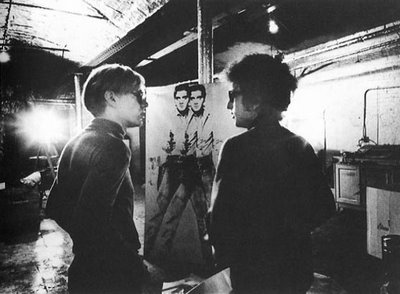
Andy, Elvis, Bob
And then the chorus which will be used three times for maximum pain:
But sooner or later, one of us must know
You just did what you were supposed to do
Sooner or later one of us must know
That I really did try to get close to you.
The key line here is that ‘I really did try to get close to you.’ At The Kettle Of Fish Edie murmured to Dylan that no matter how hard she tried she couldn’t get close to him. ‘Who?’ asked Dylan. ‘Andy.’ Edie replied. Dylan apparently took that as a rebuff although he was already married to Sara and would soon spawn a host of children on her.
I quote the second verse in its entirety:
I couldn’t see what you could show me
Your scarf had kept your mouth well hid
I couldn’t see how you could know me
But you said you knew me and I believed you did.
When you whispered in my ear
And asked me if I was leavin’ with you or her
I didn’t realize just what I did hear
I didn’t realize how young you were.
Apparently Edie didn’t realize that she was just a rainy day woman. While it’s a matter of interpretation I assume that Edie confronted Dylan with the fact of his marriage to Sara and naively asked if he were going to dump Sara for herself. Dylan was incredulous, astonished by her request, he thought she was more sophisticated than that, after all, a rainy day woman….
Rainy Day Woman is a very mocking put down of women as the lead off song and theme setter of the album titled Blonde On Blonde. Perhaps the title might be interpreted as Woman On or After Woman with Rainy Day Women establishing the theme. The song limits the range of women to two- numbers 12 and 35. Why 12, why 35? Who are they? One has to be Edie. If one does a little number manipulation a la Freud, in sequence the numbers add up to 11 which in turn adds up to 2. Two women. Seven come eleven? Three and eight, twelve and thirty-five added separately- three for male, eight for female. Twelve subtracted from thirty-five is twenty-three, Edie’s age. Just guessing.
As Sara is the only other identifiable woman in the lyrics the two women must be Edie and Sara. Let me venture the guess that all women are rainy day women for Dylan. Thus once Sara had borne his offspring fullfilling a religious obligation Dylan took seriously he drove her away oblivious to the pain and suffering he was causing or perhaps he was continuing to punish mother surrogates.
Dylan was drugged and crazed while he was writing this so this is a reflection of deep subconscious drives.

Andy And Edie As Beautiful People
The final lyric begins:
I couldn’t see when it started snowin’
Your voice was all I heard
Snowin’ either refers to a snow job by Edie so he was blinded by light hearing only her words or drugs of some sort, either amphetamines or cocaine.
I couldn’t see where you were goin’
But you said you knew an’ I took your word.
Once again Dylan shifts the full responsibility from himself and Grossman to Edie. He implies that she was leading him on rather than vice versa. This when it was clear to everyone that he and Grossman were promising her the moon in the attempt to pry her loose from Warhol.
And then you told me later, as I apologized
That you were just kiddin’ me, you weren’t really from the farm
An’ I told you as you clawed out my eyes
That I never really meant t’ do you any harm
Well, Dylan’s intents were pure, he says, but the results were deplorable; Edie was done harm by Dylan’s actions and the harm was deep and lasting, well beyond any hypocritical apologies. If the lines are to be believed Edie’s reaction was quite violent. As she was a total amphetamine addict her reaction would be quite plausible.
And then Dylan mockingly closes with his ‘whadaya goin’ to do about it line’- I really did try to get close to you.
As this period clears up for me I suspect that the whole of Blonde On Blonde is concerned with this Edie, Andy/Dylan duel. Blonde On Blonde itself then may refer to the silver hair of both Edie and Andy.
It should be clear that Dylan’s motorcycle fall was no accident. In Exhuming Bob 23b: Bob, Andy and Edie I hypothesize that Dylan’s bike was rigged by the Factory crowd. Dylan survived with minimal damage. For his own sins Warhol was shot a couple years later but he survived that one too. Edie died a physical wreck in 1971.

Dead Ophelia- Consider Ciao Manhattan with Edie shot in a swimming pool/
What goes around comes around as they used to say.

R.E. Prindle
A Review
Themes And Variations
The Tarzan Novels Of Edgar Rice Burroughs
#14 Tarzan The Invincible
Part II of X
by
R.E. Prindle

ERB
Time On His Hands
I pair this novel with Tarzan At The Earth’s Core. Burroughs could have titled that novel Tarzan In Pellucidar but he didn’t. Why not? Probably because he was trying to avoid as much confusion between his two imaginary worlds as possible, or possibly he needed the site to illustrate his point but didn’t want to make it a Pellucidar novel. Earth’s Core isn’t merely a story in which Tarzan makes a guest shot in another of Burrough’s worlds. Rather ERB is making a serious exploration of Einstein’s Theory of Time and Space. Alternatively the novel might have been titled, Tarzan, Lost In Time. The novel is written to disprove the objective existence of Time. Burroughs’ own conclusion is that time is merely a human construct for mankind’s own convenience but not substantial. I think he’s right.
The nature of Time was a topic of serious discussion during the late nineteenth century, into the twentieth , still going on today. Indeed the Pellucidar series as a whole is a discussion on the aspects of Time. Of course Burroughs was familiar also with H.G. Wells’ The Time Machine.
Perhaps one of the more interesting notions of Time and Space and time travel was one advanced by Mark Twain in 1916 in his interesting novel No. 44, The Mysterious Stranger. In his story Twain imagines that space and time are assembled like a multi-storied building with each diorama of time and space continuing in replay eternally. Thus his hero, #44 scoots around in time and space in what is apparently a system of chutes and ladders.
It is possible in this system to visit ancient Egypt to watch the Pyramids being built, climb through the years to discover the head of the Sphinx sticking out of the sand as Napoleon saw it in 1798, climb once again to watch the first Aswan dam being built, move up a story or two to watch the High Dam being built and off to Troy to stand in the front ranks with poor maligned Ajax.
To The Time Machine, Einstein’s Theory and The Mysterious Stranger, now add Tarzan At The Earth’s Core. There are more similarities than dissimilarities.
ERB apprently didn’t think he made his point in At The Earth’s Core or perhaps he received some criticism from someone so he carries the discussion over into Invincible. While incongruous for this story ERB works it in.
As there are no book s on Einstein in his library one may ask what evidence there is that ERB had ever thought of Relativity. Well, I’ve got the evidence right here, p. 104:
…but though Time and space go on forever, whether in curves or straight lines…
One can’t mention curved space and Time without being familiar with Einstein. And then, Einstein absurdly claimed that a nonexistent mental construct like Time forms a Fourth Dimension which somehow interacts with the other three. We are still waiting for a demonstration of that but we’ll let it pass. I’m sure Einstein picked that up from H.G. Wells Time Machine which was a very fine piece of imaginative literature but reflected no known physics then or now. Someone ought to pin a big red bozo nose on Einstein but, back to the future.
ERB had discussed the notion of Time thoroughly in Tarzan At The Earth’s Core. Actually that’s a contradiction of terms as a hollow earth obviates the notion of core. The key fact at the Earth’s Core is that it is always high noon. The central sun knows only endless day without a contrasting night to give the appearance of Time. Without the contrast between day and night and the revolution of the Earth around the Sun the concept of Time disappears; there is nothing to measure just pure duration.
In Invincible Burroughs explains it this way, if you didn’t catch it in At The Earth’s Core, p. 104 again, same paragraph:
The beasts of the jungle acknowledge no master, least of all the cruel tyrant that drives civilized man throughout his headlong race from the cradle to the grave- Time, the master of countless millions of slaves. Time, the measurable aspect of duration, was meaningless to Tarzan and Tantor.
Not only is Time meaningless to Tarzan and Tantor but Time is meaningless to the universe itself. Nothing that ocurs in the Universe is dependent on Time nor can Time change any occurrence. The so-called Fourth Dimension is totally ineffective. Everything will happen just as it does now and has always without any reference to Time. The progress of a physcial action will progress in scientifically determined steps from inception to completion without any interference from that clown Einstein’s ‘fabric of time and space.’

Albert Einstein
That is the import of timelessness at the Earth’s core. The inhabitants live and die without the ability to know they are getting older as there is no night, day or year. The organism merely comes into existence, behaving according to physical laws determined by genes and other micro-organisms progressing through all the changes until the final change which change no longer has any conscious meaning.
The same is true of suns and galaxies. It is virtually meaningless to say the Sun is several billions of years old. It is only a mental construct that lets you grasp a concept of duration. It is much more relevant to say, for instance, that the changes in the Sun’s development are, say, 30% completed. You see, it’s all quantative not qualitative. Barring accidents and diseases, at twenty the average life span in the US is 25% consumed. The changes relative to that portion of development in the organism have occurred and will not occur again. On that basis I have used up about 85% of the physical changes alloted my organism. The nature of future changes are predictable. They cannot be avoided. This has no reference to Time no matter what state of development an organism is in.
While in a state of depletion I become ‘old’ only if my psychology is affected by the concept of ‘age.’ While my physical capabilities are not what they were at twenty, that phase of development having been passed through, my mental capabilities have developed accordingly. As my body has decreased in powers my mind has increased. The beginning has compensated the end. If I die today or tomorrow that is as it must be. Everything has its end. There is no tragedy involved.
Life and death are completed, unaffected by Time. If time ‘stopped’ as people imagine it can, everything would continue as now. Organisms merely run their physical course. That is the point Burroughs is trying to make. He is repudiating Einstein.
As a young man I was conditioned to revere Einstein. I did this unquestioningly and, boy, was I sincere. I disgust myself in memory. But then, somewhere along the line the hypnotic spell wore off, contradicted by facts. Einstein began to unravel before my eyes. It wasn’t that I questioned his reputation it was just that a mist began to lift. I began to have doubts; sort of religious doubts. I blinked once and Einstein was no longer the archetype of genius. At the second blink I began to ask questions. I tripped over the notion of the physical reality of Time just as Burroughs did.
When I read the ancient Jewish historian Josephus I began to sense the specious nature of the problem. According to Josephus Abraham was the greatest astronomer cum astrologer of his time just as Einstein is thought to be the greatest of ours. At the time of the transition between the Age of Taurus and the Age of Aries Abraham had an astrological/astronomical dispute with the academy.
You see, at that stage of the evolution of human consciousness astronomy and astrology were united into one discipline. The magical element of astrology wouldn’t be separated from the scientific element of astronomy until the scientific consciousness of humanity had separated itself from the magical or religious which two systems are synonymous. The concept of god functions only in a magical sense as his presence is even less noticeable than that of Time.
However magic and astrology are still part of human consciousness although with a quasi-scientific basis so that systems organized perhaps tens of thousands of years ago continue to function through inertia. I have been accused of being New Age. Quite frankly as New Age in my view rejects the scientific consciousness as much as any other religious system, Fundamentalist Judaism, for instance, hint hint, I cannot be New Age. But, I sure like the way they talk.
What I discuss is scientific history. Facts which religious people reject because they disavow the ideas behind them but accept as real, i.e. Thou shalt not suffer a witch to live. Why bother worrying about it; witches do not exist except in the imagination.
So whether you ‘believe’ in astrology, the Zodiac or whatever is irrelevant. The fact is at one time in history people universally did and they acted on their beliefs.
At any rate the fact is at the time of the transition from the Age of Taurus to the Age of Aries Abraham had an astrological/astronomical dispute with the Chaldean astronomers of Ur. As I understand it they said the religious archetype was changing with the transition from Taurus to Aries. (I think of this as a form of set theory; it is so because everyone agrees it is so. No different than now.) Abraham argued that the archetype of the Ages was Eternal, unchanging, the Rock Of Ages to you religious types. Rock of Ages means unchanging through all the signs of the Zodiac, all twelve Ages. An Age is one sign of the Zodiac. Ages are the twelve zodiacal signs. (Hello, Central? Put me through to God.)
Now, to be Eternal is astrologically impossible. The Earth wobbles on its axis visible at the North Pole so that every twenty-five thousand years or so it creates a Great Year then begins again. The Ancients divided the Great year in the system of twelve periods, called Ages, to correspond with the months of the terrestrial year.
Apparently Abraham denied this and adamantly insisted on the Eternal. For this reason, according to Josephus Abraham and his fellow Terahite cultists were run out of town.
Lousy astronomers, then, Abraham’s descendants had learned little by the time Einstein stepped onto the world stage to give his oration. Just as Abraham had voiced his foolishness four thousand years previously Einstein did the same in our time. There are those who seriously argue that time travel is possible in Einstein’s universe. Well, maybe in his, but not in this one.
Nothing is relative but one’s point of view. The physical universe is one of absolutes; that is the nature of science. Science cannot be relative; in order for an experiment to be true it must replicate itself the same way under the same conditions. As unpleasant as that may be to some intellects there is in fact only one way in a given set of circumstances. A+B will always equal A+B. If one switches to A+C then the result will always be A+C. There is nothing relative about it. You may religiously expect other results but you will be eternally disappointed. So Einstein said that the further out in Space his mind penetrated the closer he got to god. Who can say, but he never got close enough to touch God. Einstein was not a scientist. He was a Rabbi. There is no g-d to get closer to. I’m sure that a good Rabbi would find arguments in the Talmud almost identical to those of Einstein.
Burroughs saw through Einstein hence his arguments disproving the physical existence of Time and the futility of any supposed Fourth Dimension. These are religious matters requiring a belief in a supernatural being.
Having said that Time was measureless to Tarzan and Tantor which was not entirely true since the rotation of the Earth divides ‘Time’ into night and day unlike at the Earth’s core. Burroughs then goes on to say, p. 104, same paragraph:
Of all the vast resources that Nature had placed at their disposal, she had been most profligate with Time, since she had awarded to each all that he could use during his lifetime, no matter how extravagant of it he might be. So great was the supply of it that it could not be wasted, since there is always more, even up to the moment of death, after which it ceases, with all things, to be essential to the individual. Tantor and Tarzan therefore were wasting no time as they communed together in silent meditation…
A beautiful piece of sophistry. Regardless of the Time involved, immutable physical changes continued to take place. What opportunities appropriate to that physical state were lost forever.
Apropos of which carrying his argument further, on p. 120 he says:
Time is of the essence of many things to civilized man. He fumes and frets, and reduces his mental and physical efficiency if he is not accomplishing something concrete during the passage of every minute of that medium which seems to him like a flowing river, the waters of which are utterly wasted if they are not utilized as they pass by.
Imbued by some such insane conception of time, Wayne Colt sweated and stumbled through the jungle, seeking his companions as though the fate of the universe hung upon the slender chance that he could reach them without the loss of a second.
I understand what ERB is saying, of course, I’m virtually a disciple. Tarzan lolling on the back of Tantor achieved his goal more easily than the frantic Colt. Still, one should remember: Work, for the hour grows late. Those irreversible physical changes are drawing one closer to the grave. Get it done now.
ERB displays a seeming peevishness over the issue which has little or no bearing on this story. It is an interesting aside but it does not illuminate the tale. Maybe somebody criticized the ideas expressed in At The Earth’s Core and Burroughs is carrying on the argument. Nobody paid any attention, still I am charmed by the vision of Tantor and Tarzan suspended in Space and Time wandering blissfully through the jungle unaware of any impending doom.
Proceed to Part III of X
A Review
Themes And Variations
The Tarzan Novels Of Edgar Rice Burroughs
#14 Tarzan The Invincible
Part I of X
by
R.E. Prindle
Edgar Rice Burroughs
Introduction
By 1930 ERB was fifty-six years old. An age when many or even most people have become hardened into unchangeable forms. Burroughs seems to have been an exception to this rule. His ability to evolve with the times is remarkable. Some can, some can’t. The problem isn’t one of merely attempting to mimic the style of the period but to adapt one’s mental outlook so that one thinks in the current idiom,
The post-Civil War period into which Burroughs had been born had disappeared now long ago. There might have been a couple survivors of the GAR but not many. The Indian Wars of his childhood were over. The plains had been swept clean of the buffalo. Even the buffalo robe that could easily be found during the first two decades of the century became difficult to find in the twenties and impossible to find in the thirties.
So that past which must still have been vivid in ERB’s memory was no more. Frank James and Cole Younger had died as late as 1915 and 1916 respectively. Buffalo Bill in 1917. TR in 1919. Charlie Siringo who had been present at the shootout with Billy The Kid was giving advice to authenticate Western movies even as he passed away in 1928. Heck, Burroughs could claim to be an authentic cowboy. He was out on the Idaho range in 1890 the heyday of the cowboy, Johnson County war and all that. His Western novels are about as authentic as you can get, maybe even more so than one of ERB’s heroes, Owen Wister.
The guy was carrying impressive baggage from the past to the present and into the future. The era of the first two decades had come and gone disappearing into the Roaring Twenties, the New Era. The twenties were a major transitional period for ERB. He picked up on the new trends by such writers as F. Scott Fitzgerald and kept on hoofing it down the highways and byways. The Shaggy Man of Tarzana.
There was a hiatus of four years between Tarzan And The Ant Men, which may be considered the last of the Tarzan novels of the first period and 1927’s Tarzan, Lord Of The Jungle. The latter may be considered a transitional work between the first and the later period.
Tarzan And The Lost Empire of 1928 shows him saying goodbye to the Lost Empire of his early dreams. By this time he had begun his affair with Florence Gilbert Dearholt that would result in the end of his marriage of thirty-four years to the lovely Emma.
Also a new political element entered his writing competing with the love element of Emma and Florence. Tarzan novels fairly gushed from his pen over the next seven years. Tarzan At The Earth’s Core of 1928-29, Tarzan The Invincible of 1930, Tarzan Triumphant of 1931, Tarzan And The Leopard Men also of 1931, Tarzan And The City Of Gold of 1931-32, Tarzan And The Lion Man of 1933 and Tarzan’s Quest of 1934-35. With the divorce his fecundity ended; he had severed his connection with his origins.
Politics had entered his life in earnest with the Bolshevik Revolution of 1917. He had always been involved with politics to some extent. In his youth his basic attitudes had been formed by immigration while he watched immigrant German socialists parade through the streets of Chicago under the red flag shouting, Down with America. The Russian situation had troubled him too. The villains of the Russian Quartet had been Russians. A very great many of his villains were Russians. The Communist leaders of Tarzan The Invincible are Russian.
In 1919 he rushed his political tract Under The Red Flag denouncing the Russian revolutionaries to his publishers. Haven’t read it but I suspect it was much too polemical for the pulp fiction magazines for which he wrote. It if was anything like The Little Door I can understand why it was rejected on literary grounds. I don’t doubt the novel was rejected for political reasons also as Reds and Fellow Travelers had already worked themselves into the cultural edifices of the US.
Certainly he was flagged as a counterrevolutionary to be watched and interfered with. It is now becoming apparent that ERB was more widely read in the new Soviet union than previously thought. Josef Stalin may even have followed the Tarzan series. We know for certain

Joseph Stalin
that Tarzan novels were read to workers on the job.
H.G. Wells
It appears that H.G. Wells was appointed to harass Burroughs in print. His 1923 novel Men Like Gods seems to reference Burroughs in a negative way. The means of communication between Wells, the Reds and ERB remains to be discovered but there appears to be novelistic warfare between the two. Wells seemingly was the Soviet hatchet man attacking other notable counterrevolutionaries such as Aldous Huxley.
ERB refined his approach getting his condemnatory novel of Bolshevism, The Moon Maid, published in 1926. The Moon Maid wasn’t that satisfactory although Wells replied to it in 1928 with Mr. Blettsworthy of Rampole Island.
Wells unmistakably alludes to Burroughs in this novel calling him insane. Tarzan At The Earth’s Core which is an attack on some core beliefs of the revolutionaries may possibly have been a rushed response to Blettsworthy.
In Tarzan The Invincible which may be incontrovertibly considered his third attack on the Revolution and an answer to Wells ERB succeeded in the grand manner. He shed the nineteenth century trappings of The Moon Maid that was written in the style of Wells’ First Men In The Moon to write a thoroughly modern novel. Invincible might be considered a prototype of the modern spy thriller, one of the first of the genre. Not only a prototype of the genre but as David Adams points out in ERBzine 0199 a superb blending of fact and fiction:
Fictional author: Burroughs pulls off a tour de force by narrating an introduction in his own voice, then slipping into the story so smoothly one is deceived into believing it is part of a newspaper story in a historical setting.
By which David means current events occurring almost as we speak. Tour de force is correct. David got the handle on that one. Tarzan is actually integrated into a current political situation as an actual historical figure. Tarzan interacts with fictional agents of Stalin who are represented as real acting under orders from Moscow. Incredibly Opar devolves from a mere fantasy of Burroughs into an actual geographic location somewhere in southern Abyssinia. The Soviet agent Dorsky tells Tarzan that they know that he knows where the gold of Opar is hidden and that he is going to tell them.
Thus Stalin has apparently kept up on Tarzan’s adventures which he thinks are real being aware of the source of Tarzan’s wealth and his earlier expeditions to Opar. In fact, one knows that Tarzan’s adventures are common knowledge which they should be as several millions of copies had been sold worldwide. Tarzan’s amanuensis Burroughs has seen to that.
The Soviets had located Kitembo of the Basembos who knew where Opar was and had actually seen it. The Basembos were native to the area of the railhead on Lake Victoria. One assumes that Kitembo must have known one of the faithful Warziri who showed him the ruins. As ERB explains only Tarzan and some of the Waziri had been to Opar. That overlooks Ozawa, who probably bore Tarzan a little grudge for the gold taken from him and the bearers of Esteban Miranda of Tazan And The Golden Lion but possibly the well-known Curse of Atlantis had carried them all off. Haven’t heard of the Curse of Atlantis? Well, you’ve heard of the Curse of the Pharaohs haven’t you? Same thing, only different.
The Reds trying to loot Opar isn’t all that far-fetched. As has been mentioned elsewhere Stalin actually ordered his scientists at about this time to cross an ape and a human to attempt to create a new super warrior that could run on regular. We know that Stalin was a fan of the Tarzan series, both books and movies, possibly even a secret admirer of our favorite author. The possibility of Stalin thinking a eugenic hybrid of ape and human possible from reading Burroughs seems to have a high degree of probability. The Oparian males were believed to have some ape blood in them. If word of the experiments had reached Burroughs, Tarzan The Invincible could be part a spoof on Moscow. So, in a way, the blending of fact and fiction David notes could on the other hand be a blending of fiction and science by Stalin. Amusing to think about. I’m sure more information will surface in the future. At any rate this story does read as an unreported behind the scenes actual event.
Let’s take a look at how Burroughs sets it up. From the opening paragraph.
I am no historian, no chronicler of facts…
OK, so we’re warned that we’re about to be put upon.
Had the story I am about to tell you broken in the newspapers of two certain European powers, it might have precipitated another and a more terrible world war. But with that I am not particularly concerned. What interests me is that it is a good story that is particularly well adapted to my requirements through the fact that Tarzan of the Apes was intimately connected with many of its most thrilling episodes.
Ah, so Tarzan really exists.
That passage is reminiscent of both the first framing story of Tarzan of the Apes and any number of story introductions of Dr. Watson for Sherlock Holmes. The echoes are very strong. An overlooked fact is that Burroughs actually plays Dr. Watson’s role for Tarzan. Burroughs
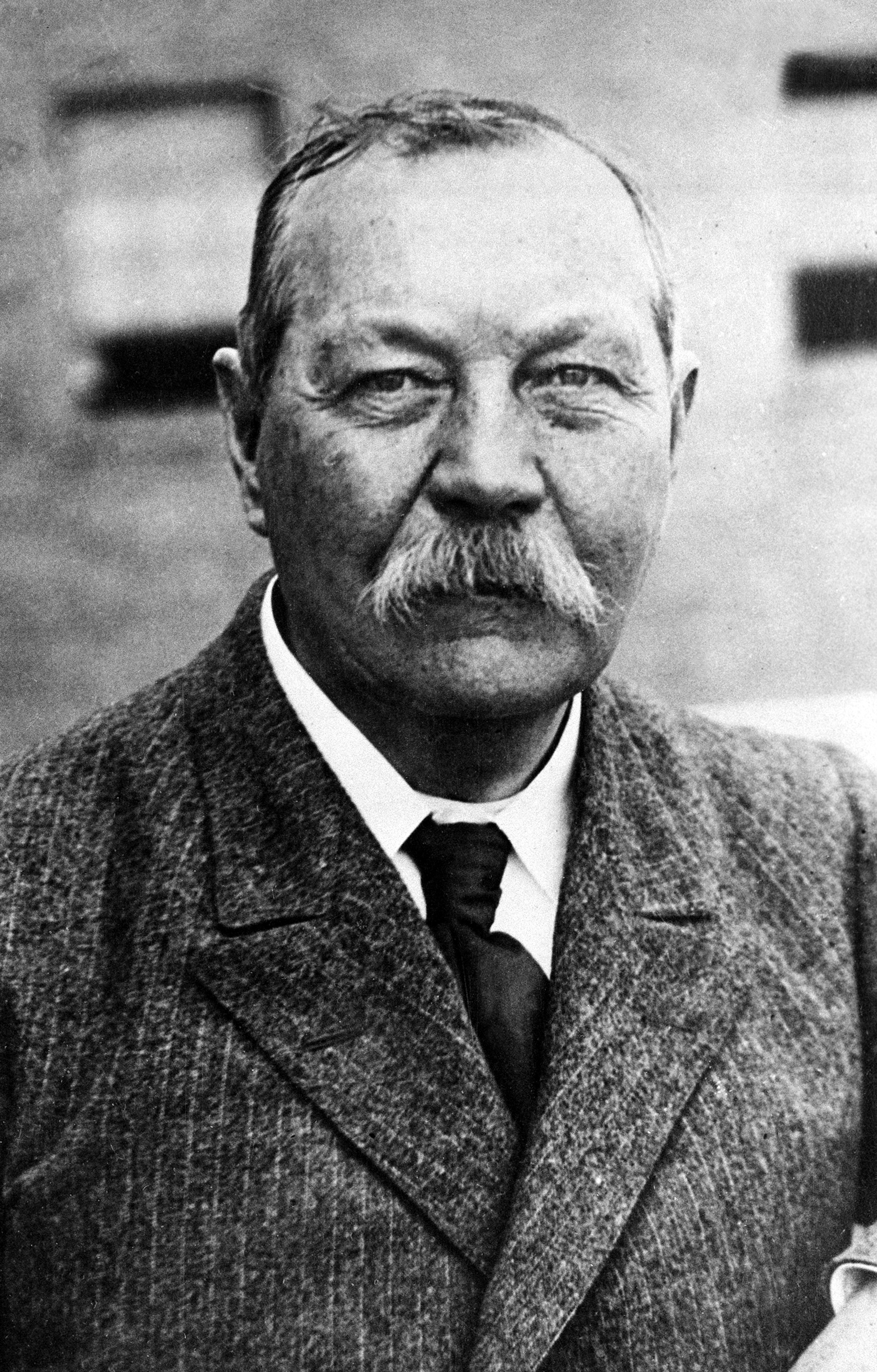
Arthur Conan Doyle
in fact is the chronicler of Tarzan’s adventures as was Watson those of Holmes.
Burroughs goes on to establish his story’s authenticity:
Take the story simply as another Tarzan story, in which, it is hoped, you will find entertainment and relaxation. If you find food for thought so much the better.
Doubtless, very few of you saw, and still fewer will remember having seen, an news dispatch that appeared inconspicuously (how inconspicuously?) in the papers some time since, reporting a rumor that French colonial troops stationed in Somaliland, on the northeast coast of Africa, had invaded an Italian African colony. Back of that news item is a story of conspiracy, intrigue, adventure, and love- a story of scoundrels and of fools, of brave men, of beautiful women, a story of the beasts of the forest and the jungle.
That seems like it covers all the bases of what a story should have. It is also pure Dr. Watson or, rather, Arthur Conan Doyle; let’s not fail to differentiate between fact and fiction. So far what Burroughs has posited could well be true. After all few read and fewer remembered the news item which appeared inconspicuously sometime in the not too distant past. Now Burroughs removes the story from the news item another step and quietly slips into full fiction mode:
If there were few who saw the newspaper acount of the invasion of Italian Somaliland upon the northeast coast of Africa, it is equally a fact that none of you saw a harrowing incident that occurred in the interior some time previous to the affair.
Um, yes, if there were few…then it’s a fact there were none. It seems ERB has established an incontestable ‘fact.’ So if you let that sophistry slip by you he’s going to tell you pure fiction. If you know the difference you won’t care, if you don’t it won’t matter. Anyway his intro was a perfect synthesis of nineteenth century humbug brought completely up to date.
Burroughs’ writing style is even close to reportorial. Tarzan, La and Opar become ‘real’ as ‘real life’ Reds make their assault on the ancient Atlantean colony. So, in a way, Atlantis becomes an established fact rather than an hypothesis.
Burroughs uses clear, concise sentences developing his story news style. For once his story is evenly paced with a well developed beginning, middle and unrushed end. He doesn’t cram a hundred page ending into ten as usual.
While one hesitates to call the book his best Tarzan novel it may be his best written. Thoroughly modern in its swift and pleasant reading with wonderful detailing I certainly can’t consider the novel hack work or inferior to any of the Tarzan novels in any way. The characters are entirely plausible, the premiss doesn’t seem far fetched. There are historical antecedents that we will examine. The novel could easily have take its place among the major spy thrillers written in the last fifty or sixty years. David is right. The novel is a major tour de force.
Part II of X follows.

R.E. Prindle
Exhuming Bob 25: Bob And Sam
June 5, 2010
Exhuming Bob 25:
Bob And Sam
by
R.E. Prindle

Shepard, Sam: The Rolling Thunder Logbook, 1977, Sanctuary Publishing.
Sometime in the mid-seventies, possibly in 1976 Paul Simon wrote in one of his lyrics: I don’t think this stuff is funny anymore. Coincidentally at the same time as I surveyed my record store of a Saturday morning the same thought occurred to me. Things had been overdone. In one bat of an eyelash the whole thing got old.

Bert Williams In Blackface
This was not case with Bob Dylan who in the waning months of 1975 put the greatest clown act New England had ever seen on the road. The Rolling Thunder Revue; or as it might alternatively have been named: The New Bob Dylan Minstrels. One purpose of the Revue seems to have been to spring the convicted triple murderer and ex-boxer Hurricane Carter from jail. That didn’t come until the very end.
Along the way Dylan wanted to film a sort of existential movie that would later be released as Renaldo and Clara. Working from some strange chaos theory Dylan had no actors, no script, no-nothing. Needing some sort of guiding hand he commanded the actor, cowboy, playwright Sam Shepard to attend to his writing needs. Sam then wrote what he called a log of the experience called the Rolling Thunder Logbook.
On the first reading I didn’t think Sam put much into it but the pictures were good. Still there was the nagging feeling that I might have missed something. On the second reading the logbook assumed more significance. It’s kind of impressionistic. It’s not a narrative; like the title says its sort of like a ship’s logbook. The impressions sort of pile up until you have a definite impression. I don’t know if that’s what Sam intended but that’s the way it worked with me.
Bob being the kind of powerful show biz personality he is didn’t bother to negotiate terms with Sam; he didn’t even bother to call himself; his agent or stooge or whatever interrupted the life of Shepard to tell him Dylan wanted him in New England. Sam doesn’t mention any terms, or indeed any payment. He just dropped everything, literally, and drove East. Did I mention he was in California? Well, he was; he was in the process of moving.
Bob tries pretty hard to cultivate that elusive, mysterious image and he succeeded with Sam who couldn’t locate him for a few days after he got there. Bob probably wanted to accustom him to the menagerie before he showed his face. Even then Sam didn’t have any guidelines he just expected Sam to free lance a few lines of dialogue if at any time he saw the cameras running. The film crew was more disorganized than Dylan if that were possible.
What was it all about anyway?

It Takes A Worried Man- Sam Shepard
As we should be aware 1976 was the two hundreth anniversary celebration of the American Revolution. But there were a number of conflicting revolutions running simultaneously. There was the revolt of the Matriarchy, what Eric Foner calls the Unfinished Revolution which was the replacement of Whites by Negroes and of course the perpetual revolution of the Jews against mankind, not to mention the revolution of the gay crowd. Bob as we all know is Jewish so one may reasonably ask why he chose New England for his chaotic Marx Brothers routine on the occasion of the Yankee Revolution around the new England sites such as Bunker Hill? Could he have been thumbing his nose at America? Well, it does look suspicious.
As Sam notes the crew made it a point to visit Plymouth Rock and the replica of the Mayflower which sacred symbols of pre-immigration America they reviled all but pissing on the Rock. The faux American cowboy, Elliott Adnopoz was swinging from the yardarm of the Mayflower. Y’all know Elliott as the yodelin’ cowboy Ramblin’ Jack Elliott o’ course. For the rest they pissed and farted their way across New England carousing and corrupting as they went. Of course it might just have been New England exercising the gang’s Rock n’ Roll genes, no more than that. Sam kept his discontent sotto voce by which I mean between the lines. Bob, with his need for conflict invited not only his old flame Joan Baez and his new flame Joni Mitchell but his wife Sarah playing each against each. Baez who grows more Mexican with each passing year seems willing to put up with whatever Bob does. Shortly after the tour Sara came downstairs one morning to find Bob dandling a strange beauty on his knee for breakfast. Well, you know, she threw in the tower after that, as, who wouldn’t? Bob seemed to be perfectly dismayed by this untoward turn of events. ‘Women in my family just don’t divorce.’ He whined uncomprehendingly. Well, at least, not without due provocation.

Joni Mitchell Looking Out Her Window
That leaves Joni Mitchell. She’s apparently been stewing about her treatment for thirty-five years. She just recently expressed herself by saying in effect that Dylan is just a god-damned phony. Well, Bob can always go join Joanie in that bomb shelter in Viet Nam. They can exchange rings made of the fuselages of American fighter planes, if they haven’t already. So, how sincere is their devotion to this great land of the once free and no longer brave? It would seem their loyalties lie elsewhere.
In my own obtuseness, quivering in my own psychological bomb shelter, I never saw Bob as a revolutionary in those far off days but then I was just listening to records, I didn’t know anything about him; boy, I sure have remedied that situation.
Back in those palmy days of the early sixties before racial and religious animosities had reached their present prominence I don’t know that anyhbody really thought of Dylan as a Jew. Certainly the name Dylan is not Jewish and I’m not sure how many people would have known Zimmerman was. Or, that they would have cared. In those days everyone cheered when Israel won one of those too frequent wars. Now, though, one has to put Bob’s religious affiliation up front. Make no mistake, he’s a fundamentalist, believes the Bible is the literal word of god. Orthodox. Chabad Lubavitcher even. Thinks the universe is fifty-seven hundred years old like his deceased mentor Rabbi Schneerson. Swear to g-d.
Must have picked it all up from Rebbe Rueben who came West from Brooklyn to Hibbing to indoctrinate him in Lubavitcher lore for his Bar Mitzvah. Like Bob said, he learned what he was supposed to learn. He very cleverly inserted the stuff into all those songs too.
Bob broke his mind in the excesses of the sixties, that high mercury sound he was seeking was the result of all those amphetamines he was shooting back then. Andy Warhol had his boy pegged.
In the late sixties and early seventies Bob had to rebuild his personality and he rebuilt it around his religion. His Mom was real proud of the way he had his Bible open on a stand in his living room so he could jump up and check it as the occasion arose.
Then as he got back on his feet he aligned himself with Meyer Kahane’s violent extremist revolutionary Jewish Defense League carrying a couple of JDL thugs around with him as bodyguards. Maybe his Jewish revolutionary mode was getting too obvious so in ’77 he began hanging out with Jews For Jesus and the Christian Vinyard Fellowship organization. Once that clouded the picture he reverted back to his Lubavitchers where he has been since.
So on the Rolling thunder tour one may be excused for thinking that he was in his revolutionary phase. Sam Shepard doesn’t mention it but his experience left a very bad taste in his mouth which he expresses with as much force as Joni Mitchell really has.
On the tour Bob did the strange thing of wearing white makeup which has remained a mystery. It shouldn’t be really. Remember the tour was to end in a successful attempt to free a Black man while the Black boxer Muhammed Ali was unstage at the Garden. A Garden party a la Ricky Nelson, get it? The Revue was actually a parody of the Minstrel show of what Greil Marcus would call the old weird America. In the old Minstrel shows the White actor wore black face in imitation of Black people. This may sound strange to you but Jews don’t consider themselves White notwithstanding their pale complexions they consider themselves Jews and goys as White. So, in disguising himself in White Face he was parodying the old Black Minstrel shows while mocking his ultra-White New England audience.
Bob Dylan was having the time of his life. The joke was on the Honkies. Funny, huh?
As noted, the keynote of the tour was the final concert at Madison Square Garden at Christmas where he took on America over the issue of the Black Hurricane Carter and won. Now, compare that Christmas show with the 2009 release of Bob’s Christmas album. Seemingly done straight it also mocks Whites. In Bob’s video for the song It Must Be Santa Claus you may have noticed that the audience showed minimal diversity. The airheads were all White. Bob comes prancing through wearing a lank blonde White girl’s wig, climbs into a balcony and stands looking down his nose in his wig at us all. It’s great. Nobody gets it. There is something happening here but you don’t know what it is, do you, Mr. Jo-o-o-nes.
Jewish power vs. American power, make no mistake.
Sam jumped ship before the end of the tour, he’d had enough, but he was there for the Garden party. He can’t even force himself to dissimulate a complimentary attitude as he did at the beginning of the Minstrel show. And then the final confrontation between the playwright and the singer.
At this point is is clear that the Rolling Thunder tour is something Sam wished he hadn’t gone on and an experience he preferred to forget.
Shepard closes with a chapter concerning the opening of his play The Geography Of A Horse Dreamer. I don’t know the play but it may have been based on Rolling Thunder. In the play Sam names the horse Sara D. Dylan is in New York at the time wanting to see the play. He wants to make his entrance in company with Sam. Sam writes:
..so I’m in the hotel lobby waiting for the Cadillac convertible to haul us over to the theatre. The big boxcar camper pulls up outside and Dylan hops out. My stomach does a full gainer as I see him approaching the hotel. The idea of him sitting in the audience is more like a nightmare than a blessing…He pauses at one of these signs (reading signs in the lobby) long enough for me to scuttle past him out into the street and hail a cab. It’s bad enough knowing that he’ll be there without having to ride there with him in the same car.
So not only was the tour distasteful to Sam’s sensibilities but the experience of first hand acquaintance with Bob has also left a bitter taste. Well he isn’t the only one. The evening of the opening of Sam’s show is not going to improve relations.
…the so-called curtain is being held up for Dylan’s late arrival. He shows up plastered, along with Neuwirth, Kemp, Sara and Gary Shafner. They take up a whole row.
So whatever the cause of the conflict Dylan is reciprocating his disrespect fully. He means to sabotage Sam’s show and then leave early too.
At intermission Sam doesn’t see Bob so he hopes he’s left the theatre. No such luck. Dylan comes out of the toilet.
He sees me standing there and pauses as though trying to bring certain thoughts into focus. “Hey, Sam, what happens to this guy in the play anyway?’ I’m dumbfounded for a reply but come out with something like, “That’s the reason for seeing the second act.” He stares at the floor, his knees shifting slightly as though he’s about to go into a nose dive.
“Hey, how come you named that horse in the play Sara D?”
“That’s the name of a racing dog in England.” It suddenly cuts through me that it’s also the name of his wife.
“I mean it’s the name of a greyhound. A real greyhound. You know the kind that race around the track.”
He smiles and shuffles through the door, almost making a left turn into the light booth.
Apparently Dylan didn’t find that answer any more satisfactory than I would have. Something is going on here, isn’t it?
As the play draws to its end Dylan makes his move. Shameless. Pure chutzpah immersed in chocolate sauce.
Dylan stands in the back row. “Wait a minute!” Who’s he yelling to? The actors? “Wait a second! why’s he get the shot? He shouldn’t get that shot! The other guy should get it!” Lou Kemp is trying to haul him back down in his seat….
Dylan is struggling to free himself from Kemp’s hammerlock grip. Neuwirth is telling him to shut up…Finally the Sam Peckinpah sequence begins, with shotguns and catsup all over the stage. Dylan leaps up again. “I DON’T HAVE TO WATCH THIS! I DIDN’T COME HERE TO WATCH THIS!
Apparently the Rolling Thunder tour didn’t end until Sam had written this play and run it by Bob. Dylan didn’t like the play any better than Shepard liked the tour. Hard feelings everywhere.
Apparently Bob used people much too roughly. He managed to either blow off a number of people immediately following such as Shepard, Jack Elliott, Neuwirth, the maligned Larry Sloman and probably the whole film crew while Joni Mitchell has weighed in thirty-five years on. We have yet to hear from a number of other people, most notably Roger McGuinn.
Bob managed to trash everybody including the USA with his Minstrel show for the 200th anniversary year. Which revolutions was he leading? I don’t think this stuff is funny anymore, do you?

Bob and Joan, Joan and Bob?
Four Crucial Years
In The Life Of Edgar Rice Burroughs
Part IV of IV
by
R.E. Prindle
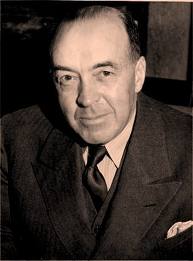
Edgar Rice Burroughs
“HE’S BACK!”
By this time ERB would have been viewed as a real upsetter. Since 1890, except for a summer vacation or so, ERB had only been in Chicago from late Spring ’97 to Spring of ’98. Then he had gone away for a year and now he was back spoiling some other people’s plans.
Even after having deserted Emma Hulbert twice, the first time without notice for sure, and probably the second also, she was still waiting for him. Amazing! Ten full years when when the biological clock was ticking loudest she was still there. If that’s not true love I don’t know what is.
It must be that ERB took it for granted that she would always be waiting for him because he was still willing to leave her at the drop of a hat, if he could only get that coveted officer’s appointment.
As ERB walked down his street you could almost hear Alvin Hulbert say ‘Drat! that young man is not going to set foot in this house.’
Papa George T., quietly holding that three hundred dollar note, welcomed him back restoring his old job to him.
The following account is based on two letters, one from R.H. Patchin dated 3/21/1950 and the reply from Jack Burroughs dated 4/4/50. I learned of the letters which were quoted in part by Burroughs scholar Robert Barrett in the Fall 2003 issue of the BB. Danton Burroughs of ERB, Inc. subsequently was gracious enough to provide me with full copies as he had Mr. Barrett.
As of the time of the letter Mr. Patchin was from 68 to 70-75 years old. My guess is that Frank Martin couldn’t have been younger than Emma so was probably at least 25 to 30 years old in 1899. It is not impossible that he was older but as his exemplars in ‘W.C. Clayton and Terkoz in Tarzan Of The Apes and The Return Of Tarzan are approximately the same age as Tarzan Martin was most likely 25-27.
As Emma would be 23 at the beginning of 1899 which would be close to spinsterhood one may believe there was some anxiety on Papa Alvin’s part to get her safely married. Martin was about the most advantageous marriage possible. At, say 27, he was looking at one of the last unmarried women of his age cohort. If he failed with Emma he would have to find a much younger woman than himself or take a woman who had already been married. He has some reason to repent this man he could not have known well who not seeming to care that much for Emma yet stood between himself and her.
Patchin says a lot in his letter to Jack Burroughs. He mentions the three times his and ERB’s paths crossed. They were all unfortunate for Burroughs. In the first ERB got his head bashed in; in the second Patchin showed up just after ERB divorced Emma which divorce was national news; the third was the condolence letter at ERB’s death. Talk about an ill omened bird.
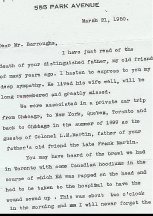

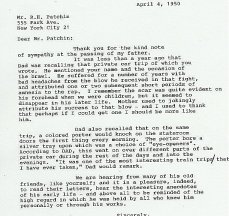
Jack Burroughs’ Reply
Sometime between ERB’s divorce and 1950 Frank Martin became a statistic. He didn’t survive his nemesis. I am guessing of course but Patchin’s meeting with ERB after his divorce must have been arranged by Martin. He may even have been watching from a distance. One wonders if he ever married.
I only mention the following as a point of interest. By the time John Dos Passos wrote the third volumeof his USA trilogy, The Big Money, Burroughs was already a major literary figure. As he didn’t seem to court publicity he can’t be said to have been a celebrity. In The Big Money Dos Passos cameos a number of interesting people among them Bernarr Macfadden.
It should be clear to everyone that nothing can be done in secret. Whatever passed between Martin, ERB and Emma must have been a source of gossip among Chicagoans. Somewhere along the way Dos Passos may have heard the gossip. In The Big Money he includes a story about a woman named Evaline Hutchins. A segment of the story bears some resemblance to the situation between the three under consideration. In the episode the Martin-like character takes the Emma character driving. He cracks up the car leaving the woman with some explaining to do to her husband.
I don’t say it’s so but suppose that in 1907-08 Martin, still seething at his rejection, in some way got Emma to go out driving with him with the above result throwing Burroughs into a panic. It was in 1908 that Joan was born to be followed immediately by Hulbert. Is it possible that after eight childless years Burroughs suddenly began a family as a defensive move against Martin? I can’t say but it is a hint I would dearly love to follow up.
At the time Patchin wrote the letter in 1950, judging from his stationery, he was down on his luck. His sloppy typing can’t be accounted for by age alone, or perhaps a lifetime of hard living had left him a wreck. My conjecture is that he had been drinking when he wrote the letter.
You will notice that the staionery bears only a street address- 555 Park Avenue- and no indication in the body of the letter as to what city. Burroughs’ reply provides the location. New York City. Patchin must have been clever enough to provide a return address on the envelope. The street address is printed rather than engraved so it is less expensive stationery. With no other address details provided it is obviously not Patchin’s personal stationery. The paper must have come from a mailing address. The stationery was probably available to anyone. 555 Park Avenue is a lower East Side address so Patchin was totally down on his luck. Probably drunk as he wrote.
He makes a glaring Freudian slip in the first paragraph when he says of ERB, ‘He lived his wife well. Wife for life! Hence the letter is as much about Emma as ERB. Emma meant nothing to Patchin so he must be speaking for Frank Martin. He then immediately relates the anecdote concerning ERB’s bashing in Toronto; thus Emma and the bashing are related. The one caused the other.
What follows now is extrapolated from Patchin’s virtual confession and Jack Burroughs’ reply. Burroughs hints that he knows more of the story than he is letting out. He and ERB had discussed this matter shortly before ERB passed over, he says. Obviously among the last things on ERB’s mind.
Martin viewed Burroughs’ return from Idaho with apprehension. Emma’s delight at Burroughs’ reappearance disconcerted Martin’s plans which he and Alvin probably thought were progressing well. Martin perhaps in talking with Patchin, if they were equals and friends, which I doubt, may have said, ‘How am I going to get rid of this guy?’ ‘Let’s think about it.’ Said Patchin. ‘What kind of accident could he have?’
Indeed, that’s how people get rid of someone they don’t like, the victim has an ‘accident.’ Murder is for amateurs. With murder the Law has to be paid, with accidents it doesn’t. No investigation. Perhaps he steps on a banana peel; gets run over by a car going the wrong way down a one way street, pushed in front of a trolley car. The next question would have been, where, how, when?
Better that it should be out of town rather than in town.
How to get Burroughs out of town? Now we’re talking old hat. You find a desirable reason for going somewhere, say New York City, then you make arrangements.
In Frank Martin’s case he had a perfect situation. Frank’s father, Col. L.N. Martin, was a multi-millionaire railroad man who had his own private rail car. In July of ’99 the Col. was going to NYC so Martin, extended an invitation to Burroughs to travel by private car to New York City. What a deal, huh?
Burroughs should have been surprised at the offer since the two weren’t that close friends while they were rivals for Emma’s favor. There should have been enough there to give one pause. Still, what a tempting offer.
The trip appears to have lasted at least three to four weeks, returning to Chcago at the beginning of August. Clearly ERB and Martin were not in the same economic league. Our Man was receiving fifteen dollars a week. Martin could spend that much for lunch every day of the week and take Emma to the theatre every night without a single concern for expense. There was no way ERB could have kept up so that the Martins had to have paid his way. Didn’t ERB wonder why they would do that for a comparative stranger?
There was no questioning expenses from the Martin point of view. They owned a luxurious private railroad car. It cost more than Burroughs made in a week to connect it to a train. Jack Coleman Burroughs recalls: ‘Dad also recalled on the same trip, a colored porter would knock on the stateroom doors the first thing every morning. The porter bore a silver tray upon which was a choice of ‘eye openers’. According to Dad, this went on over different parts of the private car during the rest of the days and into the evenings.’
Thus ERB was accepting lavish hospitality he couldn’t hope to reciprocate. This is a fairly humiliating situation. You cannot feel like an equal nor will you actually be treated as one. One the other hand he was kept tipsy, to say the least, for the whole trip.
When they got to New York ERB does not appear to have lived on the car. Once again with the Army fever on him he wrote to Col. Rogers who was then in Washington D.C. in the hopes of gaining an officer’s appointment. The return address Rogers was given was 11 17th in NYC. That is the lower East Side somewhere in the vicinity of the Bowery. Patchin was writing from somewhere in the same vicinity. Of course, the address could possibly have been a box of the railroad; the information is incomplete. At the same time the Martin party was staying on the posh Riverside Drive. There’s a degree of separation there.
ERB’s letter was sent on the 15th while Rogers very quick reply came back on the 22nd in the negative. He didn’t have to give his reply much thought. Now, ERB was ready to abandon Emma again. Marrying her must have been a low priority in his mind.
If Martin had been thinking, rather than preparing an ‘accident’ for ERB he would have gotten his father, ‘the Colonel’ who must have had some influence, to secure Burroughs an appointment and have him shipped to the Philippines. That would have made ERB eternally grateful while getting him out of Martin’s hair. Frank missed a chance.
Sometime after the 22nd the return trip to Chicago began. As is usual in attempts of this kind the hit was delayed until the last minute. In this case the assassination was to take place in Canada to which, if anything went wrong, Martin would have to be extradited as they would cross the river into the United States from Toronto the next morning.
More rounds of drinks were served as the train moved from NYC to Montreal and thence to Toronto. Probably a fairly lengthy trip as they might have had to switch trains a couple times while wating in the yards.
Neither Patchin nor Jack Burroughs gives a date for Toronto. As this took place in 1899 there were no motorized taxis. As Patchin says the railcar was parked in the Grand Trunk yards. These ‘three gentlemen songsters out on a spree’ would have had to walk into town or hire a carriage, probably the latter as Martin had the money.
At this point someone would have had to have previously hired the thugs to bash Burroughs. As I figure it the logistics were Patchin’s job. I don’t see him so much a friend of Martin’s as an accomplice or stooge. In his letter he does not claim to be a friend of Martin, he does not say ‘our’ old friend but claims to have been a friend of ERB while ERB was a friend of Martin. Stange circumlocution when he could have just said ‘our friend.’
Although Patchin describes the thugs as ‘Canadian hoodlums’ I wouldn’t be surprised if they had been brought from Chicago contracted by Patchin there. It would have been easier and surer.
If you study Patchin’s letter you will see that other than the slip of ‘He loved his wife well’ there are no other typos in the first paragraph. As he gets into his story in the second paragraph he begins to have difficulties. By the third paragraph when guilt seizes him he can’t even spell his last word or keep the words on the same line. He begins emergency with two Es, can’t spell the critical word ‘hospital’, crossing it out. Serious stuff.
Where did they go in Tornonto on that memorable evening. Probably to the red light and gambling district. Toronto’s answer to Chicago’s Levee. Where else could you arrange a fight with such hoodlums so easily. Patchin doesn’t say whether the fight took place indoors or outdoors, just that Burroughs took a smack to the head. Since the scalp was opened he was coshed with a sap or pipe.
Burroughs says that he didn’t lose consciousness but he must have been knocked flat on his back. He must have had time to get his arm up to partially block the blow or he would most likely have been killed by it. As I see it, then, this was an assassination attempt. Martin meant to permanently get Burroughs out of the way. Put him in a place from where he couldn’t come back.
As I see it Martin and Patchin faked the brawl. Patchin doesn’t say that he and Martin had a hard time of it. No. Just Burroughs got hit. Only Burroughs got hurt which is suspicious. After the first blow which could have been interpreted to be in the heat of anger which would still have been manslaughter, to have continued to belabor Burroughs would have been a clear case of murder which would have had to have been thoroughly investigated. The Law would have to be paid. Thus the opportunity was lost when the first blow failed. Martin and Patchin didn’t even report the incident to the police. The ‘Canadian hoodlums’ could still have legged it across the border though. It is not impossible that they weren’t Canadian but Chicago hoodlums contracted for the job before the private car left the Big Windy. Why not? Perfect job.
So at two in the morning when asked where he was staying by the hospital doctor ERB replied in our private car down in the Grand Trunk Station. Not Martin’s car but our car. He quickly got used to the luxury of a private car. Never forgot it either.
As he was able to walk he was released the party returned to the yards returning to Chicago the next morning.
2.
One may ask is there any evidence to show that Burroughs after he had thought about it for a while ever came to the conclusion that Martin and Patchin had meant him harm? I think there is. In The Return Of Tarzan Burroughs puts these words into the mouth of Jane perhaps thereby admonishing more sternly who might, not unreasonably, be expected to be reading these books. He obviously would get more out of them than we might.
Jane says ‘…this terrible jungle. It renders even the manifestations of friendship terrifying.’
A manifestation of friendship was the invitation to NYC from Martin. This indeed had been terrifying. So that for the parties concerned if they read between the lines they had every reason to believe that Burroughs understood everything.
One of the consequences of the attempt on Burroughs’ life was that he rushed back home to propose to Emma. Within five months they were wed thus taking her away from Martin. Emma had had a choice between a prince and a pauper and by some miracle had chosen the pauper. Really a very romantic story worth of a movie on its own. Grand Opera the way I see it. Andrew Lloyd Weber should look into this one.
There were other serious consequences. Of the blow, Jack Buroughs says: “He suffered for a number of years with bad headaches from the blow he received in that fight, and attributed one or two short periods of amnesia to that rap. (Amnesia is a recurrent theme in the Tarzan oeuvre.) I remember the scar was quite evident on his forehead when we were children (Jack Burroughs was born in 1913 so the scar must still have been visible in 1920 although it doesn’t show up in photographs.) but it seemed to disappear in his later life. Mother used to jokingly attribute his success to that blow.”
Emma would be in a position to know.
So Burroughs suffered lasting injury from that blow– one doesn’t have periods of amnesia unless there is internal pressure on the brain. There is evidence that he suffered from such pressure. Perhaps brain damage is too strong a phrase in this case but here is a clinical description that seems to fit the case. Per Brodal: The Central Nervous System: Structure and Function (3rd. Edition, page 433):
A peculiar form or amnesia occurs together with confabulation; that is the patient invents stories (without knowing that they are not real). Most of the patients have a lesion involving the substantia inominata, the medial hypothalamus, and the orbito frontal cortex (usually caused by a ruptured aneurism in the anterior cerebral artery). The often bizarre stories can usually be traced back to real events, although they consist of various, unrelated fragments from memory. It seems the patient is unable to suppress irrelevant associations, and cannot chack them against reality.
That is pretty close to ERB’s situation although he doesn’t appear to have lost his connection to reality although his stories as fantastic as they come always relate to his own memories. The Corpus seems to form one gigantic web of psychological unity as Richard A. Lupoff has pointed out.
One could think that after such a fearsome blow he would have been kept at the hospital for observation for at least a day or two but as he appeared to have no more than an open wound the doctor sewed him up and sent him on his way. As Patchin says the doctor came down to the yards the next morning to check up on the private car story which may have seemed incredible to him causing him to the think the patient deluded perhaps being more hurt than he looked as, indeed, he was.
There seems to be no reason to doubt that the blow ruptured the anterior cerebral artery. Thus internal bleeding over the next couple days would have created a clot which would have put pressure on the prefrontal lobe causing cobwebs, headaches and obviously a faulty memory with periods of amnesia.
There must be a medical reason for all these.
The symptoms should have begun showing up within a week or so, so that the several months of faintness ERB experienced began then. It was in this mental condition that he proposed to Emma.
Disappointed by the quick rejection of Col. Rogers while at least intuitively understanding that he had been set up in Toronto, ERB quickly went to work to capture Emma from Martin. I see little reason to believe that he had intended to marry her any time soon before he went o NYC, if at all. Back in Chicago in August he proposed and he and Emma were married by the end of January. In terms of years he was twenty-five and she twenty-four but in reality ERB was only four months older than Emma.
The sudden wedding must have been disconcerting to the Hulberts. I’m sure they envisioned a magnficent society wedding for their daughter. There was now no time to plan one so they must have been bitterly disappointed.
ERB now had to face a reality he hadn’t planned for. His rough and rowdy days were over.
3.
While solidly based on documentation the foregoing is at present somewhat conjectural but let us see if we can find some discussion by ERB of these events in his writing. There are four titles that go over these events in slightly different ways. Certainly ERB had to ask himself what had happened. He gave it a lot of thought. Beginning in 1909 his answers came pouring forth. Minidoka 937th Earl Of One Mile, Series M which was unpublished in his lifetime was the first of these efforts followed by Tarzan Of The Apes, The Return Of Tarzan and The Girl From Farris’s. As ‘The Girl’ is concerned with the early married years rather than this period I will forego discussion of that title although it should be read in sequence with Minidoka.
Minidoka, which actually began ERB’s writing career is directly concerned with this struggle between himself, Alvin Hulbert and Frank Martin. In the story the evil Brady represents Alvin Hulbert with the genuine thoroughbred godling, Rhi, representing Frank Martin.
The wars and battles represent Hulbert’s attempts to keep ERB away from Emma which ultimately fail. However the story may explain a curious situation in which ERB and Emma took up residence in the Hulbert home after marriage. Not a situation most newlyweds would want, but one that the Brady or Hulbert insisted on.
Alvin Hulbert had thought little of ERB for several years. The Army episode and the Denver marching band stunt did little to improve his opinion of Our Man. How the New York trip was represented to him by Martin would be interesting to know. Probably Martin who had every incentive to slander Burroughs said he was drunk all the way to New York and back, drank continually, started the day with liquor. He may have said that they were in the red light district of Toronto at ERB’s insistence. In other words, he probably made the most of the situation.
Undoubteldly terrified at his daughter’s willfulness in marrying this ne’er-do-well Hulbert made it a condition of his consent that the couple live in his house where he could keep a close eye on ERB. I’m sure he was ready to have the marriage annulled at a moment’s notice.
In Minidoka Rhi by a very devious trick puts Minidoka/Burroughs in a situation where he is meant to be killed, a situation not unlike Toronto- then rushes to the heroine Bodine/Emma to inform her that Minidoka is dead proposing marriage to himself instead. It could have really happened that way.
As in real life Emma/ Bodine remains steadfast and true to Burroughs/Minidoka, all wool and a yard wide as Burroughs puts it.
Thus Minidoka mirrors the real life events in a fantastic manner as Per Brodal would suggest.
Minidoka was never published so the same material was available for a retelling. This was done in the first two Tarzan novels. Tarzan Of The Apes tells the story of Burroughs life up to 1896 with some interpolations from the later period. The Return Of Tarzan covers the four years from 1896 to his marriage with Emma in 1900.
Always bear in mind that Burroughs has to tell his story with commercial ends in mind.
The blow to the skull made an indelible impression on ERB as well it might. In Tarzan Of The Apes, Tarzan takes three serious beatings, one with a gorilla from another tribe, perhaps representing John the Bully, and with Kerchak and Terkoz of his own tribe. In all of them Tarzan is beaten about the head and shoulders. Terkoz/Martin rips his scalp open from above the left eye over to his right ear. Clearly an exaggeration of the true wound but that must have been how it felt.
Kerchak delivers a blow to the head that would have killed him had he not deflected its force with his raised arm.
Then when Tarzan and Jane are in the jungle Terkoz abducts Jane causing Tarzan to rescue her killing Terkoz in the process. Thus in Program A Tarzan kills his adversary.
Running concurrently in Program B Tarzan is a penniless jungle ape-man up against W.C. Clayton who is a genuine thoroughbred godling as was Rhi in Minidoka. Tarzan feels he doesn’t have a chance against Clayton so he magnanimously resigns Jane to him at the end of Tarzan Of The Apes. There must have been a sequel in mind because, as in reality Burroughs won Emma, Tarzan must win Jane.
The end of Tarzan Of The Apes may correspond to Burroughs joining the Army in 1896 while finding Clayton embracing Jane in the jungle may correspond to his second Idaho trip in 1898.
So that between 1896 and 1898 it may have appeared to him that he had lost out to Frank Martin. In ‘Return’ Tarzan retreats to Opar which is his fantasy world with the beautiful but unobtainable anima figure, La. At this early date she and Emma/Jane are fighting it out in his mind for his allegiance. He would rather have La, that is remain unmarried, but his rivalry with Martin is pushing him toward Emma.
Tarzan is captured by the Oparians destined for sacrifice to the Flaming God of which La is High Priestess. Burroughs reverses the situation and instead of squelching his imaginary La she is about to sacrifice him. Burroughs can’t renounce his Anima fantasy so rather than kill him which would end both Burroughs’ wish persona of Tarzan and his relationship with La, she releases him. Tarzan/Burroughs then triumphs over W.C. Clayton winning Jane/Emma. Jane/Emma leaves Opar never to return. La remains in Opar until Tarzan The Invincible when Burroughs is about to leave Emma and take up with his Anima figure, Florence Gilbert. La then comes out of Opar in the same way Burroughs leaves Emma for Florence. Opar disappears from the oeuvre, never being mentioned again.
Then as ‘Return’ ends Burroughs and Emma are married mirroring his fantasy where Tarzan and Jane are married. While not literal as Burroughs is writing for publication and must construct an interesting and, at least, nominally plausible story he confabulates events from his life into a fantastic and improbable tale.
The history of his slugging which closes this period was mysteriously obscured by his youngest son John Coleman Burroughs. These two letters were only discovered by Danton Burroughs, John Coleman’s son, recently. They were unknown to biographers Fenton, Porges and Taliaferro. For decades it was believed that Burroughs had been coshed in Idaho by a policeman as an innocent bystander in a saloon brawl.
In an interview with Porges Jack Burroughs told this latter story in 1970. Porges then dutifully reported the Idaho story in his biography. the question is why would Jack invent the latter story to replace the true one with which he was aware. As he himself replied to Patchin having previously discussed the event with his father I don’t see how he could have forgotten it. Nor was there any need for him to even tell Porges the Idaho invention.
Perhaps Jack knew details buried away in the archives wishing to lay down a false trail to disarm the curiosity of Porges.
In 1899 ERB had had the direction of his life changed by a rap on the head. He now had to face a life filled with heavy responsiblities which he had been able to avoid to this point.
We see a new Edgar Rice Burroughs emerge from his early married years.
Pt. 2 Tarzan And The Madman By Edgar Rice Burroughs
May 26, 2010
A Review
Themes And Variations
The Tarzan Novels Of Edgar Rice Burroughs #23
Tarzan And The Madman
Part II
by
R.E. Prindle
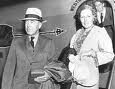
ERB And Florence Bid Goodby To LA
Tarzan novels seem more complex after repeated readings and just sitting and thinking about them. When I first read Tarzan And The Madman I Thought it was a throwaway. In the interim between that first reading and the present I’ve spent a fair amount of time in the Tarzan oeuvre and the Burroughs corpus while having written several hundred pages. One would think it would get easier but it doesn’t.
This novel was written by Burroughs in exile in Hawaii. He’d been run out of LA a couple years previously. Once the possessor of a magnificent collection of cars and planes and a vast estate becoming of the creator of Tarzan he was now living on 250.00 a month in the island paradise. He had returned to his poverty days at Sears, Roebuck in Chicago. Life’s like that.
On one level then Madman can be interpreted as a record of his feud with MGM and subsequent exile. Just look at the disdain on his and Florence’s faces as they board the plane for the last outpost of America. Tells a story in itself.
The MGM feud began with the release of Trader Horn. The book Trader Horn itself can be traced back to the Cave Girl. The movie of Trader Horn led to MGM’s first sound Tarzan. Thus Rand, the false Tarzan of the novel, can be seen as the Weissmuller portrayal of Tarzan in the MGM films. ERB was greatly offended by MGM’s notion of Tarzan hence this novel’s hero Rand is The-Man-Who-Thought-He-Was-Tarzan, a false god made to seem insignficant by the real literary Tarzan.
One should note that the real Tarzan is an intruder in the make believe Tarzanic world of MGM. The Mutia Escarpment on which the action takes place first came into existence in Trader Horn then was perpetuated through five MGM Tarzan films. The sixth MGM movie took place in New York City, of course. That one hadn’t been released as yet.
The opening sequence is even a parody of MGM’s Tarzan, The Ape Man in which an old coot shows up in Africa with his beauteous daughter who is then abducted by Tarzan who doesn’t know any better. There’s a certain amount of humor then when the real Tarzan of Mad Man wants to know who’s been abducting women in his name besmirching his reputation.
The false Tarzan who we may as well designate as Rand to make things easier, after a false start abducts the White woman, Sandra Pickerall, of the Scots Ale fortune taking her to the Mutia Escarpment. The ascent to the Escarpment is nearly identical to the ascent in both Trader Horn and Tarzan, The Ape Man. Burroughs adds his usual lion hoopla having a menagerie of them at the base of the Escarpment who are fed human flesh.
Once on the Escarpment Burroughs fleshes out his story with the usual Lost Civilization theme. In this instance the civilization is derived from Medieval Portuguese invaders of Moslem lands who were defeated in battle retreating to the Escarpment where they built their castle and established their life while becoming a milk chocolate hue. At one point Burroughs says they were part of a seventh century contingent, again Crusaders and yet again having been there four hundred years. So take your pick.
Rand has been there believing himself Tarzan for two years. He, of course, is suffering from amnesia caused when he was parachuting into the castle having been slammed against a wall causing his trauma. He and friend Bolton-Chilton were flying into Africa when in a replication of the MGM movies they entered a clowd bank to find themselves face to face with a mountain wall. In the ascent the plane malfunctioned so having cleared the Escarpment the men were compelled to bail out. Bolton-Chilton was captured by the Moslem/Galla rivals of the men of the Portuguese city of Alemtejo and enslaved. So, is this novel all roads lead to Alemtejo.
Since Rand descended from the sky Christoforo Da Gama, the king of Alemtejo, takes him for a god. I will deal with the religious aspect in the next section. If Rand is a god then Da Gama insists that Rand must have a goddess sending him forth to find one. Hence Rand abducts a number of Black women who prove unsatisfactory to Da Gama who insists on a White Goddess leading Rand to abduct the only possible candidate, Sandra thus besmirching Tarzan’s hitherto unsullied reputation.
After a series of adventures Tarzan arrives before the gates of Alemtejo. Both he and Rand are of the same general build and resemble each other enough to cause confusion but on closer examination their faces were not alike. As it chances when Tarzan arrives Rand and Sandra have absented themselves in the pursuit of freedom.
Interestingly Tarzan’s entrance into Alemtejo parodies the arrival of the Greek hero, Theseus into Athens. As Burroughs thought he invented the name Numa for lion, not realizing he had retrieved from memory the name of the Roman king, in all likelihood he didn’t realize that he was basing the entry of Tarzan on the entry of Theseus.
In the Greek myth Theseus dressed as a woman, don’t ask me, the scene is reminsicent of the Gilgamesh epic of Sumer in which a temple prostitute entices the wild man Enkidu into joining civilization who tears her garment in half giving half to the man, anyway as a transvestite, Theseus draws the jeers of observing workmen. To put them in their place Theseus picks up a bull and throws it over his shoulder. Like I say, I’m working on it but without the semblance of a clue.
Tarzan by replicating the feat wins the admiration of the Alemtejo general who proclaims Tarzan the true god, they overthrow the old order, march on the Moslem Gallas using new tactics devised by the new god and overthrow the Moslems.
The victory scatters all the protagonists who then have to come together.
As with the MGM movies there is a huge gold mine involved. In the movies there is a great seam of gold with huge nuggets lying on the surface so that all you have to do is pick them up. So in Mad Man the two villains Crump and Minsky in company with Rand discover the mine.
Here Burroughs depicts the worthlessness of gold in the manner in which he disparaged the Father of Diamonds in Tarzan And The Forbidden City. Overcome by their greed the starving and dehydrated Crump and Minsky gather more gold than they can carry killing themselves in the process.
Tarzan, Rand, Sandra and Bolton-Chilton as surviving Europeans come together. Sandra convinces Tarzan, who had vowed to kill Rand on sight, that he is merely deluded having lost his memory. Bolton-Chilton turns out to be the buddy who having parachuted from the same plane as Rand had been enslaved by the Gallas.
It turns out that Rand was so entranced by the story of Tarzan that he bet Bolton-Chilton he could live as Tarzan in the wilds of Africa for a month. He was on the way to do so when the two had to bail.
In their seach for the easy way down from the Escarpment the foursome come across Rand’s plane that had landed and coasted to a stop rather than crashing. Rand pumps up the the tires, fixes the carburetor and all four of them fly away. Thus Burroughs rewrites the MGM movie in a more plausible and entertaining way retrieving Tarzan from MGM in a sense.
As in real life Burroughs was exiled from LA so Rand, Sandra and Tarzan are exiled from Africa. Tarzan’s African adventures cease. Just as the Communists had driven Tarzan from Opar so now MGM drives Tarzan from Africa. The next adventure would take place on a mysterious island in the Indian Ocean while the last Tarzan adventure takes place in Indonesia during WWII. A sad ending for the Big Bwana.
Of course the Africa of Livingstone and Stanley on which the Tarzan series was based was also a thing of the past. The Tarzan stories couldn’t have continued to have been wirtten without becoming retrospective. Even the Lesser Tarzan films that succeeded MGM became exotic fantasies rather than African adventure. It was the end of an era.
Beginning in 1932 with the first MGM talkie the Big Ape man began to slip away from ERB’s control. Mad Man records the sad fact that the pale MGM imitation of the ape man had supplanted the real thing. It must have been a bitter moment for ERB writing in Hawaii.
We don’t know why he didn’t publish Mad Man. He placed the story in his safe where it remained until the early sixties when it was discovered and published. It seems likely that as of this date but few have even read it. Of those who have, most probably discuss it as a tired rehash of the themes of doppelganger, amnesia and perhaps the last of terrestrial lost civilizations.
I found it the culmination of those themes. ERB’s long examination of the nature of psychological doubles was drawn to a satisfying conclusion as the false Tarzan awoke from a long sleep to realization. Perhaps the same was true of Burroughs as he viewed his lost hero in the lost land of LA from his place of exile in Hawaii just beforfe the bombs from those airplanes began to fall.
Next an examination of the religious aspects of this amazing novel.
Flaming Ed Burroughs After The Divorce
May 21, 2010
Flaming Ed Burroughs After The Divorce
by
R.E. Prindle
WILD THING…
…you make my heart sing!
WILD THING…
…you make everything…
gro-o-o-o-o-veh!
–Chip Taylor
Somebody once said: The devil is in the details and so he is. Too many times we fly right over signficant facts without noticing their import, how they fit into the big picture.
Such is the case with the little Tarzan Jr story that Burroughs wrote in 1937 in a limited edition of…one. One copy? Yup! It was a special order. Today the copy is located at the Chicago Museum Of Science And Industry in the Colleen Moore Fairy Castle exhibit. Who is Colleen Moore and what did she have to do with ERB? That’s what I asked. Turns out that she is not an insignificant person in the history of the twenties. No, no, she was a a somebody, at least to the extent that she earned 12,500 dollars a week in the films.

The Flaming Girl- Colleen Moore
Yes, she was an actress. She was the woman who invented the image of the twenties woman- the Flapper. The Flapper knocked Emma, an example of the Gibson Girl, out of the box just as the Gibson Girl had knocked Tennyson’s Elaine out. The Flapper knocked Emma right out of ERB’s imagination. Seems that Colleen was selected for the lead in the movie Flaming Youth. This was a big one.
The movie was based on Samuel Hopkins Adams novel of the same name written under the pseudonym of Warner Fabian. Although apparently epochal no copy of the movie has survived. Those racy scenes have disappeared forever. Miss Moore may be compared to Brooke Shields of the The Blue Lagoon of our day for impact. The tone of Flaming Youth may be learned from this quote from the novel: ‘They’re all desperadoes, these kids, all of them with any life in their veins; the girls as well as the boys; mayby more than the boys.’ Alright, man! That’s pretty good pulp style.
Miss Moore said she chose to play the part as a comedienne. She bobbed her hair, shortened her skirts and wore unbuckled galoshes that flapped as she walked, hence the term ‘flapper.’ Carefree, and careless and with the image of -easy. Flaming Youth eager for a roll and tumble. A thrill seeker at whatever cost. A role model dropped into the slot from eternity.
Perhaps Ed Burroughs sat through the 1923 movie two or three times muttering ‘yeah, yeah, that’s a what I want.’ Emma wasn’t quite that way, being a full figured woman with plenty of embonpoint, although reading inferences from pictures she may have tried a bob and weave in an effort to hold on to her man. There is a photo of Emma which caught my eye because she is so dfferent. She is leaning over the garden fence of ERB’s latest cottage, one of his umpteenth movies, with bobbed hair and a pleasantly flirtatious look on her face. ‘Hm, bobbed hair.’ I thought. ‘That’s different for Emma.’
By that time ERB had been flirting on the sly with Florence Gilbert, for a little while. I suspect Emma knew. She got her hair cut anyway.
ERB first met Florence in early 1927. Maybe he was still under the spell of Flaming Youth but something obviously clicked. A clandestine relationship was begun which would culminate in ERB divorcing Emma in 1934. He married Florence Gilbert shortly thereafter. I would have waited a bit myself. I’m not so impetuous. More of the cautious type.
The in 1937 he received a request from the Flaming Girl herself. Must have made his blood race. Maybe he and Florence should have waited. Having jumped ship once the second time gets easier. ERB, whether he knew it or not, had now gone Hollywood. He’d even checked into the Garden Of Allah, a hotel roues favored down on Hollywood Blvd., gone now, in between Emma and Florence.
If ERB kept all his correspondence as he is said to have done Danton Burroughs should have a Colleen Moore file in the archives. It would be interesting to open it to see what was up.
Miss Moore had begun building a Fairy Castle miniature doll house back in the twenties. She now asked ERB for a miniature book for her miniature library in her miniaturecastle. ERB complied, composing a suggestive little story which contains enough off color references to make one think he was trying to seduce the exemplar of Flaming Youth. Born in 1902, Miss Moore was 35 at the time, a most delectable age for a woman.
A quick review of the pictures of the book can be found on the ERBzine at www.erbzine.com/mag0/0042.html . I copy the text below.

Edgar Rice Burroughs- Author of Tarzan
Tarzan, Jr.
by
Edgar Rice Burroughs
Illustrated y J.C.B. & E.R.B.
Chapter 1
The little princess was walking in the garden when a bad thought sneaked up behind her and whispered in her ear, ‘Go into the forbidden forest.’ Hi! Lee! Hi! Lo! Oh, No! Oh, No! yodeled the little princess, my mamma said I mustn’t go into the forbidden forest and papa said she ought to know.’
‘But, but’ butted the bad thought, ‘Everything that you shouldn’t do, everything you mustn’t do, are in the forbidden forest, and they include about everything it’s fun doing. Think what a good time you could have.’
So the little princess put a nutty hamburger in a shoe box for her lunch, vaulted over the garden wall and went into the forbidden forest.
Chapter 2
The little princess had not gone far into the dark and gloomy wood when she met Histah the snake.
‘Have an apple,’ invited Histah. ‘What for?’ asked the little princess. ‘It will keep the doctor away,’ replied Histah, pulling on his long black mustache. ‘But if I eat it, I may need a doctor’ countered the little princess with her left. ‘Ah, ha! Foiled again.’ hissed Histah. ‘Not so fast,’ cried the little princess. ‘Gimme that apple,’ for the bad thought had whispered in her ear.
Chapter 3
The little princess was about to eat the apple when Tantor the elephant barged up and took it away from her. Beat it!’ he trumpeted at Histah. Then he ate the apple himself. ‘What have you in the shoe box?’ he asked.
‘A nutty hamburger,’ replied the little princess. ‘Mercy me!’ swore Tantor. ‘What’s the matter with it? – Dementia Praecox?’ No, just plain nutty,’ replied the little princess.
‘Well, you never can tell when it might develop a homicidal mania,’ said Tantor. ‘Give it to me.’ So he took the nutty hamburger and ate that too. Then he went away from there to the land of ptomaine.
Chapter 4
The little princess was very hungry; so she went deeper into the dark, damp wood looking for another snake with an apple. But she didn’t see Numa the lion stalking her. Numa, too, was very hungry; and as there are not many callories (sic) in stalks, he planned on eating the little princess. With a terriric roar he leaped for her. The little princess turned, horror stricken; when, to her amazement, she saw a bronzed giant, naked but for a G string, leap from an overhanging branch full upon the tawny back of the carnivore. It was Tarzan Jr.!
Once, twice, thrice his gleaming blade sunk deep into the side of the great cat; and as Numa sank lifeless to the mottled sward, the Lord of the Jungle placed a foot upon the carcass of his kill, raised his face to the heavens and voiced the victory cry of the bull ape.
Chapter 5
The little princess was still hungrey. ‘Let’s eat the Lion,’ she said, unless you happen to have an apple in your pocket.’
‘I haven’t a pocket,’ admitted Tarzan Jr.
‘All right then’ said the little princess, ‘Let’s skip it.’
So Tarzan Jr. uncoiled his rope and they skipped and skipped and skipped and skipped and skipped; and then they got married and lived happily for-ever after- and that is what the little princess got for disobeying her mamma and going into the forbidden forest.
End.
It’s not hard to see what the sly old ERB was angling at. the dark damp forest is, of course, the symbol for unbridled desires toward which the princess is prompted by a ‘bad thought.’ She was naughty but nice. The apple is a symbol for sexual intercourse while the snake with the apple was when Adam and Eve realized they were naked hence discovering la difference.
It will be remembered that the only exhibit at the Expo of ’93 ERB ever mentioned in his stories was the Concourse of Beauty 40 Beautiful Girls 40. On his cross country trip of ’16 one of the records athe family wore out was ‘Do What Your Mother Did.’ An early Work With Me Annie. Here the song lyrics are rendered into: My mamma siad I mustn’t go into the forbidden forest and papa said she ought to know.
Which leads to a denouement which comes as no surprise. ‘Unless you’ve got an apple in your pocket.’ The princess says obviously pointing to the bulge in Junior’s G string. Reminds you of Mae West’s quip: Is that a roll of nickels in your pocket or are you just glad to see me?
Junior was glad to see the princess so he reached under his loincloth and uncoiled his rope. Rope is a symbol for…well, he said coyly, it’s a symbol. And then the two new sweethearts did a lot skipping up and down which is to say they conjugated that verb.
I would interpret the nutty hamburger to mean ERB was sensitive about being considered a dumbkopf fantasy wirter so he wanted to display a little learning, thus he jokes his way through nutty>dementia praecox>homicidal mania. For those who insist that ERB was just a simple writer from the gut I again point out that time after time the Man shows an active interest in psychological matters. He just didn’t boast about it, that’s all. When you do you depreciate the entertainment value to nil.
The little story quite cleary is intended to convey the message: I’m ready if you’re willing. Flamin’ Ed Burroughs was ready tgo swing and he didn’t mean through the trees this time. Was marriage an issue? Well, Junior and the princess married and lived happily ever after.
Once again I say there should be some correspondence in the archives that might throw some light on this issue which is probably much more complex than it looks at first glance.
As 1937 began the titillating star of Flaming Youth who had also starred in Naughty But Nice and other woo-woo flapper epics was between marriages. Her last movie The Scarlet Letter- A for Adultery of 1934 had indeed been her last. Having no longer a career in Hollywood she had retreated to Chicago.
Her Fairy Castle which had been nearly ten years in the making was finished in 1935. At that time she took it on the road to raise money for deprived children which she did successfully. She later would write a book on investing.
The Castle was complete with its own miniature library so the request to ERB was either an afterthought or the proverbial request for a cup of sugar and he poured on rather thick.
Perhaps the marriage of Florence and ERB might have ended right there as ERB ran after the even more attractive Flaming Girl of his dreams. It would be nice if Danton found that correspondence.
Whatever Colleen Moore’s intent was or whether ERB ever consummated his burning desire may be forever obscured from our sight. In any event later in 1937 Miss Moore married a Chicago businessman thus closing the door she had left ajar. After panting up that flight of steps on his hands ERB was blasted.
As the little book was intended only for the eyes of Colleen Moore the only two things we can be sure of is that she requested the little volume which she was willing to receivew and that ERB was ready to provide a very seductive one.
In 1937 ERB had come a long way from the righteousness of 1922’s The Girl From Hollywood. Now he was Hollywood panting after them.
A Review: Fred Seaman: The Last Days Of John Lennon
May 18, 2010
A Review
Fred Seaman:
The Last Days Of John Lennon
Review by R.E. Prindle
Seaman Fred: The Last Days Of John Lennon, A Personal Memoir. Citadel Press, 1991.
The Ghost Of Elvis Presley

Double Elvis- Andy Warhol
In order to understand the zeitgeist of the sixties one has to go back to the fifties. The central event of the fifties was the annunciation of Elvis Presley. The post-war world was a grey world of fear. The country and the world had emerged from the greatest of all catastrophes, the Second World War. WWII itself was fought in the shadow of the Great War of 1914-18, afterwards known as WWI.
Most of the older generation had lived through both wars which was a terrifically horrifying experience. In 1950 those who were seventy or older had memories of the Indian Wars of the late nineteenth century also. In addition perhaps the most terrifying memory of the pre-WWII generations was that of the Great Depression of the thirties. From 1945 to 1960 they lived in terror that the Depression would return. There was thus a great generational divide between them and those of us who had no memory of the Depression and only vague memories of the second world cataclysm.
The older generations were struggling to restore the normalcy of the period between the wars as they wished it might have been. Technology had made this impossible. Not only had the Atomic Bomb come into existence but almost immediately after the war the sky was filled with the most extraordinary of phenomena- the faster than the speed of sound jet plane. The pilots of this wondrous piece of technology delighted in flying low over cities breaking the sound barrier as they did and sending a sonic boom shimmering down. If you’ve never experienced a sonic boom you have yet to be there.
The miracle of the age however was television. (Some people call it the boring fifties but they obviously weren’t there.) Television made the greatest threat to civilization yet known to man possible. That threat was Elvis Presley. Elvis simple announced by his presence that the pre-war world would not be returning- ever. The younger generation would fashion the world in his image.
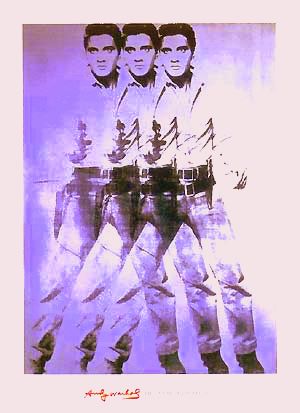
Triple Elvis- Andy Warhol
More than that Presley wasn’t an image of the upper class college youth like Pat Boone but the avatar of the downtrodden and suppressed not unlike Jesus the Christ himself. They took one look at Elvis and realized that he was the Atomic Bomb that would blow up their world. And he did.
Every move Elvis made was an insult to them. Things that had no relevance to them they took as a personal insult. One such was the innocuous anthem by the songwriters Leiber and Stoller originally written as a Negro ghetto sex anthem, Hound Dog. When Elvis sang You ain’t nothin’ but a hound dog, for some reason they projected it as a reference to themselves and they deeply resented it.
Of course every attempt to suppress Elvis deepened the generational divide. Not only did Elvis himself exist but it seemed as though every upcoming rock n’ roll singer wanted to be Elvis. Before the Presley clones of Vegas there were the Elvis imitators in every family’s living room like Gene Vincent, Ricky Nelson, Eddie Cochran and nearly the whole roster of Sun Records, plus, plus, plus….
For most of the old folks rock n’ roll itself was a mystery. They thought it was a Communist plot, might have been I don’t rule it out, but if so we were not conspirators but dupes. We just reveled in it. They almost succeeded in destroying it. Elvis got drafted, in his absence the great rock n’ rollers were driven out, discredited and in some cases killed. When Presley returned in 1960 he was different from when he went in. He had been contained.
John Lennon famously said in 1977 after Elvis died that he died the day he went into the army. While a relevant statement it was not quite true. The first stage in Elvis long immolation was when he fell under the control of his manager Col. Tom Parker, the second stage in his demise was when Parker delivered him to RCA Records, the third stage in his death was when RCA assigned Steve Sholes as his producer.
For those of us who were there the real Elvis Presley ceased to exist when he left the Sun record label. RCA was in no position to understand rock n’ roll values. It wasn’t that they willfully sabotaged Elvis it was just that they didn’t know how to rock. Their idea of rock was Neil Sedaka. Sholes himself was antipathetic to rock ‘n roll no less than his crosstown rival Mitch Miller over at Columbia Records. Both men hated the concept. This was made evident in Sholes arrangement of Gene Austin’s Are You Lonesome Tonight with its plodding guitar riff and Elvis’ imitation of the thirties crooner. Sholes failed to ruin Elvis’ career but it took Mitch Miller one LP to trash the career of the great Dion of the Belmonts.
Very few if any of the great rock records were produced by the majors. Nearly everything of value was produced by independent labels, many of them one shot efforts. Gene Vincent and his Be-Bop-A-Lula was a notable exception although his label, Capitol, soon had him singing Somewhere Over The Rainbow.
After the first run of actual imitators Elvis and rock worked their way into the subconscious of the next wave that included Lennon and the Beatles to produce an extension of rock.
Upon Presley’s return from the army his manager, Parker, removed him from recording and put Elvis into the movies almost exclusively. The movie Elvis was an extension of the personality of Tom Parker. Elvis was Elvis and his appearance was always galvanic. His charisma could be diminished but it couldn’t be destroyed. I was as disappointed by his movies as much as anyone dropping in only occasionally over the sixties to see if anything had changed. It hadn’t.
Thus as we all moved into the sixties while Presley still lived it was only as the ghost of the Sun Records innovator.
The Ghost of Elvis Presley was captured by the artist Andy Warhol in a number of renderings.
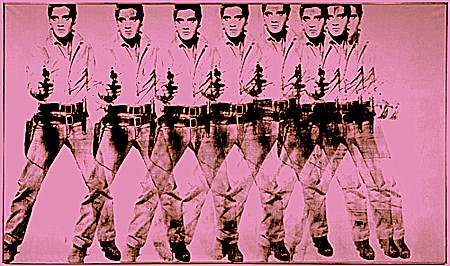
Octopresley- Andy Warhol
He presented Elvis in various single screens or multiples of two, three and up to the eight as in the image above. He ignored the musical Elvis in favor of an image taken from a Western movie. As Warhol was a homosexual he rendered Elvis as a gay cowboy. In truth Elvis had an ambiguous persona. Many people thought he was queer. Any male fan felt himself under the accusation. Elements of his persona indicate a severely emasculated personality that lend credence to at least a latent feeling of homosexuality. Elvis’ fellow students called him ‘squirrel.’ Indeed, the use of eye shadow, pants with a stripe down the leg and pink shirts in 1951-52 and ’53 would have led to open accusations of homosexuality. And yet, even though I identified with his obvious emasculation when I was only sixteen and seventeen it never occurred to me that he might have been one. I don’t think he ever was. Had he been his more than macho entourage would have had nothing to do with him. Nevertheless his portraitist Warhol perfectly captured his ambivalence and androgyny.
The number of portraits by the artist clearly betrays Warhol’s own hero worship. Perhaps his own gay cowboy movie owed some reverence to his idol. Oddly enough Warhol never designed a record cover for Presley even though he designed over fifty during a career from 1949 to 1987.
Andy had always been a pop music fan. This was very unusual for a man born in 1928. This would have made him 26 if one assumes ’54 as the birth of rock and 28 in ’56 when Presley exploded onto the scene. Anyone older than 18 in ’56 rejected rock. It is true that Warhol was dualistic, capabhle of listening to opera and rock at the same time, I mean simultaneously, so he may have had his personality split by the times. At any rate Warhol who apparently wished to excel in all the arts attempted to enter the music field by managing a band, while establishing a rock venue. In 1965 he took The Velvet Underground in as his house band while setting up a venue called The Dom. Not stopping there he also created an ambient experience, or light show, he called The Exploding Plastic Inevitable. The combination of music and light was innovative and widely imitated. Unfortunately Warhol didn’t have a secure lease and the venue got away from him. Perhaps realzing he was spreading himself too thin he never followed up letting the Velvets go their own way.
Warhol nevertheless established close bonds with other musicians. His attempted connection to Bob Dylan failed. Whether sour grapes or not he comitted this thought to his diary in July of 1985:
Watched the Live-Aid thing on TV. Bobby Zaren’s office had been calling, wanting me to go down there, but with that many big celebrities you never get any publicity. Later on that night Jack Nicholson introduced Bob Dylan and called him “transcendental.” But to me, Dylan was never really real- he was just mimicking real people and the amphetamine made it come out magic. With amphetamine he could copy words and make it all sound right. But that boy never felt a thing- (laughs) I just never bought it.
Warhol did succeed with Mick and Bianca Jagger and the Rolling Stones. While his cover for the first Velvet Underground album was considered innovative (read: weird) his cover for the Stones’ Sticky Fingers album with its functional zipper was as the term of the time went, mindblowing.
While Warhol never established contact with the Beatles, when his fellow artist Yoko Ono led her trophy husband, John Lennon, from London to New York in 1970 another firm connection to musicians and the inheritor of Elvis Presley’s mantle as the Savior was formed. Over all floated the Ghost of Elvis Presley.
Part II: John & Yoko In New York follows.

After the Topps Baseball Card Style
A Review
Woman
by
Alan Clayson
Yoko Ono And The Men Who Influenced Her
Review by R.E. Prindle
Clayson, Alan: Woman: The Incredible Life Of Yoko Ono, Chrome Dreams, 2004.

Girlish Yoko- Warhol School by Richard Bernstein
Yoko Ono involved herself with several of the most influential men in the arts during the sixties, seventies and eighties of the twentieth century. She drew her inspiration from them patterning her own efforts after them. At the same time she was one of the leading feminists of the day having her share in shaping and furthering the movement. The mantra was female liberation, equality between men and women. In fact women were equal to men in the West but only by acknowledging the biological differences between men and women. The fact is the differences are real and not social constructs as women would have us believe. The fact is women are women and men are men. So, in seeking ‘female liberation’ feminists were seeking much more than ‘equality’ however the term may be defined.
The fact is that in the Ages old war between the sexes feminists are seeking to restore the Matriarchy and destroy the Patriarchy. That is why many men favor feminism, they prefer the Matriarchy. Thus the feminists are atavistic. Yoko and her cohorts wished, in her words, to restore ‘heart’ as she viewed the Matriarchy and eliminate ‘reason’ as she viewed quite rightly the basis of Patriarchalism. Nevermind that bilogical science has invalidated the concepts of Matriarachy and Patriarchy. This is a post Matriarchy and Patriarchy world.
Circa -2000 in the West men revolted against the mind stifling Matriarchy and the vaginal swamp of the ‘heart’ seeking to establish

Smilin' Jack Cage
the authority of the infinite power of the mind of Zeus on ethereal Olympus. This is the story of Homer’s Iliad and Odyssey and the Greek myths in general recording the struggle.
The Western male was able to impose the ascendency of reason over the heart for 3000 years until the disestablishment of the old order by science about mid-nineteenth century. The center could not hold during this period of extreme change as W.B. Yeats put it as the rearrangement of the intellectual order moved into the twentieth century.
Yoko Ono sought with her feminist fellows to return to the biological innocence of 2000 BC. She herself had no talent. Filled with audacity she pitted her ‘heart’ against the reason of John Cage, Andy Warhol and John Lennon. I’m sure she had a mentor for her so-called performance art but I am as yet unaware of who he may be. Perhaps Maciunas and the Fluxus group.
Thus her first manifestation as an artist was based on the musical ideas of John Cage while her artistic efforts were at least based in the avant garde ideas of the Fluxus group. Her first assault on the NYC art world failed so in 1961 she returned in defeat to Japan. When she returned to NYC in 1964 she found an entirely different art scene. On the musical side the focus was on Bobby Dylan and the Beatles while on the artistic side Andy Warhol and his Factory had destroyed the Abstract Expressionists and the old avant garde. Dylan, the Beatles and Warhol had in fact usurped the avant garde which now had little meaning. From my point of view held at the time the avant garde had ceased to exist. Of course I didn’t understand exactly why or how.
From 1964 when Yoko returned to NYC until 1966 when she left for London I’m sure Yoko was at a loss. She developed her silly

The Bag Yoko And Tony Are In
notion of Bagism at this time even having a black bag on a stand in Max’s Kansas City that some one or ones were supposed to slide into. This seems to have been thought a lame idea at the time as it seems now.
At this time while retaining allegiance to John Cage’s musical ideas she was falling under the influence of Andy Warhol’s artistic notions. Warhol’s intent had been to destroy the idea of ‘fine art’. In this he pretty well succeeded. As Yoko expressed it you didn’t need any talent to be an artist. She seems to demonstrate this notion in her own artistic efforts. Warhol had also redefined the notion of film with his static studies. He then sought to combine his film ideas with live music, probably in competition with Bob Dylan who was also attempting to move in that direction. Warhol adopted Lou Reed and his band the Velvet Underground as the Factory house band while creating a multi-media show called the Exploding Plastic Inevitable, innovative for its time. Thus a concert at his hall, the Dom, was an ‘experience.’
While Yoko makes no mention about how this, actually, incredible development affected her there can be no doubt that she was well aware of Dylan, the Beatles and the Warhol Experience and was affected by it. Indeed, the first manifestation was the making of her Warhol style films such as Bottoms.
The second manifestation was her removal to London to seduce either Lennon or McCartney of the Beatles, thus in the manner of Warhol’s adoption of the Velvet Underground she sought to co-opt the Beatles, the premier rock group in the world. Real chutzpah and more than one upping Warhol. I think it would be nonsense to think she had any other goal in mind.
She undoubteldy learned that Paul McCartney was actively involved with John Dunbar and his Indica Gallery that opened in 1965.
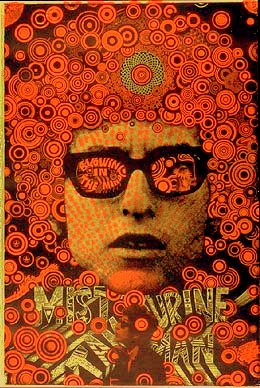
Psychedelic Dylan
Some say she first set her sights on McCartney but the more vulnerable Lennon showed up and the Spider Woman spread her web.
She was still married to her second husband, Tony Cox, but, regardless of what she says she very aggressively pursued, or attacked, Lennon. Lennon was emotionally under water unable to handle his success while drugging himself out of his mind. He was unwillingly married to his wife Cynthia. It appears that he married Cynthia out of duty when she became pregnant. He doesn’t seem to have been happy in his virtue. Yoko had no difficulty in capturing his affections.
Now, just as Warhol had adopted the Velvets and imposed his female singer, Nico, on the band Yoko sought to imp[ose herself on the Beatles through Lennon. At this time she was still musically completely in thrall to John Cage understanding nothing about Rock music. She and Lennon had made a ridiculous LP called Two Virgins in 1968. She combined her cagian screechings while using an avant garde ‘performance’ notion of the couple posing nude on the cover; full frontal on the obverse, full posterior on the reverse. As no store would carry the cover the couple reverted to Yoko’s idea of Bagism placing the cover inside a plain manila envelope or bag. While it didn’t sell the record this form of Bagism was actually a successful artistic statement. The nude cover given an outer garment so to speak.
Well, the public was prepared to forgive the Beatles anything but the other three Beatles weren’t prepared to forgive Yoko for forcing herself on them thus she broke up the most successful act of the sixties. Still, she had succeeded according to her wildest dream. Lennon and his wonderful reputation and fortune were hers. She had gone from a neglected, nondescript ‘performance’ artist to center stage, not on her own womanly talents but by attaching herself to a talented man. Yoko’s ‘heart’ was useless without the male intellect. Yoko was now the most influencial feminist in the world. She knew what to do with that.
After several ‘performance’ acts such as the ‘Bed In For Peace’ the couple left England to return to the place Yoko wished to subjugate artistically, New York City. She had raised herself to a par with Andy Warhol. She now had to meld her musical and artistic goals through Lennon and Warhol.
On the musical side she began to develop her rock n’ roll skills under the tutelage of Lennon. While not abandoning the avant garde notions of John Cage she now emasculated her husband. Always semi-delusional or perhaps completely so, she fantasized that she was not only equal to Lennon in skill and popularity but superior to him. She imagined herself more popular than Lennon. Thus one has such travesties as the LP Double Fantasy. It was only after Lennon’s death that she was forced to recognize than Lennon’s fans did not appreciate her efforts. So she failed as a musician.
She quickly tired of being Mrs. Lennon. Thus she and Lennon separated for eighteen months or so during the years 1973-75. She then realized that her financial well being and musical acceptance depended on Lennon. In 1975 she called him back resuming their relationship until his death in 1980. But, things had changed.
She began to adopt Warhol’s life style on her return to NYC. While she propagated the notion that she was some sort of business whiz Iam having difficulties discovering any such skills. It appears that with the enormous income of Lennon she emulated Warhol in
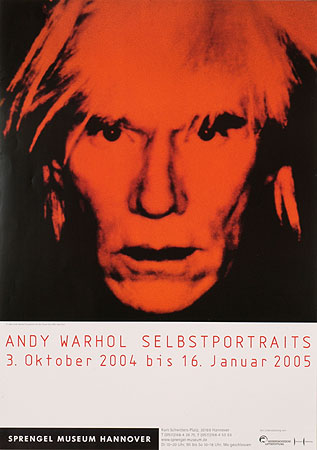
Andy the Demon
spending her way to prosperity.
She was in a position to not only match Warhol’s spending but exceeding it by many times. Through the seventies and eighties Warhol came into his own as an artist while reaping a fortune doing portraits. There appears to have been no effort on his part to invest in income producing vehicles. Rather he bought stuff. He purchased buildings in NYC and elsewhere while acquring undeveloped acreage in places like Aspen. He shopped nearly every day buying antiques from furniture to objets d’ art by the bushel almost as though he were trying to excel the incredible W.R. Hearst.
He usually didn’t even look at the stuff once he bought it merely filling rooms with his shopping bags. At his death all this junk was auctioned off for 25 million dollars, a nice appreciation in value.
Yoko followed the exact pattern buying apartments and houses as well as an extensive dairy farm with a herd of prize cows. She not only had but has five apartments in her principal dwelling, the Dakota apartment building and many other houses scattered around.
Like Warhol the Dakota apartments are stuffed with junk. Valuable, but, you know, stuff. She bought at good prices. Her extensive collection of Egyptian antiquities was mostly purchased before a steep rise in value.
Like the Rothschilds of old Yoko didn’t do all her own shopping but employed agents to search things out. Chief among these was an associate of Warhol’s, Sam Green, and an Hungarian immigrant by the name of Sam Havadtoy.

Buddies- Yoko, John, Andy
There should be no surprise then that she now has an extensive collection of Warhol’s artwork as well as his portraits of Lennon. The Warhols would have been purchased for form 25 to 50K while now being listed on her assets at tens of millions. She also has been said to have a good collection of Magrittes as well as one assumes other artists. So, much of her net worth is tied up in artwork purchased through Sam Green.
Sam Havadtoy was an antiques dealer as well as an interior designer. He appears to have been a somewhat shady character. It is very difficult to find much about him, however there is a sharp portrait available from the notorious A.J. Weberman ( http://www.acid-trip.org/lennon/ )
…(the Lennons) hired a sleazy Eastern European bisexual to renovate the pad. (Dakota) I had heard of this dude, whose name escapes me, from an asswipe named BRUCE KIRSH, who worked for him. KIRSH told me that the dude, who worked for the King of Morocco, would form a dummy renovation company, hire employees like Kirsch who were willing to work under false names, then, when it came time to pay taxes, everyone would disappear. I learned of him long before he was hired by John and Yoko, and I was taken aback when Yoko took up with him after John’s death.
I know that Weberman is not particularly well thought of by fandom but this is because of his harassment of Dylan who did, after all, misrepresent himself to the revolutionaries like Weberman. A.J. himself is an intelligent observer who was wading through it when it was deep. I do believe he knows what he’s talking about although his interpretations of Dylan’s lyrics seem absurd.
I would have to question Yoko’s judgment in taking him in. Both he and Sam Green were candidates as successors to Lennon with

Lennon by Warhol
whom she consorted in front of Lennon before he died while Yoko chose Havadtoy as his successor the day he died.
Perhaps she selected Havadtoy over Green because he was more rough trade. With Lennon while managing to reconcile revolution with peace and love with Havadtoy she discarded peace and love in favor of strong arm methods against her former employee Fred Seaman when it was totally unnecessary.
Havadtoy was living in a homosexual arrangement with his business partner when Yoko beckoned him to switch to her. Apparently an able switch hitter he was lured by the money to this much older woman. The arrangement did last for twenty years before Havadtoy removed to his native Hungary taking a nice cash settlement and several of the Warhols.
Thus, just as Warhol had his live-in homosexual arrangement so after Lennon’s death Yoko adopted the exact arrrangement. Today she apparently lives alone, a seventy-eight year old woman.
After Lennon’s death there was an accession of from 30 million to a possible 100 million dollars as their last album, Double Fantasy, sold into the millions while the rest of Lennon’s catalog and one assumes the Beatles’ catalog was reinvigorated while all things Lennon sold. This is, of course, no reflection on Yoko but the inevitable result with intellectual properties when the maker dies.
Post-Lennon, then, Yoko realized that her recording and art careers were nil. Heart without intellect is worthless. She then became the caretaker of the Lennon legacy. His recordings, of course, continued to sell, but even his artwork eclipsed that of Yoko. So she suffered the humiliation of being a mere appendage to a man. The feminine dismal swamp was eclipsed by the Olympian heights of the male intellect. As in ancient times the God had trumped the Goddess. And yet as with Hera and Zeus the Goddess gets her way. Yoko came up with the money and goods while Lennon’s spirit was wafted into the stratosphere.
As any reader of mythology knows Hera ruled the Lernean swamps of Argolis while Zeus ruled the gods on ethereal Olympus. Thus one has the symbolism of the biological difference between the male and female.
In ancient times the female had her share in magic. She knew herbs and plants, was familiar with poisons and cures as with the arch witch of the ancient world, Medea. The reputation of the female witch even as a consort of Satan persisted down through medieval and post-medieval times, indeed, even up to the dawn of the scientific enlightenment. One would have thought that magic and witchery were a thing of the past in the 1960s and yet Yoko embodied the whole female swamp mentality.
She established something called the Spirit Foundation attributing the direction to Lennon who in fact knew nothing of these matters but followed her lead. The Spirit Foundation celebrated the ancient art of the Shaman or witch doctor. Shamanism itself even preceded the Matriarchal swamps of Argolis. It was a rich repository of magical tradition. Further the Foundation was feminist in that it was dedicated to preserving the magical traditions of the women of the Pacific islands still living in such archaic societies. The wealth generated by the male intellect was appropriated by the female vagina or ‘heart.’
In her own life and that of Lennon’s Yoko was addicted to a variety of magical practices- astrology, numerology, Tarot readings, and indeed she traveled to the Caribbean to sell her soul to Satan through the offices of a female curandera. Her Tarot reader, John Green, was a priest in the shamanistic, magical, Yoruban African cult of Santeria.
Her feminism was more a magical effort to restory Matriarchal supremacy over the Patriarchy thus reversing the Patriarchal victory of three thousand years previously. Indeed, what has been called the movement for female equality is nothing more than a covert campaign to restore the Matriarchy.
Thus while Yoko o9riginatd nothing she usurped the abilities of the reason of men- Cage, Warhol, Lennon and male magicians such as John Green. Indeed the Trojan War itself was a war of men in service of women.
In her associations with men she preferrred to deal with emasculated types such as homosexuals like Cage, Warhol, Sam Green and Sam Havadtoy. Lennon claimed to have always been dependent of women for comfort and guidance while Yoko caught him at his most confused and vulnerable.
While she received direction from Cage and Warhol she was able to manipulate Lennon out of his talent somewhat as Vivian did that of Merlin of the Arthurian saga. When Vivian had usurped Merlin’s magical knowledge she buried him deep much as Lennon was put out of the way. Yoko then appropriated his wealth and residual income after his death. It was this constant inflow of cash that allowed her to propagate the notion that she was a financial genius.
Then as the female of the ‘heart’ or vaginal swamp she managed and appropriated the reason of Olympus through Cage, Warhol and Lennon. What she got from Havadtoy other than brute strength is not clear to me.
As such Yoko is Woman. In her case a seeming reversion to the archetypal Shaman of the most ancient times.
Themes And Variations
The Tarzan Novels Of Edgar Rice Burroughs
#23 Tarzan And The Madman
by
R.E. Prindle

What A Long Strange Trip It’s Been
In everyone’s life there comes a time to recapitulate. Tarzan And The Madman was that time for Edgar Rice Burroughs. The Great Saga began in 1912 and in this novel of 1940 unpublished during his lifetime the long strange trip, to quote the Grateful Dead, came to an end. The Big Bwana and his imposter got on a plane and flew out of Africa never to return.
Two more unpublished novels in his lifetime would follow but they were placed in the Pacific either in or near Indonesia. The succeeding Tarzan And The Castaways was also unpublished during his lifetime while Tarzan And The Foreign Legion could find no takers so was published by ERB, Inc. It almost seemed as though the sun had gone down on the Great Ape Man.
Of course the movie Tarzan still prospered, first with the great Johnn Weismuller and then Lex Barker. ERB even tips his hat to MGM by replicating the flight through the fog to the great tabletop of the Mutia Escarpment, an MGM invention. Thus, the last game is played out on the MGM playing field. Just as ERB and Florence left LA on a plane so Rand and the Goddess and Tarzan do Africa in this novel. In a short 157 pages ERB manages to recap the Big Fella’s entire career in print or on film.
In reading through the book this last time I suddenly realized the significance of all those doppelgangers. They signified the problem ERB was having realizing his ambition to be the man who was Tarzan. In Madman he gives up the ghost realizing his failure to become the Man-who-thought-he-was-Tarzan but wasn’t. Now typing away in exile from LA on Hawaii he throws in the towel.
As I have tried to show in my other reviews ERB read Robert Louis Stevenson’s The Strange Case Of Dr. Jekyll And Mr. Hyde probably sometime before 1890 within four years of its issue. The book must have been a sensation during his years at the Michigan Military Academy, the subject of endless discussions among the cadets. As hard as it must be for us to realize what we consider a classic was an exciting new book for ERB. No movies could be made of it because the technology hadn’t been developed as yet. Even the primitive Nickelodeons were shimmering a ways into the future. Yea, verily, the future lay before them.
The novel was significant enough to be in the first batch of talkies being produced in 1931. I’m sure ERB was transfixed as the story unfolded on the screen. The theme of psychological doubles had dominated the Tarzan oeuvre from the beginning. While it seems repetitious to a first reading of the novels the theme is actually developing as the series progresses. ERB didn’t so much fall back on a cliché but he was working out a variation on the theme of Jekyll and Hyde.
He says that he was convinced that every man had two sides to his personality, perhaps not as pronounced as that of Jekyll and Hyde but there nonetheless. He was aware of his own duality chronicling it in the pages of the Tarzan oeuvre. The duality is often prompted by a blow to Tarzan’s head. The blow certainly commemorates the hit ERB took in Toronto while perhaps the aftermath split ERB’s personality so that he became two nearly different people. Perhaps that’s the secret of his writing career as he said that he was able to disappear into the alternate reality when he wrote.
Tarzan always had two personalities from the beginning. He was both a civilized man and a beast. This undoubtedly represents ERB’s feelings about himself. Perhaps he had periods when he was something of a wild man, not unlike Tarzan on the Rue Maule in The Return Of Tarzan who became a beast and then shook himself back into a human not unlike the transformation of Jekyll and Hyde. This type of duality would characterize the Russian Quartet, the first four novels.
The Tarzan true doppelganger first appeared in Jewels of Opar where having received a blow to the head he loses his memory during which he lived as an uncivilized beast, regaining civilization with his memory, but he had not yet split into two co-existing separate identities. That would first occur in Tarzan And The Golden Lion and Tarzan And The Ant Men when the great character of Esteban Miranda served as a doppelganger. Esteban was identical to Tarzan in appearance but an arrant coward compared to Tarzan. This was a characteristic of all the doubles. Esteban represented the negative pre-success side of ERB while Tarzan the positive post-success side. Thus in these two novels ERB is beginning the attempt to become Tarzan- The-Man-Who-Thought-He-Could-Be-Tarzan.
ERB was very sensitive about his early failings in his relationship with Emma. In these two novels he offered Jane/Emma the chance to recognize him as the strong Tarzan and not the weakling Esteban doppelganger. Having overcome the failures of his past he felt he had proven himself as a man and a supreme provider demanding recognition. Given the decision to make Jane/Emma chose ERB’s former existence, Esteban, thereby sealing her fate. After her ill fated choice Jane disappears from the oeuvre except for the chance encounter in the succeeding novel Tarzan Lord Of The Jungle whereas the Golden Lion assumes a prominent role.
While the next double, Stanley Obroski, appears in Tarzan And The Lion Man a double of sorts in the form of Lord Passmore makes his appearance in Tarzan Triumphant. Another double appears in Tarzan And The Leopard Men when felled by a giant tree in a storm Tarzan blanks out assuming another persona. Also, in Tarzan And The City Of Gold Valthor serves as a double. In a strange variation ERB repeats the story of Jewels Of Opar when Tarzan rescues Jane from the Arab boma. Here, in an exact duplicate of that scene, he rescues Valthor. Thus Jane and Valthor are connected in ERB’s mind.
In Tarzan And The Lion Man Burroughs kills off his weaker persona thus assuming the role of Tarzan himself. Then in Tarzan And The Forbidden City Brian is his look-a-like although the role of double is not explored. Perhaps this is the initial realization the ERB has failed in his quest to be Tarzan.
After a decade of trials and tribulations struggling against the Communists and MGM and losing ERB sat down in exile at the beginning of 1940 to write this confession of defeat.
The man-god Tarzan himself remains the same but The-Man-Who-Thought-He-Was-Tarzan but failed confesses his defeat getting into his airplane up there on MGM’s Mutia Escarpment flying out of Africa forever. First he was expelled from Opar by the Communists and then from Africa by MGM.
Although Tarzan was in the plane with him, the Big Bwana shows up again in Africa for a moment in Tarzan And The Castaways. This novel written in a style entirely different from the rest of the oeuvre was also unpublished during Burroughs lifetime hidden away in a safe.
In this novel Tarzan is defeated by a Black chief, symbolically perhaps, captured and sold as a wild man, a feral child. Once again Tarzan has lost his memory reverting to a pure beast or feral boy. As this novel was written after King Kong and Tarzan ends up on yet another island perhaps ERB was conflating the movie with this novel. Tarzan is put aboard ship with the other animals destined for the circus and taken from the continent.
Running all through Burroughs is the ghost of Jule Verne’s Mysterious Island. Once aboard ship a storm assaults the ship which, signficantly loses its rudder. Thus like the now rudderless Burroughs the ship is adrift. In a scene reminiscent of both Verne’s novel and Robert Louis Stevenson’s Kidnapped the ship is tossed atop a reef while all aboard including a Noah’s Ark of animals find their way to shore as the Castaways.
Stevenson and Verne were two of ERB’s earliest influences thus ERB returns full circle to his origins.
In the last Tarzan novel and the last published in his lifetime, Tarzan And The Foreign Legion, at the very end the fugitives from the Japanese army approach the remains of the Mysterious Island that after the volcanic explosition of Verne is a mere spire of rock in the vast ocean. Not a refuge in the world left for Tarzan or ERB. Like Capt. Nemo a submarine surfaces to rescue Tarzan and the Legion from a watery fate.
It seems amazing that as an honorary Frenchman Tarzan was never placed in a situation with the real French Foreign Legion. Perhaps P.C. Wren had preempted the genre with his magnificent FFL trilogy which left no room for ERB’s imagination to operate.
The long odyssey had ended. ERB could not imitate his man-god but he left him to us as an avatar for the coming New Age. What a long strange trip it was and for us, will be.

Johnny Weissmuller- The Image Of Tarzan
Part II follows.
 I, Dynamo