A Review
Themes And Variations
The Tarzan Novels Of Edgar Rice Burroughs
#14 Tarzan The Invincible
Part II of X
by
R.E. Prindle

ERB
Time On His Hands
I pair this novel with Tarzan At The Earth’s Core. Burroughs could have titled that novel Tarzan In Pellucidar but he didn’t. Why not? Probably because he was trying to avoid as much confusion between his two imaginary worlds as possible, or possibly he needed the site to illustrate his point but didn’t want to make it a Pellucidar novel. Earth’s Core isn’t merely a story in which Tarzan makes a guest shot in another of Burrough’s worlds. Rather ERB is making a serious exploration of Einstein’s Theory of Time and Space. Alternatively the novel might have been titled, Tarzan, Lost In Time. The novel is written to disprove the objective existence of Time. Burroughs’ own conclusion is that time is merely a human construct for mankind’s own convenience but not substantial. I think he’s right.
The nature of Time was a topic of serious discussion during the late nineteenth century, into the twentieth , still going on today. Indeed the Pellucidar series as a whole is a discussion on the aspects of Time. Of course Burroughs was familiar also with H.G. Wells’ The Time Machine.
Perhaps one of the more interesting notions of Time and Space and time travel was one advanced by Mark Twain in 1916 in his interesting novel No. 44, The Mysterious Stranger. In his story Twain imagines that space and time are assembled like a multi-storied building with each diorama of time and space continuing in replay eternally. Thus his hero, #44 scoots around in time and space in what is apparently a system of chutes and ladders.
It is possible in this system to visit ancient Egypt to watch the Pyramids being built, climb through the years to discover the head of the Sphinx sticking out of the sand as Napoleon saw it in 1798, climb once again to watch the first Aswan dam being built, move up a story or two to watch the High Dam being built and off to Troy to stand in the front ranks with poor maligned Ajax.
To The Time Machine, Einstein’s Theory and The Mysterious Stranger, now add Tarzan At The Earth’s Core. There are more similarities than dissimilarities.
ERB apprently didn’t think he made his point in At The Earth’s Core or perhaps he received some criticism from someone so he carries the discussion over into Invincible. While incongruous for this story ERB works it in.
As there are no book s on Einstein in his library one may ask what evidence there is that ERB had ever thought of Relativity. Well, I’ve got the evidence right here, p. 104:
…but though Time and space go on forever, whether in curves or straight lines…
One can’t mention curved space and Time without being familiar with Einstein. And then, Einstein absurdly claimed that a nonexistent mental construct like Time forms a Fourth Dimension which somehow interacts with the other three. We are still waiting for a demonstration of that but we’ll let it pass. I’m sure Einstein picked that up from H.G. Wells Time Machine which was a very fine piece of imaginative literature but reflected no known physics then or now. Someone ought to pin a big red bozo nose on Einstein but, back to the future.
ERB had discussed the notion of Time thoroughly in Tarzan At The Earth’s Core. Actually that’s a contradiction of terms as a hollow earth obviates the notion of core. The key fact at the Earth’s Core is that it is always high noon. The central sun knows only endless day without a contrasting night to give the appearance of Time. Without the contrast between day and night and the revolution of the Earth around the Sun the concept of Time disappears; there is nothing to measure just pure duration.
In Invincible Burroughs explains it this way, if you didn’t catch it in At The Earth’s Core, p. 104 again, same paragraph:
The beasts of the jungle acknowledge no master, least of all the cruel tyrant that drives civilized man throughout his headlong race from the cradle to the grave- Time, the master of countless millions of slaves. Time, the measurable aspect of duration, was meaningless to Tarzan and Tantor.
Not only is Time meaningless to Tarzan and Tantor but Time is meaningless to the universe itself. Nothing that ocurs in the Universe is dependent on Time nor can Time change any occurrence. The so-called Fourth Dimension is totally ineffective. Everything will happen just as it does now and has always without any reference to Time. The progress of a physcial action will progress in scientifically determined steps from inception to completion without any interference from that clown Einstein’s ‘fabric of time and space.’

Albert Einstein
That is the import of timelessness at the Earth’s core. The inhabitants live and die without the ability to know they are getting older as there is no night, day or year. The organism merely comes into existence, behaving according to physical laws determined by genes and other micro-organisms progressing through all the changes until the final change which change no longer has any conscious meaning.
The same is true of suns and galaxies. It is virtually meaningless to say the Sun is several billions of years old. It is only a mental construct that lets you grasp a concept of duration. It is much more relevant to say, for instance, that the changes in the Sun’s development are, say, 30% completed. You see, it’s all quantative not qualitative. Barring accidents and diseases, at twenty the average life span in the US is 25% consumed. The changes relative to that portion of development in the organism have occurred and will not occur again. On that basis I have used up about 85% of the physical changes alloted my organism. The nature of future changes are predictable. They cannot be avoided. This has no reference to Time no matter what state of development an organism is in.
While in a state of depletion I become ‘old’ only if my psychology is affected by the concept of ‘age.’ While my physical capabilities are not what they were at twenty, that phase of development having been passed through, my mental capabilities have developed accordingly. As my body has decreased in powers my mind has increased. The beginning has compensated the end. If I die today or tomorrow that is as it must be. Everything has its end. There is no tragedy involved.
Life and death are completed, unaffected by Time. If time ‘stopped’ as people imagine it can, everything would continue as now. Organisms merely run their physical course. That is the point Burroughs is trying to make. He is repudiating Einstein.
As a young man I was conditioned to revere Einstein. I did this unquestioningly and, boy, was I sincere. I disgust myself in memory. But then, somewhere along the line the hypnotic spell wore off, contradicted by facts. Einstein began to unravel before my eyes. It wasn’t that I questioned his reputation it was just that a mist began to lift. I began to have doubts; sort of religious doubts. I blinked once and Einstein was no longer the archetype of genius. At the second blink I began to ask questions. I tripped over the notion of the physical reality of Time just as Burroughs did.
When I read the ancient Jewish historian Josephus I began to sense the specious nature of the problem. According to Josephus Abraham was the greatest astronomer cum astrologer of his time just as Einstein is thought to be the greatest of ours. At the time of the transition between the Age of Taurus and the Age of Aries Abraham had an astrological/astronomical dispute with the academy.
You see, at that stage of the evolution of human consciousness astronomy and astrology were united into one discipline. The magical element of astrology wouldn’t be separated from the scientific element of astronomy until the scientific consciousness of humanity had separated itself from the magical or religious which two systems are synonymous. The concept of god functions only in a magical sense as his presence is even less noticeable than that of Time.
However magic and astrology are still part of human consciousness although with a quasi-scientific basis so that systems organized perhaps tens of thousands of years ago continue to function through inertia. I have been accused of being New Age. Quite frankly as New Age in my view rejects the scientific consciousness as much as any other religious system, Fundamentalist Judaism, for instance, hint hint, I cannot be New Age. But, I sure like the way they talk.
What I discuss is scientific history. Facts which religious people reject because they disavow the ideas behind them but accept as real, i.e. Thou shalt not suffer a witch to live. Why bother worrying about it; witches do not exist except in the imagination.
So whether you ‘believe’ in astrology, the Zodiac or whatever is irrelevant. The fact is at one time in history people universally did and they acted on their beliefs.
At any rate the fact is at the time of the transition from the Age of Taurus to the Age of Aries Abraham had an astrological/astronomical dispute with the Chaldean astronomers of Ur. As I understand it they said the religious archetype was changing with the transition from Taurus to Aries. (I think of this as a form of set theory; it is so because everyone agrees it is so. No different than now.) Abraham argued that the archetype of the Ages was Eternal, unchanging, the Rock Of Ages to you religious types. Rock of Ages means unchanging through all the signs of the Zodiac, all twelve Ages. An Age is one sign of the Zodiac. Ages are the twelve zodiacal signs. (Hello, Central? Put me through to God.)
Now, to be Eternal is astrologically impossible. The Earth wobbles on its axis visible at the North Pole so that every twenty-five thousand years or so it creates a Great Year then begins again. The Ancients divided the Great year in the system of twelve periods, called Ages, to correspond with the months of the terrestrial year.
Apparently Abraham denied this and adamantly insisted on the Eternal. For this reason, according to Josephus Abraham and his fellow Terahite cultists were run out of town.
Lousy astronomers, then, Abraham’s descendants had learned little by the time Einstein stepped onto the world stage to give his oration. Just as Abraham had voiced his foolishness four thousand years previously Einstein did the same in our time. There are those who seriously argue that time travel is possible in Einstein’s universe. Well, maybe in his, but not in this one.
Nothing is relative but one’s point of view. The physical universe is one of absolutes; that is the nature of science. Science cannot be relative; in order for an experiment to be true it must replicate itself the same way under the same conditions. As unpleasant as that may be to some intellects there is in fact only one way in a given set of circumstances. A+B will always equal A+B. If one switches to A+C then the result will always be A+C. There is nothing relative about it. You may religiously expect other results but you will be eternally disappointed. So Einstein said that the further out in Space his mind penetrated the closer he got to god. Who can say, but he never got close enough to touch God. Einstein was not a scientist. He was a Rabbi. There is no g-d to get closer to. I’m sure that a good Rabbi would find arguments in the Talmud almost identical to those of Einstein.
Burroughs saw through Einstein hence his arguments disproving the physical existence of Time and the futility of any supposed Fourth Dimension. These are religious matters requiring a belief in a supernatural being.
Having said that Time was measureless to Tarzan and Tantor which was not entirely true since the rotation of the Earth divides ‘Time’ into night and day unlike at the Earth’s core. Burroughs then goes on to say, p. 104, same paragraph:
Of all the vast resources that Nature had placed at their disposal, she had been most profligate with Time, since she had awarded to each all that he could use during his lifetime, no matter how extravagant of it he might be. So great was the supply of it that it could not be wasted, since there is always more, even up to the moment of death, after which it ceases, with all things, to be essential to the individual. Tantor and Tarzan therefore were wasting no time as they communed together in silent meditation…
A beautiful piece of sophistry. Regardless of the Time involved, immutable physical changes continued to take place. What opportunities appropriate to that physical state were lost forever.
Apropos of which carrying his argument further, on p. 120 he says:
Time is of the essence of many things to civilized man. He fumes and frets, and reduces his mental and physical efficiency if he is not accomplishing something concrete during the passage of every minute of that medium which seems to him like a flowing river, the waters of which are utterly wasted if they are not utilized as they pass by.
Imbued by some such insane conception of time, Wayne Colt sweated and stumbled through the jungle, seeking his companions as though the fate of the universe hung upon the slender chance that he could reach them without the loss of a second.
I understand what ERB is saying, of course, I’m virtually a disciple. Tarzan lolling on the back of Tantor achieved his goal more easily than the frantic Colt. Still, one should remember: Work, for the hour grows late. Those irreversible physical changes are drawing one closer to the grave. Get it done now.
ERB displays a seeming peevishness over the issue which has little or no bearing on this story. It is an interesting aside but it does not illuminate the tale. Maybe somebody criticized the ideas expressed in At The Earth’s Core and Burroughs is carrying on the argument. Nobody paid any attention, still I am charmed by the vision of Tantor and Tarzan suspended in Space and Time wandering blissfully through the jungle unaware of any impending doom.
Proceed to Part III of X
Exhuming Bob 25: Bob And Sam
June 5, 2010
Exhuming Bob 25:
Bob And Sam
by
R.E. Prindle

Shepard, Sam: The Rolling Thunder Logbook, 1977, Sanctuary Publishing.
Sometime in the mid-seventies, possibly in 1976 Paul Simon wrote in one of his lyrics: I don’t think this stuff is funny anymore. Coincidentally at the same time as I surveyed my record store of a Saturday morning the same thought occurred to me. Things had been overdone. In one bat of an eyelash the whole thing got old.

Bert Williams In Blackface
This was not case with Bob Dylan who in the waning months of 1975 put the greatest clown act New England had ever seen on the road. The Rolling Thunder Revue; or as it might alternatively have been named: The New Bob Dylan Minstrels. One purpose of the Revue seems to have been to spring the convicted triple murderer and ex-boxer Hurricane Carter from jail. That didn’t come until the very end.
Along the way Dylan wanted to film a sort of existential movie that would later be released as Renaldo and Clara. Working from some strange chaos theory Dylan had no actors, no script, no-nothing. Needing some sort of guiding hand he commanded the actor, cowboy, playwright Sam Shepard to attend to his writing needs. Sam then wrote what he called a log of the experience called the Rolling Thunder Logbook.
On the first reading I didn’t think Sam put much into it but the pictures were good. Still there was the nagging feeling that I might have missed something. On the second reading the logbook assumed more significance. It’s kind of impressionistic. It’s not a narrative; like the title says its sort of like a ship’s logbook. The impressions sort of pile up until you have a definite impression. I don’t know if that’s what Sam intended but that’s the way it worked with me.
Bob being the kind of powerful show biz personality he is didn’t bother to negotiate terms with Sam; he didn’t even bother to call himself; his agent or stooge or whatever interrupted the life of Shepard to tell him Dylan wanted him in New England. Sam doesn’t mention any terms, or indeed any payment. He just dropped everything, literally, and drove East. Did I mention he was in California? Well, he was; he was in the process of moving.
Bob tries pretty hard to cultivate that elusive, mysterious image and he succeeded with Sam who couldn’t locate him for a few days after he got there. Bob probably wanted to accustom him to the menagerie before he showed his face. Even then Sam didn’t have any guidelines he just expected Sam to free lance a few lines of dialogue if at any time he saw the cameras running. The film crew was more disorganized than Dylan if that were possible.
What was it all about anyway?

It Takes A Worried Man- Sam Shepard
As we should be aware 1976 was the two hundreth anniversary celebration of the American Revolution. But there were a number of conflicting revolutions running simultaneously. There was the revolt of the Matriarchy, what Eric Foner calls the Unfinished Revolution which was the replacement of Whites by Negroes and of course the perpetual revolution of the Jews against mankind, not to mention the revolution of the gay crowd. Bob as we all know is Jewish so one may reasonably ask why he chose New England for his chaotic Marx Brothers routine on the occasion of the Yankee Revolution around the new England sites such as Bunker Hill? Could he have been thumbing his nose at America? Well, it does look suspicious.
As Sam notes the crew made it a point to visit Plymouth Rock and the replica of the Mayflower which sacred symbols of pre-immigration America they reviled all but pissing on the Rock. The faux American cowboy, Elliott Adnopoz was swinging from the yardarm of the Mayflower. Y’all know Elliott as the yodelin’ cowboy Ramblin’ Jack Elliott o’ course. For the rest they pissed and farted their way across New England carousing and corrupting as they went. Of course it might just have been New England exercising the gang’s Rock n’ Roll genes, no more than that. Sam kept his discontent sotto voce by which I mean between the lines. Bob, with his need for conflict invited not only his old flame Joan Baez and his new flame Joni Mitchell but his wife Sarah playing each against each. Baez who grows more Mexican with each passing year seems willing to put up with whatever Bob does. Shortly after the tour Sara came downstairs one morning to find Bob dandling a strange beauty on his knee for breakfast. Well, you know, she threw in the tower after that, as, who wouldn’t? Bob seemed to be perfectly dismayed by this untoward turn of events. ‘Women in my family just don’t divorce.’ He whined uncomprehendingly. Well, at least, not without due provocation.

Joni Mitchell Looking Out Her Window
That leaves Joni Mitchell. She’s apparently been stewing about her treatment for thirty-five years. She just recently expressed herself by saying in effect that Dylan is just a god-damned phony. Well, Bob can always go join Joanie in that bomb shelter in Viet Nam. They can exchange rings made of the fuselages of American fighter planes, if they haven’t already. So, how sincere is their devotion to this great land of the once free and no longer brave? It would seem their loyalties lie elsewhere.
In my own obtuseness, quivering in my own psychological bomb shelter, I never saw Bob as a revolutionary in those far off days but then I was just listening to records, I didn’t know anything about him; boy, I sure have remedied that situation.
Back in those palmy days of the early sixties before racial and religious animosities had reached their present prominence I don’t know that anyhbody really thought of Dylan as a Jew. Certainly the name Dylan is not Jewish and I’m not sure how many people would have known Zimmerman was. Or, that they would have cared. In those days everyone cheered when Israel won one of those too frequent wars. Now, though, one has to put Bob’s religious affiliation up front. Make no mistake, he’s a fundamentalist, believes the Bible is the literal word of god. Orthodox. Chabad Lubavitcher even. Thinks the universe is fifty-seven hundred years old like his deceased mentor Rabbi Schneerson. Swear to g-d.
Must have picked it all up from Rebbe Rueben who came West from Brooklyn to Hibbing to indoctrinate him in Lubavitcher lore for his Bar Mitzvah. Like Bob said, he learned what he was supposed to learn. He very cleverly inserted the stuff into all those songs too.
Bob broke his mind in the excesses of the sixties, that high mercury sound he was seeking was the result of all those amphetamines he was shooting back then. Andy Warhol had his boy pegged.
In the late sixties and early seventies Bob had to rebuild his personality and he rebuilt it around his religion. His Mom was real proud of the way he had his Bible open on a stand in his living room so he could jump up and check it as the occasion arose.
Then as he got back on his feet he aligned himself with Meyer Kahane’s violent extremist revolutionary Jewish Defense League carrying a couple of JDL thugs around with him as bodyguards. Maybe his Jewish revolutionary mode was getting too obvious so in ’77 he began hanging out with Jews For Jesus and the Christian Vinyard Fellowship organization. Once that clouded the picture he reverted back to his Lubavitchers where he has been since.
So on the Rolling thunder tour one may be excused for thinking that he was in his revolutionary phase. Sam Shepard doesn’t mention it but his experience left a very bad taste in his mouth which he expresses with as much force as Joni Mitchell really has.
On the tour Bob did the strange thing of wearing white makeup which has remained a mystery. It shouldn’t be really. Remember the tour was to end in a successful attempt to free a Black man while the Black boxer Muhammed Ali was unstage at the Garden. A Garden party a la Ricky Nelson, get it? The Revue was actually a parody of the Minstrel show of what Greil Marcus would call the old weird America. In the old Minstrel shows the White actor wore black face in imitation of Black people. This may sound strange to you but Jews don’t consider themselves White notwithstanding their pale complexions they consider themselves Jews and goys as White. So, in disguising himself in White Face he was parodying the old Black Minstrel shows while mocking his ultra-White New England audience.
Bob Dylan was having the time of his life. The joke was on the Honkies. Funny, huh?
As noted, the keynote of the tour was the final concert at Madison Square Garden at Christmas where he took on America over the issue of the Black Hurricane Carter and won. Now, compare that Christmas show with the 2009 release of Bob’s Christmas album. Seemingly done straight it also mocks Whites. In Bob’s video for the song It Must Be Santa Claus you may have noticed that the audience showed minimal diversity. The airheads were all White. Bob comes prancing through wearing a lank blonde White girl’s wig, climbs into a balcony and stands looking down his nose in his wig at us all. It’s great. Nobody gets it. There is something happening here but you don’t know what it is, do you, Mr. Jo-o-o-nes.
Jewish power vs. American power, make no mistake.
Sam jumped ship before the end of the tour, he’d had enough, but he was there for the Garden party. He can’t even force himself to dissimulate a complimentary attitude as he did at the beginning of the Minstrel show. And then the final confrontation between the playwright and the singer.
At this point is is clear that the Rolling Thunder tour is something Sam wished he hadn’t gone on and an experience he preferred to forget.
Shepard closes with a chapter concerning the opening of his play The Geography Of A Horse Dreamer. I don’t know the play but it may have been based on Rolling Thunder. In the play Sam names the horse Sara D. Dylan is in New York at the time wanting to see the play. He wants to make his entrance in company with Sam. Sam writes:
..so I’m in the hotel lobby waiting for the Cadillac convertible to haul us over to the theatre. The big boxcar camper pulls up outside and Dylan hops out. My stomach does a full gainer as I see him approaching the hotel. The idea of him sitting in the audience is more like a nightmare than a blessing…He pauses at one of these signs (reading signs in the lobby) long enough for me to scuttle past him out into the street and hail a cab. It’s bad enough knowing that he’ll be there without having to ride there with him in the same car.
So not only was the tour distasteful to Sam’s sensibilities but the experience of first hand acquaintance with Bob has also left a bitter taste. Well he isn’t the only one. The evening of the opening of Sam’s show is not going to improve relations.
…the so-called curtain is being held up for Dylan’s late arrival. He shows up plastered, along with Neuwirth, Kemp, Sara and Gary Shafner. They take up a whole row.
So whatever the cause of the conflict Dylan is reciprocating his disrespect fully. He means to sabotage Sam’s show and then leave early too.
At intermission Sam doesn’t see Bob so he hopes he’s left the theatre. No such luck. Dylan comes out of the toilet.
He sees me standing there and pauses as though trying to bring certain thoughts into focus. “Hey, Sam, what happens to this guy in the play anyway?’ I’m dumbfounded for a reply but come out with something like, “That’s the reason for seeing the second act.” He stares at the floor, his knees shifting slightly as though he’s about to go into a nose dive.
“Hey, how come you named that horse in the play Sara D?”
“That’s the name of a racing dog in England.” It suddenly cuts through me that it’s also the name of his wife.
“I mean it’s the name of a greyhound. A real greyhound. You know the kind that race around the track.”
He smiles and shuffles through the door, almost making a left turn into the light booth.
Apparently Dylan didn’t find that answer any more satisfactory than I would have. Something is going on here, isn’t it?
As the play draws to its end Dylan makes his move. Shameless. Pure chutzpah immersed in chocolate sauce.
Dylan stands in the back row. “Wait a minute!” Who’s he yelling to? The actors? “Wait a second! why’s he get the shot? He shouldn’t get that shot! The other guy should get it!” Lou Kemp is trying to haul him back down in his seat….
Dylan is struggling to free himself from Kemp’s hammerlock grip. Neuwirth is telling him to shut up…Finally the Sam Peckinpah sequence begins, with shotguns and catsup all over the stage. Dylan leaps up again. “I DON’T HAVE TO WATCH THIS! I DIDN’T COME HERE TO WATCH THIS!
Apparently the Rolling Thunder tour didn’t end until Sam had written this play and run it by Bob. Dylan didn’t like the play any better than Shepard liked the tour. Hard feelings everywhere.
Apparently Bob used people much too roughly. He managed to either blow off a number of people immediately following such as Shepard, Jack Elliott, Neuwirth, the maligned Larry Sloman and probably the whole film crew while Joni Mitchell has weighed in thirty-five years on. We have yet to hear from a number of other people, most notably Roger McGuinn.
Bob managed to trash everybody including the USA with his Minstrel show for the 200th anniversary year. Which revolutions was he leading? I don’t think this stuff is funny anymore, do you?

Bob and Joan, Joan and Bob?
A Review
Woman
by
Alan Clayson
Yoko Ono And The Men Who Influenced Her
Review by R.E. Prindle
Clayson, Alan: Woman: The Incredible Life Of Yoko Ono, Chrome Dreams, 2004.

Girlish Yoko- Warhol School by Richard Bernstein
Yoko Ono involved herself with several of the most influential men in the arts during the sixties, seventies and eighties of the twentieth century. She drew her inspiration from them patterning her own efforts after them. At the same time she was one of the leading feminists of the day having her share in shaping and furthering the movement. The mantra was female liberation, equality between men and women. In fact women were equal to men in the West but only by acknowledging the biological differences between men and women. The fact is the differences are real and not social constructs as women would have us believe. The fact is women are women and men are men. So, in seeking ‘female liberation’ feminists were seeking much more than ‘equality’ however the term may be defined.
The fact is that in the Ages old war between the sexes feminists are seeking to restore the Matriarchy and destroy the Patriarchy. That is why many men favor feminism, they prefer the Matriarchy. Thus the feminists are atavistic. Yoko and her cohorts wished, in her words, to restore ‘heart’ as she viewed the Matriarchy and eliminate ‘reason’ as she viewed quite rightly the basis of Patriarchalism. Nevermind that bilogical science has invalidated the concepts of Matriarachy and Patriarchy. This is a post Matriarchy and Patriarchy world.
Circa -2000 in the West men revolted against the mind stifling Matriarchy and the vaginal swamp of the ‘heart’ seeking to establish

Smilin' Jack Cage
the authority of the infinite power of the mind of Zeus on ethereal Olympus. This is the story of Homer’s Iliad and Odyssey and the Greek myths in general recording the struggle.
The Western male was able to impose the ascendency of reason over the heart for 3000 years until the disestablishment of the old order by science about mid-nineteenth century. The center could not hold during this period of extreme change as W.B. Yeats put it as the rearrangement of the intellectual order moved into the twentieth century.
Yoko Ono sought with her feminist fellows to return to the biological innocence of 2000 BC. She herself had no talent. Filled with audacity she pitted her ‘heart’ against the reason of John Cage, Andy Warhol and John Lennon. I’m sure she had a mentor for her so-called performance art but I am as yet unaware of who he may be. Perhaps Maciunas and the Fluxus group.
Thus her first manifestation as an artist was based on the musical ideas of John Cage while her artistic efforts were at least based in the avant garde ideas of the Fluxus group. Her first assault on the NYC art world failed so in 1961 she returned in defeat to Japan. When she returned to NYC in 1964 she found an entirely different art scene. On the musical side the focus was on Bobby Dylan and the Beatles while on the artistic side Andy Warhol and his Factory had destroyed the Abstract Expressionists and the old avant garde. Dylan, the Beatles and Warhol had in fact usurped the avant garde which now had little meaning. From my point of view held at the time the avant garde had ceased to exist. Of course I didn’t understand exactly why or how.
From 1964 when Yoko returned to NYC until 1966 when she left for London I’m sure Yoko was at a loss. She developed her silly

The Bag Yoko And Tony Are In
notion of Bagism at this time even having a black bag on a stand in Max’s Kansas City that some one or ones were supposed to slide into. This seems to have been thought a lame idea at the time as it seems now.
At this time while retaining allegiance to John Cage’s musical ideas she was falling under the influence of Andy Warhol’s artistic notions. Warhol’s intent had been to destroy the idea of ‘fine art’. In this he pretty well succeeded. As Yoko expressed it you didn’t need any talent to be an artist. She seems to demonstrate this notion in her own artistic efforts. Warhol had also redefined the notion of film with his static studies. He then sought to combine his film ideas with live music, probably in competition with Bob Dylan who was also attempting to move in that direction. Warhol adopted Lou Reed and his band the Velvet Underground as the Factory house band while creating a multi-media show called the Exploding Plastic Inevitable, innovative for its time. Thus a concert at his hall, the Dom, was an ‘experience.’
While Yoko makes no mention about how this, actually, incredible development affected her there can be no doubt that she was well aware of Dylan, the Beatles and the Warhol Experience and was affected by it. Indeed, the first manifestation was the making of her Warhol style films such as Bottoms.
The second manifestation was her removal to London to seduce either Lennon or McCartney of the Beatles, thus in the manner of Warhol’s adoption of the Velvet Underground she sought to co-opt the Beatles, the premier rock group in the world. Real chutzpah and more than one upping Warhol. I think it would be nonsense to think she had any other goal in mind.
She undoubteldy learned that Paul McCartney was actively involved with John Dunbar and his Indica Gallery that opened in 1965.
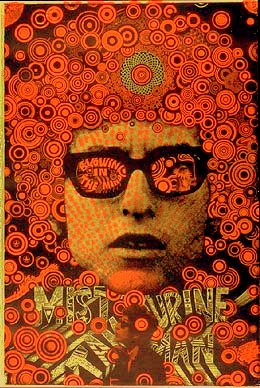
Psychedelic Dylan
Some say she first set her sights on McCartney but the more vulnerable Lennon showed up and the Spider Woman spread her web.
She was still married to her second husband, Tony Cox, but, regardless of what she says she very aggressively pursued, or attacked, Lennon. Lennon was emotionally under water unable to handle his success while drugging himself out of his mind. He was unwillingly married to his wife Cynthia. It appears that he married Cynthia out of duty when she became pregnant. He doesn’t seem to have been happy in his virtue. Yoko had no difficulty in capturing his affections.
Now, just as Warhol had adopted the Velvets and imposed his female singer, Nico, on the band Yoko sought to imp[ose herself on the Beatles through Lennon. At this time she was still musically completely in thrall to John Cage understanding nothing about Rock music. She and Lennon had made a ridiculous LP called Two Virgins in 1968. She combined her cagian screechings while using an avant garde ‘performance’ notion of the couple posing nude on the cover; full frontal on the obverse, full posterior on the reverse. As no store would carry the cover the couple reverted to Yoko’s idea of Bagism placing the cover inside a plain manila envelope or bag. While it didn’t sell the record this form of Bagism was actually a successful artistic statement. The nude cover given an outer garment so to speak.
Well, the public was prepared to forgive the Beatles anything but the other three Beatles weren’t prepared to forgive Yoko for forcing herself on them thus she broke up the most successful act of the sixties. Still, she had succeeded according to her wildest dream. Lennon and his wonderful reputation and fortune were hers. She had gone from a neglected, nondescript ‘performance’ artist to center stage, not on her own womanly talents but by attaching herself to a talented man. Yoko’s ‘heart’ was useless without the male intellect. Yoko was now the most influencial feminist in the world. She knew what to do with that.
After several ‘performance’ acts such as the ‘Bed In For Peace’ the couple left England to return to the place Yoko wished to subjugate artistically, New York City. She had raised herself to a par with Andy Warhol. She now had to meld her musical and artistic goals through Lennon and Warhol.
On the musical side she began to develop her rock n’ roll skills under the tutelage of Lennon. While not abandoning the avant garde notions of John Cage she now emasculated her husband. Always semi-delusional or perhaps completely so, she fantasized that she was not only equal to Lennon in skill and popularity but superior to him. She imagined herself more popular than Lennon. Thus one has such travesties as the LP Double Fantasy. It was only after Lennon’s death that she was forced to recognize than Lennon’s fans did not appreciate her efforts. So she failed as a musician.
She quickly tired of being Mrs. Lennon. Thus she and Lennon separated for eighteen months or so during the years 1973-75. She then realized that her financial well being and musical acceptance depended on Lennon. In 1975 she called him back resuming their relationship until his death in 1980. But, things had changed.
She began to adopt Warhol’s life style on her return to NYC. While she propagated the notion that she was some sort of business whiz Iam having difficulties discovering any such skills. It appears that with the enormous income of Lennon she emulated Warhol in
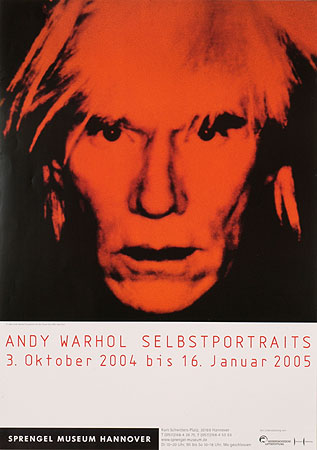
Andy the Demon
spending her way to prosperity.
She was in a position to not only match Warhol’s spending but exceeding it by many times. Through the seventies and eighties Warhol came into his own as an artist while reaping a fortune doing portraits. There appears to have been no effort on his part to invest in income producing vehicles. Rather he bought stuff. He purchased buildings in NYC and elsewhere while acquring undeveloped acreage in places like Aspen. He shopped nearly every day buying antiques from furniture to objets d’ art by the bushel almost as though he were trying to excel the incredible W.R. Hearst.
He usually didn’t even look at the stuff once he bought it merely filling rooms with his shopping bags. At his death all this junk was auctioned off for 25 million dollars, a nice appreciation in value.
Yoko followed the exact pattern buying apartments and houses as well as an extensive dairy farm with a herd of prize cows. She not only had but has five apartments in her principal dwelling, the Dakota apartment building and many other houses scattered around.
Like Warhol the Dakota apartments are stuffed with junk. Valuable, but, you know, stuff. She bought at good prices. Her extensive collection of Egyptian antiquities was mostly purchased before a steep rise in value.
Like the Rothschilds of old Yoko didn’t do all her own shopping but employed agents to search things out. Chief among these was an associate of Warhol’s, Sam Green, and an Hungarian immigrant by the name of Sam Havadtoy.

Buddies- Yoko, John, Andy
There should be no surprise then that she now has an extensive collection of Warhol’s artwork as well as his portraits of Lennon. The Warhols would have been purchased for form 25 to 50K while now being listed on her assets at tens of millions. She also has been said to have a good collection of Magrittes as well as one assumes other artists. So, much of her net worth is tied up in artwork purchased through Sam Green.
Sam Havadtoy was an antiques dealer as well as an interior designer. He appears to have been a somewhat shady character. It is very difficult to find much about him, however there is a sharp portrait available from the notorious A.J. Weberman ( http://www.acid-trip.org/lennon/ )
…(the Lennons) hired a sleazy Eastern European bisexual to renovate the pad. (Dakota) I had heard of this dude, whose name escapes me, from an asswipe named BRUCE KIRSH, who worked for him. KIRSH told me that the dude, who worked for the King of Morocco, would form a dummy renovation company, hire employees like Kirsch who were willing to work under false names, then, when it came time to pay taxes, everyone would disappear. I learned of him long before he was hired by John and Yoko, and I was taken aback when Yoko took up with him after John’s death.
I know that Weberman is not particularly well thought of by fandom but this is because of his harassment of Dylan who did, after all, misrepresent himself to the revolutionaries like Weberman. A.J. himself is an intelligent observer who was wading through it when it was deep. I do believe he knows what he’s talking about although his interpretations of Dylan’s lyrics seem absurd.
I would have to question Yoko’s judgment in taking him in. Both he and Sam Green were candidates as successors to Lennon with

Lennon by Warhol
whom she consorted in front of Lennon before he died while Yoko chose Havadtoy as his successor the day he died.
Perhaps she selected Havadtoy over Green because he was more rough trade. With Lennon while managing to reconcile revolution with peace and love with Havadtoy she discarded peace and love in favor of strong arm methods against her former employee Fred Seaman when it was totally unnecessary.
Havadtoy was living in a homosexual arrangement with his business partner when Yoko beckoned him to switch to her. Apparently an able switch hitter he was lured by the money to this much older woman. The arrangement did last for twenty years before Havadtoy removed to his native Hungary taking a nice cash settlement and several of the Warhols.
Thus, just as Warhol had his live-in homosexual arrangement so after Lennon’s death Yoko adopted the exact arrrangement. Today she apparently lives alone, a seventy-eight year old woman.
After Lennon’s death there was an accession of from 30 million to a possible 100 million dollars as their last album, Double Fantasy, sold into the millions while the rest of Lennon’s catalog and one assumes the Beatles’ catalog was reinvigorated while all things Lennon sold. This is, of course, no reflection on Yoko but the inevitable result with intellectual properties when the maker dies.
Post-Lennon, then, Yoko realized that her recording and art careers were nil. Heart without intellect is worthless. She then became the caretaker of the Lennon legacy. His recordings, of course, continued to sell, but even his artwork eclipsed that of Yoko. So she suffered the humiliation of being a mere appendage to a man. The feminine dismal swamp was eclipsed by the Olympian heights of the male intellect. As in ancient times the God had trumped the Goddess. And yet as with Hera and Zeus the Goddess gets her way. Yoko came up with the money and goods while Lennon’s spirit was wafted into the stratosphere.
As any reader of mythology knows Hera ruled the Lernean swamps of Argolis while Zeus ruled the gods on ethereal Olympus. Thus one has the symbolism of the biological difference between the male and female.
In ancient times the female had her share in magic. She knew herbs and plants, was familiar with poisons and cures as with the arch witch of the ancient world, Medea. The reputation of the female witch even as a consort of Satan persisted down through medieval and post-medieval times, indeed, even up to the dawn of the scientific enlightenment. One would have thought that magic and witchery were a thing of the past in the 1960s and yet Yoko embodied the whole female swamp mentality.
She established something called the Spirit Foundation attributing the direction to Lennon who in fact knew nothing of these matters but followed her lead. The Spirit Foundation celebrated the ancient art of the Shaman or witch doctor. Shamanism itself even preceded the Matriarchal swamps of Argolis. It was a rich repository of magical tradition. Further the Foundation was feminist in that it was dedicated to preserving the magical traditions of the women of the Pacific islands still living in such archaic societies. The wealth generated by the male intellect was appropriated by the female vagina or ‘heart.’
In her own life and that of Lennon’s Yoko was addicted to a variety of magical practices- astrology, numerology, Tarot readings, and indeed she traveled to the Caribbean to sell her soul to Satan through the offices of a female curandera. Her Tarot reader, John Green, was a priest in the shamanistic, magical, Yoruban African cult of Santeria.
Her feminism was more a magical effort to restory Matriarchal supremacy over the Patriarchy thus reversing the Patriarchal victory of three thousand years previously. Indeed, what has been called the movement for female equality is nothing more than a covert campaign to restore the Matriarchy.
Thus while Yoko o9riginatd nothing she usurped the abilities of the reason of men- Cage, Warhol, Lennon and male magicians such as John Green. Indeed the Trojan War itself was a war of men in service of women.
In her associations with men she preferrred to deal with emasculated types such as homosexuals like Cage, Warhol, Sam Green and Sam Havadtoy. Lennon claimed to have always been dependent of women for comfort and guidance while Yoko caught him at his most confused and vulnerable.
While she received direction from Cage and Warhol she was able to manipulate Lennon out of his talent somewhat as Vivian did that of Merlin of the Arthurian saga. When Vivian had usurped Merlin’s magical knowledge she buried him deep much as Lennon was put out of the way. Yoko then appropriated his wealth and residual income after his death. It was this constant inflow of cash that allowed her to propagate the notion that she was a financial genius.
Then as the female of the ‘heart’ or vaginal swamp she managed and appropriated the reason of Olympus through Cage, Warhol and Lennon. What she got from Havadtoy other than brute strength is not clear to me.
As such Yoko is Woman. In her case a seeming reversion to the archetypal Shaman of the most ancient times.
Themes And Variations
The Tarzan Novels Of Edgar Rice Burroughs
#23 Tarzan And The Madman
by
R.E. Prindle

What A Long Strange Trip It’s Been
In everyone’s life there comes a time to recapitulate. Tarzan And The Madman was that time for Edgar Rice Burroughs. The Great Saga began in 1912 and in this novel of 1940 unpublished during his lifetime the long strange trip, to quote the Grateful Dead, came to an end. The Big Bwana and his imposter got on a plane and flew out of Africa never to return.
Two more unpublished novels in his lifetime would follow but they were placed in the Pacific either in or near Indonesia. The succeeding Tarzan And The Castaways was also unpublished during his lifetime while Tarzan And The Foreign Legion could find no takers so was published by ERB, Inc. It almost seemed as though the sun had gone down on the Great Ape Man.
Of course the movie Tarzan still prospered, first with the great Johnn Weismuller and then Lex Barker. ERB even tips his hat to MGM by replicating the flight through the fog to the great tabletop of the Mutia Escarpment, an MGM invention. Thus, the last game is played out on the MGM playing field. Just as ERB and Florence left LA on a plane so Rand and the Goddess and Tarzan do Africa in this novel. In a short 157 pages ERB manages to recap the Big Fella’s entire career in print or on film.
In reading through the book this last time I suddenly realized the significance of all those doppelgangers. They signified the problem ERB was having realizing his ambition to be the man who was Tarzan. In Madman he gives up the ghost realizing his failure to become the Man-who-thought-he-was-Tarzan but wasn’t. Now typing away in exile from LA on Hawaii he throws in the towel.
As I have tried to show in my other reviews ERB read Robert Louis Stevenson’s The Strange Case Of Dr. Jekyll And Mr. Hyde probably sometime before 1890 within four years of its issue. The book must have been a sensation during his years at the Michigan Military Academy, the subject of endless discussions among the cadets. As hard as it must be for us to realize what we consider a classic was an exciting new book for ERB. No movies could be made of it because the technology hadn’t been developed as yet. Even the primitive Nickelodeons were shimmering a ways into the future. Yea, verily, the future lay before them.
The novel was significant enough to be in the first batch of talkies being produced in 1931. I’m sure ERB was transfixed as the story unfolded on the screen. The theme of psychological doubles had dominated the Tarzan oeuvre from the beginning. While it seems repetitious to a first reading of the novels the theme is actually developing as the series progresses. ERB didn’t so much fall back on a cliché but he was working out a variation on the theme of Jekyll and Hyde.
He says that he was convinced that every man had two sides to his personality, perhaps not as pronounced as that of Jekyll and Hyde but there nonetheless. He was aware of his own duality chronicling it in the pages of the Tarzan oeuvre. The duality is often prompted by a blow to Tarzan’s head. The blow certainly commemorates the hit ERB took in Toronto while perhaps the aftermath split ERB’s personality so that he became two nearly different people. Perhaps that’s the secret of his writing career as he said that he was able to disappear into the alternate reality when he wrote.
Tarzan always had two personalities from the beginning. He was both a civilized man and a beast. This undoubtedly represents ERB’s feelings about himself. Perhaps he had periods when he was something of a wild man, not unlike Tarzan on the Rue Maule in The Return Of Tarzan who became a beast and then shook himself back into a human not unlike the transformation of Jekyll and Hyde. This type of duality would characterize the Russian Quartet, the first four novels.
The Tarzan true doppelganger first appeared in Jewels of Opar where having received a blow to the head he loses his memory during which he lived as an uncivilized beast, regaining civilization with his memory, but he had not yet split into two co-existing separate identities. That would first occur in Tarzan And The Golden Lion and Tarzan And The Ant Men when the great character of Esteban Miranda served as a doppelganger. Esteban was identical to Tarzan in appearance but an arrant coward compared to Tarzan. This was a characteristic of all the doubles. Esteban represented the negative pre-success side of ERB while Tarzan the positive post-success side. Thus in these two novels ERB is beginning the attempt to become Tarzan- The-Man-Who-Thought-He-Could-Be-Tarzan.
ERB was very sensitive about his early failings in his relationship with Emma. In these two novels he offered Jane/Emma the chance to recognize him as the strong Tarzan and not the weakling Esteban doppelganger. Having overcome the failures of his past he felt he had proven himself as a man and a supreme provider demanding recognition. Given the decision to make Jane/Emma chose ERB’s former existence, Esteban, thereby sealing her fate. After her ill fated choice Jane disappears from the oeuvre except for the chance encounter in the succeeding novel Tarzan Lord Of The Jungle whereas the Golden Lion assumes a prominent role.
While the next double, Stanley Obroski, appears in Tarzan And The Lion Man a double of sorts in the form of Lord Passmore makes his appearance in Tarzan Triumphant. Another double appears in Tarzan And The Leopard Men when felled by a giant tree in a storm Tarzan blanks out assuming another persona. Also, in Tarzan And The City Of Gold Valthor serves as a double. In a strange variation ERB repeats the story of Jewels Of Opar when Tarzan rescues Jane from the Arab boma. Here, in an exact duplicate of that scene, he rescues Valthor. Thus Jane and Valthor are connected in ERB’s mind.
In Tarzan And The Lion Man Burroughs kills off his weaker persona thus assuming the role of Tarzan himself. Then in Tarzan And The Forbidden City Brian is his look-a-like although the role of double is not explored. Perhaps this is the initial realization the ERB has failed in his quest to be Tarzan.
After a decade of trials and tribulations struggling against the Communists and MGM and losing ERB sat down in exile at the beginning of 1940 to write this confession of defeat.
The man-god Tarzan himself remains the same but The-Man-Who-Thought-He-Was-Tarzan but failed confesses his defeat getting into his airplane up there on MGM’s Mutia Escarpment flying out of Africa forever. First he was expelled from Opar by the Communists and then from Africa by MGM.
Although Tarzan was in the plane with him, the Big Bwana shows up again in Africa for a moment in Tarzan And The Castaways. This novel written in a style entirely different from the rest of the oeuvre was also unpublished during Burroughs lifetime hidden away in a safe.
In this novel Tarzan is defeated by a Black chief, symbolically perhaps, captured and sold as a wild man, a feral child. Once again Tarzan has lost his memory reverting to a pure beast or feral boy. As this novel was written after King Kong and Tarzan ends up on yet another island perhaps ERB was conflating the movie with this novel. Tarzan is put aboard ship with the other animals destined for the circus and taken from the continent.
Running all through Burroughs is the ghost of Jule Verne’s Mysterious Island. Once aboard ship a storm assaults the ship which, signficantly loses its rudder. Thus like the now rudderless Burroughs the ship is adrift. In a scene reminiscent of both Verne’s novel and Robert Louis Stevenson’s Kidnapped the ship is tossed atop a reef while all aboard including a Noah’s Ark of animals find their way to shore as the Castaways.
Stevenson and Verne were two of ERB’s earliest influences thus ERB returns full circle to his origins.
In the last Tarzan novel and the last published in his lifetime, Tarzan And The Foreign Legion, at the very end the fugitives from the Japanese army approach the remains of the Mysterious Island that after the volcanic explosition of Verne is a mere spire of rock in the vast ocean. Not a refuge in the world left for Tarzan or ERB. Like Capt. Nemo a submarine surfaces to rescue Tarzan and the Legion from a watery fate.
It seems amazing that as an honorary Frenchman Tarzan was never placed in a situation with the real French Foreign Legion. Perhaps P.C. Wren had preempted the genre with his magnificent FFL trilogy which left no room for ERB’s imagination to operate.
The long odyssey had ended. ERB could not imitate his man-god but he left him to us as an avatar for the coming New Age. What a long strange trip it was and for us, will be.

Johnny Weissmuller- The Image Of Tarzan
Part II follows.
Part III: Mourning Becomes Yoko
April 3, 2010
Mourning Becomes Yoko Ono
The Passing Of John Lennon Part III
by
R.E. Prindle

Doppleganger #1
When John Lennon met Yoko Ono he knew very little of art and nothing of the New York art scene. His high school years had been spent in open and futile rebellion; the next few years had been spent only in the German underworld with no time for cultivation. From there he went into the whirl of the Beatles years so one might say he had been in cultural suspended animation for all his adult life.
Yoko Ono since 1960 had been engaged in the New York avant garde art scene. She was au courant when she left for London in 1966. Hooking up with Lennon she began to educate him according to her understanding of art. By the time the Ono-Lennons arrived in New York in the late sixties that scene was dominated by the POP art of Andy Warhol while the world both she and Lennon knew in 1960 was unrecognizable. Yoko wasted no time in ingratiating herself with Andy but not the factory. After he was shot in 1969 the old Factory disappeared and after his recovery Warhol began a new life. It is possible that she tried to establish

Doppelganger #2
contact with him between ’64 and ’66. She did know warhol’s associate, Sam Green, from her first days in the Village in 1960.
By the time of her return to NYC Yoko had achieved world wide fame by using Lennon and his fame in their charades for ‘Peace.’ Now she had the perfect entree to enter Warhol’s circle. Warhol was a sucker for celebrities, he did Lennon’s portrait, so he was flattered when Yoko asked him to introduce she and John into society. If Warhol could pester, Yoko was unstoppable. While Andy wasn’t exactly persona gratis at that time he was thick with Sam Adams Green who did have entree to society. Between the the two of them they set up a party to introduce the Ono-Lennons.
John was, of course, no Mick Jagger. While Mick adapted himself quickly to the demands of his fame and moved easily in society, John was awkward being out of the element of his self-styled working class hero. Yoko, too, was no mixer so at the party Yoko and John sat silently in a corner as though in one of Yoko’s bags watching the party goers.

Warhol Jagger 2

- Warhol Jagger
It might be apropos to point out that Jagger and Warhol were fairly close. Jagger was one of the few people attending Warhol’s funeral in Pittsburgh while Bianca was in Warhol’s entourage in the eighties. Warhol also painted a portfolio of Jagger pictures that today command healthy prices.
The Devil In Disguise

- Witchy Woman and Warhol

Yoko still persisted with Warhol but Andy having been disappointed once was not up for it twice. He distanced himself from the pair describing them to Sam Green as boring. An ultimate putdown.
Initially the Lennons lived in the Bohemian scene downtown. Mickey Ruskin, the owner of Max’s Kansas City, described the Bohemian scene thusly: the well-to-do Bohos, the middle and the lower class. Those associated with the Kettle of Fish and its environs of which Dylan was a member were of the lower class while the Kettle of Fish itself was owned by the Mafia. He believed Max’s was in the middle. John and Yoko first lived in New York in the West Village at 105 Bank Street next door to Yoko’s her, John Cage. They took over Joe Butler’s apartment, he formerly the drummer of Lovin’ Spoonful so Ruskin would have classed John and Yoko as haut ton beatniks.
At any rate they soon left those environs to migrate to the Upper West Side where they secured apartments in the famous, or soon to be famous, Dakota. It was then that their NYC life took its definitive form.
I have been to NYC a few times so that I know the general layout and have some feel for the place but I have by no means an intimate knowledge so essentially I’m working from maps. I know where MOMA and some few prominent art landmarks are from experience but not that many.
At any rate the Dakota is a famous landmark.. Acceptance as a tenant is by committee approval. John and Yoko were strenuously vetted but finally admitted. They took over actor Robert Ryan’s apartment #72. If you have seen the movie Rosemary’s Baby the camera pans past apartments 71 and 72. No filming was allowed inside the Dakota so while the exterior shots are authentic the interiors were shot on sets. Thus the apartment of the Satanists is a fictional 7E. The apartment next to it in which the young couple resided may have been number 72. The man of the couple who was an actor sold his wife’s body to Satan as the carrier of his child for success in the theatre which he was granted. Thus the Ono-Lennons moved into an apartment closely associated with devil worship, the occult and witchcraft.. This will become more important as Yoko associated herself with all three. In fact, Yoko through John Green would have been familiar with the Yoruban Santeria religion that she in all likelihood would have reverenced. The Spirit Foundation that she established is concerned with the preservation of just such tribal institutions.

Dakota Entrance
These are magnificent apartments that I presume Rosemary’s Baby duplicates. Huge fifty foot long living rooms as part of a ten room apartment. The Ono-Lennons would soon own both 71 and 72 lacking only the fictional 7E while having a Studio apartment as well.
Being now permanently settled Yoko having access to John’s superb income began to spend it. Of course, she virtually cleaned out department stores on her buying binges, any girl’s dream. But, she also began to buy heavily into art and antiques as investments. This brought Warhol’s friend Sam Adams Green into a close association with her. Rich society women were Sam’s forte. He has an interesting story. He was actually descended from the second president of the United States, Samuel Adams. He arrived in New york in 1960 about the same time Andy Warhol was trying to establish himself as a fine artist and Yoko the same. Warhol of course began as a commercial artist doing shoe ads but in 1960 he changed the emphasis of his career.
In the fine arts field one of the first gallery people Andy met was Sam Green of the Green Gallery. Different Green, Sam only

The Dakota
worked there and shared the name. He and Andy hit it off. By 1965 Green was associated with the art department of UPennsylvania where he staged a Warhol exhibition in the same year. From there he gravitated bck to NYC where he began a career as art consultant to rich women on both continents. They liked him. Through the socialite Cecile Rothschild he was introduced to Greta Garbo with whom he was sort of a trusted companion for 15 years.
He was very knowledgeable about art as an investment traveling between Euorpe and the US advising socialites on the most investment worthy art. He apparently derived a more than comfortable income from his efforts. He was a trusted advisor of Yoko. Some say that he and Yoko’s Tarot reader, John Green, who would enter John and Yoko’s life at about this time, combined to bilk Yoko for overpriced objects. This presumes that both men were dishonest and that Yoko was a fool. As Yoko’s investments have prospered I think we can dismiss the latter, although Yoko did take pride in being able to spend vast sums. She would have taken pleasure in overpaying.
Sam Green- Current
Rather I would say that Sam Green was a very knowledgeable expert whose task was to find art that would appreciate in value. Thus the question is did he perform that function and the answer is, yes. Yoko’s acquistions increased in value far above her purchase prices. I think it is unfair then to say that the Greens bilked her. Surely the laborer is worth his hire.

Warhol Portrait
Now, Sam Green as her agent had to buy the items he acquired for her. Being knowledgeable as to who in society wanted to sell what at distressed prices he may have made some excellent buys that he then tacked on his margin which of course meant that he sold to Yoko for ‘more than they were worth.’ But, heck, even Christie’s and Sotheby’s take twenty per cent each from the buyer and seller. That’s a forty per cent surcharge. However Sam served his function of providing investment pieces so I see no evidence of bilking.
Sam Green also formed a close, probably romantic, liaison with Yoko that persisted until after John’s death. Another art dealser she became close to was a Sam Havadtoy with whom she subsequently lived for twenty years beginning immediately the day after John’s death.
Now the men Yoko associated herself with were all effetes, that were either emasculated when she found them or who she emasculated. Strangely Lennon was the strongest of the lot. Both her first Japanese husband and Tony Cox appear to have been heterosexuals but both Sam Green and Sam Havadtoy were dependent homosexuals. With Havadtoy Yoko may have had her ideal relationship. He was thoroughly emasculated while with the fortune Yoko inherited from Lennon he was totally dependent on her. The classic toy boy a couple decades younger than herself. He, by the way, after his twenty year stint as live-in retired to Hungary with an abundant palimony but he isn’t talking.
In my reading of the situation then, a not particularly compliant John became somewhat of a liability to her, especially as he began to reassert himself with the return to the recording studio in 1980. The problem has the surface appearance of separating the man form his money and discarding the man.
Yoko began building her entourage, Sam Green, John Green, Sam Havadtoy and her various occult people with what appears to be an admiration for and some sort of connection with Andy Warhol. Sam Green and Havadtoy would be a troublesome presence in Lennon’s life during the recording of Double Fantasy while he does not appear to have been enchanted with the Warhol connection
As has been mentioned Yoko became involved in occult practices. She did practice hypnotism on Lennon and was an adept at suggestion which is the essence of hypnotism. Thus on the one hand she suggested forcefully to May Pang that she take up with Lennon while it is probable she hypnotized Lennon into taking up with May Pang. Post hypnotic suggestion would give her a command over all Lennon’s actions. Once implanted she would only have to say the word and Lennon would follow her suggestions.
How complicit John Green would have been in this isn’t exactly clear but any of Yoko’s suggestions to John could have been complemented by a reading. John Green was after all dependent on Yoko for a very generous income beyond whatever he may have scammed.
John Green is another interesting case. He was apparently successful as a Tarot reader before he met Yoko while he is reported to hae been a student of the African Yoruba religion called Santeria. The Yoruba are a tribe in Nigeria, middle river, Western side. He would have obtained much of the magic information he displayed in Cartagena, Columbia, SA from that source. The sixties themselves were the great period of the dissolution of the American mind and personality. One of the key items in the disintegration was the 1962 movie, Mondo Cane. (It’s A Dog’s World). It is difficult to assess the impact of this movie on the malleable college age mind of the times.
I saw the movie then and while it passed out of my conscious mind it struck me most forcibly and lodged in my subconscious mind. I, of course, reviewed the movie for this essay and while I at first remembered little gradually my conscious mind recovered the images so that I remember almost all. The viewing at the time was very repulsive and unsettling to my mind as it was for everyone I talked to about it and every college kid saw it. Still, consciously I missed the true import of the movie completely.
The filmmakers equated some New Guinea stone age people with modern Whites and equated them- said both states of
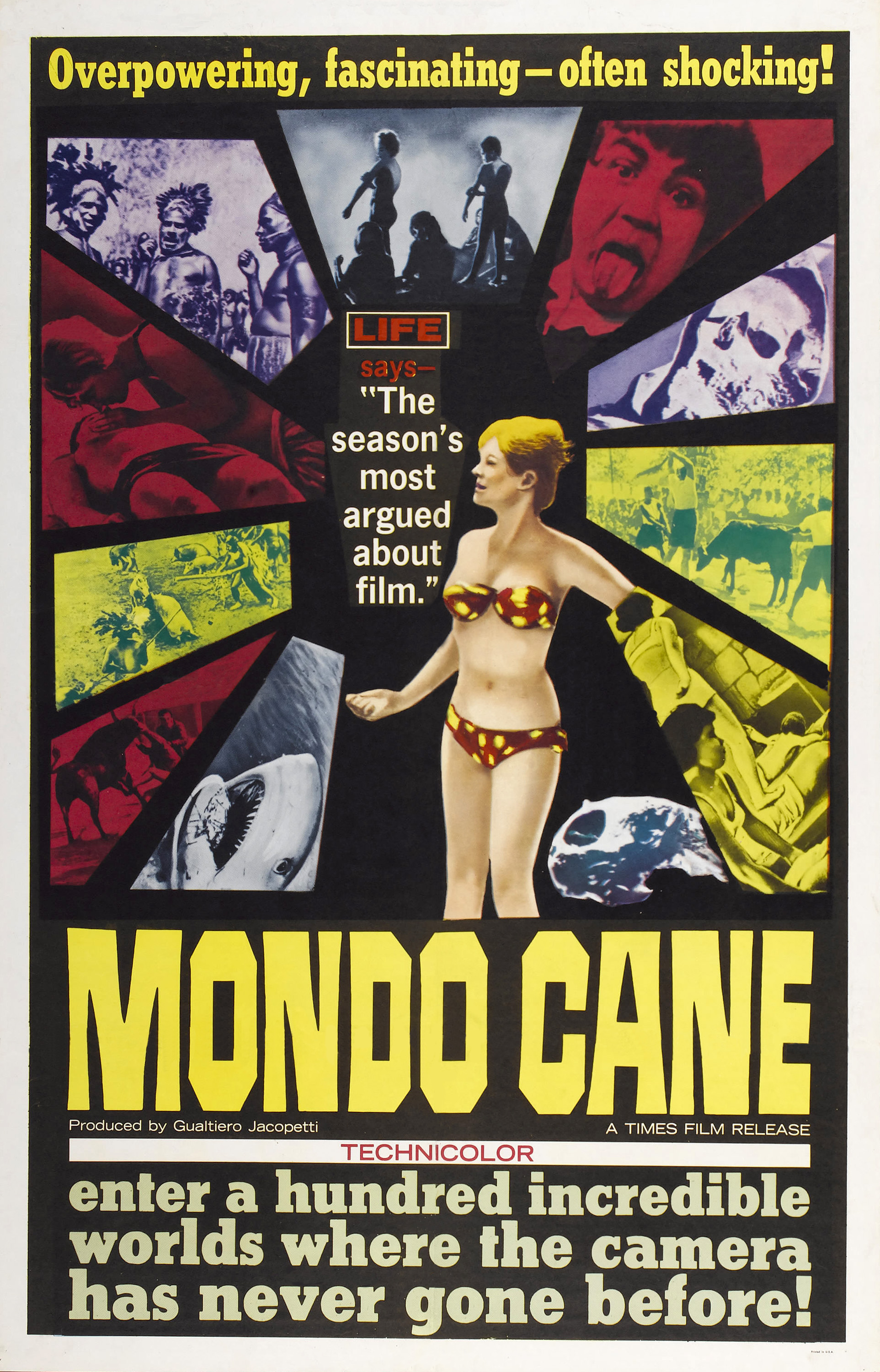
Mondo Cane Poster
consciousness were the same- and that there had been no advance between the primitive and modern. Then they showed Whites at their goofiest and most ridiculous. Drunks at a German Oktoberfest, aged tourists clumsily trying to do a hula. The movie was a real exercise in moral relativity. It was shortly after viewing the movie that I first remember hearing the phrase ‘Nothing is good or bad but thinking makes it so.’ I don’t want to philosophize on this but my thought was that if I think something is bad therefore it must be because I think it and I can’t be wrong.
The movie had a devastating effect on the attitude of the generation. It was a form of hypnosis with a great deal of post-hypnotic suggestion. Whether John Green saw the movie or not I can’t say but if he had it would have prepared him for accepting Yoruban Santeria. In fact these primitive forms of religion and what not flourished in the wake of Mondo Cane. At the same, as I indicated, Yoko would have been very open to Santeria. I think there is little doubt that Green and she at least discussed the religion and its African tribal origin. Especially as she established something she calls the Spirit Foundation. In the online prospectus she describes the foundation thusly:
The Spirit Foundation is…concerned with the protection and promotion of creative and cultural diversity amongst shamanic tribal communities worldwide. Part of the foundations work is the International Shamanic Network which aims at promoting the ancient creative archetypes of man and their binding ecological realtionship to the world.
Our emphasis is on education for action.
As mentioned Yoko and Lennon moved into the suites used in Rosemary’s Baby with its Satanic overtones. In the movie a young woman living with the Satanic couple either jumps or is pushed to her death not far from where Lennon was shot. In this very location Yoko took up Satanism. She decided she wanted to make a pact with the Devil to obtain her wishes. The ubiquitous Sam Green knew of a witch who could serve as an intermediary between Yoko and Satan. (Remember I am only retailing the story, I don’t believe Satan exists.)
Sam Green who had prospered as an art consultant had used some of his earnings to purchase what he called a castle in Cartagena, Colombia. He recommended his witch to Yoko who asked John Green to take her to the witch as he doubled as Tarot reader and Wizard. John Green did so and the witch duly negotiated a deal between Yoko and the Lord of Fire. When it came time to sign the pact Yoko asked Green to do it for her which he did. She was aghast when he told her he didn’t sign his name but hers. Yoko trying to cheat the devil.
We don’t know what she asked Satan for but we are compelled to believe she got it.

Santeria Illustration
As I believe she hypnotized Lennon into taking the Long Weekend I don’t know exactly why she wanted him out of the house. She certainly closely monitored his activities while he was away both in NYC and LA. During his absence Yoko didn’t have a Power of Attorney so she was somewhat constrained as John had her on a 300K budget. When he returned she quickly obtained his POA so that she had unlimited use of his money and, in fact, his identity.
Lennon is criticized for being a recluse in the years between 1975-80. He certainly wasn’t a recluse in that he withdrew from the world. He merely limited his contacts with it. It is said there was a fifteen month period when he was completely withdrawn. While he was obviously suffering from a mental malise in my opinion the withdrawal was completely justified. He had mental issues that had to be resolved. He had the money and time to work at it as he did.
He had a mother/father fixation he had to resolve. he had the feeling that he had been either a genius or a lunatic from boyhood. In a remarkable rant within the 1970 Rolling Stone interview he rants for pages because no one recognized him as a genius in his youth while he had now convinced himself that he was and had been a genius. The fact that he never did his schoolwork doesn’t seem to him that that may have a reason why people missed his genius and though him somewhat mad. What would theyhave done if they had? So he had to reconcile the issue in his mind.
He seems to have made no advance past his school years except in music. The years between leaving school and taking up with Yoko were completely wasted intellectually while the pressures of phenomenal success and wealth disoriented him completely not to mention the massive doses of drugs. At some time then he had to come down and organize his mind and life. From 1968 to let us say 1980 he was completely dependent on Yoko for his mental balance. In NYC he went where she did and did what she did. Hence the connection to Andy Warhol and Sam Green.
There are numerous pictures of Yoko, Lennon and Warhol. Yoko even patterned some of her work after Warhol’s style as in the ‘work’ below patterned after Warhol’s double Elvis. Thus she associates herself and Lennon with Presley.

Yoko Goes Warhol, Imitation of Double Elvis
As I mentioned before the social entree arranged by Warhol and Sam Green failed because of the social ineptness of the Ono-Lennons.
While we have a full record of what Lennon was doing during his ‘Lost Weekend’ we have a less full account of what Yoko was doing. She seems to have had romantic liaisons with at least three men- Sam Green, Sam Havadtoy and the guitarist David Spinozza.

Sam Havadtoy
Perhaps she wanted to see how well she could do on her own as a musician, to see if her reputation as a performance artist and, in her mind, musician, was sufficient to maintain a career on her own without John. If so, she was brutally disappointed as in her only solo performance she failed miserably. Thus she realized that as of 1974 her reputation as well as her wealth depended on Lennon.
It was during Lennon’s absence that John Green came into her life. While John Green tells a fairly smooth story in his Dakota Years one has the feeling that he is being highly selective in what he tells while he slyly ridicules the Ono-Lennons as their superior. The attitude easily leads to contempt and from contempt to abuse. Of course he would have to dissimulate both the contempt and abuse as Ono would be reading the book. As I imagine, a priest in the Santeria religion, he would have been in the company of some shady characters. I don’t know how many actual Yorubas were in NYC but I have met a couple elsewhere.
One imagines most of the hierarchy Green came into contact with was African or American Blacks. Santeria involves a deal of ritual sacrifice while money would be needed. I suspect that John Green was involved in the extortion attempt on the Ono-Lennons. This may have been Santeria related. Thus a sort of Black Hand organization was created. Rather than go for the big money that would have created a stir, the group settled for hitting up people with millions for a mere 200K each. An unpleasant tax for being rich but one more conveniently paid than to die resisting.
We have only Green’s version of the extortion and his relationship to it. He paints himself in a relatively good light. The Ono-Lennons did call in the FBI, they did give the extortionists newspaper rather than cash as the FBI advised. But then things went wrong. The FBI apparently had only one tail on the extortionist who came for the money rather than a series of back ups. The agent inexplicably lost his man. The Ono-Lennons never received another call but they had been warned that if they failed to pay Lennon would be killed whether it took one, two or more years. In December of 1980 the bill fell due. On December 8th he was shot. December 7th is Pearl Harbor Day so there may be a Japanese connection. Yoko Ono being Japanese, her numerologist and the assassin’s wife while Chapman missed the appointed day by one.
The question then hangs on Mark David Chapman the shooter. He is still alive and in prison. He was an assassin as the classic lone nut like Lee Harvey Oswald and any number of assassins who pay the law for the crime while the organizers go free. The technique has been well known to criminals for centuries. Any time a lone nut assassinates someone you may be sure that they were a patsy as Oswald announced over TV he was.
It seems likely that Chapman had been hypnotized. Witnesses said Chapman acted as though in a trance and he himself said he heard a voice in his head saying: Do it. Do it. Do it. The problem would be how he was recruited. I, of course, can say nothing for certain while what I am saying now is merely an hypothesis or inquiry. The main thing is that Chapman was supposed to be a lone nut. Ridiculous.
The most obvious recruitment method was the Santeria of which John Green was a member and to which Yoko Ono was
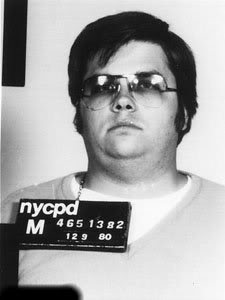
Mark Chapman
sympathetic. There are some oddities in the Chapman story that have to be explained not least of which are the large sums of money expended by Chapman in relation to his income. He was a married man therefore had a wife to support. Yet in 1978 he was in Japan at the same time as the Ono-Lennons beginning an around the world flight.
Perhaps Tokyo was the first stop of the trip around the world that then led to Seoul, Hong Kong, Bangkok, Delhi, Israel, Geneva, Paris, London, Dublin, Atlanta and back to Hawaii. His travel agent was a Japanese woman, Gloria Abe, who he then courted and married. She is reported to have been involved in occult circles. She may have seen so involved that, through Takahashi Yoshikawa, Yoko’s numerologist she was brought in to arrange the trip. Such an around the world trip in a Westerly direction- sundown to sunup- according to Yoshikawa’s numerology would be characteristic of Yoko Ono. She and Lennon made a round the world trip for occult reasons as did both Lennon individually and John Green at her instance. Green made his trip in 59 1/2 hours only leaving a plane once to change to another. As the financing of Chapman’s trip is unknown I would suggest Yoko Ono.
Two years after this very costly trip around the world Chapman flew from Hawaii to first Chicago, then Atlanta, then to New York where he landed a few days before the assassination. Once again, well beyond his means. It is said that he took paintings to Chicago that he sold. Where he would have gotten the paintings isn’t known but once again Yoko is the obvious source. She had an art gallery of valuable art work.
While in Atlanta he contacted a former roommate, then a Deputy Sheriff, Gene Scott, who gave him the hollow point exploding

Santeria Priestess
bullets for a handgun. One assumes such bullets couldn’t be bought over the counter. One wonders why Scott didn’t ask what Chapman intended to do with them. And if he did and Chapman told him Gene Scott is clearly an accomplice and should be questioned.
Chapman himself came from Atlanta where in his teen years he was known to ingest any and all drugs. Atlanta was also a Santeria center with several weird Black cults. Lennon’s death took place at the same time as the Atlanta child murders for which Wayne Williams was later convicted. The Santeria religion has been suspected in these obvious sacrificial murders while John Green establishes a Santeria connection to the Ono-Lennons and Yoko in particular.
Yoko was an excellent hypnotist who understood the use and power of suggestion. The Santerists as Africans would be well versed in the use of suggestion and hypnotism.
Chapman said he was possessed by the Devil while appearing to be in a hypnotic trance. All this rather amusingly is taking place at the Dakota, the scene of the Devil’s birth in Rosemary’s Baby. Indeed, the identical apartment.
After Lennon’s death there was no period of mourning or sense of loss by Yoko. All Lennon’s assets were in her control and name before his death. The so-called will of Lennon is suspicious, although the will was unnecessary becaue I doubt if Lennon thought of a will while the will appointed the art dealer Sam Green as the gaurdian of son Sean in the event the Ono-Lennons perished together. Lennon wasn’t that enamored of Sam Green.
Within a few days Sam Havadtoy was installed as Yoko’s live-in where he remained for twenty years.
While Yoko’s success as an artist and rock n’ roller wasn’t affected by Lennon’s death she now had the money to pay to have her art exhibited. Even then she found her reputation was indissolubly linked to her dead husband. She has become a caretaker for the Lennon legend parceling out old recordings while humiliatingly Lennon’s artwork is more in demand than hers.
She seems to have patterned her later career on that of Andy Warhol who as he acquired fame and fortune managed to insinutate himself into certain society circles. So has Yoko. Now, at 78, she has attained a certain status although still extremely self-centered while having an appearance of terminal aloneness.
Animus and Anima

Mourning Becomes Yoko: Part II
March 13, 2010
Mourning Becomes Yoko
Part II:
The Passing Of John Lennon
by
R.E. Prindle
About John
This magic moment
So different and so new
Was like any other
Until there was you.
–Pomus-Shuman

The King
To understand the sixties one has to go back in time to the foundation of Astrology. In Time beyond Ancient, Astrology and Astronomy were one. The very old gods and the sky were one. It was only when science, a more clear understanding of ‘creation’, if you will, removed the sky from the gods’ purview that Astronomy and Astrology separated. Astrology in those days had meaning that is not apparent today when the sky is just part of our natural surroundings.
The Zodiac was divided into twelve periods of roughly 2000 years each which formed the Great Year. The periods were called Ages with each Age having its own avatars. The avatars of the current Piscean Age have been Jesus the Christ for the first thousand years, and for the succeeding thousand years Artemis or Diana in northern Europe and Mother Mary to the south. Sometime within a few hundred years near the end of an Age a new avatar begins to form.
The first intimation of the dawning of the Age of Aquarius that I am aware of occurred at the beginning of the twentieth century. While not the first, the chief proponent seems to have been Edgar Rice Burroughs and his creation, Tarzan The Ape Man. Not one to

The Prophet- Edgar Rice Burroughs
be dogmatic Burroughs left his intent open only to, dare I use the word again, the initiated.
Tarzan is timeless, he represents the past, being associated with the Atlanteans and the range of evolution, the present and, as the exemplar of the perfect man, the future. While rejecting organized religion Burroughs also rejected the Piscean avatar, Jesus The Christ in favor of the coming man-god. Thus the coming man-god must be a projection of the Aquarian avatar. Tarzan, a magnificent specimen is both physically and mentally the perfect man and hence representative of the future Aquarian man-god. Do not confuse the movie Tarzan with the literary creation of Edgar Rice Burroughs.
The longing then for a new messiah had been developing for half a century, at least, when circumstances came together for the appearance of a new avatar pointing toward the Age of Aquarius. This manifestation appeared on the stage of Ed Sullivan, in of all places, New York City. It was the Tupelo Mississippi Flash himself, Elvis Presley. In that brief magic moment on Sullivan’s stage he revealed himself and was recognized by his people.
Interestingly the appearance on 10/9 coincided with the birthday of John Lennon.
In that moment Presley’s future was cast. Whether the old order recognized who he was they knew how he was perceived and made every effort to slander, denigrate and destroy him short of actual murder. All to no avail. They might have been able to kill him, murder him, but he was inviolable to any defamation. It made no difference that they ridiculed him in a couple dozen fatuous films, he was the man-god. People endured his humiliations with bowed heads and resentful miens.
From him succeeding generations have taken their guidance. The first awe struck generation took the stage in direct emulation of him. While many had better songs (Gene Vincen’ts Be-Bop-A-Lula) none of the generation were anointed thereby developing a devoted following in the magnitude of Presley.
Elvis was not the last word but the first in what will be a procession. While the American Pharisees persecuted and scattered the faithful a new, younger generation was growing up in Elvis’ shadow. Their epiphany, that Magic Moment, would take place on the same Ed Sullivan stage in that same strange city of destiny, NYC, nine years later.
The gestation of this second manifestation of the godhead would take place in Liverpool, England. Inspired by Elvis Presley four young men of the second manifestation would be filtered through the persona of a young Scottish musician named Lonnie Donegan
The Geat Lonnie Donegan
.
When the settlers from the British Isles settled America they brought their musical traditions with them, most prominently to the Southern tier of States. Thus both the White and Black musical traditions of America stem from essentially the Celtic peoples. In the mid-fifties Donegan brought this music in the form of American Folk back to England in a form he named Skiffle Music. It swept England and its youth up being combined with Presley. Donegan added a ferocious beat to the music that evolved into the form termed the Big Beat. Thus the British musicians were schooled in American music as it had evolved from their own.
Now, the Magic Moment requires the man who has been prepared for the moment. If all goes right he is equal to his destiny, if not the moment fails.
While Presley was the man, the second avatar would be four men seemingly acting as one. The four men seemed to represent four archetypal personalities as in the four faces of the godhead. Those of us who didn’t ‘get’ them, of which I was one, were mystified by their apotheosis.
Just as Elvis had his unique preparation so did this fabulous foursome. Raised as four ordinary kids from varying levels of poverty and varying psychological backgrounds they were united by the music of Presley and Donegan.
They began a grueling and astonishing apprenticeship in the red light district of Hamburg, Germany. Unable to speak German they were thus compelled to rely on each other for companionship which created a unique bond. They were required to be on stage for up to twelve hours at a stretch for weeks at a time thus honing their musical skills apparently to perfection.
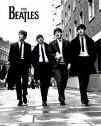
The Beatles
Thus the four aspects of humanity, one might say, were placed in a unique situation creating a unique combination of personalities seemingly as one. In those circumstances they were forced to be able to communicate instantly with their audience night after night. Valuable training.
Returning to Liverpool with their abilities seemingly uniquely developed they were adrift with no direction home and no other future than earning their livelihoods as best they might. But then, as by a miracle, a man appeared with no managerial experience who said he could take them to the top. Amazingly he got them launched. Even more astonishing they were assigned to perhaps the only record producer in the world who could bring out their unique talents. Thus this Fab Foursome took their home British Isles by storm succeeding as no other had succeeded before them but their Magic Moment, that lunge for the Golden Ring had not yet arrived.
The Magic Moment was awaiting them in NYC. A big jetliner brought the foursome to America’s shores in January of 1964 to appear on the Ed Sullivan show where they were to stand in Elvis’ footsteps so to speak. The difference in presentation between the two is interesting. With Elvis, he and his backing duo were standing in front of the drawn curtains on the edge of the stage, no set, his two band members were huddled behind him while the guitar player is turned sideways not even facing the audience. Presley is directly in front of them cavorting on a minuscule part of the stage. Mort Sahl would do his standup routine a few years later in the same manner with a newspaper as a prop.
In contrast the Beatles were given an open stage with decor behind them while the group was spaced dramatically and attractively. A very positive image which from long experience they knew how to take advantage of . But the appearance on the Sullivan stage merely confirmed their Magic Moment placing it indelibly in the American psyche.
The actual Magic Moment occurred when the Beatles announced themselves on the tarmac. Gods descending from the skies. For
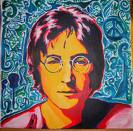
John Lennon
whatever reason there were thousands of screaming girls awaiting them and a battery of newsmen and photographers. Some say the girls were bussed in, it isn’t unlikely that the astute promotion men of Capitol had a hand in the arrangements, but on the receiving end of the tube it looked genuine. Mystifying but genuine.
Posed a bunch of questions by the news cameras all four Beatles fielded them with aplomb, the cheekiest and most confident acting was John Lennon himself. All four personalities established themselves at that time as one- the Beatles. In that little flash of time the role of the Beatles was established for all time.
While each individual Beatle was adored for the face of mankind he presented each had only an identity as an aspect of the Beatles. When they split they became merely humans rising or falling based solely on the musical merits. Of the four, Lennon adopted the messianic mantle, was accorded it, and took it when he left. In one sense the Magic Moment had been his.
There would be argument about when the Beatles began to break up over the years but the when was coincidental with their annunciation. John Lennon was the weak link in the chain. Having now won what he had been struggling for for so long John Lennon discovered he wasn’t worthy. Incredibly he wrote, and the Beatles recorded his song, ‘I’m A Loser.’ He was a loser, not the winner he appeared. Now conflicted he tried to both accept and reject the role of ‘messiah.’ He was well on his way to losing the role two short years later in 1966.
The course of his career was affected by two people, Bob Dylan in 1964 and Yoko Ono in 1966. Historical ifs are difficult. It seems impossible that Bob Dylan’s career would have been possible without the overwhelming success of the Beatles. Dylan lacked commercial appeal then as he does now. He appealed to a minority audience- as opposed to the majority audience of the Beatles. Dylan lacked universal appeal then as he does now.
While the Beatles were one as a group they were two as the songwriting team of Lennon-McCartney. Since 1962 they had been turning out a steady stream of million sellers both for their own use and that of others. They were catchy tunes in the Tin Pan Alley manner that could be sung and whistled but very introspective at the same time. Dylan on the other hand wrote tortured introspective lyrics that resisted anything close to whistling or a Mitch Miller singalong.
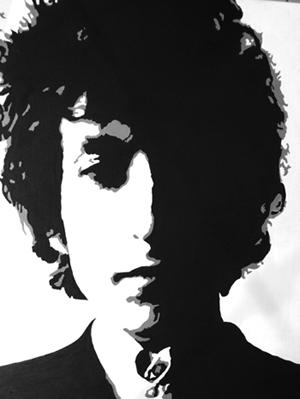
Bob Dylan
Dylan considered his stuff amazingly thoughtful and profound. He apparently put himself in the same class as Elliot and Pound. He fooled most of his audience for a long time too. The Beatles for whatever reason became the top news story of the day; for months they either were, or seemed to be, on the news every night. Seriously, one had to ask: What’s Going On?
Just as mysteriously Dylan began getting the same treatment. Now, the Beatles were selling unprecedented millions of records on both sides of the Atlantic, at one time occupying the top five spots of the Top 10. Dylan was doing diddly squat with his tortured lyrics. He wasn’t selling records in any quantities while having essentially a cult following. Now, mysteriously he began to be given the same treatment as the Beatles. Time Magazine sent a reporter to interview him on camera. Dylan imitated the Beatles by giving smart ass answers. The Time reporter took his jibes seriously. Sitting out in front of the tube my eyebrows shot up. What is this? The rest of the world went wild in their applause of the Beatle’s and Dylan’s cheekiness. God, they were giving the finger to the Greatest Generation. The latter may have crushed Elvis but these boys were getting their own back.
Maybe Dylan got the attention because he was the only American act available, to balance the relative status of Britain and the US. Perhaps in the emerging racial politics of the time he was offered as Jewish competition to the great goy champions of Elvis and the Beatles. He entered the Beatles’ life in August of ’64 when the Jewish journalist Al Aronowitz took it upon himself to introduce him to the four-in-one. The meeting was more momentous for the Beatles than Dylan.
The story goes that Dylan introduced the boys to marijuana at that meeting. More importantly he lectured Lennon-McCartney on songwriting. Dylan told them in effect that they should stop writing hit songs and write the pretentious crap he did. Now, consider, the Beatles were incredibly successful at what they wrote, Dylan couldn’t do what they did and what he did do couldn’t compete in the marketplace with the Beatles. I mean, they should have been lecturing him, but they didn’t while accepting his viewpoint at the same time. They listened to the little twerp and fell under his infuence to begin trying to imitate him.
The imitation was not very good but as the current avatar of the messiah the Beatles were industructible, as the leader, for whatever reason, John Lennon was accorded the role of messianic leader, a role that he took quite seriously.
While the Beatles had always used various pill forms of speed or amphetamines after Dylan’s introduction to pot they quickly expanded their repertoire to include Acid or LSD. The other three seem not to have been so conflicted in their personalities not becoming as drug dependent as Lennon. He claims perhaps with exaggeration, perhaps not, to have taken LSD thousands of times in the next few years. Under the influence of LSD his personality already distressed by the transition from failure to success disintegrated completely. As he says, he lost his ego totally.
If so, adrift, he was open to a strongly directed personality to manage his. This personality appeared in 1966 in the person of Yoko Ono. She quickly commandeered his personality displacing his British wife, Cynthia. It would be two years before Lennon divorced Cynthia but he left her a year earlier.
Since signing with Brian Epstein as their manager the Beatles had had an ideal artists arrangement. Trusting him they left the business details to him which allowed them full time to devote to their creative efforts. If they needed money they asked for it while all business details such as negotiations, titles and even check writing were handled by Epstein so that the Beatles had no worldly business experience. In 1967 Epstein died.
With Brian gone the Beatles were left rudderless with no one they could trust to manage their corporate and personal finances. Forming Apple as their business alter ego they attempted to manage their affairs themselves resulting in a business regime of such dissolute ineptitude that it has been referred to as The Longest Weekend.
Having attached herself to Lennon, Yoko Ono now tried to insinuate herself into the group as the ego of John Lennon. Thus the group would have been comprised of McCartney, Harrison, Starr and Lennon-Ono. A clear impossibility, the Beatles would be dissolved. As the avatar of the sixties the era had no choice but to disappear along with them.
This was now the late sixties. The world as it had been , the world that gave birth to the Beatles c. 1960 had all but disappeared. Blown away in the wind, so to speak. Just as the sixties called for the Beatles as the messiah of the period so it called forth its anti-messiah of satanism. In 1966 Time Magazine’s cover story was Is God Dead? A title that offended Bob Dylan who petulantly asked: How would you like to be talked about like that? Right.
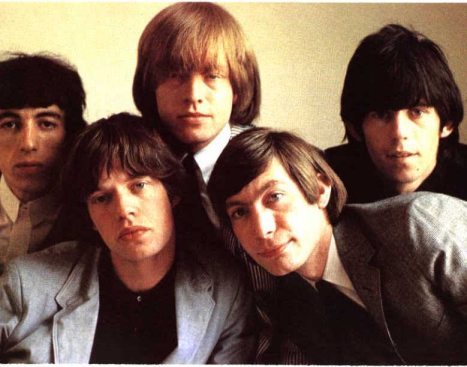
Stones With Brian
In 1966 Roman Polansky began filming a movie titled Rosemary’s Baby that actually portrayed the birth of Satan’s child. The story took place in the future home of the Onos- The Dakota Apartments. And then the Rolling Stones released their rather bizarre record, Their Satanic Majesty’s Request with its famous song Sympathy For The Devil. Right about then the Broadway musical Hair was staged that celebrated the Dawning Of The Age Of Aquarius. Synchronicity? Not a bit.
As the messiahs had abdicated it remained for the anti-messiahs the Rolling Stones to place the epitaph on the period which they did in 1969 at Altamont.
However John Lennon as the messianic figurehead was rescued by Yoko Ono. As an unsuccessful performance artist now with Lennon’s audience and financial clout to realize her wildest fantasies she, using Lennon, organized some of the most outrageous extravaganzas that catapulted she and Lennon onto the world stage playing messianic figures. The Bed-In was the most jaw dropping stunt since flag p0le sitting.

John And Yoko
Part III will consist of the career of the Ono-Lennon’s to John Lennon’s death in 1980 and perhaps a little beyond. There’s some really interesting stuff involving John Green and a possible associate, Sam Green. The latter is an interesting story.
Exhuming Bob 22: Prophet, Mystic, Poet?
December 17, 2009
Exhuming Bob 22:
Prophet, Mystic, Poet?
by
R.E. Prindle
http://www.forward.com/articles/120548/
Looking for a direction hom.
Back in the early sixties a film appeared under the title: The Man Who Shot Liberty Valence. It was a Jewish fable clothed in Western Americana not unlike Bob Dylan’s lyrics.
The story line is about how to deconstruct one legend and reconstruct it to suit one’s purposes. The gist is that once a falsehood is enshrined as legendary truth it is impossible to debunk it. This film and notion was obviously for goyish consumption. As we know from experience a whole culture with a long history can be ‘debunked’ with minimal trouble if you control the media. Thus in fifty short years Americans have gone from being the most benevolent and generous people on Earth to the most destructive self-centered Nazi types. Furthermore Americans were conditioned to believe it about themselves. ‘Why do they hate us?’
The secret was contained in The Man Who Shot Liberty Valence. One of the primary agents of that change was the prophet, mystic ans seer, the very Jewish Bob Dylan. I left off poet because at best Dylan is merely an effective lyricist.
A San Francisco Bay Area fellow, Seth Rogovoy, has written an essay on Dylan with the above title without the question mark. Stephen Hazan Arnoff who is the executive directory of New York’s 14th St. YMHA has written a review of Rogovoy which he subtitles ‘Jerimiah, Nostradamus and Allen Ginsberg all Rolled Up Into One.’ High praise indeed, if unwarranted. Just as Mr. Arnoff inflates Dylan’s significance he grossly inflates that of the pornographic so-called poet, Allen Ginsberg. Perhaps it is time to use techniques learned from ‘Liberty Valence to debunk the reputation of Dylan.
Dylan is no prophet, he is merely topical using enigmatic phrasing to give the appearance of depth. There is little actual difference between the topical material of Dylan and Phil Ochs. Mr. Arnoff improbably writes:
(Dylan’s) prophetic persona is particularly resonant in his first few albums where songs like “Blowin’ In The Wind” and “The Times They Are a-Changin'” sets the gold standard for prophecy in popular music.
Prophecy in popular music? What’s that? Actually neither song is prophetic. ‘Blowin” actually refers to the past of Dylan’s youth in Hibbing although topically it has usually been extended to represent the then current civil rights activities in the South. ‘Times’ is merely a cocky know-it-all sneer at politicians who aren’t aware that the kids are alright, on the move, have a voracious apetite to eat them up. Both songs have borrowed tunes (no crime or even sin in my estimation) and, if Rogovoy is correct lyrics cribbed from the Bible.
As Mr. Arnoff notes, Rogovoy chooses a single critical lens- Judaism- for understanding Dylan and his work. No fault in an essay, pointing out the Jewish influence in Dylan’s work. Actually Mr. Rogovoy is no innovator or pathfinder, the same material has been adequately covered by numerous investigators including myself in a series of essays.
But Mr. Arnoff also notes there are other avenues to approach the songs that Mr. Arnoff believes are equally valid: Greil Marcus explains him as a mystic raconteur of the secret history of the United States, coded thorugh traditional music while Christopher Ricks describes a master interpreter of classical Western literature and thought.’ (cough, cough)
While Greil Marcus is another good Jewish boy I hardly think he is a responsible authority on anything. He takes roughly the same approach as Mr. A.J. Weberman while the latter is vastly more entertaining. I have to combine Mr. Marcus and Mr. Ricks. While I certainly respect Dylan’s intelligence and acumen I would have to question both the breadth and depth of his education.
Dylan attended high school in Hibbing, Minnesota which is a far cry from any of the leading cultural centers of either the Western or Eastern worlds. I grew up in a slightly larger town up North than Dylan although probably not much different than Hibbing intellectually. I keenly felt the lack of intellectual opportunites when I went out into the large world.
There is a question as to whether Dylan graduated from high school while he never attended college. Immediately immersing himself in folk music he left Minnesota for NYC. There he found people with libraries of which he availed himself while boarding with them. This was a very brief period during which he could only have picked up names and impressions such as he employed in his song Desolation Row. His girl friend Suze Rotolo introduced him to more culture than he could have imagined from 1961 to 1965. This could not have been much.
During that time Dylan spent a lot of time writing songs, drinking and drugging and touring. Not a lot of opportunity to become a ‘master interpreter of classical Western literature and thought.’ I have no idea what Mr. Arnoff means by ‘classical.’ I doubt seriously if Dylan is any authority on, say, the pre-Socratics. If Mr. Ricks believes as Mr. Arnoff represents him I would have to question Professor Ricks’ qualifications for his post. There’s something wrong there.
Now, as to Mr. Marcus and his mystic raconteur of the secret history of the US. What secret history? Dylan says he studied the ante-bellum South from newspaper accounts in the archives of the NYC library. This would have been over a couple of months only. As near as I can tell he did so with an enquiring and open mind and is fully capable of making cogent observations. This however is scarcely a secret history while being only one brief period and region.
What Dylan has done is immerse himself in the songs of the US. He says that when he visited Carl Sandburg it was with the itent to discuss Sandburg’s ‘American Song Bag.’ One certainly has to respect Dylan’s song knowledge and his excellent taste. This knowledge however is well beyond Mr. Marcus’ ability to understand. He, as far as I have been able to ascertain had nil knowledge of songs and music until he joined Rolling Stone Magazine in the late sixties.
Up in Hicksville Dylan immersed himself in every kind of music, without discrimination. He was fully conversant with Hillbilly as his native music. The Carter Family was a living entity to him and not an academic study. All those now obscure names were living legends to him and not mere footnotes at the bottom of a page. Thus while Dylan’s Jewish influences are prominent, uppermost and dominant he nevertheless has a foot in both cultures. His American culture is musical however, and what sounds like ‘a secret history’ to Mr. Marcus is merely the hillbilly interpretation of ‘revenuers’ ‘white lightning’ and such. I do not see Dylan as a ‘classically’ educated man.
Mr. Arnoff displays his Jewish bigotry when he says: Messianic Judaism (or Jews for Jesus) is the weakest form of interpretation for Dylan. So far as I know no one interprets Dylan’s work through the lens of Messianic Judaism. However it is equally apparent that Dylan was interested enough to study the topic carefully. That says more for Dylan’s open mindedness than Mr. Arnoff’s narrow minded bigotry. One must be ‘open minded’ n’est-ce pas?
As Mr. Arnoff notes, Dylan always said he was ‘a song and dance man’ and I think that says as much as need be said. Anyone who has been able to entertain a significant audience nearly fifty years now has to have a serious talent. One should bear in mind though that Dylan appeals to a relatively small and well-defined audience he himself defines as ‘the abused, misused, confused, strung out ones and worse.’ This is his core constituency to which he ‘kvetches.’ Apparently English isn’t good enough for Mr. Arnoff.
Dylan’s greatest song is Positively Fourth Street which is maximum kvetching. I considered myself abused and misused when I first heard the song. The lyrics had me slavering like one of Pavlov’s dogs when he heard the dinner bell ring. But, like Pavlov’s dog there wasn’t really anything on the plate. Once I passed through that phase of my psychology I lost interest in Dylan.
While Dylan has managed to retain, recruit and entertain his audience he is far from the man who shot Liberty Valence or Jeremiah, Nostrodamus and Allen Ginsberg all rolled up into one. I’m afraid that’s one legend that will be debunked before it’s formed.
Kvetcher or not I still can’t listen to him.
A Review: Part IV, She by H. Rider Haggard
December 4, 2009
A Contribution To The
ERBzine Library Project
A Review Of
SHE
by
H. Rider Haggard
Review by R.E. Prindle
Part IV and end:
Herself Portrayed

Model of She
The idea of a twenty-two hundred year old woman patiently waiting for the reincarnation of a man she had murdered in that far off time is in itself an extraordinary concept. As an imaginative flight of fancy very likely Rider Haggard can be seen as its originator. Burroughs would borrow the notion twenty-seven years later in his The Eternal Lover when he reverses the sexes and has a cave man asleep for millennia wake to find his reincarnated woman. Since then variations on the theme have become quite common.
She, or Ayesha, was a powerful image of a woman. C.G. Jung saw her as the personification of his Anima theory. Haggard drew on many personal and historical details to create her. Ayesha was titled She-Who-Must-Be-Obeyed. As a child Haggard had a doll to which he gave that name. The doll must have represented his mother. If he invested characteristics of his mother into Ayesha then she must have been both warm and loving and cold and imperious. Over all one gets the impression that she was not particularly loving. Thus, Ayesha, while appearing to be in love with Leo/Kallicrates is nevertheless imperious, demanding and self-centered. In her only real display of afftection she kisses Leo on the forehead, as Haggard says, like a mother. As Haggard says of Meriamun in The World’s Desire, her love was not so much for her lover but an expression of her own vanity.
Haggard represents her as a living corpse in white funereal garments, completely shrouded. She has a strange accoutrement in the serpent belt with two heads facing each other. This is close to the caduceus. Perhaps Haggard had no idea of what the symbol meant in 1886 but by 1890 he had come up with an explanation. In The World’s Desire of that year Queen Meriamun of Egypt keeps something she calls the Ancient Evil in a box. The Evil is a small blob. When she warms it in her bosom it grows. World’s Desire pp. 144-45:
Thrice she breathed upon it, thrice she whispered, “Awake! Awake! Awake!”
And the first breath she breathed the Thing stirred and sparkled. The second time that she breathed it undid its shining folds and reared its head to her. The third time that she breathed it slid from her bosom to the floor, then coiled itself about her feet and grew as grows a magician’s magic tree.
Greater it grew and greater yet, and as it grew it shone like a torch in a tomb, and wound itself about the body of Meriamun, wrapping her in its fiery folds till it reached her middle. Then it reared its head on high, and from its eyes there flowed a light like the light of a flame, and lo! its face was the face of a fair woman- it was the face of Meriamun!
Now face looked on face, and eyes glared on eyes. Still as a white statue of the Gods stood Meriamun the Queen, and all about her form and in and out of her dark hair twined the flaming snake.
At length the Evil spoke- spoke with a human voice, with the voice of Meriamun, but in the dead speech of a dead people!
“Tell me my name,” it said.
“Sin is thy name,” answered Meriamun the Queen.
“Tell me whence I came.” it said again.
“From the evil within me.” answered Meriamun.
“Tell me where I go.”
“Where I go there thou goest, for I have war and thee in my breast and thou art twined about my heart.”
This quote gives an idea of what the snake belt worn by Ayesha signifies.
Of signficance while Meriamun is dealing in magic Ayesha denies all connection with the art saying she utilizes nature. She doesn’t use the word science but nature; nature would include psychology. She therefore draws on natural processes discovered but not scientific processes exposed. Thus when she kills her rival Ustane she does it by utilizing electro-magnetism, somehow using her own electro-magnetism to negate Ustane’s thus extinguishing her life force. We have then an example of tele-kinesis- action at a distance. As I’ve noted in other essays tele-kinesis was amongst an array of mental powers thought to reside in the unconscious being investigated by the Society For Psychical Research. Thus Haggard, probably through Lang, is up on the latest psychic developments.
Ursula Andress As She
The ability to kill by telekinesis places a moral burden on Ayesha. If one agrees that the use of such a power may be necessary the question arises of when it may be misused. It would seem that the killing of a sexual rival was an inappropriate use, so the warring good and evil heads of her snake belt refers to the moral dilemma Ayesha faces.
Her belt seems somewhat different than that of Queen Meriamun of The World’s Desire. The latter having accepted the aid of the Ancient Evil was committed to evil being unable to remove the belt. There seems to be an element of volition remaining to Ayesha. She is not ‘possessed.’ Of course Ayesha began her life some thousand years after Meriamun so perhaps psychology was somewhat further evolved at that time or evolved with her over her two thousand year life span.
Indeed, a topic of discussion Haggard introduces shouldn’t be dimissed lightly. That topic is the age old discussion of whether good can come from evil and evil from good. This is indeed a dilemma as bad results can arise from good intentions and vice versa. There is a serious side here.
Ayesha is pure irresistable beauty. Once she shows her face no man can resist her. She glories in this power. In The World’s Desire of four years hence Haggard will separate good and evil making Meriamun represent evil while Helen, the world’s desire, is all good.
Holly is an interesting character who may be a back hand slap at the concept of evolution. Holly also makes this the story of a beauty and a beast. Holly is described as having a low forehead with a hairline growing out of his eyebrows, further his beard and his hairline meet. He is said to have a hugely broad chest and shoulders with extra long arms, perhaps down to his knees although this is not stated. What we have in Holly then is the Wolf Man combined with King Kong. Monstrous indeed.
In contrast Leo Vincey is a Greek god, a sort of Apollo. As Ayesha is irresistable to men Leo seems likewise to be irresistable to women. Indeed, he was married to Ustane within minutes of arriving in Kor. He appears to have sincerely liked Ustane even though on sighting Ayesha’s face he too loved her. Ustane was a rival for a portion of Leo’s affections so Ayesha cut off her electrical supply.
Of several truly dramatic scenes in this spectacularly well constructed story a very dramatic one is when Leo confronts his twenty-two hundred year old incarnation 0f Kallicrates. Haggard doesn’t dwell on Leo’s understanding of this strange phenomenon although from the potsherd and his father’s letter he must have been convinced of the truth. Strangely he doesn’t ask Ayesha for an account of this earlier life, nor how it was that she came to Egypt from Yemen to interfere in his romance with Amenartas.
Haggard and Lang were aware of the early history of Yemen from whence Ayesha as a pure Semite came. She was pre-Christian, although not pre-Jewish, of some ancient Arabic religious beliefs. How she got to Egypt is never disclosed or how she came into conflict with the Egyptian princess Amenartas for Kallicrate’s affections.
Ayesha, by the way the name translates as Life, merely confronts Leo as the neo-Kallicrates without any preparation. A year or so to get to know her and become accustomed to her face might have been nice. Although, Leo was married within minutes of arrival in Kor and was apparently satisfied with his wife. He was a pretty adaptable guy.
At any rate Ayesha rushes him into immortality and while tomorrow may be a long, long time, eternity is even longer. One might want to consider a moment about a relationship of that duration. Nor does she adequately prepare Leo’s mind for the ordeal of fire that she wants him to go through to become immortal. Twenty-two hundred years of waiting had done little to improve her patience.
Haggard has put everything he has into this story. He was granted clear vision only once in his life and he took advantage of it. In later years he was frequently asked why he didn’t write another story as good as She. His reply was that such a story may only come once in a man’s lifetime. The concentration and focus probably will never return again. While Allan Quatermain, his third successive attempt to create a lost civilization was on the weak side I would argue that his last, Treasure of the Lake, comes close to She.
So, the four of them set out for the place of the fire of life. Masterful effects. High in the mountains there is a gigantic balancing rock, a huge mushroom type cap balanced on a spire. It would seems that Zane Grey was also greatly affected by She as Riders Of The Purple Sage hews very close to She. A narrow ledge of rock extends out opposite with a gap of fifteen feet. To cross this gap with high winds howling through, a plank carried by the ever patient Job has to be lowered across the gap. No mean task I’m sure, with only one chance of getting it right. Once in place, thousands of feet above the gorge each has to walk from side to side; plus they have only a few minutes for all four to get over during a single beam of light from the setting sun.
Fortunately all four make it crossing the balancing rock to descend into a cave leading to the bowels of the mountain. There an eternal flame that ensures the life of the planet rumbles by every so often. Twenty-two hundred years before Ayesha had bathed in this fire which following esoteric doctrines had burned away her gross, earthly, moral impurities making her essentially, pure spirit.
A famous incident of the process is recounted of the goddess Demeter in her travels after the abduction of her daughter Persephone by Hades. Coming to Eleusis Demeter in her form of an old crone was taken in by King Celeus and his wife Metaneira. As a reward for her kind treatment Demeter set about to make their infant son Demophon immortal. Thus each night she held him over the hearth fire to burn away his mortal impurities. Surprised one night by a startled mother, Metaneira, the process was disrupted so that Demophon retained mortal impurities and failed to attain to godhood.
In this sense then the fire that maintained the life of the Earth traveled a route through this mountain at the center of the Earth. It appeared something like Old Faithful at Yellowstone periodically. When it swept by, if one stood in the flame it burned away one’s mortal impurities leaving one, it is to be assumed, wholly Spiritual. All the materiality was gone.
Spirituality and materiality are still being discussed today. Some talk of Spirit as though it exists while the materialists aver that all so-called spirituality is a seeming effect of materiality. I am of the latter school of thought. Oneself is all there is, there is nothing more. The effect of spirituality is nothing more than a mirage created by intellect and consciousness which is entirely material. It is all reduced to psychology which is a description of material existence.
Come To Me
In Haggard’s story it is clear that Ayesha having lost her materiality to the flames is purely spiritual. This is going to cause her problems as she steps into the flames the second time.
The flame passes by while Leo dithers. Impatient for Leo to assume immortality Ayesha strips, as the flames will flame the material garments about her but not her body. As the flame comes around again Ayesha eagerly stands in its way. However having been once purified it is good for eternity. The second time is disastrous. Perhaps spiritually dessicated by the double dose Ayesha begins to wither devasted even in her death throes by her loss of beauty. Love in vain.
Job is so horrified he dies of fright leaving Leo and Holly alone.
The story for all intents is over but Haggard takes a dozen pages or so to get his heroes out of the caves and back to civilization.
Ayesha’s existence wasn’t extinguished. Her dying words were that She would return. Room left for the sequel which not surprisingly was called The Return Of She appeared in 1906.
Haggard hit the groove sharp as a knife in this incredibly well devised and executed story. One will find evidences of it strewn all through Burroughs’ corpus. Not least in his own character of La of Opar. La itself translates from the French as She, of course, so Burroughs even appropriates the name.
La is as ardent for Tarzan as She was for Leo/Kallicrates. Tarzan himself remains cold and indifferent to La throughout all four Opar stories finally abandoning her in Tarzan The Invincible.
She by Haggard is well worth three or four reads to set the story in mind and savor the wonderful and unearthly details
The End.
End of Review
A Review: Pt. III She by H. Rider Haggard
November 25, 2009
A Contribution To The
ERBzine ERB Library Project
She
by
H. Rider Haggard
Review by R.E. Prindle
Part III
The Gruesome, The Morbid AndThe Hideous
Rider Haggard was criticized severely by certain of his contemporaries for employing so many gruesome, morbid and hideous details. Indeed, ‘ She’ seems to be a study in the hideous, the gruesome and the morbid. If one concentrates on those aspects of the story one might actually question Haggard’s mental health.
Haggard himself calls attention to this morbidity. In King Solomon’s Mines he pointed out his humor with references to the Ingoldsby Legends; in She he makes a pointed reference to a Mark Tapley. I had no idea who Mark Tapley might be but thought I’d consult that most magnificent of encyclopedias, the internet. No problem. Mark Tapley was a character from Charles Dickens’ Martin Chuzzlewit. No matter how adverse the circumstances were Tapley was always cheerful and ebullient. Haggard must have thought him ridiculous. Thus he is devising a series of incidents that would bring even Mark Tapley down. Hmm. Interesting experiment.
It would seem then that Haggard was suffering from a fairly deep depression. In that sense She is sort of a horror story not too different in intent than, say, Bram Stoker’s Dracula. Indeed, at one point Ayesha explains that she rules by terror. That being the most effective way to control brutes like the Amahagger.
Certainly the storm at sea prior to entering Kor was an example of terror on the part of nature, a portent of things to come. Not least of these was the hot potting and projected cannibalism of the surviving member of the ship’s crew, Mohammed. ‘She’ had only required the safety of the Whites; as Mohammed was apparently a negrified Arab the Amahagger excluded him from the ban on Whites. An interesting example of White Skin privilege.
Their custom of killing their victims was to heat a pot red hot and turn it over on the victim’s head. There’s a gruesome and hideous enough example. You can see where Burroughs picked up his fascination for the gruesome and hideous.
The Caves of Kor are actually a city of the dead. Kor was an active civilization before Egypt existed in the fifth or sixth millennium BC. As embalming was a known practice when the Dynasties began c. 3400 the practice must have developed long before. Quite possibly it was practiced by the peoples of the Basin before the Mediterranean was flooded. In The World’s Desire Haggard mentions that the ancient Egyptians possessed writings in a precedent language. If so, how far back things like embalming go might be prodigious.
Egyptian embalming was primitive compared to that of the Korians. While Egyptian mummies became desicated the Korian process was such that the body was preserved forever in an apparent state of health. Thus bodies perhaps ten thousand years old or older had the appearance of freshness.
Now, this is positively creepy. Holly’s Amahagger attendent Bilalli while discussing Korian embalming told Holly that while he was a young man a particularly beautiful female corpse occupied the very slab on which Holly slept. Bilalli used to enter the cell and sit looking admiringly on the beautiful corpse by the hour. One day his mother caught him at it. The embalming fluid used was extremely flammable. Bilalli’s mother stood the body up and lit it. Like a huge torch the body burned down to the feet. The feet were still as good as new. Bilalli wrapped them and stored them beneath Holly’s slab. Groping around beneath the slab he brought out those ten thousand year old feet, still fresh, except for some charring at the ankles.
Haggard doesn’t stop there but goes on to emphasize the beauty of one particular foot. One wonders if perhaps George Du Maurier read She becoming entranced by the foot image thus reproducing the image in his novel Trilby when Little Billee draws Trilby’s beautiful foot on th wall. It is a thing Du Maurier would do as he inserted his literary baggage as profusely as Burroughs.
What effect this image had on Haggard’s contemporary readers may be guessed from the complaints about his gruesomeness.
In fact Haggard projects a depressed brooding evil permeating the Caves of Kor very well. This may have been caused by his and Lang’s theories of the Matriarchy. Human sacrifice was an integral part of the Matriarchal world. The sacrifices were invariably of men because women had greater economic value. When men were no longer sacrificed bulls, rams, the males of the species were substituted, the female still having greater economic value. Thus the story of Isaac and the Ram. That would be a great advance in civilization. About that time Isis ceased being the Egyptian symbol of the firmament being replaced by the female cow as the symbol of economics. Something like the kings of England sitting on the woolsack.
Depending on Haggard’s and Lang’s theories of the Matriarchy then Haggard may have been portraying a consciousness that has ceased to exist. There is always an element of misogyny in Haggard’s stories that is no longer tolerated. Then men were men and women were women instead of the attempted strange unisexuality of today. Thus the tens of miles of swamp between the Amahagger quarters and the citadel of Kor indicate the extent and quality of the Matriarchy. Swamps are the symbol of the female and the Matriarchy or, in other words, this very primitive superstitious consciousness.
The Korian swamp was haunted by mephitic vapors, evil smelling and oppressive. The ground they walked on was of uncertain solidity; it might look firm but this was only illusory as one could break through the crust. Often the litter bearers were walking through evil smelling muck up to their knees.
At one point an accident occurs and Bilalli’s litter with him in it is dumped into the slimy water. He would have drowned if Holly hadn’t leaped into the rank female waters to save him. They emerge looking something like the creature from the Black Lagoon.
It will be remembered that Holly was something of a misogynist. One may be stretching a point but even though rejecting women and marriage Holly managed to inherit a son from a man who was also a womanless widower. Haggard makes a strong contrasting point when he says that Leo was not averse to female company. The manservant, Job, is absolutely terrified of the female.
After traversing this desolate swamp of the female for days they arrive at the citadel or temple of Kor. Now, the citadel of Kor was built on an ancient lake bed that had been drained ten thousand years before. In that sense Ayesha is the same as Nimue or the Lady Of The Lake of King Arthur. Nemue lived at the bottom of a lake where she raised Lanclot who consequently was called Lancelot of the Lake.
Compare this also with Haggard’s postumously published Treasure of the Lake in which the Anima figure lives on an island in the middle of a lake in the middle of a volcanic crater. The lake of Kor was also in the middle of a crater.
When the Korian civilization was extinguished it wasn’t by invasion or other external reasons but by a monster plague something like the fourteenth century european Black Death that wiped out nearly everyone. At the resulting rate of death it wasn’t possible to embalm everyone so that tens of thousands of bodies were dumped into a huge subterranean pit.
In conducting Holly and Leo on a guided tour of Kor which was one gigantic necropolis, talk about depressing, Ayesha brings them to this pit. I quote:
Accordingly I followed (She) to a side passage opening out of the main cave, then down a great number of steps, and along an underground shaft that cannot have been less than sixty feet beneath the surface of the rock, and was ventilated by curious borings that ran upward, I do not know where. Suddenly this passage ended, and Ayesha halted, bidding the mutes return, and, as she prophesied, I saw a scene such as I was not likely to behold again. We were standing in an enormous pit, or rather on the brink of it, for it went down deeper- I do not know how much- than the level on which we stood, and was edged in with a low wall of rock. So far as I could judge, this was about the size of the space beneath the dome of St. Paul’s in London, and when the lamps were held up I saw that it was nothing but one vast charnel-house, being literally fullof thousands of human skeletons, which lay piled up in an enormous gleaming pyramid, formed by the slipping down of the bodies at the apex as others were dropped in from above. Anything more appalling than this mass of human remains of a departed race I cannot imagine, and what made it even more dreadful was that in this dry air a considerable number of bodies had become dessicated with the skin still on them, and now, fixed in every conceivable position, stared at us out of a mountain of white bones, grotesquely horrible caricatures of humanity. In my astonishment I uttered an ejaculation, and the echoes of my voice, ringing in that vaulted space, disturbed a skull which hd been accurately balanced for many thousands of years near the apex of the pile. Down it came with a run, bounding along merrily towards us, and of course bringing an avalanche of other bones after it, till at last the whole pit rattled with their movement, even as though the skeletons were rising up to greet us.
Talk about a holocaust! Imagine standing in that dimly lit space far beneath ground, in the grave itself so to speak,and viewing that. Holly was overcome and perhap Mark Tapley himself would have lost a little of his cheeriness. If that didn’t do it the ball Ayesha threw would have.
Before I move on to that though let’s take a penultimate example that might actually unsettle Mark Tapley. This is truly unsettling with truly macabre and voyeuristic soft porn details that are quite remarkable. Let me say that it is only with the fourth reading that the horrific nature of these details really began to sink in. I hope to really make this clear in the next section in which I intend to do an in depth analysis of Ayesha.
In his cell at the citadel of Kor Holly notices a cleft in the wall he hadn’t noticed before. This cleft is going to lead him to Ayesha’s sleeping room. This is not unlike King Solomon’s Mines in which upon entering the symbolic vagina they were led to the womb or treasure box. As I say Holly entered this cleft, let your imagination dwell on that, and followed a dark, dank, narrow corridor until he perceived a light.
He is looking into Ayesha’s sleeping room where in a certain deshabille, very erotic, she is addressing a covered form on a bier next to hers. This is the embalmed body of Kallicrates who she murdered twenty-two hundred years before. So she has been sleeping with this corpse for twenty-two centuries. Now, dwell on that for moment, let the horror of it sink in.
She addresses the corpse in a fairly demented way. Twenty-two hundred years of this would drive anybody nuts. Finally to the dismay of Holly she animates the body by telekinetic powers actually causing it to stand zombie like so she can kiss and caress it. A lot of necrophilia in this novel. Haggard must have been half dotty when he wrote this. Of course Kallicrates is a double of Leo so Holly has all he can do to keep from crying out. Causing the dead man to lay himself down Ayesha covers him and blows out the light.
Holly has to find his way back in the dark reminding one of innumerable passages in Burroughs where his characters have to find their way in the dark. Holly gets only so far and collapses in the tunnel. Waking he sees a light coming in from his cell allowing him to find his way back.
And then Ayesha throws her ball. If you’ve read carefully and really ingested these macabre, gruesome, and as Burroughs’ would say, hideous details they’re beginning to oppress your mind, perhaps even a mind like Mark Tapley’s.
Now Haggard trundles out the frosting. To illuminate her ball Ayesha brings out piles of ten thousand year old corpses placing them around the perimeter as human torches. Laying out a large bonfire the corpses are stacked alternately like so much cordwood and replaced as they were consumed. Remember these are as fresh looking as you or I. The Roman emperor Nero actually used live humans in the same manner. Haggard notes this in the text which I thought weakened the effect.
Ayesha seems to be aware of the effect, indeed, intended it and appears to relish the reaction.
These are the high points of these horrfic details. Minor ones are constant so that the cumulative effect leading up to the terrific images of the demise of Ayesha, temporary though it might be, is overwhelming. But about She, Ayesha, in the next part.
 I, Dynamo