Reconstruction, Tourgee And Dixon
June 9, 2008
A Review
Reconstruction:
Albion Winegar Tourgee And Thomas Dixon Jr.
by
R.E. Prindle
The conflict between the North and South is the central conflit of United States history. Whether the Civil War was fought to preserve the Union or over slavery the African issue was the central problem of the country. The aftermath of Reconstruction was and has been devastating to US history. Mark Sullivan comments the Reconstruction period in Our Times, Vol. III. He is writing c. 1930:
Hardly to this day has any unbiassed summation been made of the destruction that the North visited upon the South. Rarely has any conqueror in history been so ruthless- by comparison, the treatment of Germany by the Allies was the rebuke of a complaisant parent to a naughty child. The North, by abolishing slavery, wiped out five billion dollars’ worth of the South’s property. That was but the beginning. Abolition of slavery was the complete destruction of the South’s economic system, land in the South was made valueless. Then the North, by conferring suffrage on the negro, set the former slave in power over his recent master, and for ten years maintained him there by arms. The very aorta of civilization in the South was more near to being completely severed than historians have commonly realized. In the University of South Carolina, a State institution authority over which rested the legislature, a corn-field negro, barefooted, illiterate, sat in the chair and drew the salary of the Professor of Greek. Over a period of forty years, including war, reconstruction (ironic word!) and the aftermath of both, the lamp of education in the South was saved from complete extinction only by the devotion and patience of half a dozen men. With the other consequences went a discouragement which accepted the physical deterioration, through disease, of large portions of the rural South, as merely one detail of a fate it was useless to resist.
The excuse of the North was that Southern Whites had enslaved the African. For some reason the New England States made Southern slavery an issue although those states, as Bible pounders, were not opposed to slavery in principle. Shortly after the Civil War certain New England citizens established themselves in the Hawaiian Islands where they began to grow staple agricultural crops. Farm labor therefore became as big a problem for them as it had been in the South. They were not averse to establishng a contract labor system which was a form of wage slavery. The New Englanders, some of them churchmen, saw the Chinese as inferior coolie laborers not unlike the African. Learning from the Reconstruction African situation in the South they were reluctant to import the Chinese as permanent residents.
Thus the contracts of the Chinese specified that the Chinese return to China after the termination of their contracts. This the Chinese saw no reason to do staying on as permanent residents. Reluctant to import more Chinese the New England planters cast about for another alternative. They settled on the Japanese. Thus a ship sailed into Tokyo Bay and the Planters forcefully abducted, kidnapped, a hundred odd Japanese from Yokohama taking them back to Hawaii where they were put to work.
So we may assume that the New Englanders were not entirely sincere in their objection to Southern slavery.
In addition during the Grant administration while Reconstruction was in progress the annexation of San Domingo or Haiti was proposed. Under the French administration of the area using African slave labor San Domingo was the richest and most productive colony in the world. It could be made so again under American administration. How they proposed to farm the land without African labor remains a mystery. It could only have been achieved by some compulsive means.
As the Africans have never worked the land of this richest of areas without compulsion one would be amused to learn the proposed solution to this pressing problem of labor.
One can only conclude that as no region of the US objected to forced labor that truly the Union was the reason for the Civil War. The reason for Reconstruction has to be explained otherwise.
The next problem is the nature of the African. Nowhere in the world without an overawing show of force were the Africans docile. The history of Africa is perpetual genocidal, tribal warfare. The Africans had the very reasonable attitude that the way to treat an enemy was to stamp them flat. Exterminate them.
The attitude is apparent everywhere in Africa today most obivious at the moment in Zimbabwe and South Africa.
In Haiti at the end of the eighteenth century the small number of French planters proved unable to control the overwhelming number of Africans, the latter rising up and defeating their owners. In this action known as the San Domingo Moment the White males were exterminated to the man while the females were given the option of sex slavery or rape and death.
One might say this was race hatred but I say no. The response was no different than any other tribal conflict in Africa; the difference in Haiti being merely that the French were White.
In the US the White Planters managed the Africans by the threat of slightly superior numbers while overawing the Africans into if not total submission something very nearly so. Thus the character the North gave the Africans in the South was at complete variance with the worldwide reality.
The North took the forced submission of the African in the South that produced a seemingly submissive inoffensive, harmless type of being the actual nature of the African. Tourgee refers to Africans as ‘poor innocents.’ Northerners believed that the lack of apparent intellectual capability was due to ill treatment and the lack of opportunity for education. So the real question is who was right about the relative capability of the African to the Caucasian? The North or the South? This problem is important and has to be dealt with.
We are told that the African was first to evolve as a Homo Sapiens from the Last Hominid Predecessor. That was c. 150,000 years ago. Had the African not been disturbed by outside peoples he would be living today as he was when he evolved so long ago. Many peoples have visited sub-Saharan Africa, that is to say, Black Africa, over the last few millennia. Phoenicians and Carthaginians visited sub-Saharan Africa both overland and on voyages around the coasts. Greek traders visited the source of the Nile, identifying the Mountains of the Moon while Romans established trade routes across the Sahara. The Arabs established contact beginning in the seventh century at least while Malays from Indonesia established themselves on Madagascar while penetrating into the continent itself making settlements about the year +1000.
All influences were absorbed by the Africans without any serious changes to their intellectual or social organization. Europeans established stronger settlements in Africa ruling Africa for a hundred years or more. They have been or are being expelled from Africa while most notably in Zimbabwe and South Africa Africans are destroying any traces of European civilization and reverting to their ancestral ways. Only a liberal could deny these obvious facts.
The African capability for civilization was fixed one hundred fifty thousand years ago. The African mind is incapable of permanently adjusting to any higher level of civilization.
The Southern Planters in daily contact with Africans had this fact impressed upon them continuously. The mind is not so elastic that it can escape its evolutionary limitations.
As an example I quote Rudyard Kipling from his American Notes of 1889:
The Americans once having made them (the Africans) citizens cannot unmake them. He says, in his newspaper, they ought to be elevated by education. He is trying this; but it is like to be a long job, because black blood is more adhesive than white, and throws back with annoying persistence. When the negro gets a religion he returns directly as a hiving bee, to the first instincts of his people. Just now a wave of religion is sweeping over some of the Southern States. Up to the present two Messiahs and a Daniel have appeared and several human sacrifices have been offered up to these incarnations. The Daniel managed to get three young men, who he insisted were Shadrach, Meshach and Abednego, to walk into a blast furnace; guaranteeing non-combustion. They did not return. I have seen nothing of this kind, but I have attended a negro church. The congregation were moved by the spirit to groans and tears, and one of them danced up the aisle to the mourners bench. The motive may have been genuine. The movements of the shaken body were those of Zanzibar stick dancers, such as you see at Aden on the coal boats; and even as I watched the people, the links that bound them to the white man snapped one by one and I saw before me- the Hubsha (the Woolly One) praying to a god he did not understand. Those neatly dressed folk on the benches, the gray-headed elder by the window, were savages- neither more nor less. What will the American do with the negro? The South will not consort with him….The North is every year less and less in need of his services. And yet he will not disappear. His friends will urge that he is as good as a white man. His enemies…it is not good to be a negro in the land of the free and the home of the brave.
Of course the Liberal will say that Kipling does not observe accurately and that HE is a ‘bigot.’ Nevertheless if one looks at locales in the United States where the African dominates such as Mississippi, Detroit, Pontiac, Flint, Saginaw, Chicago, New Orleans, what does he find? A replica of Lagos or Zimbabwe. A return to ancestral ways.
I’m not one to quote IQ scores because they only prove what is obvious to the naked eye. Genetic studies prove that as Homo Sapiens continues to evolve, the African who, as a species, is fully evolved, will only continue to fall further and further behind. This may not be his fault but it remains a fact.
To counter these facts the Liberal merely says that a hundred fifty thousand years isn’t enough time to make an accurate assessment; we must be patient.
Thus when the Civil War ended and Reconstruction began Albion Winegar Tourgee went South with his prejudices as a carpetbagger to try to place the African over the Southern White.
Tourgee was an honest man who sincerely believed that he was doing right by punishing the White while trying to impose the African on him. Tourgee moved back North after Reconstruction and took up his pen to become a successful novelist. Among his works were two novels recounting his experiences and opinions during Reconstruction. The novels are: A Fool’s Errand by One Of The Fools and Bricks Without Straw. They are both reasonably good novels although the latter is more or less a strike off of the former but for my tastes a better story and novel.
It is in A Fool’s Errand that Tourgee tackles the problem more head on. Completely disrgarding the character of the African in Africa or Haiti he takes the paternalistic Liberal approach that he is dealing with innocent little children who need his protection. This attitude is actually only a variant on the Southern. His is a good Northern Charlie compared to the bad Southern Charlie.
His anlysis of the Southern attitude is quite accurate and well thought out; his solutions are faulty. A Fool’s Errand is well worth reading to contrast the two viewpoints. His own pretensions of innocence and superiority to the Souterners is revolting. He should have known of Grant’s plans to annex Haiti that should have given him an intimation of the vulnerability of Northern pretensions. I’m sure he probably wasn’t aware of Puritan doings in Hawaii and Japan.
Slavery is detestable, I myself have no problems with that although firms like Nestle’s and Starbuck’s are accused of benefiting from slave labor in the chocolate and coffee businesses. That means that you and I enjoy the fruits of slave labor with our coffee and chocolate. Those big screen TVs we all covet so much are made by slave labor in China. Tourgee if he had thought about it would have noticed that the African franchise he was attempting to force on Southern Whites was denied Africans in his home State of Michigan and nearly universally among all parts of the Northland and West. Kipling writing a few years later than Tourgee was speaking accurately.
Tourgee was indignant at what, as he puts it, the Southern Planter had done to the African. He says quite plainly that there was no punishment too severe for the Southern White nor should it end quickly. He virtually proclaims the need to boil the Southern White in oil. This seems extreme in a world where slavery was rife most especially on the African continent. He might have put just a little of the blame on those greedy African chiefs who sold their people into bondage for filthy lucre.
He might also have noted the Israelite Solomon who when he ran short of money to finance his temple to his god gathered together numbers of His people and sold them into slavery to get on with the building of the House Of The Lord.
Tourgee’s novels went unanswered while selling well for a decade or two. But then Thomas Dixon Jr. took up the cudgels on the behalf of the South and told their version of Reconstruction in his trilogy of The Leopard’s Spots, The Clansman and The Traitor. Of course Liberals who control the seminaries of their religious system sometimes referred to as the American University System, dismiss Dixon as a stone cold bigot and ‘racist.’ One suspects without ever having read him which is of no consquence as they pay no attention to the other side of the story once their minds are made up.
As Dixon points out, those Puritan sea captains made a fortune or two out of the slave trade, the profits of which returned North to finance Puritan bigotry and possibly large bequests to Harvard University. Puritan cotton mills processed the cheap slave produced crop without worrying too much about its provenance. Dixon gives numerous examples of the hypocrisy of the New Englanders.
Slavery of any sort past or present cannot be justified but it was that very cotton that caused slavery to blossom and extend into Alabama and Mississippi. The institution then ran into the unique State of Louisiana.
Louisiana and more specifically New Orleans had a history dating back to the French Caribbean plantations, in fact, New Orleans was part of the French circle but a remote outpost in relation to the British colonies of the East Coast. As on Haiti and other French islands freed Africans were allowed full citizenship privileges including owning slaves. Thus, as the American settlers moved West after 1793 and the invention of the cotton gin becoming mere frontiersmen the closer they got to Louisiana, where the African, French and mixed races already were. Louisiana Africans, as in Haiti, were slave owners.
As W.E.B. Du Bois points out but gives no reasons for it, slavery in Louisiana where Africans were influential was of a different character than in the East. The East was as benevolent a form of slavery as is possible while in Louisiana as Du Bois himself points out the African owners preferred to work slaves to death, fhen buy replacements. This in turn created a market for slave breeders who arose in Kentucky.
The breeding of Africans for slaves was especially repellent to American sensibilities but had slavery continued public opinion would have gotten used to it as it gets used to every other perversion. It can however be no coincidence that slave breeding occurred just up river from the slave consuming States of Mississippi and Louisiana.
I mention this matter only to show that the subject of slavery is not monolithic but much more complex than normally discussed.
Both Tourgee and Dixon write about affairs in North Carolina on the East Coast. This differentiation should not go unnoticed. I suspect that a very large proportion of the illegal importation of slaves that occurred after 1800 was done through ports in Louisiana and Texas far from the central authority. If that should be true then the character of slaves fresh from Africa between, say, 1850 and 1860 would be much different than those Tourgee was familiar on the settled East Coast.
Tourgee, convinced that the Africans were gentle, innocent people, was blind to the outrages committed by both carpetbaggers and the more truculent Africans many of whom wore the Union uniform with the full backing of the Federal government which was bent on persecuting Whites.
Dixon then whose credibility the Liberals wish to destroy writing twenty years or so after Tourgee and probably in reaction to him wishes to give the Southern side of the Reconstruction story. He is much more realistic and sympathetic than Tourgee. The latter writes both his novels with nary a reference to the radical reconstruction of the insane abolitionists in Congress like Stevens and Stanton who quite literally wished to see Southern Whites exterminated ‘root and branch’ a la the San Domingo Moment and the entire South given over to the Africans. As Tourgee himself said, they believed there was no punishment too severe for the Whites.
One need not wonder how Tourgee would view the White genocide occurring in Zimbabwe and South Africa today as his current Liberal counterparts applaud lustily. In that light one shudders to think what will happen in the US if these Liberal assassins are not displaced before they seize the government in the Stalinist style and initiate the genocide of Whites they are currently advocating which one assumes will include themselves.
To understand the problem, the attitude among both Liberals and Africans from the Civil War/Reconstruction period that persist through today a reading of Tourgee, especially A Fool’s Errand, and Thomas Dixon would be some time well spent.
Finis
Our Times, Mark Sullivan And Edgar Rice Burroughs
June 6, 2008
Our Times, Mark Sullivan And Edgar Rice Burroughs
by
R.E. Prindle
Mark Sullivan doesn’t show up in ERB’s library although one wonders why not. Sullivan’s Our Times is a history of America from 1900-1925 as it might have been gleaned from newspapers. This is history as seen from the point of view of newspaper readers. Sullivan himself was a journalist. He was also almost an exact contemporary of Burroughs, born in 1874 died in 1952, so we can be can be certain that Burroughs was infuenced by all the events that Sullivan cherishes. Cherishes is the right word because Sullivan is also writing his own intellectual biography through his perception of the world he lived in. These events formed the warp and woof of his life. A life he obviously loved.
He was present at many of the events while knowing such men as Teddy Rooselt reasonably well. Others he was able to interview and failing that, as many of these participant in some really astounding events were still alive as he began writing Our Times in the twenties, he was able to get written impressions from such as Orville Wright and Thomas Edison among a great many others. Altogether the six volumes of Our Times are a unique, vastly interesting, entertaining and altogether charming record of the times. Of course Sullivan would have had a more intimate knowledge of matters than mere newspaper readers but these are the stories Burroughs saw, observed and experienced hence forming the warp and woof of his own life.
We are fortunate then to have a record that actually forms the background of ERB’s life as he might have seen it as selected and lovingly recounted by Sullivan.
Sullivan gives a good background to race relations that throws light on how Burroughs himself perceived them. At least from 1900 to 1920 the lingering effects of the Civil War and Reconstruction were quite strong heavily influencing if not dominating the thought of the times. There was a strong party that wanted to go on punishing Southeners both as rebels and as former slave owners. On the other hand there was also a strong party that wanted to reconcile the Whites of North and South healing the rift and bringing the two factions together into one nation. The former might be called the Tourgee school and the latter the Dixon school.
Sullivan was of the latter group as well as Burroughs and their hero Theodore Roosevelt. Sullivan recounts how Roosevelt worked very hard to bring the Southeners back into a respectable political condition only to blow his efforts away by inviting a Negro to lunch with him in the White House. That Negro was Booker T. Washington.
It was against this backdrop that Thomas Dixon was writing his Reconstruction novels The Leopard’s Spots, The Clansman and The Traitor. His trilogy was made was made into the movie The Birth Of A Nation in 1915. The movie was meant to be a seal on the healing process. From the inception of the United States the country was divided into two nations. The North and the South with two approaches to civilization. The Civil War began over the separation of those two civilizations while the subsequent period was devoted to uniting the two approaches into one people hence the title of the movie- The Birth Of A Nation. In other words Southern and Northern Whites combined into one people with one ideology.
The clinker in the coal pile was the African. No matter the relation between the two White peoples the problem was what to do about the African. Thus Sullivan, Burroughs and Roosevelt while wishing to unite the Northeners and Southeners had still to deal with the Africans. Obviously the introduction of the Africans into the equation as social equals was an impossibility for all concerned. They weren’t wanted.
Booker Washington’s response to the issue was not to try to socialize with the Whites but to live independent lives while trying to equal the White man’s achievement. The approach was correct but impossible for the Africans.
There was no racial animosity as such on the part of Sullivan, Burroughs and Roosevelt but there was no solution to the racial differences then as there are none now. Somewhat presciently Burroughs in his Martian trilogy had the Black First Born attack and demolish the White citadel thus conquering and eliminating them. This is along the lines of what is happening today where White males have been legally emasculated while White females are encouraged to seek Black males. Thus potentially without violence genocide would be committed on the Whites.
What was clear to all participants was that Whites and Blacks were not of equal capabilities. Whatever Sullivan and Roosevelt may have thought it is clear that Burroughs believed that Africans were not as evolutionarily developed as Whites.
From 1900 to 1920 this was the prevailing attitude in the country but then began to change as immigration changes began to disintegrate the social fabric. Circa 1900 the conflict was three way between the Liberals, the Reconcilers and the Africans being manageable to the Africans disadvantage. Just before 1920 the great racial organizations of the of the Jews – ADL and AJC-, the Africans- the NAACP-, the Italians- the Mafia- and the Whites- the second Ku Klux Klan- took shape that managed to spinter the forces along several racial lines with all except the KKK working against the Whites. Thus post-war America and post-war Burroughs developed in a different way than The Birth Of A Nation proposed.
Sullivan also lovingly chronicles the rise of popular music that began to take definite shape in the last years of the nineteenth century and the first two decades of the twentieth as Tin Pan Alley came into existence. While Emma was trained as a formal singer ERB loved the pop tunes. He even went so far as to take a portable record player on their cross country trip in 1916. Of course electricity was not needed to play records as the players were wind up. The amplification was minimal as the needle translates the grooves through a large bell or horn. ERB’s record tastes were somewhat along the lines of his interest in boxing. Emma, I am sure, would have called his tastes vulgar.
Sullivan gives great coverage of the heavy weight boxing championship of the African, Jack Johnson. Johnson’s victory was one of the most traumatic events of the first two decades for White psychology. Burroughs himself was deeply chagrined resulting in the boxing story of The Mucker. The Mucker, Billy Byrne, became in essence a literary Great White Hope.
There is no indication that I have found that Burroughs read Our Times although Only Yesterday by Frederick Lewis Allen published near the same time dealing with the Twenties in the same way as Sullivan is found in his library. So, the approach was interesting to Burroughs and in some ways he also incorporated a lot of current events into his writing. Read between the lines his is a history of his times. Nearly every story can be related to something or things happening in his society. This approach goes back to his earliest writing long before Sullivan conceived Our Times.
Certainly ERB would have known of both Sullivan and Our Times. As an inveterate magazine and newspaper reader there is probably very little that escaped ERB’s notice.
The point of this essay is to recommend Our Times as background to the events that would have had great influence on Burroughs both before he began writing and as he wrote incorporating events such as Jack Johnson or the Mexican scare of 1915 and Pancho Villa into his writing.
Not only will the volumes of Our Times provide a social and political backdrop to ERB’s development but they will be a very enjoyable read with a lot of interesting pictures and cartoons to make the pages turn especially fast.
Part 7, Tarzan And The Lion Man: A Review
May 20, 2008
A Review
Themes And Variations
The Tarzan Novels Of Edgar Rice Burroughs
#18, Tarzan And The Lion Man
Part 7 of 10 Parts
by
R.E. Prindle
First published on the ezine, ERBzine

The Storyteller
The City Of God
7 a.
The first to the Falls, Rhonda was then spotted from the plateau by some of the Apes of God.

The Reviewer
Now begins the story within the story. A long short story or novelette that is as fine as anything in Fantasy or Science Fiction. This story is the eighteen caret ruby in the diadem of the Tarzan series. That this story should have gone unrecognized for over seventy years is incredible.
Not only is it objectively stunning but the subjective richness is beyond measure. Just as some background on the number of influences on the story let us begin with two, both of which are interconnected in ERB’s mind.
The novel by Mary Shelley, Frankenstein, had a profound effect on ERB’s mind. He apparently read it early which is to say before 1900. The possibility of creating life had interested him from the beginning of his corpus while references to it are interspersed throughout. One of the greatest of his creations, the great physician and scientist Dr. Ras Thavas, will succeed in creating life five years hence in The Synthetic Men Of Mars but will botch the job terribly.
In this story Burroughs’ character, God, doesn’t create life but he manipulates genes to create a whole new species. Mary Shelley wrote Frankenstein in 1818 and in 1931 Universal made the definitive movie. That was two years before Burroughs wrote Lion Man so it is reasonable to assume the movie had an effect on him.
IMDb provides a quote from the movie that may have inspired ERB; I don’t think there is any doubt that he saw this seminal horror film.
Henry Frankenstein: Look! It’s moving. It’s alive. It’s alive….It’s alive, it’s moving, etc.
Victory Moritz: Henry- in the name of god!
Henry Frankenstein: Oh, in the name of God! Now I know what it feels like to be God!
Frankenstein's Monster

The 1931 Frankenstein is stil an overwhelming experience to watch over seventy years later. For the audiences of 1931 it must have been overpowering. The fabulous castle of Dr. Frankenstein was surely an inspiration for the castle of Burroughs’ God. What Burroughs did with the inspiration is as astonishing as both the Shelley original and the movie.
In the news also at the time for over a period of a decade or more was the spectacular career of John R. ‘Goat Glands’ Brinkley. This is an astonishing story. I rely mainly on two accounts: Vishwas Gatitonde’s excellent article “Magic Men’ in BB New Series #59 and the account in Wlofman Jack’s autobiography. Wolfman Jack’s autobiography slipped by unnoticed but is one of the great autobiographies of the second half of the twentieth century, probably the twentieth century and possibly of all time.
Also see on the internet:
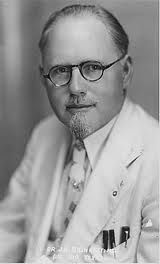
Dr. John R. Brinkley- A Story You Should Know
Grift, Goats and Gonads by Scott McLemee
Kansas State Historical Papers- John R. Brinkley
Border Radio Quackery by Gene Fowler and Bill Crawford
The Goat Gland Doctor by Joe Schwarcz, PH.D
The medical practices of God involve gland transplants along with genetic implanting or splicing. Over the years based on a foundation of Frankenstein ERB had built up a magnificent fantastical scientific edifice of life creation based on Evolution.
There can be no doubt that he read and thought about the subject a great deal. He was very well informed on evolutionary matters. He was a well educated, thoughtful, intelligent man contrary to nearly every opinion about him. His ideas as presented in Lion Man are probably as far as he could take them based on the knowledge of his time. The discovery of DNA was only a little over a decade away, actually made a few years before he died. One wonders what he would have made of it. Even then ERB’s notion of ‘germ cells’ with their indestructability contains the essence of DNA so ERB was on the right track in his thinking. I’m going to handle this out of order as the ideas explain what follows better.
ERB was familiar with the use of cannibalism to ingest certain qualities of slain warriors. Thus it was thought that to eat the brains of especially intelligent people transmitted that intelligence to oneself. To eat the flesh of a brave man made oneself also brave, etc.
From there to cellular therapy is a short step. Even though there was probably no one who believed in the physical benefits of human cannibalism this side of Africa when it came to animals parts intelligent men threw common sense out the window.
Cellular Therapy arose at the end of the nineteenth century. Joe Schwarcz explains:
Charles-Edouard Brown-Sequard, a noted French physiologist, had shocked the medical community by injecting himself with the crushed testicles of young dogs and gunea pigs. Afterwards he claimed that he had regained the physical stamina and intellectual vigor of his youth. Many men availed themselves of ‘La Methode Sequardienne’, but once the placebo effect was filtered out little remained. In Vienna physiologist Eugen Steinach proposed that youthful vitality could be restored by increasing levels of testosterone. the easiet way to do this, Steinach said, was through vasectomy. Sperm production wasted testosterone, and if the channel leading from the testes to the ejaculatory duct were tied off, then blood levels of testosterone would rise. Brinkley may also have heard of the work of Serge Vorenoff, a French doctor who was stirring u a storm of controversy with his experimental gland transplants. Vorenof had been a physician in the court of the King of Egypt, and there he had spent a great deal of time treating the court eunuchs, who suffered from a variety of illnesses. He hyposthesized that maintaining active genital glands was the secret of health. As proof, he cited his experiments with an aging ram into which he transplanted the testicles of young lamb. the ram’s wool got thicker, and his sexual vigor returned. Voreneff then went on to transplant bits of monkey testes into aging men; he claimed success, although he could offer no scientific validation of his claim. In America the stage was set for the meteoric rise of J.R. Brinkley.
Brinkley began to transplant goat glands into the testicles of his patients. As he began his career in the early 1920s radio made its appearance as a commercial entity. On the qui vive Brinkley realized its potential to increase his business and spread his gospel. He bought the first radio station in Kansas in 1923, his practice was in Melford, His call leters were KFKB- Kansas First-Kansas Best- as bold a claim as his medical ones. He was actually a fine broadcaster transmitting Country Music, weather, farm reports and other items of interest as well as infomercials for his medical practice. This notoriety brought the AMA and government down on him. By 1930 he had had both his medical and broadcasting licenses revoked.
Now, here’s where the man showed his innovative brilliance. This really got him attention. Nothing daunted he moved down to fabled Del Rio, Texas, Brinkley created the fable, across the Rio Grande from Villa Acuna. His radio station in Kansas was small, a mere 1000 watts, although probably non-directional.
In Mexico without US regulations he was able to build a boombox of 75,000 to 100,000 non-directional watts. This was later incresed, if this is believable, to 500,000 watts and tahen to1,000,000 watts according to Fowler and Crawford who really should know.

Clap For The Wolfman
Alright. When I grew up in Michigan in the 1950s I could clearly pick up the successor Del Rio station after dark when its power was only 250,000 watts. Wolfman Jack who worked the station tells an amusing story of his arrival. Driving through the desert to the transmitter he noted that all the cars parked there had left their headlights on. This mystified him but then he learned that the wattage was so powerful that headlights glowed in consequence. The air crackled around him. At a half million and a million watts people must have levitated.
So, Dr. Brinkley was much in the news all these years so that ERB as Gaitonde suggests couldn’t have missed him. While in our time there is no reason to mention La Methode Sequardienne yet with Brinkley being reviled it is quite possible ERB came across a discussion of cellular therapy in his reading which did mention these earlier experiments.
ERB has God, a formerly handsome Englishman, create a hybrid hominid between a gorilla and a human. God himself has regressed being a hybrid human/gorilla. p. 133:
“What is this strange purpose we are to serve?” asked Rhonda.
“It is purely scientific; but it is a long story and I shall have to start at the beginning,” explained God.
In the beginning. God appears to have been a medical student back in England with a strong interest in biology. p. 134:
“I had always been intrigued by Lamarck’s investigations and later by Darwin’s. They were on the right track, but they did not go far enough; then shortly after my graduation, I was traveling in Austria when I met a priest at Brunn who was working along lines similar to mine. His name was Mendel. We exchanged ideas. He was the only man in the world who could appreciate me, but he couldn’t go all the way with me. I got some help from him; but doubtless, he got more from me; though I never heard anything more about him before I left England.”
ERB gives us a fair amount of information here. He is familiar with the Frenchman Lamarck of the eighteenth century who centered on heridity. A red flag goes up on Darwin because if God left England in 1859 he would have known nothing of Darwin who published that year. In any event while Darwin’s Origin Of Species sheds light on the mechanics of the variations among a species I can’t find any evidence of how species themselves evolve. ERB is also familiar with the genetics of the monk, not priest, Gregor Mendel, who published in 1866 sending a copy to Darwin which the latter dismissed as irrelevant. However, Burroughs through God seems to have taken Darwin less seriously than Mendel.
He imples that Mendel was on the right track with his peas but that following the same line of reasoning God went well beyond him which indeed he did. Mendel was disregarded in 1866, his revival beginning in the year 1900. So Burroughs in 1930 is keeping up his reading.
Burroughs then goes on to explain God’s theory of heredity. His theory is not all that bad. It shows Burroughs obviously doing some reading and thinking on the subject. p. 134:
“In 1857 I felt that I had practically solved the myster of heredity, and in that year I published a monograph on the subject. I will explain the essence of my discoveries in as simple language as possible, so that you may understand the purpose you are to serve.
“Briefly, there are two types of cells we inherit from our parents- body cells and germ cells. these cells are composed of chromosomes containing genes- a separate gene for each mental and physical characteristic. The body cells, dividing and multiplying, changing, growing, determine the sort of individual we are to be; the germ cells remaining practically unchanged from our conception, determine what characteristics our progeny will inherit, through us, from our progentors and from us.
“I determined that heredity could be controlled through the transference of these genes from one individual to another. I learned that these genes never die; they are abosolutely indestructible- the basis of life on earth, the promise of immortality through all eternity.
It appears that ERB’s main concern is heredity and indeed genealogy was important to him. While his information is a clumsy account compared to what has been learned since then, given the times ERB was quite advanced. He doesn’t have the handle on DNA which is a decade or so in the future, Watson and Crick published in 1947, but in the germ cells he’s on the track of the right idea. The notion of the body cells is, of course, superfluous.
But now God runs up against a brick wall when he publishes his theory in 1857. Remember Mendel’s discoveries were still eight years in the future while so far ahead of their time that they will be disregarded for thirty-four years.
I don’t know what horror films have been released by this time, Dracula and Frankenstein for sure, but here the plot seems very familiar, possible Burke and Hareish. Unable to proceed in a legal manner because of society’s obtuseness God turns to criminal means, but quite novel crime.
As he has detemined that germ cells are immortal he raids the tombs of Westminster Abbey extracting germ cells from Henry VIII and his court and entourage. Thus he has a little time capsule when he is discovered and flees England to avoid blackmail. He decides to conduct his experiments on gorillas in Africa. He finds the greatest concetration of gorillas in Africa, and hence on earth, in the valleyof diamonds. In something like seventy years he converts pure gorillas into a hybrid of gorillas and humans capable of speech and human cognition. They build his magnificent City of God for him which must have been quite new when Tarzan arrived.
As they are bred from the genes of medieval Englishmen the effects of Lamarckian heredity are evident as they speak a medieval form of English and replicate the City called London after its medieval progenitor. Following Burroughs’ earlier thought in Opar the gorillas accept only beings born in gorilla form with human attributes. Sports and mutations are expelled. the other are, of course, the result of Mendelian genetics that are beings with odd combination of genes.
God was born in 1833, the same year as Burroughs’ father, thus in 1933 he is one hundred one years old. Some forty years back or so as he realized he was aging so he decided to splice in the body cells of young gorillas in a form of cellular therapy to rejuvenate himself. This worked well in preserving his youth but unfortunately the more gorilla body cells he spliced in the more gorilla-like he became, so that when Tarzan and Rhonda meet him he is a grotesque hybrid, more intellignet than the gorilla hybrids, but reverting rapidly to pure gorilla. Serious problem.
God is very pleased to capture two such fine looking human specimens as Tarzan and Rhonda because by splicing in their body cells he will be able to resume his human shape in some style.
So Burroughs has been developing his ideas in a creditable scientific way. While it’s true his actual science is speculative he is employing some fairly sound reasoning on the matter that may not have been too dissimilar from the tack taken by Stalin’s scientists, while creating a human-ape hybrid has apparently been a timeless fascination. It is said that our own scientists have succeeded in actually creating a chimp-human hybrid but that the specimens have been destroyed. I haven’t any confirmed proof that such has been done but rumors are around.
Having given a reasonable scientific explanation of the gorilla hybrids and God’s purpose for Tarzan and Rhonda, Burroughs with his usual ghoulish delight introduces his favorite topic of cannibalism. He informs the two that after satisfying his need for body cells he intends to eat them thus imbibing their characteristics. He also says that he will extract several glands from Rhonda for some special purpose.
I’m not exactly clear on what cannibalism meant to ERB. It seems he associates it with his father who was particulary hard on Burroughs in his youth which ERB may have interpreted as being eaten alive by his father. As we have God, cannibalism and his father associated here his father may be the reason for the recurring reference to cannibalism is his work.
The female glands recur again in Tarzan’s Quest where the Kavuru chief Kavandavanda requires female glands for his immortality pills and Vishwas Gaitonde finds the subject mentioned again in Tarzan The Magnificent.
So when Rhonda arrives at the Falls and is spotted from above by the seeming gorillas, she is actually spotted by a clone of the real fifteenth century Lord Buckingham in his gorilla guise.
Now begins a series of astonishments, jokes and twists such as are found in few novels. As I mentioned, today much of this is old hat, but in 1933 this was startling fresh and new. At this point we are unaware of the hybrid nature of the gorillas. The following passage then was not only startling to Rhonda but to us. p. 94:
(Rhonda) felt very small and alone and tired. With a sigh she sat down on a rounded boulder and leaned against another piled behind it. All her remaining strength seemed to have gone from her. She closed her eyes wearily, and two tears rolled down her cheeks. Perhaps she dozed, but she was startled into wakefulness by a voice speaking near her. At first she thought she was dreaming and did not open her eyes.
“She is alone,” the voice said. “We will take her to God- he will be pleased.”
it was an English voice, or at least the accent was English, but the tones were gruff and deep and guttural. The strange words convinced her she was dreaming. She opened her eyes, and shrank back with a little scream of terror. Standing close to her were two gorillas, or such she thought them to be until one of them opened his mouth and spoke.
“Come with us,” it said; “we are going to take you to God;” then it reached out a mighty, hairy hand and seized her.
There’s a shocking opener to the twilight zone between R2 and R3 as ERB prepares the curiosity of the reader for what is perhaps the most amazing story he ever told.
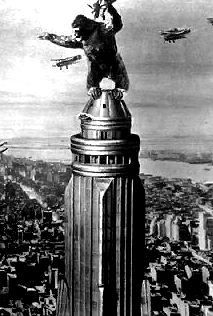
King Kong
Rhonda, physically and emotionally exhausted by the terrific events of the past few days, slips into a trance in the middle of Africa only to be brought out of it by voices speaking Enalish saying they are taking her to God. What can that possibly mean? When she opens her eyes she sees two gorillas are doing the speaking.
That’s something else, isn’t it? Had they been on the screen could they have competed with King Kong that was released in that year of 1933? Out of King Kong came 1949’s Mighty Joe Young while the public’s fascination with gorillas continued until Planet Of The Apes which, if it doesn’t owe anything to Burroughs’ story, develops the theme ad absurdam. Kong, Young and Planet Of The Apes, Stalin’s experiments all owe their origins to the Tarzan oeuvre.
Burroughs raises the theme to heights that have never been surpassed. Combining the human gorillas with the City of God was incomparable genius.
With the background clear let’s take a leap into the future.
The City Of God
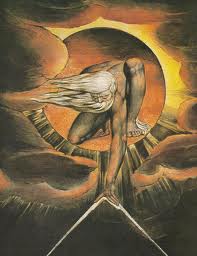
God At Work
7 b.
The whole thing seemed like a hideous and grotesque nightmare,
yet it was so real that she couldn’t know whether or not
she was dreaming.
Lion Man p. 95
In taking the ‘germ cells’ of individuals from the time of Henry VIII, as the cells were cloned with those of the gorillas the hybrids cloned the environment they knew. While clones have no mermory of a previous existence, in the popular imagination they do. Thus in the paranoid classic movie The Boys From Brazil of 1978 the number of clones of Adolf Hitler all exhibited the supposed conditioned responses of the original which they could not have experienced themselves.
At the same time ERB cleverly replicates the political situation between God, Church and Henry VIII. When Rhonda was captured, two gorillas named the Dukes of Buckingham and Suffolk quarrel over whether she is to be taken to Henry VIII or God. As we still have no idea of what is going on we are as mystified as Rhonda.
And then as Rhonda tries to order her bobbled brain she realized she could communicate with these improbably English speaking apes. p. 96:
Now she had an instant in which to think clearly, and with it came the realization that she had the means of communicating with her captors.
‘Who are you?” she damanded. “And why have you made me a prisoner?”
‘The two turned suddenly upon her. She thought their faces denoted surprise.
“She speaks English!” exclained one of them.
There’s a neat turnabout similar to when Tarzan addresses Buckingham in Mangani and the gorilla answers him in English. The gorilla exclaims, “She speaks English.”
Then follows an explanation of God, Henry VIII and Cranmer that only succeeds in confusing Rhonda further as she seems to be in some costume play in which for some inexplicable reason actors clad as gorillas are acting out a play about Henry VIII. She pinches herself to no avail. She is awake. This isn’t theatre, although Hamlet soon would be played in Nazi uniforms which is just about as ridiculous.
The gorillas take her to Henry VIII where we will leave her until she is joined by Tarzan.
While Rhonda escaped theArabs Naomi had been recaptured. In company with the Arabs she is brought to the canyon that leads to an easy ascent of the plateau according to the map. As the ascent becomes steep they leave the horses with Eyad going ahead on foot. Awaiting them at the crest is Stalin’s dream corps. Throughout the oeuvre one is always amazed at the disregard for their own well being the apes exhibit. They charge in story after story with complete disregard for their own well being. Always a signficant portion are left on the field of battle but the survivors never complain while Tarzan complacently accepts their sacrifice as his due.
So here, barehanded against the Arab firearms the gorillas launch a wave attack reminiscent of the Chinese in Korea that doesn’t stop until all the Arabs are dead. No regard at all for casualities. No wonder Stalin thought Burroughs was on to something. While the apes perform as they have always performed in Tarzan stories the difference here is that these are not mere apes but hybrids with human intelligence. If Burroughs was aware of Stalin’s experiments was he laughing at the Great Commissar? Is this battle a reference to Stalin? One can’t be positive of course but I am sure that the character of God-the formerly handsome Englishman- is partially based on H.G. Wells who was associated with Stalin.
Naomi was with the Arabs. She is captured by Buckingham who asks her how she got away from God; she is identical to Rhonda so Buckingham naturally confused her for the latter. The Apes sense of smell was not as developed as Tarzan’s. I’m sure the Big Bwana would have smelled the difference immediately.
ERB is now dealing with his sexual problems. Of the three women involved with the City of God- Naomi, Rhonda and Balza, it is necessary to sort out which woman represents what to ERB. As Naomi is weak and vacillating she obviously represents Emma. Rhonda who is strong and self-willed seems to represent ERB’s Anima ideal or in other words, La of Opar. La disappears from the oeuvre after Tarzan The Invincible of 1930 but as Tarzan and Rhonda in God’s prison replicate Tarzan and La in the Lion’s den of Invincible it seems probable that ERB has transported La from the fantasy world of Opar to the mere imaginary world of the movies. This leaves Balza- The Golden Girl- who probably represents Florence, but we will deal with her in the appropriate place.
ERB has now gotten the two women, the Arabs and Tarzan to the Falls. Orman, West and the safari are assembling at the base of the Falls so, having dissolved his story after the Bansuto attack ERB has now reintegrated it.
After a series of adventures during which Buckingham kills Suffolk, Tarzan appears to rescue Naomi killing Buckingham. At this point in Burroughs’ psychology he assumes the identity of his ordinary self and that of Tarzan into one being. As the movie people have never seen Tarzan they assume that he is Stanley Obroski his identical twin. Tarzan does not correct anyone but allows them to believe he is Stanley.
As I perceive it then ERB has now deluded himself into believing that he is Tarzan. Those who know him still perceive him as Ed Burroughs. He has no choice but to let them believe that because if he attempted to impose his delusion on them he might have been committed. Thus for a period of about five to six years from 1934 to 1939-40 Burroughs perceives himself as Tarzan but capitulates in Tarzan And The Madman giving up his illusion of being the Big Bwana. In Lion Man he describes Tarzan as a madman so the two novels are linked by the concept of madness.
After writing Madman Burroughs left California for Hawaii where he forced Florence away from him. WWII came along which saved him from himself. After the war he went back to LA to die. It is interesting that he didn’t choose to live in Tarzana but bought a house in Encino that backed against the Promised Land. thus like Moses, with whom there was a connection made in Tarzan Of The Apes, ERB was destined to view the Promised Land but not enter it.
In Lion Man he is flush with the hope of being able to live out his fantasy. He is now a few months from abandoning Emma so symbolically he returns Naomi to the safari at the Falls from whence she disappears from the story.
Only Rhonda and Balza will figure in the rest of the story. Emma is no more although Jane will appear again in Quest probably as Emma’s replacement Florence. In Magnificent Florence is mentioned only anonymously as Tarzan’s ‘wife.’ ERB is definitely struggling.
Having delivered Naomi to the safari Tarzan then reascends the plateau in search of Rhonda and the City of God.
The City Of God
7 c.
Every one of us, I believe, is possessed of two characters.
Often time they are so much alike that the duality is not noticeable,
but again there is a divergence so great
That we have the phenomenon of a Dr. Jekyll and Mr. Hyde
in a single individual.
E.R. Burroughs- The Swords Of Mars
Tarzan And the Lion Man was followed at the end of 1933 by the Mars story The Swords Of Mars which features the return of John Carter. ERB had taken a vacation from Emma returning to the scene of his own early adventures- Arizona. Not coincidentally in the White Mountain of Apache country. ERB’s motivations are sometimes obscure. He was in the Army in Arizona in 1896-97 which was before he married Emma. So he took his leave of absence from Emma to a place before he married her. Setting the clock back, so to speak, somewhat reminiscent of The Eternal Lover.
Just as Tarzan and Stanley met in Lion Man so while about to go to sleep, O.B.- The Other Burroughs- hears the door open, the clank of a man in war gear walking across the floor; terrified like an adolescent in a bad dream, O.B. is relieved and pleased when John Carter, back from Mars, greets him. A real Jekyll and Hyde situation. Thus as with Tarzan and Stanley the two Martian aspects of Buroughs are reunited but not melded. John Carter then tells O.B. a bedtime story as though Burroughs were a child again. I’m not that familiar with the Mars stories but there must be a connection to Lion Man and the MGM situation. This must be true because this is the novel in which the opening letters of each chapter spell- TO FLORENCE WITH ALL MY LOVE, ED. One assumes then that although the decision to leave Emma was difficult to make, ERB made the final decision in the Arizona mountains.
So now a few months earlier Tarzan/Stanley makes the journey to the City of God where he will be reunited with his Anima ideal, Rhonda -La of Opar- in prison. Thus his whole person both Anima and Animus are locked up by MGM.
Rhonda had been taken to Henry VIII by Buckingham and Suffolk. The city was called London, the country England and the river The Thames. As ERB jokingly smirks- The English always take a little bit of England with them wherever they go. Pretty funny, actually.
Here the events of Henry’s reign are being reenacted. As the apes are clones of Henry and his court who replicate their times one wonders whether each succeeding generation will be stuck in this one period of history reenacting it over and over until the end of time. Once again I am reminded of The Eternal Lover. ERB seems to be obsessed by the idea of time.
Rhonda was first placed with the wives of Henry, a week later being moved to a cell in God’s castle where Tarzan found her when he too was captured.
For now he was moving through the night until he came up against the ten foot high wall surrounding the City of London and within it the City of God. Here we have the historical confrontation between the spiritual and temporal powers. At the least the story is a very humorous parody of the religious situation of Henry VIII. Once again ERB ridicules religion and this is done so cleverly and with such genius.
But there are many levels of meaning. Earlier I mentioned that the capture of Tarzan may have been meant to replicate ERB;’s capture by MGM. In that sense then the City of God might represent MGM which boasted that it had more stars then Heaven. So there is probably a joke there too.
On the other hand, God is described as a formerly handsome Englishman. The only candidate for that role I can come up with is ERB’s bete noir, H.G. Wells. I think that I have adequately documented the literary feud between Wells and Burroughs. Wells began well with his scientific romances. While not as fresh and stunning as they were at the time of issue they still hold up well today. Even though ERB denied having ever read Wells I think that claim can be dismissed out of hand. ERB, then, would have been as impressed with Wells’ early romances as anyone else. Then when Wells began his campaign of defamation and ridicule which is most clearly represented in his Mr. Blettsworthy On Rampole Island he fell from favor in Burroughs’ eyes, hence the grotesquely deformed ‘formerly handsome Englishman.’
As much as I like Wells he does pontificate. Like all Liberals he has a difficult time distinguishing his opinion from truth, right and wrong, or reality. While he does sometimes make a hit in his prophesying he is mostly wrong. Backing the Worker’s Paradise of Stalin’s USSR was certainly wrong and more than enough to discredit him in the staunch anti-Communist Burroughs’ eyes.
Wells probably shook Burroughs’ faith in the glory of England which had been a keystone of his secular faith fromt he beginning. Thus, combining MGM, Stalin and the USSR and Wells, Burroughs packages all the troublemakers of this perilous time for him into one big box with a bigger bow on top.
As his story could have no effect on his situation let us hope it was at least cathartic for him. When Tarzan ends up in the cage with Rhonda that about epitomizes Burroughs’ situation vis-a-vis MGM, Stalin and Wells. There are so many coincidences here that the brain revolves like a turret. Was it wholly coincidental that Wells showed up in Hollywood at the end of ’35 to visit fellow Red Charlie Chaplin just as Burroughs was completely boxed in because of his Guatemalan adventure?
Isn’t it amazing that Burroughs met his fate in Guatemala, the scene of the adventures of his early hero General Christmas and also the scene of some of the adventures of Ogden McClurg who was killed shortly after this return from the area in 1926? It may be truly coincidental but the further one digs very often the more dirt one turns up.
Burroughs may have felt confident he could write his way out of this box just as he was able to escape by self-publishing in 1930; perhaps he thought he could escape this time by making his own movies. If so, a little analysis would have shown him that the rules had drastically changed. Especially as he had signed the rights to represent his character Tarzan away.
Coincidental with the release of the MGM Tarzan movies which preempted the nature of Tarzan from literature came the decline in Burroughs’ own literary powers. Whereas in 1930 he was able to respond to the challenge with a series of top novels, after Lion Man there is a preciptious decline in the the quality of is work. While the later novels have their charms for Burroughs’ admirers they do lack commercial appeal.
By 1935 also Burroughs had antagonized radio which had become the major source of his income so that that medium was closed to him during his lifetime. With publication revenues declining and the comics by Burroughs’ own admission producing a pittance, ERB had only one major source of income left and that was the moves. MGM had him over a barrel.
MGM might have produced a whole series of Tarzan films along the lines of the Charlie Chan movies as Burroughs reuefully remarked but they chose instead to issue only four movies between 1932 and 1939. Obviously the makret would have borne more. The limited release schedule kept EBB on a short financial tether.
It is said that events cast their shadow before them so that it is possible, if not probable, that Burroughs foresaw the shape of things to come even as he wrote Lion Man.
In 1930 when the Reds invaded his dream land of Opar ERB abandoned that fantasy. The fabled city ceased to exist in his imagination while disappearing from the oeuvre. Now in Lion Man it appears that the enemy had captured the castle while building a ten foot wall around it with Tarzan/Burroughs on the outside. Thus Burroughs’ dream of separating himself from the world by a tne foot wall has been inverted in his imagination. He wasn’t keeping the world out; the world was keeping him out.
In the novel succeeding Lion Man, The Swords Of Mars, when the mad inventor Fal Sivas quails at taking hsi invented spaceship to the Martian moon Thuria the following exchange takes place between he and John Carter:
“But you built this ship to go to Thuria,: Carter cried. “You told me so yourself.”
“It was a dream,” he mumbled; “I am always dreaming, for in dreams nothing bad an happen to me.”
Fal Sivas can be taken as an alter ego of Burroughs. The Sivas probably refers to the Hindu god Shiva or Siva with whom Burroughs had become a devotee or developed a fascination for. Thus while his heroes Tarzan and John Carter are men of action Sivas/Burroughs or any other combination is not.
So in Lion Man Burroughs is desperately trying to become the man of action rather than the dreamer. The problem now is that ERB himself is past the point of no return. He has been walled out from the City of God.
In dreams however Tarzan enters the Heavenly City by a fantastic feat of strength that recalls Burroughs’ 1890-1920 infatuation with the Strong Men such as the Great Sandow.
The wall which Tarzan fancies was built to keep out lions i.e. the Lion Man has sharpened stakes pointing downward. p. 124:
…he leaped for the stakes. His hands closed upon two of them; then he drew himself up slowly until his hips were on a level with his hands, his arms straight at his sides. Leaning forward, he let his body drop slowly forward until it rested on the stakes and the top of the wall.
That seems to be an impossible feat of strength except in dreams, but then by this point Tarzan thinks he is dreaming. This might as well be an MGM movie lot such Burroughs spent five weeks on. Here the dream faces a sort of reality. As though pasing through a movie set as ERB must have done during those five weeks Tarzan comes to the steps leading to the Heaven of God. this Stariway to Heaven, Jacob’s Ladder.
As if to accent the relationship to MGM he passes the Apes of God who are dancing and partying. The scene will be replicated at the foot of the Falls when the movie company duplicates this scene thus strengthening the connection with MGM.
Tarzan begins the long climb up the Stairway to Heaven. The fire flares illuminating him on the steps but the apes below don’t notice- high above on a parapet of Heaven, God does. Note the resemblance to the move castle of Frankenstein. A man of action God quickly prepares a trap.
In real life the trap was probably the promise of the contract and money. ERB blames the movies for being duplicitous, which is definitely true, still, he had had a dozen or more years to work out the conditions prevailing on his own. After all, by 1932 he had proven product to sell. The public had even given a profit to some pretty crummy movies so that had he taken the time, acted on his own conditions, rather than just signing for a few quick bucks he might have retained a position of some control, made himself an equal partner. So, while MGM did betray him he might have been able to manage the situation.
Tarzan enters the castle to be confronted by six doors of which only #3 is open. Depending on how you count them there were six to eight major studios, thus the six doors may represent the Studios of which only MGM was willing to deal with him. Remember he had been blacklisted since 1922, the blacklist having been broken in 1928 by Joseph Kennedy.
Tarzan descends the stairs as heedlessly as Burroughs signed the contract and like Burroughs he finds himself trapped. The nose of noses sniffs the air and detects the delicate scent of a White woman. He has found she whom he sought, Rhonda.
7 d.
The Confrontation With God
Now Tarzan is reunited with his Anima ideal in the person of Rhonda formerly La of Opar. That Rhonda can be associated with La is because this scene is a replication or double of Tarzan and La in the lion’s den of Invincible. There La and Tarzan were imprisoned in a cell beneath Opar. They escaped the cell in a duplication of their escape from this prison. In Invicible there was a runway within which the lion fed. A shaft led upward to a room in a tower. There the old man who betrayed them discovered them.
In this case a breeze passing over the floor indicates an air shaft to Tarzan. This is probably borrowed from Rider Haggard’s King Solomon’s Mines although it will soon if not already be a staple of the movie genre. Tarzan locates the shaft in the ceiling in a corner of the cell. He and Rhonda ascend it to the opening in front of which God is talking to some gorillas. Thus the scene virtually duplicates Invincible. La and Rhonda must be associated in ERB’s mind.
As an aside Burrughs uses a variation of this scenario in The Swords Of Mars when John Carter is imprisoned. There are beams some twenty feet ot so above the floor to which Carter leaps. He takes a position above the door dropping on his keeper when he enters.
At this point in the story Tarzan and Stanley Obroski may be considered to be reunited as one persona. Rhonda, who has never seen Tarzan, addressed the person in Stanley’s guise as Stanley. ERB has a little fun as he has Tarzan play along.
As he says in Swords, he is convinced that every man has a dual Animus, that is two different aspects, sometimes nearly identical but sometimes as different as Dr. Jekyll and Mr. Hyde. Thus at this point his mind is impressed with Shelley’s Frankenstein and Stevenson’s Dr. Jekyll And Mr. Hyde. He had read both novels before 1900 while both stories were released as movies in 1931. So the stories are very fresh in his mind.
Tarzan/Obroski may be considered of the Jekyll/Hyde variety. There is little doubt that Burroughs saw the pair and himself that way. Thus Carter and Fall Sivas in Swords may also be seen as two sides (Jekyll/Hyde) of the same persona. Tarzan does not try to convince Rhonda that he is not Stanley, but in the Jekyll side of the persona he astounds here with Hydelike feats compelling her to reevaluate him.
There are undoubtedly snippets of other horror movies here that ERB has seen also but I can’t remember the titles or dates. There was one about two Scottish body snatchers Burke and Hare which I think I can detect here and another about a mad doctor who operated on the brains of abducted victims that shows up here and in Swords that was called the Black Sleept or somesuch. The latter would have had a castle along these lines as well as Frankenstein. Of course, which of that ilk of movie didn’t? Burroughs is combining an astounding number of influences here both literary and cinematic but both combined.
Thus, having availed himself of ‘such a God given opportunity’ to find Rhonda he is imprisoned with her. The joke was ERB’s. You know, God left the doors open- God given opportunity. I chuckled softly to myself as I read.
After an exchange of repartee between Stanley/Tarzan and Rhonda God makes his appearance. Not exactly what one would expect God to look like. In fact it is almost amazing that the fundamentalist Christians didn’t create an uproar. After all according to the Old Testament man was created in God’s image. There’s a laugh. Here’s the image. p. 128:
It had the face of a man, but its skin was black like that of a gorilla. Its grinning lips revealed the heavy fangs of an anthropoid. Scant black hair covered those portions of its body that an open shirt and a loin cloth revealed. The skin of the body, arms, and legs was black with large patches of white. The bare feet were the feet of a man; the hands were black and hairy and wrinkled, with long, curved claws; the eyes were the sunken eyes of an old man- a very old man.
The Scopes Monkey Trial had only been about seven years before. So here Burroughs is making sport of God with a sort of reverse evolution. God is a cross between a man and a gorilla. Yet ERB led such a charmed life that his mockery or parody of God created no comment. If he wanted to start a ruckus to promote his book sales he failed miserably.
God might have been half ape but he had a whole hearted sense of;humor. Overhearing Tarzan say that he had come for Rhonda his opening comments are mock injury. p. 128:
“So you are acquainted?” He said. “How interesting! And you came to get her, did you? I thought that you had come to call on me. Of course it is not quite the proper thing for a stranger to come by night without an invitation- and by stealth.
“It was just by the merest chance that I learned of your coming. I have Henry to thank for that. Had he not been staging a dance I should not have known, and thus I should have been denied the pleasure of receiving you, as I have.
“You see, I was looking down from my castle into the courtyard of Henry’s palace when his bonfire flared up and lighted the Holy Stairs- and there you were!
Burroughs is justly criticized for the occasional bit of wooden dialogue but I find the confrontation with God very well written. The constantly mocking tone of God is carried off very well. Tarzan’s indignation is very well executed. The influence of Shelley, Stevenson and the various movies is seamlessly blended into a very tightly executed scene.
All this is done in a very few pages while it is a remarkable bit of writing.
God hints at his motives for their use for him. p. 129:
“…I shall keep you for a while for the pleasure of conversing with rational human beings.
“I have not seen any for a long time, a long, long time. Of course I hate them nonentheless, but I must admit that I shall find pleasure in this companionship for a short time. You are both very good looking too. That will make it all the more pleasant, just as it increases your value for the purpose which I intend you- the final purpose, you understand. I am particularly pleased that the girl is so beautiful. I always did have a fondness for blonds. Were I not already engaged along some other lines of research, and were it possible, I should like nothing better than to conduct a scientific investigation to determine the biologial or psychological explanation of the profound attraction the blond female has for the male of all races.”
Burroughs doesn’t tell us how blonde Rhonda and Naomi are, whether they are platinum blondes like Kali Bwana or merely blondes. Of course today ERB would be censored for his handling of the sexual and racial preferences for blondes but it is a recurrent theme in his writing and one worth studying.
Having piqued our curiosity as to his purpose for the couple God leaves to check up on Henry. p. 130:
“Come back here!” (Tarzan) commanded. “Either let us out of this hole or tell us why you are holding us- what you intend doing with us.”
The creature wheeled suddenly, its expression transformed by a hideous snarl. “You dare issue orders to me!” It screamed.
“And why not?” demanded the ape-man. “Who are you?”
The creature took a step nearer the bars and tapped its hairy chest with a thorny talon. “I am God.” it cried.
There you go. The cat’s out of the bag.
The scene is dramatically successful while the reader is now left to guess the model for God. We are told that he was a formerly handsome Englishman now deformed as a hybrid ape-human. The city is London, the territory is England and the river is the Thames. A reasonable place to look would be among the English. Who among the English is bedeviling ERB? H.G. Wells is the only one I can think of. Regardless of whether Wells considered himself a Communist or not he is sailing his craft so close to the wind that it is impossible to distniguish between the two. At the very least Wells is throughly subversive. If anything he resents not being in Stalin’s place. So Burroughs must consider him Communist.
To my mind then, Burroughs is mocking Wells much as Wells mocked Burroughs in ‘Blettsworthy.’ God has delusions of grandeur and so does the highly pontificating Wells. My vote for the model is Wells.
One also notes that in the last of the MGM Tarzan movies, 1942’s Tarzan’s New York Adventure, Tarzan is captured by the circus roustabouts and thrown into a mobile cage. The camera then pans around to front which identifies the cage as a lion cage. One thus has the joke of the Lion Man in a lion’s cage. A final thumbing of the nose at Burroughs exiled in Hawaii. MGM then dropped what had been a very lucrative series. Strange behavior indeed.
God then returns to give his history as detailed earlier in the essay. While for some reason everyone, fans and detractors alike, wants to think of Burroughs as a semi-literate boob who is coincidentally a ‘master of adventure’ yet both in content and exposition, God presents his story in a masterly way. In 1930 there may have been few of his readers who had ever heard of Mendel and possibly Lamarck, although one hopes all had heard of Darwin. So it is possible that a reader might have been puzzled by the inclusion of Darwin while dismissing Larmarck and Mendel as fictitious. Of course if you’re reading strictly for fast-paced adventure you may not notice the details even though they are far from concealed.
God also clears up the mystery of the map. Surprisingly the map is not a stage prop but authentic. In fact, God made it about seventy years previously. It seems that he had been in love with a women back in England but she preferred wealth to being the wife of an impoverished scientist.
This may be a coincidence but that is the premise of the plot of H.G. Wells’ In The Days Of The Comet. Perhaps it was a message to Wells in case he hasn’t gotten it yet. But then God discovered the immense number of diamonds in the valley so he wrote the girl promising her riches beyond imagination. He had employed a native runner to take the letter to the coast to mail it but since he had never had a reply he wondered if it had ever been received. Now it came back to him. A simple but inventive twist.
When God leaves this time Tarzan sets to work to escape. Following the draft across the floor he finds the air shaft. Just as in Invincible he sends La up first now he sends Rhonda up first. As in the earlier story they are trapped at the top.
Looking through the entrance to the shaft they spy God and some gorillas in front of it. Their escape is spoiled. Now begins the Gotterdamerung.
The City of God
7 e.
The Gotterdamerung
Burroughs now has both aspects of his Animus with his Anima trapped in the tower unable to go foward or backward. God and his gorillas stand in anticipation before the opening. Burroughs has been stalemated. At this point one aspect of God must be MGM and its contract.
ERB has spun out his fantasy in a plausible way to this point, but now he has to find a way to resolve his dilemma. As he is daydreaming and this is a mad dream, as Fal Sivas says in Swords, in dreams nothing bad can happen to you. In this bind something bad can happen to ERB. He can lose his grip on reality. In that way he becomes mad or insane which is what the story is about.
In speaking of Henry God might also be speaking of ERB. p. 143:
“You all forget,” (God) cried, “that it was I who created you; it is I who can destroy you. First I shall make Henry mad, and then I shall crush him. That is the kind of gods humans like- it is the only kind they can understand. Because they are jealous and cruel and vindictive they have to have a jealous, cruel and vindictive god.”
There’s a lot information in that quote. It refers to the ancient Greek saying: Those who the gods would destroy they first make mad. So we have an excellent joke here. The incredible mind of Burroughs can conceive humor in the midst of the blackest despair.
He is talking of the Yahweh of the Old Testament while he quite soundly understands that god is a psychological projection of the mind of his creator. In a masterly grasp of Freudian group psychology, whether he knew it or not, he realized tha the people have created a god in their own image and not vice versa. Trapped in the tower this is a real agonized cry of despair before losing his grip on reality.
I don’t mean to say that ERB went stark raving mad but he edged into a fantasy world at least once removed from the fantasy he had been living since 1912. For the period of his marriage to Florence he can only be described as spaced out. Bear in mind that it’s going to get worse as he gets trapped into his movie production experience.
The Masenas in The Swords Of Mars make the threatening moves on John Carter who keeps backing away. Only too late he realized he had maneuvered himself where they wanted him. The Masenas were cat-men, i.e. lions who had two mouths. In a sly way Burroughs is caricaturing the Jews of MGM and their mascot Leo the Lion. The upper mouth which is sort of pursy and purring to seduce one, is above a lower mouth that is all teeth and no lips to rend one. So he is saying that he is dealing with two-faced people. While the upper mouth is assuring, the lower rending mouth is ever ready to destroy you.
Tarzan realizes that he has no choices left but to stay put or rush God and the gorillas. Alone he would have had a chance of success but with Rhonda in tow he is lost. This is an interesting reflection on the relationship of the Animus to the Anima. I’m at a bit of a loss to explain this.
God had sent for Rhonda to be told that she was not in the cell. Knowing that Tarzan was in the air shaft it followed that Rhonda was too as neither could have escaped the cell otherwise. He orders smudge pots to be lighted to smoke them out. Thus Burroughs acknowledges that his own situation is untenable while he has no solution. The only one left is the Samson like effort of pulling the temple down on his own head destroying both himself and his enemies.
God’s plan backfires as he sets his own castle afire. Unable to stand the smoke any longer Tarzan rushes out to be felled by a blow from one of the apes. At this precise point ERB goes mad or loses his mental balance. I don’t believe there is a Tarzan novel in which the Big Bwana isn’t knocked on the head at least once. In this case when he gets up he won’t have lost his memory but he will be a different man, another round of emasculation.
Once again he is separated from his Anima. Rhonda is spirited off to Henry. God and Tarzan are trapped on the patio as the castle becomes engulfed in flames.
This chapter is appropriately titled ‘The Holocaust.’ In its way everything that ERB had hoped and dreamed goes up in flames with God’s castle. Heaven is reduced to ashes.
Tarzan has his trusty rope so he can escape over the parapet to the roof of a lower level. God begs him to save him which Tarzan reluctantly does.
Tarzan, one has difficulty in styling him the Big Bwana in this emasculated state, reverses the actual situation between Burroughs and MGM by placing the rope around God’s neck putting him on a short tether. Henry is now in full revolt. Tarzan agrees to help God in exchange for his help in recovering Rhonda and letting them leave. Perhaps Burroughs was asking MGM for a release from his contract. Let by Tarzan the forces of God defeat Henry.
I’m not clear who Henry represents or if he is meant to represent a real individual. Aware of his defeat Henry abandons his wives for the blonde White woman, Rhonda. He has a secret subterranean escape route. Thus Burroughs, who through Tarzan stormed the gates of Heaven, the heights of consciousness, has first returned to earth and now slips back into the subconscious. In all probability then, his attempt to integrate his personality had failed while coming so close.
Henry had followed his tunnel to emerge into the valley of diamonds and mutants. Here he encounters a lion. Throwing Rhonda down he runs from the lion which we all know is the exact wrong thing to do. Rhonda then escapes.
Tarzan emerges from the tunnel just as the lion is rending Henry. So Henry perishes. Tarzan sets off into the valley of diamonds in pursuit of Rhonda or, in another word, his Anima.
The City Of God
7 f.
The Golden Girl
While one is astonished that there was no uproar because of ERB’s treatment of God, Heaven and the gorillas, one is even more astonished that at no time since 1912 was ERB ever under attack for his views on evolution. The oeuvre is a veritable compendium on the various possible results of evolution yet no one ever said a word nor has to this day.
In LIon Man which treats of evolution in perhaps his most daring way yet, his effort is met with stony silence. God, in his creation of the hybrid gorillas according to the logic of Gregor Mendel, had a large number of sports and variations. The ‘normal’ hybrid apes refused to accept these either killing them or driving them from their society.
God laments that the tendency to exclusivity, or like to like, was such a strong characteristic of the new species that he could do nothing to break the hybrid’s attitude. This must be a wry comment on those who wished to break down racial and special barriers.
Apart from the role of White women in racial politics, which ERB through God has already commented on, there is not, nor will there ever be, inclusivity of different races on the pshysiological level nor even on the intellectual level of religion.
Thus the theme of separation in this spurious London, England was a variation on Opar where normal males were killed producing the ape-like male Oparians, while only the beautiful females were preserved. In this case the rejected hybrids, who bear some resemblance to the Hormads created by Ras Thavas, have taken up residence across the Thames. Among them, as one might suppose, Mendelian genetics predicts, were two human looking specimens. The male who was perfectly human in form had a gorilla mind; the female although rumored to have a gorilla mind in fact was a perfect human in mind while also possessing a normal human form.
She is the mate of the human looking male as kind mates with kind. Tarzan, having recovered Rhonda, finds Balza, which means Golden Girl, being abused by her mate. He rescues her but the trio is set upon by the whole tribe of mutants.
Balza explains to Tarzan that having defeated her former mate Tarzan has claimed her for his own. She is his, will-he or nil he. She then becomes hostile to the Anima figure of Rhonda.
So now we have a difficult psychological situation. Burroughs, who believes that every man is of a dual personality, has first united the two Lion Men and has now killed off one half of the duality leaving Tarzan as a single psychological unit. Not integrated but half a man so to speak. This is in violation of his stated belief which he has clarified no further. At the same time Balza seems to be driving his old Anima figure of La/Rhonda away, replacing her. Thus this Wild Thing becomes both Burroughs’ Anima ideal and human woman. We have single with single, or half with half. Now we have a single Animus, the Lion Man, Tarzan and Wild Thing as his Anima and woman. This is quite a combination. That would certainly explain the nature of the next several years of ERB’s life when he seems to run completely off the rails.
He expresses this in his work of the thirties in different ways. The Venus series is born out of this conflict in the second half of 1932 subsequent to the release of the movie Tarzan, The Ape Man. John Carter does reappear at the end of 1933 in The Swords Of Mars but Burroughs in the Venus series creates a much lesser man than either Carter or Tarzan; Napier is a pale shadow reflecting Burroughs neo-emasculated state.
In the first venus volume Napier heads for Mars in his rocket ship. Mars or the Greek Ares is the manly planet. But now suffering from his further emasculation Burroughs no longer feels capable of competing with men on Mars. Thus Napier has miscalculated the influence of the Moon, or female influence, which bends his trajectory sending him to the female planet Venus instead. In terms of classical mythology with which Burroughs was very familiar the Moon represents the feminine principle, while Venus, the Roman form of the Greek Aphrodite, represents the force of Love. Thus in symbolical terms ERB/Napier is diverted from the Manly principle of Mars by the female principle of the Moon and sent to the planet representing domination by the feminine principle of Love. Napier is not a warrior.
In Lion Man, written a few months after The Pirates Of Venus Tarzan follows his female Anima principle, Rhonda, into the valley of diamonds, where he is attached to The Golden Girl, Balza. In Burroughs’ terminology diamonds represent the realization of his sexual hopes. So Rhonda in this instance can be taken to represent Napier’s moon who leads him to Balza, the planet Venus or Florence. Burroughs is now severely handicapped in his conflict with MGM. In this chapter of Lion Man when he catches up with Rhonda comes across Balza being beaten by her man, the sport with the human appearance and gorilla brain. Balza had been misrepresented earlier, actually having a human brain. She now attaches herself to the emasculated Tarzan.
In their flight from the mutants- Tarzan running away again- they discover a pit full of diamonds. Presaging Tarzan And The Forbidden City in which the father of diamonds is a piece of coal, the huge pile of diamonds has lost any value to him. Thus Burroughs senses in 1933 that love is going to be a serious disappointment.
As a matter of fact in his psychological malaise Balza/Florence seems to have lost any value to him. He leads the women to the foot of the Falls where they rejoin the movie company who are living riotously. Their dance is a double of the Dum Dum like dance of the gorillas. Not a favorable comparison, perhaps indicating that man has not advanced much from the apes. Leaving Balza to become a movie star Tarzan returns to the jungle to find Stanley dead, thus the dead Stanley is rather unaccountably accepted by the movie company who return to LA. The whole story becomes a sort of mirage which, while we know it did happen, never happened.
ERB as a writer has now completed Ring 2. He completes his Ring construction by returning to the site of Ring Left 1, Hollywood as Ring Right 1. As Holtsmark notes he has followed the classical mode of Homer. He has not only done that but written his most perfect example. I find Lion Man masterly on all levels, in fact, ERB’s Magnum Opus.
A year after the movie company returned to the US Tarzan himself undertakes a visit to the film colony of Hollywood.
Go To Part 8, More Stars Than There Are In Heaven
Edgar Rice Burroughs And The Lost Cause
May 4, 2008
Edgar Rice Burroughs And The Lost Cause
by
R.E. Prindle
Edgar Rice Burroughs was a man of his times. He was a concientious observer and interpreter with a prodigious memory. He seems to have had the remarkable faculty of being able to compartmentalize nearly everything he learned in his mind. When he writes his sources are nearly transparent when you know the sources. Of course the more you’ve read the novels the easier it is to see his influences.
Underlying, perhaps, its whole intellectual structure is his understanding of the Civil War and Reconstruction. His father was a veteran of the GAR. One imagines that his father sometimes talked to him of his experiences although not necessarily so. How he integrates this understanding into his personal psychology is interesting. I have attempted to point out in my last few essays that Burroughs felt as though his early expectations in life of what was to be were destroyed at some point in his youth changing the direction of his life from success to failure. The story of his subsequent life then was the attempt to regain this lost status.
In the terms of the Civil War the triumphant North represented his personal defeat while the defeated South with their Lost Cause represented his life after the loss of his expectations.
He is fairly open about this mentioning his three favorite books The Prince And The Pauper by Mark Twain, Little Lord Fauntleroy by Frances Hodgson Burnett and The Virginian by Owen Wister.
Prince begins as Burroughs began. Then in a sort of nightmare the Pauper who is a twin of the Prince shows up and the two identical lads exchange places, the Prince becomes the Pauper and the Pauper become the Prince. In the end the Prince regains his rightful position. The attempt to regain that position is the story of Burroughs’ life. Twinning also become an important part of the plotting of the Tarzan books.
In Fauntleroy the Prince lives a humble life after his father dies but then come back into his own.
The Virginian, of course, must have been part of the Slaveocracy dispossessed by the Civil War then trying to find his place in the world
While slavery enters into the issue it is not part and parcel of the Lost Cause. The South today stil talks of Southern civilization as opposed to Northern civilization. Both civilizations thought of the Negro in the same way but in adopting Negro slavery the slave owner thought of the Negro as another form of livestock intermediate between an animal and Homo Sapiens. To put it bluntly the Planter saw the Negro as an intelligent ape. Hence there was no more guilt to be associated with working the Negro than there was in working a mule. They were both livestock.
Thus while the North was commercially rude and crude the Southerner- The Virginian- was courtly and mannered. The Negro livestock created a situation for such a civilization to exist. The Civil War destroyed this situation so very pleasant for the Slaveocracy.
So what was lost by the emancipation of the slaves was not only so much livestock but a whole conception of life. This conception of life was the Lost Cause. Thus Burroughs having also been deprived of his early paradisical expectations was able to identify with the Lost Cause but not necessarily with the freed Negro.
With emancipation the whole relationship to the Negro changed. He was no longer something of value that had to be understood and used but a competitor who had to be baffled. The Southern Planter like John Carter and Tarzan was clearly the superior White man in pre-Civil War times and he retained that status during Reconstruction and the Jim Crow era because of his superior talents- what today would be called White Skin Privilege.
Tarzan was an alter ego of Burroughs but John Carter was not although he may have had some relationship to ERB. It is more likely that Carter was based on Burroughs’ ideal of what his father might have been. It is noteworthy that Carter loses his preeminence in the Martian novels after 1913 and the death of Burroughs’ father.
Ronnie Faulkner in his recent article in Erbzine Volume 2177 makes the comment:
When Burrughs’ heroes brought change its purpose was conservative- “to restore a lost order, to put a rightful prince back on the throne.”
This is a perceptive observation but the purpose wasn’t conservative in the political sense. The purpose was to right a Lost Cause or in other words “to restore a lost order”, that order that existed in Burroughs’ childhood, “to put a rightful prince back on the throne’, that is, Burroughs himself. The whole corpus is saturated with the Prince and the Pauper theme.
The problem of the Negro remains.
In the God Of Mars the Holy Therns who are White undoubtedly represent the Planters of the slaveocracy. In American politics from the early days the South was dominant in politics. This was aided by the slaves being counted as three-fifths of a voter but with votes being voted by the Planters. Not the Whites but the Whites who were Planters. The Planters were but a very small portion of the Southern population with the Blacks and poor Whites or White Trash as we were unkindly spoken of by both the Planters and the Negroes while being equally controlled by the Planters. We po’ White Trash were forced to fight and die in the Planter’s war.
In the same way the Therns from their center in the South of Barsoom controlled both the North by religious means and the Black First Born. As in the popular representation of the Civil War the Blacks were the cause of the destruction of Joel Chandler Harris paradise, the wonder land of Disney’s Song Of The South.
The First Born of Barsoom or the Southern Negroes successfully took on the Holy Therns and destroyed their hold over them and the people of Northern Helium.
As in the South where Planters were compelled to accept their defeat and mingle with the Negroes they did the same on Barsoom.
Emancipation solved one problem but created a few others. The North sought by Reconstruction to place the Negro over the White. While slavery was wrong the placing of the White above the Negro was seen as right. That Burroughs so believed is prove by both John Carter and Tarzan. John Carter became the Warlord of Barsoom or Supreme Commander while Tarzan was the Lord Of The Jungle, the arbiter of African fates.
Whatever one thinks of Thomas Dixon Jr. he was the spokesman for the Lost Cause. He wasn’t the only one who wrote Reconstruction novels. Equally successful was a writer by the name of A.W. Tourgee. Tourgee wrote, among others, two very successful novels: A Fool’s Errand By One Of The Fools and Bricks Without Straw. He wrote from a carpetbagger and Northern point of view; the Negroes were poor benighted heathen while the Whites were merely benighted but the Negroes were superior in most respects to the Whites. Tourgee was a successful carpetbagger. Writing beginning in 1880, three years after Reconstruction ended he preceded Dixon by a few years. Dixon most likely was writing in reaction to Tourgee.
Tourgee’s novels enjoyed a longish vogue so that Dixon’s and Tourgee’s would have been competing for the popular favor. The war was over and different sentiments took precedence favoring the point of view of Dixon.
While the North rather hypocritically tried to force Negro equality or even supremacy on the South they maintained separateness of the species in the North. While the Negro was given the franchise in the South he was unable to vote in the North. So that while there seemed to be sympathy for the Negro species there was little or none for the Black individual.
This was more or less the reverse of Burroughs’ dilemma. He honored the manhood of the Black individual but he denied it to the African species. I don’t believe there can be any denying of this; thus Tarzan is The Lord Of The Jungle, a jungle god, the Big Bwana, the arbiter of African destinies. It is important that Tarzan was seen as a god compared to the Africans.
So in real life Burroughs chose Dixon over Tourgee. I’m sure he knew of both. While the carpetbagger pushed the superiority of the Negro in a society that no longer cared about Blacks, the war being over, Dixon advanced the interest of the White species against the African species while the Lost Cause resonated in Burroughs’ soul as it does today in any person who feels that they have been deprived of their birthright in life.
Oddly Burroughs had only the third volume of Dixon’s Reconstruction trilogy – The Traitor- in his library. Perhaps because John Carter’s tomb seems to be based on the tomb in the The Traitor. There can be little doubt that the latter was the inspiration for the former.
In The Traitor the tomb had been sealed from the ouside but there was a secret entrance to the tomb and once inside the tomb an underground passage led from the tomb to the old manse. Of course, Carter’s tomb was sealed with the latch being on the inside.
In 1907 William A. Dunning published his Reconstruction: Politcal and Economic which furthered the Lost Cause view and set the tone for scholarship until Du Bois published in 1935.
So, in a way the South had risen again as the Southern view of the struggle gained preeminence. The high water mark for the attitude was the filming of Dixon’s trilogy as The Birth Of The Nation by D.W. Griffith in 1915. Political winds then turned in favor of the Blacks again. A last salvo was fired by Claude Bowers in 1929 in his successful Reconstruction history, The Tragic Era. Bowers’ book dealt not so much with Reconstruction as with the politics of the era that Mark Twain depicted as The Gilded Age of which Reconstruction was a part.
Bowers book was answered in 1935 by W.E.B. Du Bois in his Black Reconstruction In America 1860-1880. This book successfully downed the Dunning hypothesis. The racial tide now swung in favor of the Blacks with any critics discredited and silenced as bigots. Just as Dixon and Dunning were successfully attacked during the twenties and thirties suffering total defeat at the end of the latter decade so were any dissident voices.
The pro-Negro point of view continued to gain strength as the century advanced. In 1988 Eric Foner published his Reconstruction: America’s Unfinished Revolution that has become the standard view. Today Reconstruction as the unfinished revolution is expected to be completed by the next Presidential election. Thus it is believed that the Lost Cause will disappear forever while according to Ronnie Faulkner Burroughs will become the apostle racial integration.
A Review: Reconstruction: Foner, Du Bois, Bowers
April 30, 2008
A Review
Reconstruction:
Foner, Du Bois, Bowers
by
R.E. Prindle
Bowers, Claude: The Tragic Era, 1929
Du Bois: Black Reconstruction In America: 1860-1880, 1935
Foner, Eric: Reconstruction: America’s Unfinished Revolution 1988
While race, or species, is the cental problem of Reconstruction none of the above writers bothers to really examine the issue.
On the one hand the United States was settled by the highest exemplars of human development at that time. The evolutionary nature of the European settlers was unfolding at a rapid rate that was to blossom in the nineteenth century although still at a relatively low stage of development.
Added to this species of Homo Sapiens was the infusion of diverse African species fresh from the jungles of Africa. The African peoples are believed to be the first Homo Sapiens to evolve. They had been in Africa for 150,000 years or more and had attained no indigenous level of civilization.
Not all African peoples are the same age. For instance, the Bantu peoples who came into existence in the Sahel near Ubang-Chari are an obvious Negro-Arab hybrid. The hybrid developed about 1000AD spreading South and East across the continent. The Bantus drove the indigenous Bushmen before them eventually forcing the remnant into the Kalihari desert.
The West Africans may be the stock on which the Arab was grafted. Now, the anthropologists tell us that at some point the previous hominid strain evolved into Homo Sapiens I, which is to say the Black African. But, they don’t tell us, nor are they capable of it, exactly what separates the Last Hominid Predecessor from Homo Sapiens. We don’t know what those indicators are. Either the Last Hominid Predecessor has disappeared without a trace or the Bushmen may be the LHP or even the West African. Certainly there are marked differences between the African and the Semite, Caucasian and Mongolid. The difference is of an intellectual character as well as a number of physical ones, which is to say, genetic.
No one will deny the physical differences, they are maintained to be merely cosmetic. It is in the intellectual field we encounter resistance.
Science has given ample proof that there is a difference in mental capacity between Africans and Caucasians, Mongolids and Semites. There is an emotional problem with the Biblically oriented because the bible says God created man whole and entire apparently from nothing and The Declaration Of Independence of the United States says that: ‘We hold these truths to be self-evident, that all men are created equal…’ The authors provided no evidence of this.
So we have the statements of men against the scientific evidence of nature. I opt for science and nature.
The European discovered America, that they found a continent that they didn’t know was there and invaded it or settled it depending on how you choose to see it. Following the scientific approach of Darwin I understand that the Europeans invaded the continent driving the earlier settlers before them in the exact same way that one species of bird, for instance, supplants another.
The Europeans had not yet developed the notion of free labor the way they would in the nineteenth century so they brought indentured White ‘servants’ over who were in fact, slaves. Shortly thereafter a sea captain unloaded a cargo of Africans as laborers who became chattel slaves. Over a period of decades the Africans displaced the Europeans as slaves but not before extensive interbreeding as both species were used as field hands.
In Darwinian terms then, as a competing human species Europeans displaced the Native Americans, or Indians, while at the same time introducing the various African species which by the time of the end of slavery and Reconstruction would enter into competition with the Caucasians for possession of the continent. The difference in species was an irreconcilable difference, an either-or situation. This is the tragedy of the United States of America and the Western Hemisphere.
Africans were always a signficant portion of the population of the United States, moreso in the South but they were not inknown in the North where they were treated little differently than in the South. Edgar Allan Poe records an instance of Negro slavery in Pennsylvania that was not all that unusual.
Prior to 1793 the ratio of Black to White was much smaller but in that year Eli Whitney invented the cotton gin. This invention opened the black lands across the South from the coast through Mississippi, Louisiana, Arkansas to Texas to cotton cultivation. Black lands does not refer to Negroes but to the soil.
Thus from 1793 to 1860 the importation of Africans increased greatly. The African population skyrocketed. At the time of the Civil War Du Bois estimates that 10% were African born. That is one in ten. The percentage born to mothers from from Africa and first Generation Africans must therefore represent a full 25% of the African population. Thus, at the time of Emancipation at least one Negro in four can be said to be African in culture.
Indeed, Mark Sullivan (1874-1952) in his wonderful multi-volume popular American history, Our Times, recalls the charm of the Africanisms of the Negro that had disappeared by the turn of the century.
Contrary to common belief the number of slaveholders in the South was relatively small. Non-slaveholders outnumbered slaveholder by a considerable margin. Also contrary to common belief Whites, Blacks and Indians all owned slaves. As one progressed from East to West conditions became more barbarous. Relatively benign in the East by the time one reached Louisiana where the majority of Black slave owners domiciled, according to Du Bois, slaves were actually worked to death, the owners then buying replacements. Although it was denied and covered up Kentucky and virginia bred Africans for sale to the Deep South.
There are those who say that slavery was a dying institution that would have disappeared on its own. Whether it would have or not I see little to indicate such a development.
The plantations could be huge affairs of a hundred thousand acres or more; self-contained cotton growing duchies. Having the economic power the Planters controlled politics. The much larger non-slave owning White majority was despised by both Planters and Blacks while being bent to the will of the Planters. It is interesting to watch Du Bois twist and turn trying to explain why it was right for the slaves to despise the ‘po’ white trash.’
The Planters built up a very pleasant situation for themselves on the backs of both Blacks and Whites. ‘Oh, Darkies, how my heart grows weary’, Br’er Rabbit, Br’er Fox and that sort of thing. Disney’s Song Of The South really cranked out the Blacks. The Planter-Black alliance against the Southern Whites has evolved today into the Liberal-Black alliance against ‘Whiteness.’
At the time the Planters had abundant opportunity to study the Blacks. They came to the conclusion, without using the term, that the Africans were a different species, since corroborated by science.
Thus, when Reconstruction began we had two species competing for the same territory. The species were inherently unequal. Equality of intellect could only be obtained by education, if at all. In addition, as I noted, fully 25% or, one in four, had but recently been removed from the African jungles. The remaining three quarters had been in the state of slavery for generations. They were thoroughly cowed. Any hope of freedom they had was hundreds of years old. They were in a body illiterate. Indeed, it was against the law to school them.
As Du Bois points out because of its historical relation to the French Caribbean, Haiti, Louisiana had the largest group of educated and cultured Blacks. Indeed, the early cultural history of New Orleans is worthy of study. There were things going on there that weren’t going on in other places.
At one stroke then in 1863 the bonds of the community were broken apart and this Black population nearly equal in size to the Whites, in some places exceeding it, was placed on a political parity by Northern bayonets. Truly a second Civil War in the South between Blacks and Whites was the only possible result and that’s what Reconstruction was. The first result as Eric Foner says was the Unfinished American Revolution.
2.
The argument of Du Bois depends on the character of the Negro. That it is both wrong to enslave another and that the introduction of the Negro into the Americas as the greatest error of all goes without saying. The point is that we have at least two Homo Sapiens species competing for the same land. The differences are irreconcilable and can only be solved by the elimination of one or the other. The problem as an evolutionary one is beyond reason. No amount of good will can resolve it. Tor those who haven’t thought this situation through that statement may sound strong but the current New Abolitionist movement is dedicated to the genocide of Whites. That simple fact cannot be denied.
Du Bois, who writes as a Black apologist and not an historian, has , or ast least displays, absolutely no psychological understanding of the participants. He believes he is an excellent historian but I’m not prepared to allow him that without a grasp of psychology.
In his view which he shares the opinion with Liberals that the Negro is by nature an inoffensive, happy-go-lucky fellow who wouldn’t harm a fly. Why, during the war didn’t he stand by the Missus and the kids while the menfolk were off shooting the Negroes who had joined the Yankee war machine and made it work? According to Du Bois the war couldn’t have been won if those Negro soldiers hadn’t joined up.
Supposing that Blacks in the heart of the South did remain quiescent, Does that mean it was because they were happy and contented or does it mean they were waiting for the results before stirring? Actually the Southern states were the only place Africans in the world were so quiescent so we have to look for other reasons than good natured joviality.
Earlier in the century nineteenth century when a majority population of Africans revolted against a small minority of Whites in Haiti the Africans slaughtered the White males while retaining the White females as sex slaves.
In Jamaica where the small minority of Whites couldn’t control the large majority of Africans, Africans escaped to the hinterlands where they formed their own district and carried on guerilla warfare from there.
Their earlier African heritage had been no different than the Africans of the South. Tribal wars of extermination were the sole constant of African life. Tribal centers rose and fell. Livingstone and others discovered burnt over ruin after burnt over ruin, formerly populous lands entirely deserted.
In today’s Africa Robert Mugabe of Zimbabwe has completely demolished the civilization Whites had built up. One of his first acts upon taking office was to attempt the extermination of the Matabele Zulu over a hundred and fifty year old grievance.
Now that the Africans in South Africa have been granted power over the Whites they are committing genocide against them while dismantling the civilization the Whites built up. They simply cannot sustain it.
In the United States today the Blacks of New Abolitionism are calling for the disappearance of Whiteness now that the United States’ ‘unfinished revolution,’ as Foner expresses it, is rushing to its conclusion. Unless the Whites of America wake up Whiteness will disappear and the unfinished revolution conclude in their destruction. In other words, in the Darwinian sense the African species of Homo Sapiens in competition with the White Homo Sapiens species will eliminate them completely. Human abilities to speak and reason mean nothing compared to the forces of nature, especially when those forces go unrecognized.
Thus the major weakness of Du Bois’ thesis is that he fails to understand, or at least state, the causes of irreconcilable differences. African people are not as he describes them. Nor are Whites.
Bowers makes it more clear that from the White point of view the battle between Whites was the great tragedy. From that point of view the whole purpose of Reconstruction was to reconcile the Whites without any reference to Africans. The Africans were an unpleasant reality that cvould be disposed of in only one way and extermination was too horrible for the Whites to contemplate while, as we have seen, it wasn’t for the Africans of Haiti and isn’t for the Africans of today not only in Zimbabwe and South africa but in the United States of America. New Abolitionism means the genocide of Whites.
Bowers wrote in 1929 with popular success so that Du Bois’ volume seems to have been conceived in answer to Bowers. Bowers takes a pessimistic view of the capabilities of Africans while Du Bois stoutly defends their abilities. One is led to believe that there was no public edcuation in the South before the war while the bulk of the Whites were as illiterate as the Africans by Du Bois. The Africans in their desire for learning then organized the entire public school system generously including Whites who promptly segregated the schools.
A.W. Tourgee in his novel Bricks Without Straw that Du Bois refers to constantly has an interesting passage in which this notion apparently began and persists to this day. Bricks Without Straw p. 127:
As they rode away the two representatives of antipodal thought discussed the scenes they had witnessed that day, which were equally new to them both, and naturally enough drew from them entirely different conclusions. The Northern man enthusiastically prophesied the rapid rise and miraculous development of the colored race under the impetus of free schools and free thought. The Southern man only saw in it a prospect of more “sassy niggers,” like Nimbus, who was “a good enough nigger, but mighty aggravating to the white folks.”
With regard to the teachers, he ventured only this comment: “Captain, it’s a mighty pity them gals are teaching a nigger school. They’re too likely for such work- too likely by half.”
The man whom he addressed only gave a low, quiet laugh at this remark, which the other found it difficult to interpret.
Over the succeeding century and a half the Africans seem to have lost their zeal for education while being less cpable of it than the Northern man thought. No miraculous development of Africans has ocurred. The facts seem to be that the average intelligence as measured by IQ testing of the African species is fifteen or twenty points below that of the Whites while being even higher in Africa where the Africans have not come into direct contact with Western Civilization.
That this fact is true can be seen by the institution of Affirmative Action. Blacks have access to equal education but in order to get ‘equalization of results’ the Liberal reactionaries have essentially given Africans a fifteen to twenty point handicap and then declared results equal.
I wonder what Tiger Woods would thinks about Affirmative Action in golf were his opponents given a ten or fifteen point handicap?
The Liberals tacitly acknowledge the unbridgeable gap in intellectual capabilities between the two species by the institution of Affirmative Action.
Thus, following the defeat of the South, Northern troops were garrisoned in the South to establish equality on the point of a bayonet which was the only way it could be done.
Both Bowers and Du Bois point out the hyprocrisy of the North forcing recial equality on the South when they denied such equality to Africans in the North. The hypocrisy was stifling. While the North insisted on the enfranchisement of the Africans in the South there were very, very few places in the North where Africans were allowed to vote.
Du Bois repeatedly refers to Tourgee’s (with a soft G) Bricks Without Straw in corroboration of his view. I have since read Bricks Without Straw which I found a good novel and historically valuable but my reading of the story doesn’t produce the same results as that of Du Bois. It seems that there is more than one way to approach the story.
Tourgee was a carpetbagger who went South to make his fortune. While I have faith that his representation is accurate he still describes two different species, as in the above quote, competing for the same space within the framework of the recent past. If he is speaking his own thoughts through the mouth of the Captain then if he were alive today he would have to admit his error.
The Africans were still a freed people with a two hundred year history of subjection. There was no way they could function in a free society. The situation was impossible. Ante-bellum laws had made it a crime to school slaves so that according to Tourgee not one African in a thousand could read or write. Du Bois in his depiction of the African’s eagerness for education places the figure much higher. It is difficult in the circumstances to understand how the millions of Africans in the black belt of the Cotton Kingdom could have gotten even a smidgeon of education. It was against the law. Laws are wonderful things, watch out for them.
Even freed it is impossible to believe that many adult Africans could learn to read or write. Education requires the pliable minds of the young. It takes real determination to learn to read and write as an adult which very few have. To be law abiding can be criminal under certain laws. Witness the lawful Nazi society.
Bowers gives a feel for the conflict between the species with atrocities on either side. Du Bois takes the position of the poor suffering amiable negro who was harassed and brutalized by the Whites while patiently relying on the courts for justice. Remember he believes this the Negro nature.
Bowers is closer to the truth but that is irrelevant. As Foner says this was the beginning of America’s unfinished revolution. Reconstruction was the first phase followed by the counter revolution of the Jim Crow period. That period ended, to use a convenient date in 1954 with the Supreme Court decision in Brown Vs. The Board Of Education.
Thus the African revolt renewed into the present time. The candidacy of Barry Dunham-Obama signifies the completion of Foner’s unfinished revolution. If elected the Liberal-African combine will begin in earnest to eliminate Whiteness in America. The genocide of Whites which has already commenced and is fairly well advanced will be prosecuted in earnest.
Open your eyes and actually see what is happening.
Book II, Pt. 4 Something Of Value
February 13, 2008
Something Of Value
Book II
Part 4
Edgar Rice Burroughs, Evolution And Religion
by
R.E. Prindle
ERB And The World 1875-1950

Edgar Rice Burroughs
Edgar Rice Burroughs entered a world he never made on September 1, 1875. He would have some hand in editing the making of the next century or so. He seemed a less than likely candidate for such a chore. He was dealt a tough hand to play by life. It took him some thirty-five years to learn how to play his hand but once he learned there was no stopping him. He wasn’t perfect, probably had what we call an abrasive personality, and he didn’t always do the right thing but, then, who does? He worked hard and he walked his dog with an ample leash. But in this essay we’re not particularly concerned with ERB the personality but ERB the force.
ERB’s world was made for him. It was his job to navigate his way through it. I have already prepared a view of the world and its history in terms of religion and evolution extrapolated from the writing of Burroughs. It may be of use to give a bit of the local history that had such a profound effect on his development.
ERB was born in Chicago. The Chicago that he was born into was one of the seven wonders of the modern world. There had been nothing like it seen before, not New York City, not Paris, not London, not even ancient Athens or Rome. The Iron Chancellor of Germany, Bismark, lamented the fact that he would never get to see ‘that Chicago.’ It is hard to imagine the role Chicago played today. Chicago was unique, both wonderful and terrible. It may be difficult to visualize but for the Chicago of Burroughs’ youth, to the East was civilization and directly to West was Indian Territory. The Indian Fighters came direct from the battlefield to the metropolis of Chicago. I mean, Buffalo Bill had Sitting Bull as one of his performers. Blows my mind.
As if to prove its uniqueness Chicago staged the 1893 Columbian Exposition or World’s Fair, the fabled White City. The White City may be compared to OZ while workaday Chicago was known as the Black City. You gotta work at visualizing this stuff. The White City was as audacious as Chicago itself. It only took fifty years to raise this strange, bizarre and wonderful city out of the muck alongside Lake Michigan and it only took a year to build what was really a spectacular purpose built city of some magnitude. Even more mindboggling it s purpose existed for only six months then it was discarded like so much waste paper. Incendiaries burned this amazing effort to the ground the next year. Nothing was left of this prodigious effort. It is truly a crazy world.
Bill Hillman of ERBzine made a valiant effort to present the wonder of this spectacle especially as it affected the young Edgar Rice Burroughs. It was a valiant attempt and a worthy one opening my eyes to this wonder in ways they had never been opened before, however as good as Hillman’s effort was it couldn’t come close to the grandeur of the spectacle.
To have visited this incredible fair for few days, a week, or even two was to have seen nothing. Edgar Rice Burroughs, then 17, had the great good fotune to have spent the whole summer at the fair. It was the experience of his life. The world was on display. Authentic Dahomean villages with real tribesmen brought from the jungles for the purpose, authentic Irish villages- of course, there were enough authentic Irish around Chicago to staff those so they didn’t have to be brought over- Arab camps, evolution, religions of the world, scientific wonders, everything imaginable and in real authentic detail with real everything and it was cutting edge. This was not any Disneyland fake. It was like traveling around the world. A diorama of realities. It blasted through ERB’s existence like a tornado across the Kansas plains. That was how the author of the Oz series, L. Frank Baum, who was in attendance saw it. It was a regular tornado that transported him to another world- we’re not in Kansas anymore, Toto.
As Editor Hillman pointed out in his series of articles, the White City was a phenomenon of firsts. Bill didn’t get them all though. One he missed was that Frederick Jackson Turner, always be suspicious of three name writers, first presented his thesis ‘The Influence Of The Frontier In American History’ at the fair. The disappearance of the frontier was as important an event in world history as any. With the arrival of HSII and III on the Pacific shores all sub-species were in direct contact with each other around the world. The stage for ev0lutionary Armageddon was constructed.
In its own way 1893 was as important as 9/11/01. A world change began to take place. The previous four hundred years of HSII & III domination began to wane. As usual the avant guard of writers and artists had a glimmer of understanding; the rest kept walking right along as though they hadn’t passed through the glimmer into this new parallel world.
The writers perceived things differently. Among the writers were H.G. Wells, Sax Rohmer, Conan Doyle, Robert Louis Stevenson, Edgar Allan Poe and of course Edgar Rice Burroughs. As it is with artists they began writing in terms of the new reality, perhaps without being conscious that they had abandoned the old. By the mid-teens and early twenties non-fiction accounts had begun to appear. Most famous were those of Madison Grant and Lothrop Stoddard. Stoddard’s The Rising Tide Of Color pinpointed the issue but after some initial success he was denounced as a bigot and throughly discredited. It wasn’t like he didn’t know what he was talking about but his message was offensive to certain pressure groups.
In its own way so were the writings of the great mythographers. With the exception of Wells they were all political conservatives. Well’s success came as a mythographer before he declared himself a Red/Liberal in 1920. From that point, which occurred just as the Great War ended, his novels fell flat although his Outline Of History was a great success.
Every effort has been made to discredit the mythographers, but their creations have maintained a stunning popularity despite Red/Liberal efforts to destroy them. Lately the Reds have turned to detournement. In Well’s case, as a member of the prevailing orthodoxy he has, of course, been idolized and eulogized, but they can’t get anybody to buy anything but his science fiction.
Perhaps because he tackled the different themes of religion and evolution in an independent manner great effort has been made to discredit Burroughs. Frontal attacks have failed to this point although perhaps ridicule and detournement will be more effective. The Disney Corporation may be successful in trivializing the Big Bwana unless we counter with a more effective campaign.
Many thinkers were presenting scientific bases for the analysis of social and historical trends. Two of the most prescient were Darwin and Freud of whom I have gone to some effort in integrate into my analysis. These men presented scientific methods, where were real methods, objective bases not based on the inner world of wishful thinking. I can understand how Red/Liberals wish to cast their web of wishful thinking over the mind of mankind but I don’t understand the unwillingness of people to see through this fantastic projection. The reality principle has to take effect sometime.
Yet these mythographic prophets of reality have been scorned or willfully miscontrued. If one looks at Burroughs’ work carefully he is functioning as a prophet based on scientific principles that were plausible in his day. Nothing he or any of the mythographers said has been disproved by further scientific advances.
Before going into this further let us take a close look at Burroughs’ magnum opus Tarzan Of The Apes. What he had read in evolution to this time except for Darwin isn’t certain. In 1933’s Tarzan And The Lion Man he implies he has read Lamarck, Darwin, Mendel and August Weismann. Lamarck was of the eighteenth century who believed in inherited characteristics. Darwin published his Origin Of Species in 1859, Mendel wrote his genetic study in 1866 which was rejected by Darwin who eclipsed Mendel until, as the result of Weismann’s studies, he was rediscovered in 1900. Weismann wrote during the eighties and nineties advancing the theory of germ and soma cells. It is possible that Burroughs could have been familiar with all four by the time he wrote Tarzan Of The Apes. Lamarck and Darwin are readily evident. Burroughs favored the notion of Lamarckian inherited characteristics, which is justly out of favor today. Thus as an allegory of the ascent of man Tarzan relies heavily on Tarzan’s heritage to explain his sense of his separation from the apes among which he grew up as a feral child.
In Burroughs’ story Tarzan comes from the finest hereditary stock of noble Englishmen. Thus according to Burroughs he inherits a number of moral and mental faculties rather than acquiring them. There is no mistake that Burroughs considered the English to be the crown of creation. As a one year infant Tarzan’s parents die while he is adopted by Kala the ape. Burroughs’ apes are not known to any science perhaps representing the ‘missing link’ which used to be a hot topic.
The idea of an unknown species of ape falling somewhere between known apes and human beings is not as unreasonable as it may sound. It was only in 1902 that the existence of the Mountain Ape was confirmed. The Mountain Apes of the Mountains of the Moon had been rumored for some time before the first specimen was killed and the skin brought back. These are amazing anthropoids. So, within the context of the times the notion of such apes was not all that far fetched.
Many wonders were thought to be hidden in Africa. Even as late as 1920 The New York Herald ran an article seriously considering the notion that dinosaurs still existed in the Congo. While at this day we may read Burroughs with a very large grain of salt much of what he writes about was discussable as possible fact at the time.
As Burroughs’ apes are evolutionarily above the monkeys and gorillas they may be seen as the last stage of evolution before the First Born appeared. Burroughs makes a big point that Tarzan passes through the full evolutionary program on his way to realizing his noble English heritage as a fully evolved human being.
This theme is also reviewed in his The Land That Time Forgot.
One of the most difficult feats of Tarzan to accept is the manner in which he taught himself to read and write English without knowing a single phonetic value. However his ability to do so can be explained in a reasonable manner.
While reading through John Chadwick’s work The Decipherment of Linear B, Linear B is, of course, the written language of the ancient Myceneans and Minoans, which was a terrific problem until Michael Ventris succeeded in breaking the code, I came across this passage:
Cryptology has now contributed a new weapon to the sudent of unknown scripts. It is now generally known that any code can in theory be broken, provided sufficient examples of coded texts are available. The only method by which to achieve complete security is to ensure continuous change in the coding system or to make the code so complicated that the amount of material necessary to break it can never be obtained. The detailed procedures are irrelevant, but the basic principle is the analysis and indexing of coded texts, so that the underlying patterns and regularities can be discovered. If a number of instances can be collected , it may appear that a certain group of signs in the coded text has a particular function, it may, for example, serve as a conjunction. A knowledge of the circumstances in which a message was sent may lead to other identifications, and from these tenuous gains further progress becomes possible, until the meaning of most of the coded words is known. The application to unknown languages is obvious; such methods enable the decipherer to determine the meaning of sign-groups without knowing how to pronounce the signs. Indeed it is possible to imagine (my italics) a case where texts in an unknown language might be understood without finding the phonetic value of a single sign.
The task before Tarzan was formidable but he had all the time in the world without any distractions. I do not mean to say that it would be possible for a feral boy to develop this amazing intellectual ability since the feral children found are quite incapable of learning. But, in Burroughs’ mind Lamarckian notions of inherited characteristics was foremost so that he believed as did most of his contemporaries and a signficant percentage of the population today that these characteristics were operative.
As one reads one comes across some remarkable things. Having just read Alexandre Dumas’ Memoirs Of A Physician I came across a tale somewhat reminiscent of Tarzan’s story. In fact the similarities of some of the details between Dumas’ book and Burroughs’ are quite amazing although I do not suggest that Burroughs ever read this Dumas novel.
In this scene a young man named Gilbert has met the philosopher Jean Jacques Rousseau in the woods where Rousseau is collecting botanic specimens. Gilbert does not know who he is talking to.
‘You can read and write.’ (Rousseau asked.)
‘My mother had time before she died to teach me to read. My poor mother, seeing that I was not strong, always said, ‘He will never make a good workman; he must be a priest or a learned man.’ When I showed any distaste for my lessons, she would say, ‘Learn to read, gilbert, and you will not have to cut wood, drive a team, or break stones.’ So I commenced to learn but unfortunately I could scarcely read when she died.’
‘And who taught you to write?’
‘I taught myself.’
‘You taught yourself?’
‘Yes, with a stick which I pointed, and with some sand which I made fine by putting it through a sieve. For two years I wrote the letters which are used in printing, copying them from a book. I did not know that there were any others than these, and I could soon imitate them very well. But one day, about three years ago, when Mademoiselle Andree had gone to a convent, the steward handed me a letter from her for her father, and then I saw that there existed other characters. M. De Taverny having broken the seal, threw the cover away; I picked it up very carefully, and when the postman came again, I made him read me what was on it. It was, ‘To the Baron de Taverney-Maison-Rouge, at his chateau near Pierrefitte.’ Under each of these letters I put its corresponding printed letter, and found that I had nearly all the alphabet. Then I imitated the writing; and in a week had copied the address ten thousand times perhaps, and had taught myself to write.
This is surely no less fantastic than Burroughs’ story but because Dumas is considered more credible nothing that I know of has ever been said about it.
In Tarzan’s case Burroughs makes a point of saying that he had a number of children’s picture books so that he could, for instance match the printed spelling of B-O-Y with a picture of a boy. In this way also he learned that he was not a freaky hairless ape but an entirely different species. I cannot, of course, defend the plausibility of either Burroughs’ or Dumas’ story but there is a possibility.
In some ways the notion of inherited characteristics seems as though it could be true. In the course of evolution the thrust has always been towards more intelligence. A species once evolved has its range of capabilities and once those are fully developed no further advance is possible in that sub-species. It is up to the next stage of evolved sub-species or species even to advance to the limits of its capabilities and so on. Thus it was not possible for Tarzan’s fellow ape, Terkoz, under any circumstances to succeed in Tarzan’s quest. The necessary intelligence genes were missing. Even though Tarzan was raised by apes less evolved than himself he himself did have the necessary inherited genetic makeup to undertake the task with some chance of success. So, in that sense Lamarck’s inherited characteristics did apply.
It may be argued that Tarzan couldn’t have recognized the signs as language. In theory he could have. Whether in fact he would have or whether it would have taken him much longer to break the code than eight years are of course valid realistic objections. But Burroughs was writing the story so that against all objections there are methods by which it was theoretically possible for Tarzan to do so.
This is no small point for the story as the story is, as I see it, an allegory of the ascent of man toward godhood. Burroughs will repeatedly call Tarzan a jungle god.
He is introduced to the next evolutionary stage when his ape mother is killed by one of the First born. Drawn into contact with the FB Tarzan passes through this stage in evolution. I don’t think there can be any doubt that Burroughs considered the First Born an antecedent level of evoltuion to HSII and III. While some might inanely cry bigotry, mocern science, which was unavailable to Burroughs, has at least proven the plausibility of the position.
Tarzan then comes into contact with a cross section of HSIIs and IIIs. To my mind the differences are presented as innate and not a matter of environment or nurture. Just as Tarzan must realize his noble English heritage because it is his innate nature so these ruffians are ruffians because of their innate nature. Burroughs seems to be saying that you cannot make a silk purse out of a sow’s ear.
While withing a particular sub-species I am an environmentalist believing that people beocme what they are for reasons beyond their contro, the majority of mankind, at least those place in favorable circumstances, believe that they are innately better than the rest. So if Burrughs was srong on this point, as I believe he was, he was in step with the prevailing prejudice.
Thus under the tutelage of Paul D’Arnot, his French mentor, Tarzan realizes his full potential as a human being uniting the two ‘highest’ branches of what was then known as the White race. Tarzan can read and write English but not speak it while he can speak French but neither read nor write it. There’s something going in Burroughs’ mind but I haven’t decided what. But he tosses off these details in such an offhand manner that all seems so natural there is no reason to note it.
It must also be remembered that Burroughs wrote at the transition point where for the first time in US history there were more people living in cities than in the country. The new city dwellers had just reason to long for the rural ‘paradise’ they had just left. Thus Tarzan having seen all there is to see of civilization snubs his nose at it to return to his beloved jungles and its animals and primitive but honest First Born.
In a sense then the jungle and the First Born can be interpreted as the farm and the crude but honest farmer. An idealization to be sure.
As far as I can see Burroughs was the first novelist, or at least successful one, to treat of evolution by which I don’t mean to say Lost World adventures. Further he treats with it as established incontrovertible fact at a time when evolution was accpted by few while being rejected by the vast majority. And I repeat, Burroughs was learned and thoughtful about the subject. That he was also fanciful is beside the point.
At the same time Burroughs was offering some serious reflection on evolution he was also presenting some serious thinking on the evolution of religion which is certainly on a par with Freud’s Totem and Taboo.
Burroughs says and this is seemingly in his hown historical voice that the Dum Dum as practiced by the apes was the source of all social and civil rituals. As I read Tarzan Of The Apes it seems that Burroughs thinks that Dum-Dums or something just like them really took place. Of course such round or circle dances are in fact of great antiquity. Perhaps something just like a Dum Dum did perform a role in the evolution of institutions.
Following that explanation for the foundation of religious and civil institutions Burroughs goes into a very careful explanation of how Tarzan became the god, Manungo-Keewati of Chief Mbonga’s tribe. This explanation is very carefully developed. Burroughs is also very serious and I think believes he has a handle on the truth about the evolution of god.
As part one of a trilogy on religion Tarzan Of The Apes is followed by The Gods Of Mars and then the Return Of Tarzan. Gods Of Mars is a condemnation of formal religion with far reaching ramifications. In Gods Burroughs plays the role of a savior through his character, J.C.- John Carter. Carter destroys the ancient and flase religion which clearly resembles the Catholic Church, thus being the liberator of Barsoomkind.
In The Return Of Tarzan he gives a fanciful but reasonable vision of ancient sun worship which would fall somewhere between Munumgo-Keewati and the Holy Therns of Barsoom.
Thus under the guise of ‘pure’ entertainment the attentive reader can detect a serious attempt to explain evoltuion both special and religious while undermining established beliefs in the manner of a prophet. It is not necessary to accept it only recognize it.
I’m sure Burroughs in the light of all the unsetlling discoveries beleives he is a light bringer doing a service for mankind. I accept him at his own valuation.
Running through all Burroughs work is an unstated vision of psychology. One may well ask where this vision came from as Burroughs was not fortunate enough to attend Yale which is two eldest prothers did and which he keenly regretted not having done. I’m sure the man was reasonably well read in the subject while his views appear to follow rather closely those of his brothers’ partner in the Idaho ranch, Lew Sweetser.
A very fine article on Sweetser by Philip R. Burger appears in issue #19 of the Burroughs Bulletin, since republished on ERBzine. Now, Sweetser graduated from Yale in 1889 a little before Freud began his psychological publication and twenty years or more before his books were translated into English. I doubt that Sweetser ever read Freud, but I can’t say.
He was fully conversant with a concept of the unconscious and exceptionally well informed on the rule of suggestion and hypnosis. Whether over the intervening eyars from 1889 to 1920 when he took to the stage as a lecturer he read extensively or whether re reworded his ideas acquired by 1889 I can’t say. But he had a good grip on the concepts of the subconscious and suggestion including auto-suggestion.
Burroughs came into contact with him as a 16 year old when he worked on the Idaho ranch in 1891. Again in 1898-99 and once again in 1903. Burroughs own views on psychology follows those of Sweetser very closely with add ons from further study.
If not as systematic Burrughs presents a consistent approach which is as viable as Freud’s but different in the treatment of the subconscious. Both Sweetser and Burroughs always speak of the subconscious, never the unconscious, while Freud chose to believe in a metaphysical unconscious.
What I hope I have shown here is that Burroughs had a fairly mature understanding of life and society when he began to write and which he continued to develop throughout his life.
While hos own life was lived somewhat erratically his intellectual mooring was much more sound. It is the latter which is telling for us.
The importance of his intellect being developed by the time he began writing is that the period of the teens of the twentieth century is when subsequent history took shape. Just as Burroughs collected the strands of neo-mythographers to give them their new direction so the teens did also for the evolution of the species and religion in both the United States and the world.
While Burroughs and the other mythogrpahers realized very early that the tide of history had changed it was only by 1916 to 1922 that the concept found expression in an academic manner.
In 1916 Madison Grant published his The Passing Of The Great Race and in 1922 Lothrop Stoddard published his The Rising Tide Of Color Agains White World Supremacy. and here comes the division in society that can never be reconnected. Both Grant and Stoddard are quite serious historians; both are men of good will, both have been seriously defamed by others who object to the resulsts of their investigations.
These objectors seem to think that their opinion is of divine origin and that any other opinion is not only wrong but evil. They take a stand not much different fromt he Inquisition and its witch hunting which I have already discussed. Thus these people want to run dissenters to ground and if not actually kill them at least hurt them so bad or brand them as pariahs that they will shut up.
A recent example is Richard Slotkin’s Gunslinger Nation. The book is an attempt to squash writers such as Grant, Stoddard and Burroughs. The first 225 pages of his mammoth book are dedicated to demonstrating that Edgar Rice Burroughs was a vile ‘racist’ who was influenced by the even more vile ‘racists’ Madison Grant and Lothrop Stoddard.
While you can throw away the last five hundred pages of Gunslinger Nation which is inadequately researched and poorly presented, the first 225 pages are fairly interesting if skewed. A lot of good information of possible influences on Burroughs. Slotkin’s fine biographical sketch of Buffalo Bill is very informative.
Slotkin lists a number of Burroughs’ books which he has apparently didainfully skimmed but without any understanding. If he had read more carefully he ought to have realized that Burroughs’ ideas were fully developed before Grant and Stoddard were issued. While many of the ideas of the latter writers may have been complementary to Burroughs’ ideas they couldn’t have been formative.
Further with the customary tunnel vision of the Red/Liberal Slotkin ignores what was happening against which these men were reacting. Of course he and his contemporaries give this data such a skew as to lack all credibility.
Like all Liberals Slotkin believes that immigration is a prescriptive right for anyone who wants ‘to share what we’ve made here.’ While not wanting to get involved in immigration quarrels, which are fruitless, I do believe that as I have a right to say who can and cannot enter my home, any country has a aright to say who can and cannot immigrate to their country. It doesn’t matter whether there’s a good reason or not nor does it matter if rejection is based on the grossest prejudice. No one has a right to invite himself to your table. You see why there is no chance of agreement. So much for immigration.
Now in Darwinian terms the various sub-species were not only in contact with each other, they were peacefully intermingling in the West and in the West only. It is important to remember that HSII and III were about to be driven out of Africa and Asia. The invasive flow was now beginning in the opposite direction only. While the HSIIs and IIIs had been able to displace the American aborigenes without trouble this was no longer possible anywhere in the world. The tide against the HSIIs & IIIs had turned. While the IIs & IIIs would slowly be expelled from Asia and Africa, Africans and Asians while already in Europe and America would begin to increase their numbers dramatically.
Today a city of Toronto is 50% what Torontians call ‘visible minorities.’
Thus while IIs & IIIs began a retreat the other sub-species began an advance into II and III territories while becoming highly organized. The Eastern European Semites began to arrive in the United States in numbers beginning in the 1870s. Always politically aggressive, the German Semites formed the B’nai B’rith in 1843. the American Jewish Committee in 1906 and the horribly bigoted Anti-Defamation League in 1913, the year Woodrow Wilson entered the White House.
The Great War beginning in 1914 closed off European immigration to the United States but increased the internal migration of the First Born. It’s an ill wind that blows no one good. The First Born began to organize on an international basis. African, Brazilian, Caribbean and American First Born began to act as a unit. This organization was led by West Indians who emigrated to the United States to agitate. Marcus Garvey, a Jamaican, personated this most important stage of evolution which has led to the present situation. At roughly the same time, under the guidance of Semitic Jews, the NAACP- Natinal Association For The Advancement Of Colored People- was formed.
In reaction to these very aggressive developments the post-Reconstruction Ku Klux Klan was called into existence. On top of all these unpleasant developments the Bolshevik Revolution succeeded in Russia in 1917. Thus a whole new paradigm was formed within just a few years in the teens. Against this Burroughs’ mindset had been formed by the years from 1890-1910. the new developments sure appeared to him as a bad motorcycle with the devil in the seat.
The world which emerged from the Great War was much different from that which preceded it. the balance of world emigration changed, as it were, overnight. A good harbinger of things to come was The Rising Tide Of Color Against The White World Supremacy by Lothrop Stoddard. Stoddard’s title was very ill chosen although it represented the emerging reality. He might better have chosen a more neutral title such as ‘Changing Patterns in World Migration’ or some such. The book is unfairly characterized as ‘racist’ by its detractors, which it is not.
Stoddard pointed out the obvious: that from having been the dominant sub-species the tide had now turned and rather than being a dominant military presence the HSIIs and IIIs had become a minority in a world of sub-species seeking like Darwin’s ratos or cockroaches to drive the others before it. From having been invaders, Europe and America would now be invaded.
This is the way of the world: ;either you’re on the top or you’re on the bottom. A world of equality is a world away.
Stoddard was the proverbial voice calling in the wilderness. The only people taking him seriously were the peoples he was warning about. Confident in teir seeming superiority the HSIIs and IIIs went about their business as if nothing had changed.
Not exactly as if nothing had changed because the Bolsheviks continued special and religious battles. Just as Catholicism was infused with Semitic ideals, through Karl Marx, Bolshevism was a Semito-Red/Liberal religion.
Of the five sub-species by far the smallest was the Semitic branch; they were and are therefore the most threatened. In order to hope to exercise world dominion, and don’t think world dominion isn’t the question, the Judaic and Moslem religions were created. The Jews had the daring to go it alone while the Moslems sought and seek to convert the world to Moslemism within which the Semites are the preeminent holy people. A nation of priests as the Bible says.
Thus while it might be possible for the largest sub-species as represented by the Chinese to overrun the world much more effectively than the HSiis and IIIs did, it would be equally possible for the Moslems to convert the Chinese with the Semites taking a position analagous to ERB’s Holy Therns in Barsoom.
Thus while stymied for the time being in the West Moslems were increasing by leaps and bounds in the East. They may have looked stagnant from the West but they were dynamic indeed when viewed from the East.
Having been disturbed in their homeland the Chinese and Japanese Mongolids began sending colonies out wherever they could be received and by this time all space on the earth was fully occupied. This wasn’t therefore the loud noisy colonization of the HSIIs & IIIs but a more peaceful infiltration. A lot of smuggling of small groups into the United States and Canada went on, as it still does. Large colonies were sent to South America. Peru passed a Chinese Exclusion Act for much the same reason the United States did. Didn’t really have anything to do with color, it was that the countries were being taken over by foreign elements. Japan had colonies in Brazil, Colombia and other South American States.These colonies were designed to retain their ethnic origins so that they wouldn’t assimilate. I’ve met Japanese from Japan via Colombia who were smuggled across the border from Tijuana.
Thus on the world scene Darwinian clash of sub-species continued outside Asia while the Mongolids were successfully expelling the HSII and III invaders from Asian homelands. This is essentially what the much despised Lothrop Stoddard, Harvard graduate, too, was pointing out.
In the United States the immigrating sub-species had to disarm the dominant Anglo-Saxon hierarchy. As pointed out, led by the West Indian immigrant First Born that sub-species was organizing its own conquest of America and Europe. Their own population was increasing prodigiously around the world. Even in the face of tremendous immigration into the United States the percentage of First Born has never declined but has increased. Today in the fact of even greater immigration FB percentages have increased to fifteen percent vis-a-vis HS II and III.
Under the so-called Gentlemen’s Agreement between the US under TR and Japan the Japanese ‘voluntarily agreed’ to restrict the flow of immigrants. The US, a sovereign nation, accepted this ‘compromise.’ The early Japanese immigrants had been nearly one hundred percent male. These womanless men now demanded women so the other half of the invasion in the form of picture brides arrived swelling the Japanese population past double. The so-called Issei are the first generation born in America. As their parents paired up at the same time the whole next generation came of age about the time of 12/7/42. An interesting immigration fact. Thus by taking advantage of HSII and III goodwill the immigration agreement was evaded.
So the flow of populations contesting the same territories with the same Darwinian economic needs came into further conflict.
The Jewish race of the Semites had been poised to transfer their entire East European population tothe United States just as the Great War broke out. Now with the war over the Semites renewed their plans. However there had been problems with immigrants from the Central Powers including their Irish allies during the war which sent shivers down the spines of the Anglo-Saxons. TR himself voiced the fear that the United States had become merely ‘an international boarding house.’ So people do catch on after it’s too late.
After a hundred years of unrestricted immigration, a golden period worldwide actually well worth study, the opponents of immigration carried the day severely restricting immigration if not closing the door completely.
This action enraged the Judaic race of Semites who considered it their go-given right to go where they wanted when then wanted and whether a country wished to receive them or not. But there is more than way to skin a cat. The Anti-Defamation League whose ostensible purpose was to prevent defamation wherever it might occur began a defamation campaign against anyone with an independent point of view that conflicted with their own in any way.
The ADL was lined up with the Communist?Red/Liberal Coalition. The combinatin effectively split and weadened the HSIIs and IIIs putting the subspecies at war with themselves, something like Cadmus throwing a stone among the indigenous peoples setting them against each other until they killed each other off making the Semitic conquest of Boeotia easy. Divide and conquer.
Led by the ADL whith its ever potent charge of anti-Semitism the Liberal coalition opened war on any dissidents. The idea was to discredit anyone whether they were concerned or merely passive who didn’t follow their program. Prime targets were Madison Grant, Lothrop Stoddard and Edgar Rice Burroughs. ERB made himself conspicuous when in reaction to the Bolshevik revolution he sent around a draft of the Moon Maid which in the original version was apparently little more than an expose codemning the Bolsheviks.
Stoddard and Grant who were competent scholars and men of good will were nevertheless characterized as hopeless bigots and anti-Semites thereby being easily disposed of. By the end of the decade they were neutralized and by the end of the thirties disposed of. Quite naturally the Liberal coalition denied any involvement.
As the thirties dawned there were major activities affot. In Asia, Japan which deeply resented HSII & III penetration, began a campaign to drive them out. Talk about the tail wagging ghe dog, their plan was to conquer Asia from Japan to Australia in the South, and India in the East. It staggers the imagination. Yet it was no less than England had done with the same population. But, different measures for different times.
When TR said ‘Speak softly and carry a big stick’ the audacity of the Japanese plan which required a very big stick was beyond their powers of execution. Nevertheless they first invaded Manchuria and then China itself.
In Europe, in reaction to defeat and the Judeo-Communist threat the Nazis under Adolf Hitler came to power in 1933 which did not bode well for the world. In the United States also a disaster as big as Hitler and Nazis occurred when Franklin Roosevelt was elected President. That did not bode well for the United States. The world was then primed for the big explosion.
Perhaps because of the concept of Manifest Destiny under which the Red/Liberal tide was supposed to roll over the North American continent, jump the Pacific then race across China and Asia to return again to America in an unbroken wave of triumph the Red/Liberals looked upon the Chinese as a swell people who would offer no resistance to their goals, indeed, embrace and forward them. Thus in some sort of Disney fantasy China was seen as complicit in the Liberal design.
FDR was one devious son-of-a-gun. As the good guys were being attacked by the Japanese bad boys Roosevelt took it upon himself to aid the Chinese with American wherewithall. It would have been better to let the two combatants exhaust themselves and keep our ‘limitless’ resources to ourselves.
Remember that the Japanese hatred of the West was caused when the United States forced them out of their seclusion at gunpoing thereby emasculating them.
Now Roosevelt was trying to thwart their ends by disgorging America’s wealth on China. If you free your mind from false moral assumptions you wll see how stupid this was.
As an American I can do nothing but deplore Japan’s attack on Pearl Harbor but as a psychologist and analyst I can see nothing but its inevitability as the result of the US’s inconsiderate actions.
The Japanese simply had to try to put a stop to American aid to China. Whatever the proof may be that FDR knew of Pearl Harbor before hand, if he didn’t know he was provoking such an attack he was denser than any man has a right to be which I don’t think he was.
In Europe the situation was intensified when the Communists elected sympathizers to most government who then formed a Popular Front against the Axis powers of Germany, Italy and Spain. The Roosevelt administration was a Popular Front government. On the religious front it was competition between Communism and established faiths.
To all appearances the Judeo-Communists had the Axis surrounded. Even before Hitler was elected the Jews of the United States were working hard to subvert him. Assassination attempts had already taken place. When FDR was elected, as with all Popular Front governments the Jews urged the United States to take first strike action against Germany.
As part of this program in the United States the Judeo-Communists demanded an Un-American Activities Committee by which unamerican meant non-Judeo Communist. In 1938 they succeeded when the House Un-American Activities Committee was created. To their disappointment the chairmanship escaped them going to a member who corrected believed that Communists were a bigger threat than Nazis. This infuriated Roosevelt.
When was was declared in Europe the American Judeo-Communists were for intervention. They changed their tune after the German-Soviet pact then changed back again after the German invasion of the Soviet Union.
As can be plainly seen what is at stake here are sub-special interests rather than national ones. On 12/7/41 the Japanese attacked Pearl Harbor. All the sub-species were at war.
The War fatally weakened the HSIIs and IIIs much as the percipient Lothrop Stoddard had predicted. In the aftermath of the War HSIIs and IIIs were expelled from Asia. Although preifly garrisoned with American troops there was no other action taken against Japan other than that they were set on their economic feet.
In 1948 the HSIIs and IIIs were driven from India.
In 1948 the Judeo-Semites occupied Palestine.
In 1948 the Chinese Communists were clearly going to be victors in China thusputting the Chinese squarely at odds with the West.
While for a few years the United States was in the enviable position of arbitrating world affairs, it chose to favor the non HSII and III subspecies over the ‘colored’ peoples thus further weakening HSIIs and IIIs.
When Edgar Rice Burroughs died in 1950 there had been little happening in his literary and business affairs for a decade. The only thing keeping the Burroughs literary legacy alive was his continuing popularity with the masses. You and me. But they could find few editions of any of the corpus to buy.
From 1945 to 1963 there was little of his literary oeuvre that was available although demand continued strong. For some strange reason ERB, Inc. refused to issue titles. Then in 1963 publishers seized on expired copyrights and the second boom in Tarzan began. Once more his message contained something of value for his readers. Let us now begin Book III of Something Of Value which cover the period from 1945 to 9/11/01 and the closing of the old dispensation and the beginning of the new.
The Age Of Aquarius was dawning.
Something Of Value Book II Part 3
February 5, 2008
Book II
Something Of Value
Part 3
Edgar Rice Burroughs, Evolution And Religion
by
R.E. Prindle
Part 3
Bad Motorcycle With The Devil In The Seat
Don’t go out tonight,
They’re sure to take your life,
There’s a bad moon on the rise.
-John Fogerty
(a.) The Evolution Of Religion 0-1875
Prior to, say, -800 the approximate date of Homer’s Iliad, religion was comprosed of all three facets of learning: Religion, Philosophy and Science. The reason for the Priesthood was intact. Then beginning with Homer in the Greek world, who was reverenced with good reason, learning became gradually secularized as the Pre-Socratics developed Philosophy and Science independently of the Priesthood. In the West this was the real deathblow to religion; in the Semitic East no such development took place. The Semites are incapable of either Philosophy or Science.
About this time also, Astronomy as a science developed, which doomed Astrology to insignificance although its traditions linger on as the world prepares for the Age of Aquarius. It will really happen too. Don’t ask me how, but it will, it is happening. If you want to read an excellent analysis of aspects of the Age of Pisces check out C.G. Jung. The amazing thing is that there is little to indicate a system for perpetuating this design of ancient times, no evidence of a secret society forwarding Astrological designs. The ancients having set the plan in motion apparently knew it would be self-perpetuating as individuals like myself, and I have no interest in Astrology per se would penetrate the workings of the design moving it forward whether advertently or inadvertently. But you have to look at it to see it. My interest was aroused when I detected a constant presence. I myself have no prejudices, I don’t dismiss phenomena out of hand. The Tarot has its significance also. You don’t have to believe it, you study its historical development.
Astrology was still a very active force as the Age of Pisces dawned. The Semitic Jewish reaction was based on the dawning of a new Age, the Piscean. When this mistaken adventure ended in 135 AD, when it became clear that the New Age meant little in concrete terms, although defeated militarily and dispersed from Palestine the Jews still had that old ace in the hole. Religion.
There was still the spiritual world. While the Rabbis censured Jesus of Nazareth as an imposter a cult of Jewish followers developed after the death of Jesus. The Jews in those days or just previous to the Jewish Wars had been active proselytizers. Large Jewish communities existed in all the cities of the Roman Empire including Rome itself. For various reasons these facts have been downplayed. Any serious historical study of the role of the Jews in the Roman Empire is severely discountenanced, at least in American Universities.
As orthodoxy required circumcision and following the ridiculous Jewish dietary laws, I mean, what makes wine kosher or not is whether it has been touched by non-Jewish hands somewhere in the winemaking process, the limits of conversion may have been reached. A lot of folks might think such a condition mere bigotry but I decline to comment. Paul realized this, thus he wisely discarded circumcision and the dietary laws in his version of Christianity. This at least made it possible to convert the Gentile although without bigotry Christianity could never have succeeded in being more than a prevalent religion. Persuasion can only go so far. A religion can’t get anywhere without bigotry.
After Constantine made Christianity the official religion, empowered, the Catholic Church went to work to suppress all other forms of thought, religious, philosophical or scientific. The academy of Plato was shut down while the library at Alexandria was burned to the ground.
Thus the Semito-Roman Catholic Church solidified its position as the official representative of Christ on Earth.
Now, after Jesus was crucified the remaining disciples and adherents were run to earth where possible and killed. It became expedient to flee into hiding. From this dispersal has arisen the tradition of the Holy Grail. This fabulous literary repository has come down to us attached to the exploits of King Arthur. Known to most through the collation of Mallory, the original documents run to tens of thousands of pages. The Vulgate-Lancelot alone is close to ten thousand 350-400 word pages.
The legends which begin with the crucifixion represent a secret history of Europe. There is much interesting investigation being forwarded on the topic currently by Laurence Gardner and his series of books, he can be accessed at his Mediaquest site on the web, and Michael Baigent, Richard Leigh and Henry Lincoln in two interesting books: Holy Blood, Holy Grail and The Messianic Legacy. There are others but these two series are most direct. There’s a lot more actually but much of it is very speculative. Worth looking into though by the right minds.
According to these writers Mary Magdalen fled Palestine for Marseilles in southern France where she bore a son of Jesus. This son became the progenitor of the Merovingian line of kings of France. These in turn presented a challenge to the authority of the Semito-Roman Catholic Church. Thus the Church encouraged the usurpation of the throne by the line that would be known as Carolingian which when the Church succeeded in crowning Charlemagne the Holy Roman Emperor it gained the right to invest the royal houses of Europe. The Merovingians were thus dispossessed.
With the right to make or break kings in a quasi-theological empire the success of the Church was more of less assured although in a still very difficult political situation. Still, all Europe West of what became Russia was brought within its sway, hence the recent Polish pope.
Not content with leaving well enough alone the Church in the eleventh and twelfth centuries encouraged the recovery of Palestine from the Moslems. Contact in the East introduced two heresies which were to have a decisive and devisive impact on subsequent history down to the present day.
The Europeans chose to invade Palestine during the heyday of the chief of the assassin cult, Hassan i Sabbah. Thus while having only a limited military success, still a Christian presence was maintained for over two hundred years which is about as long as the United States had been in existence, the crusaders were infected with a heresy. At the same time the Cathar heresy was introduced into Europe from the East. The Cathars also known as the Albigensians, and the Knights Templar presented the Semito-Catholic Church with a soul destroying problem. This is where the Church met its Waterloo although it would be difficult to understand what else they could have done.
Westerners don’t seem to understand that if you’re going to interfere in other people’s lives you have to go all the way or suffer the consequences. The assassins of Hassan i Sabbah introduced a very potent brand of heresy into Europe in vengeance for the invasion of Palestine. Both examples have proven very pernicious and ought to have been suppressed.
The watchword of the Cathars is given expression in the Rabelasian phrase: Do What Thou Wilt. I haven’t read Nietsche but he gave a different formulation in ‘Nothing is true, everything is permitted.’
Thus the Moslems through the Assassins were able to corrupt the morality of the West. Thus Cathars prospered across Southern France where the aurthority of the Semito-Catholic Church was challenged. If the Cathar heresy, really an error, grew the Church would find itself displaced.
The rule of the Church is that the Church cannot shed blood, which is why heretics were burnt, but they could get others to do it for them. Establishing the Inquisition to smell out heretics the Church called on the French crown to crusade against the Albigensians. What do you do with people who will believe differently than you do? As Victor Hugo said, you have to kill them so that a new world may arise. As Lenin and Stalin believed, you have to exterminate the recalcitrants. As Hitler said, there is the final solution. Well, that’s what they did to the Albigensians. The soldiers asked how they were to determine whether one was or wasn’t a Cathar, they were told to kill them all, God would know his own.
The devastation if not total was a very serious attempt.
Here you have one of those insuperable problems, what are you going to do? If you do nothing you lose, if you let God sort out his own, you lose. The Cathars would have been enough trouble but then the Church was faced with the Templar heresy. Same solution, same results.
The only consolation the Semito-Catholics had was that at about this same time the troops of Genghis Khan swept over the Middle East rooting the Assassins out of their ‘impregnable’ mountain fastness.
The result of the Church’s action and that of their royal accomplices was a seething hatred of both by the survivors who after all, believed nothing was true and everything was permitted. Dangerous people with dangerous ideas. Several subversive organizations arose, the Free Spirits, Beghards and Beguines who eventually came together as the Libertines in pre-Revolutionary France.
The Church demonized the survivors, according to Laurence Gardner as witches, hence the witch hunts. I’m not sure it is true but it does make sense, provides a rational motive for the persecutions. With the inquisition in place Europe was made a hell on Earth. Nevertheless learning wiggled out from under the suppression of the Church to flower forth as the Enlightenment. Thus after the Cathars and Templars Science presented a challenge to the Church which has been the knock out blow. Both the Semito-Catholic Church and the Semitic Jews were presented with a very difficult problem which no amount of persecution could resolve.
The Church has stubbornly clung to its authority giving up only a minimum to reason. The Inquisition itself was only discontinued in mid-nineteenth century. The Jews, on the other hand, were thrown into complete disarray by the Enlightenment at least in the West. The great bloc of Judaism in the Pale of Eastern Europe responded much more slowly but then very large numbers of that group emigrated to the United States during the nineteenth and twentieth centuries where the religion faced even more serious challenges.
The Western Jews ran through a whole series of experimental forms before, under the influence of the Eastern Jews, the compromise of Zionism was evolved.
Along the way Marx, Einstein and Freud evolved political, physical and psychological pseudo-scientific ideas which had the effect of confusing the West.
Aiding the emergence of Science and the freeing of speculative religion from the suppression of the Church was the French Revolution of 1789. The Revolution was as epochal an event in the Piscean Age as the crucifixion of Christ. The Revolutionists restarted their calendar at year one which was probably symbolically correct.
It is probably signficant that Jean Baptiste de Monet, the Chevalier de Lamarck, was appointed professor of invertebrate zoology at the Paris Museum of Natural History in the critical year of 1793. As an evolutionist Lamarck preceded Charles Darwin. In his Tarzan And The Lion Man Burroughs mentions Lamarck along with Gregor Mendel and Darwin as well as the proposer of the germ theory of evolution, August Weismann, who Burroughs did not mention by name. While Burroughs played with evolution in many fantastic ways his playfulness was informed by a thorough grounding in the learning of his day.
One has to be very alert and attentive to see just how playful he is.
In Tarzan The Terrible the primitive species, mistakenly called races in most discussions, had tails. When Tarzan wishes to disguise himself he affixes a severed tail to his posterior. Now, there was a legend of a tailed people in the Congo Basin. The legend was based on the fact that this tribe affixed animal tails on their posteriors much as Tarzan does. Thus Burroughs combines evoltuionary speculation with historical legend and fact in a humorous episode. It’s possible he may have been waiting a hudred years anyone to get that joke. He picked up his information from H.M. Stanley’s In Darkest Africa.
The Revolution itself was not as spontaneous as it is often depicted nor is the wanton destruction the result of a frustrated peasantry. The Revolution was planned and coordinated by the descendants of those very Albigensians and Templars Church and Crown had crushed in the thirteenth and fourteenth centuries. The Albigenian and Templar heresies and error were thus released on the world in a more concentrated form than previously. The disorder in society today is caused by the followers of those errors.
Burroughs was born a short 70 some odd years after the failure of the Revolution. Sixteen years after Darwin released his Origin Of Species on the world. In between incredible advances were made. Champollion broke the hieroglyphic alphabet of Egypt opening the ancient world to us. The ancient civilizations of the Middle East were unearthed. Surely all those ruins Burroughs speaks of were influenced by those discoveries. Babylonians, Sumerians, Hittites, Cretans and other discoveries such as Schliemann’s unearthing of Troy and Mycenae. The Church was delivered one blow after another as the authority of its Holy Scriptures crumbled into falsehood.
At the same time a plethora of suppressed religious speculation burst the bonds of repression. Esotericists stumbled all over themselves to formulate doctrines. The Spiritualist movement sprang up fully formed like Athene from the forehead of Zeus. The greatest of the great, Madame Helena P. Blavatsky, ransacked the religious speculative literature of the ages to reassemble it into a spectacular tour de force she called Theosophy. Just as religion, Philosophy and Science had diverged c. -800 she now tried to reunite them under one head. She couldn’t do it but her work is a magnificent effort none the less.
If you’ve got the time and patience The Book Of Urantia is an equally stunning tour de force. Great science fiction if nothing else.
Thus Edgar Rice Burroughs was born into this incredible religious, intellectual and scientific ferment. Learning had become so vast that no one mind could grasp all the details, but like Madame B, it were better to fail gloriously than never to make the attempt. Underneath all the foolery and fantasy of his fiction ERB went at with a will.
(b.) Relations Of The Sub-species 0-1875.
At the risk of being repetitious it might be appropriate here to quote Darwin again to keep the thought fresh in our minds:
Quote:
As the species of the same genus usually have, but by no means invariably, much similarity in habits and constitution, and always in structure, the struggle will generally be more severe between them, if they come into competition with each other, than between species of distant genera.
Unquote.
So, when the Semites erupted from the desert the modern phase of competition between the Homo-Sapiens sub-species began. The populations had now expanded so that there was not room for all. One sub-species must drive out all the others. Thus the outer reality, or world of appearances, will and must triumph over the inner world of wishful thinking. So the world turns.
Darwin again:
Quote:
We see this in the recent extension over parts of the United States of one species of swallow having caused the decrease of another species. The recent increase of the missal-thrush in Scotland has caused the decrease of the song-thrush. How frequently we hear of species of rat taking the place of another species under the most different climates. In Russia the small Asiatic cockroach has everywhere driven before it its great congenor. In Australia the imported hive bee is rapidly exterminating the small, stingless native bee. One species of charlock has been known to supplant another species, and so in other cases. We can dimly see why the competition should be most severe between allied forms, which fill nearly the same place in the economy of nature, but probably in no one case could we precisely say why one species had been victorious over another in the great battle of life.’
Unquote.
Let us never forget that there is a great battle for life while with Homo Sapiens we can precisely say why one species will be victorious. I cannot show the victory but I can show, for my purposes here, how the struggle progressed to 1875. The next section following will take us to 1950, the next after that to 9/11 and than a fictional effort will end with a possible scenario of the end of civilization as we know it.
The method followed by Homo Sapiens is easily learned, you just have to condition yourself to accept the facts, the outer reality rather than the inner world of wishful thinking. In encounters before this period the method was simple. A band of invaders conquered the indigenous folk, slew all the males, kept the females for themselves. In an evolutionary sense this is the natural method.
Amongst, lions for instance, a male is only allowed to enjoy his Pride for a limited time. Then a couple males gang up on him, driving him away. One of the new males then acquires the lionesses killing the former lion’s offspring at the same time. The complacent females then go into heat producing a new group of offspring for the new male. Simple. Why the simp lion helps his fellow for no reward is beyond me but it works the same way among Homo Sapiens.
So when the Saxons drove the Britons out of England into Brittany where the Britons conquered the natives, the Britons not only massacred the males but they cut the tongues out of the women so that the language wouldn’t be corrupted. Very offensive to our professed standards but completely within the range of normality. I mean, you know, get real. This sort of thing can and will happen again. Nazi Germany wasn’t any aberration. The Jews of today are calling for the extermination of one billion White people. This is a fact. Google Noel Ignatiev and see for yourself. Your problem will be that you just won’t take him seriously although the evidence is clearly before your eyes.
In this great struggle of life all sub-species of Homo Sapiens are more or less physically equal. Mental genetics have given HSII and III the edge in scientific intelligence. Along with the intelligence comes the ability to see farther and clearer so that lacking tunnel vision the will is blunted. Rather than following the ancient methods and disposing of indigenous peoples, which they could easily have done at the time, the HSIIs and IIIs created a legacy of ill will through their misguided benignity which at the end of this period began to come back to haunt them.
From the period of Mohammed the sub-species began to be moved around in earnest.
A legacy of the Semitic Moslem triumph was that the West was cut off from all intercourse with the East. The Moslems blocked all the formerly active trade routes. The legacy remains today when otherwise well educated historians know nothing of Africa and many points of the Near East.
Having conquered the Mediterranean littoral of North Africa the Semites began the penetration of sub-Saharan Africa. Superior in both intellignece and will to the First Born the Semites treated them as though they were mere animals, intelligent Apes. If the African slave trade hadn’t existed before, it began then. It was brutal.
Many Africans converted to Moslemism because it gained them immunity from being enslaved. They in turn captured non-Moslem Africans to sell to the Arabic Semites. This Moslem African slave trade began c. +700 and continues to the present day although the Semites will deny it.
North of Arabia the Moslems captured part of the Byzantine Asian lands while occupying Persia, central Asia and parts of India plus a fair penetration into China. Today if one includes Pakistan, Bangladesh and India as a unit the Indian subcontinent is predominantly Moslem.
In the West the Moslems were slowly driven from Spain which was accomplished just as the Ottoman Turks who had invaded the Middle East from Central Asia destroyed the last vestiges of the Roman or Byzantine Empire.
The Ottomans then began the conquest of the Balkans moving into the Ukraine, Romania and Hungary to the very Gates of Vienna before the combined forces of Austria, Poland and Russia drove them back to the present borders just as Edgar Rice Burroughs was being born. An incredibly long struggle that was just a pause in hostilities. After that defeat the Ottomans were known as ‘the sick man of Europe.’
During this entire period from the fall of the Western Roman Empire to the fifteenth century Europe was in turmoil as society reformed from a congeries of Germanic tribes into a semblance of the modern nation states.
In 1492 a Genoese sailor named Christopher Columbus changed the direction of European society. Cut off from the East by the Moslems who took advantage of straddling the trade routes to charge exorbitant prices for Easter luxuries, Portugal led European exploration of the world circumnavigating Africa finding an ocean route to the Orient thereby bypassing the Arabs eclipsing their prosperity sending them into complete stagnation. Maybe this is what Bernard Lewis means by ‘something went wrong.’
Columbus found the islands of the Caribbean Sea occupied by the Caribs. Here we can see clearly Darwin’s dilemma resolved. Between the introduction of virulent diseases to which the Caribs were unacclimated and brutal treatment the Europeans like the Asian cockroack drove their predecessors before them. What had been a Carib lake became a European lake and would soon become an African lake.
The islands were perfect for the labor intensive sugar industry but the Europeans didn’t want to do the intensive labor themselves. They in turn went to the great slave capitol of the world which the Semites had not yet exhausted to bring large numbers of the First Born out of Africa. Like all ruling classes the HSIIs and IIIs having displaced the native Caribs, were now displaced by the First Born who at present have possession of the Caribbean Islands.
So now if Darwin were alive he could see how it works. Caribs>HSIIs & IIIs>First Born. Simple.
The Spaniards also overran Mexico, Central America and South America. Here their numbers were few in comparison with the indigenes who were apparently of a hardier stock than the Caribs. The Spaniards were able to maintain their dominance over the indigenes of the area. Even today the President of Mexico is of obvious European descent while the peons are Indios.
Following Columbus’ lead the English and French invaded further North in lands that became the United States and Canada.
Once again here we can plainly see how one species of Homo Sapiens displaces another just as one species of swallow did to its great congenor.
The new invaders from Europe displaced the native Homo Sapiens along the seaboard then as their population steadily increased they rolled the aboriginals back before their advance. There was no attempt at extermination although there was callous disregard for life in the human sense. In the evolutionary sense there was no consideration of aboriginal rights.
At the same time the First Born were removed from Africa to serve as laborers in the English colonies of North America. The First Born would never have left Africa had they not been removed by the Semites and HSII and III. The First Born secured no presence in the Middle East with whatever implications that holds, but from Brazil through the Caribbean to the United States First Born territories were extended greatly.
The orginal HSIII population which originally controlled Central Asia was either driven from the area by invading Mongolid tribes or exhausted their numbers migrating West. As numerous HSIII populations have existed in the Caucasus and in other pockets of central Asia the latter is unlikely. The HSIIs were undoubtedly driven before the Mongolids in the Darwinian sense. the Mongolids first made their appearance in the West with the fifth century Huns. They swept all before them until defeated in what amounts to a last ditch stand by the French. From the Huns forward Central Asia belonged to the Mongolids.
Then in the thirteenth century on the heels of the Western Crusades Genghis Khan organized the Central Asians to conquer both the Chinese Mongolids in the East as well as sweeping West to overrun Russia and Eastern Europe to the North before retiring back into the Steppes from which they exercised hegemony over Russia for hundreds of years.
To the South the Mongolids rolled over the Moslems before being defeated in Mesopotamia then, again, retiring back into the Steppes.
The russians eventually threw the Mongolid yoke off, then by running gunboats on the Volga they were able to prevent the Mongolid hordes from crossing. Thus Central Asia was brought under control.
The French and English quickly followed the Portuguese into the East. By then the Spanish had already seized the Philippines. European religious interference caused the Japanese to close their borders to both ingress and egress. From the early seventeenth century to nearly the birth of ERB Japan was isolated taking no part in world history.
With either superior luck or organization the English branch of HSII and III was able to be the most influenctial branch in the East. All of India was brought under their control, both Hindus and Moslems. Southeast Asia acknowledged at least the hegemony of England. The Dutch seized Indonesia while the French annexed Indo-China.
England, France and Germany were in the process of annexing China itself when they were interfered with by the United States. As usual the United States with so-called good intentions produced the opposite result. John Hay of the United States announced his Open Door Policy in regard to China forcing the European branches to back down from their concept of spheres of interest. America has been a very destructive force in world politics.
In the late eighteenth and early nineteenth centuries, lacking sufficient colonists of their own, England began moving Indians and Chinese from their homelands into their colonies. Thus these peoples who up to that point had been quite content to remain where they were realized the advantages of colonization themselves. Before too long they would in their turn be colonizing Europe and the Americas.
Although Chinese and Japanese migrations will fall mainly in the period after ERB’s birth, well before mid-nineteenth century the Chinese had begun a substantial migration to the West Coasts of the Americas. In 1849, the time of the California gold rush, they represented a very substantial percentage of the West Coast population. It was because of the Chinese that Dennis Kearney announced that California was White Man’s Country.
Fearful of being overrun by the Chinese, which was a very well founded fear, Kearney led the effort for a congressional law excluding Chinese from immigration. This law was secured in 1882. It was repealed or superseded by the 1965 revision of the immigration act which was promoted by the Semitic Jews.
Americans concentrate only on what happens in this country but in fact once stirred up by the British the Chinese began to emigrate to all parts of the world as circumstance allowed. Americans refuse to allow volition to any other people assuming the role of world directors is some sort of perversion of Manifest Destiny
End Of Part III. Go to Part IV.
 I, Dynamo