Part II: Tarzan And The Jewels Of Opar By Edgar Rice Burroughs
September 1, 2009
Themes And Variations
The Tarzan Novels Of Edgar Rice Burroughs
#5: Tarzan And The Jewels Of Opar
Part II
by
R.E. Prindle
Reliving Past Crimes And Humiliations
Let us put Chapter 6: The Arab Raid at this point in the discusssion so as to achieve greater continuity at the scenes in Opar.
With Tarzan absent from the Estate Zek makes his move to obtain Jane. The brave Waziri warriors rally around Jane putting up a fierce resistance. For whatever reason Tarzan hasn’t armed them with the latest repeating rifles and perhaps a Gatling Gun preferring they fight their battles with spears; hence they are no match for Zek whose men are armed with some woefully outdated firearms. We aren’t even told whether they’re Snyders. Burroughs just calls them ‘long guns.’
Jane herself is armed with what seems to be a repeating rifle. While there are those who refer to Jane as wimpy she is far from wilting here as she gamely fires through the closed door.
It is difficult to determine ERB’s intent here. In 1903-04 when Emma traveled to the wilds of Idaho with her husband she was far from the frontier type. ERB undoubtedly wanted her to be the dauntless frontier woman perhaps as was the wife portrayed in the Virginian but he discovered she was a citified fashion queen. Perhaps here he is demonstrating to Emma what he had wanted her to be.
The Estate is fired as it will be again three years hence when the Germans arrive. At that time ERB led us to believe that Jane was murdered while here she is about to be taken far away. In ERB’s troubled mind it would appear that he wanted to be rid of Emma. He would actually say he always wanted to be rid of her twenty years hence.
Oblivious of the fate of Jane Tarzan is in far away Opar loading the remaining faithful Waziri with the oddly shaped gold ingots.
Werper has followed him into the vaults. As an allegory Werper in this place can represent Ogden McClurg. The vaults can represent ERB’s mind where the wealth of his imagination is stored. Thus the publisher is taking what is rightfully ERB’s labor.
In actuality Ogden McClurg was seldom in Chicago. He was a naval officer who was in the Caribbean most of the time coming back briefly and then when The Great War broke out he became involved in those operations. The manager Joe Bray seems to have been the responsible person. I haven’t been able to ascertain McClurg’s position while I have been told the records for McClurg’s were destroyed so that may be impossible. I have gone through the correspondence between McClurg’s, A.L. Burt and Grosset and Dunlap in the archives of the University of Louisville. There seems to have been an agreement between McClurg’s and G&D to, how shall I say it, defraud Burroughs of royalties. If Burroughs was the best selling author of the time he is represented to be his royalty checks were ludicrously small, by the late thirties five, six and seven dollars per title. Hardly worth either McClurg’s or G&D’s bother if accurate. One is at a loss to understand why they clung so obstinately to the titles. One compares such small checks with the enormous sales of the 1960s. You can draw your own conclusions but it definitely seems there are some unsolvable contradictions.
Burroughs always believed he was being cheated. Based on the evidence I have seen I have to agree with him.
The gold has been brought to the top of the shaft. Tarzan goes back for a last look when the roof literally caves in. An earthquake occurs; a portion of the roof lands on Tarzan’s head putting him out. Werper who was in the same place with Tarzan is uninjured. Unable to go forward he takes the candle stub fleeing down the corridor toward Opar. In this instance he appears almost as a doppelganger of Tarzan.
Tarzan when locked in a cell on the previous occasion had removed the bricks in the wall opening into this corridor. Werper now traces Tarzan’s steps in reverse. Coming to the well he makes the same leap with with same success. Removing the bricks he retraces Tarzan’s steps back up into the sacrificial chamber. Here the little hairy men seize him tossing him onto the altar where La awaits. Duplicating the sacrifical scene with Tarzan she is about to plunge the knife into Werper’s breast when the air is shattered by a deafening roar. A lion has announced his presence in the chamber. The little hairy men flee, La faints and Werper prays.
We know this story because it is ERB’s favorite theme written in many variations.
ERB leaves Werper at the altar and returns to Tarzan who we last saw lying on the floor in a spreading pool of blood. The sequence in Opar recapitulates the main psychological traumas in ERB’s life in one of its many variations. The story changes and evolves but the facts remain the same. The overriding trauma here was ERB’s bashing in Toronto in 1899. The blow from the sap or pipe had a fixating effect on ERB. I’m sure he relived the situation over two or three times every day. It remains to be discovered if he blamed Emma for it. Had he not been competing with Martin for her hand the blow would never have happened. Here he couples the memory of the blow with the abduction of Emma.
Inert for a period of time he recovers but has lost his memory. A usual occurrence in periods of great stress for ERB. He didn’t think he lost consciousness in Toronto but he was knocked down having his scalp torn so that he was covered in blood by the time he arrived at the hospital. I think he did lose consciousness although he may not have been ‘out cold.’
I compare the situation with one of mine. At fifteen I was ice skating when I saw a boy scoot between two girls holding hands at arm’s length. I thought I would emulate him but the two girls closed up as I came from behind. I was better at starting than stopping. My legs flew up and I landed on the back of my head. I literally saw stars, five pointed colored stars in a burst of light. I can still recall the sound of my skull striking the ice. It was an odd sound. I never thought I lost consciousness but I remember opening my eyes so I must have been unconscious for some seconds at least. I suspect that ERB as he fell lost consciousness for at least a few seconds if not longer. Here in Opar he has Tarzan knocked cold for some time which must have been the way he had felt. ERB had fairly serious mental problems for at least a couple decades. While he doesn’t record losing his memory as such he has the hero of Girl From Farriss’s who received a blow duplicate to that received by himself, Ogden Secor, walking past friends as though he didn’t know them. A form of memory loss.
There is no story of Burroughs in which the main character doesn’t get bopped once or twice. This was noticed by Raymond Chandler, the creator of Philip Marlowe, who wrote a semi-dissertaion on bopping in one of his stories. Chandler had read Burroughs extensively. He speculated that no man could survive so many bashings as Tarzan received. Probably true. Chandler then proceeds to have a character bashed twice in succession. Chandler preferred the lump behind the ear which produces euphoric dreams.
At any rate Tarzan recovers while dimly remembering his ‘heavy war spear’ that he searches for. It is interesting that Tarzan never adopts modern weapons even though Jane had a repeater and one as knowledgeable as Tarzan must have been up on the Maxim gun by the time these stories were written. Rope, knife, spear and bow and arrows, Tarzan scorned guns.
Now, following in the footsteps of Werper, he comes to the well and falls in but doesn’t lose his grasp of his heavy war spear. The well probably represents a descent into the subconscious into the waters of the feminine. Bobbing to the surface he clambers out where the waters are level with the floor. An odd situation. Perhaps overflowing into the corridor from time to time making the floor treacherous, Tarzan has a difficult time keeping his footing until he climbs some stairs of many turnings. This is all terrific atmosphere although the meaning eludes me. Tarzan thus enters the forgotten jewel room of Opar. Here the Jewels of Opar come into play. Like the old singalongs at the Saturday movie matinee where you followed the bouncing ball now we begin to follow the course of the Jewels through the rest of the story.
This associates Werper and Opar with the novels of Tarzan And The Golden Lion and Tarzan And The Ant Men. In that sense Werper becomes a prototype of Esteban Miranda, one of my favorite characters. In those two novels Miranda like Werper tries to steal the gold. Miranda unlike Werper was a Tarzan lookalike. Instead of following the jewels in those two novels we follow Tarzan’s locket containing the pictures of his mother and father. Thus the stories change but the themes remain the same.
Tarzan merely sees the jewels as fascinating pretty baubles unable to discern their value because of his memory loss. He keeps the cut stones which diffract the light throwing the uncut stones back. Odd detail but perhaps significant. Just as the gold represents Burrough’s writing earnings the Jewels, especially diamonds, are associated with his sexual goals. Thus in Lion Man he associated Balza, who represents Florence, with an abundance of diamonds as he thinks he has realized his sexual goals. Then when he realizes his error in Tarzan And The Forbidden City the much sought after ‘father of diamonds’ turns out to be a piece of coal.
He then emerges into the sanctuary just as the lion emits its fearful roar. Let’s examine this scene in detail as ERB here replicates symbolically his confrontation with John the Bully on the street corner in the fourth grade.
For those who haven’t followed my essays ERB was confronted by a bully named John when eight or nine who terrorized his soul fixating him forever.
I know there are Bibliophiles who find the analysis of the confrontation as I have dealt with it to this point difficult to believe. The majority of people, in fact, appear to not undertand how something that happened when you were eight or nine can affect your mind for life. Most people think things are just forgotten. It is all a matter of suggestion when your mind is in a hypnoid state. The interpretation of the event enters your mind where it becomes fixated. Compare it to the clipboard of your computer. You can’t see the information copied but it exists on your computer nonetheless and in certain conditions manifests itself. This is probably close to what the French psychologist Pierre Janet meant by his term ‘idee fixe.’ Once in your mind the idea may take a few days or longer to become fixed thereafter directing your actions. The suggestion becomes a reality to your essentially hypnotized mind.
When confronted by John, a much larger and older boy, and a hoodlum, the young ERB was terrorized; this opened his mind to the hypnotic suggestion creating a hypnoid state. As ERB replicates this scene almost as often as the Toronto incident these two scenes are the twin poles of his psychosis. They are closely allied in his mind as Tarzan has just come from a bashing and now meets his nemesis John in the form of the lion. The lion is big and fearsome as was John.
When ERB was a child John, or the lion, destroyed ERB’s self-image. In this instance Tarzan is a giant with the thews of steel, a heavy war spear and his father’s knife. He is loaded for lions and eager to kill.
On the sacrifical altar, probably a metaphor of the psychological death he experienced with John, is Werper. As I believe Werper is a prototype of the latter doppelgangers Esteban Miranda and Stanley Obroski. Miranda and thus Werper represent the inefective Burroughs who quailed before John. Miranda is a Tarzan lookalike, an identical twin as it were. Neither in Werper nor Miranda does ERB resolve his conflict between the defeated wimp of his youth and the heroic Tarzan he now visualizes himself as. Werper and Miaranda then will morph into Stanley Obroski of Tarzan And The Lion Man who is another twin where Werper/Miranda/Obroski die as ERB beilieves or hopes that he has succeeded in realizing a heroic character. When he wrote Tarzan And The Madfman he realized that he was not the man he hoped to become.
In Opar the lion is about to leap on Werper and La has fainted across his body thus associating the Anima and Animus. In this instance La represents ERB’s failed Anima while Werper is the emasculated Animus. Tarzan/ERB then steps between the lion and La and Werper to save them. He drives his heavy war spear into the lion’s chest, itself an act that ERB portrays often.
Then, leaping on the back of the lion he repeatedly drives his father’s knife into its side. This is in itself a simulation of the sexual act, probably anal. At the same time the violence of copulation is an act of supreme hatred, very homosexual in nature actually. Having killed his adversary, John the Lion, he puts his foot on the body and exults with the terrifying victory cry of the bull ape. In his fantasy then he corrects his defeat on the street corner.
Now, the effect of the encounter with John on ERB’s psychology was profound. When John defeated the child ERB here represented by Werper and La, he assumed a half share role in both ERB’s Anima and Animus. Remember the fainted La is lying over the body of Werper. Thus the lion becomes Tarzan/ERB’s symbol of both helper and enemy; the lion becomes the enemy of his Animus and helper to his Anima. It is quite possible that if it hadn’t been pointed out to him after the publication of Tarzan Of The Apes that there were no tigers in Africa that the lion would have been a helpmate and the tiger the enemy. In that case there mgiht have been dramatic lion and tiger fights in which the tiger was always defeated. It is also possible that the lion would have been male and the tiger female thus prefiguring Burroughs’ later pronounced misogyny.
As John was male so is the lion so we have the anomaly of an Anima represented half by a loser female and half by a man in drag while the Animus is a loser male that ERB has to dispose of if he is to reintegrate his personality. This must have been a terrible conflict with potentially disastrous consequences.
The dilemma is most clearly represented in ERB’s second written book, The Outlaw Of Torn. Outlaw is not a book he chose to write but one which was suggested to him by his editor, Metcalf, at All Story Magazine. ERB casts his story in his familiar Prince and Pauper format. His mental dilemma is clearly depicted.
Norman, the hero, is the son of the English king, Henry. Henry insults his fencing instructor De Vac who avenges himself on Norman. The child is playing in a fenced yard attended by his nurse, Maud, who represents his Anima. She is chatting with a domestic failing to keep a close eye on Norman. He is lured through the gate outside the garden (of Eden) where De Vac waits to kidnap him. Realizing the boy’s danger Maud rushes to Norman’s rescue where De Vac brutally murders her. Thus Norman/ERB’s Anima is now destroyed. The mind cannot exist without an Anima so De Vac takes the young boy to London where they occupy the attic of a house over the Thames. The river represents the waters of the feminine while the house represents ERB and the attic his mind. Now, to replace the anima De Vac dresses as an old woman associating with Norman in that guise until Norman/ERB’s mind heals enough for ERB to function. At that time De Vac shifts to the Animus side training Norman in the manly arts. Thus Norman becomes a sort of predecessor of Tarzan. Tarzan Of The Apes will be the third novel ERB writes. At that point drawing on the clear example of Outlaw Of Torn ERB began to evolve his way out of his psychological dilemma.
The reason he can never develop a relationship with La is because she represents ERB’s failed Anima. In this scene La is on her knees pleading with Tarzan to accept her love. Tarzan coldly replies that he does not want her. Then walks away taking Werper his alter ego with him.
The little hairy men come shrieking after them. Tarzan’s heroic side clubs them down with his heavy war spear thus replicating the blow he recieved in Toronto on his enemies, correcting that insult and injury. Over and over the heavy war spear falls on head after head. Werper, befitting a coward, follows Tarzan in his shadow as it were clutching the sacred sacrifical knife of Opar.
Thus we have two knives. Tarzan’s father’s knife and the sacred knife of Opar as two sides to the same man. The hairy men do not attack Werper out of respect for the sacred knife. Werper discovers this. Reversing the role he precedes Tarzan waving the sacred knife as the little hairy men part before them. I don’t have an explanation of the sacred knife at this time.
The hairy men do not pursue them. Searching for the exit they come upon a tribe of great apes. Not content with having reenacted his traumas once ERB gains a little extra gratification by having Tarzan challenged by a large bull much, once again, as John confronted him on the street corner. Thus the apes may have an association with John. Tarzan is ready for the ape:
Werper saw a hairy bull swing down from a broken column and advance, stiff legged and bristling, toward the naked giant. The yellow fangs were bared, angry snarls and barkings rumbled threateningly through the thick and hanging lips….
But there was no battle. It ended as the majority of such jungle encounters end- one of the boasters loses his nerve and becomes suddenly interested in a blowing leaf, a beetle, or the lice on his hairy stomach.
Notice how all these offensive types are hairy.
And so ERB caps the reliving of Toronto and John. in his imagination he had corrected both encounters reversing actuality to a more psychologically comfortable conclusion. But, after all, it was just a fantasy and temporary fix. ERB would continue to deal with the two traumas in an attempt to exorcize them. I don’t think he ever found a satisfactory resolution. In fact in a manner Frank Martin continued the warfare from his grave to that of ERB. After ERB died R.S. Patchin, Martin’s partner in crime, sent a letter to John Coleman Burroughs in which he maliciously related the story of the bashing or, in reality, attempted murder. Martin through Patchin got the last laugh. Emma was dead by then anyway.
We can continue to Part III.
Part III: Zane Grey, Edgar Rice Burroughs And The Anima And Animus
February 4, 2009
The ERB Library Project
Zane Grey, Edgar Rice Burroughs And The Animus And Anima
Part III
The Rainbow Trail
Bad Blood In The Valley Of Hidden Women
by
R.E. Prindle, Dr. Anton Polarion And Dugald Warbaby
Texts:
Burroughs, Edgar Rice: Corpus 1911-1940
Grey, Zane: The Riders Of The Purple Sage, 1912
Grey, Zane: The Rainbow Trail, 1915
Grey, Zane: The Mysterious Rider, 1921
Prindle, R.E.: Freudian Psycology Updated To Modern Physics, ERBzine, 2004
Prindle, R.E.: Something Of Value Books I, II, III, Erbzine, 2005.
The protagonist of this continuation of Riders Of The Purple Sage is named John Shefford. The appeal of this book and Mysterious Stranger to ERB is evident since John Bellounds and John Shefford are both Johns which was ERB’s favorite male name for both heroes and villains. Shefford is the hero here while Bellounds was a villain.
Symbolical of the religious problems of the period Shefford had been pushed into the ministry, some undefined sect, by his parents. But he had his doubts. These doubts found expression in his sermons to his flock. This may have been just after the Civil War to keep time periods straight. Not sharing his doubts the faithful threw him out of their church. So on the religious level Shefford is searching for a belief system. His old one had been ruined by Science. So we have the science-religion dichotomy here.
Shefford’s congregation was in Beaumont, Illinois which is where Venters and Bess of Purple Sage took Night and Black Star and their bag of gold. They had told their story to Shefford who found Bess strange and wonderful deciding that where she came from there must be others and that he was going there to get him one. In my youth, they called it Kansas City but this is not the case here.
When they told him the story of Fay Larkin he decided to go in search of her himself and locate this duplicate of Bess known as Fay Larkin. We should note that a fay is a fairie, so Fay Larkin is in essence a fairy princess. Thus Shefford is not only looking for redemption for his Animus but he seeks to reconcile his Anima. This is not much different from the Hungarian myth where the Anima was imprisoned in bridge footing, here the Anima is imprisoned in Surprise Valley just over the Arizona line in Utah. Get this, at the foot of the Rainbow Bridge. How elemental can you get.
With the blessing of Venters and the unmasked Rider, Bess, Shefford sets out for the desert in search of redemption. So, we have the religious dilemma of the period caused by Darwin and other scientific advances as the foundation of the story coupled with the Anima-Animus problem of the male.
The book was published in magazine form as The Desert Crucible. For the meaning of this metaphor for Grey check out his 1910 novel The Heritage Of The Desert. For Grey the desert tries a man’s soul either making or breaking him. The hero of Heritage, John Hare, was a ‘lunger’, that is tubercular, who was healed both physically and mentally in the desert crucible. In Shefford’s case he tapped his breast and said: ‘I’m sick here.’ meaning his heart or soul. I haven’t read a lot of Grey but of what I have read he never deviates much from his basic story; it’s all pretty much the same told from different perspectives. Shefford will have his heart or ‘soul’ healed just as Hare had his lung healed while finding himself as a man ‘way out there.’ Out There Somewhere as Knibbs and Burroughs would say.
Pretty much the same notion as Burroughs who believed a return to nature was the solution of the urban problem. Neither writer was unique in this respect but symptomatic of the times.
Whereas the desert was lush in Purple Sage under the dominion of the Great Mother, now under the control of the Patriarchal Mormon men viewed through the heartsick eyes of John Shefford the desert is dry as a bone, the water and the Great Mother are gone, all is barren and bleak.
Even the old landmarks have disappeared. No one has ever heard of Deception Pass although they think it may have been what is now known as the Sagi. Amber Spring has dried up. The town of Cottonwoods razed, only a few walls standing, while nobody reallys wants to discuss it. Verboten. No one has ever heard of Surprise Valley, which after all was sealed off from the world. But the name Fay Larkin does ring a bell. Hope in the wilderness.
Purple Sage took place in 1871, this is twelve years later, hence 1883. The United States Government, interfering in both religious and sexual matters, declared polygamy illegal in 1882 in response to this Mormon threat. In the background then is the US tribunal trying to root out the Mormon vice of polygamy. Time is moving right along on the last frontier.
In Grey and Burroughs’ real time, this book was published in 1915, the problem would have been a different Semitic intrusion, the Jews, who were manipulating US policy, certainly vis-a-vis Czarist Russia, for their own ends. Both writers would have been aware of Jewish political activities as well as the Great War that broke out in 1914. The Mormon-US confrontation may very well be also an examination of the Jewish-Gentile situation which was felt more keenly by contemporaries than the history books wish to tell as well as concern for the Big One in Europe.
The consequences of the situation described by Grey in Purple Sage would have been a serious one for the Mormon government. Clearly the situation had been allowed to get out of hand by Bishop Dyer and Elder Tull. Direct action should never have allowed to develop; it should have been kept more covert as any well managed operation should be. My god, the number of Mormons and others who died should have been a scandal. Wars have reported fewer deaths. The fact that Cottonwoods was destroyed, Amber Spring stopped up, and whatever indicates it was the Mormons who were trying to wipe the past from the history books. No need to talk about this one. One may compare this incident to Egyptian history. When the female Pharaoh Hatshepsut died her name was chiseled off every monument in the land. The idea that you can change the past by chiseling it out of the history books is current as well today.
The Mormons did not forget Lassiter and Jane walled up in Surprise Valley but there was no entry to get at them. Grey, a better writer than astute geologist, hastens erosion in the valley. More erosion occurred in these twelve years than in the previous two or three thousand. There were constant landslides and then the really Big One occurred when the canyon wall opposite the cliff dwellings gave way allowing for an entrance but still too formidable for an escape.
A watching Piute, Navajos are Grey’s noble savages, the Piutes his ignoble savages, Twain excoriated them too, informs the Mormons who invade the Valley seizing Lassiter and Jane. Lassiter had, of course, left his empty guns outside the Valley eleven years before and was unarmed or, in other words, emasculated.
The Mormons were going to string the Hammer up from his own sour apple tree when they decide to spare him if he and Jane will give them Fay Larkin for a fate worse than death, that is being given to a Mormon as one of his multiple wives and educated to the faith. It’s not clear why they asked as Jane and Uncle Jim had no power to refuse. At any rate, they considered it a square deal. The Mormons took the girl, apparently leaving Uncle Jim with his hands tied and the hempen noose still around his neck. Rather ludicrous vision when you think that he was attired in a fairly loose fitting garment made of jackrabbit hides.
Thus as the story begins Lassiter and Jane are alone in Surprise Valley, Fay Larkin is being educated to be the youngest wife of a Mormon Elder but as yet untouched, the US Government is pursuing the Mormons to prevent polygamy and John Shefford is in search of god and himself slogging knee deep through sand dunes in search of an obliterated past.
Do you believe in magic? You’re going to have to.
Because of US pressure the Mormons have gotten very devious. They have moved their extra wives across the Utah border into Arizona in a village of hidden women called Fredonia which means Free Women, are you laughing yet, apparently in the sexual sense. An oxymoron if there ever was one as these women were definitely not free. I find it difficult to follow Grey’s thinking here.
The Mormons forbid men to visit here while they themselves make periodic visits to their wives and children. That these are quality time visits is evidenced by the large numbers of children and no resident men. Hmm, freaky, Fredonia huh?
Of course supplies have to be brought in by men but these are men the Mormons ‘trust.’ Shefford links up with the trader Willets who is one of the trusted ones who vouches for the stranger Shefford so that he is allowed into the Valley Of Hidden Women.
Grey is incredible, in Purple Sage there was only one woman in Surprise Valley, now in Fredonia there is a whole village of delectable females. Willets encourages Shefford to mingle with them, get to know them, make them like him, but don’t touch.
On his way to the ladies Shefford has to pass through the crucible of the desert. It’s hard work but, boy, your muscles feel good, the air is great too. On the way Shefford is befriended by the Navajo, Nas Ta Bega, the navvy actually making him his brother. Say Nas Ta Bega rapidly three or four times and it almost comes out Nasty Beggar. Coincidence. This is the beginning of Shefford’s new religion.
For the Navajos religion was material, they worshipped the sun, the rocks, the winds, anything they see or feel. The natural rock formation, Rainbow Bridge, is their greatest terrestrial god, none daring approach it.
Shefford meets Mary his first day in Fredonia. We all know Mary is Fay Larkin and really so does Shefford but he has to make her say it. As she is his Anima figure they naturally love each other at first sight but as she is the affianced of Elder Waggoner he has to get her away from him.
This is not 1871, there is no longer any wild gunslinging. The law is here. In fact a court of inquiry is taking place in Stonebridge just across the border in Utah. Interesting how closely Grey follows ancient legends of which he probably had no knowledge. The Mormon wives are immured in a hidden valley on the other side of the border from Stonebridge not unlike the Anima figure entombed in the bridge foundation on the other side of the river in Hungarian myth.
The US judge has no luck in making the women admit to being other wives, in fact, to Grey’s horror, they allow themselves to be thought of as prostitutes rather than admit to polygamy. Apparently the US was unable to prove one case of polygamy anywhere in Utah. Them Mormons was close lipped.
Shefford still has to get Fay Larkin away from her prospective Mormon husband. As with all of Grey’s protagonists Shefford procrastinates and vacillates. Fay Larkin invites him into her house, obviously on a sexual pretext which he is slow to pick up. While he is allowing for the information to seep into his brain bootsteps are heard on the porch. It is not the milkman. Fay wants Shefford to kill Waggoner but Shefford has strong moral principles against killing for any reason. As Fay looks imporingly to him for protection her husband is opening the door. Shefford dives through an open window running as fast as his legs will carry him.
Grey seems to consider this natural as Shefford has an aversion to killing; strangely, Fay Larkin does not seem to resent his hasty departure leaving her to the mercy of her husband whose intent is to impose a fate worse than death on her.
In fact, Shefford’s will seems to be paralyzed from here to the end of the story not unlike the paralysis Jane inflicted on Lassiter. Something about those Withersteen women. Fay has after all been renamed Mary after the Mother Mary. Everyone else does things for Shefford as he wanders about in a daze; he seems to be able to do nothing for himself.
Fay’s husband is found dead on her doorstep the next morning. She thinks Shefford did it and is pleased; he thinks she did it and is horrified. Actually the Navajo, Nas Ta Bega, Shefford’s Bi Nai, or blood brother, did it for him. Is Grey thinking about the contemporary Jews? Bi Nai is awfully close to the B’nai of B’nai B’rith. B’nai means brother or brotherhood. B’nai B’rith means Brothers of the Ceremony. I can’t say for certain but it is the little details that give you away.
Nas Ta Bega has been doing the legwork for Shefford all along. He actually discovered that Mary was Fay larkin for certain. Whereas no one had ever heard of Surprise Valley Nas Ta Bega had found it. Shefford is too paralyzed to kill Waggoner so n=Nas Ta Bega does it for him. While Shefford himself could never shed blood and he was horrified that Fay Larkin might have done it he is relieved that Nas Ta Bega did it accepting the gift without any qualms. Grey is a strange one.
There is some resemblance here to Daddy Warbucks of Orphan Annie fame where Warbucks himself kills no one but his confederates the Indian Punjab and indeterminate Asp eliminate people by the dozen for him. Thus Warbucks’ hands are always clean but the job gets done anyway. Here Shefford remains innocent of the murder shuffling the guilt off to Nas Ta Bega his blood brother.
The bunch heads to Surprise Valley to get Lassiter and Jane out. It requires pegs and ropes to get into the valley but there they find a very relaxed, one might even say, comatose, Uncle Jim who says ‘Shore’ to everything, for shore. Very amiable guy for a man with the blood of dozens of Mormons on his hands.
He and Jane are released and now begins a very complicated escape plan down the Colorado River then through the rapids to safety on the Arizona side. The Mormons at this stage of history thought that Utah extended to the North Rim of the Grand Canyon although the US authorities thought differently.
The story effectively ends with the release of Lassiter and Jane from Surprise Valley. Shore, it does. But Grey throws an extra forty pages in the ending mainly to give a description of a boat ride down the rapids of the Colorado which he has apparently taken. Lassiter and Jane are reunited with Venters and Bess, Night and Black Star back in Beaumont, Illinois. Shefford finds his Anima, redeems his soul, finds a true religion and lives happily ever after.
2.
G.M. Farley, the editor of Zane Grey Collector, in his charming appreciation of Zane Grey for the ERBzine says that Grey wrote no fantasy, but these two novels, Purple Sage and Rainbow, are just that, pure fantasy. Lassiter, Venters and Shefford are archetypes. Surprise Valley nor anything like it ever existed nor did the Valley Of The Hidden Women. Both these books are pure fantasy. If appreciated properly these two books should stand as the cornerstones of Grey’s literary legacy. Much better than his ordinary cornpone Westerns. When it come to Westerns I will take those of Burroughs over Grey every day.
Burroughs is absolutely learned compared to Grey. The former’s insatiable curiosity is very evident in his writing while Grey gives the impression of having read nothing. Of course if you’re writing several months out of the year and out to sea for the rest perhaps there isn’t much time for reading. The contrast between land and water in Grey’s fiction was lived out in his real life. Psychoogically land represents the hard, dry Animus while water is representative of the creative Anima. As Roger Miller said, he had too much water for his land which is to say that he was subject to wild flights of fantasy but unable to govern his life. He also said quite correctly, Squares, that is people with a lot of land, make the world go ’round. Thus the Mormon squares controlled the situation while ‘hipsters’ Jane and Lassiter ended up buried in the canyon.
Thus Grey’s concentration on the desert as compared to farmland or the forest is signficant. The opening scenes of Rainbow when Shefford slogs through the sand drifts to arrive at a bitter waterhole is significant of his inner barrenness; a nonfunctioning Anima. Contrast the bitter water with the sweet water Amber Spring of Purple Sage. When Shefford is united with his Anima figure, Fay Larkin, they travel through harsh desert to leave finally on a raging torrent washed over with water until they are nearly drowned to land on a hospitable South shore of the Colorado in Arizona not Utah.
Likewise Grey lived his life between the desert and the sea. On the sea angling for the big fish a la Jonah or perhaps the fish of wisdom of Sumerian Oannes.
Certainly the epic is a search for both wisdom and redemption. Having been disowned by his church Shefford has been set adrift without any new guidelines or directions home.
As Shefford explains to Fay Larkin:
“So when the church disowned me…I conceived the idea of wandering into the wilds of Utah to save Fay Larkin from that canon prison. It grew to be the best and strongest desire of my life. I think if I could save her that it would save me. (Right.) I never loved any girl. I can’t say that I love Fay Larkin. How could I when I’ve never seen her- when she is only a dream girl? But I believe if she were to become a reality- a flesh and blood girl- that I would love her.”
So that Shefford hopes to find redemption in Fay Larkin. He might indeed love her- if she were a flesh and blood girl as well as his Anima ideal- but the Anima ideal can never become a real flesh and blood girl. Real women are different.
Shefford’s situation seems to be that of the Hungarian myth with the Anima trapped in a sealed in valley rather than the buttress of a bridge. As it doesn’t appear that Grey read or studied much, this understanding must have been a realization of his own situation which he was able to objectify on paper.
In many ways this then is exactly what Burroughs was searching for as most of his novels are Anima/Animus novels although ERB did not have such a clear grasp while being much more involved with the psychoses of the subconscious.
And then there were the other two themes: the search for the realization of manhood, or the escape from emasculation , and finding a new religious identity.
As noted, Grey thought the desert brought out manhood. His trip West with Buffalo Jones a few years before Purple Sage must have been a real eye opening experience. The Grand Canyon with its contrast between desert and water must have really inspired the author.
Thus Shefford, before he finds his Anima first learns to be a man ‘way out there.’ The test of manhood involves the carrying of a large stone that proved Navajo manhood.
A few passages:
“Joe placed a big hand on the stone and tried to move it. According to Shefford’s eye measurements the stone was nearly oval (egg shaped), perhaps three feet high, but a little over two in width. (Big egg) Joe threw off his sombrero, took a deep breath and, bending over, clasped the stone in his arms. He was an exceedingly heavy and powerful man, and it was plain to Shefford that he meant to lift the stone if that were possible. Joe’s broad shoulders strained, flattened; his arms bulged, his joints cracked, his neck corded, and his face turned black. By gigantic effort he lifted the stone and moved it about six inches. Then as he relaxed his hold he fell, and when he sat up his face was wet with sweat.
Lucky he lived through that.
“Try it,” (Joe Lake) said to Shefford, with his lazy smile. “See if you can heave it.”
Shefford was strong, and there had been a time when he took pride in his strength. Something in Joe’s supreme effort and in the gloom of the Indian’s eyes (Nas Ta Bega) made Shefford curious about this stone. He bent over and grasped it as Joe had done. He braced himself and lifted with all his power, until a red blur obscured his sight and shooting stars seemed to explode in his head. But he could not even stir the stone.
“Shefford, maybe you’ll be able to lift it some day,” observed Joe. Then he pointed to the stone and addressed Nas Ta Bega.
The Indian shook his head and spoke for moment.
“This is the Isende Aha of the Navajos.” explained Joe. “The young braves are always trying to carry this stone. As soon as one of them can carry it he is a man. He who carries it farthest is the biggest man. And just so soon as any Indian can no longer lift it he is old. Nas Ta Bega says the stone has been carried two miles in his lifetime. His own father carried it the length of six steps.”
So, manhood consists of lifting a stone, carrying that weight. It would seem to me that pale-faced education would have less to do with being built like Louis Cyr or Man Mountain Dean. I, myself, don’t feel any less a man because I can’t lift a 350 lb. rock.
Talking about fantasy: If the stone were moved two miles in Nas Ta Bega’s lifetime while his mighty father movied it six toddling steps, if only ten percent of the Navajos were big enough to move the stone then the Navajos should have been as populous as the sands of the desert.
As as a Patriarchal Mormon Joe Lake could lift the stone, as a Matriarchal Gentile Shefford couldn’t and it was impossible for the completely emasculated Indian, Nas Ta Bega, what we have here is a lesson in masculinity.
For myself, I’ve carried that weight for decades but I wouldn’t waste my time and kill myself by trying to lift some rock.
The search for manhood and faith went on but we’re getting closer if no less ridiculous. Another quote, Shefford to Fay Larkin:
“Listen,” his voice was a little husky, but behind it there seemed a tide of resistless utterance. “Loss of faith and name did not send me into this wilderness. But I had love- love for that lost girl, Fay Larkin. I dreamed about her till I loved her. I dreamed that I would find her- my treasure- at the foot of a rainbow. Dreams!…When you told me she ws dead I accepted that. There was truth in your voice, I respected your reticence. But something died in me then. I lost myself, the best of me, the good that might have uplifted me. I went away, down upon the barren desert (Oh Dan, can you see that great green tree where the water’s running free…) and there I grew into another and a harder man. Yet strange to say, I never forgot her (Water) though my dreams were done. (Clear) As I suffered and changed I loved her, the thought of her- (Water) more and more. Now I have come back to these walled valleys- to the smell of pinon, to the flowers in the nooks, to the wind on the heights, to the silence and loneliness and beauty.”
“And here the dreams came back and she is with me always. Her spirit is all that keeps me kind and good, as you say I am. But I suffer and I long for her live. If I loved her dead, how could I love her living! Always I torture myself with the vain dream that- that she might not be dead. I have never been anything but a dreamer. And here I go about my work by day and lie awake at night with that lost girl in my mind. I love her. Does that seems strange to you? But it would not if you understood. Think. I have lost faith, hope. I set myself a great work- to find Fay Larkin. And by the fire and iron and the blood that I felt it would cost me to save her some faith must come to me again…My work is undone- I’ve never saved her. But listen, how strange it is to feel- now- as I let myself go- that just the loving her and the living here in the wilderness that holds her somewhere have brought me hope again. Some faith must come, too. It was through her that I met the Indian, Nas Ta Bega. He has saved my life- taught me much. What would I have ever learned of the naked and vast earth, of the sublimity of the the vast uplands, of the storm and night and sun, if I had not followed the gleam she inspired? In my hunt for a lost girl perhaps I wandered into a place where I shall find a God and my salvation. Do you marvel that I love Fay Larkin- that she is not dead to me? Do you marvel that I love her, when I know, were she alive, chained in a canon, or bound, or lost in any way my destiny would lead me to her, and she should be saved?’
Wow! You get old Zane wound up and he’s hard to stop. This guy must have been a terror with the girls. Dazzled ’em. Stars in their eyes. Remember from eight to seventeen Fay was locked up in Surprise Valley where with the passing years Jane and Uncle Jim spoke less and less as they slowly became as clams. Now as an eighteen year old girl with absolutely no human intercourse and Jane and Jim weren’t speaking she has been undergoing a heavy course of indoctrination in Mormonism while being isolated in her cabin. Could she understand this torrent of words from Shefford? Think about it. She’s a nature girl from the Stone Age moving into the nineteenth century in the twinkling of an eye.
It seems pretty clear to us, astute in varying degrees, that Shefford is going to find salvation in Fay but how about religion. Once again, bear in mind that Grey has displaced the contemporary situation in 1915 back to 1883. In that way he doesn’t have to deal with all those troubling immigrants while the major religious war between the Semites and Gentiles can be discussed under cover of the conflict between the Mormons and the Gentiles. Polygamy might be compared to the Semitic concept of the Chosen People. End either one and the source of conflict would disappear.
Just as Jane and Lassiter have reverted to the Stone Age so Grey goes to his noble savages, the Navajos, to find Shefford’s religious solution:
The Navajo, dark, stately, inscrutable, faced the sun- his god. This was the Great Spirit, the desert was his mother, but the sun was his life. To the keeper of the winds and rains, to the master of light, to the maker of fire, to the giver of life the Navajo sent up his prayer:
Of all the good things of the earth let me always have plenty.
Of all the beautiful things of the earth let me always have plenty.
Peacefully let my horses go and peacefully let my sheep go.
God of the Heavens, help me to talk straight.
Goddess of the Earth, my Mother, let me walk straight.
Now all is well, now all is well, now all is well, now all is well.
Hope and faith were his.
Hope and faith may be the essence of religion. As I say, I doubt if Grey read much but he has certainly captured the essence of mythology. The bit about the sun as keeper of the wind and rains is astute. As Grey said, the Navajo religion was materialistic. Pantheistic too, perhaps. There is nothing spiritual here just a prayer for plenty of what makes life enjoyable for the Navajo combined with the essence of morality which is to talk and walk straight. Quite admirable really. I can imagine the ERB was very nearly in awe as he read it. Of course, by 1915 ERB had already smashed the old religious system on Barsoom supplanting it with his own vision of the man-god but I’m sure he concurred with Grey.
Then Grey sums up the turbulent Colorado:
“Life was eternal. Man’s immortality lay in himself. Love of a woman was hope- happiness. Brotherhood- that mystic ‘Bi Nai” of the Navajo- that was religion.
Yes, as they passed under the Rainbow Bridge at the foot of the rainbow it all become clear. What happened later when reality hit I don’t know.
Grey’s formula reads well: Life in the general sense, in whatever form, will last for a long time but hardly eternally. ‘Man’s immortality lay in himself’ is difficult to parse. Not exactly sure what that means. ‘Love of a woman was hope- happiness.’ Possibly, if he’s talking about a reconciliation of the X and y chromosomes into a unified whole but for an old philanderer like Grey he should amend his statement to love of any or many women, a quick one in other words. And the mystic and grand “Bi Nai.’ Yep. That was religion.
I imagine ERB was goggle eyed when he finished this one and lovingly patted it back on the shelf.
The good things of this world had come the way of Grey and Burroughs in abundance. Grey was able to ‘get back to the land’ six months of the year while testing his manhood like Ahab landing the big fish on the seas the other part of the year. I used to love those travelogues on Saturdays when they showed those heroes trolling the seas for swordfish off Florida proving that had to be a real man to land those big fellas.
Then they would show the little woman standing proudly by her catch towering over her. They fished ’em out by the time I was in a position to prove my manhood. I’ll have to take up skydiving or bungee jumping; to heck with climbing Everest.
Burroughs also got back to the land in a big way. Some of the letters in Brother Men, the collection of his and Herb Weston’s letters are quite delightful as ERB exults about planting every known species of vegetable while raising most of the better known food animals in great quantities. Just that he couldn’t figure out how to make a profit at it. All expense the way he went about it. That wasn’t according to plan.
In their own way both Grey and Burroughs retreated from the social realities of their day both in their fiction and in their lives. Depending on how one defines fantasy both men retreated into fantasy rather than deal with an uncomfortable reality. At the same time both tried to come up with solutions to the pressing social and relgious problems of their times in fiction.
Of the two I much prefer Burroughs because of his wider ranging intellectual interests as well as his highly developed sense of humor. There isn’t one grain of humor in Grey; the man is deadly serious all the time; he must have played shortstop in baseball.
Times change. I find nothing enduring in Grey save the Purple Sage/Rainbow diptych and that because of his amazing portrayal of the Anima/Animus problem.
Burroughs has a certain quality to what he does. Herb Weston in Brother Men seemed put off by ERB’s Mastermind Of Mars. the novel first appeared in Amazing Stories; Weston thought the story was truly amazing. So do I. I can’t explain exactly why I think Mastermind is an enduring story because on one level it isn’t a very good book; yet on another, while Ras Thavas is a great character there is something being said which still escapes me but seems important.
As Grey and Burroughs are representative of the period 1890-1910 just let me say that I really love this period of history in the United States. I like most of the writers and Burroughs and Grey are two of my favorites. They probably read each other but their intellects were so disparate that I doubt if they could have gotten along if they had met.
Fortunately this is a moot point as they didn’t.
Happy trails to you hoping that if you look you can find Surprise Valley and The Valley Of The Hidden Women. Just don’t take your guns to town, Son, leave the Bad Blood at home.
Part II: Zane Grey, Edgar Rice Burroughs And The Anima And Animus
February 3, 2009
The ERB Library Project
Zane Grey, Edgar Rice Burroughs And The Anima And Animus
by
R.E. Prindle, Dr. Anton Polarion And Dugald Warbaby
Texts:
Burroughs: Edgar Rice: Corpus 1911-1940
Grey, Zane: The Riders Of The Purple Sage, 1912
Grey, Zane: The Rainbow Trail 1915
Grey Zane: The Mysterious Rider, 1921
Prindle, R. E.: Freudian Psychology Updated To Modern Physics, ERBzine, 2004
Prindle, R.E.: Something Of Value Books I, II And III, ERBzine, 2006
by
R.E. Prindle, Dr. Anton Polarion And Dugald Warbaby
Part II
The Mysterious Rider
Two of the more popular musical groups of the 1980s were Culture Clash and Boy George’s Culture Club. They were from England which was being invaded by peaceful infiltration by a number of different cultures. The popular response of these groups divined that the issue was not ‘race’ or skin color but one of cultures.
In any clash of cultures the most intolerant must win- that is the culture that clings to its customs while rejecting all others. To be tolerant is to be absorbed by the intolerant culture. This was the meaning of German term Kulturkampf of the pre-Great War period.
Historical examples are too numerous to mention, suffice it to say, that the ancient Cretan culture was defeated by the Mycenean while both were supplanted by later Greek invasions. Eventually Greek culture supplanted the Cretan which was lost to history.
The English being the most tolerant people will lose their culture to a Moslem-Negro combination which will undoubtedly be absorbed by the Chinese. This is an incontestable evolutionary fact, it has nothing to do with anyone’s opinion.
While the movement of peoples may be an unavoidable fact of life it is folly for a superior more productive culture to sacrifice itself to a lesser, misguided by notions of tolerance.
Evolutionarily the problem is not the cosmetic one of skin color as most HSIIs and IIIs imagine.
Apart from the evolutionary problem of genetics the social problem of cultures is of prime importance. Not all cultures are of the same quality nor is this a matter of relativity. For instance it is generally agreed that female circumcision is an evil to be avoided but among the Africans where it is prevalent their culture stoutly defends the procedure along with polygamy. In France where large numbers of Africans are invading French culture denies the validty of both female circumcision and polygamy hence the culture clash between the two nations the society will be determined by numbers and will. Given the increasing numbers of Moslems and Africans in France among which polygamy is an established custom and given their superior will and intolerance of the HSIIs of France, it is merely a matter of time before polygamy and female circumcision become permissible thus changing French society as the French themselves adopt Semitic and African customs.
Only a small percentage of the French, English or Americans recognize the danger to their cultures. They must naturally be as intolerant of the culture of the invaders as the invaders are intolerant of theirs. As a minority among their respective peoples they are derided by the majority as bigots while the, perhaps, benign and tolerant opinion of the majority can lead only to their own elimination as history and evolution clearly shows.
America in the nineteenth century with its open and unrestricted immigration was the first country, other than Russia which was also involved with these difficulties, to come to grips with the problem of clashing cultures. The official American position was one of tolerance. Absorption of the large African population was a poser, but among the HSIIs and IIIs the cultural differences were not so great as to be an insuperable obstacle although assimilation as between the Anglos and the Irish, for instance, was painful and slow while still incomplete to this day as large numbers of Irish consider themselves Irish first and Americans second but generally Northern Europeans blended reasonably well.
Then in the 1870s just at the time that both Zane Grey and Edgar Rice Burroughs were born the focus of immigration shifted to Eastern and Southern Europe. This influx continued unabated up to 1914 when it was interrupted by the Great War. While earlier immigration might be characterized as troublesome the Eastern and Southern European immigration presented a real culture clash.
The cultural differences between Northern Europeans and Eastern and Southern Europeans are actually quite striking. Rightly or wrongly, as you may choose to see it, contemporaries of Burroughs and Grey believed that, at least, the Jews and Italians were unassimilable, which is to say, they were not prepared to abandon their customs to blend into the whole but wished to impose their customs on the whole. Indeed this has proven to be the case as witness the Jewish attempt to abolish Christmas. If you don’t object there is no problem. If you do, you have a culture clash that the most intolerant will win.
As representatives of the founding culture of the United States men like Burroughs and Grey could not but see the new immigration as a threat to their ideals which has proven to be true. Thus the American generation of Teddy Roosevelt who was born in 1858 were the heroes of the younger generation. When TR died in 1919 a vision of hope flickered out for Burroughs’ and Grey’s generation.
The poem ‘The American’ reprinted in Part IV of my Four Crucial Years published in the ERBzine will give some idea of the frustration experienced by the Burroughs/Grey generation just as they were coming of age.
Burroughs grew up in one of the most polyglot centers of the world. The Anglos in Chicago were in a distinct minority being no more than 10% of the population in 1890. Grey practiced his dentistry in New York City in which Anglos were as small a percentage of the population.
Neither man was a hateful bigot which is not to say that they couldn’t help but be affected by the diversity of languages and customs which they encountered everyday in what they considered to be their own country. It would be silly to say that they or any rational Anglo didn’t regret the situation. That the absorption of all this diversity into a semblance of homogeneity was made without undue violence must always to be the credit of the American social organization. That organizations of frustrated individuals like the American Protective Association or the KKK arose is not to be wondered at especially in the face of very aggressive and terrorist immigrant organizations such as the Mafia and the Anti-Defamation League of the B’nai B’rith which was being advised by Sigmund Freud.
Both Burroughs and Grey began writing at the very height of unrestricted immigration. There is every reason to expect the influence of immigration to be reflected in their writing for the period of the teens no matter how they sublimated it. After 1920 conditions changed which is reflected in Burroughs’ writing although I am unread in Grey after the teens.
Burroughs of course transposed his social and religious conflicts to Mars, Pellucidar and his vision of Tarzan’s Africa where they were fought on an allegorical level much in the style of Jonathon Swift.
Grey on the other hand transposed the problem to an earlier period in the American West where he avoided the problem of foreign activities concentrating on culture clashes of Mormonism, cattle and sheep ranching and matters of the like. He’s an acute observer of the Mexican-American clash also. Thus the Mormon-Gentile clash of mid-nineteenth century could be compared to the Jewish-Gentile confrontation of the teens which Grey would have been facing but would have been unable to discuss without being labeled an anti-Semite or bigot.
Both writers could also translate social problems into psychological terms as they did. Both men suffered from a fair degree of emasculation which is most notably represented in Grey’s work especially the three of his novels under consideration.
In The Mysterious Rider he examines the same Animus problems that he did in Riders Of The Purple Sage but under different conditions.
His protagonist, Hell Bent Wade of Mysterious Rider, answers to that of Lassiter In Riders. Wade possessed a violent and ungovernable tempter as a young man which led him to murder his wife and a man he mistakenly believed to be her lover. Discovering his error he brought his temper under control becoming mild mannered like Lassiter but helpful and with more character; still his youthful reputation follows him, blighting his life.
Wilson Moore may be seen as another version of Venters while the Mormon Animus is represented by the rancher, Bill Bellounds and his son Jack. His Anima figure in this story is an orphan girl named Columbine, Collie, as after the flower.
Old Bill Bellounds (Hounds Of Hell?) is a big rancher in Colorado who took Columbine ( in good conscience I can’t call her Collie, which is the name of a dog) in as a child and raised her as his own. This is a recurring motif in Grey. Now he wants her to marry his son Jack. Jack is no good. Bad man. As an Animus figure he is the wild ungoveranble aspect. He is crazed having no behavioral controls.
Columbine is placed between what she considers her duty to the man she had always known as dad and her own desire which is a love for Wilson or Wils Moore.
Moore is just the opposite of Jack Bellounds. He is gentle, sensitve, conscientious, hard working, kind, loving, just an all around great guy of the emasculated Animus sort. Grey, who has all the attributes of the emasculated man, including the middle hair part, may have thought of him as a sort of self-portrait. Grey always holds up as his model of the virtuous man the long suffering type who endures injustices to the point of being crippled or even killed before he retaliates, if he does.
In this case Wilson Moore is crippled for life by Jack Bellounds with barely even a thought of self-defense. Hell Bent Wade, the protagonist who had the ungovernable temper as a youth, a reformed Lassiter, is now feminized to the point where he is willing to serve as a male nurse.
Thus he nurses Moore back to physical health, but mutilated, while he keeps Moore’s mind straight.
He is unable to do anything with Jack Bellounds who although he wants to win the love of Columbine is incapable of reforming. His drinking and gambling lead him into a situation where he is rustling cattle from his father.
A showdown occurs between him and Hell Bent in which by giving Jack every chance he is shot by Jack while at the same time killing the latter. We are expected to admire this self-sacrifice. Thus Wils and Columbine are united. Mutilated virtue prevails.
Grey always manages an interesting tale with good detailing so the reading of the novel as OK qua story but written after the Great War it is evident that Grey is hauling up nuggets from an exhausted mine.
The appeal of the story for Burroughs seems clear as it is a virtual symbolic retelling of his courtship of Emma. Alvin Hulbert, Emma’s father favoring another suitor who was quite privileged, while denying ERB the house, the crippling struggle with the suitor in Toronto and the eventual successful denouement as Emma chose him over the other ‘owner’s son’ and the marriage.
Published in magazine form in 1919 and in book form in 1921 its appearance coincided with a low period in ERB’s life as represented in Tarzan And The Golden Lion and Tarzan And The Ant Men. This was also the period when when Warner Fabian’s ‘Flaming Youth’ appeared followed by the apparently sensational movie. The book, which is in ERB’s library and, the movie made a terrific impression on him.
As this is one of only two Grey books still in his library when it was catalogued we must assume that he felt the content was applicable to himself. Other than that I found the novel of negligible value.
Now let us turn to The Rainbow Trail which was the other Grey novel in ERB’s library. This will be a fairly signifcant book.
Zane Grey, Edgar Rice Burroughs And The Anima And Animus
February 1, 2009
Zane Grey, Edgar Rice Burroughs And The Anima And Animus
by
R. E. Prindle And Dr. Anton Polarion and Dugald Warbaby
Bad Blood In The Valley Of The Hidden Women:
Thoughts On Riders Of The Purple Sage And The Rainbow Trail
Texts:
Burroughs, Edgar Rice: Corpus 1911-1940
Grey, Zane: The Riders Of The Purple Sage 1912
Grey, Zane: The Rainbow Trail, 1915
Grey, Zane: The Mysterious Rider, 1921
Prindle, R.E. Freudian Psychology Updated To Modern Physics, ERBzine 2004.
Prindle, R.E. Something Of Value Books I, II, III. Erbzine 2005

Zane Grey
Intro.
Anton and I had never read Zane Grey before reviewing the library of Edgar Rice Burroughs as published on ERBzine by Mr. Hillman. Nor probably would we have but for the Bill Hillman series of articles comparing Zane Grey and Edgar Rice Burroughs. Anton and I dismissed any such connection as being relevant but then Prindle read The Rainbow Trail and said we should check it out. Prindle is a close friend of ours; a little on the independent side but alright.
Grey refers to The Rainbow Trail as a continuation of The Riders Of The Purple Sage so Anton, he’s a psychologist became intrigued by the manner in which Grey treated aspects of the Anima and Animus. We both then read Riders in which we discovered a full blown theory of the Anima and Animus.
It should be noted here that Grey had passages excised by his editors that they thought dealt too explicitly with the sexual aspects of the Anima and Animus while reducing the commerical viability of the story. The unexpurgated version of the story was published under the title The Desert Crucible in 2003. I have the Leisure Historical Fiction edition in mass market paperback.
Grey’s ideas were presented in a very pure manner with complete and intact symbolism so there could be no mistaking that Grey was presenting a well thought out theory. Anton became very excited as he said Grey’s theory certainly rivaled the ideas of Freud and Jung and must have been developed independently of their thought much as Burrughs’ ideas of psychology were.
Although Riders Of The Purple Sage wasn’t among the books listed by Hillman as being in the Library we have to assume that Burroughs read it along with a number of other Grey titles although he must have found Rainbow Trail and The Mysterious Rider the tales of Grey he found most significant for his needs. We will assume that this is so. To understand The Rainbow Trail originally titled The Desert Crucible which was in ERB’s library it is necessary to also review Riders Of The Purple Sage.
1.
Grey in this book examines the nature of the Animus and the Anima of the male as well as the relationship between the living male and female. The micro study of the Anima and Animus is placed in the macro study of Mormon society and law of 1871 versus Gentile society and law. This is also a study of the nature of religion.
The Gentiles- I follow Grey’s thought here- Mormons refer to themselves as the Chosen People and ‘others’ as Gentiles- are all of a stricken Anima which paralyzes their Animus while the Mormons have a strong Animus but disturbed by a stricken relation with the Anima which they completely repress not unlike the Jews and Moslems.
Thus Mormons have a strong affinity with the Semitic religious systems from which they derive their religion in part. Anton, the psychologist, avers that the problem of the Animus and Anima has been known for at least five or six thousand years. Anton is close to Prindle who is a historian, so much of the historical part comes to Anton through him although Anton is well versed in the history of human consciousness.

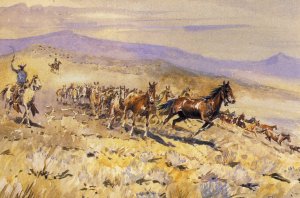
Edward Borein: Six Riders Of The Purple Sage
Historically the struggle of the male to come to terms with the X chromosome and the y chromosome or Animus is central to history and psychology. During the Matriarchal Age, which is to say a sub- or unconscious age, the X chromosome or Anima ruled the mind of man. As consciousness evolved and the conscious mind emerged from the subconscious the nature of the y chromosome or Animus became apparent. The Patriarchal Consciousness evolved.
To reconcile or not to reconcile?
The Egyptians developed their own theories but here we are not concerned with HS II and IIIs and the Semites. Suffice it to say that the Semites borrowed from the Egyptians while adding very little of their own. If one reads the story of Psyche and Eros in Apuleius’ The Golden Ass one will have a good general introduction to the HS II and III point of view as expressed in Grey’s Gentile characters such as Lassiter and Venters. As said the Mormons reflect the Semitic view on women.
The Semites on the other hand, exaggerted the importance of the Animus in favor of suppressing or subordinating the Anima which has been passed on to the HS IIs and IIIs through the adoption of aspects of the Semitic religions. In a Hungarian myth of the Christian Era the Anima is portrayed as being entombed in the support of a bridge. Thus imprisoned on one side of the river or brain it is denied its rightful function.
The Semitic attitude is reflected in the way the two peoples treat their living females who stand as a symbol and only a symbol of the X chromosome of the male. In both existing Semitic relgions, the Judaic and the Mohammedan, the females are treated as property no different than cattle. Some of these attitudes have been temporarily weakened through contact with the HS II and IIIs. They haven’t gone away or changed.
The Semitic attitude infiltrated the HS II and III consciousness through their religion which was amalgameted into the HS-Semitic hybrid called Christianity.
Then in 1930 in the Unied States a man named Joseph Smith created a religion called Mormonism based on the extreme Patriarchal notions of the Semites. As Grey puts it the religion was based on the notion of ruling women. Smith devised rules by which women were completely subordinated to the Animus much as in the Hungarian myth while the men were required to take multiples wives. Smith himself racked up 30 plus.
According to Grey the women were not happy with the arrangement but in the thrall of religious belief they thought it their god assigned role.
As polygamy is not part of HS II and III culture Smith and the Mormons came into conflict with constituted society in Smith’s home base of Fayette, New York being driven out. They encountered the same opposition in their new homes which led finally to Nauvoo, Illinois. Smith, who apparently overplayed his hand was murdered in 1844. In 1847 Brigham Young led the new Chosen People from Nauvoo to the Promised Land on the shores of the Great Salt Lake. By 1871 when Riders takes place they must have multiplied exponentially because they occupy all of Utah and parts of adjacent states. This prologue of the diptych is placed before the passage of the 1882 law of the United States outlawing polygamy. The denouement of the novel will take place as the US attempts to stamp out the practice.
The action of Riders-Trail takes place on the border of Utah and Arizona and parts of adjacent states with the Grand Canyon of the Colorado as a backdrop.

Edward Borein: Riders On The Mesa
As with the other Semitic religions the Mormon Bishops and Elders with untempered Animi have made their will the law. Thus, according to Grey, the Churchmen have become criminals willing to commit any crime to achieve their personal desires which they equate with the will of God.
As Riders opens a Mormon woman, Jane Withersteen, against all the rules of Mormon society is living as an independent woman in Cottonwoods on the Utah-Arizona border, Gentile Law on one side, Mormon law on the other. She does this in defiance of Bishop Dyer (die-er?) who has ordered her to marry and end her independent status. She has her own duchy among the Mormons owning her own town, the water, aparently several counties, a magnificent bunch of horses (emblematic of the Anima) and six thousand head of cattle divided into two herds, the red and the white. (emblematic of the male and female.)
Her independence is a standing affront to the Mormon Elders and Bishops. Having been ordered to marry Elder Tull as one of his many wives she has no wish to submit to the Bishop’s will. Read- Will of God.
These men are not to be balked. The woman Withersteen has no actual rights under Semitic law. As these men have a crazed Animus untempered by the acknowledgement of the female principle or Anima which they deny they have lost all sense of justice, or rather, they equate justice with their desires which they believe are supported by divine law. They are going to use every concealed criminal means to break Jane Witherspoon down. As their will is law they can’t see the difference between subjective criminal methods and objective legal ones.
Jane is already having trouble hiring Mormon riders, riders are the same as cowboys in Grey’s lexicon, to manage her herds so she has resorted to hiring Gentiles.
The Mormons must be seen as a species of Semite and in the Semitic manner they punish Gentiles, or unbelievers as the Moslems would put it, destroying any attempts at their prosperity. If you read the first few lines of the Koran you will find it plainly stated that unbelievers must be punished. Hence all the Gentiles are kept uneducated and impoverished. Jane’s ramrod, is a young Gentile named Bern Venters. Venters at one time had been a prosperous cattle rancher but the Mormons had emasculated him by lifting his cattle. Venters was rescued by Jane from complete impoverishment by offering him a job.
The Elders hate her for this. They have warned Jane to get rid of him and her other Gentile employees but as a sort of Great Mother figure, an active female principle opposed to their male principle, she has refused. She is sort of a Matriarchal throwback among these Patriarchs. As the story opens Elder Tull has dragged Venters out of Jane’s house where Tull gives Venters the choice of hightailing it out of the Territory, Utah being a territory from 1850 to 1895 when it became a State, or being whipped to an inch of his life. Now, Tull means this, they are going to whip Venters nearly to death for being a Gentile in Mormonland.
Having already been emasculated by the lifting of his cattle which, in reality, he couldn’t prevent, Venters now chooses to take the whipping rather than emasculate himself further by hightailing it. Difficult choice.
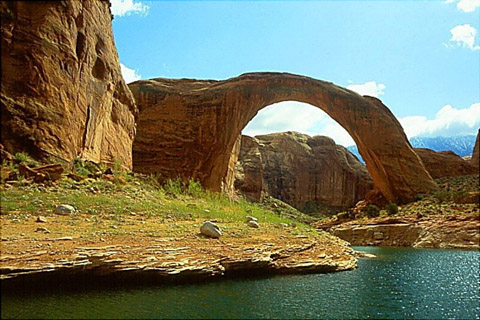
Rainbow Bridge
Tull is about to have him stripped when the Hammer Of The Mormons, Lassiter, appears out of the purple sage riding a blind horse- you heard right- a blind horse. This guy is Bad Blood personified. Boy, they’ve heard about him but how. Black hat, black leather chaps, two massive black handled pistols worn very low, apparently at his ankles, his reputation as a Mormon Killer is well established. Tull gets the cold shivers just looking at him on his blind horse. The blind horse probably indicates that at this point Lassiter is oblivious to female charms, the horse being a symbol of the female and he’s riding a blind pony.
Lassiter makes a few mild mannered inquiries then orders the Mormons to let Venters go. We’re talking Animus to Animus here, cojones to cojones, whoever backs down is emasculated in relation to the other, and Lassiter’s twin pistols make him the master Animus. The Mormons have to eat dirt or die. The Mormons powerful as a collective cannot be so man to man. Tull gives a hint of throwing an iron on Lassiter but the latter goes into his famous gunslinger’s crouch so he grab one of those guns around his ankles, intimidating the dickens out of the Mormons who retire leaving this field to him while muttering threats that he’d better watch his back.
As we said, all the Gentiles are stricken in there relationship between their Animas and Animi. Between Riders and Rainbow they will be healed.
Grey handles the symbolism starkly and masterfully. Jane Withersteen is a masterful Matriarch. Her independence and relationship to the Gentile men has left the impression that she is sexually loose. It isn’t clear to the reader whether she is nor not. She is more the Great Mother rather than the Siren.
Her role seems to be the womanly one of tempering the raging Animus of the male. While she has no effect whatsoever on the Mormon men she is successful in emasculating the stricken Gentiles. She had persuaded Venters to abandon his six gun which made it possible for Elder Tull to seize him while it was only Lassiter’s two black handled six pistols that freed him.
In a rather sexually explicit scene Jane would stand in front of Lassiter to seize a gun in each hand in an attempt to dissuade him from carrying them thus emasculating him. This at a time when Mormons were trying to gun him down. Her role seems to be one of civilizing society although her method seems backward.
Lassiter is a wronged individual seeking his personal justice in a vengeful way. He has shot up several Mormon towns being now known as a Mormon slayer or, in other words, the equivalent of an anti-Semite.
The reason for his anti-Semitism is that a Mormon kidnapped his sister, Millie Erne, holding her captive until she consented to become one of his wives. Hint, hint. Her remains are buried on Jane Withersteen’s property.
Edward Borein: Lassiter on his blind horse?
Lassiter’s horse was blinded when men held it down then placed a white hot iron alongside the eyes searing them. The horse as a female mother symbol represents Lassiter’s striken relationship with his Anima.
If one reads this novel in a literal sense then many of its incidents are improbable if not ridiculous. What notorious gunslinger would ride a blind horse? Grey has been criticized for wooden characters which is womewhat unjust. These are archetypal characters who are fully developed and can’t change. As allegories there is no need to change. This is mythology.
The Mormons lift Jane’s red herd. This may represent her female Animus as in iconography the male is usually represented as red while the female is white. They next try to stampede her white herd by devious means which they believe are undetectable such as flashing a white sheet from a distance. As a Chosen People they even have to convince themselves that what happens was not caused by them but was the will of God.
Lassiter notes this taking Jane with him to show her. As they watch the cattle begin to stampede. Three thousand on the hoof they stream down the valley. Lassiter on his blind horse races full speed down the slope, obviously no blind horse could do this, out on the flat to single handedly mill the cows. As the lead cows enter the center of spiral Lassiter disappears in the dust. He emerges sans horse to appear before Jane: ‘My horse got kilt.’ he announces. Jane’s response is ‘Lassiter, will you be my rider?’ Pretty clear sexually I think. Not exactly changing horses in midstream but obviusly the transition from a blind horse to a sighted jane is an improvement in Lassiter’s relationship with his Anima. ‘You bet I will Jane.’ Lassiter promptly and positively responds.
Whether you want to consider this stuff ‘high literature’ or not read properly it is not much different from the Iliad or Odyssey.
As a mother figure Jane is a keeper of horses, a symbol of the mother and female. The blinding of Lassiter’s horse was the equivalent of separating him from the mother figure. Jane not only has a full stable of horses but she has the prized horses Night, Black Star and Wrangler. As Grey makes clear these are the devil’s own mounts. In the big chase scene Grey has Wrangler close to breathing flames as he compares the horse to the devil.
The Mormons steal Jane blind while she refuses to allow Lassiter to defend either himself or her. Seems to be the Great American Dilemma even today.
Remember this is a war between Gentiles and Semites qua Mormons. The Gentiles hands are stayed while the Semites are allowed to run wild. Maybe Grey is making a social comment. Also remember that Jane is a Mormon so that while she is powerless to control her own aging maniac men the only men she can influence are the Gentiles whom she emasculates. As soon as the emasculated Venters gets away from her while pursuing the rustlers he immediately begins to revert to full manhood.
The Mormons set both Mormon men and women to steal from her. They take her bags of gold, this woman is prodigal, rich, her deeds and anything of value. They steal her six thousand cows. They want to kill Lassiter, dozens of Mormons lurk in the cottonwood groves (female places) but something stays their hands; they can’t shoot him either from behind or in front.
The only thing Jane worries about is her horses. Black Star and Night. It is possible that in this instance Jane represents the moon goddess. Finally the Mormons steal these symbols of her power. The independent woman is now completely violated. She has a man who could shoot down all the Mormons in Utah but she won’t let him use his guns.
So why should we care?
2.
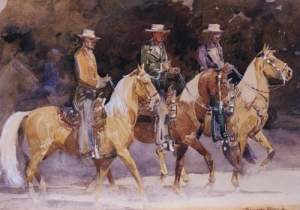
Edward Borein: The Three Caballeros
The myth switches to an alternate plot. Young Bern Venters goes in search of the rustler gang. Once again, Jane attempts to emasculate her men by pleading with Venters not to go, to stay beside her. Why anyone would want to hang around such a loser woman isn’t clear.
Venters goes in search of the rustler gang which is led by a man named Oldring. Old Ring. I’m sure the name has significant meaning but I can’t place it. The wind soughing through the caves is known as Old Ring’s Knell. Even though Oldring’s gang consists of a couple dozen men who have punched a herd of three thousand red cows they have somehow left no trail. Over all the years they have been rustling and pillaging there is no one who has been able to find this robber’s roost.
Venters has traced them to the foot of a waterfall where he loses track. While he is mulling this over a group of desperadoes return from pillaging plodding up the stream. Lo and behold they ride right through the waterfall into yet another hidden valley. Big enough to hold three thousand head of cattle. The West was a big country.
Venters rides off to relate this discovery to Jane and Lassiter when he encounters a despearado with the famous Masked Rider, reputed to have shot down dozens of men. He is dressed from head to toe in black wearing a black mask. This Rider is credited with shooting down any Mormons Lassiter overlooked.
Venters takes out his ‘long gun.’ You know how riders despise the long gun or rifle preferring six shooters, and by dint of long practice he shoots the lead rustler dead and wounds the Masked Rider. While examining the Masked One’s wound he unbuttons the shirt to discover the ‘beautiful swell of a female breast.’ Boy, howdy. You got it, the Masked Rider is a woman, a mannish girl. The image of Venter’s Anima.
Stranded in the desert while trying to nurse this girl back to health Venters chases a rabbit up a slope where he notices ancient steps cut in the rock. Following these he comes into ‘Surprise Valley.’ Formerly the home of cliff dwellers the place is a vitual paradise, green and verdant. No one would ever discover him and the Rider there. Carrying the slight figure of the Rider up hill and down for maybe ten miles or so Venters secretes themselves in the Valley which abounds in game and delightsome frolics.
About this time I recognized some teen fantasies of my own. Shooting and wounding a woman while having to tend her wounds in a secluded place where she has to be eternally grateful when healed was just too obvious. In my case, just after the onset of puberty, I think, when the Anima would be making itself known, I came up with the daydream of having this woman I could keep in a milk bottle until I wanted her. When I let her out of the bottle she became full sized and did whatever I wanted then she willingly went back into the bottle until the next time I wanted her.
As a thirteen year old before the advent of universal pornography I didn’t know what I wanted the woman for but I knew it would be fun. Grey here creates his version of the same fantasy. The Rider, who turns out to be Bess, apparently has a past. I say apparently because nearly everyone in this story has an apparent history which turns out to be false. As a member of the gang she was thought to have been, um…the piece…of Oldring. He kept her in a cabin up on a ledge in his valley behind the waterfall. He was gone a lot so we’re not clear that he ever laid a hand on her but Venters believes she is not ‘pure’ which in his great love for her he is willing to over look but it rankles him.
If you want to know the wonders of Surprise Valley read the book yourself. Comes a time when Venters has to go into Cottonwoods for supplies. There he realizes that he and Bess can’t stay hidden away forever. He has enough money for supplies obviously but not enough to flee from Mormonland.
They don’t call it Surprise Valley for nothing. When he returns Bess hauls out a big bag of gold to give to him. This must be the treasure that the female brings the male. The whole several mile length of the river which runs through this valley is lined with pebbles of gold which Bess has collected. Shades of Opar, huh? In her girlish gratitude she wants Bern to have the lot.
‘Gosh,’ says Bern. ‘Now I don’t have to get a job.’ (He didn’t put it quite that way.) ‘We can leave this valley and go far away from Mormonland.’

Edward Borein: Four Navajos Crossing The Desert
Far away from Mormonland, by the way, is either Quincy or Beaumont (beautiful mountain) Illinois. Not too far from Nauvoo which was the Mormon stronghold jumping off place for the long march to the Great Salt Lake into the fantastic scenery Grey either describes or imagines. Certinly the West of Grey’s imagination is as fantastic as anything Burroughs created on Barsoom.
Even though Grey refers to the desert this is certainly the lushest desert anyone has ever seen. The purple sage is the equal to Burroughs red moss of Mars.
Grey wrote an essay about what the desert meant to him. His desert with its plentiful water complements his vision of the Anima and Animus. The desert may answer to Grey’s subconscious which appears to be missing in his analysis of Anima and Animus, so that perhaps the desert stand for the subconscious.
His desert reminds me of a dream I used to have with some frequency. In my dream I was walking across this immense barren desert spotted at invervals with small oases in which I wasn’t allowed to remain. Off in the distance I could see this great brain shaped mountain. On approaching the mountain I found a small stream of water leading down into the mountain. As I descended I noticed that the stream ran through a bed of solid salt which rendered the water bitter.
Descending further the water disappeared beneath a steel chute. Unable to turn back while unwilling to go further I was nevertheless pushed into the chute where dropping into a steel lined entry I was pushed into a steel walled laundry room as the steel door slammed behind me. There was plenty of water but no way out. There was a ventilation shaft along the ceiling of the back wall. I conceived a plan of drinking to repletion then urinating into the ventilation shaft creating such a smell that they would want to find the source.
My plan worked. Three maintenance men opened the door and I dashed out so fast they didn’t know I had been there. Still in a steel lined area I saw a bank of elevators which would take me back to ground level. A door opened but the elevator was filled with classmates from my high school who pushed me back refusing to allow me to enter.
I don’t know how but I gat back to the surface where once again I approached the back side of the mountain which I ascended this time rather than descended. Now, the mountain was deep in a frozen snow but starting from the low grade at the back I had no trouble climbing, walking on top of the snow. The sun was shining brightly but all was frozen white. When I reached the top I found I was standing above the brow of the face of a great idol carved in the snow. Thousands of feet below terified and intimidated people were kneeling in the desert worshipping the great snow face. From where I stood I couldn’t see the face but I conceived the notion of destroying the snow god to free the people. Leaping into the air I came down on the god’s forehead creating an avalanche. The great face slid away as I descended thousands of feet on a cushion of snow to alight unharmed.
As I hoped, the destruction of the god freed the minds of the people from the domination of their morose god. The melting snow created numerous streams watering the desert among which the people danced and sang as the desert bloomed, while I looked on admiringly.
I don’t know enough about Grey’s background to say how unhappy his childhood had been but since his plot of Riders/Rainbow roughly follows my dream I suspect what the desert meant to him was the barrenness of his early life. The appeal of the novels to Burroughs must have been of the same order.
When Venters leaves the Valley Grey begins to lose control of his story. The clarity and focus of the first half becomes jumbled. He finally just crams the ending through as Burroughs so frequently does.
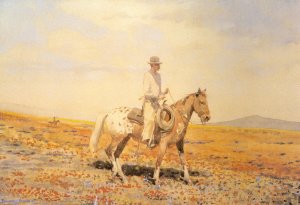
Edward Borein: The Apaloosa
Venters, riding Wrangler, crosses trails with the men who stole Night and Black Star from Jane. A sort of running joke throughout the novel is whether Wrangler is faster than the two blacks. Wrangler proves his mettle in this chase overtaking the two even though they were ridden by the best rider on the range, Jerry Card. Card is sort of a puzzle, at least for me. His horsemanship was so great that racing at full tilt leading one horse he could keep both horses side by side at full pace; in addition he could hop back and forth from horse to horse. Whether Grey was making a joke or not, I can’t really tell, he describes Card’s appearance as froglike. Hop-frog of Poe? Card is a little misshapen runty man. Whatever Grey had in mind for him he forgot to develop.
Card abandons the horses as the race ends disappearing into the purple sage. Wrangler gets away from Venters to be captured by Card. In a rather spectacular scene Card is trying to guide the horse by biting it on the nose. He is actually being dragged with his teeth in Wrangler’s nose. I’m no horseman but I’d really have to have the fine points of this maneuver explained to me.
Unable to hit the small fragile Card with a rifle shot as rider and horse rode alongside an escarpment rather than let Card get away, Venters shot the horse who leaped off the edge in what Grey describes as a fitting end for the greatest horse and greatest rider of the purple sage. I can’t follow his reasoning here but he must be trying to say something.
Venters rides the remaining two horses down the main street of Cottonwoods with apparently no more reason than to enrage Bishop Dyer and Elder Tull and announce in stentorian tones that Jerry Card is dead. Reminds me of the myth in which it is announced that the great God Pan is dead.
Venters packs some saddlebags with provisions then, in what seems a comic touch, since Jane’s wonderful stable of horses is now empty, mounts a burro to return to Surprise Valley. Riding one and leading a string of burros he looks behind him to see if he being followed by men on horses I presume he would have hopped off the burro and started running. The burro appears to represent severe emasculation.
Another essential subplot has been the arrival of a small child still annoyingly gushing babytalk- muvver for mother and oo for you- by the name of Fay Larkin. Fay is going to be the heroine of the sequel. She was the daughter of a Gentile woman who died. The woman asked Jane, who was ever kind to the despised Gentiles, to take the child which Jane did. She now ‘cannot live without the child.’
Having stolen everything else of the woman in the name of God, the Mormons now steal Fay.
This is too much for Lassiter who coldly disregards Jane’s imploring to disregard this insult and injury too, even though a moment before she ‘couldn’t live without the child.’ While it seems that Mormon men emascualte their women, Mormon women in turn emasculate their men. Maybe that’s what the story is about: the conflict between the sexes. Lassiter disregards her, strapping on not only his big blacks but an extra brace that he hides beneath his coat. The extra brace doesn’t figure into the story so it isn’t clear why two gun Lassiter became four gun Lassiter.
Lassiter shoots the Mormons up pretty good killing Bishop Dyer. Elder Tull is out of town at the moment. Lassiter and Jane know they have to get a move on so, packing enough to stagger any ten horses , including bags of gold, they skedaddle riding Night and Black Star.
Somewhere in here Grey must have become stymied in his story not having the progression to Rainbow Trail figured out. Something like the odd ending of Burroughs’ Princess Of Mars. Venters still thinks Bess was Oldring’s girl hence something only his great love for her can make him overlook. Loading up their burros they leave Surprise Valley. Out in the purple sage who should appear much as he had at the beginning of the story but Lassiter, this time with Jane.
It now comes out that Venters thinks Oldring is Bess’ father. Jane lets out the fact that he had then killed his future wife’s dad. Bess is revolted at the thought, calling off the wedding. Lassiter to the rescue. He produces a locket with a picture of his sister Millie Erne and her husband Frank. Lassiter explains that Millie was pregnant by Frank when Millie was kidnapped and that Frank Erne is her real father. The obstacle that had appeared between Venters and Bess now disappears as he hadn’t killed her father, just the guy who reared her. At the same time Bess is no longer the daughter of a low rustler but of a respectable man.
But wait, there’s more. Grey can produce as many twists as Edgar Rice Burroughs. It was the literary fashion of the day.
Not only is Bess the daughter of Millie Erne but the Mormon kidnapper of Millie had been no ther than Jane Withersteen’s father. The ever-forgiving Lassiter, now Uncle Jim to Bess, mutters something like ‘Aw shucks, Jane, I don’t pay thet no nevermind.’ and sister Millie is forgotten. nearly two decades of bad blood goes up in smoke with a shrug.
Venters and Bess head off for the safety and security of civilization in Beaumont, Illinois, while Lassiter and Jane depart for the security of Surprise Valley. Two problems remain for the next ten pages or so, Fay Larkin and Elder Tull.
Just like Tarzan, Lassiter can apparently smell a white girl because there is no other way that he could have located her. She was being held by some Mormons in a side canyon. Setting Jane to one side, Lassiter enters the canyon from which after firing every cartridge in his four guns and belts- Grey didn’t actually make it clear that he was still wearing the extra set up under his coat but he didn’t say he took them off either- of’ four guns Lassiter kills all the varmints, emerging from the canyon with little Fay in his arms and ‘five holes in his carcase.’
As they glory over little Fay, who was problem number one, problem nuber two, Elder Tull and his band of Mormon riders appear on the horizon. Leaping on their burros, did I mention Jane and Uncle Jim swapped Night and Black Star with Venters and Bess for their burros?- the Hammer Of The Mormons and Jane jog off with the Mormons in hot pursuit on horses, but tired ones.
One would think that even tired horses would have the advantage over burros but it is a very tight race. You see why Grey’s stuff translated to the movies so well. Getting all safe within Surprise Valley on the other side of balancing rock (did Grey borrow this detail from the She of Rider Haggard?) Uncle Jim lacks the nerve to roll that stone because Jane has pretty completely emasculated him. ‘Roll that stone’ Jane commands restoring Lassiter’s will. He does just as Elder Tull ad his Mormon band reach the cleft. The stone falls eliminating Tull and his Mormons while sealing off Surprise Valley ‘forever’ with Uncle Jim, Jane and Little Fay Larkin inside. Of course they are well provided because Venters has stocked the Valley with burros, fruit tree stock and plenty of grain seed. At the same time he had eliminated coyotes and other beasts of prey so that jackrabbits, quail and other small food animals have mutiplied exponentially. It’s going to be a long twelve years in the valley so the bunch has to be well provided. Without his gun though Lassiter is going to have to catch those jackrabits with his hands. During their long stay Lassiter and Jane apparently have no sexual relations as there were no additional children when the valley was reentered by the Mormons. Jane must truly have been a mother figure.
On this incomplete note Grey ends his novel.
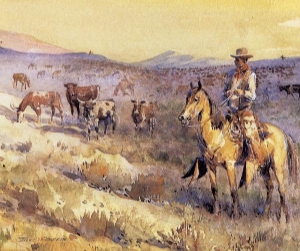
Edward Borein: Grazing Cattle
3.
Indeed, from the Enlightenment to the present has ben a period of intense religion formation, especially the nineteenth and twentieth centuries.
Utopian and Scientific Socialism may both be considered forms of religion, especially the latter in its Semito-Marxist form.
Mormonism itself, which has no basis in science, orginated from the brain of Joseph Smith in 1830. Madame B’s Theosophy, Mary Baker Eddy’s Christian Science, Ron Hubbard’s Scientology and the Urantia religion all have a basis in science as do most religions formed after Darwin. With the emergence of science none of the old religions were satisfactory. Hence it should come as no surprise that writers like Grey and Burroughs were intensely concerned with the problem.
As I have mentioned in Something Of Value no adequate myth for the scientific age developed, leaving men and women whose faith in the Semitic gods was undermined with a stricken religious consciousness such as in the case of John Shefford, the protagonist of Rainbow Trail, and probably both Grey and Burroughs.
So the search for meaning was endemic in this period not being confined to Burroughs and Grey who were merely symptomatic.
Another attitude that both authors share is a yearning for the wide open spaces of their youth that, while we may look back in envy, were rapidly disappearing before their eyes. Somehow this yearning was also connected to a feeling for the prehistoric past, perhaps as a Golden Age.
Both men were charmed by the notionof cliffdwellers. It would seem that Americans of the period were also absolutely charmed and enamored with the Anasazi of the American Southwest. Burroughs was very nearly obsessed with cliffdwellers. Novel after novel is replete with cliffdwellings whether in Pellucidar, various terrestrial locations or even on Mars.
The inhabitants of the skyscrapers of Chicago were nicknamed cliffdwellers; a replica of Southwest cliffdwellings was built for the Columbian Expo of 1893 that apparently made a great impression on 17-year 0ld ERB. The premier literary club of Chicago was known as the Cliff Dwellers which was on the 8th floor and roof of Orchestra Hall. I think Burroughs had a yearning to be a member of this club.
Thus there were many cliffdweller influences on ERB’s life , whether he had ever seen the Anasazi dwellings before 1920 is doubtful, it would be interesting to know if Grey had before 1910.
At any rate cliffdwellers had carved out homes in Surprise Valley in some distant prehistoric time. Thus both Venters and Bess and Uncle Jim Lassiter and Jane were actual cliffdwellers utilizing the old dwellings. Lassiter, Jane and Fay Larkin would be cliffdwellers for twelve years. This must have had a very romantic appeal for Grey’s contemporary readers.
During that period they dressed in skins living as close to a stone age existence as was possible. So one may compare the Surprise Valley of Lassiter and Jane with the cliffdwellers of Burroughs’ Cave Girl.
As all these themes were in the air of the period it is not necessary for either of these two authors to be influenced by each other to this point but it is probable that both were influenced by the stone age stories of Jack London and H.G. Wells among others.
I doubt Burroughs was influenced during this period by Grey although he did have a copy of Rainbow Trail in his library, one of only two Grey titles. We can’t be sure when he bought Trail. Grey’s stories complement Burroughsian attitudes but only after this formative preriod around 1912. ERB’s Western and Indian novels probably owe something to Grey but they were written after 1920.
Riders Of The Purple Sage sets the scene for its denouement which is The Rainbow Trail. Riders was a wonderful romantic vision of the West which answered the needs of the period when for the first time the percentage of Americans living in cities surpassed that of those living on farms. Indeed, very like these authors, modern cliffdwellers had a heartsick longing for the Paradise they had lost. For decades it would be a crazy dream of city dwellers to buy a farm and ‘get back to the land.’ The movie ‘Easy Rider’ was a good laugh in that respect.
Both Burroughs’ and Grey’s novels addressed that need.
Burroughs’ interest in Rainbow Trail would stem from religious aspects and the perfect union of the Anima and Animus when John Shefford and Fay Larkin unite. It might be noted that a fay is a fairie. Cliffdwelling and the purity of Grey’s noble savages, the Navajos, would have been compelling for ERB.
Before continuing on to The Rainbow Trail let us take a brief interlude to examine some aspects that would have interested ERB from the other Grey title in his library- The Mysterious Rider.
A Review: Kevin MacDonald: Psychoanalysis In Its Death Throes
December 18, 2008
A Review
Kevin MacDonald:
Psychoanalysis In Its Death Throes
by
R.E. Prindle
MacDonald, Kevin: http://www.csulb.edu/~kmacd/paper-CrewsFreud.html
This is a review or commentary of Kevin MacDonald’s paper of 1996: Freud’s Follies: Psychoanalysis As Religion, Cult And Political Movement.
The paper has apparently been retitled here as Psychoanalysis In Its Death Throes: The Moral And Intellectual Legacy Of A Pseudoscience.
I don’t know Kevin but I have had some correspondence with him over the internet so I hope he won’t find me presumptuous by referring to him as Kevin. As a Professor at California State University At Long Beach Kevin MacDonald has a distinguished record adding to the luster of the faculty.
His book Culture of Critique is a valuable addition to the literature. Generally speaking I endorse all his conclusions in this paper with the exception of his condemnation of psychoanalysis. I do not believe the discipline to be a pseudo-science. The problem is with Freud and not psychoanalysis. The investigation of the mind was in its elementary stages at the time Freud entered the picture. Indeed people had a horror at the very notion of almost any psychological concept and still do. To my mind Freud’s most valuable contribution was the The Psychopathology Of Everyday Life. Even the study of simple everyday psychologically revealing traits was derided. The thought that a ‘Freudian slip’ could give away one’s inner thoughts was too horrifying to contemplate.
But there it was in bold relief- the subconscious, or unconscious as Freud called it. Freud neither invented nor discovered the unconscious as many people still believe. The unconscious had been a topic of investigation for some time. It was a mystery then, a mystery to most now, many people disbelieved the concept then, many still do.
The trouble with Freud’s vision of the unconscious is that he believed it was inherently evil, uncontrollable and actually a separate entity of the mind but connected somehow.
His error was pointed out to him at the time but as Kevin points out Freud had insulated his vision of psychoanalysis by making an Order of it. He thus separated his thoughts from scientific criticism building a wall around them just as his Jews built a wall around Torah. As Kevin points out:
The apex of the authoritarian, anti-scientific institutional structure was the Secret Committee of hand-picked loyalsits sworn to uphold psychoanalytic orthodoxy, described by Phyllis Grosskurth in ‘The Secret Ring: Freud’s Inner Circle And The Politics of Pyschoanalysis. By insisting the Committee must be absolutely secret, Freud enshrined the principle of confidentiality. The various psychoanalytic societies that emerged from the Committee were like Communist cells, in which the members vowed eternal obedience to their leader. Psycholanalysis became institutionalized by the founding of journals and the training of candidates; in short an extraordinarly effective political society.
Thus Freud was able to separate his doctrine from scientific scrutiny while creating a terrific mystique about himself and his ‘science.’
In fact while his doctrine was based on sound, for the state of learning at the time, factual research he fashioned the facts into a tool or weapon for a specific purpose for which any changes to the doctrine would weaken its effectiveness. It was essential that it stay the same.
As Kevin points out Freud was a politician first, researcher secondly and a scientist thirdly. While more scientific outsiders were critical Freud’s fellow Jewish insiders picked up the ball and ran with it.
Freud was a member of the International Order of B’nai B’rith. He attended meetings regularly in Vienna while lecturing on psychological matters frequently. Can it be a coincidence that the Anti-Defamation League of B’nai B’rith was created in the United States in 1913? Does anyone believe that the subtle psychological methods weren’t worked out in Vienna?
When the Frankfurt School Of Social Research was organized in Germany in 1923 incorporating Freudian psychology does anyone believe that was a coincidence? The Marxists embraced a Freudian agenda. You may be sure that Franz Boas applied Freudian doctrines to Anthropology.
There was a good deal of natural reisistance to Freudian doctrines in Europe but the Nazi disaster played into Freudian hands completely. After Hitler’s election in 1933 droves of Freudian analysts and the whole Frankfurt School fled Germany most choosing to settle in the United States in the cultural capitols of NYC and Hollywood.
While psychoanalysis was all the rage through the fifties the reaction set in during the sixties. There was much to disagree with in what was essentially an unchanging doctrine that was hostile to the non-Jewish world. Freud’s reputation has gradually been demolished among the goyim since the sixties. However this is irrelevant. It doesn’t matter what the goyim think. The tool, the wapon is in the hands of Freud’s fellow Jews where it has been and is being wielded effectively.
So, while Kevin MacDonald’s critque and condemnation is accurate and effective among the goyim it is of no consquence to the effective application of the doctrine by Freud’s fellow Jews. It’s like Machiavelli. Just because you’re appalled by his doctrines doesn’t mean they don’t work and aren’t being used.
One would do better to educate people to defend themselves against this pernicious doctrine than to merely condemn it.
While I agree with Kevin’s analysis I do disagree with his condemnation of the effectiveness of a psychoanalytic approach.
The key to Freud’s misuse of psychological analysis is his description of the unconscious. As a scientist it is diffiicult for me to believe that he actually perceived the unconscious in such a way. I have to believe that his private understanding was quite different then his public description. It is possible that his understanding is purely religious based on Kabbalah and Talmud and having nothing to do with science. The notion that the unconscious exists independently of both mind and body is absurd on the face of it.
One thing to bear in mind is that Freud was well informed on the subject of hypnosis. He studied (for a couple months) under the Frenchman Jean-Martin Charcot who associated hypnotism quite correctly with hysteria. Freud also visited Bernstein of the Nancy hypnotic school. He must have had a reasonable understanding of hypnosis and its active agent, suggestion.
When he says that he abandoned hypnosis for subliminal recall which he says he found just as effective he is betraying a profound knowledge of the relationship of the un- or subconscious mind and conscious actions. He actually discovered that he no longer needed to put people into a trance to obtain the same results. Contrary to his statement I’m sure he was very effective as a hypnotist.
In point of fact in the interchange between the conscious and the unconscious he had discovered the true nature of the subconscious. That is what the interior dialogue is- a discussion between the clear conscious mind and the fixated subconscious which distorts reality to conform with its mistaken understanding.
Further, I would be surprised if Freud didn’t understand that fixation was merely hypnotic suggestion. By suggestion I dont limit the notion of spoken suggestions by others but to suggestion by circumstances. For instance if one is defeated at a game by another this may suggest a lack of manliness on one’s own part. In retreating into a hypnoid state the suggestion of unmanliness may be translated into a fixation of emasculation that renders one effeminate in relation to other men. This is done unawares to oneself but the fixation controls all future responses unless exorcised. It is possible that an exorcism may occur spontaneously in relation to another event later in life but otherwise the fixation has to be recognized and rectified by analysis.
The inadequacy is a diminution of ego. Such a diminution of ego always takes a response of a sexual nature.
In fact, Freud’s work centers on hypnosis and suggestion, emasculation and sex. He himself was severely emasculated and sexually repressed. So there you have the core of Freudian psychology. This understanding is then used to further the Jewish cause in the warfare with European ‘Christian’ society. I exclude America because Freud was too European to extend his interest further.
Freud then devised a plan to mass hypnotize, confuse and psychologically conquer Europe and by extension the West. Running his special knowledge as an Order, as Kevin indicates, he was under no compunction to share his knowledge in a scientific manner. In other words he sought to control his knowledge uninfluenced by outside contributions that would render his intent ineffective. Even inside the Order as Kevin points out Freud strictly controlled psychoanalysis by the use of his Secret Committee and strict disciplining of what he considered deviant thought.
Both facets were absolutely necessary if his plan of subversion was to work. So far the plan has functioned perfectly.
There is no reason to throw the baby out with the bath water however.
Freud and Freud’s doctrine should be repudiated.
Psychoanalysis however is a valid psychological approach. However administration of it take great skill. Once a correct understanding of suggestion and hypnosis is adopted as the basis of psychology and its relationship to fixation in a subconscious having an active relationship with the conscious, fixations can be located and exorcised freeing the mind from compulsive behavior.
The individual with a proper understanding can then be put on guard to prevent new fixations. I think it may require a certain amount of intelligence.
Freud’s system completely negates the role of intelligence and the conscious mind in favor of compulsive behavior. Thus by emphasizing the individual’s ability to control both his conscious and subconscious minds he will be able to master his own will and act without interference from fixations.
Those are the key factors. While I second Kevin MacDonald in his analysis of Freud and Freudianism I affirm the scientific nature of psychoanalysis itself. Just because Freud used his knowledge dishonestly doesn’t mean he wasn’t onto something.
Exhuming Bob XVI: Bob Dylan’s Dream..Or Nightmare?
November 27, 2008
Exhuming Bob XVI
Bob Dylan’s Dream or…Nightmare?
by
R.E. Prindle
I’ll let you be in my dream if you’ll let me be in yours.
-Bob Dylan

http://www.nextbook.org/cultural/print.html?id=1725
When Dylan wrote those words, was he sincere or was it just part of the con? I was recently asked not ot contribute anymore to expectingrain.com by person or persons unknown. The webmaster refuses to identify he or them to me. Too ashamed to let their names by known, I guess. Or chicken. I know I’d rather not be known as a rasty, nasty censor.
I was ejected for voicing pretty much the same sentiments as Jay Michaelson does in the above referenced review of Joel Gilbert’s The Jesus Years. Maybe the difference between Jay and me is that I don’t think Dylan is such a mysterious elusive guy. Anybody with a little Freud under his belt has got Dylan pinned.
He suffers from a fairly severe depression while being very emasculated. He is so emasculated he can’t even fix on an identity for himself. His natal Bobby Zimmerman failed him so he apparently attempted to become Elston Gunn which he wasn’t able to sustain so he then became Bob Dylan which also became too much of a burden to him so he threw that identity up for grabs saying anybody can be Bob Dylan who wants it, then he became Masked and Anonymous eschewing any identity whatever. An empty suit.
If that isn’t clear to you then there is no reason for you to tackle Freud or psychology now.
So, what was the conflict? Duh. Could it have been that between his Jewish upbringing and his Christian milieu? Gosh, I don’t know, do you? Is there anything in his subsequent history that would suggest such a conflict? Let me think. I think there is, therefore I am.
Is there a conflict in the minds of Dylan’s disciples. Well, now there we’re on firm gound. Just listen to Jay:
There’s a telling moment in Joel Gilbert’s new (?) documentary Inside Bob Dylan’s Jesus Years: an interviewee says that when Dylan became a born again Christian, he went, in two short years, from being an American Jewish hero to the “greatest apostate of the twentieth century”… But worse, because Dylan embodied a specific kind of liberal American Jewish hope that someone would speak truth to power, and that the world would listen. These were very Jewish dreams, and Dylan fulfilled them for awhile.
Damn, then it wasn’t anything I said as the messenger. I guess it was just not being Jewish that I shouldn’t have attempted to deliver the message. Right message, wrong face. Gee, I guess I can’t be in Dylan’s dream because I’m not Jewish. Whatever happened to One World, One Dream? Everybody being brothers? The Global Village? They didn’t think there wouldn’t be variations on the theme I hope. Well, no matter Dylan and his People can still be in my dream. I’m inclusive.
But Jay and his People themselves apparently feel excluded from Dylan’s dream also. Jay says:
Dylan never wanted to be the voice of his generation, and he certainly never asked to be King of the Jews or vessel for our hopes and dreams. (My italics.)
Wow! King of the Jews, Jesus Christ. I may have thought it but I didn’t have the cojones (My italics), Jay does and actually says it. Jesus, I’d be running for my life let alone being kicked off expectingrain.com.
Jay and his People just can’t seem to get it. Dylan never became a Christian, he became a Jew For Jesus. Jay even has the answer before him but his religious bigotry won’t let him see it: “Why did Dylan…record two religious albums proclaiming the word of G-d?” There you have it Jay. Dylan was conflating Jesus and God into one and then substituting G-d for Jes-s. Jesus is Christian, God is Jewish. Duh. For Christ’s sake, c’mon Jay.
Well enough of that. I’m sure you can’t stop laughing. Jay is supposed to be reviewing Gilbert’s documentary. Michaelson; is not either well read on his subject of Dylan or well researched. Maybe he smoked enough dope that he thinks he automatically knows everything about Dylan. I’ve seen it happen.
As far as the film goes, it may not be a particularly good movie but then it is a documentary and has to judged differently. As documentaries go I found it more than satisfactory. The clip art was an unusual special effect but I actually found some of them humorous. I wouldn’t have done it that way myself but Gilbert can do as he pleases and did.
Gilbert doesn’t mysteriously look like Dylan as Jay says. There is no mystery involved. Gilbert is trying to clone himself as Dylan; does a good job. He has a good understanding of his subject, after all he’s trying to be Dylan. His selection of subjects provided enough penetrating information that I have to think they were well chosen. Perhaps they were all that Gilbert could get, in which case the film maker drew them out well. Rob Stoner was the key. He was intelligent, understanding, and well informed- he knew what he was talking about. Kasha and Glaser gave you all the information you needed to understand the Christian-Jews For Jesus scam. Come on Jay, open your eyes.
Weberman has been saying that Dylan was a heroin addict since Christ was a baby. At least from 1964. It may have been true, I don’t know, but it didn’t have anything to do with Dylan’s crash. If Jay knew anything about his subject he would realize that the divorce was the key. Dylan had finally, after a life time of trying, become so defiled that he had to turn to God/Jesus to lead him back. I hope he found the way. Freud again.
For Michaelson who can’t separate his Jewishness from Dylan the problem is a paramount betrayal because ‘We’re (Jews) scarred and traumatized by two thousand years of Christian hegemony… So, there you have it, the cat’s out of the bag, couldn’t have said it better myself. Jay and his People thought Dylan was the Messiach who was going to establish a Jewish hegemony over ‘Christians,’ ‘speak the truth to power.’
I’m not so sure Dylan won’t still try but that has little to do with the documentary. The con and exploitation was not that of Dwyer on Dylan but Dylan over the Vineyard Fellowship. Dylan was using them to try to reach his fellow Jews in his faith of Jews For Jesus. As we are never tired of being told: Jes-s was a J-w. Case closed. Forget hegemony.
In summation Gilbert, in my estimation, did an excellent job for what he set out to do. I was properly instructed and…I got it. But, I was still kicked out of Dylan’s dream. He conned me too. What a nightmare!
A Review: Tarzan And The City Of Gold Part 2
August 18, 2008
A Review
Themes And Variations
The Tarzan Novels Of Edgar Rice Burroughs
#16 Tarzan And The City Of Gold
Part 2
by
R. E. Prindle
The City Of Gold itself, which is a white and gold city, evokes the image of the red and gold ruin of Opar and the Forbidden City of the same title, as well as The White City of the Columbian Exposition. As Burroughs was writing construction was going on for Chicago’s second great exposition on the fortieth anniversary of the first. Chicago, incorporated in 1833, was about to present its Century Of Progress expo of 1933-34. So Burroughs would have had his mind redirected to the scenes of his childhood.
What I am going to suggest may seem far fetched to many but having gained some idea of the way Burroughs’ mind worked I think the suggestion plausible. Emmett Dedmon tells the following story about the Great Sandow at the ’93 Expo. If anyone doesn’t know Sandow by now he was the first great bodybuilder who also performed at the Expo. As Florenz Zeigfeld was representing Sandow there is a no reason to think of the story as other than a publicity stunt, but I leave the judgment to you. (Emmett Dedmon, Fabulous Chicago, 1953, NY, p. 235)
Amy Leslie, the drama critic for the News, described Sandow as a fascinating mixture of brute force and poetic sentimentality. On a walk through the Wooded Island…Sandow snipped a tiny cup from a stock of snapdragon. “now, when we were little in Germany,” Sandow told the astonished Miss Leslie, “we took these blossoms and pressed them so, and if the flower mouth opened, why that was a sign they were calling us home.” As Amy reported it, “he touched the tinted bud and its rosy lips parted in a perfumed smile.” Just as Sandow finished his sentence, a Columbian guard shouted that he had violated the rule against picking flowers. To emphasize the reprimand the guard seized Sandow by the elbow and attempted to push him away. At this effrontery Sandow lifted the surprised guard off the ground and held him at arm’s length, examining him as though he were a curious discovery. Miss Leslie, more conscious of the dignity of the law, persuaded Sandow to put the guard down, which the strong man did with an ouburst of German expletives and an explanation (in English) to Miss Leslie that he did not think much of humans as guards. “I prefer nice well-bred dogs,” he said.
This made a great story that made the rounds of the fair. The question is did 17 year old Burroughs hear it and did it make an impression on him? Strangely enough we can definitely answer that question in the affirmative. Nearly twenty years later Burroughs borrowed the incident for his first Tarzan novel. Not only that but he has Tarzan play the part of Sandow. So, Sandow, Tarzan; Tarzan, Phobeg.
At the end of Tarzan Of The Apes Burroughs replicates the Sandow scene on the Wooded Island when he terrorizes Robert Canler holding him at arms length with one hand. Thus in this novel Tarzan not only holds Sandow/Phobeg at arm’s length but raises him above his head throwing him into the stands. Burroughs usually has his characters going their models one better as Tarzan does here.
As Sandow was strolling through the Wooded Island with Miss Leslie so Tarzan strolls through town with Gemnon. Instead of picking a flower Tarzan notices a lion eating a human while no one takes any notice. Cosmopolitan Tarzan inquires for an explanation. Gemnon calmly explains the quaint custom just as Sandow so pleasantly explained his snapdragon story. Dragons, lions, all the same thing. Burroughs does a neat parody and makes his joke but the original was such a great story he can’t let it go.
Indeed, Tarzan’s habit of picking men up and tossing them around can probably be traced back to this one arm trick of Sandow’s. Like I said, you’ll probably think it’s a stretcher but I think it both plausible and probable. Can’t be absolutely proven of course, but we can and have proven that the incident left an indelible imprint of ERB’s memory.
That said and moving along to 1920-24 there is also a flavor of H.G. Wells’ utopian novel Men Like Gods to be found here. Once again Burroughs turns Wells’ utopia around a bit but the tour of Cathne with Gemnon seems to be a paraody of a similar tour in Men Like Gods. ERB was still in the thick of his literary duel with Wells at the time.
The plot involving Nemone is slightly more complex and better worked out than is usual for ERB. Tomos, Erot, M’Duze and Nemone reflect other influences. The plot has the feel of French overtones. Of course we know that ERB read Eugene Sue’s The Mysteries Of Paris, Dumas’ Three Musketeers and The Count Of Monte Criisto, while the prisoner behind the golden door points in the direction of The Man In The Iron Mask. We also know that ERB had read Victoy Hugo’s Les Miserables.
All these may have provided some inspiration. However more directly influential I believe are two other books found in ERB’s library as listed on ERBzine. ( www.erbzine.com ) They are Rafael Sabatini’s Scaramouche and Stanley J. Weyman’s Under The Red Robe. Never heard of Stan Weyman? Me neither but, believe it or not, there is a Stanley J. Weyman Society on the internet that you may join if so inclined.
Both books were hugely influential in Hollywood, each being filmed several times with at least one version getting very good reviews. Let’s start with Sabatini. While Weyman, one would believe is all but forgotten, Sabatini enjoyed an excellent reputation down to at least my graduation from high school. Probably not so much lately although my copy of Scaramouche is the Common Reader edition published in 1999 so there must be fans out there.
Sabatini was Burroughs exact contemporary- 1875-1950. Like Burroughs he had to defend himself against charges of plagiarism. His stuff all reads like you’ve read it somewhere before, so in Scaramouche he presents an extended defense of himself.
Nevertheless he writes in a simple direct style that is ‘easy to uderstand’ but cleverly presented. Sabatini was obviously one of the first to understand that stories written like movie scenarios had a better chance of selling to the movies.
Like Burroughs he has his point of view which is admirably presented. Also like Burroughs he was intellectually unsympathetic to Communism. His reaction was less emotional that ERB. Although Scaramouche is about the opening years of the French Revolution Sabatini gives it only a slanting attention as he concentrates on people who are caught up in the flood much against their wishes. In that sense there is very little politics in the novel. The participants are merely caught up in the political events.
Scaramouche is a country lawyer unsympathetic to revolutionary ideology but he becomes a revolutionary fugitive when his Red friend is murdered by a reactionary nobleman. The story is well developed and an exciting one with a lot of swordplay. In fact Scarmouche become the fastest swordsman of France. You can see what drew ERB’s attention to the novel.
Of more importance for ERB and an undeveloped subplot of City Of Gold is one that involves Scaramouche’s ancestry. Bearing in mind that ERB became a voluntary orphan when he was sent to the MMA I think Burroughs found the mystery of Scaramouche’s ancestry compelling. Scaramouch is named after the clown of the Italian Comedia Del Arte which also nests neatly with the clown aspect of ERB’s psychology.
It is thought that Scaramouche was the illigetimate son of a village nobleman. The fact that the boy was well looked after by this man seemed proof. In fact, as we learn later in the book Scaramouche is the bastard son of his foster father’s sister, the noblewoman, Madame de Plougastel. She bore Scaramouche illegimately then trusted him to her brother. Thus on one side Scaramouche was of noble birth. An orphan or pretended orphan’s dream. His father remains a mystery for the moment.
Scaramouche’s friend had been murdered by the nobeman Le Tour d’Azyr. Scaramouche had sworn an eternal enmity to him. At a crucial moment in the story Scaramouche learns that this same La Tour d’Azyr is his father. I should have seen it coming from a long way off but I didn’t. It is possible that ERB was surprised too. Sabatini handles it well. Thus Scaramouche the illegitimate child is a nobleman by birth on both sides but the Revolution invalidates this advantage.
It would have been normal for Burroughs to have concocted a fantasy in which his parents now dead to him were not his real parents but some mysterious others. In fact he did concoct two fantasies: the one of John Carter who has been alive forever but can remember no parents and Tarzan whose parents were killed with the result that he was raised by ape foster parents. Not exactly noble people in the ordinary sense but his deceased parents were. One imagines the impact this really good story had on him although he first read it in the early twenties.
In any event he attempts to weave in a subplot providing mysterious parentage for Nemone and her brother Alextar. The subplot isn’t very well developed. On the one hand we are asked to suspect that Nemone was the child of the old king and a Black M’duze who in her youth was tall and beautiful while on the other hand it is insinuated that Nemone is the child of Tomos and M’duze. The latter through her machinations has placed Nemone on the throne and imprisoned Alextar. So Burroughs throws in some misceganation which has always been the most excing literary topic of America, then as now.
Not convincingly done by ERB he had nevertheless carried the story of Scaramouche around in his head for a decade waiting for the opportunity to employ it.
Another book in ERB’s library which is influential here is Stanley J. Weyman’s Under The Red Robe. Like Scaramouche this story was very well thought of in Hollywood being filmed more than once. It seems a fact that ERB saw the 1923 silent film. He was so impressed that he went out and bought the 1923 Grosset and Dunlap Photoplay Edition. I obtained an identical copy so as to to have read the same text and viewed the same plates.
I think I’ll have to include a few of Burroughs’ experiences at the MMA to bring this all together. It would seem that Sabatini considered himself a psychological orphan also. The man was born in Italy to an Italian father and an English mother. As they were traveling actors, not unlike what Scaramouche becomes at one point in his story, they sent young Rafael back to England to live with relatives. As Sabatini’s stories often concern orphans it follows that his reaction to being put away from his parents was that he considered himself an orphan.
Burroughs was also put away by his father. Three times. He was sent to Idaho, Massachusetts and Michigan. Thus he too was put away by his parents. As his reaction was to play the clown developing an off beat sense of humor we know that he reacted negatively to all this shuffling about. His exile to the Michigan Military Academy was the straw that broke the camel’s back. He rebelled, running away. The incident is treated rather uncomprehendingly by Porges in his biography which of course is my authority.
From ERB’s point of view the MMA was an elite reformatory school where bad rich boys were offloaded by their parents. Thus the boy was declassed and slgihtly criminalized in his own mind. As he treated his own sons and the Gilbert boy the same way it is easy to see how seriously he was affected by the experience. ERB was cast adrift with no direction home which happened so many times to characters in his stories, most notably in the original short version of The Lad And The Lion. ERBzine should publish the magazine version of this novel
Having run away from the MMA he was promptly escorted back by his father becoming in his own mind an orphan as in Tarzan’s case and a motherless child as in John Carter’s. Like the race horse Stewball of musical fame, Carter just blew down in a storm. Another standard orphan’s solution to being forced outside society.
Stanley J. Weyman’s (1855-1929) novel also meshes with this persona. As a result of his mistreatment Burroughs developed a very negative self-conception. He became, in fact, a ne’er-do-well. Much to his father’s satisfaction I might add. This self-conception would explain his eccentric behavior from the time he left the MMA in 1896 through 1903 if not for the rest of his life. The man was conflicted. On the one hand he knew he was very capable and on the other he felt worthless so he sought failure.
A fact easily glided over is his quarterbacking and captaincy of the MMA football team. One’s team members don’t elect one captain unless they have confidence in you. One also cannot be quarterback without their confidence while quarterbacking requires organizational and executive abilities. In fact the Burroughs led team defeated all comers in their class and while yet high schoolers they played the varsity teams of Michigan and Notre Dame. The Burroughs led MMA fought the U of M to a tie.
As a result he was offered a football scholarship to the University. He might well have become a football hero having an entirely different kind of life. ERB inexplicably declined the U of M offer. He offered some lame excuse that both his brothers had attended Yale and it was Yale or nothing for him. Possible but hardly probable. Most likely he felt comforatable leading the juvenile delinquents of MMA while he didn’t feel respectable enought to lead the Wolverines.
Leaving for the Army as an enlisted man instead he and a few other ne’er-do-wells formed a group calling themselves The Might Have Seen Better Days Club. You don’t have to be a Freudian to figure that one out. So I think his history in these years can be explained by his negative orphan self-image.
There is one very crucial event, the shame of which never left him, that figures into the Nemone story. That was when in Idaho he gambled away his and Emma’s last forty dollars. Certainly this was a turning point in his life.
In Weyman’s Under The Red Robe the hero is a ne’er-do-well who has exhausted all his chances but one. Named de Berrault the story opens when he is accused of using marked cards in a French game of the early seventeenth century. “Marked Cards!’ are the opening words of Weyman’s novel.
Indeed it would seem certain that Burroughs felt he had been cheated of his forty dollars. In my experience of card games I’m certain he was. De Berrault insists he didn’t use marked cards but that he used the mirror behind the player. Perhaps Burroughs said to himself when reading this: Yeah. that must have been it. At any rate thirty years later the incident was green in his mind and Why Not?
While The City Of Gold is crtical of Nemone/Emma ERB could never forget that he had done Emma wrong in gambling away those forty dollars. Perhaps as much as anything his shame required a separation. Perhaps he thought Emma was too good for a ne’er-do-well like himself.
And then there is this very interesting passage in Under The Red Robe p. 208:
I stood a moment speechless and disordered; stunned by her words, by my thoughts- so I have seen a man stand when he has lost all, his last at the table. Then I turned to her, and for an instant I thought that my tale was told already. I thought she had pierced my disguise, for her face was aghast, stricken with sudden fear. Then I saw that she was not looking at me but beyond me, and I turned quickly and saw a servant hurrying from the house to us.
Just as I admired ERB’s version of this device of looking past the intermediate person so he admired Weyman’s.
The line ‘I stood there speechless and disordered, stunned by her words, by my thoughts- when I have seen a man stand when he has lost his all, his last, at the table…’ must have resonated with ERB from the time he had experienced the same emotion in 1903 as Emma waited for him upstairs.
It becomes seen how ERB wove his various influences into his writing. At this point I would like to bring up another very long novel that formed a backdrop to ERB’s writing in general. the novel is the ten volume, five thousand page work of George W.M. Reynolds entitledThe Mysteries Of London or alternatively, The Mysteries Of The Court Of London. Modeled after The Mysteries Of Paris Reynolds lacks the lunacy of Eugene Sue but maintains a fantastic level of excitement all the way through. ‘The Master Of Adventure’ may very well have learned his own mastery from the pages of Reynolds.
The further one gets into ERB library the more clear things become but to really understand the man I highly recommend the reading of the Mysteries of Paris and London.
Another almost irrelevant theme ERB takes up in this novel is the theme of the Grand Hunt or the Man Hunt. The idea is no way original to ERB; he seems to be in reaction to it, repelled by it. I can’t pretend to trace the story back to its origins but the theme has been used repeatedly in movies and on television. The story is attributed to Richard Edward Connell who is credited with writing the original short story in 1924 for which he received the O. Henry Prize for that year, entitled The Most Dangerous Game. Perhaps the story was original to him but it doesn’t seem likely.
The story was made into a movie starring Joel McCrea in 1932. Whether this movie was released early enough in the year to influence City Of Gold I don’t know, or, perhaps Burroughs saw an advance screening. At any rate ERB gives the idea an extended treatment and prominent place in his novel, actually using it twice.
If Connell did indeed orginate the story in 1924 which seems unlikely than Buroughs treatment comes as close to plagiarism or, perhaps, appropriation as any story could. That he is in raction to the story condemning its implications is obvious.
In his version Tarzan defeats the aims of the hunters by carrying their intended victim to safety while adding the filup that he too was an intended victim. At the very least the Man Hunt is one of the least disguised influences in the corpus. Extraordinary in that no ruckus was raised by his appropriation of the story. Either ERB was not taken seriously or he led a charmed life.
b.
Should I stay, Or Should I Go?
The crux of the story is Tarzan’s relationship with Nemone or, in other words, ERb’s relationship with Emma. If the oeuvre is a guide ERB had already decided to throw his lot with Florence. That seems clear from Tarzan And The Leopard Men. City Of Gold then is mere procrastination. One imagines that Florence was pestering him to break the news to Emma. He would only muster the courage to do this at the end of 1933. For now he seems torn and indecisive.
The appearance is that Tarzan and Nemone would have gotten together but for two things. The first was M’duze who seemed to exert some sort of hypnotic control over Nemone and the other was her pet lion, Belthar.
M’duze was determined to maintain control over Nemone while Tarzan just left a bad taste in Belthar’s mouth. It were well that Tarzan kept his distance.
In point of fact Tarzan was a prisoner on parole. He could easily have escaped or walked away but for two things: one was his fascination with Nemone and the other was that he was bound by oath to Gemnon to not escape. In those days people had a sense of honor.
ERB had constructed an interesting psychological situation in the female image of Nemone. ERB has been really successful in portraying the Xy male construction of the Anima and Animus throughout the corpus but this is his first attempt as far as I know of constructing the XX of the female.
This is always the qustion of whether he knew what he was doing. This is a difficult question to answer but the enidence in the writing seems to imply he did. The situation seems too perfect to be accidental. As I’ve noted elsewhere when the chromosomal division took place and sexual identities came into existence of the four possibilities, XXX and y, the male received an X and the y with the y making him male. You can’t be male without the y, you can’t be female with it. Boys are boys and girls are girls. Now, this is not an ‘oh wow, isn’t that interesting’ type of fact; the fact has consequences.
For instance the whole burden of child bearing became the female’s portion. I am not interested in all the different possibilites of how young are fertilized, incubated and born, yes, there are myriad possibilities but none of them apply to human beings but this one. The method for human beings is impregnation in the womb, a nine month incubation period and then birth followed by a very long period of helpless development outside the womb.
These simple facts determined the post partum relationship of the role of the male and the female. When paternity was unknown the result was close knit communities held together by the offspring. It was a question of interdependence whether Freud thought so or not.
Physiologically the male required the female for sexual release while the female was attracted by the y chromosome of the male, the penis envy for which Freud was castigated for uttering. He wasn’t always right but he was right on this.
While the female is XX chromosomally still one X is received from the mother which is of the passive ovum; the other X is received from the father’s mother through him in the form of an active X sperm. The two Xes while both X are not identical. If both were passive the female would be virtually immobile.
Thus ERB posits the ovate X as M’duze who dominates Nemone’s Anima, which would be correct, while the male lion Belthar provides the activity of the X of the Animus. Whether Burroughs thought this out or not, it works out. Could be accidental, I suppose.
Lacking the y chromosome which she formerly enjoyed during the sexless period the female has an uncontrollable longing for the male or penis. Thus Nemone and her desire for Tarzan. Now, this is classic, no matter how indifferent or rude Tarzan is to her Nemone continues to have an intense longing, or love, for the Big Guy.
This may or may not reflect Emma’s attitude toward Burroughs but Tarzan’s attitude toward Nemone certainly reflects Burroughs attitude toward Emma. In point of fact, Emma’s fidelity is nothing short of marvelous.
Also in Weyman’s Under The Red Robe which is an influence on City a subplot concerns the relations between a Mademoiselle de Cocheforet and the protagonist, de Berrault. The lady distrusts the gentleman, as well she might as Cardinal Richelieu has suborned de Berrault to surreptitiously arrest her brother as a Huguenot. De Berrault conceals his intentions but is found out when he arrests Mademoiselle’s brother. Construing the arrest as a betrayal of her trust, which it wasn’t de Berrault forfeits the lady’s trust.
Thus the novel combines the fateful card game with the forfeiture of Emma’s trust. Having lost her trust ERB was never able to gain it back even though Emma continued with him loving, one supposes, the man despite his faults. Quite possibly the situation between Tarzan and Nemone portrays the actual relationship between ERB and Emma in which as they were about to unite the past comes between them.
Thus in Tarzan and Nemone’s first encounter Tarzan has fallen under Nemone’s spell being about to succumb when M’duze, or Nemone’s Anima, appears as though from the past, taps the floor with her staff breaking the spell while ordering Nemone from the room. Belthar, Nemone’s Animus, rears up on his chains roaring and clawing the air at Tarzan.
Thus both the Anima as represented by M’duze and the Animus as represented by Belthar interfere in Nemone’s attempt to realize her desire for Tarzan.
The scene is repeated in reverse later in the novel as Nemone is about to succumb to Tarzan’s spell M’duze appears once again to disrupt the relationship. Thus as in real life neither Burroughs nor Emma could get past that fatal card game.
In the end then Tarzan presumes on Nemone’s desire too much. She turns on him in the fury we all saw coming making him the object of the Grand Hunt. One sees the influence of The Most Dangerous Game in ERB’s mind. He is given a head start and then Belthar is released to pursue him. Thus he is about to be destroyed by Nemone’s Animus. ERB probably felt this way about Emma in real life.
We have never seen the resourceful ape-man so defenceless and helpless before but now without his father’s knife to murder virtually defenseless lions Tarzan calmly awaits death after a game attempt to outrun Belthar. He should have played dead; we all know that story by now.
Not to worry. All during the novel a mysterious lion has been tracking the Big Bwana appearing at intervals in the story. Perhaps some people were mystified as to who this lion was but not this writer, no sirree, Bob. I knew it was Jad-Bal-Ja all along. I was just surprised the Golden Lion hadn’t brought Nkima with him.
Now just as Belthar rears to cut the Big Guy down to size Jad-Bal-Ja flashes past Tarzan to destroy Nemone’s lion. As ERB says, Jad-Bal-Ja won because he was bigger. Does that mean that ERB’s ego was bigger than Emma’s?
The oeuvre needs a complete analysis of Tarzan and his relationship to animals for on one hand he is a beast. The lion situation is complicated by the fact that originally there were to have been both lions and tigers in the series. That would have changed the complexion of the stories.
However after the magazine publication of Tarzan Of The Apes the readers created an uproar about the fact that there were no tigers in geographical Africa so Burroughs was forced to change tigers to lions for book publication. I am unaware whether changes were made to the newspaper serialization of the story.
The appearance is that Burroughs intended tigers to be villainous while lions were intended to be noble, as witness Jad-Bal-Ja. In that situation most, if not all, the lions Tarzan killed would have been tigers. Thus while as David Adams points out Tarzan kills a lion to put a seal on a sexual situation the very likely killing would have been a tiger.
So the psychological aspect of the story gets skewed. Just as Burroughs has insisted that Tarzan killed deer while there are no deer in Africa so his readers forced him to change Bara the deer to Bara the antelope by Tarzan The invincible.
The climax of the story returns us again to the problem of lions in Burroughs. As David Adams points our Tarzan kills a lion to put a seal on a sexual situation. In this instance Tarzan is helpless but Jad-Bal-Ja his Anima substitute comes to his rescue which is the same as Tarzan killing Belthar. Thus the killing of Belthar seals off Tarzan’s relationship to Nemone and ERB’s to Emma.
I’m sure David Adams would take exception with me but I see Jad-Bal-Ja as an Anima figure of Tarzan/Burroughs while I see Belthar as the Anumus figure of Emma/Nemone. I know both lions are males but the lion male or female is associatied with the goddess or Anima in Greek mythology. A case can be made that the six gods and six goddesses are generalized archetypes of the character types.
Now, Jad-Bal-Ja came into the oeuvre at a critical time in the lives of ERB and Emma and at a critical juncture. It is known that ERB walked out on Emma several times in the course of their marriage. These instances are not well documented at this time. It would appear that a very serious conflict in the marriage began at the time of Tarzan The Untamed through the period leading up to the writing of Tarzan And The Golden Lion.
As Golden Lion opens Tarzan, Jane and Jack are returning from Pal-Ul-Don from whence Tarzan has retrieved Jane.
As I read the story there seems to be a certain coolness and distance between Tarzan and Jane on Tarzan’s part. At this point the lion cub who will become Jad-Bal-Ja makes his appearance standing in the middle of the trail. David’s sexual seal of the killed lion would be the cub’s mother who was accidentally killed by a Native who stumbled on the lioness and cub. As a defense mechanism against Emme/Jane Tarzan/Burroughs adopts the cub as an Anima surrogate.
In an email to me of 1/23/07 David makes these comments:
Through the first nine Tarzan novels the hero gradually establishes the lion symbol as his own until in Tarzan And The Golden Lion he is completely aligned with his source of power in the merging of lion symbol and self/Jad-Bal-Ja. Even though Jad is described as a glorified dog, this is only his personal devotion to the ape-man being explained in easy terms. Tarzan himself always respects Jad, saying “A lion is always a lion.” he is far from the domesticated ones in Cathne in purpose and spirit.
My thinking is that David is right in that the lion symbol and self are united but not within the ego but separately as the Anima and Animus. So what we have is Anima/Jad-Bal-Ja and Animus/Tarzan. Tarzan is sort of doubly armed with two masculine sides with Jad-Bal-Ja being associated with the goddess and partaking in some way of her femininity.
There wouldn’t be too much of a conflict between the female Anima and the Male Anima figure as ERB’s Anima was subsumed by the male fencing master Jules de Vac of The Outlaw Of Torn. De Vac killed ERB/Norman’s Anima figure Maud and then assuming female attire lived with Norman in the attic of a house over the Thames for a fairly long period of time thus becoming a substitute Anima.
Thus the anomaly of a male lion Anima is easily explained. As a symbol of the goddess Jad-Bal-Ja is, as it were, clothed in female attire as was De Vac. Further Jad-Bal-Ja is always indifferent to Jane/Emma. Jane has no real relationship with the Golden Lion.
David once again:
The mad queen of Cathne, Nemone, is an example of negative Anima, a feminine power corrupt and dangerous. Her lion Belthar is the dark shadow opposite of Tarzan and Jad who are symbols of power and light and sun. Her lion is treated as a dark god and is linked to Nemone’s own dark soul. When Jad kills Belthar, Nemone kills herself because the source of her power is gone. It is an archetypal case of light overcoming darkness. The masculine power of light overcoming a dark feminine anima.
In the general sense I have no problem with David’s analysis although I would argue that Belthar is Nemone’s Animus. Nemone is playing the part of Circe in the myth of Odysseus while that story is the triumph of the male ego in freeing itself from matriarchal sexual thralldom. This whole series of novels is related to the Odyssey. So that, in that sense Tarzan is imprisoned by the charms of Nemone/Circe. He is being emasculated, deprived of his will, by the feminine will by one might say, the maneater, Nemone.
In fact Nemone as ruler of Cathne has emasculated the leonine male power. As David Adams sagely observes:
In Cathne lions are employed as domesticated animals for the purpose of pulling chariots, hunting and racing. This is a reduction of the power of the lion symbol to the mundane, even to the point of being ridiculous. It is a degradation and humiliaton of ERB’s ultimate symbol of power and virility.
Yes, and that would be in keeping with the story of Circe who turned Odysseus’ crew into swine and would have Odysseus except that he had a pocketful of Moly, a charm to set Circe at naught. Likewise the queen of the City of Gold of the Legends Of Charlemagne who enchanted the paladins of that king, except for one who then freed the others.
So, Nemone had Tarzan at her mercy except for the strange situation of the lion of ERB’s Anima defeating the lion of Nemone’s Animus.
Once this was done the charm of Nemone/Circe/Queen of the City of Gold was destroyed with the City of Gold being restored to male supremacy and Alextar restored to his rightful throne. Things were then returned to their rightful order as in the domains of Circe and the Queen. We are led to believe that a Utopian age begins. This may be a slap at Wells and his Men Like Gods.
Conclusion
This review completes this very important series of five novels. Obviously I consider the key novels to be Tarzan The Invincible, Tarzan And The Leopard Men and Tarzan And The Lion Man. These novels are more directly concerned with ERB’s political and religious opinions. A trilogy concerning ERB’s sexual problems could be made up of Tarzan Triumphant, Leopard Men and City Of Gold bracketed by Invincible and Lion Man but Triumphant and City Of Gold appear to me to be more minor key than the other three.
Nevertheless these five novels usually treated as the least significant of the series are the most crucial to the understanding of Burroughs while being very good stories in themselves.
Excluding Tarzan And The Foreign Legion that is outside Burroughs’ psychological development, although a good story, ERB published only another three Tarzan novels in his lifetime and they were all decidedly inferior to that which preceded them, still good stories, but ERB’s concentration had been broken. Tarzan’s Quest is the best of the last three but just as Lion Man ends with Burroughs’ dreams going up in flames so does Quest. Perhaps eccentric best describes Tarzan And The Forbidden City. The title says it all. He was never to find salvation; the doors of the Sacred City remained closed to him. Tarzan The Magnificent while having exciting episodes just doesn’t come together.
Magnificent less Foreign Legion concluded the oeuvre until Castaways and Madman were discovered twenty years later. However Burroughs himself chose not to publish those books so they must be an addendum to the series. The two posthumous novels complete ERB’s psychological development being important in that respect for the student.
Further his psychological development was brought to a head during the writing of these five novels. In this tremendous struggle between ERB, the Communists and the Jews ERB was routed by the time he wrote Tarzan And The Lion Man. He didn’t think his tactics and strategy through to the end.
Thus ERB’s whole life was a prelude to the Gotterdamerung that ended as Tarzan fled the City of God.
ERB’s whole life is a magnificent adventure that in itself would make a tremendous movie with the right and unfettered treatment. It could the grandest of grand opera worhty of Mozart. I’d like to see it; even better i’d like to write it.
Exhuming Bob Chronicles IX Pensees 8: New Morning
July 23, 2008
Exhuming Bob:
Chronicles IX, Pensees 8:
New Morning
by
R.E. Prindle
The chapter New Morning opens with an interesting comparison. Bob had just returned to Woodstock after his father’s funeral in the summer of 1968. The association of New Morning with the death of his father in itself presents an interesting psychological mental state. A letter was waiting for him from who he considers one of the three great American poets, Archibald MacLeish. MacLeish was just coming off his Broadway triumph J.B. In the letter he asks Bob and Sara to call on him in his Connecticut home to discuss a musical collaboration on his new play. A jewish father dies; a goy ‘father’ appears.
As Bob explains, Father Abram is somewhat dull, thinking that an artist must be a painter. The notion seems to be that Bob is slightly ashamed of his father for not understanding the distinction between pictures and the artistic soul. Thus contrasting with dull Abram is the brilliant intellectual poet-artist, Archibald MacLeish. Bob is quickly on intimate terms referring to the Poet Laureate of America as Archie.
If you’ve never read Poe’s last story Landor’s Cottage you might like to compare that description to Bob’s of MacLeish’s home. While we never meet Poe’s Landor Bob does introduce us to Archie. Coming from small town Hibbing Bob seems to be overwhelmed by the splendor of MacLeish’s dwelling place. Sure sounded good to me. So as Bob left Abram at the rosy fingered Dawn of his New Morning, MacLeish presents himself as the sun rising above the horizon. But it’s a Black Sun. MacLeish does not walk on the sunny side of the street. He’s dark, as anyone who writes a play commentary on the Book of Job must necessarily be.
His new play is called Scratch. One presumes after Old Scratch, The Devil. Bob quotes some lines of Archie’s character Scratch, p.124:
I know there is evil in the world- essential evil, not the opposite of good or the defective of good but something to which good itself is an irrelevance- a fantasy. No one can live as long as I have, hear what I have heard and not know that. I know too- more precisely- I am ready to believe that there may be something in the world-someone, if you prefer- that purposes evil, that intends it…powerful nations suddenly, without occasion, without apparent cause…decay. Their children turn against them, their families disintegrate.
The strength of the insight is too strong for Bob at that precise psychological moment but Archie has given him a hint of a reality that Bob will realize all too soon. Perhaps in reference to Abe and Archie Bob meets Frank Sinatra Jr. at the Rainbow Room. Frank, Jr. nursing one of the same travails as Bob asks him after discussing Frank Sr.: What do you do when that father turns out to be a son-of-a-bitch.
Well, yes, you’ve got an identity problem, don’t you? Bob has always had an identity problem. What started out bad has taken a turn for the worse. He wanted to be Bob Dylan but now being Bob Dylan has turned out to be a son-of-a-bitch, a burden Bob…well, just plain Bob, cant’ bear. He’s learning about this inherent evil of life Archie is talking about.
If you’ve never experienced what Bob is telling you it will be hard to understand. I’ve suffered through a mild dose of them blues, enough to give me understanding, but nothing compared to Bob. He wakes up and someone is standing in his bedroom watching he and Sara sleep. That gives you a start. But if Bob thought he had identity problems what kind of problems does some poor fish have who literally wants to get inside your skin have. Walk a mile in your shoes like Toby. Everybody want something from you that you don’t have to give. And I mean something. You by your success have emasculated them, Bob’s success. So they in turn want your dick and balls. They want ot carry them around in their pocket to give them what they lack. ‘Hey, you know what I’ve got in my pocket, look, Bob Dylan’s dick and balls.’
You want to know what emasculation is? Bob tells you. The Sheriff of Woodstock tells him that if someone is scrambling over his roof and falls off Dylan will be legally responsible. That does something to your mind. The Sheriff tells Bob that if any of these crazies attack him and he defends himself he’ll be the guy going to jail. That one sends a few synapses seeking new routes through the brain. That one did happen to me. Might as well have left the planet, the Sheriff just took your dick and balls.
Bob is now learning first hand of the evil in Archie’s world. Damn that’s rough.
Even then Bob couldn’t make his lyrics dark enough for Archie although, now this is funny, Bob did use them in his album New Morning. What does that say about a new morning?
Bob just couldn’t get used to being Bob Dylan. Being Bob was OK but being Bob Dylan was tough. They were everywhere. You couldn’t even run much less hide.
As Bob tells us he was riding down the highway with Robbie Robertson when Robbie asked him: ‘Where are you going to take it now?’ ‘Take what?’ Bob asks in return. ‘Pop music.’ Robbie naively replies.
Bob is flabbergasted but who can blame Robbie? For the last six years Bob had been calling the shots, getting booed and selling records, renovating and reinvigorating folk music, taking folk music electric, electrifying rock. Why shouldn’t Robbie think something mega revolutationary was brewing in Bob’s brain? Being Bob was easy, being Bob Dylan was damn near impossible. Those three fathers, Abe, Archie and Frank Sr. Bob was learning something about the inherent evil of living.
His new mentor, Archie, thinking perhaps that Bob was Bob Dylan pushes him to sharpen and darken the lyrics to the songs he’s written for Archie. Bob just like after Blonde On Blonde has taken it as far as it can go. He opts out on Archie. Two fathers down but there’s still that Big Guy In The Sky but that Bob will seek a little farther down the road.
New Morning was a good chapter. I could empathize. Current events are giving me a new slant on the inherent evil in the world too. Heads up.
Our Times, Mark Sullivan And Edgar Rice Burroughs
June 6, 2008
Our Times, Mark Sullivan And Edgar Rice Burroughs
by
R.E. Prindle
Mark Sullivan doesn’t show up in ERB’s library although one wonders why not. Sullivan’s Our Times is a history of America from 1900-1925 as it might have been gleaned from newspapers. This is history as seen from the point of view of newspaper readers. Sullivan himself was a journalist. He was also almost an exact contemporary of Burroughs, born in 1874 died in 1952, so we can be can be certain that Burroughs was infuenced by all the events that Sullivan cherishes. Cherishes is the right word because Sullivan is also writing his own intellectual biography through his perception of the world he lived in. These events formed the warp and woof of his life. A life he obviously loved.
He was present at many of the events while knowing such men as Teddy Rooselt reasonably well. Others he was able to interview and failing that, as many of these participant in some really astounding events were still alive as he began writing Our Times in the twenties, he was able to get written impressions from such as Orville Wright and Thomas Edison among a great many others. Altogether the six volumes of Our Times are a unique, vastly interesting, entertaining and altogether charming record of the times. Of course Sullivan would have had a more intimate knowledge of matters than mere newspaper readers but these are the stories Burroughs saw, observed and experienced hence forming the warp and woof of his own life.
We are fortunate then to have a record that actually forms the background of ERB’s life as he might have seen it as selected and lovingly recounted by Sullivan.
Sullivan gives a good background to race relations that throws light on how Burroughs himself perceived them. At least from 1900 to 1920 the lingering effects of the Civil War and Reconstruction were quite strong heavily influencing if not dominating the thought of the times. There was a strong party that wanted to go on punishing Southeners both as rebels and as former slave owners. On the other hand there was also a strong party that wanted to reconcile the Whites of North and South healing the rift and bringing the two factions together into one nation. The former might be called the Tourgee school and the latter the Dixon school.
Sullivan was of the latter group as well as Burroughs and their hero Theodore Roosevelt. Sullivan recounts how Roosevelt worked very hard to bring the Southeners back into a respectable political condition only to blow his efforts away by inviting a Negro to lunch with him in the White House. That Negro was Booker T. Washington.
It was against this backdrop that Thomas Dixon was writing his Reconstruction novels The Leopard’s Spots, The Clansman and The Traitor. His trilogy was made was made into the movie The Birth Of A Nation in 1915. The movie was meant to be a seal on the healing process. From the inception of the United States the country was divided into two nations. The North and the South with two approaches to civilization. The Civil War began over the separation of those two civilizations while the subsequent period was devoted to uniting the two approaches into one people hence the title of the movie- The Birth Of A Nation. In other words Southern and Northern Whites combined into one people with one ideology.
The clinker in the coal pile was the African. No matter the relation between the two White peoples the problem was what to do about the African. Thus Sullivan, Burroughs and Roosevelt while wishing to unite the Northeners and Southeners had still to deal with the Africans. Obviously the introduction of the Africans into the equation as social equals was an impossibility for all concerned. They weren’t wanted.
Booker Washington’s response to the issue was not to try to socialize with the Whites but to live independent lives while trying to equal the White man’s achievement. The approach was correct but impossible for the Africans.
There was no racial animosity as such on the part of Sullivan, Burroughs and Roosevelt but there was no solution to the racial differences then as there are none now. Somewhat presciently Burroughs in his Martian trilogy had the Black First Born attack and demolish the White citadel thus conquering and eliminating them. This is along the lines of what is happening today where White males have been legally emasculated while White females are encouraged to seek Black males. Thus potentially without violence genocide would be committed on the Whites.
What was clear to all participants was that Whites and Blacks were not of equal capabilities. Whatever Sullivan and Roosevelt may have thought it is clear that Burroughs believed that Africans were not as evolutionarily developed as Whites.
From 1900 to 1920 this was the prevailing attitude in the country but then began to change as immigration changes began to disintegrate the social fabric. Circa 1900 the conflict was three way between the Liberals, the Reconcilers and the Africans being manageable to the Africans disadvantage. Just before 1920 the great racial organizations of the of the Jews – ADL and AJC-, the Africans- the NAACP-, the Italians- the Mafia- and the Whites- the second Ku Klux Klan- took shape that managed to spinter the forces along several racial lines with all except the KKK working against the Whites. Thus post-war America and post-war Burroughs developed in a different way than The Birth Of A Nation proposed.
Sullivan also lovingly chronicles the rise of popular music that began to take definite shape in the last years of the nineteenth century and the first two decades of the twentieth as Tin Pan Alley came into existence. While Emma was trained as a formal singer ERB loved the pop tunes. He even went so far as to take a portable record player on their cross country trip in 1916. Of course electricity was not needed to play records as the players were wind up. The amplification was minimal as the needle translates the grooves through a large bell or horn. ERB’s record tastes were somewhat along the lines of his interest in boxing. Emma, I am sure, would have called his tastes vulgar.
Sullivan gives great coverage of the heavy weight boxing championship of the African, Jack Johnson. Johnson’s victory was one of the most traumatic events of the first two decades for White psychology. Burroughs himself was deeply chagrined resulting in the boxing story of The Mucker. The Mucker, Billy Byrne, became in essence a literary Great White Hope.
There is no indication that I have found that Burroughs read Our Times although Only Yesterday by Frederick Lewis Allen published near the same time dealing with the Twenties in the same way as Sullivan is found in his library. So, the approach was interesting to Burroughs and in some ways he also incorporated a lot of current events into his writing. Read between the lines his is a history of his times. Nearly every story can be related to something or things happening in his society. This approach goes back to his earliest writing long before Sullivan conceived Our Times.
Certainly ERB would have known of both Sullivan and Our Times. As an inveterate magazine and newspaper reader there is probably very little that escaped ERB’s notice.
The point of this essay is to recommend Our Times as background to the events that would have had great influence on Burroughs both before he began writing and as he wrote incorporating events such as Jack Johnson or the Mexican scare of 1915 and Pancho Villa into his writing.
Not only will the volumes of Our Times provide a social and political backdrop to ERB’s development but they will be a very enjoyable read with a lot of interesting pictures and cartoons to make the pages turn especially fast.
 I, Dynamo