Edgar Rice Burroughs Shakes Hands With Edgar Wallace
December 19, 2009
A Contribution To
The ERBzine Library Project
Edgar Rice Burroughs Shakes Hands With Edgar Wallace
by
R.E. Prindle
Credit to Wikipedia and Fantastic Fiction.
Quite by accident I came across a probable source for Burroughs in an English writer by the name of Edgar Wallace. Wallace as Burroughs was born in 1875. He was a prolific writer of 175 novels numerous plays and incidental writings. Astonishly he was responsible for the creation of King Kong working up the first script although dying in 1932 before the project came to fruition.
The movies were kind to him; over 160 films based on his novels have been produced.
Burroughs was well aware of Wallace having four of his more obscure titles in his library: Great Stories Of Real Life, Island Life, A King By Night, and Mexican Sierras.
More to the point for Bibliophiles was a series of African novels gathered under the title: Mr. Commissioner Sanders. The first of these, Sanders Of The River, appeared as Burroughs wrote his first novel, A Princess Of Mars, in 1911. The second, The People Of The River, in 1912, The River Of Stars in 1913 and Bosambo Of The River in 1914. The later stories needn’t detain us here as the influence was largely expended in Burroughs novel of 1914, The Beasts Of Tarzan although the influence might have resurfaced in 1929’s Tarzan And The Lost Empire. Wallace also has monkey characters called N’Kima that was probably remembered in the twenties when Burroughs created his own N’Kima.
Wallace was a very good writer. Very concise and intense. The Sanders stories are despised today for depicting an accurate portrayal of the times rather than a sentimental version of what might have been consistent with today’s prejudices. Our own time would prefer something along the lines of Dr. Dolittle Of The River. Amusingly Burroughs’ Beasts of Tarzan could be seen as a parody of Dr. Dolittle.
Unlike Burroughs Wallace was in Africa but seemingly not long enough to have experienced all the adventures he portrays. The series aren’t novels so much as collections of short stories except for River Of Stars which is a longer story than a novelette but short for a full fledged novel. Nice story though.
The first two collections, Sanders Of The River and People Of The River seem to be the main influences of Beasts Of Tarzan. Sanders used a gunboat with a couple Maxims to make his presence tolerated or, even, welcome. Thus he cruised up and down an unnamed river in an unnamed part of Africa but looking very near to Nigeria in order to keep order amongst the troublesome tribes under his jurisdiction.
Burroughs makes a farce of Beasts Of Tarzan having The Big Guy cruise up and down the river in his canoe apparently somewhere in Gabon with his motley crew of beasts. Perhaps reminscent of Kipling.
Burroughs abandoned river stories after Beasts.
There was an incident in Sanders Of The River in which Roman centurions appear and disappear mysteriously. The idea may have recurred to Burroughs for use in Lost Empire.
Altogether I can highly recommend Wallace for some effective story telling. The more PC might wish to avoid the stories. I wouldn’t hesitate to pick up any title that came to hand. In fact I bought a couple omnibus editions giving me about ten percent of the corpus. Wallace’s reputation was made early however in 1905’s Four Just Men. You might want to look that up first.
A Review: Part IV, She by H. Rider Haggard
December 4, 2009
A Contribution To The
ERBzine Library Project
A Review Of
SHE
by
H. Rider Haggard
Review by R.E. Prindle
Part IV and end:
Herself Portrayed

Model of She
The idea of a twenty-two hundred year old woman patiently waiting for the reincarnation of a man she had murdered in that far off time is in itself an extraordinary concept. As an imaginative flight of fancy very likely Rider Haggard can be seen as its originator. Burroughs would borrow the notion twenty-seven years later in his The Eternal Lover when he reverses the sexes and has a cave man asleep for millennia wake to find his reincarnated woman. Since then variations on the theme have become quite common.
She, or Ayesha, was a powerful image of a woman. C.G. Jung saw her as the personification of his Anima theory. Haggard drew on many personal and historical details to create her. Ayesha was titled She-Who-Must-Be-Obeyed. As a child Haggard had a doll to which he gave that name. The doll must have represented his mother. If he invested characteristics of his mother into Ayesha then she must have been both warm and loving and cold and imperious. Over all one gets the impression that she was not particularly loving. Thus, Ayesha, while appearing to be in love with Leo/Kallicrates is nevertheless imperious, demanding and self-centered. In her only real display of afftection she kisses Leo on the forehead, as Haggard says, like a mother. As Haggard says of Meriamun in The World’s Desire, her love was not so much for her lover but an expression of her own vanity.
Haggard represents her as a living corpse in white funereal garments, completely shrouded. She has a strange accoutrement in the serpent belt with two heads facing each other. This is close to the caduceus. Perhaps Haggard had no idea of what the symbol meant in 1886 but by 1890 he had come up with an explanation. In The World’s Desire of that year Queen Meriamun of Egypt keeps something she calls the Ancient Evil in a box. The Evil is a small blob. When she warms it in her bosom it grows. World’s Desire pp. 144-45:
Thrice she breathed upon it, thrice she whispered, “Awake! Awake! Awake!”
And the first breath she breathed the Thing stirred and sparkled. The second time that she breathed it undid its shining folds and reared its head to her. The third time that she breathed it slid from her bosom to the floor, then coiled itself about her feet and grew as grows a magician’s magic tree.
Greater it grew and greater yet, and as it grew it shone like a torch in a tomb, and wound itself about the body of Meriamun, wrapping her in its fiery folds till it reached her middle. Then it reared its head on high, and from its eyes there flowed a light like the light of a flame, and lo! its face was the face of a fair woman- it was the face of Meriamun!
Now face looked on face, and eyes glared on eyes. Still as a white statue of the Gods stood Meriamun the Queen, and all about her form and in and out of her dark hair twined the flaming snake.
At length the Evil spoke- spoke with a human voice, with the voice of Meriamun, but in the dead speech of a dead people!
“Tell me my name,” it said.
“Sin is thy name,” answered Meriamun the Queen.
“Tell me whence I came.” it said again.
“From the evil within me.” answered Meriamun.
“Tell me where I go.”
“Where I go there thou goest, for I have war and thee in my breast and thou art twined about my heart.”
This quote gives an idea of what the snake belt worn by Ayesha signifies.
Of signficance while Meriamun is dealing in magic Ayesha denies all connection with the art saying she utilizes nature. She doesn’t use the word science but nature; nature would include psychology. She therefore draws on natural processes discovered but not scientific processes exposed. Thus when she kills her rival Ustane she does it by utilizing electro-magnetism, somehow using her own electro-magnetism to negate Ustane’s thus extinguishing her life force. We have then an example of tele-kinesis- action at a distance. As I’ve noted in other essays tele-kinesis was amongst an array of mental powers thought to reside in the unconscious being investigated by the Society For Psychical Research. Thus Haggard, probably through Lang, is up on the latest psychic developments.
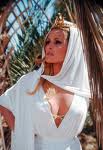
Ursula Andress As She
The ability to kill by telekinesis places a moral burden on Ayesha. If one agrees that the use of such a power may be necessary the question arises of when it may be misused. It would seem that the killing of a sexual rival was an inappropriate use, so the warring good and evil heads of her snake belt refers to the moral dilemma Ayesha faces.
Her belt seems somewhat different than that of Queen Meriamun of The World’s Desire. The latter having accepted the aid of the Ancient Evil was committed to evil being unable to remove the belt. There seems to be an element of volition remaining to Ayesha. She is not ‘possessed.’ Of course Ayesha began her life some thousand years after Meriamun so perhaps psychology was somewhat further evolved at that time or evolved with her over her two thousand year life span.
Indeed, a topic of discussion Haggard introduces shouldn’t be dimissed lightly. That topic is the age old discussion of whether good can come from evil and evil from good. This is indeed a dilemma as bad results can arise from good intentions and vice versa. There is a serious side here.
Ayesha is pure irresistable beauty. Once she shows her face no man can resist her. She glories in this power. In The World’s Desire of four years hence Haggard will separate good and evil making Meriamun represent evil while Helen, the world’s desire, is all good.
Holly is an interesting character who may be a back hand slap at the concept of evolution. Holly also makes this the story of a beauty and a beast. Holly is described as having a low forehead with a hairline growing out of his eyebrows, further his beard and his hairline meet. He is said to have a hugely broad chest and shoulders with extra long arms, perhaps down to his knees although this is not stated. What we have in Holly then is the Wolf Man combined with King Kong. Monstrous indeed.
In contrast Leo Vincey is a Greek god, a sort of Apollo. As Ayesha is irresistable to men Leo seems likewise to be irresistable to women. Indeed, he was married to Ustane within minutes of arriving in Kor. He appears to have sincerely liked Ustane even though on sighting Ayesha’s face he too loved her. Ustane was a rival for a portion of Leo’s affections so Ayesha cut off her electrical supply.
Of several truly dramatic scenes in this spectacularly well constructed story a very dramatic one is when Leo confronts his twenty-two hundred year old incarnation 0f Kallicrates. Haggard doesn’t dwell on Leo’s understanding of this strange phenomenon although from the potsherd and his father’s letter he must have been convinced of the truth. Strangely he doesn’t ask Ayesha for an account of this earlier life, nor how it was that she came to Egypt from Yemen to interfere in his romance with Amenartas.
Haggard and Lang were aware of the early history of Yemen from whence Ayesha as a pure Semite came. She was pre-Christian, although not pre-Jewish, of some ancient Arabic religious beliefs. How she got to Egypt is never disclosed or how she came into conflict with the Egyptian princess Amenartas for Kallicrate’s affections.
Ayesha, by the way the name translates as Life, merely confronts Leo as the neo-Kallicrates without any preparation. A year or so to get to know her and become accustomed to her face might have been nice. Although, Leo was married within minutes of arrival in Kor and was apparently satisfied with his wife. He was a pretty adaptable guy.
At any rate Ayesha rushes him into immortality and while tomorrow may be a long, long time, eternity is even longer. One might want to consider a moment about a relationship of that duration. Nor does she adequately prepare Leo’s mind for the ordeal of fire that she wants him to go through to become immortal. Twenty-two hundred years of waiting had done little to improve her patience.
Haggard has put everything he has into this story. He was granted clear vision only once in his life and he took advantage of it. In later years he was frequently asked why he didn’t write another story as good as She. His reply was that such a story may only come once in a man’s lifetime. The concentration and focus probably will never return again. While Allan Quatermain, his third successive attempt to create a lost civilization was on the weak side I would argue that his last, Treasure of the Lake, comes close to She.
So, the four of them set out for the place of the fire of life. Masterful effects. High in the mountains there is a gigantic balancing rock, a huge mushroom type cap balanced on a spire. It would seems that Zane Grey was also greatly affected by She as Riders Of The Purple Sage hews very close to She. A narrow ledge of rock extends out opposite with a gap of fifteen feet. To cross this gap with high winds howling through, a plank carried by the ever patient Job has to be lowered across the gap. No mean task I’m sure, with only one chance of getting it right. Once in place, thousands of feet above the gorge each has to walk from side to side; plus they have only a few minutes for all four to get over during a single beam of light from the setting sun.
Fortunately all four make it crossing the balancing rock to descend into a cave leading to the bowels of the mountain. There an eternal flame that ensures the life of the planet rumbles by every so often. Twenty-two hundred years before Ayesha had bathed in this fire which following esoteric doctrines had burned away her gross, earthly, moral impurities making her essentially, pure spirit.
A famous incident of the process is recounted of the goddess Demeter in her travels after the abduction of her daughter Persephone by Hades. Coming to Eleusis Demeter in her form of an old crone was taken in by King Celeus and his wife Metaneira. As a reward for her kind treatment Demeter set about to make their infant son Demophon immortal. Thus each night she held him over the hearth fire to burn away his mortal impurities. Surprised one night by a startled mother, Metaneira, the process was disrupted so that Demophon retained mortal impurities and failed to attain to godhood.
In this sense then the fire that maintained the life of the Earth traveled a route through this mountain at the center of the Earth. It appeared something like Old Faithful at Yellowstone periodically. When it swept by, if one stood in the flame it burned away one’s mortal impurities leaving one, it is to be assumed, wholly Spiritual. All the materiality was gone.
Spirituality and materiality are still being discussed today. Some talk of Spirit as though it exists while the materialists aver that all so-called spirituality is a seeming effect of materiality. I am of the latter school of thought. Oneself is all there is, there is nothing more. The effect of spirituality is nothing more than a mirage created by intellect and consciousness which is entirely material. It is all reduced to psychology which is a description of material existence.
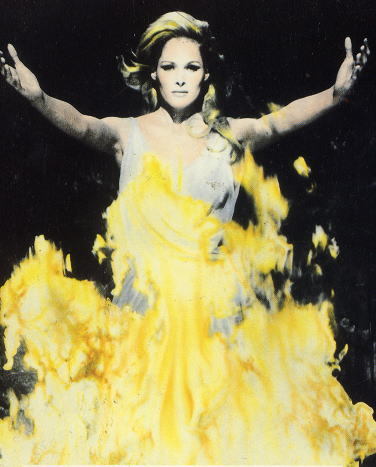
Come To Me
In Haggard’s story it is clear that Ayesha having lost her materiality to the flames is purely spiritual. This is going to cause her problems as she steps into the flames the second time.
The flame passes by while Leo dithers. Impatient for Leo to assume immortality Ayesha strips, as the flames will flame the material garments about her but not her body. As the flame comes around again Ayesha eagerly stands in its way. However having been once purified it is good for eternity. The second time is disastrous. Perhaps spiritually dessicated by the double dose Ayesha begins to wither devasted even in her death throes by her loss of beauty. Love in vain.
Job is so horrified he dies of fright leaving Leo and Holly alone.
The story for all intents is over but Haggard takes a dozen pages or so to get his heroes out of the caves and back to civilization.
Ayesha’s existence wasn’t extinguished. Her dying words were that She would return. Room left for the sequel which not surprisingly was called The Return Of She appeared in 1906.
Haggard hit the groove sharp as a knife in this incredibly well devised and executed story. One will find evidences of it strewn all through Burroughs’ corpus. Not least in his own character of La of Opar. La itself translates from the French as She, of course, so Burroughs even appropriates the name.
La is as ardent for Tarzan as She was for Leo/Kallicrates. Tarzan himself remains cold and indifferent to La throughout all four Opar stories finally abandoning her in Tarzan The Invincible.
She by Haggard is well worth three or four reads to set the story in mind and savor the wonderful and unearthly details
The End.
End of Review
A Review: Pt. III She by H. Rider Haggard
November 25, 2009
A Contribution To The
ERBzine ERB Library Project
She
by
H. Rider Haggard
Review by R.E. Prindle
Part III
The Gruesome, The Morbid AndThe Hideous
Rider Haggard was criticized severely by certain of his contemporaries for employing so many gruesome, morbid and hideous details. Indeed, ‘ She’ seems to be a study in the hideous, the gruesome and the morbid. If one concentrates on those aspects of the story one might actually question Haggard’s mental health.
Haggard himself calls attention to this morbidity. In King Solomon’s Mines he pointed out his humor with references to the Ingoldsby Legends; in She he makes a pointed reference to a Mark Tapley. I had no idea who Mark Tapley might be but thought I’d consult that most magnificent of encyclopedias, the internet. No problem. Mark Tapley was a character from Charles Dickens’ Martin Chuzzlewit. No matter how adverse the circumstances were Tapley was always cheerful and ebullient. Haggard must have thought him ridiculous. Thus he is devising a series of incidents that would bring even Mark Tapley down. Hmm. Interesting experiment.
It would seem then that Haggard was suffering from a fairly deep depression. In that sense She is sort of a horror story not too different in intent than, say, Bram Stoker’s Dracula. Indeed, at one point Ayesha explains that she rules by terror. That being the most effective way to control brutes like the Amahagger.
Certainly the storm at sea prior to entering Kor was an example of terror on the part of nature, a portent of things to come. Not least of these was the hot potting and projected cannibalism of the surviving member of the ship’s crew, Mohammed. ‘She’ had only required the safety of the Whites; as Mohammed was apparently a negrified Arab the Amahagger excluded him from the ban on Whites. An interesting example of White Skin privilege.
Their custom of killing their victims was to heat a pot red hot and turn it over on the victim’s head. There’s a gruesome and hideous enough example. You can see where Burroughs picked up his fascination for the gruesome and hideous.
The Caves of Kor are actually a city of the dead. Kor was an active civilization before Egypt existed in the fifth or sixth millennium BC. As embalming was a known practice when the Dynasties began c. 3400 the practice must have developed long before. Quite possibly it was practiced by the peoples of the Basin before the Mediterranean was flooded. In The World’s Desire Haggard mentions that the ancient Egyptians possessed writings in a precedent language. If so, how far back things like embalming go might be prodigious.
Egyptian embalming was primitive compared to that of the Korians. While Egyptian mummies became desicated the Korian process was such that the body was preserved forever in an apparent state of health. Thus bodies perhaps ten thousand years old or older had the appearance of freshness.
Now, this is positively creepy. Holly’s Amahagger attendent Bilalli while discussing Korian embalming told Holly that while he was a young man a particularly beautiful female corpse occupied the very slab on which Holly slept. Bilalli used to enter the cell and sit looking admiringly on the beautiful corpse by the hour. One day his mother caught him at it. The embalming fluid used was extremely flammable. Bilalli’s mother stood the body up and lit it. Like a huge torch the body burned down to the feet. The feet were still as good as new. Bilalli wrapped them and stored them beneath Holly’s slab. Groping around beneath the slab he brought out those ten thousand year old feet, still fresh, except for some charring at the ankles.
Haggard doesn’t stop there but goes on to emphasize the beauty of one particular foot. One wonders if perhaps George Du Maurier read She becoming entranced by the foot image thus reproducing the image in his novel Trilby when Little Billee draws Trilby’s beautiful foot on th wall. It is a thing Du Maurier would do as he inserted his literary baggage as profusely as Burroughs.
What effect this image had on Haggard’s contemporary readers may be guessed from the complaints about his gruesomeness.
In fact Haggard projects a depressed brooding evil permeating the Caves of Kor very well. This may have been caused by his and Lang’s theories of the Matriarchy. Human sacrifice was an integral part of the Matriarchal world. The sacrifices were invariably of men because women had greater economic value. When men were no longer sacrificed bulls, rams, the males of the species were substituted, the female still having greater economic value. Thus the story of Isaac and the Ram. That would be a great advance in civilization. About that time Isis ceased being the Egyptian symbol of the firmament being replaced by the female cow as the symbol of economics. Something like the kings of England sitting on the woolsack.
Depending on Haggard’s and Lang’s theories of the Matriarchy then Haggard may have been portraying a consciousness that has ceased to exist. There is always an element of misogyny in Haggard’s stories that is no longer tolerated. Then men were men and women were women instead of the attempted strange unisexuality of today. Thus the tens of miles of swamp between the Amahagger quarters and the citadel of Kor indicate the extent and quality of the Matriarchy. Swamps are the symbol of the female and the Matriarchy or, in other words, this very primitive superstitious consciousness.
The Korian swamp was haunted by mephitic vapors, evil smelling and oppressive. The ground they walked on was of uncertain solidity; it might look firm but this was only illusory as one could break through the crust. Often the litter bearers were walking through evil smelling muck up to their knees.
At one point an accident occurs and Bilalli’s litter with him in it is dumped into the slimy water. He would have drowned if Holly hadn’t leaped into the rank female waters to save him. They emerge looking something like the creature from the Black Lagoon.
It will be remembered that Holly was something of a misogynist. One may be stretching a point but even though rejecting women and marriage Holly managed to inherit a son from a man who was also a womanless widower. Haggard makes a strong contrasting point when he says that Leo was not averse to female company. The manservant, Job, is absolutely terrified of the female.
After traversing this desolate swamp of the female for days they arrive at the citadel or temple of Kor. Now, the citadel of Kor was built on an ancient lake bed that had been drained ten thousand years before. In that sense Ayesha is the same as Nimue or the Lady Of The Lake of King Arthur. Nemue lived at the bottom of a lake where she raised Lanclot who consequently was called Lancelot of the Lake.
Compare this also with Haggard’s postumously published Treasure of the Lake in which the Anima figure lives on an island in the middle of a lake in the middle of a volcanic crater. The lake of Kor was also in the middle of a crater.
When the Korian civilization was extinguished it wasn’t by invasion or other external reasons but by a monster plague something like the fourteenth century european Black Death that wiped out nearly everyone. At the resulting rate of death it wasn’t possible to embalm everyone so that tens of thousands of bodies were dumped into a huge subterranean pit.
In conducting Holly and Leo on a guided tour of Kor which was one gigantic necropolis, talk about depressing, Ayesha brings them to this pit. I quote:
Accordingly I followed (She) to a side passage opening out of the main cave, then down a great number of steps, and along an underground shaft that cannot have been less than sixty feet beneath the surface of the rock, and was ventilated by curious borings that ran upward, I do not know where. Suddenly this passage ended, and Ayesha halted, bidding the mutes return, and, as she prophesied, I saw a scene such as I was not likely to behold again. We were standing in an enormous pit, or rather on the brink of it, for it went down deeper- I do not know how much- than the level on which we stood, and was edged in with a low wall of rock. So far as I could judge, this was about the size of the space beneath the dome of St. Paul’s in London, and when the lamps were held up I saw that it was nothing but one vast charnel-house, being literally fullof thousands of human skeletons, which lay piled up in an enormous gleaming pyramid, formed by the slipping down of the bodies at the apex as others were dropped in from above. Anything more appalling than this mass of human remains of a departed race I cannot imagine, and what made it even more dreadful was that in this dry air a considerable number of bodies had become dessicated with the skin still on them, and now, fixed in every conceivable position, stared at us out of a mountain of white bones, grotesquely horrible caricatures of humanity. In my astonishment I uttered an ejaculation, and the echoes of my voice, ringing in that vaulted space, disturbed a skull which hd been accurately balanced for many thousands of years near the apex of the pile. Down it came with a run, bounding along merrily towards us, and of course bringing an avalanche of other bones after it, till at last the whole pit rattled with their movement, even as though the skeletons were rising up to greet us.
Talk about a holocaust! Imagine standing in that dimly lit space far beneath ground, in the grave itself so to speak,and viewing that. Holly was overcome and perhap Mark Tapley himself would have lost a little of his cheeriness. If that didn’t do it the ball Ayesha threw would have.
Before I move on to that though let’s take a penultimate example that might actually unsettle Mark Tapley. This is truly unsettling with truly macabre and voyeuristic soft porn details that are quite remarkable. Let me say that it is only with the fourth reading that the horrific nature of these details really began to sink in. I hope to really make this clear in the next section in which I intend to do an in depth analysis of Ayesha.
In his cell at the citadel of Kor Holly notices a cleft in the wall he hadn’t noticed before. This cleft is going to lead him to Ayesha’s sleeping room. This is not unlike King Solomon’s Mines in which upon entering the symbolic vagina they were led to the womb or treasure box. As I say Holly entered this cleft, let your imagination dwell on that, and followed a dark, dank, narrow corridor until he perceived a light.
He is looking into Ayesha’s sleeping room where in a certain deshabille, very erotic, she is addressing a covered form on a bier next to hers. This is the embalmed body of Kallicrates who she murdered twenty-two hundred years before. So she has been sleeping with this corpse for twenty-two centuries. Now, dwell on that for moment, let the horror of it sink in.
She addresses the corpse in a fairly demented way. Twenty-two hundred years of this would drive anybody nuts. Finally to the dismay of Holly she animates the body by telekinetic powers actually causing it to stand zombie like so she can kiss and caress it. A lot of necrophilia in this novel. Haggard must have been half dotty when he wrote this. Of course Kallicrates is a double of Leo so Holly has all he can do to keep from crying out. Causing the dead man to lay himself down Ayesha covers him and blows out the light.
Holly has to find his way back in the dark reminding one of innumerable passages in Burroughs where his characters have to find their way in the dark. Holly gets only so far and collapses in the tunnel. Waking he sees a light coming in from his cell allowing him to find his way back.
And then Ayesha throws her ball. If you’ve read carefully and really ingested these macabre, gruesome, and as Burroughs’ would say, hideous details they’re beginning to oppress your mind, perhaps even a mind like Mark Tapley’s.
Now Haggard trundles out the frosting. To illuminate her ball Ayesha brings out piles of ten thousand year old corpses placing them around the perimeter as human torches. Laying out a large bonfire the corpses are stacked alternately like so much cordwood and replaced as they were consumed. Remember these are as fresh looking as you or I. The Roman emperor Nero actually used live humans in the same manner. Haggard notes this in the text which I thought weakened the effect.
Ayesha seems to be aware of the effect, indeed, intended it and appears to relish the reaction.
These are the high points of these horrfic details. Minor ones are constant so that the cumulative effect leading up to the terrific images of the demise of Ayesha, temporary though it might be, is overwhelming. But about She, Ayesha, in the next part.
A Review: Part II She By H. Rider Haggard
November 20, 2009
A Contribution To The
ERBzine ERB Library Project
She
by
H. Rider Haggard
Review by R.E. Prindle
From London To The The Caves Of Kor
She is dedicated to Andrew Lang:
I Inscribe This History To
ANDREW LANG
In Token Of Personal Regard
And Of
My Sincere Admiration For His Learning
And His Works
One may well ask then who is this Andrew Lang and what is his learning? In point of fact Haggard not only dedicated She to Lang but wrote three books in collaboration with him. Andrew Lang, 1884-1912, was a Scottish scholar specializing in folklore, mythology and religion so you can see where Haggard came by much of his esoteric knowledge. In addition Lang was one of the founding members of the Society For Psychic Research and a past-President. Lang wrote dozens of books over his lifetime. He even wrote a parody of She in 1887 called He. Today he is remembered only for his collections of fairy tales. Twelve volumes in all each titled after a color such as The Crimson, or Blue or Pink or Gray Fairy Book. The volumes are undergoing a fair revival now with a collector’s edition published by Easton Press and several nicely bound volumes by the Folio Society.
The nineteenth century was the one in which advanced knowledge of the past was rapidly extending European knowledge greatly. The Rosetta Stone deciphering Egyptian hieroglyphics had been achieved as recently as the 1830s. Nineveh and the Assyrian ruins had been unearthed. Schlieman had discovered the locations of Troy and Mycenae.
The exoteric side was covered by the academics while the esoteric side was covered by independent scholars like Madame Blavatsky and probably Andrew Lang. There was a clean split between the academic Patriarchal view of ancient history and the emerging Matriarchal view that had just been developed by the Swiss mythologist, J.J. Bachofen. Bachofen organized ancient history into Hetaeric, Matriarchal and Patriarchal periods. He himself was a member of the successor Scientific period.
The academics totally rejected the notion of a Matriarchal period. This, of course, led to a complete inability to understand Homer, both Iliad and Odyssey. The Iliad especially is a description of the war by the Patriarchy to destroy Matriarchy.
Lang seems to have understood the Matriarchal phase of ancient history. He must have passed this knowledge on to Haggard. Ayesha, as She, rules a Matriarchal society. While the ideas represented in She must have seemed bizarre or merely an amusing reversal of the Patriarchal world at the time, today it all reads comprehensibly. It rings true if not exact.
C.G. Jung, the psychologist, who developed such notions as the male Anima and the Shadow was very immpressed by what he saw as the male Anima in She. Madame Blavatsky lauded the book for its esoteric content. But then, Haggard was firing on all eight cylinders when he wrote it, it is difficult to conceive of a more perfect fantasy/adventure novel. Indeed Haggard subtitles the novel: The History Of An Adventure.
Haggard was an excellent Egyptian scholar. He not only visualized Egypt convincingly in his Egyptian novels but his Egyptian ideas pervade the African novels. Many of them involve Egyptian influences and even peoples filtering down into East and Central Africa. The Ivory Child is a case in point as is She.
The set up to the trip out is brilliant incorporating details that become cliches in B movies.
Leo Vincey’s father before he died gave a metal box to Leo’s guadian, Horace Holly, that wasn’t to be opened until Leo was twenty-five. This box is now opened. It contained a letter to Leo, a potsherd (a piece of a broken jar) covered with ‘uncial’ Greek lettering, a miniature and a scarab containing Egyptian hieroglyphics that read ‘Royal Son of the Sun.’
Thus Haggard captured most if not all of the elements that went into the intellectual aura fostered by B moves primarily in the first years of the talkies through the thirties. That entailed things like the Curse of the Pharaohs, movies like The Mummy melding into Wolf Man, Dracula, Frankenstein and African juju spells. Things against which Europeans had no defense because the ancient magic was stronger than modern science, or so we were led to believe. I can’t speak for others but it took me a while to shake this oppressive spirit. This was pretty strong stuff for my ten to twelve year old brain. Not to mention being bombarded by The Creature From The Black Lagoon, The Thing and The Day The Earth Stood Still. We wuz tried in the fire and come through good.
The gist of it is that Leo’s ancestor Kallicrates lived in the time of the last Pharaoh Nectanebo as one of the royal family. Spookier still Nectanebo was said to have fled Egypt before the conquering hordes, going to Macedon where he secretly impregnated Olympia, Philip’s wife, who then gave birth to Alexander which made him the rightful heir to the Pharaohship instroducing Greeks as rulers into his city of Alexandria.
At any rate Kallicrates girl friend, Ayesha, killed him in a jealous rage. The family nursing vengeance for all these two thousand years it is Vincey’s mission if he chooses to accept it, to follow the ancient map to the Caves of Kor and kill Ayesha or, She-Who-Must-Be-Obeyed who has been nursing regrets over killing Kallicrates two thousand years previously. Listen to me, I’m tellin’ ya it’s all here.
So Vincey, Holly and their man Job set out to find this place in Africa even more remote, if possible, than King Solomon’s Mines. And a heck of a lot more hostile too.
The trip out is some of Haggard’s finest writing. They are to be looking for a rock formation on the coast in the shape of a gorilla’s head. Sailing the coast they miraculously spot this head just as a terrific squall sends their felucca, dhow or other exotic ship from foreign climes to the b ottom.
But, even though the ship sinks they beat the reaper because they brought a boat containing unsinkable water tight compartments. As the storm subsides the three survivors along with an Arab float into the mouth of the appropriate stream as though it were all foreordained. What follows is some excellent writing with details I don’t need to recount.
Suffice it to say they are dragging their boat along an ancient canal when they are accosted by men from Kor. Ordinarily these guys would have speared them and moved on, no strangers needed in Kor. Using her magic She had learned of Leo’s coming a week previously thus ordering their lives spared while they were to be brought to her. Uh huh.
The detailing is terrific, this book is tight and well organized. It moves right along. The land is under the thumb of She-Who-Must-Be-Obeyed. This is a tight Matriarchy as we now recognize not just some strange place where a woman is in charge.
While the three are entering the Caves of Kor, Leo Vincey, being the cynosure of all female eyes, a knockout named Ustane steps up and kisses him. Not averse to a public display of affection Leo lays one on her back. New to the area and not aware of the customs of the place Leo had just accepted Ustane as his woman. In town for a few minutes and already married. That’s the way things happen in this particular Matriarchy. Ustane is now in conflict with Ayesha, She-Who-Must-Be-Obeyed.
The stage is now set for the main drama when Ayesha recognizes Leo as her long lost Kallicrates come back from all those reincarnations at last.
The exoteric Catholic Church is thus thrust aside in favor of all the heretical doctrines of the esoteric which have been bubbling under the Hot 100 for two thousand years. These unfamiliar esoteric doctrines would become the mainstay and staple of science fiction/fantasy for the next one hundred years.
Just as an example of how Burroughs probably learned esoterica, I became familiar with estoeric themes myself from reading 1950s science fiction and fantasy- Amazing Stories, William Tenn, Robert Heinlein, Ray Bradbury and all that sort of stuff without realizing what I was taking in, thus Burroughs surrounded by the Society for Psychical Research, Camille Flammarion, George Du Maurier and Stevenson et al. naturally learned the esoteric language. No mystery, he was speaking in tongues before he knew it.
Leo is awaiting the summons from Ayesha which will be covered in Part III.
Part I A Review: She By H. Rider Haggard
November 17, 2009
A Contribution To The
ERBzine ERB Library Project
SHE
by
H. Rider Haggard
Review by R.E. Prindle
Part I
The Framing Device

From eighteen eighty-five to two thousand nine is one hundred twenty-five years. The span records many changes. In 1885 there were no movies, no radio or TV. Movies came in c. 1900 beginning to change the literary paradigm. The movies produced a definite class structure in literature. With the introduction of sound in 1927-28 two classes of film developed. A movies and B movies. A movies employed A or literary fiction such as War And Peace, Oliver Twist and such while the developing fields of genre fiction were reduced to an inferior B status.
Time has erased the meaning of the terms A and B pictures. I suppose that if a younger person was told that he was watching a B movie he wouldn’t know what was meant. Even if a devoted movie buff, the mere classification would have no experiential significance. You had to have been there.
In the development of the film industry it was thought that studios had to have their own theatre chains. Thus MGM movies wouold be shown only at Loewe’s first run theatres and so on.
In those glory days of the movies first run theatres were gorgeous temples, often named The Temple, the Roxy in NYC has the most spectacular reputation. The goal of the studios was to produce 52 A movies a year to supply the ‘exhibition’ chain a new first run A film a week. Only MGM was to reach this goal.
Once having been exhibited for its week or period A movies were released to rerun theatres usually outside the chains where they were shown at reduced prices. As an added incentive a second feature was shown and this was a B movie.
We lucky kids who inhabited Saturday matinees every week year around usually got two B movies and selected short subjects which included previews, a serial, a cartoon, a newsreel, and some sort of film usually a travelogue on deep sea fishing or water skiing matter. These comprised an alternate reality in addition to real life and dreams. Nor did we feel shorted by B movies. To our young minds these movies were fraught with the most profound thoughts imaginable. Hopalong Cassidy and Tarzan were the favorites of most kids- Gene Autry, Roy Rogers a distant second to Gene. Unbeknownst to us of course the literary granddaddy of the B movie was H. Rider Haggard and She.
Not that Haggard movies were shown with any regularity but he managed to anticipate all the elements of B movies to perfection. Many if not most of the key elements of B moviedom were pinched from Haggard. What Haggard didn’t provide was tossed in by his disciple Edgar Rice Burroughs.
Burroughs borrowed his use of the framing device from Haggard probably with the frame of She as his model. The framing device of Tarzan Of The Apes shows emulation of that of She. It’s a good one.
Most writers of these tall yarns wanted the reader to believe he was reading a true story, in other words, an invitation to suspend disbelief- that is, everything fits in so he divised a framing story as persuasion.
The first paragraph of She’s preface is perfection of its kind:
In giving to the world the record of what, considered as an adventure only, is I suppose one of the most wonderful and mysterious experiences ever undergone by mortal man, I feel it incumbent on me to explain my exact connection with it. So I will say at once that I am not the narrator but only the editor of this extraordinary history, and then go on to tell how it found its way into my hands.
If one compares that to the first paragraph of Tarzan Of The Apes the similarities become immediately apparent. Both authors claim no authorship. In both cases the story, or history, was given to them by a second party. Thus Haggard the author as editor can speak in the first person while making editorial comments.
The hint is made that Allan Quatermain is the actual editor. The editor was visiting Cambridge University one day some twenty years previously when he noticed two interesting people. His friend knowing them offered to introduce him.
“All right,” answered my friend, “nothing easier. I know Vincey; I’ll introduce you,” and he did, and for some minutes we stood chatting- about the Zulu people, I think I had just returned from the Cape at that time.
So the canny reader hopefully having read King Solomon’s Mines can infer that the unnamed editor is, in fact, Allan Quatermain as a garrulous amiable gentleman.
Twenty some odd years after that casual and very brief meeting, as improbable as it may seem, one of the two men, Vincey’s guardian, Horace Holly sends the Editor the text for She.
Holly says: ‘You will be surprised considering the slight nature of our acquaintance to get a letter from me.’ I should say so. What a great memory.
Holly goes on:
I have recently read with much interest a book of yours describing a Central African adventure. I take it this book is partly true, and partly an effort of the imagination. However this may be, it has given me an idea. It happens, how you will see in the accompanying manuscript (which together with the scarab, the ‘Royal Son of the Sun), and the original sherd, I am sending you by hand) that my ward, or rather my adopted son Leo Vincey, and myself have recently passed through a real African adventure, of a nature and much more marvellous than the one which you describe, that to tell the truth I am almost ashamed to submit it to you but you should believe my tale.
So Holly sees through Quatermain’s preposterous story as only half true while Holly’s equally preposterous story is the whole truth, the real thing. Well, if you’ve accepted the premiss there’s no way to go but further in so, all one can say to Holly is that his story is going to have to go some to exceed Quatermain’s.
Generously Holly offers any profits from publication as a reward while underwriting any possible loss. That was real Haggard accepting that bundle on Quatermain’s part.
Rounding out the baloney the editor says:
Of the history itself the reader must judge. I give it to him, with the exception of a very few alterations, made with the object of concealing the identity of the actors from the general public, exactly as it has come to me.
As a reader my judgement is that it is an excellent whopper but I don’t believe a word- or do I?
The frame continues:
With slight [five pages] preface, which circumstances make necessary, I introduce the world to Ayesha and the Caves of Kor.
Ready when you are, C.B.
An excellent, convincing framing device. The Editor must be Allan Quatermain yet the name of the editor is concealed from us as well as the identities of the actors. Where we are going is mystery piled on mystery, the strange and wonderful lie before us, we in complete safety.
So with Burroughs framing device of Tarzan Of The Apes. While not copied word for word certainly idea for idea. The influence of Haggard is apparent but not paramount. Burroughs’ mind was a maelstrom into which innumerable influences (a slight exaggeration) are drawn to the depths of his subconscious and emerge melded into something so close and yet so different than his many, many sources.
Having roped the reader in like a carnival barker luring the victim into his peep show Haggard begins to lay out his nearly perfect story of the type.
Part B follows.
A Review: King Solomon’s Mines By H. Rider Haggard
November 13, 2009
A Contribution To The
ERBzine ERB Library Project
King Solomon’s Mines
by
H. Rider Haggard
Review by R.E. Prindle
Three volumes made Rider Haggard’s reputation then and maintain it today. Classics of the B genre. The first of these is the subject of this review, King Solomon’s Mines. The other two are She and Allan Quatermain. The novels were written between 1885 and 1888. These were very interesting years in the exploration of Africa. Speke had identified the source of the White Nile twenty some years earlier. Robert Livingstone had been found and sensationally recounted by the great Henry Morton Stanley.
Subsequently Stanley had navigated the course of the Nile from the plateau down to the sea, a stunning accomplishment. His rescue of the Emin Pasha in 1886 was on everyone’s lips. The white spaces on the maps were rapidly disappearing. In the midst of this excitement Rider Haggard’s great African trilogy made a propitious appearance. No better timeing could have been devised. And the novels were sensational, plausible too, at that time. Who knew what additional wonders Africa concealed. There was room in that gigantic continent for a lot of lost cities and civilizations. Haggard and his disciple, Edgar Rice Burroughs rapidly populated Africa with a host of them.
Haggard would continue to write exciting African tales until the day he died in 1925 after a lifetime of putting out two or three novels a year. They usually followed the same format, a long trip out taking up at least half the novel, the intense situation on arrival and a return home. The same format Edgar Rice Burroughs would use. The novels were packed with esoteric lore and authentic African details.
It is said that Haggard wrote the Mines on a bet after being told he couldn’t write the equal of Stevenson’s Treasure Island. He did do that but Mines is written tongue in cheek with a lot of jokes. Haggard makes this clear when Quatermain says that his two literary mainstays are the Bible and the Ingoldsby Legends. The Legends written in the 1830s and 1840s are a collection of humorous parodies of Folklore themes and poems by Richard Harris Barham writing anonymously as Thomas Ingoldsby of Tappingham Manor. The book was very popular with, it seems, all the the authors till the turn of the century at least. One finds it mentioned frequently. Taking the hint I read a copy. Thus, Haggard is protecting his rear in case of failure by saying his story is just a put on or joke.
King Solomon’s Mines is told in the first person by the old knockabout hunter, Allan Quatermain. He has a bumbling self-effacing manner not unlike Inspector Columbo of the TV series. You don’t think he can do it but he’s spot on every time.
As was common with this sort of adventure story the point is to make the reader think the story is true. Burroughs probably picked up his habit of framing from Haggard. Many of the details of Mines are true to Haggard’s own life while his study of the Zulus and other tribes accurately portray their customs. Haggard is very sympathetic to African customs and mentality actually seeming to envy them. He genuinely can see little difference between Black and White while adopting a fairly critical attitude towards Whites and a sympathetic one toward Blacks. Very modern. Indeed, in this novel the White heroes join a Zulu Impi or regiment and fight with the Zulus as White Zulus. Naturally they comport themselves heroically, Curtis excelling the Blacks at their own game.
As the novel begins Haggard sets up the story. The Englishmen, Curtis and Good, are out in search of a lost brother. The meeting with Quatermain on shipboard is fortuitous leading to his subsequent employment as their guide. Haggard describes a boat journey from Capetown to Durban that is obviously authentic; Haggard himself has taken the same trip. Thus unlike Burroughs’ imaginary Africa this is authentic, the Real Thing. On the journey Quatermain meets Sir henry Curtis and his friend John Good, who need a guide to take them in search of Curtis’ lost brother.
The search will take them to a hidden Zulu enclave behind a burning desert and a towering mountain range. The trip out is filled with interesting authentic details but no need to dwell on them here.
Crossing the burning sands not known to have been successfully navigated before, they are confronted by the towering twin peaks of Sheba’s Breasts topped with four thousand foot nipples. Who can’t see the humor there. Pretty racy for what are thought of as stodgy old Victorian times. Bear in mind the Ingoldsby Legends while reading the story as probably most of Haggard’s readers would have been familiar with them. They are of this sort of tongue in cheek humor. The ancient map they are following indicated the route to follow.
Behind the Breasts lies Kukuanaland. Undoubtledly Kuku should be read coo-coo. The Kukuanas are the Zulu tribe in possession of King Solomon’s Mines. Kukuanaland is somewhere near the ruins of Zimbabwe, although Haggard doesn’t allude directly to the site. I’m sure everyone has heard of the ruins of Zimbabwe. The old Zimbabwe I mean.
There has always been a dispute as to who built Zimbabwe. Africans claim it was built by Africans while the thought in Haggard’s time was that Zimbabwe was built by Phoenicians hence a few mentions of them. The notion was that these were the ruins through the Queen of Sheba of King Solomon, hence the title King Solomon’s Mines. Zimbabwe is either in or next to lands of the Shona people. The Shona arrived in the area from the North possibly from 300 to 800 AD. There is no record of stone work among the Shona before or after. The structures of Zimbabwe are of shale like stone merely piled on top of each other being very thick and very high. Instead of piled up stones it is customary to say the construction is without mortar as though that is a great skill. Without mortar = piled up stones, doesn’t it?
It seems unlikely the Shona would have built them while it is also a remote possibility that the Phoenicians did. It is true however that Greeks traded on these shores but they didn’t build them. A more probable builder is the Malagasy people. I don’t think the Malagasy arrival is commonly known yet, it wasn’t to me until a few years ago. The Malgasies made the long sea journey from Indonesia to arrive in Madagascar and East Africa sometime between 500 and 1000 AD. As they would have been invaders into a recently and sparsely settled territory any groups landing on the continent would have been automatically at war with the Shona thus needing a fort for protection. Being much more technologically advanced than the Africans they would likely be familiar with stonework.
As it is said that Zimbabwe was a mining and trading community, as the Malagasy were seafarers it is likely they would be the more obvious candidate otherwise one has to explain where the traders of what is described as an extensive trade come from as the the Africans couldn’t possibly have gone to the buyers or known what to trade. Interestingly the Malagasies introduced the banana and an improved yam to Africa thus they had to land on African shores.
Zimbabwe had only been discovered by Europeans a few years before Haggard arrived in Durban. Very likely he was eager to see the ruins and did as he does have at least three stories in which Zimbabwe figures. Here he combines Zimbabwe, King Solomon and the Phoenicians.
As the party approaches Kukuanaland they are faced by a huge mountain range towering perhaps 15,000 to 18,000 feet into the sky. Facing them are two huge mountains named Queen Sheba’s Breasts, the Grand Tetons of Africa.
Here I have to mention a blogger (feministbookworm.wordpress.com) who pointed out the female arrangement of Kukuanaland. This escaped me in my previous readings but is of some interest. Haggard in a cryptic way has written a fairly pornographic story, especially for Victorian times. I’m sure most people didn’t get it even though Haggard provides a fairly obvious map although turned upside down. This is along the coy lines of various pop songs such as ‘Baby, let me bang your box.’ After shouting out this line several times allowing the average guy to think a woman is being propositioned the singer reveals he’s actually referring to a piano- box in musician’s slang equals piano. Box = a woman’s pudenda in sexual slang.
If one looks at Haggard’s map Sheba’s Breast’s are to the South while there is a triangle of mountains to the North. The triangle of three mountains forms a female Delta or box. In the middle between the Breasts and Delta is the Kukuana capitol called Loo. Loo is British slang for toilet or ‘shitter’ so we some scatology going on here.
This gets better. I jump ahead to the ending. The Englishmen are promised diamonds from King Solomon’s Mines. The mines are located within the Delta or pudenda. British slang of times for the female pudenda was Treasure Box. Thus the Englishmen are going to descend through the vagina into the womb of the mines where the diamonds are stored in actual treasure boxes. Humor, remember. Bear in mind that in Burroughs diamonds are of the female, actually Anima, treasure. Same here. This is going to get better.
Apart from Mother Earth, represented by Sheba’s pudenda, there are only two women in the story which Haggard smirkingly points out: One is a Bantu beauty who becomes attached to Good, the other is an old hag named Gagool. The latter forms the model for Burroughs’ old Black crone in Gods of Mars and Nemone’s guardian in Tarzan And The City Of Gold.
Both accompany the three White men to King Solomon’s mines. At whatever age Burroughs first read this the impressions stuck. This stuff was current literature to him while Classics to us. One must imagine the excitement with which these novels were read. Readers of Opar Tarzan novels (Return, Jewels, Golden Lion and Invincible) will immediately recognize the setup although there are differences.
Always one to employ horror effects Haggard is at his best in this early novel. The group descended as it were through the vagina into the depths of the womb. Along the way are giant stalactites. (Penises?) Then they enter a chamber in which the dead kings of Kukuana are preserved. Rather than Egyptian mummification they are set beneath a drip being turned into stalactites or, in other words, big pricks. Seems to me like an obvious joke. A huge figure of death presides over the immortal enclave.
Proceeding further they come upon a door set in the wall blocking the way. The door is a huge slab several feet thick operated by a hidden mechanism that lifts the slab vertically into the ceiling. Gagool with a hidden movement releases the door which slowly and efficiently retracts into the ceiling. The party can now enter the treasure room or womb. The door stands for men’s sexual desire for the female. As with the hymen without equal desire on the part of the woman entrance is barred but with woman’s compliance the way opens easily.
Inside the room or womb are the treasure chests containing unlimited value in diamonds.
After taunting the men Gagool makes a break for the door having released the lever that closes it. She is held back by Foulata who worshipped Good. Stabbed by Gagool she falls to the ground but has successfully delayed Gagool. In attempting to roll under the descending slab the tardy witch is crushed flatter than a piece of paper. The men are now trapped in the womb but they have a candle for light. Quatermain stuffs his pockets with stones while filling a basket Foulata brought.
Here’s the classic B movie part: While waiting for death they notice that the air remains fresh. Good discovers a trap door in a corner. Opening this they descend as it were into the bowels of this elogated represention of a woman who might represent Mother Earth or the Great Mother thus forming a collective Anima for the three White men. Anticipating She a little. A bizarre Anima for Haggard also. OK, I’ve got a weird sense of humor. I’ve always known it but that doesn’t make it less funny. No longer having a light they are forced to feel their way through the tunnels. The tunnels eerily represent the intestines. Haggard is getting really scatological here as you know what emerges from intestines.
As they pick their way along Good falls into a stream that greatly resembles the urethra. Fortunately Quatermain has some matches. One is used to locate Good clinging to a rock in midstream, possibly meant as a kidney stone as a joke. Hauled ashore they backtrack and resume their way. Curtis spots a dim light toward which they move. The opening narrows down to the point that the men have to squeeze through tumbling out into the diamond shaft like so many turds. Haggard must have been gleeful at what he was getting away with.
Climbing out of the pit they discover they have returned to the entrance. Thus vagina and rectum are only a short distance apart. Anatomically correct as it were. Haggard had a fine sense of humor.
While adapting the topography for his own needs one can easily see how Burroughs replicates Haggards’ design in Opar. Burroughs designed a long straight corridor but broken by a fifteen foot or so gap. In Jewels of Opar Tarzan falls through the gap dropping into a pool of water or river much as in Mines. Proceeding further he enters he jewel room of Opar filling his pouch as he had neither pockets or basket.
Opar itself replicates the Treasure House of Kukuanaland. The gold vaults represent the head of the female figure or perhaps only one of Sheba’s breasts. Proceeding down the corridor, or Great Road of Kukuanaland one comes to the sacrificial chamber situated much as the city of Loo. Proceeding from the chamber one comes to the exit. This is described by Burroughs as a narrow crack or cleft in the wall to pass through which Tarzan had to turn his shoulders sideways. So, Opar and Kukuanaland are built according to the same scheme.
Obviously the memory popped into Burroughs’ mind in The Return Of Tarzan, developed in Jewels of Opar and Golden Lion and came to perfection in Tarzan The Invincible. It would seem clear that ERB understood the sexual structure of King Solomon’s Mines.
If we go back to the other end of Kukuanaland we have the two towering mountains known as Queen Sheba’s Breasts. In order to prevent anyone taking a low level route between the Breasts there is a perpendicular barrier running between the breasts rising several thousand feet. Odd geological formation. Rising 4000 feeet above the breasts themselves are the nipples. That should be enough to make anyone laugh.
A recurrent theme in the stories is a juxtaposition of ice with summer weather, often associated with a woman as here. Perhaps Haggard had a cold, cold mother.
While the party is both starving and thirsting they find neither game nor water until Umbopo discovers some melon patches providing food and water until they reach the snow line. Soon they come to the nipple rising sheer from the breast. At the base of the nipple is a cave. This cave may possibly have been appropriated as the entrance to Opar’s gold vaults in Burroughs. In the cave is the frozen body of Da Silvestre who made the map they have been following. The bushman servant freezes to death during the night so they set him over by Da Silvestre. There’s a joke here but I don’t get.
Continuing down Sheba’s left breast they reach below the snow line. The boys spot an antelope way off there, long shot, but Quatermain makes it, cleanly knocking out a vertebrae in the neck. While cleaning up in an adjacent stream and eating they are surprised by a band of Kukuana and taken.
Umbopo who signed on back in Durban always had this mysterious royal air about him and now we’re going to find out why. For those contemporaries who insist that no book should violate their enlightened prejudices whether the book be as old as Homer or not they may feel uncomfortable reading this book. By and large Haggard shares the attitudes toward race, gender and whatever of his times rather than Liberal notions of today. Can be painful for certain types.
Nevertheless Haggard has a deep admiration for the Zulu tribes and a kind of understanding one toward the lesser Bushman and Hottentots. The Zulus are uniformly tall and well built while Quatermain and Good are smaller and more comical in appearance. Only Sir Henry Curtis is of the same stature, slightly larger, as the Zulus. He seems to stand in for what is otherwise a race of inferior stature.
There is a great fifty foot wide road that runs from the barrier of Sheba’s Breasts to Sheba’s Delta. The road is over a hundred miles long with Loo in the center.
The city of Loo is modeled after the encampment of the Zulu chief, Chaka. The details Haggard describes are undoubtedly accurate. Chaka flourished 1830-40 while the last of his line, Cetywayo, ruled during Haggard’s tenure in Africa. His fictional king is called Twala. We now discover that Twala is Umbopo’s brother. The latter was rightful heir but Gagool who is represented as being hundreds of years old favored Twala expelling Umbopo and his mother which is why he was in Durban. His identity is assured because of an Uroboros that encircles his waist. This snake appears to be a birth mark rather than a tatoo.
After accepting a rifle from Curtis as a gift Twala sends three chain mail shirts of medieval manufacture which proves that Zimbabwe was formerly occupied by another race, I suppose.
We have a civil war brewing here as Umbopa asserts his rights. Before the war develops Twala holds a ceremony I find really interesting, the smelling out of witches. The regiments were assembled. In this case Gagool runs up and down the ranks smelling out the witches. Anyone she indicates is removed from the ranks and immediately killed. This was an actual Zulu custom. Haggard portrays them more than once in what is his pretty decent historyof the Zulus in the novels.
Interestingly under the African president of the United States we have the same situation occurring. Obama denounces those in opposition to him essentially as witches. While currently we are put under surveillance the time may shortly arrive when we are merely arrested and despatched. Thus the innate African soul reasserts itself hundreds of years out of Africa. Of course, Obama was born in Kenya but he didn’t live there.
After the smelling out the regiments align themselves according to their allegiance. The three White men suit up on the side of the pretender, Umbopo. In his admiration of the Impi battle plan Haggard has the Whites disdain to use firearms preferring to show Whites returned to primitive savagery. Of course he normalizes the British and Zulu societies so that any difference is perceived but not real.
If you want to how this attitude was digested by the British public rent a copy of the movie If c. 1965. A British public school story that viewed better the first time around for me but still of interest. I might rent it again, though.
It is at this point of the story that the ‘White giant’ Sir Henry Curtis took his place in the Zulu ranks to show White supremacy that is when the actual basis of Tarzan took place in Burroughs’ mind.
The three Whites are the only ones wearing chain mail so that they come through bruised but alive. Without the chain mail, of course, all three would have been killed many times over. Perhaps the chain mail is symbolic of the science of the Maxim.
My feeling is that Haggard was so enamored of primitive Zulu warfare as organized by Chaka that he thrilled himself by placing the three in their ranks. Haggard had his peculiarities. As I say, he seemed to reject science.
Umbopo’s troops triumph over greater odds while King Twala is captured. Sentenced to die he demands the right to hand to hand combat selecting Curtis as his adversary.
Thus a duel ensues providing two or three pages of excitement in which a very hard battle is fought. Curtis decapitates Twala proving I suppose that on their own turf, evenly matched, the White Man is the greater.
Morally, however, Haggard gives the nod to Umbopo and the Zulus. Umbopo apparently feels a bond has been vilolated between the trio and himself. He offers them wifes, land and honors if they choose to stay in Kukuanaland. They instead choose to gather diamonds from Sheba’s treasure box. Umbopo is disgusted that White men care about nothing but money. Haggard sheepishly agrees with Umbopo but the trio nevertheless collect their diamonds and scoot, setting themselves up splendidly in England where money matters. Regardless of Haggard’s moral it is clear that the Kukuanas have no use for money in their primitive society while being broke in London is a sort of hell.
One wonders whether when Umbopo sent Gagool with them he knew that he was sending them to their deaths. Their return was after all rather miraculous. Leaving Kukuanaland the three arrive safely and rich in England.
Postscript.
Burroughs read not only King Solomon’s Mines, She and Allan Quatermain but probably the whole corpus. What he read before 1911 was obviously the most influential on him through the twenties. So an an investigator, Haggard’s novels before 1911 are the one to familiarize oneself with first. The very late Treasure Of The Lake however did influence Tarzan Triumphant.
Sir Henry Curtis was a key element in the formation of the idea of Tarzan and a role model. I suspect that Treasure Island by Stevenson provided he means to get the Claytons to Africa. Evolution provided the background of Kala and Tarzan’s life with the apes.
Whether Good or Quatermain had any influence on the character of Paul D’Arnot or not I’m not sure. He may have evolved from Dupin of Poe’s Murders In The Rue Morgue forming a double for Tarzan not unlike the narrator and Dupin of Murders.
I have explained the probable relationship of Opar to Sheba’s treasure box. That seems pretty secure to me.
Haggard developed the story line of the preamble and journey to the scene of action, a flurry of action in the crisis and the return home. Burroughs seems to follow this format although he can introduce picaresque elements.
The landscape and terrain of Burroughs is quite similar to Haggard’s. Over the years as Haggard read Burroughs’ novels there are Burroughsian elements that creep into Haggard’s work. Treasure Of The Lake bears a number of similarities to Burroughs especially the elephant dum dum. That also owes a great deal to Kipling and Mowgli. A stunning scene in Haggard. I would really start with Treasure Of The lake and then begin with King Solomon’s Mines, She and Allan Quatermain.
La, of course, is derived from the next novel, She.
A Review: On Tarzan By Alex Vernon
November 13, 2009
A Review:
On Tarzan
by
Alex Vernon
Review by R.E. Prindle
Vernon, Alex: On Tarzan, 2008, UGeorgia Press
This book reads almost like the cover of The Doors LP Strange Days. You’ve entered into some kind of literary twilight zone. This is perhaps the most eccentric book I’ve ever read. I can’t believe it was actually published- and by a University press!
Alex Vernon has a PhD and is an Associate Professor at Hendrix College. Must have been founded by Jimi before he OD’d. I’m flabbergasted that the guy has a job. Average looking Joe from the back cover. Happy, smiling. Doesn’t look like he’d be sex obsessed but it could be a problem for him.
The phallus on the cover dismayed me but prepared me for the sex driven content. Zany, zany, zany. A large phallus rises out of what might be the swamp, symbol of the female, or perhaps jungle growth meant to represent pubic hair.
When Vernon says On Tarzan he doesn’t mean Tarzan by Edgar Rice Burroughs he means Tarzan as a ‘living’ entity to which history Burroughs is only one contributor albeit an important one, Philip Jose Farmer almost eclipses Burroughs as a contributor to the Tarzan ethos in Vernon’s mind. Mainly for Farmer’s outrageous sex episodes.
Tarzan ethos is about it. Everything is thrown indiscriminately into the stew pot. Books, movies, TV shows, articles, even artefacts, Tarzan underwear. Vernons says he interviewed Bill Hillman at ERBzine although it is difficult to find what he gleaned from the conversation, wait a minute, maybe the reference to the 1893 Columbian Expo. Bill was probably hot on that topic.
As literary critic Vernon doesn’t so much analyze as create. He uses Tarzan body parts from various books and films to create his own monster, and his Tarzan is monstrous.
As I say he uses his sources as though making a stew; mixing them up to creat a sex driven Tarzan that no twelve year would recognize as his hero.
Vernon doesn’t seem able to distinguish the motives, the agendas of the various sources who are projecting their own inner world on Tarzan such as Bo and John Derek in their vision of The Big Bwana. I didn’t say Banana; I said Bwana. Melding these sources doesn’t create a ‘biographical composite’ of Tarzan that all can agree on; it is merely the projection of Vernon’s own inner psyche.
Apparently Vernon’s approach is a valid historical literary criticism technique in today’s academic environment. It’s not what you say but who you say it about. As I say it goes beyond interpretation or revisionism into creating an alternate universe.
The approach intrigued me. In that spirit I offer my own creation of Tarzan and a revisionist/creation of history. In the view of facts as they might be construed by a fanatic with an agenda I offer Tarzan as an agent of Globalism serving as the first viceroy of Africa.
Mr. Vernon keeps talking about a colonial period as if such a thing has ever existed. His professors must have been from the stone age. As advanced thinkers know what these prehistoric monsters refer to as colonialism was in reality the early stages of what is now recoginized as Globalism. This how Globalism began. In the very early stages all cultures were relatively distinct, living in separate well defined areas. The Chinese were in China, Africans were in Africa, Europeans were in Europe. Further relatively internal distinct sub-divisions can be made on all continents. It was clear to the most primitive minds, well, actually European primitive minds, that what was needed to…well for whatever reason they had…to make the world a more secure place was Globalism. Wars were anathema but one couldn’t create Globalism without some really destructive wars so they forged fearlessly ahead secure in the purity of their intentions. This posited the problem of bringing together in most cases people who didn’t know other cultures even existed, those ‘lesser races outside the law.’
As I say Europeans were then and are now the promoters of the cause of Globalism. It’s good for people and it’s good for the Global Money Trust. Initially Europe sent out ships and explorers to the four corners of the Earth. In that far off, almost once upon a, time unlike today local populations were hostile to what they mistakenly called invaders. Sometimes their resistance involved military force, in other words war; so in self-defense it was necessary to mow the heathens down. We had screw guns and maxims and they didn’t. Rather foolish on their part while causing Globalists a great deal of emotional distress. Almost had a nervous breakdown. It could have been avoided. Globalists only wanted peace if they had understood.
Gradually the peoples of the world learned that they going to have to peacefully interact if even at gunpoint. But then there was disagreement in Europe. the Global barriers were being lowered as this beneficent ideology of Globalism was slowly accepted. As expected there were reactionary elements. In both cases the criminal Germans were the hard nuts. They insisted on the right to be themselves rather than submerging their identity into what the Globalists wanted. Their resistance was futile; Globalists got what they wanted anyway, the Globe be damned. After the second German petulance Globalists crushed them. Some wanted to exterminate the whole lot, raze Germany to the ground and turn it into pasture land. I don’t have to tell you that gentler and more loving heads prevailed. Globalists gave the African troops leave to loot Strasbourg and rape the German women and let it go at that. You see, there are some sacrifices we all have to make.
It is best not to oppose Globalist wishes. Globalism will be had on their terms or they’ll get rid of ya. As another example, the Kulaks of Russia opposed Globalist wishes and it was necessary to exterminate them to the man, woman and child. I won’t tell you the intense emotional pain that incident cost the Globalists, those were not crocodile tears as often alleged. People won’t be happy unless the blessings of globalism are universal. That’s what Globalism means, universal.
Now, one of the great advocates of Globalism was the progressive American ‘fantasy’ writer, Edgar Rice Burroughs. Fantasy, humph. As Edgar’s avatar of Globalism he created the character of Tarzan the Ape Man. The brilliance of the ape man is almost incomprehensible. As Mr. Vernon points out Tarzan united the fauna being man and beast at one and the same time. His being encompassed all evolution, unlike the rest of us who are products of only a few of the commoner genes, as he passed through the stages of Beast, Negro and European. How fitting that Edgar Rice Burroughs should make him the very first Commissar, even Czar, of Africa. Yes, he was White. But only we Liberal White people have understood our manifest destiny to bring all peoples together in Globalism. Well, yes, there were mistakes and, quite frankly, genocides, but they were necessary and not arbitrary. They were decided on only after long and careful deliberation. It was like pruning a tree to make it more beautiful. When Chairman Mao finished pruning the recalcitrant Chinese there were 50 million branches on the ground, but, what of it? As Mao himself benignly and poetically, he was a poet you know, intoned: ‘So? Will the flowers not blossom in spring and cool breezes not blow across waving fields of grain.’ Of course they would and as proof they have and will continue to do so. How ridiculous! There’s always new babies to replace those gone. Come on!
Edgar very cleverly has that man we now know as a villain, Stalin, seek to replace Tarzan as Commissar because he was in fact too just and too gentle with his charges. Rather than compelling Africans to hew to the Party line Edgar portrays Tarzan letting the Africans do as they please so long as they didn’t kill each other. That was in his brilliant history he called Tarzan the Invincible, and he wasn’t kidding. It wasn’t unreasonable to send a replacement from Moscow but Edgar perversely has Tarzan defeat his replacement. You can read about it in Edgar’s history yourself.
So, Mr. Vernon has expended a great deal of effort to prove the unprovable. He completely mistakes the reason for the US presence in Viet Nam. This was not nation building as he has been induced by his professors to believe. This was a necessary stage in the creation of Globalism. Today the two halves of Viet Nam have been reunited because of their efforts and Globalism is progressing nicely there, thank you very much.
A larger problem was to bring China into the Globalist empire.. But that was cleverly done by inducing them to manufacture big screen TVs for not only the province of the United States but the world. Today they are the Globe’s largest manufacturer of flat screen TVs and tennis shoes and are assisting in the Globalism of Africa sending their tens of millions of excess personnel to help the Africans enter the Global economy.
I certainly appreciate the effort Mr. Vernon has put into his project; it is regretable he has been so ill informed about the difference between Globalism and colonialism. Colonialism is when you occupy a country for selfish reasons; Globalism is when you subject or exterminate a people for the right reasons.
The Global Cabal is sorry people had to die. As the old saw says: You can’t make an omelet without breaking a few eggs. Its better to be the hammer than the nail.
I’m sorry Mr. Vernon but I can’t recommend your book.
Edgar Rice Burroughs Meets H. Rider Haggard
October 25, 2009
A Contribution To The
ERBzine Library Project
Edgar Rice Burroughs Meets Rider Haggard
by
R.E. Prindle
Among the very many important influences on Edgar Rice Burroughs, contending for the top spot was the English novelist of Africa, Henry Rider Haggard, frequently named as just Rider Haggard.
Haggard was born on June 22, 1856 in Norfolkshire. He died on May 14, 1925. When Burroughs was born in 1875 his future idol was beginning his stay in South Africa of seven years duration. It was there that Haggard learned the history of the Zulu chiefs from Chaka to Cetywayo that figures so prominently in his African novels.
In Africa at twenty, he was back in England at 27. Even though Science was surging through England and Europe curiously Haggard was untouched by it all his life. There is not even an acknowledgement that he had ever heard of Evolution in his novels. Nor was he religious in the Christian sense. Instead he became well versed in the esoteric tradition leaning even toward a pagan pre-Christian sensibility. Perhaps very close to African animism.
One supposes that on his return to England he might have immersed himself in Madame Blavatsky’s Isis Unveiled published in 1877. He certainly seems to be a theosophical adept in his first two African novels, King Solomon’s Mines and She but he must have been pursuing his esoteric studies in Africa to have known so much. If so, he is certainly knowledgeable of Zulu and African lore having a deep sympathy for it. Indeed, he frequently comes across as half African intellectually.
Once he began writing he apparently never put down his pen. I am unclear as to how many novels he wrote. For convenience sake I have used the fantasticfiction.com bibliography which lists 50, but as I have sixty so there are obviously some missing. In addition Haggard wrote a dozen non-fiction titles.
While writing dozens of African novels Haggard also wrote a dozen or so esoteric novels placed throughout the eastern Mediterranean, Mexico and Nicaragua. These are all terrifically impressive displays of esoteric understanding, breathtaking as a whole. Usually disparaged by those without an esoteric background and education these volumes are almost essential reading for anyone so inclined. For those who would deny ERB’s esoteric training and background I refer them to Haggard’s novels.
The key to understanding Haggard’s thinking and works are a batch of novels exploring the relationship of the Anima and Animus. Haggard’s quest in which he failed was to find union with his Anima.
His fictional seeker and alter ego was Allan Quatermain. Thus the first of his esoteric novels is King Solomon’s Mines, in which he introduces Quatermain establishes his Ego or Animus. With his next novel, She, he introduces his Anima figure Ayesha otherwise known as She-Who-Must-Be-Obeyed. Early Sheena, Queen Of The Jungle.
She was much acclaimed as the epitome of the Theosophical doctrine by Madame Blavatsky while C.G. Jung asserted that She was a perfect representation of the Anima figure. Haggard followed She (1886) with Ayesha, The Return Of She (1905) and the final volume of the trilogy, Wisdom’s Daughter: The Life And Love Story Of She-Who-Must-Be-Obeyed (1923). Terrific stuff, well worth a couple reads each. She, of course, became the model for Burroughs’ La of Opar.
Haggard died in 1925 so it can be seen that he was obsessed by his quest for union with his Anima. Two additional volumes deal with his problem. The trilogy does not include Allan Quatermain so Haggard had to write his alter-ego into Ayesha’s story. This was begun in She And Allen of 1920. You can see that he closer he got to his death the problem became more urgent. The end of the story was told in his postumously published Treasure Of The Lake (1926).
Treasure is the most hauntingly beautiful title Haggard wrote. Just astonishing. In the novel Quatermain is ‘called’ to travel to a hidden land. He has no idea why but fate is visibly arranging things so that he must obey. Terrific stuff. The Treasure Of The Lake is none other than Allan’s Anima although no longer called Ayesha. She lives on an island in the middle of a lake in an extinct volcano, She being the Treasure. Heartbreakingly she is not for Allan. He is only to get a glimpse of the grail while a character is rescued by Allan who bears a striking resemblance to Leo Vincey, the hero of She who is winner of the Treasure. The Treasure is reserved for him. Thus Allan and Haggard journey back from the mountain’s top having seen the promised land but not allowed to enter. By the time the first readers, which included Edgar Rice Burroughs, turned the pages H. Rider Haggard had crossed the bar, his bark being far out on the sea.
Burroughs was impressed. His 1931 novel, Tarzan Triumphant, is a direct imitation in certain episodes. Largely on that basis I have to speculate that Burroughs read the entire Haggard corpus at least once.
The Anima novels of Haggard then are:
1. King Solomon’s Mines
2. She
3. Ayesha, The Return Of She
4.Wisdom’s Daughter: The Life And Love Story Of She-Who-Must-Be-Obeyed
5. She And Allan
6. The Treasure Of The Lake
The writing of the titles span Haggard’s writing career.
His first esoteric novels which I heartily recommend are Cleopatra, The World’s Desire (top notch), The Pearl Maiden, Montezuma’s Daughter, Heart Of The World, Morning Star and Queen Sheba’s Ring.
What most people think of and when anyone thinks of Haggard is his character Allan Quatermain. The makes and remakes of Quatermain and She movies are numerous. You could entertain yourself for many an hour.
Fourteen novels were published during Haggard’s lifetime, the best known being King Soloman’s Mines and Allan Quatermain. Many people have no idea he wrote anything else. She, of the first African trilogy, doesn’t include Quatermain.
Both of the first Quatermains were highly influential on Burroughs. Tarzan was fashioned to some extent on the character Sir Henry Curtis, the original white giant. While most people look for the origins of Tarzan in the Romulus and Remus myth of Rome that is only a small part of it that reflects Burroughs’ understanding of ancient mythology. The models for Tarzan are more diverse including not only Curtis but The Great Sandow who Burroughs saw and possibly met at the great Columbian Exposition of 1893. The list of titles in the Quatermain series: (N.B. It is Quatermain not Quartermain.)
1. King Solomon’s Mines
2. Allan Quatermain
3. Allan’s Wife
4, Maiwa’s Revenge
5. Marie
6. Child Of The Storm
7. The Holy Flower
8. Finished
9. The Ivory Child
10. The Ancient Allan
11. She And Allan
12. Heu-Heu or The Monster
13. Treasure Of The Lake
14. Allan And The Ice Gods
As I look over the list I find that they were all pretty good. The trilogy of Marie, Child Of The Storm and Finished, concerning Chaka’s wars is excellent. The Holy Flower and The Ivory Child are also outstanding. The Ivory Child introduces the notion of the Elephant’s Graveyard that captivated Hollywood while taking a central place in MGM’s Tarzan series of movies.
Other noteworthy African titles are Nada, The Lily, The People Of The Mist and Benita.
In addition to the Esoteric and African novels Haggard wrote various contemporary and historical novels. All of them are high quality but mainly for the Haggard enthusiast. Burroughs may have been influenced to write the diverse range of his stories by Haggard’s example.
In the current print on demand (POD) publishing situation nearly the entire catalog is available. The Wildside Press publishes attractive editons of forty-some titles. Kessinger Publishing publishes most of what Wildside doesn’t and most of what they do but in relatively unattractive editions. You can search other POD publishers and probably come up with what you want.
Haggard is wonderful stuff. You can choose at random and come up with something that truly entertains you.
Themes And Variations
The Tarzan Novels Of Edgar Rice Burroughs
#5 Tarzan And The Jewels Of Opar
Part V
by
R.E. Prindle
Texts:
Du Maurier, George: Peter Ibbetson
Dudgeon, Piers: Captivated: J.M. Barrie, The Du Mauriers & The Dark Side Of Neverland, 2008, Chatto And Windus
Hesse, Herman: The Bead Game
Neumann, Erich: The Origins and History Of Consciousness, 1951, Princeton/Bollingen
Vrettos, Athena: “Little Bags Of Remembrance: Du Maurier’s Peter Ibbetson And Victorian Theories Of Ancestral Memories” Erudit Magazine Fall 2009.
While it is today commonly believed that Sigmund Freud invented or discovered the Unconscious this is not true. As so happens a great cataclysm, The Great War of 1914-18, bent civilization in a different direction dissociating it from its recent past.
Studies in the earlier spirit of the unconscious continued to be carried on by C.G. Jung and his school but Freud successfully suppressed their influence until quite recently actually. Through the fifties of the last century Freud’s mistaken and harmful, one might say criminal, notion of the unconscious held the field. Thus there is quite a difference in the tone of Edgar Rice Burroughs writing before and after the 1917 Bolshevik Revolution.
There are those who argue that Burroughs was some kind of idiot savant who somehow knew how to write exciting stories. In fact he was a well and widely read man of varied interests who kept up on intellectual and scientific matters. He was what might be called an autodidact with none of the academic gloss. He was very interested in psychological matters from hypnotism to dream theory.
The scientific investigation of the unconscious may probably be dated to the appearance of Anton Mesmer and his interest in hypnotism also variously known as Mesmerism and Animal Magnetism. The full fledged investigation of the unconscious began with hypnotism. Slowly at first but by the last quarter of the nineteenth century in full flower with varied colors. Science per se was a recent development also flowering along with the discovery of the unconscious.
While Charles Darwin had brought the concept of evolution to scientific recognition in 1859 the key discipline of genetics to make sense of evolution was a missing component. It is true that Gregor Mendel discovered the concept of genetics shortly after Darwin’s Origin Of Species was issued but Mendel’s studies made no impression at the time. His theories were rediscovered in 1900 but they were probably not widely diffused until after the Great War. Burroughs knew of the earlier Lamarck, Darwin and Mendel by 1933 when he wrote Tarzan And The Lion Man. His character of ‘God’ is the result of genetic mutation.
Lacking the more complete knowledge of certain processes that we have today these late nineteenth century speculators seem ludicrous and wide of the mark but one has to remember that comprehension was transitting the religious mind of the previous centuries to a scientific one, a science that wasn’t accepted by everyone then and still isn’t today. The Society For Psychical Research sounds humorous today but without the advantage of genetics, especially DNA such speculations made more sense except to the most hard nosed scientists and skeptics. The future poet laureate John Masefield was there. Looking back from the perspective of 1947 he is quoted by Piers Dudgeon, p. 102:
Men were seeking to discover what limitations there were to personal intellect; how far it could travel from its home personal brain; how deeply it could influence other minds at a distance from it or near it; what limits, if any, there might be to an intense mental sympathy. This enquiry occupied many doctors and scientists in various ways. It stirred George Du Maurier…to speculations which deeply delighted his generation.
Whether believer or skeptic Burroughs himself must have been delighted by these speculations as they stirred his own imagination deeply until after the pall of the Revolution and Freud’s triumph.
Burroughs was subjected to dreams and nightmares all his life. Often waking from bad dreams. He said that his stories were derived from his dreams but there are many Bibliophiles who scoff at this notion. The notion of ‘directed dreaming’ has disappeared from popular consideration but then it was a serious topic. Freud’s own dream book was issued at about this time. I have already reviewed George Du Maurier’s Peter Ibbetson on my blog, I, Dynamo and on ERBzine with Du Maurier’s notions of ‘Dreaming True’. It seems highly probable that Burroughs read Ibbetson and Du Maurier’s other two novels so that from sometime in the nineties he would have been familiar with dream notions from that source.
Auto-suggestion is concerned here and just as support that Burroughs was familiar with the concept let me quote from a recent collection of ERB’s letters with Metcalf as posted on ERBzine. This letter is dated December 12, 1912.
If they liked Tarzan, they will expect to like this story and this very self-suggestion will come to add to their interest in it.
Athena Vrettos whose article is noted above provides some interesting information from Robert Louis Stevenson who developed a system of ‘directed dreaming’ i.e. auto-suggestion. We know that Burroughs was highly influenced by Stevenson’s Dr. Jekyll And Mr. Hyde while he probably read other novels of Stevenson. How could he have missed Treasure Island? Whether he read any of Stevenson’s essays is open to guess but in an 1888 essay A Chapter On Dreams Stevenson explained his method. To Quote Vrettos:
Rather than experiencing dreams at random, fragmented images and events, Stevenson claims he has learned how to shape them into coherent, interconnected narratives, “to dream in sequences and thus to lead a double life- one of the day, one of the night- one that he had every reason to believe was the true one, another that he had no means of proving false.” Stevenson describes how he gains increasing control of his dream life by focusing his memory through autosuggestion, he sets his unconscious imagination to work assisting him in his profession of writer by creating “better tales than he could fashion for himself.” Becoming an enthusiastic audience to his own “nocturnal dreams”, Stevenson describes how he subsequently develops those dreams and memories into the basis for many of his published stories, most notably his 1886 Dr. Jekyll And Mr. Hyde.
Now, directed dreaming and Dreaming True sound quite similar. One wonder if there was a connection between Stevenson and Du Maurier. It turns out that there was as well as with nearly the entire group of English investigators. Let us turn to Piers Dudgeon again, p. 102:
Shortly after they met, the novelist Walter Besant invited [Du Maurier] to join a club he was setting up, to be named ‘The Rabelais’ after the author of Gargantua and Pantagruel. Its name raised expectations of bawdiness, obscenity and reckless living, (which were not in fact delivered) as was noted at the time. Henry Ashbee, a successful city businessman with a passion for pornography, and reputed to be Robert Louis Stevenson’s model for the two sides of his creation, Dr. Jekyll And Mr. Hyde, denounced its members as ‘very slow and un-Rabelaisian’, and there is a story that Thomas Hardy, a member for a time, objected to the attendance of Henry James on account of his lack of virility.
Virility was not the issue however. The members of the Rabelais were interested in other worlds. Charles Leland was an expert on fairy lore and voodoo. Robert Louis Stevenson was the author of The Strange Case Of Dr. Jekyll And Mr. Hyde (1886) which epitomized the club’s psychological/occult speculations. Arthur Conan Doyle, who became a member of the British Society For Psychical Research, was a dedicated spiritualist from 1916. Henry James was probably more at home than Hardy, for both his private secretary Theodora Besanquet, and brother William, the philosopher, were members of the Psychical Society.
In many ways the Rabelais was a celebration that [Du Maurier’s] time had come. Parapsychological phenomena and the occult were becoming valid subjects for rigorous study. There was a strong feeling that the whole psychic scene would at any moment be authenticated by scientific explanation.
Du Maurier was obviously well informed of various psychical ideas when he wrote Ibbetson. In addition he had been practicing hypnosis since his art student days in the Paris of the late 1850s.
So this was the literary environment that Burroughs was growing up in. As Bill Hillman and myself have attempted to point out, ERB’s mental and physical horizons were considerably broadened by the Columbian Expo of 1893. Everything from the strong man, The Great Sandow, to Francis Galton’s psychological investigations were on display. The cutting edge of nineteenth century thought and technology was there for the interested. Burroughs was there for every day of the Fair. He had time to imbibe all and in detail. The Expo shaped his future life. That he was intensely interested in the intellectual and literary environment is evidenced by the fact that when he owned his stationery story in Idaho in 1898 he advertised that he could obtain any magazine or book from both England and America. You may be sure that he took full advantage of the opportunity for himself. As this stuff was all the rage there can be no chance that he wasn’t familiar with it all if he didn’t actually immerse himself in it. Remember his response to Kipling’s The White Man’s Burden was instantaneous. Thus you have this strange outpost of civilization in Pocatello, Idaho where any book or magazine could be obtained. Of course, few but Burroughs took advantage of this fabulous opportunity. It should also be noted that he sold the pulp magazines so that his interest in pulp literature went further back than 1910.
In addition ERB was enamored of the authors to the point of hero worship much as musical groups of the 1960s were idolized so he would have thirsted for any gossip he could find. It isn’t impossible that he knew of this Rabelais Club. At any rate his ties to psychology and the occult become more prominent the more one studies.
It seems to me that longing as he did to be part of this literary scene, that if one reads his output to 1920 with these influences in mind, the psychological and occult content of, say, the Mars series, becomes more obvious. He is later than these nineteenth century lights so influences not operating on them appear in his own work making it more modern.
At least through 1917 the unconscious was thought of as a source of creativity rather than the source of evil impulses. If one could access one’s unconscious incalculable treasures could be brought up. Thus gold or treasure is always depicted in Burroughs’ novels as buried. The gold represents his stories, or source of wealth, brought up form his unconscious. The main vaults at Opar are thus figured as a sort of brain rising above ground level. One scales the precipice to enter the brain cavity high up in the forehead or frontal lobe. One then removes the ‘odd shaped ingots’ to cash them in. Below the vaults are two levels leading back to Opar that apparently represent the unconscious. Oddly enough these passageways are configured along the line of Abbot’s scientific romance, Flatland.
In Tarzan And The Jewels Of Opar the gold is taken to the Estate and buried replicating the vaults. Once outside Opar and in circulation, so to speak, the ingots are accessible to anyone hence the duel of Zek and Mourak for them. The first gold we hear of in the Tarzan series is brought ashore and buried by the mutineers. This also sounds vaguely like Stevenson’s Treasure Island. The watching Tarzan then digs the gold up and reburies it elsewhere. In The Bandit Of Hell’s Bend the gold is stolen and buried beneath the floorboards of the Chicago Saloon. Thus gold in the entire corpus is always from or in a buried location. These are never natural veins of gold but the refined ingots.
Not only thought of as a source of treasure during this period the unconscious was thought to have incredible powers such as telekinesis, telepathy and telecommunication. One scoffs at these more or less supernatural powers brought down from ‘God’ and installed in the human mind. As they have been discredited scientifically Western man has discarded them.
On the other hand Western Man deludes himself into accepting the oriental Freud’s no less absurd assertion that the unconscious exists independently of the human body somewhat like the Egyptian notion of the ka and is inherently evil while controlling the conscious mind of the individual. This notion is purely a religious concept of Judaism identifying the unconscious as no less than the wrathful, destructive tribal deity of the old testament Yahweh. Further this strange Judaic concept of Freud was allowed to supersede all other visions of the unconscious while preventing further investigation until the writing of C.G. Jung were given some credence beginning in the sixties of the last century.
In point of fact there is no such unconscious. The supernatural powers given to the unconscious by both Europeans and Freud are preposterous on the face of it. For a broader survey of this subject see my Freud And His Vision Of The Unconscious on my blogsite, I, Dynamo.
This so-called unconscious is merely the result of being born with more or less a blank mind that needs to be programmed. The programming being called experience and education. The maturation and learning process are such that there is plenty of room for error. All learning is equivalent to hypnosis, the information being suggestion which is accepted and furthers the development of the individual. Learning the multiplication tables for instance is merely fixing them in your mind or, in other words, memorizing them. All learning is merely suggestion thus it is necessary that it be constructive or education and not indoctrination or conditioning although both are in effect. Inevitably some input will not be beneficial or it may be misunderstood. Thus through negative suggestion, that is bad or terrifying suggestions, fixations will result. A fixation is impressed as an obsession that controls one’s behavior against one’s conscious will, in the Freudian sense. The fixation seems to be placed deep in the mind, hence depth psychology. Thus when ERB was terrified and humiliated by John the Bully certain suggestions occurred to him about himself that became fixations or obsessions. These obsessions directed the content of his work.
To eliminate the fixations is imperative. This is what so-called depth psychology is all about. The subconscious, then, is now ‘seprarated’ from the conscious, in other words the personality or ego is disintegrated. The goal is to integrate the personality and restore control. Once, and if that is done the fixations disappear and the mind become unified, integrated or whole; the negative conception of the unconscious is gone and one is left with a functioning conscious and subconscious. The subconscious in sleep or dreams then reviews all the day’s events to inform the conscious of what it missed and organize it so that it can be acted on. No longer distorted by fixations, or obsessions, the individual can act in his own interests according to his abilities. The sense of living a dream life and a real life disappears.
That’s why experience and education are so important. What goes into the mind is all that can come out.
But, the investigation of the unconscious was blocked by Freudian theory and diverted from its true course to benefit the individual in order to benefit Freud’s special interests.
So, after the War ERB forgot or abandoned the wonderful notions of the unconscious and was forced to deal with and defend himself against Freudian concepts. The charactger of his writing begins to change in the twenties to meet the new challenges of aggressive Judaeo-Communism until by the thirties his work is entirely directed to this defense as I have shown in my reviews of his novels from 1928 to 1934.
Tarzan And The Jewels Of Opar then reflects this wonderful vision of the subconscious as portrayed by George Du Maurier and Robert Louis Stevenson
Then the grimmer reality sets in.
End Of Review.
Themes And Variations
The Tarzan Novels Of Edgar Rice Burroughs
#5 Tarzan And The Jewels Of Opar
by
R.E. Prindle

Edgar Rice Burroughs
Part IV
From Achmet Zek’s Camp To The Recovery Of The Jewels
The nature of the story changes from the departure of Werper and Jane from Achmet Zek’s camp . To that point the story had been developed in a linear fashion. From Zek’s camp on ERB either loses control of his story or changes into an aggregation of scenes between the camp and the Estate leading to the return. Perhaps there is a modification in his psychology.
The struggle for the possession of the jewels and the woman contunues unabated. As always Burroughs tries to construct a story of many surprising twists and turns. This may be an influence of the detective story, Holmes, on him. He may be trying to emulate Doyle.
The problem of who the characters represent in ERB’s life becomes more difficult to determine. Werper continues as ERB’s failed self. I think as relates to Zek and the jewels Zek represents Burroughs’ old sexual competitor, Frank Martin, while Zek, the gold and the Abyssinians represent the deal between McClurg’s and its deal in 1914-15 with A. L. Burt. Burt first had the reprint rights to Tarzan Of The Apes, published in the summer of 1914. Those rights shortly passed to Grossett and Dunlap.
In my estimation Martin never ceased interfering with Burroughs’ marriage at least from 1900 to 1919 when Burroughs fled Chicago. We know that Martin tried to murder Burroughs in 1899 and that his pal, R.S. Patchin, looked up Burroughs in LA after the divorce in 1934 and sent a mocking condolence letter in 1950 when Burroughs died and after Martin had died sometime earlier. Patchin would obviously have been directed by Martin to taunt Burroughs in ’34. It’s clear then that Martin carried a lifelong grudge against Burroughs because of Emma.
Martin is thus portrayed as being in competition with Burroughs in 1914-15 and possibly but probably to a lesser extent in LA.
Jane is shown being captured by Zek twice in the story. Thus Emma was courted or captured by Martin when Burroughs was in Arizona and Idaho. In this story Jane is captured while Tarzan is absent in Opar. The second capture or courting by Martin is diffiicult to pinpoint by the inadequate information at our disposal but following the slender lead offered by the novelist, John Dos Passos, in his novel The Big Money I would think it might be in 1908 when ERB left town for a few weeks or months probably with Dr. Stace. It was of that time that the FDA (Federal Food And Drug Administration) was after Stace for peddling his patent medicines. Burroughs was probably more deeply involved with that than is commonly thought. At any rate his being out of town would have provided an opportunity for Martin. Whether something more current was going on I don’t find improbable but I can’t say.
I would also be interested to learn whether there was any connection between McClurg’s and Martin. Martin was Irish, his father being a railroad executive which explains the private rail car at his disposal, as were, of course, the McClurgs and so was the chief executive Joe Bray. If Martin knew Bray he might have pressured Bray to reject publication of Tarzan doing a quick turnaround when interest was shown by the Cincinatti firm. Martin then might have meddled with Burroughs’ contract with McClurg’s. The contract and McClurg’s attitude is difficult to understand otherwise.
The gold is buried which Zek is supposed to have gotten through Werper, then they have a falling out and Werper is captured by Mourak and his Abyssinians. Mourak would then represent A.L. Burt and a division of the the royalties. If McClurg’s had promoted Tarzan Of The Apes, which they didn’t, Burroughs would have received 10% of 1.30 per copy. Thus at even 100,000 or 200,000 copies he would have received 13,000 or 26.000 dollars. that would have been a good downpayment on his yacht. Martin who must have thought of Burroughs as a hard core loser from his early life would have been incensed by such good fortune that might have placed Burroughs’ income well above his own.
Instead, it doesn’t appear that McClurg’s even printed the whole first edition of 15,000 copies. The book immediately went to A.L. Burt where the price of the book was reduced to 75 or 50 cents with the royalty much reduced to 4 1/2 cents divided fifty-fifty between McClurg’s and Burroughs. It’s hard to believe that ERB wasn’t robbed as he certainly thought he had been. Thus when Mourak unearths the gold he is settling for a portion of the hoard when Zek’s men show up and the battle necessary for the story begins.
In this manner the key issues of gold, jewels and woman are resolved.
So, Werper with the jewels goes in search of Jane to find that she has already fled Zek’s camp. The scenes of the story now take place between the camp, perhaps representing McClurg’s offices and the Estate, representing Burroughs.
The latter half of the book, pages 81-158 in the Ballantine paperback is very condensed in a dream like fashion. The action within the very prescribed area with a multitude of people and incidents is impossible except as a dream story. The appearance of the Belgian officer and askaris must have been photoshopped it is so impossible. In other words, then, the whole last half of the book, if not the whole book, is a dream sequence in which dream logic prevails. I will make an attempt to go into late nineteenth century dream speculation in Part V.
A key point of the story is the regaining of the memory of Tarzan. This occurs near story’s end on page 139 and following. It’s fairly elaborate. In connection with his memory return I would like to point out the manner of his killing the lion when he rescues Jane from Mourak’s boma. The roof fell on Tarzan in imitation of his braining in Toronto while now he picks up a rifle swinging on the rearing lion’s head splintering the stock along with the lion’s skull so that splinters of bone and wood penetrate the brain while the barrel is bent into a V. Rather graphic implying a need for vengeance. Not content with having the roof fall on Tarzan’s head, while trying to escape the Belgian officer an askari lays him out with a crack to the back of the head but ‘he was unhurt.’ One can understand how Raymond Chandler marveled. My head hurts from writing about it. Also Chulk has his head creased by a bullet adding another skull crusher to the story.
The description of the return of Tarzan’s reason seems to fit exactly with Burroughs’ injury. I would have to question whether Burroughs himself didn’t have periods of amnesia. P. 139:
Vaguely the memory of his apish childhood passed slowly in review- then came a strangely tangled mass of faces, figures and events that seemed to have no relation to Tarzan of the Apes, and yet which were, even in this fragmentary form, familiar.
Slowly and painfully recollection was attempting to reassert itself, the hurt brain was mending, as the course of its recent failure to function was being slowly absorbed or removed by the healing process of perfect circulation.
According to medical knowledge of his time the description seems to apply to his own injury. His own blood clot had either just dissolved or was dissolving. Then he says almost in the same manner as in The Girl From Farriss’s:
The people who now passed before his mind’s eye for the first time in weeks were familiar faces; but yet he could neither place them in niches they had once filled in his past life nor call them by name.
In this hazy condition he goes off in search of the She he can’t remember clearly. His memory fully returns as he has Werper by the throat who calls him Lord Greystoke. That and the name John Clayton bring Tarzan fully back to himself. For only a few pages at the end of the book does he have his memory fully recovered.
In order to summarize the rest I have had to outline the actions of the main characters for as with Tarzan and his memory the story is one of ‘a strangely tangled mass of faces, figures and events.’ Whether this is artistry on Burroughs’ part or a dream presentation I am unable to ascertain for certain. Let’s call it artistry.
We will begin with Werper’s activities. While Tarzan promised to retrieve La’s sacred knife Werper appears to no longer have it as it disappears from the story. When Werper escaped from Zek unable to locate Jane he heads East into British territory. He is apprehended by one of Zek’s trackers. On the way back a lion attacks the Arab unhorsing him. Werper mounts the horse riding away directly into the Abyssinian camp of Mourak. Mugambi is captured at the same time. While the troop bathes in a river Mugambi discovers the gems managing to exchange them for river pebbles. Werper tempts Mourak with the story of Tarzan’s gold. While digging the gold they are attacked by Zek and his men. Werper rides off as Mourak is getting the worst of the fight. Zek rides after him. Werper’s horse trips and is too exhausted to rise. Using a device that ERB uses in one of his western novels Werper shoots the horse of the following Zek, crouching behind his own for cover. Zek has lost the woman but now wants the jewels. Werper hasn’t the woman while unknown to himself he neither has the jewels. In exchange for his life he offers Zek the pouch of river stones believing it contained the jewels. Zek accepts. Both men are treacherous. Werper waits to shoot Zek but Zek out foxes him picking up the bag by the drawstring with his rifle barrel from the security of the brush.
Discovering the pebbles he thinks Werper has purposely deceived him stalking down the trail to finish him off. Werper is waiting and pots him with his last shell. As Zek falls the woman, Jane, appears as if by a miracle reuniting the two. Could happen I suppose but definitely in dreams.
So, what are the two men fighting over? The sex interest, as the jewels are involved. Who do Werper and Zek represent? Obviously Burroughs and Martin. The stones are false but as Werper disposes of Zek in the competition for the woman Jane appears as if by magic to run to Werper/ Burroughs with open arms.
Werper with Jane returns to Zek’s camp now under the direction of Zek’s lieutenant, Mohammed Beyd. Rigamarole, then Werper deposits Jane in a tree from whence he expects to retrieve her on the following morning. The next day she is gone.
Werper once again turns East. He is spotted riding along by Tarzan. The Big Guy falls from a tree throwing Werper to the ground demanding to know where his pretty pebbles are. It is at this point Werper recalls Tarzan to his memory by calling him Lord Greystoke. Also at the moment the Belgian officer appears from nowhere, having miraculously ascertained Werper’s whereabouts, to arrest him.
Tarzan wants Werper more than the Belgian so tucking his man under his arm he breaks through the circle of askaris. On the point of success he is brought down from behind. Another thwack on the head. Apparently in a desperate situation Tarzan hears voices from the bush. The Great Apes have their own story line but here it is necessary to introduce them as Tarzan’s saviors. The voice is from Chulk who Tarzan sends after the troop. They attack routing the Africans. In the process Chulk, who is carrying the bound Werper is shot. If you remember Chulk stole the stones from Mugambi, or maybe I haven’t mentioned that yet. Werper falls across him in such a way that his hands bound behind his back come into contact with the pouch. Werper quickly recognizes what the bag contains although he has no idea how the ape came by them.
He then advises Tarzan where he left Jane. The two set out when the furore in Mourak’s camp reaches his ears. ‘Jane might be involved.’ Says Werper. ‘She might.’ says Tarzan telling Werper to wait for him while he checks.
Werper waits not, disappearing into the jungle where his fate awaits him.
Those are the adventures of only one character in this swirling vortex of seventy some pages.
Let’s take Mugambi next as he is the key to the story of the jewels yet plays a minor role. After crawling after Jane and regaining his strength he arrives at Zek’s camp at the same time as Tarzan and Basuli but none are aware of the others. Werper and Jane have already escaped when Tarzen enters the camp to find them missing. Mugambi follows him later also finding both missing. He goes in search of Jane. He walks through the jungle ludicrously calling out ‘Lady’ after each quarter mile or so. Leathern lungs never tiring he shouts Lady into the face of Mourak and is captured. Being a regular lightfoot he escapes having lifted the jewels from Werper. Chulk then lifts them from him, Mugambi disappears until story’s end.
Let’s see: Jane next. Jane along with the jewels is the key to the story. The jewels represent the woman as man’s female treasure. Jane is the eternal woman in that sense. The various men’s attitude toward the jewels reflects their own character. Thus, Tarzan in his amnesiac simplicity wants the jewels for their intrinsic beauty. He rejected the uncut stones for the faceted ones in Opar. Even in the semi darkness of the vaults, or in other words, his ignorance, he perceived the difference.
Werper at various times thinks he can get the gold, the jewels and the woman at once. He is happy to settle for the jewels taking them to his grave. Mourak knowing nothing of the jewels is willing to settle for a few bars of gold. When he takes the woman into his possession it is for the sole purpose of a bribe to his Emperor to mitigate his overall failure. Not at all unreasonable.
Zek is too vile to consider as a human being dying in the fury of losing all. Mugambi and Basuli are happy in their devotion to the woman to whom neither jewels or gold mean anything.
Tarzan then, pure in soul and spirit wins it all, woman, jewels and gold. One is tempted to say he lived happily forever after but, alas, we know the trials ahead of him.
So Jane is carried off to Zek’s camp where all the action is centred while she is there. Both Tarzan and Mugambi show up to rescue her but she has escaped just ahead of Werper who would thus have had the woman and the jewels. Alone in the jungle she once again falls into Zek’s hands- that is to say those of Frank Martin.
Now, Tarzan, who has fallen in with a troop of apes chooses two, Taglat and Chulk, to help him rescue Jane from Zek. Chulk is loyal but Taglat is an old and devious ape, apparently bearing an old grudge against Tarzan, who intends to steal Jane for his own fell purposes much worse than death.
In Tarzan’s attempt to rescue Jane, Taglat succeeds in abducting her. He is in the process of freeing her bonds when a lion leaps on him. In the succeeding battle Jane is able to escape the lion who had just killed Taglat.
Wandering through the jungle she hears shots, the voices of men. Approaching the noise she discover Werper and Zek fighting it out. She climbs a tree behind Werper. When he shoots Zek he hears a heavenly voice from above congratulating him. Jane runs to him hands outstretched. So now Werper has the woman again while believing he can retrieve the jewels. He can’t find them because unbeknownst to him Mugambi had substituted river rocks.
Improbably, except in a dream, he returns to Zek’s camp where he has to solve the problem of Zek’s second in command, Mohammed Beyd. Werper spirits Jane out of the camp but finds her gone the next morning. She had mistaken Mourak and his Abyssinians for Werper. Mourak now in possession of the woman, no gold no jewels, thinks to redeem himself with his Emperor, Menelik II, with this gorgeous female.
During that night’s camp the boma is attacked by hordes of lions. Lions play an amazingly central role in this story. Interestingly this scene is replicated almost exactly in the later Tarzan And The City Of Gold. In Jewels Tarzan rescues a woman while in Gold Tarzan rescues a man. That story’s woman becomes his enemy.
But now Tarzan and Werper hear the tremendous battle with Tarzan entering the boma to rescue Jane. By the time of the rescue Tarzan has regained the woman and the gold but lacks the jewels.
Unless I’m mistaken we now have only Tarzan and the apes to account for.
ERB’s life was at a turning point. At this stage in his career he must have realized that he would have a good annual income for the rest of his life. If only 5000 copies of the first edition of Tarzan of the Apes sold he would have received 6,500.00 Add his magazine sales to that and other income and 1914 must have equaled his income of 1913 or exceeded it. His income probably grew until he was earning c. 100,000 per year for three years from 1919-1922. So he had every reason to believe the world was his oyster through the teens. That must have been an exhilarating feeling. A sense of realization and power must have made him glow. But the period was one of transition, a casting off of the old skin while growing into the new. Thus one sees ERB abandoning his old self -Werper- while attempting to assume the new in Tarzan. Thus in death Werper transfers the jewels, call them the Family Jewels, from himself to Tarzan.
Tarzan begins the novel as an asexual being unaware of what jewels were or their value and receives them a the end of the novel as a release from emasculation or awareness of his sexual prowess. Once again Werper fades in the novel while Tarzan unaware of who he is comes to a full realization. Presumably Burroughs thinks he is able to assume his new role as 1915 ends.
In the novel when Tarzan realizes Werper has stolen the jewels he goes off in search of this symbol of his manhood. Werper is not in Zek’s camp. On the trail Tarzan comes across the dead body of the Arab sent after Werper with he face bitten off. He assumes this is Werper but can’t find the jewels. Wandering about he discovers a troop of apes deciding to run with them for a while. Selecting Chulk and Taglat he goes back to Zek’s camp to rescue Jane. At that point Taglat makes off with Jane. Discovering Zek and Werper on the way to the Estate Tarzan becomes involved in the battle between Zek and Mourak. He sees Zek take the jewels and then throw them to the ground as worthless river rocks.
He encounters Werper in the jungle again and prompted by the man fully regains his memory only to have Werper arrested by the Belgian police officer. The battle between Mourak and the lions ensues. Tarzan goes to rescue Jane, Werper goes to his death.
The unarmed Tarzan faces a rampant lion. Picking up an abandoned rifle he brains the lion, apparently in vengeance for all the indignities and injuries ERB has suffered in life.
Leaping with Jane into a tree they begin the journey back to the Estate to begin life anew. Some time later they come across the bones of Werper to recover the jewels and make the world right.
The novel closes with Tarzan’s exclamation.
“Poor devil!”…Even in death he has made restituion- let his sins lie with his bones.”
Was Burroughs speaking of Werper as his own failed self? I believe sothe latter. Remember that a favorite novel of ERB was Dr. Jekyll and Mr. Hyde and that he believed that every man was two men or had two more or less distinct selves. Human duality is one of the most prominent themes in the corpus; thus ERB himself must have believed that he had a dual personality. Tarzan will have at least two physical doubles, one is Esteban Miranda in Golden Lion and Ant Men, and the other Stanley Obroski in Lion Man. Both were failed men as Werper is here. Both obviously represented the other or early Burroughs as Werper does here.
In killing Werper ERB hoped to eliminate the memory of his failed self as he did with Obroski in Lion Man. In other words escape his emasculation and regain his manhood.
The jumbled and incredibly hard to follow, or at least, remember, last half of the book with its improbable twists and turns in such a compressed manner gives the indication that this is a dream story. Only dream logic makes the story comprehensible if still unbelievable. The story then assumes fairy tale characteristics that don’t have to be probable to be understood as possible.
Can be genius, can be luck. I will examine Burroughs novels in relation to dreams in Part V. This part will not be as comprehensive as I would like but time grows short and it is better to make the attempt as not.
Part V follows.
 I, Dynamo