A Review
Thuvia, Maid Of Mars
by
Edgar Rice Burroughs.
Part III-C

Review by R.E. Prindle
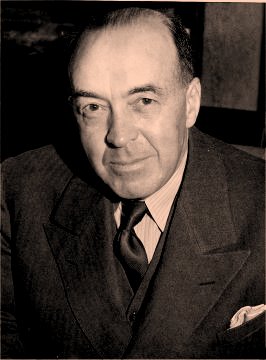
Edgar Rice Burroughs
Civilization And Its Malcontents
Let us say that for the fifty years or so before the 1920s there was a growing sense of societal malaise. This malaise was reflected most notably in the creation of Edgar Rice Burroughs’ psychological projection, Tarzan Of The Apes. One has to account for the immediate acceptation by society of such an absurdity. Tarzan, in fact, completely rejected civilization for the life of the romantic ‘unrestrained freedom’ of the jungle. The noble savage in fact.
Thus in a metaphor Burroughs reflected the malaise of his time so brilliantly that his creation was accepted as virtually a real person. Writers like Grant and Stoddard put the same theme into more scholarly terms. As noted, contrary to Richard Slotkin’s idea, Grant had little or no influence on Burroughs while the slightly later Lothrop Stoddard whose three relevant works appeared only from 1920 to 1922 could have had no influence on Burroughs’ formative years. It seems probable that Burroughs did read Stoddard and was influenced by his work but only after his ideas were fully formed. Even then The Revolt Against Civilization appeared after Burroughs had examined some of the same problems in his rejected manuscript, Under The Red Flag of 1919.
The problem of the malcontents and their war on civilization was examined by a number of writers during the twenties and thirties so why Slotkin singled out Burroughs, Grant and Stoddard isn’t as clear as it might be. Postwar German cinema was intensely concerned with the matter as why should it not? Germany was under asault by what Stoddard called the Underman. Nor need Slotkin think Stoddard was alone. I’m sure there were dozens of forgotten books prophesying the end of the world by one means or another including the Undermen of Communism.

The Underman, or the Communist, was not even a term unique to Stoddard. Gustave Le Bon, the French scholar on whose work Sigmund Freud based his study Group Psychology And The Analysis Of The Ego wrote prolifically on the psychological foundations of the Underman. Freud based his book on Le Bon’s 1895 study The Psychology Of Crowds. Unless I’m mistaken he based his 1930 study Civilization And Its Discontents on Le Bon’s 1921 book The World In Revolt: A Psychological Study Of Our Times.
On the cinematic side the problem was examined in the great silent films The Cabinet Of Dr. Caligari and Fritz Lang’s 1922 film Dr. Mabuse, The Gambler. Lang would follow that ten years later with the sound film The Testament Of Dr. Mabuse.
Even though Buroughs’ Under The Red Flag was rejected in 1919 he persisted, rewriting and extending the text into the 1926 story, The Moon Maid. This story reflects a possible reading of The Revolt Against Civilization but such a reading was much more evident in 1934’s Tarzan And The Lion Man.
The development of the problem was evident to all these writers which it seems to have escaped Slotkin who attributes the recognition of societal evolution to mere ‘racism’ in the writers. One thinks that perhaps Slotkin is too involved in his own agenda.
Rider Haggard enunciated the problem quite clearly in his 1888 novel Allan Quatermain in which Quatermain grouses about the ‘strict limits’ of civilization compared to the ‘natural’ life of the African Zulus. It might almost seem that the idea of Tarzan arose in Burroughs’ mind from that observation. In fact science was undermining all the comforting beliefs that mankind had been settled in for a hundred thousand years. During that long period characterized by the mental mode of what is called mythopoeic thinking man’s mind devoid of true knowledge projected a vision of reality that resulted in the notion of God. Thus reasoning from insufficient knowledge man’s mind came up with an erroneous result. You can’t get out of a mind what isn’t in it; all education is suggestion.
As Freud was to say, man’s settled view of reality received its three great shocks when Galileo disproved the geocentric notion of the universe, Darwin disproved the uniqueness of man’s position in the animal kingdom and he, Freud, displaced the conscious mind with his vision of the unconscious mind. Once again Le Bon was there ahead of him.
Thus as the nineteenth century opened and progressed the bases of mankind’s notions of reality were shattered leaving him emotionally and intellectually bereft of foundations of belief. Adrift without an anchor.
As if that were not bad enough the great cataclysm that ushered in the modern era, The French Revolution, was based on the the absolute notion that not only were all men created equal but remained equal in all aspects of their existence. The advance of civilization would toss this certainty into the trash can of history also.
As civilization placed greater and greater demands on the intelligence and self-discipline of men and women the incontestable gap between those less intelligent and those more intelligent became more and more obvious. Thus as the century progressed the notion of the Overman and the Underman began to become clear.
At the same time the first tentative efforts at measuring the intellectual potential of the individual began to become possible. Of course the basic inequality of men and women in its physical aspect had always been apparent. Some men were naturally stronger and better muscled than others. But, even that was changing. The science of physical culture was making it possible for the 98 lb. weakling to develop himself into a man mountain. Thus artifically developed srongmen like the Great Sandow ushered in the golden age of the strong man topped off by Charles Atlas who guaranteed he could turn you into a man mountain if you followed his program.
There was the promise that you could dethrone that bully and kick sand back in his face. On the other side Francis Galton was originating the first primitive tests to measure intelligence potential. Burroughs would have seen both proponents during his miraculous summer of 1893 at the Chicago Columbian Exposition. I mean to say that both facts entered his mind where they could be digested and emerge later. Nothing can come out of your mind that didn’t go in it.
And then after the turn of the century Binet devised he first actual IQ test. Thus, just as Sandow and Atlas could measure the size of muscles, the psychologists became able to measure the intelligence potential. Those with high IQs were set up; those with low IQs were cooked. The upshot was that all men were not created equal nor could they ever attain intellectual equality.
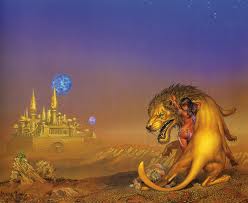
To a very large extent what became the Communist Party recognized the inequality while demanding equality against reason. Recognizing subconsciously, perhaps, that men could never be intellectual equals rather than try the futile task of raising the less fortunate they sought to destroy education which brings out the inequality but doesn’t create it. No matter what happens there are always going to be the more intelligent just as there will always be the physically stronger. As Le Bon points out, if you needed to hear it, nature don’t know from equality.
Thus the Communist Party devised the well sounding slogan- From each according to his ability; to each according to his need. Good plan for the needy, slavery for the able. The needy were organized beginning their struggle to achieve superiority by collective action. This was accomplished in Russia in 1917. The battle was joined.
Just as individuals are created with different capabilities so are peoples and races. Some can achieve and some can’t. Slotkin who must be a Communist thus takes offence at what he perceives to be, and is, an attitude of White Supremacy in Burroughs, Grant and Stoddard. While I am aware there are those who will disagree with White superiority it is nevertheless not an attitude but an evolutionary fact. That is the reason Communists have Darwin under attack. While Darwin doesn’t say it, it is the inevitable result of his studies. Just as it was necessary for the Undermen to destroy education in the hopes of creating intellectual equality so it became necessary to destroy White achievement of the last five hundred years. The whites must be demonized and made to feel evil and inferior morally. That is the import of Slotkin’s Gunfighter Nation.
At that level all three writers are guilty. As has been stated in Canadian courts- Truth is not a defense. So there’s nothing to discuss. Might is right and whoever has the might will prevail.
It is a fact that all three writers were anti-Communists so it may be assumed that whatever Communists believe, they didn’t. And why should they? Might may be right but it can still be nonsense. Communism is a flawed ideology based on a false premiss. It always fails wherever it is introduced. Failure is not evidence of a bad plan in Communist eyes. One just continues to shovel sand against the tide and pray. So succeed or fail they always think they can succeed by the same flawed ideology. The fault for failure lies elsewhere.
In that sense Burroughs was wasting his time assailing this religion of failure with his Under The Red Flag and its successor The Moon Maid. The only people who would applaud his effort would be we non-Communists but he could never convince anyone with Communist leanings. Of course that wasn’t well understood at the time.

If Burroughs were accused of not believing in equality that would be true. Not only are John Carter and Tarzan superior to any contemporaries on two worlds but Burroughs has a whole hierarchy of value. John Carter is the Warlord of Mars ruling from the top city of Mars, Helium. The races of Mars pretty much reflect those of Earth and their relative stations. The main exception is the ruling Red race. As Whites do and have existed on Mars in Burroughs stories while at one time being the dominant race perhaps the Red race is some sort of amalgam of the various Eropean immigrants of the United States. I believe the Green Men represent the American Indian. Both roam the great plains while being essentially savages.
Tarzan though always spoken of as being White is described as a bronze giant. Bronze is a fairly dark metal so that Tarzan and the Red men of Mars may be more or less identical in color.
Tarzan is the man-god so there are none superior or even equal to him. Below him come the English who are the cream of mankind. Perhaps slightly below the English are the French and then the rest of the Whites. Tarzan himself is psychologically an animal having been raised by the Apes. Not your ordinary gorilla or Chimp but a species intermediate between Gorilla and the Negro. Slotkin hasn’t read enough Burroughs to make an intelligent comment but the undeniable attitude of Burroughs is enough for Slotkin to condemn him as an unregenerate bigot. The reader may believe as he likes. I have stated my opinion eslewhere and that is enough. Whether any of these opinions of Burroughs influenced American soldiers at My Lai is open to question. The burden of proof is on Slotkin and he hasn’t provided it.
Along with the Undermen however, speaking through Tarzan, Burroughs is heartily discontented with civilization.
The spectacle of Chicago of the 1890s as a dirty unpleasant place haunts Burroughs. In contrast to the great White City of the Columbian Expo was what was afterwards known as the Black City of everyday Chicago. The contrast was so strong and so offensive to the Undermen that within a year of the Expo’s closing the entire White City was burned to the ground with the exception of one building. Hence perhaps the decayed crimson and gold ruins of Opar and the crimson and gold twin cities of Helium. One wonders what effect the sight of the ruin of the White City had on Burroughs when he revisited the site sometime after his miraculous summer of ’93. The mind creates nothing from nothing so there must have been models of the great cities of ERB’s imagination.
There are points at which Burroughs and Communism have quite similar views. It will be remembered that Burroughs only reluctantly married and throughout his life expressed discontent with the institution. To some extent or other ERB must have been an advocate of free love. Communists would have heartily approved of ERB’s women who went nude except for certain ‘adornments.’ Communists of course want women to be accesible to any man who wants them at any time while they have always advocated bare breasts.
In many ways when the Communists appropriated Tarzan for the MGM movies it took but slight changes to make Tarzan conform to their ideals. The MGM Tarzan and Jane were not married. While Burroughs’ Tarzan was a highly educated on-again off-again sophisticate the MGM Tarzan was a stupid illiterate oaf and one who rejected the attributes of civilization high up there in the Cloud Cuckoo Land of the Mutia Plateau.
On the essentials though Burroughs rejected the demands of the Underman as The Moon Maid clearly shows. There was very little in Stoddard’s The Revolt Against Civilization that Burroughs would have disagreed with. At the same time there was probably very little he didn’t already believe although he had never codified his information as Stoddard had. Slotkin’s contention that Burroughs was influenced by either Grant or Stoddard is surely wrong. ERB had already taken hs positions before either men had begun to write.
Each writer was, in his own way, an advocate of White Supremacy. It now become clear that White Supremacy has nothing to do with a fringe element in Liberal ideology. All Whites are White Supremacists in that ideology unless they reject ‘White skin privilege’ whatever that is. Ayers and Dorhn explain in their recent Race Course In White Supremacy. Interestingly constructed title. Nor as Slotkin would have it is the attitude based on mere racial pride and bigotry but on a solid record of achievement unattained by any other people. The quesiton is not was it right for some people to rule or be supreme because in the nature of things some people will rule and be supreme but which of the peoples are most qualified to be supreme.
All people have had equal opportunity so that one can only conclude that the race has gone to the most qualified participant. In the contest the Whites unified the other peoples against them as must inevitably be the consequence of being the top people. As they say, getting there is the easy part; staying there is the hard part.
Slotkin merely represents the envious losers, the Undermen. who clutch at any firebrand to burn the White House down. Who is most to be admired and emulated? Builders or destroyers?
Finis of Thuvia, Maid Of Mars Review
Edgar Rice Burroughs On Mars
A Review
Thuvia, Maid Of Mars
Part III-A
What We Have Here Is Change
by
R.E. Prindle
In the recent American presidential campaign in the US the winner won by promising the inevitable, Change. A very safe promise as the history of the world is one of change. Indeed, the life of the individual is one of unending change from the cradle to the grave. Change is now and forever. The question is, what response is made to the changes.
The times of Edgar Rice Burroughs were a period of the most earth shaking and rapid of all. At the same time most perilous, as the evolution of actual scientific knowledge in all fields was in its infancy and subject to misinterpretation. One might say in Burroughsian imagery that a series of doors stood before mankind, entering the right door would be more beneficial than the wrong doors.
Burroughs and others made tantative moves for the right door but others entered by the wrong door drawing most others through with them. What looked like progress turned into a regression. To shut up criticism the regressives began to demonize all those of different opinions. Burroughs was among those.
Some say he adapted poorly to the flood of change but the peole who do so are so confident in their opinions that to disagree with them is to be accused of being not only wrong but either criminal or insane. One doesn’t take their opinions too seriously as change will certainly demonstrate their opinions as ludicrous if it hasn’t already. Nevertheless as they are quite vocal in their condemnation of Edgar Rice Burroughs we have to consider the accuracy of their accusations as well as that of their own viewpoint. How well do they understand the issues?
ERB has some interesting observations on the changes occurring in the history, society and racial matters of his times as well as the concealed role of hypnotism in the transformation of that society. The basis of hypnotism is suggestion. As ERB say in Thuvia all is based on suggestion and counter-suggestion. If one conciders life and learning from that angle it presents some interesting possibilites.
What is learning? What is suggestion?
When the child is conceived he must of necessity have a mind with a blank slate. Freud, Jung and many others seem to seriously believe that newborns can inherit ancestral memories even though there is no one beyond the womb who has ever recalled any.
In fact without experience or learning that has has been introjected into the mind there is nothing for the mind to consider, hence no cogitation at all. This mind can only begin to form with the ejection from the womb. This occurs with a brain still in the process of formation. The development of the brain can only be considered completed shortly after puberty.
It seems obvious then that you can’t get out of a mind what isn’t in it. It behooves society then to begin loading the mind of a child as soon as the child is capable of handling education. The education of the mind must be built step by step to provide a firm foundation for the intellectual superstructure. Whatever is in the mind must come from or be suggested from outside the mind. There is no internal system of knowledge. Thus all knowledge is suggested to the child’s mind by his caretakers. They may be good or bad, well or ill intentioned. The brain is organized to receive suggestions or, in another word, experience. The reactive structure may already be in place dut to experiences in the womb and the actual birthing process but the actual learning process begins the moment the newborn emerges from the womb and receives a slap on the bottom to get his lungs started.
Thus the mind of the child is extremely malleable during the time until about puberty and shortly thereafter. If education is neglected during this early period and shortly thereafter it is unlikely that the adult can ever make up the lack. For instance if the basics or reading, writing and arithmetic are not loaded into the brain during this malleable period it is very rare that the skills can be acquired at a later time.
Thus, as it was always known that the child is father to the man various doctrinaire organizations such as the Jesuits believed that if they could form the education of the child or, in another word, indoctrinte him, they could shape the future in their own image. In Burroughs’ time the mechanisms of education were more fully understood. Various schemes were proposed to revise educational methods many of which were just odd or crude, but the better thought to change the direction of society toward a higher ideal.
The Communists were well are at the time that suggestion was the basis of education. Lothrop Stoddard writing in his The Revolt Against Civilization of 1922 quotes Eden and Cedar Paul from their book Proletcult of 1921:
“There is no such thing as “scientific” economics or sociology. For these reasons…there should be organized and spread abroad a new kind of education, “Proletcult.” Thus…in a fighting culture aimed at the overthrow of capitalism and at the replacement of democratic culture and bourgeois ideology by ergatocratic culture and proletarian ideology…” The authors warmly endorse the Soviet government’s prostitution of education and all other forms of intellectual activity to Communist propaganda, for we are told that the “new education” is inspired by the “new psychology”, which “provides the philosophical justification of Bolshevism and supplies a theoretical guide for our efforts in the field of proletarian culture…. Education is suggestion. The recognition that suggestion is auto suggestion, and that auto suggestion is the means whereby imagination controls the subconscious self, will enable us to make a right use of the most potent force which has become available to the members of the human herd since the invention of articulate speech.
I’m sure you can find appropriate application of the doctrine since Stoddard wrote in education, movies, TV, books and phonograph records and CDs. While I would disagree with the Pauls’ notion of suggestion and auto suggestion the Freudian influence is quite clear. This would be abetted by John Dewey’s notions on education that deemphasized the educational foundation while directing it more toward ideological considerations, or ‘relatively unstructured, free, student-directed progressive education.’
God only knows what free, progressive education is but this sort of social engineering was the wrong turn being taken in this era of rapid change.
So, loading the brain to deal with life’s exigencies is of necessity a slow process. As the brain continues to develop outside the womb there is plenty of room for malfunction. As man is incapable of creating anything original the education of the child may be compared to the loading of a computer. First the operating system. Whether consciously or unconsciously since all man knows is his own brain he has replicated it in his machine. A computer functions just like a brain, which should astound no one, as man can only devise what he already knows.
Now, human experience dates back about a hundred thousand years. I intentionally leave out the African development as it had nothing to do with the education of mankind. The African contribution is nil. Education began outside Africa. Having painfully and laboriously accumulated the huge fund of knowledge it must be entered into the brain of the new being. This sort of suggestion is called education. There’s not much room for anything called ‘free’ or ‘progressive.’ Getting it ain’t going to be free, the child has to work like a mule. This is a slow, laborious process as extensive foundations must be laid down before any superstructure can rise. Thus years are consumed just to teach the child reading, writing and arithmetic. With these three tools he can learn anything else. Inexplicably this fact seems to have been lost sight of in today’s educational theories unless of course the Pauls’ dictum is being followed.
Once the foundation has been laid, a form of suggestion and actually hypnosis, the child, now a student, must be taught how to manage and interpret what he learns at an increasingly rapid pace. Unfortunately there will be children left behind; any other expectation is fatuous, some are just brighter than others. Managing and interpreting comes from within the experience of the organism. Here’s the real problem because the same data will by analyzed differently and produce different results and opinions.
Along with learning factual matters the child must at the same time develop emotionally and psychologically. Nasty work. This is a difficult part. As the child has little ability to understand and even less ability to accurately analyze it he has to reason from faulty premisses. This ignorance of reality is what forms Freud’s notion of the unconscious or Id. Correcting this unconscious to consciousness is the conversion of Freud’s Id to Ego. A child misinterprets suggestions. Some become fixated in his un- or subconscious. The fixations are what distort consciousness from the subconscious interfering with the integration of the subconscious and the conscious. While the child is made more conscious in his ability to understand and reject harmful suggestions these fixations like post-hypnotic suggestions control his responses. The fixations must be exorcised which is the intended function of the psychoanalysis of Freud and Jung.
Once again, suggestion is everything outside your mind. Your mind cannot function without these suggestions because there will be nothing in the mind to function. Be carefull of what you put into your mind or, at least, that you do put something of value into it. Whether ERB realized this or not, his ideas of hypnosis and suggestion indicate he might have, he pursued a program of continuing education all his adult life. At the time of writing Thuvia he was working through Edward Gibbons’ Decline And Fall Of The Roman Empire, a vast minefield of amazing and truly educational suggestion.
Part B follows.
Thuvia, Maid Of Mars by Edgar Rice Burroughs: A Review
March 14, 2009
Edgar Rice Burroughs On Mars
A Review
Thuvia, Maid Of Mars
by
Edgar Rice Burroughs
Part I
Review by R.E. Prindle
This very interesting sdtory was written shortly after ERB returned to Chicago from his first San Diego excursion. It was placed between the Girl From Fariss’s, the last story written in San Diego and The Cave Man.
The material deals almost exclusively with suggestion and hypnosis. Although hypnosis is a recurring theme in Burroughs one is startled by his concentration on the subject and his seemingly informed ideas of it, especially the role of suggestion.
One wonders why his interest surfaced at this time and where ERB learned or developed this information. He was just back from San Diego and I’m going to suggest he picked it up from his hero, L. Frank Baum. As Baum was such a significant influence on Edgar Rice Burroughs perhaps it may be worthwhile to attempt an assessment on Baum’s role in literature and history. There can be no question but that the OZ series of Baum took a central place in the American psyche and a place in the European psyche. Baum’s books have been in demand since 1900 when he began writing them to the present. Baum put Kansas on the map. The Wizard, Dorothy and Toto are household names. Baum’s play from the Wizard was a box office success while MGM’s movie is certainly in the top ten of influential movies, perhaps even in a tie for first with Gone With The Wind. Even American Negroes made their own Black version called The Wiz. The list goes on.
I’m going to suggest that Fritz Lang, the movie Director, was highly influenced by Baum as reflected in his important film, The Testament Of Dr. Mabuse. I wouldn’t be surprised if Lang was also very familiar with Burroughs.
Baum himself was a committed Theosophist. Introduced to the religion by his mother-in-law Baum picked up his card in 1893. By 1913 when he met Burroughs he had been a practicing member for twenty years. When he left Chicago he first went to Coronado across the Bay from San Diego. Katherine Tingley had established her Theosophical organization on Point Loma near that city. Baum must have been an important member of that congregation. Perhaps he had a falling out with Tingley but he did remove himself to Hollywood in 1910. In Hollywood he undoubtedly connected with the Pasadena Theosophical Society that at present is the mother organization.
As a Theosophist Baum would have had to have been familiar with the works of Madame Helena Blavatsky. Her great works are Isis Unveiled and The Secrect Doctrine. Theosophy of course is on a par with the Semitic religions of Judaism and Christianity. While Madame B is often referred to as nonsense she is in fact very learned in the ancient religious doctrines of the human mind that went to form all Middle Eastern religious expressions. Hence while Madame B’s works are metaphysical in nature they are no less relevant to the development of the human intellect than say, St. Augustine or others of the metaphysical ilk.
Madame B had some strong opinions on hypnotism. Hypnotism had come to the fore of Euroamerican consciousness in the years preceding the French Revolution through the efforts of Dr. Franz Mesmer. Though discredited as as a charlatan he was dealing with the real thing as subsequent history shows. He originally called hypnotism Animal Magnetism. That was changed to Mesmerism and then to Hypnotism. As far as possible influences on Burroughs it will be remembered that Edgar Allan Poe wrote Mesmeric Revelation in 1844 and The Facts In The Case Of M. Valdemar in 1845. There are clear indications that ERB was familiar with the Valdemar story.
Now, the essence of hypnotism is the suggestion. Suggestion is perhaps the most important intellectual or psychological phenomenon. Suggestion isperhaps the basis of intellect, intelligence and psychology. C.G. Jung in his investigations of symbols was dealing with the nature of universal suggestion from nature. Freud early learned to separate suggestion from the hypnotic trance. Artfully used suggestion obviates the need for trancelike states. Thus people don’t understand that and how they are hypnotized by movies and TV.
The art of successful literature is merely to suggest scenes and situations and have the reader visualize them in his own mind. Once accepted the suggestion becomes part of the intellect of the reader. He may be able to reject it later but that is a separate volitional act. The great writers realize this. Freud understood perfectly, while Baum developed the art of the concrete image to a remarkable degree. His works are a series of remarkable images. If Freud had had Baum’s skill, and he wasn’t far short, he would have been even more effective than he has been.
The prescient Fritz Lang picked up on Freud, Baum and hypnotism in his remarkable Dr. Mabuse series of movies. The first story, Dr. Mabuse The Gambler of 1922, concerns a Freudlike megalomaniac named Dr. Mabuse. Freud’s activities during the Great War and after would be known to the cognoscenti. It would be foolish to think that Adolf Hitler and other Volkish leaders wouldn’t have been aware of what Freud was up to. Mabuse is into all kinds of criminal activities to undermine society and the State, as was Freud. He is also a master hypnotist as was Freud. In a scene reminiscent of the scene in Thuvia where Jav says ‘You want to see them? Then, look.’ The scene of ancient bustling Lothar then appears to Carthoris and Thuvia’s wondering hypnotized eyes. As well as mine, certainly. I had no trouble seeing what Burroughs wanted me to see. So Dr. Mabuse in his role of stage hypnotizer, the man wore many hats, makes a parade appear before the wondering eyes of his audience. It can be done. I saw a man make Diamond Head disappear before the whole world on TV. Pretty amazing.
At the end of the movie Mabuse is captured and conveniently tucked away in an insane asylum. He goes catatonic until 1930 or so when Lang made the sequel The Testament Of Dr. Mabuse. The Dr. emerging from his catatonic state makes signs that he wants pen and paper which the head of the asylum, one Dr. Baum, provides.
Mabuse then turns out page after endless page of instructions to destroy civilization not unlike what Herr Dr. Freud was doing from his study in Vienna. The writing had an hypnotic effect on Dr. Baum who executes the plans of the cell bound Dr. Mabuse.
The use of the name Baum could be a coincidence but Dr. Baum like the Wizard Of Oz is an unseen superior. He issues orders but is otherwise an unknown to those he directs. In issuing his orders we are led to believe that he sits behind a curtain unseen while giving his directions. Then, just as Dorothy did, the hero dares to pull back the curtain and he finds…a phonograph player. Unlike Dorothy who finds a tubby timid little imposter, there is no one there. Surely this is a parody of Dorothy’s famous scene which makes the name Dr. Baum less of a coincidence.
So it would seem that L. Frank Baum’s influence extended to Germany and an originator of film noir. Not so unlike as Baum’s stories are much darker than they might appear at first reading. At any rate his literary images make long remembered illusions of reality not unlike that of Dr. Baum while being of a suggestive hypnotic nature. I can still visualize Dorothy pulling the curtain back exposing the mild mannered Big Brother sixty years after. I can remember the image I formed.
So, my suggestion is that L. Frank Baum was the direct inspiration for Thuvia of Mars. As noted ERB was probably familiar with Poe’s stories of hypnotism while I am certain that he had read George Du Maurier’s Trilby concerning the hypnotist Svengali and probably also Du Maurier’s other two novels, Peter Ibbetson, and The Martian both related to unusual psychological states. Len Carter believes that ERB read William Morris who also uses some hypnotic themes in his fantasy novels. Lew Sweetser, ERB’s mentor in Idaho via Yale, might also have given him some information on hypnotism while ERB was still a boy. Plus I’m sure hypnotism was a hot topic of popular discussions.
ERB’s emphasis on suggestion as the operative means of hypnotism points to some more direct instruction. Most think that ERB first met Baum in 1916 which means the two formed a fast friendship immediately. I think it more likely that they met in 1913 renewing the acquanitance in 1916. Whether Baum had read any of Burroughs’ stories in 1913 which seems would be paying pretty close atention to literary trends in pulp magazines he may have heard of Tarzan. Probably aware of this ERB may have brought along a magazine or two to show Baum. If Baum then read the proffered stories he certainly would have seen his influence in the Mars stories if ERB didn’t actually point them out to him hoping for the Zeusian nod of approval from the master.
Probably flattered Baum would have encouraed the relationship. Assuming that to be true the two men having similar interests would certainly engage in conversations on Theosophy, hypnotism, writing techniques and whatever.
Certainly Burroughs writing style which while always colorful was a little heavy on the narrative side seems to open up to a more allusive suggestive style blossoming significantly in 1915’s Tarzan And The Jewels of Opar.
I can’t find a more immediate source for ERB’s sudden interest in hypnotism. But, on to the story.
A Review, Part 6: Chessmen Of Mars by Edgar Rice Burroughs
February 16, 2009
Edgar Rice Burroughs On Mars
A Review
The Chessmen Of Mars
Part 6
by
R.E. Prindle
The Golden Handcuffs
And now comes the part that readers find the most fascinating, that of the contest on The Field Of Honor. Gladiatorial contests are frequent occurrences in the novels of ERB. This one seems to combine Arthurian influences as well as Roman.
Burroughs’ tenure of a couple years at the Chicago Harvard Latin School must have made an indelible impression on him. The recurrent, one might say underlying, Homeric influence from the Odyssey of Homer would indicate that the school concentrated on that work of Homer although not on The Iliad as there seem to be few references to the latter poem. In later years ERB would complain that he had learned Latin before English cramping his English style.
Perhaps, but I don’t see anything glaringly wrong with his English style. His psychology makes him a little stiff but that’s not through a lack of understanding English. It would be nice to know the curriculum of the Latin School and what texts he did study. Late in life when he wrote I Am A Barbarian his background as evidenced by the reading list he appended was shallow while not mentioning the great classical scholars. Still Roman themes are a recurring motif in the corpus. About this time he was rereading Plutarch’s Lives that compares the lives of various Greeks and Romans so that the Lives may have been a text at school. Especially as he says that while rereading it he discovered that Numa was the name of a Roman king while he thought he had invented the name for the Lion.
Also Arthurian references pop up in Chessmen. In 1912 when his editor Metcalf of Munsey’s asked him to write a medieval story that turned out to be the Outlaw Of Torn he claimed to have little knowledge of the period. Now, the Manatorian party leaving the city after Gahan entered is more reminiscent of Arthurian stories than Roman. The city of Manator itself also has a decidedly Camelot feel. The party’s subsequent return and capture of Tara and Ghek has more of the courtly flavor than the Roman. In 1928’s Tarzan, Lord Of The Jungle ERB would create a medieval society of lost Crusaders deep in the heart of darkness. So while he claimed to know nothing of medieval themes in 1912 by this time he seems to have done some reading in the field.
In many ways Manator bears a great resemblance to Mythological, Graustarkian and Ruritanian stories that he did admire as a young man. Combining all those influences with the Oz of Baum we have Manator.
Thus in addition to Roman gladiatorial contests we also have a similarity to medieval battle melees where the favors of women were of paramount importance.
Here we have the great mock battles and actual battles to the death played out on a gigantic Jetan board. Burroughs modifies the Earthly game of Chess to create a similar Martian game of Jetan complicated by the grotesque addition of battles to the death between the live ‘pieces.’ Indeed as is explained there had been games recorded in which the only survivors were the the two female prizes and one of the Jeds. Once again mimicking Arthurian literature ERB describes sword blows that cleave the opponent through the brain pan down to the breast bone. ERB seems to delight in the most violent and gruesome details. And lots of them.
A-Kor, his cellmate, fills Gahan in on what he must do to enter the games conveniently giving the latter enough money to bribe his team, get this, while returning the remainder to his purse.
The strategy is all very probable. The number of slaves from Gathol in Manator is enormous so Gahan has no difficulty in enrolling a team of Gatholians who will be fighting for their freedom. Gahan is famiiar with Jetan as played elsewhere on Mars on a board so he has no difficulty with strategy. The main change in strategy is that when a piece captures another the pieces then draw swords and fight to the finish. Thus a piece can successfully evade capture negating strategy.
Relying on the prowess of his men and his own incomparable swordsmanship Gahan then makes a drive directly for the opposing Jed, U-Dor.
Can it be a coincidence that he who stands between himself and Tara is a man called U-Dor (door)? Considering the important roles doors play in these stories it would seem that U-Dor is one more door he must hack his way through to get to his objective.
The only other work I’ve seen where doors were so important was the old TV show, The Mod Squad. In that TV series doors of every description were constantly being slammed; not just closed but slammed. I haven’t quite figured out ERB’s obsession with doors as yet.
While Chess and one imagines Jetan are supreme games of strategy Gahan seemingly abandons the fine points and gamesmanship and makes a drive straight for U-Dor. ERB says he was a good Chess player while I have never played to perhaps the moves he describes are possible especially as any move is good or bad depending on which player is the better swordsman. Gahan is the best so he experiences no difficulty in reaching U-Dor who he cuts down.
Tara and he are seemingly reunited. But while Tara thought she killed I-Gos he was only wounded. Present at the games he denounces Gahan and Tara who flee as aforesaid to the pits. Then begins the spectacular double climax; that of Gahan/ERB’s triumph over John the Bully/O-Tar and the subsequent triumph of Gahan/ERB over Frank Martin/O-Tar.
2.
To a large extent Chessmen is an examination of ancestor worship. Certainly the Taxidermist of Mars preserved ancestors going back at least five thousand years to the reign of O-Mai. ERB explains Gahan’s and perhaps his own ideas on the significance of ancestors.
Gahan, a man of culure and high intelligence held few if any superstitions. In common with nearly all races of Barsoom he clung more or less inherently, to a certain exalted form of ancestor worship, though it was rather the memory of legends of the virtues and heroic deeds of his forefathers that he deified rather than themselves. He never expected any tangible evidence of their existence after death; he did not believe that they had the power either for good or for evil other than the effect that their example while living might have had on following generations; he did not believe therefore in the materialization of dead spirits. If there was a life hereafter he knew nothing of it, for he knew that science had demonstrated the natural phenomenon of ancient religions and superstitions.
The above is probably as close to a confession of faith as ERB is going to give. It is certainly one that I can accept for myself. The above may also be a reference to spiritual seances in which dead ancestors supposedly spoke through mediums. Harry Houdini was debunking such seances around this time much to the chargrinof ERB’s literary hero, Conan Doyle of Sherlock Holmes fame, who did believe is such ancestral contacts.
There may be a joke in that case when Gahan arose from O-Mai’s bed ululuing and putting the fear of God into O-Tar exposing him as a coward.
Having thus disposed of O-Tar/John ERB turns to debunking O-Tar/Martin.
When Gahan was playing his joke on O-Tar I-Gos stole Tara away. He delivers her to O-Tar who is so smitten that he decides that he will marry her and take his chances with this she-banth.
O-Tar immurs Tara in a tower not unlike the story of Rapunzel. Her location is pointed out to Gahan who then makes a perilous climb of the tower in order to tell her that no matter what it looks like on the morrow’s wedding date he will rescue her and she is not to commit suicide.
While talking to her through the grated window a eunuch sleeping at the foot of the bed awakes moving toward him sword in hand. Tara instead of shrinking back removes her little blade from her harness running the eunuch through the heart.
There must be significance to this scene as ERB is retelling the story of both John and Martin. If Emma was with ERB on the corner and abandoned him to his fate by walking on it would appear that ERB never forgave her while having Anima trouble ever after. Here he rectifies the situation by having Tara come to his defense acting with a both a blade and heart of steel. Thus not only has his Animus surrogate Gahan proved John/O-Tar to be the coward but Tara the Anima figure defends Gahan/ERB from a similar attack by John absolving his Anima.
We now go to the wedding. Of course, having read the book several times in my case we know the story so I will just follow it. In the book John Carter tells ERB the details after the fact.
I-Gos has allied himself with Tara and Gahan against O-Tar. Before the wedding O-Tar retires to the Hall of Ancestors to commune with the dead. I-Gos has let Gahan into the hall where he sits as though stuffed on a stuffed Thoat. When O-Tar pauses beside him Gahan falls on him striking him on the forehead with the butt of a heavy spear.
Thus we establish that at this point O-Tar has become Frank Martin. Just as Gahan/ERB proved O-Tar a coward by merely rising in O’Mai’s bed and making weird noises so now he reverses the situation in Toronto. Instead of ERB being struck on the forehead Gahan/ERB strikes O-Tar/Martin in the same place leaving him for dead.
Now, this is strange. Donning O-Tar’s Golden Mask Gahan goes foth in O-Tar’s guise to marry Tara. The Golden Mask undoubtedly refers to Martin’s money bags to which ERB undoubtedly attributes whatever success Martin had with Emma. Why Gahan/ERB wore O-Tar’s mask is fairly clear but why ERB would have isn’t. Also if O-Tar hadn’t recovered from the blow Gahan would have been married to Tara in O-Tar’s name.
Perhaps ERB in a reversal means to imply that Emma would actually have been marrying him but won by Martin’s ‘golden mask.’ By the process of reversal then ERB would have recovered and stolen Emma from Martin on the altar so to speak. Or, as he actually did.
The symbolism of the golden handcuffs then would mean that the proposed wedding of Emma and Martin would have a mere commercial transaction. Or, perhaps, he felt himself attached to Emma for financial reasons when he’d rather not be. Complications, complications.
While the two antogonists Gahan and O-Tar are staring each other down the ‘cavalry’ Gahan sent for has arrived. Carter and troops from Helium, Gathol and Manatos arrive to end the story.
O-Tar himself then falls on his sword like a true Roman thus redeeming his miserable life. Perhaps ERB is saying that that is what Martin should have done- left the couple alone rather than constantly interfering.
3.
Conclusions
If as Sigmund Freud argued dreams are based on wish fulfillment the Chessmen of Mars proves his case. In this series of dreams or nightmares ERB attempts to reverse the results of the three greatest disasters of his life.
John the Bully and Frank Martin are a matter of history. That ERB links his fiancial disaster with these two earlier disasters indicates that he knows he has crossed the line in his mistaken purchase of the Otis estate. He knows that he as no way out as he has the ‘cavalry’, John Carter and the united forces of Helium, Gathol and Manatos come to the rescue. In the final denouement of this error in 1934’s Tarzan And The Lion Man even the cavalry can’t help. Tarzan/ERB leaves the burning castle of God a defeated man.
His great dream of getting back to the land and becoming a Gentleman Farmer has crashed to the ground. His attachment to his fantasy can be traced in his letters with Herb Weston. Weston warned him as strongly as friendship would allow that it would be a mistaken approach to farming in any other way than on a factory basis with profit firmly in mind. ERB chose to ignore this sound advice probably believing that between books, magazines and movies his future was golden.
Unfortunately for himself his income crested in this very year, 1921. Undoubtedly because of his strong anti-Communist stance and his resistance to the Semitism being imposed on him his sources of income came under attack. Nineteen twenty-two was the last year he received income from movies until 1927-28. Publishing difficulties with McClurg’s and G&D increased. His long time publisher, McClurg’s, even refused outrightly to publish his opus of 1924, Marcia Of The Doorstep.
His foreign royalties once so promising slowly dried up because of political pressures. Later in the decade his troubles with McClurg’s became so intense that he was forced to abandon that long standing relationship. No other major publisher would touch him. Why, will probably never be clear. After a tentative stab with a less established publisher he turned to forming his own publishing company. This move was apparently successful enough to float him through the early part of the thirties before the spring of his inspiration began to dry up.
In a desperate attempt to save Tarzan he attempted many expedients, none successful. He incorporated himself to protect his income from creditors. He subdivided a portion of Tarzana, he attempted to sell off acreage, he tried to turn part of the estate into an exclusive golf club, he turned part into a movie lot attempted to lease that out, he invited oil geologists to find oil on his land. He invested in airplace engines and airports. Nothing came of anything. In the end the magnificent estate slipped through his hands.
A premonition of all this can be found in the The Chessmen Of Mars. Even the name of the story indicates the he is involved in a chesslike game of many moves.
Stress was now to be ERB’s other name.
A world famous figure, nominally rich, still retaining many of the trappings of wealth he had gone from prince to pauper, regained his princely stature and now slipped back to the role of a prince in exile from the Promised Land.
Nothing daunted he went on working. In the end his magnificent intellectual property, Tarzan Of The Apes, would always save him from a fate worse than death. A form of wish fulfillment in itself, I guess.
Exhuming Bob XVIII: Bob Dylan, My Son, The Corporation
December 10, 2008

Electrified Dylan
…Bobby stems from a middle class background in which much emphasis is placed on education and conformity and plans for a respectable career.Bobby didn’t quite fit into that framework and preferred a more bohemian type of life. His parents say he frowns on being called a beatnik, and they don’t like that designation for him either. But he was in fact adopting some of the manners associated with beatniks- or folkniks- in an area where that makes a person stand out as a strange character.
Zimmerman as Dylan
People who knew him before he set out to become a folknik chuckle at his back country twang and attire and at the imaginative biographies they’ve been reading about him. They remember him as a fairly ordinary youth from a respectable family, perhaps a bit peculiar in his ways, but bearing little resemblance to the sham show business character he is today.
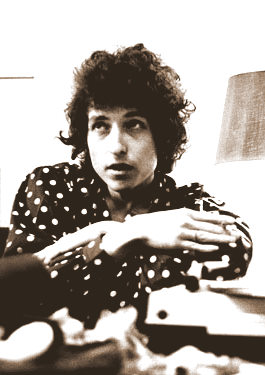
“He wanted to have a free rein.” says Zimmerman. “He wanted to be a folk singer, an entertainer. We couldn’t see it, but we felt he was entitled to the choice. It’s his life, after all, and we didn’t want to stand in the way. So we made an agreement that he could have one year to do as he pleased, and if at the end of that year we were not satisfied with his progress he’d go back to school.”
“It was eight months after that, says (Abe) Zimmerman, that Bobby received a glowing ‘two column’ review in the New York Times. So we figured that anybody who can get his picture and two columns in the New York Times is doing pretty good. Anyway it was a start.”
His rise in barely three years has been almost as impressive as the fortune he has already amassed…
My son is a corporation and his public image is strictly an act…Hard to follow this act.

Albert Grossman was born in Chicago on May 21, 1926, the son of Russian Jewish immigrants who worked as tailors. He attended Lane Technical School and graduated from Roosevelt University, Chicago with a degree in economics.After university he worked for the Chicago Housing Authority, leaving in the late 1950s to go into the club business. Seeing folk star Bob Gibson perform at the Off Beat Room in 1956 prompted Grossman’s idea of a ‘listening room’ to showcase Gibson and other talent, as the folk movement grew. The result was The Gate Of Horn in the basement of the Rice Hotel, where Jim (Roger) McGuinn began his career as a 12 string guitarist. Grossman moved into managing some of the acts who appeared at his club and in 1959, he joined forces with George Wein, who founded the Newport Jazz Festival, to start up the Newport Folk Festival. At the first Newport Folk Festival, Grossman told New York Times critic, Robert Shelton: “The American public is like Sleeping Beauty, waiting to be kissed awake by the Prince of Folk Music.
In the decades prior to the 60s, through the work of such avatars as Woody Guthrie, the Weavers and Pete Seeger, folk music had become identified with sociopolitical commentary, but the notion had been forced underground in the Senator Joe McCarthy witch-hunting era… Peter Paul and Mary came together to juxtapose these cross currents and thus to reclaim folk’s potency as a social, cultural and political force.
“We have absolutely no part in his affairs. Those are his own operation. He’s a corporation and he has a manager.”
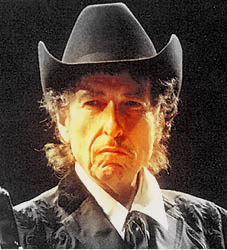
The Burden Of Being Cowboy Bob Dylan
Sigmund Freud And His Vision Of The Unconscious
November 22, 2008
Sigmund Freud And His Vision Of The Unconcious
Redefining A False Vision
by
R.E. Prindle
Texts:
Bakan, David, Sigmund Freud And The Jewish Mystical Tradition, Orig. Issued 1965, Dover edition of 2004
Movie: The Testament Of Dr. Mabuse, 1932, Fritz Lang, auteur.
https://idynamo.wordpress.com/2007/10/01/something-of-value-i-2/

Sometime after I wrote the first part of Something Of Value (see above for link) I read David Bakan’s Freud And The Jewish Mystical Tradition. Bakan’s book confirmed my findings while developing Freud’s relationship to his culture’s mystical tradition based on Bakan’s understanding of the Zohar and the Jewish Kabbalah, which I haven’t read or studied; nor do I intend to unless I exhaust my other pursuits which doesn’t seem likely. You never know though.
However a point to consider is how Jewish is the Jewish mystical tradition, that is, what are its antecedents? Are they rooted in Judaism or elsewhere? Bakan seems to believe that the Jewish Kabbalah is derived entirely from Jewish sources independent of the general milieu. I don’t believe this to be true. The Jewish mystical tradition like all others is based on the very ancient Egyptian traditions as is a great deal of ancient Jewish culture. Bakan believes that the Kabbalah arose in the first century AD. This is probably true.
The Hermetic tradition which is equivalent to a European Cabala took form as such in Alexandria during the Ptolemaic period when Greek and Egyptian ideas interreacted. Hemeticism evolved from much earlier doctrines centered around the Egyptian god Thoth. The Zohar and Cabbalah then is Hermetic material adapted for Jewish needs. The whole can be traced back to Alexandria. It will be remembered that there was a large colony of Jews in Alexandria from long before the first century AD.
The Zohar is a mystical book, which is attributed to the first and second century Rabbi, Simeon Bar Yohai, and it was rewritten, edited and whatever in twelfth century Spain in the sixteenth century. Its influence then was transmitted to the seventeenth century Jewish messiah, Sabbatai, Zevi.
According to Mr. Bakan Freud was familiar with the Zohar and Kabbalah. I couldn’t go so far as to claim so myself but Mr. Bakan can quote chapter and verse. While Freud claimed to be scientific Mr. Bakan relates almost all of Freud’s psychology to the Kabbalah showing Freud’s dependence on Sabbatianism and Frankism as I indicated in Something Of Value Part I.
Thus while seeming to be working from a scientific point of view Freud is actually blending a bit of scientific method acquired from European sources, as there is no science in Jewish culture, with his Jewish religious material to subvert the European moral order. While Freud himself was at war with European civilization, the international Jewish organizations of which he was a member extended his field of influence to the United States and Canada. Thus while Freud speaks specifically of Europe he can be taken to mean Euroamerica.
2.
A further background for his psychology, Freud’s central childhood fixation, appears to be the incident in which a European knocked his father’s hat into the gutter which his father meekly, or wisely, depending on your point of view, accepted without a demur. Because of this story Freud wished to avenge himself on all Europeans.
Probably at this point Freud assumed the Moses complex that stayed with him to the end of his life. He, Freud, would lead his people to triumph over the Europeans as Moses had led the People out of Egypt while Pharaoh and his army were drowned in the Red Sea.
However, oddly enough, as he claimed to be wholly Jewish, Freud was conflicted in his attitude toward Europeans. As a child he had a Roman Catholic nurse who introduced him to Christianity by taking him to church. Most probably she also tried to wean him from Judaism. This experience had a great effect on young Freud. In the following anecdote, as with most fixations, he seemed to have lost the exact memory of the situation. From Bakan:
…that my ‘primary originator; (of neuroses) was an ugly, elderly, but clever woman who told me a great deal about God and hell, and gave me a high opinion of my own capacities.
On October 15, 1897 he quotes his mother speaking about the old nurse who took care of him when he was very young:
“Of course,” she said, “an elderly woman, very shrewd indeed. She was always taking you to church. When you came home you used to preach and tell us about how God conducted his affairs.”
His memory had become confused while it does not appear that he ever exorcised his fixation, for fixation it was. He apparently loved this nurse at the time rather than hating her. When she was later accused and convicted of stealing from the Freuds she was dishonored and actually sent to jail. Freud was heartbroken while changing his opinion of her. But, he had had contact with Christian Europeans which left a lasting impression on him that he could not consciously recognize or acknowledge. If I am correct, this impression resurfaced when he came into contact with C.G. Jung who he adopted as a surrogate for this nurse transferring his love and hatred of her to Jung.
Just as he loved this nurse there were apparently strong homosexual overtones in his relationship with Jung. As Freud would have known, the compulsion toward repitition would have been a component in his relationship with Jung through his nurse although he apparently did not recognize this. So much for his self-analysis. He found reasons to break off with Jung or drive him away while bitterly claiming to be betrayed by Jung just as his nurse had been accused and convicted of theft thus betraying the love of the child Freud. Thus once again his contact with a Christian European was brief ending in sorrow for himself.
A third situation occured late in life when he wrote Moses And Monotheism. Rather startlingly he claimed that Moses was not Jewish but was an ethnic Egyptian. This means Freud, who had a Mosaic fixation, split his personality between his Christian longings and his professed Jewish identity. Another result would be that monotheism was not a Jewish invention but actually a goyish invention so that all the evil arising from monotheism was not the fault of the Jews but the goys. A neat job of transference. Thus Freud’s notion of Moses may have been a sort of dream reversal of facts.
Whatever the results of Freud’s self-analysis back before the turn of the century, it is quite clear that he was unable to resolve his fixations nor, one believes, was he aware of their influence on him. He never integrated his personality remaining under the influence of his subconscious fixations. No wonder he ignored the conscious mind.
3.
Like most people Freud had to find his way from adolescence to adulthood and his true ambitions by a  circuitous route.
The editor’s note to 1927’s The Future Of An Illusion says this:
In the ‘Postscript’ which Freud added in 1935 to his Autobiographical Study he remarked that a ‘signficant change’ had come about in his writings during the previous decade. “My interest,” he explained, “after making a long detour through the natural sciences, medicine, and psychotherapy, returned to the cultural problems which fascinated me long before, when I was a youth scarcely old enough for thinking.”
He undoubtedly refers to his experiences in church with his Christian nurse contrasted with the ‘Christian’ who knocked his father’s hat into the gutter. As Freud is very duplicitous in his use of language one should try to be very sensitive to the personal meanings behind the general meaning of his words. Thus I believe his use of the term ‘cultural problems’ can usually be understood as his inner conflict between his Christianity and Judaism.
As Bakan points out, that while Freud rejected Rabbinical religious Judaism he was deeply immersed in the Jewish mystical tradition of the Zohar and Kabbalah. Thus one can discount his claim to be an ‘atheistic’ Jew. Or else atheism has a more specific meaning for him.
I would place the change of emphasis in his writing or, at least the beginning of the change, in 1915. My guess would be that Freud was unaware of the coming Jewish Revolution until he joined B’nai B’rith in 1895. That knowledge would have shaped the direction of his researches. Whatever science was involved would have been subordinated toward achieving the Revolution. At the same time that he was working out the nature of psychoananlysis as Bakan indicates he must also have been studying the Zohar and Kabbalah. I haven’t read or studied either so I have to rely on Bakan’s analysis of their influence. Bakan traces strong mystical influences running side by side with what passed for science in Freud’s mind. As Freud persistently says he’s going to ignore the facts if favor of projections one must assume that there is more mysticism than science in Freud’s construction of psychoanalysis- as he says ‘his creation.’
Bakan points out that Freud transited from the role of physician to that of ‘healer.’ That is analogous to the hands on approach of Christian Fundamentalism. Freud then for all practical purposes abandoned medicine for healing. Then, sometime between 1913, the year of the beginning of the Jewish revolution, and 1915 he abandoned psychoanalytical research for his ‘cultural’ studies.’ In other words, he began to apply his psychological studies to the manipulation of cultures through his developing ideas on Group Psychology.
Just as Freud learned that there were screen memories that transformed more painful memories into something more acceptable to salve those injured feelings so Freud learned that he could develop ‘screen’ language to serve up unpalatable meanings in palatable ways. Thus what he says has a reasonable meaning to the uninitiated but has a totally different meaning to the initiated- those with the key. In many ways it is the same as a criminal argot. Those who understand the argot can discuss topics openly without the uninitiated understanding, while only those with the key can twig it. Ya dig?
The key incident that fixed his mind on ‘cultural interests’ was his father’s story of the guy who knocked his hat into the gutter. Freud then, in attempting to diguise his hatred for ‘Christianity’ while secretly admiring it because of his nurse who gave him an inflated opinion of his importance, and his desire to avenge his father and hence all Jews through his Moses fixation, developed his program. Thus he acted in his own mind altruistically and need feel no guilt.
Freud was very seriusly conflicted, also suffering from depression according to Bakan. Hence his purpose was to knock the whole of European Christianity into a cocked hat in the gutter, which is to say the actual persons of Europe. Compare Freud to Rebbe Schneerson in America.
Thus, the use of terms like ‘Culture’ and ‘Civilization’ should always be placed in the context of Jews and Europeans. In this manner he avoids the appearance of bigotry and hatred while sounding ‘scientific.’
Now, this obsession and extreme form of vengeance for something that, after all, didn’t happen to him nor did he witness it, might certainly be considered a neurosis, probably a psychosis and possibly a degree of insanity. In reading Bakan there is a hint that he believes Freud had a disordered mind. Indeed, Fritz Lang’s movie The Testament Of Dr. Mabuse should be held steadily in mind when reading of Freud’s later career. Lang must have had Freud in mind when he filmed the movie.
Lang also had a hand in the making of The Cabinet Of Dr. Caligari from which film he was dismissed. Lang’s departure from Caligari changed the ending of that movie to the conventional note of the victim, or whistle blower, being declared insane. Lang reversed this by making the perpetrator Caligari/Mabuse insane as in real life with Freud. Further the disciple of Mabuse, the head of the asylum, Dr. Baum was also declared insane. Although the problem appeared to be solved the threat of the conspiracy continuing from Mubuse’s cell, now occupied by Dr. Baum who has assumed Dr. Mabuse’s identity, looms like a spectre over the denouement.
While Freud was never incarcerated as he sould have been, he was imprisoned in his mind no less than Drs. Mabuse and Baum or the character in Gradiva which held such fascination for Freud. It is interesting that Freud had a plaster cast of the relief of Gradiva’s heel on which the story of Gradiva was based that the displayed prominently in his office. The story obviously had greater significance for him than his ‘objective’ analysis of the story would lead one to suspect.
Thus from 1915 to 1935 like Dr. Mabuse he sat imprisoned in his projection of reality churning out page after page, volume after volume of criminal plans for the subversion of civilization which is to say of Euroamerican civilization but not Jewish culture. He makes a definite point of that illusion of whose future he is discussing applies only to Europe and Christianity rather than religion in general which would include his own Judaism. At this point he is not aware of the burgeoning Wahabi Moslemism so that his message is that Jewish beliefs are real while Christian beliefs and Scientific reality are illusory. One has to penetrate the screen language and convert it into the proper psychological intent.
As David Bakan points out Freud lived his whole life in a sort of Jewish ghetto having very little contact with Europeans.
His choice of Jung as the potential heir to his ‘creation’ may have had as much to do with a desperate attempt to reestablish a connection similar to that of his childhood Christian nurse. Thus his overtures to Jung while under extreme stress were driven from his unconscious while he himself was unaware of his true motivations. This would have been an expression of a repetition compulsion. Thus as his nurse disappeared from his life under discreditable circumstances he replicated the situation with Jung. His attempt to convert Moses (hence himself) into an Egyptian may have been a last attempt to replicate and resolve this early contact with Christianity. His view of European civilization then was filtered wholly through a Jewish projection of possibilities. He really had no intimate knowledge of European mores.
From 1915 on, then, his writings were obsessed with hatred for Euroamerica and a desire to wreak vengeance on them by destroying the basis of their civilization. His ideas for the subversion of European civilization were carried to America by the international B’nai B’rith organization to be adopted and employed there. In addition Revolutionary plans executed in Europe in 1917 were financed and organized by the world Jewish government in the US. While functioning according to local conditions the Revolution was conducted on an international scale. Act locally, think globally. Hence Jewish revolutionaries left the US for Russia after 1918 to aid in the consolidation going on there. This is really an incredible repressed story in the Freudian cultural manner. Very Freudian that such phenomenal criminal activity that were best left invisible was repressed into humanity’s unconscious.
At this point I think it mght be well to examine Freud’s vision of the unconscious in more detail. While there can be little doubt that there is a subconscious function to the human mind usually referrred to as the unconscious after Freud that had been an accepted fact amongst scientific researchers for a hundred years Freud has been given the credit for discovering it. The exact nature had not been determined before Freud nor does Freud determine it. His view is merely a projection of his own conscious and subconscious needs.
4.
In David Bakan’s view Freud made a compact with ‘Satan.’
Certainly not in the literal sense but in the figurative sense that Freud would do anything, abandon any  moral precepts, to achieve fame. Bakan points out the supercription to Freud’s Interpretation Of Dreams a quote from Virgil: Flectere si nesqueo, superos, Acheronta movebo. Translated as: If the gods above are no use to me, than I’ll move all hell. Freud further blurred the line between good and evil or amalgamated the two from the influence of Sabbatai Zevi and Jacob Frank who cast off all morality. Since Freud has been successful in altering both Euroamerican and Jewish morality toward these immoral or amoral beliefs by false ‘Satanic’ criminal doctrines it is imperatvie to debunk his personal projection of the ‘unconscious.’
As he ‘made a pact’ with powers below- the unconscious- against the powers above- the conscious- he invested his projection of the unconscious with the attributes of ‘Satan’ or evil. This view of the subconscious is a self-serving fiction not based on any science.
He sets up the unconscious as an autonomous entity with the main function of blighting the conscious. He give the powers of hell supremacy over the powers of heaven. The notion is mere fantasy; it cannot be. There is no possibility that the function of the subconscious doesn’t have a positive function in and of itself and in relation to the conscious. If you actually think abut it for a moment you wil realize this must be true; every part of the body works to the benefit of the whole; there can be no exception for the subconscious.
Now, nature is not flawless. The order that the religious seem to find is not there. Nature functions in a much more imperfect or haphazard way. It takes only one peek through the Hubble to see that.
However the relationship between the conscious and subconscious is delicate and easily disrupted especially in the early years of the organism when it has no experience with which to evaluate the events occurring to it. The Ego and Anima are not part of the subconscious and possibly not of the conscious but functions through the conscious and subconscious minds.
The conscious mind perceives phenomena and acts on them but the terrific inflow of impressions is more than it can deal with so the day’s input is received into the subconscious for further reference. Thus a major function of dreams in the sleeping state is to review and process, organize the information into a coherent whole for future reference. The subconscious then is able to compare incoming information with experience for the appropriate response. When the conscious and subconscious minds are attuned, that is to say, the personality is integrated, the system works properly, otherwise the response is distorted by one’s fixations. This is very easy to see in Freud.
However, especially in youth when experience is scant, the mind may be challenged with some devastating new experience for which there are no reference points. If an appropriate response is made there is no problem. If an inappropriate response is made against which future experience may be in variance, the earlier response which has become fixated will over rule the current response and substitute the fixated inappropriate response. Thus the current response will constellate around these earlier fixations which gives one bizarre symbolic dreams and inappropriate responses.
The inappropriate response will usually result from an insult to the Ego or, in other words, one’s sexual identity. In turn the response to this insult will be expressed in a sexual affect.
The purpose of psychoanalysis, which is real science, although Freud didn’t see that, is to locate and exorcize them allowing the conscious and subconscious aspects of the mind to function properly as a unit. Dreams are actually important because they are an analysis of life’s experience providing responses. None of this, of course takes in intelligence, discipline and other functions of mind and character that Freud dismisses as irrelevant.
Now, in the cultural war between Judaism and Euroamerica, or as the Jews express it, Christianity, Freud infused the Jewish subconscious with a disregard for morality al la Jacob Frank in relation to Sabbatai Zevi. Any evil was excused so long as it seemed to advance the cultural war. While this infusion may not have reached down through the ranks of Jewry- which is to say they behaved in a certain way but didn’t know why- the ideas were thoroughly planted in the minds of what Henry Ford would call the International Jew.
The cold war between Jews and Europeans became a shooting war in the wake of the Great War. Men, money and munitions flowed in a wide steady stream from the United States to Russia. Coordinators established themselves in strategic locations. If one reads restricted, censored literature the impression is made that horrible anti-Semites harassed and hated innocent unresisting Jews. Jews may have been killed but they were not innocent or unresisting. To the contrary freed from guilt, or supposedly so, by Freudian/Sabbatian/Frankist precepts, abattoirs were established throughout Russia where unsuspecting Russians were led in one door and flowed out the other in liquid form. This is not the place to dwell on gruesome details. The literature exists but the collective Jewish mind has repressed the deeds into the collective unconscious. In other words, history has been denied and censored so that the crimes can’t be known. Actually Whittaker Chambers, the Red spy, translated a number of these books concerning the Hungarian atrocities of Bela Kun and Tibor Szmuelly, but those are impossible to come by. All this slaughter was made possible and justified by the doctrines of Freud.
In relation to the 1919 atrocities of the Jews in Hungary and the response which expelled them from power it should be noted that Israeli troops were recently introduced into Hungary to reestablish the tyranny of Kun and Szmuelly. Don’t ever think that historical memories are short. Remember the Amalikites.
Freud sat confortably in Vienna looking on as the carnage occurred. If, as believed, the tenor of his writing changed in 1925 that was probably due to the death of Lenin in 1924. By 1925 it was apparent that the Jewish Revolution in Russia was on shaky grounds as Stalin began his rise to power so that Freud may have renewed his cultural attack or, on the other hand, as 1928 was the terminal projected year of the Jewish Revolution Freud may have been celebrating the death of European Civlilation when he published The Future Of An Illusion. By the illusion he meant European Christianity and he meant European civilization was finished. The Rome of the Popes should have fallen.
In Illusion and Civilization And Its Discontents Freud makes us believe that the malcontents of civilization are synonymous with civilization rather than being a minority that always exists during great revolutionary changes. Freud whose Judaism was challenged by the Scientific Revolution as much as Christianity or Moslemism must have been aware of the reactionary ‘instinct’ as he himself was in reaction to both European Christianity and the Scientific Revolution.
David Bakan closes his volume with these words:
…under the ruse of “playing the devil” (Freud) served Sabbatian interests. In this respect, however, just as Freud may be regarded as having infused Kabbalah into science, so may he be regarded as having incorporated science into Kabbalah. Sabbatian-wise, by closing the gap between Jewish culture and Western Enlightenment he acts as the Messiah not only for Jewish culture but for Western culture as well.
Note that Western Enlightenment is reduced to Western culture putting it on a par with Jewish culture which is a tacit admission that there is no science in Jewish culture and none is wanted in Western ‘culture’. Language as a screen.
Bakan’s is a hefty statement. Under the guise of the Devil Freud becomes the Messiah not only for Jews but for Euroamericans. Truly in this scenario good comes from evil in the Jewish mind, assuming that the Messiah is good. In case you missed it, Freud according to Bakan was the Second Coming. Narrowing the gap between the two cultures means the imposition of Jewish culture as the Chosen or Abelite people over Western or Cainite culture. Thus the age old goal of reversing the Cain and Abel story so that Cain is obligated to give preference to Abel is accomplished.
By infusing Kabbalah into science, science has been subjugated to the unscientific Jewish culture so that the Catholic/Jewish situation of Medieval Europe has been restored. The Enlightenment that invalidated Judaism, Christianity and Moslemism has been obliterated, hence the revival of religion happening today. Thus in Bakan’s eyes and according to Freud’s intent Judaism has deconstructed Euroamerican society so the reconstruction according to Jewish cultural mores can commence.
The result has been accomplished by the destruction of the Scientific Consciousness as there is little of science in Freud’s cultural writings. He just says what he believes and wants you to believe and asserts it as a fact. As always there were some Westerners who resented the encroachment of the strict limits imposed by science. Rider Haggard in his Allan Quatermain made that as clear as possible. The topic is the dominant theme of Edgar Rice Burrough’s Tarzan novels. Henry Ford and his mass production methods was a symbol of that rebellion against the strict limits set by the clock. Some denounced it as Taylorism; but with each passing decade the West became more acclimated to the change as the reactionary mood became acclimated to the new reality.
Freud invents ‘instincts’ and their ‘renunciation’ to give sense to his arguments; the renunciation of instincts’ almost sounds scientific but it isn’t. there are no instincts nor does Freud even attempt to demonstrate their existence. Like the rest or Freud’s psychology the notion is just something Freud made up. As always he notes only the negative societal destructive effects. He says nothing of the ‘instinct’ to be around people which would conflict with his instinct against civilization- the last is a vague enough term the way he uses it. But as Fritz Lang points out the hypnotic spell cast by Mabuse negates criticism so that the head psychologist of the asylum, the objective scientist himself, Dr. Baum, suspends critical judgment falling under the spell of Mabuse to the point of becoming a disciple just as Lang himself did. Indeed, as the West has. Hitler was a blessing in disguise for the Jewish Revolution. The guilt caused by Hitler completely disarmed the West allowing the reconstruction of Western mores to proceed at a faster pace than would have been possible otherwise. Indeed, the Nazi Era drove the entire psychotic Jewish Revolution to the shores of the United States beginning in the early thirties. Thus the deconstruction of Edgar Rice Burroughs’ America was assured.
To return to 1919.

A Review
Part II
The Myth Of The Twentiety Century
by
Alfred Rosenberg
Rosenberg, Alfred, The Myth Of The Twentieth Century, Noontide Press, 1982.
It should be borne in mind that The Myth is subtitled: An evaluation of the spiritual-intellectual confrontations of our age. The book then is an attempt to objectively analyze the political situation in those terms. While himself a Nazi this is not a Nazi tract while at the same time it is inevitable that Rosenberg ananlyze the situation from a Nordic or Aryan viewpoint. If Nazi and Aryan are synonomous in your mind you should disassociate the terms.
When Rosenberg says the conflict is one of differing values between Asiatics and Europeans it is necessary to know what he means as his basis of interpretation is accurate. The conflict between Asia, which is to say the Middle East, began fifty-five hundred years ago on the plains of Mesopotamia, todays Iraq; and has slowly spread outward until today the Asiatics, or specifically, Semites, stand on the verge of worldwide victory. Even though the Semites themselves are divided between Jews and Arabs, which is why the Jews support Arab Semites outside the Middle East, the Jewish segment is confident that they will be able to manage the Arab Moslems in the triumph.
The major conflict then in Rosenberg’s mind was the prime conflict between Semitic values and Aryan values. He considered the Roman Catholic Church as auxiliaries. The Church may be said to be a third Semitic religion.
The situation as Rosenberg perceived it, and he was a very perceptive man, was that the German people were surrounded on three sides by Semitic forces alien to Aryan ideals.
He saw a Roman Catholic Semitic Church centered to the South of Germany that had also infiltrated and alienated a large part of his German people.
To the East he saw the Semitized Soviet Empire looming as a threat. He had no doubt, and sincerely believed that Communism was a Jewish political system managed according to Semitic ideology.
Just as the behemoth to the East was controlled by Jews so with the ascension of Franklin D. Roosevelt was the behemoth of the West, the United States of America. Of course, denial is the order of the day but denials are ridiculous in the face of facts.
Just as Jews had managed the hyper inflation of German currency in 1923 so Jews had maneuvered the West into the Great Depression through their control and literal ownership of the Federal Reserve Banking System of the US.
Through the manipulation of credit and currency in the years leading up to the Great Crash of 1929 the Fed, which is to say the Jews, created the speculative stock market bubble. At the same time they created the unsound practice of holding companies of holding companies. Thus shares with no substance behind them collapsed entirely losing all value. Between such failures as these and extended credit for margin speculation the stage was set, as in Germany, for the complete collapse of the US economic system. This was no different than the real estate and credit bubble of today.
While many many volumes on the crash have been written over the decades none of them would deal with the problem as it actually was for fear of being denounced as anti-Semites.
You may be sure that Rosenberg, Hitler and the Nazi think tank understood the situation completely. The question is how the Nazi finance minister Hjalmar Schacht interrelates with his banking counterparts of the West.
That the situation was created that ‘discredited’ the capitalist system, allowing a Judeo-Communist like FDR to assume the the reins of power you may be assured. Roosevelt was a disciple of Woodrow Wilson. Just as the Jews flooded into Washington in 1913 managing Wilson’s presidency so in 1933 they returned to power with FDR. You can see how urgent it was for Roosevelt to stay in office for as many terms as he lived.
The situation of today is a replica of 1929-33 with the hope of putting Barry obama into the role of FDR. Rosenberg and the Nazis predicted this scenario in the 1930s. They also predicted the dissolution of the United States over racial problems. This is bound to and must happen.
In addition to the USSR and the USA the Jews were running France and directing England so that Rosenberg believed the Germans to be beleagured, which they were.
The history of the entire period has been written by Liberals, Communists and Jews, hence you have been conditioned to see the issues soley from their point of view.
If you were to view the times from a slightly different perspective a quite different picture would appear before your eyes as if by magic.
It is true that the Nazis took a direct and brutal route to obtain their objectives. They have been thoroughly castigated for this however they merely did what had already been done during and after the Great War in Russia and Hungary and what the Liberal/Jewish/Negro/Communist coalition is in process of doing today as regards the White species. So in light of current deeds what makes the Nazis so evil?
While we were all astonished in the fifties as the insanity of the Nazi attempt became real to us we should no less condemn the Liberal/Jewish/Negro/Communist coalition for their plan to exterminate the entire White species of a billion plus people. This means you.
I am sure that Rosenberg and Hitler are sitting up in Heaven looking down upon us with wry bemusement.
So, this is the way in which Rosenberg perceived the racial aspect of the spiritual and intellectual confrontation of early twentieth century Europe.
Rosenberg calls it the struggle for freedom rather than submission to a false god, which is to say Semitic intellectual belief systems. He rightly says that the confrontation is between Asia and Europe going back fifty-five hundred years. The Fascist States, that is to say Germany, Italy and Spain placed themselves in battle with the entire semiticized world. The Semites themselves without military might did as the ancient Semite Cadmus did in ancient Boeotia of Greece when he incited the indigenous peoples into a ruinous civil war that allowed his Semitic invaders to take control.
Those who do not learn from history are condemned to repeat it.
Part III will follow in another post.
The High Brow And The Low Brow
The Mucker And Marcia Of The Doorstep
Part VI
Living On Tulsa Time
by
R.E. Prindle, Dugald Warbaby and Dr. Anton Polarion
Livin’ on Tulsa Time.
Livin’ on Tulsa Time.
Gonna set my watch back to it,
‘Cause you know that I’ve been through it,
Livin’ on Tulsa Time.
– Danny Flowers
During the ’60s a lot of energy was put into the notion that one live in the HERE and NOW or someone else’s impression of the NOW. There used to be a big San Francisco poster with nothing but a black background with the giant word IS in white. NOW IS NOW.
They didn’t know how much they were asking. It is impossible to actually live in the NOW; No one can do it. Rather the past is a drag on NOW preventing a full involvement with the present. The period of time it takes to digest the previous NOW and update to an approximate notion of the current NOW is excruciatingly slow. The sharper the break between the past and present the more traumatic the reaction.
In the song Living On Tulsa Time the singer, no matter what time zone he is in sets his watch to Central Tulsa time.
I know where that one is at. One of my shattering breaks with the past was when I went active in the Navy in ’56. Sent from Eastern Standard to Pacific Standard I kept my watch set to Eastern Standard time nearly the whole three years of my enlistment. I only switched to PST in 1959 when I accepted the fact that I would never return East; that California was my new home.
Brought into contact with a new NOW I was still not ready for the present. I continued to dress as we did in ’56 well into the sixties. Got hard to find some new duds. I only ceased dressing that way when I became a Hippie in ’66 and adopted fantastic Hippie garb. I was an urban spaceman:
I’m the Urban Spaceman
I’ve got speed,
I’ve got everything I need.
I don’t feel pleasure,
I don’t feel pain,
If you were to knock me down
I’d just get up again.
I wake up every morning with a smile upon my face.
My natural exuberance spills out all over the place.
-Neil Innes
I was really NOW there for just a little while but I wasn’t alone. As Bob Dylan said, everytime I looked back the past was just behind. When the Hippie era ended I reverted to a modified 1956 style. The past came back again. All those screaming about living in the NOW in ’67-’69 are still back there claiming they’re still living in the NOW but time has passed them by. I didn’t wait around, baby, I slid out into limbo and I’m doing fine now, thank-you.
Thus when ERB began writing in 1911 he was not so much concerned with his NOW as he was in vindicating his past from 1896 to 1905. His reality in those early novels from 1911 to 1915 continue to reflect his earlier travails. Thus in the group of novels embraced by The Girl From Faris’s he is trying to vindicate his past to his present and hopefully to his future.
After nineteen-fifteen he was released from his past to a large extent and began to concentrate on adjusting to the NOW of his altered circumstances. Change is NOW and ERB was going though a lot of ch-ch-changes. His nerves were jangling as he was jerked from time frame to time frame but he didn’t enter the Promised Land of NOW. Oh Lord, he might have prayed, if he could have seen the future- Deliver me from NOW.
Ten years after and a world of different NOWs the Mucker far in a distant past that had disappeared behind a cloud where he couldn’t see he tackled almost the identical theme in a different world, a fast moving world, a world where NOW was so strange it was unrecognizable from day to day. The political situation he had grown up with was no longer recognizable; it had been replaced by a new reality. He was almost living by two different clocks in some strange Einsteinian time zone where the guide posts had been removed and renamed and everything was relative to another reality that couldn’t be recognized by any clock ticking.
Living on Tulsa time in another time zone. There I was in ERB’s sunny Southland with my watch running three hours ahead of everyone else’s. It didn’t matter. I was on the water where time stands still for everyone. The crisis came in ’58 when I stepped back on land to journey through the time zones back to Eastern Standard Time. I was all alone out there, you know, cut off from a past I was soon to learn couldn’t be retrieved. Wolfe was right, you can never go home again. The only secure place, as dangerous and that was, was my ship. My terminal place was also a realtively secure harbor but I was stuck in the middle for six days between the time zones in which I had no place and no identity except the tenuous one of my leave papers. A queer cop threw them into the wind and let those blow away in Illinois. After that I was naked to the universe. I’ve hated cops ever since.
I wouldn’t recommend hitchhiking to anyone. My life was on the line for twenty-five hundred miles and six days. Twenty-five hundred miles and six days on the road without food or sleep. I’d add without drink but in a gas station in Gary I downed six seven ounce bottles of Coca-Cola in a row. Created a minor sensation.
After surviving a lunatic who picked me up on the western edge of the Mojave who wanted to kill me because he was convinced I had two hundred dollars on me, which by a strange coincidence I had, I was picked up Mountain Standard in the Panhandle of Texas by a couple homosexuals who wanted a different treasure I possessed and dropped off Central Time in Tulsa. My watch was only one ahour ahead by then. I was getting close to some kind of NOW or was I? No. Time is much more relative than that. I was soon to be living a strange combination of NOW and THEN.
Tulsa was a tough town. I don’t need to see Tulsa again. I wasn’t about to start living on Tulsa Time. I was an hour ahead which couldn’t have been better. I had to walk through Tulsa, hungry and thirsty. I spied a place across this great expanse of grass between it and the freeway. As I approached the place began to glitter. Fancy, but I could see a coffee shop at the top of a long flight of stairs to the left. I didn’t want to spend money so I thought I’d just get a glass of water.
Oh Dan, can you see
That great green tree
Where the water’s running free
Just waiting there for you and me.
Water…cool…clear…water.
But between me and the water was this big cowboy in high heeled boots, a tuxedo and ten gallon hat. Fancy goings on as I noticed ladies entering to the right in ball gowns escorted by tuxedos. I came prepared or thought I did. I was in my dress blues and my Uncle Sam told me I should never be ashamed of my uniform, it could pass for a tuxedo anywhere. Anywhere but Tulsa. That cowboy had never discussed the issue with my Uncle Sam.
I was bold but the problem was he had the advantage being on the landing at the top of the stairs and I had to climb the stairs to get past him. He had his fist doubled and these high heeled boots with those silver plates on the toes. That was a mean looking business proposition. I had a lot further to fall than he did. Get my uniform messed up and things. Then where would I be out of time and place? Whew! Why does one have to face tough choices?
I’m getting a drink of water, I said, trying to combine thoughness with masculine geniality a al the cowboy ethic.
Not here you ain’t. He said, making a move to kick me down the stairs.
Hey buddy, this is a tuxedo I’m wearing. I faltered.
His reply was not one of which my Uncle Sam would approve.
I left Tulsa still thirsty not liking cowboys any better than I liked cops. NOW has its perils.
A day or so later I was still in Central Time. Tulsa was a tough place and the rest of Oklahoma was no California. I was heading North now which kept me in the same time zone. Then I made the mistake of crossing the Mississippi into East St. Louis. After just a couple minutes I really liked Tulsa. Wished I was back there.
I don’t know what evil forces made me want to hitchhike across country, damn Jack Kerouac, but I was within a hair’s breadth of being sliced and diced on the streets of East St. Louis. Whould have tossed me in the river as so much driftwood. Three Black guys with switchblades in their hands kept inching toward me while I kept inching closer to the middle of the highway.
That morning some guy got in his car for a pleasant drive to Louisville. He decided ot go through East St. Louis for some mysterious but critical reason. He arrived in East St. Louis just as these three knives were deciding to make their move. This guy sized up the situation from a couple blocks away, slammed on his brakes throwing open the passenger door at the same time shouting ‘Get In’ for God’s sake get in, NOW.’ Novel experience for a hitchiker. I wasn’t sure I wanted to rush because if I made a break for it those three knives might move faster than i could. I hopped in casually casting a smiling glance over my shoulder. The driver peeled out of there nearly separating a hand from the wrist on the door handle. I was saved from that particular NOW and END but I was on the road to Louisville which was still a far cry from Eastern Standard which was the time zone I so ardently desired.
It took me another day or so as I had a lot of North to make up but I did get into Eastern Standard. Now my watch matched the time zone but there was a mismatch between the present and the past. Rather there were two different presents and pasts going on at the same time. Mine and theirs. I don’t think Einstein is right but well, maybe, time wasn’t that relative but the uses they and I were making of past and present sure were.
That’s where memory comes in which makes time and space so relative. I had been absent for two years and what I had been experiencing was much different than what they had been experiencing. They had actually been living on Eastern Standard Time while I was just pretending. I knew I was out of time. For me time had been rapidly changing but for them time had more or less stood still or, rather traveled in a straight line. To me they were still living in the past. Oh, they had aged a couple years but their trajectory was different and slower. Relatively they had stood still while I had rocketed away.
It was as though I had been a gamma cloud burped from some collapsed star in some galaxy a billion light years away. As is known once set in motion an object will travel in a straight line at the same speed unless some other agent interferes with it. It was as though I had been careening through space ripping apart the fabric of time and space or disregarding it completely as though it wasn’t there; at any rate completely unaffected by this fabric which apparently has no tensile strength, there was no gravity of any force that deflected my course in a curve while if space is curved I was traveling so fast I careened right off the curved track.
Who knows how many black holes i passed over without being drawn into the vortex; who knows how many puny suns I swept across without having one atom deflected by the puny gravitational pull of the strongest sun; who knows how many planets I depopulated. One billion light years and running, my speed and trajectory were the same as when I was emitted from that distant star.
Now, as though by some miracle here I was back where I began but in two different time zones at one time. Theirs and mine. Obvious I must have passed through a worm hole or fallen into a memory hole. We stared at each other blankly each unable to comprehend the other. They thought I have become weird,or perhaps weirder, because they had stood still while I had been careening through time and space in timezones they would never know.
I smiled and got on a bus, enough of the adventures of hitchhiking. One the way back to Standard Pacific Time I abandoned Eastern Standard adjusting my watch as I passed through Central Standard and Mountain Standard. I was not exactly living in the NOW but I was in the correct time zone.
Minor but vital adjustment.
So, when ERB caught up with himself in 1914-15 he was no longer living on Tulsa time. He was trying to adjust his watch to his current time zone.
But as he was careening through space and time, space and time was moving at an even more frantic pace so it was difficult for him to get his bearings.
Science was changing his world at a rate faster than the mind could follow. Events in the far off Detroit that he had known and loved as a young fellow were going to affect his life just a few years hence. In 1914 Henry Ford had shocked the industrial, moral and social world by ‘unilaterally’ doubling the wage for unskilled labor.
This was a violation of ‘natural law’ which is to say religious sensibilities. At the time a natural law of labor was believed and incorporated into religion. The law was that if only one man can do a job he can command his price. Skilled labor can demand more than unskilled labor but when anyone can do the job as in unskilled labor they will have to take what is offered. Thus Ford pitted science against serious religious beliefs.
At about this time a Judge in a labor dispute asked the strikers if they didn’t know they were going against God’s will on earth.
This was at the time when the Liberal Coalition was forming and there were strangers in the land, to use John Higham’s expression, who believed they truly represented God’s Will. There is no greater enemy to God’s Will on earth than Science and the Scientific Consciousness. If you recall the so-called Christian Scientists reject scientific medical cures preferring to depend on the Will of God. Apparently it has never occurred to them that a case of a ruptured appendix means God’s Will is death while a simple operation means life.
Nevertheless Ford upset the natural or religious order of things and had to be stopped. Ford himself believed he had discovered a universal law in mass production so that he was actually a prophet of his own new religion. Believing himself in the possession of the truth he acted accordingly seeking to apply his method to each and every problem. Thus when the Great War began it was deemed possible to negotiate with the participants on a personal level to get them to cease hostilities. Ford believed he could do it. The Strangers In The Land who were living on Babylon Time saw their opportunity to pit their religion against Ford’s science and they took it. The Man of Science was in their pocket. They convinced Ford to take a horde of well meaning but naive people to Germany for a confab with the Kaiser. Ford fell for it. This was the famous Peace Ship episode that shredded Ford’s reputation two short years after he had made it.
Ford always maintained that after the ship was at sea the Strangers revealed themselves telling him that only they could change the course of the war. They began it and only they could end it. When he returned home he found the Strangers in charge of the War Industries Board and they and the Wilson Administration were telling him how to run his business. Babylon Time had met the Twentieth Century and found it could make the clock run.
Ford with his universal panacea was not the kind of man to take this sort of thing lying down. Ford Motor Co. had as much cash laying around as Bill Gates and Microsoft does today. Ford put his money to use. These are complex times so I am going to edit out all information that doesn’t pertain to my moral.
Ford believed in his method. By applying it properly he saw no reason he couldn’t solve the age old problem of the Jews here and now. He thought reason would work, poor man, so he bought himself a library of Jewish studies, put his man Bill Cameron on the job to study the library and publish the results in his newspaper, the Dearborn Independent, that he bought to disseminate his reasonable solution to the problem. He made the Dearborn Independent a national newspaper, perhaps the first of its kind. He even had a distribution system handy. He made all his Ford dealers distribute the papers, even out in Hollywood, California.
The Independent made such a noise that the papers couldn’t be given the silent treatment.
The independent appealed to a very large number of people although Liberal historians have given the impression that the paper went unread. The paper didn’t go unread. Out in Hollywood a man named Edgar Rice Burroughs apparently read the paper assiduously. As, why not, even if you don’t agree with the premise of a movie like The Passion Of The Christ that doesn’t mean you don’t go to see it. I used to read The Christian Science Monitor and I’ve never been a Christian Scientist. I used to read the Daily Worker and I’ve never been a Communist. A lot of people did go see the Passion making it one of the most lucrative films in history and lots of people read the Dearborn Independent, even devoured it.
Each week the paper issued a new article exposing the true nature of the ‘Jewish Problem.’ The articles were well researched, reasonable and accurate, but as they criticized a religion, no religion will stand any criticism if they can help it, they were necessarily labeled heretical, infidelic, bigoted, anti-Semitist. In this case you can check anti-Semitist. From this particular religion’s point of view they were anti-Semitic but from a reasonable scientific viewpoint they weren’t and aren’t.
The Jewish reaction was strong and violent. As a member of the Liberal Coalition they called in their allies who branded Ford an anti-Semite and ostracized him. Then Ford was out there all alone. A major campaign of vilification and defamation was conducted against him. All the hypnopaedic media were called into play against Ford. William Fox, the Fox part of the later Twentieth Century-Fox, used his Movietone News shorts to portray every Ford that was in an accident as at fault and unsafe. Now that’s defamation with a capital D. By 1925 it was clear that Ford could use some allies.
Enter Edgar Rice Burroughs and Marcia Of The Doorstep.
As we know Marcia was never published so ERB’s aid was hypothetical. A reasonable question is what evidence do I have for ERB’s intent. I offer Marcia Of The Doorstep as my evidence and certain articles from the Dearborn Independent. As I’ve said before ERB in Marcia exhibits a seemingly involved knowledge of the theatre. I have been puzzled as to where he got it.
I think I may have his source. The original Ford articles were issued weekly beginning in 1920-21 later being collected into a series of four volumes entitled ‘The International Jew’. What I am dealing with here is literature and history. I have no concern in the nature of the Ford articles. My only interest is what Ford and Burroughs understood and how they expressed it. Leave it at that. (It wasn’t left at that. As of 10/27/08 this essay has been censored by being left out my catalog of essays and not mentioned under any of the tags; Old habits are hard to break, I guess.)
Like Burroughs believed, or as Burroughs understood Ford there are two types of Jews. The ordinary Jew who goes about his business and the international Jews who is causing all the mischief. Thus the title International Jew excludes the mass of ordinary Jews and refers only the the International trouble makers. For Burroughs there was the ‘type’ of Max Heimer corresponding the the International Jews and the type of Judge Berlanger representing the ordinary of ‘Good Jew.’
In Volume II of the Interntional Jew there is a series of four atrticles on the American Theatre.
The books themselves have long since been stolen from the libraries and destroyed in an informal kind of censorship but due to the wonders of modern technology they’re available on the internet. The relevant theatre chapters can be fund at the URLs below:
http://www.jrbooksonline.com/Intl_Jew_full_version/ij28.htm
http://jrbooksonline.com/Intl_Jew_full_version/ij29.htm
http://jrbooksonline.com/Intl_Jew_full_version/ij31.htm
http://jrbooksonline.com/Intl_Jew_full_version/ij32.htm
The first is entitled Jewish Control of the American Theatre of 1/121; the second: The Rise of the First Theatrical jewish Trust of 1/8/21; the third: Jewish Aspect of the Movie Problem; and the fourth Jewish Supremacy In The Motion Picture World of 2/19/21. I believe all the necessary theatrical information is contained in these four atircles. All were written in 1921 giving ERB plenty of time to involve himself by 1924.
As you may remember ERB was sent a copy of the Jewish Bill Of Rights in 1919 and it was demanded that he endorse them. Thus there are an additional three articles from Vol. II that may be applicable. They are found at:
http://jrbooksonline.com/Intl_Jew_full_version/ij34.htm
http://jrbooksonline.com/Intl_Jew_full_version/ij35.htm
http://jrbooksonline.com/Intl_Jew_full_version/ij36.htm
While the last three do not reflect on Marcia to a great degree they will provide a better backgrund to ERB’s thinking on the issues as he must have studied them carefully.
—————–
It is very probable that ERB coded information into the novel to let Ford know this one was for him. For instance Clara Sackett was probably named after Clara Ford. Could be coincidental but the engineer of the Lady X was named Sorenson while Ford’s Chief Engineer was Charles Sorenson. Given ERB’s obvious connection to the Dearborn independent which Ford would easily have recognized, if he would ever have read the book, I think the references are conclusive.
While on this topic I would also like to point out that when the ban on Tarzan movies was broken in 1926 it was done by the arch ‘anti-Semite’ Joseph Kennedy who owned FBO Studios at the time. FBO was a little later bought by David Sarnoff of RCA who formed RKO. Radio-Keith-Orpheum thus editing Kennedy and FBO out of the picture. Punishment?
Also if you want a lively account of these proceedings check out Upton Sinclair’s self-published Upton Sinclair Presents William Fox. Sinclair’s is a nice first person I Was There type thing plus when William Fox was driven out of the movies, this is really exciting stuff, he went to Sinclair with his story. so Sinclair not only lives through this from a distance but is told part of the story first hand. I just love this stuff.
I am not particularly concerned here with whether the Dearborn Independent articles are true and accurate, although I am sure they are, but my concern is that Burroughs read them, believed them and acted on them. Bearing in mind his contact with the AJC he had no reason to disbelieve the articles.
In the first article ‘Jewish Control Of The American Theatre’, after an introduction that relates Jewish activities in Russia to Jewish activities in the United States a general statement on the theatre is made:
The Theatre has long been a part of the Jewish program for guidance of the public taste (hypnopaedic media) and influencing the public mind…it is the instant ally night by night, week by week of any idea which the ‘power behind the scenes’ wishes to put forth. It is not by accident that in Russia, where they now have scarcely anything else, they still have the Theater, especially revived, stimulated and supported by Jewish-Bolshevists because they believe in the Theater just as they believe in the Press; it is one of the two great means of molding popular opinion.
Cameron should have mentioned movies and song publishing and he would have had the major elements of hypnopaedic conditioning so brilliantly illustrated by Aldous Huxley in his Brave New World.
As we all know Burroughs was opposed to the Bolsheviks; he undoubtedly believed as did any knowledgeable observer that the Bolsheviks were predominantly Jewish. We may believe that he endorses the premises of these article.
Further down (a shortcoming of the internet is that there are no page numbers) the article says:
Down to 1885 the American Theater was in the hands of Gentiles. From 1885 dates the first invasion of Jewish influences. It meant the parting of the ways, and the future historian of the American stage will describe that year with the word “Ichabod.”
Second paragraph below:
About the time that Jewish control appeared, Sheridan, Sothern, McCollough, Madame Junuschek, Mary Anderson, Frank Mayo, John T. Raymond began to pass off the stage.
———————
All that remained after the Hebrew hand fell across the stage were a few artists who had recieved their training under the Gentile school- Julia Marlowe, Tyrone Power, R.D. McLean and a little later Richard Mansfield, Robert Martell. Two of this group remain, and along with Maude Adams they constitute the last flashingsof an era that has gone- an era that apparently leaves no great exemplars to perpetuate it.
There you have the premise of ERB in Marcia and enough history to flesh out the fiction. The old school was gone. ERB then names several players as here. The last surviving exemplar of this tradition is Mark Sackett. But even for Mark there are no plays worthy to perform in. As a member of Abe Finkel’s troupe he condescends to perform in problem plays and the new sex comedy.
The article continues:
“Shakespeare spells ruin”: was the utterance of the Jewish manager. “High brow stuff” is also a Jewish expression. These two sayings, one appealing to the managerial end, the other to the public end of the Theater have formed the epitaph of the classic era.
So there you have the complete story of Mark Sackett.
He was the last of the breed, a fine old Gentile actor of the old school of pre-1885. Corrupted by the Jewish influence on the theatre he accepts demeaning roles.
When he comes in to money he tells Max Heimer that he is going to perform Shakespeare. Max takes the position that ‘Shakespeare spells ruin’ arguing for a Ziegfeld Follies type show, a problem play or a sex comedy which he feels is a surer hope of success than the ‘high brow’ stuff. Straight from the Dearborn Independent.
‘…the rage is for extravaganze and burlesque.’
Now,
In this manner was laid the foundation of the latter day Theatrical Trust. The booking firm was that of Klaw and Erlanger, the former a young Jew from Kentucky who had studied law, but drifted into theatrical life as an agent; the latter a young Jew from Cleveland with little education but with experience as an advance agent.
Thus Abe Finkel is probablly the Klaw of Klaw and Erlanger. It may be coincidence but Judge B-erlanger is Erlanger prefaced with a B. thus those two would reprsent Klaw and Erlanger. Another version would be Finkel and Heimer in Hollywood also patterned after the Potash and Perlmutter movies of Samuel Goldwyn.
The trust was resisted just as Mark Sackett resisted.
(From The Rise Of The Theatrical Trust)
The opposition offered by the artists was prolonged and dignified, Francis Wilson, Nat C. Goodman, James A. Herne, James O’Neill, (Eugene O’ Neill’s father) Richard Mansfield, Mrs. Fiske and James K. Hackett stood out for a time…
Mark Sackett held out then in defiance of theatrical wisdom forming a Shakespearean company. This might be seen as a form of the Little Theatre movement which Cameron says developed in reaction to the first Theatrical Trust.
So the basis for the New York and theatrical end of Sackett’s career may be said to have been inspired by the two theatrical articles of Cameron in the Dearborn Independent. ERB probably read them in newspaper form shortly after publication in 1921. Because of the AJC approach to him as well as heightened anxiety over the immigrant question caused by loyalty concerns in the wake of the War Burroughs was especially receptive to Ford’s concerns.
If the germ of the story was conceived in 1921 the concern over Ford’s struggle was becoming difficult by 1924 may have inspired Burroughs to come to his literary aid. Thus we have this story of Marcia which when examined more closely is very involved in post-war Revolutionary and Jewish problems.
While the novel was universally rejected for publication this was undoubtedly because of ADL censors closely watching the publishing industry.
One can’t be certain but it is possible that Burroughs would have been finished in Hollywood but for Kennedy’s FBO Studios breaking the blacklist on Burroughs in 1926. Jewish movies of Tarzan began again in 1927. After 1932s MGM film which in itself may have been a parody to discredit the Big Bwana, the property became so lucrative especially in a Depression Era climate, that movies continued to be made saving Burroughs from complete ruin.
The war on Ford continued. Henry Ford is an interesting figure who, like Burroughs, would continue to be a Judaeo-Communist target into the thirties and forties, to the end of his life and beyond.
Ford zipped into the NOW in the years around 1914 when his Model T transformed America. But then he slipped back into Tulsa Time. The Model T was so successful for him that he failed to keep up with developments in the industry. The Model T remained essentially the same until 1925 when a better Chevrolet overtook the Ford as the best seller.
Ford then did an extraordinary thing that baffled conventional minds. He shut down production for over a year as he designed the new Model A. For this model he revolutionized the industry by designing the V8. The Model A was an instant success reviving Ford’s fortunes but the present and the future were now so commingled, things were changing so fast that the NOW was gone before you sat down to dinner. Constant model changes were now necessary. The world that Ford had created had gotten away from him.
He realized that he had lost his battle with the Jewish establishment. He capitulated in 1927 when Louis Marshall of the Jewish government demanded an ‘apology’ to call off hostilities. Ford told him to write one out and he would sign it. Marshall wrote an abject apology which Ford signed without edits or reading. Marshall then had the ‘apology’ published, bound and sent to every library free of charge. The apology is easier to find than the Dearborn independent articles.
The fracas came to a humiliating end for Ford and the Scientific Consciousness. ERB’s reaction isn’t known, however on December 10, 1929 (ERB Bio Timeline 1920-29) in a letter to his son Hulbert he made these observation on Religion and Science:
A man can be highly religious, he can believe in God and in an omnipotent creator and still square his belief with advanced scientific discoveries, but he cannot have absolute faith in the teachings and belief of any church, of which I have knowledge, and also believe in the accepted scientific theories of the origin of the earth, of animal and vegetable life upon it, or the age of the human race…(Religious) enthusiasms and sincerity never ring true to me and I think there has been no great change in this all down the ages, insofar as fundamentals are concerned. There is just as much intolerance and hyprocrisy as there ever was, and if any church were able to obtain political power today I believe you would see all the tyranny and inustice and oppression which has marked the political ascendency of the church at all times.
You can’t be any more clear sighted than that. Here ERB has clearly and succinctly stated the religious problem of the twentieth century and beyond. His is an objective analysis of facts; religion is a subjective projection of desires and wishes. As he notes science and religion cannot be reconciled. As he goes on to note in the conflict between the objective and subjective, the conscious and unconscious, the tyranny of the unconscious is an unavoidable fact. The question of which religion he fears would impose all the tyranny, injustice and oppression was clearly the Liberal Coalition and more especially the Jewish element of its multi-cultural diversity.
We now come back to Richard Slotkin and his charges against Burroughs as the ‘mastermind’ of My Lai. that an objection was lodged against Burroughs because he was interested in Eugenics can be discarded. People of all political persuasions were interested in Eugenics. If any abuses of Eugenics were made, Burroughs didn’t make them. Besides, it’s a matter of how you interpret Eugenics. The half man, half beast of Stalin is obviously an objectionable use.
On the score of whether Burroughs was an anti-Semitist, which is what Slotkin really means, from a subjective religious point of view that may be so but it is not a question for the religious to decide; they are not competent to do so. Sigmund Freud himself said that religion is a neurosis. (That means a departure from mental health.) If he is to be respected as a scientific genius why shouldn’t we respect his opinion? If religion is a neurosis then it should be treated as a mental disease.
On a Scienfitic basis then is it possible to call Burroughs an anti-Semitist? Clearly not. The man was a clear minded rational human being of great achievement and should be honored as such.
Should his scientific opinions differ from those of a religious bent it is they who must take a back seat not Burroughs.
Slotkin is clearly wrong in his interpretation of Burroughs. Slotkin represents the unconscious rather than the conscious.
For the foregoing reasons then I think that Marcia Of The Doorstep and 1924 was the pivot of ERB’s career. After 1924 it was no longer possible for him to live on Tulsa Time. He came under attack from the Liberal Coalition which was as formidable for him as it was for Henry Ford.
His novels after Marcia reflect this attack. Those novels are perhaps his greatest. Certainly one of the high points where he meets his enemies head on is Tarzan The Invincible that he was forced to publish under his own imprint. The title says it all.
I may be sentimental but I like Marcia Of The Doorstep. I only wish he had had the patience to flesh out the ending.
ERB wrote well in any time zone there was from Babylon Time to Tulsa Time to the NOW.
You know that I’ve been through it
But I just can’t go back to it.
There is no living on Tulsa Time.
NOW is the time.
End of Review
 I, Dynamo