A Review
Themes And Variations
The Tarzan Novels Of Edgar Rice Burroughs
#14 Tarzan The Invincible
Part IV of X
by
R.E. Prindle

I’ve Looked At Both Sides Now:
Multi-Culturalism In Tarzan The Invincible
Multi-culturalism as I see it merely heralds that it is no longer possible to keep the five great Homo Sapiens species with their various sub-cultures separate. If one assumes that c. 12,000 years ago when the Ice Age ended the various species had not yet developed sufficient population to force them to live cheek by jowl then cheek by jowl is unavoidable now.
The ending of the last ice age flushed a large number of comparatively highly cultured people out of the Med Basin scattering them to the four corners of the world. It would seem civilization as such started then. I believe all cultural innovations can be traced back to that point and that source.
As population increased the various species both human and animal came into closer contact with each other. So far the animals have been the big losers with dozens already driven into extinction while it is said that 25% of the remainder will vanish in the next few years.
As an evolutionist Burroughs has written a marvelous story here in which the fauna of Africa participate equally with the Homo Sapiens. Obviously they can no longer exist in a separate sphere either. Multi-culturalism to ERB means the interaction of both humans and the beasts of the jungle. Invincible might be considered a better version of Beasts Of Tarzan on that level.
Burroughs assembles his entire cast of Beast characters to participate in this story. Tantor the elephant, who has always been in the background takes a prominent role. The Great Apes among whom Tarzan was raised have their place. Jad-Bal-Ja the Golden Lion who first appeared in 1922 in Tarzan And The Golden Lion maintains his preeminent place while Little Nkima who first appeared in 1928’s Tarzan And The Lost Empire functions as the protagonist as a Mercury or messenger of the gods. Unnamed hyenas, jackals and leopards abound.
Tarzan as beast-man-god, intermediary between animals and humans as a man deity, completes the group.
Nkima the messenger first notices the presence of the Communist conspirators in Tarzan’s domain. He goes off to find Tarzan to tell him the news. Burroughs very cleverly shows the character of Nkima as one mischievous monkey. Mischievous nothing, he’s a quarrelsome, nasty little beast. He can’t keep himself from gratuitously insulting or irritating anyone who comes across his path.
Always ready for flight on his own, when on the shoulder of Tarzan or sitting on Jad-Bal-Ja where he feels immune to retaliation he is one offensive little beast.
David Adams points out that Burroughs is always ready with the fairy tale. When I first read David’s essays I humored him a bit but discounted the idea. Slowly I am being convinced. Burroughs confesses to an interest in mythology. He was heavily influenced by L. Frank Baum who is a fairy taler par excellence. He quotes Cinderella in Marcia Of The Doorstep. As a child there is no reason to believe that he wasn’t familiar with Perrault, the Grimms, Hans Christian Anderson, Aesop and possible East Of The Sun And West Of The Moon. As a young man he read Rudyard Kipling’s fairy stories of Africa and India. This title shows clear influences of Mowgli the wild jungle boy. Thus his Beasts exhibit fairy tale characteristics. As in Oz, that magical fairy land where beasts can speak, Burroughs beasts do speak the universal first language which all including Tarzan can understand.
After seeing the conspirators Nkima angers a larger monkey who chases him through the lower, middle and upper terraces. Eluding his pursuer Nkima spots a lion below him who he begins to insult. This is not any lion but Jad-Bal-Ja, the Golden Lion. Tarzan has already introduced Jad-Bal-Ja and Nkima so recognizing each other they utter a pre-arranged signal in the universal language.
Scampering down from the middle terraces Nkima leaps onto the black mane of Ja-Bal-Ja where he rides through the jungle in state insulting who he pleases.
This little fairy tale is very charming, worth the price of admission alone.
Of course Nkima is in his glory riding on the shoulder of Tarzan like a Ka.
In the multi-cultural way Nkima comes upon the Great Apes in their death dance of the Dum-Dum. Such a scene is purely fanciful on Burroughs’ part; no apes ever behaved that way. Remember, this is ERB’s jungle.
The Dum-dum must surely be based on the great circling of the elephants as witnessed by Kipling’s Mowgli.
Not content to merely witness this awe inspiring scene Nkima insists on scolding the half-crazed apes. A young light ape is sent into the trees to drive Nkima away. Pure moonshine, of course, but in a fairy tale sense a very effective story.
Then again, Tarzan, returning from Pellucidar, encounters the Great Apes in the jungle. They are irritated by the intruder consequently intending to give no quarter to Tarzan. The Big Bwana doesn’t want to have to kill a bunch of these 7’0″, 350 lb. brothers that it looks like he may have to when Jad-Bal-Ja and Nkima conveniently happen on the scene defusing the situation.
The presence of Jad-Bal-Ja shifts the balance in Tarzan’s favor. In the end Tarzan, the Apes, Jad-Bal-Ja and Nkima are reconciled in this jungle clearing. Moonshine again but entirely believable in this fine fairy tale. Even if impossible I want to believe such a thing could happen in some world somewhere.
Thus Nkima scampers through the story. On his final errand he goes to bring the faithful Waziri to help Tarzan defeat the Communist conspirators.
Nkima and the faithful Waziri are at rest. They engage in a little horseplay, p. 173:
When they pulled his tail they never pulled it very hard, and when he turned on them in apparent fury, his sharp teeth closing upon their fingers or arms, it was noticeable that he never drew blood. Their play was rough, for they were all rough and primitive creatures…
So we find here and will find throughout the novel and the oeuvre that Burroughs places both the animals and the African on the far side of that little gulf Haggard notes.
Also prominent in the story is Jad-Bal-Ja, the Golden Lion. He interacts with the animals, Nkima and the Great Apes, as well as any animal Tarzan tells him to. Jad-Bal-Ja remembers each and every one and they all remember him. A feat of memory for the beasts, I am sure.
Tarzan advises the Lion that certain people are friends who the Lion is to befriend.
Way back in 1922 in Tarzan And The Golden Lion Tarzan had advised Ja-Bal-Ja that La of Opar was to be protected. Eight years later without having seen her once in that time Jad-Bal-Ja remembers her taking her under his active protection. She isn’t sure that he isn’t stalking her but when attacked by a Leopard Jad-Bal-Ja flashes by her to kill the Leopard she realizes he is her protector but she doesn’t know why. La has forgotten the Lion over the eight years but finally recognized him.
Thus Jad-Bal-Ja is a prominent animal character in the story. He brings to mind both Kipling and Baum. There’s also an element of Aesop in these animal characters.
Finally there is Tarzan’s great friend, in more ways than one, Tantor the elephant.
Tarzan lazes on Tantor’s back as the big beast ambles lazily through the sunny forest. Safe from all harm Tarzan muses on the nature of Time, or perhaps that was Burroughs. Tarzan and Tantor merely commune.
When Tarzan rescues Zora he calls on the big beast to stand guard over her while Tarzan hunts, nursing her back to health. The great calm beast gently picks Zora up in his trunk setting her down within her enclosure. Ever helpful he swims the crocodile infested river with Tarzan and Zora on his back.
There are two sides to Tantor’s character however. When Dorsky has Tarzan bound and threatens him Tarzan lets out a piercing call for help that Tantor answers. Charging into camp he throws Dorsky down trampling him backwards and forwards side to side until the only evidence Dorsky existed is a dark spot on the ground. Nor could Tarzan make the angry beast desist until he had fully avenged his friend. then, like Tarzan in the Rue Maule, Tantor reverts to his placid self.
Next follows what David Adams would identify as a fairy tale. Tantor picks the still bound Tarzan up placing him gently on his back. Tantor deposits Tarzan under a tree then leaves. Tarzan still has to free his hands. He calls to some monkeys in the tree but they refuse to help him. Once again Tarzan shrieks the trouble signal far and wide. Nkima hears him but so do the jackals and hyenas.
Tension is created between Tarzan and the attacking hyenas as Nkima struggles to free Tarzan before the hyenas attack. Unable to untie the knot Tarzan advises him to chew through the bonds. As Nkima chews, the hyenas grow bolder finally charging in for the kill. With a might flexing of his rolling muscles Tarzan breaks the partially chewed bonds.
Having strangled a hyena he tosses him aside as Tantor arrives on the scene to serve the hyena as he had served the Communist, Dorsky.
In this multi-cultural paradise…”the three friends stood in the silent communion that only beasts know, as the shadows lengthened and the sun set in the forest.” Walt Disney could have learned a lot from Burroughs.
If that doesn’t get you soft and gummy nothing will. You will note that here Tarzan is a beast among beasts and yet a god to them.
This most charming jungle fantasy forms an integral part of the story as do Tarzan’s relations with the humans. On to the Conspirators.
b.
In the old days these would be described as an international band of characters. But in today’s jargon with the term ‘nation’ in disfavor we have to refer to it as a multi-cultrual assemblage. Liberals, perhaps, posing as wizards, believe that by merely wishing they have removed differences of culture, nationality and speciation. One gets the impression from their jargon that as they believe ‘race’ does not exist neither do cultural differences although they still call their fantasy multi-culturalism. In their fantasy no one struggles to be top dog but all commune as equals like the beasts Nkima, Tarzan and Tantor. The missing point in their equation, is that Tarzan is the god calling the shots. He is the top dog. He is the dominant culture. So, one asks, in their fantasy which culture represents Tarzan?
So, in this human multi-cultural assemblage Peter Sveri, a Russian Communist calls the shots until a greater than he, Tarzan Of The Apes, upsets his plans. There’s two people you don’t was to mess around with- Mother Nature and Tarzan.
Multi-Culuralism as I see it merely heralds that it is no longer possible to keep the five great species of Homo Sapiens with their various cultures in separate spheres. The Darwinian evolutionary struggle for survival requires the elimination of all but one of the competing species in a family following the same economy. Tolerance or cooperation is out of the question. Intolerance will trample the tolerant like Tantor on Dorsky. Only the strong and determined survive. Any other fantasy, such as Liberal multi-culturalism leads to extinction. Bless the peacemakers but get them out of the way, we’ve got work to do.
Certainly the invasion of Eurasia by Gengis Khan in the thirteenth century was a fairly recent indication that independent development was no longer possible. Then beginning in the fifteenth century when Europeans prematurely ventured out into the world to impose their culture the fate of species was inextricably engaged. Be it remembered that there were many thinkers who saw the inevitble result of joining combat of which Burroughs is only one. Once engaged Europeans had to follow through. The problem was that Europe’s own house was not united. Rather than acting as a unit, the various nation states were competing with each other. The competition resulted in the two world wars. The first war let the world know how vulnerable Europe was while the second destroyed the self-confidence of the West itself. Why I don’t know. Hence one has this ridiculous feeling of guilt caused by the conflict betwen the two socialist ideologies International Communism and National Socialism. Just to make my position clear Socialism is the Liberal ideology. Neither Hitler nor the Nazis were conservatives. The conflict was between two versions of Liberal ideology. All the actions of National Socialism can be traced back to the French Revolution which was Liberalism par excellence.
I am not a socialist nor was Burroughs. I abhor socialism and collectivity so in discussing Communism, Fascism or Nazism I am discussing abhorrent Liberal ideologies. Liberals will have to live with that taking responsiblity for their own actions as abhorrent as that is to them.
It should also be borne in mind that multi-culturalism is only a Euroamerican ideological fantasy. It is not shared by the othr Homo Sapiens species although Liberals think and act as though it were. The events in Darfur should confirm this. The Mexican invasion of the US to establish what they call Aztlan (Liberals deny such a concept) should be evidence that they do not share this Liberal fantasy. Nor do the Semites or Mongolids. All of those species are ethno-centric, who if successful will establish a world according to the ideals and customs of their species.
That is today, while we are here talking of the world of ERB’s time. At that time the tool for establishing multi-culturalism was International Communism. That ideology was the common language that allowed these cultures to communicate across cultural lines just as the universal language of the beasts of Tarzan allows all the animal species to communicate with each other.
In this story one has Africans of various cultures, the Semitic culture of the Arabs, a Filipino, a Mexican and of the Liberal Whites several Europeans, Russian culure, a Hindu and a number of Oparians. With the exception of the Oparians the cultures are all held together by the Communist ideology. While Kitembo and his Basembos are not strictly Communists they intend to benefit under the Communist aegis.
The expedition will fail not because of ideology but because of the failure of individuals to subordinate their personal desires to the ideology.
Raghunath Jafar, the Hindu, sacrifices his life for his passion for a White woman. He is killed in the attempt to impose his sexual desires on Zora Drinov. Burroughs uniformly denigrates his Hindu or Indian characters. In this story he makes Jafar grossly obese and greasy. ERB comments that Indians are generally believed to have occult powers which notion is unwarranted. Of course this is true which may account for his antipathy to the Hindu or Indian. He may have been influenced by Harold Gray, who created the Little Orphan Annie comic strip in the twenties. The great Daddy Warbucks employs the Indian, whether Hindu or Sikh, I’m not sure, who make people disappear by magic. Punjab would be a recognition of the general belief that Hindus had magical powers. You know, rope climbing, mind over matter, that sort of thing. People still believe Indians can do those things. Live for months buried in a coffin, incredible stuff. In India. Of course, they have difficulty replicating the same feats in the U.S.
The Filipino, Tony Mori, and the Mexican, Miguel Romero, are portrayed very advantageously as compared to the Russians, especially the leader, Zveri. Next to the American, Wayne Colt, Romero is the bravest, most alert and intelligent of the conspiritors. On the negative side Burroughs has him hating all Gringos which is entirely plausible.
Mori is portrayed as more dependent hoping to acquire his share of the Rockefeller and Ford millions. When the big distribution occurs he hopes to buy fine clothes.
Both men abjure Communism in the end when Zveri proves to be a cowardly and inept leader. They discover that the ideology is merely a cover for self-gratification.
The Arabs led by Abu Batn are impelled by the desire to rid Africa of the Nasrany or Christians. They hate all Nasrany. Their goal appears to be to drive out the European or Christian colonists. They offer Zveri little help being more of a hindrance. During the second assault on Opar they pack up heading out into the jungle leaving Zveri to shift for himself.
ERB portrays the Arabs as of the white Bedouin type he used in The Return Of Tarzan and The Lad And The Lion. Portrayed positively in those two stories the Arabs of Invincible are more negatively portrayed.
Actually the story takes place in the area which the Mahdi of the 1880s reigned. He who defeated General Gordon at Khartoum. The Arabs of the area were Arab in culture but assimilated to the Negro in color. Their customs also were somewhat different than the Arabs Burroughs portrays. Of course, his could have been recruited from the Mahgreb.
The African chief Kitembo of the Basembos is of interest. He is said to be Kenyan from the railhead on Lake Victoria. This story was written in 1930. By this time the African resistance was gaining force. The Africans had never been so much subdued as dominated. As Burroughs exhibits an up-to-date and profound knowledge of Communism it is quite possible that he was much better informed about African affairs than might be apparent from a casual reading.
I don’t say that he was but he might have been aware of the incipient Uhuru (Freedom) Movement in Kenya of which Jomo Kenyatta was already prominent. At this time Kenyatta was in England stumping for recognition of Uhuru among the bedsheets of England’s plumpest and finest. First things first, as Burroughs consistently notes White women are the most desirable women to the other species. Within a year Kenyatta would go to Moscow to study there. So there may have been an element of Kenyatta or other Kenyan leaders in Kitembo.
An additional element may have been from the story of the Unyoro king Kaba Rega picked up from Samuel Baker. Kaba Rega was deposed for refusing to accept Egyptian sovereignty although in real life he was sent to the Seychelles in exile. But here Burroughs may have worked his grievance into the story.
Kitembo and his Basembos are separated from the conspiracy by the program of terror undertaken by Tarzan. Tarzan recognizes the role of the terrorist in destroying morale. He then plays upon the religious superstitions of the African to get them to refuse to cooperate with the Europeans or White Men as he puts it.
This was helped along considerably by Zveri’s ineptness and cowardice. Kitembo himself is killed by Tarzan when he tries to abduct Zora. The Africans are portrayed as being on the far side of the gulf of Haggard or evolutionarily anteceding the Europeans.
The faithful Waziri also play a part by assaulting the Communist front on the march to Italian Somaliland.
Wayne Colt, as has been hinted throughout the story, is a double agent working for the US.
The Russians are Zora Drinov, Peter Zveri, Paul Ivitch nd Michael Dorsky.
Zora, who is a beautiful woman, while not a double agent is playing a false role. She has two stories. In one she tells Wayne Colt she is a daughter of a peasant who was killed by the Czar. She seems to be too cultured for this so this story is probably a cover.
At the book’s end she says that her father, mother, brother and sister were murdered twelve years earlier by Peter Zveri. That may make Zveri Jewish. Twelve years earlier wouold have been 1918 so it is quite possible that Burroughs means to imply that she is the lost princess, Anastasia. Thus Burroughs who favors Princesses slyly mates Wayne Colt with a princess. That’s just a guess.
Peter Sveri is about to shoot Colt as a traitor, which he was, when Zora drills him from behind. It is then she explained that Zveri murdered her family.
Dorsky is of course trampled to death by Tantor. Little more can be said about that.
Zveri fails because of various character flaws such as cowardice and ineptness while being shot in the end by Zora.
Paul Ivitch reflects back to a villain of the Russian Quartet, Paulvitch. He’s an ancilliary character here without much purpose. Tarzan magnanimously allows him to leave Africa which may refer to earlier animosities.
As usual the Russians are treated very harshly by Burroughs. Of all the nationalities, pardon me, cultures, ERB is consistently hardest on the Russians. The Germans even come off better.
Burroughs’ attitudes seem to have been fully formed by 1900 changing little thereafter. On page 68 of Porges’ biography of ERB he reproduces a cartoon ERB drew but is undated. Opposite on Pge 69 is a cartoon showing TR carrying the Republican Party on the way to the White House captioned: Slightly handicapped but still a safe bet. This implies to me that it was drawn for the 1912 Bull Moose campaign. The cartoon on page 68 is of the exact style which would imply that it also was drawn c. 1911. The cartoon shows the Jews and the Russians at their perpetual war. Russians bayonet Jews while Jews blow up Russians as Uncle Sam and John Bull look on. The caption is: How would you like to be a Russian?
Porges includes the cartoons in text related to the pre-1900 years so he apparently associates them with the Chicago Art Institute. No matter, ERB had the same attitude from early on. The attitude never varies from his first book to his last. So his portrayal of Russians is consistently negative.
His portrayal of multiculturalism is accurate. Apart from being a Liberal dream each culture pursues its goals without consideration for any of the others. The dream falters on the rock of self-interest. Even the superficially unifying ideology of Communism is not sufficient to weld the cultures into a single unit. The success of multi-culturalism can only be the imposition of one culture on all the others as a guiding force. Burroughs accurately identifies the Russians as making the attempt.
So in our day Liberals must fail as they can never impose their ideals on all cultures that must and will reject any ideal that refuses them the dominance they crave.
I suspect that the multi-culturalism of the Liberals will fail for the precise reason that nobody believes in it but themselves. The ideal is even shabby as a Utopian scheme that can be imposed only by force. As with the implementation of all Liberal schemes since the French Revolution to the present, its success can depend only on the mass extermination of any dissidents who stand in the way of its implementation. Thus Hitler was a descendent of Maxmillien Marie Isadore de Robespierre. The extermination of the Jews was no different than the extermination of the royalists of La Vendee and served the same purpose. Extermination is the way of the Liberal. You can look forward to the creation of a new worldwide Gulag system to exterminate Liberal opponents if they are not checked.
But let’s move on to the premise of Burroughs’ novel.
Proceed to Part V of X
A Review
Themes And Variations
The Tarzan Novels Of Edgar Rice Burroughs
#14 Tarzan The Invincible
Part I of X
by
R.E. Prindle
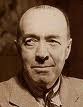
Edgar Rice Burroughs
Introduction
By 1930 ERB was fifty-six years old. An age when many or even most people have become hardened into unchangeable forms. Burroughs seems to have been an exception to this rule. His ability to evolve with the times is remarkable. Some can, some can’t. The problem isn’t one of merely attempting to mimic the style of the period but to adapt one’s mental outlook so that one thinks in the current idiom,
The post-Civil War period into which Burroughs had been born had disappeared now long ago. There might have been a couple survivors of the GAR but not many. The Indian Wars of his childhood were over. The plains had been swept clean of the buffalo. Even the buffalo robe that could easily be found during the first two decades of the century became difficult to find in the twenties and impossible to find in the thirties.
So that past which must still have been vivid in ERB’s memory was no more. Frank James and Cole Younger had died as late as 1915 and 1916 respectively. Buffalo Bill in 1917. TR in 1919. Charlie Siringo who had been present at the shootout with Billy The Kid was giving advice to authenticate Western movies even as he passed away in 1928. Heck, Burroughs could claim to be an authentic cowboy. He was out on the Idaho range in 1890 the heyday of the cowboy, Johnson County war and all that. His Western novels are about as authentic as you can get, maybe even more so than one of ERB’s heroes, Owen Wister.
The guy was carrying impressive baggage from the past to the present and into the future. The era of the first two decades had come and gone disappearing into the Roaring Twenties, the New Era. The twenties were a major transitional period for ERB. He picked up on the new trends by such writers as F. Scott Fitzgerald and kept on hoofing it down the highways and byways. The Shaggy Man of Tarzana.
There was a hiatus of four years between Tarzan And The Ant Men, which may be considered the last of the Tarzan novels of the first period and 1927’s Tarzan, Lord Of The Jungle. The latter may be considered a transitional work between the first and the later period.
Tarzan And The Lost Empire of 1928 shows him saying goodbye to the Lost Empire of his early dreams. By this time he had begun his affair with Florence Gilbert Dearholt that would result in the end of his marriage of thirty-four years to the lovely Emma.
Also a new political element entered his writing competing with the love element of Emma and Florence. Tarzan novels fairly gushed from his pen over the next seven years. Tarzan At The Earth’s Core of 1928-29, Tarzan The Invincible of 1930, Tarzan Triumphant of 1931, Tarzan And The Leopard Men also of 1931, Tarzan And The City Of Gold of 1931-32, Tarzan And The Lion Man of 1933 and Tarzan’s Quest of 1934-35. With the divorce his fecundity ended; he had severed his connection with his origins.
Politics had entered his life in earnest with the Bolshevik Revolution of 1917. He had always been involved with politics to some extent. In his youth his basic attitudes had been formed by immigration while he watched immigrant German socialists parade through the streets of Chicago under the red flag shouting, Down with America. The Russian situation had troubled him too. The villains of the Russian Quartet had been Russians. A very great many of his villains were Russians. The Communist leaders of Tarzan The Invincible are Russian.
In 1919 he rushed his political tract Under The Red Flag denouncing the Russian revolutionaries to his publishers. Haven’t read it but I suspect it was much too polemical for the pulp fiction magazines for which he wrote. It if was anything like The Little Door I can understand why it was rejected on literary grounds. I don’t doubt the novel was rejected for political reasons also as Reds and Fellow Travelers had already worked themselves into the cultural edifices of the US.
Certainly he was flagged as a counterrevolutionary to be watched and interfered with. It is now becoming apparent that ERB was more widely read in the new Soviet union than previously thought. Josef Stalin may even have followed the Tarzan series. We know for certain

Joseph Stalin
that Tarzan novels were read to workers on the job.
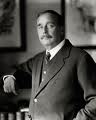
H.G. Wells
It appears that H.G. Wells was appointed to harass Burroughs in print. His 1923 novel Men Like Gods seems to reference Burroughs in a negative way. The means of communication between Wells, the Reds and ERB remains to be discovered but there appears to be novelistic warfare between the two. Wells seemingly was the Soviet hatchet man attacking other notable counterrevolutionaries such as Aldous Huxley.
ERB refined his approach getting his condemnatory novel of Bolshevism, The Moon Maid, published in 1926. The Moon Maid wasn’t that satisfactory although Wells replied to it in 1928 with Mr. Blettsworthy of Rampole Island.
Wells unmistakably alludes to Burroughs in this novel calling him insane. Tarzan At The Earth’s Core which is an attack on some core beliefs of the revolutionaries may possibly have been a rushed response to Blettsworthy.
In Tarzan The Invincible which may be incontrovertibly considered his third attack on the Revolution and an answer to Wells ERB succeeded in the grand manner. He shed the nineteenth century trappings of The Moon Maid that was written in the style of Wells’ First Men In The Moon to write a thoroughly modern novel. Invincible might be considered a prototype of the modern spy thriller, one of the first of the genre. Not only a prototype of the genre but as David Adams points out in ERBzine 0199 a superb blending of fact and fiction:
Fictional author: Burroughs pulls off a tour de force by narrating an introduction in his own voice, then slipping into the story so smoothly one is deceived into believing it is part of a newspaper story in a historical setting.
By which David means current events occurring almost as we speak. Tour de force is correct. David got the handle on that one. Tarzan is actually integrated into a current political situation as an actual historical figure. Tarzan interacts with fictional agents of Stalin who are represented as real acting under orders from Moscow. Incredibly Opar devolves from a mere fantasy of Burroughs into an actual geographic location somewhere in southern Abyssinia. The Soviet agent Dorsky tells Tarzan that they know that he knows where the gold of Opar is hidden and that he is going to tell them.
Thus Stalin has apparently kept up on Tarzan’s adventures which he thinks are real being aware of the source of Tarzan’s wealth and his earlier expeditions to Opar. In fact, one knows that Tarzan’s adventures are common knowledge which they should be as several millions of copies had been sold worldwide. Tarzan’s amanuensis Burroughs has seen to that.
The Soviets had located Kitembo of the Basembos who knew where Opar was and had actually seen it. The Basembos were native to the area of the railhead on Lake Victoria. One assumes that Kitembo must have known one of the faithful Warziri who showed him the ruins. As ERB explains only Tarzan and some of the Waziri had been to Opar. That overlooks Ozawa, who probably bore Tarzan a little grudge for the gold taken from him and the bearers of Esteban Miranda of Tazan And The Golden Lion but possibly the well-known Curse of Atlantis had carried them all off. Haven’t heard of the Curse of Atlantis? Well, you’ve heard of the Curse of the Pharaohs haven’t you? Same thing, only different.
The Reds trying to loot Opar isn’t all that far-fetched. As has been mentioned elsewhere Stalin actually ordered his scientists at about this time to cross an ape and a human to attempt to create a new super warrior that could run on regular. We know that Stalin was a fan of the Tarzan series, both books and movies, possibly even a secret admirer of our favorite author. The possibility of Stalin thinking a eugenic hybrid of ape and human possible from reading Burroughs seems to have a high degree of probability. The Oparian males were believed to have some ape blood in them. If word of the experiments had reached Burroughs, Tarzan The Invincible could be part a spoof on Moscow. So, in a way, the blending of fact and fiction David notes could on the other hand be a blending of fiction and science by Stalin. Amusing to think about. I’m sure more information will surface in the future. At any rate this story does read as an unreported behind the scenes actual event.
Let’s take a look at how Burroughs sets it up. From the opening paragraph.
I am no historian, no chronicler of facts…
OK, so we’re warned that we’re about to be put upon.
Had the story I am about to tell you broken in the newspapers of two certain European powers, it might have precipitated another and a more terrible world war. But with that I am not particularly concerned. What interests me is that it is a good story that is particularly well adapted to my requirements through the fact that Tarzan of the Apes was intimately connected with many of its most thrilling episodes.
Ah, so Tarzan really exists.
That passage is reminiscent of both the first framing story of Tarzan of the Apes and any number of story introductions of Dr. Watson for Sherlock Holmes. The echoes are very strong. An overlooked fact is that Burroughs actually plays Dr. Watson’s role for Tarzan. Burroughs
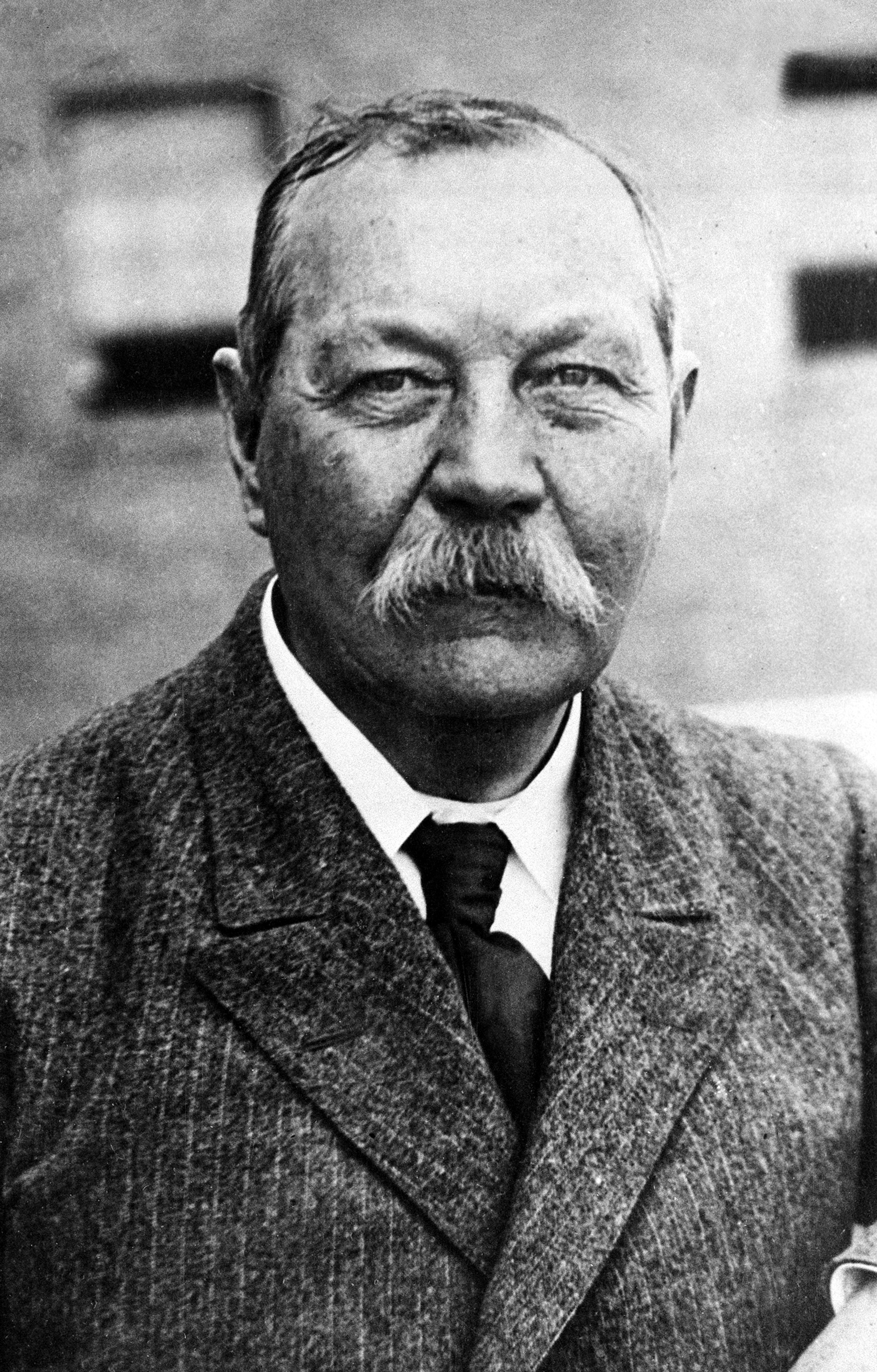
Arthur Conan Doyle
in fact is the chronicler of Tarzan’s adventures as was Watson those of Holmes.
Burroughs goes on to establish his story’s authenticity:
Take the story simply as another Tarzan story, in which, it is hoped, you will find entertainment and relaxation. If you find food for thought so much the better.
Doubtless, very few of you saw, and still fewer will remember having seen, an news dispatch that appeared inconspicuously (how inconspicuously?) in the papers some time since, reporting a rumor that French colonial troops stationed in Somaliland, on the northeast coast of Africa, had invaded an Italian African colony. Back of that news item is a story of conspiracy, intrigue, adventure, and love- a story of scoundrels and of fools, of brave men, of beautiful women, a story of the beasts of the forest and the jungle.
That seems like it covers all the bases of what a story should have. It is also pure Dr. Watson or, rather, Arthur Conan Doyle; let’s not fail to differentiate between fact and fiction. So far what Burroughs has posited could well be true. After all few read and fewer remembered the news item which appeared inconspicuously sometime in the not too distant past. Now Burroughs removes the story from the news item another step and quietly slips into full fiction mode:
If there were few who saw the newspaper acount of the invasion of Italian Somaliland upon the northeast coast of Africa, it is equally a fact that none of you saw a harrowing incident that occurred in the interior some time previous to the affair.
Um, yes, if there were few…then it’s a fact there were none. It seems ERB has established an incontestable ‘fact.’ So if you let that sophistry slip by you he’s going to tell you pure fiction. If you know the difference you won’t care, if you don’t it won’t matter. Anyway his intro was a perfect synthesis of nineteenth century humbug brought completely up to date.
Burroughs’ writing style is even close to reportorial. Tarzan, La and Opar become ‘real’ as ‘real life’ Reds make their assault on the ancient Atlantean colony. So, in a way, Atlantis becomes an established fact rather than an hypothesis.
Burroughs uses clear, concise sentences developing his story news style. For once his story is evenly paced with a well developed beginning, middle and unrushed end. He doesn’t cram a hundred page ending into ten as usual.
While one hesitates to call the book his best Tarzan novel it may be his best written. Thoroughly modern in its swift and pleasant reading with wonderful detailing I certainly can’t consider the novel hack work or inferior to any of the Tarzan novels in any way. The characters are entirely plausible, the premiss doesn’t seem far fetched. There are historical antecedents that we will examine. The novel could easily have take its place among the major spy thrillers written in the last fifty or sixty years. David is right. The novel is a major tour de force.
Part II of X follows.

R.E. Prindle
Themes And Variations
The Tarzan Novels Of Edgar Rice Burroughs
#23 Tarzan And The Madman
by
R.E. Prindle

What A Long Strange Trip It’s Been
In everyone’s life there comes a time to recapitulate. Tarzan And The Madman was that time for Edgar Rice Burroughs. The Great Saga began in 1912 and in this novel of 1940 unpublished during his lifetime the long strange trip, to quote the Grateful Dead, came to an end. The Big Bwana and his imposter got on a plane and flew out of Africa never to return.
Two more unpublished novels in his lifetime would follow but they were placed in the Pacific either in or near Indonesia. The succeeding Tarzan And The Castaways was also unpublished during his lifetime while Tarzan And The Foreign Legion could find no takers so was published by ERB, Inc. It almost seemed as though the sun had gone down on the Great Ape Man.
Of course the movie Tarzan still prospered, first with the great Johnn Weismuller and then Lex Barker. ERB even tips his hat to MGM by replicating the flight through the fog to the great tabletop of the Mutia Escarpment, an MGM invention. Thus, the last game is played out on the MGM playing field. Just as ERB and Florence left LA on a plane so Rand and the Goddess and Tarzan do Africa in this novel. In a short 157 pages ERB manages to recap the Big Fella’s entire career in print or on film.
In reading through the book this last time I suddenly realized the significance of all those doppelgangers. They signified the problem ERB was having realizing his ambition to be the man who was Tarzan. In Madman he gives up the ghost realizing his failure to become the Man-who-thought-he-was-Tarzan but wasn’t. Now typing away in exile from LA on Hawaii he throws in the towel.
As I have tried to show in my other reviews ERB read Robert Louis Stevenson’s The Strange Case Of Dr. Jekyll And Mr. Hyde probably sometime before 1890 within four years of its issue. The book must have been a sensation during his years at the Michigan Military Academy, the subject of endless discussions among the cadets. As hard as it must be for us to realize what we consider a classic was an exciting new book for ERB. No movies could be made of it because the technology hadn’t been developed as yet. Even the primitive Nickelodeons were shimmering a ways into the future. Yea, verily, the future lay before them.
The novel was significant enough to be in the first batch of talkies being produced in 1931. I’m sure ERB was transfixed as the story unfolded on the screen. The theme of psychological doubles had dominated the Tarzan oeuvre from the beginning. While it seems repetitious to a first reading of the novels the theme is actually developing as the series progresses. ERB didn’t so much fall back on a cliché but he was working out a variation on the theme of Jekyll and Hyde.
He says that he was convinced that every man had two sides to his personality, perhaps not as pronounced as that of Jekyll and Hyde but there nonetheless. He was aware of his own duality chronicling it in the pages of the Tarzan oeuvre. The duality is often prompted by a blow to Tarzan’s head. The blow certainly commemorates the hit ERB took in Toronto while perhaps the aftermath split ERB’s personality so that he became two nearly different people. Perhaps that’s the secret of his writing career as he said that he was able to disappear into the alternate reality when he wrote.
Tarzan always had two personalities from the beginning. He was both a civilized man and a beast. This undoubtedly represents ERB’s feelings about himself. Perhaps he had periods when he was something of a wild man, not unlike Tarzan on the Rue Maule in The Return Of Tarzan who became a beast and then shook himself back into a human not unlike the transformation of Jekyll and Hyde. This type of duality would characterize the Russian Quartet, the first four novels.
The Tarzan true doppelganger first appeared in Jewels of Opar where having received a blow to the head he loses his memory during which he lived as an uncivilized beast, regaining civilization with his memory, but he had not yet split into two co-existing separate identities. That would first occur in Tarzan And The Golden Lion and Tarzan And The Ant Men when the great character of Esteban Miranda served as a doppelganger. Esteban was identical to Tarzan in appearance but an arrant coward compared to Tarzan. This was a characteristic of all the doubles. Esteban represented the negative pre-success side of ERB while Tarzan the positive post-success side. Thus in these two novels ERB is beginning the attempt to become Tarzan- The-Man-Who-Thought-He-Could-Be-Tarzan.
ERB was very sensitive about his early failings in his relationship with Emma. In these two novels he offered Jane/Emma the chance to recognize him as the strong Tarzan and not the weakling Esteban doppelganger. Having overcome the failures of his past he felt he had proven himself as a man and a supreme provider demanding recognition. Given the decision to make Jane/Emma chose ERB’s former existence, Esteban, thereby sealing her fate. After her ill fated choice Jane disappears from the oeuvre except for the chance encounter in the succeeding novel Tarzan Lord Of The Jungle whereas the Golden Lion assumes a prominent role.
While the next double, Stanley Obroski, appears in Tarzan And The Lion Man a double of sorts in the form of Lord Passmore makes his appearance in Tarzan Triumphant. Another double appears in Tarzan And The Leopard Men when felled by a giant tree in a storm Tarzan blanks out assuming another persona. Also, in Tarzan And The City Of Gold Valthor serves as a double. In a strange variation ERB repeats the story of Jewels Of Opar when Tarzan rescues Jane from the Arab boma. Here, in an exact duplicate of that scene, he rescues Valthor. Thus Jane and Valthor are connected in ERB’s mind.
In Tarzan And The Lion Man Burroughs kills off his weaker persona thus assuming the role of Tarzan himself. Then in Tarzan And The Forbidden City Brian is his look-a-like although the role of double is not explored. Perhaps this is the initial realization the ERB has failed in his quest to be Tarzan.
After a decade of trials and tribulations struggling against the Communists and MGM and losing ERB sat down in exile at the beginning of 1940 to write this confession of defeat.
The man-god Tarzan himself remains the same but The-Man-Who-Thought-He-Was-Tarzan but failed confesses his defeat getting into his airplane up there on MGM’s Mutia Escarpment flying out of Africa forever. First he was expelled from Opar by the Communists and then from Africa by MGM.
Although Tarzan was in the plane with him, the Big Bwana shows up again in Africa for a moment in Tarzan And The Castaways. This novel written in a style entirely different from the rest of the oeuvre was also unpublished during Burroughs lifetime hidden away in a safe.
In this novel Tarzan is defeated by a Black chief, symbolically perhaps, captured and sold as a wild man, a feral child. Once again Tarzan has lost his memory reverting to a pure beast or feral boy. As this novel was written after King Kong and Tarzan ends up on yet another island perhaps ERB was conflating the movie with this novel. Tarzan is put aboard ship with the other animals destined for the circus and taken from the continent.
Running all through Burroughs is the ghost of Jule Verne’s Mysterious Island. Once aboard ship a storm assaults the ship which, signficantly loses its rudder. Thus like the now rudderless Burroughs the ship is adrift. In a scene reminiscent of both Verne’s novel and Robert Louis Stevenson’s Kidnapped the ship is tossed atop a reef while all aboard including a Noah’s Ark of animals find their way to shore as the Castaways.
Stevenson and Verne were two of ERB’s earliest influences thus ERB returns full circle to his origins.
In the last Tarzan novel and the last published in his lifetime, Tarzan And The Foreign Legion, at the very end the fugitives from the Japanese army approach the remains of the Mysterious Island that after the volcanic explosition of Verne is a mere spire of rock in the vast ocean. Not a refuge in the world left for Tarzan or ERB. Like Capt. Nemo a submarine surfaces to rescue Tarzan and the Legion from a watery fate.
It seems amazing that as an honorary Frenchman Tarzan was never placed in a situation with the real French Foreign Legion. Perhaps P.C. Wren had preempted the genre with his magnificent FFL trilogy which left no room for ERB’s imagination to operate.
The long odyssey had ended. ERB could not imitate his man-god but he left him to us as an avatar for the coming New Age. What a long strange trip it was and for us, will be.

Johnny Weissmuller- The Image Of Tarzan
Part II follows.
Part III: Mourning Becomes Yoko
April 3, 2010
Mourning Becomes Yoko Ono
The Passing Of John Lennon Part III
by
R.E. Prindle

Doppleganger #1
When John Lennon met Yoko Ono he knew very little of art and nothing of the New York art scene. His high school years had been spent in open and futile rebellion; the next few years had been spent only in the German underworld with no time for cultivation. From there he went into the whirl of the Beatles years so one might say he had been in cultural suspended animation for all his adult life.
Yoko Ono since 1960 had been engaged in the New York avant garde art scene. She was au courant when she left for London in 1966. Hooking up with Lennon she began to educate him according to her understanding of art. By the time the Ono-Lennons arrived in New York in the late sixties that scene was dominated by the POP art of Andy Warhol while the world both she and Lennon knew in 1960 was unrecognizable. Yoko wasted no time in ingratiating herself with Andy but not the factory. After he was shot in 1969 the old Factory disappeared and after his recovery Warhol began a new life. It is possible that she tried to establish

Doppelganger #2
contact with him between ’64 and ’66. She did know warhol’s associate, Sam Green, from her first days in the Village in 1960.
By the time of her return to NYC Yoko had achieved world wide fame by using Lennon and his fame in their charades for ‘Peace.’ Now she had the perfect entree to enter Warhol’s circle. Warhol was a sucker for celebrities, he did Lennon’s portrait, so he was flattered when Yoko asked him to introduce she and John into society. If Warhol could pester, Yoko was unstoppable. While Andy wasn’t exactly persona gratis at that time he was thick with Sam Adams Green who did have entree to society. Between the the two of them they set up a party to introduce the Ono-Lennons.
John was, of course, no Mick Jagger. While Mick adapted himself quickly to the demands of his fame and moved easily in society, John was awkward being out of the element of his self-styled working class hero. Yoko, too, was no mixer so at the party Yoko and John sat silently in a corner as though in one of Yoko’s bags watching the party goers.

Warhol Jagger 2

- Warhol Jagger
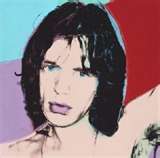
It might be apropos to point out that Jagger and Warhol were fairly close. Jagger was one of the few people attending Warhol’s funeral in Pittsburgh while Bianca was in Warhol’s entourage in the eighties. Warhol also painted a portfolio of Jagger pictures that today command healthy prices.
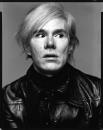
The Devil In Disguise

- Witchy Woman and Warhol

Yoko still persisted with Warhol but Andy having been disappointed once was not up for it twice. He distanced himself from the pair describing them to Sam Green as boring. An ultimate putdown.
Initially the Lennons lived in the Bohemian scene downtown. Mickey Ruskin, the owner of Max’s Kansas City, described the Bohemian scene thusly: the well-to-do Bohos, the middle and the lower class. Those associated with the Kettle of Fish and its environs of which Dylan was a member were of the lower class while the Kettle of Fish itself was owned by the Mafia. He believed Max’s was in the middle. John and Yoko first lived in New York in the West Village at 105 Bank Street next door to Yoko’s her, John Cage. They took over Joe Butler’s apartment, he formerly the drummer of Lovin’ Spoonful so Ruskin would have classed John and Yoko as haut ton beatniks.
At any rate they soon left those environs to migrate to the Upper West Side where they secured apartments in the famous, or soon to be famous, Dakota. It was then that their NYC life took its definitive form.
I have been to NYC a few times so that I know the general layout and have some feel for the place but I have by no means an intimate knowledge so essentially I’m working from maps. I know where MOMA and some few prominent art landmarks are from experience but not that many.
At any rate the Dakota is a famous landmark.. Acceptance as a tenant is by committee approval. John and Yoko were strenuously vetted but finally admitted. They took over actor Robert Ryan’s apartment #72. If you have seen the movie Rosemary’s Baby the camera pans past apartments 71 and 72. No filming was allowed inside the Dakota so while the exterior shots are authentic the interiors were shot on sets. Thus the apartment of the Satanists is a fictional 7E. The apartment next to it in which the young couple resided may have been number 72. The man of the couple who was an actor sold his wife’s body to Satan as the carrier of his child for success in the theatre which he was granted. Thus the Ono-Lennons moved into an apartment closely associated with devil worship, the occult and witchcraft.. This will become more important as Yoko associated herself with all three. In fact, Yoko through John Green would have been familiar with the Yoruban Santeria religion that she in all likelihood would have reverenced. The Spirit Foundation that she established is concerned with the preservation of just such tribal institutions.

Dakota Entrance
These are magnificent apartments that I presume Rosemary’s Baby duplicates. Huge fifty foot long living rooms as part of a ten room apartment. The Ono-Lennons would soon own both 71 and 72 lacking only the fictional 7E while having a Studio apartment as well.
Being now permanently settled Yoko having access to John’s superb income began to spend it. Of course, she virtually cleaned out department stores on her buying binges, any girl’s dream. But, she also began to buy heavily into art and antiques as investments. This brought Warhol’s friend Sam Adams Green into a close association with her. Rich society women were Sam’s forte. He has an interesting story. He was actually descended from the second president of the United States, Samuel Adams. He arrived in New york in 1960 about the same time Andy Warhol was trying to establish himself as a fine artist and Yoko the same. Warhol of course began as a commercial artist doing shoe ads but in 1960 he changed the emphasis of his career.
In the fine arts field one of the first gallery people Andy met was Sam Green of the Green Gallery. Different Green, Sam only

The Dakota
worked there and shared the name. He and Andy hit it off. By 1965 Green was associated with the art department of UPennsylvania where he staged a Warhol exhibition in the same year. From there he gravitated bck to NYC where he began a career as art consultant to rich women on both continents. They liked him. Through the socialite Cecile Rothschild he was introduced to Greta Garbo with whom he was sort of a trusted companion for 15 years.
He was very knowledgeable about art as an investment traveling between Euorpe and the US advising socialites on the most investment worthy art. He apparently derived a more than comfortable income from his efforts. He was a trusted advisor of Yoko. Some say that he and Yoko’s Tarot reader, John Green, who would enter John and Yoko’s life at about this time, combined to bilk Yoko for overpriced objects. This presumes that both men were dishonest and that Yoko was a fool. As Yoko’s investments have prospered I think we can dismiss the latter, although Yoko did take pride in being able to spend vast sums. She would have taken pleasure in overpaying.

Sam Green- Current
Rather I would say that Sam Green was a very knowledgeable expert whose task was to find art that would appreciate in value. Thus the question is did he perform that function and the answer is, yes. Yoko’s acquistions increased in value far above her purchase prices. I think it is unfair then to say that the Greens bilked her. Surely the laborer is worth his hire.

Warhol Portrait
Now, Sam Green as her agent had to buy the items he acquired for her. Being knowledgeable as to who in society wanted to sell what at distressed prices he may have made some excellent buys that he then tacked on his margin which of course meant that he sold to Yoko for ‘more than they were worth.’ But, heck, even Christie’s and Sotheby’s take twenty per cent each from the buyer and seller. That’s a forty per cent surcharge. However Sam served his function of providing investment pieces so I see no evidence of bilking.
Sam Green also formed a close, probably romantic, liaison with Yoko that persisted until after John’s death. Another art dealser she became close to was a Sam Havadtoy with whom she subsequently lived for twenty years beginning immediately the day after John’s death.
Now the men Yoko associated herself with were all effetes, that were either emasculated when she found them or who she emasculated. Strangely Lennon was the strongest of the lot. Both her first Japanese husband and Tony Cox appear to have been heterosexuals but both Sam Green and Sam Havadtoy were dependent homosexuals. With Havadtoy Yoko may have had her ideal relationship. He was thoroughly emasculated while with the fortune Yoko inherited from Lennon he was totally dependent on her. The classic toy boy a couple decades younger than herself. He, by the way, after his twenty year stint as live-in retired to Hungary with an abundant palimony but he isn’t talking.
In my reading of the situation then, a not particularly compliant John became somewhat of a liability to her, especially as he began to reassert himself with the return to the recording studio in 1980. The problem has the surface appearance of separating the man form his money and discarding the man.
Yoko began building her entourage, Sam Green, John Green, Sam Havadtoy and her various occult people with what appears to be an admiration for and some sort of connection with Andy Warhol. Sam Green and Havadtoy would be a troublesome presence in Lennon’s life during the recording of Double Fantasy while he does not appear to have been enchanted with the Warhol connection
As has been mentioned Yoko became involved in occult practices. She did practice hypnotism on Lennon and was an adept at suggestion which is the essence of hypnotism. Thus on the one hand she suggested forcefully to May Pang that she take up with Lennon while it is probable she hypnotized Lennon into taking up with May Pang. Post hypnotic suggestion would give her a command over all Lennon’s actions. Once implanted she would only have to say the word and Lennon would follow her suggestions.
How complicit John Green would have been in this isn’t exactly clear but any of Yoko’s suggestions to John could have been complemented by a reading. John Green was after all dependent on Yoko for a very generous income beyond whatever he may have scammed.
John Green is another interesting case. He was apparently successful as a Tarot reader before he met Yoko while he is reported to hae been a student of the African Yoruba religion called Santeria. The Yoruba are a tribe in Nigeria, middle river, Western side. He would have obtained much of the magic information he displayed in Cartagena, Columbia, SA from that source. The sixties themselves were the great period of the dissolution of the American mind and personality. One of the key items in the disintegration was the 1962 movie, Mondo Cane. (It’s A Dog’s World). It is difficult to assess the impact of this movie on the malleable college age mind of the times.
I saw the movie then and while it passed out of my conscious mind it struck me most forcibly and lodged in my subconscious mind. I, of course, reviewed the movie for this essay and while I at first remembered little gradually my conscious mind recovered the images so that I remember almost all. The viewing at the time was very repulsive and unsettling to my mind as it was for everyone I talked to about it and every college kid saw it. Still, consciously I missed the true import of the movie completely.
The filmmakers equated some New Guinea stone age people with modern Whites and equated them- said both states of
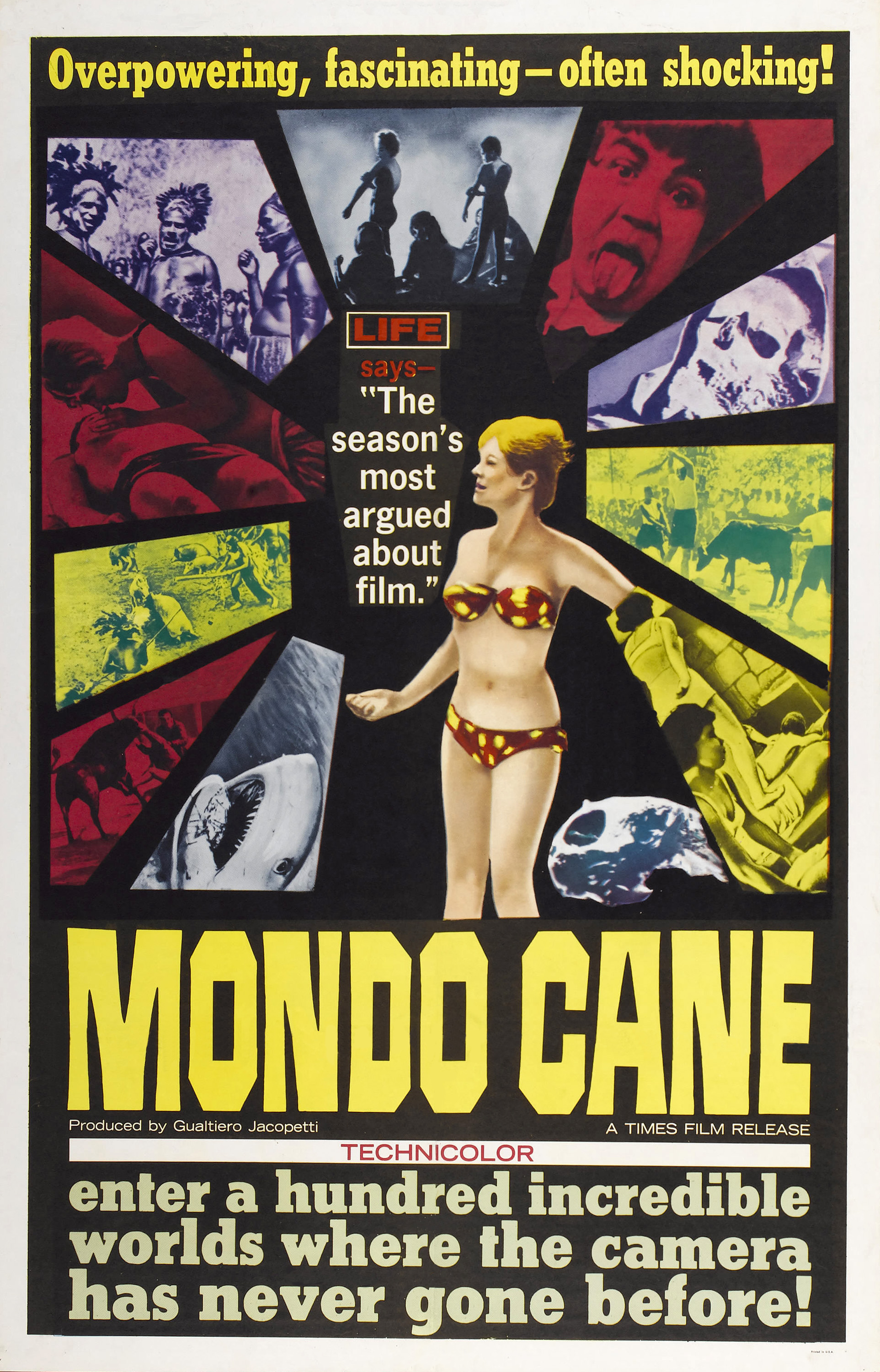
Mondo Cane Poster
consciousness were the same- and that there had been no advance between the primitive and modern. Then they showed Whites at their goofiest and most ridiculous. Drunks at a German Oktoberfest, aged tourists clumsily trying to do a hula. The movie was a real exercise in moral relativity. It was shortly after viewing the movie that I first remember hearing the phrase ‘Nothing is good or bad but thinking makes it so.’ I don’t want to philosophize on this but my thought was that if I think something is bad therefore it must be because I think it and I can’t be wrong.
The movie had a devastating effect on the attitude of the generation. It was a form of hypnosis with a great deal of post-hypnotic suggestion. Whether John Green saw the movie or not I can’t say but if he had it would have prepared him for accepting Yoruban Santeria. In fact these primitive forms of religion and what not flourished in the wake of Mondo Cane. At the same, as I indicated, Yoko would have been very open to Santeria. I think there is little doubt that Green and she at least discussed the religion and its African tribal origin. Especially as she established something she calls the Spirit Foundation. In the online prospectus she describes the foundation thusly:
The Spirit Foundation is…concerned with the protection and promotion of creative and cultural diversity amongst shamanic tribal communities worldwide. Part of the foundations work is the International Shamanic Network which aims at promoting the ancient creative archetypes of man and their binding ecological realtionship to the world.
Our emphasis is on education for action.
As mentioned Yoko and Lennon moved into the suites used in Rosemary’s Baby with its Satanic overtones. In the movie a young woman living with the Satanic couple either jumps or is pushed to her death not far from where Lennon was shot. In this very location Yoko took up Satanism. She decided she wanted to make a pact with the Devil to obtain her wishes. The ubiquitous Sam Green knew of a witch who could serve as an intermediary between Yoko and Satan. (Remember I am only retailing the story, I don’t believe Satan exists.)
Sam Green who had prospered as an art consultant had used some of his earnings to purchase what he called a castle in Cartagena, Colombia. He recommended his witch to Yoko who asked John Green to take her to the witch as he doubled as Tarot reader and Wizard. John Green did so and the witch duly negotiated a deal between Yoko and the Lord of Fire. When it came time to sign the pact Yoko asked Green to do it for her which he did. She was aghast when he told her he didn’t sign his name but hers. Yoko trying to cheat the devil.
We don’t know what she asked Satan for but we are compelled to believe she got it.

Santeria Illustration
As I believe she hypnotized Lennon into taking the Long Weekend I don’t know exactly why she wanted him out of the house. She certainly closely monitored his activities while he was away both in NYC and LA. During his absence Yoko didn’t have a Power of Attorney so she was somewhat constrained as John had her on a 300K budget. When he returned she quickly obtained his POA so that she had unlimited use of his money and, in fact, his identity.
Lennon is criticized for being a recluse in the years between 1975-80. He certainly wasn’t a recluse in that he withdrew from the world. He merely limited his contacts with it. It is said there was a fifteen month period when he was completely withdrawn. While he was obviously suffering from a mental malise in my opinion the withdrawal was completely justified. He had mental issues that had to be resolved. He had the money and time to work at it as he did.
He had a mother/father fixation he had to resolve. he had the feeling that he had been either a genius or a lunatic from boyhood. In a remarkable rant within the 1970 Rolling Stone interview he rants for pages because no one recognized him as a genius in his youth while he had now convinced himself that he was and had been a genius. The fact that he never did his schoolwork doesn’t seem to him that that may have a reason why people missed his genius and though him somewhat mad. What would theyhave done if they had? So he had to reconcile the issue in his mind.
He seems to have made no advance past his school years except in music. The years between leaving school and taking up with Yoko were completely wasted intellectually while the pressures of phenomenal success and wealth disoriented him completely not to mention the massive doses of drugs. At some time then he had to come down and organize his mind and life. From 1968 to let us say 1980 he was completely dependent on Yoko for his mental balance. In NYC he went where she did and did what she did. Hence the connection to Andy Warhol and Sam Green.
There are numerous pictures of Yoko, Lennon and Warhol. Yoko even patterned some of her work after Warhol’s style as in the ‘work’ below patterned after Warhol’s double Elvis. Thus she associates herself and Lennon with Presley.

Yoko Goes Warhol, Imitation of Double Elvis
As I mentioned before the social entree arranged by Warhol and Sam Green failed because of the social ineptness of the Ono-Lennons.
While we have a full record of what Lennon was doing during his ‘Lost Weekend’ we have a less full account of what Yoko was doing. She seems to have had romantic liaisons with at least three men- Sam Green, Sam Havadtoy and the guitarist David Spinozza.

Sam Havadtoy
Perhaps she wanted to see how well she could do on her own as a musician, to see if her reputation as a performance artist and, in her mind, musician, was sufficient to maintain a career on her own without John. If so, she was brutally disappointed as in her only solo performance she failed miserably. Thus she realized that as of 1974 her reputation as well as her wealth depended on Lennon.
It was during Lennon’s absence that John Green came into her life. While John Green tells a fairly smooth story in his Dakota Years one has the feeling that he is being highly selective in what he tells while he slyly ridicules the Ono-Lennons as their superior. The attitude easily leads to contempt and from contempt to abuse. Of course he would have to dissimulate both the contempt and abuse as Ono would be reading the book. As I imagine, a priest in the Santeria religion, he would have been in the company of some shady characters. I don’t know how many actual Yorubas were in NYC but I have met a couple elsewhere.
One imagines most of the hierarchy Green came into contact with was African or American Blacks. Santeria involves a deal of ritual sacrifice while money would be needed. I suspect that John Green was involved in the extortion attempt on the Ono-Lennons. This may have been Santeria related. Thus a sort of Black Hand organization was created. Rather than go for the big money that would have created a stir, the group settled for hitting up people with millions for a mere 200K each. An unpleasant tax for being rich but one more conveniently paid than to die resisting.
We have only Green’s version of the extortion and his relationship to it. He paints himself in a relatively good light. The Ono-Lennons did call in the FBI, they did give the extortionists newspaper rather than cash as the FBI advised. But then things went wrong. The FBI apparently had only one tail on the extortionist who came for the money rather than a series of back ups. The agent inexplicably lost his man. The Ono-Lennons never received another call but they had been warned that if they failed to pay Lennon would be killed whether it took one, two or more years. In December of 1980 the bill fell due. On December 8th he was shot. December 7th is Pearl Harbor Day so there may be a Japanese connection. Yoko Ono being Japanese, her numerologist and the assassin’s wife while Chapman missed the appointed day by one.
The question then hangs on Mark David Chapman the shooter. He is still alive and in prison. He was an assassin as the classic lone nut like Lee Harvey Oswald and any number of assassins who pay the law for the crime while the organizers go free. The technique has been well known to criminals for centuries. Any time a lone nut assassinates someone you may be sure that they were a patsy as Oswald announced over TV he was.
It seems likely that Chapman had been hypnotized. Witnesses said Chapman acted as though in a trance and he himself said he heard a voice in his head saying: Do it. Do it. Do it. The problem would be how he was recruited. I, of course, can say nothing for certain while what I am saying now is merely an hypothesis or inquiry. The main thing is that Chapman was supposed to be a lone nut. Ridiculous.
The most obvious recruitment method was the Santeria of which John Green was a member and to which Yoko Ono was
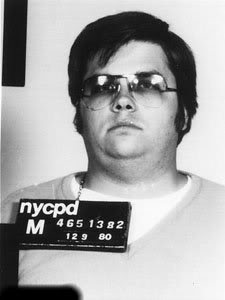
Mark Chapman
sympathetic. There are some oddities in the Chapman story that have to be explained not least of which are the large sums of money expended by Chapman in relation to his income. He was a married man therefore had a wife to support. Yet in 1978 he was in Japan at the same time as the Ono-Lennons beginning an around the world flight.
Perhaps Tokyo was the first stop of the trip around the world that then led to Seoul, Hong Kong, Bangkok, Delhi, Israel, Geneva, Paris, London, Dublin, Atlanta and back to Hawaii. His travel agent was a Japanese woman, Gloria Abe, who he then courted and married. She is reported to have been involved in occult circles. She may have seen so involved that, through Takahashi Yoshikawa, Yoko’s numerologist she was brought in to arrange the trip. Such an around the world trip in a Westerly direction- sundown to sunup- according to Yoshikawa’s numerology would be characteristic of Yoko Ono. She and Lennon made a round the world trip for occult reasons as did both Lennon individually and John Green at her instance. Green made his trip in 59 1/2 hours only leaving a plane once to change to another. As the financing of Chapman’s trip is unknown I would suggest Yoko Ono.
Two years after this very costly trip around the world Chapman flew from Hawaii to first Chicago, then Atlanta, then to New York where he landed a few days before the assassination. Once again, well beyond his means. It is said that he took paintings to Chicago that he sold. Where he would have gotten the paintings isn’t known but once again Yoko is the obvious source. She had an art gallery of valuable art work.
While in Atlanta he contacted a former roommate, then a Deputy Sheriff, Gene Scott, who gave him the hollow point exploding

Santeria Priestess
bullets for a handgun. One assumes such bullets couldn’t be bought over the counter. One wonders why Scott didn’t ask what Chapman intended to do with them. And if he did and Chapman told him Gene Scott is clearly an accomplice and should be questioned.
Chapman himself came from Atlanta where in his teen years he was known to ingest any and all drugs. Atlanta was also a Santeria center with several weird Black cults. Lennon’s death took place at the same time as the Atlanta child murders for which Wayne Williams was later convicted. The Santeria religion has been suspected in these obvious sacrificial murders while John Green establishes a Santeria connection to the Ono-Lennons and Yoko in particular.
Yoko was an excellent hypnotist who understood the use and power of suggestion. The Santerists as Africans would be well versed in the use of suggestion and hypnotism.
Chapman said he was possessed by the Devil while appearing to be in a hypnotic trance. All this rather amusingly is taking place at the Dakota, the scene of the Devil’s birth in Rosemary’s Baby. Indeed, the identical apartment.
After Lennon’s death there was no period of mourning or sense of loss by Yoko. All Lennon’s assets were in her control and name before his death. The so-called will of Lennon is suspicious, although the will was unnecessary becaue I doubt if Lennon thought of a will while the will appointed the art dealer Sam Green as the gaurdian of son Sean in the event the Ono-Lennons perished together. Lennon wasn’t that enamored of Sam Green.
Within a few days Sam Havadtoy was installed as Yoko’s live-in where he remained for twenty years.
While Yoko’s success as an artist and rock n’ roller wasn’t affected by Lennon’s death she now had the money to pay to have her art exhibited. Even then she found her reputation was indissolubly linked to her dead husband. She has become a caretaker for the Lennon legend parceling out old recordings while humiliatingly Lennon’s artwork is more in demand than hers.
She seems to have patterned her later career on that of Andy Warhol who as he acquired fame and fortune managed to insinutate himself into certain society circles. So has Yoko. Now, at 78, she has attained a certain status although still extremely self-centered while having an appearance of terminal aloneness.
Animus and Anima

A Review: On Tarzan By Alex Vernon
November 13, 2009
A Review:
On Tarzan
by
Alex Vernon
Review by R.E. Prindle
Vernon, Alex: On Tarzan, 2008, UGeorgia Press
This book reads almost like the cover of The Doors LP Strange Days. You’ve entered into some kind of literary twilight zone. This is perhaps the most eccentric book I’ve ever read. I can’t believe it was actually published- and by a University press!
Alex Vernon has a PhD and is an Associate Professor at Hendrix College. Must have been founded by Jimi before he OD’d. I’m flabbergasted that the guy has a job. Average looking Joe from the back cover. Happy, smiling. Doesn’t look like he’d be sex obsessed but it could be a problem for him.
The phallus on the cover dismayed me but prepared me for the sex driven content. Zany, zany, zany. A large phallus rises out of what might be the swamp, symbol of the female, or perhaps jungle growth meant to represent pubic hair.
When Vernon says On Tarzan he doesn’t mean Tarzan by Edgar Rice Burroughs he means Tarzan as a ‘living’ entity to which history Burroughs is only one contributor albeit an important one, Philip Jose Farmer almost eclipses Burroughs as a contributor to the Tarzan ethos in Vernon’s mind. Mainly for Farmer’s outrageous sex episodes.
Tarzan ethos is about it. Everything is thrown indiscriminately into the stew pot. Books, movies, TV shows, articles, even artefacts, Tarzan underwear. Vernons says he interviewed Bill Hillman at ERBzine although it is difficult to find what he gleaned from the conversation, wait a minute, maybe the reference to the 1893 Columbian Expo. Bill was probably hot on that topic.
As literary critic Vernon doesn’t so much analyze as create. He uses Tarzan body parts from various books and films to create his own monster, and his Tarzan is monstrous.
As I say he uses his sources as though making a stew; mixing them up to creat a sex driven Tarzan that no twelve year would recognize as his hero.
Vernon doesn’t seem able to distinguish the motives, the agendas of the various sources who are projecting their own inner world on Tarzan such as Bo and John Derek in their vision of The Big Bwana. I didn’t say Banana; I said Bwana. Melding these sources doesn’t create a ‘biographical composite’ of Tarzan that all can agree on; it is merely the projection of Vernon’s own inner psyche.
Apparently Vernon’s approach is a valid historical literary criticism technique in today’s academic environment. It’s not what you say but who you say it about. As I say it goes beyond interpretation or revisionism into creating an alternate universe.
The approach intrigued me. In that spirit I offer my own creation of Tarzan and a revisionist/creation of history. In the view of facts as they might be construed by a fanatic with an agenda I offer Tarzan as an agent of Globalism serving as the first viceroy of Africa.
Mr. Vernon keeps talking about a colonial period as if such a thing has ever existed. His professors must have been from the stone age. As advanced thinkers know what these prehistoric monsters refer to as colonialism was in reality the early stages of what is now recoginized as Globalism. This how Globalism began. In the very early stages all cultures were relatively distinct, living in separate well defined areas. The Chinese were in China, Africans were in Africa, Europeans were in Europe. Further relatively internal distinct sub-divisions can be made on all continents. It was clear to the most primitive minds, well, actually European primitive minds, that what was needed to…well for whatever reason they had…to make the world a more secure place was Globalism. Wars were anathema but one couldn’t create Globalism without some really destructive wars so they forged fearlessly ahead secure in the purity of their intentions. This posited the problem of bringing together in most cases people who didn’t know other cultures even existed, those ‘lesser races outside the law.’
As I say Europeans were then and are now the promoters of the cause of Globalism. It’s good for people and it’s good for the Global Money Trust. Initially Europe sent out ships and explorers to the four corners of the Earth. In that far off, almost once upon a, time unlike today local populations were hostile to what they mistakenly called invaders. Sometimes their resistance involved military force, in other words war; so in self-defense it was necessary to mow the heathens down. We had screw guns and maxims and they didn’t. Rather foolish on their part while causing Globalists a great deal of emotional distress. Almost had a nervous breakdown. It could have been avoided. Globalists only wanted peace if they had understood.
Gradually the peoples of the world learned that they going to have to peacefully interact if even at gunpoint. But then there was disagreement in Europe. the Global barriers were being lowered as this beneficent ideology of Globalism was slowly accepted. As expected there were reactionary elements. In both cases the criminal Germans were the hard nuts. They insisted on the right to be themselves rather than submerging their identity into what the Globalists wanted. Their resistance was futile; Globalists got what they wanted anyway, the Globe be damned. After the second German petulance Globalists crushed them. Some wanted to exterminate the whole lot, raze Germany to the ground and turn it into pasture land. I don’t have to tell you that gentler and more loving heads prevailed. Globalists gave the African troops leave to loot Strasbourg and rape the German women and let it go at that. You see, there are some sacrifices we all have to make.
It is best not to oppose Globalist wishes. Globalism will be had on their terms or they’ll get rid of ya. As another example, the Kulaks of Russia opposed Globalist wishes and it was necessary to exterminate them to the man, woman and child. I won’t tell you the intense emotional pain that incident cost the Globalists, those were not crocodile tears as often alleged. People won’t be happy unless the blessings of globalism are universal. That’s what Globalism means, universal.
Now, one of the great advocates of Globalism was the progressive American ‘fantasy’ writer, Edgar Rice Burroughs. Fantasy, humph. As Edgar’s avatar of Globalism he created the character of Tarzan the Ape Man. The brilliance of the ape man is almost incomprehensible. As Mr. Vernon points out Tarzan united the fauna being man and beast at one and the same time. His being encompassed all evolution, unlike the rest of us who are products of only a few of the commoner genes, as he passed through the stages of Beast, Negro and European. How fitting that Edgar Rice Burroughs should make him the very first Commissar, even Czar, of Africa. Yes, he was White. But only we Liberal White people have understood our manifest destiny to bring all peoples together in Globalism. Well, yes, there were mistakes and, quite frankly, genocides, but they were necessary and not arbitrary. They were decided on only after long and careful deliberation. It was like pruning a tree to make it more beautiful. When Chairman Mao finished pruning the recalcitrant Chinese there were 50 million branches on the ground, but, what of it? As Mao himself benignly and poetically, he was a poet you know, intoned: ‘So? Will the flowers not blossom in spring and cool breezes not blow across waving fields of grain.’ Of course they would and as proof they have and will continue to do so. How ridiculous! There’s always new babies to replace those gone. Come on!
Edgar very cleverly has that man we now know as a villain, Stalin, seek to replace Tarzan as Commissar because he was in fact too just and too gentle with his charges. Rather than compelling Africans to hew to the Party line Edgar portrays Tarzan letting the Africans do as they please so long as they didn’t kill each other. That was in his brilliant history he called Tarzan the Invincible, and he wasn’t kidding. It wasn’t unreasonable to send a replacement from Moscow but Edgar perversely has Tarzan defeat his replacement. You can read about it in Edgar’s history yourself.
So, Mr. Vernon has expended a great deal of effort to prove the unprovable. He completely mistakes the reason for the US presence in Viet Nam. This was not nation building as he has been induced by his professors to believe. This was a necessary stage in the creation of Globalism. Today the two halves of Viet Nam have been reunited because of their efforts and Globalism is progressing nicely there, thank you very much.
A larger problem was to bring China into the Globalist empire.. But that was cleverly done by inducing them to manufacture big screen TVs for not only the province of the United States but the world. Today they are the Globe’s largest manufacturer of flat screen TVs and tennis shoes and are assisting in the Globalism of Africa sending their tens of millions of excess personnel to help the Africans enter the Global economy.
I certainly appreciate the effort Mr. Vernon has put into his project; it is regretable he has been so ill informed about the difference between Globalism and colonialism. Colonialism is when you occupy a country for selfish reasons; Globalism is when you subject or exterminate a people for the right reasons.
The Global Cabal is sorry people had to die. As the old saw says: You can’t make an omelet without breaking a few eggs. Its better to be the hammer than the nail.
I’m sorry Mr. Vernon but I can’t recommend your book.
Themes And Variations
The Tarzan Novels Of Edgar Rice Burroughs
#5 Tarzan And The Jewels Of Opar
Part V
by
R.E. Prindle
Texts:
Du Maurier, George: Peter Ibbetson
Dudgeon, Piers: Captivated: J.M. Barrie, The Du Mauriers & The Dark Side Of Neverland, 2008, Chatto And Windus
Hesse, Herman: The Bead Game
Neumann, Erich: The Origins and History Of Consciousness, 1951, Princeton/Bollingen
Vrettos, Athena: “Little Bags Of Remembrance: Du Maurier’s Peter Ibbetson And Victorian Theories Of Ancestral Memories” Erudit Magazine Fall 2009.
While it is today commonly believed that Sigmund Freud invented or discovered the Unconscious this is not true. As so happens a great cataclysm, The Great War of 1914-18, bent civilization in a different direction dissociating it from its recent past.
Studies in the earlier spirit of the unconscious continued to be carried on by C.G. Jung and his school but Freud successfully suppressed their influence until quite recently actually. Through the fifties of the last century Freud’s mistaken and harmful, one might say criminal, notion of the unconscious held the field. Thus there is quite a difference in the tone of Edgar Rice Burroughs writing before and after the 1917 Bolshevik Revolution.
There are those who argue that Burroughs was some kind of idiot savant who somehow knew how to write exciting stories. In fact he was a well and widely read man of varied interests who kept up on intellectual and scientific matters. He was what might be called an autodidact with none of the academic gloss. He was very interested in psychological matters from hypnotism to dream theory.
The scientific investigation of the unconscious may probably be dated to the appearance of Anton Mesmer and his interest in hypnotism also variously known as Mesmerism and Animal Magnetism. The full fledged investigation of the unconscious began with hypnotism. Slowly at first but by the last quarter of the nineteenth century in full flower with varied colors. Science per se was a recent development also flowering along with the discovery of the unconscious.
While Charles Darwin had brought the concept of evolution to scientific recognition in 1859 the key discipline of genetics to make sense of evolution was a missing component. It is true that Gregor Mendel discovered the concept of genetics shortly after Darwin’s Origin Of Species was issued but Mendel’s studies made no impression at the time. His theories were rediscovered in 1900 but they were probably not widely diffused until after the Great War. Burroughs knew of the earlier Lamarck, Darwin and Mendel by 1933 when he wrote Tarzan And The Lion Man. His character of ‘God’ is the result of genetic mutation.
Lacking the more complete knowledge of certain processes that we have today these late nineteenth century speculators seem ludicrous and wide of the mark but one has to remember that comprehension was transitting the religious mind of the previous centuries to a scientific one, a science that wasn’t accepted by everyone then and still isn’t today. The Society For Psychical Research sounds humorous today but without the advantage of genetics, especially DNA such speculations made more sense except to the most hard nosed scientists and skeptics. The future poet laureate John Masefield was there. Looking back from the perspective of 1947 he is quoted by Piers Dudgeon, p. 102:
Men were seeking to discover what limitations there were to personal intellect; how far it could travel from its home personal brain; how deeply it could influence other minds at a distance from it or near it; what limits, if any, there might be to an intense mental sympathy. This enquiry occupied many doctors and scientists in various ways. It stirred George Du Maurier…to speculations which deeply delighted his generation.
Whether believer or skeptic Burroughs himself must have been delighted by these speculations as they stirred his own imagination deeply until after the pall of the Revolution and Freud’s triumph.
Burroughs was subjected to dreams and nightmares all his life. Often waking from bad dreams. He said that his stories were derived from his dreams but there are many Bibliophiles who scoff at this notion. The notion of ‘directed dreaming’ has disappeared from popular consideration but then it was a serious topic. Freud’s own dream book was issued at about this time. I have already reviewed George Du Maurier’s Peter Ibbetson on my blog, I, Dynamo and on ERBzine with Du Maurier’s notions of ‘Dreaming True’. It seems highly probable that Burroughs read Ibbetson and Du Maurier’s other two novels so that from sometime in the nineties he would have been familiar with dream notions from that source.
Auto-suggestion is concerned here and just as support that Burroughs was familiar with the concept let me quote from a recent collection of ERB’s letters with Metcalf as posted on ERBzine. This letter is dated December 12, 1912.
If they liked Tarzan, they will expect to like this story and this very self-suggestion will come to add to their interest in it.
Athena Vrettos whose article is noted above provides some interesting information from Robert Louis Stevenson who developed a system of ‘directed dreaming’ i.e. auto-suggestion. We know that Burroughs was highly influenced by Stevenson’s Dr. Jekyll And Mr. Hyde while he probably read other novels of Stevenson. How could he have missed Treasure Island? Whether he read any of Stevenson’s essays is open to guess but in an 1888 essay A Chapter On Dreams Stevenson explained his method. To Quote Vrettos:
Rather than experiencing dreams at random, fragmented images and events, Stevenson claims he has learned how to shape them into coherent, interconnected narratives, “to dream in sequences and thus to lead a double life- one of the day, one of the night- one that he had every reason to believe was the true one, another that he had no means of proving false.” Stevenson describes how he gains increasing control of his dream life by focusing his memory through autosuggestion, he sets his unconscious imagination to work assisting him in his profession of writer by creating “better tales than he could fashion for himself.” Becoming an enthusiastic audience to his own “nocturnal dreams”, Stevenson describes how he subsequently develops those dreams and memories into the basis for many of his published stories, most notably his 1886 Dr. Jekyll And Mr. Hyde.
Now, directed dreaming and Dreaming True sound quite similar. One wonder if there was a connection between Stevenson and Du Maurier. It turns out that there was as well as with nearly the entire group of English investigators. Let us turn to Piers Dudgeon again, p. 102:
Shortly after they met, the novelist Walter Besant invited [Du Maurier] to join a club he was setting up, to be named ‘The Rabelais’ after the author of Gargantua and Pantagruel. Its name raised expectations of bawdiness, obscenity and reckless living, (which were not in fact delivered) as was noted at the time. Henry Ashbee, a successful city businessman with a passion for pornography, and reputed to be Robert Louis Stevenson’s model for the two sides of his creation, Dr. Jekyll And Mr. Hyde, denounced its members as ‘very slow and un-Rabelaisian’, and there is a story that Thomas Hardy, a member for a time, objected to the attendance of Henry James on account of his lack of virility.
Virility was not the issue however. The members of the Rabelais were interested in other worlds. Charles Leland was an expert on fairy lore and voodoo. Robert Louis Stevenson was the author of The Strange Case Of Dr. Jekyll And Mr. Hyde (1886) which epitomized the club’s psychological/occult speculations. Arthur Conan Doyle, who became a member of the British Society For Psychical Research, was a dedicated spiritualist from 1916. Henry James was probably more at home than Hardy, for both his private secretary Theodora Besanquet, and brother William, the philosopher, were members of the Psychical Society.
In many ways the Rabelais was a celebration that [Du Maurier’s] time had come. Parapsychological phenomena and the occult were becoming valid subjects for rigorous study. There was a strong feeling that the whole psychic scene would at any moment be authenticated by scientific explanation.
Du Maurier was obviously well informed of various psychical ideas when he wrote Ibbetson. In addition he had been practicing hypnosis since his art student days in the Paris of the late 1850s.
So this was the literary environment that Burroughs was growing up in. As Bill Hillman and myself have attempted to point out, ERB’s mental and physical horizons were considerably broadened by the Columbian Expo of 1893. Everything from the strong man, The Great Sandow, to Francis Galton’s psychological investigations were on display. The cutting edge of nineteenth century thought and technology was there for the interested. Burroughs was there for every day of the Fair. He had time to imbibe all and in detail. The Expo shaped his future life. That he was intensely interested in the intellectual and literary environment is evidenced by the fact that when he owned his stationery story in Idaho in 1898 he advertised that he could obtain any magazine or book from both England and America. You may be sure that he took full advantage of the opportunity for himself. As this stuff was all the rage there can be no chance that he wasn’t familiar with it all if he didn’t actually immerse himself in it. Remember his response to Kipling’s The White Man’s Burden was instantaneous. Thus you have this strange outpost of civilization in Pocatello, Idaho where any book or magazine could be obtained. Of course, few but Burroughs took advantage of this fabulous opportunity. It should also be noted that he sold the pulp magazines so that his interest in pulp literature went further back than 1910.
In addition ERB was enamored of the authors to the point of hero worship much as musical groups of the 1960s were idolized so he would have thirsted for any gossip he could find. It isn’t impossible that he knew of this Rabelais Club. At any rate his ties to psychology and the occult become more prominent the more one studies.
It seems to me that longing as he did to be part of this literary scene, that if one reads his output to 1920 with these influences in mind, the psychological and occult content of, say, the Mars series, becomes more obvious. He is later than these nineteenth century lights so influences not operating on them appear in his own work making it more modern.
At least through 1917 the unconscious was thought of as a source of creativity rather than the source of evil impulses. If one could access one’s unconscious incalculable treasures could be brought up. Thus gold or treasure is always depicted in Burroughs’ novels as buried. The gold represents his stories, or source of wealth, brought up form his unconscious. The main vaults at Opar are thus figured as a sort of brain rising above ground level. One scales the precipice to enter the brain cavity high up in the forehead or frontal lobe. One then removes the ‘odd shaped ingots’ to cash them in. Below the vaults are two levels leading back to Opar that apparently represent the unconscious. Oddly enough these passageways are configured along the line of Abbot’s scientific romance, Flatland.
In Tarzan And The Jewels Of Opar the gold is taken to the Estate and buried replicating the vaults. Once outside Opar and in circulation, so to speak, the ingots are accessible to anyone hence the duel of Zek and Mourak for them. The first gold we hear of in the Tarzan series is brought ashore and buried by the mutineers. This also sounds vaguely like Stevenson’s Treasure Island. The watching Tarzan then digs the gold up and reburies it elsewhere. In The Bandit Of Hell’s Bend the gold is stolen and buried beneath the floorboards of the Chicago Saloon. Thus gold in the entire corpus is always from or in a buried location. These are never natural veins of gold but the refined ingots.
Not only thought of as a source of treasure during this period the unconscious was thought to have incredible powers such as telekinesis, telepathy and telecommunication. One scoffs at these more or less supernatural powers brought down from ‘God’ and installed in the human mind. As they have been discredited scientifically Western man has discarded them.
On the other hand Western Man deludes himself into accepting the oriental Freud’s no less absurd assertion that the unconscious exists independently of the human body somewhat like the Egyptian notion of the ka and is inherently evil while controlling the conscious mind of the individual. This notion is purely a religious concept of Judaism identifying the unconscious as no less than the wrathful, destructive tribal deity of the old testament Yahweh. Further this strange Judaic concept of Freud was allowed to supersede all other visions of the unconscious while preventing further investigation until the writing of C.G. Jung were given some credence beginning in the sixties of the last century.
In point of fact there is no such unconscious. The supernatural powers given to the unconscious by both Europeans and Freud are preposterous on the face of it. For a broader survey of this subject see my Freud And His Vision Of The Unconscious on my blogsite, I, Dynamo.
This so-called unconscious is merely the result of being born with more or less a blank mind that needs to be programmed. The programming being called experience and education. The maturation and learning process are such that there is plenty of room for error. All learning is equivalent to hypnosis, the information being suggestion which is accepted and furthers the development of the individual. Learning the multiplication tables for instance is merely fixing them in your mind or, in other words, memorizing them. All learning is merely suggestion thus it is necessary that it be constructive or education and not indoctrination or conditioning although both are in effect. Inevitably some input will not be beneficial or it may be misunderstood. Thus through negative suggestion, that is bad or terrifying suggestions, fixations will result. A fixation is impressed as an obsession that controls one’s behavior against one’s conscious will, in the Freudian sense. The fixation seems to be placed deep in the mind, hence depth psychology. Thus when ERB was terrified and humiliated by John the Bully certain suggestions occurred to him about himself that became fixations or obsessions. These obsessions directed the content of his work.
To eliminate the fixations is imperative. This is what so-called depth psychology is all about. The subconscious, then, is now ‘seprarated’ from the conscious, in other words the personality or ego is disintegrated. The goal is to integrate the personality and restore control. Once, and if that is done the fixations disappear and the mind become unified, integrated or whole; the negative conception of the unconscious is gone and one is left with a functioning conscious and subconscious. The subconscious in sleep or dreams then reviews all the day’s events to inform the conscious of what it missed and organize it so that it can be acted on. No longer distorted by fixations, or obsessions, the individual can act in his own interests according to his abilities. The sense of living a dream life and a real life disappears.
That’s why experience and education are so important. What goes into the mind is all that can come out.
But, the investigation of the unconscious was blocked by Freudian theory and diverted from its true course to benefit the individual in order to benefit Freud’s special interests.
So, after the War ERB forgot or abandoned the wonderful notions of the unconscious and was forced to deal with and defend himself against Freudian concepts. The charactger of his writing begins to change in the twenties to meet the new challenges of aggressive Judaeo-Communism until by the thirties his work is entirely directed to this defense as I have shown in my reviews of his novels from 1928 to 1934.
Tarzan And The Jewels Of Opar then reflects this wonderful vision of the subconscious as portrayed by George Du Maurier and Robert Louis Stevenson
Then the grimmer reality sets in.
End Of Review.
A Review: Beau Sabreur by P.C. Wren
August 1, 2009
Note: I mistakenly placed the review of Beau Geste on another of my blogs: reprindle.wordpress.com. The review may be found there.
A Contribution To The
Erbzine Library Project
The Beau Ideal Trilogy Of
P.C. Wren
Beau Geste~Beau Sabreur~Beau Ideal
Part III
Review Of Beau Sabreur
by
R.E. Prindle
Part I: Introduction
Part II: A Review Of Beau Geste
Part III: A Review Of Beau Sabreur
Part IV: A Review Of Beau Ideal
Bibliographial Entry: Welland, James: ‘The Merchandise Was Human’, Horizon Magazine, Vol. VII, No. 1, Winter 1965. PP. 111-117
Beau Sabreur shifts from the classic literary style of the mid-nineteenth century to the vernacular of pulp or, perhaps, Wold Newton era. The pulp writers seem to have all read each other and Wren has certainly done his share of reading.
This novel begins at a pre-Zinderneuf time when Charles De Beaujolais was a mere cadet entering the service. If Beau Geste began in c. 1888 Beau Sabreur is set back at the beginning to perhaps 1875. De Beaujolais’ circumstances quite parallel those of the hero of Joseph Conrad’s Heart Of Darkness. Conrad has maintained a very respectable readership down to the present even though stoutly anti-Communist and a colonial writer. Both Communists and Africans are working hard to bury his reputation. It’s amazing how guys like Conrad manage to hang on, but that may not be for long as Western influence in society declines.
So it is that De Beaujolais is a sort of lounger applying himself to nothing in particular when his uncle recruits him for the French secret service as an agent to be attached to the African Spahis, an army corps. His uncle says that he will severely try him and should he fail in any particular he will be immediately dismissed. This essentially means that if De Beaujolais lets a woman come between him and his duty it is all over for him. So we are forewarned that there will a choice between love and duty.
The book was written after 1917 so Wren introduces a subversive Communist or anarchist character. In this book he assumes the name of Becque at the beginning. In Beau Geste he went by Rastignac and late in the novel he will be recognized as Rastignac although he appears to be going by another name. Wren has a good idea of the type describing him thusly under the name Becque:
He was clearly a monomaniac whose whole mental content was hate- hate of France; hate of all who had what he had not; hate of control, discipline and government; hate of whatsoever and whomever did not meet his approval. I put him down as one of those sane lunatics, afflicted with a destructive complex; a diseased egoist, and a treacherous, dangerous mad dog. Also a very clever man indeed, an eloquent, plausible and forceful personality…The perfect agent-provacteur, in fact.
Thus Becque in his various incarnations is always subversive, whether of army morale or working the Moslems up against the French. This will be a major theme of the novel. the same theme will appear in Tarzan The Invincible developed for his own needs.
Having been recruited by his uncle, De Beaujolais is sent to a sort of boot camp to learn the hard way. His ordeal is very convincingly described by Wren. It seems authentic enough to make one believe that Wren himself actually experienced such an indoctrination but there is no record that he did. He is just a consummate artist.
While learning to be a soldier Becque attempts to recruit him as a Communist agent. This leads to a sword fight in which De Beajuolais injures Becque but does not kill him.
Having completed his boot camp De Beaujolais takes his station with the secret service and the Spahis in Africa. Spahis are not FFL but a different corps.
When the French conquered Algeria in 1830 they disrupted a thousand year old social system. The North African Moslems had an insatiable need for slaves. Not only did they raid European shores to abduct Whites but an immense system for deliviering Negro slaves had been in existence since the Moslem conquest. This system had been run by the Tuaregs. This people was descended from Whites dating back to at least the Phoenician conquest of North Africa. Their alphabet probably precedes that of the Phoenicians. Undoubtedly they were the descendants of the former inhabitants of Mediterranean Valley known as Libyans in Egypt flushed out by the melting of the ice age.
What they did before the arrival of the Moslems isn’t known but with the African conquest of the Moslems they became the middle men between Africans of the Sahel and the Moslems of the North. Every year for a thousand years the Tuaregs had collected convoys of Negroes from the South driving them North across the Sahara. This was necessarily done with great loss of life as the Tuaregs were not that tender toward the Negroes.
With the advent of the Atlantic Slave Trade in the sixteenth century the Tuaregs also captured Negroes and drove them to St. Louis in Senegal for sale and transshipment to the Americas. According to James Welland the depredations on the Blacks was so great that the area around Lake Tchad had been cleared of inhabitants. This age old life style was disrupted in 1830 by the French. By that time Europeans had discontinued the slave trade so that the French disrupted the trans-Sahara trade causing a disruption in the Tuareg economy from which there was no recovery. Welland explains:
In short, the official abolition of the slave trade, the desert tribes, the desert itself for that matter began to play a diminished part in human affairs, and the Tuareg, who had been the only link for two and a half thousand years between Central Africa and the Mediterranean- in other words, between the Negro and the White world- began to pass from the stage of history. They were left unemployed and purposeless, with the result that they turned to intertribal war and oasis raiding to keep some semblance of their nationhood. Then again, as the supply of black labor dried up, the palmeries were increasingly neglected and often, as the consequence of a razzia, comepletely destroyed. The size and number of oases decreased, sand filled the wells and cisterns- many of which had been maintained since Roman times- and the age old trails became more hazardous and finally were hardly used at all.
In the secret service in Africa De Beaujolais becomes involved in the maelstrom of change, racial conflict and bad memories which were now exacerbated by the arrival of the non-Moslem, or Christian, French. The novel beomes then a sort of proto-thriller. De Beaujolais is on a mission to a town called Zaguig when he is caught up in a Moslem revolt. In Zaguig he meets the touring Mary and Otis Vanbrugh. Otis, you will remember returns from Beau Geste.
Mary is the love interest in the story and she will conflict De Beaujolais between his love for her and his duty as imposed by his uncle. Frankie Laine or Tex Ritter and songwriters Dimitri Tiomkin and Ned Washington (I tried to work Trad. in there somewhere but couldn’t do it) expressed the balance well in the song High Noon:
Oh to be torn ‘betwixt’ love and duty
Supposin’ I lose my fair haired beauty…
De Beaujolais relates the story of another agent who chose his beauty over duty and was drummed out of the service ultimately being killed. De Beaujolais has a premonition. Wren cleverly resolves the choice so that De Beaujolais gets his beauty while fulfilling his duty.
At the same time Otis Vanbrugh meets the apparent Arab dancing girl, who yet retains European features, who will figure largely in the sequel.
As the revolt erupts these conflicts emerge. As is usual in thrillers things are not what they seem. Raoul D’Auray De Redon, a close friend of De Beaujolais’ remains behind disguised as an Arab to confuse their attack on a small French garrison destined to be wiped out. De Beaujolais has important dispatches which must be delivered. Thus duty makes him appear to be an ingrate and coward humiliating him before Mary. His job is to locate the latest Arab Mahdi and suborn him the the French side.
De Beaujolais thinks little of Otis Vanbrugh and we are meant to accept his opinion. His true story will appear in the sequel.
Mary was one of those women who flirt by taunting or ridiculing her guy. In her case when De Beaujolais was within hearing she mockingly whistled a tune De Beaujolais couldn’t quite place but was called Abdullah Bulbul Amir. This was a very popular song and poem of the time that can be found at http://wiki.answers.com/Q/lyrics_of_bhulbhuliya. A couple of verses of its 19 will suffice to give its tenor but the poem is one you should be familiar with.
The sons of the Prophet are hardy and bold,
And quite unaccustomed to fear,
But the most reckless of life or of limb
Was Abdullah Bulbul Amir.
When they wanted a man to encourage the van
Or harass a foe from the rear,
Storm fort or redoubt, they had only to shout
For Abdullah Bulbul Amir.
Apparently the poem was so well known that Wren felt no need to name it and he doesn’t.
The time to leave Zaguig comes, so taking his entourage of faithful soldiers, Mary and her maid Maud, he sets out into the desert toward Oran.
Soon Tuareg or Arab raiders pick his party up and they are forced to fight a pitched battle although from an advantageous position. Here De Beaujolais has to make a very difficult choice between between loyalty to his men and his duty to get his dispatches through. Getting his men into position he is compelled to abandon them to their fate and push on.
This puts a strain on his relationship with Mary who cannot understand the concept of duty or necessity- the necessity to get the dispatches through. After a long flight the party falls into the hands of a desert tribe. But this is a strange desert tribe. Rather than the usual unorganized tactics these fellows seem to have the scientific training of the French. Another mystery.
As luck would have it De Beaujolais and the women were captured by the Mahdi’s troops. By way of explanation the Moslem Mahdi is equivalent to the Jewish Messiah but not the Christian Messiah. There’s only one Christ but Jewish Messiahs and Moslem Mahdis pop up everywhere.
So now, going back to the ending of Beau Geste, the two Americans Hank and Buddy were out there somewhere trodding the burning sands. Hank was discovered and rescued on the point of death by a kind hearted Sheik while Buddy was captured by hard hearted Tuaregs being saved from death when Hank Sheik’s tribe defeated his captors. Buddy was out there somewhere for a long time because Hank had been rescued years before.
Having been rescued at the point of death Hank was aware of the necessity to pass as a Moslem so he pretends to be dumb until he has learned the language so well he can pass. He then cleverly becomes the tribe’s sheik. The tribe is then threatened by a razzia of Tuaregs. As this takes place in the North Tuaregs no longer having Negroes to convoy have taken to raiding the oases. Normally the tribe would have run and hid leaving their goods and a few token members as slaves for the Tuaregs. Hank has a better idea and using his superior scientific French training the tribe rather than waiting to be attacked unexpectedly attack the Tuareg camp handily defeating them. Buddy is thus rescued. Coincidences are dime dozen out on the burning sands.
Teaching Buddy the language while he too plays dumb, Buddy becomes Hank’s vizier. With Buddy as military commander the tribe is trained in scientific methods in earnest. They then begin to organize the tribes into a confederation thus earning Hank the title of Mahdi in French eyes. De Beaujolais was thus on a mission to co-opt the new Mahdi.
As luck, or coincidence, would have, at the same time De Beaujolais and the girls arrive so does Becque/Rastignac. Becque is now employed one supposes by the Soviet Union to arouse the Moslems to a jihad. He comes bearing gifts not realizing that Hank and Buddy are his old Legion comrades. He doesn’t recognize them but Hank recognizes him. Becque and De Beaujolais have that old unsettled score to settle. De Beaujolais now settles his hash removing that source of irritation.
I’ve pointed out before that Burroughs very likely drew inspiration for his series of political Tarzan novels from 1930 to 1933 after reading this trilogy from 1924 to 1928. The Sahara had fascinated him long before he read Wren. David Innes of Pelucidar even surfaces in the Sahara returning from the Inner World. The great desert and the Sahel is not quite as we Westerners have imagined it. The thousand year long history of amazing suffering boggles the imagination. A thousand years of thousand mile treks from South to North, untold millions of Africans were trekked across the burning sands with equally untold millions falling along the way. This is not all. This is a horror story. Welland again, p. 116:
Even after the slave trade had been suppressed, the old life of the desert survived for a while for one simple reason…the absence of salt in the Sudan. Nearly all the salt in Central Africa had always come from the north across the Sahara on the backs of camels, donkeys, horses and men. The salt mines in the middle of the most terrible wastelands of the desert- at Taghaza, at Taodeni, and at Bilma- had always been worked all the year round by Negro slaves, who died within a few years of their arrival at the mines and were immediately replaced by new workers. The salt they mined was worth its weight in gold in Timbuktu, and its transport across the desert was a considerable enterprise of unbelievable size, involving the assembling of as many as 40,000 camels to make the quick dash from Bilma to Kano.
Think of it. For a thousand years Negroes were dropped down a funnel in a steady stream to live the most miserable of lives for a very few years. Over a millennium! Think of it. I should think those Negroes who travelled the Middle Passage in the Atlantic Slave Trade ending up in the paradise of the Caribbean and the Americas should bless their deliverers from that African hell.
Africans should bless the French for delivering them from total servitude and degradation. When one digs for facts beneath the surfice, the things one finds.
Thus without giving any historical background Wren is telling the story of how Europe saved the Africans from themselves. Indeed, Hank and Buddy singlehandely rearrange North Africa on livable lines. The two, in the story, break the power of the Tuaregs while establishing an African paradise in a hundred square mile oasis. Their people are delivered into prospeirty by a million franc subsidy from France that Hank and Buddy use for the betterment of their people rather than sequestering it in a numbered Swiss bank account. A new day for Africa indeed courtesy of Western enlightenment.
Thus De Beaujolais accomplishes his mission to align the new Mahdi, Hank, with France while winning his fair heared beauty and pleasing his uncle.
Hank marries Maud the maid leaving Buddy hanging out but not for long. We still have the last of the trilogy, Beau Ideal to go. Let’s go.
Exhuming Bob 21: Will The Real Bob Dylan…?
July 27, 2009
Exhuming Bob 21:
Will The Real Bob Dylan…?
http://contemporarynotes.wordpress.com/2009/04/05/greil-marcus-bob-dylan-bill-ayers-barry-obama/

Dylan
Our friend Bob Dylan has given the impression that he knew nothing of Barry Obama, The Great Black Hope, until the summer of 2008 with just a few months left in the campaign when he gave the candidate his endorsement. Surely this isn’t so. Surely he not only knew of the Hope but knew him personally probably before 9/11/01.
In my essay Bill Ayers, Greil Marcus, Bob Dylan and Barry Obama on my Contemporary Notes blog, linked above, I posit that all four knew each other and of 9/11 before it happened. Impossible, huh? Stranger things have happened.
I hadn’t thought about it much after writing my piece but then a few days ago- 7/22/09- I came across a post by one Lark, The Times Are A Changing (Again): Bob Dylan On Obama. Lark quotes Dylan on Obama in the London Times. Let’s review it:
Dylan begins: “Well you know right now America is in a state of upheaval.”
True enough. Many sorts of upheaval. What sort of upheaval does Dylan refer to:

Bomber Billy Ayers
Poverty is demoralizing.
Can’t argue with that. Is he talking about coal miners, fruit pickers, the unemployed, or what?
You can’t expect people to have the virtue of purity when they’re poor.
More problematic here. Purity isn’t a virtue it’s a state or condition. Has nothing to do with poverty. Well, Dylan’s a poet, one of the enigmatic kind, so I presume he may mean honest by pure. But which people, is he talking about Blacks?
Well, I come from a long line of poor people and so far as I know we were the kind described as ‘poor but honest.’ In other words we didn’t steal or cheat. I’m not sure how scrupulous we were about lieing. Seems to be a much more common fault. I’ve been around the block a few times now and I’ve come to the conclusion that crime has nothing to do with poverty. Rich or poor a thief steals and is well able to justify his thefts. Need I point out the 50 billion dollar thief Bernie Madoff? Or about the raft of Rabbis just arrested in New Jersey for some very serious financial crimes. And then I read about this reasonably well off one guy who stole some records because he thought he could use them better than the rightful owner. So it may be common to think you have to be poor to be ‘impure’ or dishonest but mistaken nevertheless.
Bob makes himself a little more clear:
But we’ve got this guy out there now who is redefining the nature of politics from the ground up…Barack Obama.
Naive but sincere. Spoken like a true cheerleader. ‘This guy out there’ sounds like affection if not familiarity to me. So now, when and how did Dylan become aware of the Hope? As I conjecture it Greil Marcus is the key to the riddle. I’m guessing, but my guess is that Marcus’ curiosity led him to introduce himself or be introduced to Bill Ayers, the ole Mad Weatherman Bomber, probably in Chicago. Ayers and Marcus being of the school of Whiteness is a plague on the Earth probably quickly came into accord. And then the Hope was probably on the way under the sponsorship of Ayers so Marcus and the Hope were introduced when certain anti-American and anti-White plans were discussed probably among them a projected attack on America. Certainly one remembers that Ayers had already made several bomb attacks on America so why not the Big One…the Really Big One…the World Trade Center.

Greil Marcus
Dylan and Marcus are pretty close. Dylan is either a Lubavitcher or close to them. Lubavitchers hate Whites, especially of the Christian sort. That partially excludes me by the way, White but not of the Christian persuasion.
As it appears that Dylan was much more familiar with the Hope than he let on and his album Love And Theft seems to reflect a pre-knowledge of 9/11 coupled with Marcus’ Rolling Stone article as detailed in the link to my essay above, there is every reason to believe, or think, or fear that Dylan, Marcus, Ayers and Obama were privy to 9/11 well before it happened. Possibly if not probably in on the planning stages.
Dylan goes on: He’s redefining what a politician is, so we’ll have to see how things play out.
If the Hope is redefining what a politician is then the definition is toward that of an African chief. An African chief owned every bit of his territory personally. He owned every inhabitant as his slave to dispose of as he wished. He was free to do with all as he chose with or without their consent.
That seems to be how the Hope is playing things out. True, the Hope is somewhat hobbled by the remains of the old political system but with his Liberal allies he has so far met with no insuperable resistance. To oppose his plans is to be vile. So far the fear of being considered vile has prevailed.
Then Dylan: Am I hopeful? Yes. I’m hopeful that things might change. Some things are going to have to.
Well things have changed. Many of us believe the way things are changing is in a direction more destructive than beneficial. In short the Hope is already a complete failure. We’d all be pleased to have a detailed opinion from Dylan on whether his hopes have been realized.
Dylan then closes with a platitude: You should always take the best from the past, leave the worst back there and go forward into the future.

Yep. Sure enough. I suppose the argument would break down over the issue of what’s best or worst and which has been left behind. There’s no doubt we’re headed into the future. Some kind of future at least.
A Review: Peter Ibbetson by George Du Maurier
May 8, 2009
A Review
The Novels Of George Du Maurier
Peter Ibbetson, Trilby, The Martian
Part IV
Peter Ibbetson
Singers and Dancers and Fine Romancers
What do they know?
What do they know?
-Larry Hosford
Review by R.E. Prindle
Table of Contents
I. Introduction
II Review of Trilby
III. Review of The Martian
IV. Review of Peter Ibbetson
Peter Ibbetson is the first of the three novels of George Du Maurier. As elements of the later two novels are contained in embryo in Ibbetson it would seem that Du Maurier had the three novels at least crudely plotted while a fourth dealing with politics but never realized is hinted at. Actually Du Maurier has Ibbetson who writes this ‘autobiography’ write several world changing novels from inside the insane asylum to which he had been committed. In the Martian Barty Josselin wrote several world changing books while ‘possessed’ by an alien intelligence, in a way, not too dissimilar to the situation of Ibbetson. Du Maurier himself comes across, as I have said, as either a half demented lunatic or a stone genius.
He has Ibbetson and the heroine, The Duchess of Towers write in code while they read encrypted books. Du Maurier says that Ibbetson and hence the two following books deal with weighty subjects but in a coded manner that requires attention to understand.
On page 362 of the Modern Library edition he says:
…but more expecially in order to impress you, oh reader, with the full significance of this apocalyptic and somewhat minatory utterance (that may haunt your fever sense during your midnight hours of introspective self-communion), I have done my best, my very best to couch it in the obscurest and most unitelligible phraseology, I could invent. If I have failed to do this, if I have unintentionally made any part of my meaning clear, if I have once deviated by mistake into what might almost appear like sense, mere common-sense- it is the fault of my half French and wholly imperfect education.
So, as Bob Dylan said of the audiences of his Christian tour: Those who were meant to get it, got it, for all others the story is merely a pretty story or perhaps fairy tale. The fairy tale motif is prominent in the form of the fee Tarapatapoum and Prince Charming of the story. Mary, the Duchess of Towers is Tarapatapoum and Peter is Prince Charming. It might be appropriate here to mention that Du Maurier was highly influenced by Charles Nodier the teller of fairy tales of the Romantic period. Interestingly Nodier wrote a story called Trilby. Du Maurier borrowed the name for his novel Trilby while he took the name Little Billee from a poem by Thackeray. A little background that makes that story a little more intelligible.
Those that watch for certain phobias such as anti-Semitism and Eugenics will find this story of Du Maurier’s spolied for them as was Trilby and probably The Martian. One is forced to concede that Du Maurier deals with those problems in a coded way. Whether his meaning is derogatory or not lies with your perception of the problems not with his.
Thus on page 361 just above the previous quote Du Maurier steps from concealment to deliver a fairly open mention of Eugenics. After warning those with qualities and attributes to perpetuate those qualities by marrying wisely, i.e. eugenically, he breaks out with this:
Wherefore, also, beware and be warned in time, ye tenth transmitters of a foolish face, ye reckless begetters of diseased or puny bodies, with hearts and brains to match! Far down the corridors of time shall clubfooted retribution follow in your footsteps, and overtake you at every turn.
Here we have a premonition of Lothrop Stoddards Overman and Underman. The best multiply slowly while the worst rear large families. Why anyone would find fault with the natural inclination to marry well if one’s handsome and intelligent with a similar person is beyond me. Not only is this natural it has little to do with the Eugenics Movement. Where Eugenics falls foul, and rightly so, is in the laws passed to castrate those someone/whoever deemed unworthy to reproduce. This is where the fault of the Eugenics Movement lies. Who is worthy to pass such judgment? Certainly there are obvious cases where neutering would be appropriate and beneficial for society but in my home town, for instance, no different than yours I’m sure, the elite given the opportunity would have had people neutered out of enmity and vindictiveness. that is where the danger lies. There is nothing wrong with handsome and intelligent marrying handsome and intelligent. How may people want a stupid, ugly partner?
Du Maurier had other opinions that have proved more dangerous to society. One was his belief in the virtues of Bohemians, that is say, singers and dancers and fine romancers. On page 284 he says:
There is another society in London and elsewhere, a freemasonry of intellect and culture and hard work- la haute Ashene du talent- men and women whose names are or ought to be household words all over the world; many of them are good friends of ine, both here and abroad; and that society, which was good enough for my mother and father, is quite good enough for me.
Of course, the upper Bohemia of proven talent. But still singers and dancers and fine romancers. And what do they know? Trilby was of the upper Bohemia as was Svengali but Trilby was hypnotized and Svengali but a talented criminal. What can a painter contribute but a pretty picture, what can a singer do but sing his song, I can’t think of the dancing Isadora Duncan or the woman without breaking into laughter. And as for fine romancers, what evil hath Jack Kerouac wrought.
I passed part of my younger years in Bohemia, Beat or Hippie circles, and sincerely regret that Bohemian attitudes have been accepted as the norm for society. Bohemia is fine for Bohemians but fatal for society which requires more discipline and stability. Singers and dancers and fine romancers, wonderful people in their own way, but not builders of empires.
In that sense, the promotion of Bohemianism, Du Maurier was subversive.
But the rules of romancing are in the romance and we’re talking about Du Maurier’s romance of Peter Ibbetson.
Many of the reasons for criticizing Du Maurier are political. The man whether opposed to C0mmunist doctrine or not adimired the Bourgeois State. He admired Louis-Philippe as the Beourgeois king of France. This may sound odd as he also considered himself a Bohemian but then Bohemians are called into existence by a reaction to the Bourgeoisie. Perhaps not so odd. He was able to reconcile such contradictions. Indeed he is accused of having a split personality although I think this is false. Having grown up in both France and England he developed a dual national identity and his problem seems to be reconciling his French identity with his English identity thus his concentration on memory.
In this novel he carefully builds up a set of sacred memories of his childhood. He very carefully introduces us to the people of his childhood. Mimsy Seraskier his little childhood sweetheart. All the sights and sounds and smells. In light of the quote I used telling how he disguises his deeper meaning one has to believe that he is giving us serious theories he has worked out from science and philosophy.
Having recreated his French life for us Peter’s parents die and Ibbetson’s Uncle Ibbetson from England adopts him and takes him back to the Sceptered Isle. Thus he ceases to be the French child Pasquier and becomes the English child Peter Ibbetson. A rather clean and complete break. From this point on his childhood expectations are disappointed with the usual psychological results. He develops a depressed psychology. The cultural displacement prevents him from making friends easily or at all. His Uncle who has a difficult boorish personality is unable to relate to a sensitive boy with a Bohemian artistic temperament. Hence he constantly demeans the boy for not being like himself and has no use for him.
This is all very skillfully handled. We have intimations that bode no good for Peter. The spectre is prison. The hint of a crime enters into the story without anything actually being said. But the sense of foreboding enters Peter’s mind and hence the reader’s. This is done extremely well. It’s a shame the Communists are in control of the media so that they can successfully denigrate any work of art that contradicts or ignores their beliefs. For instance the term bourgeois itself. The word is used universally as a contemptuous epithet even though the Bourgeois State was one of the finest created. Why then contempt? Simply because the Communists must destroy or denigrate any success that they canot hope to surpass. I was raised believing that what was Bourgeois was contemptible without ever knowing what Bourgeois actually meant. It is only through Du Maurier at this late stage in life that I begin to realize what the argument really was and how I came to accept the Communist characterization. I’m ashamed of myself.
Hence all Du Maurier criticism is unjust being simply because it is the antithesis of Communist beliefs. The man as a writer is very skillful, as I have said, a genius. If I were read these novels another couple of times who knows what riches might float up from the pages.
Colonel Ibbetson apprentices Peter to an architect, a Mr Lintot, which, while not unhappy, is well below Peter’s expectations for his fairy Prince Charming self. As a lowly architect he is placed in a position of designing huts for the workers of the very wealthy. The contrast depresses him even further. He has been disappointed in love and friendship and then he is compelled by business exigencies to attend a ball given by a wealthy client. He definitely feels out of place. Psychologically incapable of mixing he stands in a corner.
At this ball the most beautiful woman he has ever seen, The Duchess of Towers, is in attendance. From across the room she seems to give him an interested glance. Peter can only hope, hopelessly. As a reader we have an intimation that something will happen but we can’t be sure how. I couldn’t see. Then he sees her in her carriage parading Rotten Row in Hyde Park. She sees him and once again it seems that she gives him a questioning look.
Then he takes a vacation in France where he encounter her again. After talking for a while he discovers that she is a grown up Mimsey Seraskier, his childhood sweetheart. Thus his French childhood and English adulthood are reunited in her. Wow! There was a surprise the reader should have seen coming. I didn’t. I had no trouble recognizing her from childhood in France but Du Maurier has handled this so skillfully that I am as surprised as was Peter. I tipped my imaginary hat to Du Maurier here.
Perhaps I entered into Du Maurier’s dream world here but now I began to have flashbacks, a notion that I had read this long ago, most likely in high school or some other phantasy existence. I can’t shake the notion but I can’t remember reading the book then at all. Don’t know where I might have come across it. Of course that doesn’t mean an awful lot. If asked if I had ever read a Charles King novel I would have said no but when George McWhorter loaned me a couple to read that he had in Louisville I realized I had read one of them before. Eighth grade. I could put a handle on that but not Peter Ibbetson. Perhaps Du Marurier has hypnotized me. Anyway certain images seem to stick in my mind from a distant past.
It was at this time that Mary, the Duchess if Towers, formerly Mimsy, enters Peter’s dream, in an actual real life way. This is all well done, Peter dreamt he was walking toward an arch when two gnomish people tried to herd him into prison. Mary appears and orders the gnomes to vanish which they do. ‘That’s how you have to handle that.’ She says. And that is very good advice for dreams that Du Maurier gives. As we’ll see Du Maurier has some pretensions to be a psychologist.
She then instructs Peter in the process of ‘dreaming true.’ In such a manner they can actually be together for real in a shared dream. Now, Trilby, while seemingly frivolous, actually displays a good knowledge of hypnotism. More than that it puts Du Maurier in the van of certain psychological knowledge. Hypnotism and psychology go together. Without an understanding of hypnotism one can’t be a good psychologist. If he wasn’t ahead of Freud at this time he was certainly even with him. Remember this is 1891 while Freud didnt’ surface until 1895 and then few would have learned of him. He wrote in German anyway.
Freud was never too developed on auto-suggestion. Emile Coue is usually attributed to be the originator of auto-suggestion yet the technique that Mary gives to Peter is the exact idea of auto-suggestion that Coue is said to have developed twenty or twenty-five years on.
Du Maurier speaks of the sub-conscious which is more correct than the unconscious. He misunderstands the nature of the subconscious giving it almost divine powers but in many ways he is ahead of the game. Now, Ibbetson was published in 1891 which means that Du Maurier was in possession of his knowledge no later than say 1889 while working on it from perhaps 1880 or so on. It will be remembered that Lou Sweetser, Edgar Rice Burroughs mentor in Idaho, was also knowledgable in psychology in 1891 but having just graduated a couple of years earlier from Yale. So Freud is very probably given too much credit for originating what was actually going around. This earlier development of which Du Maurier was part has either been suppressed in Freud’s favor or has been passed over by all psychological historians.
So, Mary gives Peter psychologically accurate information on auto-suggestion so that he can ‘dream true.’ I don’t mean to say that anyone can share another’s dreams which is just about a step too far but by auto-suggestion one can direct and control one’s dreams. Auto-suggestion goes way back anyway. The Poimandre of Hermes c. 300 AD is an actual course in auto-suggestion.
Peter is becoming more mentally disturbed now that his denied expectations have returned to haunt him in the person of Tarapatapoum/Mimsey/Mary. Once again this is masterfully done. The clouding of his mind is almost visible. Over the years he has generated a deep seated hatred for Colonel Ibbetson even though the Colonel, given his lights, has done relatively well by him. Much of Peter’s discontent is internally generated by his disappointed expectations. The Colonel has hinted that he might be Peter’s father rather than his Uncle. This completely outrages Peter’s cherished understanding of his mother and father. The Colonel according to Peter was one of those guys who claimed to have made every woman he’d ever met. One must bear in mind that Peter is telling the story while the reader is seeing him become increasingly unstable.
While Peter doesn’t admit it to himself he confronts the Colonel with the intention of murdering him. He claims self-defense but the court doesn’t believe it nor does the reader. It’s quite clear the guy was psycho but, once again, Du Maurier handles this so skillfully that one still wonders. Given the death penalty his friends and supporters, the influential Duchess of Towers, get the sentence commuted to life imprisonment.
Then begins Peter’s double life in prison that goes on for twenty years. By day a convict, at night Peter projects hemself into a luxurious dream existence with his love, Mary, the Duchess of Towers. Quite insane but he has now realized his expections if only in fantasy. Now, this novel as well as Du Maurier’s other novels is textually rich. The style is dense while as Du Maurier tells us it is written in more than one key, has encoded messages, so I’m concentrating on only the main thread here. That concerns memory.
While it is possible to subconsciously manage one’s dreams, I do it to a minor extent, of course it is impossible for two people to dream toether and share that dream. This is to venture into the supernatural. Spiritualism and Theosophy both dealing with the supernatural as does all religion including Christianity, were at their peak at this time. Du Maurier has obviously studied them. Just because one utilizes one’s knowledge in certain ways to tell a story doesn’t mean one believes what one writes. Ibbetson is written so well that the writer seems to have fused himself with the character. If I say Du Maurier believes that may not be true but as the same themes are carried through all his novels without a demurrer it seems likely.
Du Maurier seems to be pleading a certain understanding of the subconscious giving it as many or more supernatural powers as Freud himself will later. This might be the appropriate place to speculate on Du Maurier’s influence on Mark Twain. We know Twain was an influence on Burroughs so perhaps both were.
Before he died Twain wrote a book titled the Mysterious Stranger. This was twenty-five years after Peter Ibbetson. Operator 44, the Mysterious Stranger, is a time time traveler who has some sort of backstair connecting years as a sort of memory monitor. Peter and Mary over the years work out a system that allows them to travel back through times even to prehistoric times. Thus Peter is able to sketch from life stone age man hunting mastodons, or Napoleon at the Battle of Waterloo. They are present at these events but as sort of ghost presences without substance. they have no substance hence cannot affect reality.
This would be a major them in fifties science fiction in which, for instance, a time traveler steps on a grub, then comes back to his present time finding everyone talking a different language. Change one item and you change all others. Du Maurier avoids this problem that he very likely thought of in this clever way.
We can clearly see the future of twentieth century imaginiative writing taking form here. One can probably trace several twentieth century sci-fi themes back to Du Maurier.
Peter and Mary have a magic window through they can call up any scene within their memories. In their dream existence they are dependent on memory they can only re-experience, they cannot generate new experiences. The memory extends back genetically although Du Maurier speaks in terms of reincarnation. Peter hears Mary humming a tune he has never heard before. Mary explains that the tune is a family melody written by an ancestress hundreds of years before. Thus one has this genetic memory persisting through generations. This gives Du Maurier room to expatiate on the persistence of memory through past, present and future.
Du Maurier has worked out an elaborate scheme in which memory unites past, present and future, into a form of immortality. This is actually a religious concept but a very beautiful concept, very attractive in its way.
Peter and Mary had elected to stay at one age- twenty-six to twenty-eight- so for twenty years they retained their youthful form and beauty. Then one night Peter enters the mansion of his dreams through a lumber room to find the way blocked. He knows immediately that Mary has died. He then learns that in attempting to save a child from a train she was herself killed.
Peter goes into an insane rage attacking the prison guards while calling each Colonel Ibbetson. Clearly insane and that’s where the send him. The mad house. Originally he continues to rage so they put him in a straight jacket where he remains until his mind calms enough to allow him to dream. In his dream he returns to a stream in France. Here he believes he can commit suicide in his dream which should be shock enough to stop his heart in real life. Something worth thinking about. Filling his pockets with stones he means to walk in over his head. Then, just ahead he spies the back of a woman sitting on a log. Who else but Mary. She has done what has never been done before, what even Houdini hasn’t been able to do, make it to back to this side.
Now outside their mansion, they are no longer young, but show their age. This is nicely done stuff. Of course I can’t replicate the atmosphere and feel but the Du Maurier feeling is ethereal. As I say I thought he was talking to me and I entered his fantasy without reserve.
Here’s a lot of chat about the happiness on the otherside. When Peter awakes back in the asylum he is calm and sane. He convinces the doctors and is restored to full inmate rights. Once himself again he begins to write those wonderful books that right the world.
One gets the impression that Du Maurier believes he himself is writing those immortal books that will change the world. Time and fashions change. Today he is thought a semi-evil anti- Semite, right wing Bourgeois writer. I don’t know if he’s banned from college reading lists but I’m sure his works are not used in the curriculum. I think he’s probably considered oneof those Dead White Men. Thus a great writer becomes irrelevant.
It’s a pity because from Peter Ibbetson through Trilby to The Martian he has a lot to offer. The Three States of Mind he records are thrilling in themselves, as Burroughs would say, as pure entertainment while on a more thoughtful read there is plenty of nourishment. Taken to another level his psychology is very penetrating. His thought is part of the mind of the times. Rider Haggard shares some of the mystical qualities. The World’s Desire is comparable which can be complemented by his Heart Of The World. The latter may turn out to be prophetic shortly. H.G. Wells’ In The Days Of The Comet fits into this genre also. Another very good book. Of course Burroughs’ The Eternal Lover and Kipling and Haggard’s collaboration of Love Eternal. Kipling’s Finest Story In The World might also fit in as well, I’m sure there are many others of the period of which I’m not aware. I haven’t read Marie Corelli but she is often mentioned in this context. You can actually slip Conan Doyle in their also.
Well, heck, you can slip the whole Wold Newton Universe, French and Farmerian in there. While there is small chance any Wold Newton meteor had anything to do with it yet as Farmer notes at about that time a style of writing arose concerned with a certain outlook that was worked by many writers each contributing his bit while feeding off the others as time went by.
I don’t know that Du Maurier is included in the Wold Newton Universe (actually I know he isn’t) but he should be. He was as influential on the group as any other or more so. He originated many of the themes.
Was Burroughs influenced by him? I think so. There was no way ERB could have missed Trilby. No possible way. If he read Trilby and the other two only once which is probable any influence was probably subliminable. ERB was not of the opinion that a book could change the world, so he disguised his more serious thoughts just as Du Maurier did his. He liked to talk about things though.
Singers and dancers. What do they know? What do they know? In the end does it really matter what they know. Time moves on, generations change, as they change the same ideas come around expressed in a different manner. They have their day then are replaced. The footprint in the concrete does remain. Genius will out.
 I, Dynamo