A Review
The Low Brow And The High Brow
An In Depth Study Of Edgar Rice Burroughs’
The Mucker And Marcia Of The Doortstep
by
R.E. Prindle
Part II
Background Of The Second Decade- Personal
Erwin Porges’ ground breaking biography Edgar Rice Burroughs: The Man Who Invented Tarzan is the basic source for the course of ERB’s life. John Taliaferro’s Tarzan Forever is heavily indebted to Porges adding little new. Robert Fenton’s excellent The Big Swinger is a brilliant extrapolation of Burroughs’ life taken from the evidence of the Tarzan series.
Porges, the first to pore though the unorganized Tarzana archives, is limited by the inadequacies of his method and his deference for his subject. His is an ideal Burroughs rather than a flesh and blood one. Matt Cohen’s Brother Men: The Correspondene Of Edgar Rice Burroughs and Herbert T. Weston has provided much fresh material concerning ERB’s character.
Bearing in mind always that Weston’s evaluation of Burroughs in his August 1934 letter in reply to Charles Rosenberg, whoever he was, about ERB’s divorce is one man’s opinion nevertheless his statements can be corroborated by ERB’s behavior over this decade as well as throughout his life. My intent is not to diminish ERB in any way. Nothing can take away the fact that Burroughs created Tarezan, but like anyone else he was subjected to glacial pressures that distorted and metamorphosed his character.
During the Second Decade as he experienced a realization of who he was, or who he had always thought he should be, or in other words as he evolved back from a pauper to a prince, he was subjected to excruciatingly difficult changes.
A key to his character in this period is his relationship to his marriage. It seems clear that he probably would never have married, stringing Emma along until she entered spinsterhood while never marrying her. He seemingly married her to keep her away from Frank Martin. As he later said of Tarzan, the ape man should never have married.
Rosenberg in his letter to Weston (p.234, Brother Men) said that ‘…Ed says he has always wanted to get rid of Emma….’ The evidence seems to indicate this. After ERB lost Emma’s confidence in Idaho, gambling away the couple’s only financial resources, his marriage must have become extremely abhorrent to him. I’m sure that after the humiliations of Salt Lake City this marriage had ended for him in his mind. That it was his own fault changes nothing. He may simply have transferred his self-loathing to Emma.
That Emma loved and stood by Burroughs is evident. that he was unable to regain her confidence is clear from his writing. The final Tarzan novels of the decade in one of which, Tarzan The Untamed, Burroughs burns Jane into a charred mess identifiable only by her jewelry show a developing breach. Probably the jewelry was that which ERB hocked as the first decade of the century turned. Now, this is a fairly violent reaction.
ERB states that he walked out on Emma several times over the years. In Fenton’s extrapolation of Burroughs’ life from his Tarzan novels this period was undoubtedly one of those times. There seems to have been a reconciliation attempt between Tarzan and Jane between Tarzan The Untamed and Tarzan The Terrible. Then between Tarzan And The Golden Lion and Tarzan And The Ant Men ERB’s attempt to regain Emma’s confidence seems to have failed as Jane chooses the clown Tarzan- Esteban Miranda-, one of my favorite characters- over the heroic Tarzan -ERB – in Tarzan And The Ant Men.
This undoubtedly began ERB’s search for a Flapper wife which took form in the person of Florence Gilbert beginning in 1927.
b.
Weston says of ERB in his disappointment and rage over ERB’s divorce of Emma that ‘…the fact that Ed always has been unusual, erratic and perhaps queer, has been his great charm and attraction for me…’ (p.223, Brother Men) There’s a remote possibility that ‘queer’ may mean homosexual but I suppose he means ‘odd’ or imcomprehensible in his actions. The evidence for this aspect of ERB’s character is overwhelming while being well evidenced by his strange, spectacular and wonderful antics during the second decade. When Weston says of him that ‘…there is no woman on earth that would have lived with him, and put up with him, except Emma…’ there is plenty of reason to accept Weston’s opinion.
Part of ERB’s glacial overburden came from his father, George T. who died on February 13, 1913. Burroughs always professed great love for his father, celebrating his birthday every year of his life, although one wonders why.
Apparently George T. broadcast to the world that he thought ERB was ‘no good.’ His opinion could have been no secret to Burroughs. Weston who says that he always maintained cordial relations with George T., still thought him a difficult man, always dropping in to visit him on trips through Chicago said that George T. complained to him, ERB’s best friend, that his son was no good. While without disagreeing with George T. up to that point, Weston said that he thought there was plenty of good in ERB but that he just hadn’t shown it yet. Kind of a back handed compliment, reminds me of Clarence Darrow’s defense of Big Bill Haywood: Yeah, he did it, but who wouldn’t?’
Such an opinion held by one’s father is sure to have a scarring effect on one’s character. How exactly the effect of this scarring worked itself out during this decade isn’t clear to me. Perhaps Burroughs’ mid year flight to California shortly after his father’s death was ERB’s attempt to escape his father’s influence. Perhaps his 1916 flight was the same while his move to California in 1919 was the culmination of his distancing himself from his father. That is mere conjecture at this point.
Now, what appears erratic from outside follows an inner logic in the subject’s mind unifying his actions. What’s important to the subject is not what obsevers think should be important.
c.
The scholars of the Burroughs Bulletin, ERBzine and ERBList have also added much with additional niggardly releases of material by Danton Burroughs at the Tarzana archives. One of the more valuable additions to our knowledge has been Bill Hillman’s monumental compilation of the books in ERB’s library.
Let’s take a look at the library. It was important to ERB; a key to his identity. Books do furnish a mind, as has been said, so in that light in examining his library we examine the furnishing of his mind. The shelves formed an important backdrop to his office with his desk squarely in front of the shelves. ERB is seated proudly at the desk with his books behind him.
How much of the library survived and how much was lost isn’t known at this time. Hillman lists over a thousand titles. Not that many, really. The library seems to be a working library. There are no the long rows of matching sets by standard authors. The evidence is that Burroughs actually read each and every one of these books. They found their way into the pages of his books in one fictionalized form or another. Oddly authors who we know influenced him greatly like London, Wells, Haggard and Doyle are not represented.
Most of the works of these authors were released before 1911 when Burroughs was short of the ready. Unless those books were lost he never filled in his favorites of those years. That strikes me as a little odd.
It is generally assumed that he picked up his Martian information from Lowell, yet in Skelton Men Of Jupiter he says: ‘…I believed with Flammarion that Mars was habitable and inhabited; then a newer and more reputable school of scientists convinced me it was neither….’ The statement shows that Camille Flammarion’s nineteenth century book was the basis for Burroughs’ vision of Mars while Lowell was not. Further having committed himself to Flammarion’s vision he was compelled to stick to it after he had been convinced otherwise. When that understanding was obtained by him we don’t know but at sometime he realized that the early Martian stories were based on a false premiss.
Thus, his Mars became a true fiction when his restless, searching mind was compelled by judicious reasoning of new material to alter his opinion. That he could change his mind so late in life is an important fact. It means that behind his fantasy was a knowledge of solid current fact. The results of his pen came from a superior mind. It was not the maundering of an illiterate but amusing boob.
Organizing the books of his library into a coherent pattern is difficult. I haven’t and I Imagine few if any have read all his list. Based on my preliminary examination certain patterns can be found. He appeared to follow the Chicago novel by whomever, Edna Ferber’s So Big is a case in point. Seemingly unrelated titles can be grouped aorund certain Burroughs’ titles as infuences.
In 1924 when Marcia Of The Doorstep was written ERB had already formed his intention of leaving, or getting rid, of Emma. He began a fascination with Flappers that would result in his liaison with Florence.
After the move to Hollywood in 1919 a number of sex and Flapper potboilers find their way into his library. The tenor of literature changed greatly after the War showing a sexual explicitness that was not there prior to the Big Event. To be sure the graphic descriptions of the sex act current in contemporary literature was not permissible but the yearning to do so was certainly there. Language was retrained but ‘damn’ began to replace ‘d–n’ and a daring goddamn became less a rarity.
Perhaps the vanguard of the change came in 1919 when an event of great literary and cultural import took place. Bernarr Macfadden whose health and fitness regimes had very likely influenced Burroughs during the first couple decades decided to publish a magazine called “True Story.” The magazine was the forerunner of the Romance pulp genre while certainly being in the van of what would become the Romance genre of current literature.
The advance was definitely low brow, not to say vulgar, indicating the direction of subsequent societal development including the lifting of pornographic censorship. Pornography followed from “True Store” as night follows day.
The magazine coincided with the emergence of the Flapper as the feminine ideal of the twenties. In literature this was abetted by the emergence in literary fiction of F. Scott Fitzgerald. His Beautiful And Damned is a key volume in Burroughs’ library forming an essential part of Marcia. To my taste Fitzgerald is little more than a high quality pulp writer like Burroughs. I can’t see the fuss about him. He riminds me of Charles Jackson’s The Lost Weekend and vice versa. In fact, I think Jackson mined the Beautiful And Damned. Plagiarize would be too strong a word.
“True Story” caught on like a flash. By 1923 the magazine was selling 300,000 copies an issue; by 1926, 2,000,000. Low brow was on the way in. Vulgarity wouldn’t be too strong a word. Macfadden had added titles such as “True Romances” and “Dream World” to his stable. His magazine sales pushed him far ahead of the previous leader, Hearst Publications, and other publishers. Pulpdom had arrived in a big way.
Where Macfadden rushed in others were sure to follow. The sex thriller, the stories of willful and wayward women, which weren’t possible before, became a staple of the twenties in both books and movies.
ERB’s own The Girl From Hollywood published in magazine form in 1922, book form in 1923, might be considered his attempt at entering the genre. Perhaps if he had thrown in a few Flapper references and changed the appearance and character of his female leads he mgiht have created a seamless transition from the nineteenth century to the twenties. A few Flapper terms might have boomed his ales much as when Carl Perkins subsititued ‘Go, cat, go’ for go, man, go’ in his Blue Suede Shoes and made sonversts of all us fifties types.
Certainly ERB’s library shows a decided interest in the genre from 1920 to 1930. Whether the interest was purely professional, an attempt to keep up with times, or personal in the sense of his unhappiness in his marriage may be open to question. I would have to reread his production of these years with the New Woman in mind to seek a balance.
Still, during the period that led up to his affair with Forence ERB seems to have been an avid reader of Flapper and New Woman novels.
He had a number of novels by Elinor Glyn who was the model of the early sex romance. He had a copy of E.M. Hull’s The Sheik, that shortly became the movie starring Rudolph Valentine with its passionate sex scenes. A ‘Sheik’ became the male synonym for Elinor Glyn’s ‘It’ girl.
Of course, the influence of Warner Fabian’s Flaming youth of 1923, both book and movie, on ERB is quite obvious.
Just prior to this relationship with Florence he read a number of novels by Beatrice Burton with such sexy titles as The Flapper wife-The Story Of A Jazz Bride, Footloose, Her Man, Love Bound and Easy published from 1925 to 1930.
I would like to concentrate on Burton’s novels for a couple reasons; not least because of the number of her novels in ERB’s library but that when Burroughs sought publication for his low brow Tarzan in 1913-14 he was coldly rebuffed even after the success of his newspaper serializations. The disdain of the entire publishing industry was undoubtedly because Burroughs was the pioneer of a new form of literature. In its way the publication of Tarzan was the prototype on which Macfadden could base “True Story.” Not that he might not have done it anyway but the trail was already trampled down for him. In 1914 Burroughs violated all the canons of ‘polite’ or high brow literature.
A.L. Burt accepted Tarzan Of The Apes for mass market publication reluctantly and only after guarantees for indemnification against loss. Now at the time of Beatrice Burton’s low brow Romance genre novels, which were previously serialized in newspapers, Grosset and Dunlap sought out Burton’s stories publishing them in cheap editions without having been first published as full priced books much like Gold Seal in the fifties would publish paperback ‘originals’ which had never been in hard cover. Writers like Burton benefited from the pioneering efforts of Burroughs. G& D wasn’t going to be left behind again. Apparently by the mid-twenties profits were more important than cultural correctness.
As ERB had several Burton volumes in his library it might not hurt to give a thumbnail of who she was. needless to say I had never read or even heard of her before getting interested in Burroughs and his Flapper fixation. One must also believe that Elinor Glyn volumes in ERB’s library dating as early as 1902 were purchased in the twenites as I can’t believe ERB was reading this soft sort of thing as a young man. Turns out that our Man’s acumen was as usual sharp. Not that Burton’s novels are literary masterpieces but she has a following amongst those interested in the Romance genre. The novels have a crude literary vigor which are extremely focused and to the point. This is no frills story telling. The woman could pop them out at the rate or two or three a year too.
Her books are apparently sought after; fine firsts with dust jackets go for a hundred dollars or more. While that isn’t particularly high it is more than the casual reader wants to pay. Might be a good investment though. The copies I bought ran from fifteen to twenty dollars, which is high for what is usually filed in the nostalgia section. Love Bound was forty dollars. I bought the last but it was more than I wanted to pay just for research purposes.
There is little biographical information about Burton available. I have been able to piece together that she was born in 1894. No death date has been recorded as of postings to the internet so she must have been alive at the last posting which woud have made her a hundred at least.
She is also known as Beatrice Burton Morgan. She was an actress who signed a contract with David Belasco in 1909 which would have made her fifteen or sixteen. Her stage name may have been Beatrice Morgan. The New York Public Library has several contracts c. 1919 in her papers.
One conjectures that her stage and film career was going nowhere. In The Flapper Wife she disparages Ziegfeld as Ginfeld the producer of the famous follies.
Casting about for alternatives in the arts she very likely noticed the opening in sex novels created by Macfadden and the Roaring Twenties. The Flapper Wife seems to have been her first novel in 1925. The book may possibly have been in response to Warner Fabian/Samuel Hopkins Adams’ Flaming Youth.
As the motto for his book he had “those who know, don’t tell, those who tell, don’t know.’ The motto refers to the true state of mind of women. Burton seems to have taken up the challenge- knows all and tells all. Flapper Wife was an immediate popular success when taken from the newspapers by G&D. Critics don’t sign checks so while their opinion is noted it is irrelevant.
Burton apparently hit it big as the movies came afer her, Flapper Wife was made into a movie in 1925 entitled His Jazz Bride. Burton now had a place in Hollywood. Burroughs undoubtedly also saw the movie. What success Burton’s later life held awaits further research. As there is no record of her death on the internet it is safe to assume that when her copyrights were renewed in the fifties it was by herself.
There are a number of titles in the library having to do with the Flapper. The library, then gives a sense of direction to ERB’s mental changes. There are, of course, the Indian and Western volumes that prepared his way for novels in those genres. As always his off the top of his head style is backed by sound scholarship.
The uses of the various travel volumes, African and Southeast Asian titles are self-evident. I have already reviewed certain titles as they applied to Burroughs’ work; this essay involves more titles and I hope to relate other titles in the future. So the library can be a guide to Burroughs’ inner changes as he develops and matures over the years.
The amont of material available to interpret ERB’s life has expanded greatly since Porges’ groundbreaking biography. Much more work remains to be done.
The second decade is especially important for ERB’s mental changes as his first couple dozen stories were written beginnng in 1911. Moreso than most writers, and perhaps more obviously Burroughs work was autobiographical in method. As he put it in 1931’s Tarzan, The Invincible, he ‘highly fictionalized’ his details. For instance, the Great War exercised him greatly. From 1914 to the end of the War five published novels incorporate war details into the narrative: Mad King II, Beyond Thirty, Land That Time Forgot, Tarzan The Untamed, and Tarzan The Terrible as well as unpublished works like The Little Door. Yet I don’t think the extent that the War troubled him is recognized. The man was a serious political writer.
Thus between the known facts and his stories a fairly coherent life of Burroughs can be written. My essays here on the ERBzine can be arranged in chronological order to give a rough idea of what my finished biography will be like.
Burroughs was a complex man with a couple fixed ideas. One was his desire to be a successful businessman. This fixed obsession almost ruined him. He was essentially a self-obsessed artist and as such had no business skills although he squandered untold amounts of time and energy which might better have been applied to his art than in attempts to be a business success.
In many ways he was trying to justify his failure to be a business success by the time he was thirty rather than making the change to his new status as an artist.
As a successful artist he was presented with challenges that had nothing to do with his former life. These were all new challenges for which he had no experience to guide him while he was too impetuous to nsit down and thnk them out properly. Not all that many in his situation do. Between magazine sales, book publishing and the movies he really should have had a business manager as an intermdiary. Perhaps Emma might have been able to function in that capacity much as H.G. Well’s wife jane did for him. At any rate book and movie negotiations diverted time and energy from his true purpose of writing.
His attempt to single handedly run a five hundred plus acre farm and ranch while writing after leaving Chicago ended in a dismal failure. Even his later investments in an airplane engine and airport ended in a complete disaster. Thank god he didn’t get caught up in stock speculations of the twenties. As a businessman he was doomed to failure; he never became successful. It if hadn’t been for the movie adaptations of Tarzan he would have died flat broke.
Still his need was such that he apparently thought of his writing as a business even going so far as to rent office space and, at least in 1918, according to a letter to Weston, keeping hours from 9:00 to 5:30. Strikes me as strange. Damned if I would.
At the end of the decade he informed Weston that he intended to move to Los Angeles, abandon writing and, if he was serious, go into the commercial raising of swine. The incredulousness of Weston’s reply as he answered ERB’s questions on hog feed comes through the correspondence.
Think about it. Can one take such flakiness on ERB’s part seriously? Did he really think his income as a novice pig raiser would equal his success as a writer with an intellectual property like Tarzan? Weston certainly took him seriously and I think we must also. There was the element of the airhead about him.
A second major problem was his attitude toward his marriage and his relationship with Emma.
He appears to have been dissatisfied with both at the beginning and decade and ready to leave both at the end. According to the key letter of Weston ERB was an extremely difficult husbnad with whom Emma had to be patient. As Weston put it, no other woman would have put up with his antics. Unfortunately he doesn’t give details of those antics but the indications are that Emma was a long suffering wife.
ERB’s resentment of her apparently became an abiding hatred. Danton Burroughs released information about ERB’s third great romance with a woman named Dorothy Dahlberg during the war years of WWII through Robert Barrett the BB staff writer in issue #64.
After having been estranged from her husband for about a decade Emma died on 11-05-44, probably of a broken heart. ERB returned to Los Angeles from Hawaii to dispose of her effects. Arriving on 11/19/44 after visiting his daughter he met with Ralph Rothmund in Tarzana where he proceeded to get soused, apparently in celebration of Emma’s death.
To quote Barrett, p. 25, Burroughs Bulletin #64.
After Ed met with Ralph Rothmund, he opened a case of Scotch and took out a bottle after which he drove to Emma’s home in Bel-Air- where he and Jack “sampled” the Scotch a couple times.” From Bel-Air Jack drove Ed to the Oldknows, some friends also in Bel-Air, where they continued to sample the Scotch. After this visit Ed and Jack returned to Emma’s home at 10452 Bellagio Road, where Jack brought out a nearly full bottle of bourbon. Jack asked the maids to postpone dinner for 30 minutes, while they waited for Joan and Joan II. This evidently irritated the two maids as they both quit and walked out on them! Ed reported in his diary that after the two maids walked out, ‘we had a lovely dinner and a grand time.”
That sort of strikes me as dancing on the grave of Emma which indicates a deep hatred for her on the part of ERB. We are all familiar with the storyof ERB’s pouring the liquor in the swimming pool humiliating Emma in front of guests which she stood so Weston must have known what he was talking about.
There is a certain hypocrisy in Burroughs now getting blotto in celebration of Emma’s death. Between the two of them in the space of a couple hours ERB and his son, John Coleman, finished a fifth of Scotch and went ripping through a bottle of bourbon. I don’t know how rough and tough you are but that would put me under the pool table.
In this inebriated and hostile state they apparently had words with what I assume to have been Emma’s long time maids. Maids don’t walk out because you ask them to hold dinner for a few minutes. Being a maid is a job; they don’t respond that way to reasonable requests. So in his drunken state ERB must have been offensive about Emma or the maids causing their reaction.
Thus sitting totally soused in the ‘alcoholic’ Emma’s home they ‘had a lovely dinner and a grand time.’ The woman was both good to him and good for him but it isn’t incumbent on any man to see his best interests. There was a crtain dignity lacking in ERB’s behavior at this good woman’s death, not to mention the hypocrisy of getting thoroughly jazzed.
d.
The decade also witnesses the unfolding of ERB’s psyche from the repressed state of 1910 to an expanded and partially liberated state at the end of the decade when he fled Chicago. Pyschologically ERB was always a dependent personality. He let his editors both magazine and book bully him and take advantage of his good will. He also needed a strong role model which is one reason his literary role models are so obvious.
From 1911 to 1916 he seemed to lean on Jack London as his role model. The problem with London is that we can’t be sure which of his books ERB read as he had none of his books in his library. It seems certain that he read London’s early Gold Rush books. ERB’s hobo information is probably based on London’s The Road and then he may possibly have read The Abyssmal Brute which is concerned with the results of the Jack Johnson-Jim Jeffries fight and a preliminary to The Valley Of The Moon.
It is difficult to understand how Burroughs could have read much during this decade what with his writing schedule and hectic life style. Yet we know for a fact that between 1913-15 he found time to read Edward Gibbon’s massive The Decline And Fall Of The Roman Empire.
At the same time additions to his library from this decade are rather sparse, the bulk of the library seems to have been purchased from 1920 on. Still, if one assumes that he read all the books of London including 1913’s Valley Of The Moon, then it is possible that his cross=country drive of 1916 may have been partially inspired by Billy and Saxon Roberts’ walking tour of Northern California and Southern Oregon in that book as well as on ERB’s hobo fixation. Certainly London must have been his main influence along with H.H. Knibbs and Robert W. Service. He may have wished to emulate London by owning a large ranch.
I suspect he meant to call on London in Sonoma during his 1916 stay in California but London died in the fall of that year which prevented the possible meeting. With the loss of London Burroughs had to find another role model which he did in Booth Tarkington. He does have a large number of Tarkington’s novels in his library, most of which were purchased in this decade. Tarkington was also closely associated with Harry Leon Wilson who also influenced ERB with a couple two or three novels in his library, not least of which is Wison’s Hollywood novel, Merton Of The Movies. Just as a point of interest Harry Leon Wilson was also a friend of Jack London.
ERB’s writing in the last years of the decade seems to be heavily influenced by Tarkington as in Bridge And The Oskaloosa Kid, The Efficiency Expert and The Girl From Hollywood.
Burroughs was an avid reader and exceptionally well informed with a penetrating mind so that his ‘highly fictionalized’ writing which seems so casual and off hand is actually accurate beneath his fantastic use of his material. While he used speculations of Camille Flammarion and possibly Lowell on the nature of Mars he was so mentally agile that when better information appeared which made his previous speculations untenable he had no difficulty in adjusting to the new reality. Not everyone can do that.
I have already mentioned his attention to the ongoing friction between the US and Japan that appeared in the Samurai of Byrne’s Pacific island. In this connection Abner Perry of the Pellucidar series is probably named after Commodore Matthew Perry who opened Japan in 1853. After all Abner Perry does build the fleet that opened the Lural Az. Admiral Peary who reached the North Pole about this time is another possible influence. The identical pronunciation of both names would have serendipitous for Burroughs.
As no man writes in a vacuum, the political and social developments of his time had a profound influence on both himself and his writing.
The effects of unlimited and unrestricted immigration which had been decried by a small but vocal minority for some time came to fruition in the Second Decade as the Great War showed how fragile the assumed Americanization and loyalty of the immigrants was. The restriction of immigration from 1920 to 1924 must have been gratifying to Burroughs.
I have already indicated the profound reaction that Burroughs, London and White America in general had to the success of the Black Jack Johnson in the pursuit of the heavyweight crown. The clouded restoration of the crown through Jess Willard did little to alleviate the gloom. Combined with the sinking of the Ttitanic and the course of the suicidal Great War White confidence was irrevocably shaken.
Burroughs shared with London the apprehension that the old stock was losiing its place of preeminence to the immigrants. This fear woud find its place in Burroughs writing where he could from time to time make a nasty comment. His characterization of the Irish is consistently negative while his dislike of the Germans first conceived when he saw them as a young man marching through the streets of Chicago under the Red flag was intense. Their participation in the Haymarket Riot combined with the horrendous reports of German atrocities during the War reinforced his dislike almost to the point of fanaticism. While the post-war German reaction in his writing was too belated he had been given cause for misinterpretation.
Always politically conservative he was a devoted admirer of Teddy Roosevelt while equally detesting Woodrow Wilson who was President eight of the ten years of the Second Decade. When the Bolsheviks took over Russia in 1917 polarizing public opinion into the Right and Left ERB was definitely on the Right.
By the end of the decade the world he had known from 1875 to 1920 had completely disappeared buried by a world of scientific and technological advances as well and social and political changes that would have been unimaginable in his earlier life. The changes in sexual attitudes caused by among others Krafft-Ebbing, Havelock Ellis and Margaret Sanger would have been astounding.
The horse had been displaced by the auto. Planes were overhead. The movies already ruled over the stage, vaudeville and burlesque. Cities had displaced the country. The Jazz Age which was the antithesis of the manners and customs of 1875-1920 realized the new sexual mores so that the Flapper and Red Hot Mama displaced the demure Gibson Girl as the model of the New Woman.
When ERB moved from Chicago to LA in 1919 he, like Alice, virtually stepped through the looking glass into a world he never made and never imagined. A Stranger In A Strange Land not different in many ways from the Mars of his imagination.
Go to Part III- Background Of The Second Decade Social And Political
A Review: The Mucker And Marcia Of The Doorstep By Edgar Rice Burroughs
September 6, 2008
A Review
The Low Brow And The High Brow
And In Depth Study Of The Edgar Rice Burroughs Novels
The Mucker And Marcia Of The Doorstep
by
R.E. Prindle
Part One
1.
By the time Burroughs took up his pen to write at the age of 36 he had a lifetime of frustration and humiliation behind him. Born into an affluent family, their means had petered out by the time young Burroughs reached manhood. Thus he who had been born a prince had become a pauper. ERB felt this keenly. His problem became how to regain his position, his exalted destiny.
The most direct and possible approach was to become an officer in the Army. Burroughs closed that avenue early in life by botching his relationship with Colonel Rogers and Charles King of the Michigan Military Academ.
He began a promising career at Sears, Roebuck but he found success there would be of a very anonymous sort as the member of the team. Fearing to disappear into mercantile obscurity he aborted that career abruptly quitting his job with no prospects.
In what may have been one of the most important decisions of his career he joined up with a patent medicine manufacturer named Dr. Stace. This phase of his career has not been properly investigated. Reasoning from inferences in the Corpus it seems reasonable that he and Stace ran afoul of the law.
A Pure Food And Drug Act had been passed in 1906 which temporarily at any rate made the sale of patent medicines illegal. A few years later the Supreme Court would once again legitimize their sale provided the contents were properly labeled. For the time being there was a problem with the law. Erwin Porges’ Edgar Rice Burroughs: The Man Who Invented Tarzan briefly discusses the relationship in this manner. p. 105:
Stace, whom Ed found very likable, had grown ashamed of the patent medicine business and was casting about for a more reputable type of livelihood. His qualms may have been reinforced by the dubious attitude of the United States Government: “Alcola cured alcoholism all right, but the Federal Pure Food And Drug people tooke the position that there were worse things than alcoholism and forbade the sale of Alcola.”
The portion in quotes is presumabley from Burroughs although Porges fails to properly identify it if so.
Since the Pure Food And Drug people acted against Dr. Stace it is only fair to assume the police were involved and depending on how far Dr. Stace fought it, probably a Grand Jury. It is probable then that Burroughs’ seeming intimate knowledge of police methods and Grand Juries was learned at this time.
As Stace’s office manager it is possible that ERB bought into the company and was therefore more intimately involved. Certainly he did not sever his relationship with Dr. Stace as a result of these legal actions, but instead formed a corporation or partnership with him immediately after to sell courses in salesmanship. Hardly more respectable than patent medicines.
As one usually found advertisements for such courses in the back of pulp magazines one can conjecture the status of the enterprise and also its chances of success. The company bearing the name Burroughs-Stace did fail quickly. Notice that Burroughs name came before that of Stace.
Now, Alcola being an illegal product it could not have done ERB’s reputation much good to be associated with it. Continuing his relationship with Dr. Stace in another questionable business would only confirm ERB’s rputation for operating on the legal borderline. In later years Burroughs, while not denying that he had been associated with Stace, claimed to have never seen those people since the time thus attempting to dissociate himself from them.
Thus ERB’s prospects loomed shakily. As these events occurred in 1909-10 he was facing a lifetime of marginal jobs leading ever downward or taking the million to one chance of becoming a successful author. Not too long after terminating his relationship with Dr. Stace he took up his pen. Fate began to blow a strong wind into his sails, so to speak.
However, if I am correct, he was now looked at askance by ‘polite’ society.
His first writing efforts were a success. So successful that he could get anything he wrote into print. this began to bear fruit in 1913, two years after he began writing, when he could throw over his day job and become a self-supporting writer.
Thus he was able to realize his ambition to regain his status of a prince after an interim of nearly thirty years.
He still had to explain himself to himself and Emma as well as to Chicago in general. Much of his output of 1913 would attempt to do just that; especially the first of the two works under consideration here: The Mucker.
2.
The psychological baggage Burroughs brings to his writing to exorcise is considerable. When H.G. Wells portrayed ERB as insane in Mr Blettsworthy Of Rampole Island there was an element of truth while the case was overstated. ERB was apparently able to disappear into himself whiie he was writing thus living an alternate reality which is what Wells was talking about.
The ability to do so is probably why Burroughs’ writing has such immediacy, why his improbabiities are so believable. One wonders what would have become of his mind if he hadn’t become a successful writer. Perhaps the pseudonym he adopted for his first book, Normal Bean, was more to convince himself than others. Bean as slang for head or mind. Certainly his reaction to his success appears to border on the irrational.
His psychological compression was so great that he nearly went off the rails in 1913 in his first blush of success. It is impossible that he wasn’t being observed by others. It is impossible that others didn’t consider him a phenom. The Mars Trilogy and Tarzan were such strange creations for the times that he had to be viewed with wonder. While one can never be sure when he is being referred to in the fiction of other writers it seems to me that there are resonances of Burroughs in such writers as John Dos Passos and F. Scott Fitzgerald.
If he had designed his actions to get talked about he couldn’t have come up with anything more spectacular than his trip to California mid-1913 after a successful half year. For the full year he would earn over ten thousand dollars. This sum in 1913 was reaching the lower limits of super affluence. You couldn’t add much to your comfort with more than ten a year, the rest was conspicuous consumption. It all depends on which multiplier you use but the one I use brings the income out in today’s dollars as between three and five hundred thousand dollars.
Sudden affluence after years of scrabbling for a living can do strange things to your mind. ERB’s was rocked to its foundations. He went crazy in his rush to spend his money. A clothes horse like his wife Emma came into her own. In his rush to spend ERB spent his income before it was earned. He was literally broke between checks from his publishers.
Then in mid-1913 an event occurred which might have triggered his flight from Chicago to California. The Black boxer, Jack Johnson was conceded his title in 1910 when he defeated the White favorite, Jim Jeffries. He had actually won the title in 1908 when he defeated then champion Tommy Burns. Whites were reluctant to acknowledge his claim to the title until he had fought Jeffries who the Whites thought was the ‘real’ champion because he had retired undefeated.
Having disappointed White hopes by defeating Jeffries, Johnson was then set up on a morals charge and convicted in what amounted to a kangaroo court. About to lose his appeal Johnson skipped the country in July of ’13 rather than go to jail as an innocent man.
The Affair Jack Johnson had had a tremendous effect on Burroughs who was an ardent boxing fan. Thus his novel The Mucker deals extensively with the Johnson Affair. I believe that since his assocition with Dr. Stace Burroughs was considered quasi-legit at best and hence in the same boat with a Johnson.
When Johnson split it seemed to cause an equal reaction in Burroughs. Johnson went East to Europe while ERB went West to California. In july of ’13 ERB began work on his realistic Chicago novel The Girl From Farris’s. This work was undoubtedly intended to explain his actions between 1899 and 1911. Once he got started he immediately ran into writer’s block being unable to continue the novel. Before he could continue he had to work out several issues. Thus he did what was for him a very unusual thing. He began the book in July of ’13 only finishing it in March of ’14. In between he wrote five other novels in his usual rapid fashion. the were, in order The Mucker, The Mad King Pt. 1, The Eternal Lover Ptl 1, Beasts Of Tarzan and The Lad And The Lion. The entire set of six stories then are all closely related and should properly be understood only as aspects of the same novel- The Girl From Faris’s.
We are going to consider only the first of the inner five, The Mucker, here. Thus the trip to California begins to work out the redemption or Salvation of Edgar Rice Burroughs. The whole set might be titled: Edgar Rice Burrougs In Search Of Himself.
One must not underestimate the influence of the two or possibly three central events in Burroughs’ life; his confrontatin with John The Bully in 1884-85, the 1899 trip to New york with the Martins and his dramatic relationship with Dr. Stace. One cannot devalue his relationship with his father or Charles King, nor the very influential visit to Idaho where he came under the influence of Lew Sweetser, but his first three seem to dominate his life and work.
A major consequence of his confrontation with John The Bully is that it declassed him. ERB’s Animus became part prince, part pauper; part outlaw, part orthodox as demonstrated in The Outlaw Of Torn. The trip in the private rail car showed him how far down the economic scale he was and how far he had to climb. Although he won the hand of Emma from Martin I think it very likely that when he and Emma returned from Idaho Martin renewed his attentions to Emma. He undoubtedly drove one of the big new automobiles with which the impoverished ERB could not compete. About all he could do if he thought Emma’s affection were wobbling was to get her pregnant. In 1908 and 1909 the couple had two children in rapid succession although they could afford them no more than in their first eight years of marriage.
Thus ten years after had taken Emma to Idaho, for reasons that are unclear to us, he took her to California. Always the wastrel he made the trip in the most expensive way possible. The family went first class.
As Porges quotes him ERB says: “I had decided I was too rich to spend my winters in Chicago so I packed my family, all my furniture, my second hand automobile and bought transportation to Los Angeles.
This was not the most rational move for a man who had written an “Ode To Poverty” not too long before. He had no assurance of being able to write or sell stories, without the sale of which he would be stranded, broke twenty-five hundred miles from his home. Of course he still had all his furniture. There was no one who could help him financially. It is interesting to speculate on what sort of job he would have applied for.
Why would a man do this? ERB had apparently bought his used car, a Velie, at the beginning of 1913 when for all practical acounts he was still broke. Why the urgent need to hop a train? I think the reason can be traced back to Frank Martin. The humiliation of the trip East in a private railcar in 1899 and the subsequent stay in the Bowery while the Martins lived on Riverside Drive had to be compensated. While ERB couldn’t afford a new car he rushed out to buy a used one which was apparently as much as he thought he could afford at the time. On the other hand as his characters always say of themselves: For me. to think is to act. if the Martins among other ‘plutocrats’ wintered in Florida then as ERB could still not compete with them financially he went West.
Arriving in LA he and family drove the second hand Velie down to San Diego with the furniture apparently entrained for the same destination.
During this period ERB’s behavior is absolutely zany. Unable to stay put in LA he moved to Coronado which is a sand spit on the west side of San Diego Bay. North Island Naval Air would be built on the North end of it. The Carriers used to be docked on the ocean side as their draft was too great for the Bay. Disliking Coronado he moved back across the bay to the first low ridge of hills that separates the city proper from the Bay. He apparently was near the crest as he said he could look over it to the East. When I was in the Navy in San Diego I thought this small ridge only a couple miles in length had the most deligthful climate on Earth. I still think it does. So, in 1913-14 before 101 became a major noisy highway at the base of the hill ERB was living in as close to paradise as anyone in this world can ever get.
It was here he explored his psychological problems.
3.
Burroughs because of his encounter with John The Bully, had been rendered susceptible to ‘low brow’ influences. His subsequent life with its constant moving from school to school, from Illinois to Idaho, to Connecticut, to Michigan, to Arizona and back to Illinois had not put into contact with too many ‘high brow’ influences.
In constrast, his wife Emma Hulbert, had been trained to high brow avocations from childhood. I’m sure that one of the objections of her parents to ERB was that he was so detestably low brow. Emma, afer all, had been trained to the opera which is the epitome of high brow. Emma often referred to ERB as a low brow during their marriage which can be somewhat trying. If one contrasts The Mucker with Marcia Of The Doorstep it will become immediately apparent that the former is low brow and the latter is intended to be high brow. So the dominating theme of The Mucker is between the low brow Billy Byrne and the high brow Barbara Harding. The problem as it surfaces when the two come into contact is how Barbara is to turn the low brow mucker into a high brow or at least into a low brow with good speech and mannerisms. This may have been a daily conflict between ERB and Emma in real life.
The first question is how far ERB identifies with Billy Byrne. It is my contention that Billy is an alter ego conditioned by ERB’s confrontation with John The Bully.
I have explained elsewhere that terror may be used to introduce a hypnotic suggestion. Terror opens the mind to suggestion. In ERB’s case when he was in terror of John he accepted the suggestion that because John was terrorizing him he was an admirable person to be emulated. Of course this went against the teaching of his family so that ERB now divided his Animus nearly equally between his father/family and John. Even though his family training commanded his first allegiance, John declassed him so that he mentally assumed the traits of this hoodlum Irish boy. In a sense ERB split his personality.
As would be expected the assumption of John’s characteristics caused a personality conflict which it was necessary to resolve. One must assume that by 1913’s Mucker ERB was aware of his peronality conflict and began the attempt to write it out.
For those new to the term a mucker was one who wallowed in the muck of society, a low class person with very little or no redeeming social value. Thus Burroughs is dealing very harshly with both himself and Byrne/John.
It may be assumed beyond doubt that John was first generation immigrant. As he was twelve when he confronted ERB in 1884-85 he must have been born in 1872. He may actually have been born in Ireland or was at least the son of immigrants hence his Irish prejudices against the English would be very strong while the Irish at the time were considered on a social and racial par with the Negro or perhaps even below. Combining these social disadvantages he was raised in Chicago’s great West Side which ERB with undisguised horror describes.
He also very carefully indicates that Byrne was not an inherently bad person but was strictly a product of his environment. He could have been anything raised in a different social setting. Nurture over nature. An interesting liberal opinion in an age when heredity was accredited to a criminal type. By explaining Byrne as a product of his environment Burroughs was also justifying himself. Indeed, how could he have learned the social graces to which he was entitled by birth having been brought up viewing the underbelly of society. Probably ERB did not become acquainted with the social graces or high brow point of view until he married Emma.
If his social education began with his marriage to Emma then Byrne’s begins when he and Barbara Harding are brought into close contact on ‘Manhattan Island’ in the river of their Pacific island locale where they ‘play house.’ Thus there is more than sufficient evidence to indicate that Byrne and Burroughs are similar. Both names even begin with a B.
As he is part of Burroughs’ psyche ERB has to exonerate Byrne as well as rehabilitate him into someone at least that Burroughs can respect. This is the burden of the book.
After a youthful life in which Byrne makes the best of a bad situation, during which he became competent to survive and dominate in a difficult environment, Byrne takes a step up by becoming involved in boxing. Thus he goes from a no brow to a low brow. Already a fearsome street brawler Byrne becomes a formidable scientific boxer as well. He is good enough to be a sparring partner with the Big Smoke himself. This must have been before July 1913 but no earlier than say 1911.
Sometime in 1912 or early 1913 Byrne is falsely accused of murder by one Sheehan who Byrne had defeated in a fight when they were twelve. Billy had earlier saved a policeman’s life who was being savagely beaten by a rival gang on Byrne’s turf. The policeman now returns the favor by advising Byrne to get out of town which advice Billy take seriously not unlike Jack Johnson. Thus Johnson goes East, Byrne goes West at exactly the same time. Coincidence?
Billy bobs up in San Francisco about the same time that ERB shows up in the sunny Southland. They both reach California at the same time. Another coincidence?
Unfortunately for Billy he gets shanghaied by the guy he intends to roll. He is taken aboard the Half Moon. The ship on which Henry Hudson explored New York’s Hudson River was named the Half Moon so there is a little joke here as Barbara and Byrne reside on a Manhattan Island in their Pacific location.
Being shanghaied wasn’t the worst thing that could have happened to Byrne for while he is aboard he is forced to learn discipline- putting a little organization into his chaotic mind. The Half Moon might also stand for the MMA in ERB’s memory. He was more or less shanghaied into attendance when his father made him return after he had run away from the school. Then, under the tutelage of Charles King who he respected he learned the rudiments of self-discipline.
Even though Byrne is a sort of wildman Burroughs shows the greatest respect for him.
Byrne’s next civilizing lesson comes when the Half Moon pretending distress captures the Harding yacht aboard which Byrne is transferred.
The yacht named the Lotus, perhaps after Tennyson’s poem ‘The Lotus Eaters.’ The Lotus Eaters sat around all day in idle forgetfulness which was a pretty good description of the Harding party and another joke. Burroughs had a copy of Tennyson’s poems in his library so the association is probable, besides which as Burroughs had a strong grounding in Greek mythology he would have been familiar with the Lotus Eaters from his Homer.
Burroughs, who had never been to sea, knew nothing of the ocean. His source for sea matters most probably was Jack London. ERB was a great admirer of London but as he had nothing in his library one can only guess at what he had read. There’s pretty good evidence for The Call Of The Wild and The Sea Wolf. He may have picked up his South Seas lore from London’s Son Of The Son (The Adventures of Captain David Grief in my edition). The last book was published in 1911 but Burroughs probably had read it. As he would project the making of Melville’s Typee into a movie in the ’30s it is possible that he was already familiar with that book and Melville’s other South Sea romance, Omoo at least as early as 1913.
Both myself and other researchers are pretty liberal about ERB’s reading list but as I have cautioned before the bulk of his reading for these early stories had to be done between 1900 and 1911 when he was a very busy man with troubles in mind not to mention excruciating headaches. Along with newspapers and magazines he surely couldn’t have read more than two or three hundred books if that many. He may have read a number of sea stories in various magazines at any rate, but his sea lore is second hand, unreliable and unknowledeable.
He has the Lotus tending Southwest toward the Philippines having begun in Hawaii. The Philippines is a large archipelago blending into the massive archipelago just South of it, the Lotus should have been in Equatorial waters where the trade winds blow. Most of your monster storms are further North or South. I was in the Navy making one tour from California in the East to China in the West, South to Australia and North to Japan. I had the terrifying experience of passing through a typhoon off Japan which if it wasn’t the storm of the millenium I can’t imagine a greater. Quite seriously, we all thought we were going to die. My only thought was that the water was going to be awfully cold when I hit it.
I do not jest when I say the waves were seventy-five feet high, you’re right, why not make them a hundred, maybe they were a hundred, two would be stretching it. I was standing on the bridge twenty-five feet above the water line looking straight up at the crest of the waves when we were in the trough. OK. A hundred twenty-five then. We were so far down in the trough there was no wind, nor did the waves break over us, they just slid under the ship raising us to the crests and then we slid down the other side. I kid you not.
Then, as we came down from the crest, way up there, at the bottom of the trough the ship slammed into a current bringing it to a complete halt left and right and fore and aft. These troughs were not rows of waves and troughs, no no, but huge bowls perhaps a mile or more long. Our ship was three hundred six feet long so there we were a speck, an atom, a proton sitting quietly in the midst of this huge bowl waiting for the swatter of fate to fall.
I had been thrown across the deck from port to starboard when we slammed into the current. I scrambled to my feet, noticed that the starboard watch, Engelhardt, was on the way over the side for a tete a tete with Davy Jones. I knew that Jones didn’t have the time for an ordinary Seaman like Engelhardt or me so I grabbed his belt and pulled him back aboard, then ran over to port to wait to die.
Now that was a storm. I don’t know how we rode it out, I thought the end had come, was past. So, why did I tell that? Because ERB’s storms are ludicrous and in the wrong place. A cloud appears, the next thing you know a few indeterminate big waves show up and the ship sinks but the lifeboats survive. All this in equatorial waters. Well, if you’ve never been in it, it might sound alright.
It doesn’t matter because those sudden squalls in ERB’s stories represent his confrontation with John The Bully. Within the twinkling of an eye ERB’s whole direction of life changed.
His had been for the worse but Byrne’s was for the better. This then reflected the change in Burroughs’ own fortunes.
Byrne and the crew are thrown up on an unidentified island somewhere in the South seas but a fairly large one. In those years one could believe that there were islands yet to be discovered. This one has a river big enough to allow for a largish island in the middle. It is here that Byrne will get his introduction to the finer side of life. However not before some very exciting and exotic adventures showing Burroughs at his best.
Apart from Jules Verne, who might also be an influence on this book through his The Mysterious Island that had a tremendous influence on Burroughs though the book was not in his library. ERB seems to be familiar with a number of French authors. He had The Mysteries Of Paris by the incredible Eugene Sue in his Library, while it is fairly obvious he had been suitably impressed by Victor Hugo’s Les Miserables. The sewer scene in his next book, The Mad King, is indicative of that while Theriere in this book may be a variation on Thenardier. He was also familiar with Dumas’ The Three Musketeers as there are several references to that one including the sequel to The Mucker, Out There Somewhere, when he indicates an intent to create his own three Musketeers in Byrne, Bridge and Burke.
As indicated in my Only A Hobo, ERB was probably immersed in US-Japanese relations that were fairly hot at this time as well as remembering the Japanese exhibit at the Columbian Expo of 1893. He gets his facts right too.
In this case the island is populated by an indigenous population that has been blended with a group of Samurai warriors from Japan. Burroughs correctly indicates that the Samurai had come to the island just before Japan was closed to the world in the early seventeenth century. From about 1620 to about 1860- Perry opened Japan in 1853- no one had been allowed to enter or leave Japan so ERB has been doing his homework. Over the three hundred years a degenerate society of militant Samurai had combined with the indigenes to create a culture of savages. An interesting anthropological notion not too unlike The Lord Of The Flies that has been a literary staple for the last sixty years.
Byrne and Theriere engage in a terrific conflict to rescue Barbara Harding from the Samurai during which Theriere is killed and Byrne seriously wounded. Barbara Harding nurses him back to health in an idyllic glen by a babbling brook.
At this point Byrne is reunited with his Anima ideal. Barbara is going to rehabilitate this guy. He has made some few steps toward his own redemption but the following is the quality Barabara had to work with as described by ERB p. 17:
…Billy was mucker, a hoodlum, a gangster, a thug, a tough. When he fought he would have brought a flush of shame to the face of His Satanic Majesty. He had hit oftener from behind than before. He had always taken every advantage of his size and weight and numbers that he could call to his assistance. He was an insulter of girls and women. He was a bar-room brawler, and a saloon corner loafer. He was all that was dirty, and mean, and contemptible and cowardly in the eyes of a brave man, and yet, notwithstanding all this Billy Byrne was no coward. He was what he was because of training (conditioning) and environment. He knew no other methods, no other code.
As Burroughs says, up to this time Byrne had been an insulter of women, abusive to the whole female sex, probably including his mother. It is only now that his eyes begin to open to what Jack London would call the wonder of woman. How far Byrne reflects ERB’s general attitude toward women isn’t clear although by the end of his life his misogyny was becoming pronounced. He was certainly no ladies man prior to is marriage to Emma. I am not certain he would have married if it hadn’t been for the competition with Martin. The suddenness of his marriage after the Toronto incident indicates a Martin influence or else he was bonkers after the blow. When he later said Tarzan should never have married he was undoubtedly talking about himself. He certainly never placed Emma first, being always ready to accept an army commission, fight in Central America, seek a commission in the Chinese army or become a war correspondent all of which would have left Emma and the kids at home.
At the same time Barbara who had detested Byrne becomes softened to him preparing her to love him once they moved downstream to Manhattan Island. This may be some romanticized version of ERB’s relationship with Emma after Toronto although she seems to have been fixed on Burroughs from childhood. At any rate the relationship comes to fruition downstream where the high brow Barbara attempts so raise the brow level of Byrne.
If one takes high brow, low brow seriously being thought of as a low brow, that is inferior, can be annoying. Since Burroughs has chosen in his first novel within the cocoon of Girl From Faris‘s to write around the theme of a low brow hero I think it fair to believe it irritated him to be thought of as a low brow; especially so as in most instances he was much better educated than those who so named him. Chief among these was his wife Emma. Whereas she had been trained ot operatic arias ERB played the hillbilly tune Are You From Dixie? over and over again on his phonograph. Hillbilly music really irritates the operatic type. There must have been constant conflict in the household.
Emma especially looked down on boxing as low brow. ERB was an ardent boxing fan, while here he chooses a low brow boxer as hero. ERB could have some startling opinions on what was high brow. He thought auto races were high brow. I don’t know what the crowds were like back then but I’ve been to the stock car races where I found high brows conspicuous only by their absence.
But, to the Mucker. Moving downsteam after his recovery on this rather large river coming closer to the estuary they hit an island. Being bounded as it were by a Hudson on one side and East River on the other they named the island Manhattan. There’s a nice Expo twist and joke here as in Chicago on the Wooded Island one came upon a Japanese settlement in the middle of the city; here on a Samurai Island in the Pacific one comes upon a Manhattan Island of Americans. Kind of cute reversal, don’t you think?
As Billy has to know some details about Manhattan to keep the story moving, Burroughs rather lamely invents a couple trips Billy had made to New York with the Goose Island Kid. As the boxing scene Burroughs describes, with the exception of the Big Smoke is entirely Irish one might note the origin of the name of The Goose Island Kid. Goose Island was an area in the Chicago River inhabited by the poorest of the Irish, so the Kid comes from the bottom of the social scale even below Byrne’s origins. One should contrast this with Burroughs prized English ancestry.
Burroughs is writing from experience either psychological or real. Thus one asks when was ERB in New York to acquire his knowledge of the city. Well, let’s see: He had an extended stay in 1899. That was the trip when he got bashed in Toronto. Then he had a short stay at the the invitation of Munsey. Most of what he knew must have come from the 1899 trip.
On their desert Manhattan Island Barbara, who up to this time had been repelled by Byrne makes an attempt at deconditioning Byrne from a Mucker and reconditioning him as an upper class New Yorker. the conditioning consists of ridding him of the horrific characteristics attributed to him by ERB while teaching him to speak in an educated manner. As there was no tableware she couldn’t teach him which fork to use.
Possibly this scene may reflect on the first couple years of Burroughs’ married life. Remember that ERB hadn’t been much around polite society from the years of twelve to twenty-five during which he was conditioned to his low brow attitudes. Emma had been brought up in a high brow environment so that she may have felt the need to isntruct her new husband in some of the finer points of good manners.
When Frank Martin (see my Four Crucial Years) asked ERB to go to New York with him in 1899 he did so with a heart full of malice. He was competeing with Burroughs for Emma Hulbert’s favors and, as is commonly believed, he felt all’s fair in love and war.
The evidence points to the fact that he intended to have ERB murdered in Toronto to clear his path to the woman. Along the way he must have done his best to humiliate his rival- the mucker Ed Burroughs.
ERB was moving in much faster company than he was used to. While coming from a once affluent family his people had fallen on hard times. ERB’s income was little more than sixty dollars a month while Frank Martin the son of a millionaire could blow that much on dinner every night of the week.
Riding in Martin’s father’s private railcar one imagines that ERB’s suit compared to the fabulous duds of Martin was laughable. The contrasts between their two stations must have been even more laughable and very satisfying to Martin. Martin would have considered himself a high brow to Burroughs’ low brow.
Once in New York Martin’s hospitality didn’t extend to living quarters. ERB gives no indication of how much money he took along or where he got it. I should be surprised if he had so much as two hundred dollars, certainly no more. However much he had there was no way he could have kept up with the Martins.
His address while in New York was down on the Bowery while the Martin’s was in a better part of town, perhaps Riverside Drive. Danton Burroughs has a picture of the three of them- Burroughs, Martin and Martin’s other companion, R.H. Patchin, on Coney Island. One hopes Danton will release the photo to ERBzine along with any other information he may have. Coney Island would be good low brow entertainment to offer Burroughs, something he could afford.
A possible account of how Burroughs felt during his dependency on Martin can be found in one of the volumes in ERB’s library: The House Of Mirth by Edith Wharton. The reading of it must have brought pangs of recognition to ERB.
In The Mucker Billy Byrne speaks of Riverside Drive and the Bowery in this way:
“Number one, Riverside Drive,” said the Mucker with a grin, when the work was completed: “an’ now I’ll go down on the river front and build the Bowery.”
“Oh, are you from New York?” asked the girl.
“Not on your life,” replied Billy Byrne. “I’m from good old Chi but I been to Noo York twict with the Goose Island Kid, so I knows all about it. De roughnecks belong on de Bowery, so dat’s what we’ll call my dump down by de river. You’re a high brow, so youse gotta live on Riverside Drive, see?’ and the mucker laughed at his little pleasantry.
In 1913 the only real experience Burroughs had with New York was the 1899 trip so that one can guess that when the Martin party detrained Burroughs as a ‘roughneck’ went to the Bowery while Martin and his group went to Riverside Drive or its equivalent. Surely Burroughs realized he had been duped at this point and felt it keenly. Or, perhaps, he didn’t catch on until much later having thought about it for a while. Referring to the Irish Martin as The Goose Island Kid who took him to New York may be a belated disguised slap in the face. If Martin read the book I’m sure he would have understood.
At this point is the novel Barbara begins Byrne’s deconditioning teaching him the Riverside patois thus giving him true English as a second language to his native Muckerese. Thus Byrne is to some extent rehabilitated as a human being; this follows fairly close that of Jean Val Jean of Les Miserables, however as Billy ruefully learned there is more to reconditioning than language.
At this point Byrne has a dual personality. He is the low brow mucker and a high brow mucker in that he has learned certain mannerisms and he can speak both forms of English.
If the scene on Manhattan Island to some extent reflected the relationship between ERB and Emma then the seeds of his discontent which will result in divorce have already been sown. The parting from Barbara at the end of the story may be the first prefiguration of his divorce.
On the other hand Byrne has been temporarily reunited with his Anima figure somewhat in the manner of Eros and Psyche in Greek mytholotgy which makes him a complete being, his X and Y chromosomes being reconciled. They are soon split apart again as he and Barbara find their separate ways to NYC.
4.
Upon Byrne’s return to NYC Burroughs begins to wrestle with the problem of the displacement of a White heavyweight boxing champ with a Black one. In our age when boxing has become a totally Black sport it is difficult to see the real significance of Jack Johnson’s assumption of the championship for both Whites and Blacks. The success of Johnson also came at a time when in competition with immigrants the Anglo ‘old stock’ was being displaced from a feeling of rightful preeminence in a country it had made.
This displacement by immigrant’s also occured at the time when the ranks of the European conquerors of the world had reached their limitations and the conquered began to roll them back. Thus one has such volumes of the period as Madison Grant’s The Passing Of The Great Race and Lothrop Stoddard’s The Rising Tide Of Color. The world was mysteriously changing slipping from beneath the White Man’s feet.
Complementary to the works of Grant and Stoddard, but not influenced by them, was the world of such writers as Zane Grey, Jack London and Burroughs. A common thread in the world of all three is the displacement of the ‘old stock’ by immigrants. London has a telling phrase in his excellent and highly recommended Valley Of The Moon when his character Billy Roberts is told that the ‘old stock’ had been sleeping and that now like Rip Van Winkle they were awakening to a new world that had changed while they slept. This theme would reappear in such works as Booth Tarkington’s The Magnificent Amerberson’s and Burroughs’ own The Girl From Hollywood of the next decade.
The social conflicts are treated almost identically by all three authors.
Richard Slotkin in his Gunslinger Nation attempts an exhaustive treatment of the problem from the Gustavus Myers’ immigrant/unskilled labor point of view which may be contrasted with that of our three masters. I will discuss this a little later.
Great changes were in progress. To try to characterize them from a single point of view as the Myers’ school does is both foolhardy and pernicious. While the immigrants and unskilled labor have their story it is only their story, a small part of the whole. While one can sympathize with anyone, anywhere, one cannot necessarily accept their point of view as definitve on which point they do insist. My heart goes out to everyone but does not rule my head.
The argument then breaks down broadly between the Liberal Coalition and what name is appropriate for the other side? -the rational? the realistic?, the conservative?. Why not settle for the Conservative with all its limitations. Yes, I am unapologetically conservative. No more limitating actually than calling the irresponsibility of the Coalition liberal. I fail to see the liberality.
The argument devolves into the two factions of the ‘old stock’ with the convervative wing being hopelessly outnumbered when the liberal wing aligned themselves along national and racial lines with the immigrants and Blacks and along poltical and religious lines with the Judaeo-Communists or more conveniently- the Reds. Reds is shorter.
That writers of the bent of Burroughs, London and Grey have survived at all, let alone remained popular, in such an environment is remarkable indeed.
From 1910 to 1919 major events that affected our writers occurred and typified the decline of Euroamerica from its pinnacle of self-satisfaction. The Great War which ran from 1914 to 1918 shattered the image of Euroamerica before the rest of the world Successful resistance not only appeared possible to the defeated peoples but probable. Note the advantage Japan took of the debacle.
A second event almost prefiguring the Great War was the sinking of the great ship RMS Titanic in 1912. Billed as unsinkable it represented the peak of Euroamerican scientific and technological skill. When that Grat Ship went down on its maiden voyage it took a great deal of the West’s confidence down with it. While the West watched in dismay and horror the rest of the world cheered the West’s discomfiture. Unsinkable indeed!
But perhaps the single most disastrous blow to the pride of Euroamericans was when the Black Jack Johnson laid the pride of the Whites, Jim Jeffries, down in the fourteenth on July 4, 1910. The might Casey, Jim Jeffries, had struck out. The much despised Negro, Jack Johnson, walked away wearing the world heavyweight championship belt.
The Whites howled, they rioted but they had shot their best shot and there was no backup. No contender. No hope.
Jack London actually reported the fight. He was there. Ringside. Nor was he charitable toward Jack Johnson. He said things that might better have remained unsaid. We have no indication as to what Burroughs thought at the time. By the time he spoke publicly in The Mucker he had had time to mature his thoughts.
The effect on London was traumatic. In 1911 he published his book The Abyssmal Brute, his first thoughts on the fight. The fight not yet out of his system London expressed himself still further in his 1913 novel The Valley Of The Moon. I’ve said it before. I’m no Jack London fan. I’ve only read him more or less at the insistence of ERBzine’s Bill Hillman. If I had gone to the grave without reading The Call Of The Wild or The Sea Wolf I wouldn’t have considered it a loss. Not the same with Valley Of The Moon. This book along with ERB’s Bridge And The Oskaloosa Kid is one of the neglected masterpieces of twentieth century American literature. It alone justifies London’s excellent reputation.
The story is that of two Oakland, California young people, Billy Roberts and his sweetheart Saxon Brown. While lamenting the displacement of the ‘old stock’ by the immigrants London also makes this a boxing story along the same lines as The Mucker.
In fact the stories are quite similar in conception. If one didn’t know that the authors were writing at the same time 2500 miles from each other one would think they may have written on the same theme as a bet. London, too, must have been influenced by the midnight flight of Johnson from Chicago. London makes Roberts an outstanding boxer in the Bay Area. Roberts gives up boxing because of the fate of boxers and because of the low brow fans. Later in the book London says that Roberts sparred with both Jim Jeffries and Jack Johnson.
After a long period of unemployment in an attempt to win a hundred dollar prize to relieve his and Saxon’s poverty he agrees to go back in the ring, the squared circle, as Burroughs always refers to it. The fight with the Chicago Terror is very reminiscent of the Jeffries-Johnson battle. Like Jeffries Roberts hadn’t fought for a long time. Like Jeffries he was out of condition. After retiring in 1905 Jeffries had taken up farming, blossoming out to three hundred pounds. When the call came to redeem the honor of the White species sometime after 1908 Jeffries had to quickly get into condition losing all the extra tonnage.
He had certainly not regained his top form, timing and mental focus when he climbed into the ring to face Johnson. I make no excuses for him but as Jeffries said he saw his openings but his unconditioned reflexes didn’t allow him to take advantage of them. His failure broke the hearts of his followers.
The battle between Roberts and the Chicago Terror, johnson must have been intended, is probably a replay of the 1910 fight as seen by London. Out of condition and rusty Roberts gets mauled from start to finish. In an attempt to salvage special pride London has Roberts at least stay on his feet till the twentieth unlike the fourteenth round fall of Jeffries.
Toward the end of Valley Of The Moon London has Roberts climb nto the ring again, this time against a Big Swede, sort of polar to the Big Smoke. In the second of two bouts Roberts has difficulty putting the Big Swede away until the fourteenth. Also a replay of the Jeffries-Johnson fight with Roberts/Jeffries winning this one, if only in Jack’s dreams.
Thus the anguish of the loss surfaces three years after. Now, that the two events, the Titanic and fight get confused in this shuddering defeat of Euroamerica is interestingly made evident in the song Jack Johnson and the Titanic. In the song Jack Johnson goes down to the steamship line in England to buy passage for his White wife and himself. He is told that no Black Folks are allowed on the Titanic. As some sort of divine punishment for refusing him the Great Ship sinks.
Obviously Jack Johnson couldn’t have been refused as in 1912 he was still in Chicago fighting to stay out of jail. But the two White disasters became mingled in imagination.
While London was wrestling with the Johnson Affair in Valley Of The Moon, Burroughs was doing the same in his Mucker. One wonders what a further seach of popular literature would reveal.
In The Mucker Burroughs has gotten Byrne back in New York City. Broke and with no means of a livelihood the big man-beast turns to the only thing he can do which is boxing. While London, who had witnessed the fight essentially retold it in Valley Of The Moon, Burroughs who didn’t prepares Byrne to redeem the Whites by fighting and defeating the Big Smoke. Burroughs doesn’t mention Johnson by name. He uses Big Smoke, big dinge.
Burroughs immediately places Byrne in the role of the next hope. At the time these Whtie boxers were known only as hopes, the term Great White Hope in the completely derogatory sense evolved later. Like London Burroughs minces no words about Jim Jeffries being his favoirte. Not only does Byrne imitate Jeffries by fighting from a crouch but ‘Professor’ Cassidy his trainer says:
For a few minutes Billy Byrne played with his man, hitting him when and where he would. He fought, crouching, just as Jeffries used to fight, and in his size and strength, was much that reminded Cassidy of the fallen idol that in his heart of hearts he still worshipped.
Winning the fight Byrne went on to meet the #1 contender who he handily defeated. Having evoked the ghost of Jim Jeffries Burroughs brings in his other hero, Gentleman Jim Corbett.
The following morning the sporting sheets hailed “Sailor Byrne” ( tribute to Jack London whose hobo moniker was Sailor Jack) as the greatest white hope of them all. Flashlights of him filled a quarter of a page. There were interviews with him. Interviews of the man he had defeated. Interviews with Cassidy. Interviews with the referee. interviews with everybody, and all were agreed that he was the most likely heavy since Jeffries. Corbett admitted that, while in his prime, he could doubtless have bested the new wonder, he would have found him a tough customer.
Jeffries, Corbett, Byrne, a combination with so much magic in the names couldn’t help but win back the title to salve the wounded pride of the White species.
Cassidy wired a challenge to the Negro’s manager, and received an answer that was most favorable. The terms were, as usual, rather one sided but Cassidy accepted them, and it seemed before noon that the fight was assured.
Assured in dreams, of course, as this is only a novel.
It would be quite easy to pass over this part of the tale without realizing its significance but it shows the pain and suffering, the loss of pride that occurred when the championship went Black. While Burroughs has no difficulty invoking the names of the fallen idol, Jeffries and Corbett, he cannot bring himself to name Johnson referring to him only as The Big Smoke, the big dinge, or the Negro. The White world was in a deal of pain.
One can only guess how Burroughs intended to resolve his dilemma of having the fictional Byrne fight the living Johnson or perhaps the story was only a magic incantation to arouse the true hope. At any event when Byrne next appears in story in 1916’s Out There Somewhere, Jess Willard had already taken the championship back although under dubious circumstances. By 1916 Byrne’s boxing career is forgotten; there is no mention of it in the sequel.
Having solved the problem of the championship Burroughs returns to his Anima problem in the romance with Barbara Harding. Billy remembers she lives in New York City and decides to call on her. But…
…a single lifetime is far too short for a man to cover the distance from Grand Avenue to Riverside Drive…
While the above words were spoken about Billy, Byrne too came to the same conclusion:
But some strange influence had seemed suddenly to come to work upon him. Even in the brief moment of his entrance into the magnificence of Anthony Harding’s home he had felt a strange little stricture in the throat- a choking, a half-suffocating sensation.
The attitude of the servant, the spendor of the furniture, the stateliness of the great hall and the apartments opening upon it- all had whispered to him that he did not “belong.”
So Byrne feeling his inability to fit in walks away in bitter pride forswearing his love for Barbara Harding. Still, he could remember her saying back on that other Manhattan Island:
I love you Billy for what you are.
Thus the epic of the low brow Billy ends as he walks down the street a study of dejection with Barbara’s words ringing through his mind.
The question here is how much the relationship between Byrne and Barbara is a ‘highly fictionalized’ account of ERB’s own relationship with Emma. We can’t know for sure how hurt Burroughs may have been by Emma’s calling him a low brow. Perhaps he longed to hear her say: I love you, Ed, just the way you are.
Certainly the stories enveloped by The Girl From Faris’s all deal with his relationship with Emma as his Anima ideal. The Mad King which follows this story details the problems of the hero getting on the same wave length with the Princess Emma. He even uses his wife’s real name. The following title – The Eternal Lover – speaks for itself, Beasts Of Tarzan features a wild chase with Tarzan trying to find Jane who is lost in the jungle, while the last of the series, The Lad And The Lion, details the troubles of the Lad finding his desert princess. After the Lad he got past his mental block being able to close The Girl From Faris’s.
So if these stories are read consecutively they record the struggle going on in ERB’s mind to reconcile Emma to his Anima ideal and his Anima to his Animus. This is a task for not any but the most dedicated Burroughs scholar but I would interested in learning the opinion of any who might attempt it.
Read only Book One of Mad King and the first part, Nu Of The Neocene, of Eternal Lover in this context.
Ten years later ERB tackled the problem from the high brow point of view in Marcia Of The Doorstep.
Go To Part Two
Background Of The Second Decade- Personal
A Review: Tarzan And The City Of Gold Part 2
August 18, 2008
A Review
Themes And Variations
The Tarzan Novels Of Edgar Rice Burroughs
#16 Tarzan And The City Of Gold
Part 2
by
R. E. Prindle
The City Of Gold itself, which is a white and gold city, evokes the image of the red and gold ruin of Opar and the Forbidden City of the same title, as well as The White City of the Columbian Exposition. As Burroughs was writing construction was going on for Chicago’s second great exposition on the fortieth anniversary of the first. Chicago, incorporated in 1833, was about to present its Century Of Progress expo of 1933-34. So Burroughs would have had his mind redirected to the scenes of his childhood.
What I am going to suggest may seem far fetched to many but having gained some idea of the way Burroughs’ mind worked I think the suggestion plausible. Emmett Dedmon tells the following story about the Great Sandow at the ’93 Expo. If anyone doesn’t know Sandow by now he was the first great bodybuilder who also performed at the Expo. As Florenz Zeigfeld was representing Sandow there is a no reason to think of the story as other than a publicity stunt, but I leave the judgment to you. (Emmett Dedmon, Fabulous Chicago, 1953, NY, p. 235)
Amy Leslie, the drama critic for the News, described Sandow as a fascinating mixture of brute force and poetic sentimentality. On a walk through the Wooded Island…Sandow snipped a tiny cup from a stock of snapdragon. “now, when we were little in Germany,” Sandow told the astonished Miss Leslie, “we took these blossoms and pressed them so, and if the flower mouth opened, why that was a sign they were calling us home.” As Amy reported it, “he touched the tinted bud and its rosy lips parted in a perfumed smile.” Just as Sandow finished his sentence, a Columbian guard shouted that he had violated the rule against picking flowers. To emphasize the reprimand the guard seized Sandow by the elbow and attempted to push him away. At this effrontery Sandow lifted the surprised guard off the ground and held him at arm’s length, examining him as though he were a curious discovery. Miss Leslie, more conscious of the dignity of the law, persuaded Sandow to put the guard down, which the strong man did with an ouburst of German expletives and an explanation (in English) to Miss Leslie that he did not think much of humans as guards. “I prefer nice well-bred dogs,” he said.
This made a great story that made the rounds of the fair. The question is did 17 year old Burroughs hear it and did it make an impression on him? Strangely enough we can definitely answer that question in the affirmative. Nearly twenty years later Burroughs borrowed the incident for his first Tarzan novel. Not only that but he has Tarzan play the part of Sandow. So, Sandow, Tarzan; Tarzan, Phobeg.
At the end of Tarzan Of The Apes Burroughs replicates the Sandow scene on the Wooded Island when he terrorizes Robert Canler holding him at arms length with one hand. Thus in this novel Tarzan not only holds Sandow/Phobeg at arm’s length but raises him above his head throwing him into the stands. Burroughs usually has his characters going their models one better as Tarzan does here.
As Sandow was strolling through the Wooded Island with Miss Leslie so Tarzan strolls through town with Gemnon. Instead of picking a flower Tarzan notices a lion eating a human while no one takes any notice. Cosmopolitan Tarzan inquires for an explanation. Gemnon calmly explains the quaint custom just as Sandow so pleasantly explained his snapdragon story. Dragons, lions, all the same thing. Burroughs does a neat parody and makes his joke but the original was such a great story he can’t let it go.
Indeed, Tarzan’s habit of picking men up and tossing them around can probably be traced back to this one arm trick of Sandow’s. Like I said, you’ll probably think it’s a stretcher but I think it both plausible and probable. Can’t be absolutely proven of course, but we can and have proven that the incident left an indelible imprint of ERB’s memory.
That said and moving along to 1920-24 there is also a flavor of H.G. Wells’ utopian novel Men Like Gods to be found here. Once again Burroughs turns Wells’ utopia around a bit but the tour of Cathne with Gemnon seems to be a paraody of a similar tour in Men Like Gods. ERB was still in the thick of his literary duel with Wells at the time.
The plot involving Nemone is slightly more complex and better worked out than is usual for ERB. Tomos, Erot, M’Duze and Nemone reflect other influences. The plot has the feel of French overtones. Of course we know that ERB read Eugene Sue’s The Mysteries Of Paris, Dumas’ Three Musketeers and The Count Of Monte Criisto, while the prisoner behind the golden door points in the direction of The Man In The Iron Mask. We also know that ERB had read Victoy Hugo’s Les Miserables.
All these may have provided some inspiration. However more directly influential I believe are two other books found in ERB’s library as listed on ERBzine. ( www.erbzine.com ) They are Rafael Sabatini’s Scaramouche and Stanley J. Weyman’s Under The Red Robe. Never heard of Stan Weyman? Me neither but, believe it or not, there is a Stanley J. Weyman Society on the internet that you may join if so inclined.
Both books were hugely influential in Hollywood, each being filmed several times with at least one version getting very good reviews. Let’s start with Sabatini. While Weyman, one would believe is all but forgotten, Sabatini enjoyed an excellent reputation down to at least my graduation from high school. Probably not so much lately although my copy of Scaramouche is the Common Reader edition published in 1999 so there must be fans out there.
Sabatini was Burroughs exact contemporary- 1875-1950. Like Burroughs he had to defend himself against charges of plagiarism. His stuff all reads like you’ve read it somewhere before, so in Scaramouche he presents an extended defense of himself.
Nevertheless he writes in a simple direct style that is ‘easy to uderstand’ but cleverly presented. Sabatini was obviously one of the first to understand that stories written like movie scenarios had a better chance of selling to the movies.
Like Burroughs he has his point of view which is admirably presented. Also like Burroughs he was intellectually unsympathetic to Communism. His reaction was less emotional that ERB. Although Scaramouche is about the opening years of the French Revolution Sabatini gives it only a slanting attention as he concentrates on people who are caught up in the flood much against their wishes. In that sense there is very little politics in the novel. The participants are merely caught up in the political events.
Scaramouche is a country lawyer unsympathetic to revolutionary ideology but he becomes a revolutionary fugitive when his Red friend is murdered by a reactionary nobleman. The story is well developed and an exciting one with a lot of swordplay. In fact Scarmouche become the fastest swordsman of France. You can see what drew ERB’s attention to the novel.
Of more importance for ERB and an undeveloped subplot of City Of Gold is one that involves Scaramouche’s ancestry. Bearing in mind that ERB became a voluntary orphan when he was sent to the MMA I think Burroughs found the mystery of Scaramouche’s ancestry compelling. Scaramouch is named after the clown of the Italian Comedia Del Arte which also nests neatly with the clown aspect of ERB’s psychology.
It is thought that Scaramouche was the illigetimate son of a village nobleman. The fact that the boy was well looked after by this man seemed proof. In fact, as we learn later in the book Scaramouche is the bastard son of his foster father’s sister, the noblewoman, Madame de Plougastel. She bore Scaramouche illegimately then trusted him to her brother. Thus on one side Scaramouche was of noble birth. An orphan or pretended orphan’s dream. His father remains a mystery for the moment.
Scaramouche’s friend had been murdered by the nobeman Le Tour d’Azyr. Scaramouche had sworn an eternal enmity to him. At a crucial moment in the story Scaramouche learns that this same La Tour d’Azyr is his father. I should have seen it coming from a long way off but I didn’t. It is possible that ERB was surprised too. Sabatini handles it well. Thus Scaramouche the illegitimate child is a nobleman by birth on both sides but the Revolution invalidates this advantage.
It would have been normal for Burroughs to have concocted a fantasy in which his parents now dead to him were not his real parents but some mysterious others. In fact he did concoct two fantasies: the one of John Carter who has been alive forever but can remember no parents and Tarzan whose parents were killed with the result that he was raised by ape foster parents. Not exactly noble people in the ordinary sense but his deceased parents were. One imagines the impact this really good story had on him although he first read it in the early twenties.
In any event he attempts to weave in a subplot providing mysterious parentage for Nemone and her brother Alextar. The subplot isn’t very well developed. On the one hand we are asked to suspect that Nemone was the child of the old king and a Black M’duze who in her youth was tall and beautiful while on the other hand it is insinuated that Nemone is the child of Tomos and M’duze. The latter through her machinations has placed Nemone on the throne and imprisoned Alextar. So Burroughs throws in some misceganation which has always been the most excing literary topic of America, then as now.
Not convincingly done by ERB he had nevertheless carried the story of Scaramouche around in his head for a decade waiting for the opportunity to employ it.
Another book in ERB’s library which is influential here is Stanley J. Weyman’s Under The Red Robe. Like Scaramouche this story was very well thought of in Hollywood being filmed more than once. It seems a fact that ERB saw the 1923 silent film. He was so impressed that he went out and bought the 1923 Grosset and Dunlap Photoplay Edition. I obtained an identical copy so as to to have read the same text and viewed the same plates.
I think I’ll have to include a few of Burroughs’ experiences at the MMA to bring this all together. It would seem that Sabatini considered himself a psychological orphan also. The man was born in Italy to an Italian father and an English mother. As they were traveling actors, not unlike what Scaramouche becomes at one point in his story, they sent young Rafael back to England to live with relatives. As Sabatini’s stories often concern orphans it follows that his reaction to being put away from his parents was that he considered himself an orphan.
Burroughs was also put away by his father. Three times. He was sent to Idaho, Massachusetts and Michigan. Thus he too was put away by his parents. As his reaction was to play the clown developing an off beat sense of humor we know that he reacted negatively to all this shuffling about. His exile to the Michigan Military Academy was the straw that broke the camel’s back. He rebelled, running away. The incident is treated rather uncomprehendingly by Porges in his biography which of course is my authority.
From ERB’s point of view the MMA was an elite reformatory school where bad rich boys were offloaded by their parents. Thus the boy was declassed and slgihtly criminalized in his own mind. As he treated his own sons and the Gilbert boy the same way it is easy to see how seriously he was affected by the experience. ERB was cast adrift with no direction home which happened so many times to characters in his stories, most notably in the original short version of The Lad And The Lion. ERBzine should publish the magazine version of this novel
Having run away from the MMA he was promptly escorted back by his father becoming in his own mind an orphan as in Tarzan’s case and a motherless child as in John Carter’s. Like the race horse Stewball of musical fame, Carter just blew down in a storm. Another standard orphan’s solution to being forced outside society.
Stanley J. Weyman’s (1855-1929) novel also meshes with this persona. As a result of his mistreatment Burroughs developed a very negative self-conception. He became, in fact, a ne’er-do-well. Much to his father’s satisfaction I might add. This self-conception would explain his eccentric behavior from the time he left the MMA in 1896 through 1903 if not for the rest of his life. The man was conflicted. On the one hand he knew he was very capable and on the other he felt worthless so he sought failure.
A fact easily glided over is his quarterbacking and captaincy of the MMA football team. One’s team members don’t elect one captain unless they have confidence in you. One also cannot be quarterback without their confidence while quarterbacking requires organizational and executive abilities. In fact the Burroughs led team defeated all comers in their class and while yet high schoolers they played the varsity teams of Michigan and Notre Dame. The Burroughs led MMA fought the U of M to a tie.
As a result he was offered a football scholarship to the University. He might well have become a football hero having an entirely different kind of life. ERB inexplicably declined the U of M offer. He offered some lame excuse that both his brothers had attended Yale and it was Yale or nothing for him. Possible but hardly probable. Most likely he felt comforatable leading the juvenile delinquents of MMA while he didn’t feel respectable enought to lead the Wolverines.
Leaving for the Army as an enlisted man instead he and a few other ne’er-do-wells formed a group calling themselves The Might Have Seen Better Days Club. You don’t have to be a Freudian to figure that one out. So I think his history in these years can be explained by his negative orphan self-image.
There is one very crucial event, the shame of which never left him, that figures into the Nemone story. That was when in Idaho he gambled away his and Emma’s last forty dollars. Certainly this was a turning point in his life.
In Weyman’s Under The Red Robe the hero is a ne’er-do-well who has exhausted all his chances but one. Named de Berrault the story opens when he is accused of using marked cards in a French game of the early seventeenth century. “Marked Cards!’ are the opening words of Weyman’s novel.
Indeed it would seem certain that Burroughs felt he had been cheated of his forty dollars. In my experience of card games I’m certain he was. De Berrault insists he didn’t use marked cards but that he used the mirror behind the player. Perhaps Burroughs said to himself when reading this: Yeah. that must have been it. At any rate thirty years later the incident was green in his mind and Why Not?
While The City Of Gold is crtical of Nemone/Emma ERB could never forget that he had done Emma wrong in gambling away those forty dollars. Perhaps as much as anything his shame required a separation. Perhaps he thought Emma was too good for a ne’er-do-well like himself.
And then there is this very interesting passage in Under The Red Robe p. 208:
I stood a moment speechless and disordered; stunned by her words, by my thoughts- so I have seen a man stand when he has lost all, his last at the table. Then I turned to her, and for an instant I thought that my tale was told already. I thought she had pierced my disguise, for her face was aghast, stricken with sudden fear. Then I saw that she was not looking at me but beyond me, and I turned quickly and saw a servant hurrying from the house to us.
Just as I admired ERB’s version of this device of looking past the intermediate person so he admired Weyman’s.
The line ‘I stood there speechless and disordered, stunned by her words, by my thoughts- when I have seen a man stand when he has lost his all, his last, at the table…’ must have resonated with ERB from the time he had experienced the same emotion in 1903 as Emma waited for him upstairs.
It becomes seen how ERB wove his various influences into his writing. At this point I would like to bring up another very long novel that formed a backdrop to ERB’s writing in general. the novel is the ten volume, five thousand page work of George W.M. Reynolds entitledThe Mysteries Of London or alternatively, The Mysteries Of The Court Of London. Modeled after The Mysteries Of Paris Reynolds lacks the lunacy of Eugene Sue but maintains a fantastic level of excitement all the way through. ‘The Master Of Adventure’ may very well have learned his own mastery from the pages of Reynolds.
The further one gets into ERB library the more clear things become but to really understand the man I highly recommend the reading of the Mysteries of Paris and London.
Another almost irrelevant theme ERB takes up in this novel is the theme of the Grand Hunt or the Man Hunt. The idea is no way original to ERB; he seems to be in reaction to it, repelled by it. I can’t pretend to trace the story back to its origins but the theme has been used repeatedly in movies and on television. The story is attributed to Richard Edward Connell who is credited with writing the original short story in 1924 for which he received the O. Henry Prize for that year, entitled The Most Dangerous Game. Perhaps the story was original to him but it doesn’t seem likely.
The story was made into a movie starring Joel McCrea in 1932. Whether this movie was released early enough in the year to influence City Of Gold I don’t know, or, perhaps Burroughs saw an advance screening. At any rate ERB gives the idea an extended treatment and prominent place in his novel, actually using it twice.
If Connell did indeed orginate the story in 1924 which seems unlikely than Buroughs treatment comes as close to plagiarism or, perhaps, appropriation as any story could. That he is in raction to the story condemning its implications is obvious.
In his version Tarzan defeats the aims of the hunters by carrying their intended victim to safety while adding the filup that he too was an intended victim. At the very least the Man Hunt is one of the least disguised influences in the corpus. Extraordinary in that no ruckus was raised by his appropriation of the story. Either ERB was not taken seriously or he led a charmed life.
b.
Should I stay, Or Should I Go?
The crux of the story is Tarzan’s relationship with Nemone or, in other words, ERb’s relationship with Emma. If the oeuvre is a guide ERB had already decided to throw his lot with Florence. That seems clear from Tarzan And The Leopard Men. City Of Gold then is mere procrastination. One imagines that Florence was pestering him to break the news to Emma. He would only muster the courage to do this at the end of 1933. For now he seems torn and indecisive.
The appearance is that Tarzan and Nemone would have gotten together but for two things. The first was M’duze who seemed to exert some sort of hypnotic control over Nemone and the other was her pet lion, Belthar.
M’duze was determined to maintain control over Nemone while Tarzan just left a bad taste in Belthar’s mouth. It were well that Tarzan kept his distance.
In point of fact Tarzan was a prisoner on parole. He could easily have escaped or walked away but for two things: one was his fascination with Nemone and the other was that he was bound by oath to Gemnon to not escape. In those days people had a sense of honor.
ERB had constructed an interesting psychological situation in the female image of Nemone. ERB has been really successful in portraying the Xy male construction of the Anima and Animus throughout the corpus but this is his first attempt as far as I know of constructing the XX of the female.
This is always the qustion of whether he knew what he was doing. This is a difficult question to answer but the enidence in the writing seems to imply he did. The situation seems too perfect to be accidental. As I’ve noted elsewhere when the chromosomal division took place and sexual identities came into existence of the four possibilities, XXX and y, the male received an X and the y with the y making him male. You can’t be male without the y, you can’t be female with it. Boys are boys and girls are girls. Now, this is not an ‘oh wow, isn’t that interesting’ type of fact; the fact has consequences.
For instance the whole burden of child bearing became the female’s portion. I am not interested in all the different possibilites of how young are fertilized, incubated and born, yes, there are myriad possibilities but none of them apply to human beings but this one. The method for human beings is impregnation in the womb, a nine month incubation period and then birth followed by a very long period of helpless development outside the womb.
These simple facts determined the post partum relationship of the role of the male and the female. When paternity was unknown the result was close knit communities held together by the offspring. It was a question of interdependence whether Freud thought so or not.
Physiologically the male required the female for sexual release while the female was attracted by the y chromosome of the male, the penis envy for which Freud was castigated for uttering. He wasn’t always right but he was right on this.
While the female is XX chromosomally still one X is received from the mother which is of the passive ovum; the other X is received from the father’s mother through him in the form of an active X sperm. The two Xes while both X are not identical. If both were passive the female would be virtually immobile.
Thus ERB posits the ovate X as M’duze who dominates Nemone’s Anima, which would be correct, while the male lion Belthar provides the activity of the X of the Animus. Whether Burroughs thought this out or not, it works out. Could be accidental, I suppose.
Lacking the y chromosome which she formerly enjoyed during the sexless period the female has an uncontrollable longing for the male or penis. Thus Nemone and her desire for Tarzan. Now, this is classic, no matter how indifferent or rude Tarzan is to her Nemone continues to have an intense longing, or love, for the Big Guy.
This may or may not reflect Emma’s attitude toward Burroughs but Tarzan’s attitude toward Nemone certainly reflects Burroughs attitude toward Emma. In point of fact, Emma’s fidelity is nothing short of marvelous.
Also in Weyman’s Under The Red Robe which is an influence on City a subplot concerns the relations between a Mademoiselle de Cocheforet and the protagonist, de Berrault. The lady distrusts the gentleman, as well she might as Cardinal Richelieu has suborned de Berrault to surreptitiously arrest her brother as a Huguenot. De Berrault conceals his intentions but is found out when he arrests Mademoiselle’s brother. Construing the arrest as a betrayal of her trust, which it wasn’t de Berrault forfeits the lady’s trust.
Thus the novel combines the fateful card game with the forfeiture of Emma’s trust. Having lost her trust ERB was never able to gain it back even though Emma continued with him loving, one supposes, the man despite his faults. Quite possibly the situation between Tarzan and Nemone portrays the actual relationship between ERB and Emma in which as they were about to unite the past comes between them.
Thus in Tarzan and Nemone’s first encounter Tarzan has fallen under Nemone’s spell being about to succumb when M’duze, or Nemone’s Anima, appears as though from the past, taps the floor with her staff breaking the spell while ordering Nemone from the room. Belthar, Nemone’s Animus, rears up on his chains roaring and clawing the air at Tarzan.
Thus both the Anima as represented by M’duze and the Animus as represented by Belthar interfere in Nemone’s attempt to realize her desire for Tarzan.
The scene is repeated in reverse later in the novel as Nemone is about to succumb to Tarzan’s spell M’duze appears once again to disrupt the relationship. Thus as in real life neither Burroughs nor Emma could get past that fatal card game.
In the end then Tarzan presumes on Nemone’s desire too much. She turns on him in the fury we all saw coming making him the object of the Grand Hunt. One sees the influence of The Most Dangerous Game in ERB’s mind. He is given a head start and then Belthar is released to pursue him. Thus he is about to be destroyed by Nemone’s Animus. ERB probably felt this way about Emma in real life.
We have never seen the resourceful ape-man so defenceless and helpless before but now without his father’s knife to murder virtually defenseless lions Tarzan calmly awaits death after a game attempt to outrun Belthar. He should have played dead; we all know that story by now.
Not to worry. All during the novel a mysterious lion has been tracking the Big Bwana appearing at intervals in the story. Perhaps some people were mystified as to who this lion was but not this writer, no sirree, Bob. I knew it was Jad-Bal-Ja all along. I was just surprised the Golden Lion hadn’t brought Nkima with him.
Now just as Belthar rears to cut the Big Guy down to size Jad-Bal-Ja flashes past Tarzan to destroy Nemone’s lion. As ERB says, Jad-Bal-Ja won because he was bigger. Does that mean that ERB’s ego was bigger than Emma’s?
The oeuvre needs a complete analysis of Tarzan and his relationship to animals for on one hand he is a beast. The lion situation is complicated by the fact that originally there were to have been both lions and tigers in the series. That would have changed the complexion of the stories.
However after the magazine publication of Tarzan Of The Apes the readers created an uproar about the fact that there were no tigers in geographical Africa so Burroughs was forced to change tigers to lions for book publication. I am unaware whether changes were made to the newspaper serialization of the story.
The appearance is that Burroughs intended tigers to be villainous while lions were intended to be noble, as witness Jad-Bal-Ja. In that situation most, if not all, the lions Tarzan killed would have been tigers. Thus while as David Adams points out Tarzan kills a lion to put a seal on a sexual situation the very likely killing would have been a tiger.
So the psychological aspect of the story gets skewed. Just as Burroughs has insisted that Tarzan killed deer while there are no deer in Africa so his readers forced him to change Bara the deer to Bara the antelope by Tarzan The invincible.
The climax of the story returns us again to the problem of lions in Burroughs. As David Adams points our Tarzan kills a lion to put a seal on a sexual situation. In this instance Tarzan is helpless but Jad-Bal-Ja his Anima substitute comes to his rescue which is the same as Tarzan killing Belthar. Thus the killing of Belthar seals off Tarzan’s relationship to Nemone and ERB’s to Emma.
I’m sure David Adams would take exception with me but I see Jad-Bal-Ja as an Anima figure of Tarzan/Burroughs while I see Belthar as the Anumus figure of Emma/Nemone. I know both lions are males but the lion male or female is associatied with the goddess or Anima in Greek mythology. A case can be made that the six gods and six goddesses are generalized archetypes of the character types.
Now, Jad-Bal-Ja came into the oeuvre at a critical time in the lives of ERB and Emma and at a critical juncture. It is known that ERB walked out on Emma several times in the course of their marriage. These instances are not well documented at this time. It would appear that a very serious conflict in the marriage began at the time of Tarzan The Untamed through the period leading up to the writing of Tarzan And The Golden Lion.
As Golden Lion opens Tarzan, Jane and Jack are returning from Pal-Ul-Don from whence Tarzan has retrieved Jane.
As I read the story there seems to be a certain coolness and distance between Tarzan and Jane on Tarzan’s part. At this point the lion cub who will become Jad-Bal-Ja makes his appearance standing in the middle of the trail. David’s sexual seal of the killed lion would be the cub’s mother who was accidentally killed by a Native who stumbled on the lioness and cub. As a defense mechanism against Emme/Jane Tarzan/Burroughs adopts the cub as an Anima surrogate.
In an email to me of 1/23/07 David makes these comments:
Through the first nine Tarzan novels the hero gradually establishes the lion symbol as his own until in Tarzan And The Golden Lion he is completely aligned with his source of power in the merging of lion symbol and self/Jad-Bal-Ja. Even though Jad is described as a glorified dog, this is only his personal devotion to the ape-man being explained in easy terms. Tarzan himself always respects Jad, saying “A lion is always a lion.” he is far from the domesticated ones in Cathne in purpose and spirit.
My thinking is that David is right in that the lion symbol and self are united but not within the ego but separately as the Anima and Animus. So what we have is Anima/Jad-Bal-Ja and Animus/Tarzan. Tarzan is sort of doubly armed with two masculine sides with Jad-Bal-Ja being associated with the goddess and partaking in some way of her femininity.
There wouldn’t be too much of a conflict between the female Anima and the Male Anima figure as ERB’s Anima was subsumed by the male fencing master Jules de Vac of The Outlaw Of Torn. De Vac killed ERB/Norman’s Anima figure Maud and then assuming female attire lived with Norman in the attic of a house over the Thames for a fairly long period of time thus becoming a substitute Anima.
Thus the anomaly of a male lion Anima is easily explained. As a symbol of the goddess Jad-Bal-Ja is, as it were, clothed in female attire as was De Vac. Further Jad-Bal-Ja is always indifferent to Jane/Emma. Jane has no real relationship with the Golden Lion.
David once again:
The mad queen of Cathne, Nemone, is an example of negative Anima, a feminine power corrupt and dangerous. Her lion Belthar is the dark shadow opposite of Tarzan and Jad who are symbols of power and light and sun. Her lion is treated as a dark god and is linked to Nemone’s own dark soul. When Jad kills Belthar, Nemone kills herself because the source of her power is gone. It is an archetypal case of light overcoming darkness. The masculine power of light overcoming a dark feminine anima.
In the general sense I have no problem with David’s analysis although I would argue that Belthar is Nemone’s Animus. Nemone is playing the part of Circe in the myth of Odysseus while that story is the triumph of the male ego in freeing itself from matriarchal sexual thralldom. This whole series of novels is related to the Odyssey. So that, in that sense Tarzan is imprisoned by the charms of Nemone/Circe. He is being emasculated, deprived of his will, by the feminine will by one might say, the maneater, Nemone.
In fact Nemone as ruler of Cathne has emasculated the leonine male power. As David Adams sagely observes:
In Cathne lions are employed as domesticated animals for the purpose of pulling chariots, hunting and racing. This is a reduction of the power of the lion symbol to the mundane, even to the point of being ridiculous. It is a degradation and humiliaton of ERB’s ultimate symbol of power and virility.
Yes, and that would be in keeping with the story of Circe who turned Odysseus’ crew into swine and would have Odysseus except that he had a pocketful of Moly, a charm to set Circe at naught. Likewise the queen of the City of Gold of the Legends Of Charlemagne who enchanted the paladins of that king, except for one who then freed the others.
So, Nemone had Tarzan at her mercy except for the strange situation of the lion of ERB’s Anima defeating the lion of Nemone’s Animus.
Once this was done the charm of Nemone/Circe/Queen of the City of Gold was destroyed with the City of Gold being restored to male supremacy and Alextar restored to his rightful throne. Things were then returned to their rightful order as in the domains of Circe and the Queen. We are led to believe that a Utopian age begins. This may be a slap at Wells and his Men Like Gods.
Conclusion
This review completes this very important series of five novels. Obviously I consider the key novels to be Tarzan The Invincible, Tarzan And The Leopard Men and Tarzan And The Lion Man. These novels are more directly concerned with ERB’s political and religious opinions. A trilogy concerning ERB’s sexual problems could be made up of Tarzan Triumphant, Leopard Men and City Of Gold bracketed by Invincible and Lion Man but Triumphant and City Of Gold appear to me to be more minor key than the other three.
Nevertheless these five novels usually treated as the least significant of the series are the most crucial to the understanding of Burroughs while being very good stories in themselves.
Excluding Tarzan And The Foreign Legion that is outside Burroughs’ psychological development, although a good story, ERB published only another three Tarzan novels in his lifetime and they were all decidedly inferior to that which preceded them, still good stories, but ERB’s concentration had been broken. Tarzan’s Quest is the best of the last three but just as Lion Man ends with Burroughs’ dreams going up in flames so does Quest. Perhaps eccentric best describes Tarzan And The Forbidden City. The title says it all. He was never to find salvation; the doors of the Sacred City remained closed to him. Tarzan The Magnificent while having exciting episodes just doesn’t come together.
Magnificent less Foreign Legion concluded the oeuvre until Castaways and Madman were discovered twenty years later. However Burroughs himself chose not to publish those books so they must be an addendum to the series. The two posthumous novels complete ERB’s psychological development being important in that respect for the student.
Further his psychological development was brought to a head during the writing of these five novels. In this tremendous struggle between ERB, the Communists and the Jews ERB was routed by the time he wrote Tarzan And The Lion Man. He didn’t think his tactics and strategy through to the end.
Thus ERB’s whole life was a prelude to the Gotterdamerung that ended as Tarzan fled the City of God.
ERB’s whole life is a magnificent adventure that in itself would make a tremendous movie with the right and unfettered treatment. It could the grandest of grand opera worhty of Mozart. I’d like to see it; even better i’d like to write it.
A Review: Tarzan And The City Of Gold Pt. 1
August 16, 2008
A Review
Themes And Variations
The Tarzan Novels Of Edgar Rice Burroughs #16
Tarzan And The City Of Gold
by
R.E. Prindle
Tall, magnificently proportioned, muscled more like Apollo than Hercules,
Garbed only in a narrow G-string of lion skin
With a lion’s tail depending before and behind,
He presented a splendid figure of primitive manhood
That suggested more, perhaps, the demigod
Of the forest than it did man.
E.R. Burroughs
This novel follows Tarzan And The Leopard Men in the sequence in which the novels were written. Ballantine lists it as number sixteen while placing Leopard Men in eighteen in the sequence in which they were published. In order to understand Burroughs’ psychological development however Leopard Men should be read before City Of Gold.
The amazing use of symbolism in Leopard Men is continued in City Of Gold. I am convinced that at this

The Swami
time Burroughs was investigating the Indian religion of Vedantism. Swami Prabhavananda had established a temple in Hollywood at the beginning of the decade which quickly took hold. The symbolism would be employed by the Vedantists while Burroughs’ interest in symbolism itself was piqued. Shortly after this novel ERB purchased a 1932 volume entitled The Scientific Dream Book And Dictionary Of Dream Symbols by one Johnathan B. Westerfield. Thus ERB was investigating the psychological origin of his dreams. The man was trying hard.
It is clear that this sequence of novels is heavily influenced by Homer, especially by his Odyssey. Homeric motifs run all through these five novels while as Doctor Hermes and David Adams have pointed out Burroughs uses the Athenian monetary unit, the drachma, as the currency of Cathne.
A third probable source would be from the Legends Of Charlemagne volume of Bulfinch’s Mythology. In the last Bulfinch tells of a City Of Gold in which an enchantress keeps the paladins of Charlemagne captive. That story seems to be based on Homer’s story of Circe and Odysseus, or Ulysses in the Roman telling, so Burroughs combines both stories in his own enchantress, Nemone, of his City Of Gold. One may take the City Of Gold to be the Sacred City of the Iliad.
The rival kingdoms of Cathne and Athne- my spell check just pointed out to me that Athne respelled is Athen which is very close to Athene or Athens- have Greek sounding names reinforcing the Homeric connection.
While the sexual symbolism of Leopard Men is dark and brooding placed in a swamp not unlike the Lernean Swamp of Greek mythology in which Heracles fought the furious female Hydra, The City Of Gold is much brighter and airier, more intellectual than the darker urges of the subconscious.
Having now read many of the Tarzan novels four-five and even six times I am astonished at how well they maintain their freshness from reading to reading. Rather than weary me, each reading is a fresh experience that opens a whole new vista of possibilities. The more I seem to understand of what I’m reading the more signficance the words have as the story seems to rise from the page to form concrete living images, as it were.
In this novel expecially I am impressed by the pacing, the effort put into preparing the scenes and the masterly execution in which each word assumes its independent value almost as though ERB had put as much care into word selection as, say, the poet Tennyson. Of course we all know ERB read Tennyson as well as other verse and poetry while also being familiar with song lyrics. Thus while writing prose he is able to maintain a poetic intensity.
The opening scene is an excellent example of his skill. Tarzan is out hunting when he is spotted by some shiftas. He’s in Ethiopia at the end of the rainy season. We aren’t told why he is there but he has commanded Nkima and Jad-Bal-Ja to stay home. As a corollary, just before he leaves Emma two years later he will take a solo vacation to the mountains of Arizona. The spatial arrangement conveyed in this scene is that of Tarzan between the shiftas and the prey he is hunting. While he is silently stalking the prey the shiftas are more noisily stalking him. The movement of the shiftas which can be seen by the prey but not by Tarzan who has his back to them is caught by the prey who looks past Tarzan to the shiftas. Tarzan noticing the prey looking beyond him also looks back to spot the shiftas stalking him.
The spatial concepts involved are astonishing while three views of time are also evident. I only picked up on this aspect with my fifth reading. My interest was thus piqued and heightened so that the novel took on an entirely new aspect. The scene as written is so well paced and spaced that it made a vignette I’m sure I shall never forget, while I now long to duplicate such a scene in my own writing.
The patient lulling slow pace of Tarzan’s hunt was now broken. As Tarzan’s quarry fled, the action between Tarzan and the shiftas became fast, furious and frenzied, while the sexual symbolism bursts into one’s consciousness.
As the shiftas bear down upon him Tarzan realizes that he cannot escape by running. If he could have he would have because as Burrughs never tires of noting there is no disgrace in running from a force majeure. Instead Tarzan shot arrows among the the shiftas. Than as a shifta bore down on him lance leveled:
There could be no retreat for Tarzan; there could be no sidestepping to avoid the thrust, for a step to either side would have carried him in front of one of the other horsemen. He had but a slender hope for survival, and that hope forlorn though it appeared, he seized upon with the celerity, strength and agility that make Tarzan Tarzan. Slipping his bow string about his neck after his final shot, he struck up the point of the menacing weapon of his antagonist, and grasping the man’s arm swung himself to the horse’s back behind the rider.
Abilities like that make Tarzan Tarzan and I’m sure such a feat could be done in reality as in the imagination although possibly not if Tarzan had had the bunchy muscles of the professional strongman. Smooth ones flowing beneath the skin like molten metal are undoubtedly a prerequisite.
Dispatching the shifta Tarzan is now symbolically seated on a horse. The horse directly plunges into a river to swim to the other side. In mid-stream the horse and rider are attacked by a crocodile that Tarzan kills or disables. Emerging from the river Tarzan gallops into a forest where he abandons the horse for the security of the trees.
There in a short passage we have a wealth of symbolism that tells in a few paragraphs what ERB could have developed in many chapter if told in straight prose.
The horse is a symbol of the female. Thus Tarzan as Animus is symbolically united with his Anima. the horse plunges into the river which is also a female symbol representing the waters of the unconscious. Still mounted Tarzan is in the conscious sphere above water while the horse is submerged in the subconscious. The crocodile also a female symbol representing the greedy, devouring, emasculating aspect of the female attacks. The horse turns upstream in an attempt to flee the croc. Tarzan strings his bow firing an arrow, as a masculine symbol, into the crocodile’s mouth disabling it thus escaping the disabling aspect of the feminine while with strange violence sending the arrow down the throat. One has to think about these things.
The horse scrambles up on the opposite bank signifying a change in life, then gallaps into the forst of the subconscious where one goes in search of oneself. The forest here is the same as all those underground mazes in Burrough’s corpus.
Once in the forest Tarzan abandons the horse, or Anima for the security of the trees where he is above it all. Apparently there is a deep cleavage between his Animus and Anima. Now begins a very strange encounter. Burroughs apparently felt he left something of himself on the other side of the river so he goes back for it.
Coming upon the camp of the shiftas he notices that they have a bound captive. As this appears to be what he returned for one can only speculate that the bound captive is an aspect of himself. Perhaps the captive represents his marriage to Emma in which he is in the bonds of matrimony wishing to escape them. Tarzan takes action. At this point Burroughs offers this rather remarkable passage describing the Ape-Man. p. 15:
It was difficult for Tarzan to think of himself as a man, and his psychology was more often that of the wild beast than the human, nor was he particularly proud of his species. While he appreciated the intellectual superiority of man over other creatures, he harbored contempt for him because he had wasted the greater part of his inheritance. To Tarzan, as to many other created things, contentment is the highest ultimate goal of achievement, health and culture the principal avenues along which man may approach this goal. With scorn the ape-man viewed the overwhelming majority of mankind which was wanting in one essential or the other, when not wanting in both. He saw the greed, the selfishness, the cowardice, and the cruelty of man; and, in view of man’s vaunted mentality, he knew that these characteristics placed man upon a lower spiritual scale than the beasts, while barring him eternally from the goal of contentment.
In the above quote ERB outlines the central problem of mankind. In the evolution of mankind from beast to homo sapiens the much vaunted mentality of HS has failed to make the transition from the pure mentality of the beast to that of, essentially, the god. In orther words his origins are dragging him back as he tries to make the leap to the next stage of evolution and development.
While having a godlike intelligence rather than using it to elevate himself above primal desires as the direction of the nineteenth century was going, in the early twentieth century Freud undercut the drive to perfection dragging mankind back down to primal desires. This is Freud’s great crime for which he should be burned in his effigy of Satan once a year in a great world wide holiday. Thus as Man uses his intelligence to get at the root of things, and I think we’re very close to understanding all, Man’s primal desires lapsing back into the ‘unconscious’ of Freud, and make no mistake the current conception of the unconscious is of Freuds’ personal devising, devise even more fiendish ways of evil as that knowledge increases. Thus rather than aspiring toward a spiritual contentment Man chooses to give in to desires that lower him beneath the hyena.
Thus Tarzan, who has attained spiritual contentment, and become godlike, looks with scorn and contempt on the humanity of his fellows preferring to think of himself as a ‘spiritually pure’ beast.
While this attitude is a theme throughout the oeuvre and the corpus as a whole perhaps this rant was sharpened by the developing difficulties at MGM. Shortly after this was written Tarzan, The Ape Man hit the screens scrambling ERB’s vision of Tarzan forever. The screen Tarzan has no intellect. In the movie Tarzan’s Desert Adventure Boy even has to read Jane’s letter to him.
On his way to the shifta camp the ever present Numa is between him and the desperadoes. Taking to the trees of the forest to pass over Numa he spots a strangely garbed man in the shifta camp. Still smarting because he lost his quarry and operating on the primitive logic that since the shiftas had deprived him of dinner it would only be right to deprive them of something they wanted, he decides to free the captive.
He was about to fail in his attempt when the ever present Numa saves his skin by attacking the shifta camp. In the confusion Tarzan and the prisoner escape. The man turns out to be an Athnean named Valthor. Having escaped they must put up for the night. Sheeta the panther is abroad. As David Adams is wont to point out, for Burrough Sheeta is a sexual symbol, so the next scene has strong homoerotic overtones.
The question is who does Valthor represent. He is curiously vague in personality. As Burroughs was obsessed with the Jekyll and Hyde notion at this time I suspect that Valthor is an aspect of Burroughs’ own personality with some sort of relation to Tarzan as Jekyll to Hyde. Valthor’s life is saved as Sheeta leaps for him so that one feels he may be related in some way to Stanley Obroski, another alter ego of Tarzan, who will actually die in the succeeding novel, Tarzan And The Lion Man.
In this novel, in putting up for the night, Tarzan with his superior junglecraft, finds a tree where two horizontal branches fork. He cuts some smaller limbs to form a pallet for himself for the night. He had eaten but he is unconcerned whether the able bodied Valthor has eaten or not. Tarzan does not hunt for other men. If he hadn’t already eaten he would have made a kill and shared the abundance.
Valthor lies down on the ground. Sheeta is watching silently. So silently even Tarzan does not hear him breathe, until readying himself to springs, he quietly brushed a leaf or two. Tarzan hears for his ears are not as yours or mine. As Sheeta launches himself on Valthor Tarzan shouts a warning while rolling from the pallet to descend on Sheeta’s back.
Now, this scene replicates a similar scene in Beasts Of Tarzan when Tarzan leaps on Sheeta’s back in midair as she was about to leap on the ape, Akut. I hadn’t thought of homoerotic overtones between Akut and Tarzan but they may be there. It may be signficant that Akut later became the mentor of young Jack Clayton otherwise known as Korak The Killer.
In the instance of Akut, the ape became sort of a vassal of Tarzan, while in this story Tarzan and Valthor become fast friends although the relationship is one of superior to inferior- Batman to Robin. After killing Sheeta, Tarzan takes a more motherly attitude toward Valthor, making a bed for him in the tree because he knew Numa was prowling the forest. That undoubtedly he knew that before was he leaving Valthor for Numa?
They awoke in the morning. p. 26:
Nearby, the other man sat up and looked about him. His eyes met Tarzan’s and he smiled and nodded. For the first time the ape-man had an opportunity to examine his new acquaintance by daylight. The man had removed his single garment for the night, covering himself with leaves and branches. Now as he arose, his only garment was a G-string and Tarzan saw six feet of well muscled, well proportioned body topped by a head that seemed to bespeak breeding and intelligence. The wild beast in Tarzan looked into the brown eyes of the stranger and was staisfied that here was one who might be trusted.
Not exactly a description of love at first sight but a definite tinge of homoeroticism. Brown eyes. In fact Tarzan and Valthor become fast friends. Quickly learning each other’s language by the point and name system, or at least, Tarzan learning Valthor’s language, they are soon chatting away amiably.
Valthor comes from the mountains but after they wander around for a week he admits he is lost. Tarzan gets the general direction then setting out in a bee line. Their goal is the huge extinct volcano, Xarator, which they soon locate. Just as Leopard Men was cast in the erotic swamps of the feminine as Old Timer lusted and panted after Kali Bwana so The City Of Gold is located in a valley high in the mountains where heaven and earth meet and the cold incisive intellect works best. Tarzan is not going to lust; like brave Ulysses he is going to resist the sexual blandishments of his Circe, Nemone.
Both City Of Gold and Tarzan Triumphant take place near or in volcanos so the volcano must link the two stories. The extent of emotion involved in this one is indicated by the atmospheric conditions as the two men enter the valley. Compare this scene with that of Tarzan The Invincible when Tarzan and La leave Opar. the symbolism is ferocious.
The scene is set in the mountains of Ethiopa. The rainy season is about to end but the last and most furious storm of the season bursts on the two. It seems certain here that Valthor is another aspect of Burroughs’ Animus in the Jekyll-Hyde sense. In this case the two are not so widely divergent as Jekyll and Hyde but are closer in aspects . Tarzan is still definitely superior and Valthor inferior.
Athne and Cathne are twin cities in the valley but they have to pass through Cathne- The City Of Gold which is to say perfection- to get to Athne. Athneans are Elephant men while Cathneans are Lion Men. As the two begin to cross the valley the great storm breaks. The storm no doubt symbolizes that storm feared by Burroughs of actually separating himself from Emma, certainly one of the most difficult thing he would ever have to do.
The separation must have been terrific internal trauma so that ERB kept putting it off rather than face it. One imagines that as in a situation like this Florence was continually asking him when he was going to tell Emma. It would be another two years before he could force himself to make the break. It is significant that just before he left he took a leave of absence from Emma returning to Arizona where, as here, he stayed in the mountains, the White Mountains of the Apaches. Thus his time in the Army must have had more significance for him than we credit. He must have thought, as miserable as he appeared to be, that those were the happiest days of his life.
In Cathne the rains came down. This was the mother of all storms. Between the thunder, lightning and literal sheets of rain the two were severed from all reality. They were walking ankle deep along the road. Once again they have to cross a stream. ERB has seen such a stream in Arizona, so this whole situation seems to be recalled by his Army days. Actually the nine months he spent in Arizona was a fairly rainy period of fourteen inches. In February 1897, I believe, four and half inches fell probably in one stormy period. ERB records a stream that became a raging torrent in his last Western novel. To some extent then he was writing from experience but already thinking of the good old days before he married.
As hard as it was raining in Cathne the river should have been unfordable but art has its demands.
Valthor knowing the ford begins to lead Tarzan across. He gets too far ahead. Tarzan in his uncertainty misses a step being swept away by the flood. He is now in the possession of the waters of the feminine, that is, his female problems, just barely able to get his breath. He is swept from side to side by the violent action of the waters, tumbled head over heels, but he keeps his mental presence. There is a great waterfall ahead of him which threatens certain death. The symbolism should be clear. In a last ditch effort Tarzan catches a rock hauling himself from the water, if I am correct, on the same side of the river, in other words, Emma. He doesn’t cross which is symbolically important. Refer that back to the earlier crossing in which he actually crosses but then returns.
Gathering his senses about him he sees some lights, going to investgate. He unwittingly stumbles into Nemone’s garden. Out of the frying pan, into the fire so to speak.
Brave Ulysses has found his Circe.
B1
 The scent of the big cats fills this book. Already Sheeta and Numa have had nearly equal billing with Tarzan and Valthor; now lions are given prominence. Now Tarzan emerges from the flood, which symbolizes a major life change, into the land of lions and lion worship. the ownership of lions is a mark of distinction in Cathne, Cahtnean chariots are even drawn by lions which brings to mind the chariots of goddesses like Cybele, Harmonia and Cadmus. Nemone will promise to reward Tarzan with three hundred lions, apparently an incredible number making him the top Lion Man. Remember the next novel Tarzan And The Lion Man will continue the theme.
Continuing an old theme from Tarzan And The Golden Lion a lion is even the god of Cathne. The symbol of Nemone’s Animus is a great black maned male lion named Belthar. The novel will devolve into a battle between Nemone’s lion, Belthar, and Tarzan’s lion, Jad-Bal-Ja. Also continuing an old device employed in Tarzan And The Jewels Of Opar by the jewels and in Tarzan And The Ant Men by Tarzan’s locket this story is unified by the image of a great lion drawing ever nearer to Tarzan. So amid all these lions is the true Lion Man, Tarzan’s personal lion. His own guardian animal.
It does seem clear that ERB associates the big cats with sexuality.
ERB is building this story very carefully with great attention to spacing and pacing. Captured by the
Gordon Scott As Tarzan
Cathneans ERB takes care to ingratiate the Big Bwana with the troops. He has Tarzan and the Cathnean soldiers enter into a spirit of camaraderie as he introduces them to and instructs them in the use of the bow. Nemone is instroduced but seems to take little notice of the Big Guy condemning him to fight in the arena.
Taken to a prison cell he and we are introduced at some length and in some detail to a character named Phobeg. Phobeg is billed as the strongest man in Cathne.
ERB devotes an amazing amount of space to his confrontation between Phobeg and Tarzan. His development of such a minor character is unusual. I think what we have here is a confrontation between Tarzan and the actual man who inspired Burroughs to create Tarzan, the man who was the physical basis of the Lion Man. Phobeg can be no other than the first important body builder in the world- The Great Sandow. Just as in Tarzan The Magnificent Burroughs takes care to indicate that Tarzan has now replaced H.M. Stanley as the symbol of Africa, so here he puts down ‘the strongest man in the world’ in favor of his hero.
 Sandow (1867-1925) had died a few years earlier. While other muscle men had replaced Sandow, most notably Charles Atlas, Burroughs was still obsessed by the man he had seen at the Columbian Expo of 1893. It would seem certain that ERB occasionally picked up a copy of Physical Culture Magazine to keep up on the latest builds. He couldn’t have missed the memorial copy devoted to Sandow, the greatest and still the greatest of the body builders. The award given to Mr. Olympia is called the Sandow.
While bowled over by the strongman, and strongmen, ERB was always offended by the bunchy muscles created by body building. he repeatedly makes allusions to strongmen throughout the corpus while Tarzan himself is both the antithesis and the perfection of the strongman. That is why Tarzan has smooth muscles flowing like molten metal beneath his skin while in this case Phobeg as a Sandow surrogate has the knotted muscles of the body builder.
If Burroughs found Sandow’s build offensive he would have gone apoplectic at the most recent champions who seems to have developed musculature as far as it can go. Unlike builders like Charles Atlas, Gordon Scott or Arnold Schwarzenegger who aspired to the Apolline figure, Ronnie Coleman and his successor Jay Cutler have opted for muscle upon muscle until there is nothing but muscle with no attention to a human shape. As an example check out Jay Cutler the current Mr. Olympia and holder of the Sandow at www.emusclemag.com. This guy is only 5’9″ but bulks up at 320 lbs., paring down to 275 for performance. And that is literally all muscle. One look at Cutler and ERB would have been foaming at the mouth
Just as Sandow was billed as the strongest man in the world, so Phobeg is billed as the strongest man in
Jay Cutler In Full Pump
Cathne. ERB makes him a braggart in relation to Tarzan but if he was the strongest man in Cathne he had little reason to respect Tarzan’s physique which was more like ‘Apollo than Hercules.’ Tarzan’s strength though greater than Phobeg’s was disguised.
At they are to fight each other to the death in the arena this allows Burroughs to introduce another of his interests which may be related, that of professional wrestling. Burroughs had Tarzan jokingly suggest that they stage the fight much as professional wrestlers. Burroughs who still attended the matches was disgusted becasue the matches were pure entertainment, something he should have applauded. Then as now the professional wrestling matches were staged. Professional wrestling then as now has more to do with entertainment than sport. Either you can get caught up in the fun and drama or you can’t. ERB obviously did although as he still thought of the shows as wrestling he felt put upon.
After several pages of Phobeg’s bragging and Tarzan’s false humility the ‘really big shoo’ begins. Tarzan and Phobeg are the last act on the program and they would have been a difficult act to follow.
ERB must have loved this part as the lenghty description of the gambling taking place is many times more detailed that he usually is. Whether the gambling aspect went on at the wrestling matches he attended or not, I don’t know. The odds naturally are for Phobeg, whose Cathnean reputation is immense and accurate as concerns the past. Everyone expects the inveterate gambler Nemone to bet on the sure thing as was her custom. They hedged their bets when they could at fantastic odds. Nemone then surprised them by betting on Tarzan. Nearly bankrupted the whole coterie of Lion Men.
Tarzan wins of course but refusing to kill Phobeg he instead does his trademark thing lifting Phobeg above his head and tossing him into the stands at Nemone’s feet. Now that is one hard act to follow.
Having now won his liberty, a lion man named Gemnon is assigned custodian of Tarzan taking him under his wing. Up to this point there seems to be no reference to contemporary affairs except for Sandow and wrestling. At this point ERB displays a numerous and surprising set of literary references.
Go To Tarzan And The City Of Gold part two.
Ragtime Talking Eddie Burroughs
July 18, 2008
Ragtime Talking Eddie Burroughs:
Another Look At Minidoka
by
R.E. Prindle

While I was wandering through the pages of Minidoka one day looking for some firm dating device I came across what may very well be a key to explaining the method of reading the story. When I first read the story I tried to read it straight which was a very unsatisfying experience. The story seemed to be a clumsy first effort. While a first effort, perhaps, the story is far from clumsy, indeed it is a well crafted and polished tale.
The story isn’t written in plain English; it seems that our very hep ERB is ‘talking ragtime.’ First the proof and then an attempt to understand the concept of talking ragtime.
On page 22 there is an exchange between Minidoka and the Hoobody:
“Now, don’t be frightened,” said the Hoobody. “I’m really very fond of young people, expecially hash browned. But candidly, I have come to you as a friend, sent by the Little Horned Toad whom we all obey. You are in terrible danger and if you don’t do just what I tell you, your name is Alkalai dust.”
“I’m in the hand of my friends,: replied Minidoka. “But I glean that you are talking rag-time,” he added to himself.
The Hoobody’s speech can then be understood as an example of ragtime talking. One can’t write what one doesn’t know so it is clear that ERB knows what ragtime talking is and knows it well enough to confidently reproduce it. Hence ERB is a hep dude. I’m not talking ragtime either. It would seem that as in latter days ERB would have had an affinity to the Hipsters, the Beats, Beatniks and the Hippies. He was cool.
Now, what might talking ragtime be.
Talking ragtime woud be based on the principles of ragtime music but independent of it. Ragging a tune led to ragging the language.
While ragtime is a distinct musical genre of original pieces any song can be converted into ragtime by changing the time values of melody notes. This is known as ragging the piece. (Wikipedia) Thus ragtime talking distorts ordinary English into strange or outre phrasing and notions. The Hoobody says he is fond of young people, especially hash browned. The surprise effect of young people and an edible dish is clever or amusing if not outright funny. Thus the language is being ‘ragged.’
As ERB follows the technique throughout the book the story must be a ragtime story. While my first thought was that ERB put the story aside because it’s quality wasn’t publishable I am now of the opinion that while within a ragtime genre the quality is fine perhaps there were no publications that accepted ragtime stories. I may be wrong.
That ERB may have been deep into the technique is evident from the transformation of Bodine into a Coyote. I am not clear on the connection between the Coyote and ragtime talking and lyrics but the Coyote plays a central role. Thus Bodine is a Coyote throughout most of the story.
Ragtime music first surfaced as a genre at that place of all firsts the Chicago Columbian Exposition of 1893. Thus from the age of seventeen on ERB would at least have known of Ragtime music. The music was definitely popular from c. 1900-1918. When Ragtime talking became a hipster dialect isn’t clear.
In the story ERB has Smith driving a ‘horseless carriage.’ An anomaly of sorts as by the terms of the story it should have been a cowless carriage as ERB reverses nearly every conventional usage throughout the story. The automobile wouldn’t have been that common in the first few years of the century while by 1907-08 when I believe the story was written, it would have been. The electric car that Burroughs drove at the Expo wouldn’t have been called a ‘horseless carriage.’
I can find no reference to ragtime talking on the internet so that if the method developed in the early years of the century until it was common amongst hipsters that would have to have been by 1907-08. There would have been no way for ERB to learn the concept while he was in backward Idaho in 1903 and 04. So that in my opinion the story written in ’07-’08 and possibly later.
The story is definitely not a children’s story. The story is meant for adults. The use of the term ‘threw a couple Delsartes’ would very likely be incomprehensible to children. The Delsarte method was a series of sterotypical emotional responses designed for stage actors. I append a page in demonstration borrowed from the incomparable Our Times by the great Mark Sullivan.
 Lyrics: Since Birdie Commenced Her Delsarte:
Her right hand goes this way, her left one goes that,
And she flings them high into the air,
To show her improvement she give the “wave” movement
And impersonates Hate and Despair…
There’s lots of sleep-walking, also dumb talking,
Since Birdie’s commenced her Delsarte.
So, if one reads Minidoka as an example of ragged English not unlike Fractured Fairy Tales or a couple of verses from Phil Harris; That’s What I Like About The South it makes perfect sense:
 Won’t you come with me to Alabammy
Let’s go see my dear old Mammy
She’s fryin’ eggs and boiling hammy
That’s what I like about the South.
Well it’s way down where the cane grows tall
Down where they say “Y’all
Walk on in with that Southern Drawl
‘Cause that’s what I like about the South.
Did I tell you ’bout the place called Doo Wah Diddy?
It ain’t a town and it ain’t a city
It’s just awful small, but awful pretty
That’s Do Wah Diddy.
Rag, Mama, rag.
So Mindoka is ERB in a light hearted effort to amuse while demonstrating his coolness. Can’t get much hipper. Viewed from that perspective we have an accomplished effort on a level with the best of his work.
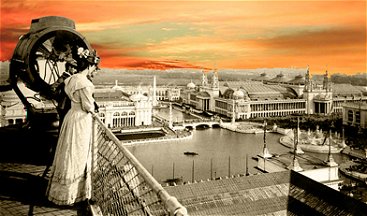
1893 Columbian Exposition At Chicago
Men Like Gods: Tarzan Pays Homage To Heracles
July 9, 2008
Men Like Gods
Tarzan Pays Homage To Heracles
by
R.E. Prindle
First published in the online Magazine: ERBzine
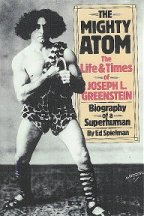
Cover of The Mighty Atom
The Golden Age of Strongmen had captured the imagination of the world between 1890 and 1910….Into the 1920s the strongman continued as a living wonder and inspiring vision that could be had for the modest price of admission
-Ed Spielman: The Mighty Atom:
The Life And Times Of Joseph L. Greenstein
When I was a child and youth in the 1940s and ’50s the legendary strongmen of the turn of the twentieth century were, if no longer living, living legends. At least one, Bernarr Madfadden, the father of American bodybuilding, was still going strong.
The most legendary of the strongmen was Frederick Mueller who was known professionally as the Great Sandow.
In his heyday Sandow was so strong that he was capable of ‘exploding’ or breaking the ‘Test Your Strength’ machines in the arcades of Vienna, Austria. There were so many broken machines that it was thought a vandal was destroying them but when apprehended it was discovered that Sandow was not only testing his own strength but the strength of the machines. He flippantly suggested that they be made of better materials.
On stage as Spielman relates, Sandow, who was trained as a turner, could do a back somersault over a chair with a thirty-five pound dumbbell in each hand. He could do a one arm chin-up with the grip of any of his fingers of either hand, including his thumbs.
He could…wait a minute! I’ve heard something like that before. Oh yea, I remember now. In Edgar Rice Burroughs’ Tarzan And The Lion Man he has Tarzan leap up to seize stakes pointing down from a ten foot high wall, then draw himself straight up until his torso was above the stakes, then roll over the top defeating the purpose of the stakes. Was he thinking of the Great Sandow when he wrote that?
I think he was.
Burroughs was a fan of boxing and a great admirer of the strongmen of the Golden Age, although he didn’t like the bulky physiques. He repeatedly denounces the physical build of the Strongmen in preference for Tarzan’s ‘smooth rippling muscles.’ In my day the bodybuilders were ridiculed as being ‘muscle bound.’ But the ladies panted when they said it. Tarzan is as strong or stronger than the strongmen but sleek.
Next one asks is there any place that it can be shown that Burroughs ever saw Sandow? yes, and where else? The Chicago Columbian Exposition of 1893. The Expo was a life changing experience for 17 year-old Ed Burroughs. Bill Hillman of ERBzine has written a wonderful series on the influence of the Fair on young Burroughs.
The influence of the Fair was as moving for the rest of America and the World as it was on Our Man. There apparently has never been so influential a World’s Fair as that of Chicago of 1893.
One of the best attended features of the Fair was put on by the Great Sandow. Bodybuilding had already gotten started in England. Sandow was a student of the innovative Professor Attila in London. He came to the attention of Florenz Ziegfeld while performing in New York. Ziegfeld brought him to Chicago for the Expo. Sandow was a sensation.

The Great Sandow
He created quite a stir at the fair. Not only did Burroughs see him there but so did a man named Bernarr Macfadden. At the time he was known as Bernard McFadden but he chose Bernarr because it sounded more like a lion’s roar and Macfadden because he thought it looked more distinguished in print. As a result of seeing Sandow Macfadden became the father of bodybuilding and the health movement in the United States. John Dos Passos spoofs him in Vol. III, The Big Money, of the his USA Trilogy.
Macfadden was the discoverer of isometric exercises, which his student, Charles Atlas, renamed Dynamic Tension and made a fortune.
Unless I’m mistaken Macfadden would cross ERB’s path sometime between 1908 to 1912.
Sandow made bodybuilding a rage after the Fair while Macfadden organized the sport around his magazine ‘Physical Culture’ which he began publishing in the wake of the Fair. Sandow also opened the way for a number of strongmen to build careers on their physiques.
They all passed through Chicago. How many of them ERB paid the modest price of admissio to see we can’t know, but as he always speaks of the strongmen in the plural one assumes that he saw several.
Anyone who has watched the Strongest Men In The World competition on cable TV will understand how impressive both the feats and the physiques of these men were.
In ERB’s day a man called Warren Travis Lincoln could lift a platform that held twenty-five men with his back. That was a weight of about 4200 pounds.
G.W. Rolandow could stack three decks of playing cards and tear them in two. One assumes that was before they were plastic coated.
Emil Knaucke who weighed in at five hundred pounds, a spectacle in itself, could hold a car above his head with one hand. Spielman doesn’t specify make or model.
Louis Cyr, one of the most famous strongmen, could restrain a team of horses on either side at the same time. Really spectacular stuff.

Bent Press Arthur Saxon
A man like Arthur Saxon of the Saxons was considered to be the strongest man in the world. He could do a bent press of nearly five hundred pounds. As in the photo, in the bent press a lifter raised a barbell above his head with one hand in a bent posture then raised another weight with his other hand.
Eighteen ninety to nineteen-ten were formative years for ERB. He would have from fifteen to thirty-five so that when he saw Sandow in ’93 at seventeen he was at a most impressionable age.
ERB turned 40 in 1915 and 50 in 1925.
By the twenties vitamins and food supplements had been discovered and were being developed for commercial use. Vitamins were still novel when I was kid in the late forties. Not everyone knew of their value as late as then.
The Great Sandow, Louis Cyr, and a trio of German strongmen called the Saxons were all naturally strong but by the 20s it was possible to build muscular Adonae from the scratch of a 98 lb. weakling. With vitamins, food supplements and a rigorous regimen for bodybuilding a normal body could be turned into as mammoth a specimen as Tarzan, as witness Arnold Schwarzenegger and his contemporaries who emerged from New York City gyms in the 1960s.
In point of fact you didn’t even need all that gym equipment. If you followed the body building plan of the most famous Adonis of the 40s and 50s, Charles Atlas, all you needed were your own opposed muscles.
Atlas took Macfadden’s isometric exercises and called them the more commercial sounding Dynamic Tension. By pitting one muscle against its opposite fantastic results could be achieved.
Charles Atlas, who changed his name from Angelo Siciliano, was voted the world’s most perfectly developed man in 1922 by his mentor, Macfadden and Physical Culture magazine.
Angelo, born in 1894 in Acri, Sicily came to the US in 1904, thus he would have been 18 in 1922, 18 in 1912.
Siciliano actually had been a 98 lb. weaking who had sand kicked in his face by a bully. His girl friend actually did walk away from him. Siciliano then built himself up into what I’ve always considered to be the image of Tarzan and changed his name to Charles Atlas.
I was not as successful with the Dynamic Tension plan Chuck sold me in the 50s but then I didn’t try that hard and I couldn’t afford the food supplements which are indispensable. Nevertheless it had become possible to turn out ‘Men Like Gods’ on an assembly line basis.
It is more than likely that Burroughs was very familiar with the bodybuilding or fitness program of Macfadden. That photo of him flexing his muscles on the dock at Coldwater is that of a man who has been working out. I can’t beleive that a man who was interested in magazines as Burroughs was couldn’t be familiar with Physical Culture Magazine. Not only would he have the living memory of the Great Sandow in his mind from the Expo but Bernarr Macfadden had moved his headquarters from Battle Creek to Chicago in 1908. He had a very prosperous looking facility.
During these years from 1899 when ERB was bashed in the head in Toronto to 1910 at least, he complainedof excruciating headaches that began when he got up in the morning and lasted through half the day. These would have been very enervating affecting his ability to work. In The Girl From Farris’s he has his hero Ogden Secor suffering from the same headaches going from doctor to doctor ‘tinkering with his skull’ in hopes of finding relief. The doctors could do nothing for Secor so he undertook a fitness regime which eased his situation. So must have ERB.
Once again, the picture of ERB standing with his legs apart flexing his muscles on the dock at Coldwater in 1916 shows that he was either proud of a moderate physique or he was trying to develop those ‘rippling’ muscles like Tarzan and Charles Atlas.
At fifty in 1925 ERB probably thought himself beyond the age when he could develop his physique into a semblance of his creation, Tarzan. Ten or twenty years younger and you might have seen Burroughs as another Charles Atlas or Tarzan.
There is every reason to believe that sometime between 1908 and 1912 he developed an interest in Macfadden’s program.
When he sat down to begin his Tarzan series at the end of 1911, Burroughs’ mind must have been filled with the feats of Sandow and the other strongmen. Anent this, Tarzan’s leopard skin loin cloth was borrowed from the strongmen. Leopard skin shorts were de riguer for the bodybuilding crowd.
Of course the role models for these strongmen were Samson and Heracles. The latter is better known in his Roman usage as Hercules. For the purposes of this essay I will refer to him as Heracles in hs Greek manifestation.
Especially in his original manifestation Heracles was a Sun god as the companion of the Earth Mother, Hera. When the Patriarchal system was imposed on the Matriarchy Hera was wed to Zeus while her former consort, Heracles- The Glory Of Hera- was demoted to the role of Holy Fool and the strngest man in the world.
ERB often refers to Tarzan as a Jungle God and a latter day Hercules. Burroughs had a good Greek and Latin education so one might asume that he had some familiarity with the cycle of myths devoted to the feats and tribulations of that ancient type of all strongmen, Heracles.
In fact, without stretching the point unduly, one can posit a relationship between the Pelasgian Sun God, Heracles and the Flaming God of Opar and through them to Tarzan; they can be construed as one.
Whether ERB was conscious of what he had done in conflating the three cannot be determined for sure but as he was manipulating valid historical data why shouldn’t he have been conscious of what he was doing? The Aztec ritual of tearing the heart out to offer to the sun god is implicit in scenes where Tarzan lies across the sacrificial block, pardon me, altar. The annual sacrifice of the queen’s consort is implicit once again as La raises the sacrificial knife. A blatant resemblance to Cybele and Attis.
While the subconsious is always important it is the conscious mind that organizes, plots and writes. As a writer I may have subconscious motives which may emerge but assembling and organizing my material is a conscious intellectual act. It is axiomatic that one cannot write what one does not know.
One of the great mysteries of mythological studies has been the relationship of Heracles to his namesake the former Matriarchal Earth Goddess, Hera. I noted just previously, during the matriarchy as the Sun, Heracles would have been appropriately called ‘The Glory Of Hera’ or of the Earth. The same notion can be applied to Mesopotamian and Egyptian mythology. For instance, as David Adams points out somewhere, the lion is a symbol of both the sun and the matriarchy. It is a fact that the body of the Sphinx at Memphis is older than the head. The head of the original has been replaced by that of a man. It therefore follows that the Sphinx was carved during the Matriarchy having either a lion’s or a woman’s head. After the succession of the Patriarchy the head was changed to reflect the New Order.
In the Greek Oedipus myth the Theban Sphinx was still represented as the original matriarchal symbol of a lion with a woman’s head. Woman-lion/sun/Heracles. The answer to her riddle after which she committed suicide was ‘man’ which denied the Matriarchy, hence she had to kill herself as the Patriarchy thus symbolically replaced the Matriarchy. Apply that to the Egyptian Sphinx and the change of heads.

Theban Sphinx
Now, the original Egyptian Sphinx was exactly the same as the Theban Sphinx: a woman’s head on a lion’s body. the Sphinx is positioned to be looking due East at sunrise in the Age Of Leo. Thus, perhap, the secret of the Sphinx is simply that as Mother Earth she sat waiting for her consort Heracles (or his Egypian counterpart) to appear on the horizon each morning.
The notion has simplicity to recommend it.
As we all know, Oparians were a group of Atlanteans isolated from the main body when mythical Atlantis broke apart and sank beneath the waves of the Atlantic Ocean. The worship of the Flaming God was inherited from the parent civilization by Opar.
Thus whether Burroughs knew what he was doing or not he always gets the sequence of events right.
Without getting into any discussion of if, where or when Atlantis may have existed, let me say, neverttheless, that all the evidence points to a predecessor civilization anterior to Crete, Pelasgian Greece, Egypt and Mesopotamia in much the same way Atlantis preceded Opar.
The predecessor civilization must have existed in the Mediterranean Basin during the last ice age when ocean levels, scientists tell us, were several hundred feet lower than they are today. There are evidences of quarrying several hundred feet below sea level on the flanks of the island of Malta for instance. Given this as a fact, then when the ice melted and the waters rose during the Great Flood to their present levels any society or civilization that existed in the Mediterranean Basin was forced to move to higher ground which is to say above the present sea level.
One thing is certain, if the Basin was habitable it was inhabited.
The disruption caused a long dark age from which mankind only slowly recovered. At the same time these relatively highly developed people moving into less developed savage societies had a fertilizing influence introducing more sophisticated ideas and methods such as agriculture.
Lower Egypt, one of Two Lands, was obviously settled by the displaced Libyan dynasty. After centuries of warfare the Upper Egyptians succeeded in conquering Lower Egypt uniting the Two Lands. The Third Dynasty was a Libyan Dynasty so that the warfare was translated from an external one to an internal one in which the Libyans defeated the Upper Egyptians. During the Libyan Dynasty the great pyramids were built reflecting in some way the the flooded predecessor civilization.
So Crete and Pelasgian Greece received survivors also. The Sumerians of Mesopotamia attribute their civilization to the advice of Oannes, John in English, who came from the sea.
Often ignored by classical scholars but obviously part of this great Mediterranean culture is ancient Spain. Now, Spain has one of the great traditions of the worship of Heracles as a Sun god. This tradition preceded and was uninfluenced by any Patriarchal tradition from Greece. In point of fact the Patriarchal Heracles went West to annex the Spanish traditions to the Patriarchal cause. In the process he rounded up the cattle of the Sun i.e. the Matriarachal Heracles to bring back to Greece. Throughout history, including modern Africa, lifting another man’s cattle transferred his authority to oneself. See the great cattle raid of Cooley in Irish mythology. It therefore follows that the Greek Patriarchal myths of Heracles are built on an earlier Matriarchal mythological cycle while being perverted or converted to Patriarchal needs.
Heracles was originally a sun god. He was the original of the Flaming God. I can’t say Burroughs knew this either consciously or subconsciously, however as we will see there is substantial evidence to indicate that he was consciously manipulating the material.
The city of Seville in Spain is built over a Sun Temple in which Heracles was the sun deity. This site beneath Seville can still be vistited today. Assuming that the history of the Spanish Heracles developed independently of the Greek Heracles which after all is a Greek interpretation of a Pelasgian god then it follows that the two traditions must have come from a common source. That source cannot have been other than the ante-deluvian civilization of the Mediterranean Basin.
It follows then that whatever names they were known by in this anterior civilization Hera was the Great Mother Goddess while her ‘Glory’ Heracles must be no other than the Flaming God, the Sun. What else could the ‘Glory’ of the Earth Mother be?
Thus when the Great Flood, which must be the same as that spoken of by the Sumerians who would have gotten the story from Oannes, destroyed the civilization of the Mediterranean Basin the inhabitants fled to the former highlands surrounding them taking their traditions with them. The Spanish Heracles was yet identical to the Pelasgian and Cretan models which later became variant.
When the Greeks entered Pelasgia at the beginning of the Arien Age, the Zodiac dates back to the anterior civilization, they found this remnant of the ante-deluvian civilization with immemorial religious traditions occupying the land. As the Arien Age began a great shift in the mental and social organization of man progressed in its evoltuion. The shift was from a Matriarchal consciousness to a Patriarchal consciousness. In other words, the God replaced the Goddess as the most important sex. Fecundation became more important than actual reproduction.
This meant that all the divine myths had to have all the sexual relationships reversed so that the God took precedence over the goddess. Hera could no longer be allowed to have a male god as her subordinate ‘Glory’, the roles had to be reversed. Hera would have to become the dependent of Zeus.
Homer’s Iliad is one key in the story of this reversal.
As Hera was unwillingly made subordinate to her Lord and Master, Zeus, Heracles had to be appropriated by the God. The Patriarchy then turned Heracles into a scourge of Hera and she his enemy in ridicule of the previous dispensation. Kind of a Burroughsian style sly joke.
The meaning of the name Heracles as the glory of Hera was thus lost. Heracles lost his identification with the Sun becoming a buffoon as the greatest of men; a physical giant of somewhat dim intelligence. Hera’s glory was turned into a laughing stock but still a good sort of fellow who could aspire to godhood at death.
In the Patriarchal myths Heracles destroyed various Matriarchal cult centers such as the Hydra at Lerna, the Stymphalian Swamps, the Stag of Artemis, the Nemean Lion and others. His cycle of adventures was involved in replacing the Matriarchal with the Patriarchal sarcastic ‘Glory’ of Hera.
To make a feeble Patriarchal attempt at accounting for the meaning of Heracles’ name Homer tells the following story in book XIX of the Iliad. Zeus, influenced by the goddess Folly, announced to the assembled Gods on Olympus that before the day was out a descendant of his lineage would be born to a mortal woman who would be the greatest man in the world.
Hera, who hated the infidelities of Zeus, heard his proclamation with scorn. She knew her husband but too well. She knew he referred to Alcmene who was bearing Heracles but she also knew that a son was to be born to the wife of Sthenelus who was only seven months pregnant. Sthenelus was of the lineage of Zeus.
Hera rushed off to visit Eileithyia, the goddess of childbirth, to ask her to hasten the birth of Eurytheus while delaying that of Heracles. The former having been born first became the greatest monarch of the age after the Patriarchal fashion but by Matriarchal means.
Hastening back to Alcmene Eileithyia uncrossed her legs allowing Heracles to be the younger son of Zeus born on that day. While Heracles was the bravest and strongest of men he was nevertheless compelled by Hera’s resourcefulness and prompt action to be subservient to Eurystheus. Thus the will of Zeus which could not be averted was perverted by Hera to thwart the Big Guy’s will.
Heracles was still the strongest man alive but he was subordinate to the will of Hera through Eurystheus, portrayed as one of th weakest and most cowardly men of his time hiding behind his mother’s skirts but by the grace of Hera and the matriarchy, the greatest ruler.
Zeus, appalled by his lapse of judgment threw Folly off Olympus from which she is still banned.
In that sardonic manner Homer explained the meaning of Heracles as the glory of Hera. She had used him to Ace Zeus. Heracles had been stripped of his role as the glorious Sun companion of Hera. He comes down to us as the strongest man who ever lived. In the Roman nomenclature of Hercules he became the role model of every strong man who ever lifted a dumbbell. Yet they all wore leopard skin shorts, the leopard being a symbol of the Matriarchy. You can’t fool Mother Nature.
To Burroughs who was a student of Greek mythology the great strongmen of the Golden Age must have appeared as men like gods. Their feats of strength, their marvelous physiques, were so far beyond the abilities of ordinary men that they must have seemed to be in a class by themselves far above mortal men.
In that sense Tarzan is the greatest of the strongmen, above Sandow, Arthur Saxon and even Heracles.
Heracles himself had been demoted to a mere mortal although his legend was so great that he was allowed immortality by the Patriarchy after his mortal death. Unwilling to grant him too much credit he was allowed to be the doorman of Olympus. He held this position throughout the Arien Age being replaced by St. Peter in the New Dispensation of the Piscean Age.
Burroughs, familiar with the mythic cycle of Heracles, however he understood it, plays with both identities of Heracles in the person of Tarzan at Opar. He also brings in a number of elements from H. Rider Haggard’s novel She. There can be no doubt of the influence of Haggard. Burroughs even names his heroine La which is what ‘She’ is designated as in French translations of Haggard’s novel. The palance of Opar is also based to some extent on the labyrinthine caves of She.
There are many literary influences for the creation of Tarzan not least of which are the real life H.M. Stanley and Haggard’s fictional heroes Sir Henry Curtis and Allan Quatermain. I would now like to direct attention to a third, that of the heor of She, Leo Vincey.
If one closely examines Vincey it will be discovered that he too was a Sun King whose death had been caused in an earlier incarnation by She. The cartouche which contains the name of Leo’s distant Egyptian ancestor was translated as ‘The Royal Son Of Ra’ or son of the Sun as in Egyptian mythology Ra is the sun.
Leo also translates from the Latin as Lion so we have the Son of the Sun who also is a Lion Man which is how Burroughs refers to Tarzan in ‘The Invincible’ and undoubtedly as how he always thought of his creation.
Haggard translates Vincey as the Avenger. Tarzan is the ‘Avenger’ or guard of Africa. Haggard describes Vincey as almost inhumanly beautiful while Tarzan is the most handsome man in the world not unlike Charles Atlas.
Haggard’s She is indescribably old kept forever youthful by having bathed in the fire of eternal youth. Hera was also eternally youthful and a virgin queen. She restored her youth and virginity by bathing annually in a holy spring. Hera’s bath obviously refers to the Spring rains which inundated Mother Earth just prior to vegetation springing forth in virgin birth. After the summer heat the vegetation dies down and Earthy Hera becomes barren once more to await her bath and return to virginity.
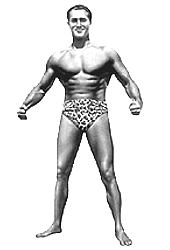
Mr. Dynamic Tension- Charles Atlas
So a connection can be made between Sun>Heracles>Vincey>Tarzan and Mother Nature>Hera>She>La.
Burroughs La was neither ancient nor immortal in the personal sense although she was the latest in an immortal line of Priestesses. She is a priestess of the Sun or Ra, The Flaming God.
Haggard’s Leo Vincey was the direct descendant of Kallikrates She’s great love of two millennia past. She, or Alyesha, to use her name, had killed Kallicrates in a rage. Kallikrate’s descendants were sworn to avenge the murder. Thus Vincey travels from England to far off Africa to locate this fabulous woman.
Kallikrates was the love of Alyesha’s very long life. When she recognizes Leo Vincey as her lost lost love she saves his life while offering him eternal youth if he will only bathe in the flames of eternal life. He hesitates to do so. To encourage him Alyesha steps once again into the flames which was a serious miscalculation. She crumbled to dust. Thus while Leo Vincey doesn’t actually avenge the death of Kallikrates she is nevertheless his victim.
Tarzan while actually born in Africa was conceived in England so he made the trip to Opar from England although he is ignorant of La. When Tarzan is captured in Opar he is laid on the altar of the Flaming God, La with the sacrifical knife raised, looks down on this Jungle God, this man like a god, and falls in love. Thus we have a replay of the She-Kallikrates situation.
Unable to take Tarzan’s life, La releases him begging him for his love. Alyesha’s full title was She-Who-Must-Be-Obeyed in the Matriarchal sense. The old conflict arises, Tarzan is more on the Patriarchal side, he has his moly in the waistband of his loin cloth, monagamous we are led to believe, happily married, so the Lion Man Sun King declines the honor of being mated to La>Hera. He asserts his Patriarchal prerogative to disobey although he always has a soft spot in his heart for La.
In a fairly masterful way ERB conflates the legend of Heracles, the fiction of H. Rider Haggard and the incredible strongmen of the Golden Age and his own little bit to write a charming and beautiful story which is fairly simple on the surface but one which becomes immensely rich with a deeper understanding of the sources.
Ernest Hemmingway once said that before one sat down to write one should have ten time the information in your possession as you put on paper else the story will seem shallow and contrived. It would seem that the sources upon which Burroughs was drawing, from the bodybuilding strongmen of his day to the legendary cycle of Heracles to the adventures of H.M. Stanley and the fiction of H. Rider Haggard might well fulfill Hemingway’s dictum.
When one searches for the sources of Burroughs one finds layer after layer of golden riches while discovering that in fact ERB did indeed create a man like a god- Tarzan The Magnificent.
Addendum
This is a quote taken from Bonzo Dog’s song Mr. Apollo. I don’t know whether the reader is familiar with the Bonzos but they were one of my favorites. Several glorious LPs. Neil Innes came from them as well as the great but tragic Viv Stanshall. Leave those drugs alone, boys.
Follow Mr. Apollo,
Everybody knows a healthy body
Makes a healthy mind.
Follow Mr. Apollo,
He’s the strongest man the world has ever seen.
If you take his courses
He’ll make you big and rough.
And you can kick the sand right back in their faces.
A few years ago I was a four stone apology-
Today, I am two separate…Gorillas.
Bonzo Dog Doo Dah Band
Long may they wave.
Part 4c Springtime For Edgar Rice Burroughs
July 10, 2007
Springtime For Edgar Rice Burroughs
by
R.E. Prindle
4c
How Waldo Became A Man
In the complex of meanings of Waldo the question is how much Burroughs bases the character on himself. In the question of health there is no question that Burroughs had issues after his bashing in Toronto in 1899.
Judging from the Girl From Farris’s his health was a serious problem for him at least until early 1914 when he finished Farris’s. During those years he suffered from debilitating excruciatingly painful headaches for at least half the day. He either awakened with them or they developed mid-day. There is evidence that he became interested in Bernarr Macfadden’s body building and health techniques when Macfadden opened his Chicago facilities in 1908. If he were involved then perhaps the benefits of such a regimen were becoming apparent in1913-14. In 1916 in the photograph in puttees taken at Coldwater he looks like a healthy specimen and proud of it.
ERB gives Waldo the wasting disease Tuberculosis putting him on a regimen of exercise in the healthy dry air of his island thus curing him within a few months. This process is reminiscent of Grey’s hero John Hare of Heritage Of The Desert or the development of the Virginian in Owen Wister’s novel.
Burroughs claimed that his writing was heavily influenced by his dreamworld. If so then in this story as well as his others each character must represent a real person who figures in his life; the story must represent a real situation in symbolical form.
As authors so often claim their characters are composites it is likely that Burroughs also combines memories of other people with his own dreams. As Burroughs consciously manipulates his dream material he tweaks it into shape to make an entertaining novel then overlaying his conscious desires on his subconscious hopes and fears.
page 1.
In addition Burroughs retains his literary influences using them to give form to his dreamscapes. Indeed, his influences fill his mind so full they become part of his dreamscapes. The island he creates is similar to but not identical with Jules Verne’s Mysterious Island. This becomes very apparent in the sequel, The Cave Man, when Waldo sets about to improve his little society. He isn’t as obsessive-compulsive as Verne but along those lines.
Verne’s island figures prominently in many of Burroughs narratives. Oddly the book isn’t in his library.
ERB began telling his life’s story the moment he took up his pen. While John Carter seems to be dissociated from his own personality Tarzan is a true alter ego, a psychic doppelganger. Tarzan Of The Apes is a symbolical telling of his life’s story from birth to 1896 while the Return of Tarzan covers the four years from 1896 to 1900 and his marriage. (See my Four Crucial Years In The Life Of Edgar Rice Burroughs here on ERBzine.)
The Girl From Farris’s deals with the troubled years from 1899 to, it appears, March of 1914. Thus Cave Girl addresses his difficulties in making the transition to writer and then full time writer with the attendant marital or sexual problems. These marital or sexual problems occupy him through many novels in this first burst of creativity from 1913 to 1915.
Porges in working from Burroughs’ own papers in his biography has very little input from outside sources but some. The first material we have to work with from an outsider’s point of view is Matt Cohen’s fine edition of Brother Men, the collection of the Burroughs-Weston correspondence. Weston being ERB’s friend from MMA days. At the time of the divorce they had been in touch for forty years.
However I think that figure may be a little misleading as the two men had very little contact during that period. ERB met Weston in 1895 at the MMA at the beginning of the school year. He was one year younger than ERB. As Burroughs left the MMA in May of ’96 the two must have become fast friends in just eight or nine months. It isn’t probable that they met again before 1905 when Weston was passing through Chicago with his wife Margaret. At that time both Westons would have met Emma. From that time to the end of ERB’s Chicago period except for the occasional brief layover in Chicago the relationship was carried on by correspondence although as Burroughs seems to have some knowledge of Weston’s home town, Beatrice, Nebraska as evidenced in the second half of The Mad King it is possible he and Emma visited Weston but that would have had to have been between March ’14 and August ’14. Narrow window.
Thus when Weston talks so knowingly of Burroughs’ character in the letter of 1934 I will refer to I would have to question the depth of his knowledge. At any rate he claims to have knowledge of the difficulties of the marriage.
Weston was completely devastated by the announcement of the divorce. He immediatly sided with Emma breaking off relations with ERB for several years.
It appears from the letter of 1934 reproduced on page 233 of Brother Men that he contacted Burroughs’ LA friend Charles Rosenberger for information on the divorce. We have only Weston’s reply but not Rosenberger’s letter.
In reply to Rosenberger Weston says:
Quote:
I have known Ed since the fall of ’95. He has always been unusual and erratic. I have told Margaret many times, when Ed has done or said anything which seemed sort of queer that as long as I had known him he had always done or said such things.
(One of the most significant odd things would have been Burroughs leaving the MMA in mid-term in May to join the Army. One imagines that when he didn’t show up for classes next day the faculty asked: Where’s Burroughs. Perhaps Weston was the only one who knew and had to say: Uh, he joined the Army.)
I suppose looking back, that the fact that Ed has always been unusual, erratic and perhaps queer, has been his great charm and attraction for me.
Unquote.
I don’t know about you but if my best friend talked about me like that I would be less than flattered. There is another back handed compliment that Weston made to Burroughs’ father in his defense.
Burroughs’ father had made the comment to Weston that his son was no damn good. Good to have your dad on your side too. Weston defended ERB vigorously saying that he thought there was plenty of good in ERB, he just hadn’t shown it yet. Thank you, Herb Weston.
If one judges from the actions of Ogden Secor in Girl From Farris’s after he was hit on the head and if his actions approximated those of Burroughs from 1899 on then there was probably a very good reason for ERB’s unusual, erratic perhaps queer behavior apart from the fact that ERB had developed the typical character of his difficult childhood.
In reading the correspondence Weston comes across as a very conventional and highly respectable person; in other words, stodgy. It must have been that settled bourgeois quality in him that ERB appreciated. Weston did many of the things that Burroughs would have liked to have done. Weston did go on to Yale from the MMA which is what Burroughs would have liked to have done. Weston did become an officer in the Army.
On page 157 of Brother Men is a discussion of the Spanish American War. If I read it correctly Weston actually served in Cuba with a Tennessee regiment. So Burroughs had reason to be envious of him as he failed in his own attempts to get into Teddy Roosevelt’s Rough Riders.
Nevertheless Weston’s evaluation of Burroughs uses some strong language who after all didn’t have that intimate a relationship with him: unusual, erratic perhaps queer. Honestly, I don’t think I would have a friend very long who thought of me that way.
Weston is bitterly disappointed but later in the letter he refers to Burroughs as a crazy old man so, at the least, we can assume that to the average mentality Burroughs appeared eccentric. As one in the same boat I can’t help but root for the author of Tarzan. What but an unconventional mind could have conceived such a story.
Burroughs antecedents had created his persona by 1895 so the crack on the head in Toronto merely added to his unusual persona.
Apart from any inferences about Ralph Waldo Emerson and the Transcendentalists the sickly character of Waldo may represent Burroughs’ own health problems from 1899 to the time of The Cave Girl.
I feel certain that Burroughs followed some sort of health or body building regimen from perhaps 1908-09 when the American body building king Bernarr Macfadden opened his Chicago facilities to 1913. Although Ogden Secor of Girl From Farris’s was still sickly in 1914 perhaps Burroughs health was improving as Waldo evolves from a skinny sickly person to a ‘blond giant’ before our eyes. ‘Blond Giant’ also brings to mind Nietzsche’s ‘Great Blond Beast.’ I think it would be pushing it to say Burroughs read Nietzsche, nevertheless Burroughs always seems to be well informed when you look closely. He might easily have picked up references to the ‘Blond Beast’ from newspapers, magazines and conversation.
Weston is especially incensed at Burroughs leaving Emma who both he and his wife Margaret seem to have preferred. They did travel to California to visit Emma while ignoring ERB.
Weston quotes Rosenberger to the effect that ERB told Rosenberger that he had always wanted to rid himself of Emma. To which Weston replies:
Quote:
Charming, unusual, erratic personality that Ed is, there is no woman on earth that would have lived with him, and put up with him except Emma, and do not be fooled! Emma suited Ed plenty, until this insane streak hit him.
Unquote.
So we have an outsider’s view of the situation. He considers Burroughs over the line in his personality to be redeemed by his charm. Weston had asked Rosenberger his opinion of the situation between ERB and Emma. ERB had apparently told Rosenberger after the split that he had always wanted to rid himself of Emma.
As far as Burroughs’ persdonality goes it would be in keeping with a person of his background who had been bounced from school to school. Waldo may in part be a nasty caricature of the East Coasters Burroughs associated with at the Phillips Academy. As is well known Easterners at the time and still today disdain those from the West. One has the feeling that Burroughs valued his Idaho experiences highly thus the transformation from the wimpy Easterner of Waldo to the Blond Giant of the great outdoors may be Burroughs snub of his Eastern classmates.
At any rate when Weston met Burroughs at the beginning of classes in ’95 ERB’s personality seems set.
By ‘saying things’ one presumes that Weston means Burroughs had an outsider’s ‘eccentric’ sense of humor. I have a feeling that a few of we Bibliophiles know where that’s at. Certainly Burroughs’ stories reflect this trait. So, between Burroughs and Weston we have a clash of two different backgrounds.
As to Emma I believe that Burroughs was always dissatisfied with the fact that he had married when he did whoever he might have married. He has been quoted as saying that Tarzan never should have married so that idea can probably be applied to him.
If circumstances hadn’t forced his hand he very likely would have remained single. According to his psychology the right time for him to find a woman and marry would have been after 1913 and his success when he was in effect born again and a new man.
So when he says he never really wanted Emma as a wife I’m sure that is true. However he did marry the woman. So from 1913 to 1920 we have Burroughs struggling with his desire to honor his life long committment to Emma and his contrary desire to find his ideal ‘mate’ a la Dejah Thoris, La, Nadara and a number of others. Not so easily done in real life and after great success but still possible.
Added to his problem was his embarrassing behavior in Idaho when he gambled away the couple’s last forty dollars. Emma reacted badly to the Western interlude in their marriage. Burroughs’ rather feckless attitude toward earning a living between the return from Idaho and his early success in 1913 undoubtedly caused emotional problems for Emma but as Weston says she stuck by him during those lean years and as he says, there were a lot of them.
Even in 1913 when the couple earned the first real money they had ever seen Burroughs was recklessly spending it before he got it based only on his confidence that he would always be a successful writer something which by no means necessarily follows.
Emma was very proud of Burroughs as the photo ERBzine published of the couple in San Diego shows however her pride obviusly conflicted with her fears so that she may have nagged ERB in what he considered an unjustified way.
On one level Cave Girl can be construed to be a record of their relationship up to the moment with Burroughs trying to reconcile the relationship according to his confident understanding of the situation.
Writing in February-March in Chicago we have this view. In September of 1913 the family left for San Diego. Writing in San Diego during October-November in the Mad King things seem to be deteriorating as Burroughs seems to be pleading with Emma to be reasonable. Thus the Mad King concerns Prince and Pauper doppelgangers who are appealing to the same woman.
This situation may have been caused by a situation that would be very reminiscent to Emma of her situation in Idaho of ten years earlier. On this trip in which ERB and Emma were as alone and isolated as in Idaho ERB was taking another very large gamble with Emma’s and her three little children’s wellbeing at stake. As ERB proudly tells it the family, no longer just a wife, but a family of five were within an ace of being flat broke if any one of the stories Burroughs wrote in 1913 failed to sell. Unlike Idaho this was a gamble the Roving Gambler won. Now, perhaps Burroughs thought this redeemed his earlier faux pas, probably to himself it did. But what about Emma? What terrific anxieties assailed her as she wondered whether they would have a roof over their heads from day to day.
We need more facts. Perhaps the move from Coronado to San Diego was forced by necessity to reduce costs. Perhaps selling the Vellie was necessary to raise cash. Thus Emma in the midst of this actual plenty of a $10,000 income was a virtual pauper in silks and diamonds. Would there be any wonder if she were cross and nagging? As Weston said there were difficulties in living with Burroughs.
Burroughs then rather than attempting to make reasonable adjustments in his behavior yearned for the perfect mate who would ‘understand’ him.
Nevertheless he had to bear the burden assigned him. Let us assume that as Weston said, at one time Emma suited Ed plenty. That’s an outsider’s opinion but the evidence of this group of novels is that ERB was doing his best to rectify his past for Emma. If Waldo is portrayed as clownish I’m sure that ERB had played the clown in real life for some time. As Weston said ERB had always said and done unusual things. He doesn’t say what they were but in all likelihood the things he said and did were meant to be jokes, to be funny. After all he describes Tarzan as a jungle joker. The jokes that Tarzan perpetrated originated in ERB’s mind so he had to think those jokes were funny. They were usually practical jokes. No one really like a practical joker. The psychological needs that go into a practical joke are compensatory.
Where he failed Emma in the past he seems to be trying to make up for it. Perhaps his financial gamble in 1913 in some way compensates for his gambling failure in 1903 reversing the outcome of 1903 and making it alright. His actions in 1913 are so zany one has to ask what he thinks he is doing.
e.
Leaving their little Eden Waldo and Nadara set out for her village where Korth and Flatfoot await him with Nagoola in the background.
Thus Waldo’s tasks as set for him by Nadara are to kill Korth and Flatfoot. Waldo quite correctly realizes that these two tasks are beyond his present powers. So, within sight of the village he makes excuses to Nadara then abandons her running away. He heads out to the Wasteland. He appears to be living in a near desert.
Over the next several months he transforms himself from a tubercular wimp into a ‘Blond Giant.’ Tarzan has black hair so perhaps Waldo has to be blond.
One can’t be sure but this period may represent the years from John The Bully to ERB’s proposal to Emma. At any rate Waldo can’t forget Nadara having a longing for her. During his period in the Wasteland he fashions weapons for himself that make him superior in prowess to the cave men. He fashions a spear, a shield and what Burroughs jokingly, I hope, refers to as a sword, that is a sharp pointed short stick with a handle. No bow and arrow. So rather than a primitive Tarzan we have a primitive Lancelot. Waldo is actually outfitted as a knight, a la Pyle, while when he acquires the pelt of Nagoola he will be, as it were, encased in armor. So Pyle, or at least Arthur, is an influence.
In a comedy of errors Nagoola manages to kill himself by falling on Waldo’s spear. In one sense this means that Waldo has invested his sexual desires in Nadara while perhaps it is symbolic of Burroughs’ desire to do the same with Emma. At the same time the panther skin makes Nadara the best dressed girl around. It is perhaps significant that he kills Nagoola first before Korth and Flatfoot.
If one looks again at that ERBzine photo of ERB and Emma in San Diego one will notice that Emma is wearing some spiffy new togs. In her father’s house Emma was a clothes horse. In another ERBzine photo showing ERB and Emma walking in the wilds of Idaho Emma is still dressed to the nines while ERB shambles along beside her in a cheap baggy suit.
From that point in 1903 to the efflorescence of wealth in 1913 Emma had to make do with whatever garb she could afford which must have been depressing for her. As Weston says that was a sacrifice she was willing to make for her man.
Not in 1913 in Cave Girl but in 1914 in Cave Man Waldo invests Nadara with Nagoola’s pelt. Now, Waldo suffered grievously to acquire this skin. That was a major battle out there in the Wasteland. Let us assume that the skin represents Waldo’s sexual desires and that in clothing Nadara in the skin he is making her his queen or princess.
Thus in 1913-14 for the first time in his life ERB is able to reestablish Emma as a clothes horse. He has finally been able to do his duty as a man and husband. She can now buy as many clothes of whatever quality she likes and ERB is happy to have her do it. So, in a symbolic way ERB had a terrific struggle that scarred him psychologically as Waldo was physically scarred by the talons of Nagoola. Now, Burroughs was proud to be able to dress Emma to her desires. In the same way that the panther represents Waldo’s investing Nadara with his sexual desires so Emma’s clothes represent the same to ERB.
It was now up to Emma to forgive ERB for his failings and treat him as her hero. Perhaps ERB was a little premature. I think that he would have had to woo her all over again. While he had conficence he would be able to go on writing indefinitely the surety of such was problematic to others like Emma and actually ERB’s editor at Munsey, Bob Davis. Davis told him point blank that guys like Burroughs start strong, shoot their wad and fall out after two or three years. As far as others were concerned Burrroughs future remained to be seen. The evidence is that Davis and other editors thought that Burroughs had Tarzan and that was it. Apart from the Mars series how much of this other stuff was pubished to humor Burroughs to cajole more Tarzan novels is a question. Still, the fans seemed to receive it well. Cave Girl was even serialized in the New York papers.
Nadara has set Waldo three tasks all of them murderous. He is to kill Nagoola, Korth and Flatfoot. Having fulfilled the killing of Nagoola Waldo after several months sets out to return to Nadara to fulfill his last two committments.
Before he invests Nadara with Nagoola’s pelt he first kills Korth and Flatfoot. These are monster battles where like the knights of old, Lancelot, Waldo is hurt near to death.
Now, what would Emma nag ERB about during those lean years? The clothes have already been discussed so that leaves the monetary success to acquire them. So the slaying of the pair of cave men may represent financial success. Financial success came with the creation of John Carter and Tarzan. So let’s assume that Korth represents John Carter and Flatfoot Tarzan. The creation of the two or the slaying of those dragons opens the way for the hero Waldo/ERB to present Nadara/Emma with the first task, clothing.
Having killed Korth and Flatfoot Waldo still has to make up with Nadara for abandoning her at the threshhold to her village. Not an easy task. Waldo pleads that he has done everything she asked but she remains obdurate. This probably relflects ERB and Emma’s situation. A situation that apparently was never satisfactorily resolved.
But then it seems as though there is a change in the characterization and Nadara reverts back to Nadara of the beginning of the book while Waldo, believe it or not, becomes a god, if Nadara had known what gods were. Waldo scrambles up some fruit trees to toss down some food that seems to bring them together. In the last pages Burroughs gets schmaltzy writing close to purple passages.
At this time Nadara spots a yacht out over the waves. The yacht is a major theme during the teens and especially in this 1913-14 period. The significance seems to be that Burroughs envisioned his early life as The Little Prince as life on a yacht. Then the big storm comes changing his life as it sinks. Then begins the struggle for existence capped by the eventual triumph.
The yacht first appeared in Return Of Tarzan. This is its second appearance. Tarzan wasn’t on the yacht in Return and Waldo doesn’t get on the yacht in Cave Girl although he does in the sequel The Cave Man but that was a year later in 1914. So things are evolving rapidly in ERB’s psychology.
In this case he plans to join the yacht that he recognizes as his father’s. Having abandoned Nadara once she imagines he is about to do so again so she runs off.
Thoughts run through Waldo’s mind as he envisions a return to civilization with Nadara.
Quote:
For a time the man stood staring at the dainty yacht and far beyond it the civilization which it represented, and he saw there suave men and sneering women, and among them was a slender brown beauty who shrank from the cruel glances of the women- and Waldo writhed at this and at the greedy eyes of the suave men as they appraised the girl and he, too, was afraid.
—-
“Come,” he said, taking Nadara by the hand, “let us hurry back into the hills before they discover us.”
Unquote.
And so Waldo decides to remain in the stone age.
He and Nadara had left the little bag containing the relics of her mother behind. The crew of the yacht discover the bag just on the inland side of the forest.
Then we discover that Nadara is in fact the daughter of French nobles. Burroughs seems to have some love affair going on with the French. Many of his most attractive characters such as Paul D’Arnot, Nadara here, Miriam of Son of Tarzan are Gallic. So Burroughs admires most the English, the French and the Virginians it would seem.
Nadara is the daughter of Eugenie Marie Celeste de la Valois so she is a legitimate princess.
Thus ends the Cave girl with seeming finality. The way is open to the sequel but the closing seems final.
I haven’t read a book that replicates the final scene but I suspect that ERB borrowed it. I wouldn’t be surprised to learn of an earlier duplicate.
End Of Part 4c.
The Deconstruction Of
Edgar Rice Burroughs’ America
Part II
Organizing The Unorganizable
Don’t you leave me here,
No, don’t you leave me here.
If you must go, Sweet Pollyanne,
Well, leave a dime for beer.
Trad.
There has at present been no good history of America written. All histories have been written by partisan Liberals with no real attempt to deal with multi-culturalism in an objective manner. While I offer no comprehensive history here I do attempt to get at some underlying cultural motives of what was and is actually being attemped by the various cultures and the ends they pursue.
The key problem for American history is why the Civil War was fought. Contrary to propaganda it wasn’t over the issue of Black slavery. None of the cultures involved had ever been opposed to slavery historically or on principle, although the moral issue did evolve in Europe and the United States leading to the abolition of the slave trade at the beginning of the nineteenth century.
The cultural roots of the conflict do not being in the US but go back to the conquest of England by the Norman, William The Conquerer, in 1066. Nor do either of the cultures involved talk about the real issue; they project a false or surrogate issue. The issue is not the issue and seldom is. Underline that: The issue is not the issue.
The conflict began when the conquering Normans enslaved the Anglo-Saxons, especially those of East Anglia. The issue then is that like the biblical Hebrews the Anglo-Saxons objected to their ill treatment only. None of the cultures objected to slavery per se. The Hebrews not only held slave but in order to finance the building of Solomon’s Temple Solomon sold his countrymen into slavery. The Normans held English slaves until within a hundred years of the regicide of Charles I. The East Anglians themselves under Cromwell expatriated tens of thousand of Irish to the Caribbean Ilands as slaves to work cheek by jowl with the Negro slaves, no distinctions because of race or species. In addition, the South took no part in the procurement of Negro slaves. The slave trade was run in part by New England Puritan seamen who took the profits from the trade. Thus both the Puritans of New England and the Cavaliers of Virginia had no particular aversion in principle to slavery. The true issue was not whether but who.
page 1.
The scepter of the chosen people had been literally transferred from the Hebrews to their successors the inhabitants of England in the years following the conquest of 1066. This is a fact. The substance of the story of how the transfer was made can be found in the Lancelot-Grail. The complete Lancelot-Grail. The monarch of England are annointed according to the Jewish rites of David as administered by the high priest Zadok.
When printing made inexpensive bibles possible the East Anglians immediately associated themselves with the Israelites who according to the bible had been slaves in Egypt. Already of the new chosen people of England the East Anglians identified completely with the Hebrews of the bible becoming, if not in fact, at least as a mental projection the same. They adopted Hebrew customs, or attempted to, to the letter.
As stiff-necked as the originals they made themselves as unpopular among the other colonials who despised them and even ran them out of their communities from time to time. Their arch enemies the Norman Cavaliers of the southern counties of England followed the East Anglians to the New World when Charles I was beheaded and Cromwell and the Puritans seized power. They established themselves in Virginia and the South. The East Anglians glared at them over the barrier of the Middle Colonies. And then at some point they found a casus bellus in Negro slavery.
Negro slaves were not the issue- they were the good reason; the former enslavement of the East Anglians was the real issue. Othrs might fight for the former reason but not the latter.
I doubt if few Westerners can be found to defend slavery yet slavery was the natural order of things. If you are a Liberal your view of slavery will be very narrow concentrating on the Atlantic trade. Facts don’t matter the religious mind and Liberalism is a religion but they do to the Scientific mind. Thus slavery was endemic to Africa. Every African was a slave and possession of their king who could and did dispose of their bodies in any way he chose. It was also just as natural for the African to enslave any other people who came in his way who were not strong enough to maintain their freedom. Thus while African slaves poured out of Africa, having been sold by their chiefs, into the Atlantic trade other millions if not tens of millions gushed from Africa to the Semitic East destined for Arabia, Iran and India. The Semites paid for nothing; they merely shot up the tribes and took what they wanted.
While Africans were leaving Africa, Africans raided the shores of Europe abducting Europeans to endure worse treatment than Africans ever did in the South. Needless to say the Africans paid for nothing. If any reparations are due they are due from Africa to Europe.
Yes, slavery is wrong, is bad, but there are absolutely no innocents. All, all are guilty of the same crime against humanity. Now that we’ve got that straight we can deal with the attitude of the East Angians toward the Cavaliers of the South during the period called Reconstruction that ran in its first form from 1865 to 1877. Edgar Rice Burroughs was two years old when Reconstruction ended.
The term chosen for this period is instructive. What changes were to be made? How was the South to be reconstructed and according to whose vision? Why, according to the whims and fancies of the South’s arch enemy the East Anglians of New England- read New East Anglia. If 1865 these people had been souring their intellects on the Hebrew writings for four hundred years or so. Let that fact sink in. For four hundred years- that’s a long time- these people had been chanting refrains like- the Lord shall deliver mine enemy to me and I shall smite him hip and thigh. Take a moment to dwell on this bitter, dare I say evil, doctrine of the hateful Anglians. I grew up with this horrid doctrine and maybe you did too. Well, the Cavaliers could expect no mercy from these deep dyed bigots and they didn’t get any.
At the same time the Anglians were self-righteous, that is to say, dis-honest. They considered themselves the most virtuous of men and women just as did their fellow biblicals, the Hebrew Children. You have to remember that nearly everyone believed that God literally rescued the Hebrew Children from the fiery furnace. The Puritan was a justified sinner, wrong in their hands became right by virtue of their sanctity. They had united the will of God with their own. What they chose to believe was just; there could be no other oinion, no reasonable objection. The essence of bigotry.
page 2.
At this precise psychological moment American Liberalism came into existence. Liberalism was equated with virtue; opposition to as evil. It is that simple. In the classic mode: If you’re not with ’em, you’re against ’em. If you’re against ’em then you have to be destroyed. In order for Liberals to believe this false religion no one can be allowed to call them on it, so opinion must be strictly controlled; no dissenting allowed. Anyone thinking other wise must be demonized. Thus the conflict that will run throughout American history.
The Anglians had their enemy where they wanted them. Left to their own untrammeled desires I have no doubt that they would have annihilated every White person, that is to say, Norman Cavalier, in the South. Genocide runs like a red thread through the Liberal left from La Vendee throught the European aftermath of the Great War through the Hitler/Stalin genocidal programs to Mao, Pol Pot and beyond. It must be remembered that members of theFDR administration pressed for the genocide of German after WWII. Genocide is part of the Liberal mentality.
But the more placid people of the Middle Colonies limited Anglian hopes for a genuine holocaust. If the Anglians had been able to succeed in their ‘reconstruction’ plans the crime against humanity would have exceeded anything that happened up to 1950, or after, even exceeding the Liberal atrocities of Chairman Mao.
The reconstructed society would have reversed the pre-war situation dispossessing the Southern Whites while making them the virtual slaves of the Blacks. You see, if slavery was the issue it wasn’t Black slavery but how to impose slavery on the descendants of the Normans of the latter had imposed slavery on the Anglians hundreds of year before.
As with all Leftists the Anglians were unscrupulous disregarding all conventions and rules. That they didn’t disregard the Law was only because they were able to make the laws to serve their purposes. Hitler who had studied the period fairly closely probably learned a lot from them. Quite simply, right was equated with their desires, wrong with anything that refused to follow them. You can see the making of the Old Testament Hebrew based reliigion slowly displacing that of the Founding Fathers. As I have said before, religion equals bigotry, which is what religion must be.
The Anglian program was so unjust and transparent that reasonable men in the country instinctively opposed it while the men of the South who were directly affected took up cover armed resistance as they ought to have and must have. Just as we will have to soon.
Liberal denial of their program began with their defeat while the true horrors of this genocidal holocaust have been sswept under the rug and never discussed historically. Quite similar to the Armenian Holocaust and the Hungarian Holocaust. The Liberals, however, did not give up the war because they lost this battle. They continued to vilify the South and Southerners. One has only to look at how the South has been portrayed in movies of the last eighty years or so to understand the slander. Much of the trouble in the South today is the result of the implacable hatred of the Anglians now converted to the arrogant hatred known as Liberalism. The Second Reconstruction goes on today under the Leftist understanding of multi-culturalism. You can read Left Multi-Culturalism as the Second Reconstruction. This program calls for the abolitionof the entire ‘white race.’
The enemy of the Liberal religion became, just as with the Hebrew bible, anyone who refused to endorse and follow the program.
Prominent among these was a man of the generation of the 1850s who was revered by the people of his and the next couple generations. The tumultuous times of the twentieth century took their toll on this man who attempted to live the ‘strenuous life,’ Theodore Roosevelt. Too close to the men and the times to see it clearly, this man led such a full life, inreflected in his too short autobiography, to remember to tell all that much about it.
page 3.
Born in 1859 TR had seen America during Reconstruction and before the vast influx of immigration that began in the 1870s. He had seen the America of legend and even took part in it. He had been a rancher in the Dakotas when the West was still unwon. He had been the Police Commissioner of New York City at the height of its corruption in that most wide open town where anything went and did. I tis only by some strange myopia that untrammeled vice in the major cities of the United Sates is not recognized for far exceeding whatever vice has gone on before. Very peculiar. De Sade could have learned something from Hollywood. TR had been President of the United States from 1900 through 1908 riding in on the coattails of the assassinated President McKinley whose VP he was.
These were tumultuous times, sure, when weren’t they, as America sought to adjust to rapid changes, assimilating the Western conquests of the nineteenth century, trying to absorb scientific, technological and economic changes occurring with bewildering rapidity, while trying to reconcile differences in a rapidly growing immigration of diverse cultures.
Everyone who came to America seemed to be nursing a centuries or millennia old grudge they couldn’t give up against someone and possibly everyone. They call it multi-culturalism. The East Anglians had a half millennium old grudge against the Norman Cavaliers. The Irish had an even longer grudge against all the English. The Sicilians had a grudge that went on no one knows howlong against whomever. Perhaps the grudge was antediluvian going backt to when the sunny Mediterranean was unflooded. Probably even before the Sicels were known as Sicels. And then there was the paragon of grudge holders going back four millennia against all mankind, the Jews. Not to mention the Negroes who had only begun to to nurse their grudge against the Whites of America. The United States became a seething cauldron of hate with all these haters joining forces with the Liberals to form a coalition to Reconstruct anyone who disagreed with any of their programs out of existence. The coalition was coming together during TR’s presidency.
While Tr might have run for president in 1908 he instead ‘appointed’ a successor he believed ould continue his policies then went off to shoot lions and tigers in Africa. (Oops, did I say tigers? Everyone knows there are no tigers in Africa.) By the time he came back and realized his error he wanted to be President again. Rejected by the Republican Party he foolishly decided to run on a third party Progressive, or Bull Moose, ticket. Disastrously splitting the Republican vote he allowed the ineffably destruction Woodrow Wilson to become the first Liberal or, even Red President. At this point democracy in America began to deconstruct.
He threw himself into ineffective oppostion although too late. When the War began in 1914 he was for immediate intervention on the side of England and France in a European struggle that could have no real influence on the United States. The status quo would have assumed a different temporary form, that is all. If the Soviets couldn’t impose their will on subject Europeans for more than a very few decades how then could have the Germans? The consequences of the War would have had to have been dealt with one way or another, that’s all. When the US did enter how effective was the Liberal Wilson’s intervention? The next twenty-five years tell the story. More tens of millions of deaths. Furious with Wilson for staying out TR vociferously berated him. Quite violent language.
When war came to America, inflaming the American population, so diverse and multi-cultural, questions of loyalty arose. TR, who like so many had never examined the motives of the immigrants but expected them to embrace ‘American’ iceals, asked whether America was no more than an international boarding house. And he might have added, nothing more than something to be merely plundered.
And then in 1919 he died.
Backing TR all the way was that writer in Chicago. He’d been writing away furiously. His best selling Tarzan Of The Apes was followed by numerous other books as well as a steady stream of Tarzan sequels. In 1919 when TR pulled up stakes and left the planet Edgar Rice Burroughs pulled up his Chicago roots heading for LA to begin his second or was it his third, lifeteem. He was riding a crest of popularity as his creation, Tarzan had become a household word.
Burroughs had always been an admirer of TR. He had even tried to join the Rough Riders during the Spanish American War. Growing up in the eighties and nineties as he did, TR and his generation made an impact on his own development. The Wild West was real to him. The memory of the Wild West was a major influence on America through my youth until Hollywood began to demythologize American culture in favor of Post-WWII Jewish influences drifting away from the moral and heroic model to cringing guilt and angst.
During Burroughs’ early Hollywood years real Western badmen and lawmen, real cowboys men who had been there when it was happening, so rapidly the West came and went, served as advisors and consultants for Western movies. An important fact too easily glossed over is that Edgar Rice Burroughs experienced that West. He had seen it first hand. First in the midst of the Johnson County War in 1891 and in 1896-7 during his brief stint in Arizona when he took part in suppressing the Apache raids.
I don’t know if Burroughs scholars have yet related his first stay in Idaho with the Johnson County War going on in Wyoming. There is a good chance that the murderer Burroughs talks of having known at that time was a fugitive from Wyoming’s Johnson County.
Burroughs was a great admirer of Owen Wister reading his Virginian six or seven times. That book was about the Johnson County War in which the big ranchers tried to squeeze the little ranchers out. It was a shooting war. In Wister’s book the big ranchers purseued a member of the small ranchers into Idaho and lynched him as a ‘murderer’. Of course Wister and TR were great friends.
Then too, Burroughs would have been familiar with the fabulous career of Buffalo Bill. What a live Buffalo Bill led. A showman capitalizing on his career in the West before Little Big Horn in 1876, he returned to the West the next year to serve in the punitive campaign engaging and killing a Dioux cheif by the name of Yellow Hand in hand to hand combat then displaying the fancy clothes he had worn in the fight in his show. Mind blowing. Bill reenacted the Little Big Horn with the real Sitting Bull as an actor. How mindblowing must that have been to a seventeen year old Edgar Rice Burroughs watching the show at the Columbian Expo in 1893 with all the intenseness of youth. One imagines Burroughs hanging around the show hoping to get a glimpse of the hero up close and personal, perhaps even brushing past him with a shy, “Hello, Bill.”
So this vision of what Greil Marcus is pleased to call Bad Old America was deeply graven on the character of Edgar Rice Burroughs, nor did he consider it Bad Old America. That was the immigrant experience surfacing in Marcus.
At the same time, as a cross current, while he lived in Chicago he was to witness the tremendous immigrant invasion that took place from 1870 until the Great War did what no agitation could. It stopped immigration. Burroughs witnessed the beginnings of the conflict between Marcus’ Bad Old America and the American Cesspool since created by the culture that Marcus apprently believes is the Good New America. He may be surprised that there are dissenters to his opinion.
As a young boy at the time of the Haymarket Riot Burroughs watched immigrants, German in memory, marching throught the Chicago streets waving red flags and shouting: Down with America. He visited the tremendous Jewish community of Halsted and Maxwell streets in which people were piled on top of people to create the most densely populated location on the face of the earth in an attempt to prevent the dilution of their culture.
One need only read Upton Sinclair’s novel of the stockyards, The Jungle, to get an idea of what sights, sounds and smells seared the consciousness of a young man growing up in what was then considered the freest and and greatest nation in the world; and it was regardless of what a legion of Greil Marcuses might think. It was the Bad Old America that Greil Marcus ancestors considered The Promised Land. How attitudes change with circumstances.
page 5.
It was the freest but these immigrant cultures who were to make the United States the most polyglot nation in the world were chronically dissatisfied. They brought their clotted politics with them projecting them on their new home before they even discovered what it was.
A conflict between the Western dream of TR, Wister and Burroughs and the immigrant projection of America took shape. There was still that conflict within in the ranks of oldtime Americans however.
After Reconstruction was terminated, Liberals, who still projected the destruction of their Southern enemies, began to align themselves with the incoming discontented and hateful cultures to form a strange vision of utopia. A fantastic dream that disregarded all reality. The Liberals asked: What if apples were oranges? And then decided they could be.
Perhaps H.G. Wells writing his 1921 effort The Salvaging Of Civilization, the title displays his own personal angst, expressed the essence of the fantasy. P. 14.
Quote:
It is, if people will but think steadfastly, inconceivable that there should be any world control without the a merger of sovereignty, but the framers of these early tentatives toward world unity have lacked the courage of frankness in this respect. They have been afraid of bawling outbreaks of patriotism, and they had tried to believe, that they contemplate nothing more than a league of nations, when in reality they contemplate a subordination of nations and administration to one common rule and law.
Unquote.
Wells here presents a masterly example of the studied disingenuous of the Liberal or in Orwellian terms, doublethink. Wells doesn’t explain to which one common rule of law we are all to submit ourselves. In point of fact the nationality the Liberals claim to despise did not disappear. They merely changed the name to multi-culturalism. Thus each culture is trying to impose its law on all the others. Thus the Jews, thus the Moslems, thus the Africans. But there is and will be no actual synthesis.
The Liberal always denies his real intent preferring subterfuge to honest discussion. In point of fact no Liberal objective will stand up to examination so, convinced of their rightness, or rather preferring their pleasant daydream of their vision of a utopia they feel the need to mislead and deny.
In this quote Wells is actuall admitting that Liberals are lieing about their objectives, further it is perfectly obvious they are lieing. As Wells admits here it is inconceivable that there should be any world control without a merger of sovereignty. But what does he mean by a merger of sovereignty. That the rest of the world shall submit to Jewish or Moslem rule? Is that a merger? Disbelievers have called the Liberals on this issue. Liberals have been lieing says Wells. Why? Because they have been afraid of ‘bawling outbreaks of patriotism.’
Here, with consummate skill Wells defames those who disagree with him as irrational dissenters mired in a ‘superstition’ of the past. Their objections are not reasonable nor presented in a rational manner but are ‘bawling outbreaks’, hysterical, shrieking objections, one might say, of ‘patriotism.’ Patriotism we have all been informed elsewhere is ‘the last refuge of the scoundrel.’ Samuel Johnson, if I remember correctly. Thus Wells characterizes any dissenters as irrational hysterical scoundrels. When you can’t convice, defame. The old ad hominem. Wells might as have come right out and called the dissenters ‘anti-Semites’ and gotten it over with.
Wells and his ilk, and I know he didn’t honestly believe this, assume not only that all people are equal but that they are at the same level of civilization and psychology. What is clear to anyone with a grain of sense is that they aren’t. The Asia psychology is incompatibleto the Western and the African. The Africans first made contact with more than a stone age culture, come into real contact with higher civilization only about one hundred fifty years ago. They still have no concept of civilization as is evidenced by Zimbabwe and the congeries of tribes in South Africa who when they have committed genocide against the Whites will renew the old tribal conflicts.
The only way to merge cultures is to the lowest denominator and that is the African.
Wells assumes that all people see the problem as he and his Euroamerican Liberals see it. They don’t. China has always considered itself the Middle Kingdom- that is the country around which all others revolve. And it always has been except for the last couple hundred years. Currently it is using economic means to reestablish that position. I’ll put it before you as plainly as I can. People with that attitude don’t merge with anybody; they assume overlordship of subservients.
page 6.
The same is true of the Semites who believe they have a mandate from god to rule mankind. These are facts no one can dispute, you just have to apply them.
On top of that each bears grudges against the others that they are unwilling to either forgive or forget. Do the Liberals really believe the Africans don’t want to avenge the ignominy of subjection to White, and White is the key problem, Euroamericans? Five hundred years of resentment against the Normans by the Anglians led to the bloodiest war of all time and it isn’t over yet. Are the Liberals really so naive as to believe that Africans are going to forgive or forget a mere hundred years after the fact? They are mad, obtuse, crazy projectors.
And then there’s the question of the Law. Wells and Liberals apparently assume that Western Law will prevail. Well, they forgot to ask the Moslems abut that, who since their declaration of war against the world in the seventh century will accept nothing less than their barbaric Sharia code. How smart do you have to be to figure that one out? Lothrop Stoddard had no difficulty.
The Jews work quietly to overturn Western Law in favor of the Talmudic. The Chinese certainly favor authoritarian rule and African notions of Law are real howlers.
Is the recognition of these problems an outbreak of ‘bawling patriotism’? I don’t think so. Unless Wells and his Liberals are will to defame intelligence itself. Bad enough to defame another simply because they disagree with your blather.
Immigration was a mistake from the beginning. By what mode of reasoning men like Theodore Roosevelt believed that dozens of cultures could be mingled with their own without conflict is a mystery. There was and is no possibility that such cultures with no attempt to define and understand them or even with it can be introduced without changing the dominant culture. When TR asks is America just an international boarding house one has to regard him with some surprise. Why, of course, how could it be otherwise?
Even a population monster like China which discourages immigration for obvious reasons is finding it must give way to militant Moslemism. Even while ti seeks to destroy a number of other relitions it is accommodating Moslems. Strange isn’t it? Must be some kind of consanguinity in outlook.
Thus Americans really surrendered their country when Red President Wilson assumed the presidency. That was when the Liberal Coalition took over. A settlement house mentality of government where the superior Liberals looked after the not inferior but permanently less capable Negroes and immigrants. The Libereals didn’t yet think in terms of multi-culturalism, ne nationalism, that was an immigrant Jewish invention, but they gave preference to Negroes and immigrants over Bad Old Americans who couldn’t quite agree with them. All who disagreed were equivalent to the Southern Cavaliers.
In future years Liberals would pervert the Law, to isolate those not of their merry band and submerge them beneath the rest just as they attempted to do during Reconstruction: Affirmative Action = Reconstruction.
In latter days they constructed a ladder of minorities which included even a majority like women and sexual psychotics like homosexuals while isolating the non-Liberal heterosexual White male. These madmen poured out their hatred and scorn on these surrogates of the Norman invaders of 1066.
Little of this was clear at the time, however it suddenly dawned on some of the ‘advanced’ thinkers like Madison Grant and Lothrop Stoddard that there was indeed a new direction to America that they didn’t like. A brief flurry of anti-immigration literature appeared from 1915 into the twenties but that was vigorously opposed by the Judaeo-Communist propagandists.
We can see how Wells and his Open Conspiracy functioned fairly clearly. Let us tuen now the more obscure Revolution
Go to Part III. Organizing The Revolution
 I, Dynamo