A Review
Themes And Variations
The Tarzan Novels Of Edgar Rice Burroughs
#14 Tarzan The Invincible
Part V of X
by
R.E. Prindle
First Published On The Ezine, ERBzine

The Man
Six White Men In Search Of An African Empire
If one believes that Burroughs is merely on a rant against Communism in Tarzan The Invincible and Tarzan Triumphant then there is nothing more to say. Still, it is remarkable that ERB specifically names Stalin as a persecutor of Tarzan in both books. As Burroughs says he doesn’t mind fictionizing political and religious realities the question is , is he fictionizing a real life situation where Stalin, or the Communists are giving him a hard time?
Seems really improbable doesn’t it? People are used to thinking of Burroughs as a barely literate fantasy writer better ignored by the literati. But more insignificant men than ERB have been the victims of hate campaigns.

Dr. Harvey Springer- The Cowboy Evangelist
Who now, for instance, remembers Harvey Springer? Harvey Springer? Never heard of him? I don’t wonder. Oddly enough when I was in San Diego in 1957-58 Harvey Springer, who was some kind of evangelicalist, was going to appear at some church out where no sailor ever went. He was kind of a cowboy evangelical from Denver. His most dramatic stunt was placing one of size fourteens, he was a tall rangy man, on one chair and the other on another to harangue the crowd.
I hadn’t heard of him, you know, nor had anyone I knew, but Harvey Springer was reputed to be an arch anti-Semite. Could have been for all I knew, but I’m not going to take anyone’s word for it. The point is the Jews sent all kinds of people into the streets to tell people not to go see Harvey. I don’t how many times they must have heard- Who’s Harvey Springer?- in reply. Rather than say he’s an anti-Semite, of which I had even less knowledge at the time never having heard the term, all that was necessary was to say the two words, church and evangelical to cool my ardor, if I had any, to find where he was speaking and go see him.
In addition the AJC and ADL published books in which they denounced Harvey Springer as a very dangerous anti-Semite. Now, if certain people would go to such extremes to persuade someone not to do something he had no intention of doing what would they do to defame someone with an international reputation? The only one who didn’t realize the extent of ERB’s fame seems to have been ERB himself. He was no self promoter, he thought it best to keep his head down.
In that sense, judging from the unpublished Under The Red Flag and the published Moon Maid, Invincible and Triumphant Burroughs was actually a leading anti-Communist voice. I mean, people read this stuff. They read it in America , they read it in England, they read it in numerous translations and they read it in the Soviet Union. Here’s the kicker, Stalin read it. Not only that, Stalin was a movie buff. And he requested Tarzan films (reported in a recent UK Telegraph story and the book of Simon Sebag Montefiori: Stalin: The Court Of The Red Tsar.)
History is not a mystery, it’s just schoolyard bullies bigger than life.
We also know that Stalin ordered his scientists in the 1920s to attempt to cross an ape and a human to create a super warrior. It’s clear to me that Stalin had read Beasts Of Tarzan. The Man of Steel may have had a difficult time distinguishing between fact and fiction as many another. Besides, remember eugenics was a hot topic of conversation in Red circles then as it is today. Not knowing what we know now about genetics crossing an ape and human may not have seemed that far fetched. It doesn’t to a lot of people now. Heck, the Old Testament enjoins one to destroy the results of an animal-human union so the ancient Hebrews thought it was not only possible but a regular occurrence.
There is very clear evidence that the Reds were conducting a campaign of vilification against Burroughs. I’ve mentioned it before but the clearst evidence is H.G. Wells’ novel Mr. Blettsworthy On Rampole Island.

Bertie Wells
May we take a moment to look more closely at Wells? Don’t think I’m antagonistic toward Wells. I dearly love Wells just as I do Burroughs. I have a complete collection of Burroughs while I’m looking for the odd volume of the more obscure Wells. I’m not boasting, I’m just saying this in the way of credentials. I’ve read all of Burroughs more than once and I’ve read all the Wells’ titles I have, many of them more than once. In point of fact I love all the literature from say, Haggard’s King Solomon’s Mines to 1930 and perhaps an odd year or so beyond. I love. I mean, I love it. I love Edgar Wallace who, if you can believe it, is claimed to have sold one out of four books sold in England during this period. If you don’t know him he was one of the co-writers of the movie King Kong and then he died. All this stuff of this period is wonderful. Robert Hitchens, P.C. Wren.
So, you know, it’s like this: H.G. Wells was a Soviet literary hatchet man.
The man had a wonderful career. You know his most famous novels, The War Of The Worlds, First Men In The Moon, The Island Of Dr. Moreau, In The Days Of The Comet. If you like Wells, and I do, those are the tip of the iceberg. A few of his short stories and he wrote many are as good as short stories get.
He was always a socialist and perhaps a terrorist conspiritor, but he was a child of the nineteenth century until his mind broke at the end of the Great War. At that time he lost faith, in god, transferring his faith to the Revolution, becoming a Soviet dupe. His literary career may be divided into two halves, pre-God- The Invisible King and post-God. That was one of his books.
He was not taken seriously as a fiction writer after the war. During the twenties and thirties he turned out an unending stream of novels that were ignored. It’s not difficult to see why, but I find them a little more tolerable. I like Wells. His reputation and career were saved by his 1922 effort An Outline Of History. It was a massive volume and it sold massively for twenty years or more while being hugely influential in literature. Put him on easy street for the rest of his long life. As much as any artist who is skilled at spending money can be on Easy Street.
As a novelist however, he was pretty much a has been. While none of his post-1920 novels take off he hits the spot with me.
From 1920 on his soul belonged to the Revolution, which is to say the Socialist homeland, which is to say the Union Of Soviet Socialist Republics. That means he was more loyal to Russia than he was to England. In short, a traitor in intent if not in deed. While no Liberal ever deals in realities hence are in constant denial, The Man of Steel, Josef Stalin, was his boss. Wells naturally would have denied this.
The Soviets had a pretty comprehensive system which once again is denied. There were a number of State prostitutes who were assigned to the various important Red writers to service them as mistresses, while reporting back to the Kremlin. This is, of course, denied by the Liberals. I don’t understand living a life that has to be denied, where everything you do has to be represented as something else, but such duplicity is apparently congenial to the Liberal mind. They must seek it.
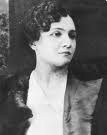
Moura Budberg
Wells was assigned a woman named Moura Budberg. She must have known how to turn on the charm as she was able to make a number of men she was assigned to sincerely love her, including the British diplomat Bruce Lockhart, the Russian writer Maxim Gorky and H.G. Wells. She wasn’t that good looking either. All of these people led double, triple or quadruple lives. They must have been really able to compartmentalize their minds. Freud didn’t touch that type.
After Wells’ visit to Lenin in 1921 he was signed on. He began his career as literary hatchet man. In his writing he portrayed recognizable people, sometimes under their real names, in negative or positive lights. As a skilled writer, whether you like his later stuff or not, he was more than competent to do this. It appears that he first targeted Burroughs in his 1923 novel Men Like Gods. Among his science fiction novels this one should rank more highly than it does. Burroughs’ 1926 Moon Maid reads like a reply to Wells. Especially the first part of the trilogy where Burroughs dances imaginative rings around the First Men In The Moon. From there Wells took up the challenge with Mr. Blettsworthy On Rampole Island of 1928 which unmistakably is a parody of Burroughs in which he portrays Burroughs as insane, but not a bad analysis.
Burroughs responded possibly with At The Earth’s Core but definitely with Tarzan The Invincible. At the same time one interprets Stalin’s interest in crossing apes with humans as being derived from Beasts Of Tarzan and other Tarzan novels there may have been more direct Soviet interest in ERB. One notes that Tarzan The Invincible was the first title published under the Burroughs imprint. I think it highly probable that his publishing was being interfered with by the Reds in addition to whatever other grievances against his publishers Burroughs may have had.
One may say that Burroughs was too insignificant for Stalin to bother with, yet according to Simon Sebag Montefiori Stalin put out a contract on John Wayne because he was such an ardent anti-Communist. Khruschev is said to have told Wayne that he concelled the contract after Stalin’s death. Edgar Rice Burroughs was at least as significant in 1930 as Wayne in the 1940s and 50s.
At any rate in 1930 Burroughs has Stalin and the Reds invading his dream world of Opar to steal his gold, i.e. put him out of the publishing business. Invincible and Triumphant, notice the titles, both deal with Stalin and the Soviets then the topic disappears from the oeuvre. Was Burroughs given incentive to counter-attack the Reds? I think there is enough evidence to warrant the opinion while time will tell even more. Research is just beginning.
It is signficant that Burroughs introduces the story in his own voice, not a framing device. He may be simply talking to the reader or he may be addressing Wells and, dare I say say it, The Man Of Steel himself. Perhaps a subtitle could be ‘The Big Bwana Meets The Man Of Steel.’ Now, it should also be remembered that this is the fourteenth novel of the series. the first title had been written eighteen years earlier. At that time the surprise of the character had knocked the socks off the reading public. In 1930 Tarzan was in danger of becoming old hat. Burroughs had to think up new and interesting devices to keep his readers coming back. As with most series of this type the readership was limited. Maximum sales could be predicted so that success meant not falling below a certain level of interest or letting interest diminish below unsupportable levels. As his own publisher Burroughs was now taking all the risks financial as well as literary. He had to turn out a successful book.
I think he did a superb job. Since the series continued to flourish his readers must have thought so too. I do wish ERB, Inc. would release some sales figures though.
For the premiss of his story Burroughs postulates that Stalin and the Soviets wish to instigate a new world war which will allow them to pick up the pieces establishing a complete European dictatorship. Not at all farfetched. Burroughs postulates that Mussolini and his Fascists are aiming at a European hegemony. This is 1930 so Hitler and the Nazis are not on anyone’s radar as a threat to world peace except for a few fringe elements. At the time Hitler and the NSDAP were in hand to hand combat with the Communists for control of Germany. They would not assume power until three years hence.
The Reds then wish to create an incident that would cause the Italians to attack France. The indirect approach is usually more effective than the direct approach so they wish to create an incident in Africa where French colonial troops appear to invade Italian Somaliland.
At that instant expendable confederates in Italy would reveal a bogus French plan to Mussolini. It is assumed that Italy would then declare war on France and the holocaust would begin. As we all know Italy did not declare war on France in 1930 so the plan must have misfired somewhere along the way. Tarzan was the reason. Burroughs gives these little known details that would have been lost to…well… if not history, remembrance. So, uh, really ERB is providing a valuable service here.
There may be two sides to every story, but usually one is on one side or the other. We don’t have to be reminded ERB is not on the side of the Reds. In fact, ERB is exposing their plans and weaknesses. He displays a fairly profound understanding of the goals and workings of the Communists. He is read up on the subject, He has studied. He is not shooting from the hip. He knows whereof he speaks. If not an authority on the subject he is pretty darn close.
ERB has his eyes on how ‘American’ manufacturers are relating to Moscow. He has Zora Drinov analyze the situation this way, p. 12
“But what do the puny resources of this single American (Wayne Colt) mean to us?” demanded Zora. “A mere nothing compared to what America is already pouring into Soviet Russia. What is his treason compared with the treason of those others who are already doing more to hasten the day of world communism than the Third Internationale itself- it is nothing, not a drop in the bucket.’
“What do you mean Zora?” asked Miguel.
“I mean the bankers, and manufacturers, and engineers of America, who are selling their own country and the world to us in the hope of adding more gold to their already bursting coffers. One of their most pious and lauded citizens is building great factories for us in Russia, where we may turn out tractors and tanks; their manufacturers are vying with each other to furnish us with engines for countless thousands of airplanes; their engineers are selling us their brains and their skill to build a grreat modern manufacturing city, in which ammunitions and engines of war may be produced. These are the traitors, these are the men who are hastening the day when Moscow shall dictate the policies of our world.”
“…their government is a capitalistic government that is so opposed to our beliefs that it has never recognized our government; yet in their greed, these swine are selling out their own kind and their own country for a few more rotten dollars.”
Sound anything like the US and China today? That was a mouthful. The first thing FDR did upon taking the reins of government was to recognize Soviet Russia. Tell you anything about FDR? That was a mouthful that should have eraned ERB the hatred of the Liberal Coalition.
You can see why they wanted to stop his mouth. Passages such as this are probably the reason Richard Slotkin and his crowd, John Taliaferro, group ERB with Madison Grant and Lothrop Stoddard. A charge of racism is usually a cover for a multitude of offences that have nothing to do with race. One is merely opposing the Liberal program. If they were to say- the fellow opposes the Liberal program they would get no rise- they might even have to explain the Liberal program- so the charge of racism is used as a red herring. One should always suspect such an accusation and disregard it.
Liberals however, never answer such charges. They merely deny them. In 1953-54 they were even denying themselves as Communists or taking the Fifth, which is the euivalent of saying, yes I am, but I’m not going to admit it.
The Revolution was only twelve years old in 1930. The CPUSA had been briefly outlawed in the early twenties but ‘disinterested parties’ believing in the time honored notion of ‘free speech’ had the ban lifted. Over in Russia their free speech loving comrades were filling cattle cars with dissenters destined for the Gulag or else they were murdered outright. Today, of course, these freedom loving people are throwing dissenters in prison on the basis of trumped up laws. The Program is moving right along isn’t it?
Even William Z. Foster denied he was a Communist as he was running for President on the Communist ticket. Today a tenured Law  Professor at Harvard actually denies that AIPAC, which is a registered lobby group, exists. They ought to throw such people into cells next to David Irving. Denial of themselves is what Liberalism is all about. You couldn’t find anyone to admit to being a Communist. They all denied it. The hypocrisy of Liberals throwing men as decent or moreso than themselves into jail for denying the holocaust is mind boggling. Well, it would be, if you didn’t already know what’s going on.
So ERB would have been roundly denounced as a paranoid delusive for the above passage.

Henry Ford- Philanthropist
Men like Armand Hammer, Bernard Baruch, essentially the whole Jewish government in exile here in the US were working furiously to make the Revolution a global reality. They really had no idea of Hitler’s intentions at the time, yet they attempted assassination while through the German Communist Party they were waging street warfare against the National Socialists. The word National is what they objected to not so much the man Hitler. Burroughs mentions the Third International. The Comintern- short for Communist International as it was known- was essentially a beta model for what is now multi-culturalism. It was the Jewish cultural vision of the world. Thus industrialists like Armand Hammer and Bernard Baruch using their Jewish identity as a shield from criticism, any criticism would be characterized as anti-Semitism, were directing huge sums of money into the development of Soviet Russia.
In addition a well-meaning industrialist, Henry Ford, who would later be denounced as a Nazi, was doing the

Armand Hammer
same thing. The mention of tractor factories refers to Henry Ford- the Jewish bete noir- who was trying to relieve the Communist induced famine by selling or even giving tractors to the Russians to increase food production. He was also building the factories for them. I mean, you know, gratis; altruism run rampant. The great industrial city probably refers to Stalingrad.
Even Burroughs biographers Porges and Taliaferro disparage Burroughs for his rational stance against Communism. Burroughs doesn’t stop his analysis with the multi-cultural contradiction within American society, p. 35:
“The general plan, of course, is no secret to any of us here,” said Zora, “and I shall betray no confidence in explaining it to you. It is part of a larger plan to embroil the capitalistic powers in wars and revolutions to such an extent that they will be helpless to unite against us.”
“Our emissaries have been laboring a long time toward the culmination of the revolution in India that will distract the attention and armed forces of Great Britain. We are not succeeding so well in Mexico as we had planned, but there is still hope, while our prospects in the Philippines are very bright. The conditions in China you well know. She is absolutely helpless, and we have hope that with our assistance she will eventually constitute a real menace to Japan. Italy is a very dangerous enemy, and it is largely for the purpose of embroiling her in war with France that we are here.”
Once again you will note that there is no reference to a threat from Germany. No one could have seen it but the Communists who were opposed not merely to Hitler but any Volkish attempt to govern. The Volkish movement was inherently anti-Communist. To be anti-Communist was equivalent to being anti-Semitic, so that Hitler was automatically an enemy to be destroyed. When he and the Nazis assumed power in 1933 an automatic boycott of Germany and things German was instituted by the Jews. One might say that WWII began in January of 1933 at the instance of the Jews. The obvious conclusion is that if Hitler’s actions against the Jews were not self-defense, they were acts of war in which the first offensives had been begun by the Jews. Needless to say any such opinion is and will be denied. Any such discussion of such matters will be ridiculed and suppressed. But there you have it. At any rate ERB was not one of those far-sighted individuals who foresaw the rise of Hitler. Italy turned out to be a not so dangerous enemy.
In his story Italy was merely to be a dupe of the Soviets.
In order to present his analysis ERB had to be especially well informed. What he read or where isn’t clear as there is nothing in the existing library that even deals with the Communists per se. ERB does have a copy of Hitler’s Mein Kampf but that could only have been obtained after 1940 when the war was in progress.
As the story opens then, the Reds are assembling their forces for the march on Italian Somaliland.
Things aren’t to be quite so simple as the leader of the expedition, Peter Sveri, develops delusions of grandeur hoping to establish his own Empire in Africa with himself as Emperor. On the one hand Communism breaks down on the rocks of the interests of the various cultures, while in seeking to establish himself in Africa Zveri is infringing on the domain of its current Emperor, Tarzan.
Tarzan handily frustrates Zveri’s designs, while at the same time beating Stalin and the Reds, hence the title Tarzan The Invincible. One imagines though that there may be something more behind it. Originally titled Tarzan, Guardian Of Africa the change of title indicates something deeper.
In order to finance his operations Zveri intends to loot the fabled treasure vaults of Opar of which, one assumes, he has read about in The Return Of Tarzan, Jewels Of Opar and Tarzan And The Golden Lion. This makes him somewhat a fan of the amanuensis of the Big Bwana.
This is the fourth and last of Burroughs’ Opar stories. In section six let’s review Opar and its significance to this story.
A Review, Part 6: Chessmen Of Mars by Edgar Rice Burroughs
February 16, 2009
Edgar Rice Burroughs On Mars
A Review
The Chessmen Of Mars
Part 6
by
R.E. Prindle
The Golden Handcuffs
And now comes the part that readers find the most fascinating, that of the contest on The Field Of Honor. Gladiatorial contests are frequent occurrences in the novels of ERB. This one seems to combine Arthurian influences as well as Roman.
Burroughs’ tenure of a couple years at the Chicago Harvard Latin School must have made an indelible impression on him. The recurrent, one might say underlying, Homeric influence from the Odyssey of Homer would indicate that the school concentrated on that work of Homer although not on The Iliad as there seem to be few references to the latter poem. In later years ERB would complain that he had learned Latin before English cramping his English style.
Perhaps, but I don’t see anything glaringly wrong with his English style. His psychology makes him a little stiff but that’s not through a lack of understanding English. It would be nice to know the curriculum of the Latin School and what texts he did study. Late in life when he wrote I Am A Barbarian his background as evidenced by the reading list he appended was shallow while not mentioning the great classical scholars. Still Roman themes are a recurring motif in the corpus. About this time he was rereading Plutarch’s Lives that compares the lives of various Greeks and Romans so that the Lives may have been a text at school. Especially as he says that while rereading it he discovered that Numa was the name of a Roman king while he thought he had invented the name for the Lion.
Also Arthurian references pop up in Chessmen. In 1912 when his editor Metcalf of Munsey’s asked him to write a medieval story that turned out to be the Outlaw Of Torn he claimed to have little knowledge of the period. Now, the Manatorian party leaving the city after Gahan entered is more reminiscent of Arthurian stories than Roman. The city of Manator itself also has a decidedly Camelot feel. The party’s subsequent return and capture of Tara and Ghek has more of the courtly flavor than the Roman. In 1928’s Tarzan, Lord Of The Jungle ERB would create a medieval society of lost Crusaders deep in the heart of darkness. So while he claimed to know nothing of medieval themes in 1912 by this time he seems to have done some reading in the field.
In many ways Manator bears a great resemblance to Mythological, Graustarkian and Ruritanian stories that he did admire as a young man. Combining all those influences with the Oz of Baum we have Manator.
Thus in addition to Roman gladiatorial contests we also have a similarity to medieval battle melees where the favors of women were of paramount importance.
Here we have the great mock battles and actual battles to the death played out on a gigantic Jetan board. Burroughs modifies the Earthly game of Chess to create a similar Martian game of Jetan complicated by the grotesque addition of battles to the death between the live ‘pieces.’ Indeed as is explained there had been games recorded in which the only survivors were the the two female prizes and one of the Jeds. Once again mimicking Arthurian literature ERB describes sword blows that cleave the opponent through the brain pan down to the breast bone. ERB seems to delight in the most violent and gruesome details. And lots of them.
A-Kor, his cellmate, fills Gahan in on what he must do to enter the games conveniently giving the latter enough money to bribe his team, get this, while returning the remainder to his purse.
The strategy is all very probable. The number of slaves from Gathol in Manator is enormous so Gahan has no difficulty in enrolling a team of Gatholians who will be fighting for their freedom. Gahan is famiiar with Jetan as played elsewhere on Mars on a board so he has no difficulty with strategy. The main change in strategy is that when a piece captures another the pieces then draw swords and fight to the finish. Thus a piece can successfully evade capture negating strategy.
Relying on the prowess of his men and his own incomparable swordsmanship Gahan then makes a drive directly for the opposing Jed, U-Dor.
Can it be a coincidence that he who stands between himself and Tara is a man called U-Dor (door)? Considering the important roles doors play in these stories it would seem that U-Dor is one more door he must hack his way through to get to his objective.
The only other work I’ve seen where doors were so important was the old TV show, The Mod Squad. In that TV series doors of every description were constantly being slammed; not just closed but slammed. I haven’t quite figured out ERB’s obsession with doors as yet.
While Chess and one imagines Jetan are supreme games of strategy Gahan seemingly abandons the fine points and gamesmanship and makes a drive straight for U-Dor. ERB says he was a good Chess player while I have never played to perhaps the moves he describes are possible especially as any move is good or bad depending on which player is the better swordsman. Gahan is the best so he experiences no difficulty in reaching U-Dor who he cuts down.
Tara and he are seemingly reunited. But while Tara thought she killed I-Gos he was only wounded. Present at the games he denounces Gahan and Tara who flee as aforesaid to the pits. Then begins the spectacular double climax; that of Gahan/ERB’s triumph over John the Bully/O-Tar and the subsequent triumph of Gahan/ERB over Frank Martin/O-Tar.
2.
To a large extent Chessmen is an examination of ancestor worship. Certainly the Taxidermist of Mars preserved ancestors going back at least five thousand years to the reign of O-Mai. ERB explains Gahan’s and perhaps his own ideas on the significance of ancestors.
Gahan, a man of culure and high intelligence held few if any superstitions. In common with nearly all races of Barsoom he clung more or less inherently, to a certain exalted form of ancestor worship, though it was rather the memory of legends of the virtues and heroic deeds of his forefathers that he deified rather than themselves. He never expected any tangible evidence of their existence after death; he did not believe that they had the power either for good or for evil other than the effect that their example while living might have had on following generations; he did not believe therefore in the materialization of dead spirits. If there was a life hereafter he knew nothing of it, for he knew that science had demonstrated the natural phenomenon of ancient religions and superstitions.
The above is probably as close to a confession of faith as ERB is going to give. It is certainly one that I can accept for myself. The above may also be a reference to spiritual seances in which dead ancestors supposedly spoke through mediums. Harry Houdini was debunking such seances around this time much to the chargrinof ERB’s literary hero, Conan Doyle of Sherlock Holmes fame, who did believe is such ancestral contacts.
There may be a joke in that case when Gahan arose from O-Mai’s bed ululuing and putting the fear of God into O-Tar exposing him as a coward.
Having thus disposed of O-Tar/John ERB turns to debunking O-Tar/Martin.
When Gahan was playing his joke on O-Tar I-Gos stole Tara away. He delivers her to O-Tar who is so smitten that he decides that he will marry her and take his chances with this she-banth.
O-Tar immurs Tara in a tower not unlike the story of Rapunzel. Her location is pointed out to Gahan who then makes a perilous climb of the tower in order to tell her that no matter what it looks like on the morrow’s wedding date he will rescue her and she is not to commit suicide.
While talking to her through the grated window a eunuch sleeping at the foot of the bed awakes moving toward him sword in hand. Tara instead of shrinking back removes her little blade from her harness running the eunuch through the heart.
There must be significance to this scene as ERB is retelling the story of both John and Martin. If Emma was with ERB on the corner and abandoned him to his fate by walking on it would appear that ERB never forgave her while having Anima trouble ever after. Here he rectifies the situation by having Tara come to his defense acting with a both a blade and heart of steel. Thus not only has his Animus surrogate Gahan proved John/O-Tar to be the coward but Tara the Anima figure defends Gahan/ERB from a similar attack by John absolving his Anima.
We now go to the wedding. Of course, having read the book several times in my case we know the story so I will just follow it. In the book John Carter tells ERB the details after the fact.
I-Gos has allied himself with Tara and Gahan against O-Tar. Before the wedding O-Tar retires to the Hall of Ancestors to commune with the dead. I-Gos has let Gahan into the hall where he sits as though stuffed on a stuffed Thoat. When O-Tar pauses beside him Gahan falls on him striking him on the forehead with the butt of a heavy spear.
Thus we establish that at this point O-Tar has become Frank Martin. Just as Gahan/ERB proved O-Tar a coward by merely rising in O’Mai’s bed and making weird noises so now he reverses the situation in Toronto. Instead of ERB being struck on the forehead Gahan/ERB strikes O-Tar/Martin in the same place leaving him for dead.
Now, this is strange. Donning O-Tar’s Golden Mask Gahan goes foth in O-Tar’s guise to marry Tara. The Golden Mask undoubtedly refers to Martin’s money bags to which ERB undoubtedly attributes whatever success Martin had with Emma. Why Gahan/ERB wore O-Tar’s mask is fairly clear but why ERB would have isn’t. Also if O-Tar hadn’t recovered from the blow Gahan would have been married to Tara in O-Tar’s name.
Perhaps ERB in a reversal means to imply that Emma would actually have been marrying him but won by Martin’s ‘golden mask.’ By the process of reversal then ERB would have recovered and stolen Emma from Martin on the altar so to speak. Or, as he actually did.
The symbolism of the golden handcuffs then would mean that the proposed wedding of Emma and Martin would have a mere commercial transaction. Or, perhaps, he felt himself attached to Emma for financial reasons when he’d rather not be. Complications, complications.
While the two antogonists Gahan and O-Tar are staring each other down the ‘cavalry’ Gahan sent for has arrived. Carter and troops from Helium, Gathol and Manatos arrive to end the story.
O-Tar himself then falls on his sword like a true Roman thus redeeming his miserable life. Perhaps ERB is saying that that is what Martin should have done- left the couple alone rather than constantly interfering.
3.
Conclusions
If as Sigmund Freud argued dreams are based on wish fulfillment the Chessmen of Mars proves his case. In this series of dreams or nightmares ERB attempts to reverse the results of the three greatest disasters of his life.
John the Bully and Frank Martin are a matter of history. That ERB links his fiancial disaster with these two earlier disasters indicates that he knows he has crossed the line in his mistaken purchase of the Otis estate. He knows that he as no way out as he has the ‘cavalry’, John Carter and the united forces of Helium, Gathol and Manatos come to the rescue. In the final denouement of this error in 1934’s Tarzan And The Lion Man even the cavalry can’t help. Tarzan/ERB leaves the burning castle of God a defeated man.
His great dream of getting back to the land and becoming a Gentleman Farmer has crashed to the ground. His attachment to his fantasy can be traced in his letters with Herb Weston. Weston warned him as strongly as friendship would allow that it would be a mistaken approach to farming in any other way than on a factory basis with profit firmly in mind. ERB chose to ignore this sound advice probably believing that between books, magazines and movies his future was golden.
Unfortunately for himself his income crested in this very year, 1921. Undoubtedly because of his strong anti-Communist stance and his resistance to the Semitism being imposed on him his sources of income came under attack. Nineteen twenty-two was the last year he received income from movies until 1927-28. Publishing difficulties with McClurg’s and G&D increased. His long time publisher, McClurg’s, even refused outrightly to publish his opus of 1924, Marcia Of The Doorstep.
His foreign royalties once so promising slowly dried up because of political pressures. Later in the decade his troubles with McClurg’s became so intense that he was forced to abandon that long standing relationship. No other major publisher would touch him. Why, will probably never be clear. After a tentative stab with a less established publisher he turned to forming his own publishing company. This move was apparently successful enough to float him through the early part of the thirties before the spring of his inspiration began to dry up.
In a desperate attempt to save Tarzan he attempted many expedients, none successful. He incorporated himself to protect his income from creditors. He subdivided a portion of Tarzana, he attempted to sell off acreage, he tried to turn part of the estate into an exclusive golf club, he turned part into a movie lot attempted to lease that out, he invited oil geologists to find oil on his land. He invested in airplace engines and airports. Nothing came of anything. In the end the magnificent estate slipped through his hands.
A premonition of all this can be found in the The Chessmen Of Mars. Even the name of the story indicates the he is involved in a chesslike game of many moves.
Stress was now to be ERB’s other name.
A world famous figure, nominally rich, still retaining many of the trappings of wealth he had gone from prince to pauper, regained his princely stature and now slipped back to the role of a prince in exile from the Promised Land.
Nothing daunted he went on working. In the end his magnificent intellectual property, Tarzan Of The Apes, would always save him from a fate worse than death. A form of wish fulfillment in itself, I guess.
Part III: Zane Grey, Edgar Rice Burroughs And The Anima And Animus
February 4, 2009
The ERB Library Project
Zane Grey, Edgar Rice Burroughs And The Animus And Anima
Part III
The Rainbow Trail
Bad Blood In The Valley Of Hidden Women
by
R.E. Prindle, Dr. Anton Polarion And Dugald Warbaby
Texts:
Burroughs, Edgar Rice: Corpus 1911-1940
Grey, Zane: The Riders Of The Purple Sage, 1912
Grey, Zane: The Rainbow Trail, 1915
Grey, Zane: The Mysterious Rider, 1921
Prindle, R.E.: Freudian Psycology Updated To Modern Physics, ERBzine, 2004
Prindle, R.E.: Something Of Value Books I, II, III, Erbzine, 2005.
The protagonist of this continuation of Riders Of The Purple Sage is named John Shefford. The appeal of this book and Mysterious Stranger to ERB is evident since John Bellounds and John Shefford are both Johns which was ERB’s favorite male name for both heroes and villains. Shefford is the hero here while Bellounds was a villain.
Symbolical of the religious problems of the period Shefford had been pushed into the ministry, some undefined sect, by his parents. But he had his doubts. These doubts found expression in his sermons to his flock. This may have been just after the Civil War to keep time periods straight. Not sharing his doubts the faithful threw him out of their church. So on the religious level Shefford is searching for a belief system. His old one had been ruined by Science. So we have the science-religion dichotomy here.
Shefford’s congregation was in Beaumont, Illinois which is where Venters and Bess of Purple Sage took Night and Black Star and their bag of gold. They had told their story to Shefford who found Bess strange and wonderful deciding that where she came from there must be others and that he was going there to get him one. In my youth, they called it Kansas City but this is not the case here.
When they told him the story of Fay Larkin he decided to go in search of her himself and locate this duplicate of Bess known as Fay Larkin. We should note that a fay is a fairie, so Fay Larkin is in essence a fairy princess. Thus Shefford is not only looking for redemption for his Animus but he seeks to reconcile his Anima. This is not much different from the Hungarian myth where the Anima was imprisoned in bridge footing, here the Anima is imprisoned in Surprise Valley just over the Arizona line in Utah. Get this, at the foot of the Rainbow Bridge. How elemental can you get.
With the blessing of Venters and the unmasked Rider, Bess, Shefford sets out for the desert in search of redemption. So, we have the religious dilemma of the period caused by Darwin and other scientific advances as the foundation of the story coupled with the Anima-Animus problem of the male.
The book was published in magazine form as The Desert Crucible. For the meaning of this metaphor for Grey check out his 1910 novel The Heritage Of The Desert. For Grey the desert tries a man’s soul either making or breaking him. The hero of Heritage, John Hare, was a ‘lunger’, that is tubercular, who was healed both physically and mentally in the desert crucible. In Shefford’s case he tapped his breast and said: ‘I’m sick here.’ meaning his heart or soul. I haven’t read a lot of Grey but of what I have read he never deviates much from his basic story; it’s all pretty much the same told from different perspectives. Shefford will have his heart or ‘soul’ healed just as Hare had his lung healed while finding himself as a man ‘way out there.’ Out There Somewhere as Knibbs and Burroughs would say.
Pretty much the same notion as Burroughs who believed a return to nature was the solution of the urban problem. Neither writer was unique in this respect but symptomatic of the times.
Whereas the desert was lush in Purple Sage under the dominion of the Great Mother, now under the control of the Patriarchal Mormon men viewed through the heartsick eyes of John Shefford the desert is dry as a bone, the water and the Great Mother are gone, all is barren and bleak.
Even the old landmarks have disappeared. No one has ever heard of Deception Pass although they think it may have been what is now known as the Sagi. Amber Spring has dried up. The town of Cottonwoods razed, only a few walls standing, while nobody reallys wants to discuss it. Verboten. No one has ever heard of Surprise Valley, which after all was sealed off from the world. But the name Fay Larkin does ring a bell. Hope in the wilderness.
Purple Sage took place in 1871, this is twelve years later, hence 1883. The United States Government, interfering in both religious and sexual matters, declared polygamy illegal in 1882 in response to this Mormon threat. In the background then is the US tribunal trying to root out the Mormon vice of polygamy. Time is moving right along on the last frontier.
In Grey and Burroughs’ real time, this book was published in 1915, the problem would have been a different Semitic intrusion, the Jews, who were manipulating US policy, certainly vis-a-vis Czarist Russia, for their own ends. Both writers would have been aware of Jewish political activities as well as the Great War that broke out in 1914. The Mormon-US confrontation may very well be also an examination of the Jewish-Gentile situation which was felt more keenly by contemporaries than the history books wish to tell as well as concern for the Big One in Europe.
The consequences of the situation described by Grey in Purple Sage would have been a serious one for the Mormon government. Clearly the situation had been allowed to get out of hand by Bishop Dyer and Elder Tull. Direct action should never have allowed to develop; it should have been kept more covert as any well managed operation should be. My god, the number of Mormons and others who died should have been a scandal. Wars have reported fewer deaths. The fact that Cottonwoods was destroyed, Amber Spring stopped up, and whatever indicates it was the Mormons who were trying to wipe the past from the history books. No need to talk about this one. One may compare this incident to Egyptian history. When the female Pharaoh Hatshepsut died her name was chiseled off every monument in the land. The idea that you can change the past by chiseling it out of the history books is current as well today.
The Mormons did not forget Lassiter and Jane walled up in Surprise Valley but there was no entry to get at them. Grey, a better writer than astute geologist, hastens erosion in the valley. More erosion occurred in these twelve years than in the previous two or three thousand. There were constant landslides and then the really Big One occurred when the canyon wall opposite the cliff dwellings gave way allowing for an entrance but still too formidable for an escape.
A watching Piute, Navajos are Grey’s noble savages, the Piutes his ignoble savages, Twain excoriated them too, informs the Mormons who invade the Valley seizing Lassiter and Jane. Lassiter had, of course, left his empty guns outside the Valley eleven years before and was unarmed or, in other words, emasculated.
The Mormons were going to string the Hammer up from his own sour apple tree when they decide to spare him if he and Jane will give them Fay Larkin for a fate worse than death, that is being given to a Mormon as one of his multiple wives and educated to the faith. It’s not clear why they asked as Jane and Uncle Jim had no power to refuse. At any rate, they considered it a square deal. The Mormons took the girl, apparently leaving Uncle Jim with his hands tied and the hempen noose still around his neck. Rather ludicrous vision when you think that he was attired in a fairly loose fitting garment made of jackrabbit hides.
Thus as the story begins Lassiter and Jane are alone in Surprise Valley, Fay Larkin is being educated to be the youngest wife of a Mormon Elder but as yet untouched, the US Government is pursuing the Mormons to prevent polygamy and John Shefford is in search of god and himself slogging knee deep through sand dunes in search of an obliterated past.
Do you believe in magic? You’re going to have to.
Because of US pressure the Mormons have gotten very devious. They have moved their extra wives across the Utah border into Arizona in a village of hidden women called Fredonia which means Free Women, are you laughing yet, apparently in the sexual sense. An oxymoron if there ever was one as these women were definitely not free. I find it difficult to follow Grey’s thinking here.
The Mormons forbid men to visit here while they themselves make periodic visits to their wives and children. That these are quality time visits is evidenced by the large numbers of children and no resident men. Hmm, freaky, Fredonia huh?
Of course supplies have to be brought in by men but these are men the Mormons ‘trust.’ Shefford links up with the trader Willets who is one of the trusted ones who vouches for the stranger Shefford so that he is allowed into the Valley Of Hidden Women.
Grey is incredible, in Purple Sage there was only one woman in Surprise Valley, now in Fredonia there is a whole village of delectable females. Willets encourages Shefford to mingle with them, get to know them, make them like him, but don’t touch.
On his way to the ladies Shefford has to pass through the crucible of the desert. It’s hard work but, boy, your muscles feel good, the air is great too. On the way Shefford is befriended by the Navajo, Nas Ta Bega, the navvy actually making him his brother. Say Nas Ta Bega rapidly three or four times and it almost comes out Nasty Beggar. Coincidence. This is the beginning of Shefford’s new religion.
For the Navajos religion was material, they worshipped the sun, the rocks, the winds, anything they see or feel. The natural rock formation, Rainbow Bridge, is their greatest terrestrial god, none daring approach it.
Shefford meets Mary his first day in Fredonia. We all know Mary is Fay Larkin and really so does Shefford but he has to make her say it. As she is his Anima figure they naturally love each other at first sight but as she is the affianced of Elder Waggoner he has to get her away from him.
This is not 1871, there is no longer any wild gunslinging. The law is here. In fact a court of inquiry is taking place in Stonebridge just across the border in Utah. Interesting how closely Grey follows ancient legends of which he probably had no knowledge. The Mormon wives are immured in a hidden valley on the other side of the border from Stonebridge not unlike the Anima figure entombed in the bridge foundation on the other side of the river in Hungarian myth.
The US judge has no luck in making the women admit to being other wives, in fact, to Grey’s horror, they allow themselves to be thought of as prostitutes rather than admit to polygamy. Apparently the US was unable to prove one case of polygamy anywhere in Utah. Them Mormons was close lipped.
Shefford still has to get Fay Larkin away from her prospective Mormon husband. As with all of Grey’s protagonists Shefford procrastinates and vacillates. Fay Larkin invites him into her house, obviously on a sexual pretext which he is slow to pick up. While he is allowing for the information to seep into his brain bootsteps are heard on the porch. It is not the milkman. Fay wants Shefford to kill Waggoner but Shefford has strong moral principles against killing for any reason. As Fay looks imporingly to him for protection her husband is opening the door. Shefford dives through an open window running as fast as his legs will carry him.
Grey seems to consider this natural as Shefford has an aversion to killing; strangely, Fay Larkin does not seem to resent his hasty departure leaving her to the mercy of her husband whose intent is to impose a fate worse than death on her.
In fact, Shefford’s will seems to be paralyzed from here to the end of the story not unlike the paralysis Jane inflicted on Lassiter. Something about those Withersteen women. Fay has after all been renamed Mary after the Mother Mary. Everyone else does things for Shefford as he wanders about in a daze; he seems to be able to do nothing for himself.
Fay’s husband is found dead on her doorstep the next morning. She thinks Shefford did it and is pleased; he thinks she did it and is horrified. Actually the Navajo, Nas Ta Bega, Shefford’s Bi Nai, or blood brother, did it for him. Is Grey thinking about the contemporary Jews? Bi Nai is awfully close to the B’nai of B’nai B’rith. B’nai means brother or brotherhood. B’nai B’rith means Brothers of the Ceremony. I can’t say for certain but it is the little details that give you away.
Nas Ta Bega has been doing the legwork for Shefford all along. He actually discovered that Mary was Fay larkin for certain. Whereas no one had ever heard of Surprise Valley Nas Ta Bega had found it. Shefford is too paralyzed to kill Waggoner so n=Nas Ta Bega does it for him. While Shefford himself could never shed blood and he was horrified that Fay Larkin might have done it he is relieved that Nas Ta Bega did it accepting the gift without any qualms. Grey is a strange one.
There is some resemblance here to Daddy Warbucks of Orphan Annie fame where Warbucks himself kills no one but his confederates the Indian Punjab and indeterminate Asp eliminate people by the dozen for him. Thus Warbucks’ hands are always clean but the job gets done anyway. Here Shefford remains innocent of the murder shuffling the guilt off to Nas Ta Bega his blood brother.
The bunch heads to Surprise Valley to get Lassiter and Jane out. It requires pegs and ropes to get into the valley but there they find a very relaxed, one might even say, comatose, Uncle Jim who says ‘Shore’ to everything, for shore. Very amiable guy for a man with the blood of dozens of Mormons on his hands.
He and Jane are released and now begins a very complicated escape plan down the Colorado River then through the rapids to safety on the Arizona side. The Mormons at this stage of history thought that Utah extended to the North Rim of the Grand Canyon although the US authorities thought differently.
The story effectively ends with the release of Lassiter and Jane from Surprise Valley. Shore, it does. But Grey throws an extra forty pages in the ending mainly to give a description of a boat ride down the rapids of the Colorado which he has apparently taken. Lassiter and Jane are reunited with Venters and Bess, Night and Black Star back in Beaumont, Illinois. Shefford finds his Anima, redeems his soul, finds a true religion and lives happily ever after.
2.
G.M. Farley, the editor of Zane Grey Collector, in his charming appreciation of Zane Grey for the ERBzine says that Grey wrote no fantasy, but these two novels, Purple Sage and Rainbow, are just that, pure fantasy. Lassiter, Venters and Shefford are archetypes. Surprise Valley nor anything like it ever existed nor did the Valley Of The Hidden Women. Both these books are pure fantasy. If appreciated properly these two books should stand as the cornerstones of Grey’s literary legacy. Much better than his ordinary cornpone Westerns. When it come to Westerns I will take those of Burroughs over Grey every day.
Burroughs is absolutely learned compared to Grey. The former’s insatiable curiosity is very evident in his writing while Grey gives the impression of having read nothing. Of course if you’re writing several months out of the year and out to sea for the rest perhaps there isn’t much time for reading. The contrast between land and water in Grey’s fiction was lived out in his real life. Psychoogically land represents the hard, dry Animus while water is representative of the creative Anima. As Roger Miller said, he had too much water for his land which is to say that he was subject to wild flights of fantasy but unable to govern his life. He also said quite correctly, Squares, that is people with a lot of land, make the world go ’round. Thus the Mormon squares controlled the situation while ‘hipsters’ Jane and Lassiter ended up buried in the canyon.
Thus Grey’s concentration on the desert as compared to farmland or the forest is signficant. The opening scenes of Rainbow when Shefford slogs through the sand drifts to arrive at a bitter waterhole is significant of his inner barrenness; a nonfunctioning Anima. Contrast the bitter water with the sweet water Amber Spring of Purple Sage. When Shefford is united with his Anima figure, Fay Larkin, they travel through harsh desert to leave finally on a raging torrent washed over with water until they are nearly drowned to land on a hospitable South shore of the Colorado in Arizona not Utah.
Likewise Grey lived his life between the desert and the sea. On the sea angling for the big fish a la Jonah or perhaps the fish of wisdom of Sumerian Oannes.
Certainly the epic is a search for both wisdom and redemption. Having been disowned by his church Shefford has been set adrift without any new guidelines or directions home.
As Shefford explains to Fay Larkin:
“So when the church disowned me…I conceived the idea of wandering into the wilds of Utah to save Fay Larkin from that canon prison. It grew to be the best and strongest desire of my life. I think if I could save her that it would save me. (Right.) I never loved any girl. I can’t say that I love Fay Larkin. How could I when I’ve never seen her- when she is only a dream girl? But I believe if she were to become a reality- a flesh and blood girl- that I would love her.”
So that Shefford hopes to find redemption in Fay Larkin. He might indeed love her- if she were a flesh and blood girl as well as his Anima ideal- but the Anima ideal can never become a real flesh and blood girl. Real women are different.
Shefford’s situation seems to be that of the Hungarian myth with the Anima trapped in a sealed in valley rather than the buttress of a bridge. As it doesn’t appear that Grey read or studied much, this understanding must have been a realization of his own situation which he was able to objectify on paper.
In many ways this then is exactly what Burroughs was searching for as most of his novels are Anima/Animus novels although ERB did not have such a clear grasp while being much more involved with the psychoses of the subconscious.
And then there were the other two themes: the search for the realization of manhood, or the escape from emasculation , and finding a new religious identity.
As noted, Grey thought the desert brought out manhood. His trip West with Buffalo Jones a few years before Purple Sage must have been a real eye opening experience. The Grand Canyon with its contrast between desert and water must have really inspired the author.
Thus Shefford, before he finds his Anima first learns to be a man ‘way out there.’ The test of manhood involves the carrying of a large stone that proved Navajo manhood.
A few passages:
“Joe placed a big hand on the stone and tried to move it. According to Shefford’s eye measurements the stone was nearly oval (egg shaped), perhaps three feet high, but a little over two in width. (Big egg) Joe threw off his sombrero, took a deep breath and, bending over, clasped the stone in his arms. He was an exceedingly heavy and powerful man, and it was plain to Shefford that he meant to lift the stone if that were possible. Joe’s broad shoulders strained, flattened; his arms bulged, his joints cracked, his neck corded, and his face turned black. By gigantic effort he lifted the stone and moved it about six inches. Then as he relaxed his hold he fell, and when he sat up his face was wet with sweat.
Lucky he lived through that.
“Try it,” (Joe Lake) said to Shefford, with his lazy smile. “See if you can heave it.”
Shefford was strong, and there had been a time when he took pride in his strength. Something in Joe’s supreme effort and in the gloom of the Indian’s eyes (Nas Ta Bega) made Shefford curious about this stone. He bent over and grasped it as Joe had done. He braced himself and lifted with all his power, until a red blur obscured his sight and shooting stars seemed to explode in his head. But he could not even stir the stone.
“Shefford, maybe you’ll be able to lift it some day,” observed Joe. Then he pointed to the stone and addressed Nas Ta Bega.
The Indian shook his head and spoke for moment.
“This is the Isende Aha of the Navajos.” explained Joe. “The young braves are always trying to carry this stone. As soon as one of them can carry it he is a man. He who carries it farthest is the biggest man. And just so soon as any Indian can no longer lift it he is old. Nas Ta Bega says the stone has been carried two miles in his lifetime. His own father carried it the length of six steps.”
So, manhood consists of lifting a stone, carrying that weight. It would seem to me that pale-faced education would have less to do with being built like Louis Cyr or Man Mountain Dean. I, myself, don’t feel any less a man because I can’t lift a 350 lb. rock.
Talking about fantasy: If the stone were moved two miles in Nas Ta Bega’s lifetime while his mighty father movied it six toddling steps, if only ten percent of the Navajos were big enough to move the stone then the Navajos should have been as populous as the sands of the desert.
As as a Patriarchal Mormon Joe Lake could lift the stone, as a Matriarchal Gentile Shefford couldn’t and it was impossible for the completely emasculated Indian, Nas Ta Bega, what we have here is a lesson in masculinity.
For myself, I’ve carried that weight for decades but I wouldn’t waste my time and kill myself by trying to lift some rock.
The search for manhood and faith went on but we’re getting closer if no less ridiculous. Another quote, Shefford to Fay Larkin:
“Listen,” his voice was a little husky, but behind it there seemed a tide of resistless utterance. “Loss of faith and name did not send me into this wilderness. But I had love- love for that lost girl, Fay Larkin. I dreamed about her till I loved her. I dreamed that I would find her- my treasure- at the foot of a rainbow. Dreams!…When you told me she ws dead I accepted that. There was truth in your voice, I respected your reticence. But something died in me then. I lost myself, the best of me, the good that might have uplifted me. I went away, down upon the barren desert (Oh Dan, can you see that great green tree where the water’s running free…) and there I grew into another and a harder man. Yet strange to say, I never forgot her (Water) though my dreams were done. (Clear) As I suffered and changed I loved her, the thought of her- (Water) more and more. Now I have come back to these walled valleys- to the smell of pinon, to the flowers in the nooks, to the wind on the heights, to the silence and loneliness and beauty.”
“And here the dreams came back and she is with me always. Her spirit is all that keeps me kind and good, as you say I am. But I suffer and I long for her live. If I loved her dead, how could I love her living! Always I torture myself with the vain dream that- that she might not be dead. I have never been anything but a dreamer. And here I go about my work by day and lie awake at night with that lost girl in my mind. I love her. Does that seems strange to you? But it would not if you understood. Think. I have lost faith, hope. I set myself a great work- to find Fay Larkin. And by the fire and iron and the blood that I felt it would cost me to save her some faith must come to me again…My work is undone- I’ve never saved her. But listen, how strange it is to feel- now- as I let myself go- that just the loving her and the living here in the wilderness that holds her somewhere have brought me hope again. Some faith must come, too. It was through her that I met the Indian, Nas Ta Bega. He has saved my life- taught me much. What would I have ever learned of the naked and vast earth, of the sublimity of the the vast uplands, of the storm and night and sun, if I had not followed the gleam she inspired? In my hunt for a lost girl perhaps I wandered into a place where I shall find a God and my salvation. Do you marvel that I love Fay Larkin- that she is not dead to me? Do you marvel that I love her, when I know, were she alive, chained in a canon, or bound, or lost in any way my destiny would lead me to her, and she should be saved?’
Wow! You get old Zane wound up and he’s hard to stop. This guy must have been a terror with the girls. Dazzled ’em. Stars in their eyes. Remember from eight to seventeen Fay was locked up in Surprise Valley where with the passing years Jane and Uncle Jim spoke less and less as they slowly became as clams. Now as an eighteen year old girl with absolutely no human intercourse and Jane and Jim weren’t speaking she has been undergoing a heavy course of indoctrination in Mormonism while being isolated in her cabin. Could she understand this torrent of words from Shefford? Think about it. She’s a nature girl from the Stone Age moving into the nineteenth century in the twinkling of an eye.
It seems pretty clear to us, astute in varying degrees, that Shefford is going to find salvation in Fay but how about religion. Once again, bear in mind that Grey has displaced the contemporary situation in 1915 back to 1883. In that way he doesn’t have to deal with all those troubling immigrants while the major religious war between the Semites and Gentiles can be discussed under cover of the conflict between the Mormons and the Gentiles. Polygamy might be compared to the Semitic concept of the Chosen People. End either one and the source of conflict would disappear.
Just as Jane and Lassiter have reverted to the Stone Age so Grey goes to his noble savages, the Navajos, to find Shefford’s religious solution:
The Navajo, dark, stately, inscrutable, faced the sun- his god. This was the Great Spirit, the desert was his mother, but the sun was his life. To the keeper of the winds and rains, to the master of light, to the maker of fire, to the giver of life the Navajo sent up his prayer:
Of all the good things of the earth let me always have plenty.
Of all the beautiful things of the earth let me always have plenty.
Peacefully let my horses go and peacefully let my sheep go.
God of the Heavens, help me to talk straight.
Goddess of the Earth, my Mother, let me walk straight.
Now all is well, now all is well, now all is well, now all is well.
Hope and faith were his.
Hope and faith may be the essence of religion. As I say, I doubt if Grey read much but he has certainly captured the essence of mythology. The bit about the sun as keeper of the wind and rains is astute. As Grey said, the Navajo religion was materialistic. Pantheistic too, perhaps. There is nothing spiritual here just a prayer for plenty of what makes life enjoyable for the Navajo combined with the essence of morality which is to talk and walk straight. Quite admirable really. I can imagine the ERB was very nearly in awe as he read it. Of course, by 1915 ERB had already smashed the old religious system on Barsoom supplanting it with his own vision of the man-god but I’m sure he concurred with Grey.
Then Grey sums up the turbulent Colorado:
“Life was eternal. Man’s immortality lay in himself. Love of a woman was hope- happiness. Brotherhood- that mystic ‘Bi Nai” of the Navajo- that was religion.
Yes, as they passed under the Rainbow Bridge at the foot of the rainbow it all become clear. What happened later when reality hit I don’t know.
Grey’s formula reads well: Life in the general sense, in whatever form, will last for a long time but hardly eternally. ‘Man’s immortality lay in himself’ is difficult to parse. Not exactly sure what that means. ‘Love of a woman was hope- happiness.’ Possibly, if he’s talking about a reconciliation of the X and y chromosomes into a unified whole but for an old philanderer like Grey he should amend his statement to love of any or many women, a quick one in other words. And the mystic and grand “Bi Nai.’ Yep. That was religion.
I imagine ERB was goggle eyed when he finished this one and lovingly patted it back on the shelf.
The good things of this world had come the way of Grey and Burroughs in abundance. Grey was able to ‘get back to the land’ six months of the year while testing his manhood like Ahab landing the big fish on the seas the other part of the year. I used to love those travelogues on Saturdays when they showed those heroes trolling the seas for swordfish off Florida proving that had to be a real man to land those big fellas.
Then they would show the little woman standing proudly by her catch towering over her. They fished ’em out by the time I was in a position to prove my manhood. I’ll have to take up skydiving or bungee jumping; to heck with climbing Everest.
Burroughs also got back to the land in a big way. Some of the letters in Brother Men, the collection of his and Herb Weston’s letters are quite delightful as ERB exults about planting every known species of vegetable while raising most of the better known food animals in great quantities. Just that he couldn’t figure out how to make a profit at it. All expense the way he went about it. That wasn’t according to plan.
In their own way both Grey and Burroughs retreated from the social realities of their day both in their fiction and in their lives. Depending on how one defines fantasy both men retreated into fantasy rather than deal with an uncomfortable reality. At the same time both tried to come up with solutions to the pressing social and relgious problems of their times in fiction.
Of the two I much prefer Burroughs because of his wider ranging intellectual interests as well as his highly developed sense of humor. There isn’t one grain of humor in Grey; the man is deadly serious all the time; he must have played shortstop in baseball.
Times change. I find nothing enduring in Grey save the Purple Sage/Rainbow diptych and that because of his amazing portrayal of the Anima/Animus problem.
Burroughs has a certain quality to what he does. Herb Weston in Brother Men seemed put off by ERB’s Mastermind Of Mars. the novel first appeared in Amazing Stories; Weston thought the story was truly amazing. So do I. I can’t explain exactly why I think Mastermind is an enduring story because on one level it isn’t a very good book; yet on another, while Ras Thavas is a great character there is something being said which still escapes me but seems important.
As Grey and Burroughs are representative of the period 1890-1910 just let me say that I really love this period of history in the United States. I like most of the writers and Burroughs and Grey are two of my favorites. They probably read each other but their intellects were so disparate that I doubt if they could have gotten along if they had met.
Fortunately this is a moot point as they didn’t.
Happy trails to you hoping that if you look you can find Surprise Valley and The Valley Of The Hidden Women. Just don’t take your guns to town, Son, leave the Bad Blood at home.
Part II: Zane Grey, Edgar Rice Burroughs And The Anima And Animus
February 3, 2009
The ERB Library Project
Zane Grey, Edgar Rice Burroughs And The Anima And Animus
by
R.E. Prindle, Dr. Anton Polarion And Dugald Warbaby
Texts:
Burroughs: Edgar Rice: Corpus 1911-1940
Grey, Zane: The Riders Of The Purple Sage, 1912
Grey, Zane: The Rainbow Trail 1915
Grey Zane: The Mysterious Rider, 1921
Prindle, R. E.: Freudian Psychology Updated To Modern Physics, ERBzine, 2004
Prindle, R.E.: Something Of Value Books I, II And III, ERBzine, 2006
by
R.E. Prindle, Dr. Anton Polarion And Dugald Warbaby
Part II
The Mysterious Rider
Two of the more popular musical groups of the 1980s were Culture Clash and Boy George’s Culture Club. They were from England which was being invaded by peaceful infiltration by a number of different cultures. The popular response of these groups divined that the issue was not ‘race’ or skin color but one of cultures.
In any clash of cultures the most intolerant must win- that is the culture that clings to its customs while rejecting all others. To be tolerant is to be absorbed by the intolerant culture. This was the meaning of German term Kulturkampf of the pre-Great War period.
Historical examples are too numerous to mention, suffice it to say, that the ancient Cretan culture was defeated by the Mycenean while both were supplanted by later Greek invasions. Eventually Greek culture supplanted the Cretan which was lost to history.
The English being the most tolerant people will lose their culture to a Moslem-Negro combination which will undoubtedly be absorbed by the Chinese. This is an incontestable evolutionary fact, it has nothing to do with anyone’s opinion.
While the movement of peoples may be an unavoidable fact of life it is folly for a superior more productive culture to sacrifice itself to a lesser, misguided by notions of tolerance.
Evolutionarily the problem is not the cosmetic one of skin color as most HSIIs and IIIs imagine.
Apart from the evolutionary problem of genetics the social problem of cultures is of prime importance. Not all cultures are of the same quality nor is this a matter of relativity. For instance it is generally agreed that female circumcision is an evil to be avoided but among the Africans where it is prevalent their culture stoutly defends the procedure along with polygamy. In France where large numbers of Africans are invading French culture denies the validty of both female circumcision and polygamy hence the culture clash between the two nations the society will be determined by numbers and will. Given the increasing numbers of Moslems and Africans in France among which polygamy is an established custom and given their superior will and intolerance of the HSIIs of France, it is merely a matter of time before polygamy and female circumcision become permissible thus changing French society as the French themselves adopt Semitic and African customs.
Only a small percentage of the French, English or Americans recognize the danger to their cultures. They must naturally be as intolerant of the culture of the invaders as the invaders are intolerant of theirs. As a minority among their respective peoples they are derided by the majority as bigots while the, perhaps, benign and tolerant opinion of the majority can lead only to their own elimination as history and evolution clearly shows.
America in the nineteenth century with its open and unrestricted immigration was the first country, other than Russia which was also involved with these difficulties, to come to grips with the problem of clashing cultures. The official American position was one of tolerance. Absorption of the large African population was a poser, but among the HSIIs and IIIs the cultural differences were not so great as to be an insuperable obstacle although assimilation as between the Anglos and the Irish, for instance, was painful and slow while still incomplete to this day as large numbers of Irish consider themselves Irish first and Americans second but generally Northern Europeans blended reasonably well.
Then in the 1870s just at the time that both Zane Grey and Edgar Rice Burroughs were born the focus of immigration shifted to Eastern and Southern Europe. This influx continued unabated up to 1914 when it was interrupted by the Great War. While earlier immigration might be characterized as troublesome the Eastern and Southern European immigration presented a real culture clash.
The cultural differences between Northern Europeans and Eastern and Southern Europeans are actually quite striking. Rightly or wrongly, as you may choose to see it, contemporaries of Burroughs and Grey believed that, at least, the Jews and Italians were unassimilable, which is to say, they were not prepared to abandon their customs to blend into the whole but wished to impose their customs on the whole. Indeed this has proven to be the case as witness the Jewish attempt to abolish Christmas. If you don’t object there is no problem. If you do, you have a culture clash that the most intolerant will win.
As representatives of the founding culture of the United States men like Burroughs and Grey could not but see the new immigration as a threat to their ideals which has proven to be true. Thus the American generation of Teddy Roosevelt who was born in 1858 were the heroes of the younger generation. When TR died in 1919 a vision of hope flickered out for Burroughs’ and Grey’s generation.
The poem ‘The American’ reprinted in Part IV of my Four Crucial Years published in the ERBzine will give some idea of the frustration experienced by the Burroughs/Grey generation just as they were coming of age.
Burroughs grew up in one of the most polyglot centers of the world. The Anglos in Chicago were in a distinct minority being no more than 10% of the population in 1890. Grey practiced his dentistry in New York City in which Anglos were as small a percentage of the population.
Neither man was a hateful bigot which is not to say that they couldn’t help but be affected by the diversity of languages and customs which they encountered everyday in what they considered to be their own country. It would be silly to say that they or any rational Anglo didn’t regret the situation. That the absorption of all this diversity into a semblance of homogeneity was made without undue violence must always to be the credit of the American social organization. That organizations of frustrated individuals like the American Protective Association or the KKK arose is not to be wondered at especially in the face of very aggressive and terrorist immigrant organizations such as the Mafia and the Anti-Defamation League of the B’nai B’rith which was being advised by Sigmund Freud.
Both Burroughs and Grey began writing at the very height of unrestricted immigration. There is every reason to expect the influence of immigration to be reflected in their writing for the period of the teens no matter how they sublimated it. After 1920 conditions changed which is reflected in Burroughs’ writing although I am unread in Grey after the teens.
Burroughs of course transposed his social and religious conflicts to Mars, Pellucidar and his vision of Tarzan’s Africa where they were fought on an allegorical level much in the style of Jonathon Swift.
Grey on the other hand transposed the problem to an earlier period in the American West where he avoided the problem of foreign activities concentrating on culture clashes of Mormonism, cattle and sheep ranching and matters of the like. He’s an acute observer of the Mexican-American clash also. Thus the Mormon-Gentile clash of mid-nineteenth century could be compared to the Jewish-Gentile confrontation of the teens which Grey would have been facing but would have been unable to discuss without being labeled an anti-Semite or bigot.
Both writers could also translate social problems into psychological terms as they did. Both men suffered from a fair degree of emasculation which is most notably represented in Grey’s work especially the three of his novels under consideration.
In The Mysterious Rider he examines the same Animus problems that he did in Riders Of The Purple Sage but under different conditions.
His protagonist, Hell Bent Wade of Mysterious Rider, answers to that of Lassiter In Riders. Wade possessed a violent and ungovernable tempter as a young man which led him to murder his wife and a man he mistakenly believed to be her lover. Discovering his error he brought his temper under control becoming mild mannered like Lassiter but helpful and with more character; still his youthful reputation follows him, blighting his life.
Wilson Moore may be seen as another version of Venters while the Mormon Animus is represented by the rancher, Bill Bellounds and his son Jack. His Anima figure in this story is an orphan girl named Columbine, Collie, as after the flower.
Old Bill Bellounds (Hounds Of Hell?) is a big rancher in Colorado who took Columbine ( in good conscience I can’t call her Collie, which is the name of a dog) in as a child and raised her as his own. This is a recurring motif in Grey. Now he wants her to marry his son Jack. Jack is no good. Bad man. As an Animus figure he is the wild ungoveranble aspect. He is crazed having no behavioral controls.
Columbine is placed between what she considers her duty to the man she had always known as dad and her own desire which is a love for Wilson or Wils Moore.
Moore is just the opposite of Jack Bellounds. He is gentle, sensitve, conscientious, hard working, kind, loving, just an all around great guy of the emasculated Animus sort. Grey, who has all the attributes of the emasculated man, including the middle hair part, may have thought of him as a sort of self-portrait. Grey always holds up as his model of the virtuous man the long suffering type who endures injustices to the point of being crippled or even killed before he retaliates, if he does.
In this case Wilson Moore is crippled for life by Jack Bellounds with barely even a thought of self-defense. Hell Bent Wade, the protagonist who had the ungovernable temper as a youth, a reformed Lassiter, is now feminized to the point where he is willing to serve as a male nurse.
Thus he nurses Moore back to physical health, but mutilated, while he keeps Moore’s mind straight.
He is unable to do anything with Jack Bellounds who although he wants to win the love of Columbine is incapable of reforming. His drinking and gambling lead him into a situation where he is rustling cattle from his father.
A showdown occurs between him and Hell Bent in which by giving Jack every chance he is shot by Jack while at the same time killing the latter. We are expected to admire this self-sacrifice. Thus Wils and Columbine are united. Mutilated virtue prevails.
Grey always manages an interesting tale with good detailing so the reading of the novel as OK qua story but written after the Great War it is evident that Grey is hauling up nuggets from an exhausted mine.
The appeal of the story for Burroughs seems clear as it is a virtual symbolic retelling of his courtship of Emma. Alvin Hulbert, Emma’s father favoring another suitor who was quite privileged, while denying ERB the house, the crippling struggle with the suitor in Toronto and the eventual successful denouement as Emma chose him over the other ‘owner’s son’ and the marriage.
Published in magazine form in 1919 and in book form in 1921 its appearance coincided with a low period in ERB’s life as represented in Tarzan And The Golden Lion and Tarzan And The Ant Men. This was also the period when when Warner Fabian’s ‘Flaming Youth’ appeared followed by the apparently sensational movie. The book, which is in ERB’s library and, the movie made a terrific impression on him.
As this is one of only two Grey books still in his library when it was catalogued we must assume that he felt the content was applicable to himself. Other than that I found the novel of negligible value.
Now let us turn to The Rainbow Trail which was the other Grey novel in ERB’s library. This will be a fairly signifcant book.
A Review: Conquest Of A Continent by Madison Grant
August 4, 2008
A Review
Conquest Of A Continent
by
Madison Grant
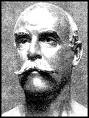
Madison Grant
Review by R.E. Prindle
Texts:
Grant, Madison, Conquest Of A Continent, Liberty Bell Publications, 2004. Reprint of 1933 Edition
Fischer, David Hackett, Albion’s Seed: Four British Folkways In America, Oxford, 1991
Higham, John, Strangers In The Land: Patterns Of American Nativism 1860-1925 Rutgers U. Press 1955
Myers, Gustavus, History Of Bigotry In The United States, Random House, 1943
Wittke, Carl, We Who Built America: The Saga Of The Immigrant, Case Western Reserve, 1939
In the immediacy of the moment one frequently overlooks or forgets the history leading up to the moment. One might think for instance that the current flap over Diversity and Multi-Culturalism is a recent occurrence. While the two terms are of recent provenance the argument under different names goes back much farther while the protagonists are essentially the same.
The story of immigration into America is almost always told from the point of view of the immigrant. Few books tell the tale from the Nativist point of view and they are universally and viciously derided as a tale told by bigoted idiots. While charity is demanded from the Nativists none is to be expected from the immigrationists.
Thus we get volumes like Strangers In The Land by John Higham and Carl Wittke’s We Who Built America that distort the issue in favor of immigrants while deprecating the Natives.
Qustavus Myers’ History Of Bigotry In The United States on the other hand appears to be a willful misunderstanding of the nature of the relative status between immigrant and native resulting in a slanderous approach like that of the contemporary Greil Marcus.
Conquest Of A Continent has been placed on the Jewish Index Of Anti-Semitic Books. Based on that I expected a detailed derogatory examination of the Jews from their entry into America perhaps being the conquerors referred to. The President of the American Jewish Committee sent a letter to every Jewish publisher in the United States demanding that they refrain from either reviewing the book or noticing it at all. Dynamic silence was to prevail.
After reading Conquest I can only conclude that the AJC was hyper sensitive to a degree. Since his 1916 Passing Of The Great Race Mr. Grant had learned that ‘You Don’t Mess With Rohan’ to quote Adam Sandler. Grant all but ignores the Jews in his volume. No, his offense, according to the AJC was even more egregious, he uses the world Nordic and dares to imply that they are ‘the Great Race’ rather than the AJC’s own Semites.
The other volumes mentioned and, indeed, all writing in this genre which is pretty extensive, defers to the Jews as ‘the Great Race’ probably genetically superior to all others.
So Madison Grant is interested in telling the story of how the Nordic race conquered the continent. This approach can only be considered as a sin by non-Nordics. Grant then tells the story of how the US and Canada were occupied by peoples other than the native Indians.
He begins early referring to twelfth century attempts to settle by Scandinavians. In the 1100s the firece native Indians were able to exterminate the invaders and may well have been able to exterminate the Puritan settlers but for the fact that a small pox epidemic shortly before the Puritan arrival had reduced the native population by as much as half while weakening them concomitantly. Such is the luck of the draw.
Grant thus traces immingration back to its origins colony by colony and then State by State as the Nordics moved Westward.
David Fischer in his excellent Albion’s Seed retraces the same ground fifty years after Grant with much addional detail concerning the places of origin and their activities once in the US.
Grant’s approach is in some ways superior to that of Fischer since as an unabashed Nordic advocate he is interested in detailing the exact racial content of the occupation of the various states and provinces. If you aren’t aware of the progress of settlement and by whom there are numerous surprises. My own notions were certainly vaguer before I read Grant.
I was surprised at the seeming numerical superiority of Southern migrants in the Westward movement. It seems that Whites did not like to live in the South where they were compelled to compete with slave labor while being despised by both the plantation owners and their slaves. Thus there was a constant stream of the best and brightest of the South moving into the North and West. As Grant notes, Virginia was the mother of States.
Then too some of Grant’s population statistics are of interest also. At the 1790 census before the invention of the cotton gin in 1793 there were less than a million Africans in the United States. Seventy years later as the Civil War began the number had increased to four and a half million. Thus natural increase was out of the question. It follows then that between 1800 and 1860 more Africans were brought to the US than there were before 1800. As a result the slave trade fluorished more than ever.
Prior to 1800 Alabama and Mississippi had no settlers so that in 1860 these two States were still rough frontier States still in a state of organization.
There is much good background here as to how the US came under settlement. The continent was accupied in its entirely when the truly major immigration from Eastern and Southern Europe began to accelerate in the 1870s and 1880s changing the basic Nordic institutions of the country. The change in Grant’s eyes was much for the worse.
Carl Wittke’s We Who Built America published in 1939 was undoubtedly in response to Grant’s Conquest Of A Continet. Wittke, was published by Case Western Reserve University. Grant explains the meaning of The Western Reserve which has always puzzled me. The Western Reserve was three million acres set aside as a concession to the State of Connecticut for giving up other territorial rights.
Wittke made a great impression with his his volume, his opinions being taken as overriding fact. I remember my sixth grade teacher in Michigan lauding the book to the skies. I finally read it a couple years ago. Not so much.
As is usual with books and writers of this type Wittke overstates his case and underproves his facts. A contribution to the dialogue at best.
Grant’s book should prove useful to any unbiased reader. If his attitude of Nordic superiority offends you, ignore it. His history as history is sound. For those of you reared on Myer’s History of Bigory attitude you will probably be surprised to find that there is another point of view. Bigotry is not a matter solely of American destestation of immigrants as the program of Diversity and Multi-Culturalism indicates, bigotry is a red herring and not the issue. The issue is who will be Top Race. The contestants for the Top Spot have turned out to be the Africans, Semites (both Jews and Arab Moslems) Hispanics, Chinese and Euro-Americans. (Grant’s Nordics) As you can see race has replaced nationalism.
The contest is real and ongoing. Peace is merely another form of war. The prize will go to who wants it the most. If you don’t see the contest in these terms I suggest you remove your rose colored glasses.
Exhuming Bob IX, Pensees 7: Into The Lost Land
July 6, 2008
Exhuming Bob IX, Pensees 7:
Into The Lost Land
by
R.E. Prindle
Texts:
Dylan, Bob, Chronicles Vol. I, Simon And Schuster, 2004
Prindle, R.E. Exhuming Bob, VIII The Walls Of Red Wing, idynamo,wordpress.com 2008
Thompson, Toby, Positively Main Street, U. Minnesota, 2008, reprint from 1971
http://www.hibbing.org/dylan1/story.html Life In Hibbing: Hibbing Chamber Of Commerce
http://www.interferenza.com/bcs/interw/85-dec.htm Bob Dylan Is Not Like A Rolling Stone Interview, Spin Magazine, Volume One, Number Eight, December 1985
http://www.interferenza.com/bcs/interw/play78.htm Playboy Interview: Bob Dylan 1978
http://www.interferenza.com/bcs/interw/66-jan.htm Playboy Interview: Bob Dylan February 1966
1940
Abe And Beattie
In attempting to put together a reasonable facsimile of Bob’s life in Hibbing and Minneapolis, Minnesota and New York City as he mythologized it in his chapter of Chronicles, The Lost Land, I have come to the following tentative conclusions.
Bob was born in Duluth, Minnesota on 5/24/41. In 1943 he was taken to Hibbing where he lived from then until graduation from high school in the Spring of 1959.
Within the concept of normal Bob had a fairly advantaged childhood. His parents were indulgent buying him anything he wanted while providing adequate pocket cash. Bob’s family was one of the more important in town both within the Jewish community and the town at large. In what appears to have been a tight small town social scene Bob either excluded himself or was excluded from the dominant social groups within which he had a right to be included.
Perhaps Bob’s conception of the Hibbing period could be best interpreted from his favorite movie, Rebel Without A Cause, starring James Dean. Bob is said to have seen the movie several times. This was unusual as few people ever saw a movie more than once. He would have been a very impressionable fifteen at the time. Most of us didn’t have the money while quite frankly few movies, if any, were worth watching twice including Rebel Without A Cause. I was seventeen when I saw it and while I was in awe I wasn’t submerged. Of course Bob’s relatives owned the theatres so he got in for free.
As he set up a Dean shrine in his basement which greatly offended Father Abe we may be justified in assuming that Dean was a controlling influence in his life from the time he saw the movie. It is of interest that Abe was to remove the Dean shrine from the basement after Bob left replacing it with a shrine to his own son Bob Dylan ne Zimmerman.
Abe Zimmerman (1911-1968) worked for Standard Oil in Duluth when Bob was born. According to the C of C he lost his job in 1943 moving to Hibbing where his wife’s family, the Stones, could help the young couple. Why Standard Oil should lay Abe off in the middle of the war during a manpower shortage seems to pose a question. As can be seen from the photograph of Abe and Beattie above borrowed from the Flickr photostream of <drineevar> he was a well set up handsome man. He appears to be exceptionally self-possessed, sound in the eyes. Beattie appears to be a haughty high fashion queen which would accord with later facts.
Abram Zimmerman, for such was his name. Usually called Abraham, the name on his tombstone is Abram, and his two brothers Maurice and Paul bought the Micka Electric Company in 1943 changing the name to Zimmerman Appliance. In 1968 Paul Zimmerman told Thompson that they had been in business for twenty-five years which would mean 1943 although the date seems odd.
According to the C of C Abe came down with polio in 1946 requiring a lengthy convalescence. The C of C says that the Zimmermans bought Micka’s after his convalescence but if Paul Zimmerman is accurate it would have to have been 1943. There would be no record of what Abe did for a living then from 1943 to 1946. As Bob says both his uncles served in the Army it would seem that they bought Micka’s going into the Army shortly thereafter leaving Abe to tend the business.
Maurice and Paul became President and Vice-President of the corporation while Abe siginficantly assumed the controlling post of Secretary-Treasurer. Managed the money, paid the bills.
During the fifties at least Abe spent a fair amount of money on both Bob and Beattie. Angel Marolt whose family bought the Zimmerman residence after Abe’s death was trying to tell him of Beattie’s several fur coats, diamonds and Cadillac but Thompson says he wasn’t paying attention.
Thompson quotes Echo Helstrom as saying that the Zimmermans had stores in both Hibbing and Duluth. Having a customer base of approx. 250,000 makes more sense when one considers the amounts of Abe’s expenditures and the fact that the profits had to be split three ways.
The C of C describes Abe as a ‘big man’ in town partial to those big thick long cigars.

The Dylan Home
The couple had enough money on arrival to buy the large nine room house that Bob grew up in so Abe must have been well paid at Standard Oil before he was laid off. Both he and Beattie are well dressed in the picture while Beattie is actually overdressed.
Bob was entrolled at Alice School for his kindergarten year in 1946 at five years of age. The status of Alice School is unclear. Perhaps it was closed the following year or consolidated with the Hibbing High complex as Bob was transferred. Hibbing High housed kindergarten through twelve as well as the Jr. College. Thompson describes it as a huge and rambling building.
So from first grade to graduation Bob was with the same group of students. I sure wouldn’t have wanted to move into town in tenth grade and try to break into that one. While he wouldn’t have known them all well he must have known the entire student population on sight. This presents the problem then of why Bob, who was the son of the Big Man in town, wasn’t included in the top social cliques. Those cliques undoubtedly formed early persisting through graduation. If Bob was in one he was either forced out early or found it uncongenial to remain for whatever reason. Perhaps he thought his Jewishness excluded him. So if something happened we don’t know what it was and won’t; unless Bob tells it’s going to be difficult to trace.
Growing up in a small town anyone with any ambition looks around and sees very limited opportunities. Working for his father wasn’t a viable option. Not everyone wants to be a doctor or lawyer either. Nuclear Science is OK but a lot of those guys are out of a job now too. My next door neighbor when I was a kid for one.
Bob’s mind turned early to music and then to Rock and Roll. While Rn’R went on to conquer the world and become as respectable as such a spectacle could it was definitely considered discreditible and low class almost volunteer outlawry in the fifties. At the very least it was ‘pimple’ music. It took a certain amount of courage to say you liked Elvis Presley. Pat Boone was set up as his rival and you had better say you liked ol’ White Bucks. If you don’t think Elvis was considered a social criminal check out a couple of his movie roles like King Creole or Jailhouse Rock. What was the Colonel thinking? Clown roles, that’s all Elvis ever got.
And then Bob chose as his hero and model Little Richard. People looked at you funny if you said you
Young Bob On Harley
liked Little Richard! I mean, Bill Doggett was a respectable Negro with music you could understand, Fats Domino was as lovable as a chubby ten year old but Little Richard! They hadn’t even created the ghetto he could come out of. His band might have passed but then he opened his mouth. If there was ever a direct challenge to middle class sensibilities Tutti-Frutti was it. Not only was the song incomprehensible it was about queers. Nobody ever quoted the lyrics correctly, while I’m walking around saying ‘Tutti Frutti, I want Rudy?’ What does that mean? I hope no one overheard me. So when Bob gets up, ignoring Pat Boone entirely, and launches into some screaming vision like Rip It Up or She’s Got It or God only knows what, was the crowd taken aback? Chuckle, chuckle.
So Bob having opted for the lifestyle was forced to associate with the hoody crowd or have become a loner. Besides Colin Wilson’s book The Outsider had appeared in 1956 that began a cult of The Loner that peopled the early sixties. These guys, who were by no means rebels but deep thoughtful guys who had a line on the truth denied anyone else and that penetrated sham and hypocrisy sat alone ever ready to resolve a situation setting things right were highly romanticized fellows. There were as many Loners in those days as there were Hawkeyes a couple generations later. So Bob wouldn’t necessarily have been thought of as weird, strange but a Loner. A Loner was next door to weird and strange. Thin line if you get my meaning.
On the other hand the C of C describes the L&B Cafe as a regular jumping Bop Street right there in the heart of Hibbing, Minnesota. Bands set up and played continuously. They knew how to party in Hibbing. The C of C even says there was a radio station in town playing Bob’s kind of music thereby contradicting every other source even Bob. He says he had to go to Shreveport on the radio waves to get his kind of music. In this case I’m betting on Bob.
The C of C tells of Bob’s musical debut like this putting the best possible face on it:
Described by fellow students as polite, easy to talk with, and somewhat introspective, it was a total shock when he pushed back the piano bench and stood up to pound the first notes of a song into the auditorium, electrifying the student body. Kids jumped up, stared at each other open mouthed not knowing what the reaction would be.
Well, yes, they were electried but did they like it?

Rockin' Bobby Zimmerman
According to the C of C, looking back fondly, Bob went over real well with his fellow students. If you like this version don’t check the other sources as this is at variance with every other known account but then this is the Chamber Of Commerce speaking. Up to this point in the C of C account there is no reason for Bob to be as bitter as he is about Hibbing at all.
A note of interest is the reoccurence of Fourth Street in Hibbing, Minneapolis and New York City. Quite a coincidence, I knew there had to be some association with Fourth St. in Hibbing. So far we learn that Bob attended Jewish shule there. Whether the synagogue was also located there isn’t clear. The synagogue Bob attended is no longer anywhere at any rate. Tore it down. It was in the way. Had to go. Even though Bob’s father was the most prominent Jew in town, the President of B’nai B’rith and ADL as well as his business interests, and even though Bob had a mega Bar Mitzvah with four hundred people in attendance some say at the most prominent spot in town, the Androy Hotel, some say at the synagogue, he wished to conceal he was Jewish. This attitude may have contributed to his renouncing the Jewish fraternity house to which he pledged at UM while also hiding his religion in New York. The attitude was strange since he seemed to prefer Jewish musicians around him to the exclusion of goys.
Bob’s father Abe, was quite frankly a marvelous provider, spending very large sums of money on son Bob, wife Beattie and his second son, David. When he died in 1968 the house on 7th Ave., now Bob Dylan Ave. was sold. The owners at the time of Thompson’s visit were the Marolts. Angel Marolt who was at home when Thompson called offered to show him around. One thing he learned was that Bob had a clause in the sale’s contract that allowed him to stay in his old room in the Marolt’s house whenever he was in town. Too weird.
What quirk in Bob’s mind compelled him to live in other people’s houses? Perhaps Rebbe Maier back in 1954 impressed on Bob that Biblical scripture presribes that Jews would live in houses they never built. As an article of religion that injuction is a mind boggler. One can’t predict how anyone’s mind will interpret instruction. Bob who functions out of his subconscious very heavily must have accepted such teachings in literal ways. Rebbe Maier was a definite turning point in Bob’s life. Imagine getting out of school, going upstairs at a Rn’R cafe to sit before the only bearded man you may ever have seen, dressed completely in black with a black yarmulke perched on the back of his crown intoning things like: The Jews shall live in houses they never built and then go downstairs to boogie. Pretty spooky, don’t you think? And then as Bob says, he disappeared like a ghost. Let that roll around your brain for little while and see what you come up with.
Mrs. Marolt was trying to tell Thompson something about Mrs. Zimmerman’s multiple furs, heaps of diamonds, I’m sure all the latest fashions and her own Cadillac.
Bob was indulged to the extent of apparently more than one motorcycle, a car, lots of amplifiers and electronic gear for his bands, whatever he wanted plus free movie admissions and plenty of pocket cash. He must have had a large record collection for a kid as he spent his spare time at Crippas record store ordering the odd title. You can bet Crippas didn’t discount either, charging full bore. At the time (after 1958) stereo was 5.98 and mono was 4.98.
As the profits from a sole Hibbing store divided three ways could not have supported this sort of expenditure, having a store in Duluth could account for it. It is significant also tha Abram died in June 1968 and the store closed a few months later. Was the store a losing proposition for the last few years? Did Bob provide the difference so Abe wouldn’t be embarrassed by going banko? Then with his father gone there was no reason to support Uncles Maurice and Paul?
There really is something happening here, isn’t there?
Also as a petty expenditure for Bob (it would have been huge in my life) according to the C of C:
Almost every day Bob came in after school for his regular snack: cherry pie a la mode and coffee (or Coke.)
And then to dinner? No wonder the young Bob had all that baby fat.
If Echo bought those hot dogs for Bob and bought his story that his dad didn’t give him an allowance she was had in more ways than one.
So, Abe was nothing if not a generous father and husband. Beattie as President of Hadassah as well as a Stone must have made the Zimmermans the most powerful Jews in the syngogue while actually giving she and her husband the means to be petty dictators of the town, I saw something like this in Eugene, Oregon in the sixties and seventies, or, as the C of C says a Big Man and big people.
Bob must have a quirk in his mind to misrepresent his childhood so. He was the Fortunate Son John Fogerty only sings about.
In Thompson’s interview with Beattie he quotes her:
How can you know you have a genius in your house, when all my time is spent trying to feed him and keeping his clothes pressed.
In Bob’s story, The Lost Land, Chloe Kiel is shown ironing Bob’s shirts and at the end of the chapter she ‘slaps’ a plate of steak and fried onions in front of him just before he darts out the door to begin the next chapter, A New Morning, just as in the old days when he returned home from school for lunch and was fed by his mother he darted back to school.
Ironing his shirts and providing free steaks was a signal service for bare acquaintances like Ray and Chloe.
Chloe comes across as cold and indifferent and indeed there is a tinge of resentment and anger beneath Beattie’s statement. Motherly, of course, but there. Still, she doesn’t impress me as any Yiddishe Mama of the Mrs. Goldberg variety. Whether Bob was a good boy or not he does have an ambivalent attitude toward his parents. But then he claims that he was really raised by his grandmother, whether Stone or Zimmerman isn’t clear.
I believe the big change came over Bob with his Bar Mitzvah and I’m not talking puberty alone. According to the C of C Bob attended Jewish shule during his young years. This was done after public school hours. Then in 1953-54 when his Bar Mitzvah was approaching Father Abe sent to Brooklyn, New York to have an ultra-orthodox, almost certainly a Lubavitcher Rebbe, sent to Hibbing to indoctrinate Bob in untra-orthodox teachings. It can’t be any surprise that when Bob exhibited his Jewish reverence after his Jesus indoctrination with the Vineyard Fellowship he chose to show himslef as a Lubavitcher. Welcome home, Bob. The C of C tells it this way:
According to a 1985 Spin Magazine interview by Dave Engel, Bob said it was above the (L&B) Cafe that Rabbi Reuben Maier stayed while giving Bob Hebrew lessons in preparation for his Bar Mitzvah. The Rabbi and his wife showed up one day and stayed for a year while Bob got ready for his big event . The article quotes Bob as saying he would learn Hebrew after school or in the evening for an hour, then go downstairs and boogie at the L&B. After completing his Bar Mitzvah the Rabbi just disappeared.
In the interview Bob tells it this way:
There weren’t many Jews in Hibbing, Minnesota. Most of them I was related to. The town didn’t have a rabbi, and it was time for me to be bar mitzvahed. Suddenly a rabbi showed up under strange circumstances for only a year. He and his wife got off the bus in the middle of the winter. He showed up just in time for me to learn this stuff. He was an old man from Brooklyn who had a white beard and wore a black hat and black clothes. They put him upstairs in the cafe, which was the local hangout. It was a rock n’ roll cafe where I used to hang out, too. I used to go there everyday to learn this stuff either after school or after dinner. After studying with him an hour, or so, I’d come down and boogie. The rabbi taught me what I had to learn, and after conducting the bar mitzvah, he just disappeared. The people didn’t want him. He didn’t look like anybody’s idea of a rabbi. He was an embarrassment. All the Jews there shaved their heads and, I think, worked on Saturdays. And I never saw him again. It’s like he came and went like a ghost. Later I found out he was Orthodox. Jews separate themselves like that. Christians, too. Baptists, Assembly of God, Methodists, Calvinists. God has no respect for a person’s title. He don’t care what you call yourself.
The C of C knows the Rebbe’s name was Reuben Maier and Bob Dylan doesn’t? There were enough people in Hibbing to have a temple and shule but they didn’t have a Rabbi? The Rebbe Maier showed up in time for Bobby Zimmerman’s Bar Mitzvah but what? it was the first Bar Mitzvah in Hibbing’s Rabbiless history? No wonder four hundred people showed up. The Jews in Hibbing shaved their heads and worked on Saturday’s? I presume Bob means they didn’t wear beards but shaved their faces unlike the Lubavitcher in white beard and one of those funny round hats. I serously doubt there were three hundred or more Jews walking around Hibbing with shaved heads in 1954.
They took one look at Rebbe Reuben’s weird beard and outre attire and told him to get out of town? Now that I can believe. Beards in ’54 were a sign of great eccentricity or a psychotic desire to draw attention to oneself. But why in ’85 the mysterioso act? He just showed up to teach Bobby Zimmerman, a complete unknown with no direction home Lubavitcher tales like this: (actually this is pretty standard esoteric doctrine adapted for Jewish needs)
The messianic thing has to do with the world of mankind, like it is. This world is scheduled to go for 7,000 years. Six thousand years of this where man has his way and 1,000 years when God has his way. Just like the week. Six days work, one day rest. The last thousand years is called the Messianic Age, Messiah will rule.
Essentially what we have here is a variant of Madame Blavatsky’s Theosophy along with a little Hebrew Theology. If one looks real closely one can see the outline of Sigmund Freud’s notion of the unconscious.
According to Beattie Bob knew, oh, two hundred words of Hebrew. So much for several years of shule and a year of intensive training by Rebbe Reuben.
Whether Bob knows or admits it, it must be true that Father Abram sent for Reuben to instruct Bob in mysteries that Abe thought were essential to his vision of Jewish religion while they were not part of the services of the Hibbing congregation.
It is possible that Abram brought the Rebbe in on the approval of the congregation who rejected him. The comment by Bob of working Saturdays may be signficant here. The Jewish sabbath begins on Friday sundown and continues to Saturday sundown.
As a Lubavitcher, Rebbe Reuben could not have tolerated working during the sabbath while the congregation found it essential amidst a gentile population. Likewise beards are an integral part of the orthodox religion so that the congregation also refused to stop shaving. The only thing mysterious is why it took Reuben so long to catch on. Or maybe he had a contract for one year and the year was up. Of course Bob did need help on those two hundred words.
So Bob’s upstairs memorizing his two hundred words while the throbbing beat pounds insistently through the floor. The super patient Reuben and his wife never object. Bob shortly joins the revelers with his two hundred Hebrew words rattling round his skull, steps up to the mike and begins screaming: I’ve got a girl and her name is Echo. Hmmm. Quite an image out there in the Lost Land of Bob.
Now indoctrinated in quaint antiquarian rites Bob is bundled off to Webster, Wisconsin and Camp Herzl to steep himself in Israeli style Jewish living. Camp Herzl was conducted as Israel in America so those two hundred Hebrew words came in handy in that surrogate for summer in a kibbutz in the Holy Land.
The summer sojourns must have set Abram back a handsome fee for the times. Six to eight weeks of essentially summer boarding school does have expenses. Abe apparently was deeply religious: in Protestant circles he would have been known as a Fundamentalist nut. He and Mike Huckabee would have gotten along fine. One wonders if younger son David was given the same treatment.
So Bob from 1954 on is definitely the product of two nations. The world of the Three Hanks as the C of C puts it and this world of Adam, Moses and the Messiah. Bob was named after Sabbatai Zevi the last acknowledged Jewish messiah in the seventeenth century, his Jewish name is Sabtai.
As kids we all have a lot to reconcile, begin working out at graduation. Bob had a double load; he had two Bobs to reconcile. Personalities wander and widen in those years, Bob made a clean split. On the one hand he was the twerp Bobby Zimmerman of whom it may be said: There’s no success like failure while on the other he was struggling to be the super successful Bob Dylan in which he failed to assume the mantle so that failure is no success at all. At least he made this split off persona’s name mean something. As a note, it was not generally known Dylan was Jewish until after Blonde On Blonde.
Thus in his movie Renaldo and Clara he is not Bob Dylan. Anybody can be Bob Dylan he says, you can be Bob Dylan. Toby Thompson thought he could be and did a pretty good job of it walking a mile or so in Bob’s shoes. Sounded just like him.
As remarkable as it is that Bob realized his fantasy beyond anything he could have dreamed and became the hugely successful Bob Dylan he created an entire new set of problems whose solution eluded him. Well, you know, there’s something lost and something gained while it’s hard to know whether the gain was worth the loss. However the money has disappeared from the table.
The result then is Bob looking backward from 2004 to create a fantasy of how it was in Ray and Chloe’s place on Vestry Street in NYC. The chapter is approriately titled The Lost Land or possibly Never-Never Land might have been better. The chapter isn’t a complete fabrication but it is fiction. Something like the various incidents might have happened but not exactly the way Bob tells it. The framing story of Ray Gooch and Chloe Kiel is pure fiction however. They could not possibly have existed.
Bob tells the whole story of the Lost Land within the reference of Ray and Chloe and their fabulous apartment near Vestry below Canal near the Hudson across the street fromt he Cathedral with its bell tower. Thompson got it right.
A troubling aspect of Bob for me is his insistance on bumming other people’s apartments. This seems to be compulsive behavior.
Bob was actually voluntarily homeless from January of ’61 to October or November of the same year when he and ‘roommate’ Suze Rotolo took up digs on Fourth St. I suspect that Father Abe would have been only too happy to supply Bob with funds to live on Vestry Street if he had asked. Bob is simply untrustworthy in any of his stories. As he said of what he learned from folk music: If you told the truth, well and good; if you told the untruth, well and good also, so in Bob’s mind there are no lies, there is only the truth or untruth both having the same value and whichever is more serviceable at the moment. You can’t believe him.
A troubling aspect of Bob’s behavior is his habit of bumming couches in other people’s nests; gaining meaning, as it were, from other people’s lives. Perhaps that was the way he felt of his life in his mother and father’s house. Or perhaps as a Jewish outsider in a goyish land it was his attempt to insinuate himself in the main stream much as he appropriated Woody Guthrie’s persona. Of the houses I have traced they have all been those of goys; he didn’t choose to insinuate himself into the houses of his fellow Jews. His imaginary hosts Gooch and Kiel are obviously goys.
The Lost Land then is a mythologized version of his childhood and first few months in New York City. To my mind Ray Gooch is a combination of Dave Van Ronk, Paul Clayton, Matt Helstrom and his father. Chloe seems simply to be an idealized notion of his mother. (Study her picture for a few moments again.)
As the Gooch frame brackets the period from Bob’s encounter with Gorgeous George to the apartment with Suze Rotolo it must represent a time frame from sometime in ’58 to October ’61. In October Bob Dylan ceased sponging off others to take up his own apartment.
The only one in this time frame he knew who had a large gun collection was Matt Helstrom. The Helmstroms also had a large record collection that Bob listened to. The couch and apartment undoubtedly belonged to Van Ronk while certain exoticisms of Gooch are characteristic of Clayton. The library of Gooch may simply be the New York City Library of which the long narrow room would merely describe the stacks.
The Southern character of Gooch must represent a time after Bob studied the South in the library since there are several references to his Civil War studies. Gooch himself is a Southerner from Virginia gone North which is a symbol in itself. This can be symbolically described as Father Abe being a Jew in Gentile America.
Here then Bob creates or accentuates the more pleasant aspects of his memories in contrast to the very bitter unpleasant memories of the songs. He tells us a great deal about his dream life but little of its realities. At this point I am of the opinion that the party of Camilla ( who Bob says he gets to know quite intimately) is another fabrication of the based on a true story variety.
As Bob would say, folk music taught him that if what you said was true,well and good; if what you said was untrue well and good also. We may probably construe the Lost Land as both true and untrue while a good folk tale. Even the title has a fictive quality a la Edgar Rice Burroughs.
To round off the period back in the C of C milieu of Hibbing: Bob spent his last summer at Camp Herzl in 1957. In the summer of ’58 he was running back and forth between Hibbing and Minneapolis. At that time he would have become familiar with Highway 61.
In his Junior year of ’57-’58 he took up his relationship with Echo Helstrom. They were going steady hence were not supposed to be dating others. As he was in Minneapolis most of the summer he left Echo sitting home alone. She resented this. As the Senior year began she told Thompson, she took a revenge on Bobby returning his token in public in the hall at school. Boy, that hurts.
The feelings must have been much harder than either Bob or Echo portray them. A key problem area is did Bob spend time in Red Wing Reformatory on Highway 61 below Minneapolis and if he did what did he do to receive his sentence: I examine this more fully in Exhuming Bob VIII: The Walls Of Redwing.
He says in Chronicles that he was absent from school from some time at the beginning of April of ’59. He was back at least by the June 5th graduation. His birthday is May 24th. After that date he would have been eighteen and subject to adult sentencing. For what It’s worth he says in his song that no inmate was over seventeen. I’m suggesting that he spent a month of two at Red Wing returning in time for graduation. Certainly a Big Man in town like Abe could have arranged the graduation if he couldn’t get Bob off that time.
The question is what did Bob do? By the middle of this Senior year it appears that he had been in enough scrapes to be known as a troublesome boy; perhaps living out a Rebel Without A Cause persona. Father Abe used his influence up to that time to avoid unpleasant consequences for the lad.
I believe Bob’s song The Chimes Of Freedom tells the story of his crime. Quite simply Echo set him up. She obviously was not quite as complacent as she tells it. See Exhuming Bob VIII: Walls Of Red Wing.
Returning home from Red Wing his parents threw a graduation party for him. Bob was reluctant to attend the party, perhaps with good reason but was persuaded to do so.
This then leaves a very sketchy account of the three or four months of the summer of ’59 for which Bob provides little information. In Walls Of Red Wing I place his stint at Red Wing in August but that is probably wrong. In any event the period from April of ’59 to September of ’59 needs to be explained more fully.
Bob gives some brief details of his stay at Dinkytown but not much. A little bit of the John Pankake episode while avoiding the important details of his theft of Pankake’s records.
Thompson has some good information from Ellen Baker whose father’s folk song collection Bob used extensively.
Then to NYC and his account of The Lost Land segues into his New Morning.
Exhuming Bob X: Lubavitcher Bob
June 25, 2008
Exhuming Bob X:
Lubavitcher Bob
by
R.E. Prindle
There’s something happening here
But you don’t know what it is,
Do you, Mr. Jones?
-Bob Dylan
Bob En Regalia
In 1979 Bob publicly embraced Jesus as his personal savior. This was widely seen as a conversion to Christianity because Bob went to the Vineyard Fellowship of Tarzana for indoctrination into the Christian mysteries. He could hardly have learned Christianity from Jewish circles although the Jewish group of Jews For Jesus was already active. Pharasaic Jews have always despised Jews For Jesus so that may not have been a viable option for Bob.
While non-Jews may be scandalized by the concept of Jews embracing Jesus there is no reason for them to be astounded. After all Jesus was a Jew, preaching to Jews in the Jewish tradition. The early Christian movement was entirely Jewish. They were Jews of the Jews who had accepted Jesus as the Jewish Messiah. Christianity became a universal religion only after Paul reconstructed it shedding the practices most repellent to gentiles while the Hellennic or Greek religion and philosophy was grafted onto the religion which gave it substance and intellectual vigor displacing Semitic stultification.
There should be little wonder then that Jewish Christianity should resurface two thousand years later with Bob as its Messiah.
Bob was uniquely trained for the role. He grew up in a Christian community dominated by the Hillbilly music on the radio with a large and active Jewish congregation. His father thought of himself as a Jewish scholar while heading the local chapter of B’nai B’rith and ADL. His father was covertly ultra-orthodox.
In 1990 Bob wrote a letter to the editor of a publication called Sister2Sister. (Bob’s Unshakeable Monotheism, Part IV, Scott Marshall http://www.jewsweek.com/ ) in which he said:
…until the entire world believes and obeys the same God, there can be no truth or justice or peace for anyone.
What that means in the age old Jewish notion that as God’s chosen people they are destined to bring their vision of God to all the peoples of the Earth at which time they will become a nation of priests, the rulers and overseers of all others. The Supreme People placed between God and humanity as demi-gods.
The notion did not necessarily occur to Bob in 1990 but was placed in his mind at a much earlier date. It would always have been present in the synagogue. Anyone who has ever attended Jewish services will be be struck by the insistence that Jews are to rule the world and all the peoples. It is the duty of every Jew to further that work.
Whether Bob had the Messianic impulse before his Bar Mitzvah is the question. It may have been there in embryo. In 1954 as Bob was about to turn thirteen his father, Abraham, who obviously believed the proper religious education was lacking in Hibbing sent for a Lubavitcher Rebbe from Brooklyn to come to Hibbing specifically to indoctrinate Bob in the more recondite lore of the ultra-orthodox. The intensity of the instruction would be virtual hypnosis. It was at this point, I believe, that the Messianic impulse was fixed in Bob’s mind.
The indoctrination had devastating results for the young boy’s character and personality. He went off the rails becoming wild and dissolute. In searching for a means to spread the message he had received he hit on music and from there it led into folk music. Folk music had a special appeal because it was a pure expression of the dominant culture. If one subverted folk music one subverted the culture.
Thus after being initiated into folk at Dinkytown near the University of Minnesota Bob left for the Big Apple, New York City. The Folk scene of Greenwhich Village in New York was a virtual Jewish enclave or colony. A great many Jews were already doing what Bob set out to do. Disoriented by his conflicts between his Jewish and Christian education Bob nevertheless set about changing Folk music, discarding the content for Jewish themes while retaining the outer forms. The Jewish world organization realizing they had something in Bob gave him maximum publicity actually turning him into a messianic figure through television and magazines.
The stresses of intense fame to his personality and character were terrific almost destroying him. Bob retreated at the height of his fame in 1966 after having established himself with three terrifically influential record albums. His mind was now focused and somewhat cleared. Placing a large Bible in the middle of his living room for easy reference Bob and his band worked and experimented with the Folk and old timey oeuvre of the White Christian hill people. Once again retaining the forms while stripping the material of the content, he infused Jewish Biblical content which was familiar to the Christian culture into the material. The immediate result was John Wesley Harding which is a Jewish religious album in tradtional White Christian dress.
The result is quite remarkable and on that basis is an astounding work of Jewish genius. Unaware of what was being done to them White Americans could offer no defense except rejection. There were quite a few of us who walked away from Bob at that point. I can’t say that I understood what Bob had done but I felt the insult to my sensibilities.
Thus, in retrospect, Bob’s so-called Christian period became inevitable as his strategy slowly unfolded in his mind. There is no conflict with Bob’s intense Jewishness in his combined religious entities, or reclaiming the Jewish Jesus for Judaism. Nothing could be more natural.
The preemption of the goi culture for Judaism is the astonishing achievement of little Bobby Zimmerman. Long after the fact there are still few who get it.
Note: The old Jewsweek format has been discontinuted. The text is no longer available on that site.
Slum Goddess From The Lower East Side: A Review
June 20, 2008
A Review
Slum Goddess From The Lower East Side
Some Thoughts On The Autobiography Of Suze Rotolo:
A Freewheelin’ Time
by
R.E. Prindle
1.
Sandoz The Great

In 1938 Albert Hofman, a Swiss chemist working for Sandoz isolated LSD-25. In 1938 young Tim Leary was 18 years old. It was in 1943 that Albert Hofman discovered the effects of LSD. Seventeen years after that LSD burt onto the world through the agency of the now, Dr., Timothy Leary, a psychologist with Harvard University.
LSD was adopted by the Bohemian society and all its offshoots as the appearance of the new chemical Messiah: Better living through chemistry as the slogan was. Its use quickly spread through the folk music community of Greenwich Village in New York City.
Timothy Leary Is Dead

Goodbye Tuli. Died 7/12/10
In 1923 a fellow by the name of Tuli Kupferberg was born and his partner Ed Sanders came along in 1939 a year after I did. Kupferberg and Sanders were poets who became influenced by the folk scene forming a band sometime in 1964 originally called the Village Fugs, later the Village was dropped and they became simply the Fugs. In 1965 they released their first LP on Folkways. Now, cut one, side one was little number entitled Slum Goddess From The Lower East Side. Sort of OK as a song, funny, as were a lot of Fugs songs. Like Dylan they searched for social significance rather than write trite love songs. Unlike Dylan you could easily understand the meaning of the lyrics. Slum Goddess was one and then there was a song that many of us thought significant in the social sense back in those days entitled: Boobs A Lot. ‘Do you like boobs a lot? Gotta like boobs a lot.’ As I said deep and intense meaning. This was followed by a song eulogizing jock straps. ‘Do you wear your jock strap? Gotta wear your jock strap.’ So the Fugs were with it.
At some point after 1965 the Village Voice decided to run a feature depicting some East Village lovely as the Slum Goddess From The Lower East Side. Suze Rotolo had the dubious honor of being selected as the very first Slum Goddess.
To what did she owe this honor? Well, she was famous on the Lower East Side for being featured on the album cover of Bob Dylan’s second LP, The Free Wheelin’ Bob Dylan. She was at that time, 1962, I believe, Bob’s girl friend or, at least, one of them, perhaps the principle one but one can’t be sure as Bob had others as ‘part time’ girl friends.
Thus one has to go back to the summer of 1961 to discover how Suze Rotolo began her odyssey to become the very first Slum Goddess. Suze tells her story in her autobiography issued in May of 2008 called A Freewheelin’ Time. It is a bitter sweet story not lacking in charm. Bob was born in 1941 while Suze was born three years later. All the disparate elements in our story born at separate times were slowly moving to a central focal point in New York City from 1961 to 1965 or so.
Suze and Bob were of that age when freewheelin’ seemed possible while the psychological social moment was about to congeal and then vanish before it could be realized as psychological moments do. Some catch the golden ring as it come around, some don’t. Bob did, Suze didn’t.
Suze was born in Queens, over there on Long Island, as a red diaper baby. In other words in the romanticized Communist parlance her parents were Communists when she was born. She was brought up in the faith.
Bob described her as a libertine dream or some such epithet. I’m not sure Suze saw herself in the same way. I think she expected a little more of Bob than to be his sex toy. As a Communist she should have had a more freewheelin’ attitude.
Suze seems to have been brought up completely within the Red religion much as a Christian might be a Catholic, Methodist, Lutheran or as Jew in whatever stripe of Judaism it might be.
She edged into race agitation at a young age. She met Bob when she was seventeen while she had been working for CORE (Congress Of Racial Equality) for a couple years before that. She would have been fifteen or sixteen. Whether she had sexual experiences with the Africans she doesn’t tell us. In her search for a raison d’ etre for her life she found herself in Greenwich Village in the Summer of ’61 where she met the twenty year old Bob Dylan just in from the Iron Range of Minnesota. They were mutually attracted, quickly forming a sexual relationship.
Bob as everyone knows was and is Jewish. He came not only from a Jewish background but from an orthodox background. Hibbing, Minnesota, his hometown, had a Jewish population of about three hundred families with their own Jewish establishment and synagogue.
According to Beattie Zimmerman, Bob’s mother, Bob was a good boy who attended services regularly while investigating the nature of the various Christian churches. As a mother Beattie’s version of things must be interpreted through the eyes of mother love.
Father Abe was not only a practising Jew but the President of the Hibbing chapter of B’nai B’rith and its terrorist arm the Anti-Defamation League. In addition Beattie, Bob’s mother, was the President of the Women’s auxiliary, Hadassah. So Bob isn’t just Jewish but comes from a very committed Jewish background.
As the President of the Hibbing chapter, Father Abe would have attended statewide gatherings in Minneapolis, regional meetings wherever they were held and possibly if not probably national meetings in NYC and elsewhere. Now, within the international Jewish organizations heavy hitters attend various levels of meetings where they meet and learn something of the various local and regional people. Thus, it may be assumed that Abe Zimmerman as a name at least was known on the national Jewish level. Kind of the Jewish Who’s Who, you know. Bob says that he had contacts to help him when he got to New York. Those contacts would have come through Father Abe while being part of B’nai B’rith and ADL. Bob wasn’t entirely alone out there.
Bob’s Jewish name is Sabtai after the last acknowledged Jewish Messiah, Sabbatai Zevi. There have been many that filled a Messianic role since Zevi not least of which was Sigmund Freud and possibly Albert Einstein. Bob may have been encouraged to take the role for himself.
At any rate when Bob approached thirteen and Bar Mitzvah time Abe brought in a special Rabbi from Brooklyn to instruct Bob. Now this is really signficant. He was probably a Lubavitcher or ultra-orthodox Jew. When Bob publicly expressed his Judaism after his Christian stint he chose to do so as a Lubavitcher. Very likely that was no coincidence. Having received his crash course in orthodoz Judaism Father Abe next sent his son to a Zionist summer camp for ‘several ‘ weeks for each of four successive summers ending at the age of seventeen. This would have the effect of introducing him to young Jews not only of the region but from around the world while at the same time estranging him from his fellow Hibbingites giving him his strange cast of character.
Camp Herzl was named after the originator of Zionism, Theodore Herzl. the camp with a spacious hundred and twenty acres is located on a lake near Webster, Wisconsin. Herzl is not your basic summer church camp but a national and international gathering place where young Jews from around the US and the world can meet and get known to each other somewhat.
The camp is conducted exclusively for Jews along Jewish lines eliminating as many goyish influences as is possible. At least when he was seventeen Bob was playing the Wild One showing up in a mini biker cavalcade. One may assume that many national and international Jewish figures made appearances over the four years to both instruct, encourage and look over the upcoming generation.
The post-war years were very traumatic for the Jewish people. The death camps of the Nazis dominated their minds. They were psychologically devastated and unbalanced looking for Nazis under their beds before they went to sleep at night. One may safely assume that Bob and his fellow campers had to watch extermination movies over and over lest they forget.
The State of Israel was founded in 1948 while the first of Israel’s successful wars occurred in 1956. The ’56 war was a seminal event bolstering the spirits of the Jews turning them aggressive as they now believed they could fight. After ’56 they began to come out of themselves.
For whatever reasons as Bob entered high school his personality began to disintegrate. Perhaps he had to cease being Bobby Zimmerman to become what his people expected of him which was a probable religious leader who then became Bob Dylan. As always Bob would combine two cultures, Jewish and Goyish.
After an extremely rocky year in Minneapolis where Bob shed the remnants of his goody goody image of Hibbing he became the dirty unkempt Bob Dylan of his rush to fame of the Folk years.
Thus as Bob and Suze met in the Summer of ’61 they were both searching for something to be.
Part 2.
Why Do Fools Fall In Love?

Just We Two
The question now that Suze and Bob have gotten together is to sort out the various accounts of what happened. Bob says everyone has gotten it wrong. However his own account in Chronicles I is no more factual than the accounts of his biographers and commentators. Suze doesn’t provide us with much more clarity. While Bob tells it like he wanted it to have been Suze on the the one hand protects her memory of what she wants to keep as a beautiful memory while glossing over her own actions at the time to keep it so.
Bob goes through the romantic notion of constructing their bed with saw, hammer and nails. This is a charming story and I’m embarrassed to say I took him at his word. You simply can’t. Chronicles came out four years ago so Suze has had plenty of time to read it and mull over Bob’s ruminations. Thus she must be aware of Bob’s story of the bed. She says it was an old bed the landlord left from another tenant. Another beautiful tale of Bob’s down the tubes.
Suze rather unflatteringly depicts Bob as a rouster and fairly heavy drinker. She was offended that Bob, who was posing as Bob Dylan, not yet having officially changed his name, didn’t level with her and confide that Dylan was a pseudonym that looked better on a marquee while his real name was Zimmerman and that he came from Minnesota rather than being an orphan from New Mexico. Coming home one night, as Suze tells it, Bob, stumblingly drunk, dropped his ID and she discovered the truth as she picked it up. Even then she had to drag the truth out of Bob.
These problems mounted up. There was immediate hostility between Bob, Suze’s mother and her sister Carla. The mother seems to have instinctively seen through Bob, while I’m sure Carla soon learned that Bob was doing her sister wrong.
As we know from Chronicles Bob had other ‘part-time’ girl friends, pick ups and whatever. As the folk crowd was a fairly tight knit group even if Suze didn’t want to hear the obvious Carla who was employed by the Folklorist, Alan Lomax, could hardly have been unaware that Bob had a laissez faire attitude toward romancing the girls.
Indeed, Bob’s understanding of Suze was that she was his Libertine belle. As a libertine therefore he could hardly have believed fidelity was a necessary condition. I don’t know if Suze considered herself a Libertine but as a Communist both fidelity and jealousy were forbidden by the dogma so speaking consistently with the belief system neither mother, Suze nor Carla had grounds for complaint. Nevertheless both mother and Carla wished to separate Bob and Suze.
Bob records his side of the conflict in his song Ballad in Plain D. In his usual high flown language Bob says in his song:
“The tragic figure!” her sister did shout,
“Leave her alone, goddamn you, get out.”
All is gone, all is gone, admit it, take flight.
I gagged twice, doubled, tears blinding my sight.
My mind it was mangled, I ran into the night
Leaving all of love’s ashes behind me.
Within a few months he was married to Sara who he kept waiting in the wings. Subsequently he tried to keep Sara and his growing family in Woodstock and the Slum Goddess Of The Lower East Side out on the side. Suze, apparently not quite as Libertine as Bob supposed, declined the honor.
Just as Bob blithely romanticizes his early NY years in some sappy Happy Talk that belies his songs and what nearly everyone has written about him so Suze adopts a near virginal girlish pose. Her story of how she left for Italy and her true blue yearning for the perfect love of Bob who sent those charming letters purloined from old country songs is also belied by the various biographers. To hear Suze talk she never looked at a boy in Italy and certainly never dated one let alone kissed or petted. Yet by her religious Communist ideology that would have been no sin, even would have been a virtue. In fact she did have an Italian boyfriend who was apparently dropped down the memory hole at autobiography time.
When she did return the road of romance was much more rocky than she lets on. Carla who stayed home where she could watch Bob was privy to his doings which were much more libertine than anything he accused Suze of. He had to have slept with Liam Clancy’s live in somewhere in there. He’s accused of being a womanizer and you can’t be a womanizer without a lot of women. So whatever Carla knew it was somewhat more than an earful and I’m sure that between Carla and her mother Suze heard it all.
Suze out of respect for this young love which, after all, must still occupy a sacred spot in her life never expresses but the mildest resentment of Bob but letting her sister speak for her she says that ‘she (Carla) felt I was better off without the lyin’ cheatin’ manipulative bastard.’ Right on all counts I’m sure except for the last although as Bob claimed to have no parents Carla could justly so surmise.
At any rate if Suze couldn’t make up her mind her mother and Carla could.
Ballad In Plain D again:
Beneath a bare light bulb the plaster did pound
Her sister and I in a screaming battleground,
And she in between, the victim of sound,
Soon shattered the child ‘neath her shadows.
—–
The wind knocks my window, the room it is is wet.
The words to say I’m sorry, I haven’t found yet.
I think of her often and hope whoever she’s met
Will be fully aware of how precious she is.
And then Bob married Sara and ruined her life.
While Suze and Bob talked marriage there is no reason to take that seriously; he talked marriage with Echo too. I don’t think Bob had any notion of marrying aouside his faith. The mother is the culture carrier; Bob is firmly within the Jewish culture so there could have been no chance that he would have taken other than a Jewish wife. Even then he may have married only to fulfill the commandment to be fruitful and multiply. Once he had fulfilled that duty he broke the marriage apart.
3.
The Slum Goddess

I'm Leaving Town Tommorow
Suze was now a young woman of twenty or twenty-one alone adrift in New York City. While she and Bob were having their tempestuous romance the times they were a changin’.
Tim Leary, up in harvard, had embraced psychedelics. Once in love with LSD he wanted to share his love with everyone. He became the High Priest of his psychedelic religion. I can recommend both his autobiography and his volume of reminiscences: High Priest. The latter is a spectacularly well written book if tending toward tediousness.
Leary’s experiments attracted the dark angel of the Hippie years, Allen Ginsberg. Ginsberg also attached himself to Dylan tying the Beat and Hippie decades together. Vile man.
Bob had introduced Suze to Marijuana and what else I don’t know, perhaps LSD. He himself was into the pharmacopeia also undoubtedly dabbling in heroin although if he did he is still an addict or was successful in kicking the habit after his retreat from fame in ’66. That whole thing about the motorcycle accident may have been just rehab. He sure needed it.
As Bob notes the effect of LSD on the Greenwich Village folk scene was to turn people inward destroying any sense of community. Suze then was attempting to navigate this terra nova. Along with turning people inward, LSD, the drug scene, turned the scene sexually rasty in ways even the Communists couldn’t have imagined. The Pill coming along at this time certainly was as influential as LSD in changing sexual mores.
Suze, if aware of this, makes no mention of it in her auto. The Fugs released Slum Goddess in 1965 although they may possibly have been playing it around the Village for a year or two earlier. The Slum Goddess is not a savory woman.
That Suze was selected as the first Slum Goddess strikes my sensibilities as a negative compliment. Her presentation of it implies a souring experience. Shortly after her selection she chose to withdraw from Village life. She gives as the reason that her earlier relations with Bob caused upleasant curiosity and that was certainly true.
The scene turned absolutely rotten after 1968 when between drugs, profound negativity and the progressing degradation of the Hippie movement anyone with any sense of dignity was driven out.
Suze must have been one of us for she left the scene behind. There are few today who choose to remember it. As for me, life is life, there it was and there was I. I was who I was; je ne regret rien. I hope Suze doesn’t either. Bob? He just stays on the bus and doesn’t get off. Reality can be such a drag.

Forget About Yesterday
 I, Dynamo