A Review:
Dakota Days
The True Story Of John Lennon’s Final Years
by
John Green
Review by R.E. Prindle
Green, John: Dakota Days- The True Story Of John Lennon’s Final Years, St. Martin’s Press, 1983

John and Yoko looking pretty palmy.
The book should perhaps be subtitled: A True Story. John Green has crafted very nice portraits here of Yoko Ono and John Lennon, especially that of Yoko. She was very superstitious being dedicated to the occult from witchcraft to Japanese numerology to Tarot readings. It was the last that brought Green within her ken. She not only wanted a reading of the Tarot cards but she kept Green hopping day and night giving her readings on whatever little problem that pressed her mind. So for six years Green made a very good living reading for John and Yoko while developing a profound familiarity with their characters; in other words, he knows whereof he speaks.
Neither he nor the Japanese numerologist who he mever met were the only occultists Yoko was consulting but Green seems to have been unaware of the others. He is very careful and doesn’t overstep the bounds of what he knows first hand. There was a great deal that Green wasn’t privy to making this A rather than The true story.
While I know that many people know what the Tarot is I will give an explanation for those who don’t. While I don’t participate in Tarot myself I do have a deck of cards on hand to study for historical reasons.
The Tarot is a deck of 78 cards of some psychological subtlety. It arose as a means to preserve the Egyptian religion when after the various invasions of the first millennium BC the matrix of the religion was shattered. The Tarot was devised as a means of perpetuating the religion. The various spreads of cards provide means of interpreting responses to a problem.
Over the centuries many different decks have evolved representing various time periods. I have the Egyptian deck. It would be
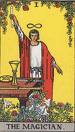
Tarot Card From Deck
interesting to know which deck Green used. He fails to tell us.
To be able to read well one must have an implicit understanding of each of the cards as well as being a subtle enough psychologist to apply the meanings to he or she for whom you read. Green apparently had both qualifications. Thus over thousands of readings over the six years he became very familiar with the characters and personalities of his subjects John and Yoko. Still, they seem to have been very successful in letting him know only what they wanted him to know.
As he apparently didn’t take notes, limiting in itself, he relies on his memory and familiarity with the Ono’s mental processes to reconstruct a continuum of the six years. While one may question the veracity of his method he seems to capture the mental and vocal traits of both John and Yoko. I have no trouble accepting the portraits while as the details can be corroborated elsewhere I see no reason to question Green’s general accuracy. Otherwise there is no one who doesn’t make mistakes in fact or interpretation.
His two portraits while revealing conflict with other accounts such as that of May Pang or Fred Seaman the obvious reason is that

May Pang
the Onos are only letting him see what they want him to see. For instance, in their 1980 interview the Onos state that Yoko had brought the estate up to 150 million dollars yet Green has Yoko spending so fast that they are always on the brink of insolvency. At times expenditures seem to exceed cash on hand.
Green believes himself to be their only investment advisor but that isn’t the case. Just as Yoko had her Japanese numerologist who Green didn’t come into contact with and other occult advisors she must have had other financial advisors.
The picture Green paints of Yoko is far from pretty while he never openly denigrates her yet as he creates his layers of detail she not only becomes but goes beyond eccentric. Her dependence on the occult is such that when someone advised her of a ‘genuine’ witch in Colombia she dragged Green along on the trip to South America to visit the woman. Always lavish in her expenditures, she gave one medium a blank check for her to fill out, she gave this woman 60,000 dollars for her ministrations. When Green protested that the woman had meant pesetas rather than dollars Yoko was unfazed.
Thus while Yoko denied any dependence on John she only was able to realize her vision of herself through the former Beatle’s wealth and influence.

Yoko in one of her many guises.
This was no more evident than in Yoko’s competition with her mother. For two successive summers John and Yoko visited Japan. According to Yoko the intent was to establish some rapport so that her son Sean wouldn’t be cut out of the family fortune that was considerable. The trips were conducted on such an extravagant scale that according to Green the Onos were cash poor as a result. Nevertheless Yoko went on spending so either they had funds of which Green knew nothing or they got money from somewhere.
The fact that they always seemed to have enough cash to do anything from spending a few millions on dairy farms and cows to Japanese vacations that it seems strange that when they received an extortion attempt for 200,000 dollars Yoko said they had no money. The extortion attempt seems to have been a protection racket- pay and live or go the police and die. As the extortioners told Yoko that if she went to the cops they would only protect her for a while. When they left whether a year or two later the extortioners would strike.
The Onos refused to comply calling in the FBI. The FBI advised them to substitute newspaper for money and they would arrest the pickup man. Strangely the pick up man was able to elude the FBI. And then two years or so later Lennon was hit by exploding bullets and killed on his doorstep. While one cannot say the two events are connected yet the assassination followed the extortionists plans. Chapman did make a stop to speak to an unidentified party before he pulled the trigger. But nothing is clear.
Yoko first contacted Green during Lennon’s ‘Lost Weekend.’ While Lennon believed, and it seems clear, that Yoko had informants watching John while he was in LA, Green has her denying this saying that it was his card readings that kept her informed of John’s doings. In all likelihood she checked her spies’ information against his readings.
From ’75 to ’80 Lennon was in a severe depression being unable or unwilling to function in a normal way. Of course there was no reason for him to act ‘normal’ as he was able to deal with his funk in his own way. Who is there to say that ‘normal’ was better? As he told Green his muse had left him leaving him unable to write. As he said, call it writer’s block or whatever, he couldn’t work. Enough reason for depression in an artist.
Then in 1980 when he came out of it being again able to write, Yoko in her desperate attempt to be his equal insisted on being part of the new record she called Double Fantasy. John adamantly refused to let her perform on his own tracks while she didn’t want her tracks all on one side for fear that no one would listen to side B, so they alternated tracks.
Thus, even though Yoko insisted that she was the most talented artistically and musically of the two she was forced to hitch her wagon to John’s star.

Yoko in one of her variety of men's hats and double fantasy glasses.
2.
I found Green’s treatment of Lennon to be more sympathetic than his treatment of Yoko. The inevitable conclusion one comes to about Yoko is that at best she was a pathetic human being while at worst an obsessive-compulsive and a dangerous one at that.
The portrait he depicted of John is that of a man with a completely disintegrated personality entering the mid-life crisis. During this five year period he begins a process of reintegration. Actually his course is that of the mythological hero who experiences his ‘madness’ at this period of the mid-life crisis.
During this period Lennon is essentially egoless. Part of Timothy Leary’s LSD mantra was that one should abandon the ego. Of course to abandon the ego leaves one defenseless and a prey to sharpers who use their ego only too well, nevertheless Lennon bought in and abandoned his ego, or so he says. As he abdicated his identity to the use of Yoko Ono this was obviously the case.
So, he allowed himself to be manipulated by Yoko spending long periods of months over years ruminating naked in his bed, totally exposed as it were protected only by the good will of Yoko. Then, for whatever ulterior motive, Yoko sent John on a solo trip around the world. This was her mistake.
While in Macau, China Lennon had an epiphany in his hotel room. This is a fairly common one but self-revelatory. One might name it the peeling of the onion. In Lennon’s case he obviously felt that he had multiple personalities acquired through various traumatic events in his life.
As he described it to Green he was in his hotel room when he succeeded in peeling a layer of the onion, a personality, off which appeared as real and visible to him as shirt or a suit of clothes. He draped the personality over a chair then began to peel off layer after layer hanging them about the room or draping them over the furniture. When he awoke the next morning he could see them just where he put them. He then conceived the notion of leaving them there as he ran away from their influence.
This is a beautiful little fantasy. But then he turned the corner and there was oneof his selves waiting for him. Visualize the Rock And Roll cover and I think you begin to have it. He then realized he couldn’t escape in that fashion so he went back to his hotel and said ‘C’mon’ to his personalities and continued on his journey. However having identified his ‘problems’ by name, as it were, the seeds for resolving those problems had been sown.
He then returned to the Dakota and while he confined himself to his room rather than merely sinking into depression he began working through those layers of fixations or depression gradually recovering his muse and removing his writer’s block enabling him to compose again.
It would seem that Yoko preferred John psychologically incapacitated so that she could either control him or make herself believe that she was the more talented. Green notes that as John improved Yoko seemed to deteriorate. He quotes her as saying that she had heard some of John’s new songs and they were not very good while hers were.
Dissociated from reality as she was then she couldn’t let John record an LP of songs that might be a hit while anything she recorded on her own would be relegated to the garbage. She even refused to record one side all John and one side all her for fear that no one would listen to her side so she demanded they alternate tracks. I presume that is one reason the LP is entitled Double Fantasy.
While Yoko actually believed in the Tarot and her Japanese numerology, witchcraft and whatever John intelligently disregarded the occult aspects while he might have seen the utility of the Egyptian religous aspects to reveal character and motivation. In fact the innumerable readings of the Tarot might have led up to the revelatory epiphany in China and hence the lifting of his depression.
If that were the case then there would have been little difference between the Egyptian system of Tarot and psychoanalysis. But, as I say, I have no idea of which deck Green was using although the principle remains the same.
3.
After having been on 24/7 call for six years as the Onos moved into what seems to have been a new phase Green lost his usefulness to Yoko sitting by a phone that never rang.
Green had succeeded too well. As he has John explain to him when Yoko first employed him she set him seven tasks. He had successfully completed all seven being now redundant. While John promised to look out for him, of course events eliminated any such possibility.
Regardless of whether the Ono Lennons were the subject of Green’s book I found the whole concept interesting. I like the way Green told his story, his tone and his outlook. His telling made me take an interest in himself. Unfortunately his name being so common makes it too difficult to search out anything of his subsequent career other than he moved to Washington DC.
Perhaps he could write a sequel to Dakota Days from another angle and with more detail. Pressing issues might not be so pressing now. I’d be interested.

Happy Trails To You.
Exhuming Bob 24: Bob And Expecting Rain
February 11, 2010
Exhuming Bob 24: Bob And Expecting Rain
by
R.E. Prindle
…or else they’re expecting rain.
My recent essay Exhuming Bob 23a: Bob, Andy, Edie And Like A Rolling Stone posted on the Expecting Rain site drew a few comments. As I’ve been excluded from the site I was very surprised to find the site published the essay. I’m not going to sign up for the discussion board so I’ll respond in this way. If it gets posted, fine.
I consider Exhuming Bob 23a a pretty good piece of scholarship so I’m pleased to have elicited a response that wasn’t all that negative.
The chief criticism came from CL Floyd so I’ll concentrate on his. Some of Floyd’s objections I consider worth answereing but some I find curious.
Floyd began his criticism: this is an incredible piece of reductionism… Yeah? What’s the problem? One has to begin somewhere. Dylan has said that he had this 20 pages of ”vomit’ tentatively titled Like A Rolling Stone. Right on. So he’s got twenty pages of inchoate kvetching that Edie Sedgwick catalyzed into several verses that while it applied directly to her as a symbol, what it symbolized was ‘this pain in here’ that centered around Dylan’s childhood. Thus as Warren Peace perceived, even though the central kvetch precedes Sedgwick the context centers directly on her person.
Floyd relates the whole to the title: ‘I especially enjoyed the in depth analysis of where the use of the phrase “rolling stone” came from.’ Muddy Waters had nothing to do with it. I doubt if Dylan had even heard of Waters’ song before he came to NYC if he did then.
The meaning of the phrase ‘a rolling stone gathers no moss’ is obvious while its use must go back very, very far. Apparently Dylan thinks being a rolling stone is a curse too hard to bear. His own understanding of the term goes back to Hank Williams’ not Muddy Waters’ song ‘Lost Highway.’
I’m just a rolling stone
All alone and lost
For a life of sin
I have paid the cost…
I’m just a rolling stone
On the lost highway.
I don’t mean to be rude but there were millions of us who related to Williams’ lyric in exactly the same way as Dylan.
But Floyd seems especially offended by the twist given to the meaning by my correspondent, Robin Mark. She has thought about the problem for some time. She realized that Stone was his mother’s maiden name so that there was a double entendre in Beattie Stone and a rolling (Bob) stone. Now, Mr. Floyd (or Miss, perhaps, CL is indeterminate) is apparently unaware that one can only be considered Jewish through the female side. If your father is Jewish and your mother isn’t then you are not a Jew, thus Jewishness is matrilineal not patrilineal even though your Jewish name may be Moishe Ben Avram- that is Moses the son of Abram. So, Dylan can claim the Stone name also. I thought it was a clever application and a neat double entendre.
Now, a major concern of my writing is to place Dylan within a context of his place and time. Shelton, Heylin, Sounes and others have done an excellent job of organizing the details of Dylan’s career to the exclusion of the other participants such as, for instance, Albert Grossman.
As Peter Yarrow says, without Grossman there would be no PPM and no Dylan. I have always been mystified as to who Grossman’s connections were that allowed him to finance the organization of PPM and get them a WB contract without a single performance.
I broached this subject in my essay, Exhuming Bob XVII My Son The Corporation. Since then I have learned that Grossman was aligned with Mo Ostin of WB and that the financing came from that quarter. That the group was immediately successful must have been gratifying. With the success of PPM the promotiuon of Dylan became possible. https://idynamo.wordpress.com/2008/12/10/exhuming-bob-xviii-bob-dylan-my-son-the-corporation/
That’s a start.
Mr. Floyd finds it coincidental that the key participants are Jewish. He apparently does not recognize a Jewish cultural and political influence directed to the realization of Jewish ends. If he’s complicit, so be it, but as an historian I have an obligation to note motivations from whatever quarter they come from. You don’t need a weatherman to tell which way the wind blows. I have no sacred cows and that is as it should be.
And finally, I believe that I have uncovered or illuminated, take your choice, a signficant and important sub-text of Dylan’s history. I dig the term ‘NY gossip’ that Mr. Floyd uses to discredit the facts. In point fact, David Bourdon who was there gives an almost gang like division of NYC. As he saw it Dylan was ‘pope’ of Downtown, Warhol ‘pope’ of mid-town and something vague uptown.
After BOnB in mid ’66 Dylan hadn’t abandoned Manhattan. The motorcycle accident with concussion and three cracked vertebrae changed his plans. After he had healed he in fact moved back to MacDougal St. to begin having his garbage searched by Weberman. By then the sixties were essentially over. Warhol was shot in ’69 changing the direction of his career, while Altamont put the period to the whole sixties fantasy. Shortly Dylan would be releasing an album called New Morning. Optimistic.
So, I certainly appreciate the kind attention of those who commented. If Matchlighter’s ‘mouth popped’ from 23a I hope he finds 23b just as entertaining. It has been posted.
Thank you and you’re invited one and all.https://idynamo.wordpress.com/2010/01/27/exhuming-bob-23b-of-a-b-bob-andy-edie-and-like-a-rolling-stone/
A Review: On Tarzan By Alex Vernon
November 13, 2009
A Review:
On Tarzan
by
Alex Vernon
Review by R.E. Prindle
Vernon, Alex: On Tarzan, 2008, UGeorgia Press
This book reads almost like the cover of The Doors LP Strange Days. You’ve entered into some kind of literary twilight zone. This is perhaps the most eccentric book I’ve ever read. I can’t believe it was actually published- and by a University press!
Alex Vernon has a PhD and is an Associate Professor at Hendrix College. Must have been founded by Jimi before he OD’d. I’m flabbergasted that the guy has a job. Average looking Joe from the back cover. Happy, smiling. Doesn’t look like he’d be sex obsessed but it could be a problem for him.
The phallus on the cover dismayed me but prepared me for the sex driven content. Zany, zany, zany. A large phallus rises out of what might be the swamp, symbol of the female, or perhaps jungle growth meant to represent pubic hair.
When Vernon says On Tarzan he doesn’t mean Tarzan by Edgar Rice Burroughs he means Tarzan as a ‘living’ entity to which history Burroughs is only one contributor albeit an important one, Philip Jose Farmer almost eclipses Burroughs as a contributor to the Tarzan ethos in Vernon’s mind. Mainly for Farmer’s outrageous sex episodes.
Tarzan ethos is about it. Everything is thrown indiscriminately into the stew pot. Books, movies, TV shows, articles, even artefacts, Tarzan underwear. Vernons says he interviewed Bill Hillman at ERBzine although it is difficult to find what he gleaned from the conversation, wait a minute, maybe the reference to the 1893 Columbian Expo. Bill was probably hot on that topic.
As literary critic Vernon doesn’t so much analyze as create. He uses Tarzan body parts from various books and films to create his own monster, and his Tarzan is monstrous.
As I say he uses his sources as though making a stew; mixing them up to creat a sex driven Tarzan that no twelve year would recognize as his hero.
Vernon doesn’t seem able to distinguish the motives, the agendas of the various sources who are projecting their own inner world on Tarzan such as Bo and John Derek in their vision of The Big Bwana. I didn’t say Banana; I said Bwana. Melding these sources doesn’t create a ‘biographical composite’ of Tarzan that all can agree on; it is merely the projection of Vernon’s own inner psyche.
Apparently Vernon’s approach is a valid historical literary criticism technique in today’s academic environment. It’s not what you say but who you say it about. As I say it goes beyond interpretation or revisionism into creating an alternate universe.
The approach intrigued me. In that spirit I offer my own creation of Tarzan and a revisionist/creation of history. In the view of facts as they might be construed by a fanatic with an agenda I offer Tarzan as an agent of Globalism serving as the first viceroy of Africa.
Mr. Vernon keeps talking about a colonial period as if such a thing has ever existed. His professors must have been from the stone age. As advanced thinkers know what these prehistoric monsters refer to as colonialism was in reality the early stages of what is now recoginized as Globalism. This how Globalism began. In the very early stages all cultures were relatively distinct, living in separate well defined areas. The Chinese were in China, Africans were in Africa, Europeans were in Europe. Further relatively internal distinct sub-divisions can be made on all continents. It was clear to the most primitive minds, well, actually European primitive minds, that what was needed to…well for whatever reason they had…to make the world a more secure place was Globalism. Wars were anathema but one couldn’t create Globalism without some really destructive wars so they forged fearlessly ahead secure in the purity of their intentions. This posited the problem of bringing together in most cases people who didn’t know other cultures even existed, those ‘lesser races outside the law.’
As I say Europeans were then and are now the promoters of the cause of Globalism. It’s good for people and it’s good for the Global Money Trust. Initially Europe sent out ships and explorers to the four corners of the Earth. In that far off, almost once upon a, time unlike today local populations were hostile to what they mistakenly called invaders. Sometimes their resistance involved military force, in other words war; so in self-defense it was necessary to mow the heathens down. We had screw guns and maxims and they didn’t. Rather foolish on their part while causing Globalists a great deal of emotional distress. Almost had a nervous breakdown. It could have been avoided. Globalists only wanted peace if they had understood.
Gradually the peoples of the world learned that they going to have to peacefully interact if even at gunpoint. But then there was disagreement in Europe. the Global barriers were being lowered as this beneficent ideology of Globalism was slowly accepted. As expected there were reactionary elements. In both cases the criminal Germans were the hard nuts. They insisted on the right to be themselves rather than submerging their identity into what the Globalists wanted. Their resistance was futile; Globalists got what they wanted anyway, the Globe be damned. After the second German petulance Globalists crushed them. Some wanted to exterminate the whole lot, raze Germany to the ground and turn it into pasture land. I don’t have to tell you that gentler and more loving heads prevailed. Globalists gave the African troops leave to loot Strasbourg and rape the German women and let it go at that. You see, there are some sacrifices we all have to make.
It is best not to oppose Globalist wishes. Globalism will be had on their terms or they’ll get rid of ya. As another example, the Kulaks of Russia opposed Globalist wishes and it was necessary to exterminate them to the man, woman and child. I won’t tell you the intense emotional pain that incident cost the Globalists, those were not crocodile tears as often alleged. People won’t be happy unless the blessings of globalism are universal. That’s what Globalism means, universal.
Now, one of the great advocates of Globalism was the progressive American ‘fantasy’ writer, Edgar Rice Burroughs. Fantasy, humph. As Edgar’s avatar of Globalism he created the character of Tarzan the Ape Man. The brilliance of the ape man is almost incomprehensible. As Mr. Vernon points out Tarzan united the fauna being man and beast at one and the same time. His being encompassed all evolution, unlike the rest of us who are products of only a few of the commoner genes, as he passed through the stages of Beast, Negro and European. How fitting that Edgar Rice Burroughs should make him the very first Commissar, even Czar, of Africa. Yes, he was White. But only we Liberal White people have understood our manifest destiny to bring all peoples together in Globalism. Well, yes, there were mistakes and, quite frankly, genocides, but they were necessary and not arbitrary. They were decided on only after long and careful deliberation. It was like pruning a tree to make it more beautiful. When Chairman Mao finished pruning the recalcitrant Chinese there were 50 million branches on the ground, but, what of it? As Mao himself benignly and poetically, he was a poet you know, intoned: ‘So? Will the flowers not blossom in spring and cool breezes not blow across waving fields of grain.’ Of course they would and as proof they have and will continue to do so. How ridiculous! There’s always new babies to replace those gone. Come on!
Edgar very cleverly has that man we now know as a villain, Stalin, seek to replace Tarzan as Commissar because he was in fact too just and too gentle with his charges. Rather than compelling Africans to hew to the Party line Edgar portrays Tarzan letting the Africans do as they please so long as they didn’t kill each other. That was in his brilliant history he called Tarzan the Invincible, and he wasn’t kidding. It wasn’t unreasonable to send a replacement from Moscow but Edgar perversely has Tarzan defeat his replacement. You can read about it in Edgar’s history yourself.
So, Mr. Vernon has expended a great deal of effort to prove the unprovable. He completely mistakes the reason for the US presence in Viet Nam. This was not nation building as he has been induced by his professors to believe. This was a necessary stage in the creation of Globalism. Today the two halves of Viet Nam have been reunited because of their efforts and Globalism is progressing nicely there, thank you very much.
A larger problem was to bring China into the Globalist empire.. But that was cleverly done by inducing them to manufacture big screen TVs for not only the province of the United States but the world. Today they are the Globe’s largest manufacturer of flat screen TVs and tennis shoes and are assisting in the Globalism of Africa sending their tens of millions of excess personnel to help the Africans enter the Global economy.
I certainly appreciate the effort Mr. Vernon has put into his project; it is regretable he has been so ill informed about the difference between Globalism and colonialism. Colonialism is when you occupy a country for selfish reasons; Globalism is when you subject or exterminate a people for the right reasons.
The Global Cabal is sorry people had to die. As the old saw says: You can’t make an omelet without breaking a few eggs. Its better to be the hammer than the nail.
I’m sorry Mr. Vernon but I can’t recommend your book.
Themes And Variations
The Tarzan Novels Of Edgar Rice Burroughs
#5 Tarzan And The Jewels Of Opar
Part V
by
R.E. Prindle
Texts:
Du Maurier, George: Peter Ibbetson
Dudgeon, Piers: Captivated: J.M. Barrie, The Du Mauriers & The Dark Side Of Neverland, 2008, Chatto And Windus
Hesse, Herman: The Bead Game
Neumann, Erich: The Origins and History Of Consciousness, 1951, Princeton/Bollingen
Vrettos, Athena: “Little Bags Of Remembrance: Du Maurier’s Peter Ibbetson And Victorian Theories Of Ancestral Memories” Erudit Magazine Fall 2009.
While it is today commonly believed that Sigmund Freud invented or discovered the Unconscious this is not true. As so happens a great cataclysm, The Great War of 1914-18, bent civilization in a different direction dissociating it from its recent past.
Studies in the earlier spirit of the unconscious continued to be carried on by C.G. Jung and his school but Freud successfully suppressed their influence until quite recently actually. Through the fifties of the last century Freud’s mistaken and harmful, one might say criminal, notion of the unconscious held the field. Thus there is quite a difference in the tone of Edgar Rice Burroughs writing before and after the 1917 Bolshevik Revolution.
There are those who argue that Burroughs was some kind of idiot savant who somehow knew how to write exciting stories. In fact he was a well and widely read man of varied interests who kept up on intellectual and scientific matters. He was what might be called an autodidact with none of the academic gloss. He was very interested in psychological matters from hypnotism to dream theory.
The scientific investigation of the unconscious may probably be dated to the appearance of Anton Mesmer and his interest in hypnotism also variously known as Mesmerism and Animal Magnetism. The full fledged investigation of the unconscious began with hypnotism. Slowly at first but by the last quarter of the nineteenth century in full flower with varied colors. Science per se was a recent development also flowering along with the discovery of the unconscious.
While Charles Darwin had brought the concept of evolution to scientific recognition in 1859 the key discipline of genetics to make sense of evolution was a missing component. It is true that Gregor Mendel discovered the concept of genetics shortly after Darwin’s Origin Of Species was issued but Mendel’s studies made no impression at the time. His theories were rediscovered in 1900 but they were probably not widely diffused until after the Great War. Burroughs knew of the earlier Lamarck, Darwin and Mendel by 1933 when he wrote Tarzan And The Lion Man. His character of ‘God’ is the result of genetic mutation.
Lacking the more complete knowledge of certain processes that we have today these late nineteenth century speculators seem ludicrous and wide of the mark but one has to remember that comprehension was transitting the religious mind of the previous centuries to a scientific one, a science that wasn’t accepted by everyone then and still isn’t today. The Society For Psychical Research sounds humorous today but without the advantage of genetics, especially DNA such speculations made more sense except to the most hard nosed scientists and skeptics. The future poet laureate John Masefield was there. Looking back from the perspective of 1947 he is quoted by Piers Dudgeon, p. 102:
Men were seeking to discover what limitations there were to personal intellect; how far it could travel from its home personal brain; how deeply it could influence other minds at a distance from it or near it; what limits, if any, there might be to an intense mental sympathy. This enquiry occupied many doctors and scientists in various ways. It stirred George Du Maurier…to speculations which deeply delighted his generation.
Whether believer or skeptic Burroughs himself must have been delighted by these speculations as they stirred his own imagination deeply until after the pall of the Revolution and Freud’s triumph.
Burroughs was subjected to dreams and nightmares all his life. Often waking from bad dreams. He said that his stories were derived from his dreams but there are many Bibliophiles who scoff at this notion. The notion of ‘directed dreaming’ has disappeared from popular consideration but then it was a serious topic. Freud’s own dream book was issued at about this time. I have already reviewed George Du Maurier’s Peter Ibbetson on my blog, I, Dynamo and on ERBzine with Du Maurier’s notions of ‘Dreaming True’. It seems highly probable that Burroughs read Ibbetson and Du Maurier’s other two novels so that from sometime in the nineties he would have been familiar with dream notions from that source.
Auto-suggestion is concerned here and just as support that Burroughs was familiar with the concept let me quote from a recent collection of ERB’s letters with Metcalf as posted on ERBzine. This letter is dated December 12, 1912.
If they liked Tarzan, they will expect to like this story and this very self-suggestion will come to add to their interest in it.
Athena Vrettos whose article is noted above provides some interesting information from Robert Louis Stevenson who developed a system of ‘directed dreaming’ i.e. auto-suggestion. We know that Burroughs was highly influenced by Stevenson’s Dr. Jekyll And Mr. Hyde while he probably read other novels of Stevenson. How could he have missed Treasure Island? Whether he read any of Stevenson’s essays is open to guess but in an 1888 essay A Chapter On Dreams Stevenson explained his method. To Quote Vrettos:
Rather than experiencing dreams at random, fragmented images and events, Stevenson claims he has learned how to shape them into coherent, interconnected narratives, “to dream in sequences and thus to lead a double life- one of the day, one of the night- one that he had every reason to believe was the true one, another that he had no means of proving false.” Stevenson describes how he gains increasing control of his dream life by focusing his memory through autosuggestion, he sets his unconscious imagination to work assisting him in his profession of writer by creating “better tales than he could fashion for himself.” Becoming an enthusiastic audience to his own “nocturnal dreams”, Stevenson describes how he subsequently develops those dreams and memories into the basis for many of his published stories, most notably his 1886 Dr. Jekyll And Mr. Hyde.
Now, directed dreaming and Dreaming True sound quite similar. One wonder if there was a connection between Stevenson and Du Maurier. It turns out that there was as well as with nearly the entire group of English investigators. Let us turn to Piers Dudgeon again, p. 102:
Shortly after they met, the novelist Walter Besant invited [Du Maurier] to join a club he was setting up, to be named ‘The Rabelais’ after the author of Gargantua and Pantagruel. Its name raised expectations of bawdiness, obscenity and reckless living, (which were not in fact delivered) as was noted at the time. Henry Ashbee, a successful city businessman with a passion for pornography, and reputed to be Robert Louis Stevenson’s model for the two sides of his creation, Dr. Jekyll And Mr. Hyde, denounced its members as ‘very slow and un-Rabelaisian’, and there is a story that Thomas Hardy, a member for a time, objected to the attendance of Henry James on account of his lack of virility.
Virility was not the issue however. The members of the Rabelais were interested in other worlds. Charles Leland was an expert on fairy lore and voodoo. Robert Louis Stevenson was the author of The Strange Case Of Dr. Jekyll And Mr. Hyde (1886) which epitomized the club’s psychological/occult speculations. Arthur Conan Doyle, who became a member of the British Society For Psychical Research, was a dedicated spiritualist from 1916. Henry James was probably more at home than Hardy, for both his private secretary Theodora Besanquet, and brother William, the philosopher, were members of the Psychical Society.
In many ways the Rabelais was a celebration that [Du Maurier’s] time had come. Parapsychological phenomena and the occult were becoming valid subjects for rigorous study. There was a strong feeling that the whole psychic scene would at any moment be authenticated by scientific explanation.
Du Maurier was obviously well informed of various psychical ideas when he wrote Ibbetson. In addition he had been practicing hypnosis since his art student days in the Paris of the late 1850s.
So this was the literary environment that Burroughs was growing up in. As Bill Hillman and myself have attempted to point out, ERB’s mental and physical horizons were considerably broadened by the Columbian Expo of 1893. Everything from the strong man, The Great Sandow, to Francis Galton’s psychological investigations were on display. The cutting edge of nineteenth century thought and technology was there for the interested. Burroughs was there for every day of the Fair. He had time to imbibe all and in detail. The Expo shaped his future life. That he was intensely interested in the intellectual and literary environment is evidenced by the fact that when he owned his stationery story in Idaho in 1898 he advertised that he could obtain any magazine or book from both England and America. You may be sure that he took full advantage of the opportunity for himself. As this stuff was all the rage there can be no chance that he wasn’t familiar with it all if he didn’t actually immerse himself in it. Remember his response to Kipling’s The White Man’s Burden was instantaneous. Thus you have this strange outpost of civilization in Pocatello, Idaho where any book or magazine could be obtained. Of course, few but Burroughs took advantage of this fabulous opportunity. It should also be noted that he sold the pulp magazines so that his interest in pulp literature went further back than 1910.
In addition ERB was enamored of the authors to the point of hero worship much as musical groups of the 1960s were idolized so he would have thirsted for any gossip he could find. It isn’t impossible that he knew of this Rabelais Club. At any rate his ties to psychology and the occult become more prominent the more one studies.
It seems to me that longing as he did to be part of this literary scene, that if one reads his output to 1920 with these influences in mind, the psychological and occult content of, say, the Mars series, becomes more obvious. He is later than these nineteenth century lights so influences not operating on them appear in his own work making it more modern.
At least through 1917 the unconscious was thought of as a source of creativity rather than the source of evil impulses. If one could access one’s unconscious incalculable treasures could be brought up. Thus gold or treasure is always depicted in Burroughs’ novels as buried. The gold represents his stories, or source of wealth, brought up form his unconscious. The main vaults at Opar are thus figured as a sort of brain rising above ground level. One scales the precipice to enter the brain cavity high up in the forehead or frontal lobe. One then removes the ‘odd shaped ingots’ to cash them in. Below the vaults are two levels leading back to Opar that apparently represent the unconscious. Oddly enough these passageways are configured along the line of Abbot’s scientific romance, Flatland.
In Tarzan And The Jewels Of Opar the gold is taken to the Estate and buried replicating the vaults. Once outside Opar and in circulation, so to speak, the ingots are accessible to anyone hence the duel of Zek and Mourak for them. The first gold we hear of in the Tarzan series is brought ashore and buried by the mutineers. This also sounds vaguely like Stevenson’s Treasure Island. The watching Tarzan then digs the gold up and reburies it elsewhere. In The Bandit Of Hell’s Bend the gold is stolen and buried beneath the floorboards of the Chicago Saloon. Thus gold in the entire corpus is always from or in a buried location. These are never natural veins of gold but the refined ingots.
Not only thought of as a source of treasure during this period the unconscious was thought to have incredible powers such as telekinesis, telepathy and telecommunication. One scoffs at these more or less supernatural powers brought down from ‘God’ and installed in the human mind. As they have been discredited scientifically Western man has discarded them.
On the other hand Western Man deludes himself into accepting the oriental Freud’s no less absurd assertion that the unconscious exists independently of the human body somewhat like the Egyptian notion of the ka and is inherently evil while controlling the conscious mind of the individual. This notion is purely a religious concept of Judaism identifying the unconscious as no less than the wrathful, destructive tribal deity of the old testament Yahweh. Further this strange Judaic concept of Freud was allowed to supersede all other visions of the unconscious while preventing further investigation until the writing of C.G. Jung were given some credence beginning in the sixties of the last century.
In point of fact there is no such unconscious. The supernatural powers given to the unconscious by both Europeans and Freud are preposterous on the face of it. For a broader survey of this subject see my Freud And His Vision Of The Unconscious on my blogsite, I, Dynamo.
This so-called unconscious is merely the result of being born with more or less a blank mind that needs to be programmed. The programming being called experience and education. The maturation and learning process are such that there is plenty of room for error. All learning is equivalent to hypnosis, the information being suggestion which is accepted and furthers the development of the individual. Learning the multiplication tables for instance is merely fixing them in your mind or, in other words, memorizing them. All learning is merely suggestion thus it is necessary that it be constructive or education and not indoctrination or conditioning although both are in effect. Inevitably some input will not be beneficial or it may be misunderstood. Thus through negative suggestion, that is bad or terrifying suggestions, fixations will result. A fixation is impressed as an obsession that controls one’s behavior against one’s conscious will, in the Freudian sense. The fixation seems to be placed deep in the mind, hence depth psychology. Thus when ERB was terrified and humiliated by John the Bully certain suggestions occurred to him about himself that became fixations or obsessions. These obsessions directed the content of his work.
To eliminate the fixations is imperative. This is what so-called depth psychology is all about. The subconscious, then, is now ‘seprarated’ from the conscious, in other words the personality or ego is disintegrated. The goal is to integrate the personality and restore control. Once, and if that is done the fixations disappear and the mind become unified, integrated or whole; the negative conception of the unconscious is gone and one is left with a functioning conscious and subconscious. The subconscious in sleep or dreams then reviews all the day’s events to inform the conscious of what it missed and organize it so that it can be acted on. No longer distorted by fixations, or obsessions, the individual can act in his own interests according to his abilities. The sense of living a dream life and a real life disappears.
That’s why experience and education are so important. What goes into the mind is all that can come out.
But, the investigation of the unconscious was blocked by Freudian theory and diverted from its true course to benefit the individual in order to benefit Freud’s special interests.
So, after the War ERB forgot or abandoned the wonderful notions of the unconscious and was forced to deal with and defend himself against Freudian concepts. The charactger of his writing begins to change in the twenties to meet the new challenges of aggressive Judaeo-Communism until by the thirties his work is entirely directed to this defense as I have shown in my reviews of his novels from 1928 to 1934.
Tarzan And The Jewels Of Opar then reflects this wonderful vision of the subconscious as portrayed by George Du Maurier and Robert Louis Stevenson
Then the grimmer reality sets in.
End Of Review.
Conversations With Robin Page 3
August 20, 2009
< Wep>
Conversations With Robin, Page 3
Conversations between R.E. Prindle And Robin Mark
Well, well, well. Robert Goulet. I should have known that filthy bastard would be mixed up in there somewhere. What amazes me is that Guralnik could write two fat volumes on Elvis and never mention the Mob once. I think we can begin to integrate Elvis’ Mob conflicts pretty clearly now, although research will have to establish the connections for sure.
For starters, entertainment is a Mob industry both records and movies; that includes both Jews and Sicilians. If you haven’t read Gus Russo’s Supermob yet, do so. The Sidney Korshak role at MCA is crucial.
Anent shooting out TVs remember that Sinatra had a plane he called Superwop or something to that effect so it is clear he bore a grudge against the Anglo world. The plane was a small ‘Lear’ if I remember correctly. Elvis went out and bought a 707. Big plane, big penis; little plane little penis. Not exactly true in Frank’s case, but you get the point. So at least Goulet and Sinatra. I can understand why Dean Martin tried to distance himself from those creeps.
Parker must have had the business dealings with the Outfit. As he ran into gambling problems the only commodity he had to barter was Presley. Thus he would have had to ‘sell’ Presley to keep both his legs under him. Elvis’ rapid deterioration could have been because of his realization that he was ‘caught in a trap. I can’t get out.’ Devastating awareness. One could only retreat into booze and/or drugs.
Now, Leiber said that he and Stoller at one time worked for the Mafia. This wouldn’t be unusual nor should it be held against them because if you’re in entertainment you’re involved, like it or not. The question is when were they involved, for how long, and for what purpose.
We all know Fabian was a Mob creation. Why not others? If you haven’t seen and studied The Girl Can’t Help It, do so. The movie is an alegory of the record business. Everything you see in the movie is the Outfit in action. In the fifties every Juke Box in America was stocked by the Outfit. You didn’t get your record stocked unless you were Mobbed up somewhere along the line. Someone recently told me that the girls on the Dick Clark Show were prostitutes and Bandstand was used to showcase them for Johns. Don’t know that it’s true but I wouldn’t be surprised.
Leiber and Stoller could have been co-opted to write songs for, say, The Coasters. A Black act with interchangeable personnel. Kind of an early Back Street Boys. I don’t know but I’d like to hear Leiber talk about it. Might prove enlightening.
So, let us assume that the Colonel was drawn into the Mob scene from the beginning of Presley’s movie career. That might explain some of his stupid decisions and those dumb movies. Perhaps Parker didn’t have a free hand but was ‘wise’ enough to figure out that something is better than nothing.
Then after Vegas Presley was increasingly drawn into orbit until he learned the horrifying truth. Guralnik seems to have his head up his ass as far as I’m concerned.
As Presley learned the truth looking forward to forty more years of slavery he found drugs more comfortable than reality. Possible, it would make things make sense.
Exhuming Bob 21: Will The Real Bob Dylan…?
July 27, 2009
Exhuming Bob 21:
Will The Real Bob Dylan…?
http://contemporarynotes.wordpress.com/2009/04/05/greil-marcus-bob-dylan-bill-ayers-barry-obama/

Dylan
Our friend Bob Dylan has given the impression that he knew nothing of Barry Obama, The Great Black Hope, until the summer of 2008 with just a few months left in the campaign when he gave the candidate his endorsement. Surely this isn’t so. Surely he not only knew of the Hope but knew him personally probably before 9/11/01.
In my essay Bill Ayers, Greil Marcus, Bob Dylan and Barry Obama on my Contemporary Notes blog, linked above, I posit that all four knew each other and of 9/11 before it happened. Impossible, huh? Stranger things have happened.
I hadn’t thought about it much after writing my piece but then a few days ago- 7/22/09- I came across a post by one Lark, The Times Are A Changing (Again): Bob Dylan On Obama. Lark quotes Dylan on Obama in the London Times. Let’s review it:
Dylan begins: “Well you know right now America is in a state of upheaval.”
True enough. Many sorts of upheaval. What sort of upheaval does Dylan refer to:

Bomber Billy Ayers
Poverty is demoralizing.
Can’t argue with that. Is he talking about coal miners, fruit pickers, the unemployed, or what?
You can’t expect people to have the virtue of purity when they’re poor.
More problematic here. Purity isn’t a virtue it’s a state or condition. Has nothing to do with poverty. Well, Dylan’s a poet, one of the enigmatic kind, so I presume he may mean honest by pure. But which people, is he talking about Blacks?
Well, I come from a long line of poor people and so far as I know we were the kind described as ‘poor but honest.’ In other words we didn’t steal or cheat. I’m not sure how scrupulous we were about lieing. Seems to be a much more common fault. I’ve been around the block a few times now and I’ve come to the conclusion that crime has nothing to do with poverty. Rich or poor a thief steals and is well able to justify his thefts. Need I point out the 50 billion dollar thief Bernie Madoff? Or about the raft of Rabbis just arrested in New Jersey for some very serious financial crimes. And then I read about this reasonably well off one guy who stole some records because he thought he could use them better than the rightful owner. So it may be common to think you have to be poor to be ‘impure’ or dishonest but mistaken nevertheless.
Bob makes himself a little more clear:
But we’ve got this guy out there now who is redefining the nature of politics from the ground up…Barack Obama.
Naive but sincere. Spoken like a true cheerleader. ‘This guy out there’ sounds like affection if not familiarity to me. So now, when and how did Dylan become aware of the Hope? As I conjecture it Greil Marcus is the key to the riddle. I’m guessing, but my guess is that Marcus’ curiosity led him to introduce himself or be introduced to Bill Ayers, the ole Mad Weatherman Bomber, probably in Chicago. Ayers and Marcus being of the school of Whiteness is a plague on the Earth probably quickly came into accord. And then the Hope was probably on the way under the sponsorship of Ayers so Marcus and the Hope were introduced when certain anti-American and anti-White plans were discussed probably among them a projected attack on America. Certainly one remembers that Ayers had already made several bomb attacks on America so why not the Big One…the Really Big One…the World Trade Center.

Greil Marcus
Dylan and Marcus are pretty close. Dylan is either a Lubavitcher or close to them. Lubavitchers hate Whites, especially of the Christian sort. That partially excludes me by the way, White but not of the Christian persuasion.
As it appears that Dylan was much more familiar with the Hope than he let on and his album Love And Theft seems to reflect a pre-knowledge of 9/11 coupled with Marcus’ Rolling Stone article as detailed in the link to my essay above, there is every reason to believe, or think, or fear that Dylan, Marcus, Ayers and Obama were privy to 9/11 well before it happened. Possibly if not probably in on the planning stages.
Dylan goes on: He’s redefining what a politician is, so we’ll have to see how things play out.
If the Hope is redefining what a politician is then the definition is toward that of an African chief. An African chief owned every bit of his territory personally. He owned every inhabitant as his slave to dispose of as he wished. He was free to do with all as he chose with or without their consent.
That seems to be how the Hope is playing things out. True, the Hope is somewhat hobbled by the remains of the old political system but with his Liberal allies he has so far met with no insuperable resistance. To oppose his plans is to be vile. So far the fear of being considered vile has prevailed.
Then Dylan: Am I hopeful? Yes. I’m hopeful that things might change. Some things are going to have to.
Well things have changed. Many of us believe the way things are changing is in a direction more destructive than beneficial. In short the Hope is already a complete failure. We’d all be pleased to have a detailed opinion from Dylan on whether his hopes have been realized.
Dylan then closes with a platitude: You should always take the best from the past, leave the worst back there and go forward into the future.

Yep. Sure enough. I suppose the argument would break down over the issue of what’s best or worst and which has been left behind. There’s no doubt we’re headed into the future. Some kind of future at least.
A Review: Pt. I P.C. Wren The Beau Geste Trilogy
June 23, 2009
A Contribution To The Erbzine Library Project
The Beau Ideal Trilogy Of
P.C. Wren
Beau Geste, Beau Sabreur, Beau Ideal

Review by R.E. Prindle
Part I: Introduction
Part II: Review of Beau Geste
Part III: Review Of Beau Sabreur
Part IV: Review Of Beau Ideal

P.C. Wren
For hundreds of years after the expulsion of the Moors from Spain the Moslems raided the European c0asts of the Mediterranean abducting men, women and children as slaves while also preying on shipping. The newly formed United States sought unsuccessfully to suppress this Moslem piracy. ‘Millions for defense but not one penny for tribute.’ If you remember that one from school.
Finally in 1830 France invaded, conquered and occupied what is now known as Algeria ending the Barbary Pirates.
An army corps was formed and named the Legion Etrangere in French, French Foreign Legion in English to pacify Algeria. Over the next hundred years the Legion was used for peaceful penetration into the Sahara and Sahel to form the French West African Empire.
In an astonishing turn around the Moslem power evaporated while the French easily became the masters of the bulge of Africa. The military superiority was to last until post-WWII when exhausted by two world wars accompanied by a moral collapse as the best and brightest died on the battlefields leaving nothing but singers and dancers to live off the fat of the land. The French were militarily capable but morally bankrupt. The Moslems reasserted themselves in the fifties forcing the French out of Algeria while beginning the invasion of France by peaceful penetration. A neat reversal of fortunes. Thus the conquest of Europe interrupted by the Spanish expulsion began again.
Immediately after the French invasion of Algeria the deserts of Africa beame a playground of Europeans. The lure of the desert held a strange appeal for them. Perahaps devoid of romance in their homelands the desert with its now no longer dangerous but exotic inhabitants replaced the fairies and elves displaced by the scientific revolution. The Euroamerican romance with ‘noble savages’ and ‘inferior races’ may very well be caused by the void created by the scientific revolution. Euroamericans hoped to find or create those emotional or psychological needs lost in the advance of civilization. This may explain to some extent the White worship of people of color whose ‘natural’ uninhibited behavior they profess to admire and imitate. Witness the tatooing and body piercing in imitation of the Africans who themselves appear to have to given it up.
The French having conquered Algeria had to establish an army corps dedicated to perpetual warfare. That unit was the Legion Etrangere or French Foreign Legion. The duty in the Sahara amid an enemy population was so execrable that only men without hope, that is criminals and outcasts with no other options need have applied.
In 1831 then, a year after the conquest and annexation of Algeria as an actual Department of France the French Foreign Legion was created by Louis Philippe the new Bourgeois King of France.
The Legend of the Legion apparently grew very quickly. the first legion novel is thought to be that of the English writer Ouida. She published her novel Under Two Flags in the 1860s. It was a great success ultimately being made into a movie. Alongside the Legion novels were a number of novels that dealt with the desert in a very romantic way.
The genre of novel could only have developed after the French conquest of Algeria after 1830 and a little later with the pacification of the Moslems. If not pacification at least intimidation. Astonishingly the centuries intervening between Roman Africa and the conquest of Algeria vanished from the consciousness of Europeans. In only a hundred years (well, a hundred twenty-five years) a brief interlude, Europeans were in turn expelled from North Africa with their tremendous superiority shattered and in ruins. That brief century now appears like a fairy story without real substance. A hundred years of struggle and dieing ant then- poof! But the stories were great.
Fans of Jules Verne have a very good story- The Barsac Mission- that undoubteldy was an influence of P.C. Wren. The work has only been translated recently issued in two volumes as Into The Niger Bend and The City Of The Sahara by Americor. Some consider the novel science fiction.
The publishers are escapist types who have retreated to Mattituck N.Y. at the most extreme end of Long Island. Unfortunately, as with many of Verne’s books the Barsac has been bowlderized to reflect current Liberal tastes. The translator I.O. Evans coyly expresses it this way: I have also taken the liberty, found necessary by most of Verne’s other translators, of abbreviating or omitting a few passage of minor interest. (cough, cough)
Another wonderful Sahara novel written at the same time as the Barsac is Robert Hichens’ The Garden Of Allah. Hichens was an influence on Burroughs. The novel was very well known at least through my youth. I knew people with whom Hichens’ reputation was very great although I imagine there are few who would recognize his name today.
And then ERB himself devoted a number of pages to the romance of the desert. In The Return Of Tarzan it will be remembered that Tarzan was despatched to Algeria as a French secret agent just along the lines of Wren’s De Beaujolais. The Lad And The Lion is of course a complete Sahara novel that appears to have had an influence on Wren. Korak the Killer of The Son Of Tarzan operated on the margins of the desert while the Sahara plays a frequent part in a lot of the Tarzan novels.
There is no question that E.M. Hull’s The Sheik was a major influence on Wren as he actually parodies Mrs. Hull’s novel virutally by name.
With Wren the myth of the Sahara and the Legion comes into full bloom.
If one has read only Beau Geste one has read an amazingly good story but to understand Wren’s intent it is necessary to read Beau Geste, Beau Sabreur and Beau Ideal in sequence. By the time Wren wrote, the handwriting was on the wall. The Western will had already been sapped. The beau ideals that had inspired Western men since the days of the Arthurian epics was fading from the Western consciousness being replaced by the effete homosexual ‘ideals’ of today. The strength and confidence that allowed Western man to subjugate the world was becoming just a memory. Wren in his way is either commemorating the ideals or seeking to reverse the decline.
The three novels are concerned with the fortunes of two families, one English, the other American. Wren has a wonderful feel for the difference between the English and the American characters, not to mention the French. His command of American dialect and hobo slang is virtually alone worth reading the trilogy.
The first volume, Beau Geste based on Wilkie Collins The Moonstone (a so-so read) concerns the early history of the Geste brothers, Beau, Digby and John and the story of Fort Zinderneuf away out there almost beyond a hobo’s imagination.
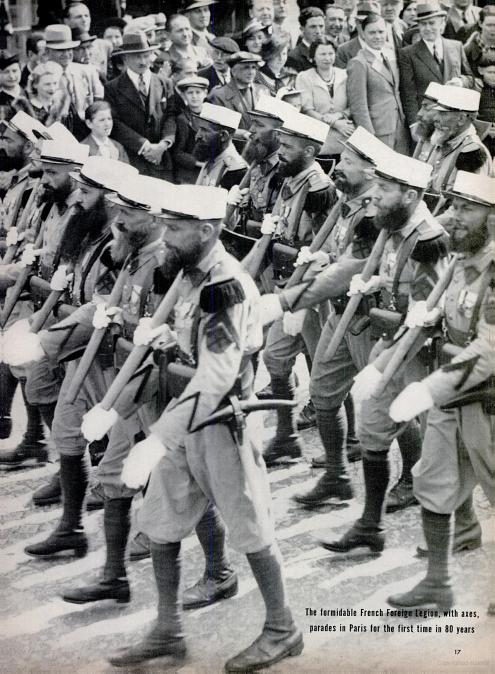
FFL 1939: Life Magazine
.
The novel does introduce the two American hoboes, Hank and Buddy, serving in the Legion. Wren kills off Michael and Digby Geste in this first novel putting the load on John.
In the second novel of the trilogy, Beau Sabreur (The good sword or swordsman) John returns to Africa to try to locate Hank and Buddy who were lost in the drifting sands after saving his life.
In this manner Wren introduces the American family of which Hank is a member. Hank and his friend Buddy were the two men lost in the desert that John Geste is seeking. Both men lying in the desert near death in different locations were rescued by the Bedouins. As luck would have it Hank managed to work his way up to Sheik acquiring Buddy as his vizier. They introduce superior Western discipline and tactics into their tribe giving them dominance in the desert. Hank then comes to the attention of the French as the new Mahdi. De Beaujolais is sent to coopt the new Mahdi. Through a series of adventures De Beaujolais meets and falls in love with Hank’s sister Mary who is traveling with her other brother Otis Vanbrugh. They as well as Hank are fleeing from a brutish father.
At stories end the whole cast Henri De Beaujolais who had wed Mary, Otis, Hank, Buddy, John Geste and his wife Isobel, who plays a large part, are back at the ranch in Texas facing the old brute of a father down while trying to free Hank’s other sister from thralldom to the old brute so she can marry Buddy and begin a life of her own. Hold on, now, Wren must have been studying Burroughs because he’s got a number of twists up his sleeve, or perhaps, tricks.
While Otis was in Algeria an Arab dancing girl had fallen in love with him who was apparently the queen of the desert. Otis tried to escape her but in exchange for help in recovering John from the penal battalion of the FFL he promised to marry her. Aw shucks, that’s right, you guessed it. Nakhla was in reality his sister. The old brute had fathered her on another dancing girl when he was out making deals in the desert. So we have Nakhla, the same name as the heroine of Burroughs’ The Lad And The Lion, pretty much following the plot line of The Girl From Farris’s. So maybe Wren should also be included in the Farmerian Wold Newton Universe.
So that is the broad overview of the story line that holds the three volumes together. Before I go on to the individula reviews there is one other problem I wrestle with that I would like to to discuss and that is the
Western fascination with primitive life styles.
For a convenient starting point we’ll use H. Rider Haggard, no, cancel that. I’ll go back a little further to the French Wold Newton. I’m reading the Paul Feval Black Coats series and they have some earlier antecedents. Balzac, Dumas, Eugene Sue and Feval all deal with organized crime groups. A Dumas title that I haven’t been able to get is titled The Mohicans Of Paris while Feval makes several reference to crime organizations adopting a sort of ‘red indian’ mentality. What Dumas called Mohicans evolved into the Apaches of late nineteenth century Paris. Anyone who watched TV in the fifties is familiar with French Apache dancing.
Thus while the French were becoming fascinated with the North American Indians and their primitive mentality Haggard was celebrating the primitive African mentality. And then along comes Ouida, Verne, Hichens, Burroughs, Hull and Wren celebrating the ‘free and wild’ life of the desert.
As of the beginning of the nineteenth century, if not before, the Euroamericans evolved into the Scientific Consciousness leaving the rest of the world behind in the mythopoeic or Religious Consciousness. However the transition from one consciousness to the other is not a clean break. Haggard, for instance, never really made the transition while Burroughs did. That may be why Burroughs reads as modern if a trifle old fashioned while Haggard is purely of an anterior psychology- good but just a little stodgy.
Thus, as the White Man spread over the globe, the, what I shall I call it, White Man’s Burden, White Man’s novel appeared. A whole genre of either stated or implied White superiority appeared of which Haggard and Burroughs are the most promient. From these writers the genre went on to the Sheena, Queen Of The Jungle stuff to imitative White Jungle god stories. Conrad sang the colonial era in lyric tones. Kipling told of the Raj of India while inventing the White Man’s Burden which was very real.
Ouida is usually credited with the first FFL novel, Under Two Flags, while Burroughs contributed The Return of Tarzan in which Tarzan goes to Algeria as a French secret agent although not as FFL.
In 1924 P.C. Wren wrought the glamor of the French Foreign Legion with the first novel of his trilogy, Beau Geste, followed by Beau Sabreur and Beau Ideal. These novels are also scientific demonstrating the superiority of Euroamerican intelligence over the mythopoeic mentality of the desert tribes. Merely by introducing European military discipline into the tribe Hank and Buddy enable the tribe to defeat all others and dominate the desert. This while Abd El Krim and the Riff dominated Western news instilling admiration for the primitive desert tribes over Western Civilization. I had a tearcher in high school who would get sexually aroused just talking about El Krim.
Thus while the transition from mythopoeic and scientific thinking was not complete if even half evolved the West was presented with various mythopoeic cultures that drew them back from the transition to the Scientific Consciousness. At present, then, the West has a split personality in which they admire the Negro and Arab mentality so much that they denigrate their own scientific side. It doesn’t seem likely that Euroamericans in sufficient numbers will make the transition to Scientific Consciousness quickly enough to preserve Western civilization hence the present bizarre worship of primitive races in North America and Europe. On the other hand the rest of the world seeks to imitate the West in matters that they cannot understand or sustain on their own. If the West is in trouble imagine the actual psychological state of things in China and India.
Now it is time to move on the first of the reviews- Beau Geste.
A Review
Thuvia, Maid Of Mars
by
Edgar Rice Burroughs.
Part III-C

Review by R.E. Prindle
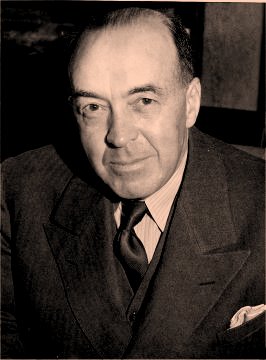
Edgar Rice Burroughs
Civilization And Its Malcontents
Let us say that for the fifty years or so before the 1920s there was a growing sense of societal malaise. This malaise was reflected most notably in the creation of Edgar Rice Burroughs’ psychological projection, Tarzan Of The Apes. One has to account for the immediate acceptation by society of such an absurdity. Tarzan, in fact, completely rejected civilization for the life of the romantic ‘unrestrained freedom’ of the jungle. The noble savage in fact.
Thus in a metaphor Burroughs reflected the malaise of his time so brilliantly that his creation was accepted as virtually a real person. Writers like Grant and Stoddard put the same theme into more scholarly terms. As noted, contrary to Richard Slotkin’s idea, Grant had little or no influence on Burroughs while the slightly later Lothrop Stoddard whose three relevant works appeared only from 1920 to 1922 could have had no influence on Burroughs’ formative years. It seems probable that Burroughs did read Stoddard and was influenced by his work but only after his ideas were fully formed. Even then The Revolt Against Civilization appeared after Burroughs had examined some of the same problems in his rejected manuscript, Under The Red Flag of 1919.
The problem of the malcontents and their war on civilization was examined by a number of writers during the twenties and thirties so why Slotkin singled out Burroughs, Grant and Stoddard isn’t as clear as it might be. Postwar German cinema was intensely concerned with the matter as why should it not? Germany was under asault by what Stoddard called the Underman. Nor need Slotkin think Stoddard was alone. I’m sure there were dozens of forgotten books prophesying the end of the world by one means or another including the Undermen of Communism.

The Underman, or the Communist, was not even a term unique to Stoddard. Gustave Le Bon, the French scholar on whose work Sigmund Freud based his study Group Psychology And The Analysis Of The Ego wrote prolifically on the psychological foundations of the Underman. Freud based his book on Le Bon’s 1895 study The Psychology Of Crowds. Unless I’m mistaken he based his 1930 study Civilization And Its Discontents on Le Bon’s 1921 book The World In Revolt: A Psychological Study Of Our Times.
On the cinematic side the problem was examined in the great silent films The Cabinet Of Dr. Caligari and Fritz Lang’s 1922 film Dr. Mabuse, The Gambler. Lang would follow that ten years later with the sound film The Testament Of Dr. Mabuse.
Even though Buroughs’ Under The Red Flag was rejected in 1919 he persisted, rewriting and extending the text into the 1926 story, The Moon Maid. This story reflects a possible reading of The Revolt Against Civilization but such a reading was much more evident in 1934’s Tarzan And The Lion Man.
The development of the problem was evident to all these writers which it seems to have escaped Slotkin who attributes the recognition of societal evolution to mere ‘racism’ in the writers. One thinks that perhaps Slotkin is too involved in his own agenda.
Rider Haggard enunciated the problem quite clearly in his 1888 novel Allan Quatermain in which Quatermain grouses about the ‘strict limits’ of civilization compared to the ‘natural’ life of the African Zulus. It might almost seem that the idea of Tarzan arose in Burroughs’ mind from that observation. In fact science was undermining all the comforting beliefs that mankind had been settled in for a hundred thousand years. During that long period characterized by the mental mode of what is called mythopoeic thinking man’s mind devoid of true knowledge projected a vision of reality that resulted in the notion of God. Thus reasoning from insufficient knowledge man’s mind came up with an erroneous result. You can’t get out of a mind what isn’t in it; all education is suggestion.
As Freud was to say, man’s settled view of reality received its three great shocks when Galileo disproved the geocentric notion of the universe, Darwin disproved the uniqueness of man’s position in the animal kingdom and he, Freud, displaced the conscious mind with his vision of the unconscious mind. Once again Le Bon was there ahead of him.
Thus as the nineteenth century opened and progressed the bases of mankind’s notions of reality were shattered leaving him emotionally and intellectually bereft of foundations of belief. Adrift without an anchor.
As if that were not bad enough the great cataclysm that ushered in the modern era, The French Revolution, was based on the the absolute notion that not only were all men created equal but remained equal in all aspects of their existence. The advance of civilization would toss this certainty into the trash can of history also.
As civilization placed greater and greater demands on the intelligence and self-discipline of men and women the incontestable gap between those less intelligent and those more intelligent became more and more obvious. Thus as the century progressed the notion of the Overman and the Underman began to become clear.
At the same time the first tentative efforts at measuring the intellectual potential of the individual began to become possible. Of course the basic inequality of men and women in its physical aspect had always been apparent. Some men were naturally stronger and better muscled than others. But, even that was changing. The science of physical culture was making it possible for the 98 lb. weakling to develop himself into a man mountain. Thus artifically developed srongmen like the Great Sandow ushered in the golden age of the strong man topped off by Charles Atlas who guaranteed he could turn you into a man mountain if you followed his program.
There was the promise that you could dethrone that bully and kick sand back in his face. On the other side Francis Galton was originating the first primitive tests to measure intelligence potential. Burroughs would have seen both proponents during his miraculous summer of 1893 at the Chicago Columbian Exposition. I mean to say that both facts entered his mind where they could be digested and emerge later. Nothing can come out of your mind that didn’t go in it.
And then after the turn of the century Binet devised he first actual IQ test. Thus, just as Sandow and Atlas could measure the size of muscles, the psychologists became able to measure the intelligence potential. Those with high IQs were set up; those with low IQs were cooked. The upshot was that all men were not created equal nor could they ever attain intellectual equality.
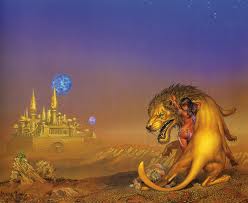
To a very large extent what became the Communist Party recognized the inequality while demanding equality against reason. Recognizing subconsciously, perhaps, that men could never be intellectual equals rather than try the futile task of raising the less fortunate they sought to destroy education which brings out the inequality but doesn’t create it. No matter what happens there are always going to be the more intelligent just as there will always be the physically stronger. As Le Bon points out, if you needed to hear it, nature don’t know from equality.
Thus the Communist Party devised the well sounding slogan- From each according to his ability; to each according to his need. Good plan for the needy, slavery for the able. The needy were organized beginning their struggle to achieve superiority by collective action. This was accomplished in Russia in 1917. The battle was joined.
Just as individuals are created with different capabilities so are peoples and races. Some can achieve and some can’t. Slotkin who must be a Communist thus takes offence at what he perceives to be, and is, an attitude of White Supremacy in Burroughs, Grant and Stoddard. While I am aware there are those who will disagree with White superiority it is nevertheless not an attitude but an evolutionary fact. That is the reason Communists have Darwin under attack. While Darwin doesn’t say it, it is the inevitable result of his studies. Just as it was necessary for the Undermen to destroy education in the hopes of creating intellectual equality so it became necessary to destroy White achievement of the last five hundred years. The whites must be demonized and made to feel evil and inferior morally. That is the import of Slotkin’s Gunfighter Nation.
At that level all three writers are guilty. As has been stated in Canadian courts- Truth is not a defense. So there’s nothing to discuss. Might is right and whoever has the might will prevail.
It is a fact that all three writers were anti-Communists so it may be assumed that whatever Communists believe, they didn’t. And why should they? Might may be right but it can still be nonsense. Communism is a flawed ideology based on a false premiss. It always fails wherever it is introduced. Failure is not evidence of a bad plan in Communist eyes. One just continues to shovel sand against the tide and pray. So succeed or fail they always think they can succeed by the same flawed ideology. The fault for failure lies elsewhere.
In that sense Burroughs was wasting his time assailing this religion of failure with his Under The Red Flag and its successor The Moon Maid. The only people who would applaud his effort would be we non-Communists but he could never convince anyone with Communist leanings. Of course that wasn’t well understood at the time.

If Burroughs were accused of not believing in equality that would be true. Not only are John Carter and Tarzan superior to any contemporaries on two worlds but Burroughs has a whole hierarchy of value. John Carter is the Warlord of Mars ruling from the top city of Mars, Helium. The races of Mars pretty much reflect those of Earth and their relative stations. The main exception is the ruling Red race. As Whites do and have existed on Mars in Burroughs stories while at one time being the dominant race perhaps the Red race is some sort of amalgam of the various Eropean immigrants of the United States. I believe the Green Men represent the American Indian. Both roam the great plains while being essentially savages.
Tarzan though always spoken of as being White is described as a bronze giant. Bronze is a fairly dark metal so that Tarzan and the Red men of Mars may be more or less identical in color.
Tarzan is the man-god so there are none superior or even equal to him. Below him come the English who are the cream of mankind. Perhaps slightly below the English are the French and then the rest of the Whites. Tarzan himself is psychologically an animal having been raised by the Apes. Not your ordinary gorilla or Chimp but a species intermediate between Gorilla and the Negro. Slotkin hasn’t read enough Burroughs to make an intelligent comment but the undeniable attitude of Burroughs is enough for Slotkin to condemn him as an unregenerate bigot. The reader may believe as he likes. I have stated my opinion eslewhere and that is enough. Whether any of these opinions of Burroughs influenced American soldiers at My Lai is open to question. The burden of proof is on Slotkin and he hasn’t provided it.
Along with the Undermen however, speaking through Tarzan, Burroughs is heartily discontented with civilization.
The spectacle of Chicago of the 1890s as a dirty unpleasant place haunts Burroughs. In contrast to the great White City of the Columbian Expo was what was afterwards known as the Black City of everyday Chicago. The contrast was so strong and so offensive to the Undermen that within a year of the Expo’s closing the entire White City was burned to the ground with the exception of one building. Hence perhaps the decayed crimson and gold ruins of Opar and the crimson and gold twin cities of Helium. One wonders what effect the sight of the ruin of the White City had on Burroughs when he revisited the site sometime after his miraculous summer of ’93. The mind creates nothing from nothing so there must have been models of the great cities of ERB’s imagination.
There are points at which Burroughs and Communism have quite similar views. It will be remembered that Burroughs only reluctantly married and throughout his life expressed discontent with the institution. To some extent or other ERB must have been an advocate of free love. Communists would have heartily approved of ERB’s women who went nude except for certain ‘adornments.’ Communists of course want women to be accesible to any man who wants them at any time while they have always advocated bare breasts.
In many ways when the Communists appropriated Tarzan for the MGM movies it took but slight changes to make Tarzan conform to their ideals. The MGM Tarzan and Jane were not married. While Burroughs’ Tarzan was a highly educated on-again off-again sophisticate the MGM Tarzan was a stupid illiterate oaf and one who rejected the attributes of civilization high up there in the Cloud Cuckoo Land of the Mutia Plateau.
On the essentials though Burroughs rejected the demands of the Underman as The Moon Maid clearly shows. There was very little in Stoddard’s The Revolt Against Civilization that Burroughs would have disagreed with. At the same time there was probably very little he didn’t already believe although he had never codified his information as Stoddard had. Slotkin’s contention that Burroughs was influenced by either Grant or Stoddard is surely wrong. ERB had already taken hs positions before either men had begun to write.
Each writer was, in his own way, an advocate of White Supremacy. It now become clear that White Supremacy has nothing to do with a fringe element in Liberal ideology. All Whites are White Supremacists in that ideology unless they reject ‘White skin privilege’ whatever that is. Ayers and Dorhn explain in their recent Race Course In White Supremacy. Interestingly constructed title. Nor as Slotkin would have it is the attitude based on mere racial pride and bigotry but on a solid record of achievement unattained by any other people. The quesiton is not was it right for some people to rule or be supreme because in the nature of things some people will rule and be supreme but which of the peoples are most qualified to be supreme.
All people have had equal opportunity so that one can only conclude that the race has gone to the most qualified participant. In the contest the Whites unified the other peoples against them as must inevitably be the consequence of being the top people. As they say, getting there is the easy part; staying there is the hard part.
Slotkin merely represents the envious losers, the Undermen. who clutch at any firebrand to burn the White House down. Who is most to be admired and emulated? Builders or destroyers?
Finis of Thuvia, Maid Of Mars Review
Edgar Rice Burroughs On Mars
A Review
Thuvia, Maid Of Mars
Part III-A
What We Have Here Is Change
by
R.E. Prindle
In the recent American presidential campaign in the US the winner won by promising the inevitable, Change. A very safe promise as the history of the world is one of change. Indeed, the life of the individual is one of unending change from the cradle to the grave. Change is now and forever. The question is, what response is made to the changes.
The times of Edgar Rice Burroughs were a period of the most earth shaking and rapid of all. At the same time most perilous, as the evolution of actual scientific knowledge in all fields was in its infancy and subject to misinterpretation. One might say in Burroughsian imagery that a series of doors stood before mankind, entering the right door would be more beneficial than the wrong doors.
Burroughs and others made tantative moves for the right door but others entered by the wrong door drawing most others through with them. What looked like progress turned into a regression. To shut up criticism the regressives began to demonize all those of different opinions. Burroughs was among those.
Some say he adapted poorly to the flood of change but the peole who do so are so confident in their opinions that to disagree with them is to be accused of being not only wrong but either criminal or insane. One doesn’t take their opinions too seriously as change will certainly demonstrate their opinions as ludicrous if it hasn’t already. Nevertheless as they are quite vocal in their condemnation of Edgar Rice Burroughs we have to consider the accuracy of their accusations as well as that of their own viewpoint. How well do they understand the issues?
ERB has some interesting observations on the changes occurring in the history, society and racial matters of his times as well as the concealed role of hypnotism in the transformation of that society. The basis of hypnotism is suggestion. As ERB say in Thuvia all is based on suggestion and counter-suggestion. If one conciders life and learning from that angle it presents some interesting possibilites.
What is learning? What is suggestion?
When the child is conceived he must of necessity have a mind with a blank slate. Freud, Jung and many others seem to seriously believe that newborns can inherit ancestral memories even though there is no one beyond the womb who has ever recalled any.
In fact without experience or learning that has has been introjected into the mind there is nothing for the mind to consider, hence no cogitation at all. This mind can only begin to form with the ejection from the womb. This occurs with a brain still in the process of formation. The development of the brain can only be considered completed shortly after puberty.
It seems obvious then that you can’t get out of a mind what isn’t in it. It behooves society then to begin loading the mind of a child as soon as the child is capable of handling education. The education of the mind must be built step by step to provide a firm foundation for the intellectual superstructure. Whatever is in the mind must come from or be suggested from outside the mind. There is no internal system of knowledge. Thus all knowledge is suggested to the child’s mind by his caretakers. They may be good or bad, well or ill intentioned. The brain is organized to receive suggestions or, in another word, experience. The reactive structure may already be in place dut to experiences in the womb and the actual birthing process but the actual learning process begins the moment the newborn emerges from the womb and receives a slap on the bottom to get his lungs started.
Thus the mind of the child is extremely malleable during the time until about puberty and shortly thereafter. If education is neglected during this early period and shortly thereafter it is unlikely that the adult can ever make up the lack. For instance if the basics or reading, writing and arithmetic are not loaded into the brain during this malleable period it is very rare that the skills can be acquired at a later time.
Thus, as it was always known that the child is father to the man various doctrinaire organizations such as the Jesuits believed that if they could form the education of the child or, in another word, indoctrinte him, they could shape the future in their own image. In Burroughs’ time the mechanisms of education were more fully understood. Various schemes were proposed to revise educational methods many of which were just odd or crude, but the better thought to change the direction of society toward a higher ideal.
The Communists were well are at the time that suggestion was the basis of education. Lothrop Stoddard writing in his The Revolt Against Civilization of 1922 quotes Eden and Cedar Paul from their book Proletcult of 1921:
“There is no such thing as “scientific” economics or sociology. For these reasons…there should be organized and spread abroad a new kind of education, “Proletcult.” Thus…in a fighting culture aimed at the overthrow of capitalism and at the replacement of democratic culture and bourgeois ideology by ergatocratic culture and proletarian ideology…” The authors warmly endorse the Soviet government’s prostitution of education and all other forms of intellectual activity to Communist propaganda, for we are told that the “new education” is inspired by the “new psychology”, which “provides the philosophical justification of Bolshevism and supplies a theoretical guide for our efforts in the field of proletarian culture…. Education is suggestion. The recognition that suggestion is auto suggestion, and that auto suggestion is the means whereby imagination controls the subconscious self, will enable us to make a right use of the most potent force which has become available to the members of the human herd since the invention of articulate speech.
I’m sure you can find appropriate application of the doctrine since Stoddard wrote in education, movies, TV, books and phonograph records and CDs. While I would disagree with the Pauls’ notion of suggestion and auto suggestion the Freudian influence is quite clear. This would be abetted by John Dewey’s notions on education that deemphasized the educational foundation while directing it more toward ideological considerations, or ‘relatively unstructured, free, student-directed progressive education.’
God only knows what free, progressive education is but this sort of social engineering was the wrong turn being taken in this era of rapid change.
So, loading the brain to deal with life’s exigencies is of necessity a slow process. As the brain continues to develop outside the womb there is plenty of room for malfunction. As man is incapable of creating anything original the education of the child may be compared to the loading of a computer. First the operating system. Whether consciously or unconsciously since all man knows is his own brain he has replicated it in his machine. A computer functions just like a brain, which should astound no one, as man can only devise what he already knows.
Now, human experience dates back about a hundred thousand years. I intentionally leave out the African development as it had nothing to do with the education of mankind. The African contribution is nil. Education began outside Africa. Having painfully and laboriously accumulated the huge fund of knowledge it must be entered into the brain of the new being. This sort of suggestion is called education. There’s not much room for anything called ‘free’ or ‘progressive.’ Getting it ain’t going to be free, the child has to work like a mule. This is a slow, laborious process as extensive foundations must be laid down before any superstructure can rise. Thus years are consumed just to teach the child reading, writing and arithmetic. With these three tools he can learn anything else. Inexplicably this fact seems to have been lost sight of in today’s educational theories unless of course the Pauls’ dictum is being followed.
Once the foundation has been laid, a form of suggestion and actually hypnosis, the child, now a student, must be taught how to manage and interpret what he learns at an increasingly rapid pace. Unfortunately there will be children left behind; any other expectation is fatuous, some are just brighter than others. Managing and interpreting comes from within the experience of the organism. Here’s the real problem because the same data will by analyzed differently and produce different results and opinions.
Along with learning factual matters the child must at the same time develop emotionally and psychologically. Nasty work. This is a difficult part. As the child has little ability to understand and even less ability to accurately analyze it he has to reason from faulty premisses. This ignorance of reality is what forms Freud’s notion of the unconscious or Id. Correcting this unconscious to consciousness is the conversion of Freud’s Id to Ego. A child misinterprets suggestions. Some become fixated in his un- or subconscious. The fixations are what distort consciousness from the subconscious interfering with the integration of the subconscious and the conscious. While the child is made more conscious in his ability to understand and reject harmful suggestions these fixations like post-hypnotic suggestions control his responses. The fixations must be exorcised which is the intended function of the psychoanalysis of Freud and Jung.
Once again, suggestion is everything outside your mind. Your mind cannot function without these suggestions because there will be nothing in the mind to function. Be carefull of what you put into your mind or, at least, that you do put something of value into it. Whether ERB realized this or not, his ideas of hypnosis and suggestion indicate he might have, he pursued a program of continuing education all his adult life. At the time of writing Thuvia he was working through Edward Gibbons’ Decline And Fall Of The Roman Empire, a vast minefield of amazing and truly educational suggestion.
Part B follows.
 I, Dynamo