Exhuming Bob XXIX: Dylan And His Blonde Problems
March 23, 2011
Exhuming Bob XXIX: Dylan And His Blonde Problems
by
R.E. Prindle
An Examination Of Temporary Like Achilles

Searching For Inspiration
Temporary Like Achilles is another ’64-’66 piece. It has the feel of being improvisational, out of focus. I believe it is a companion piece to Visions Of Johanna while it might be connected to Rainy Day Women #12 & 35.
Dylan always said that he had no physical relations with the song’s subject Edie Sedgwick. I’m certainly in no position to say but if this song is accurate then Edie for some reason played the virgin for him. Either that or because she represented his mother to him it would have been an incestuous situation. Edie did say she was pregnant by Dylan but then she says that she was in the psycho ward and that the doctor’s held her down and aborted the baby. Of course she must have been delusional at that time having over dosed on amphetamines. God, how she punished her mind. I’m of the opinion that she probably was not pregnant by Dylan although there may be hospital records.
If one takes the last verse first:
Achilles is in your alleyway
He don’t want me here, he does brag
He’s pointing to the sky
And he’s hungry, like a man in drag.
How come you get someone like him to be your guard
You know I want your lovin’
Honey why are you so hard.
Warhol, the man in drag is obviously Achilles, perhaps meant humorously. Achilles of course lived a short but glorious life. Warhol is temporary because Dylan is moving in on Edie.
In answer to the refrain ‘you know I want your lovin, honey why are you so hard’, it is probably that Edie wanted to marry Dylan but in the way of women wanted to pose as a virgin so as to come to him pure.
When she was at Harvard in Boston she was known as a premier fag hag. The men she knew were all gay so one presumes her chastity was safe there. Of course, Andy Warhol, known here as Achilles here was gay. Insofar as she associated with Andy, and he apparently really was smitten by her, as close to being in love as he could get with anyone, as he put it, her chastity was safe with him too. Perhaps that is why Dylan has Achilles in Edie’s allegory, near but not close sexually.
As there was rivalry between Dylan and Warhol for Edie it follows that ‘he don’t want me here he does brag.’ The line

Her fogs, her amphetamines and her pearls.
would point to the situation as it stood in August or September of ’65. He’s hungry like a man in drag may refer to his homosexuality which prevents him from satisfying his lust I don’t know why he’s pointing at the sky but Dylan says disgustedly ‘how come you get someone (a fag) like him to be your guard. Dylan was known to be macho at the time.
The first verse points to a period perhaps November-December of ’65. Dylan, of course, married Sara in November of ’65 so that at this point Dylan would be playing with Edie as perhaps he thought she was playing with him before.
Hence:
Standing on your window, honey
Yes. I’ve been here before
Feeling so harmless
I’m looking at your second door
How come you don’t send me no regards?
You know I want you lovin’
Honey why are you so hard?
Here is a reference to Dylan and Edie’s first meeting in December of ’64. And then in March Chuck Wein introduced Edie to the Factory although she had met Warhol a couple weeks after Dylan in January of ’65. Dylan may have been too busy at the beginning of ’65 to actively pursue Edie, he also did have to pay attention to Sara who he was courting at the same time, plus engagements and whatever.
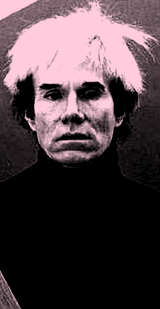
Andy
At any rate Edie teamed up with Warhol from March to about December of ’65. At that point Dylan who was wooing Edie and Grossman his manager were promising to make Edie a star at something. If as a star, she couldn’t sing, but then that didn’t stop Dylan from having a career.
Now, Andy had been trying to make Edie his movie star. According to Ronnie Tavel who scripted many of Andy’s movies Andy saw Edie as his ticket to breaking into Hollywood. That was one of Andy’s chief ambitions that was never realized. Tavel says that he and Andy used to coach Edie in her lines. When time to film came she always dosed herself with amphetamines before hand and, of course, uncoached herself. Thus in Andy’s account of his appearance at the psychiatrists’ banquet in January of ’66 he remarks that it was futile for Dylan and Grossman to work with her because she was unable to concentrate long to get anything done. Edie wouldn’t work hence no career. Andy might have been able to get her something if she had. He sounds rueful and hurt.
So in late ’65 this was Dylan’s second attempt to connect with Edie.
The second verse:
Kneeling ‘neith your ceiling
Yes, I guess I’ll be here for a while
I’m trying to read your portrait, but
I’m helpless, like a rich man’s child.
How come you send someone out to have me barred:
You know I want your lovin’
Honey, why are you so hard?
Kneeling ‘neath your ceiling fits in with standing in your window and looking at your second door. Kneeling ‘neath your ceiling is probably somewhat like Paul Simon’s ‘One man’s ceiling is another man’s floor or Tony Orlando’s Stomp three time on the floor. In other words Dylan is in the room beneath Edie unable to get to her unless she calls him.
Thus the addendum to verse two:
Like a poor fool in his prime
Yes’ I know you can hear me walk
But is our heart made out of stone, or is it lime
Or is it just solid rock?
In other words Edie knows he’s down there pacing anxiously back and forth but a hard hearted woman she refuses to call him to her, stomping three times on the floor.
The fourth verse:
Well, I rush into your hallway
Lean against your velvet door
I watch upon your scorpion
Who crawls across your circus floor
Just what do you think you have to guard?
You know I want your lovin’
Honey why are you so hard?
The ardent and frustrated would be lover can’t breach Edie’s window, door. ceiling, hallway, velvet door. The scorpion/circus reference escapes me except that Edie may have appeared to be leading some circus life as does Ophelia in Desolation Row.
Apparently this was a throw away song for Dylan as other than recording it he has never played it in concert. It was one of my favorites on the album however. Perhaps after Dylan’s motorcycle accident the song became irrelevant to him. Too topical, not universal enough as was its counterpart Visions of Johanna.
As far as Blonde On Blonde goes I’m tentatively of the opinion that Rainy Day Women #12 & 35 refers to Edie and his mother. The only reference to Sara in the album would be Sad Eyed Lady Of The Lowlands.
Your secrets are safe with me, Bob, of course you don’t have anything to hide.
Exhuming Bob XXVIII: Visions Of Johanna Decoded
December 27, 2010
Exhuming Bob XXVIII
Visions of Johanna Decoded
by
R.E. Prindle

This is an attempt to place Visions Of Johanna in a context of Dylan, Andy Warhol and Edie Sedgwick. In this interpretation Louise is Edie, Johanna is Dylan’s mother, Louise’s lover is Andy Warhol and the narrator is Dylan,
Visions of Johanna
Ain’t it just like the night to play tricks when you’re trying to be so quiet?
We sit here stranded though we’re doing our best to deny it.
I.e. we’re alone in the night of the universe doing our best to pretend we aren’t. A night without dawn and we find the situation intolerable.
And Louise holds a handful of rain, temptin’ you to defy it.
Rain is a symbol for the misery of life that one finds inescapable. ‘Raindrops keep falling on my head.’ etc. Louise/Edie who is a bearer of pain mixed with love offers a handful of rain to Dylan essentially saying take it or leave it. If Bob takes it he has to find a way around the pain of loving Louise/Edie.
Lights flicker from the opposite loft
In this room the heat pipes just cough
The country station plays soft
But there’s nothing really, nothing to turn off.
It looks brighter in the opposite loft, greener grass on the other side of the fence, but it is freezing in Dylan’s room where no heat comes from the pipes that just cough. ‘Seems like a freezeout.’ C&W is a lot of songs about love gone wrong so let it play softly in the background.
Just Louise and her lover so entwined
And these visions of Johanna that conquer my mind.
Dylan has a real problem with his mother who he says in his movie Masked and Anonymous rejected him because he upset her life by being born. Thus his love for his mother was turned to dust and his life made miserable. He has confused Edie with his mother who he thinks she resembles. Edie after seeming to be found as a mother surrogate in the first quarter of 1965 then seemingly abandoned him for ‘her lover’ Warhol with whom she is ‘entwined.’ In his confusion and resentment of Edie he sees ‘these visions of Johanna that conquer his mind.’ He looks at Edie and sees his mother. His resentment at his mother’s rejection then turns to hatred of Edie. As a son he can’t revenge himself on his mother but he can on Edie who has become his mother surrogate.
After his father’s death in 1968 Dylan is able to step into his father’s shoes as his mother’s support. Pleading poverty, which was probably real, shortly after her husband’s death Dylan wrote her a five figure check to tide her over. There’s more, but…I’ll save that for the review of Masked And Anonymous.

The Ghost Of Electricity
In the empty lot where the ladies play blind man’s bluff with the key chain
And the all night girls they whisper of escapades out on the “D” train
We can hear the night watchman click his flashlight
Ask himself if it’s him or them that’s really insane
Verbiage setting up the next six lines that get to the heart of the matter:
Louise, she’s all right, she’s just near
She’s delicate and seems like the mirror
But she just makes it all too concise and too clear
That Johanna’s not here.
Here the physically delicate Edie is present but she seems like a reflection of Johanna/Dylan’s mother. Dylan has so identified Edie/Louise with this mother/Johanna that Edie makes it ‘too concise and that too clear’ that Mother/Johanna is not here.
The ghost of ‘lectricity howls in the bones of her face (Edie’s)
Where these visions of Johanna have now taken my place.
Ghosts of electricity is ambiguous but may refer to the traces left by the electro-shock treatments which undoubtedly scarred Edie’s mind indelibly while Dylan has now completely blended Edie/Louise and Mother/Johanna into one.
Now, little boy lost, he takes himself so seriously
He brags of his misery, he likes to live dangerously,
This obviously refers to Warhol of whom it’s a pretty good description. Living dangerously probably refers to the hoodlums hanging around the Factory.
Muttering small talk at the wall while I’m in the hall
How can I explain?
Oh, it’s so hard to get on
And these visions of Johanna, they kept me up past dawn
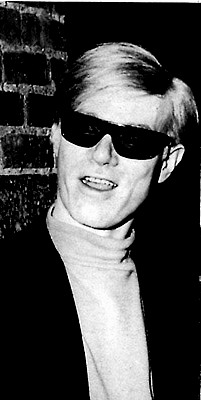
Dapper Andy
Dylan mutters small talk at the wall where he is placed outside the relationship with Edie in the hall ‘while visions of Mother/Johanna trouble him into the small hours of the night.
Verses four and five seem to be verbiage that sounds meaningful and may be to Dylan but escape me. The song is copyrighted 1966 which would be after Dylan had taken his vengeance on Edie so the lines of the last verse:
But like Louise always says
“Ya can’t look at much, can ya man?”
As she herself prepares for him
And Madonna, she still has not showed
We see the empty cage now corrode
Where her cape of the stage once had flowed
The fiddler, he now steps to the road
He writes ev’rything’s been returned which was owed.
Edie/Louise is preparing for ‘him’ who might be Warhol or Neuwirth but it isn’t made clear.
Dylan referred to Sara as a Madonna so she is probably the Madonna referred to. ‘Empty cage’ is personal to Dylan, no idea, anyway he was already married to Sara. So having crushed Edie as his mother had crushed him and passed her to Neuwirth he thinks he has settled his score with Mother/Johanna. ‘Ev’rything’s been returned which was owed.’ Edie has repaid his mother’s debt but he apparently feels some guilt ‘as his conscience explodes.’
After the ball was over, after the dance was through’ these visions of Johanna are now all that remain.’ So, if the song means anything, written in 1966 it must refer to Edie who Dylan has confused with his mother in his mind. While songs like Like A Rolling Stone and She’s Your Lover Now read clearly once you have the Edie key, Johanna is a little more ambigious but while I con’t guarantee this reading as yet, I think it is on whole accurate.
Chaps. 9, 10, 11, 12: Edie Sedgwick, Maid Of Constant Sorrow
November 30, 2010

The 707

DC 6B
A week or so after Philadelphia I got a real lesson in show business and Pop style. Just when you think you’re getting famous, somebody comes along and makes you look like a warm up act for amateur night. Pope Paul VI, talk about advance PR- I mean, for centuries.Definitely the most Pop public appearance tour of the sixties was that visit of the Pope to New York City. He did it all in one day- October, 15, 1965. It was the most well-planned media covered personal appearance in religious (and probably show business) history. “Never Before in This Country! One Day Only! The Pope in New York City!”The funny thing for us, of course, was that Ondine was known in our crowd as “the Pope,” and one of his most famous routines was “giving the papal bull.”The (real) Pope and his entourage of aides, press and photographers left Rome early that morning on an Alitalia DC-8. Eight hours and twenty minutes later, they got off the plane at Kennedy with the Pope’s shiny robes blowing in the wind. They drove in a motorcade through Queens- the streets were lined with people- through Harlem crowds, and then down to the jammed- for blocks St. Patrick’s Cathedral area in the Fifties- where the Pope seemed to want to go out in “the audience” but you could see his aides talking him out of it. After all the stuff in the cathedral he ran down the street to the Waldorf-Astoria where President Johnson was waiting. They exchanged gifts and talked for a little under an hour about world troubles. Then it was over to address the UN General Assembly (essentially he said, “Peace, disarmament and no birth control”) out to Yankee Stadium to say Mass in front of ninety thousand people, over to the closing World’s Fair to see Michelangelo’s Pieta in its Pop context before it went back to the Vatican, and back out to Kennedy and onto a TWA plane, saying, when the reporters asked him what he liked best about New York, “Tutti Buoni” (Everything is good”) which was the Pop philosophy exactly. He was back in Rome that same night. To do that much in that short a time with that kind of style- I can’t imagine anything more Pop than that.

The Heyday Of Andy And Edie

Edie And Andy- Sitting On Top Of The World
Velvet Underground And Nico


Edgar Deep In Thought
I’d dreamt about Billy Name, that he was living under the stairs of my house and doing sommersaults and everything was very colorful. It was so weird, because his friends sort of invaded my house and were acting crazy in colorful costumes and jumping up and down having so much fun and they took over, they took over my life. It was so weird. It was like clowns.Everybody was a clown in a funny way, and they were just living there without letting me know, they’d come out in the morning when I wasn’t there and they’d have a lot of fun and then they’d go back and live in the closet.
Malanga and Dylan
I was invited to speak at the annual banquet of the New York Society For Clinical Psychiatry by the doctor who was chairman of the event. I told him I’d be glad to ‘speak’ if I could do it though movies, that I’d show Harlot and Henry Geldzahler and he said fine. Then when I met the Velvets I decided that I wanted to speak with them instead, and he said fine to that too.So one evening in the middle of January everybody in the Factory went over to the Delmonico Hotel where the banquet was taking place. We got there just as it just was starting. There were about three hundred pychiatrists and their mates and dates- and all they’d been told was that they were going to see movies after dinner. The second the main course was served, the Velvets started to blast and Nico started to wail. Gerard and Edie jumped up on the stage and started dancing, and the doors flew open and Jonas Mekas and Barbara Rudin with her crew of people with cameras and bright lights came storming into the room and rushing over to the psychiatrists asking them questions like:‘What does her vagina feel like?’‘Is his penis big enough?’‘Do you eat her out? Why are you getting embarrassed? You’re a psychiatrist; you’re not supposed to get embarrassed!Edie had come with Bobby Neuwirth. While the crews filmed and Nico sang her Dylan song, (I’ll Keep It With Mine) Gerard noticed (and he told me this later) that Edie was trying to sing, too, but even in that incredible din, it was obvious she didn’t have a voice. He always looked back to that night as the last she ever went out with us in public, except for a party here and there. He thought she’d felt upstaged that night, that she’d realized that Nico was the new girl in town.Edie and Nico were so different, there was no good reason to compare them, really. Nico was so cool, and Edie was so bubbly. But the sad thing was, Edie was taking a lot of heavy drugs, and she was getting vaguer and vaguer. Her society lady attitude toward pills had changed to an addict attitude. Some of her good friends tried to help her, but she couldn’t listen to them. She said she wanted a “career” and that she’d get one since Grossman was managing her. But how can you have a career when you don’t have the discipline to work at anything?Gerard had noticed how lost Edie looked at that psychiatrists’ banquet, but I can’t say I noticed; I was too busy watching the psychiatrists. They were really upset and some of them started to leave, the ladies in their long dresses and the men in their black ties. As if the music- the feedback actually- that the Velvets were playing wasn’t enough to drive them out, the movie lights were blinding them and the questions were making them turn red and stutter because the kids wouldn’t let up, they just kept asking for more. And Gerard did his notorious whip dance. I loved it all.http://www.youtube.com/watch?v=iNwp4nNTeJg Clip of performance.

Dylan

Neuwirth

The Man Of A Thousand Faces
Sigmund Alone Is His Study

Her Fogs Her Amphetamines And Her Pearls

Lou Running A Temperature

John Cale as Old Hipster Contemplating The Dynamo Hum

Gerard

Andy And Gerard

Bomber Billy Ayers

Andy And Fred Hughes
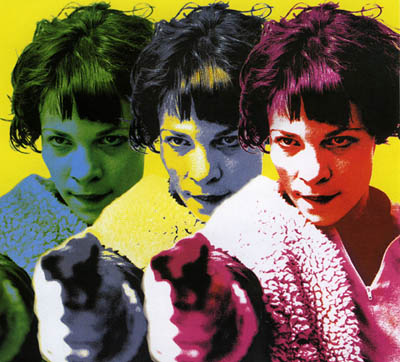

All The Fame Anybody Needs

Tell ’em Andy
Chaps. 6,7,8: Edie Sedgwick, Maid Of Constant Sorrow
November 20, 2010
Edie Sedgwick: Maid Of Constant Sorrow
Chs. 6,7,8
Chapter 6
The Pillow That We Dreamed On

Revolt Of The Undermen
While this is a history it is also a history I lived through. Thus, while history from a distance in time loses much detail it gains in perspective. While these events were transpiring in New York an interpretation of them was being dispersed throughout the country by magazines. While I have no first hand knowledge of the scene in New York my reality at the time was formed by magazine reports. I considered myself pretty well informed from those magazines and in an intra-social sense I guess I was although that only made me less superficial than some others.
The sixties was a fabulous time for magazines. Endless specialized titles came and went after only a few issues, or even a single issue. One of my favorites was the long lasting Horizon, a hard cover quarterly boasting a whole hundred thousand subscribers. Obviously it was for the fortunate few. Of the big bombers chief of all was Time-Life. The two magazines were probably the backbone of American culture during the fifties and sixties. Time lost its credibility during the sixties.
Time was founded by Henry and Clair Booth Luce in 1923. By the fifties it was not only a money machine but gave the Luces a position from which they could actually direct the course of American culture. A heady responsibility. The Luce’s always claimed to be Conservatives but their publications always seemed to have a decidedly leftward bend.
For me the 60s was a most exciting intellectual period. Things were moving fast and generally opening up the American mind. Time-Life publications, all those mail order books. I love mail order. I especially love getting books through the mail. The sixties was my time. Horizon had annual volumes I cherish. Time-Life published a series of paperbacks, actually linoleum like covers, called the Time-Life Library, sent out four titles a quarter, complete set of 108. I completed it. They did delete one title replacing it with another that I don’t have.
However the titles seemed to further a Left agenda. Biographies of Marx and others with the explanation that it was important to know how the enemy thought. True enough, I’m sure, and I bought it at the time but they issued precious little concerning other political angles. I soured on Time-Life as it went.
I also discontinued subscribing to Time sometime in the mid-sixties although it was impossible to stop reading the magazine as there was always a copy lying around somewhere. I became revolted when I read a marvelous piece describing Howard Hughes exit from Las Vegas. It was an astonishing eye witness piece. Then we learned that the whole account was fiction; it never happened. Not only inaccurate but it never happened. They just made it up. That ended my fascination with Time. Still it was where I continued to get most of my information while it had formed my mind for over a decade.
The magazines- Time, Life- were where I got my information on the NYC art scene. Time was especially attentive to it. Pop Art was covered pretty extensively by both magazines. A complete collection of both Time and Life is available on line for reference.
On the West Coast where I was, then, my personal knowledge of Warhol and the art scene pretty much came from Time-Life as did that of most others. Probably not that many were actually interested. Time was a big weekly magazine, how much of it could you actually read. One looked at the magnitude of the weekend NYTimes, sniffed, and just walked away. Who could even begin to read it.
When Edie hooked up with Warhol she gained a national recognition second to none for a nonentity, quite astounding in retrospect.
In August of ‘65 she and Warhol received a good write up in the Arts section of Time while as late as November she received a very nice photo essay in Life. She hadn’t even done anything but hang out with Warhol. Judging from what I read on the internet these articles impressed a number of people giving Edie a national reputation, at least in some circles. This is quite startling because she was only a cute girl, nothing more. She could never have achieved this without her association with Warhol. And she was in a position to turn her allure and fame to account.
Warhol was not going to pay her for the movies. His position was that he had given her this fame so that it was her responsibility to do something with it. There were things she could have done to retrieve her fortunes. Supposedly Chuck Wein was on the lookout to make her into something. He was useless. He should have given his brain an enema and looked at things more clearly. There were things that could have been attempted. It wouldn’t have been impossible for her to set up an advice column such as Edie Says, or What Would Edie Do. My god, she was in NYC. The idea could have been sold to the NYTimes and from there perhaps syndicated. She wouldn’t even have had to do anything but collect the money. Others could have handled everything.
Edie had already modeled so she was in Fashion. So…a line called Edie Sedgwick Party Clothes, Casual Fashion, you name it. Heck, Warhol should have been on the ball and taken his cut, led the way, instead of stupidly taking Ondine’s chat for a novel called ‘a’. Who bought it?
Having raised Edie then to near iconic status within just a few months Warhol, Wein and Edie let the opportunity of a life time slip through their hands. Perhaps it was the drugs.
Chapter 7
Hatred In His Heart
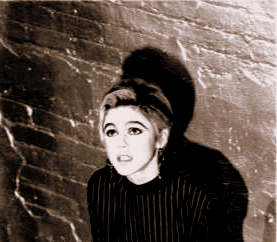
But She Breaks Just Like A Little Girl
At the beginning of May Dylan left for a tour of England. At the same time Warhol took Edie along with Gerard Malanga and Chuck Wein for a gallery show in Paris. Warhol, Edie and Dylan were in Europe at the same time. Whether this influenced Dylan’s rage or not isn’t known but in June shortly after his return he began to vent his rage as he began the composition of Like A Rolling Stone.
Now, Edie’s brother Jonathon told a story he says he got from Edie that she was impregnated by Dylan and carried his baby. There is no time frame for this story. According to Jonathon Edie was determined to have Dylan’s child. As she told it it took four men to hold her down for the abortion to be performed. If true, this is an interesting situation. For one thing abortions were illegal at the time, so a rogue doctor was required. Edie says that she was adamant about having the baby so that she would have had to have been either lured to the doctor or essentially kidnapped. If she resisted and four men, who happened to be in attendance, were required to subdue her then we have a crime of some magnitude.
Bear in mind that all the alleged participants are whacked out of their minds on amphetamines so no one is thinking clearly. At any event Dylan was committed to marry Sara if this is before the wedding or married to her if after. Edie is a celebrity of some distinction who in all likelihood would tell everyone it was Dylan’s love child. What effect this might have on Sara can’t be known but it might possibly have disturbed Dylan’s plans. If he’s like the rest of us he would have held Edie responsible for getting pregnant.
The gist of it is Jonathon Sedgwick says Edie told him the story. It is a possibility, after all if you’re having sex with somebody as she undoubtedly was with Dylan, the possibility of pregnancy is there. But that’s in the background.
During the summer while Dylan stewed Edie and Andy’s star was rising. New York dailies ran stories on the pair that told of Edie drawing Andy into uptown society; and then in late November Life ran its photo essay on Edie. Let’s let Andy recap the period as he told it in his autobiography Popism, recalled in 1980, p. 107:
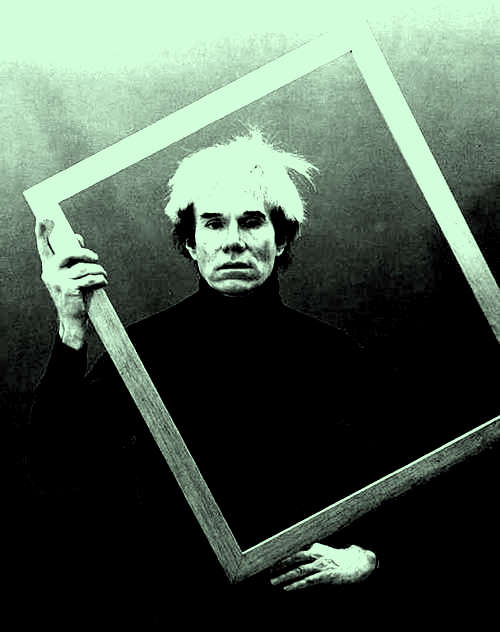
(At the party) There were a few guys in the latest velvets and silk shirts, but not too many- the boys were still mostly in blue jeans and button-down shirts. Edie brought Bob Dylan to the party and they huddled by themselves over in a corner. Dylan was spending a lot of time then up at his manager Al Grossman’s place near Woodstock, and Edie was somehow involved with Grossman too- she said he was going to manage her career.
I’d met Dylan through the MacDougal Street/Kettle Of Fish/Café Rienzi/Hip Bagel/ Café Figaro scene, which Danny Fields claims got started when he and Donald Lyons saw Eric Andersen, they went up and asked if he wanted to be in an Andy Warhol movie. “How many times did we all use that one?” Danny laughed. And after that Eric got interested in Edie and suddenly we were all around the Village together. But I think Edie actually knew Dylan because of Bobby Neuwirth. Bobby was a painter who originally started singing and guitar playing up in Cambridge just to make money to paint with, he told me once. Then he hooked up with Dylan and became part of that group- he was something like Dylan’s road manager-confidant. And Bobby was a friend of Edie’s.
At Sam’s party Dylan was in blue jeans and high-heeled boots and a sports jacket, and his hair was sort of long. He had deep circles under his eyes, and even when he was standing he was all hunched in. He was around twenty-four then and the kids were all just starting to talk and act and dress and swagger like he did. But not many people except Dylan could ever pull that anti-act off- and if he wasn’t in the right mood, he couldn’t either. He was already slightly flashy when I met him, definitely not folksy anymore- I mean, he was wearing satin polka-dot shirts. He’d released Bringing It All Back Home, so he’d already started his rock sound at this point, but he hadn’t played the Newport Folk Festival yet, or Forest Hills, the places where the old-style folk people booed him for going electric, but where the kids started getting really crazy for him. This was just before “Like A Rolling Stone” came out. I liked Dylan, the way he’d created a brilliant new style. He didn’t spend his career doing homage to the past, he had to do things his own way, and that was just what I respected. I even gave him one of my silver Elvis paintings in the days when he was first around. Later on, though, I got paranoid when I heard rumors that he had used the Elvis as a dart board up in the country. When I’d ask, “Why would he do that.” I’d invariably get hearsay answers like “I hear he feels you destroyed Edie,” or “Listen to ‘Like A Rolling Stone’- I think you’re the ‘diplomat on the chrome horse’, man.” I didn’t know exactly what they meant by that- I never listened much to the words of songs- but I got the tenor of what people were saying- that Dylan didn’t like me, that he blamed me for Edie’s drugs.
So it is quite clear from Andy’s recollection that he had known Dylan from the early Spring of ‘65 and that Edie was quite clearly dating him. Whether the pregnancy story comes from this time would be an interesting question. After the release of Highway 61 Revisited Dylan conceived a plan to take Edie away from Andy. It would seem quite clear from the bags under Dylan’s eyes that he was no stranger to drugs.
Perhaps the August Time article on Andy and Edie was the high point of their relationship although the October art exhibit at UPennsylvania was still to come. That show was astonishing in that Warhol was treated like a rock star with apparently the same crowd attending. Of course, Andy’s pal Sam Green had masterfully whipped up enthusiasm with his promotion of the show preceding it by several weeks. The show was probably the first time an artist received such adulation.
Though Andy was enough of a rage that a big crowd would come out for him. I was in attendance at the UOregon lecture in Fall ’67 when Allen Midgette impersonated him and a crowd of about 1500 paid to see him. It isn’t true that Midgette’s impersonation was that good.
I was standing at the end of the line waiting to enter when Midgette and Morrissey were brought in to the elevator just behind me. The guy in front of me asked if that was him.
I was watching Midgette who was a midget, little skinny short guy. There was a superficial resemblance but he seemed too short and he wasn’t wearing a wig. I said, ‘It looks like him but I don’t think it is.’ Midgette raised his eyebrows while Morrissey looked like the jig was up but the admins ignored me.
During the so-called lecture there were several groups of us dispersed throughout the audience loudly debating the issue. They got away with it but later the school learned they had been pranked and demanded their money back. I always thought that was rude. What did they expect of Warhol. He had a reputation. Didn’t the administration read Time?
In September of ‘65 Dylan began to court Edie with promises, one believes, of a good income from movies, recording or such. One is amazed that geniuses like Dylan, Grossman and Neuwirth couldn’t come up with something more inventive to promote Edie.
Edie was torn between two lovers, Andy and Bob. It must have been quite head turning to be the object of contention between the number one celebrity artist of the time and one of the most famous recording and performing acts at the same time as receiving national exposure in Time and Life.
Warhol, even though a homosexual, said that he was as close to in love with Edie as he had been with any other person in his life, he even took her home to meet his mother. Mrs. Warhola who had been urging her son to marry would certainly have taken Edie’s appearance as an indication that Andy was serious about her.
Having committed himself even that far would mean that her receptiveness to Dylan was a crushing rejection of himself as, say, a male object, while her abscontsion to Dylan’s camp would be a traitorous act. Unforgivable in his eyes.
Thus as Edie wavered between Dylan and Andy her life at the Factory became untenable. Andy quietly brought in other superstars including Dylan’s old flame, Nico. Whether conscious of it or not Andy was displacing Edie. She was mocked and reviled. While this was happening at the Factory Edie was evidently taken to Woodstock where Albert Grossman was talking contract to her as her manager. Dylan had had his May gig in England filmed although it would be a while before it was released. There was talk of another film of which Edie would have the starring role. That film apparently wasn’t made for several decades until Dylan finally got it together to make Masked And Anonymous. Perhaps the blond female lead was meant to remind the viewer of Edie.
So, rejected by her family who disapproved of her modeling as well as scorning her association with Warhol, desperately in need of money Edie was in an agonizing mental dilemma. Remember that by this time she was a national figure having appeared in Time and even as her position disintegrated featured in Life, yet she had no money to back her celebrity status. She couldn’t participate in the social life.
We don’t know what Dylan was promising her personally whether he hinted at marriage or stated it but it seems clear from the evidence of One Of Us Must Know (Sooner Or Later) and Most Likely You Go Your Way And I’ll Go Mine that Edie believed Dylan was serious about her.
Dylan married Sara in November of ‘65 secretly but how to keep a secret. Warhol learned of the marriage tauntingly informing Edie of it in December. Edie was incredulous. It follows, and can’t be otherwise, that she confronted Dylan with the alleged fact. This was undoubtedly a moment of triumph for Dylan as he could now reject Edie as he believed she had rejected him in March.
One can imagine Edie demanding of Dylan whether he was with her or Sara. The intense mocking derision of Sooner Or Later when Dylan sings: I couldn’t believe what I did hear- was I leaving with you or her?
At that time Edie’s game was up. Warhol had destroyed her reputation; she could no longer get modeling jobs; she was broke with no hope of a good encore. With a loud sneer Dylan passed her to his sidekick, Bobby Neuwirth then a song to commemorate it: She’s Your Lover Now.
Chapter 8
Down The Trail Of Broken Hearts

Dylan Lifting Off
The motivations of the actors are difficult to determine. However that insofar as any actions relate to the others than the actions of any of the others are interrelated. Thus Andy had Edie and wished to keep her as she was as close to love as he ever came. Perhaps he realized that he would need money to do so while perhaps his various activities from the Factory to filmmaking were keeping him financially strapped so that even if he wished to he couldn’t pay Edie. He had expenses.
Of course today an authenticated Warhol may go for millions up to the one hundred millions paid for the Eight Elvises picture but at the time you could have scooped up several paintings for under ten thousand dollars that might have been worth tens of millions twenty to thirty years on.
Dylan is ridiculed for trading his Presley taken from Warhol for a sofa but at the time that wasn’t necessarily a bad deal depending on the sofa. Warhol would give his actors the choice between a painting and a hundred dollars cash. The Factoryites elected the cash over the picture. So, it’s not like Warhol could just sell a painting anytime he needed to raise the ready. His question was how to raise some cash, he had overhead.
His adversaries were Dylan and Albert Grossman, one a recording artist the other a manager both swimming in cash. There seemed like a pot of gold at the end of that particular rainbow. Andy thought about it and came up with what he thought was a winning formula, and it actually was but he let it slip away.
Taking his cue from Bobby and Albert then Andy decided to manage a band. He also conceived at the same time an artistic light show to create an even more unique and exciting ambience, The Exploding Plastic Inevitable. When the student is ready the teacher will appear. And so it was. Andy’s scouts went looking for a band and came back with a group called the Warlocks who were renamed The Velvet Underground. An SM band extraordinaire whose chief songs were Heroin and Waiting For My Man. Only Andy could have shouted Eureka! at such a find.
The band came straight out of the avant garde. The chief instrumentalist, John Cale, had belonged to the John Cage/La Monte Young musical circle. The ostensible leader, Lou Reed, another survivor of electro-shock therapy, not much of a musician, was the group’s songwriter and lead singer. Between Warhol, the Factory hands and the Velvets they were a Happening of the first order.
Andy now had his band and his concept but no venue. No way to present the package for popular consumption. But, that too appeared when someone suggested a hall called the Dom. Andy rented the hall but, here’s the catch, he didn’t lease it. He cautiously wanted to try it out first. The trial was a major success, wowing hip New York while also bringing in an astonishing amount of cash for a three or four week run. Should have been a hint.
Now, Andy negotiated a recording contract for the Velvet Underground and the band actually recorded its SM anthems Heroin and Waiting For My Man. Remember the Velvets had no history and horrible songs but Andy’s influence was so great this unknown band was given a recording contract. Not so bad. Of course the record wasn’t released until 1967 but it fell flat as one would have expected with an eighteen minute song called Heroin. Also the record was released as Andy Warhol Presents The Velvet Underground. Andy’s credibility wasn’t too great outside NYC and I, for one, looked at the record as a probable joke, especially as the cover was a peel away banana. After listening to the record I knew it was a joke.
A couple years earlier Dylan had been in Greece where he met a German woman going by the name of Nico. They apparently had a short fling and he wrote the song I’ll Keep It With Mine for her. Time passes and paths meander. Having passed through London Nico showed up in New York City at this time where, as chance would have it, she hooked up with Warhol and became a Factory girl. Andy in his usual way foisted her on the Velvets as a chanteuse, Nico And The Velvet Underground, did I mention that before? So, not only did one ask what the hell was a velvet underground but who the hell was Nico? We knew who Andy Warhol was. And how.
Dylan undoubtedly thought of Nico as his, thus he showed up in Warhol’s scene to push songs on Nico with the intent no doubt to woo her away as he had done Edie. The contest between Andy, Bobby and Albert was heating up.
I think it probably came to a head over the Dom. Andy and the Velvets left for a gig in LA and when they returned they attempted to resume their shows at the Dom. Lo and behold they found that Albert Grossman had leased the venue from under them. They had the winning formula but once again no venue. Albert called his place something stupid like The Balloon Farm but under different management it became The Electric Circus. Andy was offered the light show but didn’t take it, but by then light show paraphenalia was being manufactured as a commercial product.
From my point of view the most astonishing and impressive thing Andy ever did was the Exploding Plastic Inevitable. It had a long lasting effect. Of course by this time the whole light show paraphernalia had turned into an industry and anyone could do it.
Toward the end of ‘65 Edie had become peripheral to both Andy and Dylan.
Chapters 9,10,11 and 12 are now up on one post.
Chaps. 3,4 & 5:Edie Sedgwick: Maid Of Constant Sorrow
October 30, 2010
Edie Sedgwick
Maid Of Constant Sorrow
Chaps 3,4 & 5
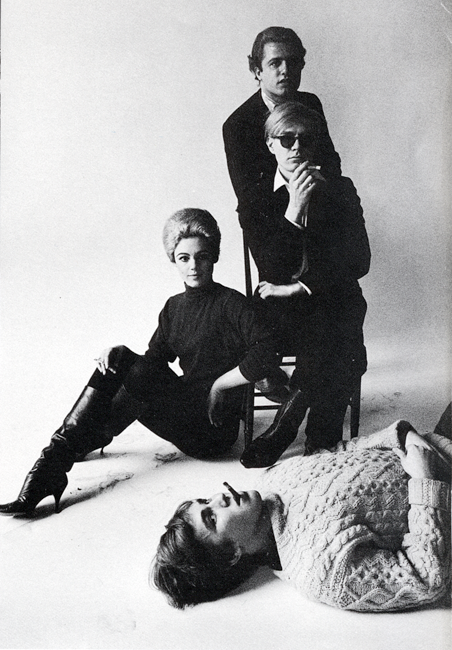
Time Is On My Side
A problem with the sixties is the concept of time. Einstein had gummed up the investigation of the concept considerably. Time is not a static thing but moves at various speeds. Strictly speaking time does not exist but is a human construct. The basis of the construction is the diurnal rotation of the earth and the earth’s revolution around the sun. There is no starting point for the revolution and no end. Man constructed a beginning based on earth’s greatest distance from the sun and because of the Plane Of The Ecliptic, the shortest day of the revolution. This was the most recognizable point to begin. Without the day and the year there is no basis for determining time; there is no other vantage point in the Universe.
Time has no existence in the universe; there is only space and matter and space cannot be defined without matter. No changes take place in the nature of space, only in matter, and time is no operative factor in those changes. Time does not exist outside the human mind.
Time as we usually think about it is a division of the earthly day into hours, minutes and seconds; of the year into seasons, months, weeks and days. As this is objective time keeping without reference to the passing of events or the perception of the individual subjective time is unaffected by objective time.
Now, let us say that the normal rate of perception and living is done in 4/4 time. To try to be specific let us say the standard is time as lived by 18-60 year olds adjusted to their societal needs. Let us just speculate that the mind in its normal state is comfortable with 4 bits of information per second and let us say that normally, whatever that means, bits of information are occuring at 20 bits per second. That means that 16 bits a second are normally over the subject’s head; he may perceive them but he can’t record them on the spot. Part of this is made up in sleep and dreams where removed from external stimulus the individual is able to subconsciously process additional bits that went by him while waking. The remainder then can only be captured and analyzed from a distance in time where what was happening can be seen but what is gained in distance is lost in immediacy. That is history, what I am attempting here. While the big picture can be seen, vast amounts of immediate detail are lost to memory or altered to conform to desires and prejudices. But, that is the way it is.
The period of ’64-’66 was one in which amphetamines and barbiturates altered or distorted 4/4 time. Under the influence of amphetamines subjects were living in, let us say, 16/4 time. They were so alert they couldn’t sleep. So long as they could control their obsessions and not be hung up on details they could turn out prodigious amounts of work. Thus to satisfy this amphetamine induced mania for work Warhol and his assistant, Gerard Malanga, could manually turn out fifty large Presley silk screen prints in an afternoon. In fact, in this period they turned out thousands and thousands of silk screens. There are a lot of Warhols out there.

Dreaming Dylan
Dylan is said to have literally and steadily turned out reams of material. He left a huge sheaf at Baez’s in Carmel in Spring of ’65 which he never reclaimed. As he said, songs just flowed through his amphetamine fueled mind. This sort of activity ceased or drew to a close when both Warhol and Dylan ceased using amphetamines- in other word their time races slowed down and their brains slid back toward 4/4 time.
Now, when the subject’s brain was racing at 16/4 it couldn’t slow down to allow him to sleep. Keith Richards says that in those days he slept only two nights out of seven. Warhol said he got two hours of sleep a night during this period and some said, perhaps with exaggeration, they didn’t sleep at all for one or two years.
So, while your brain is racing along 16/4 and you feel the need for rest you have to take barbiturates, downers, to slow your time down toward 8/4 or hopefully 4/4. This pits one drug against the other, one is speeding, one is dragging. Too much manipulation and of course one’s time slows to 0/4 and you’re dead.
Between events being clustered and racing so fast that no one can keep up, even at 16/4 and certainly at a speed to defy analysis no one had any idea of who or where they were and what was happening. No matter how fast the brain is racing one is still living in 4/4 time.
For those with 16/4 racing brains and no outlets such as art or writing, music, the result was chaos and self-destruction. In addition confusion was caused by making the 18-60 years old time race as an objective standard by which all normality is measured.
When someone says that time stood still, it literally did for the subject, the duration of that stillness cannot be measured by objective time.

All I Have To Do Is Dream
What may seem like a few seconds to an outside observer is literally timeless to the subject. The earth still turns but the mind doesn’t move, but no time is lost because time doesn’t exist. Thus children and mature people live in 2/4 or 3/4 time in which 4/4 time is irrelevant. It takes eons for a day or two to pass as a child while objective time becomes irrelevant if you no longer have to watch the clock. For instance, at 72 I live in a mix between natural time and objective time. I only have to enter objective time when it’s necessary to keep an appointment and I try to eliminate those as much as possible. Otherwise it’s day or night, Spring, Summer, Winter or Fall. I frequently don’t pay attention to what day it is because I don’t need to know and I don’t care. It doesn’t make any difference; it is always my time.
Doctors try to evaluate your memory by applying the needs of 18-60 year olds who are living according to the demands of objective time. So, since we live at different time races those whose speeds differ have a difficult time understanding each other.

Give Me Mo' Mo' Mo'
Chapter 4
Speeding Down The Highway
Lest we associate amphetamines at this time with illegal drugs let’s look at the scene in NYC. Sometime in the early sixties Feel Good doctors were dispensing massive does of amhetamines and vitamins. the most notorious, or well known, of these doctors were Max Jacobson and a man referred to as Dr. Roberts.
Jacobson appears first on the scene with a patient roster of astounding celebrity which included then President John F. Kennedy. Lyndon Johnson took a shot but perceived the situation for what it was and didn’t go back.
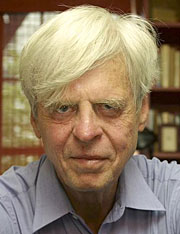
George Plimpton
The Beatles mention a Dr. Robert in one of their songs and he’s the man we’re concerned with here in ’65 no to be confused with Dr. Roberts. Dr. Roberts administered to some of the Warhol crowd including Edie Sedgwick. There is an astonishing account of his practice in Stein and Plimpton’s Edie. Quite an extensive account. To excerpt it I’d probably have to have permission; I’ll check into it.
These doctors were carelessly giving incredibly huge injections that kept you speeding for a week or two. But needles, syringes and drug could be obtained easily and they were which brings us to a member of the Factory entourage, Brigid Berlin. She was not old money but came from a very affluent background.
She, obviously laboring under several mental disorders, was an indiscriminate and unsound dispenser of the drug. She ran around the Factory injecting all and sundry with the same dirty needle. Her forte was to inject herself straight through the seat of her jeans.

Jean Stein
Andy, himself, used something call Obetrol which is described as a very high quality amphetamine producing a pleasant and stimulating high. While this drug kept Andy up with the exception of an hour or two of fitful sleep it also allowed him to work, work, work, industriously and with intense concentration for hours at a time. Fifty Presleys in an afternoon, think about it, assembly line pace.
Without a work outlet one had to find other ways to work off the excess energy. Non-stop talking is one but, hell, I can do that all day without the benefit of drugs. Since all these people at the Factory were living in 16/4 time they could communicate on that level with each other. There wasn’t an awful lot of intelligence being communicated. Warhol did us the service of recording 24 hours of what passed for communication and published the result as a book or novel he titled ‘a’. This book is virtually unreadable but as dedicated to my art as I am I am living proof that it can be done. Let’s hear from anyone else who had the patience. The gang was big on non-verbal communication. There are mostly a lot of incomplete sentences in the book but the conversation is forwarded in a pastiche manner each participant adding a phrase so that a sort of idea is parsed out.
As might be expected the group was low on conventional 4/4 morality, but at 16/4 they seem to have worked out a morality that all could accept but one I certainly would reject. Beatings, theft and random sex in view of others or not with anyone or anything seemed to be the moral basis. While Andy disavowed responsibility for anything that hapened at the Factory he was in fact the leader functioning as Magister Ludi. In the novel ‘a’ he is referred to as Drella, a combination of Dracula and Cinderella- a vampire and a fairy. He was in truth a bloodsucker.
He essentially took a whole group of Catholic homosexual Undermen and gave them a clubhouse and a certain immunity under the umbrella of his name and fame. Even then he and his Factory were a thorn in the side of legitimate society, the police visiting the place on a regular basis. And rightly so.
This was the scene, the environment that Chuck Wein brought Edie into. It seemed to suit her state of mind, she stayed.
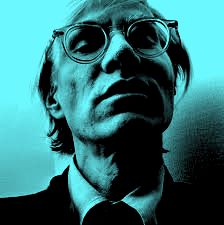
Magister Ludi
Dylan also was an amphetamine freak at the same time while using alcohol, LSD, marijuana and heroin. Warhol who was a perceptive observer said that Dylan’s songs were the amphetamine speaking. According to Andy, Dylan took other people’s words (and tunes) and because of the amphetamine was able to make them sound as though his own. He also astutely divided Dylan’s output into two periods; the first, social protest and the second, personal protest. Pretty much half a side of Another Side, plus Bringing It All Back Home, Highway 61 Revisited and Blonde On Blonde. Once again, he knew whereof he spoke. We’re concerned more with the personal protest here taking little or no interest in the social side.
Dylan’s personal protest by its very nature must be autobiographical. Indeed, Suze Rotolo identifies many of Dylan’s songs as referring to her. She should know. Dylan was quite taken with her. He obviously suffered a painful feeling of desertion whan at her mother’s insistence in 1962 she left NYC to study in Italy. This absention definitely changed the relationship although as Bob was never too constant a lover it is difficult to see how. Ego was hurt, I guess.
Although the relationship was reassumed on Suze’s return her sister, Carla, and her mother disapproved finally breaking the couple up. The break up produced the autobiographical Ballad In Plain D in which Dylan vented his emotions in a loud screaming complaint that was a direct predecessor to his magic mantra ‘Like A Rolling Stone.’
Chapter 5
I Can’t Stand The Pain In Here
According to accounts Dylan began writing Like A Rolling Stone in June of ’65. It began as 20 pages of ‘vomit’ according to Dylan, cut down to 10 and then to its released form. The 45 was a successful disc reaching the Billboard Top 10. The song is quite obviously about Edie when one learns the background. Many New Yorkers who were aware of the scene expressed their opinion that it was about Edie, pointing out further their belief that Warhol was the Napoleon in rags.
If first written in June then Dylan had made a considerable psychological investment in Edie since the previous December of ’64. One wonders where he found the time to cultivate a relationship with her between the two dates. He wrote recorded and released ‘Bringing It All Back Home’ between the meeting with Edie and April. He had performance dates. He divided his time between NYC, Woodstock and Carmel. In the last mentioned place he was staying at the home of Joan Baez while keeping Sara in Woodstock and maintaining some sort of relationship with Suze.
The extent of the rage and hatred of ‘Stone’ seems to be out of all proportion. According to the song Dylan is in a jealous rage because the ‘She’ of the song has deserted him for this ‘Napoleon in rags.’ ‘He calls to you, go to him now.’ What exactly did Dylan intend to do with Edie that he should become so emotonal? There is no question but that he intended to marry Sara; also none that he would marry either Joan, Suze or Edie. Quite simply they weren’t Jewish and Sara was. Dylan had no intention of marrying outside his religion. He intended to obey the Biblical injunction, which he takes as the literal word of God, to be fruitful and he wanted his children raised Jewish.
So what, then? What did Edie represent to him? Apart from being an uptown girl, in Volume I of his autobiographical Chronicles he suggests that one looks for the model of ‘She’ in his mother. I found this puzzling. I couldn’t make it fit the lyrics. None of the ‘facts’ of the song seemed to fit what is known of his mother. Then I saw Dylan’s 2003 movie, Masked And Anonymous. This is a delicate subject of which I am only going to skirt the edges. But, if one reads between the lines of Jack Fate’s soliloquy at his father’s death bed about his mother and faher, the lyrics of Freight Train Blues and what I’m hinting at here the fog should thin out somewhat. Remember that Dylan said his mother was connected to ‘Stone’. Since the song is about Edie it follows that Dylan associated his mother and Edie in his mind; there was a situational similarity to him.
Now, from August ’65 to the recording of Blonde On Blonde nearly the whole of Dylan’s output is centered around Edie, Warhol and the Factory. One of Dylan’s more vicious songs was ‘Leopard Skin Pill Box Hat’ which is about Edie. When Edie dissipated her inheritance she bought a slew of fur coats and a lot of jewelry. She had the leopard skin pill box hat.
Dylan’s mother was also known for having a lot of jewelry and several fur coats. Dylan recorded his version of Freight Train Blues long after 1968 when his father died. Now, immediately after his death the business owned by his father and two uncles either went bankrupt or was forced to close. In other words there was no more money left in the business. While Hibbing was not a flush market there was no competition either. So Abe Zimmerman’s exit came at a propitious moment, or…. At any rate there was no more money.
Just as Edie went through her money so Dylan’s mother kept her husband hopping in all likelihood straining the finances of the appliance store that, after all, had to support three families. Dylan, then, may have conflated Edie with his mother’s extravagance and whatever he had planned for Edie would have been done to his mother surrogate. In fact he was quite brutal to Edie, destroying her in the end. Thus one avenges oneself on one’s mother, ‘Like A Rolling Stone.’ He is probably one of those people who reject but can’t tolerate rejection because of his mother’s rejection of him per Jack Fate. According to his soliloquy in Masked And Anonymous his mother essentially rejected him plnging him into a deep depression from which he has never recovered if the movie is any indicaton. The movie too is autobiographical. He felt: ‘Nobody leaves me, I leave them.’ ‘That’ll be the day when you leave me’ as Dylan’s hero Buddy Holly put it. This was possibly the cause for the eruption of Ballad In Plain D.

Obetrol
In March of ’65 Edie entered the corrupt, even criminal, world of Warhol’s Factory. One can only speculate why Chuck Wein took her there. Perhaps the empresario was having a difficult time getting Edie launched and thought he could get her into Warhol’s hideous movies. Having run through her inheritance Edie was getting desperate for money. Perhaps in her naivete she thought movies were movies and movie stars made big money. Certainly one cause for her break from Andy was his refusal to pay her.
Warhol, in his own delusions believed that Hollywood would come knocking on his door cash in hand. That that never happened was probably a major disappointment. At any rate when this vision of the respectable Overmen appeared in this dump of a studio Andy went ga-ga. In fact, Edie was his ticket, his entry into the Upper East Side crowd. Just as Fred Hughes was to show him how to make money, Edie opened society doors to him.
This King of Scurf was creating quite a scene at the Factory. At the same time he gave a clubhouse to the Undermen, as a leading figure of the art world which, after all, is an upper class affair of wealth, he had a foot in that camp. Led by the more louche of celebrities the Factory was becoming a party destination. So Edie added some instant uptown glamor. Old family, old money.
Whether it was the hope of money from movies that kept her there or whether this degrading atmosphere filled some psychological need Edie stayed on thereby sacrificing her reputation. I imagine there’s always the hope that once you get your face up there something will pop.
Sometime between March and June Dylan became enraged that Edie was at the Factory making some pretty lame Warhol movies with little or no commercial appeal. Thus his work from this time on reflected his tug of war over Edie with Warhol.
Edie says that she didn’t get into heavy drugs before she joined Warhol’s menagerie. This may be true but as Warhol said: How do you stop someone from doing what they want to do? I would imagine the effects of electro-shock are very long lasting and discombobulating. Lou Reed of Velvet Underground was certainly whacked out from electro-shock. As I write my mind keeps going back to the time I stuck my finger in the socket as a child. I mean, it is vivid, so I can’t imagine what Electro-shock does to you. Perhaps speed replicates what electro-shock does do to you. Perhaps speed replicates or complements the feeling of electro-shock in some way.
Of amphetamines Edie is quoted as saying:
The Ghost Of Electricity
The nearly unendurable torment of speed, buzzarama, that acrylic high, horrorous, yodeling, repetitious echoes of an infinity so brutally harrowing that words cannot explain the devastation nor the tone of such a vicious nightmare.
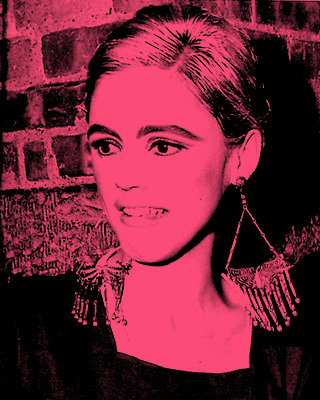
Could be close to the feeling of electro-shock. Kind of reminds me of my finger in the socket. Dylan’s seach for the ‘high mercury sound’ must also have been the result of speed. Cacophonous songs like ‘Highway 61’, ‘Subterranean Homesick Blues’ and ‘Rainy Day Women’ come to mind.
Perhaps also the amphetamine high reflected and complemented the deranged vicious goings on Warhol allowed at the Facatory. The sado-masochism. Brigid Berlin, or the Duchess as she was alternately known, roaming around with her needle and syringe ramming it into anyone will they, nil they, not much choice there. Beatings going on back in the shadows, is it any wonder that Dylan referred to Warhol as Dr. Filth in Desolation Row.
It is difficult to ascertain dates in existing sources but possibly between June and August Dylan invited Edie and Andy to a concert in upstate NY so, there was significant interaction between the three before Highway 61 Revisited. Side one of that record doesn’t reflect Factory activity as much as side two. I suspect all three songs on that side reflect Dylan’s sitation with Andy and Edie while Desolation Row definitely does. Now, while at the time there were few listeners who had any idea of what Dylan’s lyrics meant except for possibly a few, of which Warhol definitely was one. He must have recognized the reference to himself in ‘Stone’ and also in Positively Fourth Street. These songs were hits. ‘Fourth Street’ was pulled from airplay shortly after relaease but when I first heard it the sound just blew me away. I heard the put downs but too fleetingly to grasp them. Hank Williams on steroids.

Stop! In The Name Of Love
Dylan, then, was making, on Warhol a blatant attack over the airwaves of all America plus reviling Edie in a hideous manner. What did Andy think, what was his reaction? Having vented his feelings even more violently than he had in Ballad In Plain D, Dylan’s next move was obvious. Having lost Edie in March he meant to reclaim her in October. And so this epic battle for the person of Edie Sedgwick began. She was only a pawn in their game.
Chaps. 6, 7 and 8 are up on the next post.
Chaps 9,10, 11 and 12 are now up on the post following 6,7 and 8.
Chaps 13, 14 and 15 are now up also. Chap. 16 and end is in contemplation
”
Chaps. 1 & 2: Edie Sedgwick: Maid Of Constant Sorrow
October 21, 2010
Edie Sedgwick: Maid Of Constant Sorrow
Edie Sedgwick, Bob Dylan And Andy Warhol
by
R.E. Prindle
Chapter 1
Some Enchanted Evening

Edie and Andy
Texts:
A movie: Factory Girl
Sedgwick, John: In My Blood: Six Generations Of Madness And Desire In An American Family, Harper Perennial, 2007
Stein, Jean: Edie: An American Biography, Pimlico, First Published 1992, 2006 Paperback edition
www.warholstars.com A comprehensive Andy Warhol site.
The sixties was a period of broken lives. It was the heyday of the users and the used. It was as Donovan aptly put it: The Season Of The Witch. It was a period when all the hounds of hell were loosed. It may be a cliche but it was both the best and worst of times. It was during this period that Edie Sedgwick came of age. Edie’s tragedy was that she was used rather than a user. She was the cat’s paw of two of the greatest users of the period, Andy Warhol and Bob Dylan. It cost her her everything including her life.
Edie was one of the Sedgwicks of Massachusetts and they were old line Americans. If the Sedgwicks missed the Mayflower they were trolling in its wake. Therein lay part of Edie’s charm for the two immigrant lads, Bob and Andy. While from Massachusetts the Sedgwicks had a notable presence in New York City and Long Island. One might say they were venerable. J.P. Marquand who married into the family wrote his novel ‘The Late George Apley’ about them.
In Massachusetts the Sedgwick family was famous for their burial plot known as the Sedgwick Pie. As their legend is intimately connected with the Pie it might be proper to dwell on the Pie for its flavor. The founder of the family back then just after the first Thanksgiving was a gentleman named Theodore Sedgwick. He was a dynast by nature. Hence, he bought a section of the Stockbridge cemetery and had himself buried in the very middle. Subsequent Sedgwick burials were laid feet first toward the Patriarch in round rows emanating outward like the wedges of a pie, thus the name Sedgwick Pie. It was said that on judgment day when reveille was blown the Sedgwicks would all arise facing the founder, Theodore. Pretty story.
Over the centuries following Theodore’s death the Sedgwicks continued to prosper there always being enough money to maintain their position. There also arose the fantastic legend of the Sedgwick Curse, as indicated by John Sedgwick’s subtitle. The idea was that the Sedgwicks were a weak stock and that there was an abnormal amount of madness and suicide in the family. Considering the extent of the family I think this was a romanticized vision of themselves. Not that there wasn’t a sort of madness and a few suicides but hardly more than in any several hundred member family over a few centuries. Nevertheless in Edie’s generation this fatalistic notion took firm hold. It’s almost as if the generation rose to embrace the notion. Her biographers speak of it in awe as though the Curse of the Pharaohs had morphed into the Curse of the Sedgwicks. Jean Stein, the author of Edie, seems entranced with it and even John Sedgwick, Edie’s younger cousin, in his memoir seems possessed by it. Feels he’s got it. Slim chance for being true in my estimation.
For an inconsequential girl Edie’s life has been well examined. There are actually several books written about or featuring her while the legacy of movies she appeared in and movies about her is fairly extensive. Most of the early information on her life here is abstracted from Jean Stein’s biography. Stein, herself, is accused of writing the biography in a fit of sour grapes because Warhol wouldn’t make her one of his superstars. No matter, it is an exceptional book of its kind.
‘Edie’ is presented as an oral biography in the voice of many participants. However as all the voices are pretty uniform it would seem as though the editor, George Plimption, is pervasively evident. George Plimpton, otherwise a nobody, began his career as a celebrity in the sixties and the seventies by becoming a professional old line American, nearly the last of a vanishing breed.
He clowned around by trying out for various professional sports teams then writing books about the experience. Thus he became the American Man Of Letters touted on his website and a well known celebrity who could actually measure his press releases in inches. He and Stein put together an excellent more than readable book in their biography of Edie Sedgwick.
Edie was the daughter of Francis Sedgwick of Long Island, NY, he otherwise being known as Fuzzy. The family left New York for Santa Barbara, California just before Edie was born so she knew nothing of New York or the East Coast. In California she led what would seem to thave been an idyllic life. The family lived on a 3000 acre ranch which was exhanged after oil was found on it for a much larger ranch and finally an 18,000 acre ranch where she spent her teens. This was a functioning cattle ranch with ranch hands and the whole works.
The Sedgwicks did not attend either public or private schools being rather schooled by private teachers along with a few neighbor children. Thus unfamiliar with the world she may have had a very diffiuclt time adjusting to real life people. She probably did not have time to do so before she was thrown into the boiling cauldron of New York City. Francis, or Fuzzy, was a difficult father; his children blamed him for their shortcomings while Edie said he had sexual relations with her. She then was, or believed herself, mentally unbalanced by the time she arrived at Radcliffe to begin college.
She may very well have been unbalanced but where I grew up I didn’t know anyone who didn’t have mental problems, parents or children, and by the time of high school graduation I was literally a basket case, nearly immobile. Yet, so far as I know, everyone got on with their lives including myself. Seems to me everyone has to work themselves out of that hole as best they can.
Of course, drugs were becoming a definite problem by the time Edie showed up in Cambridge in the early sixties. It one reads Raymond Chandler novels, for instance, drugs were a problem in the thirties and forties and further reading will show that they had been a problem for decades. Most narcotics became regulated in 1910 in the US, still, new pharmaceuticals were being developed constantly and some of them including the psychedelics were not covered by narcotics laws at the time.
The first wonder drug I heard of was Miltown about 1950. I was too young to understand but Miltown was the Valium of its time, a panacea for all forms of stress, the stressed and housewives began to line up for prescriptions. By 1960 the list of users must have been stupendous.
Along with the barbituate downers came the uppers. First Bennies and then amphetamines. My first knowledge of the pervasiveness of drugs was 1956 when I wrote a high school essay on LSD. Of course glue sniffing was endemic in high school. Then in 1958 in the Navy was the first time I saw people ingesting bennies and heard of peyote, mescaline and the actual use of LSD. By the early sixties I knew a lot of people who were smoking pot and popping pills but I was never a user myself. I watched drugs put a lot of people over the edge. In most cases they weren’t aware that they were freefalling.
So, an unsettled socially naive Edie moved into a fast, loose society in Cambridge. While I can’t see much in her from the pictures apparently she was a sensation live, possibly influenced by her seemingly casual attitude toward sex. I don’t know about on the East Coast but on the West Coast girls were either more circumspect or I was out of it.
Edie was picked up by a homosexual crowd and attended many fetes in that milieu. At the same time the other folk scene, that of Boston was burgeoning with Jim Kweskin and the Jug Band, Eric Von Schmidt and Mel Lyman being the standouts. Dylan came up to Boston at this time to meet them where, I believe, he first became acquainted with Bobby Neuwirth who was hanging out around the art and folk scene. Certainly Edie would have come to Neuwirth’s attention at this time. I wouldn’t be surprised if he and Dylan discussed the ‘hot chick’ from a distance at that time.
At some time Edie became erratic enough in her parents’ eyes that they decided to commit her to an insane asylum called Silverhill near Boston. This to me seems very extreme. Apart from Edie’s not doing things as they saw fit I can’t find anything in her behavior to have her committed. I mean, I’ve seen some pretty zany behavior and after drugs really got rolling in about ’67 half the population could have been put away with the other half waiting in line.
At some point you have to let your kid go while parents always have to take responsibility for their behavior at least for the first few years after they’ve left the nest until they work through those parental childhood traumas. The Sedgwicks had the money so as long as the offspring weren’t financially out of control they at least deserved their allowance. Edie was what would have been described as an airhead.
But then I’m sure that with the asylum experience the cure is worse than the disease. Edie was repeatedly given electro-shock ‘therapy.’ Electro-shock ranks right up there with the pre-frontal lobotomy as the most bizarre psychiatric treatments. Talk about Hitler and the Nazi doctors! If the Nazis had practiced frontal lobotomies and electro-shock you can imagine the Liberal howling from the West. It would have made the flap over Eugenics a mere whimper.
I can’t imagine what electro-shock does to the mind and nervous system. When I was four I was playing with an open socket. When I connected the jolt was such I lost consciousness. Fortunately I was repelled being thrown completely across the kitchen floor where I became alert again after a few seconds but still buzzing. Plus, I remember it as though yesterday. Imagine being strapped down and having those volts sent coursing through your existence. My god! For what purpose? That’s going to change your psychology? It doesn’t, so why they kept at it is beyond me.
Since Edie wasn’t insane when she checked in the good doctors of Silverhill checked her out as sane. Somewhere along the way she met some guy named Chuck Wein who believed himself to be an impresario of some sort who was going to take Edie to New York and make a star of some sort of her. Toward the end of 1964 then Edie and Chuck showed up in Manhattan.
Edie moved in with her grandmother on the Upper East Side. Good address. Enviable. She had come into an inheritance of 80,000 dollars which she proceeded to squander in six months. In 2010 dollars that might be the equivalent of from 300,000 to 500,000 dollars. One had to have a careless disregard for money.
In 1964 the sixties had started moving, approaching maximum velocity. The Beatles had splashed down in January of ’64 followed by the Rolling Stones, Animals, Dave Clark Five and a host of others including Freddie And The Dreamers which was the beginning of the hip explosion as rock and roll morphed into folk rock. It doesn’t matter who was the first with folk rock it was inevitable. The electric bass and guitars along with better and more powerful amplifiers ever evolving there was no other way to go. I mean, Duane Eddy and Eddie Cochran were proto-heavy metal. And they were exciting bands. The music had been loosening up for several years. Tequila by The Champs was fairly revolutionary in its day. But then the recording companies and artists put a lot of effort into trying to astonish us with new styles and forms and frequently did, every week. Mule Skinner Blues by the Fendermen, a folk song was done in a folk rock style long before Bob Dylan went electric and set us all on our ear. That song has probably never been surpassed. Besides by 1964 the whole folk thing was passe and worn out, boring, apparently the word probably hadn’t reached Peter Seeger and that bunch in New york yet.
Each day was a new adventure where you had no idea what you would see or hear. Andy Warhol’s soup can is a case in point. The arrival of the Lovin’ Spoonful in Edie’s big year of ’65 was a revelation. As far as I’m concerned, the most influential band of the era. If Yanovsky hadn’t given up his dealer there’s no telling how far they could have gone. From there everything accelerated to super sonic speed. There was even a group called the Super Sonics. Songs like Telestar. Men even walked on the moon. So, while the external world was racing with the moon the internal, personal world ran along at the same slow pace unable to keep up with developments. No one knew what was going on except in their small mental space. Thus, even while Dylan and Warhol were succeeding spectacularly in their own spheres life was racing past them making them passe while there was no way they could keep up.
In that atmosphere Edie arrived in New York City and spent her money. And then the money was gone. As ’65 progresseed her parents became disenchanted with her life style so they cut her allowance way back, and then, off. But that’s getting ahead of our story. What Chuck Wein’s plan was for turning Edie into some sort of star or celebrity isn’t clear. She did get some modeling jobs for magazines, probably because of her name, but they were put off by her drug intake and her corresponding erratic behavior.
Bobby Neuwirth
Then Bobby Neuwirth, the legend goes, noticed she was in town. by this time Neuwirth was playing Robin to Dylan’s Batman, his sidekick in other words, and he notified Dylan that ‘there was a hot new girl in town.’ In the movie Factory Girl, sometime in ’65 Neuwirth showed up at the Factory and said: Come with me. Someone wants to meet you.’ Edie leaves with this total stranger, who cons her into paying the fare, escorts her back stage at a Dylan performance to be introduced to the Star with whom she is dazzled.
That’s one version. According to Jean Stein in Edie in December of ’64 Neuwirth invited her down from the Upper East Side to the Mafia club, Kettle of Fish, to meet the folk singer himself. Edie had arrived in NYC driving a big grey Mercedes. Her flipped out driver crashed the car so she was using a limousine service to get about. Accordingly her limousine pulled up in front of the Kettle of Fish, Edie got out of the car, entered the bar and contact was made. The history of her life over the next eighteen months, the Dance of Death, began.
Dylan, then, laid claim to the dazzling girl before Andy Warhol. Edie met Andy at the film producer Lester Persky’s a few weeks later at a party in January of ’65. Dylan and his entourage were heterosexual while Warhol, Persky and that crowd were homosexuals. Thus Edie began to fulfill her destiny as a pawn in Dylan’s and Warhol’s games.
Chapter 2
Never Felt More Like Singin’ The Blues
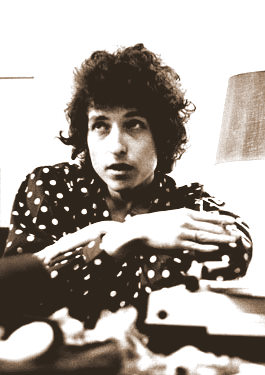
Dylan In Polka Dots
Who were these guys Bob Dylan and Andy Warhol and what interest could they take in this uninteresting and rather dull girl. Interestingly both men considered themselves revolutionists. Dylan forwarded the Jewish and Underman revolutions while Warhol spearheaded the homosexual and doubled up on the Underman. Both men came from immigrant backgrounds. Dylan from Jewish immigrants and Warhol from Ruthenians. Dylan was originally Robert Zimmerman and Andy Andrew Warhola. Dylan grew up in small town Hibbing, Minnesota, Warhol in the ‘melting pot’ of Pittsburgh, Pennsylvania. Both developed monster grudges against American society.
At the end of ’64 both men were on the way to being of the most influential people of the second half of the twentieth century.
Dylan at twenty had come to New york with the ambition of becoming a folk singer. Even though a not easily appreciated singer he was as close to an instantaneous success as it is possible to be. Arriving at the beginning of 1961, at the close of ’64 when he met Edie he was an international sensation, a prolific and successful song writer.
Strangely his success was built on resentment and hatred. The dominant characteristic of his songwriting was a rancorous bitter putting down of his society and associates. He fairly spews hatred in such songs as Hattie Carroll, Like A Rolling Stone and Positively Fourth Street to name only a few of his diatribes. His most prolific period would revolve around his desire for Edie Sedgwick and his detestation for his rival for her affections, Andy Warhol.
Dylan had a fixation on destroying the happiness of women. At the time he began his pursuit of Edie he had sequestered his future wife, Sara Lownds, who he would marry in November of ’65 and who he had purloined from another man. At the same time he was carrying on long time affairs with his first New York girl friend, Suze Rotolo and his fellow folk singer, Joan Baez. Why this need to injure the happiness of women?
Of course I’ve read most of the important works on Dylan if not all and many of secondary importance. Using that background, I’m going to concentrate on the movie Dylan wrote and starred in, Masked And Anonymous. This is a very autobiographical movie showing a Dylan who had progressed little from his heyday of the mid-sixties. Dylan believes that the journey is more important than the result so that in the various episodes he gives little symbolical vignettes of his life journey leading up to a contrived ending. Many of the most important eipisodes and people are represented. The promoter in the film, for instance, can be recognized as his manager Albert Grossman; the sidekick is Bobby Neuwirth etc. I’m not going to review the movie here but Dylan gives us some insight into when and how his world went wrong.
In the movie when Jack Fate’s, Dylan’s movie alter-ego, father, who is the dictator of ‘this god-forsaken country’, lies dieing, Fate revisits him on his death bed. In fact that is where the ‘path’ of the movie actually leads. Fate reminisces about his relation with father and mother. To put it succinctly let me quote the lyrics of an old song, Freight Train Blues. Dylan would rewrite the lyrics to this song and claim it as his own:
I was born in Dixie
In a boomer’s shack,
Just a half a mile
From the railroad tracks.
My daddy was a fireman
And my mama dear,
She was the only daughter
Of an engineer.
She could spend the money
And that ain’t no joke,
It’s a shame the way
She kept a good man broke.
Well, Jack Fate’s daddy wasn’t much better and the movie couple had an unhappy marriage which probably reflects Dylan’s view of his own parents. As to his mother she just found Jack in the way and wished she never had him because it interfered with her happiness. I suspect that more or less sums up Dylan’s relationship with his mother. One can’t say for sure but I suspect that when his mother conveyed this attitude to the young Dylan it just shattered his mind and from that day forth he was one lost soul on the lost highway with the freight train blues. Now, it is impossible to avenge oneself on one’s mother directly as mother’s are sacred as the vessel of your life. Dylan never tried, even escorting his mother as a date to major events. You can take it out on yourself by becoming a derelict yourself which Dylan did thereby punishing your mother or you can take it out on surrogate women. Dylan did both. He himself was and has been a heavy drug user and a heavy drinker. He ruined the lives of several women including Rotolo, Baez and Edie; then, after making Sara a wife and mother, most importantly a mother, he completely shattered her life as his mother had his. That may have satisfied him, then again, maybe not. Since then he has been wandering aimlessly as a ‘modern troubadour.’ Ramblin’ Jack Fate.
The period of the sixties was Dylan’s time of most intense reaction. After that he waxed and waned but Andy Warhol was focused on an unwavering need for vengeance. He knew how to use people to obtain his goals without actually exposing himself. He arrived in New York in 1950 as a graphic artist where he too was an instantaneous success. He made his mark in shoe ads where his drawing, usually described as ‘fey’, but displaying real genius at the same time, brought the customers to Miller Shoes for whom he drew.
During the fifties he was a very highly paid commercial artist designing everything from his shoe ads to stationery to book and record covers. Usually very nice but not infrequently letting his sexual proclivities shine through. He was alwa;ys pushing the homosexual agenda preferring to associate his work with writers or musicians from either the Undermen or those writing on those themes.
About 1960 he decided to tackle the fine arts with the purpose of detroying them. He entered the world of painters at the transition from Abstract Expressionism to Pop Art. He had always been a sort of pop artist with his shoe ads so he was an incrdible success as a pop artist when he painted Campbell’s soup cans. With the soup cans he effected one of the most instantaneous and successful revolutions or transitions from one style to another, ever. I don’t think it would be out of line to say the sixties were born in that moment. If there is one single symbol that characterizes the sixties, for me at least, it is Andy’s soup cans. Tomato soup can. It enraged and energized so many people. It has been an inspiration for me.
I can’t remember when I first saw it but I was simply stunned. Perhaps in the pages of Time Magazine. I don’t know whether the copying of a soup can is art but as I mused about it I came to the conclusion that the can was a sort of urban landscape. It was something one gazed at frequently while grocery shopping, so I said, what difference did it make whether one copied a mountain or curling wave or a soup can. I suppose the difference is that a soup can can only be done once before the joke is stale.
My favorite image of the soup can was a poster in which a soup can had a gaping hole from being blasted with a .45 automatic. That sort of settled the arguement for me but that was as late as 1968. Andy went on attempting to outrage us by painting duplicates of Brillo boxes and such like, Heinz Bean cans, but that fell flat. The joke had been made, there was only one Campbell soup image.
Painting all those soup cans, he did all the varieties, must have been a tedious way to while away the time. Then he discovered silk screening. What a good idea. Warhol, the child of industrial processes. I can only imagine that he thought Henry Ford and his assembly line turning out identical copies of cars was the ideal expression of art. After all you can make a million cars, same model and make, but in painting a picture, prior to Warhol, they all had been one offs and then you needed another idea. In that period of rapid change an idea became obsolete immediately. Coming up with new ideas was a tough business. Warhol could turn out an idea like the Presleys like Henry Ford turned out cars. Wow! Man! The future of art had arrived.
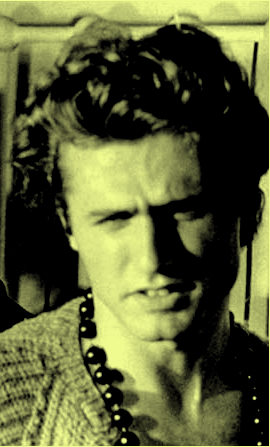
Gerard Malanga
Perhaps he thought up silk screening or perhaps the idea was suggested to him by his assistant, Gerard Malanga. Malanga thinks that’s the way it was. At the time he was hired Malanga was already an accomplished silk screener. Malanga was the beginning of Warhol’s actual use, consumption and discarding of people. One might say Malanga was exploited.
Malanga took a job with Andy at the minimum wage above which Andy never raised him. Malanga insists that he was essentially a collaborator of Warhol’s. I am inclined to agree with him. In the first place Andy never drew his own pictures. He essentially had no ideas. He had his screens made up from photos of others he found attractive. His famous flower screen was from a purloined photo. HIs Elvis paintings, posters actually, were traced from a promotional still. To me that strengthens Malanga’s claim. The screens were mechanically produced and screening is a mechanical act. Both Malanga and Warhol manipulated the screens together. There are films showing them doing it.
Between the two of them they produced fifty Presley images in an afternoon. For a show at LA’s Ferus Gallery Andy shipped them a two

Malanga and Dylan
hundred foot roll of Presleys and told them to cut up the roll as they saw fit. Collaboration was just Andy’s way. Hence one has single, double, triple, quadruple and octuple Presleys. I saw one display where there were twenty or more strung out for a couple hundred feet in one immense string. Enough Elvis Presleys to go around the world three or four times were produced. (That’s a joke, son.)
It is a good image although Andy never asked Presley or his studio for permission to use it and as far as I know never gave them a dime. He just appropriated the image. I can’t imagine how Andy kept the Colonel cool. He didn’t keep the flower lady cool, once she recognized her image she sued him. Of course, she took her image from God but God didn’t sue her.
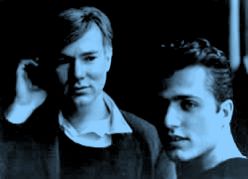
Warhol and Malanga
Now, all this silk screening takes up a bit of space, these Presleys kept getting bigger and bigger, life size and then some. Some were twenty-five feet by twenty-five. So Andy outgrew his home facility leaving it to seek much bigger spaces. If one thinks about it all this is very daring. There was no artist in New York even approaching the concept. Finally he rented an entire floor of a building on 47th Street that became known as the Factory. Dylan would characterize it as Desolation Row. When Edie made her appearance there in March of ’65 it was at that Factory. There were subsequent and even larger ones.
This is where Dylan and Warhol stood at the beginning of 1965 when Edie became a pawn in their game. Why did they want her? As noted, the two were immigrants or the sons of immigrants so they knew the discomforts of being strangers in a strange land. They knew the sense of inferiority among the ‘natives.’ They knew what being outsiders was especially as Dylan was a Jew and Warhol a homosexual.
Edie Sedgwick was a symbol of that envy and desire. In a way she was the acme of the old line American and she was accessible. She probably could have been half ugly and it wouldn’t have made much difference.

Malanga and Edie
From, say, 1870 to 1940 there was native America and there was immigrant America and they were separate but equal size. While intelligent immigrants never had it rough there was still resentment and outright hatred for Anglo-America. All this anti-America stuff comes from the immigrants or at least was fostered by them. With those of the Undermen, those of low IQ, the hatret was worse. WWII gave the immigrants a feeling of equality. They fought too. By 1950 they were superior in numbers assaulting every Anglo tradition and trashing it while doing their best to lower Anglos. Of course, the Anglos were too stupid to see it or unwilling to acknowledge it. After all, this was the magic ‘melting pot’ in which all resentments disappeared. Americans had discovered the solution to world problems. Both Dylan and Warhol shared in this resentment.
Thus when this female symhol of the old Anglo aristocracy appeared who they held responsible for their humilaition, whether they acknowledged it or not, they wanted to possess her, humiliate and destroy her. Dylan today would deny it while Warhol’s excuse at the time was ‘How do you stop someone from doing what they want to do?’ Well, Andy, at least you don’t hand them the revolver cocked and loaded. That Edie was humiliated and destroyed by her association with the two is proof enough of their intent.
The problem is to piece together the events of that year and a half over ’65 and ’66 from less than adequate documentation. I think I can produce a reasonable facsimle.
Chaps. 3, 4 and 5 are posted
Chaps. 6, 7 and 8 are posted
Chaps. 9, 10, 11 and 12 are posted
A Review
The Last Days Of John Lennon
by
Fred Seaman
Part II
Review by R.E. Prindle
How The Fifties Became The Sixties

Yoko, Andy, John: The Fifties And Sixties United
The sixties seem to have erupted by some process of autogenesis. They seem to be a decade unrelated to the fifties but nothing could be further from the truth. The sixties were very carefully structured in the fifties, that supposedly somnolent decade. The fifties themselves evolved from the fantasy notion of The United States Of America- the American Dream. In truth there had never been a united America and an American Dream only in the mind of certain immigrants who believed they had reached the Promised Land of their dreams. The country has always been one of conflict with conflicting peoples. There was no mythological age as in distant times so no mythopoeic era preceded the scientific one. America was born in science.
The warfare against the aboriginal peoples to clear the land for the European invaders created the first layer of conflict. The second layer of conflict was the importation of Africans as slave labor. This created a second irreconcilable conflict that erupted in 1954 when the Black revolution began in earnest and began to accelerate in the sixties. This was what Eric Foner described as America’s unfinished revolution in his writings.
Each succeeding group of immigrants created its own friction but assimilation did go on with most peoples. In the fifties the sort of ethnic identities in song and humor that makes the talkies of the thirties now seem quaint was coun

Levy's Jewish Rye- Subtle Form Of The Imposition Of Ethnic Superiority
teracted. While visibly subdued ethnicism simmered below the surface until the sixties when it burst out again in a new form and triumphed.
I am unable to tell the education received in schools of the twenties and thirties but by the time I was in high school from 1953-56 the whole concept of revolutiuon was romanticized and this continued through my college years in the sixties. It was iterated over and over again that revolution was an absolute virtue. To be revolutionary was to be a person in full. Kids in the walls ran around saying are you revolutionary, I’m revolutionary. Thus they embraced any idea that was the opposite of the status quo. This notion of revolution was combined with the notion of the absolute virtue of being an American. This would result in Kennedy’s idiotic Peace Corps begun in the sixties. Raw American youths were supposed to be able to tell the less favored peoples how to run their lives. The war in Europe was treated as a crusade against Germans, a war of absolute black and white, no shades of grey. I truly believed that no American in either the European or Pacific war ever committed an act of wanton brutality no matter what the provocation. I would have dismissed out of hand that as a matter of policy millions of Germans were exposed to Winter weather in the years following the war unprotected while being denied any kind of nourishment and, yet, it was so. In subsequent years this would have been described as ‘American’ brutality while in fact it was instigated by revolutionary American Jews seeking vengeance. Americanism was not involved.
At the same time the new medium of television exposed us to unprecedented doses of propaganda disguised as the truth, doses far in excess of anything the hated Nazis devised. Chief among those TV shows was a cartoon called Crusader Rabbit. Now, Crusader Rabbit in reality is a vigilante dispensing vigilante justice. He acted on his own ‘righting’ what he perceived as wrongs. Of course those of us who read comic books in the late forties had already been exposed to vigilantism in the form of comic book heroes like the Blackhawks. Or, for that matter Batman and Robin and Superman among many others, Plastic Man. I sort of thought of myself as Plastic Man.
So this whole age cadre was stoked up on revolution and vigilantism with no venues to express it. The sixties then was a god send as the existing revolutions- the Undermen, the Jews, the Blacks, the Homosexuals, the Feminists, the Communists had merely to whisper the word REVOLUTION to get a positive response for their ideologies. The generation was primed for revolution of any sort- a revolution in bubble gum for instance.
Thus at Berkeley in ’64’s so-called Free Speech Movement you had the spectacle of the most advantaged members of the generation participating in what was a part of the Jewish Revolution in the guise of voluntary Undermen.
Thus as the sixties dawned the way was cleared of any resistance to revolutionary schemes as hordes of self-righteous vigilantes confident that their perception and judgment was received from god himself began to act on their assumptions taken from their misguided elders.
2.

Little Miss Yoko
The center of this maelstrom in the sixties was New York City. The Bohemian life style stewing in Lower Manhattan since the Armory Show of 1913 was about to conquer the mind of the country. Perhaps the leader of the sixties Bohos was Andy Warhol. Certainly with a kind of genius he made himself the center of the storm.
This most influential Bohemian attitude toward life was both stratified and diverse. The first out of the box were the uptown Beats. These men seized the attention of the country in the mid-fifties when Allen Ginsberg, a leader of the Jewish, Homosexual and Underman revolutions, gained prominence with his so-called poem, Howl. He then dragged Jack Kerouac through with his On The Road and William S. Burroughs with his Naked Lunch. All three works have been incredibly influential in creating a new Underclass of Undermen, in thought if not in fact.
The Beats hung out in upper Manhattan around Kerouac’s alma mater, Columbia, although Ginsberg gravitated downtown in an effort to pair up with the Beat musical epigone, Bob Dylan. As Ginsberg represented four revolutions it could be said of him- Il est partout, a very important if disgusting figure. Burroughs also gravitated to lower Manhattan before departing for the corn fields of Kansas.
The well-to-do or rich Bohos, to which John and Yoko would belong, sometimes known as Cafe Society, were the upper crust of Bohemia. And then there was the middle Bohemia and it Lower Depths.
Running through all was the old avant garde which excluded the Beats who were not avant garde.
Warhol, John Cage, La Monte Young and a host of artists and writers including Yoko Ono were part of the old garde. Yoko dragged Lennon in but he was not constitutionally avant garde and probably not even a real Boho. Fred Seaman seems to have had no affinity for Bohemia or revolution.
As the sixties dawned Lennon coming from then obscure Liverpool was of the lower middle class but of the English art school background. He spent a couple years in the German underworld before skyrocketing to super world fame with the Beatles so that while he and the Beatles were instrumental in forming the sixties and subsuming the avant garde they were not actually of it. Thus when Lennon came to earth around 1970 he was virtually a Rip Van Winkle who had slept through the decade. The new reolutionary world he and Yoko entered in New York could have been barely understood by them. It wasn’t even really understood by those in the thick of it. Dylan’s ‘Something’s happening here but you don’t know what it is do you Mr. Jones’ could have applied to himself and everyone else.
Yoko Ono was a committed Feminist and key member of that revolution. In a world of eccentric and unusual characters she was a standout. Her career as an avant gardist began as a ‘performance artist’. Essentially a stunt man. Back in the twenties and thirties would be celebrities used their bodies to gain fame performing stunts. One going by the name of The Mighty Atom attached ropes to his hair holding back an airplane. This is essentially what Yoko was doing as a ‘performance artist.’ Her ‘Cut Piece’ urged viewers to come up on stage and cut away a piece of her clothing. She and Tony Cox crawling into a black bag? Whew!
http://www.guba.com/watch/3000011865/YOKO-ONO
But she was thereby connected to the avant garde. She knew John Cage, Andy Warhol, Sam Green and the lot as early as 1960. The friendships remained enduring as she maintained them throughout the seventies and eighties.
As a performing artist Yoko was a sort of chameleon forming her art to suit the circumstances. Having once captured John Lennon she first became a peacenik as peace was the prevailing notion- love and peace- returning to New York amid the wreckage of the peace, love and happiness bit she got up from her bed of peace and strapped a fully loaded bandolier of bullets around her hips and became a sullen revolutionary a la Bernardine Dorhn. It all art and art is holy, isn’t it?

The Criminal Miss Dohrn
The Ono-Lennon’s very serious looking revolutionary activities quite naturally brought the Heat down on them. It should be clear that these were not lightweight posturings but she and John were financing the disruption of the Republican National Convention forcing a move of the site from San Diego to Miami. There is small wonder the elected Nixon administration sought to deport them. Neither John nor Yoko were American citizens but essentially part of an international conspiracy, she being a Japanese and he an English national. Thus in addition to being a leader in the Feminist and Sexual revolutions she lent herself to the Judaeo-Communist revolution. Nearly all her revolutionary associates were of the Jewish revolution. Plus John essentially represented the Undermen. Thus Fred Seaman was employed by not only a celebrity household but a notorious one. Nor was Fred an American but a German national. No Americans involved.
3.
Warhol And Bob Dylan
Down below the subway’s screamin’
As I lay here halfway dreamin’
And face the long evenin’
Layin’ close beside my radio
Imaginin’ the kisses of the girl who sings the song
Lookin’ at the ceiling
Wonderin’ where the dream went wrong.
Last Morning- Shel Silverstein
As sung by Ray Sawyer and Dr. Hook.
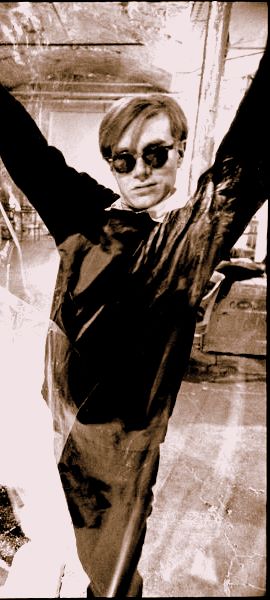
The Wizard Reveals Himself
New York City was indeed a tough cold city. It was enough to make you crazy as you ‘fought the crowds, avoided the traffic and watched the world turn grey.’ Coming from Pittsburgh Andy Warhol had no trouble with the skies turning grey, he was used to much worse. For Dylan coming from Hibbing, Minnesota way, way out on the edge of civilization the change must have been traumatic. Both men, however, were uniquely equipped to succeed in such a tough environment although it turned both crazy, cruel and mean. Both became paragons of the revolutions.
Warhol, the older of the two, forged the revolution of the Undermen and the Homosexuals while acquiring great wealth. Dylan, too, made his appeal to the undermen (the confused, abused, strung out ones and worse) basing his career on the misfits and malcontents. At the same time he was a key player in fundamental Jewish revolution. Both men affected innocent harmless personas so as to deflect attention from what they were really up to. As both had complementary strategies it is quite possible that each saw through the other. Warhol certainly saw through Dylan but I’m not sure if the reverse was true. Both were heavily into drugs which altered their perceptions.
Warhol preceded Dylan on the scene by a decade arriving in NYC in 1950. His homosexual agenda was clear to him from the start even if its implementation wasn’t. He was immediately successful upon his arrival easily gaining entry into the commerical art field. Dylan too would have no trouble gaining both entry and prominence within a year, phenomenal success in two and preeminence in three.
Warhol commanded a large perhaps even great income within a matter of four or five years. He spent madly but invested wisely.
He was always interested in mass production techniques where the original was merely a prototype like a car model. His original drawings were mass replicated by the newspaper ads. Amazingly, new in New York, he sent a letter to CBS asking if he could design record covers and received assignments by return mail. While his record covers are not among his best known works he did design at least fifty while perhaps more remain to be discovered. While his designs were for very low selling jazz and classical records they are obviously the work of a homosexual or, as they are described- fey.
 Thus they advance the Homosexual revolution. True, they are tiny drops but by the time he designed the Sticky Fingers cover for the Rolling Stones his design, it can be confidently asserted, was seen by every single member of two generations while selling in the millions. The title and cover are an ode to masturbation, one of the favorite thems of both the Homosexual and Sexual revolutions. The illustration was of a male crotch clothed in blue jeans with a workable zipper. It was a retailing nightmare but effective in sexually conditioning the minds of his audience. The zipper was irresistible to record fans who broke the plastic on every single cover making them nearly unsaleable. Success actually unimaginable to Warhol in 1950.
In addition Warhol designed ‘fey’ book covers, frequently for homosexually oriented titles thus adding a few additional drops, pushing toward 9cc. Andy had his sticky fingers in everywhere- stationery, wrapping paper…all with his fey designs.
While he gained great success as a commercial artist he had his eye on the fine arts; about 1960 he made his move into ‘serious’ art- painting. He called his style Pop Art. Pop Art had its antecedents in the fifties of which Warhol would have been aware. Here are a couple examples by Ray Johnson from the mid-fifties. Johnson is described as proto-Pop.
Having made his splash in Pop Art, becoming a major celebrity, Warhol was ready to move into his next phase in the subversion of art and society. In 1964 he established his famous atelier known as the Factory. There he continued his paintings while beginning an influential if unremunerative secondary career as a film auteur.

Ray Johnson' James Deas With Lucky Strike Cigarette Logos

Ray Johnson's Mid-Fifties Elvis
There seem to be revolutionary motives in the founding of the Factory. Warhol gathered about him a collection of the Undermen. These were all Homosexuals, druggies, hustlers and prostitutes.
There is an interesting passage in the Weathermen founder’s autobiography Fugitive Days where the author, Bill Ayers, says:
…the most interesting alliance to me was struck in the first months underground, and it was with a kind of eccentric shadowy group that would become fast and reliable friends for decades to come.
The group was without a name, contained hundreds of members in half a dozen cities, and was organized by a charismatic leader and psychologist who called himself Kaz. They were all former heroin addicts, former beatniks, former hustlers, and prostitutes, five, ten, twenty years older than us, now living in luxury and working downtown but thinking of themselves primarily as deep, deep underground, a kind of fifth column waiting patiently for the revolution.
What Ayers appears to be describing is the Haut Boheme Cafe Society of New York. Now, Warhol with the Factory created a place where all Bohemia, high and low, could gather under the reasonable pretext of partying which is what happened. Many attendees would be innocents of course providing even better cover for the revos. To get some idea of what the scene was like review the lyrics to Shel Silverstein’s Freakin’ At The Freakers Ball appended. Silverstein seems to be describing the Factory exactly.
The police had the Factory under surveillance as well as one supposes, the FBI. The deep underground wasn’t deep enough to conceal these characters. The Factory would be forced out by ’68 giving it a four year run. Bereft of a gathering place Bohemia would have to wait until 1977 for another when Rubell and Schrager put together Studio 54. 54 was better than the Factory because attendance could be monitored allowing only the Haut Boheme and other chosen in; the undesirables could be left out. 54 was run in contempt of all existing laws and moral codes. Suspicious from the beginning it took the Feds only eighteen months to shut it down. Like The Factory however Studio 54 had its revolutionary effect especially along sexual lines- unisex toilets for instance.
The multi-talented Warhol, a perfect Prince of Bohemia added authorship to his achievements with his novel ‘a’ while moving into publishing in the seventies when he established the successful magazine Interview.
He added several notable record covers, while forming in ’66 the immensely influential Exploding Plastic Inevitable centered around ‘his’ rock band The Velvet Underground.
So, in promoting several different revolutions- the Undermen, the drug culture, the so-called sexual revolution and undoubtedly many others Warhol was one of the most successful and important revolutionary figures of the decade.
Along the way he formed a close relationship with the Feminist revolutionary, the Japanese citizen, Yoko Ono. As a bona fide member of the avant garde she tried to enter Warhol’s entourage before she left for England in ’66. However at the time she was outspokenly antipathetic to homosexuality which probably necessitated her retreating to London to think things over before returning in 1971.
She returned in grand style leading the founder of the Beatles, John Lennon, as though by a rope around the neck. She and Lennon immediately threw themselves into the revolutionary movement associating themselves with various members of the Jewish revolution. they apparently gave large sums of money while lending their personas and prestige to raise much larger sums. It was the fear of their popularity being used to rouse young Americans in this first election in which eighteen year olds could participate that put him under surveillance, quite justifiably so, by the FBI and the Nixon White House. Thus for the next several years they were harassed by deportation threats as undesirable aliens.
Having achieved her goal of reentry into New York avant garde society even becoming an intimate of Andy Warhol Yoko lost interest in Lennon. The two split up for eighteen months or so from 1973 to 1975 then reuniting. Yoko had employed her Tarot reader John Green in 1974 while Fred Seaman was added to the entourage as Lennon’s personal assistant in 1979.
While the memoirs of Green and Seaman have been disparaged by the faithful I see little reason to do so on an objective basis although Yoko Ono may find them offensive for personal reasons.
Part III follows
Appendix
Freakin’ At The Freaker’s Ball
Shel Silverstein
As Performed By Dr. Hook & The Medicine Show
Well, there’s gonna be a freaker’s ball
Tonight at the Freaker’s Hall
And you know you’re invited one and all.
Come on Babys grease your lips
And don’t forget to bring your whips
We’re goin’ to the Freaker’s Ball.
Blow your whistle and bang your gong
Roll up something to take along
It feels so good it must be wrong
We’re freakin’ at the freaker’s ball.
Well, all the fags and dykes they’re boogie’n together
The leather freaks dressed in all kinds of leather
The greatest of the sadists and the masochists too
Screamin’ please hit me and I’ll hit you
The FBI dancin’ with the junkies
All the straights swingin’ with the funkies
Across the floor and up the wall
We’re freakin’ at the freaker’s ball y’all
We’re freakin’ at the freaker’s ball.
Everybody’s kissing each other
Brother with sister, son with mother
Smear my body up with butter
And take me to the freaker’s ball.
Pass that roach please and pour the wine
I’ll kiss yours if you kiss mine
I’m gonna boogie ’til I’m cold blind
Freakin’ at the freaker’s ball.
White ones, black ones, yellow ones, red ones
Necrophiliacs lookin’ for dead ones
The greatest of the sadists and the masochists too
Screamin’ please hit me and I’ll hit you.
Everybody ballin’ in batches
Pyromaniacs strikin’ matches
Freakin’ at the freaker’s ball, y’all
We’re freakin’ at the freaker’s ball.

Exhuming Bob XXVI
Bob And Edie
(Sooner Or Later All Of Us Must Know)
by
R.E. Prindle

On the New York Bohemian scene 1965 and 1966 were the pivotal years. Near the beginning of 1965 Edie Sedgwick came down from Boston to become the catalyst in the struggle for dominance of the Bohemian scene between Andy Warhol and Bob Dylan.
Both men began their rise almost simultaneously in 1960-61. Both camps were drug fueled primarily by amphetamines.
While Edie, who as I perceive it was a psychotic nothing chick, entered Warhol’s world about March of ’65 it seems probable that Dylan was eyeing her from earlier in the year through the offices of his advance man, Bobby Neuwirth. While the early period is poorly documented as the battle for the soul of Edie Sedgwick reached fever heat in the summer of ’65 when Dylan recorded his diatribes Like A Rolling Stone and Positively Fourth Street concerning Edie and Andy the origins must reach further back into the first half of the year. It is interesting that in Dylan’s song Desolation Row he cast Edie in the role of Hamlet’s Ophelia.
Thus the key to understanding Dylan’s albums Highway 61 Revisited and Blonde On Blonde is primarily Edie Sedgwick. I haven’t analyzed the data thoroughly but the meaning of One Of Us Must Know (Sooner Or Later) became transparent while studying Warhol. One of my favorite Dylan’s songs its meaning has always troubled me.

In November of ’65 Dylan married Sara Lownds while still carrying on an affair with Edie, among others. Warhol told Edie that Dylan was married shortly thereafter. Edie was as a pawn in their game torn between leaving with Dylan and staying with Warhol. In their effort to steal Edie away Dylan and his manager Albert Grossman were promising her stardom and money in both recording and movies.
Finally in a December 6th meeting with Edie, Warhol and Dylan Edie was forced to choose between the one or the other. Dylan commemorated this scene in his song One Of Us Must Know (Sooner Or Later). The ‘poem’ of this ‘great poet’ is in three stanzas and reads like a letter to Edie when you have the key. The first four lines are a mocking apology for using Edie as a pawn:
I didn’t mean to treat you so bad
You shouldn’t take it so personal
I didn’t mean to make you so sad
You just happened to be there, that’s all.
So Dylan admits he was using Edie who just happened to be Warhol’s chick, nothing personal, Dylan was after Warhol. But he didn’t mean to hurt her ‘so bad’ or make her ‘so sad’. Hey, it just happened. The second and fourth lines are so insulting, callous and sadistic as to pass the bounds of good judgment to write. They shouldn’t have been written and if written they shouldn’t have been shouted to the world to hear. It must have been obvious to Dylan that both Edie and Warhol would know he was talking about them. The Ballad Of Plain D was just mean but this is almost too hateful to bear. Ah well, the love and peace crowd.
The fifth line:
When I saw you say “goodbye” to your friend and smile…
The scene is The Kettle Of Fish and the friend is Andy Warhol.
I thought it was understood
That you’d be comin’ back in a little while
I didn’t know that you were sayin’ “goodbye” for good.
This is an outright lie else why put goodbye in parentheses. Dylan’s attempt to disavow his and Grossman’s promises making it seem like a trivial boy-girl thing is too coarse. This whole verse is definitely meant to hurt while both Edie and Warhol will understand the full import.

Ever Weird
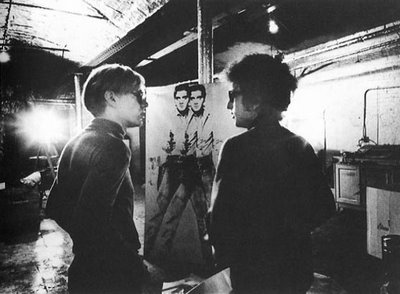
Andy, Elvis, Bob
And then the chorus which will be used three times for maximum pain:
But sooner or later, one of us must know
You just did what you were supposed to do
Sooner or later one of us must know
That I really did try to get close to you.
The key line here is that ‘I really did try to get close to you.’ At The Kettle Of Fish Edie murmured to Dylan that no matter how hard she tried she couldn’t get close to him. ‘Who?’ asked Dylan. ‘Andy.’ Edie replied. Dylan apparently took that as a rebuff although he was already married to Sara and would soon spawn a host of children on her.
I quote the second verse in its entirety:
I couldn’t see what you could show me
Your scarf had kept your mouth well hid
I couldn’t see how you could know me
But you said you knew me and I believed you did.
When you whispered in my ear
And asked me if I was leavin’ with you or her
I didn’t realize just what I did hear
I didn’t realize how young you were.
Apparently Edie didn’t realize that she was just a rainy day woman. While it’s a matter of interpretation I assume that Edie confronted Dylan with the fact of his marriage to Sara and naively asked if he were going to dump Sara for herself. Dylan was incredulous, astonished by her request, he thought she was more sophisticated than that, after all, a rainy day woman….
Rainy Day Woman is a very mocking put down of women as the lead off song and theme setter of the album titled Blonde On Blonde. Perhaps the title might be interpreted as Woman On or After Woman with Rainy Day Women establishing the theme. The song limits the range of women to two- numbers 12 and 35. Why 12, why 35? Who are they? One has to be Edie. If one does a little number manipulation a la Freud, in sequence the numbers add up to 11 which in turn adds up to 2. Two women. Seven come eleven? Three and eight, twelve and thirty-five added separately- three for male, eight for female. Twelve subtracted from thirty-five is twenty-three, Edie’s age. Just guessing.
As Sara is the only other identifiable woman in the lyrics the two women must be Edie and Sara. Let me venture the guess that all women are rainy day women for Dylan. Thus once Sara had borne his offspring fullfilling a religious obligation Dylan took seriously he drove her away oblivious to the pain and suffering he was causing or perhaps he was continuing to punish mother surrogates.
Dylan was drugged and crazed while he was writing this so this is a reflection of deep subconscious drives.

Andy And Edie As Beautiful People
The final lyric begins:
I couldn’t see when it started snowin’
Your voice was all I heard
Snowin’ either refers to a snow job by Edie so he was blinded by light hearing only her words or drugs of some sort, either amphetamines or cocaine.
I couldn’t see where you were goin’
But you said you knew an’ I took your word.
Once again Dylan shifts the full responsibility from himself and Grossman to Edie. He implies that she was leading him on rather than vice versa. This when it was clear to everyone that he and Grossman were promising her the moon in the attempt to pry her loose from Warhol.
And then you told me later, as I apologized
That you were just kiddin’ me, you weren’t really from the farm
An’ I told you as you clawed out my eyes
That I never really meant t’ do you any harm
Well, Dylan’s intents were pure, he says, but the results were deplorable; Edie was done harm by Dylan’s actions and the harm was deep and lasting, well beyond any hypocritical apologies. If the lines are to be believed Edie’s reaction was quite violent. As she was a total amphetamine addict her reaction would be quite plausible.
And then Dylan mockingly closes with his ‘whadaya goin’ to do about it line’- I really did try to get close to you.
As this period clears up for me I suspect that the whole of Blonde On Blonde is concerned with this Edie, Andy/Dylan duel. Blonde On Blonde itself then may refer to the silver hair of both Edie and Andy.
It should be clear that Dylan’s motorcycle fall was no accident. In Exhuming Bob 23b: Bob, Andy and Edie I hypothesize that Dylan’s bike was rigged by the Factory crowd. Dylan survived with minimal damage. For his own sins Warhol was shot a couple years later but he survived that one too. Edie died a physical wreck in 1971.

Dead Ophelia- Consider Ciao Manhattan with Edie shot in a swimming pool/
What goes around comes around as they used to say.

R.E. Prindle
A Review: Fred Seaman: The Last Days Of John Lennon
May 18, 2010
A Review
Fred Seaman:
The Last Days Of John Lennon
Review by R.E. Prindle
Seaman Fred: The Last Days Of John Lennon, A Personal Memoir. Citadel Press, 1991.
The Ghost Of Elvis Presley

Double Elvis- Andy Warhol
In order to understand the zeitgeist of the sixties one has to go back to the fifties. The central event of the fifties was the annunciation of Elvis Presley. The post-war world was a grey world of fear. The country and the world had emerged from the greatest of all catastrophes, the Second World War. WWII itself was fought in the shadow of the Great War of 1914-18, afterwards known as WWI.
Most of the older generation had lived through both wars which was a terrifically horrifying experience. In 1950 those who were seventy or older had memories of the Indian Wars of the late nineteenth century also. In addition perhaps the most terrifying memory of the pre-WWII generations was that of the Great Depression of the thirties. From 1945 to 1960 they lived in terror that the Depression would return. There was thus a great generational divide between them and those of us who had no memory of the Depression and only vague memories of the second world cataclysm.
The older generations were struggling to restore the normalcy of the period between the wars as they wished it might have been. Technology had made this impossible. Not only had the Atomic Bomb come into existence but almost immediately after the war the sky was filled with the most extraordinary of phenomena- the faster than the speed of sound jet plane. The pilots of this wondrous piece of technology delighted in flying low over cities breaking the sound barrier as they did and sending a sonic boom shimmering down. If you’ve never experienced a sonic boom you have yet to be there.
The miracle of the age however was television. (Some people call it the boring fifties but they obviously weren’t there.) Television made the greatest threat to civilization yet known to man possible. That threat was Elvis Presley. Elvis simple announced by his presence that the pre-war world would not be returning- ever. The younger generation would fashion the world in his image.
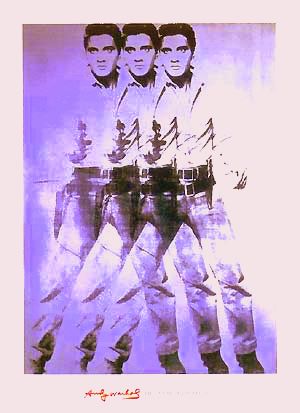
Triple Elvis- Andy Warhol
More than that Presley wasn’t an image of the upper class college youth like Pat Boone but the avatar of the downtrodden and suppressed not unlike Jesus the Christ himself. They took one look at Elvis and realized that he was the Atomic Bomb that would blow up their world. And he did.
Every move Elvis made was an insult to them. Things that had no relevance to them they took as a personal insult. One such was the innocuous anthem by the songwriters Leiber and Stoller originally written as a Negro ghetto sex anthem, Hound Dog. When Elvis sang You ain’t nothin’ but a hound dog, for some reason they projected it as a reference to themselves and they deeply resented it.
Of course every attempt to suppress Elvis deepened the generational divide. Not only did Elvis himself exist but it seemed as though every upcoming rock n’ roll singer wanted to be Elvis. Before the Presley clones of Vegas there were the Elvis imitators in every family’s living room like Gene Vincent, Ricky Nelson, Eddie Cochran and nearly the whole roster of Sun Records, plus, plus, plus….
For most of the old folks rock n’ roll itself was a mystery. They thought it was a Communist plot, might have been I don’t rule it out, but if so we were not conspirators but dupes. We just reveled in it. They almost succeeded in destroying it. Elvis got drafted, in his absence the great rock n’ rollers were driven out, discredited and in some cases killed. When Presley returned in 1960 he was different from when he went in. He had been contained.
John Lennon famously said in 1977 after Elvis died that he died the day he went into the army. While a relevant statement it was not quite true. The first stage in Elvis long immolation was when he fell under the control of his manager Col. Tom Parker, the second stage in his demise was when Parker delivered him to RCA Records, the third stage in his death was when RCA assigned Steve Sholes as his producer.
For those of us who were there the real Elvis Presley ceased to exist when he left the Sun record label. RCA was in no position to understand rock n’ roll values. It wasn’t that they willfully sabotaged Elvis it was just that they didn’t know how to rock. Their idea of rock was Neil Sedaka. Sholes himself was antipathetic to rock ‘n roll no less than his crosstown rival Mitch Miller over at Columbia Records. Both men hated the concept. This was made evident in Sholes arrangement of Gene Austin’s Are You Lonesome Tonight with its plodding guitar riff and Elvis’ imitation of the thirties crooner. Sholes failed to ruin Elvis’ career but it took Mitch Miller one LP to trash the career of the great Dion of the Belmonts.
Very few if any of the great rock records were produced by the majors. Nearly everything of value was produced by independent labels, many of them one shot efforts. Gene Vincent and his Be-Bop-A-Lula was a notable exception although his label, Capitol, soon had him singing Somewhere Over The Rainbow.
After the first run of actual imitators Elvis and rock worked their way into the subconscious of the next wave that included Lennon and the Beatles to produce an extension of rock.
Upon Presley’s return from the army his manager, Parker, removed him from recording and put Elvis into the movies almost exclusively. The movie Elvis was an extension of the personality of Tom Parker. Elvis was Elvis and his appearance was always galvanic. His charisma could be diminished but it couldn’t be destroyed. I was as disappointed by his movies as much as anyone dropping in only occasionally over the sixties to see if anything had changed. It hadn’t.
Thus as we all moved into the sixties while Presley still lived it was only as the ghost of the Sun Records innovator.
The Ghost of Elvis Presley was captured by the artist Andy Warhol in a number of renderings.
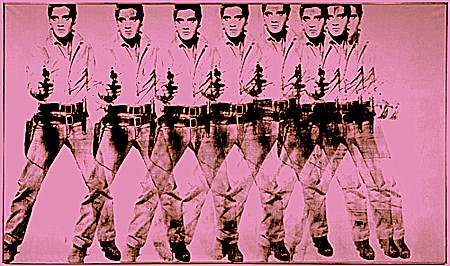
Octopresley- Andy Warhol
He presented Elvis in various single screens or multiples of two, three and up to the eight as in the image above. He ignored the musical Elvis in favor of an image taken from a Western movie. As Warhol was a homosexual he rendered Elvis as a gay cowboy. In truth Elvis had an ambiguous persona. Many people thought he was queer. Any male fan felt himself under the accusation. Elements of his persona indicate a severely emasculated personality that lend credence to at least a latent feeling of homosexuality. Elvis’ fellow students called him ‘squirrel.’ Indeed, the use of eye shadow, pants with a stripe down the leg and pink shirts in 1951-52 and ’53 would have led to open accusations of homosexuality. And yet, even though I identified with his obvious emasculation when I was only sixteen and seventeen it never occurred to me that he might have been one. I don’t think he ever was. Had he been his more than macho entourage would have had nothing to do with him. Nevertheless his portraitist Warhol perfectly captured his ambivalence and androgyny.
The number of portraits by the artist clearly betrays Warhol’s own hero worship. Perhaps his own gay cowboy movie owed some reverence to his idol. Oddly enough Warhol never designed a record cover for Presley even though he designed over fifty during a career from 1949 to 1987.
Andy had always been a pop music fan. This was very unusual for a man born in 1928. This would have made him 26 if one assumes ’54 as the birth of rock and 28 in ’56 when Presley exploded onto the scene. Anyone older than 18 in ’56 rejected rock. It is true that Warhol was dualistic, capabhle of listening to opera and rock at the same time, I mean simultaneously, so he may have had his personality split by the times. At any rate Warhol who apparently wished to excel in all the arts attempted to enter the music field by managing a band, while establishing a rock venue. In 1965 he took The Velvet Underground in as his house band while setting up a venue called The Dom. Not stopping there he also created an ambient experience, or light show, he called The Exploding Plastic Inevitable. The combination of music and light was innovative and widely imitated. Unfortunately Warhol didn’t have a secure lease and the venue got away from him. Perhaps realzing he was spreading himself too thin he never followed up letting the Velvets go their own way.
Warhol nevertheless established close bonds with other musicians. His attempted connection to Bob Dylan failed. Whether sour grapes or not he comitted this thought to his diary in July of 1985:
Watched the Live-Aid thing on TV. Bobby Zaren’s office had been calling, wanting me to go down there, but with that many big celebrities you never get any publicity. Later on that night Jack Nicholson introduced Bob Dylan and called him “transcendental.” But to me, Dylan was never really real- he was just mimicking real people and the amphetamine made it come out magic. With amphetamine he could copy words and make it all sound right. But that boy never felt a thing- (laughs) I just never bought it.
Warhol did succeed with Mick and Bianca Jagger and the Rolling Stones. While his cover for the first Velvet Underground album was considered innovative (read: weird) his cover for the Stones’ Sticky Fingers album with its functional zipper was as the term of the time went, mindblowing.
While Warhol never established contact with the Beatles, when his fellow artist Yoko Ono led her trophy husband, John Lennon, from London to New York in 1970 another firm connection to musicians and the inheritor of Elvis Presley’s mantle as the Savior was formed. Over all floated the Ghost of Elvis Presley.
Part II: John & Yoko In New York follows.

After the Topps Baseball Card Style
A Review
Woman
by
Alan Clayson
Yoko Ono And The Men Who Influenced Her
Review by R.E. Prindle
Clayson, Alan: Woman: The Incredible Life Of Yoko Ono, Chrome Dreams, 2004.

Girlish Yoko- Warhol School by Richard Bernstein
Yoko Ono involved herself with several of the most influential men in the arts during the sixties, seventies and eighties of the twentieth century. She drew her inspiration from them patterning her own efforts after them. At the same time she was one of the leading feminists of the day having her share in shaping and furthering the movement. The mantra was female liberation, equality between men and women. In fact women were equal to men in the West but only by acknowledging the biological differences between men and women. The fact is the differences are real and not social constructs as women would have us believe. The fact is women are women and men are men. So, in seeking ‘female liberation’ feminists were seeking much more than ‘equality’ however the term may be defined.
The fact is that in the Ages old war between the sexes feminists are seeking to restore the Matriarchy and destroy the Patriarchy. That is why many men favor feminism, they prefer the Matriarchy. Thus the feminists are atavistic. Yoko and her cohorts wished, in her words, to restore ‘heart’ as she viewed the Matriarchy and eliminate ‘reason’ as she viewed quite rightly the basis of Patriarchalism. Nevermind that bilogical science has invalidated the concepts of Matriarachy and Patriarchy. This is a post Matriarchy and Patriarchy world.
Circa -2000 in the West men revolted against the mind stifling Matriarchy and the vaginal swamp of the ‘heart’ seeking to establish

Smilin' Jack Cage
the authority of the infinite power of the mind of Zeus on ethereal Olympus. This is the story of Homer’s Iliad and Odyssey and the Greek myths in general recording the struggle.
The Western male was able to impose the ascendency of reason over the heart for 3000 years until the disestablishment of the old order by science about mid-nineteenth century. The center could not hold during this period of extreme change as W.B. Yeats put it as the rearrangement of the intellectual order moved into the twentieth century.
Yoko Ono sought with her feminist fellows to return to the biological innocence of 2000 BC. She herself had no talent. Filled with audacity she pitted her ‘heart’ against the reason of John Cage, Andy Warhol and John Lennon. I’m sure she had a mentor for her so-called performance art but I am as yet unaware of who he may be. Perhaps Maciunas and the Fluxus group.
Thus her first manifestation as an artist was based on the musical ideas of John Cage while her artistic efforts were at least based in the avant garde ideas of the Fluxus group. Her first assault on the NYC art world failed so in 1961 she returned in defeat to Japan. When she returned to NYC in 1964 she found an entirely different art scene. On the musical side the focus was on Bobby Dylan and the Beatles while on the artistic side Andy Warhol and his Factory had destroyed the Abstract Expressionists and the old avant garde. Dylan, the Beatles and Warhol had in fact usurped the avant garde which now had little meaning. From my point of view held at the time the avant garde had ceased to exist. Of course I didn’t understand exactly why or how.
From 1964 when Yoko returned to NYC until 1966 when she left for London I’m sure Yoko was at a loss. She developed her silly

The Bag Yoko And Tony Are In
notion of Bagism at this time even having a black bag on a stand in Max’s Kansas City that some one or ones were supposed to slide into. This seems to have been thought a lame idea at the time as it seems now.
At this time while retaining allegiance to John Cage’s musical ideas she was falling under the influence of Andy Warhol’s artistic notions. Warhol’s intent had been to destroy the idea of ‘fine art’. In this he pretty well succeeded. As Yoko expressed it you didn’t need any talent to be an artist. She seems to demonstrate this notion in her own artistic efforts. Warhol had also redefined the notion of film with his static studies. He then sought to combine his film ideas with live music, probably in competition with Bob Dylan who was also attempting to move in that direction. Warhol adopted Lou Reed and his band the Velvet Underground as the Factory house band while creating a multi-media show called the Exploding Plastic Inevitable, innovative for its time. Thus a concert at his hall, the Dom, was an ‘experience.’
While Yoko makes no mention about how this, actually, incredible development affected her there can be no doubt that she was well aware of Dylan, the Beatles and the Warhol Experience and was affected by it. Indeed, the first manifestation was the making of her Warhol style films such as Bottoms.
The second manifestation was her removal to London to seduce either Lennon or McCartney of the Beatles, thus in the manner of Warhol’s adoption of the Velvet Underground she sought to co-opt the Beatles, the premier rock group in the world. Real chutzpah and more than one upping Warhol. I think it would be nonsense to think she had any other goal in mind.
She undoubteldy learned that Paul McCartney was actively involved with John Dunbar and his Indica Gallery that opened in 1965.
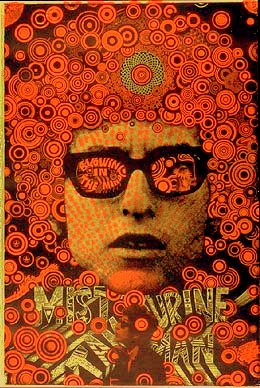
Psychedelic Dylan
Some say she first set her sights on McCartney but the more vulnerable Lennon showed up and the Spider Woman spread her web.
She was still married to her second husband, Tony Cox, but, regardless of what she says she very aggressively pursued, or attacked, Lennon. Lennon was emotionally under water unable to handle his success while drugging himself out of his mind. He was unwillingly married to his wife Cynthia. It appears that he married Cynthia out of duty when she became pregnant. He doesn’t seem to have been happy in his virtue. Yoko had no difficulty in capturing his affections.
Now, just as Warhol had adopted the Velvets and imposed his female singer, Nico, on the band Yoko sought to imp[ose herself on the Beatles through Lennon. At this time she was still musically completely in thrall to John Cage understanding nothing about Rock music. She and Lennon had made a ridiculous LP called Two Virgins in 1968. She combined her cagian screechings while using an avant garde ‘performance’ notion of the couple posing nude on the cover; full frontal on the obverse, full posterior on the reverse. As no store would carry the cover the couple reverted to Yoko’s idea of Bagism placing the cover inside a plain manila envelope or bag. While it didn’t sell the record this form of Bagism was actually a successful artistic statement. The nude cover given an outer garment so to speak.
Well, the public was prepared to forgive the Beatles anything but the other three Beatles weren’t prepared to forgive Yoko for forcing herself on them thus she broke up the most successful act of the sixties. Still, she had succeeded according to her wildest dream. Lennon and his wonderful reputation and fortune were hers. She had gone from a neglected, nondescript ‘performance’ artist to center stage, not on her own womanly talents but by attaching herself to a talented man. Yoko’s ‘heart’ was useless without the male intellect. Yoko was now the most influencial feminist in the world. She knew what to do with that.
After several ‘performance’ acts such as the ‘Bed In For Peace’ the couple left England to return to the place Yoko wished to subjugate artistically, New York City. She had raised herself to a par with Andy Warhol. She now had to meld her musical and artistic goals through Lennon and Warhol.
On the musical side she began to develop her rock n’ roll skills under the tutelage of Lennon. While not abandoning the avant garde notions of John Cage she now emasculated her husband. Always semi-delusional or perhaps completely so, she fantasized that she was not only equal to Lennon in skill and popularity but superior to him. She imagined herself more popular than Lennon. Thus one has such travesties as the LP Double Fantasy. It was only after Lennon’s death that she was forced to recognize than Lennon’s fans did not appreciate her efforts. So she failed as a musician.
She quickly tired of being Mrs. Lennon. Thus she and Lennon separated for eighteen months or so during the years 1973-75. She then realized that her financial well being and musical acceptance depended on Lennon. In 1975 she called him back resuming their relationship until his death in 1980. But, things had changed.
She began to adopt Warhol’s life style on her return to NYC. While she propagated the notion that she was some sort of business whiz Iam having difficulties discovering any such skills. It appears that with the enormous income of Lennon she emulated Warhol in
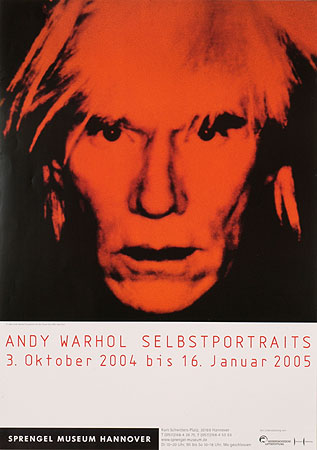
Andy the Demon
spending her way to prosperity.
She was in a position to not only match Warhol’s spending but exceeding it by many times. Through the seventies and eighties Warhol came into his own as an artist while reaping a fortune doing portraits. There appears to have been no effort on his part to invest in income producing vehicles. Rather he bought stuff. He purchased buildings in NYC and elsewhere while acquring undeveloped acreage in places like Aspen. He shopped nearly every day buying antiques from furniture to objets d’ art by the bushel almost as though he were trying to excel the incredible W.R. Hearst.
He usually didn’t even look at the stuff once he bought it merely filling rooms with his shopping bags. At his death all this junk was auctioned off for 25 million dollars, a nice appreciation in value.
Yoko followed the exact pattern buying apartments and houses as well as an extensive dairy farm with a herd of prize cows. She not only had but has five apartments in her principal dwelling, the Dakota apartment building and many other houses scattered around.
Like Warhol the Dakota apartments are stuffed with junk. Valuable, but, you know, stuff. She bought at good prices. Her extensive collection of Egyptian antiquities was mostly purchased before a steep rise in value.
Like the Rothschilds of old Yoko didn’t do all her own shopping but employed agents to search things out. Chief among these was an associate of Warhol’s, Sam Green, and an Hungarian immigrant by the name of Sam Havadtoy.

Buddies- Yoko, John, Andy
There should be no surprise then that she now has an extensive collection of Warhol’s artwork as well as his portraits of Lennon. The Warhols would have been purchased for form 25 to 50K while now being listed on her assets at tens of millions. She also has been said to have a good collection of Magrittes as well as one assumes other artists. So, much of her net worth is tied up in artwork purchased through Sam Green.
Sam Havadtoy was an antiques dealer as well as an interior designer. He appears to have been a somewhat shady character. It is very difficult to find much about him, however there is a sharp portrait available from the notorious A.J. Weberman ( http://www.acid-trip.org/lennon/ )
…(the Lennons) hired a sleazy Eastern European bisexual to renovate the pad. (Dakota) I had heard of this dude, whose name escapes me, from an asswipe named BRUCE KIRSH, who worked for him. KIRSH told me that the dude, who worked for the King of Morocco, would form a dummy renovation company, hire employees like Kirsch who were willing to work under false names, then, when it came time to pay taxes, everyone would disappear. I learned of him long before he was hired by John and Yoko, and I was taken aback when Yoko took up with him after John’s death.
I know that Weberman is not particularly well thought of by fandom but this is because of his harassment of Dylan who did, after all, misrepresent himself to the revolutionaries like Weberman. A.J. himself is an intelligent observer who was wading through it when it was deep. I do believe he knows what he’s talking about although his interpretations of Dylan’s lyrics seem absurd.
I would have to question Yoko’s judgment in taking him in. Both he and Sam Green were candidates as successors to Lennon with

Lennon by Warhol
whom she consorted in front of Lennon before he died while Yoko chose Havadtoy as his successor the day he died.
Perhaps she selected Havadtoy over Green because he was more rough trade. With Lennon while managing to reconcile revolution with peace and love with Havadtoy she discarded peace and love in favor of strong arm methods against her former employee Fred Seaman when it was totally unnecessary.
Havadtoy was living in a homosexual arrangement with his business partner when Yoko beckoned him to switch to her. Apparently an able switch hitter he was lured by the money to this much older woman. The arrangement did last for twenty years before Havadtoy removed to his native Hungary taking a nice cash settlement and several of the Warhols.
Thus, just as Warhol had his live-in homosexual arrangement so after Lennon’s death Yoko adopted the exact arrrangement. Today she apparently lives alone, a seventy-eight year old woman.
After Lennon’s death there was an accession of from 30 million to a possible 100 million dollars as their last album, Double Fantasy, sold into the millions while the rest of Lennon’s catalog and one assumes the Beatles’ catalog was reinvigorated while all things Lennon sold. This is, of course, no reflection on Yoko but the inevitable result with intellectual properties when the maker dies.
Post-Lennon, then, Yoko realized that her recording and art careers were nil. Heart without intellect is worthless. She then became the caretaker of the Lennon legacy. His recordings, of course, continued to sell, but even his artwork eclipsed that of Yoko. So she suffered the humiliation of being a mere appendage to a man. The feminine dismal swamp was eclipsed by the Olympian heights of the male intellect. As in ancient times the God had trumped the Goddess. And yet as with Hera and Zeus the Goddess gets her way. Yoko came up with the money and goods while Lennon’s spirit was wafted into the stratosphere.
As any reader of mythology knows Hera ruled the Lernean swamps of Argolis while Zeus ruled the gods on ethereal Olympus. Thus one has the symbolism of the biological difference between the male and female.
In ancient times the female had her share in magic. She knew herbs and plants, was familiar with poisons and cures as with the arch witch of the ancient world, Medea. The reputation of the female witch even as a consort of Satan persisted down through medieval and post-medieval times, indeed, even up to the dawn of the scientific enlightenment. One would have thought that magic and witchery were a thing of the past in the 1960s and yet Yoko embodied the whole female swamp mentality.
She established something called the Spirit Foundation attributing the direction to Lennon who in fact knew nothing of these matters but followed her lead. The Spirit Foundation celebrated the ancient art of the Shaman or witch doctor. Shamanism itself even preceded the Matriarchal swamps of Argolis. It was a rich repository of magical tradition. Further the Foundation was feminist in that it was dedicated to preserving the magical traditions of the women of the Pacific islands still living in such archaic societies. The wealth generated by the male intellect was appropriated by the female vagina or ‘heart.’
In her own life and that of Lennon’s Yoko was addicted to a variety of magical practices- astrology, numerology, Tarot readings, and indeed she traveled to the Caribbean to sell her soul to Satan through the offices of a female curandera. Her Tarot reader, John Green, was a priest in the shamanistic, magical, Yoruban African cult of Santeria.
Her feminism was more a magical effort to restory Matriarchal supremacy over the Patriarchy thus reversing the Patriarchal victory of three thousand years previously. Indeed, what has been called the movement for female equality is nothing more than a covert campaign to restore the Matriarchy.
Thus while Yoko o9riginatd nothing she usurped the abilities of the reason of men- Cage, Warhol, Lennon and male magicians such as John Green. Indeed the Trojan War itself was a war of men in service of women.
In her associations with men she preferrred to deal with emasculated types such as homosexuals like Cage, Warhol, Sam Green and Sam Havadtoy. Lennon claimed to have always been dependent of women for comfort and guidance while Yoko caught him at his most confused and vulnerable.
While she received direction from Cage and Warhol she was able to manipulate Lennon out of his talent somewhat as Vivian did that of Merlin of the Arthurian saga. When Vivian had usurped Merlin’s magical knowledge she buried him deep much as Lennon was put out of the way. Yoko then appropriated his wealth and residual income after his death. It was this constant inflow of cash that allowed her to propagate the notion that she was a financial genius.
Then as the female of the ‘heart’ or vaginal swamp she managed and appropriated the reason of Olympus through Cage, Warhol and Lennon. What she got from Havadtoy other than brute strength is not clear to me.
As such Yoko is Woman. In her case a seeming reversion to the archetypal Shaman of the most ancient times.
 I, Dynamo