A Review
Themes And Variations
The Tarzan Novels Of Edgar Rice Burroughs
#15 Tarzan Triumphant
by
R.E. Prindle
Preface
Over many years I have searched for the point where myth and science join. It was clear to me for a long time that the origins of science had their deep roots in a particular myth, that of invariance. The Greeks as early as the 7th century B.C. spoke of the quest of their first sages as the problem of the One and the Many, sometimes describing the wild fecundity of nature as the way in which the Many could be educed from the One, sometimes seeing the Many as the unsubstantial variations being played on the One. The oracular sayings of Heraclitus the Obscure do nothing but illustrate with shimmering paradoxes the illusory quality of “things” in flux as they were wrung from the central intuition of society.
Before him Anaximander had announced also oracularly, that the cause of things being born and perishing is their injustice to each other in the order of time, “as they meet,” he said, for they are bound to atone forever for their mutual injustices. This was enough to make of Anaximander the acknowledged father of physical science, for the accent is on the “Many.” But it was true science after a fashion.
Hamlet’s Mill: An Essay Investigaing The Origins Of Human
Knowledge And Its Transmission Through Myth, p. viii,
Giorgio de Santillana, 1969

Giorgio de Santillana
1.
The five Tarzan novels from Invincible to Lion Man form a unique quintet within the oeuvre. Together they are just shy of twenty-five percent of the twenty-one Tarzan novels published during Burroughs’ lifetime. If one excludes the late and unrelated Foreign Legion they are a fourth of the series. Twenty-five percent within four years. One might well ask what was going on in Burroughs’ life during these momentous four years.
With the possible exception of City Of Gold all the novels deal openly with recognizable current events. Invincible deals with the Soviet Communist menace which is continued as one of the themes of Triumphant. The mainspring of Triumphant is Cecil Rhodes’ old dream of a Cape to Cairo route. In this instance realized, as improbable as it might have seemed to Rhodes, as an air route. The hope of the air route was first explored in 1918 and was about to be realized shortly after Burroughs wrote this book.
ERB also throws in a bit about Chicago hoodlumism with a tip of the hat to Al Capone.
Tarzan And The Leopard Men deals with the African Leopard Cult that was in the news at the time. City of Gold is about ERB’s marital problems while Tarzan And The Lion Man concerns the recent and sensational MGM expedition to Africa to film Trader Horn. Both before and after these novels Burroughs wrote pure, well, almost pure fantasy.
The reason for the change isn’t clear; however, the thirties mark another change in novelistic styles so Burroughs may have been adapting to new circumstances. If so it was the third stylistic change he was successfully meeting although it would be his last. He had melded a turn-of-the-century style of the teens when he began writing, then adapting his style to that of the Jazz Age of the twenties. After a good start in the thirties the ground slipped from beneath his feet with his style becoming somewhat dated. By the forties he was finished although Foreign Legion makes a game shot at a stylistic evolution.
Perhaps more importantly, ERB changed because he wanted to be taken as a serious writer. He was simply tired of being known as an ignorant boob writing from the seat of his pants. For all the seeming frivolity of his fantasy themes they are based on very solid scientific and knowledgeable themes. They are imbued with an intense mythological acumen, while presenting a new mythology for the current age. They do deal with classical themes such as the One and the Many. Burroughs tried to organize experience into a new mthological structure which was desperately needed then and no less today.
2.
Consider Giorgio de Santillana again:
Today’s children, that impassive posterity to whom all reverence is due, know where to look for myths, in animal life in the Jungle Books. In the stories of Lassie and Flipper, where innocence is unassailable, in Western adventures arranged by grown ups for the protection of law and order. Much of the rest sedulously built up by mass media is modern prejudice and delusion, like the glamour of royalty, or the perfection of super detergents and cosmetics; super-stitio, leftovers. So one might be tempted to say. Actually however, no particle of myth is left over, and we have to do only with a deliberate lie about the human condition. Tolkien’s efforts at reviving the genre, whatever talent employed, carry as much conviction as the traditional three dollar bill.
Quite right. Burroughs had the handle on true mythology while being able to create the governing myth of the Aquarian Age. Triumphant is laden with myth. In truth Burroughs is not the light-headed, simple-minded writer that even his most devoted fans and admirers want to think him. He doesn’t want to parade his knowledge or get involved in abstruse discussions; he is writing seeming pure action novels, The Master Of Adventure, as his fans like to say, for a pulp magazine audience that primarily wanted to be thrilled. One may criticize Burroughs for it but he is never short on thrills or spectacular effects. One may guffaw at some of his heroes’ exploits as I surely do but your eyes are still popping. There’s a lot more under the seeming simplicity. Much of it would have been recognized at the time giving the ‘knowing’ reader the satisfaction of being in on what ERB was really talking about but as the topicality faded away the succeeding generations of readers could see only the action.
The first sentence of the preceding novel, Invincible, explains ERB’s approach:
I am no historian or chronicler of facts, and furthermore, I hold a very definite conviction that there are certain subjects which fiction writers should leave alone, foremost of which are politics and religion. However, it seems to me not unethical to pirate an idea occasionally from one or the other, provided that the subject be handled in such a way as to impart a definite impression of fictionizing.
In this series of five novels in a bid to be taken seriously, perhaps rather than conceal his knowledge by a ‘definite impression of fictionizing’ he was making a bid for intellectual recognition by ‘exposing’ his serious interests to some extent.
The background of Triumphant is solidly based historically and in current events. ERB was always seriously interested in aviation. Indeed, his life as an adult would span the first lift off at Kitty Hawk to supersonic jet flight over a period of a mere forty years. That might do something to your mind. the concept of speed changed in his lifetime from Barney ‘A mile a minute’ Oldfield to a fifteen mile a minute jet fighter plane.
Commercial flight as we know it today was non-existent in 1930. The DC3 was still five years distant. A flight from Cairo to Capetown involved several layovers and even train trips if air connections were not established between certain points. Yet, such a route was a major advance while being exciting news. Ya gotta remember making a crystal radio set at home was still a substantial achievement marking one as an electrical wizard. At the same time television was on the horizon, nearly a reality. In such a flight Burroughs had a sure fire topic.
He combines elements of an earlier 1918 attempt and the establishment of an air route at the time of writing. In 1918 shortly after the War ended the British got right on realizing the hope of a Cape to Cairo dream. Great Britain had acquired the German African colonies as part of the Versailles Treaty so that they were then in control of a continguous corridor through East Africa. The acquisition of Tanganyika (Tanzania) filled the gap.
3.
Four separate pilots set out from Cairo for the Cape. The attempt was not entirely successful, but by 1932 it was. Burroughs then selects as his imaginary pilot Lady Barbara Collis, an English aviatrix on a solo flight. she seems to be somewhat off her course flying over Ethiopia but then that might be expected.
The way Burroughs’ mind worked he usually has real models for these roles if you can figure them out. In this case I think Lady Barbara incorporates three different women. The only significan aviatrix I can locate is Amelia Earhart. She became in 1928 the first woman to fly the Atlantic. She was part of a three-man crew but gained notoriety. In 1930-31 she was preparing for a solo Atlantic flight a la Charles Lindbergh from Labrador to Paris. She did cross the Atlantic but was forced down in an Irish cow pasture not reaching Paris. That was after the book was written so ERB would be relying on her 1928 flight and preparations for the solo flight.
A second personality conflated with Lady Barbara may have been the famous evangelist and founder of the Four Square Church, Aimee Semple McPherson. I have a framed picture of McPherson in my collection. Evangelism may also have been on Burroughs’ mind from his recent reading of Elmer Gantry by Sinclair Lewis. According to ERBzine Burroughs objected to Lewis’ forcing his atheism on the reader. Here one of his purposes may have been to show Lewis how it’s done.
Aimee Semple McPherson hit LA at about the same time as Burroughs.
By 1923 she was so popular she opened her 5000 seat Angelus Temple while beginning to broadcast over KSFG-K Four Square Gospel. And then a the height of her fame on May 18, 1926 she vanished after swimming in the Pacific. This and the following events during which several people died created a sensation no one in the country, and certainly LA, could miss. Not an ERB who was passionately interested in religion anyway. One wonders if he visited the Angelus Temple for Sunday services.
Aimee turned up in Mexico where she said she had been held captive after being abducted. But, apparently the pressures of success had been too much for her and she attempted escape into sex and a love tryst, which is a normal psychological reaction to unbearable stress as ERB himself was discovering. The disappearance and subseqauent events had continued into 1927 and 1928 so that ERB’s capacious mind was filled with the wonder of it all. Thus Lady Barbara disappears during the flight onto the mystery escarpment to reappear months later on the arm of Lafayette Smith. Same story. I think it likely ERB was thinking of both women while a third influence is almost certainly Dorothy Sayers, the mystery writer and creator of Lord Peter Whimsey. Burroughs hits at it by mentioning that the story does not concern Lord Wimsey but does concern his daughter, Barbara Collis. This probably refers to Dorothy Sayers and her creation, Peter Wimsey. When ERB admired a writer he wrote them into the story somehow. He was generous that way.
And then there is Danny ‘Gunner’ Patrick of the Chicago Underworld. His name indicates he is Irish so he may be supposed to be associated with Dion O’ Bannion’s gang rather than Capone and the incipient Outfit. ERB privides an intriguing if overly sympathetic portrait of the gangster. One wonders if he had met models at this time.
In connection with Patrick, which begins an interest in organized crime that extends through Swords Of Mars and the its Guild of Assassins, Murder Inc. was established at this time so that by the date of 1933 it would seem that ERB brought Murder Inc. into the corpus.
Then there is LaFayette Smith himself. Named after General Lafayette of Revolutionary War fame and recently brought to mind by General Patton who said, as he stepped foot on French soil, ‘Lafayette, we are here.’ The young geology professor may be be taken as an alter ego of Burroughs himself as he taught geology at the MMA. Sort of the man Burroughs might have been had he the self-discipline to have gone to college. ERB apparently sincerely regretted he had not gotten a degree as a number of his alter egos are college graduates, such as the Old Timer of Leopard Men who graduated from his brothers’ alma mater, Yale.
4.
As noted Burroughs had taught geology as an instructor at the Michigan Military Academy. He was still following the subject closely as he grouses that geologists had as many opinions each about as accurate as the weather forecasters. Still, knowledge was developing at a break neck pace that would lead to our substantailly complete knowledge of today. It’s too bad that ERB couldn’t have held on to 1965 or so. A man of his intellect would have seen things.
Burroughs not only combines all these threads and strands but in his prologue he reaches for his most daring concept yet. It’s only a page so let’s look at it closely. The opening sentences:
Time is a warp of the tapestry which is life. It is eternal, constant, unchanging. But the woof is gathered from the four corners of the earth and the twenty-eight seas and out of the air and the minds of men by that master artist, Fate, as she weaves the design that is never finished.
A thread here, a thread from there, another from out of the past that has waited years for the companion thread without which the picture must be incomplete.
But Fate is patient. She waits a hundred or a thousand years to bring together two strands of thread whose union is essential to the fabrication of her tapestry, to the composition of the design that was without beginning and is without end.
That attitude informs all of Burroughs’ work; a study of the One and Many, and is the reason I am such an admirer. Given Burroughs Classical background that apparently made such a profound impression on him one is reminded of Penelope at her web as well as the three Greek mythological Fates themselves- the three daughters of Night– Clotho, Lachesis and Atropos.
Clotho the spinner, Lachesis the apportioner, Atropos who cuts the string that ends the web and life.
And then Burroughs begins to indicate how events occurring thousands of years previously would provide the strands of time to bring his story together into a recognizable pattern, the warp of the web, while th woof is the improbable bringing together of such disparate persons as Tarzan, Gunner Patrick, Lafe Smith, Lady Barbara and Jezebel, ERB’s prophetically named first Golden Girl. Florence is into the picture.
The ancient protagonist is a disciple of Paul of Tarsus, Angustus of Israel. At the death of Paul in Rome the paranoid Angustus decides to flee into the Heart of Darkness, Africa. Along the way he picks up a Nordic slave girl who will bring in ERB’s evolutionary theme. Then up the Nile into the Heart of Darkness.
In this story, all roads lead to Midian in the crater of an extinct Ethiopian volcano. In his way ERB who speaks frequently of coincidence denies the concept in favor of Fate the Inexorable. As Freud would say, there is no coincidence– one thing leads to another. Once set in motion the ball may be deflected but it cannot be stopped except by the cessation of Time– the non-existent but all controlling element.
Part two follows.
Chapter 15: Edie Sedgwick: Maid Of Constant Sorrow
July 23, 2011
Edie Sedgwick: Maid Of Constant Sorrow
by
R.E. Prindle
Chapter 15

We are now at the beginning of June 1966. Life was careening very fast for Edie, Andy and Bob. Oddly enough all three were headed for life threatening experiences. The first to take a hit was Dylan. He had his famous spill from his motorcycle in July of that summer. His back wheel locked up sending him flying over the handlebars. It has never been made clear how badly he was hurt or if he was even hurt at all but he was observed in a neck brace so a report that he had a cracked vertebra in his neck may be accurate. He may have come within an ace then of being paralyzed from the neck down or killed.
It seems to me unlikely that the rear wheel accidentally locked up. As Dylan was one whose conduct from, say, ‘63 to ‘66 should have made him a lot of enemies it seems likely that someone was seeking revenge. There are strong indications if not evidence that Andy Warhol was the most likely candidate.
Andy was not one to wear his heart on his sleeve but my thinking after reading extensively and 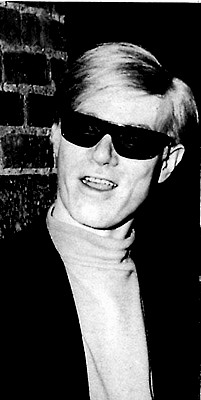 thinking deeply is that in his own way Andy was deeply in love with Edie. Given his homosexuality there was apparently no way for him to express his feelings to her. Edie on her part remarked to Dylan that she had really tried to get close to Andy. While Andy strove to appear indifferent he expressed his resentment at David Weisman and his movie Ciao Manhattan that exploited Edie’s fame while destroying whatever was left of her reputation.
At the same time too he resented Dylan for purloining Edie and then discarding her. Andy was controlled by the notion that there was no stopping a person from following their bent or as he put it: How do you stop someone from doing what they want to do. Indeed, all one can do is step out of the way and let them do it. Thus, while the attitude is callous he was heard to remark that if Edie was going to commit suicide he hoped that she let him film it. The logic is not unreasonable but the attitude comes across cold.
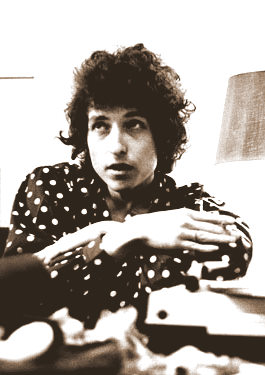
Bob Dylan
As Edie seemed intent on going with Dylan Andy felt that there was no way to stop her. It never occurred to him that he himself was exploiting her by using her in his movies. As he saw it he was creating avenues to success for his people and it was up to them to create their own opportunities from that fame. Not too much different than he was doing for himself. It apparently never occurred to him that none of his people had the talent to do anything on their own although some did try.
He does not seem to have been aware that what was fame for him was mere notoriety for them. He had merely created a clubhouse for drugged out buffoons. Thus when things began to fall apart in mid-’66 when the mise en scene began to be broken up by Andy’s trip to Hollywood his entourage was merely dispersed with no direction home.
The case with Ondine was as pathetic as that with Edie. With the accession of Paul Morrissey and Fred Hughes who encouraged Andy to drop the whole A-head and Silver Factory crowd which they correctly saw as a liability the Silver Factory’s days were numbered. This was made easier by the end of ‘67 when Warhol was advised that his lease would not be renewed. Everyone was told there would be no place for them at the new quarters. The Factory building was subsequently torn down in 1969 to make room for the Dag Hammerskjold project.
For Ondine who was completely burned out by the amphetamines this was disastrous. He ended up at the post office for a while then tried to capitalize on his notoriety by stealing a film in which he starred from Andy trying to make money by exhibiting it while lecturing on his Factory days. He was apparently pathetic while Andy turned his back on him without a thought.

Gerard Malanga
The same was true of Gerard Malanga who was dumped in 1967. Andy’s treatment of this most competent and valuable assistant is a real blot on his record. Malanga was a man of some talent and ability. I don’t think much of poetry but Malanga has a position in the NYC poetry scene. He introduced Andy into a milieu beneficial to him that he would not have known otherwise.
At a time when Andy was turning his art in the direction of multiple copies, essentially posters, Malanga who was knowledgeable in silk screening taught Andy the process. I am of the opinion that Gerard was essentially a collaborator in Warhol’s art. He assisted in the screening contributing skill and know how while undoubtedly making good suggestions. Of course he followed Andy’s lead. All this time he was paid only the minimum wage so, in a sense, he sacrificed a half dozen of his most valuable years for little recompense and as it turned out nothing in the way of thanks. In 1967 he went to Italy in an attempt to further his fortunes. While there he ran out of money having no way to pay his fare home. Andy refused his pleas for help, so Gerard who was completely familiar with Andy’s process of selecting photographs, such as the Presleys, selected a photo of Che Guevara and screened a few copies representing them as genuine Warhols. From my point of view they were authentic Warhols produced without the Master’s hand but still, perhaps, genuine.
When art authorities checked with Warhol, Andy dropped the ball. He should have confirmed them as no one could tell the difference and rescued Gerard. Instead he made Gerard guilty of art fraud which gave Gerard some very trying moments with the Italian authorities. Gerard made it back to New York but now having served as Warhol’s apprentice during his twenties, at thirty he had no marketable skills while being essentially a convicted criminal. Having no other recourse and some rights in my estimation, he expropriated, as the Leftist criminals used to say, some of Andy’s multiples and sold them. In a way in Andy’s mind this acknowledged his primacy and he didn’t press charges but he did disavow authentic prints as genuine.
We now move to ‘68, Andy under the influence of Morrissey and Hughes while forced to change quarters as his former space was condemned, disavowed the whole former Factory crowd telling them to get lost, that they were no longer welcome at the new Factory.
You can’t do this without making a large number of enemies. Andy just before his shooting was not so popular a fellow. And we are not quite there yet.
Edie going into the last half of ‘66 and into ‘67 was in dire straits. She was now completely unable to function without amphetamines. Cut off from all sources of income she was forced into thievery to support her habit. She was caught and did time. She was to spend more time at public mental hospitals that were quite unlike the posh Silver Hill of Connecticut. One can only guess the effect this disastrous series of events, a series with no seeming end, had on her psychology. Or perhaps we can get a glimmer from the biker group she hung out when she returned to Santa Barbara after the stunning humiliation of Ciao Manhattan. There she became a biker chick offering herself to all comers for a dose of drugs. Certainly her self-respect had been obliterated. Certainly she no longer thought she had any value as a human being. The mind can only be battered so much before it gives way. The men in her life had treated her shamefully, her father, Fuzzy, Warhol and Dylan as well as her evil mentor, Chuck Wein.
If, as claimed in the movie Factory Girl, her father had sexual relations with her as a young girl then his obligations extended much further than a paltry allowance that he cut off . Then he is morally liable for her degradation. If as Warhol thought there was no way to stop someone from doing what they want to do, then he was under no obligation to provide the ways and means. In all probability in the environment of NYC of the early and mid-sixties Edie would have drifted into amphetamines anyway. Indeed, as Andy said, Edie was a regular patron of the feel good doctor, Roberts.
Roberts was a licensed physician as was that other chief Dr. Feelgood, Max Jacobson. Doesn’t society have to obligation to protect its citizens from charlatans and quacks? Didn’t they throw some poor innocent Jim Bakker in jail because they disliked his religion? Didn’t society pursue hapless marijuana smokers and criminalize them by the thousands? Can the doctors actually claim they didn’t know the deleterious effects of amphetamines when they had the example of the most notorious amphetamine user ever, Adolf Hitler, before them?
Even if they tried they were still were medical malpractitioners and criminally liable. Read this quote from Edie by Jean Stein for an account of these doctors’ methods and practices. This is absolutely terrifying. There is a problem with Stein and Plimpton however. Apparently there was no Dr. Charles Roberts; Roberts is a name substituted by Stein to ‘protect’ the real doctor, who in any event would likely have been discredited c. 1968 when the Dr. Feelgoods were finally discountenanced. Also there may be confusion with the Dr. Robert, without an ‘s’ of the Beatles’ song. He was apparently Dr. Robert Feynman, a sixty year old man who was discredited in 1968. In any event since Stein and Plimpton didn’t announce the name change their whole history of Edie is compromised more than somewhat. Who knows what edits the two authors made. To quote the account, p.261, Edie:
Joel Schmacher reporting:
Joel Schumacher
I’ll give a description of what it was like to go to Dr. Roberts. The time is two-thirty in the afternoon. I’m going back for my second shot of the day. I open the door. There are twenty-five people in the waiting room; businessmen, beautiful teenagers on the floor with long hair playing guitars, pregnant women with babies in their arms, designers, actors, models, record people, freaks, non-freaks…waiting. Everyone is waiting for a shot, so the tension in the office is beyond belief.
Lucky you, being a special Dr. Roberts person who can whip right in without waiting. Naturally there’s a terrible resentful, tense moment as you rush by because you’re going to get your shot.
You attack one of the nurses. By that I mean you grab her and say, “Listen, Susan! Give me a shot!” You’re in the corridor with your pants half off, ready to get the shot in your rear. Meanwhile Dr. Roberts comes floating by. Dr. Roberts has had a few shots already, right? So in the middle of this corridor he decides to tell you his complete plan to rejuvenate the entire earth. It’s a thirteen part plan, but he has lots of time to tell it to you, and as the shots start to work-Susan having given it to you- you have lots of time to listen.
In Dr. Roberts’s room would be Edie…so thin that she cannot be given her shots standing up; she has to lie down on her stomach. It was a big shot- all those vitamins, niacin, methedrine. God knows what else- for a little girl she has to take it lying down.
Meanwhile everyone who’s back in the corridor for the second or third time that day complains that the shots they received that morning haven’t worked. Out in the waiting room you can hear the people complaining that they haven’t even received their first shot yet.
And Dr. Roberts is still going on. In the middle of his thirteen-part plan he decides to tell you about a movie he saw on television…in detail. You however, are telling him your ideas for whatever you are going to do. But then Dr. Roberts begins to describe his idea for a plastic Kabuki house. Someone else is showing his sketches for redesigning the Boeing 707 with a psychedelic interior. Big doings at Dr. Roberts all the time.
Now you decide to go back out through the waiting room, right? Now you have all the time in the world. Life is a breeze. You’ve used the sun lamp, I mean, you were in a great rush when you came in; now, finally, you decide you’ll leave.
But there in the room are all these people who are not Dr. Roberts special people and who still haven’t been served. They’re there to spend as much money as you have, but they’re not part of the “in” crowd. So they’re drifting off into craziness because they haven’t gotten their shots. A couple of people are wandering around…their poor systems are so riddled with the methedrine they got half an hour ago they feel is not working that they’ve come back for what Dr. Roberts call “the booster.” The basic Dr. Roberts shot goes for from ten dollars to fifteen dollars. As your resistance to the drug gets to the point of diminishing returns, you move on up. There is a big shot for twenty-five dollars, and if it doesn’t work you go right back and get the “the booster’ for five dollars. That’s what some of these poor people are doing- standing out there waiting for the booster. But you …you are flying high, having just had your twenty-five dollar special, and you walk out ino the outer office and say: “Hi, Oh, hi! What a beautiful sweater! Gee you look wonderful! How are you? Oh, hi! Isn’t it wonderful to see you! What’s happening?”
Before leaving, I’d often go and find Edie in Dr. Roberts’ sauna. If we’d been up all night on drugs, the sauna and steam-bath were wonderful things. We’d go and walk for blocks and blocks…just be together, because we didn’t know what we were saying half the time.
The speed thing was so wonderful because everyone was walking around scared to death…scared because they couldn’t sustain the pace. And so these shots from Dr. Roberts and all those other speed doctors gave you a false sense of being together. You cold face everybody when you went out at night. You could dance all night. It was like “the answer.” Nobody knew much about speed in those days.
Once Edie’s mother came to Dr. Roberts! I remember she was on crutches. She looked like Betty Crocker-gray hair with a little hairnet, a blue print dress, and little glasses. She looked like a librarian from the Mid-west standing next to Edie with her cut-off blond hair with the dark roots, thigh-high boots, and mini-skirt, and a kind of chubby fur jacket that looked like it was made out of old cocker spaniels. There they were- the two of them. Mrs. Sedgwick had come to see if Dr. Roberts was taking good care of her little girl…and I guess the parents paid for her treatment. It cost a lot for those shots.

I’m not sure I trust Joel’s memories but that is sure good speed freak talk. Love it. And then there’s this from Cherry Vanilla, p. 265:

I became like an acid queen. I loved it. My looks got crazier and crazier. I started getting into things like pink wigs, teasing them up to make them real big and like bubbles. I’d wear goggle glasses and real crazy make-up: spidery lashes and white lips, and micro-minis. I saw a micro-mini on Edie and immediately started cutting everything off. Kenneth Jay Lane earrings. Big Robert Indiana LOVE earrings, giant love paintings on my ears. Little bikini undies, a band around the top; and we made these silver dresses that were just silver strings hanging on us. I was surrounded by a lot of gay boys in designing and decorating who would always give me a hand in pulling some look together. I would go out half-naked with see through things. You took a scarf and wrapped it around you and thought you were dressed.
I gave Dr. Roberts a shot once. In the ass, in his office about five o’ clock in the morning. I had been playing records at Aux Puce- I was the disc jockey there- and he had come around to visit and said, “If you come back to my office with me, I’ll give you a shot.” It was a freebie, which was nice because those shots were not cheap.
I really got into having a needle in my ass. Just the feeling of it. You get the shot, then this taste in your mouth, and you get a rush and you knew you were getting high. It was all very sexual in a way, and very “in” and social and stylish to do it. So I went back to his office with him and I gave him one and he gave me one.
I don’t know what he shot me up with, but it was something I had certainly never had before. I was really very numbed. Maybe it was cocaine. Sometimes he would shoot you with LSD. You never knew what he was going to shoot you with. So we got involved in a rather heavy sex encounter.
All of a sudden there was blood everywhere. I was bleeding like crazy. He laughed and said, “Oh, I think you should go and see a doctor.” Very bizarre. I started freaking out. I thought, “Oh, my God, this man has done something to me.. He’s killed me. I’m going to die here in his office, all shot up with drugs, and it’s going to be a disgrace and terrible.” I told him I had to get out. He said, “No, no, you can’t leave. I’ll fix you. I’ll give you a shot.” I said, “No, no, no more shots!” I got dressed. I never thought he was going to let me out. Perhaps he was scared I would go to the police.
When I did get out, I ran around the corner to Aux Puces. Some of the staff used to hang out there very late at night taking LSD. Sure enough, they were there. We called doctors. We couldn’t get anybody. Then the bleeding began to subside suddenly- about seven in the morning. I never actually knew what happened. I had been cut inside- scratched with something, fingernails or jewelry…probably by accident. I think we both just got carried away.
Exciting times. And finally we have this from Edie. This is a transcript from Ciao Manhattan.
It’s hard to choose between the climactic ecstasies of speed and cocaine. They’re similar. Oh, they are so fabulous. That fabulous sexual exhilaration. Which is better, coke or speed?” It’s hard to choose. The purest speed, the purest coke, and sex is a deadlock.
Speeding and booze. That gets funny. You get chattering at about fifty miles an hour over the downdraft, and booze kind of cools it. It can get very funny. Utterly ridiculous. It’s a good combination for a party. Not for an orgy, though.
Speedball! Speed and heroin. That was the first time I had a shot in each arm. Closed my eyes. Opened my arms. Closed my fists, and jab, jab. A shot of cocaine and speed, and a shot of heroin. Stripped off all my clothes, leapt downstairs, and ran out on Park Avenue and two blocks down it before my friends caught me. Naked. Naked as a lima bean. A speedball is from another world. It’s a little bit dangerous. Pure coke, pure speed, and pure sex. Wow! The ultimate in climax. Once I went over to Dr. Roberts for a shot of cocaine. It was very strange because he wouldn’t tell me what it was, and I was playing it cool. It was my first intravenous shot, and I said, “Well, I don’t feel it.” And he gave me another one, and all of a sudden I went blind. I just flipped out of my skull! I ended up wildly balling him and flipping him out of his skull. He was probably shot up…he was always shooting up around the corner anyway.
It would appear that Edie was very familiar with drugs and very welcoming to them. The quote doesn’t tell us whether Edie was first introduced to amphetamines at the Factory and then found Dr. Roberts or vice-versa but we do have an environment at the factory in which Brigit Berlin walked around injecting people with or without their consent. The question then is how innocent is Andy really. What sort of milieu had he created for his amusement.
The Factory was a clubhouse for what were essentially lowlife homosexual drug addicts. This must have been the overriding first impression. As such the women had to be accessories to attract men and outsiders. They were there essentially to be abused. They put the Factory in bad odor. As Andy says the police were through the Factory so often it might as well have been the precinct house. Warhol himself was generally known as ‘that creep’ while the more respectable people thought the place poison.
Andy’s genius however did turn it into an ‘in’ place by 1966 where certain celebrities with cachet found the place exciting and for a short period gave it a certain status.
As I have pointed out Warhol was a leader in both the Homosexual Revolution and the Underman Revolution. By late 1966, early 1967 we are not too far from the Stonewall Riot of ‘69 that ended restriction and harassment of homosexuals in NYC and the rest of the country. It was the end of rock n’ roll. After Stonewall the period began that homosexuals called the Candy Store Era. It was a time when anything went that ended about ten years later when AIDS made its appearance on the scene. Of course if any of us had heard of the Stonewall Riot we would have missed its significance nor did anyone understand the astounding change that was the Candy Store Era or even know they were in it. A sub-text of the Homosexual Revolution is the subversion of heterosexuality which goes without saying. Thus the Factory was a prototype of the nightclub that would realize the ideal of absolutely promiscuous sex- Studio 54. Thus as the homosexually led nightlife of the Candy Store Era developed Steve Rubell and Ian Schrager created the ultimate Factory in Studio 54. That club was everything Andy wanted the Factory to be- a celebrity paradise. The place was filled with celebrities, sexual perversion and drugs. All inhibitions were down. Studio 54 became Andy’s clubhouse where he spent his nights as a voyeur.
Rubell and Schrager were not overly discreet so that the Feds, at least, were onto them from the beginning although NYC authorities must have been paid off as they didn’t harass the club. At Studio 54 the Undermen forged a very destructive attack on elite White America. According to Anthony Haden-Guest in his book, Studio 54, a concerted assault was made to corrupt prep school youth- boys and girls by using drugs, liquor and sex. According to Haden-Guest the conspirators were quite successful in debasing both boys and girls in much the same manner Edie had been debauched under Warhol’s tutelage.
This raises the question again of how innocent Andy really was. His competitor Bob Dylan is supposed to have hated Andy for debauching Edie but that may have been the pot calling the kettle black.
Andy’s record of the treatment of women is not good but in keeping with the homosexual ethos. The gays dislike women as competitors, as they believe, for men’s favors. While not considering themselves psychotic they believe that if there were no women all men would be theirs. The irrationality of the belief shall pass without comment. Hence they imitate women to attract men. An inevitable consequence of their attitude is the need to debase and humiliate women.
While being of this mindset Andy as the little Ruthenian immigrant boy who was himself humiliated and rejected by the upper crust of Pittsburgh found delight in debasing and humiliating upper crust women. This runs through his whole career. Edie came from a very old American family that was very prominent in both Stockbridge, Massachusetts, Boston, from whence they arose and New York City. Her father had moved West from New York only shortly before she was born. Although raised as a half wild girl on a vast ranch near Santa Barbara Edie could claim to be a New York society girl. Indeed, her grandmother still maintained her position on the East Side.
While Andy may indeed have loved Edie it was probably more for her background than for herself. The prize of an Anglo-American princess must have been beyond Andy’s juvenile dreams. Indeed, it was through her that Andy first tasted any social success. If they were inseparable during that glorious summer of ‘65 it was because Andy was basking in Edie’s social glamour. And yet one doesn’t find reverence or respect for Edie as a person. Andy allowed her to pick up the check at expensive restaurants not only for himself but his whole entourage of freeloaders. As these were all Underclass people you may be sure they took full advantage of her largesse. I am perhaps a trifle old fashioned but to me this is unforgivable in Andy.
While Andy may have been hard pressed financially to maintain his large and growing establishment there appears to have been no gratitude for Edie relieving the strain. As his entourage grew Andy began to yearn for a restaurant where he could exchange art for food and drink. This was provided in 1966, after Edie was out of favor, when Mickey Ruskin opened Max’s Kansas City in December of ‘65.
The rest of women at the Factory were treated with disrespect although they submitted to it with stoic resignation. One reads with horror the treatment of Viva in Tucson during the filming of Warhol’s cowboy parody and putdown, once again a homosexual extravaganza.
And then there was the ever present sado-masochism that permeated the Factory. An acceptance and celebration of the perversion. The attitude was expressed successfully in the films of Paul Morrissey begun while Warhol was recuperating from Valerie Solanas’ assault. With Andy unable to interfere Morrissey quickly turned out the movie Flesh with Joe Dallesandro which turned out to be a success in Germany. This gave Andy confidence and Morrissey produced several more movies among them Flesh For Frankenstein. I have no intention of reviewing the movie here but certain barbarities of the French arch-sadist Gilles de Rais were celebrated.
Women of some prominence played roles in the nude while performing sexually deviant acts. This rather negative attitude toward women was reflected all through the history of the various Factorys carried on in the most degrading circumstances.
To add insult to injury when Edie was actually falling into her psychological abyss Andy shot The Andy Warhol Story with Rene Ricard and Edie in which both expressed their hatred and revulsion of Andy. ( http://.warholstars.org/warhol/warhol1/warhol1f/warhol.html )
So by this time she had been debased more than any man or woman should ever be debased. Edie herself lay her destruction at the feet of Andy, the great facilitator, the sado-masochistic doyen of New York. I think Andy, then bears a great deal of responsibility for Edie’s shame.
Now, it will be noted. The Andy Warhol Story was filmed at about the same time as his Bob Dylan Story so Edie and Dylan were connected in Andy’s mind.
As I said Warhol and his troupe left for LA in May of ‘66 after a successful month of the EPI. When he returned to resume this lucrative enterprise he found that his hall, the Dom, had been leased from under him by- Albert Grossman and Bob Dylan. They turned it into a venue inanely named The Balloon Farm. Another act of plagiarism by Dylan. I think this was too much for Warhol. First Edie and then the Dom. This was surely provocation asking for trouble, demanding it.
Now, if you’ve watched the post-1968 Warhol movie Bad how far is it from Bad to conjecture that Andy and his crew were responsible for Dylan’s accident? Bad concerns a woman who runs a clearing house for dirty deeds written by Andy’s amanuensis, Pat Hackett. Andy had to have been angry at Dylan and Grossman and indeed he filmed a put down of the two. Quoting Warholstars.org:
Sterling Morrison of the Velvet Underground:

Paul Caruso
“Dylan was always around, giving Nico songs. There was one film Andy made with Paul Caruso called The Bob Dylan Story. I don’t think Andy has ever shown it. It was hysterical. They got Marlowe Dupont to play Al Grossman. Paul Caruso not looks like Bob Dylan but as a super caricature he makes even Hendrix look pale by comparison. This was around 1966 when the film was made and his hair was way out to here…On the eve of the filming, Paul had a change of heart and got his hair cut off- close to his head and he must have removed about a foot so everyone was upset about that. Then Dylan had his accident and that is why the film was never shown.”
So, in July smarting from the indignities imposed on him by Dylan and Grossman Andy was making a ‘hilarious’ film about the two. Perhaps Andy thought that was not enough so somewhere during the filming, one conjectures, he conceived this motorcycle rigging. Thus, in late July Dylan went over the handlebars when his rear wheel locked. Anything could have happened to him from paralysis to death. As it was he fractured his neck coming within an ace of serious injury.
Andy hadn’t finished with The Bob Dylan Story. He wanted to work in the accident. Probably aggrieved at Dylan’s survival Andy recommenced the film in October of ‘66 probably with the Andy Warhol Story starring Edie in mind.
Warholstars once again:

Susan Pile
Susan Pile speaking:
Andy filmed the Bob Dylan Story starring Paul Caruso…Ingrid Superstar and I were folkrock groupies who rushed in (to Paul Caruso) attacked his body and taped him to the motorcycle…Paul Morrissey suggested all of Paul Caruso’s lines be from songs, but Andy, knowing it was a good idea (this is a direct relay from Paul Morrissey) vetoed it…My one line (what I wasn’t supposed to say; I was to remain mutely sinister) was “You’re just like P.F. Sloan and all the rest- you want to become famous so you can get rid of those pimples.” (accompanied by quick slaps to P. Caruso’s acne remnanted cheeks.)…
So, what do we have here? Bear in the mind the subject matter of Bad which is a very violent movie of revenges made in the most casual manner. Morrison’s account is given before the accident while Pile’s is after.
Pile and Ingrid attack Caruso/Dylan and mockingly tape him to the motorcycle so that he can’t fall off. (ha, ha, ha). Pile then delivers a devastating putdown comparing Dylan unfavorably to P.F. Sloan. Sloan was the guy who wrote the puerile Eve Of Destruction that was very near to being a humorous parody of Dylan’s songs such as Blowin’ In The Wind. If Dylan had seen the film he would likely have been enraged. Pile than calls Dylan’s song ‘pimple music’ another put down as rock n’ roll was derisively called pimple music because teenagers had pimples. And then Caruso/Dylan is physically abused by having his face slapped while being unable to retort because he is taped to the bike.
Psychologically then what Andy is saying is that he felt the filching of Edie as a slap in the face while when he was in LA he was unable to foil the filching of the Dom.
This combination of Dylan and the motorcycle in a film called The Bob Dylan Story points clearly to Andy as the perp.
And so the final chapter will concern the filming of Ciao Manhattan and the demise of Edie. I have some other work to be done so there will be a delay before Chapter 16 appears.
A Review: Thomas Kiedrowski, Andy Warhol’s New York City
July 17, 2011
A Review:
Andy Warhol’s New York City
Four Walks Uptown To Downtown
by
Thomas Kiedrowsky
Review by R.E. Prindle
Kiedrowsky, Thomas, Andy Warhol’s New York City, Four Walks Uptown To Downtown, Little Bookroom, 2011
A new little informative paperback guide book by Thomas Kiedrowsky has been issued by The Little Bookroom. Kiedrowski, an ardent Andyphile conducts tours to Warhol sites in NYC. He has spent a decade or so researching the artist.
Perhaps because he conducts tours he has failed to include maps for the four tours in order to protect his turf. They would have been helpful. He organized his volume into four areas: Upper East Side to 70th St., Upper East Side 57th to 68th sts., Midtown and Downtown. This admirable little volume successfully embeds Warhol in his milieu clarifying a number of issues.
Mr. Kiedrowski also turns up some facts I haven’t read before thus supplementing Steven Watson’s Factory Made which provides needed info about Andy’s entourage.
Mr. Kiedrowski provides the abolutely entrancing story of Andy as a prospective restauranteur quoted here:
Site 18, 1977, 833 Madison Ave. (74th St.)
The first link in a proposed international chain of Andy Warhol fast food restaurants would have opened at this location in 1977. The concept of the Andy-Mat, a clever take on the Automat, had Warhol and British entrepreneur Godfrey Leeds in talks since 1974. Both men had enjoyed dining at Schrafft’s years earlier and had yearned for that type of comfort food they had as kids. Leeds said that the Andy-Mat would be a “neighborhood restaurant with a varied menu, simple good food, reasonable prices, a place where you don’t have to be embarrassed to take someone- one was never embarrassed to take someone to Schrafft’s.”
During the Silver Factory days, Warhol and his entourage could often be found at Schrafft’s located at 556 Fifth Avenue and 47th Street, and Warhol was asked to do a commercial for Schrafft’s in 1968. The 60 second spot shows an image of a red dot, then slowly zooms out to reveal a maraschino cherry and then a melting chocolate ice cream sundae. At the end a credit line rolls diagonally, “The chocolate sundae was photographed for Schrafft’s by Andy Warhol.
[As described an artistic success but a complete waste of advertising money, reviewer.]
Warhol asked close friend and society hostess Maxine (sic) de la Falaise McKendry (she appeared in Warhol’s Dracula) to prepare a menu for the 115 seat Andy-Mat, which she did with guidance from Tony Berns of the Restaurant 21. She often cooked for Warhol’s Factory regulars and at one time was a food columnist for Vogue. The seventy-five items were to be priced between $1 and $5.75 and included shepherd’s pie, fishcakes, Irish lamb stew, fried onion tart, mashed potatoes, key lime pie, champagne fruit drinks, milk over ice, and a choice among four omelets. (Warhol’s diet regimen at the time.) Said Andy: “I really like to eat alone. I want to start a chain of restaurants for other people who are like me called Andy-Mats- ‘The Restaurant for the Lonely Person.’ You get your food and then you take your tray into a booth and watch television.”
Apparently 40K had already been spent on development with another million in the pipeline when the plan was aborted. It’s not difficult for me to see why but then…who knows, it might have worked.
Mr. Kiedrowski fills his little guide book with such interesting tidbits many of which I had never read before.
I heartily recommend the book for a very entertaining read at a price under 12.00. Some nice pictures I haven’t seen before too.
http://www.youtube.com/watch?v=jaf6zF-FJBk Watch Andy eat a hamburger.
Chapter 14 Edie Sedgwick, Maid Of Constant Sorrow
June 23, 2011
Chapter 14
Edie Sedgwick, Maid Of Constant Sorrow
by
R.E. Prindle
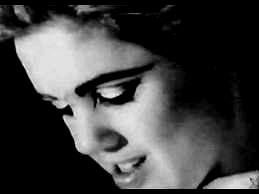
Edie
In the interest of keeping things in perspective and since a huge part of the readership obviously didn’t experience the sixties, I’d like, if I may, to give a little additional background to understand what happened here. I hope I don’t offend by mixing in some of my own background, not merely from vanity, but so the reader will have some understanding of both my limitations and strengths in interpreting Edie, Andy and Dylan.
Nearly everything you read about the sixties today is written by former activists, usually Jewish, or dopers of one stripe or another. Shall we say they skew the period in the direction of their beliefs. Theirs was only the point of view of small minority. In fact, they seized the leadership playing a much different game than the majority who were busy getting on with their lives.
The period now coming under discussion is 1966-’68 which changed the direction of the sixties. In mid-’66 Dylan had his motorcycle accident and was effectively removed from the scene for the duration. When he resurfaced in the seventies it was in a much diminished role. The first Bob Dylan was dead and the second was busy being born. No matter what he’s done since then, compared to his mid-sixties trilogy it has had minimal impact.
Warhol reached his apogee in this period while he was shot by Vallerie Solanas in 1968 which changed the direction of his career when like Dylan he became a corporation while business affairs were managed by other men, most notably Fred Hughes.
Edie was heartbreakingly dragged through the mud in these years until her evil genius, Chuck Wein, connected her to the movie Ciao, Manhattan which was the most degrading, humiliating experience possible. It eventually killed her. All three of our participants then suffered life threatening experiences within two or three years of each other. Edie was the only one not to survive.
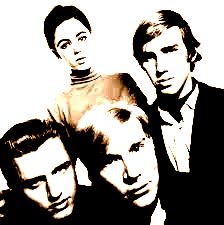
Andy, Edie And Friends
The sixties were tumultuous times; it was like walking around with a perpetual thunderstorm over your head. I was on the West Coast in the San Francisco Bay area till 1966 and at grad school at UOregon in Eugene from ‘66 to ‘68 and then in the record business for the rest of the period. I got my degree from California State College At Hayward now Cal State U. East Bay in 1966. It’s a long and irrelevant story but I entered Cal State in ‘64 taking enormous credit loads of up to 24 hours a quarter. You can do things like that when you’re young and not too bright. Hayward is just South of UC Berkeley. Cal State was a new school with a very small library so we were allowed library privileges at Berkeley of which I availed myself so I was around the Free Speech Movement scene but not of it. I was a first hand observer.
Once in Eugene in the fall of ‘66 things were getting in full swing in our own cultural revolution that would be joined to that of Chairman Mao in ‘68. I was entranced by the poster art work coming out of San Francisco eventually dropping out of grad school to sell posters and then phonograph records at which I was successful. Thus I was involved in the scene on an intimate basis from 1967 on.
While other generations were characterized by their literature our, the, generation was depicted by songwriters on phonograph records, thus records were central to the scene, don’t look for it in novels. The first efflorescence occurred in the US during the mid-fifties while going into an incubation period in England from then until the early sixties when in 1964 the Beatles, Stones and Animals among others provided the transition from fifties Rock n’ Roll to sixties rock. I don’t know how true it is but for me the revolution really got underway with the breathtaking first Doors LP in ‘66. The blues bands and the next wave of British bands provided the impetus to move things into the seventies where the creative impulse ended by 1974 although inertia carried things through until sometime in ‘78. Disco doesn’t count that was the beginning of an entire new ethic based in the homosexual revolution.

Morrison, Densmore, Krieger, Manzarek
When Andy, then in his quest for money, moved into records by managing the Velvet Underground, probably in imitation of Dylan, he did so just before the music scene broke. New York bands were never that popular on the West Coast and the Velvets were no exception. Andy, however, was an innovative guy. Light shows were already news on the West Coast but Andy came up with a new multi-media formulation that blew our minds, as we used to say, while having a very lasting cultural effect.
In the Spring of ‘66 he rented a hall called the Dom in NYC. Using the Velvets as his house band and his light show he managed to overwhelm the hipsters of the Big Apple. He would have had a major success had he continued on but he was fixated on movies, wanting to do his Western put down, so the Factory crowd decamped for Tucson, Arizona, thinking to pick up the strand on their return.
While away Albert Grossman and Dylan leased the Dom from under Warhol and opened it as The Balloon Farm. Between taking Edie from Andy and then the ballroom I’m convinced that Dylan sealed his doom. I hope there aren’t too many people who think the rear wheel of his motorcycle locking was an accident. Once again, conclusive proof is lacking, but there are indications that Andy and the Factory crowd did it.

Before The Fall
By late ‘66 Andy’s brief period in the spotlight was over. His creative burst had run its course and while afloat financially, there was not any great income in sight. Paul Morrissey had come on board as a filmmaker and his vision was more commercial than Andy’s but Andy was in charge so Paul had to bide his time waiting for his opportunity. At the same time a man from Houston by the name of Fred Hughes came on board who knew how to monetize Andy’s reputation and art skills and then, Bang! Andy was writhing on the floor in pain. One of those little zig-zags fate has in store for us sometimes. The sixties were over for Andy but the change in direction made his future in the seventies and eighties.
Now, let’s go back to ‘64 and take a look at one of the defining members of the decade I’ve slighted till now, Prof. Tim Leary. I’m convinced Leary was not in his right mind or, if he was, he shouldn’t have been there. By the time Timmy latched onto psychedelics they were pretty well established. LSD, discovered in 1938 by Hoffman and brought to prominence in 1943 was almost passe when Leary was turned on. Aldous Huxley had published his Doors Of Perception in 1954 and Heaven And Hell in ‘56, that celebrated the joys of mescaline.
When I was in high school maybe ‘54 the kids of Scarsdale were notorious for using marijuana, written up in Time if I remember right. Those were rich kids and by ‘56 our elite were very covertly using it. In the Navy aboard ship from ‘57 to ‘59 Bennies and other pills were prominent while the occasional heroin addict passed through. The Marines of Camp Pendleton were heavy into everything, barbiturates, mescaline, peyote buttons, LSD, you name it. For cryin’ out loud, Hollywood had been the drug capitol of the US for decades. One only has to read Raymond Chandler. There wasn’t anything they didn’t know. Cary Grant had been an old LSD hand for years before Leary, the apostle of acid, made it to town bearing the good news in 1960. He was received with some amusement.
A very amusing story Leary tells in his autobiography is that Marilyn Monroe fell to his lot at a party. They were actually in bed together. As you may know Marilyn knew more about drugs than any pharmacologist. Probably disgusted by Timmy’s ranting about LSD she handed him a pill and said take this. Timmy did then decided to get up to go the dresser for something. ‘Are you sure you want to do that?’ Marilyn asked. Timmy was. He took about two steps and seemed to sink through the carpet until only his nose was above the rug. He lay there inert all night while Marilyn laughed softly from the bed.
From his position on the faculty of Harvard Timmy was a very visible advocate of LSD hogging headlines in Time and other mags that were the envy of Andy. Tim was to amuse us with his antics all through the sixties. Now, all this stuff was happening very fast. It was impossible almost to keep up with the headlines let alone any indepth reporting or analysis. Besides there was no internet so all news was comparatively old news, perhaps weeks after the occurrence if you heard of it at all. Also it was impossible to be where it was happening unless it was happening where you were and then you didn’t know it was happening because you were in the middle of it. I happened on the Free Speech Movement because I was in school but I missed the SF scene going on at the same time because I couldn’t be in two places at once and keep up grades in the third place at the same time. New York was out of the question, London was across a wide, deep ocean, and LA hadn’t caught on yet. Thus, I was invited to the Kesey/Dead Trips Festival but passed on it. For various reasons I only caught the end of the Fillmore/Family Dog scene and then only fleetingly.
Even Morrison and the Doors who can claim to have been in the center could only have caught their small share however central it was. Nobody got it all. How could you be in Swinging London, New York, San Francisco and LA at the same time? Couldn’t be done although there were many who tried spending their time criss crossing the country from West to East and reversed and for all I know popping into London too trying to be jetsetters but they were merely vagrants peripheral to everything.
So marijuana, acid, speed and barbiturates or downers as they were called then made up the pharmacopeia. Amphetamines were obviously big in NYC from the early sixties and must have been in the West too but my first acquaintance with that was the Speed Kills buttons. Heroin was a danger drug for the addict type only. Cocaine came along in the seventies. At the time little or none of the marijuana crop was home grown. It came from Mexico and there are smuggling and pot running stories galore. At first the dealers were amateurs, boys and girls next door, but that slowly turned into the criminal professionals.
Andy’s crew were all what he called A-heads, but you may be sure they smoked and did booze too. It must have been uproarious in the early years but by ‘66 psychotic and physical reactions were beginning to slow the troops down. It was hard to keep up that pace.
Now, Edie when she came to New York in late ‘64 was a naif. Not many of us knew much better but she was a true naif, fresh from the farm, so to speak, while having had her brains addled by electro-shock treatment at Silver Hill Sanitarium. At Radcliffe-Harvard she had hung out with homosexual men gaining the reputation as a fag hag. Alright, I suppose, as she didn’t know how to handle herself around boys anyway. She came down to New York with the group of homosexuals that Andy called the Harvard kids with some distaste. She associated herself with her evil genius, Chuck Wein, who, as a homosexual, sought her destruction.
The Factory of Andy Warhol she entered was created in Andy’s image. In reading of it, I was never there, it comes across as a hell hole from which any reasonable person would have fled at first glance. Many did. Andy hurt a lot of people being of a sado-masochistic frame of mind. Outside his circle he was universally referred to as ‘that Warhol creep’ and yet events conspired with him to realize his perverted dreams and triumph over all.
Andy considered himself ugly and descriptions of him by others are unpleasant but whatever everyone and himself saw doesn’t show up so clearly in his pictures. He may not be the handsomest fellow around but he has a cherubic, pleasant look that I don’t find unattractive. But, because of this feeling he surrounded himself with beautiful people. Fred Hughes his business manager was quite handsome. Morrissey was OK, Malanga had his moments, Edie was considered a knockout, although I can’t see it, and the other women he associated with were quite attractive.
And then, as a little immigrant boy who wasn’t acceptable to mainliners of Pittsburgh Andy was especially pleased to have society women attached to him and especially the titled or rich English girls. Edie fit in as a beauty, as Andy called her then, and as an old line New York society girl. The combination was almost too tantalizing for this lifetime homosexual. Andy said Edie was as close to love with a woman that he ever got. He even took her home to meet mom. Edie apparently missed the import of that.
Andy has been blamed for making an A-head out of Edie. Once she tasted amphetamines it is clear that there was no stopping her. In truth the Factory was no place for her and Chuck Wein who introduced her into it must have known that. Still, as Dylan sang, there’s something going on here and you don’t know what it is, do you? Most people didn’t including Dylan, and I certainly was out of my depth. It was disconcerting metaphorically to step on what was once solid ground to feel it giving beneath your feet.
Actually there were several revolutions going on which would result in massive social changes. Those of us firmly grounded could only see the so-called change as a rising tide of insanity. Aided by drugs these revolutionists became totally dissociated from reality. Drugs alone cause a withdrawal into an inner fantasy world of wishful thinking. The external world appears as something that wishful thinking can manipulate to one’s desires in some magical way. When the two got really out of sync as they inevitably must you ended up in Bellevue psychiatric wards as happened to a heavy user like Edie many times while most of Warhol’s crew checked in at least once.
Andy, who used these people for entertainment and self-aggrandizement, provided a hospitable retreat or club house where the cognitive dissociation wasn’t quite so apparent or, at least, normal. The scene must have been incoherent. A reading of Warhol’s so-called novel, ‘a’, shows that by 1966 his crew was indeed incoherent. Ostensibly a tape recording of Ondine’s conversation over twenty-four hours, whose conversation Andy found engaging, the tapes show Ondine unable to complete a sentence along with Rotten Rita and the rest of the crew including Edie.
Further the whole bunch were absolute thieves. In Edie’s decline through sixty-six they walked into her apartment and chose their favorites from her collection of fur coats along with anything else of value. In her demented state all she could say is that everyone was wearing her coats. One wonders how much internal anguish there was as she knew there was nothing she could do about it.
At the same time Andy was a leader of the Homosexual and Underman revolutions. Perhaps nobody knew what was going on but Warhol, Rotten and others were working for homosexual liberation which they achieved with the Stonewall Riot of 1969.
New York was unique in that for decades homosexuals from the South and Midwest flowed into New York each year in a great internal migration. The chief destination was the Village. Christopher Street was the main fag drag. The Stonewall Tavern was on Christopher. Why the cops would disturb the lads in their own colony is beyond me, but they did and then gave up without a fight.
Perhaps the most astounding revolution of all was that of the Undermen. Untermensch in German. While Warhol’s crew was a prime example of the Other Half rising to control the direction of society, the main impetus seems to have been the West Coast, San Francisco and Haight-Ashbury, specifically the Hippies. It was really there that the poverty look took hold, torn, faded jeans and whatever. LA never really went for it but it spread up the coast to Eugene, Portland and Seattle. The Sorority and Fraternity look went out the window with millionaire’s kids posing as the down and out.
I would imagine a naïve thing like Edie got caught up in the so-called sexual revolution too. We’re not talking Feminist Movement here but the sexual aspect of the Communist Revolution in which women are common property to be had anytime or anyplace by whoever. The Pill that came along in 1960 really facilitated the change in sexual mores. Nothing exemplified that more than the mini-skirt. So you’ve got drugs, the Pill, the Mini Skirt and the Ideology. The world was not so slowly turning upside down.
All these revolutions might have gotten not too far but they were all collected and subsumed under the directing force of the Communist Revolution under the leadership of Chairman Mao and the Chinese Party. The money really flowed in after 1968. Driving the whole thing and what made the turmoil possible was the Viet Nam War. It served the Communist cause more than the American as while taking a beating in Viet Nam the Communists subverted the United States. Strangely Viet Nam had no effect on Warhol at all. His disaster paintings ignored Viet Nam while a couple napalm drops would have made a terrific topic.
In the early days of the war it was filmed like a reality TV show with the daily haps relayed on TV to the US. The reality of napalm drops while our soldiers cheered and howled while a couple dozen Vietnamese where incinerated was too much for the entertainment starved public to take. I sure couldn’t handle it. The films were quickly removed. The reality of war is a private thing between the armies, not quite like the Super Bowl.
I don’t recall a single mention of Viet Nam in Andy’s Diaries, Philosophy From A To B or ‘a’. The war appears in none of the biographies or auto-biographies or even novels written by various denizens of the Factory. Rather strange, but then I can recall no references to it in Dylan’s songs either.
The Communist Revolution connection developed when John and Yoko arrived in NYC in 1971. The two of them were clearly involved in revolutionary activities linking various art and entertainment figures with them including, Dylan, Warhol, David Bowie and others. What exactly they were doing isn’t clear to me yet. Yoko was and is on some Feminist rag.
So, in 1966 while an apparent apex for Warhol, his world was actually coming apart while Edie’s was descending like a Stuka dive bomber.
The period from December ‘65 to Easter of ‘66 must have been traumatic for a crazed and confused A-head like Edie. She sacrificed her position with Andy, seduced by the fallacious promises of Dylan and Grossman who certainly had no plans to make a movie, and if they did, to put Edie in it.

Velvet Underground & Nico
Warhol had all the sadistic cruelty characteristic of homosexuals that he turned on to the distraught girl. Edie must have been thoroughly crushed when Dylan rejected her love while passing her on to Neuwirth. Edie was not at her wit’s end with no money, cut off by her parents who objected to this life style, while having no means to make money to support the station in life she had seemingly attained. Both Dylan and Warhol abandoned her after accepting her largesse for several months. Warhol is especially reprehensible. Dylan sure is a close second.
Her heavy dependence on amphetamines was literally eating away her brain, her body and her personality.
I really can’t believe that Edie loved Neuwirth as she claimed. I don’t think either was capable of love. Yet, she abandoned her body to him claiming she could make love for forty-eight hours straight but crashed whenever he left her. That is a sign of despair and fear. I can only imagine the horror she felt when she looked into the future and saw only a blank wall. As Dylan was to sing of her: Time will tell just who has fell and who’s been left behind.
Perhaps the cruelest trick of all was played on Edie by Dylan, Grossman and Neuwirth at the Easter Parade of 1966 when Neuwirth filmed the promised movie.
In a November issue of Life Magazine in 1965 Edie had been photographed standing on top of a toy leather rhinoceros about two feet high and three feet long, popular at the time. Whether the three of them, Grossman, Dylan and Neuwirth, put their heads together to come up with this or Dylan brainstormed it by himself, Neuwirth persuaded Edie to pull the rhino down Fifth Avenue as the parade progressed, filming as they went. Then Bobby tied the rhino to a parking meter and persuaded a passing cop to write Edie a ticket. Thus Grossman and Dylan fulfilled their obligation to put Edie in a movie while mocking her cruelly. Those guys had a reputation for cruel put downs. They live up to it here.
It was just after Easter that Warhol opened the Dom to stage his Exploding Plastic Inevitable. The reports we got of it on the West Coast made it sound absolutely astounding. If any one thing characterized the sixties I would have to say it was the Exploding Plastic Inevitable. It brought everything the era valued together. As usual with Warhol he couldn’t resist turning it into a sado-masochistic experience. The chaos must have been extraordinary. One can imagine the scene with dope peddlers trying to push their drugs on you, the lights flashing, strobing and pulsing, the howling music, the bodies bumping against each other, Malanga doing his whip dance, Edie bopping around the stage with her odd skip and step. They talk about the Velvet Underground being loud but they must mean for the times. Blue Cheer with its wall of Marshalls was just around the corner while the electronics improved almost daily until the sound passed the limits of endurance. Created a whole generation of deaf Beethovens. Musicians literally without ears.
I actually promoted the Underground once in either ‘68 ot ‘69, might have been pre-Blue Cheer. BC’s main claim to fame was that they were the first mega blasters, loudest band alive for their brief moment. Sort of a Great Divide in Rock music.
Things were still building but it wasn’t that the Velvets were that loud; they were just super strange. Reed was the original one-note man, he played it over and over fast. Sterling was there but he must have been background noise because I don’t remember much of an effect there. Whatever Cale was doing passed over my head but it must have been some kind of La Monte Young dynamo hum, all the songs were. I was most fascinated by Mo on drum. Yeah, right, drum, in the singular. She had a six inch deep tom with an under slung mallet. The mallet hammered away at the bottom skin while Mo pounded the upper skin with the sticks. In keeping with the dynamo hum she never varied the beat once but she was right on time just in case time was important. Quite an experience. You shoulda been there, and paid at the door. I wouldn’t have lost as much money.
Andy made a bundle in the month long run and then he made what would have been the mistake of his life in leaving for Arizona, or would have been if he hadn’t been shot. While he was out of it Hughes and Morrissey put together the means to put Andy over the top.

Turn On, Tune In, Drop Out
Chaper 15 follows.
Exhuming Bob XXX: Pt. 3 A Review of Masked And Anonymous
June 11, 2011
Exhuming Bob XXX
Part III
A Review Of Bob Dylan’s Movie
Masked And Anonymous
by
R.E. Prindle

A Catalog Of The Usual Suspects
I will now deal with the leading characters of Masked And Anonymous and what story line the movie has. It is clear that not many have seen this movie so I will try to relate the review of the movie to Dylan’s life as the film is clearly autobiographical.
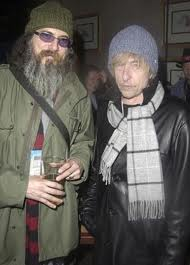
The characters have their individual roles while being paired up in various combinations. The most obvious is that of Fate and the Promoter or Manager Uncle Sweetheart played by John Goodman. Uncle Sweetheart has a very large dose of Dylan’s real life manager Albert Grossman while being a composite of every promoter who ever existed. Uncle is also paired with Nina Veronica played by Jessica Lange as the exploited female Producer. She also does a very creditable job.
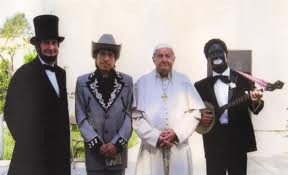
Later in the movie Bobby Cupid is introduced played by Luke Wilson. Cupid is obviously Bobby Neuwirth, Dylan’s sidekick of the early sixties, and who also shared the spotlight with him on the Rolling Thunder extravaganza. Cupid is a smart ass put down artist as Neuwirth was reputed to be. Cupid forms a pair with Uncle Sweetheart also as an antagonist which may have been the case in real life with manager Albert Grossman but one can’t be sure. At any rate Cupid merges his identity with that of Fate while acting as his enforcer.

The interest is not the movie but what Dylan reveals of himself.

2.
A Run Through The Scenes
Influences
In many ways this movie is based on all the Rock n’ Roll movies of the fifties. All of them could have been written by the same hand, at least the American ones. The English Tommy Steele’s Doomsday Rock might have slightly different being from England but probably not. Cliff Richard’s movie that I’ve seen only recently was from the American mold. Dylan ‘s movie is on a par with all except for the greatest of them, the apotheosis of Rock n’ Roll films- The Girl Can’t Help It. That movie told the whole story of Rock n’ Roll while being a perfect summary of the fifties. Can’t recommend it too highly; had more stars than the Big Dipper.
The big drawback of Dylan’s movie is that once he gets out of jail Fate can’t stop droning on about his opinions about everything. He might have thought he was on a par with Phil Marlowe but he wasn’t. Dylan’s close with Greil Marcus and he and his crowd are big on Raymond Chandler, the creator of Philip Marlowe. Chandler is great but not transcendental, and I’ve read all his stuff short stories and novels but not the letters so his mystique for Marcus, Dylan and that crowd escapes me. Marlowe narrates with comment as Dylan does here so there may be a strong Chandler influence.
Enter The Characters
Scene 1 is the fireworks. Scenes 2 through seven introduce, in order, Uncle Sweetheart, Nina Veronica, Jack Fate, Prospero, Tom Friend and Pagan Lace. The scenes establish the main characters while providing the raison d’etre for the movie, or in other words, what passes for a plot.
 Scene one is the violent opening. Scenes two and three present Uncle Sweetheart and Nina Veronica. The name Sweetheart is obviously ironic as Uncle is conniving and irresponsible. John Goodman who plays the role is a big fellow as was Albert Grossman. As the movie is autobiographical Uncle Sweetheart must refer to Grossman who came across to Dylan as doing something for him but who wound up taking more of the earnings than went to the singer and writer of the songs. Still he is a composite of every promoter than ever existed. Nina Veronica played by Jessica Lange is a smart talking long suffering legman for Uncle. Lange co-starred in a Presley movie thus establishing Dylan’s connection to Elvis without whom, as he says, he couldn’t have been doing what he is doing. I can’t really identify a specific model for her but she is blonde. Might be some connection to Edie Sedgwick and Echo Helstrom among others.
Scenes four, five and six introduce Jack Fate with an interlude with Cheech of Cheech and Chong as Prospero referring to A Midsummer Night’s Dream thus establishing Dylan’s connection to Shakespeare to whom some inexplicably compare him. Scene six brings Tom Friend into the stream.
As Uncle cannot find a ‘Star’ to perform solo at this benefit concert he is staging, he is forced to dip into the bottom of the bucket to spring Fate from prison where he is apparently doing life for being a bad singer without parole. Fate collects his guitar and moseys down to the bus stop where he finds his old friend Prospero waiting for him. Here Dylan begins his marvelous collection of clichés. ‘Where you goin’” asks Prospero. ‘That way.’ says Fate pointing to the right. ‘Oh yeah? That way’s pretty good too.’ Prospero says pointing to the left. Whew! Are you prepared? The use of Prospero for this downer film must be ironic.
Boarding the jalopy bus Fate asks the Black female bus driver: ‘This bus cross the border?’ ‘Oh no, you’re going the wrong way, mister.’ ‘Alright’ Fate replies resignedly. And this is only the beginning of the movie. Fates passes the Mexicans and chicken to find a seat at the back of the bus. I presume that this is a racial comment that it is now time for Whites to sit in back. After all as Dylan sings in his song: Them that are first shall be the last. To give credit when credit is due, Dylan with great economy lays out the direction down the midway of his view of Desolation Row that the movie will pursue. This is Dylan’s version of reality that even a hundred million dollars obviously can’t change.
The scene that introduces Friend takes place in the Editor’s office. Here we have a contrast between

Recent Dylan Persona
the archetypical, cynical, hard drinking nineteenth century newspaper editor confronted by a wise ass current edition of Dylan in hoody and dark glasses. This is an interesting contrast in historical periods. Not only do Friend and the Editor come from different periods but the Editor has a copy of the statuette of the monkey reading Darwin’s Origin Of Species on the desk. As Friend is associated with both Dylan’s early New York period and his present this might be a time to note the influence on Dylan’s mind, which he acknowledges, caused by his study of Civil War era newspapers in the New York City library during ‘61-’62. Actually he studied the social scene North and South in the years just before the war. It would be interesting to know how many different papers he read. The old black-face minstrel Oscar Vogel who appears later in the movie refers to these studies as also does probably Dylan’s inexplicable inclusion of his version of the Southern anthem, Dixie. He might have done better to have performed Cowboy Copas’ Alabam‘. One might add his version isn’t very good. Nevertheless those studies color his mind.

The Day The World Changed Eras
Dylan And The Press
Friend also raises the question of Dylan’s relationship with the press. Now, Dylan had before him the example of the Beatles and their amazing exchange with the media upon touchdown at Idlewild airport, renamed JFK, in January of ‘64. We were fairly electrified at the aplomb of the Fab Four and their cheekiness. This was in contrast to the humble pie other musicians ate before the microphones. The Beatles established a superior distance to ‘all that thing’ that struck just the right tone with the generation. In that one brief exchange they changed the direction of the history of the world. Of course, scruffs like the Rolling Stones and Animals who followed them maintained the tone creating the right antagonism between the generation and their elders. This was the beginning of the generation gap. The old timers who had survived the Depression, WWII and the Korean War had developed a definite world outlook that we with different experiences couldn’t share but the cleavage between the two generations was so sharp that conflict was inevitable. This is where it began.

The Bad Boys Of Rock
Dylan’s father in his interview with Walter Eldot of Duluth let the cat out of the bag when he said his son was a corporation and his whole persona was an act, a character that Dylan had assumed to make it. That being said then Dylan had plenty of time to assess the situation and prepare an act for the press when his turn came with good and correct examples before him. Since he couldn’t be flippant and amusing like Lennon and the others of the Fab Four he had to create an antagonism between himself and the press so we may assume his proto-Keith Richards act was a put on from the start. It seems impossible that a young man like Dylan wouldn’t have been flattered and awed by being interviewed by the international press while being broadcast on the evening news on two continents on a regular basis.

The Name Terrified The Old Folks
Nobody expected much from the unknown quality of the Beatles in ‘64 but Dylan in ‘65 was already ‘the spokesman for his generation’ whether he wishes to acknowledge it or not. His shucking and jiving and renunciation of his role did have a cooling effect. He was supposed to be supremely wise, ‘Something’s going on here but you don’t know what it is, do you?’, with answers for everything but he wasn’t and didn’t. He could say anything stupendous nor could anyone have. Knowing his incapacity he chose to pick a fight; probably the wisest thing he could have done. He didn’t answer any questions but asked more questions back than were given him. That way he didn’t have to take a position on anything.
It’s interesting that his alter ego, Friend, is full of sage and trite expressions of opinion, he spouts them non-stop a la Phil Marlowe. Friend who represents the Dylan of ‘61-’65 has Lace/Cruz as his live in. It follows then that Pagan Lace must represent Suze Rotolo.
Searching For The Vacant Couch
In his memoir Chronicles Vol I Dylan creates Ray Gooch and Chloe Kiel who he says he stayed with for some time on the West Side, sort of the Bank Street crowd. There is no possible way to fit them into the time frame nor had anyone ever heard of them before Chronicles so they must be a composite of the MacKenzies, Dave Van Ronk and various other couches he slept on. He very quickly moved in with Suze Rotolo by late ‘61 down on Fourth Street. As near as I can tell he stayed there until perhaps ‘63 when they split up. By 1963 he would have been famous and prosperous enough so that he couldn’t go back to sleeping on other people’s couches so between then and the time he showed up at the Chelsea Hotel it isn’t too clear where he lived. That was before Warhol demolished what was left of the Chelsea’s reputation when he made his movie Chelsea Girls.
Friend’s really great Beatnik pad was probably a composite of locations Dylan knew. It’s terrific. Not a lot of books in it though as Dylan describes in his memoir.
Memories Of Suze
As I noted Pagan Lace was very fearful much as Dylan always described Suze. Suze was intellectually vital in introducing Dylan to art and the theatre while Pagan Lace being Mexican is reminiscent of the Ramona of Dylan’s song To Ramona. ‘I could forever talk to you by my words would soon become a meaningless hum…’ which is essentially the relationship between Friend and Lace. Friend and Lace go in search of the Benefit Concert to track down the elusive Jack Fate.
Scene eight is the totally irrelevant interlude with the paramilitary who has no idea which side he’s on. The movie could have done without it.
Dylan insists on talking over the scenes like some Philip Marlowe but more vapid. If he wouldn’t give the reporters his opinions in his prime he makes up for it here while amply demonstrating the wisdom of having kept his mouth shut previously.
In scene 9 Fate’s father lies dying. Why he’s Mexican isn’t clear to me unless Dylan is merely eliminating as many White faces as possible. Dylan relates the particulars of Fate’s mom and dad which obviously correspond to those of himself and his parents. In another long interlude he checks into a hotel in what is supposed to be a dead pan comedy routine with the desk clerk. Another very long stretch of clichés.

Robert C. Neuwirth
In scene 10 Fate makes a phone call to his old buddy Bobby Cupid who during Fate’s incarceration has been working as a bartender. A very dissatisfying scene takes place between Cupid and a customer. Wretched acting and even more miserable writing. If Warhol was right that amphetamines made Dylan’s lyrics sparkle in the sixties, he should have fortified himself with some while writing this script. Having received his summons from Fate Cupid throws down his towel leaving the cash drawer open and liquor on display and leaves the building.
In the meantime Fate has found his way to the studio cum bar. This scene may be dated back to

A More Mature Neuwirth
Dylan’s teen fantasy that he is living out today. Contrary to what he would have people believe Dylan’s oeuvre is singularly free of Blues or Negro influence. Dylan quite frankly is a pseudo-Hillbilly. Well, maybe not that pseudo. He has been since the first day he showed up in Greenwich Village disguised as Woody Guthrie. In fact one reason it took him two months after arriving in New York to reach the Village was that he was actually scoping it out, reading the scene to develop an act as he couldn’t play straight country and succeed. Not too confident he backed up his Woody Guthrie/James Dean act with a large dollop of the lovable Charlie Chaplin for comedic relief. Still, he knew all the great Country songs and acts of the fifties. He had probably seen all the greats and lesser lights come through Hibbing. Awe inspiring. They used to have these great package shows. Where I lived I remember one show headlined by Ernest Tubb backed up by lesser lights like Johnnie and Jack and others. Both the show and the audience was a trip. I’m sure Dylan on more than one occasion was outside the stage door to watch the performers troop in. A sight to see. They weren’t gods but they’ve never been replaced. The Rocker never even came close.
The whole benefit sequence is Country and Western probably what Dylan calls traditional music. Bearing in mind the country concerts, Dylan makes a marvelous entrance as the traveling country troubadour shot from the back. Wonderful. He has the shambling bowlegged gait, guitar case in hand in the oversized cowboy suit down pat. He even manages the bowlegged stiff back stoop so you might think it was I don’t know who rambling past. He does all kinds of imitations of the Country stars he knew and loved: Hank Snow, Webb Pierce, Slim Whitman, I don’t know who all. If you know country these scenes give away Dylan’s major influences. Heck, when he hired Mike Bloomfield for Highway 61 he told him he didn’t want any of that blues crap and he made Bloomfield play out of his genre. If he could have gotten Country picking out of him he probably would have been happier.
Back In The Country Mode
Once he got out of the miasma he’d fallen into from ‘61-’66 he went straight Western with John Wesley Harding and just in case you didn’t get the message on Nashville Skyline he comes out of the country closet tipping his hat to you as if to introduce himself in his real guise. Obviously that is the real Bob Dylan. My problem with that, as my jaw dropped, was that he’s a lousy country singer and writer. Merle Travis he’s not.

Dylan In White-Face, Rolling Thunder
Now, the bar in the scene is a real old fashioned Country bar although this one is improbably populated by Negroes and Mexicans and the occasional old girl friend. The only thing the scene is missing is the chain link fencing around the band to keep the boys from catching a flying bottle with their teeth. I can tell you that those crowds were rowdy and I’m only alive to talk about it by the grace of god. In Dylan’s fantasy all those peaceable Negroes and Mexicans are so enthralled by Fate’s hillbilly music that they just keep smiling’ and boppin’ along. Heck even the Black Country singer Charlie Pride didn’t like the music that much, he only went to C&W when he realized he wasn’t going to make the major leagues as a ball player. So, during performance time here we’re in Fantasyland.
To put the scene into some kind of perspective it would appear that Dylan is combining the Rolling Thunder Revue and the We Are The World Benefit concert. The stage has a couple different backdrops here and they are quite reminiscent of the backdrops for the Rolling Thunder Revue of 1976 which in turn were based on the drop curtain of the movie, Children of Paradise.. Apparently that was a happy period of Dylan’s life.
Rolling Thunder BackdropHighway 61 RevisitedRemember it’s all symbolism here and Dylan is telling his life story, not as it happened but corrected to what he would have liked to have happened. Thus he has a couple different backdrops based on the designs of the Rolling Thunder Revue. I didn’t get it all but one is revealing. There is some speculation as to whether Dylan was a Juvenile Delinquent who did time at the Minnesota Reform School at Red Wing. Red Wing is a town down on Highway 61. Highway 61 begins in Duluth at the wrong end of 61 and ends down in New Orleans in Blues country. So one should not confuse the wrong end with that end. Dylan is talking abou the Wrong End of Highway 61. It has nothing to do with the Blues. The town of Red Wing is also home to the Red Wing boot and shoe company, the last American made boots and shoes available, if they still are. Even though the very literal minded Duluth reporter, Walter Eldot, made a point of saying that Red Wing did not have walls as claimed in Dylan’s song The Wall Of Red Wing there must still be at least a chain link fence. I’ve never been to Red Wing but I’m speculating that you can see the Red Wing shoe factory through the fence at the reformatory. I may not be right on that speculation but one backdrop advertises American Made Shoes in a cartouche to the right and Retail in a cartouche to the left. If you remember the song Highway 61 Dylan makes reference enigmatically to 40,000 red, white and blue shoe strings. So there are a number of ties to Red Wing for Dylan. The Minnesota Dept. of Corrections isn’t going to tell us whether Robert Zimmerman was an inmate in 1959 but I think there’s enough evidence here to make the surmise conclusive. I’ve never seen Dylan live but if his show is anything like this movie I’m not going to spend seventy dollars to do it. His band are good musicians as far as that goes but Dylan doesn’t believe in a good bottom. He’s got a drummer but no rhythm section. He brings three guitars up front not including his own leaving his drummer flailing away, not particularly concerned with keeping time in the background. If Country drummers can’t do anything else they can at least keep time. The songs he uses here are not distinctive.. I wouldn’t pay money to see Dylan do an insipid Diamond Joe and I’d have walked out before he finished Dixie. God, playing Dixie to an audience of Negroes and Mexicans. He should have had the Stars and Bars suspended behind him to complete the insult.Mississippi On My Mind While we’re on this Southern kick we might as well include the scene between Fate and the black-face minstrel, Oscar Vogel. This appears to be a significant name. Oscar is an old English name meaning Spear of God while Vogel is German, possibly Yiddish, for bird. A singer is a sort of bird while Oscar was assassinated for speaking ‘truth to power’ or a Spear of God. Vogel would seem to refer to Dylan’s stint as a ‘freedom rider’ in the Civil Rights era of the early sixties. In point of fact people were killed during this period while it is likely that Dylan escaped an early demise by a hair’s breadth. For example in his song Motorpsycho Nightmare which take place Bates Motel style from Hitchcock’s recent 1960 movie Psycho the last line is ‘if it hadn’t been for freedom of speech I would have wound up in the swamp.’ If one considers Dylan’s outspoken career during ‘63 and ‘64 it is not inconceivable that he made many powerful enemies. Between songs like Blowin’ In The Wind, The Times They Are A’Changin’ and Masters Of War combined with the his appearance in the Washington Mall with Joan Baez and Martin Luther King it would seem certain that he at least came to the attention of then director of the FBI, J. Edgar Hoover. It is clear that Hoover would like to have discredited King who he correctly believed was either a Communist or Communist inspired. In the early years Dylan might not have counted for much but by 1964 he was becoming the ‘spokesman for his generation’ and much more influential. Hoover would have to have become concerned. Thus when that nerd Pete Seeger induced Dylan to travel to Mississippi to lend his voice to the freedom riders Hoover for one might have said to himself, ‘That boy has got to be stopped.’ In Motorpsycho Nightmare in order to outrage the Farmer Dylan shouts: I like Fidel Castro and I like his beard. The Farmer calls him a Commie as Dylan, the narrator, hit’s the ground running. In another song commentary Dylans says in his 1997 Mississippi, ‘I stayed in Mississippi one day too long.’ Sad Sack Current Dylan
In that light Fate’s confrontation with Vogel is interesting. One imagines Vogel was a pre-Civil War minstrel so that he refers back to Dylan’s Civil War studies undertaken in Dylan’s pre-Civil Rights period. Being in black-face could refer to Dylan’s Mississippi incursion with that twit Pete Seeger. Let us say then that the connection to Vogel is Mississippi.
Now, Dylan had been shooting off his mouth insulting Congressmen or whoever in songs like The Times They Are A’ Changin’, Blowin’ In The Wind and Masters Of War, callow, sophomoric songs all expressing high school essay sentiments. He was at the DC protest so the Mississippi trip and a song like Oxford Town might have been the last straw for the Feds, the tipping point.
Vogel delivers a monologue on his own murder while the doleful, long faced Dylan sits quietly listening. Vogel, played by Ed Harris in a particularly glossy black Shine, tells Fate that at one time he was a very famous minstrel but that a cause came up and as he had a podium as an entertainer he undertook to ‘speak truth to power.’ As he tells Fate it’s not what goes into your mouth that gets you in trouble it’s what comes out. Freedom of Speech didn’t save him from the swamp, so let’s say it was probably a combination of Freedom Of Speech and intervention by Albert Grossman to save his meal ticket that did it. I have read someone’s opinion that Grossman served that function for Dylan more than once.
Fate having heard the story began walking away. When he looks back Vogel is gone, proving he was merely a projection of Fate’s/Dylan’s psyche. In place of Vogel is a real Mississippi Negro with a baseball bat. The implication is- don’t come back. In this connection during 1976’s Rolling Thunder tour Dylan appeared not in black face but in white face perhaps referring back to his Mississippi blunder. Thank you Pete.
Trouble Begins For The Children Of Paradise
On Fate’s arrival at the bar Dylan begins to lose control of his movie as the story gets more complicated. His relationship with Uncle becomes tense as in real life his relationship with his manager Grossman begins to come apart. By 1970 Grossman and Dylan were in court. That tenseness is aggravated by the arrival of both Bobby Cupid and Tom Friend along with Pagan Lace. The key players in Dylan’s life are assembling. To top it the writing becomes even more execrable and the acting worse.
The best scene is the arrival of Cupid. Bobby is not a composite character but seems like a real life characterization of Dylan’s sidekick Bobby Neuwirth. Neuwirth was a fixture with Dylan in the mid-sixties when he served as sort of an enforcer. The two went their separate ways until the 1976 Rolling Thunder tour for which Neuwirth was summoned somewhat as here in Masked And Anonymous. In this scene he returns absurdly bearing Blind Lemon’s old beat up guitar, or reputedly Blind Lemon’s guitar. When Uncle asks where he got it Cupid replies in Houston from a friend of a friend of Blind Lemon’s who said he had been told the guitar had been Blind Lemon’s.
Uncle remarks that he can get a guitar just like that at any pawn shop in town. ‘Well, maybe you can,’ Cupid answers, ‘But it wouldn’t be this guitar.’ That is an unanswerable reply but lame logic. Cupid wanders off saying he is going to restring the guitar. Get it? Fate/Dylan is the new Blind Lemon.
While Cupid is diddling with the guitar Friend shows up asking for directions to Fate. Ha, ha. In the language of today Cupid serves as the Gatekeeper and won’t let Friend through. However Uncle wants the publicity and insists that Fate let himself be interviewed. This leads to the rather incongruous requisition by Friend of Fate. In this instance, as Vogel served as a sort of conscience for Fate so does Friend here. Not exactly what one expects given Dylan’s relationship with the press. Remember that Friend is wearing Dylan’s 1965 clothes while talking to the currently dressed Dylan. ‘Yonder come the vagabond in the clothes that you once wore.’ In that sense Fate or Dylan is talking to himself as though his conscience. Strange conversation.
Friend reprimands Fate for not having been at Woodstock. His absence must have bothered Dylan  more than he lets on. Then Tom runs on about Jimi Hendrix being out in the rain with his guitar in that horrible rendition of the Star Spangled Banner. On and on about Hendrix being a native son. And then even more strangely Tom brings up Frank Zappa and his eight and a half hour movie Uncle Meat. Talk about out of the blue. There is no direct reference to Dylan’s Renaldo and Clara at four and a half hours except that Zappa was able to let it all hang out which took him another four hours apparently to get it all out. I must say whatever was going on in Dylan’s mind it did escape me.
And then comes another irrelevant interlude harking back to 1963 and possibly Mississippi of the genre ‘and a little child shall lead them.’ A White woman leads her little Negro daughter up to the assembled cast and orders her daughter to sing The Times They Are A’ Changin’ for Dylan. The mother says her daughter had memorized every song Fate/Dylan had written. Not exactly a feat like memorizing the Bible but daunting nevertheless. ‘Why did you do that darlin’?’ Fate coaxes. The mean, nasty White woman interjects: ‘Because I made her do it, that’s why.’ That’s one mom from hell.
So then as this little Negro girl begins singing the Master’s song a kind of a hush fell over the world. As the little Negro girl intoned the more than Shakespearian lyrics the screen goes silent except for the little Negro girl’s voice as the cast experiences an epiphany not unlike Paul when he fell down in the dust of Israel. I tell ya folks it was angelic, there was a lump in my throat. I was eating popcorn at the time.
Of course, the girl wouldn’t have given the kid Michael Jackson the tremors, nor Donny Osmond for that matter, but she got all the words right and knew when to quit. About this time Fate decides to walk out on the benefit, he borrows Cupid’s car which he wrecks and goes to visit his faithful old Negro prostitute spouting clichés all the way. This scene is apparently reminiscent of 1968 when Dylan’s dad died before Dylan could reconcile himself with him. Here also Fate’s dad dies as Fate sits quietly on the bed beside him shedding his last tear. It wasn’t as good as Little Nell.
Junior Jive, his putative brother played by Mickey Rourke, then takes over for pop. Once braceros they are now running the country he says. Rourke was unconvincing in the role.
There Must Be Some Way Outta Here
Well, this thing has to end sometime so Fate goes back to the bar to perform the Benefit. One has the feeling that this was some sort of apology for the We Are The World benefit when Dylan and Keith Richards took the stage before the world wide audience and showed how stellars make fools of themselves. In this replay Edmund (Rourke) begins a destruction of Desolation Row and the rest of the world which erases Fate from the television screen and hopefully We Are The World from Dylan’s memory. And then comes what we have all been fervently praying for- The Grande Finale. Probably the lamest scene in a movie of lame scenes.
Edmund has unleashed Armageddon on the world simultaneously eliminating Dylan’s Save The World embarrassment and fulfilling his need for universal destruction a la Hitler down on Desolation Row where everything was broken and is now disintegrating. While all the colored people of the world are off destroying themselves Dylan’s White elite are about to self-immolate a la The Twilight Of The Gods. Ragnarok, Hiroshima a hundred fold.
All the world’s a stage as that minor poet said and this scene appropriately takes place in front of the stage but not on it. It’s a major rumble. I hope I can describe it right. Fate, the fate of fates has arrived. This is the fate that no one can escape. Now you know why Jack’s last name is Fate.
Fat old corrupt Uncle Sweetheart makes a move on Pagan Lace trying to persuade her to have a drink on him. The girl was a teetotaler. She resists Uncle’s enticing. Uncle grabs the delicate thing making a move to pour the firewater down her throat will she, nil she. We hear a dog whistle off stage and its SuperFriend to the rescue. He has apparently always wanted to kill Uncle so he grabs the erratic microphone cord proceeding to throttle Uncle.
Everything might have worked out fine from Friend’s point of view but for the fearful little Pagan Lace who drags him off thereby leading to his death. Fate shows up challenging Friend. Dylan settles accounts with the press here. I don’t know how big Jeff Bridges is but if Dylan is 5’ 10” 150 Bridges is 6’ 5” and 250. Odds do not daunt Fate. They go into a clinch with Friend’s back to the camera. I don’t know what Dylan did to Friend, perhaps twisted his balls, but Friend recoils fifteen feet clutching either his stomach or his gonads- the picture gets fuzzy. In perhaps the hokiest bit ever devised for film a thoroughly unconvincing Fate breaks the fat end off a JD bottle steps coyly up to the prone Friend and wiggles the jagged end in front of his nose, then steps back. You really have to see it to believe it.
Well, Friend is lying down but he’s still not going to take it. He pulls out a flat gun, might be a .45, might be a 9mm., I’m not an expert on firearms, and instead of shooting, leers menacingly while waving the gun around like he intends to shoot it sometime in the future. Or, perhaps Dylan and Charles were expertly building suspense because Bobby Cupid is creeping up behind bearing the murder weapon which is, you guessed it, or maybe not, Blind Lemon’s old guitar. Or, quite possibly as Uncle suggested, it was just an old guitar from a pawn shop. No matter, sneaking up behind Cupid bashes Friend with the unstrung front side. The guitar flies to pieces, it was old and flimsy, leaving Cupid holding the neck stump.
Unlike Fate and his JD bottle neck Cupid plunges the guitar neck into Friend’s throat. Death by guitar, perhaps a Movieland first. Symbolically Blind Lemon and all Negro musicians have avenged themselves for the purloined royalties. But, Bobby is now a murderer although for a good cause. Someone shouts here cum de fuzz. The ever magnanimous Fate gives his own guitar to Bobby thus replacing the broken Blind Lemon and one assumes passing the baton of musical justice on to Cupid while he shows Bobby the door and tells him to run. Cupid does one of the lamest exits ever. You can see him stop running when he thinks he’s out of camera range. So, the faithful servant’s fate is reconciled.
Meanwhile the two Black loan enforcers from the first scene show up to seal Uncle Sweetheart’s fate. They give the sage but cliché’d advice: ‘Everybody pays Sweetheart. Some pay up front some pay at the end. Come with us.’ Uncle resignedly marches off to his fate.
The cops show up. Nina Veronica steps up, points to Fate and says he did it, I saw him do it. This may possibly connect Dylan to 1958 when he and Echo were caught burglarizing in Hibbing and possibly Echo laid it on Bob. Just a guess. Well, the concerts over and it’s back to the Black Hole Of Calcutta for Fate. A woman put him in jail to begin with and a woman returns him to jail. It is Fate’s fate.
Yoicks, can this movie be finished? No. Frank Zappa made an eight and a half hour movie, this one only feels like it. Dylan’s not finished philosophizing. The camera focuses steadily on Dylan full face for four and half minutes as Dylan drones on. I’d given up, I wasn’t listening anymore. I will say this though, consider these pictures of Bob and Dave Zimmerman. If they don’t have two different fathers I’d be amazed.

How Did I Get Roped Into That Picture?
A Note On My Method
A note on my method: I do not compose at the computer. I write my essays out long hand first. I then transfer to the computer using a different site. I save and print a copy then copy and paste to WordPress so I always have backup copies in case the copy flies away from WordPress while all restore methods have been disabled.
So while disabling restore and removing the copy is an inconvenience I always have backup copies. I then enter the photos printing copies page by page so I can always reconstruct the work.
The education has been less than pleasant but I presume it has been worthwhile. Thank you.
A Note On Bob Dylan And His Privacy Lament
Dylan seems to be unaware that by offering his efforts for sale he has sacrificed his privacy. His music and songs are open for criticism whether he likes it or not. Masked And Anonymous and his other films are automatically subject to minute scrutiny and interpretation. If he doesn’t like that then he should not have taken up his pen.
Secondly: Dylan invaded the privacy of every listener by offering his efforts for public consumption. There was no escaping his songs broadcast over the radio so his listeners had their minds violated in that sense. He made a personal mental contact and if he doesn’t like the results of the message he gave out, that is just too bad.
Thirdly: He often says he never asked to be the spokesman of his generation. That shows either a lack of understanding or is an outright lie. The Times They Are A’ Changin’, Blowin’ In The Wind and Masters of War imply that he has answers of which his elders are unaware. Ballad Of A Thin Man positively states that he knows what’s happening and others don’t. Desolation Row is a Ship Of Fools put down song that claims that Dylan has a loftier and more accurate view.
His audience accepted him at his word and when the burden became too heavy for him he betrayed that audience and abandoned them. That was a criminal offence.
It is time Dylan accepts the responsibility of his actions.
Correction: based on the Rolling Thunder Revue should read ‘based on the French movie Children Of Paradise.’
Pt. III: Tarzan And The River
May 16, 2011
Part III
Tarzan And The River
Star Begotten:
The Reds Vs. Edgar Rice Burroughs
by
R.E. Prindle
And suddenly it was borne in on Mr. Barnstaple that he belonged now soul and body to the Revolution, to the Great Revolution that is afoot on Earth, that marches and will never desist nor rest again until old Earth is one city and Utopia set up therein. He saw clearly that Revolution is life and that all other living is a trafficking of life with death.
–H.G. Wells, Men Like Gods

The Open Conspirator.
Of all the literary influences of Edgar Rice Burroughs, none takes precedence over H.G. Wells. Time after time ERB makes allusions to ideas and novels of H.G. Wells. Although only ten years ERB’s senior, Wells had already a literary career of twenty years standing before ERB began to publish.
Wells had written hugely influential works such as When The Sleeper Wakes, The Time Machine, The Invisible Man, The Island Of Dr. Moreau and what is perhaps the most famous science fiction story of all time, The War Of The Worlds. Dozens if not hundreds of stories, novels and movies can be shown to be quite similar to if not traced back to his writing. Echoes of the Wells style can even be found in the Rod Serling introductions to television’s The Twilight Zone. To read Wells is to be continually astonished by the literary skill and the immense variety of his subject matter.
Is it any wonder Edgar Rice Burroughs was dazzled by Wells’ virtuosity?
They both had many interests in common, not least of which was an interest in evolution. Both men were quite daring in their explorations of the subject.
Wells, quite astonishingly, projected the evolution of the ‘new man’ or sub-species which he noted as appearing around mid-nineteenth century as the man of science established his presence. His novel The Food Of The Gods deals with the emergence of this new sub-species. The topic then disappears, only to be re-examined a couple decades later in his Star Begotten. He substitutes cosmic rays from Mars to facilitate genetic mutation instead of a food but the effect is the same.
I find it striking that a man of such clear intellect should succumb to the lure of Communism. The crass materialism of Communism is a complete contradiction to Wells astral aspirations. No Red Communist is ever going to reach for the stars, they are mired in the mud of Earth.
Thus I find a conflict between Wells’ Communism and his Science, the one cancels the other out. Perhaps in Star Begotten when he hints that having discovered that he too is one of the ‘new men’ all his previous writing seems irrelevant to him.
Perhaps. But just prior to that discovery he had allowed his talents to be exploited as a hatchet man in the Red attack on our man, Edgar Rice Burroughs.
When ERB began writing in 1912 the Revolution, which had been simmering since the outbreak of revolution in 1789 and which received its potent infusion in 1847 through Marx and Engeels, was still a collection of wild eyed fanatics shouting slogans on street corners. All this changed a short five years later when the Bolsheviks seized power in Russia. The Revolution now had a power base from which to punish infidels.
For decades the Reds had been quietly infiltrating sensitive areas of society such as religion, education, and publishing. Then, with the success of the Bolsheviks, it was as though a semi-inflated tire suddenly filled to full size with a resounding pop. The mere grumblers and complainers now became vital elements of what H.G., Wells was to call The Open Conspiracy.
This Open or Red conspiracy was as fully bigoted in 1917 as Moslemism in 2001. As Wells observed in Men Like Gods, the Revolution was the true faith- in his words, ‘was life’ -while all non-believers were infidels , or in his words, ‘a trafficker of life with death.’ The meaning is the same. The faithful against the infidels, no quarter given.
The first article of faith with any religious movement is the collectivization of thought and action. No dissident thought or behavior is to be permitted, no Freedom of Conscience, no independence of speech or action. One must look to the priest, imam or commissar for the current opinion. To fail do so is to be excommunicated, to be expelled from the faithful.
A refusal to accept the faith is warrant for destruction.
This attitude was a direct rejection of the American ideals of freedom of conscience and individualism.
In America with its freer individualism, its constitutional guarantees of freedom of conscience, speech and action, the process of subordinating the individual to the collective would be a long and arduous but not impossible effort.
Already in virtual control of the media of communication in the wake of the Bolshevik Revolution, there was no difficulty in fostering Communist writers while denying access to publication of Freedom of Conscience writers. One merely said the latter had no commercial value while promoting the former as the ‘best’ talent available. Who among the public was to disagree with this conclusion, as the work of non-Communist writers was kept from their eyes. It rapidly became known that you couldn’t get published unless you espoused certain views while rejecting others.
Preventing the publishing of new writers presented no difficulties, the problem was with established Freedom of Conscience writers. The question was how to discredit them and silence them. The best method is unrelenting negative criticism or slander. A writer’s strong points are ignored while his weak points are hammered with a sledge over and over.
Gradually admirers will be turned away while new readers will be warned off. Hopefully a loss of confidence will be induced in the writer. This is what happened with Edgar Rice Burroughs. Even though he was a best selling author he was never to be styled as American’s best loved writer, that accolade was reserved for the Reds. The very notion of a self-sufficient individual like Tarzan is anathema to the Revolution.
While taking on this best selling author was a formidable task, when the author has no means of defense except through his work, the task is actually quite easy. Burying the earlier work may present a problem, in the case of a gigantic figure like Tarzan the task proved to be impossible although the first novel, Tarzan Of The Apes, was unavailable from the twenties on.
The period from 1917 to the early 1920s was a period of consolidation and organization in the Communist world. Their battle was not only against what they called Capitalism but against dissident groups within their own ranks like the Socialists and then the Trotskyites. The Socialists were pushed into a backwater fairly easily, so by the early twenties the international arm of the Bolsheviks was functioning well, having set up stations in all the important western capitols.
The cadres organized into cells of ten were small in themselves but through ‘parlor pinks’, fellow travelers and ‘left leaning’ Liberals, Comunist numbers were vastly and discreetly augmented. While most followers didn’t consider themselves ‘card carrying’ members, their sympathies lay, like Wells, with the Revolution whose nerve center was Moscow.
Thus Wells, who belonged ‘soul and body’ to the Revolution was yet not a Communist member. However, a threat to the Revolution must be met by condign punishment.
While directions did come through Moscow, and Wells had met both Lenin and Stalin, still one recognized a counter revolutionary without help from a Commissar. Thus while it is possible that Wells received instructions to attack Burroughs it is also quite possible that he recognized the enemy and acted on his own although not probable.
Burroughs himself had taken cognizance of the collectivist threat to the American individualistic system and had been following Communist actitivies both closely and with hostility.
When we consider that the extremely well developed ideas and research on Red Activites in Tarzan The Invincible, which began publication in October of 1930, must have been developed in the short interval between 1917 and 1929, without allowing for time for the Revolution to become apparent in America, ERB’s awareness shows great concentration. Even moreso when one considers that the controversial events of 1919 led to the positve appearance of the Revolution in the United States.
Thus one assumes that ERB’s opinions were formed much earlier, perhaps from the activites of the IWW or Wobblies and Socialists during the teens. It is quite clear that he had studied the Revolution closely.
It should also be clear that both sides knew the nature of the quarrel. Whether Wells was assigned to do the hatchet job on Burroughs or took on the task voluntarily, he nevertheless made the ‘hit.’
As much as I like the writing of Wells and as talented as he was, he was nevertheless a very vain man. In his novel Star Begotten, which seems to be autobiographical, he seems to be be quite aware that he virtually invented the genres of futuristic and science fiction. More particularly, he took Mars as his own province. In Star Begotten he says that he is sorry he begat the subject. He doesn’t seem to be aware that he created a number of genres and sub-genres rather than mere imitators, as a score of novels appeared every year which he had to add to his collection. One assumes that he had a complete collection of Edgar Rice Burroughs with new titles arriving ‘by the score’ annually. It follows that he would have read the tales of this author who was outselling him. Not only outselling him but borrowing from him extensively. Unlike Kipling, it is clear that H.G. thought himself a complete original.
N.B. Both Wells Wells and Burroughs thought Kipling’s ‘The Man Who would Be King’ capital fare. It may indeed be the finest story ever told. The story should be part of every literate man’s mental funriture and practically memorized.
It would seem that the Red attack on ERB was in full swing by 1922 when Men Like Gods appeared, which is a specific attack on Burroughs.
As noted previously, the Reds controlled publishing. Thus the free acess Burroughs had to pulp publishing in 1912 was progressively eroded as the thirties wore on until it was virtually impossible for him to place a story.
The wider market reached by the popular magazines or slicks had always been denied him. Possibly, pre-1920 ERB may have been considered too outre or bizarre for ‘family’ magazines, but by the thirties one finds it hard to believe that the slicks would refuse such a best selling author unless something else was involved.
One has only to look at the roll call of the ‘best young writers’ of the thirties to see the answer. They’re all Red. All of them have disappeared. Even one of the ‘best and brightest,’ Robert Sherwood, is unread except by a small coterie of specialists, if that.
The big publishing firms had always shunned Burroughs. True, those were stuffier times when writing like Burroughs’ would have been sniffed at but, after all, this is America where money is religion.
So Burroughs’ means of reply was limited solely to his books, which by this time were being self-published. The polite theory is for Burroughs to explain that his self-publication was caused by greed, but the self-publication of his own books by Upton Sinclair, who lived Across LA in Pasadena, was not. There were political reasons for Sinclair to publish his own works, just as later there was a political reason for Howard Fast to publish his own. I suspect the same reasons caused ERB to publish his own. The next problem after publishing your own is to find distribution, but then that is another story.
What is clear is that Wells was very aware of the works of Edgar Rice Burroughs. The internal evidence of Men Like Gods indicates that Wells first became aware of Burroughs in 1921. It is more than probable that Wells hadn’t heard of ERB until that date. The war in Europe broke out in 1914 before Burroughs’ novels had begun to appear in book form. It would be questionable whether Wells saw or heard of Burroughs’ pulp magazine publications.
Three years after the war ended, his attention had been drawn to Burroughs’ writing. He was not ‘entertained.’
At the present day it is fairly well accepted that Burroughs’ was so enchanted by Kipling’s Just So Stories that he used them for a hundred pages or so of his Tarzan Oeuvre. Kipling, who knew there was only one story and that every writer had told the same story from the beginning of literature, was flattered by Burroughs’ borrowing.
ERB, who used every story or detail in a story that he liked, had borrowed pretty freely of H.G. If Burroughs’ novel The Monster Men wasn’t inspired by Wells’ The Island Of Dr. Moreau, it must be completely original.
Perhaps the borrowing didn’t offend Wells so much, many of whose inspirations are not so cleverly disguised, as the criticism of his ideas of time travel by Burroughs.
Wells had personal as well as political motives for attacking ERB.
As one who admires Wells’ writing and intellectual abilities, I have to believe that he allowed himself to become a dupe of the Reds. His ardent desire for a Utopia must have blurred his vision. His defense of Stalinist atrocities rings as hollow as onyone else’s. He must have known he was defending evil and willfully blinked. At any rate, Burroughs as an individualist had to be brought down.
As Burroughs’ work is free of political references before the Bolshevik Revolution, it follows that his references to the Reds after 1928’s Lord Of The Jungle must have been defensive measures in response to attacks.
If my understanding of the novel is correct, ERB made an oblique counter-attack in his 1929-30 Tarzan At The Earth’s Core. This novel was a counter-attack directed at the notions of Albert Einstein. Whether it is openly acknowledged or not, Freud and Einstein were active members of the Open Conspiracy, their works were as much political as they were scientific. In fact, the political content is easier to trace than the scientific.
In a rather bold move, ERB actually discredited Einstein’s Theor Of Relativity by disproving the objective existence of Time in Earth’s Core. Without Time there is no Time-Space continuum and Einstein’s theory falls to the ground.
I know of no studies that deal with criticism of ERB’s work, but there must have been many negative and belittling reviews of his novels. Success invites attack. There must be many mentions of Burroughs and Tarzan in The Daily Worker of the twenties and thirties for instance.
Either by reviews or word of mouth the word must have gotten to Burroughs that Wells was accusing him of a daring lack of originality in his writing. Burroughs makes what appears to be a direct response to both Wells’ criticism and the Red philosophy in 1930’s Tarzan The Invincible.
In the opening paragraph, ERB defends his habit of borrowing from other writers, then he offers a couple of really remarkable passages which display a very informed and deep understanding of political currents. In chapter 3 he offers this rather profound analysis:
‘Our Red emissaries have been laboring for a long time toward the culmination of the Revolution in India that will distract the attention and armed forces of Great Britain. We are not succeeding so well in Mexico as we had planned, but there is still hope, while our prospects in the Philippines are very bright. The conditions in China you well know. She is absolutely helpless, and we have hope that with our assistance she will eventually constitute a real menace to Japan. Italy is a very dangerous enemy and it is largely the purpose of embroiling her in a war with France that we are here.’
That was a very comprehensive understanding of worldwide Red activities that could only have been obtained by the closest attention. It should be clear that when FDR sent military aid to China in the thirties he was providing ‘our’ that is Communist help to aid China against Japan. The above facts are the very facts that Reds in America were doing their best and successfully to obscure. ERB was also very aware of what was being done by American fellow travelers and well meaning philanthropists. Consider this passage from chapter 4:
‘But what do the puny resources of this single Ameican mean to us?’ demanded Zora. ‘ A mere nothing compared to what America is already pouring into Soviet Russia. What is his reason compared with the reason of these others who are already doing more to hasten the day of world communism than this Third International itself- it is nothing, not a drop in the bucket.’
‘What do you mean, Zora?’ asked Miguel.
‘I mean the bankers and manufacturers, and engineers of America who are selling their own country and the world to us in the hope of adding more gold to their already bursting coffers. One of their most pious and lauded citizens [Henry Ford] is building great factories for us in Russia where we may turn out tractors and tanks; their manufacturers are vying with one another to furnish us with engines for countless thousands of airplanes; their engineers are selling us their brains and their skill to build a great modern manufacturing city, [Stalingrad] in which ammunitiuons and engines of war may be produced. These are the traitors, these are the men who are hastening the day when Moscow shall dictate the policies of the world.’
Needles to say that Henry Ford, who was later denounced as a Nazi, never got any credit elsewhere for forwarding this Red revolution. The Reds, shortly after the above passage was written, tried to invade Ford’s plants in Detroit to smash his machinery. If anything, his well meaning, if misplaced, aid to the Soviets assisted them in their defeat of the Nazis before Stalingrad. Well, many times our motives are misunderstood and our best intentions are turned against us.
These passages show that, indeed, the Reds had a well-informed articulate and popular opponent. One can only assume that this unwanted provocation drove ERB into this singular and remarkable display of political acumen.
ERB’s opinions had to be researched and formed before 1930 so that a scant ten years or so after the Revolution surfaced in the US ERB was knowledgeable of the far-flung activities of the Reds and the party was ready to ‘expose’ him. The Reds did indeed know with whom they were dealing.
As their most well-known and successful author, they chose Wells to lead the attack on Burroughs. Of course this passed in the background where only those interested could see. No one else knew of the battle at the time and a very few are aware of it now.
Whether ERB or Wells ever met is not clear. However it should be borne in mind that ERB lived in Hollywood, or across the ridge in Tarzana, while Wells who was very successful in films spent some little time in the movie capitol. For some reason his high-pitched voice so disappointed Marion Davies, Hearst’s good friend, that she turned admiration to detestation.
Also living in Los Angeles after 1937 was the most famous of the ‘tween the wars writers, Aldous Huxley, of Brave New World fame. Huxley seems to have had some antagonism to Wells as evidenced in his novels After Many A Summer Dies The Swan and Time Must Have A Stop.
As Huxley took up Burrough’s theme of the degeneration of ‘God’ into half-ape through genetic experiments to gain immortality, in 1939’s After Many A Summer it seems that he might have been giving aid and support to the beleaguered ERB. It would be interesting to know if he and Huxley ever got together.
Ant any rate Invisible drew an angry retort from Wells in his 1933 novel The Shape Of Things To Come. Wells was a writer who believed in the perfectibility of Man. Thus 1922’s Men Like Gods is another attempt at creating that mirage of the liberal mind, a Utopia. Wells was a Utopianist and Burroughs was a realist. Strangely, Wells chooses to attack Burroughs from a realist and not a Utopian point of view. Men Like Gods criticizes Burroughs personally for perpetuating a world of vicious men engaged in pernicious practices. Wells kills him off during the course of the story, which is a precious bit of wishful thinking.
Wells was of course a brilliant sylist while ERB clumped along adding component to component. The opening couple of chapters are so brilliantly satiric that echoes of it can still be heard in literature today. The novel’s hero is Mr. Barnstaple, which I presume means ‘horse pucky’ which is staple of barns, who starts out to be a caricature of Burroughs but ends in being an alter ego of Wells.
The book refers directly back to Tarzan At The Earth’s Core, which denies the possibility of time travel. In Men Like Gods Mr. Barnstaple and several other ‘Earthlings’ are catapulted across ‘possible universes’ which in Wells’ imagination stretch out in limitless number side by side to infinity, to the universe just next door wich is the same as ours but nudged ahead a couple thousand years.
Now, possible universes is a concept not unlike the idea of God. The notion reqauires absolute faith because no one has ever seen or talked to God and no one is ever going to cross channels to another parallel universe or see anyone from one. But it’s a pleaant thing to believe if you don’t want to deal with reality.
Mr. Barnstaple, now an alter ego of Wells, understands and sympathizes with the Utopians, even though he realizes athat he is but a primitive compared to them. The rest of the Earthlings are baffled by the Utopian lifestyhle.
They decide to revolt and take over Utopia much as Peachey and Daniel do in Afghanistan in Kipling’s Man Who Would Be King.
They are hopelessly mismatched. After inadvertently causing an epidemic of colds which hadn’t been seen in Utopia for millennia they move to conquer but are captured and sent to Quarantine Crag until a cure for the cold is discovered which take the Utopians only a few days. Here Wells does a marvelous parody of Burroughs’ African style. The Crag is very similar to various mountain fastnesses of Burroughs. The Earthlings attempt to capture the Utopian representatives which Mr. Barnstaple foils. He then takes flight escaping in a hilarious take-off of Tarzan’s escape from the Thipdar nest in At The Earth’s Core.
His escape is fortunate for him because the Utopian response is to saw of the entire top of the Crag, expelling it and its inhabitants swirling off through the ‘possible’ universes’ to land one knows not where. In a Stalinist orgy of destruction Wells leads us to believe all were killed. Then realizing his own dystopian savagery he corrects the story so that the Crag was only ‘rotated’ in and out of the Utopian universe.
You see how easy it is to make facts comply with your fantasies when you don’t have to prove them scientifically.
During the rotation, only the two most dastardly Earthlings were killed, one of whom was Burroughs’ character.
The references to himself were no difficulty for Burroughs to pick up. He responded with two novels that are quite remarkable: 1932’s Tarzan And The Leopard Men and 1933’s Tarzan And The Lion Man.
Tarzan And The Leopard Men seems to be a direct ressponse to Men Like Gods. In contrast to the Godlike Utopians the Leopard Men are savages pretending to be animals. The story is based on a real life situation in the heart of darkness and not in an imaginary Utopian parallel universe. In the Leopard cult the savages dressed in leopard skins, attacked victims using iron claws that extended through the fingers of the closed fist- not unlike the tines of the combs used for the Afro hair style of the 1960s and 70s in the United States- and left them hideously torn lying on the jungle floor.
The cult survived at least through the sixties, its most famous eruption occurring in the fearsome Mau-Mau ravages of the 1950s.
Thus Burroughs contrasts ‘what might be’ with an actual state of affirs. On the first page of Leopard Men is a reference to Wells’ novel, When The Sleeper Wakes. Thus ERB makes a wry comment of Wells’ state of mind. When Wells wakes from his dream of Utopia, the Heart Of Darkness is what he will see. The Leopard cult villains are the antithesis of the Utopians. Thus Leopard Men answered Wells’ Men Like Gods rather sharply. Whether Wells continued the argument I am unable to say. Given Communist stragegy, they may have passed criticism on to Burroughs in such a way that he could only respond without apparent provocation. ERB was quick enough to beware of such traps. Nevertheless 1933’s Tarzan And The Lion Man appears to ridicule Wells in a rather savage manner.
It would appear that the character of ‘God’ in Lion Man is based on Wells. As a result of genetic experiments God, rather than progressing in a Utopian fashion, regresses from Man to ape or, perhaps, ‘Leopard Man.’
It would seem that Aldous Huxley who followed the work of both Wells and Burroughs entered the fray on the side of ERB, publishing After Many A Summer in 1939 which carries on the theme of an English Lord regressing to apehood in the search for eternal life.
Perhaps because Burroughs was prodded by this attack of the open Conspiracy he turned out what I think are the finest novels of his career. Even though I find At The Earth’s Core rather tedious reading, still upon reflection the subject makes it much more interesting. A further search for meaning might open other vistas.
Earth’s Core leads into what I consider the best of the Tarzan novels: Tarzan The Invincible, followed by Tarzan Triumphant, Tarzan And The City Of Gold, Tarzan And The Leopard Men and Tarzan And The Lion Man.
Although the later work of Burroughs is much maligned, probably because of Red influence, as repetitious or even ‘hack’ work, I find that when placed in its proper context of the Communist and Wells quarrel and his really exciting discussion of the psychological problems of the Animus and Anima, there is a depth of meaning and maturity which is really remarkable.
Interestingly enough, after 1934 the tone of the work of both Wells and ERB changes. In Wells’ Star Begotten he seems to come to his senses or his hero, based on himself, comes to his senses, possibly because ERB shouted across the possible universes to him in Leopard Man, Wake UP! Wells actually repudiates the tone of his earlier work in Star Begotten, surprisingly even rejecting the attitude of his phenomenally successful The Outline Of History.
The theme of Star Begotten is once again the evolution of another superior human species. This time they are created by cosmic rays beamed on Earth by Martians. The narrator is humbled before the emergence of this new sub-speices to which his son will belong when the two protagonists of the novel, Joseph and Mary, discover the truth.
Joseph says to Mary: ‘Sometimes I think you seem hardly to belong to this world…’
She had a freakish idea.
“Is it that?’
She turned to look him in the face.
‘Joe. Joe, dear. Tell me…’
Would the jest offend him? No. She stood away from him and put a finger to him.
‘Joe! You aren’t by any chance a sort of fairy changeling? Not one of these Martians?’
He stopped tearing the scraps of paper in his hands. A sort of fairy changeling? Not one of those Martians? He stared at this new, this tremendous idea for a time. ‘Me!’ he said at last. ‘You think that of me?’
The miracle happened in an instant.
A great light seemed to irradiate and in a moment to tranquilize the troubled ocean of his disordered mind. the final phase of his mental pacification was very swift indeed. At a stroke everything became coherent and plain to him. He had, he realized, completed his great disclosure with this culminating discovery. His mind swung around full compass and clicked in place. He too was starborn.
Well, I don’tknow whether H.G. woke up or went into a deeper trance, but perhaps at ERB’s insistence he realized tht he lived with feet in Africa and his head on Mars. A little stretcher perhaps but yes, H.G. was of a new breed, star-begotten, if you will, and so was Edgar Rice Burroughs.
Wait a minute. I’m having funny sensations. Yes, can it be true? I’m star-begotten too. Maybe just maybe….
Pt. 2: Tarzan And The River
May 8, 2011
Tarzan And The River
Part II
Edgar Rice Burroughs In Aspic
by
R.E. Prindle
When ‘Omer smote his bloomin’ lyre,
He’d heard men sing by land and sea:
An’ what ‘e thought ‘e might require,
‘E went and took- the same as me!
The market-girls an’ fishermen,
The shepherds and the sailors, too,
They ‘eard old songs turn up again,
But kept it quiet- same as you!
They knew ‘e stole, ‘e knew they knowed,
They didn’t tell, nor make a fuss,
But winked at ‘Omer down the road.
An’ ‘e winked back= the same as us.
-Rudyard Kipling
I want a dream lover,
So I don’t have to dream alone.
–Bobby Darin
First published in the Burroughs Bulletin
Spring 2003 issue.

Last Night He Had The Strangest Dream
As an author Edgar Rice Burroughs belongs to the generation of writers who wrote between the wars. He is or should be placed beside Scott Fitzgerald, Hemingway, Faulkner, Aldous Huxley, P.G. Wodehouse, H.G. Wells, John Dos Passos and John Steinbeck, among others. Further, of all those authors ERB was the best selling writer in the entire world. His reign came to an end in 1939 and then only after his talent was dissipated. This is a remarkable achievement against some very qualified and important writers. One doesn ‘t often hear of Steinbeck societies. Hemingway or any of the others but Burroughs societies exist in many countries around the world.
I consider myself an intellectual and literary snob, yet I acknowledge ERB as important an intellectual and literary figure as any of the savants mentioned above. ERB did not parade his knowledge and savvy as most writers are wont to do. He incorporated a fairly deep understanding of many contemporary issues without a hint of the lamp. Tarzan Triumphant is a case in point. Obviously the two religious groups in the novel refer to Jews and Christians, but there is no reference to either sect. One is left to infer that the Old Testament crowd led by Abraham, son of Abraham, is of the Old Testament while their rivals are New Testament. In so far as ERB allows the story to involve religious discussion, the moral is ‘a pox on both your houses.’
Even more remarkable is that over the writing of the published twenty-one Tarzans before 1940 all the novels are interrelated. ERB was able to keep his Tarzan facts in order over a twenty-seven year period of writing while being involved in the writing of dozens of other books. In point of fact the Tarzan oeuvre is a roman a fleuve- a river novel.
A River novle is a series of novels which traces the course of a nation, people, a family or an an individual over a period of at least decades. The first novel ever written was a River novel, that was the story of the Greek invasion of Troy.
The two surviving complete books of this remakarble story are Homer’s Iliad and Odyssey. Moreover, many fragments exist predating the events of the Iliad and after.
Perhaps the most prodigious of all River novels is the Vulgate Lancelot chronicling the adventures of King Arthur and his knights. The story runs on for thousands of pages.
In modern times Alexander Dumas’ five volume epic concerning the adventures of the Three Musketeers constitute a River novel. Trollope wrote two, that of the Pallisers and the Barchester series. The model for the twentieth century was Remembrance Of Things Past by Marcel Proust.
Edgar Rice Burroughs has always been treated frivolously, yet the Tarzan oeuvre is a work of some magnitude which does not compare unfavorably with Proust.
Proust’s work looks backward as he relives his life trying to make order of his psychology. Burroughs’ Tarzan oeuvre records his psychological development on a current basis as it evolves year by year.
ERB’s work is characterized as imaginative fiction while Proust’s is considered realistic fiction. In other words, realistic fiction builds on real life experience in real life situations, while the imaginative writer is compelled to ‘invent’ incidents.
Thus while the realistic writer draws primarily from personal experience and observations, the imaginative writer has to draw from published sources of either fiction or nonfiction or convert real life experiences into symbolic form. The latter is more true of science and fantasy fiction. If the science fiction writers of the forties and fifties hadn’t had a couple thousand years of esoteric literature to draw on there would have been little science fiction. Of course the writers so disguise their sources that without an extensive education in esoteric writings oneself the stories seem incredibly original.
Borrowing from every source is extensive. For instance, Arthur C. Clarke’s Childhood’s End is the same story as H.G. Wells’ Food Of The Gods with different detailing. Wells himself extrapolated his story farom Darwin’s Origin Of Species and The Descent Of Man. Darwin of course turned to nature, the ultimate source of suggestion, for his story.
That Burroughs borrowed extensively and sometimes blatantly is of little consequence, especially as his original contributions were so extensive and satisfying. As the opening poem by Kipling indicates, at least he was honest enough to admit of outside influences.
The Russian Quartet, or first four novels, is a tentative beginning to the Tarzan oeuvre. It is possible that the first novel, Tarzan Of The Apes, was just an attempt to express certain ideas about heredity and such related topics that ERB wanted to say with no thought of sequels. The story itself is absurd enough that it seems a miaracle that it was accepted and published. It is perhaps less surprising that it was so readily accepted by the reading public as the great figure of Tarzan rises shining from the pages. One ignores any story telling flaws to get a glimpse of the bronzed forest giant, the great Tarmangani, the jungle god, the Lord of the Jungle, Tarzan. A writer should be so lucky to come up with such an archetypal figure.
Return and Beasts find Burroughs groping for a direction. Beasts is is heavily influenced by H.M. Stanley’s writing on Africa as well as that of Mungo Park, not to mention Edgar Wallace’s Sanders Of The River. The story of Paulevitch’s experience in the jungle was obviously taken from Mungo Park’s Travels In The Interior Of Africa. Beasts itself which also has a lot of Defoe in it, is absurd to the extreme yet somehow redeems itself as one becomes entranced by the outrageous notion of apes and men row-row-rowing their boat down the stream. Somewhere either before the beginning of Beasts or after the end, ERB interweaves the story of Barney Custer and the Mad King and the Eternal Lover to bring his own psychology into the Tarzan character. Thus ERB pictures himself as the Son Of Tarzan in the novel of that name.
Having resolved, after a fashion, his conflicts with this father and somewhere in that tremendous gush of writing having integrated his personality, ERB then turns to himself as the conflicted Animus of Tarzan the Hero and Tarzan the Clown to resolve that psychological dilemma over the next seventeen volumes published during his lifetime.
The Russian Quartet was written over a period of three years. The eight novels between Son and Lost Empire were written over fourteen years. Whether the ‘Lost Empire’ refers to Emma and Opar is open to conjecture. In any event Lost Empire signifies a terminal junction in ERB’s psychology.
Then as the problems of his Animus and Anima resolve themselves ERB rapidly turns out six volumes over four years.
He had difficulty writing Tarzans while struggling with his psychology but wrote quickly once he had made up his mind.
From 1934 in psychologically related volumes to 1938 he published the three additional novels of Quest, Forbidden city and Magnificent. The psychologically relevant Madman was discovered and published in 1964, fourteen years after his death. Perhaps the thought the novel was too personal and painful to publish himself.
As noted “Foreign Legion’ is a propagandistic after thought to the oeuvre.
As ERB didn’t begin writing until he was thirty-six it is fair to say that his writing represents the effort of a mature mind. This is even more evident when one reflects that the majority of the Tarzan oeuvre was written between the ages of forty-one and fifty-eight. Lion Man, which is the culminating volume of ERB’s psychological odyssey was written at the last age.
The novels written between 1930 and 1934 which I consider excellent work and the best of the Tarzan oeuvre are the ones most often dismissed as repetitious. One of the very best, Tarzan And The Leopard Men, is, oddly enough, often dismissed as ‘hack work’. Very strange.
But to return to Opar and move forward from there. From 1912 or 1911 if you consider from the first moment ERB put pen to paper to 1915, things developed very rapidly in ERB’s mind. The rich experience of his lifetime, all his opinions, thoughts and fancies were so compressed within his skull that as I say he erupted with more than the force of Spindletop. It took him three years to cap that gusher and then the flow was strong and steady until 1934 when he realized himself.
Return was written in 1913 when his Anima, La of Opar, first pops up. She then disappears until 1916 when wife Emma apparently sneered at the wealth ERB had laid at her feet. She would not so soon forget the first twelve years of her humiliation.
Her rejection of ERB the Hero must have hurt Burroughs to the quick. Following Return he wrote The Mad King in which after numerous trials and tribulations and after he had disposed of Custer’s inept doppelganger, the Mad King, Barney Custer and the Princess Emma were reconciled. In all likelihood the story was a day-dream of wish fulfillment in the Freudian manner because in The Eternal Lover which followed quickly Barney Custer goes to Tarzan’s Equatorial estate but with his sister Victoria and not the ‘Princess Emma’. His marital relationship is obviously still very troubled. As noted, The Eternal Lover is a myth of the nature of Pysche and Eros, the Anima and Animus.
Interestingly, Boy Jack’s wife, which is to say ERB’s at the end of Son of Tarzan is no longer a princess but the daughter of a general. Emma had apparently been demoted in ERB’s emotions.
In a psychological quandary ERB has Tarzan leave Jane in 1916 to return to Opar and La for more gold to lay at Jane/Emma’s feet. This story is crucial for the rest of the oeuvre. ERB’s dream lover, La, spares his life and offers to marry him or in other words take him away from Jane/Emma. At this point in his life ERB is faithful in body if not in spirit. He declines her offer having his faithful Waziri stagger back to Jane under a load of one hundred twenty pounds of gold each.
Apparently the wealth of Opar of which tons of gold remained to be tapped as well as bushels of the very largest of diamonds (move ahead to the Father of Diamonds in the Forbidden City) is not enough to assuage Jane/Emma’s anger at Ed’s failure for the first twelve years of married life. She rejects ERB’s present income. This must have been a staggering blow for Burroughs who at this point in his life wanted to abandon his clown role for that of the hero.
He had already begun Jungle Tales Of Tarzan, which he managed to finish, otherwise from Jewels of Opar to Tarzan the Untamed there is a hiatus in Tarzan novels for thirty-nine months. For over three years he and Emma were apparently at a stalemate making it impossible for him to write further Tarzan adventures.
When Tarzan returns it is as The Untamed and he and Jane have been separated, possibly for good as Tarzan has no idea where she is; common report is that she is dead.
One may infer that the marriage is all but over. It takes another twenty-three months before Tarzan The Terrible appears. Tarzan goes from Untamed to Terrible. Apparently ERB and Emma are now temporarily reconciled as Tarzan finds Jane in the forgotten land of Pal-ul-don (paladin?) and he, she and Jack go swinging down the jungle trails to return to Equatoria. the family is reunited. But is it?
After the passage of twenty-two months Burroughs follows Terrible with Golden Lion. Now the title Golden Lion is somewhat misleading as the Lion doesn’t play that large a role in the story. The Lion seems to have sprung from Burroughs’ subconscious as a defense against the Lion of Emma. In this story Tarzan leaves Jane for a fairly extended visit to his dream lover, La in Opar. They are together for some time as they adventure into the adjacent lost valley called The Valley Of Diamonds. (Once again, see Tarzan And The Forbidden City.) Possibly the Father of Diamonds represents the Jewel of Great Price which turns out ironically to be a piece of coal. This was after ERB left Emma for Florence.
Golden Lion introduces the great doppelganger of Tarzan, Esteban Miranda. I am absolutely fascinated by this character. Miranda looks, talks and walks so much like Tarzan that not only can’t Jane/Emma tell them apart but Miranda even fools the faithful Waziri.
Golden Lion is paired with Tarzan And The Ant Men. You have to read both to get the whole story.
Esteban Miranda is a London actor, a clown and a cowardly fool. ERB goes to great lengths to deliniate the character of this unpleasant but goofily amiable alter ego.
In the confusion Miranda is captured by a savage tribe of Blacks where he is spared because of his resemblance to Tarzan. He escapes finally although he is a blithering idiot who has lost his memory. Get that! Even Tarzan’s doppelganger loses his memory. I haven’t been able to fugure out ERB’s problems with his memory yet.
He is discovered by the Waziri where he is once again mistaken for the real thing. He is taken to the ranch house where Jane nurses him back to health. Still mistakes him for the real Tarzan, he is about to be embraced lovingly by Jane when the terrible, untamed Tarzan appears through the French windows. Tarzan himself had been off having incredible adventures with the Ant Men returning just in the nick of time.
Here apparently Jane rejects Burroughs the Hero in favor of Burroughs the Clown of the first twelve years of her marriage. This is something which ERB can’t forgive. His resentment turns into a divorce about ten years later.
There is then another long hiatus of approximately forty months before Tarzan returns as Lord of the Jungle with Jane in a very subsidiary role. So in twelve years Burroughs wrote only about five Tarzan novels. Then between 1929 and 1934 he whipped out an additional seven.
The change of pace was caused by the quickening resolution of ERB’s psychological dilemma. He was obviously living his life vicariously as Tarzan.
It is this development of his psychology recorded through Tarzan that makes the oeuvre the most fascinating of River novels.
Let us understand that a writer, any writer, is always discussing his own psychology. this applies both to so-called non-fiction as well as fiction. Properly speaking there is no such thing as non-fiction. The difference between the two is that in non-fiction a writer describes actual events through a prism of so-called objectivity. In other words in writing about Edgar Rice Burroughs I am bound to adhere to the facts of ERB’s life and I cannot invent details to improve the story. However, in actuality I see what my own psychology has prepared me to see. My psychology, that is, in conjunction with my intelligence and emotional perspicuity.
Anyone who has read the autobiography of Frank Harris knows that his favorite adage is that no man can see over the top of his head. Therefore it behooves every man to broaden and develop his experience so that he can stand as tall as possible. In that way he can at least hopefully see over the heads of all his fellows. I was once fortunate enough to try this on a crowded street in Hong Kong where I stood head and shoulders above my fellow Chinese pedestrians. You could see the heads and shoulders of all the American sailors inching slowly along like icebergs in a sea of Chinese.
But seriously, one must develop one’s intelligence and that is exactly what Edgar Rice Burroughs did throughout his life. ERB was an avid reader both of fiction and non-fiction. He makes frequent allusion to Poe, Wells, Doyle and who I think he respects most, Rudyard Kipling. If you have read the great African explorers you will have no difficulty identifying sources. ERB was quick in picking up new titles also. Forbidden City was, I believe, based partially on Digging For Lost African Gods by Byron Khun de Protok published in 1926.
ERB was also forced to respond to hectoring outside criticism. I’m sure he little knew the effect that the Bolshevik Revolution of 1917 would have on him personally, but by 1933’s Leopard Men he was thrown on the defensive by what H.G. Wells called the ‘Open Conspiracy’ or the Red Revolution. I will deal with it in the last essay in our series called ‘Star Begotten.’
All of Burroughs stories are many layered if you care to look beyond the surface details. After Golden Lion ERB develops a whole jungle family of attendant animals which follow him through all the stories. Each novel is merely one episode in the life of Tarzan/Burroughs and each leads to the next novel in true River fashion.
This is wonderful stuff. There is no difficulty understanding why Burroughs was the best selling author of his time.
After recording the difficulties of reconciling himself with Emma from 1916 to 1928 ERB reluctantly threw in the towel when he wrote Tarzan And The Lost Empire. The double entendre of the lost empire is explicit in between the lines. It is not only the Lost Empire deep in the Heart Of Darkness but also his dream of building a great empire with Emma. The dissolution of his marriage and his search for a real live La of Opar begins with the book.
At this point he has also come under attack by the Reds who cannot tolerate the success of a Conservative writer. Consolidating rapidly from 1917 to 1923, by this time the Revolution was in control of publishing. They could deny access to new conservative writers, creating the myth that all the best new writers were Communist in faith, but they still had to destroy the reputations of older, non-conforming writers.
I don’t know that any studies have been made of literary or journalistic attacks on ERB, but he responds as though there were many. In 1929 he took time out from his personal psychology to write a major counter-attack against the Revolution with Tarzan At The Earth’s Core.
While this may appear to be simply a critique of Einstein’s Theory of Relativity, in fact Einstein was as much a political figure as a scientific one. Both he and Freud were prominent agents of the ‘Open Conspiracy’ along with that literary political agent, H.G. Wells, so that Earth’s Core is a counter-attack on his detractors.
Then in quick succession ERB turned out Tarzan the Invicinble, (watch the titles) Tarzan Triumphant, Tarzan And The City Of Gold, Tarzan And The Leopard Men and Tarzan And The Lion Man.
After a long struggle Burroughs quickly resolved his psychological dilemma. He rectified his Animus, disposing of the clown side of his nature while at the same time reconciling his Anima. He divorced Emma while marrying what he fancied was a La of Opar in Florence. The final conflict with Emma is recorded in City Of Gold. The basic idea for City was probably borrowed from Bulfinch’s The Legends Of Charlemagne. In Legends, an enchantress has captured many of the leading palladins of Charlemagne which she has imprisoned in a city of gold. The medieval writers borrowed the story of Odysseus and Circe from Homer.
In Burroughs’ story the enchantress Nemone has ‘captured’ a bemused Tarzan who may escape any time he chooses but he elects to stay around to see what will happen.
Lion Man is notable for the way Burroughs blends psychology, fiction, the movies and how the movies affect the perception of reality of movie-goers. Film, which was developed during Burroughs’ young manhood, had a profound effect on the movie-goer’s ability to distinguish real life from movie fantasy. Burroughs was qite precocious in understanding this. There are earlier references to the matter in his work but here he gives it a full scale examination, both as when the fictional Tarzan replaces the even more fictional Obroski in Africa and when as a Burroughs doppelganger Tarzan mixes on set with the movie people in Hollywood where they fail to recognize him as the real thing, Lion Man is perhaps the most interesting of all the Tarzan novels.
After Lion Man, which both rectifies his Animus and reconciles his Anima, his motive for writing fast and furious disappeared. In fact, his subject matter disappears. He had in effect run out of material. Tarzan’s Quest and Tarzan And The Forbidden City record his lingering problems with his two ladies at the age of sixty-three. You can see why he wrote it as a farce.
Tarzan And The Madman caps the story of his pschological development although he did not publish the novel during his lifetime.
At the end, as is not unusual, he returned to the beginning as in The Mad King. The totally farcical Forbidden City is an example of what his writing might have turned into if he had been allowed to publish under his pseudonym, Normal Bean. As a comic novel, Forbidden City is actually very funny, if absurd, as Tarzan is driven from pillar to post by his two women. This undoubtedly reflects his real life situation. In the end, he says, the fabulous diamond he and everyone else is seeking, the Jewel Of Great Price, is merely a mirage turning out to be as worthless as a piece of coal.
Both Lion Man and Forbidden City seem to have influenced Aldous Huxley, one of the major intellectual writers of the period. His novel, After Many A Summer Dies The Swan (1939), has allusions to Burroughs’ two novels. The theme of ‘Lion Man’ of the mad scientist, God, who reverts to a half-ape, half-man creature is replicated in Swan in which an English nobleman who has lived for two hundred years reverts to an apelike existence.
That the theme may be more than coincidental is the fact that Huxley incorporates an imaginary University of Tarzana into the story. Thus one of the great intellectuals of the period found much of deep interest in ERB’s novels while also reacting to Wells.
Edgar Rice Burroughs was in fact a great literary artist, if a trifle coarse. He is, in fact, a great talent which if the critics fail to realize it, the people don’t.
Surviving a hundred years is no small matter, it takes some talent to do that. Yet, after those hundred years ERB is still an active force in the literary coal mines. Well, it’s not like coal doesn’t burn with a pure blue flame and under pressure turn into diamonds.
Tarzan Meets The Wizard
April 21, 2011

The Big Bwana
Tarzan Meets The Wizard
by
R.E. Prindle
I opened the door…(this was way back in nineteen-fifty when I was twelve years old and bought my first Tarzan book)…and stepped inside the Argonaut Bookstore. This America was in a parallel universe compared to what you see today. What I’m telling you here seemingly happened millions of years ago on another planet in a different universe. Believe me, you couldn’t function in the world I’m talking about.
The Argonaut was downtown. That won’t mean anything to you now, but in those days there were no shopping malls. Things weren’t big and strung out. Downtown was not only the center of activity, there was no other activity. You had to shop downtown. Thus if your store wasn’t located on the four main blocks of Genessee, and two didn’t really count, your store was, as they say, marginalized. The Argonaut was half a block off Genesee but in the center street off the two good blocks on the right side, the left side was a lot weaker than the right. There was a chance someone might turn the corner and see your store. Not too likely though.
The scale would amaze you. This was small. Imagine yourself as you playing with your Lionel electric train. Yeah, it was that small in comparison. Barnes & Noble mega bookstores weren’t even a gleam in a booksellers’ eyes. The thought would have been incredible. It would have taken up one of the two good blocks on the right side. The Argonaut was maybe twelve feet wide and fifty feet deep. Mahogany shelving down one side beginning waist high with storage underneath, nothing there, a couple display tables down the middle, check out to the right. The prop. would have been lucky to take home two hundred fifty dollars a day. So out of a hundred dollars markup he not only met all expenses but lived as a respected business man. As I say, a different world.
The owner dealt only with White people. The only minority was the Black folk and they were confined to the First Ward. The Italians were emerging from their ghettoes in the post-war world so pizza shops were showing as a novelty. The owner only had to stock his shelves for one buying public. Half of his inventory would have been ‘the classics.’ There were virtually no novels published after WWI on sale except for current literature and that was generally considered inferior to the classics.
Great immigration changes were in the air while the last vestiges of the previously dominant English club style were slowly disappearing. Thus the Argonaut was designed to look like it might have been Lord Greystoke’s personal library, mahogany, dark woods and all.
I was only two years out of the Orphanage and feeling my way to some sort of identity. I would never find it in my old home town, it wasn’t there.
I hadn’t ever bought a book at the Argonaut before, as an Orphan I would have been shooed out in the most unkindly manner. As it was the classiest and only real book store in town I was anxious with anticipation. The library at the Orphanage had been my refuge, a very nice library too, as big or bigger than the Argonaut and all kid’s books. The other orphans viewed it as The Black Hole Of Calcutta so I had always had the place to myself. Donations to the Orphanage were terrific so I was familiar with the whole range of children’s books from Raggedy Ann And Andy to my favorites, the Oz series. In those days I was mystified by the change of authorship after the first dozen books but I was quick to note the inferior style of his successors.
I don’t remember any Tarzans or other Burroughs.
I was a free rover back in the Orphanage days so I knew about the Argonaut as it was across the street from the magazine store where I bought my Blackhawks, Daredevil and Plastic Man comics. They were only a dime so all I had to do was pick up five bottles with a redemption value of 2 cents each and I was in business; but now I was going to spend a dollar. Don’t know where I got it.
I had scouted the place and knew where everything was so when I entered and looked down the long row of shelves stocked with what would now be a miniscule library I knew to turn left just inside the door to the space alotted to Juvenile Literature. Tom Swift and the Rover Boys among others were still available but nobody bought them. Stiff stuff. Swift was too stiff for words. I never could enjoy the stuff although the oldtimers swore by him. And there next to the Oz books was Tarzan. There were only about eight of them available at the time along with five of the Martian series.
The Burroughs stuff was all put out by Grossett and Dunlap, my favorite publishers. Something about the paper and the binding. There were several other publishers who put out classy kid books, Cupples And Leon. They had the look and feel that made you feel like a man on the way. Now the Barnes and Noble Juvenile section, bigger than the whole Argonaut, is a pile of indoctrination in generally offensive looking and feeling volumes. Lot of ’em made in China. Chinese don’t know a thing about paper and books. I’m glad I spent my youth in that other universe.
Back then you could buy Whitman Co., Racine, Wisconsin, abridgments for fifty-nine cents if you didn’t have a dollar. I could never get over why Whitman’s were published in Racine when everything else was published in New York City. I’m sure there was some weird reason. I had my dollar in my hand. I focused my concentration in a steady beam and was intensely glancing from title to title comparing the dust jacket illustrations when, as though from afar, faintly a voice partially intruded into my conscious to say: ‘I’m Jason, can I help you?’
It was so faint I didn’t really hear it, the voice merely brushed past my concentration; then I felt what I thought was a very hard tap on my shoulder. Wincing, I looked up.
‘I’m Jason, can I help you?’ he said more imperiously, left hand on hip with his left leg resting on the tip of his shoe.
‘Help me do what?’ I asked uncomprehendingly.
‘Find the book you’re looking for?’ He replied with a condescending, well, not a sneer, but you know what I mean.
At the same time I realized that although I wanted a Tarzan book I didn’t have any idea which one was the best to start with.
This guy Jason as I surveyed him in my pre-teen way was a pretty impressive guy He was an easy six feet. I was about four feet ten, imperially slim (a phrase I’ve always wanted to work in) dressed to the nines in a collegiate cut suit, blue button down oxford cloth shirt (still the only kind of shirt material), and rep stripe tie. (Never liked rep stripes, prefer paisleys and foulards). He was good looking, he could have stepped out of an Arrow shirt ad or modeled for one of those German postage stamps of the late thirties. God, those Leyendecker ads were just awesome.
Jason would have been a killer with the girls too, if he had just come unstuck from himself. But, heck, if I looked like that I might have been satisfied with myself too.
He stood there leaning on the counter with his right arm, his left arm cocked on his hip and his right leg across his left leg. God, I’ve never seen a pair of pants with a crease like that and I never will again. I’ve never been able to get it and I’ve bought more suits than Huey Long who couldn’t get that crease either.
I can say that I was overawed by Jason.
‘I wanted to buy a Tarzan book.’ I began timidly. ‘Do you know anything about them?’
‘Do I know anything about them?’ He said with a knowing chuckle as he brought his bent fingers up for a minute examination of his nails. ‘I should think so. I’ve read them all.’
‘OK. Which one. I’ve got my dollar.’
‘Which one?’ He asked irritatingly. He had this annoying habit of repeating your question as well as his now constant steady admiration of his finger nails. He did have a good manicure. A manicure of any kind was a rarity in our town. Hair cuts were pretty common. First he would do one hand and then the other. Sometimes both at once. He was something to watch. Enjoyed preening for me too.
‘Hmm. For you?’ He said musingly as though I were a special case. ‘Well, you know, there’s only eight available out of twenty so you can only choose from those eight. I’ve got them all, every one. Had to go to second hand stores which I’m loath to do but this case called for an exception. Those eight are new though. I’ve thought about the Tarzan novels a great deal. I divide them into three categories for convenience. The first four I call the Russian Quartet, the next eight I call the Jungle Rhapsodies and the eight after them, Political Undertones.
These eight are all from Grosset and Dunlap and they’re all that’s available new. The titles Burroughs self-published are all out of print…
‘What do you mean Russian Quartet?’ This was the beginning of the McCarthy Reaction and I was a pretty keen anti-Communist, or about to become one.
‘Well, it seems to me that Burroughs concieved the first four volumes as a unit without plans to go further. Of course, the first volume introduces Tarzan but then he used the literary devices of the two Russian nihilists who are after Tarzan to continue the story through volumes two and to four. He kills off the last Russian in Son Of Tarzan and then leaves no room for a continuation of the series.
The Quartet is probably written in too literary a style for you. Burroughs was trying hard to follow the rules of fine literature in the Quartet.’
‘What happened then?’
‘What happened then?’ There he went again bringing up both sets of nails for scrutiny and adopting that wide apart stance of that famous picture of Burroughs flexing his muscles.
‘I think he was at a loss what to do next. I think he had written out his original conception of Tarzan. I mean, Tarzan was virtually a moribund old man at the end of Son of Tarzan.’
‘Yeah, but you said there’s a whole bunch of other books.’
‘His original conception, I said. About this time he went way out West in Hollywood, where I’m going soon, I’m going to be a big movie star with my looks, where he met L. Frank Baum. Baum wrote a number of the Oz stories, have heard of him?’
‘Of course I have.’ I snuffed, deeply offended that anyone would think I didn’t know who L. Frank Baum was. Ozma of Oz was the first book I ever read on my own.
‘Uh huh.” He said, condescendingly looking down his nose, but impressed. ‘I think that he and Baum had some long walks and summer talks and Baum gave him some pointers. Baum was older than Burroughs. He was born in eighteen fifty-fix and died in nineteen-nineteen just after he passed the torch to Burroughs, so to speak.’
‘How do you know when L. Frank Baum lived and died, I wonder?’
‘It’s my job to know these things.’ He smiled condescendingly. ‘Just like Burroughs was born in eighteen seventy-five and died the day before yesterday.’
‘You’re kidding me, now?’ I said, unwilling to be taken in.
‘I kid you not, kid. Day before yesterday he breathed his last breath. Expired, just like that. As I was saying, Baum probably told him to make Tarzan and Africa over on the model of Dorothy, the Wizard and Oz. That way he could move Tarzan North, South, East and West just as Baum did with his characters in the Oz series. Oz has its metropolis of the Emerald City and then the outlying areas where all these odd creatures live.
Burroughs listened. So in the fifth Tarzan book, Tarzan And The Jewels Of Opar, the story changes from a more or less realistic vision of Africa to one of hidden cities, lost empires and strange mythical locations like the giant boma of the Ant Men or Pal-ul-don. Tarzan, as the Wizard, works out of his estate in East Africa as a substitute for the Emerald City.
By adopting Baum’s formula Burroughs was able to keep his series going until he died, the day before yesterday. His writing style changes too, from formal to Baum’s loose…’
‘Gridley,’ Came the voice of the proprietor, ‘You’ve got a customer over here if you can spare the time.’
‘What am I, a grilled cheese sandwich?’ I thought resentfully looking over to the cash register where I saw a man holding a copy of James Jones’ From Here To Eternity. ‘Oh, that’s different,’ I rationalized. That was worth two-fifty in this man’s Democracy so I could see why he was going for the big money first.
Jason grabbed a copy of The Jewels Of Opar, thrust it in my hands and said: ‘Here, kid, start with this one.’
I was leery of the Russian Quartet for obvious political reasons while Jason had said that Jewels Of Opar was like Oz so taking his expert advice it was my first Tarzan.
This guy having purchased his James Jones walked over me like I wasn’t there, didn’t even look down, he was only about five-six too. I put my Tarzan and dollar on the counter, received my bagged book in return.
‘Come again, kid.’ Jason said flippantly as I opened he door.
‘I guess you’ll be off to Hollywood starring in movies before then.’ I waved. ‘I’ll be back.’ Then it was down Genesee and back to home, the proud possessor of my first Tarzan book that I still have.
Last I time I checked they were selling the same book for forty-five dollars without a dust jacket. Mine still has an excellent jacket.
Pt. I: Tarzan And The River
April 14, 2011
Tarzan And The River
by
R.E. Prindle & Dr. Anton Polarion
I know those ideas;
In my boyhood days I read Shelley
and dreamed of Liberty.
There is no Liberty save wisdom and self-control.
Liberty is within-
not without.
It is each man’s own affair.
–H.G. Wells, When The Sleeper Wakes
The River don’t stop here anymore.
–Carly Simon, Let The River Run
Dr. Polarion and I have undertaken to write this essay together: He to handle the psychological aspects while I deal with the literary parts. As he has been called away on business I write his ideas from personal coversations and notes he has given me.
The reference to the river in the title is not to the Congo as one might suspect but to the river of life in the psychological sense and to the roman a fleuve or River Novel in the literary sense.
In the psychological sense the River refers to the Flood on which we are all borne heedlessly to the sea of oblivion unless we somehow free ourselves of the current. That is the meaning of the quote from Carly Simon. She thought she had gained control of her life and emotions; reclaimed herself from the vast irresistable flow of the River, so to speak.
As Dr. Polarion has explained in the other essays, ERB was working out his psychological difficulties through his writing. He first integrated his personality and then rectified his Animus concluding with reconciling his Anima and Animus. As in all lives ERB’s early life was an accumulation of fixations that had to be exorcised in later life. One either succumbs to one’s psychology in the sense of Hamlet’s complaint: To be or not to be…whether ’tis nobler, in the mind to suffer the slings and arrows of outrageous fortune or to take arms against a sea of troubles, and by opposing, end them,’ or, in other words, one confronts the psychological issues and resolves them.
Understanding, that is the problem. For ERB’s first thirty-seven years he suffered the slings and arrows in his mind, but then at age thirty-seven a glimmer of understanding appeared in his mind and he chose to take arms to end his sea of troubles.
One can only guess at the pricks and prods that drove him on his way. Fortunately ERB left a very wide and detailed paper trail of the workings of his mind. For the first thirty-seven years of his life the subliminal pressures built and built until with a mighty roar they rose to the surface in a terrific eruption not unlike the fabled gusher Spindletop.
Title after title spewed forth from ERB’s pen in an impetuous irresistible flow. From 1912 to 1915 no less than seventeen novels were unleashed on the world. Included in those novels was the creation of one of the great mythological figures of world literature- Tarzan Of The Apes.
It was through these novels that Burroughs took up arms against that sea of troubles to end them.
Dr. Polarion who is a Depth psychologist, believes and demonstrates to my satisfaction that as a result of ‘talking’ his way through his fixations ERB integreted his personality in 1915.
The integration of the personality is a major desideratum although, while a blessing, the integration is much less of a blessing than many Depth psychologists believe. When one eliminates one thing one must replace it with another. An empty self cannot be allowed to exist, nor will the self tolerate it. I have had to fill the void left left when with Dr. Polarion’s assistance I integrated my personality.
For ERB who had little understanding and no guidance, the integration of his personality was as much a curse as a blessing. But more on that in Part II.
Following Dr. Polarion: the disintegration of the personality occurs when the individual is presented with challenges to which he cannot satisfactorily respond. The most serious reactions occur in one’s youthful years when one’s understanding is least developed. Quite minor incidents cause the most serious fixations as the child or youth has not the intellectual means to understand and respond to them successfully.
Each failure of response causes a fixation in the subconsious mind. At this point Dr. Polarion discards the Freudian notion of the Unconscious in favor of the subconscious. He believes that there is no such thing as the Unconscious. Each psychological fixation has a corresponding psychological or physical affect. These are what Freud identified as neuroses and psychoses or what were later recognized as psychosomatic reactions. Thus a neurosis may interfere with one’s basic responses while a psychosis has a debilitating effect. An example of a neurosis might be a nervous twitch while the most debilitating of psychoses might be manic-depression or schizophrenia. The less severe the cause, the easier to reach.
It is here that Freud’s ‘talking cure’ comes into effect. Freud discovered, or learned from his colleague, Breuer, that when a person recognized his fixation and discussed it the physical or psychological manifestations disappeared. In many cases such affects appear only in certain circumstances.
Let me give you three quick examples: The modern pop singer Meatloaf,, the nineteenth century explorer Richard Francis Burton and ERB himself.
The pop singer, Meatloaf acquired a deep inferiority complex during his childhood. He had been made to believe that he was worthless. When he became a pop star he felt unworthy of his success. Hence, having a subconscious fixation or need to reject his success for which he felt unworthy, he one day lost his singing voice. In orther words, his subconscious fixation blocked his ability to vocalize and continue to be a success. The physical manifestation of his fixation was the loss of his singing voice.
Meatloaf sought the advice of a psychologist who was both astutue and honest. After talking to Meatloaf for a few minutes in his first session, the psychologist had his client figured. he simply asked Meatloaf to admit out loud that he was a Star. Meatloaf resisted as one might expect, but on the psychologist’s insistence he reluctantly said: ‘Oh, all right, I’m a star.’
That’s all it took. That is the ‘talking cure’. From that moment on, Meatloaf exorcised his fixation and regained his singing voice. Of course, that only eliminated the symptom but not the underlying cause. Meatloaf just shifted his psychosomatic affect to another manifestation of it.
Not all fixations are that easy to reach. The more painful the fixation the harder it is to reach. Thus while Meatloaf’s symptom was relieved the fixation of unworthiness remained intact. The explorer Richard Burton (Richard Francis Burton, not to be confused with the late actor husband of the late Elizabeth Taylor.) sought the source of the Nile in the eighteen-sixties. If he had succeeded, he would have been made for life as well as having a secure place in history.
Burton was however severely conflicted on the Animus while have a debilitating central childhood fixation in his subconscious, a killer combination. Actually, he was a latent homosexual.
There was only one way to travel in Africa and that was on foot. Hence his subconscious placed a psychosomatic affect on his legs making it impossible to walk! Burton naturally failed in his quest but regained the full use of his legs when failure was irremediable. He never had trouble with his legs again.
While suffering from fever in Africa, Burton had the remarkably vivid vision of himself as two different personalities, the one always defeating the ambitions of the other. The two personalities were visions of his conscious and subconscious minds Thus the fixation symbolically represented itself to him, but Burton was unable to penetrate the symbol. Had he been able to do so he would immediately have been able to get on his feet as nimble as ever.
The true natue of Burton’s conflict was that he couldn’t acknowledge his homosexual reaction to his fixation. His youthful sexual violation or molestation was his central childhood fixation, but we’ll let that pass. The central childhood fixation is the most fearful of all.
Edgar Rice Burroughs had a fixation from his father. He believed his dad to be a great man, probably one that could never be equaled or surpassed. ERB’s early failures may have been a fear of challenging his father’s image. His father had been a military success in the War Between The States. ERB probably joined the Army to emulate his father. He was sent to Apache territory. However, the fear of failing to measure up to his father or exceed him caused a psychological reaction or psycho-somatic affect.
For the length of his service, which was cut short by his appeal to his father, he contracted a case of diarrhea which didn’t leave him until he gave up the military, thus ending any fear of equaling of surpassing his father. ERB’s diarrhea was purely a defensive psychological reaction to his fixation.
ERB began his writing career in desperation. It probably never occurred to him that his writing would make him not only as successful as his father but more successful, else he mgiht not have been able to write. Judging from the context of the Tarzan novels, I would say that this conflict with his father was resolved between the writing of The Son Of Tarzan and The Jewels Of Opar. There is a decided change of direction from the one to the other.
The Russian Quartet of the first four novels therefor forms a sort of prolegomena or introduction to the rest of the oeuvre There is a fair amount of indecision in the four novels as ERB seeks for the handle of his great works
In his tradition of Tarzan doppelgangers the two novels of Tarzan Of The Apes and Son Of Tarzan may be considered near duplicates of each other; in fact, Father and Son as the titles indicate.
Two other novels separate from but related to the Tarzan oeuvre may be counted as part of it due to their role in the development of ERB’s psychology. These two are The Mad King and The Eternal Lover. The MadKing is a preliminary attempt by ERB to rectify the conflicting aspects of his Anima through the doppelgangers of the Mad King and Barney Custer, while the Eternal Lover is a precocious attempt to reconcile his Animus and Anima. Not surprisingly, Barney Custer is prominent in both novels. Custer then melds into the neo-Tarzan of Jewels Of Opar where the two conflicted aspects Burroughs’ Animus appear in one Tarzan, off set.
The name Barney Custer as an alter ego for ERB is interesting, General George Custer who we all know was massacred at the Little Big Horn a year after ERB was born was amongst the greatest of American heroes for about seventy-five years. After 1950 the luster was diminished and then turned completely around to the point that he is now the most prominent villain of American history and a symbol of shame to the Paleface.
But in 1914, by taking the name of Custer, ERB was identiying himself with America’s greatest contemporary hero. The first name, Barney, undoubtedly refers to the daredevil auto racer Barney Oldfield. This must be especially apparent in the Mad King in which Barney Custer is a daring, even wild auto driver. It should be noted too that ERB had only recently become an auto owner and driver so he is probably projecting an ideal of what he wanted to be. So the character of Barney Custer itself is a doppelganger rolled into one.
The novel The Eternal Lover takes place either in the time between Return Of Tarzan and Beasts or between Beasts and Son. In either case, Barney Custer is melded into either Tarzan or boy Jack, probably the latter as Tarzan repesents Burroughs’ father in Son.
Son Of Tarzan is a charming coming of age novel in which boy Jack emulates his father, grows into his loin cloth, or g-string and is finally reunited with his dad in London. Here the Russian Quartet is completed and the story logically comes to an end, as there are no loose ends for sequels.
In real life during this three year period from 1912 to 1915 ERB has risen from a more or less abject failure to a towering success. From a position of hapless inadequacy compared to his father as the novel Son Of Tarzan records, he has succeeded in his mind at least in equaling his father, athough as on the return to London Tarzan remains a patriarch and boy Jack recedes into the background it is fairly obvious that ERB did not really believe he surpassed his dad. Lingering traces of diarrhea, no doubt.
What ERB has done however is to eliminate the fixation in his subconscious. By doing so he integrated his personality.
Conflicted as he was, this rapid turnaround in financial status must have been a tremendous ego boost to a very frustrated man on the cusp of his mid-life crisis.
One can argue the relative value of the dollar but I estimate the buying power of Burroughs’ earnings for the period in today’s dollars of least three to five million dollars.
When one considers that he bought a house, which he turned into a country club with out buildings and enough land to build a city for one hundred thousand dollars which wouldn’t equal a single lot today the value of the dollar has no real comparison. ERB chose to call his new estate Tarzana which gives some indication of the importance of Tarzan in his mind.
Following the principles of Freud’s ‘talking cure’ somewhere in that great gush of writing ERB brought his central childhood fixation into the open where he resolved it so that the fixation’s mental and physical affects disappeared, uniting his conscious and subconscious minds into one interated personality.
Following psychological roles ERB must then have resolved fixation after fixation until he was free of compusive behavior.
Having united his conscious and subconscious minds, ERB was then given the psychological task of rectifying his Animus into one single directed sexual identity or Ego and then reconciling his Animus with his Anima. ERB did this, placing him ahead of Freud and Jung as a psychologist, although he may not have known how to express his achievement in scientific terms.
Dr. Polarion believes that ERB was aware of his achievement but as he had no scientific standing he must have thought it better to demonstrate his achievement in the Tarzan oeuvre while keeping his mouth shut.
There can be no question that ERB was a very educated, even learned man, although without the Ivy League credentials for which he so obviously yearned. The amount of learning evident in the Tarzan oeuvre is really quite astonishing. His background n African studies alone is extensive.
Having integrated his personality through the Russian Quartet, those four novels form a completed unit. In order to keep writing Tarzan novels Burroughs had to shift his emphasis. Then with the novel Tarzan And The Jewels Of Opar he began a more extended roman a fleuve or River Novel.
The subsequent novels are all involved with the problem of working out the rectification of the Animus and reconciliation with his Anima.
I personally (Dr. Polarion concurs) do not consider Tarzan And The Foreign Legion part of the true Tarzan oeuvre. The book was an afterthought written duing World War II for propagandistic purposes, consequently being outside ERB’s psychological development.
The last book apart from Foreign Legion published during his lifetime was Tarzan The Magnificent. Richard A. Lupoff discovered three stories after Burroughs’ death which were combined into Tarzan And The Castaways and a completed manuscript, Tarzan And The Madman, which is the culminating value in ERB’s psychologcal development and may be genuinely considered part of the oeuvre.
Thus the liberty of which H.G. Wells spoke in the introductory quote was achieved by ERB. He had acquired wisdom and self-control. One might say he was as ‘free’ as any man can be which, after all, as the mystics say, is merely uniting oneself with the ‘will of god’ or nature, in other words, integrating one’s personality.
Having disposed of the Russian Quartet which forms a sort of prolegomena to the oeuvre, I will now turn to Part II to the explication of the Tarzan oeuvre as a roman a fleur.
Tarzan Meets Einstein Somewhere In Time
April 11, 2011
Tarzan Meets Einstein Somewhere In Time
by
R.E. Prindle
Texts:
Burroughs, E.R.: Tarzan At the Earth’s Core, 1929
Burroughs, E.R.: Tarzan The Invincible, 1930
Gott, J. Richard: Time Travel In Einstein’s Universe, 2001
Wells, H.G., The Time Machine, 1895
Time travel seems strange because we are unaccustomed
to seeing time travelers. But if we saw them
everyday we might not be surprised to meet a man
who was his own mother and father.
— J. Richard Gott, Time Travel In Einstein’s Universe
When you eliminate the impossible whatever remains,
no matter how improbable,
must be the truth.
— Watson/Holmes/Doyle
All possible universes exist.
Unfortunately you are
in the wrong one.
— J. Richard Gott
Akashic Records:
Upon time and space is written, thoughts,
the deeds, the activities of an entity
in relationship to its environs,
its hereditary influence and its judgments
drawn according to the entity’s ideal.
Hence, it has often been called
The reward of God’s book of remembrance.
— Edgar Cayce, 1 February 1946

Away We Go

The Man With The Keys To The Universe
Somewhere in time, let’s say 1905, a man named Levi Dowling says, in all seriousness, that he traveled out to the belt of stars girdling Earth known as the Zodiac. There at the cusp of the departing Age of Pisces and the arriving Age of Aquarius he was met by celestial beings who allowed him to examine the Akashic Records to learn the shape of things to come in the Age of Aquarius.
Wouldn’t it have been nice if he had taken Madame Blavatsky and Albert Einstein with him? They might have taken folding chairs and a card table along and read the Tarot cards or cast the I Ching. Madame B who had already examined the Akashic Records in the mystical land of Tibet could have guided Mr. Dowling through the Records while Albert Einstein offered a useful comment from time to time on how better to order all the possible universes. By the way Mr. Gott should know that it is not necessary for all the possible universes to exist simultaneously. Some might be in the garage for repairs, so to speak. Tweaked a little.
Perhaps J. Richard could have traveled back through Time and Space to 1905 to be present out

Dick Gott And His Mom And Dad
on the cusp and serve as the trio’s Ganymede to roll their Tea behind a cloud where we can’t see as they played celestial Rummy or read each other’s Tarot using the Akashic deck.
Levi Dowling returned with gleanings he had picked up from the fabled Akashic Records which he placed in his book The Aquarian Gospel Of Jesus The Christ. Madame B had already given us the results of her study, so she would have little to add, perhaps a few corrections. Albert Einstein undoubtedly learned what he needed to know from the Records to write his own Special Theory Of Relativity which upon mature reflection he expanded to the General Theory Of Relativity. There is a certain similarity in style in the writing of all three time travelers as they rolled around heaven if only for one day.
While I have found no evidence that Edgar Rice Burroughs ever read Dowling, or indeed the Akashic Records, who, I might add has made more of an historical impression than you might thnk, even than Blavatsky, there is proof that he wrestled with the ideas of the Special and General Theories of Relativity of Einstein.
ERB Capturing The Moment
In Chapter 9 of Tarzan The Invincible Burroughs says: …but though time and space go on forever, whether in curves or straight lines, all other things must end…
You can’t refer to curved space without being aware of Einstein’s Theory Of Relativity. What Burroughs read of Einstein’s is not clear but that he was familiar with the notion of relativity is clear.
What a time it must have been in those fifty years from 1870 to 1920 when literary greats literally strode the Earth like giants: Haggard, Doyle, Wells, Freud, Kipling, Einstein, Burroughs. The most earth shaking fiction writers the world has ever seen. None were so marvelous as Freud, Einstein and Burroughs, super charged, they flashed across the skies like bolts from the mighty arm of Zeus.
Einstein is one part of a triumvirate of the ‘three greatest geniuses’ of the twentieth century by some people’s reckoning: that is Marx, Freud and Einstein. Marx was dead by the time Einstein and Freud flourished. Both of the latter men claim to have been scientists but one should note that they were both deeply inolved in religious matters of one group of the Semitic peoples. Both were promoting their religious beliefs through their ‘sciences.’ They were even so close they collaborated on a book, Why War?
Marx, Freud and Einstein are colossal frauds. These three men based their life’s work on false
Levi Dowling Back From The Cusp
premisses no less egregious than that Tarzan existed and was guardian of Africa. ERB in a mind boggling way sports with the notions of all three men in his oeuvre. One has to admire his audacity as no one has ever accused him of being a genius on the order of the three ‘greats.’
Central to Einstein’s relativity thesis is that Time is a Fourth Dimension. Just as the discussion of the Unconscious was appropriated by Freud from the literary atmosphere dating back to Edgar Allan Poe and the German Romantics, so as Richard Gott points out in his 2001 book Time Travel In Einstein’s Universe, subtitled ‘The Physical Possiblilites Of Travel Through Time,’ old Herbert George introduced the notion of Time as a Fourth Dimension in his 1895 novel, The Time Machine.
Are these things coincidences? Well, I don’t know.
Wells takes credit for having introduced the notion of Time as a Fourth Dimension but I rather imagine that the idea had been bruited about for several years before Wells gave it literary expression. Just as Freud developed a scientific notion of the Unconscious from discussions floating about, so Einstein elaborated on the existing notions of Time as a Fourth Dimension.
Model A Time Machine
It is my contention that Burroughs was absorbed in the ideas of these three men exploring their possibilities over the course of the oeuvre. At the Earth’s Core is apparently when the nettle of Time jarred ERB into a full scale examination of the problem. In Earth’s Core ERB was on the right track that Time has no independent existence but he backed off in apparent frustration for he says, once again in Chapter 9 of Invincible:
The beasts of the jungle acknowledge no master, least of all the cruel tyrant that drives civilized man throughout his headlong race from the cradle to the grave- Time, the master of countless millions of slaves. Time, the measurable unit of duration, was measureless to Tarzan and Tantor. Of all the vast resources that Nature had placed at their disposal, she had been most profligate with Time, since she had awarded to each all that he could use during his lifetime, no matter how extravagant of it he might be. So great was the supply of it that it could not be wasted, since there was always more, even up to the moment of death, after which it ceased, with all things, to be essential to the individual. Tantor and Tarzan, therefore, were wasting no time as they communed together in silent meditation; but though Time and Space go on forever, whether in curves or straight lines, all other things must end.
I’ve read a little bit here and there and I find the above a remarkably profound passage. At the last Burroughs contradicts himself for on the one hand he says ‘Time and Space go on forever,’ while on the other hand he says that ‘Time is a measure of duration.’
That latter is correct. A measure of duration implies that Time has no independent existence; it is merely a convenient way devised by the mind of man to measure duration from point A to point B. It has been said that the progress of man is the improvement in the ability to measure. A nanosecond is a vast advance in measurement over the crude second just as the ability to measure a billionth of an inch is a refinement of the measurement of the inch. However neither the second or the inch have an independent existence in reality on that account. As an alternate measure of distance there is also the centimeter which in itself can altered ad infinitum.
‘Time, the measurable aspect of duration’ is what At The Earth’s Core is all about. What ERB should have said is that Time is only the measureable aspect of duration. The implication of Earth’s Core is that time cannot exist without periodicity and the question is whether Time is merely a function of periodicity when conceived by sentient beings or does Time exist independently in and of itself. Einstein’s Theory Of Relativity hangs on that question. My own answer and the unresolved answer of ERB is that it does not.
When Burroughs says that Time and Space go on forever, he gives in to Relativity Theory on the one hand and denies it on the other. Einstein thought that both the Universe and Space were bound by limits. In saying that Space goes on forever Burroughs attacks a main thesis of the theory.
Also, if Wells expressed the notion of Time as the Fourth Dimension, as the scientist Gott acknowledges, does that give him priority over Einstein? It should. One sort of fiction has no greater claim to legitimacy than another.
What then is Burroughs’ relation to Wells and Einstein? That Burroughs read and was heavily influenced by Wells’ Time Machine seems self-evident. Not only is there a seeming reference to the Eloi and Morlocks in Jewels of Opar, but Wells also says: ‘Are you so sure we can move freely in Space? Right and left we can go, backward and forward freely enough. But how about up and down?’
It seems that Tarzan anweres that question by his use of the lower, middle and upper terraces. Burroughs merely incorporates answers posed to others’ questions but he never refers to the questions. My own opinion is that Wells’ Time Machine posed troubling questions to Burroughs which he tried to resolve over several novels.
At the beginning of Invincible he says quite starkly: ‘…it seems to me not unethical to pirate an idea occasionally…’ Admittedly the quotation is taken out of context but it is consistent with Burroughs’ practice. As it was, one might note Shakespeare, Homer, Chaucer, Milton and a host of others down through time did the same. Complete originality has only been demanded in modern times and never met.
As Time has no independent existence. I believe that ERB undestood the idea of time travel to be impossible, hence, even though he covers many different time periods from the prehistoric to the ‘modern’ post-Atlantean society of Opar, he never uses the method of time travel. Those various ages still exist fossilized in Time and Space. I have to believe that Opar is an early reflection on the notion of time travel as posed by Wells, as the Oparians reflect Eloi and Morlocks so closely. But still puzzled by what he thought about it, ERB merely placed Opar in a place similar to where the Time Machine stopped in 802701 and played with the notion of Eloi and Morlocks.
ERB does have an instance of actual time travel in The Eternal Lover in which the Lovers move back and forth in time.
As The Jewels Of Opar was written before Einstein achieved world wide notoriety, Burroughs could only critique and reflect on the notion of Time as a Fourth Dimension from Wells, and also actually Camille Flammarion who was a major influence on him. It would be a little later that the notion put into scientific language by Einstein exercized his thought processes.
Just as when Jason Gridley and the O-220 pass between two time periods when it leaves the crust for the core, the O-220 has really traveled through Time but it has never left the present. The prehistoric Core exists as a parallel world.
Whereas the crust is ruled by Time or periodicity as measured as Time, the Earth’s core exists in a perpetual high noon in which there is no periodicity to measure the passage of Time. Thus, the inhabitants have all the Time in their world for the period of their lives. Periodicity is determined by their existence rather than years, months, days, hours and minutes as Burroughs pointed out in the communion of Tarzan and Tantor quoted from Invincible above.
The life span of a Pellucidarian cannot be measured except as biological unit.
Sons Of The Pioneers: Winning The West While H.G. Made The Conquest Of Time
A charming epression of the notion is presented in the lyrics of the song Tumbling Tumbleweeds:
I know when day is done,
That a new world’s born at dawn;
But I’ll keep drifting along….
As I understand the lyrics in relation to Einstein and the Fourth Dimension of Time is that the Earth makes one complete rotation between sunups. When the sun ‘rises’ each morning the planet has not only rotated a full turn on its axis but revolved around the sun a notch of the three hundred sixty-five rotations that comprise one revolution around the sun. Thus, a new world’s born at dawn. There is no time involved at all but there is periodicity.
Each rotation is a fact in and of itself. There is no way to recover it or travel back to it. It is done. It had no existence before its occurrence and it has no existence after it. To retrieve the irretrievable is impossible. To occupy space before arriving there is equally impossible. Time is not a continuum, therefore Time travel is impossible.
As the cowboy in Tumbling Tumbleweeds says, the duration of is life is not governed by the periodicity of the earth cycle. One day is done and a new world begins the next dawn but his biological existence drifts along quite independent of another measurement.
This is what Burroughs says in At The Earth’s Core. In the eternal noon of Pellucidar men and women have no way of ageing themselves; they drift along from birth to death unconscious of birthdays. There are only two phases to life: birth and death.
As Bob Dylan put it, ‘If you’re not busy being born you’re busy dying.’ Thus the Pellucidarians go through life conscious only, if that, of the process of life. There is no need for time. Nature has given them all they need and more to live their lives.
Time, then, is an illusion created by the periodicity of the daily rotation of earth on its axis and its yearly revolution around the sun. However the Earthly year would have no meaning on the planet Uranus which takes more than a hundred earth years in its revolution around the sun. The majority of earthlings would never be more than a year old. Neither would the Earth hour have any meaning on Jupiter which consumes less than twenty-four hours in its rotation. Time is certainly no absolute but in a parody of Einstein it is relative. What indeed does Time mean from the perspective of the Sun which controls the different periodic revolutions of nine planets in its course through Space? It’s all relative until you triangulate the center and then it’s absolute.
In a joke as elegant as any that I have read, Burroughs depicts the frustration of Robert Jones, the cook aboard the O-220. ERB expects the reader to get the joke, which he stretches out over the length of the novel,even though he calls no direct attention to the fact that he is making a joke. Jones is the cook of the expedition. On the crust, our active and passive periods are determined for us by the natural periodicity of night and day. We, or most people, are active during the day and sleep at night. Our eating periods are determined by the position of the sun in the sky. At daybreak (in theory) we break our fast and have breakfast, at noon we have lunch and at day’s end we have supper or dinner (which one depends on your social class.)
At the Earth’s core the sun is at perpetual noon. One eats when hungry, one sleeps when tired. As the cook, when Jones looks outside to see what time it is, it is always lunch time. He has a clock, not even a twenty-four hour military clock, but apparently a twelve hour alarm clock, which he checks against the sun. As it is always noon outside, he can’t even tell if its AM or PM which his clock reads simply as 7:00. He can’t tell whether it is night or day, breakfast time or dinner. He doesn’t know which end is up, quite literally, as everything at the core is reversed. At every stop, he writes in his journal: ‘Arrived here at noon.’
His frustration increases because he doesn’t know which meal to serve- except…lunch. Finally in complete exasperation he throws the clock overboard, or he throws time out the window or to the winds. This really funny shaggy dog story took Burroughs the whole book to develop.
So, really, Burroughs is saying that time is dependent on periodicity or its relevance and is only a measure of that periodicity. Time has no independent existence, which is correct. Burroughs thereby disproved Einstein’s Theory Of Relativity which is dependent on a continuum of both Time and Space.
Without a continuum of Time and Space there can be no time travel. There is no time travel which is a staple of science fiction, in Burroughs’ work. There might easily have been but rather than following Herbert George’s example, which seemed impossible to him, he effectively refutes Wells and the notion of Time as a Fourth Dimension.
To retrieve the irretrievable which is that which has ceased to exist or to obtain the unobtainable which is that which has no existence is a mere conundrum created by Einstein and Wells not unlike the ancient Greek story of the Fox that nothing could catch and Laelaps, the dog that nothing could outrun
In that story, in brief, the citizens of the area in which a man called Cephalus had antagonized a god who in anger sent a Fox that could never be caught to ravage the countryside. Earlier Cephalus had acquired Laelaps, the dog which could outrun everything, from a goddess.
Keep your eye on the bouncing ball- god/goddess.
The citizens implored Cephalus to turn Laelops loose on the Fox to rid the country of the menace. Thus we have the scene of the Fox that nothing could catch being chased interminably by the dog that nothing could outrun.
The Greeks, too, were fond of conundrums such as what happens when an irresistable force meets an unmoveable object. Thus the problem posed by time travel, whether in Einstein’s universe or any other, is how to retrieve the unretrievable, which is: That which has cesed to exist, or how to otain the unobtainable which is that which has no existence.
As these problems have no resolution, the Greeks solved the problem of Laelaps and the Fox by having them both turned to stone in mid-run. And there they remain today as all conundrums must.
So until you run into a Time Traveler who is both his own mother and father, be content to live in this universe while you await transportation to any of the other ‘possible universes.’ Check the Akashic Records before you book. Unlike Tarzan who could board the O-220 to Pellucidar at the Core of the Earth where the sun was at perpetual high noon, we’ll all have to watch the sun come up in the East and set in West for all the days of our time.
In the meantime, credit ERB as a man of great common sense.

Model T Space Buggy
 I, Dynamo