Part I, Mick Jagger, The Rolling Stones And The Sixties
July 19, 2012
Part I
Mick Jagger, The Rolling Stones And The Sixties
by
R.E. Prindle

Andrew Look Oldham Learning The Ropes
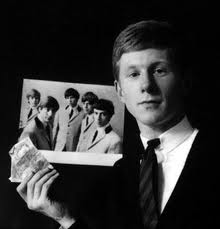
The Sixth Rolling Stone
I’m in the James Dean suite, better known as two shoe boxes at the back of the Hotel Iroquois on West 44th Street in Manhattan and life has definitely lost its color.
You try for a few things to forget that he who is not busy being born is busy dying, to block out the thought of yourself as a wingless, hurt, spineless bird of the 60s.
Another grey-line- they’re not even white anymore- another grappa or Southern-anything-without-Comfort can bring you back for a few minutes but it’s not a given. Occasionally you get up from the couch and have to check yourself out in the mirror above the fireplace to make sure you are still there, and that’s an effort.
One could say that when life becomes too painful, the body sickens and withers and the soul departs.
–Andrew Loog Oldham, Stoned, 1995
Andrew Loog Oldham was the promoter, the guiding light, who led the five lads comprising the Rolling Stones from a squalid existence to the top of revolutionary society. As he wrote the above quote from Vol. 1 of his excellent two volume autobiography, Stoned, he viewed his past from the perspective of drug induced oblivion. It hadn’t always been that way.
Andrew had been present at the creation of that part of the Revolution known as the British Invasion in the history of Rock and Roll. He had in fact been one of its principal guides.
But, as even the most obscure molecule has its origins in a more distant past a background of the macro cosmos leading to the micro-cosmos Andrew Oldham might provide some insights.
The actual starting point of what became Andrew Loog Oldham is, oh, say, 1789 and the French Revolution of which, of course the future molecule of Andrew had no part. Let us skip lightly over the intervening hundred years or so to the defining moment of our own existence, the years after 1900.
Of supreme importance is the career of that master demolition artist, Sigmund Freud, but we’re just going to be dealing with conclusions not origins or development. Nevertheless Freud began his assault on Western consciousness in 1900 with his Interpretation Of Dreams- the excavations of the unconscious and demolition of the conscious. We will bear this is mind because Freud’s vision of psychology is important.
The stately self-confidence of the Victorian Age was destroyed by the horrors of what at that time was known as The Great War, the term WWI evolving only after twenty-five years or so later. WWII gave that previous war its modern nomenclature.
Thus 1914 commenced a hundred years war in which WWII, the Korean War, The Viet Nam War and the Communist subversion of US institutions was done reaching a culmination under a world wide Communist government led by China with Barack Obama as its king, emperor or dictator.
The First World War destroyed the flower of Western manhood, compounded by the destruction of European manhoodof the succeeding WWII the loss was not reparable up to our time. While the ‘Pacifists’, the physically weak and mental imbeciles remained at home with the elderly and women the best and bravest were sent on an unproductive suicide mission. As the undrafted at least were the patriotic and nationalists that also left the international Communists at home to assume positions of real power- the directors of the war, that is, the beneficiaries of the slaughter.
After the War the Third International interfered in the internal affairs of the nations nourished by the West’s absurd notion of democracy setting up power points in Western capitols that resulted in Popular Front qua Communist governments in all Western States with the exception of the Axis powers who nevertheless adopted socialist administrations.
In the meantime the soldiers returned after the war in various stages of shell shock or mental discomfort of some kind to try to put their lives in order without any assistance from the State that put them in harm’s way in the charnel house. They were greeted on their return by enormous social disorganization caused by the Communists who for instance led the general strike of 1929 in Great Britain and in general caused a conflict between two different economic or essentially religious approaches.
The General Strike was followed by the world wide economic depression that lasted until the religious war of 1939-45 between Communism and Rationality. The former was led by the USSR and Stalin while the latter was led by Hitler, his Germany and the Axis. The result was a forgone conclusion as both the US and USSR were united against a pitifully weak German and Axis Powers.
In this second major incident of the Hundred Years War Britain was all but demolished. She was the big loser. As the incident ended in 1945 London was all put a pile of rubble. From the rubble came the second phase of the Rock and Roll generations.
Since the discussion is centered around the Rolling Stones , Bill Wyman the eldest of the group was born in 1935 thereby having definite memories of the bombing. Charlie Watts, Jagger, Richards and Jones came along in ‘42 and ‘43. The genius who promoted the group, Andrew Loog Oldham, was born in 1944 a couple years earlier than the baby boomers, remaining a part of the war babies.
London from the end of the incident to 1960 and even beyond retained evidence of the bombing. The devastation was nearly terminal.
Replacing English manhood on the front during the war years were millions of US soldiers, sailors and airmen. Thus the women were not necessarily without men. Most such relations did not lead to stable commitments resulting in many illegitimate children. Yet many American men wed their English girlfriends returning them to the US. In my boyhood I knew or knew of several English war brides, so there must have thousands or tens of thousands of them. This may to some extent have relieved the disparity between the abundance of women and the paucity of men, balancing society somewhat.
As it turned out the fulcrum of the Stones, Andrew Loog Oldham, was one of those unfortunate bastards. Even though his mother took his father’s name his status affected the development of his character.
Rationing of essentials continued until 1953 so that Wyman fully experienced the deprivation while the others endured some of it, Oldham the least. Let’s say that they all had less than cheery childhoods while those of us of the same age cohort in the US while having reduced comforts, which were scarcely noticeable to me if at all, knew little deprivation saving that there were few men around. Richards’ felt the rationing of candy rather intensely while I, in the US, could spend whatever little money I had on candy and you can bet I did. Loved candy and ice cream then and love them now.
II.
ALO Somewhere In Space And Time
We’ll begin then with Andrew Loog Oldham as he knew how to take some self-absorbed nearly amateur musicians with a group identity and market them not only to England but the US and ultimately, the world. The Stones were among the first global bands.
Coming from a world scarred by war and a son of an unwed mother who next formed a long standing relationship with a married man who did treat Andrew well the boy still developed a psychosis. Caught up in the glamour he tried to make his way from age seventeen. He was part of the first generation that had difficulties separating movies from real life. Andrew saw a lot of them taking them as education developing his persona from them. Two influential movies and characters around which he formed the core of his persona he mentions frequently. Expresso Bongo, a not bad rock and roll vehicle for Cliff Richards, contributed the character Johnny Jackson very convincingly played by Laurence Harvey. Jackson was essentially a street hustler who overplayed his hand as Andrew himself would do.
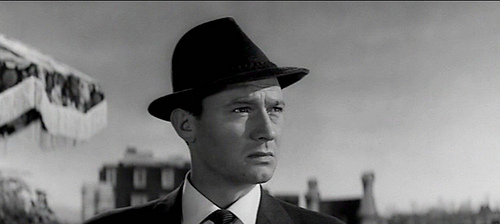
Laurence Harvey as Johnny Jackson
A second personality forming movie was the grim, even repulsive The Sweet Smell Of Success starring Burt Lancaster and Tony Curtis and based on the life of the reptile journalist Walter Winchell. Once again a couple characters who overplayed their hand ending in disaster.
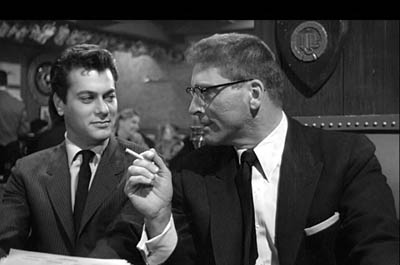
Tony Curtis, Burt Lancaster In Sweet Smell Of Success
Andrew took flings around the incipient glamour industries that would form Swinging England including Mary Quant and others before settling on the truly surface glamour of the recording industry.
He introduced himself to Brian Epstein becoming a publicist for the Beatles. There could have been no premonition of the phenomenal success of the Beatles leading to the British Invasion. The Beatles success itself remains a mystery to me. I can guess who engineered the situation but I can’t explain its success. Certainly when Andrew heard of the Rolling Stones in 1963 before the Beatles’ success in the US he could only have been thinking of conquering England.
At the time Andrew found them the Stones were building a reputation as a stage band, but small. Appearing in Rochester they performed before only thirty people, which swelled to sixty shortly, hardly enough to build an empire on, yet it worked. When he saw this very small situation he realized he had the chance of a lifetime; a seize it or lose it situation. Andrew was definitely a visionary of no mean farsightedness. His problem was that he was underage unable to legally act on his own. He was forced to include an old line manager to front for him named Eric Easton. Formed in a small time England Easton hadn’t the imagination to take the Stones global while Andrew did.
Andrew then had to bide his time until he was twenty-one and able to act in his own name. This was dangerous because artist management was and is basically dishonest and Easton was of the cloth, but we will get into that later when we discuss the concept of intellectual properties.
For the time being Andrew guided the Stones to Easton.
III.
The Rolling Stones

Brian Jones
As I say, the Stones, with the exception of Bill Wyman, were of the second generation of rockers being War Babies. They, then, experienced the bombed over London of the forties along with food rationing that lasted until 1953-54. According to Richards the lifting of the candy ration was the battle cry of freedom for British youth. One wonders why some astute entrepreneur didn’t smuggle in some M & Ms or Mars Bars from the US. Lord knows we never suffered from sugar deprivation.
Nevertheless the older age cohorts brought Dixieland music called Trad Jazz in England to the fore in the post war years
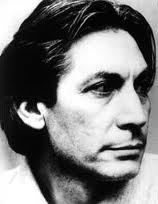
Charlie Watts
while the War Babies progressed to Negro R&B and straight Blues which the first rockers had already converted to rock and roll in the US mid-fifties. At the same time Jazz had a following so that the whole of British music after 1960 or so was derived from American Negro depression music. At the line goes: The Blues ain’t nothing’ but a good man feelin’ bad, that is to say, depressed.
So the trajectory was the first group of British musicians picked up on Dixieland or Trad which is pretty much the music of depressed people trying to convince themselves they are joyous, a sort of Singing In The Rain spirit, correlating with the spirit of the immediate post-war generation. Dixieland, originating in the old French colony of New Orleans then was Negro music that tried to lift depressed spirits. It was only natural, so to speak, that a totally depressed post-war English generation would find Trad so emotionally satisfying.
In the fifties, Rock and Roll music evolved in the US based on Country music, or White blues, and certain Negro Blues influences. However the White American experience with Negroes and Negro music had been integrated into White consciousness while Negritude was rejected. It should be remembered that the cowboy singer Gene Autry not infrequently sang blues based material.
The spirit of Blues is much different than the spirit of Dixieland. R&B livened the spirits of the War Babies while still
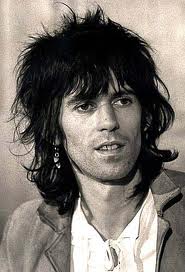
Keith Richards
being depressed but cheered and encouraged by increasing prosperity the moved up the evolution of US Negro music from Dixieland to R&B. Thus a crossing or melding of Aryan and Negro sentiments with a heavy reverence for African culture. ‘Drop down mama, and spread yo’ legs, I’s comin’ fo’ ya and I don’t begs…’ Wonderful Lenny Bruce style stuff, that.
The R&B strain began to emerge then about 1960. Jagger, Jones, Richards were all R&B crusaders from post-puberty. Wyman came from a pop R&R background while Watts came from a Jazz backdrop. Ian Stewart was a solid Boogie Woogie pianist. Although dropped from the line up he contributed significantly to the band musically.
Of the group, including Oldham, the only member with a political consciousness and agenda was Mick Jagger. The others were either yobbos or living close to the line. It would be Jagger who gave the political direction to the group. Mick obtained a scholarship to the Communist London School of Economics where he assumed a Communist stance that he carried over to his lyrics and posturing in the Stones. He tempered his enthusiasm after 1970 as he says for ‘pragmatic’ reasons. Richards while not appearing political aided and abetted Jagger’s approach because of resentment against the ‘system’, in other words, a rebel with cause enough.

Bill Wyman
Part IV
Going With The Flow
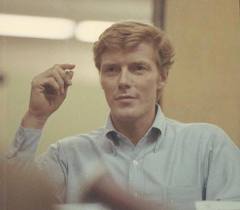
Bob Crewe
The music business was a fairly tight knit community fully under Jewish control. The financial engine that drove it was the body of intellectual property, songs, which was known as publishing. Publishing includes all royalties whether from sheet music, recording or media play. The money from media play, mainly radio and television is collected by ASCAP and BMI. Both publishing and media are firmly under Jewish control. Aryan artists then, like it or not, always work for Jews entirely, under contract they are essentially slaves with their earnings kept ‘in trust’ by their masters, doled out on an as need basis. The absurdity of these ‘legal’ contracts is shown by the clause in the Stones contract with Allen Klein in which he wasn’t required to even pay out recording advances for twenty years after receipt. How such a clause could be supported by the courts is beyond me. But, on that later.
Now, intellectual properties are the easiest property to steal. Quite frequently the artists don’t or didn’t even know what they were or how valuable they were. Jac Holzman of Elektra records just assigned the Doors rights to himself. Klein in some manner did the same with Jagger-Richards’ intellectual properties and he or his estate still owns them. And the law allows this.
Frequently a portion of the royalties are assigned to another entity with or without the knowledge of the writers. Then a situation arose as a result ot technology that was unforeseen and had immeasurable consequences.
Until the mid-fifties, that is from c. 1930 to 1954 radio had been a melange of programs with very few minutes a day devoted to music programming, especially of the popular sort which intellectuals have always despised. Then TV, introduced commercially after the war knocked the legs from under syndicated radio programs. For a moment it was believed that radio itself would go bankrupt. However, we teens of the era were clamoring for more popular music on the radio. It was believed that all music radio couldn’t succeed but this notion was speedily proven wrong.
We wanted to hear our records and wanted to hear the same songs and we wanted to hear them often. This led to the innovation of Top 40 radio that seldom was more than the Top Ten with new introductions. We demanded that smash hits like Lonnie Donnegan’s Rock Island Line be played once every quarter hour. This would go on for a week or two until a new hit came along. I once manipulated the dial to get seven consecutive plays of Rock Island Line before I lost my rhythm. Now, multiply 2 ½ cents a play by several tens of millions and you’ve got yourself some pocket change.
Of course a record had to be introduced or ‘broken’ as they said. The key break out markets were New York City and Los Angeles with Chicago a distant third. By the time you got those three markets behind a record every other station in the country fell in line. You had a hit. The process usually took about six months to penetrate all markets. So the top DJs in those three markets had to be serviced. You can imagine the competition for those DJ jobs. Produced some remarkable disc spinners. To listen to the radio back then was to participate in a non-stop party 24/7.
As a national break out center all at one time TV came along. Ed Sullivan could introduce the entire nation to such as Elvis Presley or the Beatles or Stones in one three minute segment. Bravo! Ed more or less led to American Bandstand fronted by the eternal teenager, now gone to his eternal rest, Dick Clark. Clark became the most powerful DJ in the history of the world. But…you had to get your record and artist on his show.
The men responsible for getting records played were called song pluggers. This was a time honored practice going back to before the electronic media to hard copy sheet music. No one had found fault with the practice of offering incentives to play records up to this point.
But now Dick Clark and American Bandstand. The incentive that would get you artist’s appearance and record played on

Dick Clark
Bandstand was a piece of the ‘action’ also called publishing. If Clark played your song, and it had to be a good one, presto! There were millions of plays on radio the very next day or sooner at 2 ½ cents a play and with luck a million sales of the 45. I think the moral is clear here. If Clark were allowed to go on collecting pieces of intellectual properties, or copyrights, within a decade or so he might be worth many times the value of Tin Pan Alley and the Brill Building put together. Now, here’s the rub…Dick Clark wasn’t Jewish.
The word from the Alley was stop Dick Clark. But how?
Well, Clark wasn’t doing anything that hadn’t been kosher from time immemorial so the only thing to do was to make the ancient practice of song plugging sound immoral; hence the name of song plugging was changed to the morally reprehensible sounding label- PAYOLA. Well, so what? So pressure was put on Congress, this became a Federal case, to investigate Dick Clark and to make it ecumenical, certain important DJs like Allen Freed, who was Jewish but not of the synagogue, and make payola if not a crime at least something that certain people were prohibited from doing.
Alan Freed, the poor fish, was totally destroyed, his life ending shortly after his condemnation. Clark, so as not to seem unfair, especially as no known crime had been violated was offered the choice of keeping Bandstand or the publishing of the songs he had already accumulated. Dick chose Bandstand although he later said that was a mistake. Tin Pan Alley was safe for a time as its power was returned to it. Once again they could control what was played and who could and could not succeed.
Now, enter Andrew Loog Oldham and The Rolling Stones.
Bob Dylan in one of his fits of delusions of grandeur claims that he was the man who brought the giant Tin Pan Alley to earth. There is no denying he made his contribution but Oldham gives greater credit to the Beatles which is probably true. By 1964 the time of the following story of Andrew’s the demise of the Alley hadn’t yet happened. This is a great story.
This story involves two people with whom the reader may or may not be familiar. One is a DJ, powerful in the business, and the other was a very powerful member of both the Gay and Jewish mafias, capable of making or breaking any aspirant to recording fame and a fixture of the Tin Pan Alley/Brill Building who most likely had a hand, if not the guiding hand, in stripping Dick Clark of his looming power over the Alley. Murray Kaufman- Murray the K- was the former and Bob Crewe was the latter.
Both of these gentlemen were Jewish, as indeed most similar positions in the music business are, hence wishing to continue Jewish control over artists and repertoire – A&R in the business.
Clark’s assault on Alley dominance was just the opening volley. The years ’60- ’64 were quiescent perhaps giving false assurance of victory to the Alley. The next assault on the Alley was to begin, or was already in its birth throes about 1964 when the Beatles who wrote their own songs and published them dominated the airwaves hurt the Alley worse than Dick Clark. Remember at the Beatles’ peak four or five of the Top Ten were Beatles songs. Assuming those songs were played twice an hour at three minutes each 8 x 3 equals 24 minutes of non-Alley credits allowing for ads that means the Alley was virtually shut out of AM radio thus earning severely reduced royalties.
An assault requires a counter assault so any vulnerabilities in the Beatles armor had to be sought out. Brian Epstein, the Beatles’ manager was Jewish, indeed the Beatles would be surrounded by Jews siphoning off their riches, but I don’t think Epstein was a member of the synagogue while being quite protective of what was his. So, Epstein was in the way. He conveniently committed suicide, as… who knows: At this point the entire
Beatles empire was up for grabs while the Beatles themselves had never been involved in the business aspects of their success and had no idea what to do. Who stepped in to turn their money green but two Jewish characters, Allen Klein and Leonard Epstein to divvy it up. Leonard Epstein went by the nom de guerre of Lee Eastman, Linda’s father. So, in the end the Jews got it back from the Beatles.
Another big factor in the demise of the Alley was the self-confessed assassin, Bob Dylan. Dylan claims full credit for the demise of the Alley but he exaggerates. His stuff which defies description as much as his hero’s, Little Richard, was certainly not acceptable to the Alley. His application being rejected, Bobby, one assumes, swore revenge. His major contribution was that his success encouraged the success of the singer-songwriters who were not of the Alley and a great many not of the Faith thus removing precious minutes of play time if not hours which obviated the need for roomsful of writers in the Alley putting them out of work. Carole King had to make her own records becoming a singer-songwriter.
By the time of Andrew’s story one imagines that the perceptive Bob Crewe was aware of the developing problem, at least from the incipient British Invasion. While I have always been familiar with the name of Bob Crewe it had little meaning to me. I thought he was just an arranger of orchestral versions of rock songs; in other words, cashing in. As Andrew explains he was a major songwriter of the fifties and sixties. Sixty to sixty-four are considered very fallow years in R&R and this period is when Crewe shown. Indeed, the music of the period so disgusted me that I refused to listen to Top 40 spending my time on the Country end of the dial. The period was the end of the Golden Age of Country. Well, what doesn’t die moves on.
It turns out that Crewe wrote all of that falsetto crap of Frankie Valli and the Four Seasons with all its homosexual double entendres: Walk Like A Man, (Talk Like A Girl), my son.
Murray the K was one of the most important DJs in an age when DJs walked with the gods. He originally fastened himself on the Beatles like a barnacle on the bottom side of a ship, calling himself the Fifth Beatle. As Andrew says in this story he is attempting the same hoping to become the Sixth Rolling Stone. Murray went around in fifths and sixths.
Andrew’s description of Crewe’s digs at the Dakota Apartments in front of which John Lennon would be shot sixteen years later:
We grabbed some hasty victuals from the hot dog stand on the corner of Fifth, then cabbed west across the park and back into our own Holly Golightly world to attend a Bob Crewe party in our honor. The yellow stretch cab wheeled out of the park at 72nd across Central park West and let us out at the austere and majestic granite entrance to the Dakota. Three short 60s-filled years later, the building would become famous for housing Roman Polansky’s Rosemary’s Baby. Sixteen years on, it would become the site of the killing of John Lennon. Keith and I asked for ‘Bob Crewe, please.’ The rest of the Stones were already there. Bob’s apartment was a film set, all ornate and Roman gay splendour over the park – marbled floors, bronzed Ma Bell’s, African motif zebra and leopard throw rugs, and enough brocade tassel and gilt to assure you that you weren’t visiting John Huston. The living room was sunk down to a waist-high setting with an aqua-Nero motif, complete with statues of nubile youth that gushed water. Bob Crewe was Doris Day, if Doris Day had been all man and stayed gorgeous. Leonard Bernstein chatted with actor/neighbor Robert Ryan who asked Mick if he knew Terence Stamp who he’d worked with two years before in Billy Budd. Mick didn’t or wouldn’t. Lenny B. and Ryan turned away from Jagger and resumed discussing elevator problems at the Dakota. Bob Crewe was above it all and flying.
So you see what royalties and a few intellectual properties are worth. You could kill for them, at the very least, steal them. You can see what became available of the Beatles when Epstein committed ‘suicide’ and the value of the Jagger-Richards properties that Klein, Easton and Oldham- all Jews- stole. As mere artists the Stones are actually inconsequential, they are the mere raw material, the gold mine, to be exploited by the prospectors of pop. Thus Crewe’s confederate Murray the K cornered the key figure in the Stone’s organization, Andrew Loog Oldham, p. 16:
Sometime during the evening, Murray the K pulled me aside and put a 45 single between my hand and his. Murray stood out in these svelte surroundings, grey-blue straw titfer atop his hair replacement and ghastly tangerine skin. He was wearing a Cadillac upholstery colored Teflon sweater with winkle pickers that set off fuchsia flared trews that wouldn’t even pass for wallpaper in Slough. Murray had no shame but was master of his game…pop kingmaker.
Murray The K
He backed me against the wall, both of us still holding the 45, his free hand gripping my beige suede jacketed elbow. ‘Andy, I love the guys. I think they are fabulous. I know the Beatles love ‘em too- George told me so. I don’t go out of my way for many people y’know, but I’m promoting the hell out of them- you’re gonna sell tickets. The Stones are special. I really like them.’
This rotund puck of pop caught his breath and allowed me time to acknowledge this outpouring. ‘Murray they like you too’ was all I could muster.
‘They do?’ He came back at me smiling vices. ‘Great. I could feel it, especially Brian, real straight guy, sweetheart, really genuine, Mick too. Listen Andy, I don’t often do this and I promise you, forget whatever you’ve heard- I don’t want anything for it, I just love this business we’re in and that’s the truth of it. Don’t want no freebies, no B-sides.’
He paused and grinned- this was pure pop oxymoronic air we were breathing. ‘All I want,’ he continued, ‘is to know that whenever the guys play New york- and you will, often, I promise- you have ol’ Murray the K behind you, man you’re gonna be big…’ (The wonderful thing about America I somehow found time to think, is that you have nothing to do with getting there. Other people do it for you and you are merely beholding, beholding- left holding the bag.) Murray meanwhile droned on, ‘Anyway, all I want is that Murray here is the only disc jockey who MC’s your New York shows and-’ Murray pushed me further against the African motif’d wall- ‘and you and the guys remember Murray when those cocksuckers put me down…and they will, just you remember.’
America was turning into beads of sweat trickling from questionable hairlines and Paul Simon was still Tom of Tom and Jerry. I felt the vinyl, now it was all mine. ‘Feel what’s in your hand, Andy. It’s yours; it’s for you and the boys. Just take it and record it. I guarantee it. Murray guarantees it babe. I just gave you your very first American hit.’ He had, and God Bless America, land of a thousand dances. I’d just gone to the perfect party and got laid by the perfect partner, Murray the K. Bob Crewe beamed knowingly from the other side of the room and raised his glass in a welcome-to-the-good-ship-lollipop salute while musical guest Tiny Tim entertained guests with that and other ditties from another room.

The 45 was It’s All Over Now. It went to 30 US, the lower reaches of success. Not much of a pottage to sell your birthright for but you should catch the threat. So, what’s going on here? Remember you’re in a Jewish milieu on Jewish turf.
You’re standing in a magnificent Dakota apartment of 3 or 4,000 square feet. The apartment is expensively and magnificently appointed in an occult mysterioso manner in what may have been the center of New York Saturnian Satanism, more on that in its place. Crewe is in the bucks and he got there in 2 ½ cent bits. The power of intellectual properties x tens or hundreds of millions.
Over in a smaller room of the apartment Crewe is supporting the once successful British songwriter, Lionel Bart, also Jewish who has apparently fallen on hard times, perhaps wiped clean by Crewe as Andrew will be by Allen Klein.
The impression of great power is clear. As Crewe watches from the other side of the room Murray the K acting as his agent or, perhaps, stooge, has pinned Andrew to the wall at the same time wrapping their hands around a mysterious object.
Murray the K then lays out the terms on which he as the most powerful DJ in the most powerful break out market in the US, save Dick Clark, will allow the Rolling Stones to market themselves in NYC and hence the United States. All Murray’s negotiations were positive from his side although expressed in negatives. These are the items Murray wants in exchange for the Stones’ soul. Remember this apartment might actually be the apartment replicated in Rosemary’s Baby in which Satan was cradled. The movie was released after this incident but Andrew has already mentioned it so that this incident to him seemed like a scene in Rosemary’s Baby. He is conflating the two.
Murray says: The Stones are special. I really like them. In other words you’ve got our attention and we can see our way to make a bundle off you.
Murray says: He doesn’t want any freebies, no B sides. In other words that is exactly what he is asking for. The A side of a 45 is the hit side; the B side whose royalties are the same as the A side can by a throw away. Indeed, Andrew would make crowd noise a side just for the royalties. At this point the Stones are merely a cover band- they re-record other people’s records hence the B side Murray wants for his own publishing account is worth potentially tens of thousands of dollars. Hence, as we can plainly see Congress effectively put an end to ‘payola.’
Then Murray threatens that if they don’t they will never play NYC again and if they do they won’t get any help from his hand.
In addition Murray does demand the prestige of MCing the Stones shows. So essentially at this point he’s got the farm. He would become the Sixth Stone.
Then as Crewe beams approvingly from across the room Murray tells Andrew that the thing they’re holding onto is the next song the Stones are going to record (was that a command?) – publishing obviously going to Crewe while Murray guarantees that he will play it on his show.
Murray looks to Crewe and Crewe blesses the transaction by raising his glass. Of course this was written well after Andrew had seen Rosemary’s Baby so maybe he just portrayed the scene in that context with Crewe as Satan.
Andrew had no trouble catching the drift. He buckled or perhaps wisely acceded. The 45 was It’s All Over Now and it was the Stones next release and not much of a hit, reaching only thirty but indicating Andrew has caught the ball and would play the game. Andrew had his own counter attack however.
Andrew perhaps compared the Beatles as songwriters to the Stones as a copy band and got that point. On returning home he demanded that Mick and Keith begin writing their own songs. That would more or less place them beyond the reach of Crewe and his ilk. But then whose smiling face showed up in England? Allen Klein and there went the publishing until the next Stones counter attack.
If Andrew had just stayed off all those drugs.
The Stones loved the attitude and energy of New York; we’d walk it and we’d talk it. Andrew loved New York, too. It was a movie come true for him- the Brill Building and 1650 Broadway, running around from office to office listening to that Jewish rock ‘n’ roll coming out of New York. It all had that sweet sound. The Carole King sound, the music of Bob Crewe. It wasn’t ‘I see a red door and I want to paint it black.’ It was more up; it was pop.
Roberta Goldstein, p.1, 2Stoned
You don’t really have to read between the lines to get that point but there is a lot between the lines too.
Next: Jagger, Bailey and the Yobbo Revolution
R.E. Prindle 101: Basic Facts, Or Close To It
July 1, 2012
Re: Text
No responsibilty is accepted for the accuracy of any of the below. As Ripley said: Believe it or not.
- FROM:
- TO:

R.E. Prindle
—– Original Message —–From:Ronald E. PrindleSent: Sunday, July 01, 2012 6:03 PMSubject: Re: TextRight clicking won’t allow me to save the page and while I can get the header and footer and the index the text doesn’t show. Try the email if you can.
Reply to Bill and Sue-On Hillman
Who Is Mick Jagger?
June 16, 2012
Who Is Mick Jagger?
by
R.E. Prindle

Mick
In one’s reading one often comes across the odd fact that makes one pause. Such a fact was when I read that Mick Jagger was in New York City in 1963 where he became the fast friend of Andy Warhol. This was a friendship that was to last for Andy’s lifetime. How odd, I thought, what can that mean? A year or two later now, I think I’ve begun to make sense of it after rereading A. E. Hotchkins Blown Away: The Rolling Stones And The Death Of The Sixties.
I’ve always found the Stones repellant so while I’ve read the odd volume It’s always been with a certain amount of disdain; I don’t pay any real attention then toss the book aside. But Mick keeps popping up in the odd places, mostly in conjunction with Andy. Consider that Bianca was a member of his entourage.
So, reading Hotchkins: Nineteen sixty-three was the coldest winter in England in perhaps four hundred years. That found Mick and Brian and Keith freezing because they couldn’t afford to buy heat and starving to death because they had no money for food. Yet, later in the year Mick has flown a big 707 to New York while being able to afford the time he spent there. How could that be? Why was it important for Mick to be in New York at twenty years of age never having held a job and in 1963 with no real rock and roll prospects. Certainly not a hope of becoming what they did. One couldn’t be a bigger nobody and yet he and Andy became buds.
As we are constantly reminded Mick attended the London School of Economics- the LSE. So, while Brian and Keith sat facing each other over the dead heater playing their fingers off, developing that two guitar style that so distinguished them Mick was off warm and toasty at the LSE. Probably a little better nourished too. Mick always takes care of himself.
The London School of Economics. While I have never seen Mick’s curriculum or how many units he earned, from the name of the school it has always been assumed that Mick was taking business classes and accounting. But is the LSE a business school? No. It isn’t. It’s a socialist or Communist university that is more interested in political and social issues than accounting, although that discipline is offered.
The London School Of Economics was founded by Beatrice and Sidney Webb. At the end of the nineteenth century and the beginning of the twentieth they were the leaders of the Fabian Socialist Society. That society whose most famous members were George Bernard Shaw and H.G. Wells. One might expect the LSE to be utopian in outlook and surprise! it is.
The school is a relatively select small one accepting only 1200 new entrants a year out 20,000 applicants. From all over the world, actually. So one must obviously meet certain rigorous requirements. I suspect grades are a very small part of this. One’s political and social views are much more important. In other words, if you’re of the British Nationalist Party it wouldn’t make any difference if you were a second Einstein, you won’t be accepted. So we can safely assume that Mick was thoroughly vetted and thought to be safely socialist to be admitted.
Mick attended classes through 1963 leaving only when the success of the Stones was assured. As his subsequent career furthered the LSE agenda it would seem that the LSE or someone associated with it linked him up with Andy in New York. In 1963 Andy had gained a degree of notoriety with his Soup Cans but was not yet the social force that he

Keith
would become. However, it is fairly clear to me that he was active, had been active through the fifties, if not yet a force, in the Homosexual and Underman Revolutions. He and Mick together would be very active and influential in the Sexual, Homosexual and Underman Revolutions. There may then have been the purpose in linking Mick and Andy up. Remember, these two were tight until Andy’s death. Mick was the sole celebrity to attend Andy’s funeral and he had to fly to Pittsburgh to do it.
Specifically who financed this meeting in 1963 isn’t clear but the faith placed in both men was astounding.
Mick carried through for whoever placed this faith in him. His stage persona promoted homosexuality specifically and sexual liberation in general moving those Revolutions forward.
The Stones were also leaders in the Underman Revolution. As events led up to the social Revolution of 1968 the Stones were in the forefront recognized as revolutionary leaders in both the US and Europe. Of course when the dominoes began to fall- Hendrix, Morrison, and Janice Joplin et al. Mick beat a hasty retreat and turned from a Street Fighting Man into ‘just a singer in a rock and roll band.’ His stage persona turned even more femmy than ever. No threat here, Mick telegraphed.
Mick then lived out the socialist revolutionary agenda openly through the sixties accepting emasculation rather than death when the ‘establishment’ became aroused.
Who is Mick Jagger? and where did he come from? and for what purpose? As his career lines up perfectly with the agenda of the LSE what compact with that particular devil did he make?
Of course the Stones were talented but doors could have been closed, half-open or wide open. They were wide open so the Stones had somebody’s approval. In the music business that would would be somebody from the Left/Socialist/Communist influence.
7/10/12 Update

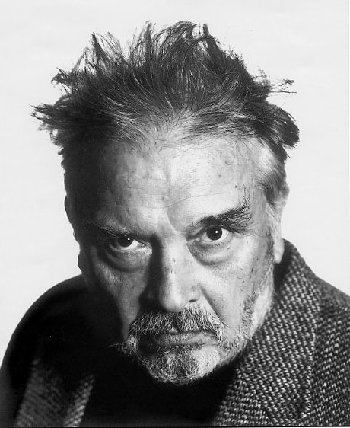
Young David Bailey
Jagger’s 1963 or ’64 trip to New York was in company with the photog of 60s Swinging London David Bailey the model for Antonioni’s movie Blow Up. He presumably paid Mick’s way. He and Mick considered themselves Mates. Bailey was running with model Jean Shrimpton while Mick had picked up on her sister Chrissie. Chrissie introduced Jean to Mick who then advised David that Mick was going to be bigger than the Beatles. The two men hit it off, David describing Mick as his mate.

After 40 Miles Of Bad Road
Bailey apparently had a close or fairly close relationship with Andy Warhol thus in 1963 he flew Mick to New York introducing Mick into Andy’s circle. Mick and Andy remained close friends throughout Andy’s lifetime. Bailey was hugely influenced by Andy’s art while both as portrait artists may have been in synch or influenced each other.
Bailey as in these pictures seems to have been a wild man probably open to any thing in the sexual way. Looks to have been a hard traveling man. He was born in the 1938 the same year as myself.
After The Crash And Reconstruction
Update 7/12/12
On p. 548 of Stephen Davis’ biography of the Stones- Old Gods Almost Dead- I got the piece of evidence I most coveted in unequivocal terms.
On the Moscow date of the 1998 European tour Mick announced to his audience: ‘I was a Communist in college.’ That is at the London School Of Economics.
But then money being the magic solvent of politics, that it is, with a hundred million in the bank ‘…things tend to fall away, and you become more pragmatic.’ Perhaps in defense of those millions Mick would scream into the microphone some time later: God gave me what I have. A startling defense coming from an avowed atheist, but then money can paint a color from black to white.
There you have it from the horse’s mouth. The runways are now cleared; it’s time for lift off. I don’t have to defend my studies; I can tell it like it is: How the Stones corrupted the youth of the world in the name of Communism.

Edgar Rice Burroughs
And
The Accreted Personality
Part VI
by
R.E. Prindle

Edgar Rice Burroughs
On The Road To Success: 1911-1920
The Porges wrote the most comprehensive biography of Ed: Edgar Rice Burroughs: The Man Who Created Tarzan. They were allowed to use the archives and to this date they are the only researchers who have. Although give the freedom of the archives they were apparently denied the freedom to write as they chose. There were others who were selected to write the biography but as they found information that it was considered inappropriate to disclose they were dismissed. The Porges were willing to write hagiography.

Bill And Sue On Hillman
As Ed’s work reflects his life both before and as the books were written one can compare Porges’ biography with the novels to get some idea about the banned material. Some portions of this piece then will be guesswork from the biography and the novels. Bill Hillman at ERBzine has also unearthed details not in Porges on his ERBzine site. ERBzine is one of the great internet sites not only as concerns Burroughs but as a site. It is worthwhile to check out Bill’s work if you’re not familiar with it.
By 1911 then Ed’s psychology, his memories that he would use in writing his novels was in place. He already had a multi-faceted personality and he would add facets to that personality. He was quite extraordinary in being able to incorporate, seemingly, the whole of his memory banks. The question is were his references more obvious to his readers at the time than they are today. For instance the Dreyfus Affair in France of the 1890s gets a fairly comprehensive treatment in The Return Of Tarzan although today it would go unnoticed unless one were historically aware and then recognized what he was talking about.
The same goes with the Sky Pilot/Big Bill Haywood episode of The Oakdale Affair. Of course Sky Pilot/ Haywood merger

Big Bill Haywood
into John the Bully. (See my https://idynamo.wordpress.com/2012/03/30/pt-i-only-the-strong-survive/ , http://www.erbzine.com/mag14/1483a.html ) With the proper historical background what he’s talking about becomes clear if you read between the lines.
The novels of 1912-1914 directly refer to events and reading, questions and cultural problems, surrounding his pre-1900 reading and his reading of current writers after 1900. So far I have able to trace the contents of the novels back to that reading and those cultural questions. Other references I have picked up from other writers but may not have read the volumes themselves. I’m working at it.
In 1910 Ed was thirty-five years old. He had had a life of, shall we say, limited success so that he was becoming anxious about his possibilities for the future. As he approached the mid-life crisis that every man faces at forty the fear of failing self-realization gripped his soul. His was now a do or die situation. His only chance of success that he could see was to succeed as a writer and that was a million to one chance. Ed was an inveterate gambler.
By the time Ed began to write he was dealing with the problems of a world gone by. Since his youth from 1875 to 1900 and young manhood of 1900-1912 worlds had slipped away beneath his feet. There was a great difference between the world of his psychological and intellectual understanding of the world that had just passed away and the emerging world that would affect his future reputation.
Immigration had brought millions of Jews from Eastern Europe and millions of Italians from Southern Europe while the Negro revolt against Jim Crow would quickly gain momentum with the great Negro emigration North during the Great

Marcus Garvey
War the resistance to White rule was beginning organization by the Negro chief, Marcus Garvey.
Ed’s activities in those matters were rooted in a pre-1900 milieu. While he himself was no bigot in any way, the mere accurate reporting of existing attitudes would be interpreted after 1950 as endorsement of them. Thus in merely participating in the attitude of his day Ed has been interpreted as a bigot by the various members of the Liberal Coalition. They have caused his books to be excised of any term or passage they deem offensive to their sensibilities. In doing so, of course, they have destroyed any evidence while there is nothing today in his published book that could offend the most Liberal. Hence, it never happened and Liberals can’t prove it did.
In addition as an avowed anti-Communist his successors have to fight the obliteration of his reputation from that quarter. The main threat is the TV and movie reformulation of Tarzan and John Carter into a Communist mold.
While Ed’s problems with accusations of anti-Semitism wouldn’t surface until 1919 after the success of the Bolshevik Revolution, the groundwork was being laid as the second decade opened. But a survey of that situation can wait to Book II and the years from 1920 to his death.
It may be sufficient for the present to note that the texts have been bowlderized to meet the prejudices of the current age. Thus any references that Jews and Negroes might find ‘offensive’ have been excised from the texts with the full compliance of ERB, Inc. since the sixties.
In the year or so before the acceptance of the Princess Of Mars Ed appears to have accepted the inevitable taking a job with Systems Magazine where he dispensed advice to readers on how to be a successful businessman. Interesting occupation for a guy who failed at selling pencil sharpeners.
During this period Ed pleads extreme poverty even to the extent of pawning Emma’s jewelry. I think the claim can be significantly discounted. As Ed had thrown over a promising career at Sears then such poverty if it existed was self chosen. In the second, his income at Systems, which seems to have been a profitable firm, must have been somewhere in the neighborhood of $3000 a year, well above the destitution level. And then he had no sooner sold Tarzan Of The Apes to Munsey’s than he quit Systems to assume a fulltime career as a writer.
One admires his boldness but one is appalled at the huge risk he took. As Emma, his friends and relations were shocked at the leap of faith Ed must have been thought of as foolish. Now, not only did he quit his day job but he immediately made plans to take a nine month long vacation to San Diego. This is without any money in the bank and no source of income other than the hope that whatever he wrote would sell. His only source of income being from the relatively low paying pulps as compared to the slicks such as the Saturday Evening Post.
I doubt that there was anyone who didn’t think he was out of his mind. If I’d been there I would have had to agree. The act was at the very least premature. Ed didn’t do anything on the cheap so he bought first class rail tickets including the freight for his second hand car and, I repeat, this is with only current cash in hand. Any expenses in San Diego would have to be met by receipts from the sale of his stories. This blows my mind whenever I think about it.
As it turned out he got along by the skin of his teeth leaving San Diego with about as much pocket money as he had when he arrived nine months earlier. Now, this goes further: his income for 1913 was ten thousand dollars- a handsome income for the time- which he blew as fast as it came in. One can only imagine the strain this placed on his marriage. While Ed Undoubtedly thought the money would come rolling in forever, in which as it turned out he wasn’t wrong, Emma must have been distracted to the point of her endurance.
Why would Ed do this? He obviously had a compelling psychological need: His desire to reclaim the lost kingdom of his youth, the repressed life since then, found release in the merest glimmer of success. He expressed his self-realization in the most extreme acts of the nouveau riche.
Once back in Chicago in the Spring of 1914 with the first efflorescence of repressed self-expression over Ed now had to settle down into continued production.
A Writer’s Life
He still had no other outlet for his stories than Munsey’s and other pulp magazines. While Tarzan had had a blockbuster effect within the small and despised universe of pulp readers, that smash was a mere ripple in the rest of the literary world. Besides in realistic terms Ed’s stories were obviously derivative as well as preposterous.
As he himself later acknowledged his career was really jump started when the New York Evening World began the serialization of Tarzan Of The Apes in newspapers. From the World the story was picked up by several other newspapers so that he earned another thousand dollars from that source while having the fame of the Tarzan story broadcast to a much larger audience than the pulps.
However, it was essential that Ed find a book publisher. His writing was so outre that there was no publisher that would touch him regardless of the obvious popularity of Tarzan. He was turned down by all the major houses. Ed was a literary pioneer. To be a success in the pulps at that time was not a respectable achievement. It would take another ten to fifteen years for publishers to recognize the market and that only after the phenomenal success of Bernarr Macfadden’s True Romance pulps that began after the War. Ed had the proverbial million dollar idea with no way to get it to realization.
Ed was forced to attempt to get local publisher McClurg’s to publish his wildly successful novel in pulps and newspapers. McClurg’s who after all had published Zane Grey’s The Short Stop who now in 1914 after The Riders Of The Purple Sage was wildly successful, would soon go on to publish some astoundingly stupid titles, stoutly rejected Tarzan Of The Apes.
It was only when Ed was making arrangements with a Cincinnati publisher that McClurg’s had a sudden change of mind. Thus a very small press run was published in 1914.
This is where the elation of success ended and the drudgery of management began. I haven’t seen the contract but I’m sure it’s interesting. Apparently Ed gave the publishing rights to McClurg’s for everything for fifteen years. Now, the prevailing opinion was that Ed was writing indescribable trash that for some miraculous reason sold. Even then Tarzan Of The Apes was received by the reprint house, A.L. Burt, with some trepidation. They required McClurg’s to guarantee the run by agreeing to buy all unsold copies. McClurg’s must have forced the book on them.
Contrary to reports of millions of copies having been sold when AL Burt turned the volume over to Grosset and Dunlap they reported somewhat less than seven hundred thousand copies sold. Of course Burt may have fudged selling perhaps twice as many but reporting the lesser figure but we can’t know.
As the Burt figures covered the first rush and G&D discontinued publication of Tarzan Of The Apes within a few years it is perhaps doubtful that the first of the series even sold a million copies. McClurg’s themselves contracted to print only 15,000 copies of the first edition of which there is doubt that they printed even that many copies.
So, by 1915 Ed had a pretty good backlog of titles available for publication of which McClurg’s published only one Tarzan title a year although later that decade they began to release the Mars books.
During all the decade Ed was hot in the pulp market. His work was eagerly received by the pulp readership. At the same time it wasn’t unusual for the popular writers at this time to issue two, three or even four books a year. Why then as there was a proven market for Burroughs’ name McClurg’s policy was not to market a hot author aggressively requires some explanation. Unfortunately that isn’t likely to be forthcoming. All the principals are dead while the successor company to McClurg’s advised me that all those files were lost while seeming reluctant to even discuss the issue.
Even though sales were good McClurg’s refused to print much more than ten or fifteen thousand copies of new titles, turning the volumes immediately over to the reprint publisher who put a fifty cent price on the books refusing Ed’s pleas to sell them for at least a dollar. This they steadfastly refused to do until 1948. The appearance is that they even refused to satisfy the market finally allowing their titles to go out of print for a couple years after WWII. When Ed published the titles under his control in 1948 at a dollar apiece G&D followed suit with theirs finally getting the price above fifty cents. There’s a story there that needs to be investigated.
Late in second decade of the century Ed was pleading with McClurg’s to print at least forty thousand copies of the first edition which they stoutly refused to do. This was important to Ed who received ten percent of the $1.30 retail price on the first edition and only 2 ½ cents on the reprint edition.
There was an ongoing struggle with McClurg’s for the length of the contract. At the same time the movie industry was developing by leaps and bounds. Merely a collection of one reelers at the beginning of the decade what were called seven and eight reel photo plays that actually told a story were being made. Hollywood was about to become the movie making capitol of the country but there were still companies in New York and Chicago. Ed hooked up with a Chicago company where he learned the woes of the fast and loose manner of the flickers. Boy, you really had to read those contracts and even that didn’t help. When I was in the record business in the seventies a major firm told me that a verbal contract was worthless and even if I had a written contract it wouldn’t be honored. If I wanted to sue it would take me decades and big money and then I still wouldn’t win and if I did win they still wouldn’t pay. Of course, by the seventies they had really developed their system.
Ed had an early success when The Oakdale Affair was filmed and a blockbuster when Tarzan Of The Apes was released. Collecting your money from the producers then and now was and is no easy task. I have other stories but this isn’t the place. But, the movies were essentially out of Ed’s hands so they don’t particularly pertain to Ed’s writing.
However, having devoted his time more or less fully to his writing through mid-1914 Ed began to squander his attention into less productive areas than his writing. I think this was a major mistake.
After the first gush was over in 1914 Ed had to search for his stories a little more. Rather than blasting them out one after the other in writings of thirty to sixty days Ed settled down to two or three a year.
When Ed incorporated himself in 1923 many think this was an innovation but in fact writing factories existed that issued titles under the same name although written by various writers, hence all those series like The Motor Boys and Tom Swift. Some writers were so prolific they wrote several stories a year using many different names. Baum himself published under both male and female pseudonyms.
Rather than settling down and attending to his writing Ed began to try to write movie scenarios that weren’t successful thus being a total waste of time. Perhaps antsy about getting his money Ed was a querulous presence on the movie lots making such a nuisance of himself that he was ultimately banned.
This was the beginning of a heady time for writers who could collect from several media: magazines, newspapers, books movies and even radio. As O. Henry explained it to Ed’s editor, Bob Davis:
Under the influence O. Henry turned to philosophizing until finally his thoughts led him to the salability of the printed word.
“For example, here is a notebook,” he said, taking the sheaf from his coat pocket. “It contains a dozen sheets of blank, white paper. With a lead pencil on these several sheets I write a tale three or four thousand words in length. You buy the story and print it in one of the magazines you edit. If it is a good story it gets into a book, or perhaps is dramatized and put on the stage. Very well; that’s a beginning that has to do with its earning power. I begin to get royalties on the volume, the serial rights, the drama and maybe some day a motion picture. It goes on and on reaping profit and yet it is never anything put the figment of my imagination converted into words. Is that clear.”
The term intellectual property began to have real cash value. Even the writing style began to conform to a scenario format. If one were fortunate to create a stellar character like Tarzan your fortune was made. While Ed’s personality prevented the success he should have enjoyed others profited greatly. With the advent of sound movies the Charlie Chan series released three and four movies a year for a decade or more. The series made the phrase ‘Number One Son’ a household term but Ed languished at the rate of a movie every two or three years. But, more on that later.
If ever someone’s past rose up to nip them from behind it was Ed’s. In psychological terms Ed was severely emasculated while being hysterical in nature. Just as memory constellates around its fixations so a type of writer constellates readers of the same type as himself. It may not be pleasant to realize it but if you are a Burroughs reader you are hysterical and emasculated to some degree.
Thus in writing his stories Ed constellated around his fixations. Having created his original characters, Tarzan, John Carter, and associated them with his mental fixations Ed then ransacked the literature he had read for incident and plot lines. This was partly done because Ed really admired the books he ‘quoted’ and wanted to write stories like them. If one is familiar with his reading then one can easily find the framework for his novels.
After 1912 when Ed quit his job to rely on his writing for an income he was confronted by new realities and temptations. One key reality was that he had a wife he didn’t want. Quite possibly he had never wanted Emma as a wife merely marrying her to spite Frank Martin. When he told this to his long time friend Bert Weston, Weston scoffed but I believe it is true.
Ed said that he walked out on Emma three times. While those times are not glaringly obvious one may have been somewhere between 1908-10 when he is reported calling her on the phone from East Bend, Indiana and a second may have been in 1918 before leaving Chicago. Certainly Ed’s success created great turmoil in his mind.
Having been put down most of his life while knowing he had a great talent, the realization of that talent caused a great sense of elation and self-confidence. However, because of his emasculation he still retained, at least for the time, a semi-dependent personality. He was easily influenced. Thus, after the publication of A Princess Of Mars when I believe he had the Carter Trilogy blocked out in his mind, while having formed the Tarzan conception in his head, he allowed his editor, Metcalf, to persuade him to write a medieval Men In Iron type story that was popular at the time in stories such as those of Howard Pyle.
Ed complied writing The Outlaw Of Torn that might have been well received by the readership but would also have presented Ed as a conventional writer rather continuing the sensationalist departure of Princess. In any event Metcalf rejected the story and rather than spend god knows how long tampering with the story for Metcalf’s satisfaction Ed wisely chose to shelve it and move on to Tarzan Of The Apes confirming his innovative status.
Metcalf accepted the story while running the entire novel in one issue. But remember you’re only talking about a potential hundred thousand readers in a despised literature. While Ed’s success was immediate it was like summer lightening, all flash and no thunder. Still he was a flash in the pulp sky that caught the attention of other publishers.
Ed followed Tarzan Of The Apes with The Return Of Tarzan that Metcalf also rejected. Enraged Ed shopped the story around to other pulps where it was accepted. In the pulp world Ed was already a commodity so Metcalf, who let the story and possibly the author, get away was axed as Ed’s editor and replaced by the irascible Bob Davis who remained his editor until 1920 when Davis departed for what he hoped were greener pastures.
Thus as 1914 closed Ed had a guaranteed income from Munsey’s , a more or less guaranteed income from book publishing and a soon to be realized erratic but potentially long term movie income. As the decade closed he earned peak income of a hundred thousand dollars, equivalent to several million today while with the addition of post-war global royalties life for that brief moment might have been viewed with quiet satisfaction. He had seemingly regained his princely status as prognosticated by his three favorite books. In addition John Carter was Warlord Of Mars and Tarzan was King of the Jungle. One big thorn on the rose bush appeared in far off Russia where the communistic Bolshevik Revolution had succeeded. But, that’s for later.
Back in 1912 when Ed’s old problems disappeared new ones arose to replace them. Ever since 1899 Ed had had problems with those excruciating headaches which still plagued him. Back in 1893 at the Columbian Expo Ed had seen the proto-body builder, The Great Sandow. Sandow was a legend in his own time and for some thereafter, at least into my childhood. Even today the top prize in body building is called the Sandow.
If Tarzan had a beginning the seed was surely planted in Ed’s mind by Sandow. Ed was awed by Sandow but objected to the bunchy muscles preferring those, as he put it, that flowed like molten metal beneath the skin. Ed mentions one of Sandow’s feats in Tarzan Of The Apes and in Tarzan And The City Of Gold a few years after Sandow’s death models a character on him. (see my review https://idynamo.wordpress.com/2008/08/16/a-review-tarzan-and-the-city-of-gold-pt-1/ . In that story Tarzan defeats the Sandow clone thereby settling the issue of which muscles were best.
Also a nonentity in the Exposition audience was Bernie McFadden. Bernie was not long to remain a non-entity. He was soon to become the Father of American Body Building under the name of Bernarr Macfadden. Within six years he had founded Physical Culture magazine and become active in the American pursuit of the perfect food of the gods.
He originally set up in the center of the health food fadists, Battle Creek, Michigan, home of that perfect food Kellogg’s Corn Flakes. Along about 1908 Bernarr recognized the limited commercial possibilities of Battle Creek, removing to Chicago. Here he began a highly successful chain of health food restaurants while developing his concept of the Juice Bar. You cold go in and get a nice big glass of carrot juice for instance. The discovery of vitamins in the 1920s was a ways in the future so while Bernarr didn’t know he was providing essential vitamins such as A and C he knew the juice did something for you. Of course he was thought of as nut cake and was lucky to escape the asylum,
It hadn’t been too many years earlier that that fate had overtaken the discoverer of antisepsis Ignaz Semelweiss. That poor guy after discovering that a simple washing of the hands could save the lives of several thousands of women lost in childbirth, and demonstrated it, was rejected by the medical community who refused to believe the facts before their eyes. Poor old Ignaz campaigned so violently for those lives that he was thrown in the loony bin where he died. When Lister discovered germs giving the doctors a handle for belief Ignaz was of course exonerated but…dead.
A lot of water goes under the bridge in a few decades so that what would get you killed in ancient Athens, committed in nineteenth century Germany was dismissed as mere eccentricity in 1900 as Bernarr went on to a fortune. That’s what’s called social progress.
So Bernie, pardon me, Bernarr like or not was a benefactor of the people. If you followed his program of exercises and diet he would make you big and tough. What he did for Charles Atlas he could do for you and me. If we had the determination. I never did.

Bernarr Macfadden
Now, Ed had been everywhere trying to find a cure for those headaches. There are indications that he found his way to Bernarr’s door. Whether or not Bernarr’s remedies were helpful by the mid-teens Ed’s headaches lessened or disappeared over the decade while if this picture isn’t a body building pose I don’t know what it.
Macfadden didn’t limit his activities to physical culture; he was a real game changer. From Physical Culture Magazine he moved into pulps creating the Romance genre. Among his many pulps were True Detective, True Story, True Romances, and moving into the paranormal, Dream World and Ghost Stories. Dealing with the more mundane he founded the great movie magazine, Photo Play, that had a very long run.
Bernarr entered the newspaper field with the sensationalist New York Graphic. It featured the despised journalistic innovation, the Composograph, in which actors enacted crime scenes and whatever. Macfadden was a sensation for over thirty years. Of course like Dr. Semmelweiss, his innovations far exceeded the imaginations of his peers and while escaping the gallows or the asylum his competitors worked very hard to destroy his success in which they ultimately succeeded. Fabulous story though.
Thus while probably not having the influence on the creation of Tarzan that the Great Sandow had, I’m sure that Physical Culture Magazine and the Juice Bars figured in there somewhere. That magic food has yet to be discovered though. Henry Ford thought maybe soybeans…
Along with his improving health in the decade Ed’s financial status, of course, bloomed like the fabled Century plant, it only blooms once in a hundred years but with spectacular result. Unfortunately as Bob Dylan, who should know, says: There’s no success like failure and failure is no success at all. Everyone wants success but success is frequently the greatest challenge of all.
After imagining himself a slighted genius for thirty-five years Ed had his wildest fantasies realized in his fabulous year of 1913. He had pulled the Big Carrot up by the root. One imagines he was delirious with the sense of achievement and power.
If anything he would have been able to show his father that he was a good man, that he had amounted to something. Unfortunately for his ego his father died in March of 1913 before he had plucked the big fruit from the tree. He had sold Princess and Tarzan but an unforgiving father might easily have considered those flukes while being dismayed that Ed would give up his day job in the wild hope of continued literary success.
Ed himself had no misgivings. Having pawned Emma’s jewelry a couple years earlier to buy coal he was in a position to turn those chunks of coal into diamonds as big as the Ritz. He believed he had money to do all those things he’d always wanted to do and he went out and did them even before he had the check in the bank. God almighty, he even bought himself a set of Gibbon’s Decline and Fall Of The Roman Empire and read it as one of his first acts. How long had he been yearning for that wonderful history, I wonder.
Naturally an auto was top priority. Ed was in such a rush for that that he bought a used car, a Vellie, possibly from the proceeds of Tarzan. After he sold that car in 1913 in San Diego he bought a new car every year of the decade. Despising the poor man’s wheels, the Ford, he bought more expensive marques until he ended up with the royal Packard from the twenties till his death.
Ed just bought and bought and bought. Old memories rose up and bit him.
The memory of the trip to NYC in Frank Martin’s private railroad car left the old indelible impression on him quite apart from Toronto. It was the only way to travel, he said. Thus at the first glimmer of future, not present, earnings Ed packed up wife and kids, dog and used Vellie and left for California a couple months after his father died. They traveled first class, that is, Pullman. It would have been possible to book a whole car for himself. It would be interesting to know if he did which then would have been a simulation of a private car thus rectifying that memory. As the private car was related to Emma the question would be was Ed showing Emma he could do anything that Martin could do? The trip would also probably refer back to the guilt fixation Ed incurred when he gambled away their last forty dollars in Idaho. While the couple was essentially traveling on empty pockets yet a substantial sum would be spent thus correcting the forty dollars while rather than taking Emma to the wilderness, to which she must have objected, he showed her the luxury of San Diego.
In his mind this probably wiped the slate clean making up to Emma his previous feelings. The psychodynamic didn’t work quite that way. One can only guess the humiliation and fear Emma felt when Ed announced he’d lost their stake. Emma had put a lot of faith in Ed when she married him electing him over a suitable rich man. To then learn the man she married was an irresponsible fool may have embittered her a great deal.
Now when she could hope for security here Ed is out spending extravagant sums before he earned them. One can only guess at her mental state but I’m sure Ed’s success, that might very well be fleeting, alone could not restore her confidence without some demonstration of stability and responsibility from Ed. Forget that; Ed would never live with both feet on the ground.
Thus Ed wrote his two pleas in the two stories of The Mad King. Barney and the Mad King are twins just as Tarzan and Esteban Miranda will be twins in Ant Men. Barney is the new competent breadwinner Ed while the Mad King is the old ‘inefficient’ Ed. In this story the new Ed switches places with the old Ed with the Princess Emma as the prize. But Emma was still too hurt by the past to forgive and forget. It would take more wooing, more abasement but here Ed through in the sponge.
One can only guess at her mental state in San Diego but I’m sure Ed’s success, not yet confirmed, which might very well be fleeting, alone could not restore her confidence without some stability and responsibility from Ed. Forget that. Ed would live with both feet on the ground.
Thus Ed wrote his pleas to Emma in the two stories of The Mad King. The implication there is that the two lookalike men, Barney and the King were both Ed in the guise of The Prince And The Pauper. Ed felt restored to his lost kingdom but as this would have been while they were living hand to mouth in San Diego, albeit luxuriously, Emma was belieing and rejecting Ed’s fantasy.
Thus in the succeeding The Eternal Lover, Emma the faithless is replaced by Barney’s sister, Victoria. The memory fixation remained unexorcised leaving Ed now greatly embittered as in his eyes he had done his part and made himself a man. Soon as the Happy Hobo of the Return Of The Mucker he would be on the road looking for the perfect lover by the sea. The seeds of divorce had been sown. The path would now lead to Florence.
Back in Chicago in the Spring of ‘14 Ed had to deal with some problems. He still had to find a book publisher. When a Cincinatti publisher showed interest McClurg’s suddenly buckled and signed Ed to their disastrous contract.
Ed had every reason to expect the books to be a best seller. By 1914 Tarzan was close to a household word, virtually the wonder of the age. I have no doubt Ed built castles in air, yachts on the sea, based on his expectations. These were cruelly dashed when McClurg’s failed to promote the book leaving him with virtual peanuts.
Ed was still at a different transitional point that even if he had realized it he was too inexperienced to take the appropriate actions. One soon reaches a point having achieved success in which one finds oneself the key point in a broader enterprise. As the artist one should concentrate on one’s art and begin to organize a corporate entity to handle the more mundane details.
One needs agents and managers. It is necessary to entrust your earnings to these people to a very large extent. History has shown that with rare exceptions these agents are dishonest men or women who fleece their clients.
H.G. Wells solved this problem by entrusting these details to his wife, Jane. She was both competent and honest serving Wells’ interests ably. Emma might certainly have been able to perform these functions for Ed if she had been willing and he had been so minded. Ed however considered himself or wanted to be a businessman. Repeated failures didn’t convince him he should remain an artist.
The artist and the businessman are two different roles. Mark Twain to his chagrin learned that he should have stuck to his pen and let businessmen run businesses when he managed to bankrupt himself. Ed very nearly bankrupted himself when he tried to run Tarzana as a business. You may be sure Emma would never have done that although she might not have been able to maximize the finances, at least they wouldn’t have been broke.
Thus, Ed dissipated his talent in unfruitful endeavors. His McClurg’s contract was a done deal however his movie contracts absorbed a great deal of his time and attention that might better have been handled by professionals. It can be said for Ed that the relationship between authors and studios was a new phenomenon. It was not clear to him that movies and novels were two different things with different requirements. The complexities possible in a novel have to be simplified into a few scenes in movies.
Against Ed it may be said that while he hadn’t figured it out other authors had. They were more successful in exploiting the movies.
The coming of the Great War disrupted the world and the country. Ed’s European royalties were non-existent until the post war realities set in. This included the Bolshevik Revolution in 1917 and the rise of the Jews as a semi-autonomous power in the US in conflict with the mores of the Aryans while they were in control of the movies as a culture forming medium. They could determine what would be filmed and how.
The worlds that Ed had known before 1919 then just slipped away and were seen no more. Just as 1900 had been a transition into a new world of a larger scale so was 1919. The scale of operations increased enormously. But, that’s for the next installment.
Ed had barely settled down on return from the 1913-14 California adventure when he determined on another in 1916. This began as a trip to New England possibly to show his success to the Phillips Academy from which he had been ejected but having gotten as far of Emma’s mother’s summer home in Coldwater, Michigan the cavalcade turned around heading West for Los Angeles, California.
By this time Ed had achieved a certain level of prosperity so that his road show included his car and a Republic truck, a drive and a couple tons of possessions and a large blue striped tent. While these expeditions shine in one’s imagination before leaving the reality is often too tedious to be endured. This was one of the latter for Ed and Emma. See my essay http://www.erbzine.com/mag23/2316.html After a good start on pavement the trip turned into a nightmare on the dirt and mud roads. The marriage did survive the trip though; the kids had a great time.
Upon the return from California within a very short time the US was embroiled in the world war. This too took up Ed’s time as he tried to get a job as a war correspondent. Failing that he secured an appointment as a Major in the Illinois National Guard. He engaged in some embarrassing street antics that I am sure did his reputation no good. By January of 1919 when he fled Chicago for LA I am sure that he was considered a bit more than eccentric. Whether other scandals were concealed I can only speculate. As that involves Ed’s sexual attitudes it is necessary to return to 1912.
An Author Searching For Love
While Ed’s writing is highly autobiographical, still it was necessary for him to keep his eye on the tastes of his pulp readership. As Woodrow Nichols, writing in the ERBzine, has emphasized, that audience appreciated titillating soft porn or at least a significant part of them did. There is also a line where a certain type of reader’s tastes are emphasized by an author so that he expands that audience, creating it so to speak. Nevertheless Ed’s writing is highly sexually charged although in a repressed way. As a young boy reading Ed any sexual innuendo passed over my head although in a vaguely comprehending way it may have struck a response in my subconscious. Nichols’ mother, however, got it and forbade Tarzan to him. Still, Ed rather embarrassingly confessed that he was a ‘dirty’ writer.
At the same time his opinions were of the sexually tolerant sort. He didn’t feel the need of marriage for sex; that was a minority opinion at that time. He adopted a more libertine life style as time went on while after his divorce he seems to have adopted a more carefree sexual attitude. The little book he did for the flapper Colleen Moore was quite a production of coy pornography.
I think it’s fair then to try to understand his sexual life in the times before he really began to spread his wings.
Now, Ed was sexually repressed. That repression began on the street corner on the way to Brown School. When John shamed Ed he emasculated him to a high degree, while actually destroying Ed’s Anima. Ed’s Anima became male in female clothing. It apparently took him several years to assimilate the psychic changes. When he had assumed his new personality at ages 12-14 he immediately began proposing to Emma who symbolically was the clothing John assumed. Thus Emma was essential for Ed’s mental balance.
From that time forward Emma saved herself for Ed not even forsaking him when he had disappeared to Arizona without notice. Indeed, she sent him a forget me not letter in September of ‘96. So Ed needed her but didn’t necessarily want to marry her or anyone. As he was knowledgeable in all the philosophical arguments of his day he probably always tended to the free love, free spirit side.
He was forced to change sides in 1900 in order to prevent Martin from possibly taking Emma. He then destroyed Emma’s confidence in him in 1904 when he gambled away their last forty dollars. The marriage road was rocky from that point on especially given Ed’s employment record.
The key question is what happened to Frank Martin after Ed’s marriage?
I don’t know about your hometown but in my hometown and, indeed, any town I’ve ever lived in if you have competition for a woman that competition doesn’t go away just because you married the woman. We know that Martin watched the couple closely because when they divorced Patchin showed up to question Ed for the details while on Ed’s death he sent a condolence letter to son John Coleman Burroughs reminding him of the Toronto bashing. If it is to be believed John Coleman said he and his father had been talking about it just before Ed died. If so, it was still green in Ed’s mind.
It seems probable then that Martin would have been interfering in the marriage to the best of his abilities. Ed’s near pathological fixation on cars very likely was the result of not being able to compete with the millionaire Martin who probably tried to impress Emma with his own. Parking out by the curb, whatever. This does show up in Tarzan Of The Apes, the very first of the Tarzan novels begun in 1911 where Robert Canler/Martin, a competitor for Jane/Emma, using his money as a tool, has a large automobile. Significantly Jane rejects Canler. For whatever reason McClurg’s/G&D suppressed the novel after 1920 when it was never printed again until the revival in the sixties.
Lacking further evidence of Martin’s interference I, myself, accept that the man was unrelenting.
That very real external threat was added to Ed’s internal memory conflicts that he was desperate to resolve. Like many another author he attempted to write them out.
The early struggle between he and Emma was worked out in the early burst of stories and completed in the Mucker Trilogy with its supplement of Marcia Of The Doorstep.
Ed intended Billy Byrne, the Mucker, to be a continuing series like Tarzan but centered around the ‘three musketeers’ Bridge, Byrne and Burke but his memories arose to abort that plan.
Byrne was intended as another Tarzan figure that represented the more uncouth, low brow aspect of Ed’s personality. While he had no aspirations to be high brow yet he wished to become more sophisticated. Thus, his alter ego Byrne begins as a hoodlum boxer from the amazing slum of Maxwell Street.
Implicated in a murder Byrne has to get out of town. In a rather amazing series of adventures beginning with his shanghai in San Francisco he ended up on a Pacific Island with a crew of murderers and ‘Lady’ Barbara, reminiscent of Stevenson’s Treasure Island of Long John Silver and the Wooded Island with the Japanese Pavilion of the Chicago Exposition.
The relationship between the low brow Byrne and the high brow Barbara seems to reflect that of Ed and Emma. In the first novel of the trilogy Byrne and Barbara part as Byrne realizes the cultural gap between them is something he can’t surmount. By the way, notice all those Bs. Bridge, Byrne, Burke, Barbara. What does that mean?
Between the 1913 novel and its 1915 sequel, The Return Of The Mucker, Ed seems to have acquired some polish. He no longer thinks of himself as Byrne thus splitting off the character of The Happy Hobo, Bridge as his new alter ego. So by 1915 he is multiplying his personalities at a pretty good rate as he seeks to realize his own ultimate vision of himself. Thus the name Bridge symbolically represents the transition from Byrne to a return to his original identity as the child Prince.
At story’s end Ed surrenders Barbara/Emma to Byrne while going in search of his ideal woman. At that point then Ed rejected Emma seeking solace in other quarters. Of course he does have three children so it is not as easy as walking away although he did say that he had walked out on Emma three times. The first time was circa 1908 and the next might have been 1918 when he began Tarzan the Untamed followed by Tarzan The Terrible and Tarzan And The Golden Lion with Tarzan And The Ant Men for a quartet.
The first novel tells of the separation, the second the effort to reconcile, and the reconciliation while the fourth, the ultimate rejection.
The third novel of The Mucker Trilogy, The Oakdale Affair has Bridge on the road where he hooks up with the boy/girl Gail Prim. That story may signify an actual extra-marital romance that in turn led to the 1916 trip to California and something similar to the exit from Chicago in 1919.
The question here then, is did Ed have an affair or more between 1913 and 1919? Ed did have libertine tendencies. He and Emma appear to have been living a sort of Bohemian existence in the first decade of the century. Ed stated he didn’t feel marriage necessary for sexual relations while when he created his subdivision of Tarzan in the twenties he advertised that he wanted to appeal to Bohemian tastes. Somewhat of a social scandal actually.
As a down and outer before the teens Ed may have had difficulties in attracting women but certainly by 1915 his reputation would have attracted literary groupies and the woman looking for the main chance. The groupie is usually associated with rock and roll but there are sports groupies, literary groupies, and woman attracted to men of any well paying profession. So one has to assume that sexual conquests were easier for Ed as his reputation grew. Any woman reading the Tarzan books would have had to have seen the sexual longing evident on nearly every page and realized the possibilities.
Let us assume then that long before Florence turned up Ed was searching, a la Bridge, for the woman who wasn’t Emma.
ERBzine contributor Woodrow Nichols who is very sensitive to the sexual implications of the novels, probably because his mother denied them to him because of their sexual implications, has extrapolated advanced conclusions from the stories and Ed’s biography. While I’m not sure Ed, Florence and Ashton Dearholt where as sexually abandoned as Woodrow represents, I’m positive Ed would have like to have been.
Woodrow posits some possibilities that Ed knew Florence long before their putative first meeting in 1927. I can find no clear evidence that this is so yet I can’t dismiss the possibility out of hand without further research.
Woodrow thinks it possible that Ed knew Florence as early as 1918 in Chicago. Florence was a Chicago native born in 1904, who would have been fourteen in 1918. At first glance one dismisses the possibility out of hand. It seems incredible, yet…. Ed makes three references in the Tarzan series to fourteen year girls while the last experience in 1930’s Tarzan the Invincible can be directly associated with Florence. I have always found the references to fourteen year olds puzzling dismissing them as appeals to the prurient interests of his readership. But if one relates the incidents to one another they tell a story.
If Ed fixated on Emma at fourteen then he was likely open to a relationship with a fourteen year old girl. Just as Emma stopped his sexual development at fourteen in reaction to John the Bully, a relationship with a fourteen year old girl would free him from the past and allow him to go forward as though beginning a new life.
The problem is how would Ed meet a fourteen year old Florence in Chicago. Probably a lot of possible ways but Woodrow feels that The Girl From Hollywood holds the key. I consider Woodrow an acute analyst so I seldom wish to contradict him outright, in that novel Shannon Burke and her mother move in up the road from Rancho Ganado. Her mother dies shortly thereafter. In this scenario the mother is the key. She was a stage mother eager to get her daughter in the movies. A great many of these early movie heroines began careers at the putative age of sixteen or possibly younger. It will be remembered that Ed became associated with the movies in 1917 or ‘18 while being the author of a household word. Tarzan was a rage before the first movie was released and a phenomenon after. Who better to choose to get her daughter into the movies?
To cite an example: The mother of Natalie Wood also wished to get her daughter in the movies. She thought Frank Sinatra could be of assistance. The mother then gave the sixteen year old Natalie to Frank as a sex toy. Frank and Natalie then had a sexual relationship that was broken up because it would have been so dangerous for his career if discovered.
Now, Shannon’s mother in Girl From Hollywood is treated very tenderly by Ed in the story as if he had something to be grateful for. This is fairly obvious.
I don’t say it is so but it is possible that Florence’s mother offered Ed Florence in the same manner. If so this would have been sometime in 1918 when Ed was particularly vulnerable. Florence and her mother left Chicago for Hollywood late in 1918 followed by Ed at the beginning of 1919. It is possible that his departure was necessitated while somewhere in this period Ed and Emma were separated requiring three novels to reconcile them. Also the trip to Opar in Tarzan and the Golden Lion was the longest of the oeuvre while Tarzan and La leave Opar together to spend some time in one of the beehive houses in the Valley of Diamonds. Diamonds being a sex symbol for Ed also associated with Balza/Florence in Tarzan And The Lion Man as Ed and Emma divorced.
In Tarzan And The Ant Men Esteban Miranda takes up with a fourteen year old Negro girl with whom he sleeps but like Tarzan and La in Jewels of Opar no sex is involved. In this case Miranda is the weak pre-success Ed while the ‘real’ Tarzan is post-success Ed.
And then in 1930’s Tarzan The Invincible Wayne Colt, the pre-success Burroughs is imprisoned in Opar from which the fourteen year old Oah releases him. Burroughs, the author, casts her to her fate with the Oparians without a backward look. This reinforces the transition from 14 year old Emma to 14 year Florence with whom he had reconnected in 1927. The connection would have been reestablished now that she was twenty-six and the fourteen year old would no longer be needed. Bear in mind this is speculation but Ed lived vicariously through Tarzan as The-Man-Who-Would-Be-Tarzan melding his own activities into his Tarzan surrogate.
Florence left Chicago in 1918 at fourteen which means that in 1920 she was sixteen and eighteen in 1922 when she was in a Western film with Ashton Dearholt. She and he married four years later in 1926. Thus, also immediately after bearing her own little Eddie she insinuated herself into Joan Burroughs’ good graces bringing about her supposed first introduction to Ed when he ‘fell in love at first sight.’
After Tarzan The Magnificent both La and Opar disappear from the oeuvre while a few years hence La/Florence and Ed would be married. Opar and La first appeared in 1913’s Return Of Tarzan when Ed was feeling rejected and ended in 1930 when Ed effectively rejected Emma. So in 1913 he must have created his dream girl in La thinking he had found her in 1918 while not realizing his desires until 1927-34.
In the interim Florence at sixteen in 1920 would still have been too young for Ed to have exchanged Emma for her. At eighteen in 1922 Florence met Ashton Dearholt marrying him in 1926 while somewhen between 1920 and 1926 marrying and divorcing this fellow named Smith of whom apparently nothing is known.
Ed then would have referred to Florence as being in the arms of Esteban Miranda in 1923’s Tarzan And The Ant Men and possibly he also referred to her in 1922’s The Girl From Hollywood.
I’ve always had difficulty understanding why a young mother would have set her sights on a sixty year old author to the extent that she insinuated herself into daughter Joan’s company in order to meet and seduce this perfect stranger.
While there is no definite proof that Ed knew Florence before 1927 the literary evidence and the improbability of Florence hoping to catch Ed through Joan lends credibility to the possibility.
Certainly the dismissed biographers before Porges agreed to censor his findings must have come up with something that was thought better to conceal.
Well, no matter, I do think Woodrow Nichols is on to something although he has his own analysis.
With nineteen-nineteen Ed’s life as well as the course of world civilization takes a turn. Book II, Part VII then will commence The New Era, as it was known.
Edgar Rice Burroughs
And
The Accreted Personality
Part V
by
R.E. Prindle

Edgar Rice Burroughs
Hours In The Library
As the fabulous Twentieth Century dawned virtually a new world different than anything that had gone before came into existence requiring a new consciousness. As usual some could adapt and some couldn’t. In an evolutionary sense those that couldn’t adapt disappeared, those that could survived while those born into the new world accepted it as normal.
Many authors who were very successful in the old world faded from importance not because what they had to say was necessarily irrelevant but because it was no longer relevant to a changed consciousness. Even if their message was universal it had to be expressed in new terms. Some like Rider Haggard and Conan Doyle trundled right along until they died two or three decades later. Some like H.G. Wells whose contemporary novels lost significance and sales potential even though in Wells case his sci-fi output of the nineties has survived strongly until today. His omnibus volume Seven Science Fiction Novels has been a strong seller for nearly a hundred years. A dozen or so handsome editions adorn the shelves of second hand dealers where they turn over at a quick rate.
Still, around 1900 a new generation of writers began to move onto the literary field; the next wave after the crop of the eighteen eighties. The new writers were mainly in the age cohort of 1865 to 1876 as was Ed but he would make a late start in 1912. Memory is the key to psychology. If nothing goes into the memory nothing comes out so it is important to include only the beneficial as much as is possible. It is for that reason that pornography is pernicious. It has little social value; its main function being to stroke one’s fixations. In these crucial years Ed filled his memory banks with the works of the current crop of writers. He unerringly went, as we all do, to those writers and books that talked around his own fixations thus being capable of being incorporated into his own writing.
While he seems to be almost plagiarizing his sources, by the end of the nineteenth century the body of work available had grown to significant proportions. He was not alone in incorporating his reading into his own work. The reading had become part of the social fabric not much different than trolley cars and the soup cans Andy Warhol would later make famous. Burroughs now is part of our mental furniture and while it may not be pertinent to our writing, images and phrases from what we have read may come out of our pen without our realizing it. Almost like saying for dinner I opened a can of Campbell’s tomato soup.
The thousands of movies and records we have seen and know cannot be excluded from our mental processes. So, just as George Du Maurier named his novel Trilby after that of Charles Nodier of the turn of the nineteenth century patterning his story based on that novel that he admired greatly, why shouldn’t Burroughs in his turn do the same. Such referencing was quite common if you read enough and look for it.
It is difficult to know where to begin in listing Ed’s post-1900 reading but as the South formed such a large part of his consciousness it may be well to start with the apostle of the Lost Cause, Thomas Dixon Jr.
Thomas Dixon Jr. (1864-1846)

Thomas Dixon Jr.
Dixon’s social views differed quite wildly from those of his contemporary H.G. Wells. Indeed, Dixon was of the class that Wells said must not be allowed to express their views lest they cloud those of the Revolution in the minds of the proletariat which must be forced to accept the official views of Wells’ Open Conspiracy version of socialism. No dissent was to be allowed. In keeping with this dictum Anthony Slide gave the scare title American Racist to his 2004 biography of Dixon published by the UKentucky Press in an attempt to make sure Dixon was buried and doesn’t rise again.
Abraham Lincoln
Be that as it may Dixon was extremely popular in the years before the Bolshevik Revolution going into eclipse after his 1919 movie Bolshevism On Trial. So he was both a Southerner, although not a Virginian, and an anti-Communist giving him special appeal to Ed.
Born in 1864 he was old enough to have been aware during the last years of Reconstruction, hence an eyewitness. The grand tragedy of the Civil War for him was that Aryans exterminated Aryans over a worthless cause like Negro slavery. During Reconstruction the Puritan bigots of the North oppressed the Southern Aryans mercilessly so that Dixon made it his goal to reconcile Northern and Southern Aryans, thus the title of his and Griffith’s 1915 movie titled The Birth Of A Nation, in other words, The Birth Of The Aryans as a Nation.
While slavery was the proximate cause of the war the issue takes a subordinate place in the minds of romanticists of the South such as Ed. Dixie is the home of courtly manners and magnolia blossoms, decency and self-respect.

Jefferson Davis
That notion of a Utopia is still shared by many of us today.
The men who settled Virginia were the displaced younger sons of English aristocrats who gave their flavor to the Cavalier State. They were the epitome of desired manhood, the quality versus the equality- hence John Carter of Virginia. Carter is not only a man but the apex of what a man should be.
Dixon wrote several Civil War and Reconstruction novels, all rather good literature. His most famous trilogy of the conflict was composed of The Leopard’s Spots (1902), The Clansman (1905), and The Traitor (1907). As The Traitor is found in Burroughs’ surviving library it is not unreasonable to believe he read all three and that before he began writing. Dixon wrote two further volumes, The Southerner: A Romance Of The Real Lincoln and The Victim: A Romance Of The Real Jefferson Davis of 1913 and 14 respectively. I’m sure Ed read them both but they were too late to be formative for his writing. I recommend them both highly for a near contemporary history of the events from the perspective of both sides. While it doesn’t seem to be Dixon’s purpose his presentation leaves no doubt in my mind that the assassination of Lincoln was plotted by a cabal of Northern bigots who really wanted to exterminate Southern Aryans replacing them with what they believed to be a pure Negro Republic.
As the Negroes were not welcome in the North these Northern loonies may have believed with Lincoln that Negroes and Aryans could not live together. They probably believed that by ceding the South to the Negroes they had solved the problem. I’m sure it goes much deeper than current research cares to deal with.
Fortunately that didn’t happen. Reconstruction was overturned and the Jim Crow period took form resulting in the current Negro revolution with the threat of a San Domingo Moment.
In addition Dixon wrote an anti-socialist trilogy composed of One Woman (1903), Comrades (1909) and The Root Of Evil (1911). Other than reflecting the attitude of Ed’s thoughts they don’t seem reflected in his own work before 1919 although they may appear in his 1926 novel The Moon Maid.
After the rejection of Ed’s own 1919 anti-Communist tract Under The Red Flag by publishers another work of Dixon’s, The Fall Of A Nation (1916, both book and movie) seem to have been read and seen by Ed. The work would greatly influence Ed’s 1926 novel, The Moon Maid.
So, Thomas Dixon has to be considered a major influence of Ed‘s.
L. Frank Baum (1856-1919)

L. Frank Baum- The Wizard Of Oz
A second major influence, not inferior to Dixon, was the great creator of the Wizard Of Oz series, Lyman Frank Baum. Although chronologically belonging to an earlier age cohort of writers he only began writing at the turn of the century, turning out his fabulously successful The Wonderful Wizard Of Oz in 1900. It is said that Oz was based on the White City of the Columbian Exposition of 1893 and most likely was. In those days before movies successful books were turned into equally successful plays as was the case with The Wizard; thus at forty-four Baum was launched on a successful literary career. As with so many writers he squandered his millions ending up virtually broke. He didn’t live long enough for the movies to come to the rescue.
The original Wonderful Wizard Of Oz was written as a political satire which content went missing in 1939’s movie, indeed, it was no longer relevant. Baum should have lived so long.
The Wonderful Wizard Of Oz (1900) was followed by The Marvelous Land Of Oz (1904), Ozma Of Oz (1907), Dorothy And The Wizard Of Oz (1908), The Road To Oz (1909) and the Emerald City Of Oz (1910). These were published before Ed began to write so they highly influenced his Martian Chronicles while subsequently issued titles influenced his later work.
Baum grew tired of the series trying to kill it off in 1910’s Emerald City Of Oz but the clamor urging him to write more resulted in the series being resumed in 1913. These titles in order where The Patchwork Girl Of Oz 1913), Tik Tok Of Oz, 1914, The Scarecrow Of Oz (1915), Rinkitink In Oz, (1916), The Lost Princess Of Oz, (1917), The Tin Woodman Of Oz (1918), The Magic Of Oz, (1919) and Glinda Of Oz (1920). There are an additional dozen or so Oz titles but they were commissioned (pastiches) after Baum’s death to Ruth Plumly Thompson and another writer after her. Nice enough but don’t have the spark.
On might say the Wizard far exceeds John Carter in the American consciousness while matching or even, possibly, exceeding that of Tarzan. Without the Tarzan movies the reputation of the Wizard would be as great while that of Tarzan would be significantly diminished.
Baum also wrote a comic strip of stories in 1905 and The Woggle Bug Book in 1905 that Ed may have seen but I haven’t.
One imagines Ed greatly anticipating each Oz book as it was released, stunned by both the stories and the W.W. Denslow and John R. Neill artwork. Always remember that Ed was a failed artist or cartoonist, so the illustration always remained important to him.
Baum like Ed, after having created, an original framework, unmercifully plundered past literature to give substance to his stories. As Ed would follow in his own Symmes’ Hollow Earth stories Baum wrote an entire Oz novel around a version of the Symmes’s theory.
Ed so completely ingested the Baumian parallel universe that it is impossible to conceive of either Helium or Opar without reference to the Emerald City and hence back to Chicago’s White City. John Carter may be conceived of as a male Dorothy off to see the Wizard except that Helium was on Mars. Carter’s accession to the Warlord of Mars may even be seen as a replacement of the Wizard. One suspects that for Ed Baum was the transcendent imagination.
Another important point, as David Adams points out, is that Baum was a theosophist versed in esoteric lore. Baum was among the writers of his day that Ed went out of the way to meet, to introduce himself. It may even be said that he had a relationship with Baum. Ed first introduced himself to Baum in 1913, driving up to Ozcot in Hollywood. The two men were reunited in 1916 during Ed’s stay in LA and again in 1919 for the few remaining months of Baum’s life. He died in May of that year.
So Baum was a central figure in Ed’s career.
George Barr McCutcheon (1866-1926)
Anthony Hope (1863-1933)

George Barr McCutcheon
The third major figure of the decade succeeding 1900 was one George Barr McCutcheon and his Graustark series. Not so well known today he was a major figure in the early years of the century. Reminiscing in the forties in the midst of the disappointment of a second world war in his lifetime Ed remarked that the people then lacked a Graustark so that Ed added that imaginary land to the Oz in his literary memories.
Born in the same year as H.G. Wells, McCutcheon’s first published title Graustark: The Story Of A Love Behind A Throne appeared in 1901 as the century began. Graustark was some Ruritanian paradise located in some imaginary middle European land of wine and waltzes. While a fine imaginary setting I find the novels unappealing. As usual one has the enterprising American lad among torpid European lumpkins.
Of the six Graustark novels three were published before 1912- Graustark (1901), Beverly Of Graustark (1904) and Truxton King: A Story Of Graustark (1909), and three after- The Prince of Graustark (1914), East Of The Setting Sun (1924) and the Inn Of The Hawk And The Raven (1927). Thus only the first three were part of the formation of Ed’s memories when he began writing.
These three were however buttressed by two novels of Anthony Hope the man who invented Ruritanian romances and on whom McCutcheon undoubtedly based Graustark. Hope began his three dozed novel career with the The Prisoner Of Zenda in 1894 followed by the sequel Rupert Of Hentzau in 1898. It would be truly astonishing if you’ve heard of any of the rest of his oeuvre. I certainly never had.
The content of these novelists was directly incorporated into Ed’s two Ruritanian novels The Mad King and HRH The Rider.
The Mad King was a re-courting of Emma that apparently failed.
Booth Tarkington (1869-1946)

Booth Tarkington
A man who Ed thought was the greatest American writer when interviewed in the teens was the enchanting Booth Tarkington, one of the favorites of my childhood. I was enthralled by Tarkington’s Tom Sawyer figure Penrod (1914) Scholfield and Penrod and Sam of 1916. The other titles I read back when were Seventeen (1916), The Magnificent Ambersons (1918), and Alice Adams of 1922.
Tarkington was a prolific writer turning out four dozen or so novels during his lifetime, some in collaboration with Harry Leon Wilson of Merton Of The Movies and Ruggles Of Red Gap fame along with several other significant titles of the day. Burroughs had Ruggles and couple others in his library.
Born between Wells and Ed, Tarkington’s first novel, The Gentleman From Indiana appeared in 1899 followed by his Monsieur Beaucaire in 1900. A whole series of novels followed up to 1912 including The Two Vanrevels so Ed probably had imbibed a lot of Tarkington before and much after 1912. Tarkington was a major influence on Ed’s novels such as The Oakdale Affair and the Efficiency Expert of the teens while The Ambersons and Alice Adams influences show up in Ed’s 1924 novel Marcia Of The Doorstep.
Jack London (1876-1916)
Robert Service (1874-1958)
H.H. Knibbs (1874-1945)
Jack London
Certainly not to be neglected as an influence is the still well known and often read Jack London. The making of London as a writer was the great Klondike Gold Rush beginning in 1896. In 1897 London packed his gear and went North. His experiences in the land of ice and snow provided the material that made his name. A stream of short stories and adventure novels erupted through his pen beginning in 1898 while the novels began in 1902. The Call Of The Wild of 1903 spoke to the wanderlust in Ed’s soul. London did everything that Ed wanted to do, he ranged freely over the entire world in his yacht The Snark, interestingly named after the great poem of Lewis Carroll…beware lest your Snark be a boo…. He was an eyewitness reporter of the San Francisco earthquake of 1906, like Ed he was a boxing aficionado, he was ringside as a reporter when Jack Johnson put down the great Jim Jeffries to become the first Negro heavyweight champion.
Ed’s fascination with hoboing had never abated since he mingled with them on Madison, Chicago’s Main Stem, on
Herbert Henry Knibbs
which his father’s factory was located. London’s 1907 memoir of his cross country trip with Kelley’s Army, a part of Coxey’s Army in 1894 must have excited Ed enormously. But, Ed was tied to Emma and unable to roam.
In many ways London’s and Ed’s views were in synch as part of the same age cohort. A Negro’s winning of the boxing championship was really too much for either man to bear. London himself was an amateur boxer. The failure of a White man to appear to wrest the championship from the Negro Johnson drove him to distraction as it did Ed. Although living on either side of the country both expressed their anguish at the same time.
London wrote a preliminary study titled The Abysmal Brute following it with a full scale concerning the championship, The Valley Of The Moon in 1913. Ed set down and wrote The Mucker about his own hobo boxer, Billy Byrne also in 1913. One can only wonder how many other stories were written about an imaginary White boxer recapturing the crown.
The second novel of the Mucker Trilogy all but named London as its inspiration. The Return is a very good novel that celebrated the golden age of hoboing.
Robert W. Service
The novel tied in a number of Ed’s literary hobo sources. In addition to London the poet H.H. Knibbs provided a sort of framing device as Ed wove verses of his great poem Out There Somewhere through the story, essentially basing the novel on the poem. He also included snatches of verse from the Kiplingesque Robert W. Service of The Cremation Of Sam McGee fame.
The Return then might be said to be a celebration of the road based on London’s The Road and poems by Knibbs and Service. Byrne was also probably an attempt to create another series based on The Road to supplement Tarzan but it didn’t take.
Zane Grey (1972-1939)
Grey might be one of the weaker influences before 1910 but Ed was destined to be thought a rival by his publishers. Grey had the magic touch in being able to pitch his is stories toward women thus garnering the big money of the slick magazines. Grey thus earned enough to buy himself a yacht making him the envy of Ed.
Grey began in 1903 with his story of Betty Zane. This was followed three years later by The Spirit Of The Border, then in 1908’s Last Of The Plainsmen. Nineteen nine brought The Last Trail and The Shortstop. The earlier titles were on small imprints while The Shortstop was publishing by McClurg’s, the future publisher of Burroughs. From McClurg’s Grey went to Harper And Bros. who remained his publisher from then on. One wonders if McClurg’s sold his contract to Harper’s or whether they signed him to a one book deal. They certainly tied Ed up contractually so he couldn’t get away.
Grey’s first book for Harper’s in 1910 is the only story to indicate Ed’s readership, The Heritage Of The Desert concerning the Mormons. That influence showed up in 1913’sThe Cave Girl.
I could never get into Grey as a kid although I was given a copy of The Shortstop that I didn’t read then and never have. Still have it though. Grey broke through in 1912 with Riders Of The Purple Sage. The Rainbow Trail and The Mysterious Rider are found in Ed’s library.
I’ve only read Ed’s two Western novels once so I would have to read them again to see how influenced they were by Grey.
Grey’s stuff is alright I guess but the guy’s a real dud writer as far as I’m concerned.
In addition to these major influences Ed also stuffed his memory with reams of poems and magazine articles. The newspapers which were much different then also provided much grist for his mill.
In the background, of course, was Ed’s interest in mythology. He did read Howard Pyle’s four volume version of the Vulgate-Lancelot that appeared after the turn of the century. The two and a half years he spent at Harvard Latin School undoubtedly gave him a good background while in those formative years conditioning his mind to deal with difficult thought processes. After all the mind has to be trained to manage the mass of memories that make the person.
The question during this period is whether or not he read ancient Greek mythology or learned any Greek. I think not. He may have some familiarity with Homer especially the Odyssey on which many of his stories may be based. He was probably familiar with The Labors Of Hercules but I don’t see any evidence of understanding of The Iliad.
The Iliad is important for psychology as Homer introduces the notion of the infinitely powerful mind of Zeus. Zeus could remember everything while having such a powerful mind that he could order the whole of it in sequence while finding his way through any number of conundrums. The only thing he couldn’t do was set aside what was fated.
What goes into one’s memory or mind is of cardinal importance. Trash goes in, trash comes out. Ed filled his memory banks with useful information and wonderful speculative literature. The question, then, is what does one do with those memories now transformed into knowledge. Remembering is the sine qua non but organization is equally important. The mind must be trained. Remembered and organized, then what? Then comes intelligence and application. A flexible intelligence is probably known as imagination. One can combine, rearrange, and recombine one’s memories into new uses. Make meaningful what was formerly incoherent.
Ed well-satisfied with himself remarked that only one in a hundred thousand had a good imagination in which number he obviously included himself among the elite. I don’t know where he got his stat but I’m sure a mind such as his was rare enough. There really aren’t many who can use their mind as he did. One only has to read the Martian writers who preceded him to see the astonishing distance between their work and his. Wells’ War Of The Worlds for instance is a fairly pedestrian work. A missile shot from a cannon on Mars arrives on Earth and some spindly creatures get out who then mount some tripods that begin walking through London spewing some black gas. Fresh at the time but not wildly imaginative. Ed would challenge Wells when he wrote the first third of The Moon Maid. That book was so imaginative, superior to Wells’ First Men In The Moon, as to be the work of a master taunting an obstreperous pupil.
So, when Ed Began 1912 his memory banks were full of experience and stuffed with literature and scientific knowledge that he was able to use so imaginatively that most people were completely unaware of the amount of learning incorporated into his stories.
Part VI chronicles Ed’s life from the beginning of his success to 1920.
Pt. IV: Edgar Rice Burroughs And The Accreted Personality
April 28, 2012
Edgar Rice Burroughs
And
The Accreted Personality
Part IV
by
R.E. Prindle

Edgar Rice Burroughs
Launched In Life (1896-1912)
As critical as Ed’s first twenty years were, the next eight years would set the seal on his life. Along with the two critical events of the first twenty years he would add two more. For a more detailed account of the 1896-1900 period see my four part essay Four Critical Years In The Life Of Edgar Rice Burroughs here on I, Dynamo or its first publication site Bill Hillman’s superb ERBzine.
Having graduated from MMA Ed now found himself facing the very difficult task of launching himself in life. This is a terrible, terrible time in any young man’s life. As Ed is going to enlist in the Army in Detroit without going back to Chicago to even say goodbye to his parents and friends including Emma who is waiting for him one has to assume that he resented his father for abandoning him to the Military school.
The abandonment was extremely painful to him so that he would later visit the same experience on his sons as well as his second wife Florence’s very young son. All the boys rejected Military school as he had although Ed relented and let them come back home. Coming back home was probably in emulation of what he hoped his father would do but didn’t.
At this point then, as Freud would say, Ed was troubled by reminiscences. He had fixated on those two major trouble spots, his confrontation with John the Bully and his abandonment by his father coupled with his troubled school years when he was shifted from school to school unable to form any stable relationships. During the rest of his life he would never be able to stop moving, changing residences some forty odd times. So, his path is clear before him.
For various reasons Ed’s first choice for a career was as an Army officer. He had taken the exam for West Point but failed the cut. In this year after graduation then with West Point lost Ed was very, very despondent. If he had waited while showing promise as an instructor at the Michigan Military Academy it is quite possible that his Commandant, Col. Rogers, and Capt. King might have been able to obtain an appointment for him. But in May of 1896 Ed abandoned his post without notice to enlist as a private. In the military abandoning one’s post is an unforgivable offence. Ed forfeited whatever goodwill he had obtained.
In his despair he asked the recruiter to be sent to the most godforsaken post they had. The Army had just the place for him; it was in blazing hot Arizona at a post called Fort Grant. The pacification of the Apaches was still going on. Ed realized he had made a horrid mistake. The details are not necessary here but Ed appealed to his father to get his early release from his obligation. His father did this, apparently combined with a medical release based on what soldiers called ‘a tobacco heart.’ In other words, he scammed his way out. This came back to haunt him a couple decades later after he became famous when an old soldier wrote to ask him if he was the Ed Burroughs with the tobacco heart.
There were a few negative memories then of his brief stint in the Army. However the stay in Arizona was so memorable that Ed fell in love with the country. He liked Arizona and he really liked and admired the Apaches. One of his two cowboy novels took place in Arizona and both his Apache novels. In studying for background for his Apache novels Ed became something of an expert or, at least, very knowledgeable. I’m sure he could have lectured on both the Apaches and Old Arizona.
Thus Ed was becoming familiar with the country, Illinois, Michigan, Idaho, Massachusetts, Arizona and soon Mormon Salt Lake City and then New York City and California. He was quite entranced by the desert.
At the time the Mormon experience was quite new for the US and a hotly debated topic. Ed visited Salt Lake in 1898 while he and Emma lived in the city for several months in 1903-04. I don’t recall that he wrote anything about Utah but Mormon religion may have figured in his religious ideas.
His contemporary, Zane Grey, who also loved the desert wrote extensively about the Mormons, indeed, his most famous novel, The Riders Of The Purple Sage discusses them. Another Mormon novel that might have influenced him was Harry Leon Wilson’s The Lions Of The Lord of 1903.
Now released from his obligation and stranded in Arizona Ed had no choice but to return to Chicago and home. To make the trip remunerative his brothers who had bought a herd of Mexican cattle employed him to attend the cows on their train ride to the slaughterhouse in Kansas City. Always inept businessmen his brothers had purchased a starving straggle of cows that gave Ed some interesting memories and experience that would figure in his novel, The Return Of The Mucker.
Once back in Chicago in 1897 Ed found a cold reception as a disturber of the peace. While ostensibly a native Chicagoan Ed had had little contact with the city since he was fourteen. He had no place of real affection in their hearts except for a few. He had lost contact with Chicago mores being placed almost on the level of an immigrant. Among the few who had memories of him was his future wife Emma Hulbert. Emma had been keeping herself for him since the incident on the corner with John. Quite remarkable since Ed had been absent from Chicago for most of the time.
However, sometime after Ed joined the Army when it appeared that he would be gone for good Emma began to be courted by one Frank Martin. Frank was serious intending Emma for his wife. I have been unable to dredge up much on Frank but he was the son of a millionaire railroad man. He was very unhappy with the return of Ed.
So, in fact were Emma’s parents who looked at Ed as a ne’er-do-well and with some justice. His recent Army escapade merely confirmed the fact in their minds. In order to encourage Frank’s suit Ed was forbade the house.
Ed was now cast adrift with no plans for the future. He didn’t realize it as yet but he had burned all bridges leading to a military career. He took a job with his father at the battery factory while making a stab at art school. He apparently saw himself as a newspaper cartoonist but finding the instruction not to his liking he dropped out deciding to return to Idaho.
His brothers were less than enthusiastic at his return. They were failing as ranchers thus having no need for Ed’s services. They bought him a stationery business in Pocatello, presumably to get him off the ranch. Ed tried very hard to enlarge the business by mail order beyond Pocatello but to no avail. Pocatello was so small one wonders how the former owner maintained the business. He liked it enough to buy the business back six months later. Ed took part in the Spring roundup then made the fateful decision to return to Chicago.
In his absence Frank Martin’s courtship of Emma seemed to be progressing well and then the bad penny turned up again. Frank tolerated the interruption until the summer of 1899 when he decided to eliminate his competition. This was when Ed’s life was bent again. His third major memory fixation. This one would make him really dingy.
Frank determined to have Ed killed. Of course one doesn’t do such things oneself, one hires others to do it. His father got the private car off the sidetrack and he, Frank and Frank’s friend R.S. Patchin invited Ed on a trip to New York with a return through Montreal and Toronto. Just like Tarzan Ed had one of those mental lapses that led him into the trap. Perhaps Tarzan‘s lapses were based on this one. (Once again, for a fuller account see my Four Crucial Years In The Life Of Edgar Rice Burroughs).
I believe that Frank hired a couple of thugs in Chicago to be in Toronto when the private car was shunted to a sidetrack. He, Patchin and Ed then went honky tonkin’ in Toronto’s red light district where the thugs accosted Ed coming out of a bar. They let him have it with a lead pipe or a sap in the forehead laying Ed out with a major gash in his forehead spewing blood every which way.
The thugs then fled while Frank and Patchin took Ed to the hospital. He was released, the train leaving immediately the next morning for the crossing into the US.
This blow was a serious one leaving Ed dazed and confused for weeks while the memory of it is repeated in every single novel he wrote. It is a major theme with innumerable variations. Tarzan has the roof of a cave fall on his head during an earthquake. That’s how the blow felt to Ed. When he had recovered his bearing sufficiently in order to thwart Martin he asked Emma to marry him which was duly done on January 31, 1900. Emma had gotten her man. Just goes to show, money isn’t everything.
The marriage must have killed Papa Hulbert who died a few weeks later. In the meantime Emma’s parents so distrusted Ed that they insisted the couple live in their house; a humiliation Ed did not soon forget. He would never invite his mother-in-law to Tarzana although his son eventually did bring his grandmother on his own. One wonders what the Hulberts might have feared from their new son-in-law that they required such close supervision.
The amazing thing about life is that one fails to see just how adventuresome it is. If 1896 to 1900 had been packed with action the next four years in his life would be no less so. Back at work at his dad’s battery factory 1901 became a year of crisis as the battery business collapsed. Ed saved the business, at least temporarily, by convincing the fire department to buy from the firm. Ed’s father probably wasn’t keeping up with battery technology so the firm continued to slowly sink.
And then Ed came down with the dreaded typhoid fever. Often a killer, Ed survived the disease but a great strain was placed on the couple’s finances. Perhaps while recuperating Ed read the new novel by Owen Wister titled The Virginian. The book revived memories of the Johnson County War in Wyoming that Ed had peripherally experienced while containing the romantic adventure of the Wilderness Honeymoon.
One can fault Ed for making the disastrous decision to seek to emulate the honeymoon by moving back to wilderness Idaho but his brain wasn’t exactly healthy. It was nearly impossible for him to think straight. He couldn’t even recognize people on the street; he suffered from excruciating headaches from sunup to late in the afternoon every day. There must have been internal bleeding with a clot on the frontal lobe from his bashing in Toronto. The typhoid attack must also have lessened his mental vigor. Whatever the reason Ed packed up all his and Emma’s belongings, put them on a train along with the dog and went back to Idaho.
The couple had no money but what they could borrow and no place to stay in Idaho. Ed put up a one room balloon shack into which he moved Emma. You didn’t need the crystal ball to realize Emma wouldn’t tolerate such primitiveness for long.
The couple’s situation was that they had forty dollars to their name, might as well have been a million miles from anywhere, no source of income, no plans to earn any and no real idea of where to go and no money to get there. God, what an unenviable situation.
Ed’s brother Harry now no longer a rancher and living alone in Parma said he would give them a place to stay across the State in that location, I hesitate to even call it a town. They had to spend the night in the station hotel. Here Ed committed the most egregious mistake of his life and the last of his major fixations. He chose to go downstairs to join a poker game in the hopes of increasing his stake. Naturally the sharpers cleaned him out. Now completely broke this was the great crisis of his marriage. While Emma still loved him, never thinking of leaving him, she completely lost confidence in him. The repercussions from this incident would sour the marriage until Ed took up with Florence in 1927 and ended the marriage seven tortured years for Emma later.
There was nothing to do in Parma. Harry got him a job on the Oregon Shortline RR in the Salt Lake yards. After spending several months there in 1904 the couple returned to Chicago. Ed was still broke, no job, no prospects and a wife to support. Could life ever look grimmer?
2.
The four key events of Ed’s life were now integral parts of memory where they subconsciously influenced his actions against his conscious will. As can be seen all four were suggestions which indeed all memory is. Thus because all information goes into the memory banks it does so as suggestion. Suggestion is how all information is received. For instance education is nothing but suggestion. It is suggestion for beneficial use, a way to manage your memories. The psychology of Ed’s period was the result of 100,000 years of accumulated educational memory. It was only in his time that it finally became possible to begin to understand how the mind functioned. That’s after 100,000 years of effort by the human mind. Ed’s work is full of speculations on psychological matters.
In 1904 at the age of twenty-nine carrying the psychological detritus of his early years and now those of his young manhood, Ed had to find his way through life.
As his youthful expectations had been disappointed leaving him with at the very least a low grade depression Ed had to figure out a way to reverse his seeming fate and regain his position as a prince among men. The question for him was how. His first choice was a military career. That avenue was closed to him because he had abandoned his post in 1896. He made a futile attempt to join the brigade of his hero, Teddy Roosevelt, when that worthy formed his Rough Riders to take part in the Spanish War of 1898. He was once again rejected. Not yet willing to give up he was ready to abandon Emma for a position in the Chinese Army of the rebel Sun Yat Sen.
Such a hope was not as far fetched as it may sound. The hunch backed near cripple Homer Lea had been recruited by Sun Yat Sen to serve as a General in China in which Lea led a column in the relief of the embassies during the Boxer Rebellion. Unfortunately Lea was the exception and not the rule. Ed was turned down. Even in the Great War Ed was willing to chuck not only Emma and the kids but his career as author to be a mere war correspondent. The soldiers life to him was obviously the highest calling. Rule out a military career for Ed.
As Ed didn’t return to his father’s business he either didn’t want to or as the business was slowly failing there was no money available to employ him. Nor did his father have the influence to get him favorable treatment from business friends. This period from 1904 to 1912 is the one of many jobs that so many writers love to recite. We are usually assured that Ed couldn’t get or keep a good job. This was not true. He changed jobs restlessly. Midway through the period he landed an executive position at Sears Roebuck in which he excelled. His salary at Sears was 250.00 per month or 3000.00 per year. This was a creditable salary. Unskilled labor was lucky to pull down 750.00 a year on which it was possible for a family to survive. Ed’s salary was enough for he and Emma to have a comfortable life while Ed was so well thought of that he might easily have advanced to the 5,000.00 to 10,000.00 class within a reasonable time. Ten thousand was enough to live as well as possible except for extravagant luxury habits. So, Ed had an escape from poverty which he consciously refused to take.
His reason, most assuredly, was that there was no redemption in a corporate identity. He couldn’t regain his position as prince. His literary characters, John Carter and Tarzan, were not only heroes and princes but nearly, if not actually, deified as gods. Sears could never offer that so Ed, certainly inexplicably to Emma, chucked the job. He did so with less than no expectations.
He said that he took up the pen as a last resort and less than honorable occupation. One presumes he meant for a warrior. Perhaps warrior was his first choice but I suspect that like his mentor, Charles King, he would have taken up the pen as a sideline to show his versatility.
In point of fact Ed had been subconsciously training himself as a writer at least since his confrontation with John. In Return of Tarzan he has that hero and jungle god sitting around the Paris library reading desultorily. Tarzan’s purpose in the library was to learn everything there was to learn. One suspects that Tarzan’s activities in Paris were a reflection of Ed’s in Chicago. As with Tarzan as Ed flipped the pages he came to the conclusion not overly sagely that it was impossible to learn everything there was to know.
Nevertheless he read away absorbing numerous novels and scientific tracts that he would put to use in his own writing. Meanwhile he had a wife to support with two new additions. In what must seem a comical interlude Ed organized a company that purported to sell some Rube Goldberg version of a pencil sharpener. Always the executive Ed wrote the sales manual and sent other poor fish out to sell the sharpeners. This idea was ridiculous to the point of stupidity but it indicates a subconscious desire.
As Ed said, while he waited for the orders to roll in he sharpened his own pencil and began to write A Princess Of Mars. Surely a joke is intended in there somewhere, subconscious, but still a joke.
The Mars novel was not his first effort. Perhaps in an attempt to organize his mind he had put down a sequence of thoughts in a novelette titled: Minidoka. There is a dispute as to whether the story was written circa 1903-05 or circa 1908-09. I opt for the later date if for no other reason than he says the story is written in Ragtime Talk. Ragtime was a hipster patois that also indicates the Ed and Emma were leading some sort of Bohemian life. This would be self-evident if he had put his Du Maurier reading to use.
Thus as 1911-12 loomed on his horizon it was do or die time. He would play his last hand as he had in Idaho in a winner takes all attempt. He wrote out the first half of A Princess Of Mars and sent it into Munsey’s All Story Magazine. He was lucky to find a receptive editor, one Metcalf, who told him to finish the story and send it in. Metcalf sent back a check for 400.00. Just to be clear this money was not peanuts. Valuation is difficult to assess but in today’s terms one might consider the sum as 30 to 40 thousand dollars. I mean, you know, a schooner of beer was only a nickel as compared to God knows how many dollars today depending on location and venue.
There would be some trying moments as Metcalf rejected his second submission but with his third Ed hit the jackpot- the character of the century- Tarzan Of The Apes. If only it had been that easy.
Part V will attempt a resume of Ed’s literary preparations from 1900 to 1912.
Pt. III: Edgar Rice Burroughs And The Accreted Personality
April 12, 2012
Edgar Rice Burroughs
And
The Accreted Personality
by
R.E. Prindle

Edgar Rice Burroughs Searching For The Answers
The Sea In Which He Swam
“I will tell you my history!
And you, excellent agnostic as you are,
‘Shall minister to a mind diseased,
And pluck out the memory of a rooted sorrow!’
What a power of expression there was in Shakespeare,
The uncrowned but actual King of England!
Not the rooted sorrow alone was to be ‘plucked out’;
But the very memory of it.
The apparently simple here holds complex wisdom;
No doubt the poet knew,
Or instinctively guessed
the most terrible fact in the universe…’
“And what is that?”
“The eternal consciousness of Memory,…God cannot forget- and, in consequence of this, His creature, may not!”
Marie Corelli- The Sorrows Of Satan

Miss Marie Corelli- The Soul Of Confidence
There can be no mind without memory. While I personally believe that the unborn infant does have inchoate memories obtained in the womb, let us just say that the memory banks begin to fill with birth. With memory comes an ability to analyze, that is compare, memories. As an example when I was lying on my back in my crib looking at the room for a long time (read, a couple months ) and all I saw were incoherent geometrical forms, angles and triangles, circles and whatever one moment as I looked on in amazement these geometric forms cohered into three dimensional objects forming walls and ceilings, While I didn’t know the names for lamps and lampshades, the lamp in the corner became one. And that was by unaided instruction.
Then they stood me on my feet and my education began in earnest. From that point an infant has to memorize vast amounts of information while somehow learning how to manipulate it for use. By the time you get to school they’re cracking your brain with masses of information.
The basis of mind is memory, that is to say the mind is nearly vacant at birth like an unprogrammed computer. The matrix for memorization is there but the content has yet to be loaded. While loading a computer is a matter of minutes filling a mind takes a lifetime with the crucial years being the first twelve. Zeus in the Iliad had a mind of infinite power and it is the duty of every individual to develop the power of his mind to as close an approximation as Zeus according to his ability.

George Du Maurier
Strangely the psychologists of the period failed to realize this, although the philosopher Carus came close. Freud himself seems to ignore the basic role of memory while some novelists of the last quarter of the century grasped it. George Du Maurier’s wonderful novel, Peter Ibbetson, is a marvelous exposition on the nature of Memory. Marie Corelli’s Sorrows of Satan is likewise built on the nature of memory. In short, without memory we are nothing, without the ability to remember as a child we can amount to nothing, while in old age if we lose our memory we become a vegetable without any purpose. Our existence is really a story of how we accumulated our memories and what we did with them.
There are also kinds of Memory. Experiential memory forms the basis of which much of the content is what the nineteenth century American sociologist Graham Sumner called Folkways. The ways one’s people do and see things that we begin to acquire at birth naturally, or perhaps unconsciously. This memory is supplemented at age five or six with organized education- school. Education is a very hard and painful thing requiring periodic restructuring of the brain when enough knowledge is acquired to demand a change of scale. No wonder fair numbers of people fail this rite of passage. Education gives or should give one a means of interpreting one’s acquired knowledge and experience, hence the importance of reading, writing and arithmetic.
Matters have changed a great deal since the nineteenth century with the development of various forms of media so that the child is bombarded with propaganda that he probably can’t evaluate properly so that the pre-school years have become very dangerous to him. Burroughs didn’t have that problem.
Ed was born into the world in 1875 so that his youth and young manhood was lived in the horse and buggy world shaping his ideas of reality. This would force a severe adaptation to the changes of scale, folkways and technology after 1900. In the sense of H.G. Wells’ novel Men Like Gods the world passed through an interface into a parallel universe where horses and buggies disappeared to be replaced by motor cars and an unparalleled wonder- the airplane. I get ahead of myself. Ed’s mind had assumed its form by 1900 so let’s see, if we can, what he saw, as his memory received its input.

Today we look at his novels of lost world after lost world and sneer at it as an overused literary device. But consider:
To give it a convenient date, the Western consciousness went through a change of scale about 1795. Philip Farmer, the American sci-fi writer picked this date to begin his fictional Wold Newton Universe. The change was the beginning of what might be called speculative fiction. Mary Shelley’s influential book, Frankenstein, would possible be the earliest or very early example.
Oddly enough this very period saw the introduction of the historical novel in the works of the Scotsman, Walter Scott, perhaps the greatest novelist who ever lived. In my book he is. Thus we have a sense of the past and vision of the future emerging as the Western mind set. The historical novel itself is an exercise of racial memory so that along with the change came a realization of the racial self as well as the individual self, an expanded consciousness.
The Western mindset was changed, had been changing, the changes of which took shape during the French Revolution, preceded by the Age of Reason which melded into the scientific outlook.
Hence, when Napoleon, for whatever quixotic reason , invaded Egypt in 1799, he took along a contingent of scientists, who did not exist before that time, to catalog the wonders of that ancient civilization. This was the first of the Lost Empires to be discovered by Europeans only 76 years before Ed was born. And what a Lost Civilization. All had been hidden from Western eyes by the veil of the Moslem occupation of what were traditionally Western lands. But now, the Pyramids, Luxor, the Great Sphinx! The last was celebrated by Shelley’s mind in his great poem Ozymandias nineteen years later:.

The Great Romantic- Percy Shelley
I met a traveler from an antique land
Who said: Two vast and trunkless legs of stone
Stand in the desert…Near them, on the sand,
Half sunk, a shattered visage lies, whose frown,
And whose wrinkled lip, and sneer of cold command,
Tell that its sculptor well those passions read
Which yet survive, stamped on these lifeless things,
The hand that mocked them, and the heart that fed:
And on the pedestal these words appear:
‘My name is Ozymandias, king of kings:
Look on my work , ye Mighty and despair!’
Nothing besides remains. Round the decay
Of that colossal wreck, boundless and bare
The lone and level sands stretch far away.
The European mind was astounded, dumbfounded, amazed beyond measure. This was also the time that the Arabian Nights or alternatively The Thousand And One Nights of Scheherazade was placed in the European canon of literature. And the Egyptian hieroglyphs, so inscrutable, concealed the mystery of this amazing ancient people that preceded the Israelites of the Bible. Yet thirty years later Champollion of France decoded the hieroglyphics and revealed their meaning to the amazement of the world.
So vast were the Egyptian treasures of memory that year by year more astounding tombs were opened, hundreds and hundreds of mummies were discovered, legend after terrifying legend revealed this amazing past until the discovery of King Tut’s tomb in the 1920’s more or less put an end to this terrific hundred and twenty year voyage through mankind’s memory. The curse of the Pharaohs haunted the Western imagination well into the thirties with many movies, the technology unheard of in 1799, exploited the fantasy. Marvel of marvels. The curse of the Pharaohs.

Heinrich Schliemann
Nor did archaeology stop in Egypt. Heinrich Schliemann, a German enthusiast, defied the experts and uncovered the site of Homer’s fabled Troy, the lost civilization of the Iliad. The Iliad that incredible legend of 800 BC turned out to be based on fact. The Greek Myths themselves shape shifted from incredible fantasies to be myths based on actual events. So actual that Schliemann leaving Troy traveled to the Argolid of Greece and unearthed the marvelous lost civilization of Mycenae, revealing a shaft tomb containing what might have been a death mask of the fabled King Agamemnon of the Iliad.
Oh yes, this is old hat to us now but imagine the gasp of astonishment then. And, it didn’t stop with Schliemann’s discoveries either. The walls of Nineveh, the capital of the Assyrian Empire too were exposed to the light of day with their thousands of cuneiform tablets that once again were almost miraculously translated to reveal that amazing civilization thought to be a figment of the imagination of the Jews but now found real.
These discoveries went on an on and on. Even impoverished Africa contributed the memory of the Malagasy Empire of South Africa with its remains of Zimbabwe.
The British captains returned from India bearing tales almost too marvelous to be comprehended. Read General Forlong’s magnificent Rivers Of Life. The jungles of Southeast Asia gave up many incredible remains including Angkor Wat.
Burroughs is thought to have taken the concept of the lost civilization from that great English author Rider Haggard and while he read Haggard’s works, definitely influenced by them, he really only needed his newspaper to be astonished on, shall we say, a daily basis?
Thus year by year Ed’s memory banks filled with truths made even more incredible by having been the stuff of repressed memory for centuries even millennia.
II.
And then there was the War Between The States and Reconstruction. The Indian Wars post States Rights. How to take all this in. This was not a static period or a simpler happier time as many so fondly imagine.
Ed’s father George T. was an officer in the Civil War serving from the first Bull Run to Lee’s surrender at Appomatox. While soldiers don’t like to talk about their experiences surely little Eddie must have gotten some stories while the Grand Old Army of the Republic, the GAR, would have been prominent marching in parades and having a general political presence at a time when the politicians waved the bloody shirt as having fought.
Ed himself was born two years before the crime of Reconstruction, with all it attendant horrors for the Southerners, so while not having any real memories of the period he would have been aware of it as the following Jim Crow period developed. Romancing the South was prominent through the First World War dissipating in the twenties and thirties and disappearing after WWII. On his 1916 cross country auto tour on which Ed took a portable record player along one of three songs he played over and over was Jack Yellin’s Are You From Dixie?, a favorite of mine. Yellin himself was a Lithuanian Jew who came to the country at five in 1900 and by 1915 was able to write a song reflecting the feeling of the country such as this:

Jack Yellin- Master Songwriter
Hello there Stranger, how do you do,
There’s something’ I want to say to you,
You seem surprised that I recognize
I’m no detective I just surmise,
You’re from the place that I’m longing to be,
Your smiling face just seems to say to me,
You’re from my homeland, my sunny homeland,
Tell me, can it be?
Are you from Dixie, I say from Dixie, where the fields of cotton beckon to me,
I’m glad to see you, tell me, I’ll be you and the friend I’m longin’ to see.
Are you from Alabama, Tennessee or Caroline
Any place below that Mason-Dixon line.
Are you from Dixie, I say from Dixie, ‘cause I’m from Dixie too.
It was way back in old ‘89,
When I first crossed that Mason-Dixon line,
Gee, but I long to return
To those good old folks I left behind.
My home was way down in ol’ Alabam’
On a plantation close to Birmingham,
And there’s one thing for certain, I’m surely flirtin’
With those southbound trains.
Pretty incredible for someone who probably still spoke with a Jewish accent. Goes to show how pervasive the sentimental vision of the South was. The Uncle Remus stories of Joel Chandler Harris kept the vision alive until it ended shortly after WWII when Walt Disney produced his remarkable Song Of The South. That movie is now banned because Negro objectors wish to deprive us of our cultural heritage even though the movie presented Blacks as so adorable you just had to love them running counter to all the facts as evidenced today.
Ed’s attitude is probably best expressed in the War Between The States/Reconstruction novels of the great Thomas Dixon Jr. and reinforced by D.W. Griffiths’ great movie The Birth Of A Nation.

The Great Thomas F. Dixon, Jr.
Because Dixon points out several unpalatable facts about Northern conspirators who fomented the War and almost certainly conspired to assassinate Lincoln after the War because he wouldn’t crucify the Southern Aryans and attempted to impeach Lincoln’s successor, Andrew Johnson for the same reason, who also resisted their villainous genocidal schemes. Dixon has been slandered to the point of being a veritable non-person, however he wrote very good novels. His diptych The Southerner and The Victim about Lincoln and Jefferson Davis respectively is really must reading for the period.
So John Carter of the Mars series was a Virginian as well as most of Ed’s heroes while he also translates his ’father’ from the Union ranks to those of Virginia. Probably based on memories of Massachusetts’ Phillips Academy he invariably excoriates New Englanders.
Ed’s memories of the War and Reconstruction while learned second hand were a very important part of his mental furniture.
III.
Not inferior to Lost Civilizations and the Civil War to Ed’s mind were the very exciting events of the Scramble For Africa of the last quarter of the century. The Scramble of the European States for colonies in Africa also involved the stories of the searches for Livingston and the sources of the Nile, H.M. Stanley, Richard Burton, and King Leopold of the Congo Free State and many, many exciting stories, real life adventures and adventurers that wouldn’t be believable is they weren’t documented. The imaginary adventures of John Carter on Mars pale before them. I’m sure the character of Carter owes more to them than has been recognized. Certainly the Tarzan adventures couldn’t have been written except for the memory of these great explorers and the events of the Scramble which ended only a few years before Ed began writing.

King Leopold- Man Of Destiny
The incredible story of King Leopold of Belgium is certainly one of the most amazing stories of all time. Originally the Congo was not a colony of Belgium but the personal property, private domain of Leopold, thus Tarzan’s claim to hegemony of all Africa. In addition to the Congo Leopold annexed Katanga while also acquiring Rwanda-Burundi and almost the whole of the Southern Sudan otherwise known as the Anglo-Egyptian province of Equatoria. Unlike most of the other colonies, once the bicycle and its wheel was developed, the discovery of rubber in the Congo made the Congo a cash cow.
Rubber at that time was collected in the wild, later grown on plantations in various locations, then replaced by synthetic rubber made from garbage during WWII. The methods of collecting the rubber were brutal as the Negroes were forced to search the wilds and punished in they didn’t make their quota.
While it’s true that Leopold sanctioned this, Whites anywhere in Africa regressed from civilization to the level of native cannibals. Kurtz of Heart of Darkness was based on a real person. Thus the French in what became French Equatorial Africa were guilty of as heinous crimes as those in the Congo but Leopold took the brunt of the criticism. The Congo Free State was given to Belgium as a gift after the turn of the century. The Tarzan series thus is a memory of the period. The attitude prospered until the thirties when realities obviated the colonial past.
In the post-MGM series of Tarzan pictures filmed by Sol Lesser all the stories take place in Lost Civilizations while the actors, savages and all are White, no Black Africans at all.
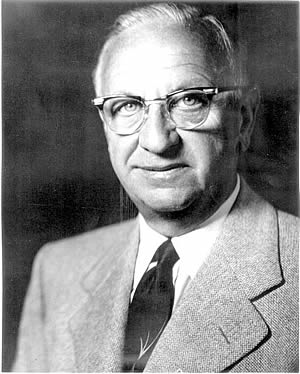
Sol Lesser- Tarzan Producer
IV.
Another building block of memory not inferior to the others was the development of science in the nineteenth century. The key event for Ed Burroughs was the introduction of Evolution by Charles Darwin in 1959. Ed uses several strands of biology in his corpus. He knows the earlier work of Lamarck as well as that of Darwin and later evolutionary contributions of Gregor Mendel and the germ theory of August Weismann and his contribution of the Weismann Barrier that Ed apparently rejected.
Thus contrary to the popular conception that Burroughs was some sort of idiot savant. He kept up on current developments well aware of the Curries’ discovery of radium when he began to write. The awareness of radium poisoning was not yet known as he seems to be unaware of it.
Although it is not generally accepted he was also very well informed on the development of psychology. There is no reason that he couldn’t have known of Charcot while he was well up on hypnotism, an essential part of Charcot‘s method. Psychology before Freud preempted the discipline which was a fairly broad loosely defined subject. The field was also open to any and all investigators not yet preempted by the medical profession.
While it is generally believed that Freud discovered or invented the unconscious, this is not so; he merely defined the unconscious to suit his purposes and then by dint of shouting loudly and continuously managed to impose his view as orthodox driving all other understandings off the field. In fact he managed to make his interpretation, almost fabrication of psychoanalysis, the gold standard of psychology.

Sigmund Freud- Dream Weaver
Psychology was split off from philosophy rather late gaining momentum only during the eighteen eighties.

Robert Louis Stevenson
The most significant aspect of psychology that Ed exploited was that of the split personality which
Dr. Jekyll And Mr. Hyde
he embraced to an astonishing degree. He seems to have gotten the notion from Robert Louis Stevenson’s great little novelette, The Strange Case of Dr. Jekyll and Mr. Hyde. Stevenson got there before H.G. Wells or otherwise Wells would likely have appropriated the genre as well as interplanetary warfare, vivisection, invisibility, time travel and futuristic dystopias, all of which were of inestimable influence on the plastic memory of Edgar Rice Burroughs.
While Ed certainly tried to out-wow these amazing writers perhaps the closest he came was the little recognized story, The Eternal Lover, the title of which is often changed to the Eternal Savage, which completely misses the point. This story was even answered by Kipling and Haggard in their Love Eternal. Eddie was moving in fast company.
He was familiar with many novelists writing in psychological genres including George Du Maurier with his three incredible novels, William Morris of Notes From Nowhere fame and several other interesting but not compelling novels, as well as, I believe, some few novels of Marie Corelli who was working the psychological memory games.
Thus, by the time Ed began writing in earnest in 1911-12 he had a well defined notion of contemporary psychology. One must always bear in mind that Ed read continually and was omnivorous in his choice of reading material. While not of the University he had the more random reading habits of the autodidact.
V.
Having two remaining topics of memory to cover, literature and immigration I think I’ll deal with that of literature first saving immigration for last.
The nineteenth century was the unfolding of the Aryan mind, an age of self-realization and the beginning of the effort to attain full consciousness. This is the story of psychology from then to now. The search for awareness was carried on in medical circles, philosophical circles and literary circles. Psychology was transferred from philosophy into medicine and science in the last half of the century. The quest for awareness was no more prominent than in literature. The German Romantics were the first in the field to explore the nature of the mind. Men like E.T.A Hoffman, La Motte De La Fouque and Charles Nodier represented psychological ideas in their fiction. These are significant but overlooked works.
Friedrich De La Motte Fouque- Wonderful Novels
There have always been stories and storytellers. First in poetic form then evolving into prose. The Greek novels of the Hellenic period are just great. Papryus was expensive and copying by hand was laborious and also expensive. With the invention of paper and moveable typeface and the printing press, books became more economical and multiple copies into the hundreds or thousands feasible. This meant that more people of diverse backgrounds could find their way into print. The key form of expression was poetry but prose gained ground. Then in the mid-eighteenth century the modern novel form took shape to explode after 1795.

Sir Walter Scott- Number One
Perhaps the first great novelist was Walter Scott who, himself began as a poet. His long poems such as The Lady Of The Lake and Marmion are still great reading although out of style along with Scott himself. What do I care about what’s out of style? Do you? Nevertheless Scott became the model for such mid-century greats as Alexandre Dumas, Balzac and Eugene Sue.
Scott and the great French novelists were also influenced by the Gothic novelist Mrs. Ann Radcliffe who wrote her romances in the last quarter of the eighteenth century.
There are a myriad of authors, now forgotten except by the scholar or enthusiast who seeks their charm. George Borrow while an eccentric turned out a few worthwhile novels, Thomas, Peacock, Pierce Egan, G.W.M. Reynolds Mysteries Of The Court Of London is a fabulous five thousand page, ten volume novel of the period. Everything you’ll ever need to know. Charles Dickens and all the great novelists of the mid century wrote scores of interesting worthwhile novels now nearly slipped through memory. Of course there is only time and room in the mind of we moderns who are bombarded daily by radio, songs, film and TV plus tens of thousand of books appearing annually, for so many old books. The need for selection is paramount while the changing social and political situations are relegating the world of pre-9/11 to the historical dust bin. Still the treasures are there buried like Long John Silver’s gold for those who care to dig. Let’s hope you’re one.
As I have noted, after Darwin in 1859 and the rise of psychological sensibilities, of which Darwin was ignorant, changed for the upcoming generation who took the stage in the eighties. The great modern genres were in embryo. Jules Verne had already begun his scientific romances that were influential while he continued writing into the twentieth century. His books are now heavily bowdlerized because his acute observations of the reality he perceived are no long thought proper by our modern social Mrs. Grundys.
Camille Flammarion, the very great French scientific neo-romantic writer made the space travel and planetary romance popular beginning in the sixties at the same time as Verne.
In 1880 Percy Gregg published Across The Zodiac which is erroneously credited as the first Martian romance beginning the long fascination with the Red Planet for which Burroughs was for so long credited. It was in the mid-eighties that a major influence of Ed’s began to publish and continued to publish at the rate of two or three volumes a year for nearly forty years, the great, wonderfully imaginative Henry Rider Haggard. A most versatile writer now known mainly for his African novels as the Scramble was in process. Haggard also wrote a half dozen great ancient Egyptian lost civilization romances that are well worth reading along with a couple Hebrew volumes of the Roman wars that are exceptional. It appears that Ed read most or all of Haggard.
The year after Haggard’s King Solomon’s Mines, Stevenson published his great scientific psychological thriller, Dr. Jekyll And Mr. Hyde. A key fact for Ed’s mental development is that these novels that are considered classics today were published during Ed’s lifetime or the decade or two before his birth so these really startling and amazing novels were as fresh in their impact as, say, a Rolling Stones record in the sixties and seventies. One imagines schoolboys gathering in knots and talking about them excitedly, much as we did about the latest sci-fi pieces in the fifties. While we know that Burroughs read these books we can’t be sure when but I imagine that to have read these books he must have done most of them close to the publishing date or they couldn’t have been part of his mental furniture by the time he began to write in 1911-12. And he had a lot of reading to do.
The Sherlock Holmes of Conan Doyle who began his career in 1886 also which continued intermittently for twenty-five years or so dazzling Ed’s mind. Doyle as I see it was also dealing with a split personality. Holmes and his alter ego are essentially two aspects of the same personality. Watson belongs to the pre-scientific past while Holmes is the scientific thinking machine devoid of sympathy. Watson takes the sentimental side. In addition Doyle introduces a third personality element in the criminal mastermind Moriarty who is a sort of Hyde to Holmes Jekyll, hence his is the social negative to Holmes positive.
Jekyll and Hyde and Holmes and Watson were introduced in the same year of 1886 as Marie Corelli’s Wormwood that also deals with the splitting of personality. As these books couldn’t have been influenced by each other one has to assume that the notion of split or multiple personality was being bruited about. Corelli seems to have attended Charcot’s demonstrations so that all psychological roads lead back to the Salpetriere.
There is no clear evidence that Burroughs read Corelli but as she was among the best selling and most sensational authors of the period I have little doubt myself that Ed followed his unerring instincts at least sampled her work.
Another author plowing the same furrow that Burroughs read for sure was George Du Maurier whose first novel, once again dealt with a split personality. In his novel, Peter Ibbetson of 1891, his character has a childhood in France which was very happy. Through the death of his parents he was sent to an uncle in England who while providing generously for Peter’s education nevertheless was cold while being disgusted at Peter’s rejection of his ideas of manhood. Peter’s glowing childhood expectations were dashed throwing him into a deep depression. Now let’s catch up on Burroughs’ development and I’ll return to Du Maurier later in another context.

Mark Twain
Now, Burroughs’ loved three novels that he read and reread six or seven times by 1920. They were Mark Twain’s The Prince And The Pauper, Frances Hodgson Burnett’s Little Lord Fauntleroy and Owen Wister’s The Virginian. Ed was led unerringly to the three novels that dealt most explicitly with his mental fixations. The first two were published during Burroughs’ childhood while the last was published shortly after the turn of the century in 1902.
Two of these three books relate to Burroughs life from birth to age twenty in 1896 with the last relating to the next period. One’s favorite books, songs or music are always going to relate to psychological needs developed during your early years. You may or may not have realized their psychological importance. It can’t be said whether Ed knew why the books were his favorites or not. All three relate to the blighted hopes of his youth. As far as I can recall all of Ed’s books tell the same story as these three in variation.
All three tell of a young prince who is disinherited and then after a series of adventures comes into his own again. In Twain’s Prince And The Pauper we have the double, or split personality of the Prince and the Pauper. Identical in appearance. By some literary magic the two exchange places with the Prince trading roles with the Pauper. In the end the Prince reassumes his proper role.
In Burnett’s Little Lord Fauntleroy one has the boy who is the son of a Lord, thus being a little Prince, growing up in America in straitened circumstance who then is discovered and comes into his inheritance and true identity. He has a sort of double in a newsboy who follows him to England before moving to California where he becomes the successful manager of a ranch thus foreshadowing Ed’s flirtation with and move to California where he bought the Tarzana estate.
The Virginian of 1902 does not properly belong to his childhood but follows the same theme with the addition that the hero meets his true love and has an idyllic wilderness honeymoon. Shortly after reading the book he took his young wife Emma West to Idaho in what seems like an attempt to live the book. Emma was the wrong girl and the wilds of Idaho the wrong place.
It would seem then that Ed was highly influenced by what he read. He was also able to retain an accurate remembrance of the stories in his memory. The period from 1896 to 1911 was also filled with literature that furnished his mind for the literary tasks ahead of him.
So, in addition to the truly great literature of Dumas and Sue, Verne and Haggard, he was drawn to the interplanetary adventure. Like Freud who appropriated the long history of the Unconscious to himself so Burroughs absorbed and transcended the thirty years or so of previous interplanetary adventure to himself. Just as one erroneously thinks Freud invented the unconscious so one thinks Ed Burroughs invented the Martian interplanetary romance. No so. Earlier examples are constantly being discovered. At this time the earliest Martian novel is considered to be the one by Percy Gregg entitled Across The Zodiac published in 1880.
Greggs’s novel is written in the high Victorian style reminiscent of Anthony Trollope or just any of the crop of English writers of the 1820 or so generation so that the emphasis is sort of pre-scientific and stuffy unlike Burroughs’ writing which began after the invention of cars and airplanes, movies, phones and the whole works. Probably for that reason Burroughs displaced all other Martian writers with the exception of H.G. Wells’ War Of The Worlds. Even that which was on the edge between the Victorian and Edwardian periods relates more to the past than to the future.
There is a question as to which of these books Ed may have read. I think it not improbable that if he had heard of them he would have sought them out. Nor would, say, Percy Greg’s Across the Zodiac be as obscure in Ed’s day as it is now. There would have been not a few people who were familiar with such a book to refer Ed to it. As an inveterate magazine and newspaper reader there is no reason he might not have come across a reference. After all he did read Popular Science and Popular Mechanics both of which originated in the last quarter of the century. So, while it cannot be said for certain I think it probable that he was familiar with most of the Martian literature so that when he began A Princess Of Mars he knew what the landscape should and shouldn’t look like and knew what to avoid.
He was early introduced to the idea of the double and multiple personality through Jekyll And Hyde. The book was a clear cut example of split personality. The puzzle of a divided personality fascinated Ed while the literature of the subject is fairly extensive with numerous writers discussing it in various manners of doubling. From 1886 to 1900 many outstanding examples appeared that given Ed’s attraction to the sensational he would definitely have heard of while when reading those works and Ed’s works the same themes and even details are recurrent in both. Thus, while I have never read of Marie Correli’s name being mentioned in connection with Ed’s work she manages that same dark, murky sensibility in connection with personality dissociations. She was one of the best selling authors from 1886 to 1900 so there is no chance Ed hadn’t heard of her.
While he may have read Corelli it is certain that he read all three of the novels of George Du Maurier- Peter Ibbetson, Trilby and The Martian.
The first, Peter Ibbetson, 1891, follows Ed’s usual formula of a happy childhood disrupted by an untoward event. In this case having been brought up in France, his parents died and he was sent to an uncle to be brought up in England, thus a personality divided by French and English identities with the latter unhappy.
Now, Du Maurier concentrates on the need for memories. As he says, quite rightly, without memories what is a man. Nothing. Just a vegetable. Ibbetson, then, chronicles his childhood French memories while abhorring his current English situation. The crisis comes when Uncle Ibbetson insults Peter’s mother; Peter then murders his uncle.
Before he did Peter meets his childhood sweetheart, Mimsy, now married as Mary, the Duchess Of Towers. The childhood affection was sincere but she is now a married woman. Peter would have been hanged for the murder except for the intervention of Mary and her powerful friends and then is given life without parole.
Before Freud appropriated the topic for his own ends the Unconscious was thought to be a source of great intellectual riches with incredible paranormal, that is to say supernatural powers. At the same time dreams were improperly understood while also thought to have paranormal powers attached to them. Du Maurier invented something called Dreaming True while at the time Lucid Dreaming was a hot topic. Lucid Dreaming is when you consciously invade your dreams without waking and direct the dream’s course. Robert Louis Stevenson, who died in 1894, said that he wrote many of his stories while dreaming lucidly. They read like it too. Ed Burroughs, also, was interested in Dreaming True and Lucid Dreaming and said that he too took his stories from his dreams. If you read Burroughs with Lucid Dreaming in mind you can trace those influences too.
So, and now this seemed possible at the time and may seem possible to some today, Peter and Mary agreed to establish mental contact and Dream True. That is to say that they would each enter into one another’s dream together. This they succeeded in doing thus each led a double life. Now, in the very nature of things, they could not dream of anything that was not in their memories. Thus, they could only dream for instance of chairs they had seen, places they had been, only that of which they had memories. Du Maurier intuited that mind was wholly memory. Nothing comes out that didn’t go in.
As they had read of prehistory they could travel back through time into prehistoric situations. Everything went well for twenty-five years until one day the dreamgate was closed. Peter couldn’t enter from his end. His worst fears were realized. Mary had died.
His disappointment unbalanced his mind so that he went insane. He was removed from the prison to the asylum, his memories in disorder. I suppose Du Maurier meant shizophrenic in which one’s memories are so painful they became confused, working against each other so that the mind can’t function properly.. Over time he became reconciled to the reality and regained the use of his memories. And then one night while Dreaming True he sat by a dream river when Mary, released from heaven as a very special dispensation, appeared to him, explained the situation and told him they would meet in heaven.
The second novel, Trilby, one of the most celebrated of its time deals with the iconic hypnotist, Svengali, evil but potent, who exploited Trilby, a memory creation Du Maurier borrowed from the novel of the same name by Nodier, the Romantic. Hypnotism will play a significant role in Ed’s work. And finally the third novel, The Martian, inspired Ed, and his mind focused on Mars.
Du Maurier’s Dreaming True meshed with Stevenson’s Lucid Dreaming as a source for obtaining material unconsciously. It is clear that Ed was heavily influenced by Stevenson having read most if not all his fiction. It seems probable that he would have read articles about his hero who spoke freely of his Lucid Dreaming technique. Thus when Ed said he found his stories in his dreams there is no reason not to believe that he was familiar with these dream theories and their source in the unconscious.
The Fantastic E.T.A. Hoffman
Lin Carter believed and I concur that Ed also read novels by William Morris of News From Nowhere fame who writes dreamlike stories bearing some relationship to those of Ed.
I intend to pause at 1900 continuing on with Ed’s life experiences to 1911, but to close on this theme, this next book appeared shortly after 1900 but is very much a product of the pre-industrial period before 1900 so I include it here.
In England during the last quarter of the century the spiritualist movement gravitated from the US to England and even Germany where it was treated as a science to be investigated, hence the plethora of novels like those of Du Maurier and Marie Corelli.
Not only was the unconscious thought of as a repository for multiple personalities but even the fantastic notion of past lives. Thus people sprang up who believed, or said they did, that they could remember previous incarnations. This notion was also helped along by the appearance of Hindu and Buddhist missionaries in Britain and the US with their notions of reincarnation.
Among these imposters was a Swiss woman using the name of Helene Smith whose supposed lives were recorded by the psychologist Theodore Flournoy. Now, he conducted a serious scientific investigation of the woman’s claims. That Flournoy could allow himself to be so deluded demonstrates the psychological novelty of the Unconscious.
Miss Smith was a shop girl who was much displeased with her situation so she began to fantasize. Using the spiritualist movement as a stepping stone Flournoy made her famous. She would have done much better to turn her fantasies into novels much like Ed would but she enjoyed the attention her past lives claims got her. She chose three past identities, one as an Indian Princess, another as a Martian and the third as Marie Antoinette. Of interest here is that she invented a Martian vocabulary that only she could translate. Burroughs himself followed a few years later with his own vocabularies of various provenance including African Ape, the first and once universal language.
There is no reason to go into the details of her debunking, the point here is that it is thought that Ed read Flournoy’s account: From India To The Planet Mars. Certainly he would create three ‘past lives’ as identities to explore his own fantasies- Mars, an imaginary Africa and the Earth’s Core. The late life Venus stories can be discounted. By c. 1900 then the foundations of his novels had already entered his memory banks where they bubbled under his conscious mind where he could work on them both consciously and unconsciously letting them slowly ferment.
Terminating the nineteenth century were two works by the deviser of psychoanalysis, Sigmund Freud. The first was his Interpretation Of Dreams and the other, The Psychopathology Of Everyday Life. The true significance of these books are overlooked but they both deal with the primacy of Memory as the basis of mind. Reminiscences as he would say.
As Freud noted that the problem hysterics suffered was not biologic but the distortion of memories or reminiscences, so both his two volumes deal with the distortion of Memory in ‘normal’ people. Freud must have thought he was normal as he used himself as a subject in both books.
As Freud grasped, dreams are based not only on memories but the distortion of memory by one’s fixations. That is, a fixation of a memory too hurtful to face so that it is fixated in the form of the hurt from which point it constellates similar subsequent memories and even shapes them and one’s actions to conform to its fears. So, from reminiscences of hysterics Freud had moved on to the memories of dreams and parapraxes.
Even more prescient was the study that followed a couple years later: The Psychopathology Of Everyday Life. The book is ill-titled, being somewhat off putting although very easy reading, but of even more significance than his dream book. This was the study that gave rise to the term ‘Freudian slip’. It is a study of parapraxes and how one’s memory interferes with another memory to blot it out. Strangely Freud missed the import of the significance of Memory taking it more or less for granted.
Freud’s analysis of parapraxes such as forgetting a word you commonly use was superb. He demonstrates significantly, from his own example, how unpleasant memories that one might associate with a word cancels out the ability to recall the word. In other instances one means to say one thing but let out one’s true intent by saying another.
Thus the subconscious whether in dream distortion or waking distortion affects one’s life, clashing with the conscious. The memories one has, the subconscious, one’s true desires emerge against one’s will. Of course, practice can eliminate or reduce word substitutions which is done by sharpening one’s conscious efforts to deny entrance to the sub- or Unconscious. In the struggle to unify one’s consciousness, that is, as Freud would put it, have your ego fill the space occupied by the Id- a later name for the Unconscious one must eliminate the interface. The only successful method is to integrate one’s consciousness so that the mind functions as one unit however perfectly or imperfectly. This is rare but it can be done by searching for and recognizing the significance of one’s fixations. Forget the term Depth Psychology; that’s a misnomer.
Barring that the choice is to recognize the influence of the unconscious and try to pose an impervious barrier to its influence in the sense of W.E. Henley’s famous poem, Invictus (The Unconquerable) Henley wrote the poem in 1875 although the title was added later by an editor, so that one may be sure that Ed knew the poem and used it as bedrock as so many of us have. There are interpretations, I give mine:

W.E. Henley
Invictus
Out of the night that covers me,
Black as the pit from pole to pole,
I thank whatever gods may be
For my unconquerable soul.
In the fell clutch of circumstance
I have not winced nor cried aloud.
Under the bludgeoning of chance,
My head is bloody but unbowed.
Beyond this place of wrath and tears
Looms the horror of the shade,
And yet the menace of the years
Finds, and shall find me, unafraid.
It matters not how strait the gate,
How charged with punishment the scroll,
I am the master of my fate.
I am the captain of my soul.
There is a temporal interpretation as well as a psychological one. I am interested in the latter. D.H. Lawrence is quoted by Rudiger Gorner in his essay ‘The Hidden Agent Of The Soul’: “The novels and poems come unnoticed out of one’s pen.” This is true. One has conscious intentions but as one writes trancelike, hidden meanings emerge from the pen allowing for different interpretations of the words. Whether Henley had a conscious understanding of the unconscious psychological meaning of his words, the psychological interpretation fits. That’s all I can say.
‘Out of the night that covers me…’ In Greek mythology the night is construed as female, that is, the unconscious, the unknown, as with the depths of the sea, another female symbol. Daylight was considered as conscious and male as one can clearly see. The Night, is uncertainty and darkness when the goblins come out. It was feared. Henley clearly interprets night that way: …black as the pit from pole to pole. In other words he is in the grip of the unconscious with not a glimmer of light from one end to the other, he might have added, and from East to West.
But Henley is defiant of the darkness. He thanks whatever gods may be for his unconquerable soul. In other words, come what may he will not tamely submit. ‘Black as the pit…’ In my own hour of darkness, one of them, in my own hour of need, sometime in my teens, I gathered courage from Henley’s pen to fight that mountain of despair. I’m sure that Burroughs did too.
‘In the fell clutch of circumstance, I have not winced nor cried aloud. Under the bludgeoning of chance, my head is bloody but unbowed.’ I’m not sure of the wincing but I have been strong enough not to cry out loud. Henley had his problems. He contracted tuberculosis of the bone and at seventeen had a leg removed at the knee. The doctors wished to take his other leg too but Henley stoutly refused. Thus he lost a leg but rather than succumb to despair his ‘head was bloody but unbowed’ under the ‘bludgeoning of chance.’
The first two stanzas were all there was of significance for me at the time while, for myself, I have considered it a two stanza poem but it continues with Henley’s rejection of the gods and of heaven and hell, both subconscious projections. ‘Beyond this place of wrath and tears, looms but the horror of the shade’. I interpret shade as nothingness. ‘And yet the menace of the years find, and shall find me, unafraid.’ A fine show of bravado just in case. Henley certainly spoke for Burroughs and I suspect for a great many of you, us.
And then a dismissal of consequences: It matters not how strait the gate, how charged with punishments the scroll… It don’t bother me none, he says. And why? Here comes the clincher, that line that gets ya, because: I am the master of my fate, I am the captain of my soul. Damn right! And that’s called Positive Mental Attitude. Life isn’t worth living without it.
So Ed hangs in there, head bloody but unbowed, waiting for the turning of the tide. As the proverb goes: It’s a long road without a turning.
In closing this part let me remark that Ed was very fond of popular poetry of the Kipling kind. For those interested, I’m sure someone may be, there is a compilation called The Best Loved Poems Of The American People compiled by Hazel Felleman first published in 1936, in print since then, of which every poem I am sure was known to Burroughs. A poem couldn’t be too schmaltzy for him, he even has the collected Edgar A. Guest in his library. These bits of poetry were as essential to furnishing his memory as anything else he read.
VI.
The history of immigration in the US is the least understood and most misrepresented topic in US history. The history of immigration has invariably been written by Liberals or immigrants themselves so the story as taught in schools is rather one sided. The Key text is Gustavus Myers The History Of Bigotry In The United States. If you’ve read that you’ve got the official story. Just for the record, on my mother’s side I’m Polish and Pennsylvania Dutch; on my father’s side solid Scotch-Irish from the Kentucky hill country, both grand parents. I’m a hillbilly boy with a Polish accent. My name, Prindle, is usually thought of as English so I have the field covered. I have been subject to the all the discrimination currently employed against the English.
In discussing Ed’s point of view he thought of himself as pure English while on his father’s side he was English with an Irish admixture and on his mother’s side, Pennsylvania Dutch. Amusingly in the twenties he wrote his mother-in-law asking for Emma’s genealogy. Mrs. Hulbert, aware of Ed’s vanity on the issue, sniffed that Emma was English on both sides.
The first immigration problem was, of course, the Irish and if I may say so, with good reason. I rather favor the Know Nothing side of the argument. The animosity during Ed’s youth between English and Irish was intense. Apropos of Ed and John the Bully who was Irish I think the following probable. The Burroughs had two Irish maids, young women, before whom I suspect Ed put on airs about being English and therefore superior to the Irish. I think this got on the girls’ nerves so that they got an Irish kid to terrorize Ed and put him in his place. Otherwise I don’t see John waiting on a corner for a kid four years his junior who he couldn’t possibly have known. The consequences were more than the girls could have imagined.
After the Irish came the Socialists of the failed Revolution of ‘48- The Forty-eighters, another of Ed’s bete-noirs. Mostly German they contributed to Ed’s disgust of Germans when he saw them marching through Chicago under their red flag. The Haymarket Riot of 1887 also made a big impression on him especially as his father attended their execution.
Up to 1871, post-Civil War immigration had been Northern European which was thought to be compatible with the Old Stock, at least in retrospect. Prior to the Civil War, industry in the US had been more or less of the cottage variety, recalled by Longfellow in ‘Under the spreading chestnut tree, the village smithy stood…’ But, with the invention of the steam engine on steel rails in 1830 a much larger scale of industry was required. Bessemer process steel, rolling mills and what all that also called for a greater concentration of labor.
To obtain that the industrialists moved further East into Europe recruiting from other than Nordics. At the same time the Jews of the Pale (the prototypical ’Eastern European’) discovered America quickly advancing from a trickle of immigration to a flood. Thus during Ed’s youth the character of Chicago changed year by year, unnoticeable consciously until the Great War. Then in the nineties the Italians added the US to their migratory circle. For at least a hundred years the Sicilians had been migrant labor in Europe, going North during the summer and returning South in winter.
Their first Western addition was Argentina, Uruguay and Brazil. In the days of sail the circuit lasted a year or two as they could follow the sun North into Brazil, and Central America. With the reliability of steamships it was possible for them to return home more frequently and cheaply in steerage. Then in the nineties the Sicilians discovered New York and the US, which they added to their circuit.
They were never true immigrants being more of what were disparagingly called Birds Of Passage. They came for the money. In most years prior to the Great War nearly as many returned to Sicily as arrived. The Great War stranded them in the US but post-war Mussolini still considered them Italian citizens and so did they.
The Americans, never a very realistic people, believed that all these immigrants were on the same political and psychological wavelength as themselves, hence that the immigrants would assimilate overnight. The world war was an eye opener when all loyalties overrode American sympathies. A howl of pain went up from Teddy Roosevelt when he realized the reality and exclaimed against the ‘American boarding house.’
Of course, the history books tell it quite differently but, in fact, there was as much sympathy as not for Germany. Not everyone saw the English as innocent. The Irish who sided with the Germans in both wars were on the side of whoever was fighting England, hence if the US officially sided with England they were less than loyal to the New Island.
Chicago itself during Burroughs’ time as now had a remarkably low percentage of Old Stock, on the order of only 15 to 20%. So the babel of other tongues and accents must have offended him more than they did John Rocker of our time who was sent back to the minors for observing the fact in New York City. The second Black List one might say, but unbacked by a rehearsed voice of objection such as the Communists had in the forties and fifties.
Ed had his prejudices as every man must, Old Stock, immigrant or what. He observed the Revolutionary activity in Eastern Europe with a wry eye taking the side of neither the Jews or Russians. He definitely added the Russians to the Germans as objects of distaste. The villains of the first four Tarzan novels would be Russian. The early novels have been heavily censored so his attitude toward the Jews requires early editions to unravel. There appears to be no animosity to them but as an anti-religionist he had to find their religious beliefs as ridiculous as any of the three Semitic religions. There doesn’t seem to be any problem with the Jews until they caused it in the aftermath of the War but that’s slightly in the future and will be dealt with at that time.
It is enough to say that Ed was proudly Anglo-Saxon as he should have been and that whatever his beliefs on immigration he endured the immigrant nations stoically. At present there is no evidence that he took an aggressive stance toward them as many of his countrymen did. But, listen, I was in the orphanage and I have a very good idea of what aggression is and it didn’t just come the Old Stock. My immigrant brothers were in there too. We were told to take the alleys and stay off the city streets or take a beating. These were seven, eight and nine year kids these grown men were threatening and some of the kids did take a beating although I never did. I know where discrimination is at. So what.
Part IV will continue Ed’s temporal life from 1886 to 1911-12. Part V will review his reding from 1900 to 1920. Part VI will pick up from where Burroughs Rides the Rocket Pt. I left off. There will probably be four or more additional parts but I don’t have blocked out yet.
Part II: Only The Strong Survive
April 3, 2012
Only The Strong Survive
Part II
An Examination Of Bridge And The Oskaloosa Kid
As Created By Edgar Rice Burroughs
(Alternate Title: The Oakdale Affair)
by
R.E. Prindle
Part II
Into The Mysteries
(Some capitalization appears in the text that has no significance. For some reason it just showed up. I didn’t do it)

Young Burroughs With His Camera Eye
Burroughs does a good job in the Holmesian sense in this book enclosing mysteries within mysteries. The central mystery is who is committing the crime wave in Oakdale. Having learned from his mentor, Conan Doyle, Burroughs skillfully withholds details to enhance the suspense then disclosing them to reveal the mysteries. The organization of the scheme of crimes gradually unfolds to show that the real Oskaloosa Kid is one of the perpetrators. So we have a clever doubling of a sweet girl posing as the vicious criminal The Oskaloosa Kid. This is obviously a transfer of his Anima identity from the male De Vac/Oskaloosa Kid to the resumption of a female identity for his Anima through the fake Oskaloosa Kid/Gail Prim.
The girl who was seen with the criminals could have been Gail since she had disappeared without a trace never having arrived at her destination. Gail was not the girl seen with Reginald Paynter, who was robbed and murdered, and the crooks. That person was Hettie Penning who was ejected from the car speeding past the abandoned Squibbs place by the real Oskaloosa Kid. Thus symbolically De Vac/Oskaloosa Kid returns his Anima to Bridge/Burroughs.
As indicated Hettie Pening represents the dead early Anima of Burroughs who has here been resurrected. As in all cases of Burroughs representation of his failed Anima she appears to be a ‘bad’ girl but in reality is merely misunderstood. He compensates for himself.
Bridge himself is a mystery man and double. He is a hobo but with great manners and an excellent education. He is definitely a member of the Might Have Seen Better Days Club. The real club was organized by Burroughs when he served as an enlisted man in the Army in 1896.
In this case Bridge is in actuality the son of a wealthy Virginia aristocrat who has left home because he prefers a life on the road. In the framing story of a Princess of Mars Burroughs portrays himself in his own name as a Virginian. In reality Burroughs was declassed at eight or nine by John the Bully and by his father’s subsequent shuffling of him from school to school finally sending him to a bad boy school that Burroughs describes as little more than a reformatory for rich kids.
If one looks at his career he was on the move quite a bit. During his marriage he seldom lived in one house for more than a year or two then moved on.
Just as Bridge will assume his proper identity at the end of the novel so through his writing Burroughs has abandoned the shame of his hard scrabble years from 1905-13. In a sense he is assuming his proper identity with this novel.
Bridge and the Kid joining together at the fork in the road, one is reminded of Yogi Berra’s quip: When you come to a fork in the road, take it, in this case the less traveled dirt road.
I read word for word frequently dwelling on the scenes created. Burroughs is a very visual writer. Standing at the fork in a driving Midwest summer lightning, thunder and deluge storm they can hear the pursuing hoboes shouting down the road. Ahead of them is a dark unknown and a house haunted by the victims of a sextuple murder.
Indeed, Burroughs describes almost a descent into hell, or at least, the hell of the subconscious.
Over a low hill they followed the muddy road and down into a dark and gloom ravine. In a little open space to the right of the road a flash of lightning, followed one imagines by either the crash of deep loud rumbling of the thunder of perhaps if over head the sonic boom of the air splitting and closing, revealed the outline of a building a hundred yards (that’s three hundred feet, a very large front yard) from the rickety and decaying fence which bordered the Squibb farm and separated it from the road.
There are those who say Burroughs doesn’t write well but in a short paragraph he has economically drawn a verbal picture which is quite astonishing in its detail. The house is a hundred yards from the road. In the rain and muck that might be a walk or two or three minutes or more.
A clump of trees surrounded the house, their shade adding to the utter blackness of the night.
That’s what one calls inspissating gloom. One might well ask how any shade can add to utter blackness but one gets the idea. There is some intense writing thoroughly reminiscent of Poe but nothing like him.
The two had reached the verandah when Bridge, turning, saw a brilliant light glaring through the night above the crest of the hill they had just topped in their descent into the ravine, or, to be more explicit, the small valley, where stood the crumbling house of the Squibbs. The purr of a rapidly moving motor car rose above the rain, the light rose, fell, swerved to the right and left.
“Someone must be in a hurry.” commented Bridge.
There isn’t any better writing than that. Another writer can say it differently but he can’t say it better. Just imagine the movie Frankenstein or Wolf Man when you’re reading it. Burroughs did as well in less than the time it takes to show it.
A body is thrown from the speeding car a shot following after it. Bridge goes to pick up the body.
Thus the mystery and horror and terror of the dark and stormy night has been building. Bridge carrying the body which may or may not be alive asks the Kid to open the door.
Behind him came Bridge as the youth entered the dark interior. A half dozen steps he took when his foot struck against a soft yielding mass. Stumbling he tried to regain his equilibrium only to drop fully upon the thing beneath him. One open palm extended to ease his fall, it fell upon the uplifted features of a cold and clammy face.
Yipes! What more do you need? Cold and dripping, half crazed from fear, overwhelmed by the thought he might be a murderer the Kid’s hand falls on cold and clammy dead flesh. Bridge is standing there with maybe another dead person in his arms. The Kid is also aware that the murderous hoboes are hot on his trail.
If that doesn’t get you then somehow I think you can’t be got.
Not yet finished Burroughs builds up the tension. Striking a match from the specially lined water proof pocket of Bridge’s coat they find a dead man wearing golden earrings. Obviously a gypsy but while staring in unsimulated horror they hear from the base of the stairs of a dark dank cellar the clank of a slowly drawn chain as a heavy weight makes the stairs creak.
This is too much for the nerves of the Kid. Burroughs brilliantly contrasts the terror of the unknown in the basement with the fear of the dark at the top of the stairs. You know where that’s at, I’m sure, I sure do. In a flash the Kid chooses the unknown at the top of the stairs to the horror in the cellar.
What do you want?
The hoboes are still slipping and sliding down the descent into the ravine of the subconscious. Horror in front, terror behind. There is absolutely no place to hide. Nightmare City, don’t you think? How could anyone do it better? What do you mean he can’t write? Put the scenes in a movie and everyone in the theatre would be covering their eyes. Itd\ would be that Beast With Five Fingers all over again. Maybe worse. Never saw that one? Check it out. Peter Lorre. Terrifying. Of course I was a kid.
The clanking of the chain recreates an incident in Burroughs’ own life when he had a job collecting for an ice company. He called on a house and while he was waiting he heard the clanking of a chain coming slowly up the driveway. Waiting with a fair amount of trepidation he saw a huge dog dragging the chain appear. ERB backing slowly away forgot about the delinquent bill.
In this case the chain is attached to Beppo the dancing bear but Bridge and the Kid won’t know that until the next day.
They retreat into an upstairs bedroom. Here what Burroughs describes in capital letters as THE THING and IT pursues them. I remember two movies one called The Thing and the other It.
Just when the thing retreats the murderous gang of hoboes enters the house. Wow! Out of the frying pan and into the fire in this night of terrors as the lightning continues to flash and the thunder crash.
Discovering the dead man and as the bear begins moving again four of the hoboes flee while two who were on the staircase being trapped in the house flee into the same bedroom as Bridge, the Kid and the girl, Hettie. Shortly thereafter a woman’s scream pierces the lightning and the thunder then silences as the storm settles into a steady drizzle.
The rest of the night is one tense affair between the murderous hoboes and the Bridge and the girls. Not a moment to catch your breath.
In the morning when they go downstairs the mystery increases when they find the dead man gone and nothing in the cellar. If they’d had Tarzan along he would have not only been able to smell the bear but to tell whether if was black or brown.
After a brief confrontation Dopey Charlie and the General are driven off. Bridge’s relationship with the Kid is then deepened. Even though all the Kid’s reactions are repulsive to the manhood of Bridge he feels his attraction to the seeming boy growing stronger.
Not since he had followed the open road with Byrne, had Bridge met one with whom he might care to “pal” before.
This brings up an interesting hint of latent homosexuality. My fellow writer, David Adams has objected that in my analysis of Emasculation as applied to ERB is that he should have been a homosexual but wasn’t.
There are degrees of emasculation and there are various degrees of psychotic reaction to it. I don’t say and I don’t believe that ERB was a homosexual but there was a degree of ambiguity introduced into his personality by his emasculation. I have touched on this in my ‘Emasculation, Hermaphroditism and Excretion.’
Here we have another example of it as Bridge is experiencing some homoerotic emotion which is very confusing to him as he has never wanted a ‘pal’ before. In hobo lingo I believe a ‘pal’ has a homosexual connotation.
If Burroughs took his ‘inside’ information on hoboes from Jack London’s The Road then Bridge is the sort of hobo London describes as the ‘profesh’, the hobo highest in the hierarchy of hobodom. London always thought of himself as a quick learner, so one doesn’t have to award his statement too much credibility but Burroughs apparently took him at face value.
As London describes the ‘profesh’ he has been on the road so long he knows all the ropes. Unlike the unkempt bums he realizes the importance of a good front and always dresses neatly. But he is hardened and capable of committing any crime.
While Bridge is obviously intended to be a ‘profesh’ he is neither criminal nor does he dress to put up a good front.
Another category of hobo London lists is the ‘road kid.’ These are young people just starting on the life of the road. The ‘profesh’ would often take one of more of these road kids under his wing as his fag, as the British would say, or in Americanese, a ‘pal.’ In other words a homosexual relationship. Thus this displays ERB’s sexual ambiguity which David couldn’t locate in my psychological analysis of ERB’s emasculation. In this case the ambiguity will be resolved and explained when we learn that the Kid is the beautiful young woman, Abigail Prim, and both Bridge and Burroughs heave a sigh of relief.
Nevertheless ERB is discussing homosexuality in an open and natural way that couldn’t be missed by the knowing and which may be unique for its time. But then, remember that one of ERB’s hats in this story is that of the Alienist, so that in these pages we are deep into the psychological abstractions and Doyle’s mystery stories as influences.
Now comes the time for breakfast. Someone has to ‘rustle’ grub. We have already learned in ‘Out There Somewhere’ that Bridge doesn’t rustle food, he rustles rhyme. Nothing has changed. The Kid goes out to get breakfast and when she comes back with the goods, true to form Bridge bursts forth with several snatches from H.H. Knibbs which surprisingly the demure Miss Prim recognizes. What has she been reading?
How might this apply to Burroughs’ own life. Let’s look at it. Burroughs was enamored of How to books but in his heart he must have considered them a fraud. Willie Case will soon pick up his copy of How To Be A Detective which he finds completely inapplicable to his circumstances. He also has the good sense to throw the book away reverting to his native intelligence which may be a subtle comment on How To books by Burroughs.
ERB always considered himself of the executive class. After his humiliating experience trying to sell door to door he never attempted it again. Instead as a master salesman he preferred to write how to sales manuals for others to use as they went door to door selling his line of pencil sharpeners or whatever while he sat in the office waiting for orders. Hence in his own life he was the ‘rustler of poetry’ or manuals while others rustled grub in the door to door humiliation of the actual selling. Here the Kid will do the door to door gig. ERB always makes me smile.
In this case in what may be a joke the Kid just buys the goods from the homeowner reversing the roles.
There are those who insist Burroughs can’t write but I find his stuff wonderfully condensed getting more mileage out of each word than anyone else I’ve ever read. Just see how he describes breakfast.
Shortly after, the water coming to a boil, Bridge lowered three eggs into it, glanced at his watch (an affluent hobo) greased one of the new cleaned stove lids with a piece of bacon rind and laid out as many strips of bacon as the lid would accommodate. Instantly the room was filled with the delicious odor of frying bacon.
“M-m-m-m!” gloated the Oskaloosa Kid. “I wish I had bo- asked for more. My! But I never smelled anything so good in all my life. Are you going to boil only three eggs? I could eat a dozen”
“The can’ll only hold three at a time,” explained Bridge. “we’ll have some boiling while we are eating these.” He borrowed the knife from the girl, who was slicing and buttering bread with it, and turned the bacon swiftly and deftly with the point, then he glanced at his watch. “Three minutes are up.” He announced and, with a couple small flat sticks saved for the purpose from the kindling wood, withdrew the eggs one at a time from the can.
“But we have no cups!” exclaimed the Oskaloosa Kid, in sudden despair.
Bridge laughed. “Knock an end off your egg and the shell will answer in place of a cup. Got a knife?”
The Kid didn’t. Bridge eyed him quizzically. “You must have done most of your burgling near home,” he commented.
The description of the breakfast between the time Bridge looked at his watch and when the three minutes were up was delightfully done. I could smell the bacon myself while I especially like the detail of swiftly and deftly turning the bacon with the knife point. The knife seemed to have disappeared between the bacon and knocking the end off the egg.
Nice details aren’t they? You’d almost think Burroughs had actually done things like this for years. There’s enough blank spots in his life that he may have had more experiences of this sort than we know about. Take for instance the three days in Michigan between the writing of Out There Somewhere and Bridge And The Oskaloosa Kid. He says it took him twelve hours by train on four different lines to return to Coldwater from Alma. It is not impossible that he was hoboing back for the experience. He knew that he was going to write Bridge And The Kid next; might he not have been picking up local color?
Likewise in Bridge And The Kid he mentions the road from Berdoo to Barstow with seeming familiarity. Had he met Knibbs and the two embarked on a few days road trip as the expert Knibbs showed him some of the ropes?
I don’t know but there is something happening in his life which has not been explained.
Perhaps also the hoboism which appears in 1915-17 in his work when by all rights his success should have permitted him entry into more exalted social circles symbolized a rejection by so-called polite society. If so, why? Certainly the serialization of Tarzan Of The Apes in the Chicago paper must have raised eyebrows when people said something like: Is that the same Edgar Rice Burroughs who’s been tramping around town for the last several years?
After all people live in a town where a reputation is attached to them whether earned or not. In reviewing the jobs Burroughs had after he left Sears, Roebuck there is a certain unsavory character to them. Indeed, one employer, a patent medicine purveyor was shut down by the authorities while ERB then formed a partnership with this disgraced person. Where was Burroughs when the authorities showed up to shut the business down? I make no moral judgments. I’m of the Pretty Boy Floyd school of morality: Some will rob you with a six gun, some use a fountain pen. Emasculation is the name of the game.
It is certainly true that many, perhaps most, of the patent medicines of the time were based on alcohol and drugs therefore either addictive or harmful to the health. Samuel Hopkins Adams was commissioned by Norman Hapgood of Collier’s magazine to write a series of articles exposing the patent medicine business in 1906.
http://www.mtn.org/quack/ephemera/oct7.htm . A consequence of the articles may very well have been the shutting down of Dr. Stace. I think it remarkable that Burroughs didn’t distance himself from Stace at that time.
Even as Adams was presenting his research on patent medicines Upton Sinclair was exposing the hazards of the Chicago meat packing industry whose products were no less hazardous to the public health than patent medicines. Sinclair’s book, The Jungle, as well as perhaps Adams’ articles resulted in the Pure Food And Drug Act of 1906.
The products of meatpackers were so bad the British wouldn’t even feed them to their Tommies. That’s pretty bad.
So, if the Staces of the world were criminal and ought to be put out of business then by logic so should have the Armours and Swifts but what in our day would be multi-billion dollar industries don’t get shut down for the minor offence of damaging the health of millions.
One can’t be sure of Burroughs’ reasoning but his writing indicates that he was keenly aware of the hypocrisy of legalities. Perhaps for that reason he stuck by Dr. Stace.
However Stace was put out of business and the Armours and Swifts weren’t. While I applaud ERB’s steadfastness I deplore his lack of judgment for surely his reputation was tarred with the same brush as Dr. Stace.
When society figures may have asked who this Edgar Rice Burroughs was they were given, perhaps, a rundown on Dr. Stace and patent medicines as well as other employments that seem a little murky to us at present. I’m sure the ERB was seen as socially unacceptable. Thus Bridge who has lived among the hoboes has never partaken of their crimes so there is no reason for society to reject him especially as he is the son of a millionaire.
In any event ERB left Chicago for the Coast returning in 1917 then leaving for good at the beginning of 1919. Life ain’t easy. Ask me.
As Bridge, the Kid and the putative Abigail Prim were finishing breakfast the great detective Burton pulls up in front of the Squibbs place. Burton is obviously a combination of Sherlock Holmes and Allan Pinkerton. We have been advised of the Holmes connection in the opening paragraphs of this book. ERB describes Burton thusly:
Quote:
Burton made no reply. He was not a man to jump to conclusions. His success was largely due to the fact that he assumed nothing; but merely ran down each clew quickly yet painstakingly until he had a foundation of fact upon which to operate. His theory was that the simplest way is always the best way. And so he never befogged the main issue with any elaborate system of deductive reasoning based on guesswork. Burton never guessed. He assumed that it was his business to know; nor was he on any case long before he did know. He was employed now to find Abigail Prim. Each of the several crimes committed the previous night might or might not prove a clew to her whereabouts; but each must be run down in the process of elimination before Burton could feel safe in abandoning it.
That’s a pretty good understanding of Doyle’s presentation of Holmes. ERB did learn Holmes’ dictum that it was necessary to read all the literature on the subject to understand the mentality of one’s subjects. Burton did demonstrate some acumen in his arrest of Dopey Charlie and the General. He deployed an agent fifty yards below and fifty yards above to converge on the two criminals while he approached from the front. Either Burroughs had been doing some reading of his own or he picked up some experience or information from elsewhere.
Another keen point was when Burton went back to where the hoboes had been hiding to dig up the evidence they had concealed that would lead to their conviction for the Baggs murder.
It’s little details like these that always make me wonder where Burroughs picked up this stuff. He does it all so naturally but one can’t write what one doesn’t know. He must have been a curious man, good memory.
So Burroughs has a a pretty good understanding of the methods of Sherlock Holmes. It must be remembered that ERB was reading these stories as they first appeared not as we do as part of literature. Holmes, O.Henry, Jack London, E.W. Hornung, these were all fresh new and extremely stimulating with a great many references and inferences which are undoubtedly lost on us. Even in Bridge And The Kid ERB’s reference to the Kid’s bringing home the bacon is a direct reference to a quip the mother of the ex-heavyweight champion of the world Jack Johnson made just after he won the championship from Jim Jeffries: He said he’d bring home the bacon and he’s done it. I don’t doubt if many caught it then but I’m sure the phrase has become such a commonplace today that only a very few catch the reference and share the laugh.
Doyle’s stories such as A Study In Scarlet dealing with the Mormons and The Valley Of Fear dealing with the Molly Maguires would have had much more thrilling immediacy for ERB than they do for us. Also Burroughs has caught the essence of Holmes which was not so much the stories as the method of Holmes.
I have read the canon four times and while I could not reconstruct any of the stories without difficulty, if at all, maxims like- When you eliminate the impossible whatever remains no matter how improbable must be the truth. – have lodged in my mind since I was fourteen guiding my intellect to much advantage. So also the dictum to read all the literature. Not easy or even possible, but the more one has read the or read again the more things just fall in place without any real effort. You have to be able to remember, remembrance being the basis of all mind, of course. Holmes has been like a god to me.
If you wish to learn a source of Burroughs’ stories then all you have to do is apply the above methods; it will all become clear.
Burton moves the story forward as his appearance causes Bridge who isn’t sure what the status of the Kid and the putative Gail Prim is, elects to avoid the great detective even though they are friends.
The trio slip out the back into the woods following a track leading to ‘Anywhere’. Burroughs in a masterful telling catches the feel of a Spring day on a recently wetted trail littered with the leaves of yesteryear. Ou sont les neiges d’antan?
They come upon a clearing where a gypsy woman is burying a body. By this time Bridge has solved the mysteries of the previous evening.
The girls make noises upon hearing the clank of a chain in a hovel causing the gypsy woman to look around. Rather than spotting the trio she spots Willie Case hiding in the bushes who she drags out.
The gypsy woman, Giova, is as good a character as Bridge, the Kid, Burton and the hoboes, but my favorite of the story is Willie Case, the fourteen year old detective. While to my mind ERB presents Willie as a thoroughly admirable character, he nevertheless vents a suppressed mean streak not only on Willie but on the whole Case family.
ERB doesn’t let his mean streak show very often, it lurks in the background, but he lets it loose in this book. He must have been under personal stress.
He describes Willie as having no forehead and no chin, imbecilic traits, literally beginning with the eyebrows and ending with the lips. A freak of nature, a real grotesque. That means that Willie was a real ‘low brow’ as Emma accused ERB of being, even a no brow. Is it a coincidence that Emma called ERB a low brow or that the literati thought ERB wrote ‘low brow’ literature?
In point of fact Willie strikes me as an intelligent boy. He analyzes the situation always being in the right place at the right moment. Burton himself pays him a high but sneering compliment then cheats him out of the promised reward of a hundred dollars but in the manner McClurg’s published his books Burroughs was cheated out of a large part of his reward.
I don’t say that’s the case but if so it fits the facts.
In any event ERB treats the Case family meanly; they might almost be prototypes of Ma and Pa Kettle of the Egg and I or the meanly portrayed characters of Erskine Caldwell’s Tobacco Road. Jeb Case behaves very reprehensively at the lynching although once again he merely reported the facts that the Kid gave Willie. The Kid did tell Willie that he had burgled a house and killed a man. So, perhaps ERB created some characters that he could kick around as he felt himself being kicked.
And then we have the gypsy woman, Giova. She and her father are not only pariahs in general society as gypsies but because of her father they even have been cast out by the gypsies. Her father was a thief from both general and gypsy society. The former may have been laudable in gypsy terms but the latter wasn’t. They make, or made their living by thieving and cadging coins with Beppo, their dancing bear. Beppo of the evil eye.
Burroughs presents Giova as being sexually attractive with lips that were made for kissing, in echo of the refrain from Out There Somewhere. Here we may have a first inference that Emma was in trouble; the kind of trouble that would have ERB leaving her for another woman a decade or so hence. There are numerous rumblings indicating the trend not least of which was ERB’s fascination with Samuel Hopkin Adams’ novel, Flaming Youth of a few years hence and the subsequent movie starring Colleen Moore.
Bridge is now on the run with three women and a bear and he hasn’t done anything wrong to get into such hot water. One woman his emergent Anima, one, his rejected Anima, and the last a longing for a woman whose lips were made for kissing. Wow! This is all taking place in a ravine that opens into a small valley too.
All this has been accomplished in a compact one hundred pages. One third of the book is left for the denouement that Burroughs scamps as he usually does.
Giova decks them all out as gypsies which must have been an amusing sight to the Paysonites as this troop of madcaps complete with dancing bear in tow troop inconspicuously through town. Surprised they didn’t call out the national guard just for that.
As the story draws to a close ERB contributes a wonderful vignette of low brow Willie dining out at a ‘high brow’ restaurant called the Elite in Payson. The idea of Willie being conspicuous in a burg like Payson which we big city people would refer to as a hick town good only for laughs is amusing in itself. You know, it all depends on one’s perspective:
Willie Case had been taken to Payson to testify before the coroner’s jury investigating the death of Giova’s father, and with the dollar which the Osklaloosa Kid had given him in the morning burning in his pocket had proceeded to indulge in an orgy of dissipation the moment that he had been freed from the inquest. Ice cream, red pop, peanuts, candy, and soda water may have diminished his appetite but not his pride, and self-satisfaction as he sat down and by night for the first time in a public eatery place Willie was now a man of the world, a bon vivant, as he ordered ham and eggs from the pretty waitress of The Elite Restaurant on Broadway; but at heart he was not happy for never before had he realized what a great proportion of his anatomy was made up of hands and feet. As he glanced fearfully at the former, silhouetted against the white of the table cloth, he flushed scarlet, assured as he was that the waitress who had just turned away toward the kitchen with his order was convulsed with laughter and that every other eye in the establishment was glued upon him. To assume an air of nonchalance and thereby impress and disarm his critics Willie reached for a toothpick in the little glass holder near the center of the table and upset the sugar bowl. Immediately Willie snatched back the offending hand and glared ferociously at the ceiling. He could feel the roots of his hair being consumed in the heat of his skin. A quick side glance that required all his will power to consummate showed him that no one appeared to have noticed his faux pas and Willie was again slowly returning to normal when the proprietor of the restaurant came up from behind and asked him to remove his hat.
Never had Willie Case spent so frightful a half hour as that within the brilliant interior of the Elite Restaurant. Twenty-three minutes of this eternity was consumed in waiting for his order to be served and seven minutes in disposing of the meal and paying his check. Willie’s method of eating was in itself a sermon on efficiency- there was no waste motion- no waste of time. He placed his mouth within two inches of his plate after cutting his ham and eggs into pieces of a size that would permit each mouthful to enter without wedging; then he mixed his mashed potatoes in with the result and working his knife and fork alternatively with bewildering rapidity shot a continuous stream of food into his gaping maw.
In addition to the meat and potatoes there was one vegetable side dish on the empty plate, seized a spoon in lieu or a knife and fork and – presto! The side dish was empty. Where upon the prune dish was set in the empty side-dish- four deft motions and there were no prunes in the dish. The entire feat had been accomplished in 6:34 ½ , setting a new world’s record for red headed farm boys with one splay foot.
In the remaining twenty-five and one half seconds Willie walked what seemed to him a mile from his seat to the cashier’s desk and at the last instant bumped into a waitress with a trayful of dishes. Clutched tightly in Willie’s hand was thirty-five cents and his check with a like amount written upon it. Amid the crash of crockery which followed the collision Willie slammed check and money upon the cashier’s desk and fled. Nor did he pause until in the reassuring seclusion of a dark side street. There Willie sank upon the curb alternately cold with fear and hot with shame, weak and panting, and into his heart entered the iron of class hatred, searing it to the core.
The above passage has many charms. First, it is an excellent piece of nostalgia now, although at the time it represented the actuality, thus, as a period piece it is an accurate picture of the times. And then it is excellent comedy as well as a a parody as I will attempt to show.
One has to wonder if ERB really thought the Elite was a pretty fine restaurant. If so, one wonders where he took Emma and kids for a night out. Not too many gourmet Chicago restaurants served breakfast for dinner. Ham and eggs with mashed potatoes? Reminds me of the Galt House Hotel in Louisville where a ‘starch’ is served as a side dish. What exactly was this side-dish Willie wolfed- stewed tomatoes? The dessert prunes- dessert prunes?- was a nice touch too. Dessert for breakfast? Another nice quality touch at the Elite was the cup of toothpicks. Of course, those were the days cuspidors were de riguer so what do I know, maybe the Palmer House had a cup of toothpicks on the table too. I know they had cuspidors.
It does seem clear that little Willie was far down the social scale of little rural Payson. They had electric street lights, though. I’m not even from New York City but I would find the Elite, how shall I say, quaint and charming? Of course, New York City is not what it used to be either. Can’t fool me in either case; I’ve dined out in Hannibal. Good prices. Bountiful. Plenty of side dishes something that I’d never seen before.
I’m sure I’ve been in Willie’s shoes, or would have been if he’d chosen to wear them, too, so I have a great deal of sympathy for the lad. A man with a dollar has the right to spend where and as he chooses. Damn social hypocrisy!
In addition to the charm and light comedy ERB interjects a little parody of Taylorism and mass production into the mix.
For those not familiar with Frederick W. Taylor and his methods I quote from
http://instruct1.cit.cornell.edu/courses/dead453-653/ideabook1/thompson-jones/Taylorism.htm :
Taylor wrote “The Principles of Scientific Management in 1911. These principles became known as Taylorism. Some of the principles of Taylorism include (Management for Productivity, John R. Schermerhorn, Jr. (1991)):
Develop a ‘science’ for every job, including rules of motion, standardized work implements, and proper working conditions.
Carefully select workers with the right abilities for the job.
Carefully train these workers to do the job, and give them proper incentives to cooperate with the job science.
Support these workers by planning their work and by smoothing the way as they go about their jobs.
Taylorism which led to maximum efficiency also give the lie to the unconscious of Sigmund Freud, or at least puts it into perspective. If the twentieth century has been the history of the devil of Freud’s unconscious it has also been the century of the triumph of the god of conscious intelligence. The question only remains which will triumph.
One of the recurring themes in ERB’s writing of the period is efficiency. Indeed, a couple years hence he will write a book entitled The Efficiency Expert.
It was the age of efficient mass production which required standardized motions and produced terrific results where applied as at Henry Ford’s marvelously efficient factories. Ford brought the task to the worker in well lighted clean factory spaces at a level which required no time consuming, fatiguing and unnecessary lifting or bending. Plus Henry Ford blew the industrial world away by doubling the going wage for unskilled labor. He changed the course of economic history singlehanded. He achieved more than the Communists or IWW could have accomplished in a million years earning their undying enmity. He may in one fell swoop have defeated the Reds. They sure thought so.
But, go back and review how Willie organizes his repast for consumption. Taylor-like he eliminated all non-essential motions then with maximum assembly line speed-up he gets production into one continuous stream.
A comic effect to be sure but there is even more comedy in the parody of the assembly line and Taylorism. I’m sure ERB intended it just that way.
Willie may be a joke but there is a certain flavor to be obtained by filling a continuum of food, mouth and time. Such an opportunity for enjoyment may present itself once in ten years or so. Willie saw his opportunity and seized it which he does throughout the story. Willie is OK with me.
I have eaten that way but I now reserve the method for ice cream and highly recommend it. My last opportunity, they present themselves but rarely and can’t be forced, was several years ago when I was insultingly offered a half melted Cherries Jubilee. The dish was of a perfect consistency for assembly line consumption. I saw my chance and like Willie, I took it. I kind of distributed cherries and ice cream chunks in the creamy stew, got mouth in the right position and cleaned the bowl in sixty seconds flat, reared back gripping the bridge of my nose, honked a couple times as the freeze seized my brain and then took a few minutes for consciousness to return. One of the great natural highs in this drug infested time. I tell ya‘, fellas, they was all lookin’ at me but I am much beyond the iron of class hatred. If they can’t take a joke…well, you know the finish. So I think Willie Case did the right thing.
Clumsy waitress to get in his way anyway. Fourteen hours on the job was no excuse.
Willie didn’t feel guilt for too long though, for what ERB calls a faux pas, it put him in the right place at the right time to see Giova and her dancing bear fresh from Beppo’s own slops. How could ERB be so cruel to a dumb animal- the bear, not Willie-, one that was going to save the heroine’s life- both the bear and Willie.
After having had dinner and refreshments Willie still had 20 cents left from a dollar of which he spent 10 cents for a detective movie and had ten cents left over for a long distance phone call to Burton in Oakdale after he spotted Giova and her dancing bear when he came out of the movie theatre.
He followed Giova to Bridge and the girls, fixed their location then called Burton. Not only did Willie spot the fugitives but so did the four leftover bums. Dopey Charlie and the General were impounded for the Baggs murder while we will learn that the real Oskaloosa Kid and the putative Gail Prim remain as well perhaps as the true identity of L. Bridge.
Burroughs is full of interesting details. The hoboes are gathered in an abandoned electrical generating plant which had formerly served Payson but had been discontinued for a larger plant servicing Payson from a hundred miles away. We don’t know when that might have happened but electrical generation and distribution was relatively new. The consolidation into larger generating units was even newer. Samuel Insull, whose electrical empire collapsed about1938 had begun organizing distribution in 1912 when he formed the Mid-West Utilities in Chicago absorbing all the smaller companies such as this one in Payson obviously.
I find details like this the exiting part of reading Burroughs.
The murderous hoboes set out to rob and kill Bridge and the Kid while Sky Pilot and Dirty Eddie elect themselves to return the putative Gail Prim who we will learn is actually Hettie Penning, thus doubling ERB’s Anima figure and connecting the latter to the former.
One is put in mind of the Hettie of H.G. Wells’ novel In The Days Of The Comet. Both Hetties exhibit the same traits. While it may seem a slender connection, still, ERB has so many references to other authors and their works that the connection is not improbable. For obvious reasons ERB always insisted he had never read H.G. Wells. Wells? Wells, who?, but how could he not have?
Bridge and the girls would have met their end except that Willie Case’s call brought Burton on the run who arrives in time to save their lives. Unfortunately Beppo of the evil eye meets his end after having done Burton’s job for him much as Willie always did.
In between the girls, the ‘boes, Bridge and the coppers Burton has a full load so he drops Bridge and Kid at the Payson jail. Willie Case had not only solved the case for the ingrate Burton but saved the life of Gail Prim posing as the Oskaloosa Kid. In a heart wrenching scene little Willie seeking his just reward is cruelly rejected and cheated by the Great Detective. I don’t know, maybe I read too closely and get too involved. Or, just maybe, ERB is a great writer.
It’s all over but the shouting and along comes the mob howling from Oakdale for the blood of Bridge and the Kid. I tell ya, boys, it wuz close. Burton arrived in time but not before Bridge with a well aimed blow broke Jeb Case’s jaw. What did those Cases ever do to ERB I wonder?
In the end Hettie Penning is identified, clearing up that mystery. Burton is able to tell Bridge’s dad who has spent $20,000 looking for him that he is found. It may even have cost less for Stanley to find Livingston. Of course there was a lousy rail system in the Congo in Livingston’s time. Bridge is united with Gail obviously prepared to renounce the roving life. Thus the promise of Out There Somewhere is redeemed. Bridge has found his woman.
Thus on paper, at least, Burroughs is reunited with his Animus in gorgeous female attire. No more men in women’s clothes or women in men’s clothes.
2.
Bridge And The Kid is a very short book, only 152 pages in my Charter paperback edition of 1979 (Septimius Favonius BB #24. Charter didn’t see fit to include a date.) Although first issued in book form so late as 1937, it was reprinted in 1938 and 1940 so there must have been some early readers however when reprinted in 1974 there could have been few who remembered it.
My fellow writer, David Adams wrote a short review in the same issue #24 of the Burroughs Bulletin, October 1995, in which he also recognized the importance of this book to the corpus:
It may come as a surprise that anyone could possibly think of calling the novelette, THE OAKDALE AFFAIR, a major work of such a prolific writer as Edgar Rice Burroughs, but I found it to be such an animal…
I am unaware that any other than Mr. Adams and myself have reviewed the book. To sum up:
There seems to be an obvious connection to Jack London in the Bridge Trilogy (I prefer Bridge to Mucker because the latter draws reproving stares and no one today knows what a mucker is. It sounds slightly obscene.)
Mr. Adams, who is more of an authority on Jack London than myself, I’ve only begun to read London as a result of Bill Hillman’s series of articles in ERBzine, which posits a strong connection between Burroughs and London, and not the other way around, feels the novels have a great deal to do with London. The connection seems to be there but I have only begun to read London’s relevant or major works.
What ERB’s attitude towards London may have been which seems ambiguous isn’t clear. Burroughs never wrote about London and never mentions him explicitly. There are many points of disagreement between the two politically and socially. Burroughs does seem to have liked London and his work although what he read or when he read it isn’t clear. There are no London titles in his library.
The second major influence in the novel is the problem of hoboism connected with the IWW and labor unrest.
In the background Burroughs is working out his Anima/Animus problem.
The whole is framed in the form of a rather magnificent detective story patterned after Arthur Conan Doyle’s Sherlock Holmes stories with a dash, perhaps a soupcon, of E.W. Hornung thrown in.
Attention should be paid to the psychological aspects.
Many of ERB’s favorite themes such as the efficiency expert are also thrown in. Nifty historical details like Samuel Insull’s electrical empire are added to the mix as well as Taylorism.
If anything ERB was too efficient, too economical in his use of words. The Book could easily have been fleshed out another sixty or hundred pages with no loss in the marvelous immediacy of the telling. If anything the story is too condensed. I found myself pausing over each description to recreate a mental image of the depiction. I was willing to do so and the personal reward was great. How much ERB was the creator of my vision of the story and how much my own as collaborator isn’t clear to me. Perhaps ERB just outlined the story ‘suggesting’ the scenario, expecting the reader to ‘customize’ the story as he reads along. This may be the first ‘inter-active’ novel. If so, Burroughs may be an even more innovative and greater writer than he is commonly thought to be.
Pt. I: Only The Strong Survive
March 30, 2012
Only The Strong Survive
Part I
An Examination Of Bridge And The Oskaloosa Kid
(The Oakdale Affair)
As Created By Edgar Rice Burroughs
by
R.E. Prindle

Part I
Background And Sources
Texts:
E.R. Burroughs: Out There Somewhere (The Return Of The Mucker), 1916
Bridge And The Oskaloosa Kid (The Oakdale Affair) 1917
David A. Adams: ERB/London Connection, ERBzine #1298, 2005
Philip R. Burger: Whatever It Is, Gets You And Me, ERBzine 1412, 2005
R.E. Prindle: Only A Hobo, ERBzine #1329-34, 2004
(a).
Bridge And The Oskaloosa Kid, published as The Oakdale Affair was written shortly after Burroughs posed for the famous picture of himself standing on the rock above the sea in Santa Monica in 1916.
Let’s take a moment to put these titles into perspective with Burroughs’ career. Let’s try to identify some of the changes he’s going through. It is safe to assume that in 1911 at 36 years of age when he sat down to write A Princess Of Mars he was in a state of terror that life had passed him by, that he had failed the big test from which there is no recovering. If he says that he considered writing to be an unmanly occupation then he was desperately grasping at the last straw. If he failed as a writer then he would have had an excuse as it was a sissy occupation but he still would have been psychologically destroyed.
But Princess sold and then too did Tarzan Of The Apes. Buoyed by these successes he continued to write achieving during the year 1913 a pinnacle of success achieved by few writers. Most importantly Burroughs could for the first time in his adult live perceive himself as a somebody, as the man he always thought he was or should be.
The miracle of 1913 continued and with the confidence of a seemingly inexhaustible pen promised to continue. Burroughs indulged his whims during those fantastic years between 1913 and 1916. He apparently bought everything that he had ever wanted. When he left on that fabled drive from Chicago to L.A. in addition to a car, a truck and a driver he had 2 1/2 tons of, pardon the expression, junk.
He was living in a dream. I envision the surreal picture of this caravan pulling to the side of the road away out there on the road to anywhere with Burroughs pitching his white and blue striped circus tent while the kids aged about eight, seven and three cranked up the record player. They didn’t need electricity in those days, you would wind the record player up. Then as the horn blared out ‘Are You From Dixie’ singing lustily the family danced in the moonlight. Place the picture against a rising full moon.
Imagine a country rube happening along on Old Dobbin to see such a scene. It’s just like Toad and his caravan from Wind In The Willows, isn’t it? What Memories the children must have had.
And all the time Burroughs’ personality was unraveling as he metamorphosed into a new persona.
Let’s take a look at that picture by the seashore closely. It is revealing. There is no reason not to believe that this picture was carefully thought out and posed by ERB. The photo is frequently cropped so as to put Burroughs in the center but in its uncropped state the sea stretches far to the left making the subjects of the photo both ERB and the feminine sea. Burroughs is standing on the right on a rock high above the water. Let us believe that was his intent. In his novel Somewhere Out There written from January to March 1916 the theme is the poem by H.H. Knibbs also titled Out There Somewhere in which the dream lover is waiting in the South by the sea. Obviously ERB has an idea fixed in his mind.
As he finished the novel he began his tramp South to San Diego and the sea. Thus the sea, the waters of the subconscious, the fructifying water of the female represents both the destructive and constructive aspects of the female. Standing on the rock, as opposed to the shifting sands, high above the waters represents Burroughs’ hopeful reunion with and dominance of the Anima.
Burroughs’ persona itself, his Animus is equally interesting. He is very expensively dressed. That overcoat is a very new one, either a Kuppenheimer or a Hart, Shaffner and Marx, as Burroughs combines the two names in a reference in Bridge And The Kid. It is also unnecessary in California at any time of the year. His shoes are shined, top quality also, probably Florsheim. His hat is pulled low over his face as he stands above the photographer looking down on him or her with a wry, bemused hint of a smile with which he endows his creations. His hands are in his pockets with the thumbs, the sexual symbol exposed. Thumbs are a sexual symbol of potency, as in ‘under my thumb’ so he is feeling confident in his success if not cocky. He is the Mysterious Stranger. The Shadow. The lurker in every mind. He is at the very height of his success and yet facing the problems his success has brought. This photo represents the high summer of his life. It is never going to be this good again.
Out There Somewhere pointed to a resolution of his psychological problems while Bridge And The Kid apparently resolved them, at least, for the moment.
There is an interesting numerical relationship in Burroughs’ visits to the coast. His first was in 1913, the second visit was in 1916 and he would move permanently to California in 1919- three year intervals, and each time he stayed about nine months- time to be born again. These are stress points. One wonders at what time in his life he began his California dreaming.
Thus Burroughs began Bridge And The Kid in a state of exhilaration. It took him nearly six months to finish it which for him was a long time.
His period of extreme fecundity was also over. In the future he would be driven to work because he needed the money but his psychological release was finished with these two novels.
(b).
Bridge And The Oskaloosa Kid is one of Burroughs most finely crafted novels. It is extremely rich in content. Because of the apparent ease with which Burroughs writes one disregards the components of the tale and there are many in what I consider the most detailed and intriguing novel.
ERB began the hobo theme in vol. 1 of this trilogy, The Mucker, developed it in the sequel Out There Somewhere (The

Jack London
Return Of The Mucker) and continues it not only in the character of Bridge and the Kid but in the criminal gang and throughout the novel. The hobo obviously intrigued ERB and why not? Rather than just discuss the hobo theme as elements of the story let’s look more closely at the subject.
Just as today the so-called homeless occupy an amazing amount of social attention so in Burroughs’ time the hobo was an inescapable phenomenon. He was ubiquitous, he was everywhere as a reading of Out there Somewhere and Bridge and The Kid indicate. Burroughs found the hobo fascinating and even to a degree identified with him.
Every town of any size had a Main Stem on which the Hoboes congregated. Chicago itself with most rail lines converging on it from all directions was the Main Stem of hoboing while Madison was the Main Stem of Chicago. As it chances the offices of the American Battery Company were on Madison Street thus the young Burroughs would have had plenty of opportunity to observe and study the hobo.
As a yard policeman in Salt Lake City in 1904 he would have had further opportunity to familiarize himself with the species. His first writing effort- Minidoka- in 1908 or so gives the Hobo a prominent place actually siting Chicago as the Hobo capital of the country.
In both these novels he give a very unflattering picture of the Hobo. In both novels the Hoboes figure as criminals, even murderous criminals. In Bridge And The Kid they are responsible for the crime wave in normally placid Oakdale.
When the Kid stumbles upon a lair of six hoboes all are willing to rob her while an actual cold blooded attempt on her life was made by Dopey Charlie.
Burroughs associates one, the General, with Coxey’s Army of 1894. Eighteen-ninety-three was the beginning of a severe depression perhaps equal to the depression of the thirties. In 1994 Jacob Coxey organized a march on Washington of the unemployed seeking relief. The host was known as Coxey’s Army.
Burroughs who was frequently unemployed and hard up yet always found jobs to scrape by, exhibited all the pride of the resourceful by condemning the ‘soldiers’ of Coxey’s Army as bums who wouldn’t work, hence the General had never held a job and never would. He preferred to rob and kill rather than work.
One of the more memorable episodes of the book is when morning dawns on Jeb Case’s farm and the hoboes come streaming out of the barn and haystacks as Case takes up a shotgun to make sure they move on.

Burroughs who had no use for the IWW- the Industrial Workers Of The World- or Wobblies, introduces them also in the character of Sky Pilot. As the Wobblies were composed almost entirely of the hobo class they might easily have been classed as hoboes pure and simple. The Sky Pilot is I believe based on Big Bill Haywood of the Western Federation of Miners, the WFM, and then when he was expelled from that organization for being too aggressive, of the IWW where you couldn’t be too aggressive.
Big Bill is one of the great figures of the era, he has a great autobiography, and he figures indirectly in the history of the Burroughs Boys so ERB would have concentrated on his career. The battles of the hard rock miners in Colorado, Idaho and the West in general with the mine owners were ferocious. The resistance to their just demands by the mine owners forms one of the most disgraceful chapters in American history.
Big Bill was at the center of the dispute. In Idaho the governor who resisted the WFM was Frank Steunenberg. He had appointed Harry and George Burroughs as delegates to a mining conference so the Burroughs had an association with him.
When Steunenberg left the governor’s chair in 1905 he was blown to bits by a bomb placed in his mailbox. Big Bill didn’t place the bomb but it does seem likely that he planned the bombing. ERB thought so. In one of the most famous trials of the era Haywood was defended by Clarence Darrow who got him off with lamest defense ever.
Governor Frank Steunenberg
Thus Burroughs describes the Sky Pilot as the man who planned the crimes but was always somewhere else when they were committed. He made people ‘disappear’ in the manner in which Steunenberg disappeared.
From the WFM Big Bill went on to be the leader of the Wobblies. There can be no doubt that Burroughs was opposed to the Wobblies. In book after book in this period he denounces the outfit. After the Great War broke out in 1914 the IWW became especially active leading to the speculation that their activities were funded by the Kaiser’s gold. This was never proven at the time but it seems very probable as the Germans wanted to disrupt American productivity while Big Bill and the Wobblies wanted to take over industry and the government on behalf of the ‘working’ man, who had nothing to do with them. The crime wave of Oakdale caused by the hoboes may have been a fictionalization of a wave of IWW activity which resulted in a large number of violent strikes in 1916 shortly before this book was written. Thus Burroughs wove Big Bill Haywood, Coxey’s Army, The Western Federation of Miners and the ‘16 Wobbly actions into the story in ‘a highly fictionized’ manner.
If fact Burroughs may have been recapitulating several decades of labor history as he introduces the great Chicago
Big Bill Haywood
detective Burton. Obviously based on one level on Allan Pinkerton of the famous Pinkerton Detective Agency which was employed to control labor unrest. In fact the Pinkertons had kidnapped Big Bill as operatives against the WFM turning him over to Idaho after Steunenberg was murdered. One of their operatives, Charlie Siringo, was instrumental in breaking up the miners in the Coeur D’Alene area. Wonderful story he tells in his A Cowboy Detective.
Not only does Burton represent the Pinkertons but after withholding his first name throughout the story, as an inside joke, Bridge who knows Burton hails him as Dick. Of course slang for detective was a ‘dick’ as in Dick Tracy but also Dick is short for Richard. So Burton was Richard Burton. Richard Francis Burton was the famous African explorer so Burroughs weaves in another historical reference.
By the time the book was finished on 6/12/17 the United States was involved in the war with Germany so at that point the activities of the IWW were treasonous.
(c).

The Incomparable Charlie Siringo
Burroughs’s novels are always more complex than they seem on the surface. Like any novelist he has to have a story to tell but that story arises from conscious and subconscious motives. Some of the conscious motives are in the relation of his disguised feelings about unskilled labor, the hoboes and the IWW. The subconscious motives emerge in his depiction of his heroine, Abigail Prim and the hero, the Happy Hobo, Bridge. As this is an Anima/Animus story it should be clear that Abigail Prim represent ERB’s Anima and Bridge represents his Animus. The two characters are not original to this story but a variation on all his heroines and heroes whose adventures are a variation of the adventures of all his heroes and heroines.

The Great Detective 1862 Allan Pinkerton
Burroughs entered the hobo theme in the first novel of this trilogy, The Mucker, then developed the theme in the middle volume, Out There Somewhere, which introduces his stellar character Bridge, the Happy Hobo.
As it chances one of Burroughs’ literary heroes was Jack London. London (1876-1918) was an exact contemporary, Burroughs being born in September, London in the following January. He was actually born eleven days after Emma.
It has been suggested that the death of London in 1916 influenced Burroughs’ writing of Out There Somewhere. As the book was written between January and March and London died in November of that year the connection seems unlikely.
It does seem likely that Burroughs read everything he came across of London’s. He seems to have thought he knew enough about London’s life to write a biography of him. If he was that familiar with London that is an interesting detail. It is impossible to know for certain what he read of London’s as there are no London titles in the Library as published on the ERBzine. While ERB seems to have made little attempt to fill in his library with titles that he read before he came into money it would seem likely that between 1913 and 1916 he would have picked up some London titles.
London was a very prolific writer penning dozens of novels, some few volumes of non-fiction and hundreds of short stories that appeared in dozens of magazines. It would seem highly probable that Burroughs would have read as much as he could find.
While London made a circuit of the United States and Canada in 1894 as a knight of the road not a great deal of his hobo writing had made it to print by 1916. The most significant of his hobo writing was a volume titled The Road of 1908. It would seem probable that Burroughs read at least this if he associated London with the road.
Perhaps more importantly London was uppermost in his mind in 1916 since W.R. Hearst had hired London to cover the Mexican Revolution in 1914. Bridge is introduced in Out There Somewhere on his way to Mexico. So that if Bridge is to be associated with London his despatches from Mexico were probably the immediate reason.
Even though Burroughs admired London as a writer they were at opposite poles politically. London claimed to be a confirmed socialist although he doesn’t write like one. As a revolutionist which he claimed to be he was in opposition to ERB.
Their views of the hobo were also in opposition so one wonders exactly what Burroughs was thinking. Burroughs makes Bridge the only honest hobo on the road while all others are depicted as violent criminals. In the first hobo scene in Out There Somewhere Bridge and Byrne are accosted by murderous hoboes who are defeated by the pugilist Byrne. The whole cast of hoboes in Bridge And The Kid are hardened criminals of the first water.
London on the other hand apologizes for his hoboes. When not victims of society they are philosophers who can astonish college professors with their learning. Thus London tends to whitewash the criminal aspects of the hobo. So, the question might arise as to whether Burroughs was correcting the image presented by his hero attempting to give him his take on the tribe. Remember London was still alive when Out There Somewhere was written and published in magazine form. It could have been meant for his eyes.
London was only eighteen when he made his tour of the country. He had already shipped out on a tour of the orient when seventeen. His moniker was Sailor Jack. He enlisted as a recruit in a clone of Coxey’s Army known as Kelly’s Army which left for DC from California.
As Burroughs mentions Coxey’s Army in Bridge And The Kid while he associates the Army with the IWW, then Wobbly activities may have called to mind London’s hobo experience. Obviously all these elements are interconnected.
If George Mc Whorter of the BB and Philip Berger are right and the L. in Bridge’s name refers to London Bridge that would be in keeping with the punning on the name Dick Burton.
London could be an element in the character of Bridge but not necessarily the dominant one while Byrne would also represent Jack London. It seems clear that Burroughs had been fascinated by the character of the hobo from an early age. As noted, the hobo appears as a significant character in his very first attempt at writing, Minidoka.
Burroughs may have affectionately joined his persona with that of London as Bridge is a declassed aristocrat which is almost a necessity for a Burroughs hero. In this case Bridge is a ‘Virginian’, a natural gentleman as well as a cultivated one. The Virginian in American history is the antithesis of the Puritan.
The Virginian was thought to be an innate gentleman, one of the ‘quality’ as opposed to the ‘equality’. The prototype of the manly man. Nearly all of Burroughs’ heroes are Virginians. Jack London didn’t have that distinction so in my opinion he represented Burroughs in his declassed state.
As a Virginian gentleman Bridge, apparently an unconventional sort, ‘volunteered’ to be a hobo because he rejected the settled life but he can reenter the aristocracy at will as he does at the end of the book. Hence while all other ‘boes are criminals or at least suspect Bridge is honest and above board. He’s known far and wide to the authorities as the only honest hobo. He’s the hobo who has Burton’s confidence.
In Out There Somewhere he is in search of the woman of his dreams. In Bridge And The Kid he finds her.
‘She’ is obviously Abigail Prim. Gail is a Cinderella figure. Her mother died. Jonas Prim, her father, remarried. Her stepmother, Pudgy Prim, while not conventionally wicked nevertheless does not wish the best for her step-daughter.
As the story opens, this is kind of hard to follow, Pudgy has sent her daughter to live with the man she has chosen as Gail’s future husband to see if she couldn’t learn to like him a little better. I’m sure I must have missed a connection somewhere but that is how I read it.
The man Pudgy has chosen for her is more than twice Gail’s nineteen years with the attendant infirmities. They used to age rapidly in those bygone days. ERB doesn’t tell us how old Gail was when her mother died but it seems strange that her father wouldn’t do more than grumble about this odd plan of his second wife.
While Gail appears to accept her step-mother’s decision to the extent of getting on a train bound for her suitor’s town she gets off early returning to Oakdale where she disguises herself as a boy then burgles her own property to take up a life on the road as a hobo. Of course ERB conceals from us that the girl Gail and boy burglar are one and the same.
Having looted herself of a fairly good sized fortune, a necklace alone was appraised by the General, a hobo, at fifty thousand dollars while she was carrying at least two thick wads of bills worth thousands as mixed in with the greenbacks, few of which were ones, were many yellow backs. There’s some currency information for you. Researching currency on the web it appears that yellow backs were hundred dollar bills while other denominations were all greenbacks. Completing the burglary she heads on down the road as night falls. After a couple misadventures with a dog and a bull Gail falls in with six criminal ‘boes in an abandoned shed.
A true innocent she flashes her fortune in front of the startled eyes of the ‘boes, hardened criminals every one. Mocking her naiveté one of the ’boes claims to know her as the Oskaloosa Kid who is out robbing and murdering at that very moment. Gail doesn’t know this, misses the joke and assumes the character of the Oskaloosa Kid.
After a failed robbery attempt by the ’boes Gail runs down the road in a gathering storm with the hoboes in pursuit. As she comes to a fork in the road she encounters the Happy Hobo, Bridge, who is apparently oblivious of the coming storm. He is merrily tramping along reciting some of his favorite poetry- out loud. The meter comes through better that way although the practice might raise comment from casual observers.
Bridge and the Kid join destinies.
So what is Burroughs talking about here in the psychological sense? He is following the same scheme he follows in all his Anima stories. Usually a sudden storm takes place on a yacht at sea and the survivors find themselves on a desert island. The plot develops that ERB used in the Outlaw Of Torn also. In that plot the little Prince’s nurse was murdered by a fencing instructor who then dressed as a woman to serve as the little Prince’s Anima. The Prince in Outlaw Of Torn was torn from his secure position in the world as Burroughs was in his.
In this story Gail has a wicked step-mother who wants to marry her off to an undesirable man. Gail voluntarily dresses and poses as a boy so that fencing master and boy serve the same function with the sexes reversed so that Gail is prepared to reveal herself and assume the role of Burroughs’ Anima returned to female form.
In Outlaw the Prince who becomes an outlaw, or outcast, Norman, is torn from his high station where he is declassed as an outlaw. In this story Bridge voluntarily declasses himself because he ’prefers’ life on the road among the criminals.
This book was written four years after Outlaw so Burroughs psychology has evolved. The emotional problem centers on Burroughs’ confrontation when he was eight or nine years old with a bully on the way to Brown school. ERB was so terrorized by the incident that his Animus was emasculated and his Anima was nearly annihilated. (The fencing master kills the nurse Maud and assumes the identity of the Anima.) As I have pointed out this means that Burroughs in his terror was hypnotized into accepting certain beliefs about himself. These are prime psychological facts which control one’s behavior. While under the influence of the hypnotist (John the Bully in this case) certain suggestions (Burroughs subconscious interpretation of the terror, his psychotic response) were fixated in his subconscious. These suggestions then influence or control the actions of the subject so long as they are active. They may be exorcised in the course of time, resolved in some manner, or they may control one’s actions for life as improbable as that seems to some people.
The purpose of analysis should be to locate these suggestions and resolve them. Freud called this ’the talking cure.’ Burroughs is doing the same thing in his writing, discussing the fixation (embedded suggestion) from many angles in an attempt to resolve it thus freeing himself from its control. All of his writings from 1911 to this novel contributed to its solution. In the Bridge Trilogy ERB succeeded in understanding his fixation but apparently lacked the follow through to eliminate it as a spirit of malaise followed him throughout his life.
In meeting his reconstituted Anima in boy’s disguise at the fork in the road or street corner, the crossroads in Outlaw, the original scene of hypnosis, he has recreated the original hypnotic incident. The hoboes pursuing Gail represent the bully. Symbolically they will all be joined in the haunted house during the storm. In this case the house takes the place of the desert island.
Thus Bridge leaves the broad, well-traveled road of happiness, (the yacht sinks) to join his destiny with the Kid on the less traveled hazardous road.
They enter the abandoned farm house which represents Burroughs’ self after the confrontation with John the Bully. Thus ERB’s Animus and Anima are once again together in his self or house although his Anima is disguised as a male and he doesn’t recognize her.
In this unresolved state the real Oskaloosa Kid drives by. He throws a woman from an open tonneau in a driving rain storm no less, firing a shot after her. The shot misses, the girl is stunned but otherwise uninjured. Thus ERB’s previous Anima is returned to him but unlike Maud she is unconscious but alive. The three are joined by the dual aspects of the bully spending the night together with them in a room of the farmhouse. So that is the set and setting.
2.
ERB is accused of being unduly influenced by his readings. This may be true. As a dependent personality as a result of his encounter he is highly influenced by those he admires. He has a high level of suggestibility as a result of his hypnosis. He seems to have been very willing to accept suggestions from his publishers such as Metcalf at All Story who suggested a medieval story which ERB undertook against his better judgment as Outlaw Of Torn.
However imitation is the sincerest form of flattery. ERB was a very flattering sort of guy. In this book he mentions several influences whose manner he imitates to some degree. But he always has a very original story.
The first issue is that of why a hobo hero. The hobo was an unacceptable topic for literature at that time, still is. In fact Burroughs’ two hobo novels are rather daring departures from tradition. There may be a genre of hobo novels, if so these two stories are bedrock of the genre. They may have been the first hobo novels published.
They were certainly intended as a tribute to Jack London. Although Burroughs acknowledges deep respect for London none of his volumes are found in Burroughs’ existing library. The library seems to consist of childhood books and volumes Burroughs purchased after he came into money. He doesn’t seem to have gone back and picked up old favorites. In such case we can’t know for sure how much of London’s Burroughs actually read.
London was prolific writing dozens of novels and collections of short stories along with some few non-fiction titles. Among the last was a record of his hoboing experience entitled: The Road. Published in 1908 there is a good chance Burroughs may have read it. An indirect proof might possibly be found in the sobriquet the Oskaloosa Kid. There is an Oskaloosa in both Kansas and Iowa. When London took his hobo trip from Oakland across the US and back by way of Canada in 1894 as part of Kelly’s Industrial Army he makes mention of incidents in Oskaloosa Iowa. If Burroughs read The Road the name Oskaloosa may have stuck in him memory.
London himself had difficulty getting The Road published as his publishers didn’t believe the hobo a suitable subject for treatment. If London ever intended a hobo novel he never wrote it. He did author several hobo related short stories. One can’t be certain which of the short stories, if any, Burroughs read. Certainly he couldn’t have read them all.
London was also sent to Mexico by the Hearst papers to cover the Mexican Revolution in 1914 so it is very possible that Out There Somewhere deals with the Mexican Revolution. Burroughs may have been more directly inspired by London’s Mexican dispatches.
In any event these two volumes are generally agreed to have a direct reference to Jack London with which conclusion I agree.
I did discuss the Bridge Trilogy in my Only A Hobo which elicited the response from fellow writer David Adams that I should have read Martin Eden if I wanted to understand Burroughs’ The Mucker. I had read it. I read it again. Unfortunately David failed to refer to the passages that would have enlightened me.
Reinforcing the hobo image of the two books is Burroughs use of hobo poetry throughout Out There Somewhere and the first half of Bridge And The Kid. Central to the first volume is HH Knibbs poem Out There Somewhere after which ERB’s story is named. The theme of that poem most important to Burroughs is that his dream woman or Anima awaits him in the South down by the sea. Weaving through these images and through Bridge And The Kid is Robert Service’s The Road To Anywhere. It doesn’t hurt to be familiar with these two poems.
If writing a hobo novel was avant garde, building one work around the work of another writer was no less daring. One can only say that ERB was fearless.
There is a possibility that Burroughs may have intended Out There Somewhere as an introduction to both Knibbs and London. He left for an extended stay in California shortly after completing the novel during which he may possibly have intended a trip North to Sonoma to visit London but his favorite author chose this unpropitious moment to cash in. November 22 is also the death date of John F. Kennedy and Aldous Huxley although forty-seven years later. If Jack hadn’t been in such a hurry he might easily have made it a three way termination.
It is noteworthy that Burroughs did extend an invitation to HH Knibbs who wrote the poem around which the novel was built and who did accept the invitation.
The hobo theme may also have been suggested by an increasing feeling of restlessness which resulted in the familial hoboing across the country after Out There Somewhere was completed in 1916.
Assuming the hobo influences of the IWW, London, Knibbs and Service, it would not seem necessary to look for others but Burroughs was able to cram more into a hundred fifty pages than any author I have read. On page one of Bridge And The Kid he mentions Sherlockian which refers to Conan Doyle, Raffleian which refers to the Raffles of Doyle’s son-in-law E.W. Hornung and the Alienist which refers to psychologists of some type.
Doyle was an ever present influence on Burroughs. His admiration for Doyle’s detective, Sherlock Holmes, permeates his work. He is forever trying to write a good detective story of which Bridge And The Kid is an excellent example if not the most perfect example of his Holmsian stories. A great many of his other novels have detective stories concealed within them.
Bridge And The Kid is one of the best. I’m sure everyone is able to guess that the Kid is a girl in disguise before the story ends but the question is how early? I don’t know exactly when I did but by the time the Kid went out to ‘rustle grub’ his relationship with Willie Case gave it away for sure. Still, even knowing did not diminish enjoyment of the rest of the story. Both Bridge and the Kid are excellent characters as was Burroughs’ detective Burton. Loved all three. Actually I loved all the characters including Beppo which were all drawn vividly.
One wonders if Burroughs knew that Hornung was Doyle’s son-in-law. If so the union of the two in one story is clever and piquant. Hornung and Raffles are probably not so well known now but Raffles was a very popular character for a long time. Whereas Doyle created the master detective his son-in-law created a mirror image master thief. Doyle didn’t take kindly to Hornung’s character, Arthur J. Raffles, for that was his name. Raffles was a gentleman thief or ‘amateur cracksman’ who stole from his hosts on country weekends. His sidekick was named ‘Bunny’. The Kid, Gail in disguise, is of course a counterpart to Holmes’ Watson and Raffle’s Bunny.
As a further inspiration then we have Holmes and Watson and Raffles and Bunny for Bridge and the Kid. Pretty amazing, huh? You can see why Philip Farmer got carried away in Tarzan Alive.
Then later in the book in a fit of exuberance Burroughs mentions H. Rider Haggard and Jules Verne although I can’t find references to their work in this story. Just ERB liked their stuff.
Finally we have to mention the Alienist. This certainly implies that Burroughs took more than a passing interest in psychology. As wide ranging as his interests were one is forced to believe that he knew who Freud and Jung were by 1917. What he knew of their work is open to conjecture although the story Tarzan’s First Nightmare of this period follows Freud’s dream theory pretty closely.
I would imagine he knew something of William James and I am convinced of FWH Myers. Beyond that I can’t say. It seems clear to me that Burroughs is attempting some careful psychological portrayals in this book.
Having discussed the preliminaries let’s see how Burroughs develops set and setting in this very delightful story of times, places and landscapes that will never be seen again.
Pt. II Edgar Rice Burroughs And The Accreted Personality
March 14, 2012
Part II
Edgar Rice Burroughs And The Accreted Personality
by
R.E. Prindle

Time may fly but life seems long. Long enough for circumstances to alter your personality more than once. Consider for instance the National Guardsman secure in job, wife and family who is jerked out of his ideal existence to take a tour of duty in Iran or Afghanistan, foreign wars which betray the promises of his enlistment which were to defend his home state. Do you think a personality change didn’t occur when he received his notice? If he was kept in for several tours of duty over a period of years so that his former existence doesn’t appear to him as a dream that took place in a parallel universe? And if he comes home without an arm or a leg or, perhaps, both, that he doesn’t suffer from reminiscences or have a dual or multiple personality. You can bet he does. Nor does your life have to be as hard as the National Guardsman for your own personality to acquire personality accretions over your lifetime, all of which are stored in your mind and may be reassumed at any time.
As I said in the first part, these various existential states don’t disappear, they become part of your reminiscences whether suppressed or remembered and as possible fixations or idees fixe they influence your daily actions.
So now, let’s turn to the life of Edgar Rice Burroughs to illustrate the idea of the accreted personality. Psychology is simple if you don’t make it complex by mystifying it. I hope I can make Burroughs’ story clear without unnecessarily complicating it. I will try to use Occam’s Razor judiciously.
Edgar Rice Burroughs, who would become very famous as a fiction writer, entered this world of pain of pleasure on September 7, 1875 in Chicago, Illinois. He was parented by George T. and Mary Burroughs, he of Anglo-Irish ancestry and she of Pennsylvania Dutch, that is say, German. Eddie always considered himself pure English at a time when being English meant something, a much depreciated coin these days.
George T. was an upright man who had been an officer on the Union side in the Civil War a scant ten years previously. George Custer had not yet gone down at the Little Big Horn nor was Sitting Bull yet starring in Buffalo Bill’s Wild West. George T. had two other sons, George and Harry, who were born just after the Civil War.
George T. was a whisky distiller while at this time the Whisky Trust was coming into existence. George T. was an independent sort who needed the Trust less than they wanted him. I don’t say the Trust was responsible but George T. was burned out. Chicago loved a good fire.
The relationship between Ed and his parents was not a warm one. His father made his life difficult, seemingly on purpose, while his mother seems to have been rather cold. Burroughs seldom mentions her nor were any of his characters named Mary, or George for that matter.
Nevertheless, born into a world of creature comforts with high expectations in a fine house on Chicago’s West Side with two Irish maids Ed began life in a happy state of mind walking down the street singing Zippity Do Dah or the equivalent. He stayed that way for about eight years until his first personality changing event occurred.
Eddie attended Brown School in his neighborhood. I haven’t been able to find out much about Brown but the schools stands out as special in Ed’s mind. The school had several prominent graduates one of which was the showman, Flo Ziegfeld. As Ziegfeld was Jewish it is quite possible the school was close to Maxwell St. Maxwell St. would figure prominently in Ed’s later novel, The Mucker.
One day when Ed was eight he found a big twelve year old Irish kid by the name of John belligerently blocking his way. It isn’t known whether he was walking with future wife Emma Hulbert or not but I suspect he was. At any rate John threatened to beat him up. Thoroughly terrorized Ed took to his heels and as he did so several suggestions entered his terrorized mind. To be in terror is to enter a hypnoid state in which all ones psychic defenses are lowered or discarded. Suggestions are easily fixated in your mind. Thus at the age of eight Ed’s original personality was submerged, he assumed his central childhood fixation. Not only was he emasculated on his Animus but, perhaps because he shamed himself in front of Emma, he transferred his Anima to John; he then set up John as his ideal of manhood wishing to be just like him.
The result was that John became his favorite name. In his future novels he named a disproportionate number of characters both good and bad John. His two key characters were both named John- John Clayton, aka Tarzan Of The Apes and John Carter of Mars. Both have the initials JC referring to Jesus Christ, one supposes. Thus on the masculine side their names commemorate John the Bully while on the feminine side Jesus Christ. Ed also wore a book under the assume name of John McCullough.
As Ed was shamed by running, defenses against cowardice are liberally sprinkled throughout his works with justifications for the advance to the rear maneuver, or running.
Particularly troubling to him was the occupation of his Anima by a male. Probably not very usual but given the limited range of responses available to humans, probably not that uncommon. But this result of the fixation was particularly troubling to him appearing in a succession of his initial output of the ‘teens.
The clearest exposition of the results of this fixation was reproduced in the pages of Ed’s second novel, The Outlaw Of Torn. The hero of the novel is a boy of Ed’s age on the street corner, who is the king of England’s son c. 1400 AD. The King has a quarrel with his fencing instructor, De Vac, who then avenges himself by kidnapping the son, Norman.
The scene is that Norman is playing in the garden under the watchful eye of his nurse/Anima when De Vac appears outside the garden gate- I. e. Ed’s mind- luring Norman to him. Norman has passed the gate when his nurse who had been chatting with another woman notices. She rushed through the gate where De Vac struck her dead. Thus his Anima was outside Ed’s mind when she was destroyed.
Now, this is the replication of a dream story. The meaning is that Norman/Ed was safe inside when De Vac/John caught him, as it were, with his pants down, killing and assuming the role of his Anima. The nurse represents his Anima or right brain which was then disabled.
So, as an eight year old boy Eddie has an emasculated Animus, left brain, and destroyed or shattered Anima, right brain. This has to be dealt with in some way so he can carry on and survive.
What Burroughs does then is create a myth to repair the damage as well as he can. De Vac now on the run with his prize who he must conceal takes Norman to a three story house in the slums of London built on stilts out over the water of the River Thames. The two live in this attic/mind for three or four years. During this entire period De Vac is dressed as an old woman. So, here we have the emasculated Animus combined with the dead Anima with the waters of the feminine flowing beneath the house, I.e. Burroughs’ self.
The two live this way for three or four years, Norman never leaving the attic. At the end of this period De Vac dons men’s clothes and takes Norman to a ruined castle in the Shires. The remarkable thing about this castle is that on one side, the right side, the roof has completely fallen in, can’t be used.
The interpretation is that Ed so identified himself with John that he had to put his own life on hold until he turned twelve, the same age John had been. At that point he recovered or began to recover some control of his Animus while his Anima remained destroyed.
De Vac then began to train Norman in the manly arts to be a killing machine to attain physical vengeance for De Vac on the King.
One can’t be sure of what effect the encounter had on his personality but the next year after the confrontation his father took him from Brown transferring him to an all girl’s school. George T.’s reason for this was that there was a fever going around and he wanted to protect Ed from it. How one would be safe from a communicable disease in a girl’s school isn’t clear so perhaps Ed’s father had another reason.
In Ed’s psychological state it is not unlikely that he went into a fairly serious depression while emasculated and crippled he may have become very effeminate. The placement in the girl’s school may have been one of disgust and to teach the boy a lesson to act like a man.
The humiliation on top of the emasculation was difficult for Ed to bear. He pleaded and pleaded to be transferred from the girl’s school. His pleas were heard although his father didn’t send him back to Brown but a couple miles across town to Chicago’s Harvard Latin School where Ed stayed through what would have been his Junior High years. During this period, the date isn’t clear, Ed fell off his bicycle banging his head against the curb; it isn’t known whether it was the right or left side. This left him dizzy and walking round in circles for three or four days, then the obvious effects disappeared. George T. then jerked him out the Latin School and sent him West to his brothers’ cattle ranch in Idaho. He doesn’t seem to have attended any school for the year he was in Idaho. However he learned to be a cowboy and had a great time.
Even without school the period was not without intellectual stimulation. George and Harry Burroughs were graduates of the Sheffield Scientific School attached to Yale University but not yet integrated with it, along with their partner Lew Sweetser. Sweetser was a fairly remarkable guy deeply interested in psychology when the subject was just beginning to assume its modern form.
William James had just published his two volumes on Psychology but I haven’t been able to discover who Sweetser’s teachers may have been at Yale. Departments of Psychology were rare at American Universities in the 1880s. However, as Sweetser apparently studied whatever psychology was available it seems certain that he would have been at least aware of Charcot’s experiments at the Salpetriere that were world famous. It is also clear that he was familiar with the idea of the sub- or unconscious. However much Ed may have retained, as he himself was relatively well informed on psychological matters when he began writing the foundations of his knowledge were probably formed at Sweetser’s knee.
Having left Ed in the wilderness for a year, George T. then moved him to the East Coast to Massachusetts’ Phillips Academy. Ed was now being moved around almost with the frequency of a military brat with its devastating personality consequences. Having consorted with a rough bunch of fellows for a year, Ed was now in an elite school without a great deal of preparation.
He was in Idaho at the end of Wyoming’s Johnson County War when the big ranchers squeezed out the small ranchers. Many of the small ranch soldiers whose shootings were classified as murders had fled to Idaho where Ed knew one or two; from the company of murderers, or killers at any rate, he was now in with a bunch of elitist schoolboys.
When his brothers had attended Yale their father had refused them an allowance that would have allowed them to associate with their richer school fellows as equals. If he continued the practice with Ed at Phillips then an extra burden was placed on the kid that would help explain his behavior. At any rate he assumed the posture of clown to gain acceptance while neglecting his studies. Naturally he was requested to leave.
Certainly he could have expected to return home and attend school in Chicago but this was not his father’s plan. His father enrolled him at the Michigan Military Academy outside Detroit billed as The Paris Of The West which is most laughable. This was the second great psychological trauma in his life adding another major accretion to his personality. Ed rebelled at being sent away again.
This was not merely rejection but also a condemnation of him by his father. As Ed saw the situation, with a great deal of accuracy, the Military Academy was just a holding pen for juvenile delinquents whose parents didn’t know how to handle them so they put them away in what was essentially an asylum or reform school where they could get some ‘discipline.’
Ed was horrified at these suggestions about himself coming from his own father. He rebelled at the rejection and its implications. He left the academy to return home or as his biographer Porges puts it, he ran away. George T. wasn’t going to put up with that. He collared Ed and dragged him back to Detroit, told him to stay put or…who can say or what? At any rate crushed and rejected Ed had no choice but to obey, but his mother and father died for him that day, slain by their own hand. Thus when Ed’s literary alter ego Tarzan came into existence in 1912 his parents had been slain by murderous apes and Tarzan was an orphan as Ed imagined himself.

General Charles King, Soldier and Author
Ed stayed at the Academy into 1896 when he was between twenty and twenty-one. He took the Commandant of the Academy, Charles King, as his surrogate father and mother. Because King was a captain in the Army, later a general, Ed decided he wanted to be an Army officer too. It is also noteworthy that King was a successful author of novels which Ed may have wanted to emulate when he too chose to become an author. One of King’s first novels was An Apache Princess while Ed’s first commercial effort was titled A Princess Of Mars.
Ed attempted in vain to win an appointment to West Point but failed. Then in 1896 while serving as an instructor at the Michigan Military Academy Ed foolishly abandoned his post choosing to join the Army as an enlisted man before the school term ended.
By now twenty years old his past with its many personality accretions had formed him. His original personality had been destroyed to be replaced by that caused by John. The accretions accumulated as he was shifted from school to school and West to East to MidWest leaving him dazed and confused while the final accretion of that youthful period was the devastating rejection by his parents all of which left him depressed and fatalistic. The high expectations of his childhood had been completely eliminated. The bright young boy had been transformed into a gloomy young man. But no former personality had disappeared; they all lived on in his unconscious where circumstances could revive any or all at the appropriate moment.
But, one is still alive and one must toddle on. Ed was not lazy or adverse to work. His intellectual interests were vast. He was a great wide ranging reader.
In the next part then, let’s turn to his personality forming accretions from reading and his general intellectual , social and political milieu.
 I, Dynamo